Earthquake Early Warning Technologies and Seismic Monitoring Systems
Chapter 1: Introduction to Earthquake Early Warning Systems
1.1 Fundamentals of Earthquake Seismology
Earthquake seismology is the study of how seismic waves travel through the Earth and what they reveal about the planet’s interior and the processes that cause earthquakes. At its core, it involves understanding the origin, propagation, and detection of seismic waves generated by sudden energy release along faults.
What Causes Earthquakes?
Earthquakes occur when stress accumulated in the Earth’s crust exceeds the strength of rocks, causing a sudden slip along a fault line. This slip releases energy that radiates outward as seismic waves. The point inside the Earth where the rupture starts is called the hypocenter or focus, and the point on the surface directly above it is the epicenter.
Types of Seismic Waves
Seismic waves come in several types, each with distinct characteristics:
-
Primary waves (P-waves): These are compressional waves that travel fastest and arrive first at seismic stations. They move through solids, liquids, and gases by compressing and expanding the material in the direction of travel.
-
Secondary waves (S-waves): These shear waves arrive after P-waves and move perpendicular to the direction of travel. S-waves only travel through solids, which helps seismologists infer the Earth’s internal structure.
-
Surface waves: These waves travel along the Earth’s surface and generally cause the most damage during an earthquake. They include Love waves (horizontal shear) and Rayleigh waves (rolling motion).
Mind Map: Seismic Wave Types
Measuring Earthquakes
Seismometers record ground motion caused by seismic waves. The data they collect is used to determine:
-
Arrival times of P and S waves: The difference in arrival times helps locate the earthquake’s hypocenter.
-
Amplitude of waves: Used to estimate the earthquake’s magnitude.
-
Waveform characteristics: Help identify the type of faulting and rupture process.
Example: Locating an Earthquake
Imagine three seismic stations at different locations. Each records the arrival times of P and S waves. Since P-waves travel faster, the time difference between P and S arrivals at each station gives a distance estimate to the earthquake. By drawing circles around each station with radii equal to these distances, the intersection point pinpoints the hypocenter.
Earthquake Magnitude and Intensity
-
Magnitude quantifies the energy released at the source, commonly measured by the Richter scale or moment magnitude scale (Mw). It is a logarithmic scale where each whole number increase represents roughly 32 times more energy release.
-
Intensity describes the shaking effects at specific locations, often measured by the Modified Mercalli Intensity scale. Intensity varies with distance from the epicenter and local ground conditions.
Mind Map: Earthquake Parameters
Seismic Wave Propagation
Seismic waves do not travel uniformly. Their speed depends on the material properties they pass through. For example, waves travel faster in denser, more rigid rock and slower in softer sediments. This variation causes waves to refract and reflect inside the Earth, providing clues about its layered structure.
Example: Earth’s Interior from Seismic Waves
The inability of S-waves to travel through the outer core (liquid) and the bending of P-waves at boundaries between layers reveal the Earth’s internal composition. This knowledge is foundational for interpreting seismic signals in early warning systems.
Summary
Understanding earthquake seismology means grasping how and why seismic waves form, how they travel, and how their recorded signals can be decoded to locate and characterize earthquakes. This foundation supports the technologies that detect earthquakes in real time and issue early warnings.
1.2 Importance and Objectives of Early Warning Systems
Earthquake early warning systems (EEWS) serve a straightforward but crucial purpose: to detect seismic activity quickly enough to send alerts before the strongest shaking arrives. This short lead time, often just seconds to tens of seconds, can make a significant difference in reducing harm to people, infrastructure, and services.
Why Early Warning Matters
Earthquakes strike without notice, but seismic waves travel at finite speeds. The initial waves (P-waves) move faster but cause less damage, while the slower, more destructive S-waves and surface waves arrive later. EEWS capitalize on this delay by detecting the first waves and issuing alerts before the damaging shaking begins.
This early alert window allows automated systems and people to take protective actions, such as:
- Stopping trains to prevent derailments
- Halting surgeries or industrial processes
- Opening elevator doors to let passengers out
- Alerting the public to “drop, cover, and hold on”
- Shutting down utilities to reduce fire risk
Even a few seconds can reduce injuries, save lives, and limit economic losses.
Core Objectives of EEWS
The main goals of an earthquake early warning system include:
- Rapid Detection: Identify an earthquake’s occurrence almost immediately after it starts.
- Accurate Location and Magnitude Estimation: Quickly determine where the earthquake is and how strong it is to assess potential impact.
- Timely Alert Dissemination: Send warnings fast enough to allow meaningful response.
- Minimizing False Alarms: Balance sensitivity to detect real events without frequent false alerts that could cause complacency.
- Integration with Response Systems: Ensure warnings trigger automated safety measures and inform emergency services.
Mind Map: Importance and Objectives of EEWS
Example: Japan Meteorological Agency (JMA)
Japan’s EEWS provides alerts typically 3 to 20 seconds before strong shaking. This system automatically triggers train brakes and factory shutdowns. In 2011, the system issued warnings before the Tohoku earthquake’s main shaking arrived in Tokyo, allowing some protective actions despite the earthquake’s massive scale.
Example: ShakeAlert in California
ShakeAlert uses a network of seismic stations to detect earthquakes and send alerts to millions. The system’s objective is to provide alerts with enough lead time to enable actions like stopping elevators and alerting hospitals. Its design carefully balances speed and accuracy to avoid unnecessary alarms.
Mind Map: Practical Benefits of EEWS
In summary, early warning systems are about buying time—seconds that allow people and machines to prepare for shaking. Their importance lies not just in detection but in delivering actionable information quickly and reliably. The objectives focus on speed, accuracy, and integration, all aimed at reducing the earthquake’s toll on society.
1.3 Overview of Seismic Wave Types and Propagation
Seismic waves are the energy carriers generated by earthquakes, traveling through the Earth’s interior and surface. Understanding their types and how they propagate is essential for earthquake early warning systems, as different waves arrive at sensors at different times and with varying intensities.
Types of Seismic Waves
Seismic waves fall into two broad categories: body waves and surface waves.
-
Body Waves travel through the Earth’s interior and are the first to be detected by seismic instruments.
- P-waves (Primary waves): These are compressional waves that push and pull the ground in the direction of travel. They are the fastest seismic waves, typically traveling at 5 to 8 km/s in the Earth’s crust. Because of their speed, P-waves are the first signal detected during an earthquake.
- S-waves (Secondary waves): These are shear waves that move the ground perpendicular to the direction of travel, shaking it side to side or up and down. S-waves travel slower than P-waves, around 3 to 4.5 km/s in the crust, and cannot travel through liquids, which is why they do not pass through the Earth’s outer core.
-
Surface Waves travel along the Earth’s surface and usually arrive after body waves. They tend to cause the most damage due to their larger amplitudes and longer durations.
- Love waves: Move the ground side to side horizontally, perpendicular to the direction of wave travel. They cause strong horizontal shaking.
- Rayleigh waves: Roll along the ground like ocean waves, moving both vertically and horizontally in an elliptical motion.
Propagation Characteristics
Seismic waves change speed and direction depending on the materials they pass through. For example, P-waves speed up in denser, more rigid rocks and slow down in softer sediments. S-waves cannot travel through fluids, so they are blocked by the Earth’s liquid outer core, creating a shadow zone on the opposite side of the Earth from an earthquake.
Surface waves lose energy more slowly than body waves, which is why they can be felt over longer distances.
Mind Map: Seismic Wave Types and Propagation
Examples to Illustrate Concepts
-
P-wave arrival before shaking: When an earthquake occurs, seismometers detect P-waves first. For instance, during the 2011 Tohoku earthquake in Japan, early warning systems used the rapid detection of P-waves to send alerts seconds before the more damaging S-waves and surface waves arrived.
-
S-wave shadow zone: Seismometers on the opposite side of the Earth from an earthquake often record no S-waves due to the liquid outer core blocking them. This phenomenon helps seismologists understand Earth’s internal structure.
-
Surface wave damage: In the 1989 Loma Prieta earthquake, surface waves caused significant damage in the San Francisco Bay Area, shaking buildings and infrastructure more intensely than the initial body waves.
Summary
Recognizing the different seismic wave types and their propagation behaviors allows early warning systems to quickly identify an earthquake’s onset and estimate its potential impact. P-waves provide the first alert, S-waves add information about the earthquake’s strength and location, and surface waves indicate the likely damage zone. This layered understanding is the backbone of effective seismic monitoring and warning.
1.4 Historical Development of Earthquake Early Warning Technologies
Earthquake early warning (EEW) systems have evolved over more than a century, shaped by advances in seismology, electronics, and communications. The core idea is simple: detect the first seismic waves generated by an earthquake and send alerts before the more damaging waves arrive. However, turning this concept into reliable technology has been a gradual process marked by incremental improvements and practical challenges.
Early Observations and Mechanical Devices
The earliest attempts to detect earthquakes in real time date back to the late 19th and early 20th centuries. Seismographs were primarily designed for recording seismic events after they occurred, not for issuing warnings. However, some mechanical devices aimed at rapid detection appeared, such as the Japanese “earthquake telegraph” developed in the 1920s. This system used simple sensors to detect ground motion and send telegraph signals to distant locations, providing a primitive form of early warning.
- Example: The 1923 Great Kanto earthquake in Japan spurred interest in rapid detection, though no formal warning system existed then.
Transition to Electronic Sensors and Real-Time Monitoring
By the mid-20th century, electronic accelerometers and seismometers improved sensitivity and response times. These instruments could detect the initial P-waves (primary waves) of an earthquake, which travel faster but cause less damage than the later S-waves (secondary waves) and surface waves.
The challenge was to process data quickly enough to issue a warning before the damaging waves arrived. Early electronic systems were limited by slow data transmission and processing speeds.
- Example: In the 1960s and 1970s, research institutions in the US and Japan began experimenting with networks of electronic sensors linked by telephone lines for near-real-time monitoring.
Emergence of Automated Detection Algorithms
The 1980s and 1990s saw the development of automated algorithms capable of identifying P-waves and estimating earthquake parameters rapidly. These algorithms reduced reliance on human operators, enabling faster and more consistent warnings.
- Example: The Onagawa system in Japan, operational in the late 1980s, combined automated detection with rapid communication to issue warnings within seconds.
Integration of Digital Networks and GPS
The 2000s brought digital communication networks and the integration of Global Positioning System (GPS) data. GPS allowed for precise measurement of ground displacement, improving magnitude estimation and location accuracy in real time.
- Example: The ShakeAlert system in California uses a combination of seismic sensors and GPS stations to provide early warnings.
Mind Map: Historical Milestones in EEW Development
Regional Implementations and Lessons Learned
Japan has led EEW development, driven by frequent seismic activity. The Japan Meteorological Agency (JMA) launched a nationwide system in 2007, which uses a dense network of sensors and rapid data processing to issue warnings within seconds. This system balances speed and accuracy, minimizing false alarms.
Mexico developed the SASMEX system after the devastating 1985 Mexico City earthquake. SASMEX uses a network of sensors along seismic zones and communicates warnings via sirens and media channels. Its design reflects lessons about urban vulnerability and communication challenges.
- Example: SASMEX’s use of sirens provides a direct, immediate alert to residents, demonstrating the importance of tailored dissemination methods.
Mind Map: Regional Systems and Features
Summary
The historical development of earthquake early warning technologies reflects steady progress from mechanical detection devices to sophisticated digital networks. Each stage addressed specific challenges: improving sensor sensitivity, speeding data processing, enhancing location and magnitude accuracy, and refining communication methods. Real-world implementations provide practical examples of how these technologies work together to reduce earthquake risk.
Understanding this history helps clarify why modern EEW systems operate as they do and highlights the importance of integrating technology with local needs and infrastructure.
1.5 Best Practices: Establishing Baseline Seismic Monitoring - Case Study of Japan’s JMA Network
Establishing baseline seismic monitoring is a foundational step in building an effective earthquake early warning system. Japan’s Japan Meteorological Agency (JMA) network offers a clear example of how to set up a robust, reliable seismic monitoring infrastructure that supports rapid detection and accurate alerts.
The Role of Baseline Monitoring
Baseline seismic monitoring means having a well-calibrated, continuously operating network of sensors that reliably capture seismic activity under normal conditions. This baseline data helps distinguish between everyday ground vibrations and actual earthquake signals. Without it, early warning systems risk false alarms or missed detections.
Key Elements of JMA’s Baseline Monitoring
-
Dense Sensor Deployment: JMA operates over 1,000 seismic stations across Japan, including both strong-motion accelerometers and broadband seismometers. This density ensures comprehensive coverage, reducing blind spots.
-
Sensor Calibration and Maintenance: Sensors are regularly calibrated to maintain accuracy. Calibration includes checking sensor response to known signals and adjusting for drift or noise.
-
Data Quality Control: Automated and manual processes filter out noise from non-seismic sources like traffic or construction. This keeps the baseline clean and reliable.
-
Real-Time Data Streaming: Continuous data flow to central processing centers allows immediate analysis and comparison against baseline patterns.
-
Integration with Other Data: JMA combines seismic data with GPS measurements to improve event characterization.
Mind Map: Components of Baseline Seismic Monitoring
Example: Sensor Calibration Process
JMA technicians perform calibration by generating controlled vibrations near sensors and comparing recorded signals to expected values. If discrepancies arise, they adjust sensor settings or replace hardware. This process happens annually or after major events to ensure data consistency.
Mind Map: Calibration Workflow
Example: Noise Filtering in Urban Areas
In Tokyo, seismic stations are near busy roads. JMA uses algorithms to identify and exclude vibrations from vehicles or construction. For instance, signals with frequencies typical of traffic are flagged and removed from baseline data, preventing false triggers.
Mind Map: Noise Filtering Techniques
Why JMA’s Approach Works
JMA’s baseline monitoring is successful because it combines comprehensive sensor coverage with rigorous maintenance and data validation. This reduces false alarms and improves the speed and accuracy of earthquake detection. Their system also benefits from continuous refinement based on operational experience.
Summary
Establishing baseline seismic monitoring involves more than just placing sensors. It requires careful planning of sensor types and locations, ongoing calibration, noise management, and reliable data transmission. The JMA network exemplifies these principles in practice, providing a solid foundation for an effective earthquake early warning system.
Chapter 2: Seismic Wave Detection and Signal Processing
2.1 Types of Seismic Sensors and Their Operational Principles
Seismic sensors are the frontline tools in detecting ground motion caused by earthquakes. Their primary role is to convert physical ground vibrations into electrical signals that can be analyzed. Different types of sensors suit different monitoring needs, depending on sensitivity, frequency range, and environmental conditions.
Main Types of Seismic Sensors
- Seismometers (Broadband and Short-Period)
- Accelerometers
- Strong Motion Sensors
- Geophones
Seismometers
Seismometers are designed to detect and record ground motions with high sensitivity, often capturing very small vibrations. They typically consist of a mass suspended by springs inside a frame. When the ground moves, the frame moves but the mass tends to stay still due to inertia. This relative motion is converted into an electrical signal.
- Broadband Seismometers capture a wide range of frequencies, from very low (long-period) to higher frequencies. They are useful for detecting distant earthquakes and subtle earth vibrations.
- Short-Period Seismometers focus on higher frequencies, suitable for local earthquake detection.
Example: The Streckeisen STS-2 is a widely used broadband seismometer that can detect ground motions from fractions of a nanometer to several millimeters.
Accelerometers
Accelerometers measure acceleration directly rather than displacement. They are essential for capturing strong ground motions during moderate to large earthquakes where seismometers might saturate or clip.
Modern accelerometers often use microelectromechanical systems (MEMS) technology, which allows compact, low-cost, and robust sensors.
Example: The Kinemetrics Episensor is a common strong-motion accelerometer used in many seismic networks.
Strong Motion Sensors
Strong motion sensors are a category that includes accelerometers but can also refer to specialized instruments designed to record intense shaking without distortion. They are crucial for engineering applications, such as assessing building response.
They often have a limited dynamic range optimized for strong shaking rather than weak signals.
Example: The K-net and KiK-net networks in Japan use strong motion sensors extensively to monitor earthquake shaking.
Geophones
Geophones are velocity sensors primarily used in exploration seismology but also in seismic monitoring. They consist of a coil suspended in a magnetic field; ground motion causes relative movement between coil and magnet, inducing a voltage proportional to velocity.
They are less sensitive than broadband seismometers but are rugged and inexpensive.
Example: Geophones are commonly deployed in arrays for aftershock monitoring where cost and ease of deployment matter.
Summary Table of Sensor Types
| Sensor Type | Measures | Frequency Range | Typical Use Case | Example Device |
|---|---|---|---|---|
| Broadband Seismometer | Displacement | 0.001 Hz to 50 Hz | Regional/global seismicity | Streckeisen STS-2 |
| Short-Period Seismometer | Displacement | 1 Hz to 100 Hz | Local earthquake detection | Guralp CMG-40T |
| Accelerometer | Acceleration | 0.1 Hz to 100 Hz | Strong motion, engineering | Kinemetrics Episensor |
| Geophone | Velocity | 10 Hz to 1000 Hz | Exploration, aftershock | Mark Products L-4 |
Each sensor type has strengths and limitations. Effective seismic monitoring networks often combine multiple sensor types to cover a broad range of seismic signals, ensuring both weak and strong motions are accurately captured. Understanding how these sensors work helps in designing systems that provide timely and reliable earthquake early warnings.
2.2 Real-Time Data Acquisition Techniques
Real-time data acquisition in seismic monitoring is the process of continuously collecting seismic signals from sensors and transmitting them to processing centers without delay. The goal is to capture seismic events as they happen, enabling rapid analysis and warning issuance. This requires a combination of hardware, software, and communication protocols working seamlessly.
Key Components of Real-Time Data Acquisition
- Seismic Sensors: Devices like accelerometers and broadband seismometers detect ground motion.
- Data Loggers: Convert analog signals from sensors into digital data.
- Communication Links: Transmit data from field stations to central processing units.
- Data Processing Units: Receive and analyze incoming data streams.
Data Acquisition Workflow Mind Map
Sampling Rate and Time Synchronization
Sampling rate defines how often the sensor records data points per second. Higher sampling rates capture more detail but require more bandwidth and storage. For earthquake early warning, typical sampling rates range from 100 to 200 samples per second, balancing detail and transmission efficiency.
Time synchronization ensures that data from multiple sensors align correctly. GPS timing is the standard method, providing accuracy within microseconds. Without precise timing, locating an earthquake’s epicenter becomes unreliable.
Data Transmission Methods
Real-time data must travel quickly and reliably from sensors to processing centers. Common methods include:
- Wired Networks: Fiber optic cables offer high bandwidth and low latency but are expensive and vulnerable to physical damage.
- Wireless Networks: Radio frequency links or cellular networks provide flexibility, especially in remote areas, but can suffer from interference or coverage gaps.
- Satellite Communication: Used when terrestrial networks are unavailable, though latency and cost are higher.
Example: California’s ShakeAlert Data Acquisition
ShakeAlert uses a mix of wired and wireless communication to collect data from over 700 seismic stations. Each station digitizes signals locally and transmits them via dedicated fiber or cellular networks. GPS timing synchronizes data streams. The system prioritizes low latency and redundancy to ensure continuous data flow.
Data Buffering and Redundancy
To prevent data loss during transmission hiccups, stations often include local buffers that temporarily store data. If a connection drops, buffered data transmits once the link restores. Redundancy in communication paths further reduces the risk of missing critical data.
Mind Map: Data Transmission and Buffering
Real-Time Data Quality Checks
Acquisition systems often include automated checks to flag sensor malfunctions or noisy data. These checks monitor signal amplitude ranges, sensor health, and timing consistency. Early detection of issues helps maintain system reliability.
Example: Japan Meteorological Agency (JMA) Approach
JMA’s network continuously monitors sensor status and data quality. If a sensor drifts or fails, alerts prompt technicians to investigate. This proactive approach minimizes false alarms and data gaps.
Summary
Real-time data acquisition is the backbone of earthquake early warning systems. It requires careful selection of sensors, precise timing, reliable transmission, and robust buffering. Combining these elements ensures that seismic data arrives quickly and accurately, enabling timely warnings.
2.3 Signal Filtering and Noise Reduction Methods
Signal filtering and noise reduction are essential steps in seismic data processing. Raw seismic signals often contain unwanted noise from various sources such as environmental vibrations, electronic interference, and human activity. Effective filtering improves the clarity of seismic waves, making it easier to detect and analyze earthquake events in real time.
Types of Noise in Seismic Data
- Ambient noise: Continuous background vibrations from natural sources like wind, ocean waves, or microseisms.
- Cultural noise: Human-generated noise from traffic, construction, or machinery.
- Instrumental noise: Electronic noise inherent to the sensors and recording equipment.
Goals of Filtering and Noise Reduction
- Enhance signal-to-noise ratio (SNR) to detect weak seismic phases.
- Preserve important seismic wave characteristics such as arrival times and amplitudes.
- Avoid introducing artifacts that could mislead detection algorithms.
Common Filtering Techniques
Bandpass Filtering
Bandpass filters allow frequencies within a specified range to pass while attenuating frequencies outside that range. Since seismic waves occupy characteristic frequency bands, bandpass filters help isolate relevant signals.
Example: A typical bandpass filter for local earthquakes might pass frequencies between 1 Hz and 20 Hz, removing low-frequency microseisms and high-frequency electronic noise.
Highpass and Lowpass Filters
Highpass filters remove low-frequency noise, such as baseline drift or tidal effects. Lowpass filters remove high-frequency noise, like electronic interference.
Example: Applying a highpass filter at 0.5 Hz can reduce slow baseline shifts without affecting the P-wave arrivals.
Notch Filters
Notch filters target narrow frequency bands to remove persistent noise sources, such as power line interference at 50 or 60 Hz.
Example: A notch filter at 60 Hz can eliminate electrical hum from urban environments.
Adaptive Filtering
Adaptive filters adjust their parameters dynamically based on the signal characteristics, useful for non-stationary noise.
Example: An adaptive filter can suppress transient noise bursts caused by passing vehicles while preserving seismic signals.
Noise Reduction Strategies Beyond Filtering
- Stacking: Combining multiple recordings from nearby sensors to enhance coherent seismic signals and reduce random noise.
- Wavelet Denoising: Decomposing signals into wavelet components and thresholding to remove noise-dominated coefficients.
Mind Map: Signal Filtering and Noise Reduction Methods
Practical Example: Filtering Seismic Data from an Urban Station
An urban seismic station records data contaminated by traffic noise and electrical interference. The raw signal shows strong low-frequency vibrations from vehicles and a 60 Hz hum from power lines.
Step 1: Apply a bandpass filter between 1 Hz and 20 Hz to focus on earthquake signals.
Step 2: Use a notch filter at 60 Hz to remove electrical hum.
Step 3: Implement an adaptive filter to suppress transient noise spikes caused by nearby construction.
The resulting signal has clearer P- and S-wave arrivals, improving detection reliability.
Considerations When Filtering
- Over-filtering can distort seismic waveforms, affecting arrival time and amplitude measurements.
- Filter design must balance noise reduction with signal preservation.
- Real-time systems require computationally efficient filters to minimize latency.
In summary, signal filtering and noise reduction are foundational to seismic monitoring. Selecting appropriate methods and parameters depends on the noise environment, sensor characteristics, and operational requirements. Combining filtering with other noise reduction techniques strengthens the ability to detect earthquakes quickly and accurately.
2.4 Automated Seismic Event Detection Algorithms
Automated seismic event detection algorithms are the backbone of modern earthquake early warning systems. They analyze continuous seismic data streams to identify the onset of an earthquake without human intervention. The goal is to detect seismic events quickly and accurately, minimizing false alarms and missed detections.
Key Concepts in Automated Detection
- Triggering: The process of identifying a potential seismic event from background noise.
- Feature Extraction: Pulling relevant signal characteristics such as amplitude, frequency, and waveform shape.
- Classification: Distinguishing between earthquake signals and non-earthquake signals (e.g., cultural noise, machinery).
- Event Confirmation: Verifying that detected signals represent a genuine seismic event.
Common Algorithm Types
-
STA/LTA (Short-Term Average / Long-Term Average) Ratio
- This classic method compares the average signal amplitude over a short window to that over a longer window.
- When the ratio exceeds a threshold, a trigger is declared.
- Simple and computationally efficient, but sensitive to noise fluctuations.
-
Template Matching
- Uses known earthquake waveforms as templates.
- Incoming data is cross-correlated with templates to find matches.
- Effective for detecting repeating events but requires a library of templates.
-
Machine Learning Classifiers
- Algorithms such as Support Vector Machines or Neural Networks classify signals based on extracted features.
- Can handle complex patterns but require training data and computational resources.
-
Waveform Characteristic Analysis
- Analyzes specific waveform features like polarization, frequency content, and onset sharpness.
- Helps reduce false triggers from non-seismic sources.
Mind Map: Automated Seismic Event Detection Algorithms
Example 1: STA/LTA in Practice
Consider a seismic station monitoring continuous ground motion. The STA window might be set to 1 second, and the LTA window to 30 seconds. If the short-term average amplitude suddenly spikes due to an earthquake’s P-wave arrival, the STA/LTA ratio increases sharply. Once this ratio crosses a preset threshold, the system triggers an event detection.
This method is straightforward but can be fooled by transient noise spikes, such as passing trucks or construction activity. To mitigate this, thresholds are carefully tuned, and additional checks are applied.
Example 2: Template Matching for Repeating Events
In regions with frequent small earthquakes, template matching can identify events that resemble previously recorded ones. For instance, if a small earthquake occurred near a fault line, its waveform is stored as a template. When a new event happens, the system cross-correlates incoming data with this template. A high correlation indicates a likely match, confirming the event.
This approach excels at detecting low-magnitude earthquakes that might be missed by simple threshold triggers but requires maintaining and updating a template library.
Example 3: Machine Learning Classifier Application
A seismic network implements a neural network trained on labeled data containing both earthquake signals and noise. Features such as signal amplitude, frequency bands, and waveform kurtosis are fed into the model. When new data arrives, the model outputs a probability that the signal is an earthquake.
This method can adapt to complex noise environments and improve detection accuracy. However, it demands a comprehensive training dataset and ongoing validation to prevent degradation over time.
Combining Algorithms
Many systems combine multiple detection methods to balance speed and reliability. For example, an STA/LTA trigger might initiate a preliminary detection, followed by a machine learning classifier to confirm the event. Multi-station correlation further reduces false alarms by requiring consistent detections across several sensors.
Mind Map: Detection Workflow Integration
Automated seismic event detection algorithms must operate under constraints of real-time processing and noisy environments. Their design involves trade-offs between sensitivity, specificity, and computational efficiency. Understanding these algorithms and their practical implementations helps optimize early warning systems to provide timely and reliable earthquake alerts.
2.5 Best Practices: Implementing Robust Signal Processing in Urban Environments - Example from California’s ShakeAlert
Urban environments pose unique challenges for seismic signal processing. The dense infrastructure, human activity, and electronic noise can mask or distort seismic signals, making early earthquake detection more difficult. California’s ShakeAlert system offers a practical example of how to tackle these challenges through robust signal processing techniques.
Key Challenges in Urban Signal Processing
- High Noise Levels: Traffic, construction, and industrial activity generate vibrations that can confuse seismic sensors.
- Signal Attenuation and Scattering: Buildings and underground utilities alter waveforms, complicating interpretation.
- Sensor Saturation: Strong local vibrations can saturate sensors, leading to data loss or distortion.
ShakeAlert’s Approach to Robust Signal Processing
-
Advanced Filtering Techniques
- Use of adaptive filters that adjust parameters in real time to suppress non-seismic noise.
- Bandpass filtering tailored to isolate P-wave frequencies, which are critical for early warning.
-
Multi-Sensor Data Fusion
- Combining data from multiple sensor types (e.g., accelerometers and broadband seismometers) to cross-validate signals.
- Spatial correlation across sensor arrays to distinguish true seismic events from local noise.
-
Automated Noise Characterization
- Continuous monitoring of background noise levels to dynamically adjust detection thresholds.
- Machine learning models trained to recognize common urban noise patterns and exclude them.
-
Real-Time Quality Control
- Algorithms that flag and discard corrupted or saturated data segments.
- Redundancy in sensor networks to compensate for individual sensor failures or anomalies.
Concrete Example: Filtering Traffic Noise
In downtown Los Angeles, heavy traffic produces continuous low-frequency vibrations. ShakeAlert uses a bandpass filter focusing on frequencies between 1 and 10 Hz, where P-waves typically appear, while suppressing lower-frequency traffic noise. Additionally, adaptive filters monitor noise characteristics every minute and adjust parameters accordingly.
Mind Map: Signal Processing Workflow in Urban Environments
Example: Multi-Sensor Correlation
When a suspected seismic event is detected at one sensor, ShakeAlert checks neighboring sensors within a few kilometers. If multiple sensors detect similar signals with consistent timing and waveform characteristics, the system confirms the event. This reduces false alarms caused by local noise sources affecting single sensors.
Mind Map: Multi-Sensor Correlation Process
Handling Sensor Saturation
Urban sensors can saturate during strong shaking, causing data clipping. ShakeAlert’s system monitors sensor output levels continuously. When saturation is detected, the system flags the data and relies on nearby unsaturated sensors to estimate event parameters. This redundancy ensures the system maintains accuracy even under extreme conditions.
Summary of Best Practices from ShakeAlert
- Implement adaptive filtering that responds to changing noise conditions.
- Use multi-sensor data fusion to improve event detection reliability.
- Continuously monitor noise and sensor health for dynamic thresholding and quality control.
- Design sensor networks with redundancy to handle data loss or saturation.
- Tailor signal processing parameters to the specific urban environment.
These practices help ShakeAlert maintain timely and accurate earthquake warnings despite the complexities of urban seismic noise.
Chapter 3: Seismic Monitoring Network Design and Deployment
3.1 Network Topologies for Optimal Coverage
Designing a seismic monitoring network means deciding how sensors are arranged and connected to cover the area of interest effectively. The goal is to detect seismic events quickly and accurately, minimizing blind spots and maximizing data quality. Different network topologies offer various trade-offs between coverage, cost, redundancy, and complexity.
Common Network Topologies
-
Grid Topology: Sensors are placed in a regular grid pattern, spaced evenly across the region.
- Advantages: Uniform coverage, easy to plan and expand.
- Disadvantages: May place sensors in less optimal locations (e.g., inaccessible terrain).
-
Cluster Topology: Sensors are grouped in clusters around key locations such as urban centers or known fault lines.
- Advantages: High resolution in critical areas, efficient use of resources.
- Disadvantages: Less coverage in between clusters, potential gaps.
-
Linear Topology: Sensors are arranged along a line, often following a fault or coastline.
- Advantages: Focused monitoring of linear features like faults.
- Disadvantages: Limited lateral coverage.
-
Hybrid Topology: Combines elements of the above, adapting to geography and risk.
- Advantages: Flexible, balances coverage and resource constraints.
- Disadvantages: More complex to design and maintain.
Mind Map: Network Topologies Overview
Factors Influencing Topology Choice
- Geography: Mountainous or urban areas may restrict sensor placement.
- Seismic Risk Zones: Higher density near active faults.
- Communication Infrastructure: Availability of power and data links.
- Budget Constraints: More sensors mean higher costs.
Example: Mexico’s SASMEX Network
SASMEX uses a hybrid topology. It places dense clusters of sensors around Mexico City, a high-risk urban area, while maintaining a linear array along the Pacific coast to monitor offshore seismic activity. This approach ensures rapid detection near population centers and early detection of offshore events.
Mind Map: SASMEX Network Topology
Example: California’s ShakeAlert Network
ShakeAlert employs a grid-like topology with some clustering near major faults like the San Andreas. The network balances uniform coverage with focused monitoring of fault zones. Sensors include accelerometers and broadband seismometers, integrated to improve detection accuracy.
Mind Map: ShakeAlert Network Topology
Practical Tips for Designing Network Topologies
- Start with risk assessment to identify critical zones.
- Use a denser sensor layout near faults and urban areas.
- Consider terrain and accessibility to avoid sensor gaps.
- Plan communication routes to reduce latency.
- Include redundancy to handle sensor failures.
Summary
Network topology shapes the effectiveness of a seismic monitoring system. Choosing the right arrangement depends on balancing coverage, cost, and local conditions. Grid, cluster, linear, and hybrid topologies each serve different needs. Real-world networks like SASMEX and ShakeAlert illustrate how combining approaches can optimize performance.
3.2 Site Selection Criteria for Sensor Installation
Site selection for seismic sensor installation is a critical step in building an effective earthquake early warning network. The goal is to position sensors where they can reliably detect seismic waves with minimal interference and provide timely, accurate data. Several factors influence this decision, balancing technical requirements, environmental conditions, and practical constraints.
Key Criteria for Site Selection
-
Geological Stability: Sensors should be placed on stable ground to reduce noise from soil movement or landslides. Bedrock sites are preferred over loose sediments because they offer clearer seismic signals.
-
Low Ambient Noise: Urban areas often have high levels of anthropogenic noise from traffic, machinery, and human activity. Selecting quieter locations, such as parks or remote areas, improves signal clarity.
-
Proximity to Faults: Sensors near known active faults can detect initial seismic waves earlier, enabling faster warnings. However, placing sensors too close to faults may expose them to damage during strong shaking.
-
Accessibility and Security: Sites must be accessible for installation and maintenance but secure enough to prevent vandalism or accidental damage.
-
Power and Communication Availability: Reliable power sources and communication links are essential for continuous operation and real-time data transmission.
-
Environmental Conditions: Consideration of weather, temperature extremes, and potential flooding is necessary to protect equipment.
Mind Map: Site Selection Factors
Geological Stability
Choosing a site on solid bedrock reduces background noise caused by soil vibrations. For example, the California Integrated Seismic Network often installs sensors on rock outcrops or inside tunnels to achieve stable conditions. Conversely, sensors placed on soft sediments can experience amplified noise, which may mask small seismic events.
Ambient Noise Considerations
Urban environments present a challenge due to constant vibrations from vehicles, construction, and industrial activity. A sensor placed near a busy highway might pick up persistent noise, complicating the detection of seismic waves. To illustrate, the ShakeAlert system in California strategically locates sensors in quieter suburban or rural areas, sometimes using natural barriers like hills to shield from noise.
Proximity to Faults
Locating sensors near active faults is beneficial for early detection. For instance, Mexico’s SASMEX network places sensors along the Pacific coast near the subduction zone to catch P-waves quickly. However, sensors too close to the fault risk damage during strong shaking, so a balance is necessary.
Accessibility and Security
Sensors require periodic maintenance and calibration. Sites in remote or difficult terrain can increase operational costs and downtime. The Japanese Meteorological Agency balances this by installing sensors in public buildings or schools, which are accessible and monitored, reducing vandalism risk.
Power and Communication
Continuous power is non-negotiable. Some sites use solar panels with battery backups when grid power is unavailable. Communication infrastructure must support low-latency data transmission; fiber optic or cellular networks are common. For example, Taiwan’s system uses a combination of wired and wireless links to ensure redundancy.
Environmental Conditions
Sensors must withstand local weather conditions. Flood-prone areas require elevated installations or waterproof enclosures. Temperature extremes can affect sensor electronics, so climate-appropriate housing is necessary.
Mind Map: Practical Example - Mexico’s SASMEX Sensor Site Selection
In summary, sensor site selection is a balancing act. The ideal location offers stable geology, low noise, proximity to seismic sources, accessibility, reliable power and communication, and protection from environmental hazards. Each factor influences the quality and reliability of seismic data, which ultimately affects the performance of earthquake early warning systems.
3.3 Integration of Different Sensor Types (Accelerometers, Broadband Seismometers, GNSS)
Seismic monitoring networks rely on a variety of sensor types to capture different aspects of ground motion and deformation. Integrating accelerometers, broadband seismometers, and GNSS (Global Navigation Satellite Systems) sensors allows for a more complete and accurate picture of seismic events. Each sensor type has unique strengths and limitations, and their combined use addresses these gaps.
Accelerometers
Accelerometers measure acceleration directly, making them ideal for capturing strong ground shaking near the earthquake source. They are robust, relatively inexpensive, and can handle large dynamic ranges without saturating. This makes them the backbone of many early warning systems, especially for detecting strong motion that can cause damage.
However, accelerometers are less sensitive to low-frequency signals and small ground motions. They also typically provide less precise timing and waveform information compared to broadband seismometers.
Broadband Seismometers
Broadband seismometers detect ground velocity and displacement over a wide frequency range, from very low frequencies (long-period waves) to higher frequencies. They excel at capturing subtle seismic waves and detailed waveforms, which are crucial for accurate earthquake location and characterization.
Their sensitivity to low-amplitude signals complements accelerometers, especially for detecting distant or small earthquakes. The downside is that broadband seismometers are more delicate, require careful installation, and are generally more expensive.
GNSS Sensors
GNSS sensors measure ground displacement by tracking satellite signals. Unlike accelerometers and seismometers, which infer displacement from acceleration or velocity, GNSS provides direct measurements of permanent ground shifts, including slow slip events and large co-seismic displacements.
GNSS data are invaluable for determining the magnitude and fault slip of large earthquakes in real time, which accelerometers and seismometers alone can underestimate due to signal saturation or limited frequency response.
The main limitation of GNSS is its lower sampling rate compared to seismic sensors, which means it is less effective for detecting rapid shaking but excellent for capturing static offsets.
Why Integrate?
Integrating these sensors leverages their complementary strengths:
- Accelerometers provide rapid detection of strong shaking.
- Broadband seismometers offer detailed waveform data for precise event location and characterization.
- GNSS sensors capture permanent ground displacement and improve magnitude estimation for large events.
Together, they create a more reliable and informative early warning system.
Mind Map: Sensor Integration Overview
Practical Example: ShakeAlert System
The ShakeAlert early warning system in California integrates data from accelerometers and broadband seismometers extensively. GNSS stations are increasingly incorporated to improve magnitude estimates for large earthquakes. When a quake occurs, accelerometers near the epicenter detect strong shaking quickly, triggering initial alerts. Broadband seismometers refine the event location and depth, while GNSS data help confirm the fault slip and final magnitude.
This combination reduces false alarms and improves warning accuracy.
Mind Map: ShakeAlert Sensor Roles
Integration Challenges
Combining data from different sensor types requires careful synchronization and calibration. Differences in sampling rates, data formats, and noise characteristics must be addressed. For example, GNSS data often arrive with higher latency and lower temporal resolution, so algorithms must weigh their input accordingly.
Data fusion techniques, such as Kalman filtering or machine learning models, help merge these diverse data streams into coherent earthquake parameters.
Mind Map: Integration Challenges
Best Practice Example: Mexico’s SASMEX Network
Mexico’s Seismic Alert System (SASMEX) integrates accelerometers and broadband seismometers across a dense network. While GNSS integration is limited, the system’s design emphasizes sensor placement to maximize coverage and minimize blind spots. The network’s success illustrates that thoughtful sensor integration and deployment can compensate for limited sensor diversity.
This example underscores that integration is not just about sensor types but also about strategic network design.
In summary, integrating accelerometers, broadband seismometers, and GNSS sensors enhances seismic monitoring by combining rapid detection, detailed waveform analysis, and accurate displacement measurement. Successful integration depends on addressing technical challenges and tailoring the sensor mix to the network’s goals and environment.
3.4 Data Communication Infrastructure and Latency Considerations
In earthquake early warning (EEW) systems, the communication infrastructure forms the backbone that connects seismic sensors to processing centers and ultimately to end users. The speed and reliability of this data flow directly affect how quickly warnings can be generated and disseminated. This section covers the key components of data communication infrastructure, the factors influencing latency, and practical examples illustrating how these elements come together in real-world systems.
Key Components of Data Communication Infrastructure
- Seismic Sensor Nodes: These are the field instruments that detect ground motion and convert it into digital signals.
- Local Data Concentrators: Intermediate stations that aggregate data from multiple sensors, often performing initial processing.
- Communication Links: Physical or wireless channels that transmit data between nodes and processing centers.
- Central Processing Centers: Facilities where seismic data is analyzed in real time to detect earthquakes and generate warnings.
- Dissemination Systems: Platforms that distribute alerts to authorities, infrastructure, and the public.
Each component must be designed to minimize delays and data loss.
Latency in Earthquake Early Warning Systems
Latency refers to the time delay between the occurrence of an earthquake and the delivery of a warning. It includes several stages:
- Detection Latency: Time taken by sensors to detect seismic waves and digitize signals.
- Transmission Latency: Time for data to travel from sensors to processing centers.
- Processing Latency: Time required to analyze data and confirm an event.
- Dissemination Latency: Time to send warnings to end users.
Reducing latency at each stage is crucial because every second counts in providing actionable warnings.
Factors Affecting Latency
- Communication Medium: Fiber optic cables offer low latency and high bandwidth but are expensive and may be vulnerable to damage. Wireless networks provide flexibility but can suffer from interference and higher latency.
- Network Topology: Star, mesh, or hybrid topologies influence data routing paths and redundancy.
- Data Volume and Compression: Larger data packets take longer to transmit; compression can help but adds processing time.
- Signal Prioritization: Critical seismic data should be prioritized over less urgent traffic.
- Redundancy and Failover: Backup communication paths prevent data loss but may introduce additional routing delays.
Mind Map: Data Communication Infrastructure Components
Mind Map: Latency Factors and Mitigation Strategies
Practical Examples
Example 1: California’s ShakeAlert System
ShakeAlert uses a mix of fiber optic and wireless communication to transmit data from over 700 seismic stations to processing centers. To reduce transmission latency, the system employs dedicated fiber optic lines where possible, ensuring data travels at near light speed. In areas where fiber is unavailable, radio telemetry provides backup, though with slightly higher latency. The network topology is designed as a hybrid mesh, allowing multiple data paths to reduce the risk of communication failure.
Example 2: Mexico’s SASMEX Network
SASMEX relies heavily on radio telemetry for data transmission from seismic stations to central processing. Given the challenging terrain and infrastructure constraints, the system uses a star topology with local concentrators to reduce the number of direct links. To combat latency, SASMEX implements data compression and prioritizes P-wave detection data packets to ensure rapid transmission. Redundant radio channels are in place to maintain communication during adverse conditions.
Example 3: Taiwan’s Earthquake Early Warning System
Taiwan integrates fiber optic and cellular networks to balance speed and coverage. The system uses edge computing at local nodes to perform preliminary event detection, reducing the volume of data sent upstream and thus lowering transmission latency. Cellular networks provide flexibility for areas where fixed infrastructure is limited but are used primarily for dissemination rather than primary data transmission due to higher latency.
Summary
Effective data communication infrastructure in EEW systems requires a careful balance between speed, reliability, and cost. Latency is influenced by the choice of communication media, network design, and data handling strategies. Real-world systems demonstrate that combining multiple communication methods and incorporating redundancy can maintain low latency and high availability. Prioritizing critical seismic data and employing local processing can further reduce delays, improving the chances of timely warnings.
3.5 Best Practices: Deploying Dense Sensor Arrays in Challenging Terrain - Case Study of Mexico’s SASMEX Network
Deploying a dense seismic sensor network in complex terrain requires careful planning, adaptation to local conditions, and ongoing maintenance strategies. Mexico’s SASMEX (Sistema de Alerta Sísmica Mexicano) network offers a practical example of how these challenges can be met effectively.
Understanding the Terrain and Its Impact on Sensor Deployment
Mexico’s varied topography includes mountains, valleys, urban areas, and coastal zones. Each environment presents unique challenges:
- Mountains and rugged terrain: Difficult access, unstable ground, and limited power sources.
- Urban areas: Noise pollution, electromagnetic interference, and limited space.
- Coastal regions: Corrosion risks and weather exposure.
The SASMEX team addressed these by tailoring sensor placement and infrastructure to each setting.
Key Practices in SASMEX Deployment
-
Site Selection Based on Seismic and Logistic Criteria
- Sensors placed to maximize coverage of seismic sources and population centers.
- Accessibility for installation and maintenance prioritized.
- Use of geological surveys to avoid unstable or noisy locations.
-
Use of Diverse Sensor Types and Configurations
- Combination of accelerometers and broadband seismometers to capture a wide range of frequencies.
- Redundant sensors in critical zones to ensure data reliability.
-
Power and Communication Solutions Adapted to Terrain
- Solar panels and battery backups in remote areas.
- Wireless communication links where wired infrastructure is impractical.
- Use of radio repeaters to overcome line-of-sight issues in mountainous regions.
-
Robust Installation Techniques
- Sensors installed in shallow vaults or reinforced enclosures to protect from environmental damage.
- Vibration isolation mounts to reduce noise from wind or human activity.
-
Regular Maintenance and Remote Monitoring
- Scheduled site visits for calibration and repairs.
- Remote diagnostics to detect sensor failures or communication issues early.
Mind Map: SASMEX Sensor Deployment Strategy
Example: Overcoming Mountainous Terrain Challenges
In the Sierra Madre Oriental, SASMEX installed sensors on ridges with limited road access. They used lightweight solar panels and high-capacity batteries to ensure continuous operation. Communication was maintained via a network of radio repeaters placed on intermediate peaks, creating a relay system that transmitted data to the central processing center without relying on vulnerable wired connections.
Example: Urban Noise Mitigation
In Mexico City, urban noise posed a challenge for accurate seismic readings. SASMEX deployed sensors in underground vaults beneath parks and public spaces, reducing interference from traffic and construction. Additionally, vibration isolation platforms helped filter out non-seismic vibrations.
Mind Map: Challenges and Solutions in SASMEX Deployment
Lessons Learned
- Flexibility in design is crucial. One-size-fits-all approaches do not work in varied terrain.
- Redundancy improves reliability, especially where sensor failure risks are high.
- Local environmental factors must guide installation methods and equipment choices.
- Remote monitoring tools reduce maintenance costs and improve system uptime.
By integrating these practices, SASMEX has built a dense, reliable seismic network that functions effectively despite Mexico’s challenging geography. This approach provides a useful model for other regions facing similar deployment obstacles.
Chapter 4: Real-Time Data Transmission and Management
4.1 Communication Protocols for Seismic Data
Seismic monitoring systems rely heavily on communication protocols to transmit data from sensors to central processing units in real time. The choice of protocol affects data integrity, latency, scalability, and system reliability. Understanding these protocols is essential for designing an effective earthquake early warning (EEW) system.
Key Requirements for Seismic Data Communication Protocols
- Low Latency: Rapid data delivery is critical to provide timely warnings.
- Reliability: Data packets must arrive intact and in order.
- Scalability: The system should handle increasing numbers of sensors without degradation.
- Bandwidth Efficiency: Seismic data can be voluminous; efficient use of bandwidth is important.
- Error Detection and Correction: To maintain data quality despite noisy channels.
Common Communication Protocols in Seismic Networks
| Protocol | Description | Use Case Example |
|---|---|---|
| SeedLink | A protocol designed specifically for seismic data streaming, supporting real-time continuous data transmission with low latency. | Widely used in global seismic networks including USGS and IRIS. |
| TCP/IP | Standard internet protocol suite, reliable but can introduce latency due to error checking and retransmission. | Used in networks where reliability is prioritized over minimal delay. |
| UDP | Lightweight protocol with minimal overhead, faster but less reliable than TCP. | Suitable for local networks where packet loss is minimal. |
| MQTT | Lightweight publish-subscribe protocol, designed for low-bandwidth, high-latency networks. | Emerging in sensor networks with constrained communication links. |
| Serial Communication (RS-232, RS-485) | Traditional wired protocols for short-distance sensor connections. | Used in field stations with direct sensor connections. |
Mind Map: Communication Protocols Overview
SeedLink Protocol
SeedLink is the de facto standard for real-time seismic data transmission. It streams miniSEED formatted data continuously, allowing near-instant access to seismic waveforms. Its design prioritizes low latency and robustness, making it ideal for EEW systems.
Example: The USGS ShakeAlert system uses SeedLink to collect data from hundreds of seismic stations. Each station streams continuous waveform data to regional processing centers, enabling rapid detection of P-waves.
TCP/IP and UDP
TCP/IP is the backbone of internet communication. It guarantees data delivery by retransmitting lost packets, but this can introduce delays. UDP, by contrast, sends packets without waiting for acknowledgments, reducing latency but risking data loss.
Example: In urban seismic networks with stable wired connections, TCP/IP is preferred to ensure data completeness. In contrast, some wireless sensor networks use UDP to minimize delay, accepting occasional packet loss.
MQTT Protocol
MQTT operates on a publish-subscribe model, where sensors publish data to a broker, and clients subscribe to relevant topics. Its lightweight design suits networks with limited bandwidth or intermittent connectivity.
Example: A remote seismic array in a mountainous region uses MQTT over cellular networks to send data to a central server, balancing limited bandwidth and the need for timely updates.
Serial Communication
Older or simpler seismic stations may use serial protocols like RS-232 or RS-485 to connect sensors to local data loggers. These protocols are reliable over short distances but unsuitable for wide-area networks.
Example: A field station in a remote area connects accelerometers to a data logger via RS-485, which then transmits data using SeedLink over satellite links.
Mind Map: Protocol Selection Factors
Integrating Protocols in a Seismic Network
Most EEW systems combine multiple protocols to optimize performance. For example, local sensors may use serial communication to connect to a station hub, which then streams data via SeedLink over TCP/IP to a central processing center. Wireless links may use MQTT or UDP to reduce latency.
Example: Mexico’s SASMEX network uses a hybrid approach: sensors connect via serial links to local stations, which send data over cellular networks using UDP to minimize latency. The central processing system uses TCP/IP for reliable data aggregation.
Summary
Choosing the right communication protocol depends on the specific needs of the seismic monitoring network. Low latency and reliability are paramount for EEW, but bandwidth and infrastructure constraints also play a role. SeedLink remains the preferred protocol for real-time seismic data streaming, often combined with TCP/IP or UDP depending on the network environment. Understanding these protocols and their trade-offs helps build effective early warning systems.
4.2 Data Compression and Bandwidth Optimization
Seismic monitoring systems generate a continuous stream of data from multiple sensors. Transmitting this data in real time requires careful management of bandwidth and efficient compression techniques to ensure timely and reliable delivery without overwhelming communication channels.
Why Compression Matters
Raw seismic data, especially from broadband seismometers and accelerometers, can be voluminous. For example, a single broadband sensor sampling at 100 Hz with 24-bit resolution produces about 2.4 Mbps of raw data. Multiply this by dozens or hundreds of sensors, and the data load quickly becomes unmanageable for many communication networks, especially in remote or bandwidth-limited areas.
Compression reduces the data size, allowing faster transmission and lower costs. However, it must preserve the integrity of seismic signals critical for accurate earthquake detection and characterization.
Types of Data Compression
-
Lossless Compression: Compresses data without any loss of information. Essential for seismic waveform data where every bit can matter. Examples include algorithms like FLAC (Free Lossless Audio Codec) and specialized seismic formats such as MiniSEED with compression.
-
Lossy Compression: Reduces data size by discarding some information, typically less critical details. Rarely used for primary seismic data but may be acceptable for certain metadata or lower-priority streams.
Common Compression Techniques in Seismic Data
-
Delta Encoding: Stores differences between consecutive samples rather than absolute values. Since seismic signals often change gradually, this reduces data size.
-
Run-Length Encoding (RLE): Efficient when data contains long runs of identical values, less common in seismic data but useful in specific scenarios.
-
Entropy Coding: Techniques like Huffman or arithmetic coding assign shorter codes to more frequent data patterns.
-
Wavelet Compression: Transforms data into wavelet coefficients and compresses them; can be lossless or lossy.
Bandwidth Optimization Strategies
-
Prioritization of Data Streams: Critical data (e.g., P-wave arrivals) can be transmitted with higher priority or less compression to ensure rapid processing.
-
Adaptive Sampling Rates: Sensors can reduce sampling frequency during quiet periods and increase it during seismic events.
-
Data Throttling: Temporarily reducing data transmission rates during network congestion.
-
Edge Processing: Performing preliminary processing and event detection at the sensor or local node to send only relevant data.
Mind Map: Data Compression and Bandwidth Optimization
Example: MiniSEED Compression in ShakeAlert
The ShakeAlert system uses MiniSEED format with compression to transmit seismic waveforms. MiniSEED supports Steim compression, a lossless delta encoding method optimized for seismic data. This reduces data size by roughly 50-70%, allowing faster transmission without losing critical waveform details.
By compressing data at the sensor site before transmission, ShakeAlert reduces bandwidth usage and ensures that the central processing system receives timely, high-quality data.
Example: Adaptive Sampling in Mexico’s SASMEX
SASMEX employs adaptive sampling where sensors operate at a lower sampling rate during calm periods to conserve bandwidth. When a seismic event is detected locally, sensors switch to higher sampling rates to capture detailed waveforms. This approach balances bandwidth use with the need for detailed data during earthquakes.
Mind Map: Example Implementation - SASMEX Adaptive Sampling
Practical Tips for Implementing Compression and Bandwidth Optimization
-
Choose Compression Algorithms Suited to Seismic Data: Lossless methods like Steim or FLAC maintain data integrity.
-
Implement Edge Processing: Filter and compress data locally to reduce unnecessary transmission.
-
Monitor Network Performance: Adjust sampling rates and compression dynamically based on real-time network conditions.
-
Test for Latency Impact: Compression and decompression add processing time; balance compression ratio with acceptable delay.
-
Prioritize Critical Data: Ensure P-wave arrival times and event triggers are transmitted with minimal delay.
Data compression and bandwidth optimization are essential for making real-time seismic monitoring feasible and reliable. By carefully selecting compression techniques and managing data flow, systems can deliver timely earthquake warnings without overwhelming communication networks.
4.3 Ensuring Data Integrity and Redundancy
Ensuring data integrity and redundancy is a cornerstone of reliable seismic monitoring systems. Data integrity means the information received and processed is accurate, complete, and unaltered from its original state. Redundancy involves having backup systems or duplicate data paths to prevent data loss or interruption during failures.
Why Data Integrity Matters
Seismic data drives early warning decisions. If the data is corrupted or incomplete, warnings may be delayed or false alarms triggered. For example, a corrupted waveform might be misinterpreted as noise or a false event. Maintaining integrity means verifying data at every stage: from sensor capture, through transmission, to storage and processing.
Common Threats to Data Integrity
- Transmission errors: Signal loss or bit flips during wireless or wired communication.
- Hardware faults: Sensor malfunctions or memory errors.
- Software bugs: Data parsing or storage errors.
- Environmental interference: Electromagnetic noise or physical damage.
Strategies to Ensure Data Integrity
Error Detection and Correction
Using checksums, cyclic redundancy checks (CRC), or more advanced error-correcting codes helps detect and sometimes fix corrupted data packets.
Data Validation
Cross-checking incoming data against expected ranges or patterns. For instance, a sudden spike in sensor readings that defies physical possibility can be flagged.
Secure Data Transmission
Encrypting data and using secure protocols reduces the risk of tampering or accidental corruption.
Timestamp Synchronization
Accurate timestamps ensure data from multiple sensors align correctly. Network Time Protocol (NTP) or Precision Time Protocol (PTP) are commonly used.
Redundancy in Seismic Data Systems
Redundancy means having multiple ways to capture, transmit, and store data so that if one path fails, another can take over without data loss.
Types of Redundancy
- Sensor Redundancy: Deploying multiple sensors in overlapping areas. If one sensor fails, others cover the gap.
- Communication Redundancy: Using multiple communication channels (cellular, satellite, radio) to transmit data.
- Data Storage Redundancy: Storing data in multiple physical or cloud locations.
Mind Map: Ensuring Data Integrity and Redundancy
Example: Taiwan’s Earthquake Early Warning System
Taiwan’s system uses multiple seismic stations with overlapping coverage. Data is transmitted via both fiber optic cables and cellular networks. Each data packet includes CRC checks to detect errors. If a communication channel fails, the system automatically switches to the backup channel without losing data. Timestamp synchronization is maintained via GPS clocks, ensuring consistent timing across sensors.
Example: California’s ShakeAlert
ShakeAlert employs sensor redundancy by integrating accelerometers and broadband seismometers. Data streams are sent through diverse communication paths. The system uses automated data validation algorithms to filter out noise and flag inconsistent data. Data is stored in geographically separate data centers to prevent loss from localized disasters.
Practical Tips
- Regularly test error detection and correction mechanisms by simulating data corruption.
- Monitor sensor health continuously to detect hardware issues early.
- Implement automated alerts for communication failures.
- Use diverse sensor types and communication methods to reduce single points of failure.
In summary, maintaining data integrity and redundancy requires a layered approach. Combining error-checking, validation, secure transmission, and multiple backup systems ensures seismic data remains trustworthy and available. This reliability is essential for timely and accurate earthquake early warnings.
4.4 Centralized vs Distributed Data Management Systems
In earthquake early warning (EEW) networks, managing seismic data efficiently and reliably is crucial. The choice between centralized and distributed data management systems shapes how data flows, how quickly it is processed, and how resilient the network is to failures. Both approaches have strengths and trade-offs that influence system design.
Centralized Data Management Systems
A centralized system collects seismic data from all sensors and transmits it to a single central server or data center. This hub processes the data, runs detection algorithms, and issues warnings.
Advantages:
- Simplified data handling: All data is in one place, making it easier to maintain, update, and secure.
- Consistent processing: Uniform algorithms run on the same hardware and software environment, reducing discrepancies.
- Easier integration: Combining data from multiple sources is straightforward since everything converges centrally.
Disadvantages:
- Single point of failure: If the central server or communication link fails, the entire system can be compromised.
- Latency concerns: Data from distant sensors must travel to the center, potentially adding delays.
- Scalability limits: As the network grows, the central system must handle increasing data volume, which can require costly upgrades.
Example: Japan’s Meteorological Agency (JMA) uses a largely centralized approach where seismic data streams to central processing centers. This setup supports consistent, rapid analysis but depends heavily on robust communication infrastructure.
Distributed Data Management Systems
Distributed systems spread data processing across multiple nodes, often near the sensors themselves. Each node performs preliminary analysis, and only relevant information or alerts are sent upstream.
Advantages:
- Reduced latency: Processing near the source cuts down data transmission time.
- Fault tolerance: Failure of one node doesn’t cripple the entire system.
- Scalability: Adding nodes can expand capacity without overloading a central server.
Disadvantages:
- Complex coordination: Synchronizing data and decisions across nodes requires careful design.
- Inconsistent processing: Variations in hardware or software can cause discrepancies.
- Maintenance challenges: More nodes mean more points to monitor and update.
Example: California’s ShakeAlert system incorporates distributed elements by processing data at regional centers, reducing latency and improving resilience.
Comparing Centralized and Distributed Systems
Hybrid Approaches
Many modern EEW networks combine both models. For example, initial detection may happen locally at sensor nodes or regional hubs, with final decision-making centralized. This balances speed and reliability.
Practical Considerations
- Network size and geography: Large, geographically dispersed networks benefit from distributed processing to reduce latency.
- Communication infrastructure: Reliable, high-bandwidth links favor centralized systems; spotty connections push toward distributed models.
- Resource availability: Centralized systems require powerful data centers; distributed systems need robust edge devices.
Summary Mind Map
Understanding these trade-offs helps system designers choose the right architecture for their specific context. The goal is always to deliver timely, accurate warnings while maintaining system robustness.
4.5 Best Practices: Maintaining High Availability in Data Transmission - Example from Taiwan’s Earthquake Early Warning System
Maintaining high availability in data transmission is critical for earthquake early warning (EEW) systems, where every millisecond counts. Taiwan’s Earthquake Early Warning System (TEEWS) offers a useful example of how to keep data flowing reliably from seismic sensors to alert centers despite challenges like network disruptions, hardware failures, and environmental factors.
Key Components of High Availability in Data Transmission
Redundancy and Failover
Taiwan’s system uses multiple communication channels, including fiber optics, cellular networks, and satellite links. This redundancy ensures that if one path fails, data can reroute through another without delay. For example, if a fiber optic cable is damaged during an earthquake, the system automatically switches to cellular or satellite communication.
Example: During a recent seismic event, a fiber cut disrupted the primary data path. The system detected the failure within seconds and rerouted data through cellular networks, maintaining continuous data flow without loss.
Real-Time Network Monitoring
TEWES employs continuous monitoring tools that track network health indicators such as latency, packet loss, and signal strength. Alerts are generated automatically when anomalies occur, prompting immediate investigation.
Example: An unexpected increase in packet loss triggered an alert, leading technicians to identify and fix a malfunctioning router before it caused data gaps.
Data Integrity Measures
To prevent corrupted or incomplete data from triggering false alarms or missed events, TEEWS incorporates error detection codes and retransmission protocols. Data packets include checksums, and if errors are detected, the system requests retransmission.
Example: In one instance, interference caused partial data corruption. The checksum failed, and the system requested a retransmission, ensuring only accurate data was processed.
Latency Reduction Techniques
Minimizing delay is vital. TEEWS prioritizes seismic data packets over less critical traffic using Quality of Service (QoS) protocols. Additionally, lightweight communication protocols reduce overhead.
Example: During peak network usage, seismic data maintained low latency because it was prioritized over routine system updates.
Modular and Scalable Network Design
The system is built with modular components that can be upgraded or expanded without downtime. Load balancing distributes data traffic evenly across servers and communication links.
Example: When adding new seismic stations, the network adjusted dynamically, balancing increased data flow without affecting existing transmissions.
Mind Map: Maintaining High Availability in Data Transmission
Summary
Taiwan’s approach to maintaining high availability in data transmission balances redundancy, monitoring, data integrity, latency control, and scalability. By combining multiple communication channels with automated failover and real-time network health checks, the system ensures seismic data reaches processing centers reliably and promptly. This layered strategy minimizes the risk of data loss or delay, which is essential for effective earthquake early warning.
The practical examples from Taiwan’s system illustrate how these principles work in action, providing a clear model for other EEW networks aiming for robust data transmission.
Chapter 5: Earthquake Detection and Location Algorithms
5.1 P-wave and S-wave Identification Techniques
Earthquake early warning systems rely heavily on detecting the first seismic signals that arrive at monitoring stations. These initial signals are primarily P-waves (primary or compressional waves) and S-waves (secondary or shear waves). Correctly identifying these waves in real time is crucial because P-waves travel faster and arrive before the more destructive S-waves and surface waves, providing the time window for warnings.
Understanding P-waves and S-waves
- P-waves: These are compressional waves that push and pull the ground in the direction of wave travel. They move through solids, liquids, and gases and are the fastest seismic waves.
- S-waves: These shear waves move the ground perpendicular to the wave direction and only travel through solids. They arrive after P-waves and usually cause more damage.
Key Identification Characteristics
| Feature | P-wave | S-wave |
|---|---|---|
| Wave Type | Compressional | Shear |
| Velocity | Faster (approx. 6 km/s in crust) | Slower (approx. 3.5 km/s in crust) |
| Particle Motion | Parallel to wave propagation | Perpendicular to wave propagation |
| Medium | Solids, liquids, gases | Solids only |
Techniques for Identification
-
Arrival Time Analysis
- The simplest method is to detect the first abrupt increase in ground motion amplitude, which typically corresponds to the P-wave arrival.
- The time gap between the first P-wave and subsequent S-wave arrivals helps estimate the earthquake’s distance.
-
Frequency Content Analysis
- P-waves generally have higher frequency content than S-waves.
- Applying bandpass filters can help isolate P-wave signals from background noise.
-
Polarization Analysis
- Because P-waves cause particle motion parallel to wave travel and S-waves cause perpendicular motion, analyzing the direction of ground movement helps distinguish them.
- Three-component sensors (measuring vertical and two horizontal motions) provide data for polarization.
-
Amplitude Ratios
- P-wave amplitudes are usually smaller than S-wave amplitudes.
- Monitoring amplitude changes over time can confirm wave type.
-
Machine Learning and Pattern Recognition
- Automated systems use trained algorithms to classify waveforms based on features like amplitude, frequency, and polarization.
- These methods improve speed and accuracy but require extensive training data.
Mind Map: P-wave and S-wave Identification Techniques
Example: Simple P-wave Detection Using Arrival Time
Imagine a seismic station recording ground motion. The sensor detects a sudden jump in vertical motion amplitude at 12:00:01.5 UTC. This jump is identified as the P-wave arrival. A few seconds later, at 12:00:05.0 UTC, a larger amplitude signal arrives, indicating the S-wave. The system calculates the time difference (3.5 seconds) to estimate the distance to the epicenter.
Example: Polarization Analysis in Practice
A three-component seismometer records motion in vertical (Z), north-south (N), and east-west (E) directions. The initial wave shows particle motion mainly along the direction of wave travel (say, northward), confirming it as a P-wave. Later, the motion shifts to perpendicular directions (east-west), signaling the arrival of S-waves. This directional change helps automated systems confirm wave types.
Best Practice Integration
In operational early warning systems like ShakeAlert, multiple identification techniques are combined. Arrival time picks are cross-checked with polarization and frequency content to reduce false detections. For example, a detected P-wave must meet criteria in amplitude, frequency band, and polarization before triggering an alert. This layered approach balances speed with reliability.
Summary
Identifying P-waves and S-waves quickly and accurately is the foundation of earthquake early warning. Techniques range from simple arrival time picks to sophisticated polarization and machine learning methods. Combining these approaches improves detection confidence and reduces false alarms, enabling timely warnings that can save lives and reduce damage.
5.2 Event Triggering and Threshold Setting
Event triggering and threshold setting are critical steps in earthquake early warning (EEW) systems. They determine when the system recognizes seismic activity as an earthquake worth alerting about and when to issue warnings. Getting this balance right is essential: too sensitive, and the system floods users with false alarms; too conservative, and it risks missing or delaying warnings.
Understanding Event Triggering
Event triggering refers to the process by which a seismic monitoring system identifies a potential earthquake event from continuous seismic data streams. This involves detecting the first seismic waves—usually the P-waves—that arrive before the more damaging S-waves.
The system continuously analyzes incoming data from multiple sensors, looking for signals that exceed certain predefined thresholds. Once these signals meet the criteria, the system flags a potential event and begins further analysis to confirm and locate the earthquake.
Threshold Setting Explained
Thresholds are numerical values set for parameters such as ground motion amplitude, signal-to-noise ratio, or frequency content. They act as gates: if the measured parameter crosses the threshold, the system triggers an event.
Thresholds can be static or adaptive. Static thresholds remain constant, while adaptive thresholds adjust based on background noise levels or environmental conditions.
Mind Map: Event Triggering Process
Mind Map: Threshold Setting Considerations
Examples of Event Triggering and Threshold Setting
Example 1: California’s ShakeAlert System
ShakeAlert uses a network of seismic stations that continuously monitor ground motion. It employs a multi-stage triggering process. First, individual stations detect signals exceeding amplitude thresholds. Then, the system looks for coincident triggers across multiple stations within a short time window to reduce false alarms. Thresholds are tuned to urban noise levels, ensuring that common vibrations like traffic do not trigger false events.
Example 2: Japan Meteorological Agency (JMA)
JMA uses adaptive thresholds that adjust based on the current noise environment. For instance, during typhoon seasons when noise levels rise, thresholds increase to avoid false triggers. Conversely, thresholds lower during quiet periods to maintain sensitivity. This dynamic approach helps maintain a balance between early detection and false alarm reduction.
Balancing Sensitivity and Specificity
Setting thresholds involves a trade-off between sensitivity (detecting all real earthquakes) and specificity (avoiding false alarms). Lower thresholds catch smaller or distant earthquakes but increase false alarms. Higher thresholds reduce false alarms but may miss or delay detection.
Operators often use historical seismic data and noise profiles to calibrate thresholds. They may also implement multi-parameter triggers, requiring multiple criteria to be met before triggering an event.
Mind Map: Trade-offs in Threshold Setting
Practical Tips for Threshold Setting
- Use multi-station confirmation: Require simultaneous triggers from multiple sensors to reduce false positives.
- Incorporate environmental noise monitoring: Adjust thresholds dynamically to current noise levels.
- Test thresholds with historical data: Simulate triggering on past events to evaluate performance.
- Consider user needs: Tailor sensitivity based on the warning recipients’ tolerance for false alarms.
In summary, event triggering and threshold setting are foundational to EEW systems. They require careful calibration, continuous monitoring, and adjustment to balance timely alerts with reliability. Real-world systems demonstrate that combining multiple criteria and adapting to environmental conditions improves overall performance.
5.3 Hypocenter and Epicenter Estimation Methods
Estimating the hypocenter and epicenter of an earthquake is a fundamental step in seismic monitoring and early warning systems. The hypocenter refers to the point within the Earth where the rupture starts, while the epicenter is the point on the Earth’s surface directly above the hypocenter. Accurate location of these points helps determine the earthquake’s impact and guides emergency response.
Basic Principles
The estimation relies on analyzing the arrival times of seismic waves at multiple monitoring stations. Primary waves (P-waves) travel faster and arrive first, followed by secondary waves (S-waves). By measuring the difference in arrival times and knowing the wave speeds, the location of the source can be triangulated.
Mind Map: Core Concepts in Hypocenter and Epicenter Estimation
Methods for Estimation
-
Travel-Time Triangulation
- This is the most straightforward method. Each seismic station records the arrival time of the P-wave. Using known seismic velocities, the distance from each station to the hypocenter is estimated. The intersection of these distances from multiple stations gives the hypocenter location.
- Example: If Station A detects the P-wave 10 seconds after the event and Station B detects it 15 seconds after, and the P-wave velocity is 6 km/s, then the distances are 60 km and 90 km respectively. Plotting circles with these radii around each station, the hypocenter lies near their intersection.
-
Grid Search Method
- A grid of possible hypocenter locations is created. For each grid point, theoretical arrival times are calculated and compared with observed times. The point minimizing the residuals (difference between observed and predicted times) is selected.
- This method is computationally intensive but effective when velocity models are complex.
-
Least Squares Inversion
- This approach formulates the problem as a system of equations relating arrival times to hypocenter coordinates. The solution minimizes the sum of squared residuals.
- It provides a statistically optimal estimate when errors are Gaussian.
-
Probabilistic and Bayesian Methods
- These methods incorporate uncertainties in arrival times and velocity models, producing a probability distribution of possible hypocenter locations.
- While more complex, they offer a clearer picture of location confidence.
Mind Map: Estimation Techniques and Their Features
Velocity Models
The accuracy of hypocenter estimation depends heavily on the velocity model used to convert travel times into distances. Simple models assume uniform velocity, but Earth’s interior varies with depth and location.
- Homogeneous Model: Assumes constant velocity; easy but less accurate.
- Layered Model: Accounts for different layers (crust, mantle) with distinct velocities.
- 3D Velocity Models: Incorporate lateral variations; used in advanced systems.
Example: The Japan Meteorological Agency uses detailed 3D velocity models to improve location accuracy, especially in complex tectonic settings.
Uncertainty and Error Sources
- Station Distribution: Sparse or uneven station placement increases uncertainty.
- Noise: Environmental and instrumental noise can obscure arrival times.
- Velocity Model Errors: Incorrect assumptions lead to location bias.
Best practice includes quantifying uncertainty and reporting confidence ellipses around estimated locations.
Practical Example: Locating an Earthquake Using Three Stations
Suppose three stations—X, Y, and Z—record P-wave arrivals at 12.0, 14.5, and 13.0 seconds respectively. Using a P-wave velocity of 6 km/s:
- Distance from X: 72 km
- Distance from Y: 87 km
- Distance from Z: 78 km
Plotting circles with these radii around each station, the hypocenter is near the intersection of these circles. Small discrepancies require applying least squares inversion to minimize residuals and refine the location.
Estimating hypocenters and epicenters is a balance between data quality, velocity model accuracy, and computational methods. Integrating these elements carefully leads to reliable earthquake location, which is essential for timely warnings and effective response.
5.4 Magnitude Estimation Approaches in Real Time
Magnitude estimation is a critical step in earthquake early warning systems. It determines the size of the earthquake quickly enough to provide useful warnings before strong shaking arrives. The challenge lies in balancing speed and accuracy: the system must estimate magnitude rapidly, often with limited data, while minimizing errors that could cause false alarms or missed warnings.
Key Concepts in Real-Time Magnitude Estimation
Magnitude is a logarithmic measure of earthquake size, traditionally calculated from seismic wave amplitudes recorded at multiple stations. In real-time systems, the goal is to estimate magnitude using the earliest available data, often just the initial P-wave arrivals.
Common Approaches
-
Peak Amplitude Methods
- Use the maximum amplitude of the initial P-wave recorded at one or more stations.
- Simple and fast but sensitive to local site effects and distance.
- Example: The “Pd” method measures peak displacement amplitude within the first few seconds after P-wave arrival.
-
Duration-Based Methods
- Estimate magnitude based on the duration of the initial P-wave signal.
- Longer durations often correlate with larger earthquakes.
- Less sensitive to noise but slower since it requires longer signal windows.
-
Energy-Based Methods
- Calculate the energy content of the early seismic signal.
- More robust to noise and site effects.
- Requires more computation.
-
Machine Learning and Statistical Models
- Use patterns in early waveform features to predict magnitude.
- Can integrate multiple parameters for improved accuracy.
- Example: Regression models trained on historical data.
Mind Map: Real-Time Magnitude Estimation Methods
Practical Considerations
- Distance Correction: Amplitudes decrease with distance, so magnitude estimates must correct for station-to-epicenter distance.
- Site Effects: Local geology can amplify or dampen signals, affecting amplitude-based estimates.
- Data Availability: Early warning systems often rely on data from a few nearby stations initially, limiting accuracy.
- Trade-off Between Speed and Accuracy: Longer data windows improve accuracy but delay warnings.
Example: Pd Method in Japan’s JMA System
The Japan Meteorological Agency uses the Pd method, which measures the peak displacement amplitude within the first 3 seconds of the P-wave arrival. This quick measurement correlates well with final magnitude for moderate earthquakes. For instance, during the 2011 Tohoku earthquake, early Pd measurements provided a rough magnitude estimate that triggered warnings before the main shaking.
Mind Map: Pd Method Workflow
Example: ShakeAlert Magnitude Estimation
The ShakeAlert system in California combines multiple algorithms, including peak amplitude and duration-based methods, to estimate magnitude. It uses data from several stations to refine estimates as more data arrives. Early estimates might be conservative but improve quickly, balancing warning timeliness and reliability.
Mind Map: ShakeAlert Magnitude Estimation
Summary
Real-time magnitude estimation relies on quick measurements of early seismic signals, corrected for distance and site effects. Methods vary from simple peak amplitude measurements to more complex energy and statistical models. Each approach involves trade-offs between speed, accuracy, and computational complexity. Integrating multiple methods and continuously updating estimates as more data arrives is a common best practice to improve reliability in earthquake early warning systems.
5.5 Best Practices: Combining Multiple Algorithms for Enhanced Accuracy - Example from the USGS ShakeAlert System
Earthquake early warning systems rely heavily on algorithms to detect seismic events quickly and accurately. The USGS ShakeAlert system exemplifies how combining multiple algorithms can improve detection reliability and reduce false alarms.
Why Combine Multiple Algorithms?
No single algorithm perfectly balances speed, accuracy, and robustness. Some algorithms excel at rapid detection but may be prone to false positives. Others provide precise location and magnitude estimates but require more data and time. By integrating outputs from different algorithms, ShakeAlert achieves a more reliable and timely warning.
Core Algorithms in ShakeAlert
- ElarmS (Earthquake Alarm System): Uses P-wave arrival times from a network of seismic stations to estimate location and magnitude rapidly.
- Onsite Algorithm: Operates at individual stations, triggering alerts based on local ground motion thresholds.
- Virtual Seismologist (VS): Applies Bayesian statistical methods to estimate earthquake parameters, incorporating uncertainties.
Each algorithm has strengths and weaknesses. ElarmS is fast and network-based but can be sensitive to noisy data. Onsite is quick but limited to local information. VS provides probabilistic estimates but requires more computational time.
Integration Approach
ShakeAlert combines these algorithms using a decision logic framework that weighs their outputs to produce a final alert. This approach includes:
- Cross-validation: Alerts from one algorithm are checked against others to confirm event detection.
- Threshold tuning: Parameters are adjusted so that combined alerts minimize false alarms without missing real events.
- Confidence scoring: Each algorithm’s output contributes to an overall confidence level for the alert.
Mind Map: Algorithm Integration in ShakeAlert
Example: Event Detection Workflow
- Initial Detection: Onsite algorithm at a station detects strong ground motion exceeding a preset threshold.
- Network Confirmation: ElarmS receives P-wave arrival times from multiple stations and estimates the event’s location and magnitude.
- Probabilistic Assessment: Virtual Seismologist calculates the likelihood of the event parameters.
- Decision Logic: The system compares outputs; if all indicate a significant event, an alert is issued.
This layered approach ensures that a single noisy trigger does not cause a false alarm, while still allowing rapid warnings when multiple algorithms agree.
Mind Map: Event Detection Workflow
Practical Considerations
- Latency: Combining algorithms adds processing steps but is optimized to keep warning times short.
- Data Quality: Algorithms respond differently to noisy or incomplete data; integration helps mitigate this.
- Customization: Thresholds and weights can be adjusted regionally to match seismicity and network density.
Summary
The USGS ShakeAlert system’s use of multiple algorithms working in concert provides a balanced approach to earthquake early warning. It leverages the speed of onsite triggers, the network perspective of ElarmS, and the probabilistic rigor of the Virtual Seismologist. This combination reduces false alarms, improves detection confidence, and delivers timely warnings to users.
Chapter 6: Earthquake Early Warning Decision-Making Frameworks
6.1 Criteria for Issuing Warnings
Earthquake early warning (EEW) systems aim to provide timely alerts before strong shaking arrives. However, deciding when to issue a warning involves balancing speed, accuracy, and reliability. The criteria for issuing warnings must be clear, measurable, and adaptable to different seismic contexts.
Key Factors in Warning Criteria
- Detection of P-Waves: The system must reliably detect the initial P-wave, which travels faster and arrives before the damaging S-waves.
- Magnitude Estimation: The estimated size of the earthquake influences whether a warning is necessary. Small events usually do not trigger alerts.
- Location and Depth: Proximity to populated areas and depth affect shaking intensity and warning relevance.
- Expected Ground Shaking Intensity: Predicted shaking intensity at target locations guides warning issuance.
- Confidence Level: The certainty of the detection and parameter estimation impacts the decision.
Mind Map: Criteria for Issuing Warnings
Magnitude Thresholds
Most EEW systems set a minimum magnitude threshold, often around M4.0 to M5.0, below which warnings are not issued. This avoids unnecessary alerts for minor tremors. For example, Japan’s JMA issues warnings for earthquakes estimated at M5.0 or higher near urban centers.
Location and Impact Assessment
Warnings are more critical when the epicenter is close to populated areas. A magnitude 5.5 earthquake in a remote area might not trigger a warning, while a smaller quake near a city might. Systems use ground motion prediction equations to estimate shaking intensity at various locations.
Confidence and False Alarms
Issuing warnings too early or on uncertain data can cause false alarms, eroding public trust. Systems incorporate confidence metrics based on data quality and algorithm agreement. For instance, the USGS ShakeAlert requires multiple station confirmations before issuing alerts.
Example: California’s ShakeAlert Warning Criteria
- Detect P-wave arrival at multiple stations.
- Estimate magnitude ≥ 4.5.
- Predict Modified Mercalli Intensity (MMI) ≥ 3 at target locations.
- Confirm data consistency and low noise.
- Issue warning if criteria met within seconds of detection.
Mind Map: ShakeAlert Warning Decision Process
Balancing Speed and Accuracy
The goal is to maximize warning lead time without compromising accuracy. Systems often use a tiered approach: initial rapid alerts with basic parameters, followed by updates as more data arrives. This approach reduces missed warnings while controlling false alarms.
Example: Japan Meteorological Agency (JMA) Approach
JMA issues preliminary warnings quickly based on initial P-wave data, then revises warnings as magnitude and location estimates improve. This staged process helps manage uncertainty and provides timely information.
Summary
Issuing earthquake warnings depends on detecting seismic signals promptly, estimating earthquake parameters accurately, and assessing potential impact. Clear thresholds for magnitude and expected shaking, combined with confidence metrics, guide the decision. Real-world systems balance these factors differently based on regional seismicity, population density, and technological capabilities.
6.2 Balancing False Alarms and Missed Events
Balancing false alarms and missed events is a core challenge in earthquake early warning (EEW) systems. A false alarm occurs when the system issues a warning for an event that either does not happen or is not damaging, while a missed event happens when a significant earthquake occurs without any warning. Both outcomes carry consequences: false alarms can erode public trust and cause unnecessary disruptions, while missed events can lead to unmitigated damage and loss of life.
Understanding the Trade-Off
EEW systems operate under time constraints, often seconds to tens of seconds before shaking arrives. This urgency forces decisions based on incomplete data, making perfect accuracy impossible. Increasing sensitivity to detect smaller or earlier signals can reduce missed events but tends to increase false alarms. Conversely, raising thresholds to avoid false alarms risks missing smaller but still hazardous earthquakes.
Mind Map: Balancing False Alarms and Missed Events
Threshold Setting in Practice
Thresholds are often set based on ground motion parameters like Peak Ground Acceleration (PGA) or predicted intensity. For example, a system might trigger a warning if predicted shaking exceeds a certain PGA value. Setting this threshold too low leads to frequent warnings for minor tremors; too high and warnings might come too late or not at all.
Example: The ShakeAlert system in California uses a combination of magnitude, location, and expected ground shaking to decide when to issue warnings. Early versions faced criticism for false alarms triggered by small, distant earthquakes. Adjustments were made to increase thresholds for issuing alerts in low-risk areas, reducing false alarms while maintaining coverage for significant quakes.
Multi-Parameter and Multi-Algorithm Approaches
To improve decision-making, systems often use multiple parameters and algorithms. For instance, combining P-wave detection with rapid magnitude estimation and ground motion prediction can reduce false alarms caused by noise or small events.
Mind Map: Multi-Parameter Decision Framework
Example: Japan’s JMA system integrates seismic and geodetic data to refine magnitude estimates quickly. This reduces false alarms from seismic noise or small foreshocks by requiring consistent signals across data types before issuing warnings.
Adaptive Thresholds and Context Awareness
Some systems adjust thresholds dynamically based on context, such as time of day, population density, or recent seismic activity. This approach balances false alarms and missed events by tailoring sensitivity to risk levels.
Example: Mexico’s SASMEX network applies stricter criteria during low seismic activity periods to avoid false alarms, while relaxing thresholds after a significant quake to catch aftershocks promptly.
User-Centric Warning Levels
Different users have varying tolerance for false alarms. Emergency responders may prefer more warnings to maximize preparedness, while the general public may want fewer false alarms to avoid complacency.
Systems can issue tiered warnings, allowing users to select alert levels matching their needs. This customization helps balance false alarms and missed events across diverse user groups.
Monitoring and Feedback Loops
Continuous monitoring of system performance and user feedback is essential. Tracking false alarm rates, missed events, and public response helps refine thresholds and algorithms.
Example: The Swiss Seismological Service regularly reviews warning outcomes and adjusts parameters to maintain an acceptable balance, informed by user surveys and event analyses.
Summary
Balancing false alarms and missed events requires careful threshold setting, multi-parameter analysis, adaptive strategies, and user-focused design. No system can eliminate both completely, but thoughtful integration of these elements minimizes negative impacts and maximizes warning effectiveness.
6.3 Automated vs Human-in-the-Loop Decision Processes
Automated and human-in-the-loop decision processes represent two distinct approaches to managing earthquake early warning (EEW) systems. Each has strengths and limitations, and understanding their differences helps in designing effective warning protocols.
Automated Decision Processes
Automated systems rely on algorithms to analyze seismic data and issue warnings without human intervention. The primary advantage is speed: seismic waves travel fast, and every second counts. Automation minimizes delays caused by human review.
Key components of automated processes include:
- Real-time data input from seismic sensors
- Event detection algorithms identifying P-wave arrivals
- Magnitude and location estimation
- Predefined thresholds triggering alerts
Example: The USGS ShakeAlert system uses automated algorithms to detect earthquakes and send warnings within seconds. This rapid response can provide critical lead time for automated actions like shutting down gas lines or stopping trains.
Human-in-the-Loop Decision Processes
In contrast, human-in-the-loop systems incorporate expert review before issuing warnings. Seismologists assess the data, confirm event parameters, and decide whether to send alerts.
Advantages include:
- Reduced false alarms by applying expert judgment
- Ability to interpret ambiguous or complex data
- Flexibility to consider contextual factors beyond raw data
Example: Japan’s Meteorological Agency (JMA) combines automated detection with seismologist review, balancing speed and accuracy.
Comparing Automated and Human-in-the-Loop Processes
| Aspect | Automated | Human-in-the-Loop |
|---|---|---|
| Speed | Very fast (seconds) | Slower (tens of seconds to minutes) |
| Accuracy | Depends on algorithm quality | Potentially higher due to expert input |
| False Alarm Rate | Can be higher without oversight | Lower due to human filtering |
| Scalability | High, can handle many events | Limited by human resources |
| Adaptability | Limited to programmed rules | Can adapt to unusual situations |
Mind Map: Decision Process Components
Mind Map: Pros and Cons
Hybrid Approaches
Many EEW systems use a hybrid model, where automated systems issue preliminary alerts, and humans verify or modify them. This approach aims to combine speed with accuracy.
Example: Taiwan’s EEW system sends immediate automated alerts but allows seismologists to update or cancel warnings based on further analysis.
Practical Considerations
- False Alarms: Automated systems may trigger warnings for non-earthquake signals or minor events. Human review can reduce unnecessary alerts but adds delay.
- Lead Time: The trade-off between speed and accuracy is critical. Automated alerts maximize lead time but risk false alarms; human review improves reliability but shortens warning time.
- Resource Availability: Human-in-the-loop requires trained personnel available 24/7, which may not be feasible in all regions.
Example Scenario
Imagine an earthquake detected near a populated area. An automated system detects P-waves and immediately issues a warning. However, the signal is weak and ambiguous. A human reviewer examines the data and determines it is a false trigger caused by construction activity. The human cancels the alert, preventing unnecessary panic.
Conversely, in a fast-moving event, waiting for human review might delay warnings until after damaging S-waves arrive. Automated alerts provide crucial seconds to prepare.
Mind Map: Workflow Comparison
In summary, automated and human-in-the-loop decision processes each play important roles in EEW systems. The choice depends on the specific goals, resources, and risk tolerance of the region served. Hybrid models often provide a practical balance, leveraging the speed of automation and the judgment of experts.
6.4 Integration with Emergency Response Protocols
Integrating earthquake early warning (EEW) systems with emergency response protocols is essential to ensure that warnings translate into effective action. The goal is to bridge the gap between detection and response, minimizing confusion and maximizing safety. This section outlines key components of this integration, supported by mind maps and practical examples.
Understanding the Workflow
At its core, integration means that once an EEW system detects a seismic event and issues a warning, emergency responders and relevant agencies receive the information promptly and act according to predefined procedures. This requires clear communication channels, decision-making frameworks, and coordination mechanisms.
Key Elements of Integration
-
Alert Reception: Emergency operations centers (EOCs), first responders, hospitals, transportation authorities, and utilities must have systems to receive and process EEW alerts automatically.
-
Decision Protocols: Defined criteria determine which alerts trigger specific responses, balancing speed with accuracy to avoid false alarms or missed events.
-
Action Plans: Pre-established procedures guide responders on actions such as evacuations, shutting down critical infrastructure, or deploying emergency teams.
-
Feedback Loops: Continuous communication between EEW operators and emergency responders helps refine procedures and improve system performance.
Mind Map: Integration Components
Communication Channels
Effective integration depends on reliable communication. Systems often use multiple channels to ensure redundancy:
- Dedicated data lines or internet connections for automated alert transmission.
- Radio and telephone for manual or backup notifications.
- Mobile apps and SMS for rapid dissemination to field personnel.
Example: In California, the ShakeAlert system integrates with emergency dispatch centers via automated alert receivers that trigger sirens and notify first responders within seconds.
Decision-Making Frameworks
Emergency protocols specify how to interpret EEW alerts. For example, a warning indicating a magnitude 6.5 earthquake within 50 km might trigger immediate evacuation orders for vulnerable buildings, while a smaller or distant event might prompt heightened readiness without evacuation.
Example: Japan’s JMA system uses a tiered warning approach, where different alert levels correspond to specific emergency actions, reducing unnecessary disruptions.
Action Plans in Practice
Once an alert is received and verified, responders follow established procedures:
- Evacuation: Schools and public buildings may have drills aligned with EEW alerts.
- Infrastructure Control: Automated systems can halt trains or shut down gas lines to prevent secondary hazards.
- Medical Response: Hospitals prepare for incoming casualties by mobilizing staff and resources.
Example: Mexico City’s SASMEX system automatically triggers subway train halts upon receiving an earthquake warning, preventing derailments.
Mind Map: Emergency Response Actions
Feedback and Continuous Improvement
Post-event reviews are critical. Emergency agencies analyze response times, communication effectiveness, and outcomes to identify gaps. This feedback informs updates to both EEW algorithms and emergency protocols.
Example: After the 2011 Tohoku earthquake, Japan revised its emergency response protocols to better align with EEW capabilities, improving coordination between agencies.
Summary
Integrating EEW systems with emergency response protocols requires clear alert pathways, decision rules, actionable plans, and feedback mechanisms. Real-world examples demonstrate that when these elements work together, warnings can save lives and reduce damage. The integration is a continuous process, evolving with experience and technology.
6.5 Best Practices: Developing User-Centric Warning Thresholds - Case Study of the Swiss Seismological Service
Developing user-centric warning thresholds is a critical step in ensuring that earthquake early warning (EEW) systems deliver timely, actionable alerts without overwhelming users with false alarms. The Swiss Seismological Service (SED) provides a practical example of how to balance sensitivity and specificity by tailoring thresholds to user needs and regional seismic characteristics.
Understanding User-Centric Thresholds
User-centric thresholds mean setting alert criteria based on the needs, capabilities, and expectations of the end users rather than purely on seismic parameters. This approach recognizes that different users—emergency responders, infrastructure operators, or the general public—require different warning sensitivities and lead times.
Key Factors in Threshold Development
- Seismic Hazard Profile: Switzerland’s moderate seismicity requires thresholds that avoid excessive false alarms while still providing meaningful warnings.
- User Risk Tolerance: Different sectors have varying tolerance for false alarms; for example, hospitals may prefer more conservative thresholds.
- Communication Latency: Thresholds must consider the time it takes for data to be processed and warnings disseminated.
- Actionability: Warnings should be issued only when users can realistically take protective actions.
Swiss Seismological Service Approach
The SED uses a multi-step process to establish thresholds:
- Data Analysis: Historical seismic data and user feedback are analyzed to understand typical ground shaking and user response.
- Threshold Calibration: Initial thresholds are set based on predicted peak ground acceleration (PGA) and intensity levels relevant to user groups.
- Simulation and Testing: Synthetic earthquake scenarios are run to test how thresholds perform in practice.
- Iterative Refinement: Thresholds are adjusted based on false alarm rates and missed event statistics.
Example: Thresholds for Public Alerts vs. Critical Infrastructure
- Public Alerts: Thresholds are set higher to reduce false alarms, typically triggering warnings at shaking intensities expected to cause noticeable shaking (e.g., intensity IV or greater).
- Critical Infrastructure: Lower thresholds allow earlier warnings, accepting some false alarms to protect sensitive operations.
Mind Map: User-Centric Threshold Development
Balancing False Alarms and Missed Events
The SED carefully weighs the cost of false alarms against the risk of missed warnings. For example, issuing a warning for low-intensity shaking might cause unnecessary panic or desensitize users over time. Conversely, missing a significant event could have severe consequences. The Swiss system uses probabilistic models to estimate shaking intensity and confidence levels before issuing alerts.
Example Scenario
Consider a moderate earthquake expected to produce a PGA of 0.05g near a populated area. The SED’s thresholds might be set so that warnings are issued only if the predicted PGA exceeds 0.07g for the general public, but 0.04g for critical infrastructure. This ensures that hospitals or power plants receive earlier warnings, while the public is alerted only when shaking is likely to be felt.
Mind Map: Threshold Decision Factors
Communication and Feedback
The SED maintains open communication channels with users to gather feedback on warning effectiveness and threshold appropriateness. This feedback loop is essential for continuous improvement and maintaining user trust.
Summary
The Swiss Seismological Service’s methodical approach to developing user-centric warning thresholds involves understanding user needs, analyzing seismic data, testing thresholds through simulations, and refining them based on performance metrics. This ensures warnings are both reliable and relevant, minimizing false alarms while maximizing protective lead time.
Chapter 7: Communication and Dissemination of Earthquake Warnings
7.1 Warning Message Formats and Standards
Earthquake early warning (EEW) systems rely on clear, standardized message formats to communicate critical information quickly and accurately. These formats ensure that warnings are interoperable across different platforms, devices, and regions, minimizing confusion and maximizing response effectiveness.
Core Components of Warning Messages
An effective warning message typically includes several key elements:
- Event Identification: A unique identifier for the earthquake event.
- Origin Time: The exact time the earthquake occurred.
- Location: Latitude, longitude, and depth of the epicenter.
- Magnitude: The estimated size of the earthquake.
- Expected Intensity or Shaking Level: Predicted ground shaking at various locations.
- Warning Validity: Time window during which the warning is applicable.
- Recommended Actions: Instructions or alerts tailored to recipients.
These components form the backbone of any warning message, regardless of the system or region.
Common Message Formats
Several message formats have been developed to standardize EEW communications. Here are some widely used ones:
- CAP (Common Alerting Protocol): An XML-based format designed for all-hazard alerts, including earthquakes. CAP supports rich metadata, multilingual content, and flexible targeting.
- QuakeML: An XML schema specifically for seismological data, often used to encode detailed earthquake parameters.
- SEEDLink: A protocol primarily for seismic waveform data but sometimes adapted for alerts.
- Custom Binary or Proprietary Formats: Some systems use optimized binary formats for low latency, though these can limit interoperability.
Mind Map: Warning Message Structure
Example: CAP Message Snippet (Simplified)
<alert>
  <identifier>eq-20240615-123456</identifier>
  <sender>[email protected]</sender>
  <sent>2024-06-15T12:34:56Z</sent>
  <status>Actual</status>
  <msgType>Alert</msgType>
  <scope>Public</scope>
  <info>
    <category>Seismic</category>
    <event>Earthquake</event>
    <urgency>Immediate</urgency>
    <severity>Severe</severity>
    <certainty>Likely</certainty>
    <effective>2024-06-15T12:34:56Z</effective>
    <expires>2024-06-15T12:40:00Z</expires>
    <parameter>
      <valueName>Magnitude</valueName>
      <value>6.5</value>
    </parameter>
    <parameter>
      <valueName>Epicenter</valueName>
      <value>35.6895N,139.6917E</value>
    </parameter>
    <description>Strong shaking expected in Tokyo area. Take cover immediately.</description>
  </info>
</alert>
Mind Map: CAP Message Elements
Best Practice: Use Clear, Concise Language
Warning messages should avoid jargon and use straightforward language. For example, instead of “Severe seismic event imminent,” use “Strong shaking expected. Take cover now.”
Example: ShakeAlert Warning Message (Simplified Text Format)
EARTHQUAKE WARNING
Magnitude: 5.8
Location: 10 km NW of San Francisco
Expected Shaking: Moderate
Time: 2024-06-15 12:34:56 UTC
Action: Drop, Cover, and Hold On
Mind Map: Key Attributes for User-Facing Messages
Interoperability and Standards
Adhering to international standards like CAP allows EEW systems to integrate with other emergency alert systems, such as tsunami warnings or severe weather alerts. This integration helps emergency managers coordinate responses and deliver consistent messaging.
Summary
Standardized warning message formats are essential for rapid, clear communication in earthquake early warning systems. Including consistent core information, using established protocols like CAP, and crafting messages with clarity ensures warnings reach users effectively and prompt appropriate action.
7.2 Multi-Channel Alert Dissemination Strategies
Earthquake early warning systems rely on delivering alerts quickly and reliably to as many people and organizations as possible. Using multiple channels for dissemination increases the chances that warnings reach end users in time to take protective action. This section outlines common channels, their strengths and limitations, and practical examples of how they are combined effectively.
Key Channels for Alert Dissemination
- Mobile Notifications: Push alerts via smartphone apps or SMS provide direct, immediate communication. They can include detailed messages and instructions.
- Broadcast Media: Television and radio interrupt programming to deliver warnings, reaching broad audiences including those without smartphones.
- Public Sirens and Loudspeakers: Audible alerts in public spaces warn people outdoors or in transit.
- Internet and Social Media: Websites, social platforms, and messaging apps spread alerts rapidly and allow sharing.
- Dedicated Hardware: Devices like pagers or specialized alert receivers used by emergency responders or critical infrastructure.
- Transportation Systems: Integration with transit announcements or vehicle systems to warn commuters.
Mind Map: Multi-Channel Alert Dissemination
Combining Channels: Why It Matters
No single channel covers all users effectively. For example, mobile alerts depend on cellular networks and smartphone ownership, which may be limited in some areas or during outages. Broadcast media reach people without smartphones but may have delays. Sirens alert those outdoors but provide no detailed information. Using multiple channels ensures redundancy and wider reach.
Example: Mexico City’s SASMEX System
Mexico City’s seismic alert system uses a blend of public sirens, radio and TV interruptions, and mobile notifications. When an earthquake is detected, sirens sound across the city to alert people outdoors. Simultaneously, radio and TV stations broadcast warnings, and mobile networks send SMS alerts. This layered approach helps reach diverse populations quickly.
Example: California’s ShakeAlert
ShakeAlert integrates mobile push notifications through apps, wireless emergency alerts (WEA) sent by cellular providers, and partnerships with transit agencies to announce warnings on trains and buses. Additionally, some public buildings have automated systems that trigger alarms. This multi-channel strategy improves the chance that people receive the warning regardless of their location or device.
Practical Considerations for Multi-Channel Dissemination
- Latency: Different channels have varying delays. For example, sirens and WEA messages are near-instant, while social media posts depend on user engagement.
- Message Consistency: Warnings should be uniform across channels to avoid confusion.
- Accessibility: Alerts must consider language diversity, hearing or visual impairments, and literacy levels.
- Network Reliability: Backup methods are essential if primary communication networks fail.
Mind Map: Practical Considerations
Example: Taiwan’s Earthquake Warning System
Taiwan combines mobile alerts, sirens, and broadcast media with a focus on accessibility. Warnings are issued in multiple languages and formats, including vibration alerts for the hearing impaired. The system also uses dedicated communication lines for hospitals and emergency services, ensuring critical responders receive timely information.
In summary, multi-channel alert dissemination is essential for effective earthquake early warning. Each channel compensates for the limitations of others, creating a resilient network that maximizes reach and timeliness. Thoughtful integration, attention to accessibility, and consistent messaging are key to successful implementation.
7.3 Tailoring Alerts for Different User Groups
Tailoring earthquake alerts for different user groups is essential to ensure that warnings are effective, actionable, and minimize confusion. Different users have distinct needs, response capabilities, and contexts, so a one-size-fits-all alert can lead to either unnecessary panic or insufficient action.
Understanding User Groups
Earthquake early warning (EEW) systems serve a variety of users including the general public, emergency responders, critical infrastructure operators, schools, and businesses. Each group requires specific information presented in a way that matches their decision-making process and operational constraints.
Mind Map: User Groups and Their Alert Needs
Alert Content and Format
For the general public, alerts should be concise and focus on immediate safety actions. For example, a message might say: “Earthquake detected nearby. Drop, cover, and hold on.”
Emergency responders require more technical data such as estimated magnitude, epicenter location, and expected shaking intensity to mobilize resources effectively. Their alerts might include: “Magnitude 6.2 earthquake detected 15 km southwest. Potential for moderate damage in affected zones.”
Critical infrastructure operators often rely on automated alerts integrated into control systems. These alerts trigger pre-programmed safety measures like shutting down gas lines or halting trains. The alert content here is usually data-rich but formatted for machine readability.
Schools benefit from alerts that align with established safety drills. For instance, an alert might prompt a lockdown or evacuation sequence, depending on the severity and timing.
Businesses may receive alerts tailored to their specific risk profiles, such as instructions to secure hazardous materials or pause sensitive operations.
Mind Map: Alert Characteristics by User Group
Examples of Tailored Alerts
-
General Public: In Mexico City’s SASMEX system, alerts are broadcast via sirens and mobile notifications with simple instructions to take cover immediately.
-
Emergency Responders: California’s ShakeAlert system sends detailed alerts to first responders including estimated shaking intensity and affected areas to prioritize dispatch.
-
Critical Infrastructure: Japan’s JMA system integrates alerts directly into train control systems, automatically slowing or stopping trains upon receiving a warning.
-
Schools: Some districts use EEW alerts to trigger automated announcements and initiate lockdown or evacuation procedures.
-
Businesses: Industrial plants may receive alerts that prompt shutdown of sensitive equipment to prevent damage or hazardous releases.
Accessibility and Inclusivity
Tailoring alerts also involves considering language diversity, disabilities, and technology access. For example, including text-to-speech for visually impaired users or providing alerts in multiple languages ensures broader reach.
Mind Map: Accessibility Considerations
Summary
Effective earthquake alerts depend on understanding the unique needs of each user group and delivering information in a way that supports timely and appropriate action. By customizing content, format, and delivery methods, EEW systems improve safety outcomes and user trust.
7.4 Ensuring Accessibility and Inclusivity in Warning Systems
Ensuring accessibility and inclusivity in earthquake early warning systems means designing alerts that reach and are understood by everyone, regardless of physical ability, language, age, or technology access. A warning system that fails to communicate effectively with all segments of the population risks leaving vulnerable groups unprotected.
Key Considerations for Accessibility and Inclusivity
- Multiple Sensory Modalities: Alerts should not rely solely on one sensory channel. For example, audio warnings must be paired with visual signals for people with hearing impairments, while tactile alerts (vibrations) can assist those with visual impairments.
- Language Diversity: Warning messages should be available in the primary languages spoken in the region. This includes not only official languages but also minority and indigenous languages.
- Cognitive Accessibility: Messages must be clear, concise, and avoid technical jargon. Using simple language and standardized alert tones helps people with cognitive disabilities or limited literacy.
- Technology Access: Not everyone has a smartphone or internet access. Systems should use a mix of communication channels such as sirens, radio, TV, SMS, and public address systems.
- Age Considerations: Children and elderly people may require tailored messaging or additional support to understand and act on warnings.
Mind Map: Accessibility and Inclusivity Components
Examples of Inclusive Warning Approaches
1. Visual and Tactile Alerts for the Deaf and Hard of Hearing: In some systems, smartphone apps provide a flashing screen or a vibration pattern alongside audio alarms. For instance, California’s ShakeAlert app uses vibration patterns to signal an earthquake, ensuring that users who cannot hear the alert still receive a clear warning.
2. Multilingual Messaging: Mexico City’s seismic alert system broadcasts warnings in Spanish but also includes messages in indigenous languages during public drills. This practice helps reach communities that might otherwise miss critical information.
3. Public Sirens and Radio Broadcasts: In rural or low-income areas where smartphone penetration is low, public sirens and emergency radio broadcasts remain essential. Taiwan’s system integrates sirens with radio alerts, ensuring coverage even when digital devices are unavailable.
4. Simplified Language and Standardized Tones: Japan’s Earthquake Early Warning system uses a standardized alert tone followed by a simple spoken message. The tone is recognizable and consistent, helping people quickly understand the nature of the alert without needing to process complex information.
Mind Map: Communication Channels for Inclusivity
Practical Tips for System Designers
- Test alerts with diverse user groups, including people with disabilities and non-native speakers.
- Use redundant channels to avoid single points of failure.
- Keep messages short and actionable, e.g., “Earthquake detected. Drop, cover, and hold on.”
- Incorporate feedback mechanisms to learn how different groups receive and interpret warnings.
- Collaborate with community organizations to tailor messages and dissemination strategies.
By integrating these elements, early warning systems become more effective and equitable, giving everyone a fair chance to respond promptly when seconds count.
7.5 Best Practices: Effective Public Alerting in High-Risk Zones - Example from Mexico City’s Alert System
Mexico City’s seismic alert system (SASMEX) offers a practical example of how to communicate earthquake warnings effectively in a densely populated, high-risk urban area. The system combines technology, communication strategy, and public engagement to deliver timely alerts that can save lives and reduce damage.
Core Elements of Mexico City’s Alerting Approach
-
Multi-Channel Dissemination: Alerts are broadcast through sirens, radio, television, mobile phones, and public address systems. This redundancy ensures that if one channel fails or is unavailable, others compensate.
-
Clear, Simple Messaging: The alert signals are distinct and universally recognized within the city. The siren has a specific pattern that immediately signals an earthquake warning, avoiding confusion with other alarms.
-
Lead Time Optimization: The system focuses on maximizing the warning time by detecting P-waves quickly and sending alerts before the more damaging S-waves arrive.
-
Public Training and Drills: Regular drills and educational campaigns ensure that residents understand what to do when they hear the alert.
-
Integration with Emergency Services: Alerts trigger coordinated responses from emergency responders, hospitals, and public transportation systems.
Mind Map: Components of Effective Public Alerting in Mexico City
Examples of Alerting in Action
-
Siren Activation: When seismic sensors detect an earthquake, sirens across Mexico City emit a rising and falling tone lasting about 60 seconds. This pattern is unique to the earthquake alert and is immediately recognizable.
-
Mobile Phone Alerts: The system sends SMS and app-based notifications simultaneously, providing a text alert that includes the estimated time before shaking and recommended actions.
-
Broadcast Interruptions: Radio and television stations interrupt programming to broadcast the alert message, ensuring wide reach even for people indoors or in transit.
-
Public Address Systems: In crowded public spaces like markets and transit stations, loudspeakers announce the alert and provide brief instructions.
Mind Map: Public Response Steps Upon Receiving the Alert
Key Lessons from Mexico City’s System
-
Redundancy is Critical: Relying on multiple communication channels reduces the risk of missed alerts.
-
Simplicity Aids Compliance: Clear, consistent alert signals and instructions improve public response.
-
Community Engagement Matters: Regular drills and education build familiarity and reduce panic.
-
Coordination Enhances Impact: Linking alerts to emergency services ensures a swift, organized response.
-
Localization of Alerts: Tailoring messages to the local context, language, and culture increases effectiveness.
In summary, Mexico City’s seismic alert system demonstrates that effective public alerting depends on a well-planned combination of technology, communication clarity, and community involvement. Each element supports the others, creating a system that not only warns but also prepares and guides the public during seismic events.
Chapter 8: Integration of Seismic Monitoring with Other Hazard Systems
8.1 Coupling Earthquake Early Warning with Tsunami Warning Systems
Coupling Earthquake Early Warning (EEW) systems with tsunami warning systems is a critical step in managing coastal seismic hazards. Earthquakes under or near the ocean can generate tsunamis, so integrating these two warning mechanisms helps provide timely alerts that save lives and reduce damage.
Understanding the Link Between Earthquakes and Tsunamis
When an undersea earthquake occurs, the sudden displacement of the seafloor can push large volumes of water, creating waves that travel across oceans. Not every earthquake causes a tsunami, but those with significant magnitude and shallow depth near coastlines are prime candidates.
How EEW Supports Tsunami Warning Systems
EEW systems detect the initial seismic waves—primarily P-waves, which travel faster but cause less damage—and estimate earthquake parameters like location, depth, and magnitude. This rapid information allows tsunami warning centers to assess the likelihood of a tsunami and issue alerts faster than waiting for ocean buoy data alone.
Key Components of Coupling EEW and Tsunami Warnings
- Seismic Data Input: Real-time seismic data from EEW networks provide initial earthquake parameters.
- Tsunami Modeling: Using earthquake data, models simulate potential tsunami generation and propagation.
- Ocean Observation Data: Complementary data from tide gauges and deep-ocean buoys validate or refine tsunami predictions.
- Alert Dissemination: Coordinated communication channels deliver warnings to authorities and the public.
Mind Map: Coupling EEW with Tsunami Warning Systems
Example: Japan’s Integrated Warning Approach
Japan’s Meteorological Agency (JMA) combines EEW data with a network of ocean-bottom pressure sensors and tide gauges. When an earthquake is detected, the system quickly estimates tsunami risk and issues warnings. This integration reduces the time between earthquake detection and tsunami alert issuance.
Practical Considerations
- Latency: EEW systems provide seconds to tens of seconds of lead time, which is crucial for tsunami warnings but must be complemented by ocean data for confirmation.
- False Alarms: Over-reliance on seismic data alone can lead to false tsunami warnings. Combining multiple data sources helps reduce unnecessary alerts.
- Geographical Variability: Coastal topography and ocean bathymetry affect tsunami behavior, so local models must be integrated with EEW data.
Mind Map: Data Flow in Coupled Systems
Example: Cascadia Subduction Zone
In the Pacific Northwest, the Cascadia Subduction Zone poses a tsunami risk. The regional EEW system feeds earthquake data into tsunami models that consider local underwater geography. Alerts are coordinated with emergency agencies to ensure rapid evacuation if needed.
Summary
Coupling EEW with tsunami warning systems creates a layered approach to hazard detection and response. Earthquake data kick-start tsunami assessments, while ocean sensors confirm and refine warnings. This integration balances speed and accuracy, enabling more effective alerts and better public safety outcomes.
8.2 Incorporating Structural Health Monitoring Data
Incorporating structural health monitoring (SHM) data into earthquake early warning (EEW) systems adds a valuable layer of information that complements seismic data. While seismic sensors detect ground motion, SHM systems provide direct insight into how buildings and infrastructure respond to shaking in real time. This integration helps refine warnings, assess damage potential, and guide emergency response.
What is Structural Health Monitoring?
SHM involves installing sensors on buildings, bridges, and other structures to measure parameters like acceleration, strain, displacement, and tilt. These sensors track the physical response of the structure to seismic events, revealing stress points and damage progression.
Why Incorporate SHM Data into EEW?
- Damage Assessment: SHM data can indicate if a structure has experienced damage during shaking, which seismic data alone cannot confirm.
- Refined Warning: Real-time structural response can help adjust warning messages based on actual building performance.
- Post-Event Prioritization: Emergency services can prioritize inspections and aid for structures showing signs of distress.
Mind Map: SHM Data Integration in EEW
Practical Example: Bridge Monitoring
Consider a suspension bridge equipped with accelerometers and strain gauges. During an earthquake, seismic sensors detect shaking and trigger an early warning. Simultaneously, SHM sensors on the bridge measure unusual strain patterns indicating potential structural damage. This information feeds back into the EEW system, which can then issue a targeted alert advising closure of the bridge until inspection, preventing accidents.
Mind Map: Example Workflow for SHM-Enhanced EEW
Data Fusion Techniques
Combining seismic and SHM data requires careful synchronization. Time stamps must align so that structural responses correspond to specific seismic waves. Algorithms compare SHM measurements against baseline conditions to detect anomalies. For example, a sudden increase in vibration amplitude beyond normal operational levels might indicate damage.
Example: High-Rise Building Monitoring
A high-rise office building uses a network of accelerometers on multiple floors. During an earthquake, seismic data predicts shaking intensity, but SHM sensors reveal that upper floors experience amplified vibrations due to building sway. This insight helps emergency managers understand that occupants on higher floors may face greater risk and tailor evacuation instructions accordingly.
Challenges in Incorporating SHM Data
- Data Volume and Complexity: SHM systems generate large amounts of data that must be processed quickly.
- Latency: Real-time integration demands low-latency communication channels.
- Sensor Reliability: Sensors must be robust and regularly maintained to ensure accurate readings.
- Standardization: Different SHM systems may use varied data formats, complicating integration.
Mind Map: Challenges and Solutions
Summary
Incorporating SHM data into EEW systems enriches earthquake response by providing direct evidence of structural performance during shaking. This integration supports more accurate warnings and informed decision-making. Practical examples from bridges and high-rise buildings illustrate how SHM data can influence emergency actions. Addressing challenges like data management and sensor maintenance is essential for effective implementation.
8.3 Use of GNSS and InSAR for Complementary Monitoring
Global Navigation Satellite Systems (GNSS) and Interferometric Synthetic Aperture Radar (InSAR) are two geodetic technologies that complement traditional seismic monitoring by providing detailed measurements of ground deformation. While seismometers detect the shaking caused by seismic waves, GNSS and InSAR track the slow and subtle movements of the Earth’s crust before, during, and after earthquakes. This complementary data enriches early warning systems by adding spatial context and deformation patterns that seismic sensors alone cannot capture.
GNSS for Seismic Monitoring
GNSS uses satellite signals to determine precise positions on the Earth’s surface. High-rate GNSS stations can record ground displacements in real time, capturing both the static offset caused by fault slip and dynamic ground motions.
- Static Displacement Measurement: After an earthquake, GNSS stations can measure how far the ground has shifted horizontally and vertically, which helps to estimate fault slip distribution.
- Dynamic Displacement Measurement: High-rate GNSS (1 Hz or higher) can detect rapid ground motions during an earthquake, complementing accelerometers especially in large events where accelerometers may saturate.
Example: The Southern California Integrated GPS Network (SCIGN) integrates GNSS data with seismic networks to improve earthquake source characterization. During the 2011 Tohoku earthquake, GNSS data helped refine slip models and assess tsunami risk.
InSAR for Seismic Monitoring
InSAR uses radar signals from satellites to measure ground surface changes by comparing radar images taken at different times. It provides spatially continuous maps of deformation over large areas.
- Pre- and Post-Earthquake Deformation: InSAR can reveal slow ground movements such as fault creep or strain accumulation before an earthquake, and map coseismic displacement after an event.
- Spatial Resolution: InSAR offers high spatial resolution (meters to tens of meters), allowing identification of deformation patterns that are difficult to detect with sparse GNSS stations.
Example: After the 2010 Maule earthquake in Chile, InSAR maps showed the extent and distribution of surface displacement, which helped validate seismic and geodetic models.
Integrating GNSS and InSAR with Seismic Data
Combining GNSS and InSAR data with seismic monitoring improves earthquake early warning systems by:
- Providing direct measurements of fault slip and ground deformation.
- Enhancing rupture models used to estimate earthquake magnitude and impact.
- Identifying slow slip events or aseismic deformation that may precede earthquakes.
Mind Map: GNSS and InSAR in Seismic Monitoring
Practical Example: Using GNSS and InSAR Data in Early Warning
During an earthquake, seismic sensors provide the initial detection and rapid estimation of location and magnitude. Simultaneously, GNSS stations near the epicenter record ground displacement, confirming the fault slip and refining magnitude estimates. In the hours to days following the event, InSAR images become available, revealing the full spatial extent of surface deformation. This information helps emergency responders understand which areas experienced the greatest ground shifts and may be at risk of aftershocks or secondary hazards.
Summary
GNSS and InSAR add valuable dimensions to seismic monitoring by measuring ground deformation directly rather than just shaking. Their integration into early warning systems supports more accurate earthquake characterization and hazard assessment. While seismic sensors remain the frontline tools for rapid detection, GNSS and InSAR provide the spatial and temporal detail needed to understand the earthquake process more fully.
8.4 Data Fusion Techniques for Comprehensive Hazard Assessment
Data fusion in seismic hazard assessment means combining information from multiple sources to get a clearer, more reliable picture of an earthquake event and its potential impacts. This approach helps overcome the limitations of individual data streams by integrating their strengths. It’s like assembling a puzzle where each piece—seismic sensors, GNSS data, InSAR imagery, and structural monitoring—adds unique details.
Why Data Fusion Matters
Seismic data alone can tell us when and where shaking starts, but it may not fully capture ground deformation or structural responses. GNSS (Global Navigation Satellite System) provides precise measurements of ground displacement, while InSAR (Interferometric Synthetic Aperture Radar) offers spatial deformation patterns over wide areas. Structural health monitoring sensors detect how buildings and infrastructure respond in real time. Combining these data types improves event characterization and hazard assessment.
Core Data Sources in Fusion
- Seismic Sensors: Detect P- and S-waves, provide rapid event detection and location.
- GNSS: Measures static and dynamic ground displacement, useful for large earthquakes.
- InSAR: Satellite-based, maps surface deformation over broad regions.
- Structural Health Monitoring: Monitors building vibrations and damage.
Mind Map: Data Fusion Components
Methods of Data Fusion
-
Statistical Integration: Combining datasets using weighted averages or Bayesian inference to improve parameter estimates. For example, GNSS displacement data can be used to refine seismic magnitude estimates.
-
Machine Learning Models: Algorithms trained on multi-source data to classify event types or predict damage levels. These models learn patterns that single data streams might miss.
-
Physics-Based Modeling: Using physical laws to simulate how seismic waves and ground deformation relate, integrating sensor data to constrain models.
Mind Map: Fusion Workflow
Example: Combining Seismic and GNSS Data for Magnitude Estimation
During a large earthquake, seismic sensors quickly detect initial shaking, but magnitude estimates based on seismic waves can saturate for very large events. GNSS sensors measure permanent ground displacement, which scales with earthquake size without saturation. By fusing seismic and GNSS data, systems can produce more accurate magnitude estimates faster than using seismic data alone.
Example: InSAR and Seismic Data for Surface Rupture Mapping
Seismic data provide timing and location of an earthquake, but surface rupture extent can be unclear. InSAR images taken days after the event reveal detailed ground deformation patterns. Integrating these with seismic event data helps map fault slip distribution, improving hazard models and informing recovery efforts.
Example: Structural Monitoring Data Fusion
Sensors embedded in buildings record vibrations during shaking. When combined with seismic and GNSS data, these measurements help assess actual building responses versus expected behavior. This fusion supports rapid damage assessment and prioritization of emergency response.
Challenges in Data Fusion
- Temporal Resolution: Seismic data are near-instantaneous, GNSS data may have delays, and InSAR updates occur days apart.
- Spatial Resolution: InSAR covers wide areas but at coarser resolution; seismic networks are dense but localized.
- Data Compatibility: Different formats, coordinate systems, and noise characteristics require careful preprocessing.
Mind Map: Challenges and Solutions
In summary, data fusion techniques bring together diverse seismic and geodetic measurements to create a more comprehensive and accurate assessment of earthquake hazards. This integrated approach supports better early warning decisions and more informed emergency responses.
8.5 Best Practices: Multi-Hazard Early Warning Integration - Case Study from Cascadia Subduction Zone Monitoring
The Cascadia Subduction Zone (CSZ) stretches from northern California to British Columbia and poses a significant seismic and tsunami risk. Its monitoring system exemplifies how integrating multiple hazard warnings into a cohesive network can improve response times and public safety.
Key Elements of Multi-Hazard Integration in Cascadia
- Seismic Monitoring: A dense network of seismometers detects earthquakes in real time, focusing on P-wave arrivals to trigger early warnings.
- Tsunami Detection: Coastal tide gauges and offshore pressure sensors monitor sea-level changes to detect tsunami generation.
- Geodetic Measurements: GNSS stations track crustal deformation, providing context on slow-slip events and strain accumulation.
- Communication Systems: Data from different sensors converge into centralized processing centers that issue coordinated alerts.
This integration allows the system to issue warnings not only for shaking but also for potential tsunami threats, offering a layered approach to hazard detection.
Mind Map: Components of Cascadia Multi-Hazard Early Warning
Example: Coordinated Earthquake and Tsunami Warning
In 2018, a magnitude 7.0 earthquake near the CSZ triggered the seismic network’s early warning system. Simultaneously, offshore pressure sensors detected abnormal sea-level changes. The integrated system quickly confirmed the tsunami risk and issued warnings within minutes, allowing coastal communities to evacuate before waves arrived.
This example highlights the value of combining seismic and tsunami data streams rather than relying on a single hazard indicator.
Best Practices Demonstrated
-
Cross-Disciplinary Sensor Integration: Using diverse sensor types improves detection accuracy and hazard characterization.
-
Real-Time Data Fusion: Centralized processing that merges seismic, geodetic, and oceanographic data reduces false alarms and enhances situational awareness.
-
Redundancy and Backup Systems: Multiple sensor networks ensure continuous monitoring even if one system fails.
-
Clear Communication Protocols: Coordinated messaging between agencies prevents conflicting alerts and confusion.
-
Public Education on Multi-Hazard Risks: Informing communities about both earthquake shaking and tsunami threats improves response effectiveness.
Mind Map: Best Practices in Cascadia Multi-Hazard Integration
Practical Considerations
-
Latency Management: The system prioritizes rapid detection of P-waves for immediate shaking alerts, while tsunami warnings incorporate slower oceanographic data, balancing speed with accuracy.
-
Algorithm Coordination: Earthquake magnitude estimates feed into tsunami models to assess wave generation potential, requiring seamless algorithmic integration.
-
Infrastructure Resilience: Sensors and communication lines are designed to withstand earthquakes and power outages to maintain operational continuity.
-
Stakeholder Collaboration: Federal, state, and local agencies share data and coordinate responses, demonstrating that technology alone is insufficient without organizational alignment.
In sum, the Cascadia Subduction Zone monitoring system offers a clear example of how integrating multiple hazard detection technologies and data streams into a unified early warning framework enhances public safety. The approach balances technical complexity with practical implementation, emphasizing redundancy, communication, and community preparedness.
Chapter 9: System Maintenance, Calibration, and Quality Assurance
9.1 Routine Sensor Calibration Procedures
Routine sensor calibration is a fundamental task to ensure seismic sensors provide accurate and reliable data. Calibration adjusts the sensor’s response to known standards, compensating for drift, aging, or environmental influences. Without regular calibration, data quality degrades, leading to errors in earthquake detection and warning issuance.
Why Calibrate Seismic Sensors?
- Sensors can shift sensitivity over time due to temperature changes, mechanical wear, or electronic component aging.
- Calibration confirms the sensor’s output matches expected values for given inputs.
- It helps maintain consistency across a seismic network, enabling accurate event location and magnitude estimation.
Key Steps in Routine Sensor Calibration
-
Preparation and Baseline Check
- Verify sensor installation is stable and environmental conditions are within operational limits.
- Record baseline sensor outputs under quiet conditions to detect noise levels.
-
Applying Known Input Signals
- Use a calibration shaker or a reference signal generator to produce controlled vibrations.
- Input signals typically cover the sensor’s frequency range and amplitude expected during seismic events.
-
Measuring Sensor Response
- Capture output signals and compare them with input signals.
- Calculate sensor gain, phase response, and frequency response.
-
Adjustment and Correction
- Adjust sensor electronics or apply digital corrections to align output with standards.
- Document any changes made for future reference.
-
Verification and Documentation
- Repeat measurements to confirm calibration accuracy.
- Log calibration results, date, personnel, and equipment used.
Mind Map: Routine Sensor Calibration Procedures
Example: Calibrating a Broadband Seismometer
A broadband seismometer installed in a remote station undergoes calibration every six months. The technician first confirms the sensor is firmly anchored and environmental conditions are stable. Using a portable calibration shaker, they apply a series of sinusoidal vibrations at frequencies from 0.1 Hz to 50 Hz. The sensor’s output is recorded and compared to the shaker’s input. The technician notices a slight gain reduction at higher frequencies, indicating sensor aging. They apply a digital correction filter to compensate. After re-testing, the sensor output aligns within 2% of the input across the frequency range. All calibration data and adjustments are logged in the station’s maintenance database.
Example: Accelerometer Calibration in an Urban Network
In a dense urban seismic network, accelerometers are calibrated annually to maintain uniformity. The process begins with a baseline noise assessment during a quiet night. A reference signal generator connected to the accelerometer’s electronics injects known voltage signals simulating ground acceleration. The output is analyzed for linearity and sensitivity. Minor phase shifts detected are corrected via firmware updates. This ensures that accelerometers across the network report consistent acceleration values, critical for rapid magnitude estimation.
Common Challenges and Tips
- Environmental Noise: Calibration should be done during low ambient noise periods to avoid interference.
- Access to Remote Sensors: Portable calibration equipment and remote diagnostics can reduce the need for frequent site visits.
- Documentation: Keeping detailed calibration records supports trend analysis and troubleshooting.
- Cross-Calibration: Comparing outputs from neighboring sensors can identify outliers needing recalibration.
Regular sensor calibration is not glamorous, but it is the backbone of trustworthy seismic monitoring. It keeps the network honest and the warnings credible.
9.2 Network Health Monitoring and Fault Detection
Network health monitoring and fault detection are essential for maintaining the reliability and accuracy of seismic monitoring systems. A network that is not functioning properly can delay or distort earthquake early warnings, which defeats the purpose of the system.
What is Network Health Monitoring?
Network health monitoring involves continuously checking the status and performance of all components in a seismic network — sensors, communication links, data processing units, and power supplies. The goal is to identify any anomalies or failures quickly so they can be addressed before they impact the warning system.
Key Elements of Network Health Monitoring
- Sensor Status: Verifying if sensors are online, properly calibrated, and producing valid data.
- Communication Links: Ensuring data flows without interruption or excessive delay.
- Power Supply: Monitoring battery levels or power sources to prevent unexpected shutdowns.
- Data Integrity: Checking for corrupted or missing data packets.
- Processing Units: Confirming that servers and software components are operational.
Fault Detection Techniques
Fault detection is the process of identifying when and where a problem occurs. Common techniques include:
- Heartbeat Signals: Sensors and nodes send regular “heartbeat” messages. Missing heartbeats indicate a potential failure.
- Threshold Alarms: Parameters like noise levels, signal amplitude, or data latency are monitored against predefined thresholds.
- Redundancy Checks: Comparing data from nearby sensors to detect outliers or malfunctioning units.
- Automated Diagnostics: Software routines that run tests on hardware and software components.
Mind Map: Network Health Monitoring Components
Mind Map: Fault Detection Methods
Example: California’s ShakeAlert Network
ShakeAlert uses a combination of heartbeat monitoring and automated diagnostics to maintain network health. Sensors send periodic status updates; if a sensor fails to report within a set interval, an alert is generated for technicians. Additionally, the system compares data from multiple sensors to identify any that are producing inconsistent readings. This approach helps quickly isolate faults and maintain data quality.
Example: Mexico’s SASMEX Network
SASMEX employs redundancy checks by deploying dense sensor arrays. When a sensor’s data deviates significantly from neighbors, it triggers a fault investigation. The network also monitors communication links closely, using multiple communication paths to reduce the risk of data loss.
Practical Tips for Effective Network Health Monitoring
- Set Clear Thresholds: Define what constitutes normal and abnormal behavior for each parameter.
- Automate Alerts: Use software to generate alerts immediately when faults are detected.
- Regularly Update Diagnostics: Keep diagnostic tools current to catch new types of faults.
- Document and Track Issues: Maintain logs of faults and resolutions to identify recurring problems.
- Train Personnel: Ensure operators understand the monitoring tools and fault indicators.
Mind Map: Best Practices for Network Health Monitoring
In summary, network health monitoring and fault detection form the backbone of a dependable seismic monitoring system. By continuously checking sensor performance, communication integrity, and data quality, and by employing automated fault detection methods, operators can ensure that earthquake early warning systems remain accurate and timely.
9.3 Data Quality Control and Validation
Data quality control and validation are essential steps in ensuring that seismic data used for earthquake early warning systems are reliable and accurate. Without rigorous quality control, false alarms or missed detections can occur, undermining the system’s credibility and effectiveness.
What is Data Quality Control in Seismic Monitoring?
Data quality control involves systematic checks on incoming seismic data to detect errors, inconsistencies, or anomalies. This process ensures that the data reflect true ground motion rather than noise, sensor malfunctions, or communication errors.
Key Components of Data Quality Control
- Sensor Health Monitoring: Regular checks on sensor output to identify drift, clipping, or failure.
- Signal Consistency Checks: Comparing data streams from neighboring sensors to detect outliers.
- Noise Level Assessment: Monitoring background noise to distinguish seismic signals from environmental or anthropogenic noise.
- Data Completeness Verification: Ensuring no gaps or missing data packets in the transmission.
Validation Techniques
Validation confirms that the data meet predefined quality standards before being used for event detection or analysis. Common validation steps include:
- Threshold Testing: Data values are checked against expected physical limits (e.g., acceleration ranges).
- Cross-Correlation: Signals from multiple stations are compared to verify event coherence.
- Time Synchronization Checks: Ensuring timestamps are accurate and consistent across the network.
Mind Map: Data Quality Control and Validation
Example: Noise Level Assessment in an Urban Environment
In a dense city, seismic sensors often pick up vibrations from traffic, construction, or industrial activity. A quality control routine might calculate the root mean square (RMS) noise level during quiet periods (e.g., nighttime) and flag sensors that show unusually high noise. This helps operators distinguish between genuine seismic events and false triggers caused by local noise.
Example: Cross-Correlation for Event Validation
When an earthquake occurs, multiple stations detect similar waveforms with slight time delays. By cross-correlating these signals, the system can confirm that the event is real and not a sensor glitch. For instance, if one station records a spike but neighboring stations do not, the spike may be discarded as noise.
Practical Tips for Implementing Quality Control
- Automate routine checks to quickly identify issues without manual intervention.
- Use visualization tools to spot anomalies in data streams.
- Maintain logs of quality control actions for auditing and system improvement.
Mind Map: Practical Implementation
In summary, data quality control and validation form the backbone of trustworthy seismic monitoring. By combining sensor health checks, noise assessment, and signal validation, early warning systems can maintain high data integrity, reducing false alarms and improving public confidence.
9.4 Software Updates and Algorithm Refinement
Software updates and algorithm refinement are essential to maintaining the accuracy, reliability, and efficiency of earthquake early warning (EEW) systems. These systems rely on complex algorithms to detect seismic events, estimate their parameters, and issue timely alerts. As seismic data accumulates and technology evolves, continuous improvements to software and algorithms ensure the system adapts to new challenges and improves performance.
Importance of Software Updates
Software updates address bugs, security vulnerabilities, and compatibility issues with hardware or communication protocols. They also incorporate improvements in data processing speed and system stability. In an EEW context, even small delays or errors can reduce warning times or increase false alarms, so updates must be carefully planned and tested.
Algorithm Refinement
Algorithms in EEW systems perform tasks such as seismic phase picking, event detection, location estimation, and magnitude calculation. Refining these algorithms involves tuning parameters, integrating new data sources, or adopting improved mathematical models. The goal is to reduce false positives and negatives, increase detection speed, and improve the accuracy of earthquake characterization.
Mind Map: Key Aspects of Software Updates and Algorithm Refinement
Example: Refining Phase Picking Algorithms
Phase picking identifies the arrival times of P-waves and S-waves, which are critical for rapid earthquake detection. Early versions of picking algorithms might use fixed thresholds for signal amplitude or frequency content. Over time, refinements include adaptive thresholding that adjusts to background noise levels or machine learning models trained on labeled seismic data.
For instance, the ShakeAlert system in California improved its phase picker by incorporating a neural network that reduced false picks in noisy urban environments. This refinement led to faster and more reliable earthquake detections.
Mind Map: Algorithm Refinement Process
Example: Software Update Deployment
A seismic network in Mexico City faced challenges with communication delays causing outdated warnings. The software update included optimized data packet handling and prioritized critical messages. Before full deployment, the update was tested in a shadow mode where it ran alongside the existing system without affecting alerts. After confirming improved latency and no increase in false alarms, the update was fully deployed.
Testing and Validation
Testing is crucial before deploying updates. Simulated seismic events allow developers to evaluate algorithm changes under controlled conditions. Real earthquake data is used to compare new and old algorithms’ performance. Validation metrics include detection speed, location accuracy, magnitude estimation, and false alarm rate.
Deployment and Rollback
Updates are often rolled out in stages to minimize risk. A subset of sensors or regions may receive the update first. Monitoring during this phase helps detect unforeseen issues. Rollback mechanisms are necessary to revert to previous software versions if problems arise.
Mind Map: Deployment Strategy
In summary, software updates and algorithm refinement form the backbone of maintaining and improving EEW systems. They require a structured approach involving careful coding, rigorous testing, and thoughtful deployment to ensure that earthquake warnings remain timely and trustworthy.
9.5 Best Practices: Sustaining Long-Term System Reliability - Example from the Italian INGV Network
Sustaining long-term reliability in earthquake early warning systems requires a combination of consistent maintenance, proactive calibration, and robust quality assurance protocols. The Italian National Institute of Geophysics and Volcanology (INGV) provides a practical example of how these elements come together to keep a seismic monitoring network operational and trustworthy over time.
Key Components of Long-Term Reliability at INGV
-
Routine Sensor Calibration: Sensors drift over time due to environmental factors and aging components. INGV schedules regular calibration cycles to ensure sensor outputs remain accurate. This involves comparing sensor data against reference standards and adjusting as needed.
-
Network Health Monitoring: Continuous automated checks track sensor status, data flow, and power supply conditions. Alerts are generated when anomalies occur, allowing technicians to address issues before they affect data quality.
-
Data Quality Control: INGV applies automated and manual review processes to identify noise, spikes, or data gaps. Flagged data undergoes further inspection, and problematic sensors may be temporarily excluded until repaired.
-
Software and Algorithm Updates: The system’s detection and processing software are periodically updated to incorporate improvements and fix bugs. Updates are tested in parallel environments before deployment to avoid disruption.
-
Redundancy and Backup Systems: To prevent data loss, INGV uses redundant communication paths and backup power supplies. This ensures continuous operation despite hardware failures or power outages.
Example: Calibration Workflow Mind Map
Example: Network Health Monitoring Mind Map
Practical Example
In one instance, INGV’s automated monitoring detected a sudden drop in data quality from a sensor located in a remote mountainous area. The system flagged irregular noise and intermittent data loss. Technicians received an alert and dispatched a field team. Upon inspection, they found water ingress had damaged the sensor casing. The sensor was replaced, and data quality returned to normal within 48 hours. This rapid response was possible because of the continuous health monitoring and clear maintenance protocols.
Data Quality Control Process Mind Map
Summary
The INGV network’s approach to sustaining reliability revolves around scheduled maintenance, real-time monitoring, and a structured response to issues. By combining automated systems with human oversight, they maintain data integrity and system availability. This balance ensures that the early warning system remains a dependable tool for seismic hazard mitigation over the long term.
Chapter 10: Case Studies of Operational Earthquake Early Warning Systems
10.1 Japan Meteorological Agency (JMA) Earthquake Early Warning System
The Japan Meteorological Agency (JMA) Earthquake Early Warning (EEW) system is one of the most established and operationally mature earthquake warning systems worldwide. It provides real-time alerts by detecting initial seismic waves and estimating the potential impact before strong shaking arrives at a location. The system’s design balances speed, accuracy, and reliability to serve a population exposed to frequent seismic activity.
How the JMA EEW System Works
The core of the JMA system is a dense network of seismic sensors distributed across Japan. These sensors detect the first arriving P-waves, which travel faster but cause less damage than the subsequent S-waves. By analyzing P-wave data, the system estimates earthquake parameters such as location, depth, and magnitude. This information is then used to predict the intensity and arrival time of stronger shaking at various locations.
The process involves several steps:
- Detection: Seismic stations pick up initial P-waves.
- Parameter Estimation: Algorithms calculate the earthquake’s hypocenter and magnitude.
- Intensity Prediction: Using empirical relationships, the system forecasts shaking intensity at different sites.
- Warning Issuance: Alerts are sent to the public and relevant agencies before strong shaking arrives.
Mind Map: JMA EEW System Workflow
Sensor Network and Data Processing
JMA operates over 1,000 seismic stations, providing comprehensive coverage. This density allows rapid triangulation of earthquake sources. The system prioritizes minimizing latency; data from sensors are transmitted via dedicated communication lines to central processing centers.
The algorithms used by JMA focus on speed and robustness. For example, the hypocenter is estimated using arrival times from multiple stations, often within seconds. Magnitude estimation uses initial P-wave amplitude and frequency content, which can underestimate large events but provides a quick initial estimate.
Example: The 2011 Tohoku Earthquake
During the 2011 magnitude 9.0 Tohoku earthquake, the JMA EEW system issued warnings within seconds of detecting the initial P-waves. Although the magnitude was underestimated initially due to the event’s size, the system successfully provided warnings to many areas before the strongest shaking arrived. This allowed automated systems to halt trains and factories, reducing casualties and damage.
Warning Dissemination and User Interaction
JMA sends warnings through multiple channels including television, radio, mobile phones, and internet services. The warning messages include estimated intensity and expected arrival time of strong shaking.
Users range from the general public to critical infrastructure operators. For example, rail operators receive automated signals to stop trains, while individuals receive alerts on smartphones prompting immediate safety actions.
Mind Map: Warning Dissemination Channels
Best Practices Illustrated by JMA
- Dense Sensor Network: The high density of seismic stations ensures rapid and reliable detection.
- Fast Data Transmission: Dedicated communication lines reduce latency.
- Simple, Effective Algorithms: Prioritizing speed over perfect accuracy enables timely warnings.
- Multi-Channel Dissemination: Reaching diverse users increases the system’s effectiveness.
- Integration with Automated Systems: Linking warnings to infrastructure controls enhances safety.
Example: Automated Train Control
When a warning is issued, the JMA system sends signals to railway operators. Trains automatically slow down or stop before strong shaking arrives, preventing derailments and accidents. This practical application demonstrates how early warnings can translate into concrete safety measures.
System Limitations and Mitigations
While the JMA EEW system is effective, it faces challenges such as:
- Magnitude Underestimation: Initial estimates may be low for very large earthquakes.
- False Alarms: Occasional false warnings can erode public trust.
- Warning Lead Time: Areas near the epicenter may receive little or no warning.
To address these, JMA continuously refines algorithms, improves sensor coverage, and educates the public on appropriate responses.
Mind Map: Challenges and Responses
In summary, the JMA Earthquake Early Warning system exemplifies a practical and operational approach to seismic monitoring and rapid alerting. Its combination of dense sensing, rapid processing, and broad dissemination provides a valuable model for earthquake early warning worldwide.
10.2 ShakeAlert System in the United States
The ShakeAlert system is the United States’ operational earthquake early warning system, primarily covering the West Coast states: California, Oregon, and Washington. It uses a network of seismic sensors to detect earthquakes quickly and send alerts before strong shaking arrives at locations farther from the epicenter. The goal is to provide seconds to tens of seconds of warning, enough to take protective actions such as stopping trains, shutting down industrial processes, or simply ducking and covering.
System Components and Workflow
ShakeAlert relies on a dense network of seismic stations, data processing centers, and communication infrastructure. When an earthquake occurs, sensors closest to the epicenter detect the initial P-waves, which travel faster but cause less damage. The system processes these signals in real time to estimate the earthquake’s location, magnitude, and expected shaking intensity.
The alerts are then disseminated to users through various channels, including smartphone apps, public alert systems, and automated controls.
Mind Map: ShakeAlert System Structure
Detection and Alerting Process
- Detection: Sensors near the earthquake detect P-waves.
- Data Transmission: Sensor data is sent to processing centers with minimal delay.
- Analysis: Algorithms determine earthquake parameters.
- Alert Generation: If shaking is expected to exceed thresholds, alerts are created.
- Dissemination: Alerts are sent to users and systems.
Mind Map: Alert Workflow
Examples of ShakeAlert in Action
-
Public Alerts: In 2019, ShakeAlert sent warnings to millions in Southern California during a magnitude 4.5 earthquake. Users received notifications on their phones seconds before shaking arrived, allowing them to prepare.
-
Automated Responses: Some transit agencies use ShakeAlert to automatically slow or stop trains when strong shaking is detected, reducing derailment risks.
-
Industrial Use: Facilities with hazardous processes can trigger automatic shutdowns to prevent accidents.
Best Practices Illustrated
-
Dense Sensor Deployment: ShakeAlert’s effectiveness depends on having many sensors close to fault lines. California’s network includes over 1,000 stations, ensuring rapid detection.
-
Low Latency Data Transmission: The system uses dedicated communication lines and optimized protocols to minimize delays.
-
Multi-Algorithm Approach: ShakeAlert combines several detection and location algorithms to improve accuracy and reduce false alarms.
-
User-Centric Alerting: Alerts are tailored by location and expected shaking intensity, avoiding unnecessary warnings.
-
Public Education: The system is supported by outreach programs that teach users how to respond to alerts.
Mind Map: Best Practices in ShakeAlert
ShakeAlert demonstrates how a large-scale, real-time seismic monitoring system can provide actionable warnings. Its layered approach—from sensor networks to user alerts—balances technical precision with practical usability. The system’s design reflects lessons from earlier warning systems worldwide, adapted to the unique seismic and infrastructural context of the U.S. West Coast.
10.3 Mexico’s Seismic Alert System (SASMEX)
Mexico’s Seismic Alert System, known as SASMEX, is one of the most extensive and operational earthquake early warning systems in the world. It covers several high-risk urban areas, including Mexico City, Guadalajara, and Puebla. SASMEX is designed to detect the initial seismic waves of an earthquake and send alerts to the population seconds before the stronger shaking arrives.
System Overview
SASMEX operates by using a network of seismic sensors placed near known fault lines, primarily along the Pacific coast where the Cocos Plate subducts beneath the North American Plate. These sensors detect P-waves, the fastest seismic waves generated by an earthquake, which travel faster than the damaging S-waves and surface waves.
Once P-waves are detected, the system quickly estimates the earthquake’s location, magnitude, and expected intensity in populated areas. This information triggers alerts that are broadcast through various channels such as sirens, radio, television, and mobile devices.
Key Components
- Seismic Sensor Network: Over 100 sensors strategically placed along the coast and inland.
- Data Processing Centers: Facilities that receive raw seismic data, run detection algorithms, and manage alert dissemination.
- Communication Infrastructure: High-speed data links and broadcast systems to ensure rapid alert delivery.
- Public Alert Devices: Sirens, public address systems, and integration with mass media and mobile networks.
Mind Map: SASMEX Structure
Detection and Alert Workflow
- P-wave Detection: Sensors detect initial seismic waves.
- Data Transmission: Sensor data is sent to processing centers.
- Event Analysis: Algorithms estimate earthquake parameters.
- Alert Decision: If thresholds are met, alerts are triggered.
- Alert Dissemination: Warnings are sent to the public.
Mind Map: Alert Workflow
Example: 2017 Puebla Earthquake
On September 19, 2017, a magnitude 7.1 earthquake struck near Puebla. SASMEX issued alerts approximately 60 seconds before the strongest shaking reached Mexico City. This lead time allowed many residents to take protective actions such as dropping to the ground and seeking cover. The system’s rapid detection and communication demonstrated its critical role in reducing casualties.
Best Practices Illustrated
- Sensor Placement: Sensors are located close to seismic sources to maximize warning time.
- Redundancy: Multiple sensors ensure data reliability and reduce false alarms.
- Multi-Channel Alerts: Using sirens, media, and mobile notifications increases the chance the public receives the warning.
- Public Training: Regular drills and education campaigns improve response effectiveness.
Mind Map: Best Practices in SASMEX
Challenges and Solutions
- Communication Latency: SASMEX uses dedicated communication lines to minimize delays.
- False Alarms: The system employs multi-sensor confirmation and threshold tuning to reduce false positives.
- Coverage Gaps: Expansion of sensor networks aims to cover more regions at risk.
In summary, SASMEX combines a well-distributed sensor network, fast data processing, and diverse alert channels to provide timely earthquake warnings. Its design reflects practical lessons from seismic monitoring and public safety, making it a valuable example of an operational early warning system.
10.4 Taiwan’s Earthquake Early Warning Network
Taiwan’s Earthquake Early Warning Network (EEW) is a comprehensive system designed to detect seismic events quickly and provide alerts to minimize damage and casualties. Taiwan sits on the complex boundary between the Philippine Sea Plate and the Eurasian Plate, making it highly seismically active. This geographical context shapes the design and operation of its EEW.
System Overview
Taiwan’s EEW is managed primarily by the Central Weather Bureau (CWB). It integrates a dense network of seismic stations, real-time data processing centers, and communication infrastructure to deliver warnings within seconds of detecting an earthquake.
The core components include:
- Seismic Sensor Network: Over 600 stations equipped with broadband seismometers and strong-motion accelerometers.
- Data Processing Centers: Facilities that analyze incoming data to identify P-waves and estimate earthquake parameters.
- Alert Dissemination Systems: Channels that send warnings to government agencies, media, and the public.
Mind Map: Taiwan EEW Components
Detection and Processing
The system focuses on detecting the first arriving P-waves since they travel faster and carry less destructive energy than the following S-waves. Once P-waves are detected, the system rapidly estimates the earthquake’s location, depth, and magnitude.
Taiwan’s EEW uses a combination of threshold-based triggers and pattern recognition algorithms to reduce false alarms. For example, the system requires consistent signals from multiple stations before issuing an alert.
Example: 2018 Hualien Earthquake
During the 2018 magnitude 6.4 earthquake near Hualien, the EEW successfully detected the initial P-waves and issued warnings approximately 10 seconds before the stronger shaking arrived in Taipei, about 100 kilometers away. This short lead time was enough for automated systems to halt trains and for people to take protective actions.
Communication and Alert Dissemination
Taiwan’s EEW sends alerts through multiple channels:
- Mobile phone notifications via the Cell Broadcast Service
- Television and radio emergency broadcasts
- Public loudspeakers in urban areas
- Integration with industrial control systems for automated shutdowns
This multi-channel approach ensures redundancy and broad coverage.
Mind Map: Alert Dissemination Channels
Best Practices in Taiwan’s EEW
- Dense Sensor Deployment: Taiwan’s dense seismic network reduces blind spots and improves detection accuracy.
- Multi-Algorithm Detection: Combining different detection methods balances speed and reliability.
- Redundant Communication: Multiple alert channels ensure messages reach users even if one channel fails.
- User-Centric Alerts: Alerts are tailored for different user groups, such as emergency responders and the general public.
Example: Tailored Alerts
Emergency responders receive detailed information including estimated shaking intensity and expected arrival times, while the general public receives simplified warnings with clear instructions.
Challenges and Solutions
Taiwan’s mountainous terrain and urban density pose challenges for sensor installation and signal transmission. The CWB addresses these by:
- Installing sensors in stable underground locations to reduce noise
- Using fiber-optic networks and satellite links to maintain low-latency data flow
Mind Map: Challenges and Mitigations
Taiwan’s EEW demonstrates how a well-integrated seismic monitoring and alert system can operate effectively in a seismically active and geographically complex region. Its combination of dense instrumentation, robust algorithms, and diverse communication channels provides a model for other regions facing similar seismic risks.
10.5 Best Practices: Lessons Learned from Global Implementations
Earthquake Early Warning (EEW) systems around the world share common challenges and solutions shaped by their unique environments and technological choices. This section summarizes key lessons from operational systems, highlighting what works well and what to watch out for.
Mind Map: Core Lessons from Global EEW Systems
Sensor Network Design
Japan’s JMA system emphasizes dense sensor coverage near major faults, enabling rapid detection of initial P-waves. The lesson here is that sensor density improves detection speed and accuracy but comes with higher costs and maintenance demands. Mexico’s SASMEX combines accelerometers and broadband seismometers, which provides complementary data—accelerometers excel at strong shaking detection, while broadband sensors capture subtle signals. This mix improves reliability.
Example: SASMEX’s placement of sensors in urban and rural areas balances noise interference and coverage. Urban sensors face more anthropogenic noise, so careful site selection and signal filtering become crucial.
Data Processing
California’s ShakeAlert uses multiple algorithms running in parallel to detect and locate earthquakes. This redundancy reduces false alarms and improves confidence in alerts. Automated magnitude estimation based on initial P-wave data is tricky; ShakeAlert’s approach is to update magnitude estimates continuously as more data arrives, refining warnings.
Example: ShakeAlert’s filtering techniques remove background noise from urban environments, which is essential for avoiding false triggers caused by traffic or construction.
Communication
Taiwan’s EEW system demonstrates the importance of low-latency, redundant communication channels. They use a combination of cellular, internet, and radio networks to ensure data and alerts reach users even if one channel fails.
Example: Taiwan’s system sends alerts via SMS, mobile apps, and public loudspeakers simultaneously. This multi-channel approach ensures wider reach and caters to different user preferences.
Decision Framework
Switzerland’s Swiss Seismological Service carefully tunes warning thresholds to minimize false alarms while ensuring timely alerts. Their system incorporates human oversight for final warning issuance, especially for significant events, blending automation with expert judgment.
Example: Swiss EEW operators review automated detections before sending alerts, reducing unnecessary public alarms and maintaining trust.
Public Engagement
Mexico City’s alert system includes public education campaigns and regular drills. They focus on delivering clear, actionable messages rather than technical details, helping people understand what to do when an alert sounds.
Example: Mexico’s system uses a simple three-tier alert tone system, each with a distinct meaning and recommended action, making it easier for the public to respond appropriately.
Maintenance and Quality
Italy’s INGV network highlights the importance of routine sensor calibration and network health monitoring. They have automated systems to detect sensor faults and trigger maintenance alerts, ensuring data quality remains high.
Example: INGV schedules regular software updates to improve detection algorithms based on operational feedback, demonstrating the value of continuous improvement.
Mind Map: Practical Examples of Lessons
In summary, global EEW systems teach us that no single approach fits all. Success depends on adapting sensor deployment, data processing, communication, and public engagement to local conditions. Combining automated detection with human oversight, maintaining system health, and educating users are all essential. These lessons provide a practical foundation for developing or improving EEW systems anywhere.
Chapter 11: Challenges and Solutions in Earthquake Early Warning Implementation
11.1 Technical Challenges in Real-Time Detection
Real-time detection of earthquakes is a complex task that demands precision, speed, and reliability. The goal is to identify seismic events quickly enough to issue warnings before significant shaking arrives. Several technical challenges complicate this process, ranging from sensor limitations to data processing constraints. Below is a detailed look at these challenges, illustrated with mind maps and examples.
Challenge 1: Sensor Sensitivity and Noise
Seismic sensors must detect faint P-waves amid background noise. Urban environments, for example, generate vibrations from traffic, construction, and industrial activity that can mask early seismic signals.
- Mind Map: Sensor Sensitivity and Noise
Example: In California’s ShakeAlert system, sensors near highways require advanced filtering algorithms to distinguish between traffic vibrations and genuine seismic signals. Poor sensor placement can increase false alarms or missed detections.
Challenge 2: Rapid and Accurate P-wave Identification
P-waves are the first seismic waves to arrive and are critical for early warning. Detecting them quickly and distinguishing them from noise or other wave types is challenging.
- Mind Map: P-wave Identification
Example: The Japan Meteorological Agency uses a combination of STA/LTA and pattern recognition to reduce false positives. However, rapid identification requires balancing sensitivity and specificity to avoid unnecessary alerts.
Challenge 3: Data Latency and Communication Bottlenecks
Seismic data must be transmitted from sensors to processing centers with minimal delay. Network congestion, hardware failures, or long distances can introduce latency.
- Mind Map: Data Latency and Communication
Example: Taiwan’s system employs multiple communication channels, including cellular and satellite, to ensure data reaches the processing center even if one path fails. Still, occasional latency spikes challenge timely detection.
Challenge 4: Event Location and Magnitude Estimation Under Time Constraints
Determining the earthquake’s epicenter and magnitude quickly is essential but difficult with limited initial data.
- Mind Map: Event Location and Magnitude Estimation
Example: The USGS ShakeAlert system produces preliminary locations and magnitudes within seconds, but these estimates are refined as more data arrives. Early estimates may be less accurate, affecting warning quality.
Challenge 5: Distinguishing Multiple Simultaneous Events
Sometimes, multiple seismic events occur close in time and space, complicating detection and identification.
- Mind Map: Multiple Event Detection
Example: In regions with aftershock sequences, such as Mexico City, overlapping signals require sophisticated algorithms to separate events and avoid confusing the warning system.
Challenge 6: System Scalability and Computational Load
Real-time detection requires processing large volumes of data continuously. Systems must scale efficiently without sacrificing speed.
- Mind Map: Scalability and Computational Load
Example: Mexico’s SASMEX system balances processing demands by prioritizing data from sensors closest to the epicenter, reducing unnecessary computation and speeding detection.
In summary, real-time earthquake detection faces multiple technical hurdles that require careful sensor deployment, advanced algorithms, robust communication networks, and efficient computing. Each challenge interacts with others, making the design of early warning systems a balancing act between speed, accuracy, and reliability.
11.2 Addressing Communication Latency and Failures
Addressing communication latency and failures is a critical aspect of earthquake early warning (EEW) systems. The value of an early warning depends heavily on how quickly and reliably seismic data and alerts travel from sensors to processing centers and then to end users. Even a few seconds of delay can reduce the effectiveness of warnings, especially in regions close to the earthquake epicenter.
Understanding Communication Latency
Communication latency refers to the time delay between the generation of seismic data and its reception by the warning system or end users. Several factors contribute to latency:
- Sensor-to-Processing Delay: Time taken for sensors to detect seismic waves and transmit raw data.
- Data Transmission Delay: Network delays caused by bandwidth limitations, routing, and signal propagation.
- Processing Delay: Time required to analyze data and generate warnings.
- Alert Dissemination Delay: Time to send warnings through various communication channels.
Each stage adds to the total latency, so minimizing delays at every step is essential.
Common Causes of Communication Failures
Failures can occur due to hardware malfunctions, network outages, software bugs, or environmental factors like power loss or physical damage to infrastructure. These failures can result in:
- Loss of seismic data packets
- Delayed or missed warnings
- Reduced system reliability and public trust
Strategies to Reduce Latency and Mitigate Failures
Network Design and Redundancy
- Multiple Communication Paths: Using redundant communication channels (e.g., fiber optics, cellular, satellite) ensures that if one path fails, others can carry the data.
- Local Processing Nodes: Deploying edge computing near sensors reduces the need to send all raw data to a central location, cutting transmission time.
Data Compression and Prioritization
- Efficient Data Encoding: Compressing seismic data reduces transmission time without sacrificing critical information.
- Prioritizing Critical Packets: Time-sensitive data like P-wave detections are prioritized over less urgent information.
Robust Protocols and Error Handling
- Automatic Retransmission Requests: Protocols that detect lost packets and request retransmission help maintain data integrity.
- Forward Error Correction: Adding redundancy in data streams allows correction of some errors without retransmission.
Hardware and Power Backup
- Uninterruptible Power Supplies (UPS): To keep sensors and communication equipment running during power outages.
- Ruggedized Equipment: Designed to withstand environmental hazards and reduce failure rates.
Continuous Monitoring and Maintenance
- Health Checks: Automated systems monitor network and sensor status, alerting operators to issues before failures occur.
- Regular Testing: Simulated communication failures help identify weaknesses.
Mind Map: Communication Latency Components
Mind Map: Mitigation Strategies for Communication Failures
Concrete Examples
Example 1: Japan Meteorological Agency (JMA)
Japan’s EEW system uses a combination of fiber optic networks and dedicated communication lines to minimize latency. They employ edge processing at local stations to quickly identify P-waves and send alerts. The system also uses redundant communication paths to ensure data reaches the central processing center even if one network segment fails.
Example 2: ShakeAlert in California
ShakeAlert integrates multiple communication methods, including cellular networks and internet protocols, to disseminate alerts. The system prioritizes P-wave data packets and uses forward error correction to maintain data integrity. Regular drills simulate network failures to test system resilience.
Example 3: Mexico’s SASMEX
SASMEX uses a mesh network of sensors with radio communication links. To address latency, the system compresses data and uses local processing to reduce the volume of transmitted data. Backup power supplies and rugged hardware help maintain network uptime during earthquakes.
Summary
Reducing communication latency and handling failures requires a multi-layered approach. Designing networks with redundancy, optimizing data transmission, employing robust protocols, and maintaining hardware reliability all contribute to faster and more reliable earthquake warnings. Real-world systems demonstrate that combining these strategies is essential to keep warnings timely and trustworthy.
11.3 Managing Public Expectations and Response
Managing public expectations and response is a critical part of any earthquake early warning (EEW) system. The goal is to ensure that people understand what the warnings mean, how much time they might have, and what actions to take. Misunderstandings can lead to panic, complacency, or ignoring warnings altogether.
Understanding Public Expectations
People often expect EEW systems to provide precise predictions—exact timing, location, and magnitude. However, EEW systems provide rapid alerts based on initial seismic data, which inherently involves uncertainty. Communicating this uncertainty clearly is essential.
Key Challenges in Managing Expectations
- Timing and Lead Time: The warning might be seconds to tens of seconds before shaking starts, which can feel too short or too vague.
- False Alarms: Occasional false alarms can reduce trust.
- Missed Events: Some earthquakes may not trigger warnings due to system limitations.
- Actionable Information: People need clear guidance on what to do when they receive an alert.
Mind Map: Components of Managing Public Expectations
Communicating Uncertainty
An effective approach is to frame the warning as a “heads-up” rather than a prediction. For example, instead of saying “An earthquake will happen in 10 seconds,” the message can be “Strong shaking may begin soon; take protective action now.”
Example: California’s ShakeAlert
ShakeAlert uses messages that emphasize immediacy and action, such as “Drop, Cover, and Hold On.” They also provide educational campaigns explaining that the system cannot predict earthquakes but can detect initial waves to warn before shaking arrives.
Mind Map: Public Response to Warnings
Encouraging Appropriate Responses
Repeated drills and public education help people internalize the correct response. Messaging should avoid alarmist tones but be firm about the importance of immediate protective actions.
Example: Mexico City Alert System
Mexico City’s system integrates sirens and mobile alerts, accompanied by public drills. The sirens’ distinct sound is widely recognized, and citizens are trained to immediately seek cover. This consistency reduces hesitation and confusion.
Addressing False Alarms and Missed Warnings
Transparency about system limitations helps maintain trust. After an event, authorities can explain why a warning was or was not issued. This openness reduces frustration and misinformation.
Mind Map: Building Trust Through Communication
Summary
Managing public expectations and response requires clear, honest communication about what EEW systems can and cannot do. It involves educating the public on how to react, maintaining transparency about system performance, and building trust through consistent engagement. Real-world examples show that combining technology with community-focused communication strategies leads to better preparedness and safer outcomes.
11.4 Legal and Institutional Frameworks
Legal and institutional frameworks form the backbone of effective earthquake early warning (EEW) systems. They define responsibilities, establish protocols, and ensure that warnings translate into timely action. Without clear legal mandates and institutional coordination, even the most advanced technologies risk underperforming or causing confusion.
Key Components of Legal and Institutional Frameworks
At their core, these frameworks address several critical areas:
- Authority and Responsibility: Who operates the EEW system? Who issues warnings? Who enforces compliance?
- Data Sharing and Privacy: How is seismic data shared among agencies? What privacy or security measures apply?
- Liability and Accountability: What happens if warnings fail or false alarms cause disruption?
- Funding and Resource Allocation: How are EEW systems financed and maintained?
- Public Communication and Education: What legal requirements exist for informing and educating the public?
Mind Map: Legal and Institutional Frameworks for EEW
Authority and Responsibility
Clear designation of authority is essential. For example, in Japan, the Japan Meteorological Agency (JMA) holds the legal mandate to issue earthquake warnings. This centralization avoids conflicting messages and ensures consistent protocols. In contrast, systems with fragmented authority risk delays or contradictory alerts.
A practical example is Mexico’s SASMEX system, where the National Center for Disaster Prevention (CENAPRED) coordinates with local governments and telecom companies. This institutional arrangement allows rapid dissemination while maintaining clear lines of responsibility.
Data Sharing and Privacy
Seismic data often originates from multiple sources: government sensors, academic networks, and private installations. Legal frameworks must define how data is shared and protected. For instance, the United States’ ShakeAlert system operates under agreements that allow real-time data sharing between the US Geological Survey (USGS), universities, and state agencies.
Privacy concerns arise when EEW systems integrate user location data or mobile app usage. Laws must balance public safety with individual rights, specifying data retention periods and access controls.
Liability and Accountability
False alarms or missed warnings can have serious consequences. Legal frameworks often include liability protections for system operators acting in good faith. For example, California’s legislation provides immunity to EEW operators for warnings issued according to established protocols.
At the same time, accountability mechanisms encourage continuous improvement. Transparent reporting of system performance and error analysis helps maintain public trust.
Funding and Resource Allocation
Sustainable funding is a legal and institutional issue. Some countries embed EEW funding within national disaster management budgets, while others rely on grants or partnerships. For example, Taiwan’s government allocates dedicated funds for its EEW system, ensuring ongoing maintenance and upgrades.
Legal frameworks can also mandate cost-sharing arrangements among stakeholders, such as telecom providers who benefit from early warnings.
Public Communication and Education
Laws often require that EEW systems include public education components. This ensures that warnings lead to appropriate action. For example, Switzerland’s legal framework mandates regular drills and public information campaigns alongside its seismic monitoring.
Accessibility is another legal concern. Frameworks may require warnings be available in multiple languages and formats to reach diverse populations.
Mind Map: Example Institutional Roles in EEW
Summary
Legal and institutional frameworks are not just bureaucratic necessities; they shape how EEW systems function in practice. Clear authority, data governance, liability rules, funding mechanisms, and public communication requirements all contribute to an effective warning system. Examples from Japan, Mexico, the United States, Taiwan, and Switzerland illustrate how these elements come together in real-world settings. Understanding and designing these frameworks carefully is as important as the technology itself.
11.5 Best Practices: Overcoming Implementation Barriers - Insights from Diverse Geographical Contexts
Implementing earthquake early warning (EEW) systems across different regions involves a range of challenges, from technical hurdles to social and institutional barriers. The key to overcoming these lies in adapting solutions to local conditions while drawing on lessons learned worldwide. This section outlines practical approaches to common obstacles, supported by examples from diverse geographical contexts.
Understanding Local Geology and Seismicity
Every region has unique seismic characteristics that influence system design. For example, Japan’s dense seismic network accounts for frequent, varied earthquakes, while California’s system balances coverage with vast, less instrumented areas.
- Mind Map: Adapting to Local Seismic Context
Example: Mexico’s SASMEX system places sensors near active faults and urban centers, optimizing warning times despite complex fault interactions.
Addressing Communication Infrastructure Limitations
Reliable, low-latency data transmission is crucial. In regions with limited internet or cellular coverage, alternative communication methods are necessary.
- Mind Map: Communication Solutions
Example: Taiwan’s EEW system uses a mix of fiber optics and radio communication to ensure data flow even during infrastructure damage.
Navigating Institutional and Legal Frameworks
Clear roles and responsibilities among government agencies, scientific institutions, and emergency services are essential. Legal frameworks must support timely warnings and liability issues.
- Mind Map: Institutional Coordination
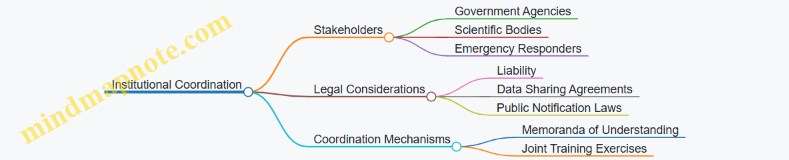
Example: California’s ShakeAlert involves multiple agencies with defined protocols, ensuring smooth information flow and coordinated responses.
Managing Public Expectations and Response
False alarms and missed warnings can erode trust. Transparent communication about system capabilities and limitations helps manage expectations.
- Mind Map: Public Engagement

Example: Japan’s JMA regularly updates the public on warning performance and conducts drills, maintaining high public confidence.
Ensuring System Maintenance and Sustainability
Long-term operation requires funding, technical expertise, and routine maintenance. Training local personnel reduces dependence on external support.
- Mind Map: Sustainability Factors
Example: Italy’s INGV network emphasizes local technician training and scheduled maintenance to sustain system reliability.
Summary Table of Barriers and Solutions
| Barrier | Solution Approach | Example Region |
|---|---|---|
| Complex Seismicity | Tailored sensor placement and algorithms | Mexico (SASMEX) |
| Communication Limitations | Hybrid communication networks | Taiwan |
| Institutional Fragmentation | Defined roles and agreements | California (ShakeAlert) |
| Public Trust Issues | Transparent communication and drills | Japan (JMA) |
| Sustainability Challenges | Local training and funding strategies | Italy (INGV) |
By focusing on these practical areas and learning from established systems, regions can better navigate the challenges of EEW implementation. The key is not to replicate systems blindly but to adapt proven methods thoughtfully to local realities.
Chapter 12: Training, Public Education, and Community Engagement
12.1 Designing Effective Training Programs for System Operators
Designing effective training programs for earthquake early warning system operators requires a structured approach that balances technical knowledge, practical skills, and decision-making under pressure. Operators are the frontline users who interpret seismic data, manage alerts, and ensure timely warnings reach the public. Their training must prepare them to handle complex systems reliably and confidently.
Core Components of Training Programs
Training should cover the following key areas:
- System Familiarization: Understanding hardware components, software interfaces, and data flow.
- Seismic Data Interpretation: Recognizing seismic waveforms, identifying P- and S-waves, and distinguishing noise from real events.
- Alert Protocols: Knowing criteria for issuing warnings, thresholds, and communication procedures.
- Emergency Procedures: Steps to take during system failures or unexpected events.
- Simulation Exercises: Hands-on practice with real-time scenarios.
- Communication Skills: Coordinating with emergency responders and public communication teams.
Mind Map: Training Program Structure
Practical Example: Stepwise Learning
A training program might begin with classroom sessions explaining seismic wave properties and system components. Trainees then move to interactive software labs where they observe live data streams and practice identifying seismic events. Next, they run through scripted scenarios where they decide whether to issue warnings based on simulated data. Finally, trainees participate in drills involving communication with emergency services.
Mind Map: Stepwise Learning Process
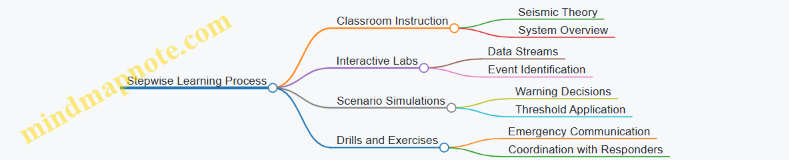
Emphasizing Decision-Making Under Pressure
Operators must make quick, accurate decisions. Training should include timed exercises where trainees analyze noisy or ambiguous data. For example, a scenario might present a low-magnitude event near a populated area, challenging the operator to balance false alarms against missed warnings. Debriefing after exercises helps identify decision patterns and areas for improvement.
Example Scenario: Ambiguous Signal
- Data shows a weak P-wave signal.
- Background noise levels are high.
- Nearby sensors report inconsistent readings.
- Operator must decide whether to issue a warning or wait for confirmation.
This scenario teaches cautious but timely decision-making, emphasizing the cost of both false alarms and delays.
Mind Map: Decision-Making Factors
Incorporating Feedback and Continuous Improvement
Training programs should include regular assessments and feedback sessions. Operators benefit from reviewing past alerts, including false alarms and missed events, to understand system limitations and improve judgment. Peer discussions and expert reviews foster a culture of learning.
Example: Post-Exercise Review
After a simulation, the trainer reviews the operator’s decisions, highlighting correct actions and discussing alternative approaches. This reinforces learning and builds confidence.
Summary
Effective training programs combine technical instruction, practical exercises, and decision-making practice. Using clear structures and real-world examples helps operators build the skills needed to run earthquake early warning systems reliably. Mind maps can organize complex topics visually, aiding retention and clarity.
12.2 Public Education Campaigns on Earthquake Preparedness
Public education campaigns on earthquake preparedness are essential for reducing risk and improving community response when earthquakes occur. These campaigns aim to inform people about the nature of earthquakes, how to prepare before one happens, what to do during shaking, and how to respond afterward. Clear, consistent messaging tailored to local contexts helps build awareness and practical readiness.
Key Components of Public Education Campaigns
- Understanding Earthquake Risks: Explaining seismic hazards specific to the region, including fault lines and historical earthquake activity.
- Preparedness Actions: Encouraging households and workplaces to create emergency kits, secure heavy furniture, and develop family communication plans.
- Response Behavior: Teaching the “Drop, Cover, and Hold On” technique and safe evacuation procedures.
- Post-Earthquake Safety: Guidance on checking for injuries, hazards like gas leaks, and how to access emergency services.
- Use of Early Warning Systems: Educating the public on how earthquake early warning alerts work and how to respond promptly.
Mind Map: Public Education Campaign Structure
Example: Community Workshop Series
A city prone to moderate earthquakes organized a series of workshops in community centers. Each session combined presentations on seismic risks with hands-on activities, such as assembling emergency kits and practicing earthquake drills. The workshops included role-playing scenarios where participants responded to early warning alerts, reinforcing the importance of immediate action. Feedback showed increased confidence among attendees in handling earthquake situations.
Mind Map: Workshop Content Breakdown
Example: School-Based Education Programs
Schools incorporated earthquake preparedness into their curriculum through interactive lessons and drills. Teachers used age-appropriate videos and games to explain seismic waves and safety steps. Students created posters about preparedness to share with their families, extending the campaign’s reach. Regular drills ensured students knew how to respond calmly and effectively.
Mind Map: School Program Elements
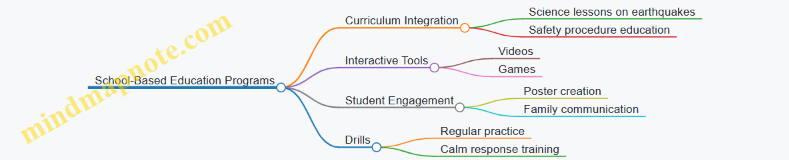
Messaging Tips for Campaigns
- Use simple, clear language avoiding technical jargon.
- Incorporate local examples and scenarios to increase relevance.
- Repeat key messages across multiple channels (radio, social media, flyers).
- Use visuals like diagrams and infographics to aid understanding.
- Encourage two-way communication through Q&A sessions or social media interaction.
Example: Multi-Channel Messaging
A regional campaign combined social media posts with printed flyers distributed at public events. Messages explained how to prepare emergency kits and what to do when an early warning alert sounds. Short videos demonstrated the “Drop, Cover, Hold On” technique. The campaign also hosted live Q&A sessions online, allowing residents to ask questions directly to experts.
Mind Map: Multi-Channel Campaign Approach
In summary, public education campaigns on earthquake preparedness work best when they combine clear information with practical activities, use multiple communication channels, and engage the community actively. Real-world examples show that hands-on learning and repeated, accessible messaging improve readiness and response during earthquakes.
12.3 Engaging Stakeholders and Local Communities
Engaging stakeholders and local communities is a critical component of effective earthquake early warning (EEW) systems. Without their involvement, even the most advanced technology can fail to achieve its purpose: saving lives and reducing damage. This section outlines practical approaches to fostering meaningful engagement, supported by clear examples and structured mind maps to clarify the process.
Understanding Stakeholders and Communities
Stakeholders include government agencies, emergency responders, scientists, local businesses, schools, and media outlets. Local communities refer to residents, neighborhood groups, and vulnerable populations within the EEW coverage area. Each group has distinct interests, responsibilities, and communication needs.
Why Engagement Matters
- Ensures warnings reach end-users effectively.
- Builds trust in the system and its alerts.
- Encourages preparedness and appropriate response.
- Provides feedback for system improvements.
Key Strategies for Engagement
Stakeholder Mapping and Analysis
Identify all relevant parties and understand their roles and influence.
Stakeholder Mapping Mind Map
Example: In California, ShakeAlert partners conduct regular stakeholder workshops to identify communication gaps and coordinate roles before an earthquake occurs.
Two-Way Communication Channels
Establish forums, meetings, and digital platforms where stakeholders and community members can ask questions, share concerns, and offer suggestions.
Example: Mexico City’s SASMEX system includes community liaisons who hold town hall meetings, allowing residents to express their needs and experiences with the warning system.
Tailored Messaging
Customize information based on the audience’s language, culture, and technical understanding. Avoid jargon and use clear, actionable language.
Example: Taiwan’s EEW system provides alerts in multiple languages and uses simple icons to convey urgency for diverse populations.
Collaborative Preparedness Activities
Engage communities in drills, workshops, and educational campaigns that simulate earthquake scenarios and demonstrate how to respond to warnings.
Example: California’s Great ShakeOut drill involves millions of participants practicing “Drop, Cover, and Hold On,” reinforcing the EEW messages.
Feedback and Continuous Improvement
Collect data on how warnings are received and acted upon. Use surveys, interviews, and social media monitoring to refine communication and system performance.
Example: Japan’s JMA analyzes public response data after warnings to adjust alert timing and content.
Mind Map of Engagement Process
Engagement Process Mind Map
Practical Example: Community Engagement in Action
In Mexico City, SASMEX’s success partly stems from its multi-layered engagement. The system partners with local schools to teach children how to respond to alerts, collaborates with businesses to ensure continuity plans align with warnings, and works with neighborhood groups to spread awareness. This network of relationships ensures that warnings are not just sent but understood and acted upon.
Challenges and Solutions
- Challenge: Diverse populations with varying languages and literacy levels.
- Solution: Use multilingual alerts and visual aids.
- Challenge: Mistrust or skepticism about warning accuracy.
- Solution: Transparent communication about system limitations and successes.
- Challenge: Limited access to technology in some communities.
- Solution: Utilize multiple dissemination channels including sirens, radio, and community messengers.
Summary
Engaging stakeholders and local communities requires deliberate planning, clear communication, and ongoing collaboration. By mapping stakeholders, establishing two-way communication, tailoring messages, involving communities in preparedness, and incorporating feedback, EEW systems become more effective and trusted. Real-world examples demonstrate that engagement is not a one-time task but a continuous process essential to the system’s success.
12.4 Drills and Simulation Exercises
Drills and simulation exercises are essential components of earthquake early warning (EEW) system preparedness. They provide opportunities for system operators, emergency responders, and the public to practice responses, identify weaknesses, and improve coordination. These exercises range from tabletop discussions to full-scale live drills involving multiple agencies and communities.
Purpose of Drills and Simulations
- Test the technical performance of EEW systems under realistic conditions.
- Evaluate communication channels and message dissemination.
- Train personnel in decision-making and operational procedures.
- Enhance public familiarity with warning signals and appropriate actions.
- Identify gaps in protocols and infrastructure.
Types of Exercises
- Tabletop Exercises: Discussion-based sessions where participants walk through scenarios without physical deployment.
- Functional Exercises: Simulated operation of EEW systems and communication without field deployment.
- Full-Scale Drills: Real-time activation of systems, public alerts, and emergency response activities.
Designing Effective Drills
A successful drill requires clear objectives, realistic scenarios, and defined roles. Scenarios should reflect local seismic risks and system capabilities. Coordination among stakeholders is crucial to simulate real-world complexities.
Example Mind Map: Components of an EEW Drill
Example: ShakeAlert Functional Exercise
In California, ShakeAlert conducts functional exercises where simulated earthquake data triggers alerts to emergency managers and public notification systems. Operators practice verifying alerts, while responders test protocols. After the exercise, a debrief identifies communication delays and system bottlenecks.
Public Participation in Drills
Engaging the public through scheduled alert tests helps familiarize them with warning tones and expected behaviors. Clear messaging before and after drills reduces confusion and builds trust.
Example Mind Map: Public Engagement in EEW Drills
Evaluating Drill Outcomes
Performance indicators include alert accuracy, timeliness, message clarity, and response effectiveness. After-action reports summarize findings and recommend improvements.
Example: Mexico City SASMEX Drill
Mexico City regularly conducts full-scale drills involving EEW activation, public sirens, and coordinated emergency response. These drills revealed the need for better siren coverage in some neighborhoods, leading to targeted infrastructure upgrades.
Summary
Drills and simulation exercises are practical tools that keep EEW systems and communities prepared. They reveal real-world challenges and foster continuous improvement. Regular practice ensures that when an earthquake strikes, the warning system and its users respond efficiently and confidently.
12.5 Best Practices: Enhancing Public Trust and Responsiveness - Example from California’s Community Outreach
Enhancing public trust and responsiveness in earthquake early warning (EEW) systems is crucial for their effectiveness. California’s community outreach provides a solid example of how transparent communication, education, and engagement can build confidence and encourage appropriate action when warnings are issued.
Clear Communication
California’s approach emphasizes straightforward, jargon-free messaging. The public receives alerts that explain what is happening, what to expect, and what actions to take. This clarity reduces confusion and hesitation.
Mind Map: Clear Communication
For example, ShakeAlert messages include concise instructions like “Drop, Cover, and Hold On,” which are easy to remember and execute.
Education and Training
Regular workshops and drills help residents understand the warning system and practice responses. California organizes community events where participants learn how to interpret alerts and prepare emergency kits.
Mind Map: Education and Training
A concrete example is the Great California ShakeOut, an annual drill involving millions practicing safety measures simultaneously.
Transparency and Feedback
California’s agencies share data on system performance and false alarms openly, inviting public feedback. This transparency fosters trust by showing the system’s limitations and ongoing improvements.
Mind Map: Transparency and Feedback
For instance, after a false alarm, officials explain the cause and steps taken to prevent recurrence, which reassures users.
Inclusive Outreach
Efforts target diverse communities, including non-English speakers and people with disabilities. Alerts are available in multiple languages and formats, ensuring accessibility.
Mind Map: Inclusive Outreach
California partners with local organizations to reach underrepresented populations, ensuring warnings reach everyone.
Leveraging Technology
Mobile apps and social media are used to disseminate alerts quickly and engage users. Interactive platforms allow users to ask questions and receive updates.
Mind Map: Leveraging Technology
The MyShake app, developed in California, not only provides alerts but also educates users on earthquake preparedness.
Building Community Partnerships
Collaboration with schools, businesses, and emergency services strengthens the network of preparedness. These partnerships facilitate coordinated responses and amplify messaging.
Mind Map: Building Community Partnerships
For example, schools incorporate EEW drills into their safety plans, and businesses train employees on alert responses.
Summary
California’s community outreach balances clear communication, education, transparency, inclusivity, technology use, and partnerships. This multifaceted strategy helps residents understand and trust the EEW system, increasing the likelihood they will respond appropriately when an earthquake warning is issued.