Electromagnetic Compatibility Design For Industrial And Automotive Systems
1. Introduction to Electromagnetic Compatibility (EMC)
1.1 Understanding EMC: Definitions and Importance
Electromagnetic Compatibility (EMC) is a critical aspect of electronic system design, especially in industrial and automotive environments where numerous electronic devices operate in close proximity. EMC ensures that electronic equipment functions correctly in its electromagnetic environment without introducing intolerable electromagnetic disturbances to other devices.
What is EMC?
-
Electromagnetic Compatibility (EMC) is the ability of electrical and electronic equipment to:
- Operate as intended in its electromagnetic environment
- Not emit electromagnetic interference (EMI) that causes malfunction in other devices
-
EMC is composed of two main aspects:
- Emission: The generation and release of electromagnetic energy by a device.
- Immunity (or Susceptibility): The device’s ability to withstand electromagnetic disturbances without performance degradation.
Why is EMC Important?
- Safety: In automotive systems, EMC failures can lead to critical malfunctions such as unintended braking or engine shutdown.
- Reliability: Industrial automation equipment must operate consistently without downtime caused by EMI.
- Regulatory Compliance: Meeting EMC standards is mandatory for product certification and market access.
- Interoperability: Ensures multiple devices can coexist and function without interference.
Mind Map: Core Concepts of EMC
Example 1: EMC in an Automotive Anti-lock Braking System (ABS)
The ABS module uses sensors and electronic control units (ECUs) to modulate braking pressure. If the ABS ECU is susceptible to EMI from the vehicle’s ignition system or radio transmitters, it may malfunction, causing unsafe braking behavior. EMC design ensures the ABS ECU is immune to such interference and does not emit disruptive signals itself.
Mind Map: EMC Importance in Automotive Systems
Example 2: EMC in Industrial Motor Controllers
Industrial motor controllers often switch high currents and voltages, generating significant EMI. Without proper EMC design, this EMI can disrupt nearby sensitive measurement instruments or communication lines. Implementing shielding, filtering, and proper grounding ensures the motor controller operates reliably and does not interfere with other equipment.
Summary
Understanding EMC involves recognizing the dual challenge of controlling emissions and enhancing immunity. In industrial and automotive systems, where safety and reliability are paramount, EMC design is not optional but essential. Through standards compliance, thoughtful design, and testing, engineers can ensure their systems perform flawlessly in complex electromagnetic environments.
1.2 EMC Challenges in Industrial and Automotive Environments
Electromagnetic Compatibility (EMC) challenges in industrial and automotive environments are multifaceted due to the complexity, harsh conditions, and the variety of electronic systems involved. Understanding these challenges is crucial for EMC engineers, hardware designers, and compliance specialists to develop robust and reliable systems.
Key EMC Challenges in Industrial Environments
- Harsh Electromagnetic Environment: Industrial settings often have heavy machinery, motors, welding equipment, and high-power switching devices that generate significant electromagnetic interference (EMI).
- Complex System Integration: Multiple subsystems and legacy equipment coexist, increasing the risk of EMI coupling and ground loops.
- Power Quality Issues: Fluctuations, surges, and harmonics in power supply lines can induce noise.
- Long Cable Runs: Extended wiring increases susceptibility to radiated and conducted EMI.
- Mechanical Vibrations and Temperature Extremes: These can affect shielding integrity and connector reliability.
Mind Map: EMC Challenges in Industrial Environments
Example: In a manufacturing plant, a variable frequency drive (VFD) controlling a motor can emit broadband noise that interferes with nearby sensor signals, causing false readings and process disruptions. Implementing proper filtering and shielding around the VFD and sensor cables can mitigate this.
Key EMC Challenges in Automotive Environments
- High-Density Electronics: Modern vehicles contain numerous electronic control units (ECUs), sensors, and infotainment systems packed closely together.
- Wide Frequency Spectrum of EMI: From low-frequency ignition noise to high-frequency wireless communications.
- Harsh Electrical Transients: Load dumps, electrostatic discharge (ESD), and electromagnetic pulses (EMP) from lightning or switching events.
- Varying Operating Conditions: Temperature extremes, humidity, vibration, and mechanical shocks.
- Safety-Critical Systems: Failure due to EMI can have severe safety implications.
Mind Map: EMC Challenges in Automotive Environments
Example: An electric vehicle’s high-voltage battery management system (BMS) can generate switching noise that interferes with the vehicle’s CAN bus communication. Applying differential signaling and adding common mode chokes on communication lines helps maintain signal integrity.
Comparative Overview Table
| Challenge Category | Industrial Environment | Automotive Environment |
|---|---|---|
| EMI Sources | Motors, welding machines, heavy power switching | Ignition systems, wireless modules, high-voltage EV components |
| System Complexity | Multiple legacy and modern subsystems | Dense ECUs and sensor networks |
| Power Quality Issues | Surges, harmonics, voltage fluctuations | Load dumps, battery transients |
| Environmental Factors | Vibration, temperature extremes, dust | Temperature extremes, vibration, humidity |
| Safety Impact | Process disruption, equipment damage | Safety-critical failures, vehicle malfunctions |
Practical Example: Diagnosing EMC Issues in an Industrial Robot
An industrial robot arm experienced intermittent communication failures. Investigation revealed that the robot’s servo motor drives emitted high-frequency noise coupling into the control cables. The solution involved rerouting cables, adding ferrite beads on signal lines, and improving grounding schemes, which restored reliable operation.
Practical Example: EMC Challenge in Automotive Radar Systems
Automotive radar sensors operating at 77 GHz are sensitive to EMI from other vehicle electronics and external sources. Shielding the radar module and careful PCB layout with controlled impedance traces were implemented to reduce susceptibility and ensure accurate object detection.
Summary
EMC challenges in industrial and automotive environments stem from diverse EMI sources, complex system architectures, and harsh operating conditions. Addressing these requires a holistic approach combining design best practices, component selection, shielding, filtering, and thorough testing.
Understanding these challenges early in the design process helps prevent costly redesigns and ensures compliance with regulatory standards, ultimately leading to safer and more reliable systems.
1.3 Regulatory Standards and Compliance Requirements Overview
Electromagnetic Compatibility (EMC) regulatory standards and compliance requirements are essential frameworks that ensure electronic devices operate reliably without causing or succumbing to electromagnetic interference. For industrial and automotive systems, adherence to these standards is critical to guarantee safety, functionality, and market acceptance.
Key EMC Regulatory Bodies and Standards
- International Electrotechnical Commission (IEC)
- IEC 61000 series: EMC immunity and emission standards for industrial environments
- International Organization for Standardization (ISO)
- ISO 7637: Road vehicles — Electrical disturbances from conduction and coupling
- United States Federal Communications Commission (FCC)
- FCC Part 15: Radio frequency devices, including EMC emission limits
- European Committee for Electrotechnical Standardization (CENELEC)
- EN 55032, EN 55035: EMC standards for multimedia equipment
- Society of Automotive Engineers (SAE)
- SAE J1113: EMC test methods for automotive components
Mind Map: Overview of EMC Regulatory Standards
Emission vs Immunity Standards
| Aspect | Emission Standards | Immunity Standards |
|---|---|---|
| Purpose | Limit electromagnetic noise generated by device | Ensure device operates correctly under electromagnetic disturbances |
| Example Standard | CISPR 25 (Automotive Radiated Emissions) | IEC 61000-4-2 (Electrostatic Discharge Immunity) |
Example: Automotive EMC Compliance Flow
- Design Phase
- Select components compliant with automotive EMC standards (e.g., ISO 7637)
- Implement PCB layout best practices to reduce emissions
- Pre-Compliance Testing
- Conduct bench tests for emissions and immunity
- Formal Testing
- Submit device to certified lab for compliance testing against SAE J1113 and CISPR 25
- Certification & Documentation
- Obtain EMC certification
- Maintain technical documentation for regulatory audits
Mind Map: Automotive EMC Compliance Process
Industrial EMC Standards Examples
- IEC 61000-6-2: Immunity for industrial environments
- IEC 61000-6-4: Emission standard for industrial environments
Practical Example:
An industrial motor controller designed for a factory floor must comply with IEC 61000-6-4 to limit its radiated emissions so it does not interfere with nearby sensitive equipment. During design, engineers apply shielding and filtering techniques, then validate compliance through pre-compliance testing before formal certification.
Mind Map: Industrial EMC Standards
Summary
Understanding and integrating regulatory standards early in the design process is crucial for successful EMC compliance. These standards vary by region and application but share the common goal of ensuring electronic systems coexist without harmful interference.
Additional Resources
- IEC Webstore: https://webstore.iec.ch/
- FCC EMC Guidelines: https://www.fcc.gov/general/electromagnetic-compatibility-emc
- SAE EMC Standards: https://www.sae.org/standards/
1.4 Overview of EMC Testing Methods and Equipment
Electromagnetic Compatibility (EMC) testing is a critical step in ensuring that electronic systems operate reliably without causing or suffering from electromagnetic interference (EMI). This section provides a comprehensive overview of the primary EMC testing methods and the equipment used, illustrated with practical examples and mind maps to facilitate understanding.
Key EMC Testing Categories
EMC testing broadly falls into two categories:
- Emission Testing: Measures the electromagnetic noise emitted by a device.
- Immunity (Susceptibility) Testing: Assesses the device’s ability to operate correctly under electromagnetic disturbances.
Mind Map: EMC Testing Methods
Emission Testing Methods
Radiated Emission Testing:
- Measures electromagnetic energy emitted through the air from the device.
- Typically performed in an anechoic chamber or open area test site (OATS).
- Frequency range usually from 30 MHz to 1 GHz or higher depending on standards.
Example: An automotive ECU prototype is placed on a non-conductive table inside an anechoic chamber. A broadband antenna measures emissions while the ECU operates under normal conditions. Excessive emissions at 150 MHz are identified, prompting PCB layout revisions.
Conducted Emission Testing:
- Measures unwanted signals conducted along power or signal cables.
- Uses Line Impedance Stabilization Networks (LISNs) to isolate and measure noise.
Example: An industrial motor controller is tested for conducted emissions on its AC power input. A LISN is connected between the power source and the device. The spectrum analyzer reveals a spike at 100 kHz, indicating switching noise from the power electronics.
Immunity Testing Methods
Radiated Immunity Testing:
- Exposes the device to controlled electromagnetic fields to verify operation under interference.
- Uses a signal generator, power amplifier, and transmitting antenna.
Example: A vehicle infotainment system is subjected to a 10 V/m radiated field at 900 MHz to simulate interference from nearby radio transmitters. The system maintains audio quality without glitches.
Conducted Immunity Testing:
- Injects disturbance signals directly onto cables.
- Uses coupling/decoupling networks (CDNs) to apply interference.
Example: An industrial PLC is tested by injecting a 1 kV surge onto its communication lines to verify robustness against voltage spikes.
Electrostatic Discharge (ESD) Testing:
- Simulates static electricity discharges that can affect the device.
- Uses an ESD simulator (gun) to apply contact and air discharges.
Example: An automotive dashboard module is tested by applying 8 kV contact discharges on exposed connectors. The module continues to function normally.
Electrical Fast Transient (EFT) Testing:
- Simulates fast transient bursts caused by switching events.
- Uses an EFT generator connected via coupling networks.
Surge Testing:
- Tests device resilience to high-energy surges, such as lightning strikes.
- Uses surge generators applying standardized waveforms.
Magnetic Field Immunity:
- Tests susceptibility to low-frequency magnetic fields.
- Uses Helmholtz coils to generate uniform magnetic fields.
Mind Map: EMC Testing Equipment
Practical Example: EMC Testing Workflow for an Automotive ECU
-
Pre-Test Preparation:
- Verify device is fully functional.
- Connect all cables as per normal operation.
-
Conducted Emission Test:
- Connect LISN to power input.
- Measure emissions with spectrum analyzer.
- Identify any frequency bands exceeding limits.
-
Radiated Emission Test:
- Place ECU on test table in anechoic chamber.
- Use broadband antenna to scan frequency range.
- Record emission levels.
-
Immunity Tests:
- Perform ESD testing on connectors.
- Conduct radiated immunity test at specified field strengths.
- Apply EFT bursts on signal lines.
-
Analysis and Mitigation:
- Review test data.
- Identify failure modes.
- Implement design changes (e.g., shielding, filtering).
-
Retesting:
- Repeat tests to verify improvements.
Summary
Understanding EMC testing methods and equipment is essential for designing compliant industrial and automotive systems. By systematically applying emission and immunity tests, engineers can identify potential EMC issues early and implement effective mitigation strategies. Practical examples and mind maps help visualize the testing landscape, making it easier to integrate EMC considerations into the design process.
1.5 Case Study: EMC Failures and Their Impact on Industrial Systems
Electromagnetic Compatibility (EMC) failures in industrial systems can lead to severe operational disruptions, safety hazards, and costly downtime. This case study explores a real-world example where inadequate EMC design caused significant issues in a factory automation system, illustrating the critical importance of EMC considerations.
Background
A manufacturing plant integrated a new programmable logic controller (PLC) system to automate conveyor belts and robotic arms. Shortly after deployment, the system experienced frequent unexpected resets and communication errors, halting production intermittently.
Problem Identification
Initial investigations pointed to electromagnetic interference (EMI) as the root cause. The PLC was located near high-power variable frequency drives (VFDs) controlling motors, which generated substantial electrical noise.
Impact of EMC Failures
- Production Downtime: Frequent system resets caused unplanned stops, reducing throughput by 15%.
- Safety Risks: Erratic robotic arm behavior posed potential hazards to maintenance personnel.
- Increased Maintenance Costs: Troubleshooting and repairs increased operational expenses.
Mind Map: EMC Failure Impact in Industrial Systems
Root Causes of EMC Failure in This Case
- Inadequate shielding of PLC enclosure
- Poor grounding and bonding practices
- Lack of filtering on power and signal lines
- Improper cable routing near noisy equipment
Example: Cable Routing Mistake
The PLC signal cables were routed parallel and close to the power cables feeding the VFDs, creating a strong inductive coupling path for noise.
Remediation Steps Taken
- Improved Shielding: Installed metal enclosures with proper EMI gaskets around the PLC.
- Grounding Enhancements: Implemented single-point grounding to avoid ground loops.
- Filtering: Added LC filters on power inputs and ferrite beads on signal lines.
- Cable Management: Re-routed signal cables perpendicular to power cables and increased separation distance.
Best Practices Illustrated
- Shielding: Use conductive enclosures and ensure proper sealing to block radiated emissions.
- Grounding: Establish a low-impedance, single-point ground reference.
- Filtering: Integrate filters early in design to suppress conducted noise.
- Cable Routing: Maintain separation and avoid parallel runs of noisy and sensitive cables.
Mind Map: Best Practices to Prevent EMC Failures
Final Outcome
After implementing these EMC mitigation techniques, the PLC system operated reliably without resets or communication errors. Production uptime improved, safety risks were minimized, and maintenance costs decreased.
Summary
This case study highlights how EMC failures in industrial systems can have wide-ranging negative impacts. By understanding root causes and applying best practices such as shielding, grounding, filtering, and proper cable management, engineers can design robust systems that maintain operational integrity even in electrically noisy environments.
Additional Example: EMI-Induced Sensor Malfunction
In another scenario, proximity sensors on an assembly line were intermittently failing due to radiated emissions from nearby welding equipment. The solution involved:
- Adding metal shielding around sensors
- Using twisted pair shielded cables
- Installing ferrite cores on sensor cables
This example further reinforces the importance of EMC design tailored to specific industrial challenges.
2. Fundamental Electromagnetic Principles for EMC Design
2.1 Electromagnetic Interference (EMI) Sources and Mechanisms
Electromagnetic Interference (EMI) is any unwanted disturbance generated by an external source that affects an electrical circuit through electromagnetic induction, electrostatic coupling, or conduction. Understanding the sources and mechanisms of EMI is fundamental for EMC engineers, hardware designers, and compliance specialists working in industrial and automotive systems.
What is EMI?
EMI manifests as noise or signals that disrupt the normal operation of electronic devices. It can degrade performance, cause data corruption, or even lead to system failure.
Common EMI Sources
EMI sources can be broadly categorized into natural and man-made origins. In industrial and automotive environments, man-made sources dominate due to the abundance of electrical and electronic equipment.
Mind Map: EMI Sources
EMI Generation Mechanisms
EMI can be generated through several mechanisms, primarily involving how energy is transferred or coupled from the source to the victim system.
Conducted EMI
Occurs when unwanted signals travel along conductive paths such as power lines, signal cables, or grounding conductors.
Radiated EMI
Occurs when electromagnetic energy is emitted through space and picked up by nearby circuits or antennas.
Inductive Coupling
Magnetic fields generated by current in one conductor induce unwanted currents in adjacent conductors.
Capacitive Coupling
Electric fields cause unwanted voltage to appear on nearby conductors or circuits.
Mind Map: EMI Mechanisms
Practical Examples of EMI Sources and Mechanisms
Example 1: Switching Power Supply Noise (Conducted and Radiated EMI)
A switching power supply in an industrial controller rapidly switches current on and off, generating high-frequency noise. This noise can travel back through the power lines (conducted EMI) and radiate from cables or PCB traces (radiated EMI), potentially disrupting sensitive analog circuits nearby.
Best Practice: Use LC filters on input and output lines and proper PCB layout to minimize loop areas.
Example 2: Automotive Ignition System (Radiated and Inductive Coupling)
The ignition coil in a vehicle generates high-voltage pulses to ignite the fuel-air mixture. These pulses create strong magnetic fields that can inductively couple into nearby wiring harnesses, causing transient noise in electronic control units (ECUs).
Best Practice: Shield ignition cables, route sensitive signal cables away from ignition harnesses, and use twisted pair wiring to reduce inductive coupling.
Example 3: Electric Motor in Industrial Equipment (Conducted and Radiated EMI)
Electric motors generate noise through brush sparking and commutation. This noise can be conducted back into power lines and radiated through motor cables, affecting nearby control electronics.
Best Practice: Employ motor line filters, use shielded cables, and implement proper grounding schemes.
Summary
Understanding the diverse sources and mechanisms of EMI is the first step toward effective EMC design. By identifying how and where EMI is generated and coupled, engineers can apply targeted mitigation techniques to ensure system reliability and compliance.
Additional Mind Map: EMI Source to Victim Coupling Pathways
2.2 Coupling Paths: Conductive, Radiative, and Inductive
Electromagnetic interference (EMI) can enter or exit an electronic system through various coupling paths. Understanding these paths is essential for EMC engineers and hardware designers to effectively mitigate interference in industrial and automotive systems. The three primary coupling mechanisms are conductive, radiative, and inductive coupling. Each has distinct characteristics and requires tailored design strategies.
Conductive Coupling
Conductive coupling occurs when unwanted signals travel along conductive paths such as wires, PCB traces, or ground connections. This is often the most straightforward coupling path to understand and control.
- Mechanism: Noise currents or voltages are directly injected into signal or power lines.
- Common Sources: Switching power supplies, motor drives, and digital circuits with fast edges.
- Example: A noisy motor controller injecting voltage spikes into the power line feeding a sensitive sensor.
Mitigation Best Practices:
- Use of filters (LC, RC) on power and signal lines.
- Proper grounding and star grounding techniques.
- Separation of noisy and sensitive circuits on PCBs.
Example: In an industrial PLC system, adding ferrite beads and LC filters on sensor input lines reduces conducted noise from the motor drives.
Radiative Coupling
Radiative coupling involves electromagnetic waves propagating through space and inducing unwanted currents or voltages in nearby circuits.
- Mechanism: EMI is transmitted as radio waves and picked up by antennas formed unintentionally by cables or PCB traces.
- Common Sources: High-frequency digital circuits, RF transmitters, and switching regulators.
- Example: An automotive infotainment system’s antenna picks up interference from a nearby switching regulator, causing audio noise.
Mitigation Best Practices:
- Shielding enclosures and cables.
- Maintaining physical separation between noisy and sensitive components.
- Use of twisted pair or coaxial cables to reduce antenna effects.
Example: Shielding the ECU enclosure and routing high-speed signals away from antenna cables in an electric vehicle reduces radiated EMI.
Inductive Coupling
Inductive coupling occurs when a time-varying magnetic field generated by a current-carrying conductor induces a voltage in a nearby conductor.
- Mechanism: Magnetic fields from switching currents induce voltages in adjacent loops or traces.
- Common Sources: Motor windings, inductors, transformers, and high-current switching devices.
- Example: In an industrial motor drive, the high di/dt in power cables induces noise in adjacent sensor wiring.
Mitigation Best Practices:
- Minimizing loop areas of sensitive circuits.
- Twisting pairs of wires to cancel magnetic fields.
- Physical separation of high-current and low-level signal cables.
Example: Twisting sensor cables and routing them orthogonally to power cables in an industrial robot reduces inductive noise pickup.
Mind Maps
Mind Map 1: Overview of Coupling Paths
Mind Map 2: Conductive Coupling Details
Mind Map 3: Radiative Coupling Details
Mind Map 4: Inductive Coupling Details
Integrated Example: Automotive ECU EMI Mitigation
In an automotive Electronic Control Unit (ECU), multiple coupling paths can cause EMI issues:
- Conductive: Power supply noise from the vehicle battery line can enter the ECU through the power input.
- Radiative: High-speed CAN bus signals can radiate EMI picked up by nearby antenna cables.
- Inductive: High current switching in the motor control circuit induces noise in sensor wiring.
Mitigation Steps:
- Add LC filters and ferrite beads on power and CAN lines (conductive).
- Shield the ECU enclosure and use shielded twisted pair cables for CAN bus (radiative).
- Twist sensor cables and route them away from motor power cables (inductive).
This integrated approach ensures robust EMC performance in the harsh automotive environment.
Summary
Understanding the three primary coupling paths—conductive, radiative, and inductive—is fundamental for effective EMC design in industrial and automotive systems. By identifying the dominant coupling mechanisms in your design and applying targeted mitigation techniques, you can significantly reduce EMI issues and improve system reliability.
2.3 Noise Generation and Propagation in Electronic Systems
Electromagnetic noise in electronic systems is an unwanted disturbance that affects the normal operation of circuits. Understanding how noise is generated and propagates is crucial for EMC engineers and hardware designers to develop effective mitigation strategies.
Types of Noise Sources
Noise in electronic systems can originate from various sources, broadly categorized as follows:
- Internal Sources: Generated within the system itself, such as switching power supplies, digital circuits, and clock signals.
- External Sources: Originating outside the system, including radio frequency interference (RFI), electrostatic discharge (ESD), and conducted noise from power lines.
Noise Generation Mechanisms
- Switching Noise: Rapid changes in current or voltage in digital circuits and power electronics create transient electromagnetic fields.
- Thermal Noise: Random motion of electrons in resistive components generates broadband noise.
- Shot Noise: Occurs in semiconductor devices due to discrete charge carriers crossing junctions.
- Crosstalk: Unintended coupling between adjacent signal lines causing noise injection.
- Ground Bounce: Voltage fluctuations in ground reference due to high transient currents.
Noise Propagation Paths
Noise propagates through three primary coupling paths:
- Conductive Coupling: Noise travels along conductive paths such as power and signal lines.
- Capacitive Coupling: Electric fields couple noise between adjacent conductors separated by a dielectric.
- Inductive Coupling: Magnetic fields induce noise currents in nearby conductors.
Mind Map: Noise Generation and Propagation
Practical Example: Noise in an Automotive ECU
Consider an automotive Engine Control Unit (ECU) where a high-speed microcontroller operates alongside a switching regulator powering sensors.
- The switching regulator generates high-frequency switching noise.
- This noise propagates through the power lines (conductive coupling) and couples into sensitive analog sensor inputs via capacitive and inductive coupling.
- Ground bounce caused by large transient currents in the microcontroller’s ground return path further degrades signal integrity.
Mitigation Best Practices (Integrated Example)
- Separation of Analog and Digital Grounds: To minimize ground bounce and noise coupling.
- Use of Decoupling Capacitors: Placed close to IC power pins to suppress switching noise.
- Twisted Pair and Shielded Cables: For sensor signal lines to reduce inductive and capacitive coupling.
- Proper PCB Layout: Minimizing loop areas to reduce magnetic field emissions.
Mind Map: Noise Mitigation Strategies
Summary
Noise generation and propagation are fundamental challenges in EMC design. By understanding the sources, mechanisms, and paths of noise, engineers can apply targeted design practices to ensure system robustness, especially in complex industrial and automotive environments.
2.4 Practical Example: Identifying EMI Sources in an Automotive Control Unit
Electromagnetic Interference (EMI) is a critical concern in automotive control units (ECUs) due to the dense integration of electronic components and the harsh electromagnetic environment inside vehicles. Identifying EMI sources early in the design phase helps engineers mitigate potential issues, ensuring system reliability and compliance with automotive EMC standards.
Step 1: Understand the Automotive ECU Environment
An automotive ECU typically controls engine functions, transmission, braking, or infotainment systems. It contains microcontrollers, power electronics, communication interfaces (CAN, LIN, FlexRay), sensors, and actuators.
Key EMI source categories in an ECU:
- Switching Power Supplies
- High-speed Digital Circuits
- Communication Interfaces
- Actuator Drivers (e.g., motors, solenoids)
- External Connections and Harnesses
Step 2: Create a Mind Map of Potential EMI Sources
Step 3: Identify Specific EMI Mechanisms for Each Source
| EMI Source | EMI Mechanism | Example Scenario |
|---|---|---|
| DC-DC Converter | Switching noise, conducted EMI | High-frequency ripple on power lines causing noise in sensitive analog circuits |
| Microcontroller Clock | Radiated EMI from clock traces | Clock harmonics coupling into adjacent signal lines |
| CAN Bus Transceiver | Differential mode emissions | Fast edge rates causing radiated emissions from twisted pair cables |
| PWM Motor Driver | Conducted and radiated EMI | Rapid switching of motor currents generating broadband noise |
| Connectors and Harness | Antenna effect, common mode currents | Long cables acting as antennas, picking up or radiating EMI |
Step 4: Practical Example - EMI Source Identification in an ECU Power Stage
Scenario: An ECU experiences intermittent communication errors on the CAN bus during engine startup.
Investigation:
- The DC-DC converter supplying the ECU powers up with a switching frequency around 500 kHz.
- Oscilloscope measurements reveal high-frequency voltage spikes on the 12 V power line.
- Spectrum analyzer detects broadband noise radiating near the power stage.
Conclusion: The switching noise from the DC-DC converter is coupling into the CAN transceiver power supply and communication lines, causing EMI-induced errors.
Step 5: Mind Map - EMI Coupling Paths in the ECU
Step 6: Example - Using Diagnostic Tools to Pinpoint EMI Sources
- Near-field probes: Detect localized radiated emissions on PCB components (e.g., switching transistors).
- Current probes: Measure conducted noise on power and ground lines.
- Spectrum analyzers: Identify frequency components of EMI.
- Oscilloscopes with differential probes: Observe signal integrity and noise on communication lines.
Example: Using a near-field probe over the DC-DC converter switching node reveals strong emissions at 500 kHz and its harmonics, confirming it as a primary EMI source.
Step 7: Summary of Best Practices for EMI Source Identification
- Map all potential EMI sources and their mechanisms early in design.
- Use a combination of measurement tools to localize and characterize EMI.
- Understand coupling paths to trace noise propagation.
- Validate findings with real-world operating conditions (e.g., engine startup).
By systematically identifying EMI sources in automotive ECUs, engineers can implement targeted mitigation strategies such as filtering, shielding, optimized PCB layout, and proper grounding to ensure EMC compliance and robust system performance.
2.5 Best Practice: Using Simulation Tools to Predict EMI Behavior
Electromagnetic Interference (EMI) prediction through simulation tools is a cornerstone best practice in modern EMC design. By leveraging simulation early in the design cycle, engineers can identify potential EMI issues, optimize layouts, and reduce costly redesigns and compliance failures.
Why Use Simulation Tools for EMI Prediction?
- Early Detection: Identify EMI hotspots before physical prototyping.
- Cost Efficiency: Reduce iterations and expensive lab testing.
- Design Optimization: Test multiple design variants quickly.
- Compliance Assurance: Validate designs against EMC standards virtually.
Common Types of EMI Simulation Tools
- Finite Element Method (FEM) Simulators: Analyze electromagnetic fields in complex geometries.
- Method of Moments (MoM) Simulators: Efficient for antenna and radiated emission analysis.
- Circuit Simulators with EMI Models: SPICE-based tools with EMI behavioral models.
- Hybrid Tools: Combine circuit and field solvers for comprehensive analysis.
Mind Map: EMI Simulation Workflow
Practical Example: Predicting EMI in an Automotive Control Module
Scenario: An automotive ECU exhibits unexpected radiated emissions during pre-compliance testing. The design team uses simulation to pinpoint the source.
Steps:
- Model Import: The PCB layout and enclosure CAD files are imported into an FEM-based EMI simulator.
- Source Definition: Switching regulators and high-speed digital lines are defined as EMI sources.
- Simulation: A frequency sweep from 30 MHz to 1 GHz is performed to identify emission peaks.
- Analysis: Simulation reveals that a specific high-speed trace near the enclosure edge is radiating strongly.
- Mitigation: The design is modified to add a ground guard trace and reposition components.
- Re-simulation: Emissions drop significantly in the simulation results.
- Verification: Physical retesting confirms reduced emissions, passing compliance.
Mind Map: EMI Source Identification via Simulation
Tips for Effective EMI Simulation
- Start Early: Incorporate simulation in the conceptual phase.
- Use Accurate Models: Include parasitic elements and realistic material properties.
- Validate Models: Correlate simulation results with measured data.
- Iterate Frequently: Use simulation to guide incremental design improvements.
- Leverage Automation: Use scripting and batch runs for parametric studies.
Summary
Using simulation tools to predict EMI behavior empowers EMC engineers and hardware designers to proactively address interference issues. By integrating simulation into the design workflow, teams can save time, reduce costs, and achieve robust EMC compliance for industrial and automotive systems.
3. EMC Design Considerations for Industrial Systems
3.1 Power Distribution and Grounding Strategies
Effective power distribution and grounding are foundational to achieving robust electromagnetic compatibility (EMC) in industrial systems. Poor design in these areas can lead to noise coupling, ground loops, and susceptibility to electromagnetic interference (EMI).
Key Concepts in Power Distribution and Grounding
- Power Distribution: Delivering clean, stable power to all components while minimizing noise and voltage drops.
- Grounding: Establishing a common reference point for circuits to reduce noise and provide a return path for currents.
Mind Map: Power Distribution and Grounding Strategies
Power Distribution Strategies
Power Source Selection
- Example: In an industrial motor controller, using a regulated DC power supply with low ripple reduces the noise injected into the system.
Power Conditioning
- Use LC filters or ferrite beads on power lines to suppress conducted EMI.
- Example: Adding an LC filter before the input stage of a PLC reduces high-frequency noise from the power grid.
Power Routing Topologies
- Star Topology: Power lines radiate from a single point to loads, minimizing voltage drops and noise coupling.
- Bus Topology: Power is distributed along a common bus; simpler but can increase noise coupling.
Example: In a factory automation panel, star topology is preferred for sensitive sensor modules to ensure stable power and reduce noise.
Decoupling Capacitors
- Placed close to IC power pins to provide local energy storage and reduce high-frequency noise.
Example: Using a 0.1uF ceramic capacitor near the power pin of a microcontroller in an industrial sensor node.
Grounding Strategies
Ground Types
- Earth Ground: Connection to physical earth, used for safety and noise dissipation.
- Chassis Ground: Metal enclosure ground, often connected to earth ground.
- Signal Ground: Reference point for circuit signals; must be managed carefully to avoid noise.
Grounding Techniques
| Technique | Description | Use Case Example |
|---|---|---|
| Single-Point Ground | All grounds connect at a single node to avoid loops | Low-frequency analog circuits in sensor systems |
| Multi-Point Ground | Grounds connected at multiple points, suitable for high-frequency signals | High-speed digital circuits in industrial controllers |
| Hybrid Grounding | Combination of single and multi-point for mixed-signal systems | Mixed analog/digital automotive ECU designs |
Ground Loops
- Occur when multiple ground paths create a loop, allowing noise currents to flow.
- Mitigation: Use star grounding, isolate grounds, or use differential signaling.
Example: In a factory floor, improper grounding of multiple equipment racks caused 60Hz hum noise; resolved by reconfiguring to single-point grounding.
Ground Plane Design
- Use continuous ground planes on PCBs to provide low impedance return paths.
- Avoid splits in ground planes under high-speed signals.
Example: Designing a multi-layer PCB for an industrial controller with a dedicated solid ground plane to reduce EMI.
Practical Example: Designing Power Distribution and Grounding for an Industrial Motor Controller
Scenario: A motor controller must operate reliably in a noisy factory environment with multiple motors and switching devices.
Approach:
- Use a regulated DC power supply with LC filters at input.
- Implement star topology power distribution to motor driver circuits.
- Place decoupling capacitors close to all IC power pins.
- Establish a single-point grounding scheme connecting signal ground, chassis ground, and earth ground at one location.
- Use a solid ground plane on the PCB with careful routing to minimize loop areas.
- Shield cables and properly terminate shields to chassis ground.
Result: Significant reduction in EMI-induced malfunctions and improved system reliability.
Summary of Best Practices
- Choose stable, low-noise power sources.
- Use filtering and conditioning on power lines.
- Prefer star topology for sensitive loads.
- Place decoupling capacitors close to ICs.
- Implement appropriate grounding techniques based on frequency and system complexity.
- Avoid ground loops by careful grounding design.
- Use continuous ground planes on PCBs.
- Shield and properly terminate cables.
By integrating these power distribution and grounding strategies, EMC engineers and hardware designers can significantly improve the electromagnetic compatibility of industrial systems, ensuring robust and reliable operation in challenging environments.
3.2 Shielding Techniques for Industrial Enclosures
Introduction
Shielding is a fundamental technique in electromagnetic compatibility (EMC) design, especially critical for industrial enclosures where harsh electromagnetic environments are common. Proper shielding helps prevent electromagnetic interference (EMI) from entering or leaving the enclosure, ensuring reliable operation of sensitive electronic equipment.
Why Shield Industrial Enclosures?
- Industrial environments often have high-power machinery generating strong electromagnetic fields.
- Enclosures protect electronics from external EMI and prevent emissions that could interfere with other equipment.
- Shielding reduces susceptibility and emissions, helping meet regulatory standards.
Key Shielding Principles
- Reflection: Shielding materials reflect electromagnetic waves, reducing the energy that penetrates the enclosure.
- Absorption: Materials absorb electromagnetic energy, converting it to heat.
- Multiple Layers: Combining reflection and absorption layers enhances shielding effectiveness.
Mind Map: Shielding Techniques Overview
Material Selection
- Metals:
- Copper: Excellent conductivity and shielding, but costly and heavier.
- Aluminum: Lightweight, good shielding, corrosion resistant.
- Steel: Durable, magnetic shielding properties but heavier and prone to rust.
- Conductive Coatings: Conductive paints or plating can be applied to non-metallic enclosures to provide shielding.
- Composite Materials: Combining metal layers with plastics for weight reduction and mechanical strength.
Example: An industrial PLC enclosure uses aluminum for its lightweight and corrosion resistance, with conductive gaskets on doors to maintain shielding continuity.
Enclosure Design Considerations
- Seams and Joints: Gaps can leak EMI; use conductive gaskets or overlapping seams.
- Gaskets and Seals: EMI shielding gaskets made from conductive elastomers or metal mesh maintain enclosure integrity.
- Ventilation: Necessary for cooling but can be EMI leakage points; use honeycomb vents or waveguide-beyond-cutoff designs.
Example: A motor controller enclosure incorporates finger-stock metal gaskets around access panels to ensure continuous shielding even after repeated opening.
Shielding Implementation Techniques
- Conductive Paints and Foils: Applied inside or outside enclosures to add shielding layers.
- Shielded Doors and Panels: Doors with embedded conductive materials and proper grounding.
- Cable Entry Shielding: Use of shielded connectors, EMI filters, and conductive cable glands to prevent leakage through cables.
Example: An industrial robot control cabinet uses conductive foil lining inside the enclosure combined with shielded cable glands to minimize EMI ingress.
Mind Map: Enclosure Shielding Implementation
Testing and Validation
- Measure shielding effectiveness (SE) using standard test methods (e.g., MIL-STD-285, IEEE 299).
- Perform radiated emission and susceptibility tests on the assembled enclosure.
- Environmental factors such as temperature, humidity, and mechanical stress can affect shielding performance.
Example: After assembly, an industrial power supply enclosure undergoes SE testing and shows 80 dB attenuation at critical frequencies, confirming design effectiveness.
Practical Example: Shielding an Industrial Motor Controller Enclosure
Scenario: A motor controller is experiencing interference from nearby welding equipment causing erratic operation.
Approach:
- Replace existing enclosure with a steel enclosure for better magnetic shielding.
- Install conductive elastomer gaskets on all doors and access panels.
- Line ventilation openings with honeycomb vents to allow airflow but block EMI.
- Use shielded cable glands and ferrite beads on all cable entries.
- Ground the enclosure properly to the facility earth.
Result: Post-implementation testing shows elimination of interference, stable controller operation, and compliance with EMC emission limits.
Summary Best Practices
- Select enclosure materials based on EMI environment and mechanical needs.
- Ensure all seams and joints are properly sealed with conductive gaskets.
- Design ventilation to balance cooling and shielding requirements.
- Shield cable entries rigorously to prevent leakage.
- Validate shielding effectiveness with appropriate testing.
By integrating these shielding techniques thoughtfully, EMC engineers and hardware designers can significantly enhance the electromagnetic compatibility of industrial enclosures, ensuring robust and reliable system performance in challenging environments.
3.3 Filtering Solutions for Power and Signal Lines
Filtering is a critical aspect of EMC design, especially in industrial systems where power and signal lines can act as conduits for electromagnetic interference (EMI). Effective filtering minimizes conducted emissions and improves overall system immunity.
Why Filtering Matters
- Power and signal lines can pick up or radiate unwanted noise.
- Filters help block high-frequency noise while allowing desired signals to pass.
- Proper filtering reduces susceptibility to external EMI and prevents interference with other equipment.
Types of Filters Used in Industrial Systems
- Low-Pass Filters (LPF): Allow DC and low-frequency signals, block high-frequency noise.
- Pi Filters: Combination of capacitors and inductors to provide sharper attenuation.
- Ferrite Beads: Suppress high-frequency noise by adding impedance.
- Common Mode Chokes: Target common-mode noise on differential pairs or power lines.
- EMI Suppression Capacitors: Placed between lines and ground to shunt noise.
Mind Map: Filtering Solutions Overview
Power Line Filtering
Power lines are particularly vulnerable to EMI because they carry high currents and can couple noise into the system or external environment.
Best Practices:
- Use LC or Pi filters at power entry points.
- Include common mode chokes to suppress noise appearing equally on both lines.
- Place EMI suppression capacitors close to the source of noise.
Example:
Consider an industrial motor controller powered from a 24V DC supply. To reduce conducted emissions:
- An LC filter with a 10 µH inductor and 10 µF capacitor is placed near the power input.
- A common mode choke is added to suppress noise caused by switching elements.
- X and Y class capacitors are used to shunt differential and common mode noise.
This arrangement reduces noise propagation back into the power source and improves immunity.
Mind Map: Power Line Filtering Components
Signal Line Filtering
Signal lines, especially those carrying sensitive or high-speed data, require filtering to prevent noise coupling and signal degradation.
Best Practices:
- Use ferrite beads to suppress high-frequency noise without affecting DC signals.
- RC low-pass filters can be used to limit bandwidth and reduce noise.
- Differential mode filters help maintain signal integrity on differential pairs.
Example:
In an industrial sensor interface transmitting analog signals:
- A ferrite bead is placed in series with the signal line to block high-frequency noise.
- A small capacitor (e.g., 100 pF) to ground forms an RC low-pass filter with the ferrite bead.
- This setup reduces EMI pickup from nearby switching devices without significantly affecting signal quality.
Mind Map: Signal Line Filtering Techniques
Implementation Considerations
- Placement: Filters should be placed as close as possible to the noise source or entry point.
- Component Selection: Choose components rated for the expected current, voltage, and frequency range.
- PCB Layout: Keep filter components close together; minimize loop areas to reduce EMI.
Example:
In a factory automation system, a PCB powering multiple sensors includes a common mode choke and EMI capacitors placed right at the connector where power enters the board. This placement ensures noise is filtered before it spreads through the system.
Summary
Filtering solutions for power and signal lines are essential to achieving EMC compliance in industrial systems. By combining inductors, capacitors, ferrite beads, and chokes in well-considered topologies and placements, engineers can effectively reduce EMI and improve system robustness.
Additional Practical Example
Scenario: An industrial PLC experiences intermittent communication errors due to conducted EMI on the RS-485 communication lines.
Solution:
- Add ferrite beads in series with the differential pair.
- Implement RC low-pass filters with 100 Ω resistors and 1 nF capacitors to ground.
- Use twisted pair cables and proper grounding.
Result: Communication errors reduce significantly, and the system passes conducted emission tests.
This section integrates filtering best practices with real-world examples and visual mind maps to aid understanding and practical application.
3.4 PCB Layout Best Practices to Minimize EMI
Electromagnetic Interference (EMI) is a critical concern in PCB design, especially for industrial motor controllers and automotive systems where reliability and compliance are paramount. Proper PCB layout techniques can significantly reduce EMI emissions and susceptibility, improving overall system performance.
Key PCB Layout Strategies to Minimize EMI
Grounding
A continuous, low-impedance ground plane is essential for minimizing EMI. It provides a reference for signals and a return path for currents, reducing loop areas that radiate EMI.
Example: In an industrial motor controller PCB, a solid ground plane was implemented on the second layer. This reduced the loop area for high-frequency signals, decreasing radiated emissions by over 10 dB in pre-compliance testing.
Signal Routing
- Keep traces short and direct: Longer traces act as antennas, increasing EMI.
- Avoid 90-degree bends: Use 45-degree bends or curved traces to reduce impedance discontinuities.
- Differential pairs: Route differential signals closely coupled with controlled impedance to cancel out noise.
Example: An automotive ECU design replaced 90-degree bends with 45-degree bends on high-speed CAN bus lines, resulting in improved signal integrity and reduced EMI.
Layer Stack-Up
Using a multi-layer PCB with dedicated power and ground planes helps contain electromagnetic fields and provides controlled impedance.
Example: A 4-layer PCB stack-up with top signal, ground plane, power plane, and bottom signal layers was used in a factory automation controller. This arrangement minimized crosstalk and EMI emissions.
Decoupling and Bypass Capacitors
Place capacitors as close as possible to the IC power pins to provide a low-impedance path for high-frequency noise.
Example: In an industrial sensor interface board, multiple capacitors (0.1 µF and 1 µF) were placed near each IC power pin, significantly reducing conducted EMI.
Segregation
Separate noisy circuits (like switching power supplies) from sensitive analog or communication circuits to prevent noise coupling.
Example: On an automotive infotainment PCB, analog audio circuits were physically separated from digital processing sections, with separate ground returns connected at a single point.
Shielding and Guard Traces
Guard traces connected to ground can shield sensitive signals from noise.
Example: A guard trace was routed around a high-speed ADC input line on an industrial measurement PCB, reducing noise pickup and improving signal-to-noise ratio.
Return Path Management
Ensure that return currents have a continuous path under the signal traces to minimize loop area and EMI.
Example: In an automotive ECU, splitting the ground plane under a high-speed differential pair caused EMI spikes. Reconnecting the ground plane eliminated these spikes.
Practical Example: Designing an EMC-Robust PCB for an Industrial Motor Controller
- Problem: Initial prototype exhibited high radiated emissions due to large loop areas and poor grounding.
- Solution: Redesigned PCB with a continuous ground plane, shortened signal traces, added decoupling capacitors close to ICs, and improved layer stack-up.
- Result: Radiated emissions reduced by 15 dB, passing EMC pre-compliance tests.
Summary Mind Map
By integrating these PCB layout best practices, EMC engineers and hardware designers can effectively minimize EMI in industrial and automotive systems, ensuring compliance and robust operation.
3.5 Practical Example: Designing an EMC-robust Industrial Motor Controller
Designing an industrial motor controller that is robust against electromagnetic interference (EMI) is critical to ensure reliable operation in harsh industrial environments. This example walks through key EMC design considerations, practical implementation steps, and verification techniques.
Step 1: Identify EMI Sources and Susceptible Nodes
-
EMI Sources:
- Switching power electronics (e.g., IGBTs, MOSFETs)
- High-current motor windings
- PWM signals generating high-frequency noise
- External industrial noise (motors, welders, etc.)
-
Susceptible Nodes:
- Low-level analog sensor inputs
- Communication interfaces (CAN, RS485)
- Control microcontroller and logic signals
Mind Map: EMI Sources and Susceptible Nodes
Step 2: PCB Layout Strategies
- Segregate Power and Signal Grounds: Use separate ground planes connected at a single point to reduce noise coupling.
- Short and Direct Traces: Minimize loop areas for high-frequency switching paths.
- Controlled Impedance: For communication lines, maintain impedance matching.
- Component Placement: Place decoupling capacitors close to IC power pins.
Example:
- Place the gate driver close to the power transistor to reduce gate loop inductance.
- Route high-current paths away from sensitive analog circuits.
Mind Map: PCB Layout Best Practices
Step 3: Filtering and Suppression
- Input Power Filtering: Use LC filters to suppress conducted emissions.
- Signal Line Filtering: Ferrite beads and common mode chokes on communication lines.
- Snubber Circuits: RC snubbers across switching devices to reduce voltage spikes.
Example:
- Add a Pi-filter (C-L-C) on the motor power input to reduce noise back into the supply.
Mind Map: Filtering and Suppression Techniques
Step 4: Shielding and Enclosure Design
- Use metal enclosures connected to chassis ground to shield radiated emissions.
- Ensure all cable entry points have proper EMI gaskets or filters.
- Segregate noisy components inside the enclosure from sensitive electronics.
Example:
- Enclose the power stage in a dedicated shielded compartment within the controller housing.
Mind Map: Shielding and Enclosure
Step 5: Grounding and Bonding
- Implement a star grounding scheme to avoid ground loops.
- Bond the enclosure and PCB ground to the system chassis.
- Use low-inductance bonding straps for grounding connections.
Example:
- Connect the PCB ground plane to the metal enclosure via multiple low-inductance screws.
Mind Map: Grounding and Bonding
Step 6: Component Selection
- Choose components with low EMI emissions, such as shielded inductors and low-ESR capacitors.
- Use gate drivers with integrated EMI reduction features.
- Select connectors with EMI shielding.
Example:
- Use multilayer ceramic capacitors (MLCC) for decoupling to reduce high-frequency noise.
Step 7: Verification and Testing
- Perform pre-compliance conducted and radiated emission tests.
- Use near-field probes to locate EMI hotspots on the PCB.
- Validate filtering effectiveness by measuring noise levels before and after filters.
Example:
- Use a spectrum analyzer with a current probe on the motor power line to verify conducted emissions.
Summary Table: EMC Design Checklist for Industrial Motor Controller
| Design Aspect | Best Practice Example |
|---|---|
| EMI Source Identification | Map switching devices and motor windings |
| PCB Layout | Separate grounds, short traces, place decoupling caps |
| Filtering | LC filters on power lines, ferrites on signals |
| Shielding | Metal enclosure with EMI gaskets |
| Grounding | Star grounding, enclosure bonded to chassis |
| Component Selection | Low-ESR capacitors, shielded inductors |
| Testing | Pre-compliance tests, near-field probing |
By following these integrated EMC design practices with practical examples, engineers can develop industrial motor controllers that maintain reliable operation even in electrically noisy industrial environments.
3.6 Case Study: Successful EMC Mitigation in a Factory Automation System
Overview
In this case study, we explore the EMC challenges faced by a factory automation system integrating multiple motor controllers, sensors, and communication modules operating in a high-noise industrial environment. The goal was to achieve compliance with EMC standards (CISPR 11 and IEC 61000-6-4) while maintaining system reliability and performance.
Initial EMC Challenges
- High conducted emissions on power lines causing interference with nearby control equipment.
- Radiated emissions exceeding limits due to long cable runs and poor shielding.
- Susceptibility issues where sensors experienced false triggering from electromagnetic noise.
Step 1: System-Level EMC Assessment
- Mapping EMI Sources: Identified motor drives and switching power supplies as primary EMI sources.
- Coupling Paths: Noted that power cables and communication lines acted as antennas for noise propagation.
Mind Map: System-Level EMC Assessment
Step 2: Power Distribution and Filtering Improvements
- Implemented multi-stage LC filters at power inputs of motor controllers.
- Added common mode chokes on communication lines (RS-485 bus).
- Re-routed power cables away from sensitive sensor wiring.
Example: A 3-phase motor controller initially showed conducted emissions 15 dB above limits at 150 kHz. After adding a Pi-filter (two 10 µF capacitors and a 100 µH inductor) and a common mode choke, emissions dropped below regulatory thresholds.
Mind Map: Power Filtering Strategy
Step 3: Shielding and Grounding Enhancements
- Enclosures upgraded to aluminum with conductive gaskets to improve shielding effectiveness.
- Grounding scheme revised to a single-point ground to avoid ground loops.
- Shielded twisted pair cables used for sensor signals.
Example: Replacing unshielded cables with shielded twisted pairs reduced sensor false triggers by 80%, improving system stability.
Mind Map: Shielding and Grounding
Step 4: PCB and Component-Level Modifications
- Motor controller PCBs redesigned with optimized layer stack-up and ground planes.
- Ferrite beads placed on high-speed signal lines to suppress high-frequency noise.
- Decoupling capacitors added close to IC power pins.
Example: Adding 0603 ferrite beads on PWM output lines reduced radiated emissions by 10 dB in the 30 MHz to 100 MHz band.
Mind Map: PCB-Level EMC Improvements
Step 5: Validation and Testing
- Conducted pre-compliance testing after each mitigation step.
- Final system passed CISPR 11 Class A limits for industrial environments.
- System demonstrated robust immunity to conducted and radiated disturbances.
Example: Radiated emission tests in an anechoic chamber showed a 12 dB reduction after enclosure and PCB improvements.
Summary of Best Practices Applied
- Early identification of EMI sources and coupling paths.
- Multi-layer filtering combining LC filters and common mode chokes.
- Proper cable routing separating noisy and sensitive lines.
- Effective shielding with conductive enclosures and cable shielding.
- Grounding strategy focused on single-point grounding to minimize loops.
- PCB design optimized for EMC with ferrite beads and decoupling.
- Iterative testing and validation to guide design improvements.
Final Mind Map: EMC Mitigation Workflow in Factory Automation
This case study illustrates how a systematic, multi-disciplinary approach to EMC design can successfully mitigate interference issues in complex industrial automation systems, ensuring compliance and operational reliability.
4. EMC Design Considerations for Automotive Systems
4.1 Unique EMC Challenges in Automotive Environments
Automotive environments present a distinct set of challenges for Electromagnetic Compatibility (EMC) design due to the complexity, harsh operating conditions, and safety-critical nature of vehicle systems. Understanding these unique challenges is essential for EMC engineers and hardware designers to develop robust, compliant automotive electronic systems.
Key Unique EMC Challenges in Automotive Systems
- Harsh Electrical Environment
- High voltage spikes from ignition systems, alternators, and inductive loads
- Load dump events causing transient overvoltages
- Wide Frequency Spectrum of Emissions
- Broadband noise from switching power electronics (e.g., DC-DC converters, inverters)
- Narrowband emissions from communication modules (CAN, LIN, FlexRay, Ethernet)
- Complex Wiring Harnesses
- Long cable runs with multiple branches
- Mixed signal and power lines in close proximity
- Multiple Electronic Control Units (ECUs)
- Hundreds of ECUs communicating via various bus systems
- Potential for cross-coupling and interference between modules
- Environmental and Mechanical Stress
- Temperature extremes, vibration, moisture, and corrosion affecting EMC performance
- Safety and Reliability Requirements
- Functional safety standards (ISO 26262) requiring fail-safe EMC design
- EMC failures can lead to critical system malfunctions
Mind Map: Overview of Automotive EMC Challenges
Example 1: Load Dump Transient Impact on ECU
A load dump event occurs when the battery is disconnected while the alternator is charging, causing a high voltage transient (up to 120 V) on the vehicle’s electrical system. This transient can damage sensitive ECUs if not properly protected.
Best Practice:
- Use transient voltage suppressors (TVS) and robust input filtering on ECU power inputs.
- Design power supply circuits with adequate derating and transient immunity.
Example: An automotive lighting control module was failing intermittently due to load dump transients. After adding a TVS diode array and redesigning the input filter, the module passed all EMC transient immunity tests.
Mind Map: Load Dump Protection Strategy
Example 2: EMI from High-Speed Communication Buses
Automotive communication protocols like CAN FD and Automotive Ethernet operate at high data rates, making them susceptible to EMI and potentially causing data corruption.
Best Practice:
- Use differential signaling with twisted pair cables to reduce susceptibility.
- Implement proper termination resistors and common-mode chokes.
- Maintain controlled impedance PCB traces and minimize stub lengths.
Example: An infotainment system experienced intermittent audio dropouts traced back to EMI on the CAN bus. Replacing flat ribbon cables with twisted pair harnesses and adding common-mode chokes resolved the issue.
Mind Map: EMI Mitigation for Automotive Communication Buses
Environmental Challenges and Their EMC Impact
Automotive electronics must operate reliably across a wide temperature range (-40°C to +125°C) and withstand vibration, moisture, and contaminants. These factors can degrade shielding effectiveness, connector integrity, and component performance, impacting EMC.
Best Practice:
- Select components rated for automotive temperature and vibration standards.
- Use robust connectors with EMI gaskets and seals.
- Design enclosures with corrosion-resistant coatings and proper ventilation.
Summary
Automotive EMC design requires addressing a complex interplay of electrical, mechanical, and environmental factors. By understanding the unique challenges such as harsh electrical transients, complex wiring, multiple ECUs, and stringent safety requirements, engineers can apply targeted best practices and design strategies to ensure robust EMC performance.
This foundational knowledge sets the stage for deeper exploration into harness design, PCB layout, and filtering techniques in subsequent sections.
4.2 Harness Design and Cable Routing for EMC
Harness design and cable routing are critical factors in ensuring electromagnetic compatibility (EMC) in automotive systems. Poor harness design can lead to increased electromagnetic interference (EMI), signal degradation, and system malfunctions. This section explores best practices, practical examples, and mind maps to help EMC engineers and hardware designers optimize harness design and cable routing.
Key Principles of Harness Design for EMC
- Minimize Loop Areas: Reducing the loop area formed by cables decreases the antenna effect and radiated emissions.
- Twisted Pair Cables: Twisting signal and return conductors helps cancel out electromagnetic noise.
- Shielding: Use shielded cables or add shielding layers to protect sensitive signals.
- Segregation: Separate high-power and low-power cables to reduce coupling.
- Proper Grounding: Ensure shields are grounded correctly to avoid ground loops.
Mind Map: Harness Design Considerations for EMC
Cable Routing Best Practices
-
Separate Power and Signal Cables:
- Keep power cables physically separated from sensitive signal cables to reduce inductive and capacitive coupling.
-
Avoid Parallel Runs:
- When cables must cross, do so at right angles to minimize coupling.
-
Minimize Cable Length:
- Shorter cables reduce antenna effects and susceptibility to EMI.
-
Use Twisted Pair Wiring:
- Twisting pairs of conductors helps cancel out electromagnetic noise.
-
Maintain Shield Continuity:
- Ensure shields are continuous and properly grounded at one or both ends depending on system requirements.
-
Route Away from Noise Sources:
- Keep cables away from known EMI sources such as motors, relays, and high-frequency switching devices.
Mind Map: Cable Routing Strategies
Practical Example: Harness Design in an Automotive ECU
Scenario: Designing the wiring harness for an Engine Control Unit (ECU) that interfaces with sensors, actuators, and communication buses.
Challenges:
- High current power lines running close to low-level sensor signals.
- Multiple communication protocols (CAN, LIN) requiring noise immunity.
Approach:
- Use twisted pair shielded cables for CAN bus lines.
- Route power cables on one side of the harness and sensor cables on the opposite side.
- Cross power and signal cables at right angles where necessary.
- Keep cable lengths to a minimum by optimizing ECU placement.
- Ground shields at the ECU chassis connection point to avoid ground loops.
Outcome:
- Significant reduction in radiated emissions measured during pre-compliance testing.
- Improved signal integrity and reduced error rates on communication buses.
Mind Map: Example Harness Design Workflow
Additional Best Practices
- Use Ferrite Beads and Chokes: Apply ferrite components on cables entering or leaving the harness to suppress high-frequency noise.
- Connector EMC Considerations: Choose connectors with integrated shielding and ensure proper mating to maintain shield continuity.
- Documentation: Maintain detailed harness routing diagrams and EMC considerations for manufacturing and maintenance.
Summary
Harness design and cable routing are foundational to achieving EMC compliance in automotive systems. By applying principles such as minimizing loop areas, using twisted pair and shielded cables, segregating power and signal lines, and grounding shields properly, engineers can significantly reduce EMI risks. Practical examples and mind maps help visualize and implement these concepts effectively.
4.3 Use of Ferrites and Common Mode Chokes in Automotive Circuits
Electromagnetic Compatibility (EMC) in automotive systems is critical due to the dense electronic environment and the presence of high-current switching devices. Ferrites and common mode chokes (CMCs) are essential passive components used to suppress electromagnetic interference (EMI) and improve signal integrity.
What are Ferrites and Common Mode Chokes?
- Ferrites: Magnetic materials that act as frequency-dependent resistors, absorbing high-frequency noise and dissipating it as heat.
- Common Mode Chokes: Inductors designed to block common mode noise currents while allowing differential mode signals to pass with minimal attenuation.
Why Use Ferrites and CMCs in Automotive Circuits?
- Automotive environments have numerous noise sources such as ignition systems, DC-DC converters, and electric motors.
- Ferrites and CMCs help reduce conducted and radiated emissions, ensuring compliance with automotive EMC standards like CISPR 25.
- They protect sensitive electronics from noise-induced malfunctions.
Mind Map: Role of Ferrites and Common Mode Chokes in Automotive EMC
How Ferrites Work in Automotive Circuits
Ferrites present a high impedance to high-frequency noise, effectively attenuating it. They are commonly placed on power supply lines, signal cables, or around harnesses.
Example:
In an automotive infotainment system, ferrite beads are placed on USB and audio cables to suppress high-frequency noise generated by switching power supplies, preventing audio distortion and data errors.
How Common Mode Chokes Work
Common mode chokes consist of two coils wound on a magnetic core. They allow differential currents (normal signals) to pass but impede common mode currents (noise currents flowing in the same direction on both lines).
Example:
In an electric vehicle’s battery management system (BMS), CMCs are used on communication lines (CAN bus) to suppress noise caused by high-current switching, ensuring reliable data transmission.
Practical Example: Using Ferrites and CMCs in an Automotive ECU Power Line
Scenario: An Engine Control Unit (ECU) experiences intermittent resets due to conducted EMI from the ignition system.
Solution:
- Place a ferrite bead on the ECU power input line to absorb high-frequency noise spikes.
- Add a common mode choke on the power cable to block common mode noise currents.
- Combine with a low-pass LC filter for enhanced suppression.
Outcome: The ECU operates reliably with reduced EMI-induced resets.
Mind Map: Selecting Ferrites and Common Mode Chokes
Best Practices for Implementation
- Placement: Position ferrites and CMCs as close as possible to the noise source or at the entry point of the sensitive circuit.
- Combination: Use ferrites and CMCs in combination with capacitors to form effective EMI filters.
- Testing: Validate the effectiveness by measuring conducted and radiated emissions before and after implementation.
Additional Example: Suppressing EMI in Automotive Lighting Systems
Automotive LED lighting drivers generate switching noise that can interfere with radio reception.
Approach:
- Install ferrite beads on the LED driver power lines.
- Use common mode chokes on wiring harnesses feeding the lights.
Result: Significant reduction in radio frequency interference (RFI), improving in-car audio experience.
Summary
Ferrites and common mode chokes are indispensable in automotive EMC design. Their proper selection and placement help mitigate EMI, ensuring system reliability and compliance with stringent automotive standards.
For further reading, explore automotive EMC standards such as CISPR 25 and ISO 11452, and consider simulation tools to model ferrite and CMC behavior in your designs.
4.4 PCB Layout and Component Placement for Automotive ECUs
Automotive Electronic Control Units (ECUs) operate in some of the most challenging electromagnetic environments. Proper PCB layout and component placement are critical to ensure electromagnetic compatibility (EMC), reliability, and performance. This section explores best practices, practical examples, and mind maps to guide EMC-conscious PCB design for automotive ECUs.
Key Objectives in PCB Layout for Automotive ECUs
- Minimize electromagnetic interference (EMI) generation
- Reduce susceptibility to external EMI
- Maintain signal integrity and power integrity
- Facilitate effective grounding and shielding
- Support thermal management and mechanical robustness
Mind Map: PCB Layout Considerations for Automotive ECUs
Best Practices with Examples
Controlled Impedance and Differential Pair Routing
Automotive ECUs often handle high-speed communication protocols such as CAN FD, FlexRay, or Ethernet. Maintaining controlled impedance and proper differential pair routing is essential.
- Example: For a CAN FD transceiver, route the CAN_H and CAN_L lines as tightly coupled differential pairs with consistent spacing and length matching to minimize EMI and maintain signal integrity.
Ground Plane Integrity and Return Paths
A continuous, unbroken ground plane beneath signal traces ensures low-inductance return paths, reducing loop areas and radiated emissions.
- Example: In an ECU handling sensor inputs, ensure analog and digital grounds are connected at a single star point and avoid splitting ground planes under high-speed signals to prevent noise coupling.
Component Placement by Functionality
Group components by function to localize noise sources and sensitive circuits.
- Example: Place power regulation components (DC-DC converters, LDOs) away from sensitive analog front-end circuits. This reduces conducted and radiated noise coupling.
Decoupling Capacitor Placement
Place decoupling capacitors as close as possible to the power pins of ICs to reduce power supply noise.
- Example: For a microcontroller in the ECU, place multiple capacitors (e.g., 0.1uF ceramic and 10uF tantalum) near each power pin, with the shortest possible traces.
Short and Direct Signal Paths
Minimize trace lengths, especially for high-frequency signals, to reduce antenna effects and EMI.
- Example: For a LIN transceiver line, route the trace directly from the IC to the connector without unnecessary vias or stubs.
Use of Guard Traces and Ground Shields
Guard traces connected to ground can shield sensitive signals from noisy neighbors.
- Example: Surround an analog sensor input line with grounded guard traces to reduce capacitive coupling from adjacent digital signals.
Thermal and Mechanical Considerations
Component orientation and placement should also consider heat dissipation and mechanical stresses from automotive vibrations.
- Example: Place heat-generating components near thermal vias and metal planes to facilitate heat sinking. Use mounting holes and stiffeners to reduce PCB flex.
Mind Map: Component Placement Strategy
Practical Example: Automotive ECU PCB Layout
Consider a powertrain ECU that controls engine functions and communicates over CAN FD and LIN buses.
- Step 1: Place the microcontroller centrally to minimize trace lengths to peripherals.
- Step 2: Group power regulation circuits (buck converters, LDOs) on one side, with a solid ground plane beneath.
- Step 3: Route CAN FD differential pairs with controlled impedance and length matching, keeping them away from noisy switching regulators.
- Step 4: Place decoupling capacitors within 1-2 mm of each IC power pin.
- Step 5: Separate analog sensor inputs from digital circuits, using guard traces and ground fills.
- Step 6: Use multiple ground vias to connect ground planes and minimize ground impedance.
- Step 7: Position connectors near PCB edges for easy access and shielding.
This layout reduces EMI emission, improves immunity, and supports automotive reliability requirements.
Summary
Effective PCB layout and component placement for automotive ECUs require a holistic approach balancing EMC, signal integrity, thermal, and mechanical considerations. Using structured strategies like grouping by function, maintaining ground integrity, and careful routing ensures robust, compliant ECU designs.
For further reading, see sections 6 (PCB Design Techniques) and 9 (Grounding and Bonding Strategies) for complementary EMC design insights.
4.5 Practical Example: EMC Design of a Vehicle Infotainment System
Designing an infotainment system for a vehicle involves addressing multiple EMC challenges due to the complex electronic environment, high-speed data communication, and proximity to various noise sources such as ignition systems, motors, and wireless communication modules. This section walks through a practical EMC design approach for a vehicle infotainment system, integrating best practices and examples.
Step 1: Understanding the EMC Environment
- The infotainment system operates near high-current automotive loads (e.g., starter motor, alternator).
- It includes sensitive audio and video signals, digital data buses (CAN, LIN, Ethernet), and wireless modules (Bluetooth, Wi-Fi).
Mind Map: EMC Environment Considerations
Step 2: Power Supply and Grounding Strategy
- Use a dedicated low-noise DC-DC converter module with integrated EMI filtering.
- Implement a star grounding scheme to avoid ground loops.
- Separate analog and digital grounds on the PCB, connecting at a single point near the power supply return.
Example:
A star ground topology was implemented where the infotainment system’s analog audio ground and digital control ground return to a single grounding node near the vehicle chassis ground. This reduced audible noise and digital interference.
Mind Map: Power and Grounding
Step 3: PCB Layout Best Practices
- Place high-speed digital components and noisy power circuits away from sensitive analog audio circuits.
- Use multi-layer PCB with dedicated ground and power planes.
- Route high-speed differential pairs (e.g., Ethernet) with controlled impedance.
- Keep return paths short and continuous.
Example:
The PCB was designed with a 6-layer stack-up: top signal layer, ground plane, power plane, signal layers, and bottom ground plane. Audio codec components were placed on the top layer, physically separated from the microcontroller and power modules.
Mind Map: PCB Layout
Step 4: Shielding and Enclosure Design
- Use metal shielding cans over RF modules (Bluetooth, Wi-Fi) to contain radiated emissions.
- Design the enclosure with conductive coatings or metal parts to act as a Faraday cage.
- Ensure all cable entry points have EMI gaskets or filters.
Example:
A metal enclosure with conductive coating was used to shield the infotainment system. The Bluetooth module was enclosed in a dedicated metal can with proper grounding to minimize radiated emissions.
Mind Map: Shielding
Step 5: Filtering and Suppression
- Add LC filters on power input lines to suppress conducted emissions.
- Use ferrite beads on signal lines, especially on audio and data interfaces.
- Implement transient voltage suppression (TVS) diodes on external connectors.
Example:
Ferrite beads were placed on the CAN bus lines and audio output lines to reduce high-frequency noise coupling. An LC filter was integrated on the 12V power input to the infotainment system.
Mind Map: Filtering
Step 6: Cable Management and Routing
- Separate power cables from signal cables to reduce inductive coupling.
- Use twisted pair cables for differential signals like CAN and Ethernet.
- Route cables away from high-current loads and ignition wiring.
Example:
Twisted pair cables were used for CAN bus signals, routed along the vehicle chassis away from the ignition harness. Power cables were shielded and routed separately from audio cables.
Mind Map: Cable Management
Step 7: EMC Testing and Validation
- Conduct pre-compliance testing for radiated and conducted emissions early in the design cycle.
- Use near-field probes to identify hotspots on the PCB.
- Perform immunity testing to ensure system robustness against automotive transients.
Example:
Near-field scanning identified a noisy DC-DC converter section, which was then shielded and filtered further. Immunity testing confirmed the infotainment system maintained audio quality during simulated ignition transients.
Mind Map: EMC Testing
Summary
By following these integrated EMC design steps—understanding the environment, implementing robust grounding and power strategies, careful PCB layout, effective shielding, filtering, cable management, and thorough testing—the vehicle infotainment system can achieve compliance with automotive EMC standards while delivering high-quality audio and data performance.
This practical example demonstrates how best practices and real-world considerations come together to solve complex EMC challenges in automotive electronic system design.
4.6 Case Study: Overcoming EMC Issues in Electric Vehicle Powertrains
Electric vehicle (EV) powertrains are complex systems that integrate high-voltage batteries, inverters, electric motors, and control electronics. These components operate at high switching frequencies and currents, making them significant sources of electromagnetic interference (EMI). Ensuring electromagnetic compatibility (EMC) in EV powertrains is critical to maintain system reliability, safety, and regulatory compliance.
Overview of EMC Challenges in EV Powertrains
- High-frequency switching of power electronics generates conducted and radiated emissions.
- Long cable harnesses act as antennas, coupling noise into sensitive circuits.
- Harsh automotive environment with temperature variations, vibration, and mechanical stress.
- Coexistence with other vehicle electronics such as infotainment, sensors, and communication modules.
Step 1: Identifying EMI Sources and Coupling Paths
Mind Map: EMI Sources and Coupling Paths in EV Powertrain
Example:
During initial testing, the inverter’s high dv/dt switching caused significant conducted emissions on the DC bus, which coupled into the motor control signals, causing erratic motor behavior.
Step 2: Implementing PCB and Layout Best Practices
- Use multilayer PCBs with dedicated ground and power planes to reduce loop areas.
- Place high-current switching components close together to minimize parasitic inductance.
- Route sensitive analog and communication signals away from noisy power electronics.
Example:
Redesigning the inverter control board to have a four-layer stack-up with a solid ground plane reduced radiated emissions by 15 dB.
Step 3: Harness Design and Cable Routing
- Use twisted pair cables for differential signals to reduce EMI susceptibility.
- Route power and signal cables separately to minimize coupling.
- Implement shielding on cables, grounding shields at one end to avoid ground loops.
Mind Map: Harness Design Strategies
Example:
Switching from unshielded to shielded twisted pair cables for motor feedback sensors eliminated intermittent sensor errors caused by EMI.
Step 4: Filtering and Suppression Techniques
- Add LC filters on DC bus lines to suppress conducted emissions.
- Use common mode chokes on signal and power lines.
- Employ ferrite beads on high-speed communication lines.
Example:
Installing a common mode choke on the CAN bus lines reduced radiated emissions and improved communication reliability under high load conditions.
Step 5: Shielding and Enclosure Design
- Design metal enclosures with proper gasket seals to contain radiated emissions.
- Use conductive coatings on plastic enclosures.
- Ensure proper bonding of enclosure to vehicle chassis ground.
Example:
Adding an aluminum shield around the inverter electronics and bonding it to chassis ground reduced radiated emissions by 10 dB.
Step 6: Grounding and Bonding
- Implement a single-point grounding scheme to avoid ground loops.
- Use low-impedance bonding straps between components and chassis.
Example:
Revising the grounding scheme to a star ground topology eliminated noise coupling between the inverter and the BMS.
Step 7: Testing and Iterative Improvement
- Conduct pre-compliance testing using near-field probes and spectrum analyzers.
- Use time-domain reflectometry (TDR) to identify impedance mismatches.
- Iterate design changes based on test results.
Example:
Near-field scanning identified a noisy PCB trace acting as an unintended antenna; rerouting the trace and adding a ground guard trace resolved the issue.
Summary Mind Map: EMC Mitigation Workflow for EV Powertrains
Final Thoughts
Overcoming EMC issues in electric vehicle powertrains requires a holistic approach combining careful design, component selection, harness and enclosure strategies, and rigorous testing. By applying these best practices and learning from iterative testing, engineers can achieve robust EMC performance that ensures vehicle safety, reliability, and compliance with automotive standards such as CISPR 25 and ISO 11452.
References:
- “EMC for Electric Vehicles,” IEEE EMC Society Tutorials
- CISPR 25: Radio Disturbance Characteristics for the Protection of On-Board Receivers
- ISO 11452: Road Vehicles – Component Test Methods for Electrical Disturbances from Narrowband Radiated Electromagnetic Energy
5. Component Selection and EMC Impact
5.1 Choosing Components with EMC in Mind
Selecting the right components is a foundational step in achieving robust Electromagnetic Compatibility (EMC) in both industrial and automotive systems. Components inherently influence the electromagnetic behavior of a system, affecting emission levels and susceptibility to interference. This section explores key considerations and practical examples to guide EMC-conscious component selection.
Key Considerations When Choosing Components for EMC
- EMI Emission Characteristics: Components should have low intrinsic noise generation and minimal switching noise.
- Susceptibility to EMI: Components must tolerate expected electromagnetic disturbances without malfunction.
- Package and Leadframe Design: Packages that minimize parasitic inductances and capacitances help reduce EMI.
- Operating Frequency Range: Components should be suitable for the system’s frequency spectrum to avoid unintended resonances.
- Power Ratings and Thermal Performance: Overstressed components can generate excess noise.
- Compliance with EMC Standards: Components certified or tested for EMC performance simplify system compliance.
Mind Map: Factors Influencing EMC in Component Selection
Practical Example 1: Selecting a Microcontroller for Automotive ECU
Scenario: Designing an Engine Control Unit (ECU) that must operate reliably in a high-EMI automotive environment.
Considerations:
- Choose a microcontroller with integrated EMI filters and robust ESD protection.
- Opt for devices with spread-spectrum clocking to reduce peak emissions.
- Select packages with short lead lengths to minimize antenna effects.
Example: The Infineon AURIX family offers integrated EMC features such as on-chip voltage regulators with filtering and hardened I/O pins, making them suitable for automotive EMC requirements.
Mind Map: Microcontroller EMC Selection Criteria
Practical Example 2: Choosing Passive Components for Industrial Motor Drives
Scenario: Designing a motor drive controller for an industrial environment with significant conducted and radiated noise.
Considerations:
- Use capacitors with low Equivalent Series Inductance (ESL) to improve high-frequency filtering.
- Select ferrite beads and inductors rated for high current and frequency ranges.
- Choose resistors with stable temperature coefficients to avoid noise variation.
Example: Ceramic X7R capacitors with low ESL are preferred for decoupling near power ICs, while ferrite beads like Murata’s BLM series provide effective EMI suppression on signal lines.
Mind Map: Passive Component EMC Selection
Best Practice: Collaborate with Component Suppliers
Engage early with suppliers to obtain detailed EMC performance data and application notes. Many manufacturers provide EMC-specific component variants or recommendations tailored to automotive and industrial applications.
Summary
Choosing components with EMC in mind requires a holistic understanding of their electrical, mechanical, and environmental characteristics. By focusing on emission and susceptibility parameters, package design, and compliance data, engineers can significantly reduce EMC risks early in the design process.
For further reading, consult component datasheets, EMC application notes, and industry standards such as CISPR and ISO 11452.
5.2 Passive Components: Capacitors, Inductors, and Resistors
Passive components play a crucial role in electromagnetic compatibility (EMC) design, especially in industrial and automotive systems where noise suppression and signal integrity are paramount. Understanding how capacitors, inductors, and resistors behave in the context of EMC helps engineers select and implement these components effectively to minimize electromagnetic interference (EMI).
Capacitors
Capacitors are widely used for filtering, decoupling, and noise suppression. Their ability to store and release charge makes them effective at shunting high-frequency noise to ground.
Key EMC Roles:
- Bypass capacitors to reduce high-frequency noise on power lines
- Coupling capacitors to block DC while passing AC signals
- Snubber circuits to suppress voltage spikes
Types and Characteristics:
- Ceramic capacitors: Low Equivalent Series Resistance (ESR), good for high-frequency filtering
- Film capacitors: Stable over temperature, good for EMI suppression in power lines
- Electrolytic capacitors: High capacitance but higher ESR, used for bulk decoupling
Example: In an automotive ECU, placing 0.1 µF ceramic capacitors close to the power pins of microcontrollers helps reduce radiated emissions by filtering high-frequency switching noise.
Inductors
Inductors resist changes in current and are used to block high-frequency noise while allowing DC or low-frequency signals to pass.
Key EMC Roles:
- Chokes to block EMI on power and signal lines
- Common mode chokes to suppress common mode noise
Types and Characteristics:
- Ferrite core inductors: High impedance at high frequencies, commonly used for EMI suppression
- Air core inductors: No core losses, used where linearity is important
Example: A common mode choke placed on the CAN bus lines in an automotive system reduces differential and common mode noise, improving signal integrity and EMC compliance.
Resistors
While resistors do not inherently filter noise, they are essential in EMC design for damping, termination, and controlling signal reflections.
Key EMC Roles:
- Series termination resistors to reduce signal ringing
- RC snubber circuits to dampen switching transients
- Pull-up/pull-down resistors to stabilize signal lines
Example: Adding a 22 Ω series resistor on a high-speed industrial communication line reduces overshoot and ringing, minimizing EMI emissions.
Mind Map: Passive Components in EMC Design
Practical Example: Designing an EMI Filter for an Industrial Motor Controller
Scenario: An industrial motor controller experiences conducted EMI on its power input line, causing interference with nearby sensitive equipment.
Solution:
- Use a combination of passive components to build an EMI filter:
- Capacitors: Place X-class film capacitors across the input power lines to filter differential mode noise.
- Inductors: Insert a ferrite core common mode choke to suppress common mode noise on the power lines.
- Resistors: Add series resistors in signal lines to reduce ringing and improve signal integrity.
Outcome: The combined use of capacitors, inductors, and resistors reduces EMI emissions below regulatory limits, ensuring compliance and reliable operation.
Best Practices Summary
- Select capacitor types based on frequency range and application (ceramic for high-frequency, film for power lines).
- Place capacitors as close as possible to IC power pins to maximize effectiveness.
- Use ferrite core inductors and common mode chokes to block unwanted high-frequency noise.
- Incorporate series resistors for signal damping and to prevent reflections.
- Combine passive components thoughtfully to create effective EMI filters tailored to system needs.
By integrating these passive components with a clear understanding of their EMC roles, engineers can design robust industrial and automotive systems that meet stringent EMC requirements.
5.3 Active Components: ICs and Their EMC Characteristics
Active components, particularly Integrated Circuits (ICs), play a crucial role in the electromagnetic compatibility (EMC) performance of industrial and automotive electronic systems. Understanding their EMC characteristics helps engineers design robust systems that minimize electromagnetic interference (EMI) and ensure compliance with regulatory standards.
Key EMC Characteristics of ICs
- Switching Speed and Edge Rates: Faster switching edges generate higher frequency harmonics, increasing EMI.
- Output Drive Strength: Stronger drive currents can cause larger transient currents and emissions.
- Power Supply Sensitivity: ICs sensitive to power supply noise can propagate EMI internally.
- Input/Output (I/O) Configuration: Single-ended vs. differential signaling impacts susceptibility and emissions.
- Internal Circuit Architecture: CMOS, BiCMOS, and Bipolar technologies have different noise profiles.
Mind Map: EMC Characteristics of Active Components (ICs)
Example 1: Impact of Switching Speed on EMI in an Automotive Microcontroller
An automotive microcontroller operating at 100 MHz with fast CMOS switching edges was found to cause radiated emissions exceeding regulatory limits. By implementing slew rate control to slow the output edge transitions, the high-frequency harmonics were reduced significantly, bringing emissions into compliance.
Best Practice: Use ICs with configurable slew rates or implement external edge rate control to manage EMI.
Mind Map: Mitigating EMI from IC Switching
Example 2: Power Supply Noise Sensitivity in Industrial Sensor ICs
An industrial sensor IC exhibited susceptibility to conducted noise on its power supply line, causing erratic readings. Adding a low-noise linear regulator and improving power supply filtering reduced noise coupling into the IC, stabilizing its operation.
Best Practice: Select ICs with high Power Supply Rejection Ratio (PSRR) and design robust power supply filtering.
Mind Map: Power Supply Considerations for IC EMC
Example 3: Differential vs. Single-Ended I/O in Automotive Communication ICs
In an automotive CAN transceiver IC, differential signaling was used to improve noise immunity and reduce EMI emissions compared to single-ended signaling. This design choice helped meet stringent automotive EMC standards.
Best Practice: Prefer differential signaling ICs for communication interfaces in noisy environments.
Mind Map: I/O Configuration and EMC Impact
Additional Considerations
- Packaging and Pin Layout: IC packages with optimized pin arrangements reduce parasitic inductances and improve grounding, which helps reduce EMI.
- Use of EMI-Hardened ICs: Some ICs are designed specifically with EMC in mind, featuring internal filtering and shielding.
Summary
Understanding the EMC characteristics of active components like ICs is essential for designing compliant industrial and automotive systems. By carefully selecting ICs based on switching behavior, power supply sensitivity, I/O configuration, and packaging, and by applying best practices such as slew rate control, power supply filtering, and differential signaling, engineers can significantly reduce EMI risks.
References & Further Reading
- Application notes from semiconductor manufacturers on EMC-aware IC design
- Automotive EMC standards (e.g., CISPR 25, ISO 11452)
- Industry case studies on EMC mitigation in microcontroller and communication ICs
5.4 Practical Example: Selecting EMI-Resistant Components for Harsh Environments
In industrial and automotive systems, components often operate in electrically noisy and harsh environments. Selecting EMI-resistant components is critical to ensure system reliability and compliance with EMC standards. This section walks through a practical example of how to select components with EMI resilience, supported by mind maps and real-world examples.
Step 1: Understand the Harsh Environment Characteristics
- High electromagnetic interference from motors, switching power supplies, and radio transmissions.
- Wide temperature ranges, vibration, and mechanical stress.
- Presence of transient voltage spikes and conducted noise.
Mind Map: Harsh Environment Factors Affecting EMI
Step 2: Define Component Requirements for EMI Resistance
- Filtering capability: Components should inherently suppress or tolerate EMI.
- Robust packaging: Shielding or encapsulation to reduce susceptibility.
- Stable electrical characteristics: Minimal variation under EMI stress.
- Compliance with standards: Components rated for automotive (AEC-Q100) or industrial standards.
Mind Map: EMI-Resistant Component Requirements
Step 3: Component Categories and Selection Examples
Passive Components
- Ferrite Beads: Used to suppress high-frequency noise on power and signal lines.
- Example: Murata BLM series ferrite beads with high impedance at GHz frequencies.
- EMI Suppression Capacitors: X and Y class capacitors designed for EMI filtering.
- Example: TDK’s X7R MLCCs with stable capacitance over temperature.
- Resistors: Thin-film resistors with low parasitic inductance.
Active Components
- EMI-Hardened ICs: Microcontrollers and power ICs with integrated EMI filters and robust input protection.
- Example: Infineon AURIX microcontrollers designed for automotive EMC.
- Voltage Regulators: Low-noise LDOs with built-in EMI reduction features.
Connectors and Cables
- Shielded connectors and twisted-pair cables to reduce radiated emissions.
Mind Map: EMI-Resistant Component Categories
Step 4: Real-World Example - Selecting Components for an Automotive Sensor Module
Scenario: Designing a sensor module for an electric vehicle that must operate reliably near high-power inverters and radio transmitters.
Component Selection Process:
- Power Line Filtering: Use Murata BLM18EG121SN1 ferrite beads on power inputs to suppress high-frequency noise.
- Signal Line Protection: Employ TDK EMI suppression capacitors (X7R dielectric) on sensor signal lines to reduce conducted noise.
- Microcontroller: Select Infineon AURIX TC3xx series MCU, which includes integrated EMI filters and meets AEC-Q100 standards.
- Connectors: Use shielded automotive-grade connectors with metal shells and proper grounding.
Outcome: This combination reduces susceptibility to conducted and radiated EMI, ensuring sensor accuracy and system stability.
Step 5: Verification and Testing
- Perform pre-compliance EMI testing on the assembled module.
- Use near-field probes to identify EMI hotspots.
- Iterate component selection or placement based on test results.
Mind Map: EMI-Resistant Component Selection Workflow
Summary
Selecting EMI-resistant components involves understanding the environmental challenges, defining clear requirements, and choosing components with inherent EMI suppression or robustness. Combining ferrite beads, EMI-rated capacitors, EMI-hardened ICs, and shielded connectors forms a strong foundation for EMI resilience in harsh industrial and automotive systems.
This practical approach, supported by standards compliance and iterative testing, helps engineers design reliable, EMC-compliant systems capable of withstanding harsh operating conditions.
5.5 Best Practice: Supplier Collaboration for EMC-Optimized Components
Effective collaboration with component suppliers is a critical strategy for ensuring electromagnetic compatibility (EMC) in industrial and automotive system designs. Suppliers often possess deep insights into their components’ EMC characteristics, and leveraging this knowledge early in the design process can significantly reduce EMI-related issues downstream.
Why Collaborate with Suppliers?
- Access to Detailed EMC Data: Suppliers can provide comprehensive EMC test reports, including conducted and radiated emission profiles.
- Customized Solutions: Suppliers may offer tailored components or variants optimized for EMC performance.
- Early Identification of Risks: Early discussions can highlight potential EMC challenges linked to specific components.
- Support for Troubleshooting: Suppliers can assist in root cause analysis if EMC issues arise during testing.
Mind Map: Key Aspects of Supplier Collaboration for EMC
Practical Example 1: Collaborating on a High-Speed Communication IC for Automotive ECU
An automotive hardware design team was integrating a high-speed communication IC into an ECU. Early in the design phase, they engaged with the IC supplier to obtain detailed EMC characterization data. The supplier provided:
- EMI emission spectra under various operating modes.
- Recommended PCB layout guidelines to minimize emissions.
- Suggested filtering components to suppress common-mode noise.
By incorporating these recommendations, the design team reduced radiated emissions by 30%, passing automotive EMC standards on the first test cycle.
Best Practices for Effective Supplier Collaboration
- Initiate Early Engagement: Contact suppliers during the component selection phase to discuss EMC requirements.
- Request Detailed EMC Documentation: Ask for test reports, application notes, and any known EMC limitations.
- Share Your EMC Goals: Clearly communicate your system’s EMC targets and regulatory standards.
- Leverage Supplier Expertise: Invite suppliers to review your PCB layouts or system architecture for EMC improvements.
- Establish Feedback Mechanisms: Provide suppliers with EMC test results to help improve future component designs.
Mind Map: Best Practices Workflow
Practical Example 2: Working with Passive Component Suppliers for Industrial Motor Controllers
In an industrial motor controller project, the design team collaborated with passive component suppliers to select capacitors and inductors with superior high-frequency characteristics. The suppliers provided:
- Frequency response curves showing self-resonant frequencies.
- Recommendations for low-ESR capacitors to reduce switching noise.
- Customized inductors with enhanced shielding to minimize magnetic coupling.
This collaboration enabled the design team to implement effective EMI filters, resulting in a 25% reduction in conducted emissions during pre-compliance testing.
Summary
Supplier collaboration is a powerful best practice to optimize EMC performance in industrial and automotive systems. By engaging suppliers early, exchanging detailed EMC information, and leveraging their expertise, design teams can mitigate EMI risks, accelerate compliance, and improve overall system reliability.
Additional Resources
- IPC-9592: Requirements for Power Conversion Devices (includes EMC considerations)
- JEDEC JESD47: Stress-Test-Driven Qualification of Integrated Circuits (includes EMC testing guidelines)
- IEEE EMC Society: Supplier Collaboration Workshops and Webinars
6. PCB Design Techniques for EMC Optimization
6.1 Layer Stack-Up Strategies to Reduce EMI
In high-speed and sensitive electronic designs, the PCB layer stack-up plays a crucial role in controlling electromagnetic interference (EMI). A well-planned stack-up minimizes noise coupling, improves signal integrity, and helps meet EMC compliance requirements.
What is a PCB Layer Stack-Up?
A PCB stack-up is the arrangement of conductive and insulating layers in a printed circuit board. It typically consists of signal layers, power planes, and ground planes arranged in a specific order to optimize electrical performance.
Why is Stack-Up Important for EMI Reduction?
- Control of return currents: Proper placement of ground and power planes ensures that return currents follow the shortest path, reducing loop area and radiated emissions.
- Impedance control: Consistent impedance reduces signal reflections and ringing, which are sources of EMI.
- Shielding: Ground planes act as shields between signal layers, reducing crosstalk.
- Minimized coupling: Strategic layer placement reduces capacitive and inductive coupling between noisy and sensitive signals.
Key Principles of Layer Stack-Up for EMI Reduction
- Adjacent signal and reference plane pairing: Every signal layer should have an adjacent reference plane (ground or power) to provide a low-inductance return path.
- Symmetry: Balanced stack-ups reduce mechanical stress and warping, which can affect electrical performance.
- Separation of noisy and sensitive signals: Place noisy signals on layers separated by ground planes from sensitive signals.
- Use of solid planes: Continuous ground and power planes reduce impedance discontinuities and provide effective shielding.
Common Stack-Up Configurations
| Stack-Up Type | Description | EMI Benefit |
|---|---|---|
| 4-layer (Signal - Ground - Power - Signal) | Signal layers on outer layers, ground and power planes inside | Good return path and shielding; cost-effective |
| 6-layer (Signal - Ground - Signal - Power - Signal - Ground) | Multiple signal layers interleaved with ground and power | Enhanced EMI control, better impedance management |
| 8-layer and above | More complex arrangements for high-speed designs | Superior EMI reduction, controlled impedance, and crosstalk management |
Mind Map: Core Concepts of Layer Stack-Up for EMI
Practical Example: 4-Layer PCB Stack-Up for Industrial Motor Controller
Scenario: Designing a 4-layer PCB for an industrial motor controller with mixed analog and digital signals.
Stack-Up:
- Layer 1 (Top): Signal (digital control signals)
- Layer 2: Ground Plane
- Layer 3: Power Plane
- Layer 4 (Bottom): Signal (analog feedback signals)
EMI Benefits:
- Ground plane adjacent to top signal layer ensures low-inductance return path for digital signals.
- Power plane adjacent to bottom signal layer supports analog signals with stable power reference.
- Separation of noisy digital signals (top) and sensitive analog signals (bottom) by ground and power planes reduces crosstalk.
Outcome:
- Reduced radiated emissions measured during pre-compliance testing.
- Improved signal integrity and noise immunity.
Mind Map: Example Stack-Up Breakdown
Best Practices for Designing Stack-Ups to Reduce EMI
- Use a dedicated ground plane: Avoid splitting ground planes; continuous planes provide better shielding.
- Place power and ground planes adjacent: This creates a distributed capacitance that reduces power supply noise.
- Keep dielectric thickness consistent: Variations affect impedance and EMI performance.
- Route high-speed signals on internal layers adjacent to ground: Minimizes loop area and radiation.
- Avoid routing noisy signals over splits or gaps in reference planes: This breaks return paths and increases EMI.
Additional Example: 6-Layer Stack-Up for Automotive ECU
Stack-Up:
- Layer 1: Signal (high-speed CAN bus)
- Layer 2: Ground Plane
- Layer 3: Signal (low-speed signals)
- Layer 4: Power Plane
- Layer 5: Signal (analog sensor inputs)
- Layer 6: Ground Plane
EMI Advantages:
- Multiple ground planes provide shielding between signal layers.
- High-speed signals have adjacent ground plane for return path.
- Analog signals are isolated from noisy digital layers.
Result:
- Compliance with automotive EMC standards (e.g., CISPR 25).
- Reduced susceptibility to conducted and radiated interference.
Mind Map: 6-Layer Automotive ECU Stack-Up
Summary
Layer stack-up design is a foundational EMC strategy in industrial and automotive systems. By carefully arranging signal, power, and ground layers, engineers can significantly reduce EMI, improve signal integrity, and facilitate compliance with stringent EMC standards. Using mind maps and practical examples helps visualize and implement these strategies effectively.
6.2 Controlled Impedance and Signal Integrity
Introduction
Controlled impedance and signal integrity are critical factors in PCB design, especially for high-speed signals common in industrial and automotive systems. Maintaining signal quality ensures reliable communication and prevents data corruption caused by reflections, crosstalk, and electromagnetic interference (EMI).
What is Controlled Impedance?
Controlled impedance refers to the deliberate design of PCB traces to have a specific characteristic impedance, typically 50 Ω or 75 Ω, depending on the application. This is essential for high-frequency signals to minimize signal reflections and maintain signal integrity.
- Characteristic Impedance (Z0): The impedance that a transmission line presents to a signal traveling along it.
- Why Control Impedance? To match the impedance of the source, transmission line, and load, reducing reflections.
Factors Affecting Controlled Impedance
Signal Integrity Overview
Signal integrity (SI) involves preserving the quality of electrical signals as they travel through the PCB. Poor SI can cause timing errors, data loss, and system malfunction.
Key SI issues include:
- Reflections: Caused by impedance mismatches.
- Crosstalk: Unwanted coupling between adjacent traces.
- Attenuation: Signal loss over distance.
- Noise: External or internal interference.
Best Practices for Controlled Impedance and Signal Integrity
-
Define PCB Stack-Up Early:
- Use a multi-layer PCB with dedicated ground and power planes.
- Maintain consistent dielectric thickness.
-
Calculate Trace Width for Target Impedance:
- Use impedance calculators or simulation tools.
- Example: For FR4 material with dielectric constant ~4.5 and 0.2 mm dielectric thickness, a 50 Ω microstrip trace might be ~0.3 mm wide.
-
Keep Reference Planes Continuous:
- Avoid splits in ground planes under high-speed traces.
-
Minimize Via Usage:
- Vias add inductance and can disrupt impedance.
-
Maintain Adequate Trace Spacing:
- Reduce crosstalk by spacing differential pairs and adjacent signals appropriately.
-
Use Differential Pairs Where Possible:
- Improves noise immunity and signal integrity.
-
Simulate Signal Integrity:
- Use tools like HyperLynx, ADS, or SIwave.
Mind Map: Signal Integrity Best Practices
Practical Example: Designing a High-Speed CAN Bus Line
Scenario: Designing a PCB trace for a CAN bus operating at 1 Mbps in an automotive ECU.
- Target impedance: 120 Ω differential impedance.
- Material: FR4 with dielectric constant 4.5.
- Stack-up: 4-layer PCB with ground plane adjacent to signal layer.
Steps:
- Calculate trace width and spacing for 60 Ω single-ended impedance to achieve 120 Ω differential pair.
- Route the CAN_H and CAN_L as differential pairs with controlled spacing.
- Keep the differential pair close to the ground plane to maintain impedance.
- Avoid vias or minimize them; if necessary, use back-drilling to reduce stub length.
- Simulate the differential impedance and signal integrity using a tool like HyperLynx.
Outcome:
- Achieved consistent 120 Ω differential impedance.
- Minimized reflections and crosstalk.
- Reliable CAN communication under automotive EMC conditions.
Additional Example: High-Speed Ethernet PHY Interface
Context: Industrial Ethernet requires 100 Ω differential impedance for the PHY interface.
- Use controlled impedance traces with precise width and spacing.
- Maintain continuous ground plane beneath the traces.
- Route differential pairs symmetrically to avoid skew.
Result:
- Stable high-speed data transfer.
- Reduced EMI emissions.
Summary
- Controlled impedance is essential for high-speed signal integrity.
- PCB stack-up, trace geometry, and reference planes are key design parameters.
- Simulation and early design validation prevent costly revisions.
- Practical implementation in automotive and industrial systems ensures robust and compliant designs.
References & Tools
- IPC-2141: Standard for Controlled Impedance PCB Design
- Polar Instruments Si9000e (Impedance Calculator)
- Mentor Graphics HyperLynx
- Keysight ADS
This section integrates best practices with practical examples to help EMC engineers and hardware designers optimize controlled impedance and signal integrity in their PCB designs for industrial and automotive applications.
6.3 Ground Plane Design and Segmentation
Ground plane design is a critical aspect of PCB layout that significantly impacts electromagnetic compatibility (EMC) performance. Proper ground plane implementation reduces noise, minimizes electromagnetic interference (EMI), and improves signal integrity. In this section, we will explore the principles of ground plane design, the role of segmentation, and practical examples to illustrate best practices.
Why is Ground Plane Important?
- Provides a low-impedance return path for signals
- Acts as a shield against electromagnetic interference
- Reduces loop area, minimizing radiated emissions
- Improves signal integrity by controlling impedance
Key Principles of Ground Plane Design
- Continuous Ground Plane: Maintain an unbroken ground plane under high-speed signals to provide a consistent return path.
- Minimize Splits and Gaps: Avoid unnecessary splits or cuts in the ground plane which can cause return currents to detour, increasing EMI.
- Proper Layer Stack-Up: Place the ground plane adjacent to signal layers to create controlled impedance and reduce crosstalk.
- Via Stitching: Use vias to connect ground planes on different layers, ensuring low-inductance grounding.
Ground Plane Segmentation: When and How?
Ground plane segmentation involves dividing the ground plane into separate sections, often to isolate noisy or sensitive circuits. While segmentation can help reduce noise coupling, improper segmentation can cause ground loops and increase EMI.
When to Segment:
- To separate analog and digital grounds
- To isolate high-power or noisy circuits from sensitive areas
- To manage different return current paths in mixed-signal designs
How to Segment:
- Use narrow slots or gaps to separate sections but provide a low-impedance connection (e.g., via stitching or low-inductance bridges)
- Avoid large isolated ground islands that can trap currents
- Connect segmented grounds at a single point (star grounding) to minimize loops
Mind Map: Ground Plane Design Fundamentals
Mind Map: Ground Plane Segmentation Best Practices
Practical Example 1: Avoiding Ground Plane Splits Under High-Speed Signals
Scenario: An automotive ECU PCB has a ground plane split separating analog and digital grounds. High-speed digital signals cross the split.
Issue: Return currents for high-speed signals detour around the split, increasing loop area and radiated emissions.
Solution: Remove the split under the high-speed signal traces, creating a continuous ground plane. Connect analog and digital grounds at a single star point away from signal paths.
Result: Reduced EMI emissions and improved signal integrity.
Practical Example 2: Segmenting Grounds in an Industrial Motor Controller
Scenario: A motor controller PCB includes noisy power electronics and sensitive control circuitry.
Approach:
- Separate ground plane into power ground and control ground sections.
- Connect both grounds at a single low-impedance point near the power supply return.
- Use via stitching around the control ground to maintain shielding.
Outcome: Noise from power electronics is confined, preventing interference with control signals.
Additional Tips and Best Practices
- Always plan ground plane layout early in the design phase.
- Use simulation tools to analyze return current paths and identify potential EMI issues.
- Keep high-speed and sensitive signals close to the ground plane.
- Avoid routing signals over splits or gaps in the ground plane.
- Use multiple vias to connect ground planes and reduce inductance.
Summary
Effective ground plane design and segmentation are essential for EMC success in industrial and automotive systems. Maintaining continuous ground planes under critical signals, carefully segmenting grounds where necessary, and ensuring low-impedance connections between segments help minimize EMI and improve overall system reliability.
6.4 Routing Techniques: Differential Pairs and Return Paths
Routing is a critical aspect of PCB design that significantly impacts electromagnetic compatibility (EMC). Proper routing techniques help reduce electromagnetic interference (EMI), improve signal integrity, and ensure compliance with EMC standards. In this section, we focus on two essential routing techniques: differential pairs and return paths.
Differential Pairs Routing
Differential signaling uses two complementary signals transmitted over a pair of traces. This technique offers excellent noise immunity and reduces EMI because the electromagnetic fields generated by each trace tend to cancel each other out.
Key Principles:
- Matched Lengths: Both traces in a differential pair must be of equal length to avoid timing skew.
- Controlled Spacing: Maintain a constant spacing between the pair to ensure consistent impedance.
- Symmetry: Keep the pair symmetric to maintain balanced signals.
- Avoid Stubs and Vias: Minimize stubs and vias to reduce signal reflections and losses.
Best Practices:
- Route differential pairs together without splitting.
- Use differential impedance control in the PCB stack-up.
- Avoid sharp bends; use gentle curves or 45-degree angles.
Example: Consider an automotive CAN bus transceiver requiring differential signaling. The CAN_H and CAN_L lines are routed as a differential pair with a 100 Ω differential impedance. Both traces are length-matched within 5 mils to ensure signal timing alignment. The routing avoids crossing splits in the ground plane to maintain a clean return path.
Mind Map: Differential Pairs Routing
Return Paths Routing
The return path is the path taken by the current returning to the source. Proper return path design is crucial to minimize loop area, reduce EMI, and maintain signal integrity.
Key Principles:
- Shortest Path: The return current follows the path of least impedance, usually the shortest path on the reference plane.
- Continuous Reference Plane: Avoid splits or gaps in the ground or power plane under high-speed signals.
- Avoid Ground Loops: Design grounding to prevent multiple return paths that can cause noise.
Best Practices:
- Route high-speed signals over continuous ground planes.
- If a split in the ground plane is unavoidable, route signals to avoid crossing the split.
- Use stitching vias to connect ground planes and reduce loop areas.
Example: In an industrial motor controller PCB, a high-speed PWM signal is routed over a solid ground plane. The return current flows directly beneath the signal trace, minimizing loop area and reducing radiated emissions. A split ground plane for analog and digital sections is carefully managed so that no high-speed signals cross the split.
Mind Map: Return Paths Routing
Integrated Example: Differential Pair with Proper Return Path
Imagine designing a PCB for an automotive Ethernet interface. The differential pair (TX+/TX-) is routed with 90 Ω differential impedance. The PCB stack-up includes a continuous ground plane directly beneath the signal layer.
- The differential pair traces are length-matched and routed tightly coupled.
- The return current flows directly beneath the pair on the continuous ground plane, minimizing loop area.
- Stitching vias connect ground planes on multiple layers to reduce EMI.
- Sharp bends are avoided, and the pair does not cross any splits in the ground plane.
This integrated approach ensures minimal EMI emissions and robust signal integrity, helping the design pass stringent automotive EMC tests.
Summary of Best Practices for Routing Techniques
| Practice | Description | Example Application |
|---|---|---|
| Differential Pair Routing | Match lengths, maintain spacing, route pairs together | CAN bus, USB, Ethernet |
| Continuous Return Path | Route signals over solid ground plane, avoid splits | High-speed digital signals |
| Minimize Loop Area | Keep return current path short and direct | PWM signals in motor controllers |
| Avoid Ground Loops | Design single-point or controlled grounding | Industrial control panels |
| Use Stitching Vias | Connect ground planes to reduce EMI | Multi-layer PCBs |
By integrating these routing techniques, EMC engineers and hardware designers can significantly improve the electromagnetic compatibility and reliability of industrial and automotive electronic systems.
6.5 Practical Example: Designing a Multi-layer PCB for EMC Compliance
Designing a multi-layer PCB that meets EMC compliance is a critical task for hardware designers working in industrial and automotive systems. This example walks through the key steps, considerations, and best practices to ensure your PCB design minimizes electromagnetic interference (EMI) and maximizes electromagnetic compatibility (EMC).
Step 1: Define the PCB Stack-Up
A well-planned layer stack-up is foundational for EMC. It provides controlled impedance, reduces noise coupling, and offers effective return paths for signals.
Typical 4-layer stack-up for EMC:
- Layer 1: Signal (Top)
- Layer 2: Ground Plane
- Layer 3: Power Plane
- Layer 4: Signal (Bottom)
Best Practice: Place continuous ground and power planes adjacent to each other to create a low-inductance capacitance effect, which helps suppress high-frequency noise.
Step 2: Signal Routing and Return Paths
Signal integrity and EMC are heavily influenced by how signals are routed and how their return currents flow.
- Keep high-speed signals on the top or bottom layers adjacent to a solid ground plane.
- Avoid splitting ground planes under critical signals.
- Route differential pairs with controlled impedance and maintain consistent spacing.
Step 3: Segregate Analog and Digital Grounds
To minimize noise coupling:
- Separate analog and digital grounds on the PCB but connect them at a single point (star grounding).
- Use ground pours and stitching vias to maintain low impedance return paths.
Step 4: Decoupling and Bypass Capacitors Placement
- Place decoupling capacitors as close as possible to the IC power pins.
- Use multiple capacitors of different values to cover a broad frequency range.
- Connect capacitors directly to ground planes with short vias.
Step 5: Minimize Loop Areas
Large current loops act as antennas for EMI.
- Route return paths directly under signal traces.
- Avoid unnecessary vias and detours in high-frequency signal paths.
Step 6: Use of Guard Traces and Ground Stitching
- Guard traces can shield sensitive signals from noisy neighbors.
- Stitching vias connect ground planes across layers to reduce impedance and improve shielding.
Mind Map: Multi-layer PCB EMC Design Considerations
Example: Designing a 6-layer PCB for an Automotive ECU
Requirements:
- High-speed CAN bus signals
- Sensitive analog sensor inputs
- Switching power supply noise suppression
Stack-up:
- Layer 1: Signal (High-speed CAN, analog signals)
- Layer 2: Ground Plane (continuous)
- Layer 3: Power Plane (clean power for analog and digital)
- Layer 4: Signal (digital control signals)
- Layer 5: Ground Plane (additional ground for shielding)
- Layer 6: Signal (power supply return, low-speed signals)
Key EMC Practices Applied:
- High-speed CAN signals routed on Layer 1 with continuous ground plane on Layer 2 for return path.
- Analog and digital grounds separated but connected at a single star point near the main MCU.
- Decoupling capacitors placed close to MCU power pins with short vias to ground planes.
- Ground stitching vias placed around sensitive analog sections to isolate noise.
- Power and ground planes designed to minimize impedance and reduce switching noise coupling.
Mind Map: Automotive ECU PCB EMC Design
Additional Tips and Best Practices
- Use Simulation Tools: Employ electromagnetic simulation software (e.g., Ansys HFSS, CST Studio) early to predict EMI hotspots.
- Design Rule Checks (DRC): Set up EMC-specific DRCs in your PCB CAD tool to catch spacing and routing violations.
- Avoid Long Parallel Traces: Parallel traces can cause crosstalk; keep sensitive traces orthogonal or well-separated.
- Via Placement: Minimize the number of vias in high-speed signal paths to reduce inductance.
- Connector Placement: Place connectors at PCB edges and ensure proper shielding and grounding.
Summary
Designing a multi-layer PCB for EMC compliance involves careful planning of the layer stack-up, signal routing, grounding, and component placement. By following the outlined steps and leveraging practical examples, engineers can significantly reduce EMI risks and ensure robust, compliant industrial and automotive electronic systems.
6.6 Best Practice: Using Design Rule Checks (DRC) for EMC
Design Rule Checks (DRC) are automated verification tools integrated into PCB design software that help engineers ensure their layouts comply with predefined electrical, mechanical, and manufacturing constraints. When applied specifically for Electromagnetic Compatibility (EMC), DRCs become a powerful ally in identifying potential EMI sources and mitigating them early in the design phase.
Why Use DRC for EMC?
- Early Detection of EMC Issues: Catch layout violations that can cause EMI problems before prototyping.
- Consistency: Enforce uniform EMC design rules across teams and projects.
- Efficiency: Reduce costly redesigns and compliance test failures.
Key EMC-Focused Design Rules to Implement in DRC
Mind Map: Key EMC Design Rule Checks
Practical Example: Setting Up EMC DRC Rules in a PCB Design Tool
Imagine designing a PCB for an automotive ECU where EMC compliance is critical. Here’s how you might configure DRC rules:
- Trace Spacing: Set minimum spacing of 0.2 mm between high-speed signal traces to reduce capacitive coupling.
- Ground Plane Check: Flag any ground plane splits larger than 0.5 mm that could interrupt return currents.
- Via Stitching: Require stitching vias every 10 mm along ground plane edges.
- Component Clearance: Enforce a minimum 5 mm clearance between noisy power components and sensitive analog ICs.
- Keep-Out Zones: Define keep-out areas of 3 mm around RF modules to prevent interference.
After running the DRC, the tool highlights a cluster of vias placed too far apart on the ground plane and a power trace routed over a ground split. These flags allow the engineer to correct the layout before fabrication.
Mind Map: Benefits of Using DRC for EMC
Tips for Effective EMC DRC Implementation
- Customize Rules for Your Application: Industrial and automotive systems have different EMC requirements; tailor rules accordingly.
- Integrate with Simulation: Use DRC results alongside EMI simulation tools to validate design choices.
- Iterate Regularly: Run DRC checks frequently during layout, not just at the end.
- Educate Your Team: Ensure all designers understand the EMC implications of DRC violations.
Summary
Using Design Rule Checks focused on EMC is a best practice that empowers engineers to proactively identify and fix potential electromagnetic compatibility issues. By defining clear, application-specific rules and integrating DRC into the design workflow, teams can achieve robust, compliant designs with fewer iterations and reduced risk.
For further reading and tools, consider exploring:
- IPC-2221 Standard for Generic PCB Design
- EMC simulation software like CST Studio Suite or Ansys HFSS
- PCB design tools with advanced DRC capabilities such as Altium Designer, Cadence Allegro, or Mentor Xpedition
7. Shielding and Enclosure Design
7.1 Principles of Electromagnetic Shielding
Electromagnetic shielding is a fundamental technique used in EMC design to reduce or block electromagnetic interference (EMI) from affecting sensitive electronic components and systems. It involves the use of conductive or magnetic materials to create barriers that absorb, reflect, or redirect electromagnetic fields.
What is Electromagnetic Shielding?
Electromagnetic shielding is the practice of surrounding electronic circuits or systems with materials that prevent unwanted electromagnetic energy from entering or leaving the protected area. This is critical in industrial and automotive systems where high levels of EMI can cause malfunction or degrade performance.
Key Principles of Electromagnetic Shielding
- Reflection: Shielding materials reflect incident electromagnetic waves due to their conductive properties, preventing penetration.
- Absorption: Materials absorb electromagnetic energy, converting it to heat, thus reducing the energy that passes through.
- Multiple Reflections: Within the shield material, waves can reflect multiple times, further attenuating the signal.
Types of Shielding Mechanisms
Mind Map: Electromagnetic Shielding Mechanisms
Shielding Effectiveness (SE)
Shielding effectiveness quantifies how well a shield attenuates electromagnetic energy and is expressed in decibels (dB). It depends on:
- Material conductivity
- Magnetic permeability
- Shield thickness
- Frequency of the electromagnetic wave
Example: A copper enclosure with 1 mm thickness can provide over 90 dB attenuation at high frequencies, effectively blocking most radiated emissions.
Materials Used for Shielding
| Material | Property | Typical Use Cases |
|---|---|---|
| Copper | High conductivity | Enclosures, PCB shielding |
| Aluminum | Lightweight, conductive | Automotive housings, industrial panels |
| Steel | Magnetic permeability | Low-frequency magnetic shielding |
| Mu-metal | Very high permeability | Sensitive magnetic shielding applications |
| Conductive Coatings | Paints or sprays with metal particles | Cost-effective shielding on plastic enclosures |
Practical Example: Shielding an Automotive ECU
An automotive Electronic Control Unit (ECU) is susceptible to EMI from ignition systems and wireless devices. To protect it:
- The ECU is housed inside an aluminum enclosure.
- Internal PCB traces are surrounded by copper shielding cans.
- Conductive gaskets are used at enclosure seams to maintain continuity.
- Shielding effectiveness is tested to ensure emissions stay below regulatory limits.
Mind Map: Automotive ECU Shielding Strategy
Best Practices for Effective Shielding
- Ensure continuous conductive paths; avoid gaps or seams without proper bonding.
- Use appropriate thickness and material based on frequency range.
- Combine shielding with filtering and grounding for comprehensive EMC control.
- Consider environmental factors such as corrosion and mechanical stress.
Summary
Electromagnetic shielding is a critical layer of defense in EMC design for industrial and automotive systems. Understanding the principles of reflection, absorption, and multiple reflections helps engineers select the right materials and design effective shields. Practical implementation, such as in automotive ECUs, demonstrates how shielding integrates with other EMC strategies to ensure system reliability and compliance.
7.2 Materials and Coatings for Effective Shielding
Effective electromagnetic shielding relies heavily on the choice of materials and coatings used in the design of enclosures and components. Selecting the right materials ensures attenuation of unwanted electromagnetic interference (EMI) and improves overall system EMC performance.
Key Properties of Shielding Materials
- Conductivity: High electrical conductivity allows materials to reflect electromagnetic waves effectively.
- Permeability: Magnetic permeability helps absorb and redirect magnetic fields.
- Thickness: Thicker materials generally provide better shielding but add weight and cost.
- Mechanical Strength: Durability and resistance to environmental factors.
- Corrosion Resistance: Important for long-term reliability, especially in harsh industrial and automotive environments.
Common Shielding Materials
| Material | Conductivity | Permeability | Typical Use Cases | Advantages | Disadvantages |
|---|---|---|---|---|---|
| Copper | Very High | Low | Enclosures, PCBs, shielding gaskets | Excellent conductivity, malleable | Expensive, prone to corrosion |
| Aluminum | High | Low | Enclosures, chassis | Lightweight, cost-effective | Lower conductivity than copper |
| Steel (Carbon/Alloy) | Moderate | High | Structural enclosures, automotive parts | High permeability, strong | Heavier, prone to rust |
| Mu-metal | Low | Very High | Magnetic shielding (low-frequency EMI) | Exceptional magnetic shielding | Expensive, mechanically delicate |
| Nickel Alloys | Moderate | Moderate | Specialized shielding coatings | Corrosion resistant | Costly, moderate conductivity |
Shielding Coatings and Treatments
Shielding coatings are applied to surfaces to improve EMI attenuation without adding bulk.
- Conductive Paints: Contain metal particles (silver, nickel, copper) to create a conductive layer.
- Example: Applying conductive paint inside an industrial enclosure to reduce radiated emissions.
- Electroless Plating: Deposits a uniform metal layer (nickel, copper) on non-conductive surfaces.
- Example: Plating plastic automotive parts to provide EMI shielding.
- Metal Foil Laminates: Thin metal foils laminated onto surfaces or integrated into gaskets.
- Example: Aluminum foil layers inside cable shielding.
- Spray Coatings: Quick application of conductive or magnetic materials for field repairs or prototypes.
Mind Map: Shielding Materials and Coatings
Practical Example: Shielding an Automotive ECU
Scenario: An automotive Electronic Control Unit (ECU) is experiencing radiated emissions that interfere with nearby radio systems.
Solution:
- Material Selection: Use a steel enclosure for its magnetic permeability to shield low-frequency magnetic interference.
- Coating: Apply a conductive nickel plating on the inside surface of the enclosure to improve high-frequency shielding.
- Gaskets: Integrate metal-foil impregnated EMI gaskets on enclosure seams to maintain shielding effectiveness at joints.
- Validation: Perform radiated emission testing before and after modifications to quantify improvement.
Result: Significant reduction in emissions, meeting automotive EMC standards.
Best Practices for Material and Coating Selection
- Match material properties to the dominant EMI type (electric vs magnetic).
- Consider environmental factors such as temperature, humidity, and vibration.
- Use coatings to enhance shielding on non-metallic parts or to reduce weight.
- Combine materials and coatings for multi-layer shielding effectiveness.
- Prototype and test shielding effectiveness early in the design process.
Summary
Choosing the right materials and coatings is foundational to effective electromagnetic shielding in industrial and automotive systems. Understanding the trade-offs between conductivity, permeability, cost, and environmental durability enables EMC engineers and hardware designers to implement robust, compliant solutions that minimize EMI and enhance system reliability.
7.3 Designing Enclosures to Minimize EMI Leakage
Electromagnetic interference (EMI) leakage from electronic enclosures can significantly impact system performance and compliance with EMC regulations. Designing enclosures to minimize EMI leakage is a critical step in ensuring robust electromagnetic compatibility, especially in demanding industrial and automotive environments.
Key Principles of EMI Leakage Control in Enclosures
- Continuous Conductive Barrier: The enclosure must form a continuous conductive shield to block electromagnetic fields.
- Seam and Joint Integrity: Gaps, seams, and joints are common leakage points; they must be carefully designed and treated.
- Penetration Management: Any openings for cables, connectors, or ventilation must be filtered or shielded.
- Material Selection: Conductive materials and coatings enhance shielding effectiveness.
Mind Map: Designing Enclosures to Minimize EMI Leakage
Continuous Conductive Barrier
The enclosure acts as a Faraday cage, blocking external electromagnetic fields and preventing internal emissions from escaping. Using metals such as aluminum or steel provides inherent shielding. For plastic enclosures, conductive coatings or metallization can be applied.
Example: An industrial motor controller housed in an aluminum enclosure with all seams sealed using conductive gaskets showed a 30 dB improvement in radiated emission tests compared to a similar plastic enclosure without shielding.
Seam and Joint Integrity
Seams and joints are often the weakest points in enclosure shielding. Overlapping flanges increase contact area, reducing impedance. EMI gaskets made from conductive elastomers or knitted wire mesh maintain electrical continuity while allowing for mechanical assembly.
Example: An automotive ECU enclosure originally failed radiated emission tests due to seam leakage. After replacing standard rubber gaskets with silver-plated conductive elastomer gaskets and redesigning the flange overlap, emissions dropped below regulatory limits.
Managing Penetrations
Openings for cables, connectors, and ventilation can act as antennas, allowing EMI leakage. Solutions include:
- Filtered Connectors: Incorporate ferrite beads or LC filters.
- Shielded Cable Glands: Maintain enclosure continuity.
- Waveguide Vents: Allow airflow but block RF signals above a cutoff frequency.
Example: In a factory automation panel, installing honeycomb waveguide vents for cooling allowed airflow while maintaining shielding effectiveness above 50 dB at frequencies above 1 GHz.
Material Selection
Material conductivity and thickness directly affect shielding effectiveness. Copper plating or conductive paints can be applied to non-metallic enclosures to improve performance.
Example: A plastic automotive infotainment housing was coated internally with a conductive silver paint, improving shielding effectiveness by 20 dB in the 100 MHz to 1 GHz range.
Ventilation Considerations
Ventilation is necessary for thermal management but can compromise shielding. Honeycomb vents or waveguide below cutoff structures provide airflow while attenuating EMI.
Example: An industrial power supply used honeycomb vents with a 3 mm cell size, achieving over 40 dB attenuation of radiated emissions while maintaining adequate cooling.
Grounding and Bonding
Proper grounding of enclosure panels and bonding of seams ensures low impedance paths for EMI currents, reducing leakage.
Example: Bonding all enclosure panels with conductive clips and grounding straps reduced common-mode emissions in an electric vehicle charging station by 15 dB.
Testing and Validation
Use near-field probes and shielding effectiveness measurements to identify leakage points and validate design improvements.
Example: Near-field scanning of an industrial controller enclosure revealed leakage at a cable gland. After adding a shielded gland and re-bonding the panel, leakage was eliminated.
Summary
Designing enclosures to minimize EMI leakage requires a holistic approach that includes material selection, mechanical design of seams and joints, careful management of penetrations, and proper grounding. Incorporating these best practices early in the design phase, supported by testing and validation, leads to robust EMC performance in industrial and automotive systems.
7.4 Practical Example: Shielding an Automotive ECU Against Radiated Emissions
Electromagnetic Compatibility (EMC) is critical in automotive Electronic Control Units (ECUs) due to the dense electronic environment and stringent regulatory requirements. Radiated emissions from an ECU can interfere with other vehicle systems or external devices, leading to malfunctions or safety hazards. This example demonstrates a step-by-step approach to shielding an automotive ECU to minimize radiated emissions effectively.
Step 1: Understanding the Radiated Emission Sources in the ECU
- High-frequency switching components: Such as DC-DC converters and microcontrollers.
- Signal traces acting as antennas: Long PCB traces or cables can radiate EMI.
- Connector interfaces: Points where cables enter or exit the enclosure.
Mind Map: Radiated Emission Sources in Automotive ECU
Step 2: Selecting Shielding Materials
- Metal Enclosures: Aluminum or steel boxes provide excellent shielding effectiveness.
- Conductive Coatings: Silver or copper-based paints for plastic enclosures.
- Gaskets and Seals: Conductive elastomer gaskets to maintain shielding continuity at seams.
Example:
For an ECU with a plastic housing, applying a conductive coating internally combined with a metal EMI gasket around the cover can reduce emissions by 20-40 dB.
Mind Map: Shielding Materials and Components
Step 3: Designing the Enclosure for EMC
- Minimize Apertures: Avoid unnecessary holes or slots; if needed, use honeycomb vents or EMI mesh.
- Ensure Good Electrical Contact: Between enclosure parts using screws with conductive washers or spring fingers.
- Cable Entry Points: Use filtered connectors or feedthrough capacitors to suppress emissions.
Example:
An ECU enclosure designed with minimal ventilation holes covered by EMI honeycomb vents reduced radiated emissions by 15 dB in the 100 MHz to 1 GHz range.
Mind Map: Enclosure Design Considerations
Step 4: Internal Shielding and PCB Considerations
- Internal Metal Shields: Place metal shields over high-frequency components on the PCB.
- Grounding Shields Properly: Connect shields to a low-impedance ground point.
- PCB Layout: Keep high-speed traces short and use ground planes to reduce emissions.
Example:
Adding an internal metal shield over the DC-DC converter and grounding it directly to the enclosure reduced emissions by an additional 10 dB.
Mind Map: Internal Shielding and PCB Layout
Step 5: Verification and Testing
- Pre-Compliance Testing: Use near-field probes and spectrum analyzers to identify emission hotspots.
- Shielding Effectiveness Measurement: Compare emissions with and without shielding.
- Iterative Improvement: Modify shielding or layout based on test results.
Example:
Initial testing showed emissions exceeding limits at 300 MHz. Adding a conductive gasket and improving cable shielding brought emissions within compliance.
Mind Map: Testing and Verification Process
Summary Table: Shielding an Automotive ECU Against Radiated Emissions
| Step | Action | Example Outcome |
|---|---|---|
| Identify Emission Sources | Analyze switching components and traces | Pinpointed DC-DC converter as main source |
| Select Materials | Use aluminum enclosure + conductive gasket | 20-40 dB emission reduction |
| Enclosure Design | Minimize apertures, use EMI honeycomb vents | 15 dB reduction in 100 MHz - 1 GHz band |
| Internal Shielding | Metal shields over noisy components | Additional 10 dB reduction |
| Testing & Verification | Near-field probe measurements | Emissions brought within regulatory limits |
By following this structured approach, EMC engineers and hardware designers can effectively shield automotive ECUs against radiated emissions, ensuring compliance and robust system performance.
7.5 Best Practice: Testing and Validating Shielding Effectiveness
Ensuring the effectiveness of electromagnetic shielding is critical in both industrial and automotive systems to prevent electromagnetic interference (EMI) from degrading system performance or causing failures. This section covers best practices for testing and validating shielding effectiveness, supported by practical examples and mind maps to clarify the process.
Understanding Shielding Effectiveness (SE)
Shielding Effectiveness is a measure of how well a shield attenuates electromagnetic fields. It is usually expressed in decibels (dB) and calculated as:
\[ SE (dB) = 20 \log_{10} \left( \frac{E_{unshielded}}{E_{shielded}} \right) \]
where \(E_{unshielded}\) and \(E_{shielded}\) are the electric field strengths measured without and with the shield, respectively.
Mind Map: Key Concepts in Shielding Effectiveness Testing
Best Practices for Testing Shielding Effectiveness
-
Select Appropriate Test Environment:
- Use an anechoic chamber for controlled, repeatable measurements free from external interference.
- For large enclosures, an Open Area Test Site (OATS) may be necessary.
-
Use Calibrated Equipment:
- Ensure signal generators, spectrum analyzers, and field probes are calibrated to maintain measurement accuracy.
-
Define Frequency Range:
- Test across the full frequency spectrum relevant to the application, typically from kHz to GHz.
-
Measure Baseline (Unshielded) Fields:
- Record the field strength without the shield to establish a reference.
-
Measure Shielded Fields:
- Place the shield in the test setup and measure the attenuated field.
-
Perform Multiple Orientations and Polarizations:
- Rotate the shield and vary the polarization of the incident field to identify weaknesses.
-
Identify and Address Leakage Points:
- Use near-field scanning to locate gaps, seams, or apertures where shielding is compromised.
-
Document and Compare Results:
- Maintain detailed records and compare against design requirements and standards.
Practical Example: Validating Shielding on an Automotive ECU Enclosure
Scenario: An automotive Electronic Control Unit (ECU) enclosure is designed with aluminum housing and conductive gaskets. The goal is to validate that the enclosure provides at least 60 dB shielding effectiveness from 100 MHz to 1 GHz.
Steps:
- Setup: Place the ECU inside an anechoic chamber.
- Baseline Measurement: Measure the electric field strength at the test antenna location without the ECU enclosure.
- Shielded Measurement: Place the ECU enclosure between the source antenna and the field probe; measure the field strength again.
- Calculate SE: Compute the shielding effectiveness at multiple frequencies.
- Near-Field Scan: Use a near-field probe to scan around seams and gasket areas to detect leakage.
Results:
- SE measured above 65 dB across the target frequency range.
- Near-field scanning identified a minor leakage at a connector interface.
Action: Improved gasket design and connector shielding were implemented, followed by retesting to confirm improvements.
Mind Map: Steps to Validate Shielding Effectiveness in Automotive ECU
Additional Tips
- Simulate Before Testing: Use electromagnetic simulation tools to predict shielding performance and identify potential weak spots.
- Consider Real-World Conditions: Test with cables, connectors, and other penetrations installed, as these are common leakage paths.
- Iterative Approach: Testing and design refinement should be iterative to achieve optimal shielding.
By following these best practices, EMC engineers and hardware designers can confidently validate the shielding effectiveness of their designs, ensuring robust performance in demanding industrial and automotive environments.
8. Filtering and Suppression Techniques
8.1 Types of Filters for EMC: LC, RC, and Ferrite Beads
Electromagnetic Compatibility (EMC) filtering is a critical technique used to suppress unwanted electromagnetic interference (EMI) in electronic systems. Filters help to attenuate noise signals on power and signal lines, ensuring that devices meet regulatory standards and operate reliably in noisy environments.
In this section, we will explore the three primary types of filters commonly used in EMC design: LC filters, RC filters, and ferrite beads. Each type has unique characteristics, advantages, and typical applications.
LC Filters (Inductor-Capacitor Filters)
Overview: LC filters combine inductors (L) and capacitors (C) to form low-pass, high-pass, band-pass, or band-stop filters. In EMC, low-pass LC filters are most common, used to block high-frequency noise while allowing DC or low-frequency signals to pass.
How it works:
- The inductor resists rapid changes in current, effectively blocking high-frequency noise.
- The capacitor shunts high-frequency noise to ground, preventing it from propagating further.
Typical configurations:
- Pi filter (C-L-C)
- T filter (L-C-L)
Advantages:
- High attenuation of high-frequency noise
- Good insertion loss performance
- Can handle higher currents compared to RC filters
Example: An industrial motor controller power input uses a Pi LC filter to reduce conducted emissions. The inductors block noise generated by switching devices, while capacitors divert noise to ground.
Mind Map:
RC Filters (Resistor-Capacitor Filters)
Overview: RC filters use resistors (R) and capacitors (C) to form simple low-pass or high-pass filters. They are often used for signal lines where current is low and precise filtering is needed.
How it works:
- The resistor limits current and, combined with the capacitor, forms a frequency-dependent voltage divider.
- The capacitor shunts high-frequency noise to ground.
Advantages:
- Simple and low cost
- Effective for low-frequency noise
- Suitable for signal conditioning and debouncing
Limitations:
- Not suitable for high current applications
- Limited high-frequency attenuation compared to LC filters
Example: An automotive sensor input line uses an RC low-pass filter to smooth out high-frequency noise from the vehicle’s electrical system, improving sensor signal integrity.
Mind Map:
Ferrite Beads
Overview: Ferrite beads are passive components made from ferrite material that act as frequency-dependent resistors. They provide high impedance at high frequencies, dissipating EMI energy as heat.
How it works:
- At low frequencies, ferrite beads behave like a simple conductor with minimal resistance.
- At high frequencies, their impedance rises sharply, attenuating noise.
Advantages:
- Compact and easy to integrate on PCBs
- Effective for high-frequency noise suppression
- No DC voltage drop unlike resistors
Applications:
- Power supply lines to ICs
- Signal lines to reduce high-frequency noise
Example: A ferrite bead placed on the power line feeding an automotive ECU reduces high-frequency switching noise from the DC-DC converter, improving EMC performance.
Mind Map:
Practical Example: Designing a Filter for an Industrial Power Supply
Scenario: An industrial power supply experiences conducted emissions due to switching noise. The design goal is to reduce noise above 150 kHz.
Solution:
- Use a Pi LC filter at the input:
- Two capacitors (0.1 µF and 1 µF) placed before and after a common-mode choke (inductor).
- The choke blocks high-frequency noise currents.
- Capacitors shunt noise to ground.
Result: Significant reduction in conducted emissions, passing EMC compliance tests.
Summary Table
| Filter Type | Components | Typical Use | Advantages | Limitations |
|---|---|---|---|---|
| LC Filter | Inductor + Capacitor | Power and signal lines | High attenuation, high current handling | Larger size, costlier |
| RC Filter | Resistor + Capacitor | Signal lines | Simple, low cost | Limited high-frequency performance, low current |
| Ferrite Bead | Ferrite core | Power and signal lines | Compact, effective high-frequency suppression | Limited attenuation at lower frequencies |
By understanding the characteristics and applications of LC, RC filters, and ferrite beads, EMC engineers and hardware designers can select and implement the most effective filtering solutions tailored to their industrial and automotive system needs.
8.2 Power Line Filtering Strategies
Power line filtering is a critical aspect of EMC design, especially in industrial and automotive systems where power lines can act as major conduits for electromagnetic interference (EMI). Effective filtering helps to suppress conducted emissions and protect sensitive electronics from noise originating from the power source or other connected equipment.
Why Power Line Filtering is Important
- Power lines often carry both the intended power and unwanted noise signals.
- Noise can propagate through power lines causing malfunction or degradation of electronic systems.
- Regulatory standards (e.g., CISPR 25 for automotive, IEC 61000-6-4 for industrial) impose limits on conducted emissions.
Key Objectives of Power Line Filtering
- Attenuate high-frequency noise on power lines.
- Prevent noise generated inside the device from propagating back to the power source.
- Protect the system from external EMI conducted through power lines.
Types of Power Line Filters
Mind Map: Power Line Filter Types
Common Power Line Filtering Strategies
-
Single-Stage LC Filters
- Consist of an inductor in series and a capacitor to ground.
- Example: An automotive ECU uses a 10 µH inductor and 0.1 µF capacitor to suppress noise above 1 MHz.
-
Multi-Stage Filters
- Multiple LC sections cascaded to increase attenuation.
- Example: Industrial motor drives often use 2-3 stage LC filters to meet stringent EMC requirements.
-
Common Mode Chokes
- Designed to suppress common mode noise on both power lines simultaneously.
- Example: A factory PLC uses a common mode choke with 5 mH inductance to reduce conducted emissions.
-
Ferrite Beads and Cores
- High impedance at high frequencies, placed around cables or on PCB traces.
- Example: Placing ferrite beads on DC power lines feeding sensors to reduce switching noise.
-
RC Snubber Networks
- Used to dampen high-frequency oscillations and ringing.
- Example: An RC snubber across a relay coil in an automotive system to reduce EMI spikes.
Practical Example: Designing a Power Line Filter for an Industrial Power Supply
Scenario: An industrial power supply outputs 24 V DC to a control panel. The system experiences conducted emissions above regulatory limits at 10 MHz.
Solution Steps:
- Measure noise spectrum to identify dominant frequencies.
- Select a 10 µH series inductor rated for 5 A.
- Add a 0.1 µF X7R capacitor from power line to chassis ground.
- Include a common mode choke with 2 mH inductance on both positive and negative lines.
- Verify attenuation with a spectrum analyzer.
Result: Conducted emissions reduced by 20 dB at 10 MHz, passing compliance tests.
Best Practices for Power Line Filtering
Mind Map: Best Practices for Power Line Filtering
Additional Example: Automotive Application
Problem: An automotive infotainment system experiences audio noise correlated with engine ignition cycles.
Filtering Approach:
- Install a common mode choke on the 12 V power line.
- Add a 1 µF ceramic capacitor from power line to chassis ground.
- Use ferrite beads on signal lines connected to the infotainment module.
Outcome: Significant reduction in audio noise, improving user experience and meeting CISPR 25 limits.
Summary
Power line filtering is a foundational EMC technique that combines inductors, capacitors, and ferrites to attenuate unwanted noise on power lines. By carefully selecting and placing filters, engineers can ensure compliance with EMC standards and improve system reliability in both industrial and automotive environments.
8.3 Signal Line Filtering and Transient Suppression
Signal lines in industrial and automotive systems are critical pathways for data and control signals. However, these lines are highly susceptible to electromagnetic interference (EMI) and transient disturbances, which can degrade system performance or cause malfunctions. Effective filtering and transient suppression techniques are essential to ensure signal integrity and EMC compliance.
Key Concepts in Signal Line Filtering and Transient Suppression
- Signal Line Filtering: The process of removing unwanted noise and interference from signal lines using passive or active components.
- Transient Suppression: Techniques to protect circuits from voltage spikes and fast transient events caused by switching, electrostatic discharge (ESD), or lightning surges.
Mind Map: Signal Line Filtering and Transient Suppression
Filtering Techniques for Signal Lines
Passive Filters
-
RC Filters: Simple low-pass filters formed by a resistor and capacitor. Useful for attenuating high-frequency noise.
Example: Adding a 100 Ω resistor in series with a 10 nF capacitor to ground on a sensor output line can reduce high-frequency EMI without significantly affecting the sensor signal bandwidth.
-
LC Filters: Comprise inductors and capacitors to form more selective filters with sharper roll-off characteristics.
Example: An LC pi-filter on an automotive LIN bus line can help suppress conducted emissions from switching loads.
-
Ferrite Beads: High-frequency resistive components that suppress EMI by dissipating high-frequency noise as heat.
Example: Placing a ferrite bead in series with a signal line feeding an industrial PLC input can reduce radiated emissions caused by fast switching signals.
Active Filters
- Use operational amplifiers or digital signal processing to filter noise.
- More complex and power-consuming, typically used when signal integrity is critical and passive filtering is insufficient.
Transient Suppression Devices
| Device Type | Function | Typical Use Case |
|---|---|---|
| TVS Diodes | Clamp voltage spikes to safe levels | Protecting communication lines from ESD |
| MOVs | Absorb high-energy surges | Power lines and signal lines in industrial systems |
| Gas Discharge Tubes | Handle very high surge currents | Lightning protection in automotive systems |
| ESD Protection Diodes | Fast response to electrostatic discharges | Sensitive IC inputs and data lines |
Example:
In an automotive CAN bus, TVS diodes are placed at the connector interface to clamp transient voltage spikes caused by load dump or ESD events, preventing damage to the CAN transceiver.
Practical Example: Implementing Signal Line Filtering and Transient Suppression on an Industrial Sensor Interface
Scenario: An industrial temperature sensor outputs a low-level analog signal to a data acquisition system. The environment has high EMI due to nearby motor drives and switching power supplies.
Solution:
- Add a ferrite bead in series with the sensor output line to suppress high-frequency noise.
- Implement an RC low-pass filter (e.g., 1 kΩ resistor + 100 nF capacitor to ground) to reduce conducted noise.
- Place a TVS diode at the sensor connector to protect against voltage transients.
- Route the sensor cable away from high-current cables and use twisted-pair wiring to reduce inductive coupling.
Result: The sensor signal integrity improves significantly, with reduced noise and no damage from transient events during motor startup.
Best Practices
- Place filtering components as close as possible to the signal source or entry point to the PCB.
- Choose filter component values based on the signal bandwidth to avoid degrading the desired signal.
- Use transient suppression devices rated for the maximum expected transient energy and voltage.
- Combine multiple techniques (filtering + suppression) for robust protection.
- Validate filtering and suppression effectiveness with EMC pre-compliance testing.
Summary
Signal line filtering and transient suppression are vital techniques in EMC design for industrial and automotive systems. By combining passive and active filtering methods with appropriate transient protection devices, engineers can ensure reliable signal transmission and protect sensitive electronics from damaging EMI and transient events.
8.4 Practical Example: Implementing EMI Filters in Industrial Power Supplies
Electromagnetic Interference (EMI) filters are essential components in industrial power supplies to ensure compliance with EMC standards and to protect sensitive equipment from noise. In this section, we will explore a practical example of designing and implementing EMI filters for an industrial power supply, integrating best practices and illustrative mind maps to clarify the process.
Understanding the Need for EMI Filters in Industrial Power Supplies
Industrial power supplies often operate in electrically noisy environments with motors, variable frequency drives, and switching devices generating significant EMI. Without proper filtering, this noise can propagate through power lines, causing malfunction or failure in connected devices.
Key Objectives of EMI Filtering:
- Reduce conducted emissions on power lines
- Protect downstream equipment from noise
- Ensure compliance with regulatory standards (e.g., CISPR 11, IEC 61000-6-4)
Step 1: Identify Noise Sources and Characteristics
Before designing the filter, identify the types and frequency ranges of noise generated.
- Switching noise: Typically in the range of 100 kHz to several MHz due to switching regulators.
- Motor noise: Lower frequency noise, often below 150 kHz.
Example: A 24 V industrial power supply with a switching frequency of 200 kHz generates conducted emissions primarily between 150 kHz and 30 MHz.
Step 2: Select Appropriate Filter Topology
Common EMI filter topologies for power supplies include:
- Pi (π) filter: Two capacitors and one inductor arranged as C-L-C.
- T filter: Inductor between two capacitors arranged as L-C-L.
- LC filter: Simple combination of one inductor and one capacitor.
For industrial power supplies, a Pi filter is often preferred due to its effective attenuation over a broad frequency range.
Step 3: Component Selection
- Inductors: Choose common-mode and differential-mode inductors with appropriate current ratings and low DC resistance.
- Capacitors: Use X and Y class safety capacitors rated for the voltage and environmental conditions.
Example Components:
- Common-mode choke: 10 mH, rated for 5 A
- X capacitor: 0.1 µF, 275 VAC
- Y capacitor: 1 nF, 250 VAC
Step 4: Design and Simulation
Use simulation tools (e.g., SPICE, MATLAB) to model the filter’s frequency response and optimize component values.
Mind Map: EMI Filter Design Process
Step 5: Physical Implementation
- Place the EMI filter as close as possible to the power input connector to prevent noise propagation.
- Keep leads short to minimize parasitic inductance.
- Use proper grounding techniques for capacitor connections.
Example Layout Tips:
- Connect Y capacitors between line/neutral and earth ground.
- Use a solid ground plane beneath the filter components.
Step 6: Testing and Validation
- Perform conducted emission tests using a Line Impedance Stabilization Network (LISN).
- Measure attenuation across the frequency range of interest.
- Adjust component values if necessary to meet emission limits.
Example Test Result:
- Without filter: Emissions peak at 60 dBµV at 500 kHz
- With filter: Emissions reduced to 30 dBµV at 500 kHz, compliant with CISPR 11 Class A
Summary Mind Map: EMI Filtering in Industrial Power Supplies
Additional Practical Example: Filtering a 48 V DC Power Supply
- Noise frequency: 150 kHz to 10 MHz
- Filter topology: Pi filter with 15 mH common-mode choke, 0.22 µF X capacitors, and 2.2 nF Y capacitors
- Result: Achieved 40 dB attenuation at switching frequency, passed IEC 61000-6-4 conducted emission limits
By following these steps and integrating EMI filters thoughtfully into industrial power supplies, engineers can significantly reduce electromagnetic interference, ensuring robust and compliant system operation.
8.5 Best Practice: Integrating Filters Early in the Design Cycle
Integrating filters early in the design cycle is a critical best practice to ensure electromagnetic compatibility (EMC) and reduce costly redesigns later in the project. Filters help suppress unwanted electromagnetic interference (EMI) by attenuating noise on power and signal lines before it propagates through the system or radiates into the environment.
Why Integrate Filters Early?
- Proactive EMI Mitigation: Early filtering reduces the risk of EMI issues during testing.
- Cost Efficiency: Avoids expensive late-stage modifications and retesting.
- Design Optimization: Enables better component selection and PCB layout tailored for filter integration.
- Improved System Reliability: Reduces susceptibility to external noise and prevents internal noise coupling.
Mind Map: Benefits of Early Filter Integration
Mind Map: Key Steps to Integrate Filters Early
Practical Example 1: Early Filter Integration in an Industrial Power Supply
Scenario: An industrial power supply experienced conducted EMI failures during pre-compliance testing, causing noise on the DC output line.
Early Integration Approach:
- During initial design, engineers identified switching noise from the DC-DC converter as a primary EMI source.
- An LC low-pass filter was selected and placed immediately after the converter output.
- The filter components were chosen based on the noise frequency spectrum and current ratings.
- PCB layout was optimized to keep the filter components close together with a solid ground plane.
Outcome:
- Conducted emissions were reduced by over 20 dB.
- The power supply passed pre-compliance testing without additional redesign.
Practical Example 2: Filtering Signal Lines in Automotive ECU Design
Scenario: An automotive Engine Control Unit (ECU) was susceptible to transient noise on CAN bus lines, causing communication errors.
Early Integration Approach:
- During schematic design, RC and ferrite bead filters were incorporated on the CAN high and low lines.
- The filters were placed near the ECU connector to suppress incoming noise.
- Simulation tools helped verify signal integrity with the filters in place.
Outcome:
- Improved noise immunity on the CAN bus.
- Reduced error rates during EMC testing.
- No need for additional shielding or cable rerouting.
Tips for Effective Early Filter Integration
- Understand Noise Sources: Conduct thorough noise source analysis early.
- Select Appropriate Filter Types: Use LC filters for power lines, RC or ferrite beads for signal lines.
- Consider Component Ratings: Ensure voltage, current, and frequency ratings meet system requirements.
- Optimize PCB Layout: Place filters close to noise sources and maintain low-inductance grounding.
- Use Simulation Tools: Validate filter performance with EMI and signal integrity simulations.
- Prototype Early: Build and test prototypes to verify filter effectiveness before finalizing design.
Summary
Integrating filters early in the design cycle is a proactive strategy that significantly improves EMC performance, reduces development costs, and enhances system reliability. By combining careful noise analysis, thoughtful filter selection, and optimized PCB layout from the outset, engineers can avoid common pitfalls and streamline compliance testing.
For further reading and tools, consider exploring:
- EMI simulation software like CST Studio Suite or ANSYS HFSS
- Filter design calculators from component manufacturers
- EMC standards relevant to your industry (e.g., CISPR 25 for automotive)
9. Grounding and Bonding Strategies
9.1 Grounding Fundamentals and Types
Grounding is a cornerstone of electromagnetic compatibility (EMC) design, especially in industrial and automotive systems where electrical noise and interference can severely impact system performance and safety. Proper grounding ensures a reference point for circuits, provides a path for fault currents, and helps minimize electromagnetic interference (EMI).
What is Grounding?
Grounding refers to the practice of connecting parts of an electrical system to a common reference point, typically the Earth or a conductive chassis, to stabilize voltage levels and provide a safe path for fault currents.
Key Functions of Grounding:
- Establishes a zero-voltage reference point
- Provides a return path for electrical currents
- Enhances safety by directing fault currents away from users
- Reduces EMI by controlling noise currents and voltage fluctuations
Types of Grounding
Grounding can be categorized based on the system or application. The main types include:
-
Earth Ground (Protective Ground)
- Connects electrical systems directly to the Earth.
- Used primarily for safety to prevent electric shock.
- Example: Ground rods driven into the soil connected to the equipment chassis.
-
Chassis Ground
- Uses the metal enclosure or frame of equipment as the grounding reference.
- Common in automotive and industrial equipment where Earth ground is not always accessible.
- Example: The metal body of a car serving as a ground reference for electrical components.
-
Signal Ground (Analog/Digital Ground)
- Reference point for signal circuits.
- Often separated from power ground to reduce noise coupling.
- Example: The ground plane on a PCB used as a return path for signals.
-
Functional Ground
- Grounding used for specific functions like RF shielding or noise reduction.
- Example: Grounding the shield of a coaxial cable to reduce EMI.
-
Floating Ground
- A ground reference that is intentionally isolated from Earth or chassis ground.
- Used in sensitive measurement equipment to avoid ground loops.
Mind Map: Types of Grounding
Importance of Proper Grounding in EMC
- Noise Reduction: Proper grounding provides a low-impedance path for noise currents, reducing radiated and conducted emissions.
- Prevention of Ground Loops: Incorrect grounding can create loops that pick up interference and inject noise into sensitive circuits.
- Safety: Grounding ensures fault currents are safely diverted, protecting personnel and equipment.
Practical Example: Grounding in an Industrial Motor Controller
In an industrial motor controller, the power electronics generate high switching noise. To ensure EMC compliance:
- The controller chassis is connected to Earth ground via a low-resistance grounding conductor.
- The PCB uses a solid ground plane as the signal ground.
- The power ground and signal ground are connected at a single point to avoid ground loops.
- Shielded cables are grounded at the chassis to reduce EMI.
This grounding scheme minimizes noise coupling and ensures safe operation.
Best Practice Tips:
- Use a single-point ground connection for sensitive analog circuits to avoid noise.
- Ensure low-resistance connections to Earth ground in industrial settings.
- In automotive systems, use the vehicle chassis as a common ground reference but be mindful of potential voltage differences.
- Regularly inspect grounding connections for corrosion or looseness.
Mind Map: Grounding Best Practices
By understanding grounding fundamentals and applying the correct grounding types and practices, EMC engineers and hardware designers can significantly improve system robustness against electromagnetic interference in both industrial and automotive applications.
9.2 Single-Point vs. Multi-Point Grounding
In electromagnetic compatibility (EMC) design, grounding is a critical factor that significantly influences noise performance and system reliability. Two primary grounding strategies are commonly used: Single-Point Grounding and Multi-Point Grounding. Understanding their differences, applications, and best practices is essential for EMC engineers, hardware designers, and compliance specialists working in industrial and automotive systems.
What is Grounding?
Grounding provides a reference potential for circuits and a path for unwanted noise currents to safely dissipate. Proper grounding minimizes electromagnetic interference (EMI) and ensures signal integrity.
Single-Point Grounding
Single-point grounding connects all ground returns to a single, common reference point. This approach is often called a “star ground” because the wiring resembles a star topology.
Characteristics:
- All ground currents return through one central point.
- Minimizes ground loops.
- Effective for low-frequency applications where current loops are small.
Advantages:
- Simple to implement.
- Reduces noise coupling through ground loops.
- Easier to analyze and troubleshoot.
Disadvantages:
- Not suitable for high-frequency or large systems due to increased impedance and inductance in ground paths.
- Can cause voltage differences between distant ground points if currents are large.
Practical Example:
In an industrial control panel with multiple sensors and actuators operating at low frequencies, a single-point grounding scheme can be implemented by connecting all grounds to a central bus bar. This reduces the chance of noise coupling through ground loops and simplifies the wiring.
Multi-Point Grounding
Multi-point grounding connects grounds at multiple points throughout the system, often creating a ground mesh or grid.
Characteristics:
- Multiple ground connections distributed physically.
- Reduces ground impedance at high frequencies.
- Provides multiple return paths for high-frequency currents.
Advantages:
- Effective for high-frequency and RF applications.
- Minimizes voltage differences across the system ground.
- Reduces EMI by providing low-inductance return paths.
Disadvantages:
- Risk of ground loops if not carefully designed.
- More complex wiring and analysis.
Practical Example:
In an automotive electronic control unit (ECU) with high-speed digital and RF components, a multi-point grounding scheme is used. The PCB ground plane acts as a continuous reference, and chassis grounding points are distributed to provide low impedance paths for high-frequency noise.
Mind Map: Single-Point vs. Multi-Point Grounding
When to Use Which Grounding?
| Criteria | Single-Point Grounding | Multi-Point Grounding |
|---|---|---|
| Frequency Range | Low-frequency (<1 MHz) | High-frequency (>1 MHz) |
| System Size | Small to medium | Large or distributed systems |
| Noise Sensitivity | Sensitive analog circuits | High-speed digital and RF circuits |
| EMI Concerns | Moderate | High |
| Complexity | Simple | Complex |
Combined Approach: Hybrid Grounding
In many industrial and automotive systems, a hybrid approach is used, combining single-point grounding for low-frequency analog sections and multi-point grounding for high-frequency digital or RF sections.
Example:
An automotive infotainment system may use a single-point ground for audio amplifiers to avoid hum and noise, while the digital processing and communication modules use a multi-point ground connected to the chassis for EMI control.
Best Practices
- Keep high-current and sensitive signal grounds separate and join them at a single point.
- Use ground planes on PCBs to provide low impedance paths.
- Avoid ground loops by careful wiring and grounding topology.
- Consider the frequency content of signals when selecting grounding strategy.
- Use simulation tools to model grounding effectiveness.
Additional Example: Grounding in an Industrial Motor Controller
An industrial motor controller handles both power electronics and control signals. The power stage generates high currents and switching noise, while the control section requires a clean ground reference.
- Single-point grounding is used to connect the control ground and power ground at a single star point near the power supply return.
- Multi-point grounding is implemented on the PCB with a solid ground plane to reduce EMI from switching transients.
This combination ensures noise from the power stage does not corrupt the control signals, improving EMC performance.
Summary
| Aspect | Single-Point Grounding | Multi-Point Grounding |
|---|---|---|
| Best for | Low-frequency, small systems | High-frequency, large or distributed systems |
| Main benefit | Minimizes ground loops | Low impedance return paths at high frequency |
| Typical application | Analog circuits, industrial control panels | Automotive ECUs, RF systems |
| Implementation | Star topology, central ground bus | Ground mesh, multiple chassis connections |
Understanding and selecting the appropriate grounding strategy is essential for achieving EMC compliance and reliable system operation in industrial and automotive environments.
9.3 Bonding Techniques for Industrial and Automotive Systems
Bonding is a critical aspect of EMC design that involves creating low-impedance electrical connections between conductive parts of a system. Proper bonding ensures effective noise suppression, reduces electromagnetic interference (EMI), and improves overall system reliability. In industrial and automotive systems, where harsh electromagnetic environments and stringent safety requirements prevail, bonding techniques must be carefully planned and executed.
What is Bonding?
Bonding refers to the intentional electrical connection of metal parts to establish a common reference potential, usually ground. This minimizes voltage differences that can cause unwanted currents and EMI.
Why is Bonding Important?
- Reduces ground loops and potential differences
- Provides a return path for noise currents
- Enhances shielding effectiveness
- Improves safety by preventing stray voltages
Key Bonding Techniques
Chassis Bonding
Connecting all metal parts of the chassis to a common ground point to create a unified reference plane.
Equipment Bonding
Bonding individual equipment frames and enclosures to the facility ground or vehicle chassis.
Cable Shield Bonding
Ensuring cable shields are bonded at one or both ends depending on the application to control EMI.
Panel Bonding
Interconnecting metal panels and doors to maintain continuity and prevent EMI leakage.
Welded or Braided Bonds
Using welded connections or flexible braided straps to maintain low impedance and mechanical robustness.
Mind Map: Bonding Techniques Overview
Best Practices for Bonding in Industrial Systems
- Use low impedance connections: Prefer welded or bolted connections over soldering for mechanical strength and conductivity.
- Minimize bond length: Shorter bonds reduce inductance and improve noise suppression.
- Use wide braided straps for flexible bonds to accommodate vibration and thermal expansion.
- Ensure all metallic parts are bonded to the main grounding bus or earth ground.
- Avoid ground loops by careful planning of bonding points.
Best Practices for Bonding in Automotive Systems
- Bond all metallic vehicle body parts to the vehicle chassis ground.
- Use dedicated bonding straps between battery negative terminal and chassis.
- Bond cable shields at the connector ends; typically single-point bonding to avoid ground loops.
- Use corrosion-resistant bonding materials to maintain long-term conductivity.
- Consider vibration and thermal cycling; use flexible bonds where necessary.
Practical Example 1: Bonding in an Industrial Motor Control Panel
Scenario: A motor control panel with multiple metal enclosures and cable entries.
Bonding Approach:
- All metal enclosures are bolted to a common grounding bus bar.
- Cable shields are bonded at the panel end only to prevent ground loops.
- Flexible braided straps connect moving parts like doors to the main enclosure.
- Welded bonds are used for fixed panels to ensure low impedance.
Result: Reduced radiated emissions and improved immunity to external EMI.
Practical Example 2: Bonding in an Automotive Electronic Control Unit (ECU)
Scenario: An ECU mounted inside a vehicle with multiple metal brackets and cable harnesses.
Bonding Approach:
- ECU metal housing bonded to vehicle chassis via a short, wide braided strap.
- Cable shields bonded at ECU connector side only.
- Battery negative terminal bonded directly to chassis with a heavy gauge braided strap.
- All mounting brackets electrically connected to maintain a continuous ground path.
Result: Enhanced EMC performance, reduced susceptibility to radiated noise, and improved signal integrity.
Mind Map: Bonding Best Practices
Troubleshooting Tips
- Measure bond resistance to ensure low impedance (<1 milliohm typically).
- Inspect mechanical connections for corrosion or looseness.
- Use a spectrum analyzer or near-field probe to detect EMI hotspots near bonding points.
- Verify cable shield bonding scheme matches design intent.
Summary
Bonding is a foundational EMC technique in both industrial and automotive systems. By establishing solid, low-impedance electrical connections between metal parts, bonding minimizes EMI, improves safety, and ensures system reliability. Employing proper bonding methods, materials, and layouts tailored to the application environment is essential for successful EMC design.
9.4 Practical Example: Designing a Grounding Scheme for a Factory Automation Panel
Introduction
Grounding is a critical aspect of EMC design, especially in complex industrial environments like factory automation panels. A well-designed grounding scheme minimizes noise, prevents ground loops, and ensures system reliability and safety.
Step 1: Understand the System Components and Environment
- Power supplies
- Control units (PLCs, HMIs)
- Sensors and actuators
- Communication interfaces (Ethernet, fieldbus)
- Metal enclosure and chassis
Example: A factory automation panel includes a 24 V DC power supply, a PLC, multiple sensors, and an Ethernet switch, all housed in a metal enclosure mounted on a grounded steel frame.
Step 2: Identify Ground Types and Their Roles
Ground Types Mind Map
Best Practice: Separate signal ground from protective earth to avoid noise coupling.
Step 3: Choose Grounding Scheme - Single-Point vs Multi-Point
Grounding Scheme Mind Map
Example: For the factory panel, a hybrid approach is used: single-point grounding for low-frequency power and multi-point grounding for high-frequency signal return paths.
Step 4: Design the Grounding Layout
- Connect the Protective Earth (PE) terminal of the panel to the building’s earth ground.
- Bond the metal enclosure (chassis ground) to PE at a single point.
- Create a dedicated ground bus bar inside the panel for signal grounds.
- Connect all signal grounds to the ground bus bar.
- Connect the ground bus bar to the PE via a low impedance path.
- Ensure star topology for signal grounds to avoid loops.
Grounding Layout Mind Map
Example: The PLC, sensors, and Ethernet shields connect their signal grounds to the bus bar, which is bonded to PE at one point near the panel entry.
Step 5: Cable Shielding and Grounding
- Use shielded cables for communication and sensor lines.
- Connect cable shields to chassis ground at the panel entry point.
- Avoid connecting shields at both ends to prevent ground loops unless specifically required.
Cable Shielding Mind Map
Example: Ethernet and sensor cables enter the panel via a grounded metal conduit. Their shields are terminated to the chassis ground at the panel entry.
Step 6: Verify and Test the Grounding Scheme
- Measure ground resistance between PE and chassis (should be < 0.1 Ω).
- Check for ground loops using a low-frequency current injection test.
- Use a spectrum analyzer or EMI receiver to detect noise on the ground bus.
- Perform functional tests to ensure no interference or communication errors.
Example: After installation, the grounding resistance was measured at 0.05 Ω, and no significant EMI noise was detected during operation.
Summary
A robust grounding scheme for a factory automation panel involves:
- Clear separation and proper bonding of protective earth, chassis ground, and signal grounds.
- Using a star topology for signal grounds to minimize noise and ground loops.
- Proper cable shielding and single-point shield termination.
- Verification through measurement and EMI testing.
By following these steps and best practices, EMC engineers can ensure reliable and compliant operation of industrial automation systems.
Additional Resources
- IEC 61000-5-2: EMC – Installation and Mitigation Guidelines
- IEEE Std 142-2007 (Green Book): Grounding of Industrial and Commercial Power Systems
- Practical EMC Design by Henry W. Ott
This example demonstrates how grounding design integrates EMC best practices with real-world industrial system requirements, ensuring noise reduction and system safety.
9.5 Best Practice: Avoiding Ground Loops and Noise Coupling
Ground loops and noise coupling are among the most common and challenging issues in EMC design, especially in complex industrial and automotive systems. Proper grounding and bonding strategies are critical to minimize these problems, ensuring system reliability and compliance with EMC standards.
Understanding Ground Loops
A ground loop occurs when there is more than one ground path between two points in a system, creating a loop area that can pick up electromagnetic interference (EMI) and induce unwanted currents. These currents can cause noise, signal distortion, or even damage sensitive components.
Key characteristics of ground loops:
- Multiple grounding points connected by conductive paths
- Loop area acts as an antenna for EMI
- Induced currents cause voltage differences between grounds
Example: In an automotive system, if the chassis ground and signal ground are connected at multiple points without proper bonding, a ground loop may form. This loop can pick up noise from the vehicle’s ignition system or alternator, causing erratic sensor readings.
Understanding Noise Coupling
Noise coupling refers to the transfer of unwanted electromagnetic energy from one circuit or conductor to another. It can occur through various mechanisms:
- Conductive coupling: Noise transferred via shared conductors or ground paths.
- Capacitive coupling: Electric field coupling between conductors separated by a dielectric.
- Inductive coupling: Magnetic field coupling between current-carrying conductors.
- Radiative coupling: Electromagnetic waves radiated and received by antennas formed by cables or PCB traces.
Example: In an industrial control panel, high-current motor cables running parallel and close to low-level sensor cables can induce noise via inductive coupling, leading to false sensor triggers.
Mind Map: Causes and Effects of Ground Loops and Noise Coupling
Best Practices to Avoid Ground Loops and Noise Coupling
-
Single-Point Grounding (Star Grounding):
- Connect all grounds to a single reference point.
- Minimizes loop areas and voltage differences.
- Example: In an industrial control cabinet, use a dedicated ground bus bar where all signal and chassis grounds converge.
-
Equipotential Bonding:
- Ensure all metallic parts and grounds are bonded to maintain the same potential.
- Reduces voltage differences that cause circulating currents.
- Example: Bonding the vehicle chassis, ECU housing, and sensor grounds together with low impedance connections.
-
Use of Ground Planes:
- Implement continuous ground planes in PCB design.
- Provides a low impedance return path and reduces inductive coupling.
- Example: A multi-layer PCB with a dedicated ground layer under signal layers.
-
Separation of High and Low Current Grounds:
- Separate power and signal grounds and connect at a single point.
- Avoids noise injection from high current paths into sensitive circuits.
- Example: In an automotive ECU, keep the high-current motor driver ground separate from the microcontroller ground, joining only at the main ground reference.
-
Twisted Pair and Shielded Cables:
- Use twisted pair cables to reduce inductive coupling.
- Shield cables and connect shields properly to ground.
- Example: Sensor cables twisted and shielded, with shield connected at one end to avoid ground loops.
-
Proper Cable Routing:
- Avoid running sensitive signal cables parallel and close to noisy power cables.
- Cross cables at right angles when necessary.
- Example: Routing communication cables away from high-current motor cables in an industrial robot.
-
Use of Isolation Techniques:
- Employ galvanic isolation (optocouplers, transformers) where ground loops are unavoidable.
- Example: Isolating sensor inputs in an industrial PLC to prevent ground loop currents.
Mind Map: Best Practices to Avoid Ground Loops and Noise Coupling
Practical Example: Avoiding Ground Loops in an Industrial Motor Controller
Scenario: An industrial motor controller experiences erratic speed control due to noise on sensor feedback signals.
Problem: Multiple ground connections between the motor controller, motor chassis, and control panel create ground loops.
Solution:
- Implement a single-point grounding scheme by connecting all grounds to a central ground bus.
- Use shielded twisted pair cables for sensor signals, with shields grounded only at the controller end.
- Separate power ground (motor current return) from signal ground, joining only at the main ground bus.
- Route sensor cables away from power cables and cross at 90 degrees where paths intersect.
Result: Significant reduction in noise-induced errors, stable motor speed control, and successful EMC compliance testing.
Summary
Avoiding ground loops and noise coupling requires a holistic approach combining sound grounding principles, careful cable management, PCB design, and sometimes isolation techniques. By applying these best practices, EMC engineers and hardware designers can ensure robust, noise-free operation of industrial and automotive electronic systems.
10. EMC Testing and Troubleshooting
10.1 Pre-Compliance Testing Techniques
Pre-compliance testing is an essential step in the EMC design process, allowing engineers to identify and mitigate potential electromagnetic interference (EMI) issues early, before formal compliance testing. This proactive approach saves time, reduces costs, and improves the likelihood of passing regulatory certification on the first attempt.
What is Pre-Compliance Testing?
Pre-compliance testing refers to a set of informal, in-house EMC tests performed during the design and development phases. These tests simulate the conditions of official compliance tests but are typically less stringent and use more accessible equipment.
Why Pre-Compliance Testing Matters
- Early Detection: Identify EMI problems before final testing.
- Cost Efficiency: Avoid expensive retesting and redesign.
- Design Validation: Verify EMC design choices and improvements.
- Faster Time-to-Market: Reduce delays caused by EMC failures.
Common Pre-Compliance Testing Techniques
Below is a mind map outlining key pre-compliance testing techniques:
Radiated Emission Testing
Near-Field Probing:
- Uses small loop or electric field probes placed close to the PCB or device to detect localized EMI sources.
- Helps pinpoint hotspots on the board.
Example: An automotive ECU prototype exhibits unexpected radiated emissions. Using near-field probes, the engineer identifies a noisy switching regulator section on the PCB. Shielding and layout changes are then applied to reduce emissions.
Spectrum Analyzer Measurements:
- Measures the frequency spectrum of emissions.
- Can be combined with near-field probes or antennas.
Example: In an industrial motor controller, spectrum analyzer readings reveal spurious emissions at 150 MHz. After adding ferrite beads and improving filtering, the emissions drop below the target limit.
Conducted Emission Testing
LISN (Line Impedance Stabilization Network):
- Provides a standardized impedance and isolates the device from power line noise.
- Measures noise voltage on power lines.
Example: A factory automation power supply shows high conducted emissions on the AC input. By adding an LC filter and improving grounding, the emissions are reduced.
Current Probes:
- Clamp around cables to measure noise currents without disconnecting them.
Immunity Testing
Injection Probes and Bulk Current Injection (BCI):
- Inject known interference signals into cables or circuits to test immunity.
Example: An automotive infotainment system is tested with BCI to ensure it can tolerate conducted disturbances from the vehicle’s power system.
ESD Simulators:
- Simulate electrostatic discharge events to verify device robustness.
Time-Domain Reflectometry (TDR)
- Used to detect impedance discontinuities and cable faults that can cause EMI.
Example: A long industrial cable run shows unexpected reflections causing EMI. TDR identifies a damaged cable segment that is replaced.
Software Simulation and Modeling
- Use of EMC simulation tools (e.g., CST Studio, HFSS) to predict emissions and susceptibility.
Example: Before hardware prototyping, an engineer simulates PCB layout to identify potential EMI hotspots.
Practical Example: Pre-Compliance Testing Workflow for an Automotive ECU
- Initial Design Review: Check schematic and PCB layout for EMC best practices.
- Near-Field Scanning: Use near-field probes to identify emission hotspots.
- Conducted Emission Measurement: Connect LISN and measure power line noise.
- Immunity Testing: Perform BCI and ESD tests to verify robustness.
- Iterate Design: Apply fixes such as filtering, shielding, and layout changes.
- Repeat Testing: Confirm improvements before formal compliance testing.
Best Practices for Pre-Compliance Testing
- Start testing early and iterate frequently.
- Use calibrated and appropriate test equipment.
- Document all test setups and results.
- Combine measurements with simulation for deeper insight.
- Train design teams on EMC fundamentals.
By integrating pre-compliance testing into your EMC design process, you can significantly reduce the risk of costly failures and ensure your industrial or automotive system meets electromagnetic compatibility requirements efficiently and reliably.
10.2 Common EMC Test Setups and Procedures
Electromagnetic Compatibility (EMC) testing is a critical step in ensuring that industrial and automotive electronic systems meet regulatory requirements and function reliably in their intended environments. This section covers the most common EMC test setups and procedures, providing detailed explanations, practical examples, and mind maps to help engineers visualize and implement effective testing strategies.
Overview of EMC Test Categories
EMC testing generally falls into two main categories:
- Emission Testing: Measures the electromagnetic energy emitted by a device.
- Immunity (Susceptibility) Testing: Measures the device’s ability to operate correctly when exposed to electromagnetic disturbances.
Common EMC Test Setups
Radiated Emission Test Setup
Purpose: Measure electromagnetic energy radiated from the device under test (DUT).
Setup Components:
- Anechoic chamber or open area test site (OATS)
- Measurement antenna (e.g., biconical, log-periodic)
- Spectrum analyzer or EMI receiver
- Turntable for DUT rotation
- Ground plane
Procedure:
- Place DUT on non-conductive stand on the ground plane.
- Rotate DUT 360° on turntable to find maximum emissions.
- Scan antenna height from 1 to 4 meters.
- Measure emissions over frequency range specified by standards.
Example: Testing an automotive ECU for radiated emissions in an anechoic chamber to ensure compliance with CISPR 25.
Conducted Emission Test Setup
Purpose: Measure electromagnetic noise conducted onto power or signal lines.
Setup Components:
- Line Impedance Stabilization Network (LISN)
- Spectrum analyzer or EMI receiver
- DUT connected to LISN
Procedure:
- Connect DUT power input through LISN.
- Measure noise voltage on power lines over specified frequency range.
Example: Measuring conducted emissions from an industrial motor controller power input to verify compliance with IEC 61000-6-4.
Radiated Immunity Test Setup
Purpose: Evaluate DUT’s immunity to radiated electromagnetic fields.
Setup Components:
- Signal generator
- Power amplifier
- Radiating antenna (e.g., broadband dipole)
- Anechoic chamber or shielded room
- Monitoring equipment for DUT functionality
Procedure:
- Expose DUT to specified field strength over frequency range.
- Monitor DUT for malfunctions or performance degradation.
Example: Testing an automotive infotainment system’s immunity to radiated RF fields per ISO 11452-2.
Conducted Immunity Test Setup
Purpose: Assess DUT’s immunity to conducted disturbances on power or signal lines.
Setup Components:
- Signal generator
- Coupling/decoupling network (CDN)
- Power amplifier
- Monitoring equipment
Procedure:
- Inject disturbance signals onto power/signal lines via CDN.
- Observe DUT behavior under test conditions.
Example: Evaluating an industrial PLC’s immunity to conducted RF disturbances according to IEC 61000-4-6.
Mind Map: Common EMC Test Setups
Detailed Procedure Example: Radiated Emission Test for Automotive ECU
-
Preparation:
- Power the ECU with a representative load.
- Connect all cables as in normal operation.
- Place the ECU on a 0.8 m high non-conductive table inside the anechoic chamber.
-
Measurement Setup:
- Use a log-periodic antenna positioned 3 meters from the DUT.
- Connect antenna output to EMI receiver.
-
Test Execution:
- Rotate the ECU 360° on the turntable.
- Vary antenna height from 1 to 4 meters.
- Scan frequencies from 30 MHz to 1 GHz.
-
Data Collection:
- Record peak emission levels.
- Identify frequencies exceeding limits.
-
Analysis:
- Compare results with CISPR 25 limits.
- Identify potential emission sources on PCB.
-
Mitigation:
- Apply shielding or filtering as needed.
Practical Tips for EMC Testing
- Pre-Compliance Testing: Use near-field probes and spectrum analyzers early in design to identify issues before formal testing.
- Cable Management: Ensure cables are routed as they will be in final installation to avoid unrealistic results.
- Environmental Control: Maintain consistent temperature and humidity during tests.
- Documentation: Keep detailed records of test setups, configurations, and results for traceability.
Mind Map: EMC Testing Procedure Workflow
Summary
Understanding and implementing common EMC test setups and procedures is essential for compliance and reliable operation of industrial and automotive electronic systems. By following standardized setups, leveraging practical examples, and utilizing mind maps for clarity, EMC engineers and hardware designers can efficiently plan and execute tests, identify issues early, and apply effective mitigation strategies.
10.3 Troubleshooting EMI Issues with Practical Tools
Electromagnetic Interference (EMI) issues can be complex and multifaceted, often requiring a systematic approach and the right set of tools to identify and mitigate the root causes effectively. This section covers practical troubleshooting techniques, supported by mind maps and real-world examples, to empower EMC engineers, hardware designers, and compliance specialists in diagnosing EMI problems efficiently.
Understanding the EMI Troubleshooting Workflow
EMI Troubleshooting Workflow Mind Map
Practical Tools for EMI Troubleshooting
-
Spectrum Analyzer
- Measures frequency spectrum of emissions.
- Example: Detecting unexpected high-frequency spikes near switching power supply frequencies.
-
Near-Field Probes
- Detect localized electromagnetic fields.
- Example: Pinpointing a noisy component on a PCB causing radiated emissions.
-
Oscilloscope
- Visualizes time-domain signals and transient disturbances.
- Example: Observing ringing or glitches on signal lines.
-
EMI Receiver
- Specialized for compliance testing, measures emissions according to standards.
- Example: Verifying if emissions exceed CISPR 25 limits in automotive systems.
-
Current Probes / Clamp Meters
- Measure conducted currents on cables and ground paths.
- Example: Identifying excessive return currents causing ground noise.
Mind Map: EMI Troubleshooting Tools and Their Applications
Step-by-Step Example: Diagnosing Radiated EMI in an Automotive ECU
Scenario: An automotive Electronic Control Unit (ECU) intermittently causes communication errors in the CAN bus during engine start.
-
Symptom Identification: CAN bus errors spike during engine cranking.
-
Initial Hypothesis: EMI from the starter motor or power electronics coupling into the ECU.
-
Tool Usage:
- Use a near-field magnetic probe around the ECU PCB and cables during engine start.
- Spectrum analyzer connected to the probe detects strong emissions around 150 kHz and its harmonics.
-
Localization:
- Probe scanning reveals emissions strongest near the power supply input filter on the ECU PCB.
-
Mitigation:
- Add additional LC filtering on the power line.
- Improve PCB ground plane connections.
- Add ferrite beads on CAN bus lines.
-
Verification:
- Repeat measurements show a 20 dB reduction in emissions.
- CAN bus errors reduce to baseline levels.
Troubleshooting Tips and Best Practices
- Always start with a clear definition of the problem and gather as much contextual information as possible.
- Use near-field probes to narrow down the EMI source before making design changes.
- Combine time-domain and frequency-domain tools for comprehensive analysis.
- Document all findings and changes to build a knowledge base for future troubleshooting.
- Collaborate with component suppliers when suspecting component-level EMI issues.
Additional Example: Oscilloscope Use to Detect Signal Ringing
Problem: An industrial sensor interface shows intermittent data corruption.
Approach:
- Use an oscilloscope to probe the sensor data lines.
- Observe ringing and overshoot on the signal edges due to improper termination.
- Implement series termination resistors and improve PCB trace impedance control.
- Post-fix oscilloscope traces show clean signal transitions, resolving data corruption.
By integrating these tools and approaches into your EMI troubleshooting workflow, you can systematically identify and mitigate interference issues, ensuring robust EMC performance in industrial and automotive systems.
10.4 Practical Example: Diagnosing Radiated Emission Failures in an Automotive ECU
In this section, we will walk through a detailed, step-by-step practical example of diagnosing radiated emission failures in an automotive Electronic Control Unit (ECU). This example integrates best practices, troubleshooting techniques, and actionable insights to help EMC engineers and hardware designers effectively identify and mitigate radiated EMI issues.
Scenario Overview
An automotive ECU designed for engine management is failing radiated emission tests during pre-compliance EMC testing. The emissions exceed the regulatory limits in the 30 MHz to 1 GHz frequency range, causing the design to fail certification requirements.
Step 1: Understanding the Problem
- Symptom: Radiated emissions above limits, primarily between 100 MHz and 300 MHz.
- Impact: Potential interference with nearby vehicle systems such as infotainment and safety modules.
- Goal: Identify the root cause and implement design modifications to reduce emissions.
Step 2: Initial Assessment and Setup
- Review the ECU schematic and PCB layout focusing on high-speed signals and power lines.
- Prepare test equipment:
- EMI receiver or spectrum analyzer with near-field probes
- Near-field magnetic and electric field probes
- Anechoic chamber or shielded room
- Setup the ECU in a test bench replicating typical operating conditions.
Step 3: Using Near-Field Probes to Localize Emission Sources
Mind Map: Near-Field Probing Approach
Example:
Using a magnetic near-field probe, the engineer detects a strong emission hotspot near the DC-DC converter switching node at approximately 150 MHz.
Step 4: Analyzing PCB Layout and Component Placement
- Inspect the layout around the DC-DC converter:
- Check for long loop areas in the switching path.
- Verify placement of input/output capacitors.
- Assess grounding strategy and return paths.
Mind Map: PCB Layout Factors Affecting EMI
Example:
The layout shows a large loop area formed by the input capacitor and the switching transistor, which acts as an efficient antenna radiating EMI.
Step 5: Identifying Cable and Connector Contributions
- Check cables connected to the ECU for:
- Lack of shielding
- Improper routing near noisy components
- Absence of ferrite beads or common-mode chokes
Mind Map: Cable and Connector EMI Considerations
Example:
The main harness cable lacks ferrite beads and runs close to the switching regulator, coupling noise onto the cable acting as an antenna.
Step 6: Implementing Mitigation Measures
- Reduce Loop Area: Re-route PCB traces to minimize switching loop size.
- Add Filtering: Place LC filters on power lines and ferrite beads on signal cables.
- Improve Grounding: Ensure solid ground planes and low impedance return paths.
- Shielding: Add metal shielding cans over noisy components.
Mind Map: Mitigation Strategies
Example:
After adding a ferrite bead on the input power line and repositioning the input capacitor closer to the switching transistor, emissions dropped by 15 dB in the critical frequency band.
Step 7: Verification and Re-Testing
- Conduct another round of radiated emission tests in the anechoic chamber.
- Use near-field probes to verify reduction in emission hotspots.
- Confirm compliance with automotive EMC standards (e.g., CISPR 25).
Example:
Post-mitigation testing shows emissions well below the regulatory limits, confirming the effectiveness of the implemented design changes.
Summary Table: Diagnostic Workflow
| Step | Action | Tools/Techniques | Outcome |
|---|---|---|---|
| 1 | Problem Understanding | Review specs and test results | Defined emission frequency range |
| 2 | Setup and Initial Testing | EMI receiver, near-field probes | Baseline emission data |
| 3 | Near-Field Probing | Magnetic & electric probes | Localized emission hotspots |
| 4 | PCB Layout Review | Layout software, visual inspection | Identified large loop areas |
| 5 | Cable & Connector Inspection | Visual inspection, EMI probes | Found unshielded cables |
| 6 | Implement Mitigations | PCB re-layout, filters, shielding | Reduced emissions by >15 dB |
| 7 | Verification Testing | Anechoic chamber testing | Passed radiated emission limits |
This practical example highlights the importance of systematic diagnosis, combining measurement techniques with design knowledge to effectively resolve radiated emission failures in automotive ECUs.
10.5 Best Practice: Iterative Testing and Design Refinement
Iterative testing and design refinement is a cornerstone best practice in achieving robust electromagnetic compatibility (EMC) in industrial and automotive systems. This approach involves repeatedly testing the system, analyzing results, identifying issues, and refining the design to progressively reduce electromagnetic interference (EMI) and improve immunity.
Why Iterative Testing and Refinement?
- Complexity of EMC Phenomena: EMC issues often arise from subtle interactions between components, PCB layout, shielding, grounding, and cabling.
- Early Detection of Issues: Iterative testing helps catch problems early in the design cycle, reducing costly late-stage redesigns.
- Progressive Improvement: Each test cycle informs targeted refinements, enabling systematic enhancement rather than guesswork.
- Compliance Assurance: Incremental verification ensures the design moves steadily towards meeting regulatory standards.
Key Steps in the Iterative Process
Practical Example: Iterative EMC Refinement of an Automotive ECU
Context: An automotive Electronic Control Unit (ECU) prototype failed radiated emission tests during initial pre-compliance testing.
Iteration 1:
- Test Result: Excessive emissions detected around 150 MHz.
- Analysis: EMI traced to high-speed signal traces acting as unintended antennas.
- Refinement: Added ground guard traces alongside critical signals and improved return path continuity.
Iteration 2:
- Test Result: Emissions reduced but still above limits.
- Analysis: Shielding gaps identified in the enclosure.
- Refinement: Applied conductive gasket material and improved enclosure seam contacts.
Iteration 3:
- Test Result: Emissions within limits.
- Verification: Final compliance test passed successfully.
Tips for Effective Iterative Testing
- Start Early: Integrate EMC testing from prototype stages to avoid surprises.
- Use Pre-Compliance Labs: Cost-effective and faster feedback loops.
- Leverage Simulation: Complement physical tests with EMI/EMC simulation tools.
- Maintain Clear Documentation: Track all changes and test results for traceability.
- Collaborate Cross-Functionally: Involve hardware designers, EMC engineers, and compliance specialists.
Mind Map: Common Refinement Techniques During Iterative EMC Testing
Summary
Iterative testing and design refinement is an indispensable best practice for EMC success in industrial and automotive systems. By systematically testing, analyzing, and improving the design in cycles, engineers can effectively mitigate EMI issues, ensure regulatory compliance, and deliver reliable, interference-resilient products.
11. EMC in System Integration and Installation
11.1 EMC Considerations During System Integration
System integration is a critical phase where multiple subsystems and components come together to form a complete industrial or automotive system. Ensuring electromagnetic compatibility (EMC) during this stage is essential to prevent unexpected interference, system malfunctions, or compliance failures. This section explores key EMC considerations during system integration, supported by mind maps and practical examples.
Key EMC Considerations During System Integration
- Subsystem Interaction: Understanding how different modules interact electromagnetically.
- Cable and Harness Management: Proper routing and shielding to minimize EMI coupling.
- Grounding and Bonding: Establishing a consistent grounding scheme across subsystems.
- Power Distribution: Managing noise on power lines and avoiding ground loops.
- Enclosure and Shielding Interfaces: Ensuring effective shielding continuity between subsystems.
- Environmental Factors: Considering external EMI sources and system operating conditions.
- Testing and Validation: Performing EMC tests at integration level to identify issues early.
Mind Map: EMC Considerations During System Integration
Detailed Explanation and Examples
Subsystem Interaction
When integrating multiple subsystems, each may generate or be susceptible to electromagnetic interference. For example, in an automotive system, the infotainment unit and the engine control module (ECM) are physically close but have very different EMI profiles. Ensuring proper isolation and filtering between these units prevents cross-interference.
Example: A factory automation system integrates a high-power motor controller and a sensitive sensor module. Without proper EMI isolation, the sensor readings become erratic due to conducted and radiated emissions from the motor controller. Using separate shielded enclosures and adding EMI filters on sensor lines mitigates this issue.
Cable and Harness Management
Cables act as antennas for EMI if not properly routed and shielded. During integration, it is vital to separate high-current power cables from low-level signal cables and use twisted pairs or shielded cables where necessary.
Example: In an electric vehicle, the high-voltage battery cables are routed separately from CAN bus communication lines. Additionally, ferrite beads are added on communication cables near connectors to suppress high-frequency noise.
Grounding and Bonding
A consistent grounding scheme across all subsystems is essential to avoid ground loops, which can cause noise and interference.
Example: In an industrial control panel, all subsystem grounds are connected to a single star ground point. This prevents circulating currents and reduces EMI.
Power Distribution
Noise on power lines can propagate between subsystems. Using power filters, decoupling capacitors, and careful power bus design helps maintain EMC.
Example: An automotive ECU uses LC filters on its power input to block switching noise from the vehicle’s main power bus.
Enclosure and Shielding Interfaces
Ensuring that shielding is continuous across subsystem boundaries is critical. Gaps or poor contact can allow EMI leakage.
Example: A factory robot’s control enclosure uses conductive gaskets at door seams to maintain shielding effectiveness when panels are closed.
Environmental Factors
External EMI sources such as radio transmitters or industrial machinery can affect integrated systems. Understanding the operating environment helps design appropriate EMC measures.
Example: An industrial plant near a radio tower implements additional shielding and filtering on wireless communication modules to maintain signal integrity.
Testing and Validation
Performing EMC tests after integration helps identify unforeseen interference paths.
Example: A vehicle manufacturer conducts radiated emission tests on the fully integrated dashboard assembly to ensure no subsystem causes excessive EMI.
Summary
EMC considerations during system integration require a holistic approach that includes managing subsystem interactions, cable routing, grounding, power distribution, shielding, and environmental factors. Early and iterative testing ensures that EMC issues are identified and resolved before final deployment.
Additional Mind Map: Practical EMC Integration Workflow
11.2 Cable Management and Routing in Complex Systems
Effective cable management and routing are critical to ensuring electromagnetic compatibility (EMC) in complex industrial and automotive systems. Poor cable routing can lead to increased electromagnetic interference (EMI), signal degradation, and even system failures. This section explores best practices, practical examples, and mind maps to help EMC engineers, hardware designers, and compliance specialists optimize cable management for EMC.
Why Cable Management Matters for EMC
- Minimizes EMI coupling: Proper separation and routing reduce inductive and capacitive coupling between cables.
- Improves signal integrity: Reduces noise pickup and crosstalk, maintaining clean signal transmission.
- Facilitates troubleshooting: Organized cables make it easier to identify and resolve EMC issues.
- Ensures compliance: Meets regulatory requirements for emissions and immunity.
Key Principles of Cable Management and Routing
- Segregation of cables: Separate power cables from sensitive signal cables.
- Maintain distance: Keep cables carrying high currents or high-frequency signals away from low-level analog or communication lines.
- Use twisted pairs: For differential signals to reduce loop area and EMI susceptibility.
- Avoid parallel runs: Minimize parallel routing of cables carrying high and low-level signals.
- Proper grounding and shielding: Use shielded cables grounded correctly to reduce radiated emissions and susceptibility.
- Minimize cable length: Shorter cables reduce antenna effects and noise pickup.
- Cable bundling: Group cables logically but avoid mixing incompatible signal types.
Mind Map: Cable Management Best Practices
Practical Example 1: Industrial Automation Panel
Scenario: An industrial control panel integrates power lines, sensor signals, and communication buses (e.g., CAN, Ethernet).
Challenges:
- High current motor power cables running alongside sensitive sensor cables.
- Multiple communication protocols with different EMC sensitivities.
Best Practices Applied:
- Power cables routed on one side of the panel, separated by metal barriers from sensor and communication cables.
- Sensor cables twisted and shielded, with shields grounded at one end to avoid ground loops.
- Communication cables routed in separate conduits with proper labeling.
- Avoided running cables in parallel for more than 10 cm to reduce capacitive coupling.
Outcome:
- Significant reduction in EMI-related faults.
- Easier maintenance and compliance testing.
Mind Map: Industrial Panel Cable Routing Example
Practical Example 2: Automotive Wiring Harness
Scenario: A wiring harness in an electric vehicle (EV) includes high-voltage battery cables, low-voltage control signals, and data communication lines.
Challenges:
- High-voltage cables generate strong electromagnetic fields.
- Data lines are sensitive to noise and require high signal integrity.
Best Practices Applied:
- High-voltage cables twisted and routed away from low-voltage cables.
- Use of shielded twisted pairs for CAN and LIN bus lines.
- Ferrite clamps applied on harness sections near high-voltage cables.
- Harness sections separated by physical barriers and routed along different paths where possible.
Outcome:
- Compliance with automotive EMC standards (e.g., CISPR 25).
- Reliable data communication despite harsh electromagnetic environment.
Mind Map: Automotive Harness EMC Routing
Additional Best Practices
- Label all cables: Clear labeling aids in maintenance and troubleshooting.
- Use cable trays and ducts: Keep cables organized and physically separated.
- Avoid sharp bends: Maintain minimum bend radius to prevent cable damage and impedance changes.
- Regular inspection: Check for wear, loose connections, or damaged shields.
- Document routing: Maintain up-to-date routing diagrams for system reference.
Summary
Proper cable management and routing are foundational to achieving EMC in complex industrial and automotive systems. By applying segregation, shielding, routing techniques, and thorough documentation, engineers can significantly reduce EMI risks, improve system reliability, and ensure compliance with EMC standards.
References and Further Reading
- IEC 61000-5-2: Electromagnetic compatibility (EMC) – Part 5-2: Installation and mitigation guidelines – Cable routing and segregation
- CISPR 25: Vehicles, boats and internal combustion engines – Radio disturbance characteristics
- “EMC for Product Designers” by Tim Williams
- Application notes from cable and connector manufacturers on EMC best practices
11.3 Environmental Factors Affecting EMC Performance
Electromagnetic Compatibility (EMC) performance is not only determined by the design of the electronic system itself but is also heavily influenced by the environment in which the system operates. Understanding these environmental factors is crucial for EMC engineers, hardware designers, and compliance specialists to ensure robust and reliable system operation in industrial and automotive contexts.
Key Environmental Factors Impacting EMC
Electromagnetic Environment
The ambient electromagnetic environment can drastically affect EMC performance. Industrial plants often have high levels of electromagnetic noise due to heavy machinery, welding equipment, and radio communications. Similarly, automotive systems may be exposed to strong transient events such as ignition noise or ESD from human interaction.
Example:
In a factory setting, a programmable logic controller (PLC) located near a large motor drive experienced intermittent resets. Investigation revealed that the motor drive generated high-frequency noise spikes during startup, coupling into the PLC power lines. By relocating the PLC further away and adding line filters, the EMC performance improved significantly.
Mind Map: Electromagnetic Environment
Physical Environment
Temperature, humidity, and mechanical conditions can influence the behavior of components and shielding materials, affecting EMC.
- Temperature: High temperatures can change component characteristics and degrade shielding effectiveness.
- Humidity: Moisture can cause corrosion or change dielectric properties, increasing leakage currents.
- Vibration: Mechanical stress can loosen connectors or damage shielding, reducing EMC integrity.
Example:
An automotive ECU designed for engine compartment use failed EMC tests after prolonged exposure to high humidity and vibration. The root cause was corrosion on shielded connectors, which reduced shielding effectiveness. Using sealed connectors and conformal coatings resolved the issue.
Mind Map: Physical Environment
Installation Environment
How and where a system is installed affects EMC performance. Cable routing near noisy equipment or improper grounding can introduce noise coupling.
Example:
In an industrial robot installation, long unshielded cables routed near high-current welding equipment caused radiated emissions failures. Re-routing cables, adding shielding, and improving grounding reduced emissions below regulatory limits.
Mind Map: Installation Environment
Operational Environment
The way a system is operated—load changes, switching frequencies, and duty cycles—can influence EMC behavior.
Example:
An electric vehicle’s power inverter exhibited conducted emissions spikes during rapid acceleration due to switching frequency harmonics. Adjusting the switching scheme and adding EMI filters mitigated the problem.
Mind Map: Operational Environment
Summary
Environmental factors are often overlooked but are critical to achieving EMC compliance in industrial and automotive systems. A comprehensive EMC design must consider the electromagnetic, physical, installation, and operational environments to ensure robust performance.
Best Practices:
- Conduct site surveys to characterize the electromagnetic environment.
- Use environmental testing chambers to simulate temperature and humidity effects.
- Plan cable routing and grounding carefully during installation.
- Monitor operational conditions and adjust design parameters accordingly.
By integrating these considerations early and throughout the design and deployment phases, EMC engineers can significantly reduce the risk of EMC failures caused by environmental factors.
11.4 Practical Example: EMC Challenges in Integrating Industrial Robots
Integrating industrial robots into manufacturing environments presents unique electromagnetic compatibility (EMC) challenges due to the complex interplay of high-power drives, sensors, communication networks, and the surrounding industrial infrastructure. This section explores common EMC issues encountered during robot integration and practical solutions to mitigate them.
Key EMC Challenges in Industrial Robot Integration
- High-Frequency Switching Noise from Drives
- Electromagnetic Interference (EMI) from Motors and Actuators
- Signal Integrity Issues in Sensor and Communication Lines
- Grounding and Bonding Complexities in Large Systems
- Radiated Emissions Affecting Nearby Equipment
- Susceptibility to External EMI Sources
Mind Map: EMC Challenges in Industrial Robot Integration
Example Scenario: EMC Issue in a Robot Arm Control System
Problem: During integration, the robot arm’s control signals intermittently fail, causing unexpected stops. Radiated emissions from the motor drives exceed limits, disturbing nearby PLCs.
Root Causes Identified:
- Improper shielding and routing of sensor cables near power cables.
- Lack of proper grounding between robot controller and factory ground.
- High-frequency noise from PWM motor drives coupling into communication lines.
Step-by-Step EMC Mitigation Approach
-
Cable Segregation and Shielding
- Separate power and signal cables physically.
- Use shielded twisted pair cables for sensor and communication lines.
- Ground cable shields at a single point to avoid ground loops.
-
Improved Grounding Scheme
- Establish a single-point ground reference for the robot controller.
- Bond robot chassis to the factory ground with low impedance connections.
-
Filtering and Ferrite Beads
- Add EMI filters on power inputs to the motor drives.
- Use ferrite beads on signal cables to suppress high-frequency noise.
-
Enclosure Shielding
- Ensure control cabinets have conductive gaskets and proper metal enclosures.
- Verify that all panels are electrically bonded.
-
PCB and Connector Considerations
- Use differential signaling for communication buses.
- Ensure connectors have EMI shielding and proper grounding.
-
Testing and Validation
- Perform pre-compliance radiated emission tests.
- Use near-field probes to identify emission hotspots.
- Conduct system-level EMC tests in the operational environment.
Mind Map: EMC Mitigation Strategies for Industrial Robots
Additional Practical Tips
-
Use of Optical Isolation: For sensitive sensor signals, consider optical isolators to break ground loops and reduce noise coupling.
-
Cable Routing: Avoid running signal cables parallel and close to high-current power cables; cross them at right angles if necessary.
-
Drive Firmware Tuning: Adjust PWM switching frequencies to avoid resonances with system components.
-
Regular Maintenance: Inspect cable shields and grounding connections periodically to maintain EMC integrity.
Summary
Integrating industrial robots requires a holistic EMC design approach encompassing cable management, grounding, filtering, shielding, and thorough testing. By applying these best practices, engineers can ensure reliable robot operation and compliance with EMC standards, minimizing downtime and interference with other factory equipment.
11.5 Best Practice: Site Surveys and Post-Installation EMC Verification
Ensuring electromagnetic compatibility (EMC) after system installation is critical to maintaining reliable operation in industrial and automotive environments. Site surveys and post-installation EMC verification help identify unforeseen electromagnetic interference (EMI) sources, validate design assumptions, and ensure compliance with regulatory standards.
Why Conduct Site Surveys and Post-Installation EMC Verification?
- Identify Environmental EMI Sources: Industrial plants and automotive assembly lines often have dynamic electromagnetic environments with motors, radio equipment, and switching devices.
- Validate Installation Practices: Cable routing, grounding, and shielding may differ from design assumptions.
- Ensure Regulatory Compliance: Final verification is often required to meet EMC standards.
- Prevent Operational Failures: Early detection of EMC issues avoids costly downtime and recalls.
Key Steps in Site Surveys and Post-Installation EMC Verification
Preparation Phase
- Review Design Documentation: Understand the EMC design features such as grounding schemes, shielding, and filtering.
- Understand System Architecture: Know the layout of equipment, cable harnesses, and power distribution.
- Identify Critical Equipment: Prioritize sensitive devices and high-risk EMI sources.
Example: Before surveying an automotive assembly line, engineers review the ECU wiring diagrams and shielding details to anticipate potential EMI hotspots.
Measurement Setup
- Select Appropriate Test Equipment: Spectrum analyzers, EMI receivers, near-field probes, current clamps, and LISNs (Line Impedance Stabilization Networks).
- Define Test Locations: Near sensitive equipment, cable entry points, and suspected EMI hotspots.
- Establish Baseline Measurements: Measure ambient EMI levels without the system operating to distinguish internal from external interference.
Example: In an industrial plant, a technician uses near-field probes to scan around motor drives and power converters to locate unexpected radiated emissions.
Testing Procedures
- Radiated Emissions: Measure electromagnetic fields emitted by the system using antennas or near-field probes.
- Conducted Emissions: Measure noise conducted on power and signal lines using LISNs and current probes.
- Immunity Testing: Verify system resilience to external EMI sources by applying standardized disturbance signals.
Example: Post-installation testing of a vehicle infotainment system includes radiated emission scans inside the vehicle cabin and conducted emission measurements on the power supply lines.
Analysis and Interpretation
- Compare Against Limits: Use applicable EMC standards (e.g., CISPR 25 for automotive, IEC 61000 series for industrial).
- Identify EMI Sources: Correlate measurement peaks with equipment operation or cable routing.
- Assess Mitigation Effectiveness: Confirm that installed shielding, filters, and grounding are functioning as intended.
Example: A spike in conducted emissions at 150 kHz is traced to an improperly grounded sensor cable, leading to corrective grounding measures.
Reporting and Remediation
- Document Findings: Detailed reports with measurement data, photos, and observations.
- Recommend Corrective Actions: Cable rerouting, additional filtering, improved grounding, or shielding enhancements.
- Plan Follow-up Testing: Verify effectiveness of remediation.
Example: After detecting radiated emissions exceeding limits near a robotic arm, the team installs additional shielding and re-tests to confirm compliance.
Mind Map: Common Post-Installation EMC Issues and Solutions
Example Scenario: Site Survey in an Industrial Automation Plant
- Preparation: Review system schematics and EMC design reports.
- Measurement Setup: Deploy spectrum analyzer with near-field probes around PLC cabinets and motor drives.
- Testing: Detect elevated radiated emissions near a variable frequency drive (VFD).
- Analysis: Identify that the VFD’s cable shielding is damaged.
- Remediation: Repair shielding and add ferrite cores on cables.
- Verification: Repeat measurements confirm emissions are within limits.
Summary
Conducting thorough site surveys and post-installation EMC verification is essential to ensure that industrial and automotive systems operate reliably in their real-world electromagnetic environments. By following structured procedures, leveraging appropriate tools, and applying corrective actions based on measured data, EMC engineers and hardware designers can safeguard system performance and compliance.
Additional Resources
- IEC 61000-4-3: Radiated Immunity Testing
- CISPR 25: Automotive EMC Limits
- IEEE EMC Society Guidelines
- Practical EMC Troubleshooting by Mark Montrose
12. Emerging Trends and Future Directions in EMC Design
12.1 Impact of Electrification and High-Speed Electronics
The rapid advancement of electrification and the integration of high-speed electronics in both industrial and automotive systems have significantly transformed the landscape of Electromagnetic Compatibility (EMC) design. These technologies introduce new sources of electromagnetic interference (EMI) and impose stricter requirements on system designers to ensure reliable operation and compliance with regulatory standards.
Key Impacts of Electrification and High-Speed Electronics on EMC
-
Increased Switching Frequencies: Modern power electronics and digital circuits operate at higher switching frequencies, which generate broadband EMI and harmonics that can interfere with sensitive equipment.
-
Higher Current and Voltage Levels: Electrification in automotive powertrains and industrial drives involves high currents and voltages, increasing the potential for conducted and radiated emissions.
-
Complex System Architectures: Integration of multiple high-speed communication buses (e.g., CAN FD, Ethernet, FlexRay) and power electronics increases coupling paths and susceptibility.
-
Miniaturization and Integration: Compact designs with dense PCB layouts reduce physical separation between noisy and sensitive circuits, making EMC mitigation more challenging.
-
New EMI Sources: Electric motors, inverters, DC-DC converters, and high-speed processors introduce novel EMI challenges not present in legacy systems.
Mind Map: EMC Challenges from Electrification and High-Speed Electronics
Practical Example 1: EMC Challenges in an Electric Vehicle (EV) Powertrain
An EV powertrain includes high-voltage battery packs, inverters, and electric motors. The inverter switches at tens of kHz to control motor speed, generating high-frequency noise. This noise can couple into vehicle communication lines and infotainment systems, causing malfunctions or degraded performance.
Mitigation Strategies:
- Use of shielded cables and proper grounding to reduce radiated emissions.
- Implementation of LC filters on power lines to suppress conducted noise.
- Careful PCB layout with separation of power and signal grounds.
- Ferrite beads on communication lines to reduce high-frequency noise coupling.
Mind Map: EMC Mitigation Techniques for Electrification
Practical Example 2: High-Speed Communication in Industrial Automation
Modern industrial controllers use Ethernet and high-speed serial buses operating at 100 Mbps and above. These signals have fast edge rates that generate EMI and are susceptible to noise.
EMC Best Practices:
- Differential signaling to reduce common-mode noise.
- Controlled impedance PCB traces to maintain signal integrity.
- Proper termination to avoid reflections.
- Segregation of high-speed digital lines from analog and power circuits.
Summary
Electrification and high-speed electronics bring significant EMC challenges that require a holistic design approach. Understanding the sources of EMI, their coupling mechanisms, and applying best practices in filtering, shielding, grounding, and PCB layout are essential to achieving EMC compliance and reliable system operation.
Additional Resources
- IEC 61851: Electric Vehicle Conductive Charging System EMC Requirements
- CISPR 25: Limits and Methods of Measurement of Radio Disturbance Characteristics for the Protection of On-Board Receivers
- IEEE EMC Society Tutorials on High-Speed Digital Design and EMC
12.2 EMC Challenges in Autonomous and Connected Vehicles
Autonomous and connected vehicles represent a significant leap forward in automotive technology, integrating complex electronic systems, sensors, communication modules, and control units. However, these advancements also introduce unique Electromagnetic Compatibility (EMC) challenges that engineers must address to ensure reliable and safe operation.
Key EMC Challenges
- High Density of Electronic Systems: Autonomous vehicles contain numerous Electronic Control Units (ECUs), radar, LiDAR, cameras, and communication devices packed closely together, increasing the risk of electromagnetic interference (EMI).
- Mixed Signal Environments: The coexistence of high-frequency digital signals, analog sensor signals, and power electronics creates complex noise coupling scenarios.
- Wireless Communication Interference: Connected vehicles rely on wireless protocols such as 5G, Wi-Fi, and Dedicated Short-Range Communications (DSRC), which can both emit and be susceptible to EMI.
- Power Electronics Noise: Electric and hybrid vehicles use high-power inverters and battery management systems that generate significant conducted and radiated noise.
- Safety-Critical Systems: Autonomous driving functions depend on fail-safe communication and sensor data, making EMC failures potentially hazardous.
Mind Map: EMC Challenges in Autonomous and Connected Vehicles
Example 1: Radar and Communication Module Interference
In an autonomous vehicle, radar sensors operate in the 76-81 GHz band to detect objects. Simultaneously, 5G communication modules operate at sub-6 GHz and mmWave frequencies. Improper shielding or poor PCB layout can cause the radar receiver to pick up noise from the 5G transmitter, leading to false object detection or loss of signal.
Best Practice: Use dedicated shielding compartments for radar and communication modules, maintain physical separation, and apply careful PCB layout with controlled impedance and proper grounding to minimize coupling.
Mind Map: Mitigation Strategies for Radar and Communication Interference
Example 2: Power Electronics Noise Affecting Sensor Signals
Electric vehicles use high-power inverters that switch at high frequencies, generating conducted and radiated noise. This noise can couple into sensitive sensor lines such as LiDAR or camera interfaces, causing data corruption or intermittent failures.
Best Practice: Implement multi-stage filtering on power lines, use differential signaling for sensors, and design robust grounding schemes to isolate noisy power electronics from sensitive analog and digital circuits.
Mind Map: Power Electronics Noise Mitigation
Example 3: Wireless Communication Susceptibility
Connected vehicles rely on wireless data exchange for navigation, diagnostics, and V2X (Vehicle-to-Everything) communication. External electromagnetic sources such as nearby radio towers or industrial equipment can interfere with these signals.
Best Practice: Use robust modulation schemes, error correction protocols, and implement EMC filters on antenna feed lines. Additionally, perform site-specific EMC testing to validate wireless performance under real-world conditions.
Summary
The EMC challenges in autonomous and connected vehicles are multifaceted, involving dense electronics, mixed signals, powerful wireless communication, and safety-critical requirements. Addressing these challenges requires a holistic design approach combining shielding, filtering, grounding, PCB design, and rigorous testing.
By integrating these best practices early in the design cycle, EMC engineers and hardware designers can ensure reliable operation and compliance with automotive EMC standards, ultimately contributing to safer and more efficient autonomous vehicles.
12.3 Advances in Materials and Shielding Technologies
Electromagnetic compatibility (EMC) design continually evolves as new materials and shielding technologies emerge. These advances enable engineers to better mitigate electromagnetic interference (EMI) in increasingly complex industrial and automotive systems. This section explores recent breakthroughs, practical applications, and examples demonstrating how these innovations enhance EMC performance.
Key Advances in Materials for EMC Shielding
-
Nanomaterials and Nanocomposites
- Incorporation of carbon nanotubes, graphene, and metallic nanoparticles into polymers to create lightweight, flexible shielding materials.
- Example: Using graphene-enhanced polymer coatings on automotive ECU housings to reduce radiated emissions without adding significant weight.
-
Conductive Polymers
- Polymers doped with conductive fillers (e.g., silver flakes, carbon black) that provide EMI shielding while maintaining mechanical flexibility.
- Example: Flexible EMI gaskets made from conductive silicone used in industrial control panel doors for effective sealing.
-
Metal Foils and Meshes
- Ultra-thin metal foils (copper, aluminum) and woven metal meshes integrated into enclosures or cable shields.
- Example: Aluminum foil laminated inside automotive wiring harnesses to reduce conducted and radiated interference.
-
Magnetic Materials
- Ferrite-based materials and nanocrystalline alloys used for suppressing high-frequency noise.
- Example: Ferrite beads and cores placed on power cables in electric vehicles to suppress switching noise.
Advances in Shielding Technologies
-
Multi-Layer Shielding Structures
- Combining different materials (metal layers, conductive polymers, magnetic layers) to achieve broadband EMI attenuation.
- Example: Industrial motor controllers employing multi-layer shielding enclosures to handle both low-frequency magnetic fields and high-frequency RF interference.
-
3D Printed Shielding Components
- Additive manufacturing enables complex geometries with embedded conductive or magnetic materials.
- Example: Custom 3D printed shielding covers for automotive sensors that require precise fit and EMI protection.
-
Shielding Coatings and Paints
- Conductive paints with silver, nickel, or copper particles applied to enclosures or PCBs.
- Example: Applying conductive coating inside industrial equipment housings to reduce radiated emissions without heavy metal enclosures.
-
EMI Shielding Fabrics
- Flexible fabrics woven with conductive fibers used for cable wraps or shielding curtains.
- Example: Wrapping cables in automotive harnesses with EMI shielding fabric to reduce cross-talk and external interference.
Mind Map: Advances in EMC Materials and Shielding Technologies
Practical Examples
Example 1: Graphene-Enhanced Polymer Shielding in Automotive ECUs
An automotive manufacturer integrated graphene-enhanced polymer coatings inside ECU housings. This approach reduced radiated emissions by 15 dB compared to standard metal enclosures, while decreasing overall weight by 30%. The flexible coating also improved vibration resistance, critical for automotive environments.
Example 2: Multi-Layer Shielding for Industrial Motor Controllers
A factory automation system used a multi-layer shielding enclosure combining an inner ferrite layer for magnetic noise absorption and an outer aluminum shell for RF shielding. This design achieved compliance with stringent industrial EMC standards, preventing interference with nearby sensitive measurement equipment.
Example 3: 3D Printed EMI Shields for Automotive Sensors
To protect sensitive radar sensors in autonomous vehicles, engineers developed 3D printed shielding covers with embedded conductive filaments. These custom-fit shields reduced EMI susceptibility without compromising sensor placement or aerodynamics.
Best Practices for Applying Advanced Materials and Shielding
- Evaluate the frequency spectrum of EMI to select appropriate shielding materials (e.g., magnetic materials for low-frequency noise).
- Consider mechanical and environmental requirements (temperature, vibration, corrosion) when choosing materials.
- Use multi-layer shielding to address complex EMI sources spanning multiple frequency bands.
- Collaborate with material suppliers to understand the trade-offs between conductivity, flexibility, weight, and cost.
- Prototype and test shielding solutions early to validate performance before full-scale production.
Incorporating these advanced materials and shielding technologies enables EMC engineers and hardware designers to meet the growing demands of industrial and automotive systems, ensuring reliable and compliant operation in challenging electromagnetic environments.
12.4 Practical Example: Designing EMC for 5G-Enabled Industrial IoT Devices
The integration of 5G technology into industrial IoT (IIoT) devices introduces new EMC design challenges due to higher frequencies, increased data rates, and dense electromagnetic environments. This practical example explores a step-by-step approach to designing EMC-compliant 5G-enabled IIoT devices, highlighting best practices and concrete examples.
Understanding the EMC Challenges in 5G-Enabled IIoT Devices
- High-frequency operation: 5G operates in sub-6 GHz and mmWave bands (24 GHz+), increasing susceptibility to radiated emissions and interference.
- Dense electromagnetic environment: Industrial settings often have heavy machinery and legacy wireless systems.
- Mixed-signal design: Integration of RF front-ends with digital control and power electronics.
Mind Map: Key EMC Design Considerations for 5G-Enabled IIoT Devices
Step 1: PCB Layout Optimization
- Segregate RF and Digital Sections: Place the 5G RF front-end away from noisy digital circuits.
- Controlled Impedance Traces: Design RF traces with controlled impedance to minimize reflections.
- Ground Plane Integrity: Use continuous ground planes beneath RF sections to reduce EMI.
Example: In a 5G IIoT gateway, the RF front-end is placed on the top-right PCB corner with a dedicated ground plane layer, while the microcontroller and power supply are on the opposite side, separated by ground fills.
Step 2: Shielding and Enclosure Design
- Use metal or conductive-coated enclosures to contain radiated emissions.
- Implement RF gaskets on enclosure seams to prevent leakage.
- Design antenna placement to minimize coupling with enclosure walls.
Example: A shielded metal enclosure with EMI gasketed access panels is used for the IIoT device, with the 5G antenna mounted externally via a coaxial feedthrough to maintain signal integrity.
Step 3: Filtering and Power Line Conditioning
- Integrate LC filters and ferrite beads on power input lines to suppress conducted emissions.
- Use common-mode chokes on signal lines connected to external sensors.
Example: A two-stage LC filter is placed at the device’s power input, followed by a ferrite bead on the 5G transceiver power rail to reduce switching noise coupling into the RF section.
Step 4: Grounding and Bonding
- Establish a single-point grounding scheme to avoid ground loops.
- Bond the enclosure to the system ground with low impedance connections.
Example: The enclosure ground is connected via multiple low-inductance bonding straps to the PCB ground plane, ensuring a robust reference and minimizing noise.
Step 5: Component Selection
- Choose RF components with integrated EMI suppression features.
- Select low-ESR capacitors and high-quality inductors for filters.
Example: The 5G front-end module includes integrated shielding and EMI filters, reducing the need for external components.
Step 6: Testing and Validation
- Conduct pre-compliance testing using near-field probes to identify hot spots.
- Perform radiated emission tests in an anechoic chamber.
- Validate device immunity to industrial noise sources (e.g., ESD, EFT).
Example: Near-field scanning reveals unexpected emissions near the power supply; adding additional ferrite beads and improving grounding reduces emissions below limits.
Mind Map: EMC Testing Workflow for 5G IIoT Devices
Summary
Designing EMC for 5G-enabled industrial IoT devices requires a holistic approach that integrates layout optimization, shielding, filtering, grounding, and rigorous testing. By following these best practices and leveraging real-world examples, engineers can ensure reliable operation in complex industrial environments while meeting stringent EMC standards.
12.5 Best Practice: Continuous Learning and Adaptation in EMC Design
In the rapidly evolving fields of industrial and automotive electronics, continuous learning and adaptation are critical to maintaining effective Electromagnetic Compatibility (EMC) design practices. New technologies, standards, and environmental challenges emerge frequently, requiring EMC engineers, hardware designers, and compliance specialists to stay current and agile.
Why Continuous Learning Matters in EMC
- Technological Advances: Introduction of high-speed digital circuits, wireless communication, and electrification in vehicles creates new EMC challenges.
- Regulatory Updates: EMC standards evolve to address emerging threats and technologies.
- Complex System Integration: Increasing system complexity demands adaptive EMC strategies.
- Environmental Changes: New industrial environments and automotive use cases affect EMC performance.
Key Areas for Continuous Learning and Adaptation
Practical Examples
Example 1: Adapting to 5G in Industrial IoT Devices
A design team developing an industrial sensor network initially faced unexpected radiated emission failures due to 5G module integration. By attending specialized EMC workshops focused on 5G coexistence and updating their simulation models to include 5G frequency bands, they adapted their PCB layout and shielding strategies. This proactive learning prevented costly redesigns and ensured compliance.
Example 2: Continuous Improvement in Automotive EV Powertrain EMC
An automotive EMC team encountered conducted emission issues in a new electric vehicle powertrain prototype. Through iterative testing, root cause analysis, and collaboration with battery and inverter suppliers, they refined filtering and grounding schemes. Regular knowledge sharing sessions helped the team stay updated on the latest EMC standards for EVs, enabling faster resolution of issues.
Strategies for Effective Continuous Learning
Tools and Resources
- Standards Bodies: IEC, CISPR, ISO websites for latest standards
- Simulation Software: CST Studio Suite, Ansys HFSS, Keysight ADS
- EMC Conferences: IEEE EMC Symposium, EMC Europe
- Online Learning: Coursera, Udemy EMC courses
- Industry Forums: EMC-related LinkedIn groups, Reddit r/EMC
Summary
Continuous learning and adaptation in EMC design are essential to keep pace with evolving technologies and regulations. By actively engaging with new knowledge, leveraging modern tools, sharing experiences, and applying lessons learned, EMC professionals can design robust, compliant systems that perform reliably in complex industrial and automotive environments.
13. Summary and Best Practice Checklist
13.1 Recap of Key EMC Design Principles
Electromagnetic Compatibility (EMC) is essential to ensure that electronic systems operate reliably without causing or suffering from electromagnetic interference (EMI). This section summarizes the fundamental EMC design principles that every EMC engineer, hardware designer, and compliance specialist should internalize when working on industrial and automotive systems.
Mind Map: Core EMC Design Principles
Principle 1: Source Control
Explanation: Reducing EMI starts at the source by selecting components and designing circuits that inherently generate less noise.
Example: In an automotive ECU, replacing a standard switching regulator with a spread-spectrum switching regulator reduces high-frequency noise emissions, helping meet CISPR 25 limits.
Principle 2: Coupling Path Management
Explanation: EMI travels via conductive, inductive, or radiative paths. Identifying and breaking these paths reduces interference.
Example: In an industrial motor controller, twisting signal cables and separating power and signal lines reduce inductive coupling, minimizing noise injection into sensitive circuits.
Principle 3: Grounding and Bonding
Explanation: Proper grounding provides a low-impedance return path and prevents noise from circulating through ground loops.
Example: A factory automation panel uses a single-point ground reference for sensitive analog circuits while employing multi-point grounding for high-current loads, balancing noise reduction and safety.
Principle 4: PCB Layout
Explanation: Thoughtful PCB design minimizes EMI by controlling trace impedance, reducing loop areas, and ensuring proper return paths.
Example: Designing differential pairs for high-speed CAN bus signals with controlled impedance and matched lengths reduces radiated emissions and improves signal integrity.
Principle 5: Shielding and Enclosures
Explanation: Enclosures and shields block or attenuate electromagnetic fields, preventing EMI leakage and susceptibility.
Example: An automotive infotainment ECU is enclosed in a metal case with conductive gaskets around connectors, effectively reducing radiated emissions and susceptibility.
Principle 6: Filtering and Suppression
Explanation: Filters suppress unwanted noise on power and signal lines, preventing EMI from propagating.
Example: Adding a ferrite bead and LC filter on the power input of an industrial sensor reduces conducted emissions and improves EMC compliance.
Principle 7: Testing and Validation
Explanation: EMC design is iterative; early testing helps identify issues before final compliance testing.
Example: Using near-field probes during pre-compliance testing of an automotive ECU allows engineers to pinpoint noisy components and optimize layout before formal testing.
Mind Map: EMC Design Workflow
Summary
By integrating these key EMC design principles early and throughout the design process, engineers can significantly reduce the risk of EMI-related failures in industrial and automotive systems. Practical examples demonstrate how these principles translate into real-world solutions, ensuring robust, compliant, and reliable electronic systems.
13.2 Comprehensive EMC Design Checklist for Industrial Systems
Designing industrial systems with robust electromagnetic compatibility (EMC) requires a systematic approach to ensure reliable operation in harsh electromagnetic environments. Below is a detailed checklist organized by key design areas, complemented by mind maps and practical examples to guide EMC engineers, hardware designers, and compliance specialists.
Power Distribution and Grounding
- Ensure a solid, low-impedance grounding scheme (preferably single-point or carefully designed multi-point).
- Separate analog and digital grounds where applicable, and connect at a single star point.
- Use ground planes on PCBs to minimize loop areas.
- Verify proper bonding of chassis and enclosure grounds.
- Implement appropriate surge protection and transient voltage suppressors.
Mind Map: Power Distribution & Grounding
Example:
In a factory automation controller, the grounding scheme was redesigned from multiple isolated grounds to a star grounding system, reducing conducted emissions by 40% and eliminating ground loop noise that caused sensor errors.
PCB Layout and Design
- Use multi-layer PCBs with dedicated ground and power planes.
- Minimize loop areas for high-frequency signals.
- Route high-speed signals away from noisy power lines.
- Use differential pairs for critical signals to reduce EMI.
- Place decoupling capacitors close to IC power pins.
- Avoid long parallel traces that can act as antennas.
Mind Map: PCB Layout Best Practices
Example:
A motor controller PCB was redesigned to add a continuous ground plane and route PWM signals as differential pairs, which reduced radiated emissions by 30 dB during EMC testing.
Shielding and Enclosure
- Use conductive enclosures or apply conductive coatings.
- Ensure all seams and joints are electrically continuous.
- Use EMI gaskets around doors and access panels.
- Properly bond cables entering/exiting the enclosure.
- Consider internal shielding for sensitive circuits.
Mind Map: Shielding & Enclosure

Example:
An industrial sensor module experienced radiated emissions failures. Adding conductive gaskets to the enclosure seams and bonding cable shields reduced emissions below regulatory limits.
Filtering and Suppression
- Implement LC filters on power inputs.
- Use ferrite beads on signal and power lines.
- Add transient voltage suppressors for surge protection.
- Design filters early in the development cycle.
- Verify filter insertion loss meets EMC requirements.
Mind Map: Filtering & Suppression

Example:
A programmable logic controller (PLC) was failing conducted emissions tests. Adding a common mode choke and LC filter on the main power input successfully passed the tests.
Cable Management and Routing
- Separate power and signal cables to reduce coupling.
- Use twisted pair cables for differential signals.
- Maintain proper cable shielding and grounding.
- Avoid cable loops and long parallel runs.
- Route cables away from known EMI sources like motors and transformers.
Mind Map: Cable Management
Example:
In a robotic assembly line, rerouting sensor cables away from motor power cables and using shielded twisted pairs reduced sensor noise and improved system reliability.
Component Selection
- Choose components with proven EMC performance.
- Prefer shielded inductors and low-ESR capacitors.
- Use ICs with integrated EMI reduction features.
- Collaborate with suppliers to obtain EMC data.
Mind Map: Component Selection
Example:
Switching from standard inductors to shielded inductors in a power supply module reduced conducted emissions by 15 dB, helping meet industrial EMC standards.
EMC Testing and Validation
- Perform pre-compliance testing early and often.
- Use near-field probes to identify EMI hotspots.
- Validate grounding and shielding effectiveness.
- Document all test results and corrective actions.
Mind Map: EMC Testing
Example:
During pre-compliance testing of an industrial drive, near-field scanning identified a noisy DC-DC converter section. Adding additional filtering and shielding resolved the issue before formal testing.
Summary
This checklist provides a structured approach to EMC design for industrial systems, integrating best practices and real-world examples. Applying these guidelines early in the design process can significantly reduce costly redesigns and compliance failures.
For further reading and tools, consult EMC standards such as IEC 61000 series and use simulation software like CST Studio Suite or ANSYS HFSS to predict EMC behavior.
13.3 Comprehensive EMC Design Checklist for Automotive Systems
Ensuring Electromagnetic Compatibility (EMC) in automotive systems is critical to guarantee reliable operation, safety, and regulatory compliance. This checklist consolidates best practices, design considerations, and practical examples tailored specifically for automotive EMC design.
System-Level Planning
- Understand the EMC environment: Identify sources of electromagnetic interference (EMI) such as ignition systems, electric motors, wireless communication modules, and external RF sources.
- Define EMC requirements: Align with automotive standards like CISPR 25, ISO 11452, and ISO 7637.
- Plan for EMC early: Integrate EMC considerations from concept and architecture stages.
Example: When designing an ECU for an electric vehicle, early identification of high-current motor drives as EMI sources helps in planning shielding and filtering strategies.
PCB Design and Layout
- Use multi-layer PCB stack-ups with dedicated ground and power planes.
- Route high-speed and sensitive signals with controlled impedance.
- Keep return paths short and continuous.
- Separate noisy and sensitive circuits physically.
- Implement differential pairs where applicable.
Example: In an automotive infotainment system, separating the RF antenna lines from power supply traces reduces radiated emissions and improves signal integrity.
Grounding and Bonding
- Implement a solid, low-impedance ground plane.
- Use single-point grounding for sensitive analog circuits.
- Ensure chassis and signal grounds are properly bonded.
- Avoid ground loops by careful grounding topology.
Example: A vehicle body acts as a common reference ground; bonding the ECU ground to the chassis reduces EMI susceptibility.
Shielding
- Use metal enclosures or conductive coatings for ECUs.
- Ensure proper gasket and seam design to avoid leakage.
- Shield cables with braided shields connected to ground.
Example: Shielding the ECU housing in an electric vehicle reduces susceptibility to high-frequency noise from the inverter.
Filtering and Suppression
- Apply LC filters on power input lines.
- Use ferrite beads on signal and power lines to suppress high-frequency noise.
- Integrate transient voltage suppressors (TVS) for ESD and surge protection.
Example: Adding a ferrite bead on the CAN bus lines reduces common-mode noise and improves communication reliability.
Cable and Harness Design
- Route cables away from high-current or noisy sources.
- Use twisted pair cables for differential signals.
- Maintain consistent cable shielding and grounding.
Example: Twisted shielded cables for sensor signals minimize inductive coupling from nearby power cables.
Component Selection
- Choose components with proven EMC performance.
- Prefer integrated modules with built-in filtering.
- Verify component datasheets for EMI/EMC characteristics.
Example: Selecting a microcontroller with integrated EMI reduction features simplifies PCB design and improves compliance.
Testing and Validation
- Conduct pre-compliance testing during development.
- Use automotive-specific test setups (e.g., bulk current injection, radiated immunity).
- Perform iterative testing and design refinement.
Example: Early radiated emission testing of an ECU prototype identifies problematic frequencies, enabling targeted mitigation.
Mind Maps
Mind Map 1: Automotive EMC Design Checklist Overview
Mind Map 2: PCB Design Focus
Mind Map 3: Filtering and Suppression Techniques

Final Practical Example
Designing an EMC-Compliant ECU for an Electric Vehicle:
- Early identification of high-current inverter and motor as EMI sources.
- PCB designed with 6-layer stack-up, dedicated ground and power planes.
- Use of ferrite beads on communication lines and LC filters on power inputs.
- Shielded metal enclosure with conductive gasket.
- Twisted shielded cables for sensor inputs.
- Grounding scheme bonding ECU ground to vehicle chassis at a single point.
- Pre-compliance testing revealed radiated emissions at 150 MHz; mitigated by adding additional shielding and improving PCB layout.
This checklist and associated mind maps provide a structured approach to automotive EMC design, helping engineers anticipate challenges and implement effective solutions.
13.4 Final Practical Example: End-to-End EMC Design Workflow
In this section, we will walk through a comprehensive end-to-end EMC design workflow for an industrial motor controller system. This example integrates best practices from previous chapters and demonstrates how to systematically approach EMC design to ensure compliance and robust operation.
Step 1: Define System Requirements and EMC Goals
- Identify applicable EMC standards (e.g., CISPR 25 for automotive, IEC 61000-6-2 for industrial)
- Determine emission and immunity limits
- Understand operating environment and potential interference sources
Example: For an industrial motor controller, the system must comply with IEC 61000-6-2 immunity requirements and CISPR 11 emission limits.
Step 2: Initial System Architecture and Component Selection
- Choose components with known EMC-friendly characteristics
- Select ICs with integrated EMI reduction features
- Plan power distribution and grounding schemes
Example: Use shielded connectors, EMI-rated capacitors, and ICs with integrated spread spectrum clocking.
Step 3: PCB Design and Layout
- Implement multi-layer PCB stack-up with dedicated ground and power planes
- Route high-speed signals with controlled impedance and minimal loop areas
- Separate noisy and sensitive circuits
Mind Map: PCB Design Considerations
Example: Place decoupling capacitors as close as possible to IC power pins to reduce high-frequency noise.
Step 4: Shielding and Enclosure Design
- Select enclosure materials with high conductivity
- Design seams and joints to minimize leakage
- Use conductive gaskets and coatings where necessary
Example: Use aluminum enclosure with conductive coating and EMI gaskets around access panels.
Step 5: Filtering and Suppression
- Add LC filters on power inputs
- Use ferrite beads on signal lines
- Implement transient voltage suppression devices
Mind Map: Filtering Techniques
Example: Place a common mode choke on the motor power line to suppress conducted emissions.
Step 6: Grounding and Bonding
- Establish single-point grounding for signal grounds
- Use multi-point grounding for chassis grounds
- Avoid ground loops by careful bonding
Example: Connect the PCB ground to the chassis ground at a single star point to prevent noise currents.
Step 7: Pre-Compliance Testing and Iteration
- Conduct conducted and radiated emission pre-scans
- Use near-field probes to localize EMI hotspots
- Adjust layout, filtering, or shielding based on results
Example: Detect a radiated emission peak at 150 MHz; identify a noisy trace and add a ferrite bead.
Step 8: Final Compliance Testing
- Perform full EMC testing per relevant standards
- Document results and corrective actions
Example: Pass CISPR 11 Class A emission limits and IEC 61000-6-2 immunity tests.
Step 9: System Integration and Installation Considerations
- Plan cable routing to minimize coupling
- Use shielded cables and proper connectors
- Perform site EMC verification
Example: Route motor cables away from sensitive control lines and use shielded twisted pair cables.
Summary Mind Map: End-to-End EMC Design Workflow
By following this structured workflow, EMC engineers and hardware designers can systematically address EMC challenges in industrial and automotive systems, reducing costly redesigns and ensuring reliable, compliant products.
Additional Practical Tip:
Maintain detailed documentation at each step, including design decisions, test results, and corrective actions. This practice facilitates knowledge transfer and speeds up future EMC projects.
13.5 Resources and Tools for EMC Engineers and Designers
Electromagnetic Compatibility (EMC) design is a complex field that requires a combination of theoretical knowledge, practical skills, and access to the right resources and tools. This section provides a comprehensive overview of essential resources and tools that EMC engineers, hardware designers, and compliance specialists can leverage to enhance their design process and ensure successful EMC compliance.
Educational Resources
-
Books:
- “Electromagnetic Compatibility Engineering” by Henry W. Ott — A foundational text covering EMC principles and practical design techniques.
- “EMC for Product Designers” by Tim Williams — Focuses on product-level EMC design with real-world examples.
-
Online Courses and Tutorials:
- Coursera and Udemy offer specialized EMC courses.
- IEEE Xplore digital library for research papers and standards.
-
Standards and Regulations:
- CISPR, IEC, ISO automotive EMC standards.
- FCC regulations for radiated and conducted emissions.
Simulation and Modeling Tools
Mind Map: EMC Simulation Tools
Example: Using Ansys HFSS to simulate the shielding effectiveness of an automotive ECU enclosure before physical prototyping.
Measurement and Testing Equipment
- EMC Test Chambers: Anechoic chambers for radiated emission and immunity testing.
- Spectrum Analyzers: For frequency domain analysis of emissions.
- Near-Field Probes: To localize EMI sources on PCBs.
- Oscilloscopes with EMI Debugging Features: For time-domain analysis.
- EMI Receivers: Specialized instruments compliant with EMC standards.
Example: Employing near-field probes to identify a noisy switching regulator on an industrial control board.
PCB Design and Layout Tools
Mind Map: PCB Design Tools for EMC
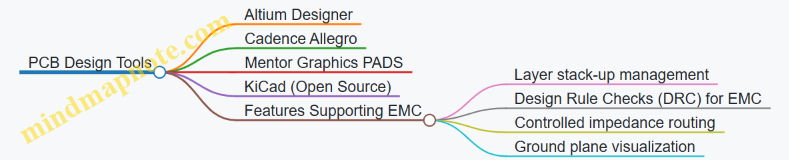
Example: Using Altium Designer’s DRC to enforce minimum spacing rules that reduce crosstalk and EMI.
Filtering and Component Selection Resources
- Component Databases: Mouser, Digi-Key, and manufacturer websites provide EMI filter components with datasheets.
- Ferrite and Filter Design Guides: Available from manufacturers like TDK, Murata, and Wurth Elektronik.
Example: Selecting a common-mode choke from Wurth Elektronik’s catalog based on impedance curves to suppress automotive CAN bus noise.
Grounding and Shielding Guidelines
- Whitepapers and application notes from industry leaders (e.g., Texas Instruments, Analog Devices).
- Technical articles on grounding topologies and shielding materials.
Example: Applying Texas Instruments’ grounding best practices to design a single-point ground system for an industrial sensor node.
Troubleshooting and Debugging Tools
- EMI Debugging Probes: Near-field probes, current probes.
- Time-Domain Reflectometers (TDR): For cable and trace impedance analysis.
- Software Tools: EMI analysis plugins integrated with oscilloscopes.
Example: Using a current probe with an oscilloscope to measure switching noise on a power line in an automotive ECU.
Collaboration and Knowledge Sharing Platforms
- Professional Communities: IEEE EMC Society, LinkedIn groups focused on EMC.
- Forums: EEVblog, Stack Exchange Electrical Engineering.
- Conferences and Workshops: EMC Europe, IEEE EMC Symposium.
Mind Map: Comprehensive EMC Resource Overview
Summary
By leveraging these resources and tools, EMC engineers and designers can significantly improve their ability to predict, measure, and mitigate electromagnetic interference in industrial and automotive systems. Combining theoretical knowledge with practical application through simulations, testing, and collaboration ensures robust and compliant electronic system designs.