English Conversations for Job Interviews
Chapter 1: Introduction to Job Interview Conversations
1.1 Understanding the Purpose of Job Interviews
Job interviews are a two-way conversation designed to assess fit between a candidate and a company. They are not just about testing knowledge or skills, but also about understanding personality, communication style, and motivation. The interview helps employers decide if a candidate can perform the job well and work effectively within the team and company culture.
From the candidate’s perspective, interviews offer a chance to showcase strengths, clarify experiences, and learn more about the role and organization. It’s an opportunity to demonstrate not only what you know but how you think and interact.
Key Purposes of Job Interviews
- Assessment of Skills and Qualifications: Confirming that the candidate’s background matches the job requirements.
- Evaluation of Communication Abilities: Seeing how clearly and confidently the candidate expresses ideas.
- Understanding Motivation and Fit: Gauging why the candidate wants the job and how well they align with company values.
- Behavioral Insights: Learning how the candidate handles challenges and works with others.
- Clarification and Expansion: Allowing candidates to explain gaps, changes in career, or unique experiences.
Mind Map: Purposes of Job Interviews
Example: How an Interview Reveals Fit
Imagine a candidate applying for a customer service role. Their resume shows experience in retail, but the interview reveals their calm approach to handling upset customers and their ability to listen actively. This conversation confirms they have the interpersonal skills needed, beyond what the resume alone shows.
Mind Map: Candidate’s Goals in an Interview
Example: Candidate Using the Interview to Learn
A candidate might ask about the team structure or daily tasks during the interview. This helps them decide if the job matches their expectations and if they would enjoy working there.
In summary, job interviews serve as a structured conversation where both sides gather information. Understanding this purpose helps candidates prepare answers that are relevant and authentic, and approach the interview as a dialogue rather than a test.
1.2 Common Interview Formats and Their Language Features
Job interviews come in several formats, each with distinct structures and language expectations. Understanding these formats helps you prepare the right kind of responses and adjust your speaking style accordingly.
Interview Formats Mind Map
Traditional One-on-One Interview
This is the most common format. It involves a single interviewer asking questions directly related to your background, skills, and fit for the role. The language is usually formal but conversational. Expect straightforward questions like “Can you tell me about your previous job?” or “What are your strengths?”.
Language features:
- Use of past tense to describe experiences.
- Clear, complete sentences.
- Polite but confident tone.
Example:
Interviewer: “Can you describe a challenging project you worked on?”
Candidate: “Certainly. In my last role, I managed a project to redesign the company website. The challenge was coordinating between the design and IT teams to meet a tight deadline. I scheduled regular meetings to ensure alignment and successfully delivered the project on time.”
Panel Interview
Here, multiple interviewers ask questions, sometimes taking turns or asking follow-ups. The language needs to be polite and inclusive, acknowledging each person. You might say “Thank you for your question, Ms. Smith,” or “To answer Mr. Lee’s point…”.
Language features:
- Formal address and respectful tone.
- Clear references to specific interviewers.
- Managing turn-taking with phrases like “May I add…” or “If I may continue…”.
Example:
Interviewer 1: “What motivates you in your work?”
Candidate: “Thank you for the question, Ms. Johnson. I find motivation in solving complex problems and seeing the results of my efforts make a difference.”
Interviewer 2: “How do you handle tight deadlines?”
Candidate: “That’s a great question, Mr. Patel. I prioritize tasks and communicate proactively with my team to ensure we stay on track.”
Phone Interview
Without visual cues, clarity and brevity matter most. Speak slowly and clearly, and confirm understanding frequently. Use phrases like “Did I answer your question fully?” or “Please let me know if you’d like me to elaborate.”
Language features:
- Short, focused answers.
- Frequent checks for understanding.
- Avoid filler words to maintain clarity.
Example:
Interviewer: “Why are you interested in this position?”
Candidate: “I am interested because this role matches my skills in project management and offers opportunities to lead cross-functional teams. Does that answer your question?”
Video Interview
This format combines verbal and non-verbal communication. Speak clearly and maintain eye contact with the camera. Use natural gestures but avoid distractions. Prepare a quiet, professional background.
Language features:
- Moderate pace and volume.
- Natural conversational tone.
- Brief pauses to allow for connection lag.
Example:
Interviewer: “Tell me about a time you improved a process.”
Candidate: “In my previous job, I noticed that our reporting system was slow. I proposed automating parts of it, which reduced processing time by 30%.”
Group Interview
You interact with other candidates and interviewers. Use collaborative language and demonstrate teamwork. Phrases like “I agree with what Sarah said,” or “Building on John’s point…” show engagement.
Language features:
- Inclusive and cooperative tone.
- Active listening and turn-taking.
- Clear, respectful disagreement if needed.
Example:
Candidate 1: “I think we should prioritize customer feedback.”
Candidate 2: “I agree, and I would add that analyzing sales data can also help.”
Case Interview
Common in consulting and analytical roles, this format tests problem-solving skills. Speak logically and structure your answers. Use clarifying questions and summarize your thoughts.
Language features:
- Analytical and precise language.
- Use of conditional and hypothetical statements.
- Summarizing and restating for clarity.
Example:
Interviewer: “How would you increase sales for a coffee shop?”
Candidate: “First, I would analyze current customer demographics and peak hours. Based on that, I might suggest targeted promotions during slow periods. Does that approach make sense?”
Understanding these formats and their language features lets you tailor your preparation. Practicing the specific language styles and structures for each will make your responses more natural and effective.
1.3 Key Communication Skills for Interview Success
Effective communication in a job interview goes beyond simply answering questions. It involves a combination of verbal clarity, active listening, body language, and the ability to organize thoughts logically. Mastering these skills helps you present yourself as confident, competent, and a good fit for the role.
Mind Map: Core Communication Skills
Verbal Skills
Clear pronunciation and appropriate vocabulary make your answers easy to understand. Avoid jargon unless it’s relevant and likely familiar to the interviewer. Keep sentences concise to maintain attention and avoid confusion.
Example:
Less effective: “I have a plethora of experience in various domains which I believe could be synergistic with your company’s objectives.”
More effective: “I have experience in several areas that align well with your company’s goals.”
Non-Verbal Skills
Your body language supports what you say. Maintaining steady eye contact shows confidence and interest. Sitting upright with relaxed shoulders signals attentiveness. Smiling occasionally can make the interaction more personable.
Example:
- Avoid looking down or away frequently, which can suggest nervousness or disinterest.
- Nodding subtly when the interviewer speaks shows you are engaged.
Listening Skills
Active listening means fully concentrating on the interviewer’s words, not just waiting for your turn to speak. It helps you respond appropriately and shows respect.
Example:
If an interviewer asks, “Can you tell me about a time you faced a challenge at work?” pause briefly to ensure you understand, then respond with a relevant example.
Clarify if needed: “Just to confirm, are you asking about a professional challenge or a personal one?”
Organizational Skills
Organizing your answers helps the interviewer follow your story. Use simple frameworks like the STAR method (Situation, Task, Action, Result) to structure responses.
Example:
When asked about teamwork, you might say:
- Situation: “In my last job, our team faced a tight deadline.”
- Task: “I was responsible for coordinating the project schedule.”
- Action: “I set up daily check-ins and shared progress updates.”
- Result: “We completed the project on time and received positive client feedback.”
Mind Map: Applying Communication Skills in an Interview
Practical Tips
- Pause before answering: A brief pause helps organize your thoughts and prevents rambling.
- Avoid filler words: Words like “um,” “like,” and “you know” can distract from your message.
- Match tone to context: Be professional but natural; overly formal language can sound stiff.
- Practice active listening: Repeat or paraphrase questions mentally to ensure you grasp them fully.
By combining these communication skills, you create a clear, confident, and engaging interview presence. Each skill supports the others, making your overall message stronger and more memorable.
1.4 Using sample answers and role-play scripts effectively requires a clear strategy to maximize learning and build confidence. These tools are not just templates to memorize but starting points for practice and adaptation. Here’s how to approach them thoughtfully.
Understand the Purpose
Sample answers show how to structure responses, use appropriate vocabulary, and maintain a professional tone. Role-play scripts simulate real conversations, helping you practice timing, intonation, and natural flow.
Mind Map: Effective Use of Sample Answers and Role-Play Scripts
Step 1: Understand the Context
Each sample answer is designed for a specific question type, such as “Tell me about yourself” or “Describe a challenge you faced.” Before practicing, identify the question’s purpose and what the interviewer wants to learn. This helps you focus on relevant details rather than memorizing unrelated content.
Example: Sample answer for “Tell me about yourself” highlights education, work experience, and motivation. If your background differs, note the structure but replace details with your own.
Step 2: Customize Answers
Use sample answers as a skeleton. Personalize them by adding your experiences, skills, and achievements. This makes your responses authentic and easier to remember.
Example: Sample: “I graduated with a degree in marketing and worked at Company X for two years.” Your version: “I earned a degree in graphic design and spent three years at Company Y focusing on digital branding.”
Step 3: Practice Aloud
Speaking aloud helps internalize language patterns and improves pronunciation. Pay attention to natural pauses and emphasis. Don’t rush; clarity matters more than speed.
Example Exercise: Read the sample answer slowly, then gradually increase speed while maintaining clarity. Record yourself to catch any unclear words.
Step 4: Role-Play
Role-playing turns passive reading into active conversation. Practicing both interviewer and interviewee roles builds understanding of question intent and response strategies.
Example: Use a partner or record yourself asking and answering questions from the script. Switch roles to see the interview from both sides.
Step 5: Review and Refine
After practice, review recordings or notes to identify areas for improvement. Focus on vocabulary, grammar, and fluency. Adjust answers to sound natural rather than scripted.
Example: If a sentence feels awkward, rephrase it in your own words. For instance, change “I am responsible for managing projects” to “I manage projects.”
Mind Map: Common Pitfalls and How to Avoid Them
Integrating Best Practices
- Start by reading the sample answer silently to understand its meaning.
- Rewrite the answer in your own words to ensure comprehension.
- Practice speaking it aloud, focusing on natural rhythm.
- Use role-play scripts to simulate the interview environment.
- Record your practice sessions to self-evaluate or share with a coach.
Example Role-Play Script Excerpt
Interviewer: “Can you tell me about a time you solved a difficult problem at work?”
Candidate (using STAR method): “Certainly. At my last job, we faced a sudden drop in customer satisfaction scores. I led a team to analyze feedback, identify key issues, and implement changes. Within three months, satisfaction improved by 15%.”
Practice this script by switching roles, adjusting details to fit your experience, and focusing on clear, confident delivery.
By treating sample answers and role-play scripts as flexible tools rather than fixed scripts, you build skills that transfer to any interview situation. The goal is to communicate your qualifications clearly and confidently, not to recite memorized lines.
1.5 Setting personal goals for interview speaking practice is a practical way to improve your communication skills systematically. Clear goals help you focus on specific areas, track progress, and build confidence. This section guides you through identifying, organizing, and applying these goals with examples and mind maps.
Why Set Personal Goals?
Goals give your practice sessions direction. Without them, you might spend time repeating the same mistakes or practicing without improvement. Goals also make it easier to measure success and stay motivated.
Types of Personal Goals for Interview Speaking Practice
Personal goals can be divided into three main categories:
- Language Skills: Vocabulary, grammar, pronunciation.
- Content Skills: Structuring answers, using examples, storytelling.
- Delivery Skills: Tone, pace, body language, confidence.
Below is a mind map illustrating these categories and some sub-goals:
Setting SMART Goals
Make your goals Specific, Measurable, Achievable, Relevant, and Time-bound. For example:
- Instead of “Improve vocabulary,” say “Learn and use 10 new job-related words each week.”
- Instead of “Speak better,” say “Practice answering five common interview questions aloud every day for two weeks.”
Examples of Personal Goals
-
Language Skill Goal: “I will practice pronouncing five difficult words related to my industry daily until I can say them clearly without hesitation.”
-
Content Skill Goal: “I will prepare and memorize a STAR story about a team project to answer behavioral questions confidently.”
-
Delivery Skill Goal: “I will record myself answering interview questions and focus on reducing filler words like ‘um’ and ‘like’ by 50% within one month.”
How to Use Goals in Practice Sessions
- Start Small: Choose one or two goals per session to avoid overload.
- Use Role-Play Scripts: Apply your goals while practicing scripted conversations.
- Self-Record: Listening to recordings helps identify areas for improvement.
- Seek Feedback: If possible, practice with a partner and ask for specific feedback related to your goals.
Mind Map: Applying Personal Goals in Practice
Sample Practice Plan Using Personal Goals
| Day | Goal Focus | Activity | Measurement |
|---|---|---|---|
| 1 | Vocabulary | Learn 10 new job-related words | Use 5 words in sentences aloud |
| 2 | Pronunciation | Practice difficult words | Record and compare to native speaker |
| 3 | Answer Structure | Prepare STAR story for teamwork question | Recite without notes |
| 4 | Delivery | Record answers, focus on pace and tone | Count filler words |
| 5 | Combined Practice | Role-play interview using all goals | Get peer feedback |
Final Thoughts
Setting personal goals turns interview practice from random repetition into focused improvement. By breaking down your speaking skills into manageable parts and tracking progress, you’ll build both skill and confidence. Keep your goals realistic and adjust them as you improve. This approach makes your preparation more effective and less overwhelming.
Chapter 2: Preparing Your Personal Introduction
2.1 Crafting a clear and concise self-introduction is your first chance to make a positive impression in a job interview. It sets the tone and gives the interviewer a quick snapshot of who you are professionally. The goal is to communicate essential information about yourself in a way that is easy to follow and relevant to the job.
Key Elements of a Self-Introduction
A good self-introduction typically includes these components:
- Name and current role or status: Who you are and what you do now.
- Brief professional background: A quick summary of your experience or education.
- Key skills or strengths: What you bring to the table.
- What you’re looking for: Your career goals or why you’re interested in this role.
Mind Map: Structure of a Self-Introduction
Tips for Clarity and Conciseness
- Keep it short: Aim for about 30 to 60 seconds when spoken.
- Use simple language: Avoid jargon or overly complex sentences.
- Stay relevant: Tailor your introduction to the job and company.
- Practice: Rehearse to sound natural, not scripted.
Example 1: Recent Graduate
“Hello, my name is Sarah Lee. I recently graduated with a degree in Marketing from State University. During my studies, I completed internships where I developed skills in social media management and content creation. I’m particularly interested in digital marketing roles where I can apply my creativity and analytical skills. I’m excited about this opportunity because your company’s focus on innovative campaigns aligns with my career goals.”
Example 2: Experienced Professional
“My name is David Kim, and I have over five years of experience as a software developer specializing in web applications. I hold a degree in Computer Science and have worked on projects involving both front-end and back-end development. I’m skilled in JavaScript, Python, and cloud services. I’m looking to join a team where I can contribute to building scalable solutions and continue growing my technical expertise.”
Mind Map: Example Breakdown
Practice Exercise
Try writing your own self-introduction using this simple formula:
- State your name and current role or status.
- Summarize your background in one or two sentences.
- Highlight one or two key skills or achievements.
- Mention what you want to do next or why you’re interested in the role.
Review your draft to remove any unnecessary details or filler words. Read it aloud to check the flow and timing.
A clear and concise self-introduction helps you start the interview confidently and gives the interviewer a strong foundation for further questions.
2.2 Sample Answers for ‘Tell Me About Yourself’
The question “Tell me about yourself” is often the first one in an interview. It sets the tone and gives you a chance to make a good first impression. The key is to provide a concise summary that highlights your background, skills, and motivations relevant to the job.
Here is a mind map to organize your answer effectively:
Example 1: Entry-Level Candidate
“My name is Sarah, and I recently graduated with a degree in Marketing from State University. During my studies, I completed an internship at a digital marketing agency where I gained hands-on experience with social media campaigns and content creation. I enjoy analyzing data to understand customer behavior and have strong communication skills, which help me work well in teams. I’m eager to apply what I’ve learned in a real-world setting and grow my skills in a dynamic marketing role like this one.”
Example 2: Experienced Professional
“I’m David, and I have over five years of experience in software development, primarily focused on backend systems. I hold a degree in Computer Science and have worked at two mid-sized tech companies where I led projects improving system efficiency and reliability. My strengths include problem-solving and collaborating across departments to deliver solutions on time. I’m looking for a position where I can take on more leadership responsibilities and contribute to innovative projects.”
Example 3: Career Changer
“My name is Maria. I spent the last seven years working in customer service, where I developed strong interpersonal and conflict-resolution skills. Recently, I completed a certification in data analysis because I’m interested in using data to improve business decisions. I’m excited to transition into an analyst role where I can combine my experience working with people and my new technical skills to help teams understand their customers better.”
Tips for Crafting Your Answer
- Keep it brief: Aim for about 1-2 minutes.
- Tailor your answer: Focus on aspects most relevant to the job.
- Practice your delivery: Sound natural, not rehearsed.
- Avoid personal details unrelated to work.
Mind Map for Structuring Your Answer
Practice Exercise
Write your own “Tell me about yourself” answer using the mind maps above. Try to include:
- One sentence about your background
- Two sentences about your experience or skills
- One sentence about your career goals
Then, practice saying it aloud until it feels comfortable and natural.
2.3 Role-Play Script: Introducing Yourself to the Interviewer
Introducing yourself is often the first verbal exchange in a job interview. It sets the tone and gives the interviewer a snapshot of who you are professionally. This section provides a clear, practical script for this moment, supported by mind maps to organize your thoughts and examples to guide your delivery.
Mind Map: Key Elements of a Self-Introduction
This structure helps you cover essential points without rambling.
Example Script 1: Recent Graduate Applying for an Entry-Level Position
Interviewer: “Please introduce yourself.”
Candidate: “Good morning, and thank you for the opportunity. My name is Sarah Lee. I recently graduated with a degree in Marketing from State University, where I focused on digital marketing strategies and consumer behavior. During my studies, I completed an internship at Bright Media, where I assisted in social media campaigns and content creation. I enjoy analyzing data to understand customer trends, and I am excited about the chance to bring my skills to your marketing team.”
Mind Map: Breaking Down the Example
Example Script 2: Experienced Professional Changing Careers
Interviewer: “Tell me about yourself.”
Candidate: “Hello, I’m David Kim. For the past six years, I’ve worked as a project manager in the construction industry, overseeing teams and budgets to complete projects on time. Recently, I’ve developed a strong interest in software development and have completed several coding courses to transition into this field. I believe my organizational skills and problem-solving experience will help me contribute effectively to your development team.”
Mind Map: Key Points in Career Change Introduction
Tips for Practicing the Script
- Keep it concise: Aim for about 30-60 seconds.
- Use natural language: Speak as if you are having a conversation, not delivering a speech.
- Tailor your introduction: Adjust details to match the job and company.
- Practice aloud: Record yourself or practice with a partner to improve fluency.
Speaking Practice Exercise
- Write your own introduction following the mind map structure.
- Practice delivering it slowly, focusing on clarity.
- Record yourself and listen for areas to improve.
- Repeat, aiming for a natural and confident tone.
This role-play script and supporting materials provide a clear framework to introduce yourself effectively in an interview. The mind maps help organize your thoughts, while the examples show how to adapt your introduction to different situations.
2.4 Best Practices for Confident Delivery
Confidence in an interview is not just about what you say, but how you say it. Your delivery can influence how your answers are received and how comfortable you feel during the conversation. Here are practical tips and examples to help you present yourself with confidence.
Prepare but Don’t Memorize
Memorizing answers word-for-word can make your speech sound robotic. Instead, focus on understanding key points you want to communicate. This allows you to adapt naturally to the flow of the interview.
Example:
- Instead of memorizing “I am a hardworking team player with excellent communication skills,” try to remember the ideas: hardworking, teamwork, communication. Then express them in your own words during the interview.
Practice Controlled Pace and Pauses
Speaking too fast can make you seem nervous and hard to understand. Speaking too slowly might bore the listener. Aim for a steady pace and use pauses to emphasize important points or to gather your thoughts.
Example:
- When asked about your strengths, say: “One of my key strengths is adaptability.” (pause) “For instance, in my last role, I quickly learned new software to improve our workflow.”
Use Clear and Simple Language
Avoid complicated words or jargon unless you are sure the interviewer understands them. Clear language helps convey your message effectively and reduces the chance of misunderstandings.
Example:
- Instead of saying “I synergize cross-functional teams to optimize deliverables,” say “I work well with different teams to improve our results.”
Maintain Positive Body Language
Your posture, eye contact, and facial expressions support your verbal message. Sit straight but relaxed, maintain eye contact without staring, and smile naturally to show engagement.
Example:
- When explaining a past achievement, lean slightly forward and maintain eye contact to show enthusiasm.
Manage Nervous Habits
Be aware of habits like fidgeting, tapping, or saying filler words (“um,” “like,” “you know”). These can distract from your message and suggest uncertainty.
Example:
- Practice answering questions aloud and record yourself to notice and reduce these habits.
Use Examples and Stories
Concrete examples make your answers memorable and believable. Stories also give you a natural flow to speak confidently.
Example:
- Instead of saying “I am good at problem-solving,” say “In my last job, I noticed a delay in our project timeline, so I suggested a new tracking system that helped us finish on time.”
Control Your Breathing
Deep, steady breaths help reduce tension and keep your voice steady. Before answering, take a brief breath to center yourself.
Example:
- Pause for a second, breathe in slowly, then begin your answer calmly.
Mind Map: Confident Delivery Essentials
Mind Map: Practical Steps to Build Confidence
Final Example: Putting It All Together
Question: “Can you tell me about a time you overcame a challenge at work?”
Confident Answer: “Certainly. In my previous role, our team faced a sudden shortage of staff during a critical project. (Pause) I took the initiative to reorganize tasks and coordinate with other departments to cover the gaps. This helped us meet the deadline without sacrificing quality. (Smile, maintain eye contact) It was a challenging situation, but it taught me the importance of flexibility and teamwork.”
This answer shows clear structure, uses a story, maintains a steady pace, and includes positive body language cues.
By focusing on these best practices, you can improve not only what you say but how you say it, making your interview conversations more effective and natural.
2.5 Speaking Practice Exercises: Personal Introduction Variations
When preparing your personal introduction for a job interview, it helps to have several versions ready. Different interviewers and contexts may call for slightly different focuses or tones. Practicing variations ensures you can adapt smoothly and sound natural. Below are structured mind maps and examples to guide your practice.
Mind Map 1: Basic Personal Introduction
Example:
“Hello, my name is Sarah Lee. I am currently a marketing assistant with two years of experience focusing on social media campaigns. I enjoy creating engaging content and am eager to develop my skills in digital marketing strategy.”
Mind Map 2: Education-Focused Introduction
Example:
“My name is David Kim. I recently graduated with a degree in computer science, where I completed a capstone project on mobile app development. I am passionate about software engineering and looking forward to applying my coding skills in a practical environment.”
Mind Map 3: Experience-Focused Introduction
Example:
“I’m Maria Gonzalez. Over the past five years, I have worked as a customer service representative, managing client accounts and resolving issues efficiently. My strength lies in communication and problem-solving, which I believe will help me contribute positively to your team.”
Mind Map 4: Career Change Introduction
Example:
“My name is James Patel. I spent the last six years in retail management but decided to transition into human resources because I enjoy working with people and supporting team development. My experience in leadership and conflict resolution will be valuable in this new role.”
Mind Map 5: Short and Impactful Introduction
Example:
“I’m Emily Chen, a graphic designer with a strong eye for detail. I’m excited to bring my creativity to your design team and help enhance your brand’s visual identity.”
Practice Exercises
-
Write and Record: Choose one mind map structure and write your own introduction. Record yourself speaking it aloud. Listen back and note areas where you hesitate or sound unnatural.
-
Swap Focus: Take your original introduction and rewrite it using a different mind map. For example, if you started with a basic introduction, try an experience-focused version next.
-
Time Yourself: Practice delivering your introduction in 30 seconds, then 45 seconds, and finally 60 seconds. Adjust content to fit each time limit without losing clarity.
-
Mirror Practice: Stand in front of a mirror and deliver your introduction. Pay attention to your facial expressions and posture as you speak.
-
Peer Feedback: Practice your introductions with a friend or mentor. Ask for feedback on clarity, tone, and confidence.
-
Role-Play Variation: Imagine different interview settings (formal, casual, panel interview) and adapt your introduction accordingly.
Tips for Effective Practice
- Focus on clear pronunciation and natural pacing.
- Avoid memorizing word-for-word; aim for a conversational tone.
- Use simple, direct language that highlights your strengths.
- Keep your introduction relevant to the job you’re applying for.
- Practice regularly to build confidence and reduce nervousness.
By exploring these variations and exercises, you will develop a flexible and polished personal introduction that fits a range of interview situations.
Chapter 3: Discussing Your Educational Background
3.1 Key Vocabulary for Education and Qualifications
When discussing your education and qualifications in a job interview, using precise and relevant vocabulary helps convey your background clearly and professionally. This section introduces essential terms and phrases, organized into categories, with examples to illustrate their use.
Mind Map: Education Levels
Examples:
- “I completed my secondary education with a high school diploma.”
- “I earned a Bachelor’s degree in Business Administration.”
Mind Map: Types of Qualifications
Examples:
- “I hold a professional certification in project management.”
- “I attended a workshop on advanced Excel techniques.”
Mind Map: Describing Educational Achievements
Examples:
- “I graduated with honors in Mechanical Engineering.”
- “I specialized in digital marketing during my Master’s program.”
Mind Map: Academic Performance and Recognition
Examples:
- “My GPA was 3.8 on a 4.0 scale.”
- “I received a scholarship for academic excellence.”
Mind Map: Language for Explaining Education in Interviews
Examples:
- “I studied Computer Science, focusing on software development.”
- “My coursework included data analysis and database management.”
Additional Vocabulary Notes
- Use “degree” to refer to university-level qualifications (e.g., Bachelor’s, Master’s).
- Use “certificate” or “diploma” for shorter or more specialized courses.
- When mentioning professional qualifications, specify the certifying body if possible (e.g., “Certified Public Accountant (CPA)”).
- Words like “major” and “minor” indicate your primary and secondary fields of study.
- To express completion, verbs like “graduated,” “completed,” or “earned” are common.
Sample Sentences Incorporating Vocabulary
- “I earned a Bachelor’s degree in Environmental Science, where I specialized in renewable energy.”
- “During my Master’s program, I completed a thesis on sustainable urban development.”
- “I hold a professional certification in digital marketing from the American Marketing Association.”
- “I graduated with distinction and was on the Dean’s List for three consecutive years.”
- “My education included practical training through internships and workshops.”
Using this vocabulary accurately will help you present your educational background clearly and confidently during interviews. Practice combining these terms naturally to describe your qualifications in a way that fits the job you are applying for.
3.2 Sample Answers for Education-Related Questions
When interviewers ask about your education, they want to understand not just your qualifications but how your academic background prepares you for the role. Clear, concise answers that connect your education to the job can make a strong impression. Below are common education-related questions, sample answers, and mind maps to help organize your thoughts.
Question 1: “Can you tell me about your educational background?”
Sample Answer: “I completed my Bachelor’s degree in Computer Science at State University, where I focused on software development and data structures. During my studies, I worked on several projects, including a mobile app for campus navigation, which helped me develop practical coding skills and teamwork experience.”
Mind Map:
Question 2: “How has your education prepared you for this position?”
Sample Answer: “My degree in Marketing provided me with a solid foundation in consumer behavior and digital marketing strategies. Courses like market research and social media analytics taught me how to analyze data and create targeted campaigns, which I see as directly relevant to this role’s responsibilities.”
Mind Map:
Question 3: “Did you participate in any extracurricular activities or projects during your studies?”
Sample Answer: “Yes, I was part of the university debate club, which improved my public speaking and critical thinking skills. Additionally, I volunteered for a community tutoring program, helping high school students with math, which strengthened my ability to explain complex concepts clearly.”
Mind Map:
Question 4: “What was the most challenging course or project during your education, and how did you handle it?”
Sample Answer: “The most challenging course was Advanced Statistics because it required a deep understanding of complex theories and their applications. To manage this, I formed a study group with classmates, attended extra help sessions, and practiced with real datasets, which helped me grasp the material and apply it effectively.”
Mind Map:
Question 5: “Why did you choose your field of study?”
Sample Answer: “I chose Environmental Science because I have always been interested in how natural systems work and how human activity impacts the planet. Studying this field gave me the tools to analyze environmental data and contribute to sustainable solutions, which aligns with my personal values.”
Mind Map:
Tips for Using These Sample Answers
- Tailor your answers to your actual experiences and the job requirements.
- Use specific examples to illustrate your points.
- Keep your responses focused and avoid unnecessary details.
- Practice delivering your answers naturally, not memorized word-for-word.
By organizing your thoughts with mind maps and practicing these sample answers, you can approach education-related questions with clarity and confidence.
3.3 Role-Play Script: Explaining Your Academic Achievements
This section provides a role-play script designed to help you practice discussing your academic achievements clearly and confidently during a job interview. The script includes examples and a mind map to organize your thoughts effectively.
Mind Map: Organizing Your Academic Achievements
Role-Play Script Example
Interviewer: “Can you tell me about your academic background and any achievements you are proud of?”
Candidate: “Certainly. I graduated with a Bachelor of Science in Computer Science from State University in 2022. During my studies, I focused on software development and data structures, which I found particularly engaging. One of my key projects was developing a mobile app for campus navigation, which improved accessibility for new students. This project helped me strengthen my coding and project management skills.”
“Additionally, I was on the Dean’s List for three consecutive years, which reflects my consistent academic performance. I also participated in the university’s coding club, where I collaborated with peers on hackathons and coding challenges. These experiences taught me teamwork and problem-solving under pressure.”
“Lastly, I completed an internship at Tech Solutions, where I applied my academic knowledge in a real-world setting, contributing to a web development project. This practical experience complemented my studies and prepared me for professional work.”
Interviewer: “That sounds like a solid foundation. How do you think these achievements relate to the role you’re applying for?”
Candidate: “The technical skills I developed through my coursework and projects directly align with the requirements of this role, especially in software development. My internship gave me hands-on experience with client projects and deadlines, which I believe will help me adapt quickly here. Moreover, my academic achievements demonstrate my dedication and ability to learn, which I consider essential for continuous growth in this field.”
Tips for Using This Script
- Use the mind map to prepare your points before the interview.
- Tailor your examples to the job description, emphasizing relevant skills and experiences.
- Keep your explanations concise but informative.
- Practice delivering your answers aloud to improve fluency and confidence.
Additional Example Phrases
- “I earned my degree in [field] from [university], where I focused on [specialization].”
- “One project I’m proud of involved [brief description], which helped me develop [skill].”
- “I received [award/honor], which recognized my [achievement].”
- “Participating in [club or activity] allowed me to build skills in [area].”
- “My internship at [company] gave me practical experience in [task or skill].”
This role-play script and mind map aim to help you present your academic achievements clearly and confidently, making your educational background a strong part of your interview narrative.
3.4 Highlighting your education effectively during a job interview means focusing on the aspects that directly relate to the position you’re applying for. It’s not about listing every course or certificate but about connecting your educational background to the skills and knowledge the employer values.
Key Points to Consider
- Relevance: Emphasize degrees, courses, projects, or certifications that align with the job requirements.
- Achievements: Mention any honors, awards, or notable accomplishments that demonstrate your commitment and capability.
- Skills: Highlight specific skills gained through your education that are applicable to the role.
- Practical Experience: If your education involved internships, labs, or real-world projects, describe these briefly to show applied knowledge.
Mind Map: Best Practices for Highlighting Relevant Education
Example 1: Software Developer Position
“I completed a Bachelor’s degree in Computer Science, where I focused on software development and algorithms. During my studies, I completed a project developing a mobile app that improved user scheduling efficiency by 20%. Additionally, I earned a certification in Java programming, which is directly relevant to this role. My coursework and hands-on projects have equipped me with both the theoretical knowledge and practical skills needed for this position.”
Example 2: Marketing Role
“I hold a degree in Marketing and Communications, where I specialized in digital marketing strategies. I was recognized on the Dean’s List for two consecutive years and completed an internship at a local advertising agency. This experience allowed me to apply classroom concepts to real campaigns, particularly in social media marketing, which I understand is a key focus for your company.”
Mind Map: Structuring Your Education Response
Tips for Delivery
- Keep your explanation concise but informative.
- Use specific examples rather than vague statements.
- Avoid jargon unless you are sure the interviewer understands it.
- Practice linking your education to the job description smoothly.
By focusing on these elements, you present your education as a foundation that supports your ability to perform well in the job, rather than just a list of qualifications.
3.5 Speaking Practice Exercises: Education Descriptions
When describing your education in an interview, clarity and relevance are key. You want to communicate your qualifications in a way that highlights how they prepare you for the job. This section offers exercises to practice structuring your responses, using appropriate vocabulary, and tailoring your descriptions to different interview questions.
Mind Map: Key Points to Cover When Describing Education
Exercise 1: Basic Education Description
Practice giving a straightforward description of your education. Use this template:
“I completed my [degree] in [field] at [institution] in [year].”
Example:
“I completed my Bachelor of Arts in English Literature at Greenfield University in 2020.”
Try variations by changing the degree, field, institution, and year.
Exercise 2: Adding Relevant Details
Expand your basic description by including relevant courses or projects.
Template:
“During my studies, I focused on [specific courses or projects], which helped me develop skills in [skills].”
Example:
“During my studies, I focused on digital marketing and completed a project on social media campaigns, which helped me develop skills in content creation and data analysis.”
Practice by selecting courses or projects that relate to the job you are applying for.
Exercise 3: Highlighting Achievements
Incorporate any honors, awards, or extracurricular activities.
Template:
“I graduated with [honors/awards], and I was actively involved in [clubs or activities], which enhanced my [skills].”
Example:
“I graduated with honors and was president of the debate club, which enhanced my public speaking and leadership skills.”
Try combining this with your education description for a fuller answer.
Exercise 4: Connecting Education to the Job
Practice explaining how your education prepares you for the role.
Template:
“My education in [field] provided me with [skills/knowledge], which I believe will help me [perform specific job tasks].”
Example:
“My education in computer science provided me with strong programming skills, which I believe will help me develop efficient software solutions in this role.”
Try tailoring this to different job descriptions.
Exercise 5: Role-Play Scenario
Imagine an interviewer asks: “Can you tell me about your educational background?”
Use the following structure in your response:
- State your degree and institution.
- Mention relevant courses or projects.
- Highlight any achievements.
- Connect your education to the job.
Example Response:
“I earned a Bachelor of Science in Environmental Science from Riverdale University in 2021. During my studies, I took specialized courses in water resource management and completed a research project on sustainable irrigation techniques. I graduated with distinction and was part of the environmental club, which helped me develop teamwork and project management skills. This background has given me a solid foundation to contribute effectively to your company’s sustainability initiatives.”
Practice delivering this response aloud, then try modifying it to fit different roles or industries.
Vocabulary Tips
- Use words like “completed,” “earned,” “specialized in,” “focused on,” “graduated with honors,” “project on,” “skills in,” “knowledge of.”
- Avoid overly technical jargon unless you are sure the interviewer understands it.
- Use action verbs such as “developed,” “managed,” “led,” “researched.”
Summary
These exercises help you build clear, concise, and relevant descriptions of your education. Practicing these will make your answers more confident and tailored to the job interview context.
Chapter 4: Talking About Work Experience
4.1 When discussing your work experience in a job interview, structuring your narrative clearly helps the interviewer follow your story and understand your value. A well-organized answer shows that you can communicate effectively and reflect on your experiences thoughtfully.
Key Components of a Work Experience Narrative
A typical structure includes these elements:
- Context: Briefly describe the company, your role, and the timeframe.
- Responsibilities: Outline your main duties or tasks.
- Challenges: Mention any problems or obstacles you faced.
- Actions: Explain what you did to address those challenges.
- Results: Share the outcomes or achievements from your actions.
This structure keeps your answer focused and balanced, avoiding vague or overly long descriptions.
Mind Map: Structuring Work Experience Narratives
Example 1: Clear and Concise Narrative
Question: “Can you tell me about your last job?”
Answer: “I worked as a customer service representative at BrightTech for three years. My main responsibility was handling customer inquiries via phone and email. One challenge was managing high call volumes during product launches. To improve efficiency, I developed a quick-reference guide for common issues, which reduced average call time by 15%. This helped our team meet service targets and improved customer satisfaction scores.”
This example follows the structure: context (company, role, duration), responsibilities, challenge, action, and result.
Mind Map: Example 1 Breakdown
Example 2: Narrative with Emphasis on Problem-Solving
Question: “Describe a difficult situation at work and how you handled it.”
Answer: “At GreenLeaf Marketing, where I was a project coordinator for two years, we faced a sudden budget cut midway through a campaign. My responsibility was to keep the project on track despite limited resources. I reviewed all expenses and negotiated with vendors to lower costs. I also reallocated tasks within the team to maximize efficiency. As a result, we completed the campaign on time and stayed within the revised budget, maintaining client satisfaction.”
This answer clearly identifies the challenge and highlights specific actions and results.
Mind Map: Example 2 Breakdown
Tips for Structuring Your Narratives
- Be specific: Avoid general statements like “I worked on many projects.” Instead, pick one or two relevant examples.
- Use numbers: Quantify your results when possible (e.g., “increased sales by 10%” or “reduced processing time by 20 minutes”).
- Keep it relevant: Tailor your examples to the job you’re applying for.
- Practice brevity: Aim for answers that last about one to two minutes.
- Use the past tense: Since you’re describing past experiences, keep your verbs consistent.
Practice Exercise
Write a short narrative about a previous job using the structure above. Start by naming the company and your role, then describe a challenge you faced, the actions you took, and the results you achieved. Use the mind maps as a guide.
This approach will help you present your work experience clearly and confidently during interviews.
4.2 When interviewers ask about your previous jobs and responsibilities, they want to understand what you actually did, how you contributed, and what skills you developed. Clear, specific answers help paint a picture of your work experience and show how it fits the role you’re applying for.
Mind Map: Structuring Your Answer
Example 1: Customer Service Representative
“In my role as a Customer Service Representative at BrightTech for three years, I handled daily customer inquiries via phone and email. I was responsible for resolving product issues, processing orders, and updating customer records. I regularly collaborated with the sales and technical teams to ensure customers received accurate information. This role helped me develop strong communication and problem-solving skills. One notable achievement was reducing average call resolution time by 15% through streamlining our response process.”
Example 2: Marketing Assistant
“At GreenLeaf Marketing, I worked as a Marketing Assistant for 18 months. My main duties included managing social media accounts, coordinating email campaigns, and supporting event planning. I also analyzed engagement metrics to help improve our content strategy. Working closely with the creative team, I learned how to align marketing materials with brand guidelines. I contributed to a campaign that increased newsletter sign-ups by 20%, which was a key performance indicator for the department.”
Mind Map: Key Phrases to Use
Example 3: Software Developer
“During my two years as a Software Developer at CodeWave, I designed and implemented features for our mobile app. My responsibilities included writing clean, maintainable code, debugging issues, and participating in code reviews. I worked closely with product managers to understand user requirements and prioritize tasks. This role strengthened my knowledge of Java and agile development practices. A key project involved developing a new user authentication system that improved security and reduced login errors by 30%.”
Tips for Answering
- Be concise but specific. Avoid vague statements like “I did many tasks.” Instead, name tasks and explain their purpose.
- Tailor your examples to the job you’re applying for. Highlight responsibilities and skills that match the new role.
- Use numbers or results when possible. Quantifying achievements makes your contributions clearer.
- Include teamwork and communication aspects if relevant. Employers value collaboration.
- Practice your answers aloud to sound natural and confident.
Example 4: Administrative Assistant
“At Horizon Law Firm, I worked as an Administrative Assistant for four years. My role involved managing schedules, preparing documents, and coordinating meetings. I also handled client communications and maintained filing systems. I regularly used Microsoft Office and our case management software. This position required strong organizational skills and attention to detail. I helped implement a digital filing system that reduced document retrieval time by 40%, which improved office efficiency.”
By structuring your answers with clear details about what you did, how you did it, and what you achieved, you provide interviewers with a solid understanding of your experience. This approach also naturally incorporates best practices without needing to state them outright.
4.3 Role-Play Script: Discussing Challenges and Achievements at Work
When interviewers ask about challenges and achievements, they want to understand how you handle difficulties and what you consider success. This section provides a role-play script to practice these conversations, along with mind maps and examples to clarify the structure and language.
Mind Map: Structuring Your Response to Challenges and Achievements
Example Phrases for Challenges
- “In my previous role, I encountered a situation where…”
- “The main difficulty was…”
- “To address this, I…”
- “As a result, we managed to…”
Example Phrases for Achievements
- “One accomplishment I’m proud of is…”
- “I was responsible for…”
- “I implemented…”
- “This led to…”
Role-Play Script
Interviewer: Can you tell me about a challenge you faced at work and how you handled it?
Candidate: Certainly. In my last job as a project coordinator, we had a tight deadline for launching a new product. The main challenge was that one of our key suppliers delayed shipments, which threatened our schedule.
Interviewer: How did you respond to that?
Candidate: I immediately contacted alternative suppliers to check availability and negotiated expedited delivery. At the same time, I worked with the internal team to adjust the project timeline for tasks that could proceed without the delayed materials.
Interviewer: What was the outcome?
Candidate: Thanks to these steps, we minimized the delay to just three days and still launched the product on time. The experience taught me the importance of flexibility and proactive communication.
Interviewer: Great. Can you share an achievement from your work that you’re particularly proud of?
Candidate: Sure. I led a process improvement initiative that streamlined our inventory management. I analyzed the existing workflow, identified bottlenecks, and introduced a new tracking system.
Interviewer: What impact did that have?
Candidate: It reduced stock discrepancies by 25% within six months and improved order fulfillment speed. This achievement improved overall efficiency and customer satisfaction.
Mind Map: Language Focus for Role-Play
Speaking Practice Tips
- Practice using the STAR structure (Situation, Task, Action, Result) to keep answers clear and focused.
- Use specific numbers or facts when possible to quantify achievements.
- Vary your vocabulary to avoid repetition, for example, use “addressed,” “handled,” or “managed” for actions.
- Keep your tone confident but natural; avoid sounding rehearsed.
- Try switching roles in the role-play to understand both interviewer and candidate perspectives.
This role-play script and supporting materials are designed to help you prepare clear, concise, and effective answers about your challenges and achievements at work. Practicing these will build your confidence and improve your ability to communicate your experiences in interviews.
4.4 Best Practices for Emphasizing Transferable Skills
When discussing your work experience in an interview, highlighting transferable skills can make your profile more appealing, especially if you’re switching industries or roles. Transferable skills are abilities you’ve developed in one context that apply well in another. These often include communication, problem-solving, leadership, time management, and teamwork.
Why Focus on Transferable Skills?
Employers want to know how your past experiences prepare you for the new role. Even if your previous job was in a different field, transferable skills show that you have the tools to succeed and adapt.
Mind Map: Transferable Skills Overview
How to Identify Transferable Skills in Your Experience
- Review your past roles: List your main tasks and responsibilities.
- Spot common skills: Look for skills that appear in multiple roles or tasks.
- Match skills to the job description: Identify which of your skills align with the new role.
- Prepare examples: Think of situations where you used those skills effectively.
Mind Map: Linking Past Experience to New Role
Example 1: From Retail to Customer Service Role
Context: You worked in retail, now applying for a customer service position.
Transferable skills: Communication, problem-solving, patience.
Sample answer:
“In my retail position, I regularly communicated with customers to understand their needs and resolve issues quickly. For example, when a product was out of stock, I suggested alternatives and ensured the customer left satisfied. This experience taught me how to listen carefully and find solutions under pressure, skills I know are important in customer service.”
Example 2: From Teaching to Project Management
Context: You were a teacher and now want to move into project management.
Transferable skills: Organization, leadership, time management.
Sample answer:
“As a teacher, I managed lesson plans, coordinated with colleagues, and adapted schedules to meet students’ needs. This required strong organizational skills and the ability to lead a classroom effectively. I believe these skills translate well to managing projects, where planning, coordination, and leadership are essential.”
Tips for Emphasizing Transferable Skills
- Be specific: Use concrete examples rather than vague statements.
- Use the job description: Tailor your examples to the skills the employer values.
- Show impact: Explain how your skills helped achieve results.
- Keep it relevant: Focus on skills that matter for the role you want.
- Practice your delivery: Role-play answering questions about your skills to sound confident and natural.
Mind Map: Structuring Your Answer to Emphasize Transferable Skills
By clearly connecting your past experiences to the new role through transferable skills, you help interviewers see your potential beyond job titles. This approach makes your answers more compelling and relevant, increasing your chances of success.
4.5 Speaking Practice Exercises: Experience Storytelling
Storytelling in interviews is about presenting your work experience clearly and engagingly. The goal is to help the interviewer understand what you did, how you did it, and what you achieved. This section offers exercises that focus on structuring your stories, using relevant vocabulary, and practicing fluency.
Mind Map 1: Structuring Your Work Experience Story
This structure, often called the STAR method, helps keep your story focused and easy to follow.
Exercise 1: Identify the STAR Elements
Read the example below and label each part as Situation, Task, Action, or Result.
Example: “At my last job in a retail store, we noticed a drop in customer satisfaction during busy hours (Situation). I was asked to find a way to improve the checkout process (Task). I suggested implementing a queue management system and trained staff to use it effectively (Action). As a result, customer wait times decreased by 30%, and satisfaction scores improved (Result).”
Try this with your own experience. Write a short story and mark each STAR element.
Mind Map 2: Vocabulary for Experience Storytelling
Using precise verbs and time phrases helps your story sound clear and professional.
Exercise 2: Verb Replacement
Replace the word “did” in the sentences below with a stronger verb from the vocabulary list.
- I did the project on time.
- She did the training for new employees.
- We did a survey to understand customer needs.
Example answers:
- I completed the project on time.
- She conducted the training for new employees.
- We carried out a survey to understand customer needs.
Exercise 3: Practice Telling Your Story Aloud
Choose one work experience story. Practice telling it aloud using the STAR structure. Focus on:
- Clear pronunciation
- Natural pauses between STAR sections
- Using the vocabulary from Mind Map 2
Record yourself if possible, then listen to check for clarity and flow.
Mind Map 3: Common Interview Questions for Experience Storytelling
Prepare short stories for these questions using the STAR method.
Exercise 4: Role-Play Practice
Partner with a friend or practice alone by asking and answering the questions from Mind Map 3. After answering, review your response:
- Did you include all STAR elements?
- Was your story clear and concise?
- Did you use varied vocabulary?
Adjust your answers accordingly and try again.
Exercise 5: Linking Experience to Job Requirements
Look at a job description and identify key skills or experiences requested. Practice telling a story from your experience that highlights those skills.
Example:
If the job requires teamwork, tell a story about a successful team project. Use the STAR structure and emphasize your role and contribution.
These exercises aim to build your confidence in sharing your work experience clearly and effectively. Regular practice will help you speak naturally and make your stories memorable to interviewers.
Chapter 5: Explaining Your Strengths and Weaknesses
5.1 Identifying and Describing Strengths Effectively
When interviewers ask about your strengths, they want to understand what you bring to the role and how you see your own abilities. The key is to identify strengths that are relevant to the job and describe them clearly with examples. This section will guide you through recognizing your strengths and explaining them in a way that feels natural and convincing.
What Are Strengths?
Strengths are qualities or skills that you perform well and enjoy using. They can be technical skills, like proficiency in software, or soft skills, like communication or problem-solving. Strengths differ from achievements; the former are ongoing abilities, while the latter are specific results.
How to Identify Your Strengths
Start by reflecting on tasks you do well and feedback you’ve received. Consider these categories:
- Technical Skills
- Software proficiency
- Industry knowledge
- Interpersonal Skills
- Communication
- Teamwork
- Personal Traits
- Reliability
- Adaptability
- Problem-Solving Abilities
- Analytical thinking
- Creativity
You can create a simple mind map to organize your thoughts:
Selecting Strengths Relevant to the Job
Look at the job description and company values. Choose strengths that match what the employer needs. For example, if the job requires teamwork, highlight your collaboration skills.
Describing Strengths Clearly
When you describe a strength, follow this structure:
- Name the strength.
- Explain what it means in your work.
- Provide a brief example or context.
Example:
“One of my strengths is attention to detail. In my previous role, I reviewed reports carefully to catch errors before submission, which helped reduce mistakes by 15%.”
Mind Map for Describing a Strength
Sample Strengths with Descriptions
-
Communication: “I communicate clearly with team members and clients, which ensures everyone understands project goals and deadlines. For instance, I led weekly meetings that improved team coordination.”
-
Problem-Solving: “I approach challenges by breaking them down into smaller parts and brainstorming solutions. At my last job, I identified a bottleneck in the workflow and suggested a new process that saved time.”
-
Adaptability: “I adjust quickly to changing priorities. When our project scope shifted suddenly, I reorganized my tasks to meet the new deadlines without sacrificing quality.”
Practice Exercise
Make a list of five strengths you believe you have. For each, write a sentence explaining it and a short example from your experience. This will prepare you to answer interview questions naturally.
By focusing on relevant strengths and describing them with concrete examples, you show interviewers not just what you are good at, but how you apply those strengths in a work context.
5.2 Sample Answers for Strengths and Weaknesses Questions
When interviewers ask about your strengths and weaknesses, they want to see self-awareness, honesty, and the ability to improve. Your answers should be clear, balanced, and relevant to the job.
Mind Map: Structuring Your Answer
Sample Answers for Strengths
Example 1: Communication “One of my key strengths is communication. In my previous role, I regularly presented project updates to both technical teams and non-technical stakeholders. This helped ensure everyone was on the same page and deadlines were met. I find that clear communication reduces misunderstandings and improves team efficiency.”
Example 2: Problem-Solving “I consider problem-solving a strong point. For instance, when a supplier delayed a shipment, I quickly identified alternative vendors and negotiated terms to keep the project on schedule. This ability to think on my feet helps me manage unexpected challenges without losing momentum.”
Example 3: Attention to Detail “I have a strong attention to detail, which is important in quality assurance roles. I consistently catch errors that others might miss, such as inconsistencies in data reports or formatting issues in documents. This helps maintain high standards and prevents costly mistakes.”
Sample Answers for Weaknesses
Example 1: Public Speaking “I used to feel nervous speaking in front of large groups. To improve, I joined a local speaking club and volunteered to lead team meetings. Over time, my confidence has grown, and I now handle presentations with less anxiety. I’m still working on this, but I see steady progress.”
Example 2: Delegation “I sometimes struggle with delegation because I want to ensure tasks are done correctly. However, I’ve learned that trusting colleagues and providing clear instructions leads to better teamwork and productivity. I’m practicing letting go of small details and focusing on overall outcomes.”
Example 3: Impatience with Slow Processes “I tend to get impatient when processes move slowly, especially when I’m eager to see results. I’ve been working on this by reminding myself that thoroughness is important and by breaking projects into smaller steps to maintain focus and patience.”
Mind Map: Examples and Improvement Steps
Tips for Crafting Your Answers
- Pick strengths that match the job description.
- Use specific examples to show how strengths helped in past roles.
- Choose weaknesses that are honest but won’t disqualify you.
- Always mention what you are doing to improve weaknesses.
- Keep answers concise and positive.
This approach shows you understand your abilities and are committed to growth, which interviewers appreciate.
5.3 Role-Play Script: Honest and Positive Weakness Discussion
When interviewers ask about your weaknesses, they want to see honesty, self-awareness, and a willingness to improve. The key is to present a real weakness without undermining your suitability for the job. This section provides a role-play script that models a balanced and constructive way to discuss weaknesses.
Mind Map: Approaching the Weakness Question
Example Role-Play Script
Interviewer: “Can you tell me about one of your weaknesses?”
Candidate: “Certainly. One area I’ve been working on is public speaking. In the past, I found it challenging to present ideas clearly in front of large groups, which sometimes made me hesitant to volunteer for presentations. Recognizing this, I enrolled in a local Toastmasters club and started volunteering for smaller team meetings to build my confidence gradually. Over the last year, I’ve noticed a significant improvement, and I now feel comfortable leading discussions with my team. While I still get a bit nervous before big presentations, I see it as an opportunity to keep improving.”
Mind Map: Components of the Example
Additional Examples
Example 1:
“I sometimes struggle with delegating tasks because I want to ensure everything is done correctly. However, I realized this can slow down team progress. To address this, I started using project management tools to track delegated tasks and set clear expectations. This approach has helped me trust my team more and improve overall efficiency.”
Example 2:
“I tend to be very detail-oriented, which means I occasionally spend more time than necessary on minor aspects of a project. To manage this, I now set strict time limits for each task and prioritize the most impactful elements first. This helps me maintain quality without losing sight of deadlines.”
Tips for Practicing This Role-Play
- Use your own real weakness, not a made-up or overly positive one.
- Keep your explanation brief but specific.
- Focus on what you are doing to improve.
- Practice with a partner or record yourself to check tone and clarity.
- Avoid negative language or sounding defensive.
This role-play script and the accompanying examples show how to turn a potentially tricky question into a chance to demonstrate maturity and a proactive mindset. The goal is to be honest but strategic, showing that you understand your areas for growth and actively work on them.
5.4 Balancing honesty and positivity when discussing your weaknesses in a job interview is a subtle skill. You want to be truthful enough to show self-awareness but positive enough to demonstrate growth and a proactive attitude.
Mind Map: Balancing Honesty and Positivity
Honesty: What to Share
Start by choosing a real weakness, not a disguised strength (like “I’m a perfectionist”). Genuine weaknesses show you understand your limits. For example, “I sometimes struggle with public speaking” is clear and relatable.
Avoid vague or overly negative statements. Saying “I’m disorganized” without context can raise red flags. Instead, specify how it manifests and what you do about it.
Positivity: How to Frame It
Positivity comes from showing you are actively working on your weakness. For example:
“I sometimes find public speaking challenging, but I’ve joined a local Toastmasters group to build confidence and improve my skills.”
This shows initiative and a growth mindset.
Example: Weakness Answer
Weakness: Time management
Balanced Answer:
“In the past, I found it hard to estimate how long tasks would take, which occasionally led to tight deadlines. To improve, I started using project management tools and breaking tasks into smaller steps. This has helped me meet deadlines more consistently.”
This answer is honest about the problem but highlights concrete steps taken to improve.
Mind Map: Example Breakdown
Avoiding Oversharing
Keep your answer focused and relevant. Avoid personal issues or weaknesses that could seriously undermine your candidacy. For example, don’t say “I have trouble working with others” unless you can clearly explain how you’ve addressed it.
Maintaining Confidence
Speak about your weaknesses calmly and without apology. This shows you accept them as part of your professional development rather than as failures.
Mind Map: Key Tips Summary
Final Example
“Earlier in my career, I sometimes hesitated to delegate tasks because I wanted to ensure everything was perfect. Over time, I learned that trusting my team and providing clear instructions leads to better results and less stress. I now actively work on delegating and have seen positive outcomes.”
This answer acknowledges a real issue, explains its impact, and shows a positive change.
In summary, honesty builds trust, and positivity shows readiness to grow. Together, they create an answer that is both believable and encouraging to interviewers.
5.5 Speaking Practice Exercises: Strengths and Weaknesses Dialogue
When preparing to talk about your strengths and weaknesses in an interview, practicing dialogues can help you sound natural and confident. This section offers exercises designed to simulate real interview conversations, focusing on clear expression and balance.
Mind Map: Structuring Your Strengths and Weaknesses Dialogue
Exercise 1: Basic Strengths and Weaknesses Exchange
Objective: Practice a simple, clear dialogue covering one strength and one weakness.
Role A (Interviewer): “Can you tell me about one of your strengths and one area you want to improve?”
Role B (Candidate): “Sure. One of my strengths is attention to detail. For example, in my last job, I caught errors in reports that saved the team time and resources. As for a weakness, I sometimes take on too many tasks at once, but I’ve been working on prioritizing better by using task lists and deadlines.”
Tips:
- Keep examples brief but specific.
- Show that you recognize your weakness and are actively improving.
Exercise 2: Extended Dialogue with Follow-Up Questions
Objective: Practice responding to follow-up questions that dig deeper into your strengths and weaknesses.
Role A: “You mentioned attention to detail as a strength. How has that helped you in a team setting?”
Role B: “It helps me ensure that our shared documents and presentations are accurate, which builds trust among team members and prevents misunderstandings.”
Role A: “Regarding your weakness, how do you handle situations when you feel overwhelmed?”
Role B: “I try to break down tasks into smaller steps and communicate with my manager if deadlines need adjustment. This approach has reduced stress and improved my efficiency.”
Mind Map: Example Strengths and Weaknesses with Supporting Details
Exercise 3: Practice Using Different Strengths and Weaknesses
Objective: Build flexibility by practicing with various examples.
Prompt: Choose one strength and one weakness from the mind map above. Prepare a short dialogue explaining each with examples and improvement strategies.
Example:
“One of my strengths is problem-solving. At my previous job, I identified a bottleneck in our workflow and proposed a new system that reduced processing time by 15%. As for a weakness, I sometimes get nervous speaking in front of large groups, but I’ve joined a local speaking club to build confidence.”
Exercise 4: Role-Play with Peer Feedback
Objective: Practice the dialogue with a partner and give constructive feedback.
Instructions:
- Take turns playing interviewer and candidate.
- Use the mind maps and sample answers.
- After each role-play, discuss:
- Clarity of the candidate’s explanations
- Appropriateness of examples
- Tone and confidence
- Suggestions for improvement
Exercise 5: Self-Recording and Review
Objective: Improve self-awareness by recording your responses.
Instructions:
- Record yourself answering the question: “What are your strengths and weaknesses?”
- Listen for:
- Clear articulation
- Natural pacing
- Use of examples
- Tone of voice
- Note areas to improve and try again.
By practicing these exercises, you will develop a balanced and thoughtful way to discuss your strengths and weaknesses. The goal is to be honest, specific, and show a willingness to grow, all while sounding natural and confident.
Chapter 6: Answering Behavioral Interview Questions
6.1 Understanding the STAR Method for Structured Answers
The STAR method is a straightforward way to organize your answers to behavioral interview questions. Behavioral questions ask you to describe past experiences to demonstrate your skills and qualities. STAR stands for Situation, Task, Action, and Result. Using this structure helps you provide clear, concise, and relevant responses.
Breaking Down STAR
- Situation: Set the scene. Describe the context within which you performed a task or faced a challenge.
- Task: Explain the specific responsibility or goal you had in that situation.
- Action: Detail the steps you took to address the task or challenge.
- Result: Share the outcome of your actions, ideally with measurable or concrete results.
This method keeps your answer focused and easy to follow, avoiding vague or rambling responses.
Mind Map: STAR Method Overview
Example 1: Handling a Difficult Customer
- Situation: At my previous job as a customer service representative, a client was upset because their order was delayed.
- Task: I needed to resolve the issue and restore the customer’s trust.
- Action: I listened carefully to the customer’s concerns, apologized sincerely, checked the order status, and arranged for expedited shipping at no extra cost.
- Result: The customer appreciated the prompt response and continued to do business with us, leaving positive feedback.
Mind Map: Example 1 Breakdown
Example 2: Leading a Team Project
- Situation: During my internship, our team was assigned to develop a marketing plan within two weeks.
- Task: As the team leader, I was responsible for coordinating tasks and ensuring timely completion.
- Action: I organized daily meetings, delegated tasks based on team members’ strengths, and monitored progress closely.
- Result: We completed the plan ahead of schedule and received praise from our supervisor for thoroughness.
Mind Map: Example 2 Breakdown
Tips for Using STAR Effectively
- Keep each part concise but informative.
- Focus on your role, especially in team settings.
- Quantify results when possible (e.g., increased sales by 15%).
- Practice telling your stories aloud to maintain a natural flow.
- Tailor examples to the job you’re applying for.
Using the STAR method turns open-ended questions into manageable stories. It helps you highlight your problem-solving skills and achievements clearly, making it easier for interviewers to see your fit for the role.
6.2 Sample Answers Using the STAR Technique
The STAR technique is a structured way to answer behavioral interview questions by describing a Situation, the Task you needed to accomplish, the Action you took, and the Result of your efforts. This method helps keep your answers clear and focused, showing the interviewer how you handle real-world challenges.
Mind Map: STAR Technique Breakdown
Example 1: Handling a Difficult Customer
- Situation: At my previous job in retail, a customer was upset because their order was delayed.
- Task: I needed to calm the customer and find a solution quickly.
- Action: I listened carefully to their concerns, apologized sincerely, checked the order status, and offered a discount on their next purchase.
- Result: The customer left satisfied and later wrote a positive review mentioning my helpfulness.
Example 2: Leading a Team Project
- Situation: During a university group project, our team was behind schedule due to poor coordination.
- Task: As the team leader, I had to organize the group and get us back on track.
- Action: I scheduled regular meetings, assigned clear roles based on each member’s strengths, and set deadlines.
- Result: We completed the project on time and received a high grade.
Example 3: Improving a Process at Work
- Situation: At my internship, the process for tracking inventory was slow and error-prone.
- Task: I was asked to find a way to improve accuracy and speed.
- Action: I analyzed the current method, researched software options, and proposed implementing a barcode scanning system.
- Result: After adoption, inventory errors dropped by 30%, and processing time was cut in half.
Mind Map: Applying STAR in Your Answer
Using the STAR technique keeps your answers organized and helps you avoid rambling. When practicing, try to keep each part balanced: don’t spend too much time on the situation or task, but give enough detail to set the scene. The action part should be the longest, showing what you did. Always finish with the result, ideally quantifying the impact or explaining what you learned.
Try creating your own STAR stories for common interview questions like “Tell me about a time you faced a challenge” or “Describe a situation where you worked in a team.” This practice will make your responses more natural and confident during the actual interview.
6.3 Role-Play Script: Handling Conflict and Teamwork Questions
In job interviews, questions about conflict and teamwork are common because employers want to understand how you behave in group settings and under pressure. This section provides a role-play script illustrating a typical interview exchange, followed by mind maps and examples to help you prepare clear, structured answers.
Role-Play Script
Interviewer: “Can you tell me about a time when you had a conflict with a team member? How did you handle it?”
Candidate: “Certainly. In my previous role, I worked on a project where a teammate and I disagreed about the best approach to meet a tight deadline. Instead of letting the disagreement slow us down, I suggested we list the pros and cons of each approach and then discuss them openly. This helped us find a compromise that combined the strengths of both ideas. We completed the project on time and maintained a positive working relationship.”
Interviewer: “That sounds like a good approach. How do you usually contribute to a team?”
Candidate: “I focus on clear communication and making sure everyone’s ideas are heard. For example, in team meetings, I encourage quieter members to share their thoughts and try to summarize our discussions to keep us aligned. I believe that helps the team work more effectively and prevents misunderstandings.”
Mind Map 1: Structuring Your Answer to Conflict Questions
This is a simplified version of the STAR method, which helps keep answers clear and focused.
Mind Map 2: Key Points to Cover in Teamwork Questions
Examples of Conflict and Teamwork Answers
Example 1: Conflict Resolution
“During a marketing campaign, a colleague and I disagreed on the target audience. I invited them to a one-on-one meeting where we reviewed customer data together. We found common ground and adjusted our strategy, which improved campaign engagement by 15%.”
Example 2: Teamwork Contribution
“In a software development team, I often took the role of facilitator. I made sure we had clear deadlines and that everyone understood their tasks. When conflicts arose, I encouraged open dialogue and helped the team focus on shared goals. This approach helped us deliver projects consistently on time.”
Tips for Practicing These Answers
- Use the STAR structure to organize your thoughts.
- Keep examples specific and relevant to the job you’re applying for.
- Practice aloud, ideally with a partner, to get comfortable with the flow.
- Focus on your role and actions, not just the situation.
- Highlight what you learned or how you improved from the experience.
By preparing answers with these elements, you’ll be ready to handle conflict and teamwork questions confidently and clearly.
6.4 Providing specific and relevant examples during a job interview is essential to demonstrate your skills and experiences clearly. Examples help interviewers understand how you apply your abilities in real situations, making your answers more convincing and memorable.
Why Specific Examples Matter
General statements like “I’m a good team player” are less effective than concrete examples that show how you worked with a team to achieve a goal. Specific examples provide evidence and context, making your claims believable.
How to Choose the Right Examples
Select examples that directly relate to the question asked and highlight skills or qualities the employer values. Focus on recent experiences or those most relevant to the job.
Mind Map: Best Practices for Providing Examples
Using the STAR Method
The STAR method helps structure your examples clearly:
- Situation: Briefly describe the context.
- Task: Explain the challenge or goal.
- Action: Detail the steps you took.
- Result: Share the outcome, ideally with measurable impact.
Example 1: Handling a Conflict
Question: “Can you describe a time you resolved a conflict at work?”
Answer:
- Situation: In my previous job, two team members disagreed on the project approach.
- Task: As the team lead, I needed to mediate and find a solution.
- Action: I organized a meeting where each member explained their viewpoint. I encouraged active listening and suggested combining the best parts of both ideas.
- Result: The team agreed on a hybrid approach, which improved project efficiency by 15% and strengthened collaboration.
Example 2: Meeting a Tight Deadline
Question: “Tell me about a time you had to meet a tight deadline.”
Answer:
- Situation: Last year, our client requested a report within 48 hours instead of the usual week.
- Task: I was responsible for compiling and analyzing the data.
- Action: I prioritized tasks, delegated data collection to team members, and worked extra hours to finalize the analysis.
- Result: We submitted the report on time, and the client praised our responsiveness, leading to a contract renewal.
Mind Map: Elements of a Strong Example
Tips for Making Examples Relevant
- Listen carefully to the question to understand what the interviewer wants.
- Tailor your example to highlight the skills or qualities mentioned in the job description.
- Avoid unrelated stories, even if they show positive traits.
Avoiding Common Pitfalls
- Don’t be vague or general; avoid statements without backing details.
- Don’t take too long; keep your example focused and to the point.
- Don’t exaggerate or fabricate details; honesty builds trust.
Practice Exercise
Think of a recent work experience where you solved a problem. Write a brief STAR response focusing on:
- The situation and task
- Your specific actions
- The result and what you learned
Review your answer to ensure it is clear, concise, and directly answers the question.
By consistently using specific, relevant examples structured with the STAR method, you make your interview answers more credible and engaging. This approach helps interviewers see not just what you say you can do, but what you have actually done.
6.5 Behavioral interview questions ask you to describe past experiences to demonstrate how you handle situations. Practicing responses to these questions helps you answer clearly and confidently. The STAR method—Situation, Task, Action, Result—is a useful framework for structuring answers. Below are exercises designed to build your ability to respond to behavioral questions using STAR, along with mind maps to organize your thoughts.
Mind Map: STAR Method Breakdown
Exercise 1: Identifying STAR Components
Read the sample answer below and label each part as Situation, Task, Action, or Result.
Sample Answer: “At my previous job in retail (Situation), I was responsible for managing inventory during a busy holiday season (Task). I implemented a new tracking system and coordinated with suppliers to ensure stock levels were accurate (Action). This reduced stock shortages by 20% and improved customer satisfaction (Result).”
Try to rewrite this answer in your own words, keeping the STAR structure.
Exercise 2: Creating STAR Responses from Prompts
Use the prompts below to draft STAR answers. Focus on clear, concise descriptions.
- Describe a time you resolved a conflict at work.
- Tell about a situation where you had to meet a tight deadline.
- Give an example of when you improved a process or system.
For each, start by outlining the Situation and Task, then detail your Actions and finish with the Result.
Mind Map: Sample Behavioral Questions and STAR Focus
Exercise 3: Role-Play Practice
Partner with a friend or practice aloud alone. Use the following script to simulate an interview exchange.
Interviewer: “Can you tell me about a time you had to handle a difficult team member?”
You: Use the STAR method to answer. For example: “In my last role (Situation), I was leading a project where one team member missed deadlines (Task). I scheduled a one-on-one meeting to understand their challenges and offered support by adjusting workloads and setting clear expectations (Action). As a result, the team member improved their performance, and the project was completed on time (Result).”
Repeat with other questions, focusing on clear articulation and natural pacing.
Exercise 4: Expanding STAR Answers
Take a simple STAR answer and add more detail to each part without losing clarity. For example:
- Situation: Specify the department or project name.
- Task: Explain why the task was important.
- Action: Describe specific skills or tools used.
- Result: Quantify the outcome if possible.
Example:
“While working in the marketing department during the product launch (Situation), I was tasked with coordinating social media campaigns to increase engagement (Task). I developed a content calendar, collaborated with designers, and monitored analytics daily (Action). This effort led to a 35% increase in social media interactions and contributed to a 10% sales boost in the first month (Result).”
Exercise 5: Practice with Common Behavioral Questions
Prepare STAR responses for these frequently asked questions:
- Tell me about a time you showed leadership.
- Describe a situation where you had to adapt to change.
- Give an example of how you handled a mistake at work.
Write your answers, then practice speaking them aloud, focusing on smooth transitions between STAR parts.
Summary
Consistent practice with these exercises helps you organize your thoughts quickly and deliver answers that are both structured and engaging. Using mind maps to break down questions and answers supports clearer thinking. Remember, the goal is to share specific examples that highlight your skills and problem-solving abilities in a straightforward way.
Chapter 7: Discussing Career Goals and Motivation
7.1 Expressing Short-Term and Long-Term Career Objectives
When interviewers ask about your career objectives, they want to understand your motivation, planning skills, and how your goals align with the company’s direction. Clear, realistic answers show that you have thought about your future and how this job fits into it.
Career objectives usually fall into two categories:
- Short-term objectives: What you aim to achieve in the next 1 to 3 years.
- Long-term objectives: Your broader ambitions over 5 years or more.
Both should be connected logically and tailored to the position you’re applying for.
Mind Map: Structuring Career Objectives
Short-Term Career Objectives
Short-term goals tend to focus on immediate growth and contribution. They often include:
- Learning new skills relevant to the job
- Gaining hands-on experience
- Improving performance in specific tasks
- Building a network within the company
Example 1:
“In the short term, I want to deepen my knowledge of project management tools and contribute to successful project deliveries. I aim to take on increasing responsibility within the team and collaborate closely with cross-functional departments.”
Example 2:
“My immediate goal is to master the sales techniques used by your company and consistently meet my sales targets. I also want to develop strong client relationships to support long-term business growth.”
Mind Map: Short-Term Objectives Focus Areas
Long-Term Career Objectives
Long-term goals are broader and reflect where you see yourself in the future. They often include:
- Taking on leadership or managerial roles
- Becoming an expert in a particular field
- Contributing to strategic decisions
- Expanding your professional influence
Example 1:
“Over the next five years, I aim to move into a leadership position where I can guide projects and mentor junior team members. I also want to develop expertise in data analytics to support strategic decision-making.”
Example 2:
“My long-term objective is to become a recognized specialist in digital marketing, leading campaigns that drive measurable results and help shape the company’s brand strategy.”
Mind Map: Long-Term Objectives Focus Areas
Tips for Expressing Career Objectives in Interviews
-
Be Specific: Avoid vague statements like “I want to grow.” Instead, specify what skills or roles you want to develop.
-
Be Realistic: Align your goals with the company’s opportunities and the job’s scope.
-
Show Progression: Connect short-term goals to long-term ambitions to demonstrate planning.
-
Keep It Relevant: Tailor your objectives to the industry and position.
-
Use Positive Language: Frame goals as opportunities for contribution and growth.
Sample Answer Combining Short-Term and Long-Term Objectives
“In the short term, I want to build a strong foundation in your company’s software development processes and contribute to delivering quality products on time. I plan to improve my coding skills and collaborate effectively with the team. Looking ahead, I aim to take on a lead developer role, where I can guide projects and help innovate new solutions that meet client needs.”
Expressing career objectives clearly helps interviewers see your commitment and fit for the role. Practice tailoring your answers to reflect your genuine ambitions while keeping them practical and aligned with the job.
7.2 Sample Answers for Motivation and Career Plans
When interviewers ask about your motivation or career plans, they want to understand what drives you and how your goals align with the position and company. Clear, honest answers that connect your past experiences, current interests, and future aspirations work best.
Mind Map: Motivation and Career Plans
Sample Answer 1: Motivated by Learning and Growth
“I am motivated by opportunities to learn and improve my skills. In my previous role, I enjoyed taking on projects that challenged me to develop new technical abilities. In this position, I hope to deepen my expertise in data analysis and contribute to meaningful projects. Over the next few years, I aim to take on leadership responsibilities where I can mentor others and help shape project strategies. I see this company as a place where continuous learning is encouraged, which fits well with my career goals.”
Sample Answer 2: Driven by Impact and Collaboration
“What drives me most is working on projects that have a clear impact on customers and the business. I enjoy collaborating with teams to solve complex problems and deliver results. My short-term goal is to become proficient in your company’s software tools and contribute to cross-functional projects. Long-term, I want to develop into a project manager role where I can lead teams and manage larger initiatives. I appreciate that your company values teamwork and innovation, which matches my motivation and career plans.”
Sample Answer 3: Focused on Skill Development and Advancement
“I am motivated by setting clear goals and achieving them. Right now, I want to build on my marketing skills, especially in digital campaigns and data-driven strategies. I plan to take advantage of training opportunities and contribute to successful campaigns here. Looking ahead, I see myself advancing into a senior marketing role, where I can take on more strategic responsibilities. I believe this company offers the right environment for growth and career progression.”
Sample Answer 4: Passion for Industry and Long-Term Commitment
“I have a strong interest in renewable energy, which is why I pursued my degree and previous work experience in this field. My motivation comes from wanting to contribute to sustainable solutions. In the short term, I want to gain hands-on experience with your projects and understand the operational challenges. Over the next five years, I aim to become a subject matter expert and take part in developing new technologies. Your company’s leadership in the industry makes it an ideal place for me to pursue these goals.”
Mind Map: Structuring Your Answer
Tips for Crafting Your Answer
- Be specific: Mention particular skills, roles, or projects.
- Be realistic: Align your goals with the company’s opportunities.
- Be positive: Show enthusiasm without exaggeration.
- Keep it concise: Aim for about 1-2 minutes in spoken answers.
By combining clear motivation with realistic career plans, you demonstrate both self-awareness and commitment. This approach helps interviewers see you as a candidate who is thoughtful about your future and how you can contribute to their organization.
7.3 Role-Play Script: Explaining Why You Want This Job
When interviewers ask why you want a particular job, they want to understand your motivation and how well you fit the role and company. This section provides a role-play script with clear examples and a mind map to help organize your thoughts.
Mind Map: Reasons for Wanting a Job
Example Role-Play Script
Interviewer: Why do you want this job?
Candidate: I’m interested in this position because it matches my background in project management and offers a chance to work on larger, cross-functional teams. I’ve enjoyed managing smaller projects in my current role, and I’m eager to apply those skills in a more complex environment.
Additionally, I appreciate this company’s focus on innovation and teamwork, which aligns with my own values. I’m looking for a role where I can contribute to meaningful projects while continuing to grow professionally.
Interviewer: What about this company attracts you?
Candidate: I’ve followed your company’s work in sustainable product development, and I admire the commitment to environmental responsibility. That’s an area I’m passionate about, and I believe my experience in supply chain optimization could support your goals. Also, the collaborative culture here seems like a good fit for how I like to work.
Tips for Crafting Your Answer
- Be Specific: Mention particular skills, experiences, or company attributes.
- Show Alignment: Connect your goals with the company’s mission or the job’s responsibilities.
- Balance Personal and Professional: Include both what you bring and what you hope to gain.
- Keep It Positive: Focus on what excites you rather than what you dislike about your current or past jobs.
Speaking Practice Exercise
- Write down three reasons why you want the job using the mind map categories.
- Practice saying your answer aloud, aiming for clarity and natural pacing.
- Record yourself and listen for areas to improve, such as filler words or unclear points.
- Try the role-play script with a partner, switching roles between interviewer and candidate.
This approach helps you prepare a thoughtful, confident response that feels genuine and relevant.
7.4 Aligning your career goals with the company’s vision is a key strategy in job interviews. It shows that you understand the organization’s purpose and that your ambitions fit within its framework. This alignment can make your answers more compelling and relevant.
Understanding the Company’s Vision
Before you can align your goals, you need to understand the company’s vision clearly. This is often found on the company’s website, in mission statements, or annual reports. The vision usually describes the company’s long-term aspirations and values.
Why Alignment Matters
- Demonstrates research: Shows you’ve prepared and care about the company.
- Builds rapport: Connects your personal story to the company’s path.
- Highlights fit: Suggests you’ll be motivated and productive.
Mind Map: Aligning Career Goals with Company Vision
Steps to Align Your Goals
-
Identify Your Career Goals Clearly Write down your short-term and long-term goals. For example, you might want to develop leadership skills or specialize in a certain technology.
-
Match Your Goals to the Company’s Vision Look for points where your goals and the company’s direction intersect. If the company values innovation and you want to work on cutting-edge projects, that’s a clear connection.
-
Use Specific Language in Your Answers Instead of vague statements like “I want to grow,” say, “I aim to contribute to innovative product development, which aligns with your company’s focus on technology advancement.”
-
Show How You Can Contribute Explain how achieving your goals will also benefit the company. For example, “By enhancing my project management skills here, I can help lead teams that deliver on your strategic initiatives.”
Example 1: Aligning with a Tech Startup
Company Vision: To revolutionize online education through accessible technology.
Candidate Goal: To develop skills in educational software development and contribute to impactful projects.
Sample Answer: “I am eager to grow as a software developer focused on educational tools. Your company’s vision to make learning accessible aligns with my goal to create technology that has a real-world impact. I’m excited about the opportunity to work on projects that directly support this mission.”
Example 2: Aligning with a Non-Profit Organization
Company Vision: To improve community health through outreach and education.
Candidate Goal: To apply communication skills in health promotion and community engagement.
Sample Answer: “My career goal is to use my communication skills to promote health awareness. Your organization’s commitment to community health matches my desire to make a difference through education and outreach. I see this role as a chance to grow professionally while supporting your mission.”
Mind Map: Sample Answer Structure
Tips for Practice
- Write down the company’s vision in your own words.
- List your goals and find at least two points of overlap.
- Practice answering aloud, focusing on clarity and sincerity.
- Use role-play to simulate interviewer questions about your goals.
Aligning your goals with the company’s vision is not about saying what you think they want to hear. It’s about honestly connecting your ambitions with the organization’s direction in a way that makes sense for both. This approach helps you stand out as a thoughtful and prepared candidate.
7.5 Speaking Practice Exercises: Career Goal Conversations
When preparing to discuss your career goals in an interview, practicing structured and clear responses is key. These exercises focus on helping you articulate your short-term and long-term objectives, connect your goals to the job, and express motivation convincingly.
Mind Map 1: Structuring Your Career Goal Answer
This mind map helps you organize your thoughts before speaking. Start with short-term goals, then long-term, and finish by linking these goals to the job you want.
Exercise 1: Short-Term Goal Practice
Write and say aloud answers to these prompts:
- What skills do you want to improve in the next year?
- What kind of projects do you want to work on?
- How do you plan to contribute to the team soon after joining?
Example answer:
“In the next year, I want to strengthen my project management skills by leading small teams and handling deadlines effectively. I am eager to work on cross-department projects because they will help me understand the company better and improve collaboration. I plan to contribute by bringing fresh ideas and staying organized to support team goals.”
Mind Map 2: Linking Motivation to Career Goals
Use this map to explain why your goals matter to you personally and professionally. This adds depth to your answers.
Exercise 2: Expressing Motivation
Practice answering:
- Why are you interested in this career path?
- What motivates you to achieve your goals?
- How does this job help you stay motivated?
Example answer:
“I am interested in this career because I enjoy solving complex problems and working with data. My motivation comes from seeing the real-world impact of my work and constantly learning new techniques. This job offers the chance to work on innovative projects, which keeps me engaged and driven.”
Exercise 3: Role-Play Dialogue
Partner up or record yourself responding to the interviewer’s question:
Interviewer: “Where do you see yourself in five years?”
Candidate: (Use a structured answer combining short-term and long-term goals)
Example response:
“In five years, I see myself as a team leader within this company, having developed strong technical skills and contributed to several successful projects. I aim to take on more responsibility and help mentor new employees, supporting the company’s growth while continuing my professional development.”
Exercise 4: Connecting Goals to the Company
Practice sentences that tie your goals to the company’s opportunities:
- “This role aligns with my goal to develop expertise in…”
- “I am excited about the chance to work with your team because…”
- “The company’s focus on X matches my long-term objective to…”
Example:
“This role aligns with my goal to develop expertise in digital marketing, especially since your company is known for innovative campaigns. I am excited about the chance to collaborate with your creative team and contribute to expanding your brand presence.”
Exercise 5: Combining It All
Put together a full answer that includes:
- Short-term goals
- Long-term goals
- Motivation
- Connection to the company
Example:
“In the short term, I want to improve my coding skills and gain experience working on large-scale software projects. Long term, I aim to become a senior developer and eventually lead a development team. I am motivated by solving challenging problems and creating software that makes users’ lives easier. This position offers the perfect environment to grow these skills and contribute to your innovative projects, which is why I am excited about this opportunity.”
These exercises encourage clear, thoughtful responses that show your interviewer you have a plan and genuine interest. Practicing aloud, recording yourself, or role-playing with a partner will build confidence and fluency in discussing your career goals.
Chapter 8: Handling Questions About Salary and Benefits
8.1 Vocabulary and Phrases for Salary Discussions
Discussing salary in a job interview can feel tricky, but having the right vocabulary and phrases ready makes the conversation smoother and more professional. This section covers essential terms and expressions you might encounter or want to use when talking about salary and benefits.
Key Vocabulary
- Salary: The fixed regular payment, typically expressed as an annual amount.
- Wage: Payment usually calculated hourly or daily.
- Compensation: The total payment and benefits package.
- Benefits: Non-salary perks such as health insurance, retirement plans, or paid leave.
- Bonus: Extra payment based on performance or company profits.
- Negotiation: The process of discussing terms to reach an agreement.
- Pay scale: The range of pay for a particular job or level.
- Gross pay: Total earnings before deductions.
- Net pay: Earnings after taxes and deductions.
- Overtime: Extra pay for hours worked beyond the standard schedule.
- Cost of living adjustment (COLA): Salary increase to offset inflation.
Useful Phrases for Salary Discussions
-
Asking about salary range:
- “Could you please share the salary range for this position?”
- “What is the typical compensation package for this role?”
-
Stating salary expectations:
- “Based on my experience and market research, I am looking for a salary in the range of $X to $Y.”
- “My salary expectations are flexible, but ideally around $X.”
-
Responding to salary questions:
- “I am open to discussing salary once I understand more about the responsibilities.”
- “My current salary is $X, but I am looking for a role that offers growth opportunities.”
-
Negotiating salary:
- “Considering my skills and experience, would it be possible to discuss a higher starting salary?”
- “Is there flexibility in the compensation package, such as bonuses or additional benefits?”
-
Discussing benefits:
- “Could you tell me more about the benefits that come with this position?”
- “Are there opportunities for performance bonuses or profit sharing?”
Mind Map: Salary Discussion Vocabulary
Mind Map: Common Phrases for Salary Conversations
Examples
-
Asking about salary range:
Interviewer: “Do you have salary expectations?”
Candidate: “I would like to know the salary range for this role to ensure it aligns with my expectations.”
-
Stating salary expectations:
Candidate: “Based on my five years of experience in marketing, I am looking for a salary between $60,000 and $70,000.”
-
Negotiating politely:
Candidate: “I appreciate the offer of $55,000. Considering my qualifications and the responsibilities, would it be possible to discuss a salary closer to $60,000?”
-
Discussing benefits:
Candidate: “Could you provide details about the health insurance and retirement plans included in the compensation package?”
-
Responding when unsure:
Candidate: “I am flexible on salary and would like to learn more about the role before finalizing expectations.”
Using these terms and phrases will help you approach salary discussions with clarity and professionalism. Practice them aloud to build confidence and adapt them to fit your personal style and situation.
8.2 Sample Answers for Salary Expectation Questions
When interviewers ask about salary expectations, they want to see if your expectations align with their budget and if you understand your market value. Answering this question well requires balancing honesty, flexibility, and professionalism.
Mind Map: Key Points to Consider When Answering Salary Expectation Questions
Example 1: Providing a Salary Range
“Based on my research and experience in this field, I am looking for a salary in the range of $55,000 to $65,000. However, I’m open to discussing the full compensation package and how I can contribute to your team.”
Why this works: It shows you have done your homework, sets clear expectations, and signals flexibility.
Example 2: Deferring the Question
“I’d like to learn more about the responsibilities and expectations of the role before discussing salary. Could you share the budgeted range for this position?”
Why this works: It shifts the focus back to the employer, allowing you to gather information and avoid underselling yourself early.
Example 3: Emphasizing Flexibility
“My main goal is to find a position that’s a good fit for my skills and career goals. I’m confident we can agree on a fair salary once we discuss the role in more detail.”
Why this works: It highlights your priorities beyond salary and keeps the door open for negotiation.
Example 4: Anchoring with Your Current Salary
“Currently, I earn $60,000 annually. Considering the added responsibilities of this role, I’m looking for a salary in the $65,000 to $70,000 range.”
Why this works: It provides a concrete baseline and justifies your expectation based on experience and role demands.
Example 5: Including Benefits in the Discussion
“While salary is important, I also value benefits like professional development opportunities and flexible work hours. I’m open to discussing a compensation package that reflects the total value.”
Why this works: It shows you understand compensation is more than just salary and that you’re open to a holistic offer.
Tips for Crafting Your Own Answer
- Do your research. Know the typical salary range for the role in your location and industry.
- Be honest but strategic. Avoid giving a number too low or too high without justification.
- Use ranges rather than exact figures. This shows flexibility and invites negotiation.
- Consider the whole package. Salary is one part of compensation.
- Practice your answer aloud. This helps you sound natural and confident.
Mind Map: Structuring Your Salary Expectation Answer
Answering salary expectation questions clearly and professionally sets a positive tone for negotiation and shows you understand your worth without closing doors. Practice these examples and adapt them to your situation to feel prepared and confident.
8.3 Role-Play Script: Negotiating Salary Politely
Negotiating salary can feel uncomfortable, but it’s a normal part of the interview process. The key is to be clear, respectful, and prepared. Below is a role-play script illustrating a polite salary negotiation, followed by mind maps that break down the conversation components and useful phrases.
Role-Play Script: Negotiating Salary Politely
Interviewer: “We’re very impressed with your skills and experience. The position offers a salary of $55,000 per year. How does that sound to you?”
Candidate: “Thank you for sharing the offer. I’m excited about the role and the opportunity to contribute. Based on my research and experience, I was expecting a salary closer to $60,000. Is there flexibility to discuss this?”
Interviewer: “I see. Can you tell me more about what justifies that figure?”
Candidate: “Certainly. In my previous role, I managed projects similar in scope and delivered results that increased efficiency by 15%. Additionally, I hold certifications that are directly relevant to this position, which I believe add value. Considering these factors, I feel $60,000 reflects my qualifications and the market rate.”
Interviewer: “That makes sense. Let me check with HR and see what we can do.”
Candidate: “I appreciate that. I’m looking forward to hearing back and am eager to join your team.”
Mind Map 1: Structure of a Polite Salary Negotiation
Mind Map 2: Useful Phrases for Salary Negotiation
Mind Map 3: Tone and Body Language Tips
Additional Examples
Example 1:
Candidate: “Thank you for the offer. I’m very interested in the position. Considering my five years of experience in this field and the additional training I’ve completed, I was hoping for a salary around $65,000. Would it be possible to discuss this?”
Example 2:
Candidate: “I appreciate the offer and the chance to work here. Based on the responsibilities outlined and my background, I believe a salary of $58,000 would be more aligned. Could we explore this option?”
Example 3:
Candidate: “Thanks for the offer. I’m excited about the role. Given my previous achievements and the current market rates, I was expecting something closer to $62,000. Is there room to negotiate?”
This script and the accompanying mind maps provide a clear, polite framework for negotiating salary. The examples show how to state your case without sounding confrontational. Practicing these conversations will help you speak confidently and professionally when the moment comes.
8.4 Negotiating salary and benefits during a job interview can feel like walking a tightrope. The goal is to express your expectations clearly while maintaining professionalism and confidence. Here are some best practices to help you navigate this part of the conversation smoothly.
Prepare Your Numbers
Before the interview, research typical salary ranges for the position in your location and industry. Know your minimum acceptable salary and your ideal target. This preparation gives you a solid foundation and prevents you from guessing on the spot.
Wait for the Right Moment
It’s usually best to let the interviewer bring up salary first. If asked about your expectations early, try to deflect politely by saying something like, “I’m more interested in finding a position that’s a good fit, but I understand the importance of compensation and would be happy to discuss it when the time is right.”
Use Clear and Polite Language
When discussing salary, use phrases that sound confident but not demanding. For example:
- “Based on my experience and the industry standards, I was expecting a salary in the range of $X to $Y.”
- “I’m looking for a compensation package that reflects my skills and the responsibilities of this role.”
Focus on Value, Not Just Numbers
Frame your salary request around what you bring to the company. For example, “Given my background in project management and my track record of improving team efficiency, I believe a salary of $X is appropriate.”
Be Ready to Discuss Benefits
Salary is only one part of compensation. Be prepared to talk about other benefits like vacation time, flexible hours, or professional development opportunities. Sometimes these can be negotiated if salary flexibility is limited.
Practice Active Listening
Pay close attention to the interviewer’s responses. If they offer a figure lower than expected, ask clarifying questions like, “Can you tell me more about the overall compensation package?” or “Is there room for growth or performance-based bonuses?”
Stay Calm and Positive
Keep your tone friendly and professional, even if the offer is lower than you hoped. Express appreciation for the offer and ask if there is any flexibility. For example, “Thank you for the offer. Is there any possibility to discuss the salary further?”
Know When to Pause
If you need time to consider an offer, it’s perfectly acceptable to say, “I appreciate the offer. May I take some time to review it and get back to you?”
Mind Map: Salary Negotiation Best Practices
Example Dialogue
Interviewer: “What are your salary expectations for this role?”
Candidate: “Based on my research and experience, I’m looking for a salary between $60,000 and $70,000. However, I’m open to discussing the overall compensation package to find a mutually beneficial agreement.”
Interviewer: “Our budget for this position is closer to $55,000.”
Candidate: “I appreciate you sharing that. Could you tell me more about other benefits or performance bonuses that might be part of the package?”
Interviewer: “We offer a yearly bonus based on company performance and flexible working hours.”
Candidate: “That sounds promising. Considering the full package, I’d be happy to explore how we can make this work.”
Mind Map: Handling Lower Offers
Practice Tip
Try role-playing salary negotiation with a friend or mentor. Practice stating your salary expectations clearly and responding to lower offers with questions and polite counteroffers. This rehearsal builds confidence and helps you find your natural tone.
By preparing well, communicating clearly, and staying composed, you can negotiate salary and benefits professionally and confidently, increasing the chances of a satisfying outcome for both you and the employer.
8.5 Speaking Practice Exercises: Salary and Benefits Dialogue
Discussing salary and benefits can feel tricky, but practicing clear, polite, and confident language helps. This section provides structured exercises to build your comfort and fluency in these conversations.
Mind Map: Key Components of Salary and Benefits Dialogue
Exercise 1: Expressing Salary Expectations
Practice stating your salary expectations clearly and politely. Use these examples as templates:
- “Based on my experience and the industry standards, I am looking for a salary in the range of $50,000 to $60,000.”
- “My salary expectation is around $55,000, but I am open to discussing the overall compensation package.”
- “Considering my skills and the responsibilities of this role, I believe a salary of $58,000 would be appropriate.”
Try repeating these sentences aloud, then try creating your own versions using your target salary.
Exercise 2: Responding to Salary Offers
Practice polite responses to salary offers, whether they meet your expectations or not.
- If the offer is acceptable:
- “Thank you for the offer. The salary is within my expectations, and I’m excited about the opportunity.”
- If the offer is lower than expected:
- “I appreciate the offer. Would it be possible to discuss the salary further to see if there’s flexibility?”
- “Thank you. I was expecting a salary closer to $60,000 based on my experience. Is there room for negotiation?”
Repeat these aloud, focusing on a calm and respectful tone.
Exercise 3: Asking About Benefits
Use these examples to practice asking about benefits clearly and professionally.
- “Could you please provide more details about the health insurance coverage?”
- “What is the company’s policy on paid time off and vacation days?”
- “Are there any performance bonuses or incentives included in the compensation package?”
- “Can you tell me about the retirement plan options available to employees?”
Practice these questions in pairs or alone, imagining different interview scenarios.
Exercise 4: Negotiating Salary and Benefits
Negotiation requires tact and clarity. Practice these role-play sentences:
- “I’m very interested in this position. Based on my research and experience, would it be possible to consider a salary of $62,000?”
- “If the salary is fixed, could we explore additional benefits such as flexible working hours or extra vacation days?”
- “I understand the budget constraints. Could we discuss a performance review after six months to revisit the salary?”
Try saying these aloud, then create your own negotiation statements tailored to your situation.
Exercise 5: Full Dialogue Practice
Combine the above elements in a short dialogue. Here is a sample script to practice:
Interviewer: “What are your salary expectations for this role?”
Candidate: “Based on my experience and the responsibilities, I am looking for a salary between $55,000 and $60,000. However, I’m open to discussing the full compensation package.”
Interviewer: “Our initial offer is $53,000. How does that sound?”
Candidate: “Thank you for the offer. Would it be possible to discuss the salary further? I was hoping for something closer to $58,000.”
Interviewer: “We might have some flexibility. Are there specific benefits that are important to you?”
Candidate: “Yes, I’d like to know more about the health insurance plan and the vacation policy. Also, is there a performance bonus program?”
Interviewer: “We offer comprehensive health coverage and 15 vacation days per year. There is also an annual bonus based on company and individual performance.”
Candidate: “That sounds good. If the salary can be adjusted to $58,000, I would be happy to accept.”
Practice this dialogue aloud, then try switching roles or modifying the numbers to fit your context.
Tips for Practice
- Speak slowly and clearly to ensure your points are understood.
- Use polite and professional language; avoid sounding demanding.
- Practice both asking and answering questions to build flexibility.
- Record yourself to notice areas for improvement.
- Repeat exercises regularly to build confidence.
These exercises aim to make salary and benefits conversations straightforward and manageable. Regular practice will help you approach these topics with ease and professionalism.
Chapter 9: Responding to Difficult or Unexpected Questions
9.1 Common Challenging Interview Questions and How to Approach Them
Job interviews often include questions designed to test your thinking, honesty, and fit for the role. These questions can feel tricky because they require more than simple facts; they ask for reflection, judgment, or diplomacy. Understanding the purpose behind these questions helps you respond clearly and confidently.
Below is a mind map outlining common challenging questions and strategies for handling them:
Example 1: Strengths and Weaknesses
Question: “What is your greatest weakness?”
Approach: Pick a real weakness that does not directly impair your ability to do the job. Explain what you have done to improve it.
Sample Answer: “I sometimes focus too much on details, which can slow me down. However, I’ve been using project management tools to better balance thoroughness with efficiency. This has helped me meet deadlines without sacrificing quality.”
This answer shows honesty, self-awareness, and a proactive attitude.
Example 2: Gaps in Employment
Question: “I see a gap in your employment history. Can you explain?”
Approach: Be brief and positive. Mention any productive activities during the gap.
Sample Answer: “After my last position, I took six months to complete a professional certification and volunteer in community projects. This time helped me build new skills and stay engaged in my field.”
This response reframes a potential concern as a period of growth.
Example 3: Handling Conflict
Question: “Tell me about a time you had a conflict at work and how you handled it.”
Approach: Use the STAR method (Situation, Task, Action, Result) to structure your answer.
Sample Answer: “In my previous job, a team member and I disagreed on project priorities (Situation). I needed to ensure we met the deadline while addressing concerns (Task). I scheduled a meeting to listen to their perspective and shared mine, then we agreed on a revised plan that balanced both views (Action). The project was completed on time, and our collaboration improved (Result).”
This answer shows communication skills and problem-solving.
Example 4: Salary Expectations
Question: “What are your salary expectations?”
Approach: Research typical salaries for the role and location. Provide a range or express willingness to discuss.
Sample Answer: “Based on my research and experience, I expect a salary in the range of $50,000 to $60,000. However, I’m open to discussing this further based on the overall compensation package and growth opportunities.”
This answer is informed and flexible.
Example 5: Why Should We Hire You?
Question: “Why do you think you are the best candidate for this position?”
Approach: Match your skills and experiences to the job description. Highlight what sets you apart.
Sample Answer: “I bring five years of experience in customer service combined with strong problem-solving skills. My background in managing difficult client situations aligns well with this role’s requirements. Additionally, I’m highly adaptable and eager to contribute to your team’s success.”
This answer is focused and relevant.
Summary Tips for Challenging Questions
- Pause briefly to organize your thoughts before answering.
- Keep answers concise and focused on the question.
- Use specific examples whenever possible.
- Maintain a positive tone, even when discussing weaknesses or past difficulties.
- Practice answers aloud to build confidence.
By preparing for these common challenging questions with clear, honest, and structured answers, you reduce uncertainty and present yourself as thoughtful and capable.
9.2 Sample Answers for Difficult Situations
Job interviews often include questions that challenge your ability to think on your feet or reveal your character under pressure. Preparing clear, honest, and thoughtful answers helps you handle these moments smoothly. Below are common difficult questions with sample answers and mind maps to organize your thoughts.
Question: “Can you tell me about a time you failed?”
This question tests your self-awareness and ability to learn from mistakes. Focus on what you learned and how you improved.
Sample Answer: “In my previous role, I once missed an important deadline because I underestimated the time needed for a project. I realized I hadn’t accounted for unexpected delays and didn’t communicate early enough with my team. Since then, I’ve adopted a more detailed planning approach and set regular check-ins to track progress. This experience taught me the importance of proactive communication and realistic scheduling.”
Mind Map:
Question: “Why were you let go from your last job?”
Answer honestly but keep the tone constructive. Avoid blaming others.
Sample Answer: “My previous company went through restructuring, and my position was eliminated. While it was unexpected, I took it as an opportunity to reflect on my career goals and improve my skills, especially in project management. I’m now focused on finding a role where I can apply those skills and contribute effectively.”
Mind Map:
Question: “How do you handle criticism?”
This question looks for emotional maturity and openness.
Sample Answer: “I see criticism as a chance to grow. For example, early in my career, a supervisor pointed out that my reports lacked clarity. I asked for specific feedback and examples, then worked on simplifying my writing and using visuals. Over time, my reports became clearer, and I received positive feedback.”
Mind Map:
Question: “Describe a conflict you had at work and how you resolved it.”
Focus on communication and problem-solving.
Sample Answer: “Once, a colleague and I disagreed on how to prioritize tasks for a project. I suggested we list all tasks and their deadlines, then discuss which had the biggest impact on our goals. By focusing on shared objectives rather than personal preferences, we agreed on a plan that satisfied both of us and kept the project on track.”
Mind Map:
Question: “What is your biggest weakness?”
Choose a real but manageable weakness and show how you work on it.
Sample Answer: “I tend to be detail-oriented, which sometimes slows me down. To balance this, I set time limits for tasks and remind myself to focus on the bigger picture when needed. This helps me maintain quality without losing efficiency.”
Mind Map:
Question: “Why should we hire you despite your lack of experience in this field?”
Highlight transferable skills and willingness to learn.
Sample Answer: “While I’m new to this industry, my background in customer service has taught me strong communication and problem-solving skills. I’m a quick learner and have already started studying industry trends. I’m confident these skills and my proactive attitude will help me contribute effectively.”
Mind Map:
Tips for Using These Answers
- Personalize examples to your experience.
- Keep answers concise but informative.
- Use the mind maps to structure your responses logically.
- Practice speaking these answers aloud to build confidence.
Handling difficult questions well shows your ability to stay composed and thoughtful. Preparing clear answers with supporting examples helps you turn challenging moments into opportunities to impress.
9.3 Role-Play Script: Managing Stressful or Unexpected Questions
Job interviews often include questions that catch candidates off guard. These can range from inquiries about gaps in your resume to hypothetical ethical dilemmas. Handling these questions calmly and clearly is key to maintaining a positive impression.
Below is a role-play script illustrating a conversation between an interviewer and a candidate faced with unexpected questions. After the script, you will find mind maps to help organize your approach and examples to guide your responses.
Interviewer: I noticed you had a six-month gap in your employment last year. Can you explain what happened during that time?
Candidate: Certainly. During that period, I took time to focus on professional development. I completed an online certification in project management and volunteered with a local nonprofit to apply those skills practically.
Interviewer: Interesting. How do you handle situations when you disagree with a supervisor?
Candidate: I believe in open communication. If I disagree, I first try to understand their perspective fully. Then I share my views respectfully, focusing on facts and the project’s goals. If needed, I seek a compromise that benefits the team.
Interviewer: Imagine you’re assigned a task outside your expertise with a tight deadline. What would you do?
Candidate: I would start by assessing what I know and identifying gaps. Then, I’d consult colleagues or resources to fill those gaps quickly. Prioritizing tasks and managing time efficiently would help me meet the deadline while maintaining quality.
Mind Map 1: Handling Unexpected Questions
Mind Map 2: Responding to Gap in Employment
Mind Map 3: Dealing with Disagreements
Example Responses
Question: “Why did you leave your last job?”
Example Answer: “I left to pursue opportunities that align more closely with my career goals. During the transition, I enhanced my skills through online courses related to this field.”
Question: “Tell me about a time you made a mistake at work.”
Example Answer: “Once, I missed a deadline because I underestimated the task’s complexity. I immediately informed my manager, adjusted my schedule, and implemented a checklist system to prevent future issues.”
Question: “How do you handle stress during busy periods?”
Example Answer: “I prioritize tasks and break them into manageable steps. Taking short breaks helps me stay focused. I also communicate with my team to ensure we support each other.”
Tips for Practicing This Role-Play
- Record yourself answering unexpected questions to evaluate tone and clarity.
- Practice pausing before responding to gather your thoughts.
- Use the mind maps to create your own answers tailored to your experience.
- Role-play with a partner to simulate real-time pressure.
This approach helps you respond thoughtfully rather than react impulsively, turning challenging questions into opportunities to demonstrate your professionalism and problem-solving skills.
9.4 Staying calm and composed during a job interview, especially when faced with difficult or unexpected questions, is a skill that can be developed with practice and awareness. The key is to manage your mental and physical responses so you can think clearly and respond effectively. Below are practical strategies, supported by mind maps and examples, to help you maintain your composure.
Understanding the Sources of Stress
Recognizing these triggers and reactions is the first step toward managing them. When you notice your mind blanking or your heart racing, you can use specific techniques to regain control.
Breathing Techniques to Regain Calm
Example: When asked a tough question, pause, take a deep breath using the pattern above, and then begin your answer. This brief pause shows confidence and gives you a moment to organize your thoughts.
Mental Framing: Turning Pressure into Opportunity
Example: If you don’t know an answer immediately, say, “That’s an interesting question. Let me think for a moment.” This shows thoughtfulness rather than panic.
Structuring Your Response to Buy Time and Stay Focused
Example: For a multi-part question, respond with, “I’ll address the first part, then the second,” which helps you organize your answer and appear composed.
Physical Presence: Using Body Language to Support Calmness
Example: When pausing to think, maintain eye contact and keep your hands visible but still. This signals confidence rather than discomfort.
Mind Map: Best Practices for Staying Calm and Composed
Putting It All Together: Sample Scenario
Question: “Can you describe a time you failed and how you handled it?”
Composed Response Approach:
- Take a deep breath before answering.
- Reframe mentally: “This is a chance to show resilience.”
- Paraphrase: “You’d like to know about a challenge I faced and my response.”
- Structure answer using STAR (Situation, Task, Action, Result).
- Maintain steady eye contact and calm posture.
Example Answer:
“That’s a great question. Let me share an experience where I faced a setback but learned valuable lessons. In my previous role, I missed a project deadline due to unforeseen circumstances. I immediately informed my team and worked extra hours to catch up. This taught me the importance of proactive communication and time management, which I have since improved.”
This approach shows control, honesty, and reflection without rushing or appearing flustered.
Summary
Staying calm and composed is about managing your internal state and external presentation. Use breathing to control physical reactions, mental reframing to reduce pressure, structured responses to organize thoughts, and confident body language to project calmness. Practicing these techniques will make handling difficult questions feel less daunting and more manageable.
9.5 Handling tough questions in job interviews can feel like navigating a maze, but with practice, you can respond clearly and confidently. This section offers practical exercises to help you prepare for difficult questions, using structured thinking and sample responses.
Mind Map: Approaching Tough Interview Questions
Common Tough Question Types and Practice Examples
- Gap in Employment
-
Sample Question: “Can you explain the gap in your employment history?”
-
Practice Response: “During that period, I took time to focus on personal development, including completing an online course in project management. This helped me strengthen skills that are relevant to this role.”
-
Exercise: Write your own explanation for any employment gap, focusing on constructive activities or learning.
- Weaknesses
-
Sample Question: “What is your biggest weakness?”
-
Practice Response: “I tend to be a perfectionist, which sometimes slows me down. However, I’ve learned to balance quality with efficiency by setting clear deadlines for myself.”
-
Exercise: Identify one real weakness and draft a response that shows awareness and improvement.
- Handling Conflict
-
Sample Question: “Tell me about a time you had a conflict at work and how you resolved it.”
-
Practice Response: “In a previous role, a teammate and I disagreed on project priorities. I suggested a meeting where we listed our goals and found common ground, which improved our collaboration.”
-
Exercise: Think of a past conflict and outline your resolution steps using the STAR method (Situation, Task, Action, Result).
- Why Were You Fired or Left Your Last Job?
-
Sample Question: “Why did you leave your last position?”
-
Practice Response: “I left to seek new challenges that align better with my career goals. I’m eager to apply my skills in a role like this one.”
-
Exercise: Prepare a brief, honest, and positive explanation for any job departure.
Mind Map: Structuring Answers to Difficult Questions
Speaking Practice Exercises
-
Exercise 1: Role-Play with a Partner
- Take turns asking and answering tough questions from the list above.
- Focus on clear, calm delivery and structured answers.
-
Exercise 2: Record and Review
- Record yourself answering a tough question.
- Listen for clarity, tone, and pacing.
- Note areas to improve and try again.
-
Exercise 3: Write and Speak
- Write down your answer to a tough question.
- Practice reading it aloud until it sounds natural.
- Then try answering without reading.
-
Exercise 4: Use the STAR Method
- Pick a behavioral tough question.
- Outline your answer using Situation, Task, Action, Result.
- Practice delivering the answer smoothly.
Tips for Practice
- Keep answers concise but informative.
- Avoid negative language about past employers or experiences.
- Use positive framing to show growth or learning.
- Practice varying your tone to sound engaged but professional.
By regularly practicing these exercises, you’ll build confidence in handling tough questions and improve your overall interview communication.
Chapter 10: Asking Questions to the Interviewer
10.1 Asking thoughtful questions at the end of a job interview is more than just a formality. It signals your genuine interest in the role, shows that you have prepared, and helps you gather important information to decide if the job and company are a good fit for you. Interviewers often remember candidates who ask insightful questions because it reflects engagement and critical thinking.
Here is a mind map summarizing the importance of asking thoughtful questions:
Demonstrates Interest
When you ask questions related to the company’s projects, goals, or challenges, it shows you have done your homework. For example, instead of asking “What does your company do?”, you might ask, “How does this role contribute to the company’s recent expansion into new markets?” This signals you understand the company’s direction and want to know your part in it.
Clarifies Role Expectations
Questions about daily tasks or team collaboration help you picture your work life. For instance, “Can you describe a typical day for someone in this position?” or “How does the team handle project deadlines?” These questions help you understand what will be expected and how you might fit in.
Reveals Company Culture
Company culture affects job satisfaction. Asking, “How would you describe the work environment here?” or “What values are most important to the team?” gives insight into whether the culture matches your preferences.
Assesses Growth Opportunities
Understanding advancement and learning possibilities is crucial. You might ask, “What opportunities for professional development does the company offer?” or “How do you support employees’ career growth?” This shows you are thinking long-term.
Builds Rapport
Interviewers appreciate a two-way conversation. Thoughtful questions create dialogue rather than a one-sided interrogation. For example, “What do you enjoy most about working here?” invites a personal response and builds connection.
Informs Decision-Making
Finally, your questions help you decide if the job suits you. Asking about challenges, such as “What are the biggest challenges the team is facing right now?” prepares you for potential difficulties and helps you assess fit.
Here is a mind map illustrating types of thoughtful questions you can ask:
Examples of Thoughtful Questions
- “What are the key performance indicators for this role in the first six months?”
- “How does the team communicate and collaborate on projects?”
- “Can you tell me about the company’s approach to innovation?”
- “What kind of onboarding process can new employees expect?”
- “How does the company support work-life balance?”
- “What are the biggest challenges someone in this position might face?”
By preparing questions like these, you show that you are proactive and serious about understanding the role and the company. Thoughtful questions turn the interview into a conversation that benefits both you and the interviewer.
10.2 Asking questions at the end of a job interview is a chance to show genuine interest and engagement. It signals that you have thought about the role and the company beyond just your own qualifications. Good questions also help you gather information to decide if the job and workplace suit you.
Here are some categories of questions you can ask, each with examples and a mind map to organize your thoughts.
About the Role
These questions clarify your daily responsibilities and expectations.
- What does a typical day look like for someone in this position?
- What are the immediate priorities for this role in the first three months?
- How do you measure success for this position?
Role Questions
├── Daily Tasks
│   ├── Typical day
│   └── Key responsibilities
├── Priorities
│   ├── First 3 months
│   └── Long-term goals
└── Performance
    ├── Success metrics
    └── Feedback frequency
About the Team
Understanding the team dynamics helps you picture your work environment.
- Can you tell me about the team I would be working with?
- How does the team typically collaborate on projects?
- What is the management style of the team leader?
Team Questions
├── Team Composition
│   ├── Roles
│   └── Size
├── Collaboration
│   ├── Tools
│   └── Frequency
└── Leadership
    ├── Management style
    └── Support mechanisms
About Company Culture
These questions reveal the company’s values and work atmosphere.
- How would you describe the company culture here?
- What do employees enjoy most about working at this company?
- Are there opportunities for professional development?
Culture Questions
├── Work Environment
│   ├── Atmosphere
│   └── Values
├── Employee Experience
│   ├── Benefits
│   └── Engagement
└── Growth
    ├── Training
    └── Career paths
About Challenges and Opportunities
This shows you are thinking about how to contribute and grow.
- What are the biggest challenges facing the team right now?
- Are there upcoming projects or changes that this role will be involved in?
- How does the company support innovation and new ideas?
Challenges & Opportunities
├── Current Issues
│   ├── Team challenges
│   └── Industry pressures
├── Future Projects
│   ├── Scope
│   └── Impact
└── Innovation
    ├── Support
    └── Examples
About Next Steps
These questions clarify the hiring process and show your eagerness.
- What are the next steps in the interview process?
- When can I expect to hear back from you?
- Is there anything else you need from me to help with your decision?
Next Steps
├── Process
│   ├── Additional interviews
│   └── Timeline
└── Communication
    ├── Feedback
    └── Contact person
Examples in Context
Example 1: After discussing the role, you might ask: “Could you describe what a typical day looks like for this position? I’m interested in understanding how I can best prepare to contribute from day one.”
Example 2: To learn about the team, try: “Can you tell me more about the team I’d be joining? How do team members usually collaborate on projects?”
Example 3: To explore company culture: “How would you describe the company culture here? What do employees appreciate most about working at this company?”
Example 4: To show interest in challenges: “What are some of the key challenges the team is currently facing? How might this role help address them?”
Example 5: To clarify the process: “What are the next steps after this interview? When might I expect to hear back?”
Tips for Asking Questions
- Tailor your questions based on what was discussed during the interview.
- Avoid questions about salary or benefits unless the interviewer brings them up first.
- Keep questions open-ended to encourage detailed answers.
- Avoid questions that can be answered by a quick look at the company website.
Asking thoughtful questions shows you are engaged, prepared, and serious about the opportunity. It also helps you gather useful information to make a well-informed decision if you receive an offer.
10.3 Role-Play Script: Interactive Question and Answer Session
This section provides a practical role-play script designed to help you practice asking and answering questions during a job interview. The goal is to simulate a natural exchange where both the interviewer and interviewee engage actively, demonstrating curiosity, clarity, and professionalism.
Role-Play Script: Interactive Q&A
Interviewer: Thank you for coming today. Before we wrap up, do you have any questions for me?
Candidate: Yes, I do. Could you tell me more about the team I would be working with?
Interviewer: Certainly. The team consists of five members, including two senior developers and three junior staff. They collaborate closely on projects and value open communication. What kind of team environment do you prefer?
Candidate: I appreciate a team that encourages knowledge sharing and supports continuous learning. How does the company foster professional development?
Interviewer: We offer regular training sessions and encourage attendance at industry conferences. Additionally, we have a mentorship program. Are there specific skills you are looking to develop?
Candidate: I’m particularly interested in enhancing my project management skills. Does the role involve managing projects or leading teams?
Interviewer: Yes, this position includes leading small projects and coordinating with cross-functional teams. How comfortable are you with taking on leadership responsibilities?
Candidate: I have some experience leading projects during my previous job and am eager to take on more leadership roles. Could you describe the typical challenges the team faces?
Interviewer: One challenge is balancing tight deadlines with maintaining quality. We also work with clients who sometimes change requirements mid-project. How do you handle changing priorities?
Candidate: I prioritize clear communication and flexibility. I find it helpful to reassess timelines and keep all stakeholders informed. What tools does the team use to manage projects?
Interviewer: We primarily use Jira and Slack for project tracking and communication. Are you familiar with these tools?
Candidate: Yes, I have used both in previous roles. Lastly, what are the next steps in the interview process?
Interviewer: We will review all candidates this week and contact you by next Monday. Do you have any concerns about the timeline?
Candidate: No, that timeline works well for me. Thank you for the information.
Interviewer: Thank you for your questions. It’s been a pleasure speaking with you.
Mind Map: Structuring Your Questions in an Interview
Mind Map: Responding to Interviewer’s Questions
Examples of Effective Interactive Exchanges
Example 1:
- Interviewer: “What motivates you in your work?”
- Candidate: “I’m motivated by solving complex problems and seeing the impact of my work. How does this role contribute to the company’s goals?”
Example 2:
- Interviewer: “Do you have experience working under pressure?”
- Candidate: “Yes, in my last job, I often met tight deadlines. Could you share how your team handles high-pressure situations?”
Example 3:
- Interviewer: “Are you comfortable working independently?”
- Candidate: “I am. I also value collaboration. How much autonomy does this position offer versus teamwork?”
This role-play script and accompanying mind maps aim to build your confidence in managing the flow of conversation during interviews. Practicing these exchanges will help you balance answering questions thoughtfully and asking your own, creating a two-way dialogue that leaves a positive impression.
10.4 Ending a job interview on a positive note is as important as the answers you give throughout the conversation. It leaves a lasting impression and can influence the interviewer’s overall perception of you. Here are best practices to help you close the interview effectively.
Express Genuine Gratitude
Always thank the interviewer for their time and the opportunity to discuss the role. A simple, sincere “Thank you for taking the time to meet with me today” sets a respectful tone.
Reaffirm Your Interest
Briefly restate your enthusiasm for the position and the company. For example, “After learning more about the team and the projects, I’m even more excited about the possibility of contributing here.”
Clarify Next Steps
Politely ask about the timeline or what the next steps in the hiring process will be. This shows your proactive attitude without sounding pushy. For instance, “Could you please let me know what the next steps are?”
Offer to Provide Additional Information
Let the interviewer know you are happy to supply any further details or references if needed. Example: “Please feel free to contact me if you need any more information.”
Leave the Door Open for Follow-Up
Mention that you look forward to hearing from them. A phrase like “I look forward to your feedback” signals your continued interest.
Mind Map: Ending the Interview Positively
Example Phrases
- “Thank you for meeting with me today. I appreciate the chance to learn more about the role.”
- “I’m very interested in this position and believe my skills align well with your needs.”
- “Could you share what the next steps in the hiring process will be?”
- “If you need any additional information, please don’t hesitate to ask.”
- “I look forward to hearing from you soon.”
Role-Play Script Excerpt
Interviewer: “Do you have any questions before we finish?”
Candidate: “Thank you for the thorough discussion today. I’m excited about the possibility of joining your team. Could you please tell me what the next steps are? Also, if you need any further details from me, I’d be happy to provide them.”
Interviewer: “We’ll be reviewing all candidates over the next week and will contact you by email.”
Candidate: “Great, I look forward to your feedback. Thanks again for your time.”
Additional Tips
- Keep your tone warm but professional.
- Avoid sounding desperate or overly eager.
- Match your closing remarks to the tone of the interview.
- Smile and maintain good eye contact as you conclude.
By following these steps, you ensure the interview ends with clarity and professionalism, reinforcing a positive image in the interviewer’s mind.
10.5 Formulating your own questions to ask the interviewer is an important skill that shows your interest and engagement in the job and company. This section offers practical exercises to help you create thoughtful, relevant questions tailored to your interview. We’ll use mind maps to organize question ideas and provide examples to guide your practice.
Understanding the Purpose of Your Questions
Before creating questions, consider why you want to ask them. Good questions can:
- Clarify job responsibilities
- Show your knowledge of the company
- Reveal company culture
- Help you assess if the role fits your goals
Mind Map 1: Categories of Questions to Ask
Exercise 1: Generate One Question per Category
Write one question for each category in the mind map above. For example:
- Role-Specific: “What does a typical day look like for someone in this position?”
- Team and Culture: “Can you describe the team I would be working with?”
- Company and Growth: “What are the company’s main priorities this year?”
- Next Steps: “What are the next steps in the interview process?”
Mind Map 2: Question Starters
Exercise 2: Practice Using Starters
Using the question starters, create five different questions. For example:
- “How does the company support professional development?”
- “What opportunities are there for growth within the team?”
Tips for Formulating Questions
- Keep questions open-ended to encourage detailed answers.
- Avoid questions that can be answered with a simple yes or no.
- Tailor questions based on your research about the company.
- Prioritize questions that help you understand if the job matches your skills and interests.
Exercise 3: Role-Play Questioning
Pair up with a practice partner or record yourself. Take turns asking your formulated questions and responding as if you were the interviewer. This helps with fluency and confidence.
Example Questions to Inspire Your Own
- “What are the biggest challenges the team is currently facing?”
- “How do you measure success for this role?”
- “Can you describe the company’s approach to work-life balance?”
- “What is the management style of the person I would report to?”
- “Are there opportunities to work on cross-department projects?”
Exercise 4: Customize Questions for Different Industries
Think about how your questions might change depending on the industry or company size. For example, in a startup, you might ask about flexibility or rapid changes, while in a large company, you might focus on structured career paths.
Final Practice: Write and Speak
Write down five questions you would ask in your next interview. Practice saying them aloud until you feel comfortable. Focus on clear pronunciation and natural intonation.
By practicing these exercises, you will build a toolkit of questions that not only demonstrate your preparation but also help you gather the information you need to make informed career decisions.
Chapter 11: Non-Verbal Communication and Interview Etiquette
11.1 Understanding Body Language in Interviews
Body language plays a crucial role in job interviews. It can support or contradict what you say, influencing the interviewer’s impression of your confidence, honesty, and professionalism. Understanding and managing your non-verbal signals helps you communicate more effectively.
What Is Body Language?
Body language includes facial expressions, eye contact, posture, gestures, and even how you use space. These signals often convey emotions and attitudes faster and more clearly than words.
Mind Map: Key Components of Body Language in Interviews
Facial Expressions
A genuine smile can create warmth and approachability. However, forced or overly frequent smiling may seem insincere. Eye contact signals engagement and confidence but staring can make others uncomfortable. Aim for natural, steady eye contact, breaking it occasionally to avoid intensity.
Example:
- Good: Maintaining eye contact while answering, then briefly glancing away to think.
- Poor: Looking down or away constantly, which may suggest nervousness or disinterest.
Posture
Sitting upright with shoulders back shows alertness and professionalism. Leaning slightly forward indicates interest. Slouching or leaning back too much can appear lazy or disengaged.
Crossing arms often signals defensiveness or discomfort, so keep your arms relaxed and open.
Example:
- Good: Sitting straight, feet flat on the floor, hands resting calmly on your lap or the table.
- Poor: Slouching, leaning back with arms crossed, or fidgeting excessively.
Gestures
Natural hand movements can emphasize points and show enthusiasm. Avoid excessive or repetitive gestures that distract.
Nodding occasionally while the interviewer speaks shows you are listening.
Fidgeting with pens, hair, or clothing can suggest nervousness.
Example:
- Good: Using hands to illustrate a point, nodding in agreement.
- Poor: Tapping fingers, playing with a watch, or constant shifting.
Personal Space and Orientation
Respect the interviewer’s personal space by maintaining an appropriate distance—usually about an arm’s length.
Facing the interviewer directly signals openness and focus. Turning away or looking sideways can seem evasive.
Example:
- Good: Sitting squarely facing the interviewer.
- Poor: Angling your body away or leaning too close.
Voice Tone and Pace
Though technically vocal, tone and pace are part of non-verbal communication. Speaking too fast may signal nervousness; too slow can seem uncertain.
A clear, steady voice with varied pitch keeps the listener engaged.
Example:
- Good: Moderate pace, clear articulation, natural intonation.
- Poor: Monotone or rushed speech.
Mind Map: Positive vs. Negative Body Language Signals
Summary
Body language complements your spoken answers. Being aware of your facial expressions, posture, gestures, and personal space helps you present yourself as confident and engaged. Practice these signals alongside your verbal responses to create a consistent and positive impression during interviews.
11.2 Best Practices for Eye Contact, Posture, and Gestures
Effective non-verbal communication plays a crucial role in job interviews. It supports your spoken words and helps create a positive impression. Here, we focus on three key elements: eye contact, posture, and gestures.
Eye Contact
Eye contact signals confidence, attentiveness, and honesty. It helps build rapport with the interviewer and shows you are engaged.
- Maintain natural eye contact: Aim to hold eye contact for about 4-5 seconds at a time, then briefly glance away before returning. This avoids staring, which can feel uncomfortable.
- Include all interviewers: If there is more than one person, shift your gaze smoothly among them to involve everyone.
- Balance with occasional breaks: Looking away momentarily can help you gather your thoughts and prevent your gaze from becoming fixed or intense.
Example:
Interviewer: “Tell me about a time you solved a problem at work.”
Candidate (making steady eye contact): “In my last role, I noticed our project deadlines were often missed due to unclear communication. I introduced weekly check-ins, which improved clarity and timeliness.”
Posture
Your posture communicates your level of interest and professionalism. It can either invite connection or create distance.
- Sit upright but relaxed: Avoid slouching or leaning too far back. A straight back with shoulders relaxed shows alertness without stiffness.
- Face the interviewer: Turn your torso toward the person speaking to show focus.
- Keep feet flat on the floor: This helps maintain balance and prevents fidgeting.
- Avoid crossing arms: Crossed arms can signal defensiveness or discomfort.
Example:
When answering a question, the candidate sits with a straight back, feet planted, and hands resting calmly on their lap, signaling openness and readiness.
Gestures
Gestures can emphasize points and make your speech more engaging. However, overusing them or using distracting movements can undermine your message.
- Use purposeful hand movements: Simple gestures like open palms or slight hand movements can underline key ideas.
- Avoid repetitive or nervous gestures: Tapping fingers, playing with a pen, or excessive fidgeting can distract.
- Keep gestures within your personal space: Wide or exaggerated movements may seem unnatural in a formal setting.
Example:
While explaining a process, the candidate uses open palms to illustrate transparency and confidence, but keeps movements controlled and deliberate.
Mind Maps
Eye Contact
Posture
Gestures
Summary
Good eye contact, posture, and gestures work together to reinforce your spoken answers. They show you are confident, engaged, and professional without saying a word. Practicing these elements helps you present yourself as approachable and credible, improving your chances of a successful interview.
11.3 Non-verbal communication plays a crucial role in job interviews. It often conveys more than words alone and can influence how interviewers perceive your confidence, interest, and professionalism. This section presents sample scenarios illustrating positive non-verbal cues, supported by mind maps to organize key elements clearly.
Scenario 1: Greeting the Interviewer
When you first meet the interviewer, your body language sets the tone. A firm handshake, a genuine smile, and steady eye contact communicate confidence and friendliness.
Mind Map: Greeting Non-Verbal Cues
Example:
As you enter the room, you extend your hand confidently, smile warmly, and say, “Good morning.” Your eyes meet the interviewer’s briefly but steadily. Your posture is upright, signaling readiness.
Scenario 2: Listening Attentively
Active listening is more than hearing words; it’s showing engagement through your body language.
Mind Map: Listening Cues
Example:
While the interviewer explains a job responsibility, you maintain eye contact and nod occasionally. Your face reflects interest without exaggeration. You lean slightly forward, showing engagement.
Scenario 3: Answering Questions
Your non-verbal signals while speaking influence how your answers are received.
Mind Map: Speaking Non-Verbal Cues
Example:
When asked about your strengths, you maintain steady eye contact, use your hands to emphasize key points, and keep your posture relaxed but upright. Your facial expression is confident but approachable.
Scenario 4: Handling Difficult Questions
Non-verbal cues can help manage tension and demonstrate composure.
Mind Map: Composure Cues
Example:
Faced with a challenging question, you take a brief pause, breathe evenly, and maintain calm eye contact. Your hands rest lightly on the table, avoiding fidgeting.
Scenario 5: Closing the Interview
Your final impression is shaped by your non-verbal behavior as much as your words.
Mind Map: Closing Cues
Example:
At the end, you smile genuinely, thank the interviewer, and offer a firm handshake. Your posture remains open and confident as you say goodbye.
Summary
Positive non-verbal cues in interviews include firm handshakes, genuine smiles, steady but comfortable eye contact, upright posture, controlled gestures, and calm breathing. These signals support your verbal communication and help create a strong, professional impression. Practicing these behaviors in context will make them feel natural during real interviews.
11.4 Role-Play Script: Practicing Professional Etiquette
This section provides a role-play script designed to help you practice professional etiquette during a job interview. The script includes verbal and non-verbal cues that demonstrate respect, attentiveness, and confidence. Alongside the script, you will find mind maps that break down key elements of professional etiquette and examples to clarify each point.
Mind Map: Key Elements of Professional Etiquette in Interviews
Role-Play Script
Interviewer: Good morning, thank you for coming in today.
Candidate: Good morning! Thank you for having me. It’s a pleasure to be here. (Firm handshake, smile, eye contact)
Interviewer: Let’s start with you telling me a little about yourself.
Candidate: Certainly. I have a background in marketing with five years of experience focusing on digital campaigns. I enjoy working in collaborative environments and am excited about the opportunity to contribute to your team. (Sits upright, leans slightly forward, maintains eye contact)
Interviewer: That’s great. Can you describe a challenge you faced in your last role and how you handled it?
Candidate: Of course. At my previous job, we had a campaign that was underperforming. I gathered the team to analyze the data, and we adjusted our targeting strategy, which improved engagement by 20%. (Nods slightly while listening, speaks clearly and calmly)
Interviewer: Impressive. Do you have any questions for me?
Candidate: Yes, I’d like to know more about the team I’d be working with and how success is measured here. (Maintains eye contact, speaks politely)
Interviewer: We have a collaborative team of six, and success is measured by both individual contributions and overall project outcomes.
Candidate: Thank you for the information. It sounds like a great environment to grow in. (Smiles)
Interviewer: Well, that concludes our interview. Do you have any final thoughts?
Candidate: Just that I appreciate the chance to discuss this role. I look forward to the possibility of working together. Thank you again. (Firm handshake, smile, eye contact)
Examples of Non-Verbal Etiquette in Practice
| Situation | Recommended Behavior | Explanation |
|---|---|---|
| Entering the room | Smile, make eye contact, firm handshake | Creates a positive first impression |
| Sitting down | Sit upright, feet flat on the floor | Shows attentiveness and professionalism |
| Listening to interviewer | Nod occasionally, avoid fidgeting | Demonstrates engagement without distraction |
| Answering questions | Speak clearly, moderate pace | Ensures your message is understood |
| Ending the interview | Thank the interviewer, handshake again | Leaves a courteous and confident final impression |
Tips for Practicing This Script
- Practice the handshake with a friend or in front of a mirror to ensure it is firm but not overpowering.
- Record yourself to observe posture and eye contact.
- Focus on natural pauses to avoid rushing answers.
- Use the mind map to remind yourself of key etiquette points before practicing.
This role-play script and accompanying mind maps provide a practical framework to rehearse professional etiquette. Repeating this exercise will help you internalize respectful behaviors that support your verbal communication during interviews.
11.5 Integrating verbal and non-verbal communication during a job interview is essential for making a strong impression. Speaking clearly and confidently is important, but how you use your body language can reinforce or undermine your words. This section offers practical exercises and mind maps to help you coordinate your speech with gestures, posture, and facial expressions.
Understanding the Connection Between Speech and Movement
When you speak, your body naturally supports your message. For example, nodding while agreeing or using hand gestures to emphasize a point can make your communication more engaging and easier to follow. However, mismatched signals—like saying “I’m confident” while avoiding eye contact—can create doubt.
Mind Map: Core Elements of Integrated Communication
Exercise 1: Matching Gestures to Key Points
Choose a short answer to a common interview question, such as “Tell me about a time you solved a problem.” Practice delivering the answer while adding simple hand gestures that correspond to your points. For example:
- When mentioning the problem, hold your hands apart to show the size or difficulty.
- When describing your solution, use a decisive chopping motion to indicate action.
- When explaining the outcome, open your palms upward as if presenting a result.
Repeat the answer several times, adjusting gestures to feel natural and not forced.
Mind Map: Gesture Types and Their Uses
Exercise 2: Eye Contact and Facial Expression Drill
Record yourself answering a question like “Why do you want this job?” Focus on maintaining steady eye contact with the camera or a mirror. Practice varying your facial expressions to match the tone:
- Smile gently when expressing enthusiasm.
- Show thoughtful concentration when discussing challenges.
- Use a calm, open expression when explaining your skills.
Watch the recording to check if your expressions feel genuine and supportive of your words.
Exercise 3: Posture and Movement Awareness
Stand or sit in front of a mirror and practice your interview answers. Pay attention to your posture:
- Keep your back straight but relaxed.
- Avoid crossing your arms, which can seem defensive.
- Use slight forward lean to show interest.
Try small, purposeful movements such as nodding or leaning slightly to emphasize points. Avoid pacing or fidgeting, which can distract.
Mind Map: Posture and Movement Tips
Exercise 4: Combining All Elements in Role-Play
Partner with a friend or use a recording device. Deliver a full answer to a behavioral question, integrating:
- Clear, paced speech
- Relevant hand gestures
- Appropriate facial expressions
- Steady eye contact
- Confident posture
Afterward, review the recording or ask for feedback on how well your verbal and non-verbal signals matched and reinforced each other.
Tips for Practice
- Start slowly to coordinate speech and movement, then increase naturalness.
- Avoid overusing gestures; subtlety often works better.
- Practice in front of a mirror or record yourself to observe habits.
- Remember that pauses and silence can be powerful when combined with a thoughtful expression.
By regularly practicing these integrated speaking and movement exercises, you build a communication style that feels authentic and persuasive. This balance helps interviewers focus on your message and perceive you as confident and engaged.
Chapter 12: Mock Interview Sessions and Feedback
12.1 Structuring a full mock interview using sample scripts is a practical way to simulate the real interview environment and improve your speaking skills. The goal is to create a flow that mirrors an actual interview, covering common question types and transitions naturally from one topic to another. This structure helps you practice not just individual answers but also the rhythm and pacing of a full conversation.
Key Components of a Full Mock Interview
- Introduction and Greeting
- Personal Background and Education
- Work Experience and Skills
- Strengths, Weaknesses, and Behavioral Questions
- Career Goals and Motivation
- Salary and Benefits Discussion
- Candidate Questions and Closing
Below is a mind map outlining these components and their typical subtopics:
Step-by-Step Breakdown with Sample Script Excerpts
1. Introduction and Greeting
Start with a polite greeting and a brief introduction. This sets a positive tone.
Interviewer: “Good morning. Please have a seat. Could you start by telling me a little about yourself?”
Candidate: “Good morning. Thank you for having me. I’m Alex, and I recently graduated with a degree in marketing. I’m passionate about digital campaigns and eager to apply my skills in a practical setting.”
2. Personal Background and Education
Focus on relevant education and how it prepares you for the job.
Interviewer: “Can you tell me about your educational background?”
Candidate: “Certainly. I completed my Bachelor’s in Marketing at State University, where I focused on consumer behavior and social media strategies. I also completed internships that gave me hands-on experience with campaign analytics.”
3. Work Experience and Skills
Describe your previous roles, responsibilities, and achievements clearly.
Interviewer: “What work experience do you have related to this position?”
Candidate: “During my internship at BrightAds, I managed social media accounts and increased engagement by 20% over six months. I also collaborated with the content team to develop targeted ads.”
4. Strengths and Weaknesses
Be honest but strategic when discussing weaknesses.
Interviewer: “What would you say are your strengths and weaknesses?”
Candidate: “One of my strengths is attention to detail, which helps me catch errors before campaigns launch. As for weaknesses, I sometimes take on too many tasks at once, but I’ve been working on prioritizing better by using task management tools.”
5. Behavioral Questions
Use the STAR method (Situation, Task, Action, Result) to structure answers.
Interviewer: “Tell me about a time you had to resolve a conflict at work.”
Candidate: “In my internship, two team members disagreed on campaign direction (Situation). I facilitated a meeting to hear both sides and suggested a compromise that combined their ideas (Task and Action). The campaign was successful and received positive feedback from management (Result).”
6. Career Goals and Motivation
Align your goals with the company’s mission.
Interviewer: “Where do you see yourself in five years?”
Candidate: “I aim to develop into a digital marketing specialist, ideally within a company like yours that values innovation and data-driven strategies. I’m excited about the opportunity to grow and contribute here.”
7. Salary and Benefits Discussion
Approach this topic professionally and with flexibility.
Interviewer: “What are your salary expectations?”
Candidate: “Based on my research and experience, I’m looking for a range between $50,000 and $60,000, but I’m open to discussion depending on the overall compensation package.”
8. Candidate Questions and Closing
Prepare thoughtful questions to show engagement.
Candidate: “Could you tell me more about the team I’d be working with?”
Interviewer: “Certainly. You’d be part of a five-person team focused on digital campaigns.”
Candidate: “That sounds great. Thank you for the opportunity to interview today. I look forward to hearing from you.”
Tips for Using Sample Scripts in Mock Interviews
- Practice Both Roles: Take turns playing interviewer and candidate to understand both perspectives.
- Record Yourself: Listening back helps identify areas for improvement in clarity and tone.
- Adjust Scripts: Personalize answers to reflect your experience and style.
- Focus on Transitions: Practice moving smoothly between topics to maintain a natural flow.
Mind Map for Practice Flow
By structuring your mock interview around these elements and scripts, you create a comprehensive practice session that builds confidence and fluency. The more you simulate the full process, the better prepared you will be for the real conversation.
12.2 Role-Play Scripts Covering Various Interview Types
Role-play scripts are practical tools to simulate real interview situations. They help you practice language, structure, and tone appropriate for different interview formats. Below are scripts for common interview types, each followed by a mind map to visualize key elements and examples to clarify usage.
A. Traditional One-on-One Interview
Script Example:
Interviewer: “Can you tell me about a time you faced a challenge at work and how you handled it?”
Candidate: “Certainly. In my previous role, we had a tight deadline for a project. I noticed the team was falling behind, so I organized daily check-ins to monitor progress and address issues quickly. This helped us complete the project on time and improved team communication.”
Mind Map:
Explanation: This script uses the STAR method (Situation, Task, Action, Result) naturally, showing how to structure answers in a traditional setting.
B. Panel Interview
Script Example:
Interviewer 1: “What makes you a good fit for this team?”
Interviewer 2: “How do you handle conflicting priorities?”
Candidate: “I believe my collaborative approach suits this team well. For conflicting priorities, I assess deadlines and impact, then communicate with stakeholders to align expectations and adjust plans accordingly.”
Mind Map:
Explanation: The candidate addresses questions from different interviewers clearly and concisely, demonstrating awareness of the panel format.
C. Phone Interview
Script Example:
Interviewer: “Why are you interested in this position?”
Candidate: “I’m excited about this role because it combines my experience in project management with my passion for sustainable development, which aligns with your company’s goals.”
Mind Map:
Explanation: The candidate keeps the answer focused and clear, important in phone interviews where tone and clarity matter more than body language.
D. Video Interview
Script Example:
Interviewer: “Describe a project where you demonstrated leadership.”
Candidate: “In my last job, I led a cross-departmental team to launch a new product. I coordinated tasks, set deadlines, and facilitated communication, which resulted in a successful launch ahead of schedule.”
Mind Map:
Explanation: The script highlights leadership with concise examples, suitable for video where visual impression complements verbal answers.
E. Group Interview
Script Example:
Interviewer: “How would you contribute to a team working on a tight deadline?”
Candidate: “I would focus on clear communication and task delegation to ensure everyone knows their responsibilities. I also encourage regular updates to catch issues early.”
Mind Map:
Explanation: The candidate demonstrates teamwork skills and awareness of group dynamics, key in this interview type.
F. Technical Interview
Script Example:
Interviewer: “Can you explain how you would optimize a database query?”
Candidate: “I would start by analyzing the query execution plan to identify bottlenecks. Then, I might add indexes on frequently searched columns and rewrite the query to reduce joins or subqueries.”
Mind Map:
Explanation: The candidate explains a technical process clearly and logically, showing both knowledge and communication skills.
Summary
These scripts cover various interview types, each with specific communication strategies. The accompanying mind maps help organize thoughts and prepare responses. Practicing these scripts aloud can build confidence and improve fluency, making real interviews less intimidating.
12.3 Self-assessment and peer feedback are essential tools for improving your job interview skills. They help you identify strengths and weaknesses in your communication, content, and delivery. This section outlines practical methods and mind maps to guide you through effective self-review and constructive feedback from peers.
Self-Assessment: A Structured Approach
Start by recording your mock interview sessions. Watching or listening to yourself allows you to notice details you might miss in the moment. Use the following mind map to organize your self-assessment:
Self-Assessment Mind Map
When reviewing your recording, pause after each answer and ask yourself:
- Did I answer the question directly?
- Did I provide clear examples?
- Was my language appropriate and varied?
- Did I sound confident without rushing?
- Did my body language support my words?
Example: If you notice you say “um” frequently, note it and plan to practice pausing instead. If your examples are vague, prepare more specific stories for next time.
Peer Feedback: Giving and Receiving
Peer feedback is most useful when it is specific, balanced, and actionable. Use this mind map to guide feedback sessions:
Peer Feedback Mind Map
When giving feedback, start with positives to build confidence, then move to constructive points. For example, “Your explanation of your work experience was clear and detailed. One suggestion is to slow down a bit to avoid rushing through important points.”
When receiving feedback, listen openly without interrupting. Clarify if a comment is unclear and thank your peer for their input. Reflect on which suggestions you can realistically apply.
Combining Self-Assessment and Peer Feedback
Use both methods together for a fuller picture. After self-review, compare your notes with peer feedback. Look for patterns. For example, if both you and your peer notice frequent filler words, prioritize working on that.
Practice Exercise
- Record a mock interview answering 3 common questions.
- Review your recording using the Self-Assessment Mind Map.
- Exchange recordings with a peer.
- Provide feedback guided by the Peer Feedback Mind Map.
- Discuss feedback together and set goals for your next practice.
Summary
Effective self-assessment and peer feedback focus on clear, specific observations about content, language, delivery, and interaction. Using structured mind maps keeps the process organized and productive. Regular practice with these tools will sharpen your interview skills and boost your confidence.
12.4 Recording and reviewing your practice interview sessions is a powerful way to improve your speaking skills and overall performance. It allows you to catch details you might miss in the moment and track your progress over time. Here are practical tips to make the most of this method.
Setting Up Your Recording
- Choose a quiet environment: Background noise can distract you and make it harder to analyze your speech clearly.
- Use a reliable device: Smartphones, laptops, or dedicated recorders all work. Ensure the microphone quality is decent to capture your voice accurately.
- Position the device properly: Place it close enough to pick up your voice without distortion but avoid muffling.
- Record video if possible: Visual cues like facial expressions and gestures are important parts of communication.
During the Recording
- Simulate real interview conditions: Dress appropriately, sit as you would in an interview, and avoid reading answers verbatim.
- Speak naturally: Focus on clarity and confidence rather than perfection.
- Include pauses: Natural pauses help with pacing and give you time to think.
Reviewing Your Recording
Break down your review into focused segments to avoid overwhelm. Use this mind map to organize your review:
Review Mind Map
Example Review Process
- Listen for content: Are your answers clear and on topic? For instance, if asked about your strengths, did you provide specific examples?
- Check language use: Did you repeat the same words? Were there grammatical errors? Example: “I am good in team work” should be “I am good at teamwork.”
- Assess delivery: Did you speak too fast or too slow? Did you use filler words like “um” or “you know” excessively?
- Observe non-verbal cues: In video, did you maintain eye contact with the camera? Were your gestures natural or distracting?
Practical Tips for Effective Review
- Take notes: Write down specific points to improve rather than vague impressions.
- Focus on one area per review: For example, first listen for language mistakes, then watch for body language.
- Compare recordings over time: Notice improvements and recurring challenges.
- Use timestamps: Mark moments in the recording where you want to revisit.
Sample Notes from a Review
- “At 2:15, I hesitated too long before answering about my work experience. Practice smoother transitions.”
- “Repeated ‘actually’ five times in the first three minutes. Try to reduce filler words.”
- “Good eye contact throughout, but posture was slouched in the second half.”
Mind Map for Note Organization
Final Thoughts
Recording and reviewing is a cycle: practice, record, review, adjust, and repeat. It may feel awkward at first, but it builds awareness and control over your interview communication. Keep your reviews objective and focused on specific improvements. Over time, this habit will help you speak more naturally and confidently in real interviews.
12.5 Speaking Practice Exercises: Full Interview Simulations
Conducting full interview simulations is one of the most effective ways to prepare for real job interviews. These exercises combine all the skills you’ve practiced so far—answering questions clearly, structuring responses, using appropriate vocabulary, and managing non-verbal cues. Below, you will find detailed mind maps and examples to guide your practice.
Mind Map: Structure of a Full Interview Simulation
This map helps you organize the flow of a mock interview, ensuring you cover all typical sections.
Mind Map: Tips for Practicing Full Interview Simulations
Timing yourself keeps answers concise. Recording allows you to notice speech habits and body language. Practicing with a partner adds realism and feedback.
Example Full Interview Simulation Script (Condensed)
Interviewer: Good morning. Please introduce yourself.
Candidate: Good morning. My name is Alex Taylor. I recently graduated with a degree in Marketing and completed an internship at a digital agency where I developed skills in social media campaigns.
Interviewer: Can you tell me about your work experience?
Candidate: Certainly. During my internship, I managed content calendars and analyzed engagement metrics, which helped increase our client’s social media reach by 15%.
Interviewer: What would you say are your main strengths and weaknesses?
Candidate: I am detail-oriented and enjoy organizing projects efficiently. As for weaknesses, I sometimes focus too much on details, but I’m learning to balance this with broader project goals.
Interviewer: Describe a time you faced a challenge at work and how you handled it.
Candidate: At my internship, a campaign deadline was moved up unexpectedly. I coordinated with the team to prioritize tasks and we delivered the project on time without sacrificing quality.
Interviewer: Where do you see yourself in five years?
Candidate: I aim to become a marketing strategist, developing comprehensive campaigns that align with company goals.
Interviewer: What are your salary expectations?
Candidate: Based on my research and experience, I expect a salary in the range of $50,000 to $55,000, but I’m open to discussion.
Interviewer: Do you have any questions for me?
Candidate: Yes, could you tell me more about the team I would be working with?
Interviewer: Certainly. You’d be part of a five-person team focused on digital marketing.
Candidate: Thank you. That sounds like a great fit.
Interviewer: Thank you for your time today.
Candidate: Thank you. I look forward to hearing from you.
Practice Exercise: Simulate This Interview
- Use the script above as a baseline.
- Record yourself answering each question.
- After each answer, pause and note areas for improvement.
- Try varying your answers to reflect your own experience.
- Practice the full interview multiple times until you feel comfortable.
Mind Map: Self-Assessment Checklist After Simulation
After each simulation, use this checklist to evaluate your performance objectively.
Additional Practice: Role-Play Variations
- Change the job role and adjust answers accordingly.
- Practice with different interviewers (friends, mentors) to experience varied questioning styles.
- Include unexpected questions to practice composure.
Full interview simulations are a comprehensive way to bring together all your preparation. Regular practice with structured scripts and mindful self-review will build your confidence and improve your communication skills for real interviews.
Chapter 13: Cultural Considerations in English Job Interviews
13.1 Understanding cultural norms and expectations is essential when preparing for job interviews conducted in English, especially if the interview is with an international or Western company. Culture influences how people communicate, what they consider polite or appropriate, and how they interpret answers. Being aware of these differences helps you avoid misunderstandings and present yourself in a way that fits the interviewer’s expectations.
Key Areas of Cultural Norms in Interviews
Below is a mind map outlining the main cultural aspects to consider:
Communication Style
In many English-speaking countries, especially the US, UK, Canada, and Australia, interviewers expect clear, direct answers. They appreciate when candidates get to the point without unnecessary hesitation. However, being direct does not mean being blunt or rude. Politeness is still important, but the focus is on clarity.
For example, if asked about your strengths, a direct answer might be:
“I am highly organized and able to manage multiple projects efficiently.”
In contrast, some cultures prefer a more indirect style, where humility is valued and direct self-praise might be seen as boastful. In English interviews, it’s important to balance confidence with modesty.
Attitude Toward Authority
Some cultures emphasize strict hierarchy, where addressing superiors formally is expected. In many English-speaking workplaces, the atmosphere is more egalitarian. Interviewers often encourage a conversational tone and may even invite candidates to address them by first names.
Example:
- Formal: “Yes, Mr. Smith, I believe my skills align with the role.”
- More common in English interviews: “Thank you, John. I’m confident my skills fit the position.”
Self-Presentation
Talking about your achievements is expected and encouraged. Interviewers want to hear specific examples of your skills and successes. Avoid vague statements.
Example of vague: “I’m a hard worker.”
Better: “In my last role, I improved customer satisfaction scores by 15% through process improvements.”
When discussing weaknesses, honesty combined with a focus on improvement is valued. Avoid saying you have no weaknesses or giving irrelevant answers.
Example:
“I sometimes take on too many tasks at once, but I’ve been learning to prioritize better by using task management tools.”
Time Perception
Punctuality is a sign of respect. Arriving late can create a negative impression. Also, answers should be concise but complete. Long-winded or overly brief answers can be problematic.
Non-Verbal Communication
Eye contact is generally seen as a sign of confidence and honesty. However, staring can be uncomfortable. Aim for natural, occasional eye contact.
Gestures should be moderate. Excessive hand movements might distract, while too little can seem stiff.
Personal space varies, but in English-speaking interviews, maintaining about an arm’s length distance is typical.
Example Mind Map: Communication Style Details
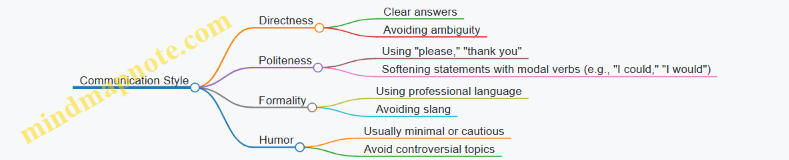
Sample Example of Cultural Norm Awareness in an Interview
Question: “Can you tell me about a time you faced a challenge at work?”
Less culturally aware answer:
“I had a problem with a coworker who didn’t do their job properly. I told my manager and that was it.”
More culturally aware answer:
“In a previous role, I encountered a situation where a team member was struggling to meet deadlines. I approached them to understand the issue and offered support. When the problem continued, I discussed it with my manager to find a solution that helped the team meet our goals.”
This second answer shows collaboration, problem-solving, and respect for hierarchy, which are valued in many English-speaking workplaces.
Summary
Being mindful of cultural norms means adapting your communication style without losing your authenticity. It involves balancing confidence and humility, being clear and polite, respecting time and space, and understanding the interviewer’s expectations. Practicing with these points in mind will help you navigate interviews more smoothly and make a positive impression.
13.2 Sample Answers Reflecting Cross-Cultural Awareness
Cross-cultural awareness in job interviews means showing that you understand and respect differences in communication styles, workplace norms, and values that vary by culture. Interviewers appreciate candidates who can navigate these differences thoughtfully, especially in global or diverse companies.
Here are some sample answers that demonstrate cross-cultural awareness, along with explanations and mind maps to help visualize the key points.
Sample Answer 1: Discussing Teamwork in a Multicultural Environment
“In my previous role, I worked with colleagues from several countries, including Japan, Germany, and Brazil. I learned that direct communication works well with some team members, while others prefer a more indirect approach to avoid conflict. To bridge this, I made sure to listen carefully and adapt my style, asking clarifying questions when needed. This helped us build trust and complete projects smoothly despite our different communication habits.”
Mind Map: Teamwork in Multicultural Settings
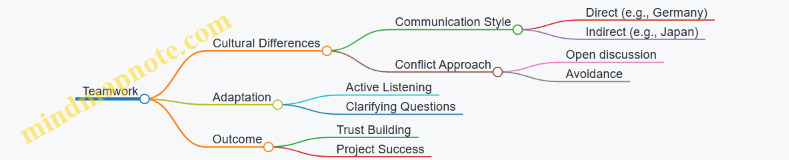
Sample Answer 2: Handling Different Work Ethics
“I noticed that some team members preferred to complete tasks quickly, focusing on efficiency, while others emphasized thoroughness and precision, even if it took more time. Recognizing these differences, I suggested we set clear deadlines but also include quality checkpoints. This way, we balanced speed and accuracy, respecting everyone’s approach and improving overall team performance.”
Mind Map: Balancing Work Ethics
Sample Answer 3: Adapting to Different Decision-Making Styles
“In one project, I worked with a team where some members preferred consensus before moving forward, while others were comfortable with quicker, individual decisions. I facilitated meetings where we first discussed concerns openly, then agreed on a timeline for final decisions. This approach respected both styles and kept the project on track.”
Mind Map: Decision-Making Styles
Sample Answer 4: Respecting Cultural Norms in Communication
“During a video interview with an international panel, I was mindful of cultural differences in eye contact and gestures. For example, I maintained steady but not intense eye contact, and used hand gestures moderately to avoid distraction. I believe this showed respect and helped create a comfortable atmosphere for everyone.”
Mind Map: Communication Norms
Sample Answer 5: Learning from Cultural Feedback
“After receiving feedback that my emails were too direct for some colleagues, I adjusted my tone to be more polite and included more context. This change improved my communication and strengthened relationships across the team. I see feedback as a valuable tool to understand cultural expectations better.”
Mind Map: Cultural Feedback and Adaptation
These examples show how to incorporate cultural awareness naturally into your answers. They highlight specific behaviors, adaptations, and outcomes rather than vague statements. When preparing your own answers, think about situations where you noticed cultural differences and how you responded constructively.
Using mind maps like these can help organize your thoughts and ensure your answers cover key points: the cultural difference, your response, and the positive result. This structure makes your answers clear and memorable.
Remember, cross-cultural awareness is not about knowing every cultural detail but about showing respect, flexibility, and willingness to learn. Interviewers value candidates who demonstrate these qualities through concrete examples.
13.3 Role-Play Script: Navigating Cultural Differences
In international job interviews, cultural differences can influence communication styles, expectations, and responses. This role-play script helps practice navigating these differences with clarity and respect.
Mind Map: Key Cultural Differences in Job Interviews
Role-Play Script
Interviewer: “Can you tell me about a time you faced a challenge at work and how you handled it?”
Candidate (from a culture favoring indirect communication): “Well, there was a situation where the team faced some difficulties with deadlines. I worked closely with my colleagues to find solutions that suited everyone’s pace. We managed to complete the project successfully.”
Interviewer: “Could you be more specific about your role in resolving the issue?”
Candidate: “Certainly. I coordinated communication between team members and proposed adjustments to the schedule that helped us stay on track without overwhelming anyone.”
Explanation
In this script, the candidate initially uses an indirect style, which may be common in some cultures where modesty and group harmony are valued. The interviewer’s prompt encourages a more direct and detailed response, common in cultures that value explicitness and individual contribution.
Mind Map: Strategies for Navigating Cultural Differences
Additional Example
Interviewer: “How do you handle feedback from supervisors?”
Candidate (from a culture valuing direct feedback): “I appreciate direct feedback because it helps me improve quickly. When my supervisor points out areas for growth, I take notes and ask questions to understand how to do better.”
Interviewer: “In some teams, feedback is given more subtly. How would you adjust?”
Candidate: “I would pay close attention to tone and context, and if I’m unsure, I’d ask for clarification respectfully. I understand that feedback styles vary, and I’m open to adapting.”
This example shows awareness of different feedback styles and a willingness to adapt, which is often appreciated in multicultural workplaces.
Summary
This role-play encourages candidates to recognize cultural differences in communication and respond flexibly. Practicing such scenarios helps build confidence and demonstrates cultural sensitivity, which can be as important as language skills in international interviews.
13.4 Best Practices for Respectful and Effective Communication
Respectful and effective communication in job interviews, especially across cultures, requires awareness of both what you say and how you say it. It’s about clarity, politeness, and adapting to the context without losing your authentic voice. Below are key practices organized into a mind map format and supported by examples.
Mind Map: Core Elements of Respectful Communication
Clarity: Keep It Simple and Direct
Clear communication helps avoid misunderstandings. Use straightforward sentences and avoid slang or idioms that might confuse someone from a different cultural background.
Example:
Instead of saying, “I hit the ground running in my last job,” say, “I started my responsibilities immediately and adapted quickly.”
This makes your meaning accessible without losing the message.
Politeness: Words That Show Respect
Politeness is universal but expressed differently. Using polite phrases like “Could you please clarify?” or “Thank you for the opportunity” demonstrates respect.
Example:
When asked a challenging question, you might respond, “That’s an interesting point; may I take a moment to think about it?” This shows respect for the question and your own thoughtful approach.
Cultural Sensitivity: Avoid Assumptions
Interviewers may come from various backgrounds. Avoid making assumptions about their customs, beliefs, or communication styles.
Example:
If asked about teamwork, instead of assuming a particular style, say, “In my experience, effective teamwork involves clear communication and respect for different ideas. How does your team approach collaboration?” This invites dialogue and shows openness.
Active Listening: Show You’re Engaged
Listening carefully and confirming understanding helps build rapport.
Example:
If the interviewer says, “We value innovation,” you might respond, “I understand that innovation is important here. Could you share an example of how your team encourages new ideas?” This confirms you heard them and invites further conversation.
Tone and Body Language: Match Words with Actions
Your tone should be calm and friendly, not rushed or aggressive. Maintain appropriate eye contact and nod occasionally to show attentiveness.
Example:
When explaining your skills, speak clearly and with moderate pace. Smile gently when appropriate. Avoid crossing arms or looking away frequently, which can seem defensive or disinterested.
Mind Map: Practical Steps for Effective Communication
By combining these elements, you create an interview presence that is respectful, clear, and engaging. This approach helps bridge cultural gaps and leaves a positive impression without forcing you to change who you are. Remember, effective communication is a two-way street: it’s about expressing yourself clearly and understanding the other person’s perspective.
13.5 Speaking Practice Exercises: Adapting Language for Different Contexts
Adapting your language during job interviews means adjusting your vocabulary, tone, and formality to fit the cultural and professional context of the company and interviewer. This skill helps you communicate clearly and shows cultural awareness, which can be a subtle but important advantage.
Below are exercises designed to help you practice shifting your language style appropriately. Each exercise includes a mind map in format to organize your thoughts and examples to illustrate how to adapt your responses.
Exercise 1: Formal vs. Informal Language
Mind Map: Language Formality
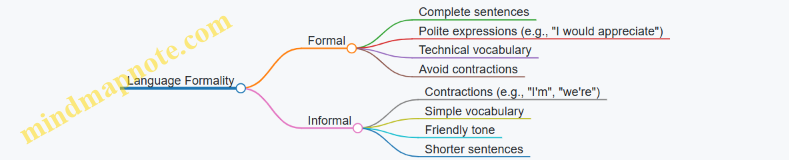
Example:
- Formal: “I have consistently demonstrated strong leadership skills in my previous roles, which I believe will contribute positively to your team.”
- Informal: “I’ve always been good at leading teams, and I think I’d fit in well here.”
Practice:
Write two versions of your answer to “Why do you want to work here?” one formal and one informal. Consider the company culture—formal for a law firm, informal for a startup.
Exercise 2: Technical vs. Layman’s Terms
Mind Map: Vocabulary Choice
Example:
- Technical: “I utilized Agile methodologies and Scrum frameworks to enhance project delivery efficiency.”
- Layman’s: “I worked in a way that helped the team stay organized and finish projects faster by breaking tasks into smaller parts.”
Practice:
Take a description of your last job and rewrite it twice: once using technical terms and once using simple language. This helps you adjust depending on whether the interviewer is a specialist or from HR.
Exercise 3: Direct vs. Indirect Communication
Mind Map: Communication Style
Example:
- Direct: “I missed the project deadline due to resource shortages.”
- Indirect: “There were some challenges with resources that affected the project timeline, but we managed to address them.”
Practice:
Practice answering “Tell me about a challenge you faced at work” in both direct and indirect styles. This is useful when interviewing with people from cultures that prefer more or less directness.
Exercise 4: Politeness and Humility
Mind Map: Tone and Attitude
Example:
- Polite and Humble: “I was fortunate to work with a great team that helped us exceed our sales targets.”
- Less Polite or Humble: “I led the team to exceed sales targets.”
Practice:
Rewrite your answer to “What is your greatest achievement?” emphasizing politeness and humility. This is especially important in cultures valuing modesty.
Exercise 5: Adjusting for Interviewer’s Role
Mind Map: Tailoring Language to Interviewer
Example:
- To HR: “I enjoy collaborating with others and resolving conflicts to keep the team productive.”
- To Technical Manager: “I implemented a new algorithm that improved data processing speed by 20%.”
- To Senior Executive: “My work contributed to a 15% increase in quarterly revenue by optimizing operational workflows.”
Practice:
Prepare three versions of your answer to “How do you handle teamwork?” tailored to HR, a technical manager, and a senior executive.
Summary
These exercises encourage flexibility in your interview language, helping you connect better with different interviewers and cultural contexts. Practicing these variations builds awareness and confidence, enabling you to present yourself appropriately and effectively no matter the setting.
Chapter 14: Final Tips for Confidence and Fluency
14.1 Techniques for Reducing Interview Anxiety
Interview anxiety is common, even for experienced candidates. The key is to manage it so it doesn’t interfere with your ability to communicate clearly. Here are practical techniques to help reduce anxiety before and during your job interview.
Understand Your Anxiety
Anxiety often comes from uncertainty and fear of negative evaluation. Recognizing this helps you address the root causes rather than just the symptoms.
Mind Map: Understanding Interview Anxiety
Preparation Builds Confidence
Thorough preparation reduces uncertainty. Practice common questions aloud, review your resume, and research the company. The more familiar you are with the material, the less your mind will wander to worries.
Example: Instead of just reading answers silently, say them out loud multiple times. This helps you get comfortable with the language and flow.
Breathing Techniques
Controlled breathing calms the nervous system. Try this simple exercise:
- Inhale slowly through your nose for 4 seconds.
- Hold your breath for 4 seconds.
- Exhale slowly through your mouth for 6 seconds.
- Repeat 3 to 5 times.
This slows your heart rate and clears your mind.
Mind Map: Breathing Technique Steps
Positive Visualization
Imagine yourself answering questions confidently and calmly. Picture the interviewer nodding and smiling. This mental rehearsal can reduce fear by creating a sense of familiarity.
Example: Before the interview, spend a few minutes picturing the room, your seat, and yourself speaking clearly.
Grounding Exercises
If anxiety spikes during the interview, grounding helps bring your focus back to the present.
Try the “5-4-3-2-1” technique:
- Name 5 things you can see.
- Name 4 things you can touch.
- Name 3 things you can hear.
- Name 2 things you can smell.
- Name 1 thing you can taste.
This redirects your attention from anxious thoughts to your immediate environment.
Practice Role-Play
Simulate interviews with a friend or coach. Role-playing familiarizes you with the interview flow and reduces fear of the unknown.
Example: Practice answering “Tell me about yourself” and “What are your strengths?” repeatedly until your responses feel natural.
Manage Physical Readiness
Get enough sleep the night before. Avoid excessive caffeine, which can increase jitteriness. Eat a balanced meal to maintain energy.
Example: A light breakfast with protein and complex carbs can help maintain steady energy levels.
Arrive Early
Arriving 10-15 minutes early gives you time to settle in and adjust to the environment. Rushing increases stress.
Use Positive Self-Talk
Replace negative thoughts with constructive ones. Instead of “I will mess up,” say “I have prepared and can handle this.”
Mind Map: Positive Self-Talk
Focus on Communication, Not Perfection
Remember, interviews are conversations, not tests. Focus on sharing your experiences clearly rather than delivering perfect answers.
By combining these techniques, you can reduce anxiety and improve your ability to communicate effectively during interviews. Practice them regularly, so they become natural responses rather than last-minute fixes.
14.2 Clear and natural English speaking in job interviews is about making your message easy to understand while sounding relaxed and confident. This balance helps interviewers focus on your qualifications rather than struggling with your language. Here are key practices to achieve this:
Speak at a Moderate Pace
Speaking too fast can confuse listeners, while speaking too slowly may sound unnatural. Aim for a steady rhythm that allows your ideas to come across clearly without sounding rushed or hesitant.
Use Simple and Precise Vocabulary
Choose words that fit the context and are easy to understand. Avoid overly complex or technical terms unless they are relevant to the job and you are sure of their meaning. Clear language reduces misunderstandings.
Structure Your Sentences Clearly
Keep sentences straightforward. Use subject-verb-object order and avoid long, complicated sentences. Break complex ideas into smaller parts when needed.
Practice Intonation and Stress
Vary your pitch and emphasize key words to keep your speech engaging and to highlight important points. Flat or monotone speech can make even good content hard to follow.
Use Pauses Effectively
Pausing briefly between ideas gives listeners time to process information. It also helps you gather your thoughts and avoid filler words like “um” or “uh.”
Avoid Filler Words
Words like “like,” “you know,” or “actually” can distract from your message. Practice replacing them with silence or a brief pause.
Maintain Consistent Volume and Clarity
Speak loud enough to be heard comfortably but avoid shouting. Enunciate words clearly without exaggeration.
Engage with Natural Body Language
Though this is about speaking, your gestures and facial expressions support your verbal message. They help you sound more natural and confident.
Mind Map: Elements of Clear and Natural English Speaking
Examples
Example 1: Speaking Pace
- Too fast: “IhavealotofexperienceinmarketingandIamreallygoodatmanagingprojectsandteams.”
- Moderate pace: “I have a lot of experience in marketing, and I am really good at managing projects and teams.”
Example 2: Vocabulary Choice
- Complex: “My professional trajectory encompasses multifaceted responsibilities in the domain of client acquisition.”
- Clear: “I have handled many tasks related to finding and keeping clients.”
Example 3: Sentence Structure
- Long and confusing: “Because I was responsible for the team, which was quite large and diverse, I had to coordinate many different tasks, which sometimes was challenging but rewarding.”
- Clear and concise: “I led a large, diverse team. I coordinated many tasks. It was challenging but rewarding.”
Example 4: Intonation and Stress
- Monotone: “I managed the project and completed it on time.”
- Varied: “I managed the project and completed it on time.”
Example 5: Pausing and Avoiding Fillers
- With fillers: “Um, I, like, led the team, you know, and, uh, we finished the project early.”
- With pauses: “I led the team… and we finished the project early.”
Mind Map: Common Filler Words and Alternatives
Practice Tip
Record yourself answering common interview questions. Listen for pace, clarity, and filler words. Adjust your speech based on what you hear. Over time, this helps develop a natural and clear speaking style.
Clear and natural English speaking is a skill that improves with mindful practice. Focus on clarity first, then add naturalness through intonation and rhythm. This approach makes your interview conversations both easy to follow and engaging.
14.3 Sample Warm-Up Exercises Before Interviews
Preparing your voice and mind before an interview can make a significant difference in how you communicate. Warm-up exercises help reduce tension, improve clarity, and boost confidence. Below are practical exercises designed to get you speaking smoothly and thinking clearly.
Breathing and Relaxation
Start by calming your breath. Controlled breathing supports voice projection and reduces nervousness.
- Inhale slowly through your nose for 4 seconds.
- Hold your breath for 4 seconds.
- Exhale gently through your mouth for 6 seconds.
- Repeat 3-5 times.
This simple routine helps steady your voice and focus your mind.
Tongue Twisters for Articulation
Tongue twisters improve pronunciation and help you speak clearly under pressure. Try these:
- “She sells seashells by the seashore.”
- “Red leather, yellow leather.”
- “Unique New York.”
Repeat each phrase slowly at first, then gradually increase speed while maintaining clarity.
Mind Map: Key Interview Topics to Warm Up Your Thoughts
Interview Warm-Up Mind Map
Use this mind map to quickly organize your thoughts. Spend a few minutes mentally running through each branch, preparing short, clear points.
Speaking Practice: Summarize Your Background in 60 Seconds
Practice delivering a concise summary of your background. Focus on clarity and pacing.
Example:
“My name is Sarah, and I have five years of experience in digital marketing. I specialize in content creation and social media strategy. In my last role, I increased engagement by 30% through targeted campaigns. I’m excited to bring my skills to a dynamic team like yours.”
Repeat this exercise, adjusting details to fit different job roles.
Role-Play: Answering a Common Question
Pick a frequent interview question and practice answering it aloud.
Example question: “Why do you want to work here?”
Sample answer:
“I admire your company’s commitment to innovation and sustainability. My background in project management aligns well with your current initiatives, and I believe I can contribute to your growth while developing my skills further.”
Try varying your tone and emphasis to find a natural delivery.
Vocal Warm-Up: Pitch and Volume Control
- Hum gently for 10 seconds, feeling vibrations in your chest.
- Say the vowels (A, E, I, O, U) aloud, varying pitch from low to high.
- Practice speaking a sentence softly, then gradually increase volume without shouting.
Example sentence:
“I am excited to discuss how I can contribute to your team.”
This helps you control your voice during the interview.
Final Mind Map: Quick Review Before Entering
Review this checklist silently to center yourself.
These exercises take about 10-15 minutes and can be done right before your interview or during preparation. The goal is to make your speech clear, your thoughts organized, and your presence confident. Regular practice of these warm-ups builds muscle memory, making your interview responses feel natural rather than rehearsed.
14.4 Role-Play Script: Building Confidence Through Repetition
Repetition is a straightforward but effective way to build confidence in speaking English during job interviews. Practicing the same or similar dialogues multiple times helps you internalize vocabulary, sentence structures, and natural pauses. This section provides a role-play script designed for repetition practice, paired with mind maps to organize your thoughts and examples to guide your responses.
Mind Map 1: Key Elements of Confidence Building in Interview Speaking

Mind Map 2: Structure of a Repetitive Role-Play Practice
Role-Play Script: Interviewer and Candidate
Interviewer: Good morning. Please introduce yourself briefly.
Candidate: Good morning. My name is Alex Taylor. I have a background in marketing with over three years of experience focusing on digital campaigns.
Interviewer: What would you say is your greatest strength?
Candidate: I believe my greatest strength is my ability to analyze data and translate it into actionable marketing strategies.
Interviewer: Can you tell me about a weakness you are working to improve?
Candidate: Certainly. I sometimes focus too much on details, but I have been working on balancing detail orientation with broader project goals.
Interviewer: Where do you see yourself in five years?
Candidate: I aim to develop my leadership skills and take on a managerial role within the marketing department.
Interviewer: Do you have any questions for us?
Candidate: Yes, could you tell me more about the team I would be working with?
Interviewer: Absolutely. Our marketing team consists of five members, each specializing in different areas.
Candidate: Thank you. That sounds like a great environment to grow.
Interviewer: Thank you for your time today.
Candidate: Thank you for the opportunity.
How to Use This Script for Repetition Practice
-
Read Aloud: Start by reading both interviewer and candidate parts aloud. This helps you get familiar with the flow.
-
Focus on Candidate Responses: Practice the candidate’s answers repeatedly until they feel natural and comfortable.
-
Swap Roles: Practice with a partner, switching roles to understand both sides of the conversation.
-
Record Yourself: Listening to your recordings can highlight areas for improvement in pronunciation and pacing.
-
Vary Your Delivery: Change tone, speed, or emphasis to avoid sounding robotic and to build adaptability.
Example Variations for Practice
- Instead of “My greatest strength is my ability to analyze data,” try “I excel at interpreting data to improve marketing outcomes.”
- For the weakness question, try “I tend to get caught up in details, but I’m learning to prioritize tasks more effectively.”
- When asked about career goals, say “I plan to enhance my project management skills and lead larger campaigns.”
Mind Map 3: Tips for Effective Repetition Practice
Repetition is not about memorizing answers word-for-word but about gaining comfort with expressing your ideas clearly and confidently. Using this script repeatedly will help you build a natural rhythm and reduce hesitation during real interviews.
14.5 Speaking Practice Exercises: Fluency and Pronunciation Drills
Improving fluency and pronunciation is essential for clear communication during job interviews. This section offers practical exercises designed to help you speak smoothly and pronounce words accurately. Each exercise includes examples and mind maps to organize your practice.
Exercise 1: Sentence Stress and Intonation Practice
Focus on stressing the important words in a sentence and using natural intonation patterns. This helps your speech sound more engaging and easier to understand.
Example Sentences:
- “I have five years of experience in marketing.”
- “My strength is problem-solving under pressure.”
- “I am excited about this opportunity.”
Mind Map:
Practice: Read each sentence aloud, emphasizing the bolded words. Record yourself and listen for natural rhythm.
Exercise 2: Minimal Pairs for Pronunciation Clarity
Minimal pairs are words that differ by only one sound. Practicing these helps distinguish similar sounds, improving clarity.
Examples:
- Ship / Sheep
- Live / Leave
- Bat / Bet
Mind Map:
Practice: Say pairs aloud, then use each word in a short sentence:
- “I saw a ship at the harbor.”
- “The sheep are grazing in the field.”
Exercise 3: Linking Sounds for Smooth Speech
Linking connects the final sound of one word to the beginning sound of the next, making speech flow naturally.
Examples:
- “I am” → “I’m”
- “Look at it” → “Look at it” (linking the ‘k’ and ‘a’)
Mind Map:
Practice: Read aloud:
- “Can you tell me about your experience?”
- “What are your career goals?”
Focus on connecting words smoothly.
Exercise 4: Tongue Twisters for Articulation
Tongue twisters challenge your mouth muscles and improve pronunciation precision.
Examples:
- “She sells seashells by the seashore.”
- “Peter Piper picked a peck of pickled peppers.”
Mind Map:
Practice: Repeat each tongue twister five times, increasing speed while keeping words clear.
Exercise 5: Pausing and Pacing
Effective pausing helps you gather thoughts and makes your speech easier to follow.
Mind Map:
Practice: Practice answering:
- “Why do you want this job?”
- “Tell me about a challenge you faced.”
Pause briefly after each key point.
Exercise 6: Shadowing Technique
Shadowing means repeating speech immediately after hearing it, mimicking rhythm and pronunciation.
Practice: Listen to a short interview answer and repeat it aloud simultaneously.
Example: Interviewer: “Can you describe your teamwork experience?” Candidate: “I have worked on several projects where collaboration was key.”
Repeat multiple times focusing on matching intonation and speed.
These exercises can be combined or practiced separately depending on your needs. Regular practice will help you speak more confidently and clearly during interviews.