Front Desk Kitchen and Guest Service Basic Training Guide
1. Introduction to Hospitality Operations
1.1 Understanding the Hospitality Industry: Roles and Responsibilities
The hospitality industry is a broad category of fields within the service sector that includes lodging, food and beverage service, event planning, theme parks, travel, and tourism. It is centered around providing excellent customer experiences and ensuring guests feel welcomed, comfortable, and valued.
What is the Hospitality Industry?
At its core, the hospitality industry focuses on:
- Welcoming guests
- Providing services that meet or exceed expectations
- Creating memorable experiences
Mind Map: Overview of the Hospitality Industry
Key Roles in Hospitality Operations
Understanding the roles helps entry-level employees see how their work fits into the bigger picture.
Mind Map: Key Roles and Their Responsibilities
Examples of Roles in Action
Example 1: Front Desk Greeting
Scenario: A guest arrives after a long journey.
Best Practice: The front desk staff greets the guest with a warm smile and a friendly “Welcome! How was your trip?” This simple interaction sets a positive tone.
Example 2: Kitchen Hygiene
Scenario: The kitchen team follows strict handwashing protocols before handling food.
Best Practice: This prevents contamination and ensures food safety, which is critical to guest health.
Example 3: Guest Service Handling a Complaint
Scenario: A guest complains about a delayed meal.
Best Practice: The guest service staff listens actively, apologizes sincerely, and offers a solution such as a complimentary drink or expedited service.
Why Understanding Roles Matters
- Improves teamwork: Knowing what others do helps coordinate efforts smoothly.
- Enhances guest experience: Each role contributes to the overall satisfaction.
- Builds career awareness: Understanding different functions can guide career growth.
Mind Map: Benefits of Role Awareness
Summary
The hospitality industry is a dynamic and interconnected environment where every role is vital. As entry-level staff, understanding your responsibilities and how they relate to others helps you contribute effectively and grow professionally.
Remember: Your attitude and knowledge about your role can turn a simple service into a memorable guest experience.
1.2 Overview of Front Desk, Kitchen, and Guest Service Functions
In the hospitality industry, the smooth operation of a property depends heavily on the coordinated efforts of multiple departments. Among these, the Front Desk, Kitchen, and Guest Service teams play pivotal roles. Understanding their functions and how they interrelate is essential for entry-level employees to perform effectively and contribute to an exceptional guest experience.
Front Desk Functions
The Front Desk is often the first and last point of contact for guests. Their responsibilities include:
- Greeting and welcoming guests warmly
- Managing reservations and room assignments
- Handling check-in and check-out processes
- Providing information about the property and local area
- Managing guest requests and complaints
- Coordinating with other departments (e.g., housekeeping, kitchen)
Example: When a guest arrives late at night, the front desk staff must efficiently check them in, provide room keys, and offer information about breakfast hours or amenities.
Kitchen Functions
The Kitchen team is responsible for preparing and delivering food and beverages that meet quality and safety standards. Key functions include:
- Food preparation and cooking
- Maintaining hygiene and food safety protocols
- Managing inventory and kitchen supplies
- Coordinating orders with the front desk and wait staff
- Handling special dietary requests
Example: If a guest calls the front desk requesting a gluten-free meal, the front desk communicates this to the kitchen, which then prepares the meal according to dietary guidelines.
Guest Service Functions
Guest Service extends beyond the front desk and kitchen, encompassing all interactions that enhance the guest’s stay. Their functions include:
- Anticipating and fulfilling guest needs
- Providing personalized service
- Managing guest complaints and feedback
- Offering additional services like tours, transportation, or special requests
Example: A guest celebrating a birthday might receive a complimentary cake or a personalized greeting card arranged by guest service staff.
Mind Map: Overview of Key Functions
Mind Map: Example Workflow for a Guest Dinner Order
Integrated Example Scenario
Scenario: A guest arrives for check-in and requests a vegetarian dinner delivered to their room.
- Front Desk: Greets the guest warmly, completes check-in, and notes the vegetarian dinner request.
- Front Desk to Kitchen: Communicates the order with clear instructions about vegetarian preferences.
- Kitchen: Prepares the vegetarian meal following hygiene and safety protocols.
- Guest Service: Coordinates delivery of the meal at the requested time.
- Guest: Receives meal, enjoys the service, and later provides positive feedback.
This example highlights how the three departments must work seamlessly to ensure guest satisfaction.
Summary
Understanding the distinct yet interconnected functions of the Front Desk, Kitchen, and Guest Service teams helps entry-level employees appreciate their role within the larger hospitality operation. Each function supports the others, creating a cohesive experience that delights guests and fosters repeat business.
1.3 Importance of Teamwork Across Departments: Real-Life Examples
Teamwork is the backbone of any successful hospitality operation. In environments like hotels, restaurants, and resorts, the front desk, kitchen, and guest service teams must work seamlessly together to create a positive guest experience. When departments collaborate effectively, operations run smoothly, guest satisfaction increases, and workplace morale improves.
Why Teamwork Matters Across Departments
- Enhanced Communication: Sharing information promptly avoids misunderstandings.
- Improved Efficiency: Coordinated efforts reduce wait times and errors.
- Consistent Guest Experience: Unified service standards ensure guests receive excellent service at every touchpoint.
- Problem Solving: Teams can quickly address issues by pooling knowledge.
- Employee Satisfaction: Supportive teamwork reduces stress and burnout.
Mind Map: Key Benefits of Teamwork Across Departments
Real-Life Example 1: Coordinated Check-In and Kitchen Service
Scenario: A hotel guest arrives late and requests a quick dinner delivery to their room after check-in.
Teamwork in Action:
- The front desk staff promptly communicates the guest’s request and dietary preferences to the kitchen.
- The kitchen prioritizes the order, preparing the meal quickly while maintaining quality.
- The guest service team coordinates delivery to the guest’s room with a friendly update.
Outcome: The guest feels valued and experiences seamless service, enhancing satisfaction and likelihood of return.
Mind Map: Coordinated Guest Request Handling
Real-Life Example 2: Managing a Food Allergy Emergency
Scenario: A guest informs the front desk about a severe food allergy after placing an order.
Teamwork in Action:
- Front desk immediately alerts the kitchen about the allergy.
- Kitchen reviews the order and modifies it to exclude allergens.
- Guest service staff double-checks with the guest before delivery.
Outcome: The guest receives a safe meal, preventing a health incident and building trust.
Mind Map: Allergy Management Workflow
Real-Life Example 3: Handling a Booking Mix-Up
Scenario: A guest arrives, but their reservation is not found in the system.
Teamwork in Action:
- Front desk apologizes and quickly contacts the reservations team.
- Kitchen is informed about the delay to adjust meal prep timing.
- Guest service offers a complimentary drink while the issue is resolved.
Outcome: The guest feels cared for despite the hiccup, and the issue is resolved efficiently.
Mind Map: Booking Issue Resolution
Summary
Teamwork across front desk, kitchen, and guest service departments is essential for delivering exceptional hospitality. By communicating clearly, coordinating tasks, and supporting each other, staff can handle requests, emergencies, and unexpected situations with professionalism and care. These real-life examples and mind maps illustrate how integrated teamwork creates memorable guest experiences and a positive work environment.
1.4 Key Qualities of Successful Service Staff
Successful service staff in hospitality operations possess a unique blend of qualities that enable them to deliver exceptional guest experiences, work efficiently with their teams, and adapt to the dynamic environment of hospitality. Below, we explore these key qualities with clear examples and mind maps to help you understand and embody them.
Communication Skills
Clear, polite, and effective communication is vital. Service staff must listen actively and convey information accurately.
- Example: When a guest asks about breakfast hours, a front desk staff member responds clearly: “Our breakfast is served from 6:30 AM to 10:00 AM in the dining area. If you need anything else, please let me know.”
Mind Map: Communication Skills
Empathy and Patience
Understanding guests’ feelings and showing patience, especially during stressful situations, builds trust and satisfaction.
- Example: A guest complains about a delayed meal. Instead of reacting defensively, the kitchen staff calmly apologizes and offers a complimentary drink while expediting the order.
Mind Map: Empathy and Patience
Attention to Detail
Small details can make a big difference in guest satisfaction.
- Example: A front desk employee notices a guest’s birthday noted in the reservation and arranges a small cake to be delivered to the room.
Mind Map: Attention to Detail
Teamwork
Hospitality is a team effort. Successful staff collaborate and support each other.
- Example: When the kitchen is overwhelmed, front desk staff assist by communicating realistic wait times and updating guests proactively.
Mind Map: Teamwork
Adaptability and Problem-Solving
The hospitality environment is fast-paced and unpredictable. Staff must adapt quickly and find solutions.
- Example: A sudden power outage occurs; staff calmly guide guests to safety and coordinate with management to restore services.
Mind Map: Adaptability and Problem-Solving
Positive Attitude and Professionalism
A friendly demeanor combined with professionalism leaves lasting impressions.
- Example: A kitchen staff member greets guests with a smile and maintains hygiene standards consistently.
Mind Map: Positive Attitude and Professionalism
Summary Table of Key Qualities with Examples
| Quality | Description | Example Scenario |
|---|---|---|
| Communication | Clear, polite, and effective exchange | Explaining breakfast hours clearly to a guest |
| Empathy & Patience | Understanding and calmly addressing needs | Apologizing and offering a drink for a delayed meal |
| Attention to Detail | Noticing small but important guest needs | Arranging a birthday cake for a guest |
| Teamwork | Collaborating and supporting colleagues | Front desk updating guests during kitchen delays |
| Adaptability | Adjusting quickly to changes and solving problems | Managing a power outage calmly |
| Positive Attitude & Professionalism | Friendly, reliable, and well-presented | Greeting guests warmly and maintaining hygiene standards |
By cultivating these qualities, service staff can contribute significantly to a smooth operation and exceptional guest experiences. Practice these skills daily and observe how they positively impact your work and guest satisfaction.
2. Front Desk Fundamentals
2.1 Greeting Guests: Best Practices and Sample Dialogues
Welcoming guests warmly and professionally at the front desk sets the tone for their entire experience. This section covers best practices for greeting guests along with sample dialogues and mind maps to help you master this essential skill.
Best Practices for Greeting Guests
- Smile and Make Eye Contact: A genuine smile and eye contact convey friendliness and attentiveness.
- Use a Warm, Clear Voice: Speak clearly and with a friendly tone to make guests feel comfortable.
- Address Guests Promptly: Acknowledge guests immediately upon arrival to avoid making them wait.
- Use Polite and Professional Language: Always use courteous words like “Welcome,” “Good morning/afternoon,” and “How may I assist you today?”
- Personalize When Possible: If you know the guest’s name or reservation details, use them.
- Maintain Open Body Language: Stand or sit upright, avoid crossing arms, and face the guest.
- Be Attentive to Non-Verbal Cues: Notice if guests look confused, tired, or in a hurry and adjust your approach accordingly.
Mind Map: Greeting Guests
Greeting Guests Mind Map
Sample Dialogues
Example 1: Standard Check-In Greeting
Staff: “Good afternoon! Welcome to Sunshine Hotel. How may I assist you today?”
Guest: “Hi, I have a reservation under the name Smith.”
Staff: “Thank you, Mr. Smith. Let me pull up your reservation and get you checked in right away.”
Example 2: Greeting a Guest Who Looks Tired
Staff: “Good evening! Welcome to the Grand Plaza. You look like you’ve had a long day. Can I help you with your luggage or get you a refreshment while you check in?”
Guest: “That would be great, thank you.”
Staff: “You’re very welcome. Let me take care of that for you.”
Example 3: Greeting a Guest Without a Reservation
Staff: “Hello! Welcome to Oceanview Inn. Do you have a reservation with us today?”
Guest: “No, I was hoping to get a room for the night.”
Staff: “No problem! Let me check our availability and find the best option for you.”
Mind Map: Sample Dialogue Components
Tips for Practicing Greetings
- Role-play with colleagues to simulate different guest moods and scenarios.
- Record yourself to evaluate tone, clarity, and body language.
- Practice using guest names naturally in conversation.
- Observe experienced staff and note effective greeting techniques.
Mastering the art of greeting guests warmly and professionally is the first step to providing excellent service. Use these best practices, mind maps, and sample dialogues as a foundation to build your confidence and skills at the front desk.
2.2 Handling Reservations: Step-by-Step Procedures with Examples
Handling reservations efficiently is a critical skill for front desk staff. It ensures guests have a smooth experience from the moment they book until arrival. This section breaks down the reservation process into clear steps, accompanied by examples and mind maps to help you visualize and remember best practices.
Step 1: Receiving the Reservation Request
Reservations can come through various channels: phone calls, emails, online booking systems, or in-person.
Best Practice: Always greet the guest warmly and confirm the purpose of their call or visit.
Example:
“Good afternoon! Thank you for calling Sunshine Hotel. How may I assist you with your reservation today?”
Step 2: Collecting Guest Information
Gather all necessary details to complete the reservation accurately.
Information to collect:
- Guest full name
- Contact information (phone number, email)
- Date(s) of stay
- Number of guests
- Room type preference
- Special requests (e.g., accessibility needs, late check-in)
Example:
“May I have your full name, please? And could you tell me the dates you plan to stay with us?”
Step 3: Checking Availability
Use your reservation system or booking platform to verify room availability for the requested dates and preferences.
Best Practice: Double-check availability before confirming to avoid overbooking.
Example:
“Let me check our availability for those dates. One moment please… Yes, we have a deluxe queen room available for those dates.”
Step 4: Confirming the Reservation Details
Repeat the reservation details back to the guest to ensure accuracy.
Example:
“To confirm, you have booked a deluxe queen room from June 10th to June 15th for two guests. Is that correct?”
Step 5: Explaining Policies and Payment
Inform the guest about cancellation policies, deposit requirements, and payment methods.
Example:
“Please note, we require a 20% deposit to secure your reservation, refundable if canceled 48 hours before arrival. We accept all major credit cards.”
Step 6: Finalizing the Reservation
Enter the reservation into the system and provide a confirmation number.
Example:
“Your reservation is confirmed. Your confirmation number is 123456. You will receive an email shortly with all the details.”
Step 7: Sending Confirmation and Follow-Up
Send a confirmation email or message promptly. Follow up closer to the date if necessary.
Example Email Snippet:
Dear [Guest Name],
Thank you for choosing Sunshine Hotel. Your reservation for a deluxe queen room from June 10th to June 15th is confirmed. Your confirmation number is 123456.
We look forward to welcoming you!
Mind Map: Reservation Handling Process
Example Scenario: Phone Reservation
Guest: “Hello, I’d like to book a room for next weekend.”
Front Desk: “Good morning! I’d be happy to help. May I have your full name, please?”
Guest: “It’s Sarah Johnson.”
Front Desk: “Thank you, Sarah. What dates will you be staying with us?”
Guest: “From Friday, March 12th to Sunday, March 14th.”
Front Desk: “Let me check availability for those dates.”
After checking
Front Desk: “We have a standard double room available. Would you like to proceed with this option?”
Guest: “Yes, please.”
Front Desk: “Great! To confirm, Sarah Johnson, standard double room, March 12th to 14th. Is that correct?”
Guest: “Yes.”
Front Desk: “Our cancellation policy requires a 24-hour notice. We will need a credit card to hold the reservation. Can I have your card details?”
Guest: “Sure, it’s 1234 5678 9012 3456, expiration 08/25.”
Front Desk: “Thank you. Your reservation is confirmed. Your confirmation number is 7891011. You will receive an email shortly.”
Tips for Handling Reservations Smoothly
- Speak clearly and politely.
- Use the guest’s name to personalize the interaction.
- Confirm all details before ending the call.
- Keep a calm and patient tone, especially if guests are uncertain.
- Always double-check entries in the system.
By mastering these steps and practicing with the examples and mind maps, you will confidently handle reservations and contribute to excellent guest experiences.
2.3 Check-In and Check-Out Processes: Common Scenarios and Solutions
Overview
The check-in and check-out processes are critical touchpoints in guest service. Efficient handling ensures guest satisfaction, smooth operations, and positive reviews. This section covers common scenarios you may encounter at the front desk during these processes and practical solutions with examples.
Check-In Process
Step-by-Step Best Practices:
- Warm Greeting: Smile and welcome the guest by name if known.
- Confirm Reservation: Verify booking details (name, dates, room type).
- Request Identification: Politely ask for ID and payment method.
- Explain Policies: Briefly inform about check-out time, amenities, and Wi-Fi.
- Issue Room Key: Provide key and directions.
- Offer Assistance: Ask if they need help with luggage or directions.
Mind Map: Check-In Process
Common Check-In Scenarios & Solutions
Scenario 1: Guest Arrives Early
- Problem: Guest arrives before standard check-in time.
- Solution: Politely inform about check-in time, offer to store luggage, or check if early check-in is possible.
Example Dialogue:
“Good morning, Mr. Smith! Our standard check-in time is 3 PM. While your room isn’t ready yet, I can securely store your luggage if you’d like to explore the area meanwhile.”
Scenario 2: Reservation Not Found
- Problem: Guest’s reservation is missing in the system.
- Solution: Remain calm, verify spelling and dates, check alternative bookings, and offer solutions such as room availability or contacting booking platforms.
Example Dialogue:
“I’m sorry, Ms. Lee, I don’t see your reservation under that name. Let me double-check the spelling and dates. Meanwhile, do you have a confirmation email or booking number?”
Scenario 3: Payment Issues
- Problem: Credit card declined or payment not authorized.
- Solution: Discreetly inform the guest, ask for alternative payment, or contact the bank if needed.
Example Dialogue:
“It seems there’s an issue authorizing your card, Mr. Johnson. Would you like to try another card or payment method?”
Check-Out Process
Step-by-Step Best Practices:
- Warm Farewell Greeting: Thank the guest for staying.
- Confirm Room Number and Charges: Review bill with guest.
- Process Payment: Accept final payment or resolve discrepancies.
- Ask for Feedback: Invite comments or suggestions.
- Offer Assistance: Arrange transportation or luggage help.
- Wish Safe Travels: End on a positive note.
Mind Map: Check-Out Process
Common Check-Out Scenarios & Solutions
Scenario 1: Disputed Charges
- Problem: Guest questions extra charges.
- Solution: Calmly review charges, provide receipts, and if error found, correct immediately.
Example Dialogue:
“I understand your concern about the minibar charge, Ms. Patel. Let me check your room service records and get back to you shortly.”
Scenario 2: Late Check-Out Request
- Problem: Guest requests late check-out.
- Solution: Check availability, inform about any fees, and confirm approval or alternatives.
Example Dialogue:
“We’d love to accommodate your late check-out, Mr. Garcia. Our standard late check-out fee is $20. Would you like me to arrange that for you?”
Scenario 3: Lost Room Key
- Problem: Guest lost their room key.
- Solution: Verify guest identity, deactivate old key, issue new key, and note incident.
Example Dialogue:
“No worries, Ms. Nguyen. I’ll deactivate your old key and issue a new one right away. Could you please show me your ID for verification?”
Integrated Example: Handling a Busy Check-In with an Early Arrival
Situation: Two guests arrive simultaneously; one has an early arrival, the other is checking out.
Best Practice: Prioritize check-out guest to free room, politely inform early arrival guest about wait time or luggage storage.
Example Dialogue:
- To early arrival guest: “Welcome! Our check-in starts at 3 PM. Your room is being prepared, and I can store your luggage safely while you wait or explore nearby.”
- To check-out guest: “Good morning, Mr. Thompson! Let me assist you with your check-out.”
Summary
Mastering check-in and check-out processes involves clear communication, patience, and problem-solving skills. Using the outlined steps, mind maps, and scenario-based examples will help you handle common situations confidently and create a positive guest experience.
2.4 Managing Guest Information Confidentially: Practical Tips
Protecting guest information is a critical responsibility for all hospitality staff, especially those working at the front desk. Confidentiality builds trust, ensures compliance with privacy laws, and protects both guests and the business from potential risks.
Why Confidentiality Matters
- Trust Building: Guests feel safe sharing personal details.
- Legal Compliance: Avoid fines and legal issues related to data breaches.
- Reputation Management: Prevent negative publicity from leaked information.
Key Principles of Managing Guest Information Confidentially
Practical Tips with Examples
Limit Access to Authorized Personnel Only
- Tip: Only staff members who need the information to perform their duties should have access.
- Example: The front desk clerk should not share guest credit card details with housekeeping staff.
Secure Physical and Digital Records
- Tip: Lock physical files in cabinets and use password-protected systems.
- Example: After a guest checks out, their paper registration form is stored in a locked cabinet; digital records require login credentials.
Use Strong Passwords and Change Them Regularly
- Tip: Use a combination of letters, numbers, and symbols; avoid sharing passwords.
- Example: A front desk employee uses a password manager and updates passwords every 3 months.
Avoid Discussing Guest Information in Public Areas
- Tip: Conversations about guests should happen in private.
- Example: Instead of discussing a VIP guest’s special requests in the lobby, the front desk staff uses internal messaging.
Properly Dispose of Sensitive Information
- Tip: Shred paper documents and securely delete digital files when no longer needed.
- Example: After the guest’s stay, the front desk shreds the registration form instead of throwing it in the trash.
Train Staff Regularly on Privacy Policies
- Tip: Conduct refresher courses and share updates on data protection.
- Example: Monthly team meetings include a 10-minute segment on confidentiality best practices.
Example Scenario: Handling a Guest’s Payment Information
Situation: A guest calls to update their credit card details.
Best Practice:
- Verify the guest’s identity by asking for reservation details.
- Use the secure payment system to update information.
- Do not write down or email credit card numbers.
What Not to Do:
- Do not share the credit card info with other guests or staff unnecessarily.
- Do not leave payment info visible on the desk.
Mind Map: Steps to Handle Guest Information Securely
Summary Checklist for Managing Guest Information Confidentially
- Only access guest info necessary for your role
- Keep physical and digital records secure
- Use strong, regularly updated passwords
- Discuss guest info only in private
- Properly dispose of sensitive data
- Participate in regular confidentiality training
By following these practical tips and examples, front desk staff can confidently manage guest information while maintaining the highest standards of privacy and professionalism.
2.5 Using Front Desk Technology: Demonstrations and Troubleshooting
In today’s hospitality environment, front desk technology is essential for efficient operations and excellent guest service. This section will guide you through the most common front desk technologies, demonstrate how to use them effectively, and provide troubleshooting tips with easy-to-understand examples.
Key Front Desk Technologies
- Property Management System (PMS)
- Point of Sale (POS) Systems
- Telephone and Voicemail Systems
- Email and Messaging Platforms
- Online Reservation Systems
Mind Map: Front Desk Technology Overview
Demonstration: Using the Property Management System (PMS)
Step 1: Logging In
- Enter your username and password.
- Example: “FrontDesk01” / “Welcome123”
Step 2: Checking In a Guest
- Search for the guest reservation by name or confirmation number.
- Confirm guest details and assign a room.
- Example: Guest “John Smith” arrives; search “Smith” → select reservation → assign Room 305.
Step 3: Processing Payment
- Enter payment method (credit card, cash).
- Confirm amount and complete transaction.
Step 4: Checking Out a Guest
- Retrieve guest folio.
- Review charges and finalize payment.
- Example: Guest “Jane Doe” checks out; verify minibar charges and settle bill.
Troubleshooting Common PMS Issues
| Issue | Possible Cause | Solution Example |
|---|---|---|
| Cannot log in | Incorrect password | Reset password or contact supervisor |
| Reservation not found | Typo in guest name or no booking | Double-check spelling; verify booking source |
| Room assignment error | Room already occupied | Check room status; assign an available room |
| Payment declined | Card issue or network problem | Ask guest for alternate payment; retry transaction later |
Example:
Guest “Mark Lee” tries to check in but system says reservation not found. You verify spelling and realize the booking was under “Marc Lee.” Correct the spelling and proceed.
Demonstration: Using the POS System
Step 1: Entering Orders
- Select guest table or room number.
- Choose menu items and quantities.
Step 2: Processing Payment
- Select payment method.
- Apply discounts or promotions if applicable.
Step 3: Printing Receipts
- Confirm order and print receipt for guest.
Troubleshooting Common POS Issues
| Issue | Possible Cause | Solution Example |
|---|---|---|
| Printer not working | Paper jam or offline | Clear jam; check printer connection |
| Order not transmitting to kitchen | Network issue or system error | Restart POS terminal; notify kitchen manually |
| Payment not processing | Card reader malfunction | Use manual entry or alternate payment method |
Example:
A guest orders room service but the kitchen never receives the order. You check the POS terminal and find it disconnected from the network. You call the kitchen to inform them manually and restart the terminal.
Telephone and Voicemail System Usage
- Answering Calls: Greet politely, identify yourself and the property.
- Transferring Calls: Use transfer button; confirm recipient is available.
- Taking Messages: Record caller name, message, and callback number.
- Setting Wake-Up Calls: Schedule calls as requested by guests.
Troubleshooting Telephone Issues
| Issue | Possible Cause | Solution Example |
|---|---|---|
| No dial tone | Phone unplugged or line down | Check connections; contact telecom provider |
| Unable to transfer calls | System error | Restart phone system; use alternative communication |
Best Practices for Front Desk Technology
- Always double-check guest information before confirming.
- Keep passwords secure and never share them.
- Report technical issues promptly to IT support.
- Practice using systems regularly to build confidence.
- Use system help guides and tutorials when available.
Summary Mind Map: Troubleshooting Steps
By mastering front desk technology, you improve efficiency, reduce errors, and enhance the guest experience. Practice these demonstrations regularly and use the troubleshooting tips to confidently handle common issues.
2.6 Handling Difficult Guests Calmly: Role-Playing Examples
Handling difficult guests is a crucial skill for front desk and guest service staff. Remaining calm, empathetic, and professional can turn a challenging situation into a positive experience. This section provides practical role-playing examples and mind maps to help you master this skill.
Mind Map: Steps to Handle Difficult Guests Calmly
Role-Playing Example 1: Late Room Availability
Scenario: A guest arrives early but their room is not ready. They are visibly upset.
Guest: “I’ve been traveling all day and I just want to rest. Why isn’t my room ready yet? This is unacceptable!”
Staff Response:
- Stay calm and smile gently.
- Listen fully without interrupting.
- Empathize: “I completely understand how tiring traveling can be, and I’m sorry your room isn’t ready yet.”
- Apologize: “We strive to have rooms ready by check-in time, but today we had some unexpected delays.”
- Offer solution: “May I offer you a complimentary drink in our lounge while you wait? I will personally notify housekeeping to prioritize your room.”
- Follow up: “I’ll come find you as soon as your room is ready. Thank you for your patience.”
Role-Playing Example 2: Billing Dispute
Scenario: A guest claims they were overcharged on their bill.
Guest: “This bill is wrong! I didn’t order these items. Fix it now!”
Staff Response:
- Take a deep breath and maintain a calm tone.
- Listen carefully: “Let me review the bill with you to understand the charges.”
- Empathize: “I understand how frustrating unexpected charges can be.”
- Apologize: “I’m sorry for any confusion. Let me double-check the details.”
- Investigate: Review the bill and order history.
- Offer solution: “It appears there was a mix-up. I will correct the bill immediately and provide you with an updated copy.”
- Follow up: “Please let me know if you have any other concerns. We want to ensure your stay is pleasant.”
Role-Playing Example 3: Noise Complaint
Scenario: A guest complains about loud noise coming from a nearby room.
Guest: “I can’t sleep because of the noise next door. This is unacceptable!”
Staff Response:
- Stay composed and listen attentively.
- Empathize: “I’m sorry you’re experiencing this disturbance.”
- Apologize: “We want all our guests to have a restful stay.”
- Offer solution: “I will contact the guests in the next room to ask them to keep the noise down. If you prefer, I can also offer you a room change.”
- Follow up: “Please let me know if the noise continues or if there’s anything else I can assist with.”
Mind Map: Phrases to Use When Handling Difficult Guests
Tips for Role-Playing Practice
- Practice with a colleague taking turns as guest and staff.
- Use real-life scenarios relevant to your workplace.
- Focus on tone of voice, body language, and word choice.
- Reflect on what worked well and what could improve.
By practicing these role-playing examples and following the outlined steps, you will build confidence and skill in managing difficult guests calmly and professionally, turning potentially negative encounters into opportunities for excellent service.
3. Kitchen Operations Basics
3.1 Understanding Kitchen Roles and Workflow
In any hospitality operation, the kitchen is the heart of food preparation and delivery. Understanding the roles within the kitchen and how the workflow operates is essential for smooth coordination between the kitchen and front desk staff, ensuring timely and quality service to guests.
Key Kitchen Roles and Their Responsibilities
Below is a mind map illustrating the common kitchen roles and their primary duties:
Kitchen Roles Mind Map
Kitchen Workflow Overview
The kitchen workflow is a sequence of steps that transforms raw ingredients into finished dishes ready for service. Understanding this flow helps service staff anticipate timing and communicate effectively.
Kitchen Workflow Mind Map
Example Scenario: Coordinating a Dinner Rush
Imagine a busy evening where multiple orders come in simultaneously:
- The front desk receives a large reservation and informs the kitchen of expected volume.
- The prep cooks prioritize chopping vegetables and marinating proteins early.
- Line cooks focus on cooking dishes in the order they are received.
- The expediter communicates with the front desk to update on order status.
- If a dish is delayed, the front desk can inform guests proactively, maintaining transparency and excellent service.
Practical Tips for Entry-Level Staff
- Learn the names and functions of each kitchen role to communicate effectively.
- Understand the flow from order to delivery to anticipate guest wait times.
- Respect the kitchen’s pace and avoid unnecessary interruptions.
- Use clear, polite communication when relaying guest requests or special instructions.
By grasping the kitchen roles and workflow, front desk and guest service staff can better support kitchen operations, leading to a seamless guest experience.
3.2 Food Safety and Hygiene Best Practices with Real-Life Case Studies
Maintaining food safety and hygiene is critical in any hospitality operation, especially in the kitchen. It protects guests from foodborne illnesses, ensures compliance with regulations, and upholds the establishment’s reputation. This section covers essential best practices, supported by real-life examples and mind maps to help you visualize and remember key concepts.
Key Food Safety Principles
- Cleanliness: Always wash hands, surfaces, and utensils.
- Separation: Avoid cross-contamination by separating raw and cooked foods.
- Cooking: Cook foods to the right temperature to kill harmful bacteria.
- Chilling: Store foods at safe temperatures to slow bacterial growth.
Mind Map: Core Food Safety Practices
Cleanliness
Best Practice: Wash hands thoroughly with soap and warm water for at least 20 seconds before handling food, after touching raw meat, and after any contamination.
Example: In a busy hotel kitchen, a staff member forgot to wash hands after handling raw chicken. This led to cross-contamination and a guest falling ill with salmonella. After investigation, the kitchen implemented mandatory handwashing breaks and posted reminders at every sink.
Separation to Prevent Cross-Contamination
Best Practice: Use separate cutting boards and utensils for raw meats and ready-to-eat foods. Store raw meat on lower shelves in the fridge to prevent drips.
Example: A café experienced a food poisoning outbreak traced back to using the same knife for raw fish and salad vegetables. The kitchen introduced color-coded cutting boards (red for raw meat, green for vegetables) to prevent this.
Mind Map: Preventing Cross-Contamination
Cooking to Proper Temperatures
Best Practice: Use a food thermometer to ensure foods reach safe internal temperatures (e.g., 75°C/165°F for poultry).
Example: A restaurant had complaints about undercooked chicken. Training was provided on using thermometers, and a checklist was introduced to verify cooking temperatures before serving.
Chilling and Storage
Best Practice: Refrigerate perishable foods promptly at or below 4°C (39°F). Avoid leaving food out for more than 2 hours.
Example: During a summer event, a buffet left salads out for hours, causing bacterial growth and guest illness. The kitchen revised procedures to replenish smaller portions frequently and keep cold foods on ice.
Mind Map: Safe Food Storage
Additional Hygiene Tips
- Wear clean uniforms and hair restraints.
- Avoid touching face or hair while handling food.
- Report any illness to supervisors immediately.
Real-Life Case Study: Preventing a Norovirus Outbreak
Scenario: A hotel experienced a norovirus outbreak traced to a kitchen worker who came to work while sick. The virus spread through contaminated food and surfaces.
Solution: The hotel implemented strict sick leave policies, reinforced handwashing protocols, and increased cleaning frequency of high-touch areas. Staff were trained on recognizing symptoms and the importance of reporting illness.
Summary
Food safety and hygiene are non-negotiable in hospitality operations. Following best practices like thorough cleaning, preventing cross-contamination, cooking to proper temperatures, and correct chilling/storage protects guests and staff alike.
Remember, consistent training, clear communication, and practical tools like color-coded equipment and thermometers help embed these habits into daily routines.
Quick Reference Mind Map: Food Safety Essentials
By integrating these practices into your daily work, you contribute to a safe, efficient, and guest-friendly kitchen environment.
3.3 Basic Food Preparation Techniques: Illustrated Examples
Food preparation is a fundamental skill in kitchen operations, ensuring that meals are safe, delicious, and presented well. This section covers essential techniques with easy-to-understand examples and mind maps to help entry-level staff grasp the concepts quickly.
Key Food Preparation Techniques Mind Map
Washing & Cleaning
Best Practice: Always wash fresh produce under running water to remove dirt and pesticides. For meat and seafood, rinse briefly and pat dry with paper towels.
Example:
- Wash leafy greens by submerging in cold water, swishing gently, then draining in a colander.
Tip: Use separate cutting boards for raw meat and vegetables to avoid cross-contamination.
Cutting & Chopping
Types of Cuts:
- Slicing: Thin, flat pieces (e.g., slicing tomatoes for sandwiches).
- Dicing: Small cubes (e.g., dicing onions for salsa).
- Julienne: Thin matchstick strips (e.g., julienne carrots for salads).
- Mincing: Very fine chopping (e.g., minced garlic for sauces).
Example:
- To dice an onion: peel, cut in half, make vertical cuts without slicing through the root, then horizontal cuts, and finally chop across to create cubes.
Mind Map:
Measuring Ingredients
Dry Ingredients: Use measuring cups for flour, sugar, rice.
Liquid Ingredients: Use clear measuring jugs at eye level for water, oil, milk.
Example:
- Level off flour with a straight edge for accuracy.
Tip: Accurate measuring ensures consistent taste and texture.
Mixing & Blending
Techniques:
- Stirring: Combine ingredients evenly (e.g., stirring soup).
- Whisking: Incorporate air (e.g., whisking eggs for omelets).
- Folding: Gently combine delicate ingredients without deflating (e.g., folding whipped cream into batter).
Example:
- Whisk eggs briskly until light and frothy for fluffy scrambled eggs.
Mind Map:
Cooking Preparations
-
Marinating: Soaking food in a seasoned liquid to enhance flavor and tenderness.
- Example: Marinate chicken in lemon juice, garlic, and herbs for 30 minutes before grilling.
-
Seasoning: Adding salt, pepper, herbs, and spices to enhance taste.
- Example: Season vegetables lightly before roasting.
-
Pre-cooking: Techniques like blanching (brief boiling) to soften or partially cook ingredients.
- Example: Blanch green beans in boiling water for 2 minutes before sautéing.
Tip: Always follow recipe times to avoid over or under-preparing.
Plating & Presentation
Best Practices:
- Use clean plates.
- Portion food evenly.
- Garnish with fresh herbs or a slice of lemon for color.
Example:
- Place protein at the center, vegetables on the side, and garnish with parsley.
Mind Map:
Summary Example: Preparing a Simple Salad
- Wash & Clean: Rinse lettuce, tomatoes, and cucumbers thoroughly.
- Cut: Slice tomatoes, julienne cucumbers, and tear lettuce into bite-sized pieces.
- Measure: Prepare 2 tbsp olive oil and 1 tbsp vinegar for dressing.
- Mix: Whisk oil and vinegar with salt and pepper.
- Season: Toss salad with dressing gently.
- Plate: Arrange salad neatly, garnish with fresh herbs.
Mastering these basic food preparation techniques will build a strong foundation for your kitchen role, ensuring efficiency, safety, and guest satisfaction.
3.4 Proper Use and Maintenance of Kitchen Equipment
Proper use and maintenance of kitchen equipment are essential to ensure safety, efficiency, and longevity of the tools you rely on daily. This section covers key equipment types, best practices for their use, cleaning routines, and troubleshooting common issues, all supported by clear examples and mind maps.
Key Kitchen Equipment Categories
Mind Map: Proper Use of Kitchen Equipment
Example:
When using a commercial blender, always ensure the lid is securely fastened before turning it on. Never insert utensils into the blender while it is running to avoid injury.
Mind Map: Maintenance Best Practices
Example:
At the end of each shift, the dishwasher should be emptied, filters cleaned, and spray arms checked for blockages to maintain optimal performance.
Common Equipment and Their Care
-
Ovens and Stoves
- Use oven mitts to prevent burns.
- Clean spills immediately to avoid buildup.
- Schedule monthly professional inspections.
-
Mixers and Blenders
- Never overload the motor.
- Disassemble and clean blades after each use.
- Store with lids off to prevent odors.
-
Refrigeration Units
- Keep door seals clean and intact.
- Avoid overpacking to allow air circulation.
- Defrost freezers regularly to prevent ice buildup.
-
Slicers
- Use the guard to protect hands.
- Sharpen blades weekly.
- Clean thoroughly after each use to prevent contamination.
Troubleshooting Common Issues
-
Equipment Won’t Start
- Check power connection.
- Ensure safety switches are engaged.
- Example: If the oven doesn’t heat, verify it’s plugged in and the thermostat is set correctly.
-
Unusual Noises or Smells
- Turn off equipment immediately.
- Inspect for foreign objects.
- Report to supervisor.
-
Poor Performance
- Clean filters and vents.
- Check for worn parts.
- Example: A blender that struggles to blend may have a dull blade or clogged motor vent.
Practical Example Scenario
Maria, a new kitchen staff member, notices the commercial oven is not heating evenly. She recalls her training and first checks if the oven racks are placed correctly and not overcrowded. Then, she cleans the oven interior to remove any burnt food residue that might affect heat distribution. After these steps, she reports the issue to the maintenance team for a professional checkup. This proactive approach prevents food quality issues and equipment damage.
Summary Checklist for Equipment Use and Maintenance
- Always read and follow the manufacturer’s guidelines.
- Use equipment only for its intended purpose.
- Wear appropriate safety gear.
- Clean equipment daily and perform deep cleaning weekly.
- Conduct regular inspections and report any issues promptly.
- Participate in scheduled professional maintenance.
By following these practices, you help maintain a safe, efficient, and hygienic kitchen environment, contributing to excellent service and guest satisfaction.
3.5 Managing Orders Efficiently: Communication Between Kitchen and Front Desk
Efficient management of orders is crucial in hospitality operations to ensure timely service, guest satisfaction, and smooth workflow between the front desk and kitchen. Clear communication minimizes errors, reduces wait times, and enhances teamwork.
Key Principles of Order Management Communication
- Clarity: Use clear, concise language to avoid misunderstandings.
- Timeliness: Communicate orders promptly to avoid delays.
- Confirmation: Always confirm orders to ensure accuracy.
- Documentation: Use order slips, POS systems, or digital tools to record orders.
- Feedback Loop: Kitchen staff should update the front desk on order status.
Mind Map: Communication Flow Between Front Desk and Kitchen
Example Scenario 1: Using POS System for Order Management
Situation: A guest at the front desk places an order for breakfast to be delivered to their room at 8:00 AM.
Best Practice Steps:
- Front desk staff enters the order into the POS system, including guest name, room number, order details, and delivery time.
- The system automatically sends the order to the kitchen display or printer.
- Kitchen staff reviews the order and confirms receipt via the POS system or by informing the front desk.
- If there are questions (e.g., allergy concerns), kitchen calls the front desk immediately.
- Once the order is prepared, kitchen updates the status in the system.
- Front desk arranges delivery and informs the guest.
Example Dialogue:
- Front Desk: “Good morning! I have a breakfast order from Room 305 for 8:00 AM, including eggs, toast, and orange juice. Any special notes?”
- Kitchen: “Received. Please confirm if the guest has any allergies.”
- Front Desk: “No allergies noted. We’ll proceed as ordered.”
- Kitchen (after preparation): “Order for Room 305 is ready for delivery.”
- Front Desk: “Thank you! We’ll deliver it promptly.”
Mind Map: Handling Special Requests and Clarifications
Example Scenario 2: Verbal Communication for Urgent Orders
Situation: A guest calls the front desk requesting an urgent late-night snack order.
Best Practice Steps:
- Front desk takes the order and repeats it back to the guest for confirmation.
- Front desk immediately calls the kitchen via intercom or walkie-talkie.
- Kitchen acknowledges and prioritizes the order.
- Front desk informs the guest of estimated delivery time.
Example Dialogue:
- Guest: “Can I get a club sandwich and a soda sent to my room now?”
- Front Desk: “Certainly, a club sandwich and soda. I’ll place the order right away and update you on the delivery time.”
- (Front Desk to Kitchen): “Urgent order: Club sandwich and soda for Room 412, please prioritize.”
- Kitchen: “Order received, starting preparation now.”
- Front Desk (to guest): “Your order will arrive in approximately 15 minutes.”
Tips for Improving Order Communication
- Use standardized order forms or digital templates to reduce errors.
- Train staff to repeat and confirm orders aloud.
- Encourage open communication and quick clarification.
- Schedule regular cross-department meetings to discuss common issues.
- Utilize technology to automate and track orders.
By mastering efficient communication between the front desk and kitchen, service staff can ensure orders are handled smoothly, enhancing guest satisfaction and operational efficiency.
3.6 Handling Special Dietary Requests: Practical Scenarios
Handling special dietary requests is a crucial skill in hospitality operations, especially in kitchen and guest services. It ensures guest satisfaction, safety, and builds trust. This section covers practical scenarios, best practices, and examples to help you confidently manage these requests.
Understanding Special Dietary Requests
Special dietary requests can include:
- Food allergies (e.g., nuts, shellfish)
- Intolerances (e.g., lactose, gluten)
- Religious or cultural dietary restrictions (e.g., halal, kosher, vegetarian)
- Personal preferences (e.g., vegan, low-sodium)
Mind Map: Types of Special Dietary Requests
Best Practices for Handling Special Dietary Requests
-
Listen Carefully and Confirm
- Example: Guest says, “I’m allergic to peanuts.”
- Response: “Thank you for letting us know. We will make sure your meal contains no peanuts or peanut products.”
-
Communicate Clearly with Kitchen Staff
- Use clear notes or alerts in the order system.
- Example: Mark “No peanuts” prominently on the ticket.
-
Verify Ingredients and Cross-Contamination Risks
- Example: Use separate utensils and cooking surfaces for gluten-free meals.
-
Offer Suitable Alternatives
- Example: If a dish contains dairy, suggest a dairy-free option.
-
Follow Up with the Guest
- Example: “How is your meal? Is everything to your satisfaction?”
Mind Map: Handling Process for Special Dietary Requests
Practical Scenario 1: Nut Allergy
Situation: A guest informs the front desk that they have a severe peanut allergy.
Step-by-step Handling:
- Front Desk: “Thank you for informing us. I will notify the kitchen immediately to ensure your meal is completely peanut-free.”
- Kitchen: Chef prepares the meal using separate utensils and checks all ingredients.
- Server: Delivers the meal and confirms, “This dish is prepared without peanuts or any peanut products.”
- Follow-up: After some time, the server checks, “Is everything okay with your meal?”
Example Dialogue:
Guest: “I have a peanut allergy.”
Front Desk: “Thank you for letting us know. We will ensure your meal is safe.”
Practical Scenario 2: Gluten Intolerance
Situation: A guest requests gluten-free options.
Step-by-step Handling:
- Front Desk: “We have several gluten-free dishes available. May I recommend our grilled chicken with steamed vegetables?”
- Kitchen: Confirms ingredients are gluten-free and avoids cross-contamination.
- Server: Informs guest about the gluten-free preparation.
Example Dialogue:
Guest: “Do you have gluten-free meals?”
Front Desk: “Yes, we do. I recommend the grilled chicken with steamed vegetables, prepared without gluten-containing ingredients.”
Practical Scenario 3: Vegan Request
Situation: A guest wants a vegan meal.
Step-by-step Handling:
- Front Desk: “We have a delicious vegan pasta and a vegetable stir-fry. Would you like me to share the ingredients?”
- Kitchen: Prepares meal without animal products.
- Server: Confirms with guest that the meal meets vegan requirements.
Example Dialogue:
Guest: “I follow a vegan diet.”
Front Desk: “We have vegan pasta and vegetable stir-fry options. Would you like details on the ingredients?”
Tips for Service Staff
- Always document special requests clearly.
- Never assume—always ask for clarification.
- Stay updated on menu ingredients.
- Maintain open communication with kitchen and guests.
- Be empathetic and patient.
Summary Mind Map: Key Steps in Handling Special Dietary Requests
By mastering these practices and scenarios, service staff can confidently handle special dietary requests, ensuring guest safety and satisfaction while fostering a welcoming hospitality environment.
4. Guest Service Excellence
4.1 The Art of Active Listening: Examples of Effective Communication
Active listening is a fundamental skill in hospitality that ensures guests feel heard, valued, and understood. It goes beyond simply hearing words — it involves fully concentrating, understanding, responding, and remembering what the guest communicates.
What is Active Listening?
- Paying full attention to the speaker
- Showing that you are listening through body language and verbal cues
- Providing feedback by paraphrasing or summarizing
- Deferring judgment and avoiding interruptions
- Responding appropriately to the speaker’s needs
Mind Map: Components of Active Listening
Why Active Listening Matters in Hospitality
- Builds trust and rapport with guests
- Helps accurately identify guest needs and preferences
- Reduces misunderstandings and errors
- Enhances guest satisfaction and loyalty
Example 1: Greeting a Guest at the Front Desk
Scenario: A guest approaches the front desk visibly tired and says, “I had a long flight and just want to get to my room quickly.”
Poor Response: “Check-in will take a few minutes. Please wait here.”
Active Listening Response:
- Front desk staff makes eye contact and smiles.
- Says, “I understand you’ve had a long journey. Let me expedite your check-in so you can relax in your room as soon as possible.”
- Confirms guest’s name and reservation quickly and efficiently.
This response acknowledges the guest’s feelings and shows empathy, creating a positive first impression.
Example 2: Handling a Kitchen Order Request
Scenario: A guest calls the front desk to request a special dietary meal.
Active Listening Steps:
- Listen carefully to the dietary restrictions mentioned.
- Repeat back: “So you need a gluten-free, dairy-free meal, is that correct?”
- Ask clarifying questions if needed: “Are there any other allergies or preferences we should know about?”
- Confirm the request with the kitchen and update the guest with estimated delivery time.
This process ensures accuracy and guest satisfaction.
Mind Map: Active Listening in Guest Interactions
Tips for Practicing Active Listening
- Maintain eye contact but avoid staring
- Use positive body language (nod, smile)
- Avoid interrupting the guest
- Summarize or paraphrase to confirm understanding
- Ask open-ended questions to encourage sharing
- Take notes discreetly if necessary
Example 3: Managing a Complaint
Scenario: A guest complains about noise from the kitchen.
Active Listening Response:
- Listen without interrupting.
- Say, “I’m sorry to hear that the noise disturbed you. Can you tell me when it was the loudest?”
- Repeat back the concern: “So the noise was mostly during late evening hours?”
- Offer a solution: “I will inform the kitchen staff to minimize noise during those times and see if we can move you to a quieter room.”
This approach validates the guest’s feelings and demonstrates commitment to resolving the issue.
Summary
Active listening is a powerful tool in hospitality that improves communication, builds trust, and enhances guest experiences. By practicing the components of active listening and applying them in real scenarios, service staff can deliver exceptional guest service consistently.
4.2 Anticipating Guest Needs: How to Read and Respond
Anticipating guest needs is a crucial skill in hospitality that elevates the guest experience from satisfactory to exceptional. It involves observing, listening, and understanding subtle cues to proactively offer assistance or solutions before the guest even asks.
Why Anticipate Guest Needs?
- Enhances guest satisfaction and loyalty
- Reduces wait times and frustration
- Builds a positive reputation for the establishment
- Creates memorable experiences
How to Read Guest Needs
Mind Map: Reading Guest Needs
Example 1: Reading Body Language at the Front Desk
A guest arrives looking tired and carrying heavy luggage. Their shoulders are slumped, and they avoid eye contact. This non-verbal cue suggests they may appreciate quick check-in and assistance with luggage.
Response: “Welcome! I see you have some luggage. Let me help you with that so you can relax quickly. Would you prefer a room on a quiet floor?”
How to Respond to Anticipated Needs
Mind Map: Responding to Guest Needs
Example 2: Anticipating Dietary Restrictions in Kitchen Service
A guest orders a salad but looks uncertain and asks a few questions about ingredients.
Response: “I’d be happy to help! Are there any dietary preferences or allergies I should be aware of? We can customize the salad to suit your needs.”
Outcome: The guest feels cared for and confident in their meal choice.
Practical Tips for Anticipating Guest Needs
- Always stay attentive and avoid distractions.
- Use open-ended questions to encourage guests to share more.
- Keep notes on guest preferences and special requests.
- Collaborate with other departments to share guest information.
- Practice empathy by putting yourself in the guest’s shoes.
Role-Playing Scenario
Scenario: A guest at the front desk looks around anxiously and checks their watch frequently.
Staff Response: “Good afternoon! I notice you seem to be in a bit of a hurry. Is there anything I can do to assist you with a quicker check-in or provide information about transportation options?”
Guest Reaction: Appreciates the proactive help and feels valued.
Summary
Anticipating guest needs requires a blend of observation, listening, empathy, and proactive communication. By mastering this skill, service staff can create smoother, more personalized experiences that delight guests and foster loyalty.
4.3 Personalizing Guest Interactions: Case Studies
Personalizing guest interactions is a powerful way to create memorable experiences that encourage repeat visits and positive reviews. This section explores practical methods and real-life case studies to help you understand how to tailor your service to individual guest needs.
Why Personalize Guest Interactions?
- Builds guest loyalty
- Enhances guest satisfaction
- Differentiates your service from competitors
Key Elements of Personalization
Personalizing Guest Interactions Mind Map
Case Study 1: Remembering Guest Preferences
Scenario: A regular guest, Mr. Johnson, always orders a vegan breakfast and prefers a quiet table near the window.
Best Practice: Front desk staff notes these preferences in the guest profile system.
Example Interaction:
“Good morning, Mr. Johnson! We’ve prepared your usual vegan breakfast and reserved your favorite window seat. We hope you enjoy your stay.”
Outcome: Mr. Johnson feels valued and is more likely to return.
Case Study 2: Celebrating Special Occasions
Scenario: A couple checks in for their anniversary.
Best Practice: Front desk staff asks if they are celebrating a special occasion during booking or check-in.
Example Interaction:
“Happy anniversary! We’ve arranged a complimentary dessert for you tonight. Please let us know if there’s anything else we can do to make your stay special.”
Outcome: The couple feels appreciated, enhancing their overall experience.
Case Study 3: Handling Language Preferences
Scenario: A guest from Spain arrives and speaks limited English.
Best Practice: Front desk staff uses basic Spanish greetings and provides translated materials.
Example Interaction:
“¡Bienvenido! If you need any assistance, please let us know. We have menus and guides in Spanish for your convenience.”
Outcome: The guest feels comfortable and respected.
Case Study 4: Anticipating Dietary Needs
Scenario: A guest informs the kitchen about a gluten allergy.
Best Practice: Kitchen staff marks the allergy in the order system and suggests safe menu options.
Example Interaction:
“We have several gluten-free dishes available. May I recommend our grilled salmon with steamed vegetables?”
Outcome: The guest enjoys a safe meal without worry.
Mind Map: Steps to Personalize Guest Interactions
Tips for Entry-Level Service Staff
- Always listen actively to guests
- Use guests’ names during conversations
- Take notes discreetly to remember preferences
- Communicate guest needs promptly to relevant departments
- Be observant for non-verbal cues indicating preferences or discomfort
By integrating these practices and learning from the case studies, you can enhance your ability to personalize guest interactions effectively, leading to happier guests and a more rewarding work experience.
4.4 Managing Complaints Professionally: Step-by-Step Examples
Managing guest complaints effectively is a crucial skill for service staff in hospitality. Addressing complaints professionally not only resolves issues but can turn a dissatisfied guest into a loyal customer. This section breaks down the complaint management process into clear steps, supported by mind maps and real-life examples.
Step 1: Listen Actively and Empathize
- Give the guest your full attention.
- Use positive body language (nod, maintain eye contact).
- Show empathy by acknowledging their feelings.
Mind Map: Active Listening & Empathy
Example:
Guest: “My room is noisy and I couldn’t sleep all night!”
Staff: “I’m really sorry to hear that you had trouble sleeping because of the noise. I understand how important a good night’s rest is. Let me see how I can help you.”
Step 2: Clarify the Issue
- Ask open-ended questions to get details.
- Repeat or paraphrase to confirm understanding.
Mind Map: Clarifying the Complaint
Example:
Staff: “Could you please tell me what kind of noise disturbed you? Was it from outside or inside the hotel?”
Guest: “It was loud music from the bar downstairs.”
Staff: “Thank you for letting me know. I understand the music was too loud and affected your rest.”
Step 3: Apologize Sincerely
- Offer a genuine apology regardless of fault.
- Avoid defensive language.
Mind Map: Apologizing Effectively
Example:
Staff: “I sincerely apologize for the disturbance you experienced. We strive to provide a peaceful environment and regret that we fell short this time.”
Step 4: Offer a Solution
- Provide options if possible.
- Explain what you can do immediately.
- Involve the guest in choosing the solution.
Mind Map: Offering Solutions
Example:
Staff: “I can offer to move you to a quieter room on a higher floor right away. Alternatively, if you prefer to stay, we can provide a discount for the inconvenience. Which option would you prefer?”
Step 5: Take Action and Follow Up
- Act promptly on the agreed solution.
- Follow up with the guest to ensure satisfaction.
Mind Map: Taking Action & Follow-Up
Example:
Staff: “I’ve arranged for your new room. Please let me know if you need any assistance moving. I will check back with you shortly to ensure everything is satisfactory.”
Step 6: Learn and Improve
- Record the complaint details.
- Share feedback with team.
- Suggest preventive measures.
Mind Map: Learning from Complaints
Example:
After the incident, the front desk logs the complaint and shares it with management. The hotel decides to review noise policies and improve soundproofing in affected rooms.
Summary Table: Complaint Handling Steps with Examples
| Step | Action | Example Phrase |
|---|---|---|
| Listen & Empathize | Give full attention | “I understand how frustrating this must be.” |
| Clarify Issue | Ask questions & confirm | “Can you tell me more about the noise?” |
| Apologize | Offer sincere apology | “I’m very sorry for the inconvenience.” |
| Offer Solution | Provide options | “Would you prefer a quieter room or a discount?” |
| Take Action & Follow-Up | Implement & check back | “I’ve arranged your new room. Is everything okay?” |
| Learn & Improve | Document & share feedback | “We’ll review our noise policies to prevent this.” |
By following these steps and using the examples as a guide, entry-level service staff can confidently manage complaints professionally, turning challenges into opportunities for exceptional guest service.
4.5 Upselling and Cross-Selling Techniques with Sample Dialogues
Upselling and cross-selling are essential skills for service staff to increase revenue while enhancing the guest experience. When done correctly, these techniques help guests discover additional value and feel cared for, rather than pressured.
What is Upselling?
Upselling means encouraging guests to purchase a higher-end product or service than they initially intended.
What is Cross-Selling?
Cross-selling involves suggesting complementary or related products or services to the guest’s original purchase.
Mind Map: Upselling and Cross-Selling Techniques
Best Practices for Upselling and Cross-Selling
-
Know Your Products and Services
- Be familiar with all offerings to confidently suggest options.
-
Listen to the Guest
- Understand their preferences and tailor suggestions accordingly.
-
Use Positive Language
- Frame suggestions as benefits or enhancements.
-
Be Genuine and Helpful
- Avoid sounding scripted or pushy.
-
Timing is Key
- Suggest at natural points in the interaction.
-
Respect the Guest’s Decision
- If declined, thank them and do not insist.
Sample Dialogues
Example 1: Upselling a Room Upgrade at Check-In
Guest: “I booked a standard room.”
Staff: “Thank you for your reservation! We do have a spacious deluxe room available today with a beautiful city view and complimentary breakfast. For just $20 more per night, would you like to upgrade?”
Guest: “That sounds nice. Yes, please.”
Staff: “Great choice! I’ll update your reservation now.”
Example 2: Cross-Selling Dessert with a Meal Order
Guest: “I’ll have the grilled chicken, please.”
Staff: “Excellent choice! Many guests love pairing that with our homemade chocolate lava cake for dessert. Would you like me to add one for you?”
Guest: “Sure, why not!”
Staff: “Perfect, I’ll include that in your order.”
Example 3: Upselling a Premium Beverage
Guest: “Just a regular coffee, please.”
Staff: “Would you like to try our signature espresso blend today? It’s richer and has a smooth finish. Many guests find it a delightful upgrade.”
Guest: “Okay, I’ll try that.”
Staff: “Excellent! I’ll prepare that for you right away.”
Example 4: Cross-Selling Spa Package at Front Desk
Guest: “Do you have any recommendations for relaxing activities?”
Staff: “Absolutely! We offer a spa package that includes a massage and facial. It’s a perfect way to unwind after your day. Would you like me to check availability for you?”
Guest: “Yes, please.”
Staff: “I’ll reserve a spot for you this afternoon.”
Mind Map: Sample Dialogue Flow for Upselling
Tips for Practicing Upselling and Cross-Selling
- Role-play scenarios with colleagues to build confidence.
- Memorize key benefits of upgrades and add-ons.
- Observe experienced staff and learn from their approach.
- Keep a positive attitude even if guests decline.
By integrating these techniques naturally into your interactions, you can enhance guest satisfaction and contribute to the business’s success without compromising service quality.
4.6 Creating Memorable Guest Experiences: Practical Tips
Creating memorable guest experiences is the cornerstone of excellent hospitality service. It goes beyond simply meeting expectations — it’s about delighting guests in ways that make their stay unforgettable and encourage repeat visits. Below are practical tips, examples, and mind maps to help you consistently deliver exceptional guest experiences.
Key Elements to Creating Memorable Guest Experiences
Personalization: Make Guests Feel Unique
Tip: Take notes on guest preferences and special occasions.
Example: If a guest mentions they are celebrating an anniversary during check-in, note it and arrange a small complimentary treat or a handwritten card in their room.
Mind Map:
Anticipation: Exceed Expectations Before They Ask
Tip: Train yourself to anticipate guest needs by observing and listening carefully.
Example: If a guest arrives with heavy luggage, offer assistance immediately without waiting to be asked.
Mind Map:
Communication: Connect with Guests Authentically
Tip: Use active listening and maintain a warm, friendly tone.
Example: When a guest expresses concern about noise, listen attentively, apologize sincerely, and offer a quieter room or earplugs.
Mind Map:
Problem Resolution: Turn Challenges into Opportunities
Tip: Address issues promptly with empathy and follow up to ensure satisfaction.
Example: If a guest complains about slow service in the restaurant, apologize, expedite their order, and offer a discount or complimentary dessert.
Mind Map:
Environment: Create a Welcoming Atmosphere
Tip: Maintain cleanliness, pleasant ambiance, and comfort throughout the property.
Example: Regularly check public areas for cleanliness and ensure lighting and music create a relaxing mood.
Mind Map:
Practical Scenario: Turning a Guest’s Stay into a Memorable Experience
Situation: A guest arrives late, tired from travel, and mentions it’s their first visit to the city.
Best Practice:
- Greet warmly by name.
- Offer quick check-in and a map with recommended nearby late-night dining.
- Provide a complimentary welcome drink or snack.
- Arrange for a quiet room away from elevators.
- Follow up the next day with a friendly call to ask if they need assistance.
Result: The guest feels valued, cared for, and well-informed, making their stay comfortable and memorable.
Summary Checklist for Creating Memorable Guest Experiences
- Personalize interactions by remembering guest details.
- Anticipate needs and offer help proactively.
- Communicate clearly and warmly.
- Resolve problems quickly with empathy.
- Maintain a clean, comfortable, and inviting environment.
By integrating these practical tips and examples into daily routines, service staff can consistently create memorable experiences that delight guests and build lasting loyalty.
5. Communication and Interdepartmental Coordination
5.1 Effective Communication Between Front Desk and Kitchen Staff
Effective communication between the front desk and kitchen staff is crucial for smooth hospitality operations and ensuring guest satisfaction. Miscommunication can lead to delayed orders, incorrect meals, and unhappy guests. This section covers best practices, practical examples, and mind maps to help service staff master this essential skill.
Why Communication Matters
- Ensures timely and accurate order processing
- Helps manage guest expectations
- Reduces errors and waste
- Builds teamwork and trust between departments
Key Elements of Effective Communication
Mind Map: Key Elements of Effective Communication
Communication Channels
| Channel | Purpose | Example Usage |
|---|---|---|
| Verbal (Face-to-Face) | Quick clarifications, urgent updates | “Table 5 wants their order expedited.” |
| Written (Order Tickets) | Formal order details | Printed ticket with guest order |
| Phone/Intercom | When not co-located | Calling kitchen for allergy info |
| POS System Notes | Special instructions | “No nuts” or “Extra spicy” |
Best Practices with Examples
-
Clear Order Taking
- Example: Front desk says, “Table 3 ordered grilled chicken with no onions and extra sauce.”
- Kitchen repeats: “Grilled chicken, no onions, extra sauce for Table 3.”
-
Confirming Special Requests
- Example: Guest requests gluten-free pasta.
- Front desk notes and confirms with kitchen: “Gluten-free pasta for Table 7.”
-
Updating Order Status
- Kitchen informs front desk: “Order for Table 2 is delayed by 10 minutes due to high volume.”
- Front desk communicates to guest politely: “Your meal will be ready shortly; thank you for your patience.”
-
Handling Mistakes
- Front desk notices wrong dish sent.
- Communicates immediately: “Kitchen, Table 4 received the wrong order, they requested vegetarian lasagna.”
Mind Map: Communication Flow Between Front Desk and Kitchen
Tips for Improving Communication
- Use standardized order forms or POS notes to avoid confusion.
- Always confirm special dietary requirements verbally and in writing.
- Keep communication polite and professional, even under pressure.
- Use simple, unambiguous language.
- Encourage feedback loops: front desk confirms kitchen messages and vice versa.
Role-Playing Example
Scenario: A guest at the front desk requests a vegan meal with no nuts.
- Front Desk: “Kitchen, we have a vegan meal request for Table 6, no nuts.”
- Kitchen: “Confirmed, vegan no nuts for Table 6. Preparing now.”
- Kitchen (later): “Order for Table 6 is ready.”
- Front Desk: “Guest at Table 6, your vegan meal without nuts is ready. Enjoy your meal!”
By following these communication best practices and using clear, respectful language, front desk and kitchen staff can work together efficiently to provide excellent guest service.
5.2 Using Communication Tools: Walkie-Talkies, POS Systems, and Logs
Effective communication is the backbone of smooth hospitality operations. Front desk and kitchen staff rely heavily on communication tools to coordinate tasks, manage guest requests, and handle emergencies efficiently. This section covers the best practices for using walkie-talkies, POS (Point of Sale) systems, and communication logs, with practical examples and mind maps to help you master these essential tools.
Walkie-Talkies
Walkie-talkies are vital for instant, real-time communication, especially in busy environments where quick coordination is necessary.
Best Practices for Walkie-Talkie Use
- Keep messages short and clear: Use concise language to avoid confusion.
- Use call signs or names: Identify yourself and the recipient to avoid miscommunication.
- Listen before speaking: Ensure the channel is clear before transmitting.
- Use polite and professional language: Maintain a respectful tone.
- Confirm important messages: Repeat key information to confirm understanding.
Example Scenario
Front Desk to Kitchen:
Front Desk: “Kitchen, this is Front Desk. We have a guest with a gluten allergy requesting a special meal. Can you confirm?”
Kitchen: “Front Desk, understood. We will prepare a gluten-free meal.”
Walkie-Talkie Communication Mind Map
POS (Point of Sale) Systems
POS systems are used to manage orders, payments, and inventory. They serve as a bridge between front desk and kitchen operations.
Best Practices for POS Use
- Accurate order entry: Double-check orders before submitting.
- Timely updates: Update order status promptly to keep all departments informed.
- Use notes for special requests: Clearly indicate allergies or preferences.
- Regular system checks: Report any glitches immediately.
Example Scenario
A guest orders a vegan meal with no nuts. The front desk enters the order into the POS system, adding a note: “Vegan, no nuts.” The kitchen receives the order with the note and prepares accordingly.
POS System Workflow Mind Map
Communication Logs
Communication logs are written records of important messages, requests, or incidents. They ensure accountability and provide reference for future shifts.
Best Practices for Communication Logs
- Record promptly: Write down messages as soon as possible.
- Be clear and concise: Use simple language and avoid ambiguity.
- Include date, time, and names: Track when and who communicated.
- Review logs during shift changes: Ensure smooth handovers.
Example Entry
Date: 2024-06-15 Time: 14:30 From: Front Desk (Anna) To: Kitchen Message: Guest in room 205 requested a lactose-free dessert. Please confirm availability.
Communication Logs Mind Map
Integrated Example: Coordinating a Special Guest Request
- Guest at Front Desk: “I have a peanut allergy and would like to order a dessert.”
- Front Desk: Uses POS system to enter dessert order with allergy note.
- Front Desk: Sends a quick walkie-talkie message to kitchen: “Kitchen, Front Desk here. Room 312 has a peanut allergy. Please prepare dessert accordingly.”
- Kitchen: Confirms via walkie-talkie.
- Front Desk: Logs the request and confirmation in the communication log for shift handover.
Summary
- Walkie-talkies enable fast, clear verbal communication.
- POS systems streamline order management and ensure accuracy.
- Communication logs maintain records for accountability and continuity.
Mastering these tools will help you provide seamless service and foster effective teamwork across departments.
5.3 Coordinating Guest Requests Seamlessly: Real-World Examples
In hospitality, the ability to coordinate guest requests efficiently between departments is crucial for delivering exceptional service. Seamless coordination ensures guests feel valued and their needs are met promptly, enhancing their overall experience.
Key Elements of Coordinating Guest Requests
Example 1: Dietary Request Coordination
Scenario: A guest at the front desk requests a gluten-free meal for dinner.
Best Practice:
- Front desk staff immediately notes the request in the reservation system and informs the kitchen verbally or via POS notes.
- Kitchen staff acknowledges the request and prepares the meal accordingly.
- Front desk confirms with the guest that the request has been communicated and will be fulfilled.
- Upon delivery, staff double-check with the guest to ensure satisfaction.
Mind Map:
Example 2: Late Check-Out with Breakfast Request
Scenario: A guest calls the front desk requesting a late check-out at 2 PM and breakfast served in the room at 9 AM.
Best Practice:
- Front desk checks availability for late check-out and confirms with the guest.
- Front desk communicates breakfast order and timing to kitchen staff.
- Kitchen prepares breakfast tray as requested.
- Housekeeping is notified to delay room cleaning until after 2 PM.
- Front desk follows up with guest to ensure all requests were met.
Mind Map:
Example 3: Handling a Room Maintenance Issue
Scenario: A guest reports a leaking faucet in their room.
Best Practice:
- Front desk logs the maintenance request immediately.
- Maintenance team is notified and given priority.
- Front desk offers the guest a temporary solution (e.g., room change or complimentary service).
- Once fixed, front desk follows up with the guest to ensure the issue is resolved.
Mind Map:
Tips for Seamless Coordination
- Use Clear Communication Channels: Utilize walkie-talkies, POS notes, or digital messaging apps to ensure messages are received.
- Confirm Receipt: Always confirm that the receiving department has understood the request.
- Document Requests: Keep logs or digital records to track requests and follow-ups.
- Prioritize Urgent Requests: Identify and act on urgent guest needs promptly.
- Follow Up: Check back with guests to confirm their requests were fulfilled satisfactorily.
By integrating these practices and examples into daily operations, service staff can ensure guest requests are handled smoothly, fostering a positive and memorable guest experience.
5.4 Handling Emergency Situations: Communication Protocols
In hospitality operations, emergencies can arise unexpectedly, and how staff communicate during these situations is critical to ensuring guest safety and minimizing disruption. This section covers essential communication protocols for handling emergencies effectively, with practical examples and mind maps to help you visualize the process.
Understanding Emergency Situations
Emergencies can include fire outbreaks, medical incidents, power failures, natural disasters, or security threats. Each requires a calm, clear, and coordinated response.
Key Principles of Emergency Communication
- Stay Calm: Your tone and demeanor affect guests and colleagues.
- Be Clear and Concise: Use simple language to avoid confusion.
- Follow Protocol: Adhere to established procedures.
- Prioritize Safety: Communicate actions that protect life first.
- Use Proper Channels: Ensure messages reach the right people promptly.
Emergency Communication Protocol Mind Map
Step-by-Step Communication Example: Fire Emergency
- Detection: Kitchen staff spots smoke near the stove.
- Immediate Action: Kitchen staff uses the internal communication system (e.g., walkie-talkie) to alert the front desk: “Fire detected in kitchen, near stove.”
- Front Desk Response: Front desk staff calls emergency services immediately and informs the manager.
- Guest Communication: Front desk announces calmly over the PA system: “Attention guests, please evacuate the building calmly using the nearest exit. Staff will assist you.”
- Coordination: Security staff assists with evacuation; kitchen staff attempts to contain the fire if safe.
- Documentation: Front desk records the incident details for reporting.
Mind Map: Fire Emergency Communication Flow
Example Dialogue: Handling a Medical Emergency
Scenario: A guest collapses near the front desk.
- Front Desk Staff: “Sir/Madam, are you okay? Please stay still. I’m calling for medical assistance right now.”
- Front Desk Staff (on phone): “Hello, we have a medical emergency at the front desk. A guest has collapsed and is unconscious but breathing. Please send paramedics immediately.”
- Front Desk Staff (to other staff): “Please clear the area and bring the first aid kit.”
- Guest Service Staff: “I’m here to assist. I will help keep the area clear and calm the guests nearby.”
Communication Tools and Their Use in Emergencies
| Tool | Purpose in Emergency | Example Use Case |
|---|---|---|
| Walkie-Talkie | Instant communication between staff | Kitchen alerts front desk about fire |
| Phone | Contact emergency services | Calling 911 for medical emergency |
| PA System | Inform guests quickly and clearly | Announcing evacuation instructions |
| Incident Log Book | Record details for accountability | Documenting time and actions taken |
Tips for Effective Emergency Communication
- Use short, direct sentences.
- Repeat critical information to confirm understanding.
- Assign roles beforehand to avoid confusion.
- Practice emergency drills regularly.
- Keep communication devices charged and accessible.
Summary
Effective communication during emergencies is vital to protect guests and staff. By following clear protocols, using appropriate tools, and maintaining calm, service staff can manage emergencies confidently and efficiently.
Remember: Your communication can save lives.
5.5 Daily Briefings and Shift Handover Best Practices
Effective daily briefings and shift handovers are critical to maintaining smooth operations and excellent guest service in hospitality settings. This section covers best practices, practical tips, and examples to ensure seamless communication between shifts and departments.
Why Daily Briefings and Shift Handovers Matter
- Ensure continuity of service without disruptions.
- Share important updates, guest requests, and operational changes.
- Prevent misunderstandings and errors.
- Build teamwork and accountability.
Best Practices for Daily Briefings
- Schedule a Consistent Time: Hold briefings at the start of each shift to set expectations.
- Keep it Brief and Focused: Aim for 10-15 minutes to respect everyone’s time.
- Use a Standard Agenda: Cover key points such as guest arrivals, VIPs, maintenance issues, and special events.
- Encourage Participation: Allow team members to share observations or concerns.
- Document Key Points: Use a shared logbook or digital tool for reference.
Example Agenda for a Front Desk Daily Briefing
- Review VIP arrivals and special requests
- Update on room availability and maintenance issues
- Discuss any guest complaints or incidents from previous shift
- Highlight upcoming events or busy periods
- Assign specific tasks or reminders
Best Practices for Shift Handover
- Face-to-Face Communication: Whenever possible, handovers should be verbal and in person.
- Use a Handover Checklist: Ensure all critical information is passed on.
- Include Both Front Desk and Kitchen Staff: Coordination between departments improves guest experience.
- Highlight Pending Issues: Unresolved guest requests, maintenance problems, or supply shortages.
- Confirm Understanding: The incoming staff should ask questions to clarify.
Example Shift Handover Checklist
- Guest check-in/out status
- Pending guest requests or complaints
- Kitchen order backlogs or special dietary notes
- Equipment or supply issues
- Scheduled events or VIP arrivals
Mind Map: Daily Briefing Structure
Mind Map: Shift Handover Process
Practical Examples
Example 1: Front Desk Shift Handover
Outgoing Staff: “We have three VIP guests arriving this afternoon, including Mr. Smith who requested a quiet room on the top floor. Room 502 is ready. Also, there’s a maintenance issue reported in room 310 with the air conditioning — maintenance is scheduled for 3 PM. There was a guest complaint earlier about noise in the lobby, so please keep an eye on that.”
Incoming Staff: “Got it. I’ll prioritize VIP check-ins and monitor the lobby noise. I’ll also remind maintenance about room 310. Anything else?”
Outgoing Staff: “No, that covers the main points. The kitchen has a special gluten-free order for table 7, which should be ready by 7 PM.”
Example 2: Kitchen to Front Desk Coordination During Handover
Kitchen Staff: “We had a delay with the seafood delivery today, so some dishes might take longer. Also, there’s a special allergy note for table 12 — no nuts allowed.”
Front Desk Staff: “Thanks for the update. I’ll inform guests at table 12 and manage expectations for wait times.”
Tips to Improve Briefings and Handovers
- Use visual aids like whiteboards or digital screens to highlight key info.
- Rotate briefing leaders to engage the whole team.
- Record briefings or notes for absent staff.
- Encourage a positive and respectful tone to foster collaboration.
Summary
Daily briefings and shift handovers are essential tools to keep hospitality operations running smoothly. By following structured agendas, using checklists, and fostering open communication, service staff can ensure guests receive consistent, high-quality experiences across shifts and departments.
6. Time Management and Multitasking Skills
6.1 Prioritizing Tasks During Busy Periods: Illustrated Scenarios
In hospitality operations, busy periods are inevitable. Whether it’s a sudden rush of guests checking in or a surge of kitchen orders, knowing how to prioritize tasks effectively is crucial for maintaining smooth operations and delivering excellent guest service. This section will guide you through practical strategies and illustrated scenarios to help you manage your workload efficiently.
Understanding Task Prioritization
Task prioritization means deciding which tasks need immediate attention and which can wait without impacting service quality. The goal is to optimize time and resources to ensure guest satisfaction and operational efficiency.
Mind Map: Key Factors in Prioritizing Tasks
Scenario 1: Front Desk Rush During Check-In
Situation: At 3 PM, multiple guests arrive simultaneously for check-in, while phone calls are coming in for reservations.
Prioritization Approach:
- Greet and Acknowledge Guests Immediately: Even if you can’t check them in right away, a warm greeting reassures guests.
- Handle In-Person Check-Ins First: Guests physically waiting have a higher urgency.
- Place Phone Calls on Hold Politely: Inform callers of a brief wait.
- Delegate Tasks if Possible: Ask a colleague to manage phone calls or assist with luggage.
Example Dialogue:
- To guests: “Welcome! We’re just finishing up with another guest and will be with you shortly. Thank you for your patience.”
- To caller: “Thank you for calling. We’re currently assisting guests at the front desk. May I place you on a brief hold?”
Scenario 2: Kitchen Order Overload
Situation: The kitchen receives a sudden influx of orders during peak lunch hours, and some orders are delayed.
Prioritization Approach:
- Identify Time-Sensitive Orders: Prioritize orders for guests who have been waiting longest.
- Communicate with Front Desk: Inform them about delays to manage guest expectations.
- Prepare Simple Dishes First: If possible, start with quicker orders to clear backlog.
- Coordinate with Service Staff: Ensure smooth delivery once orders are ready.
Example:
- Kitchen staff marks orders with timestamps.
- Front desk informs waiting guests: “Thank you for your patience; your meal will be ready shortly.”
Mind Map: Prioritization Steps During Busy Periods
Scenario 3: Multitasking Between Front Desk and Kitchen Support
Situation: You are responsible for front desk duties but also assist kitchen staff during peak hours.
Prioritization Approach:
- Front Desk Guests Take Priority: Always ensure guests waiting at the desk are attended to promptly.
- Batch Kitchen Support Tasks: Group kitchen assistance tasks (e.g., restocking supplies) during quieter front desk moments.
- Use Downtime Wisely: Handle phone calls or paperwork when neither area is busy.
Example:
- Quickly check guests in, then restock napkins in the kitchen while guests are settling in.
- Return to front desk before the next guest arrives.
Tips for Effective Prioritization
- Stay Calm: Panic leads to mistakes.
- Use Checklists: Visual reminders help keep track.
- Communicate Clearly: Keep team members informed.
- Be Flexible: Priorities can change rapidly.
- Ask for Help: Don’t hesitate to delegate.
By practicing these prioritization techniques and learning from these scenarios, you’ll be better equipped to handle busy periods with confidence and professionalism, ensuring a positive experience for both guests and your team.
6.2 Balancing Front Desk and Kitchen Responsibilities
Balancing front desk and kitchen responsibilities is a crucial skill for hospitality staff who often juggle multiple roles. Effective multitasking ensures smooth operations, timely service, and satisfied guests. This section explores practical strategies, mind maps, and real-world examples to help you manage these dual responsibilities efficiently.
Understanding Your Dual Role
When working both front desk and kitchen duties, you act as a bridge between guest interactions and food preparation. This requires clear prioritization, communication, and time management.
Mind Map: Key Areas to Balance
Practical Strategies
Prioritize Tasks Based on Urgency
- Example: If a guest arrives at the front desk while you are preparing an order, greet the guest immediately with a warm smile and a quick acknowledgment: “Welcome! I’ll be with you in just a moment.” Then, quickly finish the critical kitchen task before returning to assist the guest.
Use Downtime Wisely
- Example: During a lull in guest check-ins, focus on prepping kitchen ingredients or organizing supplies. This keeps you productive without neglecting either role.
Communicate Clearly and Often
- Example: When a guest requests a special dietary modification, immediately inform the kitchen staff to avoid delays. Similarly, update the front desk if an order is running late so guests can be informed proactively.
Delegate When Possible
- Example: If you notice the front desk queue growing while you’re busy in the kitchen, ask a colleague to cover the desk for a few minutes or use a call-out system to alert team members.
Set Realistic Expectations with Guests
- Example: If you are handling multiple tasks, politely inform guests of any wait times: “Thank you for your patience; I am currently assisting another guest and will be right with you.”
Mind Map: Time Management Techniques
Example Scenario: Managing a Busy Shift
Situation: During a busy dinner rush, you are responsible for greeting guests at the front desk and assisting in the kitchen.
Step 1: Greet guests promptly with a friendly smile and inform them of any wait times.
Step 2: Communicate with kitchen staff about order priorities and any special requests.
Step 3: Use short breaks between guest interactions to prep simple kitchen tasks.
Step 4: If overwhelmed, signal for backup or delegate tasks.
Step 5: Keep guests informed about their orders to reduce frustration.
Outcome: By balancing communication, prioritization, and teamwork, the shift runs smoothly without compromising guest experience or food quality.
Tips for Success
- Always maintain a calm and positive attitude.
- Keep a small notebook or digital device handy to track tasks.
- Practice active listening to understand guest needs quickly.
- Regularly check in with kitchen and front desk teammates.
- Reflect on each shift to identify areas for improvement.
Balancing front desk and kitchen responsibilities may seem challenging at first, but with practice, clear communication, and effective time management, you can excel in both areas and contribute to a seamless guest experience.
6.3 Using Checklists and Schedules Effectively
In the fast-paced environment of hospitality operations, especially at the front desk and kitchen, staying organized is key to delivering excellent guest service. Checklists and schedules are powerful tools that help service staff manage tasks efficiently, reduce errors, and ensure smooth daily operations.
Why Use Checklists and Schedules?
- Consistency: Ensures every task is completed the same way every time.
- Accountability: Helps track responsibilities and progress.
- Time Management: Prioritizes tasks to avoid last-minute rushes.
- Stress Reduction: Provides clarity on what needs to be done, reducing overwhelm.
Types of Checklists and Schedules
- Daily Opening and Closing Checklists
- Cleaning and Sanitation Checklists
- Inventory and Stock Checklists
- Shift Schedules and Break Timetables
- Guest Request and Follow-up Logs
Mind Map: Benefits of Using Checklists and Schedules
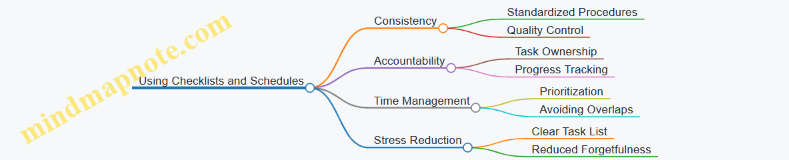
How to Create and Use Effective Checklists
- List All Tasks Clearly: Break down duties into simple, actionable steps.
- Prioritize Tasks: Mark urgent or high-impact tasks.
- Assign Responsibilities: Specify who is responsible for each item.
- Include Time Frames: Indicate when tasks should be completed.
- Use Visual Cues: Checkboxes, color codes, or symbols for quick scanning.
- Review and Update Regularly: Adapt checklists based on feedback and changing needs.
Example: Front Desk Opening Checklist
- Turn on computer and phone systems
- Check reservation system for arrivals
- Prepare registration forms and key cards
- Review special guest requests
- Ensure lobby area is clean and welcoming
Example: Kitchen Closing Checklist
- Clean and sanitize all work surfaces
- Store leftover food properly
- Turn off ovens, stoves, and equipment
- Take out trash and recycling
- Restock ingredients for next day
Mind Map: Creating a Daily Schedule

Tips for Using Schedules Effectively
- Use Digital Tools: Apps like Google Calendar or hospitality-specific software help set reminders and share schedules.
- Communicate Clearly: Share schedules with all team members to avoid confusion.
- Allow Flexibility: Build buffer times for unexpected tasks or delays.
- Track Breaks: Ensure staff take scheduled breaks to maintain energy and focus.
Example: Sample Shift Schedule for Front Desk Staff
| Time | Task | Assigned To |
|---|---|---|
| 7:00 - 7:15 | Opening checklist review | Sarah |
| 7:15 - 9:00 | Guest check-ins | Sarah |
| 9:00 - 9:15 | Break | Sarah |
| 9:15 - 12:00 | Reservation management | John |
| 12:00 - 12:30 | Lunch Break | Sarah |
Example Scenario: How Checklists Prevent Errors
Situation: A new front desk employee forgets to verify a guest’s special dietary request with the kitchen.
Without Checklist: The kitchen is unaware, and the guest receives the wrong meal, leading to dissatisfaction.
With Checklist: The front desk checklist includes “Confirm special dietary requests with kitchen” as a mandatory step, preventing the mistake and ensuring guest satisfaction.
Summary
Using checklists and schedules effectively empowers hospitality staff to manage their workload confidently and deliver consistent, high-quality service. By incorporating clear, prioritized tasks and maintaining open communication, service staff can reduce errors, improve teamwork, and create a more pleasant experience for guests and colleagues alike.
6.4 Avoiding Burnout: Self-Care Tips for Service Staff
Burnout is a common challenge faced by service staff in hospitality operations due to the fast-paced, high-pressure environment. Recognizing the signs early and practicing effective self-care can help maintain your well-being and job performance.
What is Burnout?
Burnout is a state of physical, emotional, and mental exhaustion caused by prolonged stress and overwork. It can lead to decreased motivation, irritability, and reduced quality of service.
Signs of Burnout
- Chronic fatigue
- Lack of enthusiasm for work
- Increased mistakes or forgetfulness
- Feeling overwhelmed or anxious
- Physical symptoms like headaches or stomach issues
Mind Map: Causes of Burnout
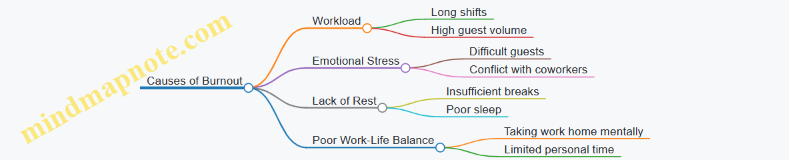
Mind Map: Self-Care Strategies
Practical Self-Care Tips with Examples
-
Take Regular Breaks
- Example: During a busy shift at the front desk, set a timer to remind yourself to take a 5-minute break every 2 hours to stretch and breathe deeply.
-
Stay Hydrated and Eat Nutritious Meals
- Example: Keep a water bottle at your station and pack balanced meals with fruits and proteins to maintain energy.
-
Practice Mindfulness
- Example: Before starting your shift, spend 3 minutes focusing on your breath to center yourself and reduce anxiety.
-
Set Boundaries
- Example: If you feel overwhelmed by extra tasks, politely communicate with your supervisor about your current workload.
-
Get Adequate Sleep
- Example: Establish a bedtime routine that limits screen time and creates a calm environment for restful sleep.
-
Connect with Colleagues
- Example: Share a quick chat or laugh during downtime to build camaraderie and emotional support.
-
Engage in Physical Activity
- Example: After work, take a 20-minute walk or do light stretching to relieve muscle tension.
-
Use Positive Affirmations
- Example: Repeat to yourself, “I am capable and valued,” especially after a challenging interaction.
Example Scenario: Managing Burnout During a Busy Weekend
Maria works the front desk and has been feeling exhausted after several back-to-back busy weekends. She notices she’s making small mistakes and feels irritable.
- Maria decides to talk to her supervisor about adjusting her schedule to include more rest days.
- She starts bringing healthy snacks and a water bottle to work.
- During breaks, she practices deep breathing and briefly steps outside for fresh air.
- After work, she commits to 30 minutes of light yoga to help relax.
As a result, Maria feels more energized and better equipped to handle her duties.
Summary
Avoiding burnout is essential for sustaining a long and fulfilling career in hospitality. By recognizing the signs early and integrating self-care habits into your daily routine, you can maintain your physical health, mental clarity, and emotional balance.
Remember: Taking care of yourself is not a luxury—it’s a necessity for providing excellent service to your guests and supporting your team.
7. Professionalism and Workplace Etiquette
7.1 Dress Code and Personal Grooming Standards
Maintaining a professional appearance is one of the first impressions guests have of your establishment. In hospitality, your dress code and grooming reflect not only your personal professionalism but also the brand and reputation of the business. This section will guide you through essential dress code guidelines and personal grooming standards, supported by practical examples and mind maps to help you visualize these concepts.
Why Dress Code and Grooming Matter
- Builds Trust: Guests feel more confident when staff look neat and professional.
- Promotes Safety: Proper attire can prevent accidents (e.g., closed-toe shoes in kitchen).
- Enhances Team Unity: Uniforms or dress standards create a cohesive team image.
Key Components of Dress Code
Example:
- Wearing a clean, wrinkle-free uniform shirt with the company logo clearly visible.
- Closed-toe, non-slip black shoes that are polished and comfortable for long shifts.
- Minimal jewelry such as a simple wedding band and a watch; no dangling earrings or bracelets that could interfere with work.
Personal Grooming Standards
Good grooming complements your dress code and ensures you present yourself professionally.
Example:
- Hair neatly tied back or styled to avoid falling into the face, especially important in kitchen and front desk roles.
- Nails trimmed short and clean; avoid bright or chipped nail polish to maintain a neat appearance.
- Wearing light makeup that looks natural and professional.
- Using minimal or no fragrance to accommodate guests and colleagues with sensitivities.
Common Mistakes to Avoid
- Wearing wrinkled or stained uniforms.
- Open-toe shoes or high heels that are unsafe in kitchen or service areas.
- Excessive or noisy jewelry that distracts or poses safety risks.
- Unkempt hair or facial hair that looks unprofessional.
- Strong perfumes or colognes that may bother guests.
Example Scenario: A front desk employee arrives with a stained shirt and strong perfume. A guest with allergies reacts negatively, and the employee is asked to change and reduce fragrance use. This situation could have been avoided by following grooming standards.
Tips for Maintaining Dress Code and Grooming
- Prepare your uniform the night before to avoid rushing.
- Keep a small grooming kit at work (comb, deodorant, lint roller).
- Regularly inspect your shoes and replace worn-out pairs.
- Follow company policies strictly and ask supervisors if unsure.
Summary Mind Map
By adhering to these dress code and grooming standards, you contribute to a positive guest experience and a professional workplace atmosphere. Remember, your appearance is a reflection of your dedication and respect for your role and guests.
7.2 Maintaining a Positive Attitude Under Pressure
In the fast-paced environment of hospitality operations, maintaining a positive attitude under pressure is essential. It not only helps you manage stress but also creates a welcoming atmosphere for guests and fosters teamwork among colleagues.
Why Maintaining a Positive Attitude Matters
- Improves guest experience: Guests notice your demeanor and are more likely to feel comfortable and valued.
- Enhances teamwork: Positivity encourages collaboration and support among staff.
- Boosts personal resilience: Helps you cope with challenges without burnout.
Common Pressure Situations at Work
- Handling multiple guest requests simultaneously
- Managing unexpected complaints
- Dealing with equipment or system failures
- Working during peak hours with limited staff
Mind Map: Maintaining a Positive Attitude Under Pressure
Practical Tips with Examples
-
Stay Calm and Breathe
- Example: When a guest approaches the front desk upset about a delayed order, take a deep breath before responding. This helps you stay composed and respond thoughtfully.
-
Use Positive Language
- Example: Instead of saying “I don’t know when your food will be ready,” say “Let me check with the kitchen and get back to you shortly.”
-
Focus on What You Can Control
- Example: If the kitchen is running behind, communicate proactively with guests and offer alternatives rather than dwelling on the delay.
-
Practice Empathy
- Example: When a guest complains about noise, acknowledge their discomfort: “I understand how that can be frustrating. Let me see how I can assist you.”
-
Take Mini Breaks When Possible
- Example: During a quiet moment, step into the staff room for a brief stretch or a few deep breaths to recharge.
-
Use Humor Appropriately
- Example: Light-heartedly say to a colleague during a busy shift, “Looks like we’re running a marathon today! Let’s pace ourselves.”
-
Seek Support and Delegate
- Example: If overwhelmed, ask a teammate to assist with check-ins while you handle a guest complaint.
Mind Map: Positive Communication Under Pressure
Role-Playing Example
Scenario: A guest arrives frustrated because their reservation was not found.
-
Negative Reaction: “I don’t know what to tell you. Maybe you made a mistake.”
-
Positive Attitude Approach: “I’m sorry for the inconvenience. Let me quickly check our system again and see how we can best accommodate you.”
This approach reassures the guest and helps de-escalate the situation.
Summary
Maintaining a positive attitude under pressure is a skill that can be developed through awareness, practice, and support. By focusing on calm communication, empathy, and self-care, you can create a better work environment for yourself, your colleagues, and your guests.
7.3 Respecting Cultural Differences Among Guests and Staff
In the hospitality industry, respecting cultural differences is essential to creating a welcoming and inclusive environment for both guests and colleagues. Understanding and appreciating diverse cultural backgrounds helps prevent misunderstandings, fosters positive interactions, and enhances overall guest satisfaction.
Why Respecting Cultural Differences Matters
- Builds trust and rapport with guests and coworkers.
- Avoids unintentional offense or misunderstandings.
- Promotes teamwork and a positive workplace culture.
- Enhances the reputation of the establishment.
Key Areas to Consider
Mind Map: Respecting Cultural Differences
Examples and Best Practices
-
Communication Styles:
- Example: A guest from Japan may prefer indirect communication and avoid saying “no” directly. Instead of insisting, try to read between the lines and offer options.
- Best Practice: Use clear, simple language and confirm understanding by paraphrasing.
-
Personal Space & Physical Contact:
- Example: Some Middle Eastern guests may prefer no physical contact with the opposite gender. Avoid initiating handshakes unless the guest offers first.
- Best Practice: Observe guest cues and ask politely if unsure.
-
Religious Beliefs & Practices:
- Example: Muslim guests may require halal food options and prayer space.
- Best Practice: Train kitchen staff on dietary restrictions and provide quiet areas for prayer if possible.
-
Time Perceptions:
- Example: Latin American cultures may have a more relaxed view on punctuality.
- Best Practice: Be patient and flexible but communicate clearly about schedules.
-
Social Etiquette:
- Example: In some Asian cultures, tipping is not customary and may even be considered rude.
- Best Practice: Inform guests about tipping policies politely and respect their customs.
Mind Map: Handling Cultural Differences in Guest Service
Practical Scenario
Scenario: A guest from India requests vegetarian meal options but is unsure about the ingredients.
Response: The front desk staff politely asks the kitchen to prepare a vegetarian meal avoiding common non-vegetarian ingredients like gelatin or animal-based broths. They also provide the guest with a menu highlighting vegetarian dishes and ask if there are any other preferences.
Outcome: The guest feels respected and cared for, leading to a positive dining experience.
Tips for Staff
- Always greet guests with a smile and culturally appropriate gestures.
- Avoid jokes or comments about cultural stereotypes.
- When in doubt, ask respectfully rather than assume.
- Recognize and celebrate cultural diversity among staff to build empathy.
Respecting cultural differences is not just about avoiding mistakes but actively embracing diversity to enrich the hospitality experience for everyone involved.
7.4 Handling Confidential Information with Integrity
Handling confidential information is a critical responsibility for all hospitality service staff, especially those working at the front desk or in guest services. Protecting guest privacy and sensitive business data builds trust, ensures compliance with legal standards, and upholds the reputation of your establishment.
Why is Confidentiality Important?
- Protects guests’ personal and payment information
- Prevents identity theft and fraud
- Maintains trust between guests and staff
- Complies with laws such as GDPR or HIPAA (where applicable)
- Safeguards business secrets and operational data
Types of Confidential Information in Hospitality
Best Practices for Handling Confidential Information
-
Limit Access
- Only authorized personnel should access sensitive data.
- Example: Front desk staff should not share guest credit card details with kitchen employees.
-
Secure Physical Documents
- Store paper records in locked cabinets.
- Example: Reservation logs containing guest info must be locked away after shifts.
-
Use Strong Passwords and Secure Systems
- Change passwords regularly and avoid sharing them.
- Example: Use unique login credentials for the property management system (PMS).
-
Avoid Discussing Sensitive Information Publicly
- Never talk about guest details in public areas.
- Example: Do not discuss a VIP guest’s special requests in the lobby.
-
Properly Dispose of Confidential Information
- Shred documents or securely delete digital files.
- Example: After a guest checks out, shred their credit card authorization forms.
-
Report Breaches Immediately
- Notify supervisors if confidential information is compromised.
- Example: If a guest’s data is accidentally emailed to the wrong person, alert management at once.
Example Scenarios
Scenario 1: Handling a Guest’s Payment Information
- Situation: A guest asks if you can email their receipt including their credit card details.
- Best Practice: Politely explain that for security reasons, credit card details are never emailed. Offer to print a receipt without sensitive info or provide a secure portal link.
Scenario 2: Accidentally Overhearing a Guest’s Personal Conversation
- Situation: While checking in, you overhear a guest discussing medical information.
- Best Practice: Respect their privacy by not repeating or sharing this information with colleagues. Maintain confidentiality at all times.
Scenario 3: Lost Paperwork Containing Guest Data
- Situation: You find a lost registration form with guest details in a public area.
- Best Practice: Immediately secure the document and inform your supervisor. Review procedures to prevent future incidents.
Mind Map: Steps to Protect Confidential Information
Tips for Front Desk and Guest Service Staff
- Always log out of computer systems when leaving your workstation.
- Use privacy screens on monitors to prevent shoulder surfing.
- When taking notes, avoid writing sensitive information unless necessary.
- Attend regular training on data protection and confidentiality policies.
- When in doubt about sharing information, ask a supervisor.
By consistently applying these principles and practices, you help create a safe and trustworthy environment for guests and colleagues alike. Handling confidential information with integrity is not just a policy—it’s a commitment to professionalism and respect.
7.5 Team Etiquette: Supporting Colleagues and Fostering Respect
In the hospitality industry, teamwork is the backbone of smooth operations and exceptional guest experiences. Supporting your colleagues and fostering a respectful environment not only improves morale but also enhances productivity and service quality. This section explores practical ways to practice team etiquette with clear examples and mind maps to help you visualize key concepts.
Why Team Etiquette Matters
- Builds trust and cooperation among staff
- Creates a positive work atmosphere
- Reduces conflicts and misunderstandings
- Enhances guest satisfaction through seamless teamwork
Key Principles of Team Etiquette
Communicate Clearly and Respectfully
-
Example: When a kitchen staff member is running behind on an order, the front desk can politely ask for an updated time instead of expressing frustration. “Hi, could you please let me know how much longer the order will take? We have a guest waiting. Thank you!”
-
Avoid interrupting colleagues during busy moments; instead, wait for an appropriate time or use non-verbal cues.
-
Use positive language and tone, even when delivering constructive feedback.
Offer Support and Assistance
-
Example: If a colleague at the front desk is overwhelmed with check-ins, offer to help by answering phone calls or preparing registration materials.
-
Share tips and shortcuts you’ve learned to help others improve their efficiency.
-
Celebrate team successes together, such as completing a busy shift smoothly.
Show Respect for Diverse Perspectives and Cultures
-
Example: If a colleague has a different cultural background, take time to learn about their customs and avoid assumptions.
-
Respect personal boundaries and avoid gossip or negative talk about others.
-
Use inclusive language that makes everyone feel valued.
Be Accountable and Reliable
-
Example: If you commit to covering a shift or completing a task, follow through promptly.
-
If a mistake occurs, admit it honestly and work with the team to find a solution.
-
Keep your workspace organized to avoid causing delays or confusion for others.
Scenario-Based Examples
Scenario 1: Handling a Busy Shift Together
- Front desk is swamped with guests checking in.
- Kitchen is preparing multiple orders.
- Team members communicate updates clearly and offer help where needed.
- Result: Guests experience smooth service, and staff feel supported.
Scenario 2: Resolving a Misunderstanding
- A kitchen staff member feels disrespected by a front desk comment.
- The team leader facilitates a calm discussion where both parties express their views.
- They agree on respectful communication moving forward.
Summary Mind Map
By practicing these team etiquette principles daily, you contribute to a harmonious workplace where everyone can perform their best and guests receive outstanding service.
8. Problem Solving and Conflict Resolution
8.1 Identifying Common Issues at Front Desk and Kitchen
In hospitality operations, recognizing common issues early at both the front desk and kitchen is essential to maintaining smooth service and guest satisfaction. This section will help you identify typical problems you might encounter, understand their causes, and prepare you to address them effectively.
Common Issues at the Front Desk
-
Reservation Conflicts
- Overbooking
- Double bookings
- Last-minute cancellations
-
Guest Check-In/Check-Out Delays
- System errors
- Missing documentation
- Payment processing issues
-
Communication Breakdowns
- Misunderstanding guest requests
- Incomplete information transfer between shifts
-
Handling Difficult Guests
- Complaints about room quality
- Billing disputes
- Noise or disturbance reports
-
Technology Failures
- POS system crashes
- Phone or internet outages
Common Issues in the Kitchen
-
Order Errors
- Incorrect dishes prepared
- Missing items
- Special dietary requests not followed
-
Food Safety and Hygiene Lapses
- Cross-contamination
- Improper food storage
- Poor personal hygiene
-
Equipment Malfunctions
- Oven or stove breakdown
- Refrigeration failure
- Utensil shortages
-
Inventory Shortages
- Running out of key ingredients
- Late deliveries
-
Communication Gaps
- Misheard orders from front desk
- Delays in order transmission
Mind Map: Common Front Desk Issues
Mind Map: Common Kitchen Issues
Examples of Common Issues and How to Identify Them
Example 1: Overbooking at Front Desk
- Situation: Two guests arrive with confirmed reservations for the same room.
- Identification: Reservation system shows double booking; guest frustration is evident.
- Best Practice: Verify reservation details promptly, offer alternative rooms or upgrades, and apologize sincerely.
Example 2: Missing Item in Kitchen Order
- Situation: Guest complains that their salad was missing from the meal.
- Identification: Check order slip and kitchen prep area; note if salad was omitted.
- Best Practice: Apologize, prepare the missing item immediately, and communicate with front desk to update the guest.
Example 3: Payment Processing Issue at Front Desk
- Situation: Guest’s credit card is declined during check-out.
- Identification: POS system alerts staff; guest appears confused or upset.
- Best Practice: Politely verify card details, offer alternative payment methods, and escalate if needed.
Example 4: Equipment Failure in Kitchen
- Situation: Oven stops working during peak meal prep time.
- Identification: Kitchen staff notice temperature drop; orders are delayed.
- Best Practice: Notify maintenance immediately, prioritize orders that can be prepared without the oven, and inform front desk of potential delays.
Example 5: Communication Breakdown Between Front Desk and Kitchen
- Situation: Special dietary request is not fulfilled.
- Identification: Guest reports allergy concern; kitchen did not receive the request.
- Best Practice: Implement clear communication protocols, double-check special requests, and train staff on importance of accuracy.
Summary
Identifying common issues at the front desk and kitchen requires attentiveness, clear communication, and proactive problem-solving. By familiarizing yourself with these typical challenges and using the examples and mind maps provided, you can quickly recognize problems and take appropriate action to maintain excellent guest service and operational efficiency.
8.2 Step-by-Step Conflict Resolution Techniques with Role Plays
Conflict is inevitable in any hospitality environment, especially at the front desk and in the kitchen where fast-paced interactions occur. Learning how to resolve conflicts effectively ensures a positive experience for guests and maintains a harmonious workplace.
Step-by-Step Conflict Resolution Techniques
Step 1: Stay Calm and Listen Actively
- Mindset: Keep your emotions in check.
- Action: Listen carefully to the guest or coworker without interrupting.
- Example: A guest complains loudly about a delayed meal. Instead of reacting defensively, take a deep breath and listen fully.
Step 2: Acknowledge the Issue
- Mindset: Show empathy and understanding.
- Action: Repeat or paraphrase the concern to confirm understanding.
- Example: “I understand that your meal took longer than expected, and I apologize for the inconvenience.”
Step 3: Ask Clarifying Questions
- Mindset: Gather all relevant information.
- Action: Politely ask questions to understand the root cause.
- Example: “Can you tell me exactly when you placed your order?”
Step 4: Offer Solutions or Alternatives
- Mindset: Be proactive and solution-focused.
- Action: Suggest ways to resolve or mitigate the issue.
- Example: “I can check with the kitchen to prioritize your order or offer you a complimentary appetizer while you wait.”
Step 5: Take Action and Follow Up
- Mindset: Ensure the solution is implemented.
- Action: Act promptly and check back with the guest or coworker.
- Example: After expediting the order, return to the guest: “Your meal is on its way now. Thank you for your patience.”
Step 6: Reflect and Learn
- Mindset: Use the experience to improve.
- Action: Discuss with your team or supervisor how to prevent similar conflicts.
- Example: After the shift, review the delay cause with kitchen staff and adjust processes.
Role Play Examples
Role Play 1: Guest Complaint About Room Cleanliness
Scenario: A guest approaches the front desk upset that their room was not cleaned properly.
- Staff: “I’m sorry to hear that your room wasn’t up to standard. Can you please tell me which issues you noticed?”
- Guest: “There was dust on the table and the bathroom wasn’t cleaned well.”
- Staff: “Thank you for letting me know. I will arrange for housekeeping to address this immediately or offer you a room change if you prefer.”
Outcome: Guest feels heard and solution is offered promptly.
Role Play 2: Kitchen Staff Conflict Over Order Prioritization
Scenario: Two kitchen staff members argue about which order to prepare first during a busy period.
- Staff A: “I think we should finish the large banquet order first.”
- Staff B: “But the front desk just informed us there’s a VIP guest waiting for a quick meal.”
- Mediator (Supervisor): “Let’s prioritize the VIP guest’s order first to maintain guest satisfaction, then focus on the banquet. Can we agree on this?”
Outcome: Conflict is resolved by clear prioritization and communication.
Role Play 3: Front Desk and Kitchen Miscommunication
Scenario: The front desk receives a guest complaint that their special dietary request was not honored.
- Front Desk: “I apologize for the mistake. Can you tell me exactly what your request was?”
- Guest: “I asked for gluten-free but received a regular meal.”
- Front Desk: “I will speak with the kitchen immediately and ensure the correct meal is prepared right away. Meanwhile, may I offer you a complimentary drink?”
Outcome: Guest complaint is acknowledged, and corrective action is taken.
Summary Mindmap
By practicing these steps and role plays regularly, service staff can confidently handle conflicts, turning challenging situations into opportunities for excellent guest service and stronger teamwork.
8.3 When and How to Escalate Problems to Supervisors
In any hospitality environment, knowing when and how to escalate problems to supervisors is crucial for maintaining smooth operations and ensuring guest satisfaction. Escalation is not about avoiding responsibility but about recognizing situations that require higher authority or expertise to resolve effectively.
When to Escalate Problems to Supervisors
Use the following mind map to understand key triggers for escalation:
Example 1:
A guest approaches the front desk angrily demanding a refund for a meal they claim made them sick. As an entry-level staff member, you can listen empathetically but should escalate this to your supervisor who can handle compensation decisions and initiate any necessary investigations.
Example 2:
During a busy dinner service, the kitchen stove malfunctions causing delays. You should immediately inform your supervisor so they can coordinate repairs and communicate with guests about delays.
How to Escalate Problems to Supervisors
Effective escalation involves clear, concise communication and timely action. Follow this mind map for best practices:
Example 3:
A guest reports a severe allergy reaction after eating. You immediately call your supervisor in person, provide the guest’s details, what was eaten, and any first aid administered. You then assist in following the supervisor’s instructions and document the incident afterward.
Example 4:
You notice a conflict brewing between two kitchen staff members that is disrupting workflow. You calmly approach your supervisor, explain the situation factually, and ask for guidance on mediation.
Additional Tips
- Never hesitate to escalate if you feel unsafe or unsure.
- Maintain professionalism and confidentiality during escalation.
- Use escalation as a learning opportunity to improve your problem-solving skills.
By mastering when and how to escalate problems appropriately, you help protect the guest experience, support your team, and contribute to a positive workplace environment.
8.4 Learning from Mistakes: Real Examples and Lessons
Mistakes are inevitable in any hospitality environment, especially for entry-level employees learning the ropes. The key to professional growth is recognizing these mistakes, understanding their impact, and applying lessons learned to prevent recurrence. This section explores common mistakes, real-life examples, and practical lessons to help you improve continuously.
Why Learning from Mistakes Matters
- Builds resilience and confidence
- Improves guest satisfaction
- Enhances teamwork and communication
- Promotes a culture of continuous improvement
Common Mistakes in Front Desk, Kitchen, and Guest Service
Real Example 1: Reservation Mix-Up at Front Desk
Situation: A guest arrived for a weekend stay, but the front desk staff mistakenly booked them for the following week.
Impact: Guest frustration, negative review, and lost trust.
Lesson Learned: Always double-check reservation dates and confirm details verbally with guests during check-in.
Best Practice: Use a checklist for reservation confirmation.
Real Example 2: Food Safety Oversight in Kitchen
Situation: A kitchen staff member forgot to store raw meat separately, causing cross-contamination.
Impact: Risk of foodborne illness, potential health code violation.
Lesson Learned: Always follow strict food safety protocols and labeling.
Best Practice: Regular training refreshers and visible signage in the kitchen.
Real Example 3: Ignoring Guest Complaints
Situation: A guest complained about slow service, but the staff member dismissed it.
Impact: Guest felt undervalued and left without tipping.
Lesson Learned: Always listen actively and empathize with guests.
Best Practice: Use phrases like “I understand your concern” and offer immediate solutions.
Steps to Learn Effectively from Mistakes
- Acknowledge the mistake openly. Avoid blame-shifting.
- Analyze what went wrong. Identify root causes.
- Seek feedback from supervisors or peers. Gain different perspectives.
- Develop an action plan. Define clear steps to avoid repetition.
- Implement changes and monitor progress. Adjust as needed.
- Share lessons learned with the team. Foster a learning culture.
Example: Applying the Learning Cycle
Practical Exercise
- Reflect on a recent mistake you made at work.
- Write down what happened, why it happened, and how you felt.
- Identify at least two lessons learned.
- Share your reflections with a colleague or supervisor.
- Develop a plan to improve.
Final Thought
Mistakes are not failures—they are opportunities to grow. Embrace them with a positive mindset, and you will become a more skilled, confident, and valued member of your hospitality team.
9. Health, Safety, and Emergency Procedures
9.1 Basic First Aid Knowledge for Service Staff
Providing first aid promptly and correctly can save lives and reduce the severity of injuries. As service staff in hospitality, you are often the first point of contact when an emergency occurs. This section covers essential first aid knowledge tailored for front desk, kitchen, and guest service employees.
What is First Aid?
First aid is the immediate care given to a person suffering from injury or illness until professional medical help arrives.
Why is First Aid Important for Service Staff?
- Guests and colleagues may experience accidents or sudden illness.
- Quick response can prevent worsening of conditions.
- Demonstrates professionalism and care.
Mind Map: Key Areas of Basic First Aid
Step 1: Assess the Situation
- Ensure your own safety first. For example, if there is a fire or electrical hazard, do not approach until it is safe.
- Quickly identify what happened and how many people are involved.
Example: A guest slips in the lobby. Before rushing to help, check if the floor is wet or if there is broken glass nearby.
Step 2: Call for Help
- Dial emergency services (e.g., 911 or local emergency number).
- Alert your supervisor or manager immediately.
Example: If a kitchen staff member collapses, call emergency services and inform the manager while staying with the person.
Step 3: Primary Assessment (ABC)
- A - Airway: Ensure the airway is clear.
- B - Breathing: Check if the person is breathing normally.
- C - Circulation: Look for signs of severe bleeding or pulse.
Example: If a guest is unconscious but breathing, place them in the recovery position.
Common First Aid Procedures with Examples
Bleeding Control
- Apply direct pressure with a clean cloth.
- Elevate the injured area if possible.
Example: A kitchen staff cuts their finger while chopping vegetables. Use gloves, apply pressure, and bandage the wound.
Burns Treatment
- Cool the burn under running water for at least 10 minutes.
- Do not apply ice or creams.
- Cover with a sterile, non-stick dressing.
Example: A guest accidentally touches a hot pan. Quickly run cool water over the burn and cover it.
Choking Relief
- Encourage the person to cough if able.
- Perform the Heimlich maneuver if they cannot breathe.
Example: A guest starts choking on food in the dining area. Ask if they can speak; if not, perform abdominal thrusts carefully.
Fracture Stabilization
- Immobilize the injured limb.
- Avoid moving the person unnecessarily.
Example: A staff member falls and suspects a broken arm. Use a makeshift splint and wait for medical help.
CPR Basics
- If the person is unresponsive and not breathing, start chest compressions.
- Push hard and fast in the center of the chest.
Example: A guest collapses in the lobby. Call emergency services and begin CPR until help arrives.
Mind Map: Using the First Aid Kit
Documentation and Reporting
- Always document the incident accurately.
- Include what happened, first aid given, and who was involved.
- Reporting helps improve safety and provides records for management.
Example: After assisting a guest with a burn, fill out the incident report form and notify your supervisor.
Summary Checklist for Basic First Aid
- Ensure personal and scene safety
- Call emergency services promptly
- Perform primary assessment (ABC)
- Provide appropriate first aid treatment
- Use first aid kit supplies correctly
- Document and report the incident
Final Tips
- Stay calm and confident.
- Never perform procedures you are not trained for.
- Attend regular first aid training sessions.
- Encourage your team to be prepared.
By mastering these basic first aid skills, you contribute to a safer and more responsive hospitality environment, ensuring guests and colleagues feel cared for and protected.
9.2 Fire Safety and Evacuation Drills: Practical Guidelines
Fire safety is a critical aspect of hospitality operations to ensure the safety of guests, staff, and property. Understanding fire prevention, recognizing fire hazards, and knowing how to respond during an emergency can save lives and minimize damage.
Key Components of Fire Safety
Fire Prevention Best Practices
- Keep exits clear: Ensure all emergency exits and pathways are free from obstruction.
- Proper storage: Store flammable liquids and materials in designated, safe areas away from heat sources.
- Electrical safety: Regularly inspect wiring, appliances, and kitchen equipment for faults.
- No smoking zones: Enforce strict no smoking policies inside the premises.
Example:
In a hotel kitchen, a staff member notices a frayed electrical cord on a deep fryer. They immediately report it to maintenance, preventing a potential fire hazard.
Recognizing Fire Hazards
- Overloaded electrical outlets
- Accumulated grease in kitchen hoods
- Blocked fire exits
- Improper disposal of cigarette butts
Example:
During a routine check, front desk staff spot a fire exit door propped open with a chair. They promptly remove the obstruction and remind colleagues about keeping exits clear.
Fire Detection and Alarm Systems
- Know the locations of smoke detectors and fire alarms.
- Understand the sound of alarms and the immediate actions required.
Example:
When the fire alarm sounds, staff immediately stop their current tasks and prepare to assist guests with evacuation.
Using Fire Extinguishers
- Familiarize yourself with different types of extinguishers (e.g., water, foam, CO2, dry powder).
- Remember the PASS technique:
- Pull the pin
- Aim at the base of the fire
- Squeeze the handle
- Sweep side to side
Example:
A kitchen staff member spots a small grease fire on the stove. Using a Class K fire extinguisher, they quickly and safely put out the fire following the PASS steps.
Evacuation Procedures
Step-by-step Evacuation Example:
- Fire alarm sounds.
- Front desk staff calmly inform guests of the situation and instruct them to proceed to the nearest exit.
- Kitchen staff stop cooking activities and assist in guiding guests.
- Staff ensure all guests, including those with mobility challenges, are safely evacuated.
- Everyone gathers at the pre-designated assembly point outside the building.
- A headcount is conducted to confirm all are accounted for.
- Management and emergency responders are informed.
Conducting Fire Drills
- Schedule regular fire drills (at least twice a year).
- Simulate realistic scenarios including blocked exits or guests needing assistance.
- Review performance and identify improvement areas.
Example:
During a fire drill, the front desk team practices using the public address system to calmly instruct guests, while kitchen staff practice shutting down equipment safely before evacuation.
Communication During Fire Emergencies
- Use clear, calm, and concise language.
- Assign staff roles: who calls emergency services, who assists guests, who manages evacuation routes.
Example:
The designated staff member calls the fire department immediately upon alarm activation while others focus on guest safety.
Summary Checklist for Fire Safety and Evacuation
- Know all fire exits and routes.
- Keep exits and pathways clear.
- Understand fire extinguisher types and usage.
- Participate in regular fire drills.
- Communicate calmly and clearly during emergencies.
- Assist guests with special needs.
- Report hazards immediately.
By mastering these fire safety and evacuation guidelines, service staff can confidently protect themselves, guests, and the establishment in emergency situations.
9.3 Handling Food Allergies and Medical Emergencies
Understanding Food Allergies
Food allergies occur when the immune system reacts to certain proteins in food as harmful. Common allergens include peanuts, tree nuts, shellfish, milk, eggs, wheat, soy, and fish. For hospitality staff, recognizing and properly handling food allergies is critical to guest safety.
Mind Map: Food Allergy Awareness
Best Practices for Handling Food Allergies
-
Ask Guests About Allergies Proactively
- Example: “Do you have any food allergies or dietary restrictions we should be aware of?”
-
Communicate Clearly with Kitchen Staff
- Use allergy tickets or notes in the order system.
- Example: “Table 5 has a severe peanut allergy; please ensure no cross-contact.”
-
Prevent Cross-Contamination
- Use separate utensils, cutting boards, and cooking surfaces.
- Wash hands thoroughly before handling allergen-free food.
-
Double-Check Ingredients
- Verify with suppliers and kitchen staff about hidden allergens.
-
Provide Accurate Information
- If unsure, inform the guest honestly rather than guessing.
Example Scenario: Handling a Peanut Allergy
Guest: “I have a severe peanut allergy. Can you tell me if this dish contains any peanuts or is prepared near peanuts?”
Front Desk/Kitchen Staff: “Thank you for letting us know. I will inform the kitchen to prepare your meal in a peanut-free environment using separate utensils. We take allergies very seriously to ensure your safety.”
Recognizing Medical Emergencies Related to Allergies
- Mild Symptoms: Itching, mild hives, slight swelling.
- Severe Symptoms (Anaphylaxis): Difficulty breathing, throat tightness, swelling of tongue or lips, dizziness, loss of consciousness.
Mind Map: Medical Emergency Response
Steps to Take During a Medical Emergency
- Stay Calm and Assess the Situation.
- Call for Emergency Medical Help Immediately.
- If Trained, Administer an Epinephrine Auto-Injector (EpiPen).
- Help the Guest Sit or Lie Down Comfortably.
- Loosen Tight Clothing and Keep Airway Open.
- Monitor the Guest Until Help Arrives.
Example Role-Play: Responding to Anaphylaxis
- Guest: Suddenly starts wheezing and clutching their throat.
- Staff: “I’m calling emergency services right now. Can you tell me if you have an EpiPen? I’m trained to help you use it if needed.”
- Guest: Nods and hands over the EpiPen.
- Staff: Administers EpiPen following training steps, keeps guest calm, and waits for paramedics.
Additional Tips
- Always know the location of first aid kits and emergency equipment.
- Regularly participate in first aid and allergy awareness training.
- Encourage a culture of safety and open communication among staff.
By following these guidelines and examples, service staff can confidently and effectively manage food allergies and medical emergencies, ensuring guest safety and trust.
9.4 Reporting Accidents and Unsafe Conditions
Importance of Reporting
Reporting accidents and unsafe conditions promptly is crucial to maintaining a safe workplace for both staff and guests. It helps prevent further incidents, ensures timely medical attention if needed, and allows management to address hazards effectively.
What to Report
- Accidents: Any injury or incident causing harm, no matter how minor.
- Unsafe Conditions: Situations or equipment that could potentially cause harm, such as wet floors, faulty appliances, or blocked emergency exits.
Step-by-Step Reporting Process
-
Ensure Immediate Safety:
- Attend to injured persons if safe to do so.
- Remove or isolate hazards if possible.
-
Notify Supervisor or Manager:
- Report the incident verbally as soon as possible.
-
Complete an Incident Report Form:
- Include details such as date, time, location, people involved, description of the accident or unsafe condition, and any actions taken.
-
Follow Up:
- Check if corrective actions have been implemented.
Mind Map: Reporting Accidents and Unsafe Conditions
Examples
Example 1: Slip and Fall Accident
- Scenario: A guest slips on a wet floor near the entrance.
- Action: Staff immediately helps the guest, places a wet floor sign, and informs the supervisor.
- Report: Staff fills out an incident report detailing the time, location, and guest condition.
- Outcome: Management reviews cleaning procedures and schedules more frequent floor checks.
Example 2: Faulty Kitchen Equipment
- Scenario: A stove burner is sparking intermittently.
- Action: Kitchen staff turns off the burner and reports the issue to the supervisor.
- Report: Incident report includes description of the fault and any immediate actions taken.
- Outcome: Maintenance repairs the burner promptly to prevent fire risk.
Example 3: Blocked Emergency Exit
- Scenario: A storage box is accidentally placed in front of an emergency exit.
- Action: Staff notices the blockage during a routine check and reports it.
- Report: Unsafe condition report is submitted with location and corrective action taken.
- Outcome: Staff is reminded to keep exits clear; signage is added.
Tips for Effective Reporting
- Be clear and concise.
- Include factual details only.
- Report as soon as possible.
- Keep a copy of the report if possible.
Summary
Prompt and accurate reporting of accidents and unsafe conditions helps protect everyone in the hospitality environment. Following the proper steps ensures hazards are addressed quickly and reduces risks of future incidents.
9.5 Maintaining Cleanliness and Sanitation Standards
Maintaining cleanliness and sanitation standards is crucial in hospitality operations to ensure guest safety, satisfaction, and compliance with health regulations. Both front desk and kitchen staff play vital roles in upholding these standards.
Why Cleanliness and Sanitation Matter
- Prevents foodborne illnesses and contamination
- Creates a positive impression on guests
- Ensures compliance with health and safety laws
- Promotes a safe and comfortable working environment
Key Areas to Maintain Cleanliness
Best Practices for Front Desk Cleanliness
-
Daily Surface Cleaning: Wipe down counters, keyboards, phones, and door handles multiple times a day using disinfectant wipes.
- Example: After every guest interaction, quickly sanitize the check-in counter to reduce germ transfer.
-
Organized Workstation: Keep paperwork and supplies tidy to avoid clutter that can harbor dust and dirt.
-
Lobby Maintenance: Regularly vacuum carpets, mop floors, and clean seating areas.
- Example: Schedule a quick lobby sweep every hour during busy times.
-
Restroom Checks: Front desk staff should monitor restrooms for cleanliness and report any issues immediately.
Best Practices for Kitchen Sanitation
-
Hand Washing: Wash hands thoroughly with soap and warm water for at least 20 seconds before handling food, after breaks, or after touching waste.
- Example: Place handwashing reminder signs near sinks.
-
Surface Sanitizing: Clean and sanitize all food prep surfaces before and after use.
- Example: Use a food-safe sanitizer spray and disposable cloths to wipe down cutting boards after each use.
-
Proper Storage: Store raw and cooked foods separately to avoid cross-contamination.
- Example: Keep raw meat on the bottom shelves of the fridge.
-
Equipment Cleaning: Regularly clean kitchen tools, utensils, and machines according to manufacturer guidelines.
-
Waste Management: Empty trash bins frequently and use sealed containers to prevent odors and pests.
Personal Hygiene Guidelines
-
Uniform: Wear clean uniforms daily; change aprons or outerwear if soiled.
-
Hair Restraints: Use hairnets or caps in the kitchen to prevent hair contamination.
-
Gloves: Use disposable gloves when handling ready-to-eat food and change them between tasks.
-
No Jewelry: Avoid wearing jewelry that can harbor bacteria or fall into food.
Example Scenario: Handling a Spill at the Front Desk
- Immediately place a “Wet Floor” sign to alert guests.
- Use appropriate cleaning supplies to wipe the spill.
- Dispose of used cleaning materials properly.
- Sanitize the area once dry.
- Report the incident to the supervisor if necessary.
Example Scenario: Kitchen Cleaning Routine
- Before opening:
- Sanitize all prep surfaces.
- Check and clean equipment.
- During service:
- Clean spills immediately.
- Change gloves regularly.
- After closing:
- Deep clean floors and surfaces.
- Empty and sanitize trash bins.
- Store all food properly.
Quick Reference Checklist
Summary
Maintaining cleanliness and sanitation is a shared responsibility that requires vigilance, consistency, and teamwork. By following these best practices and examples, service staff can contribute to a safe, welcoming environment that delights guests and meets industry standards.
10. Continuous Learning and Career Development
10.1 Seeking Feedback and Using It Constructively
Receiving feedback is a vital part of growing as a service staff member in hospitality operations. Constructive feedback helps you identify your strengths and areas for improvement, enabling you to provide better service and advance your career.
Why Seek Feedback?
- Continuous Improvement: Feedback highlights what you are doing well and what needs adjustment.
- Builds Self-Awareness: Helps you understand how others perceive your work.
- Enhances Guest Experience: Applying feedback improves guest satisfaction.
- Strengthens Teamwork: Shows openness and willingness to collaborate.
How to Seek Feedback Effectively
-
Choose the Right Time and Place
- Ask for feedback during calm moments, not during rush hours.
- Prefer private settings to encourage honest and open communication.
-
Be Specific in Your Request
- Instead of “How am I doing?”, ask “How can I improve my check-in process?”
-
Listen Actively
- Pay full attention, avoid interrupting.
- Show appreciation for the feedback.
-
Clarify When Needed
- Ask questions to understand the feedback fully.
-
Reflect and Act
- Consider the feedback objectively.
- Create an action plan to improve.
Mind Map: Seeking Feedback Process
Examples of Seeking Feedback
Example 1: Asking a Supervisor
Scenario: After a busy morning shift at the front desk, you approach your supervisor.
“Hi Maria, I want to improve my guest check-in efficiency. Could you please share any suggestions on how I handled the morning rush today?”
Example 2: Asking a Peer
Scenario: You want to improve communication with kitchen staff.
“Hey John, I noticed some delays in order processing today. Could you tell me if there’s anything I can do differently to help?”
Example 3: Asking a Guest
Scenario: After a guest checks out, you politely ask:
“Thank you for staying with us! May I ask if there’s anything we could have done better during your visit?”
Using Feedback Constructively
- Avoid Taking Feedback Personally: Focus on the behavior or process, not yourself.
- Identify Actionable Points: Break down feedback into specific tasks.
- Set SMART Goals: Specific, Measurable, Achievable, Relevant, Time-bound.
- Monitor Progress: Keep track of improvements and setbacks.
- Seek Follow-Up Feedback: After making changes, ask for feedback again.
Mind Map: Using Feedback Constructively
Example: Constructive Use of Feedback
Feedback Received: “Your greetings at the front desk are polite but sometimes lack warmth, which can make guests feel less welcomed.”
Action Plan:
- Practice smiling genuinely when greeting guests.
- Use guests’ names when possible.
- Add a welcoming phrase like “We’re glad to have you with us today!”
Follow-Up: After a week, ask your supervisor or a trusted colleague:
“I’ve been working on making my greetings warmer. Have you noticed any difference?”
Summary
Seeking and using feedback is a continuous cycle that helps you grow professionally and deliver exceptional service. Approach feedback with an open mind, ask specific questions, listen carefully, and take deliberate actions to improve. Remember, every piece of feedback is an opportunity to enhance your skills and contribute positively to your team and guests.
Quick Tips
- Always thank the person giving feedback.
- Don’t rush to respond; take time to reflect.
- Keep a feedback journal to track comments and your responses.
- Practice humility and patience throughout the process.
10.2 Setting Personal Goals for Skill Improvement
Setting personal goals is a powerful way to grow professionally and enhance your skills in hospitality operations and guest service. Clear, actionable goals help you stay motivated, track progress, and achieve excellence in your role.
Why Set Personal Goals?
- Provides direction and focus
- Encourages continuous learning
- Builds confidence through measurable progress
- Helps identify strengths and areas for improvement
SMART Goals Framework
To make your goals effective, use the SMART criteria:
- Specific: Clearly define what you want to achieve.
- Measurable: Quantify your progress.
- Achievable: Set realistic goals.
- Relevant: Align goals with your job role.
- Time-bound: Set a deadline.
Mind Map: Setting SMART Personal Goals
Examples of Personal Goals for Service Staff
-
Improve Communication Skills
- Specific: Practice active listening during guest interactions.
- Measurable: Receive positive feedback from at least 5 guests weekly.
- Achievable: Use role-playing exercises during shifts.
- Relevant: Enhances guest satisfaction.
- Time-bound: Achieve within 2 months.
-
Enhance Time Management
- Specific: Reduce average check-in time by 2 minutes.
- Measurable: Track time per guest check-in daily.
- Achievable: Use checklist and prioritize tasks.
- Relevant: Improves front desk efficiency.
- Time-bound: Within 1 month.
-
Learn Basic Kitchen Safety Procedures
- Specific: Complete food safety training.
- Measurable: Pass certification test.
- Achievable: Attend scheduled training sessions.
- Relevant: Ensures safe kitchen operations.
- Time-bound: Within 6 weeks.
Mind Map: Examples of Personal Goals
Steps to Set and Achieve Your Personal Goals
- Self-Assessment: Reflect on your current skills and identify gaps.
- Write Down Goals: Use the SMART framework.
- Create an Action Plan: Break goals into smaller tasks.
- Seek Feedback: Ask supervisors or peers for input.
- Track Progress: Keep a journal or log.
- Adjust as Needed: Modify goals if circumstances change.
- Celebrate Achievements: Recognize milestones to stay motivated.
Example Action Plan for Improving Guest Service
| Step | Action | Timeline |
|---|---|---|
| Self-Assessment | Identify communication weaknesses | Day 1 |
| Goal Setting | Set SMART goal to improve greeting skills | Day 2 |
| Training | Attend customer service workshop | Week 1 |
| Practice | Role-play greetings with colleagues | Week 2-4 |
| Feedback | Request guest feedback and supervisor review | Weekly |
| Review & Adjust | Evaluate progress and refine approach | Month 2 |
Tips for Staying Motivated
- Visualize success and benefits.
- Share goals with a mentor or peer.
- Break large goals into manageable steps.
- Keep a progress journal.
- Reward yourself for milestones.
By setting clear, achievable personal goals, you empower yourself to improve your skills continuously, deliver exceptional guest service, and advance your career in hospitality.
10.3 Training Opportunities and Certifications in Hospitality
Continuous learning is essential for growth and success in the hospitality industry. Training programs and certifications not only improve your skills but also boost your confidence and career prospects. Below, we explore various training opportunities and certifications available for entry-level employees in hospitality, along with examples and mind maps to help you navigate your learning journey.
On-the-Job Training (OJT)
- Description: Practical training conducted at your workplace under the guidance of experienced staff.
- Example: Shadowing a senior front desk agent to learn reservation systems and guest interaction.
- Benefits: Real-world experience, immediate feedback, and learning company-specific procedures.
Online Courses and Webinars
- Description: Flexible learning options offered by platforms like Coursera, Udemy, and hospitality organizations.
- Example: Taking a course on “Customer Service Excellence” or “Food Safety Basics.”
- Benefits: Learn at your own pace, access to industry experts, and certificates upon completion.
Industry Certifications
Mind Map: Popular Hospitality Certifications
- Certified Guest Service Professional (CGSP): Focuses on delivering exceptional guest experiences.
- ServSafe Food Handler: Covers essential food safety and hygiene practices.
- Certified Hospitality Supervisor (CHS): For those looking to move into supervisory roles.
- CPR and First Aid: Critical for handling emergencies safely.
Example: An entry-level front desk employee earns the CGSP certification to improve guest interaction skills, leading to recognition and promotion.
Workshops and Seminars
- Description: Short-term, interactive sessions often hosted by hotels, hospitality schools, or industry associations.
- Example: A workshop on “Effective Communication in Hospitality” featuring role-playing exercises.
- Benefits: Networking opportunities, hands-on practice, and exposure to new trends.
Apprenticeships and Internships
- Description: Structured programs combining work experience with formal training.
- Example: A 6-month internship rotating through front desk, kitchen, and guest services departments.
- Benefits: Comprehensive understanding of operations and mentorship.
Language and Soft Skills Training
- Description: Courses aimed at improving communication, cultural sensitivity, and problem-solving.
- Example: Learning basic phrases in multiple languages to assist international guests.
- Benefits: Enhances guest satisfaction and broadens job opportunities.
Example Mind Map: Planning Your Training Path
Training Path Mind Map
Tips for Maximizing Training Benefits
- Set Clear Goals: Know what skills or certifications you want to achieve.
- Create a Learning Schedule: Dedicate regular time to training activities.
- Practice Actively: Apply new knowledge in daily tasks.
- Seek Feedback: Ask supervisors or peers for constructive input.
- Document Achievements: Keep certificates and notes organized.
Real-Life Example
Maria, a front desk associate, enrolled in an online ServSafe Food Handler course to better understand kitchen operations and food safety. After completing the course and earning certification, she was able to communicate more effectively with kitchen staff about guest dietary needs, improving overall service quality. Her manager recognized her initiative, leading to a role expansion that included coordinating guest special requests.
Investing time in training and certifications empowers you to provide better service, work confidently across departments, and advance your career in hospitality.
10.4 Building a Professional Network Within the Industry
Building a strong professional network is essential for growth and success in the hospitality and customer service industry. Networking helps you learn from experienced professionals, discover new opportunities, and gain support throughout your career journey.
Why Build a Professional Network?
- Access to Opportunities: Many job openings and promotions come through referrals.
- Knowledge Sharing: Learn best practices, industry trends, and tips from peers.
- Support System: Gain encouragement and advice during challenges.
- Career Growth: Mentorship and guidance can accelerate your development.
How to Build Your Network
Start Within Your Workplace
- Connect with Colleagues: Build friendly, professional relationships with coworkers from front desk, kitchen, and guest service teams.
- Attend Staff Meetings and Events: Participate actively to meet people from different departments.
- Example: Sarah, a front desk employee, regularly chats with kitchen staff during breaks, learning about their challenges and sharing guest feedback, which improves teamwork.
Attend Industry Events
- Hospitality Conferences and Workshops: Look for local or virtual events.
- Networking Mixers: Social gatherings designed for professionals.
- Example: John attended a hospitality workshop where he exchanged contacts with a restaurant manager, leading to a mentorship relationship.
Use Social Media and Online Platforms
- LinkedIn: Create a professional profile, join hospitality groups, and engage with posts.
- Industry Forums: Participate in discussions and ask questions.
- Example: Maria joined a Facebook group for hospitality workers and found valuable advice on handling difficult guests.
Volunteer and Intern
- Community Events: Volunteer at local events related to hospitality.
- Internships: Gain experience and meet industry professionals.
- Example: Tom volunteered at a food festival, meeting chefs and event coordinators who later helped him find a job.
Seek Mentorship
- Identify Experienced Professionals: Approach supervisors or senior staff respectfully.
- Ask for Guidance: Request advice on skills and career paths.
- Example: Emily asked her manager for mentorship, which helped her improve her guest service techniques.
Mind Map: Building a Professional Network
Tips for Effective Networking
- Be Genuine: Show authentic interest in others.
- Listen Actively: Understand others’ experiences and needs.
- Follow Up: Keep in touch after initial meetings.
- Offer Help: Networking is a two-way street.
- Prepare Your Introduction: Have a short, clear way to introduce yourself and your goals.
Example Scenario: Networking at a Hospitality Workshop
Anna, an entry-level front desk employee, attends a hospitality workshop. During a coffee break, she introduces herself to a chef from a nearby hotel.
- Anna: “Hi, I’m Anna, I work at the front desk of Greenview Hotel. I’m really interested in how kitchen and front desk teams can work better together.”
- Chef: “Nice to meet you, Anna! I’m Mark, head chef at Lakeside Inn. Communication is key in our work. Maybe we can exchange contacts and share some tips?”
They exchange business cards and later collaborate on improving order accuracy between their departments.
Building your professional network takes time and effort, but by actively engaging with others, seeking opportunities, and maintaining relationships, you can create a valuable support system that will help you thrive in the hospitality industry.
10.5 Preparing for Advancement: Tips for Entry-Level Employees
Advancing in the hospitality and customer service industry requires a combination of skill development, attitude, and strategic planning. As an entry-level employee, preparing for advancement means actively working to improve your capabilities and positioning yourself as a valuable team member ready for greater responsibilities.
Key Areas to Focus On for Advancement
Develop and Demonstrate Strong Skills
-
Communication: Practice clear, polite, and effective communication with guests and coworkers. For example, when a guest asks about menu options, confidently explain dishes and suggest popular items.
-
Multitasking: Learn to handle multiple tasks without losing focus. For instance, managing check-ins while answering phone inquiries efficiently.
-
Problem Solving: Take initiative to resolve minor issues independently, like quickly replacing a missing kitchen item or calming a dissatisfied guest with empathy.
-
Technology Proficiency: Familiarize yourself with POS systems, reservation software, and communication tools used in your workplace.
Cultivate a Positive and Professional Attitude
-
Reliability: Arrive on time and consistently meet your responsibilities.
-
Initiative: Volunteer for extra tasks or to help colleagues during busy times.
-
Adaptability: Embrace changes in procedures or schedules with a flexible mindset.
Example: If a sudden rush occurs, instead of waiting for instructions, proactively assist by preparing guest materials or organizing the kitchen area.
Build Strong Networks and Seek Mentorship
-
Develop good relationships with supervisors and experienced staff.
-
Ask for feedback regularly and show willingness to improve.
-
Find a mentor who can guide you through career decisions and skill development.
Example: Approach your supervisor after a shift to ask, “What can I do to improve my performance and prepare for more responsibilities?”
Engage in Continuous Learning
-
Attend all available training sessions.
-
Pursue relevant certifications such as food safety, customer service excellence, or hospitality management basics.
-
Apply feedback constructively to refine your skills.
Example: After receiving feedback on handling guest complaints, practice role-playing scenarios to improve your response.
Set Clear Career Goals and Monitor Progress
-
Define short-term and long-term goals (e.g., becoming a shift supervisor within 1 year).
-
Regularly self-assess your skills and achievements.
-
Seek new challenges that align with your goals.
Practical Example: Preparing for a Promotion
Scenario: You want to move from front desk associate to front desk supervisor.
- Step 1: Master daily front desk operations and technology.
- Step 2: Show leadership by helping new employees learn their tasks.
- Step 3: Take initiative to solve guest issues before escalating.
- Step 4: Communicate your career goals to your manager and ask for advice.
- Step 5: Complete any recommended training or certifications.
By following these steps, you demonstrate readiness and commitment, increasing your chances of promotion.
Summary Checklist for Advancement Preparation
- Develop key skills (communication, multitasking, problem solving)
- Maintain a positive, proactive attitude
- Build relationships and seek mentorship
- Engage in continuous learning and certifications
- Set and review clear career goals
- Volunteer for additional responsibilities
- Communicate your ambitions with supervisors
Remember, advancement is a journey that combines your daily efforts, attitude, and strategic planning. Start today by applying these tips and watch your career in hospitality grow!
11. Practical Exercises and Role-Playing Scenarios
11.1 Simulated Guest Check-In and Check-Out
Overview
This section provides a hands-on simulation exercise designed to help entry-level hospitality staff master the essential processes of guest check-in and check-out. By practicing these scenarios, you will gain confidence in handling real guest interactions smoothly and professionally.
Objectives
- Understand the step-by-step check-in and check-out procedures.
- Practice effective communication and guest engagement.
- Learn to handle common issues and special requests.
- Develop accuracy in using front desk systems.
Mind Map: Guest Check-In Process
Mind Map: Guest Check-Out Process
Example Scenario 1: Smooth Guest Check-In
Staff: “Good afternoon! Welcome to Sunshine Hotel. May I have your name, please?”
Guest: “Hi, my name is Sarah Johnson. I have a reservation for tonight.”
Staff: “Thank you, Ms. Johnson. Let me quickly find your booking… Yes, I see your reservation for a deluxe room. May I please see your ID?”
Guest: “Sure, here it is.”
Staff: “Thank you. Your room is ready. Check-in time is from 3 PM, and check-out is at 11 AM tomorrow. Here is your room key. If you need any assistance, please let us know. Enjoy your stay!”
Example Scenario 2: Guest Check-Out with Billing Question
Staff: “Good morning, Mr. Lee. I hope you had a pleasant stay. Are you ready to check out?”
Guest: “Yes, I am. But I noticed a charge for room service that I didn’t order.”
Staff: “Let me review your bill with you. I see the charge here. Sometimes it may be a minibar item. Could you please confirm if you used the minibar?”
Guest: “Oh, yes, I had a soda from the minibar. That explains it.”
Staff: “Great, thank you for clarifying. Your total is $150. How would you like to pay today?”
Guest: “Credit card, please.”
Staff: “All set. Here is your receipt. We appreciate your stay and hope to see you again soon!”
Tips for Effective Simulation
- Use role-playing with a partner to practice both guest and staff roles.
- Focus on clear, polite communication and active listening.
- Practice handling unexpected situations, such as missing reservations or special requests.
- Use the hotel’s front desk software or a mock system to simulate data entry.
Summary
Simulated guest check-in and check-out exercises build essential skills for hospitality staff. By following the outlined steps and practicing with real-life examples, you will be prepared to provide seamless and welcoming service that enhances guest satisfaction.
11.2 Handling a Kitchen Order Mix-Up
Introduction
Order mix-ups in the kitchen are common in busy hospitality environments. How you handle these situations can make a significant difference in guest satisfaction and team morale. This section provides practical steps, examples, and mind maps to help you manage kitchen order mix-ups effectively.
Understanding the Issue
A kitchen order mix-up occurs when an incorrect dish is prepared, the wrong quantity is made, or special requests are missed. Prompt identification and resolution are key.
Step-by-Step Guide to Handling a Kitchen Order Mix-Up
-
Identify the Problem Quickly
- Listen carefully to the guest’s complaint or observe the issue.
- Confirm the exact nature of the mix-up.
-
Acknowledge and Apologize
- Use empathetic language.
- Example: “I’m very sorry for the mistake with your order. Let me fix this for you right away.”
-
Communicate with the Kitchen Staff
- Inform the kitchen about the error clearly.
- Provide details about the correct order and any special requests.
-
Offer a Solution
- Re-make the dish promptly.
- Offer a complimentary item or discount if appropriate.
-
Keep the Guest Updated
- Let them know the expected wait time.
- Check back regularly to show attentiveness.
-
Follow-Up
- Once the corrected order is served, confirm satisfaction.
- Thank the guest for their understanding.
Mind Map: Handling a Kitchen Order Mix-Up
Example Scenario 1: Wrong Dish Served
Situation: A guest ordered a vegetarian pasta but received a chicken Alfredo.
Response:
- Front desk staff listens carefully to the guest’s concern.
- Apologizes sincerely: “I’m so sorry for the mix-up. I’ll have the kitchen prepare your vegetarian pasta immediately.”
- Calls the kitchen, explains the error, and confirms the correct order.
- Offers a complimentary appetizer while the guest waits.
- Updates the guest on the wait time.
- After serving the correct dish, checks back: “Is everything perfect now?”
Example Scenario 2: Missing Special Dietary Request
Situation: A guest requested no nuts due to allergy, but the dish contained nuts.
Response:
- Immediate apology: “I apologize for this oversight. Your safety is our priority.”
- Removes the dish and informs the kitchen to remake it nut-free.
- Offers a complimentary drink or dessert as a goodwill gesture.
- Communicates clearly with the kitchen about allergy protocols.
- Follows up with the guest to ensure satisfaction and safety.
Tips for Preventing Kitchen Order Mix-Ups
- Double-check orders before sending to the kitchen.
- Use clear, written communication for special requests.
- Confirm orders verbally when possible.
- Maintain good communication between front desk and kitchen.
Mind Map: Prevention Strategies
Summary
Handling kitchen order mix-ups with empathy, clear communication, and prompt action helps maintain guest trust and satisfaction. Using the steps and examples above, service staff can turn a potentially negative experience into a positive one.
Practice Exercise
Role-play a scenario where a guest receives the wrong dish. Practice apologizing, communicating with the kitchen, offering solutions, and following up with the guest.
11.3 Managing a Guest Complaint About Food Quality
Handling guest complaints about food quality is a critical skill for hospitality staff, especially those working at the front desk or in guest services. Addressing such complaints promptly and professionally can turn a negative experience into a positive one, enhancing guest satisfaction and loyalty.
Step-by-Step Approach to Managing Food Quality Complaints
Detailed Explanation with Examples
1. Listen Attentively
- Example: When a guest approaches the front desk and says, “The steak I ordered was undercooked,” respond with, “I’m sorry to hear that. Could you please tell me more about what was wrong with your meal?”
- Best Practice: Avoid interrupting; show you are fully engaged by nodding or verbal affirmations like “I understand.”
2. Empathize and Apologize
- Example: “I completely understand how disappointing that must be. We strive to provide excellent meals, and I apologize that we missed the mark this time.”
- Best Practice: Use empathetic language to make the guest feel heard and valued.
3. Investigate the Issue
- Example Questions:
- “Was the steak too rare or was there another issue?”
- “Did you mention this to your server?”
- Best Practice: Communicate discreetly with kitchen staff to verify the order and understand what might have gone wrong.
4. Offer a Resolution
- Examples:
- “We can prepare a new steak cooked to your preference right away.”
- “If you prefer, I can arrange a different dish or offer a discount on your meal.”
- “Would you like a complimentary dessert while you wait?”
- Best Practice: Provide options to empower the guest and demonstrate willingness to make amends.
5. Follow-Up
- Example: After resolving the issue, check back with the guest: “Is your new meal to your satisfaction?”
- Best Practice: Document the complaint in a log to help prevent future occurrences and inform management.
Mind Map: Example Dialogue Flow
Tips for Front Desk and Guest Service Staff
- Stay calm and professional: Never take complaints personally.
- Use positive language: Focus on solutions rather than problems.
- Involve the kitchen discreetly: Maintain guest confidence by handling issues smoothly.
- Empower yourself: Know your authority limits and when to escalate.
Real-Life Example Scenario
Scenario: A guest approaches the front desk visibly upset.
Guest: “Excuse me, the pasta I ordered tastes bland and seems undercooked.”
Staff: “I’m very sorry to hear that. Could you please tell me if it was too soft or lacked seasoning?”
Guest: “It was a bit mushy and had almost no flavor.”
Staff: “Thank you for letting me know. I understand how disappointing that can be. I will inform the kitchen immediately and have a fresh dish prepared for you. Would you prefer the same pasta or something else?”
Guest: “I’ll try the chicken Alfredo instead.”
Staff: “Excellent choice. I’ll make sure it’s prepared to your satisfaction. Meanwhile, please enjoy a complimentary beverage on us.”
After the new dish is served, the staff follows up to ensure satisfaction.
By mastering these steps and approaches, service staff can confidently and effectively manage guest complaints about food quality, turning challenges into opportunities for exceptional service.
11.4 Coordinating a Last-Minute Reservation Change
Handling last-minute reservation changes is a common challenge at the front desk that requires clear communication, quick thinking, and coordination with the kitchen and other departments. This section will guide you through best practices with examples and mind maps to visualize the process.
Understanding the Situation
When a guest requests a last-minute reservation change, it could involve:
- Changing the reservation time
- Increasing or decreasing the number of guests
- Modifying special requests (dietary needs, seating preferences)
- Cancelling or rebooking
Key Steps to Coordinate a Last-Minute Reservation Change
Step 1: Listen and Confirm the Guest’s Request
Example:
Guest: “Hi, I need to change my dinner reservation from 7 PM to 8 PM and add two more people.”
Best Practice:
- Repeat back the request to confirm.
- Ask clarifying questions if needed.
You: “Just to confirm, you’d like to move your reservation to 8 PM and increase the party size from 4 to 6 guests, correct?”
Step 2: Check Availability
- Use the reservation system to check if the new time and party size can be accommodated.
- Check with the kitchen or manager if the kitchen can handle the increased volume at the new time.
Example:
You check the system and see that 8 PM is available for 6 guests.
You: “We can accommodate your new reservation at 8 PM for 6 guests.”
Step 3: Communicate with the Kitchen
- Inform the kitchen about the change to adjust food preparation and staffing.
- If special dietary requests or menu changes are involved, relay these clearly.
Example:
You call the kitchen: “Heads up, the 8 PM reservation for table 12 increased from 4 to 6 guests. Please adjust prep accordingly.”
Step 4: Update the Reservation System and Confirm with Guest
- Modify the reservation in the system.
- Provide the guest with updated confirmation.
Example:
You update the system and say: “Your reservation is now confirmed for 8 PM with 6 guests. We look forward to welcoming you.”
Step 5: Follow Up on Arrival
- Greet the guest warmly and confirm the reservation details.
- Ensure the seating and service meet the updated requirements.
Example:
“Welcome back! We have your reservation for 6 guests at 8 PM. Please let me know if you need anything special tonight.”
Additional Tips
- Stay calm and positive even if the change is last-minute.
- Use clear, polite language.
- Document changes to avoid confusion.
- Keep all relevant staff informed.
Summary Mind Map
By following these steps and maintaining clear communication, you can efficiently coordinate last-minute reservation changes, ensuring guest satisfaction and smooth operations across departments.
11.5 Emergency Evacuation Drill Practice
Introduction
Emergency evacuation drills are essential for ensuring the safety of guests and staff in hospitality environments. Practicing these drills helps everyone understand their roles, the evacuation routes, and the procedures to follow during an emergency.
Objectives of Emergency Evacuation Drills
- Familiarize staff with evacuation routes and exits
- Practice orderly and calm evacuation
- Identify roles and responsibilities during emergencies
- Test communication and coordination among departments
- Ensure guest safety and minimize panic
Step-by-Step Emergency Evacuation Drill Procedure
-
Alarm Activation
- Simulate the activation of the fire alarm or emergency signal.
- Example: The front desk receives a call about smoke detected in the kitchen.
-
Immediate Response
- Staff stop regular duties and prepare to assist guests.
- Example: Kitchen staff turn off equipment safely and prepare to evacuate.
-
Communication
- Notify all departments and guests clearly and calmly.
- Example: Front desk announces evacuation instructions over the PA system.
-
Evacuation Route Guidance
- Guide guests and staff to the nearest safe exits.
- Example: Staff assist elderly guests to the designated assembly point.
-
Assembly Point Check
- Ensure all guests and staff are accounted for at the assembly area.
- Example: Front desk uses a checklist to confirm all guests have evacuated.
-
Post-Drill Debrief
- Discuss what went well and areas for improvement.
- Example: Team meeting to review timing and communication effectiveness.
Mind Map: Emergency Evacuation Drill Overview
Mind Map: Roles and Responsibilities During Evacuation
Example Scenario: Fire in the Kitchen
Situation: Smoke is detected in the kitchen during peak hours.
Actions:
- Kitchen staff immediately turn off stoves and alert the front desk.
- Front desk activates the fire alarm and announces evacuation instructions.
- Guest service staff begin guiding guests calmly to the nearest exits.
- Staff assist guests with mobility challenges.
- Everyone gathers at the designated assembly point outside the building.
- Front desk cross-checks guest list to ensure no one is missing.
- Management conducts a quick review and calls emergency services for a drill report.
Outcome: The drill is completed in under 5 minutes with no confusion or panic.
Tips for Effective Evacuation Drill Practice
- Conduct drills regularly and at different times.
- Include all staff members and simulate realistic scenarios.
- Use clear, calm communication.
- Practice assisting guests with special needs.
- Review and update evacuation plans based on drill feedback.
Summary
Emergency evacuation drills are vital for preparedness. By practicing clear communication, knowing roles, and guiding guests safely, staff can ensure a smooth evacuation during real emergencies. Regular drills build confidence and save lives.
Quick Reference Checklist for Evacuation Drill
- Alarm system tested
- Staff roles assigned
- Communication channels open
- Evacuation routes clear
- Guests assisted
- Assembly point secured
- Post-drill debrief scheduled
12. Summary and Best Practice Checklist
12.1 Recap of Key Front Desk Skills
The front desk is the heart of any hospitality operation. Mastering key skills here ensures smooth guest experiences and efficient operations. Below is a detailed recap of essential front desk skills, supported by mind maps and practical examples.
Greeting Guests Warmly and Professionally
Why it matters: First impressions set the tone for the entire guest stay.
Best Practices:
- Smile and make eye contact.
- Use a friendly tone.
- Address guests by name if known.
Example:
“Good afternoon, Mr. Smith! Welcome back to Sunshine Hotel. How was your trip?”
Efficient Check-In and Check-Out
Key Steps:
- Verify reservation details.
- Confirm guest identification.
- Explain hotel amenities and policies.
- Process payments accurately.
Example:
During check-in, after confirming reservation, say: “Your room is on the 5th floor with a beautiful city view. Breakfast is served from 7 to 10 AM in the dining area. If you need anything, please let us know.”
Handling Reservations and Modifications
Best Practices:
- Confirm dates and room types clearly.
- Update system promptly.
- Communicate changes to relevant departments.
Example:
Guest calls to extend stay: “Let me check availability for you. Yes, we have a room for two more nights. I’ll update your reservation now and inform housekeeping.”
Managing Difficult or Upset Guests
Techniques:
- Listen actively without interrupting.
- Empathize and apologize sincerely.
- Offer solutions or escalate if needed.
Example:
Guest complains about noise: “I’m very sorry for the disturbance. Let me see if we can move you to a quieter room immediately.”
Using Front Desk Technology Confidently
Includes:
- Property Management Systems (PMS)
- Point of Sale (POS) systems
- Communication tools (phones, radios)
Example:
Quickly locate a guest’s reservation in the PMS and print their invoice without delay.
Maintaining Confidentiality and Professionalism
Best Practices:
- Never share guest information with unauthorized persons.
- Keep conversations discreet.
Example:
When asked about a guest’s presence, respond politely: “I’m sorry, I can’t disclose that information due to our privacy policy.”
Mind Map: Core Front Desk Skills
Mind Map: Handling Guest Complaints
Summary Example Scenario
Scenario: A guest arrives late, tired, and frustrated because their reservation was not found.
Best Practice Response:
- Greet calmly: “Good evening, I’m sorry for the inconvenience. Let me quickly check our system again.”
- Verify details and find the reservation.
- If not found, offer alternative solutions: “While I resolve this, I can offer you a complimentary drink at the bar.”
- Keep the guest informed throughout.
Mastering these front desk skills creates a welcoming environment, builds guest trust, and ensures operational efficiency. Practice these regularly to become confident and professional in your role.
12.2 Recap of Essential Kitchen Practices
Maintaining smooth kitchen operations is crucial for delivering excellent guest service. This section revisits the fundamental kitchen practices every service staff member should master, reinforced with clear examples and mind maps to visualize key concepts.
Food Safety and Hygiene
Ensuring food safety protects guests and maintains your establishment’s reputation.
- Handwashing: Always wash hands before handling food, after touching raw ingredients, or after breaks.
- Cross-contamination Prevention: Use separate cutting boards for raw meat and vegetables.
- Proper Food Storage: Store perishable items at correct temperatures.
Example:
When preparing a salad, use clean utensils and avoid placing it near raw chicken to prevent contamination.
Mind Map: Food Safety and Hygiene
Kitchen Workflow and Roles
Understanding each role and the flow of tasks helps avoid confusion and delays.
- Roles: Chef, line cook, prep cook, dishwasher, expeditor.
- Workflow: Order received → Prep → Cook → Plate → Serve.
Example:
When a guest orders a vegetarian dish, the expeditor communicates this to the kitchen to ensure no meat is included.
Mind Map: Kitchen Workflow
Basic Food Preparation Techniques
Mastering simple techniques ensures consistency and quality.
- Chopping: Uniform size for even cooking.
- Measuring: Accurate ingredient quantities.
- Cooking Methods: Boiling, grilling, sautéing.
Example:
Dicing onions evenly to ensure they cook at the same rate and enhance the dish’s texture.
Mind Map: Food Preparation Techniques
Equipment Use and Maintenance
Proper use and care of kitchen tools prevent accidents and prolong equipment life.
- Using Equipment: Follow manufacturer instructions.
- Cleaning: Daily cleaning schedules.
- Reporting Issues: Inform supervisors immediately.
Example:
After using the blender, disassemble and clean all parts to avoid bacterial buildup.
Mind Map: Equipment Use and Maintenance
Managing Orders and Communication
Clear communication between kitchen and front desk ensures timely and accurate service.
- Order Accuracy: Double-check orders before cooking.
- Special Requests: Note allergies or preferences.
- Timely Updates: Inform front desk of delays.
Example:
If a guest requests gluten-free pasta, the kitchen must confirm and prepare accordingly, informing the front desk.
Mind Map: Managing Orders and Communication
Handling Special Dietary Requests
Accommodating guests’ dietary needs enhances satisfaction and safety.
- Common Requests: Vegetarian, vegan, gluten-free, allergies.
- Cross-Contamination Prevention: Use separate utensils.
- Clear Labeling: Identify special meals.
Example:
For a gluten allergy, prepare food in a designated area with clean utensils to avoid contamination.
Mind Map: Handling Special Dietary Requests
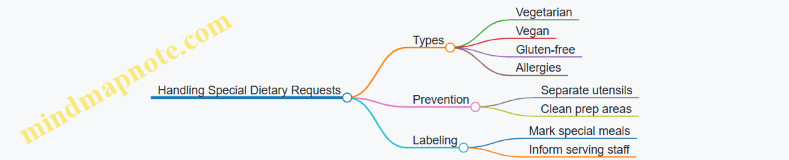
Summary Table
| Practice Area | Key Actions | Example Scenario |
|---|---|---|
| Food Safety and Hygiene | Handwashing, avoid cross-contamination | Using separate boards for raw meat and veggies |
| Kitchen Workflow and Roles | Know roles, follow order process | Expeditor communicates vegetarian order |
| Food Preparation Techniques | Chop evenly, measure accurately | Dicing onions uniformly |
| Equipment Use and Maintenance | Clean equipment, report faults | Cleaning blender after use |
| Managing Orders and Communication | Confirm orders, update front desk | Notifying delay due to ingredient shortage |
| Handling Special Dietary Requests | Separate prep, label meals | Preparing gluten-free pasta in clean area |
By consistently applying these essential kitchen practices, you contribute to a safe, efficient, and guest-focused hospitality environment. Remember, teamwork and communication are just as important as technical skills in the kitchen.
12.3 Guest Service Excellence Reminders
Providing excellent guest service is the heart of hospitality. This section summarizes key reminders to help you consistently deliver outstanding experiences to every guest.
Mind Map: Core Elements of Guest Service Excellence
Active Listening
- Practice: When a guest mentions they have a dietary restriction, repeat back to confirm: “Just to confirm, you prefer gluten-free options, correct?”
- Example: A guest says, “I’m looking for a quiet table.” Respond, “I understand you’d like a quiet spot. Let me find the best table for you.”
Anticipate Guest Needs
- Practice: If a guest arrives with children, proactively offer coloring books or kid-friendly menus.
- Example: Noticing a guest looking at the weather app, offer an umbrella or suggest indoor activities.
Personalization
- Practice: Use the guest’s name during interactions to create a welcoming atmosphere.
- Example: “Good evening, Mr. Smith. We have prepared your favorite room with extra pillows as requested.”
Professionalism
- Practice: Always maintain a calm and courteous tone, even when guests are upset.
- Example: When a guest complains about a delay, respond, “I apologize for the wait, we are doing our best to serve you promptly. Thank you for your patience.”
Problem Resolution
- Practice: Listen fully to the complaint, apologize sincerely, and offer a clear solution.
- Example: Guest: “My meal is cold.” Response: “I’m very sorry about that. I will have the kitchen prepare a fresh hot meal for you immediately.”
Follow-Up
- Practice: After resolving an issue, check back with the guest to ensure satisfaction.
- Example: “Is everything now to your liking? Please let me know if there’s anything else I can assist with.”
Mind Map: Steps to Handle Guest Complaints Effectively
Additional Tips:
- Smile genuinely: A warm smile can set a positive tone.
- Be patient: Some guests may need extra time or explanations.
- Stay knowledgeable: Know your property’s services and policies to answer questions confidently.
- Maintain eye contact: Shows attentiveness and respect.
By consistently applying these reminders, you build trust and loyalty with guests, making their stay memorable and encouraging repeat visits.
12.4 Daily Best Practice Checklist for Service Staff
To ensure consistent excellence in hospitality operations, service staff should follow a daily best practice checklist. This checklist helps maintain high standards at the front desk, kitchen, and guest service areas, promoting smooth operations and memorable guest experiences.
Daily Best Practice Checklist
-
Start of Shift Preparation
- Arrive on time and in proper uniform.
- Review any special notes or VIP guest arrivals.
- Check equipment functionality (POS systems, kitchen tools).
- Attend briefings or handover meetings.
-
Greeting and Communication
- Greet every guest warmly with a smile.
- Use the guest’s name when possible.
- Listen actively to guest requests or concerns.
- Communicate clearly with team members across departments.
-
Front Desk Operations
- Confirm reservations and update guest information.
- Process check-ins and check-outs efficiently.
- Handle payments and billing accurately.
- Maintain confidentiality of guest data.
-
Kitchen Coordination
- Verify special dietary requests with kitchen staff.
- Ensure timely communication of orders.
- Monitor food safety and hygiene standards.
- Report any equipment or supply issues promptly.
-
Guest Service Excellence
- Anticipate guest needs proactively.
- Address complaints calmly and professionally.
- Offer upselling or additional services tactfully.
- Personalize interactions to enhance guest satisfaction.
-
End of Shift Duties
- Complete all documentation and reports.
- Clean and organize workstations.
- Communicate any unresolved issues to the next shift.
- Reflect on the day’s performance and note areas for improvement.
Mind Maps
Mind Map 1: Greeting and Communication
Mind Map 2: Front Desk Operations
Mind Map 3: Kitchen Coordination
Mind Map 4: Guest Service Excellence
Examples
Example 1: Greeting a Guest
Best Practice: “Good afternoon, Mr. Smith! Welcome back to our hotel. How was your trip?”
Why it works: Using the guest’s name and asking a friendly question creates a warm, personalized experience.
Example 2: Handling a Special Dietary Request
Best Practice: “Thank you for letting us know about your gluten allergy. I will inform the kitchen immediately to prepare your meal accordingly.”
Why it works: Clear communication ensures guest safety and shows attentiveness.
Example 3: Managing a Complaint
Best Practice: “I’m very sorry to hear your room wasn’t ready on time. Let me check with housekeeping and offer you a complimentary drink while you wait.”
Why it works: Acknowledging the issue, apologizing sincerely, and offering a solution helps defuse tension.
Example 4: End of Shift Reporting
Best Practice: “Today we had two VIP arrivals and one special request for late check-out. The kitchen reported a minor oven issue, which maintenance is scheduled to fix tomorrow.”
Why it works: Clear, concise communication ensures the next shift is well-informed.
By following this daily best practice checklist, service staff can maintain professionalism, enhance guest satisfaction, and contribute positively to the overall hospitality experience.
12.5 Encouragement for Ongoing Improvement
Continuous improvement is the key to success and satisfaction in hospitality roles, especially for front desk, kitchen, and guest service staff. Embracing a mindset of growth not only enhances your skills but also elevates the guest experience and opens doors for career advancement.
Why Ongoing Improvement Matters
- Adapt to Changing Guest Expectations: Hospitality trends evolve; staying updated keeps you relevant.
- Boost Confidence and Job Satisfaction: Mastery of skills reduces stress and increases pride in your work.
- Enhance Teamwork and Communication: Improved skills foster better collaboration.
- Open Career Opportunities: Employers value proactive learners.
Mind Map: Pathways to Ongoing Improvement
Practical Examples to Inspire Improvement
Example 1: Self-Reflection and Feedback
- After a busy shift, Maria, a front desk associate, spends 5 minutes noting what went well and what could improve.
- She asks her supervisor for feedback on her guest interactions.
- Using this, she identifies she can improve her check-in speed without sacrificing friendliness.
Example 2: Skill Development through Cross-Training
- John, a kitchen assistant, volunteers to learn front desk basics during slow hours.
- This broadens his understanding of guest needs and improves communication with front desk staff.
Example 3: Setting and Achieving Goals
- Priya sets a goal to master handling difficult guests within 3 months.
- She practices role-playing with colleagues and reviews guest feedback.
- Over time, she becomes more confident and receives positive guest comments.
Mind Map: Goal Setting for Continuous Growth
Tips to Maintain Motivation
- Celebrate small wins: Recognize improvements, no matter how minor.
- Find a mentor or buddy: Share goals and progress for accountability.
- Stay curious: Explore new hospitality trends or technologies.
- Balance work and rest: Avoid burnout by taking care of yourself.
Remember, every expert was once a beginner. Your commitment to ongoing improvement not only benefits your career but also creates memorable experiences for every guest you serve.