Plasma Engineering Technologies for Industry and Energy
1. Introduction to Plasma Engineering
1.1 Fundamentals of Plasma Physics
Plasma is often called the fourth state of matter, distinct from solids, liquids, and gases. Unlike gases, plasma consists of a collection of charged particles—ions and electrons—along with neutral atoms or molecules. This mixture gives plasma unique electrical properties and behaviors.
At its core, plasma forms when enough energy is supplied to a gas to ionize its atoms or molecules, freeing electrons and creating ions. This process requires overcoming the ionization energy, which varies by element. For example, ionizing argon requires about 15.76 electron volts (eV) per atom.
Plasma can be found naturally in stars, including our sun, where temperatures are extremely high. On Earth, plasma appears in lightning, fluorescent lamps, and plasma TVs. Industrially, plasmas are generated in controlled environments for applications like material processing and waste treatment.
Key Characteristics of Plasma
- Quasi-neutrality: Despite containing charged particles, plasma as a whole is electrically neutral because the number of positive ions roughly equals the number of electrons.
- Collective Behavior: Charged particles interact through long-range electromagnetic forces, causing plasma to behave differently than neutral gases.
- High Conductivity: Plasmas conduct electricity well due to free-moving charged particles.
- Response to Magnetic and Electric Fields: Plasmas can be confined, shaped, or accelerated using external fields.
Mind Map: Basic Plasma Properties
Ionization and Degree of Ionization
The degree of ionization is the fraction of atoms ionized in the plasma. It ranges from very low in weakly ionized plasmas (like fluorescent lamps) to nearly complete in fully ionized plasmas (like stars). Industrial plasmas often operate in partially ionized regimes, balancing energy efficiency and process requirements.
For example, in plasma cutting, the gas (often air or nitrogen) is ionized to create a conductive channel that transfers energy to the workpiece. The degree of ionization affects the arc stability and cutting quality.
Plasma Temperature
Plasma temperature is not a single value but can refer separately to electron temperature and ion temperature. Electron temperatures are usually higher because electrons gain energy more quickly due to their low mass.
In thermal plasmas, electrons, ions, and neutrals are roughly in thermal equilibrium, with temperatures ranging from 5,000 to over 20,000 K. In non-thermal plasmas, electrons can be much hotter than ions and neutrals.
Mind Map: Plasma Temperature and Ionization
Plasma Parameters
Several parameters define plasma behavior:
- Electron Density (n_e): Number of electrons per unit volume, typically 10^14 to 10^20 per cubic meter in industrial plasmas.
- Electron Temperature (T_e): Energy of electrons, often measured in electron volts (eV).
- Plasma Potential: Electric potential within the plasma, influencing particle motion.
- Debye Length: The scale over which electric fields are screened in plasma, typically micrometers to millimeters.
Understanding these parameters helps engineers design plasma systems that achieve desired processing results.
Example: Debye Shielding in Plasma
Imagine dropping a charged particle into plasma. Surrounding electrons and ions rearrange to shield its electric field beyond the Debye length. This shielding prevents long-range Coulomb forces from dominating, allowing plasma to maintain quasi-neutrality.
Plasma States and Classification
Plasmas can be classified by temperature, pressure, and degree of ionization:
- Thermal Plasma: Electrons and heavy particles share similar temperatures; high pressure; used in plasma torches.
- Non-Thermal Plasma: Electrons much hotter than ions; low pressure; used in surface treatments.
- Cold Plasma: A subset of non-thermal plasma with low gas temperature, suitable for heat-sensitive materials.
Mind Map: Plasma Classification
Practical Example: Plasma in Fluorescent Lamps
Fluorescent lamps contain a low-pressure mercury vapor plasma. When voltage is applied, electrons accelerate and collide with mercury atoms, causing ionization and excitation. The excited atoms emit ultraviolet light, which then excites the phosphor coating to produce visible light. This process relies on maintaining a stable, partially ionized plasma at low temperature.
Summary
Plasma physics revolves around understanding how charged particles interact under various conditions. Key concepts include ionization, temperature differences between species, collective effects, and plasma parameters like electron density and Debye length. These fundamentals form the basis for designing and operating plasma systems in industry and energy applications.
1.2 Types of Plasmas and Their Characteristics
Plasma, often called the fourth state of matter, is an ionized gas consisting of ions, electrons, and neutral particles. Its behavior depends heavily on temperature, pressure, and ionization degree. Understanding the types of plasmas and their characteristics is essential for selecting the right plasma system for industrial and energy applications.
Classification of Plasmas
Plasmas can be broadly classified based on temperature, pressure, and ionization level. Here’s a mind map to organize these categories:
Thermal (Equilibrium) Plasmas
Thermal plasmas have electrons and heavy particles (ions and neutrals) at nearly the same temperature, typically several thousand kelvin. This equilibrium results from frequent collisions that distribute energy evenly. Because of their high temperature and energy density, thermal plasmas are suitable for applications like metal cutting, welding, and waste treatment.
Example: An electric arc plasma torch generates a thermal plasma by passing current through a gas, heating it to temperatures above 10,000 K. The torch’s plasma jet can melt metals or decompose hazardous waste.
Non-Thermal (Non-Equilibrium) Plasmas
In non-thermal plasmas, electrons are much hotter (up to tens of thousands of kelvin) than the ions and neutrals, which remain near room temperature. This temperature difference allows chemical reactions to proceed without heating the entire gas volume, making these plasmas energy efficient for processes like surface treatment or pollution control.
Example: Glow discharges used in plasma etching of semiconductor wafers operate at low pressure and maintain a non-thermal plasma, enabling precise material removal without damaging the substrate.
Low-Pressure Plasmas
These plasmas operate at pressures typically below 1 torr. The reduced pressure increases mean free path lengths, allowing electrons to gain energy between collisions. Low-pressure plasmas are often non-thermal and used in industries requiring fine control over chemical reactions.
Example: In semiconductor manufacturing, low-pressure plasma reactors etch microscopic patterns by generating reactive species that selectively remove material.
Atmospheric Pressure Plasmas
Operating at atmospheric pressure removes the need for vacuum systems, simplifying industrial integration. These plasmas can be thermal or non-thermal. Thermal atmospheric plasmas are used in cutting and spraying, while non-thermal variants find use in sterilization and surface activation.
Example: Plasma spray coating uses a thermal atmospheric plasma to melt and propel powder particles onto surfaces, creating protective or functional layers.
Cold Plasmas
Cold plasmas maintain low gas temperatures while having energetic electrons. This allows treatment of heat-sensitive materials without damage. Applications include sterilization, surface cleaning, and modification.
Example: Dielectric barrier discharges generate cold plasmas used to sterilize medical instruments without heat damage.
Hot Plasmas
Hot plasmas are fully ionized gases at very high temperatures, often found in fusion research or astrophysical contexts. In industry, thermal plasmas used for melting or waste destruction fall under this category.
Example: Plasma arc furnaces melt scrap metal by sustaining a hot plasma arc.
Summary Mind Map of Plasma Characteristics
Understanding these plasma types helps engineers choose the right plasma source and operating conditions for specific industrial or energy tasks. For instance, thermal plasmas are preferred for high-energy processes like cutting or waste destruction, while non-thermal plasmas excel in surface treatments and chemical synthesis where heat-sensitive materials are involved.
1.3 High-Temperature Plasma Systems Overview
High-temperature plasma systems operate at temperatures typically above 5,000 K, where gases become ionized and exhibit unique physical and chemical properties. These systems are central to many industrial and energy applications because they provide intense heat and reactive environments that are difficult to achieve with conventional methods.
What Defines High-Temperature Plasma?
At these elevated temperatures, the gas is partially or fully ionized, meaning electrons are stripped from atoms, creating a mix of ions, electrons, and neutral particles. This ionization changes the gas’s electrical conductivity, thermal conductivity, and chemical reactivity.
Key Components of High-Temperature Plasma Systems
- Plasma Source: Often an electric arc, radiofrequency, or microwave generator that supplies energy to ionize the gas.
- Working Gas: Common gases include argon, nitrogen, hydrogen, or air, chosen based on the application.
- Containment and Flow Control: Systems to direct and stabilize the plasma jet or chamber environment.
- Cooling Systems: Essential to protect equipment from extreme heat.
Mind Map: Elements of High-Temperature Plasma Systems
Types of High-Temperature Plasma Systems
-
Thermal Plasma Torches: Use electric arcs to generate plasma jets reaching temperatures up to 20,000 K. They are widely used for cutting, welding, and waste treatment.
-
Plasma Reactors: Enclosed systems where plasma interacts with materials for chemical processing or synthesis.
-
Inductively Coupled Plasma (ICP) Systems: Use electromagnetic fields to sustain plasma, often for analytical or surface treatment purposes.
Example: Electric Arc Plasma Torch
An electric arc plasma torch creates a plasma jet by striking an arc between electrodes. The gas flowing through the arc is heated to high temperatures, producing a stable plasma jet. This jet can cut metals or decompose hazardous waste. The torch design balances electrode material, gas flow rate, and cooling to maintain performance and lifespan.
Mind Map: Electric Arc Plasma Torch
Energy Transfer and Efficiency
High-temperature plasma systems transfer energy primarily through conduction, convection, and radiation. The plasma’s high temperature leads to strong radiation losses, which must be managed to maintain efficiency. Optimizing gas flow and torch geometry helps maximize energy transfer to the target material.
Example: Plasma Gasification
In plasma gasification, organic waste is converted into syngas using a high-temperature plasma reactor. The plasma breaks down complex molecules into simpler gases like CO and H2. The system requires precise control of plasma temperature and gas flow to ensure complete conversion and minimize tar formation.
Mind Map: Plasma Gasification System
Challenges in High-Temperature Plasma Systems
- Material Durability: Components face thermal stress and erosion.
- Energy Consumption: High power input requires efficient design.
- Process Control: Maintaining stable plasma and consistent output demands precise monitoring.
Best Practice Example: Cooling and Electrode Life
Using water-cooled copper electrodes with a thin tungsten insert extends electrode life in plasma torches. This combination manages heat effectively while resisting erosion, reducing downtime and maintenance costs.
In summary, high-temperature plasma systems combine complex physics with practical engineering to deliver intense heat and reactive environments. Understanding their components, energy transfer mechanisms, and operational challenges is essential for effective application in industry and energy sectors.
1.4 Industrial Relevance of Plasma Engineering
Plasma engineering plays a significant role in modern industry by providing tools and processes that handle materials and energy in ways traditional methods cannot. At its core, plasma is an ionized gas with unique properties, such as high temperature and chemical reactivity, which can be harnessed for various industrial tasks. These properties make plasma a versatile medium for applications ranging from material processing to energy conversion.
Key Industrial Sectors Utilizing Plasma Engineering
- Metallurgy: Plasma torches are used for melting, refining, and surface treatment of metals. The high temperatures achievable allow for efficient processing of metals with reduced contamination.
- Waste Management: Plasma gasification converts waste into syngas and slag, offering a cleaner alternative to incineration.
- Semiconductor Manufacturing: Plasma etching and deposition enable precise patterning and thin-film formation essential for integrated circuits.
- Surface Engineering: Plasma spraying and nitriding improve wear resistance and corrosion protection of components.
- Energy Production: Plasma-assisted combustion and fusion research aim to improve energy efficiency and develop alternative energy sources.
Mind Map: Industrial Applications of Plasma Engineering
Example: Plasma in Steel Production
In steelmaking, plasma torches generate temperatures above 10,000 K, enabling rapid melting of scrap metal. This method reduces reliance on coke and lowers impurities. The plasma arc’s controllability allows for precise temperature management, improving the quality of the final product. Additionally, plasma can be used for surface modification of steel to enhance hardness or corrosion resistance.
Mind Map: Plasma Use in Steel Industry
Example: Plasma Gasification for Waste Treatment
Municipal solid waste can be converted into syngas through plasma gasification. The process involves feeding waste into a high-temperature plasma reactor where organic material breaks down into synthesis gas (a mixture of hydrogen and carbon monoxide). The inorganic fraction forms vitrified slag, which is inert and can be used in construction. This approach reduces landfill use and recovers energy from waste.
Mind Map: Plasma Gasification Process
Example: Plasma Etching in Semiconductor Fabrication
Plasma etching uses reactive ions and radicals generated in plasma to selectively remove material from semiconductor wafers. This process achieves nanoscale precision, essential for modern microchips. The ability to control plasma parameters such as density and energy allows manufacturers to tailor etching profiles and minimize damage to underlying layers.
Mind Map: Plasma Etching Process
Summary
Plasma engineering’s industrial relevance stems from its capacity to provide controlled, high-energy environments that enable processes difficult or impossible with conventional techniques. Whether improving material properties, managing waste, or fabricating microelectronics, plasma technologies offer practical solutions grounded in physics and engineering principles. The examples above illustrate how plasma systems integrate into existing industrial workflows, delivering measurable benefits in efficiency, quality, and environmental impact.
1.5 Energy Applications of Plasma Technologies
Plasma technologies play a variety of roles in energy-related fields, primarily due to their ability to generate and sustain high temperatures, facilitate chemical reactions, and manipulate matter at the atomic level. This section outlines key energy applications where plasma engineering contributes practical solutions.
Plasma in Fusion Energy
Fusion energy aims to replicate the sun’s power generation by fusing light atomic nuclei. Plasma is essential here because fusion reactions require extremely high temperatures (millions of degrees Celsius) to overcome electrostatic repulsion between nuclei.
- Magnetic Confinement Fusion (MCF): Uses magnetic fields to contain plasma in devices like tokamaks and stellarators.
- Inertial Confinement Fusion (ICF): Uses lasers or particle beams to compress plasma to fusion conditions.
Example: The ITER project employs plasma confined magnetically to sustain fusion reactions for extended periods, demonstrating plasma’s central role in fusion energy research.
Plasma-Assisted Combustion
Plasma can enhance combustion processes by improving ignition, flame stability, and pollutant reduction. It does so by generating reactive species and radicals that facilitate fuel oxidation.
- Low-Temperature Plasma Ignition: Enables ignition of lean fuel mixtures that are otherwise difficult to burn.
- Flame Stabilization: Plasma discharges help maintain steady flames in engines and burners.
Example: Gas turbines equipped with plasma-assisted burners can operate more efficiently and produce fewer nitrogen oxides (NOx).
Plasma Catalysis for Fuel Processing
Plasma catalysis combines plasma with catalytic surfaces to improve chemical conversions at lower temperatures than conventional methods.
- Syngas Production: Plasma reforming of hydrocarbons produces synthesis gas (a mixture of CO and H2) used for fuels and chemicals.
- Methane Conversion: Plasma helps convert methane into valuable chemicals or hydrogen without high thermal input.
Example: Plasma-catalytic reactors convert natural gas into hydrogen-rich syngas more efficiently than thermal processes alone.
Plasma Electrolysis and Hydrogen Production
Plasma electrolysis involves using plasma to enhance water splitting for hydrogen generation. It can increase reaction rates and reduce energy consumption compared to traditional electrolysis.
- Non-Thermal Plasma Electrolysis: Generates reactive species that assist in breaking water molecules.
- Hydrogen Purity: Plasma processes can produce hydrogen with fewer impurities.
Example: Plasma electrolysis setups have been tested to produce hydrogen efficiently for fuel cell applications.
Plasma Gasification for Energy Recovery
Though primarily a waste treatment method, plasma gasification converts organic materials into syngas, which can be used for power generation.
- High-Temperature Conversion: Plasma breaks down complex waste into simpler gases.
- Energy Recovery: Syngas produced can fuel turbines or engines.
Example: Municipal solid waste plasma gasification plants generate electricity while reducing landfill volume.
Summary Table of Energy Applications
| Application | Role of Plasma | Example Use Case |
|---|---|---|
| Fusion Energy | Plasma confinement and heating | ITER tokamak |
| Plasma-Assisted Combustion | Enhanced ignition and flame stability | Gas turbine burners |
| Plasma Catalysis | Lower temperature chemical conversion | Syngas from natural gas |
| Plasma Electrolysis | Improved water splitting | Hydrogen production for fuel cells |
| Plasma Gasification | Waste-to-energy conversion | Municipal solid waste plants |
Each of these applications involves specific plasma parameters and engineering challenges. Understanding the interplay between plasma properties and energy conversion processes is key to optimizing performance and efficiency.
This section has presented practical examples and mind maps to clarify the diverse roles plasma plays in energy technologies.
1.6 Best Practices in Plasma System Design: Case Study on Arc Discharge Systems
Arc discharge systems are among the most common high-temperature plasma sources used in industry. Their design requires balancing electrical, thermal, and mechanical factors to achieve stable, efficient plasma generation. This section outlines key design principles and illustrates them through an example of an industrial arc discharge plasma torch.
Key Design Considerations
- Electrode Material and Geometry: Electrodes must withstand intense thermal loads and erosion. Common materials include tungsten and copper alloys. Geometry affects arc stability and plasma flow.
- Power Supply and Control: A stable power supply with adjustable current and voltage is essential. Control systems regulate arc length and maintain plasma consistency.
- Cooling Systems: Effective cooling prevents electrode damage and system failure. Water cooling is typical, sometimes combined with forced air.
- Gas Flow Management: The plasma gas flow influences arc shape, temperature distribution, and plasma jet characteristics.
- Arc Stability and Ignition: Reliable ignition methods and arc stabilization techniques reduce downtime and improve performance.
Mind Map: Arc Discharge System Design
Example: Industrial Plasma Torch Design
A steel processing plant uses a DC arc plasma torch for cutting and surface treatment. The torch employs a tungsten cathode and a copper anode, both water-cooled through internal channels. The power supply delivers up to 300 A at 80 V, with a feedback loop adjusting current to maintain a constant arc length.
The plasma gas is argon, flowing at 30 liters per minute, introduced tangentially to create a swirling flow. This swirl stabilizes the arc and concentrates the plasma jet. The ignition system uses a high-voltage pulse to initiate the arc reliably.
Over six months, the plant observed electrode wear rates reduced by 20% after optimizing cooling channel design and gas flow patterns. Adjusting the gas swirl angle improved arc stability, reducing fluctuations in plasma temperature by 15%, which translated into more consistent cutting quality.
Mind Map: Case Study Highlights
Practical Tips for Design
- Choose electrode materials based on operating temperature and erosion resistance. Tungsten resists erosion but is brittle; copper alloys offer good thermal conductivity but erode faster.
- Incorporate internal cooling channels in electrodes to manage heat effectively. Monitor temperatures to avoid hotspots.
- Design gas injection to promote arc stability. Swirling flows help center the arc and reduce fluctuations.
- Use power supplies with real-time feedback to maintain consistent arc length and current. This reduces arc extinction and improves plasma uniformity.
- Implement reliable ignition systems. High-voltage pulses or pilot arcs ensure quick and repeatable arc initiation.
- Regularly monitor electrode wear and cooling system performance. Early detection prevents unplanned downtime.
Additional Example: Small-Scale Arc System for Waste Treatment
A waste treatment facility uses a smaller arc discharge system to vitrify hazardous waste. The system uses a conical copper cathode and a flat tungsten anode. Cooling is achieved via water jackets around both electrodes.
Gas flow is air at 20 L/min, injected axially. The arc is stabilized using a magnetic field generated by coils around the torch. This magnetic stabilization reduces arc wandering, improving plasma uniformity.
Operators found that adjusting the magnetic field strength allowed fine-tuning of the plasma jet shape, which improved waste melting efficiency. They also implemented a routine electrode inspection schedule, extending electrode life by 30%.
Mind Map: Small-Scale Waste Treatment Arc System
This case highlights how combining mechanical design with electromagnetic control and operational discipline improves system performance.
In summary, designing arc discharge plasma systems requires careful selection of materials, cooling methods, gas flow strategies, and control systems. Practical examples show that small adjustments in these areas can significantly affect performance and durability. Regular monitoring and maintenance are essential to sustain optimal operation.
2. Plasma Generation and Control Techniques
2.1 Methods of Plasma Generation: Thermal and Non-Thermal
Plasma, often called the fourth state of matter, is generated by energizing a gas until its atoms or molecules ionize, creating a mixture of ions, electrons, and neutral particles. The methods to generate plasma broadly fall into two categories: thermal and non-thermal. These categories differ primarily in the energy distribution among the particles and the resulting temperature characteristics.
Thermal Plasma Generation
Thermal plasmas are characterized by nearly equal temperatures for electrons and heavy particles (ions and neutrals), typically in the range of 5,000 to 20,000 K. This equilibrium results from high power densities and frequent collisions that distribute energy uniformly.
Common methods to generate thermal plasma include:
-
Electric Arc Discharges: An electric arc is established between two electrodes, creating a high current, low voltage plasma. The intense current heats the gas and sustains the plasma. This method is widely used in plasma torches for cutting, welding, and waste treatment.
-
Direct Current (DC) Plasma Torches: These use a continuous DC arc to ionize the gas. The gas flows through the arc, becoming a hot plasma jet. Example: steel cutting operations.
-
Radiofrequency (RF) and Inductively Coupled Plasma (ICP): These use electromagnetic fields to induce currents in the gas, heating it without electrodes. ICP is common in material processing and analytical chemistry.
-
Microwave Plasma Generators: Microwaves excite the gas molecules, producing plasma without electrodes. These are often used in semiconductor manufacturing.
Mind Map: Thermal Plasma Generation
Example: Electric Arc Plasma Torch in Waste Treatment
An electric arc plasma torch generates a high-temperature plasma jet that can break down hazardous waste. The torch uses graphite electrodes to create an arc in an inert gas, heating the gas to temperatures above 10,000 K. The waste material introduced into this plasma decomposes into simpler molecules or elemental components. The process benefits from the thermal plasma’s high energy density and uniform temperature.
Non-Thermal Plasma Generation
Non-thermal plasmas, also called cold plasmas, have electrons at much higher temperatures (10,000 K or more) than the heavy particles, which remain near room temperature. This non-equilibrium state arises because the energy input primarily heats electrons, which then drive chemical reactions without significantly heating the bulk gas.
Common methods to generate non-thermal plasma include:
-
Dielectric Barrier Discharges (DBD): These use alternating current across electrodes separated by a dielectric barrier and a gas gap. The barrier prevents arc formation, producing many micro-discharges and a cold plasma.
-
Corona Discharges: A high voltage applied to a sharp electrode ionizes the surrounding gas, creating a localized plasma region. This is used in ozone generation and surface treatment.
-
Glow Discharges: Operate at low pressure with a DC voltage applied between electrodes, producing a uniform plasma used in thin film deposition.
-
Pulsed Plasma Systems: High-voltage pulses create transient plasmas with high electron energies but low gas temperatures.
Mind Map: Non-Thermal Plasma Generation
Example: Dielectric Barrier Discharge for Surface Treatment
In a DBD system, an alternating voltage is applied between two electrodes separated by a dielectric and a gas gap. The dielectric prevents continuous arcs, resulting in many tiny plasma filaments. This cold plasma modifies the surface energy of polymers, improving adhesion without raising the substrate temperature. The process is energy-efficient and suitable for heat-sensitive materials.
Comparing Thermal and Non-Thermal Plasmas
| Feature | Thermal Plasma | Non-Thermal Plasma |
|---|---|---|
| Electron Temperature | ~10,000 K | 10,000 K or more |
| Heavy Particle Temperature | Similar to electrons (high) | Near room temperature |
| Energy Distribution | Equilibrium | Non-equilibrium |
| Gas Temperature | Very high (thousands of K) | Low (near ambient) |
| Applications | Material melting, cutting, waste treatment | Surface modification, ozone generation, sterilization |
Summary
Thermal plasmas rely on high power density and frequent collisions to maintain equilibrium temperatures, making them suitable for processes requiring intense heat. Non-thermal plasmas concentrate energy in electrons, enabling chemical reactions at low gas temperatures, ideal for surface treatments and environmental applications. Understanding these methods helps engineers select the right plasma type for specific industrial or energy applications.
2.2 Electric Arc Plasma Generators: Design and Operation
Electric arc plasma generators are among the most widely used devices for producing high-temperature plasmas in industrial settings. They operate by establishing an electric arc between two electrodes, which ionizes the gas and creates a plasma jet. Understanding their design and operation is essential for effective application and maintenance.
Basic Principles
At the core, an electric arc plasma generator consists of two electrodes: a cathode and an anode. When a sufficiently high voltage is applied, an electric arc forms, creating a conductive channel of ionized gas. The arc temperature can reach several thousand degrees Celsius, sufficient to melt or chemically transform materials.
The plasma is sustained by the continuous flow of electric current, and the gas flow controls the plasma jet’s shape and temperature. The choice of gas—often argon, nitrogen, or air—affects plasma characteristics.
Key Components and Their Functions
- Cathode: Usually made of tungsten or thoriated tungsten for high melting points and electron emission efficiency.
- Anode: Often water-cooled to handle intense heat; can be a copper or copper alloy.
- Power Supply: Provides a stable DC or AC current; current magnitude influences plasma temperature and stability.
- Gas Supply System: Controls the flow rate and type of plasma-forming gas.
- Cooling System: Prevents overheating of electrodes and surrounding components.
Design Considerations
- Electrode Geometry: The shape and gap influence arc stability and plasma jet characteristics.
- Current and Voltage Levels: Must be matched to application needs; higher currents produce hotter, more energetic plasmas.
- Gas Flow Rate and Composition: Adjusted to optimize plasma temperature and chemical reactivity.
- Cooling Efficiency: Critical to prolong electrode life and maintain consistent operation.
Operation Modes
- Transferred Arc: The arc is established between the cathode and the workpiece (anode), directly heating the target.
- Non-Transferred Arc: The arc forms between two electrodes inside the torch; plasma is ejected as a jet to the target.
Each mode suits different industrial processes; transferred arcs are common in welding and cutting, while non-transferred arcs are used in plasma spraying and waste treatment.
Mind Map: Electric Arc Plasma Generator Components
Mind Map: Operation Modes
Example: Design of a DC Non-Transferred Arc Plasma Torch for Waste Treatment
Consider a plasma torch designed to treat hazardous waste. The torch uses a DC power supply delivering 200 A at 50 V. The cathode is a thoriated tungsten rod, chosen for its durability and electron emission. The anode is a copper water-cooled nozzle to handle intense heat.
Air is used as the plasma gas at a flow rate of 30 standard liters per minute (SLPM). The gas flow stabilizes the arc and shapes the plasma jet. The cooling system circulates water at a controlled temperature to prevent electrode damage.
This configuration produces a plasma jet exceeding 10,000 K, capable of breaking down complex waste molecules. The non-transferred arc mode ensures the arc remains within the torch, protecting the electrodes from direct contact with waste materials.
Best Practices in Operation
- Maintain proper electrode gap to ensure arc stability; too wide a gap causes arc extinction, too narrow leads to electrode wear.
- Monitor gas flow rates carefully; fluctuations can cause arc instability or temperature variations.
- Regularly inspect and replace electrodes to avoid contamination and inconsistent plasma characteristics.
- Use water cooling systems with temperature and flow sensors to prevent overheating.
- Employ power supplies with current and voltage regulation to maintain steady plasma conditions.
Example: Troubleshooting Arc Instability
In a plasma cutting application, operators noticed frequent arc interruptions. Investigation revealed inconsistent gas flow due to a partially blocked gas line. Cleaning the gas supply restored stable flow, and the arc stabilized. This example highlights the importance of gas supply maintenance.
Summary
Electric arc plasma generators rely on a balance of electrical, thermal, and fluid dynamic factors. Their design centers on electrode materials and geometry, power supply characteristics, and gas flow control. Operation modes—transferred and non-transferred arcs—determine how plasma interacts with materials. Proper maintenance and monitoring ensure reliable performance and long equipment life.
2.3 Inductively Coupled Plasma Systems
Inductively Coupled Plasma (ICP) systems generate plasma by inducing an electric current in a gas through a time-varying magnetic field. Unlike arc plasmas, ICPs do not rely on electrodes inside the plasma, which reduces contamination and electrode wear. This feature makes ICPs particularly useful for analytical applications and processes requiring high purity.
Basic Principles
An ICP system typically consists of a coil wrapped around a quartz or ceramic tube through which the working gas flows. When an alternating current passes through the coil, it creates a changing magnetic field. This magnetic field induces an electric field inside the gas, accelerating free electrons. These electrons collide with gas atoms, ionizing them and sustaining the plasma.
The plasma temperature in ICPs can reach 6000–10,000 K, depending on the power input and gas composition. The plasma is generally stable and homogeneous, with a relatively low electron density compared to arc plasmas.
Mind Map: Inductively Coupled Plasma System Components
Operation and Control
The RF generator supplies power to the coil, usually in the range of a few hundred watts to several kilowatts. The matching network ensures maximum power transfer by tuning the impedance between the generator and the coil. Gas flow rates and composition are controlled to maintain plasma stability and desired chemical conditions.
Because there are no electrodes inside the plasma, ICP systems can operate continuously with minimal maintenance. However, the quartz tube can degrade over time due to thermal stress and chemical attack, so periodic inspection is necessary.
Industrial Applications
ICPs are widely used in analytical chemistry for elemental analysis, such as Inductively Coupled Plasma Optical Emission Spectroscopy (ICP-OES) and Mass Spectrometry (ICP-MS). Beyond analysis, ICPs find applications in materials processing, including thin film deposition, surface modification, and plasma etching.
Example: Plasma Etching in Semiconductor Manufacturing
In semiconductor fabrication, ICPs provide a high-density plasma source that allows precise etching of micro-scale features. The high plasma density enables low-pressure operation, improving anisotropy and reducing damage to sensitive layers.
Example: Surface Treatment of Polymers
ers use ICPs to activate polymer surfaces before coating or bonding. The plasma introduces functional groups on the surface, improving adhesion without affecting the bulk material.
Best Practices
- Gas Purity: Use high-purity gases to avoid contamination, especially in analytical and semiconductor applications.
- Cooling Management: Ensure effective cooling of the induction coil to prevent overheating and maintain stable operation.
- Impedance Matching: Regularly tune the matching network to maximize power transfer and reduce reflected power.
- Quartz Tube Inspection: Monitor the quartz tube for cracks or deposits that can affect plasma stability.
Mind Map: Best Practices for ICP Operation
Troubleshooting Example
If the plasma becomes unstable or extinguishes frequently, common causes include improper gas flow, mismatched impedance, or coil overheating. For instance, a drop in coolant flow can cause coil temperature to rise, changing its resistance and detuning the system. Checking coolant flow and retuning the matching network often restores stable plasma.
Summary
Inductively Coupled Plasma systems offer a clean, stable, and controllable plasma source suitable for a range of industrial and analytical applications. Understanding the components, operation principles, and maintenance requirements ensures effective use of ICP technology.
2.4 Microwave and Radiofrequency Plasma Sources
Microwave (MW) and Radiofrequency (RF) plasma sources are widely used in industrial and energy applications due to their ability to generate stable, high-density plasmas without direct electrode contact. These sources operate by coupling electromagnetic energy into a gas, ionizing it and sustaining the plasma. The absence of electrodes in the plasma region reduces contamination and electrode erosion, which are common issues in arc-based plasmas.
Principles of Microwave and Radiofrequency Plasma Generation
- Microwave Plasma Sources typically operate at frequencies around 2.45 GHz, the same frequency used in household microwave ovens. The electromagnetic waves are introduced into a resonant cavity or waveguide, where they interact with the gas molecules.
- Radiofrequency Plasma Sources operate at lower frequencies, commonly 13.56 MHz, a frequency allocated internationally for industrial, scientific, and medical (ISM) applications. RF power is coupled capacitively or inductively to the plasma.
Both MW and RF plasmas can be sustained at low or atmospheric pressures, depending on the application.
Microwave Plasma Source Components
- Magnetron or Solid-State Microwave Generator: Produces the microwave power.
- Waveguide or Cavity Resonator: Guides and shapes the microwave energy.
- Gas Injection System: Controls the type and flow rate of the gas.
- Plasma Chamber: The region where plasma is generated.
Radiofrequency Plasma Source Components
- RF Generator: Produces the RF power.
- Matching Network: Matches the impedance between the generator and plasma load to maximize power transfer.
- Electrodes or Inductors: Couple energy into the plasma either capacitively (electrodes) or inductively (coils).
- Plasma Chamber: Contains the plasma.
Mind Map: Microwave Plasma Source Structure
Mind Map: Radiofrequency Plasma Source Structure
Applications and Examples
Example 1: Microwave Plasma for Surface Treatment In the semiconductor industry, microwave plasma sources are used for surface cleaning and modification. For instance, a 2.45 GHz microwave plasma can generate reactive oxygen species that remove organic contaminants from silicon wafers. The process benefits from the high plasma density and low contamination risk due to the absence of electrodes.
Example 2: RF Plasma in Thin Film Deposition RF plasma sources are common in plasma-enhanced chemical vapor deposition (PECVD). A 13.56 MHz RF generator powers a capacitively coupled plasma that decomposes precursor gases, allowing thin films like silicon nitride or oxide to form on substrates. The matching network ensures efficient power transfer, stabilizing the plasma and improving film uniformity.
Example 3: Atmospheric Pressure Microwave Plasma for Waste Treatment Microwave plasma torches operating at atmospheric pressure can break down hazardous waste. The high energy density of the plasma decomposes complex molecules into simpler gases. The microwave source enables continuous operation with minimal electrode wear.
Best Practices in Using MW and RF Plasma Sources
- Impedance Matching: For RF plasmas, always use a well-tuned matching network to avoid reflected power, which can damage the generator and reduce plasma stability.
- Gas Purity and Flow Control: Precise control of gas composition and flow rate is critical. For example, introducing small amounts of oxygen into argon plasma can significantly change plasma chemistry.
- Cooling Systems: Both MW and RF plasma sources generate heat in their components. Proper cooling extends equipment life and maintains stable operation.
- Diagnostics: Use optical emission spectroscopy or Langmuir probes to monitor plasma parameters and adjust operating conditions accordingly.
Mind Map: Best Practices for MW and RF Plasma Sources
In summary, microwave and radiofrequency plasma sources offer flexible, electrode-free plasma generation suited for a variety of industrial processes. Understanding their components, operation principles, and control methods is essential for effective application and maintenance.
2.5 Plasma Parameter Measurement and Diagnostics
Measuring plasma parameters is essential for understanding plasma behavior and optimizing plasma-based processes. Plasma diagnostics provide quantitative data on key properties such as temperature, density, electric fields, and composition. These measurements help engineers control plasma conditions, improve efficiency, and troubleshoot issues.
Key Plasma Parameters
- Electron Temperature (T_e): Average kinetic energy of electrons, usually in electronvolts (eV).
- Ion Temperature (T_i): Kinetic energy of ions, often different from electron temperature.
- Electron Density (n_e): Number of electrons per unit volume.
- Plasma Potential (V_p): Electric potential within the plasma.
- Neutral Gas Temperature: Temperature of the background gas.
- Species Concentrations: Relative amounts of ions, neutrals, and radicals.
Mind Map: Plasma Parameters and Their Measurement Techniques
Diagnostic Techniques
1. Langmuir Probes
A Langmuir probe is a small electrode inserted into the plasma to collect current as a function of applied voltage. By analyzing the current-voltage (I-V) characteristic curve, one can extract electron temperature, electron density, and plasma potential.
Example: In a thermal plasma torch, a Langmuir probe can be used to monitor electron density near the arc column, helping adjust gas flow to maintain stable operation.
Advantages: Simple, direct measurements.
Limitations: Probe can perturb plasma; limited to low-density plasmas; electrode erosion in harsh environments.
2. Optical Emission Spectroscopy (OES)
OES analyzes light emitted by excited atoms and ions in the plasma. By measuring emission line intensities and their ratios, electron temperature and species concentrations can be inferred.
Example: In plasma spraying, OES helps monitor the temperature and composition of plasma jets to ensure coating quality.
Advantages: Non-intrusive, real-time.
Limitations: Requires calibration; line-of-sight integration can obscure spatial details.
3. Microwave Interferometry
This technique measures electron density by detecting phase shifts in microwaves passing through the plasma. The phase shift is proportional to the integrated electron density along the path.
Example: Used in plasma gasification reactors to monitor electron density changes during waste processing.
Advantages: Non-invasive, fast.
Limitations: Complex setup; line-integrated measurement.
4. Laser-Induced Fluorescence (LIF)
LIF uses laser light to excite specific species in the plasma. The resulting fluorescence provides information on ion temperature and species distribution.
Example: In plasma etching, LIF can measure ion velocities and temperatures to optimize surface treatment.
Advantages: Species-specific, spatially resolved.
Limitations: Requires tunable lasers; complex optics.
5. Mass Spectrometry
Mass spectrometers sample plasma species through a small orifice, separating ions by mass-to-charge ratio. This identifies species and their relative abundances.
Example: In chemical vapor deposition, mass spectrometry tracks reactive species to control film growth.
Advantages: Detailed species analysis.
Limitations: Intrusive; sampling may alter plasma.
6. Thermal and Flow Measurements
Rotational spectroscopy of molecules like nitrogen can estimate neutral gas temperature. Thermocouples placed near plasma boundaries provide indirect temperature data.
Example: In plasma waste treatment, neutral gas temperature helps assess energy transfer efficiency.
Advantages: Complementary to other diagnostics.
Limitations: Limited direct access inside plasma core.
Mind Map: Langmuir Probe Measurement Process
Practical Example: Using a Langmuir Probe in a Plasma Torch
A steel manufacturer uses a DC plasma torch for cutting. To optimize cutting speed and quality, engineers insert a Langmuir probe near the arc column. By measuring electron temperature and density, they adjust gas flow rates and current to maintain a stable plasma with consistent energy delivery. The probe data reveals that increasing argon flow reduces electron temperature slightly but increases density, improving cut precision.
Practical Example: Optical Emission Spectroscopy in Plasma Spraying
During plasma spray coating, operators use OES to monitor emission lines of argon and nitrogen in the plasma jet. Changes in line intensity ratios indicate fluctuations in electron temperature. When temperature drops below a threshold, coating adhesion weakens. Real-time OES feedback allows operators to tweak power input and gas composition, ensuring consistent coating quality.
Summary
Plasma diagnostics are tools that provide insight into the invisible world of plasma. Each technique has strengths and limitations, and often multiple methods are combined for a complete picture. Understanding and applying these measurements allow engineers to control plasma processes effectively, leading to better performance and reliability in industrial and energy applications.
2.6 Best Practices in Plasma Control: Example of Feedback Control in Plasma Torches
Controlling a plasma torch effectively is crucial for maintaining stable operation, ensuring process quality, and extending equipment life. Feedback control systems provide a way to automatically adjust torch parameters in response to real-time measurements, keeping the plasma within desired operating conditions.
Why Feedback Control?
Plasma torches operate under conditions that can change rapidly due to variations in gas flow, power supply, or load. Without control, these fluctuations can cause instability, uneven heating, or damage. Feedback control uses sensors to monitor key variables and adjusts inputs accordingly, creating a closed-loop system.
Key Parameters to Control
- Arc Voltage: Indicates the electrical potential across the plasma arc.
- Arc Current: The current flowing through the plasma, related to power input.
- Gas Flow Rate: Influences plasma temperature and shape.
- Torch Temperature: Critical for preventing damage.
Typical Feedback Control Loop for a Plasma Torch
Example: PID Control of Arc Voltage
A common approach is to maintain a constant arc voltage by adjusting the power supply current. The process:
- Measure the actual arc voltage.
- Compare it to the desired setpoint.
- Calculate the error (difference).
- Use a PID (Proportional-Integral-Derivative) controller to compute the correction.
- Adjust the power supply current accordingly.
This keeps the plasma arc stable despite disturbances like changes in gas composition or electrode wear.
Practical Example: Maintaining Torch Stability in Metal Cutting
In plasma cutting, fluctuations in arc voltage can cause uneven cuts or dross formation. Implementing a feedback loop that adjusts current based on voltage measurements helps maintain a consistent plasma jet. Operators report improved cut quality and reduced electrode consumption.
Best Practices Summary
Additional Example: Gas Flow Feedback
Besides electrical parameters, controlling the gas flow rate is vital. A flow sensor monitors the plasma gas, and if the flow drops below the setpoint, the controller opens a valve to increase it. This prevents arc extinction and maintains plasma shape.
Challenges and Solutions
- Noise in Sensor Signals: Use filtering techniques to avoid false corrections.
- Delay in Actuator Response: Tune controllers to accommodate lag.
- Electromagnetic Interference: Employ shielding and differential measurement methods.
Conclusion
Feedback control in plasma torches is a practical way to maintain stable operation and consistent process results. By carefully selecting sensors, tuning controllers, and integrating control of both electrical and gas parameters, operators can achieve reliable plasma performance. Real-world examples from metal cutting and waste treatment illustrate how these principles translate into better quality and efficiency.
3. Thermal Plasma Torches and Their Industrial Applications
3.1 Design Principles of Thermal Plasma Torches
Thermal plasma torches are devices that generate high-temperature plasma jets by establishing an electric arc between electrodes. The design of these torches must balance electrical, thermal, mechanical, and fluid dynamic factors to achieve stable operation, efficient energy transfer, and durability.
Core Components and Their Roles
- Electrodes: Usually made of tungsten or copper alloys, electrodes sustain the arc. Their shape and material affect arc stability and erosion rates.
- Nozzle: Shapes and constricts the plasma jet, influencing velocity and temperature distribution.
- Power Supply: Provides the current and voltage to maintain the arc; design affects torch control and efficiency.
- Gas Flow System: Controls plasma-forming gas flow, which impacts plasma characteristics and cooling.
Key Design Considerations
- Arc Stability: Achieved by electrode geometry, gas flow rate, and power supply regulation.
- Thermal Management: Cooling systems (water or gas) protect components from high temperatures.
- Electrical Insulation: Prevents short circuits and ensures operator safety.
- Material Selection: Must withstand thermal, chemical, and mechanical stresses.
Mind Map: Thermal Plasma Torch Design Principles
Electrode Design
Electrodes must conduct high currents and tolerate intense heat. Tungsten is common for its high melting point and low erosion. The electrode tip shape influences arc attachment and stability. For example, a conical tip encourages a concentrated arc, while a flat tip may produce a more diffuse arc.
Example: In a plasma cutting torch, a conical tungsten electrode tip paired with a copper nozzle provides a focused, high-temperature plasma jet ideal for precision cuts.
Nozzle Geometry
The nozzle shapes the plasma jet. A convergent nozzle accelerates the plasma, increasing velocity and temperature at the exit. Convergent-divergent nozzles can further control expansion and pressure.
Example: For waste treatment plasma torches, a convergent-divergent nozzle helps maintain a stable plasma column with sufficient velocity to break down complex molecules.
Power Supply and Arc Control
Power supplies must deliver stable current and voltage. DC supplies are common, offering steady arcs, but AC or pulsed supplies can be used to control arc characteristics.
Example: A pulsed DC power supply can reduce electrode wear by periodically extinguishing and reigniting the arc, extending torch life in metal spraying applications.
Gas Flow Management
The plasma gas forms the ionized medium. Argon is often used for its inertness, but nitrogen or air may be chosen for cost or chemical effects. Gas flow rate influences arc length and plasma temperature.
Example: In plasma spraying, a high argon flow rate produces a hotter, more focused jet, improving coating adhesion.
Cooling Systems
Water cooling is standard for electrodes and nozzle bodies to prevent overheating. Gas cooling can supplement or replace water in some designs.
Example: A water-cooled copper nozzle in a plasma torch used for metal cutting maintains structural integrity during prolonged operation.
Integrated Example: Industrial Plasma Torch for Metal Cutting
- Electrodes: Water-cooled tungsten with conical tips
- Nozzle: Copper convergent nozzle, water-cooled
- Power Supply: DC with current regulation
- Gas: Argon at controlled flow rate
- Cooling: Water cooling circuit for electrodes and nozzle
This setup produces a stable, high-temperature plasma jet capable of precise metal cutting with minimal electrode wear.
Mind Map: Example Design for Metal Cutting Torch
In summary, designing a thermal plasma torch requires careful selection and integration of materials, geometry, power supply, and gas flow to achieve the desired plasma characteristics while ensuring durability and safety. Each element influences arc stability, temperature, and operational lifetime, making the design process a balancing act between competing factors.
3.2 Material Selection for Electrodes and Components
Material selection for electrodes and components in thermal plasma torches is a critical step that directly affects performance, durability, and operational costs. The harsh environment inside a plasma torch—characterized by extreme temperatures, high electrical currents, and reactive species—demands materials that can withstand thermal, mechanical, and chemical stresses simultaneously.
Key Considerations in Material Selection
- Thermal Resistance: Electrodes must tolerate temperatures often exceeding 10,000 K locally without melting or deforming.
- Electrical Conductivity: Efficient current conduction is essential for stable arc formation.
- Erosion and Wear Resistance: Continuous exposure to plasma jets causes sputtering, melting, and chemical attack.
- Thermal Expansion Compatibility: Mismatched expansion between components can cause cracking or mechanical failure.
- Chemical Stability: Resistance to oxidation, nitridation, and other chemical reactions in plasma atmospheres.
Common Electrode Materials and Their Properties
| Material | Melting Point (°C) | Electrical Conductivity (MS/m) | Advantages | Disadvantages |
|---|---|---|---|---|
| Tungsten (W) | 3422 | 18.2 | High melting point, good conductivity, excellent erosion resistance | Brittle at room temperature, expensive |
| Copper (Cu) | 1085 | 59.6 | Excellent conductivity, good thermal conductivity | Low melting point, poor erosion resistance |
| Copper-Tungsten (Cu-W) Composite | ~2500 (varies) | Moderate | Combines conductivity of copper with tungsten’s thermal resistance | Complex manufacturing, cost |
| Graphite | Sublimes ~3600 | 1-10 (varies) | Good thermal shock resistance, low cost | Erodes quickly, reacts with oxygen |
Mind Map: Factors Influencing Electrode Material Choice
Examples of Material Use in Industry
-
Tungsten Electrodes in Plasma Cutting: Tungsten’s high melting point and erosion resistance make it the preferred choice for plasma cutting torches, where arcs are intense and continuous. The brittleness is managed by careful handling and occasional replacement.
-
Copper Electrodes in Low-Temperature Applications: For plasma torches operating at lower power or intermittent use, copper electrodes are favored for their excellent electrical and thermal conductivity, which helps reduce energy losses.
-
Copper-Tungsten Composites in High-Duty Cycles: Combining copper’s conductivity with tungsten’s durability, Cu-W composites are common in applications requiring both high performance and longer electrode life, such as in plasma spray coating systems.
Components Beyond Electrodes
Other components like nozzles, cooling jackets, and insulators also require careful material selection:
- Nozzles: Often made from copper alloys or ceramics to balance thermal conductivity and erosion resistance.
- Cooling Jackets: Typically copper or copper alloys due to superior heat transfer.
- Insulators: Materials like alumina or zirconia ceramics provide electrical insulation and thermal stability.
Mind Map: Component Material Selection
Practical Example: Managing Electrode Wear
In a steel manufacturing plasma torch, tungsten electrodes are used due to their durability. However, over time, erosion causes shape changes that affect arc stability. Operators monitor electrode profiles and replace them based on wear thresholds rather than fixed schedules. This practice balances cost and performance, avoiding premature replacement while preventing torch failure.
Summary
Selecting materials for electrodes and components in plasma torches requires balancing thermal, electrical, mechanical, and chemical properties. Tungsten and copper, along with their composites, dominate electrode materials due to their complementary strengths. Supporting components rely on materials that provide thermal management and electrical insulation. Understanding the operational environment and maintenance practices helps optimize material choices for reliable, efficient plasma torch operation.
3.3 Cooling Techniques and Thermal Management
Thermal plasma torches operate at extremely high temperatures, often exceeding 10,000 K in the plasma arc region. Managing this heat is critical to maintain system integrity, ensure operational stability, and prolong equipment life. Without effective cooling, components such as electrodes, nozzles, and torch bodies can degrade rapidly, leading to costly downtime and repairs.
Key Cooling Techniques
Cooling methods for plasma torches generally fall into three categories: water cooling, gas cooling, and combined cooling systems. Each has its own advantages and limitations depending on the application, power level, and torch design.
-
Water Cooling: The most common method, water cooling uses circulating water channels around critical components to absorb and carry away heat. It offers high heat capacity and efficient thermal transfer.
-
Gas Cooling: Involves directing a flow of gas (often air or nitrogen) around or through parts of the torch. Gas cooling is simpler but less effective than water cooling for high-power systems.
-
Combined Cooling: Some designs integrate both water and gas cooling to optimize thermal management, especially in high-power or compact torches.
Cooling System Components
-
Cooling Jackets: These are channels or cavities built into the torch body or electrode holders where coolant flows.
-
Heat Exchangers: Devices that transfer heat from the coolant to the environment or a secondary cooling loop.
-
Pumps and Flow Control: Maintain coolant circulation at appropriate flow rates and pressures.
-
Temperature Sensors: Monitor component temperatures to prevent overheating.
Mind Map: Cooling Techniques Overview
Thermal Management Strategies
Thermal management is not just about removing heat but also about controlling temperature gradients and preventing hotspots. Uneven cooling can cause thermal stresses leading to cracks or warping.
-
Uniform Cooling Distribution: Designing coolant channels to ensure even heat removal.
-
Material Selection: Using materials with high thermal conductivity for torch components to spread heat more evenly.
-
Thermal Barriers and Insulation: Applying coatings or layers to protect sensitive parts from direct heat.
-
Active Monitoring and Control: Using sensors and feedback systems to adjust coolant flow dynamically based on temperature readings.
Mind Map: Thermal Management Strategies
Practical Examples
- Water-Cooled Electrode in a Plasma Torch for Metal Cutting
In a metal cutting plasma torch operating at 200 A, the copper electrode is surrounded by a water jacket. Water circulates at a flow rate of 5 liters per minute, maintaining the electrode temperature below 80°C. This prevents electrode erosion and maintains arc stability. The cooling system includes a temperature sensor that triggers an alarm if the water temperature exceeds 40°C, indicating potential flow issues.
- Gas Cooling in Low-Power Plasma Spray Torch
For a plasma spray torch used in coating applications at lower power (around 50 kW), compressed air is used to cool the nozzle. Air is blown coaxially around the plasma jet, reducing the nozzle temperature and preventing melting. This method avoids the complexity of water cooling and reduces maintenance but requires careful flow control to avoid disturbing the plasma jet.
- Combined Cooling in High-Power Waste Treatment Plasma Torch
A plasma torch used for waste gasification operates at 1 MW power. It employs water cooling for the electrodes and torch body, while nitrogen gas cooling is applied to the nozzle region. This combination manages the intense heat load and protects the nozzle from chemical attack by reactive species in the plasma.
Mind Map: Example Cooling Systems
Design Considerations
-
Coolant Quality: Water must be deionized and filtered to prevent corrosion and clogging.
-
Flow Rate and Pressure: Must be sufficient to remove heat but not so high as to cause erosion or vibration.
-
Thermal Expansion: Cooling system design must accommodate expansion and contraction of components.
-
Maintenance Access: Cooling channels should be accessible for cleaning and inspection.
-
Safety: Leak detection and emergency shutdown protocols are essential to prevent damage or hazards.
Effective cooling and thermal management are foundational to plasma torch reliability and performance. Balancing complexity, cost, and effectiveness requires understanding the specific application and operating conditions. The examples and mind maps here provide a structured approach to designing and evaluating cooling systems in plasma engineering.
3.4 Application in Waste Treatment and Recycling
Plasma technology offers a distinct approach to waste treatment and recycling by using high-temperature ionized gases to break down complex waste materials into simpler, often reusable components. This section covers how plasma systems operate in waste treatment, the types of waste they handle, and practical examples illustrating their effectiveness.
How Plasma Treats Waste
At its core, plasma waste treatment involves exposing waste to temperatures typically above 5,000°C. This intense heat causes organic materials to decompose into syngas—a mixture of hydrogen and carbon monoxide—while inorganic materials melt into a glass-like slag. The process reduces waste volume drastically and can convert hazardous materials into inert byproducts.
Mind Map: Plasma Waste Treatment Process
Types of Waste Suitable for Plasma Treatment
- Municipal Solid Waste (MSW): Household and commercial waste, often heterogeneous, benefits from volume reduction and energy recovery.
- Industrial Waste: Includes chemical residues and manufacturing byproducts; plasma can neutralize toxic compounds.
- Hazardous Waste: Medical waste, contaminated soils, and chemical wastes are treated to reduce toxicity.
- Electronic Waste (E-Waste): Plasma processes recover valuable metals while safely breaking down plastics and other components.
Example: Plasma Gasification of Municipal Solid Waste
A mid-sized city implemented a plasma gasification plant to handle its MSW. The system used electric arc plasma torches to achieve temperatures sufficient to break down waste into syngas and slag. The syngas was then cleaned and used to generate electricity, while the slag was repurposed as construction aggregate. This approach reduced landfill use by over 90% and provided a steady energy source.
Mind Map: Example Case - MSW Plasma Gasification Plant
Handling Hazardous and Industrial Waste
Plasma treatment excels at decomposing hazardous compounds that resist conventional methods. For example, chlorinated organic wastes can be broken down into simpler molecules without producing dioxins, a common problem in incineration. The high temperature and reducing environment prevent the formation of many toxic byproducts.
Example: Treatment of Contaminated Soil
An industrial site contaminated with hydrocarbons and heavy metals used plasma vitrification to immobilize pollutants. The plasma torch melted the soil, encapsulating heavy metals in a stable glassy matrix, while organic contaminants were gasified. This process rendered the site safe for redevelopment.
Mind Map: Hazardous Waste Plasma Treatment
Recycling Metals from Waste Streams
Plasma systems can recover metals from waste streams such as electronic scrap or industrial residues. The high temperatures melt metals, allowing separation from non-metallic components. This process often yields higher purity metals compared to mechanical recycling.
Example: E-Waste Metal Recovery
A recycling facility used plasma arc technology to process shredded electronic waste. Metals like copper, gold, and silver melted and separated from plastics and ceramics. The recovered metals were sold back to manufacturers, reducing the need for virgin mining.
Best Practices in Plasma Waste Treatment
- Feedstock Preparation: Sorting and shredding waste improves plasma interaction and system efficiency.
- Temperature Control: Maintaining optimal plasma temperatures ensures complete decomposition without excessive energy use.
- Emission Monitoring: Continuous monitoring prevents release of harmful gases and ensures compliance.
- Byproduct Management: Proper handling of slag and syngas maximizes resource recovery and minimizes environmental impact.
In summary, plasma technology provides a versatile and effective method for treating various waste types. Its ability to reduce volume, neutralize hazardous components, and recover valuable materials makes it a valuable tool in industrial waste management and recycling.
3.5 Application in Metal Cutting and Surface Treatment
Plasma technology plays a significant role in metal cutting and surface treatment, offering precision, speed, and adaptability. The high temperature and energy density of plasma allow it to cut through metals cleanly and modify surfaces to improve properties such as hardness, corrosion resistance, and adhesion.
Plasma Cutting
Plasma cutting uses a high-velocity jet of ionized gas (plasma) to melt and blow away metal from the cutting area. It is widely used in industries requiring fast and accurate cutting of conductive metals like steel, aluminum, and copper.
- Process overview: An electric arc forms between an electrode and the workpiece, ionizing the gas and creating plasma. The plasma jet melts the metal, and the high-speed gas flow removes the molten material.
- Advantages: Faster than oxy-fuel cutting for thin to medium thickness metals, minimal heat-affected zone, and ability to cut electrically conductive metals regardless of thickness.
- Example: Cutting 10 mm stainless steel sheets for automotive parts with a CNC plasma cutter achieves clean edges and reduces post-processing time.
Surface Treatment with Plasma
Plasma surface treatment modifies the outer layer of metals to enhance properties without affecting the bulk material. Common treatments include cleaning, activation, coating, and hardening.
- Plasma Cleaning: Removes organic contaminants and oxides, improving adhesion for subsequent coatings or bonding.
- Plasma Activation: Alters surface energy to enhance wettability and bonding.
- Plasma Coating: Deposits thin films such as oxides or nitrides to improve wear and corrosion resistance.
- Plasma Nitriding: Introduces nitrogen ions into the surface to harden steel, increasing fatigue life.
Example: Plasma Nitriding of Tool Steel
A tool steel component is treated in a low-pressure plasma nitriding system. Nitrogen ions penetrate the surface, forming hard nitrides. The result is a surface hardness increase from 50 HRC to over 60 HRC, improving tool life in machining operations.
Mind Map: Plasma Cutting Process
Mind Map: Plasma Surface Treatment Techniques
Practical Example: Plasma Cutting vs. Oxy-Fuel Cutting
Consider cutting a 6 mm mild steel plate. Oxy-fuel cutting uses a flame to preheat the metal and an oxygen jet to oxidize and blow away the metal. It works well for thick steel but is slower and less precise on thin sheets.
Plasma cutting, in contrast, uses an electric arc and ionized gas to melt and remove metal quickly. It produces a narrower kerf and less heat distortion. For thin sheet metal fabrication, plasma cutting reduces waste and improves edge quality.
Practical Example: Surface Treatment for Corrosion Resistance
A marine-grade aluminum alloy part undergoes plasma cleaning followed by plasma coating with an oxide layer. The cleaning removes surface contaminants, while the coating provides a uniform, dense oxide film that improves corrosion resistance in seawater environments.
In summary, plasma cutting and surface treatment provide versatile, efficient methods to process metals. The technology’s ability to deliver localized high temperatures and reactive species enables precise cutting and tailored surface properties. Integrating plasma systems into industrial workflows enhances productivity and product quality.
3.6 Best Practices in Torch Maintenance: Real-World Example from Steel Industry
Maintaining thermal plasma torches in the steel industry requires a balance between routine care and timely intervention. The harsh environment, high temperatures, and continuous operation demand a systematic approach to ensure longevity and consistent performance.
Key Maintenance Areas
- Electrode Condition: Electrodes wear down due to intense heat and arc erosion. Regular inspection and replacement schedules prevent sudden failures.
- Cooling Systems: Efficient cooling protects torch components. Monitoring coolant flow and temperature avoids overheating.
- Gas Flow Management: Proper gas flow rates and purity maintain plasma stability and prevent contamination.
- Electrical Connections: Secure and clean connections reduce resistance and prevent arcing outside the intended plasma zone.
- Torch Alignment: Correct alignment ensures the arc is stable and focused on the target area.
Maintenance Workflow Mind Map
Real-World Example: Steel Plant Plasma Torch Maintenance
At a mid-sized steel manufacturing plant, plasma torches are used for cutting and surface treatment. The maintenance team follows a structured weekly and monthly schedule:
-
Weekly Checks:
- Visual inspection of electrodes and nozzles for signs of erosion or deformation.
- Verification of coolant flow using flow meters.
- Cleaning of gas nozzles to prevent clogging.
-
Monthly Tasks:
- Replacement of electrodes when wear exceeds 15% of original length.
- Electrical connection tightening and contact cleaning.
- Calibration of gas flow controllers.
This schedule minimizes unexpected downtime and extends torch life by approximately 20% compared to ad hoc maintenance.
Troubleshooting Example
When arc instability was observed, the team traced the issue to partial blockage in the gas nozzle caused by slag buildup. Cleaning restored stable operation. This highlights the importance of regular cleaning and inspection.
Practical Tips
- Use a checklist to ensure no step is missed during maintenance.
- Keep spare parts inventory aligned with wear rates observed in your specific operation.
- Train operators to recognize early signs of wear or malfunction.
- Record all maintenance activities and torch performance metrics for trend analysis.
Cooling System Focus Mind Map
In this steel plant, a sudden coolant flow drop once caused overheating and accelerated electrode wear. Installing flow alarms helped prevent recurrence.
Summary
Effective torch maintenance in the steel industry revolves around systematic inspection, cleaning, timely replacement, and monitoring of critical parameters. The example plant’s approach demonstrates how structured routines and attention to detail reduce downtime and improve torch lifespan. Keeping maintenance straightforward and consistent is the best way to keep plasma torches running smoothly.
4. Plasma-Assisted Material Processing
4.1 Plasma Spray Coating Technologies
Plasma spray coating is a thermal spray process that uses a high-temperature plasma jet to melt and propel coating materials onto a substrate. This technique creates protective, wear-resistant, or functional coatings by depositing molten or semi-molten particles that rapidly solidify upon contact. The process is widely applied in industries such as aerospace, automotive, and manufacturing to enhance surface properties.
Principles of Plasma Spray Coating
At the core, plasma spray coating involves generating a plasma jet by ionizing a gas—commonly argon, nitrogen, or hydrogen—using an electric arc. The plasma reaches temperatures between 10,000 and 15,000 K, enough to melt most coating powders. The powder feedstock is injected into the plasma jet, melts, and accelerates toward the substrate.
The key variables influencing coating quality include plasma gas composition, arc current, powder feed rate, spray distance, and substrate preparation. Controlling these parameters ensures proper melting, adhesion, and coating microstructure.
Mind Map: Plasma Spray Coating Process
Types of Plasma Spray Coatings
-
Conventional Plasma Spray (CPS): Uses atmospheric pressure plasma jets to deposit coatings with thicknesses from tens of microns to several millimeters. Suitable for ceramics, metals, and composites.
-
Vacuum Plasma Spray (VPS): Conducted in low-pressure or vacuum environments to reduce oxidation and contamination. Preferred for high-purity coatings and aerospace components.
-
Low-Pressure Plasma Spray (LPPS): Operates at reduced pressure, balancing atmospheric and vacuum conditions. Offers improved coating density and adhesion.
Common Coating Materials
- Ceramics: Alumina (Al2O3), Zirconia (ZrO2), Titania (TiO2)
- Metals: Nickel, Cobalt alloys
- Composites: Cermets (ceramic-metal mixtures)
Each material serves specific functions like thermal barrier protection, corrosion resistance, or wear resistance.
Mind Map: Coating Material Selection
Substrate Preparation
Surface preparation is critical for coating adhesion. Common steps include:
- Cleaning: Removal of oils, dirt, and oxides.
- Grit Blasting: Roughening the surface to increase mechanical interlocking.
- Preheating: Reducing thermal shock and improving bonding.
Example: In turbine blade coating, grit blasting with alumina particles followed by heating to 200°C improves coating adherence and reduces spallation.
Coating Application Parameters
- Spray Distance: Typically between 80 and 150 mm; too close can cause overheating, too far leads to incomplete melting.
- Powder Feed Rate: Adjusted to maintain a stable plasma and consistent coating thickness.
- Arc Current and Voltage: Control plasma temperature and energy.
Example: Applying a Zirconia Thermal Barrier Coating
A zirconia-based ceramic coating is applied to a nickel superalloy substrate for thermal protection. The process involves:
- Grit blasting the substrate to achieve a surface roughness of 3-5 microns.
- Using argon-hydrogen plasma gas mixture at 600 A arc current.
- Feeding zirconia powder at 30 g/min.
- Maintaining a spray distance of 100 mm.
The resulting coating is about 200 microns thick, dense, and adheres well, extending component life in high-temperature environments.
Mind Map: Key Parameters in Plasma Spray Coating
Coating Quality and Defects
Common defects include:
- Porosity: Can reduce mechanical strength and increase permeability.
- Cracks: Result from thermal stresses during cooling.
- Oxidation: Occurs if reactive gases or contaminants are present.
Best practices involve optimizing spray parameters, maintaining clean environments, and proper substrate handling.
Example: Minimizing Porosity in Metal Coatings
In applying a nickel alloy coating, increasing plasma gas flow and reducing spray distance improved particle melting and flattening, reducing porosity from 8% to under 3%. This enhanced corrosion resistance in marine applications.
Equipment and Process Control
Modern plasma spray systems include computerized controls for gas flow, current, and powder feed, enabling repeatability and fine-tuning. Real-time monitoring of plasma temperature and particle velocity helps maintain coating consistency.
Summary
Plasma spray coating technologies provide versatile solutions for enhancing surface properties across industries. Understanding the interplay of plasma generation, material selection, substrate preparation, and process parameters is essential to producing reliable coatings. Practical examples demonstrate how adjusting variables directly impacts coating performance and durability.
4.2 Plasma Nitriding and Surface Hardening
Plasma nitriding is a surface modification technique that uses ionized nitrogen gas to introduce nitrogen atoms into the surface layer of a metal. This process enhances hardness, wear resistance, fatigue strength, and corrosion resistance without affecting the bulk properties of the material. It is widely used in industries such as automotive, aerospace, and tooling.
How Plasma Nitriding Works
The process occurs inside a vacuum chamber where the workpiece acts as a cathode and is bombarded by nitrogen ions generated in a plasma. The ions penetrate the surface, diffusing into the metal lattice and forming hard nitrides.
Key steps include:
- Vacuum creation: Reduces contamination and allows controlled gas atmosphere.
- Plasma generation: Usually by applying a high voltage between electrodes.
- Ion bombardment: Nitrogen ions accelerate toward the workpiece surface.
- Diffusion: Nitrogen atoms diffuse into the metal, forming a hardened layer.
This method differs from conventional gas nitriding by offering faster processing times, lower temperatures (typically 400–600°C), and better control over the nitrided layer.
Mind Map: Plasma Nitriding Process
Surface Hardening Effects
The nitrided layer typically consists of two zones:
- Compound layer: A thin, hard, brittle layer of iron nitrides on the surface.
- Diffusion zone: A thicker region beneath with nitrogen dissolved in the metal matrix, improving toughness and fatigue resistance.
Controlling the thickness and composition of these layers is critical. Excessive compound layer thickness can lead to brittleness and cracking, while insufficient nitriding reduces performance benefits.
Example: Plasma Nitriding of Automotive Gears
Automotive gears require high surface hardness to resist wear and fatigue. Plasma nitriding can produce a hard surface layer without distortion, unlike traditional carburizing.
In one case, gears made of alloy steel were plasma nitrided at 520°C for 10 hours. The resulting nitrided layer was about 30 microns thick with a compound layer of 5 microns. This treatment increased surface hardness from 300 HV to over 900 HV and improved fatigue life by 40%.
Best Practices in Plasma Nitriding
- Surface Preparation: Clean and degrease parts thoroughly to avoid contamination.
- Gas Mixture Control: Use a mix of nitrogen and hydrogen; hydrogen helps reduce oxides and stabilizes the plasma.
- Temperature Management: Maintain consistent temperature to control diffusion depth.
- Process Time: Balance between desired case depth and avoiding excessive compound layer growth.
- Post-Treatment: Light grinding or polishing may be necessary to remove brittle compound layers if required.
Mind Map: Best Practices in Plasma Nitriding
Comparison with Other Surface Hardening Methods
| Method | Temperature Range | Process Time | Surface Hardness | Distortion Risk | Environmental Impact |
|---|---|---|---|---|---|
| Plasma Nitriding | 400–600°C | 4–24 hours | High | Low | Low |
| Gas Nitriding | 500–600°C | 10–40 hours | Moderate | Moderate | Moderate |
| Carburizing | 850–950°C | 10–48 hours | High | High | Higher |
Plasma nitriding offers lower temperature processing, reducing distortion and energy consumption compared to carburizing.
Example: Surface Hardening of Tool Steel
A tool steel punch was plasma nitrided to improve wear resistance. The process used a 75% nitrogen and 25% hydrogen gas mixture at 530°C for 8 hours. The surface hardness increased from 600 HV to 1100 HV, and the tool showed significantly extended service life in stamping operations.
Summary
Plasma nitriding is a versatile surface hardening technique that combines precision, efficiency, and environmental benefits. By adjusting process parameters and gas mixtures, engineers can tailor surface properties to specific industrial needs. The method’s ability to harden surfaces with minimal distortion makes it a preferred choice for critical components in demanding applications.
4.3 Plasma Etching and Cleaning Processes
Plasma etching and cleaning are essential techniques in plasma engineering, particularly for surface modification and preparation in industrial and energy applications. These processes use reactive plasma species to selectively remove material or contaminants from surfaces, often with high precision and minimal thermal damage.
Plasma Etching
Plasma etching involves the removal of material from a solid surface by exposing it to a plasma containing reactive ions, radicals, and neutral species. The process can be physical, chemical, or a combination of both.
- Physical etching relies on ion bombardment to sputter atoms from the surface.
- Chemical etching uses reactive species to form volatile compounds with surface atoms, which then desorb.
- Reactive Ion Etching (RIE) combines both mechanisms for better control and anisotropy.
Example: In semiconductor manufacturing, plasma etching removes thin layers of silicon dioxide or photoresist with nanometer precision. A mixture of fluorine-based gases (e.g., CF4, SF6) generates reactive fluorine radicals that chemically etch silicon compounds.
Plasma Cleaning
Plasma cleaning removes organic contaminants, oxides, and other residues from surfaces by breaking chemical bonds and volatilizing unwanted material. It is widely used before coating, bonding, or further processing to improve adhesion and surface quality.
- Oxygen plasma is common for removing hydrocarbons.
- Hydrogen plasma can reduce surface oxides.
- Argon plasma provides physical sputtering without chemical reactions.
Example: Cleaning metal parts before thermal spray coating often involves oxygen plasma to remove oils and organic residues, ensuring better coating adhesion.
Mind Map: Plasma Etching Process
Mind Map: Plasma Cleaning Process
Best Practices in Plasma Etching and Cleaning
-
Gas Selection: Choose gases based on the material and desired reaction. For example, fluorine-based gases for silicon etching, oxygen for organic removal.
-
Pressure and Power Control: Adjust plasma pressure and RF power to balance etch rate and selectivity. Higher power increases ion energy but may cause damage.
-
Temperature Management: Keep substrate temperature controlled to avoid unwanted reactions or damage.
-
Uniformity: Use appropriate electrode design and gas flow to ensure uniform plasma exposure.
-
Process Monitoring: Employ in-situ diagnostics like optical emission spectroscopy to monitor plasma species and endpoint detection.
-
Safety Measures: Handle reactive gases and plasma equipment with proper ventilation and interlocks.
Practical Example: Cleaning Stainless Steel Components Before Coating
A manufacturer uses oxygen plasma cleaning to prepare stainless steel parts before applying a ceramic coating. The process involves:
- Placing parts in a low-pressure chamber.
- Introducing oxygen gas at 100 mTorr.
- Applying RF power at 200 W to generate plasma.
- Running the plasma for 10 minutes to remove surface oils and contaminants.
This cleaning step improves coating adhesion and reduces defects caused by contamination.
Practical Example: Plasma Etching in Printed Circuit Board (PCB) Fabrication
In PCB manufacturing, plasma etching removes unwanted copper to define circuit patterns:
- A plasma containing chlorine and oxygen gases is used.
- Chlorine radicals chemically react with copper to form volatile copper chloride.
- Oxygen assists in removing organic photoresist residues.
- The process is carefully timed to prevent over-etching.
This method offers better control and cleaner edges compared to wet chemical etching.
In summary, plasma etching and cleaning processes rely on carefully controlled plasma chemistry and operating conditions to achieve precise material removal and surface preparation. Understanding the interplay between plasma parameters and surface reactions is key to optimizing these processes for industrial and energy applications.
4.4 Synthesis of Advanced Materials Using Plasma
Plasma technology offers a unique environment for synthesizing advanced materials due to its high energy density, reactive species, and ability to operate under controlled atmospheres. These features enable precise manipulation of material properties, often unattainable through conventional methods.
Key Plasma-Based Synthesis Methods
- Plasma-Enhanced Chemical Vapor Deposition (PECVD): Uses plasma to activate chemical reactions at lower temperatures than traditional CVD, enabling thin film growth with controlled composition and structure.
- Plasma Polymerization: Generates polymer films by plasma-induced polymer formation from monomers, useful for coatings with tailored surface properties.
- Plasma Spray and Thermal Plasma Processes: Employ thermal plasmas to melt and deposit materials, forming coatings or powders with specific microstructures.
- Plasma-Assisted Nanoparticle Synthesis: Produces nanoparticles with controlled size and composition by plasma-induced nucleation and growth.
Mind Map: Plasma Synthesis Techniques
Plasma-Enhanced Chemical Vapor Deposition (PECVD)
PECVD uses plasma to decompose precursor gases, enabling film deposition at temperatures often below 400°C. This is crucial for substrates sensitive to heat, such as polymers or flexible electronics. For example, silicon nitride films deposited by PECVD serve as passivation layers in solar cells, improving efficiency and durability.
Best Practice Example: Controlling plasma power and gas flow rates allows tuning of film density and stress. In a solar cell manufacturing line, adjusting these parameters reduced film cracking by 30%, improving yield.
Plasma Polymerization
In plasma polymerization, monomer gases are fragmented by plasma, leading to polymer film formation on substrates. This method produces highly cross-linked, pinhole-free coatings with adjustable chemical functionality.
Example: Plasma polymerized coatings on medical devices enhance biocompatibility and reduce bacterial adhesion. For instance, plasma polymerized allylamine films improve cell attachment on implants.
Best Practice: Maintaining stable plasma conditions and monomer flow ensures uniform film thickness. In one case, optimizing these parameters resulted in coatings with consistent thickness within ±5 nm over large surface areas.
Thermal Plasma Spraying
Thermal plasma spraying melts feedstock powders, which are then propelled onto surfaces to form protective or functional coatings. This process is widely used for wear-resistant coatings in aerospace and automotive industries.
Example: Applying tungsten carbide-cobalt coatings via plasma spraying extends the life of cutting tools by enhancing hardness and reducing abrasion.
Best Practice: Preheating substrates and controlling spray distance minimize coating defects such as porosity or cracking. A steel manufacturer reported a 20% improvement in coating adhesion after implementing these controls.
Plasma-Assisted Nanoparticle Synthesis
Plasma environments facilitate the formation of nanoparticles by vaporizing target materials or decomposing precursors. The rapid quenching in plasma jets controls particle size and morphology.
Example: Synthesis of silver nanoparticles using plasma for antimicrobial coatings on textiles. The process yields particles with narrow size distribution, enhancing effectiveness.
Best Practice: Adjusting plasma power and gas composition allows control over particle size. A textile company optimized these parameters to produce nanoparticles averaging 15 nm, balancing antimicrobial activity and fabric feel.
Mind Map: Best Practices in Plasma Material Synthesis
In summary, plasma synthesis methods provide versatile routes to advanced materials with tailored properties. Success depends on careful control of plasma parameters, understanding of reaction mechanisms, and thorough characterization. Practical examples from solar cells to biomedical coatings illustrate how these techniques translate into industrial benefits.
4.5 Case Study: Plasma Processing in Semiconductor Manufacturing
Plasma processing is a cornerstone of semiconductor manufacturing, enabling precise material modification at microscopic scales. This case study focuses on how plasma technologies are applied in etching and deposition processes, critical steps in fabricating integrated circuits.
Overview of Plasma Roles in Semiconductor Fabrication
Plasma is used primarily for:
- Etching: Removing specific material layers with high precision.
- Deposition: Adding thin films through plasma-enhanced chemical vapor deposition (PECVD).
Both processes rely on controlled plasma environments to achieve uniformity, selectivity, and minimal damage to underlying layers.
Mind Map: Plasma Etching Process
Example: Reactive Ion Etching (RIE) in Pattern Transfer
In RIE, a plasma is generated in a low-pressure chamber using RF power. The gas mixture typically includes fluorocarbon gases (e.g., CF4) that produce reactive radicals and ions. These species chemically react with the material to be etched (often silicon dioxide or photoresist), while ions accelerated by an electric field physically sputter the surface.
Best Practice: Maintaining a balance between chemical and physical etching components is crucial. For example, increasing RF power enhances ion bombardment but can cause substrate damage. Adjusting gas ratios can improve selectivity toward the target layer.
In one manufacturing line, operators optimized the CF4/O2 ratio to achieve vertical sidewalls on silicon trenches, reducing feature distortion and improving device yield.
Mind Map: Plasma-Enhanced Chemical Vapor Deposition (PECVD)
Example: Depositing Silicon Nitride Films
PECVD is widely used to deposit silicon nitride (Si3N4) films as dielectric or passivation layers. The plasma activates precursor gases at relatively low substrate temperatures (200–400°C), which is essential for temperature-sensitive wafers.
Best Practice: Controlling plasma power and gas flow rates affects film density and stress. For instance, excessive power can lead to compressive stress, causing wafer bowing. A balanced process ensures film integrity and device reliability.
In a production scenario, adjusting NH3 to SiH4 ratios allowed fine-tuning of refractive index and stress, meeting stringent optical and mechanical specifications.
Integration of Plasma Processes
Semiconductor manufacturing involves multiple plasma steps in sequence. Coordination is key to prevent contamination and damage.
- Example: After plasma etching, residues may remain. A subsequent plasma cleaning step using oxygen plasma removes organic residues without harming the wafer.
- Best Practice: Using in-situ plasma cleaning reduces downtime and contamination risk compared to manual cleaning.
Summary of Best Practices in Semiconductor Plasma Processing
- Parameter Control: Precise adjustment of power, pressure, and gas composition tailors plasma chemistry and physical effects.
- Process Monitoring: Real-time diagnostics (e.g., optical emission spectroscopy) help maintain stable plasma conditions.
- Equipment Maintenance: Regular cleaning and calibration prevent drift and contamination.
- Material Compatibility: Selecting gases and plasma conditions that minimize substrate damage preserves device performance.
This case study illustrates how plasma engineering principles translate into practical solutions in semiconductor fabrication. The interplay of chemistry, physics, and engineering ensures that plasma processes meet the demanding requirements of modern electronics.
4.6 Best Practices in Process Optimization: Example of Plasma Coating Thickness Control
Controlling the thickness of plasma coatings is a critical factor in ensuring the performance and durability of coated components. Achieving consistent thickness requires a combination of precise process control, real-time monitoring, and an understanding of the variables that influence deposition rates. This section outlines best practices for optimizing plasma coating thickness, supported by clear examples and mind maps to organize key concepts.
Key Factors Affecting Coating Thickness
- Plasma Power and Energy Input: Higher power generally increases the deposition rate but can also affect coating quality.
- Feedstock Material Flow Rate: The amount of coating material introduced into the plasma jet directly impacts thickness.
- Spray Distance: The gap between the torch and substrate influences particle velocity and cooling, affecting thickness uniformity.
- Substrate Movement: Speed and pattern of substrate relative to the plasma jet determine coating overlap and thickness distribution.
- Environmental Conditions: Ambient temperature, humidity, and gas composition can subtly affect deposition.
Mind Map: Variables Influencing Plasma Coating Thickness
Best Practices for Thickness Control
-
Establish Baseline Parameters: Begin by defining standard operating parameters for power, feedstock flow, spray distance, and substrate speed based on material and desired coating properties.
-
Use Real-Time Thickness Monitoring: Employ sensors such as laser triangulation or ultrasonic gauges to measure coating thickness during application. This allows immediate detection of deviations.
-
Implement Closed-Loop Control Systems: Integrate monitoring data with control systems that adjust feedstock flow or substrate speed dynamically to maintain target thickness.
-
Optimize Spray Distance and Angle: Maintain consistent torch-to-substrate distance and angle to ensure uniform particle impact and deposition.
-
Control Substrate Movement Precisely: Use programmable motion systems to regulate substrate speed and spray patterns, avoiding over- or under-coating.
-
Regular Calibration and Maintenance: Periodically calibrate sensors and inspect equipment to prevent drift and mechanical wear affecting coating consistency.
-
Account for Material Characteristics: Adjust parameters based on feedstock particle size, melting point, and flowability, as these affect deposition efficiency.
Example: Controlling Thickness in Plasma Spray Coating of Turbine Blades
A manufacturer coating turbine blades with a ceramic thermal barrier uses a plasma spray process. Initially, the coating thickness varied by ±15 microns, exceeding tolerance.
-
Step 1: Baseline parameters were set: plasma power at 40 kW, feedstock flow at 20 g/min, spray distance at 100 mm, and substrate speed at 200 mm/s.
-
Step 2: Laser triangulation sensors were installed to measure thickness in real-time.
-
Step 3: A closed-loop control system adjusted the feedstock flow rate based on sensor feedback.
-
Step 4: Spray distance was fixed using mechanical stops, and substrate motion was programmed for consistent overlap.
-
Outcome: Thickness variation reduced to ±5 microns, improving coating reliability and reducing scrap rates.
Mind Map: Process Optimization Workflow for Thickness Control
Additional Tips
-
Avoid Sudden Parameter Changes: Gradual adjustments prevent coating defects caused by thermal shock or inconsistent particle melting.
-
Document Process Conditions: Keeping detailed records helps identify correlations between parameters and coating outcomes.
-
Train Operators Thoroughly: Skilled operators can recognize subtle signs of process drift and intervene promptly.
-
Use Statistical Process Control (SPC): Analyze thickness data statistically to detect trends and maintain control.
In summary, controlling plasma coating thickness is a multi-variable challenge that benefits from systematic monitoring and adaptive control. Applying these best practices leads to more consistent coatings, reduced waste, and improved component performance.
5. Plasma Gasification and Waste-to-Energy Technologies
5.1 Principles of Plasma Gasification
Plasma gasification is a process that converts organic and inorganic materials into synthesis gas (syngas) using a high-temperature plasma arc. The plasma arc generates temperatures typically between 4,000 and 10,000 Kelvin, which is sufficient to break down complex molecules into simpler gaseous components. This process differs from conventional gasification by the use of plasma to provide the extreme heat needed for efficient and complete conversion.
At its core, plasma gasification involves three main stages:
-
Feedstock Preparation and Introduction: Waste or raw material is prepared and fed into the gasifier. This can include municipal solid waste, biomass, or industrial residues.
-
Plasma Arc Generation: An electric arc is struck between electrodes, creating plasma. The plasma provides the thermal energy to decompose the feedstock.
-
Gasification Reaction: The feedstock reacts with a controlled amount of oxygen, steam, or air in the plasma environment, producing syngas primarily composed of carbon monoxide (CO), hydrogen (H2), and small amounts of methane (CH4) and other gases.
The high temperature ensures almost complete breakdown of complex molecules, minimizing tar and char formation common in conventional gasification. This leads to cleaner syngas and less residue.
Mind Map: Key Components of Plasma Gasification
Chemical Reactions Involved
The main reactions in plasma gasification include:
-
Partial Oxidation: \[ C + \frac{1}{2} O_2 \rightarrow CO \]
-
Water-Gas Reaction: \[ C + H_2O \rightarrow CO + H_2 \]
-
Water-Gas Shift Reaction: \[ CO + H_2O \rightarrow CO_2 + H_2 \]
-
Methanation (minor): \[ C + 2H_2 \rightarrow CH_4 \]
The plasma environment accelerates these reactions by providing sufficient energy to overcome activation barriers.
Example: Gasifying Municipal Solid Waste
Consider a plasma gasifier processing municipal solid waste (MSW). The waste is shredded and dried before feeding. The plasma torch creates a high-temperature zone where organic components decompose into syngas. Metals and glass melt and form a vitrified slag that can be safely disposed of or used in construction.
This process reduces landfill volume and produces a combustible gas that can be used for power generation or chemical synthesis.
Mind Map: Advantages of Plasma Gasification
Energy Balance Considerations
Plasma gasification requires electrical energy to generate plasma. However, the syngas produced contains chemical energy that can be recovered. The net energy balance depends on feedstock composition, plasma power input, and system efficiency.
For example, waste with high carbon content yields more syngas energy, improving overall efficiency. Operators optimize oxygen and steam input to balance syngas quality and energy consumption.
Practical Tip: Controlling Feed Rate
Maintaining a consistent feed rate is critical. Too fast, and the plasma may not fully convert the material, increasing residue. Too slow, and energy efficiency drops. Automated feed systems with real-time monitoring help maintain optimal conditions.
Mind Map: Challenges in Plasma Gasification
In summary, plasma gasification uses a high-temperature plasma arc to convert diverse feedstocks into clean syngas and inert slag. Understanding the chemical reactions, operating parameters, and practical considerations is essential for effective system design and operation.
5.2 Reactor Designs for Plasma Gasifiers
Plasma gasification reactors are specialized vessels where high-temperature plasma converts feedstock—typically waste or biomass—into syngas, a mixture primarily of hydrogen and carbon monoxide. The design of these reactors directly influences efficiency, syngas quality, and operational stability. This section covers the main reactor types, their structural features, and practical examples illustrating their use.
Core Reactor Types
-
Fixed-Bed Plasma Gasifiers
- Feedstock remains stationary while plasma interacts with it.
- Simpler design, easier to build and maintain.
- Example: Small-scale municipal waste gasifiers.
-
Fluidized-Bed Plasma Gasifiers
- Feedstock particles are suspended by gas flow, improving heat and mass transfer.
- More complex but better for uniform processing.
- Example: Biomass gasification plants.
-
Entrained-Flow Plasma Gasifiers
- Feedstock is injected into the plasma stream and rapidly converted.
- High throughput and fast reaction times.
- Example: Industrial waste treatment facilities.
-
Rotary Kiln Plasma Gasifiers
- Rotating cylindrical reactor providing continuous mixing.
- Useful for heterogeneous feedstocks.
- Example: Hazardous waste processing.
Key Design Considerations
-
Plasma Torch Placement and Number
- Single vs. multiple torches affect temperature distribution.
- Example: Multi-torch systems in large reactors ensure uniform heating.
-
Reactor Geometry
- Cylindrical, conical, or rectangular shapes influence flow patterns.
- Example: Conical reactors promote better slag removal.
-
Feedstock Feeding Mechanism
- Batch vs. continuous feeding impacts operational stability.
- Example: Continuous screw feeders in industrial setups.
-
Slag Handling and Removal
- Design must accommodate molten slag extraction to avoid blockages.
- Example: Water-cooled slag tap in fixed-bed reactors.
-
Gas Outlet Configuration
- Position and size affect syngas cooling and cleaning stages.
- Example: Multiple outlet ports for staged gas extraction.
Mind Map: Reactor Design Elements
Example: Fixed-Bed Plasma Gasifier for Municipal Waste
A mid-sized fixed-bed reactor uses a single plasma torch positioned at the top to generate a downward plasma arc. Waste is fed continuously via a hopper. The reactor’s cylindrical shape aids in directing molten slag to a water-cooled slag tap at the bottom. Syngas exits through a side port near the top, where it is immediately cooled to prevent tar formation. This design balances simplicity with effective waste conversion.
Example: Entrained-Flow Plasma Gasifier in Industrial Waste Treatment
In this design, shredded industrial waste is injected directly into a high-temperature plasma jet inside a cylindrical reactor. Multiple plasma torches arranged circumferentially provide uniform heating. The rapid entrainment ensures complete gasification with minimal char residue. Slag is collected in a cooled chamber below, and syngas is extracted from the top. Continuous feeding and robust slag handling make this suitable for high-throughput operations.
Mind Map: Example Reactor Design Workflow
Practical Notes
- Reactor materials must withstand thermal shock and chemical corrosion from plasma and feedstock.
- Cooling systems, often water-cooled, are essential to protect reactor walls and maintain structural integrity.
- Slag viscosity and melting point influence reactor geometry and slag removal methods.
- Feedstock heterogeneity requires flexible feeding and mixing systems.
In summary, plasma gasifier reactor designs vary widely to suit feedstock types, throughput requirements, and operational goals. Understanding the trade-offs among reactor types and design elements helps engineers tailor systems for specific industrial and energy applications.
5.3 Syngas Production and Composition Control
Syngas, a mixture primarily of carbon monoxide (CO) and hydrogen (H₂), is the main product of plasma gasification processes. Its composition and quality directly influence downstream applications such as power generation, chemical synthesis, or fuel production. Controlling syngas production involves managing feedstock properties, plasma conditions, and reactor design to optimize the gas yield and composition.
Syngas Formation Mechanisms
In plasma gasification, organic materials decompose under high temperatures (typically above 1500°C), breaking down into simpler molecules. The plasma provides energy to dissociate complex hydrocarbons into CO, H₂, and smaller hydrocarbons, while inorganic components form slag or ash.
Key reactions include:
- Partial oxidation: C + ½ O₂ → CO
- Water-gas reaction: C + H₂O → CO + H₂
- Water-gas shift: CO + H₂O ↔ CO₂ + H₂
- Methanation (less common in plasma): C + 2H₂ → CH₄
Control over these reactions determines the syngas composition.
Factors Affecting Syngas Composition
- Feedstock Type and Moisture Content: High moisture increases H₂ via steam reforming but can lower temperature, affecting reaction rates.
- Plasma Power and Temperature: Higher power raises temperature, promoting complete gasification and higher CO and H₂ yields.
- Oxygen Supply: Amount and distribution of oxygen influence partial oxidation; too much leads to complete combustion, reducing syngas quality.
- Residence Time: Longer gas residence allows more complete reactions but may increase energy consumption.
Mind Map: Factors Influencing Syngas Composition
Composition Control Techniques
-
Adjusting Gasifying Agents: Balancing oxygen and steam input controls the CO/H₂ ratio. For example, increasing steam favors hydrogen production via the water-gas shift reaction.
-
Temperature Regulation: Maintaining optimal plasma temperature ensures efficient cracking of feedstock and limits tar formation.
-
Feedstock Preparation: Pre-drying or size reduction improves uniformity and reaction efficiency.
-
Reactor Configuration: Designs promoting thorough mixing and sufficient residence time help achieve desired syngas quality.
Example: Municipal Solid Waste Gasification
A plant processing municipal solid waste (MSW) uses a plasma torch operating at 2000°C. The feedstock contains roughly 30% moisture. Operators noticed low hydrogen content in syngas. By increasing steam injection and slightly reducing oxygen input, the H₂ concentration rose from 35% to 45%, improving the syngas calorific value. This adjustment also reduced CO₂ emissions by shifting reactions toward hydrogen production.
Mind Map: Syngas Composition Control Strategies
Monitoring Syngas Composition
Continuous gas analysis using gas chromatography or infrared sensors allows real-time monitoring. This data feeds into control systems that adjust plasma power or gasifying agent flows to maintain target syngas ratios.
Example: Real-Time Control
In an industrial plasma gasifier, a feedback loop uses CO and H₂ sensor data to modulate oxygen and steam flow rates. When CO levels rise unexpectedly, the system increases steam injection to promote the water-gas shift reaction, stabilizing the syngas composition.
Summary
Controlling syngas production in plasma gasification requires balancing feedstock characteristics, plasma conditions, and reactor design. Practical adjustments to gasifying agents and temperature, combined with real-time monitoring, enable operators to tailor syngas composition for specific industrial needs.
5.4 Handling and Treatment of Byproducts
In plasma gasification, the main goal is to convert waste into useful syngas, but the process inevitably produces byproducts that require careful handling. These byproducts include slag, tar, particulate matter, and trace contaminants. Proper treatment ensures environmental compliance, operational stability, and resource recovery.
Types of Byproducts
- Slag: A molten or solidified residue formed from inorganic components.
- Tar and Hydrocarbons: Complex organic compounds that can condense and cause blockages.
- Particulate Matter: Fine solid particles suspended in gas streams.
- Acidic and Toxic Gases: Such as HCl, SOx, and heavy metals vaporized during processing.
Mind Map: Byproduct Categories and Treatment Methods
Slag Handling
Slag forms when inorganic matter melts at plasma temperatures, typically above 1400°C. It collects at the reactor bottom and can be tapped off as molten slag. Cooling it rapidly produces a glassy, inert solid that is often non-leachable and stable.
Example: In a municipal solid waste plasma gasifier, slag is quenched with water to form granules. These granules are tested for leachability and then used as aggregate in road construction. This practice reduces landfill volume and recovers material value.
Best practice involves controlling the plasma temperature and feedstock composition to produce slag with desirable properties. Monitoring slag viscosity helps avoid operational issues like clogging.
Tar and Hydrocarbon Management
Tars are heavier hydrocarbons that condense at lower temperatures, potentially fouling downstream equipment. Plasma gasification typically reduces tar formation due to high temperatures, but trace amounts can remain.
Treatment methods include:
- Thermal Cracking: Using high temperatures downstream to break tars into lighter gases.
- Catalytic Reforming: Passing gas through catalysts that convert tars into syngas components.
Example: A plasma gasification plant treating biomass integrates a catalytic bed after the plasma reactor. This reduces tar content from several grams per cubic meter to less than 0.1 g/m³, preventing clogging in gas cleaning units.
Operational best practice is to maintain sufficient residence time and temperature in the plasma zone and ensure catalysts are regenerated or replaced regularly.
Particulate Matter Removal
Particulates include ash and unconverted solids entrained in the syngas. Removing them protects downstream equipment like compressors and engines.
Common devices:
- Cyclone Separators: Use centrifugal force to remove larger particles.
- Electrostatic Precipitators: Charge particles electrically and collect them on plates.
Example: In a steel industry plasma gasifier, a two-stage particulate removal system is employed: a cyclone for coarse particles followed by an electrostatic precipitator for fine dust. This combination achieves particulate removal efficiency above 99%.
Regular inspection and cleaning of these devices prevent pressure drops and maintain system efficiency.
Treatment of Acidic and Toxic Gases
Plasma gasification can release acidic gases like hydrogen chloride (HCl) and sulfur oxides (SOx), as well as trace heavy metals vaporized from feedstock.
Treatment methods include:
- Wet Scrubbing: Using alkaline solutions (e.g., lime or sodium hydroxide) to neutralize acidic gases.
- Dry Sorbent Injection: Injecting powdered sorbents that react with acidic gases.
Example: A waste-to-energy plasma plant incorporates a wet scrubber downstream of the gasifier. The scrubber removes over 95% of HCl and SOx, producing a neutralized effluent that is treated further before discharge.
Best practice involves continuous monitoring of gas composition and pH levels in scrubbers to adjust reagent dosing and avoid corrosion.
Integrated Byproduct Management
Handling byproducts effectively requires integrated system design. For instance, slag removal must be synchronized with gas cleaning to avoid process interruptions. Similarly, tar and particulate removal systems should be designed to handle expected load variations.
Example: In an industrial plasma gasification facility, an automated control system monitors slag tapping, gas temperature, and particulate load. It adjusts plasma power and feed rates to optimize byproduct characteristics and minimize downtime.
Summary
Byproduct handling in plasma gasification is a multi-faceted challenge involving physical, chemical, and operational considerations. Slag can be a resource if properly cooled and tested. Tars require thermal or catalytic treatment to protect equipment. Particulates are removed mechanically or electrically, and acidic gases are neutralized chemically. Each step benefits from monitoring and control to maintain safe, efficient, and environmentally compliant operation.
5.5 Industrial Case Study: Municipal Solid Waste Plasma Gasification Plant
Municipal solid waste (MSW) plasma gasification plants convert everyday trash into useful syngas and inert slag using high-temperature plasma. This case study examines a mid-sized plant designed to process 100 tons of MSW per day, highlighting design choices, operational practices, and challenges.
Plant Overview
The plant uses an electric arc plasma torch to generate temperatures above 5,000 K, sufficient to break down complex waste materials into basic molecular components. The feedstock includes household waste, plastics, paper, and organic matter, with minimal pre-sorting.
Key components:
- Waste feeding system with shredding and homogenization
- Plasma gasifier reactor
- Syngas cleaning and cooling units
- Slag handling system
- Emission control and monitoring
Process Flow Mind Map
Operational Details
The waste is shredded to particles under 50 mm to ensure consistent feeding and gasification. The plasma torch operates at 500 kW, maintaining a stable arc and temperature. The reactor is lined with refractory bricks resistant to thermal shock and chemical attack.
Syngas composition typically ranges around 40-50% CO, 30-40% H2, with minor methane and inert gases. Tar content is minimized by maintaining high temperatures and short residence times.
Slag forms as a molten byproduct, collected at the reactor bottom and cooled into a glassy, inert material suitable for construction aggregate.
Best Practices Illustrated
-
Feedstock Preparation: Uniform particle size reduces feeding issues and promotes stable plasma arcs. For example, inconsistent feedstock led to arc fluctuations in early trials, resolved by installing a dual-stage shredder.
-
Temperature Control: Maintaining plasma temperature above 5,000 K prevents tar formation. Operators monitor torch current and voltage continuously, adjusting feed rates accordingly.
-
Syngas Cleaning: Multi-stage cleaning ensures removal of particulates and acid gases. The cyclone separator removes large particles, while wet scrubbers neutralize acidic components. Activated carbon filters capture trace organics.
-
Slag Management: Rapid cooling prevents crystallization, producing a non-leachable slag. The plant uses water quenching tanks immediately after slag extraction.
-
Emission Monitoring: Continuous monitoring of NOx, SOx, CO, and particulate matter ensures compliance. Automated alarms trigger adjustments or shutdowns if limits are exceeded.
Challenges and Solutions
-
Feedstock Variability: Seasonal changes in waste composition affected gas quality. The plant introduced real-time gas composition sensors to adjust plasma power and feed rates dynamically.
-
Electrode Wear: The plasma torch electrodes required frequent replacement due to high thermal and chemical stress. Switching to tungsten-copper composite electrodes extended service life by 30%.
-
Tar Buildup: Initial operation saw tar condensation in downstream piping. Installing insulation and maintaining higher gas velocities solved this issue.
Example: Adjusting Plasma Power Based on Waste Moisture
Waste moisture content varied between 20% and 40%. Higher moisture reduced plasma temperature and syngas quality. Operators implemented a control loop:
- Measure moisture content via near-infrared sensors
- Increase plasma power proportionally to moisture
- Adjust feed rate to maintain stable temperature
This practice improved syngas consistency and reduced downtime.
Summary Mind Map of Best Practices
This case study demonstrates how integrating engineering controls, monitoring, and adaptive operation can optimize plasma gasification of municipal solid waste. The plant balances technical challenges with practical solutions to produce energy and reduce landfill dependency.
5.6 Best Practices in Operational Safety and Emission Control
Operational safety and emission control are critical in plasma gasification plants to protect workers, the environment, and ensure regulatory compliance. These best practices focus on minimizing hazards inherent to high-temperature plasma systems and controlling emissions from complex chemical reactions.
Key Areas of Operational Safety
- Personnel Safety: Proper training, protective equipment, and clear protocols reduce risks from electrical hazards, intense heat, and toxic gases.
- Equipment Integrity: Regular inspections and maintenance prevent failures that could lead to leaks, fires, or explosions.
- Process Control: Automated monitoring and emergency shutdown systems help maintain stable plasma conditions and prevent unsafe excursions.
Emission Control Essentials
- Gas Cleaning Systems: Scrubbers, filters, and catalytic converters remove particulates, acid gases, and volatile organic compounds from syngas.
- Continuous Emission Monitoring: Real-time sensors track pollutants like NOx, SOx, CO, and particulate matter to ensure compliance.
- Waste Handling: Proper treatment of slag and residues prevents secondary pollution.
Mind Map: Operational Safety in Plasma Gasification
Mind Map: Emission Control Strategies
Practical Examples
Example 1: Personnel Safety through Training and PPE At a municipal plasma gasification plant, operators undergo a mandatory safety training program covering electrical hazards, high-temperature exposure, and toxic gas identification. They wear flame-resistant clothing, insulated gloves, and face shields when near the plasma torch. This combination of knowledge and equipment has reduced minor injuries by 40% over two years.
Example 2: Equipment Integrity via Scheduled Maintenance A steel manufacturing facility using plasma gasification implemented a monthly inspection routine focusing on electrode wear and cooling system performance. Early detection of electrode erosion prevented unscheduled shutdowns and costly repairs. The cooling system checks ensured no overheating, which could compromise reactor walls.
Example 3: Process Control with Automated Systems In a waste-to-energy plant, automated sensors continuously monitor plasma temperature, gas composition, and pressure. If parameters deviate beyond safe limits, the system triggers an emergency shutdown and alerts operators. This setup has prevented several potential runaway reactions.
Example 4: Emission Control Using Multi-Stage Gas Cleaning A plasma gasifier treating hazardous waste employs a three-stage gas cleaning system: a cyclone separator removes large particulates, a wet scrubber neutralizes acid gases, and a catalytic converter reduces NOx emissions. This approach consistently meets local emission standards.
Example 5: Continuous Emission Monitoring for Compliance A facility integrates CEMS to measure CO, NOx, SOx, and particulate matter in real time. Data is logged and reviewed daily, enabling quick adjustments to operating conditions to maintain compliance and avoid fines.
Example 6: Safe Waste Handling Practices Slag from plasma gasification is cooled and solidified before transport. The plant uses sealed containers and follows strict protocols to prevent dust release. Residues are tested for toxicity and disposed of according to hazardous waste regulations.
Summary
Operational safety and emission control in plasma gasification require a layered approach combining trained personnel, robust equipment maintenance, automated process controls, and effective emission treatment. Regular monitoring and adherence to protocols reduce risks and environmental impact. These best practices, illustrated by real-world examples, provide a framework for safe and compliant plasma gasification operations.
6. Plasma in Energy Generation Systems
6.1 Plasma Applications in Fusion Energy
Fusion energy relies on the process of fusing light atomic nuclei to release energy, a reaction that naturally occurs in stars. Achieving controlled fusion on Earth requires creating and maintaining plasma at extremely high temperatures—often exceeding 100 million degrees Celsius—where nuclei can overcome their electrostatic repulsion and fuse.
Basics of Fusion Plasma
Fusion plasma is a hot, ionized gas consisting primarily of deuterium and tritium ions, along with electrons. The plasma must be confined long enough and at sufficient density and temperature for fusion reactions to occur at a practical rate. This is summarized by the Lawson criterion, which sets the minimum conditions for net energy gain.
Magnetic Confinement Fusion (MCF)
Magnetic fields are used to confine plasma because the charged particles spiral along magnetic field lines. The most common MCF devices include tokamaks and stellarators.
- Tokamak: A toroidal (doughnut-shaped) chamber where plasma is confined by a combination of external magnetic coils and a plasma current induced inside the plasma itself.
- Stellarator: Uses twisted magnetic coils to create a complex magnetic field that confines plasma without the need for a plasma current.
Example: The ITER project is a large-scale tokamak aiming to demonstrate net energy gain.
Mind Map: Magnetic Confinement Fusion
Inertial Confinement Fusion (ICF)
ICF compresses small fuel pellets using intense laser or particle beams to achieve the necessary temperature and pressure for fusion. The rapid compression causes the pellet to implode, creating a brief but extremely hot plasma.
Example: The National Ignition Facility (NIF) uses powerful lasers to compress deuterium-tritium pellets.
Mind Map: Inertial Confinement Fusion
Plasma Heating Methods
To reach fusion conditions, plasma must be heated beyond what simple electrical discharge can achieve. Common heating methods include:
- Ohmic Heating: Passing current through plasma to heat it resistively; effective at lower temperatures.
- Neutral Beam Injection: High-energy neutral atoms are injected into plasma, transferring energy through collisions.
- Radiofrequency (RF) Heating: Electromagnetic waves at specific frequencies resonate with plasma particles, increasing their energy.
Example: Neutral beam injection is widely used in tokamaks to supplement ohmic heating.
Plasma Stability and Control
Maintaining plasma stability is critical. Instabilities can cause plasma to touch the reactor walls, cooling it and damaging components. Techniques include:
- Magnetic feedback control systems that detect and correct instabilities.
- Shaping the plasma cross-section to improve stability.
Example: Advanced tokamaks use elongated plasma shapes and active feedback coils.
Best Practices in Fusion Plasma Engineering
- Accurate Diagnostics: Employ multiple diagnostic tools (e.g., Thomson scattering, interferometry) to measure temperature, density, and magnetic fields.
- Material Selection: Use materials resistant to neutron damage and high heat loads for plasma-facing components.
- Thermal Management: Design efficient cooling systems to handle intense heat fluxes.
Practical Example: Tokamak Operation Cycle
- Startup: Initiate plasma current and magnetic fields.
- Heating: Apply ohmic, neutral beam, and RF heating.
- Confinement: Maintain magnetic fields and monitor plasma stability.
- Shutdown: Gradually reduce plasma current and safely terminate the discharge.
This cycle repeats with adjustments based on diagnostic feedback.
Mind Map: Tokamak Operation Cycle
In summary, plasma applications in fusion energy focus on creating and controlling high-temperature ionized gases under conditions that allow atomic nuclei to fuse. The engineering challenges revolve around plasma generation, heating, confinement, stability, and materials resilience. Each fusion approach—magnetic or inertial confinement—has distinct plasma characteristics and technical requirements, but both depend heavily on precise plasma engineering to progress toward practical energy production.
6.2 Plasma-Assisted Combustion for Power Generation
Plasma-assisted combustion (PAC) uses plasma to enhance or stabilize combustion processes, improving efficiency and reducing emissions in power generation systems. The plasma provides active species such as radicals and ions that promote faster and more complete fuel oxidation. This section covers the principles, mechanisms, practical implementations, and examples of PAC in power generation.
Principles of Plasma-Assisted Combustion
Plasma introduces energetic electrons and reactive species into the combustion zone. These species can:
- Break down fuel molecules into smaller fragments.
- Generate radicals like OH, O, and H that accelerate chain reactions.
- Enhance ignition by lowering the energy barrier.
- Stabilize flames under lean or difficult combustion conditions.
The plasma source can be thermal or non-thermal, with non-thermal plasma often preferred for its lower energy consumption and ability to operate at atmospheric pressure.
Mind Map: Key Components of Plasma-Assisted Combustion
Mechanisms of Plasma Influence on Combustion
-
Radical Generation: Plasma produces radicals that accelerate fuel oxidation reactions. For example, OH radicals increase the rate of hydrogen combustion.
-
Fuel Activation: Plasma breaks down complex hydrocarbons into smaller, more reactive species, improving ignition and flame propagation.
-
Ignition Assistance: Plasma lowers the ignition delay time, enabling combustion under leaner fuel-air mixtures.
-
Flame Stabilization: In turbulent or low-temperature environments, plasma helps maintain a stable flame front.
Practical Implementations
-
Dielectric Barrier Discharge (DBD) Plasma: Used to create non-thermal plasma at atmospheric pressure, often integrated near the fuel injector to pre-activate the fuel-air mixture.
-
Gliding Arc Plasma: Combines features of thermal and non-thermal plasma, suitable for larger scale combustion enhancement.
-
Microwave Plasma: Provides high-energy electrons for radical generation, often used in experimental setups.
Example: Plasma-Assisted Gas Turbine Combustion
In a gas turbine, lean premixed combustion reduces NOx emissions but can cause flame instability. Integrating a DBD plasma source near the fuel injector helps stabilize the flame by generating radicals that promote ignition and flame holding. This allows operation at leaner mixtures, improving fuel efficiency and reducing emissions.
Mind Map: Plasma-Assisted Gas Turbine Combustion
Example: Plasma Ignition in Industrial Boilers
Industrial boilers sometimes face difficulties igniting low-calorific fuels or maintaining stable combustion at low loads. Adding a corona discharge plasma igniter can reduce ignition delay and improve flame stability. This reduces fuel waste during startup and lowers unburned hydrocarbon emissions.
Energy Efficiency Considerations
While plasma adds energy input, the net effect is often positive due to:
- Reduced ignition energy requirements.
- Improved combustion completeness.
- Ability to operate under lean conditions, lowering fuel consumption.
Optimizing the plasma power relative to combustion gains is critical. Excessive plasma power can negate benefits.
Mind Map: Balancing Energy Input and Gains
Challenges and Best Practices
-
Electrode Durability: Electrodes exposed to combustion environments degrade; selecting robust materials and cooling methods is essential.
-
System Integration: Plasma sources must be integrated without disrupting flow or combustion dynamics.
-
Control and Monitoring: Real-time monitoring of plasma and combustion parameters ensures stable operation.
-
Example Best Practice: In a steel plant using plasma-assisted burners, electrodes were coated with tungsten to resist erosion, and plasma power was modulated based on flame sensors to maintain optimal combustion.
Summary
Plasma-assisted combustion offers a practical way to improve ignition, flame stability, and emissions in power generation. Its success depends on careful plasma source selection, system integration, and energy balance optimization. Real-world examples in gas turbines and boilers demonstrate tangible benefits when best practices are followed.
6.3 Plasma Catalysis for Fuel Processing
Plasma catalysis combines plasma technology with catalytic processes to enhance chemical reactions, particularly in fuel processing. The plasma provides energetic species—ions, electrons, radicals—that interact with the catalyst surface, altering reaction pathways and often lowering activation energies. This synergy can improve conversion efficiency, selectivity, and reduce operating temperatures compared to conventional catalytic methods.
Key Concepts in Plasma Catalysis for Fuel Processing
- Plasma Activation: Plasma generates reactive species such as atomic hydrogen, oxygen radicals, and excited molecules that can initiate or accelerate chemical reactions.
- Catalyst Role: Catalysts provide active sites for adsorption and reaction, guiding plasma-generated species towards desired products.
- Synergistic Effects: The combination often results in enhanced reaction rates and altered product distributions.
Mind Map: Plasma Catalysis Components
Applications in Fuel Processing
-
Methane Reforming: Plasma catalysis can convert methane into synthesis gas (a mixture of CO and H2) at lower temperatures than traditional steam reforming. The plasma activates methane molecules, while the catalyst directs the reaction towards syngas production.
-
Partial Oxidation of Hydrocarbons: Plasma-assisted partial oxidation improves conversion efficiency and reduces carbon deposition on catalysts. It enables better control over oxygen supply and reaction temperature.
-
Biofuel Upgrading: Plasma catalysis can break down complex bio-oil vapors into simpler molecules suitable for fuel use, enhancing yield and reducing unwanted byproducts.
Example: Plasma-Catalytic Methane Reforming
A dielectric barrier discharge (DBD) plasma reactor combined with a nickel-based catalyst can reform methane with steam at temperatures around 400–600°C, significantly lower than the 800–1000°C typical for conventional steam reforming. The plasma generates CHx radicals and atomic hydrogen, which adsorb onto the Ni catalyst surface, facilitating the reforming reaction. This leads to higher hydrogen yields and reduced coke formation.
Mind Map: Reaction Pathways in Plasma-Catalytic Methane Reforming
Best Practices in Plasma Catalysis for Fuel Processing
- Catalyst Selection: Choose catalysts stable under plasma conditions; metals like Ni are common but must be supported to prevent sintering.
- Plasma-Catalyst Integration: Position the catalyst within or immediately downstream of the plasma zone to maximize interaction with reactive species.
- Temperature Control: Monitor and control temperature carefully; plasma can cause local hotspots that affect catalyst life.
- Feedstock Purity: Impurities can poison catalysts or alter plasma behavior; pre-treatment may be necessary.
Example: Gliding Arc Plasma for Partial Oxidation of Diesel
A gliding arc plasma reactor combined with a Pt-based catalyst was used to partially oxidize diesel fuel into syngas. The plasma created reactive oxygen species that initiated fuel breakdown, while the catalyst enhanced selectivity towards CO and H2. This setup operated at atmospheric pressure and moderate temperatures, demonstrating practical feasibility.
Mind Map: Advantages and Challenges
In summary, plasma catalysis offers a promising route to improve fuel processing by combining the strengths of plasma activation with catalytic specificity. Practical implementation requires careful design of plasma sources, catalyst materials, and reactor configurations to balance performance, durability, and energy use.
6.4 Plasma Electrolysis and Hydrogen Production
Plasma electrolysis is a technique that combines traditional electrolysis with plasma generation to enhance hydrogen production efficiency. Unlike conventional water electrolysis, where an electric current splits water into hydrogen and oxygen, plasma electrolysis introduces a plasma phase at the electrode–electrolyte interface. This plasma creates reactive species and local high temperatures, which can accelerate reaction kinetics and reduce energy consumption.
Principles of Plasma Electrolysis
In plasma electrolysis, a high-voltage pulse or continuous discharge is applied between electrodes submerged in an electrolyte, typically water with dissolved salts to increase conductivity. The electrical discharge forms microplasmas or gas bubbles that ionize the surrounding medium. These microplasmas generate energetic electrons and radicals, which assist in breaking water molecules more efficiently than in standard electrolysis.
The process can be summarized as follows:
- Application of high voltage creates plasma microdischarges at the cathode or anode.
- Plasma generates reactive species such as OH radicals and atomic hydrogen.
- These species enhance water molecule dissociation.
- Hydrogen gas bubbles form and are collected.
Mind Map: Plasma Electrolysis Process
Advantages over Conventional Electrolysis
- Enhanced Reaction Rates: Plasma-generated radicals lower activation energy, speeding up hydrogen production.
- Lower Operating Temperatures: While plasma locally heats the interface, the bulk electrolyte remains near ambient temperature, reducing material stress.
- Improved Gas Purity: Plasma can help reduce impurities by breaking down contaminants.
- Potential for Reduced Energy Consumption: The plasma assists the reaction, potentially lowering the voltage needed.
Example: Pulsed Plasma Electrolysis Setup
A laboratory setup uses a stainless steel cathode and a platinum anode submerged in a potassium hydroxide (KOH) solution. A high-voltage pulse generator applies short bursts of voltage (microseconds to milliseconds) creating plasma microdischarges at the cathode surface. Hydrogen gas is collected via an inverted graduated cylinder. Compared to steady DC electrolysis at the same average power, the pulsed plasma system produces hydrogen at a higher rate.
Mind Map: Example Setup Components
Challenges and Considerations
- Electrode Wear: Plasma discharges can erode electrodes faster than conventional electrolysis, requiring durable materials or coatings.
- Energy Efficiency: While plasma can reduce activation energy, the overall energy balance depends on the power needed to sustain plasma.
- System Complexity: Adding plasma generation requires more complex power supplies and control systems.
Industrial Example: Hydrogen Production via Plasma Electrolysis
In an industrial pilot, plasma electrolysis was used to produce hydrogen from wastewater. The plasma helped break down organic contaminants, simultaneously treating water and generating hydrogen. The system operated at moderate temperatures, reducing corrosion issues common in high-temperature electrolysis. Hydrogen purity met standards for fuel cell applications.
Mind Map: Industrial Application
In summary, plasma electrolysis integrates plasma physics with electrochemical hydrogen production to improve efficiency and offer additional benefits like contaminant breakdown. Understanding the interplay between plasma generation, electrode materials, and electrolyte composition is key to optimizing this technology for industrial use.
6.5 Case Study: Plasma-Enhanced Combustion in Gas Turbines
Plasma-enhanced combustion (PEC) in gas turbines involves using plasma to improve ignition, flame stability, and emissions control. This case study examines how integrating plasma systems into gas turbine combustion chambers can enhance performance and operational flexibility.
Overview of Plasma-Enhanced Combustion
Plasma introduces active species such as radicals and ions into the combustion zone, accelerating chemical reactions and enabling ignition under leaner fuel-air mixtures. This can reduce pollutant formation and improve fuel efficiency.
Key Components and Setup
- Plasma Source: Typically a dielectric barrier discharge (DBD) or nanosecond pulsed plasma.
- Combustion Chamber: Modified to accommodate plasma electrodes without disrupting airflow.
- Control System: Synchronizes plasma pulses with fuel injection and airflow.
Practical Example: Lean Premixed Combustion
A lean premixed gas turbine burner was retrofitted with a nanosecond pulsed plasma system. The plasma pulses were timed to coincide with the fuel injection cycle.
- Result: Ignition delay decreased by 30%, flame stability improved at leaner conditions, and NOx emissions dropped by 15%.
Mind Map: Plasma-Enhanced Combustion in Gas Turbines
Best Practices Illustrated
-
Electrode Placement: Position electrodes to maximize interaction with the fuel-air mixture without causing flow disturbances. For example, placing electrodes near the fuel injector outlet ensures radicals are generated where ignition occurs.
-
Pulse Timing: Synchronize plasma pulses with fuel injection to optimize radical production during the ignition phase. In the example, a 10-microsecond delay after fuel injection start yielded best results.
-
Power Management: Use short, high-voltage pulses rather than continuous plasma to reduce energy consumption while maintaining effectiveness.
-
Material Selection: Electrodes must withstand high temperatures and corrosive environments. Tungsten or molybdenum electrodes with ceramic insulation are common.
Challenges and Solutions
-
Thermal Stress: Plasma electrodes experience thermal cycling; integrating active cooling channels helped extend electrode life in the case study.
-
Electrical Interference: Shielding and grounding minimized interference with turbine control electronics.
-
Scaling: Small-scale laboratory success required careful scaling of plasma power and electrode geometry for industrial turbines.
Additional Example: Emissions Control
In a separate test, plasma-assisted combustion allowed operation at ultra-lean conditions, reducing NOx emissions by 25% compared to conventional combustion. The plasma generated additional radicals that promoted complete combustion despite lower flame temperatures.
Mind Map: Best Practices for PEC Implementation
This case study demonstrates that plasma-enhanced combustion can improve ignition reliability and emissions performance in gas turbines when carefully integrated. The combination of precise electrode design, pulse timing, and thermal management is essential to realize these benefits in industrial settings.
6.6 Best Practices in Energy Efficiency Optimization
Energy efficiency optimization in plasma-based energy systems is a practical necessity rather than a theoretical ideal. It involves a series of targeted actions and design choices that reduce energy losses and improve the conversion of input power into useful output. This section outlines key best practices, supported by clear examples and mind maps to organize the concepts.
Understanding Energy Flows in Plasma Systems
Before optimizing, it’s essential to map where energy goes. Plasma systems consume electrical energy, which converts into thermal energy, radiation, kinetic energy of particles, and sometimes chemical energy. Losses occur through heat dissipation, radiation escaping the system, and inefficiencies in power supply.
- Energy Input
- Electrical Power
- Energy Conversion
- Thermal Energy (Plasma Heat)
- Radiation
- Kinetic Energy
- Chemical Energy (if applicable)
- Energy Losses
- Heat Loss (Cooling, Walls)
- Radiation Loss
- Electrical Loss (Power Supply Inefficiency)
Best Practices for Energy Efficiency Optimization
-
Optimize Power Supply and Matching
- Use power supplies with high efficiency and good power factor correction.
- Match the electrical impedance of the plasma load to minimize reflected power.
- Example: In a plasma torch system, upgrading from a legacy transformer-rectifier to a modern inverter-based power supply reduced electrical losses by 15%.
-
Control Plasma Parameters Precisely
- Adjust gas flow rates, pressure, and composition to maintain stable plasma with minimal excess energy.
- Avoid overdriving the plasma beyond what the process requires.
- Example: In plasma-assisted combustion, tuning the plasma power to just above ignition threshold reduced energy consumption by 20% without sacrificing flame stability.
-
Thermal Management and Insulation
- Use advanced refractory materials and thermal barriers to reduce heat loss through reactor walls.
- Implement active cooling only where necessary to avoid wasting energy.
- Example: A plasma gasifier retrofitted with ceramic insulation panels saw a 10% improvement in thermal efficiency.
-
Recover Waste Heat
- Capture heat from exhaust gases or reactor walls for preheating feedstock or generating steam.
- Integrate heat exchangers designed for high-temperature plasma exhaust.
- Example: A waste-to-energy plasma plant installed a heat recovery steam generator, improving overall plant efficiency by 12%.
-
Minimize Radiation Losses
- Design reactors with reflective inner surfaces to redirect radiation back into the plasma.
- Use plasma operating conditions that favor lower radiative losses, such as optimizing electron temperature.
- Example: A plasma nitriding chamber with polished inner walls reduced radiation losses, cutting energy use by 7%.
-
Process Integration and Load Matching
- Align plasma system operation with downstream processes to avoid idle running or excessive ramping.
- Use real-time monitoring to adjust plasma power dynamically.
- Example: In a semiconductor plasma etching line, synchronizing plasma power with wafer throughput reduced energy waste during idle periods.
Mind Map: Energy Efficiency Optimization Strategies
Example: Optimizing a Plasma Torch for Metal Cutting
A metal cutting operation using a plasma torch faced high electricity bills. The team first replaced the power supply with a modern inverter-based unit, improving power factor and reducing losses. Next, they adjusted the gas mixture and flow rate to maintain a stable plasma at the lowest effective power. They added ceramic insulation around the torch nozzle to reduce heat loss. Finally, they installed sensors to monitor cutting speed and dynamically adjust plasma power, avoiding excess energy use when cutting thinner sections. The combined effect was a 25% reduction in energy consumption without compromising cut quality.
Mind Map: Case Study Steps
Summary
Energy efficiency in plasma energy systems is about understanding where energy is lost and systematically addressing those losses. Improvements in power supply, plasma control, thermal management, waste heat recovery, and process integration all contribute. Real-world examples show that even incremental changes add up to significant savings. The key is to measure, adjust, and monitor continuously rather than rely on a single fix.
7. Plasma Diagnostics and Monitoring Techniques
7.1 Optical Emission Spectroscopy in Plasma Analysis
Optical Emission Spectroscopy (OES) is a widely used diagnostic technique in plasma engineering. It involves analyzing the light emitted by excited atoms, ions, and molecules within the plasma to determine its composition, temperature, and other properties. When plasma species return from excited states to lower energy levels, they emit photons at characteristic wavelengths. Measuring these wavelengths and their intensities provides insight into the plasma’s physical and chemical state.
Basic Principles of OES
The core principle behind OES is that each element emits light at specific wavelengths, known as spectral lines. By capturing and analyzing this light, one can identify the elements present and estimate their concentrations. Additionally, the relative intensities of these lines can be used to calculate plasma parameters such as electron temperature and density.
Key Components of an OES Setup
- Light Collection System: Usually optical fibers or lenses gather emitted light from the plasma.
- Spectrometer: Disperses the light into its component wavelengths.
- Detector: Records the intensity of light at each wavelength, often using CCD cameras or photomultiplier tubes.
- Data Processing Unit: Converts raw spectral data into meaningful plasma parameters.
Mind Map: Optical Emission Spectroscopy Overview
Spectral Line Identification and Interpretation
Each element has a unique set of spectral lines. For example, argon plasma emits strong lines near 696.5 nm and 750.4 nm. By comparing measured spectra to known reference lines, the plasma composition can be deduced. However, spectral lines can overlap, especially in complex plasmas, requiring careful deconvolution.
Example: Identifying Impurities in a Plasma Torch
In a plasma torch used for metal cutting, unexpected spectral lines might appear due to contaminants like nitrogen or oxygen from air leaks. Detecting these lines allows operators to identify and address the source of contamination, improving process stability and product quality.
Quantitative Analysis: Temperature Measurement
The relative intensities of spectral lines from the same species but different energy transitions can be used to estimate the electron temperature using the Boltzmann plot method. This involves plotting the logarithm of line intensity normalized by transition probability against the energy of the upper level. The slope of this plot relates directly to the temperature.
Mind Map: Temperature Measurement via OES
Example: Calculating Electron Temperature in Argon Plasma
Suppose intensities of three argon lines at different energies are measured. Using known transition probabilities and energy levels, a Boltzmann plot is constructed. The slope yields an electron temperature of approximately 10,000 K, consistent with expected values for thermal plasma torches.
Challenges and Best Practices
- Spectral Overlap: Use high-resolution spectrometers or mathematical fitting to separate overlapping lines.
- Calibration: Regularly calibrate spectrometers with known light sources to ensure wavelength accuracy.
- Background Correction: Subtract continuum emission and stray light to isolate emission lines.
- Optical Access: Ensure the observation window or fiber optic probe is clean and positioned correctly to avoid distortions.
Example: Calibration Using a Mercury Lamp
A mercury lamp with well-known emission lines is used to calibrate the spectrometer wavelength scale before plasma measurements. This ensures that spectral lines are correctly identified during analysis.
Summary
Optical Emission Spectroscopy provides a non-intrusive, real-time method to analyze plasma composition and parameters. Its effectiveness depends on careful setup, calibration, and interpretation. Practical examples, such as impurity detection and temperature measurement, demonstrate how OES supports operational control and optimization in plasma engineering.
7.2 Langmuir Probes and Electrical Diagnostics
Langmuir probes are one of the most straightforward and widely used tools for measuring plasma parameters such as electron temperature, electron density, and plasma potential. Their simplicity and direct electrical measurement approach make them indispensable in many plasma engineering applications.
What is a Langmuir Probe?
A Langmuir probe is essentially a small electrode inserted into the plasma. By applying a voltage sweep to this electrode and measuring the resulting current, one can extract key plasma characteristics. The probe collects charged particles—electrons and ions—whose currents vary with the applied voltage.
Basic Operation
- The probe voltage is swept from a negative value (repelling electrons) to a positive value (attracting electrons).
- At negative voltages, the current is mostly due to ions (ion saturation current).
- At positive voltages, the current saturates at the electron saturation current.
- The transition region between these saturation currents provides information about electron temperature.
Mind Map: Langmuir Probe Operation
Extracting Plasma Parameters
- Electron Temperature (T_e): Derived from the slope of the natural logarithm of the electron current in the transition region.
- Electron Density (n_e): Calculated using the electron saturation current and known probe area.
- Plasma Potential (V_p): The voltage at which the current sharply increases, indicating the potential inside the plasma.
Practical Example: Measuring Electron Temperature in a Thermal Plasma Torch
A Langmuir probe inserted into the plume of a thermal plasma torch can reveal the electron temperature distribution. By sweeping the probe voltage from -50 V to +50 V and recording the current, the electron temperature was found to be around 1.5 eV near the torch center, decreasing radially outward. This helps optimize torch operation by adjusting gas flow and power input.
Electrical Diagnostics Beyond Langmuir Probes
While Langmuir probes provide local plasma parameters, other electrical diagnostics complement them:
- Double Probes: Two identical probes biased against each other, useful in fluctuating or noisy plasmas.
- Emissive Probes: Heated probes that emit electrons, used to measure plasma potential more accurately.
- Retarding Field Analyzers: Measure energy distribution of charged particles.
Mind Map: Electrical Diagnostic Tools
Best Practice: Probe Design and Handling
- Use small probe tips (typically tungsten wire, 0.1–1 mm diameter) to minimize plasma disturbance.
- Ensure proper insulation of the probe shaft to avoid unwanted current paths.
- Calibrate the voltage sweep carefully and use low-noise current measurement equipment.
- Avoid probe overheating, especially in high-temperature plasmas; water-cooled probe holders can help.
Example: Troubleshooting Noisy Probe Data
In an industrial plasma reactor, noisy current signals from the Langmuir probe were traced back to poor electrical shielding and grounding. After improving cable shielding and using a differential amplifier, the signal-to-noise ratio improved significantly, allowing reliable extraction of plasma parameters.
Summary
Langmuir probes remain a cornerstone of plasma diagnostics due to their direct measurement capability and relative simplicity. Understanding their operation and limitations is essential for accurate plasma characterization. Electrical diagnostics as a whole provide a toolbox that, when used thoughtfully, can reveal detailed plasma behavior critical for industrial and energy applications.
7.3 Laser-Based Diagnostic Methods
Laser-based diagnostics are a cornerstone in plasma engineering for measuring properties such as temperature, density, velocity, and species concentration without disturbing the plasma itself. These methods rely on the interaction between laser light and plasma particles, providing spatially and temporally resolved data.
Key Laser Diagnostic Techniques
- Laser-Induced Fluorescence (LIF): Uses a laser to excite specific atoms or molecules in the plasma. The subsequent fluorescence emission is measured to determine species concentration and velocity.
- Laser Thomson Scattering (LTS): Involves scattering of laser light by free electrons in the plasma. The scattered light spectrum reveals electron temperature and density.
- Laser Absorption Spectroscopy (LAS): Measures the attenuation of laser light passing through the plasma to quantify species concentration and temperature.
- Laser Doppler Velocimetry (LDV): Detects Doppler shifts in scattered laser light to measure particle velocities.
- Coherent Anti-Stokes Raman Spectroscopy (CARS): A nonlinear optical technique that provides temperature and species concentration with high sensitivity.
Mind Map: Laser-Based Diagnostic Methods
Laser-Induced Fluorescence (LIF)
LIF selectively excites atoms or molecules using a laser tuned to a specific wavelength. When these excited species relax, they emit fluorescence light, which is collected by detectors. Because the fluorescence intensity is proportional to species concentration, LIF can map spatial distributions.
Example: In a plasma torch used for surface treatment, LIF can identify the distribution of reactive nitrogen species. This helps optimize process parameters by showing where the reactive species are most abundant.
Laser Thomson Scattering (LTS)
LTS measures the scattering of laser photons by free electrons. The scattered light spectrum is broadened by the electron velocity distribution, allowing calculation of electron temperature and density. This method is non-intrusive and works well in high-temperature plasmas.
Example: In plasma gasification reactors, LTS can monitor electron temperature to ensure stable operation and efficient waste conversion.
Laser Absorption Spectroscopy (LAS)
LAS involves passing a laser beam through the plasma and measuring the reduction in intensity at specific wavelengths absorbed by plasma species. The absorption profile gives information about species concentration and temperature.
Example: LAS can track water vapor concentration in plasma-assisted combustion systems, helping to control combustion efficiency and emissions.
Laser Doppler Velocimetry (LDV)
LDV detects frequency shifts in light scattered by moving particles. The Doppler shift corresponds to particle velocity along the laser beam axis. This technique is useful for measuring flow velocities within plasma jets.
Example: In plasma cutting, LDV can measure the velocity of the plasma jet to optimize cutting speed and quality.
Coherent Anti-Stokes Raman Spectroscopy (CARS)
CARS uses multiple laser beams to generate a coherent signal at a new frequency. This signal depends on molecular vibrations and provides detailed information about temperature and species concentration with high spatial resolution.
Example: CARS can be used in plasma combustion to measure temperature profiles and concentrations of combustion intermediates, aiding in flame stability analysis.
Mind Map: Practical Examples of Laser Diagnostics
Considerations and Best Practices
- Alignment and Calibration: Precise alignment of laser beams and detectors is critical. Regular calibration with known standards ensures accuracy.
- Signal-to-Noise Ratio: Plasma emissions and background light can interfere. Using time-gated detection or spectral filtering improves measurement quality.
- Spatial Resolution: Laser beam focusing and detector positioning determine spatial resolution. Adjust these parameters based on the plasma size and diagnostic goals.
- Safety: High-power lasers require strict safety protocols, including protective eyewear and controlled access.
Laser-based diagnostics provide detailed insights into plasma behavior, enabling engineers to fine-tune processes and improve system performance. Their non-intrusive nature and high resolution make them indispensable tools in plasma engineering.
7.4 Thermal and Flow Measurement Techniques
Measuring temperature and flow in plasma systems is a critical task that influences process control, safety, and efficiency. Thermal plasmas can reach temperatures of several thousand kelvins, and their flow dynamics are often complex due to high velocities, turbulence, and electromagnetic forces. This section covers the main techniques used to measure temperature and flow parameters in plasma environments, emphasizing practical examples and mind maps to clarify concepts.
Thermal Measurement Techniques
Temperature measurement in plasma engineering is challenging because of extreme heat, radiation, and the presence of charged particles. Common methods include:
- Optical Pyrometry: Measures thermal radiation emitted by plasma or materials. It is non-contact and suitable for high temperatures.
- Thermocouples: Contact sensors that measure temperature via voltage differences but are limited by durability in plasma environments.
- Spectroscopic Methods: Use emission or absorption lines to infer temperature based on atomic or molecular transitions.
- Laser-Based Techniques: Such as Laser-Induced Fluorescence (LIF) and Coherent Anti-Stokes Raman Spectroscopy (CARS), which provide localized temperature measurements.
Mind Map: Thermal Measurement Techniques
Example: Optical Pyrometry in Plasma Torch Monitoring
An optical pyrometer can monitor the temperature of a plasma torch nozzle during operation. Since the nozzle temperature affects torch lifespan and process stability, real-time temperature data helps adjust power input to maintain optimal conditions. The pyrometer’s non-contact nature avoids sensor damage from the extreme heat.
Flow Measurement Techniques
Plasma flows are often fast and turbulent, requiring specialized methods to capture velocity and flow patterns.
- Pitot Tubes: Measure dynamic pressure to infer flow velocity but are limited by the harsh plasma environment.
- Laser Doppler Velocimetry (LDV): Uses laser light scattering from particles in the flow to measure velocity with high precision.
- Particle Image Velocimetry (PIV): Captures images of seeded particles illuminated by laser sheets to map velocity fields.
- Hot-Wire Anemometry: Measures cooling of a heated wire by the flow, but wires degrade quickly in plasma.
Mind Map: Flow Measurement Techniques
Example: Laser Doppler Velocimetry in Plasma Reactors
In a plasma reactor used for waste gasification, LDV can measure the velocity profile of the plasma jet. By seeding the flow with micron-sized particles resistant to high temperatures, LDV captures velocity data without disturbing the plasma. This information helps optimize gas flow rates and improve reactor efficiency.
Practical Considerations
- Sensor Durability: Contact sensors must withstand high temperatures and corrosive environments; often, protective coatings or special alloys are used.
- Non-Intrusive Methods: Optical and laser-based techniques are preferred where possible to avoid disturbing the plasma.
- Calibration: Regular calibration against known standards is essential, especially for spectroscopic and optical devices.
- Data Interpretation: Plasma conditions can cause line broadening and shifts in spectroscopic data; careful analysis is required.
Summary
Accurate thermal and flow measurements in plasma systems rely on a combination of robust sensor design and advanced optical techniques. Optical pyrometry and spectroscopy provide temperature data without contact, while LDV and PIV offer detailed flow information. Real-world examples, such as plasma torch monitoring and reactor velocity profiling, illustrate how these methods support industrial plasma applications.
7.5 Data Acquisition and Real-Time Monitoring Systems
Data acquisition (DAQ) and real-time monitoring are essential components in plasma engineering, especially when working with high-temperature plasma systems. These systems collect, process, and display data from various sensors to ensure stable operation, optimize performance, and maintain safety. Without reliable DAQ and monitoring, controlling plasma parameters becomes guesswork, which can lead to inefficiencies or equipment damage.
Key Components of Data Acquisition Systems
- Sensors and Transducers: Devices that convert physical plasma parameters (temperature, voltage, current, pressure, gas flow) into electrical signals.
- Signal Conditioning: Amplification, filtering, and conversion of raw sensor signals to a form suitable for digitization.
- Analog-to-Digital Conversion (ADC): Converts conditioned analog signals into digital data.
- Data Storage and Processing: Systems that collect digital data, perform calculations, and store results.
- User Interface: Displays real-time data and alarms, enabling operators to make informed decisions.
Mind Map: Components of a Plasma Data Acquisition System
Real-Time Monitoring: Why It Matters
Plasma processes are dynamic and can change rapidly. Real-time monitoring allows operators to detect deviations immediately and adjust parameters to maintain desired plasma conditions. For example, a sudden drop in arc voltage might indicate electrode wear or gas flow issues. Without instant feedback, the system could operate inefficiently or even fail.
Example: Monitoring an Electric Arc Plasma Torch
In an industrial plasma torch, sensors measure arc voltage, current, gas flow, and temperature. The DAQ system samples these signals at high frequency (e.g., 1 kHz) to capture rapid fluctuations. The data is processed to calculate power input and plasma stability metrics. If the arc voltage drops below a threshold, the system triggers an alarm and automatically adjusts gas flow to stabilize the arc.
This setup prevents damage and maintains consistent cutting or coating quality.
Mind Map: Real-Time Monitoring Workflow
Data Acquisition Challenges in Plasma Systems
- High Temperatures and Electromagnetic Noise: Sensors must withstand harsh environments and signals often contain noise from plasma arcs.
- Fast Dynamics: Plasma parameters can change in milliseconds, requiring high sampling rates.
- Sensor Placement: Optimal sensor location is critical to get representative data without damage.
Best Practice: Noise Reduction Example
Using differential signal measurement and shielding cables reduces electromagnetic interference. For instance, placing voltage sensors with twisted-pair cables and adding low-pass filters can clean signals before digitization. This approach was successfully applied in a plasma waste gasification plant, improving data reliability and reducing false alarms.
Data Visualization and User Interaction
Effective monitoring requires clear visualization. Dashboards typically show real-time graphs of voltage, current, temperature, and gas flow. Color-coded alarms highlight out-of-range values. Interactive controls allow operators to adjust parameters or acknowledge alerts.
Example: Interactive Monitoring Screen
A plasma coating facility uses a touchscreen interface displaying:
- Live plots of arc voltage and current
- Gas flow rates with setpoint indicators
- Temperature trends
- Alarm status panel Operators can tap on any parameter to see historical data or adjust control settings directly.
Mind Map: User Interface Features
Summary
Data acquisition and real-time monitoring systems form the backbone of plasma process control. They turn raw sensor signals into actionable information, enabling stable operation and quick responses to anomalies. Designing these systems requires attention to sensor selection, noise mitigation, sampling speed, and user-friendly interfaces. Practical examples, such as plasma torch monitoring and noise reduction techniques, illustrate how these principles come together in industrial settings.
7.6 Best Practices in Diagnostic Calibration: Example from Industrial Plasma Reactor
Calibration of plasma diagnostic tools is essential to ensure accurate, reliable data for process control and optimization. In industrial plasma reactors, where conditions are harsh and variables numerous, a systematic approach to calibration reduces errors and improves operational consistency.
Why Calibration Matters
Plasma diagnostics often rely on instruments like optical emission spectrometers, Langmuir probes, and thermal sensors. Each instrument measures specific plasma properties—electron temperature, density, species concentration, or gas temperature. Without proper calibration, readings can drift due to sensor aging, contamination, or environmental changes.
Calibration Workflow in an Industrial Plasma Reactor
-
Step 1: Establish Reference Standards
- Use known emission lines or reference gases for spectrometers.
- Employ precision voltage and current sources for electrical probes.
- Validate temperature sensors against traceable thermocouples.
-
Step 2: Perform Baseline Measurements
- Record instrument outputs under controlled, stable plasma conditions.
- Compare readings against reference values.
-
Step 3: Adjust Instrument Settings
- Tune spectrometer wavelength calibration using emission lines.
- Adjust probe voltage offsets and gain.
- Calibrate thermal sensors with fixed-point cells or blackbody sources.
-
Step 4: Validate Calibration
- Repeat measurements to confirm consistency.
- Cross-check with alternative diagnostic methods if available.
-
Step 5: Document and Schedule Recalibration
- Maintain calibration logs.
- Define recalibration intervals based on usage and drift trends.
Mind Map: Diagnostic Calibration Process
Example: Optical Emission Spectroscopy (OES) Calibration
In an industrial plasma reactor used for waste treatment, OES monitors species like CO, H, and O radicals. Calibration involves:
- Introducing a calibration lamp with known spectral lines (e.g., mercury or neon).
- Adjusting the spectrometer to align measured peaks with known wavelengths.
- Using a reference gas mixture with known concentrations to verify intensity calibration.
- Checking detector linearity by varying lamp intensity.
This process ensures that the spectral data accurately reflect plasma composition, enabling reliable process control.
Example: Langmuir Probe Calibration
Langmuir probes measure electron temperature and density but are sensitive to probe contamination and circuit offsets. Calibration steps include:
- Testing the probe in a well-characterized low-pressure plasma with known parameters.
- Measuring the probe’s I-V characteristic curve and comparing it with theoretical expectations.
- Adjusting the measurement electronics to correct for offset voltages.
- Cleaning the probe tip regularly to prevent surface contamination from skewing results.
Mind Map: Langmuir Probe Calibration
Practical Tips for Calibration in Industrial Settings
- Environmental Control: Perform calibrations in stable temperature and humidity conditions to minimize drift.
- Routine Checks: Incorporate quick calibration checks into daily startup procedures.
- Redundancy: Use multiple diagnostic methods to cross-validate critical parameters.
- Operator Training: Ensure staff understand calibration importance and procedures.
- Record Keeping: Maintain detailed calibration records to track instrument performance over time.
Summary
Calibration is not a one-time task but an ongoing process integral to plasma diagnostics. By following structured calibration steps, using appropriate reference standards, and maintaining thorough documentation, industrial plasma reactors can achieve reliable measurements. This reliability supports better process control, improved product quality, and safer operation.
8. Safety, Environmental, and Regulatory Considerations
8.1 Safety Hazards in Plasma Engineering
Plasma engineering involves working with ionized gases at extremely high temperatures, often exceeding several thousand degrees Celsius. This environment creates several safety hazards that must be understood and managed carefully to protect personnel and equipment.
Electrical Hazards
Plasma systems typically require high voltages and currents to generate and sustain the plasma. The risk of electric shock is significant, especially when working with arc plasma torches or radiofrequency plasma sources. Proper insulation, grounding, and interlock systems are essential to prevent accidental contact with live components.
- Example: In a thermal plasma torch, the electrode connections carry high current. If insulation degrades, an operator could receive a severe shock. Regular inspection of cables and connectors is a best practice.
Thermal Hazards
The plasma itself is extremely hot, and components near the plasma can reach temperatures that cause burns or ignite flammable materials. Heat radiation from plasma arcs can also damage skin and eyes.
- Example: During plasma spraying, operators must wear heat-resistant gloves and face shields to avoid burns from splatter or radiant heat.
Radiation Hazards
Plasma emits ultraviolet (UV), visible, and infrared radiation. UV radiation can cause skin burns and eye damage (photokeratitis). Without proper shielding or protective eyewear, exposure can be harmful.
- Example: In plasma etching, UV radiation is intense. Operators use UV-blocking goggles and enclosures to minimize exposure.
Gas and Chemical Hazards
Plasma processes often involve reactive gases or produce hazardous byproducts such as ozone, nitrogen oxides, or metal fumes. These can be toxic or corrosive.
- Example: Plasma gasification of waste generates syngas containing carbon monoxide and hydrogen. Proper ventilation and gas monitoring systems are necessary to prevent poisoning or explosion risks.
Mechanical Hazards
High-pressure gas flows, moving parts, and heavy equipment present mechanical risks. Sudden releases of pressurized gas or failure of components can cause injury.
- Example: A ruptured plasma torch cooling line can spray hot water or steam, causing burns or physical injury.
Fire and Explosion Hazards
The combination of high temperatures, flammable gases, and electrical energy creates fire and explosion risks. Careful control of gas mixtures and ignition sources is critical.
- Example: Improper handling of hydrogen in plasma-assisted combustion can lead to explosive atmospheres. Gas detectors and emergency shut-offs are standard safety measures.
Mind Map: Safety Hazards in Plasma Engineering
Best Practices Summary
- Always use appropriate personal protective equipment (PPE), including insulated gloves, heat-resistant clothing, and UV-blocking eyewear.
- Implement interlock systems to cut power when access panels are opened.
- Maintain proper ventilation and continuous gas monitoring to detect leaks or hazardous concentrations.
- Conduct routine inspections of electrical insulation, cooling systems, and mechanical components.
- Train personnel on emergency procedures related to electrical shock, fire, and chemical exposure.
Understanding these hazards and integrating safety measures into the design and operation of plasma systems reduces risks and ensures a safer working environment.
8.2 Environmental Impact of Plasma Processes
Plasma processes, especially those involving high temperatures, interact with materials and gases in ways that can both reduce and generate environmental impacts. Understanding these effects requires examining emissions, energy use, byproducts, and waste management.
Emissions from Plasma Systems
Plasma systems often operate at temperatures high enough to break down complex molecules, which can reduce harmful emissions compared to conventional combustion. However, the process can also produce new compounds depending on feedstock and operating conditions.
-
Gas Emissions:
- Nitrogen oxides (NOx) can form due to high-temperature reactions between nitrogen and oxygen in air plasmas.
- Carbon monoxide (CO) and unburned hydrocarbons may appear if the plasma process involves incomplete gasification.
- Trace amounts of dioxins or furans can form if chlorinated compounds are present.
-
Particulate Matter:
- Fine particles may be generated, especially when processing solid waste or metals.
- Plasma processes often reduce particulate size and quantity compared to traditional incineration.
Mind Map: Emissions in Plasma Processes
Energy Consumption and Efficiency
Plasma generation requires significant electrical energy, which can influence the overall environmental footprint depending on the energy source. Efficient design and operation can minimize energy waste.
- Using renewable electricity reduces indirect emissions.
- Heat recovery systems can capture waste heat for other processes.
Mind Map: Energy Aspects
Byproducts and Waste Streams
Plasma processing can transform waste into useful products, but it also generates residues that require careful handling.
-
Slag and Solid Residues:
- Often vitrified and inert, reducing leachability.
- Can sometimes be used as construction material.
-
Syngas and Off-Gases:
- Syngas composition varies; cleaning is necessary before use or release.
- Off-gases may contain contaminants needing treatment.
Mind Map: Byproducts
Example: Plasma Gasification of Municipal Solid Waste
A plasma gasification plant processes mixed municipal waste, converting it into syngas and slag. The slag is cooled and tested for heavy metals before reuse as road base material. The syngas undergoes scrubbing to remove particulates and acid gases. Emissions are monitored continuously to ensure compliance with environmental standards. Energy consumption is partially offset by using syngas for onsite power generation, improving overall efficiency.
Example: Plasma Spray Coating in Manufacturing
In plasma spray coating, powders are melted and deposited onto surfaces. The process produces minimal emissions compared to chemical vapor deposition. Overspray particles are captured by filtration systems. The energy use is localized and controlled, limiting environmental impact.
Environmental Benefits and Challenges
-
Benefits:
- Reduction of landfill volume through waste conversion.
- Potential for resource recovery from waste streams.
- Lower emissions of some pollutants compared to conventional methods.
-
Challenges:
- Managing NOx formation at high temperatures.
- Treating complex off-gases.
- High energy demand requiring careful sourcing.
Mind Map: Environmental Impact Summary
In summary, plasma processes offer environmental advantages in industrial and energy applications but require attention to emissions control, energy efficiency, and byproduct management. Practical examples demonstrate how these factors are addressed in real-world settings, emphasizing the importance of integrated system design and monitoring.
8.3 Emission Standards and Compliance
Plasma engineering processes, especially those involving high-temperature plasmas, can produce various emissions. These include gases like NOx, CO, CO2, particulate matter, and sometimes trace metals or volatile organic compounds (VOCs). Understanding and adhering to emission standards is essential for legal operation, environmental protection, and community health.
Key Emission Types in Plasma Systems
- Nitrogen Oxides (NOx): Formed at high temperatures when nitrogen and oxygen in air react.
- Carbon Monoxide (CO): Result of incomplete combustion or gasification.
- Carbon Dioxide (CO2): A combustion byproduct.
- Particulate Matter: Includes soot, ash, or metal particles.
- Volatile Organic Compounds (VOCs): Organic chemicals that may vaporize during processing.
Emission Standards Overview
Emission standards are regulatory limits set by government agencies or international bodies to control the amount of pollutants released into the atmosphere. These standards vary by country and region but generally specify:
- Maximum allowable concentrations (e.g., mg/m³ or ppm) for specific pollutants.
- Monitoring and reporting requirements.
- Permitting procedures and compliance timelines.
Mind Map: Emission Standards Components
Compliance Strategies in Plasma Engineering
-
Process Optimization: Adjust plasma parameters (temperature, gas flow, feedstock composition) to minimize pollutant formation. For example, controlling oxygen levels can reduce NOx formation.
-
Emission Control Technologies: Use scrubbers, filters, or catalytic converters downstream of plasma reactors. For instance, electrostatic precipitators can capture particulate matter effectively.
-
Real-Time Monitoring: Implement Continuous Emission Monitoring Systems (CEMS) to track emissions and ensure they remain within limits. This allows quick response to deviations.
-
Regular Maintenance: Maintain plasma equipment and emission control devices to prevent leaks or malfunctions that could increase emissions.
Mind Map: Compliance Strategies
Example: Municipal Waste Plasma Gasification Plant
A plasma gasification facility processing municipal solid waste must comply with local emission standards for NOx, CO, and particulates. By optimizing the plasma torch power and oxygen feed, the plant reduces NOx formation. Downstream, a wet scrubber removes acid gases and particulates. Continuous emission monitors track pollutant levels, triggering alarms if limits approach. Regular maintenance schedules ensure scrubbers and sensors function properly. This integrated approach keeps emissions within permitted levels and avoids regulatory penalties.
Example: Plasma Spray Coating Facility
In a plasma spray operation, VOCs and metal particulates can be emitted. The facility uses a combination of enclosed spray booths with high-efficiency particulate air (HEPA) filters and activated carbon filters to capture particulates and VOCs. Emission levels are periodically sampled and reported to regulatory authorities. Operators adjust spray parameters to minimize overspray and reduce emissions.
Summary
Emission standards are a critical framework for managing pollutants from plasma engineering processes. Compliance requires a combination of process control, emission treatment, monitoring, and maintenance. Practical examples show that meeting these standards is achievable with thoughtful system design and operational discipline.
8.4 Waste Management in Plasma Facilities
Waste management in plasma facilities is a critical aspect of operational sustainability and environmental compliance. Plasma processes often generate byproducts that require careful handling, treatment, and disposal to minimize environmental impact and ensure safe facility operation.
Types of Waste Generated in Plasma Facilities
- Solid Waste: Includes slag, spent electrodes, refractory materials, and particulate matter collected from gas cleaning systems.
- Liquid Waste: Cooling water contaminated with metals or chemicals, condensates from gas scrubbing.
- Gaseous Emissions: Off-gases containing particulates, volatile organic compounds (VOCs), acid gases, and trace metals.
Each waste type demands specific management strategies tailored to its physical and chemical properties.
Waste Management Strategies
-
Segregation and Collection: Proper separation of waste streams at the source is essential. For example, slag should be collected separately from dust to allow for different treatment paths.
-
Treatment Methods:
- Solid Waste: Slag can often be cooled and processed for reuse in construction or as aggregate, reducing landfill needs.
- Liquid Waste: Treatment may involve neutralization, filtration, or advanced oxidation before discharge or reuse.
- Gaseous Emissions: Scrubbers, filters, and catalytic converters are common to reduce harmful emissions.
-
Storage and Disposal: Compliance with local regulations dictates storage conditions and disposal methods. Hazardous wastes require secure containment and certified disposal routes.
-
Recycling and Reuse: Some byproducts, like metal-rich slag or recovered dust, can be recycled back into the process or sold for secondary use.
Mind Map: Waste Types and Management Approaches
Example: Managing Slag from a Plasma Arc Furnace
In a steel recycling plasma arc furnace, slag forms as a molten byproduct. Once cooled, it is crushed and screened. The facility tests the slag for leachable heavy metals to ensure it meets environmental standards. If compliant, the slag is sold as a construction aggregate. This reduces landfill use and recovers value from waste.
Example: Handling Liquid Waste in a Plasma Gasification Plant
Plasma gasification produces condensate containing trace organics and metals. The plant collects this condensate in sealed tanks. It then passes through a treatment system involving pH adjustment and filtration before safe discharge. Regular monitoring ensures the treated water meets regulatory limits.
Mind Map: Waste Treatment Workflow
Best Practices in Waste Management
- Regular Monitoring: Frequent sampling and analysis of waste streams prevent surprises and ensure compliance.
- Documentation: Maintain detailed records of waste generation, treatment, and disposal activities.
- Operator Training: Staff should understand waste handling protocols and emergency procedures.
- Equipment Maintenance: Proper upkeep of collection and treatment systems avoids leaks and failures.
Example: Dust Collection and Recycling
A plasma cutting facility uses a baghouse filter to capture metal dust. The collected dust is periodically removed and tested. Metals are recovered through smelting and returned to the production cycle, reducing raw material costs and waste volume.
Summary
Waste management in plasma facilities involves identifying waste types, applying appropriate treatment methods, and ensuring safe disposal or reuse. Integrating these practices into daily operations supports environmental responsibility and operational efficiency.
8.5 Case Study: Environmental Management in Plasma Waste Treatment
Plasma waste treatment offers a high-temperature solution to reduce waste volume and convert hazardous materials into usable byproducts. This case study examines the environmental management strategies applied at a municipal solid waste plasma gasification facility.
Facility Overview
The plant processes 100 tons of mixed municipal solid waste daily using a plasma torch system operating at temperatures exceeding 10,000 K. The primary goals are to minimize landfill use, reduce harmful emissions, and recover energy from waste.
Environmental Management Components
-
Emission Control: The facility employs a multi-stage gas cleaning system. After plasma gasification, syngas passes through a quench tower to rapidly cool gases and condense tars. Next, a scrubber removes acidic gases like HCl and SO2. Finally, a catalytic converter reduces NOx emissions.
-
Byproduct Handling: The vitrified slag produced is inert and used as construction aggregate. Regular testing ensures leachate levels remain below regulatory limits.
-
Monitoring and Compliance: Continuous emission monitoring systems (CEMS) track particulate matter, CO, NOx, and dioxins. Data is logged and reported to environmental authorities.
-
Wastewater Treatment: Water used in scrubbing is treated onsite with biological and chemical processes before discharge.
-
Energy Recovery: Syngas is cleaned and fed to a combined cycle gas turbine, improving overall plant efficiency and reducing fossil fuel dependence.
Mind Map: Environmental Management Workflow
Example: Emission Control in Practice
During operation, the scrubber system maintained HCl removal efficiency above 95%. When a temporary drop to 85% was detected, operators traced the issue to a malfunctioning pH sensor controlling the alkaline scrubbing solution. After sensor replacement and recalibration, removal efficiency returned to target levels within hours. This example highlights the importance of real-time monitoring and prompt maintenance.
Mind Map: Emission Control Details
Example: Byproduct Management
The vitrified slag is tested monthly for heavy metals and leachability. In one instance, elevated levels of lead were detected, traced back to a batch of incoming waste containing electronic scrap. The plant temporarily adjusted feedstock acceptance criteria and increased slag testing frequency until levels normalized.
Mind Map: Byproduct Handling
Key Takeaways
- Integrating multiple emission control technologies is essential to meet environmental standards.
- Continuous monitoring allows early detection of process deviations.
- Byproduct testing ensures safe reuse and prevents environmental contamination.
- Adjusting feedstock inputs based on monitoring results helps maintain system stability.
This case study demonstrates that environmental management in plasma waste treatment is a dynamic process requiring coordinated technical systems and responsive operational practices.
8.6 Best Practices in Risk Assessment and Mitigation
Risk assessment and mitigation in plasma engineering focus on identifying potential hazards, evaluating their impact, and implementing measures to reduce or eliminate risks. This process is essential to protect personnel, equipment, and the environment when working with high-temperature plasma systems.
Key Steps in Risk Assessment and Mitigation
- Hazard Identification: Recognize all possible sources of danger, such as electrical faults, thermal burns, toxic gas emissions, and mechanical failures.
- Risk Analysis: Determine the likelihood and severity of each hazard.
- Risk Evaluation: Prioritize risks based on their potential impact.
- Control Measures: Develop strategies to eliminate or reduce risks.
- Monitoring and Review: Continuously check the effectiveness of controls and update them as needed.
Mind Map: Risk Assessment Process
Common Hazards in Plasma Engineering
- Electrical Hazards: High voltages used in plasma generation can cause shocks or arc flashes.
- Thermal Hazards: Plasma temperatures can exceed several thousand degrees Celsius, risking burns and fires.
- Chemical Hazards: Plasma processes may generate toxic gases or reactive species.
- Mechanical Hazards: Moving parts and pressure vessels pose risks of injury or explosion.
Example: Risk Assessment for a Plasma Torch Operation
- Hazard Identification: Electric shock from torch electrodes, burns from hot surfaces, inhalation of ozone and nitrogen oxides.
- Risk Analysis: Electric shock likelihood is medium; severity is high. Burn likelihood is high; severity is medium. Toxic gas inhalation likelihood is medium; severity is medium.
- Risk Evaluation: Electric shock and burns are prioritized.
- Control Measures: Install interlocks and grounding; use insulated gloves and face shields; ensure proper ventilation.
- Monitoring: Regular equipment inspections and air quality monitoring.
Mind Map: Control Measures
Best Practices in Risk Mitigation
- Use Layered Controls: Combine engineering, administrative, and PPE measures rather than relying on one.
- Regular Training: Ensure all operators understand hazards and safe procedures.
- Routine Inspections: Check equipment and safety systems frequently to catch issues early.
- Incident Reporting: Encourage reporting near-misses and incidents to learn and improve.
- Emergency Preparedness: Have clear plans and drills for fires, electrical faults, or chemical releases.
Example: Mitigating Gas Exposure in Plasma Waste Treatment
- Hazard: Toxic gas release during plasma gasification.
- Controls: Install gas scrubbers and continuous gas monitoring; enforce restricted access during operation; provide respirators.
- Outcome: Reduced operator exposure and compliance with environmental standards.
Mind Map: Emergency Preparedness
In summary, risk assessment and mitigation in plasma engineering require a structured approach to identify hazards, evaluate risks, and implement multiple layers of control. Real-world examples show that combining technical solutions with proper training and procedures leads to safer operations.
9. Design and Scale-Up of Industrial Plasma Systems
9.1 Engineering Design Principles for Plasma Equipment
Designing plasma equipment requires balancing multiple factors: thermal management, electrical efficiency, mechanical integrity, and process compatibility. Each design choice affects system performance, reliability, and operational cost.
Core Design Considerations
- Thermal Management: Plasma systems operate at extremely high temperatures. Effective heat dissipation protects components and maintains stable operation.
- Electrical Design: The power supply and electrode configuration must ensure stable plasma generation with minimal losses.
- Material Selection: Components face thermal, chemical, and mechanical stresses; materials must withstand these while maintaining performance.
- Mechanical Structure: The design must handle thermal expansion, vibrations, and pressure differentials.
- Process Integration: Equipment should fit seamlessly into existing industrial workflows, considering feedstock, output handling, and control systems.
Mind Map: Key Elements in Plasma Equipment Design
Thermal Management
Thermal management is critical because plasma temperatures can exceed 10,000 K locally. Without proper cooling, components degrade quickly. Water cooling is common for electrodes and torch bodies, offering high heat capacity. Air cooling suits lower power systems but requires careful airflow design. Radiative cooling, using materials with low emissivity, can supplement other methods.
Example: In a plasma torch used for metal cutting, copper electrodes with internal water channels maintain temperature below 200°C despite plasma temperatures above 10,000 K. The design includes flow sensors to monitor coolant circulation, preventing overheating.
Electrical Design
Stable plasma generation depends on consistent electrical conditions. Power supplies must deliver appropriate voltage and current with minimal ripple. Electrode geometry influences arc stability; pointed electrodes concentrate the arc but wear faster, while flat electrodes distribute heat but may cause arc wandering.
Example: An inductively coupled plasma system uses a high-frequency AC power supply at 27 MHz. The coil design ensures uniform electromagnetic fields, sustaining plasma without direct electrode contact, reducing erosion.
Material Selection
Materials face thermal shock, erosion, and chemical attack. Tungsten and graphite are common electrode materials due to high melting points and chemical resistance. Ceramics like alumina provide insulation and structural support but can crack under thermal cycling.
Example: A plasma reactor for waste gasification uses refractory bricks lining the chamber to withstand corrosive gases and high temperatures above 1500°C. The bricks are modular for easy replacement.
Mechanical Structure
The frame must accommodate thermal expansion to avoid cracks or leaks. Flexible seals and expansion joints are standard. Vibration damping extends component life, especially in systems with rotating parts or pulsed power supplies.
Example: A plasma spray system includes bellows between the torch and mounting flange, allowing movement without breaking the vacuum seal.
Process Integration
Design must consider how plasma equipment fits into the production line. Feedstock delivery systems should prevent clogging and allow precise control. Outputs like slag or syngas require containment and treatment.
Example: In a plasma gasification plant, feedstock conveyors include magnetic separators to remove metals before entering the plasma chamber, protecting the electrodes.
Mind Map: Example Design Workflow
Designing plasma equipment is an exercise in trade-offs. For instance, increasing electrode size improves durability but raises power consumption. Adding cooling channels improves lifespan but complicates manufacturing. The best designs balance these factors to meet the specific industrial or energy application needs.
Each plasma system is unique, but the principles remain consistent: manage heat, control electricity, choose durable materials, build robust structures, and integrate smoothly with the process. Keeping these in mind leads to reliable, efficient plasma equipment.
9.2 Scale-Up Challenges and Solutions
Scaling up plasma systems from laboratory or pilot scale to full industrial size is a complex process that requires careful attention to multiple technical and operational factors. The challenges arise because plasma behavior, heat transfer, material interactions, and control dynamics do not always scale linearly with size. Addressing these challenges involves a combination of engineering judgment, experimental validation, and iterative design.
Key Scale-Up Challenges
- Thermal Management: Larger plasma systems generate more heat, which can lead to uneven temperature distribution and damage to components if not properly managed.
- Power Supply and Stability: Increasing power levels to sustain larger plasmas can introduce electrical instabilities and require more robust power electronics.
- Material Durability: Components exposed to plasma, such as electrodes and reactor walls, face increased wear and erosion at larger scales.
- Gas Flow Dynamics: Scaling affects flow patterns, residence times, and mixing, which influence plasma uniformity and process outcomes.
- Control and Diagnostics: Monitoring and controlling plasma parameters become more complex as system size increases.
- Economic and Practical Constraints: Larger equipment demands more space, higher capital investment, and may face integration challenges with existing industrial infrastructure.
Mind Map: Scale-Up Challenges
Thermal Management
As plasma size grows, the heat generated can cause hotspots that damage equipment or alter plasma characteristics. For example, in a scaled-up plasma torch, cooling systems must be enhanced—often moving from simple water cooling to more sophisticated closed-loop cooling circuits or even cryogenic cooling in extreme cases. Uneven cooling can cause thermal stresses leading to cracks or warping.
Example: A steel processing plant increased their plasma torch size to boost throughput. Initially, they used the same cooling setup as the smaller torch, which led to electrode melting. Upgrading to a segmented water-cooled electrode design distributed heat more effectively and extended electrode life.
Power Supply and Stability
Higher power levels needed for larger plasmas can cause voltage fluctuations and arcing. Power supplies must be designed to handle these loads reliably, often requiring custom transformers or power converters with enhanced filtering and feedback control.
Example: When scaling a plasma gasifier from pilot to industrial scale, engineers encountered frequent power trips due to arc instability. Implementing a closed-loop control system that adjusted current in real-time stabilized the arc and reduced downtime.
Material Durability
Materials that performed well at small scale may erode quickly under larger plasma volumes due to increased particle flux and thermal load. Selecting refractory materials with higher melting points or applying protective coatings can mitigate this.
Example: In a plasma spray coating system, scaling up led to rapid electrode wear. Switching from copper electrodes to tungsten-copper composites improved lifespan significantly.
Gas Flow Dynamics
Gas flow patterns can change dramatically with scale, affecting plasma uniformity and reaction efficiency. Larger reactors may develop stagnant zones or turbulence that were absent at smaller scales.
Example: A waste plasma gasifier scaled up from 50 kW to 500 kW showed reduced syngas quality. Computational fluid dynamics (CFD) simulations revealed uneven gas distribution. Redesigning the gas inlet geometry restored uniform flow and improved output.
Control and Diagnostics
Larger systems require more sensors and advanced control algorithms to maintain stable plasma conditions. Sensor placement becomes critical to capture representative data without interference.
Example: An industrial plasma nitriding furnace added multiple optical emission spectroscopy probes at different locations after scale-up, enabling better monitoring of plasma uniformity and process control.
Economic and Practical Constraints
Scaling up often means larger footprint and higher costs. Sometimes, modular designs that replicate smaller units in parallel can be more practical than a single large unit.
Example: Instead of building one massive plasma reactor, a chemical processing plant opted for three medium-sized reactors operating in parallel, allowing easier maintenance and flexible operation.
Mind Map: Scale-Up Solutions
Summary
Scaling plasma systems is not a matter of simply making everything bigger. It requires rethinking design elements to handle increased thermal loads, electrical demands, material stresses, and flow complexities. Combining simulation tools, experimental data, and practical engineering solutions helps ensure that scale-up delivers reliable and efficient plasma systems suited for industrial and energy applications.
9.3 Integration with Existing Industrial Processes
Integrating plasma technologies into established industrial workflows requires careful consideration of compatibility, efficiency, and operational continuity. The goal is to enhance or replace specific process steps without causing significant downtime or requiring complete redesigns. This section outlines key factors, common challenges, and practical examples to guide successful integration.
Key Considerations for Integration
-
Process Compatibility: Understand the chemical, thermal, and mechanical environment of the existing process. Plasma systems often operate at high temperatures and may introduce reactive species, so materials and downstream equipment must tolerate these conditions.
-
Energy Supply and Management: Plasma systems can demand significant electrical power. Integration must assess the capacity of existing power infrastructure and consider energy recovery or efficiency measures.
-
Control System Coordination: Synchronizing plasma operation with existing automation and control systems is essential. This includes timing, feedback loops, and safety interlocks.
-
Footprint and Layout Constraints: Physical space and access for maintenance must be factored in, especially in retrofits.
-
Environmental and Safety Compliance: Plasma processes may produce different emissions or waste streams. Integration plans must address these within regulatory frameworks.
Mind Map: Integration Factors
Common Integration Approaches
-
Direct Replacement: Swapping out a conventional heat source or chemical reactor with a plasma-based system. This requires matching output parameters closely.
-
Hybrid Systems: Combining plasma with existing technologies to enhance performance, such as plasma pre-treatment before a furnace.
-
Modular Add-Ons: Adding plasma units as standalone modules that feed into or treat process streams without altering the main line.
-
Process Intensification: Using plasma to reduce reaction times or temperatures, thereby improving throughput or product quality.
Example 1: Plasma Pre-Treatment in Metal Surface Processing
A metal fabrication plant integrated a plasma torch to pre-treat steel surfaces before traditional painting. The plasma cleaned and activated the surface, improving paint adhesion and reducing curing time. The plasma unit was installed inline, synchronized with the conveyor speed, and controlled via the existing PLC system. This approach avoided major changes to the painting line and required only minor adjustments to power supply and ventilation.
Example 2: Plasma Gasification as a Waste Treatment Module
A chemical plant producing hazardous waste incorporated a plasma gasifier to treat byproducts. The gasifier was added as a modular unit downstream of waste collection. Integration involved ensuring the waste feed matched the plasma system’s input specifications and linking the syngas output to the plant’s energy recovery system. Control systems were connected to monitor feed rates and plasma stability, with safety interlocks to isolate the unit if parameters deviated.
Mind Map: Example Integration - Plasma Pre-Treatment in Metal Processing
Practical Tips for Integration
-
Conduct pilot trials to identify unforeseen interactions between plasma and existing processes.
-
Engage multidisciplinary teams including process engineers, electrical engineers, and safety experts.
-
Use flexible interfaces for control and data exchange to allow fine-tuning.
-
Plan for incremental implementation to minimize production disruptions.
-
Document all changes thoroughly to support maintenance and future upgrades.
Mind Map: Practical Tips for Integration
In summary, integrating plasma technologies into existing industrial processes is a balancing act between leveraging plasma’s unique capabilities and maintaining the stability and efficiency of established operations. Success depends on thorough analysis, careful planning, and a willingness to adapt both plasma and legacy systems to work together.
9.4 Thermal and Mechanical Stress Considerations
In plasma engineering, thermal and mechanical stresses are among the most critical factors influencing the design and longevity of industrial plasma systems. High-temperature plasma environments subject materials and components to rapid temperature changes, intense heat fluxes, and mechanical loads. Understanding these stresses helps prevent premature failure and ensures operational stability.
Thermal Stress
Thermal stress arises from temperature gradients within materials. When different parts of a component heat or cool unevenly, expansion or contraction occurs at varying rates, causing internal forces. In plasma systems, these gradients can be steep due to localized heating by the plasma arc or flame.
Key points:
- Temperature Gradient: The difference in temperature between the hottest and coolest regions.
- Coefficient of Thermal Expansion (CTE): Materials expand at different rates; mismatched CTEs in joined parts can cause stress.
- Thermal Cycling: Repeated heating and cooling cycles can induce fatigue.
Example: A plasma torch electrode experiences rapid heating during operation and cooling when turned off. If the electrode material has a high CTE but poor thermal conductivity, surface layers expand faster than the core, leading to cracking.
Mechanical Stress
Mechanical stress in plasma equipment comes from internal pressure, electromagnetic forces, vibrations, and external loads. Components like plasma reactors, nozzles, and containment vessels must withstand these forces without deformation.
Key points:
- Pressure Loads: Gas flows and plasma arcs generate pressure that acts on walls.
- Electromagnetic Forces: High currents in plasma arcs produce Lorentz forces that can deform electrodes.
- Vibrations: Induced by gas flow turbulence or mechanical equipment.
Example: In a plasma gasifier, the reactor walls endure pressure from gas flow and thermal expansion. If the walls are too thin or made from low-strength materials, deformation or rupture can occur.
Combined Thermal-Mechanical Stress
Often, thermal and mechanical stresses act simultaneously, complicating analysis. For instance, thermal expansion can increase mechanical loads on joints or supports.
Mind Map: Thermal and Mechanical Stress Factors
Material Selection
Choosing materials with suitable thermal and mechanical properties is essential. High melting point, good thermal conductivity, and compatible CTE reduce stress. For example, tungsten and copper alloys are common in plasma torch electrodes due to their thermal resilience.
Design for Thermal Expansion
Allowing components to expand without constraint reduces stress. This can mean incorporating expansion joints, flexible seals, or designing clearances.
Example: Plasma reactor liners are often segmented to accommodate expansion and prevent cracking.
Cooling Systems
Active cooling (water or gas) helps maintain temperature uniformity, reducing gradients. Proper cooling channel design ensures heat is removed efficiently.
Stress Relief Features
Rounded corners, fillets, and gradual transitions in geometry minimize stress concentrations. Sharp edges or abrupt changes can become crack initiation points.
Mind Map: Mitigation Strategies
Practical Example: Plasma Torch Electrode
A plasma torch electrode must handle rapid heating and electromagnetic forces. Using a copper-tungsten composite combines copper’s thermal conductivity with tungsten’s melting point. The electrode design includes water cooling channels and a tapered shape with smooth transitions to reduce stress concentration. Regular inspection and replacement schedules address fatigue from thermal cycling.
Practical Example: Plasma Reactor Wall
In a plasma gasifier, reactor walls face high temperatures and pressure. Using refractory bricks with matched CTE and installing expansion joints allows the structure to absorb thermal expansion. Water-cooled jackets reduce temperature gradients. Stress analysis during design identifies critical points where reinforcements or thicker materials are needed.
Summary
Thermal and mechanical stresses are intertwined challenges in plasma system design. Careful material choice, thoughtful design accommodating expansion, effective cooling, and stress-relieving geometry combine to extend equipment life and reliability. Understanding these factors through analysis and practical examples helps engineers build robust plasma technologies.
9.5 Case Study: Scale-Up of Plasma Reactor for Metallurgical Application
Scaling up a plasma reactor from lab-scale to industrial-scale for metallurgical use involves multiple engineering challenges. This case study focuses on a plasma reactor designed for the production of ferroalloys, where the goal was to increase throughput while maintaining process stability and product quality.
Initial Lab-Scale Setup
The original reactor operated at 50 kW power, processing 100 kg of raw material per hour. It used a DC transferred arc plasma torch with a water-cooled copper anode and graphite cathode. The reactor chamber was cylindrical, 0.5 m in diameter and 1 m in height, lined with refractory bricks.
Key parameters:
- Plasma gas: Argon with 5% hydrogen
- Operating pressure: Atmospheric
- Temperature range: 4000–6000 K
Scale-Up Objectives
- Increase power input to 500 kW
- Process 1,000 kg raw material per hour
- Maintain or improve energy efficiency
- Ensure stable arc operation and uniform temperature distribution
- Minimize wear on electrodes and refractory lining
Challenges Identified
- Thermal Management: Heat flux increased tenfold, requiring improved cooling systems.
- Arc Stability: Longer arcs and higher currents risked arc wander and instability.
- Material Handling: Feeding and removal systems needed redesign to handle larger volumes.
- Refractory Durability: Higher thermal loads accelerated wear.
- Gas Flow Dynamics: Scaling changed flow patterns, affecting plasma characteristics.
Engineering Solutions
- Cooling System Upgrade: Implemented segmented water-cooled copper panels with flow monitoring to manage localized hotspots.
- Torch Design: Redesigned electrodes with optimized geometry to stabilize the arc and reduce erosion.
- Feeding Mechanism: Introduced a rotary feeder with controlled feed rate synchronized to plasma power.
- Refractory Lining: Used composite refractory materials with higher thermal shock resistance.
- Gas Flow Optimization: Employed CFD simulations to redesign gas inlets for uniform plasma gas distribution.
Mind Map: Scale-Up Considerations
Example: Cooling System Redesign
At lab scale, a single water jacket sufficed. At industrial scale, localized hotspots caused refractory damage. Engineers segmented the cooling panels, adding flow sensors and temperature probes. This allowed targeted cooling adjustments, preventing damage and improving system uptime.
Example: Arc Stability Improvement
The original torch had a simple cylindrical cathode. The scaled-up design introduced a conical cathode tip to concentrate the arc attachment point, reducing arc wander. This change improved arc stability, reducing electrode wear by 30%.
Process Monitoring and Control
Scaling also required enhanced monitoring. Multiple thermocouples and optical emission spectroscopy probes were installed to track plasma temperature and composition in real time. Feedback loops adjusted power and gas flow to maintain steady operation.
Mind Map: Process Control Elements
Outcome
The scaled reactor achieved the target throughput with stable operation over extended runs. Energy efficiency improved by 12% due to optimized gas flow and arc stability. Maintenance intervals lengthened as electrode wear decreased. The modular cooling system allowed quick repairs without full shutdown.
Summary
Scaling a plasma reactor for metallurgical applications requires a holistic approach addressing thermal, mechanical, electrical, and process control aspects. Each subsystem interacts, so changes in one area affect others. Using simulations, targeted design changes, and enhanced monitoring ensures a successful scale-up that meets industrial demands.
9.6 Best Practices in Project Management and Quality Assurance
Project management and quality assurance in industrial plasma system development require a structured approach to ensure that complex engineering challenges are met without compromising safety, performance, or timelines. Here, we focus on practical steps and examples that have proven effective in plasma engineering projects.
Key Elements of Project Management in Plasma Engineering
-
Clear Scope Definition: Define what the plasma system must achieve, including performance metrics, operational environment, and integration requirements. For example, a plasma gasifier project might specify throughput capacity, syngas composition, and emission limits upfront.
-
Stakeholder Communication: Regular updates and feedback loops with engineers, operators, suppliers, and clients prevent misunderstandings. In one case, weekly cross-disciplinary meetings helped identify electrode wear issues early, avoiding costly downtime.
-
Risk Management: Identify technical and operational risks early. For instance, the risk of thermal stress cracking in plasma torch components can be mitigated by selecting appropriate materials and scheduling inspections.
-
Resource Allocation: Assign skilled personnel and appropriate tools. A project developing a plasma spray coating system allocated dedicated diagnostic experts to ensure coating uniformity, which improved quality control.
-
Scheduling and Milestones: Break the project into phases with measurable milestones. A fusion plasma experiment project used milestone reviews to confirm plasma stability before moving to power scaling.
Quality Assurance Practices
-
Standardized Procedures: Develop and enforce protocols for assembly, testing, and operation. For example, a thermal plasma torch manufacturer standardized electrode replacement procedures to reduce variability.
-
Documentation: Maintain detailed records of design changes, test results, and maintenance activities. This was critical in a waste plasma gasification plant where traceability of modifications ensured regulatory compliance.
-
Inspection and Testing: Use both in-process and final inspections. A plasma nitriding system project employed optical emission spectroscopy during runs to verify plasma composition continuously.
-
Calibration of Instruments: Regularly calibrate diagnostic tools to maintain measurement accuracy. In one case, recalibration of Langmuir probes corrected erroneous plasma density readings that had caused process deviations.
-
Continuous Improvement: Collect feedback and analyze failures to refine processes. A surface treatment plant implemented a feedback loop after coating defects were detected, leading to improved torch alignment procedures.
Mind Map: Project Management Workflow
Mind Map: Quality Assurance Components
Example: Managing a Plasma Reactor Scale-Up
A metallurgical company scaling up a plasma reactor for alloy production faced challenges in maintaining plasma stability at larger volumes. The project team:
- Defined clear performance targets for plasma temperature and uniformity.
- Scheduled phased testing milestones, starting with half-scale prototypes.
- Held weekly meetings with design, operations, and safety teams to discuss progress and issues.
- Implemented risk assessments focusing on thermal stresses and electrode wear.
- Standardized assembly and calibration procedures for the larger reactor components.
- Documented all modifications and test results meticulously.
This approach allowed early detection of plasma instabilities linked to gas flow imbalances, which were corrected before full-scale commissioning.
Summary
Effective project management and quality assurance in plasma engineering hinge on clear goals, structured communication, risk awareness, and rigorous process control. Practical examples show that attention to detail in documentation, testing, and feedback loops directly improves system reliability and performance.
10. Maintenance, Troubleshooting, and Operational Excellence
10.1 Routine Maintenance Procedures for Plasma Systems
Routine maintenance is essential for plasma systems to operate reliably and efficiently. These systems involve high temperatures, electrical currents, and complex components that wear over time. Regular checks and upkeep prevent unexpected downtime and costly repairs.
Key Maintenance Areas
-
Electrode Inspection and Replacement: Electrodes endure intense thermal and electrical stress. Inspect for erosion, pitting, or deformation. Replace electrodes before wear compromises plasma stability.
-
Cooling System Maintenance: Plasma torches and reactors generate significant heat. Check coolant flow rates, inspect for leaks, and clean heat exchangers to avoid overheating.
-
Power Supply and Electrical Connections: Ensure all electrical connections are secure and free of corrosion. Inspect cables and connectors for insulation damage.
-
Gas Supply and Flow Control: Verify gas purity and flow rates. Contaminants or incorrect flow can destabilize the plasma.
-
Diagnostic Equipment Calibration: Instruments like optical emission spectrometers and thermocouples require periodic calibration for accurate monitoring.
-
Mechanical Components and Seals: Check seals, gaskets, and moving parts for wear or leaks to maintain system integrity.
Typical Maintenance Schedule
| Frequency | Task Description |
|---|---|
| Daily | Visual inspection of electrodes and cooling system; check gas flow meters |
| Weekly | Clean cooling system filters; verify electrical connections |
| Monthly | Calibrate diagnostic instruments; inspect seals and mechanical parts |
| Quarterly | Replace worn electrodes; perform detailed system performance check |
Mind Map: Routine Maintenance Components
Example: Electrode Wear Monitoring
In a plasma cutting operation, electrodes typically last 20-30 hours of continuous use. Operators monitor arc stability and visual electrode condition daily. When arc fluctuations increase or visible erosion exceeds 1 mm depth, electrodes are replaced. This prevents unstable plasma arcs that reduce cut quality.
Example: Cooling System Check
A plasma waste treatment plant experienced overheating due to clogged coolant filters. Weekly filter cleaning was instituted, restoring proper coolant flow and preventing thermal shutdowns. Operators also monitor coolant temperature and flow rate sensors daily.
Mind Map: Cooling System Maintenance
Practical Tips
-
Keep a maintenance log documenting inspections, replacements, and calibrations. This helps identify recurring issues.
-
Use manufacturer-recommended parts and consumables to ensure compatibility.
-
Train operators to recognize early signs of wear or malfunction.
-
Schedule maintenance during planned downtime to minimize production impact.
Summary
Routine maintenance of plasma systems covers electrode condition, cooling efficiency, electrical integrity, gas supply, diagnostics, and mechanical components. Regular, documented checks with timely interventions keep plasma equipment running smoothly and extend its service life.
10.2 Common Operational Issues and Diagnostics
Operating plasma systems involves managing complex interactions between electrical, thermal, and material components. Several common issues can arise, each with distinct symptoms and diagnostic approaches. Understanding these helps maintain system stability and performance.
Common Operational Issues
-
Arc Instability: Fluctuations in arc length or position can cause inconsistent plasma generation. This may result from electrode wear, gas flow irregularities, or power supply fluctuations.
-
Electrode Erosion: Continuous exposure to high temperatures and plasma leads to gradual electrode degradation. This affects arc stability and system efficiency.
-
Gas Flow Problems: Incorrect gas flow rates or contamination can alter plasma characteristics, leading to reduced process quality or system damage.
-
Cooling System Failures: Insufficient cooling causes overheating of components, risking damage or shutdown.
-
Power Supply Fluctuations: Voltage or current irregularities can destabilize the plasma or damage equipment.
-
Contamination and Deposits: Material buildup on internal surfaces can obstruct gas flow or alter electrical properties.
-
Vacuum or Pressure Issues: In systems requiring controlled atmospheres, leaks or pressure deviations affect plasma behavior.
Diagnostic Approaches
-
Visual Inspection: Regular checks for electrode wear, deposits, or cooling system leaks.
-
Electrical Measurements: Monitoring voltage, current, and power supply stability to detect anomalies.
-
Gas Flow Monitoring: Using flow meters and gas purity sensors to ensure correct conditions.
-
Thermal Imaging: Detecting hotspots or cooling failures.
-
Spectroscopic Analysis: Identifying plasma composition changes indicating contamination or gas issues.
-
Pressure and Vacuum Gauges: Ensuring atmospheric conditions meet operational requirements.
Mind Map: Common Operational Issues
Mind Map: Diagnostic Techniques
Examples
Example 1: Arc Instability Due to Electrode Wear A plasma torch in a metal cutting application began showing erratic arc behavior. Visual inspection revealed uneven electrode erosion. Replacing the electrodes and adjusting gas flow restored stable operation. This highlights the importance of scheduled electrode checks.
Example 2: Gas Flow Contamination Affecting Plasma Quality In a plasma spray coating process, a sudden drop in coating adhesion was traced to contaminated argon gas supply. Gas purity sensors detected elevated oxygen levels. Switching to a verified gas source corrected the issue.
Example 3: Cooling System Blockage Leading to Overheating An industrial plasma reactor experienced frequent shutdowns. Thermal imaging identified overheating near the cooling jacket. Inspection found mineral deposits blocking coolant channels. Cleaning the system prevented further failures.
Example 4: Power Supply Fluctuations Causing Arc Extinction During operation, a plasma gasifier faced intermittent arc extinction. Electrical monitoring showed voltage dips coinciding with external grid disturbances. Installing a power conditioner stabilized the supply and resolved the problem.
In summary, operational issues in plasma systems often stem from mechanical wear, gas handling, thermal management, or electrical supply. Diagnosing these requires a combination of inspection, measurement, and monitoring tools. Regular maintenance and prompt response to diagnostic data help maintain reliable plasma operation.
10.3 Troubleshooting Techniques with Practical Examples
Troubleshooting plasma systems requires a structured approach to identify and resolve issues efficiently. The complexity of plasma equipment—combining electrical, thermal, mechanical, and chemical processes—means problems can arise from multiple sources. This section outlines practical troubleshooting techniques, supported by examples and mind maps to clarify common problem-solving pathways.
Systematic Troubleshooting Approach
Start by defining the problem clearly: What is the symptom? When does it occur? Under what conditions? Next, isolate the system components to narrow down the source. Use diagnostic tools and measurements to verify hypotheses. Finally, implement corrective actions and verify their effectiveness.
Mind Map: General Troubleshooting Workflow
Common Troubleshooting Categories
- Electrical Issues: Power supply instability, electrode wear, faulty wiring.
- Thermal Problems: Overheating, inadequate cooling, thermal stress.
- Mechanical Failures: Torch misalignment, gas flow blockages, component wear.
- Control System Errors: Sensor failures, software glitches, feedback loop problems.
Example 1: Plasma Torch Fails to Ignite
Symptom: The plasma torch does not initiate an arc when the start button is pressed.
Troubleshooting Steps:
- Check power supply voltage and current; verify it meets specifications.
- Inspect electrode condition; worn or contaminated electrodes can prevent ignition.
- Confirm gas flow rate and composition; insufficient or incorrect gas can inhibit arc formation.
- Examine ignition circuit and high-frequency generator for faults.
Resolution: In one case, replacing a worn cathode and cleaning the gas nozzle restored ignition capability.
Mind Map: Troubleshooting Torch Ignition Failure
Example 2: Unstable Plasma Arc
Symptom: The plasma arc fluctuates in intensity, causing inconsistent processing.
Troubleshooting Steps:
- Measure gas flow stability; turbulence or pressure drops can cause arc instability.
- Inspect electrode gap and alignment; improper spacing leads to arc fluctuations.
- Check for contamination or deposits on electrodes affecting conductivity.
- Review control system feedback loops for sensor errors or delayed responses.
Resolution: Adjusting gas flow regulators and realigning electrodes stabilized the arc.
Mind Map: Troubleshooting Arc Instability
Example 3: Overheating of Plasma Torch Components
Symptom: Components, especially electrodes and nozzle, overheat leading to premature failure.
Troubleshooting Steps:
- Verify cooling system operation; check coolant flow rate and temperature.
- Inspect for blockages or leaks in cooling channels.
- Assess operating parameters; excessive power input or prolonged operation beyond design limits can cause overheating.
- Examine electrode material and wear; degraded materials may have reduced thermal tolerance.
Resolution: Cleaning cooling channels and restoring coolant flow resolved overheating in a recycling plant’s plasma torch.
Mind Map: Troubleshooting Overheating
Example 4: Erratic Sensor Readings in Plasma Reactor
Symptom: Sensors report fluctuating or implausible data, affecting process control.
Troubleshooting Steps:
- Check sensor connections and wiring for loose contacts or corrosion.
- Calibrate sensors against known standards.
- Inspect sensor placement; electromagnetic interference or heat may affect readings.
- Replace faulty sensors if calibration and wiring checks fail.
Resolution: Repositioning temperature sensors away from electromagnetic interference sources improved data reliability.
Mind Map: Troubleshooting Sensor Issues
Summary
Effective troubleshooting in plasma engineering hinges on methodical observation, isolation, and testing. Using structured mind maps helps visualize the problem space and guides systematic checks. Real-world examples show that many issues boil down to basic maintenance, correct settings, and component condition. Keeping detailed logs during operation aids in faster diagnosis when problems arise.
10.4 Training and Skill Development for Operators
Training and Skill Development for Operators
Operating plasma engineering systems requires a solid foundation in both theory and practical skills. The complexity of high-temperature plasma equipment means operators must be well-prepared to handle routine tasks, troubleshoot issues, and maintain safety standards. Training programs should be structured, comprehensive, and continuously updated to reflect operational realities.
Core Competencies for Plasma Operators
Operators need to master several key areas:
- Understanding Plasma Fundamentals: Basic physics, types of plasma, and how plasma interacts with materials.
- Equipment Familiarity: Knowing the components, controls, and safety features of plasma torches, reactors, and diagnostic tools.
- Process Control: Adjusting parameters like power input, gas flow, and cooling to maintain stable plasma conditions.
- Safety Protocols: Recognizing hazards such as high voltage, heat, and toxic gases, and responding appropriately.
- Troubleshooting: Identifying and resolving common operational problems quickly and effectively.
Mind Map: Operator Skill Areas
Training Methods
- Classroom Instruction: Covers theoretical aspects, safety regulations, and system overviews.
- Hands-On Training: Practical sessions with real equipment or simulators to build operational confidence.
- Shadowing Experienced Operators: Learning through observation and guided practice.
- Simulated Emergency Drills: Preparing for unexpected events without risk.
- Regular Assessments: Testing knowledge and skills to identify gaps.
Example: Training Schedule for a New Plasma Torch Operator
| Week | Focus Area | Activities |
|---|---|---|
| 1 | Plasma Basics & Safety | Lectures, safety walkthroughs |
| 2 | Equipment Familiarization | Component identification, control panel demo |
| 3 | Process Operation | Supervised operation, parameter adjustments |
| 4 | Troubleshooting & Maintenance | Fault diagnosis exercises, routine checks |
| 5 | Emergency Response | Simulated shutdowns, hazard drills |
Mind Map: Training Approach
Practical Example: Troubleshooting Training
A common issue is unstable plasma arc due to electrode wear. Training includes:
- Recognizing symptoms: fluctuations in arc voltage, inconsistent plasma jet.
- Using diagnostic tools: voltage meters, thermal cameras.
- Step-by-step corrective actions: inspecting electrodes, adjusting power settings, replacing worn parts.
Operators practice this in controlled settings, reinforcing the link between symptoms and solutions.
Importance of Soft Skills
Operators benefit from communication skills to report issues clearly, teamwork to coordinate with maintenance and engineering, and attention to detail to spot early signs of malfunction.
Mind Map: Operator Soft Skills
Continuous Skill Development
Even experienced operators need periodic refreshers. Updates on new equipment, revised safety standards, and lessons learned from incidents keep skills sharp. Encouraging operators to share experiences helps build collective knowledge.
In summary, effective training for plasma system operators combines theory, practice, safety, and communication. Structured programs with clear goals and practical examples prepare operators to run plasma equipment reliably and safely.
10.5 Case Study: Troubleshooting a Plasma Torch Failure
Introduction
A plasma torch in a metal cutting facility suddenly began producing inconsistent arcs and reduced output power. This case study walks through the troubleshooting process, highlighting systematic diagnosis, practical examples, and the application of best practices.
Step 1: Define the Problem
- Symptom: Arc instability and power fluctuations during operation.
- Impact: Reduced cutting quality and increased downtime.
Step 2: Gather Data
- Operational logs showed voltage spikes.
- Visual inspection revealed electrode wear.
- Cooling system temperature readings were higher than normal.
Step 3: Generate Hypotheses
- Electrode degradation causing poor arc formation.
- Cooling system inefficiency leading to overheating.
- Power supply irregularities affecting arc stability.
Step 4: Test Hypotheses
Electrode Condition
- Removed and measured electrode wear against manufacturer specs.
- Found erosion beyond recommended limits.
Cooling System
- Checked coolant flow rate and temperature.
- Detected partial blockage in coolant lines.
Power Supply
- Monitored voltage and current with oscilloscope.
- Noted occasional voltage dips but within tolerance.
Step 5: Implement Solutions
- Replaced electrodes with new ones matching specifications.
- Cleared coolant blockage and flushed the system.
- Scheduled power supply maintenance for further evaluation.
Step 6: Verify Results
- Torch operated with stable arc for 8 hours post-maintenance.
- Cutting quality returned to expected standards.
- Cooling system temperatures normalized.
Mind Map: Troubleshooting Plasma Torch Failure
Practical Examples
Example 1: Electrode Wear Impact In this case, electrode wear was the primary cause. Electrodes erode during use, increasing the arc gap and causing instability. Regular measurement and replacement prevent this issue. For instance, a worn electrode with a 2 mm erosion beyond spec can cause arc fluctuations, while a new electrode maintains a consistent 0.5 mm gap.
Example 2: Cooling System Blockage A partial blockage reduced coolant flow, causing overheating. Overheated electrodes degrade faster, compounding the problem. Flushing the system restored flow from 60% to 100%, reducing electrode temperature by 15°C and stabilizing the arc.
Example 3: Power Supply Monitoring Voltage dips were noted but within tolerance, suggesting the power supply was not the main issue. However, scheduled maintenance is prudent to prevent future faults.
Summary
Troubleshooting a plasma torch failure requires a structured approach: define the problem, gather data, hypothesize causes, test, implement fixes, and verify. In this case, electrode wear and cooling inefficiency were the main culprits. Regular maintenance and monitoring are key to preventing similar failures.
This example underscores the value of combining physical inspection, data analysis, and practical interventions to maintain plasma torch performance.
10.6 Best Practices in Continuous Improvement and Lean Operations
Continuous improvement and lean operations are essential for maintaining efficiency and reliability in plasma engineering systems. The goal is to reduce waste, optimize processes, and enhance quality without compromising safety or performance. This section outlines practical steps and examples to embed these principles into daily operations.
Key Principles of Continuous Improvement in Plasma Operations
- Identify Waste: Waste can be time, materials, energy, or unnecessary steps in a process.
- Standardize Procedures: Clear, repeatable processes reduce variability and errors.
- Measure Performance: Use data to track improvements and spot issues early.
- Engage Operators: Those working directly with plasma systems often have the best insights.
- Iterate Incrementally: Small, manageable changes are easier to implement and evaluate.
Lean Operations Mind Map
Example: Reducing Electrode Wear in Plasma Torches
In a steel manufacturing plant, frequent electrode replacement caused downtime and increased costs. By tracking electrode wear patterns and correlating them with operating parameters, the team identified that inconsistent gas flow rates accelerated wear. They standardized gas flow settings and introduced a checklist for pre-operation checks. Over three months, electrode life improved by 25%, reducing downtime and material costs.
Continuous Improvement Cycle Mind Map
Example: Streamlining Plasma Gasifier Startup
Startup procedures for a plasma gasifier were lengthy and error-prone, causing delays. The operations team mapped each step and timed the process. They found redundant valve checks and unclear handoffs between shifts. After revising the procedure and training operators on the new sequence, startup time dropped by 15%, and errors decreased.
Best Practices for Lean Plasma Operations
- Visual Management: Use clear labels, color codes, and displays to communicate system status and maintenance needs.
- 5S Methodology: Sort, Set in order, Shine, Standardize, Sustain—applied to plasma equipment and workspaces to reduce clutter and improve safety.
- Root Cause Analysis: Use tools like the “5 Whys” to understand underlying issues rather than symptoms.
- Cross-Functional Teams: Encourage collaboration between engineers, operators, and maintenance staff to solve problems holistically.
5S Mind Map Applied to Plasma Facilities
Example: Implementing 5S in a Plasma Coating Workshop
A plasma coating facility struggled with misplaced tools and inconsistent cleaning. Applying 5S, they removed unused items, labeled storage areas, and created a daily cleaning checklist. This reduced setup time by 20% and improved coating quality consistency.
Monitoring and Feedback
Regularly review operational data and encourage frontline feedback. For example, daily briefings can highlight issues encountered during shifts, allowing quick adjustments. Digital dashboards showing key metrics like plasma temperature stability, gas flow rates, and maintenance schedules help keep everyone informed.
Example: Using Real-Time Data to Prevent Torch Failures
A plant installed sensors to monitor plasma torch voltage and current. Sudden deviations triggered alerts, prompting immediate inspection. This proactive approach caught electrode degradation early, preventing unplanned shutdowns.
In summary, continuous improvement and lean operations in plasma engineering rely on clear processes, data-driven decisions, and active involvement of all team members. Small, consistent changes accumulate into significant gains in efficiency, cost savings, and system reliability.
11. Computational Modeling and Simulation in Plasma Engineering
11.1 Fundamentals of Plasma Modeling
Plasma modeling is the process of using mathematical and computational tools to represent plasma behavior under various conditions. It helps engineers and scientists predict plasma properties, optimize designs, and troubleshoot issues without relying solely on experiments, which can be costly or complex.
At its core, plasma modeling involves describing the physical processes that govern plasma dynamics, including particle motion, electromagnetic fields, energy transfer, and chemical reactions. The complexity of plasma systems means models can range from simple analytical formulas to large-scale numerical simulations.
Key Concepts in Plasma Modeling
- Plasma as a Fluid or Particle System: Depending on the scale and phenomena of interest, plasma can be modeled as a continuous fluid or as discrete particles.
- Governing Equations: These include the Navier-Stokes equations for fluid flow, Maxwell’s equations for electromagnetic fields, and rate equations for chemical kinetics.
- Coupling of Physics: Plasma behavior arises from the interaction of multiple physical processes, requiring integrated models.
- Boundary and Initial Conditions: Defining the environment and starting state is critical for meaningful simulations.
Mind Map: Core Elements of Plasma Modeling
Fluid Models vs. Kinetic Models
Fluid models treat plasma as a continuous medium, averaging particle properties over small volumes. They are efficient for large-scale systems where detailed particle behavior is less critical. For example, magnetohydrodynamics (MHD) describes plasma flow influenced by magnetic fields and is often used in fusion reactor modeling.
Kinetic models track individual particles or distributions, capturing effects like velocity distributions and non-equilibrium phenomena. Particle-in-Cell (PIC) simulations are a common kinetic approach, useful for studying sheath formation or plasma-surface interactions.
Governing Equations Overview
- Navier-Stokes Equations: Describe momentum, mass, and energy conservation in fluid plasmas.
- Maxwell’s Equations: Govern electric and magnetic fields, essential for understanding plasma confinement and wave propagation.
- Chemical Kinetics Equations: Model reactions such as ionization, recombination, and excitation.
Each set of equations must be solved simultaneously or iteratively because of their interdependence.
Example: Modeling a Thermal Plasma Torch
Consider a thermal plasma torch used for waste treatment. A fluid model can simulate gas flow and temperature distribution inside the torch. Maxwell’s equations help model the electric arc sustaining the plasma. Chemical kinetics describe reactions between plasma species and waste material.
A typical approach involves:
- Defining geometry and boundary conditions (inlet gas flow, electrode potentials).
- Solving Navier-Stokes equations for fluid flow and heat transfer.
- Applying Maxwell’s equations to determine electric field distribution.
- Incorporating reaction kinetics to predict species concentrations.
This integrated model helps optimize torch design by predicting temperature profiles and identifying zones of incomplete reaction.
Mind Map: Steps in Plasma Modeling Workflow
Numerical Methods
Solving plasma equations analytically is rarely possible due to complexity. Numerical methods approximate solutions by discretizing space and time. Common methods include:
- Finite Difference: Approximates derivatives using differences between grid points.
- Finite Element: Divides the domain into elements and uses test functions.
- Spectral Methods: Uses global functions for high accuracy in smooth problems.
Choosing the right method depends on problem geometry, required accuracy, and computational resources.
Example: Simple Plasma Sheath Simulation
A plasma sheath forms near a material surface, affecting ion bombardment and surface reactions. A kinetic PIC model can simulate charged particle trajectories and electric potential near the surface.
This example illustrates how modeling reveals sheath thickness and potential drop, guiding surface treatment processes.
Summary
Plasma modeling is a multi-disciplinary effort combining fluid mechanics, electromagnetics, and chemistry. Selecting the appropriate model depends on the plasma type, scale, and application. Integrating best practices such as clear problem definition, careful numerical method selection, and validation against experiments ensures reliable results. Concrete examples like plasma torches and sheath simulations demonstrate how modeling supports industrial plasma engineering.
11.2 Fluid Dynamics and Thermal Modeling of Plasma Flows
Understanding plasma flows requires combining fluid dynamics with thermal modeling because plasma behaves as a highly ionized, electrically conductive fluid with complex temperature gradients. The goal is to predict flow behavior, temperature distribution, and energy transfer within plasma systems to optimize industrial applications.
Fundamentals of Plasma Fluid Dynamics
Plasma can often be treated as a compressible fluid with electromagnetic forces acting on it. The Navier-Stokes equations govern the fluid motion, but with modifications to include Lorentz forces and Joule heating. Key variables include velocity fields, pressure, density, temperature, and electromagnetic fields.
The governing equations typically include:
- Continuity equation (mass conservation)
- Momentum equation (including electromagnetic body forces)
- Energy equation (accounting for conduction, convection, radiation, and Joule heating)
- Maxwell’s equations (to describe electromagnetic fields)
Thermal Modeling Considerations
Thermal modeling in plasma flows must capture:
- Heat generation via electrical energy input
- Heat losses through conduction, convection, and radiation
- Temperature-dependent properties such as viscosity, thermal conductivity, and electrical conductivity
Temperature gradients in plasma flows are steep, often spanning thousands of degrees Kelvin over millimeters, which influences flow behavior and material interactions.
Mind Map: Key Components of Plasma Flow Modeling
Example: Modeling an Arc Plasma Torch Flow
Consider an arc plasma torch used for metal cutting. The plasma jet exits the torch nozzle at high temperature and velocity. Modeling this flow involves:
- Defining inlet velocity and temperature profiles based on arc characteristics
- Applying no-slip boundary conditions at the nozzle walls
- Including Lorentz forces generated by the arc current
- Accounting for heat losses to the nozzle and surrounding gas
Simulation results typically show a high-velocity plasma core with temperatures exceeding 10,000 K, surrounded by cooler, slower gas layers. This temperature gradient affects the torch’s cutting efficiency and electrode wear.
Mind Map: Arc Plasma Torch Flow Modeling Steps
Turbulence and Plasma Flows
Plasma flows can be turbulent, especially in industrial systems with high flow rates. Turbulence affects mixing, heat transfer, and stability. Modeling turbulence often uses Reynolds-Averaged Navier-Stokes (RANS) equations or Large Eddy Simulation (LES), with turbulence models adapted for plasma properties.
Example: Turbulence Impact in Plasma Gasification
In plasma gasifiers, turbulent plasma jets enhance mixing between feedstock and plasma gas, improving gasification efficiency. Modeling turbulence helps optimize nozzle design and operating parameters to maximize syngas quality.
Mind Map: Turbulence Modeling in Plasma Flows
Coupling Fluid Dynamics with Electromagnetics
The plasma’s motion influences and is influenced by electromagnetic fields. Coupled simulations solve fluid flow and electromagnetic equations simultaneously. This coupling captures phenomena like magnetic pinch effects, arc constriction, and plasma jet shaping.
Example: Magnetic Pinch Effect in Plasma Jets
In plasma torches, the magnetic field generated by the arc current can constrict the plasma jet, increasing velocity and temperature in the core. Modeling this requires solving Maxwell’s equations alongside fluid flow to predict jet shape and stability.
Mind Map: Coupled Plasma Flow and Electromagnetic Modeling
Practical Tips for Modeling Plasma Flows
- Use temperature-dependent property data to improve accuracy.
- Validate models with experimental measurements such as optical emission spectroscopy or thermal imaging.
- Start with simplified 2D axisymmetric models before moving to full 3D simulations.
- Carefully define boundary conditions to reflect physical reality.
- Incorporate radiation heat transfer when temperatures exceed 5000 K.
In summary, fluid dynamics and thermal modeling of plasma flows require integrating multiple physics domains. Careful attention to governing equations, boundary conditions, and coupling effects leads to models that can guide design and operation of plasma-based industrial systems.
11.3 Electromagnetic Field Simulation
Electromagnetic field simulation is a cornerstone of plasma engineering, especially when working with high-temperature plasma systems. These simulations help predict how electromagnetic fields interact with plasma, influencing stability, confinement, heating, and overall system performance.
Understanding the Basics
Electromagnetic fields in plasma systems are governed by Maxwell’s equations, which describe how electric and magnetic fields propagate and interact with charged particles. In plasma engineering, the coupling between these fields and the plasma’s charged particles leads to complex behaviors that require numerical methods to solve.
Key parameters include:
- Electric field intensity (E)
- Magnetic field intensity (B)
- Current density (J)
- Charge density (ρ)
These parameters influence plasma conductivity, temperature distribution, and flow dynamics.
Common Simulation Approaches
- Finite Element Method (FEM): Divides the simulation domain into small elements to solve Maxwell’s equations locally.
- Finite Difference Time Domain (FDTD): Computes electromagnetic fields over discrete time steps, useful for transient phenomena.
- Method of Moments (MoM): Converts integral equations into matrix equations, often used for antenna and waveguide problems.
Each method has trade-offs in accuracy, computational cost, and ease of implementation.
Mind Map: Electromagnetic Field Simulation Components
Practical Example: Simulating a Plasma Torch Electromagnetic Field
Consider a DC plasma torch where an electric arc is sustained between electrodes. The electromagnetic field simulation aims to:
- Map the electric field to understand arc attachment points.
- Calculate magnetic fields generated by current flow.
- Assess how these fields influence plasma flow and heat distribution.
By setting up a 3D FEM model with appropriate boundary conditions (electrode potentials, insulating walls), engineers can visualize the field lines and identify regions of high field intensity. This helps optimize electrode shape and position to improve arc stability.
Mind Map: Plasma Torch Electromagnetic Simulation Workflow
Handling Plasma Conductivity
Plasma conductivity is not constant; it depends on temperature and ionization degree. Simulations often couple electromagnetic field calculations with thermal and fluid dynamics models. This coupling ensures that changes in plasma temperature feed back into conductivity values, affecting the electromagnetic fields.
Example: Coupled Electromagnetic-Thermal Simulation
In a plasma reactor used for waste treatment, the electromagnetic simulation predicts power deposition in the plasma. This power heats the gas, altering conductivity. A coupled simulation iterates between electromagnetic and thermal solvers until convergence, providing a realistic picture of plasma behavior.
Mind Map: Coupled Simulation Components
Boundary Conditions and Their Impact
Proper boundary conditions are critical. For example, specifying the correct voltage at electrodes and insulating boundaries affects field accuracy. Incorrect conditions can lead to non-physical results such as field leakage or unrealistic current paths.
Example: Boundary Condition Effects
In a simulated inductively coupled plasma (ICP) source, applying a perfect electric conductor (PEC) boundary at the coil surface ensures correct magnetic field confinement. Changing this to an open boundary can cause fields to dissipate unrealistically.
Visualization and Interpretation
Visualizing electromagnetic fields helps identify hotspots, field gradients, and potential instabilities. Common visualization includes:
- Field vector plots
- Contour maps of field magnitude
- Streamlines of magnetic flux
These visual tools guide design adjustments and troubleshooting.
Summary
Electromagnetic field simulation in plasma engineering involves solving Maxwell’s equations with realistic plasma properties and boundary conditions. Numerical methods like FEM and FDTD are standard tools. Coupling with thermal models is often necessary due to temperature-dependent plasma conductivity. Practical examples, such as plasma torch design and ICP sources, illustrate how simulations inform system optimization.
11.4 Chemical Kinetics and Reaction Modeling
Chemical kinetics in plasma engineering focuses on understanding how chemical species react under the influence of plasma conditions. High temperatures, energetic electrons, and reactive radicals make plasma chemistry distinct from conventional chemical environments. Modeling these reactions helps predict species concentrations, energy transfer, and overall process efficiency.
Key Concepts in Plasma Chemical Kinetics
- Reaction Mechanisms: Sets of elementary reactions describing how reactants convert to products.
- Rate Coefficients: Temperature- and energy-dependent parameters that quantify reaction speeds.
- Species Concentrations: Time-dependent amounts of molecules, atoms, ions, and radicals.
- Energy Transfer: Exchange between electrons, heavy particles, and radiation.
Mind Map: Components of Plasma Chemical Kinetics
Electron Impact Reactions
Electrons in plasma have energies typically ranging from a few eV to tens of eV, enough to break chemical bonds or ionize molecules. For example, in nitrogen plasma, electron impact can dissociate N2 into atomic nitrogen:
N2 + e⁻ → N + N + e⁻
This reaction is fundamental in processes like plasma nitriding. The rate depends on the electron energy distribution function (EEDF), which describes the probability of electrons having certain energies.
Modeling Rate Coefficients
Rate coefficients for electron impact reactions are calculated by integrating cross-sections over the EEDF. For heavy particle reactions, Arrhenius-type expressions often apply:
k(T) = A * exp(-Ea / RT)
where A is the pre-exponential factor, Ea the activation energy, R the gas constant, and T the temperature.
Example: Modeling Methane Decomposition in Plasma
Methane (CH4) decomposition is common in plasma-assisted fuel reforming. The reaction network includes:
- Electron impact dissociation: CH4 + e⁻ → CH3 + H + e⁻
- Radical recombination: CH3 + CH3 → C2H6
- Hydrogen abstraction: CH3 + H → CH4
By setting up differential equations for each species concentration and solving them numerically, one can predict the concentration profiles over time.
Mind Map: Methane Plasma Reaction Network
Reaction Modeling Approaches
- Zero-Dimensional (0D) Models: Assume uniform properties; solve ordinary differential equations (ODEs) for species concentrations.
- One-Dimensional (1D) and Multi-Dimensional Models: Include spatial gradients; solve partial differential equations (PDEs) coupled with fluid dynamics.
- Global Models: Simplify the system by lumping species or reactions to reduce computational load.
Best Practice: Start Simple and Validate
Begin with a 0D kinetic model focusing on the dominant reactions. Compare predicted species concentrations with experimental data or literature values. Gradually add complexity, such as spatial effects or additional reactions, only if necessary.
Example: Nitrogen Oxides Formation in Air Plasma
In air plasma, nitrogen and oxygen react to form NO and NO2. Key reactions include:
- N + O2 → NO + O
- O + N2 → NO + N
Modeling these reactions helps control pollutant formation in plasma-based combustion or waste treatment.
Mind Map: NOx Formation Reactions
Practical Tips
- Use validated reaction mechanisms from literature when possible.
- Pay attention to the accuracy of rate coefficients; small errors can propagate.
- Consider the influence of plasma parameters like electron temperature and density on kinetics.
- Incorporate surface reactions if plasma interacts with materials.
Chemical kinetics and reaction modeling in plasma engineering provide a quantitative framework to predict and optimize plasma processes. Clear understanding of reaction pathways and rates helps engineers design more efficient and controlled plasma systems.
11.5 Case Study: Simulation-Driven Design of a Plasma Reactor
Designing a plasma reactor involves balancing multiple physical phenomena: electromagnetic fields, fluid flow, heat transfer, and chemical reactions. Simulation-driven design helps engineers predict reactor performance before building costly prototypes. This case study walks through the process of using computational modeling to design a thermal plasma reactor for waste gasification.
Step 1: Defining Design Objectives and Constraints
The first step was to clarify what the reactor needed to achieve:
- Generate stable plasma at temperatures above 10,000 K
- Sustain continuous operation for several hours
- Maximize syngas yield from municipal solid waste
- Minimize electrode erosion and thermal stress
- Fit within a 2 m³ footprint for integration into an existing plant
Step 2: Selecting the Simulation Tools and Models
The team chose a multiphysics platform capable of coupling:
- Electromagnetic field simulation (Maxwell’s equations)
- Fluid dynamics (Navier-Stokes equations for plasma flow)
- Heat transfer (conduction, convection, radiation)
- Chemical kinetics (gasification reactions)
Each model was validated against experimental data from smaller-scale plasma torches.
Step 3: Building the Geometry and Mesh
The reactor geometry included:
- Plasma torch nozzle
- Reaction chamber
- Gas inlet and outlet
- Cooling channels
A fine mesh was applied near the plasma arc region to capture steep gradients, while coarser mesh sufficed in peripheral zones. Mesh independence tests ensured results were not sensitive to mesh size.
Step 4: Setting Boundary and Initial Conditions
Boundary conditions included:
- Electric current input to the torch electrodes
- Gas flow rates and composition at the inlet
- Heat flux or temperature at cooling surfaces
- Pressure at outlet vents
Initial conditions assumed ambient temperature and no plasma ignition.
Step 5: Running Simulations and Analyzing Results
The simulation outputs included:
- Temperature distribution inside the reactor
- Velocity fields of plasma and gas flows
- Electric field intensity and arc shape
- Reaction rates and syngas composition
Key findings:
- The arc tended to attach near the nozzle exit, causing localized overheating.
- Gas flow patterns created recirculation zones that enhanced residence time.
- Electrode cooling was insufficient, risking premature failure.
Step 6: Iterative Design Improvements
Based on simulation insights, the team:
- Modified nozzle geometry to spread the arc attachment area
- Adjusted gas inlet angles to reduce recirculation and improve mixing
- Redesigned cooling channels to increase heat removal near electrodes
Subsequent simulations showed improved temperature uniformity and reduced thermal stress.
Step 7: Validation with Experimental Data
A prototype reactor was built following the optimized design. Measurements of temperature profiles and syngas composition matched simulation predictions within 10%, confirming model accuracy.
Mind Maps
Plasma Reactor Design Considerations
Simulation Workflow
Key Simulation Outputs
Design Modifications Based on Simulation
Examples
Example 1: Arc Attachment Control
Initial simulations showed the plasma arc concentrated near the nozzle exit, causing overheating. By widening the nozzle exit angle from 15° to 30°, the arc attachment area increased, distributing heat more evenly. This change reduced peak temperatures by 12% and lowered electrode wear in simulations.
Example 2: Gas Flow Optimization
Recirculation zones trapped gas in the reaction chamber, increasing residence time but also causing uneven temperature zones. Adjusting the gas inlet angle from perpendicular to a 45° angle improved flow uniformity. Simulations predicted a 7% increase in syngas yield due to better mixing.
Example 3: Cooling Channel Redesign
Original cooling channels ran parallel to electrodes but had limited flow. Simulations suggested adding cross-flow channels increased cooling efficiency by 20%, lowering electrode temperature and extending expected service life.
This case study illustrates how simulation can guide design decisions by quantifying complex interactions inside a plasma reactor. It also shows the value of iterative modeling combined with experimental validation to achieve a reliable, efficient plasma system.
11.6 Best Practices in Model Validation and Verification
Model validation and verification (V&V) are essential steps in plasma engineering simulations to ensure that computational models accurately represent physical reality and behave as intended. Without rigorous V&V, decisions based on simulations risk being unreliable or misleading.
Understanding Verification and Validation
- Verification answers the question: “Are we solving the equations right?” It focuses on confirming that the numerical implementation correctly solves the mathematical model.
- Validation asks: “Are we solving the right equations?” It compares simulation results to experimental or real-world data to assess model accuracy.
Key Steps in Model Verification
-
Code Verification: Checking that the software correctly implements algorithms. This can involve:
- Comparing numerical solutions to analytical solutions for simplified cases.
- Performing grid convergence studies to ensure results stabilize as mesh resolution improves.
- Testing conservation properties (mass, energy, charge) within the simulation.
-
Solution Verification: Estimating numerical errors and uncertainties in simulation outputs.
Key Steps in Model Validation
- Experimental Comparison: Matching simulation outputs with measured data from plasma experiments or industrial setups.
- Sensitivity Analysis: Understanding how changes in input parameters affect outputs, helping identify critical parameters.
- Uncertainty Quantification: Assessing the impact of uncertainties in inputs and models on predictions.
Mind Map: Model Validation and Verification Process

Practical Example: Verifying a Thermal Plasma Flow Simulation
Suppose you simulate a thermal plasma jet using computational fluid dynamics (CFD) coupled with electromagnetic fields. To verify:
- Start with a simplified 1D heat conduction problem where an analytical solution exists. Confirm your code reproduces this solution within acceptable error margins.
- Perform mesh refinement studies by running the simulation on progressively finer grids and checking that key outputs (temperature, velocity) converge.
- Check conservation of energy by integrating temperature and flow fields to ensure no artificial energy gain or loss.
Practical Example: Validating Plasma Reactor Model
After verification, validate the model by comparing simulated plasma temperature profiles to those measured by optical emission spectroscopy in an operating plasma reactor.
- Adjust uncertain input parameters such as gas flow rates or electrical power within realistic bounds.
- Conduct sensitivity analysis to identify which parameters most influence temperature predictions.
- Quantify uncertainties by running multiple simulations with varied inputs and comparing the spread of results to experimental variability.
Mind Map: Validation Techniques
Common Pitfalls and How to Avoid Them
- Overfitting to Experimental Data: Tweaking parameters excessively to match one dataset can reduce predictive power. Maintain physical realism and parameter ranges.
- Ignoring Numerical Errors: Validation without prior verification can confuse numerical artifacts with model inaccuracies.
- Insufficient Experimental Data: Validation requires quality data covering relevant operating conditions.
Best Practices Summary
- Separate verification and validation clearly; do not mix their objectives.
- Use simplified test cases with known solutions for verification.
- Collect comprehensive and reliable experimental data for validation.
- Perform sensitivity and uncertainty analyses to understand model robustness.
- Document all assumptions, parameter values, and procedures transparently.
Mind Map: Best Practices Summary
In plasma engineering, where complex physics and coupled phenomena abound, thorough model validation and verification build confidence in simulation results and support sound engineering decisions.
12. Case Studies of Industrial Plasma Applications
12.1 Plasma Technology in Steel Manufacturing
Plasma technology has found a solid footing in steel manufacturing, primarily because it offers precise control over high-temperature processes and can improve efficiency in various stages of production. The core use of plasma in steelmaking revolves around plasma torches, plasma arc furnaces, and plasma-assisted refining.
Role of Plasma in Steel Manufacturing
Steel production involves melting, refining, and shaping iron and alloys. Plasma systems contribute by providing localized, high-temperature heat sources that can reach temperatures above 10,000 K, which is significantly higher than traditional combustion methods. This high temperature enables faster melting and better control over the chemical composition of the steel.
Key Applications
- Plasma Arc Furnaces (PAF): These furnaces use plasma torches to melt scrap steel or direct reduced iron (DRI). The plasma arc provides a clean, efficient heat source that reduces impurities and allows for rapid melting.
- Plasma Refining: Plasma can assist in removing unwanted elements such as sulfur and phosphorus by creating reactive environments that facilitate their removal.
- Surface Treatment: Plasma spraying and plasma nitriding improve surface hardness and corrosion resistance of steel products.
Example: Plasma Arc Furnace in Scrap Steel Recycling
A steel plant integrates a plasma arc furnace to recycle scrap metal. The plasma torch generates an arc that melts scrap rapidly, reducing energy consumption compared to traditional electric arc furnaces. The process also lowers emissions due to cleaner combustion and shorter melting times.
Mind Map: Plasma Technology in Steel Manufacturing
Best Practices in Plasma Steel Processing
- Torch Operation: Maintaining stable arc conditions is crucial. Operators monitor voltage and current to avoid fluctuations that could damage the torch or affect melt quality.
- Material Handling: Scrap size and composition influence plasma melting efficiency. Pre-sorting scrap to remove contaminants improves plasma arc furnace performance.
- Cooling Systems: Effective cooling of electrodes and torch components prevents premature wear and extends equipment life.
Example: Optimizing Plasma Nitriding
In a steel plant, plasma nitriding is used to harden tool steel surfaces. By controlling gas composition and plasma parameters, the nitriding depth and uniformity are optimized. This results in tools with longer service life and better wear resistance.
Mind Map: Best Practices in Plasma Steel Manufacturing

Practical Considerations
- Energy Consumption: Plasma processes can be energy-intensive, but the efficiency gains in melting speed and reduced rework often offset this.
- Equipment Wear: High temperatures and reactive environments cause wear on electrodes and furnace linings. Regular inspection and replacement schedules are necessary.
- Safety: Operators must manage risks related to high voltage, intense heat, and plasma radiation. Proper shielding and training are essential.
In summary, plasma technology in steel manufacturing offers targeted heating and refining capabilities that improve process control and product quality. Its integration requires attention to operational details, equipment maintenance, and safety protocols to realize its full benefits.
12.2 Plasma Use in Glass and Ceramics Processing
Plasma technology has found practical applications in the processing of glass and ceramics, primarily due to its ability to generate high temperatures and reactive species in a controlled environment. This section covers the main uses of plasma in these industries, supported by examples and structured through mind maps to clarify the processes and benefits.
Applications of Plasma in Glass Processing
- Surface Modification: Plasma treatment alters surface energy, improving adhesion and wettability without affecting bulk properties.
- Cutting and Drilling: Thermal plasma torches provide precise, clean cuts with minimal mechanical stress.
- Coating Deposition: Plasma-enhanced chemical vapor deposition (PECVD) applies thin films to improve scratch resistance or optical properties.
- Defect Repair: Localized plasma heating can heal micro-cracks or surface defects.
Applications of Plasma in Ceramics Processing
- Sintering and Densification: Plasma heating accelerates sintering, reducing cycle times and energy consumption.
- Surface Activation: Plasma treatments enhance bonding for subsequent coatings or adhesives.
- Powder Processing: Plasma spheroidization improves powder flow and packing density.
- Functional Coatings: Deposition of wear-resistant or thermal barrier coatings via plasma spraying.
Mind Map: Plasma Applications in Glass Processing

Mind Map: Plasma Applications in Ceramics Processing
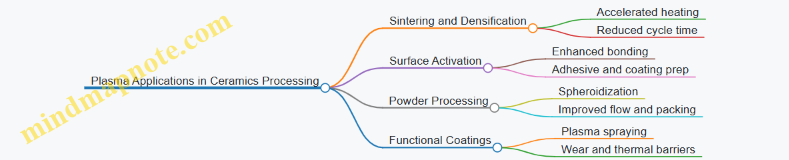
Examples and Practical Details
1. Plasma Surface Treatment of Glass for Display Panels
In manufacturing LCD or OLED displays, plasma treatment is used to increase the surface energy of glass substrates. This improves the adhesion of subsequent layers such as conductive films or organic materials. For instance, oxygen plasma cleans and activates the surface by removing organic contaminants and introducing polar functional groups. The process is quick, typically lasting seconds to minutes, and avoids mechanical abrasion.
2. Plasma Cutting of Glass Tubes
Thermal plasma torches enable cutting of thick glass tubes used in laboratory or industrial applications. The plasma arc melts a narrow region, allowing a clean break with minimal chipping. Compared to mechanical cutting, plasma cutting reduces stress-induced fractures and improves yield. Operators adjust plasma power and gas flow to match glass thickness and composition.
3. Plasma Spray Coatings on Ceramic Components
Thermal barrier coatings (TBCs) are often applied to ceramic parts used in high-temperature environments, such as turbine blades or engine components. Plasma spraying deposits a ceramic powder melted in a plasma jet onto the substrate, forming a dense, adherent coating. This enhances thermal resistance and extends component life. Control of plasma parameters ensures uniform coating thickness and microstructure.
4. Plasma Spheroidization of Ceramic Powders
Irregular ceramic powders can cause issues in pressing and sintering due to poor flow and packing. Passing powders through a plasma torch melts and reshapes particles into smooth spheres. This process improves powder handling and densification during sintering. For example, alumina powders treated this way show improved flowability and reduced defects in final parts.
5. Plasma-Assisted Sintering
Using plasma heating rather than conventional furnaces accelerates sintering of ceramics like zirconia or silicon carbide. The high energy density and rapid heating rates reduce processing times from hours to minutes. Additionally, plasma sintering can produce finer microstructures with enhanced mechanical properties. Temperature control and atmosphere composition are critical to avoid unwanted phase changes.
Best Practices in Plasma Processing for Glass and Ceramics
- Parameter Optimization: Adjust plasma power, gas composition, and flow rates to suit material properties and desired outcomes.
- Surface Preparation: Ensure substrates are clean and compatible with plasma treatment to maximize effectiveness.
- Process Monitoring: Use diagnostics such as optical emission spectroscopy to monitor plasma characteristics and maintain consistency.
- Safety Measures: Implement shielding and ventilation to manage UV radiation and gas emissions.
- Maintenance: Regularly inspect plasma torches and electrodes to prevent contamination and maintain stable operation.
By integrating plasma technologies thoughtfully into glass and ceramics processing, manufacturers can achieve improved product quality, reduced processing times, and enhanced material properties.
12.3 Plasma Applications in Environmental Remediation
Environmental remediation involves removing pollutants or contaminants from air, water, and soil to restore natural conditions. Plasma technologies offer unique advantages in this area due to their ability to generate reactive species at high temperatures and under controlled conditions. These reactive species can break down complex pollutants into simpler, less harmful compounds.
Key Plasma Processes in Environmental Remediation
- Plasma Gasification: Converts waste materials into syngas and inert slag, reducing landfill volume and producing usable energy.
- Plasma Oxidation: Uses plasma-generated radicals to oxidize volatile organic compounds (VOCs) and other hazardous gases.
- Plasma-Enhanced Catalysis: Combines plasma with catalysts to improve degradation rates of pollutants.
- Plasma Water Treatment: Applies plasma to disinfect and degrade contaminants in wastewater.
Mind Map: Plasma Processes for Environmental Remediation
Plasma Gasification for Waste Treatment
Plasma gasification uses extremely high temperatures (typically above 1500°C) to break down waste materials into syngas—a mixture of hydrogen and carbon monoxide—and a vitrified slag residue. This process differs from incineration by producing fewer harmful emissions and generating useful energy.
Example: A municipal solid waste plasma gasification facility processes mixed household waste. The plasma torch creates a high-temperature environment that decomposes organic matter and melts inorganic components into slag. The syngas produced can be cleaned and used for electricity generation or as a chemical feedstock.
Best practices include careful feedstock preparation to avoid materials that could damage the torch or generate toxic byproducts, and continuous monitoring of syngas composition to optimize downstream processing.
Plasma Oxidation of Air Pollutants
Plasma oxidation targets airborne pollutants like VOCs, nitrogen oxides (NOx), and sulfur oxides (SOx). The plasma generates reactive oxygen species (ROS) such as atomic oxygen and ozone, which react with pollutants to form less harmful compounds like CO2 and water.
Example: In a chemical manufacturing plant, plasma oxidation units treat exhaust gases containing benzene and toluene. The plasma reactor uses a dielectric barrier discharge (DBD) configuration to generate ROS at ambient temperature, avoiding thermal damage to equipment.
Key considerations include controlling residence time and plasma power to maximize pollutant destruction efficiency while minimizing ozone slip.
Plasma-Enhanced Catalysis
Combining plasma with catalysts can lower the temperature needed for pollutant degradation and improve reaction rates. The plasma activates the catalyst surface and generates reactive species that interact synergistically.
Example: Diesel engine exhaust treatment uses plasma combined with metal oxide catalysts to reduce NOx emissions. The plasma generates nitrogen and oxygen radicals that enhance the catalytic reduction process.
Best practices involve selecting catalysts resistant to plasma-induced degradation and optimizing plasma parameters to avoid catalyst overheating.
Plasma Water Treatment
Plasma can disinfect water and degrade organic contaminants without adding chemicals. Techniques include pulsed corona discharge and dielectric barrier discharge applied directly to water or to gas bubbles introduced into water.
Example: A textile factory uses plasma water treatment to break down dye molecules and kill bacteria in wastewater. The plasma generates hydroxyl radicals and UV light, both effective at degrading complex organics.
Operational best practices emphasize controlling energy input to balance treatment efficiency and operational costs, and ensuring electrode materials resist corrosion.
Mind Map: Examples and Best Practices in Plasma Environmental Remediation
In summary, plasma technologies provide versatile tools for environmental remediation by breaking down pollutants through thermal and non-thermal mechanisms. Practical application requires attention to feedstock characteristics, reactor design, and operational parameters to achieve effective and sustainable pollutant removal.
12.4 Plasma in Chemical Synthesis and Processing
Plasma technology offers unique advantages in chemical synthesis and processing by providing high-energy environments that enable reactions difficult or impossible under conventional conditions. The reactive species generated in plasma—ions, radicals, excited atoms, and electrons—drive chemical transformations with precision and efficiency.
Key Roles of Plasma in Chemical Synthesis
- Activation of stable molecules: Plasma can break strong chemical bonds, such as in nitrogen or methane, facilitating synthesis routes that require high activation energy.
- Selective reaction pathways: By controlling plasma parameters, specific reactive species can be favored, influencing product distribution.
- Low-temperature processing: Non-thermal plasmas allow chemical reactions at near-ambient temperatures, preserving sensitive compounds.
- Rapid reaction kinetics: High-energy electrons accelerate reaction rates, reducing processing times.
Mind Map: Plasma Chemical Synthesis Overview
Examples of Plasma-Driven Chemical Processes
-
Ammonia Synthesis: Traditional Haber-Bosch synthesis requires high temperature and pressure. Plasma-assisted synthesis activates nitrogen at lower temperatures by generating nitrogen radicals, enabling ammonia formation with less energy input. For example, dielectric barrier discharge (DBD) reactors have been used to produce ammonia from nitrogen and hydrogen mixtures at atmospheric pressure.
-
Methane Reforming: Plasma reforming converts methane into synthesis gas (a mixture of CO and H2) without the need for catalysts or extreme temperatures. Thermal plasma torches generate the high temperatures needed to dissociate methane molecules rapidly. This method helps in producing feedstock for chemical industries.
-
Polymerization: Plasma polymerization uses non-thermal plasma to initiate polymer formation from monomers in the gas phase. This process allows coating surfaces with thin polymer films without solvents or initiators. For example, plasma polymerization of acrylic acid produces hydrophilic coatings useful in biomedical devices.
-
Surface Functionalization: Plasma treatment introduces functional groups onto polymer surfaces, improving adhesion or biocompatibility. Oxygen or nitrogen plasmas are commonly used to graft hydroxyl, carbonyl, or amine groups onto surfaces.
Mind Map: Plasma Parameters Affecting Chemical Processing
Practical Considerations and Best Practices
-
Gas feed purity: Impurities can quench reactive species or form unwanted byproducts. Using high-purity gases improves process consistency.
-
Reactor design: Uniform plasma generation ensures even treatment or reaction. For example, planar DBD reactors provide consistent plasma over large areas.
-
Process monitoring: Optical emission spectroscopy helps track reactive species in real time, allowing parameter adjustments.
-
Energy efficiency: Matching plasma power to the reaction requirements avoids excess energy consumption.
-
Material compatibility: Reactor materials must withstand plasma exposure without degradation or contamination.
Example: Plasma-Assisted Oxidation of Volatile Organic Compounds (VOCs)
In industrial exhaust treatment, plasma reactors oxidize VOCs into CO2 and water. Non-thermal plasma generates ozone and radicals that react with VOC molecules. A packed-bed DBD reactor with a catalyst bed downstream enhances oxidation efficiency. Monitoring ozone concentration and adjusting power input optimize the process while minimizing energy use.
Mind Map: Plasma Chemical Processing Workflow
In summary, plasma technology in chemical synthesis and processing offers flexible, efficient routes to produce chemicals and modify materials. Understanding the interplay between plasma parameters and chemical reactions is essential for optimizing these processes. Practical examples demonstrate how plasma can replace or complement traditional methods, often with environmental or economic benefits.
12.5 Energy Sector Applications: Hydrogen Production and Beyond
High-temperature plasma systems have found a solid foothold in the energy sector, particularly in hydrogen production and related applications. This section explores how plasma technologies contribute to energy processes, focusing on practical examples and structured explanations.
Hydrogen Production Using Plasma
Hydrogen is a clean energy carrier, and plasma-based methods offer alternative routes to traditional production techniques like steam methane reforming or electrolysis. Plasma processes can operate at high temperatures, enabling efficient dissociation of feedstocks.
Plasma Steam Reforming: In plasma steam reforming, a plasma torch heats a mixture of steam and hydrocarbons (often methane) to break molecular bonds, producing hydrogen and carbon monoxide. The high temperature accelerates reaction kinetics and reduces the need for catalysts.
Example: A pilot plant using an arc plasma torch processes natural gas and steam, achieving hydrogen yields comparable to conventional reformers but with faster startup times and greater feedstock flexibility.
Plasma Electrolysis: Plasma electrolysis involves applying plasma to water electrolysis, enhancing reaction rates by increasing ionization and reducing overpotentials. This method can improve hydrogen production efficiency under certain conditions.
Example: Laboratory-scale plasma electrolysis setups demonstrate higher hydrogen output per unit energy compared to standard electrolysis, especially when combined with pulsed plasma discharges.
Plasma Gasification for Syngas and Hydrogen
Plasma gasification converts carbonaceous materials, including biomass and waste, into synthesis gas (syngas), a mixture of hydrogen and carbon monoxide. The process uses plasma torches to reach temperatures above 4000 K, ensuring near-complete breakdown of feedstock.
Example: An industrial plasma gasifier processes municipal solid waste, producing syngas that is subsequently cleaned and shifted to increase hydrogen content for use in fuel cells or chemical synthesis.
Plasma-Assisted Fuel Reforming
Plasma can assist in reforming liquid fuels such as methanol or ethanol into hydrogen-rich gas streams. The plasma environment promotes partial oxidation and reforming reactions without requiring high-pressure reactors.
Example: A demonstration unit uses dielectric barrier discharge plasma to reform methanol at atmospheric pressure, producing hydrogen with reduced carbon monoxide byproducts.
Beyond Hydrogen: Plasma in Energy Storage and Conversion
Plasma technologies also support energy storage and conversion processes:
- Plasma-Enhanced Catalysis: Plasma can activate catalysts for fuel conversion, improving efficiency in processes like ammonia synthesis or hydrocarbon cracking.
- Plasma Electrolysis for Chemicals: Beyond hydrogen, plasma electrolysis can produce chemicals such as ozone or hydrogen peroxide, useful in energy-related applications.
Mind Maps
Below are mind maps illustrating key concepts and relationships.
Summary
Plasma engineering offers several pathways for hydrogen production and energy-related chemical processes. The high temperatures and reactive environments created by plasma systems enable efficient feedstock conversion, often with fewer catalysts or lower pressures. Practical examples from pilot plants and laboratory setups demonstrate these technologies’ viability and operational nuances. Understanding these processes and their best practices helps in designing and operating plasma-based energy systems effectively.
12.6 Best Practices Derived from Cross-Industry Plasma Implementations
Cross-industry plasma implementations offer a wealth of practical lessons that can improve efficiency, safety, and product quality. This section summarizes best practices drawn from diverse sectors such as metallurgy, environmental remediation, chemical processing, and energy production. These practices often overlap but require adaptation to specific operational contexts.
Mind Map: Best Practices in Cross-Industry Plasma Applications
System Design
A modular approach to plasma system design simplifies maintenance and upgrades. For example, in steel manufacturing, modular electrode assemblies allow quick replacement without dismantling the entire torch, reducing downtime. Thermal management is critical; ceramic insulation combined with active cooling prevents component degradation, as seen in glass processing plasma furnaces.
Process Control
Real-time monitoring of plasma parameters such as temperature, voltage, and gas flow is essential. In chemical synthesis, feedback loops adjust gas composition dynamically to maintain reaction efficiency. For instance, a plasma reactor producing specialty chemicals uses optical emission spectroscopy data to fine-tune plasma power, ensuring consistent product quality.
Safety and Environment
Emission control systems must be tailored to the specific pollutants generated. In waste treatment plants, scrubbers and filters are integrated with plasma gasifiers to capture particulates and neutralize harmful gases. Regular hazard identification sessions involving operators and engineers help maintain awareness and prevent incidents. Training programs emphasizing safe handling of high-voltage equipment and hot surfaces are standard across industries.
Maintenance
Scheduled inspections based on operating hours and thermal cycles help detect wear before failure. Predictive maintenance using vibration analysis and thermal imaging has proven effective in plasma torch upkeep in metal cutting applications. Detailed documentation of maintenance activities supports traceability and continuous improvement.
Quality Assurance
Standard operating procedures (SOPs) ensure repeatability. For example, semiconductor plasma etching plants maintain strict SOPs for gas flow rates and chamber pressures, minimizing variability. Regular calibration of diagnostic instruments like Langmuir probes and spectrometers ensures data reliability. Comprehensive data logging enables trend analysis and rapid troubleshooting.
Knowledge Sharing
Cross-department communication fosters problem-solving. In energy sector plasma systems, operators, engineers, and environmental specialists hold regular meetings to discuss performance and safety. Incident reporting systems encourage transparency and learning from near-misses. Continuous improvement is driven by feedback loops that incorporate lessons learned into updated procedures.
Mind Map: Example of Process Control Best Practices
Example: Plasma Gasification Plant
A municipal solid waste plasma gasification plant implemented a multi-tiered control system. Temperature sensors inside the reactor feed data to a control unit that adjusts plasma torch power and gas injection rates. This system maintains syngas composition within target ranges, improving energy recovery. Scheduled maintenance and operator training reduced unplanned shutdowns by 30% over two years.
Example: Plasma Spray Coating in Aerospace
In aerospace component coating, consistent coating thickness is crucial. Operators use in-situ optical sensors to monitor the plasma jet and powder feed rate. Feedback loops adjust parameters in real time to maintain uniformity. Maintenance schedules include electrode replacement after a set number of operating hours, documented meticulously to track performance trends.
In summary, best practices in plasma engineering emphasize robust design, precise control, safety, maintenance, quality assurance, and communication. These principles apply regardless of the industry and help ensure reliable, efficient plasma system operation.