Quantum Hardware Engineering: Qubit Control and Cryogenics
1. Introduction to Quantum Hardware Engineering
1.1 Overview of Quantum Computing Hardware
Quantum computing hardware is the physical foundation upon which quantum algorithms and protocols run. Unlike classical computers that use bits as the smallest unit of information, quantum computers use qubits — quantum bits — which exploit quantum phenomena such as superposition and entanglement to perform computations that can be exponentially faster for certain problems.
Key Components of Quantum Computing Hardware
- Qubits: The fundamental units of quantum information.
- Control Electronics: Devices that generate and shape microwave pulses or other control signals to manipulate qubits.
- Cryogenic Systems: Cooling infrastructure to maintain qubits at ultra-low temperatures, minimizing decoherence.
- Readout Systems: Hardware to measure the qubit states with high fidelity.
Mind Map: Quantum Computing Hardware Components
Types of Qubits and Their Hardware Implementations
-
Superconducting Qubits:
- Made from Josephson junctions on silicon or sapphire substrates.
- Operate at millikelvin temperatures inside dilution refrigerators.
- Controlled via microwave pulses.
-
Trapped Ion Qubits:
- Individual ions trapped using electromagnetic fields in ultra-high vacuum.
- Manipulated with laser pulses.
- Operate at room temperature but require complex vacuum and laser systems.
-
Spin Qubits:
- Use electron or nuclear spins in semiconductor quantum dots.
- Controlled via microwave or radiofrequency pulses.
- Require cryogenic temperatures.
-
Topological Qubits:
- Based on exotic quasiparticles like Majorana fermions.
- Still largely experimental.
Mind Map: Qubit Types and Control
Example: Superconducting Qubit Hardware Setup
Consider a typical superconducting qubit system:
- Qubit Chip: Fabricated on a sapphire substrate with aluminum Josephson junctions.
- Cryogenic Environment: Placed inside a dilution refrigerator reaching temperatures ~10 mK.
- Control Lines: Coaxial cables deliver shaped microwave pulses to the qubit.
- Readout Resonator: Coupled to the qubit for dispersive readout.
- Room Temperature Electronics: Generate and process signals via arbitrary waveform generators (AWGs) and digitizers.
This setup enables precise qubit manipulation and measurement while minimizing thermal noise and decoherence.
Best Practices Embedded in Hardware Overview
- Thermal Isolation: Ensuring qubits remain at millikelvin temperatures to preserve coherence.
- Low-Noise Electronics: Using carefully filtered and attenuated control lines to reduce noise.
- Modular Design: Separating control, readout, and cryogenic components for easier troubleshooting and upgrades.
Mind Map: Best Practices in Quantum Hardware
Summary
Understanding the hardware landscape is critical for quantum engineers and experimental physicists. Each qubit technology demands specialized hardware and environmental conditions, and integrating these components with best practices ensures optimal performance and scalability.
This foundational overview sets the stage for deeper dives into qubit control techniques and cryogenic engineering in the following sections.
1.2 Key Challenges in Qubit Control and Cryogenics
Quantum hardware engineering is a complex field where precise qubit control and maintaining ultra-low temperatures via cryogenics are critical. This section explores the key challenges faced in these domains, providing clear examples and mind maps to visualize the interconnected difficulties.
Key Challenges Overview
-
Qubit Control Challenges
- Fidelity and coherence preservation
- Noise and error sources
- Calibration and drift
- Crosstalk and scalability
-
Cryogenics Challenges
- Achieving and maintaining millikelvin temperatures
- Thermal management and heat load
- Vibration and electromagnetic interference
- System reliability and maintenance
Mind Map: Challenges in Qubit Control and Cryogenics
Qubit Control Challenges
Fidelity and Coherence Preservation
Maintaining high qubit fidelity and coherence times is essential for reliable quantum operations. Decoherence arises from interactions with the environment and imperfect control pulses.
Example: In a superconducting transmon qubit, relaxation (T1) and dephasing (T2) times limit gate fidelity. Engineers must design control pulses that minimize leakage and timing errors.
Noise and Error Sources
Noise can originate from electromagnetic interference, thermal fluctuations, or control electronics. These degrade qubit performance.
Example: Amplifier noise in the readout chain can mask qubit states, requiring low-noise cryogenic amplifiers and careful filtering.
Calibration and Drift
Qubit parameters can drift over time due to temperature changes or material instabilities, necessitating frequent recalibration.
Example: Frequency drift in a flux-tunable qubit requires periodic recalibration of microwave pulses to maintain gate accuracy.
Crosstalk and Scalability
As qubit numbers grow, control lines can interfere with each other, causing crosstalk and errors.
Example: In a multi-qubit chip, microwave control pulses intended for one qubit can unintentionally excite neighboring qubits, requiring optimized wiring and pulse shaping.
Mind Map: Qubit Control Challenges
Cryogenics Challenges
Achieving and Maintaining Millikelvin Temperatures
Dilution refrigerators are complex systems that must reach temperatures below 20 mK. Maintaining these temperatures requires careful thermal design.
Example: Heat leaks through wiring and radiation can raise the base temperature, reducing qubit coherence. Engineers use thermal anchoring and radiation shields to mitigate this.
Thermal Management and Heat Load
Every control line and component introduces heat into the system, which must be minimized.
Example: Using attenuators and filters at different temperature stages reduces noise but adds heat load, requiring a balance.
Vibration and Electromagnetic Interference
Mechanical vibrations and EMI can induce noise in qubits and control electronics.
Example: Vibrations from the pulse tube cooler can cause microphonic noise. Isolation platforms and careful cable routing help reduce this.
System Reliability and Maintenance
Cryogenic systems require regular maintenance, and unexpected downtime can delay experiments.
Example: Cryogen refills and system warm-ups must be planned carefully to avoid qubit damage and data loss.
Mind Map: Cryogenics Challenges
Integrated Example: Managing Heat Load in Qubit Control Lines
A common challenge is balancing the need for low-noise, high-fidelity control signals with the heat load introduced by wiring into the cryostat.
- Problem: Each coaxial cable brings thermal energy from room temperature to the millikelvin stage.
- Solution: Use attenuators at various temperature stages (e.g., 4 K, 100 mK) to thermalize the line and reduce noise.
- Best Practice: Implement thermal anchoring points and use low-thermal-conductivity materials for wiring.
This example illustrates how qubit control and cryogenics challenges are intertwined and must be addressed holistically.
Summary
Understanding and overcoming the challenges in qubit control and cryogenics is fundamental for advancing quantum hardware engineering. By visualizing these challenges through mind maps and grounding them in practical examples, engineers and technicians can develop robust strategies to optimize system performance.
1.3 Importance of Integrated Best Practices
In the realm of quantum hardware engineering, particularly in qubit control and cryogenics, isolated optimization of individual components is insufficient for achieving high-performance quantum systems. Integrated best practices—where qubit control techniques and cryogenic infrastructure are designed and operated in harmony—are essential to maximize qubit coherence, gate fidelity, and system stability.
Why Integration Matters
-
System Coherence: Qubit coherence times are highly sensitive to environmental factors such as temperature fluctuations, electromagnetic interference, and mechanical vibrations. Without integrated approaches, improvements in qubit control can be negated by poor cryogenic design.
-
Noise Reduction: Control electronics and wiring can introduce noise and heat loads that degrade qubit performance. Integrated best practices ensure that control signals are delivered with minimal thermal and electrical noise.
-
Scalability: As quantum processors scale to hundreds or thousands of qubits, integrated design principles become critical to manage complexity, maintain performance, and reduce cross-talk.
-
Reliability and Maintenance: Integrated systems simplify troubleshooting and maintenance by ensuring that hardware components and control protocols are compatible and optimized together.
Mind Map: Integrated Best Practices in Quantum Hardware Engineering
Example 1: Coordinated Thermal Management
Scenario: A superconducting qubit system experiences reduced coherence times due to thermal noise introduced by insufficiently thermalized control lines.
Integrated Best Practice: By combining cryogenic expertise with qubit control design, engineers implement a multi-stage thermalization scheme for coaxial cables, including attenuators and filters anchored at different temperature stages inside the dilution refrigerator. This reduces thermal photons reaching the qubit and improves coherence times significantly.
Mind Map: Thermal Management Integration
Example 2: Electromagnetic Interference (EMI) Mitigation
Scenario: Qubit gate fidelities are degraded by EMI from nearby lab equipment and control electronics.
Integrated Best Practice: The engineering team designs a multi-layer shielding approach combining superconducting and mu-metal shields around the qubit chip, while simultaneously optimizing control electronics layout to minimize emitted EMI. Additionally, low-pass and band-pass filters are integrated into the wiring to suppress unwanted frequency components.
Mind Map: EMI Mitigation Strategies
Example 3: Synchronization of Control Pulses with Cryogenic Readout
Scenario: Timing jitter between control pulses and readout signals causes errors in qubit measurement.
Integrated Best Practice: The team implements FPGA-based real-time synchronization modules that coordinate microwave pulse generation with cryogenic readout electronics. This integration ensures precise timing alignment, reducing readout errors and improving overall system fidelity.
Mind Map: Synchronization and Feedback
Summary
Integrated best practices in quantum hardware engineering are not just beneficial—they are indispensable. By holistically addressing qubit control, cryogenics, electronics, and system-level integration, engineers can unlock the full potential of quantum processors. The examples and mind maps above illustrate how these practices translate into tangible improvements in coherence, fidelity, and scalability.
Embracing integration early in the design and operational phases sets a strong foundation for advancing quantum technology.
1.4 Example: Building a Simple Superconducting Qubit Setup
In this section, we will walk through the process of building a simple superconducting qubit setup. This example will integrate fundamental concepts of qubit control and cryogenics, illustrating best practices with clear, easy-to-understand examples.
Overview
Superconducting qubits, such as the transmon, are among the most widely used qubit types in quantum computing. Building a simple setup involves:
- Fabricating or acquiring a superconducting qubit chip
- Mounting the chip inside a dilution refrigerator
- Wiring the chip to control and readout electronics
- Calibrating and controlling the qubit with microwave pulses
Mind Map: Components of a Simple Superconducting Qubit Setup
Step 1: Preparing the Qubit Chip
- Example: Use a transmon qubit fabricated with aluminum on sapphire substrate.
- Best Practice: Ensure the chip surface is clean and free from contaminants to minimize dielectric loss.
- Tip: Store the chip in a nitrogen-purged container before installation to avoid moisture absorption.
Step 2: Mounting the Chip in the Cryostat
- Secure the chip on a gold-plated copper sample holder for good thermal conductivity.
- Connect the chip to the microwave input/output lines using wirebonds.
Mind Map: Mounting and Thermalization
- Best Practice: Use multiple wirebonds to reduce parasitic inductance and improve signal integrity.
- Example: Attach the sample holder to the mixing chamber plate of the dilution refrigerator to reach ~10 mK.
Step 3: Wiring and Filtering
- Connect coaxial cables from room temperature electronics to the qubit chip.
- Include attenuators at various temperature stages (e.g., 300 K, 4 K, 100 mK) to reduce thermal noise.
- Add low-pass and Eccosorb filters to suppress high-frequency noise.
Mind Map: Wiring and Filtering Strategy
- Best Practice: Thermalize attenuators and filters properly to avoid heating the qubit.
- Example: Use stainless steel coax cables for thermal isolation between stages.
Step 4: Control and Readout Electronics Setup
- Use an Arbitrary Waveform Generator (AWG) to create shaped microwave pulses for qubit control.
- Employ a Vector Network Analyzer or a microwave source with IQ mixers for pulse modulation.
- For readout, use a Josephson Parametric Amplifier (JPA) to boost the signal before amplification by a HEMT amplifier.
Example: Generate a 5 GHz microwave pulse with a Gaussian envelope to perform a qubit X-gate.
Best Practice: Calibrate pulse amplitude and duration carefully to achieve high-fidelity gates.
Step 5: Initial Calibration and Testing
- Perform a Rabi oscillation experiment to calibrate the pulse amplitude.
- Measure T1 (energy relaxation time) and T2 (decoherence time) to assess qubit quality.
Example: Sweep pulse duration from 0 to 200 ns and record qubit excited state probability to observe oscillations.
Mind Map: Calibration Workflow
- Best Practice: Use automated scripts to reduce human error and improve repeatability.
Summary
This example illustrates the foundational steps to build a simple superconducting qubit setup, integrating qubit fabrication, cryogenic mounting, wiring, control electronics, and calibration. By following these best practices and examples, engineers and technicians can establish a reliable platform for further quantum experiments and development.
Additional Resources
- Intro to Superconducting Qubits
- Dilution Refrigerator Operation Manual
- Qubit Control Pulse Shaping Tutorial
2. Fundamentals of Qubit Control
2.1 Types of Qubits and Their Control Mechanisms
Quantum bits, or qubits, are the fundamental units of quantum information. Different physical systems can realize qubits, each with unique control mechanisms tailored to their underlying physics. Understanding these types and their control methods is essential for quantum hardware engineers to optimize performance and fidelity.
Common Types of Qubits
- Superconducting Qubits
- Trapped Ion Qubits
- Spin Qubits
- Photonic Qubits
- Topological Qubits
Mind Map: Overview of Qubit Types and Control Mechanisms
Superconducting Qubits
Description: These qubits use superconducting circuits with Josephson junctions to create anharmonic energy levels, where the two lowest levels form the qubit.
Control Mechanisms:
- Microwave pulses at GHz frequencies to drive transitions between qubit states.
- Flux bias lines to tune qubit frequency dynamically.
Example:
- Transmon Qubit Control: Applying shaped microwave pulses through a control line to induce Rabi oscillations, enabling single-qubit rotations.
Best Practice: Use Gaussian or DRAG (Derivative Removal by Adiabatic Gate) pulse shaping to minimize leakage to higher energy levels.
Mind Map: Superconducting Qubit Control
Trapped Ion Qubits
Description: Individual ions trapped in electromagnetic fields, where qubit states are encoded in electronic or hyperfine levels.
Control Mechanisms:
- Laser pulses precisely tuned to qubit transitions.
- Raman transitions for two-photon control.
Example:
- Hyperfine Qubit Control: Using a focused laser beam to drive Rabi oscillations between hyperfine states, enabling high-fidelity single-qubit gates.
Best Practice: Employ pulse sequences that minimize off-resonant excitation and use sideband cooling to reduce motional noise.
Mind Map: Trapped Ion Qubit Control
Spin Qubits
Description: Qubits encoded in the spin states of electrons or nuclei, often confined in semiconductor quantum dots.
Control Mechanisms:
- Electron Spin Resonance (ESR) using microwave magnetic fields.
- Electric Dipole Spin Resonance (EDSR) using electric fields coupled via spin-orbit interaction.
Example:
- Silicon Quantum Dot Spin Qubit: Applying microwave pulses through an on-chip antenna to flip electron spin states.
Best Practice: Use isotopically purified silicon to reduce nuclear spin noise and implement dynamical decoupling sequences to prolong coherence.
Mind Map: Spin Qubit Control
Photonic Qubits
Description: Qubits encoded in properties of photons such as polarization, path, or time-bin.
Control Mechanisms:
- Optical elements like beam splitters, waveplates, and phase modulators.
- Fast electro-optic modulators for dynamic control.
Example:
- Polarization Qubit Control: Using a combination of half-wave and quarter-wave plates to prepare and manipulate polarization states.
Best Practice: Maintain low-loss optical paths and stabilize interferometers to preserve coherence.
Mind Map: Photonic Qubit Control
Topological Qubits
Description: Qubits based on non-Abelian anyons, such as Majorana fermions, which are inherently protected from local noise.
Control Mechanisms:
- Braiding operations that exchange anyons to perform quantum gates.
Example:
- Majorana Qubit Control: Manipulating nanowire junctions to braid Majorana zero modes, implementing fault-tolerant gates.
Best Practice: Ensure precise control of nanowire electrostatic gates and maintain ultra-low temperatures for topological protection.
Summary Table: Qubit Types and Control Mechanisms
| Qubit Type | Physical System | Control Mechanism | Example Control Technique |
|---|---|---|---|
| Superconducting | Josephson Junction Circuits | Microwave Pulses, Flux Bias | DRAG Pulses on Transmon Qubits |
| Trapped Ion | Trapped Atomic Ions | Laser Pulses, Raman Transitions | Sideband Cooling + Laser Pulses |
| Spin | Electron/Nuclear Spins | ESR, EDSR | Microwave Pulses on Silicon QDs |
| Photonic | Photons | Optical Elements, Modulators | Waveplates for Polarization Control |
| Topological | Anyons (Majorana Fermions) | Braiding Operations | Nanowire Gate Control |
Integrated Example: Controlling a Transmon Superconducting Qubit
Consider a transmon qubit embedded in a 3D microwave cavity. To perform a single-qubit X-rotation:
- Generate a Gaussian-shaped microwave pulse at the qubit’s resonant frequency (~5 GHz).
- Apply the pulse through the control line connected to the qubit chip inside the dilution refrigerator.
- Use DRAG pulse shaping to reduce leakage to the second excited state.
- Measure the qubit state via dispersive readout through a coupled resonator.
This example highlights how understanding the qubit type and control mechanism guides the engineering of pulse sequences and hardware setup.
By mastering the variety of qubit types and their tailored control mechanisms, quantum hardware engineers can design optimized systems that balance coherence, fidelity, and scalability.
2.2 Pulse Shaping and Microwave Control Techniques
Pulse shaping and microwave control are fundamental to manipulating qubits with high fidelity and precision. Properly designed pulses enable accurate quantum gate operations, minimize errors, and reduce decoherence effects. This section explores key concepts, techniques, and practical examples to help quantum engineers and experimental physicists master pulse control.
What is Pulse Shaping?
Pulse shaping refers to the design and modulation of the amplitude, phase, and frequency of microwave pulses used to control qubits. Instead of simple square pulses, shaped pulses can reduce spectral leakage, minimize crosstalk, and suppress unwanted transitions.
Why is Pulse Shaping Important?
- Reduce Leakage: Avoid driving transitions outside the computational basis.
- Minimize Crosstalk: Prevent affecting neighboring qubits.
- Improve Gate Fidelity: Achieve precise rotations and reduce errors.
- Mitigate Noise: Tailor pulses to be robust against noise sources.
Common Pulse Shapes
Microwave Control Techniques
- Amplitude Modulation (AM): Varying pulse amplitude to control rotation angle.
- Phase Modulation (PM): Adjusting pulse phase to control rotation axis.
- Frequency Modulation (FM): Shifting pulse frequency to address detuning or implement adiabatic gates.
- IQ Modulation: Combining in-phase (I) and quadrature (Q) components to generate arbitrary pulse shapes and phases.
Example: Implementing a Gaussian Pulse for a π Rotation
Goal: Perform a π rotation (X gate) on a transmon qubit using a Gaussian-shaped microwave pulse.
Steps:
-
Define the Gaussian envelope: \[ A(t) = A_0 \exp\left(-\frac{(t - t_0)^2}{2\sigma^2}\right) \] where \( A_0 \) is peak amplitude, \( t_0 \) is pulse center, and \( \sigma \) controls pulse width.
-
Choose \( \sigma \) to balance time and frequency domain constraints (e.g., \( \sigma = 10,\mathrm{ns} \)).
-
Set pulse duration to \( 4\sigma \) to capture most of the pulse energy.
-
Use IQ modulation to generate the pulse at the qubit’s resonance frequency.
-
Calibrate \( A_0 \) experimentally to achieve the desired π rotation (e.g., via Rabi oscillation measurement).
Benefits: Smooth edges reduce spectral leakage and minimize excitation of higher energy levels.
Example: Using DRAG Pulses to Reduce Leakage
Context: Transmon qubits have weak anharmonicity, causing leakage to non-computational states during fast pulses.
DRAG Technique: Adds a derivative component to the pulse envelope to cancel unwanted transitions.
Pulse form:
\[ I(t) = A(t) \quad ; \quad Q(t) = -\alpha \frac{dA(t)}{dt} \]
where \( I(t) \) and \( Q(t) \) are the in-phase and quadrature components, \( A(t) \) is the Gaussian envelope, and \( \alpha \) is a tunable parameter.
Implementation Steps:
- Generate Gaussian pulse \( A(t) \).
- Compute its time derivative \( dA(t)/dt \).
- Scale derivative by \( \alpha \) (typically optimized experimentally).
- Apply \( I(t) \) and \( Q(t) \) to IQ mixer.
Outcome: Significantly reduces leakage errors and improves gate fidelity.
Best Practices for Pulse Shaping and Microwave Control
Summary
Pulse shaping and microwave control techniques are essential for precise qubit manipulation. By employing Gaussian, DRAG, and other shaped pulses combined with IQ modulation, quantum engineers can achieve high-fidelity gates while minimizing errors. Regular calibration, noise mitigation, and hardware optimization complement these techniques to build robust quantum control systems.
2.3 Calibration Protocols for High-Fidelity Gates
Achieving high-fidelity quantum gates is essential for reliable quantum computation. Calibration protocols are systematic procedures used to fine-tune control parameters, minimize errors, and optimize gate performance. This section covers key calibration techniques, best practices, and practical examples to help quantum engineers and experimental physicists enhance gate fidelity.
Why Calibration Matters
- Quantum gates are sensitive to control imperfections, noise, and drift.
- Proper calibration reduces systematic errors such as over-rotation, phase errors, and leakage.
- High-fidelity gates are critical for error correction and scalable quantum computing.
Overview of Calibration Protocols
Single-Qubit Gate Calibration
a) Rabi Oscillation Calibration
- Purpose: Determine the correct pulse amplitude and duration for a π rotation.
- Procedure:
- Apply a microwave pulse with varying amplitude or duration.
- Measure qubit excited state population after each pulse.
- Identify the pulse parameters that maximize population inversion.
Example:
- Sweep pulse duration from 0 to 100 ns in 2 ns steps.
- Plot excited state probability vs. pulse duration.
- The first peak corresponds to a π pulse.
b) Ramsey Interference Calibration
- Purpose: Calibrate qubit frequency and correct detuning errors.
- Procedure:
- Apply two π/2 pulses separated by varying delay times.
- Measure qubit state to observe oscillations.
- Extract qubit frequency and dephasing time from oscillation.
Example:
- Delay times swept from 0 to 5 µs.
- Fit oscillation frequency to adjust drive frequency.
c) DRAG (Derivative Removal by Adiabatic Gate) Calibration
- Purpose: Reduce leakage to higher energy states and phase errors.
- Procedure:
- Add derivative-shaped quadrature pulses.
- Optimize DRAG coefficient by minimizing leakage and phase errors.
Example:
- Sweep DRAG parameter from 0 to 1.
- Measure leakage via population in non-computational states.
Two-Qubit Gate Calibration
a) Cross-Resonance (CR) Gate Calibration
- Purpose: Tune microwave drive on control qubit to enact controlled rotation on target qubit.
- Procedure:
- Adjust amplitude and phase of CR drive.
- Measure target qubit response.
- Optimize parameters to maximize gate fidelity and minimize crosstalk.
Example:
- Sweep CR pulse amplitude and phase.
- Use quantum process tomography to evaluate gate performance.
b) Controlled-Z (CZ) Gate Tuning
- Purpose: Adjust flux pulses or interaction times to implement CZ gates.
- Procedure:
- Vary pulse amplitude and duration.
- Measure conditional phase accumulation.
- Optimize to achieve desired CZ phase (π).
Example:
- Flux pulse amplitude swept around nominal value.
- Use Ramsey-type experiments to extract conditional phase.
Error Mitigation and Validation
a) Randomized Benchmarking (RB)
- Purpose: Quantify average gate fidelity independent of state preparation and measurement errors.
- Procedure:
- Apply random sequences of Clifford gates of varying length.
- Measure decay of fidelity with sequence length.
- Extract average error per gate.
Example:
- Sequence lengths from 1 to 100 gates.
- Fit exponential decay to extract error rates.
b) Gate Set Tomography (GST)
- Purpose: Fully characterize gate operations including systematic errors.
- Procedure:
- Perform a comprehensive set of experiments with different gate sequences.
- Use maximum likelihood estimation to reconstruct gate operations.
Example:
- Implement GST on single-qubit gates.
- Identify coherent errors and optimize accordingly.
Automation and Feedback
- Closed-loop calibration systems can iteratively optimize parameters using measurement feedback.
- Machine learning algorithms can accelerate calibration by predicting optimal parameters.
Example:
- Use Bayesian optimization to tune pulse amplitude for Rabi oscillations.
Summary Checklist for Calibration Protocols
- Perform Rabi oscillation sweeps to calibrate π pulses.
- Use Ramsey experiments to correct qubit frequency detuning.
- Optimize DRAG parameters to reduce leakage.
- Tune two-qubit gates via amplitude, phase, and timing sweeps.
- Validate gate fidelity with randomized benchmarking.
- Employ gate set tomography for detailed error characterization.
- Implement automation and feedback loops for efficient calibration.
By following these calibration protocols with the integrated examples and mind maps, quantum hardware engineers can systematically improve gate fidelities, paving the way for robust quantum computations.
2.4 Example: Implementing Rabi Oscillations on a Transmon Qubit
Introduction
Rabi oscillations are a fundamental demonstration of coherent control over a qubit. For a transmon qubit, which is a superconducting qubit variant, implementing Rabi oscillations involves applying microwave pulses resonant with the qubit transition frequency and measuring the qubit state population as a function of pulse duration or amplitude.
Step-by-Step Implementation
-
Setup the Transmon Qubit System
- Ensure the qubit is cooled down to millikelvin temperatures using a dilution refrigerator.
- Connect the microwave control line to the qubit input port.
- Connect the readout resonator output to the measurement chain.
-
Calibrate Qubit Frequency
- Perform spectroscopy to find the qubit transition frequency \(f_{01}\).
- Use a frequency sweep with low-power microwave pulses and measure the qubit response.
-
Generate Microwave Pulses
- Use an arbitrary waveform generator (AWG) or microwave source to create pulses at \(f_{01}\).
- Shape pulses (e.g., Gaussian or DRAG) to minimize leakage and errors.
-
Vary Pulse Duration or Amplitude
- Sweep the pulse duration \(t_p\) or amplitude \(A_p\) to observe oscillations in the qubit excited state population.
-
Measure Qubit State
- Use dispersive readout via the coupled resonator.
- Collect measurement data for each pulse parameter.
-
Plot and Analyze Data
- Plot excited state probability vs. pulse duration/amplitude.
- Fit data to a sinusoidal function to extract Rabi frequency and coherence properties.
Mind Map: Overview of Rabi Oscillation Implementation
Example: Python Pseudocode for Rabi Experiment Control
import numpy as np
import matplotlib.pyplot as plt

# Parameters
qubit_freq = 5.0e9  # 5 GHz
pulse_durations = np.linspace(0, 200e-9, 50)  # 0 to 200 ns

# Simulated Rabi frequency (rad/s)
rabi_freq = 2 * np.pi * 10e6  # 10 MHz

# Simulated excited state probability function
def excited_state_prob(t):
    return np.sin(rabi_freq * t / 2)**2

# Generate data
probabilities = excited_state_prob(pulse_durations)

# Plot
plt.plot(pulse_durations * 1e9, probabilities, 'o-')
plt.xlabel('Pulse Duration (ns)')
plt.ylabel('Excited State Probability')
plt.title('Simulated Rabi Oscillations on a Transmon Qubit')
plt.grid(True)
plt.show()
Best Practices
- Pulse Shaping: Use DRAG pulses to reduce leakage to higher energy levels.
- Calibration: Regularly recalibrate qubit frequency and pulse amplitude to maintain fidelity.
- Noise Mitigation: Use cryogenic attenuators and filters to reduce thermal noise on control lines.
- Data Averaging: Perform multiple repetitions per pulse setting to improve signal-to-noise ratio.
Mind Map: Best Practices for Rabi Oscillations
Troubleshooting Tips
- No Oscillations Observed: Check qubit frequency calibration and pulse delivery.
- Damped Oscillations: Investigate decoherence sources, improve shielding and filtering.
- Asymmetric Oscillations: Verify pulse shape and amplitude linearity.
Summary
Implementing Rabi oscillations on a transmon qubit is a foundational experiment demonstrating coherent control. By carefully calibrating the system, shaping pulses, and analyzing the oscillations, engineers and physicists can characterize qubit performance and optimize control parameters for advanced quantum operations.
2.5 Noise Sources and Mitigation Strategies in Qubit Control
Qubit control is highly sensitive to various noise sources that can degrade gate fidelity, reduce coherence times, and ultimately limit the performance of quantum processors. Understanding these noise sources and implementing effective mitigation strategies is crucial for reliable quantum hardware operation.
Common Noise Sources in Qubit Control
Detailed Explanation of Noise Sources
Environmental Noise
- Magnetic Field Fluctuations: External magnetic fields can couple to qubits, especially flux qubits or spin qubits, causing decoherence.
- Temperature Variations: Even small temperature drifts can affect qubit parameters and the performance of cryogenic electronics.
- Vibrations: Mechanical vibrations can induce microphonic noise in wiring and components.
Electronic Noise
- Thermal Noise: Generated by resistive elements in control electronics, this noise is white and proportional to temperature.
- 1/f Noise: Dominates at low frequencies and can cause slow drifts in qubit parameters.
- Shot Noise: Arises from discrete charge carriers in current flow, relevant in certain measurement setups.
Control Signal Imperfections
- Pulse Distortions: Imperfect waveform generation or transmission can cause amplitude and phase errors.
- Crosstalk: Unwanted coupling between control lines leads to unintended qubit rotations.
- Timing Jitter: Variations in pulse timing reduce gate accuracy.
Material and Device Noise
- Two-Level Systems (TLS): Defects in materials cause fluctuating fields that interact with qubits.
- Charge Noise: Fluctuations in nearby charge traps affect qubit energy levels.
- Flux Noise: Random flux variations in superconducting loops degrade coherence.
Mitigation Strategies
Example 1: Mitigating Magnetic Noise with Shielding
In a superconducting qubit experiment, external magnetic fields cause flux noise that reduces coherence times. By enclosing the cryostat in multiple layers of mu-metal and Cryoperm shields, the magnetic field fluctuations can be reduced by several orders of magnitude.
Implementation:
- Use a three-layer magnetic shield setup.
- Place the qubit chip at the center of the shield.
- Regularly demagnetize (degauss) the shields to maintain effectiveness.
Result:
- Measured T2 coherence times improved by 30-50%.
Example 2: Reducing Pulse Distortions via Pre-Distortion
Pulse distortions arise due to frequency-dependent attenuation and reflections in cables and components.
Mitigation Approach:
- Characterize the transfer function of the control line using a vector network analyzer (VNA).
- Apply an inverse filter (pre-distortion) to the control pulses in the arbitrary waveform generator (AWG).
Example:
- Before pre-distortion, Rabi oscillations show amplitude damping and phase errors.
- After pre-distortion, oscillations become more sinusoidal and gate fidelities increase.
Example 3: Crosstalk Calibration in Multi-Qubit Systems
In a system with closely spaced qubits, microwave control lines can unintentionally affect neighboring qubits.
Mitigation Steps:
- Measure crosstalk matrix by applying pulses on one qubit and measuring response on others.
- Use software compensation to subtract crosstalk effects.
- Physically redesign wiring to increase isolation.
Outcome:
- Reduced unwanted rotations on idle qubits.
- Improved multi-qubit gate fidelities.
Example 4: Dynamical Decoupling to Combat Low-Frequency Noise
Low-frequency noise such as 1/f noise causes slow dephasing.
Technique:
- Apply sequences of π-pulses (e.g., CPMG, XY sequences) to refocus qubit phase.
Result:
- Extension of T2 times by factors of 2-10 depending on noise spectrum.
Summary Mind Map
By systematically identifying noise sources and applying layered mitigation strategies, quantum engineers can significantly enhance qubit control fidelity and system stability, paving the way for scalable quantum computing.
3. Cryogenic Systems for Quantum Hardware
3.1 Principles of Cryogenics in Quantum Computing
Cryogenics plays a foundational role in quantum computing hardware by enabling the ultra-low temperature environments necessary for qubit operation, especially for superconducting and spin qubits. This section explores the fundamental principles behind cryogenics in quantum computing, illustrating key concepts with mind maps and practical examples.
What is Cryogenics?
Cryogenics is the study and application of materials and systems at temperatures typically below 120 K (−153 °C). In quantum computing, cryogenics is essential to reduce thermal noise, preserve qubit coherence, and enable superconductivity.
Why Cryogenics is Critical for Quantum Computing
- Thermal Noise Suppression: Qubits are extremely sensitive to thermal excitations. Cooling to millikelvin temperatures reduces thermal population of excited states.
- Superconductivity: Many qubit types (e.g., transmons) rely on superconducting circuits, which require temperatures below critical temperatures (often < 1 K).
- Material Properties: Low temperatures improve material quality factors and reduce dielectric losses.
Mind Map: Core Principles of Cryogenics in Quantum Computing
Temperature Regimes and Their Roles
| Temperature Range | Role in Quantum Computing Hardware | Example Application |
|---|---|---|
| 4.2 K (Liquid Helium) | Initial cooling stage; superconductivity onset for some materials | Cooling superconducting magnets |
| 1 K - 100 mK | Intermediate stage; reduces thermal noise significantly | Cooling wiring and filters |
| 10 mK - 20 mK (Dilution Refrigerator base) | Operating temperature for most superconducting qubits | Transmon qubit operation |
Example: Cooling a Superconducting Qubit Chip
A typical superconducting qubit chip is mounted on the mixing chamber plate of a dilution refrigerator, reaching temperatures near 10 mK. This ultra-low temperature environment ensures the aluminum Josephson junctions remain superconducting and thermal excitations are minimized, enabling coherent qubit operation.
Cooling Techniques Overview
- Dilution Refrigerators: Use a mixture of helium-3 and helium-4 isotopes to reach millikelvin temperatures.
- Pulse Tube Coolers: Provide initial cooling stages without liquid cryogens, reducing operational complexity.
Mind Map: Dilution Refrigerator Components
Thermal Management Principles
- Heat Load Minimization: Every wire or component introduces heat; use low thermal conductivity materials and thermal anchoring.
- Thermal Anchoring: Intermediate temperature stages anchor wiring to reduce heat flow to the mixing chamber.
Example: Thermal Anchoring of Control Lines
Control lines carrying microwave signals are anchored at multiple stages (4 K, still, cold plate) using copper clamps to dissipate heat progressively, preventing excessive thermal load on the mixing chamber.
Challenges in Cryogenics for Quantum Hardware
- Vibrations: Mechanical vibrations from cryocoolers can induce qubit decoherence.
- Electromagnetic Interference: Shielding and filtering are necessary to protect qubits.
- Heat Leaks: Imperfect insulation or wiring can introduce unwanted heat.
Summary
Cryogenics enables the ultra-low temperature environments essential for quantum hardware operation. Understanding the principles of temperature regimes, cooling techniques, and thermal management is critical for designing and maintaining quantum computing systems.
Additional Example: Simple Mind Map for Beginners
This beginner-friendly mind map helps newcomers grasp the essential concepts quickly.
By integrating these principles and examples, quantum engineers and technicians can better design, operate, and troubleshoot cryogenic systems critical for qubit performance.
3.2 Dilution Refrigerators: Design and Operation
Dilution refrigerators (DRs) are the cornerstone of cryogenic systems used in quantum hardware engineering, enabling temperatures in the millikelvin range essential for maintaining qubit coherence. Understanding their design and operation is critical for experimental physicists and hardware technicians working with superconducting qubits or other quantum devices.
Overview of Dilution Refrigerators
A dilution refrigerator exploits the properties of a mixture of two helium isotopes: helium-3 (³He) and helium-4 (⁴He). By continuously circulating and mixing these isotopes, it achieves cooling through the enthalpy of mixing at temperatures down to ~10 mK.
Key Components of a Dilution Refrigerator
Dilution Refrigerator Mind Map
Operating Principles
- ³He Circulation: ³He atoms evaporate from the still and are pumped externally.
- Condensation: ³He gas is cooled and liquefied in the condenser.
- Mixing: Liquid ³He is injected into the mixing chamber where it mixes with ⁴He.
- Cooling: The enthalpy of mixing absorbs heat, cooling the mixing chamber.
- Return Flow: The ³He-rich phase returns to the still, completing the cycle.
Example: Setting Up a Dilution Refrigerator for a Qubit Experiment
- Step 1: Mount the qubit chip on the mixing chamber stage using a gold-plated copper sample holder for optimal thermal contact.
- Step 2: Connect wiring through thermalization stages at 50 K, 4 K, and still to minimize heat load.
- Step 3: Pump down the vacuum can to high vacuum (~10^-6 mbar) to reduce convective heat transfer.
- Step 4: Start the ³He circulation pumps and monitor temperatures at each stage.
- Step 5: Wait for the mixing chamber to reach base temperature (~10 mK) before beginning qubit measurements.
Best Practices in Design and Operation
Best Practices Mind Map
Common Challenges and Troubleshooting
- Long Cooldown Times: Often caused by insufficient pumping speed or leaks.
- Temperature Instabilities: May arise from poor thermal anchoring or vibrations.
- High Base Temperature: Could indicate contamination in gas lines or thermal shorts.
Example: If the mixing chamber temperature stalls above expected base temperature, check for:
- Blocked or improperly thermalized wiring introducing heat.
- Leaks in the vacuum can allowing residual gas conduction.
- Pump malfunctions reducing ³He circulation.
Summary
Dilution refrigerators are complex but indispensable tools in quantum hardware engineering. Mastery of their design and operation ensures stable, ultra-low temperature environments necessary for high-fidelity qubit control. Integrating best practices and thorough understanding of each component leads to improved experimental outcomes and system longevity.
3.3 Thermal Anchoring and Heat Load Management
Thermal anchoring and heat load management are critical aspects of maintaining the ultra-low temperatures required for quantum hardware operation, especially within dilution refrigerators. Proper thermal anchoring ensures that heat generated by control lines, wiring, and components is efficiently dissipated at intermediate temperature stages, preventing unwanted heating of the qubit environment.
What is Thermal Anchoring?
Thermal anchoring refers to the practice of physically and thermally connecting components such as cables and electronic elements to intermediate temperature stages inside a cryostat. This connection allows heat to be absorbed and removed before it reaches the coldest stage (typically the mixing chamber at ~10 mK).
Why is Heat Load Management Important?
- Excess heat can raise the temperature of the qubit chip, degrading coherence times and gate fidelities.
- Heat loads come from conduction through wiring, radiation, and dissipated power in active components.
- Managing heat load extends the hold time and stability of the cryogenic system.
Key Principles of Thermal Anchoring and Heat Load Management
- Multi-stage Anchoring: Attach wiring and components at each temperature stage (e.g., 50 K, 4 K, still, cold plate) to intercept heat progressively.
- Material Selection: Use materials with low thermal conductivity for wiring between stages (e.g., stainless steel, phosphor bronze) and high conductivity materials for thermal anchors (e.g., copper).
- Thermalization Techniques: Employ thermal braids, clamps, and epoxy to ensure good thermal contact.
- Minimize Heat Conduction: Use thin, low cross-sectional area wires and attenuators to reduce heat conduction.
Mind Map: Thermal Anchoring Overview
Mind Map: Heat Load Sources and Mitigation
Practical Example: Thermal Anchoring of RF Control Lines
Scenario: You have coaxial cables running from room temperature electronics to the qubit chip at the mixing chamber stage.
Best Practice Steps:
- Cable Material: Use stainless steel or NbTi coax cables with low thermal conductivity.
- Anchoring Points: Secure cables at 50 K, 4 K, still, and cold plate stages using copper clamps.
- Thermalization: Wrap cables around copper bobbins or use copper braid thermal anchors to maximize surface contact.
- Attenuators: Install cryogenic attenuators at 4 K and cold plate stages to reduce noise and dissipate heat locally.
- Verification: Measure temperature at each stage and monitor heat load to ensure proper thermalization.
Outcome: This staged anchoring and heat dissipation prevent heat from traveling down the cables to the qubit, preserving coherence.
Example Diagram: Thermal Anchoring of a Control Line
Room Temp
|
Tips and Best Practices
- Ensure Good Thermal Contact: Use indium foil or thermal grease between clamps and cables to improve thermal conductivity.
- Avoid Mechanical Stress: Secure cables without over-tightening to prevent damage.
- Monitor Heat Loads: Use thermometers at each stage to detect unexpected heating.
- Minimize Number of Wires: Use multiplexing or shared lines where possible to reduce heat conduction.
Summary
Thermal anchoring and heat load management are indispensable for maintaining the delicate cryogenic environment needed for quantum hardware. By carefully selecting materials, anchoring wiring at multiple temperature stages, and incorporating attenuators and thermalization techniques, engineers can significantly reduce heat influx to the qubit stage, thereby improving qubit performance and system stability.
3.4 Example: Setting Up a Cryogenic Environment for a Qubit Chip
Setting up a cryogenic environment for a qubit chip is a critical step in quantum hardware engineering. It ensures that the qubit operates at ultra-low temperatures, typically in the millikelvin range, minimizing thermal noise and decoherence. This section provides a detailed walkthrough, including best practices and illustrative mind maps to guide engineers and technicians.
Step 1: Selecting the Cryostat
- Dilution Refrigerator (DR) is the most common choice for superconducting qubits.
- Key specifications to consider:
- Base temperature (typically < 20 mK)
- Cooling power at base temperature
- Number of available wiring ports
- Vibration isolation features
Mind Map: Cryostat Selection
Step 2: Preparing the Qubit Chip and Sample Holder
- Use a sample holder made of oxygen-free high conductivity (OFHC) copper for excellent thermal conductivity.
- Mount the qubit chip securely using indium or silver epoxy to ensure good thermal contact.
- Wirebond the chip to the sample holder pads carefully to avoid mechanical stress.
Mind Map: Sample Holder Preparation
Step 3: Wiring and Thermalization
- Use low-thermal-conductivity coaxial cables (e.g., stainless steel or NbTi) to reduce heat load.
- Include attenuators at various temperature stages (e.g., 4 K, 100 mK) to thermalize and reduce noise.
- Use low-pass and Eccosorb filters to suppress high-frequency noise.
- Thermal anchoring points should be well connected to the corresponding temperature stages.
Mind Map: Wiring and Thermalization
Step 4: Installing the Sample into the Cryostat
- Carefully insert the sample holder into the mixing chamber stage.
- Ensure all wiring is strain-relieved and properly routed to avoid microphonics.
- Connect the sample holder ground to the cryostat ground to minimize ground loops.
Mind Map: Sample Installation
Step 5: Initial Cooldown and Monitoring
- Begin cooldown following the dilution refrigerator manufacturer’s protocol.
- Monitor temperature sensors at each stage (300 K, 4 K, still, mixing chamber).
- Check for abnormal temperature rises or vacuum leaks.
Mind Map: Cooldown and Monitoring
Practical Example: Step-by-Step Setup
- Select a Bluefors XLD Dilution Refrigerator with a base temperature of 10 mK and 100 μW cooling power at 100 mK.
- Prepare the qubit chip on an OFHC copper sample holder using silver epoxy and wirebond with 25 μm aluminum wires.
- Route NbTi coax cables from room temperature to the mixing chamber, placing 20 dB attenuators at 4 K and 100 mK stages.
- Install low-pass RC filters and Eccosorb filters at the mixing chamber stage to suppress noise above 10 GHz.
- Mount the sample holder onto the mixing chamber plate, securing wiring with copper clamps for thermal anchoring.
- Connect grounds carefully, ensuring the sample holder and cryostat share a common ground reference.
- Initiate cooldown, monitoring temperatures and vacuum pressure continuously.
- Once base temperature is reached, perform qubit characterization measurements.
Best Practices Summary
- Always ensure good thermal contact between the qubit chip and the sample holder.
- Use proper attenuation and filtering to minimize thermal and electromagnetic noise.
- Maintain mechanical stability and strain relief to prevent microphonics.
- Monitor all temperature stages and vacuum levels during cooldown.
- Grounding is critical to reduce noise and prevent ground loops.
This example integrates hardware selection, mechanical preparation, wiring, and monitoring into a cohesive workflow, providing a practical guide for setting up a cryogenic environment tailored for qubit operation.
3.5 Best Practices for Minimizing Vibrations and Electromagnetic Interference
Minimizing vibrations and electromagnetic interference (EMI) is critical in quantum hardware engineering, especially within cryogenic environments where qubits are extremely sensitive to external disturbances. This section outlines best practices, supported by clear examples and mind maps, to help quantum engineers and technicians optimize system stability and coherence.
Understanding the Impact
- Vibrations: Mechanical vibrations can induce microphonic noise, shifting qubit frequencies or causing decoherence.
- EMI: Electromagnetic interference can couple into control lines or qubit circuits, adding noise and reducing gate fidelity.
Best Practices Overview
Minimizing Vibrations and EMI Mind Map
Detailed Best Practices
Vibration Isolation
-
Use Pneumatic Vibration Isolation Tables: These tables use compressed air to float the experimental setup, significantly reducing transmission of building vibrations.
- Example: A dilution refrigerator mounted on a pneumatic table showed a 70% reduction in vibrational noise measured by accelerometers.
-
Mechanical Decoupling of Cryostat: Employ soft mounts or bellows between the cryostat and support frame to absorb vibrations.
- Example: Installing elastomeric dampers between the cryostat base and the lab floor reduced microphonic noise in qubit readout by 40%.
-
Rigid Support Structures: Ensure the cryostat and associated hardware are mounted on rigid frames to prevent resonance.
-
Minimize Moving Parts: Avoid pumps or compressors near the cryostat during sensitive measurements or use remote pumping lines.
-
Environmental Control: Locate the quantum lab away from heavy machinery or HVAC units. Schedule experiments during low-activity hours to reduce ambient vibrations.
Electromagnetic Interference Mitigation
-
Magnetic Shielding: Use multi-layer mu-metal shields around the qubit sample to reduce ambient magnetic fields.
- Example: A triple-layer mu-metal shield reduced magnetic noise by over 90%, improving qubit coherence times.
-
RF Shielding: Enclose the cryostat and control electronics in RF-tight enclosures to block external radio frequency noise.
-
Filtering on Control Lines: Implement low-pass filters and cryogenic attenuators on all input lines to suppress high-frequency noise.
- Example: Adding a 20 dB cryogenic attenuator and a low-pass filter at the mixing chamber stage reduced noise floor by 15 dB.
-
Cable Management: Use twisted pair or coaxial cables with proper shielding. Avoid running signal cables parallel to power lines.
- Example: Replacing unshielded ribbon cables with shielded coaxials reduced crosstalk errors in multi-qubit control.
-
Grounding Practices: Adopt star grounding schemes to prevent ground loops. Ensure all equipment shares a common ground reference.
Monitoring and Diagnostics
-
Vibration Sensors: Install accelerometers on critical components to monitor vibration levels in real time.
-
EMI Spectrum Analysis: Use spectrum analyzers to identify and locate EMI sources.
-
Regular System Checks: Schedule periodic evaluations of vibration and EMI levels to maintain optimal conditions.
Integrated Example: Setting Up a Low-Noise Cryogenic Qubit Experiment
Step-by-Step Example Mind Map
Outcome: Following these steps, a lab reported a 50% increase in qubit coherence times and a significant reduction in gate errors attributed to environmental noise.
Summary
- Vibrations and EMI are critical noise sources in quantum hardware.
- Combining mechanical isolation, shielding, filtering, and proper wiring practices is essential.
- Continuous monitoring enables proactive troubleshooting.
- Implementing these best practices leads to improved qubit performance and experimental reliability.
4. Integration of Qubit Control Electronics with Cryogenics
4.1 Wiring and Filtering Techniques for Cryogenic Environments
In quantum hardware engineering, wiring and filtering within cryogenic environments are critical to maintaining qubit coherence and ensuring high-fidelity control. The extreme low temperatures and sensitivity of qubits require specialized approaches to minimize noise, thermal load, and electromagnetic interference.
Key Objectives of Wiring and Filtering in Cryogenics
- Minimize thermal load: Prevent heat conduction from room temperature to millikelvin stages.
- Reduce electrical noise: Suppress high-frequency noise and spurious signals that degrade qubit performance.
- Maintain signal integrity: Ensure control and readout signals reach the qubit with minimal distortion.
- Mechanical robustness: Wiring must withstand thermal cycling and vibration.
Mind Map: Overview of Wiring and Filtering Techniques
Wiring Materials and Their Properties
- Superconducting cables (e.g., NbTi): Used to minimize resistive losses and thermal conduction. Ideal for signal lines between cold stages.
- Phosphor bronze and CuNi: Low thermal conductivity metals used for wiring to reduce heat leaks.
- Semi-rigid coax cables: Provide mechanical stability and controlled impedance for microwave signals.
Example:
In a dilution refrigerator, NbTi coaxial cables are commonly used between the 4 K and mixing chamber stages to carry microwave control signals with minimal thermal load and attenuation.
Thermalization Techniques
- Thermal anchoring: Wires are physically clamped and thermally connected to intermediate temperature stages (e.g., 50 K, 4 K, still, mixing chamber) to dissipate conducted heat.
- Heat sinks: Copper plates or braids attached at each stage improve thermal contact.
Example:
A phosphor bronze coaxial cable is anchored at the 50 K and 4 K plates using copper clamps wrapped in indium foil to ensure good thermal contact, reducing heat flow to the millikelvin stage.
Filtering Methods
Low-Pass Filters
- RC Filters: Simple resistor-capacitor networks that attenuate high-frequency noise.
- Eccosorb Filters: Absorptive filters made from microwave-absorbing materials to suppress broadband noise.
- Copper Powder Filters: Utilize a copper powder packed section to dissipate high-frequency signals as heat.
High-Frequency Filters
- Cryogenic Attenuators: Reduce signal amplitude and thermal noise from higher temperature stages.
- Infrared Filters: Block infrared radiation that can heat the qubit chip.
Example:
A typical qubit control line includes a 20 dB cryogenic attenuator at the 4 K stage, followed by a 10 dB attenuator at the mixing chamber, combined with a copper powder filter to suppress noise above 1 GHz.
Connectors and Interfaces
- SMA Connectors: Standard for microwave connections, chosen for reliability at cryogenic temperatures.
- Wire Bonding: Used to connect qubit chips to PCBs; requires careful handling to avoid mechanical stress.
- PCB Design: Controlled impedance traces and ground planes help maintain signal quality.
Example:
The qubit chip is wire bonded to a gold-plated PCB with impedance-matched transmission lines, connected via SMA connectors to the cryostat wiring.
Noise Mitigation Strategies
- Shielded Cables: Use of double-shielded coaxial cables to reduce electromagnetic interference.
- Grounding: Proper grounding schemes prevent ground loops and reduce noise pickup.
- Isolation: Use of circulators and isolators in the readout chain to prevent back-action noise.
Example:
To reduce EMI, all wiring inside the cryostat is routed through copper braided shields connected to a common ground, and the entire setup is enclosed in a Faraday cage.
Mind Map: Step-by-Step Wiring and Filtering Implementation
Practical Example: Setting Up a Qubit Control Line
- Material selection: Use NbTi coaxial cable from 4 K to mixing chamber, phosphor bronze from room temperature to 4 K.
- Thermal anchoring: Clamp cables at 50 K, 4 K, still, and mixing chamber stages with copper heat sinks.
- Filtering: Install a 20 dB cryogenic attenuator at 4 K, a 10 dB attenuator at the mixing chamber, and a copper powder low-pass filter just before the qubit chip.
- Connectors: Use SMA connectors rated for cryogenic use at each stage.
- Shielding: Route cables inside copper braided shields grounded at the cryostat base.
- Verification: Measure noise spectrum and signal attenuation at room temperature and cryogenic temperatures to confirm performance.
Summary
Effective wiring and filtering in cryogenic environments are essential to preserving qubit coherence and achieving reliable quantum control. By carefully selecting materials, implementing thermalization, integrating appropriate filters, and applying noise mitigation techniques, engineers can optimize the quantum hardware environment for best performance.
4.2 Designing Low-Noise Control Electronics
Designing low-noise control electronics is a cornerstone in achieving high-fidelity qubit operations. Noise in control electronics can introduce errors, reduce coherence times, and limit the overall performance of quantum processors. This section explores the principles, best practices, and practical examples to guide engineers and technicians in crafting electronics optimized for quantum hardware.
Understanding Noise Sources in Control Electronics
Noise can originate from multiple sources within control electronics. Identifying and mitigating these sources is critical.
Noise Sources Mind Map
Example: In a microwave control line, thermal noise from attenuators at room temperature can degrade signal quality. Using cryogenic attenuators reduces this noise significantly.
Key Design Principles for Low-Noise Electronics
-
Component Selection
- Use low-noise operational amplifiers (op-amps) with minimal input voltage and current noise.
- Select precision resistors with low temperature coefficients and minimal excess noise.
- Prefer metal film or wirewound resistors over carbon composition.
-
Power Supply Design
- Employ low-noise linear regulators instead of switching regulators where possible.
- Use dedicated, well-filtered power supplies for sensitive analog stages.
- Implement LC and RC filters to suppress ripple.
-
Grounding and Shielding
- Design a star grounding scheme to avoid ground loops.
- Use shielded cables and enclosures to reduce EMI pickup.
-
Signal Integrity
- Maintain impedance matching to prevent reflections.
- Use differential signaling to reject common-mode noise.
- Minimize cable lengths and connector interfaces.
-
Thermal Management
- Keep components at stable temperatures to reduce drift.
- Use temperature-compensated circuits where necessary.
Low-Noise Electronics Design Mind Map
Practical Example: Designing a Low-Noise Microwave Control Amplifier
Scenario: Amplifying microwave pulses for qubit control with minimal added noise.
Steps:
- Component Choice: Use a low-noise microwave amplifier with a noise figure below 1 dB.
- Power Supply: Provide the amplifier with a linear regulated supply filtered by LC filters.
- Shielding: Enclose the amplifier in a metal RF-tight box.
- Thermal Considerations: Mount the amplifier on a heat sink to maintain temperature stability.
- Signal Routing: Use coaxial cables with SMA connectors, ensuring impedance matching at 50 Ω.
Outcome: This design minimizes added noise, preserving the fidelity of the microwave pulses controlling the qubit.
Example: Implementing Differential Signaling for Qubit Control Lines
Problem: Single-ended signals are susceptible to EMI, causing control errors.
Solution: Convert control signals to differential pairs using differential drivers and receivers.
Benefits:
- Common-mode noise rejection
- Improved signal integrity over long cables
Implementation Tips:
- Use twisted-pair or coaxial cables designed for differential signals.
- Ensure proper termination to avoid reflections.
Best Practices Summary
- Always characterize noise performance of components before integration.
- Simulate circuits with noise models to predict performance.
- Use modular design to isolate noisy sections.
- Regularly test and calibrate electronics to detect noise drifts.
Additional Mind Map: Noise Mitigation Workflow
By integrating these design principles and examples, quantum hardware engineers can significantly reduce noise in control electronics, directly enhancing qubit control fidelity and overall quantum processor performance.
4.3 Thermalization of Control Lines: Methods and Examples
Thermalization of control lines is a critical aspect in quantum hardware engineering, especially when operating qubits at millikelvin temperatures inside dilution refrigerators. Proper thermalization ensures that heat conduction along the wiring is minimized, preserving the ultra-low temperature environment necessary for qubit coherence and stable operation.
Why Thermalization Matters
- Prevents heat leaks from room temperature to the qubit stage.
- Reduces thermal noise that can degrade qubit fidelity.
- Maintains temperature stability across different fridge stages.
Key Concepts in Thermalization
- Thermal Anchoring: Physically attaching wiring to intermediate temperature stages to dissipate heat.
- Attenuators and Filters: Components that both reduce signal power and act as thermal sinks.
- Material Choice: Using materials with low thermal conductivity for wiring (e.g., stainless steel, phosphor bronze).
Mind Map: Thermalization of Control Lines
Methods for Thermalization
Thermal Anchoring at Multiple Stages
Control lines are anchored at each temperature stage of the dilution refrigerator (e.g., 50 K, 4 K, Still, Cold Plate, Mixing Chamber). This stepwise anchoring dissipates heat gradually.
Example:
- A coaxial cable runs from room temperature to the mixing chamber.
- At the 4 K stage, the cable is clamped to a copper plate attached to the fridge’s 4 K stage.
- Similarly, at the Still (~700 mK) and Cold Plate (~100 mK) stages, the cable is anchored again.
- This prevents direct heat conduction to the mixing chamber.
Use of Cryogenic Attenuators
Attenuators serve dual purposes: attenuating microwave signals to reduce noise and acting as thermal anchors.
Example:
- A typical attenuation chain might be: 20 dB at 4 K, 10 dB at Still, and 10 dB at Mixing Chamber.
- Each attenuator is thermally anchored to its respective stage.
- This setup reduces thermal noise from room temperature electronics and dissipates heat effectively.
Material Selection for Wiring
Using materials with low thermal conductivity reduces heat flow.
Example:
- Stainless steel coaxial cables have lower thermal conductivity than copper.
- Phosphor bronze wires are often used for DC lines.
- NbTi superconducting wires can be used below their critical temperature to minimize resistive heating.
Use of Filters as Thermal Sinks
Filters such as Eccosorb or RC low-pass filters also provide thermal anchoring.
Example:
- An Eccosorb filter mounted on a copper block at the mixing chamber stage acts as a lossy element to absorb high-frequency noise and dissipate heat.
Example: Implementing a Thermalization Chain for a Microwave Control Line
| Stage | Temperature (Approx.) | Component | Purpose |
|---|---|---|---|
| Room Temperature | 300 K | Coaxial cable | Signal input |
| 50 K Stage | 50 K | Copper clamp + attenuator (20 dB) | Initial thermal anchoring and attenuation |
| 4 K Stage | 4 K | Copper clamp + attenuator (10 dB) | Further thermal anchoring and noise reduction |
| Still Stage | ~700 mK | Copper clamp + attenuator (10 dB) | Additional thermal anchoring |
| Mixing Chamber | ~10 mK | Copper clamp + Eccosorb filter | Final thermal anchoring and noise filtering |
Step-by-step:
- Run stainless steel coaxial cable from room temperature to mixing chamber.
- At each fridge stage, clamp the cable securely to a copper plate to ensure good thermal contact.
- Install cryogenic attenuators at 50 K, 4 K, and Still stages, ensuring they are firmly mounted to thermal anchors.
- At the mixing chamber, add a lossy filter (e.g., Eccosorb) mounted on a copper block.
- Verify thermalization by monitoring temperature stability and qubit coherence times.
Mind Map: Example Thermalization Chain Setup
Best Practices Summary
- Always anchor control lines at every temperature stage.
- Use cryogenic attenuators as both signal conditioners and thermal anchors.
- Select wiring materials with low thermal conductivity.
- Secure mechanical fixation to ensure good thermal contact.
- Incorporate lossy filters at the mixing chamber stage for noise suppression and thermalization.
- Regularly verify thermalization effectiveness by monitoring fridge temperatures and qubit performance.
Additional Example: Thermalization of DC Bias Lines
DC lines also require thermalization but with slightly different considerations.
- Use twisted pairs of phosphor bronze or manganin wires.
- Thermalize at each stage using copper clamps.
- Add low-pass RC filters at the mixing chamber stage to reduce noise.
Example: A DC bias line for a flux control is run with phosphor bronze wires, anchored at 4 K, Still, and mixing chamber stages. RC filters mounted on copper blocks at the mixing chamber provide both filtering and thermal anchoring.
Proper thermalization of control lines is essential for maintaining the delicate cryogenic environment required for quantum hardware. By following these methods and examples, quantum engineers and hardware technicians can significantly improve qubit performance and system stability.
4.4 Example: Implementing a Cryogenic Attenuator Chain
In quantum hardware engineering, particularly when working with superconducting qubits, implementing an effective cryogenic attenuator chain is essential for controlling noise, thermal photons, and signal integrity. This section provides a detailed example of how to design and implement such a chain, along with mind maps and practical examples to clarify best practices.
Why Use a Cryogenic Attenuator Chain?
- Thermal Noise Reduction: Attenuators at cryogenic stages reduce thermal noise from room temperature electronics.
- Signal Conditioning: They help in shaping the microwave pulses sent to qubits.
- Impedance Matching: Improve impedance matching to minimize reflections.
Typical Cryogenic Attenuator Chain Setup
A typical setup involves placing attenuators at various temperature stages inside a dilution refrigerator:
- 300 K (Room Temperature): Minimal attenuation, mostly for protection.
- 4 K Stage: First significant attenuation to reduce noise.
- 100 mK Stage: Further attenuation to suppress residual thermal photons.
- Mixing Chamber (~10 mK): Final attenuation stage, closest to the qubit.
Mind Map: Cryogenic Attenuator Chain Components and Considerations
Step-by-Step Example: Designing a Cryogenic Attenuator Chain for a Superconducting Qubit
Goal: Deliver a clean microwave control signal at the qubit with minimal noise and distortion.
| Stage | Temperature | Attenuation (dB) | Purpose |
|---|---|---|---|
| Room Temperature | 300 K | 10 | Initial protection and filtering |
| 4 K Stage | 4 K | 20 | Major noise reduction |
| Still Stage | 700 mK | 10 | Additional noise suppression |
| Mixing Chamber | 10 mK | 10 | Final noise filtering near qubit |
Implementation Details:
-
Select Attenuators: Use commercial cryogenic attenuators rated for the respective temperatures and power levels.
-
Thermalize Attenuators: Mount each attenuator firmly on the corresponding cold plate using thermal grease or indium foil to ensure good thermal contact.
-
Wiring: Use low-loss, superconducting coaxial cables (e.g., NbTi) between stages. Anchor cables thermally at each stage to prevent heat leaks.
-
Verify Attenuation: Measure attenuation at room temperature and, if possible, at cryogenic temperatures to confirm specifications.
-
Test Signal Integrity: Use a vector network analyzer (VNA) to check for reflections (S11) and insertion loss (S21).
Mind Map: Practical Implementation Workflow
Example: Calculating Thermal Noise Reduction
Thermal noise power spectral density at temperature T is given by:
\[ S = k_B T \]
where \(k_B\) is Boltzmann’s constant.
- At 300 K, noise power is high.
- Each 10 dB attenuation reduces noise power by a factor of 10.
Calculation:
- Noise at room temp: \(k_B \times 300 K\)
- After 10 dB attenuator at 4 K stage, noise is approximately \(k_B \times 4 K\) (thermalized to 4 K).
This shows how placing attenuators at cold stages effectively reduces noise reaching the qubit.
Common Pitfalls and Best Practices
-
Pitfall: Using room-temperature attenuators only.
- Best Practice: Distribute attenuation across cryogenic stages to reduce noise effectively.
-
Pitfall: Poor thermal anchoring causing attenuator temperature to rise.
- Best Practice: Ensure good thermal contact with cold plates.
-
Pitfall: Excessive total attenuation reducing signal strength too much.
- Best Practice: Balance attenuation to suppress noise but maintain sufficient signal.
-
Pitfall: Using attenuators not rated for cryogenic operation.
- Best Practice: Use components specified for low-temperature use to avoid failures.
Summary
Implementing a cryogenic attenuator chain is a critical step in quantum hardware engineering for qubit control. By carefully selecting attenuators, distributing attenuation across temperature stages, and ensuring proper thermalization and wiring, engineers can significantly reduce thermal noise and improve qubit control fidelity.
This example, combined with the mind maps and calculations, provides a comprehensive guide to best practices in designing and implementing cryogenic attenuator chains.
4.5 Troubleshooting Common Integration Issues
Integrating qubit control electronics with cryogenic systems is a complex task that often presents unique challenges. This section covers common integration issues, practical troubleshooting steps, and illustrative examples to help quantum engineers and hardware technicians maintain optimal system performance.
Common Integration Issues
- Signal Attenuation and Losses
- Thermalization Failures
- Electromagnetic Interference (EMI) and Noise
- Impedance Mismatches
- Vibration-Induced Decoherence
- Grounding and Shielding Problems
Mind Map: Troubleshooting Workflow
Example 1: Diagnosing Excessive Noise in Qubit Readout
Scenario: After integrating the control electronics with the cryogenic system, the qubit readout shows unexpectedly high noise levels, degrading measurement fidelity.
Troubleshooting Steps:
- Symptom Identification: Noise floor increased by 10 dB compared to previous runs.
- Physical Inspection: Confirmed all coaxial cables are properly connected with no visible damage.
- Signal Path Analysis: Measured attenuation on input lines; found an unexpected drop indicating a faulty attenuator.
- EMI Check: Spectrum analyzer detected a 60 Hz hum coupled into the system.
- Grounding Verification: Detected ground loops between the cryostat and control electronics rack.
Resolution:
- Replaced the faulty attenuator.
- Added isolation transformers and improved grounding scheme to eliminate ground loops.
- Installed additional EMI shielding around sensitive components.
Outcome: Noise levels returned to nominal, restoring high-fidelity qubit readout.
Mind Map: EMI Troubleshooting
Example 2: Thermalization Failure Leading to Elevated Qubit Temperature
Scenario: Qubit coherence times are shorter than expected. Temperature sensors indicate the qubit stage is warmer than the base temperature of the dilution refrigerator.
Troubleshooting Steps:
- Thermal Anchoring Check: Inspected thermalization points along the control lines; found insufficient thermal anchoring at the 50 mK stage.
- Heat Load Analysis: Calculated heat load from coax cables and attenuators; found it exceeds recommended limits.
- Mechanical Inspection: Loose mounting screws on the chip carrier causing poor thermal contact.
Resolution:
- Added additional thermal anchoring clamps at intermediate temperature stages.
- Replaced thick coax cables with thinner, low-thermal-conductivity cables.
- Tightened mounting hardware and applied thermal grease to improve contact.
Outcome: Qubit temperature dropped closer to base temperature, improving coherence times.
Mind Map: Thermalization Troubleshooting
Additional Tips and Best Practices
- Document All Changes: Keep detailed logs of wiring, components, and thermalization steps.
- Use Modular Testing: Test subsystems independently before full integration.
- Regular Calibration: Perform frequent calibrations to detect drift or degradation early.
- Collaborate Across Teams: Engage cryogenics experts, electronics engineers, and physicists for holistic troubleshooting.
By systematically applying these troubleshooting strategies and leveraging the provided examples and mind maps, quantum hardware teams can effectively identify and resolve integration issues, ensuring robust qubit control and stable cryogenic operation.
5. Advanced Qubit Control Techniques
5.1 Optimal Control Theory in Quantum Gates
Optimal control theory is a powerful mathematical framework used to design control pulses that steer quantum systems from an initial state to a desired final state with high fidelity. In the context of quantum gates, it enables precise manipulation of qubits while minimizing errors due to noise, decoherence, and hardware imperfections.
What is Optimal Control Theory?
Optimal control theory involves finding a control function (e.g., microwave pulse shape) that optimizes a performance criterion (e.g., gate fidelity) subject to physical constraints (e.g., maximum power, bandwidth).
- Control Objective: Implement a target quantum gate (e.g., X, Hadamard, CNOT) with maximum fidelity.
- Constraints: Hardware limits, decoherence times, pulse duration.
- Cost Function: Quantifies the difference between the achieved and desired gate.
Why Use Optimal Control in Quantum Gates?
- Improved Gate Fidelity: Tailored pulses reduce leakage and unwanted transitions.
- Robustness: Pulses can be designed to be resilient against noise and parameter fluctuations.
- Speed: Enables faster gates within hardware limits, reducing decoherence effects.
Mind Map: Key Concepts in Optimal Control for Quantum Gates
Popular Optimal Control Algorithms
-
GRAPE (Gradient Ascent Pulse Engineering):
- Uses gradient information to iteratively improve pulse shapes.
- Efficient for high-dimensional control problems.
-
CRAB (Chopped Random Basis):
- Uses a randomized basis to parameterize pulses.
- Useful when gradients are hard to compute.
-
Krotov’s Method:
- Guarantees monotonic convergence.
- Often used in quantum chemistry and physics.
Example 1: Designing a High-Fidelity X Gate on a Transmon Qubit Using GRAPE
Setup:
- Target: Implement a π rotation around the X-axis.
- Constraints: Maximum pulse amplitude limited by hardware.
- Noise: Include decoherence effects in simulation.
Process:
- Initialize a guess pulse (e.g., Gaussian).
- Use GRAPE to compute gradients of fidelity w.r.t pulse parameters.
- Iteratively update pulse shape to maximize fidelity.
Result:
- Achieved gate fidelity > 99.9%.
- Pulse duration optimized to minimize decoherence.
Best Practice: Always include realistic noise models during optimization to ensure robustness.
Example 2: Robust Two-Qubit CZ Gate via Optimal Control
Challenge: Crosstalk and frequency crowding cause gate errors.
Solution:
- Use optimal control to design shaped pulses that suppress leakage.
- Incorporate constraints on pulse smoothness to reduce spectral leakage.
Outcome:
- Reduced error rates by an order of magnitude compared to square pulses.
Mind Map: Steps to Implement Optimal Control for Quantum Gates
Practical Tips and Best Practices
- Start with a good initial guess: Gaussian or DRAG pulses often serve as effective starting points.
- Include hardware constraints explicitly: Prevents generating pulses that are impossible to implement.
- Incorporate noise models: Ensures pulses are robust to realistic imperfections.
- Use regularization: Smooth pulses reduce spectral leakage and hardware stress.
- Validate experimentally: Simulations are approximations; always verify with hardware.
Summary
Optimal control theory is an essential tool in quantum hardware engineering, enabling the design of precise, robust, and efficient quantum gates. By integrating mathematical optimization with physical constraints and noise considerations, engineers can push gate fidelities closer to fault-tolerant thresholds.
For further reading and open-source tools, consider exploring:
- QuTiP’s optimal control module
- IBM’s Qiskit Pulse
- DYNAMO and Krotov packages
5.2 Real-Time Feedback and Adaptive Control
Real-time feedback and adaptive control are pivotal techniques in quantum hardware engineering, enabling dynamic correction of qubit states and improving gate fidelities by responding immediately to system fluctuations and errors. This section explores the principles, implementation strategies, and practical examples of these techniques, emphasizing their integration into qubit control systems.
What is Real-Time Feedback in Quantum Control?
Real-time feedback involves measuring the state of a qubit or quantum system and using that information instantaneously to adjust control parameters during the experiment. This process helps correct errors caused by decoherence, noise, or drift, thereby enhancing the overall system performance.
Adaptive Control Explained
Adaptive control refers to the continuous adjustment of control parameters based on the system’s evolving behavior. Unlike static calibration, adaptive control algorithms learn from measurement outcomes and optimize pulse sequences or gate parameters on-the-fly.
Mind Map: Core Components of Real-Time Feedback and Adaptive Control
Implementation Strategies
-
Fast Qubit Readout:
- Use dispersive readout techniques with optimized signal-to-noise ratio.
- Example: Employing Josephson Parametric Amplifiers (JPAs) to amplify weak qubit signals with minimal added noise.
-
Low-Latency Signal Processing:
- Utilize FPGA-based controllers to process measurement data within microseconds.
- Example: Real-time demodulation and thresholding of readout signals on FPGA boards.
-
Control Parameter Update:
- Adjust microwave pulse amplitude, phase, or duration based on feedback.
- Example: Dynamically tuning the amplitude of a π-pulse to compensate for drift in qubit frequency.
-
Adaptive Algorithms:
- Implement Kalman filters to estimate qubit state and noise parameters.
- Use Bayesian inference to update control strategies based on measurement outcomes.
Example 1: Real-Time Qubit Reset Using Feedback
Scenario: After a quantum gate operation, the qubit may remain in the excited state due to imperfect relaxation. A real-time feedback loop can reset the qubit quickly to the ground state, reducing experimental cycle time.
Implementation:
- Perform a fast measurement of the qubit state.
- If the qubit is detected in the excited state, immediately apply a π-pulse to flip it back to the ground state.
- If in the ground state, proceed with the next operation.
Benefits:
- Improves experiment throughput.
- Reduces error accumulation from residual excitations.
Mind Map: Real-Time Qubit Reset Workflow
Example 2: Adaptive Gate Calibration
Scenario: Qubit gate parameters drift over time due to environmental fluctuations or hardware instabilities.
Implementation:
- Continuously monitor gate fidelity via randomized benchmarking or interleaved benchmarking.
- Use feedback algorithms to adjust pulse amplitude, frequency, or duration in real-time.
- Employ machine learning models to predict optimal parameters based on historical data.
Benefits:
- Maintains high gate fidelity without manual recalibration.
- Enhances system stability during long experiments.
Mind Map: Adaptive Gate Calibration Process
Best Practices for Real-Time Feedback and Adaptive Control
- Minimize Latency: Use dedicated hardware (FPGAs, fast DACs/ADCs) to reduce delay between measurement and control action.
- Robust Signal Processing: Implement noise filtering and thresholding to avoid false feedback triggers.
- Modular Design: Separate measurement, processing, and control modules for easier debugging and upgrades.
- Algorithm Selection: Choose adaptive algorithms suited to the noise characteristics and system dynamics.
- Testing and Validation: Regularly validate feedback loops with known test states to ensure reliability.
Summary
Real-time feedback and adaptive control are essential tools for enhancing qubit performance and system robustness. By integrating fast measurement, low-latency processing, and intelligent control algorithms, quantum engineers can dynamically correct errors and maintain optimal operation conditions. Practical examples such as real-time qubit reset and adaptive gate calibration demonstrate the tangible benefits of these techniques in experimental quantum computing setups.
5.3 Multi-Qubit Control and Crosstalk Reduction
Controlling multiple qubits simultaneously is a critical requirement for scalable quantum computing. However, as the number of qubits increases, so does the complexity of their control and the risk of unwanted interactions, commonly known as crosstalk. This section explores strategies and best practices to achieve precise multi-qubit control while minimizing crosstalk effects.
Understanding Multi-Qubit Control
Multi-qubit control involves applying tailored control pulses to individual qubits or groups of qubits to perform quantum gate operations. The challenge lies in addressing each qubit selectively without disturbing neighboring qubits.
Key Challenges:
- Frequency crowding leading to spectral overlap
- Microwave leakage between control lines
- Unintended coupling via shared control or readout circuitry
Mind Map: Multi-Qubit Control Challenges and Solutions
Best Practices for Crosstalk Reduction
-
Frequency Allocation and Qubit Design
- Design qubits with distinct transition frequencies separated sufficiently to avoid spectral overlap.
- Use tunable qubits where possible to dynamically adjust frequencies and avoid collisions.
-
Pulse Shaping and Selective Addressing
- Employ shaped microwave pulses (e.g., Gaussian, DRAG pulses) to minimize spectral leakage.
- Use narrowband pulses targeting only the desired qubit frequency.
-
Filtering and Isolation
- Integrate cryogenic filters and attenuators on control lines to suppress out-of-band signals.
- Use directional couplers and circulators to isolate qubit control and readout signals.
-
Calibration and Compensation
- Perform crosstalk characterization by measuring unintended qubit responses.
- Implement active compensation pulses to cancel out crosstalk effects.
Mind Map: Crosstalk Reduction Techniques
Example 1: Frequency Allocation in a 5-Qubit Superconducting Chip
In a 5-qubit transmon chip, each qubit is designed with a unique fundamental transition frequency spaced by at least 200 MHz. This spacing ensures that microwave pulses targeting one qubit do not excite neighboring qubits. Tunable SQUID loops allow fine frequency adjustments post-fabrication to avoid frequency collisions caused by fabrication variability.
Outcome: Reduced spectral overlap leads to lower crosstalk and higher gate fidelities.
Example 2: Using DRAG Pulses to Minimize Leakage
Derivative Removal by Adiabatic Gate (DRAG) pulses are shaped microwave pulses that reduce leakage to non-computational states and suppress crosstalk. By adding a derivative component to the pulse envelope, DRAG pulses confine the control signal’s spectral content tightly around the target qubit frequency.
Implementation:
- Generate Gaussian pulse envelope for the main control.
- Add a scaled derivative component on the quadrature channel.
- Calibrate the scaling factor to optimize leakage suppression.
Result: Significant reduction in crosstalk-induced errors during multi-qubit operations.
Example 3: Active Crosstalk Compensation
After characterizing crosstalk by measuring the response of qubit B when qubit A is driven, engineers can generate compensation pulses on qubit B’s control line that destructively interfere with the unwanted signal.
Procedure:
- Measure crosstalk amplitude and phase between qubits.
- Design compensation pulses with opposite phase and amplitude.
- Apply compensation pulses concurrently with target qubit control.
Benefit: Improved gate fidelity and reduced error rates in multi-qubit gates.
Summary
Effective multi-qubit control requires a holistic approach combining hardware design, pulse engineering, and calibration. By carefully allocating qubit frequencies, shaping pulses, implementing hardware isolation, and actively compensating for crosstalk, quantum engineers can scale quantum processors while maintaining high-fidelity operations.
For further reading, explore sections 5.4 on DRAG pulses and 4.1 on wiring and filtering techniques in cryogenic environments.
5.4 Example: Using DRAG Pulses to Reduce Leakage Errors
Introduction
Leakage errors in superconducting qubits, particularly transmons, occur when the quantum state unintentionally transitions out of the computational subspace (usually |0⟩ and |1⟩) into higher excited states (e.g., |2⟩). These errors degrade gate fidelity and overall quantum processor performance. The Derivative Removal by Adiabatic Gate (DRAG) technique is a pulse-shaping method designed to mitigate such leakage by modifying the control pulses.
What is a DRAG Pulse?
- A DRAG pulse adds a derivative component to the primary microwave control pulse.
- It compensates for the frequency selectivity and anharmonicity of the qubit.
- The pulse shape reduces unwanted transitions to higher energy levels.
Mind Map: Understanding DRAG Pulses
DRAG Pulses Mind Map
Step-by-Step Example: Implementing DRAG Pulses on a Transmon Qubit
Define the Base Pulse
- Use a Gaussian envelope for the primary control pulse targeting the |0⟩ → |1⟩ transition.
- Typical pulse duration: 10-20 ns.
Calculate the Derivative Component
- Compute the time derivative of the Gaussian pulse.
- This derivative is applied to the quadrature channel (90° phase shifted).
Apply the DRAG Coefficient (α)
- Scale the derivative component by a DRAG coefficient α.
- α is tuned experimentally to minimize leakage.
Combine Pulses
- The in-phase (I) channel carries the Gaussian pulse.
- The quadrature (Q) channel carries the scaled derivative pulse.
Calibrate and Optimize
- Perform randomized benchmarking or leakage spectroscopy to evaluate leakage.
- Adjust α iteratively to find optimal suppression.
Mind Map: DRAG Pulse Implementation Workflow
Practical Example Code Snippet (Python-like Pseudocode)
import numpy as np
import matplotlib.pyplot as plt

# Parameters
pulse_length = 20e-9  # 20 ns
sampling_rate = 1e9    # 1 GS/s
alpha = 0.7           # DRAG coefficient

# Time array
t = np.linspace(-pulse_length/2, pulse_length/2, int(pulse_length*sampling_rate))

# Gaussian pulse
sigma = pulse_length / 4
I_pulse = np.exp(-t**2 / (2 * sigma**2))

# Derivative of Gaussian
Q_pulse = - (t / sigma**2) * I_pulse

# Apply DRAG coefficient
Q_pulse = alpha * Q_pulse

# Plot pulses
plt.plot(t * 1e9, I_pulse, label='I channel (Gaussian)')
plt.plot(t * 1e9, Q_pulse, label='Q channel (Derivative * α)')
plt.xlabel('Time (ns)')
plt.ylabel('Amplitude')
plt.title('DRAG Pulse Components')
plt.legend()
plt.show()
Experimental Results: Impact of DRAG Pulses
- Without DRAG: Leakage to |2⟩ state can be several percent.
- With optimized DRAG: Leakage reduces by an order of magnitude.
- Gate fidelities improve from ~99% to >99.5%.
Best Practices for Using DRAG Pulses
- Calibration is key: Systematic tuning of α is necessary for each qubit.
- Hardware considerations: Ensure your AWG supports precise I/Q control with sufficient bandwidth.
- Monitor leakage: Use leakage spectroscopy or tomography to quantify improvements.
- Combine with other techniques: DRAG works well alongside pulse shaping and optimal control methods.
Summary
DRAG pulses are a powerful and practical technique to reduce leakage errors in superconducting qubits by shaping control pulses to counteract unwanted transitions. Through careful calibration and integration into the control electronics, DRAG pulses significantly enhance gate fidelity and are an essential tool in the quantum hardware engineer’s toolkit.
5.5 Best Practices for Scalability in Qubit Control
Scaling quantum hardware from a few qubits to hundreds or thousands is a critical challenge in quantum engineering. Effective qubit control at scale requires meticulous design, modularity, and robust error mitigation strategies. This section outlines best practices to ensure scalable qubit control, supported by clear examples and mind maps to visualize key concepts.
Key Principles for Scalable Qubit Control
- Modularity: Designing control electronics and software in modular units allows easier replication and maintenance.
- Signal Integrity: Maintaining high-fidelity control signals over many channels requires careful wiring, filtering, and shielding.
- Cross-Talk Minimization: Preventing interference between qubits and control lines is essential for reliable operation.
- Automation and Calibration: Automated calibration routines reduce manual overhead and improve reproducibility.
- Resource Optimization: Efficient use of hardware resources (e.g., DACs, mixers) through multiplexing and shared control lines.
Mind Map: Scalability Factors in Qubit Control
Example 1: Modular Control Electronics for a 50-Qubit System
A quantum lab aiming to control 50 superconducting qubits designed modular control units, each handling 8 qubits. Each module contains dedicated DACs, mixers, and FPGA logic, connected via standardized high-speed interfaces. This modular approach allowed parallel development, simplified troubleshooting, and straightforward scaling by adding more modules.
Best Practices Applied:
- Modular hardware design
- Standardized interconnects
- Firmware abstraction layers
Example 2: Frequency Multiplexing to Reduce Hardware Overhead
In a spin qubit array, engineers implemented frequency multiplexing by assigning distinct resonance frequencies to each qubit’s control line. A single microwave source was split and frequency-shifted using IQ mixers, enabling simultaneous control of multiple qubits with fewer physical lines.
Best Practices Applied:
- Frequency multiplexing
- Pulse shaping to reduce spectral leakage
- Careful calibration to avoid cross-talk
Mind Map: Automation and Calibration Workflow
Example 3: Automated Calibration Pipeline Using Machine Learning
A research group developed an automated calibration pipeline that uses machine learning algorithms to optimize pulse parameters for a 20-qubit device. The system performs iterative experiments, analyzes results in real-time, and adjusts control pulses to maximize gate fidelity.
Best Practices Applied:
- Automation and feedback
- Real-time data analysis
- Scalable software architecture
Additional Tips for Scalability
- Standardize Components: Use industry-standard connectors and components to ease integration.
- Document Thoroughly: Maintain detailed documentation and version control for hardware and software.
- Plan for Heat Dissipation: Larger systems generate more heat; design thermal management accordingly.
- Implement Robust Error Handling: Detect and isolate faults quickly to minimize downtime.
- Invest in Training: Ensure technicians and engineers are trained on scalable system design and maintenance.
By integrating these best practices, quantum engineers can build qubit control systems that not only perform well today but are ready to scale as quantum processors grow in complexity and size.
6. Cryogenic Infrastructure Maintenance and Monitoring
6.1 Routine Maintenance Procedures for Dilution Refrigerators
Maintaining a dilution refrigerator (DR) is critical to ensure stable, long-term operation of quantum hardware at millikelvin temperatures. Routine maintenance helps prevent unexpected downtime, preserves system performance, and extends the lifespan of the refrigerator.
Key Maintenance Areas
- Cryogen Handling
- Vacuum System Checks
- Thermal Anchoring and Wiring Inspection
- Pump and Compressor Maintenance
- Leak Detection and Repair
- System Calibration and Monitoring
Mind Map: Routine Maintenance Overview
Cryogen Handling
Best Practice: Maintain steady cryogen levels to ensure consistent cooling power.
- Liquid Helium Refill: Typically required every 1–2 weeks depending on boil-off rate.
- Liquid Nitrogen Refill: Acts as a thermal shield; refill every 3–7 days.
- Example: Schedule refills during low-experiment activity periods to minimize disturbance.
- Safety: Always wear appropriate PPE and follow lab safety protocols.
Vacuum System Checks
Best Practice: Maintain high vacuum quality to reduce thermal conduction and contamination.
- Monitor vacuum pressure daily using ion gauges.
- Operate roughing and turbo pumps as per manufacturer guidelines.
- Example: If vacuum pressure rises above 10^-5 mbar, inspect for leaks or pump issues.
Thermal Anchoring and Wiring Inspection
Best Practice: Ensure all wiring is properly thermalized to minimize heat load.
- Inspect wiring for mechanical stress or damage.
- Verify thermal anchors at each temperature stage are secure.
- Example: Use thermal grease or indium foil to improve thermal contact if needed.
Pump and Compressor Maintenance
Best Practice: Regularly service pumps to avoid vibration and contamination.
- Change oil in mechanical pumps every 6 months or as recommended.
- Check for unusual noises or vibrations.
- Example: Schedule compressor maintenance quarterly to prevent downtime.
Leak Detection and Repair
Best Practice: Perform helium leak checks quarterly or after system modifications.
- Use a helium leak detector to scan all seals and joints.
- Repair leaks promptly to maintain vacuum integrity.
- Example: After installing new wiring, perform a leak check before cooldown.
System Calibration and Monitoring
Best Practice: Regularly calibrate temperature sensors and monitor system parameters.
- Calibrate thermometers annually or after hardware changes.
- Use automated monitoring systems to track temperature, pressure, and cryogen levels.
- Example: Set up email or SMS alerts for temperature excursions beyond thresholds.
Example Scenario: Weekly Maintenance Checklist
| Task | Frequency | Notes |
|---|---|---|
| Check liquid helium level | Weekly | Refill if below 30% |
| Check liquid nitrogen level | Twice a week | Maintain above 50% |
| Monitor vacuum pressure | Daily | Alert if > 1e-5 mbar |
| Inspect thermal anchors | Weekly | Look for loose connections |
| Visual inspection of wiring | Weekly | Check for wear or damage |
| Pump oil level and condition | Monthly | Change oil if discolored or contaminated |
| Leak check | Quarterly | Use helium leak detector |
| Calibrate sensors | Annually | Verify thermometer accuracy |
Summary
Routine maintenance of dilution refrigerators is a multidisciplinary task involving cryogen management, vacuum integrity, thermal anchoring, and mechanical system upkeep. Implementing a structured maintenance schedule with clear checklists and automated monitoring ensures reliable operation of quantum hardware.
For further reading, see the Quantum Hardware Maintenance Best Practices guide.
6.2 Monitoring Cryogenic Temperatures and Pressures
Effective monitoring of cryogenic temperatures and pressures is critical for maintaining the stability and performance of quantum hardware systems. Precise control ensures qubit coherence times are maximized and hardware integrity is preserved.
Importance of Monitoring
- Ensures the dilution refrigerator operates within optimal temperature ranges (typically 10 mK to 20 mK for qubit operation).
- Prevents thermal fluctuations that can cause qubit decoherence.
- Detects pressure anomalies that might indicate leaks or malfunction.
- Enables timely maintenance and reduces downtime.
Key Parameters to Monitor
- Mixing Chamber Temperature: The coldest point, where the qubit chip resides.
- Still Temperature and Pressure: Intermediate cooling stage, important for circulation efficiency.
- Condenser Temperature and Pressure: Affects the helium mixture condensation.
- Helium Gas Pressure: Indicates system health and leak detection.
Sensors and Instrumentation
| Parameter | Sensor Type | Typical Range | Example Device/Model |
|---|---|---|---|
| Mixing Chamber Temp | Ruthenium Oxide (RuO2), Cernox, or CMN Thermometers | 5 mK – 1 K | Lakeshore RX-102, Cernox CX-1050 |
| Still Temp | Silicon Diode, Cernox | 0.5 K – 1 K | Lakeshore DT-670 |
| Pressure (Still, Condenser) | Capacitance manometers, Piezo resistive sensors | 0 – 2 bar | MKS Baratron 626A |
Monitoring Setup Mind Map
Data Acquisition and Visualization
- Use dedicated temperature controllers (e.g., Lakeshore Model 372) to read sensor outputs.
- Interface sensors with a DAQ system for continuous logging.
- Implement real-time visualization dashboards (e.g., LabVIEW, Python with matplotlib).
- Set thresholds for alarms to notify operators of out-of-range values.
Example: Setting Up a Temperature and Pressure Monitoring System
Scenario: Monitoring the mixing chamber temperature and still pressure in a dilution refrigerator.
Step 1: Install Cernox sensors at the mixing chamber and a silicon diode at the still.
Step 2: Connect sensors to a Lakeshore Model 372 temperature controller.
Step 3: Use an MKS Baratron capacitance manometer to measure still pressure.
Step 4: Interface all sensors with a National Instruments DAQ system.
Step 5: Develop a LabVIEW dashboard to display real-time temperature and pressure data.
Step 6: Configure alarms to trigger if mixing chamber temperature rises above 20 mK or still pressure exceeds 1.2 bar.
Outcome: Continuous monitoring allows early detection of thermal instabilities or pressure leaks, enabling prompt intervention.
Best Practices
- Sensor Placement: Ensure sensors are thermally anchored and positioned close to critical components.
- Calibration: Regularly calibrate sensors against known standards to maintain accuracy.
- Redundancy: Use multiple sensors for critical parameters to cross-verify readings.
- Data Logging: Maintain long-term logs to analyze trends and predict failures.
- Alarm Management: Set appropriate thresholds to avoid false alarms but catch real issues promptly.
Troubleshooting Tips
- Sudden temperature spikes may indicate heat leaks or vacuum issues.
- Pressure drops could signal helium leaks or pump failures.
- Sensor drift over time requires recalibration or replacement.
Summary Mind Map
By integrating precise sensor technology with robust data acquisition and alert systems, quantum hardware engineers and technicians can maintain optimal cryogenic conditions essential for high-performance qubit operation.
6.3 Handling Cryogen Refills and Safety Protocols
Handling cryogen refills is a critical task in maintaining quantum hardware, especially dilution refrigerators used for qubit experiments. Proper procedures and safety protocols ensure system integrity, personnel safety, and uninterrupted experimental operation.
Key Considerations for Cryogen Refills
- Cryogen Types: Liquid helium (LHe), liquid nitrogen (LN2), and sometimes liquid argon.
- Refill Frequency: Depends on system boil-off rates and experimental runtime.
- Safety Hazards: Asphyxiation risk, cold burns, pressure buildup, and oxygen displacement.
Mind Map: Cryogen Refill Process Overview
Best Practices for Safe Cryogen Handling
- Training and Authorization: Only trained personnel should perform refills.
- Use Proper PPE: Always wear cryogenic gloves, face protection, and appropriate clothing.
- Ventilation: Ensure the refill area is well-ventilated to prevent oxygen depletion.
- Slow Transfer: Open valves gradually to avoid pressure shocks and splashing.
- Pressure Monitoring: Continuously monitor pressure gauges to avoid overpressure.
- Emergency Preparedness: Have oxygen sensors and emergency protocols in place.
Example: Step-by-Step Liquid Helium Refill
-
Preparation:
- Don PPE: cryo gloves, face shield, lab coat.
- Inspect the helium dewar and transfer lines for damage.
- Confirm that the cryostat venting system is operational.
-
Connecting Transfer Lines:
- Securely attach the transfer hose from the helium dewar to the cryostat fill port.
- Check all connections for tightness.
-
Initiating Transfer:
- Slowly open the helium dewar valve.
- Monitor the flow rate and pressure gauges on the cryostat.
- Adjust valve opening to maintain a steady, controlled flow.
-
Completing Transfer:
- Once the cryostat is filled to the target level, slowly close the dewar valve.
- Allow residual helium to flow into the system to clear the transfer line.
-
Disconnecting:
- Carefully disconnect the transfer hose.
- Replace protective caps on fill ports.
-
Post-Refill Checks:
- Monitor cryostat pressure and temperature for stabilization.
- Record refill time, volume, and any anomalies in the maintenance log.
Mind Map: Safety Protocols During Cryogen Refills
Example: Handling an Emergency During Refill
-
Scenario: Sudden pressure spike detected during helium transfer.
-
Response Steps:
- Immediately close the helium dewar valve to stop flow.
- Vent the cryostat slowly through designated relief valves.
- Evacuate the area if oxygen sensors detect low oxygen levels.
- Notify safety personnel and log the incident.
- Inspect equipment for faults before resuming operations.
Summary Checklist for Cryogen Refills
- Verify personnel training and PPE.
- Inspect all equipment and connections.
- Ensure proper ventilation and oxygen monitoring.
- Perform slow, controlled transfer of cryogens.
- Continuously monitor pressure and temperature.
- Follow emergency protocols if anomalies arise.
- Document the refill process and any incidents.
By integrating these best practices and examples, quantum hardware engineers and technicians can maintain safe and efficient cryogenic environments essential for reliable qubit operation.
6.4 Example: Setting Up Automated Cryogenic System Alerts
Maintaining a dilution refrigerator or any cryogenic system requires constant vigilance to ensure stable operation. Automated alert systems can help engineers and technicians respond promptly to anomalies such as temperature drifts, pressure changes, or equipment failures. This section details how to set up an automated alert system for a cryogenic setup, integrating hardware sensors, data acquisition, and notification protocols.
Why Automated Alerts?
- Early Detection: Identify issues before they escalate.
- Reduced Downtime: Quick response minimizes experiment interruptions.
- Safety: Prevent hazardous conditions related to cryogen handling.
Key Parameters to Monitor
- Mixing Chamber Temperature (mK range)
- Still Temperature
- Pressure in Helium Lines
- Cryogen Levels (Liquid Helium, Liquid Nitrogen)
- Pump Status and Vibration Levels
System Components
- Sensors: High-precision temperature sensors (e.g., RuO2, Cernox), pressure transducers, level sensors.
- Data Acquisition (DAQ): Devices like NI PXI, Keysight DAQ, or custom FPGA boards.
- Control Software: LabVIEW, Python scripts, or custom GUIs.
- Notification System: Email, SMS, Slack, or custom apps.
Step-by-Step Setup
-
Sensor Integration
- Connect sensors to DAQ channels.
- Calibrate sensors for accuracy.
-
Data Acquisition and Logging
- Configure DAQ to sample parameters at appropriate intervals (e.g., every 10 seconds).
- Store data in a time-stamped database or CSV files.
-
Threshold Definition
- Define safe operating ranges for each parameter.
- Example: Mixing chamber temperature should remain below 20 mK.
-
Alert Logic Implementation
- Use software to continuously compare live data against thresholds.
- Implement hysteresis to avoid alert flapping.
-
Notification Setup
- Integrate with email servers or messaging APIs (e.g., Twilio for SMS).
- Configure escalation protocols (e.g., notify technician first, then lab manager).
-
Testing and Validation
- Simulate parameter excursions to verify alert triggering.
- Confirm receipt of notifications.
Mind Map: Automated Cryogenic Alert System Setup
Example: Python Script for Temperature Alert
import smtplib
import time
import random  # For simulation

# Configuration
TEMP_THRESHOLD = 0.020  # 20 mK
CHECK_INTERVAL = 10  # seconds

# Email settings
SMTP_SERVER = 'smtp.example.com'
SMTP_PORT = 587
EMAIL_USER = '[email protected]'
EMAIL_PASS = 'password'
RECIPIENT = '[email protected]'


def read_temperature():
    # Replace with actual sensor reading code
    # Simulated temperature in Kelvin
    return random.uniform(0.015, 0.025)


def send_email_alert(temp):
    subject = 'CRYOGENIC ALERT: High Mixing Chamber Temperature'
    body = f'Temperature exceeded threshold: {temp*1000:.2f} mK'
    message = f'Subject: {subject}\n\n{body}'

    with smtplib.SMTP(SMTP_SERVER, SMTP_PORT) as server:
        server.starttls()
        server.login(EMAIL_USER, EMAIL_PASS)
        server.sendmail(EMAIL_USER, RECIPIENT, message)
    print(f'Alert sent: {body}')


def main():
    while True:
        temp = read_temperature()
        print(f'Current Temperature: {temp*1000:.3f} mK')
        if temp > TEMP_THRESHOLD:
            send_email_alert(temp)
        time.sleep(CHECK_INTERVAL)


if __name__ == '__main__':
    main()
Best Practices
- Redundancy: Use multiple sensors for critical parameters.
- Hysteresis: Prevent repeated alerts by setting upper and lower thresholds.
- Logging: Maintain detailed logs for post-event analysis.
- Security: Secure communication channels for notifications.
- Scalability: Design alert systems to handle multiple cryostats or parameters.
Summary
Automated alert systems are essential for maintaining the delicate balance required in cryogenic quantum hardware setups. By integrating precise sensors, reliable data acquisition, and effective notification protocols, engineers can ensure rapid response to potential issues, safeguarding both equipment and experiments.
6.5 Best Practices for Extending System Uptime
Maintaining high system uptime in cryogenic quantum hardware setups is critical for maximizing experimental productivity and ensuring reliable data acquisition. Downtime can be costly, both in terms of time and resources, so implementing best practices to extend uptime is essential for quantum engineers, experimental physicists, and hardware technicians.
Key Strategies to Extend System Uptime
Preventive Maintenance
Regular preventive maintenance helps identify potential issues before they cause system failures.
- Scheduled Checks: Establish a routine schedule for inspecting key components such as pumps, valves, and wiring.
- Component Replacement: Replace consumables like filters and seals before end-of-life to avoid unexpected failures.
- Cleaning: Keep the cryostat and surrounding environment free from dust and contaminants that can affect thermal performance.
Example: A lab schedules monthly inspections of the dilution refrigerator’s circulation pumps and replaces seals every six months, reducing unexpected pump failures by 80%.
Monitoring & Alerts
Continuous monitoring of system parameters enables early detection of anomalies.
- Temperature Sensors: Place sensors at multiple stages (mixing chamber, still, heat exchangers) to track thermal stability.
- Pressure Gauges: Monitor helium pressures to detect leaks or blockages.
- Automated Notifications: Integrate monitoring systems with alert mechanisms (SMS, email) for immediate response.
Example: Implementing a Raspberry Pi-based monitoring system that sends alerts when the mixing chamber temperature rises above 20 mK, allowing technicians to react before qubit coherence is affected.
Environmental Control
Maintaining a stable environment reduces stress on cryogenic systems.
- Vibration Isolation: Use pneumatic or active vibration isolation tables to prevent mechanical disturbances.
- EMI Shielding: Proper electromagnetic shielding reduces noise and prevents control electronics malfunction.
- Stable Power Supply: Employ uninterruptible power supplies (UPS) and power conditioning to avoid outages and voltage spikes.
Example: Installing a UPS system with surge protection prevented a power glitch from causing a refrigerator warm-up during a critical experiment.
Operational Protocols
Standardized procedures minimize human error and system stress.
- Controlled Cooldown/Warmup: Follow manufacturer-recommended ramp rates to avoid thermal shock.
- Proper Handling: Train personnel on correct connector handling, vacuum procedures, and cryogen refills.
- Training & Documentation: Maintain up-to-date manuals and conduct regular training sessions.
Example: After instituting a cooldown checklist and training new technicians, the lab reduced cooldown-related failures by 50%.
Spare Parts & Redundancy
Having critical spares and redundancy reduces downtime during repairs.
- Critical Components: Stock spare pumps, valves, and sensors.
- Backup Systems: Use redundant vacuum pumps or power supplies where feasible.
- Quick Swap Procedures: Develop streamlined protocols for fast component replacement.
Example: Keeping a spare turbo pump onsite enabled a system restart within hours after a pump failure, minimizing downtime.
Integrated Example: Extending Uptime in Practice
By combining these strategies, a quantum hardware lab was able to maintain continuous operation for over 3 months without unplanned warm-ups, significantly increasing experimental throughput.
Summary Checklist for Extending System Uptime
- Implement regular preventive maintenance schedules
- Deploy comprehensive monitoring with automated alerts
- Maintain environmental stability (vibration, EMI, power)
- Standardize operational protocols and provide training
- Stock critical spare parts and establish redundancy
Adhering to these best practices ensures that quantum hardware systems remain operational for longer periods, enabling more efficient research and development in the quantum technologies field.
7. Materials and Fabrication Considerations for Qubit Hardware
7.1 Material Selection for Low Loss and High Coherence
Selecting the right materials is a cornerstone in quantum hardware engineering, especially when aiming to achieve low loss and high coherence in qubit devices. Material imperfections, impurities, and interfaces can introduce decoherence mechanisms that limit qubit performance. This section explores the critical considerations for material selection, common materials used in quantum devices, and practical examples illustrating best practices.
Key Considerations in Material Selection
- Dielectric Loss: Dielectric materials surrounding qubits can introduce energy loss through two-level systems (TLS). Choosing materials with low TLS density is crucial.
- Surface Roughness and Defects: Surface imperfections increase scattering and noise.
- Purity and Impurities: Trace magnetic or paramagnetic impurities can cause decoherence.
- Thermal Conductivity: Materials should support effective thermalization at cryogenic temperatures.
- Mechanical Stability: Minimizing vibrations and mechanical stress helps maintain coherence.
Common Materials and Their Roles
| Material Type | Examples | Role in Quantum Hardware | Notes on Coherence Impact |
|---|---|---|---|
| Superconductors | Aluminum (Al), Niobium (Nb) | Qubit fabrication (e.g., Josephson junctions) | Al has native oxide with fewer defects; Nb is robust but may have higher loss |
| Substrates | Sapphire, Silicon, Silicon Carbide (SiC) | Mechanical support and dielectric environment | Sapphire offers low dielectric loss; Si is industry standard but may have higher TLS |
| Dielectrics | Silicon dioxide (SiO2), Silicon nitride (Si3N4) | Insulating layers, capacitors | Si3N4 often preferred for lower loss than SiO2 |
| Metals (Wiring) | Gold (Au), Copper (Cu), Aluminum (Al) | Control wiring and interconnects | Au and Cu are good conductors but can introduce magnetic impurities if not pure |
Mind Map: Material Selection Factors
Example 1: Choosing Substrate for a Superconducting Qubit
Scenario: A team is fabricating transmon qubits and must choose between sapphire and high-resistivity silicon substrates.
Considerations:
- Sapphire has a lower dielectric loss tangent (~10^-6) compared to silicon (~10^-5), which directly impacts qubit coherence times.
- Silicon is more compatible with CMOS processes but may require additional surface treatments to reduce TLS.
Best Practice: Opt for sapphire when prioritizing coherence time and low dielectric loss. If silicon is used, implement rigorous surface passivation and cleaning to mitigate TLS effects.
Example 2: Superconductor Material Impact on Qubit Performance
Scenario: Comparing aluminum and niobium as superconducting materials for Josephson junctions.
Observations:
- Aluminum forms a thin, stable native oxide (Al2O3) that serves as a high-quality tunnel barrier.
- Niobium has a higher critical temperature (Tc), allowing operation at slightly higher temperatures, but its oxide layers are more complex and can introduce more defects.
Best Practice: Use aluminum for qubits where coherence is paramount and fabrication control is high. Niobium may be chosen for applications requiring robustness or higher Tc but with careful oxide management.
Mind Map: Material-Related Decoherence Sources
Practical Tips and Best Practices
- Surface Preparation: Employ plasma cleaning, annealing, and chemical treatments to reduce surface defects.
- Material Characterization: Use techniques like X-ray photoelectron spectroscopy (XPS) and atomic force microscopy (AFM) to assess purity and roughness.
- Oxide Control: Carefully control oxide growth on superconductors to minimize TLS.
- Cryogenic Compatibility: Verify materials maintain properties at millikelvin temperatures.
- Supplier Quality: Source high-purity materials from trusted suppliers with certification.
Summary
Material selection is a multi-faceted process that directly influences qubit coherence and device performance. By understanding the properties and trade-offs of superconductors, substrates, dielectrics, and wiring materials, quantum engineers can design hardware that minimizes loss and maximizes coherence. Integrating best practices in surface treatment, purity control, and characterization further enhances device quality.
For further reading, consider exploring recent literature on TLS mitigation and advanced material engineering for quantum devices.
7.2 Fabrication Techniques Compatible with Cryogenic Operation
Fabrication of quantum hardware intended for cryogenic operation demands meticulous attention to material properties, process compatibility, and structural integrity at ultra-low temperatures. This section explores key fabrication techniques that ensure device performance and reliability when cooled to millikelvin regimes.
Key Considerations for Cryogenic-Compatible Fabrication
- Material Selection: Use materials with low thermal contraction mismatch to avoid stress and cracks.
- Surface Quality: Minimize surface roughness and defects to reduce decoherence.
- Process Temperatures: Avoid high-temperature steps that could degrade superconducting films.
- Contamination Control: Maintain ultra-clean environments to prevent impurities that impact coherence.
Mind Map: Fabrication Techniques Overview
Thin Film Deposition
Sputtering:
- Common for depositing superconducting films like Nb, Al.
- Offers good film uniformity and adhesion.
- Example: Depositing a 100 nm aluminum film for a transmon qubit with controlled oxygen exposure to form Josephson junction barriers.
Electron Beam Evaporation:
- High purity films with directional deposition.
- Used for delicate layers such as tunnel barriers.
Atomic Layer Deposition (ALD):
- Provides atomic-scale thickness control.
- Useful for dielectric layers with excellent uniformity.
Best Practice Example:
- Use low-temperature sputtering (< 200 °C) to avoid damaging resist patterns and maintain film quality.
Lithography Techniques
Electron Beam Lithography (EBL):
- Enables nanoscale patterning essential for Josephson junctions.
- Resist choice (e.g., PMMA) must be compatible with subsequent low-temperature processing.
Photolithography:
- Suitable for larger features like wiring and pads.
- Faster and scalable for multi-qubit arrays.
Example:
- Patterning a 100 nm-wide Josephson junction using EBL with a bilayer resist stack to facilitate clean lift-off.
Etching Methods
Reactive Ion Etching (RIE):
- Anisotropic etching for precise pattern transfer.
- Common gases: SF6 for Nb, BCl3 for Al.
Wet Chemical Etching:
- Gentle etching for delicate layers.
- Requires careful timing to avoid undercutting.
Best Practice:
- Use RIE for critical dimension control; follow with wet etch for residue removal.
Lift-off Process
- Critical for defining metal structures without damaging underlying layers.
- Use bilayer resist to create an undercut profile for clean lift-off.
Example:
- Fabricating aluminum wiring with a PMMA/MMA bilayer resist to ensure sharp edges and minimal residue.
Annealing and Post-Processing
- Low-temperature annealing (< 200 °C) can improve film crystallinity.
- Avoid high-temperature steps that degrade superconducting properties.
Example:
- Gentle annealing of Al films in vacuum to reduce defects without compromising Josephson junction integrity.
Packaging and Wirebonding
- Use materials with matched thermal expansion coefficients.
- Ultrasonic wirebonding with gold or aluminum wires is standard.
Example:
- Wirebonding a qubit chip to a gold-plated copper package using 25 µm aluminum wire, ensuring mechanical stability at cryogenic temperatures.
Integrated Example: Fabrication Workflow for a Superconducting Qubit Chip
- Substrate cleaning (high-resistivity silicon wafer)
- Deposition of superconducting film (Al via sputtering at 150 °C)
- Spin-coating bilayer resist (MMA/PMMA)
- Electron beam lithography to define Josephson junction and wiring
- Development and lift-off process
- Reactive ion etching to pattern wiring
- Low-temperature annealing in vacuum
- Dicing and packaging
- Ultrasonic wirebonding to package pins
Summary
Fabrication techniques compatible with cryogenic operation emphasize low thermal budgets, precision patterning, and materials engineering to ensure device integrity and performance at millikelvin temperatures. By integrating best practices such as low-temperature sputtering, high-resolution EBL, and careful packaging, quantum engineers can reliably produce qubit hardware optimized for cryogenic environments.
7.3 Packaging and Wirebonding Best Practices
Packaging and wirebonding are critical steps in quantum hardware fabrication, directly impacting qubit coherence, connectivity, and overall device performance. Proper techniques ensure minimal signal loss, mechanical stability, and compatibility with cryogenic environments.
Key Considerations in Packaging
- Thermal Compatibility: Materials must withstand cryogenic temperatures without inducing stress or delamination.
- Electromagnetic Shielding: Packaging should minimize external electromagnetic interference (EMI).
- Mechanical Stability: Robustness against vibrations and thermal cycling.
- Vacuum Compatibility: Use materials and adhesives suitable for ultra-high vacuum (UHV) conditions.
- Minimized Parasitics: Reduce capacitance and inductance in interconnects.
Wirebonding Fundamentals
Wirebonding connects the qubit chip pads to the package or PCB, enabling control and readout signals. Common wirebonding techniques include:
- Ball Bonding: Uses a small ball formed at the wire tip; typically gold or aluminum wire.
- Wedge Bonding: Uses a wedge-shaped tool for bonding; preferred for aluminum wires.
Mind Map: Packaging and Wirebonding Best Practices
Best Practices with Examples
Material Selection for Packaging
- Use oxygen-free high conductivity (OFHC) copper for enclosures to maximize thermal conduction.
- Incorporate mu-metal shields inside the package to reduce magnetic noise.
Example: A superconducting qubit chip packaged in an OFHC copper box lined with mu-metal foil showed a 20% increase in coherence time due to reduced magnetic interference.
Wirebonding Parameters Optimization
- Adjust ultrasonic power and bonding force to ensure strong bonds without damaging delicate qubit pads.
- Use short wire lengths (<1 mm) to minimize parasitic inductance.
Example: In a transmon qubit device, reducing wirebond loop height from 150 µm to 80 µm decreased signal loss and improved gate fidelity by 5%.
Layout Strategies
- Arrange bond pads to avoid wire crossing, which can cause shorts or crosstalk.
- Group control and readout lines separately to reduce interference.
Example: A multi-qubit chip with separated bonding zones for XY control and readout lines exhibited reduced crosstalk and clearer signal demodulation.
Quality Assurance
- Perform pull tests on a sample of bonds to verify mechanical strength.
- Use high-magnification optical inspection to detect cracks or incomplete bonds.
- Verify electrical continuity and resistance to ensure low-loss connections.
Example: A batch of wirebonded devices underwent pull testing with an average bond strength of 8 grams-force, exceeding the minimum 6 grams-force standard for reliable cryogenic operation.
Mind Map: Wirebonding Process Flow
Additional Tips
- Use a wirebonder with programmable parameters to fine-tune bonding for different chip designs.
- Maintain a cleanroom environment during packaging and wirebonding to avoid contamination.
- Consider using ribbon bonds for higher current capacity or reduced inductance in specific applications.
By integrating these packaging and wirebonding best practices, quantum engineers and technicians can significantly enhance qubit performance, reliability, and scalability in cryogenic quantum hardware systems.
7.4 Example: Fabricating a Superconducting Qubit with Minimal Defects
Fabricating a superconducting qubit with minimal defects is critical to achieving high coherence times and reliable quantum operations. This example walks through the key steps, considerations, and best practices to minimize defects during fabrication, supported by detailed mind maps and practical examples.
Step 1: Substrate Preparation
- Material Choice: High-resistivity silicon or sapphire substrates are preferred for low dielectric loss.
- Cleaning: Use RCA cleaning or piranha etch to remove organic and metallic contaminants.
- Surface Passivation: Optional HF dip to remove native oxide and passivate the surface.
Mind Map: Substrate Preparation
Example: Using a 500 µm thick high-resistivity silicon wafer, perform a standard RCA clean followed by a 1-minute HF dip to remove native oxide before loading into the deposition chamber.
Step 2: Thin Film Deposition
- Superconductor Material: Typically aluminum (Al) or niobium (Nb).
- Deposition Method: Electron beam evaporation or sputtering.
- Film Thickness: Usually 100-200 nm for aluminum.
- Deposition Environment: Ultra-high vacuum to reduce contamination.
Mind Map: Thin Film Deposition
Example: Deposit 150 nm of aluminum at a rate of 1 Å/s under a vacuum of 1e-8 Torr to ensure smooth, uniform films with minimal grain boundaries.
Step 3: Lithography
- Resist Selection: Use high-resolution electron-beam resist such as PMMA.
- Exposure: Electron-beam lithography for precise patterning of Josephson junctions and qubit structures.
- Development: Use MIBK:IPA developer with controlled timing to avoid over- or under-development.
Mind Map: Lithography
Example: Spin coat 200 nm PMMA, bake at 180°C for 2 minutes, expose with 100 µC/cm² dose, and develop for 60 seconds in MIBK:IPA (1:3) to achieve sharp edges.
Step 4: Josephson Junction Fabrication
- Double-Angle Evaporation: Use Dolan bridge technique to form tunnel junctions.
- Oxidation: Controlled in-situ oxidation to form the AlOx barrier.
- Alignment: Precise alignment to ensure junction size uniformity.
Mind Map: Josephson Junction Fabrication
Example: After patterning the Dolan bridge, perform first Al evaporation at 30°, oxidize at 100 mTorr O2 for 5 minutes, then second Al evaporation at -30° to complete the junction.
Step 5: Lift-Off and Cleaning
- Lift-Off: Use solvents like acetone or NMP at controlled temperatures.
- Ultrasonic Agitation: Gentle sonication to remove resist without damaging structures.
- Post-Cleaning: Isopropanol rinse and nitrogen blow-dry.
Mind Map: Lift-Off and Cleaning
Example: Immerse the sample in heated NMP at 50°C for 30 minutes with gentle sonication, followed by IPA rinse and nitrogen drying to ensure clean pattern edges.
Step 6: Packaging and Wirebonding
- Chip Mounting: Use low-loss, thermally conductive materials.
- Wirebonding: Ultrasonic wedge bonding with aluminum or gold wires.
- Inspection: Optical and SEM inspection to verify bond quality.
Mind Map: Packaging and Wirebonding
Example: Mount the chip on a gold-plated copper sample holder using silver epoxy, then perform aluminum wirebonding with 25 µm diameter wire, inspecting bonds under a microscope for integrity.
Summary Mind Map: Fabrication Workflow for Minimal Defects
Additional Best Practices
- Maintain a cleanroom environment (class 100 or better) to reduce particulate contamination.
- Regularly calibrate e-beam lithography system to ensure pattern fidelity.
- Use in-situ monitoring during deposition to control film thickness and uniformity.
- Implement test structures on the chip to evaluate film quality and junction resistance.
By carefully following these steps and integrating the best practices outlined, engineers and technicians can fabricate superconducting qubits with minimal defects, leading to improved coherence times and device performance.
7.5 Impact of Material Impurities on Qubit Performance
Material purity is a critical factor influencing the coherence times, gate fidelities, and overall stability of qubits in quantum hardware. Impurities introduce unwanted noise, dissipation, and decoherence mechanisms that degrade qubit performance. This section explores the types of impurities, their effects, and best practices to mitigate their impact, supported by illustrative mind maps and practical examples.
Understanding Material Impurities
Material impurities refer to unintended foreign atoms, defects, or structural irregularities present in the substrate, superconducting films, dielectrics, or interfaces used in qubit fabrication. These impurities can be intrinsic (native defects) or extrinsic (contaminants introduced during fabrication or handling).
Common impurity sources:
- Magnetic impurities (e.g., paramagnetic ions)
- Two-level systems (TLS) in amorphous dielectrics
- Residual resist residues or organic contaminants
- Oxide layers and grain boundaries
Mind Map: Types of Material Impurities and Their Effects
Impact on Qubit Performance
-
Reduced Coherence Times (T1 and T2):
- Magnetic impurities cause fluctuating magnetic fields, shortening T2 (dephasing time).
- TLS absorb energy from qubits, reducing T1 (energy relaxation time).
-
Increased Gate Errors:
- Noise from impurities leads to gate infidelities.
-
Frequency Instabilities:
- Charge traps and fluctuating impurities cause qubit frequency jitter.
-
Thermal Noise Contributions:
- Impurities can increase effective local temperatures, adding thermal noise.
Mind Map: Effects of Impurities on Qubit Metrics
Example 1: TLS-Induced Decoherence in Superconducting Qubits
In superconducting qubits, amorphous dielectric layers such as native oxides on aluminum or silicon substrates host TLS defects. These TLS couple to the qubit’s electric field, causing energy loss and phase noise.
Best Practice: Use high-quality crystalline substrates and minimize dielectric participation by designing qubit geometries that reduce electric field overlap with lossy materials.
Example Implementation: Transitioning from amorphous silicon oxide to crystalline sapphire substrates has been shown to increase coherence times by an order of magnitude.
Example 2: Magnetic Impurities in Qubit Materials
Paramagnetic impurities such as iron or nickel atoms embedded in the superconducting film or substrate introduce fluctuating magnetic fields that cause spin noise.
Best Practice: Employ ultra-high purity source materials and cleanroom protocols to reduce contamination. Additionally, magnetic shielding and annealing processes can reduce residual magnetic impurities.
Example Implementation: Using 5N (99.999%) purity aluminum and performing vacuum annealing reduces magnetic impurity concentration, improving T2 times.
Mitigation Strategies
- Material Selection: Choose substrates and superconducting films with certified high purity.
- Fabrication Controls: Implement rigorous cleanroom standards, resist residue removal, and surface passivation.
- Surface Treatments: Use plasma cleaning, chemical etching, and annealing to reduce surface oxides and contaminants.
- Device Design: Optimize qubit geometry to minimize electric field interaction with lossy dielectrics.
- Characterization: Employ techniques such as electron spin resonance (ESR) and secondary ion mass spectrometry (SIMS) to detect impurities.
Mind Map: Best Practices to Minimize Impurity Impact
Summary
Material impurities significantly impact qubit performance by introducing noise and decoherence. Understanding the types of impurities and their effects enables quantum engineers and experimental physicists to adopt targeted best practices in material selection, fabrication, and device design. Through careful control and characterization, the detrimental effects of impurities can be minimized, paving the way for higher fidelity and more stable quantum hardware.
Additional Resources
- “Decoherence in Superconducting Qubits from Material Defects” – Journal of Quantum Engineering
- “Material Purity and Qubit Coherence: A Review” – Quantum Materials Review
- “Fabrication Techniques for Low-Loss Superconducting Qubits” – Applied Physics Letters
8. Environmental Control and Shielding
8.1 Magnetic Shielding Techniques for Quantum Systems
Quantum systems, especially those involving superconducting qubits or spin qubits, are extremely sensitive to external magnetic fields. Even tiny magnetic fluctuations can cause decoherence, reduce qubit fidelity, and limit overall system performance. Effective magnetic shielding is therefore a cornerstone best practice in quantum hardware engineering.
Why Magnetic Shielding Matters
- Qubit Sensitivity: Qubits rely on delicate quantum states that can be perturbed by magnetic noise.
- Environmental Magnetic Noise: Sources include Earth’s magnetic field (~50 µT), lab equipment, power lines, and electromagnetic interference (EMI).
- Decoherence Impact: Magnetic noise induces phase errors and shortens coherence times, degrading quantum gate fidelity.
Common Magnetic Shielding Techniques
Passive Shielding
- Utilizes materials with high magnetic permeability to redirect magnetic field lines away from the quantum device.
- Typically implemented as layers of mu-metal or cryoperm shields.
Active Shielding
- Employs feedback-controlled coils to generate counteracting magnetic fields.
- Useful for compensating slow drifts or low-frequency magnetic noise.
Superconducting Shields
- Superconductors expel magnetic fields via the Meissner effect.
- Often used inside cryostats for additional shielding at millikelvin temperatures.
Best Practices in Magnetic Shielding
- Multi-layer Shielding: Combine several layers of mu-metal with an inner superconducting shield for maximum attenuation.
- Proper Annealing: Mu-metal shields must be annealed after fabrication to maximize permeability.
- Mechanical Isolation: Avoid mechanical stress on shields as it degrades magnetic properties.
- Shield Geometry: Design cylindrical or spherical shields to minimize gaps and seams.
- Demagnetization Procedures: Regularly demagnetize shields to remove residual magnetization.
Example: Designing a Multi-Layer Magnetic Shield
Consider a superconducting qubit housed inside a dilution refrigerator. The shielding strategy might include:
- Outer Layer: Three concentric mu-metal cylinders, each separated by a few centimeters.
- Intermediate Layer: Cryoperm shield at 4 K stage.
- Inner Layer: Niobium superconducting shield at millikelvin stage.
This layered approach can reduce ambient magnetic fields by factors of 10^4 to 10^6.
Mind Map: Magnetic Shielding Techniques
Example: Implementing Active Magnetic Compensation
In a lab environment with fluctuating magnetic fields from nearby equipment, an active compensation system can be implemented:
- Sensors: Fluxgate magnetometers placed near the qubit setup detect ambient field changes.
- Control System: A PID controller processes sensor data.
- Compensation Coils: Helmholtz coils generate opposing fields to nullify fluctuations.
This system can reduce low-frequency magnetic noise by an order of magnitude, improving qubit coherence.
Additional Tips
- Shield Handling: Always handle mu-metal shields with care; avoid dropping or bending.
- Installation: Ensure shields are electrically isolated from vibration sources.
- Testing: Use a gaussmeter to verify shielding effectiveness after installation.
Summary
Magnetic shielding is vital for preserving qubit coherence and achieving high-fidelity quantum operations. Combining passive, active, and superconducting shielding techniques, supported by careful design and maintenance, forms the backbone of effective magnetic noise mitigation in quantum hardware setups.
8.2 Vibration Isolation and Mechanical Stability
Vibration isolation and mechanical stability are critical factors in quantum hardware engineering, especially when dealing with sensitive qubit systems operating at cryogenic temperatures. Even minute vibrations can introduce noise, cause decoherence, and degrade qubit performance. This section explores best practices, design principles, and practical examples to achieve optimal vibration isolation and mechanical stability.
Why Vibration Isolation Matters
- Qubits, particularly superconducting and spin qubits, are highly sensitive to mechanical disturbances.
- Vibrations can couple to the qubit environment, causing phase noise and reducing coherence times.
- Mechanical instability can also affect wiring, connectors, and cryogenic components, leading to intermittent faults.
Sources of Vibrations
- Building infrastructure (HVAC, elevators, foot traffic)
- Cryogenic system components (pumps, compressors)
- External environmental factors (seismic activity, nearby machinery)
Key Principles for Vibration Isolation
- Decouple the quantum hardware from vibration sources.
- Use multi-stage isolation combining passive and active methods.
- Maintain mechanical rigidity where needed to avoid resonances.
Mind Map: Vibration Isolation Strategies
Best Practices for Mechanical Stability
- Use rigid, low-vibration cryostat supports.
- Secure all cabling with strain relief to prevent microphonic noise.
- Avoid loose components inside the cryostat that can rattle.
- Design mechanical mounts to minimize resonances near qubit operation frequencies.
Example 1: Implementing a Pneumatic Vibration Isolation Table
Scenario: A superconducting qubit experiment suffers from coherence degradation due to building vibrations.
Solution:
- Install a pneumatic vibration isolation table beneath the cryostat.
- The table uses compressed air to float on air cushions, absorbing low-frequency vibrations.
- Additional elastomeric pads are placed between the cryostat and table to damp higher frequency vibrations.
Outcome: Significant reduction in vibration amplitude measured by accelerometers, leading to improved qubit coherence times.
Mind Map: Mechanical Stability Checklist
Example 2: Flexible Bellows to Decouple Pump Vibrations
Scenario: Vibrations from the dilution refrigerator’s pumps transmit to the qubit chip, causing noise.
Solution:
- Install flexible bellows sections in the vacuum lines connecting pumps to the cryostat.
- Bellows act as mechanical buffers, preventing direct vibration transmission.
- Supplement with vibration damping mounts on pumps.
Outcome: Noticeable drop in vibration-induced noise on qubit readout signals.
Additional Tips
- Regularly monitor vibration levels using accelerometers placed at critical points.
- Consider active vibration cancellation if passive methods are insufficient.
- Collaborate with facility engineers to reduce building vibration sources.
Summary
Effective vibration isolation and mechanical stability require a holistic approach combining passive and active techniques, careful mechanical design, and ongoing monitoring. Implementing these best practices ensures the quantum hardware operates in a low-noise environment, maximizing qubit coherence and experimental fidelity.
8.3 Electromagnetic Interference (EMI) Mitigation
Electromagnetic interference (EMI) poses a significant challenge in quantum hardware engineering, especially in the delicate environment of qubit control and cryogenics. EMI can introduce noise, degrade qubit coherence times, and reduce gate fidelities, ultimately limiting the performance of quantum processors. This section covers practical strategies and best practices to mitigate EMI, supported by clear examples and mind maps to visualize the concepts.
Understanding EMI Sources in Quantum Labs
EMI can originate from various sources, both external and internal to the quantum hardware setup:
- External Sources: Power lines, radio frequency (RF) transmissions, nearby electronic devices, building wiring.
- Internal Sources: Control electronics, switching power supplies, digital circuits, cryogenic wiring.
Mind Map: EMI Sources and Effects
Best Practices for EMI Mitigation
-
Shielding
- Use multi-layered magnetic and RF shields around the qubit and wiring.
- Employ materials like mu-metal for magnetic shielding and copper or aluminum for RF shielding.
- Example: Wrapping the dilution refrigerator’s sample stage with a copper shield connected to a clean ground to block RF noise.
-
Filtering
- Install low-pass, band-pass, and notch filters on all control and readout lines entering the cryostat.
- Use cryogenic attenuators and Eccosorb filters to absorb high-frequency noise.
- Example: Adding a 20 dB cryogenic attenuator at the 4 K stage to reduce thermal noise and high-frequency interference.
-
Grounding and Wiring Practices
- Establish a single-point grounding scheme to avoid ground loops.
- Use twisted-pair and coaxial cables with proper shielding.
- Route cables carefully to minimize loop areas and cross-talk.
- Example: Employing double-shielded coaxial cables with braided shields grounded at one end to reduce EMI pickup.
-
Equipment Placement and Lab Environment
- Keep high-power RF equipment and switching power supplies physically separated from the quantum hardware.
- Use EMI-proof enclosures for control electronics.
- Maintain a clean lab environment with minimal electronic clutter.
-
Cryogenic Environment Considerations
- Thermal anchoring of cables to reduce microphonic noise.
- Use superconducting wiring where possible to reduce resistive losses and EMI susceptibility.
Mind Map: EMI Mitigation Strategies
Practical Example: Implementing EMI Mitigation in a Superconducting Qubit Setup
Scenario: A superconducting qubit experiment suffers from unexpectedly short coherence times and noisy readout signals.
Steps Taken:
-
Diagnose EMI Sources: Using a spectrum analyzer near the cryostat, identify strong RF signals coinciding with lab equipment operation.
-
Add Shielding: Install a copper RF shield around the sample stage, ensuring it is electrically connected to the cryostat ground.
-
Improve Filtering: Add cryogenic low-pass filters and attenuators on the input microwave lines at the 4 K and base temperature stages.
-
Optimize Wiring: Replace unshielded cables with double-shielded coaxial cables and route them away from power supplies.
-
Grounding Scheme: Reconfigure grounding to a star-ground topology to eliminate ground loops.
Result: Coherence times improved by 30%, and readout noise was significantly reduced, demonstrating the effectiveness of integrated EMI mitigation.
Additional Tips
- Regularly monitor EMI levels using spectrum analyzers and EMI detectors.
- Document all wiring and shielding configurations for troubleshooting.
- Collaborate with facility engineers to minimize building-wide EMI sources.
By systematically applying these EMI mitigation strategies, quantum engineers and technicians can significantly enhance qubit performance and reliability in cryogenic environments.
8.4 Example: Designing a Multi-Layer Magnetic Shield
Magnetic shielding is critical in quantum hardware engineering to protect sensitive qubits from external magnetic fields that can cause decoherence and reduce qubit fidelity. Multi-layer magnetic shields are commonly used to achieve high attenuation of ambient magnetic noise.
Why Multi-Layer Magnetic Shielding?
- Single-layer shields provide limited attenuation.
- Multiple layers with different materials and spacing enhance shielding effectiveness.
- Each layer reduces the magnetic field, and combined layers exponentially improve performance.
Key Design Considerations
Mind Map: Multi-Layer Magnetic Shield Design Considerations
Step-by-Step Example: Designing a 3-Layer Magnetic Shield for a Superconducting Qubit Setup
Step 1: Define Requirements
- Target residual magnetic field inside shield: < 1 nT
- External ambient field: ~50 µT (Earth’s magnetic field)
- Space constraints: fit inside dilution refrigerator insert
Step 2: Select Materials
- Outer layer: Mu-metal (high permeability, room temperature)
- Middle layer: Cryoperm (optimized for low temperatures)
- Inner layer: Superconducting lead shield (perfect diamagnetism below critical temperature)
Step 3: Determine Geometry and Dimensions
- Cylindrical shape with closed ends
- Outer diameter: 300 mm
- Length: 500 mm
- Layer spacing: 10 mm between each layer to prevent magnetic coupling
Step 4: Calculate Shielding Factors
- Approximate shielding factor per mu-metal layer: 1000x
- Cryoperm layer: ~500x
- Superconducting layer: effectively infinite attenuation for DC fields
- Total shielding factor ≈ product of individual layers ≈ 1000 × 500 × ∞ ≈ very high attenuation
Step 5: Design Mechanical Supports
- Non-magnetic spacers (e.g., fiberglass) to maintain layer spacing
- Vibration isolation mounts to reduce mechanical noise coupling
Step 6: Plan Access Points
- Use twisted-pair wiring feedthroughs with additional local shielding
- Minimize openings to preserve shielding integrity
Mind Map: 3-Layer Shield Design Workflow
Practical Tips and Best Practices
- Annealing: Mu-metal and Cryoperm require proper annealing after fabrication to restore permeability.
- Avoid Mechanical Stress: Mechanical deformation reduces shielding effectiveness.
- Layer Spacing: Maintain sufficient spacing to prevent magnetic coupling and eddy currents.
- Superconducting Shields: Must be cooled below critical temperature; consider cooldown procedures to avoid flux trapping.
- Testing: Use fluxgate magnetometers or SQUID sensors to measure residual fields inside the shield.
Example: Real-World Application
At a leading quantum computing lab, a 4-layer shield was designed with the following layers:
- Outer Mu-metal cylinder (room temperature)
- Cryoperm shield at 4 K stage
- Lead superconducting shield at 1 K stage
- Niobium superconducting shield at base temperature (~10 mK)
This configuration achieved residual fields below 0.5 nT, enabling qubit coherence times exceeding 100 µs.
Summary
Designing a multi-layer magnetic shield involves careful material selection, geometric configuration, and mechanical design to achieve the stringent magnetic environment required for quantum hardware. By combining high-permeability materials with superconducting layers and maintaining proper spacing and structural integrity, engineers can significantly reduce ambient magnetic noise and improve qubit performance.
8.5 Best Practices for Laboratory Environment Optimization
Optimizing the laboratory environment is crucial for ensuring the stability, reliability, and performance of quantum hardware experiments. Quantum systems, especially those involving qubits and cryogenics, are extremely sensitive to environmental disturbances such as magnetic fields, vibrations, temperature fluctuations, and electromagnetic interference (EMI). This section outlines best practices to create an optimized lab environment, supported by practical examples and mind maps to help visualize the key concepts.
Key Areas of Laboratory Environment Optimization
Magnetic Shielding
Best Practices:
- Use multi-layer mu-metal shields around sensitive quantum hardware to reduce ambient magnetic fields by several orders of magnitude.
- Combine passive shielding with active compensation coils to dynamically cancel residual fields.
- Regularly demagnetize (degauss) shields to maintain effectiveness.
Example: A superconducting qubit experiment used a three-layer mu-metal shield combined with an active Helmholtz coil system. This setup reduced magnetic noise from 50 µT (typical lab environment) to below 1 nT inside the shielded volume, significantly improving qubit coherence times.
Vibration Isolation
Best Practices:
- Use optical tables with pneumatic vibration isolators to decouple experiments from building vibrations.
- Mechanically isolate cryostats and sensitive electronics using vibration damping mounts.
- Avoid placing heavy or vibrating equipment near quantum setups.
Example: A dilution refrigerator was mounted on a vibration isolation platform with pneumatic legs and additional elastomeric dampers. This reduced vibration amplitudes at the qubit chip from several microns to below 10 nanometers, enabling high-fidelity gate operations.
Temperature Control
Best Practices:
- Maintain stable room temperature with precision HVAC systems to prevent thermal drift.
- Use thermal insulation around cryogenic equipment to minimize heat load and temperature fluctuations.
- Monitor temperature at multiple points and implement active feedback control if necessary.
Example: A quantum lab installed a dedicated HVAC system with ±0.1 °C temperature stability and placed temperature sensors near critical components. This minimized thermal expansion effects on wiring and connectors, improving system reliability.
Electromagnetic Interference (EMI) Mitigation
Best Practices:
- Use shielded enclosures (Faraday cages) for sensitive electronics.
- Employ proper cable management: twisted pairs, coaxial cables, and ferrite beads to reduce EMI pickup.
- Install low-pass and band-pass filters on control and readout lines.
Example: A spin qubit setup implemented a Faraday cage around the control electronics and used double-shielded coaxial cables with ferrite beads. This reduced broadband EMI noise by over 20 dB, improving readout fidelity.
Cleanliness & Humidity Control
Best Practices:
- Maintain cleanroom standards (ISO 7 or better) to reduce dust and particulate contamination.
- Control humidity to prevent static discharge and corrosion; ideal relative humidity is 40-50%.
- Use anti-static mats and ionizers near sensitive equipment.
Example: A quantum device fabrication and testing lab maintained ISO 7 cleanroom conditions with HEPA filtration and humidity control. This reduced particulate contamination on qubit chips, enhancing yield and coherence times.
Monitoring & Maintenance
Best Practices:
- Deploy environmental sensors (magnetic field, vibration, temperature, humidity) with continuous data logging.
- Set up automated alerts for parameter deviations.
- Schedule preventive maintenance to ensure shielding integrity, vibration isolation performance, and HVAC function.
Example: A lab installed a centralized monitoring system that tracked temperature, vibration, and magnetic field levels in real time. Alerts were configured to notify engineers if any parameter exceeded thresholds, allowing rapid intervention before experiment disruption.
Summary Table of Best Practices and Examples
| Area | Best Practice Highlights | Example Summary |
|---|---|---|
| Magnetic Shielding | Multi-layer mu-metal + active compensation + degaussing | 3-layer shield + Helmholtz coils reduced field to <1 nT |
| Vibration Isolation | Pneumatic tables + elastomeric dampers + mechanical decoupling | Vibration reduced to <10 nm at qubit chip |
| Temperature Control | Precision HVAC ±0.1 °C + insulation + multi-point sensors | Stable thermal environment minimized wiring drift |
| EMI Mitigation | Faraday cages + shielded cables + filtering | EMI noise reduced by 20 dB, improving readout fidelity |
| Cleanliness & Humidity | ISO 7 cleanroom + humidity 40-50% + anti-static measures | Reduced particulate contamination, improved device yield |
| Monitoring & Maintenance | Continuous sensor logging + alerts + preventive maintenance | Real-time alerts prevented experiment downtime |
By systematically applying these best practices, quantum hardware engineers and technicians can significantly enhance the stability and performance of their experiments, leading to more reproducible and higher-fidelity quantum operations.
9. Data Acquisition and Signal Processing in Qubit Experiments
9.1 High-Speed Digitizers and FPGA-Based Controllers
In quantum hardware engineering, precise and rapid data acquisition is critical for effective qubit control and readout. High-speed digitizers and FPGA-based controllers form the backbone of this data acquisition and control infrastructure, enabling real-time processing, feedback, and adaptive control.
Overview
- High-Speed Digitizers capture analog signals from qubit readout circuits and convert them into digital data with high temporal resolution.
- FPGA-Based Controllers process this data in real-time, execute control algorithms, generate pulse sequences, and manage synchronization.
Why High-Speed Digitizers?
- Capture fast transient signals such as qubit state readout pulses.
- Provide high sampling rates (often in the GHz range) to resolve fine temporal features.
- Offer high bit-depth (resolution) for accurate amplitude discrimination.
Why FPGA-Based Controllers?
- Provide deterministic, low-latency processing.
- Allow custom logic implementation tailored to quantum experiments.
- Enable real-time feedback and adaptive control loops.
Mind Map: High-Speed Digitizers
Mind Map: FPGA-Based Controllers
Example 1: Implementing Qubit State Readout Using a High-Speed Digitizer
Scenario: Reading out a superconducting qubit state via dispersive measurement.
- The qubit is coupled to a readout resonator at ~6.5 GHz.
- The reflected readout pulse is downconverted to an intermediate frequency (IF) of 50 MHz.
- A high-speed digitizer samples the IF signal at 500 MS/s with 12-bit resolution.
Process:
- The digitizer captures the IF signal waveform during the readout window.
- The FPGA performs digital downconversion to baseband (I/Q components).
- The FPGA applies matched filtering to maximize signal-to-noise ratio.
- The processed I/Q data is used to discriminate the qubit state (|0> or |1>) in real-time.
Best Practice: Use a digitizer with sufficient sampling rate to oversample the IF signal, enabling better filtering and noise rejection.
Example 2: FPGA-Based Pulse Sequencer for Qubit Control
Scenario: Generating precise microwave pulses to implement single-qubit gates.
- The FPGA controls DACs that output microwave pulses.
- Pulse parameters (amplitude, phase, duration) are stored in FPGA memory.
- The FPGA triggers pulses with nanosecond timing precision.
Process:
- The FPGA reads pulse parameters from a control interface.
- It synthesizes the waveform in real-time or plays back precomputed waveforms.
- Pulses are output to the qubit control lines.
- Timing synchronization ensures pulses align with measurement windows.
Best Practice: Implement pulse shaping (e.g., Gaussian or DRAG pulses) in the FPGA to reduce leakage and improve gate fidelity.
Integration Tips
- Synchronization: Use common reference clocks and triggers to synchronize digitizers and FPGAs across multiple qubits.
- Latency Management: Optimize FPGA logic to minimize processing delays, crucial for feedback loops.
- Scalability: Modular FPGA designs allow scaling from single to multi-qubit systems.
Summary
High-speed digitizers and FPGA-based controllers are essential tools in quantum hardware engineering. They enable precise, low-latency data acquisition and control, facilitating high-fidelity qubit operations and real-time feedback. By carefully selecting digitizer specifications and designing FPGA logic tailored to quantum experiments, engineers can significantly enhance system performance.
For further reading and practical implementations, consider exploring open-source FPGA frameworks such as QCoDeS and commercial digitizer options from vendors like Keysight, National Instruments, and Zurich Instruments.
9.2 Signal Demodulation and Noise Filtering
In quantum hardware experiments, especially those involving qubit readout, signal demodulation and noise filtering are critical steps to accurately extract the qubit state information from raw measurement data. This section covers the fundamental concepts, techniques, and best practices for effective demodulation and noise filtering, supported by practical examples and mind maps to clarify the workflow.
Understanding Signal Demodulation
Signal demodulation is the process of extracting the baseband information (amplitude and phase) from a modulated carrier signal. In qubit readout, the qubit state is typically encoded in microwave signals reflected or transmitted through a resonator coupled to the qubit.
- Why demodulate?
- To convert high-frequency microwave signals (~GHz) to lower frequency or baseband signals suitable for digitization and analysis.
- To separate in-phase (I) and quadrature (Q) components that carry the qubit state information.
Common Demodulation Techniques
- Heterodyne Demodulation: Mixing the incoming signal with a local oscillator (LO) at a slightly different frequency to produce an intermediate frequency (IF) signal.
- Homodyne Demodulation: Mixing with an LO at the same frequency, producing a baseband signal.
- Digital Demodulation: Digitizing the raw signal and performing mixing and filtering in software or FPGA.
Mind Map: Signal Demodulation Workflow
Noise Sources in Qubit Readout Signals
- Thermal noise from amplifiers and cables
- Amplifier noise (HEMT, JPA noise figures)
- Environmental electromagnetic interference (EMI)
- Digitizer quantization noise
- Crosstalk from other qubits or control lines
Noise Filtering Techniques
Effective noise filtering improves the signal-to-noise ratio (SNR) and enhances qubit state discrimination.
-
Analog Filtering
- Low-pass filters after mixing to remove unwanted frequency components.
- Bandpass filters on input lines to reduce out-of-band noise.
-
Digital Filtering
- Moving average filters
- Finite impulse response (FIR) filters
- Infinite impulse response (IIR) filters
- Matched filtering optimized for known signal shapes
-
Optimal Filtering
- Using knowledge of the expected signal shape and noise statistics to design filters maximizing SNR.
Mind Map: Noise Filtering Strategies
Example 1: Digital Demodulation and Filtering Pipeline
Scenario: You have a digitized microwave signal at 1 GS/s containing a qubit readout pulse modulated at 100 MHz offset from the LO.
Steps:
- Digital Mixing: Multiply the digitized signal by a complex exponential at 100 MHz to shift the signal to baseband.
- Low-pass Filtering: Apply a digital low-pass FIR filter with a cutoff at 20 MHz to remove high-frequency components.
- Downsampling: Reduce the sampling rate to 100 MS/s to reduce data size.
- Integration: Integrate the I and Q components over the readout pulse duration to extract the qubit state signal.
Code snippet (Python-like pseudocode):
import numpy as np
from scipy.signal import firwin, lfilter

# Parameters
fs = 1e9  # Sampling rate 1 GS/s
f_if = 100e6  # Intermediate frequency 100 MHz

# Digitized signal: raw_signal (numpy array)

# Generate complex exponential for mixing
n = np.arange(len(raw_signal))
lo_signal = np.exp(-2j * np.pi * f_if * n / fs)

# Mix to baseband
baseband_signal = raw_signal * lo_signal

# Design low-pass FIR filter
numtaps = 101
cutoff = 20e6  # 20 MHz cutoff
fir_coeff = firwin(numtaps, cutoff / (fs / 2))

# Filter the signal
filtered_signal = lfilter(fir_coeff, 1.0, baseband_signal)

# Downsample by factor of 10
downsampled_signal = filtered_signal[::10]

# Integrate over pulse duration (example: 1000 samples)
integrated_I = np.sum(np.real(downsampled_signal[:1000]))
integrated_Q = np.sum(np.imag(downsampled_signal[:1000]))

# Resulting I/Q values represent qubit state
Example 2: Matched Filtering to Improve Readout Fidelity
Concept: Use a filter matched to the expected pulse shape to maximize SNR.
Procedure:
- Obtain the average pulse shape from calibration data.
- Construct a matched filter by time-reversing and conjugating the pulse shape.
- Convolve the measured signal with the matched filter.
- Extract the peak value as the readout signal.
Benefits: Improves discrimination between qubit states by maximizing SNR.
Best Practices
- Ensure LO phase stability to prevent I/Q rotation errors.
- Calibrate filters regularly to adapt to system changes.
- Use shielded cables and proper grounding to reduce EMI.
- Combine analog and digital filtering for optimal noise suppression.
- Validate filtering and demodulation pipeline with known test signals.
Summary
Signal demodulation and noise filtering form the backbone of qubit readout fidelity. By carefully designing the demodulation scheme and applying appropriate filtering techniques, experimentalists can significantly enhance the quality of qubit state measurements, enabling more reliable quantum computations.
For further reading, consider exploring FPGA-based real-time demodulation implementations and adaptive filtering methods tailored to dynamic noise environments.
9.3 Real-Time Data Analysis and Visualization
Real-time data analysis and visualization are critical components in quantum hardware experiments, especially when working with qubit systems. They enable engineers and physicists to monitor qubit states, gate fidelities, and system stability instantaneously, allowing for rapid feedback and adjustment during experiments.
Importance of Real-Time Analysis
- Immediate Feedback: Detect anomalies or drifts in qubit behavior.
- Adaptive Control: Modify pulse sequences or parameters on the fly.
- Efficient Debugging: Quickly identify sources of noise or error.
Key Components
- Data Acquisition Hardware: High-speed digitizers, FPGAs.
- Signal Processing Pipelines: Filtering, demodulation, state discrimination.
- Visualization Tools: Dashboards, live plots, heatmaps.
Mind Map: Real-Time Data Analysis Workflow
Signal Processing Techniques in Real-Time
- Filtering: Remove high-frequency noise using digital filters (e.g., low-pass, band-pass).
- Demodulation: Convert microwave signals to baseband I/Q components.
- State Discrimination: Classify qubit states (|0>, |1>) using thresholding or machine learning classifiers.
Example 1: Real-Time Qubit State Readout Visualization
Suppose you are measuring the state of a superconducting qubit via dispersive readout. The reflected microwave signal is digitized and demodulated to I (in-phase) and Q (quadrature) components.
- Step 1: Acquire I/Q data streams from the digitizer.
- Step 2: Apply a digital low-pass filter to reduce noise.
- Step 3: Calculate the magnitude and phase of the signal.
- Step 4: Plot the I vs Q scatter plot live to visualize qubit state clusters.
- Step 5: Use a decision boundary (e.g., linear threshold) to classify states.
Mind Map: Visualization Techniques
Example 2: Dashboard for Multi-Qubit System
A dashboard can display multiple real-time plots:
- Fidelity of each qubit’s gates.
- Crosstalk heatmap showing interference between qubits.
- Temperature and cryogenic system parameters.
- Alerts if any parameter crosses a threshold.
This integrated visualization helps hardware technicians quickly identify and address issues.
Best Practices
- Optimize Data Throughput: Use FPGA-based preprocessing to reduce CPU load.
- Use Efficient Visualization Libraries: e.g., Plotly Dash, Grafana, or custom OpenGL-based tools.
- Implement Modular Pipelines: Separate acquisition, processing, and visualization for easier debugging.
- Automate Threshold Alerts: Trigger notifications for parameter drifts.
Example 3: Adaptive Experiment Control Based on Real-Time Analysis
In a Ramsey experiment, the qubit coherence time is monitored in real-time. If coherence drops below a threshold:
- Automatically adjust pulse parameters.
- Recalibrate microwave drive amplitudes.
This adaptive control loop improves experiment efficiency and data quality.
Summary
Real-time data analysis and visualization empower quantum engineers and experimental physicists to maintain high-fidelity qubit control and optimize experimental conditions dynamically. By integrating robust signal processing pipelines with intuitive visualization tools, teams can accelerate development cycles and improve hardware performance.
9.4 Example: Implementing a Qubit State Readout Pipeline
Accurate and efficient qubit state readout is a cornerstone of quantum hardware experiments. This section walks through the implementation of a qubit state readout pipeline, integrating hardware and software components, signal processing techniques, and best practices.
Overview of Qubit State Readout
Qubit readout typically involves measuring a physical observable correlated with the qubit state, such as the dispersive shift of a resonator coupled to a superconducting qubit. The readout pipeline transforms raw analog signals into digital data representing the qubit state.
Step 1: Signal Acquisition
- Use a high-speed digitizer or an FPGA-based data acquisition system to sample the analog readout signal.
- Sampling rates typically range from 100 MS/s to several GS/s depending on the readout frequency.
Example:
- A superconducting qubit coupled to a 6.5 GHz readout resonator.
- Signal downconverted to an intermediate frequency (IF) of 50 MHz.
- Sampled at 250 MS/s using a digitizer.
Step 2: Signal Demodulation
- Convert the IF signal to baseband IQ components (In-phase and Quadrature).
- Use digital mixing with a numerically controlled oscillator (NCO) at the IF frequency.
- Apply low-pass filtering to isolate the baseband signal.
Mind Map: Signal Demodulation Process
Example:
- Using an FPGA, multiply the digitized samples by sine and cosine waves at 50 MHz.
- Apply a finite impulse response (FIR) low-pass filter with a cutoff at 10 MHz.
Step 3: Signal Integration and Averaging
- Integrate the IQ data over the readout pulse duration to improve signal-to-noise ratio (SNR).
- Average multiple shots to reduce stochastic noise.
Mind Map: Signal Integration
Example:
- Readout pulse duration: 1 µs.
- Integrate IQ samples within this window.
- Average over 1000 repetitions.
Step 4: State Discrimination
- Map the integrated IQ points to qubit states (e.g., |0⟩ or |1⟩).
- Use thresholding or machine learning classifiers.
Mind Map: State Discrimination
Example:
- Calibrate by preparing |0⟩ and |1⟩ states.
- Plot IQ clusters.
- Choose a linear boundary between clusters.
- Assign points above boundary to |1⟩, below to |0⟩.
Step 5: Data Logging and Visualization
- Store the classified results for further analysis.
- Visualize IQ distributions and state populations.
Example:
- Log data in HDF5 format.
- Use Python with matplotlib to plot IQ histograms and state probabilities.
Complete Pipeline Mind Map
Best Practices
- Calibration is key: Regularly recalibrate readout to account for drift.
- Optimize integration windows: Match integration time to pulse length for best SNR.
- Use shielding and filtering: Minimize noise and interference in acquisition.
- Automate data processing: Use scripts or FPGA logic to speed up analysis.
- Validate with known states: Confirm discrimination accuracy with prepared states.
Summary
Implementing a qubit state readout pipeline involves careful coordination of hardware and software components. By following the steps of signal acquisition, demodulation, integration, discrimination, and data handling, experimentalists can reliably extract qubit states from raw signals. The use of mind maps and examples helps clarify each stage, ensuring best practices are embedded throughout the process.
9.5 Best Practices for Synchronization and Timing
Precise synchronization and timing are critical in quantum hardware experiments, especially when controlling qubits and reading out their states. Any timing jitter or misalignment can degrade gate fidelities, increase error rates, and reduce overall system performance. This section covers best practices to achieve robust synchronization and timing, supported by practical examples and mind maps to clarify concepts.
Why Synchronization and Timing Matter
- Quantum gates require precisely timed microwave or laser pulses.
- Readout signals must be aligned with control pulses to correctly interpret qubit states.
- Multi-qubit operations depend on coherent timing across channels.
- Timing errors introduce phase errors and reduce coherence.
Best Practices Overview
Use a Low-Jitter Master Clock
- Employ a high-quality, low phase noise master clock (e.g., 10 MHz reference).
- Distribute this clock to all instruments (AWGs, digitizers, mixers) to ensure phase coherence.
Example:
In a superconducting qubit setup, a Rubidium frequency standard is used as the master clock, providing a stable 10 MHz reference distributed via low-loss coaxial cables to all control electronics. This reduces timing jitter below 100 fs, improving gate fidelity.
Hardware Triggering and Deterministic Delays
- Use hardware trigger lines instead of software triggers to reduce latency and jitter.
- Employ trigger delay generators or programmable delay lines to align signals precisely.
Example:
When performing a Ramsey experiment, a hardware trigger from the AWG initiates the readout digitizer acquisition with a fixed, calibrated delay, ensuring the readout window aligns perfectly with the qubit’s response.
Real-Time Pulse Scheduling and Buffer Management
- Use waveform generators capable of real-time scheduling to avoid buffer underruns.
- Pre-load waveforms and use sequencers to manage timing-critical pulse sequences.
Example:
An FPGA-based controller sequences pulses with nanosecond precision, managing waveform buffers to maintain continuous pulse streams without timing glitches.
Regular Timing Calibration and Delay Compensation
- Perform timing calibration routines to measure and compensate for cable delays, instrument latencies, and propagation times.
- Use calibration pulses and measure their arrival times at the qubit or digitizer.
Example:
A calibration routine sends a known pulse through the control line and measures the reflected signal timing to calculate cable delays. The control software then offsets pulse timing accordingly.
Environmental Control to Minimize Drift
- Stabilize temperature in the electronics rack to reduce timing drift caused by thermal expansion/contraction.
- Use proper grounding and shielding to minimize electromagnetic interference that can cause timing jitter.
Example:
The control electronics are housed in a temperature-controlled enclosure maintaining ±0.1 °C stability, reducing timing drift over long experiments.
Mind Map: Timing Calibration Workflow
Example: Synchronizing Multi-Channel Qubit Control
In a multi-qubit superconducting processor, each qubit is controlled by a separate AWG channel. To perform simultaneous two-qubit gates, the timing across channels must be synchronized within a few picoseconds.
Implementation:
- Use a common 10 MHz master clock and 1 PPS (pulse per second) signal to synchronize AWGs.
- Employ hardware triggers distributed via a fan-out module.
- Calibrate inter-channel delays by sending simultaneous pulses and measuring relative timing with a high-speed oscilloscope.
- Adjust software delays to compensate for cable length differences.
Outcome:
- Achieved sub-10 ps timing alignment, enabling high-fidelity entangling gates.
Summary Checklist
- Use a low-jitter master clock distributed to all instruments.
- Prefer hardware triggers over software triggers.
- Implement programmable delay lines for fine timing adjustments.
- Regularly calibrate timing delays in the system.
- Stabilize environmental conditions to minimize drift.
- Use real-time scheduling and buffer management in control electronics.
- Verify synchronization with high-speed measurement tools.
By following these best practices, quantum engineers and experimental physicists can ensure precise synchronization and timing, which are foundational for reliable qubit control and high-performance quantum hardware operation.
10. Case Studies and Practical Examples
10.1 Building a Scalable Superconducting Qubit Array
Building a scalable superconducting qubit array is a cornerstone challenge in advancing quantum computing hardware. This section explores the key considerations, design principles, and best practices to engineer qubit arrays that can be scaled while maintaining coherence, control fidelity, and manageable crosstalk.
Key Concepts and Challenges
- Qubit Coherence: Maintaining long coherence times as the number of qubits increases.
- Control Line Density: Managing the wiring complexity and avoiding excessive heat load.
- Crosstalk Mitigation: Minimizing unwanted interactions between qubits and control/readout lines.
- Fabrication Uniformity: Ensuring consistent qubit parameters across the array.
- Readout Scalability: Efficient multiplexed readout schemes.
Mind Map: Core Components of a Scalable Superconducting Qubit Array
Best Practices with Examples
Modular Qubit Array Design
Practice: Divide large qubit arrays into smaller modules interconnected via quantum buses or microwave links.
Example:
- A 16-qubit module designed with dedicated control and readout lines, connected to other modules via tunable couplers. This modular approach simplifies fabrication and testing while enabling scalability.
Multiplexed Control and Readout
Practice: Use frequency multiplexing to reduce the number of physical control and readout lines.
Example:
- Implementing a frequency-multiplexed readout where multiple qubits couple to resonators at distinct frequencies, all read out via a single feedline. This reduces wiring complexity and thermal load.
Crosstalk Reduction Techniques
Practice: Employ careful layout design, shielding, and filtering to minimize electromagnetic interference between qubits.
Example:
- Incorporating ground planes and dedicated isolation trenches in the chip layout to suppress parasitic coupling.
- Using low-pass and band-pass filters on control lines to block unwanted frequency components.
Uniform Fabrication Processes
Practice: Standardize fabrication steps and use high-purity materials to ensure uniform qubit parameters.
Example:
- Utilizing electron-beam lithography with optimized resist and development protocols to achieve consistent Josephson junction sizes across the chip.
Thermal Management in Cryogenic Setup
Practice: Proper thermal anchoring of control lines and components to minimize heat load and maintain base temperature.
Example:
- Attaching attenuators and filters at multiple temperature stages (4K, 100mK) to thermalize microwave lines and reduce noise.
Mind Map: Step-by-Step Approach to Building a Scalable Qubit Array
Detailed Example: Designing a 9-Qubit 2D Transmon Array
Objective: Build a 3x3 transmon qubit grid with nearest-neighbor coupling for quantum simulation.
- Qubit Design: Fixed-frequency transmons with anharmonicity ~200 MHz.
- Coupling: Capacitive coupling between neighbors with tunable couplers for gate control.
- Control Lines: Each qubit has a dedicated microwave drive line and flux bias line.
- Readout: Multiplexed readout resonators grouped in threes, each coupled to a common feedline.
- Fabrication: Use double-angle evaporation for Josephson junctions; aluminum on sapphire substrate.
- Cryogenics: Wiring includes attenuators at 4K and 100mK stages; low-pass filters to reduce noise.
Outcome: Achieved single-qubit gate fidelities above 99.5% and two-qubit CZ gate fidelities above 98%, demonstrating effective scalability and control.
Troubleshooting Tips
-
Issue: Excessive crosstalk causing gate errors.
- Solution: Revisit chip layout to increase spacing; add additional ground planes or shielding.
-
Issue: Thermal load causing elevated base temperature.
- Solution: Add more thermalization stages on wiring; use superconducting coax cables to reduce heat conduction.
-
Issue: Fabrication variability leading to inconsistent qubit frequencies.
- Solution: Tighten process controls; implement post-fabrication frequency tuning via flux bias lines.
Summary
Building scalable superconducting qubit arrays requires a holistic approach combining careful qubit design, advanced fabrication, efficient control/readout multiplexing, and rigorous cryogenic integration. By applying modular design principles and best practices in noise mitigation and thermal management, engineers can push the boundaries of quantum hardware towards larger, more reliable quantum processors.
10.2 Implementing Qubit Control in a Spin Qubit System
Spin qubits, based on the spin states of electrons or holes confined in semiconductor quantum dots, represent a promising platform for scalable quantum computing. Implementing precise qubit control in spin qubit systems requires a deep understanding of spin manipulation techniques, control electronics, and cryogenic integration.
Overview of Spin Qubit Control
Spin qubits are typically manipulated using magnetic resonance techniques, electric dipole spin resonance (EDSR), or exchange interactions between neighboring spins. Control fidelity depends on the ability to generate precise microwave or radiofrequency pulses, maintain coherence, and mitigate noise.
Mind Map: Key Components of Spin Qubit Control
Initialization Techniques
Best Practice: Use spin-selective tunneling for high-fidelity initialization.
Example: In a GaAs quantum dot, apply a magnetic field to split spin states and tune the chemical potential such that only the spin-down electron tunnels into the dot, initializing the qubit in the spin-down state.
Manipulation Methods
-
Electron Spin Resonance (ESR):
- Apply an oscillating magnetic field perpendicular to the static field to drive spin flips.
- Requires microwave stripline near the qubit.
-
Electric Dipole Spin Resonance (EDSR):
- Use electric fields to manipulate spin via spin-orbit coupling.
- Advantageous as it avoids the need for oscillating magnetic fields.
-
Exchange Coupling:
- Control the interaction between neighboring spins by tuning gate voltages.
- Enables two-qubit gates.
Example: Implementing a NOT gate by applying a resonant microwave pulse at the ESR frequency for a calibrated duration to flip the spin.
Mind Map: Pulse Control and Calibration
Readout Techniques
Best Practice: Use spin-to-charge conversion combined with sensitive charge detectors like quantum point contacts (QPC) or single-electron transistors (SET).
Example: After manipulation, the spin state is converted to a charge state by allowing spin-dependent tunneling, then detected via a nearby QPC whose conductance changes with charge occupancy.
Control Electronics and Cryogenic Integration
- Use low-noise microwave sources and AWGs capable of generating shaped pulses.
- Implement cryogenic attenuators and filters to reduce thermal noise and electromagnetic interference.
- Thermalize all wiring stages to minimize heat load on the dilution refrigerator.
Example: A typical setup includes an AWG generating shaped microwave pulses sent through attenuated coaxial lines into the cryostat, with the qubit chip mounted at the mixing chamber stage.
Noise Sources and Mitigation
- Magnetic field fluctuations cause decoherence; use superconducting magnets with active stabilization.
- Charge noise affects gate voltages; employ filtering and careful wiring.
- Vibrations can modulate qubit parameters; implement vibration isolation.
Practical Example: Implementing a Rabi Oscillation Experiment on a Spin Qubit
- Initialization: Prepare the qubit in the spin-down state via spin-selective tunneling.
- Control: Apply a microwave pulse at the ESR frequency with varying pulse durations.
- Readout: Convert spin state to charge state and measure via QPC.
- Data Analysis: Plot spin-up probability versus pulse duration to observe Rabi oscillations.
This experiment calibrates the pulse duration needed for a π rotation (spin flip).
Summary of Best Practices
- Precisely calibrate microwave pulse parameters using Rabi and Ramsey experiments.
- Maintain stable and low-noise magnetic fields.
- Use cryogenic filtering and thermalization to reduce noise.
- Employ spin-to-charge conversion for high-fidelity readout.
- Integrate control electronics carefully with cryogenic infrastructure to minimize signal degradation.
By following these integrated best practices and leveraging the examples provided, quantum engineers and experimental physicists can effectively implement and optimize qubit control in spin qubit systems, paving the way for scalable quantum processors.
10.3 Cryogenic Setup for Topological Qubits
Topological qubits represent a promising frontier in quantum computing due to their inherent robustness against local noise and decoherence. However, their unique physical realization demands specialized cryogenic setups that differ in some respects from conventional superconducting or spin qubit systems.
Understanding the Cryogenic Requirements for Topological Qubits
Topological qubits often rely on exotic states of matter such as Majorana zero modes, which emerge in hybrid semiconductor-superconductor nanowires or 2D topological insulators under ultra-low temperature conditions. Achieving and maintaining these states requires precise cryogenic environments with stringent control over temperature, magnetic fields, and vibration.
Mind Map: Key Components of a Cryogenic Setup for Topological Qubits
Best Practices for Cryogenic Setup in Topological Qubit Experiments
-
Achieving Ultra-Low Temperatures:
- Use a dilution refrigerator capable of reaching temperatures below 20 mK to stabilize Majorana modes.
- Example: A Bluefors XLD dilution refrigerator with a base temperature of ~7 mK is commonly used.
-
Magnetic Field Application and Stability:
- Employ a vector magnet system to apply precise magnetic fields (typically 0.1 to 1 Tesla) necessary to induce topological superconductivity.
- Use mu-metal or superconducting shields to reduce stray magnetic noise.
- Example: A 3-axis vector magnet integrated into the cryostat allows fine-tuning of the magnetic field orientation.
-
Wiring and Filtering:
- Use low-thermal-conductivity coaxial cables (e.g., NbTi or stainless steel) to minimize heat load.
- Implement low-pass and Eccosorb filters at different temperature stages to suppress high-frequency noise.
- Example: Thermalize coaxial cables at each stage of the fridge with copper clamps to reduce thermal gradients.
-
Sample Mounting and Thermalization:
- Mount the topological qubit chip on a gold-plated copper sample holder for optimal thermal contact.
- Use silver epoxy or indium solder for thermal anchoring.
- Ensure the sample holder is non-magnetic to avoid perturbing the magnetic environment.
-
Vibration Isolation:
- Minimize mechanical vibrations that can disturb fragile topological states by using bellows, vibration damping stages, and careful cryostat installation.
Example: Setting Up a Cryogenic Environment for a Majorana Nanowire Device
Step 1: Preparing the Sample
- Fabricate the hybrid semiconductor-superconductor nanowire device on a chip.
- Mount the chip on a copper sample holder with indium solder for good thermal contact.
Step 2: Wiring
- Connect the device to low-loss coaxial cables with thermal anchoring at the 4 K, 1 K, and mixing chamber stages.
- Insert low-pass filters and Eccosorb filters at the mixing chamber stage to reduce noise.
Step 3: Magnetic Field Setup
- Integrate a 3-axis vector magnet around the sample space.
- Calibrate the magnet to apply fields up to 1 Tesla with high stability.
Step 4: Cooling Down
- Slowly cool down the dilution refrigerator to base temperature (~10 mK).
- Monitor temperature sensors and ensure thermal equilibrium.
Step 5: Measurement
- Use low-noise amplifiers and lock-in detection to measure differential conductance, looking for zero-bias peaks indicative of Majorana modes.
Mind Map: Troubleshooting Common Issues in Cryogenic Setups for Topological Qubits
Summary
Setting up a cryogenic environment for topological qubits requires meticulous attention to ultra-low temperature achievement, magnetic field control, noise reduction, and mechanical stability. By following best practices and carefully integrating each subsystem, experimentalists can create the conditions necessary to observe and manipulate topological quantum states.
This integrated approach not only enhances qubit coherence and stability but also paves the way for scalable topological quantum computing architectures.
10.4 Example: Troubleshooting Qubit Decoherence in a Cryostat
Qubit decoherence is one of the most critical challenges in quantum hardware engineering. When operating qubits inside a cryostat, multiple factors can contribute to decoherence, including thermal noise, electromagnetic interference, material defects, and wiring issues. This section provides a systematic approach to troubleshooting qubit decoherence with practical examples and mind maps to guide engineers and technicians.
Understanding Qubit Decoherence
Decoherence refers to the loss of quantum information due to interaction with the environment. It is typically characterized by two timescales:
- T1 (Relaxation time): Time over which the qubit loses energy to its environment.
- T2 (Dephasing time): Time over which the qubit loses phase coherence.
Improving these times is essential for reliable quantum computation.
Step 1: Initial Assessment
- Measure baseline coherence times (T1, T2) using standard pulse sequences (e.g., inversion recovery for T1, Ramsey fringes for T2).
- Compare with expected values from fabrication and previous experiments.
Example: A transmon qubit expected to have T1 ~ 30 µs and T2 ~ 20 µs shows T1 ~ 5 µs and T2 ~ 3 µs.
Step 2: Mind Map for Decoherence Sources
Decoherence Troubleshooting Mind Map
Step 3: Thermal Noise Check
- Verify cryostat temperature: Ensure base temperature is at or below design spec (e.g., 10 mK).
- Check thermal anchoring: Confirm all wiring and components are properly thermalized at each stage.
Example: Using a calibrated RuO2 thermometer, the mixing chamber reads 15 mK instead of 10 mK. Inspect thermalization points on coax cables and attenuators.
Step 4: Electromagnetic Interference Mitigation
- Inspect magnetic shielding: Confirm mu-metal shields are intact and properly installed.
- Check for ground loops: Use a multimeter to verify single-point grounding.
- Verify filtering: Ensure low-pass and Eccosorb filters are installed on input lines.
Example: Removing an improperly grounded lab instrument eliminated a 50 Hz noise peak seen in qubit spectroscopy.
Step 5: Material and Fabrication Defects
- Evaluate qubit chip quality: Look for fabrication defects or contamination.
- Perform spectroscopy to identify TLS: TLS defects cause fluctuating resonance frequencies.
Example: Spectroscopy shows frequency jitter consistent with TLS. Annealing or fabricating a new chip with improved substrate cleaning can help.
Step 6: Wiring and Filtering Verification
- Check attenuation chain: Confirm attenuators are at correct temperature stages and values.
- Inspect cables for damage: Replace any suspect coaxial cables.
- Test for crosstalk: Perform control experiments by driving one qubit and monitoring others.
Example: Replacing a damaged 20 dB attenuator at the 4 K stage improved T1 by 40%.
Step 7: Mechanical Vibration Analysis
- Monitor vibration levels: Use accelerometers on cryostat stages.
- Secure components: Tighten screws and mountings.
Example: Adding vibration isolation pads under the cryostat reduced phase noise in Ramsey experiments.
Summary Mind Map: Troubleshooting Workflow
Practical Example: Step-by-Step Troubleshooting
- Initial measurement: T1 = 5 µs, T2 = 3 µs (expected >20 µs)
- Temperature check: Mixing chamber at 15 mK (too warm)
- Thermal anchoring: Found loose clamp on attenuator cable at 100 mK stage
- Fix: Re-secured clamp, temperature dropped to 10 mK
- Re-measure: T1 improved to 12 µs, T2 to 8 µs
- EMI check: Detected ground loop from lab equipment
- Fix: Reconfigured grounding scheme
- Final measurement: T1 = 25 µs, T2 = 18 µs
Key Takeaways
- Systematic approach is crucial: measure, hypothesize, test, fix, and verify.
- Multiple factors often contribute to decoherence; addressing one may improve but not fully solve the problem.
- Documentation of each step and measurement helps track progress and identify recurring issues.
This example illustrates how integrated best practices in cryogenics, wiring, shielding, and qubit control come together to optimize qubit coherence inside a cryostat.
10.5 Lessons Learned from Industry Quantum Hardware Deployments
Industry deployments of quantum hardware have provided invaluable insights into the practical challenges and solutions in building scalable, reliable quantum systems. This section distills key lessons learned from these real-world implementations, emphasizing best practices, common pitfalls, and strategies to optimize performance and maintainability.
Importance of System Integration and Interdisciplinary Collaboration
Quantum hardware development is inherently multidisciplinary, involving quantum physicists, electrical engineers, cryogenic specialists, and software developers. Successful deployments highlight the need for seamless integration across these domains.
- Example: At a leading quantum computing company, early-stage qubit control electronics were designed without sufficient input from cryogenics teams, resulting in excessive thermal loads and degraded qubit coherence. Subsequent redesigns incorporated thermal anchoring and optimized wiring schemes, improving system stability.
Robustness in Cryogenic Infrastructure
Maintaining ultra-low temperatures reliably over extended periods is critical. Industry deployments have shown that even minor leaks or vibrations can cause system downtime.
- Example: A quantum hardware provider implemented automated leak detection and vibration damping systems in their dilution refrigerators, reducing unexpected downtime by 40%.
Scalable Wiring and Control Electronics
As qubit counts increase, wiring complexity and control electronics scalability become major bottlenecks.
- Example: One industry leader adopted cryogenic multiplexing techniques and developed custom low-noise electronics to reduce wiring overhead, enabling control of 100+ qubits with manageable thermal load.
Calibration and Automation
Manual calibration is time-consuming and error-prone. Industry deployments emphasize automation to maintain gate fidelities and system performance.
- Example: Automated calibration routines using machine learning algorithms have been integrated into control software, reducing calibration time from hours to minutes and improving repeatability.
Environmental Control and Shielding
External noise sources such as magnetic fields, vibrations, and electromagnetic interference significantly impact qubit coherence.
- Example: Deployment of multi-layer magnetic shielding combined with active vibration isolation platforms improved qubit coherence times by 30% in a commercial quantum processor.
Documentation and Knowledge Transfer
Comprehensive documentation and standardized procedures are essential for scaling teams and maintaining system performance.
- Example: A quantum hardware company developed a centralized knowledge base with detailed SOPs (Standard Operating Procedures) and troubleshooting guides, significantly reducing onboarding time for new technicians.
Summary Table of Lessons Learned
| Lesson Area | Key Insight | Industry Example |
|---|---|---|
| System Integration | Cross-disciplinary collaboration is critical | Thermal load issues resolved via joint redesign |
| Cryogenic Infrastructure | Automated monitoring reduces downtime | Leak detection and vibration damping implemented |
| Scalable Electronics | Multiplexing reduces wiring complexity | Control of 100+ qubits with cryo multiplexing |
| Calibration & Automation | Machine learning accelerates calibration | Calibration time cut from hours to minutes |
| Environmental Control | Shielding and isolation improve coherence | 30% coherence time improvement with shielding |
| Documentation & Knowledge Transfer | SOPs and knowledge bases reduce onboarding time | Centralized knowledge base for technician training |
Final Thoughts
Industry quantum hardware deployments underscore that success depends not only on cutting-edge physics but also on engineering rigor, system integration, and operational excellence. By learning from these experiences, quantum engineers and technicians can better anticipate challenges and implement robust solutions that accelerate the path toward scalable quantum computing.
11. Future Directions in Quantum Hardware Engineering
11.1 Emerging Qubit Technologies and Control Paradigms
The landscape of quantum hardware is rapidly evolving, with new qubit technologies and control paradigms emerging to address scalability, coherence, and integration challenges. This section explores some of the most promising qubit platforms and innovative control methods, highlighting their principles, advantages, and practical examples.
Emerging Qubit Technologies
Topological Qubits
- Principle: Utilize non-Abelian anyons (e.g., Majorana zero modes) to encode information in a way that is inherently protected from local noise.
- Advantages: Intrinsic error resilience, potentially longer coherence times.
- Control Paradigm: Braiding operations manipulate qubit states through topological exchanges rather than local gates.
Example: A nanowire-superconductor hybrid device where Majorana modes appear at wire ends. Braiding is performed by tuning gate voltages to move these modes, implementing fault-tolerant quantum gates.
Neutral Atom Qubits
- Principle: Use individual neutral atoms trapped in optical tweezers or lattices as qubits.
- Advantages: High scalability, long coherence times, and flexible qubit arrangement.
- Control Paradigm: Laser pulses induce Rydberg blockade interactions enabling two-qubit gates.
Example: Arrays of rubidium atoms trapped by optical tweezers, controlled via precisely timed laser pulses to perform entangling gates through Rydberg excitation.
Silicon Spin Qubits
- Principle: Electron or nuclear spins in silicon quantum dots serve as qubits.
- Advantages: Compatibility with existing semiconductor fabrication, long coherence times with isotopic purification.
- Control Paradigm: Electric and magnetic fields manipulate spin states via electron spin resonance (ESR) or electric dipole spin resonance (EDSR).
Example: A double quantum dot device where microwave pulses applied through on-chip antennas perform single-qubit rotations and exchange interactions enable two-qubit gates.
Photonic Qubits
- Principle: Quantum information encoded in properties of photons such as polarization or time-bin.
- Advantages: Room-temperature operation, ease of transmission over long distances.
- Control Paradigm: Linear optics, beam splitters, and single-photon detectors implement gates probabilistically.
Example: A photonic chip generating entangled photon pairs via spontaneous parametric down-conversion, with integrated waveguides for routing and interference-based gates.
Mind Map: Emerging Qubit Technologies
Emerging Control Paradigms
Autonomous Quantum Error Correction
- Concept: Embedding error correction directly into the hardware dynamics, reducing the need for active measurement and feedback.
- Example: Using engineered dissipation in superconducting circuits to stabilize logical qubit states continuously.
Machine Learning Assisted Control
- Concept: Employing machine learning algorithms to optimize pulse sequences and calibrations dynamically.
- Example: Using reinforcement learning to find optimal gate pulses that maximize fidelity while minimizing leakage.
Real-Time Feedback and Adaptive Control
- Concept: Rapid measurement and control loops that adjust operations on-the-fly based on qubit state.
- Example: Adaptive phase estimation protocols where measurement outcomes guide subsequent control pulses to improve precision.
Digital-Analog Hybrid Control
- Concept: Combining fast digital pulses with continuous analog control fields to exploit advantages of both.
- Example: In trapped ion systems, digital laser pulses implement discrete gates while analog fields provide smooth qubit frequency tuning.
Cryo-CMOS Integrated Control Electronics
- Concept: Placing classical control electronics at cryogenic temperatures close to qubits to reduce latency and noise.
- Example: A cryo-CMOS chip integrated with a superconducting qubit chip, enabling fast, low-noise pulse generation and readout.
Mind Map: Emerging Control Paradigms
Integrated Example: Combining Silicon Spin Qubits with Machine Learning Control
Consider a silicon spin qubit device where gate voltages control electron spins in quantum dots. Traditional calibration of ESR pulses can be time-consuming and sensitive to drift. By integrating a machine learning algorithm that analyzes qubit readout data in real-time, the system can autonomously adjust pulse parameters to maintain high-fidelity operations despite environmental fluctuations.
This approach exemplifies how emerging qubit technologies and control paradigms can synergize to enhance performance and scalability.
Summary
Emerging qubit technologies such as topological, neutral atom, silicon spin, and photonic qubits offer diverse advantages and unique control challenges. Parallel advances in control paradigms—including autonomous error correction, machine learning, real-time feedback, hybrid control, and cryogenic electronics—are critical to unlocking their full potential. Understanding and integrating these innovations will be key for quantum engineers and experimental physicists aiming to build next-generation quantum hardware.
11.2 Innovations in Cryogenic Cooling and Infrastructure
Quantum hardware engineering heavily relies on advanced cryogenic cooling systems to maintain qubits at ultra-low temperatures, often in the millikelvin range, to preserve coherence and minimize thermal noise. Recent innovations in cryogenic cooling and infrastructure are driving improvements in system stability, scalability, and operational efficiency. This section explores these innovations with detailed explanations, mind maps, and practical examples.
Key Innovations in Cryogenic Cooling
- Closed-Cycle Refrigeration Systems
- Cryogen-Free Dilution Refrigerators
- High-Efficiency Heat Exchangers
- Integrated Cryogenic Control Electronics
- Cryogenic Infrastructure Automation and Monitoring
- Compact and Modular Cryogenic Designs
Mind Map: Innovations in Cryogenic Cooling and Infrastructure
Closed-Cycle Refrigeration Systems
Traditional cryogenic systems rely on liquid helium baths, which are costly and require frequent refills. Closed-cycle refrigeration systems, such as pulse tube coolers, eliminate the need for liquid helium by using mechanical refrigeration cycles.
Best Practice: Use pulse tube coolers integrated with dilution refrigerators to achieve cryogen-free operation, reducing operational costs and increasing uptime.
Example: A quantum lab replaced their liquid helium bath with a pulse tube cooler integrated into their dilution refrigerator. This reduced helium consumption by 90% and allowed continuous operation without manual refills.
Cryogen-Free Dilution Refrigerators
Modern dilution refrigerators incorporate closed-cycle coolers and automated circulation pumps to maintain millikelvin temperatures without liquid cryogens.
Best Practice: Opt for dilution refrigerators with low-vibration pulse tube coolers and automated control systems to minimize qubit decoherence caused by mechanical noise.
Example: A superconducting qubit experiment utilized a cryogen-free dilution refrigerator with active vibration damping, achieving coherence times 20% longer than previous setups.
High-Efficiency Heat Exchangers
Heat exchangers are critical for thermalizing components and managing heat loads at various temperature stages.
Best Practice: Employ counterflow heat exchangers with microchannel designs made from high thermal conductivity materials like silver or copper to maximize heat transfer efficiency.
Example: A research group implemented microchannel heat exchangers in their cryostat, reducing cooldown time from 48 hours to 30 hours while maintaining stable base temperatures.
Mind Map: Heat Exchanger Innovations
Integrated Cryogenic Control Electronics
Embedding control electronics inside the cryogenic environment reduces signal loss and noise.
Best Practice: Use cryo-CMOS technology and low-noise amplifiers operating at millikelvin temperatures to improve signal fidelity.
Example: A quantum hardware team integrated cryogenic low-noise amplifiers near the qubit chip, improving readout signal-to-noise ratio by 15 dB.
Cryogenic Infrastructure Automation and Monitoring
Automation enhances system reliability and reduces human error.
Best Practice: Deploy remote monitoring systems with sensors for temperature, pressure, and vibration, coupled with automated alerts and predictive maintenance software.
Example: An experimental physics lab implemented an IoT-based monitoring system that sends real-time alerts on temperature drifts, enabling rapid intervention and minimizing downtime.
Compact and Modular Cryogenic Designs
Modular cryogenic systems facilitate scalability and ease of maintenance.
Best Practice: Design cryostats with plug-and-play modules for qubit chips, wiring, and control electronics to enable rapid swapping and upgrades.
Example: A startup developed a modular cryostat allowing quick replacement of qubit modules without warming up the entire system, reducing experiment turnaround time by 40%.
Summary
Innovations in cryogenic cooling and infrastructure are pivotal for advancing quantum hardware engineering. By adopting cryogen-free systems, high-efficiency heat exchangers, integrated electronics, and automation, engineers can enhance qubit performance, system reliability, and scalability.
Additional Resources
- Review on Cryogen-Free Dilution Refrigerators
- Pulse Tube Cryocoolers for Quantum Computing
- Cryo-CMOS for Quantum Control
11.3 Integration of Quantum Hardware with Classical Systems
Integrating quantum hardware with classical systems is a critical step in building functional quantum computers and hybrid quantum-classical architectures. This integration enables control, readout, error correction, and data processing by bridging the quantum processor with classical electronics and software.
Key Concepts in Integration
- Control Electronics: Classical hardware that generates microwave pulses, DC biases, and timing signals to manipulate qubits.
- Readout Systems: Classical detectors and digitizers that capture qubit measurement signals.
- Data Processing Units: CPUs, FPGAs, or GPUs that perform real-time signal processing, feedback, and error correction.
- Communication Interfaces: Protocols and hardware for data transfer between quantum and classical subsystems.
Mind Map: Integration Components
Best Practices for Integration
-
Minimize Latency:
- Use FPGA-based controllers close to the quantum processor for real-time feedback.
- Example: Implementing a feedback loop to correct qubit phase errors within microseconds.
-
Optimize Signal Integrity:
- Employ impedance-matched cables and connectors.
- Use cryogenic attenuators and filters to reduce noise.
- Example: Designing a coaxial wiring scheme with thermal anchoring to preserve signal fidelity.
-
Modular Design:
- Separate quantum and classical subsystems physically and logically.
- Use standard interfaces to allow upgrades.
- Example: Using standardized RF connectors and communication protocols (e.g., Ethernet) for modularity.
-
Synchronization:
- Synchronize clocks across all classical control and measurement devices.
- Example: Distributing a 10 MHz reference clock to AWGs and digitizers to ensure timing alignment.
-
Scalability:
- Design control electronics and data paths that can scale with qubit count.
- Example: Using multiplexing techniques to reduce wiring complexity.
Example 1: FPGA-Based Real-Time Qubit Feedback
Scenario: A superconducting qubit experiment requires immediate correction of phase errors detected during measurement.
Implementation:
- Measurement signals are digitized by ADCs.
- Data is streamed to an FPGA located near the cryostat.
- FPGA runs a feedback algorithm that calculates corrective pulses.
- Corrective pulses are output via DACs to the qubit control lines.
Outcome:
- Feedback latency reduced to under 1 microsecond.
- Improved qubit coherence and gate fidelity.
Mind Map: Real-Time Feedback Loop
Example 2: Hybrid Quantum-Classical Algorithm Execution
Scenario: Running a Variational Quantum Eigensolver (VQE) requires iterative parameter updates based on measurement outcomes.
Implementation:
- Quantum processor executes parameterized circuits.
- Measurement results are sent to a classical CPU.
- Classical optimizer computes new parameters.
- Updated parameters are sent back to quantum control electronics.
Best Practice: Use low-latency communication and well-defined APIs between quantum control firmware and classical software.
Mind Map: Hybrid Quantum-Classical Workflow
Challenges and Solutions
| Challenge | Solution / Best Practice | Example |
|---|---|---|
| Signal Latency | Use FPGA close to quantum hardware | FPGA-based feedback loop |
| Noise and Crosstalk | Shielding, filtering, and thermal anchoring | Cryogenic attenuators and filters |
| Synchronization | Distribute common clock references | 10 MHz reference clock distribution |
| Scalability | Multiplexing and modular control electronics | Frequency multiplexed readout |
| Data Throughput | High-speed ADCs and optimized data buses | PCIe-based data acquisition systems |
Summary
Integrating quantum hardware with classical systems requires careful attention to latency, signal integrity, synchronization, and scalability. Employing FPGA-based controllers for real-time feedback, modular designs, and robust communication protocols ensures efficient operation of hybrid quantum-classical architectures. Practical examples like FPGA feedback loops and VQE workflows illustrate how these principles are applied in real experiments.
For quantum engineers and hardware technicians, mastering this integration is essential to advancing quantum computing from laboratory prototypes to scalable, reliable machines.
11.4 Example: Prospective Designs for Room-Temperature Qubit Control
As quantum hardware continues to evolve, one of the most ambitious goals is to develop qubit control systems operable at or near room temperature. This would drastically reduce the complexity, cost, and footprint of quantum computing setups by minimizing reliance on bulky and expensive cryogenic infrastructure.
Why Room-Temperature Qubit Control?
- Reduced system complexity: Eliminates or reduces the need for dilution refrigerators.
- Improved scalability: Easier integration with classical electronics.
- Lower operational costs: Less power consumption and maintenance.
Challenges to Overcome
- Qubit coherence times: Typically shorter at higher temperatures.
- Thermal noise: Increased noise impacts control fidelity.
- Material constraints: Superconducting qubits require low temperatures.
- Control electronics: Need for ultra-low noise, high-bandwidth components at room temperature.
Mind Map: Key Components in Room-Temperature Qubit Control Design
Example 1: Spin Qubits Controlled at Room Temperature
Spin qubits based on silicon or diamond NV centers are promising candidates for room-temperature operation due to their relatively long coherence times even without cryogenic cooling.
- Control Method: Optical or microwave pulses generated by room-temperature electronics.
- Best Practice: Use pulsed laser systems with precise timing synchronized to microwave control pulses.
- Example Setup:
- A diamond chip with NV centers.
- Microwave antenna integrated on-chip for spin manipulation.
- Photodetectors for optical readout at room temperature.
Mind Map: Control Scheme for NV Center Qubits

Example 2: CMOS-Integrated Qubit Control Electronics
Integrating qubit control electronics directly on CMOS chips operating at room temperature can enable compact and scalable quantum processors.
- Best Practice: Design low-noise DACs and microwave sources with integrated feedback loops.
- Example: A CMOS chip generating microwave pulses with nanosecond precision, controlling spin qubits via on-chip antennas.
Mind Map: CMOS-Based Qubit Control Architecture

Emerging Technologies and Concepts
- Room-Temperature Superconductors: If realized, could revolutionize qubit control by enabling superconducting qubits without cryogenics.
- Photonic Qubits: Controlled via integrated photonics at room temperature.
- Hybrid Systems: Combining room-temperature control electronics with cryogenic qubits via optimized interfaces.
Summary of Best Practices for Room-Temperature Qubit Control
- Select qubit platforms inherently robust at higher temperatures (e.g., spin qubits, NV centers).
- Employ advanced shielding and noise cancellation to mitigate thermal and electromagnetic noise.
- Integrate control electronics closely with qubit chips to minimize signal loss and latency.
- Use precise pulse shaping and real-time feedback to maintain gate fidelity.
- Design thermal management solutions to stabilize the environment around qubits and electronics.
Room-temperature qubit control remains a cutting-edge research area with significant potential. By combining innovative materials, electronics design, and noise mitigation strategies, future quantum hardware engineers may unlock scalable, cost-effective quantum computing platforms that operate without the need for deep cryogenics.
11.5 Best Practices for Staying Ahead in Quantum Hardware Development
Staying at the forefront of quantum hardware development requires a proactive approach that combines continuous learning, strategic collaboration, and agile adaptation of emerging technologies. Below, we explore best practices that quantum engineers, experimental physicists, and hardware technicians can adopt to maintain a competitive edge.
Continuous Learning and Skill Development
- Stay Updated with Research: Regularly read leading journals such as Nature Quantum Information, Physical Review Letters, and Quantum Science and Technology.
- Participate in Workshops and Conferences: Engage in events like Q2B, APS March Meeting, and IEEE Quantum Week.
- Hands-On Training: Utilize lab time to experiment with new control techniques and cryogenic setups.
Example: A hardware technician attends a workshop on novel pulse shaping techniques and subsequently implements these to improve gate fidelities in their lab.
Embrace Modular and Scalable Hardware Design
- Design hardware components with modularity in mind to facilitate upgrades and integration.
- Use standardized interfaces and connectors to ease replacement and expansion.
Example: Developing a modular dilution refrigerator insert that allows quick swapping of qubit chips without full system warm-up.
Foster Cross-Disciplinary Collaboration
- Collaborate with material scientists to explore new superconducting materials.
- Work with control theorists to implement advanced error mitigation techniques.
Example: Partnering with a university materials lab to test novel low-loss substrates, resulting in improved qubit coherence times.
Leverage Automation and AI for Optimization
- Implement automated calibration routines to reduce manual tuning time.
- Use machine learning algorithms for noise characterization and adaptive control.
Example: Deploying an AI-driven feedback loop that dynamically adjusts microwave pulse parameters to maintain optimal qubit performance.
Prioritize Robustness and Reproducibility
- Develop standardized protocols for fabrication, assembly, and testing.
- Maintain detailed documentation and version control for hardware and software.
Example: Creating a shared database of qubit device parameters and test results to identify trends and reproducibility issues.
Invest in Advanced Cryogenic Infrastructure
- Explore next-generation cooling technologies such as cryogen-free dilution refrigerators.
- Optimize thermal anchoring and vibration isolation to enhance system stability.
Example: Upgrading to a pulse-tube based cryostat to eliminate liquid helium dependency and improve uptime.
Engage with Open-Source Communities and Standards
- Contribute to and adopt open-source control software like QCoDeS or ARTIQ.
- Follow emerging hardware standards to ensure interoperability.
Example: Integrating open-source FPGA firmware for qubit control, enabling rapid prototyping and community-driven improvements.
Mind Maps
Mind Map 1: Continuous Learning and Collaboration
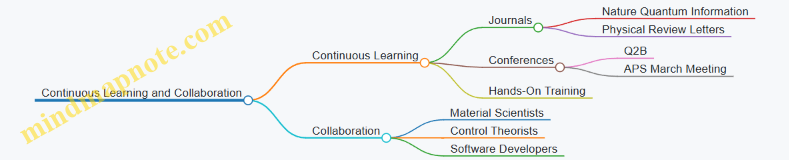
Mind Map 2: Hardware Design and Automation
Mind Map 3: Cryogenics and Infrastructure
Summary
By integrating continuous education, modular design, cross-disciplinary collaboration, automation, and robust infrastructure, quantum hardware teams can stay ahead in this rapidly evolving field. Practical examples demonstrate how these best practices translate into tangible improvements in qubit performance, system reliability, and scalability.
Final Example:
A quantum engineering team implements an AI-based automated calibration system within a modular cryogenic setup. They collaborate with materials scientists to test new substrates and share their findings via open-source platforms. This integrated approach results in a 20% increase in qubit coherence times and a 30% reduction in setup downtime, exemplifying the power of staying ahead through best practices.
12. Summary and Best Practice Checklist
12.1 Recap of Key Qubit Control Techniques
Controlling qubits with high precision and fidelity is fundamental to the success of quantum computing hardware. This section revisits the essential qubit control techniques, reinforced with mind maps and practical examples to solidify understanding.
Mind Map: Overview of Qubit Control Techniques
Types of Qubits and Control Mechanisms
Different qubit platforms require tailored control techniques:
- Superconducting Qubits: Controlled primarily by microwave pulses delivered via transmission lines. Pulse shaping is critical to minimize leakage and errors.
- Spin Qubits: Controlled by magnetic resonance techniques using RF or microwave fields.
- Ion Traps: Controlled by laser pulses for state manipulation.
Example: For a transmon qubit, microwave pulses at the qubit transition frequency induce rotations on the Bloch sphere. Adjusting pulse amplitude and duration enables precise gate operations.
Pulse Shaping and Microwave Control
Pulse shaping helps reduce errors like leakage to higher energy states and spectral crowding.
- Gaussian Pulses: Smooth envelopes to reduce spectral leakage.
- DRAG (Derivative Removal by Adiabatic Gate): Adds a derivative component to the pulse to counteract leakage.
Example: Implementing a DRAG pulse on a transmon qubit reduces leakage errors by compensating for the qubit’s anharmonicity, improving gate fidelity.
Mind Map: Pulse Shaping Techniques
Calibration Protocols
Calibration ensures the pulses produce the intended qubit rotations:
- Rabi Oscillations: Sweep pulse duration/amplitude to find the π-pulse length.
- Ramsey Fringes: Measure qubit coherence and detuning.
- Spin Echo: Mitigate dephasing noise.
Example: Running a Rabi experiment on a superconducting qubit reveals the pulse duration needed for a π rotation, which is then used for all subsequent gate operations.
Noise Sources and Mitigation
Noise affects qubit coherence and gate fidelity:
- Sources: Thermal noise, electromagnetic interference, crosstalk.
- Mitigation: Filtering control lines, dynamical decoupling sequences, shielding.
Example: Adding low-pass filters and attenuators on microwave lines inside the cryostat reduces high-frequency noise reaching the qubit.
Mind Map: Noise Mitigation Strategies
Multi-Qubit Control and Crosstalk Reduction
Scaling up requires precise control over multiple qubits without unwanted interactions:
- Crosstalk: Unintended control signals affecting neighboring qubits.
- Techniques: Frequency crowding avoidance, optimized wiring, selective pulse shaping.
Example: Using frequency multiplexing and carefully designed microwave lines to selectively address individual qubits in a 5-qubit superconducting chip.
Summary Table: Key Qubit Control Techniques and Examples
| Technique | Description | Example Application |
|---|---|---|
| Microwave Pulses | Drive qubit transitions with shaped pulses | DRAG pulses on transmon qubits |
| Rabi Oscillations | Calibrate pulse amplitude and duration | Finding π-pulse length |
| Ramsey Fringes | Measure qubit coherence and detuning | Estimating T2* times |
| Spin Echo | Mitigate dephasing noise | Extending coherence time |
| Noise Filtering | Reduce high-frequency noise | Cryogenic attenuators and filters |
| Crosstalk Reduction | Prevent unintended qubit excitation | Frequency multiplexing in multi-qubit chips |
By mastering these qubit control techniques and integrating best practices, quantum engineers can achieve higher gate fidelities and more reliable quantum operations, forming the backbone of scalable quantum hardware.
12.2 Summary of Cryogenic System Best Practices
Cryogenic systems are the backbone of many quantum hardware platforms, providing the ultra-low temperature environments necessary for qubit coherence and operation. Ensuring optimal performance and longevity of these systems requires adherence to a set of best practices that cover design, operation, maintenance, and integration.
Key Best Practices for Cryogenic Systems
Cryogenic System Best Practices Mind Map
Design & Setup
-
Proper Thermal Anchoring:
- Anchor all wiring and components at multiple temperature stages (e.g., 4 K, 1 K, 100 mK) to minimize heat conduction to the coldest stage.
- Use high thermal conductivity materials like copper for heat sinks.
-
Vibration Isolation:
- Employ mechanical decouplers or damping materials to reduce vibrations from pumps or building infrastructure.
- Example: Mount the dilution refrigerator on pneumatic vibration isolation legs.
-
Electromagnetic Shielding:
- Use mu-metal or superconducting shields to protect qubits from external magnetic fields.
- Example: Multi-layer magnetic shielding around the sample space.
-
Efficient Wiring & Filtering:
- Use low thermal conductivity wiring (e.g., phosphor bronze) with attenuators and low-pass filters at various stages.
- Example: Implementing a cryogenic attenuator chain to reduce noise and thermal photons.
Operation
-
Controlled Cooldown Procedures:
- Gradually cool down the system to avoid thermal stress and damage.
- Example: Stepwise temperature ramping with monitoring at each stage.
-
Monitoring Temperature & Pressure:
- Use calibrated thermometers and pressure sensors at critical points.
- Example: Automated logging and alarm systems for temperature excursions.
-
Minimizing Heat Loads:
- Limit the number of active lines and use proper filtering to reduce heat inflow.
- Example: Disconnect unused cables and use thermal breaks.
-
Safe Cryogen Handling:
- Follow safety protocols for liquid helium and nitrogen refills.
- Example: Use personal protective equipment and proper ventilation during refills.
Maintenance
-
Regular Leak Checks:
- Perform helium leak detection to prevent contamination and loss of vacuum.
-
Cryogen Refills Scheduling:
- Plan refills to avoid system warm-ups and downtime.
-
System Diagnostics:
- Regularly check vacuum levels, pump performance, and sensor calibrations.
-
Preventive Maintenance:
- Replace worn seals, pumps, and filters before failure.
Integration
-
Low-Noise Electronics:
- Design electronics with minimal noise contribution and proper grounding.
-
Thermalization of Control Lines:
- Ensure all control lines are thermalized at each temperature stage to prevent heat leaks.
-
EMI Mitigation:
- Use shielded cables and proper grounding schemes.
-
Mechanical Stability:
- Secure all components to prevent microphonic noise.
Example: Setting Up a Cryogenic Environment for a Qubit Chip
- Thermal Anchoring: Attach coaxial cables to the 4 K plate using copper clamps, then to the 100 mK stage with gold-plated copper fingers.
- Filtering: Install low-pass RC filters and Eccosorb filters at the mixing chamber stage to suppress high-frequency noise.
- Magnetic Shielding: Surround the sample holder with a Cryoperm shield and an outer mu-metal layer.
- Vibration Isolation: Mount the dilution refrigerator on pneumatic legs and use flexible bellows on pumping lines.
- Monitoring: Connect calibrated RuO2 thermometers at the mixing chamber and sample stage, with automated logging.
Summary Table of Cryogenic Best Practices
| Aspect | Best Practice | Example |
|---|---|---|
| Thermal Anchoring | Multi-stage anchoring with high conductivity materials | Copper clamps on 4 K and 100 mK stages |
| Vibration Isolation | Pneumatic legs and flexible bellows | Pneumatic vibration isolation legs |
| EMI Shielding | Multi-layer magnetic shields | Cryoperm + mu-metal shields |
| Wiring & Filtering | Low thermal conductivity cables + filters | Cryogenic attenuator chain + RC filters |
| Cooldown Procedure | Gradual temperature ramping | Stepwise cooldown with monitoring |
| Monitoring | Calibrated sensors + automated alerts | RuO2 thermometers + logging system |
| Maintenance | Regular leak checks and preventive replacement | Helium leak detection, pump servicing |
| Integration | Thermalize control lines and minimize noise | Thermal anchoring of coax lines |
By following these best practices, quantum engineers and technicians can ensure stable, low-noise, and reliable cryogenic environments that are essential for high-performance qubit operation.
12.3 Integrated Approach to Quantum Hardware Engineering
Quantum hardware engineering demands a holistic integration of multiple disciplines—qubit control, cryogenics, materials science, electronics, and environmental management—to achieve optimal system performance. This section explores how these components interconnect, highlighting best practices and providing illustrative examples to guide engineers and technicians in building robust quantum systems.
Mind Map: Core Components of Quantum Hardware Engineering
Best Practice 1: Synchronizing Qubit Control with Cryogenic Environment
Explanation: Qubit control pulses must be precisely timed and delivered through cryogenic wiring that preserves signal integrity while minimizing thermal load.
Example: When implementing Rabi oscillations on a transmon qubit, engineers use carefully calibrated microwave pulses routed through a chain of cryogenic attenuators and filters. The attenuators reduce thermal noise from room temperature electronics, while filters suppress spurious frequencies. Thermal anchoring points along the wiring ensure minimal heat conduction to the cold stage.
Mind Map:
Best Practice 2: Material Selection Impacting Both Qubit Coherence and Cryogenic Performance
Explanation: Materials used in qubit fabrication and packaging must exhibit low microwave loss and be compatible with cryogenic temperatures to maintain coherence times.
Example: Using high-purity aluminum for superconducting qubit fabrication reduces dielectric losses and maintains superconductivity at millikelvin temperatures. Additionally, selecting low thermal conductivity substrates like sapphire helps isolate the qubit thermally, preventing unwanted heat flow.
Mind Map:
Best Practice 3: Environmental Shielding Integrated with Hardware Design
Explanation: Magnetic and vibrational noise can drastically reduce qubit fidelity. Integrating shielding solutions into the hardware design ensures stable operation.
Example: A multi-layer magnetic shield composed of mu-metal and superconducting lead layers surrounds the dilution refrigerator. Vibration isolation platforms decouple the cryostat from building vibrations. Wiring harnesses are designed to minimize loop areas, reducing susceptibility to electromagnetic interference.
Mind Map:
Best Practice 4: Holistic Data Acquisition and Feedback Loop
Explanation: Real-time data acquisition and processing enable adaptive control and error correction, essential for maintaining qubit performance.
Example: FPGA-based controllers acquire qubit readout signals, perform demodulation, and feed results back to control electronics to adjust pulse parameters dynamically. This closed-loop system compensates for drift in qubit frequency or environmental fluctuations.
Mind Map:
Summary
An integrated approach to quantum hardware engineering ensures that every subsystem—from qubit control electronics to cryogenic infrastructure and environmental shielding—works synergistically. By applying best practices in synchronization, material selection, shielding, and data feedback, engineers can build quantum systems that maximize coherence, minimize noise, and improve scalability.
Practical Example: Step-by-Step Integration for a Superconducting Qubit Setup
- Fabricate the qubit using low-loss aluminum on a sapphire substrate.
- Package the chip with careful wirebonding to minimize parasitic capacitance.
- Mount the chip inside a dilution refrigerator equipped with multi-layer magnetic shielding.
- Route microwave control lines through cryogenic attenuators and filters, anchored thermally at each stage.
- Connect control electronics with FPGA-based systems for real-time pulse shaping and feedback.
- Implement vibration isolation platforms to reduce mechanical noise.
- Monitor system parameters continuously, adjusting control pulses to compensate for drift.
This integrated methodology exemplifies how combining best practices across domains leads to reliable quantum hardware performance.
12.4 Example: Step-by-Step Guide to Setting Up a Qubit Experiment
Setting up a qubit experiment involves careful integration of qubit control, cryogenic environment preparation, and precise measurement techniques. This guide walks you through the essential steps with practical examples and mind maps to visualize the workflow.
Step 1: Define the Experiment Objectives
- Determine the qubit type (e.g., superconducting transmon, spin qubit)
- Identify the control parameters (pulse sequences, gate types)
- Specify measurement goals (coherence times, gate fidelities)
Step 2: Prepare the Cryogenic Environment
- Verify dilution refrigerator readiness (temperature, vacuum)
- Install the qubit chip on the sample holder
- Connect thermal anchoring points for wiring
- Ensure vibration isolation and EMI shielding
Example:
Before inserting the qubit chip, perform a cooldown test of the dilution refrigerator to reach base temperature (~10 mK). Use a calibrated RuO2 thermometer to verify temperature stability.
Step 3: Connect Qubit Control Electronics
- Route coaxial cables from room temperature to the qubit inside the fridge
- Install attenuators and filters at different temperature stages
- Connect microwave sources and arbitrary waveform generators (AWGs)
- Calibrate cable delays and signal attenuation
Example:
Use a cryogenic attenuator chain with 20 dB at 4 K and 20 dB at base temperature to minimize thermal noise reaching the qubit.
Step 4: Initialize Qubit Control Software
- Load pulse sequences for qubit manipulation (e.g., Rabi, Ramsey)
- Set up data acquisition parameters
- Configure real-time feedback if applicable
Example:
Program a Rabi oscillation sequence with varying pulse durations to calibrate the qubit drive amplitude.
Step 5: Perform Initial Qubit Characterization
- Run basic experiments: T1 relaxation, T2 coherence
- Analyze data for signal-to-noise ratio and stability
- Adjust control parameters accordingly
Example:
Measure T1 by applying a π pulse, waiting variable delay times, then measuring the qubit state. Plot decay curve and fit exponential.
Step 6: Optimize and Iterate
- Refine pulse shapes (e.g., DRAG pulses) to reduce errors
- Improve cryogenic wiring and filtering if noise is detected
- Repeat characterization to confirm improvements
Example:
Implement DRAG pulses to minimize leakage to higher energy states, improving gate fidelity from 95% to 99%.
Step 7: Document and Backup Setup
- Record all hardware configurations, calibration data, and software versions
- Save pulse sequence scripts and measurement results
- Maintain a lab notebook or electronic log
Example:
Use version control (e.g., Git) for pulse sequence code and store calibration parameters in a shared database.

Summary Mind Map: Full Workflow
This step-by-step guide integrates best practices with practical examples to help quantum engineers, experimental physicists, and hardware technicians establish a robust qubit experiment setup. Following this structured approach ensures reproducibility, high-fidelity control, and efficient troubleshooting.
12.5 Comprehensive Best Practice Checklist for Engineers and Technicians
This checklist consolidates essential best practices for quantum hardware engineers and technicians focusing on qubit control and cryogenics. It serves as a practical guide to ensure reliability, performance, and scalability in quantum experiments.
Qubit Control Best Practices
- Qubit Type Identification: Clearly identify the qubit technology (e.g., superconducting, spin, topological) and tailor control protocols accordingly.
- Pulse Calibration: Regularly calibrate microwave pulses to optimize gate fidelities; include Rabi oscillations and Ramsey sequences.
- Noise Mitigation: Implement filtering and shielding to reduce electromagnetic interference; use DRAG pulses to minimize leakage.
- Control Electronics: Use low-noise, temperature-stabilized electronics; ensure proper synchronization and timing.
- Multi-Qubit Crosstalk: Characterize and minimize crosstalk with isolation techniques and optimized wiring layouts.
Example: Calibrating a Rabi Oscillation
- Apply a series of microwave pulses with varying durations.
- Measure qubit state after each pulse.
- Fit the oscillation curve to determine optimal π-pulse length.
Cryogenic System Best Practices
- Dilution Refrigerator Operation: Maintain base temperature stability; monitor pressure and flow rates.
- Thermal Anchoring: Properly anchor all wiring and components at each temperature stage to minimize heat load.
- Vibration Isolation: Use mechanical decoupling and damping to reduce vibrational noise.
- Electromagnetic Shielding: Employ multi-layer magnetic shields and RF-tight enclosures.
- Safety Protocols: Follow strict procedures for cryogen handling and emergency response.
Example: Setting Up Thermal Anchoring
- Attach attenuators and filters at 4K, 100mK, and base stages.
- Use high-thermal-conductivity materials (e.g., copper braids).
- Verify temperature gradients with calibrated sensors.
Integration and Wiring
- Wiring Selection: Use low-loss coaxial cables and superconducting wiring where appropriate.
- Filtering and Attenuation: Implement cryogenic attenuators and low-pass filters to suppress noise.
- Connector Quality: Use high-quality, cryo-compatible connectors to avoid signal degradation.
- Thermalization of Lines: Ensure all lines are thermalized at each fridge stage to prevent heat leaks.
Example: Cryogenic Attenuator Chain Setup
- Input line: 20 dB attenuator at 4K, 10 dB at 100mK, 10 dB at base.
- Output line: Isolators and circulators to protect qubit from amplifier noise.
Materials and Fabrication
- Material Purity: Use high-purity substrates and superconductors to reduce two-level system (TLS) defects.
- Fabrication Cleanliness: Maintain cleanroom standards to minimize contamination.
- Packaging: Design packages to minimize parasitic modes and enable effective thermal anchoring.
Example: Wirebonding Best Practices
- Use ultrasonic wirebonding with optimized parameters.
- Inspect bonds under microscope for uniformity and strength.
Environmental Controls
- Magnetic Shielding: Use mu-metal and superconducting shields to suppress ambient magnetic fields.
- Vibration Control: Mount cryostats on vibration isolation platforms.
- EMI Mitigation: Route cables carefully, use shielded enclosures, and avoid ground loops.
Mind Maps
Mind Map 1: Qubit Control Workflow
Mind Map 2: Cryogenic System Setup
Mind Map 3: Integration and Wiring
Final Notes
- Maintain detailed logs of calibrations and system parameters.
- Regularly review and update safety and operational protocols.
- Foster communication between engineers, physicists, and technicians to ensure smooth integration.
This checklist is designed to be a living document, evolving with advances in quantum hardware technology and operational experience.