The Economics Of Off-Planet Infrastructure Development
1. Introduction to Off-Planet Infrastructure Economics
1.1 Defining Off-Planet Infrastructure: Scope and Significance
Off-planet infrastructure refers to the physical and organizational structures, facilities, and systems established beyond Earth’s surface to support human activities, scientific research, commercial operations, and long-term habitation in space environments such as the Moon, Mars, asteroids, and orbital platforms.
This infrastructure forms the backbone of sustainable space exploration and commercialization, enabling transportation, habitation, resource extraction, communication, and manufacturing beyond Earth.
Scope of Off-Planet Infrastructure
-
Habitats and Living Quarters
- Space stations (e.g., International Space Station)
- Lunar and Martian bases
- Inflatable and 3D-printed habitats
-
Transportation Systems
- Launch vehicles
- Space tugs and shuttles
- Surface rovers and mobility systems
-
Resource Extraction and Processing
- Mining operations (e.g., asteroid mining)
- In-Situ Resource Utilization (ISRU)
- Fuel production (e.g., lunar ice to rocket fuel)
-
Energy Generation and Storage
- Solar power arrays
- Nuclear reactors
- Energy storage systems
-
Communication and Navigation
- Satellite constellations
- Deep space communication networks
- Navigation beacons
-
Manufacturing and Assembly
- 3D printing facilities
- On-orbit assembly yards
- Robotics and automation systems
-
Environmental Control and Life Support Systems (ECLSS)
- Air and water recycling
- Waste management
- Radiation shielding
-
Scientific Research Facilities
- Laboratories
- Telescopes and observatories
- Experiment modules
Mind Map: Scope of Off-Planet Infrastructure
Significance of Off-Planet Infrastructure
-
Enabling Sustainable Human Presence:
- Infrastructure like habitats and life support systems allow humans to live and work in space for extended periods.
- Example: The International Space Station (ISS) has demonstrated continuous human presence in low Earth orbit for over two decades.
-
Facilitating Scientific Discovery:
- Research facilities enable experiments in microgravity and unique environments.
- Example: The James Webb Space Telescope, positioned at L2 orbit, relies on off-planet infrastructure for deployment and operation.
-
Driving Economic Growth and New Markets:
- Off-planet infrastructure supports emerging industries such as space tourism, mining, and manufacturing.
- Example: SpaceX’s Starship aims to reduce launch costs, enabling more frequent missions and commercial activities.
-
Reducing Earth Dependency:
- Utilizing local resources (ISRU) reduces the need to transport materials from Earth, lowering costs and increasing mission feasibility.
- Example: NASA’s Artemis program plans to harvest lunar ice for water and fuel.
-
Enhancing National Security and Strategic Advantage:
- Space infrastructure supports communication, reconnaissance, and navigation capabilities.
- Example: GPS satellites provide critical positioning data worldwide.
-
Promoting International Collaboration:
- Large-scale projects like ISS demonstrate how multinational cooperation can share costs, risks, and benefits.
Mind Map: Significance of Off-Planet Infrastructure
Example: International Space Station (ISS) as Off-Planet Infrastructure
- Scope: Habitation, scientific research, technology demonstration, international cooperation.
- Significance: Proved feasibility of long-duration human spaceflight, served as a platform for testing off-planet systems.
- Best Practice: Multi-agency collaboration (NASA, Roscosmos, ESA, JAXA, CSA) sharing costs and expertise.
Example: Lunar Gateway
- Scope: Modular space station orbiting the Moon, supporting Artemis missions.
- Significance: Acts as a staging point for lunar surface operations and deep space exploration.
- Best Practice: Modular design enabling incremental assembly and international partnerships.
In summary, off-planet infrastructure encompasses a broad range of systems essential for expanding humanity’s reach beyond Earth. Understanding its scope and significance is foundational for economists, strategists, and investors aiming to navigate this emerging frontier effectively.
1.2 Historical Context: From Earth-Based Infrastructure to Space
Understanding the economics of off-planet infrastructure development requires a solid grasp of its historical roots, tracing the evolution from traditional Earth-based infrastructure to the pioneering ventures beyond our planet. This section explores the key milestones, economic drivers, and lessons learned that have shaped current approaches to space infrastructure.
Evolution of Infrastructure: A Historical Mind Map
From Earth to Orbit: Key Milestones
-
1957: Launch of Sputnik 1
- The first artificial satellite, marking the beginning of space infrastructure.
- Economic Impact: Initiated government investment in space technology.
-
1960s: Apollo Program
- Development of lunar modules and command centers.
- Example: Massive government expenditure ($25 billion in 1960s dollars) demonstrating large-scale infrastructure investment.
-
1973: Launch of Skylab
- First US space station, a precursor to long-term orbital infrastructure.
- Economic Impact: Showcased the feasibility of sustained human presence in space.
-
1998: International Space Station (ISS)
- A multinational collaboration creating a permanent orbital laboratory.
- Example: Public-private partnership model involving NASA, Roscosmos, ESA, JAXA, and CSA.
-
2000s-Present: Commercial Space Infrastructure
- Emergence of private companies like SpaceX, Blue Origin, and OneWeb.
- Example: SpaceX’s Starlink constellation aiming to provide global broadband.
Mind Map: Economic Drivers Transitioning from Earth to Space
Lessons from Earth-Based Infrastructure Applied to Space
-
Scalability and Modularity
- Example: Modular bridge construction techniques inspire modular space habitats.
-
Public-Private Partnerships (PPP)
- Example: Toll roads and airports on Earth parallel ISS collaboration and commercial space station initiatives.
-
Risk Management and Insurance
- Earth-based infrastructure projects use insurance to mitigate risks; similarly, satellite insurance is a growing sector.
-
Long-Term Investment Horizons
- Infrastructure like railroads required decades to recoup investments; space projects adopt similar long-term economic planning.
Example: The International Space Station as a Bridge Between Earth and Space Infrastructure
- Collaborative Model: Multiple countries sharing costs, risks, and benefits.
- Economic Impact: Stimulated technological innovation, created jobs, and fostered international cooperation.
- Best Practice: Demonstrates how combining resources and expertise can overcome the high costs and risks of space infrastructure.
Summary
The historical context reveals a clear trajectory: economic imperatives that drove Earth-based infrastructure development—such as connectivity, resource access, and technological advancement—are now propelling humanity’s expansion into space. By studying past infrastructure projects and their economic frameworks, stakeholders can better navigate the challenges and opportunities of off-planet infrastructure development.
1.3 Economic Drivers Behind Space Infrastructure Development
The development of off-planet infrastructure is propelled by a complex interplay of economic drivers that create both opportunities and challenges. Understanding these drivers is essential for economists, strategy planners, and tech investors to make informed decisions and capitalize on emerging markets.
Key Economic Drivers
- Resource Scarcity on Earth
- Increasing demand for rare minerals and materials
- Environmental degradation pushing for alternative sources
- Technological Advancements
- Reduced launch costs through reusable rockets
- Innovations in robotics and automation
- Market Demand Expansion
- Growth in satellite communications and broadband
- Space tourism and habitation prospects
- Strategic and Geopolitical Interests
- National security and space dominance
- International collaborations and competition
- Economic Multipliers and Spillovers
- Job creation and high-tech industry growth
- Spin-off technologies benefiting terrestrial markets
Mind Map: Economic Drivers Overview
Resource Scarcity on Earth
As terrestrial resources become increasingly scarce or environmentally costly to extract, off-planet mining and resource utilization emerge as economically attractive alternatives. For example, the asteroid mining concept targets platinum-group metals and water ice, which can be used for fuel production in space.
Example:
- Planetary Resources Inc. aimed to identify and extract valuable minerals from near-Earth asteroids, highlighting the economic potential of extraterrestrial mining.
Technological Advancements
Technological breakthroughs have drastically reduced the cost of accessing space, making infrastructure projects more economically viable.
Example:
- SpaceX’s Falcon 9 Reusability: By successfully landing and reusing first-stage boosters, SpaceX reduced launch costs by up to 30%, enabling more frequent and affordable missions.
Mind Map: Technological Advancements Impact
Market Demand Expansion
The demand for space-based services is growing rapidly, driven by communication, navigation, Earth observation, and emerging sectors like space tourism.
Example:
- Starlink Satellite Constellation: SpaceX’s initiative to provide global broadband internet demonstrates the expanding commercial market for space infrastructure.
Example:
- Virgin Galactic: Pioneering commercial space tourism, creating a new market segment that drives infrastructure needs such as spaceports.
Strategic and Geopolitical Interests
Countries view space infrastructure as critical for national security, technological leadership, and geopolitical influence.
Example:
- The Artemis Accords: A set of principles for cooperation in lunar exploration, encouraging investment and infrastructure development through international partnerships.
Economic Multipliers and Spillovers
Investment in space infrastructure generates high-value jobs and drives innovation with applications beyond space.
Example:
- Spin-off Technologies: Memory foam, water purification systems, and advanced robotics originally developed for space missions have found terrestrial applications, stimulating economic growth.
Mind Map: Economic Multipliers
Summary
The economics of off-planet infrastructure development are driven by a combination of resource needs, technological progress, expanding markets, strategic interests, and broader economic benefits. Recognizing and leveraging these drivers through informed investment and policy decisions will be crucial for sustainable growth in the space economy.
1.4 Key Stakeholders: Governments, Private Sector, and International Bodies
Off-planet infrastructure development is a complex, multifaceted endeavor that requires the collaboration and coordination of various stakeholders. Understanding the roles, motivations, and interactions of these key players is essential for economists, strategy planners, and tech investors aiming to navigate this emerging market successfully.
Governments
Governments are often the primary initiators and regulators of space infrastructure projects. Their roles include funding foundational research, setting regulatory frameworks, and fostering international cooperation.
-
Roles:
- Funding large-scale projects (e.g., NASA’s Artemis program)
- Establishing space policies and regulations
- Facilitating international treaties and agreements
- Providing security and oversight
-
Example: NASA’s leadership in the International Space Station (ISS) project demonstrates how government investment and coordination can create a long-term, multinational infrastructure platform.
Private Sector
The private sector is increasingly pivotal in off-planet infrastructure, driving innovation, reducing costs, and expanding market opportunities.
-
Roles:
- Developing commercial launch services (e.g., SpaceX, Blue Origin)
- Creating satellite constellations for global connectivity (e.g., Starlink)
- Innovating in resource extraction and habitat construction
- Attracting private investment and venture capital
-
Example: SpaceX’s reusable rockets have revolutionized launch economics, lowering costs and enabling more frequent missions.
International Bodies
International organizations help coordinate efforts across nations, ensuring peaceful use of space and equitable access.
-
Roles:
- Facilitating treaties and agreements (e.g., Outer Space Treaty)
- Promoting standards and best practices
- Mediating disputes and fostering collaboration
-
Example: The United Nations Committee on the Peaceful Uses of Outer Space (COPUOS) plays a critical role in shaping international space policy.
Mind Maps
Stakeholders in Off-Planet Infrastructure Development
Government Roles and Examples
Private Sector Contributions
International Bodies and Their Functions
Integrated Example: The ISS Partnership
The International Space Station is a prime example where governments (NASA, Roscosmos, ESA, JAXA, CSA), private sector contractors (Boeing, SpaceX), and international bodies (UN COPUOS) collaborate. This partnership has created a sustainable off-planet infrastructure platform that advances science, technology, and international cooperation.
- Best Practice: Leveraging multi-stakeholder collaboration to share costs, risks, and benefits.
Summary
Understanding the distinct yet interconnected roles of governments, private sector entities, and international bodies is critical. Successful off-planet infrastructure development depends on harmonizing these stakeholders’ efforts through clear policies, innovative business models, and cooperative frameworks.
1.5 Best Practice: Leveraging Public-Private Partnerships – The ISS Model
Public-Private Partnerships (PPPs) have become a cornerstone in the development of off-planet infrastructure, enabling the pooling of resources, expertise, and risk-sharing between governments and private entities. The International Space Station (ISS) stands as a prime example of how PPPs can successfully drive complex, large-scale space infrastructure projects.
Understanding the ISS Model: A Collaborative Framework
The ISS is a multinational cooperative project involving NASA, Roscosmos, ESA, JAXA, and CSA, alongside numerous private contractors and suppliers. This model leverages the strengths of both public agencies and private companies to achieve a sustainable and operational space habitat.
Key Elements of the ISS Public-Private Partnership
- Shared Funding and Risk: Governments provide significant funding and regulatory support, while private companies contribute specialized technology, manufacturing, and operational services.
- Technology and Knowledge Transfer: Collaboration fosters innovation, with private firms gaining access to cutting-edge research and government agencies benefiting from commercial efficiencies.
- Long-Term Commitment: The ISS partnership spans decades, ensuring stability and continuous development.
Mind Map: Components of the ISS Public-Private Partnership
Example: SpaceX’s Role in the ISS Supply Chain
SpaceX, a private aerospace company, exemplifies the PPP model by providing cargo resupply missions to the ISS under NASA’s Commercial Resupply Services contract. This arrangement has:
- Reduced costs through reusable rocket technology.
- Increased launch frequency and reliability.
- Enabled NASA to focus on exploration while leveraging commercial innovation.
Mind Map: SpaceX and NASA Collaboration
Best Practices Derived from the ISS Model
- Align Objectives: Ensure that public and private partners have shared goals, such as advancing scientific research while enabling commercial viability.
- Define Clear Roles: Establish responsibilities and deliverables to avoid overlap and inefficiencies.
- Implement Flexible Contracting: Use adaptable contracts to accommodate technological advancements and market changes.
- Promote Transparency: Maintain open communication channels to build trust and facilitate problem-solving.
- Leverage Government Support: Utilize regulatory frameworks, funding, and infrastructure to reduce private sector risks.
Example: NASA’s Commercial Crew Program
Building on the ISS PPP success, NASA’s Commercial Crew Program partners with private companies like SpaceX and Boeing to develop crew transportation capabilities. This program:
- Shares development costs and risks.
- Accelerates innovation through competitive contracts.
- Enhances U.S. access to low Earth orbit.
Mind Map: Best Practices Summary
Conclusion
Leveraging PPPs as demonstrated by the ISS model is a proven best practice for off-planet infrastructure development. It balances the strengths and limitations of public and private sectors, driving innovation, cost efficiency, and sustainable operations. For economists, strategists, and investors, understanding and applying these principles is critical to fostering successful space infrastructure ventures.
2. Market Analysis and Demand Forecasting for Space Infrastructure
2.1 Identifying Market Needs: Communication, Mining, Habitats, and More
Understanding the market needs for off-planet infrastructure is foundational to developing economically viable space projects. This section explores the primary sectors driving demand, supported by practical examples and mind maps to visualize the interconnections.
Key Market Segments in Off-Planet Infrastructure
-
Communication
- Satellite networks for global broadband
- Deep-space communication relays
- Data transmission and storage hubs
-
Mining and Resource Extraction
- Asteroid mining for precious metals
- Lunar regolith processing for construction materials
- Water ice extraction for propellant and life support
-
Habitats and Life Support
- Space stations and lunar bases
- Mars colonization modules
- Closed-loop life support systems
-
Manufacturing and Assembly
- In-space manufacturing of satellite components
- 3D printing of tools and habitat parts
- Assembly of large structures in orbit
-
Transportation and Logistics
- Cargo delivery systems
- Reusable launch vehicles
- Orbital refueling stations
-
Scientific Research and Exploration
- Telescopes and observatories
- Planetary exploration infrastructure
- Biological and material science labs
Mind Map: Off-Planet Market Needs
Example 1: Communication - Starlink Satellite Constellation
SpaceX’s Starlink project exemplifies the booming demand for global broadband connectivity. By deploying thousands of low Earth orbit (LEO) satellites, Starlink aims to provide high-speed internet access worldwide, especially in underserved areas. This addresses a critical market need for reliable communication infrastructure beyond terrestrial limits.
Best Practice: Leveraging economies of scale and rapid deployment to reduce costs and meet market demand effectively.
Example 2: Mining - Planetary Resources and Asteroid Mining
Companies like Planetary Resources have targeted near-Earth asteroids for mining precious metals such as platinum and rare earth elements. This market need arises from Earth’s limited supply and the high value of these materials in electronics and manufacturing.
Best Practice: Conducting thorough market feasibility studies and technological readiness assessments before committing to large-scale extraction projects.
Example 3: Habitats - NASA’s Artemis Lunar Gateway
The Lunar Gateway project aims to establish a sustainable human presence around the Moon, providing habitats and support infrastructure for astronauts. This meets the growing market need for long-duration space habitation and serves as a staging point for deeper space exploration.
Best Practice: International collaboration and modular design to share costs and risks while enabling scalability.
Integrated Mind Map: Market Needs with Examples
Summary
Identifying market needs in off-planet infrastructure requires a multi-dimensional approach that considers technological feasibility, economic demand, and strategic value. Communication, mining, and habitats represent core sectors with clear market drivers, supported by emerging examples that demonstrate best practices in addressing these needs. Strategists and investors should continuously monitor evolving demands and leverage integrated planning to capitalize on these opportunities.
2.2 Demand Forecasting Techniques Adapted for Space Markets
Demand forecasting in off-planet infrastructure development is a complex yet critical process that enables stakeholders to anticipate market needs, allocate resources efficiently, and mitigate risks. Traditional forecasting methods must be adapted to account for the unique characteristics of space markets, such as high uncertainty, long project timelines, and rapidly evolving technologies.
Key Challenges in Space Market Demand Forecasting
- Limited historical data due to nascent industry
- High capital intensity and long development cycles
- Regulatory and geopolitical uncertainties
- Rapid technological advancements altering market dynamics
Adapted Demand Forecasting Techniques
Scenario Planning
Scenario planning involves creating multiple plausible futures based on varying assumptions about technological progress, policy changes, and market adoption rates.
- Example: NASA’s Artemis program uses scenario planning to forecast demand for lunar habitats, considering variables like international collaboration levels and commercial participation.
Delphi Method
This technique gathers expert opinions iteratively to reach a consensus forecast, particularly useful when quantitative data is scarce.
- Example: Space agencies and private firms use Delphi panels to estimate demand for satellite servicing infrastructure.
Analogous Forecasting
Drawing parallels from similar Earth-based infrastructure projects or earlier space initiatives to estimate demand.
- Example: Using the growth trajectory of terrestrial internet infrastructure to forecast demand for satellite broadband constellations.
Technology Diffusion Models
Modeling how new space technologies spread through markets over time, incorporating factors like adoption rates and network effects.
- Example: Predicting the uptake of in-situ resource utilization (ISRU) technologies on the Moon based on diffusion curves.
Econometric and Simulation Models
Using statistical and computational models to simulate market behavior under different assumptions.
- Example: Simulating demand for orbital manufacturing facilities by integrating economic variables such as launch costs, product pricing, and customer demand.
Integrated Example: Forecasting Demand for Lunar Habitats
To forecast demand for lunar habitats, a combined approach is often employed:
- Scenario Planning: Develop optimistic, moderate, and pessimistic scenarios based on international cooperation and commercial interest.
- Delphi Method: Engage experts from space agencies, private companies, and academia to refine assumptions.
- Analogous Forecasting: Analyze historical data from ISS occupancy and Earth-based remote research stations.
- Technology Diffusion: Model adoption rates of habitat technologies considering cost and reliability improvements.
- Simulation Models: Run simulations incorporating launch costs, habitat construction timelines, and potential customer base growth.
This integrated methodology provides a robust demand forecast that informs investment and policy decisions.
Summary
Demand forecasting for off-planet infrastructure requires adapting traditional techniques to the unique space environment. Employing a combination of scenario planning, expert elicitation, analogous reasoning, diffusion modeling, and econometric simulations enables stakeholders to navigate uncertainty and make informed strategic decisions.
Further Reading & Resources
- NASA Artemis Program Reports
- “Forecasting in Space Markets” – Journal of Space Economics
- International Space University Course Materials on Market Analysis
2.3 Case Study: Satellite Constellations and Their Market Impact
Satellite constellations represent one of the most transformative developments in the space infrastructure market. By deploying large networks of small satellites working in concert, companies have revolutionized global communications, earth observation, and data services. This case study explores the economic implications, market dynamics, and best practices illustrated by satellite constellations, with a focus on examples such as SpaceX’s Starlink, OneWeb, and Amazon’s Project Kuiper.
Overview of Satellite Constellations
Satellite constellations consist of numerous satellites operating in coordinated orbits to provide continuous and global coverage. Unlike traditional geostationary satellites, these constellations operate mostly in low Earth orbit (LEO), reducing latency and increasing bandwidth.
Mind Map: Satellite Constellations Overview
Market Impact
-
Expansion of Global Internet Access
- Satellite constellations have enabled broadband access in remote and underserved regions, bridging the digital divide.
- Example: Starlink has launched over 4,000 satellites, providing internet service to rural areas in the US, Canada, and parts of Europe.
-
New Business Models and Revenue Streams
- Subscription-based internet services, data analytics from earth observation, and IoT connectivity.
- Example: OneWeb targets enterprise and government customers with tailored connectivity solutions.
-
Competitive Pressure on Traditional Telecoms
- Satellite broadband challenges terrestrial ISPs, pushing innovation and pricing adjustments.
-
Capital Intensity and Financing Challenges
- High upfront costs for satellite manufacturing, launch, and ground infrastructure.
- Example: Amazon’s Project Kuiper has secured billions in funding but faces stiff competition and regulatory hurdles.
Mind Map: Market Impact of Satellite Constellations
Economic Benefits and Challenges
-
Benefits:
- Job creation in manufacturing, launch services, and ground operations.
- Stimulates downstream industries such as IoT, smart agriculture, and disaster management.
- Drives technological innovation in satellite miniaturization and launch cost reduction.
-
Challenges:
- Space debris and orbital congestion increasing risk and insurance costs.
- Regulatory complexities across multiple jurisdictions.
- Market saturation risks as multiple constellations compete.
Example:
SpaceX’s Starlink has demonstrated rapid deployment and scaling, but also faces challenges such as astronomical community concerns about light pollution and regulatory scrutiny in various countries.
Mind Map: Economic Benefits and Challenges
Best Practices Illustrated by Satellite Constellations
-
Phased Deployment: Gradual satellite launches to test technology and market response before full-scale deployment.
- Example: Starlink began with beta testing in select regions before global rollout.
-
Public-Private Collaboration: Partnerships with governments for spectrum allocation and regulatory support.
- Example: OneWeb’s collaboration with the UK government to secure funding and spectrum rights.
-
Flexible Business Models: Offering tiered service plans to capture diverse customer segments.
- Example: Starlink offers residential, business, and maritime packages.
-
Sustainability Focus: Designing satellites with deorbiting capabilities to mitigate space debris.
- Example: Starlink satellites include automated deorbiting mechanisms.
Mind Map: Best Practices in Satellite Constellations
Conclusion
Satellite constellations have reshaped the economics of space infrastructure by creating new markets and challenging traditional paradigms. Their success depends on strategic market analysis, innovative financing, regulatory navigation, and sustainable operational practices. For economists, strategists, and investors, understanding these dynamics is crucial to harnessing the full potential of off-planet infrastructure development.
Additional Examples
-
Telesat Lightspeed: A Canadian LEO constellation focusing on enterprise and government markets, emphasizing low-latency connectivity.
-
Kepler Communications: Specializes in IoT connectivity via small satellite constellations, illustrating niche market targeting.
These examples further demonstrate how satellite constellations diversify the space economy and offer tailored solutions to emerging demands.
2.4 Risk Assessment in Market Projections
Risk assessment is a critical component in market projections for off-planet infrastructure development. Given the nascent and high-stakes nature of space markets, accurately identifying, analyzing, and mitigating risks ensures more reliable forecasts and better investment decisions.
Understanding Risk in Space Market Projections
Risks in off-planet infrastructure markets can be broadly categorized into several types:
- Technical Risks: Failures or delays in technology development.
- Market Risks: Uncertainty in demand, competition, and pricing.
- Regulatory Risks: Changes in laws, policies, or international agreements.
- Financial Risks: Funding shortfalls, cost overruns, or unfavorable financing conditions.
- Operational Risks: Challenges in logistics, supply chain, and workforce.
- Environmental Risks: Space debris, radiation, and other hazards.
Mind Map: Categories of Risks in Off-Planet Market Projections
Best Practice: Incorporating Risk Assessment into Market Projections
- Scenario Analysis: Develop multiple market scenarios (optimistic, base, pessimistic) incorporating different risk factors.
- Sensitivity Analysis: Identify which variables (e.g., launch costs, demand growth) most influence market outcomes.
- Quantitative Risk Modeling: Use probabilistic models (Monte Carlo simulations) to estimate risk-adjusted projections.
- Expert Elicitation: Gather insights from technical, financial, and policy experts to validate risk assumptions.
Example: Risk Assessment in Satellite Internet Market Projections
The satellite internet market, exemplified by projects like SpaceX Starlink and OneWeb, faces multiple risks:
- Technical: Launch failures or satellite malfunctions could delay service rollout.
- Market: Uncertain customer adoption rates and competition from terrestrial internet providers.
- Regulatory: Spectrum allocation and licensing across countries.
A risk-aware market projection for Starlink might include:
-
Scenario Analysis:
- Optimistic: Rapid adoption, low launch costs.
- Base: Moderate adoption, average costs.
- Pessimistic: Delays and regulatory hurdles.
-
Sensitivity Analysis: Demand elasticity and launch cost reductions are key drivers.
-
Monte Carlo Simulation: Running 10,000 simulations varying launch cost, adoption rate, and regulatory delay probabilities to produce a distribution of revenue forecasts.
Mind Map: Risk Assessment Process for Market Projections
Example: Applying Risk Assessment to Lunar Mining Market
Lunar mining is an emerging market with high uncertainty. Key risks include:
- Technical: Developing reliable extraction and processing technologies.
- Market: Unclear demand for lunar resources and pricing.
- Regulatory: Ambiguities in space resource ownership laws.
To manage these risks, companies might:
- Use pilot projects to validate technology before scaling.
- Engage in stakeholder dialogues to shape regulatory frameworks.
- Structure investments in phases to limit exposure.
Summary
Effective risk assessment in market projections for off-planet infrastructure requires a systematic approach combining qualitative and quantitative methods. By leveraging scenario planning, sensitivity analysis, and probabilistic modeling, stakeholders can better anticipate uncertainties and make informed strategic decisions.
Next section: 2.5 Best Practice: Scenario Planning Using NASA’s Artemis Program Data
2.5 Best Practice: Scenario Planning Using NASA’s Artemis Program Data
Scenario planning is a strategic tool that enables economists, strategy planners, and tech investors to anticipate multiple plausible futures and make informed decisions under uncertainty. NASA’s Artemis program, aimed at returning humans to the Moon and establishing sustainable lunar exploration, provides a rich dataset and framework for applying scenario planning in off-planet infrastructure development.
What is Scenario Planning?
Scenario planning involves developing diverse, plausible scenarios based on key drivers and uncertainties that could impact the success and economics of a project. It helps stakeholders prepare for different outcomes, optimize resource allocation, and mitigate risks.
Why Use NASA’s Artemis Program Data?
- Comprehensive Data: Artemis covers technical, economic, political, and environmental factors.
- Multi-Stakeholder Collaboration: Involves NASA, international partners, and private companies.
- Long-Term Vision: Focuses on sustainable lunar infrastructure, offering insights into cost, demand, and technology evolution.
Step-by-Step Scenario Planning Using Artemis Data
Example Scenario: Funding Variability Impact
- Optimistic: Increased government and private investments accelerate lunar base construction, reducing per-unit costs by 30%.
- Moderate: Funding remains stable but limited, leading to phased infrastructure deployment over 10 years.
- Pessimistic: Budget cuts delay projects, increasing costs by 50% and reducing investor confidence.
This example helps investors adjust portfolios and strategists to prioritize scalable infrastructure modules.
Integrating Artemis Program Milestones into Scenarios
By mapping these milestones, planners can align economic forecasts with technological readiness and policy developments.
Practical Application: Market Demand Forecasting
Using Artemis data on lunar habitat capacity and mission frequency, planners can create demand scenarios for:
- Lunar mining operations
- Scientific research stations
- Space tourism
Example:
- High Demand Scenario: Frequent Artemis missions increase lunar surface activity, driving demand for logistics and habitat services.
- Low Demand Scenario: Missions are infrequent, limiting commercial opportunities.
Summary of Best Practices
- Use multi-dimensional drivers (technical, economic, political, environmental) to build comprehensive scenarios.
- Leverage real program data (Artemis milestones, budgets, partnerships) for realism.
- Develop optimistic, moderate, and pessimistic scenarios to cover a range of futures.
- Integrate scenario outcomes into investment, risk management, and strategic planning.
- Continuously update scenarios as Artemis progresses and new data emerges.
By adopting scenario planning grounded in NASA’s Artemis program data, economists and investors can better navigate the uncertainties of off-planet infrastructure development, optimize resource allocation, and enhance decision-making resilience.
3. Economic Models and Cost Structures in Off-Planet Development
3.1 Capital Expenditure vs Operational Expenditure in Space Projects
Understanding the financial framework of off-planet infrastructure development requires a clear distinction between Capital Expenditure (CapEx) and Operational Expenditure (OpEx). These two categories define how resources are allocated, managed, and optimized over the lifecycle of a space project.
What is Capital Expenditure (CapEx)?
CapEx refers to the upfront costs incurred to acquire, build, or upgrade physical assets necessary for space infrastructure. These are typically one-time, large investments that enable the project to become operational.
Examples of CapEx in Space Projects:
- Construction of launch vehicles (e.g., SpaceX Starship development costs)
- Building lunar habitats or orbital stations (e.g., Lunar Gateway modules)
- Procurement of specialized equipment like space-grade robotics or 3D printers
- Development of ground control infrastructure
What is Operational Expenditure (OpEx)?
OpEx covers the ongoing costs required to operate and maintain the space infrastructure after it has been established. These costs recur regularly and are essential for sustaining mission functionality.
Examples of OpEx in Space Projects:
- Fuel and energy consumption for spacecraft operations
- Maintenance and repairs of space habitats or satellites
- Salaries for mission control personnel and astronauts
- Data transmission and communication expenses
- Consumables such as food, water, and oxygen for crewed missions
Mind Map: Capital Expenditure vs Operational Expenditure
Why Distinguishing CapEx and OpEx Matters in Space Projects
- Budgeting and Financial Planning: Knowing which costs are one-time versus recurring helps allocate funds efficiently.
- Investment Decisions: Investors often look at CapEx to understand initial funding needs and OpEx for long-term sustainability.
- Cost Optimization: Strategies can be developed to reduce OpEx through automation or in-situ resource utilization (ISRU).
- Risk Management: High CapEx projects carry upfront risks, while OpEx affects ongoing cash flow and operational viability.
Example: Lunar Gateway Project
-
Capital Expenditure: The construction and launch of the Gateway modules, including habitat, power, and propulsion units, represent significant CapEx. NASA and international partners invest billions upfront to build and position the Gateway in lunar orbit.
-
Operational Expenditure: Once operational, OpEx includes maintaining the station, resupply missions, crew rotations, and communication costs. NASA estimates annual operational costs to be substantially lower than initial CapEx but critical for mission success.
Best Practice: Managing CapEx and OpEx through Modular Design
Modular design allows incremental investment and phased deployment, reducing upfront CapEx and spreading costs over time. For example, SpaceX’s Starship is designed to be reusable and modular, lowering both CapEx (by reusing hardware) and OpEx (by reducing launch costs and maintenance).
Mind Map: Strategies to Optimize CapEx and OpEx
Summary
| Aspect | Capital Expenditure (CapEx) | Operational Expenditure (OpEx) |
|---|---|---|
| Definition | Upfront investment in physical assets | Recurring costs to operate and maintain assets |
| Examples | Launch vehicles, habitats, equipment | Fuel, maintenance, salaries, consumables |
| Financial Impact | Large initial outlay, affects project feasibility | Ongoing cash flow, affects sustainability |
| Optimization Focus | Modular design, reusability, partnerships | Automation, ISRU, supply chain efficiency |
Understanding and balancing CapEx and OpEx is critical for the economic viability and long-term success of off-planet infrastructure projects. By leveraging best practices such as modular design and automation, stakeholders can optimize costs and enhance project sustainability.
3.2 Cost Drivers: Launch, Materials, Labor, and Maintenance
Off-planet infrastructure development is a capital-intensive endeavor, with several key cost drivers that shape the economic feasibility and strategic planning of projects. Understanding these cost components is essential for economists, strategy planners, and tech investors aiming to optimize investments and forecast returns.
Launch Costs
Launch costs represent one of the most significant expenditures in off-planet infrastructure projects. These costs include the price of sending payloads from Earth to orbit or beyond, influenced by factors such as rocket technology, payload mass, and launch frequency.
- Reusable Rockets: Companies like SpaceX have revolutionized launch economics by developing reusable rockets, significantly reducing per-launch costs.
- Economies of Scale: Bulk launches or rideshare missions can lower costs per kilogram.
Example: The Falcon 9 rocket’s reusable first stage has reduced launch costs from approximately $62 million to an estimated $28 million per launch, enabling more frequent and affordable missions.
Mind Map: Launch Costs
Materials Costs
Materials for off-planet infrastructure must withstand harsh space environments, driving up costs due to specialized manufacturing and transportation needs.
- High-Performance Materials: Radiation-resistant alloys, lightweight composites, and thermal insulation materials are essential.
- In-Situ Resource Utilization (ISRU): Using local materials (e.g., lunar regolith) can drastically reduce material transport costs.
Example: NASA’s Artemis program plans to use lunar regolith for construction, potentially reducing the need to launch heavy building materials from Earth.
Mind Map: Materials Costs
Labor Costs
Human labor in space infrastructure includes astronauts, engineers, and support personnel. Labor costs encompass training, salaries, and health and safety measures.
- Training: Extensive astronaut training programs are costly but critical.
- Automation: Increasing use of robotics reduces reliance on human labor, lowering costs and risk.
Example: NASA’s astronaut training can cost upwards of $1 million per astronaut, but teleoperated robotics can perform many tasks at a fraction of this cost.
Mind Map: Labor Costs
Maintenance Costs
Maintenance ensures the longevity and safety of off-planet infrastructure. These costs include routine inspections, repairs, and upgrades.
- Preventive Maintenance: Scheduled checks to avoid costly failures.
- Remote Diagnostics: Use of sensors and AI to monitor systems reduces the need for human intervention.
Example: The International Space Station (ISS) requires continuous maintenance, with costs mitigated by robotic arms like Canadarm2 performing repairs remotely.
Mind Map: Maintenance Costs
Integrated Example: Lunar Gateway Cost Drivers
The Lunar Gateway, a planned space station orbiting the Moon, exemplifies how these cost drivers interplay:
- Launch: Multiple launches using SLS and commercial rockets to deliver modules.
- Materials: Use of advanced composites for radiation shielding.
- Labor: Astronaut crews supported by automated systems.
- Maintenance: Robotic systems assist in external repairs, reducing EVA (extravehicular activity) costs.
By optimizing each cost driver through modular design, reusable launch vehicles, and automation, the project aims to balance economic feasibility with mission objectives.
Summary
Understanding and managing the cost drivers of launch, materials, labor, and maintenance are critical to the economic success of off-planet infrastructure development. Best practices such as leveraging reusable launch technology, adopting ISRU, integrating automation, and employing predictive maintenance can significantly reduce costs and improve project viability.
3.3 Economies of Scale and Scope in Space Infrastructure
Economies of scale and scope are critical economic concepts that can significantly influence the cost-efficiency and viability of off-planet infrastructure projects. Understanding and leveraging these economies can help reduce costs, optimize resource utilization, and enhance competitive advantage in the burgeoning space economy.
Economies of Scale in Space Infrastructure
Economies of scale occur when increasing the scale of production or operation leads to a lower cost per unit. In space infrastructure, this can manifest in several ways:
- Launch Cost Reduction: Larger volume launches or reusable rockets reduce the cost per kilogram of payload.
- Mass Production of Components: Manufacturing spacecraft parts or satellites in bulk lowers unit costs.
- Shared Infrastructure: Multiple missions sharing a common platform or habitat reduce individual mission costs.
Example: SpaceX Starship Reusability
SpaceX’s Starship is designed to be fully reusable, enabling frequent and large-scale launches. By increasing launch cadence and payload capacity, SpaceX achieves significant economies of scale, reducing the cost per kilogram to orbit dramatically compared to traditional expendable rockets.
Mind Map: Economies of Scale in Space Infrastructure
Economies of Scope in Space Infrastructure
Economies of scope arise when producing a variety of products or services together is more cost-effective than producing them separately. In space infrastructure, this can include:
- Multi-Use Facilities: Habitats or stations serving research, manufacturing, and tourism simultaneously.
- Integrated Supply Chains: Using in-situ resources for multiple applications such as construction, fuel, and life support.
- Cross-Mission Technologies: Technologies developed for one mission adapted for others, spreading R&D costs.
Example: Lunar Gateway’s Multi-Mission Role
The Lunar Gateway is planned as a modular space station orbiting the Moon, designed to support scientific research, serve as a staging point for lunar surface missions, and facilitate commercial activities. This multi-use approach exemplifies economies of scope by maximizing the utility of a single infrastructure asset.
Mind Map: Economies of Scope in Space Infrastructure
Combined Impact of Economies of Scale and Scope
When combined, economies of scale and scope can create synergistic effects that further drive down costs and increase operational flexibility.
Example: Starlink Satellite Constellation
SpaceX’s Starlink project leverages economies of scale by mass-producing thousands of satellites and launching them in batches, while also benefiting from economies of scope by integrating communication, internet service, and data relay functions within the same constellation.
Mind Map: Combined Economies in Space Infrastructure
Best Practices to Leverage Economies of Scale and Scope
- Standardization: Develop standardized components and interfaces to enable mass production and multi-use applications.
- Modularity: Design infrastructure that can be expanded or repurposed easily to serve multiple functions.
- Collaborative Platforms: Encourage partnerships to share infrastructure costs and capabilities.
- In-Situ Resource Utilization (ISRU): Use local materials to reduce dependency on Earth-based supply chains.
Example: Modular Design Inspired by SpaceX Starship and Lunar Gateway
SpaceX’s modular Starship design allows for scalable payload delivery and mission flexibility, while the Lunar Gateway’s modular habitat design supports diverse mission profiles, both illustrating how modularity supports economies of scale and scope.
In conclusion, understanding and strategically applying economies of scale and scope is essential for reducing costs and maximizing the utility of off-planet infrastructure. These principles enable sustainable growth and competitive advantage in the emerging space economy.
3.4 Example: Cost Breakdown of Lunar Gateway Construction
The Lunar Gateway represents a pivotal off-planet infrastructure project designed to serve as a staging point for deep space exploration, including missions to the Moon and Mars. Understanding its cost structure provides valuable insights into the economics of off-planet infrastructure development.
Overview of the Lunar Gateway
- A modular space station orbiting the Moon
- Collaboration between NASA, ESA, JAXA, CSA, and private partners
- Functions: research, habitation, docking, and logistics hub
Cost Breakdown Mind Map
Detailed Cost Components with Examples
-
Development Costs
- Research & Development: Includes technology maturation for life support systems and radiation shielding. For example, NASA invested hundreds of millions in developing advanced habitation modules.
- Design & Engineering: Custom designs for docking ports and power systems tailored to lunar orbit conditions.
- Prototyping & Testing: Extensive ground-based simulations and vacuum chamber tests to ensure module integrity.
-
Manufacturing Costs
- Module Fabrication: Building the Power and Propulsion Element (PPE) and Habitation and Logistics Outpost (HALO) modules involves high-precision manufacturing.
- Component Procurement: Sourcing specialized materials like radiation-hardened electronics.
- Assembly: Integration of subsystems in clean rooms with strict quality controls.
-
Launch Costs
- Launch Vehicle Procurement: Using rockets like SpaceX Falcon Heavy or NASA’s SLS, each launch can cost between $90 million to over $2 billion depending on vehicle and payload.
- Payload Integration: Preparing modules for launch, including vibration and thermal testing.
- Launch Operations: Range safety, mission control during launch, and contingency planning.
-
Operations & Maintenance
- Mission Control: Continuous monitoring and control from Earth-based centers.
- On-Orbit Servicing: Robotic maintenance and potential astronaut servicing missions.
- Consumables & Resupply: Food, water, and spare parts delivered via cargo missions.
-
Logistics & Support
- Ground Infrastructure: Facilities for assembly, testing, and mission support.
- Training & Workforce: Astronaut and operator training programs, including simulations.
- Regulatory Compliance: Ensuring adherence to international space law and safety standards.
-
Contingency & Risk Management
- Insurance: Coverage for launch failures and on-orbit damages.
- Risk Mitigation Measures: Redundancy in systems and emergency protocols.
Example Cost Estimates (Illustrative)
| Cost Category | Estimated Cost (USD Billion) | Notes |
|---|---|---|
| Development | 3.0 | Includes R&D and engineering |
| Manufacturing | 2.5 | Module fabrication and assembly |
| Launch | 4.0 | Multiple launches required |
| Operations & Maintenance | 1.5 | Over initial 10-year mission duration |
| Logistics & Support | 1.0 | Ground facilities and training |
| Contingency | 0.5 | Risk buffers and insurance |
| Total Estimated Cost | 12.5 | Approximate total program cost |
Best Practice Highlight: Modular Design to Optimize Cost Efficiency
- Example: The Gateway’s modular approach allows incremental assembly and upgrades, reducing upfront capital expenditure and enabling flexibility.
- Benefit: Spreads costs over time, mitigates risk, and allows integration of emerging technologies.
Mind Map: Cost Optimization Strategies for Lunar Gateway
Summary
The Lunar Gateway’s cost structure exemplifies the multifaceted economic considerations in off-planet infrastructure development. By analyzing each cost component and applying best practices such as modular design and leveraging partnerships, stakeholders can optimize investments and improve the project’s economic viability.
3.5 Best Practice: Modular Design to Optimize Cost Efficiency – Inspiration from SpaceX Starship
Modular design is a cornerstone strategy in off-planet infrastructure development, enabling flexibility, scalability, and significant cost reductions. SpaceX’s Starship program exemplifies this approach by breaking down complex spacecraft systems into interchangeable, reusable modules. This section explores how modular design optimizes cost efficiency, supported by detailed mind maps and practical examples.
Understanding Modular Design in Space Infrastructure
Modular design involves creating systems composed of discrete, standardized units or modules that can be independently developed, tested, replaced, or upgraded. This approach contrasts with monolithic designs where the entire system is a single integrated unit.
Benefits of Modular Design:
- Cost Reduction: Modules can be mass-produced, reducing unit costs.
- Flexibility: Enables easy upgrades and customization.
- Risk Mitigation: Faulty modules can be replaced without scrapping the entire system.
- Faster Development: Parallel development of modules accelerates timelines.
Mind Map: Core Principles of Modular Design
SpaceX Starship: A Modular Paradigm
SpaceX Starship is designed with modularity at its core, featuring:
- Two-Stage System: The Super Heavy booster and the Starship spacecraft are separate modules that can be developed and improved independently.
- Reusable Components: Both stages are designed for rapid reuse, slashing launch costs.
- Standardized Parts: Common engines (Raptor) and structural elements reduce complexity.
Example:
- The Raptor engine is used across multiple Starship modules, enabling economies of scale in production and maintenance.
Mind Map: Starship Modular Architecture
Practical Examples of Modular Design Cost Optimization
-
Mass Production of Engines: By standardizing the Raptor engine across both stages, SpaceX reduces manufacturing costs and simplifies inventory.
-
Rapid Refurbishment: Modular heat shield tiles can be individually replaced after re-entry, avoiding full spacecraft refurbishment.
-
Flexible Mission Profiles: The Starship can be configured with different modules (cargo, crew, fuel tanker) depending on mission needs, maximizing asset utilization.
-
Parallel Development: Teams work simultaneously on booster and spacecraft modules, shortening overall development cycles.
Mind Map: Cost Efficiency through Modularity
Lessons for Off-Planet Infrastructure Development
- Adopt Standard Interfaces: Ensure modules can connect seamlessly to support interoperability.
- Design for Reusability: Prioritize durable materials and easy refurbishment.
- Enable Scalability: Build infrastructure that can grow by adding modules rather than redesigning.
- Invest in Parallel Development: Reduce time-to-market by developing modules concurrently.
Example:
- A lunar habitat could be constructed from prefabricated, modular living units that can be transported separately and assembled on-site, reducing launch mass and allowing incremental expansion.
Summary
Modular design, as demonstrated by SpaceX Starship, is a best practice that significantly optimizes cost efficiency in off-planet infrastructure development. By embracing modularity, stakeholders can reduce manufacturing and operational costs, accelerate development timelines, and build adaptable infrastructure capable of evolving with mission demands.
4. Financing Strategies and Investment Mechanisms
4.1 Traditional vs Innovative Financing Models for Space Projects
Financing off-planet infrastructure development is a complex challenge that requires a blend of traditional financial mechanisms and innovative approaches tailored to the unique risks and long timelines of space projects. Understanding the differences and complementarities between these models is crucial for economists, strategy planners, and tech investors aiming to optimize capital allocation and risk management.
Traditional Financing Models
Traditional financing models have long been the backbone of infrastructure projects on Earth and continue to play a significant role in space ventures. These include:
-
Government Funding and Grants: Space agencies like NASA, ESA, and Roscosmos primarily finance early-stage infrastructure through budget allocations. This model reduces risk for private players and establishes foundational capabilities.
-
Bank Loans and Project Finance: Commercial banks provide loans based on projected cash flows and collateral. This is common for satellite launches or infrastructure with foreseeable revenue streams.
-
Corporate Equity and Debt: Established aerospace firms raise capital through equity issuance or corporate bonds to fund space infrastructure projects.
-
Public-Private Partnerships (PPP): Governments collaborate with private companies to share costs, risks, and benefits. The International Space Station (ISS) is a prime example.
Example: The International Space Station (ISS)
The ISS is funded through a mix of government budgets and international collaboration, representing a traditional model where public funds dominate, and private sector involvement is limited but growing.
Innovative Financing Models
Given the high risk, long development cycles, and uncertain returns in space infrastructure, innovative financing models have emerged to attract diverse investors and manage risk effectively:
-
Venture Capital (VC) and Angel Investment: Startups developing space technologies attract early-stage funding focused on high growth potential, e.g., SpaceX and Rocket Lab.
-
Crowdfunding and Tokenization: Platforms allow retail investors to participate in space projects, democratizing investment and raising awareness.
-
Sovereign Wealth Funds and Institutional Investors: Large pools of capital from nations or institutions invest in space infrastructure as part of diversified portfolios.
-
Space Infrastructure Bonds: Specialized bonds issued to finance large projects, often backed by future revenue streams or government guarantees.
-
Revenue Sharing and Milestone-Based Payments: Contracts structured to pay developers based on achieved milestones or generated revenues, reducing upfront risk.
Example: SpaceX’s Funding Journey
SpaceX combined VC funding with strategic government contracts (NASA’s Commercial Crew Program) to finance its ambitious projects, blending innovative and traditional models.
Mind Map: Financing Models for Space Projects
Comparative Analysis
| Aspect | Traditional Models | Innovative Models |
|---|---|---|
| Risk Profile | Lower risk due to government backing | Higher risk, higher potential returns |
| Investor Type | Governments, banks, established corporations | VCs, retail investors, sovereign funds |
| Funding Timeline | Often longer, tied to budget cycles | More flexible, milestone-driven |
| Accessibility | Limited to large institutions | Broader access via crowdfunding/tokenization |
| Suitability | Large-scale, proven technologies | Early-stage, disruptive innovations |
Best Practice: Blended Financing Approach
Successful space infrastructure projects often combine traditional and innovative financing to balance risk and reward. For example, NASA’s Commercial Crew Program uses government contracts to de-risk investments, attracting VC funding to companies like SpaceX and Boeing.
Summary
Understanding the spectrum from traditional to innovative financing models enables stakeholders to craft tailored strategies that optimize capital efficiency, manage risk, and accelerate off-planet infrastructure development. By leveraging examples like the ISS and SpaceX, investors and planners can appreciate the dynamic financing landscape shaping the future of space economics.
4.2 Role of Venture Capital, Sovereign Wealth Funds, and Crowdfunding
The financing landscape for off-planet infrastructure development is rapidly evolving, with diverse sources of capital playing pivotal roles. Among these, venture capital (VC), sovereign wealth funds (SWFs), and crowdfunding have emerged as key mechanisms enabling the growth and scaling of space infrastructure projects. This section explores their distinct contributions, challenges, and best practices, supported by illustrative examples and mind maps.
Venture Capital (VC) in Off-Planet Infrastructure
Venture capital is a critical driver of innovation and early-stage growth in space infrastructure. VC firms provide not only funding but also strategic guidance, networks, and credibility to startups and emerging companies.
- Focus Areas: Launch technologies, satellite constellations, in-space manufacturing, propulsion systems.
- Investment Horizon: Typically 5-10 years, seeking high growth potential.
- Risk Profile: High risk due to technological uncertainty but with potential for outsized returns.
Example: SpaceX’s early funding rounds attracted VC investors like Founders Fund and DFJ, enabling rapid development of reusable rockets that revolutionized launch economics.
Mind Map: Venture Capital in Space Infrastructure
Sovereign Wealth Funds (SWFs) and Their Strategic Role
Sovereign wealth funds are government-owned investment vehicles that manage national wealth for long-term returns. SWFs are increasingly interested in space infrastructure due to its strategic importance and potential for stable, long-term gains.
- Investment Characteristics: Large ticket sizes, patient capital, focus on strategic sectors.
- Examples of SWFs Involved: Abu Dhabi Investment Authority (ADIA), Singapore’s Temasek.
- Strategic Benefits: National security, technological leadership, economic diversification.
Example: Temasek’s investment in satellite operator SES demonstrates SWFs’ interest in space communications infrastructure as a stable revenue-generating asset.
Mind Map: Sovereign Wealth Funds in Space Infrastructure
Crowdfunding: Democratizing Space Investment
Crowdfunding platforms allow a broad base of individual investors to contribute capital to space projects, often in exchange for early access, equity, or rewards. This approach democratizes investment and raises awareness.
- Types: Equity crowdfunding, reward-based crowdfunding, debt crowdfunding.
- Advantages: Access to capital without traditional gatekeepers, community building, marketing benefits.
- Challenges: Regulatory compliance, investor education, scaling capital amounts.
Example: Planetary Resources launched a crowdfunding campaign to support asteroid mining technology development, engaging enthusiasts and raising both funds and public interest.
Mind Map: Crowdfunding in Space Infrastructure
Integrated Financing Approach
Successful off-planet infrastructure projects often blend these financing sources to balance risk, scale, and strategic objectives.
Mind Map: Integrated Financing Model
Example: Blue Origin has leveraged private capital, strategic partnerships, and public interest (via media and community engagement) to fund its New Shepard and New Glenn programs, illustrating a hybrid approach.
Best Practices for Leveraging These Financing Sources
- Align Investment Type with Project Stage: Use VC for early-stage innovation, SWFs for scaling and infrastructure, and crowdfunding for community engagement and supplementary funding.
- Ensure Regulatory Compliance: Particularly important for crowdfunding due to securities laws.
- Build Strategic Partnerships: SWFs often bring more than capital; leverage their networks.
- Maintain Transparent Communication: Especially with crowdfunding communities to build trust.
- Mitigate Risks Through Diversification: Combining multiple sources reduces dependency on any single capital pool.
Summary
The triad of venture capital, sovereign wealth funds, and crowdfunding forms a dynamic financing ecosystem for off-planet infrastructure development. Each plays a unique role, from fueling innovation to providing patient capital and democratizing investment. Understanding their interplay and best practices is essential for economists, strategists, and investors aiming to capitalize on the burgeoning space economy.
4.3 Structuring Long-Term Investments: Bonds, Equity, and Hybrid Instruments
Long-term investments are crucial for off-planet infrastructure projects due to their capital-intensive nature and extended development timelines. Structuring these investments effectively requires understanding the characteristics, benefits, and risks of various financial instruments such as bonds, equity, and hybrid instruments. This section explores these structures with practical examples and mind maps to clarify their application in the space infrastructure domain.
Understanding Investment Instruments
- Bonds: Debt instruments where investors lend money to a project or company in exchange for periodic interest payments and principal repayment at maturity.
- Equity: Ownership shares in a company or project, providing investors with potential dividends and capital gains but also exposing them to higher risk.
- Hybrid Instruments: Financial products combining features of both debt and equity, such as convertible bonds or preferred shares.
Mind Map: Types of Long-Term Investment Instruments
Bonds in Off-Planet Infrastructure
Bonds are often used to raise capital for large infrastructure projects due to their predictable cash flow and lower risk profile compared to equity.
Example: The European Space Agency (ESA) could issue space infrastructure bonds to finance the construction of lunar communication satellites. Investors receive fixed interest payments backed by ESA’s creditworthiness.
Best Practice: Structuring bonds with staggered maturities aligned to project milestones reduces refinancing risk and matches cash inflows with outflows.
Equity Financing
Equity investors share in the upside potential but also bear the risk of project failure. Equity is critical for early-stage funding when risks are high and debt financing is limited.
Example: SpaceX’s early funding rounds involved equity investments from venture capitalists who gained ownership stakes, enabling the company to develop reusable rockets.
Best Practice: Offering equity with clear governance rights and exit strategies attracts sophisticated investors and aligns interests.
Hybrid Instruments
Hybrid instruments provide flexibility by combining debt’s security with equity’s upside.
Example: Convertible bonds issued by a space mining startup allow investors to receive interest payments initially and convert bonds into equity if the project succeeds.
Best Practice: Using hybrids can bridge funding gaps during technology validation phases, balancing risk and reward.
Mind Map: Structuring Long-Term Investments for Off-Planet Projects
Integrated Example: Financing a Lunar Habitat Project
- Early Stage: Venture capitalists invest equity to fund design and prototyping.
- Development Stage: The project issues convertible bonds to raise additional capital, offering interest payments with conversion options.
- Operational Stage: Once operational, the project issues project bonds to finance expansion, attracting institutional investors seeking stable returns.
This layered approach aligns investment instruments with project risk profiles and timelines, optimizing capital structure.
Summary
- Bonds provide stable, lower-risk financing suitable for mature project phases.
- Equity is essential for high-risk, early-stage funding with potential for high returns.
- Hybrid instruments offer flexible solutions bridging debt and equity characteristics.
- Structuring investments to match project phases and risk profiles enhances financial sustainability.
By applying these principles, off-planet infrastructure projects can attract diverse investors and secure the long-term capital necessary for success.
4.4 Example: Financing the Mars Colonization Initiative
The Mars Colonization Initiative represents one of the most ambitious and capital-intensive off-planet infrastructure projects to date. Financing such a venture requires innovative strategies that blend traditional investment mechanisms with emerging financial instruments tailored to the unique risks and timelines of space endeavors.
Overview of Financing Challenges
- High Capital Requirements: Estimated costs running into hundreds of billions of dollars spread over decades.
- Long Time Horizons: Returns on investment may take decades to materialize.
- High Risk: Technical, regulatory, and market uncertainties.
- Multi-Stakeholder Involvement: Governments, private companies, international agencies.
Mind Map: Financing Components of Mars Colonization
Example 1: Public-Private Partnership Model
The Mars Colonization Initiative leverages a PPP model similar to the International Space Station (ISS). Governments provide foundational funding and regulatory support, while private companies contribute capital, technology, and operational expertise.
- Best Practice: NASA’s Artemis program uses PPPs to share costs and risks.
- Example: SpaceX’s Starship development is partially funded through commercial contracts and private investment, reducing government burden.
Example 2: Space Bonds
Issuing space-specific bonds allows governments or consortiums to raise capital from institutional investors seeking long-term, stable returns.
- Case: The European Space Agency (ESA) has explored green bonds for sustainable space projects.
- Benefit: Bonds can be structured with milestone-based payouts to reduce investor risk.
Example 3: Venture Capital and Corporate Investment
Venture capital firms are increasingly investing in space startups focused on Mars-related technologies, such as life support systems and propulsion.
- Example: Breakthrough Energy Ventures invests in clean energy tech applicable to off-planet habitats.
- Corporate Example: Blue Origin and SpaceX attract billions in private capital for Mars mission technologies.
Mind Map: Risk Mitigation Strategies
Example 4: Crowdfunding and Public Engagement
Crowdfunding campaigns can raise smaller amounts of capital while building public interest and political support.
- Example: Planetary Society’s LightSail project successfully raised funds through public donations.
- Best Practice: Combining crowdfunding with educational outreach amplifies impact.
Summary
Financing the Mars Colonization Initiative requires a multi-faceted approach combining government funding, private investment, innovative financial instruments, and risk mitigation strategies. By learning from existing space projects and adapting best practices such as PPPs, milestone-based funding, and diversified revenue models, stakeholders can build a financially sustainable pathway to Mars.
Further Reading
- “Financing Space Exploration: Models and Challenges” – Journal of Space Economics
- NASA’s Artemis Program Financial Reports
- ESA Green Bonds Initiative
- Space Investment Trends Report 2023
4.5 Best Practice: Risk Mitigation Through Insurance and Guarantees – Lessons from Satellite Insurance
Off-planet infrastructure development is inherently risky due to high capital costs, technological uncertainties, and the harsh environment of space. One of the most effective economic strategies to mitigate these risks is through insurance and guarantees. Drawing lessons from the well-established satellite insurance market provides valuable insights into structuring risk management frameworks for broader space infrastructure projects.
Understanding Risk in Space Infrastructure
- Launch Failures: Rockets may fail to deliver payloads, leading to total loss.
- In-Orbit Failures: Satellites or infrastructure components may malfunction or degrade prematurely.
- Liability Risks: Damage to third parties or other space assets.
- Market Risks: Demand fluctuations impacting revenue streams.
Satellite Insurance: A Proven Model
Satellite insurance covers launch, in-orbit operations, and third-party liabilities. It has evolved over decades to address unique space risks and offers a blueprint for off-planet infrastructure.
Key Features:
- Launch Insurance: Covers the risk of failure during launch and early operations.
- In-Orbit Insurance: Covers operational failures after successful deployment.
- Third-Party Liability: Covers damage caused to other satellites or property.
Example:
- The Intelsat Galaxy 15 satellite was insured for launch and in-orbit phases. When it malfunctioned in orbit, the insurance payout helped offset losses and fund replacement.
Mind Map: Risk Mitigation via Insurance in Off-Planet Infrastructure
Applying Satellite Insurance Lessons to Off-Planet Infrastructure
-
Comprehensive Coverage Design:
- Develop insurance products that cover all phases: launch, deployment, operation, and decommissioning.
- Example: For lunar habitats, insure against launch failure, habitat system malfunctions, and environmental hazards.
-
Risk Assessment and Underwriting:
- Use detailed technical and environmental data to assess risk accurately.
- Example: Underwriters analyze propulsion system reliability and radiation exposure for Mars missions.
-
Government and Private Sector Collaboration:
- Governments can provide indemnification or guarantees to encourage private investment.
- Example: NASA’s indemnification policy limits commercial launch providers’ liability, reducing insurance costs.
-
Risk Pooling and Syndication:
- Spread risk across multiple insurers to manage large exposures.
- Example: Lloyd’s of London syndicates space insurance risks, enabling coverage for expensive assets.
-
Dynamic Pricing and Incentives:
- Adjust premiums based on technological maturity and operational history.
- Example: Lower premiums for reusable launch vehicles due to demonstrated reliability.
Example: Insurance for a Lunar Mining Operation
- Launch Insurance: Covers rocket and payload delivery to lunar orbit.
- In-Operation Insurance: Covers mining equipment failure and habitat integrity.
- Third-Party Liability: Covers damage to other lunar infrastructure or orbiting satellites.
- Guarantees: Government-backed guarantees reduce investor risk, attracting capital.
This layered approach enables investors and operators to manage financial exposure effectively.
Mind Map: Economic Benefits of Insurance and Guarantees
Summary
Insurance and guarantees are critical tools for mitigating the high risks associated with off-planet infrastructure development. By adopting and adapting the satellite insurance model—comprising comprehensive coverage, risk pooling, government collaboration, and dynamic pricing—space infrastructure projects can attract investment, stabilize costs, and foster sustainable growth. These best practices ensure that the economic foundation of off-planet ventures is resilient and robust, paving the way for the next era of space development.
5. Regulatory and Policy Frameworks Impacting Economics
5.1 International Space Law and Its Economic Implications
International space law forms the backbone of governance for activities beyond Earth, shaping the economic landscape for off-planet infrastructure development. Understanding these legal frameworks is crucial for economists, strategy planners, and tech investors to navigate risks, secure investments, and optimize returns.
Overview of International Space Law
International space law primarily consists of treaties, principles, and agreements developed under the auspices of the United Nations and other international bodies. The key treaties include:
- Outer Space Treaty (1967): Establishes space as the province of all humankind, prohibits national appropriation, and mandates peaceful use.
- Moon Agreement (1984): Governs the exploitation of lunar resources, emphasizing that the Moon and its resources are the common heritage of mankind.
- Liability Convention (1972): Defines liability for damage caused by space objects.
- Registration Convention (1976): Requires states to register space objects.
These treaties collectively create a legal environment that impacts property rights, resource utilization, liability, and international cooperation.
Economic Implications of International Space Law
-
Property Rights and Resource Utilization
- The Outer Space Treaty prohibits sovereign claims, creating ambiguity around ownership of extracted resources.
- The U.S. Commercial Space Launch Competitiveness Act (2015) and Luxembourg’s space mining laws grant private entities rights to resources they extract, but these national laws must operate within the international framework.
-
Investment Security and Risk Mitigation
- Clear legal frameworks reduce investment uncertainty.
- Ambiguities in property rights can deter capital inflows or increase risk premiums.
-
Liability and Insurance Costs
- Liability conventions influence insurance premiums for space infrastructure projects.
- Investors must factor potential liabilities into project economics.
-
Market Access and Competition
- International agreements like the Artemis Accords promote norms for cooperation and market access.
- They can reduce geopolitical risks and foster competitive yet collaborative markets.
Mind Map: Key Components of International Space Law and Economic Impact
Example: The Artemis Accords
The Artemis Accords, initiated by NASA in 2020, represent a multilateral agreement to establish principles for lunar exploration and resource utilization. They emphasize:
- Transparency in operations
- Interoperability of systems
- Peaceful exploration
- Safe extraction and use of lunar resources
Economic Impact: By providing a clear framework, the Accords reduce legal uncertainties for investors and companies, encouraging investment in lunar infrastructure projects such as mining and habitat construction.
Example: U.S. Commercial Space Launch Competitiveness Act (2015)
This national legislation grants U.S. citizens the right to own and sell resources extracted from celestial bodies. While it does not claim sovereignty, it provides a legal basis for commercial exploitation.
Economic Impact: This law incentivizes private investment in asteroid mining and other resource extraction ventures by clarifying property rights, thus lowering investment risk.
Best Practice: Navigating International Regulations to Maximize ROI
- Due Diligence: Conduct thorough legal analysis of applicable treaties and national laws.
- Engage in Multilateral Forums: Participate in shaping norms and agreements to influence favorable economic conditions.
- Leverage Bilateral Agreements: Use agreements like the Artemis Accords to establish partnerships and reduce geopolitical risks.
- Insurance Strategy: Incorporate liability frameworks into comprehensive risk management plans.
Mind Map: Best Practices for Economic Success within International Space Law
Summary
International space law shapes the economic environment for off-planet infrastructure by defining property rights, liability, and cooperation frameworks. While some legal ambiguities remain, emerging national laws and multilateral agreements are progressively clarifying the landscape. For economists, strategists, and investors, understanding and proactively engaging with these legal frameworks is essential to reduce risks, secure investments, and unlock the economic potential of space infrastructure development.
5.2 National Policies Encouraging Off-Planet Infrastructure Investment
National policies play a pivotal role in shaping the economic landscape for off-planet infrastructure development. By creating favorable regulatory environments, offering incentives, and establishing strategic frameworks, governments can stimulate investment and innovation in space infrastructure. This section explores key policy mechanisms, their economic implications, and real-world examples illustrating best practices.
Key Policy Mechanisms to Encourage Investment
- Financial Incentives
- Tax credits and deductions
- Grants and subsidies
- Low-interest loans
- Regulatory Support
- Streamlined licensing and permitting
- Clear property rights and resource utilization laws
- Export controls and trade facilitation
- Strategic Frameworks
- National space strategies and roadmaps
- Public-private partnership (PPP) frameworks
- Innovation hubs and technology parks
Mind Map: National Policy Levers to Encourage Off-Planet Infrastructure Investment
Financial Incentives: Lowering Barriers to Entry
Governments often deploy financial incentives to reduce upfront costs and risks for investors. For example, the United States offers the Space Investment Tax Credit (SITC), which provides a percentage of investment costs back to companies developing space infrastructure technologies. This encourages startups and established firms alike to allocate capital toward off-planet projects.
Example:
- The U.S. Commercial Lunar Payload Services (CLPS) program offers contracts and grants to private companies developing lunar landers and infrastructure, effectively lowering financial risk and accelerating development timelines.
Regulatory Support: Creating a Clear and Predictable Environment
Clear regulations regarding licensing, property rights, and export controls are essential to reduce uncertainty. Countries like Luxembourg have passed laws granting private companies rights to resources extracted from asteroids and the Moon, providing legal certainty that encourages investment.
Example:
- Luxembourg’s Space Resources Law (2017) explicitly allows companies to own and sell space resources, positioning the country as a hub for space mining investment.
Strategic Frameworks: Aligning National Vision with Industry Growth
National space strategies articulate long-term goals and priorities, signaling commitment and direction to investors. They often include provisions for public-private partnerships (PPPs) that share risk and leverage expertise.
Example:
- Japan’s Basic Plan on Space Policy includes infrastructure development as a core pillar and promotes collaboration between government agencies and private firms, fostering a robust ecosystem for off-planet infrastructure.
Mind Map: Case Studies of National Policies
Best Practice: Integrating Policy Instruments for Maximum Impact
Successful national policies often combine financial incentives, regulatory clarity, and strategic frameworks to create an enabling environment. For instance, the U.S. approach integrates NASA’s procurement programs with tax incentives and clear export control reforms, which together stimulate private sector investment and innovation.
Example:
- NASA’s Artemis program not only sets ambitious goals but also uses contracts, grants, and partnerships to catalyze infrastructure development on the Moon, supported by U.S. government policies that facilitate commercial participation.
Summary
National policies encouraging off-planet infrastructure investment are multifaceted, involving financial, regulatory, and strategic elements. By studying and adopting best practices from leading spacefaring nations, policymakers can effectively stimulate economic growth in this emerging sector.
Further Reading
- NASA’s Commercial Lunar Payload Services (CLPS) Program Documentation
- Luxembourg Space Agency: Space Resources Law Overview
- Japan Aerospace Exploration Agency (JAXA) Basic Space Policy
- OECD Report on Space Economy Policy Frameworks
5.3 Intellectual Property Rights in Space Technologies
Intellectual Property (IP) rights play a crucial role in fostering innovation and securing competitive advantages in the rapidly evolving domain of space technologies. As off-planet infrastructure development accelerates, understanding how IP rights apply beyond Earth becomes essential for investors, strategists, and economists.
Understanding Intellectual Property in Space
IP rights encompass patents, copyrights, trademarks, and trade secrets that protect inventions, designs, and proprietary knowledge. In the context of space technologies, these rights incentivize research and development by granting exclusive commercial benefits to creators.
However, the unique environment of space and the international nature of space activities introduce complexities in applying terrestrial IP laws.
Key Challenges of IP Rights in Space
- Jurisdictional Ambiguity: Space is considered a global commons under international treaties, complicating which nation’s laws apply.
- International Treaties: The Outer Space Treaty (1967) and related agreements do not explicitly address IP rights, leaving gaps.
- Cross-Border Collaboration: Many space projects involve multinational partners, requiring harmonized IP frameworks.
- Commercial Exploitation: Protecting innovations used off-planet while respecting international cooperation.
Mind Map: Intellectual Property Rights in Space Technologies
National and International IP Frameworks
- Outer Space Treaty (1967): Establishes space as the province of all mankind but does not explicitly regulate IP rights.
- National IP Laws: Countries like the U.S., Japan, and members of the European Union apply their IP laws to inventions created by their nationals, including those developed in space.
- WIPO (World Intellectual Property Organization): Facilitates international cooperation but has yet to develop specific space IP regulations.
Example: A U.S.-based company developing a novel lunar mining technology can file patents under U.S. law, but enforcement off-planet remains untested.
Best Practice: Early and Strategic IP Management
- Example: SpaceX files patents on reusable rocket technology early to protect its innovations and maintain competitive advantage.
- Practice: Develop a comprehensive IP portfolio before launching technology into space.
- Collaborative Agreements: Establish clear IP ownership and licensing terms in multinational projects like the International Space Station.
Case Example: Patent Protection for Satellite Communication Technologies
- A company develops a novel antenna design improving satellite bandwidth.
- Files patents in multiple jurisdictions before deployment.
- Licenses technology to international partners, generating revenue streams.
- Protects trade secrets related to manufacturing processes.
This approach ensures economic returns and incentivizes further innovation.
Mind Map: Best Practices for IP Rights in Space
Emerging Trends and Considerations
- Blockchain for IP Management: Using blockchain to timestamp and verify IP ownership in space-related innovations.
- Open Innovation Models: Balancing IP protection with collaborative innovation, especially in international consortia.
- Space-Specific IP Treaties: Potential future treaties to address jurisdiction and enforcement in space.
Summary
Intellectual Property Rights in space technologies are a vital economic lever that encourages innovation and investment. Despite legal ambiguities, best practices such as early IP strategy development, multinational licensing agreements, and leveraging existing national laws can help stakeholders protect their innovations and maximize returns in off-planet infrastructure development.
5.4 Case Study: The Artemis Accords and Market Access
The Artemis Accords represent a landmark international agreement that sets the foundation for peaceful, transparent, and cooperative exploration and utilization of space resources, particularly focusing on lunar exploration and beyond. Signed initially in 2020 by NASA and multiple partner countries, the Accords aim to establish norms and standards that facilitate market access and economic activity in off-planet infrastructure development.
Overview of the Artemis Accords
- Purpose: To create a common framework for cooperation in space exploration, ensuring safety, sustainability, and transparency.
- Signatories: Includes countries like the United States, Canada, Japan, Australia, Italy, and others.
- Scope: Covers principles such as peaceful exploration, interoperability, emergency assistance, registration of space objects, and resource extraction.
Economic Implications of the Artemis Accords
The Accords provide a legal and policy framework that reduces uncertainty and risk for investors and companies aiming to develop off-planet infrastructure. By clarifying property rights and resource utilization norms, they open new markets and encourage private sector participation.
Mind Map 1: Key Principles of the Artemis Accords and Their Economic Impact
Market Access Enabled by the Artemis Accords
-
Legal Certainty for Resource Utilization: The Accords affirm that signatories can extract and use space resources in accordance with international law, which is critical for companies investing in lunar mining or in-situ resource utilization (ISRU).
-
Standardization and Interoperability: By promoting common standards, the Accords reduce technical barriers, allowing companies from different countries to collaborate and integrate their infrastructure, reducing costs and expanding market opportunities.
-
Facilitating Public-Private Partnerships: The Accords encourage government agencies to work with private companies, opening new avenues for investment and shared risk.
-
Encouraging New Entrants: Clear rules and protections attract startups and non-traditional space actors, expanding the market and innovation potential.
Example: How the Artemis Accords Enabled a Lunar Mining Startup
LunaMiner Inc. is a hypothetical startup aiming to extract water ice from lunar poles to supply fuel for spacecraft. Before the Accords, legal ambiguity around resource rights made investment risky. Post-Accords:
- LunaMiner secured venture capital funding citing the Accords’ legal framework.
- Partnered with international firms leveraging interoperability standards.
- Negotiated contracts with NASA under public-private partnership provisions.
- Reduced insurance premiums due to recognized emergency assistance protocols.
This example illustrates how the Accords reduce economic and operational risks, enabling market entry and growth.
Mind Map 2: Artemis Accords Impact on Stakeholders
Best Practices Derived from the Artemis Accords Case Study
-
Engage Early with Regulatory Frameworks: Companies should align their business models with the Accords’ principles to ensure compliance and maximize market access.
-
Leverage International Partnerships: Utilize interoperability and collaboration provisions to share costs and expertise.
-
Incorporate Risk Mitigation Strategies: Use the Accords’ emergency assistance and transparency clauses to reduce operational and financial risks.
-
Promote Standardization: Adopt common technical and operational standards to facilitate integration and scalability.
Summary
The Artemis Accords serve as a pioneering framework that not only fosters peaceful and sustainable space exploration but also unlocks significant economic opportunities by providing legal clarity and encouraging collaboration. For economists, strategists, and investors, understanding and leveraging the Accords is essential to navigating the emerging off-planet infrastructure markets and ensuring successful market entry and growth.
5.5 Best Practice: Navigating Regulatory Compliance to Maximize ROI
Navigating the complex regulatory landscape is critical for off-planet infrastructure projects to ensure legal compliance, minimize delays, and maximize return on investment (ROI). Regulatory compliance is not merely a bureaucratic hurdle but a strategic tool that can unlock market access, reduce risks, and enhance investor confidence.
Understanding the Regulatory Environment
Off-planet infrastructure development is governed by a patchwork of international treaties, national laws, and emerging space policies. Key frameworks include:
- Outer Space Treaty (1967): Establishes principles such as non-appropriation of celestial bodies and peaceful use.
- Moon Agreement (1984): Addresses resource utilization but has limited signatories.
- National Space Laws: Countries like the USA, Luxembourg, and UAE have enacted laws to regulate commercial space activities.
- Bilateral and Multilateral Agreements: Artemis Accords, for example, set norms for cooperation and resource sharing.
Understanding these layers is essential to anticipate compliance requirements and avoid costly legal disputes.
Mind Map: Regulatory Compliance Landscape
Strategies to Navigate Regulatory Compliance
-
Early Engagement with Regulatory Bodies:
- Proactively communicate with agencies such as the FAA, FCC, and international bodies to clarify requirements.
- Example: SpaceX’s early coordination with the FCC for Starlink satellite licensing enabled smoother deployment.
-
Comprehensive Legal Due Diligence:
- Conduct thorough reviews of applicable laws in all jurisdictions involved.
- Example: Blue Origin’s legal team mapped out compliance for its lunar lander under U.S. and international law.
-
Leverage International Partnerships:
- Collaborate with countries that have favorable space policies to gain regulatory advantages.
- Example: The Lunar Gateway project involves multiple space agencies, sharing regulatory responsibilities and reducing individual burdens.
-
Incorporate Compliance into Project Design:
- Design infrastructure and operations to meet or exceed regulatory standards from the outset.
- Example: NASA’s Artemis program integrates environmental and safety regulations into mission planning, reducing costly redesigns.
-
Continuous Monitoring and Adaptation:
- Stay updated on evolving regulations and adapt strategies accordingly.
- Example: Companies like Planet Labs adjust their satellite operations in response to changing debris mitigation guidelines.
Mind Map: Compliance Strategy Framework
Economic Benefits of Effective Regulatory Navigation
- Reduced Project Delays: Avoid costly hold-ups caused by regulatory non-compliance.
- Lower Legal and Operational Risks: Minimize fines, sanctions, or forced project modifications.
- Enhanced Investor Confidence: Demonstrated compliance reduces perceived risks, attracting capital.
- Market Access and Competitive Advantage: Compliance with international accords can open new markets.
Example: Artemis Accords as a Compliance and ROI Enabler
The Artemis Accords provide a framework for peaceful exploration, resource utilization, and interoperability. By aligning with these accords, companies gain:
- Clear guidelines on resource extraction, reducing legal uncertainty.
- Access to collaborative missions, sharing costs and risks.
- Enhanced reputation and trust among international partners and investors.
This alignment has allowed NASA and its partners to accelerate mission timelines and secure funding more effectively.
Summary
Navigating regulatory compliance is a multifaceted challenge that, when managed strategically, becomes a competitive advantage. By understanding the regulatory landscape, engaging early with authorities, embedding compliance into project design, and continuously adapting to legal changes, off-planet infrastructure developers can maximize ROI while fostering sustainable and responsible space development.
6. Technological Innovations and Their Economic Impact
6.1 Advances in Propulsion and Their Cost-Reduction Effects
The propulsion systems used in off-planet infrastructure development are fundamental drivers of both mission feasibility and economic viability. Advances in propulsion technology have the potential to drastically reduce launch costs, increase payload capacity, and shorten transit times, all of which contribute to lowering the overall cost structure of space projects.
Key Propulsion Technologies Driving Cost Reduction
- Reusable Rocket Engines: Reusability reduces the cost per launch by amortizing the manufacturing and development costs over multiple flights.
- Electric Propulsion (Ion and Hall Effect Thrusters): These systems offer higher fuel efficiency, reducing propellant mass and launch weight.
- Nuclear Thermal Propulsion (NTP): Promises higher thrust and efficiency for deep space missions, potentially cutting transit times and operational costs.
- Advanced Chemical Propulsion: Improvements in propellant chemistry and engine design increase specific impulse and reliability.
Mind Map: Advances in Propulsion Technologies
Example: SpaceX Falcon 9 Reusability
SpaceX revolutionized launch economics by developing the Falcon 9 rocket with reusable first stages. By recovering and refurbishing the booster, SpaceX has reduced the cost of access to orbit significantly. This innovation has enabled more frequent launches and lowered barriers for off-planet infrastructure projects, such as satellite constellations and cargo resupply missions.
Mind Map: Economic Effects of Reusable Rockets
Electric Propulsion: Efficiency and Cost Savings
Electric propulsion systems, such as ion thrusters, use electrical energy to accelerate ions, providing high specific impulse. Although they produce low thrust, their efficiency allows spacecraft to carry less propellant, reducing launch mass and costs.
Example: NASA’s Dawn spacecraft used ion propulsion to visit multiple asteroids, demonstrating cost-effective deep space travel.
Mind Map: Electric Propulsion Benefits
Nuclear Thermal Propulsion: Potential for Deep Space Cost Efficiency
NTP systems heat a propellant like hydrogen using a nuclear reactor, providing higher thrust than electric propulsion with better efficiency than chemical rockets. This can significantly reduce transit times to Mars or the Moon, lowering life support and operational costs.
Example: NASA and DARPA are actively researching NTP systems aiming for human missions to Mars, which could reduce travel time by up to 50% compared to chemical rockets.
Mind Map: Nuclear Thermal Propulsion Economic Impact
Best Practice: Integrating Propulsion Advances into Project Planning
To maximize cost reduction, project planners should:
- Evaluate propulsion options early in mission design to optimize cost-benefit trade-offs.
- Consider hybrid propulsion architectures combining chemical and electric or nuclear systems.
- Leverage reusable launch vehicles to reduce upfront capital expenditure.
- Monitor emerging propulsion technologies and incorporate them as they mature.
Summary
Advances in propulsion technologies are pivotal in reducing the economic barriers of off-planet infrastructure development. By adopting reusable rockets, electric propulsion, and nuclear thermal propulsion, stakeholders can achieve significant cost savings, improve mission flexibility, and accelerate timelines, thereby enhancing the overall economic feasibility of space projects.
6.2 In-Situ Resource Utilization (ISRU) and Economic Sustainability
In-Situ Resource Utilization (ISRU) refers to the practice of harnessing and processing materials found or produced on extraterrestrial bodies—such as the Moon, Mars, or asteroids—to support space missions and infrastructure development. ISRU is a cornerstone for economic sustainability in off-planet infrastructure because it drastically reduces the need to transport materials from Earth, which is costly and logistically complex.
Why ISRU Matters Economically
- Cost Reduction: Launching materials from Earth is one of the most expensive components of space missions. ISRU minimizes payload mass and launch costs.
- Supply Chain Simplification: Producing resources locally reduces dependency on Earth-based supply chains, enhancing mission resilience.
- Enabling Long-Term Habitation: Sustainable human presence requires local production of essentials like water, oxygen, fuel, and building materials.
Mind Map: Economic Benefits of ISRU
Key ISRU Resources and Their Economic Impact
| Resource | Source Location | Economic Use Case | Example Application |
|---|---|---|---|
| Water | Lunar poles, Mars | Drinking, oxygen production, rocket fuel | NASA’s Artemis program extracting lunar ice |
| Oxygen | Regolith (Moon/Mars) | Life support, rocket oxidizer | Electrolysis of lunar regolith for breathable air |
| Metals (Iron, Aluminum) | Lunar/Martian soil | Construction materials | 3D printing habitats using lunar regolith |
| Hydrogen | Water ice | Rocket fuel | Fuel production for Mars ascent vehicles |
| Regolith | Surface soil | Building blocks, radiation shielding | Habitat construction with regolith bricks |
Example: NASA’s Artemis Program and ISRU
NASA’s Artemis program aims to establish a sustainable human presence on the Moon by the end of the decade. A key component is extracting water ice from permanently shadowed lunar craters. This water can be split into hydrogen and oxygen to create rocket fuel, drastically reducing the need to launch fuel from Earth.
Economic Implication: By producing fuel on the Moon, Artemis reduces launch mass and costs for return trips or further space exploration, enabling a more economically viable lunar economy.
Mind Map: ISRU Process Flow and Economic Considerations
Best Practice: Integrating ISRU into Mission Planning
- Early Inclusion: Incorporate ISRU feasibility studies during mission design to optimize cost and logistics.
- Technology Demonstrations: Conduct precursor missions to validate ISRU technologies, reducing economic risk.
- Public-Private Partnerships: Collaborate with commercial entities to share costs and accelerate technology development.
Example: The MOXIE (Mars Oxygen In-Situ Resource Utilization Experiment) aboard NASA’s Perseverance rover demonstrates oxygen production from Martian CO2. This technology validation reduces economic uncertainty for future Mars missions.
Economic Sustainability Through ISRU: A Summary
ISRU transforms off-planet infrastructure economics by enabling:
- Reduced dependency on Earth: Lower launch costs and supply chain complexity.
- Creation of new markets: Fuel production, construction materials, and life support systems become local industries.
- Enhanced mission resilience: Local resource availability mitigates risks from Earth launch delays or failures.
By embedding ISRU into the economic framework of space infrastructure, stakeholders can build scalable, sustainable, and cost-effective off-planet operations that pave the way for future space economies.
6.3 Automation and Robotics in Infrastructure Construction
Automation and robotics are revolutionizing the way infrastructure is constructed off-planet, addressing the unique challenges posed by harsh environments, limited human presence, and high costs of labor and materials transport. By integrating advanced robotics and automated systems, space infrastructure projects can achieve higher efficiency, safety, and scalability.
Why Automation and Robotics Matter in Off-Planet Construction
- Harsh Environments: Extreme temperatures, radiation, and microgravity make human labor risky and costly.
- Distance and Delay: Communication delays and limited human presence necessitate autonomous or semi-autonomous systems.
- Cost Efficiency: Reducing the need for human missions lowers overall project costs.
- Precision and Repeatability: Robots can perform repetitive, precise tasks without fatigue.
Key Applications of Automation and Robotics
- Site Preparation: Excavation, leveling, and clearing using autonomous rovers.
- Material Handling: Transporting and assembling construction materials.
- Additive Manufacturing: 3D printing habitats and components using in-situ resources.
- Maintenance and Repairs: Autonomous inspection and repair of infrastructure.
Mind Map: Automation and Robotics in Off-Planet Construction
Example 1: NASA’s VIPER Rover and Autonomous Site Preparation
NASA’s Volatiles Investigating Polar Exploration Rover (VIPER) is designed to autonomously explore the lunar south pole, mapping resources and preparing sites for future infrastructure. VIPER’s autonomous navigation and sample collection demonstrate how robotics can reduce human risk and provide critical data for construction planning.
Example 2: 3D Printing Habitats on the Moon
The European Space Agency (ESA) and other organizations are developing robotic 3D printers capable of using lunar regolith to build habitats. This approach drastically cuts down the need to transport materials from Earth, reducing costs and enabling sustainable settlement.
- Robotic 3D Printer Features:
- Autonomous operation with minimal human supervision.
- Layer-by-layer construction of durable structures.
- Integration with robotic arms for assembly.
Mind Map: 3D Printing Habitat Workflow
Example 3: SpaceX Starship’s Role in Robotics-Enabled Construction
SpaceX’s Starship aims to deliver large payloads and robotic construction equipment to the Moon and Mars. By enabling the transport of heavy robotic systems, Starship facilitates the deployment of automated infrastructure builders, such as autonomous cranes and assembly robots.
Best Practices for Implementing Automation and Robotics
- Modular Robotic Systems: Design robots with interchangeable modules to adapt to different tasks and environments.
- Robust AI and Machine Learning: Employ AI for autonomous decision-making and adaptive behavior in unpredictable conditions.
- Remote Operation Capabilities: Combine autonomy with human-in-the-loop control to handle complex scenarios.
- Redundancy and Fault Tolerance: Ensure systems can recover from failures without jeopardizing the mission.
- Integration with ISRU: Combine robotics with in-situ resource utilization to maximize efficiency.
Mind Map: Best Practices for Robotics in Space Construction
Summary
Automation and robotics are indispensable for off-planet infrastructure development. They enable safer, more cost-effective, and scalable construction by overcoming the challenges of remote, harsh environments. By adopting best practices and learning from current examples like NASA’s VIPER, ESA’s 3D printing initiatives, and SpaceX’s Starship logistics, stakeholders can strategically invest in technologies that will define the future of space infrastructure.
6.4 Example: 3D Printing Habitats on the Moon – Economic Benefits
The concept of 3D printing habitats on the Moon represents a transformative approach to off-planet infrastructure development, offering significant economic advantages by reducing costs, minimizing risks, and enhancing sustainability. This example explores the economic benefits of using additive manufacturing technologies to construct lunar habitats, supported by practical mind maps and real-world analogies.
Economic Benefits of 3D Printing Lunar Habitats
- Reduced Launch Costs: By printing habitats using lunar regolith (moon soil), the need to transport bulky construction materials from Earth is drastically reduced.
- Lower Operational Costs: Automated 3D printers require less human labor and can operate continuously, cutting down on workforce expenses.
- Enhanced Sustainability: Utilizing in-situ resources reduces dependency on Earth, improving long-term economic viability.
- Flexibility and Scalability: Modular and customizable designs enable incremental infrastructure growth aligned with mission needs.
- Risk Mitigation: On-site construction reduces exposure to launch failures and payload damage.
Mind Map: Economic Impact of 3D Printing Lunar Habitats
Real-World Example: NASA’s 3D-Printed Habitat Challenge
NASA’s initiative to develop 3D printing technologies for lunar habitats demonstrates the practical application of these economic benefits. By encouraging innovative designs that use local materials, NASA aims to reduce costs associated with transporting construction materials from Earth and accelerate the timeline for establishing sustainable human presence on the Moon.
- Cost Efficiency: Competitors focus on minimizing material costs and printer energy consumption.
- Design Innovation: Emphasis on structures that optimize thermal insulation and radiation protection using lunar materials.
Mind Map: Cost Components in Traditional vs 3D-Printed Lunar Habitats
Additional Example: ESA’s Project for Regolith-Based Construction
The European Space Agency (ESA) is actively researching the use of lunar regolith for 3D printing building blocks. This approach highlights economic benefits such as:
- Minimized Earth Dependency: Less frequent and smaller resupply missions.
- Cost-Effective Habitat Expansion: Ability to print additional modules on demand.
Summary
3D printing habitats on the Moon offers a compelling economic case by leveraging local materials, reducing launch and labor costs, and enabling scalable, sustainable infrastructure development. These benefits collectively lower the financial barriers to permanent lunar settlement and pave the way for more ambitious off-planet projects.
For strategy planners and investors, understanding these economic dynamics is crucial for prioritizing investments in additive manufacturing technologies and supporting policies that foster in-situ resource utilization.
6.5 Best Practice: Integrating Emerging Technologies to Enhance Profitability
The integration of emerging technologies into off-planet infrastructure development is a critical best practice that can significantly enhance profitability by reducing costs, increasing efficiency, and opening new revenue streams. This section explores how strategic adoption and combination of cutting-edge technologies can transform economic outcomes in space projects.
Key Emerging Technologies and Their Economic Impact
- Additive Manufacturing (3D Printing): Enables on-site production of parts and habitats, reducing launch mass and costs.
- Artificial Intelligence (AI) & Machine Learning (ML): Optimizes operations, predictive maintenance, and resource allocation.
- Robotics & Automation: Minimizes human labor costs and enhances precision in construction and maintenance.
- In-Situ Resource Utilization (ISRU): Uses local materials (e.g., lunar regolith) to reduce dependency on Earth supplies.
- Advanced Propulsion Systems: Decreases transit time and launch costs, improving project timelines.
Mind Map: Emerging Technologies Integration Framework
Example 1: 3D Printing Lunar Habitats
NASA’s collaboration with companies like ICON demonstrates how 3D printing technology can fabricate lunar habitats using local regolith. This reduces the need to launch heavy construction materials from Earth, cutting costs dramatically. The economic benefit is twofold: lower launch expenses and faster deployment timelines, which translate into earlier operational revenue generation.
Mind Map: Economic Benefits of 3D Printing in Space
Example 2: AI-Driven Predictive Maintenance on the ISS
The International Space Station employs AI algorithms to monitor system health and predict failures before they occur. This proactive approach reduces downtime and costly emergency repairs. Economically, this translates into extended asset life and optimized resource allocation, improving the return on investment for infrastructure maintenance.
Mind Map: AI & ML Economic Impact
Example 3: Robotics in Orbital Assembly
SpaceX and other companies are developing robotic systems capable of assembling satellites and infrastructure in orbit. This reduces dependence on human extravehicular activities (EVAs), which are costly and risky. Economically, robotic assembly lowers labor costs and accelerates project timelines, enabling faster commercialization.
Mind Map: Robotics & Automation Profitability Drivers
Strategic Recommendations for Integration
- Conduct Technology Readiness Assessments: Evaluate maturity and applicability of emerging technologies early in project planning.
- Pilot Projects: Implement small-scale demonstrations to validate economic benefits before full-scale adoption.
- Cross-Disciplinary Collaboration: Foster partnerships between technologists, economists, and strategists to align technology integration with economic goals.
- Flexible Infrastructure Design: Incorporate modularity to adapt to evolving technologies and market demands.
- Continuous Data Collection and Analysis: Use AI and analytics to monitor performance and optimize operations dynamically.
Summary
Integrating emerging technologies is not merely a technical challenge but a strategic economic imperative. By leveraging additive manufacturing, AI, robotics, ISRU, and advanced propulsion, off-planet infrastructure projects can achieve significant cost reductions, operational efficiencies, and new revenue opportunities. Mindful, phased adoption combined with rigorous economic analysis ensures these technologies enhance profitability sustainably.
7. Supply Chain and Logistics Economics for Off-Planet Projects
7.1 Challenges in Space Supply Chains Compared to Earth
Off-planet infrastructure development introduces a unique set of challenges to supply chain management that differ fundamentally from terrestrial logistics. Understanding these challenges is critical for economists, strategy planners, and tech investors aiming to optimize costs, reduce risks, and enhance the reliability of space projects.
Key Challenges in Space Supply Chains
Space Supply Chain Challenges Mind Map
Distance and Transit Times
Unlike Earth-based supply chains where goods can be transported within hours or days, space logistics involve transit times ranging from days (to Low Earth Orbit) to months or years (to Mars or beyond). This creates significant planning and inventory management challenges.
Example: Resupplying the International Space Station (ISS) requires meticulous scheduling of cargo spacecraft launches months in advance, accounting for orbital rendezvous windows and potential delays.
High Costs
Launching payloads into space remains extraordinarily expensive, with costs historically exceeding $10,000 per kilogram. Although reusable launch vehicles like SpaceX’s Falcon 9 have reduced costs, expenses remain orders of magnitude higher than terrestrial shipping.
Example: The cost of sending construction materials for the Lunar Gateway is a major budget driver, prompting strategies to minimize mass and maximize multifunctionality.
Limited Launch Windows
Orbital mechanics and planetary alignments restrict when launches can occur, especially for missions beyond Earth orbit. Weather conditions on Earth can also delay launches, adding unpredictability.
Example: Mars missions must launch during specific windows every 26 months, requiring precise coordination and contingency planning.
Reliability and Redundancy
In space, repairing or replacing failed components is costly and often impossible. Supply chains must therefore emphasize reliability and redundancy, increasing upfront costs and complexity.
Example: The ISS uses multiple redundant systems and stocks critical spare parts onboard to mitigate supply chain disruptions.
Resource Scarcity and In-Situ Utilization
Dependence on Earth for all materials is unsustainable long-term. Developing supply chains that incorporate in-situ resource utilization (ISRU) is essential but technologically challenging.
Example: NASA’s Artemis program plans to use lunar regolith for construction and oxygen extraction, reducing Earth resupply needs.
Regulatory and Policy Constraints
Space supply chains must navigate complex international laws, export controls (e.g., ITAR), and coordination among multiple countries and private entities.
Example: Export restrictions can delay or complicate the transfer of critical technologies and materials for space projects.
Technological Limitations
Payload size, weight, and environmental constraints limit what can be shipped. Life support requirements for crewed missions add further complexity.
Example: 3D printing technology is being explored to manufacture parts on-site, reducing the need to transport bulky spares.
Supply Chain Visibility and Communication
Real-time tracking and communication are hindered by signal delays and limited bandwidth, complicating inventory management and responsiveness.
Example: Deep space missions rely on autonomous systems to manage supplies due to communication lag.
Integrated Example: SpaceX’s Reusable Rockets and Supply Chain Optimization
SpaceX revolutionized space supply chains by introducing reusable rockets, drastically reducing launch costs and turnaround times. This innovation enables more frequent launches, improving supply chain flexibility and responsiveness.
- Reduced Costs: Lower launch expenses allow for more frequent resupply missions.
- Increased Reliability: Rapid refurbishment cycles improve scheduling predictability.
- Supply Chain Impact: Enables just-in-time delivery concepts adapted for space logistics.
Summary
Space supply chains face multifaceted challenges distinct from Earth-based logistics, including extreme distances, high costs, limited launch windows, and regulatory complexity. Addressing these requires innovative strategies such as leveraging reusable launch vehicles, developing ISRU capabilities, and designing robust, autonomous supply chain systems.
Understanding and mitigating these challenges is vital for the economic viability and sustainability of off-planet infrastructure development.
7.2 Cost-Benefit Analysis of Earth-to-Orbit vs In-Situ Production
Off-planet infrastructure development hinges critically on the economics of transporting materials and manufacturing components. Two primary approaches dominate the discussion:
- Earth-to-Orbit Production: Launching materials and components from Earth into space.
- In-Situ Production: Manufacturing and utilizing resources directly at the destination (e.g., Moon, Mars).
Understanding the Cost-Benefit Landscape
Earth-to-Orbit Production
Costs:
- Launch costs remain high despite advances in reusable rockets (e.g., SpaceX Starship aims to reduce costs to ~$10/kg).
- Payload mass and volume constraints limit scale and increase per-unit costs.
- Dependence on Earth-based supply chains introduces vulnerability to launch delays and weather.
Benefits:
- Established manufacturing infrastructure on Earth ensures high-quality, tested components.
- Easier quality control and repair before launch.
- Faster initial deployment of infrastructure elements.
In-Situ Production
Costs:
- High upfront R&D and technology development costs (e.g., 3D printing using lunar regolith).
- Need for autonomous or remotely operated manufacturing systems.
- Infrastructure required to extract and process local resources.
Benefits:
- Dramatic reduction in launch mass and associated costs.
- Potential for scalable, sustainable infrastructure growth.
- Reduced dependency on Earth resupply missions.
Mind Map: Cost-Benefit Factors
Example 1: Lunar Habitat Construction
-
Earth-to-Orbit: Transporting pre-fabricated habitat modules from Earth to lunar orbit is costly due to mass and volume. For instance, NASA’s Artemis program plans to launch modules via SLS and commercial rockets, with launch costs estimated in billions.
-
In-Situ: Using lunar regolith to 3D print habitat walls drastically reduces the need to launch heavy materials. The European Space Agency’s (ESA) projects on regolith 3D printing demonstrate potential cost savings upwards of 70% in material transport.
Mind Map: Lunar Habitat Cost Comparison
Example 2: Satellite Manufacturing
-
Earth-to-Orbit: Satellites are traditionally built on Earth and launched into orbit. The cost per kilogram to low Earth orbit (LEO) can be $2,000 to $10,000 depending on the launch provider.
-
In-Situ: Concepts for on-orbit satellite assembly and manufacturing (e.g., Made In Space’s Archinaut project) aim to reduce launch mass by sending raw materials and assembling satellites in orbit, potentially cutting costs by 30-50%.
Mind Map: Satellite Manufacturing Approaches
Integrated Best Practice
A hybrid approach often yields the best economic outcome:
- Launch critical, high-precision components from Earth.
- Manufacture bulk structures and expendable parts in situ.
This approach balances quality assurance with cost savings.
Summary Table: Cost-Benefit Comparison
| Factor | Earth-to-Orbit Production | In-Situ Production |
|---|---|---|
| Launch Costs | High, scales with mass | Low, reduced launch mass |
| Technology Maturity | High, proven manufacturing on Earth | Emerging, requires R&D |
| Scalability | Limited by launch capacity | Potentially high, leveraging local resources |
| Supply Chain Risk | High, dependent on Earth launches | Lower, local resource utilization |
| Deployment Speed | Faster initial deployment | Slower, due to setup and development |
Final Thought
Economists and strategy planners must weigh these factors carefully. While in-situ production promises long-term cost efficiencies and sustainability, Earth-to-orbit production remains indispensable for near-term infrastructure deployment. The evolving landscape favors flexible strategies that integrate both methods to optimize cost, risk, and scalability.
7.3 Case Study: SpaceX’s Reusable Rockets and Supply Chain Optimization
SpaceX’s pioneering approach to reusable rockets has revolutionized the economics of space infrastructure by dramatically reducing launch costs and optimizing supply chains. This case study explores how reusability impacts supply chain design, cost structures, and overall operational efficiency.
Overview of SpaceX’s Reusable Rocket Strategy
SpaceX developed the Falcon 9 and Falcon Heavy rockets with the capability to recover and reuse the first stage booster. This innovation reduces the need to manufacture a new booster for every launch, leading to significant cost savings and supply chain simplification.
Key Benefits:
- Lower production volumes for critical components
- Reduced raw material consumption
- Streamlined manufacturing and assembly processes
- Faster turnaround times between launches
Mind Map: Supply Chain Components Impacted by Reusability
Example: Cost Reduction Through Reusability
- Traditional expendable rocket launch cost: Approximately $62 million per Falcon 9 launch (early estimates)
- Reusable Falcon 9 launch cost: Estimated to be reduced by 30-40%, with some launches reportedly as low as $50 million or less
This cost reduction stems from:
- Avoiding full booster manufacturing for every launch
- Lower raw material and labor costs
- Decreased lead times allowing more frequent launches
Mind Map: Economic Impact of Reusable Rockets on Supply Chain
Supply Chain Optimization Practices Demonstrated by SpaceX
-
Vertical Integration: SpaceX manufactures a majority of its rocket components in-house, reducing reliance on external suppliers and enabling tighter control over quality and timelines.
-
Agile Manufacturing: Rapid prototyping and iterative design allow SpaceX to quickly improve booster designs and refurbishment processes.
-
Data-Driven Maintenance: Extensive telemetry and sensor data from each flight inform refurbishment needs, optimizing inspection and repair schedules.
-
Lean Inventory: By reusing boosters, SpaceX reduces the need to stockpile large quantities of new parts, lowering storage and capital costs.
-
Collaborative Supplier Networks: Strategic partnerships focus on developing durable components suited for multiple flight cycles.
Example: Supply Chain Challenge and Solution
Challenge: Transporting recovered boosters from ocean droneships to refurbishment facilities posed logistical complexity and cost.
Solution: SpaceX developed specialized transport vessels and streamlined recovery operations to minimize downtime and damage risk, ensuring boosters arrive quickly and safely for refurbishment.
Summary
SpaceX’s reusable rocket program serves as a benchmark for supply chain optimization in off-planet infrastructure development. By integrating reusability into the core design and operational strategy, SpaceX has:
- Reduced launch costs significantly
- Enhanced supply chain flexibility and resilience
- Increased launch frequency and market responsiveness
These practices provide valuable lessons for economists, strategists, and investors aiming to optimize supply chains in the emerging space economy.
7.4 Best Practice: Building Resilient and Flexible Supply Chains for Space
Building resilient and flexible supply chains for off-planet infrastructure development is critical to ensure mission success, cost efficiency, and adaptability in the face of uncertainties unique to space operations. Given the extreme environment, long lead times, and high costs associated with space logistics, supply chains must be designed to withstand disruptions, adapt to changing conditions, and optimize resource utilization.
Key Principles of Resilient and Flexible Space Supply Chains
- Redundancy: Incorporating multiple suppliers, transportation routes, and backup components to mitigate risks.
- Modularity: Designing components and systems that can be easily replaced or upgraded without overhauling entire infrastructure.
- Local Sourcing & In-Situ Resource Utilization (ISRU): Reducing dependency on Earth-based supplies by utilizing materials found on the Moon, Mars, or asteroids.
- Digital Twins & Real-Time Monitoring: Using advanced simulations and telemetry to anticipate issues and optimize logistics.
- Agile Inventory Management: Balancing stock levels to avoid shortages or excesses, considering launch windows and storage constraints.
Mind Map: Components of a Resilient Space Supply Chain
Example: SpaceX’s Reusable Rockets and Supply Chain Optimization
SpaceX revolutionized supply chain resilience by developing reusable Falcon 9 rockets. This innovation reduces the need for manufacturing new launch vehicles for every mission, cutting costs and lead times significantly. By reusing core components, SpaceX creates a more flexible supply chain that can respond quickly to demand fluctuations and reduces dependency on continuous production.
- Redundancy: Multiple Falcon 9 rockets available for launches.
- Modularity: Rockets designed with reusable first stages.
- Digital Tools: Extensive telemetry to monitor rocket health.
This approach exemplifies how integrating technology and design innovations can enhance supply chain resilience.
Mind Map: SpaceX Reusable Rocket Supply Chain Highlights
Example: Utilizing Lunar Regolith for Construction Materials
NASA and private companies are exploring the use of lunar regolith (moon soil) to produce building materials via 3D printing. This reduces the need to transport heavy construction materials from Earth, which is costly and logistically complex.
- Local Sourcing: ISRU reduces Earth dependency.
- Modularity: Printed components can be designed for easy assembly.
- Agility: On-demand production allows adaptation to mission needs.
This practice enhances supply chain flexibility by shifting part of the supply chain off Earth.
Mind Map: ISRU Impact on Supply Chain Flexibility
Strategies to Implement Resilient and Flexible Supply Chains
- Develop Multi-Tier Supplier Networks: Avoid single points of failure by engaging diverse suppliers across geographies and capabilities.
- Invest in Modular Design: Standardize components to enable quick replacements and upgrades.
- Leverage ISRU Technologies: Prioritize development of local resource extraction and manufacturing.
- Adopt Advanced Digital Tools: Use digital twins and AI-driven analytics for proactive supply chain management.
- Create Contingency Plans: Prepare for launch delays, component failures, and unexpected environmental challenges.
- Collaborate Across Stakeholders: Foster partnerships between governments, private companies, and international agencies to share resources and knowledge.
Summary
Building resilient and flexible supply chains for space infrastructure requires a holistic approach combining redundancy, modularity, local sourcing, digital innovation, and agile management. Real-world examples like SpaceX’s reusable rockets and lunar regolith utilization demonstrate how these principles can be applied to reduce costs, mitigate risks, and enhance mission success. For economists and strategy planners, understanding and investing in these best practices is essential to unlocking the full economic potential of off-planet infrastructure development.
7.5 Example: Utilizing Lunar Regolith for Construction Materials
The utilization of lunar regolith—the layer of loose, heterogeneous material covering solid rock on the Moon—as a primary construction material represents a transformative economic strategy in off-planet infrastructure development. By leveraging in-situ resources, projects can drastically reduce the cost and complexity associated with transporting materials from Earth, thereby optimizing supply chains and improving economic feasibility.
Understanding Lunar Regolith
Lunar regolith consists of fine dust, soil, broken rock, and other related materials formed by billions of years of meteorite impacts. Its abundance and accessibility make it an ideal candidate for construction uses on the Moon.
Key Properties:
- Particle size ranges from micrometers to centimeters
- Contains minerals like ilmenite, an important source of titanium and oxygen
- High vacuum and temperature resistance
Economic Advantages of Using Lunar Regolith
- Cost Reduction: Eliminates the need to launch heavy construction materials from Earth, which can cost upwards of $10,000 per kilogram.
- Supply Chain Simplification: Local sourcing reduces dependency on Earth-based logistics.
- Sustainability: Supports circular economy principles by utilizing available resources.
Construction Techniques Using Lunar Regolith
- Sintering: Heating regolith particles until they fuse together, forming solid blocks.
- 3D Printing: Using regolith-based feedstock to print habitats and structural components.
- Regolith-Based Concrete: Mixing regolith with binders to create concrete-like materials.
Mind Map: Utilization of Lunar Regolith for Construction
Real-World Examples
-
NASA’s 3D-Printed Habitat Challenge: This initiative incentivizes development of technologies that use lunar regolith simulants to 3D print habitats, demonstrating cost-effective construction methods.
-
European Space Agency (ESA) Regolith Simulant Research: ESA has developed high-fidelity lunar regolith simulants to test construction techniques and material properties, providing valuable data for economic modeling.
-
Artemis Program ISRU Demonstrations: NASA plans to test in-situ resource utilization (ISRU) technologies on Artemis missions, including extraction and processing of lunar regolith for building materials.
Best Practice Integration
Incorporating lunar regolith utilization into economic planning involves:
- Early-stage Investment: Funding R&D to improve material processing and construction techniques.
- Public-Private Partnerships: Collaborations between space agencies and private companies to share costs and risks.
- Scalable Technology Development: Designing modular, scalable construction systems that can adapt to evolving mission requirements.
Summary
Utilizing lunar regolith for construction materials exemplifies a best practice in off-planet infrastructure economics by minimizing Earth-launch mass, reducing costs, and enhancing sustainability. This approach not only supports the economic viability of lunar bases but also sets a precedent for future off-planet settlements.
8. Economic Implications of Human Factors and Workforce Development
8.1 Cost of Training and Maintaining a Space-Ready Workforce
Developing and sustaining a workforce capable of operating in off-planet environments is one of the most critical and costly components of space infrastructure economics. The unique challenges of space demand specialized skills, rigorous training, and ongoing support to ensure safety, efficiency, and mission success.
Key Cost Components in Training and Maintenance
- Recruitment and Selection: Identifying candidates with the right physical, psychological, and technical aptitudes.
- Initial Training: Intensive programs covering spacecraft operation, extravehicular activities (EVAs), emergency procedures, and scientific experimentation.
- Simulation and Virtual Reality (VR) Training: Use of high-fidelity simulators and VR to mimic space conditions.
- Continuous Education: Keeping skills current with evolving technologies and mission profiles.
- Health and Psychological Support: Maintaining physical and mental well-being through medical care and counseling.
- Retention and Incentives: Competitive compensation and benefits to retain talent.
Mind Map: Cost Breakdown of Training and Maintaining a Space-Ready Workforce
Example: NASA Astronaut Training Program Costs
NASA’s astronaut training program is a benchmark example. The training of a single astronaut can span several years and cost upwards of $10 million when accounting for all phases, including:
- Basic Training: Around 2 years covering spacecraft systems, robotics, and survival training.
- Mission-Specific Training: Additional 1-2 years tailored to specific missions such as ISS operations or lunar expeditions.
- Simulations: Hundreds of hours in simulators and underwater training for EVA practice.
- Health Maintenance: Continuous medical evaluations and fitness programs.
This investment reflects the high stakes of human spaceflight, where errors can be catastrophic.
Best Practice: Leveraging Simulation and Remote Training to Optimize Costs
To reduce costs while maintaining training quality, organizations are increasingly adopting:
-
Virtual Reality (VR) and Augmented Reality (AR): These technologies provide immersive training experiences without the need for expensive physical simulators.
-
Remote Learning Platforms: Allowing trainees to access theoretical modules and some practical exercises from Earth-based locations.
-
Modular Training Programs: Breaking down training into focused modules that can be updated independently, reducing retraining costs.
Mind Map: Cost Optimization Strategies
Example: SpaceX’s Approach to Workforce Training
SpaceX emphasizes cross-disciplinary skills and hands-on experience, reducing reliance on lengthy formal training programs. Their approach includes:
- On-the-job training with rapid iteration cycles.
- Use of advanced simulators for spacecraft operation.
- Encouraging multi-role capabilities to increase workforce flexibility.
This strategy lowers training costs and accelerates workforce readiness, which is crucial for commercial space ventures with tighter budgets.
Summary
The cost of training and maintaining a space-ready workforce is substantial but indispensable. By understanding cost drivers and adopting innovative training methods—such as VR, modular curricula, and cross-disciplinary skill development—organizations can optimize expenses while ensuring mission success. Examples from NASA and SpaceX illustrate different approaches aligned with their operational models and economic constraints.
8.2 Automation vs Human Labor: Economic Trade-offs
As off-planet infrastructure development advances, a critical economic consideration is the balance between automation and human labor. This section explores the economic trade-offs involved in deploying automated systems versus human workforce in space environments, highlighting cost implications, productivity, safety, and long-term sustainability.
Economic Considerations
- Cost Efficiency: Automation can reduce recurring labor costs such as salaries, training, and life support, but requires high upfront capital investment.
- Productivity: Automated systems can operate continuously without fatigue, increasing throughput, but may lack flexibility in unexpected scenarios.
- Safety: Human presence in hazardous environments increases risk and insurance costs; automation can mitigate these risks.
- Maintenance & Reliability: Automated systems require maintenance and may fail; humans can perform adaptive problem-solving but at higher operational costs.
Mind Map: Economic Trade-offs Between Automation and Human Labor
Examples
NASA’s Mars Rover Missions
- Automation: Mars rovers like Curiosity and Perseverance operate autonomously or semi-autonomously, performing scientific tasks without human presence on Mars.
- Economic Trade-off: High initial R&D and manufacturing costs for automation but eliminates the need for costly human missions, life support, and risk mitigation.
International Space Station (ISS) Operations
- Human Labor: Astronauts perform maintenance, experiments, and repairs onboard.
- Automation: Increasing use of robotic arms (e.g., Canadarm2) and autonomous systems for routine tasks.
- Economic Trade-off: Human labor provides adaptability but at high operational costs; automation reduces risk and cost but is limited in flexibility.
SpaceX Starship Production
- Automation: SpaceX integrates automated manufacturing processes to reduce costs and increase production speed.
- Human Labor: Skilled technicians oversee and intervene where automation is insufficient.
- Economic Trade-off: Combining automation with human oversight optimizes cost and quality.
Mind Map: Decision Factors for Automation vs Human Labor
Best Practice: Hybrid Workforce Model
- Integrated Approach: Combine automation for routine, hazardous, or high-volume tasks with human labor for decision-making, troubleshooting, and complex operations.
- Example: The ISS uses robotic systems alongside astronauts to maximize efficiency and safety.
- Economic Benefit: Reduces overall costs, mitigates risks, and leverages strengths of both automation and human labor.
Summary
Balancing automation and human labor in off-planet infrastructure development requires careful economic analysis. While automation offers cost savings, scalability, and safety benefits, human labor provides adaptability and complex problem-solving capabilities. Employing a hybrid approach tailored to mission needs and technological maturity optimizes economic outcomes and operational success.
8.3 Example: NASA’s Astronaut Training Programs and Cost Efficiency
NASA’s astronaut training programs are a prime example of balancing high costs with strategic investments to achieve long-term economic efficiency in off-planet infrastructure development. Training astronauts is an expensive and resource-intensive endeavor, but it directly impacts mission success, safety, and operational efficiency, which in turn reduces costly mission failures and delays.
Overview of NASA’s Astronaut Training Program
NASA’s training program covers a wide range of skills and knowledge areas, including:
- Spacecraft systems and operations
- Extravehicular activities (EVA)
- Robotics and remote operations
- Physical fitness and psychological resilience
- Emergency procedures and contingency management
These components ensure astronauts are fully prepared for the complexities of space missions.
Cost Components in Astronaut Training
- Facilities and Equipment: Simulators, neutral buoyancy pools, virtual reality setups
- Personnel: Trainers, medical staff, psychologists
- Duration: Training can last several years per astronaut
- Materials: Training manuals, software, hardware
Despite the high upfront costs, NASA’s approach emphasizes cost efficiency through modular training, simulation reuse, and leveraging technology.
Mind Map: NASA Astronaut Training Program Cost Structure
Best Practices in Cost Efficiency
-
Simulation Reuse and Virtual Training:
- NASA extensively uses high-fidelity simulators and VR environments to train astronauts repeatedly without the need for physical resources.
- Example: The Neutral Buoyancy Lab allows astronauts to simulate zero-gravity EVAs repeatedly, reducing the need for costly spacewalks during missions.
-
Modular Curriculum Design:
- Training is broken down into modules that can be updated or reused for different mission profiles, reducing redundant training costs.
- Example: Robotics training modules are adapted for different robotic systems without retraining from scratch.
-
Remote and Collaborative Training:
- Use of telepresence and remote instruction reduces travel and facility costs.
- Example: During the COVID-19 pandemic, NASA shifted some training components online, maintaining continuity and reducing overhead.
-
Cross-Training and Multi-Skilling:
- Astronauts are trained in multiple disciplines to reduce the number of personnel needed per mission.
- Example: An astronaut trained in both spacecraft systems and medical emergency response reduces the need for specialized crew members.
Mind Map: Cost Efficiency Best Practices in NASA Training
Economic Impact and Outcomes
- Reduced Mission Delays: Well-trained astronauts minimize errors and mission interruptions.
- Lower Operational Costs: Efficient training reduces the need for extensive retraining or emergency interventions.
- Enhanced Safety: Comprehensive training lowers accident risks, which can be financially catastrophic.
- Scalability: Modular and remote training approaches allow NASA to scale astronaut preparation for future missions, including Artemis and Mars expeditions.
Real-World Example: Artemis Program Training
NASA’s Artemis program, aimed at returning humans to the Moon, incorporates lessons from previous training programs to optimize costs:
- Use of advanced VR simulations to prepare astronauts for lunar surface operations.
- Integration of AI-driven personalized training plans to focus resources where needed most.
- Collaboration with commercial partners to share training resources and reduce duplication.
This approach exemplifies how cost efficiency in astronaut training supports broader economic goals in off-planet infrastructure development.
Summary
NASA’s astronaut training programs demonstrate that although upfront costs are significant, strategic investments in technology, modular design, and remote capabilities yield long-term economic benefits. These practices serve as a benchmark for other space agencies and private companies aiming to train personnel efficiently while supporting sustainable off-planet infrastructure development.
8.4 Best Practice: Remote Operations and Telepresence to Reduce Costs
Remote operations and telepresence technologies have emerged as transformative tools in off-planet infrastructure development, enabling significant cost reductions while maintaining operational efficiency and safety. By minimizing the need for human presence in hazardous or expensive-to-access environments, these technologies allow for continuous monitoring, control, and maintenance of space assets from Earth or safer orbital platforms.
Why Remote Operations and Telepresence Matter
- Cost Reduction: Reduces the need for expensive crewed missions, life support, and associated risks.
- Safety: Limits human exposure to harsh space environments.
- Operational Efficiency: Enables 24/7 monitoring and rapid response to anomalies.
- Scalability: Facilitates management of multiple assets across different locations.
Key Components of Remote Operations and Telepresence
Example 1: NASA’s Telerobotics on the International Space Station (ISS)
NASA employs telepresence to operate robotic arms like Canadarm2 remotely from Earth or onboard the ISS. This reduces the need for astronaut spacewalks, which are costly and risky.
- Cost Impact: Each EVA (extravehicular activity) can cost millions; teleoperation reduces frequency.
- Operational Benefit: Enables precise manipulation of cargo and maintenance tasks.
Example 2: Telepresence in Lunar Habitat Maintenance
Future lunar habitats will leverage telepresence to allow Earth-based operators to control robots performing routine maintenance and repairs.
- Scenario: Operators use VR interfaces to remotely inspect habitat integrity.
- Cost Reduction: Minimizes crew time spent on maintenance, lowering life support costs.
Example 3: Remote Mining Operations on Asteroids
Telepresence allows operators on Earth or in orbit to control mining robots on asteroids, extracting valuable resources without human presence on-site.
- Benefit: Avoids costly crewed missions to hazardous environments.
- Economic Impact: Enables scalable resource extraction with lower upfront investment.
Best Practices for Implementing Remote Operations and Telepresence
- Invest in High-Bandwidth, Low-Latency Communications: Essential for real-time control and feedback.
- Develop Robust Cybersecurity Protocols: Protect remote systems from hacking and interference.
- Integrate VR/AR for Operator Immersion: Enhances precision and situational awareness.
- Employ Redundant Systems: To ensure reliability and continuous operation.
- Train Operators Extensively: Simulation-based training improves remote task performance.
- Combine Autonomy with Telepresence: Use autonomous functions to handle latency and routine tasks.
Summary
Remote operations and telepresence represent a cornerstone best practice in off-planet infrastructure economics by dramatically reducing costs associated with human presence, enhancing safety, and enabling scalable management of space assets. By studying current implementations like NASA’s ISS robotics and planning for future lunar and asteroid applications, stakeholders can adopt these technologies to optimize economic outcomes in space infrastructure development.
8.5 Workforce Localization and Its Economic Impact
Workforce localization refers to the strategic development and employment of a local workforce within a specific geographic or operational context—in this case, off-planet infrastructure projects such as lunar bases, Mars colonies, or orbital stations. This approach emphasizes training, employing, and empowering individuals who are either physically present or closely connected to the space infrastructure environment, reducing reliance on Earth-based labor and enhancing economic sustainability.
Economic Benefits of Workforce Localization in Off-Planet Infrastructure
- Cost Reduction: Localized workforce reduces the need for expensive Earth-to-space transport of personnel and associated life support costs.
- Increased Efficiency: Workers familiar with local conditions and infrastructure can respond faster to operational needs.
- Economic Multipliers: Development of localized skills and industries stimulates economic activity both off-planet and on Earth (e.g., training centers, supply chains).
- Resilience: Local workforce mitigates risks related to Earth-based disruptions (political, environmental, logistical).
Mind Map: Economic Impact of Workforce Localization
Key Components of Workforce Localization
- Training and Education: Developing specialized curricula for space-relevant skills such as habitat maintenance, robotics operation, and life support system management.
- Recruitment and Retention: Incentivizing personnel to commit to long-duration off-planet missions or remote operations.
- Cultural and Psychological Support: Ensuring workforce well-being to maintain productivity and reduce turnover.
- Technology Transfer: Equipping local workers with advanced tools and knowledge to perform complex tasks autonomously.
Example: Mars Colony Workforce Localization
Imagine a Mars colony where the majority of the workforce is locally trained Martian settlers rather than Earth-based astronauts rotating in and out. This reduces the enormous costs of repeated launches and life support for incoming personnel. The colony establishes a training center on Mars that teaches habitat construction, ISRU (In-Situ Resource Utilization), and rover maintenance.
- Economic Impact:
- Launch costs decrease by 40% due to fewer personnel rotations.
- Local production of spare parts reduces supply chain delays and costs.
- Creation of a Martian economy around training and services stimulates further infrastructure investment.
Mind Map: Mars Colony Workforce Localization Strategy
Best Practices for Implementing Workforce Localization
- Early Investment in Education: Start training programs well before infrastructure deployment to build a skilled labor pool.
- Leverage Remote Operations: Use telepresence and remote control to supplement local workforce capabilities.
- Foster Community and Well-being: Address psychological challenges of isolation and confinement to maintain workforce productivity.
- Develop Modular Skill Sets: Train workers in multiple disciplines to increase flexibility and reduce staffing needs.
Example: International Space Station (ISS) Remote Operations
While the ISS relies heavily on Earth-based astronauts, many operations are conducted remotely by mission control centers worldwide. This hybrid model demonstrates how partial workforce localization (in this case, remote localization) can reduce costs and improve operational efficiency.
- Economic Impact:
- Reduced need for on-board crew for routine tasks.
- Lower life support and training costs.
- Enhanced mission flexibility.
Mind Map: Hybrid Workforce Localization Model
Conclusion
Workforce localization is a critical economic strategy for off-planet infrastructure development. By investing in local training, leveraging technology, and fostering resilient communities, space projects can achieve cost savings, operational efficiency, and sustainable growth. Incorporating workforce localization into strategic planning will be essential for the long-term success of off-planet economies.
9. Environmental Economics and Sustainability in Space Infrastructure
9.1 Assessing Environmental Costs of Off-Planet Development
Off-planet infrastructure development, while promising unprecedented economic and technological advancements, carries significant environmental costs that must be carefully assessed. Understanding these costs is essential for sustainable growth and responsible stewardship of space and celestial bodies.
Key Dimensions of Environmental Costs in Off-Planet Development
- Resource Depletion
- Extraction of lunar regolith, asteroids, and Martian soil
- Impact on extraterrestrial ecosystems (where applicable)
- Space Debris Generation
- Collision risks and orbital congestion
- Long-term sustainability of orbital environments
- Energy Consumption and Emissions
- Rocket launches and their carbon footprint
- Production and disposal of infrastructure components
- Contamination Risks
- Forward contamination of celestial bodies
- Back contamination risks to Earth
- Habitat Disruption
- Potential effects on unknown microbial life
- Alteration of natural celestial landscapes
Mind Map: Environmental Costs Breakdown
Example: Resource Depletion – Lunar Regolith Mining
Lunar regolith contains valuable materials like helium-3 and rare earth elements. Mining operations could supply Earth and space industries but risk depleting a finite resource and altering the Moon’s surface.
- Economic Impact: Potentially high returns from helium-3 for fusion energy.
- Environmental Cost: Permanent alteration of lunar landscapes, dust generation affecting equipment and habitats.
Best Practice: Implementing controlled, minimal-impact mining protocols similar to terrestrial sustainable mining practices, including phased extraction and environmental monitoring.
Mind Map: Resource Depletion Example
Example: Space Debris – Orbital Congestion
The proliferation of satellites and launch debris increases collision risks, threatening operational satellites and future missions.
- Economic Impact: Loss of satellites leads to billions in damages and service disruptions.
- Environmental Cost: Creation of Kessler Syndrome, a cascade of collisions rendering orbits unusable.
Best Practice: Adoption of debris mitigation guidelines, active debris removal technologies, and end-of-life satellite deorbiting strategies as exemplified by organizations like ESA and NASA.
Mind Map: Space Debris Management
Example: Energy Consumption and Emissions
Rocket launches emit greenhouse gases and black carbon, contributing to atmospheric changes. Manufacturing infrastructure components also consumes energy and materials.
- Economic Impact: Increased costs due to carbon taxes and environmental regulations.
- Environmental Cost: Contribution to climate change and ozone layer depletion.
Best Practice: Development of reusable launch vehicles (e.g., SpaceX Starship) and alternative propellants to reduce emissions.
Summary
Assessing environmental costs in off-planet infrastructure development requires a holistic approach encompassing resource management, debris mitigation, energy use, and contamination control. By integrating best practices and learning from terrestrial environmental economics, stakeholders can promote sustainable and economically viable space development.
References & Further Reading
- NASA’s Planetary Protection Guidelines
- ESA Space Debris Mitigation Handbook
- “Sustainability in Space: Environmental and Economic Perspectives” – Journal of Space Policy
- SpaceX Reusability and Environmental Impact Reports
9.2 Sustainable Resource Management in Space
Sustainable resource management in space is a cornerstone for the long-term viability of off-planet infrastructure development. Unlike Earth, where ecosystems can regenerate resources over time, space environments are closed systems with extremely limited supplies. Efficiently managing these scarce resources is essential to reduce costs, minimize waste, and ensure mission success.
Key Principles of Sustainable Resource Management in Space
- Resource Efficiency: Maximizing the utility of every unit of resource transported or extracted.
- Recycling and Reuse: Implementing closed-loop systems to recycle water, air, and materials.
- In-Situ Resource Utilization (ISRU): Harvesting and processing local materials to reduce dependency on Earth supplies.
- Waste Minimization: Designing processes and infrastructure that minimize waste generation.
- Energy Sustainability: Utilizing renewable energy sources such as solar power.
Mind Map: Sustainable Resource Management in Space
Resource Efficiency
In space missions, every kilogram launched from Earth costs thousands of dollars. Therefore, resource efficiency is paramount. For example, the International Space Station (ISS) employs highly efficient water recycling systems that reclaim about 90% of wastewater, including urine and sweat, reducing the need for water resupply missions.
Example: The ISS Water Recovery System (WRS) recycles water to reduce launch mass and costs, demonstrating how resource efficiency directly impacts economics.
Recycling and Reuse
Closed-loop recycling systems are critical in space habitats. Air revitalization systems scrub carbon dioxide and replenish oxygen, while solid waste can be processed to recover usable materials.
Example: NASA’s Environmental Control and Life Support System (ECLSS) on the ISS recycles air and water, setting a best practice for future lunar or Martian habitats.
In-Situ Resource Utilization (ISRU)
ISRU involves extracting and processing local materials to support infrastructure and life support, dramatically reducing Earth-dependence.
Example 1: Lunar regolith can be mined and processed into building materials using 3D printing technologies to construct habitats, reducing launch costs.
Example 2: Water ice discovered at lunar poles can be extracted and split into hydrogen and oxygen for fuel and life support.
Mind Map: ISRU Applications
Waste Minimization
Waste management in space must be proactive. Technologies that convert waste into usable resources help close the loop.
Example: Experimental bioreactors on the ISS convert organic waste into nutrients for plant growth, supporting regenerative life support systems.
Energy Sustainability
Solar power is the primary energy source for most space infrastructure due to its abundance and renewability.
Example: The Mars Perseverance rover uses solar panels and advanced batteries to sustain operations, illustrating energy sustainability in harsh environments.
Integrated Example: Lunar Habitat Sustainable Resource Management
A proposed lunar base integrates all these principles:
- Uses ISRU to mine regolith for building materials.
- Employs closed-loop water and air recycling systems.
- Converts organic waste into fertilizer for hydroponic farming.
- Powers operations with solar arrays and energy storage.
This holistic approach reduces resupply missions, lowers costs, and enhances mission sustainability.
Summary
Sustainable resource management in space is a multifaceted challenge requiring innovative technologies and systems thinking. By combining resource efficiency, recycling, ISRU, waste minimization, and renewable energy, off-planet infrastructure can achieve economic viability and long-term sustainability.
Economists and strategy planners should prioritize investments in these areas to maximize returns and ensure the success of future space endeavors.
9.3 Case Study: Environmental Impact of Space Debris and Mitigation Economics
Introduction
Space debris, also known as orbital debris or space junk, refers to defunct human-made objects in orbit around Earth—such as old satellites, spent rocket stages, and fragments from disintegration, erosion, and collisions. The growing accumulation of debris poses significant environmental and economic risks to current and future off-planet infrastructure development.
Environmental Impact of Space Debris
- Collision Risk: Space debris can collide with operational satellites or spacecraft, causing damage or destruction, leading to loss of critical infrastructure.
- Kessler Syndrome: A cascading effect where collisions generate more debris, exponentially increasing collision risks.
- Interference with Scientific Missions: Debris can obstruct or damage sensitive scientific instruments and missions.
Economic Consequences
- Increased Insurance Costs: Higher risk of damage leads to increased premiums for satellite operators.
- Operational Delays and Costs: Maneuvers to avoid debris consume fuel and reduce satellite lifespan.
- Replacement and Repair Costs: Loss or damage of infrastructure requires costly replacements or repairs.
- Market Confidence: Rising debris levels can deter investment in space infrastructure due to perceived risks.
Mind Map: Environmental and Economic Impact of Space Debris
Mitigation Strategies and Their Economics
-
Active Debris Removal (ADR)
- Technologies include robotic arms, nets, harpoons, and lasers.
- Economic Example: ClearSpace-1 mission by ESA aims to remove a Vega rocket upper stage; initial cost is high but reduces long-term collision risk and insurance costs.
-
Design for Demise and End-of-Life Disposal
- Satellites designed to burn up upon re-entry or move to graveyard orbits.
- Best Practice Example: NASA’s guidelines require satellites to deorbit within 25 years post-mission, reducing long-term debris.
-
Collision Avoidance Maneuvers
- Using tracking data to maneuver satellites away from debris.
- Economic Trade-off: Maneuvers consume fuel, shortening satellite lifespan and increasing operational costs.
-
Regulatory and Policy Measures
- International agreements to enforce debris mitigation.
- Example: UN COPUOS guidelines and national regulations incentivize responsible behavior.
Mind Map: Mitigation Strategies and Economic Considerations
Example: Economic Analysis of ClearSpace-1 Mission
- Mission Cost: Estimated at around €100 million.
- Benefit: Removal of a 100 kg piece of debris reduces collision risk for multiple satellites.
- Insurance Savings: Potential reduction in premiums for operators in affected orbits.
- Long-Term Impact: Prevents generation of thousands of smaller debris fragments.
This upfront investment exemplifies a best practice where spending on debris removal can avoid exponentially higher costs from collisions and cascading debris generation.
Example: Satellite Operators’ Cost-Benefit Analysis of Collision Avoidance
- Scenario: A satellite performs 5 avoidance maneuvers per year.
- Cost: Each maneuver consumes fuel worth $500,000 and reduces operational life by 3 months.
- Benefit: Avoids potential catastrophic collision worth hundreds of millions.
Operators weigh these costs against risk probabilities, often opting for maneuvers as a cost-effective mitigation.
Integrated Best Practice: Combining Mitigation Approaches
- Implement ADR missions targeting large debris.
- Enforce design standards for end-of-life disposal.
- Maintain robust debris tracking and collision avoidance.
- Promote international regulatory frameworks.
This integrated approach balances upfront costs with long-term economic and environmental sustainability.
Mind Map: Integrated Best Practice for Debris Mitigation Economics
Conclusion
The environmental impact of space debris is tightly interwoven with economic consequences for off-planet infrastructure development. Effective mitigation strategies, though sometimes costly upfront, provide significant long-term economic benefits by preserving orbital environments, reducing insurance and operational costs, and maintaining investor confidence. Economists, strategists, and investors must incorporate these factors into their market analyses and investment decisions to ensure sustainable growth in the space economy.
9.4 Best Practice: Circular Economy Principles Applied to Space Infrastructure
The circular economy is an economic system aimed at eliminating waste and the continual use of resources through principles such as reuse, refurbishment, recycling, and regeneration. Applying these principles to off-planet infrastructure development is critical for sustainability, cost-efficiency, and long-term viability in the harsh and resource-scarce environment of space.
Why Circular Economy in Space?
- Resource Scarcity: Transporting materials from Earth is costly and limited.
- Waste Minimization: Space debris and waste management are major concerns.
- Sustainability: Ensures long-term mission success and reduces environmental impact.
Core Circular Economy Principles for Space Infrastructure
Practical Applications and Examples
-
Modular Design & Repairability
- Example: The International Space Station (ISS) uses modular components allowing parts to be replaced or upgraded without discarding entire systems.
- Benefit: Extends operational life and reduces need for new launches.
-
In-Situ Resource Utilization (ISRU)
- Example: NASA’s Artemis program plans to extract lunar water ice to produce oxygen and fuel.
- Benefit: Reduces dependency on Earth-supplied resources, cutting costs drastically.
-
Closed-Loop Life Support Systems
- Example: The Environmental Control and Life Support System (ECLSS) on the ISS recycles water and air, minimizing waste.
- Benefit: Reduces resupply missions and conserves vital resources.
-
Waste-to-Resource Conversion
- Example: Research into converting human waste into usable materials such as fertilizer or building blocks for lunar habitats.
- Benefit: Turns waste liabilities into valuable assets.
-
Shared Infrastructure & Multi-Mission Use
- Example: The Lunar Gateway is designed to support multiple missions and international partners, optimizing resource use.
- Benefit: Economies of scale and reduced duplication of infrastructure.
Mind Map: Circular Economy Benefits in Space
Implementing Circular Economy: Strategic Recommendations
- Design for Disassembly: Ensure components can be easily repaired or repurposed.
- Develop ISRU Technologies: Prioritize research and investment in resource extraction and processing on celestial bodies.
- Invest in Recycling Systems: Adapt terrestrial recycling tech for microgravity and vacuum environments.
- Promote International Collaboration: Share infrastructure and resources to maximize utilization.
- Incorporate Lifecycle Assessment: Evaluate environmental and economic impacts throughout the infrastructure lifecycle.
Summary
Applying circular economy principles to off-planet infrastructure development is not just environmentally responsible but economically strategic. By designing systems that minimize waste, reuse materials, and leverage local resources, space missions can achieve greater sustainability, reduce costs, and enhance mission success. The examples from ISS, Artemis, and Lunar Gateway demonstrate that these principles are already being integrated, setting a best practice framework for future projects.
9.5 Example: Closed-Loop Life Support Systems and Cost Savings
Closed-loop life support systems (CLLSS) represent a transformative approach to sustaining human life in off-planet environments by recycling resources such as air, water, and waste. These systems aim to minimize resupply needs from Earth, thereby significantly reducing operational costs and enhancing mission sustainability.
What is a Closed-Loop Life Support System?
A CLLSS is an integrated system designed to regenerate vital consumables through recycling and reuse, creating a near self-sufficient habitat. This contrasts with open-loop systems that rely heavily on continuous supply shipments from Earth.
Economic Importance of CLLSS
- Reduced Resupply Costs: Launching cargo to space is extremely expensive (up to $10,000 per kg to Low Earth Orbit). Minimizing resupply mass directly cuts costs.
- Extended Mission Durations: Enables longer missions (e.g., Mars colonization) without prohibitive logistics.
- Resource Efficiency: Maximizes utilization of limited resources, reducing waste and environmental impact.
Core Components of Closed-Loop Systems
Real-World Example: NASA’s Environmental Control and Life Support System (ECLSS)
NASA’s ECLSS aboard the International Space Station (ISS) is a pioneering closed-loop system that recycles approximately 90% of water and regenerates oxygen from carbon dioxide.
- Water Recovery: The Water Recovery System (WRS) recycles humidity from air and urine into potable water.
- Oxygen Generation: The Oxygen Generation System (OGS) electrolyzes water to produce breathable oxygen.
Cost Savings:
- By recycling water, NASA reduces the need to launch thousands of liters of water annually, saving millions of dollars per year.
Economic Analysis: Cost Savings Breakdown
| Resource | Resupply Mass Saved (per year) | Approximate Launch Cost Saved (USD) |
|---|---|---|
| Water | 8,000 kg | $80 million |
| Oxygen | 2,000 kg | $20 million |
| Food (partial) | 1,000 kg | $10 million |
Note: Launch cost estimated at $10,000/kg to LEO.
Additional Example: BIOS-3 (Russia) and MELiSSA (ESA)
- BIOS-3: A Soviet-era closed ecosystem that demonstrated 90% oxygen regeneration and 95% water recycling.
- MELiSSA (Micro-Ecological Life Support System Alternative): ESA’s advanced project aiming for near-complete recycling using microbial and plant compartments.
These projects highlight how closed-loop systems reduce dependency on Earth supplies, lowering mission costs.
Mind Map: Economic Benefits of Closed-Loop Life Support Systems
Best Practice: Integrating CLLSS Early in Mission Design
- Example: NASA’s Artemis lunar missions plan to incorporate advanced life support systems to reduce cargo mass and enhance sustainability.
- Early integration allows optimized system design, better cost forecasting, and risk mitigation.
Summary
Closed-loop life support systems are not just technological marvels but economic necessities for viable off-planet infrastructure. By drastically cutting resupply needs, they unlock cost savings that make long-term human presence beyond Earth financially feasible.
Further Reading
- NASA ECLSS Overview: https://www.nasa.gov/mission_pages/station/research/experiments/1001.html
- ESA MELiSSA Project: https://www.esa.int/Enabling_Support/Space_Engineering_Technology/MELiSSA
- “Life Support Systems for Human Space Exploration” - Journal of Space Safety Engineering
10. Risk Management and Economic Resilience
10.1 Identifying Economic Risks Unique to Space Infrastructure
Off-planet infrastructure development presents a unique set of economic risks that differ significantly from terrestrial projects. Understanding these risks is crucial for economists, strategy planners, and tech investors to make informed decisions and develop effective mitigation strategies.
Key Economic Risks in Off-Planet Infrastructure
High Capital Intensity and Long Payback Periods
Off-planet infrastructure demands enormous initial capital investment for research, development, launch, and construction. Unlike terrestrial infrastructure, returns are often delayed by years or decades.
Example: The Lunar Gateway project requires billions of dollars before any revenue-generating activity can occur, creating significant financial exposure for investors.
Technological Uncertainty
Many technologies essential for off-planet infrastructure, such as in-situ resource utilization (ISRU) and autonomous construction robots, are still experimental.
Example: 3D printing habitats on the Moon is promising but unproven at scale, risking cost overruns if technology fails to perform as expected.
Market Demand Volatility
The demand for space infrastructure services can be unpredictable due to nascent markets like space tourism or asteroid mining.
Example: Satellite internet constellations like Starlink face uncertain subscriber growth rates, impacting revenue forecasts.
Regulatory and Legal Risks
Space law is evolving, with unclear property rights and international treaties potentially limiting commercial activities.
Example: The Artemis Accords aim to clarify norms, but geopolitical tensions could disrupt market access or partnerships.
Supply Chain Disruptions
Dependence on Earth-based launches and limited local resources create vulnerabilities.
Example: Launch delays caused by weather or technical issues can stall entire projects, increasing costs.
Operational Risks
Failures in equipment or human error can cause mission-critical setbacks.
Example: The failure of a single critical component on the ISS led to costly repairs and operational downtime.
Environmental Risks
Space debris and harsh environmental conditions pose risks to infrastructure longevity and safety.
Example: Collisions with debris can destroy satellites, leading to significant financial losses.
Financial Risks
Fluctuations in currency exchange rates, inflation, and unforeseen cost overruns can impact project viability.
Example: Currency volatility affects multinational partnerships funding space projects, complicating budgeting.
Mind Map: Economic Risks Unique to Space Infrastructure
Mind Map: Economic Risks Unique to Space Infrastructure
Integrated Example: Risk Identification in the Mars Colonization Initiative
The Mars Colonization Initiative illustrates many of these risks:
- Capital Intensity: Multi-billion dollar investments with uncertain timelines.
- Technological Uncertainty: Life support systems and ISRU technologies are still under development.
- Market Demand: Unclear commercial viability beyond scientific and governmental interest.
- Regulatory: No comprehensive legal framework for Mars property rights.
- Supply Chain: Reliance on Earth launches and limited in-situ materials.
- Operational: High risk of mission failure due to harsh environment.
- Environmental: Radiation and dust storms threaten infrastructure.
- Financial: Currency and geopolitical risks affecting international funding.
By mapping these risks early, planners can prioritize mitigation strategies such as modular design, diversified funding, and international cooperation.
Summary
Identifying and understanding the unique economic risks of off-planet infrastructure is foundational for successful investment and strategy formulation. Employing structured risk mapping and learning from existing projects enhances resilience and economic viability in this emerging frontier.
10.2 Insurance Models and Risk Pooling Strategies
Off-planet infrastructure development involves significant financial risks due to the high costs, technological uncertainties, and the harsh environment of space. Insurance models and risk pooling strategies are essential tools to mitigate these risks and attract investment by providing financial security and stability.
Understanding Insurance Models in Space Infrastructure
Insurance in space projects typically covers launch failures, in-orbit malfunctions, and liability for damages caused by space assets. Given the unique challenges of space, traditional Earth-based insurance models are adapted or newly developed to fit this context.
Key Insurance Models:
- Launch Insurance: Covers the risk of failure during the launch phase.
- In-Orbit Insurance: Protects against malfunctions or failures once the asset is operational in space.
- Liability Insurance: Covers damages caused to third parties, including other satellites or Earth-based assets.
- Parametric Insurance: Pays out based on predefined triggers (e.g., launch failure) rather than assessed damages.
Risk Pooling Strategies
Pooling risks across multiple stakeholders or projects helps reduce individual exposure and stabilize premiums. This is especially important in space infrastructure, where single failures can be catastrophic.
Common Risk Pooling Approaches:
- Consortium-Based Insurance Pools: Multiple companies or agencies contribute to a shared insurance fund.
- Syndicated Insurance: Multiple insurers share the risk of a single policy.
- Government-Backed Reinsurance: Governments provide backstop coverage to encourage private investment.
Mind Map: Insurance Models and Risk Pooling Strategies
Example 1: Satellite Insurance for Starlink Constellation
SpaceX’s Starlink project involves launching thousands of satellites, each with inherent risks. To manage this, SpaceX employs a combination of launch and in-orbit insurance policies. By insuring batches of satellites and utilizing risk pooling with insurers experienced in space assets, SpaceX mitigates financial exposure while maintaining aggressive deployment schedules.
Best Practice: Utilizing parametric insurance allows for faster claims processing, critical in large-scale constellations where delays can cascade.
Example 2: The International Space Station (ISS) Risk Sharing
The ISS is a collaborative project involving multiple countries and agencies. Risk pooling is achieved through consortium agreements where each partner shares financial and operational risks. This model reduces individual burden and fosters cooperation.
Best Practice: Clear contractual frameworks defining risk responsibilities enhance trust and economic resilience.
Example 3: Government-Backed Reinsurance in Commercial Space
Governments often act as reinsurers to encourage private sector participation. For instance, the U.S. government provides partial guarantees for commercial launch insurance, reducing premiums and enabling startups to enter the market.
Best Practice: Public sector involvement can catalyze market growth by absorbing tail risks that private insurers avoid.
Integrating Insurance Models into Economic Planning
- Risk Assessment: Quantify risks to determine appropriate insurance coverage.
- Cost-Benefit Analysis: Balance insurance costs against potential financial losses.
- Contract Structuring: Define clear terms for claims, coverage limits, and exclusions.
- Dynamic Adjustments: Update insurance models as technology and market conditions evolve.
Summary
Insurance models and risk pooling strategies are vital to managing the economic risks of off-planet infrastructure development. By learning from established examples and adopting best practices such as consortium risk sharing, parametric insurance, and government-backed reinsurance, stakeholders can enhance financial resilience and promote sustainable investment in space infrastructure.
10.3 Example: Risk Mitigation in the Commercial Satellite Industry
The commercial satellite industry is a prime example of how risk mitigation strategies are essential to economic resilience and long-term viability. Given the high capital costs, technological complexity, and regulatory challenges, companies must adopt comprehensive risk management frameworks to protect their investments and ensure steady returns.
Key Risks in the Commercial Satellite Industry
- Launch Failures: Rockets may fail to deliver satellites to orbit, resulting in total asset loss.
- On-Orbit Failures: Satellites may malfunction due to hardware/software issues or space environment hazards.
- Market Risks: Demand fluctuations for satellite services such as broadband or broadcasting.
- Regulatory Risks: Changes in spectrum allocation, licensing, or international treaties.
- Financial Risks: Currency fluctuations, interest rate changes, and funding availability.
Mind Map: Risk Categories and Mitigation Strategies
Example 1: Insurance as a Risk Mitigation Tool
Satellite operators routinely purchase comprehensive insurance policies covering launch, in-orbit operations, and third-party liabilities. For instance, Intelsat, a major satellite operator, insures its satellites against launch failures and operational anomalies. This insurance helps mitigate the financial impact of a failed launch or premature satellite failure, protecting investors and enabling continued financing.
Best Practice: Combining insurance with technical risk reduction (e.g., rigorous testing and redundancy) creates a layered defense against losses.
Example 2: Redundancy and Modular Design
Modern satellites often incorporate redundant systems (e.g., multiple transponders, backup power units) to ensure continued operation even if one component fails. SES, a global satellite operator, designs satellites with modular payloads that can be reconfigured or replaced, reducing downtime and extending operational life.
Best Practice: Designing for redundancy and modularity reduces the risk of total mission failure and improves economic returns.
Example 3: Market Diversification
Satellite companies like Eutelsat and OneWeb diversify their service portfolios across broadband, IoT, and broadcasting to reduce dependence on any single market segment. This diversification helps stabilize revenues against sector-specific downturns.
Best Practice: Market diversification coupled with long-term contracts and government partnerships enhances revenue predictability.
Mind Map: Integrated Risk Mitigation Framework
Example 4: Regulatory Engagement and Spectrum Management
Satellite operators actively engage with international bodies like the ITU and national regulators to secure spectrum rights and influence policy. For example, the coordination efforts behind the deployment of Starlink’s mega-constellation involved extensive regulatory navigation to mitigate risks of spectrum interference and licensing delays.
Best Practice: Proactive regulatory engagement reduces uncertainty and potential delays, improving project economics.
Summary
Risk mitigation in the commercial satellite industry is multifaceted, combining technical, financial, market, and regulatory strategies. By employing insurance, redundancy, diversification, and proactive regulatory engagement, companies can safeguard investments and enhance economic resilience.
This integrated approach serves as a best practice model for off-planet infrastructure projects, where similar high-risk, high-capital conditions prevail.
10.4 Best Practice: Diversification of Revenue Streams to Enhance Resilience
In the high-risk, capital-intensive domain of off-planet infrastructure development, relying on a single revenue source can expose projects and companies to significant financial vulnerability. Diversification of revenue streams is a critical best practice that enhances economic resilience by spreading risk, stabilizing cash flows, and unlocking new growth opportunities.
Why Diversify Revenue Streams?
- Risk Mitigation: Space projects face technological, regulatory, and market uncertainties. Multiple revenue sources reduce dependency on any one outcome.
- Cash Flow Stability: Diverse income sources help smooth revenue volatility caused by project delays or market fluctuations.
- Market Expansion: Engaging in multiple sectors (e.g., communications, mining, tourism) taps into broader customer bases.
- Innovation Enablement: Revenue from different streams can fund R&D and new ventures.
Mind Map: Diversification of Revenue Streams in Off-Planet Infrastructure
Examples of Diversification in Practice
-
SpaceX
- Primary Revenue: Launch services for commercial and government satellites.
- Diversified Streams: Starlink satellite internet service generates recurring revenue independent of launch contracts.
- Benefit: Starlink’s subscription model provides steady cash flow, cushioning launch market fluctuations.
-
Blue Origin
- Primary Revenue: Suborbital space tourism with New Shepard.
- Diversified Streams: Developing orbital habitats (Orbital Reef) and lunar landers for NASA contracts.
- Benefit: Combining tourism with infrastructure leasing and government partnerships spreads financial risk.
-
Planet Labs
- Primary Revenue: Earth observation satellite data sales.
- Diversified Streams: Data analytics services, environmental monitoring subscriptions, and partnerships with agricultural and insurance sectors.
- Benefit: Multiple data-driven products reduce reliance on raw data sales alone.
Mind Map: Benefits of Revenue Diversification
Strategies to Implement Revenue Diversification
- Leverage Core Competencies: Use existing technology and expertise to branch into adjacent markets.
- Form Strategic Partnerships: Collaborate with companies in complementary sectors to co-develop revenue streams.
- Invest in Modular Infrastructure: Design infrastructure that can support multiple uses (e.g., habitats that serve tourism and research).
- Adopt Flexible Business Models: Incorporate subscription, leasing, and pay-per-use models alongside traditional sales.
- Continuous Market Analysis: Monitor emerging trends to identify new revenue opportunities early.
Example: Lunar Gateway’s Multi-Stream Revenue Approach
- Government Funding: Core financing from NASA and international partners.
- Commercial Module Leasing: Private companies lease modules for research or manufacturing.
- Tourism Services: Future plans include commercial astronaut visits.
- Technology Demonstrations: Hosting experiments that generate licensing fees.
This multi-pronged approach ensures that the Gateway project is not solely dependent on government budgets, enhancing its long-term economic resilience.
Summary
Diversification of revenue streams is not just a financial strategy but a necessity in the uncertain and evolving landscape of off-planet infrastructure development. By proactively expanding and balancing income sources, space enterprises can build resilience against market shocks, foster innovation, and create sustainable economic ecosystems beyond Earth.
10.5 Contingency Planning and Economic Impact Minimization
Contingency planning is a critical component in the economics of off-planet infrastructure development. Given the high costs, long timelines, and inherent uncertainties of space projects, preparing for unexpected events is essential to minimize economic losses and ensure project continuity.
Understanding Contingency Planning in Space Infrastructure
Contingency planning involves identifying potential risks, developing response strategies, and allocating resources to mitigate economic impacts when disruptions occur. This proactive approach helps stakeholders maintain financial stability and operational resilience.
Key Elements of Contingency Planning
- Risk Identification: Cataloging possible failures such as launch delays, equipment malfunctions, supply chain disruptions, or regulatory changes.
- Impact Analysis: Assessing the economic consequences of each risk, including cost overruns, revenue loss, and reputational damage.
- Response Strategies: Designing mitigation plans like backup systems, alternative suppliers, or insurance coverage.
- Resource Allocation: Setting aside contingency funds and reserves to address unforeseen expenses.
- Communication Protocols: Establishing clear lines of communication among stakeholders during crises.
Mind Map: Contingency Planning Framework
Example: Contingency Planning in the Lunar Gateway Project
The Lunar Gateway project, a collaborative effort between NASA and international partners, incorporates extensive contingency planning to address risks such as launch vehicle failures and supply chain bottlenecks. By maintaining backup suppliers and modular design, the project minimizes economic impacts from delays or component failures.
Economic Impact Minimization Techniques
-
Modular Design and Redundancy: Designing infrastructure in modular units allows damaged components to be replaced without overhauling entire systems, reducing repair costs and downtime.
-
Insurance and Risk Transfer: Utilizing specialized space insurance policies to transfer financial risks associated with launch failures, in-orbit damages, or mission aborts.
-
Flexible Contracting: Implementing contracts with suppliers and partners that allow adjustments in scope or timelines to accommodate unforeseen changes.
-
Diversification of Revenue Streams: Developing multiple income sources (e.g., satellite services, research facilities, tourism) to buffer against market volatility.
-
Scenario Planning: Running simulations of adverse events to prepare financial and operational responses, ensuring quick recovery.
Mind Map: Economic Impact Minimization Strategies
Example: SpaceX’s Approach to Contingency and Economic Resilience
SpaceX’s development of reusable rockets exemplifies contingency planning and economic impact minimization. By reusing launch vehicles, SpaceX reduces dependency on new hardware production, mitigates risks of launch failures through iterative testing, and lowers overall costs. Their rapid iteration cycles and flexible manufacturing processes allow quick adaptation to setbacks, minimizing economic losses.
Best Practice Recommendations
- Establish Dedicated Contingency Funds: Allocate a percentage of the project budget specifically for unforeseen events.
- Invest in Redundancy: Prioritize modular and redundant system designs to reduce repair costs.
- Engage in Comprehensive Risk Assessment: Regularly update risk registers and impact analyses throughout project phases.
- Develop Strong Supplier Relationships: Cultivate multiple suppliers and backup options to avoid bottlenecks.
- Leverage Insurance Products: Partner with insurers specializing in space risks to transfer financial exposure.
- Conduct Regular Scenario Drills: Simulate crisis scenarios to test response plans and financial readiness.
By integrating robust contingency planning and economic impact minimization strategies, off-planet infrastructure projects can better navigate the uncertainties inherent in space development, safeguarding investments and enhancing long-term viability.
11. Case Studies of Successful Off-Planet Infrastructure Projects
11.1 The International Space Station: A Collaborative Economic Model
The International Space Station (ISS) stands as one of the most ambitious and successful examples of international collaboration in off-planet infrastructure development. Beyond its scientific and technological achievements, the ISS serves as a pioneering economic model that demonstrates how shared investment, risk, and benefits can drive sustainable space infrastructure.
Overview of the ISS Economic Model
The ISS is a joint project involving NASA (USA), Roscosmos (Russia), ESA (Europe), JAXA (Japan), and CSA (Canada). This collaboration pools financial resources, expertise, and technology to maintain and operate a continuously inhabited orbital laboratory.
- Shared Funding: Costs are distributed among partner agencies, reducing the financial burden on any single entity.
- Resource Sharing: Partners contribute modules, crew, and cargo capabilities, optimizing resource allocation.
- Risk Mitigation: Shared responsibility lowers individual risk exposure.
Mind Map: ISS Collaborative Economic Model
Best Practice: Public-Private Partnership within the ISS Framework
While the ISS is primarily government-funded, it has increasingly incorporated private sector participation, such as SpaceX and Northrop Grumman supplying cargo and crew transport services. This hybrid model:
- Reduces operational costs through competitive contracting.
- Accelerates innovation by leveraging commercial technologies.
- Opens new revenue streams via commercial research and tourism.
Example: SpaceX’s Commercial Resupply Services (CRS) contracts have lowered cargo delivery costs and increased flight frequency, demonstrating cost efficiency and market-driven innovation.
Economic Impact Breakdown
| Cost Category | Description | Example Figures (approx.) |
|---|---|---|
| Construction | Building modules and launch vehicles | $100+ billion total investment |
| Launch Operations | Sending modules, crew, and cargo | $2 billion annually (approx.) |
| Maintenance & Ops | On-orbit upkeep, ground control | $3-4 billion annually |
| Research & Utilization | Scientific experiments and commercial use | Variable, with growing commercial revenue |
Example: Cost Sharing Among Partners
- NASA covers roughly 75% of the ISS operational costs.
- Roscosmos provides Soyuz crew transport and Progress cargo vehicles.
- ESA, JAXA, and CSA contribute modules and scientific instruments.
This division allows each partner to focus on their strengths and share the financial load, making the project economically viable.
Mind Map: Economic Benefits and Outcomes
Lessons Learned and Transferable Practices
- Collaborative Funding Models: Pooling resources reduces individual financial risk.
- Modular Infrastructure: Enables partners to contribute independently and upgrade over time.
- Public-Private Synergy: Engaging commercial entities enhances cost efficiency and innovation.
- Risk Sharing: Distributes technical and political risks, increasing project resilience.
- Multi-Use Platforms: Combining scientific, commercial, and diplomatic goals maximizes economic returns.
Conclusion
The ISS exemplifies how multinational collaboration can create a sustainable economic model for off-planet infrastructure. By integrating shared investment, risk mitigation, and leveraging both public and private sectors, the ISS sets a precedent for future projects such as lunar bases and Mars habitats. Economists, strategists, and investors can draw valuable insights from this model to design economically viable and resilient space infrastructure initiatives.
11.2 SpaceX Starlink: Market Disruption and Infrastructure Scaling
SpaceX’s Starlink project represents one of the most ambitious off-planet infrastructure developments to date, aiming to create a global broadband internet network through a constellation of low Earth orbit (LEO) satellites. This initiative has not only disrupted traditional satellite internet markets but also demonstrated innovative approaches to scaling infrastructure in space.
Market Disruption by Starlink
Starlink challenges the traditional geostationary satellite internet providers and terrestrial broadband services by offering:
- Low Latency and High Speed: By deploying satellites in LEO (~550 km altitude), Starlink reduces signal travel time, providing internet speeds and latency comparable to fiber-optic connections.
- Global Coverage: Targeting underserved and remote areas worldwide, Starlink opens new markets previously inaccessible or unprofitable for terrestrial ISPs.
- Competitive Pricing: Despite high upfront infrastructure costs, Starlink aims to offer competitive pricing through economies of scale and reusable launch technology.
Example: Rural Connectivity Transformation
In rural Alaska, where traditional broadband is limited or prohibitively expensive, Starlink has enabled reliable internet access, improving education, healthcare, and business operations. This real-world example illustrates how off-planet infrastructure can create new economic opportunities.
Infrastructure Scaling Strategies
SpaceX employs several best practices to scale Starlink’s infrastructure efficiently:
- Reusable Launch Vehicles: The Falcon 9 rocket’s reusability drastically reduces launch costs, enabling frequent and cost-effective satellite deployments.
- Batch Satellite Production: Starlink satellites are produced in large batches at SpaceX’s factory, optimizing manufacturing efficiency and reducing per-unit costs.
- Phased Constellation Deployment: The constellation is deployed in phases, allowing incremental service rollouts and revenue generation while continuing expansion.
- Ground Station Network Expansion: Complementing space infrastructure with terrestrial ground stations ensures robust connectivity and network management.
Example: Rapid Deployment Milestones
Within two years, SpaceX launched over 1,000 Starlink satellites, a pace unmatched in the satellite industry, demonstrating the effectiveness of their scaling approach.
Mind Map: Starlink Market Disruption
Mind Map: Infrastructure Scaling Strategies
Economic Implications
- Capital Investment: Significant upfront capital is required for satellite manufacturing, launch infrastructure, and ground stations.
- Revenue Model: Subscription-based internet services provide recurring revenue streams.
- Cost Efficiency: Reusability and mass production lower marginal costs, improving profitability over time.
- Market Expansion: By tapping into underserved regions, Starlink creates new customer bases and stimulates local economies.
Example: Cost Reduction via Reusability
Reusable rockets reduce launch costs from approximately $60 million per flight to an estimated $5-10 million, enabling more frequent satellite deployments and faster network growth.
Best Practice Integration
- Public-Private Collaboration: SpaceX works with regulatory bodies worldwide to secure licenses and spectrum, illustrating the importance of navigating policy frameworks.
- Agile Development: Continuous satellite upgrades and software improvements allow Starlink to enhance service quality dynamically.
- Customer Feedback Loops: Early adopters provide valuable data to refine service offerings and infrastructure planning.
In summary, SpaceX Starlink exemplifies how off-planet infrastructure projects can disrupt existing markets and scale rapidly through innovative technology, strategic investment, and adaptive business models. Its success offers valuable lessons for economists, strategy planners, and tech investors aiming to participate in the emerging space economy.
11.3 Lunar Gateway: Public-Private Partnership in Action
The Lunar Gateway represents a pioneering model of off-planet infrastructure development, showcasing how public-private partnerships (PPPs) can effectively combine government resources and private sector innovation to achieve ambitious space exploration goals. This section explores the economic dynamics of the Lunar Gateway project, illustrating best practices through detailed examples and mind maps.
Overview of the Lunar Gateway
The Lunar Gateway is a planned space station orbiting the Moon, designed to serve as a staging point for lunar surface missions and deep space exploration. It is a collaborative effort primarily led by NASA, with significant contributions from international partners (ESA, JAXA, CSA) and private companies.
Economic Significance of PPP in Lunar Gateway
Public-Private Partnerships enable risk-sharing, cost efficiency, and accelerated innovation. The Lunar Gateway project leverages government funding and regulatory support alongside private sector agility and technological advancements.
Mind Map: Key Components of Lunar Gateway PPP
Example: Northrop Grumman’s HALO Module Contract
Northrop Grumman was awarded a contract to develop the Habitation and Logistics Outpost (HALO), a key component of the Gateway. This contract exemplifies PPP best practices:
- Fixed-Price Contract: Encourages cost control and efficiency.
- Technology Transfer: NASA provides design requirements; Northrop Grumman applies commercial manufacturing expertise.
- Schedule Collaboration: Joint milestones ensure timely delivery.
This approach reduces NASA’s financial burden while enabling the private company to expand its capabilities and market presence.
Mind Map: Economic Benefits of HALO Module PPP
Best Practice: Leveraging International Collaboration
The Gateway also integrates international partners to distribute costs and expertise. ESA’s contribution of the European System Providing Refueling, Infrastructure and Telecommunications (ESPRIT) module and JAXA’s logistics modules demonstrate how PPPs can extend beyond national borders.
Example: ESA’s ESPRIT module contract includes shared funding and joint technology development, reducing individual partner costs and fostering innovation.
Mind Map: International Collaboration in Lunar Gateway PPP
Lessons Learned and Best Practices
- Clear Role Definition: Assigning specific responsibilities to each partner avoids duplication and inefficiency.
- Fixed-Price and Incentive Contracts: Encourage private sector cost control and innovation.
- Risk Sharing: Distributing financial and technical risks reduces the burden on any single entity.
- International Collaboration: Expands the resource base and fosters diplomatic goodwill.
- Transparent Communication: Regular coordination meetings and shared milestones keep the project on track.
Summary
The Lunar Gateway exemplifies how public-private partnerships can successfully drive off-planet infrastructure development by combining the strengths of government agencies, private companies, and international partners. Through shared investment, risk mitigation, and collaborative innovation, the project sets a benchmark for future space infrastructure initiatives.
For economists, strategy planners, and tech investors, the Lunar Gateway offers a robust case study on structuring economically viable, scalable, and sustainable space infrastructure projects.
11.4 Blue Origin’s Orbital Reef: Commercial Space Station Economics
Blue Origin’s Orbital Reef represents a pioneering effort to establish a commercially viable, mixed-use space station in low Earth orbit (LEO). This initiative exemplifies the evolving economics of off-planet infrastructure, blending private investment, innovative business models, and strategic partnerships to create a sustainable orbital ecosystem.
Overview of Orbital Reef
- Objective: Develop a commercially operated space station to serve research, manufacturing, tourism, and government needs.
- Partners: Blue Origin, Sierra Space, Boeing, Redwire Space, Genesis Engineering Solutions, and others.
- Timeline: Targeted operational launch in the late 2020s.
Economic Components of Orbital Reef
Mind Map: Economic Components of Orbital Reef
Capital Investment and Financing
Orbital Reef leverages a hybrid financing model combining private capital and public funding. NASA’s Commercial LEO Destinations program provides milestone-based contracts, reducing upfront risk for Blue Origin and partners. This approach exemplifies a best practice in off-planet infrastructure financing: blending government incentives with private sector innovation to accelerate development while managing financial exposure.
Example: NASA awarded Blue Origin $130 million in 2021 to support Orbital Reef development, catalyzing further private investment.
Revenue Streams and Market Diversification
Orbital Reef’s business model is designed to capture multiple revenue streams, reducing reliance on any single market segment.
- Commercial Research: Pharmaceutical and materials science companies can conduct experiments in microgravity.
- Space Tourism: Modules designed for private astronauts and tourists provide a high-margin service.
- Manufacturing: Microgravity manufacturing of fiber optics and other advanced materials.
- Government Contracts: NASA and defense agencies require orbital platforms for various missions.
Mind Map: Revenue Streams
Example: SpaceX’s Crew Dragon missions to the ISS have demonstrated growing demand for commercial astronaut transport, indicating a robust market for Orbital Reef’s tourism and research offerings.
Cost Structure and Operational Efficiency
Orbital Reef aims to optimize costs through modular design and reusable launch vehicles, primarily Blue Origin’s New Glenn rocket. Modular components allow phased deployment and upgrades, spreading capital expenditure over time.
Best Practice: Modular infrastructure reduces initial capital outlay and allows incremental revenue generation as new modules come online.
Example: Inspiration from the ISS’s modular assembly informs Orbital Reef’s phased construction approach, enabling early revenue from initial modules while expanding capabilities.
Risk Management Strategies
Given the high-risk environment of space infrastructure, Orbital Reef incorporates multiple risk mitigation strategies:
- Insurance: Coverage for launch failures, on-orbit damage, and liability.
- Diversified Client Base: Serving multiple industries and government customers to reduce market risk.
- Redundancy: Critical systems duplicated to ensure operational continuity.
Mind Map: Risk Management
Example: Satellite operators routinely purchase insurance to mitigate launch and operational risks; Orbital Reef applies similar principles to its station modules.
Market Positioning and Competitive Advantage
Orbital Reef positions itself as a flexible, multi-use platform with competitive pricing and open access policies. By partnering with multiple companies, it leverages diverse expertise and spreads operational risk.
Example: Unlike government-owned stations, Orbital Reef offers commercial clients tailored access, fostering a dynamic market ecosystem.
Summary
Blue Origin’s Orbital Reef illustrates how commercial space stations can be economically viable by integrating diverse revenue streams, leveraging public-private partnerships, and employing modular, cost-efficient designs. Its approach provides a replicable model for future off-planet infrastructure projects aiming to balance innovation, risk, and profitability.
Additional Example: NASA’s Commercial LEO Destinations Program
- Provides funding and support to commercial space stations.
- Encourages competition and innovation.
- Reduces financial risk for private companies.
This program exemplifies how government incentives can catalyze private investment, a best practice critical to the success of Orbital Reef and similar projects.
11.5 Best Practice Synthesis: Lessons Learned from These Projects
The successful off-planet infrastructure projects such as the International Space Station (ISS), SpaceX Starlink, Lunar Gateway, and Blue Origin’s Orbital Reef provide invaluable lessons that can guide future endeavors in space economics and infrastructure investment. Synthesizing these lessons reveals best practices that are critical for economic viability, strategic planning, and sustainable growth.
Mind Map: Key Lessons from Off-Planet Infrastructure Projects
Collaborative Models: Sharing Costs, Risks, and Expertise
Example: International Space Station (ISS)
- The ISS exemplifies how multinational cooperation and public-private partnerships can distribute the enormous costs and risks associated with off-planet infrastructure.
- Shared governance and resource pooling reduce individual stakeholder burden.
- Best Practice: Establish clear agreements on cost-sharing, intellectual property, and operational responsibilities early in the project lifecycle.
Market Disruption and Scalability: Leveraging Economies of Scale
Example: SpaceX Starlink
- Starlink’s rapid deployment of thousands of satellites demonstrates the power of scalable infrastructure to disrupt traditional markets.
- Utilizing reusable rocket technology drastically reduces launch costs, enabling aggressive expansion.
- Best Practice: Invest in scalable, modular systems that allow incremental growth while maintaining cost efficiency.
Public-Private Synergy: Combining Strengths for Innovation
Example: Lunar Gateway
- The Lunar Gateway project highlights the benefits of combining government funding and oversight with private sector innovation and agility.
- Modular design allows phased construction and integration of new technologies.
- Best Practice: Foster flexible partnerships that encourage innovation while aligning with strategic governmental goals.
Commercial Viability and Flexible Business Models
Example: Blue Origin’s Orbital Reef
- Orbital Reef aims to create a commercially operated space station with multi-tenant capabilities, offering services to diverse customers.
- This approach spreads financial risk and opens multiple revenue streams.
- Best Practice: Design infrastructure with multi-use capabilities and adaptable business models to attract a broad customer base.
Cross-Cutting Themes for Economic Success
- Risk Management: All projects emphasize robust risk assessment and mitigation strategies, including insurance and contingency planning.
- Cost Optimization: Modular designs, reusable technologies, and in-situ resource utilization help control costs.
- Regulatory Navigation: Proactive engagement with international and national regulatory bodies ensures smoother project execution.
- Technological Integration: Leveraging emerging technologies such as automation, AI, and advanced materials enhances efficiency and profitability.
Mind Map: Cross-Cutting Best Practices
Summary Table: Lessons and Examples
| Best Practice Area | Project Example | Key Takeaway |
|---|---|---|
| Collaborative Models | ISS | Share costs and risks via multinational partnerships |
| Market Disruption & Scalability | SpaceX Starlink | Use scalable, reusable tech to reduce costs and expand rapidly |
| Public-Private Synergy | Lunar Gateway | Combine government funding with private innovation |
| Commercial Viability | Orbital Reef | Multi-tenant models diversify revenue streams |
| Risk & Cost Management | All Projects | Employ modular designs, insurance, and contingency |
| Regulatory Navigation | Artemis Accords (related) | Engage early with regulators to ensure compliance |
| Technological Integration | 3D Printing, AI | Leverage emerging tech for efficiency and cost savings |
By integrating these best practices, future off-planet infrastructure projects can optimize economic outcomes, reduce risks, and accelerate sustainable development in space. Economists, strategy planners, and tech investors should prioritize collaborative frameworks, scalable technologies, flexible business models, and proactive regulatory engagement to maximize return on investment and long-term viability.
12. Future Trends and Strategic Recommendations
12.1 Emerging Markets: Space Tourism, Mining, and Manufacturing
The off-planet economy is rapidly evolving, with emerging markets such as space tourism, space mining, and space manufacturing poised to become significant contributors to global economic growth. Understanding these markets’ economic dynamics, opportunities, and challenges is essential for economists, strategy planners, and tech investors aiming to capitalize on this new frontier.
Space Tourism
Space tourism represents one of the most visible and immediate emerging markets in off-planet infrastructure development. It involves commercial travel of private individuals beyond Earth’s atmosphere, offering unique experiences such as suborbital flights, orbital stays, and potentially lunar visits.
Economic Drivers:
- Growing interest from high-net-worth individuals and the affluent middle class.
- Advances in reusable launch vehicles reducing costs.
- Branding and media exposure driving demand.
Example:
- Blue Origin’s New Shepard offers suborbital flights providing a few minutes of weightlessness. Ticket prices have ranged from $200,000 to over $500,000, illustrating early-stage market pricing.
- Virgin Galactic targets a similar suborbital market but emphasizes a spaceplane experience.
Best Practice:
- Leveraging incremental service offerings: Start with suborbital flights, then expand to orbital tourism and lunar flybys as infrastructure matures.
Mind Map: Space Tourism Market Dynamics
Space Mining
Space mining involves extracting valuable resources such as water, metals, and minerals from celestial bodies like asteroids, the Moon, and Mars. This market promises to alleviate terrestrial resource scarcity and support sustained space operations.
Economic Drivers:
- High demand for rare earth elements and precious metals on Earth.
- In-situ resource utilization (ISRU) to reduce launch mass and costs.
- Potential to supply propellant and materials for off-planet infrastructure.
Example:
- Planetary Resources (now defunct) and Deep Space Industries pioneered asteroid prospecting concepts.
- NASA’s Artemis program plans to demonstrate lunar ice mining, critical for producing rocket fuel.
Best Practice:
- Begin with prospecting and small-scale extraction to validate technologies before scaling.
- Partner with governments for regulatory clarity and funding support.
Mind Map: Space Mining Value Chain
Space Manufacturing
Manufacturing in space leverages microgravity and vacuum conditions to produce materials and products difficult or impossible to create on Earth. This emerging market includes pharmaceuticals, fiber optics, and advanced materials.
Economic Drivers:
- Unique manufacturing conditions leading to superior product quality.
- Reduced costs for certain processes by eliminating gravity-related constraints.
- Growing demand for high-performance materials in tech industries.
Example:
- Made In Space has demonstrated 3D printing aboard the ISS, producing tools and components on-demand.
- Fiber optic cables manufactured in microgravity show fewer defects and higher performance.
Best Practice:
- Start with low-volume, high-value products to justify initial costs.
- Integrate manufacturing capabilities with space habitats and stations to reduce logistics costs.
Mind Map: Space Manufacturing Opportunities
Integrated Example: Lunar Economy Ecosystem
Consider a future lunar economy where space mining extracts water ice at the poles, which is then processed into rocket fuel (ISRU). This fuel supports space tourism vehicles ferrying tourists around lunar orbit or to lunar surface habitats. Simultaneously, space manufacturing facilities produce high-value materials and components for both lunar infrastructure and Earth markets.
This integrated ecosystem exemplifies how emerging markets interconnect, creating economic synergies and reducing overall costs.
Mind Map: Lunar Economy Ecosystem
Summary
Emerging markets in space tourism, mining, and manufacturing offer transformative economic opportunities. Best practices emphasize phased development, leveraging partnerships, and integrating markets to build sustainable off-planet economies. For investors and strategists, understanding these dynamics and examples is critical to making informed decisions in this rapidly evolving domain.
12.2 Impact of AI and Big Data on Economic Decision-Making
The integration of Artificial Intelligence (AI) and Big Data analytics is revolutionizing economic decision-making in off-planet infrastructure development. These technologies enable stakeholders to process vast amounts of complex data, predict market trends, optimize resource allocation, and mitigate risks more effectively than traditional methods.
The Role of AI and Big Data in Off-Planet Economics
- Data-Driven Market Analysis: AI algorithms analyze satellite telemetry, user demand patterns, and supply chain data to forecast market needs.
- Predictive Maintenance: Machine learning models predict equipment failures in space habitats or vehicles, reducing downtime and costs.
- Resource Optimization: Big Data helps optimize the use of limited resources such as fuel, materials, and energy in space missions.
- Risk Assessment: AI evaluates multiple risk factors simultaneously, from technical failures to economic uncertainties.
Mind Map: AI and Big Data Applications in Economic Decision-Making
Example 1: AI-Driven Demand Forecasting for Satellite Internet Services
SpaceX’s Starlink project uses AI to analyze global internet usage patterns, weather data, and satellite performance metrics to forecast demand in different regions. This allows them to strategically deploy satellites where demand is highest, optimizing capital expenditure and maximizing revenue.
Mind Map: AI-Enhanced Demand Forecasting Process
Example 2: Big Data for Supply Chain Optimization in Lunar Habitat Construction
NASA and its partners collect and analyze large datasets from lunar missions, material properties, and logistics simulations. By applying Big Data analytics, they optimize supply chain routes, minimize launch costs, and decide which materials to source locally versus from Earth, significantly reducing overall project costs.
Mind Map: Supply Chain Optimization Using Big Data
Example 3: AI in Risk Assessment for Mars Colonization Investments
Investors in Mars colonization projects utilize AI-driven simulations to model economic, technical, and environmental risks. These models incorporate variables such as mission delays, cost overruns, and market fluctuations, helping investors make informed decisions and structure risk-sharing agreements.
Mind Map: AI-Powered Risk Assessment Framework
Best Practices for Leveraging AI and Big Data
- Integrate Cross-Disciplinary Data: Combine technical, economic, and environmental datasets for holistic analysis.
- Ensure Data Quality: High-quality, clean data is critical for reliable AI predictions.
- Adopt Adaptive Models: Use machine learning models that evolve with new data and changing conditions.
- Promote Transparency: Maintain explainability in AI decisions to build stakeholder trust.
- Invest in Talent: Develop teams skilled in both space economics and data science.
Summary
AI and Big Data are indispensable tools for enhancing economic decision-making in off-planet infrastructure development. By enabling precise forecasting, optimized resource management, and robust risk assessment, these technologies help economists, strategists, and investors navigate the complexities of space markets and infrastructure projects with greater confidence and efficiency.
12.3 Strategic Investment Priorities for Economists and Investors
As the off-planet infrastructure sector rapidly evolves, economists and investors must prioritize strategic investments that balance risk, innovation, and long-term returns. This section explores key investment priorities, supported by illustrative mind maps and real-world examples to guide decision-making.
Prioritizing High-Impact Sectors
Investors should focus on sectors with the greatest potential for economic scalability and technological feasibility:
- Space Transportation: Reusable launch vehicles and propulsion innovations.
- In-Situ Resource Utilization (ISRU): Mining and processing resources on the Moon, Mars, and asteroids.
- Habitat Construction: Modular and sustainable living environments.
- Communication Infrastructure: Satellite constellations enabling global connectivity.
Example: SpaceX’s Starship development exemplifies prioritizing reusable transportation to reduce launch costs dramatically.
Mind Map: High-Impact Sectors for Investment
Emphasizing Public-Private Partnerships (PPP)
Collaborations between governments and private entities reduce risk and leverage complementary strengths.
- Governments provide regulatory frameworks, initial funding, and infrastructure.
- Private investors bring innovation, efficiency, and capital.
Example: The Lunar Gateway project is a PPP involving NASA and international partners, attracting private sector suppliers.
Mind Map: Public-Private Partnership Investment Strategy
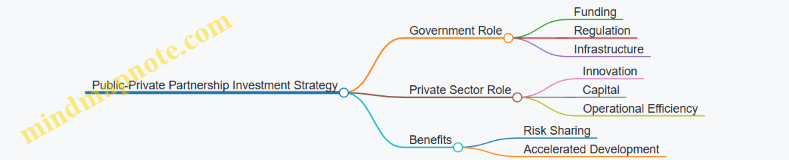
Investing in Technology Enablers
Technologies that reduce costs or open new capabilities are prime investment targets:
- Automation and Robotics: Reduce human labor costs and increase safety.
- Additive Manufacturing: Enables on-site construction and reduces supply chain dependencies.
- Advanced Propulsion: Cuts transit times and fuel costs.
Example: Made In Space’s 3D printing technology aboard the ISS demonstrates the economic benefits of additive manufacturing in orbit.
Mind Map: Technology Enablers for Off-Planet Infrastructure
Risk Diversification Across Investment Portfolios
Given the high uncertainty in space projects, spreading investments across multiple domains mitigates risk.
- Combine early-stage technology ventures with established satellite operators.
- Balance investments between lunar, Martian, and orbital infrastructure.
Example: An investment portfolio including satellite internet providers (e.g., OneWeb), launch service companies (e.g., Rocket Lab), and ISRU startups reduces exposure to any single failure.
Mind Map: Risk Diversification Strategy

Supporting Sustainable and Circular Economy Models
Investments that promote sustainability ensure long-term viability and regulatory favorability.
- Closed-loop life support systems.
- Recycling of materials and waste in space.
- Minimizing space debris through design and end-of-life plans.
Example: The development of closed-loop environmental control systems on the ISS reduces resupply costs and environmental impact.
Mind Map: Sustainable Investment Priorities
Leveraging Data Analytics and AI for Market Insights
Utilizing big data and AI enhances forecasting accuracy and investment timing.
- Market demand prediction.
- Risk modeling.
- Operational optimization.
Example: Satellite operators use AI-driven analytics to optimize constellation deployment and maximize revenue.
Mind Map: AI and Data Analytics in Investment Strategy
Summary Table of Strategic Investment Priorities
| Priority Area | Key Focus | Example Project/Company |
|---|---|---|
| High-Impact Sectors | Reusable rockets, ISRU, habitats, comms | SpaceX Starship |
| Public-Private Partnerships | Risk sharing, regulatory support | Lunar Gateway |
| Technology Enablers | Automation, 3D printing, propulsion | Made In Space |
| Risk Diversification | Portfolio spread across sectors and stages | Mixed portfolio of OneWeb, Rocket Lab |
| Sustainability and Circular Economy | Closed-loop systems, debris mitigation | ISS Environmental Control |
| AI and Data Analytics | Market and risk forecasting | Satellite constellation operators |
By aligning investments with these strategic priorities, economists and investors can effectively navigate the complex off-planet infrastructure landscape, maximizing returns while fostering sustainable growth.
12.4 Best Practice: Adaptive Strategy Formulation in a Rapidly Evolving Market
In the dynamic and uncertain environment of off-planet infrastructure development, adaptive strategy formulation is essential. Unlike traditional markets, space infrastructure faces rapid technological advances, evolving regulatory frameworks, fluctuating investment climates, and unpredictable geopolitical influences. An adaptive strategy enables stakeholders—economists, strategy planners, and tech investors—to remain resilient, capitalize on emerging opportunities, and mitigate risks effectively.
Key Components of Adaptive Strategy Formulation
Market Sensing: Staying Ahead of Change
Constantly monitoring technological breakthroughs, policy shifts, and competitor moves is vital. For example, SpaceX’s early recognition of reusable rocket technology reshaped launch economics and forced competitors to adapt rapidly.
Example: The rapid growth of satellite mega-constellations (e.g., Starlink, OneWeb) required investors and planners to reassess market demand, spectrum allocation, and orbital debris risks continuously.
Flexibility: Designing for Change
Modular project designs and scenario planning allow quick pivots. The Lunar Gateway project exemplifies modular infrastructure that can be expanded or reconfigured based on mission needs and funding availability.
Example: SpaceX’s Starship development employs iterative prototyping and testing, enabling rapid design changes in response to test outcomes and market feedback.
Continuous Learning: Institutionalizing Feedback Loops
Post-mission reviews and knowledge sharing accelerate improvement. NASA’s lessons learned database is a prime example, helping avoid repeated mistakes and fostering innovation.
Example: Blue Origin’s approach to iterative engine testing and sharing insights internally to refine their BE-4 engine design reduces costly failures.
Risk Management: Dynamic and Proactive
Adaptive strategies incorporate ongoing risk assessments and flexible contingency plans. Insurance models tailored to space assets, like satellite insurance, help mitigate financial exposure.
Example: Commercial satellite operators adjust insurance coverage dynamically based on launch schedules, technology maturity, and geopolitical risks.
Stakeholder Engagement: Collaborative and Transparent
Maintaining open communication with regulators, investors, and partners ensures alignment and rapid response to external changes.
Example: The Artemis Accords demonstrate how early multilateral agreements can reduce regulatory uncertainty and foster cooperative investment environments.
Mind Map: Adaptive Strategy Cycle
Practical Example: Applying Adaptive Strategy in Off-Planet Infrastructure
Scenario: A tech investor is considering funding a lunar mining startup.
- Monitor: The investor tracks emerging ISRU (In-Situ Resource Utilization) technologies, lunar policy developments, and competitor activities.
- Analyze: They develop scenarios including accelerated regulatory approvals or delays, and varying commodity prices for extracted materials.
- Decide: Based on risk tolerance, they allocate staged investments linked to technology milestones.
- Act: They engage with the startup to support agile development and maintain open dialogue with regulators.
- Learn: After initial pilot missions, they review outcomes and adjust investment strategy accordingly.
This approach reduces sunk costs, enhances responsiveness, and maximizes return on investment.
Summary
Adaptive strategy formulation in off-planet infrastructure development is not a one-time plan but a continuous, iterative process. By integrating market sensing, flexibility, continuous learning, risk management, and stakeholder engagement, economists, strategists, and investors can navigate the complexities of this frontier market successfully.
This best practice ensures that economic models and investment decisions remain robust amid rapid technological and market changes, ultimately fostering sustainable growth and innovation in the space economy.
12.5 Preparing for the Next Decade: Roadmap for Sustainable Off-Planet Infrastructure
As humanity embarks on expanding its presence beyond Earth, preparing a sustainable roadmap for off-planet infrastructure development is critical. This section outlines strategic priorities, best practices, and actionable steps to ensure economic viability, environmental stewardship, and technological resilience over the next decade.
Key Pillars of Sustainable Off-Planet Infrastructure
Economic Viability: Building Robust Financial Foundations
-
Long-Term Investment Strategies: Investors and planners must focus on sustainable funding models, including blended finance (public-private partnerships), venture capital, and sovereign wealth funds. For example, the Artemis program leverages government funding alongside private sector contracts to distribute risk and ensure continuity.
-
Cost Optimization: Emphasizing modular, reusable infrastructure like SpaceX’s Starship reduces launch costs and accelerates deployment timelines.
-
Revenue Diversification: Beyond traditional satellite services, emerging markets such as space tourism, asteroid mining, and manufacturing in microgravity offer new revenue streams. Blue Origin’s Orbital Reef project exemplifies commercial space station diversification.

Environmental Stewardship: Minimizing Impact and Maximizing Sustainability
-
Resource Recycling & Circular Economy: Closed-loop life support systems, like those tested on the ISS, reduce resupply needs and waste.
-
Space Debris Mitigation: Active debris removal and design-for-demise principles help maintain orbital sustainability.
-
In-Situ Resource Utilization (ISRU): Using lunar regolith for construction (e.g., 3D-printed habitats) reduces Earth-launch mass and environmental footprint.
Example: NASA’s Artemis Base Camp plans to utilize lunar ice for water and oxygen, showcasing environmental and economic synergy.
Technological Resilience: Future-Proofing Infrastructure
-
Modular Design: Facilitates upgrades and repairs, reducing downtime and extending asset life. The Lunar Gateway’s modular architecture is a prime example.
-
Automation & AI: Autonomous robotics can perform maintenance and construction tasks remotely, lowering human risk and operational costs.
-
ISRU Technologies: Developing reliable ISRU systems ensures resource independence and operational sustainability.
Example: The use of autonomous rovers for lunar mining demonstrates how technology can reduce costs and increase efficiency.
Regulatory & Policy Alignment: Navigating the Legal Landscape
-
International Cooperation: Harmonizing policies through frameworks like the Artemis Accords ensures peaceful and productive collaboration.
-
Compliance: Adhering to space treaties and national regulations minimizes legal risks and fosters investor confidence.
-
Intellectual Property (IP) Management: Protecting innovations while encouraging knowledge sharing balances competition and collaboration.
Example: The Artemis Accords provide a template for resource extraction rights and environmental protections, facilitating market access.
Workforce & Community: Cultivating Human Capital and Collaboration
-
Training & Education: Developing a skilled workforce through specialized programs (e.g., NASA’s astronaut and technician training) ensures operational excellence.
-
Remote Operations: Telepresence and virtual reality reduce the need for permanent human presence, lowering costs and risks.
-
Multinational Collaboration: Diverse teams bring innovation and share costs, as seen in the ISS partnership.
Example: ESA’s astronaut training incorporates international cooperation and cross-disciplinary skills, preparing a versatile workforce.
Summary Example: Integrated Roadmap for a Lunar Habitat Project
| Phase | Focus Area | Best Practice Example |
|---|---|---|
| Planning | Economic Viability | Public-private partnership funding model |
| Design | Technological Resilience | Modular habitat design (Lunar Gateway style) |
| Construction | Environmental Stewardship | Use of 3D-printed lunar regolith structures |
| Operations | Workforce & Community | Remote robotic maintenance with telepresence |
| Regulation | Regulatory & Policy Alignment | Compliance with Artemis Accords |
By integrating these pillars into a cohesive strategy, stakeholders can build off-planet infrastructure that is economically sound, environmentally responsible, technologically advanced, legally compliant, and human-centered—ensuring a sustainable and prosperous future in space over the next decade and beyond.
13. Conclusion and Synthesis
13.1 Recap of Key Economic Principles in Off-Planet Infrastructure
Off-planet infrastructure development is a complex, multifaceted endeavor that integrates economics, technology, policy, and market dynamics. To effectively navigate this emerging frontier, it is crucial to understand and apply several key economic principles that underpin successful projects and sustainable growth.
Mind Map: Core Economic Principles in Off-Planet Infrastructure
Market Analysis and Demand Forecasting
Understanding the demand for off-planet infrastructure is foundational. Projects like satellite constellations (e.g., SpaceX Starlink) demonstrate how accurate market analysis and scenario planning can identify viable revenue streams and mitigate risks.
Example: NASA’s Artemis program uses scenario planning to forecast lunar infrastructure needs, helping investors and planners anticipate market shifts.
Cost Structures: Balancing CapEx and OpEx
Space projects involve high upfront capital costs (launch vehicles, habitat construction) and ongoing operational expenses (maintenance, supply missions). Modular designs, such as SpaceX’s Starship, exemplify best practices by reducing costs through reusability and scalability.
Example: The Lunar Gateway’s cost breakdown highlights the importance of balancing initial investments with long-term operational sustainability.
Financing Strategies and Risk Mitigation
Financing off-planet infrastructure requires innovative models including public-private partnerships, venture capital, and hybrid instruments. Insurance mechanisms, like those used in satellite operations, help mitigate financial risks.
Example: The Mars Colonization Initiative illustrates the need for diversified funding sources and risk-sharing agreements.
Regulatory and Policy Frameworks
International agreements (e.g., Artemis Accords) and national policies shape market access and investment climates. Navigating intellectual property rights and compliance is essential to maximize returns.
Example: Companies adhering to the Artemis Accords gain preferential access to lunar markets, enhancing economic viability.
Technological Innovation and Economic Impact
Advances in propulsion, ISRU, and robotics reduce costs and enable sustainable infrastructure. 3D printing lunar habitats demonstrates how technology integration drives profitability.
Example: Using lunar regolith for construction materials cuts down Earth-to-Moon transport costs significantly.
Supply Chain and Logistics Economics
Optimizing supply chains through reusable rockets (SpaceX) and in-situ production reduces costs and increases resilience.
Example: Utilizing lunar regolith for building materials exemplifies cost-saving through local resource use.
Workforce Economics
Balancing automation with human labor and investing in specialized training programs (NASA astronaut training) ensures operational efficiency and cost-effectiveness.
Example: Remote operations and telepresence reduce the need for costly human presence in hazardous environments.
Environmental Economics and Sustainability
Applying circular economy principles and closed-loop life support systems minimizes environmental impact and operational costs.
Example: Managing space debris through economic incentives reduces long-term risks and costs.
Risk Management and Economic Resilience
Diversification of revenue streams and comprehensive insurance models build resilience against market volatility and technical failures.
Example: Commercial satellite operators use risk pooling and insurance to safeguard investments.
Summary
The economics of off-planet infrastructure hinge on integrating market insights, cost optimization, innovative financing, regulatory navigation, technological adoption, supply chain efficiency, workforce management, sustainability, and risk mitigation. Applying these principles cohesively enables stakeholders to unlock the vast potential of space economies while managing inherent uncertainties.
This holistic understanding empowers economists, strategy planners, and tech investors to make informed decisions that drive sustainable growth and profitability in the off-planet infrastructure domain.
13.2 Integrating Best Practices for Holistic Economic Success
Achieving holistic economic success in off-planet infrastructure development requires the seamless integration of best practices across multiple domains—market analysis, financing, technology, regulation, and sustainability. This section synthesizes these practices into a cohesive framework, supported by illustrative examples and mind maps to guide economists, strategy planners, and tech investors.
Mind Map: Holistic Economic Success Framework
Market Analysis: Aligning Demand with Strategic Investment
Best Practice: Employ scenario planning and risk assessment to forecast demand accurately.
Example: NASA’s Artemis program uses scenario planning to anticipate lunar infrastructure needs, enabling investors to align capital deployment with realistic timelines and market demand.
Integration Tip: Combine demand forecasting with risk assessment to avoid overinvestment or underutilization.
Financing Strategies: Leveraging Diverse Capital Sources
Best Practice: Utilize public-private partnerships (PPPs) and hybrid financing instruments to spread risk and attract diverse investors.
Example: The International Space Station (ISS) exemplifies a successful PPP, where government funding is complemented by commercial investments, reducing individual stakeholder risk.
Integration Tip: Structure financing to include insurance and guarantees, as seen in satellite insurance markets, to mitigate economic risks.
Technology Integration: Driving Cost Efficiency and Scalability
Best Practice: Adopt modular design and ISRU to optimize costs and enable scalability.
Example: SpaceX’s Starship employs modular construction techniques, reducing manufacturing and launch costs, while lunar ISRU projects aim to use local materials to build habitats, lowering Earth-launch mass.
Integration Tip: Combine automation and robotics with ISRU to reduce labor costs and increase operational efficiency.
Regulatory Navigation: Ensuring Compliance and Market Access
Best Practice: Proactively engage with regulatory frameworks like the Artemis Accords to secure market access and protect intellectual property.
Example: Companies participating in the Artemis Accords benefit from clearer legal frameworks, reducing uncertainty and encouraging investment.
Integration Tip: Integrate regulatory compliance early in project planning to avoid costly delays and maximize ROI.
Sustainability: Embedding Environmental and Economic Resilience
Best Practice: Apply circular economy principles and closed-loop life support systems to minimize waste and reduce resupply costs.
Example: The closed-loop life support system aboard the ISS significantly reduces the need for Earth-based resupply, demonstrating cost savings and sustainability.
Integration Tip: Incorporate environmental impact assessments into economic models to balance growth with sustainability.
Supply Chain & Logistics: Building Resilient and Cost-Effective Networks
Best Practice: Optimize supply chains by balancing Earth-to-orbit shipments with in-situ production.
Example: SpaceX’s reusable rockets have revolutionized supply chain economics by drastically reducing launch costs and enabling more frequent resupply missions.
Integration Tip: Use lunar regolith for construction materials to reduce dependency on Earth supply chains.
Workforce Development: Balancing Human and Automated Labor
Best Practice: Invest in training and leverage remote operations to reduce costs and increase flexibility.
Example: NASA’s astronaut training programs paired with telepresence technologies enable efficient mission operations with fewer personnel in space.
Integration Tip: Localize workforce development to reduce costs and foster sustainable economic ecosystems.
Risk Management: Enhancing Economic Resilience
Best Practice: Diversify revenue streams and employ insurance mechanisms to manage economic risks.
Example: Commercial satellite operators use insurance and diversified service offerings (e.g., broadband, IoT connectivity) to mitigate market fluctuations.
Integration Tip: Develop contingency plans that integrate economic impact minimization strategies.
Mind Map: Integration of Best Practices for Economic Success
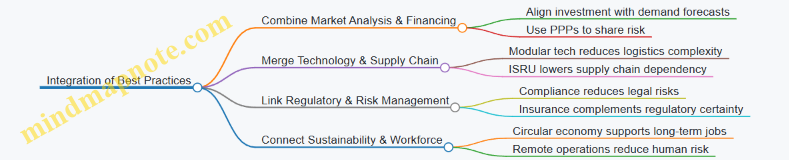
Final Example: Lunar Gateway Project
The Lunar Gateway project exemplifies holistic economic success by integrating:
- Market Analysis: Forecasting lunar exploration demand.
- Financing: Combining NASA funding with international and commercial partners.
- Technology: Modular habitat design and robotics.
- Regulation: Compliance with international space law.
- Sustainability: Plans for ISRU and waste recycling.
- Supply Chain: Leveraging reusable launch vehicles.
- Workforce: Remote operations and astronaut training.
- Risk Management: Insurance and diversified mission objectives.
This integrated approach reduces costs, spreads risks, and maximizes economic returns, serving as a blueprint for future off-planet infrastructure ventures.
By weaving these best practices into a unified strategy, stakeholders can navigate the complexities of off-planet infrastructure economics and unlock sustainable, profitable growth in the emerging space economy.
13.3 Final Thoughts on the Role of Economists, Strategists, and Investors
The development of off-planet infrastructure represents one of the most complex and promising frontiers in modern economics and investment. As we stand at the cusp of a new era, the roles of economists, strategists, and investors are pivotal in shaping sustainable, profitable, and innovative space ventures. Their combined expertise will determine how effectively humanity can leverage space resources, technology, and markets for long-term growth.
The Economist’s Role
Economists provide the foundational frameworks to evaluate the viability, scalability, and impact of off-planet projects. They analyze cost structures, forecast demand, and assess economic externalities, ensuring that investments align with realistic market potentials and societal benefits.
Example: Economists analyzing the cost-benefit dynamics of lunar mining operations help determine whether extracting Helium-3 or rare earth elements is economically feasible compared to Earth-based alternatives.
The Strategist’s Role
Strategists synthesize market data, technological trends, and regulatory landscapes to craft actionable plans. They anticipate challenges, identify competitive advantages, and design adaptive strategies that can pivot as the space economy evolves.
Example: Strategy planners at agencies like NASA or private firms like SpaceX develop phased approaches to infrastructure deployment—starting with orbital platforms before expanding to lunar bases—balancing risk and reward.
The Investor’s Role
Investors provide the essential capital and risk appetite to transform concepts into reality. They evaluate projects not only on financial returns but also on technological feasibility and regulatory compliance, often driving innovation through funding.
Example: Venture capital firms investing in startups focused on in-situ resource utilization (ISRU) technologies accelerate the commercialization of sustainable space infrastructure.
Mind Maps Illustrating Roles and Interactions
Mind Map 1: Core Responsibilities
Mind Map 2: Collaborative Workflow
Mind Map 3: Challenges and Solutions
Integrated Example: The Lunar Gateway Project
- Economists assessed the long-term economic benefits of a lunar orbital platform, analyzing cost drivers and potential revenue streams from scientific research and commercial activities.
- Strategists designed a phased deployment plan that aligned with international partnerships and technological readiness, mitigating risks related to schedule delays and budget overruns.
- Investors (including government agencies and private partners) structured funding models combining grants, contracts, and equity investments to ensure financial sustainability.
This triad collaboration exemplifies how interdisciplinary roles converge to drive off-planet infrastructure projects forward.
Summary
The synergy between economists, strategists, and investors is essential for navigating the uncharted economic terrain of space infrastructure. By combining rigorous analysis, visionary planning, and prudent investment, these professionals can unlock unprecedented opportunities beyond Earth.
As the space economy expands, their roles will evolve, demanding continuous learning, collaboration, and innovation to ensure off-planet infrastructure development is both economically viable and socially beneficial.
13.4 Call to Action: Collaborative Efforts for Future Growth
The future of off-planet infrastructure development hinges on the strength and synergy of collaborative efforts among economists, strategy planners, tech investors, governments, and private enterprises. To accelerate sustainable growth and maximize economic returns, stakeholders must embrace partnership models, share knowledge, and innovate collectively.
Why Collaboration is Crucial
- Complexity of Space Projects: Off-planet infrastructure involves multifaceted challenges—technical, financial, regulatory, and environmental—that no single entity can tackle alone.
- Resource Optimization: Pooling financial, intellectual, and technological resources reduces duplication and spreads risk.
- Market Expansion: Collaborative ventures can open new markets and create shared standards, fostering broader economic ecosystems.
Mind Map: Key Pillars of Collaborative Growth
Practical Examples of Collaborative Success
-
International Space Station (ISS)
- A hallmark of international collaboration involving NASA, Roscosmos, ESA, JAXA, and CSA.
- Shared costs, research, and infrastructure have extended the station’s lifespan and scientific output.
- Best Practice: Joint governance structures and shared investment reduce individual risk and foster innovation.
-
Artemis Accords
- A multilateral agreement encouraging peaceful, transparent, and cooperative lunar exploration.
- Facilitates market access and regulatory clarity for participating nations and companies.
- Best Practice: Establishing clear legal frameworks to enable investment confidence.
-
SpaceX and NASA Partnership
- NASA’s Commercial Crew Program enabled SpaceX to develop Crew Dragon, reducing costs and accelerating timelines.
- Demonstrates how government contracts can stimulate private sector innovation.
-
European Space Agency (ESA) and Industry Collaboration
- ESA’s collaboration with European aerospace companies to develop modular lunar infrastructure.
- Emphasizes co-development and shared intellectual property rights.
Mind Map: Steps to Foster Collaborative Efforts
Final Thoughts
The economics of off-planet infrastructure development will be defined by how effectively diverse stakeholders collaborate. By embracing partnership models, sharing risks and rewards, and fostering open innovation ecosystems, the space economy can achieve scalable, sustainable growth. Economists, strategy planners, and tech investors are uniquely positioned to champion these collaborative frameworks, ensuring that off-planet infrastructure not only becomes viable but thrives as a cornerstone of the future global economy.
Call to Action
- For Economists: Develop models that quantify benefits of collaboration and identify optimal partnership structures.
- For Strategy Planners: Design flexible, adaptive strategies that incorporate multi-stakeholder inputs and evolving market dynamics.
- For Tech Investors: Prioritize funding ventures that demonstrate strong collaborative potential and shared value creation.
Together, these efforts will unlock the vast economic potential of off-planet infrastructure, driving humanity’s next giant leap.
13.5 Resources and Further Reading
To deepen your understanding of the economics of off-planet infrastructure development, the following curated resources, mind maps, and examples provide comprehensive insights across multiple dimensions—from market analysis to financing, technology, and policy frameworks.
Key Books & Reports
- “The Economics of Space: An Industry Ready to Take Off” by NASA Office of the Chief Economist
- “Space Infrastructure Economics” by the International Space University
- “Space Investment and Finance” by the Space Frontier Foundation
- OECD Space Economy Report 2023
- “The Artemis Accords: Legal and Economic Perspectives” by the Secure World Foundation
Influential Articles & Papers
- Smith, J. (2022). Cost Modeling for Lunar Habitats: A Modular Approach. Journal of Space Economics.
- Lee, A. & Kumar, R. (2023). Public-Private Partnerships in Space Infrastructure: Lessons from ISS. Space Policy Journal.
- Chen, L. (2021). In-Situ Resource Utilization and Economic Sustainability. Advances in Space Research.
Online Platforms & Databases
- NASA Economics and Finance Division – https://www.nasa.gov/economics
- Space Foundation’s Space Report – https://www.spacefoundation.org/space-report
- Eurospace Market Observatory – https://www.eurospace.org/market-observatory
- SpaceX Investor Relations – https://www.spacex.com/investors
Mind Maps
Mind Map 1: Off-Planet Infrastructure Economic Framework
Mind Map 2: Financing Off-Planet Infrastructure
Mind Map 3: Technological Innovations Impacting Economics
Practical Examples to Explore
- International Space Station (ISS): Explore the economic model of a long-term public-private partnership that has sustained decades of off-planet infrastructure.
- SpaceX Starlink: Analyze how satellite constellation deployment disrupted traditional telecom markets and created new revenue streams.
- Lunar Gateway: Study the cost-sharing and modular construction approach among international partners.
- Blue Origin’s Orbital Reef: Understand commercial space station economics and investment strategies.
- NASA’s Artemis Program: Review scenario planning and demand forecasting techniques used to justify infrastructure investments.
Additional Learning Tools
-
Webinars and Conferences:
- Space Economic Forum
- International Astronautical Congress (IAC) sessions on economics
- Space Investment Summit
-
Courses:
- “Space Economics and Policy” – offered by International Space University
- “Infrastructure Finance and Development” – available on Coursera and edX with space-specific modules
Leveraging these resources will empower economists, strategy planners, and tech investors to make informed decisions and craft robust strategies for the evolving frontier of off-planet infrastructure development.