Advanced Nuclear Energy Systems And Small Modular Reactor Technologies
1. Introduction to Advanced Nuclear Energy Systems
1.1 Overview of Nuclear Energy Evolution
Nuclear energy has undergone a remarkable evolution since its inception in the mid-20th century. Understanding this evolution is critical for nuclear engineers, energy policy technologists, and reactor designers as it shapes the foundation for advanced nuclear energy systems and Small Modular Reactor (SMR) technologies.
Historical Timeline of Nuclear Energy Development
- 1938: Discovery of nuclear fission by Otto Hahn and Fritz Strassmann.
- 1942: First controlled nuclear chain reaction achieved by Enrico Fermi (Chicago Pile-1).
- 1954: World’s first nuclear power plant to generate electricity in Obninsk, USSR.
- 1957: Shippingport Atomic Power Station, first commercial nuclear power plant in the USA.
- 1970s-1980s: Expansion of Generation II reactors worldwide.
- 1990s-Present: Development of Generation III and III+ reactors focusing on safety and efficiency.
- 2000s-Present: Research and deployment of Generation IV reactors and SMRs.
Mind Map: Evolution of Nuclear Energy
Key Phases Explained with Examples
-
Discovery & Early Research:
- The discovery of nuclear fission in 1938 paved the way for controlled chain reactions.
- Example: Chicago Pile-1, the first man-made nuclear reactor, demonstrated feasibility.
-
Generation I Reactors:
- Early prototype and experimental reactors primarily for research and military applications.
- Example: Experimental Breeder Reactor I (EBR-I) in the USA.
-
Generation II Reactors:
- Commercial power reactors with improved designs but limited passive safety features.
- Examples: Pressurized Water Reactors (PWRs) and Boiling Water Reactors (BWRs) widely deployed globally.
-
Generation III and III+ Reactors:
- Incorporate enhanced safety systems, longer operational lifetimes, and improved fuel efficiency.
- Example: AP1000 by Westinghouse uses passive safety systems to prevent accidents.
-
Generation IV Reactors:
- Focus on sustainability, safety, and waste minimization.
- Examples include:
- High-Temperature Gas-Cooled Reactors (HTGRs)
- Molten Salt Reactors (MSRs)
- Fast Neutron Reactors
-
Small Modular Reactors (SMRs):
- Compact, factory-fabricated reactors designed for scalability and flexible deployment.
- Example: NuScale Power Module, designed for incremental capacity additions and enhanced safety.
Mind Map: Drivers of Nuclear Energy Evolution
Best Practice Example: Transitioning from Generation II to Generation III Reactors
- Context: Generation II reactors had active safety systems requiring external power.
- Practice: Incorporate passive safety features that operate without external power or human intervention.
- Example: The AP1000 reactor uses gravity-driven cooling water and natural circulation to maintain core cooling during emergencies.
- Outcome: Enhanced safety margins and simplified emergency response protocols.
Summary
The evolution of nuclear energy is characterized by continuous improvements in safety, efficiency, and sustainability. Each generation builds upon lessons learned from its predecessors, integrating best practices and innovative technologies. Small Modular Reactors represent the latest paradigm shift, offering flexible and scalable solutions to meet modern energy demands while addressing economic and environmental challenges.
Understanding this evolutionary path equips nuclear professionals with the context and insights necessary to design, regulate, and deploy the next generation of nuclear energy systems effectively.
1.2 Defining Advanced Nuclear Energy Systems
Advanced Nuclear Energy Systems (ANES) represent the next generation of nuclear technologies designed to improve safety, efficiency, sustainability, and economic viability beyond traditional nuclear reactors. These systems integrate innovative reactor designs, advanced materials, and novel fuel cycles to address the challenges faced by conventional nuclear power plants.
Key Characteristics of Advanced Nuclear Energy Systems
- Enhanced Safety: Incorporation of passive safety features and inherent safety mechanisms that reduce reliance on active controls and human intervention.
- Improved Efficiency: Higher thermal efficiencies and better fuel utilization through advanced reactor physics and materials.
- Sustainability: Utilization of closed fuel cycles, recycling, and reduced waste generation.
- Modularity and Scalability: Designs that allow for modular construction, enabling flexible deployment and reduced capital costs.
- Economic Competitiveness: Lower lifecycle costs through innovative manufacturing, reduced construction times, and improved operational performance.
Mind Map: Core Components of Advanced Nuclear Energy Systems
Example: Generation IV Reactor Classification
The Generation IV International Forum (GIF) identifies six advanced reactor concepts, each with unique features:
| Reactor Type | Coolant Type | Key Advantages | Example Project |
|---|---|---|---|
| Gas-Cooled Fast Reactor (GFR) | Helium | High outlet temperature, efficient fuel use | ALLEGRO (Europe) |
| Lead-Cooled Fast Reactor (LFR) | Lead or Lead-Bismuth | Passive safety, high thermal inertia | BREST (Russia) |
| Molten Salt Reactor (MSR) | Molten fluoride salts | Online fuel processing, low pressure | ORNL MSRE (USA) |
| Sodium-Cooled Fast Reactor (SFR) | Liquid Sodium | Proven technology, fast neutron spectrum | BN-800 (Russia) |
| Supercritical Water Reactor (SCWR) | Supercritical water | High thermal efficiency | Canadian SCWR Concept |
| Very High Temperature Reactor (VHTR) | Helium | Hydrogen production, process heat | HTR-PM (China) |
Mind Map: Safety Innovations in Advanced Nuclear Systems
Practical Example: NuScale Small Modular Reactor
NuScale’s SMR design exemplifies advanced nuclear energy systems by integrating modularity, passive safety, and simplified construction:
- Modularity: Factory-fabricated modules allow for scalable power generation.
- Passive Safety: Natural circulation cooling eliminates the need for pumps in emergencies.
- Economic Efficiency: Reduced construction time and capital costs through modular design.
This example demonstrates how advanced nuclear energy systems combine innovative design and operational best practices to meet modern energy demands.
Summary
Advanced Nuclear Energy Systems encompass a broad spectrum of technologies aimed at overcoming the limitations of traditional nuclear reactors. By leveraging innovative reactor designs, advanced materials, and enhanced safety features, these systems promise a more sustainable, safe, and economically viable nuclear energy future.
Understanding the defining elements of ANES is critical for nuclear engineers, policy technologists, and reactor designers to effectively contribute to the deployment and advancement of next-generation nuclear power solutions.
1.3 Role of Small Modular Reactors (SMRs) in Modern Energy Landscape
Small Modular Reactors (SMRs) are increasingly recognized as a transformative technology within the modern energy landscape. Their unique characteristics enable them to address several challenges faced by traditional large-scale nuclear reactors and complement renewable energy sources, thereby playing a pivotal role in achieving a sustainable, reliable, and low-carbon energy future.
Key Roles of SMRs in the Energy Landscape
Flexibility and Scalability
SMRs are designed with modularity in mind, allowing utilities and governments to deploy reactors incrementally based on demand growth or budget availability. This contrasts with traditional large reactors that require massive upfront investments and long construction periods.
Example:
- The NuScale Power Module can be deployed in increments of 60 MW thermal units, allowing utilities to add capacity as needed without overbuilding.
Enhanced Safety
SMRs incorporate advanced passive safety features that rely on natural physical principles such as gravity, natural circulation, and convection, reducing the need for active intervention during emergencies.
Example:
- The CAREM reactor in Argentina uses natural circulation cooling, eliminating the need for pumps in normal operation and enhancing safety.
Economic Competitiveness
By leveraging factory fabrication and modular design, SMRs aim to reduce construction costs and timelines, addressing the economic challenges of traditional nuclear projects.
Example:
- The BWRX-300 by GE Hitachi targets a construction timeline of 3-4 years and aims to reduce capital costs by up to 40% compared to large reactors.
Integration with Renewable Energy
SMRs can complement intermittent renewable sources by providing reliable baseload power and flexible load-following capabilities, enabling a more resilient and balanced grid.
Example:
- The microgrid project in Galena, Alaska, integrates an SMR with wind and solar power to provide stable electricity to a remote community.
Decarbonization Efforts
SMRs contribute to reducing greenhouse gas emissions by replacing fossil fuel-based power plants and enabling clean hydrogen production through high-temperature electrolysis.
Example:
- The U-Battery project envisions using a high-temperature SMR to produce hydrogen for industrial use, supporting decarbonization beyond electricity generation.
Energy Security
By diversifying the energy mix and reducing dependence on imported fuels, SMRs enhance national energy security and resilience against supply disruptions.
Example:
- The UK government’s SMR program aims to strengthen energy independence while supporting climate goals.
Summary
SMRs hold a strategic position in the modern energy landscape by offering scalable, safe, and economically viable nuclear power solutions. Their ability to integrate with renewables, support decarbonization, and enhance energy security makes them a critical technology for the future energy mix.
Additional Example: Deployment in Remote Locations
Case: The Russian floating nuclear power plant Akademik Lomonosov provides power to remote Arctic regions where traditional grid infrastructure is challenging. This showcases SMRs’ potential in unique applications requiring compact, transportable nuclear solutions.
1.4 Best Practices in Conceptualizing Advanced Nuclear Systems with Practical Examples
Conceptualizing advanced nuclear energy systems requires a multidisciplinary approach that integrates reactor physics, materials science, safety engineering, economics, and policy considerations. This section outlines best practices to guide nuclear engineers, energy policy technologists, and reactor designers through the early stages of system design, supported by practical examples and mind maps to visualize the process.
Best Practice 1: Define Clear Objectives and Requirements
- Establish the goals of the nuclear system (e.g., power output, safety level, fuel cycle, deployment environment).
- Identify stakeholder needs including regulatory bodies, operators, and end-users.
- Incorporate sustainability and economic targets early.
Example: The NuScale SMR project began by defining a modular, scalable power output (60 MW per module) with enhanced safety features to meet U.S. NRC requirements and flexible deployment in remote areas.
Best Practice 2: Employ Iterative Design and Simulation
- Use iterative cycles of design, simulation, and validation to refine system concepts.
- Leverage advanced computational tools for neutronics, thermal-hydraulics, and structural analysis.
- Integrate multidisciplinary teams to ensure holistic system optimization.
Example: The Generation IV International Forum (GIF) promotes iterative design cycles for fast reactors, using coupled neutronics and thermal-hydraulics codes to optimize core design and passive safety features.
Best Practice 3: Prioritize Safety by Design
- Integrate inherent and passive safety features from the conceptual phase.
- Design for multiple layers of defense-in-depth.
- Consider accident scenarios early and incorporate mitigation strategies.
Example: The Integral Pressurized Water Reactor (iPWR) design integrates passive cooling systems that operate without external power, reducing the risk of core damage during station blackout events.
Best Practice 4: Incorporate Modular and Standardized Design Principles
- Design components and systems for modularity to facilitate factory fabrication and onsite assembly.
- Standardize interfaces and systems to reduce costs and licensing complexity.
Example: NuScale’s SMR modules are factory-built and shipped to sites for assembly, reducing onsite construction time and improving quality control.
Best Practice 5: Engage Early with Regulatory Bodies and Stakeholders
- Initiate dialogue with regulators to understand licensing requirements and incorporate feedback.
- Engage communities and stakeholders to build trust and address concerns.
Example: The Canadian SMR Roadmap emphasizes early regulatory engagement and community involvement to streamline deployment and acceptance.
Summary Table of Best Practices with Examples
| Best Practice | Description | Practical Example |
|---|---|---|
| Define Clear Objectives and Requirements | Set system goals and stakeholder needs early | NuScale SMR modular power design |
| Employ Iterative Design and Simulation | Use cycles of design and validation with simulations | Generation IV fast reactor design |
| Prioritize Safety by Design | Integrate passive/inherent safety from concept phase | Integral PWR passive cooling systems |
| Incorporate Modular and Standardized Design | Design for factory fabrication and standard interfaces | NuScale factory-built modules |
| Engage Early with Regulatory Bodies and Stakeholders | Early dialogue to align licensing and public acceptance | Canadian SMR Roadmap |
By following these best practices, nuclear engineers and reactor designers can develop advanced nuclear systems that are safe, economically viable, and aligned with stakeholder expectations, paving the way for successful deployment of next-generation nuclear technologies.
1.5 Case Study: Transition from Generation III to Generation IV Reactors
The transition from Generation III to Generation IV nuclear reactors represents a pivotal evolution in nuclear technology, focusing on enhanced safety, sustainability, efficiency, and economics. This case study explores the key differences, challenges, and best practices involved in this transition, supported by mind maps and practical examples.
Overview of Generation III vs Generation IV Reactors
| Feature | Generation III | Generation IV |
|---|---|---|
| Safety | Improved passive safety features | Inherently safe designs, passive and active safety combined |
| Fuel Efficiency | ~33-37% thermal efficiency | Up to 45% or more, advanced fuel cycles |
| Waste Management | Standard fuel cycle, some recycling | Closed fuel cycles, reduced waste generation |
| Operational Lifetime | 40-60 years | 60+ years with enhanced materials |
| Economics | Competitive but high capital costs | Designed for cost reduction via modularity and advanced manufacturing |
Mind Map: Key Attributes of Generation IV Reactors
Best Practices in Transitioning Reactor Generations
-
Incremental Design Improvements: Leveraging lessons learned from Gen III reactors to improve passive safety and operational flexibility.
- Example: The AP1000 reactor incorporates passive safety systems that inspired Gen IV designs.
-
Advanced Materials Development: Investing in materials that withstand higher temperatures and radiation levels to extend reactor life.
- Example: Use of silicon carbide composites in Gen IV reactors for enhanced corrosion resistance.
-
Fuel Cycle Innovation: Developing closed fuel cycles to reduce waste and improve resource utilization.
- Example: Fast reactors like the Sodium-cooled Fast Reactor (SFR) recycle actinides.
-
Modular Construction Techniques: Applying factory fabrication and modular assembly to reduce construction time and costs.
- Example: Small Modular Reactors (SMRs) such as NuScale utilize modular designs.
-
Regulatory Engagement: Early and continuous interaction with regulators to align new technologies with safety standards.
- Example: The U.S. Nuclear Regulatory Commission’s pre-application reviews for advanced reactors.
Mind Map: Best Practices for Transition
Practical Example: The Sodium-cooled Fast Reactor (SFR) Transition
- Background: SFRs are a key Gen IV technology designed to improve fuel utilization and reduce waste.
- Transition Highlights:
- Building on decades of fast reactor experience (e.g., EBR-II, Phénix).
- Incorporation of passive safety features and improved coolant technology.
- Development of advanced fuel forms such as metallic and nitride fuels.
- Challenges:
- Managing sodium coolant chemical reactivity.
- Licensing new safety cases.
- Outcome:
- Demonstrated potential for closing the fuel cycle and extending uranium resources.
Mind Map: SFR Transition Highlights
Summary
The transition from Generation III to Generation IV reactors is not merely a technological upgrade but a comprehensive evolution encompassing safety, sustainability, and economics. By adopting best practices such as modular construction, advanced materials, and closed fuel cycles, the nuclear industry is poised to deliver reactors that meet the energy demands of the future with enhanced safety and environmental stewardship.
This case study underscores the importance of integrating lessons learned, fostering innovation, and engaging regulatory bodies early to ensure a smooth and successful transition.
2. Fundamentals of Small Modular Reactor Technologies
2.1 SMR Design Principles and Architectures
Small Modular Reactors (SMRs) represent a transformative approach to nuclear power generation, emphasizing scalability, enhanced safety, and economic viability. This section delves into the core design principles and architectural frameworks that define SMRs, supported by illustrative mind maps and practical examples.
Key Design Principles of SMRs
- Modularity: SMRs are designed as factory-fabricated modules that can be transported and assembled onsite, reducing construction time and costs.
- Enhanced Safety: Incorporation of passive safety systems and simplified designs to minimize human intervention and risk.
- Scalability: Ability to add modules incrementally to match demand growth.
- Economic Competitiveness: Reduced upfront capital investment and shorter construction schedules.
- Flexibility: Suitability for diverse applications including remote locations, industrial process heat, and grid support.
Mind Map: SMR Design Principles
SMR Architectures
SMRs employ a variety of reactor architectures tailored to their intended applications and safety goals. The main architectural categories include:
-
Integral Pressurized Water Reactors (iPWRs)
- All primary components (reactor core, steam generators, pressurizer) integrated within a single pressure vessel.
- Example: NuScale Power Module.
-
High-Temperature Gas-Cooled Reactors (HTGRs)
- Use helium as coolant and graphite as moderator.
- Capable of high outlet temperatures suitable for process heat.
- Example: China’s HTR-PM.
-
Fast Neutron Reactors
- Use fast neutrons to sustain the chain reaction.
- Often employ liquid metal coolants like sodium or lead.
- Example: Lead-Cooled Fast Reactor (LFR).
-
Molten Salt Reactors (MSRs)
- Use molten salt as both fuel solvent and coolant.
- Potential for online fuel processing.
-
Micro Modular Reactors (MMRs)
- Ultra-small reactors designed for very remote or specialized applications.
Mind Map: SMR Architectures
Example: NuScale Power Module
The NuScale Power Module is a leading example of an integral PWR SMR design. It features a compact reactor vessel housing the core, steam generators, and pressurizer, enabling factory fabrication and modular deployment. Its passive safety systems allow the reactor to safely shut down and cool without operator action or external power for extended periods.
Key Features:
- 60 MWe per module
- Scalable up to 12 modules for 720 MWe
- Passive safety relying on natural circulation
- Underground containment for enhanced security
Example: China’s HTR-PM
The High-Temperature Gas-Cooled Reactor - Pebble-bed Module (HTR-PM) is a demonstration of HTGR architecture. It uses helium coolant and TRISO fuel particles embedded in graphite pebbles, achieving outlet temperatures around 750°C, suitable for industrial heat applications.
Key Features:
- Two reactor modules driving a single steam turbine
- Passive safety via inherent physics
- High thermal efficiency
Best Practices in SMR Design
- Standardization: Designing modules with standardized components to streamline manufacturing and licensing.
- Passive Safety Integration: Prioritize passive safety features to reduce complexity and enhance reliability.
- Factory Fabrication: Maximize offsite manufacturing to improve quality control and reduce onsite construction risks.
- Flexibility in Deployment: Design architectures that can be adapted for various applications and grid sizes.
Mind Map: Best Practices in SMR Design
In summary, SMR design principles and architectures focus on modularity, safety, and economic viability. By leveraging integral designs, passive safety, and factory fabrication, SMRs offer a promising pathway for the future of nuclear energy. Practical examples like NuScale and HTR-PM illustrate how these principles are applied in real-world projects, providing valuable lessons for reactor designers and nuclear engineers.
2.2 Modularization Techniques and Manufacturing Best Practices
Modularization is a cornerstone in the development and deployment of Small Modular Reactors (SMRs). It enables the construction of reactor components in controlled factory environments, improving quality, reducing costs, and shortening construction schedules. This section explores key modularization techniques, manufacturing best practices, and provides practical examples to illustrate these concepts.
Modularization Techniques
Modularization involves breaking down the reactor system into manageable, transportable modules that can be fabricated off-site and assembled on-site. The main techniques include:
- Component Modularization: Fabrication of individual components such as reactor pressure vessels, steam generators, and control rod drive mechanisms as standalone modules.
- System Modularization: Integration of multiple components into larger functional systems, e.g., the entire primary coolant loop.
- Plant Modularization: Pre-assembly of multiple systems into large modules or blocks representing significant portions of the plant.
Mind Map: Modularization Techniques
Manufacturing Best Practices
To maximize the benefits of modularization, manufacturers adopt several best practices:
-
Standardization of Designs: Using standardized module designs across multiple units reduces engineering time and manufacturing complexity.
-
Factory Fabrication: Building modules in controlled environments ensures higher quality, better safety, and reduced weather-related delays.
-
Quality Assurance and Testing: Rigorous QA/QC protocols and pre-shipment testing guarantee module integrity and performance.
-
Logistics and Transportation Planning: Early planning for module transport, including route surveys and handling equipment, prevents delays and damage.
-
Integration of Digital Tools: Utilizing 3D modeling, digital twins, and manufacturing execution systems (MES) improves coordination and traceability.
Mind Map: Manufacturing Best Practices
Practical Examples
Example 1: NuScale Power Module
NuScale Power has pioneered modularization by designing a reactor module approximately 77 feet tall and 15 feet in diameter. Each module is fabricated in a factory and shipped via barge to the site. The design emphasizes:
- Component and System Modularization: The reactor vessel, steam generators, and pressurizer are integrated into a single module.
- Factory Fabrication: Modules are built in a controlled environment to ensure precision.
- Logistics Planning: Transported via waterways to minimize road transport challenges.
Example 2: SMART Reactor (South Korea)
The SMART (System-integrated Modular Advanced Reactor) employs modularization by integrating major components into a single reactor pressure vessel and fabricating the balance of plant modules off-site. Best practices include:
- Standardized Module Designs: Facilitates replication and reduces costs.
- Pre-assembly and Testing: Modules are fully tested before shipment.
Example 3: Rolls-Royce SMR
Rolls-Royce SMR focuses on factory-based modular construction with a strong emphasis on digital manufacturing tools. Key highlights:
- Digital Twins: Used for design validation and manufacturing process optimization.
- Quality Control: Automated inspection systems ensure high standards.
- Logistics: Modules designed for road transport with size and weight constraints in mind.
Summary
Modularization techniques and manufacturing best practices are critical enablers for the successful deployment of SMRs. By leveraging component, system, and plant modularization, coupled with factory fabrication and rigorous quality management, the nuclear industry can achieve safer, faster, and more cost-effective reactor construction.
Additional Mind Map: Integrated View
2.3 Safety Features Unique to SMRs with Real-World Examples
Small Modular Reactors (SMRs) bring a transformative approach to nuclear safety by leveraging their compact size, modular design, and innovative engineering solutions. This section explores the unique safety features inherent to SMRs, supported by real-world examples to illustrate best practices and practical implementations.
Key Safety Features Unique to SMRs
Passive Safety Systems
- SMRs often incorporate passive safety features that rely on natural physical phenomena such as gravity, natural circulation, and convection rather than active mechanical or electrical components.
- These systems reduce the risk of human error and mechanical failure.
Integral Reactor Design
- Many SMRs use integral designs where the reactor core, steam generators, and pressurizer are housed within a single pressure vessel.
- This reduces the number of large pipes and welds, minimizing potential leak points.
Enhanced Containment Structures
- SMRs utilize compact, robust containment structures that are often underground or partially embedded, providing additional protection against external hazards.
Reduced Source Term and Lower Radioactive Inventory
- Due to smaller core sizes, SMRs inherently have a lower radioactive inventory, which reduces the potential radiological impact in accident scenarios.
Simplified Emergency Planning Zones (EPZs)
- The reduced risk profile allows for smaller EPZs, facilitating easier emergency preparedness and community acceptance.
Modular Factory Fabrication
- Factory fabrication under controlled conditions ensures higher quality and consistency, reducing construction defects that could impact safety.
Mind Map: SMR Safety Features Overview
Real-World Examples of SMR Safety Features
NuScale Power Module (USA)
- Passive Safety: Utilizes natural circulation for core cooling without pumps.
- Integral Design: Reactor core, steam generator, and pressurizer are housed in a single vessel.
- Containment: Each module has its own below-grade containment vessel.
- Emergency Planning: Designed for a 1-mile EPZ, significantly smaller than traditional reactors.
CAREM Reactor (Argentina)
- Integral PWR Design: Core and primary components integrated into a single vessel.
- Passive Safety: Natural circulation cooling and passive heat removal systems.
- Compact Containment: Underground containment structure enhances protection.
SMART Reactor (South Korea)
- Integral Design: Reactor core and steam generators in one vessel.
- Passive Safety: Passive residual heat removal system activated by natural forces.
- Modular Construction: Factory-built modules ensure quality and safety.
Mind Map: NuScale Safety Features in Detail
Best Practices Demonstrated by SMR Safety Features
- Design for Simplicity: Reducing system complexity enhances reliability and safety.
- Leverage Passive Systems: Minimizing reliance on active components reduces failure modes.
- Modularization: Factory-built modules improve quality assurance and reduce onsite construction risks.
- Site Adaptability: Compact and underground designs improve resilience to external hazards like earthquakes and aircraft impacts.
- Community Engagement: Smaller EPZs facilitate better public acceptance and emergency planning.
Summary
SMRs represent a paradigm shift in nuclear safety by integrating passive safety mechanisms, integral designs, and modular construction. Real-world implementations such as NuScale, CAREM, and SMART reactors exemplify how these features translate into safer, more resilient nuclear power plants. These innovations not only reduce risk but also improve economic viability and public confidence in nuclear energy.
2.4 Licensing and Regulatory Pathways for SMRs
Licensing and regulatory approval are critical steps in the deployment of Small Modular Reactors (SMRs). Due to their novel designs, smaller size, and modular nature, SMRs present unique challenges and opportunities for regulatory bodies worldwide. This section explores the licensing frameworks, best practices, and real-world examples to help nuclear engineers, energy policy technologists, and reactor designers navigate this complex landscape.
Overview of SMR Licensing Challenges
- Novelty of Designs: Many SMRs use innovative technologies that fall outside traditional regulatory precedents.
- Modular Construction: Factory fabrication and transport introduce new quality assurance and inspection considerations.
- Safety Case Differences: Passive safety features and smaller source terms require adapted safety analyses.
- Multi-Unit Sites: Licensing multiple modules at a single site requires integrated risk assessments.
Regulatory Pathways and Frameworks
Different countries have developed or are developing regulatory pathways tailored for SMRs. Common approaches include:
- Design Certification: Pre-approval of reactor designs to streamline site-specific licensing.
- Combined Construction and Operating Licenses (COL): Integrating construction and operation approvals to reduce timelines.
- Risk-Informed Licensing: Using probabilistic risk assessments to focus regulatory scrutiny on key safety aspects.
- Modular Licensing: Allowing serial deployment of modules under a single license.
Mind Map: Key Elements in SMR Licensing
Best Practices in SMR Licensing
- Early Engagement with Regulators: Initiate dialogue during design development to clarify requirements and expectations.
- Robust Safety Case Development: Emphasize passive safety, inherent safety features, and simplified systems.
- Modular Quality Assurance Programs: Implement factory QA/QC programs aligned with regulatory standards.
- Use of Risk-Informed Decision Making: Prioritize resources on safety-significant systems and events.
- Transparent Public Communication: Build public trust through openness about safety and environmental impacts.
Example: NuScale Power’s Licensing Journey in the U.S.
NuScale Power’s SMR design was the first to receive design approval from the U.S. Nuclear Regulatory Commission (NRC) in 2020. Key highlights include:
- Design Certification Application (DCA): Submitted a comprehensive safety analysis report addressing unique SMR features.
- Modular Approach: NRC evaluated the design for multiple modules operating on a single site, including integrated risk assessments.
- Risk-Informed Safety Analysis: Demonstrated enhanced safety margins with passive cooling and simplified systems.
- Public Engagement: Conducted extensive public meetings and information sessions to address stakeholder concerns.
This process took approximately 12 years from initial pre-application engagement to final design approval, illustrating the complexity but also the feasibility of SMR licensing.
Example: Canada’s Vendor Design Review (VDR) Process
Canada’s CNSC (Canadian Nuclear Safety Commission) offers a Vendor Design Review to assess new reactor designs early in the development process. For SMRs:
- Pre-Licensing Review: Helps identify design gaps and regulatory expectations before formal licensing.
- Iterative Feedback: Allows vendors to refine designs with regulator input.
- Supports Licensing Efficiency: Reduces risk of delays during site-specific licensing.
The VDR process has been used by several SMR developers, including Terrestrial Energy and Global First Power.
Mind Map: Licensing Process Flow for SMRs
International Harmonization and Future Directions
- IAEA Guidance: The International Atomic Energy Agency provides safety standards and technical guidance tailored for SMRs.
- Multinational Design Evaluation Programs: Collaborative efforts to harmonize licensing requirements and share best practices.
- Standardized Designs: Promoting global acceptance through common design certifications.
Summary
Licensing and regulatory pathways for SMRs are evolving to accommodate their unique characteristics. Early and continuous engagement with regulators, robust safety case development, and transparent stakeholder communication are best practices that have been demonstrated in projects like NuScale and Canadian SMRs. Understanding and navigating these pathways effectively is essential for successful SMR deployment.
2.5 Example: NuScale Power Module Design and Deployment
The NuScale Power Module represents a pioneering approach in Small Modular Reactor (SMR) technology, combining innovative design principles with practical deployment strategies. This section delves into the key aspects of the NuScale design, its deployment roadmap, and best practices illustrated through real-world examples.
Overview of NuScale Power Module
- Reactor Type: Integral Pressurized Water Reactor (iPWR)
- Power Output: Approximately 60 MWe per module
- Modular Design: Multiple modules can be combined for scalable power generation
- Passive Safety: Utilizes natural circulation and passive cooling systems
Mind Map: NuScale Power Module Core Design
Key Design Features and Best Practices
-
Integral Reactor Vessel:
- Combines core, steam generators, and pressurizer in a single vessel.
- Best Practice: Reduces complexity and potential leak points.
- Example: Traditional PWRs separate these components, increasing piping and risk.
-
Passive Safety Systems:
- Relies on natural circulation for coolant flow.
- Eliminates need for active pumps in emergency scenarios.
- Example: During a station blackout, the NuScale module can safely shut down without operator intervention.
-
Scalability:
- Modules can be added incrementally based on demand.
- Best Practice: Enables phased capital investment and flexible grid integration.
- Example: A utility can start with 3 modules (180 MWe) and expand to 12 modules (720 MWe) over time.
-
Underground Installation:
- Enhances security and seismic resilience.
- Best Practice: Protects the reactor from external hazards.
Mind Map: NuScale Deployment Roadmap
Deployment Best Practices with Examples
-
Regulatory Engagement:
- Early and continuous interaction with the Nuclear Regulatory Commission (NRC).
- Example: NuScale submitted its Design Certification Application (DCA) in 2017 and worked closely with NRC to address safety and licensing questions.
-
Factory Fabrication:
- Modules are manufactured in controlled environments to ensure quality and reduce onsite construction time.
- Example: NuScale partners with manufacturing facilities that specialize in heavy fabrication, applying rigorous quality assurance protocols.
-
Modular Transport and Assembly:
- Design optimized for transport via rail and road.
- Example: Reactor modules are sized to fit within standard shipping containers, facilitating logistics.
-
Site Selection and Preparation:
- Choosing sites with existing nuclear infrastructure to leverage grid connections and regulatory familiarity.
- Example: The Utah Associated Municipal Power Systems (UAMPS) project plans to deploy NuScale modules at the Idaho National Laboratory site.
-
Commissioning and Testing:
- Comprehensive testing of passive safety systems and control mechanisms.
- Example: Full-scale testing of natural circulation cooling to validate safety claims.
Example Scenario: NuScale Module Response to Loss of Power
- Situation: Station blackout with loss of offsite power and onsite emergency power.
- Response:
- Reactor shuts down automatically.
- Passive cooling via natural circulation removes decay heat.
- No operator action required to maintain safe conditions.
- Outcome: Safe cooldown without active intervention, demonstrating enhanced safety margins.
Summary
The NuScale Power Module exemplifies the integration of advanced SMR design principles with practical deployment strategies. Its modular, scalable design combined with passive safety systems offers a compelling solution for future nuclear energy needs. By adhering to best practices such as integral vessel design, factory fabrication, and close regulatory collaboration, NuScale sets a benchmark for SMR development and deployment.
For nuclear engineers, energy policy technologists, and reactor designers, the NuScale example provides valuable insights into how advanced nuclear technologies can be realized effectively, safely, and economically.
3. Advanced Reactor Types and Their Applications
3.1 High-Temperature Gas-Cooled Reactors (HTGRs) – Design and Use Cases
High-Temperature Gas-Cooled Reactors (HTGRs) represent a class of advanced nuclear reactors that utilize helium as a coolant and graphite as a moderator, enabling operation at significantly higher temperatures than traditional reactors. This design offers enhanced thermal efficiency, inherent safety features, and versatility in applications ranging from electricity generation to process heat supply.
Design Principles of HTGRs
HTGRs are characterized by several unique design features that distinguish them from conventional light water reactors (LWRs):
- Coolant: Helium gas, an inert and chemically non-reactive medium, circulates through the core, removing heat efficiently without risk of phase change or corrosion.
- Moderator: Graphite serves as the neutron moderator, providing excellent neutron economy and high-temperature stability.
- Fuel: Typically, TRISO (tristructural isotropic) fuel particles encapsulated in ceramic layers provide robust containment of fission products.
- Core Configuration: Either prismatic block or pebble-bed designs are utilized, each with specific operational and safety advantages.
Mind Map: HTGR Design Components
Safety and Operational Advantages
- Inherent Safety: The high heat capacity of graphite and the use of helium coolant allow passive heat removal, reducing the risk of overheating.
- High Outlet Temperature: HTGRs can achieve outlet temperatures of 750–950°C, enabling efficient electricity generation and industrial process heat applications.
- Fuel Integrity: TRISO fuel particles maintain structural integrity even under extreme conditions, limiting the release of radioactive materials.
Use Cases of HTGRs
-
Electricity Generation: HTGRs can be coupled with gas turbines or steam cycles to produce electricity with thermal efficiencies exceeding those of traditional reactors.
-
Process Heat Supply: The high-temperature output is ideal for hydrogen production via thermochemical cycles, desalination, and synthetic fuel production.
-
Cogeneration: Simultaneous production of electricity and process heat for industrial applications enhances overall system efficiency.
-
Remote and Off-Grid Power: Modular HTGR designs allow deployment in remote locations requiring reliable, clean energy.
Mind Map: HTGR Use Cases
Example 1: China’s HTR-PM Project
The High-Temperature Reactor-Pebble-bed Module (HTR-PM) in Shandong province, China, is a pioneering commercial-scale HTGR plant. It consists of two 250 MWth pebble-bed reactors driving a single steam turbine to generate approximately 210 MWe. The project demonstrates:
- Successful deployment of modular HTGR technology.
- Use of TRISO fuel for enhanced safety.
- Operation at outlet temperatures around 750°C, suitable for cogeneration.
The HTR-PM project serves as a benchmark for integrating HTGRs into national energy grids and industrial applications.
Example 2: Fort St. Vrain Nuclear Generating Station (USA)
Operational from 1976 to 1989, Fort St. Vrain was a pioneering HTGR with a prismatic core design. Key lessons learned include:
- Challenges in graphite moderator behavior and helium circulator reliability.
- Demonstration of high-temperature operation and inherent safety features.
- Valuable operational data informing modern HTGR designs.
Best Practices for HTGR Design and Deployment
- Robust Fuel Qualification: Implement comprehensive testing of TRISO fuel under expected operational and accident conditions to ensure integrity.
- Modular Construction: Utilize factory fabrication of core components to reduce onsite construction time and costs.
- Integrated Safety Analysis: Combine deterministic and probabilistic methods to evaluate passive safety features and accident scenarios.
- Stakeholder Engagement: Early involvement of regulators and local communities to facilitate licensing and acceptance.
HTGRs stand at the forefront of advanced nuclear reactor technologies, offering a blend of safety, efficiency, and versatility. Their ongoing development and deployment provide valuable insights and pathways toward sustainable and flexible nuclear energy solutions.
3.2 Molten Salt Reactors (MSRs) – Innovations and Challenges
Molten Salt Reactors (MSRs) represent a promising class of advanced nuclear reactors that use molten salt mixtures as both fuel and coolant. Their unique design offers several innovations over traditional solid-fuel reactors, but also presents distinct technical and regulatory challenges.
Innovations in MSR Technology
-
Liquid Fuel Formulation: Unlike conventional reactors that use solid fuel rods, MSRs dissolve fissile material directly into a molten salt mixture, enabling continuous fuel processing and online refueling.
-
High Operating Temperatures: MSRs operate at temperatures typically between 600°C and 800°C, improving thermal efficiency and enabling industrial process heat applications.
-
Passive Safety Features: The liquid fuel and high boiling point of molten salts reduce the risk of meltdown. Freeze plugs allow passive draining of fuel into subcritical storage tanks in emergencies.
-
Fuel Cycle Flexibility: MSRs can utilize a variety of fuels, including thorium, uranium, and spent nuclear fuel, enabling better resource utilization and waste reduction.
-
Reduced Waste Production: Continuous fuel reprocessing allows for the removal of fission products, reducing long-lived radioactive waste.
Challenges in MSR Development
-
Material Compatibility: Molten salts are highly corrosive at high temperatures, requiring advanced materials such as nickel-based alloys (e.g., Hastelloy-N) to ensure structural integrity.
-
Fuel Processing Complexity: Online fuel reprocessing and salt cleanup systems are technologically complex and require robust chemical engineering solutions.
-
Regulatory and Licensing: MSRs’ novel design and fuel form challenge existing regulatory frameworks, necessitating updated safety analysis and licensing pathways.
-
Neutronics and Thermal-Hydraulics: The fluid fuel introduces unique neutronic behavior and thermal-hydraulic characteristics that require specialized modeling and validation.
-
Operational Experience: Limited operational history compared to light water reactors means fewer empirical data points for design validation.
Mind Map: Innovations in MSRs
Mind Map: Challenges in MSRs
Practical Examples
-
Oak Ridge National Laboratory (ORNL) MSRE Project: The Molten Salt Reactor Experiment (1965-1969) demonstrated the feasibility of MSRs, successfully operating a uranium-fueled molten salt reactor and providing valuable data on materials and reactor physics.
-
TerraPower’s Molten Chloride Fast Reactor (MCFR): An innovative MSR design using chloride salts and fast neutron spectrum to enable efficient fuel utilization and waste minimization.
-
ThorCon Power: A commercial MSR design focusing on modular construction and thorium fuel cycles to provide low-cost, safe nuclear power.
-
Copenhagen Atomics: Developing a molten salt reactor prototype emphasizing simplicity, modularity, and thorium fuel use.
Best Practices for MSR Development
-
Material Testing and Qualification: Rigorous corrosion testing of candidate alloys in representative molten salt environments to ensure long-term durability.
-
Integrated Fuel Cycle Design: Developing coupled reactor and fuel processing systems to optimize fuel utilization and waste management.
-
Advanced Simulation Tools: Employing multi-physics modeling to capture the complex interactions of neutronics, thermal hydraulics, and chemistry.
-
Regulatory Engagement: Early and continuous collaboration with regulators to adapt licensing frameworks to MSR-specific characteristics.
-
Pilot and Demonstration Projects: Building and operating test reactors to gather operational data and validate design assumptions.
Example: Freeze Plug Safety Mechanism
The freeze plug is a passive safety device made of frozen salt that seals the reactor vessel outlet. In case of overheating or loss of power, the plug melts, allowing the molten fuel salt to drain by gravity into a passively cooled, subcritical drain tank, safely shutting down the reactor without operator intervention.
In summary, Molten Salt Reactors offer transformative potential for nuclear energy through their innovative fuel and coolant systems, enhanced safety, and fuel cycle flexibility. However, addressing material challenges, regulatory adaptation, and operational validation remain critical to their successful deployment.
3.3 Fast Neutron Reactors – Enhancing Fuel Efficiency
Fast Neutron Reactors (FNRs) represent a pivotal advancement in nuclear technology, primarily aimed at maximizing fuel utilization and minimizing nuclear waste. Unlike traditional thermal reactors that use slow (thermal) neutrons, FNRs utilize fast neutrons to sustain the fission chain reaction. This fundamental difference enables FNRs to efficiently utilize a broader range of fissile and fertile materials, significantly enhancing fuel efficiency.
Key Concepts of Fast Neutron Reactors
- Fast Neutrons: Neutrons with energies typically above 0.1 MeV, which induce fission in a wider variety of isotopes.
- Fuel Utilization: Ability to use depleted uranium, plutonium, and minor actinides as fuel.
- Breeding Capability: Conversion of fertile isotopes (e.g., U-238) into fissile material (e.g., Pu-239).
- Waste Reduction: Lower production of long-lived radioactive waste compared to thermal reactors.
Mind Map: Fast Neutron Reactor Fundamentals
Enhancing Fuel Efficiency Through Fast Neutron Spectrum
The fast neutron spectrum allows FNRs to fission isotopes that are not easily fissionable in thermal reactors, such as U-238 and minor actinides. This capability extends the fuel resource base and improves the utilization of uranium by up to 60 times compared to conventional reactors.
Example: The BN-800 reactor in Russia is a sodium-cooled fast reactor that demonstrates efficient use of MOX fuel, recycling plutonium from spent fuel and reducing waste.
Breeding and Fuel Cycle Innovations
FNRs can be designed as breeder reactors, producing more fissile material than they consume. This is achieved by surrounding the core with a blanket of fertile material that absorbs fast neutrons and transmutes into fissile isotopes.
Example: The Phénix reactor in France successfully demonstrated breeding capabilities, producing plutonium-239 from uranium-238.
Mind Map: Fuel Cycle in Fast Neutron Reactors
Safety and Material Considerations
Fast reactors typically use liquid metal coolants like sodium or lead, which have excellent heat transfer properties but require careful handling due to chemical reactivity or corrosion potential. Advanced materials resistant to high neutron flux and temperature are critical to reactor longevity and safety.
Example: The Integral Fast Reactor (IFR) project in the USA incorporated metal fuel and pyroprocessing to enhance safety and fuel recycling.
Practical Example: The BN-800 Fast Reactor
- Location: Beloyarsk Nuclear Power Station, Russia
- Coolant: Liquid sodium
- Fuel: MOX fuel with plutonium and uranium
- Highlights:
- Demonstrates closed fuel cycle by recycling plutonium
- Enhances fuel utilization by burning actinides
- Provides grid electricity with improved sustainability
Best Practices in Fast Neutron Reactor Design
- Modular Core Design: Facilitates maintenance and fuel replacement.
- Advanced Fuel Fabrication: Ensures high-density fuel with improved thermal conductivity.
- Robust Safety Systems: Incorporate passive cooling and fast shutdown mechanisms.
- Integrated Fuel Cycle: Combine reactor operation with on-site or regional reprocessing to close the fuel cycle.
Mind Map: Best Practices for FNR Fuel Efficiency
In summary, Fast Neutron Reactors offer a transformative approach to nuclear energy by significantly enhancing fuel efficiency and sustainability. Through innovative reactor designs, advanced fuel cycles, and integrated safety measures, FNRs pave the way for a more resource-efficient and environmentally responsible nuclear future.
3.4 Lead-Cooled Fast Reactors – Safety and Performance Insights
Lead-Cooled Fast Reactors (LFRs) represent a promising class of Generation IV nuclear reactors that utilize lead or lead-bismuth eutectic (LBE) as a coolant. Their unique properties offer significant advantages in terms of safety, thermal performance, and sustainability.
Overview of Lead-Cooled Fast Reactors
- Coolant: Liquid lead or lead-bismuth eutectic
- Neutron Spectrum: Fast neutrons
- Operating Temperature: Typically 480–800°C
- Core Design: Compact, with high power density
Safety Features of LFRs
- High Boiling Point of Lead: Lead has a boiling point over 1700°C, providing a large margin to boiling and reducing risk of coolant phase change.
- Chemical Inertness: Lead is chemically inert with air and water, minimizing risks of explosive reactions.
- Passive Safety Systems: Natural circulation cooling can remove decay heat without active pumping.
- Radiation Shielding: Lead provides excellent gamma radiation shielding, enhancing containment safety.
Performance Insights
- High Thermal Conductivity: Lead’s thermal conductivity facilitates efficient heat transfer.
- Neutron Economy: Fast neutron spectrum enables efficient fuel utilization and potential for breeding.
- Corrosion Challenges: Lead can be corrosive to structural materials, requiring advanced alloys and coatings.
- Operational Flexibility: Capable of load following and integration with variable energy systems.
Mind Map: Safety Features of Lead-Cooled Fast Reactors
Mind Map: Performance Characteristics of LFRs
Example 1: The Russian SVBR-100 Reactor
The SVBR-100 is a lead-bismuth cooled fast reactor designed for modular deployment with a power output of 100 MWe. It incorporates passive safety features such as natural circulation and has demonstrated the ability to safely shut down without operator intervention in emergency scenarios.
- Safety Practice: Utilization of natural circulation for decay heat removal reduces reliance on active systems.
- Performance Practice: Compact core design allows for modular factory fabrication and rapid deployment.
Example 2: The European Lead-cooled SYstem (ELSY)
ELSY was a European project aimed at developing a 600 MWe lead-cooled fast reactor. It focused on addressing material corrosion and thermal-hydraulic challenges.
- Safety Practice: Implementation of double-wall heat exchangers to isolate lead coolant from water systems.
- Performance Practice: Optimization of core design for improved neutron economy and fuel cycle sustainability.
Best Practices in LFR Design and Operation
- Material Selection and Testing: Employ advanced steels (e.g., T91, HT9) and coatings to mitigate corrosion.
- Passive Safety Integration: Design for natural circulation and gravity-driven safety systems.
- Thermal-Hydraulic Optimization: Use computational fluid dynamics (CFD) to model coolant flow and heat removal.
- Modular Construction: Facilitate factory fabrication to improve quality and reduce onsite construction risks.
- Comprehensive Safety Analysis: Conduct probabilistic risk assessments (PRA) focusing on coolant leakage and structural integrity.
Mind Map: Best Practices for LFRs
Summary
Lead-Cooled Fast Reactors offer a compelling combination of safety and performance advantages, particularly through their high boiling point coolant, passive safety features, and efficient neutron economy. While challenges such as material corrosion remain, ongoing research and development, as demonstrated by projects like SVBR-100 and ELSY, are paving the way for safe, reliable, and economically viable LFR deployment.
By integrating best practices in materials science, thermal-hydraulics, and safety engineering, LFRs stand as a key technology in the future of advanced nuclear energy systems.
3.5 Practical Example: China’s HTR-PM Project
The High-Temperature Reactor-Pebble-bed Module (HTR-PM) project in China represents a landmark achievement in the deployment of advanced nuclear reactor technology, particularly in the realm of Small Modular Reactors (SMRs) and Generation IV reactors. This section explores the technical, operational, and strategic aspects of the HTR-PM project, illustrating best practices through detailed explanations and mind maps.
Overview of the HTR-PM Project
- Technology Type: High-Temperature Gas-cooled Reactor (HTGR)
- Reactor Design: Pebble-bed modular reactor
- Thermal Output: Two reactor modules, each 250 MW thermal
- Electric Output: Approximately 210 MW electric
- Coolant: Helium gas
- Fuel: TRISO-coated fuel particles embedded in graphite pebbles
- Location: Shidao Bay, Shandong Province, China
- Operational Status: First criticality achieved in 2021; commercial operation planned
Mind Map: Key Features of HTR-PM
Technical Highlights and Best Practices
-
Modular Design Approach:
- The HTR-PM uses two identical reactor modules feeding a single steam turbine, exemplifying modularity to enhance scalability and maintenance.
- Example: Modular construction allowed parallel fabrication of components, reducing overall project timelines.
-
Use of TRISO Fuel:
- TRISO (Tristructural-Isotropic) fuel particles provide exceptional containment of fission products, increasing safety margins.
- Example: Each fuel pebble contains thousands of TRISO particles, enabling high burnup and resistance to high temperatures.
-
Helium Coolant Advantages:
- Helium is chemically inert and has excellent heat transfer properties at high temperatures.
- Example: The use of helium allows operation at temperatures around 750°C, enabling higher thermal efficiency and potential for industrial process heat applications.
-
Passive Safety Systems:
- The reactor design incorporates passive decay heat removal systems that function without active controls or external power.
- Example: In case of an emergency shutdown, natural circulation of helium removes residual heat, preventing core damage.
-
Licensing and Regulatory Strategy:
- Close collaboration with Chinese regulatory bodies ensured the development of appropriate safety standards tailored to HTGR technology.
- Example: The project leveraged existing PWR regulatory frameworks while integrating new requirements for pebble-bed reactors.
Mind Map: Safety Features of HTR-PM
Operational and Strategic Lessons
- Integration of R&D and Construction: The HTR-PM project exemplifies the benefit of integrating research, design, and construction phases to reduce uncertainties and streamline deployment.
- International Collaboration: China engaged with international experts and organizations (e.g., IAEA) to align safety and operational standards.
- Public Communication: Transparent communication about the technology and safety features helped build public trust.
Example: Regular public tours and information sessions were held at the Shidao Bay site to educate stakeholders and the community.
Mind Map: Strategic Implementation of HTR-PM
Summary
China’s HTR-PM project serves as a comprehensive example of advanced nuclear energy system deployment, integrating cutting-edge reactor physics, materials science, safety engineering, and project management best practices. Its success provides a roadmap for future SMR and Generation IV reactor projects worldwide, demonstrating how modular design, innovative fuel technology, and passive safety can be effectively combined for safe, efficient, and scalable nuclear power generation.
4. Materials and Fuel Innovations in Advanced Nuclear Systems
4.1 Advanced Fuel Cycles and Recycling Techniques
Advanced fuel cycles and recycling techniques are pivotal in enhancing the sustainability, safety, and economics of nuclear energy systems. By optimizing how nuclear fuel is utilized, these approaches reduce waste, improve resource efficiency, and support the deployment of advanced reactors, including Small Modular Reactors (SMRs).
Overview of Advanced Fuel Cycles
Advanced fuel cycles refer to innovative strategies for using nuclear fuel beyond the traditional once-through approach. These cycles often involve reprocessing spent fuel to recover fissile materials and reduce the volume and radiotoxicity of nuclear waste.
Key Objectives:
- Maximize fuel utilization
- Minimize long-lived radioactive waste
- Enhance proliferation resistance
- Support sustainability of nuclear fuel resources
Common Types of Advanced Fuel Cycles
-
Once-Through Cycle
- Traditional approach where fuel is used once and disposed of as waste.
- Simple but less resource-efficient.
-
Closed Fuel Cycle
- Spent fuel is reprocessed to separate usable materials (e.g., plutonium, uranium).
- Recovered materials are fabricated into new fuel.
- Reduces waste volume and radiotoxicity.
-
Partial Recycling
- Only certain components (e.g., plutonium) are recycled.
- Often used in current Light Water Reactors (LWRs).
-
Thorium Fuel Cycle
- Uses thorium-232 as fertile material to breed uranium-233.
- Offers potential for abundant fuel supply and reduced waste.
-
Minor Actinide Management
- Focuses on recycling or transmuting minor actinides (Np, Am, Cm) to reduce long-term radiotoxicity.
Recycling Techniques
-
Aqueous Reprocessing
- Chemical separation of spent fuel in liquid solutions.
- PUREX (Plutonium Uranium Redox EXtraction): The most established method; separates uranium and plutonium.
- UREX: Modified PUREX to improve proliferation resistance by keeping plutonium mixed with uranium.
- COEX: Co-extraction of uranium and plutonium to simplify handling.
-
Pyroprocessing
- Electrochemical separation in molten salts or metals.
- Suitable for metallic fuels and fast reactors.
- Advantages include compactness, reduced waste streams, and enhanced proliferation resistance.
-
Advanced Partitioning
- Techniques to separate minor actinides and lanthanides for transmutation or targeted disposal.
- Improves waste management by reducing long-lived isotopes.
Example: Closed Fuel Cycle in Fast Reactors
Fast reactors can utilize closed fuel cycles effectively by recycling plutonium and minor actinides, thus extending fuel resources and reducing waste.
- Example: The Integral Fast Reactor (IFR) project demonstrated on-site pyroprocessing to recycle metallic fuel.
- Best Practice: Combining fast reactors with pyroprocessing enables efficient minor actinide recycling, reducing radiotoxicity and heat load in waste repositories.
Example: Thorium Fuel Cycle in Advanced Reactors
The thorium fuel cycle is gaining interest for its potential sustainability benefits.
- Example: India’s Advanced Heavy Water Reactor (AHWR) uses thorium-based fuel.
- Best Practice: Utilizing thorium in a breeder configuration maximizes uranium-233 production and reduces plutonium generation.
Best Practices in Implementing Advanced Fuel Cycles
- Integrated Fuel Cycle Planning: Coordinate reactor design with fuel cycle capabilities to optimize performance.
- Proliferation Resistance: Design recycling processes that minimize separated plutonium handling.
- Waste Minimization: Focus on partitioning and transmutation of long-lived isotopes.
- Demonstration Projects: Pilot-scale facilities to validate technologies before commercial deployment.
- Regulatory Engagement: Early collaboration with regulators to address safety and safeguards.
Summary Mind Map
By adopting advanced fuel cycles and recycling techniques, nuclear engineers and reactor designers can significantly improve the sustainability and safety profile of nuclear energy systems, particularly in the context of emerging SMR technologies.
4.2 Accident-Tolerant Fuels – Development and Testing
Accident-Tolerant Fuels (ATFs) represent a transformative advancement in nuclear fuel technology aimed at enhancing the safety margins of nuclear reactors during accident scenarios. These fuels are engineered to withstand higher temperatures, reduce hydrogen generation, and maintain structural integrity longer than conventional fuels, thereby mitigating the risk of severe accidents.
What Are Accident-Tolerant Fuels?
ATFs are nuclear fuels and cladding materials designed to improve reactor safety by tolerating loss-of-coolant accidents (LOCAs) and other off-normal events better than traditional zirconium-based fuels.
Key Objectives of ATF Development
- Enhance fuel and cladding performance under accident conditions
- Reduce oxidation and hydrogen production
- Improve thermal conductivity
- Maintain mechanical integrity at elevated temperatures
Mind Map: Overview of Accident-Tolerant Fuels
Advanced Cladding Materials
-
Silicon Carbide (SiC) Composites
- High melting point (~2700°C)
- Excellent oxidation resistance
- Low neutron absorption cross-section
- Example: SiC/SiC composites tested in research reactors for enhanced accident tolerance
-
Chromium-Coated Zirconium Alloys
- Chromium coating reduces oxidation rate
- Maintains mechanical properties of zirconium alloy
- Example: Westinghouse’s chromium-coated cladding undergoing irradiation testing
-
Iron-Based Alloys
- Improved corrosion resistance
- Higher strength at elevated temperatures
- Example: FeCrAl alloys tested for accident tolerance in experimental reactors
Advanced Fuel Types
-
Uranium Silicide (U3Si2)
- Higher uranium density than UO2
- Better thermal conductivity
- Example: U3Si2 fuel pellets irradiated in the Advanced Test Reactor (ATR) showing promising performance
-
Uranium Nitride (UN)
- Excellent thermal conductivity
- High fissile density
- Challenges include chemical compatibility and fabrication
-
Doped UO2 Fuels
- Additives like chromium oxide improve thermal conductivity and fission gas retention
Development and Testing Phases
Out-of-Pile Testing
- Simulates accident conditions such as high temperature steam oxidation
- Example: Thermogravimetric analysis (TGA) of coated claddings to measure oxidation rates
In-Pile Testing
- Irradiation experiments in research reactors to assess fuel performance under neutron flux
- Example: The DOE’s ATF-1 lead test assembly irradiated in the Watts Bar Nuclear Plant
Modeling and Simulation
- Multiphysics simulations to predict fuel behavior during normal and accident conditions
- Example: Use of BISON fuel performance code to simulate U3Si2 fuel rods
Regulatory Qualification
- Comprehensive testing and data submission to nuclear regulatory bodies
- Example: NRC review process for licensing chromium-coated cladding
Mind Map: ATF Development and Testing Workflow
Example: DOE ATF-1 Lead Test Assembly
The Department of Energy (DOE) initiated the ATF-1 project to test several ATF concepts in a commercial reactor environment. The lead test assembly includes:
- Chromium-coated zirconium alloy cladding
- U3Si2 fuel pellets
Outcome: Early irradiation results indicate reduced cladding oxidation and improved fuel performance, validating the ATF approach.
Best Practices in ATF Development
- Iterative Testing: Combine out-of-pile and in-pile testing to validate material behavior comprehensively.
- Multidisciplinary Collaboration: Engage materials scientists, reactor engineers, and regulatory experts early.
- Simulation Integration: Use advanced modeling to guide experimental design and interpret results.
- Regulatory Engagement: Maintain continuous dialogue with regulatory bodies to streamline qualification.
Summary
Accident-Tolerant Fuels are critical to advancing nuclear reactor safety. Through innovative materials, rigorous testing, and integrated development strategies, ATFs promise to enhance the resilience of nuclear energy systems against severe accidents, supporting the deployment of advanced reactors and SMRs with improved safety margins.
4.3 Structural Materials for High-Temperature and Radiation Resistance
Structural materials in advanced nuclear energy systems, especially Small Modular Reactors (SMRs), must withstand extreme environments characterized by high temperatures, intense neutron radiation, corrosive coolants, and mechanical stresses. Selecting and developing materials that maintain mechanical integrity and resist degradation under these conditions is critical for reactor safety, longevity, and performance.
Key Requirements for Structural Materials
- High-Temperature Strength: Materials must retain mechanical strength and creep resistance at elevated temperatures (up to 700°C or higher depending on reactor type).
- Radiation Resistance: Resistance to swelling, embrittlement, and phase changes caused by neutron irradiation.
- Corrosion and Oxidation Resistance: Compatibility with reactor coolants such as water, helium, molten salts, or liquid metals.
- Fabricability and Weldability: Ability to be manufactured, joined, and repaired efficiently.
Mind Map: Structural Material Challenges and Properties
Common Structural Materials and Their Applications
-
Austenitic Stainless Steels (e.g., 304, 316, 316L)
- Widely used in current PWRs and some SMRs.
- Good corrosion resistance and weldability.
- Limitations: Susceptible to radiation-induced swelling and embrittlement at high doses.
-
Ferritic/Martensitic Steels (e.g., Grade 91, Grade 92)
- Higher creep strength and better swelling resistance than austenitic steels.
- Used in high-temperature components such as steam generators.
- Example: Grade 91 steel is employed in supercritical fossil plants and considered for advanced reactors.
-
Nickel-Based Alloys (e.g., Inconel 718, Hastelloy N)
- Excellent high-temperature strength and corrosion resistance.
- Hastelloy N was developed for molten salt reactors due to its corrosion resistance in fluoride salts.
-
Advanced Ceramics and Ceramic Composites
- High melting points and radiation resistance.
- Challenges: Brittleness and joining difficulties.
- Example: Silicon carbide (SiC) composites are being explored for cladding and structural applications.
-
Oxide Dispersion Strengthened (ODS) Alloys
- Contain fine oxide particles to improve creep and radiation resistance.
- Promising for future high-temperature reactor components.
Mind Map: Examples of Structural Materials by Reactor Type
Best Practices in Material Selection and Qualification
- Integrated Testing Programs: Combine irradiation testing, corrosion experiments, and mechanical testing under simulated reactor conditions.
- Multi-Scale Modeling: Use computational tools to predict microstructural evolution and mechanical behavior under irradiation and thermal loads.
- Material Surveillance: Implement in-service monitoring and sample retrieval to assess material degradation over time.
- Example: The U.S. DOE’s Advanced Reactor Technologies program supports material development with dedicated irradiation facilities like the Advanced Test Reactor (ATR).
Example: TRISO Fuel Particle Structural Materials
While TRISO fuel primarily focuses on fuel particles, the surrounding structural materials in HTGRs must also withstand high temperatures and radiation. Alloy 800H is commonly used for the reactor pressure vessel and internals due to its excellent high-temperature strength and corrosion resistance in helium coolant environments.
Example: Material Challenges in NuScale SMR
NuScale’s integral pressurized water reactor design uses conventional stainless steels and nickel alloys for reactor vessel and internals but applies rigorous material qualification programs to ensure long-term resistance to irradiation-assisted stress corrosion cracking (IASCC). This includes:
- Accelerated aging tests
- Neutron irradiation experiments
- Weld procedure optimization
Summary
Selecting structural materials for advanced nuclear systems and SMRs requires balancing mechanical performance, radiation tolerance, corrosion resistance, and manufacturability. Continuous innovation in alloy development, testing methodologies, and modeling tools supports the deployment of safe and efficient reactors capable of operating in demanding environments.
Additional Resources
- ASTM Standards on Nuclear Materials
- IAEA Technical Reports on Advanced Materials
- ORNL and INL Research Publications on Radiation Effects
4.4 Best Practice: Implementing Fuel Qualification Programs with Examples
Introduction
Fuel qualification programs are critical to ensuring that nuclear fuels meet stringent safety, performance, and regulatory requirements before being deployed in advanced nuclear energy systems and SMRs. These programs systematically evaluate fuel behavior under expected operational and accident conditions, verifying reliability and longevity.
Key Components of Fuel Qualification Programs
- Material Characterization: Understanding physical, chemical, and mechanical properties of fuel materials.
- Irradiation Testing: Exposing fuel samples to neutron fluxes to simulate reactor conditions.
- Performance Evaluation: Monitoring fuel behavior such as swelling, fission gas release, and thermal conductivity.
- Safety Testing: Assessing fuel response to transient and accident scenarios.
- Regulatory Compliance: Documenting results to satisfy licensing authorities.
Mind Map: Fuel Qualification Program Workflow
Best Practices for Implementing Fuel Qualification Programs
Early Integration with Design Process
Integrate fuel qualification early in the reactor design phase to tailor fuel properties to specific reactor conditions and operational goals.
Example: The TRISO fuel qualification for High-Temperature Gas-Cooled Reactors (HTGRs) involved early collaboration between fuel fabricators and reactor designers to optimize coating layers for enhanced fission product retention.
Use of Advanced Testing Facilities
Leverage state-of-the-art irradiation facilities and hot cells to conduct realistic and accelerated testing.
Example: The Advanced Test Reactor (ATR) in the US is widely used for accelerated irradiation testing of SMR fuel candidates, enabling rapid data acquisition.
Multi-Scale Characterization Techniques
Employ a combination of microscopic (SEM, TEM), spectroscopic (XRD, Raman), and mechanical testing to fully characterize fuel materials.
Example: In the qualification of accident-tolerant fuels (ATF), researchers use electron microscopy to analyze microstructural changes post-irradiation.
Comprehensive Data Management and Modeling
Implement robust data management systems and couple experimental data with predictive modeling to anticipate fuel behavior under various scenarios.
Example: The Fuel Performance Modeling Code (e.g., BISON) integrates experimental data to simulate fuel rod behavior, reducing reliance on extensive physical testing.
Iterative Testing and Feedback
Adopt an iterative approach where test results inform design modifications and subsequent testing cycles.
Example: The SMART reactor fuel program iteratively refined fuel pellet composition based on irradiation feedback to optimize thermal conductivity.
Example Case Study: TRISO Fuel Qualification for HTGRs
- Material Characterization: Detailed analysis of uranium oxycarbide kernels and multilayer coatings (buffer, inner pyrolytic carbon, silicon carbide, outer pyrolytic carbon).
- Irradiation Testing: Conducted in test reactors simulating high neutron flux and temperature conditions.
- Performance Evaluation: Measured fission product retention and coating integrity after irradiation.
- Safety Testing: Demonstrated robust performance under accident conditions such as rapid temperature excursions.
- Regulatory Compliance: Data compiled supported licensing submissions for HTGR demonstration plants.
Mind Map: TRISO Fuel Qualification Highlights
Additional Example: Accident-Tolerant Fuel (ATF) Qualification
- Objective: Enhance fuel resilience to loss-of-coolant accidents.
- Materials: Coated zirconium alloys, doped fuels.
- Testing: High-temperature steam oxidation tests, rapid transient simulations.
- Outcome: Identification of coatings that reduce hydrogen generation and improve cladding integrity.
Summary
Implementing a robust fuel qualification program is essential for advancing nuclear fuel technologies, especially for SMRs and advanced reactors. By combining early design integration, advanced testing, comprehensive characterization, data-driven modeling, and iterative feedback, developers can ensure fuel safety, performance, and regulatory acceptance.
References & Further Reading
- IAEA TECDOC on Fuel Qualification
- DOE Advanced Reactor Fuel Development Programs
- NuScale Power Fuel Qualification Reports
- ORNL Publications on TRISO Fuel
4.5 Case Study: TRISO Fuel in HTGRs
Introduction
TRISO (TRi-structural ISOtropic) fuel is a revolutionary fuel form designed to enhance the safety and efficiency of High-Temperature Gas-Cooled Reactors (HTGRs). This case study explores the structure, benefits, manufacturing, and deployment of TRISO fuel in HTGRs, accompanied by mind maps and practical examples.
What is TRISO Fuel?
TRISO fuel particles consist of a uranium, thorium, or plutonium fuel kernel encapsulated by multiple layers of carbon and ceramic materials that act as containment barriers for fission products.
Mind Map: TRISO Fuel Structure
Advantages of TRISO Fuel in HTGRs
- Enhanced Safety: Multi-layer coatings retain fission products even under extreme conditions.
- High Temperature Tolerance: Can operate at temperatures up to 1600°C, significantly higher than conventional fuels.
- Improved Fuel Utilization: Enables higher burnup rates, reducing waste.
- Passive Safety Features: Fuel integrity reduces reliance on active cooling systems.
Example: In the U.S. Department of Energy’s AGR (Advanced Gas Reactor) program, TRISO fuel demonstrated exceptional retention of fission products during irradiation testing at high temperatures.
Manufacturing Process of TRISO Fuel
- Kernel Fabrication: Producing spherical fuel kernels with precise size and composition.
- Coating Application: Sequential chemical vapor deposition (CVD) of buffer, IPyC, SiC, and OPyC layers.
- Quality Control: Non-destructive testing (NDT) methods such as X-ray tomography and gamma spectroscopy to ensure coating integrity.
Mind Map: TRISO Fuel Manufacturing Process
Deployment in HTGRs
TRISO fuel is typically embedded in graphite compacts or pebbles, which serve as the moderator and structural material in HTGR cores.
Example:
- Pebble Bed Reactors: Fuel pebbles containing thousands of TRISO particles circulate through the core, allowing continuous refueling.
- Prismatic Block Reactors: TRISO particles are embedded in graphite blocks arranged in a fixed core geometry.
Mind Map: TRISO Fuel Integration in HTGRs
Best Practices in TRISO Fuel Utilization
- Rigorous Quality Control: Ensuring uniform coating thickness and defect-free layers to maximize safety.
- Comprehensive Testing: Performing irradiation and accident simulation tests to validate performance.
- Integration with Reactor Design: Designing core and cooling systems to exploit TRISO’s high-temperature capabilities.
Example: The German HTR-Module project implemented strict manufacturing controls and extensive testing to qualify TRISO fuel for commercial use.
Challenges and Solutions
- Manufacturing Complexity: High precision required; addressed by automation and advanced process controls.
- Cost: Higher initial costs offset by improved safety and fuel utilization.
- Waste Management: TRISO fuel’s robust containment reduces fission product release, simplifying waste handling.
Summary
TRISO fuel represents a cornerstone technology for HTGRs, combining advanced materials science with innovative reactor design to achieve unparalleled safety and efficiency. Its multi-layered structure, high-temperature tolerance, and proven performance in test reactors make it a best practice example for advanced nuclear fuel technology.
Additional Resources
- DOE Advanced Gas Reactor Fuel Development Program
- IAEA Technical Reports on TRISO Fuel
- Research papers on TRISO fuel irradiation testing
This comprehensive case study highlights how TRISO fuel integration into HTGRs exemplifies best practices in advanced nuclear energy systems, providing nuclear engineers, reactor designers, and policy technologists with a clear understanding and practical insights.
5. Thermal-Hydraulics and Reactor Physics in SMRs
5.1 Thermal-Hydraulic Design Considerations for SMRs
Thermal-hydraulics is a cornerstone discipline in the design and operation of Small Modular Reactors (SMRs). It involves the study of heat transfer, fluid flow, and phase changes within the reactor system to ensure safe, efficient, and reliable energy production. This section explores the key thermal-hydraulic design considerations specific to SMRs, supported by mind maps and practical examples.
Key Thermal-Hydraulic Design Considerations
- Heat Removal Efficiency
- Coolant Selection and Properties
- Natural Circulation and Passive Cooling
- Pressure and Temperature Control
- Thermal Margin and Safety Limits
- Scaling Effects in Modular Design
- Transient and Accident Analysis
Mind Map: Core Thermal-Hydraulic Design Factors in SMRs
Heat Removal Efficiency
Efficient heat removal is vital to maintain reactor core integrity and prevent overheating. SMRs often leverage compact core designs and innovative heat exchangers to maximize heat transfer.
Example: The NuScale SMR uses natural circulation for primary coolant flow, eliminating the need for pumps and enhancing heat removal reliability. Its helical coil steam generators provide a large surface area for effective heat transfer within a small footprint.
Coolant Selection and Properties
Coolant choice impacts thermal conductivity, heat capacity, neutron moderation, and safety. SMRs utilize a variety of coolants depending on reactor type:
- Light Water: Common in integral pressurized water reactors (iPWRs).
- Helium Gas: Used in high-temperature gas-cooled reactors (HTGRs) for chemical inertness and high thermal capacity.
- Liquid Metals (Sodium, Lead): Employed in fast reactors for excellent heat transfer and low neutron moderation.
- Molten Salt: Offers high boiling points and chemical stability.
Example: The CAREM SMR from Argentina uses light water coolant in a natural circulation loop, simplifying the thermal-hydraulic system and enhancing safety.
Natural Circulation and Passive Cooling
Natural circulation reduces reliance on active components, improving safety and reducing complexity. It uses density differences caused by temperature gradients to drive coolant flow.
Mind Map: Natural Circulation Principles
Example: NuScale’s integral reactor design utilizes natural circulation for primary coolant flow, allowing the reactor to safely shut down without pumps in emergency scenarios.
Pressure and Temperature Control
Maintaining stable pressure and temperature is critical to avoid phase changes that could compromise core cooling.
- Integral designs reduce large piping and potential pressure drops.
- Use of pressurizers or gas-filled volumes to accommodate thermal expansion.
Example: The SMART reactor (South Korea) employs an integral pressurized water reactor design with a pressurizer integrated into the reactor vessel, simplifying pressure control and enhancing safety.
Thermal Margin and Safety Limits
Thermal margin defines the buffer between operating conditions and critical heat flux or boiling crisis.
- Departure from Nucleate Boiling (DNB) is a key limit in water-cooled reactors.
- SMR designs often incorporate conservative operating limits and enhanced monitoring.
Example: The mPower SMR design incorporates enhanced thermal margins by optimizing core geometry and coolant flow paths to prevent DNB.
Scaling Effects in Modular Design
SMRs are smaller than traditional reactors, which affects thermal-hydraulic behavior:
- Reduced core size changes flow distribution.
- Component miniaturization impacts heat exchanger performance.
Example: The BWRX-300 by GE Hitachi is a scaled-down boiling water reactor with design adaptations to maintain thermal-hydraulic performance at reduced scale.
Transient and Accident Analysis
Thermal-hydraulic analysis of transient events (startup, shutdown, loss of flow) is essential for safety validation.
- Simulation of loss-of-coolant accidents (LOCA) and station blackout scenarios.
- Use of best-estimate codes (e.g., RELAP5, TRACE) for modeling.
Example: The Integral Pressurized Water Reactor (iPWR) designs undergo extensive transient thermal-hydraulic simulations to demonstrate safe cooldown without active systems.
Summary
Thermal-hydraulic design in SMRs integrates advanced heat transfer techniques, passive safety features, and modular scaling considerations to achieve safe, efficient, and flexible nuclear power generation. By leveraging natural circulation, innovative coolant choices, and compact designs, SMRs exemplify next-generation nuclear technology.
Additional Mind Map: Summary of Thermal-Hydraulic Design Best Practices in SMRs
5.2 Neutronics and Core Physics Modeling Best Practices
Neutronics and core physics modeling are foundational to the design, analysis, and safe operation of Small Modular Reactors (SMRs) and advanced nuclear energy systems. Accurate modeling ensures optimal fuel utilization, safety margins, and reactor performance.
Key Objectives of Neutronics and Core Physics Modeling
- Predict neutron flux distribution within the core
- Calculate reactivity and control rod worth
- Analyze fuel burnup and isotopic changes over time
- Evaluate power peaking factors and thermal margins
- Support safety analysis and transient simulations
Best Practices Overview
-
Use Multi-Scale Modeling Approaches
- Combine detailed lattice physics with full-core diffusion or transport methods.
- Example: Start with deterministic lattice codes (e.g., CASMO, HELIOS) to generate cross sections, then use 3D diffusion codes (e.g., PARCS, NESTLE) for core-wide simulations.
-
Validate Models Against Experimental and Operational Data
- Benchmark neutronics codes with critical experiments and operational reactor data.
- Example: Use the OECD/NEA benchmarks such as the C5G7 MOX benchmark for validation.
-
Incorporate Temperature and Feedback Effects
- Model Doppler broadening, moderator density changes, and thermal expansion to capture feedback mechanisms.
- Example: Coupling neutronics with thermal-hydraulics codes like RELAP5 or TRACE.
-
Perform Sensitivity and Uncertainty Analyses
- Quantify the impact of nuclear data uncertainties and modeling assumptions.
- Example: Use stochastic sampling methods (e.g., Monte Carlo) or perturbation theory.
-
Leverage High-Fidelity Methods for Design and Safety Margins
- Employ Monte Carlo neutron transport codes (e.g., MCNP, SERPENT) for detailed core physics where computational resources permit.
-
Implement Automated Cross-Section Generation and Updating
- Use automated workflows to update cross sections during burnup and transient simulations.
-
Document and Version Control Modeling Inputs and Outputs
- Maintain reproducibility and traceability for regulatory submissions and peer reviews.
Mind Map: Neutronics and Core Physics Modeling Best Practices
Example 1: Multi-Scale Modeling Workflow for an Integral Pressurized Water Reactor (iPWR) SMR
- Step 1: Use HELIOS lattice physics code to generate group constants for fuel assemblies at various burnup states.
- Step 2: Input these cross sections into the PARCS 3D diffusion code to simulate the full core power distribution.
- Step 3: Couple PARCS with a thermal-hydraulics code (e.g., TRACE) to account for temperature feedback.
- Step 4: Validate results against plant operational data and adjust model parameters accordingly.
This approach allows efficient yet accurate prediction of core behavior throughout the fuel cycle.
Mind Map: Multi-Scale Modeling Workflow
Example 2: Sensitivity and Uncertainty Analysis in SMR Core Physics
- Perform Monte Carlo simulations with SERPENT to model neutron transport in a fast-spectrum SMR.
- Sample nuclear data libraries within their uncertainty bounds.
- Analyze the resulting variation in keff (effective multiplication factor) and power peaking.
- Use results to define safety margins and guide design conservatism.
This practice helps quantify confidence in neutronics predictions and informs risk-informed decision making.
Mind Map: Sensitivity and Uncertainty Analysis
Additional Practical Tips
- Use consistent nuclear data libraries across all modeling steps to avoid discrepancies.
- Automate workflows using scripting languages (Python, MATLAB) to reduce human error.
- Engage multidisciplinary teams including reactor physicists, thermal-hydraulics experts, and software engineers.
- Stay updated with latest code versions and nuclear data evaluations (e.g., ENDF/B, JEFF).
Summary
Neutronics and core physics modeling for SMRs demand a rigorous, multi-scale, and validated approach. Incorporating feedback effects, uncertainty quantification, and high-fidelity methods ensures robust reactor designs. Practical examples such as the HELIOS-PARCS-TRACE workflow and Monte Carlo uncertainty analyses illustrate how best practices translate into real-world applications, enhancing safety and performance.
5.3 Passive Safety Systems and Their Integration
Passive safety systems are a cornerstone of modern Small Modular Reactor (SMR) design, aimed at enhancing reactor safety by relying on natural physical principles rather than active mechanical or electrical components. These systems improve reliability, reduce complexity, and provide robust safety margins even in scenarios of power loss or equipment failure.
Key Concepts of Passive Safety Systems
- Natural Circulation Cooling: Utilizes density differences in fluids to circulate coolant without pumps.
- Gravity-Driven Injection: Uses gravity to inject coolant into the core during emergencies.
- Pressure-Driven Safety Valves: Automatically relieve pressure without external power.
- Heat Removal by Conduction and Radiation: Passive heat dissipation through reactor structures.
Mind Map: Core Elements of Passive Safety Systems
Integration Strategies for Passive Safety Systems
- System Redundancy and Diversity: Combining multiple passive safety features to cover different failure modes.
- Physical Layout Optimization: Designing reactor geometry to maximize natural circulation and heat removal.
- Material Selection: Using materials with high thermal conductivity and corrosion resistance to support passive functions.
- Instrumentation and Monitoring: Employing sensors to verify passive system status without interfering with their operation.
Mind Map: Integration of Passive Safety Systems in SMRs
Practical Examples of Passive Safety Systems in SMRs
-
NuScale Power Module: Utilizes natural circulation for reactor coolant flow, eliminating the need for pumps during normal and emergency operation. The system includes a passive decay heat removal system that uses air cooling through a heat exchanger located above the containment.
-
SMART Reactor (South Korea): Employs passive residual heat removal systems that rely on natural convection and gravity-driven water injection to maintain core cooling during transients.
-
HTGR (High-Temperature Gas-Cooled Reactor): Uses ceramic-coated fuel particles with inherent safety characteristics and passive heat removal through conduction and radiation to the environment.
Mind Map: Example - NuScale Passive Safety Features
Best Practices for Implementing Passive Safety Systems
- Early Integration in Design Phase: Incorporate passive safety features from the conceptual stage to optimize system synergy.
- Comprehensive Testing: Use scaled experiments and simulations to validate passive system performance under various scenarios.
- Regulatory Engagement: Work closely with regulators to demonstrate passive system reliability and safety margins.
- Maintenance Minimization: Design passive systems to require minimal maintenance, enhancing operational availability.
Summary
Passive safety systems represent a paradigm shift in nuclear reactor safety, particularly for SMRs where simplicity and reliability are paramount. By harnessing natural forces such as gravity, convection, and thermal gradients, these systems provide robust, fail-safe mechanisms for core cooling and containment integrity. Their integration requires thoughtful design, material selection, and rigorous validation to ensure they perform as intended under all operating conditions.
For nuclear engineers and reactor designers, mastering passive safety system integration is essential for advancing SMR technology and achieving safer, more economical nuclear power solutions.
5.4 Example: Thermal-Hydraulic Analysis of Integral Pressurized Water Reactors (iPWRs)
Integral Pressurized Water Reactors (iPWRs) represent a class of Small Modular Reactors (SMRs) where the primary components such as the reactor core, steam generators, pressurizer, and coolant pumps are integrated within a single pressure vessel. This compact design enhances safety, reduces the number of large-break loss-of-coolant accident (LOCA) scenarios, and simplifies the overall system architecture.
Overview of Thermal-Hydraulic Analysis in iPWRs
Thermal-hydraulic analysis is critical for ensuring safe and efficient operation of iPWRs. It involves studying the heat transfer, fluid flow, and pressure dynamics within the reactor system under both normal and transient conditions.
Key objectives include:
- Ensuring adequate cooling of the reactor core to prevent overheating
- Predicting temperature and pressure distributions
- Evaluating system response during transient and accident scenarios
- Optimizing design parameters for safety and performance
Mind Map: Key Components of Thermal-Hydraulic Analysis in iPWRs
Example Scenario: Steady-State Thermal-Hydraulic Analysis of a 50 MWe iPWR
Reactor Parameters:
- Thermal Power: 150 MWt
- Electric Power: 50 MWe
- Coolant: Light Water
- Operating Pressure: 15.5 MPa
- Core Inlet Temperature: 290°C
- Core Outlet Temperature: 320°C
Step 1: Calculate Coolant Mass Flow Rate
Using the energy balance:
\[ Q = \dot{m} \times C_p \times \Delta T \]
Where:
- \(Q\) = Thermal power (150 MW)
- \(\dot{m}\) = Mass flow rate (kg/s)
- \(C_p\) = Specific heat capacity of water (~4.2 kJ/kg·K)
- \(\Delta T\) = Temperature rise (320 - 290 = 30°C)
Rearranged:
\[ \dot{m} = \frac{Q}{C_p \times \Delta T} = \frac{150,000 \text{ kW}}{4.2 \times 30} = 1190.5 \text{ kg/s} \]
Step 2: Evaluate Core Outlet Temperature Distribution
Using computational fluid dynamics (CFD) or system codes (e.g., RELAP5, TRACE), the temperature distribution is modeled to ensure no hotspots exceed safety limits.
Step 3: Pressure Drop Estimation
Calculate pressure losses due to friction and form losses in the integrated vessel piping and components to verify pump requirements.
Step 4: Steam Generator Heat Transfer Analysis
Determine the heat transfer rate and steam quality to ensure efficient energy conversion.
Mind Map: Transient Thermal-Hydraulic Analysis Workflow
Example: Loss of Flow Transient in iPWR
Scenario: Sudden failure of primary coolant pump.
Analysis Steps:
- Initial Conditions: Normal operation at steady state.
- Pump Trip: Flow rate rapidly decreases.
- Thermal Response: Core temperature rises due to reduced cooling.
- Passive Safety Activation: Natural circulation initiates to remove decay heat.
- System Stabilization: Temperatures stabilize below safety thresholds.
Best Practice Highlight: Use of system thermal-hydraulic codes (e.g., RELAP5-3D) to simulate transient scenarios allows reactor designers to validate passive safety features and optimize system parameters.
Practical Insights and Best Practices
- Integrated Modeling: Combine neutronics and thermal-hydraulics for coupled simulations to capture feedback effects.
- Validation with Experimental Data: Use test loop data or scaled facility results to validate thermal-hydraulic models.
- Sensitivity Analysis: Identify critical parameters affecting thermal margins.
- Use of Passive Safety Features: Design for natural circulation to enhance safety without active components.
Summary
Thermal-hydraulic analysis of iPWRs is a multi-faceted process involving steady-state and transient evaluations to ensure safe and efficient reactor operation. By leveraging advanced modeling tools and incorporating best practices such as integrated system analysis and validation, reactor designers can optimize iPWR designs for enhanced safety and performance.
References and Tools: RELAP5, TRACE, ANSYS Fluent, NuScale design documents, DOE SMR reports.
5.5 Benchmarking Reactor Physics Codes with Experimental Data
Benchmarking reactor physics codes with experimental data is a critical step in validating and verifying computational tools used in nuclear reactor design and analysis. This process ensures that simulations accurately represent physical phenomena, leading to safer and more efficient reactor operations.
Importance of Benchmarking
- Validation & Verification (V&V): Confirms that codes produce reliable results.
- Model Improvement: Identifies discrepancies to refine physical models.
- Regulatory Compliance: Supports licensing by demonstrating code accuracy.
- Confidence Building: Enhances trust among engineers, regulators, and stakeholders.
Key Steps in Benchmarking Reactor Physics Codes
Types of Experimental Data Used
-
Critical Experiments: Controlled configurations where reactor physics parameters like criticality (k-effective) are measured.
- Example: The International Criticality Safety Benchmark Evaluation Project (ICSBEP) database.
-
Reactor Operational Data: Measurements from operating reactors, including neutron flux distributions, control rod worth, and power distributions.
- Example: Data from research reactors such as the MIT Reactor or commercial PWRs.
-
Zero Power Reactors: Facilities designed to study neutron behavior without significant heat generation.
- Example: ZED-2 reactor experiments in Canada.
-
Burnup Experiments: Data on fuel composition changes and isotopic inventories over time.
- Example: Post-irradiation examination (PIE) data.
Common Reactor Physics Codes Benchmarked
- MCNP (Monte Carlo N-Particle): Stochastic neutron transport simulations.
- SERPENT: Monte Carlo code optimized for reactor physics and fuel cycle analysis.
- CASMO/SIMULATE: Deterministic lattice physics and core simulators.
- DRAGON: Deterministic lattice physics code.
Example Benchmarking Workflow
Practical Example: Benchmarking MCNP with ICSBEP Data
- Scenario: Modeling a critical assembly from ICSBEP.
- Process:
- Input detailed geometry and material compositions into MCNP.
- Run k-effective calculations.
- Compare calculated k-effective with experimental value.
- Outcome:
- Typical agreement within 0.5% Δk.
- Identify causes of discrepancies such as cross-section data or geometry approximations.
Best Practices for Effective Benchmarking
- Use well-documented and peer-reviewed experimental data.
- Maintain consistent assumptions between simulation and experiment.
- Include uncertainty quantification to understand confidence levels.
- Perform sensitivity studies to identify influential parameters.
- Collaborate with experimentalists to clarify data and conditions.
Mind Map: Best Practices in Benchmarking
Summary
Benchmarking reactor physics codes with experimental data is indispensable for ensuring the accuracy and reliability of nuclear simulations. By systematically comparing code outputs with high-quality experimental measurements and applying best practices, nuclear engineers and reactor designers can confidently use these tools to innovate and optimize advanced nuclear energy systems and SMR technologies.
6. Digital Instrumentation, Control, and Monitoring
6.1 Modern Digital Control Systems for SMRs
Modern digital control systems are central to the operation, safety, and efficiency of Small Modular Reactors (SMRs). Unlike traditional analog control systems, digital control leverages advanced computing, software algorithms, and networked sensors to provide precise, reliable, and flexible reactor management. This section explores the architecture, components, best practices, and real-world examples of digital control systems tailored for SMRs.
Key Components of Digital Control Systems in SMRs
- Sensors and Instrumentation: Collect real-time data on temperature, pressure, neutron flux, flow rates, and other critical parameters.
- Data Acquisition Systems: Interface with sensors to digitize and preprocess signals.
- Control Algorithms: Implement reactor control logic, including feedback loops and safety interlocks.
- Human-Machine Interface (HMI): Provide operators with intuitive visualization and control capabilities.
- Communication Networks: Ensure secure, low-latency data exchange between components.
- Safety Systems: Redundant and diverse digital safety controllers for emergency shutdown and mitigation.
Mind Map: Architecture of a Modern Digital Control System for SMRs
Best Practices in Designing Digital Control Systems for SMRs
-
Modularity and Scalability: Design control systems in modular units to facilitate upgrades, maintenance, and scalability across multiple SMR units.
-
Redundancy and Diversity: Implement redundant hardware and diverse software algorithms to prevent common-cause failures.
-
Cybersecurity: Integrate multi-layered cybersecurity measures including firewalls, intrusion detection, and secure communication protocols.
-
Real-Time Performance: Ensure deterministic response times for critical control loops to maintain reactor stability.
-
Human Factors Engineering: Develop HMIs that reduce operator workload and minimize human error.
-
Compliance with Standards: Adhere to nuclear industry standards such as IEC 61513 (Nuclear power plants - Instrumentation and control important to safety) and IEEE 7-4.3.2 (Standard criteria for digital computers in safety systems).
Example: NuScale Power Digital Control System
NuScale Power’s SMR design incorporates a fully digital control system with the following features:
- Integrated Control and Protection: A unified digital platform manages both normal operation and safety shutdown functions.
- Distributed Control Architecture: Multiple redundant controllers distributed across the plant ensure fault tolerance.
- Advanced Diagnostics: Continuous self-testing and predictive maintenance algorithms reduce downtime.
- Operator Interface: Touchscreen HMIs with real-time 3D reactor visualization enhance situational awareness.
This system has undergone rigorous testing and regulatory review, demonstrating the viability of digital control in SMRs.
Mind Map: Best Practices for SMR Digital Control Systems
Example: Cybersecurity Implementation in SMR Control Systems
A leading SMR developer implemented a cybersecurity framework that includes:
- Network segmentation to isolate critical control systems from corporate IT networks.
- Use of encrypted communication channels (TLS/SSL) for data transmission.
- Multi-factor authentication for operator access to control consoles.
- Continuous monitoring with AI-based anomaly detection to identify cyber threats early.
This approach not only protects the reactor control system but also aligns with regulatory expectations for digital nuclear systems.
Summary
Modern digital control systems for SMRs represent a paradigm shift from traditional analog systems, offering enhanced precision, safety, and operational flexibility. By adopting modular architectures, robust cybersecurity, and operator-centric design, these systems enable SMRs to meet the stringent demands of nuclear safety and efficiency. Real-world examples like NuScale Power demonstrate successful implementation, providing valuable lessons for future SMR projects.
6.2 Cybersecurity Best Practices in Nuclear Control Systems
Ensuring robust cybersecurity in nuclear control systems is paramount to safeguard critical infrastructure, maintain operational integrity, and protect public safety. Nuclear facilities, including Small Modular Reactors (SMRs), face unique cybersecurity challenges due to their complex control systems, legacy equipment, and the high stakes involved.
Key Cybersecurity Challenges in Nuclear Control Systems
- Legacy systems with limited security features
- Integration of IT and OT (Operational Technology) networks
- Insider threats and human factors
- Increasing connectivity and remote access needs
Best Practices for Cybersecurity in Nuclear Control Systems
Defense-in-Depth Strategy
Implement multiple layers of security controls to protect systems from different attack vectors.
Mind Map: Defense-in-Depth Strategy
Example: The U.S. Department of Energy’s Idaho National Laboratory employs a defense-in-depth approach by physically isolating critical control systems, segmenting networks, and deploying real-time intrusion detection systems.
Network Segmentation and Isolation
Separate operational technology (OT) networks from corporate IT networks to limit attack surfaces.
Mind Map: Network Segmentation
Example: NuScale Power’s SMR design incorporates strict network segmentation, ensuring that the reactor control systems operate on isolated networks with controlled gateways for data exchange.
Access Control and Identity Management
Implement strict user authentication, authorization, and auditing mechanisms.
Mind Map: Access Control
Example: The SMART reactor project in South Korea uses biometric access controls combined with RBAC to ensure only authorized personnel can access critical control systems.
Patch Management and System Updates
Regularly update software and firmware to mitigate vulnerabilities.
Mind Map: Patch Management
Example: The Canadian Nuclear Laboratories conduct rigorous patch management cycles, including offline testing of patches before deployment to operational SMR control systems.
Continuous Monitoring and Incident Response
Deploy tools and processes to detect, analyze, and respond to cybersecurity incidents promptly.
Mind Map: Continuous Monitoring & Incident Response
Example: The French nuclear operator EDF uses advanced SIEM platforms combined with dedicated cybersecurity teams to monitor and respond to threats in real-time across its reactor fleet.
Supply Chain Security
Ensure that hardware and software components come from trusted sources and are free from tampering.
Mind Map: Supply Chain Security
Example: The U.K.’s Rolls-Royce SMR program incorporates strict supply chain security protocols, including cryptographic verification of firmware and hardware components.
Training and Awareness
Regularly train personnel on cybersecurity risks, policies, and incident reporting.
Mind Map: Training & Awareness
Example: The IAEA promotes cybersecurity training workshops tailored for nuclear facility operators, emphasizing human factors and insider threat mitigation.
Summary
Implementing cybersecurity best practices in nuclear control systems requires a holistic approach combining technology, processes, and people. By adopting defense-in-depth, network segmentation, strict access controls, patch management, continuous monitoring, supply chain security, and comprehensive training, nuclear facilities can significantly reduce their cyber risk exposure.
These practices, illustrated with real-world examples from leading SMR and advanced nuclear projects, provide a roadmap for nuclear engineers, energy policy technologists, and reactor designers to enhance cybersecurity resilience in their systems.
6.3 Real-Time Monitoring and Predictive Maintenance Techniques
Real-time monitoring and predictive maintenance are critical components in ensuring the safe, efficient, and reliable operation of Small Modular Reactors (SMRs). These techniques leverage advanced sensors, data analytics, and machine learning to detect anomalies early, optimize maintenance schedules, and reduce unplanned downtime.
Key Components of Real-Time Monitoring in SMRs
- Sensor Networks: Distributed sensors continuously collect data on temperature, pressure, vibration, neutron flux, coolant flow, and radiation levels.
- Data Acquisition Systems: High-speed systems aggregate sensor data for real-time processing.
- Communication Infrastructure: Secure and redundant communication channels transmit data to control centers.
- Data Analytics Platforms: Utilize algorithms to analyze data streams and detect deviations from normal operating conditions.
- Visualization Dashboards: Provide operators with intuitive, real-time insights and alerts.
Predictive Maintenance Techniques
Predictive maintenance uses historical and real-time data to forecast equipment failures before they occur, enabling proactive interventions.
- Condition-Based Monitoring (CBM): Maintenance triggered by actual equipment condition rather than fixed schedules.
- Machine Learning Models: Algorithms trained to recognize patterns indicating potential failures.
- Trend Analysis: Tracking parameter changes over time to identify degradation.
- Root Cause Analysis: Identifying underlying causes of anomalies to prevent recurrence.
Mind Map: Real-Time Monitoring System Architecture
Mind Map: Predictive Maintenance Workflow
Practical Examples
Example 1: Vibration Monitoring on Reactor Coolant Pumps
In an SMR, vibration sensors installed on coolant pumps continuously monitor mechanical health. Data analytics detect subtle increases in vibration amplitude and frequency shifts, signaling bearing wear. Predictive maintenance schedules a bearing replacement during planned outages, avoiding catastrophic pump failure.
Example 2: Neutron Flux Monitoring for Core Health
Real-time neutron flux sensors provide data on reactor core behavior. Machine learning models analyze flux patterns to detect anomalies such as fuel assembly misalignment or control rod issues. Early detection allows operators to adjust control rod positions or initiate inspections, maintaining safe reactor conditions.
Example 3: AI-Based Anomaly Detection in Instrumentation Systems
An SMR facility implements an AI-driven system that continuously analyzes instrumentation data streams. The system identifies unusual sensor readings inconsistent with normal operations, such as sudden temperature spikes or pressure drops, and alerts operators for immediate investigation.
Best Practices for Implementation
- Redundancy in Sensor Systems: To ensure reliability, deploy redundant sensors and cross-validate data.
- Data Quality Assurance: Implement rigorous calibration and validation protocols.
- Integration with Control Systems: Ensure monitoring systems interface seamlessly with reactor control and safety systems.
- Cybersecurity Measures: Protect data integrity and prevent unauthorized access.
- Operator Training: Equip personnel with skills to interpret monitoring data and respond effectively.
Summary
Real-time monitoring combined with predictive maintenance transforms SMR operations by enabling proactive management of equipment health and reactor safety. Through advanced sensor networks, data analytics, and AI, operators can anticipate issues, optimize maintenance, and enhance overall plant performance.
6.4 Example: Implementation of AI-Based Anomaly Detection in Reactor Operations
Introduction
Anomaly detection in nuclear reactor operations is critical for ensuring safety, reliability, and efficiency. Traditional monitoring systems rely heavily on predefined thresholds and manual inspections, which may not capture subtle or emerging issues. The integration of Artificial Intelligence (AI), particularly machine learning (ML) techniques, has revolutionized anomaly detection by enabling real-time, adaptive, and predictive monitoring.
AI-Based Anomaly Detection: Overview
AI-based anomaly detection systems analyze vast amounts of sensor data from reactor operations to identify deviations from normal behavior. These systems learn complex patterns and correlations that are difficult for humans or traditional algorithms to detect.
Key Components:
- Data Acquisition
- Data Preprocessing
- Feature Extraction
- Model Training
- Real-Time Monitoring
- Alert Generation
Mind Map: AI-Based Anomaly Detection Workflow
Example: AI-Based Anomaly Detection in a Pressurized Water Reactor (PWR)
Context: A mid-sized PWR facility implemented an AI-driven anomaly detection system to monitor coolant temperature, pressure, neutron flux, and vibration sensors.
Implementation Steps:
- Data Collection: Historical sensor data over 5 years was aggregated, including normal operations and known incidents.
- Preprocessing: Data cleaning removed sensor noise and outliers. Time synchronization ensured alignment across sensors.
- Feature Engineering: Extracted moving averages, variances, and frequency-domain features from vibration sensors.
- Model Selection: An unsupervised autoencoder neural network was chosen to learn normal operational patterns.
- Training: The autoencoder was trained on normal operation data only, enabling it to reconstruct typical sensor patterns.
- Anomaly Scoring: Reconstruction error was used as an anomaly score; higher errors indicated potential anomalies.
- Real-Time Deployment: The model processed live sensor data streams, flagging anomalies exceeding a dynamic threshold.
Outcome:
- Early detection of coolant pump degradation before manual inspections.
- Reduced false alarms compared to threshold-based systems.
- Enhanced operator situational awareness through intuitive dashboards.
Mind Map: Autoencoder-Based Anomaly Detection Example
Additional Examples
1. Vibration Anomaly Detection in Reactor Coolant Pumps:
- ML models trained on vibration frequency spectra detected early bearing wear.
- Example: Support Vector Machines (SVM) classified normal vs. abnormal vibration patterns.
2. Neutron Flux Pattern Monitoring:
- Recurrent Neural Networks (RNNs) predicted expected neutron flux time series.
- Deviations indicated control rod misalignment or fuel assembly issues.
3. Thermal-Hydraulic Parameter Monitoring:
- Clustering algorithms grouped operational states.
- Outliers flagged unexpected thermal transients.
Best Practices for Implementation
- Data Quality Assurance: Ensure sensors are calibrated and data is clean.
- Model Explainability: Use interpretable AI models or visualization tools to aid operator trust.
- Integration with Existing Systems: Seamlessly connect AI outputs with control room displays.
- Continuous Learning: Update models with new data to adapt to operational changes.
- Validation and Testing: Use historical incidents to validate detection accuracy.
Summary
AI-based anomaly detection enhances nuclear reactor operational safety by providing early, accurate, and continuous monitoring of complex system behaviors. The example of the PWR autoencoder system demonstrates practical benefits and implementation strategies that nuclear engineers and reactor designers can adopt to improve reactor monitoring capabilities.
6.5 Regulatory Considerations for Digital Upgrades
Digital upgrades in nuclear reactors, particularly Small Modular Reactors (SMRs), present unique regulatory challenges and opportunities. This section explores the key regulatory considerations, best practices, and real-world examples to guide nuclear engineers, energy policy technologists, and reactor designers through the digital transformation process.
Key Regulatory Considerations
-
Safety and Reliability Assurance
- Ensuring digital systems meet stringent nuclear safety standards.
- Verification and validation (V&V) of software and hardware components.
-
Compliance with Existing Frameworks
- Adherence to national and international nuclear regulatory requirements.
- Alignment with standards such as IEEE 7-4.3.2 (Nuclear Safety Systems Software Requirements).
-
Cybersecurity Requirements
- Protection against cyber threats targeting digital control systems.
- Implementation of cybersecurity frameworks like NIST SP 800-82.
-
Change Management and Documentation
- Rigorous change control processes for software and hardware updates.
- Comprehensive documentation for regulatory audits.
-
Human Factors and Operator Training
- Ensuring operators are trained on new digital interfaces.
- Assessing human-machine interface (HMI) impacts on safety.
-
Interoperability and Legacy Systems Integration
- Managing compatibility between new digital upgrades and existing analog or legacy systems.
Mind Map: Regulatory Considerations for Digital Upgrades
Best Practices with Examples
-
Early Engagement with Regulators
- Engage regulatory bodies early in the digital upgrade planning phase to clarify requirements and expectations.
- Example: NuScale Power collaborated closely with the U.S. Nuclear Regulatory Commission (NRC) during their digital instrumentation and control system development, resulting in a streamlined licensing process.
-
Robust Verification and Validation (V&V)
- Implement comprehensive V&V programs covering software lifecycle, including unit testing, integration testing, and system testing.
- Example: The SMART reactor project in South Korea employed rigorous V&V protocols for its digital control systems, ensuring compliance with Korean regulatory standards.
-
Cybersecurity Integration
- Incorporate cybersecurity measures from the design phase, including network segmentation, intrusion detection, and secure coding practices.
- Example: The Canadian Nuclear Safety Commission (CNSC) requires licensees to implement cybersecurity programs aligned with international best practices, which was demonstrated in the refurbishment of the Darlington Nuclear Generating Station.
-
Comprehensive Documentation and Traceability
- Maintain detailed records of all digital system changes, testing results, and operator training to satisfy audit requirements.
- Example: During the digital upgrade of the Vogtle Electric Generating Plant, detailed change management documentation facilitated regulatory review and approval.
-
Human Factors Engineering (HFE)
- Apply HFE principles to design intuitive user interfaces and provide adequate operator training to minimize human error.
- Example: The Tennessee Valley Authority (TVA) incorporated HFE in the Watts Bar Nuclear Plant digital control room upgrade, enhancing operator situational awareness.
Mind Map: Best Practices for Regulatory Compliance
Real-World Example: NuScale Power Digital I&C Licensing
NuScale Power’s digital instrumentation and control (I&C) system represents a landmark in SMR digital upgrades. The company:
- Worked closely with the NRC from early design stages.
- Developed a modular digital I&C architecture facilitating easier verification.
- Implemented cybersecurity controls per NRC guidance.
- Provided extensive operator training programs.
This proactive regulatory engagement and adherence to best practices accelerated the NRC’s review process and set a precedent for future SMR digital upgrades.
Summary
Regulatory considerations for digital upgrades in SMRs are multifaceted, encompassing safety, cybersecurity, compliance, human factors, and system integration. Adhering to best practices such as early regulator engagement, robust V&V, cybersecurity integration, thorough documentation, and human factors engineering ensures successful digital transformation while maintaining nuclear safety and regulatory compliance.
7. Safety Analysis and Risk Management
7.1 Probabilistic Risk Assessment (PRA) for Advanced Reactors
Probabilistic Risk Assessment (PRA) is a systematic and comprehensive methodology used to evaluate risks associated with nuclear reactors by quantifying the likelihood and consequences of potential accident scenarios. For advanced reactors, including Small Modular Reactors (SMRs), PRA plays a crucial role in design optimization, safety analysis, and regulatory decision-making.
What is PRA?
PRA integrates engineering, physics, and statistical methods to estimate the probability of different failure modes and their potential impacts. It complements deterministic safety analyses by providing a risk-informed perspective.
Key Objectives of PRA in Advanced Reactors
- Identify potential initiating events and failure modes
- Quantify core damage frequency (CDF) and large early release frequency (LERF)
- Support design improvements and safety feature optimization
- Inform regulatory licensing and risk-informed decision making
Mind Map: Core Components of PRA for Advanced Reactors
Unique PRA Considerations for Advanced Reactors and SMRs
- Modularization Impact: Multiple modules operating in parallel require combined risk assessment of inter-module dependencies and common cause failures.
- Passive Safety Features: Passive systems reduce reliance on active controls; PRA must model passive system reliability differently.
- Novel Technologies: New materials, fuels, and coolant types introduce uncertainties requiring updated failure data.
- Smaller Core Size: Reduced inventory changes accident progression and consequence profiles.
Example: PRA Application in NuScale SMR
NuScale Power conducted a comprehensive PRA to support its design certification. Key highlights include:
- Identification of initiating events tailored to integral pressurized water reactor design.
- Modeling of passive safety systems that operate without AC power or operator action.
- Quantification showing a core damage frequency significantly lower than traditional large reactors (on the order of 10^-7 per reactor-year).
- Use of PRA results to optimize emergency planning zones, reducing land use and public impact.
Step-by-Step PRA Process for an Advanced Reactor
- Define Scope and Objectives: Determine reactor design, operational modes, and risk questions.
- Identify Initiating Events: Use historical data, expert elicitation, and system analysis.
- Develop Event Trees: Map possible accident sequences following initiating events.
- Construct Fault Trees: Analyze root causes of system failures in event tree branches.
- Data Collection: Gather failure rates, human error probabilities, and environmental data.
- Quantification: Calculate probabilities for accident sequences and aggregate risk metrics.
- Uncertainty and Sensitivity Analysis: Evaluate confidence in results and identify dominant contributors.
- Risk Management Recommendations: Suggest design or operational changes to reduce risk.
Mind Map: PRA Workflow
Best Practice: Incorporating Human Reliability Analysis (HRA)
Human actions are critical in advanced reactor safety. Integrating HRA into PRA involves:
- Modeling operator actions and potential errors explicitly.
- Using simulator data and operational experience to estimate probabilities.
- Designing interfaces and procedures to minimize human error.
Example: In the SMART reactor project, HRA was integrated early in the PRA to evaluate operator response times and error probabilities, leading to improved control room design.
Example: PRA for External Events in Advanced Reactors
Advanced reactors often incorporate enhanced seismic and flooding resistance. PRA includes:
- Site-specific hazard analysis.
- Modeling structural and system fragility.
- Combining external event probabilities with internal event PRA.
Case: The HTR-PM project in China performed a seismic PRA which showed very low risk contribution due to robust design and passive safety features.
Summary
PRA for advanced reactors and SMRs is a vital tool that provides a quantitative foundation for safety, design optimization, and regulatory approval. By integrating best practices such as modular risk aggregation, passive system modeling, and human reliability analysis, engineers and policymakers can ensure these innovative technologies meet stringent safety standards.
References and Further Reading
- U.S. NRC, “A Proposed Risk Management Regulatory Framework,” NUREG-2150
- IAEA, “Development and Application of Level 1 Probabilistic Safety Assessment for Nuclear Power Plants,” TECDOC-1798
- NuScale Power, “Design Certification Application PRA Report”
- OECD/NEA, “Human Reliability Analysis in Probabilistic Safety Assessment”
7.2 Deterministic Safety Analysis Approaches
Deterministic Safety Analysis (DSA) is a cornerstone methodology in the safety evaluation of nuclear reactors, including Small Modular Reactors (SMRs) and advanced nuclear energy systems. It involves the systematic assessment of potential accident scenarios using conservative assumptions to ensure that safety margins are maintained under all credible conditions.
What is Deterministic Safety Analysis?
DSA uses predefined initiating events and applies conservative assumptions to analyze the reactor’s response. The goal is to demonstrate that safety systems can prevent or mitigate accidents without exceeding regulatory limits.
Key Elements of Deterministic Safety Analysis
- Initiating Events Identification: Cataloging possible events that could challenge reactor safety.
- Selection of Acceptance Criteria: Defining safety limits such as temperature, pressure, and radiation dose.
- Modeling and Simulation: Using computational tools to simulate reactor behavior under accident conditions.
- Safety Margins Evaluation: Ensuring that calculated parameters remain within safe bounds.
- Mitigation Strategies: Assessing engineered and inherent safety features.
Mind Map: Core Components of Deterministic Safety Analysis
Step-by-Step Approach to DSA
- Define the Scope and Objectives: Determine which reactor systems and scenarios to analyze.
- Identify Initiating Events: Use probabilistic data and operational experience.
- Develop Accident Scenarios: Combine initiating events with potential failures.
- Select Conservative Assumptions: Assume worst-case conditions to ensure safety.
- Perform Simulations: Use validated computer codes to model transient behavior.
- Evaluate Results Against Acceptance Criteria: Check if safety limits are maintained.
- Recommend Safety Enhancements: Propose design or operational changes if needed.
Example: Deterministic Analysis of a Loss of Coolant Accident (LOCA) in an SMR
Scenario: A double-ended guillotine break in the primary coolant loop.
Conservative Assumptions:
- Maximum break size.
- Failure of one train of Emergency Core Cooling System (ECCS).
- Worst-case initial reactor power and temperature.
Analysis Steps:
- Simulate coolant blowdown and core heat-up using thermal-hydraulic codes.
- Evaluate peak fuel temperature and cladding oxidation.
- Confirm that Emergency Core Cooling Systems can restore cooling before fuel damage.
Outcome: The analysis shows that even under these conservative assumptions, the SMR’s passive safety systems maintain core integrity, demonstrating robust safety margins.
Mind Map: LOCA Deterministic Safety Analysis Process
Best Practices in Deterministic Safety Analysis
- Use of Validated and Verified Codes: Ensure modeling tools have been benchmarked against experimental data.
- Conservative Assumptions: Always err on the side of safety by assuming worst credible conditions.
- Inclusion of Uncertainty Analysis: Quantify uncertainties to understand their impact on safety margins.
- Integration with Probabilistic Risk Assessment (PRA): Use deterministic results to inform probabilistic models.
- Continuous Updating: Incorporate operational experience and new data to refine analyses.
Example: SMART Reactor Deterministic Safety Analysis
The SMART (System-integrated Modular Advanced ReacTor) project in South Korea employed deterministic safety analysis to evaluate scenarios such as:
- Steam Generator Tube Rupture (SGTR)
- Loss of Offsite Power (LOOP)
- Anticipated Transient Without Scram (ATWS)
Using conservative assumptions and advanced simulation tools, the SMART design demonstrated that its integral reactor vessel and passive safety features effectively mitigate these events without core damage.
Summary
Deterministic Safety Analysis is a vital tool for ensuring the safety of advanced nuclear systems and SMRs. By systematically analyzing accident scenarios with conservative assumptions and robust modeling, engineers can demonstrate that reactors maintain safety margins under all credible conditions. Integrating best practices and real-world examples enhances the reliability and credibility of these analyses, supporting regulatory approval and public confidence.
7.3 Emergency Preparedness and Response Planning
Emergency preparedness and response planning is a critical component in the safety framework of advanced nuclear energy systems and Small Modular Reactors (SMRs). It ensures that in the unlikely event of an incident, effective measures are in place to protect public health, safety, and the environment.
Key Elements of Emergency Preparedness and Response Planning
- Hazard Identification and Risk Assessment
- Emergency Planning Zones (EPZs)
- Communication Protocols
- Training and Drills
- Coordination with Local, Regional, and National Authorities
- Resource Allocation and Logistics
- Post-Incident Recovery and Review
Mind Map: Core Components of Emergency Preparedness
Best Practices in Emergency Preparedness and Response
-
Comprehensive Risk Assessment:
- Utilize both probabilistic and deterministic approaches to understand potential accident scenarios.
- Example: The U.S. Nuclear Regulatory Commission (NRC) employs PRA to evaluate SMR designs, identifying vulnerabilities and informing emergency planning.
-
Defined Emergency Planning Zones (EPZs):
- Establish EPZs tailored to SMR characteristics, which often allow for smaller zones due to reduced source terms.
- Example: NuScale Power’s SMR design supports a smaller EPZ (~1 mile radius) compared to traditional reactors, facilitating more efficient emergency planning.
-
Robust Communication Systems:
- Implement multi-layered communication strategies including sirens, mobile alerts, and social media.
- Example: South Korea’s SMART reactor project integrates real-time public alert systems linked with local government emergency centers.
-
Regular Training and Drills:
- Conduct frequent drills involving plant personnel, first responders, and community stakeholders.
- Example: The Canadian Nuclear Safety Commission (CNSC) mandates annual full-scale emergency exercises for SMR sites.
-
Interagency Coordination:
- Foster collaboration between nuclear operators, emergency services, health agencies, and government bodies.
- Example: The UK’s Office for Nuclear Regulation (ONR) coordinates multi-agency emergency response exercises involving SMR developers and local authorities.
-
Post-Incident Recovery Planning:
- Develop clear protocols for environmental remediation, public communication, and infrastructure restoration.
- Example: Lessons from Fukushima have informed recovery strategies emphasizing transparency and community involvement.
Mind Map: Communication Protocols During Nuclear Emergencies
Example Scenario: Emergency Response for a Hypothetical SMR Incident
Scenario: A minor coolant leak is detected in an SMR during routine operations.
-
Immediate Actions:
- Automatic reactor shutdown initiated.
- Control room alerts emergency response team.
- Notification sent to local emergency management authorities.
-
Communication:
- Public alerted via mobile notifications within the EPZ.
- Media briefing held to provide transparent updates.
-
Response:
- On-site emergency teams assess and contain the leak.
- Off-site agencies prepare for possible escalation.
-
Post-Incident:
- Incident investigation conducted.
- Emergency plan reviewed and updated based on lessons learned.
This example highlights the integration of best practices such as rapid communication, coordinated response, and continuous improvement.
Mind Map: Training and Drills Framework
Summary
Emergency preparedness and response planning for advanced nuclear energy systems and SMRs must be dynamic, comprehensive, and inclusive. By adopting best practices such as detailed risk assessments, tailored EPZs, robust communication, rigorous training, and interagency coordination, the nuclear community can ensure a high level of readiness. Real-world examples from NuScale, SMART, and international regulatory bodies demonstrate the practical application of these principles, fostering confidence in the safe deployment and operation of SMRs.
7.4 Best Practice: Integrating Human Factors Engineering in Safety Design
Human Factors Engineering (HFE) is a critical discipline in the design and operation of advanced nuclear energy systems and Small Modular Reactors (SMRs). It focuses on optimizing the interaction between humans, technology, and the environment to enhance safety, reliability, and efficiency. Integrating HFE into safety design helps minimize human error, improve operator performance, and ensure robust emergency response.
Key Principles of Human Factors Engineering in Nuclear Safety Design
- User-Centered Design: Designing control rooms, interfaces, and procedures around the needs and capabilities of operators.
- Error Prevention and Mitigation: Identifying potential human errors and incorporating design features that prevent or mitigate their consequences.
- Situational Awareness: Enhancing operators’ ability to perceive, comprehend, and project system status.
- Workload Management: Balancing cognitive and physical demands to avoid operator overload or underload.
- Training and Simulation: Using realistic training environments to prepare operators for normal and emergency conditions.
Mind Map: Core Elements of HFE in Safety Design
Example 1: Ergonomic Control Room Design in NuScale SMR
NuScale Power’s SMR design incorporates HFE by creating a compact, ergonomic control room that reduces operator fatigue and enhances situational awareness. The control panels are arranged to minimize physical strain and allow quick access to critical controls. Visual displays use color coding and intuitive layouts to reduce cognitive load.
- Best Practice: Early involvement of HFE specialists during the design phase ensures that operator needs shape the control room layout rather than retrofitting later.
Mind Map: Error Prevention Strategies
Example 2: Alarm Management in SMART Reactor
The SMART (System-integrated Modular Advanced Reactor) project in South Korea implemented an advanced alarm management system that categorizes alarms by priority and suppresses nuisance alarms. This reduces operator distraction and helps focus attention on critical issues.
- Best Practice: Continuous review and tuning of alarm systems based on operator feedback and operational data.
Mind Map: Training and Simulation Integration
Example 3: Use of Digital Twins for Operator Training
Advanced SMR projects are leveraging digital twin technology to create virtual replicas of reactors for operator training. This allows operators to experience a wide range of scenarios, including rare emergencies, in a safe environment.
- Best Practice: Integrate digital twins with real-time plant data to continuously update training scenarios and improve realism.
Summary
Integrating Human Factors Engineering into safety design is essential for the success of advanced nuclear systems and SMRs. By focusing on user-centered design, error prevention, situational awareness, workload management, and comprehensive training, nuclear facilities can significantly enhance operational safety and reliability.
Key Takeaway: Early and continuous involvement of HFE experts throughout the design, operation, and training phases ensures that human performance is optimized, reducing risk and improving overall plant safety.
7.5 Example: Risk-Informed Decision Making in SMR Licensing
Risk-informed decision making (RIDM) is a critical approach in the licensing of Small Modular Reactors (SMRs), integrating probabilistic risk assessment (PRA) with traditional deterministic safety analysis to optimize regulatory decisions. This method enhances safety assurance while improving efficiency and flexibility in the licensing process.
What is Risk-Informed Decision Making?
RIDM combines quantitative risk insights with engineering judgment and regulatory requirements to prioritize safety measures, allocate resources effectively, and support balanced decision-making.
Mind Map: Key Components of Risk-Informed Decision Making in SMR Licensing
Practical Example: NuScale Power Module Licensing
NuScale Power’s SMR design underwent a comprehensive RIDM process during its U.S. Nuclear Regulatory Commission (NRC) licensing. The approach included:
-
PRA Development: Extensive PRA was performed to identify and quantify risks associated with various accident scenarios, such as loss-of-coolant accidents and station blackout.
-
Risk Prioritization: The PRA results identified the most risk-significant systems and components, enabling focused safety enhancements.
-
Regulatory Interaction: NuScale worked closely with the NRC to align PRA insights with regulatory acceptance criteria, streamlining the review process.
-
Design Optimization: RIDM enabled design simplifications by demonstrating that certain safety features could be safely reduced or eliminated without compromising overall safety.
-
Outcome: The NRC granted design certification with recognition of the risk-informed safety case, setting a precedent for future SMR licensing.
Mind Map: RIDM Workflow in SMR Licensing
Additional Example: Canadian SMR Licensing Approach
Canada’s CNSC (Canadian Nuclear Safety Commission) employs RIDM principles tailored for SMRs:
-
Flexible Licensing Framework: CNSC integrates PRA results to adapt licensing requirements proportionate to the risk profile of the SMR design.
-
Stakeholder Engagement: Transparent communication of risk insights helps build public trust.
-
Iterative Review: Continuous updates to risk models during design evolution ensure up-to-date safety assessments.
-
Example Outcome: The licensing process for the Terrestrial Energy Integral Molten Salt Reactor (IMSR) incorporates RIDM to address novel design features effectively.
Best Practices for Implementing RIDM in SMR Licensing
-
Early Integration: Incorporate PRA early in the design phase to influence safety features proactively.
-
Comprehensive Data Collection: Use operational data, experimental results, and expert judgment to enhance PRA accuracy.
-
Transparent Communication: Maintain open dialogue with regulators and stakeholders to clarify risk assumptions and decisions.
-
Continuous Updating: Regularly revise risk models to reflect design changes and operational experience.
-
Training and Expertise: Develop skilled multidisciplinary teams to perform and interpret PRA and deterministic analyses.
Summary
Risk-informed decision making is a transformative approach that balances safety, innovation, and regulatory efficiency in SMR licensing. By leveraging quantitative risk insights alongside traditional methods, RIDM supports optimized reactor designs, streamlined licensing, and enhanced public confidence.
For nuclear engineers, energy policy technologists, and reactor designers, mastering RIDM is essential to advancing SMR deployment and ensuring safe, cost-effective nuclear energy solutions.
8. Economic and Policy Frameworks for SMR Deployment
8.1 Cost Estimation and Economic Viability of SMRs
Small Modular Reactors (SMRs) represent a transformative approach to nuclear power generation, promising enhanced flexibility, scalability, and potentially lower upfront capital costs compared to traditional large reactors. However, accurately estimating costs and assessing economic viability is critical for their successful deployment.
Key Components of SMR Cost Estimation
Understanding the cost structure of SMRs involves breaking down the major cost drivers. The following mind map illustrates the primary cost components:
Best Practice: Modular Construction to Reduce Capital Costs
One of the best practices in SMR cost estimation is leveraging modular construction techniques. By fabricating reactor modules in controlled factory environments, costs related to on-site labor, delays, and weather impacts can be minimized.
Example:
NuScale Power’s SMR design emphasizes factory fabrication of modules, which are then transported to the site for assembly. This approach has been shown to reduce construction schedules by up to 40% and cut capital costs by approximately 20% compared to traditional reactors.
Economic Viability Factors
Economic viability of SMRs depends not only on cost but also on revenue streams and market conditions. The mind map below outlines key factors influencing economic viability:
Example: Cost Comparison Between SMRs and Large Reactors
| Cost Aspect | Large Nuclear Reactor (GW scale) | SMR (100-300 MW scale) |
|---|---|---|
| Capital Cost (USD/kW) | 4000 - 6000 | 5000 - 7000 (expected to decrease with learning) |
| Construction Time | 7-10 years | 3-5 years |
| Financing Risk | High due to long schedules | Lower due to modularity and shorter schedules |
| Operation & Maintenance | High staffing levels | Reduced staffing via automation |
Note: While SMRs may currently have higher capital costs per kW, their shorter construction times and modular deployment reduce financial risks and enable phased investments.
Best Practice: Incorporating Learning Curve Effects
Cost estimation should incorporate learning curve effects, where unit costs decrease as cumulative production increases due to improved efficiencies and economies of scale.
Example:
The International Atomic Energy Agency (IAEA) projects that SMR costs could decline by 20-30% after the first 10-15 units are deployed, driven by factory standardization and supply chain optimization.
Mind Map: Steps for SMR Cost Estimation
Example: Sensitivity Analysis on Key Cost Drivers
A sensitivity analysis on NuScale’s SMR project revealed that capital cost variations and financing rates are the most significant factors affecting the levelized cost of electricity (LCOE). For instance, a 10% reduction in capital cost can lower LCOE by approximately 5-7%, highlighting the importance of cost control in fabrication and construction.
Summary
Accurate cost estimation and economic viability analysis for SMRs require a holistic approach that integrates modular construction benefits, operational flexibility, financing structures, and market dynamics. By applying best practices such as modular fabrication, learning curve incorporation, and comprehensive sensitivity analyses, stakeholders can better forecast costs and make informed investment decisions.
For nuclear engineers, reactor designers, and energy policy technologists, understanding these cost dynamics is essential to advancing SMR deployment and realizing their potential in the future energy mix.
8.2 Financing Models and Public-Private Partnerships
Financing advanced nuclear energy systems, particularly Small Modular Reactors (SMRs), requires innovative and flexible approaches due to the high capital costs, long development timelines, and regulatory complexities. This section explores various financing models and the role of public-private partnerships (PPPs) in enabling SMR deployment. We also provide mind maps to visualize the concepts and real-world examples to illustrate best practices.
Key Financing Models for SMRs
-
Traditional Project Financing
- Debt and equity raised specifically for the project
- Risk allocation between lenders and developers
-
Government Grants and Subsidies
- Direct funding to reduce upfront costs
- Support for R&D and demonstration projects
-
Public-Private Partnerships (PPPs)
- Shared investment and risk between government and private sector
- Long-term contracts and revenue guarantees
-
Vendor Financing
- Reactor vendors provide financing or leasing options
- Reduces initial capital burden on utilities
-
Green Bonds and Climate Finance
- Raising capital through environmentally focused bonds
- Attracts investors interested in sustainable energy
-
Build-Own-Operate (BOO) and Build-Own-Transfer (BOT) Models
- Private entities build and operate reactors, sometimes transferring ownership later
Mind Map: Financing Models Overview
Public-Private Partnerships (PPPs) in SMR Deployment
PPPs combine the strengths of both sectors: government support and private sector efficiency. They help mitigate financial risks, accelerate deployment, and foster innovation.
Key Features:
- Risk Sharing: Governments often absorb regulatory and political risks.
- Co-Funding: Joint capital investment reduces burden on any single party.
- Long-Term Agreements: Power Purchase Agreements (PPAs) or contracts for difference ensure revenue certainty.
- Innovation Incentives: PPPs can fund pilot projects and technology demonstrations.
Mind Map: Public-Private Partnerships Structure
Examples of Financing Models and PPPs in SMR Projects
1. NuScale Power (USA)
- Utilizes a combination of private investments and government funding (DOE grants).
- Engaged in long-term power purchase agreements with utilities.
- Example of vendor financing and PPP elements.
2. UK SMR Program
- UK government committed significant funding to support SMR development.
- Public-private collaboration with Rolls-Royce SMR consortium.
- Government provides risk reduction through regulatory support and co-investment.
3. SMART Reactor (South Korea)
- Funded through a government-led initiative with private industry participation.
- Demonstrates BOO model where private entities operate the plant under government oversight.
4. Canadian SMR Roadmap
- Emphasizes PPPs to leverage provincial and federal funds alongside private sector capital.
- Focus on remote community microgrid projects with shared investment.
Best Practices in Financing SMRs via PPPs
- Early Government Engagement: Reduces regulatory uncertainty and attracts private investors.
- Clear Risk Allocation: Define responsibilities and risks upfront to avoid disputes.
- Flexible Contract Structures: Adapt to evolving technology and market conditions.
- Transparency and Accountability: Build trust among stakeholders.
- Leveraging Climate Finance: Position SMRs as clean energy to access green bonds and ESG funds.
Mind Map: Best Practices in SMR Financing PPPs
Summary
Financing advanced nuclear systems like SMRs is complex but achievable through a mix of traditional and innovative models. Public-private partnerships stand out as a powerful mechanism to share risks, pool resources, and accelerate commercialization. By learning from existing projects and applying best practices, stakeholders can create sustainable financing frameworks that support the growth of SMRs globally.
8.3 Policy Incentives and Regulatory Support Mechanisms
The successful deployment of Small Modular Reactors (SMRs) hinges not only on technological advancements but also on robust policy incentives and regulatory frameworks that encourage investment, innovation, and public acceptance. This section explores key policy incentives and regulatory support mechanisms that have proven effective or show promise in accelerating SMR commercialization.
Key Policy Incentives for SMR Deployment
- Financial Incentives:
- Grants and subsidies for R&D and demonstration projects
- Tax credits and exemptions for nuclear investments
- Loan guarantees and low-interest financing
- Market Incentives:
- Feed-in tariffs or power purchase agreements (PPAs) favoring low-carbon energy
- Capacity payments rewarding grid reliability contributions
- Regulatory Streamlining:
- Accelerated licensing processes
- Harmonization of standards across jurisdictions
- Public-Private Partnerships:
- Collaborative frameworks to share risks and costs
Mind Map: Policy Incentives for SMRs
Regulatory Support Mechanisms
-
Adaptive Licensing Frameworks:
- Modular and phased licensing approaches that accommodate incremental design changes and learning during construction and operation.
- Example: The U.S. Nuclear Regulatory Commission’s (NRC) Early Site Permit and Design Certification processes allow early resolution of site and design issues.
-
Risk-Informed Regulatory Approaches:
- Using probabilistic risk assessments to focus regulatory scrutiny on high-risk areas, reducing unnecessary burdens.
- Example: Canada’s CNSC employs risk-informed decision-making for SMR licensing.
-
International Harmonization and Mutual Recognition:
- Facilitating cross-border deployment by aligning safety standards and licensing requirements.
- Example: The International Atomic Energy Agency (IAEA) safety standards and the Multinational Design Evaluation Programme (MDEP).
-
Regulatory Sandboxes:
- Controlled environments where innovative technologies can be tested with regulatory oversight but reduced formal constraints.
- Example: The UK’s Office for Nuclear Regulation (ONR) exploring sandbox approaches for SMRs.
Mind Map: Regulatory Support Mechanisms
Examples of Policy Incentives and Regulatory Support in Practice
-
Canada:
- The Canadian Nuclear Safety Commission (CNSC) has developed a vendor design review process specifically for SMRs to streamline licensing.
- Federal funding programs such as the Clean Growth Program provide grants to support SMR technology development.
-
United Kingdom:
- The UK government has committed significant funding toward SMR development, including the Advanced Modular Reactor Feasibility and Development project.
- The ONR is piloting new regulatory approaches to reduce time and cost for SMR deployment.
-
United States:
- The Department of Energy (DOE) offers cost-sharing agreements and loan guarantees to support SMR projects.
- NRC’s design certification process allows for early resolution of safety issues, reducing deployment risk.
-
South Korea:
- The government supports the SMART reactor project through policy incentives and regulatory support, including expedited licensing.
Best Practices Summary
- Early Engagement: Regulators and developers should engage early and continuously to clarify requirements and reduce uncertainties.
- Flexible Frameworks: Licensing processes need to be adaptable to accommodate innovative designs and phased deployment.
- Financial Support: Combining direct funding with market incentives reduces financial risks for investors.
- International Collaboration: Sharing regulatory experiences and harmonizing standards accelerates global SMR deployment.
By integrating these policy incentives and regulatory support mechanisms, countries can create an enabling environment that fosters innovation, reduces deployment risks, and accelerates the adoption of SMR technologies to meet future energy needs sustainably and safely.
8.4 Best Practice: Streamlining Licensing to Reduce Time and Cost
Licensing is a critical phase in the deployment of Small Modular Reactors (SMRs), often representing a significant portion of both project timelines and costs. Streamlining this process without compromising safety or regulatory rigor is essential for accelerating SMR commercialization and improving economic viability.
Key Strategies for Streamlining Licensing
-
Early Engagement with Regulators
- Initiate dialogue during design and development phases
- Clarify regulatory expectations and requirements upfront
- Example: NuScale Power’s early and continuous interaction with the U.S. Nuclear Regulatory Commission (NRC) helped identify potential issues early, reducing review cycles.
-
Modular and Standardized Design Approaches
- Use of standardized reactor designs to reduce repetitive reviews
- Modular construction allows for pre-approved components
- Example: The Canadian SMR Roadmap emphasizes design standardization to facilitate licensing across multiple sites.
-
Risk-Informed and Performance-Based Licensing
- Focus regulatory attention on high-risk areas
- Use probabilistic risk assessments (PRA) to prioritize safety analyses
- Example: The NRC’s Risk-Informed Licensing framework enables more efficient review by targeting critical safety functions.
-
Use of Pre-Licensing Vendor Design Reviews (VDRs)
- Obtain regulatory feedback before formal application submission
- Identify gaps and address them early
- Example: The VDR process used by the NRC for the NuScale design accelerated the formal licensing phase.
-
Digital Submission and Review Platforms
- Implement electronic document management to speed review cycles
- Enable real-time collaboration between applicants and regulators
- Example: The UK Office for Nuclear Regulation (ONR) has piloted digital licensing platforms to enhance efficiency.
Mind Map: Streamlining Licensing Process for SMRs
Example: NuScale Power’s Licensing Journey
NuScale Power’s SMR design underwent a rigorous but streamlined licensing process with the NRC by leveraging several best practices:
- Early and Continuous Engagement: NuScale held numerous pre-application meetings to clarify regulatory expectations.
- Modular Design Standardization: The design was standardized, allowing the NRC to focus on a single design review applicable to multiple units.
- Risk-Informed Safety Analysis: NuScale employed PRA to demonstrate safety margins, enabling focused regulatory scrutiny.
- Vendor Design Review: The NRC’s VDR process provided iterative feedback, reducing surprises during formal review.
This approach contributed to NuScale receiving the first-ever NRC design approval for an SMR in 2020, significantly ahead of traditional timelines.
Mind Map: Benefits of Streamlined Licensing
Additional Examples
-
Canada’s SMR Licensing Framework: Canada’s CNSC has developed a staged licensing approach tailored for SMRs, allowing incremental approvals that reduce upfront costs and risks.
-
UK Generic Design Assessment (GDA): The UK’s GDA process enables generic reactor design approval before site-specific licensing, streamlining deployment across multiple sites.
Summary
Streamlining licensing for SMRs hinges on proactive regulator engagement, design standardization, risk-informed approaches, and leveraging digital tools. These best practices, demonstrated by global examples such as NuScale, Canada, and the UK, collectively reduce time and cost while maintaining stringent safety standards. Reactor designers and policy technologists should integrate these approaches early in the development lifecycle to optimize licensing outcomes.
8.5 Case Study: SMR Deployment Strategies in Canada and the UK
Small Modular Reactors (SMRs) have gained significant traction in both Canada and the United Kingdom as promising solutions to meet clean energy goals, enhance grid resilience, and support economic growth. This case study explores the deployment strategies adopted by these two countries, highlighting best practices, challenges, and concrete examples.
Canada: A Collaborative and Resource-Driven Approach
Canada’s SMR strategy is deeply rooted in leveraging its vast natural resources, existing nuclear expertise, and strong government-industry partnerships.
Key Elements of Canada’s SMR Deployment Strategy:
- Government Leadership and Funding: The Canadian government has committed significant funding through initiatives like the SMR Action Plan and the Strategic Innovation Fund.
- Indigenous and Community Engagement: Early and ongoing engagement with Indigenous communities ensures social license and addresses local concerns.
- Regulatory Adaptation: The Canadian Nuclear Safety Commission (CNSC) is adapting its regulatory framework to accommodate SMR-specific designs and licensing processes.
- Industry Collaboration: Partnerships between utilities, technology developers, and research institutions foster innovation and risk-sharing.
- Site Selection and Infrastructure: Focus on remote and off-grid communities to provide stable, clean power and replace diesel generation.
Example: Ontario Power Generation (OPG) and Terrestrial Energy
- OPG is collaborating with Terrestrial Energy to deploy an Integral Molten Salt Reactor (IMSR) in Ontario.
- The project exemplifies public-private partnership and integration of advanced reactor technology with existing infrastructure.
Mind Map: Canada’s SMR Deployment Strategy
United Kingdom: Policy-Driven and Market-Oriented Deployment
The UK’s SMR deployment strategy emphasizes policy frameworks, market incentives, and international collaboration.
Key Elements of the UK’s SMR Deployment Strategy:
- Government Roadmap and Funding: The UK government published a comprehensive SMR roadmap outlining funding commitments and policy support.
- Regulatory Innovation: The Office for Nuclear Regulation (ONR) is streamlining licensing processes and supporting generic design assessments.
- Private Sector Leadership: Strong involvement of private companies such as Rolls-Royce driving design, manufacturing, and deployment.
- Supply Chain Development: Investment in domestic supply chains to reduce costs and create jobs.
- International Collaboration: Partnerships with countries like Canada and the US to share knowledge and accelerate deployment.
Example: Rolls-Royce SMR Consortium
- The Rolls-Royce-led consortium aims to build a fleet of SMRs by the 2030s.
- Focus on modular construction, cost reduction, and export potential.
Mind Map: UK’s SMR Deployment Strategy
Comparative Insights and Best Practices
| Aspect | Canada | United Kingdom |
|---|---|---|
| Government Role | Strong funding and direct involvement | Policy-driven with market incentives |
| Regulatory Approach | CNSC adapting for SMRs | ONR streamlining licensing and assessments |
| Community Engagement | Emphasis on Indigenous and local communities | Public consultation and stakeholder engagement |
| Industry Participation | Collaborative partnerships | Private sector-led consortiums |
| Deployment Focus | Remote/off-grid communities, industrial sites | Fleet deployment, export markets |
Best Practice Example:
- Both countries emphasize early regulatory engagement to reduce licensing risks.
- Collaborative models combining government, industry, and communities improve acceptance and feasibility.
- Modular construction and supply chain development are critical to cost reduction.
Practical Example: SMR for Remote Communities in Canada
- The deployment of SMRs in northern Canadian communities aims to replace diesel generators.
- Example: The Micro Modular Reactor (MMR) project by Canadian Nuclear Laboratories (CNL) targets remote mining and Indigenous communities.
- Benefits include reduced greenhouse gas emissions, energy security, and local economic development.
Practical Example: Rolls-Royce SMR Deployment Plan
- Rolls-Royce plans to build a first-of-a-kind SMR plant by the early 2030s.
- The design focuses on factory fabrication, reducing onsite construction time.
- The consortium includes major UK industrial partners, enhancing supply chain capabilities.
Summary
Canada and the UK showcase complementary SMR deployment strategies that balance government support, regulatory innovation, industry leadership, and community engagement. Their approaches provide valuable lessons for global SMR commercialization, emphasizing collaboration, adaptability, and clear policy frameworks.
For nuclear engineers, energy policy technologists, and reactor designers, understanding these deployment strategies offers insights into integrating technical innovation with regulatory and societal considerations to successfully bring SMR technologies to market.
9. Integration of SMRs with Renewable Energy and Grid Systems
9.1 Hybrid Energy Systems: SMRs and Renewables
Hybrid energy systems combine two or more energy generation technologies to optimize performance, reliability, and sustainability. Integrating Small Modular Reactors (SMRs) with renewable energy sources such as solar, wind, and hydro presents a promising pathway to address the intermittency challenges of renewables while leveraging the steady baseload power of nuclear.
Why Hybrid Systems?
- Reliability: SMRs provide consistent power output, balancing the variability of renewables.
- Grid Stability: Hybrid systems improve grid stability by smoothing fluctuations.
- Flexibility: Ability to adjust output to meet demand peaks and troughs.
- Decarbonization: Combining zero-carbon sources accelerates emission reduction.
Key Components of SMR-Renewable Hybrid Systems
Best Practices in Designing SMR-Renewable Hybrid Systems
-
Optimal Sizing and Configuration: Balance the capacity of SMRs and renewables based on local resource availability and demand profiles.
-
Advanced Control Strategies: Implement predictive control and real-time monitoring to optimize dispatch and maintain grid stability.
-
Energy Storage Integration: Use batteries or thermal storage to buffer short-term fluctuations and enable load shifting.
-
Grid Compatibility: Design for seamless integration with existing grid infrastructure and support microgrid applications.
-
Regulatory Alignment: Ensure compliance with grid codes and nuclear regulations while facilitating renewable integration.
Example: Idaho National Laboratory’s Hybrid Energy System
The Idaho National Laboratory (INL) has developed a hybrid energy system integrating a micro modular reactor (MMR) with solar PV and battery storage. This system demonstrates:
- Load Following: The MMR adjusts output to complement solar generation variability.
- Energy Storage: Batteries store excess solar power for nighttime use.
- Microgrid Operation: Supports isolated grid operation for remote communities.
Example: Denmark’s Energy Island Concept
Denmark is exploring hybrid systems where offshore wind farms are combined with SMRs located on energy islands. The SMRs provide firm power and hydrogen production to complement wind variability.
- Hydrogen Production: Excess power from SMRs and wind is used for green hydrogen.
- Grid Balancing: SMRs ramp up or down to stabilize the grid.
Mind Map: Benefits and Challenges
Summary
Hybrid energy systems combining SMRs and renewables represent a forward-looking solution to modern energy challenges. By leveraging the complementary strengths of both technologies, these systems can provide reliable, flexible, and low-carbon power. Successful implementation depends on careful design, advanced control strategies, and alignment with regulatory frameworks.
Further Reading:
- “Hybrid Energy Systems for Grid Stability,” INL Technical Report, 2022.
- “Integrating SMRs with Renewable Energy: Opportunities and Challenges,” Nuclear Energy Agency, 2023.
9.2 Grid Stability and Load Following Capabilities of SMRs
Small Modular Reactors (SMRs) are increasingly recognized for their potential to enhance grid stability and provide flexible power generation through load following capabilities. Unlike traditional large nuclear power plants designed primarily for baseload operation, SMRs offer operational flexibility that aligns well with the dynamic demands of modern electricity grids, especially those with high penetration of variable renewable energy sources.
Understanding Grid Stability
Grid stability refers to the ability of the electrical grid to maintain a continuous supply of electricity at a consistent frequency and voltage despite fluctuations in demand or supply. Stability is critical for preventing blackouts and ensuring reliable power delivery.
Key aspects of grid stability:
- Frequency Stability: Maintaining system frequency (e.g., 50 Hz or 60 Hz) within acceptable limits.
- Voltage Stability: Keeping voltage levels stable across the network.
- Rotor Angle Stability: Synchronization of generators to avoid loss of synchronism.
Load Following Capabilities of SMRs
Load following is the ability of a power plant to adjust its output in response to changes in electricity demand. SMRs can ramp power output up or down more rapidly and efficiently than traditional large reactors, making them suitable for balancing variable renewable generation.
Advantages of SMRs in load following:
- Modular Design: Multiple modules can be operated independently, allowing partial load operation.
- Advanced Control Systems: Digital instrumentation enables precise and responsive control.
- Thermal Inertia Management: Smaller core size reduces thermal inertia, enabling faster power changes.
Mind Map: Grid Stability and Load Following with SMRs
Operational Strategies for SMR Load Following
-
Partial Module Operation: Operators can shut down or start individual SMR modules to match demand without affecting the entire plant.
-
Power Level Modulation: Adjusting the reactor power output continuously within a safe operational range.
-
Thermal Management: Employing advanced materials and control algorithms to mitigate thermal stresses during power changes.
-
Hybrid Energy Systems: Coupling SMRs with energy storage or renewables to smooth output fluctuations.
Examples of SMRs with Load Following Capabilities
NuScale Power Module
- Description: A 77 MWe integral pressurized water reactor designed for modular deployment.
- Load Following: Capable of ramping power output by up to 5% per minute, allowing flexible response to grid demands.
- Example: NuScale’s design supports partial module operation, enabling operators to adjust output in 77 MWe increments.
SMART Reactor (South Korea)
- Description: A 100 MWe integral PWR designed for cogeneration and grid support.
- Load Following: Demonstrated ability to adjust power output between 30% and 100% of rated power with rapid ramp rates.
- Example: Used in district heating and desalination, showing versatility in load management.
CAREM Reactor (Argentina)
- Description: A 32 MWe integral PWR with passive safety features.
- Load Following: Designed to operate flexibly with load following capabilities to support grid stability in isolated networks.
Mind Map: Load Following Operational Strategies
Challenges and Best Practices
-
Thermal Stress Management: Frequent power changes can induce thermal cycling stresses. Best practice involves using advanced materials and predictive maintenance to mitigate degradation.
-
Regulatory Framework: Load following in nuclear plants requires regulatory acceptance. Engaging regulators early and demonstrating safety through simulations and tests is critical.
-
Economic Viability: Load following may affect fuel efficiency and maintenance costs. Optimizing operational schedules and integrating with renewables can improve economics.
-
Grid Coordination: Close coordination with grid operators ensures SMRs provide effective ancillary services like frequency regulation.
Example: SMR Supporting a Renewable-Heavy Grid
In a remote microgrid with high solar and wind penetration, an SMR can ramp down during peak renewable generation and ramp up during low renewable output periods. For instance, a NuScale plant operating multiple modules can shut down some modules midday when solar output is high and restart them in the evening, maintaining grid frequency and voltage stability.
Summary
SMRs offer a promising solution for enhancing grid stability through their inherent load following capabilities. Their modularity, advanced control systems, and reduced thermal inertia enable flexible operation that complements variable renewable energy sources. By adopting best practices in thermal management, regulatory engagement, and grid integration, SMRs can play a pivotal role in the future energy mix.
9.3 Energy Storage Solutions Coupled with SMRs
Small Modular Reactors (SMRs) offer a flexible and reliable source of low-carbon electricity, but integrating them with energy storage solutions can significantly enhance grid stability, load-following capabilities, and overall system resilience. This section explores various energy storage technologies that complement SMRs, best practices for their integration, and real-world examples demonstrating successful coupling.
Overview of Energy Storage Technologies for SMRs
Energy storage systems (ESS) paired with SMRs can store excess energy during low demand and release it during peak periods, enabling smoother grid operation and better utilization of nuclear output.
Key Energy Storage Types:
- Pumped Hydro Storage (PHS)
- Battery Energy Storage Systems (BESS)
- Thermal Energy Storage (TES)
- Compressed Air Energy Storage (CAES)
- Hydrogen Production and Storage
Mind Map: Energy Storage Solutions Coupled with SMRs
Pumped Hydro Storage (PHS) and SMRs
PHS is a mature technology that stores energy by pumping water to an elevated reservoir during low demand and releasing it through turbines when demand rises. Coupling SMRs with PHS can provide large-scale, long-duration storage.
Best Practice: Selecting sites with suitable topography near SMR plants to minimize transmission losses.
Example: A remote community deploying an SMR alongside a PHS system to ensure continuous power supply and grid stability.
Battery Energy Storage Systems (BESS) and SMRs
BESS, especially lithium-ion and flow batteries, offer rapid response times and modular scalability, making them ideal for smoothing short-term fluctuations in power output.
Best Practice: Integrating BESS with SMRs to provide frequency regulation and fast ramping capabilities.
Example: NuScale Power’s SMR design incorporates battery storage to enhance grid responsiveness in variable demand scenarios.
Thermal Energy Storage (TES) Coupled with High-Temperature SMRs
TES stores heat generated by SMRs in materials like molten salts or phase change materials, which can later be used for electricity generation or industrial processes.
Best Practice: Designing TES systems to optimize heat retention and minimize losses.
Example: The High-Temperature Gas-cooled Reactor (HTGR) paired with molten salt TES to supply steady industrial process heat even during reactor downtime.
Compressed Air Energy Storage (CAES) and SMRs
CAES stores energy by compressing air into underground caverns. When energy is needed, the compressed air is released to generate electricity.
Best Practice: Utilizing CAES for medium to large-scale storage to complement SMR baseload power.
Example: Conceptual projects exploring SMR-CAES hybrids for peak shaving and grid balancing.
Hydrogen Production and Storage Using SMRs
SMRs can provide the electricity and heat necessary for water electrolysis, producing hydrogen as a clean energy carrier and storage medium.
Best Practice: Integrating hydrogen production facilities close to SMR plants to reduce transmission losses and enable efficient heat utilization.
Example: The U.S. Department of Energy’s initiatives exploring SMR-powered hydrogen production for transportation and industrial use.
Mind Map: Benefits and Challenges of Coupling Energy Storage with SMRs
Summary
Coupling energy storage solutions with SMRs unlocks significant operational flexibility and supports the transition to a low-carbon energy future. By carefully selecting and integrating appropriate storage technologies—ranging from batteries and pumped hydro to thermal storage and hydrogen production—nuclear engineers and energy policy technologists can optimize SMR deployment for diverse grid conditions and applications.
Further Reading and Resources
- IAEA Technical Reports on SMR and Energy Storage Integration
- NuScale Power Whitepapers on SMR and Battery Storage
- DOE Hydrogen and Fuel Cell Technologies Office Reports
- Case Studies on HTGR and Molten Salt Thermal Storage
9.4 Example: SMR Integration in Microgrids for Remote Communities
Small Modular Reactors (SMRs) offer a transformative opportunity for providing reliable, clean, and resilient power to remote communities that are often off-grid or reliant on expensive and polluting diesel generators. Integrating SMRs into microgrids can enhance energy security, reduce carbon footprints, and promote sustainable development.
Why SMRs for Remote Microgrids?
- Compact Size & Modular Design: Enables scalable deployment tailored to community size.
- High Reliability: Continuous baseload power with minimal fuel logistics.
- Low Carbon Emissions: Clean energy alternative to diesel or coal.
- Enhanced Safety: Passive safety features suitable for isolated locations.
Key Components of SMR-Integrated Microgrids
Integration Strategies
- Hybrid Systems: Combining SMRs with renewables (solar, wind) to optimize energy availability and reduce fuel consumption.
- Energy Storage: Incorporating batteries or thermal storage to buffer load fluctuations and enhance grid stability.
- Smart Microgrid Controls: Advanced control algorithms to manage load, generation, and storage dynamically.
Practical Example: The Galena, Alaska Microgrid Project
- Background: Galena is a remote Alaskan community traditionally dependent on diesel generators.
- SMR Role: A proposed SMR would provide steady baseload power, reducing diesel use by up to 90%.
- Microgrid Setup: The SMR is integrated with solar PV and battery storage to handle peak loads and variability.
- Benefits:
- Significant reduction in greenhouse gas emissions.
- Lower energy costs over the long term.
- Enhanced energy resilience during extreme weather.
Best Practices for Successful SMR-Microgrid Integration
- Comprehensive Site Assessment: Understand local energy demands, climate, and infrastructure.
- Community Engagement: Involve local stakeholders early to address concerns and build trust.
- Robust Control Systems: Deploy advanced microgrid controllers capable of seamless switching and load balancing.
- Regulatory Alignment: Work closely with regulators to streamline licensing and safety approvals.
- Training & Capacity Building: Equip local operators with the skills needed for maintenance and emergency response.
Additional Example: NuScale SMR for Remote Mining Operations
- NuScale SMRs have been proposed to power remote mining sites where grid connection is impractical.
- The microgrid combines SMR output with diesel backup and renewable sources.
- This hybrid approach reduces operational costs and environmental impact.
Summary
Integrating SMRs into microgrids for remote communities offers a compelling solution to energy challenges faced in isolated regions. By combining modular nuclear technology with smart grid controls and renewable resources, these systems can deliver safe, reliable, and sustainable power. Real-world projects like Galena and mining microgrids demonstrate the practical benefits and provide valuable lessons for future deployments.
9.5 Best Practice: Coordinated Control Strategies for Hybrid Systems
Hybrid energy systems combining Small Modular Reactors (SMRs) with renewable energy sources (such as solar and wind) offer a promising pathway to reliable, flexible, and low-carbon power generation. However, to maximize efficiency, stability, and economic viability, coordinated control strategies are essential. These strategies ensure seamless integration, optimal load sharing, and grid stability.
Key Objectives of Coordinated Control in Hybrid Systems
- Load Balancing: Efficiently distribute power generation between SMRs and renewables based on demand and availability.
- Grid Stability: Maintain voltage and frequency within acceptable limits despite variability in renewable output.
- Economic Optimization: Minimize operational costs by leveraging low-cost renewable energy when available and using SMRs for baseload or peak demand.
- Safety and Reliability: Ensure fail-safe operation and rapid response to disturbances.
Mind Map: Coordinated Control Strategies Overview
Coordinated Control Architectures
-
Centralized Control: A master controller optimizes the entire hybrid system, balancing SMR output, renewables, and storage.
- Example: A utility-operated control center uses real-time data to dispatch power from a NuScale SMR and a solar farm.
-
Decentralized Control: Each component (SMR, solar, wind, storage) operates autonomously with local controllers, coordinating through communication protocols.
- Example: Microgrid in a remote community where SMR and solar units adjust output based on local load and weather.
-
Hierarchical Control: Combines centralized and decentralized approaches, with high-level scheduling and local fast-response controls.
- Example: UK’s SMR-RE hybrid project employing a supervisory controller for scheduling and local controllers for frequency response.
Mind Map: Control Architecture Comparison
Load Management and Forecasting
- Best Practice: Use advanced forecasting tools combining weather data, historical load profiles, and reactor operational constraints.
- Example: The Idaho National Laboratory’s hybrid testbed uses machine learning models to predict solar output and adjust SMR power levels accordingly.
Frequency and Voltage Control
-
SMRs can provide primary frequency response by adjusting reactor power or turbine load.
-
Renewables contribute via inverter-based controls and energy storage.
-
Example: The SMART SMR in South Korea demonstrated fast frequency response by modulating turbine bypass valves in coordination with battery storage.
Energy Storage Integration
-
Storage smooths renewable intermittency and provides reserve capacity.
-
Coordinated control optimizes charging/discharging cycles to reduce wear and maximize efficiency.
-
Example: The Oklo Aurora microreactor project integrates thermal energy storage to buffer load changes and improve dispatchability.
Communication and Data Infrastructure
-
Real-time data acquisition and low-latency communication are critical.
-
Cybersecurity best practices must be integrated to protect control systems.
-
Example: NuScale’s digital control system incorporates encrypted communication channels and anomaly detection algorithms.
Practical Example: Coordinated Control in a Remote Microgrid
- Scenario: A remote Alaskan village uses an SMR coupled with wind turbines and battery storage.
- Control Strategy:
- Wind variability is forecasted hourly.
- SMR output is adjusted within operational limits to compensate for wind fluctuations.
- Batteries handle short-term load spikes and frequency regulation.
- Outcome: Enhanced grid reliability, reduced diesel generator use, and optimized fuel costs.
Summary of Best Practices
- Employ hierarchical control architectures for balance between optimization and robustness.
- Integrate advanced forecasting and predictive analytics for load and generation.
- Leverage SMR flexibility for frequency and voltage regulation.
- Combine energy storage strategically to buffer variability.
- Ensure robust, secure communication infrastructure.
- Continuously monitor system performance and adapt control algorithms.
By following these coordinated control strategies, hybrid systems combining SMRs and renewables can achieve high reliability, economic efficiency, and grid stability, paving the way for a sustainable energy future.
10. Environmental and Sustainability Considerations
10.1 Life Cycle Assessment of Advanced Nuclear Systems
Life Cycle Assessment (LCA) is a systematic approach to evaluating the environmental impacts associated with all stages of a product’s life, from raw material extraction through processing, manufacture, distribution, use, repair and maintenance, and disposal or recycling. For advanced nuclear systems, including Small Modular Reactors (SMRs), LCA is critical to understanding their true sustainability and environmental footprint.
Key Stages in Life Cycle Assessment of Advanced Nuclear Systems
Raw Materials Acquisition
- Mining and processing of uranium or alternative fuels (e.g., thorium).
- Extraction of structural materials such as steel, concrete, and specialty alloys.
Example: In the case of TRISO fuel used in High-Temperature Gas Reactors (HTGRs), the fuel fabrication involves multiple coating layers, which require advanced materials processing techniques. LCA evaluates the energy and emissions associated with these processes.
Manufacturing and Fabrication
- Fabrication of reactor components, including pressure vessels, control rods, and heat exchangers.
- Fuel fabrication, including enrichment and pelletizing.
Best Practice: Modular construction techniques in SMRs reduce onsite fabrication energy and waste, improving environmental performance.
Example: NuScale Power’s SMR modules are factory-fabricated, allowing for controlled quality and reduced material waste compared to traditional large reactors.
Construction Phase
- Site preparation, including land clearing and infrastructure development.
- Assembly and installation of reactor modules.
Example: The HTR-PM project in China demonstrated reduced construction time and environmental disturbance due to modular assembly.
Operation Phase
- Energy generation with minimal greenhouse gas emissions.
- Routine maintenance and refueling activities.
- Waste generation, including spent fuel and operational waste.
Example: SMRs like the SMART reactor in South Korea operate with enhanced safety features that reduce the likelihood of accidental releases, positively influencing the operational phase LCA.
Decommissioning and Waste Management
- Safe shutdown and dismantling of reactor components.
- Management of radioactive waste, including recycling and disposal.
- Site remediation and restoration.
Best Practice: Implementing closed fuel cycles and recycling spent fuel can significantly reduce long-term environmental impacts.
Example: Fast neutron reactors enable recycling of actinides, reducing the volume and toxicity of nuclear waste.
Integrated Mind Map: Environmental Impact Categories in LCA
Example: Comparative LCA of SMRs vs. Traditional Large Reactors
| Life Cycle Stage | SMRs (e.g., NuScale) | Traditional Large Reactors |
|---|---|---|
| Raw Materials | Lower due to smaller size and modular fabrication | Higher due to large-scale components |
| Manufacturing | Factory-controlled, less waste | Onsite, more complex logistics |
| Construction | Faster, less land disturbance | Longer, more extensive site work |
| Operation | Similar low emissions, enhanced safety | Established but larger footprint |
| Decommissioning | Potentially simpler due to modularity | Complex, costly |
This comparison shows that SMRs can offer environmental advantages, especially in construction and decommissioning phases.
Summary
Life Cycle Assessment provides a comprehensive framework to evaluate the environmental sustainability of advanced nuclear energy systems. By integrating best practices such as modular construction, advanced fuel cycles, and recycling, the nuclear industry can minimize environmental impacts while delivering reliable low-carbon energy.
Understanding and applying LCA helps nuclear engineers, policy technologists, and reactor designers make informed decisions that align with sustainability goals and regulatory requirements.
10.2 Waste Management Innovations and Recycling
Effective waste management and recycling are critical components of sustainable nuclear energy systems, particularly for advanced reactors and Small Modular Reactors (SMRs). Innovations in this field not only reduce environmental impact but also enhance resource utilization and economic viability.
Key Concepts in Nuclear Waste Management
-
Types of Nuclear Waste:
- Low-Level Waste (LLW)
- Intermediate-Level Waste (ILW)
- High-Level Waste (HLW)
- Spent Nuclear Fuel (SNF)
-
Waste Management Strategies:
- Storage (Interim and Long-term)
- Reprocessing and Recycling
- Geological Disposal
Innovations in Waste Management
Advanced Fuel Recycling Technologies
-
Pyroprocessing: Electrochemical separation of usable fuel components from spent fuel in molten salts.
- Example: The Integral Fast Reactor (IFR) program demonstrated pyroprocessing to recycle actinides, reducing waste volume and toxicity.
-
Aqueous Reprocessing: Improved PUREX (Plutonium Uranium Redox EXtraction) methods with enhanced proliferation resistance.
-
Partitioning and Transmutation (P&T): Separating long-lived isotopes and converting them into shorter-lived or stable isotopes using fast reactors or accelerator-driven systems.
Waste Form Innovations
-
Ceramic Waste Forms: Immobilizing waste in durable ceramics like SYNROC to improve stability over glass.
- Example: SYNROC developed by ANSTO (Australia) offers superior resistance to leaching compared to traditional borosilicate glass.
-
Glass-Ceramics: Hybrid materials combining glass and crystalline phases for enhanced durability.
-
Metallic Waste Forms: Using metal alloys for immobilizing certain radionuclides, improving thermal conductivity and mechanical strength.
Interim and Long-Term Storage Solutions
-
Modular Dry Cask Storage: Scalable and transportable storage systems designed for SMR sites.
- Example: NuScale SMR design includes integrated dry storage modules for onsite spent fuel management.
-
Deep Geological Repositories: Engineered underground facilities for permanent disposal.
- Example: Finland’s Onkalo repository is the world’s first operational deep geological repository for HLW.
-
Enhanced Monitoring and Remote Handling: Use of robotics and sensors to improve safety and reduce human exposure.
Mind Map: Waste Management Innovations
Recycling in Advanced Nuclear Systems
-
Closed Fuel Cycles: Recycling spent fuel to extract fissile materials, minimizing waste and maximizing fuel utilization.
- Example: Fast reactors like the BN-800 in Russia demonstrate closed fuel cycle operation by consuming plutonium and minor actinides.
-
SMR-Specific Recycling Approaches: Due to smaller core sizes and modular design, SMRs can incorporate on-site or regional recycling facilities, reducing transportation risks.
-
Integration with Advanced Reactors: Some advanced reactors are designed to consume waste from traditional reactors, effectively reducing overall waste inventory.
Best Practice Example: Implementing a Pyroprocessing Facility
- Assessment of Spent Fuel Characteristics: Identify fuel types and isotopic composition.
- Design of Electrochemical Cells: Optimize molten salt composition and electrode materials.
- Safety and Containment Measures: Implement robust shielding and remote handling.
- Waste Stream Management: Separate and condition waste streams for disposal or further transmutation.
- Regulatory Compliance and Public Engagement: Ensure transparency and adherence to safety standards.
Case in point: The Korea Atomic Energy Research Institute (KAERI) has developed a pilot pyroprocessing facility demonstrating these steps with active collaboration from regulatory bodies.
Summary
Innovations in nuclear waste management and recycling are pivotal for the sustainable deployment of advanced nuclear energy systems and SMRs. By integrating cutting-edge recycling technologies, durable waste forms, and advanced storage solutions, the nuclear industry can significantly reduce environmental impact and enhance public acceptance.
Additional Mind Map: Recycling and Closed Fuel Cycle
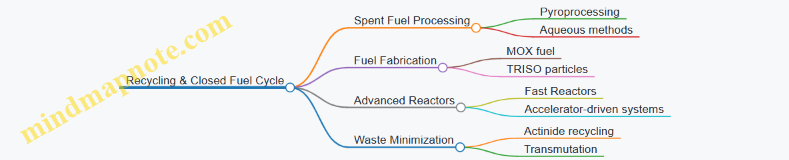
10.3 Minimizing Environmental Footprint of SMR Construction and Operation
Small Modular Reactors (SMRs) offer a promising path toward sustainable nuclear energy, but minimizing their environmental footprint during construction and operation remains critical. This section explores best practices, innovative approaches, and real-world examples to reduce environmental impacts effectively.
Key Areas to Minimize Environmental Footprint
Construction Phase Best Practices
1. Site Selection and Preparation
- Prioritize brownfield or industrial sites to avoid disrupting pristine ecosystems.
- Conduct thorough Environmental Impact Assessments (EIA) to identify and mitigate potential ecological disturbances.
Example: The NuScale SMR project in the U.S. utilizes existing nuclear plant sites to leverage existing infrastructure and minimize new land disturbance.
2. Modular and Off-Site Fabrication
- SMRs are designed for modular construction, allowing major components to be manufactured off-site in controlled environments.
- This reduces on-site construction time, noise, dust, and habitat disruption.
Example: NuScale Power Modules are fabricated in factories and transported to the site, significantly reducing the construction footprint compared to traditional large reactors.
3. Sustainable Material Use
- Employ recycled steel and concrete with lower embodied carbon.
- Use locally sourced materials to reduce transportation emissions.
Example: The SMART reactor project in South Korea incorporated recycled steel in its construction, reducing resource extraction impacts.
4. Waste Minimization During Construction
- Implement strict waste segregation and recycling programs.
- Use digital construction management tools to optimize material ordering and reduce excess.
Operational Phase Best Practices
1. Emission Control and Radiological Safety
- SMRs inherently produce zero greenhouse gas emissions during operation.
- Advanced passive safety systems reduce risk of accidental releases.
Example: The integral pressurized water reactor (iPWR) design in many SMRs incorporates passive cooling, minimizing risk of radiological release.
2. Water Usage Optimization
- Use closed-loop cooling systems to minimize water withdrawal and thermal pollution.
- Implement water recycling and treatment to reduce freshwater consumption.
Example: China’s HTR-PM uses helium as a coolant, which eliminates water consumption for cooling and reduces environmental impact.
3. Waste Management Innovations
- Employ advanced fuel cycles that reduce volume and toxicity of nuclear waste.
- Use on-site interim storage with robust containment to minimize environmental risks.
Example: TRISO fuel used in high-temperature gas reactors (HTGRs) produces less long-lived waste, simplifying waste management.
4. Energy Efficiency and Hybrid Integration
- Optimize thermal efficiency to reduce fuel consumption.
- Integrate SMRs with renewable energy sources to balance load and reduce overall environmental impact.
Example: SMRs paired with solar or wind farms in microgrid configurations provide stable, low-impact power to remote communities.
Mind Map: Environmental Footprint Reduction Strategies
Summary
Minimizing the environmental footprint of SMRs requires a holistic approach encompassing site selection, modular construction, sustainable materials, and efficient waste management during construction. During operation, zero emissions, water conservation, advanced waste handling, and energy efficiency are paramount. Real-world examples such as NuScale, HTR-PM, and SMART demonstrate the practical application of these best practices, underscoring SMRs’ potential as a sustainable nuclear energy solution.
10.4 Best Practice: Implementing Closed Fuel Cycles with Examples
Introduction
Closed fuel cycles represent a transformative approach in nuclear fuel management, aiming to maximize resource utilization, minimize waste, and enhance sustainability of nuclear energy systems. Unlike open (once-through) cycles, closed fuel cycles involve reprocessing spent fuel to recover fissile and fertile materials for reuse, thereby reducing the volume and radiotoxicity of nuclear waste.
Key Components of a Closed Fuel Cycle
Best Practices in Implementing Closed Fuel Cycles
Advanced Reprocessing Technologies
- Use of pyroprocessing and aqueous reprocessing methods tailored to reactor type.
- Example: The Integral Fast Reactor (IFR) program utilized electrochemical pyroprocessing to recycle metal fuel efficiently.
Integration with Fast Reactors
- Fast neutron reactors can utilize recycled plutonium and minor actinides effectively, closing the fuel cycle.
- Example: The BN-800 reactor in Russia is actively demonstrating closed fuel cycle capabilities by burning MOX fuel derived from reprocessed material.
Development of Accident-Tolerant and Recyclable Fuels
- Designing fuels that maintain integrity during multiple recycling passes.
- Example: TRISO fuel particles used in High-Temperature Gas Reactors (HTGRs) offer enhanced safety and potential for recycling.
Robust Waste Management Strategies
- Vitrification and conditioning of high-level waste to ensure long-term stability.
- Example: France’s La Hague facility vitrifies high-level waste from reprocessing operations.
Regulatory and Policy Alignment
- Establishing clear frameworks to support reprocessing, recycling, and waste disposal.
- Example: Japan’s policy supports closed fuel cycles with its Rokkasho reprocessing plant.
Example 1: France’s Closed Fuel Cycle Implementation
- Reprocessing Facility: La Hague
- Fuel Fabrication: MELOX plant producing MOX fuel
- Reactor Use: Use of MOX fuel in PWRs
- Waste Management: Vitrification of high-level waste
Outcome: France recycles roughly 30% of its spent fuel, significantly reducing waste volume and uranium demand.
Example 2: The Integral Fast Reactor (IFR) Concept
- Reprocessing: Electrochemical pyroprocessing
- Fuel: Metal alloy fuel
- Reactor: Sodium-cooled fast reactor
Outcome: Demonstrated potential for near-complete recycling of actinides, drastically reducing long-lived waste.
Example 3: Japan’s Rokkasho Reprocessing Plant
- Technology: Aqueous reprocessing using PUREX
- Fuel Cycle: Supports MOX fuel fabrication and reuse
Outcome: Supports Japan’s closed fuel cycle policy, enabling reuse of plutonium and uranium from spent fuel.
Summary of Benefits
- Resource Efficiency: Extends uranium resources by recycling fissile material.
- Waste Minimization: Reduces volume and radiotoxicity of high-level waste.
- Energy Security: Enhances fuel supply flexibility.
- Environmental Impact: Lowers environmental footprint through reduced mining and waste disposal needs.
Challenges and Considerations
- High capital and operational costs for reprocessing facilities.
- Proliferation concerns associated with separated plutonium.
- Technical complexity in fuel fabrication and reactor operation with recycled fuels.
- Need for robust regulatory frameworks and public acceptance.
Conclusion
Implementing closed fuel cycles is a best practice for advancing sustainability and efficiency in nuclear energy systems. By learning from global examples such as France, the IFR program, and Japan, nuclear engineers and policy technologists can design integrated systems that optimize fuel use, minimize waste, and align with safety and environmental goals.
References & Further Reading
- IAEA, “Closed Fuel Cycle and Reprocessing Technologies”
- OECD NEA, “Fast Reactor Fuel Recycling”
- World Nuclear Association, “Reprocessing of Spent Nuclear Fuel”
10.5 Case Study: Environmental Impact Assessment for SMR Projects
Environmental Impact Assessment (EIA) is a critical process in the deployment of Small Modular Reactors (SMRs), ensuring that potential environmental risks are identified, evaluated, and mitigated. This case study explores the EIA process for a hypothetical SMR project, illustrating best practices and examples that nuclear engineers, energy policy technologists, and reactor designers can apply.
Overview of Environmental Impact Assessment for SMRs
- Purpose: Evaluate potential environmental effects of SMR construction, operation, and decommissioning.
- Scope: Air quality, water resources, land use, biodiversity, waste management, and socio-economic impacts.
- Regulatory Framework: Compliance with national and international environmental standards.
Step 1: Screening and Scoping
- Identify key environmental aspects relevant to SMRs.
- Engage stakeholders early to define concerns and priorities.
Example: For a coastal SMR site, water resource impacts and marine ecosystem protection are prioritized.
Step 2: Baseline Environmental Studies
- Collect data on existing environmental conditions.
- Use remote sensing, field surveys, and historical data.
Example: Measuring baseline radiation levels, aquatic biodiversity, and local air quality.
Step 3: Impact Prediction and Evaluation
- Use modeling tools to predict potential impacts.
- Assess radiological and non-radiological effects.
Mind Map: Impact Prediction Factors

Example: Thermal discharge modeling to assess effects on local fish populations.
Step 4: Mitigation Measures
- Develop strategies to minimize adverse impacts.
- Incorporate design features and operational controls.
Best Practices:
- Use closed-loop cooling systems to reduce thermal pollution.
- Implement advanced filtration to limit airborne emissions.
Example: The NuScale SMR design includes passive safety features that reduce the likelihood of accidental releases, minimizing environmental risk.
Step 5: Public Consultation and Reporting
- Communicate findings transparently with stakeholders.
- Incorporate feedback into project planning.
Example: Hosting community workshops to explain EIA results and mitigation plans.
Step 6: Monitoring and Adaptive Management
- Establish environmental monitoring programs during and after construction.
- Use data to adapt operations and improve environmental performance.
Mind Map: Monitoring Program Components
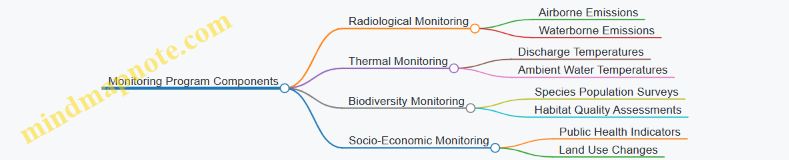
Example: Continuous water quality monitoring around the SMR site to detect any deviations from baseline.
Integrated Example: Environmental Impact Assessment for the XYZ SMR Project
| Phase | Activity | Example Outcome |
|---|---|---|
| Screening & Scoping | Identified marine ecosystem sensitivity | Prioritized protection of coastal habitats |
| Baseline Studies | Measured radiation and water quality levels | Established environmental benchmarks |
| Impact Prediction | Modeled thermal discharge impact | Predicted <2°C increase in local water temperature |
| Mitigation | Designed closed-loop cooling system | Reduced thermal discharge by 90% |
| Public Consultation | Conducted town hall meetings | Addressed community concerns on fishery impacts |
| Monitoring | Installed real-time water quality sensors | Enabled rapid response to environmental changes |
Summary
The EIA process for SMR projects is a dynamic, multidisciplinary effort that integrates technical analysis with stakeholder engagement. By applying best practices such as early scoping, robust baseline data collection, predictive modeling, and adaptive monitoring, SMR developers can ensure environmentally responsible deployment.
This case study underscores the importance of tailoring EIA to the unique features of SMRs, leveraging their modularity and advanced safety features to minimize environmental footprints.
For nuclear engineers and reactor designers, understanding and integrating EIA findings into design and operational decisions is essential. Energy policy technologists can use EIA outcomes to shape supportive policies that balance innovation with environmental stewardship.
11. Future Trends and Research Directions
11.1 Emerging Technologies in Advanced Nuclear Systems
Advanced nuclear energy systems are rapidly evolving, driven by the need for safer, more efficient, and sustainable energy solutions. This section explores the cutting-edge technologies shaping the future of nuclear power, highlighting their principles, benefits, and real-world examples.
Key Emerging Technologies
Advanced Reactor Designs
Small Modular Reactors (SMRs)
SMRs represent a shift from large, centralized nuclear plants to smaller, factory-fabricated units that can be deployed incrementally. Their modular nature reduces construction time and capital costs.
Example: NuScale Power’s SMR design features a 60 MWe integral pressurized water reactor module that can be scaled up by adding multiple modules. This design enhances safety through passive cooling and modular redundancy.
Micro Modular Reactors (MMRs)
Even smaller than SMRs, MMRs are designed for remote or off-grid applications, offering flexible power generation with minimal infrastructure.
Example: The U.S. Department of Energy’s Microreactor Program is developing compact reactors that can be transported by truck or air, suitable for military bases or isolated communities.
Generation IV Reactors
These reactors aim to improve sustainability, safety, and efficiency.
- Sodium-cooled Fast Reactors (SFR): Utilize liquid sodium as a coolant for high thermal conductivity and fast neutron spectrum.
- Lead-cooled Fast Reactors (LFR): Use lead or lead-bismuth eutectic coolants, offering high boiling points and low neutron absorption.
- Molten Salt Reactors (MSR): Employ molten salt as both fuel solvent and coolant, enabling high-temperature operation and online fuel processing.
- High-Temperature Gas-cooled Reactors (HTGR): Use helium coolant and graphite moderator for high outlet temperatures suitable for industrial processes.
Example: China’s HTR-PM project is a demonstration of HTGR technology producing 210 MWe with enhanced safety features.
Digital & AI Integration
The integration of digital technologies is revolutionizing nuclear system design, operation, and maintenance.
Digital Twins
Digital twins are virtual replicas of physical reactors that enable real-time monitoring, simulation, and optimization.
Example: The Idaho National Laboratory (INL) is developing digital twin frameworks for SMRs to predict performance and detect anomalies early.
AI-based Predictive Maintenance
Artificial intelligence algorithms analyze sensor data to predict equipment failures before they occur, reducing downtime and maintenance costs.
Example: AI models deployed at advanced nuclear facilities have successfully forecasted pump and valve degradation, enabling proactive interventions.
Advanced Simulation Tools
High-fidelity simulations accelerate design cycles and improve safety analysis.
Example: The use of Monte Carlo neutron transport codes coupled with thermal-hydraulic models enables precise core behavior predictions.
Advanced Materials
Materials innovation is critical to withstand extreme conditions inside reactors.
Accident-Tolerant Fuels (ATF)
Designed to enhance fuel performance under accident scenarios by improving oxidation resistance and mechanical stability.
Example: Westinghouse’s EnCore ATF uses silicon carbide cladding to reduce hydrogen generation during loss-of-coolant accidents.
Radiation-Resistant Alloys
New alloys resist swelling and embrittlement caused by neutron irradiation.
Example: Ferritic-martensitic steels are being developed for use in fast reactors due to their superior radiation tolerance.
High-Temperature Materials
Materials capable of maintaining strength and corrosion resistance at temperatures exceeding 700°C.
Example: Ceramic composites are explored for use in HTGRs and MSRs to enable higher thermal efficiencies.
Fuel Cycle Innovations
Improving fuel utilization and waste management is a priority.
Closed Fuel Cycles
Reprocessing spent fuel to extract usable isotopes reduces waste volume and enhances resource efficiency.
Example: France’s La Hague facility reprocesses spent fuel, recovering plutonium and uranium for reuse.
Thorium Fuel Cycle
Thorium offers a more abundant and potentially safer alternative to uranium.
Example: India’s Advanced Heavy Water Reactor (AHWR) is designed to utilize thorium-based fuels.
Recycling & Reprocessing
Advanced chemical processes enable recovery of valuable materials while minimizing environmental impact.
Hybrid Energy Systems
Combining nuclear with renewable energy sources enhances grid stability and flexibility.
Nuclear-Renewable Integration
SMRs can complement intermittent renewables by providing steady baseload or load-following power.
Example: The integration of SMRs with wind and solar farms in microgrids supports continuous power supply in remote areas.
Energy Storage Coupling
Pairing nuclear plants with energy storage systems like batteries or thermal storage enables demand response.
Grid Flexibility
Advanced control systems allow nuclear plants to adjust output dynamically to match grid needs.
Example: The Oklo Aurora microreactor concept includes load-following capabilities for grid support.
Summary
Emerging technologies in advanced nuclear systems are multifaceted, spanning reactor design, digital innovation, materials science, fuel cycles, and hybrid energy integration. These innovations collectively aim to make nuclear energy safer, more economical, and environmentally sustainable.
By embracing these technologies, the nuclear industry can meet future energy demands while addressing climate change and energy security challenges.
11.2 Digital Twins and Advanced Simulation for Reactor Design
Digital twins and advanced simulation technologies are revolutionizing the design, operation, and maintenance of nuclear reactors, particularly in the realm of Small Modular Reactors (SMRs). These tools enable nuclear engineers and reactor designers to create highly detailed virtual replicas of physical reactors, allowing for real-time monitoring, predictive maintenance, and optimization of reactor performance before and during operation.
What is a Digital Twin?
A digital twin is a dynamic, digital representation of a physical system or process that uses real-time data and advanced modeling to simulate the behavior and performance of its physical counterpart.
Key Features:
- Real-time data integration
- Predictive analytics
- Scenario testing and optimization
- Lifecycle management
Mind Map: Components of a Nuclear Reactor Digital Twin
Advanced Simulation Techniques in Reactor Design
-
Neutronics Simulation: Models neutron behavior and interactions within the reactor core to optimize fuel utilization and safety margins.
-
Thermal-Hydraulics Simulation: Analyzes heat transfer and fluid flow to ensure efficient cooling and prevent overheating.
-
Structural Mechanics Simulation: Assesses mechanical stresses and material behavior under operational and accident conditions.
-
Multi-Physics Coupling: Integrates neutronics, thermal-hydraulics, and structural simulations for comprehensive reactor behavior prediction.
-
Uncertainty Quantification: Evaluates the impact of parameter uncertainties on simulation outcomes to improve design robustness.
Mind Map: Advanced Simulation Workflow for Reactor Design
Best Practices in Using Digital Twins and Simulations
- Incremental Model Development: Start with simplified models and progressively add complexity.
- Continuous Validation: Regularly validate simulation results against experimental or operational data.
- Interdisciplinary Collaboration: Engage experts from neutronics, thermal-hydraulics, materials science, and control systems.
- Data Quality Management: Ensure sensor data accuracy and consistency for reliable digital twin performance.
- Scenario Testing: Use digital twins to simulate accident scenarios and emergency responses.
Practical Examples
Example 1: NuScale Power’s Digital Twin Implementation
NuScale Power, a leader in SMR technology, employs digital twins to simulate their reactor modules’ behavior under various operational conditions. By integrating sensor data with advanced neutronics and thermal-hydraulics models, NuScale can predict maintenance needs and optimize reactor output, enhancing safety and economic performance.
Example 2: Idaho National Laboratory (INL) Multi-Physics Simulation
INL uses coupled multi-physics simulations to design and analyze advanced reactors, including SMRs. Their approach integrates neutronics, thermal-hydraulics, and structural mechanics to predict reactor behavior accurately, supporting design decisions and regulatory submissions.
Example 3: Digital Twin for Predictive Maintenance in SMART Reactor
The SMART reactor project in South Korea incorporates a digital twin to monitor real-time reactor conditions. This enables predictive maintenance scheduling, reducing downtime and improving operational reliability.
Mind Map: Benefits of Digital Twins in Reactor Design and Operation
Summary
Digital twins and advanced simulation technologies are indispensable tools in the development and deployment of advanced nuclear energy systems and SMRs. They provide a virtual environment to test, optimize, and monitor reactors, thereby enhancing safety, performance, and economic viability. By adopting best practices and leveraging real-world examples, nuclear engineers and reactor designers can harness these technologies to accelerate innovation and ensure robust reactor designs.
11.3 International Collaboration and Standardization Efforts
International collaboration and standardization are pivotal in accelerating the development, deployment, and acceptance of advanced nuclear energy systems and small modular reactors (SMRs). Given the complex regulatory environments, diverse technological approaches, and the global nature of nuclear safety and security concerns, harmonizing efforts across borders ensures efficiency, safety, and public trust.
Importance of International Collaboration
- Pooling Expertise: Countries and organizations share knowledge, research, and operational experience.
- Cost Sharing: Joint development reduces financial burdens on individual nations.
- Accelerated Innovation: Collaborative R&D fosters faster technology maturation.
- Harmonized Regulations: Facilitates smoother licensing and deployment across multiple jurisdictions.
Key International Organizations and Initiatives
-
International Atomic Energy Agency (IAEA):
- Provides safety standards, security guidelines, and facilitates technical cooperation.
- Example: IAEA’s Coordinated Research Projects (CRPs) on SMR technology development.
-
Generation IV International Forum (GIF):
- Focuses on next-generation reactor designs, including fast reactors and molten salt reactors.
- Example: Collaborative development of safety and performance standards for Generation IV reactors.
-
Nuclear Energy Agency (NEA):
- Promotes cooperation among OECD countries on nuclear safety, economics, and regulation.
- Example: NEA’s work on harmonizing probabilistic risk assessment methodologies.
-
World Nuclear Association (WNA):
- Industry-driven organization promoting nuclear power and facilitating global dialogue.
Standardization Efforts
Standardization covers reactor design, safety protocols, quality assurance, and regulatory frameworks.
-
Design Certification Harmonization:
- Efforts to align design certification processes across countries to reduce duplication.
- Example: The U.S. NRC and Canadian CNSC working towards mutual recognition of SMR design certifications.
-
Safety Standards:
- Developing universally accepted safety requirements for advanced reactors.
- Example: IAEA Safety Standards Series provides a global benchmark.
-
Quality Assurance and Manufacturing Standards:
- Ensuring consistent manufacturing quality for modular components.
- Example: ISO standards adapted for nuclear-grade components.
-
Operational and Maintenance Protocols:
- Shared best practices for operation and maintenance to enhance reliability.
Mind Map: International Collaboration in Advanced Nuclear Systems
Mind Map: Standardization Efforts in SMR Technologies
Examples of Successful International Collaboration
-
NuScale Power and Canadian Nuclear Laboratories (CNL):
- Joint efforts to adapt NuScale SMR design to Canadian regulatory requirements.
- Knowledge exchange on safety analysis and licensing.
-
SMART Reactor Project (South Korea) and Saudi Arabia:
- Technology transfer and collaborative deployment plans.
- Shared training programs for operators and regulators.
-
European SMR Consortiums:
- Multiple European countries collaborating on SMR design harmonization and market strategies.
Best Practices for Enhancing Collaboration and Standardization
- Establish clear communication channels and shared platforms for data exchange.
- Promote early engagement between regulators and developers internationally.
- Develop modular and flexible design standards to accommodate regional variations.
- Encourage joint training programs to build a globally competent workforce.
- Leverage international forums to resolve regulatory discrepancies.
International collaboration and standardization are not just administrative necessities but strategic enablers that help the nuclear industry overcome technical, regulatory, and societal challenges. By embracing these efforts, stakeholders can accelerate the safe and economical deployment of advanced nuclear energy systems and SMRs worldwide.
11.4 Best Practice: Leveraging Open Innovation Platforms in Nuclear R&D
Open innovation platforms have become a transformative approach in accelerating research and development (R&D) within the nuclear energy sector. By fostering collaboration across academia, industry, government, and startups, these platforms enable sharing of knowledge, resources, and expertise to address complex challenges in advanced nuclear systems and SMR technologies.
Why Open Innovation in Nuclear R&D?
- Complexity of Nuclear Challenges: Nuclear technology development requires multidisciplinary expertise and significant resources.
- Cost and Time Efficiency: Pooling resources reduces duplication and accelerates innovation timelines.
- Global Collaboration: Nuclear energy is a global concern; open platforms enable cross-border cooperation.
- Diverse Perspectives: Inclusion of startups, academia, and non-traditional players sparks novel ideas.
Key Components of Successful Open Innovation Platforms
Mind Map: Components of Open Innovation Platforms
Practical Examples of Open Innovation Platforms in Nuclear R&D
-
The Gateway for Accelerated Innovation in Nuclear (GAIN)
- A U.S. Department of Energy initiative providing access to national lab capabilities.
- Facilitates collaboration between industry and national labs.
- Example: Shared testing facilities for advanced fuel development.
-
Nuclear Innovation Alliance (NIA)
- Promotes innovation through policy advocacy and collaborative projects.
- Hosts workshops and challenges to crowdsource solutions.
-
European Sustainable Nuclear Energy Technology Platform (SNETP)
- Brings together European stakeholders to coordinate R&D.
- Supports joint projects on advanced reactors and fuel cycles.
-
Open Source Reactor Simulation Platforms
- Platforms like OpenMC and Serpent enable community-driven development of reactor physics codes.
- Example: Researchers worldwide contribute to code improvements and validation.
Mind Map: Benefits of Leveraging Open Innovation Platforms
Best Practices for Implementing Open Innovation in Nuclear R&D
- Define Clear Objectives: Establish specific goals for collaboration to align participants.
- Ensure Robust IP Frameworks: Balance openness with protection of proprietary technology.
- Leverage Digital Collaboration Tools: Use platforms that support document sharing, version control, and real-time communication.
- Promote Inclusive Participation: Engage a diverse range of stakeholders including regulators, operators, and the public.
- Incentivize Contributions: Offer recognition, funding, or partnership opportunities to contributors.
- Maintain Data Security: Implement cybersecurity measures to protect sensitive information.
Example: Open Innovation in Action – The Advanced Reactor Concepts Challenge
In 2022, the U.S. Department of Energy launched the Advanced Reactor Concepts Challenge on an open innovation platform. This initiative invited innovators worldwide to submit ideas addressing key technical challenges such as materials performance, safety systems, and digital instrumentation.
-
Process:
- Problem statements posted publicly.
- Participants submitted proposals and prototypes.
- Collaborative webinars facilitated knowledge exchange.
- Winning teams received funding and access to national lab facilities.
-
Outcome:
- Accelerated development of novel sensor technologies.
- Formation of new partnerships between startups and established nuclear companies.
Mind Map: Steps to Launch an Open Innovation Platform for Nuclear R&D
Summary
Leveraging open innovation platforms in nuclear R&D is a best practice that fosters accelerated, cost-effective, and collaborative development of advanced nuclear energy systems and SMR technologies. By integrating diverse expertise and resources, these platforms address complex challenges more effectively and pave the way for innovative breakthroughs critical to the future of nuclear energy.
11.5 Example: Development of Micro Modular Reactors (MMRs)
Micro Modular Reactors (MMRs) represent a cutting-edge evolution in nuclear technology, designed to deliver compact, scalable, and highly flexible nuclear power solutions. Typically smaller than Small Modular Reactors (SMRs), MMRs focus on ultra-small footprints, rapid deployment, and integration into diverse energy systems including remote locations, industrial sites, and even mobile applications.
Overview of MMR Characteristics
- Power output typically ranges from 1 to 20 MW(e), significantly smaller than traditional reactors.
- Emphasis on factory fabrication and modular transportability.
- Enhanced passive safety systems and simplified operation.
- Potential for multi-purpose use: electricity, heat, desalination, and hydrogen production.
Mind Map: Key Features of Micro Modular Reactors (MMRs)
Example 1: Oklo Aurora MMR
Oklo Inc., a U.S.-based advanced reactor company, is pioneering the Aurora MMR:
- Power Output: Approximately 1.5 MW(e)
- Design: Fast reactor using HALEU metal fuel
- Core Life: Designed for up to 20 years without refueling
- Safety: Passive cooling and inherent safety features
- Deployment: Targeted for remote industrial sites and microgrids
Best Practice Highlight: Oklo’s approach integrates a fully factory-built core that can be transported and installed with minimal onsite construction, reducing project timelines and costs. Their licensing strategy involves early and continuous engagement with the Nuclear Regulatory Commission (NRC), exemplifying proactive regulatory collaboration.
Mind Map: Oklo Aurora MMR Development

Example 2: Ultra Safe Nuclear Corporation (USNC) Micro Modular Reactor
USNC is developing a Micro Modular Reactor based on High-Temperature Gas-cooled Reactor (HTGR) technology:
- Power Output: 5 MW(e)
- Fuel: TRISO-coated particle fuel
- Safety: Inherent safety through high-temperature operation and robust fuel
- Applications: Remote communities, mining operations, and military bases
Best Practice Highlight: USNC leverages decades of HTGR research to implement a reactor that can operate without active safety systems, reducing complexity and enhancing reliability. Their modular design allows for rapid factory fabrication and deployment.
Mind Map: USNC MMR Features
Integration of Best Practices in MMR Development
-
Factory Fabrication & Modularization: Both Oklo and USNC emphasize offsite manufacturing to improve quality control and reduce onsite construction risks.
-
Passive and Inherent Safety: Designs focus on eliminating reliance on active safety systems, enhancing reliability and public acceptance.
-
Long Core Life: Extended refueling intervals reduce operational complexity and downtime.
-
Regulatory Engagement: Early and continuous dialogue with regulators ensures smoother licensing processes.
-
Application-Driven Design: Tailoring reactor features to specific use cases (e.g., remote power, industrial heat) maximizes value and feasibility.
Mind Map: Best Practices in MMR Development
Conclusion
The development of Micro Modular Reactors is a promising frontier in nuclear energy, combining technological innovation with practical deployment strategies. By integrating best practices such as modular factory fabrication, passive safety, and early regulatory engagement, companies like Oklo and USNC are paving the way for nuclear power to become more accessible, flexible, and sustainable. These examples serve as valuable models for reactor designers, nuclear engineers, and energy policy technologists aiming to advance the next generation of nuclear energy systems.
12. Practical Implementation and Lessons Learned
12.1 Project Management Best Practices for SMR Construction
Successfully managing the construction of Small Modular Reactors (SMRs) requires a tailored approach that addresses the unique challenges and opportunities of modular nuclear technology. This section explores best practices in project management specifically for SMR construction, supported by practical examples and mind maps to visualize key concepts.
Key Project Management Best Practices for SMR Construction
-
Modular Construction Planning
- Emphasize off-site fabrication to reduce on-site construction time and improve quality control.
- Coordinate logistics to ensure timely delivery of modules.
- Example: NuScale Power’s approach to factory-built reactor modules significantly shortened their construction schedule.
-
Integrated Stakeholder Engagement
- Engage regulators, local communities, suppliers, and utilities early and continuously.
- Use transparent communication channels to manage expectations and build trust.
- Example: The SMART reactor project in South Korea successfully integrated stakeholder feedback to streamline permitting.
-
Risk Management and Mitigation
- Identify technical, regulatory, financial, and supply chain risks early.
- Develop contingency plans and maintain flexibility in schedules.
- Example: The Canadian SMR roadmap includes comprehensive risk assessments to anticipate licensing delays.
-
Lean Construction Techniques
- Apply lean principles to minimize waste, optimize workflows, and improve productivity.
- Use just-in-time delivery and pull scheduling.
- Example: The Tennessee Valley Authority (TVA) incorporated lean methods in their Watts Bar Unit 2 project, lessons transferable to SMRs.
-
Robust Quality Assurance and Control
- Implement strict QA/QC protocols aligned with nuclear standards.
- Use digital tracking for components and construction phases.
- Example: NuScale uses digital quality management systems to monitor module fabrication.
-
Advanced Scheduling and Resource Management
- Utilize integrated project management software tailored for modular construction.
- Optimize human resources and equipment allocation.
- Example: The UK’s SMR development program uses Primavera P6 and BIM tools for scheduling and coordination.
-
Continuous Improvement and Feedback Loops
- Capture lessons learned during construction phases.
- Implement iterative improvements in processes and workflows.
- Example: The SMART project incorporated feedback from initial module assembly to improve subsequent builds.
Mind Map: Project Management Framework for SMR Construction
Mind Map: Risk Management in SMR Construction
Practical Example: NuScale Power Module Construction
NuScale Power has pioneered the modular construction approach by fabricating reactor modules in controlled factory environments. This strategy reduces on-site construction time and enhances quality. Their project management emphasizes synchronized logistics, rigorous QA/QC, and proactive stakeholder communication. By applying lean construction principles, NuScale has managed to keep schedules tight and costs predictable, setting a benchmark for future SMR projects.
Practical Example: SMART Reactor Project Lessons
The SMART (System-integrated Modular Advanced ReacTor) project in South Korea demonstrated the importance of integrating stakeholder feedback early in the construction process. The project management team established continuous communication channels with regulators and local communities, which helped anticipate and resolve permitting challenges. Additionally, lessons learned from initial module assembly were systematically captured and applied to subsequent phases, improving efficiency and reducing rework.
Summary
Effective project management for SMR construction hinges on leveraging modular fabrication, engaging stakeholders, managing risks proactively, applying lean construction techniques, ensuring rigorous quality control, and continuously improving processes. These best practices, supported by real-world examples and structured frameworks, enable smoother, faster, and more cost-effective SMR deployments.
12.2 Stakeholder Engagement and Public Communication Strategies
Effective stakeholder engagement and public communication are critical components in the successful deployment of Small Modular Reactors (SMRs) and advanced nuclear energy systems. These strategies foster trust, transparency, and collaboration among diverse groups including regulators, local communities, policymakers, industry partners, and the general public.
Key Principles of Stakeholder Engagement
- Inclusivity: Engage all relevant stakeholders early and continuously.
- Transparency: Provide clear, accurate, and timely information.
- Responsiveness: Address concerns and feedback promptly.
- Collaboration: Foster partnerships and shared decision-making.
- Cultural Sensitivity: Respect local values, traditions, and knowledge.
Mind Map: Stakeholder Engagement Framework
Strategies for Effective Public Communication
- Early Engagement: Initiate dialogue before project milestones to build awareness and address concerns.
- Tailored Messaging: Customize communication to different audiences using accessible language.
- Multi-Channel Approach: Use a mix of traditional and digital media to maximize reach.
- Visual Tools: Employ infographics, animations, and videos to explain complex nuclear concepts.
- Community Involvement: Facilitate local participation through advisory boards and open houses.
- Addressing Misinformation: Proactively correct myths and provide factual data.
Mind Map: Public Communication Strategies
Examples of Successful Stakeholder Engagement and Communication
NuScale Power’s Community Engagement
NuScale Power, a leading SMR developer, has implemented extensive community outreach programs near their proposed sites. They conduct regular town hall meetings, provide virtual tours of their reactor designs, and maintain an interactive website with FAQs and updates. This approach has helped build local trust and reduced opposition.
The SMART Reactor Project in South Korea
The SMART project emphasized early and continuous engagement with local residents and government officials. They established a dedicated communication office that coordinated site visits, educational workshops, and transparent reporting of safety assessments. This proactive engagement contributed to smoother regulatory approvals and community acceptance.
Ontario Power Generation’s Darlington New Nuclear Project
OPG integrated public communication strategies by launching an extensive media campaign explaining the benefits of SMRs for clean energy and economic growth. They used social media platforms to engage younger demographics and hosted interactive webinars to answer questions directly from the public.
Best Practices Summary
- Start engagement early and maintain it throughout the project lifecycle.
- Use clear, jargon-free language tailored to your audience.
- Leverage multiple communication channels for broader reach.
- Incorporate visual and interactive tools to simplify complex topics.
- Create formal feedback mechanisms to listen and respond to concerns.
- Address misinformation swiftly and transparently.
- Document and evaluate engagement efforts to improve continuously.
Conclusion
Stakeholder engagement and public communication are not one-time activities but ongoing processes that underpin the social license to operate advanced nuclear energy systems and SMRs. By adopting these strategies and learning from successful examples, nuclear engineers, policy technologists, and reactor designers can foster a collaborative environment that supports innovation and sustainable deployment.
12.3 Overcoming Technical and Regulatory Challenges
The deployment of Small Modular Reactors (SMRs) and advanced nuclear energy systems faces a unique set of technical and regulatory challenges. Successfully navigating these hurdles is critical to realizing the full potential of these technologies. This section explores common challenges and best practices to overcome them, supported by detailed mind maps and real-world examples.
Technical Challenges and Solutions
Design Complexity and Integration
- Challenge: Advanced reactors often incorporate novel materials, fuels, and safety systems, increasing design complexity.
- Solution: Modular design approaches and digital twin simulations enable iterative testing and validation before physical construction.
Manufacturing and Supply Chain
- Challenge: SMRs require precision manufacturing and a reliable supply chain for specialized components.
- Solution: Standardization of components and partnerships with experienced manufacturers streamline production.
Safety and Passive Systems Validation
- Challenge: Demonstrating the reliability of passive safety systems under all scenarios.
- Solution: Extensive modeling, scaled testing, and probabilistic risk assessments build confidence.
Fuel Qualification and Material Performance
- Challenge: New fuel types and materials must be qualified for long-term performance in harsh environments.
- Solution: Accelerated testing programs and international collaboration on fuel research.
Mind Map: Technical Challenges and Solutions
Regulatory Challenges and Solutions
Licensing Pathways for Novel Designs
- Challenge: Existing regulatory frameworks may not fully accommodate innovative SMR designs.
- Solution: Early and continuous engagement with regulators to co-develop flexible, risk-informed licensing processes.
Demonstrating Safety and Security
- Challenge: Proving safety margins and cybersecurity resilience for new technologies.
- Solution: Comprehensive safety cases, cybersecurity assessments, and transparent data sharing.
Public Acceptance and Policy Support
- Challenge: Regulatory approval can be delayed by public concerns and policy uncertainties.
- Solution: Proactive stakeholder engagement, education campaigns, and alignment with clean energy policies.
International Harmonization
- Challenge: Differing national regulations complicate multinational deployment.
- Solution: Participation in international standards development and mutual recognition agreements.
Mind Map: Regulatory Challenges and Solutions
Integrated Example: Overcoming Challenges in the NuScale SMR Project
- Technical: NuScale employed modular construction and digital modeling to reduce design complexity and validate passive safety systems.
- Regulatory: Early and continuous dialogue with the U.S. Nuclear Regulatory Commission (NRC) enabled a tailored licensing process, including the first-ever design certification for an SMR.
- Public Engagement: NuScale invested in community outreach programs to build trust and address concerns.
This integrated approach exemplifies best practices in overcoming both technical and regulatory challenges.
Summary
Overcoming technical and regulatory challenges in advanced nuclear systems and SMRs requires a holistic approach combining modular design, rigorous testing, proactive regulatory engagement, and public communication. Mindful integration of these best practices accelerates deployment and fosters innovation in the nuclear energy sector.
12.4 Example: Lessons from the SMART Reactor Project in South Korea
The SMART (System-integrated Modular Advanced ReacTor) project represents a pioneering effort in the development and deployment of Small Modular Reactor (SMR) technology. Developed by the Korea Atomic Energy Research Institute (KAERI), SMART is a 100 MWth integral pressurized water reactor designed for electricity generation and seawater desalination. This section explores key lessons learned from the SMART project, highlighting best practices, challenges, and practical examples that can guide future SMR endeavors.
Key Lessons Learned from the SMART Project
-
Integrated Design Approach
- SMART employs an integral reactor design where major components such as the steam generator, pressurizer, and reactor coolant pumps are housed within a single reactor pressure vessel.
- This design reduces the number of large pipes and potential leak points, enhancing safety and simplifying maintenance.
- Example: The elimination of large external piping lowered the risk of loss-of-coolant accidents (LOCAs), a critical safety improvement.
-
Modular Construction and Factory Fabrication
- The SMART design emphasizes modularity, allowing large components to be fabricated off-site and transported for assembly.
- This reduces on-site construction time and costs.
- Example: The reactor pressure vessel and integrated components were manufactured in controlled factory environments, ensuring higher quality and precision.
-
Multi-Purpose Application
- SMART is designed not only for electricity generation but also for seawater desalination and district heating.
- This versatility expands market opportunities and improves economic viability.
- Example: The SMART desalination system uses low-temperature steam from the reactor, demonstrating effective cogeneration.
-
Enhanced Safety Features
- Passive safety systems, such as natural circulation for reactor cooling, reduce reliance on active components.
- The integral design inherently limits accident scenarios.
- Example: In a station blackout scenario, the SMART reactor can maintain core cooling without operator intervention for an extended period.
-
Regulatory Engagement and Licensing
- Early and continuous engagement with regulatory bodies facilitated smoother licensing processes.
- The project benefited from clear communication channels and iterative design adjustments based on regulatory feedback.
- Example: KAERI worked closely with the Korean Nuclear Safety and Security Commission (NSSC) to address safety concerns and documentation requirements.
-
Public and Stakeholder Communication
- Transparent communication strategies helped build public trust.
- Educational outreach and stakeholder involvement were prioritized.
- Example: Public forums and informational campaigns were conducted to explain SMART’s safety and environmental benefits.
Mind Map: SMART Project Core Lessons
Practical Examples and Best Practices
Example 1: Integral Reactor Vessel Design
- The SMART reactor integrates the steam generator inside the reactor vessel, which reduces the risk of pipe rupture.
- This design practice can be adopted by other SMR projects to enhance inherent safety.
Example 2: Passive Safety Implementation
- SMART uses natural circulation cooling, eliminating the need for active pumps during emergencies.
- This approach reduces complexity and improves reliability.
Example 3: Multi-Use Energy Output
- By designing for cogeneration, SMART increases the value proposition of SMRs.
- Future projects can explore similar multi-application designs to improve economics.
Example 4: Regulatory Strategy
- KAERI’s proactive engagement with regulators shortened review times.
- Early regulatory involvement is a best practice for new SMR projects.
Example 5: Public Engagement
- SMART’s public outreach programs helped mitigate opposition.
- Transparent communication is essential for social license to operate.
Mind Map: Best Practices Derived from SMART
Summary
The SMART project illustrates how an integrated design philosophy, combined with modular construction, passive safety, and multi-purpose applications, can create a viable and safe SMR platform. Early regulatory engagement and transparent public communication further enhance project success. These lessons provide valuable guidance for nuclear engineers, reactor designers, and policymakers aiming to advance SMR technologies worldwide.
12.5 Continuous Improvement through Feedback Loops and Operational Data
Continuous improvement is a cornerstone of advanced nuclear energy systems and SMR operations. Leveraging feedback loops and operational data allows nuclear engineers and reactor designers to optimize performance, enhance safety, and reduce costs over the reactor lifecycle. This section explores best practices, methodologies, and real-world examples demonstrating how continuous improvement is integrated into SMR projects.
Understanding Feedback Loops in SMR Operations
Feedback loops are systematic processes where operational data is collected, analyzed, and used to inform decisions that improve system performance. In SMRs, these loops can be technical, procedural, or organizational.
Mind Map: Feedback Loop Components
Best Practices for Utilizing Operational Data
-
Comprehensive Data Acquisition: Deploy robust instrumentation and digital control systems to capture high-fidelity data on reactor parameters such as temperature, pressure, neutron flux, and vibration.
-
Real-Time Data Analytics: Use advanced analytics platforms and AI to process data in real time, enabling early detection of deviations and predictive maintenance.
-
Root Cause Analysis (RCA): When anomalies occur, conduct thorough RCA to identify underlying issues rather than symptoms.
-
Feedback Integration into Design: Use insights from operational data to inform iterative design improvements in subsequent SMR modules or upgrades.
-
Cross-Functional Collaboration: Encourage communication between reactor operators, engineers, safety analysts, and policy makers to ensure feedback leads to holistic improvements.
Example: The NuScale Power plant design incorporates an integrated digital monitoring system that continuously collects operational data, enabling predictive maintenance and rapid response to operational anomalies, reducing downtime and enhancing safety.
Case Study: SMART Reactor Project’s Continuous Improvement Approach
South Korea’s SMART (System-integrated Modular Advanced Reactor) project exemplifies continuous improvement through feedback loops:
-
Operational Data Utilization: SMART’s digital instrumentation collects extensive operational data, which is analyzed to optimize reactor control strategies.
-
Iterative Design Updates: Feedback from prototype testing led to modifications in the passive safety systems, improving reliability.
-
Training and Procedures: Operational feedback identified gaps in operator training, leading to enhanced simulation-based training programs.
Mind Map: SMART Reactor Continuous Improvement Cycle
Leveraging Digital Twins for Continuous Improvement
Digital twins—virtual replicas of physical reactors—enable simulation of operational scenarios using real-time data, facilitating proactive improvements.
Mind Map: Digital Twin Integration in Feedback Loops
Example: The Canadian SMR program is exploring digital twin technology to simulate reactor behavior under various conditions, enabling operators to test control strategies virtually and implement improvements without impacting actual operations.
Summary
Continuous improvement through feedback loops and operational data is essential for the success and safety of advanced nuclear energy systems and SMRs. By systematically collecting and analyzing data, implementing changes, and monitoring outcomes, nuclear engineers and reactor designers can drive innovation, optimize performance, and maintain high safety standards.
Key Takeaways:
- Establish robust data acquisition and analysis frameworks.
- Integrate feedback into design, operations, and training.
- Utilize digital twins and AI for predictive insights.
- Foster cross-disciplinary collaboration for holistic improvements.
This approach ensures SMRs evolve dynamically, meeting the demands of modern energy systems while maintaining safety and efficiency.