Atmospheric Water Harvesting Technologies and Systems Design
1. Introduction to Atmospheric Water Harvesting
1.1 Understanding Atmospheric Water: Composition and Availability
Atmospheric water refers to the moisture present in the air, primarily in the form of water vapor, but also as tiny liquid droplets or ice crystals suspended in the atmosphere. This moisture is a crucial component of the Earth’s hydrological cycle and serves as a potential source of freshwater, especially in regions where traditional water sources are scarce.
Composition of Atmospheric Water
Atmospheric water exists mainly in three forms:
- Water Vapor: Invisible gaseous form of water, constituting the majority of atmospheric moisture.
- Liquid Water Droplets: Found in clouds, fog, and mist; these are tiny droplets suspended in the air.
- Ice Crystals: Present in colder atmospheric layers, forming snow or ice clouds.
Water vapor concentration varies widely depending on temperature, pressure, and location. For example, warm tropical air can hold up to 4% water vapor by volume, while cold polar air may hold less than 0.1%.
Availability of Atmospheric Water
The availability of atmospheric water depends on several factors:
- Relative Humidity (RH): The ratio of current water vapor to the maximum possible at a given temperature. Higher RH means more moisture is present.
- Temperature: Warmer air holds more moisture; cooler air holds less.
- Altitude: Moisture generally decreases with altitude, but local conditions can vary.
- Geographical Location: Coastal and tropical areas tend to have higher atmospheric moisture than deserts or polar regions.
Mind Map: Factors Affecting Atmospheric Water Availability
Examples of Atmospheric Water in Different Environments
-
Coastal Fog: In places like the Namib Desert, fog forms when moist ocean air meets cold land surfaces. This fog contains suspended water droplets that can be collected using mesh nets.
-
Dew Formation: In temperate regions, overnight cooling causes surfaces to reach dew point, leading to condensation of water vapor into liquid droplets.
-
High Humidity Tropical Air: Rainforests maintain high atmospheric moisture, often near saturation, which supports dense vegetation and frequent precipitation.
-
Arid Desert Air: Despite low humidity, deserts still contain measurable water vapor, especially during cooler nights, which can be harvested using specialized technologies.
Mind Map: Forms of Atmospheric Water in Different Climates
Quantifying Atmospheric Water
Atmospheric water content is often expressed as:
- Absolute Humidity: Mass of water vapor per volume of air (g/m³).
- Specific Humidity: Mass of water vapor per mass of air (g/kg).
- Precipitable Water: Total water vapor in a vertical column of atmosphere (mm).
For example, a typical summer day in a humid city might have absolute humidity around 20 g/m³, while a desert might have less than 5 g/m³.
Practical Example: Calculating Water Vapor in Air
Suppose air at 25°C and 60% RH. The saturation vapor pressure at 25°C is approximately 3.17 kPa. Actual vapor pressure = 0.6 × 3.17 = 1.90 kPa.
Using the ideal gas law, the absolute humidity (mass of water vapor per cubic meter) can be estimated as:
\[ AH = \frac{216.7 \times e}{T + 273.15} \]
where:
- AH = absolute humidity (g/m³)
- e = vapor pressure (hPa)
- T = temperature (°C)
Converting 1.90 kPa to hPa = 19 hPa,
\[ AH = \frac{216.7 \times 19}{25 + 273.15} = \frac{4117.3}{298.15} \approx 13.8 \text{ g/m}^3 \]
This means each cubic meter of air contains about 13.8 grams of water vapor.
Summary
Understanding the composition and availability of atmospheric water is foundational for designing effective harvesting systems. Moisture in the air varies by form, location, and environmental conditions. Recognizing these variations helps in selecting appropriate technologies and optimizing water capture strategies.
1.2 Importance of Atmospheric Water Harvesting in Water-Scarce Regions
Atmospheric water harvesting (AWH) is a practical approach to supplement freshwater supplies in regions where traditional sources are limited or unreliable. Water scarcity affects billions worldwide, driven by factors such as low rainfall, overuse of groundwater, and contamination of surface water. In these contexts, capturing moisture directly from the air offers an alternative that taps into a widely available but often overlooked resource.
Why Atmospheric Water Harvesting Matters in Water-Scarce Regions
-
Supplementing Limited Surface and Groundwater: Many arid and semi-arid areas have rivers and aquifers that cannot meet demand. AWH provides an additional source that does not rely on existing water bodies.
-
Reducing Dependency on Long-Distance Water Transport: Transporting water over long distances is costly and energy-intensive. Local AWH systems can reduce this burden by generating water on-site.
-
Improving Water Security During Droughts: When rainfall fails, atmospheric moisture often remains present. Harvesting this moisture can provide a buffer against drought conditions.
-
Supporting Remote and Off-Grid Communities: In places without infrastructure for piped water, AWH systems can deliver potable water without the need for extensive networks.
-
Minimizing Environmental Impact: Unlike large-scale water extraction, AWH typically has a smaller ecological footprint since it does not deplete surface or groundwater reserves.
Mind Map: Importance of Atmospheric Water Harvesting
Concrete Examples
-
Fog Harvesting in the Atacama Desert: The Atacama is one of the driest places on Earth, with some areas receiving less than 1 mm of rain annually. Fog collectors installed on hillsides capture moisture from coastal fog, providing water for small communities and agriculture. This method bypasses the need for scarce groundwater and avoids costly water transport.
-
Atmospheric Water Generators in Urban India: In cities facing groundwater depletion and pollution, rooftop atmospheric water generators condense humidity from the air to supply households with clean water. These systems reduce reliance on contaminated wells and unreliable municipal supplies.
-
Passive Dew Collectors in Mediterranean Climates: Some villages use simple dew collection surfaces overnight to gather small but consistent amounts of water. While not a sole source, this water supplements daily needs and reduces pressure on other sources.
Mind Map: Examples of AWH in Water-Scarce Areas
Additional Considerations
Water harvested from the atmosphere is generally clean but may require treatment depending on local air quality. The scale of AWH systems can range from small personal units to community-level installations. The choice depends on local climate, humidity levels, and water demand.
In summary, atmospheric water harvesting offers a practical and adaptable tool for addressing water scarcity. It complements existing water sources, reduces infrastructure needs, and can improve resilience in challenging environments.
1.3 Historical Overview of Atmospheric Water Collection Methods
Atmospheric water collection is not a new idea; humans have been finding ways to capture moisture from the air for centuries. The methods have evolved from simple, passive techniques to more engineered systems, reflecting advances in materials, climate understanding, and technology.
Early Practices and Natural Analogues
Before formal technologies existed, people observed natural phenomena like dew and fog and used simple tools to collect water. For example, in some desert regions, people would place cloths or leaves outside overnight to catch dew, then wring them out in the morning. This practice, though rudimentary, demonstrates an early understanding of condensation.
In coastal and mountainous areas where fog is common, indigenous communities used natural materials to trap water droplets from fog. These methods often involved hanging woven nets or mats in foggy zones to collect moisture that would drip into containers.
Mind Map: Early Atmospheric Water Collection Methods
Dew Collection in Ancient Civilizations
Ancient Persians and Romans reportedly used stone surfaces and metal plates to collect dew. These surfaces were positioned to maximize exposure to the night sky, allowing heat to radiate away and moisture to condense. The Romans also engineered cisterns and channels to gather and store dew water.
This approach was limited by climate and surface area but provided a supplemental water source in dry periods.
Fog Harvesting Nets: A Traditional Technique
One of the oldest documented atmospheric water harvesting methods is fog harvesting using nets. In the early 20th century, Chilean farmers in the coastal Atacama Desert began using simple mesh nets to capture fog. The nets intercept tiny water droplets suspended in the air, which then coalesce and drip into troughs.
This method remains in use today, with improvements in net materials and design enhancing efficiency.
Mind Map: Traditional Fog Harvesting
Early Mechanical and Engineered Systems
In the 19th and early 20th centuries, inventors experimented with mechanical condensation devices. These systems used cooled metal surfaces or refrigeration to condense water vapor from air. Early atmospheric water generators (AWGs) were bulky and energy-intensive, limiting widespread use.
One notable example is the use of metal plates cooled by night air or water circulation to condense dew or fog moisture. These plates were sometimes integrated into building designs to provide supplemental water.
Mind Map: Early Engineered Systems
Traditional Practices in Various Cultures
- Morocco: In the Anti-Atlas Mountains, communities have long used fog-catching nets to supplement scarce water supplies.
- Namibia: The indigenous Damara people used spider webs to collect dew droplets, an example of biomimicry in traditional practice.
- China: Ancient texts describe dew collection on leaves and stone surfaces, used for irrigation and drinking water.
These examples highlight how local climate and available materials shaped atmospheric water harvesting methods.
Summary
The history of atmospheric water harvesting is a story of adapting to local environments using simple principles of condensation and moisture capture. Early methods relied heavily on natural processes and materials, while the industrial era introduced mechanical systems that increased yield but required more energy and infrastructure. Understanding this history provides context for modern designs, which often combine traditional knowledge with contemporary technology.
1.4 Key Terminologies and Concepts in Atmospheric Water Harvesting
Understanding atmospheric water harvesting starts with grasping the core terms and concepts that define how moisture is captured from air. This section lays out the foundational vocabulary and ideas, supported by mind maps and examples to clarify their relationships.
Basic Terminologies
-
Atmospheric Water Vapor: The gaseous phase of water present in the air. Its concentration varies with temperature and humidity.
-
Relative Humidity (RH): The percentage ratio of the current amount of water vapor in the air to the maximum amount the air can hold at that temperature.
-
Dew Point: The temperature at which air becomes saturated (100% RH) and water vapor begins to condense into liquid.
-
Condensation: The process by which water vapor turns into liquid water when cooled below the dew point.
-
Adsorption: The adhesion of water molecules onto the surface of a solid material without penetrating it.
-
Absorption: The process where water vapor penetrates into a material, often swelling or changing its properties.
-
Fog: A visible aerosol consisting of tiny water droplets suspended in the air near the ground.
-
Dew: Water droplets formed on surfaces when they cool below the dew point.
-
Harvesting Efficiency: The ratio of water collected to the theoretical maximum water available in the air.
Conceptual Mind Map: Core Processes in Atmospheric Water Harvesting
Key Physical Concepts
1. Saturation Vapor Pressure: The maximum pressure exerted by water vapor in air at a given temperature. It increases with temperature, meaning warm air can hold more moisture.
Example: At 20°C, air can hold about 17.3 grams of water per cubic meter; at 30°C, it can hold about 30.4 grams.
2. Psychrometrics: The study of moist air properties, often represented in psychrometric charts showing relationships between temperature, humidity, and enthalpy.
Example: Using a psychrometric chart helps design systems by showing how cooling air below its dew point will cause condensation.
3. Hygroscopicity: The ability of a material to attract and hold water molecules from the air.
Example: Silica gel beads are hygroscopic and commonly used in desiccant-based water harvesting.
Mind Map: Environmental Factors Affecting Water Harvesting
System-Related Terms
-
Passive System: A water harvesting setup that relies on natural environmental conditions without external energy input.
-
Active System: A system that uses external energy (electricity, solar power) to enhance water capture.
-
Desiccant: A substance that absorbs or adsorbs moisture from the air, often used in active systems.
-
Regeneration: The process of removing moisture from a saturated desiccant to reuse it.
-
Radiative Cooling: A passive cooling process where surfaces lose heat by emitting infrared radiation, often cooling below ambient air temperature to induce condensation.
-
Fog Collector: A structure, usually mesh netting, designed to capture water droplets from fog.
Example: The Chilean fog nets use large mesh panels to collect water droplets from coastal fog, providing water to local communities.
Mind Map: System Types and Components
Practical Example: Dew Point and Condensation
Imagine a metal plate exposed overnight in a desert environment. As the plate cools below the dew point, water vapor condenses on its surface, forming dew. This simple principle is the basis for many passive dew collection systems. The amount of water collected depends on how much the temperature drops and the humidity level.
Summary
Grasping these terms and concepts is essential for designing, evaluating, and operating atmospheric water harvesting systems. They connect environmental conditions, physical processes, and system components into a coherent framework. The mind maps help visualize these connections, while examples ground the ideas in real-world contexts.
1.5 Overview of Best Practices: Integrating Technology with Environment
Integrating atmospheric water harvesting technology with the environment requires a balance between engineering efficiency and ecological sensitivity. Best practices focus on adapting systems to local climate, geography, and community needs while minimizing environmental impact.
Key Principles of Integration
- Site-Specific Design: Tailoring systems to local humidity, temperature, wind patterns, and topography improves water yield and system longevity.
- Material Selection: Using locally available, durable, and environmentally friendly materials reduces costs and waste.
- Energy Efficiency: Aligning energy sources with local availability, such as solar or wind, supports sustainable operation.
- Community Involvement: Engaging local users in design and maintenance ensures practical usability and cultural fit.
- Environmental Impact Minimization: Avoiding disruption to native flora and fauna and preventing water source depletion.
Mind Map: Integrating Technology with Environment
Practical Examples
Example 1: Fog Nets in Coastal Desert Regions
In coastal deserts where fog is frequent but rainfall is scarce, fog nets are a common passive harvesting technology. Best practice involves placing nets on ridges or slopes facing prevailing fog-laden winds to maximize capture. Using polypropylene mesh sourced locally reduces costs and waste. Community members are trained to clean nets regularly to maintain efficiency. The system is designed to avoid interference with local bird flight paths, minimizing ecological disruption.
Example 2: Solar-Powered Atmospheric Water Generators in Arid Inland Areas
Active systems that condense moisture from air require energy, often supplied by solar panels in remote areas. Best practice includes sizing the solar array to meet peak energy demand and incorporating battery storage for nighttime operation. Materials for condensers are chosen for corrosion resistance due to dust and temperature swings. The system is installed with shading and ventilation considerations to reduce heat buildup and improve efficiency.
Example 3: Hybrid Passive-Active Systems in Mountainous Communities
In mountainous regions with variable humidity, combining fog nets (passive) with small-scale refrigeration condensers (active) can ensure steady water supply. The design uses local wood and stone for structural supports, blending with the environment and reducing transport emissions. Community workshops teach system operation and maintenance, fostering ownership and sustainability.
Mind Map: Best Practices Examples
Summary
Integrating atmospheric water harvesting technologies with the environment means designing with local conditions and resources in mind. It involves selecting appropriate materials, optimizing energy use, and involving communities to ensure systems are practical and sustainable. Avoiding ecological disruption and fostering local ownership are essential for long-term success. Each environment demands a tailored approach rather than a one-size-fits-all solution.
2. Fundamentals of Atmospheric Moisture and Climate Interactions
2.1 Atmospheric Moisture Sources and Distribution Patterns
Atmospheric moisture is the water vapor present in the air, and it originates from several natural sources. Understanding these sources and how moisture distributes itself in the atmosphere is essential for designing effective atmospheric water harvesting systems.
Primary Sources of Atmospheric Moisture
-
Evaporation from Water Bodies: Oceans, seas, lakes, and rivers are the largest contributors to atmospheric moisture. When sunlight heats these surfaces, water molecules gain enough energy to transition into vapor, entering the atmosphere.
-
Transpiration from Vegetation: Plants release water vapor through tiny pores called stomata in a process known as transpiration. This contributes significantly to local and regional humidity, especially in forested or agricultural areas.
-
Sublimation and Evapotranspiration: In cold or dry environments, ice and snow can directly convert to vapor (sublimation). Combined with transpiration, this process is called evapotranspiration and adds moisture to the air.
-
Anthropogenic Sources: Human activities such as irrigation, cooling towers, and industrial processes can increase local atmospheric moisture, though these are generally minor compared to natural sources.
Distribution Patterns of Atmospheric Moisture
Moisture distribution varies with geography, altitude, and weather patterns. The atmosphere is not uniformly humid; instead, it shows distinct patterns influenced by several factors:
-
Latitude: Tropical regions near the equator tend to have higher humidity due to intense solar heating and abundant water bodies. Conversely, polar regions are drier.
-
Altitude: Moisture generally decreases with altitude because cooler temperatures reduce the air’s capacity to hold water vapor.
-
Proximity to Water Bodies: Coastal areas typically have higher humidity than inland regions, as moisture from oceans and seas moves inland.
-
Weather Systems: Fronts, storms, and wind patterns redistribute moisture horizontally and vertically, sometimes concentrating it in specific areas.
-
Diurnal and Seasonal Variations: Humidity often peaks during the day when temperatures rise and drops at night. Seasonal changes, such as monsoons, can drastically alter moisture availability.
Mind Map: Sources of Atmospheric Moisture
Mind Map: Factors Influencing Moisture Distribution
Examples Illustrating Moisture Sources and Distribution
-
Coastal Fog in the Atacama Desert: Despite being one of the driest places on Earth, the Atacama Desert receives moisture through fog generated by the cold Humboldt Current offshore. This fog condenses on surfaces, providing a localized source of water vapor.
-
Amazon Rainforest Transpiration: The dense vegetation of the Amazon releases vast amounts of water vapor daily, creating a self-sustaining humid environment that influences rainfall patterns far beyond the forest itself.
-
Urban Irrigation Effects: In cities with extensive green spaces and irrigation, local humidity can be higher than surrounding rural areas, affecting microclimates and potentially enhancing atmospheric water harvesting potential.
-
Mountainous Regions and Orographic Lift: When moist air is forced to rise over mountains, it cools and condenses, creating clouds and precipitation. This process concentrates moisture in certain areas, which can be tapped by atmospheric water harvesting systems.
Understanding these sources and distribution patterns helps in selecting appropriate locations and technologies for atmospheric water harvesting. For instance, fog collectors work best in regions with frequent fog events, while condenser-based systems may be more effective where humidity is moderate but consistent.
This section lays the groundwork for recognizing where and how atmospheric moisture can be accessed, a key step in designing systems that align with local environmental conditions.
2.2 Role of Temperature, Humidity, and Pressure in Water Vapor Dynamics
Water vapor dynamics in the atmosphere depend heavily on three interrelated factors: temperature, humidity, and pressure. Understanding how these variables interact is essential for designing effective atmospheric water harvesting systems.
Temperature
Temperature influences the capacity of air to hold water vapor. Warm air can hold more moisture than cold air because higher temperatures increase the energy of water molecules, allowing more to remain in the vapor phase.
-
Saturation Vapor Pressure (SVP): This is the maximum pressure exerted by water vapor in air at a given temperature when the air is saturated. SVP rises exponentially with temperature.
-
Example: At 20°C, the SVP is about 2.34 kPa, but at 30°C, it increases to roughly 4.24 kPa. This means air at 30°C can hold nearly twice as much water vapor as air at 20°C before becoming saturated.
-
Implication for Harvesting: Systems that rely on condensation benefit from cooler surfaces relative to air temperature to reach dew point and collect water. The greater the temperature difference, the more water can condense.
Humidity
Humidity measures the amount of water vapor present in the air. It is commonly expressed as:
-
Absolute Humidity: The actual mass of water vapor per unit volume of air (e.g., grams per cubic meter).
-
Relative Humidity (RH): The ratio of current absolute humidity to the maximum possible at that temperature, expressed as a percentage.
-
Dew Point: The temperature at which air becomes saturated (100% RH) and water vapor begins to condense.
-
Example: If air at 25°C has an RH of 50%, it holds half the water vapor it could at saturation. Cooling this air to its dew point (around 13°C) will cause condensation.
-
Implication for Harvesting: Higher relative humidity means more water vapor is available to condense. Atmospheric water harvesting is more effective in environments with higher RH, but even arid regions can have significant moisture at night when temperatures drop.
Pressure
Atmospheric pressure affects water vapor dynamics by influencing the boiling point and saturation vapor pressure.
-
Lower Pressure: At higher altitudes, atmospheric pressure decreases, which lowers the boiling point and saturation vapor pressure.
-
Example: At sea level, atmospheric pressure is about 101.3 kPa, but at 3,000 meters elevation, it drops to around 70 kPa. This reduces the air’s capacity to hold water vapor.
-
Implication for Harvesting: Lower pressure environments have lower saturation vapor pressures, which can reduce the absolute amount of moisture air can hold. However, cooler temperatures at altitude can compensate by lowering dew points.
Mind Map: Factors Affecting Water Vapor Dynamics
Mind Map: Temperature and Humidity Interaction
Concrete Example: Nighttime Dew Formation
Consider a desert environment where daytime temperatures reach 35°C with a relative humidity of 20%. During the night, the temperature drops to 10°C. Although the air was dry during the day, the cooler night temperature lowers the saturation vapor pressure, raising the relative humidity close to 100%. This causes dew to form on surfaces, which can be collected by passive dew harvesting systems.
Summary
- Temperature controls how much water vapor air can hold.
- Relative humidity indicates how saturated the air is with moisture.
- Atmospheric pressure modifies these relationships, especially at different altitudes.
- Effective atmospheric water harvesting depends on leveraging these variables to maximize condensation or adsorption.
Understanding these interactions allows engineers to tailor system designs to local climate conditions, optimizing water yield.
2.3 Microclimate Effects on Atmospheric Water Availability
Microclimates are localized atmospheric zones where the climate differs from the surrounding area. These small-scale variations can significantly influence the amount of moisture available in the air, which in turn affects atmospheric water harvesting potential. Understanding microclimate effects helps in selecting optimal sites and designing systems that maximize water capture.
What Shapes a Microclimate?
Several factors contribute to the formation of microclimates:
- Topography: Hills, valleys, and slopes affect air movement and temperature.
- Vegetation: Plants influence humidity and temperature through transpiration and shading.
- Water Bodies: Lakes, rivers, and wetlands add moisture to the air.
- Urban Structures: Buildings and pavements alter wind flow and heat retention.
- Soil Type and Moisture: Wet or dry soils affect local humidity.
These factors combine in various ways to create pockets of air with distinct temperature and humidity profiles.
Mind Map: Microclimate Factors Influencing Atmospheric Moisture
How Microclimates Affect Atmospheric Water Availability
-
Temperature Variations: Cooler areas tend to hold less water vapor before condensation occurs. For example, shaded valleys often have lower temperatures at night, increasing dew formation.
-
Humidity Differences: Vegetated areas release moisture through transpiration, raising local relative humidity. This can make fog or dew harvesting more effective nearby.
-
Wind Patterns: Terrain and structures can channel or block wind, affecting how moist air moves and accumulates.
-
Radiative Cooling: Surfaces that cool rapidly at night can create localized zones where water vapor condenses more readily.
Example: Fog Harvesting in Coastal Valleys
In coastal deserts, fog often forms when moist ocean air is pushed inland by wind. Valleys oriented perpendicular to the coast trap this fog, creating microclimates with higher humidity and lower temperatures. Fog nets placed in these valleys capture significantly more water than those on surrounding ridges.
Mind Map: Microclimate Impact on Fog Harvesting
Example: Urban Microclimates and Atmospheric Water
Cities often have ‘heat islands’ where temperatures are higher than surrounding rural areas. This can reduce relative humidity and limit dew formation on surfaces. However, urban parks and water features can create small humid zones. Designing atmospheric water harvesting systems in cities requires identifying these pockets where moisture is relatively higher.
Practical Considerations
- Site Survey: Measure temperature and humidity at different locations and times to map microclimate variations.
- Time of Day: Nighttime often offers better conditions for dew and condensation due to cooler temperatures.
- Vegetation Management: Planting or preserving vegetation can improve local humidity.
- Surface Selection: Use materials with good radiative cooling properties to enhance condensation.
Mind Map: Designing for Microclimate
Understanding microclimates is essential for effective atmospheric water harvesting. By recognizing how local conditions influence moisture availability, systems can be tailored to capture the maximum water possible with minimal energy input.
2.4 Measuring and Monitoring Atmospheric Moisture: Tools and Techniques
Measuring and monitoring atmospheric moisture is a foundational step in designing effective atmospheric water harvesting systems. Accurate data on humidity, temperature, and related parameters informs system sizing, placement, and expected yield. This section outlines the primary tools and techniques used to quantify atmospheric moisture, along with practical examples and mind maps to clarify the relationships among variables and instruments.
Key Parameters to Measure
- Relative Humidity (RH): Percentage of water vapor present relative to the maximum possible at a given temperature.
- Absolute Humidity: Mass of water vapor per unit volume of air.
- Dew Point Temperature: Temperature at which air becomes saturated and water vapor condenses.
- Temperature: Influences water vapor capacity of air.
- Atmospheric Pressure: Affects vapor pressure and condensation processes.
Tools and Instruments
Hygrometers
Hygrometers measure humidity in the air. There are several types:
- Mechanical Hygrometers: Use materials like hair or paper that change length or tension with humidity.
- Electrical Hygrometers: Measure changes in electrical resistance or capacitance caused by moisture.
- Psychrometers: Consist of two thermometers (wet-bulb and dry-bulb); humidity is calculated from their temperature difference.
Example: A simple sling psychrometer can be used in remote areas to estimate relative humidity without electricity.
Dew Point Meters
These devices directly measure the dew point temperature, often using chilled mirrors that detect condensation onset.
Example: A chilled mirror dew point meter can provide precise dew point readings, crucial for predicting condensation potential in water harvesting.
Radiosondes
Weather balloons equipped with sensors that measure humidity, temperature, and pressure at various altitudes.
Example: Radiosonde data helps understand vertical moisture profiles, which can influence fog harvesting strategies.
Remote Sensing Instruments
- LIDAR (Light Detection and Ranging): Measures atmospheric water vapor by analyzing backscattered light.
- Satellite Sensors: Provide large-scale humidity data but with less local precision.
Example: Satellite data can identify regional moisture trends, useful for planning large-scale harvesting projects.
Data Loggers and Weather Stations
Integrated systems that record multiple parameters over time, enabling continuous monitoring.
Example: A weather station with humidity and temperature sensors can track daily moisture cycles to optimize harvesting schedules.
Techniques for Measurement
- Point Measurement: Using handheld or fixed sensors at specific locations.
- Profile Measurement: Vertical sampling via balloons or towers to understand moisture distribution.
- Temporal Monitoring: Continuous recording to capture diurnal and seasonal variations.
Mind Map: Atmospheric Moisture Measurement Components
Practical Example: Using a Psychrometer for Local Humidity Assessment
A field technician in a rural area without access to electronic sensors can use a sling psychrometer. By swinging the device and reading the wet-bulb and dry-bulb temperatures, the technician calculates relative humidity using standard charts or formulas. This simple method provides immediate data to decide if conditions are favorable for dew collection that night.
Mind Map: Psychrometer Operation
Data Interpretation and Integration
Collecting data is only part of the process. Understanding the interplay between temperature, humidity, and pressure helps predict when and where atmospheric water harvesting will be most effective. For example, a high relative humidity combined with a low dew point temperature near ambient air temperature indicates a good chance for condensation.
Example: Monitoring Fog Events
In a coastal desert, installing a weather station with humidity and temperature sensors can track fog frequency and density. Data collected over months informs the optimal placement and timing for fog nets, maximizing water capture.
Summary
Measuring atmospheric moisture involves a range of instruments and methods tailored to the scale and precision required. From simple psychrometers to advanced remote sensing, each tool provides valuable data that feeds into system design and operation. Understanding these tools and their outputs enables informed decisions for effective atmospheric water harvesting.
2.5 Case Study: Moisture Mapping in Arid and Semi-Arid Regions
Moisture mapping is a foundational step in designing atmospheric water harvesting systems, especially in arid and semi-arid regions where water scarcity is a pressing issue. Understanding the spatial and temporal distribution of atmospheric moisture helps identify viable locations and tailor system designs to local conditions.
What is Moisture Mapping?
Moisture mapping involves measuring and analyzing atmospheric water vapor and related climatic variables such as humidity, temperature, wind patterns, and dew point. The goal is to create detailed profiles showing where and when moisture is available in the air.
Why Focus on Arid and Semi-Arid Regions?
These regions often have low and highly variable precipitation but can still contain measurable atmospheric moisture. Capturing this moisture can supplement limited water supplies. However, the variability and scarcity of moisture require precise mapping to avoid inefficient system deployment.
Key Components of Moisture Mapping
Example: Moisture Mapping in the Thar Desert
The Thar Desert, spanning India and Pakistan, is a classic semi-arid region where moisture mapping has guided atmospheric water harvesting projects. Researchers installed a network of weather stations measuring relative humidity, temperature, and wind speed at multiple locations.
Data showed that early morning hours consistently had relative humidity above 70%, especially near low-lying areas and vegetation patches. Wind patterns indicated that moisture-laden air moved predominantly from the southeast during these hours. This information helped position fog nets and dew collectors optimally.
Mind Map: Steps in Moisture Mapping
Tools and Techniques
-
Ground-Based Sensors: Hygrometers and weather stations provide high-resolution local data. For example, in the Sahel region, portable weather stations recorded humidity fluctuations that revealed microclimates near seasonal water bodies.
-
Remote Sensing: Satellite data can estimate atmospheric moisture over large areas. Though less precise locally, it helps identify broader moisture trends.
-
Data Loggers: Automated loggers collect continuous data, capturing diurnal and seasonal cycles critical for timing water harvesting operations.
Example: Microclimate Influence in Morocco’s Anti-Atlas Mountains
In the Anti-Atlas Mountains, moisture mapping revealed that valleys and shaded slopes retained higher humidity levels than exposed ridges. This microclimate variation was crucial for placing dew condensers where moisture availability was greatest, increasing water yield by up to 30% compared to flat, exposed sites.
Mind Map: Factors Affecting Moisture Distribution
Integrating Moisture Mapping into System Design
Once moisture maps are developed, they guide decisions such as:
- Site Selection: Choosing locations with consistently higher humidity or dew points.
- System Type: Passive fog nets in areas with frequent fog; active condensers where humidity peaks at certain times.
- Orientation and Height: Aligning collectors perpendicular to prevailing moist winds; adjusting height to capture moisture-rich air layers.
Example: Fog Harvesting in Chile’s Coastal Desert
In Chile’s Atacama Desert, moisture mapping identified coastal fog corridors. Fog collectors were installed at elevations where fog density was highest, informed by wind and humidity data. This precise placement maximized water collection despite the desert’s overall dryness.
Summary
Moisture mapping in arid and semi-arid regions is a detailed process combining field measurements, data analysis, and environmental understanding. It uncovers patterns invisible to the naked eye, enabling atmospheric water harvesting systems to operate efficiently and sustainably. Without this groundwork, systems risk underperforming or failing altogether.
3. Principles of Atmospheric Water Harvesting Technologies
3.1 Physical Principles: Condensation, Adsorption, and Absorption
Atmospheric water harvesting relies on capturing moisture present in the air. The three main physical mechanisms to extract this moisture are condensation, adsorption, and absorption. Each operates differently and suits different system designs and environmental conditions.
Condensation
Condensation is the process where water vapor in the air changes into liquid water when cooled below its dew point. This is the most straightforward principle in atmospheric water harvesting.
-
How it works: Air contains water vapor, which is invisible gas. When air cools down, its capacity to hold water vapor decreases. Once the temperature drops below the dew point, excess vapor condenses into liquid droplets on surfaces.
-
Key factors: Temperature difference, surface temperature, relative humidity, and air movement.
-
Example: A cold metal plate exposed to humid air will accumulate droplets. This principle is used in dew collectors and refrigeration-based atmospheric water generators.
-
Mind map:
- Best practice example: Using materials with high thermal conductivity and low emissivity can improve condensation efficiency by maintaining cooler surfaces longer during night.
Adsorption
Adsorption involves water vapor molecules adhering to the surface of a solid material without penetrating its bulk. It is a surface phenomenon driven by molecular forces.
-
How it works: Certain materials, called adsorbents, have surfaces that attract and hold water vapor molecules. The water is held in a thin film or layer on the surface.
-
Key materials: Silica gel, zeolites, activated carbon, and metal-organic frameworks (MOFs).
-
Regeneration: Adsorbed water can be released by heating or reducing humidity, allowing the material to be reused.
-
Example: Silica gel packets in product packaging adsorb moisture to keep items dry. In atmospheric water harvesting, silica gel beds can capture water vapor during the night and release it during the day.
-
Mind map:
- Best practice example: Using solar heat to regenerate adsorbent materials reduces external energy needs and suits off-grid applications.
Absorption
Absorption differs from adsorption in that water vapor penetrates into the bulk of a material rather than just adhering to its surface.
-
How it works: Absorbent materials take in water vapor into their internal structure, often swelling or changing physically as they do so.
-
Key materials: Hygroscopic salts (e.g., calcium chloride), polymer gels, and some metal-organic frameworks.
-
Water release: Usually requires heating or exposure to dry air to drive off the absorbed water.
-
Example: Calcium chloride can absorb moisture from the air and form a liquid brine. This principle is used in some desiccant-based atmospheric water harvesters.
-
Mind map:
- Best practice example: Combining absorbent materials with solar thermal collectors enables low-energy water release cycles.
Summary Comparison
| Mechanism | Water Capture Location | Energy for Release | Typical Materials | Common Systems |
|---|---|---|---|---|
| Condensation | Surface (liquid droplets) | Cooling (passive or active) | Metal plates, radiative surfaces | Dew collectors, refrigeration condensers |
| Adsorption | Surface (molecular layer) | Heating or humidity change | Silica gel, zeolites, MOFs | Desiccant-based harvesters |
| Absorption | Bulk material | Heating or dry air | Hygroscopic salts, polymer gels | Desiccant harvesters, humidity control |
Understanding these mechanisms helps in selecting the right technology for specific climates and applications. For example, condensation works best where nights are cool and humidity is moderate, while adsorption and absorption systems can operate in drier conditions but require energy input for regeneration.
Concrete Example: Fog Nets vs. Silica Gel Beds
-
Fog nets collect water by condensing tiny droplets suspended in fog directly onto mesh surfaces. This is a condensation process aided by airflow and surface design.
-
Silica gel beds adsorb water vapor from the air during the night. During the day, solar heat regenerates the gel, releasing liquid water collected in a container.
Both systems harvest atmospheric moisture but rely on different physical principles and suit different environments and energy availability.
This section establishes the foundation for understanding how atmospheric water harvesting systems operate at the physical level. The next sections will build on these principles to explore specific technologies and materials.
3.2 Thermodynamics of Water Vapor Capture
Understanding the thermodynamics behind water vapor capture is essential for designing efficient atmospheric water harvesting systems. At its core, this process involves the phase change of water vapor from gas to liquid, which requires careful management of temperature, pressure, and humidity.
Basic Thermodynamic Concepts
- Phase Change: Water vapor condenses when it cools below its dew point, releasing latent heat.
- Dew Point: The temperature at which air becomes saturated and water vapor begins to condense.
- Relative Humidity (RH): The ratio of current water vapor pressure to the saturation vapor pressure at a given temperature.
- Saturation Vapor Pressure: The maximum vapor pressure at a specific temperature.
Energy Balance in Condensation
Condensation requires removing sensible heat from moist air to lower its temperature to the dew point. The latent heat released during condensation must be managed to maintain efficient water collection.
Key Thermodynamic Processes in Water Vapor Capture
- Cooling air below dew point (e.g., refrigeration or radiative cooling).
- Adsorption of water vapor onto hygroscopic materials.
- Desorption and regeneration cycles in active systems.
Mind Map: Thermodynamics of Water Vapor Capture
Detailed Explanation
Dew Point and Relative Humidity: The dew point is the temperature at which air becomes saturated with moisture. When air cools to this temperature, water vapor condenses into liquid. For example, air at 30°C with 60% relative humidity has a dew point around 21°C. If a surface is cooled below 21°C, condensation will form.
Latent Heat: Condensation releases latent heat (about 2,260 kJ/kg for water). This heat must be removed from the system to sustain condensation. If the heat is not removed, the surface temperature rises, reducing condensation efficiency.
Energy Considerations: In active systems, refrigeration cycles remove heat to cool surfaces below dew point. The coefficient of performance (COP) of these systems influences energy efficiency. Passive systems rely on natural cooling, such as radiative cooling to the night sky, which can drop surface temperatures below ambient.
Adsorption Thermodynamics: Some systems use materials like silica gel or metal-organic frameworks (MOFs) that adsorb water vapor at low humidity. Adsorption is an exothermic process releasing heat, which must be managed during regeneration (desorption), often requiring heat input.
Example 1: Dew Collection on a Radiative Cooling Surface
A metal plate coated with a hydrophilic surface cools by radiating heat to the night sky. On a clear night, the plate temperature can drop below the dew point, causing water vapor to condense. The latent heat released warms the plate, so the net cooling power must exceed this heat to maintain condensation.
Thermodynamic Insight: The balance between radiative heat loss, convective heat gain from the air, and latent heat release determines the net water yield.
Example 2: Refrigeration-Based Atmospheric Water Generator
A refrigeration cycle cools a condenser coil below the dew point of ambient air. Moist air passes over the coil, water vapor condenses, and liquid water is collected. The system consumes electrical energy to remove both sensible and latent heat.
Thermodynamic Insight: The system’s efficiency depends on minimizing the temperature difference between the coil and dew point to reduce energy consumption while maximizing water yield.
Example 3: Adsorption Using Silica Gel
Silica gel beads adsorb water vapor from air at night when humidity is higher. During the day, the beads are heated to release the captured water vapor, which is then condensed.
Thermodynamic Insight: Adsorption releases heat, so beads warm up during moisture uptake, potentially reducing adsorption capacity if heat is not dissipated. Regeneration requires energy input, often solar thermal, to desorb water.
Summary
Thermodynamics governs the capture of water vapor through temperature and humidity control, phase changes, and energy management. Effective system design balances these factors to maximize water yield while minimizing energy consumption. Understanding latent heat, dew point, and adsorption energetics is key to optimizing atmospheric water harvesting.
3.3 Material Science in Atmospheric Water Harvesting: Hydrophilic and Hygroscopic Materials
Atmospheric water harvesting relies heavily on materials that can interact effectively with water vapor. Two main categories of materials are crucial: hydrophilic and hygroscopic. Understanding their properties, behaviors, and applications helps in designing efficient systems.
Hydrophilic Materials
Hydrophilic materials attract and hold water molecules on their surfaces through hydrogen bonding or polar interactions. They facilitate condensation by providing nucleation sites where water vapor can transition into liquid droplets.
-
Characteristics:
- High surface energy
- Polar or charged groups
- Promote droplet formation and coalescence
-
Common Examples:
- Glass
- Metals like aluminum and copper (especially when treated)
- Hydrophilic polymers such as polyvinyl alcohol (PVA)
- Ceramic surfaces
-
Role in Atmospheric Water Harvesting: Hydrophilic surfaces encourage water droplets to form and grow, which can then be collected by gravity or surface design. However, if the surface is too hydrophilic, droplets may stick and reduce collection efficiency. Balancing wettability is key.
Mind Map: Hydrophilic Materials
- Example: A dew collector made from a smooth aluminum sheet coated with a thin hydrophilic polymer layer can enhance water droplet formation overnight. The droplets coalesce and slide off into a collection trough, providing a simple, passive water source.
Hygroscopic Materials
Hygroscopic materials absorb water vapor directly from the air, often storing it within their structure. This absorption can be physical or chemical, depending on the material.
-
Characteristics:
- Ability to attract and hold water molecules
- Often porous or chemically reactive
- Can release absorbed water upon heating or pressure change
-
Common Examples:
- Silica gel
- Calcium chloride
- Metal-organic frameworks (MOFs)
- Zeolites
-
Role in Atmospheric Water Harvesting: Hygroscopic materials serve as desiccants, capturing moisture even at low humidity levels. They are often used in active systems where absorbed water is later extracted by heating or pressure changes.
Mind Map: Hygroscopic Materials
- Example: A solar-powered atmospheric water harvester uses silica gel beads packed in trays. During the night, the beads absorb moisture from the air. When sunlight heats the beads during the day, the water vapor is released and condensed into liquid water.
Comparing Hydrophilic and Hygroscopic Materials
| Feature | Hydrophilic Materials | Hygroscopic Materials |
|---|---|---|
| Interaction with Water | Surface attraction and condensation | Absorption into material structure |
| Water State | Liquid droplets on surface | Water vapor absorbed and stored |
| Energy Requirement | Passive, no energy needed | Active regeneration often required |
| Typical Use | Passive collectors (dew, fog nets) | Active systems with regeneration |
Mind Map: Material Science Overview
Surface Engineering for Enhanced Performance
Surface roughness and micro/nano-structuring can modify hydrophilicity. For example, adding micro-patterns can promote droplet shedding, improving water collection rates. Some designs mimic natural surfaces like the Namib desert beetle, which combines hydrophilic bumps with hydrophobic backgrounds to optimize water capture.
- Example: A fog harvesting net with hydrophilic-coated fibers arranged to maximize surface area and encourage droplet coalescence can collect several liters of water per square meter daily in foggy environments.
Practical Considerations
- Durability: Materials must withstand environmental exposure, UV radiation, and mechanical stress.
- Cost: Some advanced materials like MOFs are expensive, limiting large-scale use.
- Maintenance: Hygroscopic materials require periodic regeneration; hydrophilic surfaces may need cleaning to maintain effectiveness.
In summary, selecting and engineering materials for atmospheric water harvesting involves balancing water affinity, energy needs, durability, and cost. Both hydrophilic and hygroscopic materials have roles depending on system type and environmental context.
3.4 Energy Considerations and Efficiency Metrics
Energy use is a critical factor in atmospheric water harvesting (AWH) systems, especially for active technologies that rely on mechanical or thermal inputs. Understanding energy consumption and efficiency helps in designing systems that are both practical and sustainable in water-scarce environments.
Energy Inputs in Atmospheric Water Harvesting
Energy inputs vary depending on the type of technology:
- Passive systems (like fog nets or dew collectors) typically require minimal or no external energy, relying on natural processes.
- Active systems (such as refrigeration-based condensers or desiccant regeneration units) consume electrical or thermal energy to drive water extraction.
Energy demand influences operational costs, system size, and feasibility in remote or off-grid locations.
Key Energy Metrics
To evaluate and compare AWH systems, several metrics are used:
- Energy per liter of water produced (kWh/L): Measures how much energy is needed to generate one liter of water. Lower values indicate better efficiency.
- Water yield per unit energy (L/kWh): The inverse of the above, showing how much water is produced per unit of energy.
- Coefficient of Performance (COP): Common in refrigeration systems, COP is the ratio of water produced (or heat removed) to energy input.
- Specific Energy Consumption (SEC): Similar to energy per liter but sometimes includes system losses and auxiliary energy use.
Factors Affecting Energy Efficiency
- Ambient conditions: Temperature, relative humidity, and airflow directly impact the energy needed to condense water vapor.
- System design: Surface area, material properties, and insulation affect how efficiently moisture is captured.
- Energy source and conversion efficiency: The type of energy used (solar, grid, battery) and how efficiently it is converted into cooling or desiccant regeneration.
Mind Map: Energy Considerations in AWH
Example: Energy Use in a Refrigeration-Based Atmospheric Water Generator
Consider a refrigeration-based AWH unit operating in a warm, humid environment (30°C, 70% RH). The system uses a compressor to cool a condenser surface below the dew point, causing water vapor to condense.
- The system consumes about 0.5 kWh to produce 1 liter of water under these conditions.
- If the ambient humidity drops, energy consumption per liter increases because more cooling is needed to extract the same amount of water.
This example shows how environmental conditions influence energy efficiency and why site assessment matters.
Mind Map: Refrigeration-Based AWH Energy Flow
Example: Desiccant-Based System Energy Considerations
Desiccant systems absorb moisture onto a material and then release it through heating. The energy is mainly used for:
- Heating the desiccant to release water vapor.
- Running fans to move air through the system.
A typical solar-powered desiccant system might use 0.3–0.6 kWh per liter of water produced, depending on the regeneration temperature and airflow rates.
Optimizing the regeneration cycle and using waste heat can reduce energy consumption.
Mind Map: Desiccant System Energy Components
Comparing Passive and Active Systems
| System Type | Energy Use | Typical Efficiency (kWh/L) | Notes |
|---|---|---|---|
| Passive (fog nets, dew collectors) | Near zero | N/A (depends on natural conditions) | Low operational cost but limited yield |
| Refrigeration-based | Moderate to high | 0.3–0.7 | Sensitive to ambient humidity and temperature |
| Desiccant-based | Moderate | 0.3–0.6 | Can utilize low-grade heat sources |
Best Practice Example: Combining Passive and Active Systems
A hybrid system might use fog nets to capture water passively during high humidity periods and switch to an active refrigeration system when conditions are less favorable. This approach balances energy use and water yield.
Summary
Energy considerations in atmospheric water harvesting revolve around minimizing the energy needed per liter of water produced while maintaining reliable output. Efficiency metrics provide a way to benchmark systems and guide design choices. Understanding how ambient conditions and system design influence energy use helps optimize performance and sustainability.
3.5 Best Practice Example: Optimizing Condensation Surfaces for Maximum Yield
Optimizing condensation surfaces is a key step in maximizing water yield in atmospheric water harvesting systems. Condensation occurs when water vapor in the air cools and transitions into liquid water on a surface. The efficiency of this process depends heavily on the surface properties, environmental conditions, and system design. This section outlines practical approaches and examples to improve condensation surfaces.
Key Factors Affecting Condensation Efficiency
- Surface Temperature: Cooler surfaces promote condensation by lowering the dew point locally.
- Surface Material: Thermal conductivity, hydrophilicity, and texture influence water droplet formation and removal.
- Surface Geometry: Shape and orientation affect airflow and water collection.
- Environmental Conditions: Humidity, temperature, and wind speed impact condensation rates.
Mind Map: Factors Influencing Condensation Surface Performance
Surface Material Selection
Materials with high thermal conductivity, such as metals (aluminum, copper), cool down faster and maintain lower surface temperatures, encouraging condensation. However, metals can be prone to corrosion and may require protective coatings.
Hydrophilic surfaces encourage water to spread out, forming thin films that can be collected more easily. Hydrophobic surfaces cause water to bead up and roll off, which can be useful for quick water removal but may reduce initial condensation efficiency.
Example: Aluminum sheets coated with a thin layer of titanium dioxide (TiO2) can improve hydrophilicity and resist corrosion, balancing efficient condensation with durability.
Surface Geometry and Orientation
Flat surfaces are simple but may not maximize water collection. Curved or angled surfaces can increase the effective area exposed to airflow and promote water runoff.
Example: Fog collectors often use vertically oriented mesh panels angled slightly to catch prevailing winds, increasing water capture. Similarly, sloped metal sheets allow condensed water to flow downward into collection troughs.
Cooling Techniques
Lowering the surface temperature below the dew point is essential. Passive cooling methods include radiative cooling surfaces that emit infrared radiation to the night sky, dropping surface temperature naturally.
Active cooling uses refrigeration or thermoelectric coolers but requires energy input.
Example: A passive dew collector with a radiative cooling panel made of a material with high infrared emissivity can achieve surface temperatures several degrees below ambient air temperature, increasing condensation during clear nights.
Water Removal and Collection
Efficient removal of condensed water prevents re-evaporation and maintains surface availability for new condensation.
Surfaces are typically tilted between 30° and 45° to use gravity for water runoff. Smooth surfaces facilitate droplet coalescence and runoff.
Example: A condensation panel with a smooth hydrophilic coating and a 40° tilt angle collects water droplets that merge and flow into a gutter, minimizing water loss.
Practical Example: Optimizing a Condensation Panel for a Rural Atmospheric Water Harvester
- Material: Aluminum sheet with hydrophilic TiO2 coating.
- Geometry: Flat panel tilted at 40° facing prevailing wind.
- Cooling: Passive radiative cooling surface to reduce temperature at night.
- Water Removal: Smooth surface with gutter at the bottom for collection.
- Outcome: Increased water yield by 25% compared to uncoated flat panels.
Mind Map: Step-by-Step Optimization Process
Optimizing condensation surfaces involves balancing material properties, geometry, and environmental factors to maximize water collection. Simple changes like applying hydrophilic coatings, adjusting panel tilt, and employing passive cooling can significantly improve yields. These adjustments are practical and scalable, making them valuable for atmospheric water harvesting projects in water-scarce environments.
4. Passive Atmospheric Water Harvesting Systems
4.1 Dew Collection Systems: Design and Operational Principles
Dew collection systems capture water by condensing moisture from the air onto cool surfaces during the night or early morning. Dew forms when the surface temperature drops below the dew point of the surrounding air, causing water vapor to transition into liquid droplets. Understanding this physical process is essential for designing effective dew collectors.
Key Factors Influencing Dew Formation
- Surface Temperature: Must fall below the dew point; cooling is often achieved through radiative heat loss to the night sky.
- Humidity: Higher relative humidity increases the potential for dew formation.
- Wind Speed: Moderate airflow aids condensation by replenishing moist air near the surface; too much wind can disrupt droplet formation.
- Surface Properties: Materials with high emissivity and low thermal conductivity promote cooling and condensation.
Basic Components of Dew Collection Systems
- Condensation Surface: Typically a flat or slightly inclined panel designed to maximize exposure to the night sky.
- Support Structure: Holds the surface in place, often angled to facilitate water runoff.
- Water Collection Channel: Guides condensed water to storage containers.
- Storage Tank: Stores collected water for later use.
Design Principles
-
Material Selection: Surfaces are often made from materials like polyethylene foil, specially coated metals, or glass. The material should have high radiative cooling properties and be hydrophilic or treated to encourage droplet formation and runoff.
-
Surface Orientation and Angle: Panels are usually tilted between 30° and 45° to optimize exposure to the night sky and to allow gravity to collect water efficiently.
-
Thermal Insulation: Insulating the backside of the condensation surface reduces heat gain from the ground or ambient air, helping the surface cool more effectively.
-
Environmental Placement: Dew collectors perform best in open areas with clear skies and minimal artificial heat sources nearby.
Mind Map: Dew Collection System Components and Factors
Example 1: Simple Plastic Sheet Dew Collector
A basic dew collector can be made using a thin polyethylene sheet stretched over a frame and angled at 35°. The sheet’s backside is insulated with foam to reduce heat transfer. Overnight, the sheet cools via radiation, and dew forms on its surface. Water droplets run down into gutters and are collected in a container. This design is low-cost and suitable for small-scale use in rural areas with moderate humidity.
Example 2: Metal Plate with Hydrophilic Coating
A metal plate coated with a hydrophilic substance can enhance dew formation by encouraging water to spread into thin films rather than beads, increasing collection efficiency. The plate is mounted on an insulated frame and tilted at 40°. This setup is more durable and can yield more water per night compared to plastic sheets, especially in environments with lower humidity.
Operational Tips and Best Practices
- Regular Cleaning: Dust and dirt reduce surface emissivity and hydrophilicity, lowering water yield.
- Nighttime Deployment: Systems should be uncovered or exposed during the night and early morning to maximize dew capture.
- Avoid Heat Sources: Position collectors away from artificial lights, buildings, or warm surfaces that can raise local temperatures.
- Optimize Angle Seasonally: Adjusting the tilt angle to match seasonal changes in dew formation patterns can improve efficiency.
Mind Map: Operational Best Practices
In summary, dew collection systems rely on simple physical principles but require careful attention to material choice, surface orientation, and environmental conditions. Small design tweaks and maintenance routines can significantly improve water yield, making dew harvesting a practical supplementary water source in suitable climates.
4.2 Fog Harvesting Nets: Structure, Materials, and Placement
Fog harvesting nets are a straightforward yet effective technology for capturing water from fog, particularly in coastal and mountainous regions where fog is frequent. These nets act as physical barriers that intercept tiny water droplets suspended in the air, allowing them to coalesce and drip into collection troughs. Understanding their structure, materials, and placement is key to optimizing water yield.
Structure of Fog Harvesting Nets
Fog nets typically consist of a mesh suspended vertically between two or more supports. The mesh size and shape influence how droplets collide and merge. Commonly, rectangular or diamond-shaped meshes are used, with openings sized to balance airflow and droplet capture.
- Mesh Size: Usually between 0.5 to 1.5 cm openings. Smaller openings increase capture but reduce airflow, potentially lowering efficiency.
- Frame: Often made from wood, metal, or plastic poles, designed to withstand local wind conditions.
- Collection Troughs: Positioned at the bottom to gather water dripping from the net.
Mind Map: Fog Harvesting Net Structure
Materials
Material choice affects durability, efficiency, and cost. Nets are often made from synthetic fibers like polypropylene or nylon due to their resistance to UV degradation and moisture.
- Polypropylene: Lightweight, UV-resistant, and inexpensive. It maintains shape well but can degrade over years.
- Nylon: Stronger and more durable but more expensive and prone to stretching.
- Coatings: Some nets are treated with hydrophilic coatings to encourage water droplet coalescence, improving efficiency.
Example: In Chile’s coastal Atacama Desert, polypropylene mesh nets with diamond-shaped openings have been used successfully for decades, balancing cost and performance.
Placement
Correct placement maximizes fog interception and water yield. Key factors include orientation, height, and local topography.
- Orientation: Nets are usually oriented perpendicular to prevailing fog winds to maximize droplet impact.
- Height: Elevated enough to intercept fog but low enough for ease of maintenance, typically 2 to 4 meters.
- Topography: Positioned on ridges or slopes where fog density is highest.
Example: In Morocco’s Anti-Atlas Mountains, fog nets are placed on ridgelines facing the Atlantic to capture moist ocean air pushed inland.
Mind Map: Fog Net Placement
Practical Example
A community in northern Peru installed fog nets on a hillside facing the Pacific Ocean. They used polypropylene mesh with 1 cm diamond openings, mounted on wooden frames 3 meters high. The nets were oriented perpendicular to the dominant fog flow. This setup collected approximately 5 liters per square meter of net surface per day during peak fog season.
Summary
Fog harvesting nets rely on a simple design: a mesh that intercepts fog droplets, materials that balance durability and cost, and placement that maximizes exposure to fog-laden winds. Adjusting mesh size, selecting appropriate materials, and positioning nets thoughtfully can significantly influence water collection efficiency.
4.3 Radiative Cooling Surfaces for Water Collection
Radiative cooling surfaces offer a passive method to harvest water by exploiting the temperature difference between a surface and the surrounding air or sky. The principle is straightforward: at night, a surface exposed to the clear sky loses heat through infrared radiation, cooling below the ambient air temperature. When this surface cools below the dew point, moisture in the air condenses on it, forming water droplets that can be collected.
How Radiative Cooling Works
- Heat Loss via Radiation: Surfaces emit infrared radiation, especially at night when the sky acts as a heat sink.
- Temperature Drop: This emission cools the surface below the ambient temperature.
- Dew Point Crossing: When the surface temperature falls below the dew point, water vapor condenses.
- Water Collection: Condensed droplets accumulate and can be harvested.
Key Factors Influencing Efficiency
- Sky Clarity: Clear skies enhance radiative cooling by allowing more infrared radiation to escape.
- Surface Emissivity: High emissivity surfaces radiate heat more effectively.
- Ambient Humidity: Higher humidity increases the amount of moisture available for condensation.
- Wind Speed: Moderate wind helps replenish moist air near the surface but strong winds can disrupt condensation.
Mind Map: Radiative Cooling Water Collection Components
Surface Materials and Design
Materials used for radiative cooling surfaces must have high emissivity in the atmospheric window (8–13 micrometers wavelength) and low solar absorptivity to minimize daytime heating. Common materials include:
- Painted Aluminum or Metal Sheets: Coated with specialized paints that enhance emissivity.
- Polymers and Foils: Some polymers can be engineered to have suitable emissivity and durability.
- Ceramic Tiles: Naturally high emissivity but heavier and less flexible.
The surface is often insulated from below to prevent heat gain from the ground, which would reduce cooling efficiency. A slight tilt helps water droplets to run off into collection troughs.
Example: Simple Radiative Cooling Water Collector
A basic setup might consist of a flat aluminum sheet painted with a high-emissivity coating, mounted on insulating foam to reduce heat transfer from the ground. At night, the sheet cools below ambient temperature, and dew forms on its surface. The sheet is tilted at about 10–15 degrees so that condensed water runs down into a collection gutter.
This design was tested in semi-arid regions where dew formation is common. Results showed that a few liters of water per square meter could be collected overnight under favorable conditions.
Mind Map: Example System Setup
Best Practices for Implementation
- Site Selection: Choose locations with frequent clear nights and moderate humidity.
- Surface Maintenance: Keep surfaces clean to maintain emissivity and prevent dirt from reducing condensation.
- Insulation Quality: Proper insulation beneath the surface is crucial to maximize cooling.
- Water Harvesting Design: Ensure gutters and storage are designed to minimize water loss and contamination.
Example: Radiative Cooling Panels in Coastal Fog Zones
In coastal areas with frequent fog and clear nights, radiative cooling panels have been integrated with fog harvesting nets. The panels enhance water collection by condensing moisture not captured by the nets. This combined approach increased overall water yield.
Mind Map: Combined Fog and Radiative Cooling System
Limitations and Considerations
- Radiative cooling is most effective at night; daytime water collection is minimal.
- Requires clear skies; cloud cover reduces cooling efficiency.
- Water yield depends heavily on local climate conditions.
- Materials must withstand environmental exposure without degrading emissivity.
In summary, radiative cooling surfaces provide a low-energy, passive method for atmospheric water harvesting, especially suited for arid and semi-arid regions with clear nights. Proper material selection, system design, and site conditions are key to maximizing water yield.
4.4 Integrating Passive Systems with Local Ecosystems
Integrating passive atmospheric water harvesting systems with local ecosystems requires a careful balance between technology and nature. The goal is to design systems that not only collect moisture efficiently but also support or at least do not disrupt the surrounding environment.
Understanding Ecosystem Interactions
Passive systems like fog nets or dew collectors rely on natural processes such as condensation or fog interception. These processes are influenced by local flora, fauna, and microclimate conditions. For instance, vegetation can affect wind patterns and humidity levels, which in turn impact water collection efficiency.
Mind Map: Ecosystem Integration Factors
Vegetation as a Partner
Plants can serve as natural fog collectors. Some species have leaves adapted to capture and channel water droplets. Incorporating passive systems near or within such vegetation can amplify water capture. For example, in coastal deserts, fog nets placed alongside native shrubs can increase total water yield by capturing fog that passes through the plants.
Example: Fog Nets in Coastal Chile
In Chile’s coastal desert, fog harvesting installations are often placed in areas with native vegetation like the lomas formations. These plants create a microclimate that stabilizes humidity and wind flow, improving fog net performance. The nets are positioned to avoid shading plants, ensuring both the ecosystem and the system thrive.
Mind Map: Vegetation Integration
Soil and Terrain Considerations
The terrain affects how fog or dew settles. Elevated or sloped areas may receive more fog, while depressions might accumulate dew. Designing systems to suit these variations can improve efficiency. Additionally, soil moisture levels can influence local humidity; moist soils can help maintain higher humidity near the ground, aiding dew formation.
Example: Dew Collectors in Mountainous Regions
In mountainous areas, dew collectors are often installed on slopes facing prevailing winds. This placement takes advantage of airflow patterns and cooler night temperatures that favor dew formation. Care is taken to avoid disrupting native ground cover, which helps retain soil moisture.
Fauna Interaction
Animals can interact with passive systems in unexpected ways. Birds might perch on fog nets, insects may be attracted to condensation surfaces, and small mammals could use structures for shelter. Designing systems to minimize negative impacts, such as entanglement or contamination, is important.
Mind Map: Fauna Considerations
Human and Community Integration
Local communities often depend on the same ecosystems. Engaging with them to align system placement and maintenance with traditional land use ensures coexistence. For example, placing fog nets away from agricultural zones prevents interference with crops and livestock.
Example: Community Fog Harvesting in Morocco
In Morocco’s Anti-Atlas Mountains, fog nets are installed in collaboration with local farmers. Nets are sited to avoid grazing paths and crop fields. Community members participate in maintenance, which helps protect both the ecosystem and the system.
Mind Map: Human-Ecosystem Interface
Summary
Integrating passive atmospheric water harvesting systems with local ecosystems involves understanding microclimates, vegetation, soil, fauna, and human activity. Thoughtful placement and design can enhance water capture while preserving or even supporting the environment. Examples from Chile, mountainous regions, and Morocco illustrate how these principles work in practice.
4.5 Case Study: Successful Fog Harvesting Projects in Coastal Deserts
Fog harvesting in coastal deserts has proven to be a practical approach to supplement freshwater supplies in regions where conventional sources are scarce. This case study focuses on several successful projects that illustrate how fog collection can be adapted to local conditions, materials, and community needs.
Overview of Fog Harvesting in Coastal Deserts
Fog harvesting relies on capturing water droplets suspended in fog using mesh nets or other surfaces. Coastal deserts, such as those along the western coasts of South America and parts of Africa, experience frequent fog events despite minimal rainfall. This phenomenon creates an opportunity to collect water directly from the air.
Key Elements of Successful Projects
- Site Selection: Locations with consistent, dense fog and suitable wind conditions.
- Mesh Design: Use of materials that maximize droplet capture and runoff.
- Community Involvement: Local participation in installation, maintenance, and water distribution.
- Water Storage: Systems to store collected water safely and efficiently.
Example 1: The Atacama Desert Fog Collectors, Chile
The Atacama Desert is one of the driest places on Earth but experiences frequent coastal fog known locally as “camanchaca.” A project installed large vertical mesh nets on hillsides facing prevailing fog winds. The nets were made from polyethylene mesh with a fine weave to capture droplets effectively.
- Design specifics: 3 m by 10 m panels, mounted on wooden frames.
- Water yield: Approximately 200 liters per day per panel during peak fog periods.
- Community impact: The collected water supports small-scale agriculture and domestic use.
Example 2: The Namib Desert Fog Collection, Namibia
In Namibia’s coastal desert, fog harvesting has been used to provide water for remote communities and wildlife. The project used a similar mesh system but incorporated local materials such as recycled plastic for frames and nets.
- Adaptations: Frames designed for easy assembly and repair by local residents.
- Water yield: Around 150 liters per day per 10 m² mesh area.
- Best practice: Combining fog harvesting with groundwater recharge efforts.
Example 3: Coastal Fog Nets in Morocco
In Morocco’s arid coastal regions, fog nets have been deployed to support rural villages. The project emphasized integrating fog collection with existing water infrastructure.
- System integration: Water collected is filtered and stored in tanks connected to village distribution networks.
- Community training: Workshops on maintenance and water quality monitoring.
- Outcome: Reliable supplemental water source reducing dependence on distant wells.
Mind Map: Components of a Fog Harvesting Project
Mind Map: Factors Affecting Water Yield
Practical Lessons from These Projects
- Material choice matters: Polyethylene meshes with fine weave balance durability and water capture.
- Orientation and placement: Nets facing prevailing winds and elevated locations increase efficiency.
- Maintenance is crucial: Regular cleaning prevents clogging and maintains yield.
- Community involvement ensures sustainability: Training locals in upkeep and water management supports long-term success.
These projects demonstrate that fog harvesting can be a reliable water source in coastal deserts when designed with attention to environmental conditions and local needs. The integration of simple technology with community participation creates systems that are both effective and sustainable.
5. Active Atmospheric Water Harvesting Technologies
5.1 Mechanical Refrigeration-Based Condensers: Design and Operation
Mechanical refrigeration-based condensers are among the most established methods for extracting water from air. They work by cooling air below its dew point, causing water vapor to condense into liquid water. This process is familiar in everyday devices like air conditioners and dehumidifiers but scaled and optimized for water harvesting.
How Mechanical Refrigeration-Based Condensers Work
At the core is a refrigeration cycle, typically a vapor-compression cycle, which involves four main components: compressor, condenser coil, expansion valve, and evaporator coil. Warm, humid air passes over a cooled evaporator coil. Because the coil temperature is below the dew point, moisture condenses on its surface and is collected.
Mechanical Refrigeration-Based Condenser Mind Map
Design Considerations
1. Dew Point and Ambient Conditions: The dew point depends on temperature and relative humidity. Systems perform best in warm, humid environments where the dew point is higher. For example, in a coastal tropical area with 30°C and 70% relative humidity, the dew point is around 24°C, making condensation easier.
2. Cooling Capacity: The capacity of the refrigeration unit must match the volume of air processed and the desired water output. Larger coils and more powerful compressors increase yield but also energy consumption.
3. Airflow Management: Fans or blowers ensure sufficient air passes over the evaporator coil. The airflow rate affects contact time and condensation efficiency.
4. Energy Consumption: Mechanical refrigeration requires continuous electrical energy. Efficiency improvements include variable speed compressors and fans, as well as heat recovery systems.
5. Material Selection: Coils are often made of copper or aluminum for good thermal conductivity. Surfaces must resist corrosion due to moisture exposure.
Example: Small-Scale Atmospheric Water Generator (AWG)
A typical small AWG unit uses a compressor similar to that in a refrigerator, paired with a finned evaporator coil. Air is drawn in by a fan, cooled to about 10–15°C below ambient temperature, causing water to condense. The water drips into a collection tray, then passes through a filtration system.
In a city with 25°C and 60% relative humidity, such a unit can produce around 5–10 liters of water per day, depending on size and efficiency.
Example: Medium-Scale System for Remote Communities
A medium-scale condenser system might process several hundred cubic meters of air per hour. It uses a larger compressor and multiple evaporator coils arranged for maximum surface area. Airflow is optimized with ducting and variable speed fans. The system runs on grid electricity or solar power with battery storage.
Maintenance includes regular cleaning of coils to prevent dust buildup, which reduces heat transfer efficiency, and refrigerant leak checks. Water quality is ensured by integrating UV sterilization and activated carbon filters.
Operational Best Practices
-
Pre-Filter Air Intake: Removing dust and particulates before air reaches the coils extends system life and improves water quality.
-
Regular Coil Cleaning: Moisture encourages microbial growth and mineral deposits; cleaning prevents fouling.
-
Monitor Refrigerant Levels: Leaks reduce cooling efficiency and increase energy use.
-
Optimize Airflow: Adjust fan speeds to balance energy use and condensation rates.
-
Water Storage Hygiene: Use covered tanks and regular disinfection to maintain water safety.
Mind Map: Operational Workflow
Mechanical refrigeration-based condensers provide a reliable way to harvest water from air, especially where humidity is moderate to high. Their main challenge lies in energy consumption and maintenance needs, but with careful design and operation, they can deliver consistent freshwater supplies in water-scarce environments.
5.2 Desiccant-Based Water Harvesting Systems: Types and Regeneration Methods
Desiccant-based atmospheric water harvesting systems rely on materials that absorb or adsorb moisture from the air. These materials, called desiccants, capture water vapor even at low humidity levels, making them useful in arid environments where condensation-based methods struggle.
Types of Desiccants
Desiccants fall mainly into two categories based on how they interact with water vapor:
- Adsorbents: These materials attract water molecules onto their surface without changing their physical state. Examples include silica gel, zeolites, and metal-organic frameworks (MOFs).
- Absorbents: These materials take in water molecules into their bulk structure, often swelling or dissolving in the process. Common absorbents are liquid desiccants like lithium chloride and calcium chloride solutions.
Each type has distinct advantages and challenges in water harvesting applications.
Adsorbent-Based Systems
Adsorbents like silica gel and zeolites are often used in solid form. They capture water vapor by surface adhesion. Their porous structure provides a large surface area, increasing water uptake.
Example: A silica gel-based system might consist of trays or beds filled with silica beads exposed to humid air during the night. The desiccant adsorbs moisture when temperatures are low and humidity is higher. During the day, the material is heated to release the collected water vapor, which is then condensed into liquid water.
Absorbent-Based Systems
Liquid desiccants absorb water vapor into their solution. Lithium chloride solutions, for example, have a strong affinity for water and can pull moisture from very dry air.
Example: An absorbent system might circulate a lithium chloride solution through an air contactor where it absorbs moisture. The diluted solution is then heated to evaporate the water, which is condensed separately.
Regeneration Methods
Regeneration is the process of removing the absorbed or adsorbed water from the desiccant to reuse it. Efficient regeneration is critical to system performance and energy consumption.
Common regeneration methods include:
- Thermal Regeneration: Heating the desiccant to drive off water vapor. This can be done using solar thermal energy, waste heat, or electrical heaters.
- Pressure Swing: Lowering the pressure around the desiccant to encourage water release, often combined with heating.
- Vacuum Regeneration: Applying a vacuum to reduce the partial pressure of water vapor, facilitating desorption.
Mind Map: Desiccant Types and Regeneration Methods
Practical Example: Silica Gel Water Harvester
A small-scale silica gel water harvester operates in two phases:
- Adsorption Phase (Night): Silica gel trays are exposed to cool, humid night air. The gel adsorbs moisture, increasing its water content.
- Desorption Phase (Day): The trays are moved into a solar-heated chamber. Heat causes the gel to release water vapor, which is then condensed on a cool surface.
This cycle repeats daily. The system benefits from low energy input (solar heat) and simple materials.
Practical Example: Lithium Chloride Absorbent System
In a desert environment, a lithium chloride solution circulates through an air contactor where it absorbs moisture from hot, dry air. The diluted solution is pumped to a solar thermal collector, where heat evaporates the water. The vapor is condensed into freshwater, and the concentrated lithium chloride solution returns to the contactor.
This system requires careful control of solution concentration and temperature to maintain efficiency.
Considerations in Design
- Humidity Levels: Adsorbents perform better at moderate humidity; absorbents can work at lower humidity but may require more complex handling.
- Energy Input: Regeneration energy often dominates operational costs. Using renewable or waste heat reduces this burden.
- Material Durability: Desiccants must withstand repeated cycles without significant degradation.
- Water Quality: Harvested water is generally pure but may require filtration depending on system materials and environment.
Mind Map: Design Considerations
In summary, desiccant-based atmospheric water harvesting offers a flexible approach for extracting moisture from air, especially in dry climates. The choice between adsorbents and absorbents, and the method of regeneration, depends on local conditions, energy availability, and system scale. Practical examples demonstrate how these principles translate into functioning systems.
5.3 Hybrid Systems Combining Passive and Active Techniques
Hybrid atmospheric water harvesting systems blend passive and active methods to improve water yield, energy efficiency, and adaptability to varying environmental conditions. These systems leverage the strengths of both approaches, compensating for the limitations each has when used alone.
Why Combine Passive and Active Methods?
Passive systems like fog nets or dew collectors rely on natural processes and require minimal energy, but their water output depends heavily on local atmospheric conditions. Active systems, such as refrigeration condensers or desiccant-based harvesters, can operate more consistently but consume energy and often need more maintenance.
A hybrid system can, for example, passively collect water when conditions are favorable and switch to active harvesting during dry or low-humidity periods. This flexibility can increase overall water availability while managing energy use.
Core Components of Hybrid Systems
- Passive Collection Unit: Typically fog nets, dew condensers, or radiative cooling surfaces.
- Active Harvesting Unit: Refrigeration condensers, desiccant-based collectors, or solar-powered atmospheric water generators.
- Control System: Sensors and automation to switch between modes or run both simultaneously.
- Energy Source: Often solar panels or other renewables to power active components.
- Water Storage and Treatment: Tanks and filtration units to store and ensure water quality.
Mind Map: Hybrid Atmospheric Water Harvesting System
Example 1: Coastal Village Water Supply
In a coastal village with frequent fog but occasional dry spells, a hybrid system was installed combining fog nets with a solar-powered refrigeration condenser. During foggy nights and mornings, the fog nets collected water passively with minimal energy use. When fog was absent, the refrigeration unit activated, powered by solar panels, to condense moisture from the air.
This setup ensured a more reliable water supply throughout the year. The control system used humidity sensors to decide when to switch modes, optimizing energy consumption.
Example 2: Desert Agricultural Support
A farming community in a desert region used a hybrid system combining radiative cooling panels and a desiccant-based active system. Radiative cooling surfaces collected dew during cold nights, providing water for small-scale irrigation. During the hot, dry daytime, the desiccant system absorbed moisture from the air and released it through controlled heating, powered by photovoltaic cells.
This approach allowed water harvesting across different times of day and weather conditions, supporting crop irrigation with minimal grid dependence.
Design Considerations for Hybrid Systems
- Environmental Conditions: Assess local humidity patterns, temperature swings, and solar availability.
- Energy Budget: Balance energy consumption of active components with renewable energy generation.
- System Complexity: More components mean more maintenance; design for ease of operation.
- Water Demand: Match system capacity to community or application needs.
- Control Strategy: Use sensors and automation to optimize switching and operation times.
Mind Map: Design Considerations
Best Practice Example: Smart Hybrid System with Predictive Control
A hybrid system in a semi-arid region integrated weather forecasting data with local sensor inputs to predict moisture availability. The system prioritized passive collection during expected fog or dew events and preemptively prepared active units for operation during dry periods. This predictive control reduced unnecessary energy use and maximized water yield.
In summary, hybrid atmospheric water harvesting systems offer a practical path to balancing energy use and water production. By combining passive and active techniques, they adapt to changing environmental conditions, providing more consistent freshwater in water-scarce areas.
5.4 Energy Sources for Active Systems: Solar, Wind, and Grid Integration
Active atmospheric water harvesting systems rely on energy inputs to drive processes such as refrigeration, desiccant regeneration, or air circulation. Choosing the right energy source is critical for system efficiency, sustainability, and operational feasibility, especially in remote or water-scarce environments. This section covers three main energy sources: solar, wind, and grid electricity, examining their characteristics, integration methods, and practical examples.
Solar Energy
Solar power is often the first choice for off-grid or remote atmospheric water harvesting systems due to its availability in many arid and semi-arid regions.
- Photovoltaic (PV) Panels: Convert sunlight directly into electricity to power compressors, fans, or pumps.
- Solar Thermal: Uses solar heat to regenerate desiccants or drive absorption chillers.
Mind Map: Solar Energy Integration
Example: A remote village in the Sahara uses a solar PV-powered atmospheric water generator. The system includes a battery bank to store energy for nighttime operation. The design balances panel size with water demand and battery capacity, ensuring continuous water production despite solar variability.
Wind Energy
Wind energy can complement or substitute solar power, particularly in regions with consistent wind speeds.
- Wind Turbines: Generate electricity to power active harvesting components.
- Hybrid Systems: Combine wind and solar to improve reliability.
Mind Map: Wind Energy Integration
Example: In a coastal fog zone, a hybrid system uses wind turbines during windy nights and solar panels during the day to power a fog water collector with active condensation. This approach reduces reliance on grid power and improves system uptime.
Grid Electricity
Where available, grid electricity offers a stable and reliable energy source for active atmospheric water harvesting.
- Advantages: Consistent power supply, no need for on-site energy storage.
- Limitations: Dependence on infrastructure, potential cost and carbon footprint.
Mind Map: Grid Integration
Example: An urban building integrates a grid-powered atmospheric water generator to supplement municipal water. The system operates primarily during off-peak hours to reduce electricity costs and includes a small battery for short-term backup.
Comparative Considerations
| Energy Source | Advantages | Challenges | Typical Use Cases |
|---|---|---|---|
| Solar | Renewable, widely available | Intermittent, storage needed | Remote, sunny regions |
| Wind | Renewable, complementary to solar | Variable, maintenance intensive | Coastal, open plains |
| Grid | Reliable, no storage needed | Infrastructure dependent, cost | Urban, semi-urban areas |
Integration Strategies
- Energy Storage: Batteries or thermal storage can smooth out intermittent supply from solar or wind.
- Load Management: Scheduling water harvesting during peak energy availability improves efficiency.
- Hybridization: Combining energy sources balances supply and demand.
Practical Example: Solar-Powered Atmospheric Water Generator
A system designed for a remote arid community uses 5 kW of solar PV panels connected to a battery bank. The batteries supply power to a refrigeration unit that condenses atmospheric moisture overnight when humidity is higher. The system includes a charge controller and inverter to manage energy flow. Water output averages 20 liters per day, meeting basic community needs. Regular maintenance ensures panel cleanliness and battery health.
Summary
Selecting an energy source for active atmospheric water harvesting depends on local resource availability, system scale, and operational requirements. Solar and wind offer renewable options but require storage and careful design. Grid electricity provides stability but may not be accessible or sustainable in all contexts. Hybrid approaches and smart energy management improve system reliability and water yield.
5.5 Best Practice Example: Solar-Powered Atmospheric Water Generators in Remote Areas
Solar-powered atmospheric water generators (AWGs) provide a practical solution for producing freshwater in remote areas where grid electricity is unavailable or unreliable. These systems use solar energy to power refrigeration or desiccant-based technologies that extract moisture from the air and condense it into liquid water. The design and operation of such systems require careful consideration of energy management, environmental conditions, and maintenance needs.
Key Components and Their Roles
Mind Map: Solar-Powered AWG System Overview
Energy Management
Solar-powered AWGs must balance energy supply and demand. During daylight, solar panels generate electricity to run the condenser and charge batteries. At night or cloudy periods, batteries supply power to maintain operation or preserve water quality (e.g., running small pumps or UV sterilizers).
Example: A system installed in a remote village in a semi-arid region uses 1 kW of solar panels paired with a 5 kWh battery bank. The AWG operates primarily during early morning and late afternoon when humidity peaks, optimizing water yield while conserving energy.
Environmental Considerations
The efficiency of water generation depends on ambient temperature and relative humidity. Solar-powered AWGs perform best in environments with moderate to high humidity and temperature swings that allow effective condensation.
Example: In a coastal desert with morning fog and high humidity, the system is programmed to run during foggy hours, maximizing water capture while minimizing energy use.
System Design Best Practices
-
Sizing Solar Panels and Batteries: Match solar array size to expected energy consumption and local solar irradiance. Oversizing can increase cost unnecessarily; undersizing risks insufficient water production.
-
Optimizing Condenser Efficiency: Use high-efficiency heat exchangers and materials with good thermal conductivity. Incorporate insulation to reduce energy loss.
-
Water Quality Assurance: Include pre-filtration of intake air and post-collection treatment such as UV sterilization or activated carbon filters.
-
Modular Design: Facilitate maintenance and scalability by using modular components that can be swapped or expanded.
Mind Map: Best Practices for Solar-Powered AWGs
Maintenance and Operation
Regular maintenance is essential to sustain system performance. This includes cleaning solar panels, checking battery health, inspecting condenser coils for dust or corrosion, and replacing filters. Remote monitoring can alert operators to issues before they cause system downtime.
Example: A community-operated system schedules monthly cleaning of panels and quarterly filter replacements. Local technicians receive training to perform basic troubleshooting and maintenance, reducing reliance on external support.
Real-World Example: Remote Mountain Community
In a mountainous area with limited water access and no grid power, a solar-powered AWG was installed with 1.5 kW solar panels and a 7 kWh battery bank. The system captures water during early morning when humidity reaches 80%. Water is stored in a covered tank with UV treatment. The community reports an average daily yield of 20 liters per unit, sufficient for drinking and cooking needs.
Summary
Solar-powered atmospheric water generators in remote areas combine renewable energy with atmospheric moisture capture to provide decentralized freshwater sources. Success depends on careful system sizing, efficient component selection, water quality management, and community involvement in maintenance. These elements together create reliable, sustainable water supply solutions tailored to local conditions.
6. Materials and Surface Engineering for Enhanced Water Capture
6.1 Hydrophilic Coatings and Their Role in Condensation Efficiency
Hydrophilic coatings are surfaces engineered to attract and spread water molecules, encouraging condensation to form a continuous film rather than discrete droplets. This behavior contrasts with hydrophobic surfaces, where water beads up and rolls off. In atmospheric water harvesting, hydrophilic coatings improve water collection efficiency by promoting faster condensation and easier water transport.
How Hydrophilic Coatings Work
Water vapor condenses when air cools below its dew point on a surface. On hydrophilic surfaces, condensed water forms a thin film that spreads evenly. This film facilitates continuous water flow toward collection points, minimizing losses due to droplet pinning or evaporation.
In contrast, on hydrophobic surfaces, water forms droplets that can block condensation sites, reducing overall water capture. The spreading effect of hydrophilic coatings also increases the effective condensation area.
Key Properties of Hydrophilic Coatings
- Surface Energy: High surface energy materials attract water molecules, encouraging spreading.
- Durability: Coatings must withstand environmental exposure without degrading.
- Transparency: For solar-powered systems, coatings should not block light.
- Non-Toxicity: Safe for water intended for human consumption.
Mind Map: Hydrophilic Coatings Overview
Types of Hydrophilic Coatings
-
Metal Oxide Coatings: Titanium dioxide (TiO2) is common due to its photocatalytic properties and hydrophilicity. It can self-clean under UV light, reducing fouling.
-
Polymer-Based Coatings: Polymers like polyethylene glycol (PEG) attract water and are flexible but may degrade faster outdoors.
-
Composite Coatings: Combining materials can balance durability and hydrophilicity.
Application Techniques
- Spray Coating: Quick and suitable for large surfaces but may have uneven thickness.
- Dip Coating: Provides uniform layers but requires immersion facilities.
- Chemical Vapor Deposition (CVD): Produces thin, uniform coatings with strong adhesion but is more complex and costly.
Example: Titanium Dioxide Coating on Aluminum Surfaces
An aluminum condensation panel coated with TiO2 showed a 15% increase in water yield compared to uncoated panels. The coating encouraged water to spread into a thin film, reducing droplet formation and allowing continuous runoff. The photocatalytic effect also helped keep the surface clean, maintaining efficiency over time.
Mind Map: Benefits and Challenges of Hydrophilic Coatings
Practical Considerations
-
Environmental Exposure: UV radiation, temperature swings, and dust can degrade coatings. Selecting materials with proven outdoor durability is essential.
-
Maintenance: Periodic cleaning may be necessary to maintain hydrophilicity, especially in dusty or polluted environments.
-
Compatibility: The coating must adhere well to the base material and not interfere with structural integrity.
Example: PEG-Based Coating in Fog Harvesting Nets
In a fog harvesting project, nets coated with a PEG-based hydrophilic polymer collected water more efficiently during low-humidity conditions. The coating helped droplets coalesce and slide down the mesh fibers faster, reducing evaporation losses. However, the coating required reapplication after several months due to environmental degradation.
Summary
Hydrophilic coatings play a crucial role in enhancing condensation efficiency by promoting water spreading and flow. Their selection and application depend on balancing hydrophilicity, durability, and environmental compatibility. Real-world examples demonstrate measurable improvements in water yield but also highlight the need for maintenance and careful material choice.
6.2 Nanostructured Surfaces for Improved Moisture Collection
Nanostructured surfaces are engineered at the scale of nanometers to manipulate how water vapor condenses and collects. By controlling surface texture and chemistry at this tiny scale, these surfaces can significantly enhance moisture capture efficiency compared to traditional materials.
Why Nanostructures Matter
Water condensation depends heavily on how droplets form and grow on a surface. Nanostructures influence droplet nucleation, adhesion, and coalescence. Surfaces can be designed to either promote droplet formation and easy runoff or to hold droplets longer for collection, depending on the system’s needs.
Key Mechanisms
- Nucleation Sites: Nanostructures increase the number of nucleation points where water vapor can condense.
- Surface Energy: By tuning hydrophilicity or hydrophobicity at the nanoscale, surfaces can control droplet behavior.
- Droplet Mobility: Nanotextures can reduce contact angle hysteresis, allowing droplets to roll off easily, improving collection efficiency.
Types of Nanostructured Surfaces
- Superhydrophilic Surfaces: These have very low contact angles (<10°), causing water to spread out in thin films, which can be useful for continuous water collection.
- Superhydrophobic Surfaces: With contact angles >150°, these surfaces cause droplets to bead up and roll off quickly, minimizing evaporation losses.
- Hybrid Surfaces: Combining hydrophilic and hydrophobic regions to optimize condensation and collection.
Mind Map: Nanostructured Surface Features
Fabrication Methods
Common techniques to create nanostructured surfaces include:
- Chemical Etching: Creating nanoscale roughness by controlled corrosion.
- Electrospinning: Producing nanofibers that form textured mats.
- Layer-by-Layer Assembly: Depositing thin films with nanoscale features.
- Nanoimprint Lithography: Pressing a patterned mold into a surface to create nanostructures.
Example: Desert Beetle-Inspired Surfaces
The Namib Desert beetle has a shell with alternating hydrophilic bumps and hydrophobic valleys. Water condenses on the hydrophilic bumps and then rolls off into the beetle’s mouth aided by the hydrophobic areas. Engineers mimic this pattern by creating nanostructured surfaces with mixed wettability to enhance water collection from fog or dew.
Mind Map: Beetle-Inspired Surface Design
Practical Example: Nanostructured Fog Nets
Fog nets traditionally use mesh to capture droplets. Adding nanostructured coatings to the mesh fibers can increase water collection by:
- Increasing droplet nucleation on the fibers.
- Reducing droplet adhesion to allow faster runoff.
For instance, coating nylon mesh with silica nanoparticles creates a rough, hydrophilic surface that collects more water than untreated mesh under the same fog conditions.
Mind Map: Nanostructured Fog Net Enhancement
Challenges and Considerations
- Durability: Nanostructured coatings can degrade under UV exposure, dust, or mechanical abrasion.
- Scalability: Fabrication methods must be cost-effective for large-area applications.
- Maintenance: Surfaces may require cleaning to maintain performance.
Summary
Nanostructured surfaces offer a precise way to control how water vapor condenses and collects. By tailoring surface texture and chemistry at the nanoscale, these surfaces can improve moisture capture efficiency in atmospheric water harvesting systems. Practical designs often draw from natural examples like desert beetles and apply fabrication techniques such as chemical etching or nanoparticle coatings. While promising, these surfaces require attention to durability and cost to be viable in real-world settings.
6.3 Hygroscopic Materials: Silica Gels, Metal-Organic Frameworks, and Others
Hygroscopic materials attract and hold water molecules from the surrounding air. This property makes them essential in atmospheric water harvesting (AWH) systems, especially in environments where passive condensation is insufficient. Their ability to adsorb moisture at low relative humidity (RH) and release it upon heating or pressure change is key to many active and hybrid water harvesting designs.
Silica Gels
Silica gel is a porous, granular form of silicon dioxide. It’s widely used due to its high surface area and strong affinity for water vapor. Silica gel adsorbs moisture through physical adsorption, where water molecules adhere to its surface without chemical change.
- Water Uptake: Silica gel can adsorb up to 40% of its weight in water at around 80% RH.
- Regeneration: Heating silica gel to 120–150°C drives off the adsorbed water, allowing reuse.
- Applications: Commonly used in desiccant wheels and packed beds within AWH devices.
Example: A small-scale atmospheric water generator might use silica gel beads packed in a chamber. During the night, the gel adsorbs moisture from cool, humid air. During the day, solar heating regenerates the gel, releasing water vapor that condenses on a cooled surface.
Metal-Organic Frameworks (MOFs)
MOFs are crystalline materials composed of metal ions linked by organic ligands, forming highly porous structures. Their tunable pore sizes and chemical functionalities make them promising for selective water adsorption.
- Water Uptake: Some MOFs can adsorb over 20% of their weight in water at RH as low as 20–30%.
- Selective Adsorption: MOFs can be engineered to preferentially adsorb water over other gases.
- Regeneration: Typically requires mild heating (60–100°C), which is energy-efficient.
Example: A MOF-coated mesh can be integrated into a solar-powered AWH system. At night, the MOF adsorbs moisture; during the day, sunlight heats the mesh, releasing water vapor for condensation.
Other Hygroscopic Materials
-
Calcium Chloride (CaCl2): A salt that absorbs moisture and forms a liquid brine. It’s highly effective but corrosive and requires containment.
-
Zeolites: Aluminosilicate minerals with uniform pores. They adsorb water strongly but often need higher temperatures for regeneration.
-
Hygroscopic Polymers: Materials like polyacrylamide can absorb water and swell. Their mechanical properties can be tuned for specific designs.
-
Biomass-Derived Materials: Some natural fibers and biochars show hygroscopic behavior and can be low-cost alternatives.
Mind Map: Hygroscopic Materials Overview
Practical Considerations
-
Adsorption Capacity vs. Regeneration Energy: Materials with high water uptake often require more energy to release water. MOFs strike a balance with moderate uptake and low regeneration temperature.
-
Durability: Silica gels are chemically stable and reusable over many cycles. Some MOFs can degrade in humid conditions unless properly designed.
-
Cost and Availability: Silica gel is inexpensive and widely available. MOFs are more costly and less commercially mature but offer performance advantages.
-
Integration: Hygroscopic materials are often combined with heat sources (solar thermal, waste heat) and condensation surfaces for efficient water recovery.
Example: Combining Silica Gel and Solar Heating
A rooftop AWH unit uses silica gel packed in trays exposed to night air. The gel adsorbs moisture overnight. During the day, transparent covers allow sunlight to heat the trays, releasing water vapor. This vapor condenses on cooler inner surfaces and is collected. This simple cycle leverages silica gel’s properties with minimal mechanical parts.
Example: MOF-Based Atmospheric Water Harvester
A prototype device uses a MOF-coated fabric stretched over a frame. At night, the MOF adsorbs water vapor from the air. During the day, a low-power heater warms the fabric, releasing vapor that condenses on a nearby cooled plate. This approach reduces energy needs compared to refrigeration-based condensers.
In summary, hygroscopic materials are central to many atmospheric water harvesting systems. Their selection depends on environmental conditions, energy availability, and system design goals. Understanding their properties and trade-offs helps in designing efficient and reliable water capture devices.
6.4 Durability and Maintenance of Materials in Harsh Environments
Atmospheric water harvesting systems often operate in challenging conditions—extreme temperatures, high UV exposure, salt spray near coasts, dust, and mechanical wear. Understanding how materials behave under these stresses is essential for designing systems that last and perform reliably.
Key Factors Affecting Durability
- UV Radiation: Prolonged exposure can degrade polymers and coatings, causing brittleness and loss of hydrophilic properties.
- Temperature Extremes: Thermal expansion and contraction may cause cracking or delamination of coatings and materials.
- Salt and Corrosive Agents: Coastal or industrial environments introduce salt and chemicals that corrode metals and degrade surfaces.
- Mechanical Stress: Wind, sand abrasion, and handling can physically damage materials.
- Moisture Cycling: Repeated wetting and drying cycles can affect adhesion and structural integrity.
Mind Map: Durability Factors and Their Effects
Material-Specific Considerations
- Polymers and Coatings: UV stabilizers and additives can extend life. Periodic inspection for cracks or discoloration helps catch early degradation.
- Metals: Use corrosion-resistant alloys or protective coatings. Regular cleaning to remove salt deposits reduces corrosion risk.
- Nanostructured Surfaces: Fragility is a concern; protective overcoats may be needed but must not block water capture.
- Hydrophilic Coatings: Their water-attracting ability can diminish over time; reapplication schedules depend on environment and material.
Maintenance Practices
- Routine Cleaning: Dust, salt, and biological growth reduce efficiency. Gentle washing with fresh water or mild detergents is recommended.
- Inspection: Visual checks for cracks, peeling, corrosion spots, or discoloration should be scheduled quarterly or biannually.
- Reapplication of Coatings: Some hydrophilic or protective coatings require periodic renewal, typically annually or biannually.
- Mechanical Repairs: Replace or repair damaged nets, panels, or structural supports promptly to prevent further degradation.
Mind Map: Maintenance Workflow
Example: Coastal Fog Harvester
A fog harvesting system installed near the ocean faces salt spray and strong winds. The metal frame uses stainless steel to resist corrosion. The mesh is coated with a UV-resistant hydrophilic polymer. Every three months, operators rinse the mesh with fresh water to remove salt and dust. Annual inspections reveal minor coating wear, prompting reapplication to maintain water capture efficiency. This routine keeps the system operational for over five years without major component replacement.
Example: Desert Dew Collector
In a desert environment, temperature swings from hot days to cold nights stress the dew collector’s polymer surfaces. The system uses a flexible, UV-stabilized polymer sheet with a hydrophilic coating. Operators clean accumulated dust weekly using a soft brush to avoid scratching. After two years, the coating shows signs of cracking, so it is reapplied. The flexible substrate tolerates thermal cycling well, minimizing structural damage.
Summary
Durability in harsh environments depends on selecting materials suited to specific stresses and implementing a maintenance plan tailored to local conditions. Regular cleaning, inspection, and timely repairs or reapplications of coatings extend system life and maintain performance. Understanding the interplay of environmental factors and material properties helps avoid premature failures and costly downtime.
6.5 Practical Example: Application of Biomimetic Surfaces Inspired by Desert Beetles
Biomimicry in atmospheric water harvesting often looks to nature for efficient designs. One notable example is the Namib Desert beetle, which survives in arid conditions by collecting water from fog on its back. This beetle’s shell features a pattern of hydrophilic (water-attracting) bumps surrounded by hydrophobic (water-repelling) areas. This contrast causes water droplets to form on the bumps and then roll off into the beetle’s mouthparts.
How the Beetle’s Surface Works
- Hydrophilic bumps: Attract water vapor, encouraging droplet nucleation.
- Hydrophobic valleys: Prevent water from spreading, allowing droplets to grow and then roll off.
- Surface texture: Micro- and nanoscale roughness enhances droplet formation and movement.
This natural design inspired engineers to create surfaces that mimic this pattern to improve water collection efficiency.
Mind Map: Key Features of Beetle-Inspired Surfaces
Engineering the Surface
Creating a biomimetic surface involves selecting materials and structuring them to replicate the beetle’s pattern. For example, a flat substrate can be patterned with hydrophilic dots using plasma treatment or chemical coatings, while the surrounding area is treated to be hydrophobic.
Example: A glass panel coated with hydrophilic silica nanoparticle clusters surrounded by a hydrophobic fluoropolymer layer.
This design encourages water droplets to form on the hydrophilic spots and then roll off into a collection trough.
Mind Map: Steps to Fabricate Biomimetic Surface
Practical Example: Fog Collector Panel
A research team designed a fog collector panel using biomimetic surfaces. The panel measured 1m by 1m and was installed in a semi-arid region with frequent fog events.
- Design: Hydrophilic bumps 1 mm in diameter spaced 5 mm apart on a hydrophobic background.
- Materials: Silica nanoparticle clusters for hydrophilic spots; fluorinated polymer for hydrophobic matrix.
- Outcome: Water collection rate improved by 30% compared to a uniform hydrophilic surface.
The panel was tilted at 30 degrees to aid gravity-driven runoff. Water droplets formed on the bumps, grew until heavy enough, and then rolled down into a gutter.
Mind Map: Performance Factors in Biomimetic Fog Collectors
Additional Examples
- Textile Fog Nets: Incorporating hydrophilic coatings on mesh fibers to increase droplet capture.
- Metal Surfaces: Micro-machined stainless steel plates with hydrophilic patterns for dew harvesting.
- Polymer Films: Flexible films with patterned wettability used in portable water harvesters.
Each example applies the principle of contrasting wettability to maximize water collection efficiency.
Summary
The desert beetle’s surface offers a clear, practical model for atmospheric water harvesting. By engineering surfaces with hydrophilic patches on hydrophobic backgrounds, systems can enhance droplet formation and runoff. This approach has been tested in various materials and configurations, showing measurable improvements in water yield. Understanding and applying these principles helps design more efficient, low-energy water harvesting systems suitable for dry environments.
7. System Design and Integration
7.1 Site Assessment and Environmental Considerations
Before designing an atmospheric water harvesting system, understanding the site’s environmental conditions is essential. The success of water capture depends heavily on local climate, topography, vegetation, and human factors. This section breaks down the key elements to evaluate and provides practical examples and mind maps to guide the process.
Key Factors in Site Assessment
- Climate Variables: Temperature ranges, relative humidity, wind speed and direction, and precipitation patterns.
- Topography: Elevation, slope orientation, and nearby water bodies.
- Vegetation and Land Use: Types of plants, canopy cover, and human activity.
- Air Quality: Presence of dust, pollutants, or salt spray that can affect water quality and system maintenance.
- Accessibility and Infrastructure: Ease of installation, maintenance, and water distribution.
Mind Map: Site Assessment Overview
Climate Variables
Relative humidity and temperature are the most critical factors. Higher humidity means more water vapor available for capture. However, temperature affects the dew point, which determines condensation feasibility. For example, a coastal site with moderate temperatures and high humidity is ideal for passive dew collectors.
Wind influences both moisture transport and system performance. Moderate wind can replenish moist air near the collector surfaces, but strong winds might reduce condensation efficiency or damage structures.
Example: In the Atacama Desert, fog harvesting nets are placed on ridges where moist ocean air is forced upward, increasing fog density and wind speed suitable for collection.
Topography
Elevation affects temperature and humidity. Higher altitudes often have cooler temperatures and can have higher relative humidity, especially near cloud layers. Slope orientation matters because it influences sun exposure and wind patterns.
Example: South-facing slopes in the Northern Hemisphere receive more sunlight, potentially reducing dew formation in the morning. Placing collectors on north-facing slopes may improve water yield.
Nearby water bodies can increase local humidity, benefiting atmospheric water harvesting.
Vegetation and Land Use
Vegetation affects microclimate by providing shade, influencing wind flow, and contributing to local humidity through transpiration. Dense canopy cover may reduce wind speed and limit air circulation, which can lower water vapor availability near collectors.
Example: Installing fog nets above shrub level in a semi-arid region ensures exposure to moist air while avoiding blockage by vegetation.
Human land use impacts air quality and accessibility. Agricultural areas may have dust or chemical residues that affect water quality.
Air Quality
Dust and pollutants can clog collector surfaces and degrade water quality. Salt spray near coastal areas may corrode materials and require corrosion-resistant designs.
Example: In coastal fog harvesting projects, regular cleaning schedules and corrosion-resistant materials like stainless steel or coated meshes are standard practice.
Accessibility and Infrastructure
Sites must be accessible for installation and routine maintenance. Proximity to power sources matters for active systems. Water storage and distribution infrastructure should be considered early to ensure harvested water reaches users efficiently.
Example: A remote village in a mountainous area may require solar-powered active systems and modular storage tanks that can be transported by pack animals or small vehicles.
Mind Map: Environmental Considerations
Practical Example: Site Assessment for a Fog Harvester in Coastal Chile
- Climate: Average relative humidity above 80%, frequent morning fog, moderate temperatures (10–20°C).
- Topography: Ridge at 300 meters elevation facing the ocean, slope oriented to catch prevailing winds.
- Vegetation: Sparse shrubland, allowing unobstructed air flow.
- Air Quality: Low dust, minimal industrial pollution.
- Accessibility: Dirt road within 5 km, solar panels feasible for power.
This assessment supports installing passive fog nets on the ridge with solar-powered pumps to distribute water downhill.
Summary
Site assessment is a foundational step that shapes technology choice, system design, and expected performance. Evaluating climate, topography, vegetation, air quality, and infrastructure ensures the system fits the environment and user needs. Using structured mind maps helps organize data and identify potential challenges early. Concrete examples from real-world projects illustrate how these factors come together in practice.
7.2 Scaling Atmospheric Water Harvesting Systems for Community Use
Scaling atmospheric water harvesting (AWH) systems from individual units to community-sized installations involves several technical, social, and logistical considerations. The goal is to provide a reliable, sustainable water source that meets the daily needs of a community without excessive complexity or cost.
Understanding Community Water Needs
Before scaling, it’s essential to quantify the water demand. This includes drinking, cooking, hygiene, and possibly irrigation. For example, a community of 100 people might require roughly 50 to 100 liters per person per day, depending on local habits and climate.
Mind Map: Assessing Community Water Demand
System Capacity and Modularity
Scaling often means increasing system capacity or deploying multiple units. Modular designs allow adding or removing units based on demand fluctuations or maintenance schedules. For instance, a modular fog harvesting system can consist of several nets arranged to cover larger areas, each net functioning independently.
Example: In a small village in Chile, modular fog collectors were installed in clusters. Each cluster could be maintained separately, ensuring continuous water supply even if one cluster required repairs.
Mind Map: Modular System Design
Site Selection and Environmental Factors
Scaling requires careful site selection to maximize water yield. Factors include local humidity, wind patterns, temperature ranges, and topography. Community systems often cover larger areas, so microclimate variations within the site must be considered.
Example: A community fog harvesting project in Morocco placed nets on a ridge where fog frequency was highest, rather than spreading them evenly across the area.
Mind Map: Site Selection Criteria
Infrastructure and Water Storage
Collected water needs proper storage to maintain quality and availability. For community use, larger tanks or reservoirs are necessary. Storage design must prevent contamination, evaporation, and algae growth.
Example: In a Kenyan village, harvested water was stored in covered tanks elevated to allow gravity-fed distribution, minimizing energy use.
Mind Map: Water Storage and Distribution
Energy and Operation Considerations
Active systems scaled for communities require energy sources that are reliable and preferably renewable. Solar panels often power pumps or desiccant regeneration units. Energy budgeting becomes critical to ensure continuous operation.
Example: A solar-powered atmospheric water generator in a remote Indian village used battery storage to operate during nighttime hours.
Community Engagement and Management
Scaling is not just technical. Community involvement in design, operation, and maintenance improves system longevity and acceptance. Training local operators and establishing management committees help distribute responsibilities.
Example: A fog harvesting project in Peru included community workshops to teach maintenance, resulting in fewer system failures.
Mind Map: Community Involvement
Cost and Funding
Larger systems require upfront investment and ongoing operational costs. Breaking down costs per liter of water helps communities and funders understand affordability. Modular systems can spread costs over time.
Example: A modular system in South Africa allowed phased installation, matching funding availability.
Summary Example: Scaling a Fog Harvesting System for a 500-Person Village
- Demand: Approx. 25,000 to 50,000 liters/day
- System: 50 fog nets arranged in 5 clusters
- Site: Ridge with frequent fog, accessible by foot
- Storage: 20,000-liter covered tanks with gravity distribution
- Energy: Passive system, no pumps
- Community: Local maintenance team trained, management committee formed
- Cost: Phased installation over 2 years
This example shows how scaling integrates technical design with social and economic factors to create a sustainable water source.
Scaling atmospheric water harvesting systems requires balancing water demand, environmental conditions, system design, and community involvement. Modular, site-appropriate, and community-managed approaches tend to perform best in practice.
7.3 Water Storage, Filtration, and Distribution Integration
Atmospheric water harvesting systems produce freshwater that needs proper handling after collection. The steps following capture—storage, filtration, and distribution—are crucial to ensure water remains safe and accessible. This section covers practical approaches and examples to integrate these components effectively.
Water Storage
Storing harvested water requires attention to material choice, capacity, and environmental conditions. Storage tanks or reservoirs must prevent contamination and minimize water loss.
-
Material Selection: Common materials include food-grade plastics (like HDPE), stainless steel, and concrete. Plastic tanks are lightweight and affordable but can degrade under UV exposure unless treated. Stainless steel offers durability but at higher cost.
-
Capacity Planning: Storage size depends on water yield, demand, and replenishment frequency. Oversized tanks increase cost and risk stagnation; undersized tanks cause shortages.
-
Environmental Protection: Tanks should be covered to block dust, insects, and sunlight, which can promote algae growth.
-
Example: A fog harvesting project in Chile uses 2,000-liter HDPE tanks with sealed lids and UV-resistant coatings. This setup balances cost and durability while keeping water clean between collection cycles.
Filtration
Water from atmospheric harvesting can contain particulates, microbes, or chemical contaminants picked up from air or collection surfaces. Filtration ensures safety and taste.
-
Pre-Filtration: Removes large particles using mesh screens or sediment filters. This step protects finer filters downstream.
-
Microfiltration and Ultrafiltration: These remove bacteria and suspended solids. Ceramic or membrane filters are common.
-
Activated Carbon Filters: Improve taste and remove chlorine, volatile organic compounds, and odors.
-
Disinfection: UV sterilizers or chlorination may be necessary depending on water quality.
-
Example: In a remote village using atmospheric water generators, a multi-stage filtration system includes a sediment filter, activated carbon cartridge, and UV sterilizer. This combination ensures potable water without chemical additives.
Distribution
Once filtered, water must be delivered efficiently to users.
-
Gravity-fed Systems: Simple and energy-efficient, relying on elevation differences. Suitable when storage tanks are elevated.
-
Pumped Systems: Required when water must move uphill or over long distances. Pumps can be electric, solar-powered, or manual.
-
Piping Materials: PVC and HDPE pipes are common; selection depends on cost, durability, and water chemistry.
-
Point-of-Use Delivery: Includes taps, fountains, or storage containers. Accessibility and ease of use influence adoption.
-
Example: A community fog harvesting installation in Morocco uses elevated storage tanks connected to a gravity-fed pipe network supplying multiple water points. This reduces energy needs and maintenance.
Mind Maps
Water Storage Considerations
Filtration Stages
Distribution Methods
Integrated Example
Consider a small village in a semi-arid region using atmospheric water harvesting:
- Water is collected via fog nets and funneled into a 3,000-liter HDPE tank with a sealed lid.
- The water passes through a sediment filter followed by an activated carbon filter and then a UV sterilizer.
- The storage tank is elevated on a concrete platform.
- Gravity-fed PVC pipes distribute water to three communal taps.
- This setup minimizes energy use, maintains water quality, and provides easy access.
This example shows how storage, filtration, and distribution can be combined in a straightforward, maintainable system tailored to local needs.
7.4 Automation and Control Systems for Optimized Operation
Automation and control systems play a crucial role in optimizing atmospheric water harvesting (AWH) operations. These systems manage the timing, conditions, and performance of water collection, ensuring efficiency while minimizing energy use and maintenance needs.
Why Automation Matters in AWH
Manual operation of AWH systems can be inefficient and inconsistent. Automation allows the system to respond dynamically to environmental conditions such as humidity, temperature, and wind. This responsiveness improves water yield and reduces wear on components.
Key Components of Automation and Control Systems
- Sensors: Measure environmental parameters (humidity, temperature, solar radiation, wind speed) and system variables (water tank levels, pump status).
- Controllers: Process sensor data and execute commands to actuators.
- Actuators: Devices like valves, pumps, fans, or motors that adjust system operation.
- User Interface: Displays system status and allows manual override or adjustments.
Typical Control Objectives
- Activate condensation or adsorption processes only when conditions are favorable.
- Regulate energy consumption by switching components on/off based on need.
- Manage water storage levels to prevent overflow or dry running.
- Schedule maintenance alerts based on operational hours or sensor feedback.
Mind Map: Automation System Overview
Sensor Integration
Sensors provide the data backbone. For example, a humidity sensor triggers the system to start condensation only when relative humidity exceeds a threshold (e.g., 60%). Temperature sensors help avoid operation during freezing conditions or excessive heat that reduces efficiency.
Example: Automated Fog Harvester Control
In a fog harvesting system, sensors detect fog density and wind speed. When fog density is high and wind speed is within an optimal range, the system opens collection nets or activates fans to enhance air flow. If wind speed is too high, nets retract to prevent damage.
Mind Map: Fog Harvester Automation Logic
Controllers and Programming
Microcontrollers like Arduino or Raspberry Pi are common choices. They run simple programs that read sensor inputs, apply logic, and control actuators. Programmable Logic Controllers (PLCs) are used in larger or industrial-scale systems for reliability and scalability.
Example: Condensation System Automation
A condensation-based AWH system uses temperature and humidity sensors to determine when to run refrigeration compressors. The controller switches compressors on only when the dew point is reachable, reducing unnecessary energy use.
Mind Map: Condensation System Control
Energy Management
Automation can also manage energy by scheduling operation during off-peak hours or when renewable energy (solar or wind) is available. For example, a system may store energy in batteries and only operate active components when sufficient charge exists.
Maintenance and Fault Detection
Automated systems can track operational hours and sensor anomalies to alert users about maintenance needs. For instance, a drop in water yield combined with normal environmental conditions may indicate clogged filters or damaged surfaces.
Example: Maintenance Alert Logic
User Interfaces
Interfaces range from simple LCD panels displaying system status to smartphone apps allowing remote monitoring and control. Clear, real-time feedback helps operators make informed decisions and intervene if necessary.
Summary
Automation and control systems in atmospheric water harvesting improve efficiency, reduce energy consumption, and extend system life. By integrating sensors, controllers, and actuators with clear logic and user interfaces, these systems operate more reliably and adapt to changing environmental conditions.
7.5 Best Practice: Modular Design Approaches for Flexibility and Maintenance
Modular design in atmospheric water harvesting systems means breaking down the entire setup into smaller, manageable units or modules that can operate independently or together. This approach offers flexibility in scaling, easier maintenance, and adaptability to different environments or community needs.
Why Modular Design?
- Flexibility: Modules can be added or removed depending on water demand or site conditions.
- Ease of Maintenance: Faulty modules can be isolated and repaired without shutting down the entire system.
- Customization: Different modules can incorporate various technologies or materials tailored to local climate or resource availability.
Key Principles of Modular Design
- Standardization: Modules should have standardized interfaces for easy connection and replacement.
- Interoperability: Modules must work seamlessly together, regardless of slight design variations.
- Scalability: The system should allow incremental capacity increases by adding modules.
- Accessibility: Modules should be designed for easy access during inspection, cleaning, or repair.
Mind Map: Core Components of Modular Atmospheric Water Harvesting Systems
Example: Modular Fog Harvesting System
Imagine a rural community needing 500 liters of water daily. Instead of one large fog net installation, the system uses multiple 50-liter collection modules. Each module consists of a fog net, a gutter system, and a small storage tank. If one net tears or clogs, that module can be taken offline and repaired without affecting the others. Modules can be added later if demand grows.
Mind Map: Maintenance Workflow in a Modular System
Practical Considerations
- Transportability: Modules should be sized and weighted for easy transport to remote locations.
- Material Uniformity: Using the same materials across modules simplifies spare parts inventory.
- Plug-and-Play Connections: Quick-connect fittings for water and power lines reduce downtime.
Example: Solar-Powered Active Water Generator Modules
A modular active system might consist of multiple small atmospheric water generators powered by solar panels. Each module includes its own solar panel, condenser, and battery. If one module’s panel is shaded or damaged, the others continue producing water. This setup allows gradual investment and expansion.
Mind Map: Benefits of Modular Design
Summary
Modular design in atmospheric water harvesting systems supports adaptability and resilience. By dividing the system into smaller, standardized units, operators can tailor capacity, simplify maintenance, and reduce operational risks. Real-world examples show how modular fog nets or solar-powered generators improve reliability and user control. The design should emphasize standardized connections, accessibility, and ease of transport to maximize these benefits.
8. Water Quality and Treatment in Atmospheric Water Harvesting
8.1 Common Contaminants in Atmospheric Water and Their Sources
Atmospheric water harvesting involves collecting moisture directly from the air, which means the quality of the water depends heavily on what’s in that air. Unlike groundwater or surface water, atmospheric water can carry a unique set of contaminants that come from natural and human-made sources. Understanding these contaminants is essential for designing systems that deliver safe, potable water.
Categories of Contaminants
Contaminants in atmospheric water generally fall into these broad categories:
- Particulate Matter
- Microbial Contaminants
- Chemical Pollutants
- Biological Debris
Each category has distinct sources and implications for water quality.
Mind Map: Common Contaminants in Atmospheric Water
Particulate Matter
Airborne particles such as dust, soot, and pollen often settle on collection surfaces or get trapped in fog nets. Dust can originate from soil erosion, construction sites, or deserts. Soot typically comes from combustion sources like vehicles or industrial plants. Pollen is seasonal and varies by location.
Example: In desert regions, dust storms can dramatically increase particulate load on fog harvesting nets, requiring more frequent cleaning to maintain water quality.
Microbial Contaminants
Microorganisms including bacteria, viruses, and fungi can be present in the air, especially near populated or agricultural areas. These microbes can attach to water droplets or collection surfaces.
Example: In tropical climates, high humidity and warm temperatures encourage fungal spores to thrive, which may contaminate harvested water if not properly treated.
Chemical Pollutants
Chemical contaminants enter the atmosphere from industrial emissions, vehicle exhaust, agricultural chemicals, and natural sources. Common chemicals include volatile organic compounds (VOCs), heavy metals like lead or mercury, and acidic gases such as sulfur dioxide and nitrogen oxides.
Acid rain is a notable concern because it lowers the pH of collected water, potentially causing corrosion of system components and affecting water taste and safety.
Example: Urban atmospheric water harvesting systems may collect trace amounts of benzene or formaldehyde from vehicle emissions, necessitating filtration.
Biological Debris
Small insect parts, plant material, and other organic debris can be trapped on collection surfaces or fall into storage tanks. While not necessarily harmful, they affect water clarity and may promote microbial growth.
Example: Fog collectors near forests may accumulate leaf fragments and insect remains, requiring physical cleaning and filtration.
Mind Map: Sources of Atmospheric Water Contaminants
Summary
Atmospheric water harvesting captures moisture from a complex mixture of gases, particles, and biological materials. The quality of the water depends on local environmental conditions and human activity. Identifying and understanding the common contaminants and their sources helps in selecting appropriate treatment and maintenance strategies to ensure safe, clean water.
Regular monitoring and system design adjustments based on local contaminant profiles are key to maintaining water quality in atmospheric water harvesting systems.
8.2 Filtration and Purification Techniques Suitable for Harvested Water
Filtration and purification are essential steps in making atmospheric water safe and palatable for human use. Water harvested from air can contain dust, microbes, organic compounds, and chemical pollutants, depending on the environment. This section outlines common filtration and purification techniques tailored to atmospheric water, with practical examples and mind maps to clarify their roles and interactions.
Filtration and Purification Techniques Mind Map
Mechanical Filtration
Mechanical filtration physically removes particles suspended in water. It is usually the first step after collection.
-
Sediment Filters: These remove large particles like dust, sand, and rust. They typically use materials like polypropylene or ceramic. For example, a simple sediment filter in a fog harvesting system can prevent clogging of finer filters downstream.
-
Microfiltration and Ultrafiltration: These membranes filter out bacteria and some viruses. Microfiltration pores range from 0.1 to 10 microns, while ultrafiltration pores are smaller, down to 0.01 microns. A community-scale atmospheric water generator might use ultrafiltration membranes to ensure microbial safety without chemicals.
Chemical Treatment
Chemical methods target dissolved organic compounds, odors, and some chemical contaminants.
-
Activated Carbon: This is a highly porous material that adsorbs chlorine, volatile organic compounds (VOCs), and some pesticides. Activated carbon filters are common in household water systems and can improve taste and odor. For instance, integrating activated carbon after sediment filtration in an atmospheric water system helps remove airborne chemical residues.
-
Ion Exchange: This process exchanges undesirable ions (like heavy metals) with more benign ones (like sodium). It is effective for removing lead or arsenic that might be present due to local pollution. An example is a small-scale ion exchange resin cartridge used in a fog water system near industrial areas.
Disinfection
Disinfection kills or inactivates pathogens that survive filtration.
-
UV Radiation: Ultraviolet light at specific wavelengths disrupts microbial DNA, preventing reproduction. UV systems are compact and chemical-free, making them suitable for atmospheric water generators in remote locations. For example, a solar-powered UV unit can disinfect water collected overnight.
-
Chlorination: Adding chlorine or chlorine compounds is a traditional, effective method. It provides residual disinfection but requires careful dosing to avoid taste issues. Chlorination is often used in larger systems where water is stored for extended periods.
-
Ozonation: Ozone gas is a strong oxidizer that disinfects and breaks down organic contaminants. It requires specialized equipment and is less common in small-scale atmospheric water systems but can be found in municipal-level installations.
Combined Systems
Often, no single technique suffices. Multi-stage systems combine filtration and purification to address a broad range of contaminants.
-
Multi-stage Filtration: For example, a system might start with sediment filtration, followed by activated carbon, then ultrafiltration, and finally UV disinfection. This layered approach ensures progressively finer removal of contaminants.
-
Hybrid Purification: Some systems integrate physical, chemical, and UV methods to maximize safety and taste. An example is a fog harvesting installation in a coastal area that uses sediment filters, activated carbon to remove salt aerosols, and UV treatment before distribution.
Practical Example
Consider a fog harvesting system in a mountainous village. The collected water contains dust, organic debris, and microbes from the air. The system uses:
- A sediment filter to remove visible particles.
- An activated carbon cartridge to reduce odors and chemical residues.
- A UV disinfection chamber powered by solar panels to kill bacteria and viruses.
This setup balances cost, maintenance, and water quality, providing safe drinking water without complex infrastructure.
Summary
Filtration and purification of atmospheric water require a tailored approach based on local contaminants and system scale. Mechanical filtration removes solids and microbes, chemical treatments address dissolved compounds, and disinfection ensures pathogen control. Combining these methods in thoughtful sequences produces reliable, safe water suitable for human consumption.
8.3 Monitoring Water Quality: Standards and Testing Methods
Monitoring water quality in atmospheric water harvesting systems is essential to ensure the water is safe for its intended use, particularly for drinking. The process involves measuring physical, chemical, and biological parameters against established standards. These standards provide benchmarks for acceptable levels of contaminants and guide corrective actions when water quality falls short.
Key Water Quality Parameters to Monitor
- Physical Parameters: Turbidity, color, odor, temperature
- Chemical Parameters: pH, total dissolved solids (TDS), heavy metals (e.g., lead, arsenic), nitrates, chlorides
- Biological Parameters: Total coliforms, E. coli, other pathogens
Standards Overview
Water quality standards vary by country and application, but common frameworks include the World Health Organization (WHO) guidelines and national drinking water standards. These standards specify maximum contaminant levels (MCLs) for various parameters.
For example, WHO guidelines recommend:
- Total coliforms: 0 CFU/100 mL
- pH range: 6.5–8.5
- Lead: 0.01 mg/L
Testing Methods
Testing methods fall into three broad categories:
- Field Testing Kits: Portable, user-friendly kits for immediate results. Useful for routine checks and remote locations.
- Laboratory Analysis: More accurate and comprehensive, suitable for detailed assessments.
- Continuous Monitoring Sensors: Automated devices that provide real-time data, often integrated into system controls.
Physical Parameter Testing
- Turbidity: Measured using a turbidity meter or Secchi disk. High turbidity can indicate particulate contamination.
- Temperature: Simple thermometers suffice; temperature affects microbial growth and chemical reactions.
Chemical Parameter Testing
- pH: Measured with pH meters or test strips. pH outside the acceptable range can affect taste and corrosiveness.
- TDS: Measured using a TDS meter; high TDS indicates dissolved solids that may affect water quality.
- Heavy Metals: Tested via atomic absorption spectroscopy or colorimetric kits.
Biological Parameter Testing
- Total Coliforms and E. coli: Most probable number (MPN) method, membrane filtration, or rapid test kits.
Mind Map: Water Quality Monitoring Components
Example: Routine Monitoring in a Fog Harvesting Community System
A community fog harvesting system in a mountainous region performs weekly water quality checks. Using a field kit, operators measure turbidity and pH on-site. Samples are sent monthly to a regional lab for heavy metal and bacterial analysis. When turbidity spikes after a heavy rain, the system is flushed and filters replaced. This routine prevents contamination buildup and ensures compliance with local drinking water standards.
Mind Map: Testing Workflow Example
Practical Tips
- Always collect samples in clean, sterilized containers to avoid contamination.
- Maintain a consistent sampling schedule to track trends and detect issues early.
- Use control samples to validate testing accuracy.
- Train local operators on basic testing and data logging to empower community management.
By systematically monitoring water quality using appropriate standards and testing methods, atmospheric water harvesting systems can reliably provide safe water even in challenging environments.
8.4 Case Study: Ensuring Safe Drinking Water from Fog Harvesting in Mountain Communities
Fog harvesting has proven to be a practical solution for capturing water in mountainous regions where traditional water sources are scarce or contaminated. This case study focuses on how fog harvesting systems have been implemented in mountain communities to provide safe drinking water, addressing both collection and treatment challenges.
Context and Challenges
Mountain communities often face limited access to clean water due to difficult terrain, seasonal variability, and contamination of surface and groundwater. Fog harvesting offers a way to capture atmospheric moisture directly, but the water collected is not automatically safe to drink. It can contain particulates, microorganisms, and chemical contaminants from the air and collection surfaces.
The key challenges include:
- Ensuring water quality: Removing contaminants and pathogens.
- System design: Optimizing fog nets and collection surfaces for maximum yield.
- Maintenance: Preventing biofilm and debris buildup that degrade water quality.
- Community engagement: Training locals to operate and maintain systems.
Fog Harvesting System Setup
The typical fog harvesting system in mountain areas consists of vertical mesh nets placed perpendicular to prevailing fog-laden winds. Water droplets condense on the mesh and drip into gutters, then into storage tanks.
Example: In a community located at 2,500 meters elevation, a 40 m² fog net made of polypropylene mesh was installed on a ridge. The mesh was chosen for durability and hydrophilic properties to maximize droplet formation.
Water Quality Considerations
Collected fog water can contain:
- Dust and particulate matter from the atmosphere.
- Microbial contaminants such as bacteria and fungi.
- Chemical pollutants depending on local air quality.
To ensure safety, the water undergoes a multi-step treatment process:
- Pre-filtration: A coarse screen removes large debris like leaves and insects.
- Sedimentation: Water is held in tanks allowing heavier particles to settle.
- Fine filtration: Sand filters or membrane filters remove smaller particulates.
- Disinfection: Chlorination or UV treatment inactivates pathogens.
Mind Map: Water Treatment Steps for Fog-Harvested Water
Example: Treatment Implementation
In the mountain village, after initial collection, water passed through a 1 mm mesh screen, then into a 2,000-liter sedimentation tank. From there, it was pumped through a slow sand filter. Finally, a solar-powered UV disinfection unit ensured microbial safety before distribution.
Maintenance and Monitoring
Regular cleaning of fog nets prevents clogging and microbial growth. Storage tanks require periodic inspection to avoid algae and sediment buildup. Water quality is monitored monthly using simple field kits to test turbidity, pH, and microbial presence.
Mind Map: Maintenance Activities
Community Involvement
Training local residents to perform maintenance and testing has been crucial. Workshops demonstrated how to clean nets safely, recognize signs of contamination, and operate disinfection units. This hands-on approach improved system reliability and water safety.
Outcome
The system provided an average of 5 liters per person per day during fog events, significantly supplementing scarce water sources. Water quality tests consistently met local drinking water standards after treatment steps.
Summary
Ensuring safe drinking water from fog harvesting in mountain communities requires attention to system design, water treatment, and maintenance. Combining simple filtration and disinfection methods with community training creates a sustainable solution that addresses both quantity and quality of water supply.
8.5 Best Practice: Integrating UV and Activated Carbon Filters in Harvesting Systems
Integrating UV and activated carbon filters into atmospheric water harvesting systems is a practical approach to ensure the water collected is safe and pleasant to use. These two treatment methods address different aspects of water quality and work well together to provide a comprehensive purification process.
Why Use UV and Activated Carbon Filters?
- UV (Ultraviolet) treatment targets microorganisms such as bacteria, viruses, and protozoa by disrupting their DNA, rendering them harmless.
- Activated carbon filters remove chemical contaminants, odors, and improve taste by adsorbing organic compounds and chlorine.
Combining these treatments covers both biological and chemical impurities, which is essential because atmospheric water can pick up airborne pollutants, dust, and microbes during collection and storage.
Mind Map: Components of Water Purification in Atmospheric Water Harvesting
How UV Treatment Works in the System
UV lamps emit light at a wavelength around 254 nm, which penetrates microbial cells and disrupts their DNA. This process prevents reproduction and effectively neutralizes pathogens without adding chemicals or altering water taste.
Key considerations:
- The water must be clear enough for UV light to penetrate; turbidity reduces effectiveness.
- Flow rate must be controlled to ensure sufficient exposure time.
- Regular maintenance is needed to clean the quartz sleeve and replace lamps.
Example: A small-scale atmospheric water generator in a rural village uses a UV chamber after the initial sediment filter. The system maintains a flow rate of 2 liters per minute, ensuring a UV dose sufficient to inactivate common bacteria found in the area’s air.
Role of Activated Carbon Filters
Activated carbon filters adsorb organic chemicals, pesticides, and volatile compounds that may be present in the air or introduced during collection. They also improve taste and remove odors, making the water more acceptable for drinking.
Key points:
- Activated carbon has a large surface area, allowing it to trap contaminants effectively.
- Filters need periodic replacement as their adsorption capacity diminishes over time.
- Pre-filtration with sediment filters extends the life of the carbon filter by removing particles.
Example: In a coastal fog harvesting system, activated carbon filters remove salty and musty odors caused by marine aerosols and organic matter, improving water palatability.
Mind Map: Integration Workflow for UV and Activated Carbon Filters
Practical Integration Tips
- Sequence matters: Place the activated carbon filter before the UV unit. This order ensures that the water is free of particles and chemicals that could shield microorganisms from UV light.
- Monitor water clarity: Use turbidity sensors or simple visual checks to maintain water clarity for effective UV treatment.
- Maintenance schedule: Establish routine cleaning of UV sleeves and timely replacement of carbon filters to maintain system performance.
- Power considerations: UV lamps require electricity; pairing with solar panels or batteries can support off-grid operation.
- System sizing: Match the capacity of filters and UV units to the expected water volume to avoid under- or over-treatment.
Example Scenario: Household Atmospheric Water Harvester
- Setup: A rooftop atmospheric water harvester collects moisture overnight.
- Filtration: Water passes through a sediment filter, then an activated carbon cartridge.
- Disinfection: Next, water flows through a UV chamber powered by a small solar panel.
- Storage: Treated water is stored in a covered tank with a tap for daily use.
This setup ensures the water is free from dust, organic compounds, and pathogens, making it safe for drinking and cooking.
Summary
Integrating UV and activated carbon filters in atmospheric water harvesting systems provides a balanced approach to water purification. Activated carbon handles chemical and taste issues, while UV ensures microbial safety. Proper sequencing, maintenance, and system design are key to reliable operation. This combination is especially useful in water-scarce environments where water quality cannot be compromised.
9. Energy Management and Sustainability in System Operation
9.1 Energy Consumption Profiles of Different Harvesting Technologies
Understanding the energy consumption of atmospheric water harvesting (AWH) technologies is essential for designing systems that are both effective and sustainable. Energy use varies widely depending on the technology type, scale, and environmental conditions. This section breaks down the energy profiles of common AWH methods, highlighting where energy is spent and illustrating with examples.
Overview of Energy Use in AWH
Energy consumption in AWH systems primarily arises from processes that move or condition air, cool surfaces to induce condensation, regenerate desiccants, or power auxiliary components like pumps and controls. Passive systems generally consume little to no external energy, while active systems rely on mechanical or thermal energy inputs.
Mind Map: Energy Consumption Breakdown in AWH Systems
Passive Systems Energy Profile
Passive systems like fog harvesting nets and dew collectors rely on natural air movement and temperature differences. They do not require external power, making their energy footprint negligible. However, their water yield is highly dependent on environmental conditions.
Example: A fog harvesting net installed in a coastal desert uses no electricity. Its energy input is essentially zero, but water collection depends on wind speed and fog density. Maintenance energy (cleaning nets) is minimal and typically manual.
Refrigeration-Based Condensers
These systems actively cool air below its dew point to condense water vapor. The main energy consumers are compressors and fans.
- Compressor: The largest energy user, compressing refrigerant to achieve cooling.
- Fans/Blowers: Move air across condenser surfaces.
- Controls: Sensors and microcontrollers consume minor energy.
Energy consumption depends on ambient temperature and humidity. Higher temperatures and lower humidity increase energy needs.
Example: A small-scale atmospheric water generator (AWG) producing 10 liters per day may consume between 0.3 to 0.5 kWh per liter, depending on conditions. In a humid tropical climate, energy use is lower due to higher moisture content.
Mind Map: Energy Consumers in Refrigeration-Based Systems
Desiccant-Based Systems
Desiccant systems capture moisture by adsorbing water vapor onto materials like silica gel or metal-organic frameworks. Regenerating the desiccant requires thermal energy, often supplied by solar thermal collectors or electric heaters.
Energy consumption components:
- Thermal energy for regeneration: The largest share, varies by desiccant type and regeneration temperature.
- Fans: Circulate air through desiccant beds.
- Pumps and controls: Minor but necessary.
Example: A solar-driven desiccant system regenerates silica gel at around 70-90°C. The thermal energy demand can be 1.5 to 3 MJ per kilogram of water produced. Electric fan power may be around 50-100 W during operation.
Hybrid Systems
Hybrid systems combine passive and active elements to optimize energy use and water yield. For example, a fog collector may integrate a small refrigeration unit to increase yield during low fog conditions.
Energy consumption is the sum of individual components but can be optimized by operating active parts only when necessary.
Example: A hybrid system in a semi-arid region uses solar power to run a small compressor only during peak humidity hours, reducing daily energy use to about 0.2 kWh per liter.
Energy Efficiency Considerations
- Matching technology to climate: Passive systems excel in foggy or high-humidity environments; refrigeration systems are better in humid, warm climates.
- Energy source: Using renewable energy reduces environmental impact.
- System sizing: Oversized systems waste energy; undersized systems may not meet water needs.
Summary Table: Typical Energy Consumption Ranges
| Technology Type | Energy Consumption (kWh/L) | Notes |
|---|---|---|
| Passive Fog Harvesting | ~0 | Manual maintenance only |
| Dew Collectors | ~0 | No external power |
| Refrigeration-Based AWG | 0.3 - 0.7 | Varies with climate and system design |
| Desiccant-Based Systems | 0.4 - 1.0 (thermal equiv.) | Depends on regeneration method |
| Hybrid Systems | 0.2 - 0.5 | Optimized operation reduces energy use |
This breakdown clarifies that energy consumption in atmospheric water harvesting is technology-dependent and influenced by environmental factors. Understanding these profiles helps in selecting and designing systems that balance water output with energy input.
9.2 Renewable Energy Integration: Solar, Wind, and Hybrid Systems
Renewable energy integration is a practical approach to powering atmospheric water harvesting (AWH) systems, especially in remote or off-grid locations. Solar and wind energy are the most common renewable sources used, either individually or combined in hybrid systems. This section covers how these energy sources can be matched to AWH technologies, their advantages and challenges, and examples illustrating their application.
Solar Energy Integration
Solar energy is widely accessible and relatively straightforward to harness. Photovoltaic (PV) panels convert sunlight directly into electricity, which can power active AWH systems such as refrigeration-based condensers or desiccant regeneration units.
- Key considerations:
- Solar irradiance levels vary daily and seasonally, affecting energy availability.
- Energy storage (usually batteries) is needed to maintain operation during nighttime or cloudy periods.
- System sizing must balance power needs with panel area and battery capacity.
Example: A solar-powered atmospheric water generator (AWG) in a desert village uses a 2 kW PV array coupled with lithium-ion batteries. The system runs refrigeration condensers during daylight and stores excess energy to operate intermittently at night, ensuring continuous water production.
Wind Energy Integration
Wind turbines convert kinetic energy from wind into electricity. Wind energy can complement solar by providing power during nighttime or overcast days when solar output drops.
- Key considerations:
- Wind availability is site-specific and often more variable than solar.
- Turbine maintenance can be more demanding due to moving parts.
- Noise and visual impact may be concerns in some communities.
Example: In a coastal region with steady winds, a small-scale wind turbine powers a desiccant-based AWH system. The turbine’s variable output is smoothed by a battery bank, enabling the system to regenerate desiccants efficiently without relying on grid power.
Hybrid Solar-Wind Systems
Combining solar and wind energy can improve reliability and reduce dependence on energy storage. When one source is low, the other may compensate.
- Key considerations:
- Hybrid systems require more complex control and power management.
- Initial costs are higher due to multiple energy generation components.
- Proper site assessment is critical to justify hybrid installation.
Example: A remote agricultural outpost uses a hybrid system with solar panels and a vertical-axis wind turbine. The solar panels provide most daytime power, while the wind turbine supplements energy during nighttime and windy periods. This setup powers an active AWH system that supports irrigation needs.
Mind Map: Renewable Energy Integration for AWH Systems
Matching Energy Sources to AWH Technologies
- Refrigeration-based condensers: High and steady power demand; solar PV with battery storage is common.
- Desiccant systems: Can operate in cycles; benefit from intermittent power, making wind or hybrid systems suitable.
- Passive systems: Generally require little to no electrical power, but small pumps or sensors can be solar-powered.
Practical Tips for Integration
- Conduct thorough site assessments for solar irradiance and wind speed data.
- Size energy systems to handle peak power needs plus a safety margin.
- Include energy storage to smooth out supply fluctuations.
- Use energy-efficient components in AWH systems to reduce power requirements.
- Implement monitoring and control systems to optimize energy use.
Example: Solar-Powered AWG with Battery Backup
A community in a semi-arid region installed a solar-powered AWG with a 3 kW PV array and a 10 kWh battery bank. The system runs refrigeration condensers during the day and uses stored energy at night. This setup produces 50 liters of water daily, meeting basic household needs. The community trained local technicians for maintenance, ensuring system longevity.
Example: Wind-Driven Desiccant Regeneration
In a mountainous area with consistent winds, a small wind turbine powers a desiccant-based AWH system. The turbine output fluctuates, but the desiccant regeneration cycle is flexible, allowing operation when power is available. This reduces reliance on batteries and lowers overall system costs.
In summary, integrating renewable energy into atmospheric water harvesting systems requires matching energy availability with system demands. Solar and wind each have strengths and limitations, and hybrid systems can offer improved reliability. Proper design, sizing, and maintenance are essential to ensure consistent freshwater production in water-scarce environments.
9.3 Energy Recovery and Efficiency Optimization Techniques
Atmospheric water harvesting systems, especially active ones, often require significant energy input to condense moisture from the air. Improving energy efficiency and recovering energy where possible can reduce operational costs and environmental impact. This section outlines practical techniques and examples to optimize energy use in these systems.
Energy Recovery Techniques
Energy recovery involves capturing and reusing energy that would otherwise be wasted during the water harvesting process. Common approaches include:
-
Heat Recovery from Condensers: When air is cooled to condense water vapor, latent heat is released. Instead of discarding this heat, it can be redirected to preheat incoming air or regenerate desiccants.
-
Regenerative Desiccant Systems: In desiccant-based harvesters, the desiccant material absorbs moisture and requires regeneration by heating. Using waste heat from other parts of the system or external sources reduces net energy use.
-
Mechanical Energy Recovery: Some systems use fans or compressors; recovering kinetic energy during deceleration or pressure drops can improve efficiency.
-
Thermal Storage Integration: Storing excess thermal energy during low-demand periods and using it during peak operation can smooth energy consumption.
Mind Map: Energy Recovery Techniques
Efficiency Optimization Techniques
Optimizing energy efficiency involves reducing the energy required per liter of water produced. Techniques include:
-
Optimizing Operating Conditions: Adjusting temperature, humidity, and airflow rates to the system’s sweet spot minimizes energy waste.
-
Variable Speed Drives (VSDs): Using VSDs on fans and compressors allows matching power input to real-time demand rather than running at full speed continuously.
-
Improved Insulation: Minimizing heat loss in condensers and piping reduces the energy needed to maintain temperature differentials.
-
Advanced Control Systems: Automated controls can adjust system parameters dynamically based on environmental data, improving efficiency.
-
Use of Low-Energy Components: Selecting compressors, pumps, and fans with high energy efficiency ratings lowers baseline consumption.
Mind Map: Efficiency Optimization Techniques
Examples
-
Heat Recovery in a Refrigeration-Based Atmospheric Water Generator: A system in a semi-arid region captures latent heat released during condensation and uses it to preheat incoming air before it reaches the condenser. This reduces the cooling load by about 15%, saving energy without compromising water yield.
-
Regenerative Desiccant System Using Solar Thermal Waste Heat: A desiccant-based harvester integrates a solar thermal collector that provides heat for desiccant regeneration. Excess heat from the solar collector during peak sunlight hours is stored in a thermal tank and used at night, reducing electrical heating demand.
-
Variable Speed Fans in Fog Harvesting Systems: Fans that adjust speed based on fog density and wind speed reduce power consumption by avoiding unnecessary airflow. In a coastal fog harvesting installation, this approach cut fan energy use by 25% while maintaining water collection rates.
-
Insulation Improvements in Condenser Units: Adding high-performance insulation around condenser coils and piping in a desert-based atmospheric water generator reduced heat gain from the environment, lowering compressor runtime and energy consumption by 10%.
Summary
Energy recovery and efficiency optimization are critical for making atmospheric water harvesting systems more sustainable and cost-effective. Techniques such as heat recovery, regenerative desiccant use, and variable speed drives can significantly reduce energy input. Combining these with good insulation and smart controls creates systems that adapt to environmental conditions and minimize waste. Practical examples show these methods work in real-world settings, helping to stretch limited energy resources while maintaining reliable water production.
9.4 Life Cycle Assessment and Environmental Impact Considerations
Life Cycle Assessment (LCA) is a structured approach to evaluate the environmental impacts of atmospheric water harvesting (AWH) systems from cradle to grave. This means looking at every stage: raw material extraction, manufacturing, transportation, installation, operation, maintenance, and end-of-life disposal or recycling. The goal is to understand the total environmental footprint and identify areas for improvement.
Mind Map: Life Cycle Stages of Atmospheric Water Harvesting Systems
Raw Material Extraction
Materials like metals, plastics, and specialized coatings form the backbone of AWH systems. Extracting these materials often involves energy-intensive processes and environmental disturbance. For example, aluminum used in condenser fins requires mining bauxite and refining it, which consumes significant energy and produces greenhouse gases. Choosing recycled materials or materials with lower embodied energy can reduce this impact.
Manufacturing
Manufacturing processes vary depending on the technology. Mechanical refrigeration units require precision components and refrigerants, while passive fog nets rely on woven meshes and support structures. Manufacturing can produce waste and emissions, so factories with efficient processes and waste management reduce environmental burdens. An example is a manufacturer using solar power to run assembly lines, lowering the carbon footprint.
Transportation
Transporting components from factories to installation sites adds emissions, especially if long distances or heavy parts are involved. Local sourcing of materials and modular designs that reduce volume can help. For instance, a fog harvesting project sourcing netting from nearby suppliers cuts transportation emissions compared to importing from overseas.
Installation
Site preparation may involve clearing vegetation or leveling ground, which can disturb local ecosystems. Energy use during installation, such as running machinery, also contributes to environmental costs. Planning installations to minimize land disturbance and using manual labor where feasible can reduce impacts.
Operation
This stage often dominates the environmental impact for active systems. Energy consumption for refrigeration or desiccant regeneration can be significant. Using renewable energy sources like solar panels reduces carbon emissions. Passive systems generally have lower operational energy needs but may yield less water. Monitoring energy use versus water output helps optimize system design.
Maintenance
Regular maintenance involves replacing worn parts, cleaning surfaces, and sometimes replenishing consumables like desiccants. These activities consume resources and generate waste. Designing systems for easy maintenance and using durable materials extend system life and reduce environmental impact.
End-of-Life
Disposing or recycling system components affects the overall footprint. Metals can often be recycled, but composites or coated materials may be harder to process. Planning for disassembly and material recovery at design stage improves sustainability. For example, fog nets made from recyclable polymers simplify end-of-life handling.
Mind Map: Environmental Impact Categories in AWH Systems
Example: Comparing Passive Fog Harvesting and Active Atmospheric Water Generators
Passive fog harvesting systems mainly consist of nets and support structures. Their embodied energy is relatively low, and operational energy is minimal since they rely on natural fog. However, their water yield depends heavily on local climate and fog frequency.
Active atmospheric water generators (AWGs) use refrigeration or desiccants to extract water. They consume electricity continuously, which can lead to higher greenhouse gas emissions if powered by fossil fuels. However, they can operate in a wider range of conditions and produce more reliable water output.
An LCA comparing these two might show that passive systems have lower overall environmental impact but limited applicability, while active systems have higher impact but greater versatility. Choosing between them depends on local conditions and priorities.
Practical Considerations
- Selecting materials with low embodied energy and high recyclability reduces upstream impacts.
- Designing for modularity and ease of repair extends system life and lowers waste.
- Using renewable energy sources during operation cuts greenhouse gas emissions.
- Minimizing land disturbance during installation protects local ecosystems.
- Planning for responsible end-of-life management avoids pollution and resource loss.
In summary, life cycle assessment provides a comprehensive view of environmental impacts across all stages of atmospheric water harvesting systems. It highlights trade-offs and guides design choices toward more sustainable solutions.
9.5 Practical Example: Off-Grid Atmospheric Water Harvesting Powered by Solar Microgrids
In many remote or water-scarce areas, connecting to a centralized power grid is either impractical or too expensive. Off-grid atmospheric water harvesting (AWH) systems powered by solar microgrids offer a self-sufficient solution to generate freshwater from air moisture. This example outlines the design, components, and operational considerations of such a system.
System Overview
The system consists of three main parts:
- Atmospheric Water Generator (AWG): Device that extracts water vapor from air using refrigeration or desiccant methods.
- Solar Microgrid: Photovoltaic panels, battery storage, and power management units that supply electricity independently.
- Water Storage and Distribution: Tanks and piping to store and deliver the harvested water.
Mind Map: Components and Flow
Design Considerations
-
Sizing the Solar Microgrid:
- Calculate the AWG’s power consumption (e.g., 500 W continuous operation).
- Estimate daily operational hours (e.g., 8 hours during peak humidity).
- Include power for auxiliary components (pumps, controls).
- Size solar panels to meet daily energy needs plus a margin for cloudy days.
- Battery capacity should cover nighttime operation and days with low sunlight.
-
Selecting the AWG Technology:
- Refrigeration-based units require more energy but produce water quickly.
- Desiccant-based units consume less power but may need heat sources for regeneration.
- For off-grid solar, refrigeration units with efficient compressors and variable speed drives are common.
-
Water Quality Management:
- Incorporate pre-filters on air intake to reduce dust.
- Use UV sterilization or activated carbon filters post-collection.
- Regular maintenance schedules to clean condenser surfaces and filters.
-
Environmental Factors:
- Local humidity and temperature profiles determine water yield.
- Site placement should maximize airflow and minimize shading on solar panels.
Example Calculation
- AWG power consumption: 500 W
- Operation time: 8 hours/day
- Daily energy need: 500 W × 8 h = 4 kWh
- Solar panel output per day (assuming 5 peak sun hours):
- Required panel wattage = 4 kWh / 5 h = 800 W
- Battery storage for 1 day autonomy:
- 4 kWh needed, considering 80% depth of discharge: 4 kWh / 0.8 = 5 kWh battery capacity
This sizing ensures the system can run the AWG for 8 hours daily, even with some inefficiencies.
Operational Workflow
- Solar panels collect sunlight and convert it to electricity.
- Charge controller regulates battery charging.
- Battery bank stores energy for continuous operation.
- Power management system supplies electricity to the AWG and auxiliary devices.
- AWG pulls in ambient air, cools it below dew point, condenses water vapor.
- Water collects in trays, filtered, and stored in tanks.
- Sensors monitor system status; automated controls adjust operation based on power availability and humidity.
Mind Map: Operational Flow
Practical Example: Village-Scale Deployment
A small village in a semi-arid region installed a 1 kW solar microgrid powering a 600 W AWG. The system operates 7 hours daily during early morning and late evening when humidity peaks. The harvested water averages 20 liters per day, enough to supplement household needs.
Key practices included:
- Positioning solar panels on rooftops with unobstructed sun exposure.
- Installing mesh filters on air intakes to reduce dust accumulation.
- Training local technicians on routine cleaning and battery maintenance.
- Using a simple manual pump to distribute water from storage tanks.
This setup demonstrated reliable water production without grid dependency, with maintenance manageable by local users.
Challenges and Solutions
- Variable Solar Input: Battery storage smooths energy supply; load management software can reduce AWG operation during low battery.
- Dust and Debris: Regular cleaning schedules and air filters mitigate performance loss.
- Water Yield Fluctuations: Operating AWG during times of higher humidity maximizes output.
This example shows that integrating atmospheric water harvesting with solar microgrids is feasible and practical for off-grid communities. Careful system sizing, component selection, and maintenance planning are key to sustained operation and water production.
10. Maintenance, Troubleshooting, and Longevity of Systems
10.1 Routine Maintenance Practices for Passive and Active Systems
Routine maintenance is essential to keep both passive and active atmospheric water harvesting systems functioning efficiently. Neglecting regular upkeep can lead to reduced water yield, increased operational costs, and premature system failure. This section outlines practical maintenance tasks, organized by system type, with examples and mind maps to clarify the process.
Maintenance for Passive Systems
Passive systems, such as dew collectors and fog nets, rely on natural processes and simple materials. Their maintenance focuses on preserving material integrity and ensuring unobstructed moisture capture.
-
Cleaning Surfaces: Dust, pollen, and organic debris accumulate on collection surfaces, reducing efficiency. For example, fog nets in coastal deserts often collect salt spray that must be rinsed off weekly with fresh water.
-
Inspecting Structural Integrity: Nets and frames can tear or warp due to wind or UV exposure. Regular visual checks every month help identify damage early. Repairing small tears with UV-resistant patches extends net life.
-
Clearing Drainage Channels: Water collected must flow freely into storage. Leaves or sediment can clog gutters or troughs. Monthly clearing prevents overflow and stagnation.
-
Monitoring Environmental Changes: Vegetation growth near passive systems can shade collection surfaces or alter airflow. Trimming plants seasonally maintains optimal exposure.
Mind Map: Passive System Maintenance
Maintenance for Active Systems
Active systems, such as refrigeration condensers and desiccant-based units, involve mechanical and electrical components requiring more detailed attention.
-
Filter Replacement and Cleaning: Air filters trap dust and particles. Clogged filters reduce airflow and increase energy use. For example, a solar-powered atmospheric water generator in a dusty environment requires filter cleaning or replacement every 2-4 weeks.
-
Checking Refrigerant Levels and Leak Detection: Refrigeration units depend on proper refrigerant charge. Low levels reduce condensation efficiency. Monthly pressure checks and leak inspections are standard.
-
Inspecting Fans and Motors: Fans circulate air over cooling surfaces. Bearings and belts wear out over time. Lubrication every 3 months and belt tension adjustment prevent failures.
-
Desiccant Material Regeneration or Replacement: Desiccants absorb moisture and need periodic regeneration (heating) or replacement. For silica gel systems, regeneration cycles depend on usage but typically occur monthly.
-
Electrical System Checks: Wiring, connectors, and control units should be inspected quarterly for corrosion or loose connections, especially in humid environments.
-
Cleaning Condenser and Evaporator Coils: Dirt buildup reduces heat exchange efficiency. Cleaning every 3 months with appropriate solvents or brushes is recommended.
Mind Map: Active System Maintenance
Example: Maintenance Routine for a Solar-Powered Atmospheric Water Generator
- Daily: Visual inspection for debris or damage.
- Weekly: Clean air filters and wipe down external surfaces.
- Monthly: Check refrigerant pressure, inspect fans, and regenerate desiccant materials.
- Quarterly: Clean condenser and evaporator coils, inspect electrical connections, lubricate motors.
Summary
Regular maintenance ensures atmospheric water harvesting systems operate near peak efficiency. Passive systems demand attention to physical cleanliness and structural soundness, while active systems require mechanical, electrical, and material upkeep. Establishing clear schedules and using simple checklists can prevent many common issues and extend system life.
10.2 Common Operational Challenges and Solutions
Atmospheric water harvesting systems face a variety of operational challenges that can reduce efficiency, increase maintenance needs, or even cause system failure. Understanding these challenges and their practical solutions helps maintain consistent water production and system longevity.
Challenge 1: Reduced Water Yield Due to Environmental Variability
Atmospheric water harvesting depends heavily on local humidity, temperature, and weather conditions. Sudden drops in humidity or temperature shifts can drastically reduce water collection.
Solution:
- Monitor local climate data regularly to anticipate low-yield periods.
- Design systems with adjustable surfaces or multiple collection methods (e.g., combining fog nets with dew collectors) to adapt to changing conditions.
- Use materials with high adsorption capacity to capture moisture even at lower humidity.
Example: In a coastal desert, combining fog nets with radiative cooling panels allowed water collection during both foggy nights and clear, dry days.
Challenge 2: Surface Contamination and Fouling
Dust, pollen, bird droppings, and microbial growth can accumulate on collection surfaces, reducing condensation efficiency.
Solution:
- Implement regular cleaning schedules using gentle methods to avoid surface damage.
- Use surface coatings that resist dirt adhesion or promote self-cleaning.
- Install physical barriers or deterrents to minimize bird activity near collectors.
Example: A fog harvesting project in a dusty region scheduled weekly rinses with clean water and applied hydrophilic coatings that helped shed dust more easily.
Challenge 3: Mechanical Failures in Active Systems
Active systems rely on compressors, fans, pumps, and electronics that can fail due to wear, power surges, or environmental exposure.
Solution:
- Use components rated for local environmental conditions (e.g., corrosion-resistant materials in coastal areas).
- Incorporate redundancy for critical parts like fans or pumps.
- Establish preventive maintenance routines including lubrication, inspection, and timely replacement.
Example: A solar-powered atmospheric water generator in a humid tropical zone installed corrosion-resistant fan blades and scheduled monthly inspections to catch early wear.
Challenge 4: Energy Supply Interruptions
Active systems require reliable energy sources. Interruptions can halt water production and damage system components.
Solution:
- Integrate energy storage solutions such as batteries or capacitors.
- Use hybrid power sources (solar plus grid or wind) to improve reliability.
- Design systems to safely shut down and restart without damage.
Example: An off-grid system combined solar panels with a small wind turbine and a battery bank, allowing continuous operation despite cloudy days.
Challenge 5: Water Quality Degradation
Collected water can become contaminated by airborne pollutants, microbial growth in storage tanks, or leaching from materials.
Solution:
- Use food-grade, inert materials for water contact surfaces.
- Incorporate filtration and UV sterilization units post-collection.
- Clean and disinfect storage tanks regularly.
Example: A community fog harvesting system added a simple activated carbon filter and UV lamp after the collection tank, ensuring safe drinking water.
Challenge 6: Structural Damage from Weather Events
Strong winds, hail, or heavy rains can damage delicate collection surfaces or supporting structures.
Solution:
- Use flexible, tear-resistant materials for nets and panels.
- Anchor structures securely with adjustable tensioning systems.
- Design for easy replacement of damaged components.
Example: Fog nets in a mountainous area used reinforced mesh and adjustable guy wires to withstand gusty winds.
Challenge 7: Scaling and Mineral Deposits
Condensation can leave mineral deposits on surfaces, reducing efficiency over time.
Solution:
- Select materials less prone to scaling.
- Schedule periodic cleaning with mild acid solutions or mechanical brushing.
- Design surfaces for easy access and cleaning.
Example: Dew collectors in a semi-arid region used aluminum panels cleaned monthly with vinegar solution to remove mineral buildup.
Mind Maps
Mind Map 1: Operational Challenges Overview
Mind Map 2: Solutions Framework
Mind Map 3: Example Applications
Addressing these operational challenges with practical, site-specific solutions ensures atmospheric water harvesting systems remain productive and reliable. Regular attention to environmental conditions, system maintenance, and water quality safeguards the investment and supports sustainable freshwater generation.
10.3 Material Degradation and Replacement Strategies
Atmospheric water harvesting systems rely heavily on materials that interact directly with the environment. Over time, these materials degrade due to exposure to moisture, UV radiation, temperature fluctuations, and airborne contaminants. Understanding how materials break down and planning for their replacement is essential to maintain system efficiency and longevity.
Common Types of Material Degradation
-
Corrosion: Metal components, especially those in active condensation systems, can corrode when exposed to moisture and oxygen. For example, aluminum frames may develop oxide layers that weaken structural integrity.
-
UV Degradation: Polymers and plastics used in fog nets or housing units can become brittle and lose tensile strength after prolonged sun exposure.
-
Biofouling: Organic growth such as algae or mold can accumulate on surfaces, reducing water collection efficiency and potentially damaging materials.
-
Mechanical Wear: Moving parts in active systems, like fans or pumps, suffer from friction and fatigue, leading to failure.
-
Chemical Degradation: Exposure to pollutants or salt (in coastal areas) can chemically attack materials, accelerating breakdown.
Mind Map: Material Degradation Factors
Replacement Strategies
-
Scheduled Inspections: Regular visual and functional checks help identify early signs of degradation. For example, inspecting fog nets every 6 months for tears or brittleness allows timely replacement before efficiency drops.
-
Modular Components: Designing systems with easily replaceable parts reduces downtime. A fog harvesting net attached with clips rather than permanent fasteners can be swapped out quickly.
-
Material Selection: Using corrosion-resistant alloys or UV-stabilized polymers extends replacement intervals. For instance, stainless steel frames resist rust better than plain steel.
-
Protective Coatings: Applying UV-blocking paints or anti-corrosion coatings can slow degradation. A solar condenser surface coated with hydrophilic and UV-resistant layers lasts longer.
-
Cleaning and Maintenance: Removing biofilms and debris regularly prevents material damage. A fog net cleaned monthly with mild detergents maintains permeability and structural integrity.
-
Inventory Management: Keeping spare parts on hand, especially for critical components like desiccant cartridges or condensation plates, ensures swift replacement.
Mind Map: Replacement Strategy Components
Examples
-
Fog Nets in Coastal Deserts: Nets made from polyethylene degrade under UV exposure and salt spray. Operators replace nets every 3 years, but applying a UV-resistant coating can extend this to 4-5 years. Nets are designed with quick-release fasteners to facilitate replacement.
-
Metal Frames in Active Condensers: Aluminum frames corrode near the coast. Switching to anodized aluminum or stainless steel reduces corrosion. Frames are inspected annually, and corroded parts are replaced promptly to avoid structural failure.
-
Desiccant Materials: Silica gel beads lose adsorption capacity over time. Systems include regeneration cycles, but after about 2 years, the beads are replaced. The design allows easy removal and refilling of desiccant chambers.
-
Plastic Housing Units: UV exposure causes cracking in some plastics. Using UV-stabilized polycarbonate and adding shading elements reduces degradation. Replacement intervals are extended from 2 to 5 years.
Summary
Material degradation is inevitable but manageable with proactive strategies. Regular inspections, thoughtful design for easy replacement, and appropriate material choices form the backbone of effective maintenance. By anticipating how and when materials fail, operators can keep atmospheric water harvesting systems running efficiently without unexpected downtime.
10.4 Training and Capacity Building for Local Operators
Training and Capacity Building for Local Operators
Effective operation and maintenance of atmospheric water harvesting (AWH) systems depend heavily on well-trained local operators. These individuals serve as the frontline custodians of the technology, ensuring consistent water production and system longevity. Building their capacity requires a structured approach that balances technical knowledge, practical skills, and problem-solving abilities.
Core Training Areas
-
System Components and Functions Operators must understand the main parts of the AWH system, including condensers, desiccants, pumps, filters, and control units. This knowledge helps them recognize normal operation and identify faults early.
-
Routine Maintenance Procedures Training should cover cleaning schedules, filter replacement, checking seals, and inspecting electrical connections. Clear instructions on how to perform these tasks safely and efficiently are essential.
-
Troubleshooting and Repairs Operators need to diagnose common issues such as reduced water yield, leaks, or sensor errors. Practical exercises in identifying causes and applying fixes build confidence.
-
Water Quality Monitoring Understanding basic water testing methods and recognizing signs of contamination ensures the harvested water remains safe for use.
-
Record Keeping and Reporting Accurate logs of maintenance, water output, and incidents support system management and help in scheduling preventive care.
-
Safety Protocols Training must emphasize electrical safety, handling of chemicals (if any), and safe operation procedures.
Training Delivery Methods
- Hands-On Workshops: Practical sessions where operators work directly with the system components.
- Visual Aids: Diagrams, flowcharts, and videos to illustrate complex processes.
- Role-Playing Scenarios: Simulated troubleshooting to practice decision-making.
- Group Discussions: Sharing experiences and solutions among operators.
Example: Training Module Outline for a Fog Harvester Operator
- Introduction to Fog Harvesting Principles
- Identification of Net Materials and Support Structures
- Daily Inspection Checklist
- Cleaning and Repair Techniques for Nets
- Water Collection and Storage Handling
- Safety Measures in Field Conditions
Mind Map: Training Components for Local Operators
Building Capacity Through Local Engagement
Training is more effective when tailored to local conditions and languages. Involving community members in the design of training programs helps address specific challenges they face. Encouraging peer-to-peer learning creates a support network that sustains knowledge beyond formal sessions.
Example: Peer Learning in a Rural Community
In a village operating multiple passive dew collectors, experienced operators mentor newcomers. They share tips on spotting early signs of net wear and demonstrate efficient cleaning techniques. This informal exchange reduces downtime and spreads practical know-how.
Monitoring Training Effectiveness
Regular assessments, both practical and theoretical, help gauge operator competence. Feedback sessions identify gaps and guide refresher training. Keeping training materials updated with system modifications ensures relevance.
Mind Map: Capacity Building Cycle
Summary
Training local operators is a continuous process that combines technical instruction with practical experience. Clear communication, contextualized content, and ongoing support form the backbone of effective capacity building. This approach not only keeps atmospheric water harvesting systems running smoothly but also empowers communities to manage their water resources independently.
10.5 Best Practice: Community-Based Maintenance Models for Sustainability
Community-based maintenance models for atmospheric water harvesting systems focus on involving local users and stakeholders in the upkeep and operation of the technology. This approach improves system longevity, reduces downtime, and fosters a sense of ownership. Successful models balance technical training, clear roles, and accessible resources.
Key Elements of Community-Based Maintenance Models
Training and Capacity Building
Training should focus on practical skills tailored to the community’s literacy and experience levels. For example, a village in a semi-arid region might hold monthly workshops where local technicians demonstrate cleaning condensers, checking seals, and replacing filters. Visual aids and simple checklists help reinforce learning.
Clear Role Definition
Assigning specific roles prevents confusion. In a fog harvesting community project in Chile, a small team was responsible for daily inspections, while a rotating group handled monthly maintenance tasks. A local technician liaised with external engineers for complex repairs. This division ensured accountability and smooth operations.
Resource Accessibility
Maintenance fails without access to parts and tools. A best practice is establishing a local supply chain or community tool bank. For instance, a project in Morocco set up a shared toolbox with essential items like wrenches, lubricants, and replacement mesh for fog nets. Community members contributed small fees to sustain this resource.
Communication and Feedback
Regular meetings create a platform for discussing issues and sharing solutions. In a Kenyan atmospheric water harvesting initiative, weekly gatherings allowed users to report system performance, enabling quick troubleshooting. This open communication also helped identify training needs.
Incentives and Motivation
Sustaining motivation is crucial. Simple recognition, such as certificates or public acknowledgment during community events, encourages continued participation. Some projects offer small financial incentives tied to maintenance milestones, which can be effective without creating dependency.
Example: Fog Harvesting Maintenance in Coastal Peru
In a coastal Peruvian village, a community-based model was implemented for fog net upkeep. The community formed a maintenance committee with clear roles: daily net inspection, monthly cleaning, and quarterly structural checks. Training sessions used local language and hands-on demonstrations. Spare parts were stocked at a community center. Monthly meetings reviewed system status and addressed concerns. This approach reduced downtime by 40% compared to previous externally managed systems.
Example: Solar-Powered Atmospheric Water Generator in Rural India
A rural Indian village operated a solar-powered atmospheric water generator with a community maintenance plan. Local youth were trained to handle routine tasks like filter replacement and solar panel cleaning. A maintenance fund was created from small water sales profits to purchase parts. The community held quarterly workshops to refresh skills and discuss improvements. This model helped maintain water production levels consistently over three years.
Mind Map: Steps to Establish a Community-Based Maintenance Model
Mind Map: Common Challenges and Solutions
Community-based maintenance models succeed when they respect local context, provide practical training, and foster collaboration. They turn users into caretakers, which is essential for sustainable operation of atmospheric water harvesting systems in water-scarce environments.
11. Case Studies of Atmospheric Water Harvesting Implementations
11.1 Fog Harvesting in the Atacama Desert: Design and Outcomes
The Atacama Desert, known as one of the driest places on Earth, presents a unique challenge for water supply. Despite the scarcity of rainfall, the desert experiences frequent fog events, locally called “camanchaca,” which provide an opportunity to capture atmospheric moisture. Fog harvesting in this region has become a practical solution to supplement water needs for small communities and ecological restoration projects.
Site Characteristics and Environmental Context
The coastal strip of the Atacama Desert experiences persistent fog due to the cold Humboldt Current meeting warm desert air. This creates a consistent source of moisture suspended in the air as tiny water droplets. The fog typically occurs during the austral winter months but can be present year-round in varying densities.
Key environmental factors influencing fog harvesting here include:
- Fog Density and Frequency: Moderate to high, with droplet sizes ranging from 10 to 40 microns.
- Wind Speed: Usually between 2 to 6 m/s, sufficient to push fog through collector nets.
- Temperature: Ranges from 10°C to 20°C, affecting condensation efficiency.
These conditions make passive fog collectors a sensible choice, relying on mesh nets to intercept droplets.
Design of Fog Harvesting Systems
The typical fog harvesting system in the Atacama consists of vertical mesh panels mounted on frames, oriented perpendicular to prevailing winds to maximize fog interception. The design focuses on simplicity, durability, and ease of maintenance.
Materials:
- Polypropylene or polyethylene mesh with a pore size optimized around 0.5 mm to balance water capture and wind resistance.
- UV-resistant frames made from galvanized steel or aluminum.
Dimensions and Configuration:
- Panels usually measure 3 meters in height and 1 to 3 meters in width.
- Arrays of multiple panels are installed to increase total water yield.
Water Collection and Storage:
- Water droplets coalesce on the mesh fibers and drip down into troughs at the base.
- Collected water is channeled into storage tanks, often equipped with filtration to remove debris.
Mind Map: Fog Harvesting System Components
Operational Outcomes and Water Yield
Fog harvesting installations in the Atacama have demonstrated yields ranging from 2 to 10 liters per square meter of mesh per day, depending on fog density and wind conditions. For example, a 40 m² array can produce between 80 and 400 liters daily, enough to provide drinking water for a small community or support agricultural activities such as irrigation of native plants.
A notable project involved installing 50 m² of mesh in a coastal village. Over a six-month period, the system delivered an average of 250 liters per day, significantly reducing reliance on transported water. Maintenance was minimal, primarily involving removal of dust and occasional mesh replacement every 3-5 years.
Mind Map: Factors Affecting Water Yield
Challenges and Solutions
-
Dust and Salt Accumulation: The desert environment leads to dust settling on mesh surfaces, reducing efficiency. Regular cleaning schedules and selecting mesh materials that resist salt corrosion help mitigate this.
-
Structural Stability: Strong coastal winds require sturdy framing and secure anchoring to prevent damage.
-
Water Quality: Fog water is generally clean but may contain airborne pollutants. Simple filtration and occasional water quality testing ensure safety.
Example: Community Fog Harvesting Setup
In a small Atacama community, a 60 m² fog collector array was installed on a hillside. The system was designed with modular panels, allowing easy expansion. The collected water was used for drinking and irrigation of a community garden.
Key points:
- Panels oriented east-west to capture prevailing morning fog.
- Water storage tanks sized for 2-day supply to buffer variability.
- Community members trained in routine cleaning and minor repairs.
This setup increased local water availability by approximately 30%, improving food security and reducing water transport costs.
Summary
Fog harvesting in the Atacama Desert leverages natural atmospheric moisture in an environment where traditional water sources are scarce. The technology relies on straightforward physical principles and materials, adapted to local climate and social conditions. Outcomes show that well-designed systems can provide meaningful water volumes with manageable maintenance, supporting both human and ecological needs.
11.2 Atmospheric Water Generators in Urban Water-Scarce Settings
Atmospheric Water Generators (AWGs) extract water vapor from ambient air and condense it into liquid water. In urban areas facing water scarcity, AWGs offer a decentralized water source that can supplement or replace traditional supply methods. This section explores the design considerations, operational challenges, and practical examples of AWGs in urban contexts.
Key Factors Influencing AWG Performance in Urban Environments
- Ambient Humidity and Temperature: Urban microclimates often exhibit heat island effects, which can increase temperature but not necessarily humidity. AWGs perform better in moderate to high humidity; thus, local climate data is critical.
- Energy Availability and Consumption: AWGs require energy, typically electrical, to cool air below its dew point. Urban settings may offer grid power, but energy efficiency remains important.
- Space Constraints: Urban installations must consider limited space, noise, and aesthetics.
- Water Quality Requirements: Urban water demands often include potable water standards, necessitating integrated filtration and purification.
Mind Map: Factors Affecting AWG Deployment in Urban Areas
Design Considerations
-
System Size and Capacity: Urban AWGs range from small units for individual homes to larger units serving apartment complexes or commercial buildings. Capacity planning depends on water demand and local atmospheric conditions.
-
Energy Source and Efficiency: Many urban AWGs use grid electricity, but integrating renewable sources like solar panels can reduce operational costs and carbon footprint. Energy recovery techniques, such as heat exchange, improve efficiency.
-
Water Treatment Integration: Since air can carry pollutants, urban AWGs often include multi-stage filtration (particulate filters, activated carbon) and disinfection (UV or ozone) to ensure water safety.
-
Installation Location: Rooftops, balconies, or dedicated mechanical rooms are common. Placement affects airflow, noise impact, and maintenance access.
Example: Rooftop AWG Installation in a Mediterranean City
A residential building in a Mediterranean urban area installed a rooftop AWG unit with a capacity of 50 liters per day. The local climate offered average relative humidity of 60% and temperatures around 25°C. The system included:
- A refrigeration-based condenser powered by grid electricity.
- Pre-filtration to remove dust and pollen.
- UV treatment for microbial safety.
- A 200-liter storage tank with a closed system to prevent contamination.
Over six months, the system supplied approximately 30% of the building’s potable water needs, reducing dependence on municipal supply during dry months.
Operational Challenges
- Energy Costs: AWGs can be energy-intensive, especially in low-humidity conditions, making operational costs a concern.
- Air Pollution: Urban air may contain volatile organic compounds (VOCs), particulate matter, and other pollutants that require robust filtration.
- Maintenance: Filters and condensers require regular cleaning to maintain efficiency and water quality.
Mind Map: Operational Challenges and Solutions
Example: Commercial AWG System in a Southeast Asian City
A commercial office building in a Southeast Asian city with high humidity (average 75%) installed a large-scale AWG system producing 500 liters per day. Key features included:
- Use of waste heat from the building’s HVAC system to improve condensation efficiency.
- Integration with building management systems for automated monitoring.
- Advanced filtration including activated carbon and UV sterilization.
The system reduced municipal water consumption by 20%, demonstrating how AWGs can complement existing infrastructure.
Summary
AWGs in urban water-scarce settings provide a flexible water source that can reduce pressure on traditional supplies. Success depends on matching technology to local climate, ensuring energy efficiency, addressing air quality, and integrating water treatment. Practical deployments show that while AWGs are not a universal solution, they can play a meaningful role in urban water management when designed and operated thoughtfully.
11.3 Integration of Harvesting Systems in Agricultural Applications
Atmospheric water harvesting (AWH) can play a practical role in agriculture, especially in regions where traditional water sources are unreliable or insufficient. Integrating AWH systems into agricultural settings requires careful consideration of water demand, crop types, system placement, and operational logistics.
Understanding Agricultural Water Needs
Agriculture typically consumes more freshwater than any other sector, making efficient water sourcing critical. Crops vary widely in their water requirements, and irrigation methods influence how effectively water is used. AWH systems can supplement irrigation, especially for high-value crops or during dry spells.
Types of AWH Systems Suitable for Agriculture
- Fog Harvesting Nets: Useful in mountainous or coastal areas with frequent fog. Nets capture moisture that drips into storage tanks.
- Dew Collectors: Passive surfaces that collect dew overnight, providing small but steady water quantities.
- Active Atmospheric Water Generators (AWGs): Mechanical systems that condense water vapor, suitable for farms with access to energy sources.
Key Integration Strategies
- Supplemental Irrigation: AWH water can be used to supplement existing irrigation, reducing dependence on groundwater or surface water.
- Targeted Crop Irrigation: Prioritize water delivery to drought-sensitive or high-value crops.
- Greenhouse and Nursery Use: Controlled environments benefit from consistent water supply, making AWH a good fit.
Site Selection and System Placement
Locating AWH systems near crop zones reduces water transport losses. For fog nets, positioning on ridges or slopes facing prevailing fog winds maximizes yield. Dew collectors should be placed in open areas with clear night skies.
Water Storage and Distribution
Collected water must be stored in tanks or reservoirs designed to minimize contamination and evaporation. Simple gravity-fed drip irrigation systems can distribute water efficiently. Filtration may be necessary depending on water quality.
Maintenance and Operational Considerations
Regular cleaning of fog nets and dew surfaces prevents efficiency loss. Active systems require energy management and periodic servicing. Training farm workers on system upkeep ensures reliability.
Example 1: Fog Harvesting for Vineyard Irrigation
In a semi-arid coastal region, a vineyard installed fog nets on nearby hillsides. The nets collected approximately 200 liters per day during fog season, supplementing drip irrigation. This reduced groundwater extraction and improved grape quality during dry months.
Example 2: Dew Collection for Seedling Nurseries
A small-scale farm used dew collectors made from hydrophilic-coated panels to water seedlings overnight. The system provided enough water to reduce manual watering by 30%, saving labor and improving seedling survival.
Example 3: Solar-Powered AWG for Vegetable Farming
A vegetable farm with access to solar power installed an active atmospheric water generator. The system produced around 50 liters daily, used primarily for high-value crops like herbs and leafy greens. Integration with solar panels ensured off-grid operation.
Mind Maps
Mind Map 1: Components of Agricultural AWH Integration
Mind Map 2: Benefits and Challenges
Mind Map 3: Example Application Workflow

Integrating atmospheric water harvesting into agriculture is not a one-size-fits-all solution. Success depends on matching system type and scale to local environmental conditions and crop needs. The examples above illustrate practical approaches that balance technology, cost, and operational simplicity.
11.4 Community-Driven Projects in Sub-Saharan Africa
Community-driven projects in Sub-Saharan Africa have become a practical approach to addressing water scarcity by leveraging atmospheric water harvesting (AWH) technologies tailored to local needs and conditions. These projects emphasize local involvement in design, implementation, and maintenance, ensuring sustainability and relevance.
Overview of Community-Driven AWH Projects
Communities in arid and semi-arid regions of Sub-Saharan Africa face chronic water shortages. AWH systems, especially fog and dew collectors, have been adapted to these environments with varying degrees of success. The key to success lies in aligning technology with community capacity and environmental factors.
Mind Map: Key Elements of Community-Driven AWH Projects
Example 1: Fog Harvesting in Northern Kenya
In Northern Kenya, communities have installed large mesh fog collectors on hilltops where fog is frequent. These passive systems require minimal energy and are constructed using locally available materials. Community members participate in setting up the nets, collecting water daily, and performing routine cleaning.
- Best Practice: Training local women as system caretakers has improved maintenance and water quality monitoring.
- Water Yield: Typical yields range from 2 to 5 liters per square meter of net per day, enough to supplement household water needs.
Example 2: Dew Collection in the Sahel Region
Dew collectors made from simple plastic sheets and metal frames have been introduced in villages across the Sahel. These systems capture moisture overnight when temperatures drop, condensing water on surfaces.
- Best Practice: Combining dew collectors with rainwater harvesting tanks increases overall water availability.
- Community Role: Villagers manage water storage and distribution, ensuring equitable access.
Mind Map: Community Roles and Responsibilities
Example 3: Solar-Powered Atmospheric Water Generators in Ghana
Some communities in Ghana have piloted small-scale active AWH units powered by solar panels. These systems condense water from air using refrigeration cycles.
- Best Practice: Local technicians were trained to troubleshoot and repair units, reducing downtime.
- Challenges: Initial costs and technical complexity required external support during early phases.
Integration with Local Practices
Successful projects often integrate AWH with existing water management practices. For instance, harvested water is used for drinking, cooking, and small-scale irrigation, reducing pressure on traditional water sources.
Mind Map: Integration with Local Water Practices
Lessons from Community-Driven Projects
- Simplicity Matters: Technologies that are easy to operate and maintain see higher adoption.
- Local Ownership: Involving community members in decision-making fosters responsibility.
- Training: Continuous education ensures system longevity and water safety.
- Adaptation: Systems must be tailored to local climate and cultural contexts.
Community-driven atmospheric water harvesting projects in Sub-Saharan Africa demonstrate that combining appropriate technology with active local participation can provide meaningful water sources in challenging environments.
11.5 Lessons Learned and Best Practices from Global Deployments
Atmospheric water harvesting (AWH) projects around the world have provided a wealth of practical insights. These lessons come from successes and setbacks alike, shaping how future systems are designed, deployed, and maintained. Below, key takeaways are organized into thematic mind maps, accompanied by concrete examples.
Mind Map 1: Environmental Adaptation
Example: In Chile’s Atacama Desert, fog harvesting nets were optimized by placing them on ridges where fog density was highest. Early attempts at lower elevations yielded far less water. This shows the importance of detailed microclimate studies before installation.
Mind Map 2: System Design and Operation
Example: A solar-powered atmospheric water generator in a remote Indian village used modular panels that could be added or removed depending on water demand. This flexibility allowed the community to manage resources without major redesigns.
Mind Map 3: Community Engagement and Maintenance
Example: In Morocco, fog harvesting projects succeeded when local women’s cooperatives were trained to maintain the nets and handle water distribution. This not only ensured system longevity but also empowered the community.
Mind Map 4: Economic and Regulatory Considerations
Example: In parts of Kenya, projects stalled due to unclear water rights. Clarifying legal frameworks early helped avoid conflicts and encouraged investment.
Detailed Lessons and Best Practices
-
Match Technology to Environment: Passive systems like fog nets excel in coastal or mountainous regions with frequent fog but fail in arid deserts without fog. Active systems require energy sources, so solar availability must be assessed. For example, the Atacama Desert’s fog nets are ineffective in the dry inland valleys, where solar-powered condensers perform better.
-
Prioritize Material Durability: Exposure to sun, wind, and dust can degrade materials quickly. Using UV-resistant, corrosion-proof materials extends system life. In Oman, early fog nets made from standard mesh deteriorated within two years; switching to UV-stabilized polyethylene extended lifespan to over five years.
-
Incorporate Water Quality Controls: Atmospheric water can carry pollutants from air or collection surfaces. Integrating filtration and periodic water testing is essential. A project in South Africa combined activated carbon filters with UV treatment to ensure potable water from fog harvesters.
-
Design for Maintenance Accessibility: Systems should be easy to clean and repair. Modular components help replace parts without specialized tools. In Nepal, fog collectors with detachable panels allowed villagers to perform maintenance without external technicians.
-
Engage Local Communities Early: Training local users in operation and maintenance builds ownership and reduces downtime. In Peru, community workshops before deployment led to higher system uptime and better water management.
-
Plan for Seasonal Variations: Water yield fluctuates with weather. Systems must include storage solutions sized for dry periods. In Morocco, combining fog harvesting with groundwater recharge helped communities through dry months.
-
Balance Cost and Benefit: High-tech solutions may offer more water but at higher cost and complexity. Simple passive systems often provide the best return on investment in rural settings. For instance, fog nets in Chile cost a fraction of active condensers and require no fuel.
-
Clarify Legal and Regulatory Issues: Water harvesting can intersect with local water rights and environmental policies. Early engagement with authorities avoids legal complications. In Kenya, formal agreements with local governments facilitated smooth project implementation.
Summary Mind Map: Integrated Best Practices
These lessons highlight the importance of tailoring atmospheric water harvesting systems to local conditions, involving communities, and planning for long-term operation. Each deployment offers unique insights that refine the collective understanding of what works best in capturing moisture from air to generate freshwater reliably and sustainably.
12. Regulatory, Economic, and Social Aspects
12.1 Water Rights and Legal Frameworks Affecting Atmospheric Water Harvesting
Atmospheric water harvesting (AWH) is a relatively new frontier in water sourcing, but it intersects with established legal frameworks that govern water rights and resource use. Understanding these legal boundaries is essential for anyone designing or deploying AWH systems, especially in water-scarce environments where water rights are often tightly regulated.
The Basics of Water Rights
Water rights typically fall into two broad categories: riparian rights and prior appropriation rights.
- Riparian rights grant landowners adjacent to a water source the right to reasonable use of that water. This system is common in regions with abundant surface water.
- Prior appropriation rights operate on a “first in time, first in right” basis, often seen in arid regions where water is scarce and must be allocated carefully.
Neither system was originally designed with atmospheric water in mind, which raises questions about how AWH fits into existing legal frameworks.
Legal Status of Atmospheric Water
Atmospheric water is often considered a common resource, but its capture can fall under different legal interpretations:
- Air rights vs. water rights: Some jurisdictions treat water vapor as part of the air, which is generally unowned and free to use, while others classify captured moisture as water subject to regulation.
- Ownership of precipitation: Rainwater harvesting laws vary widely; some places allow free collection, others restrict it, especially where water rights are tightly controlled.
This ambiguity means that AWH projects must carefully assess local laws before installation.
Mind Map: Key Legal Concepts in Atmospheric Water Harvesting
Permitting and Regulatory Compliance
Many regions require permits for water extraction, including atmospheric water. These permits can specify:
- Maximum allowable volume
- Intended use (e.g., agricultural, municipal, personal)
- Reporting and monitoring obligations
For example, in some U.S. states, water rights holders must apply for permits to install atmospheric water generators if the volume exceeds a certain threshold. In contrast, other regions may have no specific regulations, but general environmental laws still apply.
Example: California’s Water Rights and Atmospheric Water
California operates primarily under prior appropriation rights. While the state has no explicit laws on atmospheric water harvesting, capturing moisture that would otherwise become precipitation or runoff can be seen as diverting water, potentially requiring a permit.
A small-scale fog collection project in California’s coastal areas had to consult with the State Water Resources Control Board to ensure compliance. The project demonstrated that even passive collection methods might trigger regulatory oversight if the water volume is significant.
Environmental and Social Considerations in Legal Frameworks
Some laws incorporate environmental impact assessments to ensure water harvesting does not harm ecosystems. For instance, large-scale fog harvesting could reduce moisture availability for local flora and fauna.
Social equity also plays a role. Water rights laws often aim to balance access between agricultural, industrial, and residential users. Introducing AWH systems may shift these dynamics, especially if they reduce demand on shared water sources.
Mind Map: Regulatory and Social Dimensions
International Variations
Legal frameworks differ widely:
- In some Middle Eastern countries, water is state-owned, and any extraction, including atmospheric water, requires government approval.
- In parts of Africa, customary water rights may govern usage, and community consent is critical.
- European countries often have integrated water management policies that include atmospheric water harvesting under broader water resource laws.
Practical Advice for Designers and Operators
- Research local laws early: Understanding the legal environment can prevent costly delays.
- Engage with authorities: Early communication with regulators can clarify requirements and build trust.
- Document water volumes: Keeping accurate records supports compliance and helps in permit renewals.
- Consider environmental impact: Design systems to minimize ecological disruption.
- Plan for social acceptance: Involve communities to address concerns and share benefits.
Example: Community Fog Harvesting in Chile
In Chile’s coastal Atacama region, fog harvesting is regulated under water laws that require permits and environmental assessments. A community project succeeded by working closely with local authorities and demonstrating minimal ecological impact. The project also established a cooperative model to ensure equitable water distribution.
In summary, atmospheric water harvesting sits at the intersection of air and water rights, with legal frameworks varying widely by jurisdiction. Navigating these frameworks requires careful attention to local laws, environmental considerations, and social dynamics. Integrating best practices in legal compliance helps ensure that AWH projects are both effective and sustainable.
12.2 Economic Analysis: Cost-Benefit and Funding Models
Economic analysis in atmospheric water harvesting (AWH) projects is essential to determine whether an investment is viable and sustainable. This section breaks down the key components of cost-benefit analysis and explores common funding models, supported by practical examples and mind maps.
Understanding Costs
Costs in AWH projects can be broadly divided into capital expenditures (CapEx) and operational expenditures (OpEx).
- Capital Expenditures (CapEx): These include the initial costs of system design, materials, installation, and infrastructure such as storage tanks and distribution networks.
- Operational Expenditures (OpEx): These cover ongoing expenses like energy consumption, maintenance, repairs, labor, and water treatment.
Example: A solar-powered atmospheric water generator installed in a remote village may have a CapEx of $15,000 for equipment and setup, and an annual OpEx of $1,200 for maintenance and occasional part replacements.
Assessing Benefits
Benefits are often measured in terms of water volume produced, cost savings compared to alternative water sources, and social or environmental impacts.
- Direct Benefits: Freshwater supply, reduced water transportation costs, improved health outcomes.
- Indirect Benefits: Job creation, increased agricultural productivity, reduced environmental degradation.
Example: If the system produces 10,000 liters of potable water monthly, replacing water truck deliveries costing $0.10 per liter, the monthly savings are $1,000.
Cost-Benefit Analysis Mind Map
Key Metrics
- Payback Period: Time needed to recover the initial investment from net benefits.
- Net Present Value (NPV): Sum of discounted cash flows, indicating overall profitability.
- Internal Rate of Return (IRR): Discount rate at which NPV equals zero, representing investment efficiency.
Example: For the solar AWH system, if annual net savings are $10,800 ($1,000 monthly savings minus $1,200 OpEx), the payback period is roughly 1.4 years ($15,000 ÷ $10,800).
Funding Models
Funding sources vary depending on project scale, location, and stakeholders involved. Common models include:
- Self-Funding: Users or communities finance the project directly, often feasible for small-scale systems.
- Government Grants/Subsidies: Public funds support projects with social or environmental benefits.
- Private Investment: Businesses or investors fund projects expecting financial returns.
- Public-Private Partnerships (PPP): Collaboration between government and private sector shares risks and benefits.
- Crowdfunding: Community or global contributors pool resources, typically for pilot or small projects.
Example: A community fog harvesting project in Chile was initially funded by a government grant covering 70% of costs, with the remaining 30% raised through local cooperative contributions.
Funding Models Mind Map
Combining Cost-Benefit and Funding
A thorough economic analysis aligns cost-benefit outcomes with suitable funding models. For instance, projects with long payback periods but high social impact may rely more on grants and subsidies, while commercially viable systems attract private investment.
Example: An urban atmospheric water generator with a payback period under 3 years attracted private investors, while a rural fog collector with a 7-year payback received government and NGO funding.
Summary
Economic analysis in AWH projects requires careful accounting of all costs and benefits, using clear metrics to evaluate feasibility. Selecting an appropriate funding model depends on project scale, expected returns, and social context. Practical examples demonstrate how these elements interact to support sustainable water harvesting solutions.
12.3 Social Acceptance and Community Engagement Strategies
Social acceptance and community engagement are critical for the success of atmospheric water harvesting (AWH) projects. Without local buy-in, even the most technically sound systems can fail or be underutilized. This section breaks down the key strategies to foster acceptance and active participation, supported by practical examples and mind maps to clarify concepts.
Understanding Social Acceptance
Social acceptance means that the community not only tolerates but supports and values the AWH system. This involves trust in the technology, belief in its benefits, and alignment with local values and needs.
Key Factors Influencing Social Acceptance
Community Engagement Strategies
-
Early Involvement: Engage community members from the start. This includes local leaders, women’s groups, and youth representatives. Early involvement helps identify real needs and builds ownership.
-
Education and Awareness: Use simple, relatable language to explain how AWH works and its benefits. Visual aids, live demonstrations, and hands-on workshops help demystify the technology.
-
Addressing Concerns: Listen to fears or doubts about the system, such as water quality or maintenance burdens. Provide clear, honest answers and show how these issues are managed.
-
Building Local Capacity: Train community members to operate and maintain the systems. This reduces dependency on external technicians and empowers the community.
-
Transparent Communication: Keep the community informed about project progress, challenges, and successes. Transparency builds trust and prevents misinformation.
-
Feedback Mechanisms: Establish channels for ongoing feedback and complaints. This can be through meetings, suggestion boxes, or designated community liaisons.
Example: Fog Harvesting in Coastal Chile
In a small Chilean village, a fog harvesting project succeeded largely because the community was involved from the outset. Local women’s groups helped design the collection nets, ensuring they fit with daily routines. Regular community meetings allowed residents to voice concerns about water taste and system upkeep. Training sessions empowered locals to handle repairs, reducing downtime. The project’s transparency about costs and water quality testing built trust, resulting in widespread acceptance.
Example: Solar-Powered Atmospheric Water Generators in Rural India
A pilot project introduced solar-powered AWH units in a drought-prone Indian village. Before installation, project leaders held workshops explaining the technology and its limitations. They addressed skepticism by running a demonstration unit for several weeks. Local technicians were trained to maintain the units, and a community committee was formed to oversee operations. This approach minimized resistance and encouraged shared responsibility.
Mind Map: Community Engagement Process
Mind Map: Overcoming Barriers to Social Acceptance
Summary
Successful social acceptance hinges on genuine community involvement, clear communication, and respect for local contexts. Engagement is not a one-time event but an ongoing process that adapts to community feedback and evolving needs. Projects that invest in these strategies tend to see better system performance, sustainability, and community satisfaction.
12.4 Policy Best Practices Supporting Sustainable Deployment
Policy Best Practices Supporting Sustainable Deployment
Effective policy frameworks are essential to support the sustainable deployment of atmospheric water harvesting (AWH) technologies. These policies create an enabling environment that balances technological innovation, environmental protection, social equity, and economic viability. Below, key policy best practices are outlined, with examples and mind maps to clarify their components and interrelations.
Clear Regulatory Definitions and Standards
Policies should provide clear definitions of atmospheric water harvesting and set technical standards for system performance, water quality, and environmental impact. This clarity helps manufacturers, operators, and regulators align expectations and ensures public safety.
- Define AWH systems distinctly from other water sources.
- Establish minimum water quality standards tailored to harvested water.
- Set environmental impact thresholds, especially regarding energy use and local ecosystems.
Example: A country might mandate that all AWH systems meet potable water standards equivalent to municipal supplies, with periodic testing requirements.
Incentives for Adoption and Innovation
Policies can include financial and non-financial incentives to encourage adoption and stimulate innovation in AWH technologies.
- Tax credits or subsidies for manufacturers and users.
- Grants for research and pilot projects.
- Fast-tracked permitting for demonstration projects.
Example: A regional government offers a rebate to households installing passive fog collectors, reducing upfront costs and encouraging community uptake.
Integration with Water Resource Management Plans
AWH policies should be integrated into broader water resource management frameworks to ensure coordinated and sustainable use of water resources.
- Recognize AWH as a complementary water source.
- Include AWH data in water resource monitoring.
- Coordinate with existing water rights and allocation systems.
Example: A watershed management plan incorporates atmospheric water harvesting as a supplementary source during dry seasons, adjusting allocations accordingly.
Environmental Safeguards
Policies should ensure that AWH deployment does not negatively impact local ecosystems or atmospheric conditions.
- Assess potential impacts on local humidity and microclimates.
- Regulate energy consumption to minimize carbon footprint.
- Require environmental impact assessments for large-scale projects.
Example: Before approving a large active AWH facility, authorities require an environmental impact report addressing energy use and effects on local fog patterns.
Social Equity and Community Engagement
Policies should promote equitable access to AWH benefits and involve communities in decision-making.
- Prioritize deployment in underserved or water-scarce communities.
- Encourage participatory planning and local management.
- Address gender and socioeconomic factors in access.
Example: A municipal policy mandates community consultation before installing fog nets, ensuring local needs and concerns shape the project.
Data Transparency and Reporting Requirements
Policies should require transparent reporting on system performance, water yields, and impacts to inform stakeholders and guide improvements.
- Standardized data collection protocols.
- Publicly accessible performance reports.
- Feedback mechanisms for users and communities.
Example: Operators of active AWH plants submit quarterly water production and quality reports to a regulatory body, which publishes summaries online.
Cross-Sector Collaboration
Policies should encourage collaboration among government agencies, research institutions, private sector, and communities to leverage expertise and resources.
- Establish inter-agency working groups.
- Support public-private partnerships.
- Facilitate knowledge sharing platforms.
Example: A national task force on water security includes representatives from environment, energy, agriculture, and health sectors to coordinate AWH initiatives.

Summary
Sustainable deployment of atmospheric water harvesting depends on policies that are clear, integrated, and responsive to environmental and social contexts. The best practices outlined here provide a framework for policymakers to create supportive environments that encourage responsible use and continuous improvement of AWH technologies.
12.5 Example: Public-Private Partnerships in Atmospheric Water Harvesting Projects
Public-private partnerships (PPPs) have become a practical approach to implementing atmospheric water harvesting (AWH) projects, especially in areas where water scarcity intersects with limited public resources. These collaborations combine the strengths of government agencies, private companies, and sometimes non-governmental organizations to deliver functional water solutions. The example below illustrates how such partnerships can work, highlighting roles, challenges, and outcomes.
Case Example: Coastal Fog Harvesting Initiative
In a coastal region with persistent fog but limited freshwater sources, a PPP was formed to install fog collection nets to supply water to small communities. The government provided land access, regulatory support, and partial funding. A private company supplied the fog nets, designed the system, and managed installation. A local NGO coordinated community engagement and training.
Roles and Contributions Mind Map
This clear division of responsibilities allowed each partner to focus on their strengths, reducing overlap and confusion.
Funding and Cost-Sharing Model
The community’s financial involvement, though modest, helped foster ownership and responsibility for system upkeep.
Implementation Steps
- Site selection by government and NGO based on fog density data
- Technology customization by private company to local conditions
- Community meetings led by NGO to explain benefits and responsibilities
- Installation of fog nets by private company
- Training sessions for local operators
- Regular monitoring and maintenance coordinated by NGO
Outcomes and Lessons Learned
- Water yield met approximately 70% of the community’s non-potable water needs.
- Community involvement in maintenance reduced downtime.
- Government’s regulatory support expedited project approvals.
- Private company gained valuable data for product improvement.
Key Factors for Successful PPPs in AWH
Challenges Encountered
- Initial skepticism from community members required extra outreach.
- Coordination between partners needed structured communication channels.
- Maintenance funding gaps arose when community contributions fluctuated.
Practical Tips
- Establish a joint steering committee to oversee the project.
- Use simple, local language in community training.
- Plan for spare parts and technical support from the start.
- Monitor water quality regularly to maintain trust.
This example shows that PPPs can effectively combine resources and expertise to implement atmospheric water harvesting projects. The key lies in balancing technical, financial, and social aspects through clear agreements and ongoing collaboration.
13. Design Workshops and Practical Exercises
13.1 Step-by-Step Design of a Passive Fog Collector for a Rural Village
Designing a passive fog collector involves understanding the local environment, selecting appropriate materials, and planning installation and maintenance. This section walks through the process with clear steps and examples.
Step 1: Assess Local Climate and Fog Characteristics
Before designing, gather data on fog frequency, duration, wind direction, and humidity. This helps estimate water yield and informs placement.
- Example: A village in a coastal mountain region experiences fog 60% of days during the dry season, with prevailing winds from the west.
Mind Map: Climate Assessment
Step 2: Choose the Collector Type and Size
The most common passive fog collector is a mesh net that intercepts fog droplets. The size depends on water needs and available space.
- Example: For a village of 50 people needing 5 liters per person per day, target 250 liters daily. If a 1 m² mesh yields about 0.2 liters per foggy hour, and fog lasts 5 hours, each m² yields 1 liter per day. So, a 250 m² collector is needed.
Mind Map: Collector Design
Step 3: Select Materials
Material choice affects efficiency and durability. Mesh nets should have optimal pore size (~1 mm) to maximize droplet capture without blocking airflow.
- Example: Polypropylene mesh with 35% porosity is commonly used. Support frames can be made from wood or metal, depending on local availability.
Mind Map: Material Selection

Step 4: Design the Support Structure
The mesh needs a stable frame that withstands wind and weather. The structure should be tall enough to intercept fog but accessible for maintenance.
- Example: A 2.5 m tall wooden frame with crossbars to hold the mesh taut. Anchored into the ground with concrete or stakes.
Step 5: Plan Water Collection and Storage
Water dripping from the mesh must be funneled into gutters and stored in tanks or cisterns. Design should minimize contamination and evaporation.
- Example: A sloped plastic trough beneath the mesh directs water into a covered 1000-liter tank with a mesh screen to keep debris out.
Mind Map: Water Collection
Step 6: Site Selection and Orientation
Place the collector where fog density is highest and wind consistently passes through the mesh. Avoid shading or obstructions.
- Example: On a hillside facing the prevailing wind, away from trees that block airflow.
Step 7: Installation and Testing
Assemble the frame, attach the mesh tightly, install gutters and storage, then monitor initial water yield and system stability.
- Example: After installation, measure daily water collected for two weeks to verify expected performance.
Step 8: Maintenance Planning
Regular cleaning of mesh and gutters prevents clogging. Inspect structural integrity seasonally.
- Example: Schedule monthly mesh washing with water and soft brushes; check frame for rust or rot every six months.
Summary Mind Map: Passive Fog Collector Design Workflow
This step-by-step approach ensures the fog collector is tailored to local conditions, meets water needs, and remains functional over time.
13.2 Calculating Water Yield Based on Local Climate Data
Calculating the potential water yield from atmospheric water harvesting systems starts with understanding the local climate. Key climate variables include relative humidity, temperature, dew point, and wind speed. These factors influence how much moisture is available in the air and how efficiently it can be captured.
Step 1: Gather Climate Data
The first step is to collect accurate, site-specific climate data. Typical sources include weather stations, climate databases, or on-site sensors. The essential parameters are:
- Relative Humidity (RH): Percentage of moisture in the air relative to the maximum it can hold at that temperature.
- Temperature (T): Air temperature in degrees Celsius or Fahrenheit.
- Dew Point (Td): Temperature at which air becomes saturated and water vapor condenses.
- Wind Speed (v): Influences the rate at which air passes over the harvesting surface.
Step 2: Understand Moisture Content in Air
The absolute humidity or water vapor density (grams of water per cubic meter of air) can be calculated from temperature and relative humidity. This value represents the maximum water available for capture.
Formula for Saturation Vapor Pressure \( E_s \):
\[ E_s = 6.112 \times e^{\left(\frac{17.67 \times T}{T + 243.5}\right)} \quad (in\ hPa) \]
Actual Vapor Pressure (E):
\[ E = \frac{RH}{100} \times E_s \]
Absolute Humidity (AH):
\[ AH = \frac{216.7 \times E}{T + 273.15} \quad (g/m^3) \]
Step 3: Estimate Water Yield
Water yield depends on the volume of air processed and the efficiency of the harvesting system. The general formula is:
\[ \text{Water Yield} = AH \times V \times \eta \]
Where:
- AH = Absolute Humidity (g/m³)
- V = Volume of air processed (m³)
- η = System efficiency (fraction between 0 and 1)
Step 4: Calculate Volume of Air Processed
The volume of air processed depends on the system design and environmental conditions. For example, a fog net’s effective air volume is calculated by:
\[ V = A \times v \times t \]
Where:
- A = Effective collection area (m²)
- v = Wind speed (m/s)
- t = Time duration (seconds)
Mind Map: Factors Affecting Water Yield
Example 1: Fog Net in Coastal Desert
- Collection area (A): 10 m²
- Average wind speed (v): 3 m/s
- Operation time (t): 12 hours = 43,200 seconds
- Temperature (T): 15°C
- Relative Humidity (RH): 85%
- System efficiency (η): 0.3 (30%)
Step 1: Calculate saturation vapor pressure \( E_s \):
\[ E_s = 6.112 \times e^{\left(\frac{17.67 \times 15}{15 + 243.5}\right)} = 6.112 \times e^{1.027} \approx 6.112 \times 2.792 = 17.06\ hPa \]
Step 2: Calculate actual vapor pressure (E):
\[ E = 0.85 \times 17.06 = 14.5\ hPa \]
Step 3: Calculate absolute humidity (AH):
\[ AH = \frac{216.7 \times 14.5}{15 + 273.15} = \frac{3141.15}{288.15} \approx 10.9\ g/m^3 \]
Step 4: Calculate volume of air processed (V):
\[ V = 10 \times 3 \times 43200 = 1,296,000\ m^3 \]
Step 5: Calculate water yield:
\[ Water\ Yield = 10.9\ g/m^3 \times 1,296,000\ m^3 \times 0.3 = 4,239,840\ g = 4,240\ liters \]
This means the fog net could collect approximately 4,240 liters of water over 12 hours under these conditions.
Mind Map: Example 1 Calculation Flow
Example 2: Active Atmospheric Water Generator (AWG)
- Air intake volume: 500 m³/hour
- Operation time: 10 hours
- Temperature: 25°C
- Relative Humidity: 50%
- System efficiency: 0.6 (60%)
Step 1: Calculate saturation vapor pressure \( E_s \):
\[ E_s = 6.112 \times e^{\left(\frac{17.67 \times 25}{25 + 243.5}\right)} = 6.112 \times e^{1.666} \approx 6.112 \times 5.29 = 32.3\ hPa \]
Step 2: Calculate actual vapor pressure (E):
\[ E = 0.5 \times 32.3 = 16.15\ hPa \]
Step 3: Calculate absolute humidity (AH):
\[ AH = \frac{216.7 \times 16.15}{25 + 273.15} = \frac{3499.5}{298.15} \approx 11.73\ g/m^3 \]
Step 4: Calculate total air volume processed:
\[ V = 500\ m^3/hr \times 10\ hr = 5000\ m^3 \]
Step 5: Calculate water yield:
\[ Water\ Yield = 11.73\ g/m^3 \times 5000\ m^3 \times 0.6 = 35,190\ g = 35.19\ liters \]
This AWG system can produce roughly 35 liters of water in 10 hours under these conditions.
Mind Map: Example 2 Calculation Flow
Summary
Calculating water yield requires combining climate data with system parameters. Understanding the moisture content in the air and how much air the system processes sets the foundation. Efficiency factors reflect real-world losses and system design. Using these calculations helps design systems that meet water needs realistically and informs decisions on scale and operation time.
13.3 Material Selection and Surface Treatment Exercises
Selecting the right materials and surface treatments is crucial for atmospheric water harvesting systems. The goal is to maximize water capture efficiency while ensuring durability and cost-effectiveness. This section guides you through exercises focused on material properties, surface behaviors, and practical treatment methods.
Exercise 1: Categorizing Materials by Water Interaction Properties
Materials used in atmospheric water harvesting generally fall into three categories based on how they interact with water:
- Hydrophilic materials: Attract water, promoting film formation for condensation.
- Hydrophobic materials: Repel water, encouraging droplet formation and runoff.
- Hygroscopic materials: Absorb moisture from the air, often used in desiccant-based systems.
Consider the following mind map to visualize these categories:
Example: A fog harvesting net uses hydrophilic fibers to encourage water droplets to coalesce and drip down. Conversely, a condensation surface might be coated with hydrophobic material to allow droplets to roll off quickly, preventing re-evaporation.
Exercise 2: Surface Roughness and Texture Effects
Surface texture influences how water forms and moves. Rough surfaces can trap droplets, while smooth surfaces encourage runoff.
Example: Applying a micro-structured coating inspired by desert beetles can improve water collection by combining hydrophilic and hydrophobic regions, guiding droplets efficiently.
Exercise 3: Evaluating Material Durability and Environmental Compatibility
Materials must withstand environmental stressors such as UV radiation, temperature swings, and dust.
Example: Aluminum is lightweight and corrosion-resistant when anodized, making it a common choice for condensation plates. However, untreated aluminum may corrode in salty fog environments, reducing lifespan.
Exercise 4: Surface Treatment Techniques
Surface treatments modify material properties to enhance water capture.
Example: A condensation surface treated with a hydrophilic coating collects water efficiently, but if droplets stick too long, a hydrophobic overlayer can help shed water faster.
Exercise 5: Designing a Material Selection Matrix
Create a matrix to compare candidate materials based on key criteria:
| Material | Water Interaction | Durability | Cost | Ease of Treatment | Environmental Suitability |
|---|---|---|---|---|---|
| Glass | Hydrophilic | High | Medium | Moderate | Good |
| Aluminum | Hydrophilic (treated) | Medium | Low | Easy | Moderate |
| Teflon | Hydrophobic | High | High | Difficult | Good |
| Silica Gel | Hygroscopic | Low | Low | N/A | Sensitive to moisture |
Example: For a coastal fog harvesting system, aluminum with hydrophilic treatment may balance cost and durability better than glass, which is heavier and more fragile.
Summary
These exercises encourage critical thinking about how materials and surface treatments affect atmospheric water harvesting performance. By mapping properties, textures, durability, and treatments, you can make informed decisions tailored to specific environmental conditions and system goals.
13.4 Energy Budgeting for an Active Atmospheric Water Generator
Energy budgeting is a critical step in designing an active atmospheric water generator (AWG). It involves calculating and balancing the energy inputs and outputs to ensure the system operates efficiently and sustainably. This section breaks down the components of energy consumption, explores how to estimate energy requirements, and provides examples to clarify the process.
Understanding Energy Flows in an Active AWG
An active AWG typically uses energy to cool air below its dew point or to regenerate desiccants that absorb moisture. The main energy consumers are:
- Cooling system (compressors, fans, heat exchangers)
- Air circulation (blowers or fans)
- Desiccant regeneration (heating elements or solar thermal inputs)
- Control electronics and sensors
Energy losses can occur through heat exchange inefficiencies, air leaks, and electrical losses.
Mind Map: Components of Energy Consumption in Active AWG
Step 1: Calculate Cooling Load
The cooling load is the energy required to condense water vapor from air. It depends on the volume of air processed, humidity, temperature, and system efficiency.
Formula:
Q_cooling = m_air × (h_in - h_out)
Where:
- m_air = mass flow rate of air (kg/s)
- h_in = enthalpy of incoming air (kJ/kg)
- h_out = enthalpy of air after moisture removal (kJ/kg)
Example:
Suppose an AWG processes 1 kg/s of air at 30°C and 60% relative humidity. The enthalpy of moist air at these conditions is approximately 85 kJ/kg. After condensation, the air is cooled to 15°C with 100% relative humidity, enthalpy roughly 50 kJ/kg.
Q_cooling = 1 × (85 - 50) = 35 kW
This means the system must remove 35 kW of heat to condense water from the air at this rate.
Step 2: Estimate Electrical Power for Cooling
The coefficient of performance (COP) of the cooling system relates the cooling load to electrical input:
Electrical Power = Q_cooling / COP
If the COP is 3.5 (typical for efficient refrigeration), then:
Electrical Power = 35 kW / 3.5 ≈ 10 kW
This is the electrical power needed to run the cooling system.
Step 3: Calculate Air Circulation Power
Fans or blowers move air through the system. Power depends on airflow rate and pressure drop.
Formula:
P_fan = (ΔP × V) / η_fan
Where:
- ΔP = pressure drop (Pa)
- V = volumetric flow rate (m³/s)
- η_fan = fan efficiency (decimal)
Example:
For a flow rate of 1.2 m³/s, pressure drop of 100 Pa, and fan efficiency of 0.6:
P_fan = (100 × 1.2) / 0.6 = 200 W
Step 4: Account for Desiccant Regeneration Energy
If the AWG uses desiccants, energy is needed to heat and regenerate them. This depends on the mass of desiccant, specific heat, temperature change, and regeneration cycle frequency.
Formula:
Q_regen = m_des × c_p × ΔT / t_cycle
Where:
- m_des = mass of desiccant (kg)
- c_p = specific heat capacity (kJ/kg·K)
- ΔT = temperature difference for regeneration (K)
- t_cycle = regeneration cycle time (s)
Example:
A system with 10 kg of silica gel (c_p ≈ 1 kJ/kg·K), heated from 25°C to 120°C over a 1-hour cycle:
Q_regen = 10 × 1 × (120 - 25) / 3600 = 0.26 kW
This is the average power needed for regeneration.
Step 5: Include Control System Power
Control electronics usually consume minimal power, often less than 10 W. For budgeting, assume 20 W to cover sensors, microcontrollers, and communication modules.
Step 6: Total Energy Budget
Sum all components:
- Cooling system: 10 kW
- Air circulation: 0.2 kW
- Desiccant regeneration: 0.26 kW
- Control systems: 0.02 kW
Total: 10.48 kW
This is the approximate continuous power requirement for the AWG under the example conditions.
Mind Map: Energy Budgeting Workflow
Practical Example: Designing for a Small Community AWG
Imagine designing an AWG to supply 100 liters of water per day in a dry climate with 40% relative humidity and 25°C temperature.
- Water yield per kg of air at these conditions is roughly 0.01 liters.
- To get 100 liters, air mass needed = 10,000 kg.
- Over 24 hours, mass flow rate = 10,000 / (24 × 3600) ≈ 0.116 kg/s.
Using earlier enthalpy difference of 35 kJ/kg (adjusted for lower humidity, say 20 kJ/kg):
Q_cooling = 0.116 × 20 = 2.32 kW
Electrical power with COP 3.5:
2.32 / 3.5 ≈ 0.66 kW
Fan power scaled down proportionally, say 0.04 kW.
Desiccant regeneration and control power remain similar or smaller.
Total power ~0.75 kW.
This example shows how energy budgeting scales with water demand and environmental conditions.
Summary
Energy budgeting for active AWGs requires careful accounting of cooling loads, air movement, desiccant regeneration, and control systems. Using enthalpy differences and system efficiencies provides a solid foundation for estimating power needs. Realistic examples help ground calculations and guide design decisions. Keeping track of each energy component ensures the system is both effective and energy-conscious.
13.5 Maintenance Planning and Risk Assessment Simulations
Maintenance planning and risk assessment are crucial for ensuring the long-term functionality and reliability of atmospheric water harvesting systems. A well-structured maintenance plan minimizes downtime, reduces repair costs, and extends system lifespan. Risk assessment identifies potential failure points and helps prioritize preventive actions.
Key Components of Maintenance Planning
- Routine Inspections: Regular checks of system components such as condensers, filters, fans, and structural supports.
- Cleaning Schedules: Removing dust, biofilm, and mineral deposits that reduce efficiency.
- Component Replacement: Timely swapping of parts subject to wear, like desiccants or hydrophilic coatings.
- Performance Monitoring: Tracking water yield and energy consumption to detect anomalies.
- Documentation: Keeping detailed logs of maintenance activities and system performance.
Risk Assessment Essentials
- Identification of Risks: Environmental factors (dust storms, humidity fluctuations), mechanical wear, electrical failures.
- Likelihood and Impact Analysis: Estimating how often risks occur and their consequences.
- Mitigation Strategies: Preventive maintenance, design improvements, and operator training.
Mind Map 1: Maintenance Planning Overview
Mind Map 2: Risk Assessment Process
Example: Maintenance Plan for a Passive Fog Harvester
Routine Inspections: Weekly visual checks for net damage, support structure stability, and water collection trough cleanliness.
Cleaning: Monthly washing of fog nets with mild detergent to remove dust and salt residues.
Component Replacement: Annual replacement of nets due to UV degradation.
Performance Monitoring: Daily measurement of water collected to detect drops in efficiency.
Documentation: Logbook maintained by local operators noting inspection dates, cleaning, and any repairs.
Risk Assessment: Identified risks include net tearing from strong winds and clogging of water channels by debris. Mitigation includes installing windbreaks and routine debris removal.
Example: Risk Assessment Simulation for an Active Atmospheric Water Generator
-
Scenario: Power outage during peak operation.
- Likelihood: Moderate in remote areas.
- Impact: Temporary halt in water production.
- Mitigation: Backup battery system and manual override.
-
Scenario: Desiccant saturation leading to reduced water yield.
- Likelihood: High if regeneration cycles are missed.
- Impact: Significant drop in efficiency.
- Mitigation: Automated alerts for regeneration timing and operator training.
-
Scenario: Corrosion of condenser surfaces due to salt air.
- Likelihood: High in coastal installations.
- Impact: Decreased condensation efficiency and structural damage.
- Mitigation: Use of corrosion-resistant materials and regular inspections.
Practical Steps for Conducting Risk Assessment Simulations
- List System Components: Break down the system into mechanical, electrical, and structural parts.
- Identify Potential Failures: For each component, note possible failure modes.
- Assess Environmental Conditions: Consider local climate and site-specific risks.
- Estimate Likelihood and Impact: Use historical data or expert judgment.
- Develop Mitigation Plans: Assign preventive or corrective actions.
- Simulate Scenarios: Walk through failure events and response procedures.
- Review and Update: Regularly revisit the assessment based on new data or incidents.
Mind Map 3: Simulation Workflow
Maintenance planning combined with thorough risk assessment simulations ensures atmospheric water harvesting systems remain reliable and efficient. Clear documentation and operator involvement are key to adapting plans as conditions change. Regularly revisiting these processes prevents surprises and supports sustainable water production.
14. Appendices
14.1 Glossary of Terms
This glossary covers key terms used throughout the book, explained with clarity and practical examples. Where helpful, mind maps are included in format to visualize relationships.
Adsorption The process by which water vapor molecules adhere to the surface of a solid material without penetrating its bulk. Adsorption is critical in desiccant-based atmospheric water harvesting systems.
Example: Silica gel beads adsorb moisture from humid air, which can later be released by heating.
Absorption Unlike adsorption, absorption involves water vapor being taken up into the volume of a material, such as a liquid or gel.
Example: Calcium chloride absorbs moisture and forms a liquid brine, commonly used in some passive water harvesting methods.
Condensation The phase change of water vapor into liquid water when air is cooled below its dew point.
Example: Dew forming on grass in the early morning is natural condensation.
Dew Point The temperature at which air becomes saturated with moisture and water vapor begins to condense.
Example: If air at 25°C with 60% relative humidity cools to about 16°C, dew will form.
Desiccant A substance that adsorbs or absorbs water vapor from the air, used to extract moisture in active atmospheric water harvesting.
Example: Zeolites and silica gels are common desiccants.
Fog Harvesting A passive water collection method that captures tiny water droplets suspended in fog using mesh nets.
Example: In Chile’s coastal desert, large fog nets collect water droplets that drip into storage tanks.
Hydrophilic Surface A surface that attracts and holds water molecules, promoting condensation and water film formation.
Example: Glass treated with hydrophilic coatings collects dew more effectively than untreated glass.
Hygroscopic Material Materials that naturally attract and hold moisture from the air, often used in desiccant systems.
Example: Salt crystals are hygroscopic and can absorb moisture until they dissolve.
Relative Humidity (RH) The ratio of current water vapor in the air to the maximum it can hold at that temperature, expressed as a percentage.
Example: 50% RH means the air holds half the moisture it could at that temperature.
Thermodynamics The branch of physics dealing with heat, energy, and work, fundamental to understanding condensation and evaporation in water harvesting.
Example: Cooling a surface below the dew point requires removing heat energy, a thermodynamic process.
Water Vapor Pressure The partial pressure exerted by water vapor in the air, influencing evaporation and condensation rates.
Example: Higher vapor pressure means more moisture is present in the air.
Water Yield The volume of water collected by an atmospheric water harvesting system over a given time.
Example: A fog collector might yield 5 liters per day under optimal conditions.
Dew Collection System A passive system designed to collect dew by providing surfaces that cool below the dew point.
Example: Radiative cooling panels that lose heat to the night sky and collect dew droplets.
Active Atmospheric Water Generator (AWG) A device that uses energy to cool air below its dew point or to regenerate desiccants, actively producing water from air.
Example: A solar-powered AWG that condenses water vapor using refrigeration cycles.
Passive System A water harvesting system that operates without external energy input, relying on natural processes like wind and temperature changes.
Example: Fog nets that collect moisture carried by wind.
Hybrid System A system combining passive and active components to optimize water collection and energy use.
Example: A fog collector with solar-powered fans to increase airflow.
Regeneration The process of removing absorbed or adsorbed water from a desiccant to restore its moisture-capturing capacity.
Example: Heating silica gel to release moisture and prepare it for reuse.
Dew Point Temperature The specific temperature at which air must be cooled for water vapor to condense into liquid.
Example: If the dew point is 12°C, cooling air to this temperature causes dew formation.
Water Filtration Processes used to remove impurities from harvested water to make it safe for consumption.
Example: Passing collected water through activated carbon to remove odors and chemicals.
Energy Efficiency A measure of how effectively a system converts input energy into water production.
Example: Comparing liters of water produced per kilowatt-hour of electricity consumed.
Microclimate The localized climate conditions that affect atmospheric moisture availability at a specific site.
Example: A valley may have higher humidity than surrounding hills, influencing water harvesting potential.
Mind Map: Core Concepts Overview
This glossary aims to clarify the technical language and concepts essential for understanding atmospheric water harvesting. Each term is linked to practical examples or visualizations to help grasp how these ideas play out in real-world systems.
14.2 List of Common Materials and Suppliers
Atmospheric water harvesting systems rely heavily on the right materials to function efficiently and endure environmental stresses. This section catalogs key materials used across various components, along with examples of suppliers or typical sourcing options. The goal is to provide a practical overview to help system designers and operators make informed choices.
Condensation Surfaces and Structural Materials
These materials form the backbone of water collection, shaping how moisture condenses and is collected.
- Metals: Aluminum and galvanized steel are common for their durability and thermal conductivity.
- Example: Aluminum sheets with anodized coatings resist corrosion and improve condensation.
- Plastics: Polycarbonate and acrylic sheets offer lightweight, transparent options for passive systems.
- Example: UV-stabilized polycarbonate panels withstand sunlight exposure.
- Glass: Used in some radiative cooling surfaces due to its emissivity and transparency.
Mind Map: Condensation Surface Materials
Hydrophilic and Hygroscopic Coatings
Surface treatments enhance water capture by encouraging droplet formation or absorption.
- Hydrophilic coatings: Titanium dioxide (TiO2) and silica-based coatings promote uniform water film formation.
- Example: Spray-on TiO2 coatings applied to metal surfaces.
- Hygroscopic materials: Calcium chloride and silica gel are used in desiccant systems.
- Example: Silica gel beads packed in mesh containers for moisture adsorption.
Mind Map: Surface Treatments
Mesh and Netting for Fog Harvesting
Fog collectors use specialized nets to trap airborne water droplets.
- Materials: Polyethylene and polypropylene meshes are favored for strength and resistance to UV degradation.
- Example: Raschel knit polyethylene mesh with 35% shade factor.
- Frame materials: Stainless steel or aluminum frames support the nets.
Mind Map: Fog Harvesting Components
Desiccants and Sorbents
Active systems often use materials that absorb or adsorb moisture before releasing it.
- Common desiccants: Silica gel, zeolites, metal-organic frameworks (MOFs).
- Example: Commercial silica gel packets with color indicators for saturation.
- Regeneration materials: Materials must withstand heating cycles; ceramic substrates are common.
Mind Map: Desiccant Materials
Filtration and Purification Materials
Ensuring water quality requires filters and treatment media.
- Filters: Activated carbon, ceramic filters, and membrane filters.
- Example: Granular activated carbon blocks for taste and odor removal.
- UV treatment components: UV lamps and quartz sleeves.
Mind Map: Water Treatment Materials
Energy and Power Components
Active systems depend on reliable energy sources and components.
- Solar panels: Monocrystalline or polycrystalline silicon panels.
- Example: 100W monocrystalline panels for off-grid power.
- Batteries: Lithium-ion or lead-acid batteries for energy storage.
- Controllers: Charge controllers and inverters.
Mind Map: Energy Components
Examples of Suppliers and Sourcing Notes
- Metals and plastics: Local hardware suppliers often stock aluminum sheets and polycarbonate panels. For specialized coatings, chemical suppliers or industrial coating companies provide hydrophilic treatments.
- Meshes: Companies specializing in agricultural or shade nets are reliable sources for polyethylene Raschel mesh.
- Desiccants: Silica gel and zeolites are widely available from chemical suppliers; MOFs may require specialized vendors.
- Filters and UV components: Water treatment suppliers provide standard filters and UV sterilization kits.
- Energy components: Solar equipment distributors offer panels, batteries, and controllers with varying specifications.
When selecting materials, consider local availability, cost, and environmental conditions. For example, UV-stabilized plastics are essential in sunny climates, while corrosion-resistant metals matter near coastal areas.
This list is not exhaustive but covers the core materials needed for most atmospheric water harvesting systems. Matching materials to system design and site conditions is key to effective and sustainable water capture.
14.3 Standardized Testing Protocols for Atmospheric Water Harvesting Systems
Testing protocols are essential to ensure that atmospheric water harvesting (AWH) systems perform reliably, safely, and efficiently. Standardized methods help compare different designs, validate claims, and guide improvements. This section outlines key testing categories, procedures, and examples, accompanied by mind maps to clarify relationships.
Key Testing Categories
- Water Yield Measurement: Quantifying the volume of water collected over time under specific environmental conditions.
- Water Quality Analysis: Assessing the chemical, physical, and microbiological safety of harvested water.
- Energy Consumption and Efficiency: Measuring power input relative to water output.
- Material Durability and Environmental Resistance: Testing how materials withstand weather, UV exposure, and contaminants.
- System Reliability and Maintenance Needs: Evaluating operational stability and upkeep requirements.
Mind Map: Overview of Testing Protocols
Water Yield Measurement
Objective: Determine how much water the system produces under defined conditions.
Procedure:
- Select a test site with known climate data (temperature, humidity, wind speed).
- Install the AWH system according to manufacturer or design specifications.
- Use calibrated containers or flow meters to collect water.
- Record volume collected at regular intervals (hourly, daily).
- Log environmental parameters simultaneously.
- Calculate yield per unit area or system capacity.
Example:
A fog harvesting net is tested over 7 days in a coastal desert. Daily water volumes are recorded alongside humidity and wind speed. Results show a direct correlation between wind speed and water yield, confirming the importance of site selection.
Mind Map: Water Yield Measurement Process
Water Quality Analysis
Objective: Ensure harvested water meets safety standards for intended use.
Procedure:
- Collect water samples in sterile containers.
- Test for physical parameters: turbidity, color, odor.
- Analyze chemical contaminants: pH, heavy metals, salts.
- Perform microbiological tests: total coliforms, E. coli.
- Compare results against local drinking water standards.
Example:
Water from a condensation-based AWH system is tested monthly. Initial tests reveal elevated turbidity due to dust accumulation on collection surfaces. After implementing a cleaning schedule, turbidity levels drop to acceptable limits.
Mind Map: Water Quality Testing Components
Energy Consumption and Efficiency
Objective: Quantify energy input relative to water output to assess system efficiency.
Procedure:
- Measure electrical or fuel energy consumed during operation.
- Record water volume produced over the same period.
- Calculate energy per liter of water harvested.
- Identify energy losses and potential improvements.
Example:
An active atmospheric water generator powered by solar panels is monitored. Energy consumption peaks during condensation cycles. Efficiency is improved by optimizing cycle duration, reducing energy per liter by 15%.
Material Durability and Environmental Resistance
Objective: Test how materials used in AWH systems withstand environmental stressors.
Procedure:
- Expose materials to UV light, temperature cycles, and moisture.
- Conduct corrosion tests if metals are involved.
- Perform mechanical stress tests simulating wind or handling.
- Assess changes in surface properties affecting water capture.
Example:
Hydrophilic coatings on condenser plates are tested under accelerated UV exposure. After 1000 hours, water collection efficiency is measured to detect degradation. Results guide selection of more durable coatings.
System Reliability and Maintenance Needs
Objective: Evaluate how consistently the system operates and what maintenance it requires.
Procedure:
- Monitor system operation over extended periods.
- Record failures, downtime, and maintenance interventions.
- Analyze causes of issues and time between failures.
- Develop maintenance schedules based on findings.
Example:
A fog net installation in a mountainous area is observed for six months. Nets accumulate debris and require monthly cleaning. Data supports scheduling maintenance every four weeks to maintain yield.
Mind Map: Reliability and Maintenance
Summary Example: Testing a Hybrid AWH System
A hybrid system combining passive fog nets and active condensation units undergoes a comprehensive test:
- Water yield is measured daily, showing passive nets perform better during fog events, while active units provide steady output.
- Water quality tests confirm both sources meet safety standards after filtration.
- Energy monitoring reveals active units consume 3 kWh per 10 liters.
- Material tests indicate coatings on condensers degrade after 6 months, prompting replacement.
- Maintenance logs show passive nets need biweekly cleaning, active units monthly checks.
This integrated testing approach provides a full picture of system performance and guides operational decisions.
Standardized testing protocols ensure that atmospheric water harvesting systems deliver reliable, safe, and efficient water supply. Clear procedures and consistent data collection allow designers, operators, and stakeholders to make informed choices and improve technology deployment in water-scarce environments.
14.4 Data Sheets for Representative Systems
This section provides detailed data sheets for several atmospheric water harvesting (AWH) systems commonly used in water-scarce environments. Each data sheet summarizes key specifications, operational parameters, and practical considerations. Mind maps in format accompany each system to visualize components and relationships.
System 1: Passive Fog Harvester
Description: A mesh-based system designed to capture water droplets from fog using a vertical net structure.
| Parameter | Value / Description |
|---|---|
| Collection Area | 40 m² (typical) |
| Water Yield | 2-10 liters per day (depending on fog density) |
| Material | Polypropylene mesh, UV-resistant |
| Installation Height | 2-3 meters above ground |
| Maintenance Frequency | Monthly cleaning and mesh inspection |
| Energy Requirement | None (passive system) |
| Typical Location | Coastal or mountainous fog-prone areas |
| Cost Estimate | $500 - $1,000 (materials and installation) |
Example: In the Atacama Desert, a 40 m² fog collector yields about 5 liters daily during peak fog conditions, enough to supply drinking water for a small family.
Mind Map:
System 2: Active Refrigeration-Based Atmospheric Water Generator (AWG)
Description: A mechanical system that cools air below its dew point to condense water vapor.
| Parameter | Value / Description |
|---|---|
| Air Processing Volume | 1000 m³/hour |
| Water Yield | 20-30 liters per day |
| Power Consumption | 1.2-1.5 kWh per liter of water |
| Cooling Method | Vapor compression refrigeration |
| Energy Source | Grid electricity or solar-powered |
| Filtration | Multi-stage air filter and water purification |
| Maintenance Frequency | Quarterly servicing of compressor and filters |
| Typical Location | Urban or semi-urban areas with moderate humidity |
| Cost Estimate | $5,000 - $10,000 (unit cost) |
Example: An AWG unit installed in a dry urban area produces 25 liters daily, sufficient for basic household needs.
Mind Map:
System 3: Desiccant-Based Atmospheric Water Harvester
Description: Uses hygroscopic materials to absorb moisture, which is then released by heating.
| Parameter | Value / Description |
|---|---|
| Desiccant Type | Silica gel or Metal-Organic Frameworks (MOFs) |
| Water Yield | 5-15 liters per day |
| Energy Requirement | 0.8-1.2 kWh per liter (for desiccant regeneration) |
| Regeneration Method | Solar thermal or electric heating |
| System Size | Modular units, typically 1-5 m² surface area |
| Maintenance Frequency | Biannual desiccant replacement or reactivation |
| Typical Location | Arid and semi-arid regions |
| Cost Estimate | $3,000 - $7,000 (including heating system) |
Example: A solar-heated desiccant system in a desert village produces 10 liters daily, providing supplemental water for cooking and hygiene.
Mind Map:
System 4: Radiative Cooling Surface Collector
Description: Uses surfaces that radiate heat to the night sky, cooling below ambient temperature to condense moisture.
| Parameter | Value / Description |
|---|---|
| Surface Area | 10-20 m² |
| Water Yield | 0.5-3 liters per night |
| Material | Polymers with high emissivity and low thermal conductivity |
| Installation | Flat or slightly tilted surfaces exposed to open sky |
| Energy Requirement | None (passive) |
| Maintenance Frequency | Annual cleaning |
| Typical Location | Clear sky, low humidity environments |
| Cost Estimate | $1,000 - $2,500 |
Example: A rooftop radiative cooler in a dry climate produces 2 liters overnight, enough for plant irrigation.
Mind Map:
Summary Table of Representative Systems
| System Type | Water Yield (L/day) | Energy Use (kWh/L) | Typical Cost (USD) | Maintenance Frequency |
|---|---|---|---|---|
| Passive Fog Harvester | 2-10 | 0 | 500 - 1,000 | Monthly |
| Active Refrigeration AWG | 20-30 | 1.2 - 1.5 | 5,000 - 10,000 | Quarterly |
| Desiccant-Based Harvester | 5-15 | 0.8 - 1.2 | 3,000 - 7,000 | Biannual |
| Radiative Cooling Collector | 0.5-3 | 0 | 1,000 - 2,500 | Annual |
Each system suits different environmental and operational contexts. Passive systems excel where energy is limited but fog or dew is frequent. Active systems require energy but provide more consistent yields. Material choice, maintenance, and cost must align with local needs and resources.
14.5 Contact Information for Key Organizations and Research Centers
Atmospheric water harvesting is a multidisciplinary field involving environmental science, engineering, materials science, and water resource management. Connecting with established organizations and research centers can provide access to technical expertise, collaboration opportunities, and practical support. Below is a structured overview of key entities, grouped by focus area, with examples of their roles and contact details where applicable.
Mind Map: Key Organizations and Research Centers
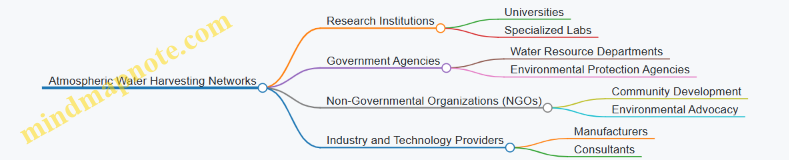
Research Institutions and Universities
These centers often lead fundamental research, pilot projects, and technology development.
-
Massachusetts Institute of Technology (MIT) - Department of Civil and Environmental Engineering
- Focus: Innovative atmospheric water capture materials and system design.
- Contact: [email protected]
-
University of California, Berkeley - Energy and Resources Group
- Focus: Sustainable water technologies and climate interactions.
- Contact: [email protected]
-
King Abdullah University of Science and Technology (KAUST)
- Focus: Desert environment water harvesting and nanomaterials.
- Contact: [email protected]
-
National University of Singapore (NUS) - Environmental Research Institute
- Focus: Urban atmospheric water harvesting and air quality.
- Contact: [email protected]
Example: The KAUST team developed a fog harvesting mesh tailored for arid climates, combining material science with local environmental data.
Government Agencies
These agencies regulate water resources, fund projects, and provide data.
-
United States Geological Survey (USGS)
- Role: Hydrological data and water resource monitoring.
- Contact: [email protected]
-
Environmental Protection Agency (EPA) - Water Division
- Role: Water quality standards and environmental impact assessments.
- Contact: [email protected]
-
India Central Water Commission (CWC)
- Role: Water resource management and technology implementation.
- Contact: [email protected]
-
South African Department of Water and Sanitation
- Role: Policy and community water projects.
- Contact: [email protected]
Example: The EPA provides guidelines on water quality for harvested atmospheric water, ensuring safety for human consumption.
Non-Governmental Organizations (NGOs)
NGOs often work directly with communities to implement and maintain harvesting systems.
-
WaterAid
- Focus: Community water access and sustainable technologies.
- Contact: [email protected]
-
FogQuest
- Focus: Fog water harvesting in developing regions.
- Contact: [email protected]
-
The Water Project
- Focus: Clean water solutions and education.
- Contact: [email protected]
Example: FogQuest has installed fog collectors in several mountainous communities, combining local training with technical support.
Industry and Technology Providers
These organizations design, manufacture, and consult on atmospheric water harvesting systems.
-
Watergen
- Product: Mobile and stationary atmospheric water generators.
-
Skywater
- Product: Large-scale atmospheric water systems.
Example: Watergen’s solar-powered units have been deployed in remote areas to provide off-grid water supply.
Summary Table: Contact Overview
| Organization Type | Example Organization | Contact Email | Primary Focus |
|---|---|---|---|
| Research Institution | MIT Civil and Environmental Engineering | [email protected] | Materials and system design |
| Government Agency | USGS | [email protected] | Hydrological data and monitoring |
| NGO | FogQuest | [email protected] | Fog water harvesting projects |
| Industry Provider | Watergen | [email protected] | Atmospheric water generators |
This section aims to provide practical starting points for professionals, researchers, and practitioners interested in atmospheric water harvesting. Reaching out to these organizations can facilitate knowledge exchange, technical assistance, and partnership development.