Career Pivot into Tech: Non-Technical to Product Roles
1. Understanding the Tech Product Landscape
1.1 Overview of Product Roles in Tech: Product Manager, Product Owner, and Business Analyst
In the tech industry, product roles are crucial for bridging the gap between customer needs, business goals, and technical execution. For professionals pivoting into tech from non-technical backgrounds, understanding the distinctions and overlaps between Product Manager, Product Owner, and Business Analyst roles is foundational.
What is a Product Manager (PM)?
A Product Manager is responsible for the overall vision, strategy, and success of a product. They act as the CEO of the product, balancing customer needs, business objectives, and technical feasibility.
- Key Responsibilities:
- Defining product vision and roadmap
- Prioritizing features based on customer value and business impact
- Collaborating with cross-functional teams (engineering, design, marketing)
- Analyzing market trends and competitor products
Example: Imagine Sarah, who worked in retail management, transitioning to a PM role. She uses her customer insight skills to define a new e-commerce feature that improves checkout experience, working closely with engineers and designers to deliver it.
What is a Product Owner (PO)?
The Product Owner is often seen as the tactical counterpart to the PM, focusing on the execution side within Agile teams. They manage the product backlog and ensure the development team delivers value every sprint.
- Key Responsibilities:
- Writing and prioritizing user stories
- Clarifying requirements for the development team
- Accepting or rejecting completed work
- Acting as the voice of the customer during development
Example: John, previously a customer support lead, becomes a PO. He uses his deep understanding of customer pain points to write detailed user stories and prioritize fixes that improve user satisfaction.
What is a Business Analyst (BA)?
A Business Analyst focuses on understanding business needs and translating them into clear requirements. They often act as a liaison between business stakeholders and technical teams.
- Key Responsibilities:
- Gathering and documenting requirements
- Conducting stakeholder interviews and workshops
- Analyzing business processes and identifying improvements
- Supporting testing and validation of solutions
Example: Emily, who worked in finance, moves into a BA role. She uses her analytical skills to map out current business processes and identify automation opportunities for the tech team.
Mind Map: Product Roles Overview
Mind Map: Key Skills Comparison
Integrated Example: Transitioning from Non-Technical to Product Roles
Consider Alex, who worked in event planning and wants to enter tech product roles:
- As a Product Manager, Alex leverages his experience coordinating multiple vendors and stakeholders to define a product roadmap for a virtual event platform.
- As a Product Owner, he uses his detail-oriented skills to manage the sprint backlog, ensuring features like ticketing and live streaming are prioritized and clearly defined.
- As a Business Analyst, Alex conducts interviews with event organizers to gather requirements and document workflows for the development team.
This example shows how transferable skills from non-technical roles can map naturally to different product roles.
Understanding these roles helps you identify which aligns best with your skills and interests as you pivot into tech product careers.
1.2 Key Skills and Competencies Required for Product Roles
Transitioning into a product role in tech requires a blend of diverse skills and competencies. These skills empower you to effectively manage products from ideation to launch, collaborate with cross-functional teams, and deliver value to customers. Below, we break down the essential skills into categories, supported by mind maps and practical examples.
Core Skill Categories for Product Roles
Communication Skills
Why it matters: Product roles require constant communication with engineers, designers, marketers, and executives. Clear communication ensures alignment and smooth execution.
Example: Sarah, a former sales manager, leveraged her experience in stakeholder communication to effectively gather requirements from customers and translate them into actionable user stories for the development team.
Strategic Thinking
Why it matters: Product professionals must envision the product’s future, analyze market trends, and prioritize features that deliver maximum value.
Example: John, who transitioned from business consulting, used his strategic planning skills to create a product roadmap that balanced quick wins with long-term innovation.
Technical Understanding
Why it matters: While not always coding, understanding technical concepts helps in making informed decisions and communicating effectively with engineers.
Example: Priya, a former HR specialist, took an introductory course on APIs and Agile methodologies, enabling her to participate confidently in sprint planning and backlog grooming.
User-Centric Mindset
Why it matters: Successful products solve real user problems. Empathy and user feedback integration are critical.
Example: David, previously a customer support agent, used his deep understanding of customer pain points to advocate for features that improved user satisfaction.
Leadership & Influence
Why it matters: Product roles often require leading without formal authority, influencing teams, and making tough decisions.
Example: Maria, a former project coordinator, applied her conflict resolution skills to mediate between designers and developers, ensuring deadlines were met.
Analytical Skills
Why it matters: Data-driven decision making is central to product success. Analyzing metrics helps validate hypotheses and optimize features.
Example: Alex, who came from finance, used his analytical background to define KPIs and run A/B tests that improved user engagement.
Mind Map: Detailed Breakdown of Communication Skills
Example: Communication in Action
Imagine you are a product manager preparing for a sprint planning meeting. You need to:
- Clearly explain the priority of features based on customer feedback.
- Address concerns from the engineering team about technical feasibility.
- Update marketing on upcoming releases.
By applying strong communication skills, you ensure everyone understands the goals and their roles.
Mind Map: Strategic Thinking Components
Example: Prioritization Practice
You receive feature requests from multiple departments. Using a prioritization matrix (value vs effort), you decide to focus on a feature that:
- Has high customer demand (value)
- Requires moderate development time (effort)
This approach helps balance quick wins with strategic initiatives.
Summary
Mastering these key skills and competencies is crucial for a successful pivot into product roles in tech. By leveraging your existing strengths and building new capabilities, you can confidently navigate the product landscape and contribute meaningfully.
Remember, each skill is interconnected, and continuous practice through real-world examples will solidify your expertise.
1.3 Common Misconceptions About Product Roles for Non-Technical Professionals
When considering a career pivot into tech product roles, many non-technical professionals hold certain misconceptions that can create unnecessary barriers or confusion. Understanding and debunking these myths early on can empower you to approach your transition with confidence and clarity.
Misconception 1: “You Must Be Highly Technical to Succeed in Product Roles”
Many believe that product managers or product owners need to be expert coders or engineers. While technical understanding helps, it is not a prerequisite.
-
Reality: Product roles focus on understanding customer needs, prioritizing features, and collaborating across teams. Technical knowledge is often about grasping concepts, not writing code.
-
Example: Sarah, a former marketing manager, successfully transitioned to product management by learning basic API concepts and agile workflows without coding.
Mind Map: Technical Skills vs. Product Skills
Misconception 2: “Only People With a Tech Degree Can Enter Product Roles”
This misconception discourages many talented professionals from applying.
-
Reality: Diverse backgrounds such as business, design, marketing, and even psychology enrich product teams.
-
Example: John, with a background in psychology, became a product owner by leveraging his understanding of user behavior and research.
Mind Map: Diverse Backgrounds in Product Roles
Misconception 3: “Product Roles Are Only About Managing Projects”
Many confuse product management with project management.
-
Reality: Product roles focus on the what and why of a product — defining vision, strategy, and user value — whereas project management focuses on the how and when.
-
Example: Lisa transitioned from project management to product management by shifting focus from timelines to customer needs and product strategy.
Mind Map: Product Management vs. Project Management
Misconception 4: “You Need to Know All Product Tools Before Applying”
Many aspiring product professionals feel overwhelmed by the plethora of tools like JIRA, Confluence, or roadmapping software.
-
Reality: While familiarity helps, employers value your ability to learn and adapt. Core skills and mindset matter more.
-
Example: Mark, a customer success manager, learned JIRA on the job after securing a product role by demonstrating strong communication and problem-solving skills.
Mind Map: Tools vs. Core Skills
Misconception 5: “You Must Have Previous Product Experience to Get Hired”
This belief can deter career changers from applying.
-
Reality: Many companies value transferable skills and potential. Demonstrating understanding through side projects, certifications, or volunteering can compensate.
-
Example: Emma, a sales professional, created a product improvement proposal for her company’s app, which helped her land an entry-level product role.
Mind Map: Building Credibility Without Prior Product Experience
Summary
Understanding these misconceptions helps non-technical professionals approach product roles with realistic expectations and confidence. Remember, product roles are about bridging the gap between technology and users — a space where diverse skills and perspectives thrive.
Pro Tip: Start by learning the language of product management and seek small opportunities to contribute to product-related tasks in your current role. This practical exposure will help dispel myths and build your confidence.
1.4 Case Study: Transitioning from Marketing to Product Management
Transitioning from a marketing role to product management is a common and achievable career pivot. This case study explores how Sarah, a marketing professional, successfully made the switch by leveraging her existing skills, acquiring new knowledge, and strategically positioning herself.
Background
Sarah had 5 years of experience in digital marketing, focusing on customer segmentation, campaign management, and data analysis. She was passionate about technology and wanted to move into product management to have a greater impact on product development and strategy.
Step 1: Identifying Transferable Skills
Sarah started by mapping her marketing skills to product management competencies. Here’s a mind map illustrating this process:
Example: Sarah’s experience creating user personas in marketing helped her understand customer needs, a critical skill for defining product requirements.
Step 2: Building Product Knowledge
Sarah enrolled in an online Product Management certification course to learn about product lifecycle, Agile methodologies, and technical basics.
Example: Understanding user stories helped Sarah translate customer needs into actionable tasks for development teams.
Step 3: Gaining Practical Experience
Sarah volunteered to assist the product team at her company by helping with market research and writing user stories.
Example: Sarah’s competitive analysis report influenced prioritization of features in the product roadmap.
Step 4: Networking and Mentorship
Sarah connected with product managers on LinkedIn and attended local product meetups. She found a mentor who provided guidance on interview preparation and career planning.
Example: Her mentor conducted mock interviews that helped Sarah gain confidence and refine her answers.
Step 5: Crafting a Product-Focused Resume
Sarah restructured her resume to emphasize product-relevant accomplishments and skills.
Example: By quantifying her impact (e.g., “Improved user engagement by 15% through targeted feature recommendations”), Sarah made her resume stand out.
Outcome
Within 6 months, Sarah secured a Product Manager role at a tech startup. Her marketing background gave her a unique perspective on customer needs and go-to-market strategies, making her an asset to the product team.
Summary Mind Map: Marketing to Product Management Transition
This case study demonstrates that with a structured approach, non-technical professionals like marketers can successfully pivot into product management roles by leveraging their existing strengths and strategically filling knowledge gaps.
2. Assessing Your Transferable Skills
2.1 Identifying Soft Skills That Translate to Product Roles: Communication, Leadership, and Problem-Solving
Transitioning into a product role from a non-technical background is often less about mastering coding or technical tools and more about leveraging your existing soft skills. Product roles thrive on effective communication, strong leadership, and creative problem-solving. Let’s explore these key soft skills with mind maps and practical examples to help you see how your current abilities can shine in a tech product environment.
Communication
Effective communication is the backbone of product roles. You act as a bridge between engineering, design, marketing, sales, and customers. Clear, concise, and empathetic communication ensures alignment and drives product success.
Mind Map: Communication Skills in Product Roles
Example:
Maria, a former HR professional, excelled in employee communications. When she pivoted to a product role, she used her experience to facilitate cross-team meetings and write clear user stories that developers could easily understand. Her ability to listen and translate customer feedback into actionable requirements helped improve the product roadmap significantly.
Leadership
Leadership in product roles is about influence rather than authority. You guide teams, prioritize initiatives, and make decisions that impact the product’s direction.
Mind Map: Leadership Skills in Product Roles
Example:
James transitioned from a customer service manager to a product owner. His leadership experience helped him prioritize feature requests based on customer impact and business value. By fostering open communication and encouraging team input, he built trust and motivated engineers to deliver quality releases on time.
Problem-Solving
Product roles require constant problem-solving — from identifying user pain points to overcoming technical constraints.
Mind Map: Problem-Solving Skills in Product Roles
Example:
Sophia, a former event planner, used her problem-solving skills to manage complex logistics. In her new product role, she applied the same skills to analyze user data and identify why a feature was underperforming. She collaborated with UX designers to redesign the feature, resulting in a 30% increase in user engagement.
Summary
By identifying and framing your soft skills in terms of communication, leadership, and problem-solving, you can confidently demonstrate your readiness for product roles. These skills are highly valued in tech and often differentiate successful product professionals.
Practical Exercise
Create your own mind map of soft skills you possess and map them to product role responsibilities. Use the examples above as a guide. This will help you articulate your value during interviews and networking.
Remember, your non-technical background is an asset. The ability to communicate effectively, lead teams, and solve problems creatively is what makes great product professionals.
2.2 Mapping Your Current Experience to Product Role Requirements
Transitioning into a product role from a non-technical background can feel daunting, but many of the skills and experiences you already possess are highly relevant and valuable. This section will guide you through the process of mapping your current experience to the requirements of product roles, helping you recognize your strengths and identify areas for growth.
Step 1: Understand Core Product Role Requirements
Before mapping your experience, it’s essential to understand what product roles typically require. Here’s a simplified mind map illustrating key competencies:
Step 2: Identify Your Transferable Skills and Experiences
Now, reflect on your current and past roles. What tasks, projects, or responsibilities align with the competencies above? Use this mind map template to organize your thoughts:
Step 3: Example Mapping for a Marketing Professional
Let’s consider Jane, a marketing manager aiming to pivot into a product manager role.
| Product Skill Area | Jane’s Relevant Experience & Example |
|---|---|
| Product Strategy & Vision | Developed go-to-market strategies for new product launches, analyzed competitors to position products effectively. |
| Customer Focus | Conducted customer surveys and focus groups to understand pain points and preferences. |
| Communication & Collaboration | Coordinated campaigns across sales, design, and content teams; presented results to executives. |
| Technical Understanding | Worked closely with web developers and CRM platforms; learned basics of SEO and analytics tools. |
| Analytical Skills | Measured campaign ROI using data analytics; adjusted strategies based on performance metrics. |
| Execution & Delivery | Managed timelines for multiple campaigns; prioritized marketing activities based on impact. |
Step 4: Practical Exercise - Create Your Own Mapping
- List your current job responsibilities.
- For each responsibility, ask: Which product skill does this relate to?
- Write a brief example or story illustrating how you performed this task.
- Identify any gaps where you have little or no experience.
Example:
| My Responsibility | Related Product Skill | Example/Story |
|---|---|---|
| Coordinated monthly team meetings | Communication & Collaboration | Led cross-department meetings to align on project goals. |
| Analyzed customer feedback data | Customer Focus & Analytics | Summarized feedback trends to improve service offerings. |
| Managed project deadlines | Execution & Delivery | Prioritized tasks to ensure timely delivery of projects. |
Step 5: Addressing Gaps
Once you’ve mapped your experience, you might notice gaps, especially in technical understanding or specific product methodologies. These can be addressed by:
- Taking introductory courses on Agile, Scrum, or product management.
- Shadowing product managers or joining cross-functional projects.
- Learning basic technical concepts relevant to your target industry.
Summary
Mapping your current experience to product role requirements helps you:
- Recognize the value of your existing skills.
- Build confidence by seeing clear connections.
- Identify areas to focus your learning and development.
By systematically analyzing your background with this approach, you can create a compelling narrative for your career pivot into product roles.
2.3 Practical Exercise: Creating a Skills Inventory with Real-Life Examples
Creating a skills inventory is a foundational step in your career pivot into tech product roles. It helps you identify what you already bring to the table and what areas you may need to develop. This exercise will guide you through mapping your existing skills, categorizing them, and illustrating how they apply to product roles.
Step 1: Brainstorm Your Skills
Start by listing all the skills you use or have developed in your current and past roles. Include both hard skills (technical knowledge, tools, processes) and soft skills (communication, leadership, problem-solving).
Mind Map: Brainstorming Skills
Step 2: Categorize Skills Relevant to Product Roles
Next, organize your skills into categories that align with product management competencies:
- Customer Understanding
- Business Acumen
- Technical Literacy
- Communication & Leadership
- Analytical Thinking
Mind Map: Categorizing Skills
Step 3: Match Your Skills to Product Role Examples
For each skill, think of a real-life example where you demonstrated it. This will help you articulate your value during interviews or on your resume.
Example 1: Communication & Leadership
- Skill: Stakeholder Management
- Example: As a Marketing Coordinator, I led weekly meetings with sales, design, and external vendors to align campaign goals, ensuring all parties were informed and deadlines met.
Example 2: Analytical Thinking
- Skill: Data Interpretation
- Example: In my role as a Business Analyst, I analyzed customer usage data to identify trends that informed product feature prioritization, resulting in a 15% increase in user engagement.
Example 3: Customer Understanding
- Skill: User Feedback Analysis
- Example: While working in Customer Support, I collected and synthesized user feedback to propose improvements to the onboarding process, reducing churn by 10%.
Step 4: Visualize Your Skills Inventory
Create a mind map that combines your skills and examples to visualize your readiness for product roles.
Mind Map: Skills Inventory with Examples
Step 5: Identify Skill Gaps and Plan Development
Review your inventory to spot areas where you lack experience or confidence. For example, if technical literacy is low, plan to take introductory courses on APIs or Agile.
Summary
By completing this skills inventory exercise, you will:
- Gain clarity on your transferable skills
- Have concrete examples to demonstrate your capabilities
- Identify areas for growth to target in your learning plan
This structured approach not only boosts your confidence but also prepares you to communicate your value effectively in your career pivot to product roles.
2.4 Example: How a Project Manager Leveraged Stakeholder Management Skills in Product Development
Transitioning from project management to a product role can be seamless when you recognize and leverage your existing skills. One of the most valuable skills a project manager brings to product development is stakeholder management. This example illustrates how a project manager named Sarah successfully pivoted into a product role by applying her stakeholder management expertise.
Background:
Sarah had been a project manager for five years in a mid-sized software company. She was responsible for coordinating cross-functional teams, managing timelines, and communicating with stakeholders ranging from clients to internal executives. Interested in moving into product management, she focused on how her stakeholder management skills could add value in product development.
Key Stakeholder Management Skills Sarah Leveraged:
- Identifying Stakeholders: Understanding who influences or is impacted by the product.
- Communication: Tailoring messages for different audiences.
- Expectation Management: Aligning stakeholder expectations with realistic product goals.
- Conflict Resolution: Navigating conflicting priorities among stakeholders.
- Feedback Collection: Gathering and synthesizing stakeholder input for product decisions.
How Sarah Applied These Skills in Product Development
- Stakeholder Mapping for Product Features
Sarah created a stakeholder map to identify key users, executives, sales teams, and customer support representatives who would be impacted by upcoming product features.
Mind Map: Stakeholder Mapping for Product Features
- Tailored Communication Plans
She developed communication plans for each stakeholder group, ensuring that technical details were simplified for executives, while detailed user stories and acceptance criteria were shared with engineering.
Mind Map: Communication Plan
- Expectation Management Through Regular Check-ins
Sarah scheduled regular stakeholder meetings to update progress, clarify priorities, and reset expectations when timelines shifted, preventing misunderstandings and building trust.
- Conflict Resolution Example
When sales pushed for a feature that engineering flagged as resource-intensive, Sarah facilitated a workshop to prioritize features based on customer impact and feasibility, helping stakeholders reach consensus.
- Feedback Loop Implementation
She established a structured feedback loop by collecting input from customer support and end users post-release, synthesizing this data to inform the product backlog.
Outcome
By leveraging her stakeholder management skills, Sarah was able to:
- Bridge communication gaps between technical and non-technical teams.
- Align diverse stakeholder interests with product goals.
- Improve product prioritization based on real-world feedback.
- Gain credibility as a product professional despite her non-technical background.
Summary Mind Map: Project Manager Skills Applied in Product Development
Mind Map: Project Manager to Product Role Transition
This example highlights how non-technical professionals, particularly project managers, can successfully pivot into product roles by recognizing and applying their transferable skills in stakeholder management. By framing these skills within the context of product development, career changers can demonstrate immediate value and accelerate their transition.
3. Building Foundational Product Knowledge
3.1 Introduction to Product Development Lifecycle and Agile Methodologies
Understanding the product development lifecycle and Agile methodologies is crucial for non-technical professionals pivoting into product roles. These frameworks guide how products are conceived, built, tested, and delivered to customers, ensuring teams work efficiently and adapt to change.
What is the Product Development Lifecycle (PDLC)?
The Product Development Lifecycle is a series of stages that a product goes through from initial idea to launch and beyond. It helps teams organize their work and deliver value incrementally.
Typical stages in PDLC:
- Idea Generation: Brainstorming and identifying customer needs or market gaps.
- Concept Development: Defining the product vision, goals, and high-level requirements.
- Design: Creating wireframes, user flows, and prototypes.
- Development: Building the product features.
- Testing: Validating the product through QA and user feedback.
- Launch: Releasing the product to users.
- Post-Launch: Monitoring, maintenance, and iteration based on user feedback.
Mind Map: Product Development Lifecycle
Agile Methodologies Overview
Agile is a flexible, iterative approach to product development that emphasizes collaboration, customer feedback, and rapid delivery. Instead of a linear process, Agile breaks work into small increments called “sprints” (usually 1-4 weeks), allowing teams to adapt quickly.
Key Agile Principles:
- Customer collaboration over contract negotiation
- Responding to change over following a plan
- Working software over comprehensive documentation
- Individuals and interactions over processes and tools
Popular Agile Frameworks
- Scrum: Focuses on fixed-length sprints, daily standups, sprint planning, reviews, and retrospectives.
- Kanban: Visualizes work on a board, limits work in progress, and promotes continuous delivery.
Mind Map: Agile Methodology (Scrum Focus)
Example: Applying Agile in a Non-Technical Product Role
Scenario: Sarah is a marketing professional transitioning into a Product Owner role for a SaaS product.
- Sprint Planning: Sarah collaborates with developers and designers to prioritize features based on customer feedback and business goals.
- Daily Standups: Though not coding, Sarah attends daily standups to stay updated and remove blockers related to content or user communication.
- Sprint Review: She presents marketing materials and user guides alongside the product demo to gather stakeholder feedback.
- Retrospective: Sarah suggests improving communication channels between marketing and development teams.
This example shows how non-technical skills like communication, prioritization, and stakeholder management fit naturally into Agile ceremonies.
Best Practice: Learn by Doing
- Join Agile Teams: Even if not in a technical role, participate in Agile rituals to understand the flow.
- Use Agile Tools: Familiarize yourself with tools like Jira, Trello, or Asana to track work.
- Simulate Sprints: Try managing a small project or side hustle using Agile principles.
By grasping the Product Development Lifecycle and Agile methodologies, non-technical professionals can effectively contribute to product teams, facilitate collaboration, and help deliver valuable products to customers.
3.2 Learning Basic Technical Concepts Without Coding: APIs, Databases, and UX/UI
Transitioning into a product role from a non-technical background can feel daunting, especially when faced with technical jargon. However, understanding foundational technical concepts like APIs, databases, and UX/UI doesn’t require coding skills. Grasping these ideas will empower you to communicate effectively with engineering teams, make informed decisions, and contribute meaningfully to product development.
Understanding APIs (Application Programming Interfaces)
APIs are the bridges that allow different software systems to communicate with each other. Think of an API as a waiter in a restaurant: you place your order (request), the kitchen (server) prepares it, and the waiter brings back your food (response).
Mind Map: APIs
Example: Imagine you’re managing a fitness app that wants to show users their step count from a wearable device. Instead of building hardware integration from scratch, your app uses the wearable’s API to request step data. Knowing this helps you scope features and understand dependencies.
Grasping Databases
Databases store and organize data that products rely on. They can be thought of as digital filing cabinets where information is stored systematically for easy retrieval.
Mind Map: Databases
Example: Suppose your product tracks customer orders. Knowing that each order is stored as a record in a database table helps you understand how data is retrieved and displayed on the user interface. This insight aids in prioritizing features like search or filtering.
Basics of UX/UI (User Experience / User Interface)
UX/UI focuses on how users interact with a product and how the product looks and feels. UX is about the overall experience, while UI is about the visual elements.
Mind Map: UX/UI
Example: You’re working on a new onboarding flow. Understanding UX principles helps you ensure the process is intuitive and reduces friction, while UI knowledge helps you appreciate the importance of consistent button styles and clear calls to action.
Integrating These Concepts in Your Role
- Communicate Clearly: Use your understanding of APIs to discuss integrations without needing to know how to code them.
- Define Requirements: Knowing databases helps you specify what data your product needs and how it should be organized.
- Champion the User: UX/UI knowledge enables you to advocate for designs that enhance user satisfaction.
Summary Mind Map
By mastering these foundational concepts, you build a strong bridge between your non-technical background and the technical world of product development, making your career pivot smoother and more effective.
3.3 Best Practice: Using Online Courses and Certifications to Gain Credibility
Pivoting into a tech product role from a non-technical background can feel daunting, but one of the most effective ways to build credibility and demonstrate your commitment is through online courses and certifications. These structured learning paths not only equip you with foundational knowledge but also provide tangible proof of your skills to potential employers.
Why Online Courses and Certifications Matter
- Structured Learning: They offer a guided curriculum that covers essential concepts systematically.
- Credibility: Certifications from recognized platforms or institutions serve as proof of your knowledge.
- Flexibility: Learn at your own pace, balancing current job and personal commitments.
- Networking Opportunities: Many courses have active communities or forums.
Key Areas to Focus On for Product Roles
- Product Management Fundamentals
- Agile and Scrum Methodologies
- User Experience (UX) Basics
- Data Analytics for Product Decisions
- Technical Literacy (APIs, Databases, etc.)
Mind Map: Choosing the Right Online Courses
Recommended Platforms and Certifications
| Platform | Course/Certification | Description | Example Use Case |
|---|---|---|---|
| Coursera | “Digital Product Management” by University of Virginia | Covers product lifecycle, agile, and metrics | A marketing professional gaining product basics |
| edX | “Agile Development” by Microsoft | Agile methodologies and Scrum fundamentals | Project managers learning agile for product teams |
| LinkedIn Learning | “Product Management First Steps” | Introductory course with practical examples | Customer support specialists understanding PM role |
| Pragmatic Institute | Foundations Certification | Deep dive into product management frameworks | Career changers building strong PM foundations |
| Google Project Management Certificate | Focus on project management with tech emphasis | Professionals transitioning to product ownership |
Example: A Non-Technical Professional’s Journey
Background: Sarah, a communications specialist, wanted to become a Product Manager but lacked technical skills.
Action Steps:
- Enrolled in Coursera’s “Digital Product Management” course.
- Completed LinkedIn Learning’s “Product Management First Steps”.
- Earned the Pragmatic Institute Foundations Certification.
- Applied learnings by volunteering to assist product teams at her company.
Outcome: Sarah built a credible portfolio and confidently interviewed for associate product manager roles.
Tips for Maximizing the Value of Online Learning
- Set Clear Goals: Define what skills or certifications align with your target role.
- Apply Knowledge: Use projects, case studies, or your current job to practice.
- Showcase Certifications: Add them to your resume and LinkedIn profile with context.
- Engage with Communities: Participate in course forums or related product management groups.
Mind Map: Applying Certifications to Career Growth
By strategically selecting and completing online courses and certifications, you not only gain essential knowledge but also build a credible profile that eases your transition into tech product roles.
3.4 Example: A Non-Technical Professional’s Journey Through a Product Management Bootcamp
Transitioning into a product management role without a technical background can feel daunting. However, structured learning programs like product management bootcamps provide a practical, immersive way to gain foundational knowledge, build confidence, and develop a network. Here, we explore Sarah’s journey, a marketing professional who successfully pivoted into product management through a bootcamp.
Sarah’s Background
- 5 years in marketing and communications
- Strong skills in customer research, storytelling, and project coordination
- Limited exposure to technical concepts
Why a Product Management Bootcamp?
- Structured curriculum covering product lifecycle, Agile, and stakeholder management
- Hands-on projects simulating real-world product challenges
- Access to mentors and industry professionals
- Networking opportunities with peers and hiring managers
Bootcamp Curriculum Mind Map
Sarah’s Bootcamp Experience & Best Practices
-
Active Learning Through Projects
- Sarah worked on a capstone project to redesign a mobile app feature based on user feedback.
- She applied prioritization frameworks like RICE to decide which features to build first.
-
Bridging Technical Gaps
- Used bootcamp resources to understand APIs by visualizing how apps communicate.
- Collaborated with technical peers to clarify concepts.
-
Networking & Mentorship
- Joined weekly mentor sessions, asking targeted questions about transitioning from marketing.
- Connected with alumni who had similar career pivots.
-
Building a Portfolio
- Documented her capstone project, including user personas, roadmaps, and sprint plans.
- Shared her portfolio on LinkedIn and during interviews.
Mind Map: Sarah’s Capstone Project Workflow
Example: Applying RICE Prioritization
| Feature | Reach | Impact | Confidence | Effort | RICE Score |
|---|---|---|---|---|---|
| Push Notifications | 5000 | 7 | 80% | 5 | 4480 |
| In-App Chat | 3000 | 9 | 70% | 8 | 2362.5 |
| Dark Mode | 4000 | 5 | 90% | 3 | 6000 |
Sarah chose to prioritize “Dark Mode” first due to its high RICE score, balancing impact and effort effectively.
Key Takeaways from Sarah’s Journey
- Bootcamps provide a safe environment to learn and make mistakes.
- Hands-on projects help translate theory into practice.
- Building a tangible portfolio is crucial for demonstrating skills.
- Networking and mentorship accelerate learning and job search.
- Non-technical professionals can leverage their existing skills (e.g., user research, communication) effectively.
Sarah’s story exemplifies how a non-technical professional can successfully navigate a product management bootcamp to build the necessary skills and confidence for a career pivot into tech product roles.
4. Networking and Mentorship in the Tech Product Space
4.1 Strategies for Building a Relevant Professional Network
Building a strong and relevant professional network is a cornerstone for successfully pivoting into tech product roles, especially for non-technical professionals. A well-crafted network not only opens doors to job opportunities but also provides mentorship, industry insights, and support throughout your career transition.
Why Networking Matters for Career Changers
- Access to hidden job markets
- Learning from experienced professionals
- Gaining referrals and recommendations
- Building confidence and industry presence
Key Strategies to Build Your Network
Leverage Existing Connections
Start with people you already know — colleagues, friends, alumni, or acquaintances who work in tech or product roles.
- Example: Jane, a former HR professional, reached out to a college friend who was a product manager at a tech startup. This connection led her to attend a product workshop and eventually secure an internship.
Attend Industry Events and Meetups
Participate in local or virtual product management meetups, tech conferences, and workshops.
- Example: Mark, transitioning from sales, attended a ProductCamp event where he met product managers who shared insights and later became his mentors.
Engage in Online Communities
Join LinkedIn groups, Slack channels, Reddit forums, and other online communities focused on product management and tech careers.
- Example: Lisa joined the “Mind the Product” Slack community and participated in discussions, which helped her learn and connect with professionals worldwide.
Informational Interviews
Request short, informal conversations with professionals in product roles to learn about their experiences and advice.
- Example: Tom scheduled a 20-minute call with a product owner he found on LinkedIn, gaining valuable tips on certifications and daily responsibilities.
Volunteer and Contribute
Offer your skills for product-related projects, hackathons, or non-profits to meet professionals and gain experience.
- Example: Sarah volunteered to help a non-profit with user research, connecting her with product managers who appreciated her initiative.
Build a Personal Brand
Share your learning journey, insights, and projects on LinkedIn or a personal blog to attract like-minded professionals.
- Example: David regularly posted about his product management bootcamp experiences, which led to meaningful conversations and job leads.
Mind Map: Strategies for Building a Relevant Professional Network
Mind Map: Example Networking Journey of a Career Changer
Best Practices for Effective Networking
- Be Genuine: Focus on building authentic relationships rather than just asking for jobs.
- Prepare Your Elevator Pitch: Clearly articulate your background, goals, and what you’re looking for.
- Follow Up: Send thank-you notes or messages after meetings to maintain connections.
- Give Back: Offer help or share useful resources when possible.
Summary
Networking is not just about collecting contacts but cultivating meaningful relationships that support your career pivot. By leveraging existing connections, participating in events, engaging online, and sharing your journey, you create a strong foundation for entering tech product roles.
Remember, every conversation is an opportunity to learn and grow.
4.2 How to Find and Approach Mentors in Product Roles
Mentorship is a powerful catalyst for career pivots, especially when transitioning into product roles from non-technical backgrounds. A mentor can provide guidance, share insider knowledge, offer feedback, and open doors to new opportunities. This section will walk you through practical steps to find and approach mentors effectively, complete with mind maps and real-world examples.
Why Mentorship Matters in Product Careers
- Accelerates learning curve
- Provides industry insights
- Expands professional network
- Builds confidence through support
Step 1: Identifying Potential Mentors
Start by mapping out where you might find mentors who are experienced product professionals.
Mind Map: Identifying Potential Mentors
Example: Sarah, a marketing professional pivoting to product management, started by listing product managers she had met in her company’s cross-functional meetings and then expanded to LinkedIn groups dedicated to product management.
Step 2: Researching and Shortlisting Mentors
Once you identify potential mentors, research their backgrounds and interests to ensure alignment.
Mind Map: Researching Mentors
Example: John found a product manager who wrote extensively about transitioning from sales to product roles, which resonated with his own background. He also noticed they shared a mutual connection, which he later used to get an introduction.
Step 3: Crafting Your Outreach Message
Your initial message should be concise, respectful, and clear about your intentions.
Mind Map: Outreach Message Components
Example Outreach Message:
Hi [Mentor’s Name],
I’m [Your Name], currently transitioning from [Your Current Role] into product management. I came across your profile through [LinkedIn group/Mutual Connection] and was inspired by your journey from [Mentor’s Background] to product leadership.
I’d love to learn more about your experience and get advice on navigating this transition. Would you be open to a 20-minute call sometime in the next two weeks?
Thank you for considering my request!
Best,
[Your Name]
Step 4: Preparing for the Mentorship Conversation
Make the most of your mentor’s time by preparing thoughtful questions and topics.
Mind Map: Preparing for Mentorship Conversation
Example: Before her call, Sarah prepared questions about building credibility without a technical background and asked for book recommendations and networking tips.
Step 5: Building and Maintaining the Relationship
Mentorship is an ongoing relationship that requires nurturing.
Mind Map: Maintaining Mentor Relationship
Example: John sent a follow-up email thanking his mentor and later shared a product article that sparked a good discussion, helping to keep the relationship active.
Additional Tips and Best Practices
- Be genuine and authentic in your communication.
- Respect your mentor’s time; keep meetings focused and punctual.
- Be open to constructive feedback.
- Don’t be discouraged if some outreach attempts don’t get responses; persistence is key.
Summary Mind Map: Finding and Approaching Mentors
By following these steps, non-technical professionals can effectively find and approach mentors in product roles, gaining invaluable support on their career pivot journey.
4.3 Best Practice: Leveraging LinkedIn and Industry Events for Connections
Building a strong professional network is crucial when pivoting into tech product roles, especially for non-technical professionals. LinkedIn and industry events serve as powerful platforms to connect with product managers, recruiters, mentors, and peers. Below, we explore actionable strategies and examples to maximize your networking efforts.
Leveraging LinkedIn Effectively
LinkedIn is more than just an online resume — it’s a dynamic networking tool that can open doors to product roles.
Key Strategies:
-
Optimize Your Profile:
- Use a professional photo.
- Write a compelling headline that reflects your pivot goal (e.g., “Aspiring Product Manager | Marketing Professional Transitioning into Tech”).
- Craft a summary that highlights transferable skills and passion for product management.
- Showcase relevant certifications, courses, and projects.
-
Connect Strategically:
- Send personalized connection requests to product managers and recruiters.
- Join LinkedIn groups focused on product management and tech careers.
- Engage by commenting thoughtfully on posts and sharing relevant content.
-
Request Informational Interviews:
- Politely ask for 15-20 minute chats to learn about their career path and advice.
-
Share Your Journey:
- Post updates about your learning progress, certifications, and projects.
Example:
Jane, a former HR specialist, updated her LinkedIn headline to “Aspiring Product Manager | Passionate about User-Centered Design” and shared weekly posts about her product management bootcamp experience. She connected with alumni from her course and reached out to product managers at companies she admired. Within three months, she secured multiple informational interviews, one of which led to a referral.
Maximizing Industry Events
Industry events, whether virtual or in-person, provide opportunities to meet professionals, learn about trends, and demonstrate your enthusiasm.
Types of Events:
- Product management conferences (e.g., Mind the Product, ProductCamp)
- Tech meetups and workshops
- Webinars hosted by product leaders
- Hackathons and product challenges
Best Practices:
-
Prepare Ahead:
- Research speakers and attendees.
- Prepare your elevator pitch focusing on your pivot story.
- Set goals for the event (e.g., meet 5 new people).
-
Engage Actively:
- Ask insightful questions during sessions.
- Participate in breakout rooms or networking sessions.
- Exchange contact information and follow up promptly.
-
Follow Up:
- Send personalized LinkedIn invitations referencing your meeting.
- Share resources or articles discussed.
Example:
Mark, a sales professional, attended a local ProductCamp event. He introduced himself to a panelist after the session, mentioning his interest in product roles and asking for advice. He followed up with a LinkedIn message thanking them and sharing a relevant article. This connection later became his mentor.
Mind Maps
Below are mind maps illustrating how to leverage LinkedIn and industry events effectively.
Mind Map 1: Leveraging LinkedIn
Mind Map 2: Maximizing Industry Events
Summary
By thoughtfully optimizing your LinkedIn presence and actively participating in industry events, you create meaningful connections that can accelerate your transition into product roles. Remember, networking is about building genuine relationships — be authentic, curious, and proactive.
4.4 Example: Success Story of a Career Changer Who Landed a Product Role Through Mentorship
Introduction
Meet Sarah, a former corporate communications specialist who successfully transitioned into a Product Manager role at a leading tech company. Her journey highlights the transformative power of mentorship combined with strategic networking and skill-building.
Sarah’s Background
- Previous Role: Corporate Communications Specialist
- Industry: Non-tech (Finance)
- Goal: Transition into a Product Management role in tech
Step 1: Identifying the Need for Mentorship
Sarah realized that while she had strong communication and project coordination skills, she lacked direct experience and understanding of product management processes and technical knowledge.
Step 2: Finding a Mentor
Sarah used LinkedIn to identify product managers in her network and industry groups. She followed this approach:
- Joined Product Management groups on LinkedIn and Slack communities
- Attended local tech meetups and product workshops
- Reached out politely to experienced product managers with a clear ask: “Can you spare 15 minutes for a quick chat about your career path?”
Step 3: Building the Mentorship Relationship
Her mentor, James, a Senior Product Manager, agreed to guide her. Their mentorship included:
- Regular bi-weekly calls to discuss product concepts and career advice
- Reviewing Sarah’s resume and LinkedIn profile
- Sharing real-world product challenges and how to approach them
- Introducing Sarah to his network for informational interviews
Mind Map: Mentorship Journey
Step 4: Skill Development Through Mentorship
James recommended specific resources and practical exercises:
- Learning Agile: Sarah completed a free Agile Fundamentals course recommended by James.
- Understanding User Stories: They practiced writing user stories together based on Sarah’s past projects.
- Product Metrics: James explained key performance indicators (KPIs) and how to interpret them.
Example Exercise:
- Sarah took a recent marketing campaign she managed and reframed it as a product feature launch, writing user stories and defining success metrics.
Step 5: Gaining Practical Experience
With James’s encouragement, Sarah volunteered to assist the product team at her current company by:
- Helping write user stories
- Coordinating cross-team communication
- Participating in sprint planning meetings
This hands-on experience was invaluable and gave her concrete examples to discuss in interviews.
Step 6: Job Search and Interview Preparation
James helped Sarah prepare for interviews by:
- Conducting mock interviews focusing on behavioral and product case questions
- Coaching her on storytelling techniques to highlight transferable skills
- Advising on how to discuss her mentorship and self-driven learning
Mind Map: Interview Preparation
Outcome
Within six months, Sarah secured a Product Manager role at a mid-sized tech startup. She credits mentorship as the cornerstone of her successful pivot.
Key Takeaways
- Mentorship bridges knowledge gaps: Personalized guidance accelerates learning.
- Networking is essential: Proactive outreach opens doors.
- Hands-on practice matters: Volunteering for product-related tasks builds credibility.
- Storytelling sells your experience: Framing past roles in product terms resonates with hiring managers.
Final Thought
Sarah’s story exemplifies how non-technical professionals can leverage mentorship to confidently transition into product roles in tech. By combining strategic networking, continuous learning, and practical experience, the path becomes clearer and more achievable.
5. Gaining Practical Experience
5.1 Volunteering for Product-Related Projects Within Your Current Role
Volunteering for product-related projects within your current job is one of the most effective ways to gain practical experience and demonstrate your interest and capability in product roles without leaving your comfort zone. This approach allows you to build relevant skills, expand your network, and create tangible examples to showcase in your pivot to tech product roles.
Why Volunteer for Product-Related Projects?
- Hands-on Experience: Gain direct exposure to product development processes.
- Skill Development: Practice skills like stakeholder communication, prioritization, and user feedback analysis.
- Visibility: Increase your presence among product teams and leadership.
- Portfolio Building: Create artifacts such as user stories, roadmaps, or feature proposals.
How to Identify Opportunities to Volunteer
- Look for ongoing or upcoming projects involving product teams.
- Offer to assist in user research, documentation, or testing.
- Propose improvements based on customer feedback or pain points you’ve observed.
- Volunteer to coordinate cross-departmental communications or meetings.
Mind Map: Volunteering for Product-Related Projects
Best Practices for Volunteering
- Start Small: Begin with manageable tasks like documenting user feedback or helping organize sprint meetings.
- Be Proactive: Don’t wait to be asked; suggest ways you can add value.
- Communicate Clearly: Keep stakeholders informed about your contributions.
- Seek Feedback: Regularly ask for input to improve your work and demonstrate growth.
- Document Your Work: Keep records of your contributions to showcase later.
Example 1: Customer Support Specialist Volunteering for Product Improvement
Situation: Jane works in customer support and notices recurring complaints about a specific feature.
Action: She volunteers to compile detailed user feedback and collaborates with the product team to draft a feature improvement proposal.
Outcome: The product team appreciates her insights, and Jane gains experience writing user stories and participating in sprint planning.
Takeaway: Leveraging domain knowledge and customer insights can open doors to product involvement.
Example 2: Marketing Coordinator Assisting in Product Launch
Situation: Mark is a marketing coordinator interested in product management.
Action: He volunteers to coordinate communication between product, sales, and marketing teams during a new product launch.
Outcome: Mark gains exposure to product timelines, prioritization decisions, and cross-team collaboration.
Takeaway: Supporting product launches can provide practical experience in product lifecycle management.
Mind Map: Example Workflow for Volunteering
Volunteering within your current role is a strategic and low-risk way to build product experience. It demonstrates initiative and helps you build a bridge from your existing skills to those required in product roles. By actively seeking and contributing to product-related projects, you position yourself as a valuable candidate for your future career pivot.
5.2 Participating in Hackathons and Product Challenges as a Non-Technical Contributor
Participating in hackathons and product challenges is a fantastic way for non-technical professionals to gain hands-on experience, build their product skills, and expand their network within the tech community. Even without coding skills, you can add immense value by focusing on areas such as user research, product strategy, project management, and customer insights.
Why Non-Technical Contributors Matter in Hackathons
- Diverse Perspectives: Non-technical team members bring fresh viewpoints that can lead to innovative solutions.
- User-Centric Focus: They often represent the end-user mindset, helping to keep the product aligned with real customer needs.
- Project Coordination: Managing timelines, communication, and resources ensures the team stays organized and productive.
How to Contribute Effectively
Step-by-Step Example: Non-Technical Role in a Hackathon
Scenario: Sarah, a marketing professional, joins a 48-hour hackathon focused on developing a mobile app for mental wellness.
- Pre-Hackathon Preparation: Sarah researches mental wellness trends and user pain points.
- Team Formation: She joins a team with two developers and one designer.
- User Research: Sarah drafts quick surveys and conducts informal interviews with potential users to validate assumptions.
- Feature Prioritization: Using her insights, she helps the team decide which features to include in the MVP.
- Wireframing: Collaborates with the designer to sketch simple user flows.
- Project Management: Keeps track of tasks and deadlines, ensuring smooth collaboration.
- Pitch Preparation: Crafts the story highlighting how the app addresses user needs and prepares the presentation.
Outcome: The team wins the “Best User Experience” award, and Sarah gains confidence in product-related skills.
Best Practices for Non-Technical Contributors in Hackathons
- Communicate Proactively: Keep the team aligned on goals and progress.
- Leverage Your Strengths: Use your background (e.g., marketing, customer service) to inform product decisions.
- Be Open to Learning: Absorb technical knowledge from teammates to deepen your understanding.
- Document Everything: Keep notes on user feedback, decisions, and learnings for future reference.
Additional Mind Map: Benefits of Hackathon Participation for Career Pivoters
Other Examples of Non-Technical Contributions
- Customer Support Specialist: Identifies common user pain points and suggests feature improvements during the hackathon.
- Business Analyst: Helps translate business requirements into clear user stories for developers.
- UX Researcher: Conducts rapid usability testing and synthesizes results to guide design decisions.
By actively participating in hackathons and product challenges, non-technical professionals not only build relevant skills but also demonstrate initiative and adaptability—qualities highly valued in product roles within tech.
5.3 Best Practice: Building a Portfolio of Product Artifacts (Roadmaps, User Stories, etc.)
When pivoting into a tech product role from a non-technical background, one of the most powerful ways to demonstrate your understanding and capability is by building a portfolio of product artifacts. These artifacts showcase your practical knowledge of product management processes and your ability to think strategically and tactically about product development.
Why Build a Product Portfolio?
- Demonstrates hands-on experience: Even if you haven’t held a formal product role, creating artifacts shows you understand key concepts.
- Supports your resume and interviews: You can reference your portfolio to provide concrete examples.
- Builds confidence: The process of creating these artifacts deepens your understanding.
Key Product Artifacts to Include
| Artifact Type | Description | Example |
|---|---|---|
| Product Roadmap | A high-level visual summary that maps out the vision and direction of your product offering over time. | A quarterly roadmap showing feature releases and milestones for a mobile app. |
| User Stories | Short, simple descriptions of a feature told from the perspective of the user or customer. | “As a user, I want to reset my password so that I can regain access if I forget it.” |
| Product Requirements Document (PRD) | A detailed document outlining the product’s purpose, features, and functionality. | PRD for an e-commerce checkout flow including acceptance criteria. |
| Wireframes / Mockups | Visual sketches or designs of product interfaces to illustrate user experience. | Low-fidelity wireframe of a dashboard page created using free tools like Figma or Balsamiq. |
| Competitive Analysis | A comparison of your product against competitors highlighting strengths and weaknesses. | Table comparing features of three project management tools. |
| Metrics Dashboard | A snapshot of key performance indicators (KPIs) to track product success. | Google Analytics dashboard showing user engagement metrics. |
How to Create These Artifacts as a Non-Technical Professional
- Choose a Product Idea: Pick a product you are passionate about or a hypothetical product relevant to your industry.
- Research: Understand the market, users, and competitors.
- Draft User Stories: Think about user needs and write clear, concise stories.
- Build a Roadmap: Outline the timeline and priorities for feature development.
- Design Wireframes: Use simple tools to sketch interfaces.
- Compile a PRD: Summarize your findings and plans.
- Analyze Competitors: Create a comparison chart.
- Define Metrics: Identify KPIs that matter.
Mind Map: Building a Product Portfolio
Example: Creating a User Story and Roadmap for a Fitness App
-
User Story:
- “As a fitness enthusiast, I want to track my daily workouts so that I can monitor my progress over time.”
-
Roadmap Snapshot:
- Q1: Develop workout tracking feature
- Q2: Add social sharing capabilities
- Q3: Integrate wearable device syncing
- Q4: Launch personalized workout recommendations
Tools to Help You Build Your Portfolio
- Roadmaps: Trello, Aha!, ProductPlan
- User Stories & PRDs: Google Docs, Confluence
- Wireframes: Figma, Balsamiq, Sketch
- Competitive Analysis: Excel, Google Sheets
- Metrics Dashboard: Google Analytics, Mixpanel
Tips for Showcasing Your Portfolio
- Host your portfolio on a personal website or platforms like GitHub or Notion.
- Include context for each artifact explaining your thought process.
- Link artifacts in your resume and LinkedIn profile.
- Use your portfolio as talking points during interviews.
By thoughtfully creating and curating these product artifacts, you provide tangible proof of your readiness for a product role, even without prior technical experience. This best practice not only strengthens your application but also accelerates your learning and confidence in the product management domain.
5.4 Example: How a Customer Support Specialist Created a Product Improvement Proposal
Transitioning into a product role often requires demonstrating initiative and understanding of product challenges. Here, we explore how a Customer Support Specialist leveraged their frontline experience to create a compelling product improvement proposal.
Background
Jessica, a Customer Support Specialist at a SaaS company, noticed recurring customer complaints about the onboarding process. Although she had no formal product management experience, she decided to take the initiative to draft a product improvement proposal to address these pain points.
Step 1: Identifying the Problem
Jessica began by collecting and categorizing customer feedback related to onboarding issues. She noticed three main themes:
- Confusing user interface during setup
- Lack of clear guidance or tutorials
- Delays in account verification
Mind Map: Identifying the Problem
Step 2: Analyzing Impact
Jessica quantified the impact by reviewing support tickets and customer churn data:
- 40% of onboarding-related tickets cited UI confusion
- Average onboarding time was 5 days, with delays causing frustration
- Customers who experienced onboarding issues had a 25% higher churn rate
This data helped her prioritize the problem’s urgency.
Step 3: Proposing Solutions
Jessica proposed three actionable solutions:
- Simplify the onboarding UI by redesigning key screens
- Add interactive tutorials and tooltips to guide new users
- Automate account verification to reduce delays
Mind Map: Proposed Solutions
Step 4: Collaborating with Stakeholders
Jessica scheduled meetings with the product manager, UX designer, and engineering lead to discuss her findings and proposals. She used her customer insights to advocate for prioritizing onboarding improvements.
Best Practice: Use your unique perspective and data to build credibility and foster collaboration.
Step 5: Creating the Proposal Document
Jessica structured her proposal as follows:
- Executive Summary: Brief overview of the problem and proposed solutions
- Customer Feedback Analysis: Data and examples from support tickets
- Impact Assessment: Quantitative and qualitative impact
- Proposed Solutions: Detailed description with expected benefits
- Next Steps: Suggested roadmap and resource needs
Example Excerpt:
“Based on analysis of 200+ support tickets, 40% relate to onboarding UI confusion, contributing to a 25% increase in churn among new users. Implementing UI simplification and interactive tutorials is expected to reduce onboarding time by 30%, improving customer satisfaction and retention.”
Step 6: Outcome
The product team appreciated Jessica’s initiative and incorporated her suggestions into the next sprint. She was invited to join product planning meetings, marking her first step toward a product role.
Summary Mind Map: Customer Support Specialist’s Product Proposal Journey
This example illustrates how non-technical professionals can leverage their domain expertise and customer insights to contribute meaningfully to product development, building a strong foundation for a career pivot into product roles.
6. Crafting Your Resume and Online Presence for Product Roles
6.1 Tailoring Your Resume to Highlight Product-Relevant Skills and Achievements
Transitioning into a product role from a non-technical background requires a strategic approach to your resume. Your goal is to clearly demonstrate how your existing skills and experiences align with the expectations of product roles such as Product Manager, Product Owner, or Business Analyst.
Key Principles for Tailoring Your Resume
- Focus on Impact: Highlight achievements that show your ability to drive results, solve problems, and lead initiatives.
- Use Product Language: Incorporate terminology common in product management to resonate with hiring managers.
- Quantify Results: Use metrics wherever possible to demonstrate the scale and success of your work.
- Showcase Transferable Skills: Emphasize skills like stakeholder management, communication, prioritization, and data-driven decision-making.
Mind Map: Resume Tailoring for Product Roles
Structuring Your Resume Sections
Professional Summary / Objective
Craft a concise summary that highlights your passion for product roles and your transferable skills.
Example:
“Results-driven marketing professional with 5+ years of experience leading cross-functional teams and driving customer-centric initiatives. Recently completed a Product Management certification and skilled in Agile methodologies, seeking to leverage strategic planning and stakeholder management skills in a Product Manager role.”
Skills Section
List both hard and soft skills relevant to product roles.
Example:
- Agile & Scrum Frameworks
- Roadmap Planning
- Data Analysis & Visualization (Excel, Tableau)
- User Story Creation
- Stakeholder Communication
- Prioritization & Decision-Making
Professional Experience
Use bullet points that emphasize product-related achievements and responsibilities.
Example Before:
- Managed marketing campaigns and coordinated with sales teams.
Example After:
- Collaborated with cross-functional teams including sales, design, and engineering to develop customer-focused campaign strategies, resulting in a 15% increase in user engagement.
- Prioritized marketing initiatives based on customer feedback and data analysis, improving campaign ROI by 20%.
Projects or Portfolio
Include any relevant side projects or volunteer work that demonstrate product skills.
Example:
- Developed a product roadmap for a volunteer non-profit app, coordinating with developers and users to prioritize features.
Mind Map: Action Verbs and Keywords for Product Resumes
Example Resume Snippet for a Career Changer
Jane Doe
Professional Summary:
Dynamic project manager with 6 years of experience leading cross-functional teams and delivering customer-focused solutions. Completed a Product Management certification and proficient in Agile methodologies, user story creation, and roadmap planning. Passionate about driving product innovation and enhancing user experience.
Skills:
- Agile & Scrum
- Product Roadmap Development
- Data Analysis (Excel, SQL basics)
- Stakeholder Management
- User Story Writing
- Communication & Leadership
Professional Experience:
Project Manager, ABC Corp
- Led a cross-departmental team to deliver a new customer onboarding process, improving user satisfaction scores by 25%.
- Collaborated with product and engineering teams to define project requirements and prioritize features.
- Facilitated Agile ceremonies including sprint planning and retrospectives.
Marketing Specialist, XYZ Inc.
- Analyzed customer data to identify trends, informing product feature prioritization.
- Coordinated with design and development teams to launch a new mobile app feature, increasing active users by 10%.
Certifications:
- Certified Scrum Product Owner (CSPO)
- Product Management Bootcamp, General Assembly
Final Tips
- Customize your resume for each job application by mirroring the language used in the job description.
- Keep formatting clean and easy to scan.
- Use bullet points and concise sentences.
- Include links to your LinkedIn profile and any product-related portfolios or projects.
By thoughtfully tailoring your resume to highlight product-relevant skills and achievements, you position yourself as a credible and compelling candidate for product roles, even without a traditional technical background.
6.2 Building a Product-Focused LinkedIn Profile with Examples of Impact
Creating a LinkedIn profile that resonates with hiring managers and recruiters in the tech product space is crucial for your career pivot. Your profile should clearly communicate your transferable skills, product knowledge, and tangible impact through examples. Below is a comprehensive guide with mind maps and real-world examples to help you craft a compelling product-focused LinkedIn presence.
Mind Map: Key Elements of a Product-Focused LinkedIn Profile
Crafting Each Section with Examples
Headline
Your headline is the first thing people see. Make it concise but impactful.
Example 1:
“Aspiring Product Manager | Customer Success Expert | Passionate About Building User-Centric Solutions”
Example 2:
“Marketing Professional Pivoting to Product Management | Data-Driven Decision Maker | Agile Enthusiast”
About Section
Use this space to tell your story, connect your past experience to product roles, and showcase your enthusiasm.
Example:
“With 5+ years in customer success, I’ve developed a deep understanding of user needs and pain points. Now, I’m leveraging this insight to transition into product management, where I can drive impactful solutions. Skilled in cross-functional collaboration, data analysis, and agile methodologies, I am eager to contribute to innovative tech products that delight users. Open to mentorship and new opportunities in product roles.”
Experience
Reframe your previous roles to highlight product-relevant tasks and achievements.
Example:
Customer Success Specialist
Company XYZ
- Collaborated with product teams to relay customer feedback, influencing two major feature releases that improved user retention by 15%.
- Analyzed usage data to identify pain points, contributing to roadmap prioritization.
- Led cross-departmental meetings to align customer needs with product capabilities.
Featured Section
Showcase certifications, projects, or content that demonstrate your product knowledge.
Example:
- Certified Scrum Product Owner (CSPO) certificate
- Link to a personal product roadmap created during a bootcamp
- Blog post: “How I Used Customer Feedback to Propose a New Feature”
Skills & Endorsements
Prioritize skills that hiring managers look for in product roles.
Suggested Skills:
- Product Management
- Agile Methodologies
- Stakeholder Management
- User Research
- Data Analysis
Request endorsements from colleagues who can vouch for these skills.
Recommendations
Ask for recommendations that highlight your product mindset or collaboration skills.
Example Request:
“Could you please write a recommendation highlighting our work together on cross-functional projects and my ability to understand customer needs? This would really help as I transition into product management.”
Activity
Engage consistently with product-related content to demonstrate your passion and knowledge.
Ideas:
- Share articles about product trends with your insights
- Comment thoughtfully on posts from product leaders
- Publish short posts about your learning experiences or project outcomes
Mind Map: Example LinkedIn Profile Flow for a Career Changer
Final Tips
- Use keywords from product job descriptions to optimize for recruiter searches.
- Keep your profile updated as you gain new skills or complete projects.
- Be authentic—your story and motivation are powerful.
By thoughtfully building your LinkedIn profile with these elements and examples, you position yourself as a credible and motivated candidate for product roles, even without a traditional technical background.
6.3 Best Practice: Showcasing Side Projects and Certifications Effectively
When pivoting into product roles from a non-technical background, side projects and certifications become powerful tools to demonstrate your commitment, skills, and practical knowledge. Effectively showcasing these elements on your resume, LinkedIn profile, and during interviews can significantly boost your credibility.
Why Side Projects and Certifications Matter
- Demonstrate Practical Application: They show you can apply theoretical knowledge.
- Fill Experience Gaps: Especially important if you lack direct product role experience.
- Signal Self-Motivation: Employers value candidates who proactively learn and build.
How to Showcase Side Projects Effectively
Mind Map: Showcasing Side Projects
Example:
Project: “Customer Feedback Dashboard”
Description: Developed a dashboard prototype to visualize customer feedback trends for a local retail business.
Role: Led user research, created wireframes, and collaborated with a developer to build the MVP.
Outcome: Improved feedback response time by 30% and received positive user feedback.
Tools: Figma for wireframing, Trello for project management.
Link: Portfolio with project details and screenshots
How to Showcase Certifications Effectively
Mind Map: Showcasing Certifications
Example:
Certification: Certified Scrum Product Owner (CSPO)
Issuer: Scrum Alliance, Completed March 2024
Key Learnings: Agile frameworks, backlog prioritization, stakeholder management.
Project: Created a sample product backlog and sprint plan as part of coursework.
Verification: Credential Link
Integrating Side Projects and Certifications in Your Resume and LinkedIn
-
Resume Tips:
- Use bullet points to highlight your role, skills used, and measurable outcomes.
- Place side projects under a “Projects” section or integrate them into your “Experience” if relevant.
- List certifications in a separate section with dates and links.
-
LinkedIn Tips:
- Add projects under the “Projects” section with detailed descriptions and links.
- Upload or link certifications in the “Licenses & Certifications” section.
- Feature standout projects or certificates in the “Featured” section for visibility.
Additional Example: Combining Side Projects and Certifications
Scenario: Jane, a former HR professional, completed a Product Management certification and built a side project—a mobile app concept for employee wellness.
On her resume, Jane lists:
Projects: “Employee Wellness App Concept”
- Conducted user interviews, defined MVP features, and created wireframes.
- Used Agile methodology learned in CSPO certification.
- Link to project prototype on Figma.
Certifications: Certified Scrum Product Owner (CSPO), Scrum Alliance, 2024.
On LinkedIn, Jane features her certification badge and links to her project prototype in the “Featured” section, making it easy for recruiters to see her practical skills and formal training.
By thoughtfully presenting your side projects and certifications, you not only prove your readiness for product roles but also tell a compelling story of your career pivot, making you a standout candidate.
6.4 Example: Resume Before and After Pivoting to Product Management
When pivoting from a non-technical role into product management, your resume needs to evolve to highlight transferable skills, relevant experiences, and demonstrate your understanding of product principles. Below, we explore a detailed example of a resume transformation, supported by mind maps to visualize the shift in focus.
Resume Before Pivoting: Marketing Manager
Key Characteristics:
- Focus on marketing campaigns, brand awareness, and customer engagement.
- Metrics centered around campaign performance and ROI.
- Limited mention of product-related tasks.
Sample Resume Snippet:
Jane Doe
Marketing Manager

Experience:
- Developed and executed digital marketing campaigns that increased lead generation by 30%.
- Collaborated with sales and creative teams to align messaging and branding.
- Managed marketing budget of $500K, optimizing spend for maximum ROI.
- Conducted market research to identify customer segments and preferences.
Mind Map: Marketing Manager Resume Focus
Resume After Pivoting: Associate Product Manager
Key Characteristics:
- Emphasizes product lifecycle involvement, cross-functional collaboration, and data-driven decision making.
- Highlights transferable skills such as stakeholder management, market research, and problem-solving.
- Includes product-related terminology and achievements.
Sample Resume Snippet:
Jane Doe
Associate Product Manager

Experience:
- Partnered with engineering, design, and marketing teams to define product requirements and prioritize features for a SaaS platform.
- Conducted user research and competitive analysis to inform product roadmap, resulting in a 20% increase in user engagement.
- Created user stories and acceptance criteria to guide development sprints within Agile framework.
- Analyzed product metrics and customer feedback to iterate on features and improve user satisfaction.
- Led cross-functional meetings to align stakeholders and ensure timely delivery of product milestones.
Mind Map: Associate Product Manager Resume Focus
Side-by-Side Comparison Mind Map
Best Practices Demonstrated in the Resume Pivot
- Translate Marketing Achievements into Product Impact: For example, “Conducted market research” becomes “Conducted user research and competitive analysis to inform product roadmap.”
- Use Product Terminology: Incorporate terms like “user stories,” “Agile,” “roadmap,” and “stakeholders” to signal product knowledge.
- Highlight Collaboration Across Teams: Product roles require working with engineering, design, and marketing; emphasize cross-functional teamwork.
- Quantify Impact with Metrics: Show measurable results such as increased user engagement or improved customer satisfaction.
- Include Product Artifacts: Mention creation of user stories, acceptance criteria, or roadmaps to demonstrate hands-on experience.
Additional Example: Bullet Point Transformation
| Before (Marketing) | After (Product Management) |
|---|---|
| Managed social media campaigns increasing followers by 25%. | Collaborated with design and marketing teams to develop product launch strategies, increasing user acquisition by 25%. |
| Analyzed customer demographics for targeted advertising. | Conducted customer segmentation analysis to prioritize feature development for key user groups. |
| Coordinated with creative team to produce marketing collateral. | Led cross-functional meetings to align product features with marketing collateral and sales enablement. |
This example illustrates how a resume can be thoughtfully restructured to reflect a career pivot into product management, making it easier for hiring managers to recognize your potential despite a non-technical background.
7. Preparing for Product Role Interviews
7.1 Understanding Common Interview Formats for Product Roles
When preparing for product role interviews, it’s crucial to understand the various formats you might encounter. Product roles such as Product Manager, Product Owner, or Business Analyst often require a mix of behavioral, technical, and case-based interviews. Each format tests different skill sets and competencies.
Common Interview Formats for Product Roles
Behavioral Interviews
Behavioral interviews focus on your past experiences and how you handled specific situations. Interviewers want to understand your problem-solving, leadership, teamwork, and communication skills.
Best Practice: Use the STAR method (Situation, Task, Action, Result) to structure your answers clearly.
Example:
Question: “Tell me about a time you had to manage a difficult stakeholder.”
Answer (STAR):
- Situation: In my previous role as a marketing coordinator, I worked with a client who frequently changed requirements.
- Task: I needed to ensure the project stayed on track while accommodating their concerns.
- Action: I scheduled weekly check-ins to align expectations and documented all changes.
- Result: This improved communication reduced last-minute changes by 40%, helping us deliver on time.
Case Study Interviews
Case studies simulate real product challenges. You might be asked to design a new feature, improve an existing product, or analyze metrics to make decisions.
Best Practice: Think aloud to demonstrate your problem-solving process and prioritize user needs.
Example:
Prompt: “Design a feature to increase user engagement for a fitness app.”
Approach:
- Identify user pain points (e.g., motivation drop-off)
- Propose features (e.g., social challenges, progress badges)
- Prioritize based on impact and feasibility
- Outline metrics to measure success (e.g., daily active users, challenge participation rate)
Technical Understanding Interviews
Though product roles are often non-coding, understanding technical concepts is essential for effective collaboration with engineering teams.
Best Practice: Familiarize yourself with APIs, data structures, and technical constraints relevant to the product.
Example:
Question: “Explain how an API works to a non-technical stakeholder.”
Answer: “An API is like a waiter in a restaurant who takes your order (request) to the kitchen (server) and brings back your food (response). It allows different software systems to communicate seamlessly.”
Product Sense Interviews
These interviews assess your intuition about what makes a product valuable and how to improve it.
Best Practice: Focus on the user’s perspective, market trends, and competitive landscape.
Example:
Question: “How would you improve the checkout experience for an e-commerce app?”
Answer:
- Simplify the form fields to reduce friction
- Introduce guest checkout to speed up the process
- Add multiple payment options
- Use A/B testing to validate changes
Presentation Interviews
You may be asked to prepare and present a product roadmap, go-to-market strategy, or stakeholder communication plan.
Best Practice: Structure your presentation clearly, use data to support decisions, and anticipate questions.
Example:
Task: “Present a 6-month roadmap for launching a new SaaS feature.”
Outline:
- Objective: Increase user retention by 15%
- Key milestones: Research, MVP development, beta testing, launch
- Risks and mitigation strategies
- Metrics to track success
Summary Mind Map
By understanding these common interview formats and practicing with real examples, you can confidently approach your product role interviews and demonstrate your readiness to transition into tech product roles.
7.2 Practicing Behavioral and Situational Questions with STAR Method
When preparing for product role interviews, behavioral and situational questions are a key focus area. These questions help interviewers understand how you approach challenges, collaborate with teams, and make decisions. The STAR method is a structured way to answer these questions clearly and effectively.
What is the STAR Method?
- Situation: Describe the context within which you performed a task or faced a challenge at work.
- Task: Explain the actual task or responsibility you had in that situation.
- Action: Detail the specific actions you took to address the task or challenge.
- Result: Share the outcomes or results of your actions, quantifying them if possible.
Why Use the STAR Method?
- Provides a clear, concise, and logical structure.
- Helps you stay focused and avoid rambling.
- Demonstrates your problem-solving and communication skills.
Mind Map: STAR Method Breakdown
Example Behavioral Question & STAR Response
Question: “Tell me about a time you had to prioritize multiple competing tasks.”
Answer:
- Situation: In my previous role as a marketing coordinator, I was managing three campaigns simultaneously, all with overlapping deadlines.
- Task: I needed to ensure each campaign launched on time without compromising quality.
- Action: I created a detailed project timeline, prioritized tasks based on impact and deadlines, delegated responsibilities to team members, and held daily check-ins to track progress.
- Result: All three campaigns launched successfully on schedule, resulting in a 15% increase in lead generation that quarter.
Mind Map: Answering Prioritization Question Using STAR
Example Situational Question & STAR Response
Question: “How would you handle a disagreement with a developer about a product feature?”
Answer:
- Situation: During a product update, a developer and I disagreed on the feasibility of adding a new feature requested by customers.
- Task: My responsibility was to ensure the feature aligned with user needs without delaying the release.
- Action: I scheduled a meeting to discuss concerns, listened to the developer’s technical constraints, proposed alternative solutions, and prioritized features based on customer impact and development effort.
- Result: We agreed on a phased approach, delivering a simplified version of the feature in the current release and planning enhancements for the next. This maintained the timeline and satisfied user needs.
Mind Map: Handling Team Disagreement Using STAR
Tips for Practicing STAR Responses
- Prepare multiple stories: Have 4-6 STAR stories ready covering teamwork, problem-solving, leadership, conflict resolution, and adaptability.
- Be specific: Use concrete examples with measurable outcomes.
- Practice aloud: Rehearse your answers to improve clarity and confidence.
- Customize: Tailor your stories to the company’s values and the product role requirements.
Practice Exercise Mind Map
By mastering the STAR method and practicing with real examples, you can confidently demonstrate your suitability for product roles—even coming from a non-technical background. This structured approach highlights your transferable skills and problem-solving mindset, which are critical for success in tech product positions.
7.3 Best Practice: Conducting Mock Interviews with Peers or Mentors
Mock interviews are a powerful tool to prepare for product role interviews, especially for career changers transitioning from non-technical backgrounds. They simulate real interview scenarios, helping you build confidence, refine your answers, and receive constructive feedback.
Why Conduct Mock Interviews?
- Build Confidence: Practice reduces anxiety and helps you articulate your thoughts clearly.
- Identify Gaps: Reveals areas where your answers may be weak or unclear.
- Improve Communication: Helps you practice storytelling and structuring responses.
- Receive Feedback: Peers or mentors can provide insights you might overlook.
How to Set Up Effective Mock Interviews
- Choose the Right Partner: Select peers familiar with product roles or mentors with industry experience.
- Prepare Realistic Questions: Use common product interview questions, including behavioral, situational, and case questions.
- Simulate the Environment: Treat the mock interview seriously—dress appropriately, set a quiet environment, and time your answers.
- Record the Session: If possible, record to review your body language and tone.
- Request Detailed Feedback: Ask for specific feedback on content, clarity, and delivery.
- Iterate and Improve: Use feedback to refine answers and repeat the process.
Mind Map: Setting Up a Mock Interview
Example Questions to Practice
- Behavioral: “Tell me about a time you had to prioritize conflicting stakeholder requests.”
- Situational: “How would you handle a situation where your product is underperforming in the market?”
- Case Study: “Design a product roadmap for a new mobile app targeting busy professionals.”
Example: Mock Interview Scenario
Scenario: You are practicing with a mentor who asks the question:
“Describe a time when you had to influence a team without formal authority.”
Your Answer:
“In my previous role as a marketing coordinator, I led a cross-departmental campaign where I had no direct authority over the design and sales teams. I scheduled regular meetings to align goals, actively listened to concerns, and used data to demonstrate the campaign’s potential impact. By fostering open communication and focusing on shared objectives, I successfully influenced the teams to collaborate and meet deadlines.”
Feedback:
- Strong use of specific example.
- Good emphasis on communication and data-driven influence.
- Could improve by quantifying results (e.g., increased engagement by X%).
Mind Map: Feedback Focus Areas
Tips for Maximizing Mock Interview Benefits
- Use the STAR Method: Structure answers by describing the Situation, Task, Action, and Result.
- Be Open to Criticism: View feedback as a growth opportunity.
- Practice Different Question Types: From technical product cases to behavioral questions.
- Schedule Regular Sessions: Consistency improves performance.
- Reflect and Journal: After each session, note what went well and what to improve.
By integrating mock interviews into your preparation, you simulate the pressures and dynamics of real interviews, making your transition into product roles smoother and more confident.
7.4 Example: Sample Answers Demonstrating Problem-Solving and Prioritization Skills
When preparing for product role interviews, demonstrating your problem-solving and prioritization skills effectively is crucial. Below are sample answers to common interview questions, accompanied by mind maps to visualize the thought process.
Sample Question 1: “Describe a time when you had to solve a complex problem with limited resources. How did you approach it?”
Sample Answer:
“In my previous role as a marketing coordinator, we faced a sudden drop in engagement for one of our key campaigns just two weeks before launch. With limited budget and time, I first gathered data from analytics to identify which channels were underperforming. I then prioritized optimizing the top-performing channels by reallocating resources and adjusting messaging based on customer feedback. I collaborated closely with the design and content teams to make quick but impactful changes. As a result, we improved engagement by 25% before the campaign launch.”
Mind Map: Problem-Solving Approach
Sample Question 2: “How do you prioritize features when working on a product roadmap?”
Sample Answer:
“I use a combination of customer impact, business value, and development effort to prioritize features. For example, when I was assisting the product team, we had a backlog of 20+ feature requests. I first categorized them by customer pain points using feedback and support tickets. Then, I assessed the potential business impact and estimated the effort required with the engineering team. Using a simple scoring matrix, we ranked features and focused on quick wins that delivered high value with low effort first, while planning more complex features for later releases. This approach ensured we maximized impact and maintained team morale.”
Mind Map: Prioritization Framework
Sample Question 3: “Tell me about a situation where you had conflicting priorities. How did you handle it?”
Sample Answer:
“While managing multiple projects, I encountered a situation where two stakeholders demanded urgent feature changes with overlapping deadlines. To handle this, I first communicated transparently with both parties to understand the urgency and impact. I then facilitated a prioritization meeting involving stakeholders and the product team to align on business goals. We agreed to deliver the feature with the highest customer impact first and scheduled the other for the next sprint. Throughout the process, I kept all parties informed and managed expectations, which helped maintain trust and delivered value efficiently.”
Mind Map: Managing Conflicting Priorities
Tips for Crafting Your Own Answers:
- Use the STAR method (Situation, Task, Action, Result) to structure your responses.
- Quantify results whenever possible to show impact.
- Highlight collaboration and communication skills alongside problem-solving.
- Show your ability to balance customer needs, business goals, and technical constraints.
By preparing answers like these and visualizing your thought process with mind maps, you can clearly demonstrate your problem-solving and prioritization skills in product role interviews.
8. Navigating the First 90 Days in Your New Product Role
8.1 Setting Realistic Goals and Expectations
Transitioning into a new product role in tech can be both exciting and overwhelming. Setting realistic goals and expectations during your first 90 days is crucial for building confidence, demonstrating value, and laying a strong foundation for your career growth.
Why Set Realistic Goals?
- Manage Stress and Avoid Burnout: Unrealistic expectations can lead to frustration.
- Build Credibility: Achieving attainable goals shows your capability.
- Create Clear Focus: Helps prioritize tasks and learning.
Key Areas to Set Goals In
Example Mind Map: Goal Setting for a New Product Manager
Practical Examples of Realistic Goals
| Goal Type | Example Goal | Why It’s Realistic |
|---|---|---|
| Learning | Complete onboarding materials and shadow a product demo weekly | Focused and measurable within first month |
| Relationship Building | Schedule 5 introductory 1:1 meetings with key stakeholders | Manageable number to build rapport early |
| Deliverables | Propose one small product improvement based on customer feedback | Demonstrates initiative without overwhelming scope |
| Personal Development | Attend one product management webinar and summarize learnings | Time-efficient and actionable learning |
Best Practices for Setting Goals and Expectations
- Align With Manager: Discuss and agree on priorities to ensure alignment.
- Break Down Large Goals: Divide complex objectives into smaller, achievable tasks.
- Use SMART Criteria: Goals should be Specific, Measurable, Achievable, Relevant, and Time-bound.
- Document Progress: Keep a journal or tracker to monitor accomplishments and challenges.
- Be Flexible: Adjust goals as you learn more about the role and company.
Example: Setting a SMART Goal
- Specific: “Understand the customer onboarding process by attending 3 onboarding sessions.”
- Measurable: “Attend and take notes on 3 sessions.”
- Achievable: “Sessions are scheduled weekly and accessible to new employees.”
- Relevant: “Understanding onboarding helps improve product adoption strategies.”
- Time-bound: “Complete within the first 30 days.”
Summary
Setting realistic goals and expectations in your first 90 days as a product professional helps you build momentum, gain confidence, and demonstrate value. Use mind maps to visualize your focus areas, set SMART goals, and maintain open communication with your manager and team to ensure your goals remain aligned and achievable.
Remember, the goal is progress, not perfection.
8.2 Building Relationships With Cross-Functional Teams
Building strong relationships with cross-functional teams is a cornerstone of success in any product role. As a product professional transitioning from a non-technical background, understanding how to effectively collaborate with diverse teams such as engineering, design, marketing, sales, and customer support will empower you to drive product outcomes and foster a collaborative culture.
Why Building Cross-Functional Relationships Matters
- Alignment on Goals: Ensures all teams work towards a shared product vision.
- Improved Communication: Reduces misunderstandings and accelerates decision-making.
- Trust and Credibility: Builds confidence in your leadership and product decisions.
- Faster Problem Solving: Diverse perspectives lead to innovative solutions.
Mind Map: Key Elements of Building Cross-Functional Relationships
Best Practices with Examples
-
Establish Regular Communication Cadences
- Example: Sarah, a former HR professional turned Product Manager, set up weekly sync meetings with engineering and design leads. This created a predictable forum for updates and quick issue resolution, reducing email overload.
-
Practice Active Listening and Empathy
- Example: When John transitioned from sales to a product role, he made it a point to attend customer support calls to understand pain points firsthand. This helped him empathize with support teams and prioritize features that truly mattered.
-
Create Shared Goals and Metrics
- Example: Priya, who came from a marketing background, collaborated with the engineering team to define success metrics for a new feature. Aligning on KPIs like user engagement helped unify efforts across teams.
-
Be Transparent About Challenges and Progress
- Example: Miguel, previously in finance, openly communicated product delays and risks during sprint reviews. This honesty built trust and encouraged teams to proactively suggest solutions.
-
Engage in Informal Networking
- Example: Emma, a career changer from education, organized monthly virtual coffee chats with members from different departments. These informal interactions fostered rapport beyond work tasks.
-
Solicit and Act on Feedback
- Example: After launching a new feature, Alex, a former project manager, asked for feedback from sales and support teams and iterated on the product roadmap accordingly, demonstrating responsiveness.
Mind Map: Communication Techniques to Strengthen Relationships
Example Scenario: Collaborating on a Feature Launch
Context: Mia, transitioning from customer service to product management, is leading a feature launch involving engineering, design, marketing, and sales teams.
- Step 1: Mia schedules a kickoff meeting to align on objectives and timelines.
- Step 2: She listens carefully to engineering concerns about technical feasibility and adjusts the scope accordingly.
- Step 3: She works with design to ensure UX aligns with customer needs she learned from her previous role.
- Step 4: Mia coordinates with marketing to prepare launch materials and with sales to train them on new features.
- Step 5: Throughout the process, she provides transparent progress updates and solicits feedback.
Outcome: The launch is smooth, and cross-functional teams feel valued and heard, leading to higher engagement and product adoption.
Summary
Building relationships with cross-functional teams requires intentional communication, empathy, transparency, and collaboration. By adopting these practices and learning from real-world examples, you can effectively bridge gaps between teams and drive product success even as a non-technical professional entering the tech space.
8.3 Best Practice: Establishing a Learning Plan and Seeking Feedback
Transitioning into a product role in tech requires continuous learning and active feedback loops to accelerate growth and ensure alignment with team and organizational goals. Establishing a structured learning plan combined with a proactive approach to seeking feedback can significantly enhance your effectiveness and confidence during the critical first 90 days.
Why Establish a Learning Plan?
A learning plan helps you:
- Identify key knowledge gaps and prioritize learning objectives.
- Set measurable and achievable goals.
- Track progress and stay motivated.
- Align your development with team expectations and company priorities.
Components of an Effective Learning Plan
Step-by-Step Guide to Creating Your Learning Plan
-
Assess Your Current Skills and Knowledge:
- List your strengths and areas for improvement related to product management.
- Example: If you come from a marketing background, you might be strong in customer insights but need to learn Agile methodologies.
-
Define Clear Learning Objectives:
- Example Objectives:
- Understand Agile Scrum ceremonies within 2 weeks.
- Learn how to write effective user stories in 1 month.
- Gain familiarity with product analytics tools in 6 weeks.
- Example Objectives:
-
Identify Learning Resources:
- Online platforms like Coursera, LinkedIn Learning, or Product School.
- Books such as “Inspired” by Marty Cagan or “Lean Product and Lean Analytics”.
- Internal resources like product documentation or shadowing experienced PMs.
-
Set a Realistic Schedule:
- Allocate specific time blocks weekly dedicated to learning.
- Example: 3 hours every Tuesday and Thursday evening.
-
Incorporate Feedback Mechanisms:
- Schedule regular check-ins with your manager or mentor to discuss progress.
- Request peer reviews on your work artifacts like product requirement documents or roadmaps.
- Maintain a learning journal for self-reflection.
Seeking Feedback: Best Practices
- Be Specific: Instead of asking “How did I do?”, ask “How can I improve my user story writing?”
- Be Proactive: Don’t wait for formal reviews; seek informal feedback frequently.
- Act on Feedback: Show that you value input by making improvements and communicating changes.
Example Scenario: New Product Manager Learning Plan and Feedback Loop
Background: Sarah, a former customer support lead, has just started as a junior product manager.
-
Learning Objectives:
- Master Agile ceremonies within 3 weeks.
- Write 5 user stories per week and get feedback.
- Understand product analytics dashboard by end of month.
-
Schedule:
- Monday & Wednesday evenings: Online Agile course.
- Friday afternoons: Shadow senior PM during sprint planning.
-
Feedback Approach:
- Weekly one-on-one with manager to discuss progress.
- Peer review sessions every Thursday to critique user stories.
- Self-reflection journal entry every Sunday.
Outcome: Within 60 days, Sarah improved her confidence in sprint planning, consistently delivered clear user stories, and contributed insights from analytics, earning positive feedback from her team.
Additional Tips
- Use tools like Trello or Notion to organize your learning plan and track progress.
- Join product management communities (Slack groups, forums) to get informal feedback.
- Remember that feedback is a gift—embrace it as a growth opportunity.
By establishing a clear learning plan and actively seeking feedback, you create a structured path for your development and demonstrate commitment to your new role. This approach not only accelerates your learning curve but also builds trust and credibility with your team.
8.4 Example: A New Product Manager’s Roadmap for Success in the First Three Months
Transitioning into a product management role can feel overwhelming, especially in the first 90 days. Having a clear, structured roadmap helps you focus on what matters most and build credibility quickly. Below is a detailed example roadmap, enriched with mind maps and practical examples, to guide new product managers toward success.
Month 1: Learn, Observe, and Build Relationships
Objectives:
- Understand the product, customers, and company culture
- Build relationships with key stakeholders
- Learn existing processes and tools
Mind Map: Month 1 Focus Areas
Example: Sarah, a new product manager coming from a marketing background, dedicated her first two weeks to using the product daily and shadowing customer support calls. She scheduled informal coffee chats with engineers and designers to understand their workflows and pain points. This helped her build rapport and gather insights she later used to prioritize features.
Month 2: Analyze, Prioritize, and Start Contributing
Objectives:
- Analyze customer feedback and data
- Identify quick wins and prioritize backlog
- Begin contributing to product planning and execution
Mind Map: Month 2 Focus Areas
Example: John, transitioning from project management, used his organizational skills to create a prioritized backlog based on customer pain points and business impact. He introduced the RICE scoring method to the team, which helped clarify priorities and align stakeholders.
Month 3: Lead, Deliver, and Reflect
Objectives:
- Lead product initiatives and drive delivery
- Communicate progress and impact
- Reflect on learnings and set goals for growth
Mind Map: Month 3 Focus Areas
Example: Emily, a former customer success manager, took ownership of a feature to improve onboarding. She coordinated with design and engineering to deliver the feature on time. Emily presented the results to executives, highlighting a 15% increase in user activation. She also requested feedback from her manager and peers, which helped her identify areas for improvement in technical knowledge.
Summary Mind Map: First 90 Days Roadmap
Additional Tips:
- Document Everything: Keep notes from meetings, decisions, and learnings to track your progress.
- Ask Questions: Don’t hesitate to seek clarification—this shows engagement and eagerness to learn.
- Celebrate Small Wins: Recognize your achievements to build confidence.
By following this structured roadmap, new product managers can navigate their first three months with clarity and purpose, setting a strong foundation for a successful career pivot into tech product roles.
9. Continuous Learning and Growth in Product Careers
9.1 Staying Updated With Industry Trends and Emerging Technologies
In the fast-paced world of tech product roles, staying current with industry trends and emerging technologies is crucial for maintaining relevance and driving innovation. This section explores practical strategies and examples to help non-technical professionals keep their knowledge fresh and actionable.
Why Staying Updated Matters
- Informed Decision-Making: Understanding new technologies and market shifts enables better product decisions.
- Competitive Advantage: Awareness of trends helps anticipate customer needs and competitor moves.
- Career Growth: Demonstrating knowledge of the latest developments positions you as a valuable team member.
Strategies to Stay Updated
Follow Industry News and Blogs
- Subscribe to newsletters like TechCrunch, Product Hunt, and Mind the Product.
- Regularly read blogs from leading tech companies (e.g., Google, Microsoft, Atlassian).
Engage with Podcasts and Webinars
- Listen to podcasts such as The Product Podcast, Rocketship.fm, and This is Product Management.
- Attend webinars hosted by industry experts or organizations like Product School.
Join Online Communities and Forums
- Participate in communities like Product Coalition on Medium, Reddit’s r/ProductManagement, and Slack groups dedicated to product professionals.
Leverage Social Media
- Follow thought leaders on Twitter and LinkedIn (e.g., Marty Cagan, Gibson Biddle).
- Use hashtags like #ProductManagement, #TechTrends to discover relevant content.
Attend Conferences and Meetups
- Join events such as ProductCon, Lean Startup Conference, or local product meetups.
- Network and learn from peers and industry veterans.
Utilize Learning Platforms
- Take courses on platforms like Coursera, Udemy, or LinkedIn Learning focused on emerging tech and product management.
Mind Map: Staying Updated with Industry Trends
Mind Map: Emerging Technologies to Watch
Practical Example 1: Using Podcasts to Learn AI Basics
Scenario: Sarah, a former HR professional transitioning into a product role, wants to understand AI to better manage AI-powered products.
Action: She subscribes to “The AI Alignment Podcast” and “This is Product Management” to hear experts discuss AI concepts in simple terms.
Outcome: Sarah gains confidence discussing AI features with engineers and stakeholders, improving her product decisions.
Practical Example 2: Leveraging Online Communities for Trend Insights
Scenario: John, an ex-sales manager, joins the Reddit community r/ProductManagement to stay updated.
Action: He actively participates in discussions about blockchain applications in product development.
Outcome: John identifies a niche opportunity to integrate blockchain in his company’s product roadmap, impressing his leadership.
Best Practice: Schedule Weekly Learning Time
- Dedicate at least 1-2 hours weekly to consume industry content.
- Mix formats: read articles, listen to podcasts, and engage in discussions.
By integrating these strategies into your routine, you can effectively stay ahead of industry trends and emerging technologies, empowering your career pivot into tech product roles with confidence and insight.
9.2 Pursuing Advanced Certifications and Specializations
As you progress in your product career, pursuing advanced certifications and specializations can significantly enhance your expertise, credibility, and career prospects. These credentials demonstrate your commitment to the field and deepen your understanding of complex product management concepts, methodologies, and tools.
Why Pursue Advanced Certifications?
- Validate your skills: Certifications provide third-party validation of your knowledge.
- Stay competitive: The tech product landscape evolves rapidly; certifications help you stay current.
- Expand your network: Many certification programs offer communities and events.
- Open new opportunities: Specialized certifications can qualify you for niche roles or leadership positions.
Popular Advanced Certifications and Specializations for Product Professionals
| Certification | Focus Area | Provider | Example Use Case |
|---|---|---|---|
| Certified Scrum Product Owner (CSPO) | Agile product ownership and Scrum framework | Scrum Alliance | A product manager working closely with Agile teams to prioritize backlogs and deliver value efficiently. |
| Pragmatic Institute Certifications (PMC) | Market-driven product management and marketing | Pragmatic Institute | A product marketer specializing in market analysis and go-to-market strategies. |
| SAFe Product Owner/Product Manager (POPM) | Scaled Agile Framework for large enterprises | Scaled Agile, Inc. | Managing product development in large organizations using SAFe principles. |
| AIPMM Certified Product Manager (CPM) | Comprehensive product management lifecycle | Association of International Product Marketing and Management | A professional aiming to master end-to-end product lifecycle management. |
| Google Project Management Certificate | Project management fundamentals with tech focus | Coursera/Google | Non-technical professionals transitioning into product roles needing strong project management skills. |
| UX Certification (e.g., Nielsen Norman Group) | User experience research and design | Nielsen Norman Group | Product managers focusing on improving user experience and usability. |
Mind Map: Choosing the Right Certification
Example: How Sarah Leveraged Certifications to Advance Her Career
Sarah started as a non-technical marketing professional and wanted to pivot into product management. She began by earning the Certified Scrum Product Owner (CSPO) certification to understand Agile frameworks and product ownership. This helped her collaborate effectively with development teams.
Next, she pursued the Pragmatic Institute PMC certification to deepen her market-driven product management skills. This combination allowed Sarah to bridge the gap between customer needs and technical delivery.
Her certifications gave her confidence and credibility, enabling her to secure a product management role within a year of starting her pivot.
Best Practices for Pursuing Certifications
- Align certifications with your career roadmap: Choose certifications that complement your goals.
- Apply learning immediately: Use new knowledge in your current role or side projects.
- Engage with communities: Join forums or groups related to your certification.
- Balance certifications with hands-on experience: Practical application is key.
- Plan for recertification or continuous learning: Many certifications require renewal.
Mind Map: Maximizing Certification Benefits
In summary, pursuing advanced certifications and specializations is a powerful strategy for non-technical professionals aiming to excel in product roles. By carefully selecting relevant certifications and integrating the learning into real-world scenarios, you can accelerate your career pivot and establish yourself as a confident, knowledgeable product professional.
9.3 Best Practice: Joining Product Communities and Forums for Ongoing Support
Joining product communities and forums is a powerful best practice for anyone pivoting into tech product roles, especially for non-technical professionals. These communities provide continuous learning opportunities, networking, mentorship, and a platform to share challenges and solutions. They help you stay current with industry trends, gain insights from experienced practitioners, and find encouragement during your transition.
Why Join Product Communities?
- Continuous Learning: Access to webinars, articles, discussions, and workshops.
- Networking: Connect with product managers, owners, analysts, and other professionals.
- Mentorship & Support: Find mentors or peer groups for guidance and motivation.
- Job Opportunities: Many communities share job openings and referral opportunities.
- Real-World Insights: Learn from real case studies, challenges, and success stories.
Popular Product Communities and Forums
| Community Name | Platform | Description |
|---|---|---|
| Mind the Product | Website + Slack | One of the largest global product management communities offering events, articles, and a Slack channel. |
| Product School | Website + Slack | Offers courses and an active community for product professionals. |
| Product Coalition | Medium + Slack | A community-driven publication and Slack group for product enthusiasts. |
| Reddit r/ProductManagement | Active forum for Q&A, discussions, and advice. | |
| Women In Product | Website + Slack | Focused on supporting women in product roles. |
| ProductTank | Meetup | Local meetups worldwide for networking and learning. |
How to Engage Effectively
- Introduce Yourself: Share your background and goals to get personalized advice.
- Participate Actively: Ask questions, answer others, and share resources.
- Attend Events: Join webinars, workshops, and meetups to deepen connections.
- Seek Mentorship: Use community channels to find mentors or accountability partners.
- Share Your Journey: Post updates about your learning and projects to build visibility.
Mind Map: Benefits of Joining Product Communities
Mind Map: How to Get the Most from Product Communities
Example 1: How Sarah Leveraged Product Communities
Sarah, a former HR professional, wanted to pivot into product management. She joined the Mind the Product Slack community and introduced herself in the “New to Product” channel. She regularly attended virtual meetups and participated in discussions about Agile methodologies. Through the community, she found a mentor who guided her through mock interviews and resume reviews. Sarah also shared her progress on a side project, receiving valuable feedback that helped her land her first product role.
Example 2: Using Reddit r/ProductManagement for Problem-Solving
John, a career changer from sales, encountered challenges understanding user story mapping. He posted a detailed question on r/ProductManagement and received multiple responses with explanations, templates, and video resources. Engaging with the community not only helped him grasp the concept but also connected him with others preparing for product role interviews.
Tips for Sustained Engagement
- Set a weekly time slot to engage with communities.
- Keep track of useful resources and revisit them regularly.
- Volunteer to help organize community events or moderate forums.
- Celebrate milestones with the community to build rapport.
By embedding yourself in product communities and forums, you create a support system that accelerates your learning, builds your confidence, and opens doors to opportunities. This ongoing support is invaluable for a successful career pivot into tech product roles.
9.4 Example: How Continuous Learning Helped a Career Changer Advance to Senior Product Roles
Continuous learning is a cornerstone for career growth, especially for professionals pivoting into tech product roles from non-technical backgrounds. This example illustrates how Sarah, a former HR specialist, leveraged continuous learning to successfully advance from an entry-level Product Manager to a Senior Product Manager within five years.
Sarah’s Continuous Learning Journey
Sarah’s story highlights the importance of structured learning, practical application, and community engagement.
Mind Map: Sarah’s Continuous Learning Strategy
Step 1: Formal Education and Certifications
Sarah enrolled in a well-recognized Product Management certification program within her first six months. This helped her build foundational knowledge about product lifecycle, user research, and prioritization techniques.
Example:
- Completed “Certified Scrum Product Owner (CSPO)” to understand Agile frameworks.
- Took “Digital Product Management” course on Coursera to learn about MVPs and user-centric design.
Step 2: Self-Learning and Reading
To deepen her understanding, Sarah dedicated time weekly to read influential books and blogs:
Examples:
- Books: “Inspired” by Marty Cagan, “Lean Product and Lean Analytics” by Ben Yoskovitz.
- Blogs: Mind the Product, Product Coalition.
She also subscribed to newsletters like “Product Habits” to stay updated on trends.
Step 3: Practical Application Through Side Projects
Sarah volunteered to lead a small internal tool development project at her company, applying her newly acquired skills.
Example:
- Created user stories and prioritized features based on customer feedback.
- Collaborated with engineers and designers to deliver the MVP.
This hands-on experience was critical in translating theory into practice.
Step 4: Community Engagement and Mentorship
Sarah actively participated in local product management meetups and online forums, where she:
- Networked with experienced product leaders.
- Found a mentor who guided her through complex product challenges.
- Shared her learnings by writing blog posts and speaking at events.
Step 5: Feedback and Reflection
Sarah regularly sought feedback from her managers and peers, using it to refine her skills and set new learning goals.
Example:
- After a product launch, she conducted retrospectives to identify improvement areas.
- Set quarterly learning objectives, such as mastering data analytics tools.
Outcome: Advancement to Senior Product Manager
Within five years, Sarah’s commitment to continuous learning and practical application enabled her to:
- Lead larger, more complex product initiatives.
- Mentor junior product managers.
- Influence product strategy at the organizational level.
Her story underscores that continuous learning is not just about acquiring knowledge but about integrating it into daily work, seeking feedback, and engaging with the broader product community.
Mind Map: Key Takeaways from Sarah’s Journey
This example demonstrates that for career changers, continuous learning combined with strategic application and community involvement can accelerate advancement in tech product roles.
10. Overcoming Common Challenges in the Career Pivot
10.1 Managing Imposter Syndrome and Building Confidence
Imposter syndrome is a common challenge faced by many professionals pivoting into tech product roles, especially those coming from non-technical backgrounds. It manifests as persistent self-doubt, feelings of being a fraud, or fearing that others will discover you lack the necessary skills—even when evidence shows otherwise.
Understanding Imposter Syndrome
Imposter syndrome can undermine your confidence and hinder your ability to perform effectively. Recognizing it is the first step toward managing it.
Mind Map: Causes and Effects of Imposter Syndrome
Practical Strategies to Manage Imposter Syndrome
-
Acknowledge and Normalize Your Feelings
- Understand that imposter syndrome is common, especially during career transitions.
- Example: Sarah, a former HR professional, felt like she didn’t belong in her first product management role. She realized many colleagues shared similar feelings, which helped normalize her experience.
-
Reframe Negative Self-Talk
- Replace “I don’t belong here” with “I’m learning and growing every day.”
- Example: When John, transitioning from sales to product marketing, caught himself thinking “I’m not technical enough,” he reframed it to “My customer insights are valuable to the product team.”
-
Celebrate Small Wins
- Keep a journal of accomplishments, no matter how small.
- Example: Priya documented every successful user story she contributed to, which boosted her confidence over time.
-
Seek Constructive Feedback and Mentorship
- Regular feedback helps validate your progress and identify growth areas.
- Example: Carlos asked his mentor for feedback after each sprint, which helped him see his improvements clearly.
-
Build a Support Network
- Connect with peers who are also transitioning or experienced product professionals.
- Example: Joining a local product management meetup allowed Emily to share challenges and gain encouragement.
-
Continuous Learning
- Embrace learning as a journey, not a destination.
- Example: Mark enrolled in an Agile certification course to build his knowledge and confidence.
Mind Map: Building Confidence in Product Roles
Example Scenario: Overcoming Imposter Syndrome
Background: Lisa transitioned from a non-technical background in education to a product owner role at a tech startup. Initially, she felt overwhelmed and doubted her ability to contribute meaningfully.
Approach:
- Lisa started by acknowledging her feelings and sharing them with her mentor.
- She set small weekly goals, such as mastering one Agile concept or leading a user story refinement session.
- Lisa kept a success journal and reviewed it weekly.
- She joined an online product community to exchange experiences.
Outcome: Within three months, Lisa reported increased confidence, actively participated in sprint planning, and received positive feedback from her team.
Summary
Managing imposter syndrome and building confidence is a continuous process. By understanding the root causes, reframing your mindset, seeking support, and celebrating progress, you can successfully navigate the emotional challenges of pivoting into tech product roles.
Remember, every expert was once a beginner—your unique background is an asset, not a limitation.
10.2 Dealing With Skill Gaps and How to Address Them Proactively
When pivoting from a non-technical background into a tech product role, skill gaps are inevitable. Recognizing and addressing these gaps proactively is essential to build confidence, demonstrate capability, and accelerate your career transition.
Understanding Skill Gaps
Skill gaps refer to the difference between the skills you currently possess and the skills required for your target product role. These can be technical (e.g., understanding APIs, data analysis) or soft skills (e.g., stakeholder management, prioritization).
Mind Map: Identifying and Addressing Skill Gaps
Step 1: Identify Your Skill Gaps
Example: Sarah, a marketing professional, wants to become a Product Manager. She reviews several PM job descriptions and notes frequent requirements for understanding Agile methodologies, user story writing, and basic data analytics.
She performs a self-assessment:
- Agile methodologies: No formal experience
- User story writing: Limited exposure
- Data analytics: Basic Excel skills but no experience with product metrics
Sarah also asks a mentor for feedback, who confirms these gaps.
Step 2: Prioritize Which Skills to Develop First
Focus on skills that are critical to the role and will have the most immediate impact.
Example: Sarah prioritizes learning Agile and user story writing before diving deep into data analytics because Agile is fundamental to product development cycles.
Step 3: Address Skill Gaps Proactively
Learning Resources
- Online Courses: Platforms like Coursera, Udemy, and LinkedIn Learning offer targeted courses (e.g., “Agile Fundamentals,” “Writing Effective User Stories”).
- Workshops & Bootcamps: Intensive programs such as General Assembly’s Product Management Bootcamp.
- Books & Blogs: Reading materials like “Inspired” by Marty Cagan or blogs by product leaders.
Practical Application
- Side Projects: Sarah volunteers to help a local startup define product requirements.
- Shadowing: She requests to shadow a product manager in her current company.
- Hackathons: Participating in product challenges to practice skills in a real-world setting.
Mentorship & Feedback
- Regular check-ins with a mentor help Sarah refine her skills and gain confidence.
Mind Map: Proactive Skill Development Plan
Step 4: Track Your Progress and Iterate
Set SMART (Specific, Measurable, Achievable, Relevant, Time-bound) goals to measure progress.
Example: Sarah sets a goal to complete an Agile fundamentals course within 4 weeks and write 3 user stories for a volunteer project within 2 weeks after that.
She reviews progress monthly and adjusts her plan to include more data analytics training after gaining confidence in Agile.
Additional Example: John’s Journey from Customer Support to Product Owner
John identified his skill gaps in technical understanding and prioritization. He:
- Enrolled in a product management certification
- Created a personal project roadmap for a hypothetical app
- Volunteered to assist his company’s product team with user feedback analysis
- Used feedback from his mentor to improve his communication of product priorities
This proactive approach helped John bridge his skill gaps and land a Product Owner role within 9 months.
Summary
Dealing with skill gaps is a continuous and proactive process:
- Identify and prioritize gaps
- Use diverse learning methods
- Gain practical experience
- Seek mentorship and feedback
- Track progress and refine your approach
By embracing this mindset, non-technical professionals can confidently transition into tech product roles and thrive.
10.3 Best Practice: Using Feedback Loops and Self-Reflection for Improvement
Transitioning into a product role from a non-technical background can be challenging, and continuous improvement is key to success. One of the most effective best practices is to establish feedback loops and engage in self-reflection regularly. These practices help you identify areas of growth, reinforce strengths, and adapt quickly to the dynamic tech environment.
What Are Feedback Loops?
A feedback loop is a process where you receive input about your performance or work, analyze it, and then make adjustments to improve. In product roles, feedback loops can come from peers, managers, customers, or even your own observations.
Why Feedback Loops Matter
- Promote continuous learning and adaptation
- Help identify blind spots
- Encourage open communication and collaboration
- Build confidence through constructive criticism
What is Self-Reflection?
Self-reflection is the practice of intentionally thinking about your experiences, decisions, and outcomes to gain insights and improve future performance.
Benefits of Self-Reflection
- Increases self-awareness
- Helps recognize patterns in behavior and decision-making
- Encourages accountability
- Supports emotional intelligence development
Mind Map: Feedback Loops and Self-Reflection
Practical Examples
Example 1: Implementing Feedback Loops in a New Product Manager Role
Scenario: Sarah recently transitioned from sales to a product manager role. She schedules weekly one-on-one meetings with her engineering lead and UX designer to solicit feedback on her communication and prioritization skills.
Action: Sarah asks specific questions like “How clear was my product requirement document?” and “Are the priorities I set aligned with the team’s capacity?”
Outcome: Based on feedback, she learns to be more concise in documentation and better align sprint goals with team bandwidth. She reflects on this weekly and adjusts her approach accordingly.
Example 2: Using Self-Reflection to Improve Stakeholder Management
Scenario: David, a former customer support specialist, finds managing multiple stakeholders challenging.
Action: He starts a daily journal where he notes interactions, what went well, and what could be improved. Once a week, he reviews his notes to identify recurring challenges.
Outcome: David realizes he often under-communicates project updates. He sets a goal to send weekly status emails and proactively schedule check-ins, which improves stakeholder satisfaction.
Step-by-Step Guide to Create Your Own Feedback Loop & Reflection Practice
- Identify Feedback Sources: List people and channels where you can get constructive feedback.
- Schedule Regular Check-Ins: Set recurring meetings or touchpoints for feedback.
- Prepare Questions: Have clear, open-ended questions to guide feedback conversations.
- Document Feedback: Use a journal, document, or app to record insights.
- Reflect: Set aside time weekly or bi-weekly to review feedback and your own experiences.
- Set Actionable Goals: Based on reflections, define specific, measurable goals.
- Track Progress: Monitor your improvements and adjust as necessary.
Additional Mind Map: Reflection Cycle
Final Tips
- Be Open and Receptive: Treat feedback as a gift, not criticism.
- Be Consistent: Make feedback and reflection a habit, not a one-time event.
- Use Technology: Leverage apps and tools to streamline the process.
- Seek Diverse Perspectives: Different viewpoints enrich your learning.
By embedding feedback loops and self-reflection into your career pivot journey, you accelerate your growth, build resilience, and position yourself as a thoughtful, adaptive product professional.
10.4 Example: Real-Life Stories of Resilience from Non-Technical to Product Professionals
Transitioning from a non-technical background into a tech product role is often filled with challenges, doubts, and steep learning curves. However, countless professionals have demonstrated remarkable resilience and adaptability, successfully making this pivot. Below, we explore inspiring real-life stories and illustrate their journeys through detailed mind maps to highlight key strategies, obstacles, and breakthroughs.
Story 1: Sarah – From HR Specialist to Product Manager
Sarah spent 7 years in Human Resources before deciding to transition into product management. Despite limited technical knowledge, she leveraged her people skills and organizational expertise to thrive.
Key Challenges:
- Lack of technical vocabulary and understanding of software development
- Imposter syndrome and fear of being ‘not technical enough’
- Building credibility in a new field
Resilience Strategies:
- Enrolled in a part-time Product Management certification
- Volunteered to assist product teams with user research and documentation
- Sought mentorship from experienced product managers
Outcome: After 18 months, Sarah secured a Product Manager role at a mid-sized SaaS company.
Mind Map: Sarah’s Resilience Journey
Story 2: David – From Financial Analyst to Product Owner
David was a financial analyst who wanted to work closer to product development. His analytical skills were a strong foundation, but he needed to learn product-specific frameworks.
Key Challenges:
- Understanding Agile and Scrum methodologies
- Communicating effectively with engineering teams
- Translating business needs into product requirements
Resilience Strategies:
- Attended Agile workshops and Scrum Master courses
- Practiced writing user stories and acceptance criteria
- Participated in cross-functional projects to gain exposure
Outcome: David transitioned into a Product Owner role within his company, bridging finance and product teams.
Mind Map: David’s Transition Framework
Story 3: Priya – From Customer Support to UX-Focused Product Manager
Priya worked in customer support and had deep insights into user pain points. She wanted to influence product decisions directly.
Key Challenges:
- Limited formal product training
- Navigating technical jargon
- Gaining trust from product and engineering teams
Resilience Strategies:
- Created a portfolio of customer feedback analyses and product improvement proposals
- Self-studied UX principles and basic technical concepts
- Presented findings in team meetings to demonstrate value
Outcome: Priya was promoted internally to a Product Manager role focused on user experience.
Mind Map: Priya’s Growth Path
Common Themes Across These Stories
Final Thoughts
These stories exemplify that resilience is not just about enduring challenges but actively adapting, learning, and leveraging existing strengths. For non-technical professionals aiming to pivot into product roles, embracing a growth mindset and building a supportive network are critical. Remember, every small step—whether it’s attending a workshop, volunteering for a project, or seeking feedback—adds momentum to your career pivot journey.
11. Alternative Product-Adjacent Roles for Non-Technical Professionals
11.1 Exploring Roles Like Product Marketing, Customer Success, and UX Research
When pivoting into tech from a non-technical background, it’s important to recognize that the product ecosystem offers a variety of roles beyond core product management. These roles often leverage skills you already have and can serve as excellent entry points into the tech product world. Let’s explore three key product-adjacent roles: Product Marketing, Customer Success, and UX Research.
Product Marketing
Role Overview: Product Marketing acts as the bridge between the product team and the market. It focuses on understanding customer needs, crafting messaging, launching products, and driving adoption.
Key Responsibilities:
- Market research and competitive analysis
- Creating product positioning and messaging
- Enabling sales teams with training and collateral
- Planning and executing product launches
Transferable Skills:
- Communication and storytelling
- Market research and analysis
- Project management
Example: Imagine a professional coming from a corporate communications background. They excel at crafting narratives and managing campaigns. Transitioning into product marketing, they use these skills to develop compelling product stories and coordinate launch events.
Mind Map:
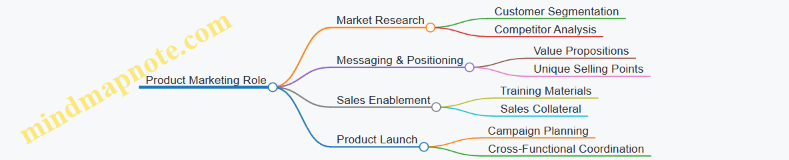
Customer Success
Role Overview: Customer Success focuses on ensuring customers achieve their desired outcomes with the product, leading to retention and growth.
Key Responsibilities:
- Onboarding and training customers
- Monitoring customer health and satisfaction
- Acting as the voice of the customer internally
- Identifying upsell and cross-sell opportunities
Transferable Skills:
- Relationship management
- Problem-solving and empathy
- Data analysis for customer insights
Example: A former account manager skilled in client relationships transitions to Customer Success. They leverage their experience to help customers adopt software solutions effectively, improving retention rates.
Mind Map:
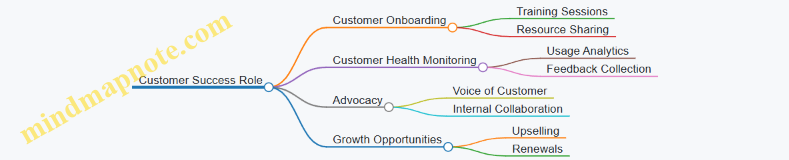
UX Research
Role Overview: UX Researchers study user behaviors, needs, and motivations through observation and feedback to inform product design.
Key Responsibilities:
- Conducting user interviews and surveys
- Usability testing
- Analyzing qualitative and quantitative data
- Presenting insights to product and design teams
Transferable Skills:
- Research and analytical skills
- Empathy and active listening
- Data interpretation and reporting
Example: A professional with a background in psychology or market research can transition into UX Research by applying their expertise in human behavior and data analysis to improve user experiences.
Mind Map:
Summary Mind Map: Product-Adjacent Roles
Why Consider These Roles?
- Leverage Existing Strengths: These roles often require skills like communication, research, and relationship management that many non-technical professionals already possess.
- Build Product Domain Knowledge: Working closely with product teams helps you understand product development and user needs.
- Career Growth Opportunities: These roles can be stepping stones to core product roles such as Product Manager or Product Owner.
By exploring and targeting these product-adjacent roles, you can create a smoother transition into the tech product space while building valuable experience and connections.
11.2 How These Roles Can Serve as Stepping Stones Into Core Product Positions
Transitioning into core product roles such as Product Manager or Product Owner can feel daunting, especially for professionals coming from non-technical backgrounds. However, several product-adjacent roles—like Product Marketing, Customer Success, and UX Research—offer valuable pathways that build relevant skills, industry knowledge, and cross-functional experience. These roles act as practical stepping stones, enabling you to gradually immerse yourself in the product ecosystem and develop a strong foundation for future product leadership.
Why Consider Product-Adjacent Roles?
- Skill Development: These roles help you acquire critical product skills such as market analysis, customer empathy, and data interpretation.
- Cross-Functional Collaboration: You gain experience working closely with engineering, design, sales, and marketing teams.
- Domain Expertise: Deepen your understanding of the product, users, and business context.
- Visibility: Build relationships and credibility within the product organization.
Mind Map: Product-Adjacent Roles as Stepping Stones
How Each Role Builds Towards Core Product Competencies
| Product-Adjacent Role | Key Skills Developed | How It Translates to Core Product Role |
|---|---|---|
| Product Marketing | Market analysis, competitive positioning, messaging, go-to-market strategy | Understands customer needs and market context, essential for prioritizing features and defining product vision |
| Customer Success | Customer relationship management, feedback loops, data-driven insights | Brings customer-centric mindset and real-world usage data to inform product decisions |
| UX Research | User behavior analysis, qualitative and quantitative research, persona creation | Provides deep user empathy and validation skills critical for user-focused product design |
| Business Analyst | Requirement gathering, stakeholder communication, process optimization | Bridges business and technical teams, ensuring product solutions meet business goals |
Practical Examples
Example 1: From Customer Success to Product Manager
Maria worked as a Customer Success Manager at a SaaS company. She regularly gathered customer feedback and noticed recurring requests for a feature that did not yet exist. Maria compiled detailed reports and presented these insights to the product team, demonstrating her understanding of customer pain points and business impact. Over time, she took on more responsibilities related to feature prioritization and roadmap discussions. This hands-on experience and her strong customer advocacy helped her successfully transition into a Product Manager role.
Example 2: From Product Marketing to Product Owner
James started as a Product Marketing Specialist, focusing on crafting messaging and competitive analysis. His deep understanding of market trends and customer segments allowed him to work closely with the product team to align features with market needs. By collaborating on user stories and sprint planning, James developed agile skills and product ownership experience. Eventually, he moved into a Product Owner role, leveraging his marketing insights to prioritize features that resonated with customers.
Example 3: From UX Research to Product Manager
Lina was a UX Researcher conducting user interviews and usability tests for a mobile app. Her findings directly influenced product design and feature adjustments. She began participating in product strategy meetings and learned to balance user needs with business objectives. Lina’s ability to translate user data into actionable product improvements positioned her well for a Product Manager role.
Best Practices to Leverage Product-Adjacent Roles for a Pivot
- Proactively Seek Cross-Functional Projects: Volunteer to work with product teams on initiatives that expose you to product management tasks.
- Build a Portfolio: Document your contributions such as customer insights reports, market analyses, or user research summaries.
- Learn Product Frameworks: Familiarize yourself with Agile, Scrum, and product lifecycle concepts to speak the language of product teams.
- Network Within Your Organization: Connect with product managers and express your interest in transitioning.
- Request Mentorship: Find mentors in core product roles who can guide your development and advocate for you.
By strategically leveraging product-adjacent roles, non-technical professionals can build a compelling bridge into core product positions, gaining the experience, skills, and confidence needed to succeed in the dynamic tech landscape.
11.3 Best Practice: Leveraging Industry Knowledge and Customer Insights
When pivoting into product-adjacent roles such as Product Marketing, Customer Success, or UX Research, leveraging your existing industry knowledge and customer insights can be a powerful differentiator. These roles thrive on deep understanding of the market, customer pain points, and competitive landscape — areas where non-technical professionals often excel.
Why Industry Knowledge and Customer Insights Matter
- Informed Decision-Making: Understanding industry trends and customer needs helps prioritize features and craft compelling product messaging.
- Building Credibility: Demonstrating domain expertise builds trust with internal teams and customers.
- Driving Customer-Centric Innovation: Insights enable you to advocate effectively for the customer, ensuring the product solves real problems.
How to Leverage Industry Knowledge and Customer Insights
- Conduct Market Research: Regularly review industry reports, competitor products, and emerging trends.
- Engage with Customers: Participate in customer calls, surveys, and feedback sessions to gather firsthand insights.
- Analyze Customer Data: Use CRM tools or customer analytics platforms to identify usage patterns and pain points.
- Collaborate Cross-Functionally: Share insights with product, sales, and marketing teams to align strategies.
Mind Map: Leveraging Industry Knowledge and Customer Insights
Practical Examples
Example 1: Product Marketing Manager Transitioning from Sales
Jane, previously a sales executive in the healthcare industry, leveraged her deep understanding of hospital workflows and pain points to excel in product marketing for a health-tech startup. She used her knowledge to create targeted messaging that resonated with hospital administrators, increasing lead conversion by 30%. Jane also gathered direct customer feedback from her sales calls to inform product positioning and feature prioritization.
Example 2: Customer Success Manager with Background in Hospitality
Mark transitioned from hotel management to a customer success role at a SaaS company. His experience managing guest satisfaction helped him empathize with customers and anticipate their needs. Mark implemented a feedback loop where he regularly collected customer insights and shared them with the product team, leading to the development of features that improved user retention by 15%.
Example 3: UX Researcher Coming from Market Research
Sara moved from a market research role into UX research at a fintech company. She applied her expertise in survey design and data analysis to conduct user interviews and usability tests. Her ability to interpret customer behavior and preferences helped the product team redesign the onboarding flow, reducing drop-off rates by 20%.
Additional Mind Map: Customer Insights in Product-Adjacent Roles
Summary
Leveraging your industry knowledge and customer insights is a best practice that can significantly accelerate your success in product-adjacent roles. By combining your domain expertise with structured customer feedback and data analysis, you become a bridge between the customer and the product team, driving value and fostering innovation.
Remember, your non-technical background is an asset — use it to bring unique perspectives and deepen the product’s connection to its users.
11.4 Example: Transitioning from Sales to Product Marketing and Then to Product Management
Transitioning from a sales role into product marketing and eventually product management is a practical and achievable career path for many non-technical professionals. This journey leverages deep customer insights, communication skills, and strategic thinking developed in sales, while gradually building product expertise.
Step 1: Leveraging Sales Experience to Enter Product Marketing
Sales professionals have a unique advantage: direct exposure to customer needs, objections, and market trends. This knowledge is invaluable in product marketing, where understanding the customer and positioning the product effectively are critical.
Key transferable skills:
- Customer empathy and understanding
- Communication and storytelling
- Market feedback collection
- Negotiation and persuasion
Example: Sarah was a top-performing sales representative at a SaaS company. She noticed recurring customer questions about product features and competitive advantages. She began collaborating informally with the product marketing team to create FAQs and sales enablement materials.
Mind Map: Transition from Sales to Product Marketing
Step 2: Building Product Marketing Expertise
Sarah took online courses on product marketing fundamentals and began contributing to product launch campaigns. She worked closely with sales, product management, and customer success teams to align messaging and gather market intelligence.
Best Practice: Volunteer for cross-functional projects that involve product marketing tasks, such as competitive analysis or campaign planning.
Example: Sarah led a competitive analysis project, synthesizing sales feedback and market data to help the product marketing team refine messaging.
Step 3: Transitioning into Product Management
With a solid foundation in customer needs and product positioning, Sarah aimed to move into product management. She focused on learning product development processes, Agile methodologies, and technical basics to communicate effectively with engineering teams.
Mind Map: Transition from Product Marketing to Product Management
Example: Sarah shadowed a product manager on her team, volunteered to write user stories, and helped prioritize features based on customer impact. She also earned a Product Management certification to formalize her knowledge.
Step 4: Securing a Product Management Role
By demonstrating her ability to bridge customer needs with product development, Sarah successfully applied for an Associate Product Manager role within her company.
Best Practice: Highlight your unique background in sales and product marketing during interviews to showcase your customer-centric approach and cross-functional collaboration skills.
Example Interview Highlight: “My experience in sales gave me firsthand knowledge of customer pain points and market dynamics, which I leveraged in product marketing to craft compelling messaging. Now, as a product manager, I use this insight to prioritize features that deliver real value to our users.”
Summary Mind Map: Sales to Product Marketing to Product Management Career Path
This example illustrates how non-technical professionals can strategically leverage their existing skills, acquire new knowledge, and gain practical experience to pivot successfully into product roles within the tech industry.
12. Final Checklist and Action Plan for Your Tech Product Career Pivot
12.1 Summary of Key Steps and Best Practices Covered
Embarking on a career pivot from a non-technical background into tech product roles can seem daunting, but by following structured steps and embracing best practices, you can navigate this journey successfully. Below is a comprehensive summary of the key steps and best practices covered throughout this guide, reinforced with mind maps and practical examples.
Mind Map: Career Pivot into Tech Product Roles - Overview
Key Steps and Best Practices
Understand the Tech Product Landscape
- Best Practice: Research and clarify the different product roles and their responsibilities.
- Example: Jane, a marketing professional, learned the difference between Product Manager and Product Owner by interviewing professionals on LinkedIn, helping her target the right role.
Assess Your Transferable Skills
- Best Practice: Conduct a skills inventory mapping your current skills to product role requirements.
- Example: Tom, a project manager, identified his stakeholder management and prioritization skills as valuable assets for product management.
Build Foundational Product Knowledge
- Best Practice: Take online courses on Agile, product lifecycle, and basic tech concepts without needing to code.
- Example: Maria completed a Product Management bootcamp that introduced her to user stories and roadmaps.
Networking and Mentorship
- Best Practice: Actively engage in product communities and seek mentors for guidance.
- Example: Alex connected with a mentor through a local product meetup, which led to an internship opportunity.
Gain Practical Experience
- Best Practice: Volunteer for product-related tasks at your current job or participate in hackathons.
- Example: Sarah, a customer support specialist, proposed a product improvement plan that was adopted by her company.
Craft Your Resume and Online Presence
- Best Practice: Highlight product-relevant achievements and showcase side projects.
- Example: David revamped his LinkedIn profile to emphasize his certifications and product-related volunteer work.
Prepare for Interviews
- Best Practice: Practice behavioral questions using the STAR method and conduct mock interviews.
- Example: Nina rehearsed answers to prioritization questions with a peer mentor, boosting her confidence.
Navigate the First 90 Days
- Best Practice: Set clear goals, build relationships, and seek continuous feedback.
- Example: Liam created a 30-60-90 day plan outlining learning objectives and stakeholder meetings.
Continuous Learning and Growth
- Best Practice: Stay updated with industry trends and join product forums.
- Example: Emma regularly attends webinars and contributes to product management Slack channels.
Overcome Common Challenges
- Best Practice: Address imposter syndrome through self-reflection and feedback.
- Example: Raj journaled his progress weekly, helping him recognize his growing competence.
Explore Alternative Product-Adjacent Roles
- Best Practice: Consider roles like product marketing or UX research as stepping stones.
- Example: Olivia transitioned from sales to product marketing before moving into product management.
Mind Map: Best Practices for Career Pivot
Final Thought
Remember, the pivot into tech product roles is a journey of continuous learning and adaptation. By leveraging your existing strengths, acquiring new knowledge, and building meaningful connections, you can successfully transition and thrive in your new career path.
12.2 Creating a Personalized Career Pivot Roadmap
Embarking on a career pivot into tech product roles requires a clear, personalized roadmap that aligns your unique background, skills, and goals with the demands of the new role. This section will guide you through crafting a step-by-step plan, supported by mind maps and practical examples, to help you navigate your transition confidently.
Step 1: Self-Assessment and Goal Setting
Begin by evaluating your current skills, experiences, and interests. Define your short-term and long-term goals within product roles.
Mind Map: Self-Assessment & Goal Setting
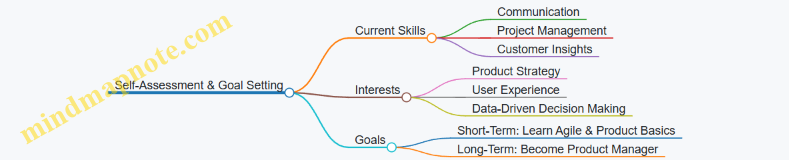
Example:
Jessica, a marketing professional, identifies her strong communication and customer research skills. Her short-term goal is to understand Agile methodologies, and her long-term goal is to become a Product Manager focusing on user-centric products.
Step 2: Identify Skill Gaps and Learning Resources
Map your existing skills against the typical requirements for product roles to spot gaps. Then, select resources to bridge these gaps.
Mind Map: Skill Gap Analysis & Learning Plan
Example:
Mark, a customer support specialist, realizes he needs to learn Agile and product roadmapping. He enrolls in a product management course on Coursera and joins a local product meetup group.
Step 3: Gain Practical Experience
Plan how to apply your learning through projects, volunteering, or side initiatives.
Mind Map: Practical Experience Opportunities
Example:
Anna volunteers to assist her company’s product team by gathering user feedback and drafting user stories, building a portfolio of product artifacts.
Step 4: Networking and Mentorship
Outline your approach to building relationships that support your pivot.
Mind Map: Networking & Mentorship Strategy
Example:
David reaches out to product managers on LinkedIn, attends virtual product conferences, and secures a mentor who guides him through interview preparation.
Step 5: Job Application and Interview Preparation
Prepare a timeline and checklist for applying and interviewing.
Mind Map: Job Application & Interview Prep
Example:
Sophia updates her resume to emphasize her project coordination experience and practices product case questions with peers weekly.
Step 6: Continuous Learning and Growth
Plan for ongoing development after landing your first product role.
Mind Map: Continuous Growth Plan
Example:
After becoming a Product Owner, Liam subscribes to product management newsletters and attends quarterly workshops to stay current.
Sample Personalized Career Pivot Roadmap
Final Tips
- Be flexible: Your roadmap should evolve as you learn more about the product space.
- Set measurable milestones: Track progress to stay motivated.
- Celebrate small wins: Each completed course or connection is a step forward.
Creating a personalized career pivot roadmap transforms the overwhelming process of switching into manageable, actionable steps, increasing your chances of a successful transition into tech product roles.
12.3 Tools and Resources to Support Your Transition
Transitioning into a tech product role from a non-technical background can feel overwhelming, but leveraging the right tools and resources can make the journey smoother and more structured. Below, we explore essential categories of resources, practical tools, and examples to help you build knowledge, network effectively, and showcase your skills.
Learning Platforms & Courses
To build foundational product knowledge and technical literacy, online learning platforms are invaluable.
- Coursera & edX: Offer courses like “Introduction to Product Management” and “Agile Development” from top universities.
- LinkedIn Learning: Short, practical courses on product management, UX design, and communication skills.
- Product School: Specialized certifications in product management tailored for career changers.
- Udemy: Affordable courses on specific skills like user story writing, roadmap creation, and analytics.
Example: Sarah, a former HR professional, completed the “Digital Product Management” specialization on Coursera, which helped her understand Agile methodologies and product lifecycle, enabling her to confidently participate in product team discussions.
Networking & Mentorship Platforms
Building connections and finding mentors accelerates learning and opens doors.
- LinkedIn: Use advanced search filters to find product managers in your target companies or industries.
- Meetup: Join local or virtual product management groups and attend events.
- MentorCruise: Connects mentees with experienced product professionals for guidance.
- Slack Communities: Join product-focused channels like “Mind the Product” or “Product Coalition” for real-time advice.
Example: John, a former sales executive, joined the “Mind the Product” Slack community and found a mentor who helped him prepare for interviews and review his portfolio.
Product Management Tools (Hands-On Practice)
Familiarity with common PM tools boosts your credibility and practical skills.
- Jira / Trello / Asana: Project management and task tracking tools to understand backlog and sprint planning.
- Miro / MURAL: Collaborative whiteboarding tools for mapping user journeys and brainstorming.
- Productboard: Product prioritization and roadmap software.
- Google Analytics / Mixpanel: Basic analytics tools to interpret user data.
Example: Emma, transitioning from customer support, volunteered to assist her company’s product team by creating user story maps on Miro, gaining hands-on experience.
Portfolio & Resume Builders
Showcasing your product knowledge and transferable skills is critical.
- Canva / Novoresume: Design visually appealing resumes highlighting product-related achievements.
- GitHub Pages / Notion: Create personal websites or portfolios to display case studies, roadmaps, and project artifacts.
- Medium / LinkedIn Articles: Publish thought leadership or reflections on product topics.
Example: David, a former teacher, built a Notion portfolio with mock product roadmaps and user personas he created during his learning journey, impressing recruiters.
Books & Blogs
Deepen your understanding and stay updated.
- Books: “Inspired” by Marty Cagan, “Lean Product and Lean Analytics” by Ben Yoskovitz, and “The Product Book” by Josh Anon.
- Blogs: Mind the Product, Product Coalition, and SVPG blog.
Example: Lisa, a career changer from finance, read “Inspired” and blogged monthly about her learnings, which helped her internalize concepts and build a personal brand.
Mind Maps for Structuring Your Learning and Transition
Mind maps help visualize complex information and plan your career pivot.
Mind Map: Career Pivot into Tech Product Roles
Mind Map: Essential Product Management Tools to Learn
Mind Map: Networking Strategy for Product Career Pivot
Final Tip:
Create a personalized toolkit combining these resources based on your learning style and career goals. For example, if you prefer structured learning, start with a Coursera specialization, complement it with reading “Inspired,” and join a local product meetup for networking. Simultaneously, practice using tools like Trello and Miro to build practical skills.
By leveraging these tools and resources thoughtfully, your transition into tech product roles will be more confident, informed, and successful.
12.4 Inspirational Example: A Timeline of a Successful Career Pivot
To inspire and guide you through your own journey from a non-technical background into a product role in tech, let’s explore a detailed timeline of Sarah’s career pivot. Sarah transitioned from a corporate communications specialist to a successful Product Manager at a mid-sized tech company within 18 months.
Month 1-3: Self-Assessment and Skill Mapping
- Activities:
- Conducted a thorough skills inventory, identifying transferable skills such as stakeholder communication, project coordination, and problem-solving.
- Researched product roles and responsibilities to understand expectations.
- Created a mind map to visualize her current skills and gaps.
Sarah’s Skill Mapping Mind Map
- Example: Sarah realized her experience managing cross-departmental communications aligned well with product stakeholder management.
Month 4-6: Building Foundational Knowledge
- Activities:
- Enrolled in an online Product Management certification course.
- Attended webinars on Agile and Scrum basics.
- Started learning basic technical concepts like APIs and UX principles.
- Joined local product management meetups and online forums.
Learning Focus Mind Map
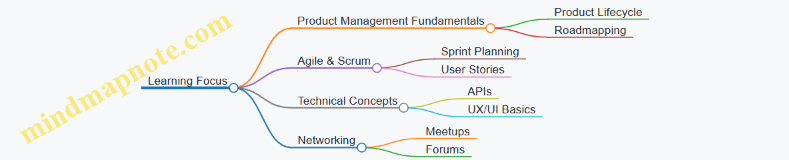
- Example: Sarah applied her new knowledge by drafting a simple product roadmap for a hypothetical app, which she shared in study groups for feedback.
Month 7-9: Gaining Practical Experience
- Activities:
- Volunteered to assist the product team in her current company with user research and documentation.
- Participated in a weekend hackathon as a product strategist.
- Created a portfolio including user personas, product requirement documents, and roadmaps.
Practical Experience Mind Map
- Example: Sarah’s proposal for improving the onboarding flow was adopted by the product team, giving her a tangible achievement to showcase.
Month 10-12: Networking and Mentorship
- Activities:
- Reached out to product managers on LinkedIn for informational interviews.
- Found a mentor through a product management community.
- Attended industry conferences and participated in panel discussions.
Networking & Mentorship Mind Map
- Example: Her mentor helped her tailor her resume and coached her on interview techniques specific to product roles.
Month 13-15: Job Application and Interview Preparation
- Activities:
- Customized resume and LinkedIn profile to highlight product-related skills and projects.
- Practiced behavioral and case study interviews using the STAR method.
- Conducted mock interviews with peers and mentor.
Interview Preparation Mind Map
- Example: Sarah successfully answered a product prioritization question by referencing her hackathon experience and user research involvement.
Month 16-18: Securing the Role and Onboarding
- Activities:
- Accepted an offer as Associate Product Manager.
- Developed a 90-day onboarding plan focusing on learning the product, building relationships, and contributing early wins.
- Continued mentorship and set long-term career goals.
Onboarding Mind Map
- Example: Within the first 3 months, Sarah led a feature enhancement project that improved user engagement by 10%, demonstrating her impact.
Summary Mind Map: Sarah’s 18-Month Career Pivot Journey
Sarah’s story exemplifies how a structured, step-by-step approach combining self-assessment, learning, practical experience, networking, and preparation can lead to a successful career pivot into tech product roles—even without a technical background. By following a similar roadmap and adapting it to your unique strengths and circumstances, you can confidently navigate your own transition into the exciting world of tech product management.