Practical Quantum Computing for Engineers
1. Introduction to Quantum Computing
1.1 What is Quantum Computing? Fundamentals and Concepts
Quantum computing is an emerging paradigm of computation that leverages the principles of quantum mechanics to process information in fundamentally new ways. Unlike classical computers that use bits as the smallest unit of data (0 or 1), quantum computers use quantum bits or qubits, which can exist in superpositions of states, enabling potentially exponential speedups for certain problems.
Key Concepts in Quantum Computing
Quantum Computing Fundamentals Mind Map
What Makes Quantum Computing Different?
-
Superposition: A qubit can be in a combination of 0 and 1 states simultaneously, described by a complex probability amplitude. This property allows quantum computers to process a vast number of possibilities at once.
-
Entanglement: Qubits can become entangled, meaning the state of one qubit is directly related to the state of another, no matter the distance between them. This correlation is a resource for quantum algorithms.
-
Measurement: Observing a qubit collapses its state to either 0 or 1 probabilistically, which is a fundamental difference from deterministic classical bits.
Example 1: Classical Bit vs Qubit
| Aspect | Classical Bit | Qubit |
|---|---|---|
| States | 0 or 1 | |0⟩, |1⟩, or any superposition α|0⟩ + β|1⟩ |
| Representation | Voltage levels | Quantum state vector |
| Information | Deterministic | Probabilistic until measured |
Example 2: Superposition Visualization
Superposition Mind Map
Imagine a qubit as a spinning coin: while spinning, it is neither heads nor tails but a superposition of both. Only when it lands (measurement) do we see one definite outcome.
Example 3: Entanglement Concept
Entanglement Mind Map
Two entangled qubits behave like a pair of gloves in separate boxes: if you open one box and find a left glove, you instantly know the other box contains the right glove, regardless of distance.
Practical Example: Simulating a Qubit Superposition Using Python (Qiskit)
from qiskit import QuantumCircuit, Aer, execute
from qiskit.visualization import plot_bloch_multivector

# Create a quantum circuit with 1 qubit
qc = QuantumCircuit(1)

# Apply Hadamard gate to create superposition
qc.h(0)

# Use statevector simulator
simulator = Aer.get_backend('statevector_simulator')
result = execute(qc, simulator).result()
statevector = result.get_statevector()

print(f"Statevector: {statevector}")

# Visualize on Bloch sphere
plot_bloch_multivector(statevector)
This example applies a Hadamard gate to a qubit, putting it into an equal superposition of |0⟩ and |1⟩. The Bloch sphere visualization helps engineers intuitively understand the qubit state.
Summary
Quantum computing introduces new fundamental concepts such as superposition and entanglement, which enable powerful computational capabilities beyond classical limits. Understanding these basics is essential for engineers and developers to design, implement, and optimize quantum algorithms and circuits effectively.
Best Practice: When starting with quantum computing, always visualize qubit states and circuit operations using tools like Bloch spheres or statevector plots. This practice aids comprehension and debugging in early development stages.
1.2 Differences Between Classical and Quantum Computing
Quantum computing represents a paradigm shift from classical computing, leveraging principles of quantum mechanics to process information in fundamentally different ways. Understanding these differences is crucial for engineers and developers transitioning into the quantum domain.
Key Differences Overview
Information Representation
- Classical Bits: Can be either 0 or 1 at any time.
- Quantum Qubits: Can exist in a superposition, representing both 0 and 1 simultaneously until measured.
Example:
- Classical bit: A light switch is either ON (1) or OFF (0).
- Qubit: Like a spinning coin that is both heads and tails until it lands.
Superposition and Entanglement
- Superposition: Enables qubits to be in multiple states simultaneously.
- Entanglement: Correlation between qubits where the state of one instantly influences the other, regardless of distance.
Example:
- Two entangled qubits: Measuring one qubit’s state immediately determines the other’s state, even if separated.
Computation and Gates
- Classical Gates: AND, OR, NOT — deterministic logic operations.
- Quantum Gates: Unitary, reversible operations such as Hadamard (H), Pauli-X, CNOT.
Example:
- Classical: AND gate outputs 1 only if both inputs are 1.
- Quantum: Hadamard gate puts a qubit into superposition, enabling parallelism.
Parallelism and Speedup
- Classical: Parallelism limited by hardware; operations on bits are sequential or parallelized explicitly.
- Quantum: Exploits superposition to evaluate many possibilities simultaneously.
Example:
- Grover’s algorithm uses quantum parallelism to search unsorted databases faster than classical algorithms.
Error and Noise
- Classical: Mature error correction codes (e.g., parity bits, ECC).
- Quantum: Qubits are fragile; quantum error correction codes (like surface codes) are complex and resource-intensive.
Example:
- Classical RAM uses ECC to detect and correct bit flips.
- Quantum circuits require error mitigation techniques to maintain fidelity.
Summary Table
| Aspect | Classical Computing | Quantum Computing |
|---|---|---|
| Information Unit | Bit (0 or 1) | Qubit (superposition of 0 and 1) |
| State Representation | Deterministic | Probabilistic, superposition & entanglement |
| Computation Model | Boolean logic gates | Unitary quantum gates |
| Parallelism | Limited explicit parallelism | Intrinsic quantum parallelism |
| Error Handling | Mature error correction codes | Emerging quantum error correction |
| Hardware | Silicon transistors | Superconducting circuits, ion traps, photonics |
Practical Example: Simulating a Bit Flip vs Qubit Superposition
-
Classical bit flip:
- Input: 0
- Operation: NOT gate
- Output: 1
-
Quantum superposition:
- Input: |0>
- Operation: Hadamard gate (H)
- Output: (|0> + |1>)/√2 (equal superposition)
# Qiskit example for quantum superposition
from qiskit import QuantumCircuit, Aer, execute

qc = QuantumCircuit(1,1)
qc.h(0)  # Apply Hadamard gate
qc.measure(0,0)

simulator = Aer.get_backend('qasm_simulator')
result = execute(qc, simulator, shots=1000).result()
counts = result.get_counts()
print(counts)  # Expected roughly equal counts for '0' and '1'
This example highlights how a quantum operation creates a probabilistic outcome, unlike the deterministic classical bit flip.
Understanding these fundamental differences equips engineers and developers to better design, optimize, and troubleshoot quantum algorithms and hardware interactions.
1.3 Overview of Quantum Hardware: Qubits, Gates, and Architectures
Quantum computing hardware forms the foundation upon which quantum algorithms and applications are built. Understanding the physical realization of qubits, the quantum gates that manipulate them, and the overall architectures is essential for engineers aiming to design practical quantum solutions.
What is a Qubit?
A qubit, or quantum bit, is the fundamental unit of quantum information. Unlike classical bits that are either 0 or 1, qubits can exist in a superposition of both states simultaneously.
- Physical Realizations of Qubits:
- Superconducting Circuits
- Trapped Ions
- Photonic Qubits
- Spin Qubits
Mind Map: Qubit Types and Characteristics
Quantum Gates: Manipulating Qubits
Quantum gates are the building blocks of quantum circuits, analogous to classical logic gates but operating on qubits using unitary transformations.
-
Single-Qubit Gates:
- Pauli-X (NOT gate)
- Hadamard (creates superposition)
- Phase gates (S, T)
- Rotation gates (Rx, Ry, Rz)
-
Multi-Qubit Gates:
- Controlled-NOT (CNOT)
- Controlled-Z (CZ)
- Toffoli (CCNOT)
Mind Map: Quantum Gates Overview
Quantum Hardware Architectures
Quantum hardware architectures describe how qubits and gates are physically arranged and interconnected.
-
Superconducting Architectures:
- Qubits arranged on a 2D lattice
- Nearest-neighbor connectivity
- Example: IBM Quantum processors
-
Trapped Ion Architectures:
- Linear chains or 2D arrays of ions
- All-to-all connectivity via collective motional modes
- Example: IonQ, Honeywell
-
Photonic Architectures:
- Qubits encoded in photons traveling through optical circuits
- Reconfigurable beam splitters and phase shifters
-
Hybrid Architectures:
- Combining different qubit types or classical co-processors
Mind Map: Quantum Hardware Architectures
Example: Comparing Qubit Types Through a Simple Quantum Circuit
Consider a simple quantum circuit that applies a Hadamard gate followed by a CNOT gate to create a Bell state |Φ+> = (|00> + |11>)/√2.
-
On Superconducting Hardware:
- Gate times are fast, but qubit coherence times are limited (~100 µs).
- Circuit depth should be minimized to reduce decoherence.
-
On Trapped Ion Hardware:
- Longer coherence times allow deeper circuits.
- Slower gate speeds mean longer execution times.
-
Best Practice: Tailor circuit depth and gate sequences to the hardware’s strengths.
# Example using Qiskit to create a Bell state
from qiskit import QuantumCircuit, Aer, execute

qc = QuantumCircuit(2)
qc.h(0)  # Hadamard on qubit 0
qc.cx(0, 1)  # CNOT with control qubit 0 and target qubit 1

backend = Aer.get_backend('statevector_simulator')
result = execute(qc, backend).result()
statevector = result.get_statevector()
print(statevector)
This example can be run on simulators or real quantum hardware to observe how different architectures handle the same circuit.
Summary
Understanding the types of qubits, quantum gates, and hardware architectures is crucial for designing efficient quantum algorithms and applications. Engineers should consider hardware-specific characteristics such as gate speed, connectivity, and coherence times when developing quantum solutions.
1.4 Best Practices: Setting Up Your Quantum Computing Environment
Setting up a robust and efficient quantum computing environment is the foundational step for engineers and developers aiming to explore and build quantum applications. This section covers best practices to ensure a smooth start, including hardware considerations, software installations, and environment configurations.
Key Components of a Quantum Computing Environment
Best Practices
Choose the Right Hardware
- Use a computer with at least 8GB RAM and a multi-core processor to efficiently run simulators and development tools.
- Ensure a stable and fast internet connection for accessing cloud quantum hardware and SDK updates.
Install and Manage Python Environments
- Use virtual environments (
venvorconda) to isolate project dependencies. - Keep Python updated (preferably 3.7 or higher).
Select and Install Quantum SDKs
- Start with Qiskit for IBM Quantum devices, Cirq for Google’s ecosystem, or Q# for Microsoft’s Quantum Development Kit.
- Install via pip, e.g.,
pip install qiskit.
Use Integrated Development Environments (IDEs)
- Use IDEs that support Python and Jupyter notebooks for interactive quantum programming.
- Configure extensions for linting and code completion.
Access Quantum Hardware via Cloud Platforms
- Register for accounts on IBM Quantum Experience, Amazon Braket, or Azure Quantum.
- Obtain API keys and configure SDKs to authenticate and submit jobs.
Version Control and Collaboration
- Use Git for source control.
- Maintain clear commit messages and documentation.
Documentation and Continuous Learning
- Bookmark official SDK documentation.
- Follow tutorials and join community forums.
Example: Setting Up a Qiskit Environment
# Step 1: Create and activate a virtual environment
python3 -m venv qiskit-env
source qiskit-env/bin/activate  # On Windows use `qiskit-env\Scripts\activate`

# Step 2: Upgrade pip
pip install --upgrade pip

# Step 3: Install Qiskit
pip install qiskit

# Step 4: Verify installation
python -c "import qiskit; print(qiskit.__qiskit_version__)"
Example: Connecting to IBM Quantum Experience
from qiskit import IBMQ

# Save your IBM Quantum API token (run once)
IBMQ.save_account('YOUR_API_TOKEN')

# Load your account
provider = IBMQ.load_account()

# List available backends
print(provider.backends())
Mind Map: Workflow for Environment Setup
Troubleshooting Tips
- SDK Installation Issues: Ensure pip is updated and Python version is compatible.
- API Authentication Errors: Double-check API tokens and network connectivity.
- Simulator Performance: Close unnecessary applications to free resources.
By following these best practices, engineers and developers can establish a reliable quantum computing environment that supports experimentation, development, and deployment of quantum algorithms efficiently and effectively.
1.5 Example: Running Your First Quantum Circuit on a Simulator
In this section, we’ll walk through running your very first quantum circuit on a simulator. This hands-on example will help you understand the basic workflow of quantum programming, from creating qubits and applying gates to measuring the results.
What You Will Learn
- How to create a simple quantum circuit
- How to apply quantum gates
- How to simulate the circuit and interpret the results
- Best practices for writing and testing quantum code
Tools Used
We will use Qiskit, an open-source quantum computing SDK by IBM, which provides an easy-to-use interface for building and simulating quantum circuits.
Step 1: Setting Up Your Environment
Make sure you have Python installed (version 3.6+). Then, install Qiskit:
pip install qiskit
Step 2: Create a Simple Quantum Circuit
Let’s create a circuit with 1 qubit and 1 classical bit. We’ll apply a Hadamard gate to put the qubit into superposition and then measure it.
from qiskit import QuantumCircuit, Aer, execute

# Create a Quantum Circuit with 1 qubit and 1 classical bit
qc = QuantumCircuit(1, 1)

# Apply Hadamard gate to qubit 0
qc.h(0)

# Measure the qubit into the classical bit
qc.measure(0, 0)

print(qc.draw(output='text'))
Output:
     ┌───┐
q_0: ┤ H ├┤ M ├
     └───┘└╥┘
c_0: 1/════╩═
          0
Step 3: Simulate the Circuit
Use Qiskit’s Aer simulator to run the circuit and get measurement results.
# Use the qasm_simulator backend
simulator = Aer.get_backend('qasm_simulator')

# Execute the circuit on the simulator
job = execute(qc, simulator, shots=1024)

# Grab results from the job
result = job.result()

# Get the counts (number of times each output was measured)
counts = result.get_counts(qc)
print(f"Measurement results: {counts}")
Expected output:
Measurement results: {'0': ~512, '1': ~512}
The counts should be roughly equal for ‘0’ and ‘1’ because the Hadamard gate creates an equal superposition.
Mind Map: Workflow for Running a Quantum Circuit on a Simulator
Best Practices Highlighted
- Use simulators for initial testing: Before running on real hardware, simulators help debug and verify circuits.
- Use sufficient shots: Running the circuit multiple times (shots) gives a statistical distribution of outcomes.
- Visualize circuits: Drawing circuits helps understand gate sequences and debug errors.
Extended Example: Adding a Second Qubit and Creating Entanglement
Let’s extend the example to 2 qubits and create a Bell state (entangled state).
# Create a Quantum Circuit with 2 qubits and 2 classical bits
qc2 = QuantumCircuit(2, 2)

# Apply Hadamard gate to qubit 0
qc2.h(0)

# Apply CNOT gate with control qubit 0 and target qubit 1
qc2.cx(0, 1)

# Measure both qubits
qc2.measure([0,1], [0,1])

print(qc2.draw(output='text'))

# Simulate
job2 = execute(qc2, simulator, shots=1024)
result2 = job2.result()
counts2 = result2.get_counts(qc2)
print(f"Measurement results: {counts2}")
Expected output:
     ┌───┐     ┌───┐┌─┐
q_0: ┤ H ├──■──┤ M ├┤M├
     └───┘┌─┴─┐└╥┘└╥┘
q_1: ─────┤ X ├─┤ M ├─╫─
          └───┘ └╥┘ ║
c_0: 2/═══════╩═══╬═
                   ║
c_1: 2/════════════╩═
Measurement results should be roughly:
{'00': ~512, '11': ~512}
This shows the two qubits are entangled — they collapse together to either ‘00’ or ‘11’.
Mind Map: Creating and Simulating a Bell State
Summary
This example demonstrated the fundamental steps to create, simulate, and analyze quantum circuits using Qiskit. Starting with a single qubit superposition and extending to entanglement, you now have a practical foundation to build more complex quantum programs.
Keep experimenting with different gates and circuits, and always simulate before running on real quantum hardware!
Additional Resources
- Qiskit Textbook - Your First Quantum Program
- IBM Quantum Experience
- Qiskit Documentation
2. Quantum Mechanics Essentials for Engineers
2.1 Qubits and Quantum States: Bloch Sphere Visualization
Introduction
A qubit, or quantum bit, is the fundamental unit of quantum information. Unlike classical bits that can be either 0 or 1, qubits can exist in a superposition of both states simultaneously. Understanding qubits and their states is crucial for engineers working in quantum computing.
What is a Qubit?
-
A qubit is a two-level quantum system.
-
It can be represented as a vector in a two-dimensional complex vector space.
-
The general state of a qubit is written as:
\[ |\psi\rangle = \alpha|0\rangle + \beta|1\rangle \]
where \( \alpha \) and \( \beta \) are complex probability amplitudes satisfying \( |\alpha|^2 + |\beta|^2 = 1 \).
Visualizing Qubit States: The Bloch Sphere
The Bloch sphere is a powerful geometric representation of a qubit’s state. It maps the state of a single qubit onto the surface of a unit sphere in 3D space.
- The north pole corresponds to \( |0\rangle \).
- The south pole corresponds to \( |1\rangle \).
- Any point on the surface represents a valid pure qubit state.
The state \( |\psi\rangle \) can be parameterized as:
\[ |\psi\rangle = \cos\left(\frac{\theta}{2}\right)|0\rangle + e^{i\phi} \sin\left(\frac{\theta}{2}\right)|1\rangle \]
where \( \theta \in [0, \pi] \) and \( \phi \in [0, 2\pi) \) are spherical coordinates.
Mind Map: Qubit Fundamentals
Mind Map: Bloch Sphere Components
Best Practices: Using the Bloch Sphere for Debugging and Intuition
- Use Bloch sphere visualizations to intuitively understand the effect of quantum gates.
- Visualize intermediate states in quantum circuits to detect unexpected rotations or errors.
- Employ tools like Qiskit’s
plot_bloch_vectoror Cirq’s visualization utilities.
Example 1: Visualizing Basic States on the Bloch Sphere
from qiskit import QuantumCircuit
from qiskit.visualization import plot_bloch_multivector
from qiskit.quantum_info import Statevector
import matplotlib.pyplot as plt

# Initialize circuit with 1 qubit
qc = QuantumCircuit(1)

# State |0> (default)
state = Statevector.from_instruction(qc)
plot_bloch_multivector(state)
plt.title('State |0> on Bloch Sphere')
plt.show()

# Apply X gate to get |1>
qc.x(0)
state = Statevector.from_instruction(qc)
plot_bloch_multivector(state)
plt.title('State |1> on Bloch Sphere')
plt.show()
Example 2: Creating and Visualizing a Superposition State
qc = QuantumCircuit(1)
qc.h(0)  # Apply Hadamard gate to create superposition
state = Statevector.from_instruction(qc)
plot_bloch_multivector(state)
plt.title('Superposition State (|0> + |1>)/\u221A2')
plt.show()
Example 3: Parameterized State with \( \theta = \pi/2 \), \( \phi = \pi/2 \)
import numpy as np

theta = np.pi / 2
phi = np.pi / 2

qc = QuantumCircuit(1)
qc.ry(theta, 0)  # Rotate around Y-axis
qc.rz(phi, 0)    # Rotate around Z-axis
state = Statevector.from_instruction(qc)
plot_bloch_multivector(state)
plt.title('Parameterized State on Bloch Sphere')
plt.show()
Summary
- The Bloch sphere provides an intuitive geometric representation of qubit states.
- Understanding the angles \( \theta \) and \( \phi \) helps engineers design and debug quantum circuits.
- Visual tools integrated with quantum SDKs are essential for practical quantum software development.
2.2 Superposition and Entanglement: Practical Implications
Quantum computing’s power largely stems from two fundamental phenomena: superposition and entanglement. Understanding these concepts and their practical implications is essential for engineers and developers working with quantum systems.
Superposition
Superposition allows a quantum bit (qubit) to exist simultaneously in multiple states, unlike a classical bit which is either 0 or 1. Mathematically, a qubit’s state can be written as:
\[ \text{}|\psi\rangle = \alpha|0\rangle + \beta|1\rangle \]
where \(\alpha\) and \(\beta\) are complex probability amplitudes satisfying \(|\alpha|^2 + |\beta|^2 = 1\).
Practical Implications of Superposition
- Parallelism: Enables quantum algorithms to process many possibilities at once.
- Probabilistic Outcomes: Measurement collapses the superposition to one of the basis states with probabilities \(|\alpha|^2\) or \(|\beta|^2\).
- Quantum Interference: Constructive and destructive interference of amplitudes can amplify correct answers and suppress wrong ones.
Mind Map: Superposition
Example: Creating a Superposition with a Hadamard Gate
The Hadamard gate (H) transforms the basis state \(|0\rangle\) into an equal superposition:
\[ H|0\rangle = \frac{|0\rangle + |1\rangle}{\sqrt{2}} \]
Code snippet (Qiskit):
from qiskit import QuantumCircuit, Aer, execute

qc = QuantumCircuit(1,1)
qc.h(0)  # Apply Hadamard gate
qc.measure(0,0)

simulator = Aer.get_backend('qasm_simulator')
result = execute(qc, simulator, shots=1024).result()
counts = result.get_counts()
print(counts)  # Expected roughly equal counts for '0' and '1'
This example shows how a qubit initially in state |0⟩ is put into a superposition, resulting in approximately equal measurement outcomes of ‘0’ and ‘1’.
Entanglement
Entanglement is a uniquely quantum correlation between qubits where the state of one qubit instantaneously influences the state of another, regardless of distance.
A classic example is the Bell state:
\[ \text{}|\Phi^+\rangle = \frac{|00\rangle + |11\rangle}{\sqrt{2}} \]
Here, measuring one qubit immediately determines the state of the other.
Practical Implications of Entanglement
- Non-local Correlations: Enables quantum communication protocols like teleportation and superdense coding.
- Resource for Quantum Algorithms: Many quantum algorithms rely on entanglement to achieve speedups.
- Error Detection and Correction: Entangled states are used in quantum error correction codes.
Mind Map: Entanglement
Example: Creating and Measuring a Bell State
Circuit:
- Apply a Hadamard gate to qubit 0 to create superposition.
- Apply a CNOT gate with qubit 0 as control and qubit 1 as target to entangle.
- Measure both qubits.
Code snippet (Qiskit):
from qiskit import QuantumCircuit, Aer, execute

qc = QuantumCircuit(2,2)
qc.h(0)        # Step 1: Superposition on qubit 0
qc.cx(0, 1)    # Step 2: Entangle qubit 0 and 1
qc.measure([0,1], [0,1])  # Step 3: Measure both qubits

simulator = Aer.get_backend('qasm_simulator')
result = execute(qc, simulator, shots=1024).result()
counts = result.get_counts()
print(counts)  # Expected mostly '00' and '11'
The measurement results will predominantly be ‘00’ or ‘11’, demonstrating the entangled correlation.
Combined Mind Map: Superposition & Entanglement
Summary
- Superposition allows qubits to represent multiple states simultaneously, enabling quantum parallelism.
- Entanglement creates strong correlations between qubits, foundational for quantum protocols and algorithms.
- Practical quantum computing requires careful preparation, manipulation, and measurement of these states while mitigating noise and decoherence.
Understanding and leveraging superposition and entanglement are key for engineers and developers to design effective quantum circuits and algorithms.
2.3 Measurement and Collapse: Understanding Quantum Readout
Quantum measurement is a fundamental concept in quantum computing that bridges the quantum and classical worlds. It is the process by which a quantum state is observed, causing the state to “collapse” into one of the possible classical outcomes. Understanding measurement and collapse is essential for engineers to correctly interpret quantum computations and design effective quantum algorithms.
What is Quantum Measurement?
- Quantum measurement extracts classical information from a quantum system.
- Unlike classical bits, qubits exist in superpositions; measurement forces the qubit into a definite state (0 or 1).
- The outcome is probabilistic, governed by the amplitudes of the quantum state.
The Collapse Postulate
- Before measurement, a qubit can be described as:
\[ |\psi\rangle = \alpha|0\rangle + \beta|1\rangle \] - Upon measurement in the computational basis, the state collapses to \(|0\rangle\) with probability \(|\alpha|^2\) or \(|1\rangle\) with probability \(|\beta|^2\).
- The post-measurement state is no longer a superposition but a classical bit.
Mind Map: Quantum Measurement Overview
Measurement Bases
- Computational Basis (Z-basis): Measures qubits as |0⟩ or |1⟩.
- X-basis: Measures in superposition basis, e.g., |+⟩ and |−⟩.
- Y-basis: Measures in a different phase basis.
Changing the measurement basis can be done by applying gates before measurement (e.g., Hadamard gate for X-basis).
Mind Map: Measurement Bases and Transformations
Practical Example 1: Measuring a Qubit in Superposition
Consider a qubit initialized to |0⟩. Apply a Hadamard gate (H) to create a superposition:
\[ |\psi\rangle = H|0\rangle = \frac{|0\rangle + |1\rangle}{\sqrt{2}} \]
Measuring in the computational basis yields:
- Probability of 0: 0.5
- Probability of 1: 0.5
Qiskit code snippet:
from qiskit import QuantumCircuit, Aer, execute

qc = QuantumCircuit(1,1)
qc.h(0)  # Apply Hadamard
qc.measure(0,0)  # Measure qubit

backend = Aer.get_backend('qasm_simulator')
result = execute(qc, backend, shots=1024).result()
counts = result.get_counts()
print(counts)  # Expected roughly {'0': 512, '1': 512}
Practical Example 2: Measuring in the X-basis
To measure in the X-basis, apply a Hadamard gate before measurement:
- Prepare |0⟩
- Apply Hadamard (creates |+⟩)
- Apply another Hadamard before measurement to rotate basis back
Qiskit code snippet:
qc = QuantumCircuit(1,1)
qc.h(0)  # Prepare |+>
qc.h(0)  # Change basis to Z for measurement
qc.measure(0,0)

result = execute(qc, backend, shots=1024).result()
counts = result.get_counts()
print(counts)  # Expected mostly '0' since |+> measured in X-basis
Best Practices for Quantum Measurement
- Choose measurement basis carefully: It affects the information extracted.
- Minimize measurements: Measurements collapse states and halt quantum processing.
- Use classical registers effectively: Map qubit measurements to classical bits clearly.
- Repeat measurements: Due to probabilistic nature, run circuits multiple times (shots) to get statistics.
- Visualize results: Use histograms or state tomography to understand measurement outcomes.
Mind Map: Best Practices in Quantum Measurement
Summary
Measurement in quantum computing is the process that converts quantum information into classical information by collapsing the quantum state. Understanding how measurement works, the impact of basis choice, and the probabilistic nature of outcomes is vital for engineers designing quantum circuits and interpreting results.
Additional Resources
- Nielsen & Chuang, “Quantum Computation and Quantum Information” (Chapter on Measurement)
- Qiskit Textbook: Measurement Section
- IBM Quantum Experience tutorials on measurement
2.4 Best Practices: Visualizing Quantum States for Debugging
Visualizing quantum states is a crucial practice for engineers and developers working with quantum circuits. It helps in understanding the behavior of qubits, diagnosing errors, and optimizing algorithms. Since quantum states are inherently abstract, graphical representations like state vectors, Bloch spheres, and density matrices provide intuitive insights.
Why Visualize Quantum States?
- Intuition Building: Quantum states are complex vectors; visualization helps bridge the gap between abstract math and practical understanding.
- Debugging Circuits: Identify unexpected state evolutions or gate misapplications.
- Algorithm Verification: Confirm that intermediate states match theoretical expectations.
- Noise and Decoherence Analysis: Visualize how noise affects qubit states over time.
Common Visualization Techniques
Mind Map: Visualization Techniques for Quantum States
State Vector Plots
State vectors describe the amplitudes and phases of quantum states in the computational basis. Plotting these vectors helps verify if the qubit is in the expected superposition.
Example: Visualizing a single qubit in state \(|\psi\rangle = \frac{1}{\sqrt{2}}(|0\rangle + e^{i\pi/4}|1\rangle)\)
from qiskit import QuantumCircuit
from qiskit.visualization import plot_state_city
from qiskit.quantum_info import Statevector
import matplotlib.pyplot as plt

qc = QuantumCircuit(1)
qc.h(0)
qc.p(3.1415/4, 0)  # Phase gate

state = Statevector.from_instruction(qc)
plot_state_city(state)
plt.show()
This plot shows the real and imaginary parts of the amplitudes, allowing you to confirm the phase shift.
Bloch Sphere Visualization
The Bloch sphere is an intuitive 3D representation of a single qubit’s state, showing its position on the sphere surface.
Best Practices:
- Use Bloch spheres for single-qubit debugging.
- Animate state evolution to track gate effects.
- Combine with circuit steps for stepwise visualization.
Mind Map: Bloch Sphere Visualization
Example: Visualizing Hadamard and Phase gates on a qubit
from qiskit.visualization import plot_bloch_multivector

qc = QuantumCircuit(1)
qc.h(0)
qc.p(3.1415/4, 0)

state = Statevector.from_instruction(qc)
plot_bloch_multivector(state)
plt.show()
Density Matrix Visualization
Density matrices represent mixed states and are essential when dealing with noise and decoherence.
Best Practices:
- Use density matrices to visualize noisy or partially measured states.
- Compare ideal vs noisy density matrices to assess error impact.
Mind Map: Density Matrix Visualization
Example: Visualizing a noisy qubit state
from qiskit.providers.aer import AerSimulator
from qiskit.visualization import plot_state_city

qc = QuantumCircuit(1)
qc.h(0)

sim = AerSimulator(noise_model=None)  # Replace with noise model for real noise
result = sim.run(qc).result()
state = result.get_statevector()
plot_state_city(state)
plt.show()
Circuit Diagrams with State Annotations
Annotating circuits with intermediate states or measurement probabilities helps in stepwise debugging.
Best Practices:
- Insert measurement or snapshot instructions at critical points.
- Use tools that support stepwise state visualization.
Mind Map: Circuit Annotation for Debugging
Example: Using Qiskit’s snapshot feature (Aer simulator) to capture states
from qiskit.providers.aer.extensions import Snapshot
from qiskit.providers.aer import AerSimulator

qc = QuantumCircuit(1)
qc.h(0)
qc.snapshot('after_h')
qc.p(3.1415/4, 0)
qc.snapshot('after_p')

sim = AerSimulator()
result = sim.run(qc).result()
print(result.data()['snapshots'])
Summary of Best Practices
Mind Map: Best Practices for Visualizing Quantum States
Final Notes
Visualization is not just a debugging tool but a learning aid that deepens understanding of quantum phenomena. Integrating these visualization practices into your quantum programming workflow will improve code quality, reduce errors, and accelerate development.
Explore libraries like Qiskit, Cirq, and QuTiP that offer rich visualization APIs to enhance your debugging experience.
2.5 Example: Implementing and Visualizing a Bell State
In this section, we will implement one of the most fundamental quantum states — the Bell state — and visualize it to understand the concepts of entanglement and superposition. This example is designed to be accessible for engineers and developers new to quantum computing.
What is a Bell State?
A Bell state is a specific type of entangled quantum state involving two qubits. It represents the simplest example of quantum entanglement, where the state of one qubit is directly related to the state of the other, no matter the distance between them.
The most common Bell state is:
\[ \text{}|\Phi^+\rangle = \frac{|00\rangle + |11\rangle}{\sqrt{2}} \]
This means the two qubits are in a superposition of both being 0 and both being 1 simultaneously.
Mind Map: Understanding Bell State
Step 1: Initialize Two Qubits
Start with two qubits initialized to \(|0\rangle\) state:
\[ \text{}|\psi\rangle = |00\rangle \]
Step 2: Apply Hadamard Gate on the First Qubit
The Hadamard (H) gate creates a superposition:
\[ H|0\rangle = \frac{|0\rangle + |1\rangle}{\sqrt{2}} \]
After applying H on the first qubit:
\[ \text{}|\psi\rangle = \frac{|00\rangle + |10\rangle}{\sqrt{2}} \]
Step 3: Apply CNOT Gate with First Qubit as Control and Second as Target
The CNOT flips the target qubit if the control qubit is \(|1\rangle\):
\[ \text{CNOT} \left( \frac{|00\rangle + |10\rangle}{\sqrt{2}} \right) = \frac{|00\rangle + |11\rangle}{\sqrt{2}} = |\Phi^+\rangle \]
This creates the entangled Bell state.
Mind Map: Quantum Circuit for Bell State
Code Example: Implementing Bell State with Qiskit (Python)
from qiskit import QuantumCircuit, Aer, execute
from qiskit.visualization import plot_bloch_multivector, plot_state_city
import matplotlib.pyplot as plt

# Create a Quantum Circuit with 2 qubits
qc = QuantumCircuit(2)

# Step 1 & 2: Apply Hadamard gate on qubit 0
qc.h(0)

# Step 3: Apply CNOT gate with qubit 0 as control and qubit 1 as target
qc.cx(0, 1)

# Draw the circuit
print(qc.draw())

# Simulate the statevector
simulator = Aer.get_backend('statevector_simulator')
result = execute(qc, simulator).result()
statevector = result.get_statevector()

# Visualize the state vector in a city plot
plot_state_city(statevector)
plt.title('Bell State City Plot')
plt.show()

# Visualize the Bloch spheres for each qubit
plot_bloch_multivector(statevector)
plt.show()
Explanation of Visualization
-
City Plot: Shows the real and imaginary parts of the amplitudes of the quantum state vector. For the Bell state, you will see two dominant components corresponding to \(|00\rangle\) and \(|11\rangle\).
-
Bloch Sphere: Represents the state of individual qubits. For entangled states like Bell states, the individual qubits appear in mixed states (not pure), illustrating that the qubits cannot be described independently.
Best Practices Highlighted
-
Use Simulators First: Before running on real hardware, simulate the circuit to verify correctness.
-
Visualize States: Employ multiple visualization tools (statevector, Bloch sphere) to gain intuition about quantum states.
-
Modular Circuit Design: Build circuits step-by-step and verify each transformation.
-
Comment Code Clearly: Explain each gate and step for maintainability and clarity.
Summary
In this example, we have:
- Constructed a Bell state circuit using Hadamard and CNOT gates.
- Simulated the circuit to obtain the quantum state vector.
- Visualized the entangled state using city plots and Bloch spheres.
This foundational example demonstrates entanglement, a key resource in quantum computing, and sets the stage for more complex quantum algorithms and protocols.
3. Quantum Gates and Circuits
3.1 Single-Qubit Gates: Pauli, Hadamard, Phase, and Rotation Gates
Single-qubit gates are the fundamental building blocks of quantum circuits. They operate on individual qubits and manipulate their quantum states. Understanding these gates is essential for designing and optimizing quantum algorithms.
Overview of Single-Qubit Gates
Single-qubit gates can be represented as 2x2 unitary matrices acting on the qubit’s state vector. They change the qubit’s amplitude and phase, enabling superposition and interference effects.
Mind Map: Single-Qubit Gates
Pauli Gates
The Pauli gates are the simplest quantum gates that correspond to the Pauli matrices. They are often used for bit-flip, phase-flip, and combined operations.
| Gate | Matrix Representation | Effect on Qubit |
|---|---|---|
| X | \( \begin{bmatrix} 0 & 1 \ 1 & 0 \end{bmatrix} \) | Bit-flip: \(|0\rangle \leftrightarrow |1\rangle\) |
| Y | \( \begin{bmatrix} 0 & -i \ i & 0 \end{bmatrix} \) | Bit and phase flip |
| Z | \( \begin{bmatrix} 1 & 0 \ 0 & -1 \end{bmatrix} \) | Phase-flip: flips phase of \(|1\rangle\) |
Example: Applying X Gate
from qiskit import QuantumCircuit

qc = QuantumCircuit(1)
qc.x(0)  # Apply X gate
qc.draw('mpl')
This flips \(|0\rangle\) to \(|1\rangle\).
Hadamard Gate (H)
The Hadamard gate creates superposition by transforming basis states \(|0\rangle\) and \(|1\rangle\) into equal superpositions.
Matrix: \[ H = \frac{1}{\sqrt{2}} \begin{bmatrix} 1 & 1 \ 1 & -1 \end{bmatrix} \]
Effect:
- \(|0\rangle \to \frac{|0\rangle + |1\rangle}{\sqrt{2}}\)
- \(|1\rangle \to \frac{|0\rangle - |1\rangle}{\sqrt{2}}\)
Example: Creating Superposition
qc = QuantumCircuit(1)
qc.h(0)  # Apply Hadamard
qc.draw('mpl')
Phase Gates
Phase gates add a relative phase to the \(|1\rangle\) component of the qubit state without changing the probability amplitudes.
| Gate | Matrix | Phase Added |
|---|---|---|
| S | \( \begin{bmatrix} 1 & 0 \ 0 & i \end{bmatrix} \) | π/2 |
| T | \( \begin{bmatrix} 1 & 0 \ 0 & e^{i\pi/4} \end{bmatrix} \) | π/4 |
Best Practice: Use phase gates to adjust interference patterns in algorithms like QFT.
Example: Applying T Gate
qc = QuantumCircuit(1)
qc.t(0)  # Apply T gate
qc.draw('mpl')
Rotation Gates
Rotation gates rotate the qubit state vector around the Bloch sphere axes (X, Y, Z) by an angle \(\theta\). They are parameterized gates useful for variational algorithms and fine control.
| Gate | Matrix |
|---|---|
| RX(θ) | \( e^{-i\theta X/2} = \begin{bmatrix} \cos(\theta/2) & -i\sin(\theta/2) \ -i\sin(\theta/2) & \cos(\theta/2) \end{bmatrix} \) |
| RY(θ) | \( e^{-i\theta Y/2} = \begin{bmatrix} \cos(\theta/2) & -\sin(\theta/2) \ \sin(\theta/2) & \cos(\theta/2) \end{bmatrix} \) |
| RZ(θ) | \( e^{-i\theta Z/2} = \begin{bmatrix} e^{-i\theta/2} & 0 \ 0 & e^{i\theta/2} \end{bmatrix} \) |
Example: Rotating Qubit Around Y-Axis
qc = QuantumCircuit(1)
qc.ry(3.1415/2, 0)  # Rotate by π/2 around Y-axis
qc.draw('mpl')
Mind Map: Summary of Single-Qubit Gates and Their Uses
Integrated Example: Combining Gates
Let’s create a circuit that:
- Starts in \(|0\rangle\)
- Applies Hadamard to create superposition
- Applies RZ rotation by π/4 to add phase
- Applies X gate to flip the qubit
from qiskit import QuantumCircuit

qc = QuantumCircuit(1)
qc.h(0)
qc.rz(3.1415/4, 0)
qc.x(0)
qc.draw('mpl')
This circuit demonstrates how single-qubit gates can be combined to prepare complex states and manipulate phases, essential for quantum algorithms.
Best Practices Recap
- Visualize qubit states on the Bloch sphere to understand gate effects.
- Use parameterized rotation gates for flexible quantum circuit design.
- Combine phase and rotation gates to control interference patterns.
- Optimize gate sequences to reduce circuit depth and noise.
By mastering these single-qubit gates, engineers and developers can build the foundation for more complex quantum circuits and algorithms.
3.2 Multi-Qubit Gates: CNOT, Toffoli, and Controlled Gates
Multi-qubit gates are fundamental building blocks in quantum circuits that enable entanglement and conditional operations between qubits. Unlike single-qubit gates that operate on individual qubits, multi-qubit gates manipulate the state of one or more qubits based on the state of others, allowing complex quantum algorithms to be realized.
Overview of Multi-Qubit Gates
- CNOT (Controlled-NOT) Gate: Flips the target qubit if the control qubit is |1⟩.
- Toffoli (CCNOT) Gate: A controlled-controlled-NOT gate that flips the target qubit only if both control qubits are |1⟩.
- Controlled Gates: Generalization where a gate is applied to the target qubit(s) conditioned on the control qubit(s).
Mind Map: Multi-Qubit Gates
CNOT Gate
The CNOT gate is the most commonly used two-qubit gate. It is essential for creating entanglement and implementing many quantum algorithms.
-
Definition:
- Control qubit: determines whether the NOT operation is applied.
- Target qubit: flipped if control qubit is |1⟩.
-
Matrix form:
\[ \text{CNOT} = \begin{bmatrix} 1 & 0 & 0 & 0 \\ 0 & 1 & 0 & 0 \\ 0 & 0 & 0 & 1 \\ 0 & 0 & 1 & 0 \end{bmatrix} \]
-
Best Practice: Always verify control and target qubit indices carefully when implementing CNOT to avoid logical errors.
-
Example: Creating a Bell State
from qiskit import QuantumCircuit, Aer, execute

qc = QuantumCircuit(2)
qc.h(0)  # Put qubit 0 into superposition
qc.cx(0, 1)  # CNOT with qubit 0 as control, qubit 1 as target

simulator = Aer.get_backend('statevector_simulator')
result = execute(qc, simulator).result()
statevector = result.get_statevector()
print(statevector)
This circuit creates the entangled Bell state \(|\Phi^+\rangle = \frac{|00\rangle + |11\rangle}{\sqrt{2}}\).
Toffoli Gate (CCNOT)
The Toffoli gate is a three-qubit gate with two control qubits and one target qubit.
-
Definition: The target qubit is flipped if and only if both control qubits are |1⟩.
-
Matrix form: An 8x8 matrix representing the gate, flipping the last two basis states.
-
Best Practice: Because Toffoli gates are expensive on many hardware platforms, decompose them into simpler gates when possible.
-
Example: Implementing a Toffoli gate in Qiskit
qc = QuantumCircuit(3)
qc.ccx(0, 1, 2)  # Toffoli gate with qubits 0 and 1 as controls, 2 as target

simulator = Aer.get_backend('statevector_simulator')
result = execute(qc, simulator).result()
statevector = result.get_statevector()
print(statevector)
- Use Case: Toffoli gates are used in reversible classical logic emulation and quantum error correction.
Controlled Gates (Controlled-U)
Controlled gates generalize the concept of control to any unitary operation U.
-
Definition: Apply unitary U to the target qubit(s) only if control qubit(s) are |1⟩.
-
Common Controlled Gates:
- Controlled-Z (CZ)
- Controlled-Phase (CP)
- Controlled-Rotation (CRX, CRY, CRZ)
-
Best Practice: Use controlled gates to implement conditional logic and phase kickbacks in algorithms.
-
Example: Controlled-Z gate in Qiskit
qc = QuantumCircuit(2)
qc.h(1)  # Put target qubit in superposition
qc.cz(0, 1)  # Controlled-Z gate
qc.h(1)  # Reverse superposition

simulator = Aer.get_backend('statevector_simulator')
result = execute(qc, simulator).result()
statevector = result.get_statevector()
print(statevector)
Summary Table of Multi-Qubit Gates
| Gate | Qubits Involved | Operation Description | Use Cases |
|---|---|---|---|
| CNOT | 2 (1 control, 1 target) | Flip target if control = |1⟩ | Entanglement, Teleportation |
| Toffoli | 3 (2 controls, 1 target) | Flip target if both controls = |1⟩ | Reversible logic, Error correction |
| Controlled-U | 2+ (control(s), target(s)) | Apply U if control(s) = |1⟩ | Conditional operations, Algorithms |
Practical Tips and Best Practices
- Qubit Indexing: Always confirm the order of control and target qubits, as different frameworks may have different conventions.
- Gate Decomposition: For hardware with limited native gates, decompose multi-qubit gates into sequences of single-qubit and CNOT gates.
- Circuit Depth: Minimize the number of multi-qubit gates to reduce noise and error accumulation.
- Simulation: Use simulators to verify multi-qubit gate behavior before running on real hardware.
Additional Mind Map: Controlled Gates Variants
By mastering multi-qubit gates such as CNOT, Toffoli, and controlled gates, engineers can design and optimize quantum circuits that leverage entanglement and conditional logic, which are essential for practical quantum computing applications.
3.3 Building Quantum Circuits: Gate Composition and Circuit Depth
Building quantum circuits is a fundamental skill for engineers working with quantum computing. This section covers how to compose quantum gates effectively and understand the concept of circuit depth, which is critical for optimizing performance on noisy quantum hardware.
Understanding Gate Composition
Quantum circuits are constructed by applying a sequence of quantum gates on qubits. Each gate performs a specific unitary operation, and the order of gates matters because quantum operations are generally non-commutative.
- Sequential Composition: Gates applied one after another on the same or different qubits.
- Parallel Composition: Gates applied simultaneously on different qubits to reduce overall circuit depth.
Mind Map: Gate Composition
Example 1: Sequential vs Parallel Gate Application
from qiskit import QuantumCircuit

# Sequential application
qc_seq = QuantumCircuit(2)
qc_seq.h(0)        # Hadamard on qubit 0
qc_seq.cx(0, 1)    # CNOT with control qubit 0 and target qubit 1
qc_seq.z(1)        # Z gate on qubit 1

# Parallel application
qc_par = QuantumCircuit(2)
qc_par.h(0)
qc_par.z(1)        # H and Z applied in parallel
qc_par.cx(0, 1)

print('Sequential circuit depth:', qc_seq.depth())
print('Parallel circuit depth:', qc_par.depth())
Output:
Sequential circuit depth: 3
Parallel circuit depth: 2
This example shows that applying gates in parallel reduces the circuit depth, which is beneficial for minimizing decoherence.
Circuit Depth: Definition and Importance
- Circuit Depth is the number of layers of gates that must be applied sequentially.
- It correlates with the total execution time on quantum hardware.
- Lower depth means less exposure to noise and decoherence.
Mind Map: Circuit Depth
Best Practices for Building Efficient Quantum Circuits
- Maximize Parallelism: Apply gates on different qubits simultaneously when possible.
- Minimize Multi-Qubit Gates: Multi-qubit gates (like CNOT) are more error-prone and costly.
- Gate Decomposition: Decompose complex gates into native gates supported by hardware efficiently.
- Hardware-Aware Layout: Arrange qubits to minimize SWAP gates required due to limited connectivity.
Mind Map: Best Practices for Circuit Building
Example 2: Optimizing a Quantum Circuit
Consider a circuit that prepares a GHZ state on 3 qubits:
qc = QuantumCircuit(3)
qc.h(0)
qc.cx(0, 1)
qc.cx(1, 2)
print('Original circuit depth:', qc.depth())
Output:
Original circuit depth: 3
We can optimize by applying the last two CNOTs in parallel if hardware connectivity allows:
qc_opt = QuantumCircuit(3)
qc_opt.h(0)
qc_opt.cx(0, 1)
qc_opt.cx(0, 2)  # Parallel CNOTs from qubit 0
print('Optimized circuit depth:', qc_opt.depth())
Output:
Optimized circuit depth: 2
This reduces the depth from 3 to 2, improving execution time and reducing noise exposure.
Summary
- Gate composition involves careful ordering and parallelization.
- Circuit depth is a key metric impacting quantum circuit performance.
- Optimizing circuits by reducing depth and gate count is essential for practical quantum computing.
For engineers and developers, mastering gate composition and circuit depth optimization is vital to build robust and efficient quantum applications.
3.4 Best Practices: Optimizing Quantum Circuits for Noise Reduction
Quantum circuits are inherently susceptible to noise due to qubit decoherence, gate imperfections, and environmental disturbances. Optimizing quantum circuits to reduce noise is crucial for improving the fidelity of quantum computations, especially on current noisy intermediate-scale quantum (NISQ) devices.
Key Strategies for Noise Reduction
Mind Map: Optimizing Quantum Circuits for Noise Reduction
Circuit Depth Minimization
Reducing the number of gates and circuit depth limits the exposure of qubits to noise.
- Example: Instead of applying multiple rotation gates sequentially, combine them into a single equivalent rotation.
# Qiskit example: Combining rotations
from qiskit import QuantumCircuit
qc = QuantumCircuit(1)
qc.rx(0.5, 0)
qc.ry(0.3, 0)
# Combine rotations manually or use transpiler optimizations
Gate Selection and Ordering
Choosing gates that are native to the hardware reduces error rates. Also, reordering gates can minimize crosstalk and idle times.
- Example: On IBM superconducting devices, CNOT gates between certain qubits have lower error rates. Map your circuit to use these preferred connections.
Qubit Mapping and Layout Optimization
Logical qubits should be mapped to physical qubits with the best coherence times and lowest error rates.
- Example: Use Qiskit’s
transpilewith coupling map and noise model to optimize qubit placement.
from qiskit import transpile
optimized_circuit = transpile(qc, backend=backend, optimization_level=3)
Error Mitigation Techniques
While not circuit optimizations per se, error mitigation can be integrated into the workflow to improve results.
- Example: Zero-noise extrapolation runs circuits at scaled noise levels and extrapolates to zero noise.
Use of Dynamical Decoupling
Inserting sequences of pulses to refocus qubit states and reduce decoherence.
- Example: Insert
Xgates periodically on idle qubits.
Circuit Re-synthesis and Simplification
Use compiler passes to simplify circuits by canceling inverse gates and exploiting commutation.
- Example: Qiskit’s
transpilewith high optimization levels automatically performs these tasks.
Measurement Optimization
Group commuting observables to reduce the number of measurement circuits.
- Example: In Variational Quantum Eigensolver (VQE), group Pauli terms to minimize measurement overhead.
Integrated Example: Optimizing a Quantum Teleportation Circuit
from qiskit import QuantumCircuit, transpile, Aer, execute
from qiskit.providers.aer.noise import NoiseModel

# Create a basic teleportation circuit
qc = QuantumCircuit(3, 1)
qc.h(1)
qc.cx(1, 2)
qc.cx(0, 1)
qc.h(0)
qc.measure(0, 0)

# Assume we have a noise model from backend
noise_model = NoiseModel()  # Placeholder for actual noise model

# Transpile with optimization and noise-aware layout
optimized_qc = transpile(qc, basis_gates=noise_model.basis_gates, optimization_level=3)

# Execute on simulator with noise
backend = Aer.get_backend('qasm_simulator')
result = execute(optimized_qc, backend=backend, noise_model=noise_model, shots=1024).result()
counts = result.get_counts()
print(counts)
This example shows how to combine noise-aware transpilation and optimization to reduce circuit noise impact.
Summary
Optimizing quantum circuits for noise reduction is a multi-faceted process involving circuit design, hardware-aware compilation, and error mitigation. By minimizing circuit depth, selecting appropriate gates, optimizing qubit mapping, and applying error mitigation techniques, engineers can significantly improve the performance of quantum algorithms on NISQ devices.
3.5 Example: Constructing a Quantum Teleportation Circuit
Quantum teleportation is a fundamental protocol in quantum computing that allows the transfer of a qubit’s state from one location to another, without physically moving the qubit itself. This example will guide you through constructing a quantum teleportation circuit, explaining each step with clear examples and mind maps to visualize the process.
Overview of Quantum Teleportation
Quantum teleportation involves three qubits:
- Qubit 0 (Alice’s qubit): The qubit whose state we want to teleport.
- Qubit 1 (Alice’s entangled qubit): Part of an entangled pair shared with Bob.
- Qubit 2 (Bob’s entangled qubit): The other half of the entangled pair.
The goal is to transfer the unknown state of Qubit 0 to Qubit 2 using entanglement and classical communication.
Mind Map: Quantum Teleportation Protocol
Step-by-Step Circuit Construction
-
Initialize Qubits:
- Qubit 0: Prepare in an arbitrary state (e.g., \(|\psi\rangle = \alpha|0\rangle + \beta|1\rangle\))
- Qubits 1 & 2: Initialize to \(|0\rangle\)
-
Create Entanglement Between Qubit 1 and Qubit 2:
- Apply Hadamard gate (H) to Qubit 1
- Apply CNOT gate with Qubit 1 as control and Qubit 2 as target
-
Bell Measurement on Qubits 0 and 1:
- Apply CNOT gate with Qubit 0 as control and Qubit 1 as target
- Apply Hadamard gate to Qubit 0
- Measure Qubits 0 and 1 (results are classical bits)
-
Apply Conditional Corrections to Qubit 2:
- If measurement of Qubit 1 is 1, apply X gate to Qubit 2
- If measurement of Qubit 0 is 1, apply Z gate to Qubit 2
-
Result:
- Qubit 2 now holds the original state of Qubit 0
Mind Map: Circuit Gates and Measurements
Example: Implementing Quantum Teleportation in Qiskit
from qiskit import QuantumCircuit, QuantumRegister, ClassicalRegister, Aer, execute

# Create quantum and classical registers
q = QuantumRegister(3, 'q')
c = ClassicalRegister(2, 'c')
circuit = QuantumCircuit(q, c)

# Step 1: Prepare an arbitrary state on qubit 0
# Example: |ψ⟩ = (|0⟩ + |1⟩)/√2 (Hadamard on q0)
circuit.h(q[0])

# Step 2: Create entanglement between q1 and q2
circuit.h(q[1])
circuit.cx(q[1], q[2])

# Step 3: Bell measurement on q0 and q1
circuit.cx(q[0], q[1])
circuit.h(q[0])
circuit.measure(q[0], c[0])
circuit.measure(q[1], c[1])

# Step 4: Conditional operations on q2 based on measurement
circuit.x(q[2]).c_if(c, 1)  # Apply X if c=01 or 11
circuit.z(q[2]).c_if(c, 2)  # Apply Z if c=10 or 11

# Note: Qiskit classical registers store bits as integers, so c=1 means 01, c=2 means 10, c=3 means 11

# Step 5: Verify teleportation by measuring q2
circuit.measure(q[2], c[0])  # Overwrites c[0] for demonstration

# Execute the circuit
backend = Aer.get_backend('qasm_simulator')
job = execute(circuit, backend=backend, shots=1024)
result = job.result()
counts = result.get_counts()
print("Measurement results:", counts)
Best Practices Embedded in the Example
- State Preparation: Start with simple, well-known states (e.g., \(|+\rangle\)) to verify teleportation correctness.
- Entanglement Verification: Confirm entanglement creation before proceeding.
- Classical Conditioning: Use classical registers efficiently for conditional gates.
- Measurement Strategy: Measure only when necessary to avoid collapsing states prematurely.
- Simulation and Testing: Use simulators like Qiskit’s Aer to validate circuits before running on real hardware.
Summary
This example demonstrated the construction of a quantum teleportation circuit, integrating best practices such as clear state preparation, entanglement creation, measurement, and conditional corrections. By following this step-by-step approach and using the provided code example, engineers and developers can gain practical experience with one of quantum computing’s foundational protocols.
4. Quantum Algorithms: Theory and Implementation
4.1 Introduction to Quantum Algorithms: Speedup and Use Cases
Quantum algorithms leverage the principles of quantum mechanics—such as superposition, entanglement, and interference—to solve certain computational problems more efficiently than classical algorithms. This section introduces the fundamental ideas behind quantum algorithm speedup and explores common use cases where quantum algorithms provide a distinct advantage.
What is Quantum Algorithm Speedup?
Quantum speedup refers to the ability of a quantum algorithm to solve a problem faster than the best-known classical algorithm. This speedup can be categorized into:
- Polynomial speedup: Quantum algorithms reduce the complexity by a polynomial factor (e.g., from O(n^2) to O(n)).
- Exponential speedup: Quantum algorithms reduce complexity exponentially (e.g., from O(2^n) to O(n^3)).
Mind Map: Key Concepts in Quantum Algorithm Speedup
How Quantum Algorithms Achieve Speedup
-
Superposition: Enables a quantum computer to represent multiple states simultaneously, allowing parallel evaluation of many possibilities.
-
Entanglement: Creates correlations between qubits that classical bits cannot replicate, enabling complex operations and information encoding.
-
Quantum Interference: Amplifies the probability of correct answers while canceling out wrong ones through constructive and destructive interference.
Mind Map: Mechanisms Behind Quantum Speedup
Common Use Cases of Quantum Algorithms
| Use Case | Description | Quantum Algorithm Example | Speedup Type |
|---|---|---|---|
| Search Problems | Searching unsorted databases faster than classical linear search | Grover’s Algorithm | Quadratic |
| Integer Factorization | Factoring large integers efficiently, impacting cryptography | Shor’s Algorithm | Exponential |
| Optimization Problems | Finding optimal solutions in complex spaces, e.g., logistics, finance | QAOA (Quantum Approximate Optimization Algorithm) | Potential Polynomial |
| Quantum Simulation | Simulating quantum systems for chemistry and materials science | VQE (Variational Quantum Eigensolver) | Polynomial |
| Machine Learning | Enhancing pattern recognition and data classification | Quantum ML algorithms (e.g., QSVM) | Potential Speedup |
Example: Grover’s Algorithm for Unstructured Search
Grover’s algorithm provides a quadratic speedup for searching an unsorted database of N items. Classically, this requires O(N) queries, but Grover’s algorithm achieves it in O(√N) queries.
Simple Example:
- Suppose you have a database of 16 items and want to find a specific item.
- Classical search checks each item one by one (up to 16 steps).
- Grover’s algorithm finds the item in roughly 4 steps.
# Pseudocode for Grover's Algorithm
initialize superposition of all states
repeat O(sqrt(N)) times:
  apply oracle to mark target state
  apply diffusion operator to amplify target amplitude
measure the qubits to get the target index
Mind Map: Grover’s Algorithm Workflow
Summary
Quantum algorithms offer promising speedups for specific problem classes by exploiting quantum mechanical phenomena. Understanding these speedups and their practical use cases is essential for engineers and developers aiming to harness quantum computing effectively.
In the next sections, we will explore detailed implementations of key quantum algorithms such as Grover’s and Shor’s, along with best practices for running them on current quantum hardware and simulators.
4.2 Grover’s Search Algorithm: Design and Practical Use
Grover’s Search Algorithm is one of the most celebrated quantum algorithms, providing a quadratic speedup for unstructured search problems compared to classical counterparts. It is particularly useful when you need to find a specific item in an unsorted database or solve problems reducible to such searches.
What is Grover’s Algorithm?
Grover’s algorithm searches for a marked item within an unsorted list of \(N\) items in approximately O(\(\sqrt{N}\)) steps, whereas classical algorithms require O(\(N\)) steps.
Core Components of Grover’s Algorithm
- Oracle: A quantum subroutine that flips the sign of the amplitude of the target state.
- Diffusion Operator (Amplitude Amplification): Amplifies the probability amplitude of the marked state.
- Initialization: Preparing the system in an equal superposition of all states.
Mind Map: Grover’s Algorithm Overview
Step-by-Step Design
- Initialize Qubits: Apply Hadamard gates to all qubits to create an equal superposition of all possible states.
- Oracle Application: Apply the oracle that flips the phase of the target state.
- Diffusion Operator: Perform inversion about the mean to amplify the target state’s amplitude.
- Repeat Steps 2 and 3: Approximately \(\frac{\pi}{4} \sqrt{N}\) times.
- Measurement: Measure the qubits to obtain the target state with high probability.
Mind Map: Grover’s Algorithm Circuit Flow
Practical Example: Searching for a Target State in a 3-Qubit System
Suppose we want to find the state \(|101\rangle\) in an 8-element unsorted list.
Oracle Construction
The oracle flips the phase of \(|101\rangle\). This can be implemented using multi-controlled Z gates targeting the \(|101\rangle\) state.
Diffusion Operator
The diffusion operator is constructed as:
- Apply Hadamard gates to all qubits
- Apply a multi-controlled Z gate to flip the phase of the \(|000\rangle\) state
- Apply Hadamard gates again
Code Example (Qiskit)
from qiskit import QuantumCircuit, Aer, execute
from qiskit.visualization import plot_histogram

# Number of qubits
n = 3

# Create quantum circuit
qc = QuantumCircuit(n, n)

# Step 1: Initialization
qc.h(range(n))

# Oracle for |101> (binary for 5)
# Flip phase of |101>
qc.x(1)  # Flip qubit 1 to match '0' in |101>
qc.h(2)
qc.ccx(0,1,2)  # Multi-controlled Toffoli
qc.h(2)
qc.x(1)

# Step 2: Diffusion Operator
qc.h(range(n))
qc.x(range(n))
qc.h(2)
qc.ccx(0,1,2)
qc.h(2)
qc.x(range(n))
qc.h(range(n))

# Step 3: Measurement
qc.measure(range(n), range(n))

# Execute
backend = Aer.get_backend('qasm_simulator')
result = execute(qc, backend, shots=1024).result()
counts = result.get_counts()

print(counts)

# Visualization (optional)
# plot_histogram(counts).show()
Explanation
- We apply the oracle to flip the phase of \(|101\rangle\).
- The diffusion operator amplifies the amplitude of \(|101\rangle\).
- After one iteration, measurement will most likely return \(|101\rangle\).
Best Practices for Implementing Grover’s Algorithm
- Oracle Design: Keep the oracle efficient and tailored to the problem.
- Iteration Count: Use approximately \(\frac{\pi}{4} \sqrt{N}\) iterations to maximize success probability.
- Noise Considerations: Minimize circuit depth to reduce decoherence effects.
- Simulation First: Test on simulators before running on real hardware.
Use Cases and Practical Applications
- Database Search: Finding records without prior ordering.
- Cryptanalysis: Speeding up brute-force attacks on symmetric keys.
- Optimization: Searching solution spaces for combinatorial problems.
Mind Map: Practical Use Cases
Summary
Grover’s algorithm is a foundational quantum algorithm that offers a quadratic speedup for search problems. Understanding its design, oracle construction, and diffusion operator is essential for engineers and developers aiming to implement practical quantum solutions. By following best practices and leveraging simulators, you can experiment with Grover’s algorithm and explore its applications across various domains.
4.3 Shor’s Algorithm: Factoring and Cryptography Implications
Shor’s algorithm is one of the most celebrated quantum algorithms because it offers an exponential speedup for integer factorization compared to the best-known classical algorithms. This capability has profound implications for cryptography, especially for widely used public-key systems like RSA.
What is Shor’s Algorithm?
Shor’s algorithm efficiently factors large integers by leveraging quantum parallelism and the quantum Fourier transform (QFT). The problem of factoring an integer \(N\) into its prime factors is classically hard, especially as \(N\) grows large, which underpins the security of RSA encryption.
High-Level Steps of Shor’s Algorithm:
- Choose a random integer \(a\) such that \(1 < a < N\)
- Compute \(g = \gcd(a, N)\)
- If \(g > 1\), then \(g\) is a non-trivial factor of \(N\).
- Use a quantum subroutine to find the period \(r\) of the function \(f(x) = a^x \mod N\)
- If \(r\) is even and \(a^{r/2} \not\equiv -1 \pmod{N}\), compute \(\gcd(a^{r/2} \pm 1, N)\) to find factors of \(N\)
Mind Map: Shor’s Algorithm Overview
Quantum Subroutine: Period Finding
The core quantum part is finding the period \(r\) of the function \(f(x) = a^x \mod N\). This is done by:
- Preparing a superposition over all possible \(x\) values
- Computing \(f(x)\) in a quantum register
- Applying the Quantum Fourier Transform to extract the period
This step leverages quantum parallelism and interference to reveal the period efficiently.
Best Practices for Implementing Shor’s Algorithm
- Choose \(a\) carefully: Random selection is typical, but some values may fail to produce useful periods.
- Use modular exponentiation circuits optimized for your quantum hardware: Efficient implementation reduces circuit depth and noise.
- Incorporate classical checks early: Compute \(\gcd(a, N)\) before running the quantum subroutine to catch trivial factors.
- Error mitigation: Due to the complexity of the circuit, use error mitigation techniques to improve result fidelity.
Example: Factoring 15 Using Shor’s Algorithm
Let’s walk through a simplified example factoring \(N=15\).
- Choose \(a=2\)
- Compute \(\gcd(2, 15) = 1\) (no trivial factor)
- Use quantum period finding to find the period \(r\) of \(f(x) = 2^x \mod 15\)
- \(2^1 = 2\)
- \(2^2 = 4\)
- \(2^3 = 8\)
- \(2^4 = 16 \equiv 1 \pmod{15}\)
- Period \(r=4\) (even)
- Compute \(2^{r/2} = 2^2 = 4\)
- Check \(4 \not\equiv -1 \pmod{15}\) (since \(-1 \equiv 14\))
- Compute \(\gcd(4-1, 15) = \gcd(3, 15) = 3\)
- Compute \(\gcd(4+1, 15) = \gcd(5, 15) = 5\)
Factors found: 3 and 5.
Mind Map: Example Factoring 15
Cryptography Implications
- RSA Security: The security of RSA encryption depends on the difficulty of factoring large integers.
- Quantum Threat: Shor’s algorithm can factor large integers efficiently on a sufficiently powerful quantum computer, threatening RSA and similar cryptosystems.
- Post-Quantum Cryptography: Research is ongoing to develop cryptographic algorithms resistant to quantum attacks.
Practical Considerations
- Current quantum hardware is not yet capable of factoring large integers used in real-world cryptography (hundreds to thousands of bits).
- Implementations on simulators and small quantum processors demonstrate the algorithm on small numbers (e.g., 15, 21).
- Engineers should monitor quantum hardware advances and prepare for integration of post-quantum cryptography.
Example Code Snippet (Qiskit) for Factoring 15
from qiskit import Aer
from qiskit.algorithms import Shor
from qiskit.utils import QuantumInstance

# Set up quantum instance
quantum_instance = QuantumInstance(Aer.get_backend('aer_simulator'))

# Initialize Shor's algorithm instance
shor = Shor(quantum_instance=quantum_instance)

# Factor 15
result = shor.factor(N=15)

print(f"Factors of 15: {result.factors[0]}")
This example runs Shor’s algorithm on a simulator to factor 15 and outputs the factors.
Summary
Shor’s algorithm is a landmark quantum algorithm that demonstrates the potential of quantum computing to solve classically intractable problems. Understanding its mechanics, implementation best practices, and cryptographic implications is essential for engineers and developers working in quantum computing.
4.4 Variational Quantum Algorithms: VQE and QAOA
Variational Quantum Algorithms (VQAs) represent a promising class of hybrid quantum-classical algorithms designed to leverage the strengths of near-term quantum devices, often called Noisy Intermediate-Scale Quantum (NISQ) computers. These algorithms use a parameterized quantum circuit (ansatz) whose parameters are optimized by a classical optimizer to solve problems such as finding ground state energies in quantum chemistry or combinatorial optimization problems.
Overview of Variational Quantum Algorithms
- Hybrid approach: Quantum circuits prepare parameterized states; classical computers optimize parameters.
- Aim: Minimize (or maximize) a cost function defined by the problem.
- Advantages: Noise resilience due to short-depth circuits, adaptability to hardware.
Key Algorithms
Variational Quantum Eigensolver (VQE)
- Purpose: Estimate ground state energy of a Hamiltonian.
- Application: Quantum chemistry, material science.
- Workflow:
- Define Hamiltonian (problem-specific).
- Choose ansatz circuit with tunable parameters.
- Measure expectation values of the Hamiltonian.
- Classical optimizer updates parameters to minimize energy.
Quantum Approximate Optimization Algorithm (QAOA)
- Purpose: Solve combinatorial optimization problems.
- Application: Max-Cut, scheduling, portfolio optimization.
- Workflow:
- Encode problem as a cost Hamiltonian.
- Alternate between applying cost and mixer Hamiltonians.
- Parameters control the duration of each application.
- Classical optimizer tunes parameters to maximize objective.
Mind Map: Variational Quantum Algorithms
Best Practices for Implementing VQE and QAOA
- Ansatz Selection: Choose problem-inspired ansatz to reduce parameter space and improve convergence.
- Measurement Optimization: Use grouping strategies to reduce the number of measurements.
- Classical Optimizer Choice: Gradient-free optimizers (e.g., COBYLA, Nelder-Mead) often perform better on noisy data.
- Parameter Initialization: Smart initialization can avoid barren plateaus and speed up convergence.
- Noise Mitigation: Apply error mitigation techniques to improve measurement accuracy.
Example 1: Implementing VQE for H2 Molecule Ground State Energy
from qiskit import Aer
from qiskit.utils import QuantumInstance
from qiskit.algorithms import VQE
from qiskit.circuit.library import TwoLocal
from qiskit.opflow import PauliSumOp
from qiskit.algorithms.optimizers import COBYLA

# Define Hamiltonian for H2 (simplified example)
h2_hamiltonian = PauliSumOp.from_list([
    ('II', -1.052373245772859),
    ('ZI', 0.39793742484318045),
    ('IZ', -0.39793742484318045),
    ('ZZ', -0.01128010425623538),
    ('XX', 0.18093119978423156)
])

# Choose ansatz
ansatz = TwoLocal(rotation_blocks='ry', entanglement_blocks='cz', entanglement='full', reps=2)

# Setup quantum instance
quantum_instance = QuantumInstance(Aer.get_backend('aer_simulator_statevector'))

# Choose classical optimizer
optimizer = COBYLA(maxiter=100)

# Setup VQE
vqe = VQE(ansatz=ansatz, optimizer=optimizer, quantum_instance=quantum_instance)

# Run VQE
result = vqe.compute_minimum_eigenvalue(operator=h2_hamiltonian)
print(f"Estimated Ground State Energy: {result.eigenvalue.real:.6f} Hartree")
This example demonstrates how to set up a VQE algorithm using Qiskit to estimate the ground state energy of the hydrogen molecule. The ansatz is a parameterized circuit with Ry rotations and CZ entanglements, optimized by COBYLA.
Example 2: Implementing QAOA for Max-Cut Problem
import networkx as nx
from qiskit import Aer
from qiskit.utils import QuantumInstance
from qiskit.algorithms import QAOA
from qiskit.algorithms.optimizers import SPSA
from qiskit_optimization.applications import Maxcut
from qiskit_optimization.converters import QuadraticProgramToQubo

# Create a graph for Max-Cut
G = nx.Graph()
G.add_edges_from([(0, 1), (1, 2), (2, 3), (3, 0), (0, 2)])

# Formulate Max-Cut problem
maxcut = Maxcut(G)
qp = maxcut.to_quadratic_program()
qubo_converter = QuadraticProgramToQubo()
qubo = qubo_converter.convert(qp)

# Setup quantum instance
quantum_instance = QuantumInstance(Aer.get_backend('aer_simulator'))

# Choose optimizer
optimizer = SPSA(maxiter=100)

# Setup QAOA
qaoa = QAOA(optimizer=optimizer, reps=1, quantum_instance=quantum_instance)

# Run QAOA
result = qaoa.compute_minimum_eigenvalue(qubo.to_ising()[0])

# Decode result
x = maxcut.interpret(result.eigenstate)
print(f"Max-Cut solution: {x}")
print(f"Max-Cut objective value: {maxcut.evaluate(x)}")
This example uses Qiskit’s optimization module to solve a Max-Cut problem on a simple graph using QAOA. The SPSA optimizer is chosen for its robustness to noise.
Summary
Variational Quantum Algorithms like VQE and QAOA are essential tools for near-term quantum computing applications. They combine quantum state preparation with classical optimization to tackle problems in chemistry and optimization. By carefully selecting ansatz circuits, optimizers, and employing noise mitigation, engineers and developers can harness these algorithms effectively on current quantum hardware.
4.5 Best Practices: Algorithm Selection Based on Hardware Constraints
Selecting the right quantum algorithm for your problem is crucial, but equally important is choosing an algorithm that aligns well with the constraints and capabilities of the quantum hardware you have access to. This section explores best practices for algorithm selection considering hardware limitations, supported by mind maps and practical examples.
Understanding Hardware Constraints
Before diving into algorithm selection, engineers must understand the typical hardware constraints:
- Qubit Count: Number of qubits available limits problem size.
- Qubit Connectivity: Physical connectivity affects gate implementation.
- Gate Fidelity: Noise levels and error rates impact circuit depth.
- Coherence Time: Maximum time qubits maintain quantum states.
- Supported Gate Set: Some hardware supports only specific gates.
- Measurement Capabilities: Number and type of measurements possible.
Mind Map: Hardware Constraints Impacting Algorithm Selection
Mind Map: Algorithm Selection Factors
Best Practices for Algorithm Selection
-
Match Algorithm Complexity to Qubit Count and Connectivity
- Use algorithms with fewer qubits or decomposable into smaller subproblems when qubit count is limited.
- Prefer algorithms that require gates between physically connected qubits to reduce overhead.
-
Consider Circuit Depth Relative to Coherence Time and Noise
- Choose algorithms with shallow circuits for noisy, short-coherence hardware.
- Variational algorithms (e.g., VQE, QAOA) are often better suited for NISQ devices due to their iterative and shallow nature.
-
Gate Set Compatibility
- Select algorithms or adapt circuits to use native gates supported by the hardware to minimize gate decomposition errors.
-
Error Mitigation and Correction Feasibility
- For hardware with limited error correction, prefer algorithms tolerant to noise or that can incorporate error mitigation techniques.
-
Execution Time Constraints
- Ensure total execution time (including classical-quantum feedback loops) fits within hardware coherence times.
-
Scalability and Modularity
- Favor algorithms that can be scaled modularly or run in hybrid quantum-classical modes.
Example 1: Selecting Grover’s Algorithm on a Superconducting Quantum Processor
- Hardware: 5-qubit superconducting processor with limited connectivity (linear chain), coherence time ~100 microseconds.
- Problem: Search an unsorted database of size 16 (4 qubits needed).
Considerations:
- 4 qubits fit within hardware limits.
- Limited connectivity means CNOT gates between non-adjacent qubits require SWAP operations, increasing circuit depth.
- Noise and coherence time limit circuit depth.
Best Practice Application:
- Optimize Grover’s circuit to minimize non-adjacent CNOTs.
- Use transpiler tools to map logical qubits to physical qubits to reduce SWAPs.
- Run on simulator first to estimate noise impact.
Example 2: Choosing Variational Quantum Eigensolver (VQE) for Molecular Simulation on Ion Trap Hardware
- Hardware: Ion trap quantum computer with all-to-all qubit connectivity, moderate coherence time.
- Problem: Estimate ground state energy of a small molecule.
Considerations:
- Ion traps have high connectivity, easing multi-qubit gate implementation.
- VQE circuits are typically shallow and iterative, suitable for noisy intermediate-scale quantum (NISQ) devices.
Best Practice Application:
- Select VQE due to shallow circuit depth and iterative nature.
- Leverage all-to-all connectivity to reduce circuit complexity.
- Use classical optimizer to minimize quantum circuit executions.
Example 3: Avoiding Shor’s Algorithm on Current NISQ Devices
- Hardware: 20-qubit superconducting device with moderate noise.
- Problem: Factor a 15-bit integer.
Considerations:
- Shor’s algorithm requires deep circuits and many qubits.
- Current hardware noise and coherence times are insufficient.
Best Practice Application:
- Defer Shor’s algorithm until fault-tolerant quantum computers are available.
- Instead, explore hybrid algorithms or classical methods for factoring.
Summary Table: Algorithm Suitability vs Hardware Constraints
| Algorithm | Qubit Count | Circuit Depth | Connectivity Needs | Noise Tolerance | Suitable Hardware Type |
|---|---|---|---|---|---|
| Grover’s Algorithm | Moderate | Moderate | Medium | Low | Superconducting (with care) |
| VQE/QAOA | Low-Moderate | Low | High | Moderate | Ion Traps, Superconducting |
| Shor’s Algorithm | High | High | High | Low | Fault-tolerant Quantum HW |
By carefully analyzing hardware constraints and matching them with algorithm requirements, engineers can maximize the practical utility of quantum computing today, while preparing for future hardware advancements.
4.6 Example: Implementing Grover’s Algorithm on a Noisy Simulator
Grover’s algorithm provides a quadratic speedup for unstructured search problems. In this section, we will implement Grover’s algorithm on a noisy quantum simulator, demonstrating how noise impacts the algorithm and how to interpret results in realistic scenarios.
Mind Map: Grover’s Algorithm Implementation Workflow
Step 1: Define the Search Problem
We want to find a specific element in an unsorted list of size \(N=4\) (2 qubits). Let’s say the target element is \(|11\rangle\).
Step 2: Construct the Quantum Circuit
- Initialization: Apply Hadamard gates to put qubits into superposition.
- Oracle: Flip the phase of the target state \(|11\rangle\).
- Diffusion Operator: Amplify the amplitude of the target state.
- Iterations: For \(N=4\), perform one iteration.
Step 3: Setup Noisy Simulator
We will use Qiskit’s Aer simulator with a noise model derived from a real IBM Quantum device.
Code Example (Python with Qiskit):
from qiskit import QuantumCircuit, Aer, execute
from qiskit.providers.aer.noise import NoiseModel
from qiskit.test.mock import FakeVigo
from qiskit.visualization import plot_histogram
import matplotlib.pyplot as plt

# Define number of qubits
n_qubits = 2

# Create Grover circuit
qc = QuantumCircuit(n_qubits, n_qubits)

# Step 1: Initialization
qc.h(range(n_qubits))

# Step 2: Oracle for |11> (phase flip)
qc.cz(0,1)

# Step 3: Diffusion operator
qc.h(range(n_qubits))
qc.x(range(n_qubits))
qc.cz(0,1)
qc.x(range(n_qubits))
qc.h(range(n_qubits))

# Measurement
qc.measure(range(n_qubits), range(n_qubits))

# Load noise model from a real device
noise_model = NoiseModel.from_backend(FakeVigo())

# Use noisy simulator
simulator = Aer.get_backend('qasm_simulator')

# Execute with noise
result = execute(qc, backend=simulator, noise_model=noise_model, shots=1024).result()
counts = result.get_counts()

# Plot results
plot_histogram(counts)
plt.title('Grover's Algorithm on Noisy Simulator')
plt.show()
Explanation:
- The oracle flips the phase of the \(|11\rangle\) state using a controlled-Z gate.
- The diffusion operator amplifies the amplitude of the target state.
- The noise model simulates realistic errors such as gate errors and decoherence.
Mind Map: Noise Impact on Grover’s Algorithm
Step 4: Analyze Results
- In an ideal simulator, the target state \(|11\rangle\) would have close to 100% probability after one iteration.
- On the noisy simulator, the probability will be lower, and other states will have non-zero counts.
- This reflects the impact of noise and errors in real quantum hardware.
Best Practices Highlighted:
- Use realistic noise models to understand algorithm performance on actual hardware.
- Visualize results to identify noise effects.
- Optimize oracle and diffusion operators to minimize circuit depth and noise exposure.
- Run multiple shots to gather statistically significant data.
Optional: Applying Simple Error Mitigation
You can reduce noise impact by techniques such as zero-noise extrapolation or readout error mitigation (Qiskit Ignis). For brevity, here is a conceptual snippet:
from qiskit.ignis.mitigation.measurement import (complete_meas_cal, CompleteMeasFitter)

# Calibration circuits
cal_circuits, state_labels = complete_meas_cal(qubit_list=range(n_qubits), qr=qc.qregs[0])
cal_results = execute(cal_circuits, backend=simulator, noise_model=noise_model, shots=1024).result()
meas_fitter = CompleteMeasFitter(cal_results, state_labels)
meas_filter = meas_fitter.filter

# Apply mitigation filter to results
mitigated_counts = meas_filter.apply(counts)
plot_histogram([counts, mitigated_counts], legend=['Raw', 'Mitigated'])
plt.title('Error Mitigation Effect')
plt.show()
Summary
Implementing Grover’s algorithm on a noisy simulator bridges theory and practice, helping engineers understand how noise affects quantum algorithms and how to prepare for real-device deployment. This example demonstrates the importance of noise-aware design and analysis in practical quantum computing.
5. Quantum Programming Frameworks and Tools
5.1 Overview of Popular Quantum SDKs: Qiskit, Cirq, and Q#
Quantum software development kits (SDKs) provide the essential tools, libraries, and interfaces to design, simulate, and run quantum algorithms on both simulators and real quantum hardware. This section introduces three of the most popular quantum SDKs widely used by engineers, developers, and graduate students: Qiskit, Cirq, and Q#. We will explore their architectures, features, and provide practical examples to help you get started.
Mind Map: Popular Quantum SDKs
Qiskit
Qiskit is an open-source Python SDK developed by IBM for working with quantum computers at the level of circuits, pulses, and algorithms. It is modular and consists of several components:
- Terra: Core building blocks for quantum circuits and transpilation.
- Aer: High-performance simulators.
- Ignis: Tools for noise characterization and error mitigation.
- Aqua: Algorithms for chemistry, optimization, and AI.
Best Practices with Qiskit
- Use Terra to build and optimize circuits before running on hardware.
- Leverage Aer simulators for rapid prototyping and debugging.
- Apply Ignis tools to characterize noise and improve results.
- Modularize code by separating circuit construction, transpilation, and execution.
Example: Creating and Running a Simple Circuit in Qiskit
from qiskit import QuantumCircuit, Aer, execute

# Create a quantum circuit with 2 qubits and 2 classical bits
qc = QuantumCircuit(2, 2)

# Apply Hadamard gate to qubit 0
qc.h(0)

# Apply CNOT gate with control qubit 0 and target qubit 1
qc.cx(0, 1)

# Measure qubits
qc.measure([0,1], [0,1])

# Use Aer's qasm_simulator
simulator = Aer.get_backend('qasm_simulator')

# Execute the circuit on the simulator
job = execute(qc, simulator, shots=1024)
result = job.result()
counts = result.get_counts(qc)
print(f"Result counts: {counts}")
Cirq
Cirq is a Python library developed by Google focused on designing, simulating, and running quantum circuits on Noisy Intermediate-Scale Quantum (NISQ) processors.
Key features:
- Low-level control over quantum gates and circuits.
- Emphasis on near-term quantum hardware.
- Integration with Google’s quantum processors.
Best Practices with Cirq
- Use Cirq’s native gate set to optimize for hardware compatibility.
- Utilize simulators for noise modeling and debugging.
- Structure circuits with moments to represent parallel gate execution.
Example: Creating a Bell State Circuit in Cirq
import cirq

# Define two qubits
qubit0, qubit1 = cirq.LineQubit.range(2)

# Create a circuit
circuit = cirq.Circuit(
    cirq.H(qubit0),      # Hadamard gate
    cirq.CNOT(qubit0, qubit1),  # CNOT gate
    cirq.measure(qubit0, qubit1, key='result')
)

print("Circuit:")
print(circuit)

# Simulate the circuit
simulator = cirq.Simulator()
result = simulator.run(circuit, repetitions=1000)
print(f"Measurement results:\n{result}")
Q#
Q# is a domain-specific quantum programming language developed by Microsoft, designed to express quantum algorithms clearly and efficiently. It integrates with the .NET ecosystem and Azure Quantum platform.
Key features:
- Strongly typed language specialized for quantum operations.
- Rich standard libraries for quantum algorithms.
- Supports hybrid quantum-classical workflows.
Best Practices with Q#
- Use Q# operations and functions to encapsulate quantum logic.
- Leverage the Quantum Development Kit (QDK) for simulation and resource estimation.
- Combine Q# with classical host programs (C#, Python) for hybrid algorithms.
Example: Simple Q# Operation to Prepare a Bell State
namespace Quantum.Bell {
    open Microsoft.Quantum.Intrinsic;
    open Microsoft.Quantum.Measurement;

    operation PrepareBell() : Result[] {
        using (qubits = Qubit[2]) {
            H(qubits[0]);
            CNOT(qubits[0], qubits[1]);

            mutable results = new Result[2];
            set results w/= 0 <- M(qubits[0]);
            set results w/= 1 <- M(qubits[1]);

            ResetAll(qubits);
            return results;
        }
    }
}
To run this Q# operation from Python:
from qsharp import compile
import Quantum.Bell

results = Quantum.Bell.PrepareBell.simulate()
print(f"Measurement results: {results}")
Summary Table: SDK Comparison
| Feature | Qiskit | Cirq | Q# |
|---|---|---|---|
| Language | Python | Python | Q# (with Python/.NET hosts) |
| Developer | IBM | Microsoft | |
| Hardware Access | IBM Quantum Experience | Google Quantum Processors | Azure Quantum |
| Focus | General purpose, modular | NISQ devices, low-level control | Domain-specific language |
| Simulator | Aer | Built-in simulator | Quantum Development Kit |
| Best for | Beginners to advanced users | NISQ algorithm developers | Hybrid quantum-classical |
Final Thoughts
Choosing the right SDK depends on your project requirements, preferred programming language, and target hardware. For Python developers, both Qiskit and Cirq offer powerful tools with slightly different focuses. Q# provides a unique language experience with deep integration into Microsoft’s quantum ecosystem, ideal for hybrid workflows.
Experiment with each SDK using the examples above to understand their workflows and strengths. This hands-on approach will help you adopt best practices and build efficient, maintainable quantum applications.
5.2 Setting Up Development Environments for Quantum Programming
Setting up a robust and efficient development environment is a critical first step for engineers and developers venturing into quantum programming. This section guides you through the essential tools, SDKs, and configurations needed to start coding quantum algorithms effectively.
Key Components of a Quantum Development Environment
- Quantum SDKs and Frameworks: Software libraries that provide quantum gates, circuits, and simulators.
- Classical Programming Language Support: Most quantum SDKs integrate with popular languages like Python, C#, or JavaScript.
- Simulators and Emulators: Allow testing quantum circuits without access to physical quantum hardware.
- Access to Quantum Hardware: Cloud platforms providing real quantum processors.
- Development Tools: IDEs, debuggers, and visualization tools.
Popular Quantum SDKs and Their Setup
Qiskit (Python)
-
Installation:
pip install qiskit -
Environment Setup:
- Use virtual environments (venv or conda) to isolate dependencies.
- Install Jupyter Notebook for interactive development:
pip install notebook
-
Example: Running a simple quantum circuit
from qiskit import QuantumCircuit, Aer, execute

qc = QuantumCircuit(2)
qc.h(0)
qc.cx(0, 1)

simulator = Aer.get_backend('statevector_simulator')
result = execute(qc, simulator).result()
statevector = result.get_statevector()
print(statevector)
Cirq (Python)
-
Installation:
pip install cirq -
Environment Setup:
- Use virtual environments.
- Optional: Install visualization libraries like matplotlib.
-
Example: Creating and simulating a Bell state
import cirq

qubits = [cirq.LineQubit(0), cirq.LineQubit(1)]
circuit = cirq.Circuit(
    cirq.H(qubits[0]),
    cirq.CNOT(qubits[0], qubits[1])
)

simulator = cirq.Simulator()
result = simulator.simulate(circuit)
print(result)
Q# (Microsoft Quantum Development Kit)
-
Installation:
- Install the Quantum Development Kit (QDK) via Visual Studio or VS Code extensions.
- Alternatively, use the command line with .NET Core SDK.
-
Environment Setup:
- Set up VS Code with Q# extension for syntax highlighting and debugging.
-
Example: Simple Q# operation
operation HelloQ () : Result {
    using (q = Qubit()) {
        H(q);
        let r = M(q);
        Reset(q);
        return r;
    }
}
Mind Map: Setting Up a Quantum Development Environment
Best Practices for Environment Setup
- Use Virtual Environments: Avoid dependency conflicts by isolating your quantum projects.
- Version Control: Use Git to track changes and collaborate.
- Documentation: Maintain README files with setup instructions.
- Automate Setup: Use scripts or Docker containers for reproducible environments.
- Stay Updated: Quantum SDKs evolve rapidly; keep your environment current.
Example: Creating a Reproducible Qiskit Environment Using Conda
conda create -n quantum_env python=3.9 -y
conda activate quantum_env
pip install qiskit notebook
Launch Jupyter Notebook:
jupyter notebook
This setup ensures you have a clean environment dedicated to quantum programming.
Troubleshooting Tips
- Installation Errors: Check Python version compatibility and update pip.
- Simulator Issues: Verify backend availability and SDK versions.
- Hardware Access Problems: Ensure API tokens and credentials are correctly configured.
By following this guide, engineers and developers can establish a solid foundation for quantum programming, enabling them to focus on algorithm development and experimentation with confidence.
5.3 Debugging and Testing Quantum Programs: Techniques and Tools
Debugging and testing quantum programs present unique challenges compared to classical software development due to the probabilistic nature of quantum mechanics, the no-cloning theorem, and hardware noise. However, with the right strategies and tools, engineers and developers can effectively identify and fix issues, ensuring their quantum circuits behave as intended.
Key Challenges in Quantum Debugging
- Probabilistic Outputs: Quantum measurements yield probabilistic results, requiring statistical analysis rather than deterministic checks.
- No-Cloning Theorem: Quantum states cannot be copied, limiting traditional debugging techniques like state inspection.
- Hardware Noise and Decoherence: Errors from physical qubits can mask logical bugs.
- Limited Observability: Measurement collapses the quantum state, preventing full state inspection during execution.
Mind Map: Overview of Quantum Debugging Techniques
Simulation-Based Debugging
Using simulators is the most straightforward way to debug quantum programs without running on real hardware.
- Statevector Simulators: Provide full access to the quantum state vector, enabling inspection of amplitudes and phases.
- Density Matrix Simulators: Model noise and decoherence, useful for testing robustness.
- Noise Models: Simulate realistic hardware noise to anticipate errors.
Example:
from qiskit import QuantumCircuit, Aer, execute
from qiskit.visualization import plot_bloch_multivector

qc = QuantumCircuit(1)
qc.h(0)  # Apply Hadamard gate

simulator = Aer.get_backend('statevector_simulator')
result = execute(qc, simulator).result()
statevector = result.get_statevector()

print(statevector)
# Visualize on Bloch Sphere
plot_bloch_multivector(statevector)
This example helps verify that the Hadamard gate creates the expected superposition.
Measurement and Sampling
Since quantum outputs are probabilistic, running circuits multiple times and analyzing measurement distributions is essential.
- Run circuits with a high number of shots (e.g., 1024 or more).
- Compare measured distributions against expected probabilities.
Example:
qc.measure_all()
simulator = Aer.get_backend('qasm_simulator')
result = execute(qc, simulator, shots=1024).result()
counts = result.get_counts()
print(counts)
If the counts deviate significantly from expected values, it may indicate bugs or noise effects.
Circuit Visualization
Visualizing circuits helps catch logical errors such as incorrect gate placement or qubit indexing.
- Use built-in circuit drawing tools.
- Visualize intermediate states when possible.
Example:
qc.draw(output='mpl') # Matplotlib visualization
Assertions and Checks
While you cannot directly assert quantum states, you can assert classical measurement outcomes or probabilities.
- Define expected measurement distributions.
- Use statistical hypothesis testing to validate results.
Example:
expected = {'0': 512, '1': 512}  # Ideal equal distribution
actual = counts
# Simple check: Are counts within 10% of expected?
for bitstring in expected:
    if abs(actual.get(bitstring, 0) - expected[bitstring]) > 0.1 * expected[bitstring]:
        print(f"Warning: {bitstring} count deviates significantly")
Error Mitigation Techniques
To distinguish between logical bugs and hardware noise, apply error mitigation.
- Calibrate readout errors.
- Use zero-noise extrapolation by varying circuit depth.
Example:
from qiskit.ignis.mitigation.measurement import complete_meas_cal, CompleteMeasFitter

# Generate calibration circuits
cal_circuits, state_labels = complete_meas_cal(qr=qc.qregs[0])
cal_results = execute(cal_circuits, backend=simulator).result()
meas_fitter = CompleteMeasFitter(cal_results, state_labels)
meas_filter = meas_fitter.filter

# Apply mitigation
mitigated_counts = meas_filter.apply(result.get_counts())
print(mitigated_counts)
Hybrid Debugging
Combine classical and quantum computations to debug parameters and intermediate results.
- Sweep parameters in variational circuits.
- Analyze cost function landscapes.
Example:
import numpy as np
import matplotlib.pyplot as plt

angles = np.linspace(0, 2*np.pi, 50)
results = []
for angle in angles:
    qc = QuantumCircuit(1,1)
    qc.ry(angle, 0)
    qc.measure(0,0)
    result = execute(qc, simulator, shots=1024).result()
    counts = result.get_counts()
    prob_0 = counts.get('0',0)/1024
    results.append(prob_0)

plt.plot(angles, results)
plt.xlabel('Rotation angle')
plt.ylabel('Probability of measuring 0')
plt.title('Parameter sweep for RY gate')
plt.show()
This helps identify unexpected behavior in parameterized gates.
Tools Summary Mind Map
Summary
Effective debugging and testing of quantum programs require a combination of simulation, statistical analysis, visualization, and error mitigation. By leveraging these techniques and tools, engineers can build more reliable quantum applications despite the inherent challenges of quantum hardware and algorithms.
5.4 Best Practices: Writing Modular and Reusable Quantum Code
Writing modular and reusable quantum code is essential for managing complexity, improving readability, facilitating debugging, and accelerating development cycles. This section covers key best practices, supported by mind maps and practical examples, to help engineers and developers build scalable quantum programs.
Why Modular and Reusable Quantum Code?
- Quantum programs often involve complex circuits and algorithms.
- Modular code allows separation of concerns: circuit construction, parameterization, execution, and analysis.
- Reusability reduces duplication and promotes sharing of tested components.
Mind Map: Core Principles of Modular Quantum Code
Best Practice 1: Define Quantum Subroutines as Functions or Classes
Example (Qiskit): Modular function to create a Bell state circuit
from qiskit import QuantumCircuit

def create_bell_pair(qc, q0, q1):
    """Creates a Bell pair between qubits q0 and q1 on the given QuantumCircuit."""
    qc.h(q0)
    qc.cx(q0, q1)
    return qc

# Usage
qc = QuantumCircuit(2)
qc = create_bell_pair(qc, 0, 1)
qc.measure_all()
This encapsulates the Bell state creation, allowing reuse in larger circuits.
Best Practice 2: Parameterize Your Quantum Circuits
Allow your functions to accept parameters such as angles, number of qubits, or gate types.
Example: Parameterized rotation circuit
def rotation_circuit(num_qubits, theta):
    qc = QuantumCircuit(num_qubits)
    for qubit in range(num_qubits):
        qc.ry(theta, qubit)
    return qc

# Create a 3-qubit rotation circuit with angle pi/4
qc = rotation_circuit(3, 3.1415/4)
Mind Map: Parameterization and Composability
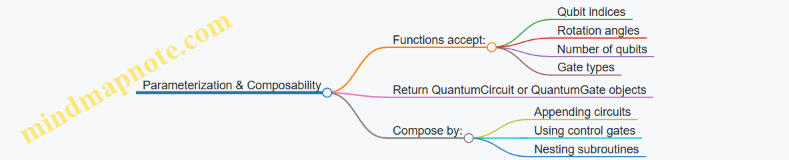
Best Practice 3: Compose Circuits by Combining Submodules
Example: Combining Bell pair and rotation circuits
qc = QuantumCircuit(3)
qc = create_bell_pair(qc, 0, 1)
rotation_subcircuit = rotation_circuit(3, 3.1415/4)
qc.compose(rotation_subcircuit, inplace=True)
qc.measure_all()
This approach promotes building complex circuits from simpler building blocks.
Best Practice 4: Document Your Quantum Functions Clearly
Include docstrings describing:
- Purpose
- Inputs and expected types
- Outputs
- Side effects
Example:
def create_bell_pair(qc, q0, q1):
    """
    Creates a Bell pair between two qubits.

    Args:
        qc (QuantumCircuit): The quantum circuit to modify.
        q0 (int): Index of the first qubit.
        q1 (int): Index of the second qubit.

    Returns:
        QuantumCircuit: The modified circuit with Bell pair gates applied.
    """
    qc.h(q0)
    qc.cx(q0, q1)
    return qc
Best Practice 5: Test Quantum Modules Using Simulators
Write unit tests to verify correctness.
Example (using Qiskit):
from qiskit import Aer, execute

def test_bell_pair():
    qc = QuantumCircuit(2)
    create_bell_pair(qc, 0, 1)
    qc.measure_all()

    backend = Aer.get_backend('qasm_simulator')
    result = execute(qc, backend, shots=1024).result()
    counts = result.get_counts()

    # Bell pair measurement outcomes should be '00' or '11'
    assert '00' in counts and '11' in counts
    assert all(key in ['00', '11'] for key in counts.keys())

# Run test
test_bell_pair()
Mind Map: Testing and Documentation
Best Practice 6: Organize Quantum Code into Libraries or Packages
- Group related quantum functions into modules
- Use version control (e.g., Git) to manage changes
- Share reusable quantum components across projects
Example:
quantum_lib/
  __init__.py
  bell_states.py
  rotations.py
  utils.py
Each file contains related functions, e.g., bell_states.py contains create_bell_pair.
Summary
- Encapsulate quantum logic in functions or classes
- Parameterize circuits for flexibility
- Compose small modules into larger circuits
- Document thoroughly
- Test with simulators
- Organize code into reusable libraries
By following these best practices, engineers and developers can build maintainable, scalable, and robust quantum software that accelerates innovation and collaboration.
5.5 Example: Developing a Quantum Circuit with Qiskit and Running on IBM Quantum Experience
In this section, we will walk through a practical example of developing a quantum circuit using Qiskit, IBM’s open-source quantum computing SDK, and then running it on the IBM Quantum Experience cloud platform. This example is designed to be approachable for engineers and developers new to quantum programming, while also demonstrating best practices for circuit design, execution, and result interpretation.
Step 1: Setting Up Your Environment
Before we start coding, ensure you have the following:
- Python 3.7 or later installed
- Qiskit installed (
pip install qiskit) - An IBM Quantum Experience account (free signup at https://quantum-computing.ibm.com)
Once signed up, generate an API token from your IBM Quantum dashboard to enable access to real quantum devices.
Step 2: Importing Required Libraries
from qiskit import QuantumCircuit, transpile, assemble, IBMQ
from qiskit.visualization import plot_histogram
from qiskit.providers.ibmq import least_busy
import matplotlib.pyplot as plt
Step 3: Creating a Simple Quantum Circuit
We’ll create a simple quantum circuit that prepares a Bell state — a fundamental entangled state — and then measures the qubits.
# Create a Quantum Circuit with 2 qubits and 2 classical bits
qc = QuantumCircuit(2, 2)

# Apply Hadamard gate to qubit 0 to create superposition
qc.h(0)

# Apply CNOT gate with qubit 0 as control and qubit 1 as target to entangle
qc.cx(0, 1)

# Measure both qubits
qc.measure([0,1], [0,1])

# Draw the circuit
qc.draw('mpl')
Mind Map: Quantum Circuit Construction
Step 4: Running the Circuit on a Simulator
Before running on real hardware, test your circuit on the Qiskit Aer simulator.
from qiskit import Aer, execute

simulator = Aer.get_backend('qasm_simulator')

# Execute the circuit on the simulator
job = execute(qc, simulator, shots=1024)

# Grab results from the job
result = job.result()

# Get counts (measurement outcomes)
counts = result.get_counts(qc)

# Plot the results
plot_histogram(counts)
plt.show()
This should show roughly equal probabilities for ‘00’ and ‘11’, confirming entanglement.
Step 5: Connecting to IBM Quantum Experience
Load your IBMQ account and select the least busy backend with at least 2 qubits.
# Load IBMQ account
IBMQ.load_account()
provider = IBMQ.get_provider(hub='ibm-q')

# Select the least busy backend with >= 2 qubits
backend = least_busy(provider.backends(filters=lambda x: x.configuration().n_qubits >= 2 \
                                       and not x.configuration().simulator \
                                       and x.status().operational==True))
print(f"Running on backend: {backend.name()}")
Step 6: Transpiling and Executing on Real Hardware
Quantum hardware has constraints such as limited connectivity and gate sets. Transpiling adapts your circuit to the backend.
# Transpile the circuit for the selected backend
transpiled_qc = transpile(qc, backend=backend)

# Assemble the circuit into a Qobj that can be run
qobj = assemble(transpiled_qc, backend=backend, shots=1024)

# Execute the job on the real quantum device
job = backend.run(qobj)

print(f"Job ID: {job.job_id()}")

# Monitor job status
from qiskit.tools.monitor import job_monitor
job_monitor(job)

# Get results
result = job.result()
counts = result.get_counts()

# Plot the results
plot_histogram(counts)
plt.show()
Mind Map: Running on IBM Quantum Hardware
Step 7: Interpreting Results and Best Practices
- Noise and Errors: Real hardware results may differ from simulator due to noise and decoherence.
- Shots: Use a sufficiently large number of shots (e.g., 1024) to get reliable statistics.
- Job Monitoring: Always monitor job status to handle queue delays or errors.
- Circuit Optimization: Transpilation optimizes circuits for hardware constraints — avoid manually modifying transpiled circuits.
- Result Validation: Compare hardware results with simulator results to understand noise impact.
Summary
This example demonstrated:
- Building a quantum circuit in Qiskit
- Visualizing the circuit
- Running the circuit on a simulator
- Connecting to IBM Quantum Experience
- Selecting an appropriate backend
- Transpiling and executing the circuit on real quantum hardware
- Visualizing and interpreting results
By following these steps and best practices, engineers and developers can confidently develop and test quantum circuits using Qiskit and IBM Quantum Experience.
Additional Resources
- Qiskit Textbook: Quantum Circuits
- IBM Quantum Experience
- Qiskit Documentation
Feel free to experiment by modifying the circuit, adding gates, or increasing qubits to deepen your understanding!
6. Noise, Error Correction, and Mitigation
6.1 Understanding Quantum Noise and Decoherence
Quantum noise and decoherence are fundamental challenges in practical quantum computing. Unlike classical bits, qubits are highly sensitive to their environment, which can cause errors and loss of quantum information. Understanding these phenomena is crucial for engineers aiming to design robust quantum circuits and systems.
What is Quantum Noise?
Quantum noise refers to the unwanted disturbances that affect the state of qubits during computation. These disturbances arise from interactions with the environment, imperfections in hardware, and control errors.
- Sources of Quantum Noise:
- Thermal fluctuations
- Electromagnetic interference
- Imperfect gate operations
- Crosstalk between qubits
What is Decoherence?
Decoherence is the process by which a quantum system loses its quantum properties, particularly superposition and entanglement, due to interaction with the environment. It effectively causes the quantum state to ‘collapse’ into classical states, destroying the quantum advantage.
- Key Concepts:
- T1 (Relaxation Time): Time scale over which a qubit loses energy and relaxes to its ground state.
- T2 (Dephasing Time): Time scale over which the phase information of a qubit is lost, destroying coherence.
Mind Map: Sources and Effects of Quantum Noise and Decoherence
Types of Quantum Noise
| Noise Type | Description | Example Effect on Qubit |
|---|---|---|
| Amplitude Damping | Energy loss from excited state to ground state | Qubit |1> decays to |0> |
| Phase Damping | Loss of phase information without energy loss | Superposition phase randomizes |
| Depolarizing Noise | Qubit state randomly flips to any other state | Qubit becomes maximally mixed |
Example: Visualizing Decoherence on a Qubit
Consider a qubit initially in the superposition state |ψ⟩ = (|0⟩ + |1⟩)/√2. Over time, due to decoherence, the qubit’s state loses its off-diagonal density matrix elements, representing the loss of coherence.
-
Initial state density matrix:
\[ \rho = \begin{bmatrix} 0.5 & 0.5 \ 0.5 & 0.5 \end{bmatrix} \]
-
After decoherence (phase damping):
\[ \rho = \begin{bmatrix} 0.5 & 0 \ 0 & 0.5 \end{bmatrix} \]
This transition can be visualized on the Bloch sphere as the qubit state vector shrinking towards the Z-axis, indicating loss of superposition.
Mind Map: Impact of Decoherence on Quantum Computation
Practical Example: Simulating Amplitude Damping Noise in Qiskit
from qiskit import QuantumCircuit, Aer, execute
from qiskit.providers.aer.noise import NoiseModel, amplitude_damping_error

# Create a simple circuit with one qubit in superposition
qc = QuantumCircuit(1,1)
qc.h(0)  # Hadamard gate to create superposition
qc.measure(0,0)

# Define amplitude damping noise with damping parameter gamma=0.1
error = amplitude_damping_error(0.1)
noise_model = NoiseModel()
noise_model.add_all_qubit_quantum_error(error, ['h'])

# Execute circuit on noisy simulator
simulator = Aer.get_backend('qasm_simulator')
result = execute(qc, backend=simulator, noise_model=noise_model, shots=1000).result()
counts = result.get_counts()

print(f"Measurement results with amplitude damping noise: {counts}")
This example shows how amplitude damping noise affects measurement outcomes, typically increasing the probability of measuring the ground state |0⟩ due to relaxation.
Best Practices for Engineers to Mitigate Noise and Decoherence
- Design Short Circuits: Minimize circuit depth to reduce exposure to noise.
- Use Error Mitigation Techniques: Such as zero-noise extrapolation and readout error correction.
- Optimize Qubit Selection: Use qubits with longer T1 and T2 times when possible.
- Calibrate Regularly: Frequent hardware calibration to reduce gate errors.
- Leverage Noise-Aware Compilation: Tailor circuits to hardware noise profiles.
Summary
Understanding quantum noise and decoherence is essential for building reliable quantum systems. By recognizing noise sources, their effects, and simulating them, engineers can design better quantum circuits and apply mitigation strategies to improve performance.
6.2 Quantum Error Correction Codes: Surface Codes and Beyond
Quantum error correction (QEC) is essential for reliable quantum computing because quantum states are extremely fragile and prone to errors from decoherence, gate imperfections, and environmental noise. Unlike classical bits, qubits cannot be copied due to the no-cloning theorem, so error correction requires sophisticated encoding and measurement techniques.
Overview of Quantum Error Correction
- Goal: Detect and correct errors without directly measuring the quantum information.
- Types of errors: Bit-flip (X), phase-flip (Z), and combined errors (Y).
- Approach: Encode a logical qubit into multiple physical qubits to protect against errors.
Mind Map: Quantum Error Correction Basics
Surface Codes: The Leading QEC Code for 2D Architectures
Surface codes are a topological quantum error correction code that arranges qubits on a 2D lattice, making them highly compatible with many physical qubit implementations like superconducting qubits.
- Key features:
- Uses a grid of physical qubits with data and ancilla (syndrome) qubits.
- Detects errors by measuring stabilizers (parity checks) on plaquettes and vertices.
- Can correct both bit-flip and phase-flip errors.
- High error threshold (~1%), making it practical for near-term devices.
Mind Map: Surface Code Structure
Example: Simple Surface Code Cycle
Consider a 3x3 lattice of qubits:
- Initialize data qubits in logical |0⟩ state.
- Measure stabilizers: Use ancilla qubits to measure parity of neighboring data qubits.
- Detect syndromes: Identify which stabilizers indicate errors.
- Decode: Use a classical decoding algorithm (e.g., Minimum Weight Perfect Matching) to infer error locations.
- Correct: Apply X or Z gates to correct detected errors.
This cycle repeats continuously to maintain logical qubit integrity.
Beyond Surface Codes: Other Quantum Error Correction Codes
-
Steane Code (7-qubit code):
- Encodes 1 logical qubit into 7 physical qubits.
- Can correct any single-qubit error.
- Uses CSS (Calderbank-Shor-Steane) construction.
-
Shor Code (9-qubit code):
- First QEC code proposed.
- Combines bit-flip and phase-flip correction using repetition codes.
-
Color Codes:
- Similar to surface codes but allow transversal implementation of a larger set of logical gates.
- Uses 3-colorable lattices.
-
Bacon-Shor Codes:
- Subsystem codes that reduce overhead by relaxing some stabilizer measurements.
Mind Map: Other QEC Codes
Best Practices for Implementing QEC Codes
- Choose codes compatible with hardware topology: Surface codes are favored for 2D architectures.
- Optimize syndrome extraction circuits: Minimize gate depth and errors during measurement.
- Use efficient decoders: Classical algorithms must quickly interpret syndromes to apply corrections.
- Continuously repeat error correction cycles: To maintain logical qubit fidelity over time.
Practical Example: Implementing a 3-Qubit Bit-Flip Code
While surface codes are complex, a simple introductory example is the 3-qubit bit-flip code that protects against bit-flip errors.
Encoding:
- Logical |0⟩ = |000⟩
- Logical |1⟩ = |111⟩
Error detection:
- Measure parity between qubit pairs to detect which qubit flipped.
Correction:
- Apply X gate to the flipped qubit.
Circuit Example (Qiskit):
from qiskit import QuantumCircuit, Aer, execute

qc = QuantumCircuit(3, 2)

# Encoding
qc.barrier()
qc.cx(0,1)
qc.cx(0,2)

# Introduce bit-flip error on qubit 1
qc.x(1)

# Syndrome measurement
qc.cx(0,1)
qc.cx(0,2)
qc.measure([1,2], [0,1])

# Correction based on syndrome (classical control not shown here)

# Run simulation
simulator = Aer.get_backend('qasm_simulator')
result = execute(qc, simulator, shots=1024).result()
counts = result.get_counts()
print(counts)
This example demonstrates the core idea of encoding, error detection, and correction in a simple setting.
Summary
Quantum error correction codes like surface codes are vital for building scalable, fault-tolerant quantum computers. Understanding their structure, operation, and practical implementation helps engineers design robust quantum systems. Starting with simple codes and progressing to advanced topological codes enables gradual mastery of this challenging but essential topic.
6.3 Error Mitigation Techniques for Near-Term Devices
Quantum computers available today, often referred to as Noisy Intermediate-Scale Quantum (NISQ) devices, are prone to errors due to decoherence, gate imperfections, and readout noise. Unlike fully fault-tolerant quantum computers, NISQ devices cannot yet implement full quantum error correction effectively. Therefore, error mitigation techniques are critical to improve the accuracy of quantum computations on these near-term devices.
Overview of Error Mitigation
Error mitigation aims to reduce the impact of noise on quantum computations without the overhead of full error correction. It typically involves classical post-processing or circuit-level strategies to infer or improve the ideal output.
Mind Map: Error Mitigation Techniques
Zero Noise Extrapolation (ZNE)
Concept: Run the same quantum circuit at different noise levels and extrapolate the results back to the zero-noise limit.
How to scale noise:
- Stretch gate durations
- Repeat gates multiple times
Extrapolation methods:
- Linear
- Polynomial
- Richardson extrapolation
Example: Suppose you run a circuit with noise scaled by factors 1x, 2x, and 3x. You measure an observable (O) at these noise levels:
| Noise Scale | Measured (O) |
|---|---|
| 1 | 0.85 |
| 2 | 0.75 |
| 3 | 0.60 |
Using linear extrapolation, estimate (O) at zero noise:
\[ O_{0} = O_1 + \frac{O_1 - O_2}{1 - 2} = 0.85 + \frac{0.85 - 0.75}{1 - 2} = 0.85 + (-0.10) = 0.75 \]
In practice, more sophisticated extrapolation methods can improve accuracy.
Probabilistic Error Cancellation
Concept: Characterize noise channels and apply their inverse probabilistically to cancel errors.
Steps:
- Perform noise tomography to model noise channels.
- Decompose inverse noise into a linear combination of implementable operations.
- Sample circuits with these operations probabilistically.
Trade-off:
- Increases sampling overhead exponentially with noise strength.
Example: If a noisy gate (G) can be decomposed as \(G = sum_i c_i O_i\), then the inverse noise can be applied by sampling \(O_i\) with weights proportional to \(c_i\).
Measurement Error Mitigation
Measurement errors are often the dominant noise source in NISQ devices.
Technique:
- Calibrate the readout error by preparing known basis states.
- Construct a calibration matrix (M) where \(M_{ij}\) is the probability of measuring \(j\) when preparing \(i\).
- Invert (M) to correct measured distributions.
Example: For a single qubit:
| Prepared State | Measured 0 | Measured 1 |
|---|---|---|
| 0 | 0.95 | 0.05 |
| 1 | 0.10 | 0.90 |
Calibration matrix:
\[ M = \begin{bmatrix} 0.95 & 0.05 \ 0.10 & 0.90 \end{bmatrix} \]
If the raw measurement distribution is \([p_0, p_1]\), the corrected distribution \([p_0’, p_1’]\) is:
\[ \begin{bmatrix} p_0’ \ p_1’ \end{bmatrix} = M^{-1} \begin{bmatrix} p_0 \ p_1 \end{bmatrix} \]
Dynamical Decoupling
Concept: Apply sequences of pulses to qubits to refocus and cancel out environmental noise, extending coherence times.
Common sequences:
- CPMG (Carr-Purcell-Meiboom-Gill)
- XY4, XY8
Example: Inserting an XY4 sequence between computational gates can reduce dephasing noise, improving gate fidelity.
Subspace Expansion
Concept: Expand the quantum state into a subspace including error states and use classical post-processing to mitigate errors.
Application:
- Useful in variational algorithms like VQE.
- Helps correct errors without full error correction overhead.
Example: After running a VQE circuit, measure additional operators to characterize error subspace and correct energy estimates.
Integrated Example: Applying Measurement Error Mitigation and ZNE
Suppose you want to estimate the expectation value of an observable on a NISQ device:
- Calibrate measurement errors: Prepare and measure basis states to build calibration matrix.
- Run the circuit at normal noise level and scaled noise levels: Use gate folding to increase noise artificially.
- Apply measurement error mitigation: Correct raw measurement results using the calibration matrix.
- Perform zero noise extrapolation: Use corrected results at different noise levels to extrapolate to zero noise.
This combined approach can significantly improve the accuracy of results on near-term devices.
Summary
| Technique | Pros | Cons | Typical Use Case |
|---|---|---|---|
| Zero Noise Extrapolation | Simple to implement, no noise model | Requires multiple runs, assumes noise scaling | General circuit error mitigation |
| Probabilistic Error Cancellation | Can fully cancel errors in theory | High sampling overhead, requires noise model | Small circuits with well-characterized noise |
| Measurement Error Mitigation | Straightforward, improves readout | Only corrects measurement errors | Most circuits with significant readout noise |
| Dynamical Decoupling | Extends coherence, improves gate fidelity | Requires pulse-level control | Hardware-level noise suppression |
| Subspace Expansion | Improves variational algorithm accuracy | Requires additional measurements | Variational algorithms like VQE |
6.4 Best Practices: Designing Circuits with Noise Resilience in Mind
Quantum noise and decoherence remain the biggest challenges in practical quantum computing today. Designing circuits with noise resilience in mind can significantly improve the fidelity and reliability of quantum computations, especially on near-term noisy intermediate-scale quantum (NISQ) devices.
Key Principles for Noise-Resilient Circuit Design
Noise-Resilient Circuit Design Mind Map
Minimize Circuit Depth
The longer a quantum circuit runs, the more it accumulates noise and decoherence errors. Strategies include:
- Gate Count Reduction: Combine gates where possible (e.g., merging consecutive rotations).
- Native Gate Usage: Use the hardware’s native gate set to avoid costly decompositions.
Example: Instead of decomposing a Toffoli gate into many CNOT and single-qubit gates, use a hardware-native multi-qubit gate if available, or simplify the logic to reduce gate count.
Optimize Qubit Connectivity and Mapping
Physical qubits have varying error rates and connectivity constraints. Mapping logical qubits to physical qubits with the best connectivity reduces the need for SWAP gates, which introduce additional noise.
Example: On IBM Quantum devices, use the transpile function with optimization level set to maximize qubit mapping efficiency.
from qiskit import transpile
optimized_circuit = transpile(circuit, backend=backend, optimization_level=3)
Use Error Mitigation Techniques
While error correction is still resource-intensive, error mitigation can improve results:
- Zero-Noise Extrapolation: Run circuits at different noise levels and extrapolate to zero noise.
- Probabilistic Error Cancellation: Use knowledge of noise channels to probabilistically invert errors.
Example: Qiskit Ignis provides tools for zero-noise extrapolation.
Exploit Circuit Symmetries
Symmetry verification can detect and discard erroneous runs:
- Identify conserved quantities (e.g., particle number in chemistry simulations).
- Post-select measurement results consistent with symmetries.
Example: In a variational quantum eigensolver (VQE), verify that the number of electrons remains constant.
Choose Robust Gate Sets
Some gates have inherently lower error rates. Prefer these when possible.
- Use single-qubit rotations over multi-qubit gates when feasible.
- Use composite pulses or dynamically corrected gates if supported by hardware.
Measurement Optimization
Measurements collapse the quantum state and can introduce errors.
- Reduce the number of measurements by grouping commuting observables.
- Use mid-circuit measurements to reset qubits and reuse them, reducing total qubit count.
Example: Group Pauli terms in VQE to minimize measurement overhead.
Hybrid Quantum-Classical Approaches
Offload classical computations and use variational algorithms that require shorter circuits.
Example: Variational Quantum Eigensolver (VQE) uses a parameterized quantum circuit with classical optimization, reducing circuit depth compared to traditional algorithms.
Integrated Example: Designing a Noise-Resilient Circuit for Bell State Preparation
Step 1: Use minimal gates (Hadamard + CNOT) to prepare the Bell state.
Step 2: Map qubits to physical qubits with the best connectivity to minimize SWAPs.
Step 3: Use transpiler optimization to reduce gate count and depth.
Step 4: Group measurements to reduce readout errors.
Step 5: Apply zero-noise extrapolation to mitigate residual noise.
from qiskit import QuantumCircuit, transpile, Aer, execute
from qiskit.ignis.mitigation.measurement import complete_meas_cal, CompleteMeasFitter

# Prepare Bell state
qc = QuantumCircuit(2, 2)
qc.h(0)
qc.cx(0, 1)
qc.measure([0,1], [0,1])

# Backend and transpile
backend = Aer.get_backend('qasm_simulator')
qc_optimized = transpile(qc, backend=backend, optimization_level=3)

# Measurement calibration
cal_circuits, state_labels = complete_meas_cal(qubit_list=[0,1], qr=qc_optimized.qregs[0], cr=qc_optimized.cregs[0])
cal_results = execute(cal_circuits, backend=backend, shots=1024).result()
meas_fitter = CompleteMeasFitter(cal_results, state_labels)
meas_filter = meas_fitter.filter

# Execute circuit
result = execute(qc_optimized, backend=backend, shots=1024).result()
raw_counts = result.get_counts()

# Apply measurement error mitigation
mitigated_counts = meas_filter.apply(raw_counts)
print('Raw counts:', raw_counts)
print('Mitigated counts:', mitigated_counts)
Summary
Designing circuits with noise resilience involves a holistic approach combining circuit optimization, hardware-aware mapping, error mitigation, and smart measurement strategies. Applying these best practices will help engineers and developers maximize the performance of quantum algorithms on current and near-future quantum hardware.
6.5 Example: Applying Error Mitigation to Improve Circuit Fidelity
Quantum circuits running on current noisy intermediate-scale quantum (NISQ) devices are prone to errors caused by decoherence, gate imperfections, and measurement noise. Error mitigation techniques help improve the fidelity of results without requiring full quantum error correction, which is still resource-intensive.
What is Error Mitigation?
Error mitigation refers to a set of strategies aimed at reducing the impact of noise on quantum computations by post-processing results or modifying circuit execution, rather than encoding logical qubits with error-correcting codes.
Common Error Sources:
- Gate errors: Imperfect gate implementations
- Decoherence: Qubit state loss over time
- Readout errors: Incorrect measurement outcomes
Mind Map: Overview of Error Mitigation Techniques
Step-by-Step Example: Applying Measurement Error Mitigation with Qiskit
Scenario: You have a simple 2-qubit circuit preparing a Bell state. Measurement errors are affecting the observed probabilities.
Step 1: Prepare the Circuit
from qiskit import QuantumCircuit, execute, Aer

qc = QuantumCircuit(2, 2)
qc.h(0)
qc.cx(0, 1)
qc.measure([0,1], [0,1])
Step 2: Execute Without Error Mitigation
backend = Aer.get_backend('qasm_simulator')
result = execute(qc, backend, shots=1000).result()
counts = result.get_counts()
print('Raw counts:', counts)
Expected output might show some noise-induced counts like ‘01’ or ‘10’
Step 3: Calibrate Measurement Errors
from qiskit.ignis.mitigation.measurement import complete_meas_cal, CompleteMeasFitter

cal_circuits, state_labels = complete_meas_cal(qubit_list=[0,1], qr=qc.qregs[0], cr=qc.cregs[0])
cal_results = execute(cal_circuits, backend, shots=1000).result()
meas_fitter = CompleteMeasFitter(cal_results, state_labels)
meas_filter = meas_fitter.filter
Step 4: Apply Error Mitigation
mitigated_result = meas_filter.apply(result)
mitigated_counts = mitigated_result.get_counts()
print('Mitigated counts:', mitigated_counts)
Step 5: Compare Results
- Raw counts might have significant noise.
- Mitigated counts should be closer to ideal Bell state distribution: roughly equal ‘00’ and ‘11’ counts.
Mind Map: Measurement Error Mitigation Workflow
Additional Example: Zero Noise Extrapolation (ZNE) with Noise Scaling
Concept: Run the same circuit multiple times with artificially increased noise levels (e.g., by stretching gate durations or repeating gates) and extrapolate the results back to zero noise.
Pseudocode:
noise_levels = [1, 3, 5]  # noise scaling factors
results = []
for scale in noise_levels:
    scaled_circuit = stretch_gates(qc, scale)  # function to increase noise
    result = execute(scaled_circuit, backend, shots=1000).result()
    counts = result.get_counts()
    results.append(estimate_expectation_value(counts))

# Fit results to polynomial and extrapolate to noise=0
zero_noise_value = extrapolate_to_zero_noise(noise_levels, results)
print('Extrapolated zero-noise result:', zero_noise_value)
Note: Qiskit Ignis and other frameworks provide built-in tools to automate ZNE.
Best Practices When Applying Error Mitigation
- Always calibrate measurement errors frequently as they drift over time.
- Use multiple mitigation techniques in combination for better results.
- Validate mitigation by comparing mitigated results to known benchmarks or simulators.
- Keep circuit depth minimal to reduce noise exposure.
Summary
Applying error mitigation techniques like measurement error correction and zero noise extrapolation can significantly improve the fidelity of quantum circuits on NISQ devices. These methods are essential tools for engineers and developers working with current quantum hardware to extract meaningful results despite noise.
7. Quantum Hardware Architectures and Access
7.1 Types of Quantum Hardware: Superconducting, Ion Traps, Photonics
Quantum computing hardware is the foundation upon which quantum algorithms run. Understanding the different types of quantum hardware is essential for engineers and developers to choose the right platform for their applications and to optimize performance. This section covers the three most prominent quantum hardware technologies: superconducting qubits, ion traps, and photonics.
Overview Mind Map
Superconducting Qubits
Superconducting qubits are currently the most widely used hardware in commercial quantum computers, including IBM Quantum and Google Sycamore.
- Principle: Use superconducting circuits cooled to near absolute zero to create quantum bits.
- Key Components: Josephson junctions, capacitors, and inductors form nonlinear oscillators acting as qubits.
- Advantages: Fast gate speeds (nanoseconds), scalability potential, and integration with existing semiconductor fabrication.
- Challenges: Requires dilution refrigerators (cryogenics), relatively short coherence times (microseconds to milliseconds), and susceptibility to noise.
Best Practice
When designing circuits for superconducting qubits, minimize circuit depth to reduce decoherence effects and optimize gate fidelity.
Example: IBM Quantum Experience
You can run a simple quantum circuit on IBM’s superconducting quantum processors via the cloud. For instance, creating a Bell state using Hadamard and CNOT gates demonstrates entanglement on this hardware.
Ion Traps
Ion trap quantum computers use charged atoms (ions) confined and manipulated with electromagnetic fields.
- Principle: Ions are trapped in electromagnetic fields in ultra-high vacuum and manipulated with laser pulses.
- Key Components: Paul traps or Penning traps, laser systems for qubit initialization, manipulation, and measurement.
- Advantages: Very long coherence times (seconds to minutes), high-fidelity gates, and all-to-all qubit connectivity.
- Challenges: Slower gate speeds (microseconds to milliseconds), complex laser systems, and scalability limitations.
Best Practice
Use pulse shaping and optimized laser control sequences to maximize gate fidelity and reduce crosstalk between ions.
Example: IonQ System
IonQ provides cloud access to trapped-ion quantum computers. Running a Grover’s algorithm example on IonQ hardware showcases the high-fidelity operations and connectivity advantages.
Photonics
Photonic quantum computing uses photons as qubits, encoding information in properties like polarization or path.
- Principle: Quantum information is carried by single photons manipulated through linear optical elements such as beam splitters and phase shifters.
- Key Components: Single-photon sources, waveguides, beam splitters, detectors.
- Advantages: Room temperature operation, low decoherence, natural fit for quantum communication.
- Challenges: Probabilistic gates, photon loss, and difficulty in scaling deterministic two-qubit gates.
Best Practice
Employ multiplexing and error-correcting codes to mitigate photon loss and improve gate success rates.
Example: Xanadu’s Photonic Quantum Processors
Xanadu’s Strawberry Fields platform allows programming photonic quantum circuits. An example is implementing Gaussian boson sampling, a task well-suited for photonic hardware.
Comparative Mind Map
Summary
Understanding the strengths and limitations of each quantum hardware type enables engineers to select appropriate platforms for their applications. Superconducting qubits offer fast operations and are currently leading in commercial availability. Ion traps provide exceptional coherence and gate fidelity, ideal for precision tasks. Photonics excels in communication and room-temperature operation but faces scalability challenges.
Additional Example: Simple Qubit Initialization on Different Hardware
| Hardware Type | Initialization Method | Example Code Snippet (Qiskit / Pseudocode) |
|---|---|---|
| Superconducting | Microwave pulses to set |0> or |1> state | qc.initialize([1,0], 0) |
| Ion Traps | Laser cooling and optical pumping | ionTrapQubit.prepareState('0') |
| Photonics | Single photon source polarization | photonQubit.setPolarization('H') |
This illustrates how hardware-specific initialization methods affect programming and experiment design.
By integrating these insights and examples, engineers can better navigate the quantum hardware landscape and develop more effective quantum applications.
7.2 Accessing Quantum Hardware via Cloud Platforms
Quantum computing hardware is still highly specialized and expensive, making direct ownership impractical for most engineers and developers. Fortunately, cloud platforms provide remote access to real quantum processors and simulators, democratizing the ability to experiment and develop quantum applications. This section explores how to access quantum hardware through cloud services, best practices for usage, and practical examples.
Why Use Cloud-Based Quantum Hardware?
- Cost Efficiency: No need to invest in costly quantum devices.
- Scalability: Access to multiple devices with different qubit counts and architectures.
- Latest Technology: Immediate access to cutting-edge quantum processors.
- Collaboration: Share and run experiments easily across teams.
Major Quantum Cloud Platforms
Getting Started: Common Workflow
- Create an Account: Register on the cloud platform (e.g., IBM Quantum Experience).
- API Key Setup: Obtain API credentials to authenticate your programs.
- Select Backend: Choose between simulators or real quantum devices.
- Develop Quantum Circuits: Use SDKs like Qiskit, Cirq, or Q#.
- Submit Jobs: Run your quantum circuits remotely.
- Retrieve Results: Analyze measurement outcomes and performance metrics.
Best Practices for Accessing Quantum Hardware via Cloud
- Understand Backend Constraints: Each device has a specific number of qubits, connectivity, and noise characteristics.
- Use Simulators First: Validate your circuits locally or on cloud simulators before running on real hardware.
- Job Queue Management: Real devices have queues; plan your experiments accordingly.
- Error Mitigation: Apply error mitigation techniques to improve result fidelity.
- Resource Monitoring: Track your usage quotas and optimize job submissions.
Example 1: Accessing IBM Quantum Hardware Using Qiskit
from qiskit import IBMQ, QuantumCircuit, transpile, assemble, execute
from qiskit.visualization import plot_histogram

# Load IBM Quantum account
IBMQ.load_account()
provider = IBMQ.get_provider(hub='ibm-q')

# Select a real quantum backend
backend = provider.get_backend('ibmq_manila')

# Create a simple quantum circuit
qc = QuantumCircuit(2, 2)
qc.h(0)
qc.cx(0, 1)
qc.measure([0,1], [0,1])

# Transpile circuit for the backend
transpiled_qc = transpile(qc, backend=backend)

# Execute the circuit
job = backend.run(transpiled_qc, shots=1024)
print(f'Job ID: {job.job_id()}')

# Monitor job status
from qiskit.tools.monitor import job_monitor
job_monitor(job)

# Get results
result = job.result()
counts = result.get_counts()
print(counts)

# Plot results
plot_histogram(counts)
This example demonstrates how to authenticate, select a backend, and run a simple Bell state circuit on IBM’s real quantum hardware.
Example 2: Running a Quantum Circuit on Amazon Braket
from braket.aws import AwsDevice
from braket.circuits import Circuit

# Select a quantum device (IonQ simulator for example)
device = AwsDevice('arn:aws:braket:::device/quantum-simulator/amazon/sv1')

# Define a quantum circuit
circuit = Circuit().h(0).cnot(0, 1).measure(0, 0).measure(1, 1)

# Run the circuit
task = device.run(circuit, shots=1000)

# Get results
result = task.result()
counts = result.measurement_counts
print(counts)
This snippet shows how to use Amazon Braket’s Python SDK to run a circuit on a quantum simulator or hardware device.
Mind Map: Steps to Access Quantum Hardware via Cloud
Summary
Accessing quantum hardware via cloud platforms is a practical and efficient way for engineers and developers to experiment with quantum computing. By understanding the available platforms, following best practices, and leveraging SDKs, you can seamlessly integrate quantum hardware into your development workflow.
Additional Resources
- IBM Quantum Experience
- Amazon Braket
- Microsoft Azure Quantum
- Google Quantum AI
- Xanadu Cloud
7.3 Best Practices: Matching Algorithms to Hardware Capabilities
When working with quantum computing, one of the critical factors that influence the success and efficiency of your quantum algorithms is how well you match the algorithm to the hardware capabilities. Different quantum hardware platforms have unique strengths and limitations, and understanding these nuances allows engineers and developers to optimize performance, reduce errors, and achieve practical results.
Why Matching Matters
- Hardware Constraints: Qubit count, connectivity, coherence times, gate fidelities, and native gate sets vary between platforms.
- Algorithm Requirements: Some algorithms require deep circuits or many qubits, while others can be optimized for shallow circuits.
- Error Rates: Noise characteristics differ, impacting algorithm success probability.
Mind Map: Key Factors in Matching Algorithms to Hardware
Understanding Hardware Characteristics
-
Qubit Count:
- Algorithms requiring many qubits may only run on hardware with sufficient qubit capacity.
- Example: Shor’s algorithm for factoring large numbers demands many qubits.
-
Qubit Connectivity:
- Some hardware architectures have limited qubit connectivity (e.g., linear chains), requiring additional SWAP gates.
- Example: Superconducting qubits often have nearest-neighbor connectivity.
-
Coherence Time:
- The time qubits maintain their quantum state without decoherence.
- Longer coherence times allow deeper circuits.
-
Native Gate Set:
- Hardware supports specific native gates; other gates must be decomposed.
- Efficient gate decomposition reduces circuit depth and errors.
-
Gate and Measurement Fidelity:
- High-fidelity gates and measurements reduce errors and improve algorithm success.
Algorithm Characteristics to Consider
- Circuit Depth: Deeper circuits are more prone to errors; shallow circuits are preferred on noisy hardware.
- Gate Types: Some algorithms rely heavily on multi-qubit gates which may be expensive on certain hardware.
- Error Tolerance: Variational algorithms (e.g., VQE) can tolerate more noise compared to exact algorithms.
Mind Map: Optimization Strategies for Hardware Matching
Examples
Example 1: Running Grover’s Algorithm on Superconducting Qubits
- Hardware: IBM Quantum devices with superconducting qubits
- Constraints: Limited qubit connectivity, native gates are single-qubit rotations and CNOT
- Adaptations:
- Use transpiler to map logical qubits to physical qubits minimizing SWAP gates
- Decompose multi-controlled gates into sequences of CNOT and single-qubit gates
- Limit circuit depth to stay within coherence time
from qiskit import QuantumCircuit, transpile, IBMQ

# Create Grover circuit for 3 qubits
qc = QuantumCircuit(3)
# ... build Grover circuit ...

# Load IBMQ backend
provider = IBMQ.load_account()
backend = provider.get_backend('ibmq_lima')

# Transpile circuit for backend
transpiled_qc = transpile(qc, backend=backend, optimization_level=3)

print(transpiled_qc.depth())
Example 2: Variational Quantum Eigensolver (VQE) on Trapped Ion Hardware
- Hardware: IonQ trapped ion quantum computer
- Strengths: All-to-all qubit connectivity, longer coherence times
- Adaptations:
- Use entangling gates native to trapped ions (e.g., Molmer-Sorensen gates)
- Design ansatz circuits that exploit all-to-all connectivity to reduce circuit depth
# Pseudocode for VQE ansatz adapted for trapped ion hardware
ansatz = QuantumCircuit(num_qubits)
for i in range(num_qubits):
    ansatz.ry(params[i], i)
# Apply Molmer-Sorensen entangling gate between all qubits
ansatz.ms_gate(theta=params[-1])
Summary Best Practices
- Know Your Hardware: Study the hardware specs before algorithm design.
- Leverage Native Gates: Tailor your circuits to native gate sets to reduce overhead.
- Optimize Qubit Mapping: Use compiler tools to minimize costly SWAP operations.
- Adapt Algorithm Complexity: Choose or modify algorithms to fit coherence time and qubit count.
- Use Error Mitigation: Incorporate error mitigation techniques suited to your hardware.
- Test on Simulators: Validate and optimize circuits on noisy simulators before hardware runs.
By carefully matching your quantum algorithms to the hardware capabilities, you can significantly improve the feasibility and accuracy of your quantum computations, making practical quantum computing a reality for engineers and developers.
7.4 Example: Running a Quantum Circuit on Different Hardware Backends
In this section, we will explore how to run the same quantum circuit on different quantum hardware backends. This practical example will demonstrate the nuances of hardware-specific constraints, performance variations, and how to adapt your quantum programs accordingly.
Overview
Running quantum circuits on different hardware backends is essential for engineers and developers to understand the practical limitations and strengths of each platform. It also helps in benchmarking and selecting the best backend for your specific application.
Mind Map: Running Quantum Circuits on Multiple Hardware Backends
Step 1: Define a Simple Quantum Circuit
We will create a simple circuit that generates a Bell state, which is a fundamental entangled state used widely in quantum computing.
from qiskit import QuantumCircuit

# Create a 2-qubit quantum circuit
qc = QuantumCircuit(2, 2)

# Apply Hadamard gate on qubit 0
qc.h(0)

# Apply CNOT gate with control qubit 0 and target qubit 1
qc.cx(0, 1)

# Measure both qubits
qc.measure([0, 1], [0, 1])

qc.draw('mpl')
This circuit prepares the state |Φ+> = (|00> + |11>)/√2.
Step 2: Selecting Different Hardware Backends
We will run this circuit on three different backends:
- IBM Quantum (Superconducting qubits)
- IonQ (Ion trap qubits)
- Xanadu (Photonic qubits)
Each backend has unique characteristics:
- IBM Quantum
- Superconducting qubits
- Limited qubit connectivity
- Moderate coherence times
- IonQ
- Ion trap qubits
- All-to-all connectivity
- Longer coherence times
- Xanadu
- Photonic qubits
- Different gate sets (CV-based)
- Specialized for certain algorithms
Step 3: Transpiling and Adapting the Circuit
Each backend requires the circuit to be transpiled (optimized and mapped) to its native gate set and qubit topology.
from qiskit import IBMQ, transpile

# Load IBMQ account
IBMQ.load_account()
provider = IBMQ.get_provider(hub='ibm-q')

# Select IBM backend
ibm_backend = provider.get_backend('ibmq_lima')

# Transpile circuit for IBM backend
qc_ibm = transpile(qc, backend=ibm_backend)

print(qc_ibm.draw())
For IonQ and Xanadu, you would use their respective SDKs (e.g., Amazon Braket for IonQ, PennyLane for Xanadu) and adapt the circuit accordingly.
Step 4: Running the Circuit
IBM Quantum Example
from qiskit.tools.monitor import job_monitor

# Execute the job
job_ibm = ibm_backend.run(qc_ibm, shots=1024)
job_monitor(job_ibm)

# Get results
result_ibm = job_ibm.result()
counts_ibm = result_ibm.get_counts()
print('IBM Quantum counts:', counts_ibm)
IonQ Example (Amazon Braket)
from braket.circuits import Circuit
from braket.aws import AwsDevice

# Define the same circuit in Braket
braket_circuit = Circuit().h(0).cnot(0, 1).measure(0, 0).measure(1, 1)

# Select IonQ device
ionq_device = AwsDevice('arn:aws:braket:::device/qpu/ionq/ionQdevice')

# Run the circuit
task = ionq_device.run(braket_circuit, shots=1024)
result_ionq = task.result()
counts_ionq = result_ionq.measurement_counts
print('IonQ counts:', counts_ionq)
Xanadu Example (PennyLane)
import pennylane as qml
from pennylane import numpy as np

# Define device
dev = qml.device('strawberryfields.fock', wires=2, cutoff_dim=5)

@qml.qnode(dev)
def bell_state():
    qml.Hadamard(wires=0)
    qml.CNOT(wires=[0, 1])
    return qml.probs(wires=[0, 1])

probs = bell_state()
print('Xanadu probabilities:', probs)
Step 5: Analyzing and Comparing Results
| Backend | Qubit Type | Connectivity | Typical Fidelity | Result Characteristics |
|---|---|---|---|---|
| IBM Quantum | Superconducting | Limited | ~99% (single qubit) | Counts close to ideal Bell state |
| IonQ | Ion Trap | All-to-all | Higher fidelity | Slightly better entanglement fidelity |
| Xanadu | Photonic (CV-based) | Varies | Different metrics | Probabilities instead of counts |
Mind Map: Result Analysis and Considerations

Best Practices Highlighted
- Transpile circuits for each backend to match native gates and connectivity.
- Understand backend-specific constraints such as qubit connectivity and coherence times.
- Use simulators first to validate circuit logic before running on real hardware.
- Analyze results carefully considering noise and error rates.
- Leverage cloud platforms to access diverse hardware easily.
Summary
Running quantum circuits on different hardware backends reveals the practical challenges and opportunities in quantum computing. By adapting your circuits and understanding each backend’s characteristics, you can optimize performance and gain deeper insights into quantum algorithm behavior in real-world conditions.
8. Practical Quantum Computing Applications
8.1 Quantum Chemistry Simulations: Principles and Tools
Quantum chemistry simulations leverage quantum computing to model molecular structures, chemical reactions, and properties at a quantum mechanical level. This section explores the core principles behind quantum chemistry simulations, the tools available for engineers and developers, and practical examples to illustrate best practices.
Principles of Quantum Chemistry Simulations
Quantum chemistry aims to solve the electronic structure problem — determining the ground and excited states of molecules by solving the Schrödinger equation. Classical computers struggle with this due to exponential scaling of the Hilbert space with system size.
Quantum computers offer a natural platform for simulating quantum systems efficiently by encoding molecular states into qubits and manipulating them with quantum gates.
Key Concepts:
- Electronic Structure Problem: Finding eigenvalues and eigenstates of molecular Hamiltonians.
- Molecular Hamiltonian: Operator representing the total energy of electrons and nuclei.
- Basis Sets: Mathematical functions used to represent molecular orbitals.
- Second Quantization: Formalism to express Hamiltonians in terms of creation and annihilation operators.
- Mapping to Qubits: Techniques like Jordan-Wigner and Bravyi-Kitaev transform fermionic operators into qubit operators.
Mind Map: Principles of Quantum Chemistry Simulations
Tools for Quantum Chemistry Simulations
Several quantum software frameworks provide libraries and modules specialized for quantum chemistry:
- Qiskit Nature (IBM): Extends Qiskit with chemistry-specific tools, including molecule construction, Hamiltonian generation, and integration with VQE and other algorithms.
- Cirq + OpenFermion (Google): OpenFermion is an open-source library for compiling and analyzing quantum algorithms for chemistry, integrated with Cirq.
- PySCF + Qiskit: PySCF is a classical computational chemistry package often used to generate molecular integrals for quantum algorithms.
- PennyLane: Supports hybrid quantum-classical workflows, including quantum chemistry simulations.
Best Practices:
- Use established chemistry libraries (e.g., PySCF) to generate accurate molecular integrals.
- Choose appropriate basis sets balancing accuracy and computational cost.
- Select qubit mappings that optimize circuit depth and gate count for your hardware.
- Employ variational algorithms like VQE to approximate ground states on NISQ devices.
Mind Map: Tools and Frameworks
Example 1: Simulating the Hydrogen Molecule (H₂) Ground State with Qiskit Nature
This example demonstrates how to simulate the ground state energy of H₂ using the Variational Quantum Eigensolver (VQE) algorithm with Qiskit Nature.
Step-by-step:
- Molecule Definition: Define H₂ geometry and basis set.
- Hamiltonian Construction: Use Qiskit Nature to generate the qubit Hamiltonian.
- Qubit Mapping: Apply Jordan-Wigner transformation.
- Variational Ansatz: Use a hardware-efficient ansatz or UCCSD.
- Optimization: Run classical optimizer to minimize energy.
- Result Interpretation: Extract and analyze ground state energy.
from qiskit_nature.drivers import PySCFDriver
from qiskit_nature.problems.second_quantization.electronic import ElectronicStructureProblem
from qiskit_nature.converters.second_quantization import QubitConverter
from qiskit_nature.mappers.second_quantization import JordanWignerMapper
from qiskit.algorithms import VQE
from qiskit.circuit.library import TwoLocal
from qiskit.algorithms.optimizers import SLSQP
from qiskit.utils import QuantumInstance
from qiskit import Aer

# 1. Define molecule
driver = PySCFDriver(atom='H .0 .0 .0; H .0 .0 0.735', basis='sto3g')
qmolecule = driver.run()

# 2. Setup electronic structure problem
problem = ElectronicStructureProblem(driver)
second_q_op = problem.second_q_ops()[0]

# 3. Map to qubits
mapper = JordanWignerMapper()
converter = QubitConverter(mapper=mapper)
qubit_op = converter.convert(second_q_op)

# 4. Setup ansatz
ansatz = TwoLocal(rotation_blocks='ry', entanglement_blocks='cz', entanglement='linear', reps=1)

# 5. Setup optimizer and quantum instance
optimizer = SLSQP(maxiter=100)
quantum_instance = QuantumInstance(backend=Aer.get_backend('statevector_simulator'))

# 6. Run VQE
vqe = VQE(ansatz, optimizer=optimizer, quantum_instance=quantum_instance)
result = vqe.compute_minimum_eigenvalue(qubit_op)

print(f"Ground state energy (Hartree): {result.eigenvalue.real:.6f}")
Example 2: Visual Mind Map of the H₂ Simulation Workflow
Summary and Best Practices
- Start with small molecules (e.g., H₂, LiH) to validate your workflow.
- Use simulators before deploying on real quantum hardware to debug and optimize.
- Carefully select basis sets and mappings to balance accuracy and resource requirements.
- Leverage variational algorithms like VQE to work within current hardware constraints.
- Visualize quantum states and circuits to understand and debug your simulations.
By integrating these principles, tools, and examples, engineers can practically approach quantum chemistry simulations, paving the way for advances in materials science, drug discovery, and beyond.
8.2 Optimization Problems Using Quantum Algorithms
Optimization problems are at the heart of many engineering and scientific challenges. Quantum algorithms offer promising approaches to solve certain classes of optimization problems more efficiently than classical methods. This section explores how quantum computing can be applied to optimization, key algorithms, best practices, and practical examples.
What Are Optimization Problems?
Optimization problems involve finding the best solution from a set of feasible solutions, often by minimizing or maximizing an objective function. Examples include:
- Minimizing cost or energy consumption
- Maximizing profit or efficiency
- Scheduling and resource allocation
Why Use Quantum Algorithms for Optimization?
Classical optimization algorithms can struggle with combinatorial explosion in complex problems. Quantum algorithms leverage quantum superposition and entanglement to explore multiple solutions simultaneously, potentially offering speedups.
Key Quantum Algorithms for Optimization
- Quantum Approximate Optimization Algorithm (QAOA): A hybrid quantum-classical algorithm designed for combinatorial optimization problems.
- Variational Quantum Eigensolver (VQE): Originally for chemistry, but adaptable to optimization by encoding the problem Hamiltonian.
- Grover’s Algorithm: Provides quadratic speedup for unstructured search problems.
Mind Map: Quantum Optimization Problem Workflow
Best Practices for Optimization Using Quantum Algorithms
- Problem Encoding: Carefully map your optimization problem into QUBO or Ising formulations to fit quantum hardware constraints.
- Hybrid Approach: Use classical optimizers to tune quantum circuit parameters iteratively.
- Circuit Depth Management: Keep circuits shallow to reduce noise impact on NISQ devices.
- Result Sampling: Run multiple shots to gather statistics and improve solution confidence.
- Benchmarking: Compare quantum results with classical solvers to validate performance.
Example 1: Portfolio Optimization Using QAOA
Problem: Maximize return while minimizing risk in a portfolio of assets.
Steps:
- Encode the portfolio optimization problem as a QUBO.
- Construct the QAOA circuit with parameterized rotation and entanglement gates.
- Use a classical optimizer (e.g., COBYLA) to find optimal parameters.
- Execute the circuit on a quantum simulator or hardware.
- Analyze measurement results to identify the best portfolio allocation.
Code Snippet (Qiskit):
from qiskit import Aer, execute
from qiskit.circuit import QuantumCircuit, Parameter
from qiskit.algorithms.optimizers import COBYLA
from qiskit_optimization.algorithms import QAOA
from qiskit_optimization import QuadraticProgram

# Define QUBO problem (simplified example)
qp = QuadraticProgram()
qp.binary_var('x1')
qp.binary_var('x2')
qp.minimize(linear={'x1': -1, 'x2': -1}, quadratic={('x1', 'x2'): 2})

# Setup QAOA
backend = Aer.get_backend('qasm_simulator')
qaoa = QAOA(optimizer=COBYLA(), reps=1, quantum_instance=backend)

# Solve
result = qaoa.solve(qp)
print('Optimal solution:', result.x)
Mind Map: QAOA Circuit Structure
Example 2: Solving Max-Cut Problem
Problem: Partition a graph’s vertices into two sets to maximize the number of edges between the sets.
Approach:
- Represent the Max-Cut problem as an Ising Hamiltonian.
- Apply QAOA with parameterized circuits.
- Use classical optimization to find parameters minimizing the energy.
Key Insight: Max-Cut is a canonical combinatorial optimization problem well-suited for QAOA demonstration.
Summary
Quantum algorithms for optimization provide powerful frameworks to tackle complex problems that are challenging for classical methods. By encoding problems properly, leveraging hybrid quantum-classical workflows, and carefully managing hardware limitations, engineers can begin to explore quantum-enhanced optimization solutions today.
Further Reading & Resources
- Qiskit Optimization Documentation
- Farhi, E., Goldstone, J., & Gutmann, S. (2014). A Quantum Approximate Optimization Algorithm. arXiv:1411.4028
- Quantum Algorithm Zoo - Optimization
8.3 Quantum Machine Learning: Concepts and Use Cases
Quantum Machine Learning (QML) is an emerging interdisciplinary field that combines quantum computing and classical machine learning to potentially accelerate data processing and pattern recognition tasks. This section explores core concepts, practical use cases, and examples to help engineers and developers grasp how quantum computing can enhance machine learning.
Key Concepts in Quantum Machine Learning
- Quantum Data Encoding: How classical data is mapped into quantum states.
- Quantum Circuits as Models: Using parameterized quantum circuits (variational circuits) as learning models.
- Hybrid Quantum-Classical Algorithms: Combining quantum circuits with classical optimization.
- Quantum Speedup: Potential advantages in processing and generalization.
Mind Map: Core Components of Quantum Machine Learning
Data Encoding Techniques
Encoding classical data efficiently into quantum states is crucial:
- Amplitude Encoding: Encodes data into the amplitudes of a quantum state, allowing compact representation but requires complex state preparation.
- Angle Encoding: Encodes features as rotation angles of qubits, simpler to implement but less compact.
- Basis Encoding: Uses computational basis states to represent data, straightforward but requires many qubits.
Example: Angle Encoding of a 2D Feature Vector
Suppose we have a feature vector \(x = [x_1, x_2]\) normalized between 0 and \(2\pi\). We can encode it into two qubits using rotation gates:
from qiskit import QuantumCircuit

qc = QuantumCircuit(2)
qc.ry(x[0], 0)  # Rotate qubit 0 by x1
qc.ry(x[1], 1)  # Rotate qubit 1 by x2
qc.draw('mpl')
This simple encoding prepares the quantum state for further processing by a quantum model.
Variational Quantum Circuits (VQC)
VQCs are parameterized quantum circuits optimized using classical algorithms to minimize a cost function. They form the backbone of many QML models.
- Parameters correspond to gate angles.
- Optimization loops run on classical computers.
- Suitable for noisy intermediate-scale quantum (NISQ) devices.
Mind Map: Hybrid Quantum-Classical Learning Workflow
Use Case: Quantum Classification with VQC
Consider a binary classification problem where a VQC is trained to separate two classes.
- Step 1: Encode input features using angle encoding.
- Step 2: Apply a parameterized circuit with rotation and entangling gates.
- Step 3: Measure qubit(s) to estimate probabilities.
- Step 4: Use classical optimizer to update parameters minimizing classification error.
Example: Simple Quantum Classifier Using Qiskit
from qiskit import QuantumCircuit, Aer, execute
from qiskit.circuit import Parameter
import numpy as np

# Define parameters
theta = Parameter('θ')

# Create circuit
qc = QuantumCircuit(1,1)
qc.ry(theta, 0)
qc.measure(0,0)

# Function to run circuit and get measurement probability
backend = Aer.get_backend('qasm_simulator')

def run_circuit(param_value):
    bound_circuit = qc.bind_parameters({theta: param_value})
    job = execute(bound_circuit, backend, shots=1024)
    result = job.result()
    counts = result.get_counts()
    prob_0 = counts.get('0',0)/1024
    return prob_0

# Example: classify based on measurement probability threshold
input_feature = np.pi/4  # example feature
prob = run_circuit(input_feature)
print(f'Probability of measuring 0: {prob}')
This example demonstrates a minimal quantum classifier where the rotation angle is the input feature, and measurement statistics are used for classification.
Advanced Use Cases
- Quantum Clustering: Using quantum circuits to compute distance metrics or kernel functions for clustering algorithms.
- Quantum Generative Models: Quantum circuits generating probability distributions for unsupervised learning.
- Quantum Reinforcement Learning: Leveraging quantum states to represent policies or value functions.
Challenges and Best Practices
- Noise Mitigation: Use error mitigation techniques to improve model reliability.
- Circuit Depth: Keep circuits shallow to reduce decoherence effects.
- Data Preprocessing: Normalize and scale data appropriately before encoding.
- Hybrid Approaches: Combine quantum circuits with classical neural networks for better performance.
Summary
Quantum Machine Learning offers promising avenues for accelerating and enhancing machine learning tasks. By understanding data encoding, variational circuits, and hybrid workflows, engineers can begin to develop practical QML applications even on current NISQ devices.
8.4 Best Practices: Integrating Quantum Solutions into Classical Workflows
Integrating quantum computing solutions into classical workflows is a critical skill for engineers and developers aiming to harness the power of quantum technologies effectively. Since quantum computers are still in their nascent stages, hybrid approaches that combine classical and quantum resources are the most practical and impactful today.
Key Principles for Integration
- Hybrid Architecture Design: Combine classical pre-processing and post-processing with quantum computation for the core quantum advantage.
- Data Interfacing: Efficiently transfer data between classical systems and quantum processors.
- Error Handling: Manage quantum noise and errors by classical fallback and correction strategies.
- Resource Optimization: Allocate tasks to classical or quantum processors based on their strengths and limitations.
- Scalability: Design workflows that can evolve as quantum hardware improves.
Mind Map: Integrating Quantum into Classical Workflows
Best Practices Explained
Hybrid Architecture Design
- Use classical computing to handle large-scale data preparation, parameter optimization, and result interpretation.
- Delegate quantum processors to solve subproblems where quantum advantage is expected, such as optimization or simulation.
- Example: In Variational Quantum Eigensolver (VQE), classical optimizers iteratively update parameters fed into the quantum circuit.
Efficient Data Interfacing
- Encode classical data into quantum states using efficient encoding schemes (amplitude, basis, angle encoding).
- Decode quantum measurement results back into classical information with statistical post-processing.
- Example: Use Qiskit’s
QuantumCircuit.initialize()for state preparation and classical statistical analysis to interpret measurement histograms.
Error Handling and Validation
- Implement error mitigation techniques such as zero-noise extrapolation or readout error correction.
- Use classical simulations to validate quantum results and detect anomalies.
- Example: Run the same quantum circuit on a simulator and real hardware, compare results, and apply error mitigation accordingly.
Resource Optimization
- Partition the problem so that quantum resources are used only where beneficial.
- Monitor quantum hardware usage and classical processing time to optimize throughput.
- Example: Use classical heuristics to reduce the search space before applying Grover’s algorithm on the quantum device.
Scalability and Maintenance
- Design modular quantum-classical interfaces to allow easy updates as quantum hardware evolves.
- Employ continuous integration pipelines that include quantum circuit testing.
- Example: Use containerized environments with Qiskit and classical code to ensure reproducibility and easy deployment.
Example: Portfolio Optimization Using QAOA in a Hybrid Workflow
Scenario: Optimize a financial portfolio to maximize returns while minimizing risk using the Quantum Approximate Optimization Algorithm (QAOA).
Workflow:
-
Classical Pre-processing:
- Collect and clean financial data.
- Compute covariance matrix and expected returns.
- Formulate the optimization problem as a Quadratic Unconstrained Binary Optimization (QUBO) problem.
-
Quantum Processing:
- Encode the QUBO problem into a parameterized QAOA circuit.
- Execute the circuit on a quantum simulator or hardware.
- Measure and collect samples representing candidate solutions.
-
Classical Post-processing:
- Analyze measurement outcomes to identify the best portfolio configuration.
- Use classical optimization to refine parameters for the next quantum iteration.
-
Iteration:
- Repeat quantum-classical loop until convergence or resource limits.
Code Snippet (Qiskit):
from qiskit import Aer, execute
from qiskit.algorithms import QAOA
from qiskit_optimization import QuadraticProgram
from qiskit_optimization.algorithms import MinimumEigenOptimizer
from qiskit.utils import QuantumInstance

# Classical pre-processing: define QUBO
qp = QuadraticProgram()
# ... define variables and objective ...

# Setup quantum instance
quantum_instance = QuantumInstance(Aer.get_backend('aer_simulator'))

# Setup QAOA
qaoa = QAOA(quantum_instance=quantum_instance, reps=1)
optimizer = MinimumEigenOptimizer(qaoa)

# Solve problem
result = optimizer.solve(qp)

# Classical post-processing: interpret result
print(result)
Mind Map: Hybrid Quantum-Classical Portfolio Optimization
Summary
Integrating quantum solutions into classical workflows requires thoughtful architecture, efficient data handling, robust error management, and continuous optimization. By leveraging hybrid approaches, engineers can maximize the current capabilities of quantum hardware while preparing for future advancements.
This integration not only enables practical quantum applications today but also lays the groundwork for scalable, maintainable quantum-enhanced systems tomorrow.
8.5 Example: Solving a Portfolio Optimization Problem with QAOA
Portfolio optimization is a classical problem in finance where the goal is to select the best combination of assets to maximize return while minimizing risk. Quantum Approximate Optimization Algorithm (QAOA) offers a promising approach to tackle such combinatorial optimization problems on near-term quantum devices.
Understanding the Problem
At its core, portfolio optimization can be formulated as a quadratic unconstrained binary optimization (QUBO) problem or an Ising model, which QAOA can solve efficiently.
- Objective: Maximize expected return
- Constraint: Limit risk and budget
Mind Map: Portfolio Optimization with QAOA
Step 1: Formulate the Portfolio Optimization as QUBO
We represent each asset by a binary variable \( x_i \) where 1 means the asset is included in the portfolio, 0 otherwise. The objective function to maximize can be written as:
\[ \text{maximize} \quad \sum_i r_i x_i - \lambda \sum_{i,j} x_i \Sigma_{ij} x_j \]
where:
- \( r_i \) is the expected return of asset \( i \)
- \( \Sigma_{ij} \) is the covariance between assets \( i \) and \( j \)
- \( \lambda \) is the risk aversion parameter
This can be converted into a cost Hamiltonian \( H_C \) for QAOA.
Step 2: Construct the Cost Hamiltonian
The cost Hamiltonian encodes the objective function:
\[ H_C = \sum_i h_i Z_i + \sum_{i<j} J_{ij} Z_i Z_j \]
where \( Z_i \) are Pauli-Z operators acting on qubit \( i \), and coefficients \( h_i, J_{ij} \) are derived from returns and covariance matrix.
Step 3: Build the Mixer Hamiltonian
The mixer Hamiltonian typically uses Pauli-X operators:
\[ H_M = \sum_i X_i \]
This promotes exploration of the solution space.
Step 4: Implementing QAOA with Qiskit
Below is a simplified example using Qiskit to solve a small portfolio optimization problem with 3 assets.
from qiskit import Aer, execute
from qiskit.circuit import Parameter
from qiskit.circuit.library import QAOAAnsatz
from qiskit.algorithms import QAOA
from qiskit.algorithms.optimizers import COBYLA
from qiskit_optimization import QuadraticProgram
from qiskit_optimization.algorithms import MinimumEigenOptimizer

# Define the problem
portfolio = QuadraticProgram()

# Binary variables for 3 assets
portfolio.binary_var('x0')
portfolio.binary_var('x1')
portfolio.binary_var('x2')

# Objective: maximize return - risk
# Example returns
returns = [0.1, 0.2, 0.15]
# Example covariance matrix
covariance = [[0.005, -0.010, 0.004],
              [-0.010, 0.040, -0.002],
              [0.004, -0.002, 0.023]]

# Risk aversion parameter
lambda_risk = 0.5

# Set objective function
linear = {f'x{i}': -returns[i] for i in range(3)}  # negative because Qiskit minimizes
quadratic = {}
for i in range(3):
    for j in range(i+1, 3):
        quadratic[(f'x{i}', f'x{j}')] = lambda_risk * covariance[i][j]

portfolio.minimize(linear=linear, quadratic=quadratic)

# Setup QAOA
backend = Aer.get_backend('aer_simulator')
optimizer = COBYLA(maxiter=100)
qaoa = QAOA(optimizer=optimizer, reps=1, quantum_instance=backend)

# Solve
meo = MinimumEigenOptimizer(qaoa)
result = meo.solve(portfolio)

print('Optimal portfolio selection:', result.x)
print('Objective value:', result.fval)
Step 5: Interpreting Results
- The output
result.xis a binary vector indicating which assets to include. - The
result.fvalshows the minimized cost (negative of the objective).
Best Practices Embedded in This Example
- Problem Encoding: Carefully map the portfolio problem to QUBO ensuring constraints are respected.
- Parameter Selection: Choose risk aversion parameter \( \lambda \) to balance return and risk.
- Circuit Depth: Use low-depth QAOA (reps=1 or 2) for near-term devices to reduce noise impact.
- Classical Optimizer: Use gradient-free optimizers like COBYLA suitable for noisy quantum outputs.
- Simulator Use: Start with simulators before running on real hardware.
Mind Map: Best Practices for QAOA Portfolio Optimization
This example demonstrates how engineers and developers can practically apply QAOA to a real-world finance problem, integrating best practices and leveraging quantum programming frameworks like Qiskit to build, run, and interpret quantum optimization algorithms.
9. Scaling Quantum Solutions and Hybrid Architectures
9.1 Hybrid Quantum-Classical Algorithms: Design and Execution
Hybrid quantum-classical algorithms combine the strengths of classical computing with quantum processors to solve complex problems more efficiently than either could alone. These algorithms are especially important in the current era of Noisy Intermediate-Scale Quantum (NISQ) devices, where fully fault-tolerant quantum computers are not yet available.
What Are Hybrid Quantum-Classical Algorithms?
- Definition: Algorithms that use a classical computer to optimize parameters or control flow, while a quantum processor evaluates quantum circuits that provide information about the problem.
- Purpose: To leverage quantum advantages in specific subroutines while relying on classical computation for tasks better suited to classical hardware.
Key Components
Design Principles
-
Parameterized Quantum Circuits (PQCs):
- Circuits with gates that depend on tunable parameters (e.g., rotation angles).
- Parameters are adjusted iteratively to minimize or maximize an objective function.
-
Classical Optimizers:
- Algorithms like gradient descent, Nelder-Mead, COBYLA, or SPSA are used to update parameters based on measurement outcomes.
-
Feedback Loop:
- Quantum circuit outputs are measured and fed into the classical optimizer.
- The classical optimizer suggests new parameters.
- The updated parameters are used to run the quantum circuit again.
Execution Workflow
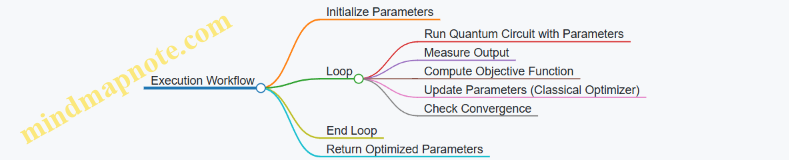
Example 1: Variational Quantum Eigensolver (VQE)
- Goal: Find the ground state energy of a molecule or Hamiltonian.
- Process:
- Define a parameterized ansatz circuit representing the quantum state.
- Measure the expectation value of the Hamiltonian.
- Use a classical optimizer to minimize this energy.
from qiskit import QuantumCircuit, Aer, execute
from qiskit.circuit import Parameter
from qiskit.algorithms.optimizers import COBYLA
import numpy as np

# Define a simple parameterized circuit
theta = Parameter('θ')
circ = QuantumCircuit(1)
circ.ry(theta, 0)

# Objective function: expectation value of Z
backend = Aer.get_backend('aer_simulator')

def objective_function(param_value):
    bound_circ = circ.bind_parameters({theta: param_value})
    bound_circ.save_expectation_value(operator='Z', qubits=[0])
    result = execute(bound_circ, backend).result()
    exp_val = result.data()['expectation_value']
    return exp_val

# Classical optimizer
optimizer = COBYLA(maxiter=100)

# Minimize expectation value
opt_result = optimizer.optimize(num_vars=1, objective_function=objective_function, initial_point=[0.0])
print(f"Optimized parameter: {opt_result[0]}, Minimum expectation value: {opt_result[1]}")
Example 2: Quantum Approximate Optimization Algorithm (QAOA)
- Goal: Solve combinatorial optimization problems like Max-Cut.
- Process:
- Construct a parameterized circuit alternating between problem and mixer Hamiltonians.
- Use classical optimization to find parameters that minimize the cost function.
Best Practices
- Start with Simple Ansatz: Begin with shallow circuits to reduce noise impact.
- Choose Appropriate Optimizers: Use optimizers robust to noise and stochastic measurements (e.g., SPSA).
- Batch Measurements: Collect multiple shots per circuit execution to improve statistical confidence.
- Monitor Convergence: Set thresholds and maximum iterations to avoid excessive runtime.
- Hybrid Debugging: Use classical simulation for initial testing before running on quantum hardware.
Summary
Hybrid quantum-classical algorithms represent a practical approach to harnessing quantum computing power today. By iteratively combining quantum circuit evaluations with classical optimization, engineers can tackle problems in chemistry, optimization, and machine learning despite hardware limitations.
For further reading and hands-on tutorials, consider exploring Qiskit’s VQE and QAOA examples.
9.2 Resource Estimation for Large-Scale Quantum Programs
Resource estimation is a critical step in designing and deploying large-scale quantum programs. It involves predicting the quantum and classical resources required to execute an algorithm effectively on quantum hardware. Proper estimation helps engineers optimize circuits, select suitable hardware, and anticipate challenges related to qubit counts, gate depth, error rates, and runtime.
Key Resources to Estimate
- Qubit Count: Number of physical and logical qubits needed.
- Gate Count and Types: Total number of quantum gates, including single-qubit and multi-qubit gates.
- Circuit Depth: The longest path of sequential gates, impacting decoherence.
- Error Rates: Expected noise and error accumulation.
- Classical Processing: Resources for hybrid algorithms requiring classical optimization.
Mind Map: Resource Estimation Components
Step-by-Step Resource Estimation Process
- Define the Quantum Algorithm and Problem Size
- Identify input parameters (e.g., number of qubits, problem dimensions).
- Decompose Algorithm into Quantum Circuits
- Break down into subroutines and gate sequences.
- Count Qubits
- Include ancilla qubits for intermediate computations and error correction.
- Calculate Gate Counts and Circuit Depth
- Use gate-level simulation or analytical models.
- Incorporate Error Correction Overhead
- Estimate logical-to-physical qubit ratio.
- Estimate Runtime and Classical Processing Needs
- For hybrid algorithms, estimate classical optimization iterations.
Mind Map: Resource Estimation Workflow
Example 1: Resource Estimation for Quantum Phase Estimation (QPE)
Problem: Estimate resources for QPE to find eigenvalues of a 5-qubit system.
-
Qubit Count:
- 5 qubits for the system register
- 5 qubits for the ancilla (control) register
- Total: 10 qubits
-
Gate Count:
- Controlled-unitary operations proportional to precision
- Approx. 100 controlled gates
-
Circuit Depth:
- Depth depends on the number of controlled operations and their decompositions
-
Error Correction:
- Assuming surface code with 1000 physical qubits per logical qubit
- Total physical qubits: 10,000
-
Classical Processing:
- Minimal, mostly for result interpretation
Example 2: Resource Estimation for Variational Quantum Eigensolver (VQE)
Problem: Estimate resources for VQE on a 6-qubit molecule simulation.
-
Qubit Count: 6 qubits (system) + 2 ancilla qubits for measurement = 8 qubits
-
Gate Count:
- Parameterized single- and two-qubit gates
- Approx. 200 gates per iteration
-
Circuit Depth:
- Moderate depth (~50 layers)
-
Error Correction:
- Near-term devices, error mitigation preferred over full correction
-
Classical Processing:
- Optimization loop with ~1000 iterations
-
Runtime Estimation:
- Quantum circuit execution time × number of iterations
Best Practices for Resource Estimation
- Use Analytical Models and Simulators: Combine theoretical gate counts with simulator profiling.
- Incorporate Hardware Constraints Early: Factor in connectivity, native gate sets, and error rates.
- Estimate Both Logical and Physical Resources: Account for error correction overhead.
- Iterate and Refine: Update estimates as algorithms and hardware evolve.
- Leverage Community Tools: Use resource estimation tools like Qiskit’s transpiler reports or Cirq’s resource estimators.
Mind Map: Best Practices Summary
Summary
Resource estimation is foundational for scaling quantum programs from theory to practice. By carefully analyzing qubit requirements, gate counts, circuit depth, and error correction overhead, engineers can design feasible quantum solutions and select appropriate hardware platforms. Integrating classical processing needs and iterative refinement ensures that large-scale quantum programs remain practical and efficient.
Additional Example: Mind Map for a Sample Quantum Algorithm Resource Estimation
This detailed approach equips engineers and developers with the knowledge to anticipate and plan for the demands of large-scale quantum computing projects.
9.3 Best Practices: Efficient Data Transfer Between Quantum and Classical Systems
Efficient data transfer between quantum and classical systems is a critical aspect of hybrid quantum-classical computing. Since current quantum devices are limited in qubit count and coherence time, many algorithms rely on classical processors to perform optimization, control, and post-processing tasks. Minimizing latency, maximizing throughput, and ensuring data integrity during these transfers are essential for practical quantum applications.
Key Considerations for Efficient Data Transfer
- Latency Minimization: Reduce the delay between quantum measurement and classical processing to maintain algorithmic coherence.
- Data Volume Management: Transfer only essential data to avoid bottlenecks, especially when dealing with large quantum circuits or repeated measurements.
- Synchronization: Ensure precise timing coordination between quantum operations and classical computations.
- Error Handling: Implement robust error detection and correction mechanisms during data transfer.
- Scalability: Design data pipelines that can scale with increasing qubit counts and measurement complexity.
Mind Map: Efficient Data Transfer Between Quantum and Classical Systems
Best Practices Explained
Minimize Latency with Real-Time Streaming
Use communication protocols and hardware interfaces that support real-time streaming of measurement results from the quantum processor to the classical controller. For example, FPGA-based controllers can process measurement data with microsecond latency, enabling faster feedback loops.
Transfer Only Essential Data
Instead of transferring raw measurement data for every qubit and every shot, aggregate results on the quantum control hardware or perform partial classical post-processing to reduce data volume. For example, send only the counts of measurement outcomes rather than the full bitstrings.
Synchronize Using Time-Stamping and Event Triggers
Implement precise time-stamping of quantum measurement events and use event-driven triggers to coordinate classical computations. This ensures that classical algorithms operate on the correct quantum data and maintain coherence in hybrid workflows.
Implement Robust Error Handling
Use checksums or cyclic redundancy checks (CRC) on transmitted data packets to detect corruption. In case of errors, design retransmission protocols or fallback procedures to maintain data integrity.
Design for Scalability
Architect data transfer pipelines modularly to handle increasing qubit counts. Employ parallel data channels and scalable communication buses to avoid bottlenecks as quantum systems grow.
Example 1: Aggregated Measurement Data Transfer in Qiskit
from qiskit import QuantumCircuit, execute, Aer

# Create a simple circuit
qc = QuantumCircuit(2, 2)
qc.h(0)
qc.cx(0, 1)
qc.measure([0,1], [0,1])

# Execute on simulator with 1024 shots
backend = Aer.get_backend('qasm_simulator')
job = execute(qc, backend=backend, shots=1024)
result = job.result()

# Instead of transferring all bitstrings, get counts (aggregated data)
counts = result.get_counts()
print("Aggregated measurement counts:", counts)
Explanation: Here, instead of transferring all raw measurement results, only aggregated counts are retrieved, reducing data volume and improving efficiency.
Example 2: Real-Time Feedback Loop Using Qiskit Pulse and Classical Processing
# Pseudocode illustrating real-time measurement and classical feedback

# 1. Prepare quantum circuit with measurement
# 2. Use Qiskit Pulse to capture measurement results
# 3. Send measurement results immediately to classical controller
# 4. Classical controller processes results and decides next quantum operation

# Note: Actual implementation requires hardware with real-time control capabilities.
Explanation: This example highlights the importance of low-latency data transfer to enable real-time adaptive quantum algorithms.
Mind Map: Data Transfer Workflow in Hybrid Quantum-Classical Systems
Summary
Efficient data transfer between quantum and classical systems is pivotal for the success of hybrid quantum algorithms. By minimizing latency, managing data volume, ensuring synchronization, handling errors, and designing scalable architectures, engineers can build robust quantum-classical interfaces that maximize the performance of near-term quantum devices.
Implementing these best practices with practical tools and frameworks such as Qiskit, Cirq, or hardware-specific SDKs will empower engineers and developers to harness the full potential of quantum computing in real-world applications.
9.4 Example: Implementing a Hybrid VQE Algorithm for Molecular Energy Estimation
Overview
The Variational Quantum Eigensolver (VQE) is a hybrid quantum-classical algorithm designed to estimate the ground state energy of a molecular system. It leverages a quantum processor to prepare parameterized quantum states and a classical optimizer to minimize the expected energy.
This example walks through implementing VQE to estimate the ground state energy of the Hydrogen molecule (H₂) using a hybrid approach.
Mind Map: VQE Algorithm Workflow
Step 1: Define the Molecular Hamiltonian
The first step is to represent the molecular system as a Hamiltonian operator. For H₂, this can be done using quantum chemistry packages like PySCF or OpenFermion.
from qiskit_nature.drivers import PySCFDriver
from qiskit_nature.problems.second_quantization.electronic import ElectronicStructureProblem

# Define molecule geometry and basis
molecule = 'H .0 .0 .0; H .0 .0 0.735'  # Bond length in Angstrom

# Initialize driver
driver = PySCFDriver(atom=molecule, unit='Angstrom', basis='sto3g')

# Create electronic structure problem
problem = ElectronicStructureProblem(driver)

# Get second quantized operators
second_q_ops = problem.second_q_ops()
hamiltonian = second_q_ops[0]
Step 2: Map Hamiltonian to Qubit Operators
Use a fermion-to-qubit mapping such as Jordan-Wigner or Parity mapping.
from qiskit_nature.converters.second_quantization import QubitConverter
from qiskit_nature.mappers.second_quantization import JordanWignerMapper

qubit_converter = QubitConverter(mapper=JordanWignerMapper())
qubit_op = qubit_converter.convert(hamiltonian)
Step 3: Construct the Ansatz Circuit
Choose a parameterized ansatz such as the UCCSD (Unitary Coupled Cluster Singles and Doubles) or a hardware-efficient ansatz.
from qiskit_nature.circuit.library import UCCSD
from qiskit.circuit.library import TwoLocal
from qiskit.algorithms.optimizers import COBYLA

# Example: Hardware-efficient ansatz
num_qubits = qubit_op.num_qubits
ansatz = TwoLocal(num_qubits, ['ry', 'rz'], 'cz', reps=3, parameter_prefix='θ')
Step 4: Set Up the VQE Algorithm
Combine the ansatz, qubit operator, and classical optimizer.
from qiskit.algorithms import VQE
from qiskit.utils import QuantumInstance
from qiskit import Aer

quantum_instance = QuantumInstance(backend=Aer.get_backend('aer_simulator_statevector'))
optimizer = COBYLA(maxiter=100)
vqe = VQE(ansatz=ansatz, optimizer=optimizer, quantum_instance=quantum_instance)

result = vqe.compute_minimum_eigenvalue(operator=qubit_op)
print(f'Estimated Ground State Energy: {result.eigenvalue.real:.6f} Ha')
Step 5: Interpret Results
The output energy approximates the ground state energy of the molecule. Compare with classical computational chemistry results for validation.
Mind Map: Hybrid VQE Algorithm Components
Best Practices Integrated in This Example
- Ansatz Selection: Choose an ansatz balancing expressibility and circuit depth to mitigate noise.
- Optimizer Choice: Use gradient-free optimizers initially to avoid noisy gradient estimation.
- Measurement Grouping: Group commuting Pauli terms to reduce measurement overhead (not shown here but recommended).
- Simulator vs Real Hardware: Start with simulators for debugging before deploying on noisy quantum devices.
Additional Example: Using Qiskit Nature’s Built-in VQE Workflow
from qiskit_nature.algorithms import GroundStateEigensolver
from qiskit_nature.algorithms import VQEUCCFactory
from qiskit.algorithms.optimizers import SLSQP
from qiskit.utils import QuantumInstance
from qiskit import Aer

# Setup quantum instance
quantum_instance = QuantumInstance(backend=Aer.get_backend('aer_simulator_statevector'))

# Setup optimizer
optimizer = SLSQP(maxiter=100)

# Setup VQE factory
vqe_solver = VQEUCCFactory(quantum_instance, optimizer=optimizer)

# Ground state solver
calc = GroundStateEigensolver(qubit_converter, vqe_solver)

# Compute ground state
result = calc.solve(problem)
print(f'Ground state energy: {result.total_energies[0].real:.6f} Ha')
Summary
This example demonstrated how to implement a hybrid VQE algorithm for molecular energy estimation, combining quantum circuit preparation and classical optimization. By following these steps and best practices, engineers and developers can effectively apply quantum computing to practical quantum chemistry problems.
10. Future Trends and Career Pathways in Quantum Engineering
10.1 Emerging Technologies in Quantum Computing
Quantum computing is a rapidly evolving field with new technologies and innovations emerging continuously. For engineers and developers aiming to stay at the forefront, understanding these emerging technologies is crucial. This section explores the latest advancements shaping the future of quantum computing, supported by clear examples and mind maps to visualize complex relationships.
Key Emerging Technologies
Quantum Hardware Innovations
Superconducting Qubits
Currently the most mature technology, superconducting qubits use Josephson junctions to create quantum states. Companies like IBM and Google are pioneering this technology.
Example: Google’s Sycamore processor demonstrated quantum supremacy by performing a specific task faster than classical supercomputers.
Trapped Ion Qubits
These use ions trapped by electromagnetic fields and manipulated with lasers. They offer high-fidelity gates and long coherence times.
Example: IonQ’s cloud-accessible quantum computers use trapped ions to execute quantum algorithms with impressive accuracy.
Topological Qubits
An emerging approach aiming for inherently error-resistant qubits by exploiting exotic quasiparticles called anyons.
Example: Microsoft is investing in topological qubits, though practical devices are still in early research stages.
Photonic Quantum Computing
Uses photons as qubits, enabling room-temperature operation and easy integration with communication systems.
Example: Xanadu’s photonic quantum processors leverage squeezed light states for quantum computations.
Neutral Atom Qubits
Neutral atoms trapped in optical lattices or tweezers provide scalable qubit arrays.
Example: QuEra Computing is developing neutral atom quantum processors with flexible qubit connectivity.
Quantum Software Advances
Quantum Error Correction (QEC)
QEC codes like surface codes are essential for fault-tolerant quantum computing.
Example: Implementing surface code error correction on superconducting qubits to extend coherence times.
Quantum Compiler Optimization
Advanced compilers optimize gate sequences to reduce circuit depth and noise impact.
Example: Qiskit’s transpiler optimizes circuits for specific hardware backends.
Hybrid Quantum-Classical Algorithms
Algorithms like VQE and QAOA combine classical optimization with quantum subroutines.
Example: Using VQE to estimate molecular ground state energies on near-term devices.
Quantum Machine Learning Frameworks
Frameworks such as PennyLane and TensorFlow Quantum enable integration of quantum circuits with classical ML.
Example: Training a quantum neural network for classification tasks using PennyLane.
Quantum Networking and Communication
Quantum Repeaters
Devices that extend the range of quantum communication by overcoming photon loss.
Quantum Key Distribution (QKD)
Provides provably secure communication using quantum principles.
Example: Commercial QKD systems deployed for secure government communications.
Quantum Internet Prototypes
Efforts to create interconnected quantum devices enabling distributed quantum computing.
Quantum Control and Calibration
AI-driven Calibration
Machine learning techniques optimize qubit control parameters dynamically.
Real-time Noise Mitigation
Adaptive algorithms that compensate for noise during computation.
Emerging Quantum Architectures
Modular Quantum Computing
Connecting multiple smaller quantum processors to scale up computational power.
Analog Quantum Simulators
Specialized devices that simulate quantum systems directly, useful for chemistry and materials science.
Example: Using analog simulators to model high-temperature superconductors.
Mind Map: Overview of Emerging Quantum Technologies
Mind Map: Emerging Quantum Technologies
Practical Example: Comparing Qubit Technologies
| Technology | Coherence Time | Gate Fidelity | Scalability | Operating Temperature |
|---|---|---|---|---|
| Superconducting | ~100 µs | ~99.9% | Medium | ~10 mK |
| Trapped Ion | Seconds | >99.9% | Low-Medium | Room Temperature |
| Topological (theoretical) | Potentially very high | Expected >99.9% | Unknown | TBD |
| Photonic | Long (photons) | High | High | Room Temperature |
| Neutral Atom | Seconds | High | High | Micro-Kelvin |
Engineers should select hardware based on application requirements, balancing coherence, fidelity, and scalability.
Summary
Emerging technologies in quantum computing span hardware, software, networking, and architectures. Staying informed about these developments enables engineers and developers to design better quantum solutions, optimize for current hardware, and prepare for future capabilities.
Next Steps: Explore hands-on tutorials with different qubit platforms and experiment with hybrid algorithms to deepen practical understanding.
10.2 Skills and Knowledge for Quantum Engineers and Developers
Quantum computing is a multidisciplinary field that requires a blend of skills from quantum physics, computer science, and engineering. To excel as a quantum engineer or developer, one must cultivate both theoretical understanding and practical expertise. This section outlines the essential skills and knowledge areas, supported by mind maps and examples to help you visualize and internalize the concepts.
Core Skill Areas Mind Map
Quantum Theory
Why it matters: Understanding the physical principles behind quantum computing enables engineers to design better algorithms and troubleshoot hardware-specific issues.
Key topics:
- Quantum states and qubits
- Superposition and entanglement
- Measurement and collapse
Example: Visualize a qubit on the Bloch sphere and explain how a Hadamard gate creates superposition.
from qiskit import QuantumCircuit
from qiskit.visualization import plot_bloch_multivector
from qiskit.quantum_info import Statevector

qc = QuantumCircuit(1)
qc.h(0)  # Apply Hadamard gate

state = Statevector.from_instruction(qc)
plot_bloch_multivector(state)
This example helps developers see the qubit state transformation, reinforcing theoretical knowledge with practical visualization.
Quantum Algorithms
Why it matters: Knowing when and how to apply quantum algorithms is critical for solving real-world problems.
Key topics:
- Algorithm design and complexity
- Variational algorithms for NISQ devices
Example: Implement Grover’s algorithm for a simple search problem.
from qiskit import QuantumCircuit, Aer, execute
from qiskit.circuit.library import GroverOperator

oracle = QuantumCircuit(2)
oracle.cz(0,1)  # Mark the |11> state

grover_op = GroverOperator(oracle)
qc = QuantumCircuit(2)
qc.h([0,1])
qc.append(grover_op, [0,1])
qc.measure_all()

simulator = Aer.get_backend('aer_simulator')
result = execute(qc, simulator, shots=1024).result()
counts = result.get_counts()
print(counts)
This example demonstrates the practical implementation of Grover’s algorithm, helping developers understand its structure and output.
Quantum Programming
Why it matters: Proficiency in quantum programming frameworks is essential to build, test, and run quantum circuits.
Key topics:
- SDKs: Qiskit, Cirq, Q#
- Circuit optimization
- Debugging techniques
Example: Modularize a quantum circuit for reuse.
from qiskit import QuantumCircuit

def create_bell_pair():
    qc = QuantumCircuit(2)
    qc.h(0)
    qc.cx(0, 1)
    return qc

bell_circuit = create_bell_pair()
bell_circuit.draw('mpl')
Modular functions like this improve code readability and reusability.
Classical Computing Foundations
Why it matters: Quantum computing builds on classical math and algorithms; strong foundations accelerate learning and implementation.
Key topics:
- Linear algebra (vectors, matrices, eigenvalues)
- Probability theory
- Classical algorithm design
Example: Calculate eigenvalues of a matrix representing a quantum operator.
import numpy as np

pauli_x = np.array([[0, 1], [1, 0]])
eigenvalues, eigenvectors = np.linalg.eig(pauli_x)
print('Eigenvalues:', eigenvalues)
Understanding eigenvalues is crucial for quantum measurement and operator analysis.
Hardware Knowledge
Why it matters: Awareness of hardware constraints guides algorithm and circuit design for optimal performance.
Key topics:
- Qubit types and coherence times
- Noise sources and mitigation
- Accessing hardware via cloud platforms
Example: Compare circuit execution results on simulator vs. real hardware.
from qiskit import IBMQ, transpile

IBMQ.load_account()
provider = IBMQ.get_provider(hub='ibm-q')
backend_sim = Aer.get_backend('aer_simulator')
backend_real = provider.get_backend('ibmq_lima')

qc = create_bell_pair()
qc.measure_all()

# Transpile for real backend
qc_real = transpile(qc, backend_real)

# Execute
job_sim = execute(qc, backend_sim, shots=1024)
job_real = execute(qc_real, backend_real, shots=1024)

print('Simulator results:', job_sim.result().get_counts())
print('Real hardware results:', job_real.result().get_counts())
This comparison highlights noise effects and the importance of hardware-aware design.
Software Engineering Practices
Why it matters: Writing maintainable, testable, and collaborative code accelerates project development and team productivity.
Key topics:
- Modular design
- Version control (Git)
- Documentation and testing
Example: Use Git to manage quantum project versions and collaborate.
# Initialize repository
$ git init

# Add files
$ git add quantum_circuit.py

# Commit changes
$ git commit -m "Add Bell state circuit"

# Push to remote repository
$ git remote add origin https://github.com/username/quantum-project.git
$ git push -u origin main
Problem Solving & Application
Why it matters: Applying quantum computing to real problems demonstrates value and deepens understanding.
Key topics:
- Quantum chemistry simulations
- Optimization problems
- Quantum machine learning
Example: Use VQE to estimate molecular ground state energy (conceptual snippet).
# Pseudocode for VQE workflow
# 1. Define Hamiltonian
# 2. Prepare parameterized ansatz circuit
# 3. Measure expectation value
# 4. Optimize parameters classically
Soft Skills
Why it matters: Continuous learning, communication, and community engagement keep you updated and connected.
Key topics:
- Following research papers and blogs
- Participating in forums and hackathons
- Presenting and documenting work
Example: Join the Qiskit Slack community or attend quantum computing webinars regularly.
Summary Mind Map: Skills Integration
By developing these skills and knowledge areas, engineers and developers position themselves to contribute effectively to the rapidly evolving quantum computing landscape.
10.3 Best Practices: Continuous Learning and Community Engagement
In the rapidly evolving field of quantum computing, continuous learning and active community engagement are essential for engineers and developers to stay ahead. This section explores best practices to foster ongoing education and meaningful participation in the quantum ecosystem.
Why Continuous Learning Matters
- Quantum computing is a multidisciplinary field combining physics, computer science, and engineering.
- New algorithms, hardware improvements, and software tools emerge frequently.
- Staying current ensures your skills remain relevant and enables you to contribute effectively.
Best Practices for Continuous Learning
-
Structured Learning Paths
- Follow curated courses and certifications from reputable platforms.
- Balance theoretical understanding with hands-on coding exercises.
-
Regular Reading and Research
- Subscribe to quantum computing journals, newsletters, and blogs.
- Read recent research papers and preprints on arXiv.
-
Hands-On Experimentation
- Use cloud-based quantum platforms (IBM Quantum, Amazon Braket, Google Quantum AI).
- Implement new algorithms and optimize circuits regularly.
-
Join Quantum Communities
- Participate in forums like Quantum Computing Stack Exchange, Reddit r/QuantumComputing.
- Engage in Slack/Discord groups dedicated to quantum technologies.
-
Attend Conferences and Workshops
- Virtual or in-person events provide networking and learning opportunities.
- Present your work or collaborate on projects.
-
Contribute to Open Source Projects
- Improve or build quantum software libraries.
- Review code and write documentation.
Mind Map: Continuous Learning Strategies
Mind Map: Community Engagement Channels
Examples
Example 1: Setting a Weekly Learning Routine
- Dedicate 3 hours per week to learning quantum computing.
- Monday: Read one recent research paper or blog post.
- Wednesday: Complete a tutorial or coding exercise on Qiskit or Cirq.
- Friday: Participate in a community discussion or answer questions on Stack Exchange.
Example 2: Engaging in a Quantum Hackathon
- Join a hackathon like IBM Quantum Challenge.
- Collaborate with peers to develop a quantum algorithm.
- Share your solution and learn from others’ approaches.
Example 3: Contributing to an Open Source Quantum Library
- Identify an open issue in Qiskit’s GitHub repository.
- Submit a pull request fixing a bug or adding a feature.
- Engage with maintainers and incorporate feedback.
Summary
Continuous learning combined with active community engagement accelerates your growth as a quantum engineer. By following structured learning paths, staying updated with research, practicing hands-on, and contributing to communities, you build expertise and foster connections that open new opportunities.
10.4 Example: Building a Quantum Computing Portfolio with Practical Projects
Building a strong quantum computing portfolio is essential for engineers and developers aiming to demonstrate their skills, attract potential employers, or contribute meaningfully to the quantum community. This section guides you through structuring your portfolio with practical projects, showcasing best practices, and leveraging mind maps to organize your learning and project development.
Why Build a Quantum Computing Portfolio?
- Demonstrate Practical Skills: Show your ability to implement quantum algorithms and work with quantum hardware or simulators.
- Document Your Learning Journey: Track your progress and reflect on challenges and solutions.
- Attract Opportunities: A well-crafted portfolio can open doors to internships, jobs, or collaborations.
Key Components of a Quantum Computing Portfolio
Step 1: Select Diverse Projects
Choose projects that cover a range of quantum computing aspects:
- Fundamental Algorithms: Implement Grover’s and Shor’s algorithms to demonstrate understanding of quantum speedups.
- Variational Algorithms: Build VQE or QAOA circuits to solve chemistry or optimization problems.
- Quantum Circuits: Create circuits for teleportation, entanglement, or error correction.
- Applications: Apply quantum computing to real-world problems like portfolio optimization or machine learning.
Step 2: Use Popular Quantum SDKs
Leverage frameworks such as Qiskit, Cirq, or Q# to develop your projects. This shows familiarity with industry-standard tools.
Example snippet in Qiskit (Grover’s Algorithm):
from qiskit import QuantumCircuit, Aer, execute
from qiskit.visualization import plot_histogram

# Create Grover circuit for 2 qubits
qc = QuantumCircuit(2, 2)
qc.h([0,1])  # Initialize in superposition
qc.cz(0,1) # Oracle for |11>
qc.h([0,1])  # Diffusion operator
qc.measure([0,1], [0,1])

simulator = Aer.get_backend('qasm_simulator')
result = execute(qc, simulator, shots=1024).result()
counts = result.get_counts()
print(counts)
Step 3: Document Thoroughly
- Write clear README files explaining project goals, methods, and results.
- Include code comments and usage instructions.
- Add visualizations such as circuit diagrams and result histograms.
Step 4: Showcase Hardware Execution
Whenever possible, run your circuits on real quantum hardware (e.g., IBM Quantum Experience) and include results and discussions on noise and error mitigation.
Example:
- Run a teleportation circuit on IBM Q and compare simulator vs hardware results.
Step 5: Contribute to the Community
- Publish blog posts explaining your projects.
- Share code on GitHub with open source licenses.
- Participate in quantum hackathons or forums.
Mind Map: Project Development Workflow
Example Project Outline: Portfolio Optimization Using QAOA
- Objective: Use QAOA to solve a simplified portfolio optimization problem.
- Tools: Qiskit, IBM Quantum hardware.
- Steps:
- Model the problem as a combinatorial optimization.
- Construct the QAOA circuit.
- Run simulations to tune parameters.
- Execute on real hardware.
- Analyze results and compare with classical solutions.
- Documentation: Detailed README, circuit diagrams, result plots.
Final Tips
- Keep projects modular and reusable.
- Regularly update your portfolio with new projects and learnings.
- Engage with the quantum community for feedback and collaboration.
By following these guidelines and examples, you will build a compelling quantum computing portfolio that highlights your engineering skills and practical experience.
11. Appendix and Resources
11.1 Glossary of Quantum Computing Terms
Understanding quantum computing requires familiarity with a set of specialized terms. This glossary provides clear definitions, mind maps, and examples to help engineers, developers, and graduate students build a solid foundation.
Key Terms and Definitions
Qubit
- Definition: The fundamental unit of quantum information, analogous to a classical bit but can exist in a superposition of 0 and 1 states.
Example: A qubit can be in state |0⟩, |1⟩, or any linear combination α|0⟩ + β|1⟩ where |α|² + |β|² = 1.
Superposition
- Definition: A quantum system’s ability to be in multiple states simultaneously until measured.
Example: A qubit in superposition: (|0⟩ + |1⟩)/√2 has equal probability of being measured as 0 or 1.
Entanglement
- Definition: A quantum phenomenon where qubits become interconnected such that the state of one instantly influences the state of another, regardless of distance.
Example: The Bell state |Φ+⟩ = (|00⟩ + |11⟩)/√2 is an entangled state of two qubits.
Quantum Gate
- Definition: The quantum equivalent of a classical logic gate, performing operations on qubits.
Example: The Hadamard gate transforms |0⟩ into (|0⟩ + |1⟩)/√2, creating superposition.
Measurement
- Definition: The process of observing a qubit, causing its wavefunction to collapse to a definite classical state.
Example: Measuring a qubit in state (|0⟩ + |1⟩)/√2 yields 0 or 1 with 50% probability each.
Decoherence
- Definition: The loss of quantum coherence due to interaction with the environment, causing qubits to behave classically.
Example: A qubit exposed to electromagnetic noise may lose its superposition state over time.
Quantum Circuit
- Definition: A sequence of quantum gates applied to qubits to perform computation.
Example: A circuit that creates a Bell state uses a Hadamard gate followed by a CNOT gate.
Noisy Intermediate-Scale Quantum (NISQ)
- Definition: Current generation quantum devices with limited qubits and noise, not yet capable of full error correction.
Example: IBM Quantum Experience devices are NISQ machines used for experimentation.
Variational Quantum Eigensolver (VQE)
- Definition: A hybrid quantum-classical algorithm to estimate ground state energies of molecules.
Example: Using VQE to approximate the energy of a hydrogen molecule (H₂).
Quantum Supremacy
- Definition: The point at which a quantum computer performs a task infeasible for classical computers.
Example: Google’s 2019 experiment performing a sampling task in 200 seconds that would take classical supercomputers thousands of years.
Bloch Sphere
- Definition: A geometrical representation of a qubit’s pure state as a point on the surface of a sphere.
Example: The |0⟩ state is represented at the north pole, |1⟩ at the south pole of the Bloch sphere.
Summary
This glossary equips you with essential quantum computing terminology, supported by visual mind maps and practical examples. Use this as a quick reference to deepen your understanding and aid in your quantum programming and engineering tasks.
11.2 Recommended Reading and Online Courses
To build a strong foundation and advance your expertise in quantum computing, it is essential to engage with high-quality reading materials and structured online courses. Below, we provide curated recommendations along with mind maps to help you visualize the learning paths and key concepts.
Recommended Books
-
Quantum Computation and Quantum Information by Michael A. Nielsen and Isaac L. Chuang
- The definitive textbook covering quantum computing theory, algorithms, and error correction.
- Suitable for engineers and graduate students seeking deep theoretical understanding.
-
Quantum Computing: A Gentle Introduction by Eleanor Rieffel and Wolfgang Polak
- An accessible introduction with practical examples and clear explanations.
-
Programming Quantum Computers: Essential Algorithms and Code Samples by Eric R. Johnston, Nic Harrigan, and Mercedes Gimeno-Segovia
- Focuses on programming quantum computers with hands-on examples.
-
Quantum Mechanics for Scientists and Engineers by David A. B. Miller
- Provides the quantum mechanics background tailored for engineers.
-
Classical and Quantum Computation by Alexei Yu. Kitaev, Alexander Shen, and Mikhail N. Vyalyi
- Covers computational complexity and quantum algorithms.
Recommended Online Courses
| Course Title | Platform | Level | Description |
|---|---|---|---|
| Quantum Computing for Everyone | edX (MIT) | Beginner | Introduces quantum computing concepts with minimal prerequisites. |
| Quantum Computation | Coursera (University of Maryland) | Intermediate | Covers quantum algorithms and theory with practical coding exercises. |
| Quantum Machine Learning | Coursera (University of Toronto) | Advanced | Explores quantum algorithms applied to machine learning tasks. |
| Introduction to Quantum Computing | IBM Qiskit | Beginner to Intermediate | Hands-on programming with Qiskit SDK and quantum circuit design. |
| Quantum Cryptography | edX (TU Delft) | Intermediate | Focuses on quantum cryptographic protocols and security. |
Mind Maps
Mind Map 1: Quantum Computing Learning Path
Mind Map 2: Recommended Reading Categorized
Mind Map 3: Online Course Focus Areas
Examples
Example 1: Using “Quantum Computation and Quantum Information” to Understand Grover’s Algorithm
- Start by reading Chapter 6 on quantum algorithms.
- Follow the step-by-step derivation of Grover’s search algorithm.
- Implement the algorithm using Qiskit, referencing the code snippets in the book.
- Experiment with different oracle functions to solidify understanding.
Example 2: Hands-On Learning with IBM Qiskit’s Online Course
- Enroll in the Introduction to Quantum Computing course.
- Complete the guided tutorials to build and run quantum circuits.
- Use the IBM Quantum Experience platform to run circuits on real quantum hardware.
- Apply best practices from this blog to optimize your circuits and interpret results.
Best Practices for Leveraging Reading and Courses
- Combine theoretical study with hands-on programming to reinforce concepts.
- Use mind maps to organize and connect new knowledge areas.
- Join quantum computing communities (e.g., Qiskit Slack, Stack Exchange) to discuss and clarify doubts.
- Regularly revisit foundational topics as you progress to advanced material.
- Document your learning and projects to build a portfolio.
By following these reading and course recommendations, and utilizing the mind maps and examples, engineers and developers can systematically build practical quantum computing skills aligned with industry and research demands.
11.3 Open Source Quantum Projects and Libraries
Open source projects and libraries are invaluable resources for engineers and developers diving into quantum computing. They provide ready-to-use tools, frameworks, and community-driven innovations that accelerate learning and development. This section explores some of the most prominent open source quantum computing projects, their core features, and practical examples to help you get started.
Mind Map: Overview of Open Source Quantum Projects
Qiskit
Overview: Qiskit is an open source quantum computing framework developed by IBM. It provides tools for creating, simulating, and running quantum circuits on real quantum hardware.
Key Features:
- Modular design with Terra (circuit building), Aer (simulation), Ignis (error mitigation), and Aqua (algorithms).
- Access to IBM Quantum devices via cloud.
- Extensive tutorials and documentation.
Example: Creating and Simulating a Simple Quantum Circuit
from qiskit import QuantumCircuit, Aer, execute

# Create a Quantum Circuit with 1 qubit and 1 classical bit
qc = QuantumCircuit(1, 1)

# Apply Hadamard gate to create superposition
qc.h(0)

# Measure the qubit
qc.measure(0, 0)

# Use Aer's qasm_simulator
simulator = Aer.get_backend('qasm_simulator')

# Execute the circuit on the simulator
job = execute(qc, simulator, shots=1024)
result = job.result()
counts = result.get_counts(qc)
print(f"Measurement results: {counts}")
Cirq
Overview: Cirq is a Python library developed by Google for designing, simulating, and running quantum circuits, especially focused on near-term quantum computers.
Key Features:
- Fine-grained control over quantum gates and noise models.
- Integration with Google Quantum Engine.
- Supports parameterized circuits.
Example: Creating a Bell State with Cirq
import cirq

# Define two qubits
qubit0, qubit1 = cirq.LineQubit.range(2)

# Create a circuit
circuit = cirq.Circuit()

# Apply Hadamard gate on qubit0
circuit.append(cirq.H(qubit0))

# Apply CNOT gate
circuit.append(cirq.CNOT(qubit0, qubit1))

# Measure both qubits
circuit.append(cirq.measure(qubit0, qubit1, key='result'))

print("Circuit:")
print(circuit)

# Simulate the circuit
simulator = cirq.Simulator()
result = simulator.run(circuit, repetitions=10)
print("Measurement results:")
print(result)
PennyLane
Overview: PennyLane is a cross-platform Python library for differentiable programming of quantum computers. It integrates quantum computing with machine learning frameworks like PyTorch and TensorFlow.
Key Features:
- Supports hybrid quantum-classical computations.
- Compatible with multiple quantum hardware backends.
- Automatic differentiation for quantum circuits.
Example: Variational Quantum Circuit for a Simple Classifier
import pennylane as qml
from pennylane import numpy as np

# Define a 1-qubit device
dev = qml.device('default.qubit', wires=1)

@qml.qnode(dev)
def circuit(weights, x):
    qml.RX(x, wires=0)
    qml.RY(weights[0], wires=0)
    return qml.expval(qml.PauliZ(0))

# Example input and weights
x = np.pi / 4
weights = np.array([0.5], requires_grad=True)

print(f"Circuit output: {circuit(weights, x)}")
OpenFermion
Overview: OpenFermion is an open source library for compiling and analyzing quantum algorithms that simulate fermionic systems, primarily used in quantum chemistry.
Key Features:
- Tools for mapping fermionic operators to qubit operators.
- Integration with quantum SDKs like Cirq and Qiskit.
Example: Mapping a Simple Fermionic Hamiltonian
from openfermion.ops import FermionOperator
from openfermion.transforms import jordan_wigner

# Define a fermionic operator
ferm_op = FermionOperator('1^ 0')  # Creation on qubit 1, annihilation on qubit 0

# Map to qubit operator using Jordan-Wigner transform
qubit_op = jordan_wigner(ferm_op)
print(qubit_op)
Forest (pyQuil)
Overview: Forest is Rigetti Computing’s quantum programming toolkit, with pyQuil as its Python library for constructing and running quantum programs.
Key Features:
- Access to Rigetti’s quantum processors.
- Quil language for quantum instructions.
- Quantum virtual machine (QVM) simulator.
Example: Creating a Quantum Circuit with pyQuil
from pyquil import Program, get_qc
from pyquil.gates import H, CNOT

# Create a quantum program
p = Program()

# Apply Hadamard gate on qubit 0
p += H(0)

# Apply CNOT gate with control qubit 0 and target qubit 1
p += CNOT(0, 1)

# Get a quantum computer simulator
qc = get_qc('2q-qvm')

# Run the program
result = qc.run_and_measure(p, trials=10)
print(result)
Tips for Engaging with Open Source Quantum Projects
- Explore Documentation and Tutorials: Most projects have extensive guides and example notebooks.
- Contribute to Projects: Fix bugs, add features, or improve documentation to deepen your understanding.
- Join Community Forums: Engage with developers and users on GitHub, Slack, or Discord.
- Experiment with Examples: Modify example codes to fit your use cases and learn by doing.
By leveraging these open source projects and libraries, engineers can rapidly prototype, simulate, and deploy quantum algorithms, bridging the gap between theory and practical quantum computing applications.
11.4 Best Practices: Staying Updated with Quantum Computing Research
Staying current with the fast-evolving field of quantum computing is essential for engineers, developers, and graduate students aiming to build practical skills and contribute meaningfully. This section outlines effective strategies and tools to keep you informed and engaged with the latest research, breakthroughs, and community developments.
Why Staying Updated Matters
- Quantum computing is a rapidly advancing field with new algorithms, hardware improvements, and software tools emerging frequently.
- Being informed helps you adopt best practices early, avoid outdated methods, and identify new application opportunities.
- Networking with researchers and practitioners accelerates learning and collaboration.
Best Practices for Staying Updated
Follow Key Research Journals and Preprint Servers
- arXiv.org (quant-ph section): Primary source for preprints in quantum physics and computing.
- Physical Review Letters, Nature Quantum Information, Quantum: Peer-reviewed journals publishing cutting-edge research.
Subscribe to Newsletters and Blogs
- Quantum Computing Report: Weekly updates on industry news and research.
- Qiskit Blog: IBM’s official blog with tutorials and research highlights.
- Quantum Zeitgeist: Curated newsletter with research summaries and events.
Engage with Conferences and Workshops
- Attend or watch recordings of major conferences such as QIP, APS March Meeting, IEEE Quantum Week.
- Participate in workshops and hackathons to gain hands-on experience and network.
Join Online Communities and Forums
- Quantum Computing Stack Exchange: Q&A platform for technical questions.
- Reddit r/QuantumComputing: Discussions on news, research, and career advice.
- Slack/Discord groups: Many quantum SDKs and research groups maintain active chat communities.
Leverage Social Media and Research Aggregators
- Follow leading researchers and institutions on Twitter and LinkedIn.
- Use tools like ResearchGate and Google Scholar Alerts to track papers by topic or author.
Continuous Learning Through Courses and Tutorials
- Platforms like Coursera, edX, and MIT OpenCourseWare regularly update quantum computing courses.
- Follow hands-on tutorials from SDK providers (Qiskit, Cirq, PennyLane).
Mind Maps
Mind Map 1: Sources to Stay Updated
Mind Map 2: Engagement Strategies
Examples
Example 1: Setting Up a Weekly Quantum Research Routine
- Monday: Scan arXiv quant-ph new submissions; bookmark interesting papers.
- Wednesday: Read and summarize 1–2 papers; note key insights.
- Friday: Engage with community forums; discuss findings or ask questions.
- Weekend: Watch recorded talks from recent conferences or complete a tutorial.
Example 2: Using Google Scholar Alerts
- Create alerts for keywords like “quantum error correction,” “variational quantum algorithms,” or “quantum hardware improvements.”
- Receive weekly emails summarizing new publications matching your interests.
- Quickly identify relevant papers and add them to your reading list.
Example 3: Participating in a Quantum Hackathon
- Join events like the IBM Quantum Challenge or Qiskit Global Summer School hackathons.
- Collaborate with peers to implement novel quantum algorithms or applications.
- Gain exposure to real-world problems and receive feedback from experts.
Summary
Maintaining an up-to-date knowledge base in quantum computing requires a blend of structured reading, active community participation, and hands-on experimentation. By integrating these best practices into your routine, you will be well-positioned to leverage emerging technologies and contribute to the field’s growth.
11.5 Example: Contributing to an Open Source Quantum Computing Project
Contributing to open source projects is an excellent way to deepen your understanding of quantum computing, collaborate with the community, and build a strong portfolio. This section guides you through the practical steps of contributing to an open source quantum computing project, illustrated with mind maps and examples.
Why Contribute to Open Source Quantum Projects?
- Gain hands-on experience with real quantum software
- Collaborate with experts and peers
- Improve coding and quantum algorithm skills
- Build a public portfolio demonstrating your expertise
Step 1: Finding the Right Project
Mind Map: Finding a Quantum Open Source Project
Example:
- Visit Qiskit GitHub to explore repositories.
- Look for issues labeled
good first issueorhelp wanted.
Step 2: Setting Up Your Development Environment
Mind Map: Development Environment Setup
Example:
# Clone Qiskit Terra repository
git clone https://github.com/Qiskit/qiskit-terra.git
cd qiskit-terra
# Create virtual environment
python3 -m venv venv
source venv/bin/activate
# Install dependencies
pip install -r requirements.txt
# Run tests
pytest
Step 3: Understanding the Codebase
Mind Map: Understanding Project Structure
Example:
- Read the
CONTRIBUTING.mdfile to understand coding standards and submission process. - Explore a simple module, e.g.,
qiskit/circuit/library/for quantum gates.
Step 4: Selecting an Issue and Making Changes
Mind Map: Contribution Workflow

Example:
- Fork the repo on GitHub.
- Create a branch:
git checkout -b fix-gate-optimization
- Modify code to optimize a quantum gate implementation.
- Add a test case in
/testfolder. - Commit and push:
git add .
git commit -m "Optimize Hadamard gate implementation for performance"
git push origin fix-gate-optimization
- Open a PR with a descriptive title and detailed description.
Step 5: Engaging with the Community
Mind Map: Community Engagement
Example:
- Join the Qiskit Slack workspace.
- Comment on issues or PRs to ask questions or offer help.
Additional Tips and Best Practices
- Start with documentation or small bug fixes to familiarize yourself.
- Write clear, concise commit messages.
- Follow the project’s coding style and guidelines.
- Test your changes thoroughly.
- Be patient and open to feedback during code reviews.
Summary Mind Map: Contributing to Quantum Open Source Projects
By following these steps and leveraging community resources, engineers and developers can effectively contribute to quantum computing projects, accelerating both personal growth and the advancement of the field.