Climate Fiction Starter Pack: Writing Compelling Cli-Fi
1. Understanding Climate Fiction: Foundations and Context
1.1 What is Climate Fiction? Defining Cli-Fi with Examples
Climate Fiction, commonly abbreviated as Cli-Fi, is a genre of speculative fiction that explores the impacts of climate change and global warming on individuals, societies, and the planet. Unlike traditional science fiction that may focus on futuristic technology or space exploration, Cli-Fi centers on environmental transformations and their social, political, and personal consequences.
Defining Cli-Fi: Core Elements
- Focus on Climate Change: Central to the narrative is the theme of climate change, whether through rising sea levels, extreme weather, or ecological collapse.
- Speculative but Plausible: While often set in the near or distant future, the scenarios are grounded in scientific research and plausible projections.
- Human and Environmental Interactions: Explores how humans adapt, resist, or succumb to environmental changes.
- Moral and Ethical Questions: Raises dilemmas about responsibility, survival, and stewardship of the Earth.
Mind Map: What is Climate Fiction?
Examples of Climate Fiction
-
“The Water Knife” by Paolo Bacigalupi
- Set in a near-future American Southwest ravaged by drought.
- Explores water scarcity, corporate control, and survival.
- Example of a gritty, realistic portrayal of climate-induced resource wars.
-
“Flight Behavior” by Barbara Kingsolver
- Focuses on a rural community experiencing a mysterious butterfly migration due to climate shifts.
- Blends personal drama with ecological change.
- Highlights the intersection of science and everyday life.
-
“New York 2140” by Kim Stanley Robinson
- Imagines a partially submerged New York City due to sea-level rise.
- Explores economic and social adaptations in a flooded world.
- Uses multiple perspectives to show systemic change.
-
“Parable of the Sower” by Octavia E. Butler
- Though written before climate change was a mainstream concern, it depicts societal collapse driven by environmental and economic factors.
- Focuses on resilience and community building.
Mind Map: Examples of Cli-Fi Themes in Literature
Why Cli-Fi is Important for Writers
- Engages with urgent global issues: Writing Cli-Fi allows authors to explore real-world problems through compelling storytelling.
- Educates and inspires readers: By embedding scientific facts in narrative, readers gain awareness and empathy.
- Expands speculative fiction boundaries: Cli-Fi blends realism with imagination, offering fresh narrative possibilities.
Summary
Climate Fiction is a vital and evolving genre that uses storytelling to grapple with the realities and possibilities of climate change. By understanding its core elements and studying exemplary works, authors can craft narratives that are both compelling and socially relevant.
Next up: 1.2 Historical Evolution of Cli-Fi: From Early Works to Modern Narratives
1.2 Historical Evolution of Cli-Fi: From Early Works to Modern Narratives
Climate fiction, or Cli-Fi, is a genre that has evolved significantly over the decades, reflecting changing societal awareness and scientific understanding of climate change. This section explores the historical trajectory of Cli-Fi, highlighting key milestones, seminal works, and how the genre has matured into a powerful storytelling tool.
Early Roots: Precursors to Cli-Fi
Though the term “Cli-Fi” is relatively new, stories exploring environmental change and human impact on nature have existed for over a century.
- Mary Shelley’s “The Last Man” (1826): Often cited as an early example of apocalyptic fiction, it explores themes of societal collapse, which resonate with modern Cli-Fi concerns.
- H.G. Wells’ “The Time Machine” (1895): Depicts a future Earth transformed by environmental and social decay.
These early works laid the groundwork by imagining futures shaped by human actions, though climate change as a scientific concept was not yet central.
Mid-20th Century: Environmental Awareness Emerges
The rise of environmentalism in the mid-1900s influenced speculative fiction.
- Rachel Carson’s “Silent Spring” (1962): Though nonfiction, it inspired fiction writers by highlighting ecological damage.
- J.G. Ballard’s “The Drowned World” (1962): A post-apocalyptic novel where global warming causes flooding and societal collapse.
This period marks the beginning of more direct engagement with environmental themes in fiction.
Late 20th Century: The Birth of Cli-Fi as a Recognized Genre
As climate science advanced, fiction began to explicitly address climate change.
- Kim Stanley Robinson’s “Science in the Capital” trilogy (2004–2007): Focuses on political and scientific responses to climate crises.
- Margaret Atwood’s “Oryx and Crake” (2003): Explores genetic engineering and environmental degradation.
These works combine rigorous scientific speculation with narrative depth, defining modern Cli-Fi.
21st Century: Diversification and Mainstreaming
Cli-Fi has expanded in scope, style, and audience.
- Paolo Bacigalupi’s “The Water Knife” (2015): A gritty thriller about water scarcity in the American Southwest.
- Barbara Kingsolver’s “Flight Behavior” (2012): Focuses on ecological disruption and personal transformation.
- Kim Stanley Robinson’s “New York 2140” (2017): Imagines a flooded New York City adapting to climate change.
The genre now includes dystopian, hopeful, thriller, and literary narratives.
Mind Map: Evolution of Climate Fiction
Example Analysis: J.G. Ballard’s “The Drowned World”
- Plot Summary: Set in a future where solar radiation has melted the polar ice caps, flooding much of the Earth.
- Cli-Fi Elements: Environmental catastrophe, human adaptation, psychological effects of climate change.
- Best Practice Highlight: Ballard uses vivid sensory descriptions to immerse readers in a transformed world, demonstrating how to integrate setting and theme effectively.
Example Analysis: Paolo Bacigalupi’s “The Water Knife”
- Plot Summary: A near-future thriller centered on water scarcity in the American Southwest.
- Cli-Fi Elements: Resource conflict, political intrigue, social inequality.
- Best Practice Highlight: Bacigalupi grounds his speculative scenario in current scientific concerns, showing how to build believable, urgent stakes.
Summary
Understanding the historical evolution of Cli-Fi helps writers appreciate the genre’s depth and potential. From early speculative tales to nuanced modern narratives, Cli-Fi continues to evolve, reflecting and shaping our collective response to climate change.
1.3 The Role of Science and Speculation in Cli-Fi
Climate fiction (Cli-Fi) uniquely blends scientific fact with imaginative speculation to explore possible futures shaped by climate change. This fusion is essential for crafting stories that are both believable and thought-provoking, allowing authors to engage readers emotionally while grounding narratives in plausible realities.
Understanding the Balance: Science vs. Speculation
Cli-Fi operates on a spectrum where hard science anchors the story’s foundation, and speculation expands the narrative into unexplored possibilities. This balance ensures that while the story remains credible, it also pushes boundaries to explore ethical, social, and environmental questions.
Mind Map: Science and Speculation in Cli-Fi
Examples of Science in Cli-Fi
-
Accurate Climate Models: Using current climate projections to depict rising sea levels or increased storm frequency. For instance, Kim Stanley Robinson’s New York 2140 uses realistic flooding scenarios based on scientific data.
-
Technological Innovations: Incorporating emerging technologies like carbon capture or geoengineering. In Paolo Bacigalupi’s The Water Knife, water scarcity is a scientifically grounded issue, influencing societal collapse.
-
Ecological Impacts: Depicting species migration or extinction grounded in ecological studies, such as in Margaret Atwood’s MaddAddam trilogy.
Examples of Speculation in Cli-Fi
-
Extrapolated Futures: Imagining how societies might evolve politically or culturally in response to climate crises, such as authoritarian regimes or eco-utopias.
-
Fictional Technologies: Creating plausible but currently non-existent tech, like advanced climate engineering or synthetic ecosystems.
-
Human Behavior: Speculating on psychological and social responses to climate stress, including migration, conflict, or cooperation.
Mind Map: Speculative Elements in Cli-Fi
Integrating Science and Speculation: Best Practices
-
Ground Speculation in Current Science: Use existing scientific knowledge as a springboard for imagining future developments.
-
Maintain Internal Consistency: Even speculative elements should follow logical rules within the story’s universe.
-
Use Speculation to Explore Themes: Let imagined scenarios highlight ethical, social, or emotional dimensions of climate change.
-
Avoid Overloading with Jargon: Explain scientific concepts through character interactions or narrative context to keep readers engaged.
Example: Speculative Scenario Rooted in Science
In a story set fifty years from now, rising temperatures have made large parts of the Earth uninhabitable. Scientists develop a geoengineering project to inject aerosols into the atmosphere to reflect sunlight. The project succeeds but causes unexpected shifts in weather patterns, leading to droughts in some regions and floods in others. The narrative explores the ethical dilemmas faced by policymakers and the human cost of technological intervention.
This example shows how a scientifically plausible technology (geoengineering) is used as a speculative plot device to explore complex social and ethical issues.
Summary
The role of science and speculation in Cli-Fi is to create a believable yet imaginative framework that encourages readers to think critically about climate change. By weaving factual science with creative speculation, authors can craft compelling narratives that resonate emotionally and intellectually.
1.4 Why Cli-Fi Matters: Social, Environmental, and Literary Impact
Climate fiction, or Cli-Fi, is more than just a genre; it is a vital narrative tool that reflects and influences how society perceives and responds to climate change. This section explores why Cli-Fi holds significant importance across social, environmental, and literary dimensions.
Social Impact
Cli-Fi stories engage readers emotionally and intellectually, fostering awareness and empathy around climate issues. They often:
- Raise Awareness: By dramatizing climate scenarios, Cli-Fi brings abstract scientific data to life.
- Influence Public Opinion: Stories can shift perceptions, encouraging pro-environmental attitudes.
- Inspire Action: Characters’ struggles and triumphs motivate readers to participate in climate activism.
Example: In Kim Stanley Robinson’s New York 2140, the flooded city setting and its resilient inhabitants highlight social inequalities exacerbated by climate change, prompting readers to consider real-world policy and community responses.
Environmental Impact
Though fictional, Cli-Fi often incorporates accurate climate science, making it a bridge between scientific communities and the public. It:
- Educates on Environmental Processes: Explains complex phenomena like carbon cycles, sea-level rise, or ecosystem collapse.
- Explores Consequences: Shows potential outcomes of inaction or mitigation.
- Highlights Interconnectedness: Demonstrates how human actions affect natural systems.
Example: Margaret Atwood’s MaddAddam trilogy weaves genetic engineering and environmental degradation into a cautionary tale, illustrating the delicate balance of ecosystems.
Literary Impact
Cli-Fi enriches the literary landscape by blending speculative fiction with urgent real-world themes. It:
- Expands Genre Boundaries: Merges science fiction, dystopian, thriller, and literary fiction.
- Encourages Innovation: Writers experiment with narrative structures to depict complex timelines and systems.
- Fosters Diverse Voices: Amplifies marginalized perspectives affected by climate change.
Example: Octavia E. Butler’s Parable of the Sower combines dystopian elements with social critique, pioneering a voice for climate refugees and systemic collapse.
Integrated Example: Why Cli-Fi Matters
Consider a story where a coastal town faces rising sea levels. The narrative:
- Raises social questions about displacement and inequality.
- Educates readers on the science of sea-level rise.
- Uses innovative narrative techniques like dual timelines (past and future).
This integration exemplifies how Cli-Fi can simultaneously inform, move, and innovate.
Summary
Cli-Fi matters because it connects readers to climate change on multiple levels. It informs and inspires socially, educates environmentally, and pushes literary boundaries, making it a powerful genre for our times.
1.5 Balancing Fact and Fiction: Using Real Climate Science Effectively
Writing climate fiction requires a delicate balance between scientific accuracy and creative storytelling. The goal is to ground your narrative in real climate science without overwhelming readers with technical jargon or turning your story into a didactic lecture. Here’s how to effectively weave fact and fiction together.
Why Balance Matters
- Credibility: Accurate science lends authenticity to your story, making the stakes feel real.
- Engagement: Fictional elements keep readers emotionally invested and entertained.
- Accessibility: Simplifying complex science ensures your story is approachable for a broad audience.
Mind Map: Balancing Fact and Fiction in Cli-Fi
Best Practices with Examples
-
Research Thoroughly but Selectively
- Example: Instead of explaining the entire carbon cycle, focus on how rising CO2 levels affect a character’s hometown, such as increased heatwaves or crop failures.
-
Integrate Science into the Story, Not as an Aside
- Example: A scientist character explains melting glaciers during a tense mission, making the information part of the plot rather than a separate lecture.
-
Use Metaphors and Analogies
- Example: Describe the atmosphere as a “blanket” trapping heat, which helps readers visualize the greenhouse effect without complex terminology.
-
Show Impacts Through Characters’ Experiences
- Example: Instead of stating “sea levels are rising,” show a family forced to abandon their coastal home after repeated flooding.
-
Allow for Speculation but Ground It in Science
- Example: Imagine a future technology for carbon capture; base it on current experimental methods but extrapolate its capabilities creatively.
-
Avoid Info Dumps
- Example: Break scientific explanations into dialogue snippets or internal thoughts rather than long paragraphs.
-
Consult Experts or Sensitivity Readers
- Example: Before finalizing your manuscript, have a climate scientist review sections involving technical details to ensure accuracy.
Mind Map: Example of Integrating Science into Narrative
Sample Passage Demonstrating Balance
Original (Info Dump): “The Earth’s average temperature has increased by 1.2 degrees Celsius since pre-industrial times due to greenhouse gases like carbon dioxide and methane, which trap heat in the atmosphere. This warming causes glaciers to melt and sea levels to rise.”
Revised (Integrated into Story): “Mara wiped sweat from her brow as the sun beat down harder than ever. The river that once nourished her fields was now just a trickle. ‘They say the planet’s heating up,’ her father muttered, eyes on the cracked earth. ‘Greenhouse gases, they call it. Like a blanket trapping all the heat.’”
Summary Checklist
- ✅ Research and verify climate science
- ✅ Use relatable metaphors
- ✅ Embed science within character actions and dialogue
- ✅ Avoid overwhelming readers with technical details
- ✅ Maintain narrative momentum alongside factual accuracy
By thoughtfully balancing fact and fiction, your climate fiction can educate, inspire, and captivate readers while respecting the complexity of real-world climate science.
2. Building Authentic Cli-Fi Worlds
2.1 Crafting Realistic Environmental Settings: Deserts, Floods, and Beyond
Creating immersive and believable environmental settings is crucial in climate fiction (Cli-Fi). The environment is not just a backdrop—it shapes characters, influences plot, and embodies the core themes of climate change. This section explores how to craft realistic settings such as deserts, floods, and other climate-affected landscapes, using vivid sensory details, scientific grounding, and narrative integration.
Understanding Environmental Settings in Cli-Fi
Environmental settings in Cli-Fi often depict the consequences of climate change, ranging from extreme droughts to rising sea levels. To write them effectively:
- Research scientific data: Understand the real-world impacts of climate phenomena.
- Use sensory details: Engage all five senses to immerse readers.
- Show environmental impact on daily life: How do people adapt or suffer?
- Integrate setting with plot and character: The environment should influence decisions and emotions.
Mind Map: Key Elements of Realistic Environmental Settings
Crafting Desert Settings
Deserts in Cli-Fi often symbolize scarcity, isolation, and survival struggles intensified by climate change.
- Scientific grounding: Desertification results from prolonged drought, deforestation, and poor land management.
- Sensory details example:
- Sight: endless dunes, cracked parched soil, bleached bones
- Sound: whispering dry winds, crunch of sand underfoot
- Smell: dry dust, faint scent of sagebrush
- Touch: scorching sunburn on skin, gritty sand in clothes
Example:
In the novel, a once-fertile valley has transformed into a barren desert. The protagonist’s cracked hands tell stories of endless toil, while the relentless sun beats down mercilessly. Water is so scarce that every drop is rationed like gold, shaping the community’s daily rituals.
Mind Map: Desert Setting Details
Crafting Flooded Settings
Floods in Cli-Fi often represent overwhelming change, loss, and the fragility of human settlements.
- Scientific grounding: Rising sea levels, intense storms, and melting glaciers contribute to flooding.
- Sensory details example:
- Sight: submerged streets, floating debris, waterlogged homes
- Sound: lapping water, creaking wood, distant thunder
- Smell: stagnant water, mold, brackish salt
- Touch: cold wetness, slimy mud
Example:
The city’s lower districts lie underwater, forcing survivors onto rooftops and boats. The protagonist navigates a flooded neighborhood, memories of dry streets replaced by the eerie silence of submerged cars and drowned gardens. The flood reshapes social hierarchies and survival strategies.
Mind Map: Flooded Setting Details
Beyond Deserts and Floods: Other Climate-Affected Settings
- Wildfire-ravaged forests: Charred landscapes, smoky air, displaced wildlife.
- Melting polar regions: Icebergs breaking, rising seas, indigenous communities in flux.
- Urban heat islands: Cities baking under relentless heatwaves, infrastructure strain.
Example:
In a wildfire-ravaged town, ash falls like snow, and the sky is a permanent orange haze. The protagonist’s memories of green forests contrast sharply with the current barren reality, fueling a quest for restoration.
Tips for Integrating Environmental Settings into Your Story
- Use the environment to create obstacles and opportunities for characters.
- Show how climate change alters everyday routines.
- Reflect characters’ emotional states through environmental descriptions.
- Avoid info-dumping; weave scientific facts into narrative naturally.
Summary
Crafting realistic environmental settings in Cli-Fi requires blending scientific accuracy with evocative sensory details and narrative purpose. Whether depicting deserts, floods, or other transformed landscapes, the environment should feel alive and integral to the story, shaping characters and themes in meaningful ways.
2.2 Integrating Climate Science Seamlessly into Worldbuilding
Integrating climate science into your cli-fi worldbuilding is essential to create a believable and immersive setting that resonates with readers. The key is to weave scientific facts and projections naturally into the environment, culture, and daily life of your characters without overwhelming the narrative with technical jargon.
Why Seamless Integration Matters
- Enhances authenticity and credibility.
- Helps readers emotionally connect with the stakes.
- Avoids info-dumping that can disrupt pacing.
Best Practices for Integration
-
Start with a Scientific Foundation: Research current climate science trends relevant to your story’s setting — e.g., rising sea levels, desertification, extreme weather patterns.
-
Show, Don’t Tell: Instead of explaining the science outright, demonstrate its effects through the environment, infrastructure, and character behavior.
-
Embed Science in Culture and Society: How has climate change altered traditions, economies, or social norms? This adds depth beyond physical changes.
-
Use Sensory Details: Describe smells, sounds, and visuals that hint at environmental shifts (e.g., dry cracked earth, acrid smoke from wildfires).
-
Incorporate Technology and Adaptations: Show how humanity adapts or struggles with new technologies or survival strategies influenced by climate science.
Mind Map: Integrating Climate Science into Worldbuilding
Example 1: Showing Sea Level Rise Through Setting
Instead of stating “The sea levels had risen by three meters,” describe:
“The old boardwalk, once bustling with tourists, now lay half-submerged beneath the murky water. Saltwater seeped into the cracked foundations of homes, and mangroves had begun to reclaim the streets once paved with asphalt. Children played on rooftops, the only dry patches left in the neighborhood.”
This paints a vivid picture of the impact without heavy exposition.
Mind Map: Cultural Adaptations to Climate Change
Example 2: Embedding Climate Science in Daily Life
“Every morning, Mira checked the humidity sensors embedded in her home’s walls, adjusting the air filtration system to combat the thick, dust-laden air that had become the norm since the last wildfire season. The community’s water credits were tight this month, so she carefully rationed her shower, mindful that every drop saved was a drop earned.”
This example integrates climate science (air quality sensors, water rationing) into character routine, making the world feel lived-in.
Using Technology as a Worldbuilding Tool
Incorporate emerging or speculative climate technologies to show adaptation or desperation:
- Geoengineering devices: Machines that attempt to cool the atmosphere or seed clouds.
- Climate-resistant architecture: Buildings designed to withstand floods or heat.
- Renewable energy hubs: Solar farms, wind turbines integrated into cityscapes.
Mind Map: Technology & Adaptation
Example 3: Technology in Action
“The city’s skyline was dotted with towering solar spires, their panels gleaming under the relentless sun. Below, automated drones monitored air quality, alerting residents when pollution levels spiked. Despite these advances, power outages were common, a reminder that technology was a fragile shield against nature’s fury.”
Summary
Integrating climate science into your worldbuilding means making the science part of the fabric of your story’s world — its environment, culture, technology, and characters’ daily lives. Use vivid sensory details, show impacts through action and setting, and embed scientific concepts in believable societal changes. This approach creates a rich, immersive cli-fi world that educates and engages without sacrificing storytelling.
2.3 Societal Changes in Cli-Fi Worlds: Politics, Economy, and Culture
Climate fiction (Cli-Fi) often explores how societies transform under the pressures of environmental change. These transformations ripple through political systems, economic structures, and cultural norms, creating rich narrative opportunities for authors. In this section, we’ll delve into how to craft believable societal changes in your Cli-Fi worlds, supported by mind maps and concrete examples.
Understanding Societal Changes: A Mind Map
Politics in Cli-Fi Worlds
Political landscapes in Cli-Fi often reflect the stress and urgency of climate crises. Governments may become more authoritarian to enforce strict environmental policies or ration scarce resources. Alternatively, democratic systems might struggle with polarization as factions disagree on climate action.
Example: In Kim Stanley Robinson’s New York 2140, the government adapts to a partially submerged city by creating new political coalitions focused on climate resilience, reflecting how political structures evolve in response to environmental change.
Best Practice: Show political change through character experiences—perhaps a protagonist who is a local politician navigating new laws or a refugee affected by border closures due to climate migration.
Economy in Cli-Fi Worlds
Economic systems in Cli-Fi narratives often pivot around scarcity and innovation. Resource shortages can lead to black markets or new industries, such as renewable energy or climate engineering. Economic inequality may deepen, with marginalized groups disproportionately affected.
Example: In Paolo Bacigalupi’s The Windup Girl, bioengineered crops and corporate control over food sources illustrate economic shifts driven by climate change and resource scarcity.
Best Practice: Integrate economic changes into plot points—show how characters’ livelihoods are impacted or how economic desperation drives conflict.
Culture in Cli-Fi Worlds
Cultural shifts in Cli-Fi can include new social norms emphasizing sustainability, changes in traditions to adapt to altered environments, and the rise of climate-focused art and media.
Example: In Margaret Atwood’s MaddAddam trilogy, new rituals and social structures emerge as humanity adapts to ecological collapse.
Best Practice: Use cultural details to deepen worldbuilding—describe festivals centered on conservation, or how language evolves to reflect new realities.
Integrated Example: Crafting Societal Change in a Cli-Fi Story
Imagine a coastal city facing rising sea levels:
- Politics: The city council enforces strict evacuation zones, sparking protests and political unrest.
- Economy: Fishing industries collapse, replaced by aquaculture startups; however, wealth concentrates among those controlling new tech.
- Culture: Annual festivals shift from celebrating the sea to mourning it; new slang emerges among youth reflecting climate anxiety.
By weaving these elements together, your story gains depth and realism.
Additional Mind Map: Societal Change Narrative Hooks
Summary
When writing societal changes in Cli-Fi, consider the interconnectedness of politics, economy, and culture. Use mind maps to brainstorm how these domains influence each other and your characters. Ground changes in believable scenarios and enrich your narrative with specific examples and sensory details.
By doing so, your Cli-Fi world will feel alive, urgent, and deeply human.
2.4 Using Sensory Details to Evoke Climate Change Effects
Sensory details are one of the most powerful tools a writer can use to immerse readers in a climate fiction (Cli-Fi) world. By engaging the five senses—sight, sound, smell, touch, and taste—you can create vivid, tangible experiences that bring the effects of climate change to life. This not only enhances the emotional impact of your story but also helps readers understand the stakes on a visceral level.
Why Sensory Details Matter in Cli-Fi
Climate change is often discussed in abstract terms—rising temperatures, melting ice caps, or carbon emissions. While these are important, they can feel distant or impersonal. Sensory details ground these concepts in everyday human experience, making the consequences more relatable and urgent.
Mind Map: Sensory Details to Evoke Climate Change Effects
Examples of Sensory Details in Cli-Fi Writing
Example 1: Sight and Sound
“The sky was a dull orange, thick with smoke from the endless wildfires. Ash drifted down like snowflakes, coating the cracked earth. In the distance, the low rumble of collapsing trees echoed through the valley, a mournful sound that spoke of a forest dying.”
Best Practice: Use contrasting sensory details to paint a vivid picture—here, the visual of orange skies and ash is paired with the auditory element of rumbling trees, deepening the atmosphere.
Example 2: Smell and Touch
“She wiped her brow, the sweat sticky against her skin despite the dry heat. The air tasted bitter, laced with the acrid scent of burning plastic from a nearby landfill. Dust settled in her throat as she took a shallow breath, each inhale a reminder of the poisoned world she lived in.”
Best Practice: Combining smell and touch sensations can evoke discomfort and unease, making the reader physically feel the harshness of the environment.
Example 3: Taste and Sight
“The water was brackish, leaving a metallic aftertaste on his tongue. He stared at the flooded streets where fish floated belly-up, their scales dull and lifeless beneath the murky surface.”
Best Practice: Taste is less commonly used but can be very effective in creating a sense of scarcity or contamination, paired with stark visual imagery.
Integrating Sensory Details Organically
- Show, don’t tell: Instead of stating “It was hot,” describe how the heat feels on the skin or how the air shimmers above the pavement.
- Use sensory details to reveal character emotions: A character’s reaction to sensory stimuli can reflect their mental state, e.g., flinching at smoke signals fear or trauma.
- Balance sensory input: Avoid overwhelming the reader with too many details at once; choose the most impactful senses for the scene.
Mind Map: Integrating Sensory Details with Character and Plot
Practice Exercise
Write a short scene where your protagonist experiences a sudden climate event (e.g., a flash flood, wildfire, or heatwave). Use at least three different senses to describe the environment and their reaction. Focus on making the experience immersive and emotionally resonant.
In summary, using sensory details to evoke climate change effects transforms abstract environmental issues into immediate, lived experiences. This deepens reader engagement and strengthens the emotional core of your Cli-Fi narrative.
2.5 Example: Creating a Post-Glacial Cityscape with Lived-in Detail
Creating a vivid, believable post-glacial cityscape is a powerful way to immerse readers in a cli-fi narrative. This example will guide you through the process of building a detailed environment that reflects the profound impact of a new ice age, while integrating sensory details, societal adaptations, and environmental challenges.
Step 1: Conceptualizing the Setting
Start by imagining the broad strokes of your post-glacial city:
- Location: Formerly a coastal metropolis now partially buried under ice and snow.
- Climate: Perpetual cold, shorter days, frequent blizzards.
- Infrastructure: Adapted or ruined buildings, ice tunnels, heated communal spaces.
- Society: Survivors who rely on technology and community resilience.
Mind Map: Post-Glacial Cityscape Elements
Step 2: Sensory Details to Evoke Atmosphere
Use all five senses to bring the city to life:
- Sight: Icicles hanging from street lamps, snow swirling in the wind, frost patterns on windows.
- Sound: The crunch of footsteps on ice, distant howls of wind, the hum of generators.
- Smell: The sharp scent of cold air mixed with smoke from wood fires.
- Touch: The biting chill on exposed skin, the rough texture of woolen clothing.
- Taste: The metallic tang of recycled water, the blandness of preserved food.
Step 3: Integrating Societal Adaptations
Show how people have adapted to survive:
- Clothing: Layered, insulated garments made from scavenged materials.
- Transportation: Sleds pulled by dogs or mechanized snow vehicles.
- Energy: Reliance on geothermal vents or biofuels.
- Community: Shared spaces for warmth and socializing, barter systems.
Example Passage:
“The city lay beneath a thick blanket of ice, its once-bustling avenues now silent save for the crunch of hardened snow beneath Mara’s boots. Icicles dripped steadily from the rusted street lamps, catching the pale, filtered light of the short winter day. Steam curled from the vents of the communal greenhouse, a rare oasis where stubborn green shoots defied the frozen world outside. Around her, bundled figures moved with purpose, their breath misting in the frigid air as they traded firewood and preserved fish. Despite the relentless cold, life endured — stubborn, fragile, and fiercely alive.”
Mind Map: Narrative Details to Include
Tips for Writers:
- Research glacial environments: Look at real-world examples like Greenland or Antarctica for inspiration.
- Use contrasts: Show remnants of the old world juxtaposed with new adaptations.
- Focus on small details: A cracked window, a flickering light, or a worn scarf can make the setting feel lived-in.
- Embed climate consequences: Let the environment influence character decisions and plot developments.
By weaving these elements together, your post-glacial cityscape will feel authentic and immersive, grounding your cli-fi story in a world that readers can vividly imagine and emotionally connect with.
3. Developing Compelling Characters in Cli-Fi
3.1 Character Motivations Rooted in Climate Realities
In climate fiction (Cli-Fi), character motivations are deeply intertwined with the environmental changes and challenges shaping their world. To write compelling characters, authors must ground their motivations in believable climate realities, reflecting how climate change impacts individuals, communities, and societies.
Understanding Character Motivations in Cli-Fi
Motivations drive characters’ actions, decisions, and growth. In Cli-Fi, these motivations often stem from:
- Survival: Responding to immediate threats like natural disasters, resource scarcity, or health crises.
- Activism: Fighting for environmental justice, policy change, or community resilience.
- Loss and Grief: Coping with the destruction of homes, ecosystems, or loved ones.
- Hope and Innovation: Seeking solutions through technology, adaptation, or new ways of living.
- Denial or Skepticism: Struggling with disbelief or resistance to climate realities.
Mind Map: Core Motivations in Cli-Fi Characters
Example 1: Survival Motivation
Character: Maya, a small-scale farmer in a drought-stricken region.
Motivation: Maya’s primary drive is to secure water and food for her family amid worsening droughts caused by climate change.
Narrative Integration: Maya wakes before dawn to check her failing irrigation system, improvising repairs with limited resources. Her decisions revolve around rationing water and deciding whether to abandon her land or fight to restore it.
Best Practice: Show how climate realities directly influence Maya’s daily choices and emotional state, making her motivation authentic and relatable.
Example 2: Activism Motivation
Character: Jamal, a young climate activist in a coastal city facing rising sea levels.
Motivation: Jamal is driven by a desire to raise awareness and push for government action to protect vulnerable communities.
Narrative Integration: Jamal organizes rallies, debates skeptics, and collaborates with scientists. His motivation is fueled by witnessing neighbors lose homes to flooding.
Best Practice: Embed Jamal’s activism within the social and political context of the story, showing both the challenges and the personal stakes.
Mind Map: Motivations and Emotional Drivers
Example 3: Loss and Grief Motivation
Character: Elena, a scientist who has lost her research station to wildfires.
Motivation: Elena is motivated by grief but also a renewed commitment to understanding and mitigating climate impacts.
Narrative Integration: Her internal conflict drives her to push scientific boundaries, while she struggles with feelings of helplessness.
Best Practice: Use internal monologues and flashbacks to reveal how climate-induced loss shapes Elena’s motivations and decisions.
Tips for Writing Climate-Rooted Motivations
- Tie motivations directly to environmental conditions: Show how climate events create obstacles or opportunities.
- Reflect diverse responses: Different characters may react with hope, despair, denial, or activism.
- Use sensory and emotional detail: Convey how climate realities affect characters physically and psychologically.
- Avoid clichés: Create nuanced motivations beyond stereotypical ‘heroic activist’ or ‘doom-and-gloom survivor.’
- Show evolution: Let motivations shift as characters experience climate impacts and personal growth.
By rooting character motivations in realistic climate scenarios and emotional responses, your Cli-Fi stories will resonate deeply with readers, making the climate crisis not just a backdrop but a living, breathing force shaping your characters’ journeys.
3.2 Diverse Perspectives: Scientists, Activists, Survivors, and Skeptics
Climate fiction (Cli-Fi) thrives on the rich interplay of diverse viewpoints that reflect the complexity of real-world climate issues. Incorporating varied perspectives not only deepens your narrative but also creates authentic, relatable characters who embody different responses to climate change. Below, we explore four primary archetypes often found in Cli-Fi: Scientists, Activists, Survivors, and Skeptics. Each perspective offers unique motivations, conflicts, and narrative opportunities.
Mind Map: Diverse Perspectives in Cli-Fi
Scientists: The Architects of Climate Knowledge
Role in Cli-Fi: Scientists often serve as the bridge between cold data and human impact. They provide exposition naturally through their research, experiments, and ethical struggles.
Best Practice: Avoid portraying scientists as one-dimensional “mad geniuses” or emotionless technicians. Instead, show their passion, doubts, and personal stakes.
Example:
Dr. Elena Vasquez, a glaciologist, races against time to decode melting ice core samples. Her internal conflict arises when her funding is cut due to political pressure, forcing her to choose between publicizing alarming data or protecting her team’s safety.
Narrative Tip: Use scientific jargon sparingly and contextualize it through dialogue or action to keep it accessible.
Activists: The Voice of Urgency and Change
Role in Cli-Fi: Activists embody the emotional and moral urgency of climate change, often driving plot momentum through protests, campaigns, or grassroots movements.
Best Practice: Portray activists with complexity—highlight their dedication but also their vulnerabilities like burnout or ideological clashes.
Example:
Jamal, a young community organizer, leads a campaign against a polluting factory. His story explores the tension between peaceful protest and escalating desperation, as well as generational divides within his family.
Narrative Tip: Show the ripple effects of activism on communities and individuals to avoid tokenism.
Survivors: The Human Face of Climate Impact
Role in Cli-Fi: Survivors ground the story emotionally by showing the lived experience of climate disasters, displacement, and adaptation.
Best Practice: Develop survivors with rich backstories and agency, not just as victims but as resilient agents of change.
Example:
Lina, a farmer in a drought-stricken region, struggles to maintain her livelihood. Her narrative reveals the intersection of environmental degradation with economic hardship and cultural identity.
Narrative Tip: Use sensory details to immerse readers in the survivor’s environment—parched earth, scarce water, shifting seasons.
Skeptics: Challenging the Narrative
Role in Cli-Fi: Skeptics introduce conflict and tension, reflecting real-world debates and resistance to climate science.
Best Practice: Avoid caricatures; instead, explore their motivations—fear, misinformation, economic dependence—and potential for change.
Example:
Marcus, a coal industry lobbyist, initially dismisses climate warnings but faces a personal crisis when his hometown floods. His evolving perspective adds nuance to the story.
Narrative Tip: Use skeptic characters to challenge protagonists, prompting deeper exploration of themes.
Mind Map: Character Motivations and Conflicts
Integrating Perspectives in a Single Story
To create a compelling Cli-Fi narrative, consider weaving these perspectives together to reflect the multifaceted nature of climate change.
Example Scene:
At a town hall meeting, Dr. Elena presents alarming data on rising sea levels. Jamal organizes the community to demand action, while Marcus argues for economic caution. Lina shares her firsthand struggles with saltwater intrusion ruining crops. The clash of voices reveals the complexity of climate discourse and personal stakes.
This approach enriches the narrative by showing how science, activism, lived experience, and skepticism collide and coexist.
Summary
- Use diverse perspectives to add depth and realism.
- Develop each archetype with nuanced motivations and conflicts.
- Employ examples and sensory details to bring characters to life.
- Interweave perspectives to create dynamic, multi-layered stories.
By thoughtfully incorporating scientists, activists, survivors, and skeptics, your Cli-Fi work will resonate with authenticity and emotional power.
3.3 Emotional Arcs: Hope, Despair, and Resilience in a Changing World
Climate fiction (Cli-Fi) thrives on the emotional journeys of its characters as they navigate a world reshaped by environmental upheaval. Crafting authentic emotional arcs—especially those centered on hope, despair, and resilience—enables authors to connect readers deeply to the stakes of climate change. This section explores how to develop these emotional arcs with practical examples and mind maps to visualize the process.
Understanding Emotional Arcs in Cli-Fi
Emotional arcs represent the internal transformations characters undergo, shaped by external events and personal choices. In Cli-Fi, these arcs often mirror humanity’s collective confrontation with climate change, reflecting a spectrum of feelings:
- Hope: The belief in positive change or survival despite adversity.
- Despair: The overwhelming sense of loss, helplessness, or grief.
- Resilience: The capacity to adapt, endure, and find strength amid crisis.
These emotions are not mutually exclusive; characters may cycle through them or embody multiple simultaneously, creating layered, believable narratives.
Mind Map: Emotional Arc Components in Cli-Fi
Example: Emotional Arc of a Farmer Facing Drought
Context: A farmer in a drought-stricken region struggles to save their land and family.
- Despair: The farmer watches crops wither, feeling helpless as the rains fail year after year.
- Hope: A community initiative introduces drought-resistant crops; the farmer cautiously embraces this new possibility.
- Resilience: Despite setbacks, the farmer adapts farming techniques and becomes a local advocate for sustainable practices.
This arc shows a realistic progression from despair to hope and resilience, grounded in tangible challenges and responses.
Mind Map: Emotional Journey of the Farmer
Writing Tips for Emotional Arcs in Cli-Fi
-
Show, don’t tell: Use sensory details and character actions to convey emotions. For example, describe the farmer’s trembling hands as they inspect cracked soil rather than stating “they were scared.”
-
Use internal monologue: Reveal conflicting feelings, such as hope shadowed by fear, to add depth.
-
Create emotional contrasts: Juxtapose moments of despair with small victories to maintain narrative tension.
-
Anchor emotions in relationships: How characters support or betray each other can amplify emotional stakes.
-
Reflect broader themes: Let personal emotional arcs mirror societal or environmental shifts, reinforcing the story’s message.
Example: Internal Monologue Showing Emotional Conflict
*“The earth beneath my feet was cracked and dry, like a broken promise. Every seed I planted seemed to die before it could even dream of sprouting. Yet, when my neighbor handed me a packet of those strange, hardy seeds, a flicker of something I hadn’t felt in months stirred inside me—hope. Could this fragile hope withstand the drought? Or was it just another mirage in this endless desert of despair?”
Mind Map: Emotional Contrasts and Narrative Techniques
Additional Example: Hope in a Post-Disaster Community
In a flooded city, a young activist organizes clean-up crews and educates neighbors on sustainable rebuilding. Their emotional arc moves from survivor’s guilt and despair to empowered hope and collective resilience. This arc can be shown through scenes of community meetings, personal doubts voiced in dialogue, and small victories like restoring a park.
Summary
Emotional arcs of hope, despair, and resilience are central to compelling Cli-Fi storytelling. By mapping these arcs thoughtfully and embedding them in authentic character experiences, authors can create narratives that resonate emotionally while illuminating the human dimensions of climate change.
3.4 Avoiding Climate Stereotypes: Nuanced Characterization
Climate fiction (Cli-Fi) often grapples with complex environmental and social issues, but one common pitfall is relying on stereotypical characters that can flatten the story and reduce its emotional impact. Nuanced characterization helps create believable, relatable individuals whose motivations and conflicts feel authentic rather than preachy or one-dimensional.
Why Avoid Climate Stereotypes?
- Stereotypes limit empathy: Readers connect more deeply with characters who feel real and complex.
- Enhances story depth: Nuanced characters allow for richer interpersonal dynamics and moral ambiguity.
- Reflects real-world diversity: Climate change affects people differently based on culture, background, and beliefs.
Common Climate Stereotypes to Avoid
| Stereotype | Description | Why to Avoid |
|---|---|---|
| The Doomsday Activist | Overly zealous, angry, or preachy environmentalist | Can feel one-note and alienate readers |
| The Climate Skeptic | Flat antagonist who denies climate change outright | Oversimplifies complex skepticism and doubts |
| The Passive Victim | Character who suffers but lacks agency or growth | Removes character empowerment and nuance |
| The Token Indigenous | Indigenous character only there to provide wisdom | Reduces culture to a stereotype or plot device |
Mind Map: Building Nuanced Cli-Fi Characters
Example 1: Moving Beyond the Doomsday Activist
Stereotype: A fiery activist who shouts slogans and refuses to listen.
Nuanced Character: Maya is a climate scientist turned community organizer. She struggles with burnout and doubts whether her efforts make a difference. Her activism is driven by her desire to protect her young daughter’s future, and she often clashes with friends who prefer denial or apathy. Maya’s internal conflict and vulnerability make her relatable and multidimensional.
Example 2: Complex Climate Skeptic
Stereotype: A flat antagonist who dismisses climate change as a hoax.
Nuanced Character: Tom is a coal miner whose livelihood depends on the industry. He questions climate science not out of ignorance but fear of losing his community and identity. Over time, Tom grapples with conflicting information and begins to seek a middle ground, showing the complexity behind skepticism.
Mind Map: Character Motivations and Conflicts
Tips for Writing Nuanced Cli-Fi Characters
- Research real-world perspectives: Read interviews, memoirs, and stories from diverse people affected by climate change.
- Avoid caricatures: Give characters strengths, flaws, and contradictions.
- Show change over time: Characters can evolve in their understanding and responses to climate issues.
- Use multiple viewpoints: Present different attitudes within the same story to reflect complexity.
- Ground motivations in personal stakes: Make climate issues relevant to the character’s life and goals.
Practice Prompt
Write a short scene featuring a character who initially dismisses climate change but faces a personal event that challenges their beliefs. Focus on showing their internal conflict and gradual shift without resorting to stereotypes.
By weaving these approaches into your Cli-Fi writing, you create characters who resonate deeply with readers, making your story both compelling and thought-provoking.
3.5 Example: A Farmer’s Struggle Against Drought in a Cli-Fi Narrative
In this section, we explore how to create a compelling character-driven story within a climate fiction framework by focusing on a farmer grappling with the devastating effects of prolonged drought. This example demonstrates how to organically weave climate realities into character motivation, setting, and plot.
Mind Map: Key Elements of the Farmer’s Story
Narrative Example Excerpts
Opening Scene:
The cracked earth stretched out like a forgotten canvas, the once-vibrant green fields now a brittle brown. Jacob wiped the sweat from his brow, the sun relentless as it baked the soil beneath his boots. The well had run dry three weeks ago, and every morning he hoped the clouds would gather, but the sky remained an endless, merciless blue.
Best Practice: Use vivid sensory details to immerse readers in the setting and convey the severity of the drought.
Character Motivation and Conflict:
“If I lose this land,” Jacob muttered, “I lose everything my father and grandfather built. But how can I fight a drought that won’t quit?”
Best Practice: Ground character motivation in personal stakes tied to climate realities, making the struggle relatable and emotional.
Incorporating Climate Science Naturally:
At the community meeting, the local agronomist explained, “The rainfall patterns have shifted drastically over the past decade. Our aquifers are depleting faster than they can recharge. Without sustainable water management, this drought could become the new normal.”
Best Practice: Introduce scientific facts through dialogue or community interactions to avoid info-dumping.
Plot Development - Attempts at Adaptation:
Jacob experimented with drought-resistant crops and installed a drip irrigation system. It was expensive, but he knew innovation was the only way forward. Still, the uncertainty gnawed at him—would it be enough?
Best Practice: Show characters actively responding to climate challenges, highlighting resilience and complexity.
Emotional Arc - Despair and Hope:
One evening, as dust swirled in the fading light, Jacob sat on the porch, watching neighbors pack up and leave. Yet, a small group gathered to discuss community wells and rainwater harvesting. Maybe, just maybe, they could survive this together.
Best Practice: Balance bleakness with moments of hope to maintain emotional engagement.
Additional Mind Map: Character Emotional Journey
Tips for Writers
- Integrate setting and character: Let the drought shape Jacob’s daily life, decisions, and relationships.
- Use local details: Research real drought-affected regions to add authenticity.
- Show complexity: Avoid portraying the farmer as a victim only; include agency and innovation.
- Reflect broader themes: Use Jacob’s story as a microcosm of global climate challenges.
By following this example and mind maps, writers can create nuanced, emotionally resonant cli-fi stories that educate and engage readers through the lens of individual human experience.
4. Plot Structures and Narrative Techniques for Cli-Fi
4.1 Common Cli-Fi Plot Archetypes: Disaster, Survival, and Rebellion
Climate fiction (Cli-Fi) thrives on narratives that explore humanity’s response to environmental upheaval. Understanding common plot archetypes helps authors craft compelling stories that resonate emotionally and intellectually. Here, we explore three foundational archetypes—Disaster, Survival, and Rebellion—each illustrated with examples and mind maps to spark your creativity.
Disaster Archetype
Overview: This archetype centers on a sudden or gradual climate-related catastrophe that disrupts society. The story often follows the immediate impact and aftermath, focusing on human reactions, societal breakdowns, or attempts to mitigate the disaster.
Key Elements:
- Trigger event (e.g., superstorm, flood, wildfire)
- Widespread destruction
- Societal and environmental consequences
- Emotional and physical toll on characters
Example: “The Water Knife” by Paolo Bacigalupi depicts a near-future American Southwest ravaged by drought and water scarcity, where water rights conflicts escalate into violent confrontations.
Mind Map :
Disaster Archetype Mind Map
Survival Archetype
Overview: Stories in this archetype focus on individuals or groups struggling to endure in a changed or hostile climate environment. The narrative often emphasizes resourcefulness, adaptation, and the psychological effects of prolonged hardship.
Key Elements:
- Harsh environment (desertification, rising seas, toxic air)
- Limited resources (food, water, shelter)
- Isolation or small community dynamics
- Moral dilemmas and sacrifices
Example: “The Road” by Cormac McCarthy (while not explicitly climate fiction, it serves as a powerful survival narrative in a post-apocalyptic world, inspiring many Cli-Fi survival stories).
Mind Map :
Survival Archetype Mind Map
Rebellion Archetype
Overview: This archetype explores resistance against oppressive systems or destructive practices contributing to climate change. It often features activists, marginalized communities, or revolutionaries fighting for environmental justice.
Key Elements:
- Oppressive regime or corporation
- Environmental degradation as a backdrop
- Organized or grassroots resistance
- Conflict between ideology and survival
Example: “Parable of the Sower” by Octavia E. Butler follows a young woman leading a new community in a dystopian America marked by climate chaos and social collapse.
Mind Map :
Rebellion Archetype Mind Map
Integrating Archetypes
Many compelling Cli-Fi stories blend these archetypes. For example, a disaster may trigger a survival story that sparks rebellion. Understanding these archetypes provides a flexible framework to develop layered narratives.
Writing Tip:
When choosing an archetype, consider your story’s emotional core—do you want to evoke urgency, resilience, or empowerment? Use the mind maps to brainstorm plot points, character roles, and thematic elements that align with your chosen archetype.
Summary Table of Archetypes and Examples
| Archetype | Focus | Example Work | Core Theme |
|---|---|---|---|
| Disaster | Impact of climate catastrophe | The Water Knife | Fragility of civilization |
| Survival | Endurance in harsh conditions | The Road | Human resilience |
| Rebellion | Resistance against oppression | Parable of the Sower | Environmental justice |
By mastering these archetypes, authors can craft vivid, emotionally engaging Cli-Fi stories that illuminate the complexities of climate change through the lens of human experience.
4.2 Weaving Climate Themes into Personal and Global Stakes
In climate fiction (Cli-Fi), the power of your story often lies in how effectively you intertwine the vast, often overwhelming global climate crisis with intimate, personal stakes that readers can emotionally connect with. This section explores strategies to balance these two scales, ensuring your narrative resonates on both a macro and micro level.
Understanding the Dual Stakes
- Global Stakes: These involve the broad, systemic impacts of climate change — rising sea levels, mass migrations, ecosystem collapses, political upheavals.
- Personal Stakes: These are the individual or community-level consequences — loss of home, family struggles, moral dilemmas, survival challenges.
Why Weave Both?
- Emotional Engagement: Readers relate more deeply when they see how global issues affect characters they care about.
- Narrative Depth: It creates tension and complexity, enriching the story.
- Thematic Resonance: Personal stories illuminate the human side of climate change, making abstract problems tangible.
Mind Map: Weaving Climate Themes into Personal and Global Stakes
Strategies to Weave Climate Themes
Anchor Global Issues in Character Goals and Conflicts
Example: Instead of just describing a flooded city, show a character racing to save their family’s ancestral home from rising waters. Their personal mission embodies the global crisis.
Use Symbolism and Metaphor
Example: A dying tree in a protagonist’s yard can symbolize broader ecosystem collapse, linking personal loss to environmental degradation.
Parallel Storylines: Micro and Macro Perspectives
Example: Alternate chapters between a scientist tracking climate data and a farmer facing drought. This juxtaposition highlights the scientific and human dimensions simultaneously.
Moral and Ethical Dilemmas
Example: A character must decide whether to use scarce water resources to save their community or share with refugees, reflecting global resource conflicts on a personal scale.
Emotional Arcs Reflecting Climate Realities
Example: A character’s journey from denial to activism mirrors societal shifts, making abstract climate change emotionally tangible.
Example 1: Personal Stakes Reflecting Global Crisis
Scenario: Maya, a young mother, struggles to protect her children as wildfires encroach on her rural town.
- Global Context: Increasing frequency and intensity of wildfires due to climate change.
- Personal Stakes: Maya’s fight to keep her family safe, maintain community bonds, and confront loss.
This personal story grounds the global issue in relatable human experience.
Example 2: Plot Device Using Parallel Storylines
Scenario:
- Global: A climate scientist in Antarctica discovers accelerating ice melt.
- Personal: A coastal fisherman’s livelihood is threatened by rising seas.
By intercutting these narratives, the story connects scientific data to real-world consequences.
Mind Map: Narrative Techniques to Connect Scales
Tips for Authors
- Start with a character’s personal story, then expand to how it reflects or is affected by global climate events.
- Use sensory details to make environmental changes vivid and immediate.
- Avoid overwhelming readers with data; instead, show impacts through lived experiences.
- Balance despair with hope to maintain reader engagement.
Summary
Weaving climate themes into personal and global stakes creates a compelling, emotionally resonant narrative. By grounding vast environmental changes in the lives of your characters, you invite readers to experience the urgency and complexity of climate change firsthand.
4.3 Using Multiple Timelines and Perspectives to Show Change Over Time
In climate fiction, the passage of time and the evolving impact of climate change are central to the story’s emotional and thematic weight. Employing multiple timelines and perspectives is a powerful narrative technique to illustrate how environmental, social, and personal changes unfold across years, decades, or even centuries. This approach allows authors to juxtapose past, present, and future, highlighting cause and effect, and deepening reader engagement.
Why Use Multiple Timelines and Perspectives?
- Show gradual environmental transformation: Climate change is often slow and cumulative. Multiple timelines let readers witness the progression.
- Highlight generational impact: Different characters across time reveal how climate events affect families and societies.
- Build suspense and mystery: Unfolding events in non-linear order can create intrigue.
- Contrast hope and despair: Past optimism versus future consequences or vice versa.
Best Practices
- Clearly differentiate timelines: Use chapter headings, dates, or stylistic changes.
- Develop distinct voices: Each timeline or perspective should have unique tone and language.
- Interweave timelines meaningfully: Ensure each timeline adds to the overall narrative and themes.
- Use perspectives to show diverse experiences: Scientists, policymakers, everyday citizens, and future descendants.
- Avoid confusion: Keep transitions smooth and logical.
Example Mind Map: Structuring Multiple Timelines in a Cli-Fi Novel
Example Mind Map: Using Multiple Perspectives
Writing Example: Multiple Timelines
Excerpt from a hypothetical novel “Rising Tides”:
Chapter 3: 2025
Dr. Elena Vasquez stared at the melting glacier images on her screen. “If this continues,” she whispered, “the coastal cities will be underwater in fifty years.”
Chapter 7: 2075
The remnants of New York City lay half-submerged. Mara clutched her grandmother’s journal, reading about a world she never knew — one where winters were cold and summers brief.
Chapter 12: 2120
In the rebuilt city of New Haven, children learned about the “Great Flood” through holographic archives, wondering how their ancestors survived the chaos.
Writing Example: Multiple Perspectives
Scene from “Echoes of Earth”:
- Scientist’s POV: “The data is clear. We must act now.”
- Activist’s POV: “They hear us, but do they care?”
- Government Official’s POV: “Economic stability is at risk. We need compromise.”
- Citizen’s POV: “My crops failed again this year. How will I feed my family?”
Each perspective reveals different facets of the climate crisis, enriching the narrative.
Tips for Integration
- Use visual cues like different fonts or colors in e-books to signal timeline shifts.
- Employ symbolism that recurs across timelines to unify the story.
- Consider epistolary elements (letters, diaries) to give authentic voices to past timelines.
- Use flashbacks and flashforwards sparingly to maintain clarity.
By weaving multiple timelines and perspectives, authors can craft layered, emotionally resonant climate fiction that captures the complexity and urgency of climate change over time.
4.4 Incorporating Scientific Discovery and Ethical Dilemmas
In climate fiction, scientific discovery often serves as a catalyst for plot development and thematic exploration. Integrating these discoveries thoughtfully can heighten tension and deepen readers’ engagement by presenting ethical dilemmas that challenge characters’ values and decisions.
Why Include Scientific Discovery?
- Advances the plot by introducing new possibilities or threats.
- Grounds the story in plausible future or alternate realities.
- Sparks conflict and moral questioning.
Ethical Dilemmas: The Heart of Cli-Fi Conflict
- Presents complex choices without clear right or wrong answers.
- Encourages readers to reflect on real-world climate issues.
- Adds depth to characters by revealing their priorities and fears.
Mind Map: Integrating Scientific Discovery and Ethical Dilemmas
Example 1: Geoengineering Breakthrough
Scenario: Scientists develop a technology to inject aerosols into the atmosphere to cool the planet rapidly. The technology works but has unforeseen side effects, such as disrupting monsoon patterns crucial for millions.
Ethical Dilemma: Should the government deploy this technology despite risks to vulnerable populations? Characters might include a scientist advocating for deployment, an activist opposing it due to risks, and a politician weighing public opinion.
Writing Tip: Show the dilemma through heated debates and personal stakes rather than exposition. For example, a farmer whose crops fail due to altered rainfall confronts the scientist.
Mind Map: Geoengineering Ethical Dilemma
Example 2: Carbon Capture and Social Inequality
Scenario: A new carbon capture technology is expensive and controlled by a powerful corporation. While it reduces emissions, it also widens the gap between wealthy nations that can afford it and poorer ones that cannot.
Ethical Dilemma: Is it justifiable to prioritize technological fixes that benefit some while leaving others behind? Characters might include a corporate executive, a climate justice advocate, and a community leader from an affected region.
Writing Tip: Use personal stories to illustrate abstract issues. For instance, a community leader struggles to protect their people while negotiating with the corporation.
Mind Map: Carbon Capture and Social Inequality
Writing Strategies for Incorporating These Elements
- Show, Don’t Tell: Use scenes where characters debate or experience consequences firsthand.
- Multiple Perspectives: Present conflicting viewpoints to avoid one-dimensional storytelling.
- Ground Ethical Dilemmas in Character Goals: Make dilemmas personal, not just abstract.
- Use Scientific Details Sparingly: Enough to be credible but keep focus on human impact.
- Foreshadow Consequences: Hint at potential risks early to build tension.
Final Example: Plotting a Cli-Fi Thriller Scene
Scene: A breakthrough in algae-based biofuel promises to reduce fossil fuel dependence. However, the algae rapidly mutate, threatening marine ecosystems.
- Scientist protagonist must decide whether to continue research.
- Environmentalist antagonist warns of ecological disaster.
- Government pressures for economic benefits.
Ethical Dilemma: Innovation vs precaution.
Narrative Outcome: The protagonist’s decision drives the climax, forcing readers to grapple with the costs and benefits of scientific progress.
Incorporating scientific discovery and ethical dilemmas enriches your cli-fi story by making it intellectually stimulating and emotionally resonant. Use these tools to create narratives that challenge readers and illuminate the complexities of climate change.
4.5 Example: Plotting a Cli-Fi Thriller with Rising Sea Levels as a Catalyst
In this section, we’ll explore how to construct a gripping cli-fi thriller where rising sea levels serve as the central catalyst driving the plot forward. The goal is to weave scientific reality with suspenseful storytelling, creating tension that keeps readers hooked while raising awareness about climate change.
Step 1: Establish the Core Premise
Start by defining the core crisis caused by rising sea levels. For example:
- Coastal cities are flooding more frequently, threatening millions.
- Governments are scrambling to build defenses, but corruption and sabotage hinder efforts.
- A mysterious group exploits the chaos for their own agenda.
Step 2: Develop Key Characters
- Protagonist: A climate scientist turned investigator who uncovers evidence of foul play.
- Antagonist: A corporate magnate profiting from climate disaster through shady contracts.
- Supporting Characters: Local residents, activists, government officials, and whistleblowers.
Step 3: Plot Structure Mind Map
Cli-Fi Thriller Plot Mind Map: Rising Sea Levels Catalyst
Step 4: Integrate Climate Science Organically
Use the protagonist’s expertise to explain rising sea levels through natural dialogue and plot points:
“The polar ice melt has accelerated faster than models predicted,” Dr. Lee said, pointing at the satellite images. “If the levees fail again, the entire district could be underwater within hours.”
This grounds the thriller in real science without info-dumping.
Step 5: Sample Scene Outline
- Setting: Nighttime, flooded subway tunnels beneath the city.
- Action: Protagonist sneaks into a restricted area to gather evidence.
- Conflict: Security patrols and rising water levels create tension.
- Outcome: Finds proof of tampered flood barriers.
Step 6: Mind Map for Scene Elements
Flooded Subway Scene Mind Map
Step 7: Tips for Maintaining Thriller Momentum
- Use short, punchy sentences during action scenes to increase pace.
- Alternate between high-stakes public disasters and intimate character moments.
- Incorporate ticking clocks (e.g., impending storm surge) to heighten urgency.
- Reveal clues gradually, building suspense.
Final Thoughts
Plotting a cli-fi thriller around rising sea levels allows you to combine urgent environmental themes with compelling suspense. By grounding your story in authentic science and relatable characters, you create a narrative that entertains and educates.
Use mind maps to organize your plot and scenes visually, ensuring each element contributes to the overall tension and message.
This example demonstrates how best practices—like integrating science naturally and balancing plot with theme—can be woven into your cli-fi thriller writing process.
5. Best Practices for Writing Climate Science Accurately
5.1 Research Strategies: Reliable Sources and Expert Consultation
Writing compelling climate fiction requires a solid foundation of accurate and trustworthy information. This ensures your story resonates with authenticity and educates readers without sacrificing narrative engagement. Below, we explore effective research strategies, including identifying reliable sources and consulting experts, supported by mind maps and examples.
Why Research Matters in Cli-Fi
- Builds credibility and trust with readers.
- Grounds speculative elements in plausible science.
- Helps avoid misinformation and clichés.
Mind Map: Research Strategies Overview
Step 1: Identifying Reliable Sources
Scientific Journals: Peer-reviewed papers provide the most accurate and up-to-date climate science. Examples include Nature Climate Change, Science, and Environmental Research Letters.
Government Agencies: Organizations like NASA, NOAA, and the IPCC publish accessible reports and data.
Reputable News Outlets: Outlets such as BBC, National Geographic, and The Guardian often cover climate topics with journalistic integrity.
Environmental Organizations: Groups like the World Wildlife Fund (WWF) and Greenpeace provide insights into activism and environmental impacts.
Example:
When writing about rising sea levels, consult the latest IPCC report to understand projections and regional impacts rather than relying on outdated or sensationalized internet articles.
Mind Map: Reliable Sources Deep Dive
Step 2: Consulting Experts
Why Consult Experts?
- Clarify complex concepts.
- Gain nuanced perspectives.
- Validate speculative elements.
Types of Experts:
- Climate scientists and researchers.
- Environmental activists and NGO workers.
- Policy makers involved in climate legislation.
- Indigenous knowledge holders with deep environmental understanding.
How to Approach Experts
- Prepare specific questions.
- Respect their time and expertise.
- Use interviews to gather quotes or insights.
Example:
An author writing about a community adapting to drought might interview a hydrologist and a local farmer to capture both scientific and lived experiences.
Mind Map: Expert Consultation Process
Step 3: Using Tools and Techniques
- Academic Databases: Google Scholar, JSTOR, and ResearchGate for accessing papers.
- Interviews: Structured or informal conversations to deepen understanding.
- Conferences & Webinars: Stay current with emerging research and network with experts.
- Online Courses: Platforms like Coursera or edX offer climate science courses.
Example:
Before writing a scene about geoengineering, an author takes an online course on climate interventions and attends a webinar featuring leading researchers.
Summary Checklist for Research
- Use peer-reviewed scientific literature.
- Reference authoritative government and NGO reports.
- Consult experts for specialized knowledge.
- Cross-check facts across multiple sources.
- Stay updated with recent developments.
Final Example in Practice
Scenario: You want to write a story about a coastal city threatened by intensified hurricanes.
Research Steps:
- Read the latest IPCC report on extreme weather.
- Review NOAA hurricane data and projections.
- Consult news articles on recent hurricane impacts.
- Interview a meteorologist about hurricane prediction challenges.
- Incorporate insights on community preparedness from an environmental activist.
This layered research approach enriches your narrative with believable science and authentic human responses.
By embedding thorough research and expert consultation into your writing process, your climate fiction will not only captivate but also educate and inspire readers with credible, compelling stories.
5.2 Simplifying Complex Science Without Losing Accuracy
Writing climate fiction requires a delicate balance: you want to convey accurate scientific concepts without overwhelming or alienating your readers. Simplifying complex science is an essential skill for authors in the cli-fi genre. This section explores practical strategies, supported by mind maps and examples, to help you achieve clarity and engagement while maintaining scientific integrity.
Why Simplify?
- Readers may not have a scientific background.
- Dense scientific jargon can disrupt narrative flow.
- Simplification aids emotional connection and comprehension.
Key Strategies for Simplification
1. Use Analogies and Metaphors
- Translate abstract or technical concepts into familiar terms.
- Example: Describing greenhouse gases as a “blanket” trapping heat around the Earth.
2. Break Down Concepts into Digestible Parts
- Present information step-by-step.
- Avoid info-dumps; integrate explanations naturally within the story.
3. Show, Don’t Tell
- Demonstrate scientific principles through character actions or environmental effects.
4. Use Character Dialogue to Explain Concepts
- Characters can teach or debate scientific ideas in an organic way.
5. Visual Aids in Text (Mind Maps, Diagrams)
- While not always possible in prose, describing mental maps or thought processes can help.
Mind Map: Simplifying Complex Science
Example 1: Explaining Ocean Acidification
Complex Science: CO2 dissolves in seawater forming carbonic acid, which lowers pH and harms marine life.
Simplified Version in Narrative: “Imagine the ocean as a giant soda bottle,” Mara explained, “when too much carbon dioxide bubbles in, it turns the water sour, making it hard for shellfish and corals to build their homes.”
This analogy uses a familiar object (soda bottle) and the concept of sourness to explain acidification without technical jargon.
Mind Map: Ocean Acidification Simplification
Example 2: Describing Carbon Capture Technology
Complex Science: Carbon capture involves chemically trapping CO2 from the air or emissions and storing it underground.
Simplified Version in Dialogue: “Think of it like a giant vacuum cleaner,” said Raj. “It sucks up the bad air and locks it away deep underground, so it can’t hurt the planet anymore.”
This metaphor conveys the core function of carbon capture in an accessible way.
Mind Map: Carbon Capture Simplification
Tips for Integrating Simplified Science into Your Story
- Anchor explanations in character perspective: Use a character’s curiosity or expertise to naturally introduce scientific ideas.
- Use conflict or stakes: Show how science impacts the plot or characters emotionally.
- Avoid over-explaining: Trust readers to infer and engage with the material.
- Test your explanations: Share with non-expert readers to gauge clarity.
Summary
Simplifying complex climate science without losing accuracy is about translating technical concepts into relatable, vivid, and concise language. Using analogies, breaking down ideas, embedding explanations in dialogue and narrative, and employing mental imagery can make your cli-fi stories both informative and compelling.
By mastering this skill, you ensure your readers stay engaged and enlightened, deepening their connection to the urgent themes your work explores.
5.3 Avoiding Misinformation and Over-Sensationalism
Writing climate fiction comes with the responsibility of portraying climate science and its consequences accurately and thoughtfully. Over-sensationalizing or spreading misinformation can undermine your story’s credibility and alienate readers who seek both engagement and authenticity. This section explores best practices to avoid these pitfalls, supported by clear examples and mind maps.
Understanding Misinformation vs. Sensationalism
- Misinformation: Presenting inaccurate or misleading scientific facts, either unintentionally or due to poor research.
- Over-Sensationalism: Exaggerating climate effects or outcomes beyond plausible scientific consensus to create dramatic tension.
Both can harm your story’s believability and the reader’s trust.
Mind Map: Key Strategies to Avoid Misinformation and Over-Sensationalism
Example 1: Avoiding Misinformation
Poor Approach: “The entire planet will be underwater by 2030 due to melting ice caps.”
- Why it’s problematic: This claim is scientifically inaccurate and alarmist. Sea level rise is a serious issue but projected over decades to centuries, not within a decade.
Better Approach: “Coastal cities are grappling with increasingly frequent flooding as sea levels rise steadily, forcing communities to adapt or relocate.”
- Why it works: This reflects current scientific understanding and creates a believable setting for conflict.
Example 2: Avoiding Over-Sensationalism
Poor Approach: “A single heatwave instantly turns a city into a barren wasteland, killing millions overnight.”
- Why it’s problematic: While heatwaves are deadly, the immediate, total devastation is exaggerated and unlikely.
Better Approach: “The relentless heatwave strains infrastructure and health systems, leading to a slow-building humanitarian crisis that tests the city’s resilience.”
- Why it works: It maintains dramatic tension but stays within plausible limits.
Mind Map: Research and Expert Consultation Workflow
Tips for Writers
- Use reputable sources: IPCC reports, NASA climate data, NOAA, and scientific journals are excellent starting points.
- Consult experts: Reach out to climate scientists or environmental researchers for fact-checking or interviews.
- Avoid alarmist language: Words like “apocalypse” or “instant extinction” often detract from credibility.
- Show complexity: Climate change is multifaceted; portray uncertainty and varying viewpoints.
- Be transparent: If you introduce speculative elements, consider an author’s note clarifying what is fictional.
Example 3: Clarifying Speculation in Narrative
In a novel’s prologue or appendix:
“While the technology depicted for atmospheric carbon scrubbing is currently experimental, it represents ongoing research efforts and plausible near-future advancements.”
This transparency builds trust and educates readers.
By carefully balancing drama with scientific accuracy and avoiding sensationalism, your climate fiction can engage readers meaningfully while respecting the complexity of real-world climate issues.
5.4 Using Metaphors and Analogies to Explain Climate Concepts
One of the most effective ways to communicate complex climate science in fiction is through metaphors and analogies. These literary devices help readers grasp abstract or technical ideas by relating them to familiar experiences or images. In climate fiction (Cli-Fi), metaphors and analogies can deepen emotional resonance, clarify scientific concepts, and enhance storytelling without overwhelming the reader with jargon.
Why Use Metaphors and Analogies in Cli-Fi?
- Accessibility: Makes complex science understandable.
- Engagement: Creates vivid imagery that sticks with readers.
- Emotional Connection: Links scientific facts to human experience.
- Narrative Flow: Integrates exposition naturally into story.
Mind Map: Benefits of Metaphors and Analogies in Cli-Fi
Common Climate Concepts and Example Metaphors/Analogies
| Climate Concept | Metaphor / Analogy Example | Explanation |
|---|---|---|
| Greenhouse Effect | “Earth wrapped in a thick, invisible blanket” | The atmosphere traps heat like a blanket traps warmth |
| Carbon Emissions | “Spilling ink into a clear glass of water” | Pollution contaminates the atmosphere like ink clouds water clarity |
| Rising Sea Levels | “The ocean’s slow, relentless creep like ink spreading on paper” | Gradual but unstoppable rise of water levels |
| Feedback Loops | “A microphone too close to a speaker causing a deafening echo” | Small changes amplify themselves, worsening effects |
| Melting Ice Caps | “Candles burning at both ends” | Ice melting from multiple sources, accelerating loss |
Mind Map: Crafting Effective Climate Metaphors
Example 1: Explaining the Greenhouse Effect Through Metaphor
"Imagine Earth wrapped in a thick, invisible blanket. This blanket is made of gases like carbon dioxide and methane. Normally, it keeps us warm enough to live. But as we add more layers to this blanket, it traps too much heat, making the planet sweat like a runner in a sauna."
This metaphor uses the familiar sensation of heat and blankets to explain how greenhouse gases trap heat, making the concept tangible and relatable.
Example 2: Using Analogy to Describe Feedback Loops
"Think of a microphone placed too close to a speaker. The sound from the speaker feeds back into the microphone, creating a loud, high-pitched squeal that grows louder and louder. Climate feedback loops work similarly — a small change triggers effects that amplify themselves, pushing the system toward a tipping point."
This analogy helps readers understand how feedback loops can escalate climate change impacts rapidly.
Exercise: Creating Your Own Climate Metaphor
- Choose a climate concept (e.g., ocean acidification).
- List everyday experiences or objects that share similar qualities (e.g., sour taste, corrosion).
- Combine them into a metaphor or analogy.
Example: “Ocean acidification is like adding lemon juice to a delicate porcelain vase — slowly eating away at its surface until it weakens and cracks.”
Integrating Metaphors Organically
- Introduce metaphors through character thoughts or dialogue to avoid info dumps.
- Use sensory language to make metaphors vivid.
- Balance metaphor use to avoid overwhelming the reader.
Mind Map: Integrating Metaphors in Narrative
By weaving metaphors and analogies thoughtfully into your Cli-Fi writing, you can illuminate complex climate science in ways that resonate emotionally and intellectually with your readers, making your story both compelling and enlightening.
5.5 Example: Explaining Carbon Capture Technology Through Character Dialogue
One of the challenges in writing climate fiction is conveying complex scientific concepts like carbon capture technology without overwhelming or alienating readers. Using character dialogue is an effective way to naturally introduce and explain these ideas within the story.
Sample Dialogue Scene
Context: Two characters, Maya (an environmental scientist) and Leo (a curious but skeptical friend), are walking through a futuristic city park affected by climate change. Maya explains carbon capture technology to Leo as they observe a nearby carbon capture facility.
Maya: “See that tower over there? It’s part of a carbon capture system. It’s like a giant vacuum cleaner for the atmosphere.”
Leo: “A vacuum cleaner? You mean it sucks up the bad stuff?”
Maya: “Exactly. It pulls carbon dioxide out of the air before it can trap more heat around the planet. Then, the CO2 is either stored deep underground or used to make things like synthetic fuels.”
Leo: “Sounds expensive. Does it really work?”
Maya: “It’s not a silver bullet, but it helps buy us time. Think of it like cleaning a messy room while you’re still making a mess. We still need to reduce emissions, but carbon capture helps clean up what’s already there.”
Mind Map: Explaining Carbon Capture Through Dialogue
Carbon Capture Dialogue Mind Map
Additional Dialogue Examples
Example 1: Using Analogies
Character A: “Imagine the atmosphere is like a bathtub filling with water — the water is carbon dioxide. Carbon capture is like pulling the plug to drain some water out, so it doesn’t overflow.”
Character B: “So it helps prevent the flood, but we still have to turn off the faucet, right?”
Character A: “Exactly!”
Example 2: Breaking Down the Process
Scientist: “First, machines capture CO2 directly from the air. Then, it’s compressed into a liquid and pumped underground into rock formations where it stays trapped.”
Layperson: “Like burying trash so it doesn’t pollute?”
Scientist: “Yes, but on a molecular level, and it’s designed to be safe and permanent.”
Tips for Writing Scientific Dialogue in Cli-Fi
- Use Metaphors and Everyday Comparisons: Help readers visualize abstract concepts.
- Keep It Conversational: Avoid long monologues; use back-and-forth exchanges.
- Address Common Questions or Doubts: This makes the explanation feel natural.
- Balance Accuracy and Accessibility: Simplify without distorting facts.
- Show Character Personality: Let their emotions and opinions color the explanation.
By weaving scientific explanations into character interactions, you create engaging, informative, and believable narratives that educate readers while advancing your story.
6. Balancing Message and Storytelling
6.1 Avoiding Didacticism: Showing vs. Telling Climate Issues
One of the biggest challenges when writing climate fiction (cli-fi) is to avoid didacticism — that is, the tendency to preach or lecture the reader about climate change rather than engaging them through story and emotion. Readers respond best when they are shown the impact of climate issues through vivid scenes, character experiences, and immersive storytelling, rather than being told abstract facts or moral lessons.
What is Didacticism?
Didactic writing focuses on instructing or informing the reader, often at the expense of narrative flow or emotional depth. In cli-fi, this can manifest as long expository passages about climate science, overt moralizing, or characters who serve as mouthpieces for the author’s message rather than fully realized individuals.
Why Avoid Didacticism?
- Engagement: Readers connect more deeply with stories that evoke emotions and lived experiences.
- Subtlety: Stories that show rather than tell allow readers to draw their own conclusions.
- Credibility: Overly preachy narratives can feel forced or unrealistic.
Mind Map: Showing vs. Telling in Cli-Fi
Examples
Telling (Didactic) Example:
“The glaciers are melting faster than ever,” Sarah said. “Scientists warn that if we don’t reduce carbon emissions immediately, coastal cities will be underwater within decades. We have to change our ways.”
This passage tells the reader the facts and the urgency but feels like a lecture.
Showing Example:
Sarah stared out at the gray slush where the glacier used to tower. A trickle of water carved a new path through the cracked earth. Nearby, an old fisherman packed his nets silently, his eyes reflecting a lifetime of shrinking catches.
Here, the environmental change is shown through setting and character action, inviting the reader to feel the loss and urgency.
Techniques to Show Climate Issues Effectively
- Use Concrete Details: Instead of abstract statements, use tangible descriptions — the smell of smoke from wildfires, the taste of salty floodwater.
- Embed Climate Impact in Character Goals: Show how climate change affects what your characters want and fear.
- Create Conflict Rooted in Climate: Let climate issues drive interpersonal or societal conflicts naturally.
- Use Subtext: Allow readers to infer the broader climate message through story elements rather than explicit statements.
Mind Map: Practical Steps to Avoid Didacticism
Final Thought
Remember, cli-fi is at its most powerful when it invites readers into a lived experience of climate change — when they see, hear, and feel the consequences through the eyes of characters they care about. By focusing on showing rather than telling, you create stories that resonate deeply and inspire reflection without sacrificing narrative artistry.
6.2 Embedding Themes Subtly Through Character and Plot
Embedding climate themes subtly within your story allows readers to engage emotionally and intellectually without feeling lectured. The key is to weave the themes organically into character decisions, conflicts, and plot developments rather than stating them overtly.
Why Subtlety Matters
- Avoids didacticism that can alienate readers.
- Encourages readers to think critically and draw their own conclusions.
- Creates richer, multi-layered narratives where climate themes enhance rather than overshadow the story.
Mind Map: Embedding Climate Themes Through Character and Plot
Character-Driven Thematic Embedding
Characters’ motivations and arcs can mirror climate themes without explicitly stating them.
Example:
A farmer struggling with drought in a cli-fi story doesn’t need to lecture about water scarcity. Instead, their daily challenges, tough decisions about selling land, or conflicts with neighbors over water rights naturally reveal the theme of resource scarcity and environmental stress.
Practice:
- Develop characters whose livelihoods or beliefs are directly affected by climate change.
- Show their emotional responses and moral dilemmas.
- Use their growth or failure to reflect broader environmental themes.
Plot-Driven Thematic Embedding
Plot events can subtly highlight climate issues by making them integral to the story’s stakes and conflicts.
Example:
In a story where rising sea levels threaten a coastal town, the plot might revolve around a community debate about evacuation versus adaptation. The tension and decisions reveal themes of resilience, denial, and collective responsibility.
Practice:
- Use climate events as catalysts that force characters to act.
- Embed ethical questions about technology, survival, or activism.
- Avoid info-dumps; instead, reveal climate impact through consequences and reactions.
Narrative Techniques for Subtlety
- Show, Don’t Tell: Instead of stating “Climate change is devastating,” show cracked earth, failed crops, or displaced families.
- Symbolism: Use recurring symbols (e.g., a dying tree, polluted river) to evoke environmental decline.
- Foreshadowing: Early small signs of climate disruption hint at larger consequences later.
Example:
A character’s habit of collecting plastic waste on the beach can symbolize growing awareness and personal responsibility without explicit exposition.
Integrated Example: Subtle Thematic Embedding in a Scene
Scene: A young scientist debates whether to publish alarming data about accelerating glacier melt.
- The character’s internal conflict reflects the theme of truth versus fear.
- The plot tension arises from potential political and social fallout.
- Dialogue hints at larger climate urgency without heavy exposition.
Excerpt:
“If I release this now, the town might panic. But hiding it means risking everything later.”
This line subtly conveys the urgency and ethical dilemma central to many climate narratives.
Summary Checklist for Subtle Theme Embedding
- Are your characters’ goals and conflicts linked to climate realities?
- Does your plot use climate events as meaningful catalysts?
- Have you avoided overt preaching or info-dumping?
- Do you use sensory details and symbolism to evoke themes?
- Is the emotional impact prioritized over didactic messaging?
By embedding climate themes through character and plot in these ways, your cli-fi story will resonate deeply and invite readers to explore the issues thoughtfully and emotionally.
6.3 Using Conflict to Highlight Climate Challenges
Conflict is the engine of storytelling, and in climate fiction (Cli-Fi), it serves a dual purpose: driving the narrative forward while illuminating the complex challenges posed by climate change. By embedding climate issues within the core conflicts of your story, you create compelling tension that resonates emotionally and intellectually with readers.
Why Use Conflict in Cli-Fi?
- Engages readers: Conflict creates stakes and urgency.
- Illustrates complexity: Climate challenges are multifaceted; conflict shows these layers.
- Humanizes issues: Personal and societal struggles make abstract problems tangible.
Types of Conflict to Highlight Climate Challenges
Person vs. Nature
Characters struggle directly against environmental changes caused by climate change.
- Example: A coastal community battling rising sea levels and increasingly violent storms.
Person vs. Person
Conflicts arise between individuals or groups with opposing views or interests regarding climate action.
- Example: Activists clashing with corporate executives over resource exploitation.
Person vs. Society
Characters face systemic obstacles, such as government inaction or societal denial.
- Example: A scientist fighting censorship to reveal climate data.
Person vs. Self
Internal conflicts around hope, guilt, or denial about climate change.
- Example: A character torn between personal ambition and environmental responsibility.
Mind Map: Conflict Types in Cli-Fi
Integrating Conflict with Climate Themes: Best Practices
-
Root conflicts in realistic climate scenarios
- Example: Water shortages leading to community disputes.
-
Show multiple perspectives
- Example: A farmer and an environmentalist with conflicting priorities.
-
Use conflict to reveal character values and growth
- Example: A skeptic gradually accepting climate realities through personal loss.
-
Balance external and internal conflicts
- Example: A refugee fleeing climate disaster while grappling with survivor’s guilt.
-
Avoid oversimplification
- Climate issues are complex; reflect that complexity in conflicts.
Example Scene: Conflict Highlighting Climate Challenges
Context: In a drought-stricken town, a heated town hall meeting erupts over water rationing.
“You think your crops are more important than our children’s health?” Maria shouted, her voice cracking with desperation. “If we don’t share the water fairly, this town won’t survive the summer.”
Thomas, a local farmer, slammed his fist on the table. “Without my harvest, there’s no food for anyone. We need to prioritize agriculture or we all starve.”
The room buzzed with tension, neighbors turning against neighbors as the reality of the drought forced impossible choices.
Analysis: This conflict encapsulates Person vs. Person and Person vs. Society tensions, illustrating resource scarcity and competing survival needs. It humanizes climate impact by showing how environmental stress fractures communities.
Mind Map: Conflict-Driven Climate Challenges in Narrative
Additional Examples of Conflict in Cli-Fi
- Person vs. Nature: A scientist races against time to develop a solution as a superstorm approaches.
- Person vs. Person: Two siblings take opposing sides on geoengineering ethics.
- Person vs. Society: An indigenous leader fights government plans to exploit sacred land.
- Person vs. Self: A corporate executive wrestles with guilt over contributing to emissions.
Summary
Using conflict to highlight climate challenges transforms abstract environmental issues into gripping human stories. By weaving various conflict types into your narrative, you deepen reader engagement and provide nuanced explorations of climate change’s impact on individuals and societies.
Remember to ground conflicts in believable scenarios, develop multidimensional characters, and balance external struggles with internal dilemmas to create compelling, thought-provoking Cli-Fi.
6.4 Crafting Hopeful vs. Cautionary Tales: Tone and Reader Impact
Climate fiction (Cli-Fi) often walks a delicate line between inspiring hope and issuing warnings about the future. The tone you choose not only shapes your story’s emotional resonance but also influences how readers perceive climate change itself—either as a solvable challenge or an impending catastrophe.
Understanding the Two Approaches
| Aspect | Hopeful Tales | Cautionary Tales |
|---|---|---|
| Tone | Optimistic, uplifting, resilient | Grim, urgent, sometimes bleak |
| Reader Impact | Inspires action, empowerment, and belief in change | Provokes concern, awareness, and sometimes fear |
| Narrative Focus | Solutions, adaptation, community, innovation | Consequences, failures, warnings |
| Character Arcs | Growth, overcoming adversity, collaboration | Struggle, loss, moral dilemmas |
| Examples | Kim Stanley Robinson’s New York 2140 | Margaret Atwood’s MaddAddam trilogy |
Mind Map: Tone and Reader Impact in Cli-Fi
Crafting a Hopeful Cli-Fi Narrative
Best Practices:
- Focus on Adaptation and Innovation: Show how communities develop new technologies or social systems to survive and thrive.
- Highlight Human Resilience: Characters should demonstrate growth, cooperation, and hope despite challenges.
- Balance Realism with Optimism: Ground your story in plausible science but emphasize positive outcomes.
Example:
In New York 2140 by Kim Stanley Robinson, rising sea levels have transformed Manhattan into a flooded city, but the story focuses on how people adapt, innovate, and build new communities. The tone is hopeful, showing that even in drastic change, life continues and flourishes.
Mind Map: Elements of Hopeful Cli-Fi
Crafting a Cautionary Cli-Fi Narrative
Best Practices:
- Emphasize Consequences: Show the devastating effects of climate change on ecosystems, societies, and individuals.
- Create Moral Complexity: Characters may face difficult choices that reflect real-world ethical dilemmas.
- Use Urgency and Tension: Build suspense around impending disasters or irreversible damage.
Example:
Margaret Atwood’s MaddAddam trilogy explores a dystopian future shaped by genetic engineering and environmental collapse. The tone is cautionary, warning readers about unchecked technological and ecological risks.
Mind Map: Elements of Cautionary Cli-Fi
Balancing Hope and Caution
Many effective Cli-Fi stories blend hopeful and cautionary elements to create nuanced narratives that both warn and inspire.
Tips:
- Show consequences but also pathways to recovery.
- Let characters experience setbacks and victories.
- Use tone shifts to reflect complexity—moments of despair balanced with hope.
Example:
Octavia E. Butler’s Parable of the Sower depicts a dystopian future ravaged by climate and social collapse but centers on a protagonist who creates a new belief system to rebuild society, blending caution with hope.
Mind Map: Balancing Hope and Caution
Practical Writing Exercise
Prompt: Write a short scene where your protagonist faces a climate disaster. First, write it with a cautionary tone emphasizing loss and urgency. Then rewrite the same scene focusing on hope and resilience.
Compare how the tone changes the reader’s emotional response and the story’s impact.
Summary
Choosing between a hopeful or cautionary tone in Cli-Fi profoundly affects how readers perceive climate change and their own role in it. By thoughtfully crafting tone, character arcs, and narrative focus, authors can inspire action, provoke reflection, or both—making their stories powerful tools in the cultural conversation about our planet’s future.
6.5 Example: A Cli-Fi Novel That Inspires Action Without Preaching
Writing a climate fiction novel that motivates readers to reflect and act without feeling lectured is a delicate balance. The key lies in crafting a story that naturally integrates climate themes through relatable characters, immersive worldbuilding, and emotionally resonant conflicts.
Case Study: “The Last Green Horizon” (Fictional Example)
Synopsis: Set in a near-future coastal city threatened by rising sea levels, “The Last Green Horizon” follows Maya, a marine biologist, and her community as they navigate environmental challenges, social upheaval, and personal growth. The novel explores themes of resilience, community action, and hope.
Mind Map: Balancing Inspiration and Storytelling
Example Passages from “The Last Green Horizon”
1. Showing Action Without Preaching:
Maya knelt by the shoreline, planting mangrove saplings with her neighbors. Their hands, muddy and trembling, worked in unison. No speeches were needed; the earth’s quiet pulse was their call to arms.
Analysis: This scene conveys community action and hope through vivid imagery and shared experience, avoiding direct moralizing.
2. Emotional Resonance Through Character Conflict:
“Why bother?” her brother snapped, eyes dark with frustration. “The sea’s coming no matter what we do.”
Maya met his gaze, steady but soft. “Because giving up is the only way we lose.”
Analysis: The dialogue presents climate skepticism and hope naturally within character dynamics, inviting readers to empathize rather than feel lectured.
3. Embedding Climate Science Organically:
As Maya explained the mangroves’ role in buffering storm surges, her voice was calm, almost reverent. “These roots trap sediment and slow the water. They’re nature’s shield.”
Analysis: Scientific information is woven into character interaction, making it accessible and relevant.
Mind Map: Techniques to Inspire Action Subtly
Additional Example: Subtle Call to Action Through Narrative
In a scene where Maya’s community debates building a seawall, the narrative focuses on the tension between short-term safety and long-term sustainability. Instead of telling readers what to think, the story presents multiple viewpoints, allowing readers to wrestle with the complexity themselves.
The council chamber buzzed with voices—some clamoring for concrete barriers, others urging restoration of wetlands. Maya listened, heart heavy but hopeful. Change wasn’t simple, but it was possible.
Summary
By grounding climate issues in human stories, showing rather than telling, and maintaining a tone of hope and complexity, a Cli-Fi novel can inspire readers to care and act without feeling preached to. Using relatable characters, organic integration of science, and emotionally charged conflicts creates a compelling narrative that moves hearts and minds.
Writing Tip
When drafting your Cli-Fi novel, ask yourself:
- Are my characters’ motivations personal and relatable?
- Does the climate theme emerge naturally from the story?
- Am I showing consequences and solutions without lecturing?
- Is there room for hope and complexity?
Answering yes to these will help you craft a novel that inspires action subtly and powerfully.
7. Dialogue and Voice in Cli-Fi
7.1 Writing Authentic Dialogue Reflecting Climate Awareness Levels
Writing dialogue that authentically reflects varying levels of climate awareness is crucial in creating believable characters and engaging narratives in climate fiction (Cli-Fi). Characters may range from deeply informed activists to climate skeptics or indifferent individuals. Capturing these differences through dialogue not only adds depth but also mirrors real-world conversations, making your story resonate with readers.
Mind Map: Climate Awareness Levels in Dialogue
Tips for Writing Authentic Dialogue Across Awareness Levels
-
Match Vocabulary to Character Knowledge: Use terminology appropriate to the character’s education and exposure to climate issues. Avoid overloading less aware characters with jargon.
-
Reflect Emotional Tone: Activists might sound passionate or frustrated; skeptics may be sarcastic or dismissive; survivors could be emotional or weary.
-
Use Subtext and Implication: Characters might avoid direct mention of climate change due to denial or discomfort, revealing attitudes through what they don’t say.
-
Show Dialogue Dynamics: Conversations between characters with different awareness levels can create tension, conflict, or opportunities for growth.
-
Incorporate Realistic Misconceptions: Skeptical or uninformed characters may repeat common myths or misunderstandings, which can be gently corrected or challenged through dialogue.
Example 1: Dialogue Between an Activist and a Skeptic
Activist: "The latest IPCC report shows we’re on track for a 2.7-degree increase by 2100 if emissions don’t drop. We need immediate action."
Skeptic: "I think that’s just alarmism. Climate has always changed naturally. This is just another cycle."
Activist: "Natural cycles happen over thousands of years, but the rapid changes we’re seeing now are unprecedented and human-driven."
Skeptic: "Sounds like a political agenda to me. I’m not convinced."
Analysis: The activist uses scientific data and precise language, while the skeptic relies on skepticism and dismissive phrases. The tension highlights differing awareness levels.
Example 2: Dialogue Featuring a Concerned Citizen and a Survivor
Concerned Citizen: "I’ve been reading about how droughts are becoming more frequent. It’s scary to think about what that means for farming communities."
Survivor: "Tell me about it. Last year, our well ran dry, and we lost half our crops. It’s not just scary—it’s devastating."
Concerned Citizen: "I wish there was more we could do to help."
Survivor: "We need more than wishes. We need real support and policies that protect us."
Analysis: The concerned citizen shows moderate awareness and empathy, while the survivor’s dialogue is grounded in lived experience and urgency.
Example 3: Dialogue Showing Indifference and Avoidance
Indifferent Character: "I don’t really follow all that climate stuff. Seems like a lot of noise to me."
Friend: "But the floods last month displaced thousands. Doesn’t that worry you?"
Indifferent Character: "Yeah, but what can I do? It’s not like I’m causing it."
Analysis: The indifferent character’s dialogue reveals apathy and avoidance, reflecting a common real-world attitude.
Exercise: Writing Your Own Dialogue
- Pick two characters with contrasting climate awareness levels.
- Write a short conversation (6-8 lines) where they discuss a climate-related event.
- Focus on vocabulary, tone, and subtext to reflect their awareness and attitudes.
By thoughtfully crafting dialogue that reflects diverse climate awareness levels, authors can create richer, more believable characters and stimulate meaningful conversations within their Cli-Fi stories.
7.2 Using Voice to Convey Urgency and Emotional Depth
In climate fiction, the voice of your narrative is a powerful tool to immerse readers in the immediacy and emotional weight of climate change. A compelling voice can transform abstract scientific facts into visceral experiences, making the stakes feel urgent and deeply personal.
Why Voice Matters in Cli-Fi
- Creates Emotional Connection: Readers empathize with characters and situations when the voice reflects genuine feelings.
- Conveys Urgency: The tone and rhythm can mirror the escalating tension of environmental crises.
- Enhances Immersion: A distinctive voice pulls readers into the world, making climate impacts tangible.
Mind Map: Elements of Voice to Convey Urgency and Emotional Depth
Techniques to Use Voice Effectively
Sentence Structure and Pacing
- Use short, abrupt sentences during moments of crisis to mimic panic or urgency.
- Slow down with longer, descriptive sentences during introspective moments to deepen emotional resonance.
Example:
“The sky darkened. Smoke choked the air. We ran. No time to look back.”
Versus
“As the smoke settled, a heavy silence enveloped the town, each breath a reminder of what was lost.”
Word Choice and Imagery
- Select words that evoke strong sensory reactions.
- Use metaphors that relate climate phenomena to human emotions.
Example:
“The ocean’s roar was a furious beast, swallowing the shore inch by inch.”
Narrative Perspective
- First-person narration can heighten immediacy and personal stakes.
- Close third-person allows insight into a character’s emotional landscape while maintaining narrative flexibility.
Example:
First-person:
“I felt the heat crawl under my skin, a relentless reminder that the world was burning.”
Close third-person:
“She watched the horizon bleed red, her heart pounding with a mix of fear and defiance.”
Emotional Contrasts
- Juxtapose moments of despair with flickers of hope to create emotional depth.
Example:
“The crops withered beneath the scorching sun, yet in the cracked earth, a single green shoot dared to grow.”
Mind Map: Emotional Layers in Voice

Example Passage Demonstrating Voice with Urgency and Emotional Depth
The floodwaters surged faster than anyone expected. Mara’s breath hitched as she scrambled up the crumbling embankment. Behind her, the village was disappearing, swallowed by the relentless tide. Every heartbeat thundered in her ears — a frantic drum signaling the end of everything she knew. Yet, amid the chaos, her fingers clenched around a soaked photograph — a fragile tether to a past slipping away. “We can’t give up,” she whispered, voice trembling but fierce. “Not yet.”
Analysis:
- Urgency: Short, active verbs like “surged,” “scrambled,” and “disappearing” accelerate the pace.
- Emotional Depth: The internal whisper reveals resilience despite fear.
- Sensory Detail: “Breath hitched,” “heartbeat thundered” immerse the reader physically and emotionally.
Writing Exercise
Try rewriting a neutral climate event using different voices:
- A detached, clinical voice.
- An urgent, panicked voice.
- A hopeful, reflective voice.
Compare how the emotional impact changes.
Summary
Using voice to convey urgency and emotional depth in cli-fi involves deliberate choices in tone, sentence structure, word choice, perspective, and emotional layering. By weaving these elements together, authors can create narratives that not only inform but deeply move readers, making the climate crisis feel immediate and personal.
7.3 Incorporating Scientific Jargon Without Alienating Readers
In climate fiction (Cli-Fi), scientific jargon is often necessary to build credibility and immerse readers in the realities of climate science. However, overloading your narrative with technical terms can confuse or disengage readers who may not have a scientific background. The key is to weave jargon naturally into your story, making it accessible and meaningful without sacrificing accuracy.
Mind Map: Strategies for Using Scientific Jargon Effectively
Use Contextual Clues to Define Terms
Instead of stopping the narrative to explain a term, embed the meaning within the context or dialogue.
Example:
“The permafrost is thawing faster than predicted,” Dr. Lee said, eyes scanning the data. “That means trapped methane—a greenhouse gas far more potent than carbon dioxide—is being released into the atmosphere, accelerating warming.”
Here, the explanation of methane’s potency is embedded in the dialogue, helping readers understand the significance without a formal definition.
Simplify Language and Use Analogies
Break down complex scientific concepts into relatable ideas.
Example:
“Think of the ocean as a giant sponge,” Maya explained. “It soaks up carbon dioxide from the air, but as it warms, it can’t hold as much, releasing more CO2 back into the atmosphere.”
This analogy helps readers visualize oceanic carbon absorption without heavy jargon.
Mind Map: Examples of Analogies for Common Cli-Fi Terms
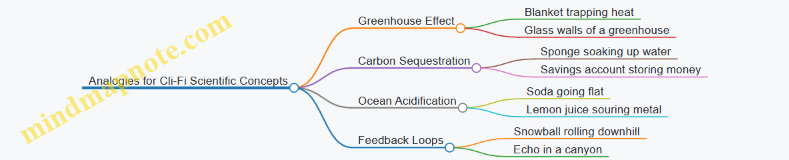
Use Character Perspective to Modulate Jargon
Expert characters can use jargon naturally, while lay characters can ask questions or express confusion, allowing for organic explanations.
Example:
“What’s a tipping point?” Sarah asked.
“It’s when a small change causes a big, irreversible shift,” Dr. Patel replied. “Like when ice sheets melt enough to speed up warming beyond control.”
This exchange helps introduce a technical term through character interaction.
Balance Information and Avoid Info Dumps
Spread out scientific explanations and avoid long paragraphs of exposition.
Example:
Instead of:
“The thermohaline circulation is a global ocean conveyor belt driven by temperature and salinity differences, which regulates climate by transporting heat.”
Try:
“The ocean currents act like a conveyor belt, moving warm water from the tropics to the poles. When this slows, it disrupts weather patterns everywhere.”
Engage Reader Emotionally
Connect jargon to what characters feel or experience.
Example:
“The rising sea levels weren’t just numbers on a chart to Elena—they were the slow erasure of her childhood home, inch by inch swallowed by the relentless tide.”
Here, the scientific fact is tied to emotional stakes, making it more impactful.
Summary Checklist for Writers
- Introduce jargon through natural dialogue or action.
- Use analogies and metaphors to clarify complex ideas.
- Match jargon use to character expertise.
- Break explanations into digestible pieces.
- Tie scientific concepts to character emotions and plot stakes.
By thoughtfully incorporating scientific jargon, you can enrich your Cli-Fi story with authenticity while keeping readers engaged and informed.
7.4 Example: A Heated Debate Between Climate Activists and Skeptics
In climate fiction, dialogue scenes featuring debates between activists and skeptics can be powerful tools to explore conflicting perspectives, deepen character development, and organically convey scientific and social information. Writing such scenes requires balancing authenticity, emotional intensity, and clarity.
Key Elements to Include in the Debate:
- Contrasting viewpoints: Activists emphasize urgency and scientific consensus; skeptics question motives, data, or economic impacts.
- Emotional stakes: Personal experiences, fears, and hopes fuel the conversation.
- Use of evidence: Characters cite studies, news, or anecdotes.
- Tone and pacing: Rapid exchanges, interruptions, and escalating tension.
- Character voice: Distinct speech patterns and vocabulary reflecting background and beliefs.
Mind Map: Structuring the Debate Dialogue
Sample Dialogue Excerpt
Setting: A community town hall meeting. Two characters, Maya (climate activist) and Tom (skeptic), engage in a heated exchange.
Maya: “The data is clear, Tom. The last decade was the hottest on record. Glaciers are melting faster than ever. We can’t afford to ignore this anymore.”
Tom: “I’m not saying the climate doesn’t change, Maya. It always has. But these models? They’re unreliable. Plus, shutting down industries will kill jobs and devastate families.”
Maya: “It’s not about shutting down everything overnight. It’s about transitioning to sustainable energy before it’s too late. Our children’s future depends on it.”
Tom: “I worry more about my kids having a roof over their heads. You talk about future generations, but what about the people struggling today?”
Maya: “That’s exactly why we need change — to create green jobs and healthier communities. The science backs this up. Have you read the latest IPCC report?”
Tom: “I’ve seen plenty of reports, but I also see politicians twisting facts for their agendas. I’m skeptical of the narrative you’re pushing.”
Writing Tips for This Scene
- Use interruptions and overlapping speech to mimic real debates and heighten tension.
- Show body language and tone to add emotional depth (e.g., clenched fists, raised voices).
- Avoid caricatures: Give both sides valid concerns to maintain complexity.
- Incorporate factual references naturally through dialogue, not exposition dumps.
Mind Map: Emotional Dynamics in the Debate
Example of Internal Monologue to Complement the Debate
As Maya listens to Tom’s words, a pang of doubt creeps in. She knows the science is solid, but she also understands the fear behind his skepticism. Could she bridge this divide? Or would this conversation only deepen the rift?
By weaving these elements together, authors can craft a compelling, realistic debate scene that advances plot, reveals character, and educates readers without preaching.
7.5 Crafting Internal Monologues That Reflect Climate Anxiety
Internal monologues are a powerful tool for delving deep into a character’s psyche, especially when exploring complex emotions like climate anxiety. This section will guide you through best practices for writing internal thoughts that authentically capture the tension, fear, hope, and paralysis that climate change can evoke.
Understanding Climate Anxiety in Characters
Climate anxiety is a multifaceted emotional response to the awareness of climate change and its consequences. When writing internal monologues, it’s important to reflect this complexity without overwhelming the reader.
Key facets of climate anxiety to explore:
- Fear of environmental collapse
- Guilt over personal or societal inaction
- Helplessness in the face of global problems
- Anger at political or corporate negligence
- Hope and determination for change
Mind Map: Elements of Climate Anxiety in Internal Monologues
Best Practices for Writing Climate-Anxious Internal Monologues
-
Use Stream-of-Consciousness Sparingly: To convey overwhelming thoughts, short bursts of fragmented sentences can mimic anxiety.
-
Balance Emotion with Reflection: Mix raw feelings with moments of clarity or questioning to avoid melodrama.
-
Ground Thoughts in Concrete Details: Link abstract fears to tangible environmental or personal experiences.
-
Show Contradictions: Characters may feel hopeful yet helpless; capturing this tension adds depth.
-
Avoid Preachiness: Keep the focus on the character’s personal experience rather than delivering a message.
Mind Map: Techniques for Writing Internal Monologues
Example 1: Fragmented Stream-of-Consciousness Showing Overwhelm
“The sky’s never looked this gray before. Is it the smoke? Or just the clouds? What if the rain never comes again? The crops will fail. Mom said the river’s drying up faster than last year. Am I selfish for wanting to leave? But if I stay, what can I do? Nothing. Nothing at all. Just wait. Wait for what? The end?”
Example 2: Reflective Internal Monologue with Contradictory Emotions
“I want to scream at the politicians, at the corporations, at everyone who turns a blind eye. But then I remember my own plastic waste, the flights I took last summer. Am I any better? Maybe change starts small, with me. But sometimes, it feels like shouting into the void. Still, if I don’t try, who will?”
Example 3: Using Sensory Details to Ground Anxiety
“The acrid smell of burnt forests lingers in my mind long after the news fades. I can almost taste the ash on my tongue. Every siren, every headline, it’s like a drumbeat counting down to disaster. But beneath the noise, there’s a quiet hope — a seed waiting to sprout, if only we dare to water it.”
Writing Prompt to Practice
Write a 200-word internal monologue from the perspective of a teenager witnessing a local climate disaster (e.g., flood, wildfire). Focus on capturing their immediate emotional response and conflicting thoughts about the future.
Summary
Crafting internal monologues that reflect climate anxiety requires a nuanced approach that balances emotional intensity with introspection. By using varied sentence structures, sensory imagery, and authentic emotional conflicts, you can create compelling, relatable characters who embody the real psychological impact of climate change.
Remember, the goal is to invite readers into the character’s mind, making the abstract threat of climate change feel immediate and personal.
8. Incorporating Diverse Cultural and Global Perspectives
8.1 Representing Climate Impact Across Different Regions and Communities
Climate fiction (Cli-Fi) thrives on the authenticity and diversity of its settings and characters. To write compelling stories that resonate globally, authors must thoughtfully represent how climate change impacts various regions and communities differently. This section explores best practices for portraying these diverse experiences, supported by mind maps and concrete examples.
Why Regional and Community Representation Matters
- Climate change is not a monolith; its effects vary widely based on geography, culture, economy, and social structures.
- Accurate representation fosters empathy and understanding among readers from different backgrounds.
- It avoids the trap of Western-centric narratives that can marginalize voices from the Global South or Indigenous peoples.
Mind Map: Key Factors Influencing Climate Impact by Region
Climate Impact by Region Mind Map
Mind Map: Examples of Regional Climate Impacts
Best Practices for Representing Diverse Climate Impacts
-
Research Local Contexts Thoroughly
- Use scientific reports, local news, and firsthand accounts.
- Example: For a story set in Bangladesh, consult IPCC reports on sea level rise and local NGO publications.
-
Incorporate Community Voices and Perspectives
- Show how local people perceive and respond to climate challenges.
- Example: A fisherman’s changing livelihood in the Pacific Islands due to coral reef degradation.
-
Avoid Stereotypes and Simplifications
- Portray communities with depth, highlighting resilience and complexity.
- Example: Instead of depicting Indigenous groups as passive victims, show their active environmental stewardship.
-
Show Intersectionality
- Climate impact intersects with race, class, gender, and politics.
- Example: Urban poor in Mumbai facing heatwaves and inadequate infrastructure.
-
Use Sensory and Emotional Details
- Bring the climate impact to life through vivid descriptions and character emotions.
- Example: The acrid smell of wildfire smoke choking a Californian town.
Example 1: Coastal Village in Bangladesh
Setting: A small fishing village facing increasingly frequent floods and saltwater intrusion.
Representation:
- The protagonist, a young woman, struggles with the loss of arable land.
- Community debates migration vs. adaptation.
- Cultural rituals around the river are threatened.
Best Practice Applied: Research on Bangladesh’s vulnerability to sea level rise informs the setting; the story highlights local voices and cultural stakes.
Example 2: Indigenous Community in the Arctic
Setting: A reindeer-herding community experiencing melting permafrost and unpredictable seasons.
Representation:
- Elders share traditional knowledge about weather patterns.
- Younger generation grapples with modern pressures and climate change.
- The story explores tensions between preserving culture and adapting.
Best Practice Applied: Avoids victimization trope by emphasizing agency and cultural richness.
Example 3: Urban Heatwave in a Southern European City
Setting: A sprawling metropolis during an unprecedented heatwave.
Representation:
- Diverse characters: elderly, migrant workers, activists.
- Infrastructure failures exacerbate suffering.
- Community organizing to provide relief.
Best Practice Applied: Intersectional approach showing socioeconomic disparities.
Mind Map: Character Perspectives on Climate Impact
Summary
Representing climate impact across different regions and communities enriches Cli-Fi stories with authenticity and emotional depth. By combining thorough research, nuanced characterization, and sensitivity to cultural and socioeconomic factors, authors can craft narratives that resonate globally while honoring local realities.
8.2 Avoiding Western-Centric Narratives in Cli-Fi
Climate fiction (Cli-Fi) often reflects the perspectives and experiences of Western societies, which can unintentionally marginalize or oversimplify the diverse realities faced by communities around the globe. To write compelling, authentic, and inclusive Cli-Fi, authors must actively avoid Western-centric narratives and embrace a multiplicity of voices and viewpoints.
Why Avoid Western-Centric Narratives?
- Broader Representation: Climate change impacts vary widely across regions; Western experiences are not universal.
- Cultural Accuracy: Different cultures have unique relationships with the environment and climate.
- Ethical Storytelling: Avoid perpetuating colonial or savior tropes.
- Narrative Richness: Diverse perspectives enrich storytelling and deepen emotional resonance.
Mind Map: Key Considerations to Avoid Western-Centric Cli-Fi
Practical Strategies with Examples
-
Research Local Climate Impacts and Cultural Contexts
- Example: Instead of depicting a generic drought, explore how Sahelian communities in West Africa experience desertification, incorporating local coping strategies and cultural significance.
-
Center Non-Western Characters with Depth and Agency
- Example: A story following a Bangladeshi fisherwoman navigating rising sea levels, emphasizing her knowledge of the river and community leadership rather than portraying her as helpless.
-
Use Multiple Perspectives to Show Global Climate Effects
- Example: A novel alternating between a Pacific Islander facing island submersion and a European climate scientist, showing interconnected but distinct experiences.
-
Incorporate Indigenous Environmental Knowledge
- Example: A narrative featuring an Amazonian tribe’s sustainable forest management practices as a key element in combating deforestation.
-
Avoid Savior Narratives
- Example: Instead of a Western scientist ‘saving’ a community, depict collaborative problem-solving that respects local expertise.
Mind Map: Examples of Non-Western Cli-Fi Perspectives
Example Scene: Avoiding Western-Centric Tropes
Western-centric trope: A Western scientist arrives in a remote village and single-handedly solves the community’s climate crisis.
Revised approach: The story centers on a local community leader who collaborates with scientists, blending traditional knowledge and modern science to adapt to changing rainfall patterns.
Summary
Avoiding Western-centric narratives in Cli-Fi requires intentional research, respect for cultural diversity, and nuanced storytelling that highlights the complexity and agency of non-Western communities. By doing so, authors create richer, more authentic stories that resonate globally and honor the varied human experiences of climate change.
8.3 Highlighting Indigenous Knowledge and Environmental Stewardship
Indigenous knowledge systems offer profound insights into sustainable living and environmental stewardship, often rooted in centuries of close interaction with nature. Incorporating these perspectives into climate fiction (Cli-Fi) enriches narratives by adding depth, authenticity, and cultural diversity. It also challenges dominant Western paradigms of environmentalism, offering alternative ways of understanding and responding to climate change.
Why Include Indigenous Knowledge in Cli-Fi?
- Authenticity & Respect: Reflects real-world diversity and honors indigenous voices.
- Alternative Solutions: Showcases sustainable practices and philosophies.
- Narrative Depth: Adds cultural layers and complex relationships with the environment.
- Counteracting Erasure: Addresses historical marginalization of indigenous peoples.
Best Practices for Writing Indigenous Perspectives
- Research Thoroughly: Use credible sources, indigenous-authored works, and if possible, consult with indigenous experts.
- Avoid Stereotypes: Portray characters as multifaceted individuals, not just symbols.
- Integrate Knowledge Organically: Weave indigenous environmental wisdom naturally into plot and character development.
- Highlight Stewardship Practices: Show how indigenous communities manage resources sustainably.
- Respect Cultural Sensitivities: Be mindful of sacred knowledge and protocols.
Mind Map: Incorporating Indigenous Knowledge in Cli-Fi
Example 1: Weaving Indigenous Stewardship into a Story
Scenario: A protagonist from an indigenous community uses traditional fire management techniques to prevent devastating wildfires exacerbated by climate change.
How to write it:
- Show the protagonist teaching younger generations about controlled burns.
- Contrast indigenous methods with destructive industrial practices.
- Include dialogue that explains the ecological benefits without sounding like exposition.
Excerpt sample:
“The forest remembers,” Aiyana said, her hands tracing the charred earth. “Our ancestors taught us that fire is a healer, not just a destroyer. When we burn carefully, we make space for new life.”
Mind Map: Story Elements Featuring Indigenous Environmental Stewardship
Example 2: Indigenous Knowledge as a Narrative Catalyst
Scenario: A community’s oral history reveals a cyclical climate pattern, guiding characters to prepare for an impending drought.
Writing tips:
- Use storytelling scenes where elders share legends.
- Show how this knowledge influences decision-making.
- Blend myth and science to create a compelling narrative.
Excerpt sample:
Grandfather’s voice wove through the firelight, recounting the tale of the Great Drying — a time when the rivers ran thin and the skies held their tears. “We survived then,” he said, “because we listened to the land’s whispers.”
Mind Map: Combining Indigenous Knowledge with Climate Science
Final Tips
- Show, don’t tell: Use characters’ experiences and interactions to reveal indigenous environmental wisdom.
- Avoid tokenism: Indigenous knowledge should be integral, not an add-on.
- Highlight resilience and innovation: Portray indigenous communities as active agents adapting to climate change.
By thoughtfully integrating indigenous knowledge and environmental stewardship into your Cli-Fi stories, you create narratives that are not only compelling but also culturally rich and socially responsible.
8.4 Example: A Multi-National Cli-Fi Story Featuring Interwoven Lives
In crafting a multi-national climate fiction (Cli-Fi) story, one of the most compelling approaches is to interweave the lives of characters from diverse regions, each experiencing the effects of climate change in distinct yet interconnected ways. This method not only broadens the narrative scope but also highlights the global nature of climate crises and the varied cultural, social, and political responses.
Story Concept: “Tides of Tomorrow”
Premise:
“Tides of Tomorrow” follows five protagonists from different continents whose lives become intertwined as they confront the escalating impacts of climate change — from rising sea levels and droughts to climate migration and political unrest. Their stories converge through a shared goal: to influence a global climate summit that could determine the planet’s future.
Mind Map: Character Connections and Climate Impacts
Tides of Tomorrow - Character & Climate Impact Mind Map
Integrating Best Practices with Examples
1. Diverse Perspectives:
Each character embodies a unique cultural and environmental context, illustrating the varied faces of climate change. For example, Amina’s story shows the human cost of drought in East Africa, while Mei’s narrative explores urban vulnerability in Asia.
2. Interconnected Plotlines:
Rather than isolated stories, the characters’ arcs intersect through shared goals and communication. Diego’s scientific findings support Amina’s advocacy, while Lia’s experiences inform Mei’s urban planning.
3. Emotional Depth and Nuance:
The narrative balances hope and despair. Lia’s displacement is heart-wrenching, yet her resilience inspires Mei’s determination. Omar’s political challenges add complexity, showing that climate action involves difficult trade-offs.
4. Cultural Sensitivity and Authenticity:
Research into local customs, languages, and climate realities enriches the story. For example, Amina’s community meetings incorporate traditional storytelling, while Diego’s scientific work reflects Chile’s glacial geography.
Example Scene Excerpt
Mei stood on the flooded streets of Guangzhou, rain pelting her face as she watched families wade through knee-deep water. Her urban plan had promised resilience, but the typhoon’s fury was a harsh reminder of nature’s unpredictability. She pulled out her phone and dialed Diego.
“Diego, the flooding’s worse than we anticipated. How are the glacier readings?”
“Melting faster than models predicted,” Diego replied, voice tense. “If the water supply dwindles, Amina’s community in Kenya could face even harsher droughts. We need to push the summit agenda harder.”
Mei nodded, determination hardening. “Then let’s make sure Omar hears us. Lives depend on it.”
Mind Map: Thematic Threads and Narrative Flow
Tides of Tomorrow - Thematic & Narrative Mind Map
Writing Tips for Multi-National Cli-Fi Stories
- Use Multiple POVs: Employ distinct voices and narrative styles to reflect cultural differences.
- Research Thoroughly: Ground each setting in accurate climate science and cultural details.
- Weave Connections Naturally: Let characters’ interactions evolve through plot, not forced exposition.
- Balance Global and Personal: Show how large-scale climate events affect intimate human experiences.
- Highlight Collaboration: Emphasize the necessity of international cooperation in climate solutions.
By using this multi-national, interwoven approach, writers can create rich, layered Cli-Fi stories that resonate emotionally and intellectually, inspiring readers to understand the global stakes of climate change through deeply personal narratives.
8.5 Sensitivity and Research When Writing Cross-Cultural Cli-Fi
Writing climate fiction that authentically represents diverse cultures and global perspectives requires a thoughtful approach grounded in sensitivity and thorough research. This section explores best practices, common pitfalls, and practical examples to help authors craft respectful and believable cross-cultural narratives.
Why Sensitivity Matters in Cross-Cultural Cli-Fi
Climate change impacts communities worldwide, but the experiences, responses, and cultural contexts vary greatly. Misrepresenting or oversimplifying these can perpetuate stereotypes, erase voices, or alienate readers from those cultures.
Best Practice: Approach every culture as complex and dynamic, not a monolith. Avoid exoticizing or using cultures merely as backdrops.
Research Strategies for Authenticity
- Primary Sources: Seek out first-person accounts, interviews, and narratives from people within the culture.
- Academic and Scientific Research: Use peer-reviewed studies on climate impacts specific to regions and communities.
- Cultural Consultants and Sensitivity Readers: Collaborate with experts or community members to review your work.
- Immersive Learning: Engage with cultural media—films, literature, music—to gain nuanced understanding.
Mind Map: Research Approach for Cross-Cultural Cli-Fi
Avoiding Common Pitfalls
- Cultural Appropriation: Using cultural elements without understanding or respect.
- Stereotyping: Relying on clichés or one-dimensional portrayals.
- Tokenism: Including a culture superficially without meaningful integration.
- Erasure of Indigenous Knowledge: Ignoring traditional ecological knowledge that is vital to many communities.
Example: Instead of depicting an indigenous community solely as victims of climate change, show their active role in environmental stewardship and resilience.
Mind Map: Pitfalls to Avoid in Cross-Cultural Cli-Fi
Integrating Indigenous and Local Knowledge
Many indigenous and local communities possess deep ecological knowledge developed over centuries. Incorporating this respectfully can add richness and authenticity.
Best Practice: Highlight these perspectives as valuable contributions rather than exotic curiosities.
Example: A character from a coastal indigenous community uses traditional knowledge to predict and prepare for rising tides, offering a different lens on climate adaptation.
Example Scene: Respectful Cross-Cultural Interaction in Cli-Fi
In a novel, a scientist from a metropolitan city partners with a rural indigenous leader to develop sustainable water management. Their dialogue reveals mutual respect and knowledge exchange rather than a one-sided teaching.
Scientist: "Your methods have sustained this land for generations. I think combining them with modern technology could help us both."
Elder: "Our knowledge comes from listening to the earth. If your machines can learn to listen too, perhaps we can heal together."
Mind Map: Elements of Respectful Cross-Cultural Representation
Practical Tips for Authors
- Start with Humility: Recognize the limits of your perspective.
- Engage Communities: Where possible, involve people from the culture in your creative process.
- Be Open to Feedback: Accept critiques and revise accordingly.
- Avoid Overgeneralization: Reflect intra-cultural diversity.
- Focus on Shared Humanity: Climate change is a global issue affecting all, but with unique local stories.
Summary
Writing cross-cultural climate fiction demands a balance of empathy, research, and respect. By avoiding stereotypes, embracing indigenous knowledge, and engaging with communities, authors can create powerful narratives that resonate authentically across cultures.
Additional Resources
- “Writing the Other” by Nisi Shawl and Cynthia Ward
- “The Intersectional Environmentalist” by Leah Thomas
- Climate Justice Alliance (https://climatejusticealliance.org/)
- Local climate impact reports from NGOs and universities
9. Editing and Revising Cli-Fi for Impact and Accuracy
9.1 Self-Editing Tips: Checking for Scientific Consistency and Narrative Flow
Self-editing is a crucial step in refining your climate fiction (Cli-Fi) manuscript. It ensures your story is both scientifically credible and narratively engaging. Below are detailed strategies, mind maps, and examples to help you check for scientific consistency and maintain smooth narrative flow.
Mind Map: Self-Editing Focus Areas
Scientific Consistency
-
Verify Factual Accuracy
- Revisit your climate science facts. Are the temperature rises, sea-level changes, or ecological impacts you describe supported by current research?
- Example: If your story features a sudden 10°C temperature increase in one year, this is scientifically improbable. Instead, depict gradual changes or extreme weather events consistent with climate models.
-
Cross-Check Terminology
- Use scientific terms correctly and consistently.
- Example: Don’t interchange “global warming” and “climate change” carelessly; global warming refers to temperature rise, while climate change encompasses broader shifts.
-
Ensure Logical Cause-Effect Relationships
- Your story’s climate events should follow plausible chains.
- Example: Melting polar ice causing sea-level rise is logical; sudden desertification in a rainforest without explanation is not.
-
Avoid Contradictions
- Watch for conflicting details.
- Example: If a character mentions a drought lasting 5 years, don’t later describe abundant rainfall in the same region without narrative justification.
-
Consult Expert Sources
- Use peer-reviewed articles, reputable climate organizations, or experts to fact-check.
- Example: Refer to IPCC reports or interviews with climatologists.
Narrative Flow
-
Pacing and Rhythm
- Balance action scenes with quieter moments.
- Example: After a dramatic flood scene, include reflective character moments to let readers absorb the impact.
-
Scene Transitions
- Ensure smooth shifts between scenes and timelines.
- Example: Use sensory details or character thoughts to bridge scenes, avoiding abrupt jumps.
-
Character Motivations Clarity
- Characters’ actions should align with their understanding of the climate crisis.
- Example: A scientist character should logically prioritize research, while a farmer might focus on survival tactics.
-
Dialogue Naturalness
- Avoid info-dumping through dialogue.
- Example: Instead of a character lecturing about carbon cycles, show their knowledge through casual conversations or actions.
-
Balancing Exposition and Action
- Weave scientific explanations into the story without halting momentum.
- Example: Introduce climate concepts through character experiences or discoveries rather than long paragraphs.
Mind Map: Narrative Flow Editing Checklist
Example: Self-Editing in Practice
Original Excerpt:
“The sea levels rose by 15 feet overnight, flooding the entire coastal city. Dr. Smith explained to the crowd, ‘This is due to the accelerated melting of the Greenland ice sheet, which has increased by 20% this year alone.’”
Issues Identified:
- Scientifically improbable sudden sea-level rise overnight.
- Info-dump dialogue that feels unnatural.
Revised Excerpt:
“Over the past decade, the sea had been creeping higher, swallowing streets block by block. Dr. Smith stood before the anxious crowd, her voice steady. ‘The Greenland ice sheet’s melting has sped up, contributing to rising waters. It’s a gradual but relentless change we must face.’”
Why This Works:
- Sea-level rise is gradual and plausible.
- Dialogue feels natural and informative without overwhelming.
Final Tips
- Read Aloud: Hearing your text can reveal awkward phrasing or pacing issues.
- Use Beta Readers: Especially those with scientific backgrounds or familiarity with Cli-Fi.
- Keep a Fact-Checking Log: Track scientific details and sources for easy reference.
By systematically applying these self-editing strategies, you can enhance both the credibility and readability of your climate fiction, creating a story that resonates and educates without sacrificing narrative engagement.
9.2 Working with Sensitivity Readers and Climate Experts
Writing climate fiction (cli-fi) involves navigating complex scientific data and sensitive social issues. Collaborating with sensitivity readers and climate experts can elevate your story’s authenticity, accuracy, and emotional impact. This section explores best practices, benefits, and examples for working effectively with these collaborators.
Why Work with Sensitivity Readers and Climate Experts?
- Sensitivity Readers: Help ensure respectful, accurate representation of cultures, communities, and experiences affected by climate change.
- Climate Experts: Provide scientific accuracy, clarify complex concepts, and validate speculative elements grounded in real-world science.
Mind Map: Roles and Benefits of Collaborators
How to Find and Approach Collaborators
- Sensitivity Readers: Look for individuals with lived experience or expertise related to the cultures or communities in your story. Platforms like #OwnVoices groups, writing forums, or professional sensitivity reading services can help.
- Climate Experts: Reach out to scientists, researchers, or educators specializing in climate science, environmental policy, or related fields. University departments, climate organizations, and LinkedIn are good starting points.
Example Email Template to a Climate Expert:
Dear Dr. Smith,
I am an author working on a climate fiction novel exploring the impact of rising sea levels on coastal communities. I want to ensure the scientific elements in my story are accurate and respectfully portrayed. Would you be open to reviewing select chapters or answering a few questions about current climate projections?
Thank you for considering my request.
Best regards,
[Your Name]
Best Practices for Collaboration
- Be Clear About Your Needs: Specify whether you want feedback on scientific accuracy, cultural representation, emotional tone, or all of these.
- Respect Their Time: Provide manageable sections and clear deadlines.
- Be Open to Feedback: Accept constructive criticism as a tool to improve your work.
- Maintain Communication: Clarify doubts and discuss suggestions.
- Credit Appropriately: Acknowledge their contribution in your book or blog.
Mind Map: Collaboration Workflow
Example: Using Expert Feedback to Enhance a Scene
Original Excerpt:
The city was drowning as the tides rose higher every day. People scrambled to build walls, but the water kept coming, relentless and unforgiving.
Expert Feedback:
Consider specifying the type of flooding (e.g., storm surge, king tides) and the time frame. Also, mention how infrastructure like drainage systems or levees are affected to add realism.
Revised Excerpt:
Each high tide brought seawater spilling over the crumbling levees, flooding the streets with briny water. The city’s aging drainage system groaned under the strain, leaving neighborhoods submerged for days after every storm surge.
Example: Sensitivity Reader Feedback on Character Portrayal
Original Character Description:
A rural farmer stubbornly refusing to accept climate change, portrayed as ignorant and hostile.
Sensitivity Reader Feedback:
This risks stereotyping rural communities. Consider adding nuance by showing the farmer’s deep connection to the land and the complex reasons behind their skepticism.
Revised Character Sketch:
Tomas, a third-generation farmer, wrestles with the changing seasons. His skepticism isn’t born from ignorance but from a lifetime of watching nature’s cycles and fearing that admitting change means losing his heritage.
Tips for Integrating Feedback
- Prioritize feedback that enhances authenticity and clarity.
- Balance scientific detail with narrative flow.
- Use sensitivity reader insights to deepen character motivations and avoid clichés.
- When feedback conflicts, consider your story’s goals and audience.
Summary
Working with sensitivity readers and climate experts is invaluable for crafting compelling, responsible cli-fi. Their insights help you avoid pitfalls, enrich your storytelling, and build trust with readers.
Embrace collaboration as part of your writing process to create stories that resonate emotionally and intellectually.
Further Resources:
- Science Writers’ Handbook
- Sensitivity Reader Services Directory
- Climate Reality Project
9.3 Balancing Pacing with Informational Passages
In climate fiction (Cli-Fi), one of the biggest challenges authors face is how to incorporate essential scientific and environmental information without disrupting the story’s pacing. Informational passages are crucial for grounding your narrative in believable climate realities, but too much exposition can slow down the momentum, disengage readers, or feel didactic.
This section explores strategies to maintain a dynamic pace while delivering necessary climate science and context.
Why Balancing Pacing Matters
- Maintains reader engagement: Fast-paced scenes keep readers hooked, while heavy info dumps risk losing their interest.
- Preserves narrative tension: Overloading with facts can dilute emotional stakes.
- Enhances story immersion: Seamless integration of information makes the world feel authentic without feeling like a textbook.
Strategies for Balancing Pacing with Informational Passages
Mind Map: Balancing Pacing with Informational Passages
Integrate Information into Action
Rather than pausing the story to explain climate science, weave facts into what the characters are doing.
Example: Instead of a paragraph explaining rising sea levels, show a character struggling to navigate flooded streets:
Mara waded through the knee-deep water, the salty tide creeping further into the city each year. “They say the ice caps are melting faster than we thought,” she muttered, clutching her soaked satchel.
This conveys the impact of climate change through action and dialogue, keeping the pace moving.
Use Dialogue Effectively
Characters can share information naturally through conversations, debates, or even arguments.
Example: A scientist explaining carbon capture technology during a heated discussion:
“You don’t get it,” Dr. Lee snapped. “Carbon capture isn’t just a pipe dream. It’s our best shot at buying time. We pull CO2 straight from the air and lock it underground.”
Dialogue keeps the information dynamic and character-driven.
Employ Sensory Details
Describing the environment and characters’ sensory experiences can convey climate realities without overt exposition.
Example:
The air tasted thick and acrid, a constant reminder of the wildfires that had scorched the forests beyond the city limits.
This sensory detail hints at the environmental crisis, adding atmosphere and emotion.
Break Up Informational Passages
Avoid long blocks of text. Break information into smaller chunks interspersed with action or dialogue.
Example: Instead of a long explanation of drought effects, alternate short factual sentences with character reactions:
The riverbed was cracked and dry. Farmers whispered of the worst drought in decades. Elena’s hands trembled as she looked at the barren soil.
Use Metaphors and Analogies
Simplify complex climate concepts with relatable comparisons.
Example:
The atmosphere was like a thick blanket, trapping heat and refusing to let the earth breathe.
Metaphors make scientific ideas accessible and vivid.
Vary Sentence Length and Structure
Short, punchy sentences can heighten tension, while longer ones can gently introduce information.
Example:
The glaciers melted. Slowly at first. Then faster. The world was changing.
This variation keeps the reader’s rhythm engaged.
Use Multiple Perspectives
Different characters can reveal pieces of information, preventing info overload from a single viewpoint.
Example:
- A scientist explains the technical aspects.
- A farmer describes the drought’s impact.
- A politician discusses policy failures.
This layered approach enriches the narrative and pacing.
Summary Mind Map
Final Example: Balanced Informational Passage
As the sun dipped below the horizon, casting an orange glow over the cracked earth, Jonas tightened his grip on the water canteen. “The aquifers are nearly depleted,” he said, voice low. “Scientists warned us years ago, but no one listened.”
Nearby, children played in dust clouds kicked up by the wind, unaware of the invisible threat creeping into their future. Jonas’s eyes scanned the barren fields — a silent testament to a warming world.
This passage combines environmental description, character emotion, and a brief scientific fact, maintaining narrative flow and emotional weight.
By thoughtfully integrating informational passages into your story’s fabric, you can educate readers about climate issues while keeping them emotionally invested and turning pages eagerly.
9.4 Example: Revising a Chapter to Enhance Emotional Resonance and Clarity
Revising a chapter in climate fiction is a crucial step to ensure your story not only conveys accurate information but also deeply connects with readers emotionally. Below, we explore a step-by-step approach to revising a chapter, focusing on enhancing emotional resonance and clarity through practical examples and mind maps.
Step 1: Identify the Emotional Core
Before revising, pinpoint the emotional heart of the chapter. What feeling or message should the reader walk away with?
Example: In a chapter depicting a community facing a devastating flood, the core emotion might be a mix of despair and fragile hope.
Mind Map: Emotional Core Identification
Step 2: Analyze Clarity of Narrative
Check if the sequence of events and descriptions clearly communicate the intended message without confusion.
Example: Original sentence:
“The river, swollen beyond its banks, swallowed the village quickly, and people ran, some crying, others shouting, the sky darkened with clouds.”
Revision for clarity:
“The swollen river burst its banks, flooding the village within minutes. People fled in panic—some crying, others shouting—while dark clouds gathered ominously overhead.”
Mind Map: Narrative Clarity
Step 3: Enhance Sensory Details to Deepen Emotional Impact
Use sensory language to immerse readers and evoke empathy.
Example:
Original:
“The flood was bad, and people were scared.”
Revised:
“Cold, murky water surged through the streets, carrying debris and the anguished cries of frightened villagers.”
Mind Map: Sensory Detail Enhancement
Step 4: Strengthen Character Reactions and Internal Conflict
Show characters’ emotional responses and dilemmas to build reader connection.
Example:
Original:
“Maria was worried about her family.”
Revised:
“Maria’s heart pounded as she scanned the rising water, torn between rushing to save her children and helping her elderly neighbor trapped inside.”
Mind Map: Character Emotional Depth
Step 5: Simplify Complex Climate Concepts Without Losing Impact
If the chapter includes scientific elements, ensure they are accessible.
Example:
Original:
“The unprecedented rainfall was due to the intensified hydrological cycle driven by global warming, causing atmospheric rivers to carry more moisture.”
Revised:
“Unusually heavy rains poured down, a result of warmer air holding more moisture and unleashing powerful storms on the village.”
Mind Map: Simplifying Science
Step 6: Check Pacing and Flow
Ensure the chapter moves at a pace that maintains tension but allows emotional beats to land.
Example:
Break long paragraphs into shorter ones to create rhythm and emphasize key moments.
Full Before-and-After Example (Excerpt)
Before Revision:
“The flood was coming fast. People ran everywhere. Maria was worried about her family. The rain kept falling, and the river got bigger. It was caused by climate change and the weather was worse than before.”
After Revision:
“The floodwaters surged with terrifying speed, swallowing roads and homes alike. Panic rippled through the village as people scattered, their cries lost beneath the relentless roar of rain. Maria’s breath caught in her throat. Her children were still inside, and the river was rising too quickly. This wasn’t just a storm—it was a sign of a changing world, one growing more violent with each passing year.”
Summary
Revising for emotional resonance and clarity involves:
- Pinpointing the emotional core
- Clarifying narrative sequences
- Enhancing sensory details
- Deepening character emotions
- Simplifying scientific explanations
- Adjusting pacing
Using mind maps as visual guides can help organize these elements effectively during revision, ensuring your cli-fi chapter resonates powerfully with readers while maintaining clear, engaging storytelling.
9.5 Using Beta Readers to Gauge Reader Engagement and Understanding
Beta readers are invaluable allies in the writing process, especially for climate fiction (Cli-Fi), where balancing scientific accuracy with compelling storytelling is crucial. They provide fresh perspectives on how your narrative resonates, whether your climate themes are clear yet subtle, and if your characters and plot engage readers effectively.
Why Use Beta Readers in Cli-Fi?
- Assess Clarity of Climate Concepts: Are the scientific elements understandable without overwhelming the reader?
- Gauge Emotional Impact: Do readers connect emotionally with characters facing climate challenges?
- Identify Pacing Issues: Does the story maintain momentum without info-dumps?
- Spot Inconsistencies: Are there contradictions in worldbuilding or character behavior?
- Evaluate Message Delivery: Is the climate message integrated organically or does it feel preachy?
Selecting Beta Readers
- Diverse Backgrounds: Include readers with varying familiarity with climate science (experts, general readers, skeptics).
- Genre Fans: Readers who enjoy speculative fiction or Cli-Fi to assess genre expectations.
- Cultural Diversity: To ensure global perspectives and avoid cultural blind spots.
How to Guide Beta Readers
Provide clear instructions and questions to focus their feedback. Example guidance:
Mind Map: Beta Reader Feedback Focus Areas
Beta Reader Feedback Mind Map
Example: Beta Reader Feedback in Action
Excerpt from a beta reader’s notes on a drought-themed Cli-Fi novel:
“I really connected with the farmer protagonist’s struggle, but some of the scientific explanations about soil degradation felt a bit technical and slowed the story down. Maybe consider weaving the info into dialogue or showing it through action rather than exposition. The pacing picked up again when the community meetings started, which felt very natural and engaging.”
Author’s response:
- Revised soil degradation sections to be shown through the farmer’s observations and interactions.
- Reduced direct scientific exposition.
- Enhanced community dialogue scenes to maintain engagement.
Tips for Incorporating Beta Reader Feedback
- Look for Patterns: Multiple readers pointing out the same issue signals a priority fix.
- Balance Feedback: Not all suggestions must be implemented; consider your story’s vision.
- Clarify Confusing Points: If readers misunderstand a concept, revise for clarity.
- Maintain Voice: Ensure changes don’t dilute your narrative voice or thematic intent.
Mind Map: Integrating Beta Reader Feedback
Integrating Feedback Mind Map
Using beta readers thoughtfully can transform your Cli-Fi manuscript from a good story into a compelling, accessible, and emotionally resonant work that effectively communicates urgent climate themes without sacrificing narrative quality.
10. Publishing and Marketing Your Cli-Fi Work
10.1 Identifying Target Audiences for Climate Fiction
Understanding your target audience is crucial when writing and marketing climate fiction (Cli-Fi). Knowing who your readers are helps tailor your storytelling approach, tone, and themes to resonate deeply and effectively. Below, we explore key audience segments for Cli-Fi, supported by mind maps and examples to clarify how to identify and engage each group.
Mind Map: Core Target Audiences for Climate Fiction
Environmental Enthusiasts
Who they are: Readers deeply invested in environmental issues, including activists, scientists, educators, and students studying climate science.
What they want: Accurate scientific details, hopeful or realistic portrayals of climate futures, and narratives that inspire action or awareness.
Example: A novel like The Water Knife by Paolo Bacigalupi appeals to this group by combining gripping storytelling with plausible climate scenarios.
Writing tip: Use precise climate science but balance it with emotional storytelling to avoid alienating readers who might prefer narrative over technical detail.
General Fiction Readers
Who they are: Readers who enjoy speculative fiction, literary fiction, or thrillers but may not actively seek out climate topics.
What they want: Engaging characters, compelling plots, and subtle integration of climate themes without overwhelming exposition.
Example: Station Eleven by Emily St. John Mandel, while not strictly Cli-Fi, appeals to this group by focusing on human resilience in a changed world.
Writing tip: Embed climate elements organically within character-driven stories to attract this broader audience.
Young Adult & New Adult Readers
Who they are: Younger readers, often more climate-conscious and eager for stories reflecting their concerns and hopes.
What they want: Relatable protagonists, coming-of-age themes, and narratives that balance urgency with empowerment.
Example: Dry by Neal Shusterman and Jarrod Shusterman, which explores drought and societal collapse through teen perspectives.
Writing tip: Focus on emotional arcs and identity struggles alongside climate themes to connect with this demographic.
Industry Professionals
Who they are: Policymakers, NGO workers, and professionals engaged in climate-related fields.
What they want: Realistic scenarios that can inform or inspire policy and advocacy, often with nuanced ethical questions.
Example: Cli-Fi short stories used in workshops or conferences to stimulate discussion about future challenges.
Writing tip: Incorporate plausible policy dilemmas and ethical conflicts to engage this audience intellectually.
Casual Readers
Who they are: Readers attracted to human drama, dystopian or post-apocalyptic settings, or general fiction without a strong prior interest in climate.
What they want: Emotional stories, suspense, and immersive worlds.
Example: The Road by Cormac McCarthy, which, while not explicitly Cli-Fi, appeals to readers interested in survival and bleak futures.
Writing tip: Use climate change as a backdrop rather than the main focus to attract these readers.
Mind Map: Tailoring Content to Audience Needs
Summary
Identifying your target audience for climate fiction shapes how you write and market your work. Whether appealing to scientifically minded readers or casual fiction lovers, understanding their preferences allows you to craft stories that resonate and inspire. Use mind maps like the ones above to visualize your audience segments and tailor your narrative accordingly.
Final Example: Applying Audience Identification
Imagine you want to write a Cli-Fi novel focused on a coastal city threatened by rising sea levels.
- If targeting Environmental Enthusiasts, you might include detailed scientific explanations of sea-level rise and community activism.
- For General Fiction Readers, focus on a family’s personal struggles and relationships amidst the crisis.
- For Young Adults, center the story on a teenager’s coming-of-age journey intertwined with climate challenges.
- For Industry Professionals, explore policy debates and ethical decisions about managed retreat.
- For Casual Readers, use the flooding as a dramatic backdrop for a suspenseful survival story.
By clearly identifying your audience, you can shape your story’s tone, complexity, and themes to maximize impact.
10.2 Querying Agents and Publishers Specializing in Speculative and Cli-Fi
Querying agents and publishers is a crucial step in bringing your climate fiction (Cli-Fi) work to the public. Targeting those who specialize in speculative fiction and Cli-Fi increases your chances of finding a champion for your story. This section will guide you through best practices, provide mind maps to organize your approach, and offer concrete examples to help you craft compelling query letters.
Understanding Your Market: Speculative Fiction & Cli-Fi Agents/Publishers
Before querying, research agents and publishers who have a track record or interest in speculative fiction and climate fiction. These professionals understand the nuances of Cli-Fi and appreciate the blend of science, social commentary, and storytelling.
Mind Map: Researching Agents and Publishers
Crafting Your Query Letter
Your query letter is your first impression. It should be concise, professional, and tailored to the agent or publisher’s interests.
Key Elements:
- Personalization: Reference why you chose this agent/publisher (e.g., they represent Cli-Fi or speculative fiction).
- Hook: A compelling one- or two-sentence summary of your novel.
- Brief Synopsis: Outline the plot, stakes, and unique climate elements.
- Author Bio: Relevant credentials or experience, especially if related to climate or science.
- Polite Closing: Thank them and mention enclosed materials.
Mind Map: Query Letter Structure
Example Query Letter for a Cli-Fi Novel
Dear Ms. Smith,
I am seeking representation for my 90,000-word climate fiction novel, Rising Tides, which explores the human cost of rising sea levels through the eyes of a coastal community fighting to survive.
When a devastating flood threatens to swallow her hometown, marine biologist Elena must navigate political corruption and environmental collapse to save her family and preserve hope for the future. Rising Tides blends speculative science with emotional storytelling, highlighting the resilience of communities facing climate change.
I hold a degree in Environmental Science and have published short stories in EcoLit Quarterly. Thank you for considering my submission. I have included the first three chapters and a synopsis as per your submission guidelines.
Sincerely,
Jane Doe
Handling Rejections and Follow-Ups
- Keep track of responses.
- Use feedback to improve your query or manuscript.
- Be professional and courteous in all communications.
Mind Map: Query Process Workflow
Additional Tips
- Join Cli-Fi and speculative fiction writing communities for recommendations.
- Attend conferences and workshops to network with agents and editors.
- Consider small presses that specialize in environmental literature.
By approaching querying with a clear strategy, personalized communication, and knowledge of the Cli-Fi market, you increase your chances of successfully placing your novel with the right agent or publisher.
10.3 Leveraging Social Media and Climate Communities for Promotion
In the digital age, social media and online climate communities offer unparalleled opportunities for authors to promote their climate fiction (Cli-Fi) works. Engaging authentically with these platforms can help you reach passionate readers, activists, and fellow writers who care deeply about environmental issues.
Why Use Social Media and Climate Communities?
- Direct Access to Target Audience: Connect with readers already interested in climate change and speculative fiction.
- Build a Loyal Following: Share your writing journey and insights to create a community around your work.
- Amplify Your Message: Collaborate with influencers, activists, and organizations to spread your story.
- Gather Feedback and Inspiration: Engage in discussions to refine your themes and storytelling.
Key Platforms and How to Use Them
Mind Map: Social Media Platforms for Cli-Fi Promotion
Building Your Social Media Strategy
Mind Map: Social Media Strategy for Cli-Fi Authors
Examples of Successful Social Media Promotion in Cli-Fi
-
Author Example 1: Kim Stanley Robinson
- Uses Twitter to share climate science insights alongside book updates.
- Engages with climate activists and readers, fostering meaningful dialogue.
-
Author Example 2: Alexandra Kleeman
- Shares visually striking Instagram posts that blend art and climate themes.
- Collaborates with environmental organizations for giveaways.
-
Campaign Example: #CliFiReads
- A hashtag campaign encouraging readers to share their favorite climate fiction books.
- Authors and readers participate by posting reviews, fan art, and discussion threads.
Engaging with Climate Communities
Mind Map: Climate Communities for Cli-Fi Authors
Tips for Authentic Engagement
- Be genuine: Share your passion for climate issues without preaching.
- Listen actively: Engage with community concerns and feedback.
- Provide value: Offer insights, resources, or entertainment.
- Collaborate: Partner with climate experts, activists, and other authors.
- Stay informed: Keep up with the latest climate science and conversations.
Sample Social Media Post Templates
-
Twitter:
🌍 Just finished a new chapter exploring climate migration in my upcoming Cli-Fi novel! How do you think rising sea levels will reshape our cities? #CliFi #ClimateFiction #AmWriting
-
Instagram Caption:
Behind the scenes: Mapping out the drought-ravaged landscape of my story’s world. Climate change isn’t just a backdrop — it shapes every character’s journey. What climate challenges inspire your writing? #CliFi #WritingCommunity #ClimateChange
-
Facebook Group Post:
Hi everyone! I’m working on a novel set in a near-future world impacted by extreme weather. Would love to hear your thoughts on how communities adapt and survive. Any favorite Cli-Fi books that inspired you? #ClimateFiction
By thoughtfully leveraging social media and climate communities, you can not only promote your Cli-Fi work effectively but also become part of a vibrant, engaged network that shares your commitment to storytelling with purpose.
10.4 Example: Successful Marketing Campaigns for Cli-Fi Novels
Marketing climate fiction (Cli-Fi) novels requires a strategic blend of environmental advocacy, storytelling appeal, and community engagement. Below, we explore several successful campaigns, dissect their key elements, and provide mind maps to visualize their approaches.
Case Study 1: “The Water Knife” by Paolo Bacigalupi
Overview: A dystopian Cli-Fi thriller about water scarcity in the American Southwest.
Marketing Highlights:
- Leveraged environmental urgency with gripping thriller elements.
- Engaged climate activist communities and book clubs.
- Used author interviews and podcasts to discuss real-world water issues.
Key Strategies:
- Targeted speculative fiction readers and environmentalists.
- Created interactive social media posts highlighting water scarcity facts.
- Partnered with environmental organizations for joint events.
Mind Map:
Case Study 2: “The Ministry for the Future” by Kim Stanley Robinson
Overview: A near-future Cli-Fi novel focusing on global climate policy and activism.
Marketing Highlights:
- Positioned as both a novel and a conversation starter on climate solutions.
- Utilized author’s reputation and scientific credibility.
- Hosted virtual book tours with climate experts.
Key Strategies:
- Engaged academic and policy-making communities.
- Created discussion guides for book clubs and classrooms.
- Leveraged multimedia content (videos, webinars).
Mind Map:
Case Study 3: “Flight Behavior” by Barbara Kingsolver
Overview: A literary Cli-Fi novel exploring climate change’s impact on rural Appalachia.
Marketing Highlights:
- Emphasized emotional storytelling and character-driven narrative.
- Targeted literary fiction readers and environmental book clubs.
- Collaborated with local libraries and community centers.
Key Strategies:
- Storytelling-focused social media campaigns.
- Organized reading group kits with thematic questions.
- Localized events to connect with affected communities.
Mind Map:
Best Practices Derived from These Campaigns
- Know Your Audience: Tailor messaging to specific reader groups (activists, academics, general readers).
- Leverage Author Expertise: Use author interviews and expert panels to build credibility.
- Engage Communities: Partner with environmental organizations, book clubs, and local groups.
- Use Multimedia: Incorporate videos, podcasts, infographics to explain complex climate issues.
- Create Interactive Content: Infographics, discussion guides, and Q&A sessions increase engagement.
- Host Events: Virtual or in-person events foster direct connection between readers and authors.
Mind Map: General Framework for Marketing a Cli-Fi Novel
By studying these examples and frameworks, authors and marketers can craft compelling, authentic campaigns that not only promote their Cli-Fi novels but also contribute meaningfully to the global climate conversation.
10.5 Building Author Platforms Focused on Environmental Themes
Building a strong author platform centered on environmental themes is essential for writers of climate fiction (Cli-Fi) who want to connect authentically with their audience, amplify their message, and foster a community passionate about climate issues. This section explores practical strategies, mind maps, and examples to help you establish a compelling and credible presence.
Why Build an Environmental Author Platform?
- Credibility: Demonstrates your commitment and knowledge of climate issues.
- Community: Connects you with readers, activists, scientists, and fellow authors.
- Amplification: Helps spread your stories and their messages more effectively.
- Engagement: Encourages dialogue and feedback that can enrich your writing.
Core Components of an Environmental Author Platform
Social Media: Engage and Educate
- Twitter: Share climate news, book updates, and engage in conversations with climate activists and scientists.
- Instagram: Use visuals—photos, infographics, and short videos—to illustrate climate themes and your writing process.
- TikTok: Create short, engaging videos explaining climate concepts or sharing snippets from your work.
- LinkedIn: Connect professionally with environmental organizations and fellow writers.
Example: Author Kim Stanley Robinson actively uses Twitter to discuss climate science and share insights about his Cli-Fi novels, building a dedicated following.
Website and Blog: Your Central Hub
- Maintain a professional website with a dedicated blog where you post articles on climate topics, writing tips, and updates.
- Include a newsletter signup to build a mailing list for direct communication.
- Offer downloadable resources or reading guides related to your Cli-Fi work.
Example: Author Margaret Atwood’s website includes essays and resources that deepen readers’ understanding of environmental themes in her work.
Collaborations: Broaden Your Reach and Credibility
- Partner with environmental NGOs for joint events or fundraising.
- Collaborate with climate scientists for accurate information and guest content.
- Co-author or participate in anthologies with other Cli-Fi writers.
Example: Author Paolo Bacigalupi has worked with environmental groups to promote climate awareness through storytelling.
Events: Connect in Person and Virtually
- Host or participate in readings, panels, and workshops focused on climate fiction and environmental issues.
- Engage with book clubs and educational institutions.
- Use virtual platforms to reach global audiences.
Example: The annual Climate Fiction Writers Conference offers panels and workshops that help authors connect and grow.
Content Creation: Provide Value Beyond Your Books
- Write articles or essays on climate change and literature.
- Produce podcasts or video interviews with experts.
- Share short stories or flash fiction that explore climate themes.
Example: Author Kim Stanley Robinson’s podcast appearances help demystify climate science and promote his novels.
Final Tips:
- Authenticity: Be genuine in your passion for climate issues.
- Consistency: Regularly update your platforms to keep your audience engaged.
- Engagement: Respond to comments and foster community dialogue.
- Education: Use your platform to inform as well as entertain.
By integrating these strategies, you’ll build a robust author platform that not only supports your writing career but also contributes meaningfully to the global conversation on climate change.
Sample Action Plan Mindmap
11. Inspirational Cli-Fi Works and Authors to Study
11.1 Classic Cli-Fi Novels and Their Narrative Techniques
Climate fiction (Cli-Fi) has evolved over decades, with classic novels laying the groundwork for how environmental themes can be woven into compelling narratives. Understanding these foundational works and their narrative techniques can inspire authors to craft stories that resonate deeply with readers. Below, we explore some seminal Cli-Fi novels, highlighting their storytelling methods, and provide mind maps to visualize their narrative structures.
“The Windup Girl” by Paolo Bacigalupi (2009)
Narrative Techniques:
- Multiple POVs: The novel uses several characters’ perspectives to showcase different societal impacts of climate change and biotechnology.
- Worldbuilding through Details: Bacigalupi creates a near-future Thailand devastated by rising sea levels and bioengineering, using sensory-rich descriptions to immerse readers.
- Political Intrigue and Ethical Dilemmas: The story intertwines corporate espionage with environmental collapse, making the stakes both personal and global.
Example: The narrative shifts between Emiko, a genetically modified “windup girl,” and Anderson Lake, a corporate spy, allowing readers to experience the ethical complexity of bioengineering from contrasting viewpoints.
Mind Map:
“Parable of the Sower” by Octavia E. Butler (1993)
Narrative Techniques:
- First-Person Diary Format: The protagonist, Lauren Olamina, narrates her journey through journal entries, providing intimate access to her thoughts and fears.
- Character-Driven Plot: The story focuses on Lauren’s development and her creation of a new belief system, Earthseed, reflecting hope amid chaos.
- Dystopian Setting: Butler paints a realistic, near-future America ravaged by climate disasters and societal collapse.
Example: Lauren’s hyperempathy syndrome is used not only as a character trait but also as a metaphor for human interconnectedness and vulnerability in a damaged world.
Mind Map:
“Oryx and Crake” by Margaret Atwood (2003)
Narrative Techniques:
- Non-linear Narrative: The story alternates between the present and flashbacks, gradually revealing the origins of the climate catastrophe.
- Unreliable Narrator: Snowman’s perspective is fragmented and subjective, creating suspense and mystery.
- Speculative Science: Atwood integrates genetic engineering and environmental degradation to explore humanity’s hubris.
Example: The juxtaposition of Snowman’s survival in a post-apocalyptic world with memories of his friendship with Crake and Oryx deepens the thematic exploration of science and ethics.
Mind Map:
“The Drowned World” by J.G. Ballard (1962)
Narrative Techniques:
- Atmospheric Worldbuilding: Ballard uses vivid, surreal descriptions of a flooded Earth to create a dreamlike, oppressive mood.
- Psychological Focus: The narrative explores the mental states of characters adapting to extreme climate conditions.
- Slow-Burn Plot: The story unfolds gradually, emphasizing mood and theme over action.
Example: The protagonist’s fascination with the regressive evolution of humanity mirrors the environmental regression of the planet.
Mind Map:
Summary Mind Map: Classic Cli-Fi Narrative Techniques
By studying these classics, authors can learn how to balance scientific accuracy with emotional depth, use diverse narrative techniques to engage readers, and create immersive worlds that highlight the urgency and complexity of climate change. Integrating these approaches into your own Cli-Fi writing can help craft stories that are not only compelling but also meaningful and thought-provoking.
11.2 Contemporary Authors Leading the Genre
Climate fiction (Cli-Fi) has seen a surge of talented contemporary authors who are shaping the genre with innovative storytelling, diverse perspectives, and urgent environmental themes. This section highlights some of the most influential voices today, illustrating their unique approaches and contributions with examples and mind maps to inspire your own writing.
Key Contemporary Cli-Fi Authors
- Kim Stanley Robinson
- Margaret Atwood
- Paolo Bacigalupi
- N.K. Jemisin
- Barbara Kingsolver
- Amitav Ghosh
- Octavia E. Butler (though earlier, her influence is pivotal in modern Cli-Fi)
Mind Map: Contemporary Cli-Fi Authors and Their Signature Themes
Author Profiles and Examples
Kim Stanley Robinson
Robinson is often hailed as the “grandfather” of modern Cli-Fi, especially for his Mars Trilogy and New York 2140. His works combine meticulous scientific research with hopeful visions of humanity tackling climate change.
Example: In New York 2140, Robinson imagines a partially flooded New York City due to rising sea levels but focuses on the resilience and adaptation of its inhabitants, weaving in detailed descriptions of urban ecology and infrastructure.
Writing Practice: Notice how Robinson integrates climate science into the setting without overwhelming the narrative. His characters live in the world shaped by climate change, making the environment a character itself.
Margaret Atwood
Atwood’s MaddAddam trilogy and Oryx and Crake explore dystopian futures where genetic engineering and environmental collapse intersect. Her work often probes ethical and societal questions.
Example: In Oryx and Crake, Atwood uses speculative science to depict a world devastated by bioengineered plagues and climate disasters, focusing on the psychological and social fallout.
Writing Practice: Observe Atwood’s use of layered storytelling—blending past and present to reveal how climate and human choices intertwine.
Paolo Bacigalupi
Known for his gritty, near-future Cli-Fi, Bacigalupi’s The Windup Girl and The Water Knife highlight the consequences of resource depletion and corporate exploitation.
Example: The Water Knife portrays a southwestern U.S. ravaged by drought, with characters navigating brutal water wars.
Writing Practice: Bacigalupi excels at creating tension through scarcity and moral ambiguity. Study his portrayal of environmental collapse as a catalyst for conflict.
N.K. Jemisin
Jemisin’s work, including The Broken Earth trilogy, uses climate catastrophe as a backdrop for exploring social injustice and systemic oppression.
Example: The trilogy’s apocalyptic earthquakes and environmental disasters serve as metaphors for societal fractures.
Writing Practice: Jemisin’s blending of myth, science, and social commentary offers a powerful model for integrating climate themes with complex characters and worldbuilding.
Barbara Kingsolver
Kingsolver’s Flight Behavior centers on the impact of climate change on rural communities, focusing on personal and ecological connections.
Example: The novel’s depiction of monarch butterflies displaced by climate shifts highlights the intimate scale of environmental change.
Writing Practice: Kingsolver’s character-driven approach shows how to make climate change relatable through everyday experiences.
Amitav Ghosh
Ghosh’s The Great Derangement (non-fiction) and his fiction works examine the cultural and historical dimensions of climate change, emphasizing colonial legacies.
Example: His narratives often explore how climate crises intersect with history and politics.
Writing Practice: Ghosh’s work encourages writers to consider broader socio-political contexts in Cli-Fi.
Octavia E. Butler
Though her major works predate the current Cli-Fi boom, Butler’s speculative fiction, such as Parable of the Sower, deeply influences the genre with themes of survival, adaptation, and community in a climate-ravaged future.
Example: Parable of the Sower features a protagonist who creates a new belief system amid societal collapse caused by environmental and economic disasters.
Writing Practice: Butler’s focus on character resilience and ethical complexity is essential reading for any Cli-Fi writer.
Mind Map: Writing Techniques Inspired by Contemporary Cli-Fi Authors
Summary
Studying these contemporary authors offers invaluable lessons on how to craft compelling Cli-Fi that is scientifically grounded, emotionally engaging, and socially relevant. By analyzing their narrative strategies and thematic focuses, you can develop your own voice in this vital and evolving genre.
11.3 Short Stories and Anthologies as Learning Tools
Short stories and anthologies offer a concentrated and diverse way to explore climate fiction (Cli-Fi). They allow writers and readers alike to experience a variety of voices, styles, and approaches to climate themes within a compact format. For authors and editors, studying these works can provide invaluable insights into how to weave climate issues organically into narrative, character, and worldbuilding.
Why Short Stories and Anthologies?
- Variety of Perspectives: Anthologies often feature multiple authors, showcasing different cultural, scientific, and emotional approaches to climate change.
- Focused Themes: Short stories can zero in on a single climate event or ethical dilemma, making complex topics more digestible.
- Experimentation: Writers can test innovative narrative techniques or speculative ideas without committing to a full novel.
- Educational Use: They serve as excellent teaching tools for workshops and writing groups.
Mind Map: Benefits of Short Stories and Anthologies in Cli-Fi
Key Anthologies to Explore
-
“Loosed Upon the World: The Saga Anthology of Climate Fiction” (2015)
- Edited by John Joseph Adams
- Features stories from established and emerging voices.
- Example: In “The Water Will Come” by Jeff VanderMeer, rising sea levels become a haunting backdrop for personal loss.
-
“The New York Times: Climate Stories” (Various Authors)
- A collection of short fiction pieces published online.
- Example: “The Last Fire” explores wildfires through the eyes of a firefighter.
-
“Everything Change: An Anthology of Climate Fiction” (2017)
- Edited by Alexandra Pierce
- Focuses on diverse global perspectives.
- Example: “The Mango Bride” by Marivi Soliven touches on migration and climate displacement.
Mind Map: Elements to Analyze in Cli-Fi Short Stories
Example Analysis: “The Tamarisk Hunter” by Paolo Bacigalupi
- Synopsis: A story set in a drought-ravaged American West where water is scarce and controlled by powerful interests.
- Climate Element: Water scarcity and its socio-political consequences.
- Character: A water thief who steals to survive, embodying desperation and rebellion.
- Narrative Technique: Tight, suspenseful prose that immerses readers in a harsh environment.
- Lesson for Writers: How to embed climate realities into character motivation and plot tension without overt exposition.
How to Use Short Stories and Anthologies for Learning
- Read Actively: Take notes on how authors integrate climate science with storytelling.
- Compare Approaches: Contrast hopeful stories with dystopian ones to understand tone and impact.
- Practice Imitation: Try writing your own short story inspired by a favorite piece, focusing on a single climate issue.
- Workshop Discussion: Use stories as prompts for group critique and brainstorming.
Mind Map: Using Anthologies as Writing Tools

By immersing yourself in short stories and anthologies, you gain a multifaceted understanding of how to craft compelling, authentic, and emotionally resonant climate fiction. These compact narratives serve as both inspiration and practical guides, helping you sharpen your skills in worldbuilding, character development, and thematic depth.
11.4 Example: Analyzing a Key Scene from a Renowned Cli-Fi Novel
For this analysis, we’ll focus on a pivotal scene from Kim Stanley Robinson’s New York 2140, a celebrated climate fiction novel that intricately weaves climate change impacts with human stories. This scene takes place in a partially submerged Manhattan, highlighting the social, environmental, and emotional layers that make cli-fi compelling.
Scene Summary:
The scene depicts a community gathering on a rooftop garden, which serves as a sanctuary amidst the flooded city. Characters discuss the ongoing climate crisis, their personal losses, and hopes for adaptation and resilience.
Mind Map: Key Elements in the Scene
Mind Map: Key Elements in the Rooftop Garden Scene
Integrated Best Practices with Examples
1. Using Setting to Reflect Climate Impact and Mood
- Practice: Employ vivid sensory details to immerse readers in the altered environment.
- Example from scene: The author describes “the salty tang of brackish water mingling with the earthy scent of soil,” evoking both the unnatural flooding and the persistence of life.
2. Multi-dimensional Characters Rooted in Climate Realities
- Practice: Show diverse perspectives to avoid stereotypes.
- Example: The scene includes a retired banker lamenting lost wealth, a young activist energized by community efforts, and a scientist cautiously optimistic about new technologies.
3. Weaving Themes Subtly Through Dialogue and Action
- Practice: Avoid didacticism by embedding themes organically.
- Example: Instead of lecturing, characters share personal anecdotes about adapting to the new normal, illustrating resilience.
4. Symbolism to Enhance Narrative Depth
- Practice: Use symbols that resonate with climate themes.
- Example: The rooftop garden symbolizes hope and human ingenuity amid crisis.
5. Balancing Emotional Tone
- Practice: Blend urgency with moments of calm to maintain reader engagement.
- Example: The scene shifts from tense discussions about rising waters to peaceful moments tending plants.
Mind Map: Character Perspectives and Emotional Arcs
Mind Map: Character Perspectives in Rooftop Garden Scene
Writing Exercise Inspired by the Scene
-
Prompt: Write a scene set in a climate-affected urban environment where a group of characters with differing views come together. Focus on using sensory details and symbolism to convey the setting’s impact and the emotional tone.
-
Tip: Use dialogue to reveal character perspectives and weave in climate themes without overt exposition.
By dissecting this scene, authors can see how New York 2140 masterfully balances worldbuilding, character depth, thematic richness, and emotional resonance — all essential ingredients for compelling climate fiction.
11.5 Resources for Further Reading and Research
To deepen your understanding of climate fiction and enhance your writing, exploring a variety of resources is essential. Below are curated books, websites, articles, and multimedia tools, accompanied by mind maps to help organize your research and creative ideas.
Recommended Books
- “The Ministry for the Future” by Kim Stanley Robinson — A seminal modern cli-fi novel blending scientific accuracy with compelling storytelling.
- “Flight Behavior” by Barbara Kingsolver — Explores climate change through intimate character-driven narrative.
- “New York 2140” by Kim Stanley Robinson — A vivid depiction of a flooded future city.
- “Parable of the Sower” by Octavia E. Butler — A powerful story of survival and social collapse with environmental undertones.
- “The Water Will Come” by Jeff Goodell — Non-fiction that provides scientific context useful for worldbuilding.
Online Resources & Databases
- Intergovernmental Panel on Climate Change (IPCC) Reports — Authoritative scientific data and projections.
- NASA Climate Change and Global Warming Portal — Accessible explanations and visuals.
- Climate Fiction Database (climatefiction.org) — A catalog of cli-fi works for inspiration.
- The Center for Science and the Imagination (Arizona State University) — Research and creative projects bridging science and fiction.
Articles and Essays
- “Why Climate Fiction Matters” by Margaret Atwood — Insight into the genre’s significance.
- “Writing Climate Change into Fiction” by Kim Stanley Robinson — Practical advice from a leading author.
- “The Role of Storytelling in Climate Change Communication” — Explores narrative techniques.
Multimedia and Podcasts
- “Drilled” Podcast — Investigative journalism on climate issues.
- “Climate One” Podcast — Conversations with scientists, activists, and authors.
- YouTube Channels like Kurzgesagt and Climate Adam — Engaging scientific explanations.
Mind Maps
Mind Map 1: Cli-Fi Research Categories
Mind Map 2: Research Workflow for Cli-Fi Writers
Mind Map 3: Resources by Format
Example: Using Resources to Build a Flooded City Setting
- Start with Scientific Data: Review NASA and IPCC reports on sea-level rise projections.
- Consult Fictional Examples: Analyze “New York 2140” by Kim Stanley Robinson for urban flooding depiction.
- Map Environmental Impact: Use Mind Map 1 to outline geographic and societal changes.
- Develop Characters: Incorporate diverse perspectives such as displaced residents, scientists, and policymakers.
- Integrate Narrative Techniques: Employ multiple timelines to show pre- and post-flood life.
By combining these resources and structured approaches, you can craft authentic, compelling climate fiction that resonates with readers and contributes meaningfully to the genre.
12. Exercises and Prompts to Kickstart Your Cli-Fi Writing
12.1 Worldbuilding Prompts Focused on Climate Change Scenarios
Worldbuilding is the backbone of any compelling climate fiction (Cli-Fi) story. To create immersive and believable settings, authors must envision how climate change reshapes environments, societies, and daily life. Below are detailed prompts and mind maps designed to spark your imagination and guide your worldbuilding process.
Prompt 1: Rising Sea Levels and Coastal Cities
Scenario: Imagine a major coastal city partially submerged due to rising sea levels. Consider how infrastructure, society, and ecosystems have adapted.
Mind Map:
Example:
In your story, a protagonist might be a salvage diver who recovers valuable tech from submerged skyscrapers, navigating both physical dangers and social tensions between long-time residents and newcomers seeking refuge.
Prompt 2: Desertification and Resource Scarcity
Scenario: A once-fertile agricultural region has turned into desert. Water is scarce, and communities compete for dwindling resources.
Mind Map:
Example:
Your character could be a water broker negotiating deals between rival villages, struggling with ethical dilemmas as desperation grows.
Prompt 3: Extreme Weather and Urban Survival
Scenario: Cities face frequent, intense storms and heatwaves. Infrastructure strains under unpredictable weather.
Mind Map:
Example:
A story could follow a community organizer coordinating relief efforts during a catastrophic heatwave, highlighting both human ingenuity and systemic failures.
Prompt 4: Climate Migration and New Societies
Scenario: Large populations have migrated inland or to higher altitudes due to unlivable conditions. New societies form with unique cultures and governance.
Mind Map:
Example:
Your protagonist might be a young leader trying to unite diverse migrant groups in a newly established mountain city, balancing tradition and innovation.
Prompt 5: Technological Solutions and Ethical Dilemmas
Scenario: Advanced geoengineering or climate tech is deployed to combat climate change, but with unforeseen consequences.
Mind Map:
Example:
A scientist protagonist wrestles with the moral implications of releasing a genetically engineered algae that absorbs carbon but threatens marine biodiversity.
Tips for Using These Prompts
- Combine multiple prompts to create layered, complex worlds.
- Use the mind maps to explore cause-and-effect relationships.
- Ground your worldbuilding in sensory details to make environments vivid.
- Consider how climate change affects not just the environment but every aspect of life.
By using these prompts and mind maps, you can develop rich, believable Cli-Fi settings that serve as dynamic backdrops for your characters and stories.
12.2 Character Development Exercises Rooted in Environmental Challenges
Creating compelling characters in climate fiction means grounding their motivations, conflicts, and growth in the realities and nuances of environmental change. Below are detailed exercises and mind maps to help you develop rich, believable characters shaped by climate challenges.
Exercise 1: Character Climate Impact Profile
Objective: Define how climate change directly affects your character’s life, worldview, and decisions.
Steps:
- Choose a specific environmental challenge (e.g., drought, rising sea levels, extreme storms).
- Map out how this challenge impacts your character’s daily life, relationships, and goals.
- Identify emotional responses and coping mechanisms.
Mind Map: Character Climate Impact Profile
Example:
Maria is a small-scale farmer facing relentless drought. Her crops fail year after year, straining her finances and forcing her to consider migrating. She feels a mix of despair and determination, joining a local water conservation group to fight for sustainable irrigation.
Exercise 2: Climate-Driven Motivation and Conflict
Objective: Develop your character’s core motivations and internal/external conflicts rooted in climate issues.
Steps:
- Define your character’s primary goal related to the climate challenge.
- Identify obstacles—both environmental and social—that hinder this goal.
- Explore internal conflicts such as guilt, hope, or skepticism.
Mind Map: Motivation and Conflict
Example:
Jamal is an engineer determined to build a solar microgrid in his flood-prone village. He faces resistance from local officials who prioritize industrial development. Internally, he struggles with guilt over leaving his family vulnerable during construction delays.
Exercise 3: Character Backstory Influenced by Climate Events
Objective: Create a backstory that explains how past climate events shaped your character’s identity and worldview.
Steps:
- Select a significant climate event (e.g., hurricane, wildfire, famine) from your story’s world.
- Write a brief narrative of how this event affected your character’s childhood or formative years.
- Highlight lasting psychological or physical effects.
Mind Map: Backstory and Climate Event
Example:
After losing her home in a devastating wildfire as a child, Lila grew up with a deep mistrust of government disaster response. This fuels her activism and her drive to develop community-based fire prevention programs.
Exercise 4: Dialogue Snippet — Expressing Climate-Rooted Perspectives
Objective: Practice writing dialogue that reveals your character’s climate-related beliefs and emotions.
Prompt: Write a short conversation between your character and a skeptic about the climate crisis.
Example Dialogue:
Character A (activist): “We can’t ignore the drought anymore. Our crops are failing, and it’s only going to get worse.”
Character B (skeptic): “It’s just a dry season, like always. People have survived worse.”
Character A: “This isn’t normal. The rivers are drying up, and the scientists say it’s because of climate change. We need to act now or lose everything.”
Character B: “I’m not convinced. Maybe we should focus on adapting instead of panicking.”
Exercise 5: Character Growth Arc Chart
Objective: Outline your character’s emotional and ideological journey through the story as shaped by climate challenges.
Mind Map: Growth Arc
Example:
At the start, Tomas dismisses climate change as alarmism. After his town floods, he confronts his own biases, eventually becoming a vocal advocate for sustainable urban planning.
By using these exercises and mind maps, you can create characters whose lives and choices are deeply intertwined with the realities of climate change, making your cli-fi stories resonate with authenticity and emotional power.
12.3 Dialogue and Voice Practice with Climate Themes
Effective dialogue and distinct narrative voice are crucial in climate fiction to convey urgency, emotional depth, and complex scientific ideas without overwhelming the reader. This section provides practical exercises, mind maps, and examples to help you craft authentic, engaging dialogue and voice centered around climate themes.
Mind Map 1: Elements of Effective Cli-Fi Dialogue
Mind Map 2: Voice Types in Cli-Fi Narratives

Practice Exercise 1: Writing a Heated Debate
Scenario: Two characters—an environmental scientist and a climate change skeptic—are arguing about the urgency of climate action.
Goal: Write a short dialogue (8-10 lines) that reveals their conflicting viewpoints while keeping the conversation natural and engaging.
Example:
Scientist: “The data is clear. If we don’t reduce emissions now, the consequences will be irreversible.”
Skeptic: “Data? You mean those models that keep changing? I’m not convinced we should panic yet.”
Scientist: “It’s not panic; it’s precaution. Floods, droughts, wildfires—they’re happening more often.”
Skeptic: “Weather has always been unpredictable. This is just another cycle.”
Scientist: “Cycles, yes, but the speed and scale are unprecedented. We have to act.”
Skeptic: “And what about the economy? Shutting down industries overnight isn’t realistic.”
Scientist: “Transitioning won’t be easy, but inaction will cost far more.”
Skeptic: “I guess time will tell.”
Practice Exercise 2: Crafting Internal Monologue Reflecting Climate Anxiety
Scenario: A character watches a news report about a devastating hurricane hitting their hometown.
Goal: Write a 100-word internal monologue capturing their fear, guilt, and hope.
Example:
“The screen flickers with images I wish I could unsee—homes swallowed by water, families displaced. How did it come to this? I remember the warnings, the protests I skipped, the endless debates I ignored. Now, it’s real, and I’m powerless. But maybe if I speak up, if I write, if I act, I can still make a difference. I have to. For them, for us all. The clock is ticking, and silence is no longer an option.”
Practice Exercise 3: Using Scientific Jargon Without Alienating Readers
Scenario: A character explains carbon sequestration technology to a friend unfamiliar with the science.
Goal: Write dialogue that simplifies the concept using metaphors or analogies.
Example:
Character: “Think of carbon sequestration like a giant vacuum cleaner for the atmosphere. It sucks up the excess carbon dioxide and stores it safely underground, kind of like putting away clutter in a storage unit so it doesn’t mess up your living room.”
Friend: “So it’s like cleaning the air? That sounds promising!”
Character: “Exactly. It’s not a perfect fix, but it helps buy us time while we switch to cleaner energy.”
Tips for Writing Cli-Fi Dialogue and Voice
- Show, don’t tell: Use dialogue to reveal character attitudes and climate realities rather than lengthy exposition.
- Vary speech patterns: Reflect characters’ backgrounds, education, and emotional states.
- Use subtext: Let what’s unsaid hint at deeper fears or hopes about climate change.
- Balance urgency and nuance: Avoid overly dramatic or preachy tones; keep conversations believable.
- Incorporate sensory details: Voice can carry the weight of heat, drought, or storms through word choice and rhythm.
By practicing these exercises and referring to the mind maps, you’ll develop dialogue and narrative voices that resonate emotionally and intellectually, making your climate fiction stories compelling and authentic.
12.4 Plot Outlines for Different Cli-Fi Subgenres
Climate fiction (Cli-Fi) spans a variety of subgenres, each offering unique narrative opportunities to explore climate change and its effects. Below are detailed plot outlines for several popular Cli-Fi subgenres, accompanied by mind maps in format and illustrative examples to inspire your writing.
Post-Apocalyptic Cli-Fi
Plot Outline:
- Inciting Incident: A catastrophic climate event (e.g., mega-storm, runaway greenhouse effect) devastates civilization.
- Rising Action: Survivors struggle to adapt in a harsh, changed world.
- Climax: A critical choice or conflict that determines the future of the survivors.
- Resolution: Establishment of a new order or hope for rebuilding.
Mind Map:
Example: A novel where rising sea levels have submerged coastal cities, and a small group of survivors on a floating settlement must navigate political tensions and dwindling supplies.
Eco-Thriller
Plot Outline:
- Inciting Incident: Discovery of a corporate or governmental cover-up related to climate manipulation.
- Rising Action: Protagonist investigates, facing danger and moral dilemmas.
- Climax: Exposure of the truth or a race against time to prevent disaster.
- Resolution: Justice served or a bittersweet victory.
Mind Map:
Example: A climate scientist uncovers that a geoengineering project intended to cool the planet is causing deadly side effects, and must expose the truth before it’s too late.
Near-Future Speculative Cli-Fi
Plot Outline:
- Inciting Incident: Introduction of new climate policies or technologies.
- Rising Action: Society reacts—divisions emerge, innovations succeed or fail.
- Climax: A pivotal event tests the viability of these solutions.
- Resolution: Society adapts, for better or worse.
Mind Map:
Example: A story set 30 years from now where a city implements radical green infrastructure, but faces backlash from displaced communities and political opponents.
Climate Romance
Plot Outline:
- Inciting Incident: Two characters meet amid a climate crisis.
- Rising Action: Their relationship develops while navigating environmental challenges.
- Climax: A crisis forces them to confront personal and external obstacles.
- Resolution: Love endures or transforms, symbolizing hope or change.
Mind Map:
Example: Two activists from opposing factions fall in love while organizing relief efforts after a devastating hurricane.
Climate Mystery
Plot Outline:
- Inciting Incident: Unexplained environmental anomalies or disappearances.
- Rising Action: Detective or protagonist investigates, uncovering climate-related secrets.
- Climax: Revelation of the cause linked to climate change or human interference.
- Resolution: Resolution of the mystery with implications for the future.
Mind Map:
Example: A detective investigates a series of disappearances in a town suffering from inexplicable drought, uncovering illegal water diversion linked to a powerful corporation.
Climate Fantasy
Plot Outline:
- Inciting Incident: Magical or mythical forces tied to nature awaken due to climate imbalance.
- Rising Action: Characters embark on a quest to restore balance.
- Climax: Confrontation with antagonistic forces exploiting nature.
- Resolution: Restoration or transformation of the environment.
Mind Map:
Example: A young guardian discovers that the forest’s magic is fading due to human pollution and must rally allies to stop the destruction.
Summary
These plot outlines and mind maps serve as flexible frameworks to help you start your Cli-Fi story in a chosen subgenre. Feel free to mix elements or adapt them to your unique voice and message. Remember to weave climate science and human experience organically to create compelling, emotionally resonant narratives.
Writing Tip:
Try sketching your own mind map before drafting your story. Visualizing plot points and character arcs can clarify how climate themes intersect with narrative structure.
12.5 Example: Writing a Short Scene Depicting a Climate Disaster Aftermath
Writing a compelling short scene that captures the aftermath of a climate disaster requires balancing vivid sensory details, emotional depth, and subtle exposition. Below, we break down the process with mind maps and examples to help you craft an impactful scene.
Mind Map 1: Key Elements to Include in a Climate Disaster Aftermath Scene
Mind Map 2: Emotional Arc and Narrative Focus
Example Scene: Flooded City After a Devastating Storm
Setting the scene with sensory details and emotional resonance.
The sun hung low behind a thick veil of gray clouds, casting a dull, sickly light over the drowned city. Streets once bustling with life were now rivers of murky water, swirling with debris — shattered glass, twisted metal, and fragments of memories.
Maya waded through the knee-deep water, her boots soaked and heavy. The acrid smell of sewage mixed with the faint scent of gasoline lingered in the air, stinging her nostrils. Around her, the silence was punctuated only by the distant groan of a collapsed building and the soft sobs of a child somewhere nearby.
She paused beside a toppled streetlamp, its flickering light casting eerie shadows on the cracked pavement. Her fingers trembled as she clutched a soaked photograph — a family portrait, edges curled and colors faded. “We’ll rebuild,” she whispered, though the words felt hollow.
Across the street, a group of survivors gathered around a makeshift fire, sharing what little food they had left. Their faces were etched with exhaustion and fear, but in their eyes glimmered a stubborn spark of hope.
Maya took a deep breath, the cool water swirling around her calves, and stepped forward. The city was broken, but so were they — not yet.
Breakdown of Techniques Used in the Scene
- Sensory Details: Visual (drowned city, debris), olfactory (sewage, gasoline), auditory (silence, distant groans, sobs)
- Emotional Depth: Maya’s trembling fingers, whispered words, and observation of survivors convey grief and hope.
- Subtle Exposition: The flood and destruction are implied through setting details without explicit explanation.
- Themes: Loss, survival, community resilience.
Writing Tips for Your Own Scene
- Use concrete, specific details to ground the reader in the environment.
- Show, don’t tell: Let characters’ actions and sensory experiences reveal the disaster’s impact.
- Balance despair with hope: Even in devastation, small signs of resilience keep readers engaged.
- Avoid info-dumping: Weave background information naturally through dialogue or observations.
Practice Prompt
Write a 300-word scene depicting the aftermath of a different climate disaster (e.g., wildfire, drought, hurricane). Focus on one character’s immediate experience, using sensory details and emotional cues to bring the scene to life.
By integrating these elements and techniques, your climate disaster aftermath scenes will resonate emotionally and vividly with readers, making your Cli-Fi stories both compelling and memorable.