Narrative Humor Structures Explained
1. The Mechanics of Narrative Humor
1.1 What Humor Does in Story: Setup, Expectation, and Payoff
Humor in story is a controlled mismatch between what the reader expects and what the scene delivers. It does more than make people laugh; it organizes attention, clarifies character, and turns information into meaning. A joke works when the setup earns a prediction, the scene nudges that prediction into place, and the payoff either confirms it in an unexpected way or replaces it with a better explanation.
Setup: The Contract with the Reader
The setup is the moment you define the rules of the scene. Those rules can be about tone, character competence, social norms, or cause-and-effect logic. The reader doesn’t need every detail, but they do need enough structure to form a specific expectation.
A useful way to think about setup is “promise plus boundary.” The promise tells the reader what kind of outcome is coming. The boundary limits what the story will do, so the later twist feels like a turn rather than a cheat.
Example:
- Promise: “This character is trying to be professional.”
- Boundary: “The situation will still follow basic workplace reality.”
If the character then says something wildly unprofessional, the humor lands because the reader predicted professionalism and got a boundary-breaking result.
Expectation: The Prediction the Scene Builds
Expectation is the reader’s internal model of what will happen next. Humor becomes reliable when the story makes that model easy to form. You can build expectation through:
- Specificity: concrete details narrow the reader’s guess.
- Patterning: repeated phrasing or behavior signals what the character will do.
- Authority cues: titles, routines, or “this is how we do it” language.
Example:
A manager says, “We’ll keep it simple,” then lists three steps, each longer than the last. The reader expects a short process; the scene trains them to anticipate a manageable outcome.
Payoff: The Moment Meaning Flips
The payoff is where the mismatch becomes clear. It can be a punchline, but it can also be a reframe that makes earlier lines look different. The key is that the payoff resolves the tension created by expectation.
Payoff types that stay grounded:
- Reversal payoff: the character’s goal was different from what the reader assumed.
- Escalation payoff: the scene keeps going past the point where the reader thought it would stop.
- Literal payoff: a figurative phrase is treated as literal within the story’s logic.
Example:
- Setup: “We’ll keep it simple.”
- Expectation: a short process.
- Payoff: the “simple” version is a single step: “Sign here,” but the signature is a contract that includes a dozen hidden addenda. The humor comes from the word “simple” being technically true while practically absurd.
Mind Map: Setup, Expectation, Payoff
Integrated Micro-Example: One Scene, Three Functions
Consider a character who claims they are “great at directions.”
- Setup: They confidently point down a hallway and say, “Left at the painting.”
- Expectation: The reader predicts a straightforward route with one clear landmark.
- Payoff: The character walks left, but the “painting” is a mirror. They arrive at the same hallway they started in, smiling as if they followed instructions perfectly.
The humor works because the payoff doesn’t destroy the scene’s logic; it reinterprets the landmark within the rules the setup established.
Practical Takeaway
When a joke fails, it’s usually one of three problems: the setup didn’t define a usable prediction, the expectation was too vague to form, or the payoff arrived without resolving the mismatch. Fixing humor often means tightening the contract: make the promise clearer, the boundary firmer, and the payoff’s reframe more logically connected to what came before.
1.2 Humor as Information Management: What the Reader Knows and When
Humor works when the reader’s expectations and the story’s delivered information don’t match—at least not for long. Think of each joke as a small information transaction: the text grants knowledge, withholds it, or grants the wrong kind of knowledge. The reader laughs when the story corrects the mental model at the right moment.
The Reader’s Knowledge Is a Moving Target
At any point in a scene, the reader holds three layers of information:
- Facts: what happened or what is true.
- Interpretations: what those facts mean.
- Predictions: what the reader expects next.
Comedy usually targets layer 2 or 3. The story may keep facts stable while shifting interpretation, or it may keep interpretation stable while changing facts. Either way, the reader’s internal “map” updates, and the update is the punchline.
Setup Creates a Contract
A setup line is not just a prelude; it’s a contract about what kind of information the story will provide. If the narration treats a detail as meaningful, the reader will store it as meaningful. If the dialogue frames a plan as serious, the reader will predict serious consequences.
A common failure mode is breaking the contract too early. If the text signals that something is important and then ignores it without a reason, the reader feels cheated rather than surprised.
Withholding and Releasing Information
Timing controls when information becomes available.
- Withholding: the story delays a key fact, letting the reader form a wrong interpretation.
- Releasing: the story reveals the missing fact, forcing a correction.
The trick is that the correction must be fair. The reader should be able to look back and see the clues were present, even if they were easy to misread.
Escalation Through Knowledge Pressure
Escalation doesn’t only mean bigger stakes. It can mean tighter knowledge constraints. As the scene progresses, characters act with incomplete information, and the reader watches the consequences of that incompleteness.
For example, a character who keeps saying “It’s fine” while hiding a detail creates pressure: the reader expects the hidden detail to matter, and the longer it stays hidden, the more the eventual correction lands.
Mind Map: Information Flow for Humor
Example: Same Facts, Different Interpretation
Consider two versions of the same situation.
Version A (no humor): “Sam forgot the password. The system locked the account.”
Version B (humor via interpretation shift): “Sam forgot the password, so he tried the one he used in college. The system locked the account. It also sent a congratulatory email.”
The facts are straightforward in both. The humor comes from the reader’s prediction: forgetting a password leads to a typical failure. The “congratulatory email” releases an unexpected interpretation of what the system thinks is happening.
Example: Withholding That Feels Earned
A fair withholding usually follows this pattern:
- The text introduces a detail that seems relevant.
- The scene proceeds as if that detail will matter.
- The punchline reveals that the detail mattered in a different way.
Example:
“Dana asked for a quiet room. The receptionist nodded and handed her a set of earplugs. ‘We keep the rooms quiet,’ she said. ‘We just don’t keep the people quiet.’”
The reader predicts “quiet room” means soundproofing. The release reframes the phrase: the room is quiet because the people are not.
Advanced Detail: Managing Multiple Readers at Once
In dialogue scenes, the reader often tracks two knowledge states:
- What the speaker knows
- What the listener knows
Comedy can come from mismatched knowledge between characters, even if the reader knows both. In that case, the reader laughs at the character’s incorrect prediction, not at the reader’s ignorance.
Example:
“‘I’m not late,’ Mark said, checking his watch. ‘I’m early for the apology.’
‘For what?’ I asked.
‘For being on time,’ he said.”
The reader gets the joke because Mark’s interpretation is internally consistent, while the listener’s interpretation is not. The text releases the mismatch through the final line.
Practical Takeaway
When you write a joke, decide what the reader knows at each beat: facts first, then interpretations, then predictions. Withhold just enough to create a wrong prediction, and release just enough to correct it without breaking the setup contract.
1.3 Comic Beats vs. Plot Beats: Keeping Story Moving While Joking
A plot beat changes the story’s situation: a decision is made, a plan forms, a consequence arrives. A comic beat changes the reader’s expectations: a line lands, a misunderstanding clarifies, a rhythm shifts. Humor is not a separate activity from story; it’s a way of delivering information and pressure. The trick is to make sure every joke either advances the situation or tightens the reader’s grasp of it.
Plot Beats: Situation Changes
Plot beats answer one question: “What is different now?” They can be small, but they must be concrete. Examples include:
- The character agrees to a ridiculous request.
- The character lies and the lie creates a new problem.
- The character discovers the real constraint and must adapt.
If a scene has only comic beats, the reader may laugh but still feel stuck. The story can’t progress because nothing in the world meaningfully changes.
Comic Beats: Expectation Shifts
Comic beats answer a different question: “What did the reader think would happen, and what actually happens?” Comic beats often come from:
- Timing: the line arrives a moment later than expected.
- Framing: the same fact is described as if it means something else.
- Contrast: the character’s seriousness meets an absurd reality.
- Reversal: the “obvious” interpretation is replaced.
A comic beat can be tiny—one sentence, one pause—but it must alter the reader’s mental model. Otherwise it reads like decoration.
The Integrated Model: One Scene, Two Tracks
A useful way to plan a scene is to run two tracks in parallel:
- Plot track: situation changes at key points.
- Humor track: expectation shifts at smaller intervals.
The humor track should react to the plot track, not compete with it. When the plot track moves, the humor track can comment, complicate, or reframe the move.
Beat Pairing: Setup, Punch, Payoff
A reliable pattern is to pair a comic beat with a plot beat so the joke has a job.
- Setup plot beat: establish the situation or the choice.
- Punch comic beat: shift expectations in a way that reflects the character’s mindset.
- Payoff plot beat: show the consequence of that mindset.
Example:
- Plot setup: “I need you to sign this form.”
- Comic punch: “Great. Which pen is legally binding?”
- Plot payoff: The clerk insists on the correct pen, and the character loses time, missing the appointment.
Notice how the joke doesn’t stop the scene. It causes a delay, which is a plot consequence.
Keeping Jokes from Becoming Detours
Detours happen when the humor beat repeats without changing anything. To prevent that, each comic beat should do at least one of these:
- Reveal a belief: the character thinks the world works a certain way.
- Expose a cost: the joke consumes time, trust, money, or attention.
- Create a new constraint: the character must solve a new problem because of the joke.
Example: A character keeps making “helpful” comments while trying to escape.
- Comic beat: “If we go left, we’ll definitely avoid the guards. I’m great at directions.”
- Constraint: The character’s confidence makes them choose left, where the guards are actually stationed.
The humor comes from overconfidence, but the plot constraint is real.
Timing the Transition Between Tracks
Comic beats work best when they land right after a plot beat creates tension. If the scene is calm, the reader has less reason to care about the expectation shift. If the scene is already tense, the joke can relieve pressure briefly while still pointing toward the next complication.
A practical rhythm:
- After a decision, insert a comic beat that shows the character’s flawed reasoning.
- After a discovery, insert a comic beat that reframes what the discovery means.
- After a consequence, insert a comic beat that reveals how the character tries to talk their way out.
Quick Diagnostic Checklist
When revising, ask two questions for each paragraph:
- Plot question: What changed in the situation?
- Humor question: What changed in the reader’s expectations?
If either answer is “nothing,” adjust the line. Either make the joke cause a consequence, or make the plot beat carry a clearer expectation shift. The goal is not constant laughter; it’s continuous movement with jokes that earn their place.
1.4 The Role of Character Voice in Creating Predictable Funny Patterns
Character voice is the consistent way a person thinks, speaks, and reacts. In comic writing, that consistency becomes a tool: readers learn what to expect from the character, then you vary one element at the right moment to create humor. Voice does not replace timing, escalation, reversal, or surprise; it makes them easier to read because the audience recognizes the character’s “default settings.”
Voice as a Predictable Baseline
A predictable funny pattern usually has three layers: baseline behavior, a small rule break, and a payoff that confirms the new rule. Voice supplies the baseline. If your character always answers questions indirectly, then a direct answer feels like a structural event, not just a different line.
Consider a character who narrates like a careful accountant. They notice costs, compare options, and treat emotions as line items. That voice sets expectations: the character will quantify, qualify, and correct themselves. When the character suddenly reacts with a blunt statement, the humor lands because the reader expected the usual hedging.
The Components of Voice That Drive Comedy
Voice is built from repeatable choices. Four components matter most for humor.
- Sentence shape: short bursts, long clauses, or frequent corrections.
- Word selection: formal terms, slang, technical jargon, or overly polite phrasing.
- Belief system: what the character thinks is important, embarrassing, or “normal.”
- Reaction style: how they handle discomfort, conflict, or uncertainty.
When these components stay stable, the reader can predict the next beat. Comedy then comes from controlled deviations.
Mind Map: Voice to Funny Pattern
How Voice Creates Timing
Timing is easier when the reader knows the character’s rhythm. If the character’s default is to explain before acting, then you can delay the explanation or cut it short for a punch.
Example: A character who always starts with a disclaimer.
- Baseline: “I’m not saying this is your fault, but—”
- Rule break: “It’s your fault.”
- Payoff: The character immediately tries to repair the damage with the same disclaimer they skipped.
The humor comes from the mismatch between expected rhythm and delivered content.
How Voice Enables Escalation Without Confusion
Escalation often fails when the reader can’t tell what the character is doing or why it matters. Voice keeps escalation coherent because the character’s beliefs guide the next step.
Example: A character who treats social rules like a checklist.
- Step 1: They politely correct someone’s seating.
- Step 2: They correct the correction.
- Step 3: They begin issuing “official” seating instructions to strangers.
Each step is bigger, but it’s also consistent: the character escalates the same obsession. The reader laughs because the behavior is recognizable even as it grows.
How Voice Makes Reversal Feel Fair
Reversal works best when the turn is surprising but not random. Voice helps by making the reversal a logical consequence of the character’s internal logic.
Example: A character who insists they hate drama.
- Baseline: They avoid conflict and redirect to facts.
- Setup: They claim they’re “above” emotional arguments.
- Reversal: When cornered, they weaponize facts in a way that is clearly emotional.
The twist is that the character’s “no drama” rule was never about calm; it was about controlling the terms of conflict.
How Voice Controls Surprise
Surprise can feel unfair when it ignores what the character would plausibly do. Voice narrows the range of surprises to those that fit the character’s habits.
Example: A character who always asks one extra question to feel safe.
- Baseline: They ask, then wait for reassurance.
- Surprise: They stop asking and act immediately.
- Payoff: The reader realizes the character isn’t suddenly brave; they’re following a different safety rule they never mentioned.
Because the character’s voice is consistent, the surprise becomes a reveal of hidden logic rather than a sudden personality swap.
Practical Pattern Builder
Use this method to draft a voice-driven comic sequence.
- Write the character’s baseline line in their usual rhythm.
- Identify the “rule” the character follows (avoid blame, quantify feelings, protect status).
- Break the rule once, but only in a way that the character could notice.
- Pay off the break by showing the character’s internal logic catching up.
If the rule break feels like a different character, adjust the voice components until the deviation still sounds like them.
Quick Example Sequence
- Baseline: “I’m fine. I’m just… managing a situation.”
- Rule break: “I’m not fine. I’m managing you.”
- Payoff: The character immediately offers a plan, then apologizes for the tone they used to deliver it.
The pattern is predictable because the voice stays recognizable, and the humor comes from the controlled shift in what the character is willing to admit.
1.5 Practical Checklist: Diagnosing Why a Scene Isn’t Landing
When a scene doesn’t land, it’s usually not because the joke is “bad.” It’s because the scene fails one of the jobs humor needs: it sets expectations, times releases, escalates pressure, and pays off with a turn or surprise. Use this checklist like a diagnostic flow: start with the reader’s experience, then move to structure, then to craft.
Mind Map: Scene Failure Diagnosis
Step 1: Confirm the Scene’s Job
Ask: what should the reader feel right before the first laugh? If the answer is “I’m not sure,” the scene likely lacks a clear comic contract.
- Check the scene goal: the character wants something specific (even if it’s petty). Humor needs a target.
- Check the comic target: the joke should aim at a behavior, belief, or situation—not at the reader’s confusion.
- Check the emotional permission: the character must be allowed to be wrong, awkward, or overconfident without the narrative punishing them for existing.
Example: A character says, “I’m great at directions,” then immediately asks for directions from a stranger. If the scene never establishes why they’re pretending, the joke becomes a generic “liar joke” instead of a specific comedic problem.
Step 2: Audit Timing Like a Meter
Read the scene aloud once for meaning, then again for rhythm.
- Setup length: if the reader doesn’t know what to expect by the time the punchline arrives, the punchline lands late.
- Release moment: every joke needs a tiny pause where the reader can register the new interpretation.
- Punchline placement: if the punchline is delivered before the reader has enough information to be surprised, it feels like a statement rather than a release.
Quick test: underline every sentence that could be a punchline. If more than one is doing the job at once, you’re stacking releases and confusing the beat.
Step 3: Verify Escalation Is Progress, Not Repetition
Escalation means the situation becomes harder or stranger in a way that changes decisions.
- Stakes must tighten: “This is embarrassing” should become “This will cost me something real.”
- Consequences must follow: if the character suffers no cost, the pressure curve flattens.
- Escalation types should vary: stakes, absurdity, complexity, and consequence can alternate so the scene doesn’t feel like the same joke with new words.
Example: A character keeps mispronouncing a name. If each mispronunciation leads to the same reaction and the same outcome, the scene repeats. If each one triggers a new complication—wrong paperwork, wrong appointment, wrong person—the escalation becomes legible.
Step 4: Check Reversal for Meaning Change
A reversal isn’t “the character is wrong.” It’s when the scene’s interpretation flips.
- Meaning must change: the reader should reread the setup and think, “Oh. That’s what it was doing.”
- Clues must be present: not obvious, but fair. If the reader can’t point to any earlier line that supports the turn, the reversal feels like a trap.
- Character commitment: the character should act as if their new understanding matters, even if they’re still incompetent.
Example: Setup: “I’m not afraid of heights.” Turn: the character isn’t afraid of heights; they’re afraid of falling objects—and the scene reveals they caused the hazard. The turn changes what “not afraid” means.
Step 5: Diagnose Surprise for Earned Context
Surprise should arrive after the reader has a working model.
- New information must reframe: the reveal should make earlier details click.
- Timing must be late enough: if the surprise arrives before the reader forms expectations, it reads as random.
- Avoid surprise without setup: a sudden twist with no prior promise usually feels like the author grabbing attention.
Example: The scene promises a misunderstanding about a password. The surprise is that the password is correct, but the account owner is wrong. The reader’s model updates rather than collapses.
Step 6: Inspect Character Voice and Reactions
Humor is often reaction-based.
- Voice consistency: if the character’s attitude shifts mid-scene, the reader can’t predict the comedic logic.
- Reaction timing: reactions should land immediately after the beat that changes meaning.
- Belief alignment: the character’s jokes should come from what they believe, not from what the narrator wants.
Example: If a character is anxious and tries to sound confident, their “jokes” should be defensive. If they suddenly become witty and relaxed, the scene loses its internal engine.
Step 7: Use a One-Pass Fix Strategy
Pick one failure mode and fix only that.
- If the reader is lost, tighten the premise and remove competing jokes.
- If the joke is early, delay the punchline by adding one clarifying beat.
- If the scene is flat, add escalation that changes decisions.
- If the turn feels cheap, plant one earlier clue and ensure the meaning flips.
- If the surprise feels random, ensure the reveal reframes a prior detail.
A scene that “isn’t landing” usually has a single broken link. Find it, repair it, and the rest of the humor often starts behaving like it was always meant to.
2. Timing as Structure: Beat Timing, Scene Timing, and Release
2.1 Beat Timing: Micro-pauses, Delays, and Rhythm Inside a Paragraph
Beat timing inside a paragraph is the art of controlling when the reader’s attention moves. A “beat” is the smallest unit of change: a thought lands, a choice is made, a misunderstanding forms, a reaction follows. When you manage beats at the sentence and clause level, you can make humor feel inevitable rather than accidental.
The Foundational Idea of Rhythm
Start by treating each paragraph as a short performance of attention. The reader arrives expecting one thing, then receives a slightly different signal, then reacts. Rhythm comes from spacing and sequencing, not from adding more jokes.
A practical way to think about it:
- Expectation: the reader predicts what will happen next.
- Interruption: something delays or complicates that prediction.
- Release: the paragraph resolves the tension, often with a punchline or a turn of meaning.
Micro-pauses are the “interruption” moments. They can be tiny—one clause, one beat of silence, one extra step of explanation.
Micro-pauses That Create Breathing Room
Micro-pauses work when they change the reader’s mental model for a moment.
Common micro-pause tools:
- Clause breaks: short segments that stop the sentence from flowing like a conveyor belt.
- Interrupting modifiers: “which, unfortunately, meant…”
- Reaction tags: “He didn’t notice. Not at first.”
- Contrast pivots: “He smiled. Then he checked the receipt.”
Example:
- Without micro-pauses: “I told him the printer was fixed and he believed me.”
- With micro-pauses: “I told him the printer was fixed. He believed me—until the paper jam cleared itself in front of his eyes.”
The second version pauses after “fixed,” letting the reader form the expectation “problem solved,” then delaying the release until the visual contradiction.
Delays That Turn Setup Into a Trap
A delay is a controlled postponement of the key information. The reader keeps waiting for the “real” point, and that waiting becomes part of the joke.
Delays are strongest when they are motivated by character behavior.
Three delay patterns:
- Procedural delay: the character does the boring steps first.
- Social delay: the character performs politeness before honesty.
- Interpretive delay: the character misreads a signal, then corrects it too late.
Example (procedural delay):
“‘It’s fixed,’ I said, and then I opened the back panel like I was conducting surgery. I even pointed at the cable. He nodded. The printer chose that moment to print the apology letter it had been saving.”
The humor lands because the paragraph spends time on actions that imply competence, then releases with the machine’s counter-narrative.
Rhythm Through Beat Density
Rhythm changes with beat density: how often the paragraph introduces a new change.
- Low density: longer sentences, fewer shifts; humor feels flat or slow.
- High density: frequent shifts; humor feels quick, but can become chaotic.
Aim for a middle where each sentence advances attention. A useful rule: if a sentence contains no new information or decision, it should probably be shortened or removed.
Example (rhythm adjustment):
“Marla said she’d handle it. She didn’t. She called the landlord. Then she asked me to explain what ‘handle it’ meant.”
Each sentence changes the situation, so the reader never has to guess whether something is happening.
Mind Map: Micro-pauses, Delays, and Rhythm
Advanced Details Without Losing Control
Once the basics work, refine timing with two precision moves.
- Delay the interpretation, not the event: let the reader see the event, but delay the character’s understanding.
Example:
“The email arrived with the subject line ‘Re: Your Request.’ I watched Marla read it. She frowned at the word ‘request’ like it was a personal insult. Then she said, confidently, ‘They approved the complaint.’”
- Use micro-pauses to steer the punchline angle: the pause should point the reader toward the wrong conclusion, then correct it.
Example:
“I offered to carry the box. It was light. Too light. Like it had opinions.”
The pauses make “light” feel suspicious, so the final line lands as a controlled reversal of tone.
A Mini Template You Can Reuse
Use this paragraph skeleton to keep timing consistent:
- Sentence 1: expectation (what the character claims or intends)
- Sentence 2: micro-pause (a clause break or reaction)
- Sentence 3: delay (motivated steps or misread signals)
- Sentence 4: release (the contradiction or turn)
Example:
“I said I’d be on time. I even checked the clock twice. The bus arrived early, which should have been good news. It wasn’t—because it was the bus I’d missed yesterday.”
The paragraph manages attention in small, deliberate steps: claim, pause, delay, release.
2.2 Scene Timing: Pacing the Setup and Holding the Punchline
Scene timing is the art of controlling how long the reader stays in “I think I know what’s happening” mode before you cash in the joke. The setup earns attention, the middle builds pressure, and the punchline lands when the reader’s expectations are most ready to snap.
The Setup Pace That Earns Attention
A setup is not just information; it’s a promise about how the scene will behave. If the reader learns too much too quickly, the joke has nowhere to grow. If the reader learns too little, the punchline feels random.
Start with a clear scene goal and a visible obstacle. The goal can be small—getting a refund, avoiding eye contact, finding a quiet seat—but it must be concrete. The obstacle should create friction immediately, even if the friction is mild. Humor often comes from the mismatch between what the character wants and what the situation allows.
Then choose a setup rhythm: short beats for fast, chatty scenes; longer beats for observational scenes. A useful rule is to alternate “action” and “interpretation.” Action shows what happens. Interpretation shows what the character thinks it means. The joke usually arrives when the interpretation is slightly wrong.
Holding the Punchline Without Losing the Reader
Holding the punchline means delaying the exact wording that makes the joke click. Delay is not the same as vagueness. The reader should still feel progress: each beat should either tighten the situation or sharpen the character’s misbelief.
Use three holding mechanisms.
- Micro-delay: pause for a beat after the reader expects the punchline. This can be done with a reaction, a correction, or a practical detail that interrupts the expected flow.
- Clarification delay: let the reader form a hypothesis, then postpone the confirmation until later in the scene. The confirmation should be slightly worse than expected.
- Escalation hold: keep the joke’s target constant while the circumstances grow more complicated. The punchline lands harder because the character has already invested effort.
A common failure is “stalling,” where the scene adds unrelated chatter. Instead, keep every added line tied to the obstacle or the character’s goal.
A Practical Beat Map for Setup to Punchline
Below is a reliable pacing pattern for many comic scenes.
- Beat 1: Goal statement (what the character wants)
- Beat 2: First obstacle (what blocks the goal)
- Beat 3: Character interpretation (what the character thinks the obstacle means)
- Beat 4: Attempt (a plan that follows the interpretation)
- Beat 5: Complication (a new detail that makes the attempt messier)
- Beat 6: Reframing (the interpretation changes, but not in the direction the reader expects)
- Beat 7: Punchline (the line that reveals the mismatch)
The punchline should feel like the inevitable last step of the chain, not a separate event.
Scene Timing Mind Map
Mind Map: Scene Timing from Setup to Punchline
Example: Holding the Punchline in a Refund Scene
Setup: Mara wants a refund for a broken blender. She approaches the counter and says, “It stopped working after one smoothie.”
Obstacle: The clerk checks the receipt and frowns. “It was purchased online.”
Interpretation: Mara nods like this explains everything. “Great. So you can see the smoothie.”
Attempt: She pulls out her phone. “I have the video. It’s… mostly foam.”
Complication: The clerk watches for a moment, then says, “The video shows you pressing ‘ice’ for thirty seconds.”
Reframing: Mara blinks. “That’s the blender’s fault.”
Punchline: The clerk slides the form forward. “Sure. Just fill out this form so we can blame the ice.”
Notice the hold: the scene doesn’t rush to the joke after the first mismatch. It keeps the reader tracking Mara’s logic, then delays the punchline until the clerk’s bureaucratic response makes the mismatch official.
Example: Micro-Delay with a Reaction Beat
A character says, “I told the barista I wanted oat milk.”
The reader expects the punchline to be immediate. Instead, the character pauses and adds, “They asked if I was allergic.”
Then the character continues, “I said no.”
Finally: “They still made it taste like my childhood fear of dairy.”
The reaction beat (“They asked if I was allergic”) holds the punchline long enough for the reader to anticipate a simple misunderstanding, then the final line reframes the meaning of “oat milk” as a flavor choice with emotional consequences.
Quick Timing Checks Before You Draft the Scene
- Can the reader state the character’s goal in one sentence?
- Does each beat either tighten the obstacle or sharpen the character’s mistaken interpretation?
- Is the punchline the last logical step of the setup chain?
- If you remove one line, does the punchline still land cleanly?
Scene timing works when the setup creates a specific expectation and the hold keeps that expectation active long enough for the punchline to feel earned.
2.3 Release Timing: When to Deliver the Joke and When to Withhold
Release timing is the moment you let the reader’s expectation snap into a new shape. In humor, the “joke” is rarely a single line; it’s the release of meaning. If you release too early, the reader doesn’t have enough tension to enjoy the snap. If you release too late, the reader stops tracking and the scene feels like a riddle.
The Core Idea of Release
A release happens when three things align: (1) the reader has formed a specific expectation, (2) the story provides a signal that can be interpreted in more than one way, and (3) you choose the exact beat where the interpretation flips.
Withholding is not hiding information randomly. It’s delaying the interpretive key so the reader experiences a controlled misread. The reader should be able to say, after the fact, “Oh. That’s what that line was doing.”
A Simple Timing Ladder
Use this ladder to decide when to release.
- Setup: Give a clear expectation. The reader should know what “normal” looks like.
- Pressure: Add friction that makes the expectation feel likely to be correct.
- Signal: Place a detail that can support either a straightforward reading or a comic reading.
- Release: Deliver the line or action that forces the comic reading to win.
- Aftertaste: Let the character react as if the new meaning is now real.
If you skip the signal step, release becomes a jump scare. If you skip aftertaste, the joke lands but the scene doesn’t breathe.
Release Timing Mind Map
Mind Map: Release Timing Decisions
When to Deliver the Joke
Deliver the joke when the reader has enough momentum to feel the snap.
Rule of thumb: release on the beat that changes the interpretation, not the beat that adds information.
Example: A character insists the meeting is “casual.” The room is silent. The host smiles too widely. The character says, “See? Casual.”
- If you release the punchline on “casual,” it’s just a label.
- If you release it when the host hands out formal name tags labeled with job titles, “casual” becomes ironic.
A good release often uses a short line that recontextualizes what came before. The reader should feel that the story has been pointing at the joke all along.
When to Withhold the Joke
Withhold when the reader is still building the wrong expectation, and you want that wrong expectation to become the setup for the flip.
Rule of thumb: withhold until the reader has committed to an interpretation.
Example: Two roommates argue about a “mystery noise.” One says, “It’s probably the pipes.” The other says, “No, it’s definitely the pipes.” You could reveal the truth immediately: the noise is a tiny robot vacuum stuck under the couch.
- That’s information, not release.
- Better: keep the “pipes” framing active while you add pressure: the lights flicker, the landlord knocks, and the roommate produces a wrench like a professional.
- Then release: the wrench is for “pipe repairs,” but the sound stops when the vacuum is freed.
The withholding creates a misread that the release can correct cleanly.
Signal Placement: The Key to Fairness
A release feels satisfying when the signal was present. The reader may not have guessed the exact outcome, but they should recognize that the story offered clues.
Use signals that are small but specific: a repeated phrase, a prop introduced early, a character’s unusual certainty. If the signal is vague (“something is off”), the reader can’t track it, and the release becomes arbitrary.
Aftertaste: The Beat That Makes It Stick
Aftertaste is the character reaction that confirms the new meaning.
Example: A character tries to impress someone by saying they “never overreact.” Immediately after, they overreact to a harmless comment. The joke isn’t only the line; it’s the character’s immediate attempt to regain control—too late.
Without aftertaste, the reader laughs and then wonders why the scene moved on.
A Practical Micro-Template
Write the scene beat as five parts: expectation, pressure, signal, release, reaction.
Example micro-beat:
- Setup: “We’re meeting at noon. No surprises.”
- Pressure: The clock shows 12:00. Everyone waits.
- Signal: The organizer keeps checking a different time on their phone.
- Release: “Sorry,” they say, “I meant noon in my time zone.”
- Aftertaste: The group stares, then someone checks their own phone and sighs.
Release timing is the craft of choosing the beat where meaning changes. Withhold until the reader is ready, then deliver the line that forces the new interpretation to win.
2.4 Timing Tools: Misread Signals, Late Clarifications, and Reframing
Timing tools are ways to control what the reader thinks is happening, then adjust that belief at the right moment. The goal is not to confuse for its own sake; it’s to create a clean path from expectation to correction, with the correction arriving late enough to feel surprising but early enough to feel fair.
Misread Signals
Misread signals happen when a character (and therefore the reader) interprets a cue in the wrong direction. The cue is real, but the interpretation is incomplete. Humor often comes from the gap between what the character believes and what the scene actually supports.
A reliable misread needs three ingredients:
- A visible cue (a phrase, gesture, document, or rule).
- A plausible assumption (something the character would reasonably infer).
- A delayed contradiction (the scene reveals the missing context).
Mind Map: Misread Signals
Example: Mara reads a sign on the office door: “VISITORS MUST CHECK IN.” She assumes it’s for people entering the building, so she marches to the front desk and announces, “I’m here to check in.” The receptionist smiles and says, “Great. Who are you checking in for?”
The cue is the sign. The assumption is that “check in” means “register yourself.” The delayed contradiction is the receptionist’s question, which reframes the phrase as “confirm someone else’s status.” The timing works because Mara has already committed to the wrong interpretation.
Late Clarifications
Late clarifications are explanations that arrive after the reader has already formed a theory. The clarification should not be a random twist; it should be the missing piece that makes the earlier moment click.
Late clarifications work best when the explanation is:
- Specific: it names a rule, definition, or condition.
- Small enough: it changes meaning without changing the entire scene.
- Timed: it appears right after the character’s mistake becomes costly or embarrassing.
Mind Map: Late Clarifications
Example: At a bake sale, Theo asks, “Do you have gluten-free brownies?” The volunteer points to a tray labeled “GLUTEN-FREE ZONE.” Theo grins and grabs one. Ten seconds later, he takes a bite and immediately coughs. The volunteer says, “Oh—gluten-free zone means the area around the brownies is gluten-free. The brownies are… enthusiastic.”
The clarification is late because the label is ambiguous. It’s also fair because the label was literally true in a narrow way. The humor lands when the explanation arrives right after the bite.
Reframing
Reframing changes the meaning of the same facts by shifting the frame: purpose, audience, stakes, or measurement. Unlike misread signals, reframing doesn’t require the reader to have been wrong about what happened. Instead, it changes what the event means.
A strong reframing typically uses:
- A new frame introduced through a question or rule.
- A re-evaluation of prior behavior under that frame.
- A consequence that follows the new interpretation.
Mind Map: Reframing
Example: Jules complains, “You never listen. You just wait for your turn to talk.” Their friend replies, “I’m not waiting. I’m timing. I’m trying to interrupt you at exactly the moment you finish your sentence.”
The facts are unchanged: Jules talks, the friend interrupts. The frame shifts from “rudeness” to “precision.” The timing tool is the moment the friend names the frame, turning an annoying pattern into a strange method.
Combining the Tools Without Overstacking
Use one primary tool per beat cluster. A common pattern is misread signal → late clarification. The misread sets up the expectation, and the clarification corrects it. Reframing can be layered as a second-stage effect, but only if it doesn’t compete with the correction.
Example (integrated): A coworker hands Sam a sticky note: “BRING THE KEYS.” Sam assumes it’s for a door, so Sam leaves their desk to search for keys. In the hallway, they ask, “Which door?” The coworker says, “The keys to the presentation. You know, the bullet points.” Sam returns, holding a keychain like it’s evidence.
The cue is “keys.” The misread is “keys for a door.” The late clarification is “keys to the presentation.” The humor comes from the timing of the correction: it arrives after Sam has already acted.
Practical Timing Checklist
- Cue clarity: can the reader point to the exact moment the wrong interpretation becomes plausible?
- Delay purpose: does the delay create embarrassment, cost, or momentum that makes the correction satisfying?
- Clarification size: does the explanation change meaning without rewriting the scene?
- Reframe discipline: does the new frame explain the same facts, or does it introduce new facts too late?
- Reaction beat: does the character respond in a way that proves the timing worked?
2.5 Practical Examples: Three Timing Templates for Common Scenes
Timing is easiest to learn when you treat it like a repeatable pattern. Each template below shows a common scene type, a beat-by-beat timing plan, and a short example that demonstrates how the joke lands. The templates are designed to be swapped into your own plots without changing the underlying logic.
Template One: The Polite Request That Gets Worse
When to use it: A character asks for something reasonable, but the situation forces escalating misunderstandings.
Timing plan:
- Setup beat: State the request plainly.
- Expectation beat: Give a detail that makes the reader predict a normal outcome.
- Delay beat: Add a small complication that slows the resolution.
- Release beat: Deliver the punchline by reframing what “help” means.
- Afterbeat: Let the character react as if the new meaning is now the only meaning.
Example: Mara approached the front desk with the calm confidence of someone who had filled out forms before. “Hi. I’d like to request a refund for the parking ticket.”
The clerk nodded and slid a clipboard forward. “Sure. Just sign here that you understand the refund is for the ticket’s educational value.”
Mara blinked. “The educational value?”
“Yes,” the clerk said, pointing at a pamphlet titled How to Learn From Consequences. “It teaches you not to park in places that have consequences.”
Mara stared at the pen. “So… the refund is the lesson.”
The clerk smiled. “Exactly. Now, if you’d like to return the lesson, we’ll need you to submit a second request.”
Why it works: the delay is small and procedural, so the reader stays oriented. The release beat changes the definition of refund, and the afterbeat locks in the new logic.
Template Two: The Explanation That Contradicts Itself
When to use it: A character tries to be helpful, but their explanation creates a contradiction.
Timing plan:
- Setup beat: Present the explanation as confident.
- Expectation beat: Include a rule the reader can track.
- Delay beat: Add a second rule that seems compatible.
- Release beat: Reveal the contradiction with a single sentence.
- Afterbeat: Show the character doubling down for one more beat.
Example: Jordan leaned over the map like a tour guide. “The shortcut is easy. You just follow the river until it stops being a river.”
Mina squinted. “That’s… not a direction.”
“It is,” Jordan said. “When the water turns into a drainage ditch, you’ll know you’re close.”
They walked for ten minutes. The ditch widened into a shallow channel with a sign that read NO ENTRY: MAINTENANCE ONLY.
Jordan pointed at the sign. “Perfect. This is where it stops being a river.”
Mina stared. “So the shortcut is to enter the maintenance area.”
Jordan nodded. “Yes. But only if you don’t enter.”
Mina waited for the clarification.
Jordan offered none. “It’s a very advanced shortcut.”
Why it works: the reader tracks rule A and rule B during the delay. The release beat is compact, so the contradiction feels sudden rather than dragged.
Template Three: The Plan That Breaks at the Smallest Step
When to use it: Characters outline a plan, then the first step fails in a way that shouldn’t be fatal—until it is.
Timing plan:
- Setup beat: Announce the plan with a confident first step.
- Expectation beat: Add a constraint that sounds manageable.
- Delay beat: Execute the first step with careful detail.
- Release beat: The smallest failure triggers a chain reaction.
- Afterbeat: The character revises the plan using the same flawed logic.
Example: “Okay,” Tessa said, laying out the schedule on the table. “We’ll be in and out before anyone notices. Step one: borrow the keycard from the lost-and-found.”
Eli raised an eyebrow. “Lost-and-found has cameras.”
“Not if we use the official procedure,” Tessa said. “They only record the moment you pick up the item.”
She approached the desk and smiled. “Hi. I’m here to borrow a keycard from lost-and-found.”
The attendant slid a form across. “Great. Please initial that you understand the keycard is not a keycard until it’s activated.”
Tessa initialed. “Sure.”
The attendant handed her a card with a blank strip. “Now activate it.”
Tessa looked at the activation kiosk. It was labeled OUT OF SERVICE.
Eli leaned in. “So we can’t activate it.”
Tessa nodded slowly. “Correct. Which means it’s still not a keycard.”
The attendant smiled. “Exactly. So you’ll need to borrow it again.”
Why it works: the delay is detailed enough to build trust in the plan. The release beat is small—an out-of-service kiosk—but it changes the category of the object, which forces the chain reaction.
Using the Templates Without Copying the Scenes
For each template, keep the beat roles intact even if the content changes. If your release beat doesn’t reframe meaning, it will feel like a punchline without a foundation. If your delay beat doesn’t slow the resolution slightly, the joke arrives too early and reads as random. When you revise, read the scene once for timing: you should be able to point to the setup, the expectation, the delay, the release, and the afterbeat in order.
3. Escalation: Building Comic Pressure Step-by-Step
3.1 What Escalation Means in Narrative Terms Not Just “Bigger”
Escalation in narrative humor is the controlled increase of pressure on a situation so the next beat has more friction than the last. “Bigger” is only one way to do it, and often the wrong one. A scene can escalate by tightening constraints, increasing misunderstanding, reducing options, or making consequences arrive sooner. The goal is not chaos; it’s momentum that stays legible.
Start with a simple definition: escalation is the movement from “manageable” to “unmanageable” while the story keeps its internal logic. In comedy, that logic is usually character logic—what the character believes, what they refuse to admit, and what they do next because of that belief.
The Four Levers of Escalation
- Stakes: What the character stands to lose.
- Example: A spilled coffee becomes a ruined interview. The loss grows, but the key is that the character now has to protect their reputation, not just their shirt.
- Complexity: How many moving parts the character must coordinate.
- Example: “Return the library book” becomes “return the library book, find the receipt, prove you checked it out, and do it before the librarian leaves.” The situation gets harder even if the consequences are unchanged.
- Consequence Speed: How quickly outcomes show up.
- Example: The character’s lie is noticed immediately, not later. The joke lands faster because the character doesn’t get time to recover.
- Constraint Tightening: How few choices remain.
- Example: The character can’t just walk away because the door is locked, the phone is dead, and the only exit requires passing the person they’re trying to avoid.
These levers can stack, but escalation works best when each step is a clear cause-and-effect continuation of the previous one.
Escalation vs. Random Intensification
Random intensification is when new problems appear without changing the character’s situation in a meaningful way. Escalation is when the character’s current behavior creates the next constraint.
- Random intensification: “They spill coffee, then a dog runs in, then a stranger starts singing.”
- Escalation: “They spill coffee, then they try to hide it, then the stain spreads, then they must improvise a cover story, then the cover story creates a new witness.”
Notice how the second version keeps a chain: action leads to complication, complication forces a decision, decision creates the next complication.
The Escalation Curve in Plain Terms
A useful way to think about escalation is as a curve of pressure, not a ladder of size. Early beats establish the baseline problem. Middle beats raise pressure by narrowing options or increasing the cost of mistakes. Late beats peak when the character’s usual coping strategy fails.
Here’s the practical test: after each escalation step, ask what the character can no longer do. If the answer is “nothing,” the scene probably isn’t escalating; it’s just adding noise.
Mind Map: Escalation in Narrative Humor
Integrated Example: Same Premise, Different Escalation
Premise: A character tries to return a borrowed item without being noticed.
- Low pressure: They slip it back in the drop box.
- Stakes lever: They realize the item is overdue and the fine is tied to their name.
- Complexity lever: The box is locked; they must find the correct desk, the correct form, and the correct person.
- Constraint tightening: The person they need is in a meeting, and the receptionist won’t accept anything without a signature.
- Consequence speed: The meeting ends early, and the character’s “quick fix” is now visible.
Each step escalates because it changes what the character must do next, not because it merely adds more events.
Common Mistake: Escalating the Wrong Thing
If you escalate the wrong lever, the humor can feel off. For instance, raising stakes without changing constraints can turn a joke into a lecture. Raising complexity without consequence speed can make the scene drag, because the character has time to plan around the mess.
A clean approach is to pick one primary lever for a sequence, then use a secondary lever to make the next beat sharper. That keeps escalation coherent while still giving you room for timing, reversal, and surprise later in the chapter.
3.2 Escalation Types: Stakes, Absurdity, Complexity, and Consequence
Escalation is how a scene keeps getting harder to manage. The key is that “harder” can mean different things. Some stories raise the cost (stakes), some raise the weirdness (absurdity), some raise the number of moving parts (complexity), and some raise the damage when things go wrong (consequence). A strong comic scene usually uses one primary type and borrows from the others so the pressure feels both targeted and surprising.
Stakes
Stakes answer the question: what does the character lose if they fail? In comedy, stakes are often ordinary—late rent, a ruined reputation, a missed train—but the humor comes from how the character’s effort is disproportionate to the actual danger.
Example: A character tries to return a library book “on time” because the overdue fee is $2. The escalation starts with a polite reminder, then becomes a frantic sprint to avoid the librarian’s disappointed look, then ends with them hiding the book in increasingly inappropriate places to “prove” they returned it.
Best practice: Keep stakes concrete and measurable. If the reader can’t picture what’s at risk, the escalation becomes vague and the punchlines lose their target.
Absurdity
Absurdity answers: what makes the situation increasingly ridiculous? This type escalates by changing the rules of reality inside the scene. The character’s goal stays consistent, but the world keeps adding nonsensical obstacles.
Example: A character wants to buy a sandwich. First, the cashier insists on a “proper handshake” before taking payment. Next, the sandwich requires a password spoken in rhyme. Finally, the character must negotiate with a toaster that “approves” the order by blinking in Morse code.
Best practice: Absurdity should still obey internal logic. If the world is random, the reader can’t predict the next beat, and timing suffers.
Complexity
Complexity answers: how many constraints must be satisfied at once? This escalation type increases the number of requirements, steps, or misunderstandings. Comedy often thrives here because people are bad at juggling, especially under time pressure.
Example: A character must deliver a package without being seen. They need to avoid the security camera, keep the package dry, sign the logbook, and not trigger the motion sensor. Each attempt fixes one problem and accidentally worsens another, until the character is performing a choreography that looks like it was invented on the spot.
Best practice: Complexity should grow in a way that creates new failure modes. Don’t just add tasks; add tasks that interact.
Consequence
Consequence answers: what happens when the character’s plan fails? Stakes can be about what they fear; consequence is about what actually occurs. In comedy, consequence is often delayed, exaggerated, or oddly specific.
Example: A character lies to a coworker about being “totally fine” after a minor mistake. The lie escalates from a harmless cover story to a chain of follow-up questions. Each time they try to correct it, the coworker’s belief becomes more detailed, and the eventual reveal triggers a very particular outcome: the coworker assigns them a “recovery task” that is humiliating but technically helpful.
Best practice: Make consequence proportional to the character’s choices. If the character creates the problem, the payoff should reflect that causality.
Mind Map: Escalation Types and How They Work Together
Putting It Into Practice
A practical way to design escalation is to pick a primary type for the scene goal, then decide how the other types will “support” it.
- If stakes are primary, absurdity can make the stakes feel silly, and consequence can make the fear feel real.
- If absurdity is primary, complexity can supply the mechanism for how the character keeps failing, and consequence can deliver the specific cost.
- If complexity is primary, stakes can give urgency, and consequence can make the failures feel targeted rather than random.
- If consequence is primary, stakes can clarify why the character keeps trying, and absurdity can make the aftermath oddly specific.
Example blueprint: A character must submit a form before a deadline (stakes). The form keeps changing requirements mid-fill because the printer “updates” itself (absurdity). Each correction triggers a new checkbox and a new signature request (complexity). When they finally submit, the system accepts it but assigns them to the wrong committee, creating an immediate, inconvenient consequence (consequence). The scene escalates because each step adds pressure through a different lens, not because everything gets bigger in the same way.
3.3 Escalation Curves: Linear, Spiral, and Ping-Pong Patterns
Escalation curves describe how comic pressure changes over time. The key is not just “more,” but “more in a way the reader can track.” A good curve makes each beat feel like it follows logically from the last, even when the outcome is absurd.
Linear Escalation
A linear curve increases pressure in steady steps. Each beat adds a clear increment: more cost, more risk, more embarrassment, or more complexity. The reader learns the rule early, so the humor comes from how the character handles the next step.
When it works best: one goal, one obstacle, and a chain of consequences that naturally stacks.
Example: A character tries to return a library book.
- Beat 1: The book is overdue.
- Beat 2: The fine is higher than expected.
- Beat 3: The system says the book is “lost.”
- Beat 4: The character must pay for a replacement.
- Beat 5: The replacement is the wrong edition, which triggers a new policy.
Notice the escalation is measurable. The character’s options shrink, and the reader can predict the direction without predicting the exact punch.
Common failure mode: linear escalation that jumps too far between beats. If the fine suddenly becomes a legal matter without a clear bridge, the curve breaks.
Spiral Escalation
A spiral curve revisits the same problem area, but each return is worse because the character’s earlier attempt created new constraints. The “loop” is the joke engine: the character thinks they’re solving the issue, but the solution becomes the next trap.
When it works best: repeated attempts, misunderstandings, and systems with rules.
Example: A character tries to cook a simple meal.
- Beat 1: The pan is too hot, so food burns.
- Beat 2: They turn down the heat, but now the food is undercooked.
- Beat 3: They raise the heat again, and smoke triggers the smoke alarm.
- Beat 4: They open windows, but that blows dust into the kitchen.
- Beat 5: They wipe everything, but they smear the dust onto the food.
The spiral is coherent because each “return” is caused by the previous fix. The reader laughs partly because the character keeps choosing the most reasonable action given the last state.
Common failure mode: spirals that repeat without progress. If the character returns to the same exact situation, the loop feels like stalling rather than escalation.
Ping-Pong Escalation
A ping-pong curve alternates between two forces that keep counteracting each other. One beat pushes toward success, and the next beat knocks it back. The pressure rises because the character must keep adapting to the new counterforce.
When it works best: tug-of-war dynamics, negotiations, competitive games, and plans with multiple parties.
Example: Two coworkers try to “help” during a presentation.
- Beat 1: Coworker A adjusts the slides to improve clarity.
- Beat 2: Coworker B changes the font size to match their preference.
- Beat 3: Coworker A adds a transition to make it smoother.
- Beat 4: Coworker B disables transitions because they “distract.”
- Beat 5: Coworker A re-enables transitions, but now the timing is off.
- Beat 6: Coworker B insists the timing is fine and starts the presentation early.
The curve escalates because each side’s “fix” creates a new problem for the other. The reader expects the alternation, so the surprise comes from which detail becomes the breaking point.
Common failure mode: ping-pong that feels random. If the counterforce doesn’t clearly respond to the previous beat, the alternation stops being a pattern.
Mind Map: Choosing a Curve and Keeping It Coherent
Mind Map: Escalation Beats That Support Timing
Practical Integration: Pick One Curve per Scene
In a single scene, choose one primary curve so the reader can track the pressure. You can add smaller variations, but the dominant pattern should remain consistent.
Quick scene test: write the scene’s pressure metric in one sentence (fine amount, time remaining, social standing, physical control). Then outline five beats and label each beat as linear step, spiral return, or ping-pong counter. If you can’t label them cleanly, the scene likely mixes curves in a way that blurs cause-and-effect.
A final detail: escalation curves work best when the character’s response is plausible. Humor often comes from a reasonable action producing an unreasonable outcome, and the curve is what makes that outcome feel inevitable rather than arbitrary.
3.4 Escalation Boundaries: Avoiding Repetition and Maintaining Coherence
Escalation works when each step changes the situation in a measurable way. The boundary is the line where “more” stops being progress and starts being repetition. Coherence is what keeps the reader oriented while the scene gets funnier.
What Counts as Progress
Progress is not “bigger stakes” every time. It’s a new constraint, a new cost, or a new option that didn’t exist one beat earlier.
- Constraint progress: The character can’t do the same thing again because the world reacts.
- Example: A character tries to sneak past a guard. The first attempt fails quietly; the second attempt triggers a second guard because the guard now knows to look.
- Cost progress: The character pays something real, even if the payment is small.
- Example: Each lie costs them a new prop: first a pen, then a badge, then their dignity.
- Option progress: The plan evolves because the old plan is no longer viable.
- Example: They start with “talk your way out,” then switch to “bribe,” then to “stall,” because each previous option collapses.
If you can’t point to at least one of these changes, you’re probably looping.
The Repetition Trap
Repetition shows up as the same joke shape with different wording. The reader recognizes the pattern and stops investing.
A common loop looks like this:
- Setup: “This will work.”
- Attempt: “It doesn’t.”
- Punch: “Because of X.”
- Repeat with a new X.
The boundary fix is to keep the reason for failure consistent while changing the mechanism of failure.
- Bad repetition: “They trip because the floor is slippery” three times.
- Better escalation: “They trip because the floor is slippery,” then “they trip again because now they’re carrying something,” then “they trip because the slippery floor has become a distraction for someone else.” Same cause category, different mechanism.
The Coherence Trap
Coherence breaks when the story’s internal logic can’t explain why the escalation is happening. Humor still needs rules, even if the rules are silly.
Use coherence boundaries to ensure the escalation stays grounded in three anchors:
- Anchor 1: Character goal stays stable. The character may change tactics, but the goal doesn’t teleport.
- Example: If the goal is to get a refund, the escalation can move from arguing to paperwork to impersonation, but it shouldn’t drift into “winning a cooking contest.”
- Anchor 2: World response is consistent. If the world reacts to actions, it must react in a way the reader can predict.
- Example: If a receptionist is strict, escalation should come from strictness escalating, not from random kindness.
- Anchor 3: Cause leads to effect. Each escalation step should be explainable as the consequence of the previous one.
- Example: A misunderstanding escalates because the character repeats the same wrong phrase, not because the plot suddenly invents a new misunderstanding.
Escalation Boundaries Mind Map
Mind Map: Escalation Boundaries
A Practical Boundary Method
Before drafting the next escalation beat, ask three questions.
- What changed since the last beat? If nothing changed, rewrite.
- What new constraint or cost is now in play? If you can’t name it, you’re repeating.
- How does the world respond to the character’s last action? If the response is arbitrary, coherence is at risk.
This method prevents “escalation by accumulation,” where you pile complications without linking them.
Example: Escalation That Stays Coherent
Scenario: A character tries to return a broken blender.
- Beat 1: They bring the blender to customer service. The clerk asks for the receipt.
- Progress: New constraint (receipt required).
- Beat 2: The character says they “definitely have it,” then searches their bag and finds a different receipt from last year.
- Progress: New cost (time wasted) and new constraint (wrong receipt).
- Beat 3: The clerk refuses the receipt and offers store credit if they can prove purchase via account.
- Progress: New option (account lookup) and new mechanism (verification step).
- Beat 4: The character logs in, but the account is under a different name because they used a nickname.
- Progress: New constraint (identity mismatch) caused by earlier “definitely have it” confidence.
- Beat 5: The clerk says they can still help, but the character must sign a form admitting the blender was bought under the nickname.
- Progress: New cost (humiliation) and cause-to-effect (the nickname problem becomes the payment).
Notice what’s missing: there’s no random new villain, no sudden cooking competition, and no repeated “receipt problem” with only different words.
Example: Escalation That Repeats
Same scenario, weaker version:
- Receipt missing.
- Receipt missing again.
- Receipt missing again, but with “different” receipts.
The boundary is crossed because the mechanism of failure stays the same and the world’s response doesn’t evolve. The reader learns the pattern: “customer service asks for receipt; character can’t produce it; punchline repeats.”
Quick Boundary Checklist
- Each beat adds a constraint, cost, or option shift.
- The goal stays the same even if tactics change.
- The world response follows its own rules.
- The cause-effect chain explains why the next problem exists.
- The escalation doesn’t reuse the same joke shape without a new mechanism.
When these hold, escalation feels like pressure building rather than noise stacking.
3.5 Practical Examples: Escalation Chains for Dialogue, Action, and Plans
Escalation works best when each step changes the scene’s pressure in a measurable way. A useful rule is: every beat should either (1) raise the cost of being wrong, (2) reduce the character’s options, or (3) increase the number of things that can go sideways. Below are three integrated chains—dialogue, action, and plans—each with clear beats, easy examples, and a quick “why it escalates” note.
Mind Map: Dialogue Escalation Chain
Example: Dialogue chain (two characters, one misunderstanding)
- Polite request
- “Could you sign this form?”
- “Sure. What’s it for?”
- Mild objection
- “It’s for the community event.”
- “That’s vague. I can’t sign vague.”
- Over-explanation
- “It’s not vague. It’s for the event where we—”
- “Where you what?”
- Authority invoked
- “Where we comply with the city’s guidelines.”
- “Then you’ll need the guidelines attached.”
- Public commitment
- “Okay, I’ll attach them. Right now.”
- “Great. The printer is right there.”
- Punchline turn
- “Perfect. I’ll just print the guidelines.”
- “You mean the guidelines you don’t have?”
Why it escalates: each step narrows options. The character starts with a request, then accidentally creates a requirement, then commits publicly to producing something they never had.
Mind Map: Action Escalation Chain
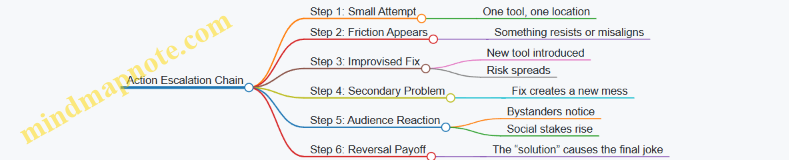
Example: Action chain (fixing a sign that keeps getting worse)
- Small attempt
- A character tries to hang a “SALE” sign with one hook.
- Friction appears
- The hook won’t catch. The sign tilts.
- Improvised fix
- They grab tape.
- The tape sticks to the sign… and their sleeve.
- Secondary problem
- They peel the sleeve free.
- The sign swings and smacks a stack of flyers.
- Audience reaction
- A customer walks over.
- “Is that part of the promotion?”
- Reversal payoff
- The character freezes, then points at the mess.
- “Yes. It’s… limited edition.”
Why it escalates: physical effort becomes increasingly entangled with other objects, and the bystander’s question converts chaos into a visible “commitment.”
Mind Map: Plan Escalation Chain
Example: Plan chain (stealing back a borrowed item without being caught)
- Simple plan
- “We’ll swap it at closing. Quietly.”
- Constraint added
- “Closing is moved up. Ten minutes.”
- Plan B introduced
- “Then we’ll do it during the last customer.”
- Coordination failure
- One person waits by the counter.
- The other person walks in with the replacement… and the wrong bag.
- Public timing
- The manager calls, “Who brought the bag?”
- Surprise within escalation
- The character opens it.
- Inside is the original item—still wrapped—because the “wrong bag” was the right one.
Why it escalates: each step adds a constraint or dependency, so the plan becomes harder to execute, not just more complicated. The final beat pays off because earlier confusion created a believable path to the outcome.
Practical Integration: Choosing the Right Chain for the Scene
Use dialogue escalation when the humor comes from negotiation, ego, or politeness turning into obligations. Use action escalation when the humor comes from cause-and-effect getting messier with each attempt. Use plan escalation when the humor comes from coordination under pressure, where misunderstandings become structural rather than accidental.
A quick test: after each step, ask what changed that makes the next step harder. If nothing changes, the chain is just repeating. If something changes, the scene has momentum—and the punchline has a reason to land.
4. Reversal: Turning the Meaning Without Breaking the Scene
4.1 Reversal Defined: Expectation Replaced by a New Truth
A reversal is a moment where the story’s current meaning stops being true, and a new truth takes its place. The reader doesn’t just learn something new; the reader’s earlier interpretation gets replaced. That replacement is what makes the beat feel like a turn rather than a simple reveal.
The Core Mechanism
Start with an expectation that the scene has earned. The expectation can be about intent (“He’s trying to help”), identity (“That’s the manager”), method (“The plan will work”), or interpretation (“This is a misunderstanding”). Then, deliver a new truth that contradicts the expectation in a specific way.
A useful way to think about it: a reversal changes the function of a detail. A line that previously sounded like reassurance becomes evidence of manipulation. A gesture that looked accidental becomes deliberate. The same surface information can be re-read under the new truth.
What Makes It a Reversal Instead of a Surprise
Surprise adds information or context. Reversal changes meaning. You can have surprise without reversal when the new information doesn’t contradict the reader’s interpretation. You can have reversal without major surprise when the new truth is already hinted at, but the scene’s interpretation shifts.
In practice, reversals often feel “earned” because the story planted interpretive hooks: small clues, consistent character behavior, or a pattern of logic the reader followed.
Expectation Building: The Scene’s Contract
Before the turn, the scene should establish a contract with the reader. This contract can be explicit through dialogue or implicit through behavior.
Example setup (expectation):
- Character A says, “Don’t worry, I already handled it.”
- Character B relaxes.
- The scene shows no immediate consequences.
The reader’s expectation becomes: A has solved the problem.
The New Truth: What Replaces the Old Meaning
The reversal’s new truth should be concrete and scene-relevant. It should not require the reader to invent missing logic. The new truth can be delivered through a statement, an action, or a recontextualizing detail.
Example reversal (new truth):
- A adds, “I handled it… by moving it to your desk.”
- B’s relaxed posture collapses.
Now the reader reinterprets “handled it” as “passed it along,” and the earlier calm becomes part of the joke.
Mind Map: Reversal Components
Types of Reversal by Meaning Category
-
Intent Reversal: The character’s goal is not what it seemed.
- Expectation: “I’m protecting you.”
- New truth: “I’m using you as cover.”
-
Identity Reversal: The person or thing is not the category the reader assumed.
- Expectation: “That’s the expert.”
- New truth: “That’s the intern who guessed correctly once.”
-
Method Reversal: The approach is different from the one implied.
- Expectation: “We’ll do it the normal way.”
- New truth: “We’ll do it the way that creates paperwork.”
-
Causality Reversal: The cause-effect relationship flips.
- Expectation: “The compliment made him calm.”
- New truth: “The compliment made him perform.”
Example: A Short Scene with a Clear Turn
Setup:
- Dana says, “I booked the reservation.”
- The host leads them to a table.
- Dana smiles like a person who solved a problem.
Reversal:
- The host returns with a clipboard and says, “Great news: you’re early. Bad news: you booked the reservation… for next week.”
- Dana’s smile stays, but it now reads as confidence without competence.
This works because the scene gave the reader a stable interpretation of “booked the reservation.” The new truth replaces that meaning with a different time category, and the payoff lands in the gap between Dana’s certainty and reality.
Common Failure Modes
- Reversal Without Hooks: The turn feels random because the reader had no reason to form the original expectation.
- Reversal Without Consequence: The new truth is interesting but doesn’t change the scene’s emotional or practical direction.
- Reversal That Requires Too Much Explanation: If the reader must do heavy reconstruction, the beat loses snap.
A Practical Test for Your Own Reversal
Ask two questions. First: “What did the reader think was true at this exact moment?” Second: “What new truth replaces it, using details already present in the scene?” If you can answer both with specificity, you have a reversal rather than a twist for its own sake.
4.2 Types of Reversal: Role, Motive, Method, and Interpretation
Reversal is when the scene’s meaning changes because the reader’s expectation gets replaced by a new truth. The trick is not just surprise; it’s that the new truth must reframe what already happened. A useful way to plan reversals is to classify what flips: the character’s role, their motive, their method, or the reader’s interpretation.
Role Reversal
Role reversal changes who someone is in the situation. The reader expects “helper,” then learns “obstacle,” or expects “victim,” then learns “operator.”
How it works:
- Establish a social function early (boss, customer, expert, victim).
- Let behavior match that function for a few beats.
- Reveal a detail that makes the function assignment wrong.
Easy example: A character barges into a meeting and starts taking notes. Everyone assumes they’re the intern. Later, they correct the manager’s numbers and say, “I’m not here to learn your system. I’m here to audit it.” The same notes now look like evidence, not learning.
Common failure: If the “new role” requires ignoring earlier facts, the reversal feels like a cheat. Keep the reveal tied to something already present: a badge, a document, a title, a pattern of attention.
Motive Reversal
Motive reversal changes why someone is doing what they’re doing. The reader thinks the action is driven by kindness, fear, or loyalty, then learns it’s driven by control, profit, or self-protection.
How it works:
- Show a motive-shaped behavior (over-explaining, rushing, offering sacrifices).
- Seed a competing motive through a small inconsistency.
- Pay off by stating the motive in a way that reinterprets prior gestures.
Easy example: A coworker keeps “helping” by fixing your calendar invites. You assume they’re organized. Then you overhear them say, “If you’re always in meetings, you can’t volunteer for the thing I don’t want you to do.” Their helpfulness becomes a strategy.
Common failure: If the motive reveal makes the character act irrationally, the reader won’t accept it. Motive reversal should make the earlier behavior more efficient, not less.
Method Reversal
Method reversal changes how the goal is pursued. The reader expects a straightforward approach, then discovers a different mechanism: sabotage instead of negotiation, bluff instead of honesty, bureaucracy instead of force.
How it works:
- Present the method as obvious (direct request, physical action, official form).
- Let the method produce partial results.
- Reveal that the results were bait for a different mechanism.
Easy example: A character tries to “win” a game by playing well. They appear to be improving. Then the reveal: they’ve been intentionally losing to trigger a rule that gives them a stronger starting position next round. Their “bad play” becomes a plan.
Common failure: Method reversal collapses if the new method can’t explain the intermediate outcomes. Anchor the reveal to what the reader already saw: timing, sequence, tool choice, or the specific kind of mistake.
Interpretation Reversal
Interpretation reversal changes what the reader thinks the scene means, even if the character’s role, motive, and method stay the same. This is the “oh, that’s what that was” moment.
How it works:
- Provide ambiguous cues that fit multiple meanings.
- Let the reader settle on one meaning through context.
- Reframe the cues with a new lens that doesn’t contradict the facts.
Easy example: A character keeps saying, “It’s fine. I’m used to it.” The reader assumes they’re being stoic about insults. Later, another character clarifies: “They’re used to it because they’re the one who keeps breaking the printer.” The line was never about emotional resilience; it was about routine failure.
Common failure: Interpretation reversal fails when it requires new facts that weren’t hinted. The new meaning should be available from the existing evidence once the lens changes.
Mind Map: Reversal Types and What Changes
Putting It Together in One Scene
A single scene can contain multiple reversals, but each should change a different layer. If you try to flip role, motive, method, and interpretation at once, the reader may not know what to reframe first.
Integrated example: In a small office, a “customer” arrives and asks for help. That’s role setup. The staff rushes to assist, suggesting motive as kindness. The customer then fills out forms in a way that looks sloppy, implying a weak method. The reversal sequence lands like this: the customer is actually an auditor (role), they’re trying to trigger compliance failures (motive), the “sloppy” forms are designed to create a paper trail (method), and the staff’s panic is reinterpreted as fear of documentation rather than fear of the customer (interpretation). The humor comes from the same actions being reclassified four times, each reclassification tied to concrete evidence.
Quick Diagnostic for Your Draft
Ask four questions while revising:
- What changed about the character’s role?
- What changed about their motive?
- What changed about their method?
- What changed about the reader’s interpretation?
If you can answer at least one clearly, the reversal has a spine. If you can answer two, the scene usually has momentum. If you answer all four, make sure each flip is supported by distinct, already-present clues.
4.3 Reversal Placement: Mid-Scene Turns vs. End-of-Scene Flips
Reversal placement is about when the story changes what the reader thinks is happening. The same reversal can feel clever or confusing depending on timing. Mid-scene turns reframe the current problem so the next beats make sense. End-of-scene flips close the scene by changing the meaning of what just happened, setting up the next scene’s direction.
Mind Map: Placement Options and Their Effects
Mid-Scene Turns: Reframe the Problem While It’s Still Moving
A mid-scene turn works best when the story still has work to do. The reversal should arrive early enough that the character can react, adjust, or double down. If the turn lands too late, it becomes an end-of-scene flip wearing a mid-scene costume.
A practical rule: the reversal should change at least one of these within the same scene—what the character tries next, what the character believes, or what the reader understands about the obstacle.
Example: A character, Mara, is trying to return a borrowed key before her roommate gets home. The scene begins with urgency: she checks the hallway, listens for footsteps, and slips the key into the correct bowl. Mid-scene, she notices the bowl is labeled with a different apartment number than the one she’s in. The reversal is that she’s been returning the wrong key all along, but she only learns it after she’s already committed to the action. Now the scene can pivot: she must decide whether to retrieve it, confess, or improvise a new explanation. The humor comes from the mismatch between her confidence and the new information, but the structure stays coherent because the next beats follow the turn.
Mid-scene turns also benefit from “cause-to-effect” clarity. The reader should be able to trace the reversal to a specific clue or action, even if they didn’t predict it. If the reversal is purely random, the scene feels like it changed its mind.
End-of-Scene Flips: Reinterpret the Scene After the Work Is Done
An end-of-scene flip changes the meaning of the scene once the character has already finished the visible task. This placement is ideal when the scene’s goal is achievable on the surface, but the underlying truth is not what it seemed.
A practical rule: the flip should make the reader reconsider what was “true” during the scene. It can be a correction, a reveal, or an irony that reframes earlier details.
Example: Theo hosts a “serious” meeting with his team about budget cuts. He delivers a spreadsheet, speaks in careful bullet points, and insists everyone stay on topic. The scene ends with relief: the team agrees to the cuts, and Theo looks satisfied. Then, at the very end, we learn the spreadsheet was for a different department—his assistant grabbed the wrong file. The reversal is not that the meeting failed; it’s that the success was based on a false premise. The next scene can begin with consequences: someone realizes the cuts were approved for the wrong place, and Theo must explain how he managed to be both confident and wrong.
End-of-scene flips create a clean “click” moment, but they require restraint. If you stack multiple reversals at the end, the reader can’t tell which one matters. One strong flip beats three weak ones.
Choosing Between Them: A Simple Decision Test
Ask two questions while drafting:
-
Does the character need to act differently immediately after the reversal?
- Yes: place it mid-scene.
- No: place it at the end.
-
Does the scene already contain enough momentum to carry the reader through the new understanding?
- Yes: mid-scene turns can escalate within the same scene.
- No: end-of-scene flips can safely pause the reader before the next scene.
Integrated Example: One Scene, Two Placements
A single scene can use both, but they must serve different functions. Use a mid-scene turn to change the character’s tactic, then use an end-of-scene flip to change the meaning of the tactic.
Example: Juno tries to impress a strict librarian by returning a book “on time.” Mid-scene, she discovers the librarian’s rule is not about dates; it’s about the book’s condition. Her careful handling is exactly what triggers suspicion because the cover is too pristine for the book’s usual wear. Juno changes strategy: she intentionally roughs up the cover to match expectations. End-of-scene, the librarian reveals the book is a prop used for training new staff, and Juno’s “damage” is what earns her a job offer. The mid-scene turn drives action; the end-of-scene flip reframes the entire scene’s stakes.
When placement is chosen deliberately, reversals feel less like surprises and more like logical consequences—just delivered with better timing than the reader expected.
4.4 Reversal Mechanics: Clues, Misdirection, and Payoff Consistency
A reversal lands when the reader’s mental model changes without feeling cheated. That means three things must work together: clues that were present, misdirection that changed attention, and a payoff that matches the new truth.
Clues That Were Always There
Clues are not “secrets.” They are details that can be reinterpreted after the turn. The key is that the clue must be compatible with both the initial assumption and the reversed meaning.
A practical way to design clues is to separate them into three roles:
- Surface clue: something the reader can notice immediately.
- Constraint clue: something that limits what can be true.
- Behavior clue: something a character does that reveals motive or method.
Example: A character says, “I’m terrible at lying,” then immediately offers a very specific timeline. Surface clue: the confession. Constraint clue: specificity implies competence. Behavior clue: the character chooses precision, not vagueness. When the reversal arrives, the reader can reinterpret the confession as a strategy, not a weakness.
Misdirection That Changes Attention, Not Reality
Misdirection is the steering of interpretation. It works when the story encourages a plausible but incomplete reading.
Use misdirection in two controlled ways:
- Focus shift: the scene emphasizes one question while the reversal answers another.
- Category shift: the reader assumes a detail belongs to one category (accident, mistake, kindness) while it actually belongs to another (plan, test, leverage).
Example: In a negotiation scene, the protagonist keeps complimenting the other person’s “honesty.” The reader expects a moral appeal. The reversal later reveals the compliments were bait to provoke a specific admission. The compliment didn’t become false; it became reclassified.
Payoff Consistency That Closes the Loop
Payoff consistency means the reversal must explain what the clues implied, not just what the author wants. If the payoff requires ignoring earlier details, the reader feels the turn was manufactured.
A reliable payoff has three properties:
- Causal: the new truth explains the earlier events.
- Selective: it uses the most relevant clues, not every detail.
- Proportional: the magnitude of the turn matches the amount of setup.
A quick test: after drafting the reversal, list the top three clues you want the reader to notice. Then write the payoff sentence that each clue supports. If any clue cannot be supported without stretching, revise the clue or soften the payoff.
Mind Map: Reversal Mechanics
Example: A Clean Reversal with Fair Clues
Setup: Mara finds a missing key on her desk. Her roommate says, “I would never go through your things. I’m just bad at remembering where I put stuff.” Mara assumes the roommate is telling the truth and that the key simply got misplaced.
Reversal: Later, Mara discovers the roommate used the key to access a locked cabinet, then returned it to create plausible deniability. The roommate’s “bad at remembering” line becomes a constraint clue: the roommate can’t be trusted with location, but can be trusted with access.
Why it works:
- Surface clue: the key appears where it “shouldn’t.”
- Constraint clue: the roommate’s claim about memory frames the method.
- Behavior clue: the roommate avoids direct answers about the cabinet.
- Misdirection: the scene emphasizes trust and privacy, not access and timing.
- Payoff: the new truth explains why the key was placed back instead of removed.
Example: When Payoff Breaks
If the reversal says the roommate never touched the key at all, the key’s placement becomes meaningless. The reader can’t reinterpret it; they can only discard it. Fixing this usually means either changing the payoff to match the key’s causal role, or adjusting the clue so it can support the new truth.
Practical Checklist for Consistent Reversals
- Can each major clue be re-read as meaningful after the turn?
- Does the misdirection steer interpretation toward a plausible question?
- Does the payoff explain the earlier events without contradicting them?
- If you remove one clue, does the reversal still feel earned?
When clues, misdirection, and payoff are aligned, the reversal feels like a correction of understanding rather than a sudden plot trick.
4.5 Practical Examples: Reversal Patterns for Conflicts and Misunderstandings
Reversal works best when the scene already contains a disagreement, a plan, or a mistaken assumption. The reader should feel, “I saw the pieces,” even if the meaning changes at the last moment. Below are four practical patterns you can reuse, each with a conflict or misunderstanding and a clear reversal mechanism.
Mind Map: Reversal Patterns for Conflicts and Misunderstandings
Pattern 1: Role Reversal in a Blame Fight
Setup conflict: Two coworkers argue about who caused a missed deadline.
Scene text (before reversal): Mara points at the calendar. “You said the vendor would deliver Friday. It didn’t.” Jon folds his arms. “I said they might. You told the team it was guaranteed.”
Reversal mechanism: The “responsibility” role flips because the earlier statement was a deliberate misdirection by the person who appears less in charge.
Scene text (reversal): Mara’s phone buzzes. She reads the message aloud: “Jon, please confirm delivery status by noon. If it’s uncertain, frame it as ‘likely’ so we can adjust scope.” Jon blinks. “So you weren’t correcting me. You were following my instruction.” Mara exhales. “And I was the one who turned ‘likely’ into ‘guaranteed’—because you asked me to.”
Why it lands: The reader gets a concrete new truth (the message) that reassigns roles without changing the facts.
Pattern 2: Motive Reversal in a Misunderstood Apology
Setup misunderstanding: Someone thinks an apology is sarcastic.
Scene text (before reversal): “Sorry I’m late,” Theo says. Renee squints. “That’s your third ‘sorry’ this week. You’re not sorry. You’re stalling.”
Reversal mechanism: The apology’s motive flips from “avoidance” to “protection,” revealed by a small, specific detail.
Scene text (reversal): Theo sets a folded receipt on the table. “I waited because I had to return the wrong part. If I’d shown up on time, you would’ve installed it and the machine would’ve failed during your demo.” Renee’s face changes. “You came late so I wouldn’t get blamed.” Theo nods. “I didn’t want to be right. I wanted you to be safe.”
Why it lands: The reversal is not a speech; it’s a tangible object that reframes the earlier tone.
Pattern 3: Method Reversal in a Plan That Backfires
Setup conflict: A character tries to “fix” a problem with a clever workaround.
Scene text (before reversal): Sam says, “I’ll handle the meeting. I’ll bring the wrong file on purpose. Then I’ll look prepared when I switch to the right one.” Dana stares. “That’s not preparation. That’s sabotage.”
Reversal mechanism: The method is revealed to be a test for who is actually controlling access.
Scene text (reversal): Dana checks the shared drive permissions on her laptop. “You can’t even open the right file from your account.” Sam’s smile fades. “Exactly. I brought the wrong file so the system would log who tried to correct me.” Dana scrolls. “The admin account changed permissions five minutes ago.” Sam points at the screen. “So the ‘problem’ wasn’t my mistake. It was their interference.”
Why it lands: The reversal changes the meaning of the same action (“bringing the wrong file”) by adding a missing constraint (permissions).
Pattern 4: Interpretation Reversal in a Tone Misread
Setup misunderstanding: A message sounds rude, but the context changes.
Scene text (before reversal): A text reads: “Great. You finally sent it.” Lena replies, “Thanks for the sarcasm.”
Reversal mechanism: The interpretation flips because the sender is responding to a real emergency, not a delay.
Scene text (reversal): Marcus calls. “I wrote that while the power was out. Your message was the first confirmation we had that the backup worked.” Lena rereads the timestamp. “So ‘finally’ means finally after the outage.” Marcus nods. “I didn’t mean to sound sharp. I meant to sound relieved.”
Why it lands: The reversal is earned by timing and context, not by a sudden personality change.
Advanced Placement: Mid-Scene Turns That Rewire the Argument
If your scene has a back-and-forth, place the reversal mid-scene so the characters must renegotiate their claims. A good rule: the first half should argue from one interpretation; the second half should force a new interpretation using one new piece of evidence, one new constraint, or one reassigned role.
Mini-template you can reuse:
- State the conflict in a single sentence.
- Let the other person respond with a reason that seems complete.
- Add one concrete detail that changes the meaning of the earlier reason.
- Have the character revise their claim without pretending they were always right.
Use these patterns to keep reversals fair: the reader should be able to point to the earlier setup and say, “That line was doing work; it just wasn’t finished yet.”
5. Surprise: Delivering the Unexpected with Control
5.1 Surprise vs. Reversal How They Differ and How They Overlap
Surprise and reversal both change what the reader thinks is happening, but they do it in different ways. Surprise adds a new piece of information or a new context. Reversal changes the meaning of information the reader already has, often by reframing motives, roles, or cause-and-effect.
The Core Difference
Surprise answers a question the scene never fully asked. The reader feels, “Oh—so that’s what’s going on.” The scene’s logic stays intact; it just gains a missing ingredient.
Reversal answers a different question: “Wait—what I thought was true is not the true interpretation.” The reader’s earlier assumptions become the setup for the turn. The scene’s logic also stays intact, but the interpretation flips.
A quick way to tell them apart is to ask what changes at the moment of the laugh:
- If the laugh comes from newly revealed facts, it’s surprise.
- If the laugh comes from a changed interpretation of existing facts, it’s reversal.
How Surprise Works
Surprise typically arrives as one of three things.
- New information: A character reveals a detail that was hidden.
- New context: The same event is re-scoped by a new rule or constraint.
- New constraint: A plan fails because a previously unknown limitation appears.
Example (surprise):
A manager says, “We’re doing team-building today.” The team groans. Then the manager adds, “It’s mandatory, but you can choose the activity.” The reader expects a trap; the surprise is that the trap is optional.
Notice what didn’t change: the manager’s earlier statement still means what it meant. The new detail changes the reader’s expectation about how bad it will be.
How Reversal Works
Reversal usually depends on interpretation. The reader has been tracking a story model—who is responsible, what the goal is, why someone acts. The turn swaps that model.
Common reversal levers include:
- Role reversal: The person who seemed in charge isn’t.
- Motive reversal: The action’s purpose is different than assumed.
- Method reversal: The “how” is different than expected.
- Cause-effect reversal: The event that seemed like an outcome becomes the cause.
Example (reversal):
A character tries to impress a date by saying, “I’m great at cooking.” They burn the food, then smile and say, “Perfect. Now we can blame the smoke alarm.” The reader’s assumption was that they wanted to cook well. The reversal is that they wanted a believable excuse.
Notice what changed: the same burned food now means something else.
Where They Overlap
Surprise and reversal often share a moment because a new fact can force a new interpretation. The overlap happens when the scene delivers both:
- A revelation (surprise), and
- A reframe (reversal) that explains why the revelation matters.
Example (overlap):
A coworker complains, “The boss hates me. Every time I talk, he interrupts.” Later, the boss calls them in and says, “I’m not interrupting you. I’m stopping you from saying the wrong thing.” The reader learns a new constraint (surprise): the boss is preventing a mistake. Then the reader reinterprets the earlier interruptions (reversal): they weren’t hostility; they were protection.
The laugh lands because the scene doesn’t just add information. It changes the meaning of the pattern.
Mind Map: Surprise Versus Reversal
Practical Design Rules for Writers
-
Choose the primary engine. If the scene’s main job is to reveal, treat it as surprise and keep the interpretation stable until the reveal lands. If the scene’s main job is to flip meaning, treat it as reversal and make sure the earlier clues can be re-read as consistent.
-
Make the turn fair. Surprise feels good when the reader could have imagined the possibility, even if they didn’t. Reversal feels good when the earlier details were not random; they were just interpreted through the wrong lens.
-
Avoid “two turns in one sentence.” If you stack revelation and reframe too tightly, the reader may register confusion instead of a clean shift. Let the new fact arrive, then let the meaning click.
A Small Beat Template
Use this sequence when you want overlap without chaos:
- Beat 1: Establish a pattern the reader can track.
- Beat 2: Deliver a new fact or constraint.
- Beat 3: Reframe the pattern’s meaning so the reader can re-read Beat 1.
Example (mini-template):
A student keeps borrowing the same book. The class assumes they’re studying. Then the teacher says, “You’re not borrowing it to learn. You’re borrowing it to return it to the library before it gets reassigned.” The new constraint reframes the pattern.
In that moment, the reader gets surprise from the hidden purpose and reversal from the changed interpretation of the same behavior.
5.2 Surprise Sources: New Information, New Context, and New Constraints
Surprise works best when it changes what the reader thinks is true, not just what they expect to happen. In practice, you get three main sources: new information, new context, and new constraints. Each one shifts the reader’s mental model in a different way, so you can choose the shift that matches your scene.
New Information
New information is the cleanest surprise source: you reveal a fact that was previously unknown or misinterpreted. The key is that the fact must connect to earlier setup, even if it was hidden.
How it lands:
- The reader has a working theory.
- You withhold one crucial detail.
- When the detail arrives, the theory collapses and a new one forms.
Easy example: A character says, “I’m not late. The meeting started when I arrived.” The scene seems like a joke about punctuality. Later, you reveal the “meeting” is a timer app the character set to start only after they unlock their phone. The humor shifts from attitude to absurd engineering.
Best practice: Seed small, believable signals that the missing detail exists. If the reader feels the author pulled a random fact from nowhere, the surprise becomes a trap.
New Context
New context changes the meaning of information the reader already has. Instead of adding a new fact, you reframe the situation so the same facts point somewhere else.
How it lands:
- The reader stores details as one category.
- You reveal a new frame that reclassifies those details.
- The scene’s earlier lines suddenly read differently.
Easy example: Two coworkers argue about a “missing” stapler. The reader assumes incompetence. Mid-scene, you reveal the stapler is part of a prank ritual: whoever finds it must deliver it to the office’s “paper altar” by end of day. The argument was never about the stapler’s location; it was about who gets the responsibility.
Best practice: Make the reframe feel like a logical interpretation, not a magic switch. The new context should explain why characters behaved the way they did.
New Constraints
New constraints surprise by changing what is possible. The reader may know the plan, but then you introduce a limitation that forces a different path.
Constraints can be physical (a door is locked), social (someone overhears), procedural (a form requires a signature), or emotional (a character refuses to lie). The surprise comes from the immediate mismatch between “what the plan assumes” and “what the scene allows.”
How it lands:
- The reader watches a strategy form.
- You introduce a constraint that invalidates the strategy.
- The characters scramble, and the comedy comes from fast adaptation.
Easy example: A character tries to impress someone by cooking a complicated dish. The reader expects a smooth sequence. Then the oven timer is broken and the recipe requires precise timing. The character can’t “just wing it” without ruining the dish, so they pivot to a simpler method—while still trying to look confident.
Best practice: Tie the constraint to the story’s internal logic. If the limitation appears only to create a joke, it will feel like the scene is being steered rather than lived.
Mind Map: Surprise Sources and Their Scene Effects
Mind Map: Choosing the Right Source for the Moment
Integrated Example: One Scene, Three Surprise Types
A character arrives at a “silent” library event and whispers, “I’m being respectful.” The reader assumes they’re following rules.
-
New Information: A staff member hands them a microphone and says, “You’re the performer. Everyone else is the audience.” The whispering was the wrong kind of respect.
-
New Context: The character’s earlier habit of talking to objects becomes relevant: they were practicing lines with the microphone stand like it was a person. The scene’s awkwardness becomes intentional.
-
New Constraints: The microphone battery dies mid-sentence. They can’t continue the performance as planned, so they switch to pantomime and exaggerated gestures—still trying to keep the “silent” promise.
Each surprise type changes the reader’s model in a distinct way, so the comedy stays coherent instead of piling on random shocks.
5.3 Managing Reader Trust: Surprise That Feels Earned
Reader trust is the quiet agreement that the story’s rules are consistent. Surprise works only when the reader can later say, “I didn’t see it, but I should have.” That feeling comes from three foundations: fair setup, coherent logic, and controlled timing.
The Trust Contract
A surprise is “earned” when it satisfies two conditions at once. First, the reader’s earlier assumptions were reasonable given what you showed. Second, the new information changes the meaning of those assumptions without contradicting facts you already established.
A simple test: after the reveal, point to one earlier detail that now reads differently. If you can’t, the surprise is probably a late invention.
Fair Setup Without Over-Explaining
Fair setup does not mean you must spell out the twist. It means you must place at least one usable clue in the story’s visible space.
Use specificity. Vague promises (“Something is off”) don’t create trust because they don’t constrain interpretation. Specific promises (“The key is warm, like it was held a moment ago”) create constraints, so the reader’s later confusion becomes productive.
A practical method is the “two-lane setup.” Lane one is the obvious interpretation. Lane two is the hidden interpretation that shares the same surface facts. When the surprise lands, both lanes were present; only the meaning changed.
Example: A character says, “I hate surprises,” while carefully checking the same door latch twice. The obvious lane is that they’re cautious. The hidden lane is that they’re rehearsing a response to a specific kind of surprise.
Coherent Logic over Convenient Luck
Trust breaks when the story uses coincidence as a substitute for cause. Surprise should follow a chain of cause and effect that fits the character’s knowledge and behavior.
To keep logic coherent, decide what the character knows at each moment. Then ensure the surprise is a consequence of that knowledge gap, not a violation of it.
Example: A detective claims the suspect couldn’t have done it because “the alarm wasn’t armed.” The surprise is earned if earlier scenes showed the detective’s access to the alarm system, and the later reveal shows the system was armed by a different mechanism the detective didn’t consider.
If the alarm detail appears only at the reveal, trust drops. If it appears earlier as a normal operational detail, trust rises.
Timing That Respects Attention
Timing is not just when you deliver the punchline; it’s how long you let the reader hold a belief before you change it.
Use “just long enough” pacing: the reader should have time to form the assumption, but not so much time that they feel the story is stalling. A reliable cue is scene pressure. When the scene goal forces action, the reader’s attention is already engaged, so the surprise feels like a consequence rather than a detour.
A useful rule: if the surprise requires the reader to forget something important, the timing is too late.
Mind Map: Earned Surprise
Example: Reversal Disguised as Surprise
A character arrives early to meet a friend. They complain about being “stuck waiting,” then check their phone and sigh with relief.
- Obvious lane: The friend is late.
- Hidden lane: The character is early because they’re the one who delayed the meeting.
Earned surprise requires earlier facts to support both lanes. The phone check should show a message timestamp or a calendar reminder that implies scheduling control. The complaint about waiting should be specific enough to later connect to the character’s own action.
When the friend finally arrives, the character’s relief can be reframed: not relief that the friend is late, but relief that the friend arrived at the exact moment the character needed.
Example: Surprise That Fails Trust
A character walks into a room, sees a locked door, and concludes the villain escaped through a window. The story then reveals the window was never there.
This fails because the reader’s assumption was reasonable based on visible information, but the reveal changes reality rather than meaning. If the window absence is essential, it must be present earlier as a constraint—perhaps the wall is newly painted, or the room layout is described in a way that makes the window impossible.
A Practical Checklist for Revision
- Identify the reveal sentence or beat.
- List one earlier detail that the reader can reinterpret.
- Confirm that no established fact is contradicted.
- Verify that the character’s knowledge explains why they missed the truth.
- Check that the scene goal creates pressure at the moment of the reveal.
When these steps align, surprise becomes a form of clarity. The reader feels smart, not tricked, because the story’s logic was present all along—just waiting for the right angle.
5.4 Surprise Timing: The “Just Late Enough” Principle
Surprise works best when the reader has enough information to form a reasonable expectation, but not so much time that the expectation becomes a comfortable prediction. The “Just Late Enough” principle is about delaying the reveal until the moment it still changes the scene’s meaning. If you reveal too early, the reader’s brain files the event as “already understood.” If you reveal too late, the reader feels tricked rather than surprised.
The Core Timing Problem
A comic reveal has two jobs: it must land a new interpretation, and it must do so while the reader is still actively processing the setup. That means the reveal should arrive after the setup has been understood, but before the reader has stopped looking for meaning.
A practical way to think about this is to track three states:
- Expectation formed: The reader can summarize what they think is happening.
- Expectation stabilized: The reader stops revising and starts anticipating the next step.
- Meaning flipped: The reveal forces a new summary.
“Just Late Enough” aims to place Meaning flipped between Expectation formed and Expectation stabilized.
How to Measure “Late Enough” in a Scene
You can’t measure timing with a stopwatch, but you can measure it with reader attention. Use these signals:
- Reader comprehension marker: When the scene includes a clear goal, a clear constraint, or a clear rule, the reader’s expectation is formed.
- Reader prediction marker: When the dialogue or action repeats a pattern, the reader starts expecting the same kind of outcome.
- Reveal marker: The moment the reveal arrives, the reader should revise their summary of the scene in one step.
If the reveal arrives before marker 1, it feels random. If it arrives after marker 2, it feels like the punchline was obvious all along.
Mind Map: Surprise Timing Flow
The “Delay with Purpose” Technique
Late reveals often fail because the delay is empty. The fix is to use the delay to add useful processing, not extra noise. Purposeful delay usually comes from one of these moves:
- Add friction: The character tries to act on the current expectation, and that attempt creates momentum.
- Add specificity: A detail narrows the possibilities, making the eventual flip sharper.
- Add misinterpretation pressure: The scene includes a reason the reader might misread the situation.
This is why timing and clue design are inseparable. The delay should make the reader’s eventual revision feel like a natural consequence of what they just learned.
Example: Dialogue with a Late Reveal
Setup: Two coworkers discuss a “simple” task.
- A: “Just put the form in the envelope and send it.”
- B: “Which envelope?”
- A: “The one with the stamp already on it.”
At this point, the reader expects a straightforward instruction. The timing becomes interesting when the conversation continues without giving away the twist.
- B: “I don’t see any stamps.”
- A: “That’s because it’s already stamped.”
- B: “How can it be already stamped if it’s not on anything?”
- A: “Because the envelope is the stamp.”
The reveal is late enough to force a revision: the reader has time to imagine a missing stamp, then the final line redefines the object. If A had said “the envelope is the stamp” immediately, the reader would never build the wrong mental model.
Example: Action with a Late Reveal
Setup: A character tries to look competent during a minor crisis.
- The character opens a toolbox confidently.
- They pull out a tool that seems wrong for the job.
- They use it anyway, with increasing confidence.
The reader expects either incompetence or a hidden purpose. The “Just Late Enough” reveal arrives when the tool’s effect becomes visible.
- The tool is used to “fix” the problem.
- The problem worsens slightly.
- Then the character points at a label on the tool: it was meant for a different stage of the process.
The surprise lands because the reader had time to watch the attempt and form a hypothesis about intent. The label arrives after that hypothesis is active, not after it has already been replaced by boredom.
Advanced Detail: Choosing Mid-Scene vs End-of-Scene Timing
- Mid-scene surprise works when the flip changes what the character does next. The reader revises strategy immediately.
- End-of-scene surprise works when the flip changes how the reader interprets everything that just happened. The reader revises meaning after the action stops.
In both cases, “Just Late Enough” still applies: the flip must arrive while the reader is still processing, not after they’ve moved on to the next expectation.
Quick Self-Check
Before finalizing, ask two questions:
- Could a reader summarize the scene correctly right before the reveal? If yes, you’re close.
- Does the reveal force a one-step revision, or does it require a long re-explanation? If it requires a long explanation, the timing is likely too early or the clues are too scattered.
When those answers are favorable, the surprise feels earned rather than delayed for its own sake.
5.5 Practical Examples: Surprise Endings, Surprise Reveals, and Surprise Objects
Surprise works best when it changes what the reader thinks is happening, not just what they feel. The three common forms—endings, reveals, and objects—share the same requirement: the story must have been giving clues that can be reinterpreted after the turn.
Foundational Distinctions
A surprise ending flips the story’s meaning at the final moment. A surprise reveal changes understanding mid-story and then reshapes the next beats. A surprise object is a concrete item whose properties or purpose are recontextualized.
Use this rule of thumb: endings answer a question the story has been asking; reveals answer a question the story has been avoiding; objects answer a question the story has been ignoring.
Mind Map: Surprise Forms and Their Job
Surprise Ending Example: The Receipt That Wasn’t Proof
Setup (what the reader expects): A character, Mara, returns a broken kettle to a store. The clerk insists the warranty expired. Mara produces a receipt and argues the purchase date.
Escalation (what tightens the scene): The clerk checks the system and says the receipt number belongs to a different kettle model. Mara grows frustrated, then calmer, then stubborn again. She points out that the kettle in her kitchen matches the serial number printed on the receipt.
The ending turn (what changes meaning): Mara realizes the kettle was replaced under a previous service claim. The receipt she brought is not the original purchase; it is the replacement authorization. The clerk’s system shows the replacement date, which is within warranty, but the clerk never looked at the authorization category.
Why it’s a surprise ending: The final beat reframes the entire argument. The reader’s assumption—“receipt equals purchase proof”—was reasonable, but the story’s last line corrects the category.
Quick practice: Write the ending so it answers the question your last scene raised: “What exactly did the receipt prove?” Then ensure earlier lines contain the ingredients for that answer.
Surprise Reveal Example: The Apology That Isn’t for You
Setup: Two coworkers, Jae and Priya, argue in the break room. Priya storms off. Jae later tells a joke to the team, but his tone is flat.
Reveal moment: In the next scene, Priya returns with a small apology note for Jae. Jae reads it, then laughs too loudly. The reader realizes the earlier argument wasn’t about the project at all; it was a rehearsed conflict to cover a mistake Priya made that could have been traced to Jae.
Why it’s a surprise reveal: The reveal changes the motive behind the earlier scene. The apology note is not new information about facts; it is new information about intent.
Quick practice: Make sure the reveal doesn’t contradict what happened. Instead, it should reinterpret why it happened.
Surprise Object Example: The “Broken” Keycard
Setup: A security guard, Tomas, finds a keycard on the floor. It won’t scan. He shrugs and pockets it, assuming it’s useless.
Escalation: Tomas uses it to open a door anyway, because the building has an override for staff. The door opens, but the alarm triggers. He panics, then notices the keycard’s chip is intact while the printed strip is scratched.
Object redefinition (the surprise): The card is not broken; it’s a decoy. Someone scratched the printed strip to make it look invalid, knowing Tomas would try it. The alarm trigger is the real test: it confirms Tomas is following the override procedure rather than bypassing it.
Why it’s a surprise object: The object’s behavior stays consistent. The surprise comes from learning what the object was designed to cause.
Quick practice: When you introduce an object, decide what it is “for” in the story’s logic. Later, reveal that purpose.
Mind Map: Clue Placement for Earned Surprise

Practical Checklist for Each Form
- Name the question your reader is holding in their head at the moment of surprise.
- Ensure the answer was possible from earlier details, even if it wasn’t the most obvious interpretation.
- Deliver the turn with a concrete mechanism: a category, a motive, a designed function.
- Keep the surprise specific. “Something was different” is weaker than “the receipt proves a replacement authorization.”
Use these examples as templates: endings reframe, reveals reinterpret motives, and objects change meaning through consistent behavior.
6. The Core Comic Equation: Timing × Escalation × Reversal × Surprise
6.1 Mapping the Equation to Story Structure (Beat to Scene to Sequence)
The comic equation—Timing × Escalation × Reversal × Surprise—works best when you map it onto how stories are built. A beat is a unit of action or thought. A scene is a unit of change. A sequence is a unit of transformation across multiple scenes. If you assign each comic engine to the right level, you get humor that feels inevitable rather than accidental.
Beat Level: Timing First, Then Tiny Escalations
A beat is where timing lives. It’s the smallest place you can control release: a pause before an answer, a delayed clarification, a reaction that arrives a fraction late.
- Timing at the beat level: deliver the setup line, then hold the punchline by one beat. Example: “I brought snacks.” Beat pause. “For the meeting.” Beat pause. “So… no one eats me.”
- Escalation at the beat level: escalate by adding pressure, not by adding length. Example: the character starts with a polite lie, then a slightly bigger lie, then a lie that requires a new prop.
- Reversal and Surprise at the beat level: use them sparingly. A reversal can be a micro-turn in who is responsible. A surprise can be a quick reframe of what the character meant.
Mind Map: Beat Level
Scene Level: Make Change Visible
A scene is where the story’s promise is tested. The reader expects a shift: a decision, a negotiation, a discovery, or a failed attempt. Humor engines should support that shift.
A practical scene template:
- Scene goal: what the character wants.
- Scene pressure: what blocks them.
- Scene turn: where reversal changes the meaning of the goal.
- Scene payoff: where surprise lands and timing releases the final laugh.
At the scene level, Escalation should be the dominant engine because scenes are built to change conditions. Timing still matters, but it becomes the pacing of the scene’s internal beats.
Example scene skeleton:
- Goal: convince the boss the project is “on track.”
- Pressure: the boss has a spreadsheet that contradicts the character’s story.
- Turn (Reversal): the character realizes the spreadsheet is tracking the wrong project—so their lie accidentally helped.
- Payoff (Surprise): the boss thanks them for “improving accuracy,” then assigns them to fix the spreadsheet.
Mind Map: Scene Level
Sequence Level: Choose One Primary Engine
A sequence is multiple scenes that move toward a larger transformation. Here’s the key mapping rule: pick one primary engine for the sequence, then let the others support it.
- If the sequence is about Escalation, each scene should raise the cost of the same problem.
- If the sequence is about Reversal, each scene should reassign responsibility, redefine motives, or change interpretations.
- If the sequence is about Surprise, each scene should add a new constraint or reveal that forces a new plan.
- Timing ties everything together by controlling how long the reader waits for each new layer.
Mind Map: Sequence Level
Integrated Example: From Beat to Sequence
Imagine a character trying to return a “lost” item to the library.
Beat: They say, “I found it.” A beat later: “In my bag.” Another beat: “Which is… not where it should be.”
Scene: The librarian demands proof. The character produces a receipt that belongs to someone else. The turn is a reversal: the character wasn’t the finder; they were the accidental courier. The payoff is surprise: the librarian smiles and says, “Great. Now we can stop searching for the real owner.”
Sequence: Across three scenes, the primary engine is Reversal. Scene one flips who owns the item. Scene two flips who is responsible for the mistake. Scene three flips what “return” even means, because the item was part of a prank event. Timing controls the spacing of each reveal so the reader laughs at the turn, not at confusion.
Mapping Rule That Prevents Chaos
When you map the equation to structure, keep this rule: Timing is local, Escalation is directional, Reversal is interpretive, Surprise is informational. Beats handle local timing. Scenes handle directional change. Sequences handle interpretive and informational transformation. When each level does its job, the humor lands with clean cause-and-effect.
6.2 Choosing One Primary Engine and Supporting with the Others
Comic scenes usually fail for one of two reasons: the writer tries to run multiple engines at full power, or the scene has no engine at all. A practical fix is to pick one primary engine that drives the majority of the reader’s expectation, then use the other three as supporting forces at lower intensity.
The Four Engines in One Sentence Each
- Timing controls when the reader is allowed to anticipate and when the story delays that anticipation.
- Escalation increases pressure, complexity, or consequence in a way that feels like progress.
- Reversal replaces the current interpretation with a new truth.
- Surprise introduces information or context that changes what the reader can reasonably predict.
When you choose a primary engine, you decide what the reader should be tracking most actively. Everything else should either reinforce that tracking or temporarily pause it.
Choosing the Primary Engine by Scene Job
Start with the scene’s job, not with the joke you want.
- If the scene’s job is rhythm and release, make Timing primary. This works well for banter, misunderstandings that unfold slowly, and punchlines that depend on delay.
- If the scene’s job is pressure and momentum, make Escalation primary. This fits negotiations that keep getting worse, plans that multiply constraints, and action that grows messier.
- If the scene’s job is meaning change, make Reversal primary. This fits reveals where the “why” flips, where the character’s motive is reinterpreted, or where the conflict’s cause becomes the effect.
- If the scene’s job is new context, make Surprise primary. This fits discoveries, unexpected rules, and objects or facts that reframe the scene.
A quick rule: if you can remove the primary engine and the scene still feels like the same scene, you probably picked the wrong primary.
Supporting Engines Without Overriding
Supporting engines should behave like background music: present, consistent, and not louder than the main melody.
- Timing as support: use it to hold the line just long enough for the primary engine to land.
- Escalation as support: increase pressure in small steps that don’t steal the spotlight from the primary engine.
- Reversal as support: use it as a minor reframe, not the main turn, unless reversal is primary.
- Surprise as support: introduce small “new facts” that prepare the reader for the primary engine’s payoff.
If you feel tempted to add a big reversal and a big surprise in the same beat, choose which one is primary and downgrade the other to preparation.
Mind Map: Engine Roles and Selection
Example: Timing Primary, Others Supporting
Scenario: Two coworkers argue about who scheduled a meeting.
- Primary (Timing): The speaker gives a confident answer, then pauses for one extra beat before the detail that changes the meaning.
- Supporting (Escalation): Each pause adds a new complication: the calendar invite, then the time zone, then the “optional” label.
- Supporting (Reversal): The final clarification reframes the argument: the meeting was scheduled, but by a template the speaker created.
- Supporting (Surprise): The surprise is small: the template name is the coworker’s nickname.
The scene lands because the reader’s main job is to anticipate the delayed clarification, not to solve a mystery from scratch.
Example: Escalation Primary, Others Supporting
Scenario: A character tries to return a broken item without a receipt.
- Primary (Escalation): Each attempt increases consequence: no receipt becomes store policy, becomes manager approval, becomes a “verification form” that requires a witness.
- Supporting (Timing): The clerk’s responses come in measured beats, letting the character’s hope rise and fall.
- Supporting (Reversal): The witness requirement flips the character’s plan: the witness must be the person who broke it.
- Supporting (Surprise): The witness is already in line, holding the same item—apparently they broke it too.
Here, the reader tracks how fast the situation worsens. The reversal and surprise are there to sharpen the escalation, not replace it.
Example: Reversal Primary, Others Supporting
Scenario: A character claims they “helped” by fixing someone’s problem.
- Primary (Reversal): The scene’s meaning flips midstream: the “fix” was actually the cause.
- Supporting (Timing): The character withholds the key detail until the other person commits to a conclusion.
- Supporting (Escalation): The consequences grow as the other character acts on the wrong interpretation.
- Supporting (Surprise): A small surprise confirms the reversal is not random: the character used the exact same method they criticized earlier.
The reader laughs because the scene’s interpretation changes, and the supporting engines make that change feel inevitable rather than sudden.
Example: Surprise Primary, Others Supporting
Scenario: A group prepares for a “quiet” event.
- Primary (Surprise): A rule is revealed: the venue’s quiet policy applies only to certain rooms, and the group is in the loudest one.
- Supporting (Timing): The reveal arrives after the group has already settled into a false expectation.
- Supporting (Escalation): The consequences escalate quickly: one noise becomes a chain reaction of staff interventions.
- Supporting (Reversal): The person who insisted on quiet becomes the accidental source of the loudest disruption.
The reader’s main tracking is prediction failure. The other engines keep the failure moving toward a payoff.
A Simple Scene Drafting Method
Write the scene with one primary engine in mind, then add supporting engines in this order: Timing support first, then Escalation support, then Reversal or Surprise support depending on which one you want to feel like preparation rather than the main event.
When the draft reads, ask one question: “What would the reader miss if I removed everything except the primary engine?” If the answer is “the whole scene,” you chose well.
6.3 Balancing Clarity and Confusion How Much to Explain Before the Joke
A comic scene needs two kinds of understanding: the reader’s understanding of the situation, and the reader’s understanding of what kind of joke is coming. Too much explanation flattens the moment; too little turns the punchline into a puzzle with no payoff. The goal is not to minimize clarity, but to time it.
The Reader’s Job Before the Punchline
Before the joke lands, the reader should be able to answer three questions:
- What is happening right now? (the immediate situation)
- What does the character believe? (the lens through which events are interpreted)
- What rule is being followed? (social rule, logic rule, or story rule)
If the reader can answer these, confusion can be temporary and purposeful. If the reader can’t, the joke becomes labor.
A Simple Rule of Thumb for Explanation
Explain enough to establish the “comic contract,” then stop. A useful way to measure “enough” is to watch for the moment the reader could predict the next beat’s direction even if they can’t predict the exact punchline.
- Clarity phase: establish situation + character belief + rule.
- Friction phase: let the character act on that belief.
- Release phase: deliver the joke by making the belief collide with a new fact, a different interpretation, or an escalated consequence.
When you keep explaining during the friction phase, you replace friction with instruction.
Mind Map: Clarity vs Confusion Timing
What “Over-Explaining” Looks Like
Over-explaining usually shows up as extra sentences that tell the reader what to think before the scene earns it.
Example: Over-explained setup
- “Mara was nervous because she had promised to deliver the package quietly, but the building had strict noise rules. She didn’t want to get caught, so she planned to sneak in.”
The reader now knows the motivation, the stakes, and the plan. When the joke arrives, it has less room to surprise.
Tighter version
- “Mara held the package like it might file a complaint. The sign on the door said QUIET HOURS. She whispered to the doorman, ‘I’m delivering something… quietly.’”
Now the reader infers the stakes from behavior and signage, which keeps the friction alive.
What “Under-Explaining” Looks Like
Under-explaining is different from withholding. Withholding is controlled; under-explaining is missing.
Example: Under-explained setup
- “Mara whispered to the doorman. ‘I’m delivering something quietly.’ The doorman nodded and rang a bell.”
The reader can’t tell what the bell means, what the doorman is responsible for, or why the nod matters. The punchline may still be funny, but the reader can’t connect it to a rule.
Fix by adding one missing piece
- “Mara whispered to the doorman, ‘I’m delivering something quietly.’ The doorman nodded and rang the bell marked EMERGENCY QUIET.”
One added detail restores the comic contract.
The “One-Detail Upgrade” Method
When you’re unsure whether to explain more, add only one detail that increases predictability without removing surprise.
Choose one:
- A concrete object (a sign, form, device)
- A specific procedure (what must be done, in what order)
- A measurable constraint (time window, volume limit, rule wording)
Avoid adding multiple layers at once. One detail lets the reader build a baseline; the joke can then break it.
A Micro-Template for Timing the Explanation
Use this sequence when drafting:
- Baseline sentence: situation + goal.
- Belief sentence: what the character thinks will happen.
- Rule cue: a sign, policy, or logic step.
- Action sentence: the character tries.
- Punchline sentence: the reframing.
Example using the template
- Baseline: “The office had a ‘No Meetings Without Snacks’ rule.”
- Belief: “Jon brought one granola bar and assumed that counted as a snack.”
- Rule cue: “The sign specified ‘snacks for all attendees.’”
- Action: “He set the bar on the table and announced, ‘I have prepared the group’s refreshments.’”
- Punchline: “Everyone stared at the bar like it was a meeting invite that hadn’t RSVP’d.”
The reader understands the rule before the joke, but the exact outcome still has room to land.
Practical Checklist for the Draft
- Can the reader state the rule in one sentence?
- Does the character’s action follow their belief, not the author’s explanation?
- Are you adding clarity during the friction phase, or only during the baseline?
- Does the punchline resolve confusion by reframing, not by adding missing facts?
Balance is achieved when clarity creates a platform and confusion creates motion. The joke should feel like a consequence, not a detour.
6.4 Avoiding Overstacking When Too Many Turns Cancel Each Other
Overstacking happens when a scene tries to run multiple “engines” at once—timing delays, escalation steps, reversals, and surprise reveals—so aggressively that the reader can’t track cause and effect. The result isn’t “more funny.” It’s confusion that never resolves into a clean payoff.
A useful way to diagnose the problem is to treat each turn as a claim about reality. A reversal replaces one expectation with another. A surprise adds new information or context. If you stack several claims before the reader has a chance to update their mental model, the later claim overwrites the earlier one, and the earlier joke loses its job.
The Core Failure Mode
When turns cancel each other, you typically see one of these patterns:
- Contradictory turns: Turn B makes Turn A impossible, so Turn A feels like a setup for nothing.
- Unpaid turns: Turn A is funny, but the scene never returns to it, so the reader senses a missing payoff.
- Competing targets: The scene tries to reverse the same expectation in two different ways, splitting attention.
- Late clarification overload: You keep explaining just enough to keep the reader oriented, but each explanation delays the next beat until the rhythm collapses.
A Practical Rule for Turn Budgeting
In a single scene, aim for one primary turn (the biggest meaning shift) and one secondary turn (a smaller shift that supports the primary). Everything else should be “support,” not “another turn.” Support includes escalating pressure, tightening dialogue, or adding details that make the primary turn land harder.
A quick test: after drafting, highlight every line that changes what the reader believes. If you have more than two major belief changes in a short scene, you likely have overstacking.
Mind Map: Turn Roles and How They Interact
Systematic Fixes That Preserve Comedy
Step 1: Identify the primary expectation. Write it as a single sentence: “The reader expects X because Y.” If you can’t state it, the scene is probably stacking turns without a stable center.
Step 2: Choose the primary turn and protect it. The primary turn should occur at the moment where the scene’s pressure peaks. If you insert another major turn right before it, the reader’s attention resets and the primary turn loses force.
Step 3: Make secondary turns dependent, not parallel. A secondary turn should be a consequence of the primary turn’s new reality. That way, it feels like the scene is continuing, not changing its mind.
Step 4: Convert leftover “turns” into support. If you have an extra reversal idea, you can often reframe it as escalation (more pressure) or as timing (a delay that makes the primary turn funnier).
Example: Two Turns That Don’t Cancel
Scene goal: Get a character to admit they’re wrong about a simple rule.
- Setup: The character insists the rule is “always true.”
- Escalation: A minor inconvenience grows into a bigger one.
- Primary turn: The character learns the rule has an exception.
- Secondary turn: The character realizes the exception applies specifically to their own situation.
Why it works: the secondary turn depends on the primary turn. The reader updates once, then gets a smaller, coherent payoff.
Example: Overstacking That Breaks the Payoff
- Setup: The character insists the rule is “always true.”
- Escalation: Problems multiply.
- Turn A (reversal): The character discovers an exception.
- Turn B (surprise): Immediately after, the scene reveals the exception was misread and the original rule is actually correct.
- Turn C (reversal): Then the character is told the exception still matters, but only in a way that wasn’t explained.
Why it fails: Turn B overwrites Turn A, and Turn C asks the reader to re-update again without giving a stable payoff. The jokes compete for the same mental slot.
A Quick Revision Checklist
- Can you name the primary expectation in one sentence?
- Does the scene contain more than two major belief changes?
- Does each secondary turn follow from the primary turn’s new reality?
- Are any explanations arriving so late that they interrupt the rhythm?
- If you remove one turn, does the scene still have a clear payoff?
When you treat turns like claims that must be paid off, the scene stops trying to be clever in every direction. It becomes clear, trackable, and still surprising—just with fewer moving parts that actually work together.
6.5 Practical Examples: Four Scene Blueprints Using Different Weightings
These four blueprints use the same basic scene skeleton—setup → pressure → turn → payoff—but they weight the four engines differently: Timing, Escalation, Reversal, Surprise. Use them as templates: keep the skeleton, swap the engine emphasis, and adjust the character goal so the humor stays grounded.
Mind Map: Scene Blueprint Variables
Blueprint One: Timing-Heavy, Low Surprise
Weighting: Timing 60%, Escalation 20%, Reversal 15%, Surprise 5%
Premise: A character tries to return a “broken” item and keeps correcting the clerk’s misunderstanding—slightly too late each time.
Setup: The character arrives confident. The clerk asks one question. The character answers, then adds a correction that contradicts the first answer.
Pressure: The clerk repeats the corrected version. The character agrees, but their next sentence introduces a new detail that makes the clerk’s version worse. Hold the beat before the character realizes the clerk is now acting on the wrong assumption.
Turn: The clerk confidently offers a solution based on the misunderstanding. The character’s face changes first; the explanation comes second. The reversal is interpretive: the “broken” item is fine, but the character’s story about it is the actual problem.
Payoff: Deliver the punchline on the delayed release: the character admits they broke it by using it as intended—just not for the purpose they told everyone.
Example beats:
- Timing release: “Yes, it’s broken.” (pause) “In the way you’d expect.”
- Escalation: each correction costs time and credibility.
- Reversal: the clerk’s solution is correct for the clerk’s version, not the character’s.
Blueprint Two: Escalation-Heavy, Controlled Surprise
Weighting: Escalation 55%, Timing 25%, Reversal 15%, Surprise 5%
Premise: A small errand becomes a chain of increasingly specific requirements because the character keeps trying to “fix it quickly.”
Setup: The character asks for a simple favor. The helper says yes, then adds one condition.
Pressure: The character tries to comply immediately. Each compliance step triggers a new requirement that is logically consistent with the previous condition. The humor comes from the escalating specificity, not from random twists.
Turn: A final requirement reframes the whole task: the helper wasn’t trying to stop the character; they were trying to prevent a predictable mistake. The reversal is method-based: the character’s approach was the wrong method, not the wrong intent.
Payoff: The character completes the task in the most literal way possible, but the last step reveals the “quick fix” was never quick.
Example beats:
- Escalation curve: one condition → two conditions → three conditions → paperwork.
- Timing: keep the character’s reactions short so the requirements land cleanly.
- Surprise restraint: the final requirement is expected given the chain.
Blueprint Three: Reversal-Heavy, Minimal Escalation
Weighting: Reversal 55%, Timing 25%, Escalation 10%, Surprise 10%
Premise: Two characters argue about who caused a minor incident. The scene keeps switching which explanation is “true” without changing the facts.
Setup: Character A claims Character B did it. Character B denies, then offers a different cause.
Pressure: They gather evidence in real time. Each new “fact” supports the current argument, but the meaning shifts because the goal shifts.
Turn: Mid-scene, the reader learns what both characters were actually trying to protect. The reversal is motive-based: the same action is interpreted as sabotage or rescue depending on the motive.
Payoff: The final line lands as a timing release: the characters realize they’ve been arguing past each other while agreeing on the same outcome.
Example beats:
- Reversal placement: turn beat occurs right after the evidence is “complete.”
- Timing: delay the motive reveal by one beat.
- Surprise: small, like a single overlooked detail that changes interpretation.
Blueprint Four: Surprise-Heavy, Tight Timing, Moderate Escalation
Weighting: Surprise 45%, Timing 30%, Escalation 15%, Reversal 10%
Premise: A character follows a plan that seems normal until the plan’s constraints are revealed one at a time.
Setup: The character announces the plan. Another character agrees quickly, which becomes a clue that something is off.
Pressure: The first constraint appears late, after the reader has committed to the initial context. The character adapts, and the adaptation creates a new constraint.
Turn: The scene flips interpretation briefly: the plan wasn’t meant to succeed; it was meant to test someone’s behavior. This is a light reversal so the surprise stays primary.
Payoff: The last surprise is a clean release: the character’s “failure” was the correct outcome for the hidden constraint.
Example beats:
- Surprise timing rule: reveal constraints after the reader has formed a plan.
- Escalation: constraints increase, not chaos.
- Timing: keep sentences short during constraint reveals so the new information feels crisp.
Mind Map: Weighting to Beat Choices
Use these blueprints by writing a one-paragraph scene outline first, then marking each beat with its primary engine. If a beat tries to do two primary jobs, reduce one engine’s presence so the humor remains readable and earned.
7. Building Setups That Pay Off: Clues, Promises, and Misdirection
7.1 Setup as Contract What the Reader Is Allowed to Expect
A comic setup works like a contract: it tells the reader what rules are in play, what kind of humor they should anticipate, and what kind of payoff will count as “fair.” If the story breaks that contract without warning, the joke can feel like a trick rather than a turn. If the story keeps the contract too tight, the humor becomes predictable and flat.
The Setup Contract in Plain Terms
The reader’s “allowed expectations” come from three signals.
- Genre and tone signals: A scene that reads like a workplace comedy invites misunderstandings and social friction, not cosmic horror.
- Character signals: The character’s competence, habits, and values set the boundaries for what they would plausibly do.
- Information signals: The narration and dialogue reveal what the reader knows, what they don’t, and what they can reasonably infer.
A good setup doesn’t reveal the punchline. It reveals the shape of the punchline.
What Counts as Fair Payoff
Fair payoff means the joke uses information that was either present in the scene or strongly implied by the contract. The reader should be able to re-read the setup and think, “Oh. That was there the whole time.”
Unfair payoff usually comes from one of these problems:
- Hidden rule changes: The story suddenly introduces a new logic system (magic, secret authority, impossible timing) without establishing it.
- Character inconsistency: The character behaves out of character to force a joke.
- Information whiplash: The punchline depends on facts the reader had no way to infer and that weren’t seeded.
Mind Map: Setup Contract Components
Building the Contract Step by Step
Step 1: Choose the humor engine for the scene. Even if you don’t name it, the scene should lean toward timing, escalation, reversal, or surprise. A setup contract is easier when you know which engine will do the heavy lifting.
Step 2: State the “normal” baseline. The reader needs a reference point. In comedy, baseline is often social: how people usually respond, what a character usually assumes, or what a plan usually requires.
Step 3: Place one or two seeds. Seeds are small, specific details that can later support a turn. They can be objects, phrases, or constraints.
Step 4: Limit the withholding. Withholding is fine, but it should be consistent with the contract. If you withhold a key fact, you should also withhold it in a way that feels like normal ignorance, not like authorial surprise.
Example: A Setup That Holds Up Under Re-Read
Setup: Mara arrives early to a “quick” meeting. She brings a stopwatch, a notepad titled Agenda, and a pen that only writes in blue. The manager says, “We’ll be done in ten minutes. No slides.”
Contract signals:
- Tone: workplace efficiency comedy.
- Character: Mara is prepared and literal.
- Information: the meeting is framed as simple and slide-free.
Payoff that feels fair: The manager says, “Great. Let’s start with the ten-minute slide.” Then everyone pulls out a single slide—printed on paper—so the “no slides” promise becomes a technicality. Mara’s stopwatch starts, and the blue pen is used to sign the “Agenda” she brought.
The joke works because the setup seeded the literal mindset and the specific props. The turn changes interpretation, not the reader’s ability to connect dots.
Example: A Setup That Breaks the Contract
Setup: A character complains about traffic. The narration emphasizes their hatred of delays. The scene ends with them saying, “I’ll never forgive this city.”
Unfair payoff: The next paragraph reveals the city is a sentient robot that can hear grudges and takes offense, then attacks.
Even if the new premise is funny, it violates the contract. The reader wasn’t given genre or rule signals that would make the robot logic feel earned.
Practical Checklist for Setup Contracts
- Does the scene establish the rules of reality it will use for the joke?
- Do character actions match the established competence and habits?
- Are the punchline’s key facts either stated or strongly implied?
- If you remove the punchline, does the setup still read as coherent and purposeful?
- Can a reader re-read the setup and find at least one seed that explains the turn?
A setup contract isn’t about giving away the joke. It’s about giving the reader enough structure to trust the turn when it arrives.
7.2 Clue Design: Specificity, Placement, and Reusability
A clue is a promise. The reader may not notice it immediately, but the story is committing to make it matter later. Good clue design keeps that promise by controlling three things: specificity (what exactly is signaled), placement (where the reader can reasonably store it), and reusability (how the same detail can earn multiple payoffs without feeling recycled).
Specificity: Signal One Clear Thing
Specificity means the clue points to a single, concrete interpretation. If the detail could mean five different things, the reader has to guess, and guessing rarely produces the clean “oh, that’s what it meant” feeling.
Start with a “literal anchor.” Write the clue as an observable fact: a brand name on a receipt, a smudge on a glove, a phrase someone repeats with unusual confidence. Then add a “meaning hook” that ties that fact to a character goal or a story constraint.
Example: A character says, “I hate mint gum,” while chewing it. The literal anchor is the gum choice. The meaning hook is avoidance of a specific association—maybe mint is used in a disguise, or it triggers a memory tied to the crime.
To keep specificity tight, avoid abstract clues like “she seemed nervous.” Replace them with measurable behavior: she checks the door twice after hearing footsteps, but never after hearing her name.
Placement: Put Clues Where Memory Can Work
Placement is about timing and visibility. A clue must arrive early enough to be remembered, but not so early that it becomes background noise.
Use a simple placement rule: introduce the clue at the moment the reader would naturally form a hypothesis. If the scene is about negotiating, the clue should appear during negotiation, not during a later walk to the car.
A practical placement pattern is three-stage delivery:
- Seed: A small, specific detail that could be ignored.
- Reinforce: A second appearance that confirms the detail is intentional.
- Payoff: The moment the detail becomes the key to the reversal or surprise.
Example: In a mystery comedy, the detective notices a faint powder on a suspect’s cuff (seed). Later, the same suspect uses that cuff to wipe a phone screen (reinforce). Finally, the detective realizes the powder is from a specific printer toner used to forge documents (payoff).
If you want the clue to support timing, place the seed right before a beat where the reader is waiting for an answer. The reader’s attention is already primed, so the clue feels like part of the conversation rather than a random breadcrumb.
Reusability: Earn Multiple Payoffs Without Repetition
Reusability is not “use the same clue again.” It’s “use the same detail to do different jobs while staying consistent.” A reusable clue has a stable literal anchor, but its meaning hook can shift as the story gains context.
A reliable method is to design clues with two layers:
- Layer One: What it seems to mean immediately.
- Layer Two: What it actually means once a reversal reframes the scene.
Example: A character carries a tiny screwdriver in a pocket. At first it reads as “handy person.” Later, it becomes “someone who can open a specific lock without tools.” The object stays the same; the interpretation changes because the story reveals a new constraint.
To avoid feeling recycled, ensure each reuse changes the reader’s understanding in a new way. If the second appearance only repeats the first without adding context, the clue becomes clutter.
Mind Map: Clue Design Workflow
Example: One Clue, Three Payoffs
Consider a comic scene where a character tries to look competent during a “simple” task.
- Seed: The character insists, “I always label my tools,” and shows a marker with a worn cap.
- Reinforce: When questioned, they label the wrong item first, then correct themselves quickly, using the same worn cap.
- Payoff: The reversal lands when the label is revealed to be a code for a specific tool set, meaning the character didn’t prepare for the task—they prepared for a different one and is improvising.
Notice how the clue stays specific (the worn cap and labeling behavior), is placed where the reader forms a competence hypothesis, and becomes reusable because the meaning changes once the story exposes the real constraint.
Quick Self-Check
Before drafting the payoff, verify three statements: the clue is observable, the reader could have noticed it during the scene’s main decision, and each subsequent appearance either confirms or reframes the clue’s meaning with new context.
7.3 Misdirection Without Cheating: Redirecting Attention, Not Reality
Misdirection is the art of guiding what the reader notices so the eventual joke lands cleanly. “Without cheating” means the story never lies about the facts it has already established. Instead, it changes emphasis: what you highlight, what you delay, and what you frame as important.
Start with a simple rule: the reader’s confusion must be earned by presentation, not by contradiction. If the scene contains a clear object, a stated rule, or a visible action, you can’t later claim it was different. You can, however, make the reader interpret it in the wrong way because the interpretation is the most natural one given the information you’ve offered.
The Difference Between Misdirection and Contradiction
Contradiction breaks reality. Misdirection changes attention. Consider two versions of the same moment.
- Contradiction: “The door is locked.” Later: “It was never locked; it just looked that way.”
- Misdirection: “The door is locked.” Later: “It’s locked for you, not for the person holding the key.”
Both can surprise, but only the second keeps the story’s internal contract intact. The reader’s earlier belief was reasonable; the scene simply reveals a missing condition.
A Foundation: The Reader’s Attention Budget
Readers have limited attention. They can track a few salient details at once, then they rely on patterns. Misdirection works by spending attention on one pattern while quietly setting up another.
A practical way to think about this is an “attention budget” per beat:
- Primary signal: the detail you want the reader to latch onto.
- Secondary signal: the detail you want them to notice later.
- Hidden constraint: the fact that will matter at the turn.
You can’t hide the hidden constraint forever, but you can make it easy to overlook by placing it in a less prominent role.
Mind Map: Misdirection Without Cheating
Techniques That Stay Honest
1) Framing the motive before the method. You can make a reader assume a character is acting out of one motive, then reveal the motive was different while the actions remain the same.
Example:
- Setup: “Mara kept checking the clock.”
- Reader’s assumption: She’s impatient.
- Turn: “She wasn’t waiting for the meeting to start. She was timing the microwave so the cake wouldn’t burn.”
No contradiction: the clock-checking happened. The misread was about what the checking meant.
2) Timing the interpretation, not the event. The event can occur early, but the interpretation arrives later.
Example:
- Setup: “Jon taped a note to the fridge: DO NOT EAT.”
- Reader’s assumption: It’s a warning for someone else.
- Turn: “He taped it to the fridge because he was the one who kept eating the leftovers. The note was for him, not for a roommate.”
The note was always there. The scene simply reframes the target.
3) Selection of consequences. You can show the consequence the reader expects first, then reveal a different consequence that was always possible.
Example:
- Setup: “The vending machine swallowed his money.”
- Reader’s assumption: He’ll lose it.
- Turn: “It didn’t swallow it. It printed a receipt that counted as a coupon. The machine ‘took’ the money to convert it.”
The machine’s behavior is consistent; the story chose which outcome to foreground.
4) Perspective confidence with limited knowledge. A character can be wrong without the narrator cheating. The key is that the character’s ignorance is plausible.
Example:
- Setup: “Tess said the alarm was broken.”
- Reader’s assumption: It truly is.
- Turn: “It wasn’t broken. She’d been setting it to ‘silent.’ The alarm worked perfectly; her settings didn’t.”
The scene never claims the alarm malfunctioned. It shows a misunderstanding.
How to Build the Payoff
A fair payoff does three things:
- Names the earlier misread without blaming the reader.
- Reframes using existing facts already on the page.
- Connects the turn to a specific detail so the reader can re-check and feel the click.
If the payoff can’t point to a concrete earlier detail, it’s likely cheating.
Quick Self-Check Before You Draft the Turn
Ask these questions:
- Did I introduce the crucial fact earlier in a visible way?
- Am I changing interpretation, not truth?
- Can a careful re-read explain the joke using only what I already provided?
If the answers are yes, your misdirection will feel like a smart reroute rather than a sudden rewrite.
7.4 The “Re-Read” Technique: Making Earlier Lines Funnier Later
A “re-read” is a revision pass where you read the scene twice in the same order, but with a different goal each time. First pass: confirm the setup is clear enough to be expected. Second pass: look for lines that become funnier after later information changes what the reader thinks those lines mean.
The core idea is simple: humor often improves when the reader’s interpretation updates. That update can come from a later reveal, a reversal, a new constraint, or a character’s changed behavior. Your job is to plant earlier lines so they can be reinterpreted without feeling like a trick.
What You’re Actually Testing
On the first read, ask: “What does the reader believe right now?” On the second read, ask: “What does the reader now realize they missed?” If the second answer produces a laugh, you’ve found a re-read opportunity.
A re-read works best when three conditions hold:
- The earlier line is specific (not vague). Specificity gives the reader something to reinterpret.
- The later line changes meaning without changing the earlier wording. The humor comes from the shift, not from rewriting the past.
- The shift feels earned. The later information should be consistent with the story’s logic, even if it was unexpected.
Mind Map: Re-Read Workflow
A Simple Example: The “Confident” Line
Draft version:
- “I’m totally fine with surprises,” Mara said.
- The next day, she opens the door to find a surprise party.
- She freezes, then smiles too hard. “Great. Love it.”
On the first read, “totally fine with surprises” sounds like a personality trait. On the re-read, it becomes a coping strategy. The earlier line is funnier because it now reads as a warning label.
Revision move: make the first line slightly more actionable so the later behavior can reinterpret it.
Revised version:
- “I’m totally fine with surprises,” Mara said, “as long as they’re scheduled.”
- The next day, she opens the door to find a surprise party.
- She freezes, then smiles too hard. “Great. Love it.”
Now the earlier line contains a tiny contradiction. The reader didn’t laugh at it immediately, but later it clicks: she wasn’t claiming comfort; she was negotiating terms.
Another Example: The “Wrong” Assumption
Draft version:
- “The meeting starts at nine,” Jonah said.
- Everyone arrives at nine.
- At 9:05, the organizer says, “We’re waiting for the person who knows the password.”
First read: Jonah is reliable. Second read: Jonah’s certainty becomes suspicious. The humor improves because the earlier line can be reinterpreted as either ignorance or misdirection.
Revision move: plant a clue in Jonah’s phrasing that later becomes meaningful.
Revised version:
- “The meeting starts at nine,” Jonah said, “because that’s what the calendar says.”
- Everyone arrives at nine.
- At 9:05, the organizer says, “We’re waiting for the person who knows the password.”
On re-read, “because that’s what the calendar says” reads like a limitation. Jonah didn’t know the real start time; he knew the document. The later password problem turns his certainty into a small, earned joke.
Mind Map: What Makes Earlier Lines Re-Interpretable
Practical Revision Checklist
Use this pass after you’ve drafted the scene:
- Circle 3–5 lines that feel “setup-ish.”
- Write a one-sentence belief for each line on the first read.
- After the scene ends, rewrite those beliefs based on what the reader learns later.
- If a belief changes, ask: “Does the earlier line now carry a second meaning?” If yes, keep it. If no, either the later information isn’t strong enough, or the earlier line isn’t specific enough.
Finally, resist the urge to add more jokes. The goal isn’t extra punchlines; it’s a better second interpretation. When the earlier line becomes funnier on re-read, the scene feels tighter because the humor is structurally connected to the story’s logic.
7.5 Practical Examples: Setup Lines That Support Timing, Escalation, and Reversal
A setup line is not just “the first funny thing.” It’s a promise about what the scene will treat as true, plus a timing instruction about when that truth will be tested. The trick is to make the promise specific enough to be recognizable, but not so complete that the later turn feels like a cheat.
Mind Map: Setup Lines as Promises and Timing Instructions
The Three-Part Setup Pattern
Use this pattern when you want a setup line to carry multiple functions.
- State a rule the scene can follow. Example: “The printer only works if you apologize to it.”
- Attach a character-specific reason. Example: “Mara says it’s ‘bad luck’ to refuse.”
- Plant a reusable detail. Example: “The apology has to be in the exact same tone as the error message.”
Now you can escalate by tightening the rule, reverse by changing what the rule actually meant, and time the release by holding the expectation just long enough.
Example 1: Office Printer That Escalates Into a Reversal
Setup line: “If you don’t apologize to the printer, it logs you as ‘hostile.’”
Timing plan: Deliver the line early, then let the scene behave as if it’s true for two beats before questioning it.
Beat sequence (integrated):
- Beat 1 (setup): Mara says the printer is “sensitive,” and the protagonist watches the error screen.
- Beat 2 (escalation): The protagonist tries a quick apology; the printer responds with a longer error message.
- Beat 3 (release): Mara insists the apology must match the tone of the message.
- Beat 4 (reversal): The protagonist reads the message aloud in a calm voice, and the printer prints a form titled “Hostile Behavior Report” with the protagonist’s name.
Why it works: The setup line promises a rule (“apologize or you’re hostile”), the escalation hook is the tightening requirement (“tone”), and the reversal target is the meaning of “hostile.” It’s not about emotion; it’s about a bureaucratic label.
Example 2: The “Helpful” Rule That Turns Out to Be a Trap
Setup line: “The elevator only stops on floors you can spell correctly.”
Timing plan: Let the character test it once, then delay the consequence until the character is confident.
Beat sequence:
- Beat 1 (setup): The building manager says the rule casually while handing over a clipboard.
- Beat 2 (escalation): The protagonist spells “THIRD” slowly; the elevator dings and moves.
- Beat 3 (release): The protagonist smiles, then hits “FOURTH” too quickly.
- Beat 4 (reversal): The elevator stops, but not on the intended floor; the clipboard updates to “Spelling Accuracy: Excellent. Destination: Incorrect.”
Why it works: The setup line is specific (“spell correctly”), so the reader expects a direct consequence. The reversal replaces the expected meaning of “only stops” with a different system: it’s evaluating performance, not navigation.
Example 3: A Misunderstood Promise That Escalates Through Consequence
Setup line: “Don’t worry, the meeting agenda is ‘optional.’ It just affects who gets blamed.”
Timing plan: Treat the line as a joke at first, then reveal the real mechanism at the end of the scene.
Beat sequence:
- Beat 1 (setup): Someone shrugs and calls the agenda optional.
- Beat 2 (escalation): The protagonist skips it, then watches colleagues reference it confidently.
- Beat 3 (release): The chair asks, “Who proposed the budget change?”
- Beat 4 (reversal): The agenda wasn’t optional for content; it was optional for blame. The system logs who read it, and the protagonist is the only one marked “unaware.”
Why it works: The setup line contains the escalation hook (“affects who gets blamed”) and the reversal target (“optional” changes from informational to legalistic).
Practical Checklist for Setup Lines
- One rule, one character lens: The line should sound like it belongs to a specific person.
- A detail that can be reused: A word, a phrase, or a constraint should reappear later.
- Escalation must tighten the same rule: Don’t switch systems mid-scene.
- Reversal must replace meaning, not reality: The later turn should reinterpret the earlier assumption.
- Release timing should feel earned: Hold the expectation long enough for the reader to notice it.
8. Escalation and Reversal in Dialogue: Subtext, Interruptions, and Turns
8.1 Dialogue Timing: Interruptions, Overlaps, and Strategic Silence
Dialogue timing is the invisible steering wheel of comedy. Readers don’t just hear words; they feel how quickly turns arrive, how long a pause lasts, and whether someone gets to finish their thought. In practice, timing comes from three tools: interruptions, overlaps, and strategic silence. Each tool changes who controls the scene’s attention, and attention is where the joke lives.
Core Timing Idea
A line is funny when the reader’s expectation is managed. Timing controls expectation by deciding when information lands. Interruptions and overlaps compress information; silence stretches it. The key is not to use these tools randomly, but to assign them to a purpose: claim control, reveal character, or set up a payoff.
Interruptions: Taking the Turn Before It’s Earned
An interruption is a break in the speaker order. It usually signals urgency, insecurity, or social dominance. For comedy, interruptions work best when the interrupted person is about to say something that would reduce tension, and the interrupter prevents that release.
Example:
- A: “I’m not mad, I just—”
- B: “You’re mad. I can tell by your tone. Also, your tone is wrong.”
The interruption turns a calming statement into a target. The humor comes from B treating “tone” like evidence in a trial, and from A losing the chance to control the narrative.
Best practice: Interrupt on a beat that would normally resolve the scene. If the interrupted line is harmless, the interruption feels petty. If the interrupted line is about to clarify, the interruption feels like sabotage.
Overlaps: Shared Air, Competing Intent
Overlaps happen when both speakers talk at once, usually for a short burst. Overlaps are different from interruptions because they can be mutual rather than one-sided. They often indicate excitement, confusion, or two people chasing the same idea.
Example:
- A: “If we submit the form—”
- B: “—then they’ll—”
- A: “—approve it immediately.”
- B: “No, they’ll approve it after—”
- A: “—after we die?”
The overlap escalates because both characters believe they’re finishing the same sentence. The joke lands when the shared assumption collapses into a grim punchline.
Best practice: Use overlaps to create a “race” toward a conclusion. The reader expects one shared outcome; the dialogue reveals two incompatible versions.
Strategic Silence: The Pause with a Job
Silence is not emptiness; it’s a beat that changes meaning. A pause can show calculation, embarrassment, or refusal. In comedy, silence often works as a delayed response that forces the reader to reconsider what was just said.
Example:
- A: “So you’re saying the meeting is at nine.”
- B: “Yes.”
- A: “And you wrote it down.”
- B: “Yes.”
- A: “Then why are we here at ten?”
- B: (pause) “Because I’m punctual.”
The pause makes B’s “punctual” justification feel like a choice, not an accident. The humor comes from the mismatch between the question’s logic and B’s definition of time.
Best practice: Silence should be timed to a decision point. If the character is about to lie, pause before the lie. If they’re about to admit fault, pause before the admission.
Mind Map: Dialogue Timing Controls
Integrated Workflow for Writing the Beat
- State the intention in the first line (what the speaker wants the scene to do).
- Choose the control tool based on character behavior: interruption for dominance, overlap for shared momentum, silence for selective honesty.
- Time the beat to the resolution point. If a normal conversation would move forward, your timing should disrupt that motion.
- Pay off with a definition shift. Comedy often appears when the character reframes the same facts with a new rule.
Mini Scene Example with All Three Tools
A: “I brought the contract.” B: “Great—” (interruption) “—because I already signed it.” A: “You signed it without—” (overlap) “—without reading? Yes, I read it.” A: “Then what does it say?” B: (silence) “It says you’re late.”
The interruption prevents reassurance. The overlap turns the argument into a confident performance. The silence delays the reveal long enough for the reader to expect a quote, then delivers a rule-based joke instead.
Quick Self-Check
- Does each interruption, overlap, or pause change control of attention?
- Does the timing prevent a natural resolution rather than just adding noise?
- Does the payoff reframe meaning, not just add a surprise fact?
8.2 Escalating Through Politeness, Evasion, and Over-Explanation
Politeness can be a pressure system: the more courteous the character becomes, the more the reader suspects something is being managed. Evasion adds friction by refusing to answer the question that would normally end the scene. Over-explanation then turns that friction into comedy by supplying too much detail for the actual problem—often with details that quietly contradict each other.
Core Idea: Politeness as a Mask
Start with a baseline of normal manners. The character uses “please,” “of course,” and “happy to help,” which signals safety and cooperation. The escalation begins when those signals stay in place while the content changes. The character remains polite even as their answers become less useful, slower, or more self-protective.
A simple rule helps: if the character’s tone says “we’re fine,” but their behavior says “we’re not,” the reader gets a comic tension source. That tension becomes stronger when the scene’s stakes rise, because the politeness now feels like a cover story.
Evasion: Refusing the Ending
Evasion works best when it targets the reader’s expectation. If the reader expects a direct answer, the character instead offers a related topic, a partial truth, or a procedural step.
Common evasion moves:
- Redirect: “That’s a great question—let’s talk about the schedule.”
- Qualification: “In theory, yes, but practically…”
- Deflection: “I can’t comment on that, but I can confirm the weather.”
- Reframing: “What you’re calling a problem is actually a misunderstanding.”
Each move should cost the scene something: time, clarity, or momentum. The comedy comes from the mismatch between the character’s smooth delivery and the scene’s growing mess.
Over-Explanation: Too Many Words, Not Enough Help
Over-explanation escalates when the character provides information that is technically relevant but emotionally irrelevant. The reader starts counting the steps, waiting for the one step that matters.
To keep it funny rather than confusing, over-explanation should include at least one of these features:
- Unnecessary precision: “The form must be filled in using a blue pen with a cap that clicks twice.”
- Procedural detours: “First you locate the correct drawer, then you…”
- Self-contradiction: The character insists they’re being consistent while changing the rules mid-sentence.
- Hidden motive: The details are shaped to protect the character, not to solve the problem.
A practical guideline: every extra sentence should either (1) delay the answer, (2) raise the stakes, or (3) reveal a new contradiction. If it does none of those, it’s filler.
Mind Map: Politeness Evasion Over-Explanation
Example: Polite Evasion That Gets Worse
Setup: A coworker asks if the boss approved the budget.
- Polite baseline: “Oh, absolutely, I’m happy to check on that for you.”
- Evasion begins: “In the meantime, you’ll want to keep the spreadsheet updated with the latest numbers.”
- More evasion: “Approval is a process, so it’s best not to jump ahead of the timeline.”
- Over-explanation: “When you say ‘approved,’ you mean the version with the green header, not the one with the blue header from last week, correct?”
- Escalation payoff: “Yes, I’m sure it’s approved. I’m just waiting for the part where it becomes official enough for me to say that out loud.”
Notice how politeness never drops. The comedy comes from the character’s insistence on being helpful while actively preventing the helpful conclusion.
Example: Over-Explanation That Creates a Contradiction
A character is asked why they’re late.
- “I’m so sorry. I left on time, of course. The train was on schedule, but then the schedule changed, and I had to follow the updated schedule, which is why I arrived at the station at the exact moment the train decided it was no longer scheduled.”
The escalation is systematic: each sentence adds detail, but the details don’t converge on a clear cause. The reader laughs because the explanation behaves like a maze.
Practical Micro-Checklist for Revision
- Does the character’s tone promise cooperation while the content blocks it?
- Does each evasion move target the expected answer?
- Does over-explanation include at least one precision, detour, contradiction, or motive?
- Can you point to the moment the reader realizes the character is managing the conversation rather than solving the problem?
8.3 Reversing Through Subtext: What the Speaker Really Wants
Subtext is what a character wants but won’t say directly. Reversal happens when the scene’s apparent goal is replaced by a different, truer goal. The trick is to make the subtext stable enough that the reader can recognize it after the turn, not just feel tricked.
The Foundation: Surface Intent Versus Hidden Intent
Surface intent is the literal topic of the line. Hidden intent is the pressure the speaker applies through tone, timing, and omissions. In a reversal, the hidden intent becomes the new interpretation of earlier lines.
A simple way to think about it: the speaker is always negotiating. They may negotiate for approval, control, safety, distance, or leverage. The negotiation can be polite, casual, or bureaucratic, but it still has a target.
Example:
- Surface: “Nice job on the report. It’s… thorough.”
- Hidden intent: “I’m setting you up to be responsible for what happens next.”
If later the manager says, “So you’ll take point on the client call,” the earlier praise reads like a trap, not a compliment.
Mind Map: Subtext Inputs and Reversal Outputs
How to Build Subtext That Can Reverse
Start by choosing the speaker’s real want. Then decide what they must conceal to get it.
- Pick a real want with a cost. “I want you to agree” is weaker than “I want you to agree without admitting you’re wrong.”
- Choose a concealment strategy. The speaker can hide behind vagueness, politeness, procedure, or humor.
- Plant signals that are consistent with the concealment. If the speaker is hiding fear, their lines should avoid direct threats while still steering decisions.
- Make the reversal change the reader’s model, not the facts. The facts should already exist in the scene; the interpretation changes.
Example (misread then reversed):
- Character A: “You can keep the spare key. I trust you.”
- Character B: “Thanks. That’s generous.”
- Character A (later): “Great. Then you can let me in when I ‘forget’ my phone. We’ll see who else has been using the place.”
The surface intent is trust. The hidden intent is surveillance with plausible deniability.
Advanced Detail: Subtext Through Choice of Pressure
Subtext becomes reversible when the speaker applies pressure in a way that reveals their priorities.
Common pressure types:
- Approval pressure: “I’m impressed” means “I’m keeping score.”
- Safety pressure: “Let’s be careful” means “I’m trying to avoid blame.”
- Control pressure: “As you know” means “I’m narrowing your options.”
- Distance pressure: “No worries” means “Don’t ask for details.”
To reverse effectively, the turn should show that the pressure type was the real engine all along.
Example (control pressure):
- Character A: “I’m sure you’ll handle it. You always do.”
- Character B: “I appreciate that.”
- Character A: “Perfect. Then you’ll sign the form. I can’t be the one who approves it.”
The praise was not encouragement; it was a handoff designed to protect A from responsibility.
Advanced Detail: Subtext Through What the Speaker Refuses to Answer
Silence and deflection can be more informative than direct statements. A reversal often occurs when the refusal is reinterpreted as strategy.
Example (refusal reclassified):
- Character A: “So, did you talk to the landlord?”
- Character B: “I tried. They’re… busy.”
- Character A: “Right. Busy. And you still paid on time?”
- Character B: “Yes.”
- Character A: “Good. Then we can’t claim we didn’t know. You’ll be the one who ‘misunderstood’ the notice.”
B’s refusal to give details reads differently after A uses the lack of specifics as evidence.
Practical Mini-Blueprint for a Reversal Beat
Use this sequence to keep the turn fair:
- Line 1: Surface intent sounds harmless.
- Line 2: Add one subtext signal (omission, emphasis, or timing).
- Line 3: The speaker acts in a way that contradicts the surface intent.
- Turn: The new action reframes earlier lines as concealment.
Example (three-beat reversal):
- Line 1: “I just want what’s best for the team.”
- Line 2: “So I’ll let you choose the schedule. I’m flexible.”
- Line 3: “Also, send me the final version by noon. I’ll forward it to HR.”
The hidden intent is not team welfare; it’s creating a paper trail that makes the other person responsible.
Quick Self-Check for Subtext Reversals
Ask three questions:
- Does the speaker’s real want explain the subtext signals?
- Does the reversal change interpretation more than it changes facts?
- After the turn, can the reader point to at least one earlier line that now makes sense differently?
When those answers are yes, the reversal feels like a discovery rather than a surprise attack.
8.4 Surprise in Dialogue: Unexpected Answers, Unasked Questions, and Reframes
Surprise in dialogue works when the reader’s mental model gets a new input that still fits the scene. The trick is not to “say something random,” but to change what the conversation is actually about. In practice, you can do that with unexpected answers, unasked questions, and reframes.
The Core Idea
Dialogue usually runs on assumptions: who knows what, what the speaker wants, and what the listener believes is happening. Surprise arrives when one of those assumptions is replaced mid-exchange. The replacement should be specific enough to feel earned, and timed so the reader notices the shift.
Mind Map: Surprise Mechanisms in Dialogue
Unexpected Answers
An unexpected answer is a response that doesn’t match the question’s surface logic. You can keep it coherent by making the answer correct under a different goal.
Practice 1: Contradict the premise
- Setup: “Are you coming to the meeting?”
- Surprise answer: “I already chaired it.”
- Why it lands: the premise was “you’re deciding,” but the new truth is “you’re responsible.”
Practice 2: Ignore the asked-for detail
- Setup: “Did you fix the printer?”
- Surprise answer: “I fixed the policy.”
- Why it lands: the question asked for a device outcome; the answer reframes the problem as process.
Practice 3: Reveal a hidden constraint
- Setup: “Why are you late?”
- Surprise answer: “Because I was early. The doors weren’t.”
- Why it lands: the answer is absurd only if you assume normal timing; the constraint makes it consistent.
Unasked Questions
An unasked question is a question that wasn’t requested, but it becomes the real pivot of the scene. It works because it forces the listener to answer a different problem than the one they prepared for.
Practice 1: Ask what the listener is avoiding
- Listener: “I just need you to sign this.”
- Speaker: “Do you want it signed, or do you want it explained?”
- Effect: the listener must choose between speed and accountability.
Practice 2: Use a question to change the topic category
- Listener: “I’m not mad.”
- Speaker: “Then why are you counting my mistakes?”
- Effect: the conversation shifts from emotion denial to behavior analysis.
Practice 3: Question that introduces new stakes
- Listener: “It was an accident.”
- Speaker: “Accident for whom?”
- Effect: the scene gains a moral dimension without changing the setting.
Reframes
A reframe keeps the facts steady but changes their meaning. This is often the cleanest surprise because it doesn’t require new information; it requires a new interpretation.
Practice 1: Same facts, motive swap
- “You didn’t tell me because you were protecting me.”
- “No. I didn’t tell you because you’d argue with the wrong person.”
- Surprise mechanism: the listener’s motive story gets replaced.
Practice 2: Category swap
- “That wasn’t flirting.”
- “It was customer service with excellent timing.”
- Surprise mechanism: the speaker reclassifies behavior, changing what it implies.
Practice 3: Interpretation flip through a single word
- “You promised you’d be honest.”
- “I promised I’d be accurate.”
- Surprise mechanism: the meaning of “honest” is replaced by “accurate.”
Timing That Makes Surprise Feel Fair
Surprise needs a beat of expectation before the shift. If you deliver the reframe instantly, the reader never builds the model to break.
A reliable rhythm is:
- Expectation lock: the listener hears a question that implies a goal.
- Hold: a short pause in the dialogue line length or sentence structure signals “answer coming.”
- Replacement: the response changes the conversation’s real subject.
- Clarification: a follow-up line explains how the surprise was possible.
Example: One Scene, Three Surprise Types
Mara: “Did you submit the form?”
Jon: “I submitted the complaint.”
Mara: “Those are different.”
Jon: “Not when the form is the problem.”
Mara: “So you’re saying you didn’t forget.”
Jon: “Why would I forget something I’m paid to notice?”
Mara: “You’re protecting me.”
Jon: “No. I’m protecting the timeline.”
In this exchange, the first surprise is an unexpected answer that ignores the asked-for detail. The second is an unasked question that forces a motive and role clarification. The third is a reframe that swaps “protecting” from personal care to procedural control.
Quick Self-Check
After drafting a dialogue surprise, ask: What expectation did the reader form from the question or earlier line? What exactly replaces it? And what earlier clue makes the replacement feel like a logical consequence rather than a stunt?
8.5 Practical Examples: Ten Dialogue Micro-Scenes with Marked Beats
These ten micro-scenes are designed to be short enough to study beat-by-beat, but complete enough to show how timing, escalation, reversal, and surprise can coexist in dialogue. Each scene includes marked beats and a quick note on what makes the humor work.
Mind Map: Dialogue Engines and Beat Marking
The Appointment That Isn’t
Setup: Mara: “You’re early.” Pressure: Ben: “I’m on time. The calendar is wrong.” Turn: Mara: “The calendar is always right. You’re just… new to it.” Payoff: Ben: “Great. Then it’s also right about my parking ticket.”
Why it works: escalation is mild (calendar → ticket), and the reversal is that the calendar becomes the authority.
The Compliment Trap
Setup: Coach: “Nice hustle.” Pressure: Jae: “Thanks. I was trying to look busy.” Turn: Coach: “Perfect. Now do it without the cardio.” Payoff: Jae: “So… just sprint emotionally?”
Why it works: timing lands on the absurd interpretation of “hustle.”
The Wrong Bag
Setup: Clerk: “Name?” Pressure: Sam: “Sam. With the blue jacket.” Turn: Clerk: “We don’t have blue jackets.” Payoff: Sam: “Then you definitely have my jacket. It’s just… emotionally unavailable.”
Why it works: surprise comes from the clerk’s certainty; reversal reframes “blue jacket” as a missing relationship.
The Polite Threat
Setup: Tenant: “Hi. I’m here about the noise.” Pressure: Neighbor: “We’re not making noise. We’re making vibes.” Turn: Tenant: “Good. Then you won’t mind if I file a complaint about vibes.” Payoff: Neighbor: “Please don’t. I only have… one vibe.”
Why it works: escalation is procedural (complaint), and the payoff is the neighbor’s limited inventory.
The “Quick” Fix
Setup: Tech: “This will take five minutes.” Pressure: Customer: “Okay. I’ll wait.” Turn: Tech: “Great. While you wait, don’t touch anything.” Payoff: Customer: “I won’t. I’m just going to stare at it aggressively for five minutes.”
Why it works: timing uses a delay; the reversal is that “don’t touch” becomes “don’t interfere with staring.”
The Meeting Agenda
Setup: Director: “We’ll cover three topics.” Pressure: Team: “Which three?” Turn: Director: “The ones that matter.” Payoff: Team: “So… we’re voting on the agenda?”
Why it works: the turn replaces specifics with authority; surprise is the reader realizing the agenda is a moving target.
The Misheard Instruction
Setup: Parent: “Say sorry to your sister.” Pressure: Kid: “I did. She said ‘again’.” Turn: Parent: “She said again because you didn’t mean it.” Payoff: Kid: “I meant it. I just said it in the wrong tone. Like… customer service sorry.”
Why it works: reversal comes from reframing apology as delivery style.
The Budget Excuse
Setup: Lisa: “We can’t afford that.” Pressure: Tom: “But you bought the fancy coffee.” Turn: Lisa: “That’s not fancy. It’s… strategic.” Payoff: Tom: “Strategic for what? Negotiating with beans?”
Why it works: escalation is contrast; surprise is the “strategic” label turning into a joke.
The Silent Apology
Setup: Officer: “Do you know why I stopped you?” Pressure: Driver: “No.” Turn: Officer: “Good. Then you’re learning.” Payoff: Driver: “I am. I’m learning that my car has opinions.”
Why it works: timing is controlled by the short answers; reversal makes the officer’s question into a lesson.
The Contract Clause
Setup: Lawyer: “The clause is simple.” Pressure: Client: “Then why is it twelve pages?” Turn: Lawyer: “Because simple things require clarity.” Payoff: Client: “So the contract is simple… at the cost of my weekend.”
Why it works: escalation is length; reversal is that “simple” becomes a cost statement.
Mind Map: Beat Marking Template for Dialogue
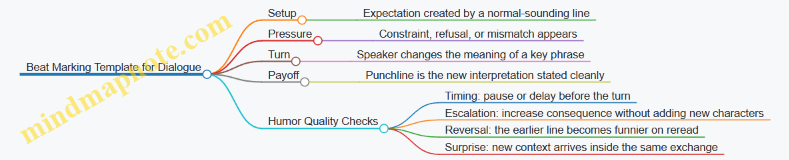
9. Escalation and Surprise in Action: Physical Comedy with Narrative Logic
9.1 Action Timing: Reaction Speed, Delay, and Repetition With Variation
Action humor works when the reader can predict the shape of what will happen, then watch that prediction get nudged off course. Timing is the tool that controls that nudge. In action scenes, the reader’s brain runs two tracks at once: what the character intends, and what the body actually does. Comedy often comes from a mismatch between those tracks.
Reaction Speed: The First Answer the Body Gives
Reaction speed is how quickly the character’s physical response arrives after the trigger. Fast reactions feel competent; slow reactions feel confused; delayed reactions feel like the character is processing the wrong problem.
A useful rule: write the reaction at the moment the reader expects it, then decide whether to deliver it early, on time, or late.
Example:
- Trigger: the doorbell rings.
- Intended action: the character reaches for the “welcome” sign.
- Reaction timing options:
- On time: “She froze, then smiled like she’d been expecting company.”
- Too fast: “Her hand shot up before she even heard the second ring.”
- Too slow: “She blinked at the silence, then remembered she’d turned the doorbell off last week.”
To keep the humor readable, anchor the reaction to a concrete physical detail: a hand hovering, a knee locking, a breath catching. Abstract reactions (“she felt embarrassed”) are harder to time.
Delay: Holding the Beat After the Trigger
Delay is the space between trigger and visible action. It creates a mini-question in the reader’s mind: What will they do? The longer the delay, the more specific that question becomes.
Delay is strongest when it’s caused by something the reader can understand: a misread cue, a competing task, or a body limitation.
Example:
- Trigger: a coworker says, “Nice tie.”
- Delay cause: the character is still adjusting the tie.
- Delivery: “He kept tugging the knot, even after the compliment ended. Only then did he realize the knot was already straight.”
Notice the mechanics: the scene doesn’t jump to the punchline. It shows the character continuing the wrong micro-task until the delay forces the correction.
Repetition with Variation: The Same Action, Different Outcome
Repetition builds expectation through pattern. Variation breaks it through a controlled change: a different target, a new constraint, or a slightly wrong assumption.
Use repetition when you want the reader to feel the rhythm. Use variation when you want the reader to feel the correction.
A practical method is to repeat the same action frame three times:
- Attempt (what the character thinks will work)
- Friction (what interrupts it)
- Adjustment (what they do next, based on the wrong lesson or the right one)
Example: A character tries to carry a stack of papers.
- Attempt: “He grabbed the stack with both hands and walked confidently.”
- Friction: “Halfway down the hall, the top sheet slid out like it had its own schedule.”
- Adjustment: “He corrected by holding the stack tighter, which made the bottom sheet slide instead.”
The humor lands because the action repeats, but the failure mode changes. That change is the variation.
Action Timing Mind Map
Mind Map: Action Timing Components
Integrated Micro-Sequence: One Trigger, Three Beats
To combine the three tools without clutter, keep one trigger and build three beats.
Example sequence: A character tries to look calm during a surprise meeting.
- Trigger: the door opens.
- Beat 1 (Reaction Speed): “He smiled instantly, too instantly, like the smile had been waiting behind his teeth.”
- Beat 2 (Delay): “He didn’t sit down until the chair squeaked, which meant he’d been aiming for a seat that wasn’t there.”
- Beat 3 (Repetition With Variation): “He stood again, then sat again, each time choosing the wrong chair by one inch.”
Each beat adds new information: the smile arrives early, the sitting action arrives late, and the repeated attempt fails in a new way. That’s how action timing stays systematic rather than random.
Quick Self-Check for Drafts
- Can I point to the trigger and the exact moment the body responds?
- Is any delay caused by a readable reason, not just hesitation?
- Does repetition change the failure mode, or does it just repeat the same mistake?
- Are the physical details specific enough to “see” on the page?
9.2 Escalating Physical Stakes: From Minor Inconvenience to Full Chaos
Physical comedy works best when the body’s problems grow in a believable direction. “More chaos” is not a plan; it’s a vibe. A plan is a chain: small discomfort creates a new constraint, the constraint forces a new attempt, and each attempt makes the next constraint harder to manage.
Start with a minor inconvenience that has a clear cause and a quick reset. Example: a character tries to open a lunch container and the lid won’t budge. The first beat is simple: they tug, twist, and stop. The second beat adds a constraint: the lid slips and smears sauce on their fingers. Now they can’t use the same grip, so the next attempt changes.
Next, escalate by increasing one measurable factor at a time. Pick from these levers:
- Distance: the problem spreads farther from the original spot.
- Time: the character loses time to fix it.
- Control: the character’s actions become less precise.
- Consequence: the environment or other people get involved.
- Complexity: the character must coordinate more moving parts.
A useful rule is to keep the character’s goal constant while the method degrades. They still want lunch, but the path becomes messier. That contrast makes the escalation readable.
Mind Map: Escalation Levers for Physical Stakes
Building the Escalation Chain
Use a three-step escalation pattern for each beat: attempt → failure mode → new constraint.
- Attempt: “They twist harder.”
- Failure mode: “The lid pops and launches the container’s contents.”
- New constraint: “Now their hands are sticky, so they can’t hold the container steady.”
Notice what’s happening: the failure mode is physical and specific, and the new constraint is a direct consequence of that failure mode. When the constraint is arbitrary, the scene feels random. When it’s causal, the chaos feels earned.
From Minor to Full Chaos Example
Scenario: A character tries to carry a bowl of soup across an office without spilling.
- Minor inconvenience: They grip the bowl with one hand while opening a door with the other. The door sticks, so they pause mid-step.
- Constraint: The pause makes the soup slosh toward the rim.
- Next attempt: They switch hands to steady the bowl.
- Failure mode: The switch knocks a stack of sticky notes off a nearby desk.
- New constraint: Notes land on the floor, forcing them to step around them.
- Escalation: Each step around the notes changes their stride, increasing the bowl’s wobble.
- Consequence: A coworker walks in at the wrong moment and bumps their elbow.
- Failure mode: The bowl tilts; soup spills onto the floor.
- New constraint: The floor becomes slick, so their foot slips.
- Full chaos: The slip triggers a chain: they grab a chair for balance, the chair rolls into a cart, and the cart bumps a trash can. The original goal—carry soup—has not changed, but the environment now actively resists them.
This escalation works because each stage adds a constraint that follows from the previous physical event.
Common Failure Points and Fixes
- Skipping constraints: If the scene jumps from “lid won’t open” to “explosion,” the reader can’t track cause. Fix by inserting a failure mode that creates a new limitation (sticky hands, blocked path, lost balance).
- Changing the goal: If the character stops caring about soup and starts caring about something else, the escalation loses focus. Keep the goal stable; let the method degrade.
- One-note repetition: If every beat is “they drop it,” the comedy flattens. Vary the failure mode: slip, overshoot, snag, bounce, or misjudge distance.
Practical Beat Checklist
Before you write the next escalation beat, confirm:
- What is the character trying to do?
- What physical failure happens?
- What new constraint appears because of that failure?
- Which lever increases next: distance, time, control, consequence, or complexity?
When those four answers are clear, the scene can climb from minor inconvenience to full chaos without losing logic.
9.3 Reversal in Action: The “Cause” Becomes the “Effect”
A reversal in action happens when the thing you treat as the cause of the problem turns out to be the mechanism that creates it. The scene still follows physical logic, but the meaning flips: the action that seemed to fix the situation becomes the reason it gets worse.
Start with a simple rule: the character’s first interpretation of cause must be understandable. If the reader can’t see why the character believes it, the later flip feels like a trick. Then make the “cause” carry a hidden property—an assumption about timing, direction, ownership, or interpretation—that will later prove wrong.
The Core Mechanism
In action, “cause becomes effect” usually comes from one of four mechanics:
- Direction reversal: the character points the action outward, but it returns inward.
- Ownership reversal: the character thinks they control the tool, but the tool controls the outcome.
- Timing reversal: the character triggers the action too early or too late, so the world responds differently.
- Interpretation reversal: the character treats a signal as a command, but it’s actually feedback.
Each mechanic can be staged with clear physical beats: setup (what the character does), immediate result (what they think happened), and the delayed consequence (what actually happened).
Mind Map: Cause Becomes Effect
Example: Direction Reversal in a Kitchen
Setup: Mara tries to stop a spill. She grabs a towel and presses it against the counter edge, aiming to “catch” the liquid before it reaches the floor.
Apparent payoff: The towel darkens quickly. Mara relaxes and leans closer to wipe the counter.
Delayed consequence: The liquid doesn’t stop; it spreads under the towel. The towel’s weight traps the spill against the counter lip, forcing it to travel along the seam and drip from a different corner.
Reversal: The towel was the cause of the spill’s spread. Mara’s action didn’t remove the problem; it changed the path the problem took.
To make this land, the narration should show one physical detail early: the towel bunching at the edge, or the counter seam that wasn’t visible until Mara leaned in. The reader should later think, “Of course it would go there.”
Example: Ownership Reversal with a “Helpful” Device
Setup: Theo installs a motion-activated air freshener. He wants it to mask a smell, so he places it near the trash bin.
Apparent payoff: When he walks by, the device sprays. The smell seems reduced for a moment.
Delayed consequence: The freshener’s sensor triggers more often than Theo expects because the trash lid keeps shifting slightly. Each small movement causes another spray, and the combined scent becomes stronger and more noticeable than the original odor.
Reversal: Theo’s attempt to control the smell becomes the cause of a new, worse pattern. The device isn’t a neutral tool; it’s an agent reacting to the environment.
A practical way to stage this is to show the lid moving once, briefly, before the reader understands why. Then, when the sprays escalate, the reader can connect the earlier motion to the later behavior.
Example: Timing Reversal in a Doorway Scene
Setup: Priya holds a door open for a friend, then steps back to let them pass.
Apparent payoff: The friend walks through smoothly.
Delayed consequence: The door closes on Priya’s sleeve because she stepped back at the exact moment the latch engaged. The friend’s “helpful” comment—“You’re good, it’s open”—arrives just before the latch catches.
Reversal: Priya’s action created the timing window that caused the latch to engage against her sleeve. The door didn’t fail; it responded to the timing she chose.
This kind of reversal works best when the scene includes a small timing cue: a soft click, a spring tension change, or a visible latch position.
Craft Checks for Action Reversals
- Plant the hidden property in motion: the towel edge, the trash lid shift, the latch click.
- Keep the world consistent: the same physical rules govern both the apparent payoff and the delayed consequence.
- Let the character’s reaction change: after the flip, they should adjust their understanding, not just their actions.
When the cause becomes the effect, the action still makes sense. The reader laughs because the scene’s logic was always there; it just pointed to a different meaning than the character assumed.
9.4 Surprise in Action: Wrong Assumptions, Hidden Constraints, and Timing Shifts
Surprise in action works when the audience’s mental model is briefly correct, then becomes wrong for a specific reason. The trick is not random chaos; it’s controlled misprediction. In action scenes, the reader can’t pause to think, so the scene must supply quick evidence, then change what that evidence means.
Wrong Assumptions That Drive the Body
Start with an assumption the character and reader share. In action, assumptions usually come from physical logic: “If I do X, Y will happen.” Humor arrives when the scene keeps the physical logic intact but changes the interpretation.
Example: A character tries to “sneak” past a guard by walking slowly. The reader assumes slow equals quiet. The surprise lands when the character’s slow steps trigger a motion sensor that is calibrated to detect lingering movement, not speed. The character didn’t fail at stealth; they failed at the system’s definition of “suspicious.”
To make this land, plant a small, concrete detail early: the guard’s station has a blinking indicator, or the hallway has a faint hum that suggests electronics. Later, the same detail becomes the punchline’s mechanism.
Hidden Constraints That Reframe the Plan
Hidden constraints are rules the character doesn’t know yet. They can be mechanical (a sensor, a lock), social (a bystander’s policy), or environmental (a wind tunnel, a schedule). The key is that the constraint must be consistent with earlier information, even if the character misread it.
Example: Two coworkers attempt to carry a fragile cake through a narrow doorway. They assume the doorway is the problem. Midway, the cake tilts and the frosting smears—then the reader realizes the real constraint: the doorway has a spring-loaded “soft close” that pushes inward when it senses weight. The cake isn’t fragile because of bumps; it’s fragile because of timing with the door’s mechanism.
Hidden constraints create comedy when the character’s effort is sincere and the world’s rule is petty. The scene should show the character reacting to the constraint as if it’s unfair, then reveal the rule in a way that makes the earlier effort look foolish without making the character stupid.
Timing Shifts That Change What the Audience Expects
Timing shifts are surprise delivered through rhythm. The audience expects a beat to happen next—then it happens later, earlier, or in a different order. In action, timing shifts often come from reaction delays, interruption timing, or the moment the character commits.
Example: A character reaches for a fire extinguisher. The reader expects the extinguisher to work immediately. Instead, the extinguisher has a safety latch that requires a two-step motion. The character performs step one, pauses to check the label, and only then completes step two. The “wrong” timing makes the extinguisher spray at the exact moment a coworker leans in to inspect the smoke, turning a routine response into a targeted prank.
This works because the scene gives the audience a clear expectation—then shifts the release moment. The shift should be visible: a hand hovering, a latch clicking, a delay that feels like a mistake the character can’t undo.
Mind Map: Surprise in Action Components
Integrated Micro-Sequence Example
A character tries to impress a client by “quickly” grabbing a demo remote from a desk.
- Setup action: The character snatches the remote fast. The reader assumes speed prevents attention.
- Wrong assumption: The desk has a “fast grab” sensor that triggers a security light to confirm identity.
- Hidden constraint revealed: The light blinks in a pattern the character doesn’t recognize, and a small speaker chirps a warning.
- Timing shift: The character freezes to look for the source, and that pause is what the sensor counts as hesitation.
- Payoff: The client thinks the character is performing a timed presentation cue. The remote works only after the security system finishes its check, so the “impressive” moment arrives late—right when the client’s patience has already been spent.
Notice how each surprise mechanism supports the others. The assumption is plausible, the constraint is concrete, and the timing shift turns a mistake into a structured beat.
Practical Checklist for Action Surprise
- Does the scene show one clear expectation before the surprise?
- Is the “new rule” consistent with a detail already on the page?
- Does the character’s effort look reasonable under their mistaken model?
- Is the timing shift specific, visible, and tied to a physical action?
- Does the payoff reframe the earlier action without rewriting reality?
9.5 Practical Examples: Action Sequences That Stay Coherent Under Absurdity
Absurd action works when the scene still follows a cause-and-effect chain. The trick is to treat the absurdity as a constraint, not a free-for-all. Below are three action examples that keep logic intact while escalating comic pressure through timing, escalation, reversal, and surprise.
Foundational Method for Coherent Absurdity
- Choose one physical rule the world will obey (gravity, friction, bureaucracy, “the door only opens when insulted,” etc.).
- Define a clear goal for the character in plain terms.
- Map cause to effect for every major beat: what action happens, what it changes, and what new problem it creates.
- Escalate by increasing consequences, not by adding random events.
- Reserve reversals for meaning shifts: the same action becomes funny because the interpretation changes.
Mind Map: Coherence Under Absurdity
Example 1: The Elevator That Only Accepts Apologies
Setup: Mara needs to reach the 12th floor before a meeting. The elevator panel refuses to respond unless someone apologizes to it.
Action chain:
- Mara presses “12.” The panel lights up, then displays: “APOLOGIZE.”
- She mutters an apology. The doors open halfway, like it’s considering her sincerity.
- She tries again, louder. The doors open fully, but the elevator lurches and stops between floors.
- A coworker arrives, sees her stuck, and apologizes to the elevator on her behalf. The elevator immediately moves—straight past 12.
Timing and escalation: The first apology is a quick release; the second apology is delayed and more performative; the third apology triggers the real consequence: the elevator interprets “on her behalf” as “for her schedule,” not for her.
Reversal: The elevator isn’t punishing her; it’s enforcing a rule about accountability. The coworker’s help becomes the reason she misses her meeting.
Payoff: Mara finally apologizes with a specific admission: she apologizes for pressing the wrong button earlier. The elevator returns to 12, but only after it “finishes” the apology by opening the doors on the wrong side—forcing her to walk through the lobby like she planned it.
Mind Map: Elevator Sequence Logic
Example 2: The Delivery Robot with One Honest Sensor
Setup: A robot delivers a fragile vase. Its only reliable sensor is “confidently wrong.”
Action chain:
- The robot approaches the apartment. It stops at the door and announces, “This door is unlocked.”
- Mara tries the handle. It opens—then immediately triggers a “security latch” that locks behind her.
- The robot backs up to “reassess,” but it can’t see inside the latch area, so it keeps repeating the same confident statement.
- Mara grabs the vase and steps through. The robot follows, but now it’s inside the locked zone and can’t reach the exit.
Timing and escalation: Each beat is a timed attempt to correct the robot. The longer Mara delays, the more the latch cycles, turning a small mistake into a bigger trap.
Surprise: The vase is fine, but the robot’s “honest sensor” is actually honest about the door’s status at the moment of approach, not about the future.
Reversal: Mara’s solution—carrying the vase to the exit—works, but it also proves the robot was never the problem. The latch is.
Payoff: She uses the robot’s delivery label as a keycard. The robot accepts it because it’s “part of the delivery,” and the latch opens just long enough for both of them to escape.
Mind Map: Robot Sequence Cause Chain
Example 3: The Bank Heist That Fails Because Paperwork Is Real
Setup: Two friends attempt a “quick” heist. Their absurd plan relies on a machine that prints counterfeit forms.
Action chain:
- They swap the real forms with printed ones. The machine scans for formatting, not content.
- The teller accepts the forms, but the system flags the transaction for manual review.
- The friends rush to the vault. The vault requires a stamped authorization, and the stamp is only applied after the review ticket is closed.
- They try to close the ticket by forging a signature. The system rejects it because the signature matches the wrong pen type.
Timing and escalation: The scene escalates through procedural delays. Each shortcut creates a new paperwork requirement, so the pressure rises without random chaos.
Reversal: Their “counterfeit” is good enough to pass the first gate, but the second gate checks a different kind of truth.
Payoff: They finally succeed by doing the least heroic thing: they wait for the review, then stamp the ticket themselves using the bank’s own stamp pad. The vault opens, but the teller hands them the receipt—showing they paid a fee for the privilege of stealing.
Mind Map: Heist Procedural Logic

Across all three examples, absurdity stays coherent because the scene obeys a single rule set. The humor comes from timing choices and interpretation shifts, while the plot remains a chain of understandable consequences.
10. Scene Construction for Comic Stories: From Beat Sheet to Draft
10.1 Scene Goals: What the Character Wants and What the Reader Expects
A comic scene needs two targets at once. The character wants something specific, and the reader expects something specific in response. Humor lands when those expectations are managed: the scene promises one kind of outcome, then pressures the character toward it, then forces a mismatch that still feels logically connected.
Scene Goals as a Two-Track System
Track one is the character’s goal: the concrete action they’re trying to achieve right now. Track two is the reader’s expectation: the likely interpretation of what will happen next based on prior information and genre norms.
A scene goal is not “be funny.” It’s a measurable intention like “get the refund,” “avoid being seen,” or “convince the boss the mistake is intentional.” Reader expectation is equally concrete: “they’ll succeed quickly,” “they’ll get caught,” or “the explanation will be reasonable.”
When you align these tracks, you get clean cause-and-effect. When you intentionally misalign them, you get comedy.
What the Character Wants
Write the want as a verb plus a boundary. The boundary prevents vague goals from turning into aimless banter.
- Verb: what they attempt (ask, hide, negotiate, fix)
- Boundary: what stops them (time limit, social rule, limited access, pride)
Example: “Get the package before the neighbor notices” (boundary: neighbor’s schedule and the hallway camera).
This boundary matters because it creates natural escalation opportunities. Each failed attempt pushes the character closer to a worse option.
What the Reader Expects
Reader expectation comes from three sources: what you’ve shown, what you’ve implied, and what the scene’s genre signals.
- Shown facts: “The door is locked,” “The form is missing a signature.”
- Implied rules: “The receptionist hates interruptions,” “The character always lies when nervous.”
- Genre signals: workplace scenes tend toward bureaucracy; family scenes tend toward misunderstandings.
Expectation is not a guess you leave hanging. It’s a promise you can fulfill or subvert. The reader should be able to say, after the punchline, “That was the obvious interpretation—until it wasn’t.”
The Scene Goal Loop
A practical way to draft is to repeat a loop inside the scene:
- Establish the want and the boundary.
- Offer a plausible path to the want.
- Apply pressure that makes the path harder.
- Deliver a turn that changes the interpretation of what’s happening.
- Land the payoff in a way that still respects the boundary.
If you skip step 2, the reader has nothing to expect. If you skip step 5, the scene feels like a random joke rather than a structured outcome.
Mind Map: Scene Goals and Their Payoffs
Example: Want and Expectation in One Paragraph
Want: “Get the key from the landlord without admitting you lost it” (boundary: landlord’s habit of asking for receipts).
Expectation: The reader assumes the character will improvise a story and the landlord will accept it after a bit of awkwardness.
Pressure: The landlord asks for the receipt for the last key replacement.
Turn: The character produces a receipt—because they kept it—only to realize it’s for a different unit.
Payoff: The landlord doesn’t get angry; they get helpful, offering to “return the key to the correct tenant,” which forces the character to explain the mix-up in front of the neighbor.
Notice how the payoff still respects the boundary. The character wanted the key without admitting loss, but the boundary (receipts) made honesty unavoidable.
Example: When the Reader Expectation Is Too Loose
If the want is clear but the expectation is vague, comedy becomes random. For instance, if you only say “They try to fix the printer,” the reader can’t predict what “fix” means in this world. Add a boundary and a plausible path: “Fix the printer before the meeting starts” (boundary: it prints only in grayscale and the slides are color-coded). Now the reader expects a quick workaround, and you can later reverse it with a turn that changes what “fix” actually requires.
Quick Drafting Prompts
Use these prompts to lock both tracks before writing the scene:
- What exactly does the character do in the first ten seconds?
- What rule will make that attempt fail in a specific way?
- What outcome does the reader predict based on the rule?
- What single new detail changes the interpretation while staying fair?
A strong comic scene goal is a contract: the character’s want is the contract they sign, and the reader’s expectation is the contract the scene makes on their behalf. Your job is to manage both until the turn makes sense.
10.2 Beat Sequencing: Setup Beat, Pressure Beat, Turn Beat, Payoff Beat
Beat sequencing is the simplest reliable way to make a comic scene feel inevitable. You’re not just placing jokes; you’re controlling what the reader believes, how long they’re allowed to believe it, and what changes when the scene ends.
Setup Beat
The setup beat establishes three things in quick, concrete terms: the goal, the rule, and the expectation.
- Goal: What the character wants right now.
- Rule: The constraint they think governs the situation.
- Expectation: The outcome the reader predicts based on the rule.
Example (setup):
Mara needs the office printer to work before the meeting. She believes the printer “only jams when you rush.” So she walks slowly, presses buttons gently, and narrates her calm like it’s a safety procedure.
What to watch: the setup should include at least one specific detail that can later be contradicted, exaggerated, or reinterpreted. “The printer is temperamental” is vague; “the printer has a sticker that says ‘Press Start Twice’” is usable.
Pressure Beat
The pressure beat increases strain while keeping the reader’s expectation intact. Pressure comes from friction: time running out, social consequences, competing tasks, or a rule that keeps failing in small ways.
A good pressure beat does two jobs at once:
- It makes the character’s plan harder to maintain.
- It gives you repeated opportunities to time micro-failures.
Example (pressure):
Mara’s slow approach works for one page. Then the printer makes a polite whir, pauses, and prints a single sheet that reads, in bold letters, “START TWICE.” Mara checks the sticker, then presses Start twice—carefully, like she’s performing surgery. The printer responds by feeding the paper backward into the tray.
Notice the pattern: the reader still expects “gentle competence” to solve it. The pressure beat stretches that belief until it becomes uncomfortable.
Turn Beat
The turn beat changes the meaning of what’s happening. It doesn’t have to be a twist in the plot; it has to be a twist in interpretation.
A turn usually does one of these:
- Reframes the rule: The sticker wasn’t advice; it was a trap.
- Reveals a hidden cause: The printer isn’t jammed; it’s obeying a different instruction.
- Flips the character’s assumption: Mara’s “calm” is the problem, not the solution.
Example (turn):
Mara presses Start twice again. This time the printer prints: “THANK YOU FOR YOUR COMPLIANCE.” The office door opens. Her coworker walks in, sees the paper, and says, “Oh good, it’s finally training you.”
The turn beat lands when the reader realizes the scene’s logic was never about mechanical failure. It was about social signaling and misunderstanding.
Payoff Beat
The payoff beat cashes in the setup and turn with a result that is both funny and structurally consistent. Payoff can be a final joke line, a physical outcome, or a character consequence.
Payoff works best when it answers the scene’s central question:
- Did the goal happen?
- Did the rule change?
- Did the character learn the right lesson, or the wrong one in a funnier way?
Example (payoff):
Mara tries to stop the printer by ripping out the paper. The printer immediately prints a new page: “PLEASE DO NOT INTERFERE WITH THE PROCESS.” Mara freezes, holding the half-torn sheet like evidence. Her coworker nods solemnly and says, “It’s okay. It only escalates when you panic.”
The payoff is funny because the character’s instinctive response confirms the new interpretation.
Mind Map: Beat Sequencing in a Comic Scene
Integrated Scene Blueprint
Use this sequence like a checklist, not a script. Each beat should change something measurable: a belief, a constraint, or a physical state.
- Setup: Establish the rule the character trusts.
- Pressure: Stress that rule until it produces repeated near-misses.
- Turn: Reveal that the rule was incomplete or misread.
- Payoff: Let the character’s new understanding (or wrong understanding) produce the final comic outcome.
Example: Full Beat Run Through
Setup: A delivery driver insists the building’s buzzer “only works if you compliment it.” He clears his throat, says, “Nice buzzer,” and presses.
Pressure: The buzzer answers with a recorded voice: “THANK YOU. PLEASE STATE YOUR INTENT.” He tries again, more enthusiastic. The voice repeats, then adds, “INTENT RECEIVED. PLEASE WAIT FOR APPROVAL.”
Turn: He looks around, confused, and says, “Approval from who?” The buzzer replies, “FROM THE BUILDING. IT IS VERY PARTICULAR.”
Payoff: The driver leans in and says, sincerely, “You’re doing great. Truly.” The buzzer clicks, the door opens, and a neighbor steps out holding a clipboard: “We’re just checking if you’re polite enough to enter.”
10.3 Managing Escalation Across a Scene When to Peak and When to Reset
Escalation in a scene is not “more intensity until the end.” It’s a controlled rise in pressure that the reader can track, then a reset that keeps the next rise meaningful. If you never reset, the scene becomes one long high note. If you reset too often, the reader stops feeling momentum.
Core Idea: Pressure Has Phases
A scene typically cycles through three phases:
- Build: the character commits to a plan or belief.
- Pressure: obstacles force adaptation.
- Release: the scene either resolves the pressure or changes the terms.
Escalation should peak at the end of the pressure phase, not randomly. After the peak, you reset by changing what “success” means, not by returning to the exact same situation.
Escalation Rhythm Mind Map
Mind Map: Escalation Phases and Scene Rhythm
What “Peak” Means in Practice
A peak is the moment where the character’s best option is no longer available, or where the cost of choosing any option becomes obvious. You can mark it with one of these signals:
- Constraint peaks: the last tool breaks, the last window closes, or the last witness arrives.
- Choice peaks: two bad options appear, and the character must pick.
- Meaning peaks: the scene’s earlier promise is contradicted by new evidence.
Peak escalation also needs a payoff. Even if the character fails, the failure should be informative: it changes the next plan.
What “Reset” Means in Practice
Reset is a deliberate drop in pressure that prepares the next rise. Resetting doesn’t mean “everything is fine.” It means the scene stops asking the reader to hold the same tension while you introduce a new problem shape.
Common reset techniques:
- Term swap: the goal stays, but the method changes.
- Scope shift: the scene moves from public stakes to private stakes, or vice versa.
- Information shift: the character learns something that redefines what counts as danger.
- Rhythm shift: you shorten sentences, reduce action density, or let a beat breathe so the next escalation feels sharper.
A Systematic Method for Planning Peaks and Resets
Use this step-by-step approach while drafting or revising:
- Choose one escalation engine for the scene (stakes, absurdity, complexity, or consequence). Mixing engines too early makes peaks feel random.
- List three pressure beats you want the reader to anticipate. Each beat should be harder than the last for a specific reason.
- Decide where the first peak lands: at the end of beat three, or at the moment a choice becomes irreversible.
- Write the reset immediately after the peak by changing one of: constraint, scope, or information.
- Repeat once more. Two peaks per scene is often enough; more can work, but only if each peak changes the terms.
Example: Escalation with Two Peaks and One Reset
Scenario: A character tries to return a borrowed item without being noticed.
- Build: They enter quietly, planning to leave it on the counter.
- Pressure Beat 1: A neighbor’s dog recognizes them and starts barking.
- Pressure Beat 2: The character shushes the dog, but the dog’s collar tag jingles loudly.
- Peak 1: The neighbor opens the door mid-jingle. The character must either run or explain.
Reset: The character chooses to explain, but now the problem is social credibility, not stealth. The goal reframes from “no one notices” to “no one thinks I stole it.”
- Pressure Beat 3: The neighbor asks a question the character can’t answer without sounding suspicious.
- Pressure Beat 4: The borrowed item is missing a part, and the character must improvise a story.
- Peak 2: The neighbor checks the item’s original packaging and finds the part missing is impossible to explain away.
Notice how the second peak isn’t just “more noise.” It’s a different kind of pressure: credibility collapses instead of stealth collapsing.
Example: Resetting Without Changing Terms Fails
If after Peak 1 you simply return to quiet sneaking with the same constraints, the reader feels the scene has lost its reason to escalate. The reset must alter the scene’s problem shape, even if the character is still in the same room.
Quick Self-Check
Before finalizing the scene, ask:
- Does each peak force a new kind of choice or reveal?
- Does each reset change constraints, scope, or information?
- Do the pressure beats escalate for a consistent reason?
When those answers are yes, escalation feels inevitable rather than accidental, and the reader stays oriented while the comedy climbs.
10.4 Reversal and Surprise Placement: Mid-Scene vs. End-of-Scene Roles
Reversal and surprise both change what the reader thinks is happening, but they do it at different moments. Mid-scene placement reshapes the current problem, while end-of-scene placement reshapes the meaning of what just happened. If you treat them as interchangeable, the scene either feels unstable or the ending feels like a trick.
Core Distinction
A mid-scene reversal answers: “What is the real situation right now?” It forces the character to react again, not just continue. A mid-scene surprise answers: “I didn’t know that detail,” and it changes how the character interprets the same facts.
An end-of-scene reversal answers: “What did this scene actually accomplish?” It reframes the scene’s goal, cost, or moral logic. An end-of-scene surprise answers: “The scene ends with a new constraint or reveal,” often setting the next scene’s direction.
Mind Map: Placement Roles
Mid-Scene Placement: How to Use It Without Whiplash
Mid-scene turns work best when the character is still making choices. If the character is already locked into a single action, a mid-scene reversal becomes a plot teleport.
Practical pattern:
- Establish a workable interpretation.
- Apply pressure so the character commits to that interpretation.
- Insert a reversal or surprise that changes the interpretation.
- Let the character’s next move reflect the new truth.
Example: Reversal mid-scene
- Setup: A manager praises Sam’s “initiative” for fixing a broken printer.
- Pressure: Sam assumes the praise means promotion is likely, so Sam volunteers to handle the next issue alone.
- Reversal: The manager reveals the printer was broken on purpose for a “process audit,” and Sam’s “initiative” is now evidence of bypassing procedure.
- New move: Sam scrambles to document steps and undo the bypass before the audit report is finalized.
Notice the reversal doesn’t just change what Sam feels; it changes what Sam must do next.
Example: Surprise mid-scene
- Setup: Two coworkers argue about who scheduled the meeting.
- Pressure: They keep talking while the door opens, and the wrong person is about to walk in.
- Surprise: The “meeting” is actually a surprise retirement announcement, and the person entering is the honoree.
- New move: The argument stops, and the coworkers pivot to help with the presentation.
The surprise arrives early enough to redirect behavior, not just to shock.
End-of-Scene Placement: Meaning and Aftertaste
End-of-scene turns should feel like the scene’s final sentence, not a separate scene stapled on. The reader should be able to look back and see a path from earlier beats.
Practical pattern:
- Let the scene reach a temporary conclusion.
- Deliver a turn that re-labels that conclusion.
- End immediately after the re-label so the reader carries it forward.
Example: Reversal at the end
- Setup: A character tries to return a lost wallet, expecting gratitude.
- Scene conclusion: The owner thanks them and offers a reward.
- End reversal: The owner admits the wallet was planted to test honesty, and the “reward” is actually a job offer with strict conditions.
The reversal changes the scene’s moral framing: the return wasn’t just kindness; it was a selection process.
Example: Surprise at the end
- Setup: A team completes a small task successfully.
- Scene conclusion: Everyone relaxes.
- End surprise: A supervisor reveals the task was only the first step, and the real objective is to see who volunteers for the next, harder step.
The surprise sets the next scene’s pressure without needing a full explanation.
Placement Decision Guide
Use mid-scene placement when you need immediate behavioral change. Use end-of-scene placement when you need the reader’s judgment to update.
A simple rule of thumb: if the character can’t act differently after the turn, the turn belongs at the end. If the character must act differently to keep the scene coherent, the turn belongs mid-scene.
Integrated Checklist
- Causality: The turn must follow from earlier information, even if that information was misread.
- Agency: After a mid-scene turn, the character makes a new choice; after an end-scene turn, the story sets a new condition.
- Clue Economy: Place enough clues to make the turn feel fair, not inevitable.
- Exit Timing: End the scene right after the end-of-scene turn so the reframe lands cleanly.
When you place reversal and surprise with these roles in mind, the scene stays stable while the meaning keeps shifting—like a well-timed conversation where the last line changes what the whole exchange was about.
10.5 Practical Examples: Three Full Scene Drafts With Structural Annotations
Below are three complete scene drafts that each use a different primary engine. Every draft includes structural annotations that show where timing, escalation, reversal, and surprise are doing the work.
Mind Map: Three Scene Engines
Example: Scene One Timing First
Characters: Mara (meticulous), Dev (confident), Clerk (tired).
Goal: Get a permit approved before lunch.
Draft Scene: Mara slid the paperwork across the counter with two fingers, like it might bite. “I brought the exact form. Twice.”
The Clerk didn’t look up. “We only need one.”
Dev leaned in. “She means she has a backup.”
Mara smiled without showing teeth. “I mean I have a backup for the backup.”
The Clerk finally glanced at the top page. “This is the old version.”
Mara’s pen hovered. “It’s the old version of the new version.”
Dev chuckled. “She updates it herself.”
The Clerk sighed and stamped the corner anyway, then turned the page. “You see this? The signature line moved.”
Mara blinked once. “It moved because I moved it.”
Dev’s grin tightened. “She… pre-signed.”
The Clerk held up the second copy. “Then why is this one blank?”
Mara tapped the paper. “Because you already stamped the first one.”
Dev opened his mouth, then closed it as the Clerk stamped again, slower this time. “Approved,” the Clerk said. “Next.”
Dev exhaled. “So the blank copy—”
Mara cut in gently. “Is for the person who asks questions.”
Structural Annotations:
- Timing: The joke lands on the delayed clarification: “backup for the backup” sets rhythm, then the blank copy reframes the earlier “mistake.”
- Escalation: Small costs rise: old form → moved signature line → blank copy question.
- Reversal: The “problem” (old version, blank page) becomes the mechanism that triggers approval.
- Surprise: The final line turns Dev’s confusion into a new purpose for the paperwork.
Example: Scene Two Escalation First
Characters: Coach Rina (strict), Jett (late), Security Guard (literal).
Goal: Get into the gym for a quick practice.
Draft Scene: Jett jogged up to the door, breathless but smiling. “I’m here for the three o’clock slot.”
Coach Rina stood by the schedule board, arms folded. “Three o’clock ended at 2:58.”
Jett pointed at the clock. “It’s 2:59.”
Coach didn’t move. “Then you’re here for the one-minute slot.”
Jett laughed. “Perfect. I’ll just stretch.”
Security Guard steps in. “No stretching in the hallway.”
Jett stopped mid-step. “Then I’ll stretch in the gym.”
Coach Rina nodded toward the sign. “No entry without a wristband.”
Jett patted his pocket. “I have one.”
The Guard held out a hand. “Show it.”
Jett handed over a band with a different color. “Same gym. Different day.”
Coach Rina’s voice stayed level. “Today is the day you don’t have it.”
Jett tried again. “I can pay the late fee.”
The Guard checked a clipboard. “Late fee is for people who were late. You’re early for being late.”
Jett stared. “That doesn’t make sense.”
Coach Rina finally smiled. “It does if you read the policy.”
Jett grabbed the clipboard and scanned. His eyebrows rose. “It says wristbands are issued based on arrival time, not appointment time.”
Coach Rina lifted her chin. “So what time did you arrive?”
Jett looked at the guard’s watch. “Two fifty-seven.”
The Guard nodded. “Then you’re not late. You’re early. Early means you can’t enter until the next group finishes.”
Jett’s shoulders dropped. “So I’m stuck outside for—”
Coach Rina cut in. “For the exact amount of time you would have spent stretching.”
Jett blinked. “You’re… making me stretch.”
Coach Rina gestured to the hallway. “Do it. One minute. Then you get your wristband.”
Jett sighed, then started stretching immediately, like it was a dare.
Structural Annotations:
- Timing: The scene repeatedly delays access by one rule at a time, each line shortening the gap to the next barrier.
- Escalation: Stakes rise from “door closed” to “policy logic” to “time math.”
- Reversal: Jett’s attempt to pay and argue becomes evidence that he’s early, not late.
- Surprise: The “punishment” is reframed as a scheduled stretching window.
Example: Scene Three Reversal First
Characters: Nia (organizer), Sam (volunteer), Mayor’s Assistant (formal).
Goal: Confirm the donation receipt.
Draft Scene: Nia slid a folder onto the table. “Receipt confirmation for the library fundraiser.”
The Assistant didn’t open it. “We don’t confirm receipts. We issue them.”
Sam leaned forward. “We already got it. It’s just missing the stamp.”
The Assistant’s pen paused. “Missing stamps are not missing receipts.”
Nia kept her voice calm. “Then we need the stamp.”
The Assistant finally opened the folder and frowned. “This is a draft.”
Sam’s smile returned. “Drafts are normal. We’re early.”
Nia’s eyes flicked to Sam, warning him without words.
The Assistant turned the page. “This draft is dated yesterday.”
Nia nodded. “Yes. The stamp office is closed on weekends.”
The Assistant looked up. “Today is Tuesday.”
Sam shrugged. “Then it should be stamped by now.”
The Assistant tapped the paper. “It is stamped.”
Sam blinked. “Where?”
The Assistant pointed to the corner. “Right there.”
Sam leaned in. “That’s not a stamp. That’s a coffee ring.”
Nia exhaled slowly. “We spilled coffee during the signing.”
The Assistant’s expression softened, just slightly. “Then you didn’t miss the stamp. You received proof of handling.”
Sam stared. “Proof?”
The Assistant slid the folder back. “The receipt office requires a physical mark. Your coffee ring is the mark.”
Nia’s mouth tightened. “So you’re approving it because it’s messy.”
The Assistant stood. “Because it’s real.”
Sam looked at Nia. “You did that on purpose.”
Nia didn’t deny it. “I did it to buy time.”
Sam swallowed. “For what?”
Nia pointed at the signature page. “For the part where you stop calling it a draft.”
Structural Annotations:
- Timing: The reversal is delayed by a factual correction: “draft” → “dated yesterday” → “it is stamped.”
- Escalation: Pressure increases through specificity: stamp office closure → day-of-week mismatch → required physical mark.
- Reversal: The coffee ring becomes the stamp, flipping the meaning of “damage.”
- Surprise: The final line reframes Nia’s earlier calm as a deliberate strategy, not an accident.
Mind Map: Annotation Map for Drafting
11. Comic Voice and Perspective: Making Humor Consistent
11.1 Perspective Choices: First Person, Close Third, and Omniscient Humor
Perspective is the lens that decides what the reader can predict, what they can misunderstand, and what the narrator can hide. Humor depends on timing and fairness, so perspective is not just a style choice; it’s a control system for information.
First Person
In first person, the narrator is a character who speaks from inside their own head. The upside is immediacy: the reader hears the narrator’s assumptions as they form, which makes misjudgment funny when it’s later corrected. The risk is overconfidence: if the narrator explains too much, the reader stops doing the work that makes the punchline land.
A practical rule: let the narrator be wrong in small, specific ways before they are wrong in big ways. For example, a character might insist they’re “great at directions” while repeatedly turning toward the wrong street. The humor grows because the reader can track the mismatch between belief and evidence.
Example:
“I’m not lost. I’m taking the scenic route.” I turned left at the bakery, which is not scenic so much as committed. The sign said No Left Turns. I stared at it like it might apologize.
Why it works: the narrator’s certainty arrives before the contradiction, and the contradiction is concrete.
Close Third
Close third follows one character’s perception while using third-person grammar. The reader gets the character’s thoughts and interpretations, but not the character’s private narration voice unless you choose to style it that way. Close third is often the sweet spot for comic structure because it supports both empathy and misdirection.
A useful technique is “interpretation beats.” Write the action plainly, then show the character’s interpretation as a separate beat. The reader sees the gap between what happened and what the character thinks happened.
Example:
Mara opened the door and found a cake on the floor. Her brain labeled it a prank. Then she noticed the candles were lit. Her brain updated the label to a prank with commitment.
Why it works: the humor comes from the character’s mental categorization changing under pressure.
Omniscient Humor
Omniscient narration can move across characters and time, but humor still needs a consistent “information policy.” If the narrator knows everything, the reader will expect the narrator to manage expectations. The narrator’s job becomes selecting which thoughts to reveal and when to withhold.
Omniscient humor often uses contrast: the narrator describes a situation with calm clarity while characters act with limited logic. The comedy is in the mismatch between the narrator’s wider view and the character’s narrow plan.
Example:
The mayor believed the speech would go smoothly. He had practiced the first sentence in the mirror, which is how most people prepare for public humiliation. Meanwhile, the microphone had other ideas.
Why it works: the narrator frames the mayor’s preparation as a predictable illusion, and the “other ideas” promise a payoff.
Mind Map: Perspective Choices for Narrative Humor
Integrated Practice: Choosing the Right Lens for a Comic Turn
When you plan a reversal, ask which perspective can best “stage” the turn.
- If the reversal is based on a character’s mistaken belief, first person or close third is ideal because the reader can track the belief forming.
- If the reversal depends on a plan that multiple characters misunderstand, omniscient can coordinate the clue distribution while keeping the narrator’s tone steady.
A quick test: write the setup in one sentence, then write the punchline in one sentence that changes meaning. If the punchline requires knowledge the perspective never granted, the joke will feel like a cheat. Adjust the perspective or add a clue that the reader could have noticed.
Perspective isn’t a costume; it’s the contract that decides what the reader can reasonably expect. Once that contract is stable, timing, escalation, reversal, and surprise can do their work without fighting the narration.
11.2 Voice Consistency: Lexicon, Sentence Shape, and Attitude
Voice consistency is what makes a reader feel like the same mind is speaking across a whole story. In practice, it comes from three controllable levers: lexicon (word choices), sentence shape (rhythm and structure), and attitude (the stance toward events and other characters). When these stay aligned, humor lands more reliably because the reader’s expectations about how the narrator thinks remain stable.
Lexicon: The Word Choices That Signal Identity
Lexicon is not just “using the right funny words.” It’s the pattern of word types you repeatedly reach for: concrete nouns, abstract labels, polite euphemisms, technical terms, slang, or overly formal phrasing. A consistent lexicon creates a recognizable comedic temperature.
Start by listing five to ten words your narrator reliably uses in your draft. If the list swings between extremes—say, “gadget” in one scene and “thingamajig” in the next—pick a lane and justify the lane through character. For example, a meticulous character might describe objects as “devices” and “components,” even during chaos. That mismatch between precision and chaos is where humor can grow.
Quick test: replace one paragraph’s key nouns with synonyms and read it aloud. If the paragraph suddenly feels like a different narrator, your lexicon is doing too much work to be consistent.
Sentence Shape: Rhythm, Length, and How Thoughts Turn
Sentence shape controls timing at the micro level. Humor often depends on how quickly a thought arrives, how long it lingers, and how abruptly it pivots.
Choose a default pattern for the narrator:
- Short-first, then explanation: a punchy opening followed by a clarifying clause.
- Long setup, short tag: a detailed lead-in that ends with a clipped conclusion.
- Balanced cadence: mostly even sentences with occasional deliberate interruptions.
Then keep that pattern steady. If your narrator usually uses short sentences for emphasis, don’t suddenly switch to long, winding sentences during the same emotional beat. The reader may still laugh, but the laugh will feel accidental rather than earned.
A practical method: mark three sentences in a scene that feel “most like your narrator.” Measure their average length and note their structure (for example, “main clause + appositive + short afterthought”). When revising, aim to keep new sentences near that structural neighborhood.
Attitude: The Stance Behind the Humor
Attitude is the narrator’s moral and emotional posture. It includes how judgmental the narrator is, how much they sympathize, and whether they treat events as serious, silly, or both.
Attitude consistency prevents tonal whiplash. If the narrator is lightly skeptical, they should not suddenly become sentimental without a reason. Humor thrives when the narrator’s stance stays predictable, even when the situation changes.
A useful attitude checklist:
- Does the narrator assume competence or incompetence?
- Do they interpret mistakes as accidents, stubbornness, or character flaws?
- Do they show irritation, amusement, or deadpan neutrality?
When you answer those questions, you can write jokes that match the stance. A deadpan narrator can still be funny, but their “deadness” must remain consistent in how they describe consequences.
Mind Map: Voice Consistency Components
Integrated Example: One Scene, Three Voice Levers
Consider a narrator describing a failed attempt to impress a coworker.
Lexicon choice:
- Consistent lane: “proposal,” “agenda,” “deliverable,” “feedback.”
- Inconsistent lane: switching to “plan,” “stuff,” “vibes” mid-scene.
Sentence shape choice:
- Consistent lane: long setup with a short tag.
- Example: “I rehearsed the pitch for three days, including the part where I sounded confident. Then I forgot my own name.”
Attitude choice:
- Consistent lane: lightly self-critical, not bitter.
- Example: “The silence wasn’t hostile. It was just efficient.”
If you keep all three aligned, the humor feels like it belongs to the narrator rather than to the situation.
Common Failure Patterns and Fixes
- Lexicon drift: You start formal, then slip into casual slang. Fix by choosing a word-category set and sticking to it.
- Sentence shape whiplash: You use clipped sentences for jokes, then switch to sprawling explanations. Fix by reintroducing the narrator’s default rhythm.
- Attitude mismatch: You treat the same character as both lovable and contemptible without a narrative reason. Fix by deciding what the narrator believes about that character and maintaining it.
Voice consistency is not about sounding identical every sentence. It’s about keeping the same underlying “how I think” rules active, so timing, escalation, reversal, and surprise all land on the same target.
11.3 Timing Through Voice: How Style Controls Reader Anticipation
Voice is more than word choice; it’s a timing instrument. When a narrator sounds a certain way, readers start predicting where the next beat will land. That prediction can be helpful (it keeps jokes readable) or harmful (it makes punchlines feel late or random). The goal is to use style to steer anticipation so the timing feels intentional.
Start with the simplest mechanism: expectation. If your voice tends to explain, readers will wait for clarification before they laugh. If your voice tends to understate, readers will wait for the moment the understatement breaks. Either way, the voice sets the “waiting room” where the reader’s mind parks.
Mind Map: Voice as a Timing Controller
Voice Variables That Move the Timing
Lexicon formality. A formal voice makes readers expect careful logic. A casual voice makes them expect quick turns. For example, consider a character trying to return a broken blender.
- Formal voice setup: “I regret to inform you that the device ceased operation after the second cycle.”
- Casual voice setup: “It died. Like, immediately. Not even dramatic.”
In both cases, the voice tells the reader how much explanation to expect. If you suddenly switch from formal to casual at the punchline, the timing can become a surprise of style rather than a surprise of meaning.
Sentence length. Short sentences often feel like they’re approaching the release. Long sentences often feel like they’re building a case. A reliable technique is to keep the setup rhythm consistent, then change it once at the pressure beat.
Example (same content, different timing):
- Consistent rhythm: “I asked for a refund. They asked for proof. I showed them the receipt.”
- Rhythm shift at pressure: “I asked for a refund. They asked for proof. I showed them the receipt—then realized it was for a different blender.”
The dash doesn’t just add information; it changes the reader’s internal pacing.
Humor posture. Humor posture is whether the narrator sounds confident, skeptical, embarrassed, or deadpan. Readers time jokes by trusting that posture. If the narrator has been self-aware, the punchline can be a self-correction. If the narrator has been deadpan, the punchline can be a literal statement that refuses to react.
Example (deadpan posture): “The manager assured me the blender was ‘fully functional.’ I watched it refuse to start for three minutes. Then I believed him.”
The reader anticipates a contradiction, and the voice delivers it without changing its emotional temperature.
Perspective distance. Close perspective compresses time because the reader experiences thoughts as they happen. Distance stretches time because the narrator can summarize and comment. Timing through voice means choosing the distance that matches the joke’s structure.
Close: “I knew the password was wrong. I typed it anyway. The screen blinked like it was disappointed in me.”
Distance: “He entered the password again, despite knowing it was incorrect. The screen responded with a brief, judgmental blink.”
Close usually lands faster; distance can support a more elaborate reversal.
Advanced Timing Moves Using Voice
One deliberate pattern break. If your voice has a predictable cadence—say, short setup sentences followed by a longer clarifying line—then break that pattern only once per joke. Multiple breaks create noise, and readers stop knowing where to wait.
Certainty calibration. Words that signal certainty (“obviously,” “definitely,” “sure”) make the reader expect a clean payoff. Words that signal uncertainty (“maybe,” “seems,” “I thought”) make the reader expect a correction or reveal. Timing improves when the payoff matches the certainty level you established.
Example:
- “I’m sure the form is optional.” (Reader waits for proof it isn’t.)
- “I’m not sure the form is optional.” (Reader waits for a reason it might be required.)
Repetition as a timing metronome. Repeating a phrase trains the reader’s internal beat. Use repetition for setup, then vary it at the pressure beat.
Example:
- Setup: “I filled out the form. I signed the form. I handed over the form.”
- Pressure: “Then they asked for the form I didn’t know existed.”
The repeated “form” becomes a rhythm cue; the missing form becomes the release.
Common Failure Modes and Fixes
If the voice pattern breaks too early, the reader laughs at the wrong moment. Fix by restoring the pattern until the pressure beat, then shift once.
If the punchline contradicts the established stance, the reader feels tricked rather than surprised. Fix by making the payoff consistent with the narrator’s posture, even when the meaning flips.
If rhythm changes without a reason, the joke feels like it arrived by accident. Fix by tying the rhythm shift to a specific new piece of information or a clear turn in attitude.
Voice controls anticipation by telling the reader how to wait. When timing, escalation, reversal, and surprise are all present, voice decides which one the reader notices first—and that ordering is where the humor becomes reliable.
11.4 Escalation Through Character Belief: The Same Person, More Pressure
Escalation gets stronger when the character’s belief system stays consistent while the situation tightens. The reader recognizes the same person making the same kind of choices—just under increasing strain. That contrast creates comedy because the character’s logic keeps trying to solve a problem it was never designed for.
The Foundational Idea
A character belief is the rule they use to interpret events. It can be explicit (“I’m always prepared”) or implicit (“If I look competent, people will stop asking questions”). When pressure rises, the belief doesn’t vanish; it gets applied harder. Humor often comes from the mismatch between the belief’s predictions and reality’s refusal to cooperate.
A useful way to think about it: escalation is not only “more stuff happening.” It is “the same internal model being forced to explain more external chaos.”
Mind Map: Belief-Driven Escalation
Building the Ladder: Same Person, More Pressure
Start by choosing one belief that can survive multiple scenes. Then design a ladder of pressure where each rung forces the character to use that belief in a narrower, less forgiving way.
Step 1: State the belief through behavior. Example: A character believes, “If I’m helpful, I’ll be liked.” They volunteer to fix problems, smooth conflicts, and offer solutions before anyone asks.
Step 2: Apply pressure that makes helpfulness costly. Pressure rung 1: The character is asked to help in a quiet setting. They succeed, but they talk too much while doing it. Pressure rung 2: The same request happens in front of a supervisor. Their helpfulness becomes visible, and their over-explaining starts to sound like criticism. Pressure rung 3: The request arrives during a time crunch. Their instinct is still to fix everything, but now they can’t finish, so they improvise.
Step 3: Ensure the belief drives the next action. If the character suddenly changes tactics, the escalation feels like plot convenience. Instead, let their belief generate the workaround.
Example continuation:
- In the time crunch, they believe “helpfulness prevents rejection,” so they keep talking while doing the wrong task faster.
- They don’t notice the mistake because their belief filters feedback: “They’re just stressed; I should reassure them.”
Advanced Detail: Proof, Interpretation, and Self-Justification
Beliefs survive pressure by redefining what counts as evidence. Comedy sharpens when the character explains away contradictions using the same internal rule.
Consider a belief: “I can’t be wrong if I’m thorough.”
- Under low pressure, thoroughness is charming.
- Under high pressure, thoroughness becomes a delay machine.
- Under extreme pressure, thoroughness turns into a self-justifying loop: every new problem is treated as proof that they need to be even more thorough.
A practical technique is to write three “belief translations” for the same moment:
- What the character thinks is happening.
- What they decide to do based on that thought.
- How they interpret the outcome to protect the belief.
Example: One Belief, Four Escalation Beats
Belief: “If I control the plan, nothing bad can happen.”
Beat 1 (Low pressure): The character organizes a group outing. They assign roles and confirm details. Everyone goes along.
Beat 2 (Rising pressure): A late arrival disrupts the schedule. The character doesn’t question the plan; they tighten it. They add a “quick briefing” that turns into a lecture.
Beat 3 (High pressure): The venue changes rules at the door. The character tries to control the new reality by rewriting the plan on the spot. They announce the revised rules confidently—while misunderstanding one key requirement.
Beat 4 (Extreme pressure): The mistake triggers a public consequence. The character still believes control is the solution, so they double down: they take charge of the correction process, but their confidence makes others follow them into the wrong fix.
Notice what stays constant: the belief, the tone of decision-making, and the type of mistake. What changes is the pressure and the cost of applying the belief.
Common Failure Points
- Belief changes mid-scene. The character should remain recognizable even when wrong.
- Escalation comes from random events. The next complication should be a consequence of the belief’s application.
- The character learns too quickly. A small correction can happen, but the humor often depends on the belief resisting reality for a while.
Quick Scene Checklist
- Is the character’s belief clear through action?
- Does each pressure increase force a more strained application of that belief?
- Does the character interpret setbacks in a way that protects the belief?
- Does the next mistake logically follow from the previous decision?
When these conditions hold, escalation feels inevitable rather than forced, and the comedy comes from watching the same mind try to solve a problem it keeps misunderstanding.
11.5 Practical Examples: Voice-Driven Humor in Observation, Argument, and Confession
Voice-driven humor works best when the narration itself has rules. Those rules decide what gets noticed, what gets ignored, and how quickly the speaker admits they’re wrong. The examples below use the same structural idea—setup, pressure, turn, payoff—but each genre-like voice changes the delivery.
Observation: The World as a Series of Small, Unfair Rules
Core voice habit: The observer treats ordinary details like they have hidden instructions.
Example scene (observation): Mara watches the office coffee machine blink like it’s thinking. It never just makes coffee. It performs a short ceremony: warm up, hesitate, then dispense something that tastes like “almost.”
She presses the button again. The machine responds by blinking faster, as if offended by her confidence. When the cup fills, the surface has a perfect ring of foam—an artistic choice, not an accident.
Mara takes a sip. The coffee is fine, but the aftertaste is a complaint. She checks the label on the canister. It says “Decaf.” The machine, she realizes, has been following the rules all along. It’s her who keeps trying to negotiate with physics.
Why it’s funny: The narration escalates by adding specific “rules” (blink, ceremony, foam ring). The turn lands when the observer discovers the rule she missed, and the payoff is a self-correction that still keeps the world slightly ridiculous.
Argument: Winning by Mishearing the Point
Core voice habit: The arguer responds to the opponent’s intent, but in a way that exposes their own misunderstanding.
Example scene (argument): Jordan says, “We should streamline the process.”
Sam nods. “Agreed. Fewer steps.”
Jordan points at the form. “This is step one. It’s already streamlined because it’s only one page.”
Sam blinks. “That’s not what streamline means.”
Jordan smiles like a person who has found a loophole in a contract. “Sure it is. Streamline is about reducing bulk. One page is bulk reduction.”
Sam takes the form, flips it over, and shows Jordan the back. “There’s a second page.”
Jordan pauses, then gestures at the printer. “The printer is the real villain. It’s been hiding page two out of spite.”
Sam exhales. “I meant fewer steps for the customer.”
Jordan writes “Customer” at the top of the form and underlines it twice. “Done. Now the customer will experience fewer steps. Emotionally.”
Why it’s funny: The voice keeps escalating the argument using literal interpretations. The reversal is not “Jordan was wrong,” but “Jordan was right about something irrelevant,” which lets the scene end with a new, still-credible logic.
Confession: Admitting the Truth, Then Making It Worse
Core voice habit: The confessor starts with a small truth, then reveals the motive behind it in a way that increases embarrassment.
Example scene (confession): “I have to confess something,” Priya says, already regretting the sentence.
Her friend waits. “Okay.”
Priya admits, “I changed the group chat notification settings.”
“That’s it?”
“No,” Priya says. “I changed them so only messages from my phone show up. Everyone else’s notifications are… muted.”
Her friend’s eyebrows rise. “So you can read them, but they can’t bother you?”
Priya nods. “Yes. I wanted peace.”
Her friend leans in. “Why tell me now?”
Priya swallows. “Because I forgot to turn it back. For three days, I’ve been replying instantly while pretending I’m slow. I thought it would look like I was busy.”
Her friend laughs once, then stops. “You made yourself look busy by hiding the evidence.”
Priya looks down at her screen. “Worse. I also sent a ‘sorry for the delay’ message. To myself.”
Why it’s funny: The confession escalates by adding motive layers: peace → performance → self-targeted apology. The reversal is that the “confession” is less about guilt and more about the narrator’s elaborate self-story.
Voice Consistency Checklist for Drafting
- Pick a default lens: observer, arguer, or confessor. Keep it active even when the plot changes.
- Escalate through the lens: observation escalates by adding rules; argument escalates by adding definitions; confession escalates by adding motives.
- Make the turn match the voice: the reversal should feel like the character’s natural conclusion, not an author’s trick.
- Keep the payoff small but exact: one concrete detail beats a general punchline.
These examples share structure, but the humor comes from voice rules that decide what the character treats as important. When those rules stay consistent, timing and reversal land cleanly without needing extra explanation.
12. Revision for Comic Effect: Testing Timing, Escalation, Reversal, and Surprise
12.1 Line-Level Timing Pass: Reading Aloud and Measuring Beat Spacing
A line-level timing pass treats your draft like a score. You’re not changing jokes into different jokes; you’re adjusting when information arrives, when reactions land, and how long the reader has to process before the next turn.
Start with a Read-Aloud Baseline
Read the scene aloud once without stopping. Don’t “perform” it; speak at a steady pace. Your goal is to notice where your mouth hesitates, where you naturally speed up, and where you lose the thread. Those spots usually match timing problems: the setup arrives too fast, the punchline arrives too late, or the beat spacing is inconsistent.
Then read again, slower, and mark three moments on the page:
- Setup completion: the line after which the reader feels they understand what’s happening.
- Pressure escalation: the line that increases cost, risk, embarrassment, or effort.
- Release: the line that resolves the expectation, even if only partially.
If you can’t identify these moments quickly, the issue is often clarity, not timing. Timing can’t rescue a line that doesn’t communicate its job.
Measure Beat Spacing with a Simple Rhythm Test
Beat spacing is the distance between meaningful changes. You can measure it without software by using a stopwatch and a consistent method.
- Choose a single paragraph.
- Read it aloud and time it.
- Count the number of “meaning changes” you hear: new information, a new intention, a new obstacle, or a new emotional stance.
- Compute an average: seconds per meaning change.
Aim for consistency within a scene. Comedy often works best when the spacing tightens during pressure and relaxes slightly at release. If your average stays flat, you may be delivering jokes with the same tempo even when the scene demands variation.
Use Beat Labels to Find Timing Gaps
Mark each line with one label: Setup, Pressure, Turn, or Release. A line can carry more than one job, but for timing you need to know which job is primary.
- Setup lines should feel like they end a thought.
- Pressure lines should feel like they add friction.
- Turn lines should feel like they change the interpretation.
- Release lines should feel like they land the new interpretation or the punch.
When spacing feels off, check for these common failures:
- Setup and release too close: the punchline arrives before the reader has formed the expectation.
- Pressure without a turn: the scene keeps adding friction but never changes meaning.
- Turn without release: the reader gets the new interpretation, but the payoff doesn’t follow.
Mind Map: Timing Pass Workflow
Example: Fixing a Punchline That Lands Too Early
Original:
“I told the landlord I’d pay on Friday. He said, ‘Great, I’ll see you then.’”
“Friday came, and he asked if I was still planning to pay.”
“I said, ‘Absolutely. I’m just waiting for my calendar to load.’”
Problem: the first two lines don’t create enough expectation. The reader doesn’t feel the “Friday promise” as a specific, fragile commitment.
Revised:
“I told the landlord I’d pay on Friday.”
“He nodded like I’d just solved a problem.”
“Then he said, ‘Great. I’ll see you then.’”
“Friday came, and he asked if I was still planning to pay.”
“I said, ‘Absolutely. I’m just waiting for my calendar to load.’”
What changed: two setup lines now complete the promise and frame it as a belief the landlord holds. The release line has room to land.
Example: Fixing a Scene That Drags During Pressure
Original:
“I tried to explain that the form was wrong.”
“I showed the email.”
“I said I was confused.”
“The clerk looked at me like I was the problem.”
Problem: pressure is added repeatedly, but the scene doesn’t turn. The reader waits for a new interpretation.
Revised:
“I tried to explain the form was wrong.”
“I showed the email.”
“The clerk read it, then slid it back.”
“She said, ‘So you’re confused on purpose.’”
What changed: the third line becomes a turn moment by changing the clerk’s action and implied judgment. The final line releases the joke.
Final Pass Rules for Timing Edits
When you adjust, keep edits small and measurable:
- Prefer moving a phrase over rewriting the whole line.
- If a beat needs space, split one line into two.
- If a beat needs speed, merge lines or remove a clarifying clause.
- Add reaction only when it changes what the reader understands, not when it repeats emotion.
After edits, read aloud again and re-time the same paragraph. If the average seconds per meaning change becomes more consistent with the scene’s intended pressure curve, you’ve improved timing rather than just changing wording.
12.2 Escalation Audit: Checking for Progress, Not Just More Stuff
Escalation works when each step changes the situation in a measurable way. If the scene just adds more noise, the reader feels churn instead of progress. This audit gives you a repeatable way to check whether your escalation is moving forward, tightening cause-and-effect, and raising the cost of failure.
The Progress Test
Start by labeling the scene’s “baseline problem.” Then ask what changes after each escalation beat.
- Baseline problem: What is currently true, and what is about to go wrong?
- Progress change: What new constraint, consequence, or complication appears?
- Cost change: What becomes harder, riskier, or more embarrassing to fix?
If a beat only increases volume—more objections, more interruptions, more props—without changing constraints or costs, it’s not escalation. It’s repetition with extra steps.
Escalation Map Mind Map
Use this mind map to track whether each beat advances the same problem or merely restates it.
Escalation Audit Mind Map
The Four Escalation Types Audit
Escalation is not one thing. Your scene may use multiple types, but each beat should clearly belong to at least one.
- Stakes escalation: The outcome matters more.
- Example: “We’ll be late” becomes “We’ll miss the only chance to get the permit.”
- Absurdity escalation: The situation becomes more logically incompatible.
- Example: “The form is wrong” becomes “The form is correct, but the printer insists it’s a recipe.”
- Complexity escalation: More moving parts enter the problem.
- Example: “One person lied” becomes “Three people lied, and they used the same lie for different reasons.”
- Consequence escalation: The harm spreads or compounds.
- Example: “He’s embarrassed” becomes “He’s embarrassed and now must keep performing the lie to protect someone else.”
During the audit, circle the dominant type for each beat. If you can’t name it, the beat likely isn’t doing structural work.
Beat-by-Beat Progress Checklist
For each escalation beat, answer these questions in one sentence each.
- What new information or rule changes the plan?
- What action becomes unavailable or more expensive?
- What does the character do differently because of the change?
- What does the reader now understand that they didn’t before?
If you can’t answer at least two of these, the beat probably needs revision.
Example Audit: From Noise to Progress
Here’s a short scene fragment with weak escalation.
Draft (weak):
- Mara tries to return a borrowed book.
- The clerk asks for an ID.
- Mara searches her bag.
- The clerk asks again.
- People in line complain.
- Mara finally finds the ID.
Audit findings:
- The clerk “asks again” adds pressure, but the constraint doesn’t change.
- Complaints add noise, not new consequence.
- The reader learns little new about why the ID matters.
Revised (progressive):
- Mara tries to return a borrowed book.
- The clerk says the book is flagged as “unreturned” and requires ID to clear the account.
- Mara searches her bag.
- The clerk adds that without ID, the library will charge the replacement fee today.
- People in line complain, but the clerk points out the fee triggers an automatic hold on Mara’s account.
- Mara finds the ID and clears it before the system locks.
Now each beat adds a new rule or consequence: fee timing, account hold, and system lock. The escalation is measurable.
Common Failure Patterns
- Same constraint, new phrasing: The character faces the same problem repeatedly with no added cost.
- Escalation without a failure condition: If “what goes wrong” is vague, stakes can’t rise convincingly.
- Complexity pile-up: Too many new elements appear without a clear cause-and-effect chain.
Quick Self-Repair Moves
When a beat fails the progress test, try one of these fixes.
- Add a timing rule: “Before the system updates,” “by closing time,” “before the next inspection.”
- Add a compounding consequence: Make the next problem depend on the previous one.
- Make the character’s next action cost something specific: Money, reputation, access, or time.
Escalation should feel like the scene is tightening its grip, not like it’s changing volume. When every beat introduces a new constraint, consequence, or cost, the reader senses progress even before the punchline arrives.
12.3 Reversal Audit: Ensuring The Turn Is Both Surprising And Fair
A reversal works when it changes what the reader thinks is happening, then pays off that change in a way that feels earned. “Surprising” means the reader didn’t predict the exact turn. “Fair” means the story planted enough information that the turn can be recognized on a reread.
The Two-Part Test
Run every reversal through two passes.
Pass 1: Surprise Check
Ask: if a reader guessed “something will go wrong,” would they still be wrong about what goes wrong? If the reversal is merely “the worst version of the same thing,” it may feel like escalation rather than reversal.
Pass 2: Fairness Check
Ask: can you point to at least two earlier story elements—dialogue phrasing, behavior, a rule of the world, or a character’s stated belief—that support the new interpretation? Fairness doesn’t require that the reader could have solved it like a puzzle; it requires that the story didn’t invent a new fact at the last second.
Mind Map: Reversal Audit Workflow
What Counts as “Planted”
Fairness usually comes from small constraints. A character says, “I’m not good with crowds,” then later navigates a crowd by avoiding eye contact and choosing side routes. That’s not a clue that predicts the exact reversal, but it supports the idea that the character has a consistent strategy.
Look for four clue types:
- Language clues: a repeated phrase, a careful word choice, or a correction that seems minor.
- Behavior clues: habits under pressure, not just actions.
- Rule clues: limits of the setting, such as what can be tracked, what can be hidden, or what information is accessible.
- Belief clues: what the character thinks is true, even if it’s wrong. Reversal often works by replacing the reader’s interpretation of that belief.
Common Failure Modes and How to Spot Them
Gotcha Reversal
The story introduces a new capability, identity, or rule at the moment of the turn. The reader feels tricked because nothing earlier could have supported the new truth.
Escalation Disguised as Reversal
The scene gets bigger or worse, but the underlying meaning stays the same. The reader learns “more,” not “different.”
Vague Clues
You sprinkled hints, but they could fit multiple interpretations. On reread, the reader can’t connect the dots because the dots aren’t distinct.
Over-Obvious Clues
You made the reversal too predictable. If the reader can name the turn halfway through the scene, the surprise engine is stalled.
Fixing the Reversal Without Rewriting the Whole Scene
Start with the smallest change that improves both tests.
- Tighten the setup’s interpretation: Replace a general statement with a specific one that limits what the reader assumes.
- Add one consistent clue: A single extra detail that matches the new truth and doesn’t contradict earlier lines.
- Shift the turn’s timing: Deliver the reversal a beat earlier so the reader reinterprets what came before, or a beat later so the reader has enough context to be surprised.
- Align the payoff: The final joke or action should be the logical consequence of the new truth, not a separate punchline.
Example: A Reversal That Passes Both Tests
Setup: Mara insists she can “handle the meeting.” She arrives early, sits at the far end of the table, and asks for the agenda to be printed “so I can mark it.”
Turn: During the meeting, she doesn’t argue. She quietly corrects the facilitator’s spelling on the printed agenda, then points out that the wrong version was used. The group votes on the wrong proposal, and Mara’s “handling” was preventing that.
Surprise: Readers expect performance—persuasion, charm, or conflict. The reversal is that her plan is procedural and defensive.
Fairness: Earlier, her focus on printing and marking signals a concern with documents, not debate. Her seat choice supports the idea that she’s monitoring rather than leading.
Example: A Gotcha Reversal to Avoid
Setup: Theo says he hates “being watched,” so he avoids cameras.
Turn: The scene ends with a reveal that the cameras were fake and only a hidden audience was present.
Why it fails: The story adds a new rule about surveillance at the last second. The reader can’t reread earlier behavior as evidence of the new truth because the new truth wasn’t supported by any constraint.
Practical Checklist for the Turn
- The reversal changes meaning, not just intensity.
- At least two earlier elements support the new interpretation.
- No new world rule or capability appears only at the punchline.
- The payoff is the consequence of the new truth.
- On reread, the reader can explain the reversal using the scene’s own details.
If the reversal passes both tests, the scene earns its laugh: the reader feels smart for noticing patterns, and surprised for not predicting the exact turn.
12.4 Surprise Audit: Removing Accidental Confusion and Strengthening Earned Shock
Surprise works when the reader’s mental model is correct up to a point, then gets a new piece of information that forces a re-interpretation. An audit starts by separating two kinds of surprise: earned shock and accidental confusion. Earned shock changes meaning while preserving fairness. Accidental confusion breaks the scene’s internal logic, so the reader can’t tell what to believe.
Foundational Checks for Earned Surprise
First, confirm the scene has a stable “contract.” The contract is the set of rules the story has already established: who knows what, what counts as evidence, and what kind of world logic applies. If the contract is fuzzy, any twist will feel random.
Next, verify that the surprise is caused by a deliberate withholding or reframing, not by missing information. Withholding means the reader could have inferred the truth with effort. Missing information means the reader never had a fair chance to build the right expectation.
Finally, ensure the surprise changes interpretation, not just facts. A good surprise makes the reader say, “Oh—so that’s why that line mattered,” rather than “Wait, where did that come from?”
Removing Accidental Confusion
Accidental confusion usually comes from one of four problems.
-
Ambiguous referents. Pronouns and labels point to the wrong thing. Example: “He handed it to the manager. She smiled.” If the manager is a person and “she” is unclear, the reader pauses to re-map the scene.
-
Contradictory timelines. The narrative implies an action happened before the character could know it. Example: a character reacts to a secret that, in the scene’s order, they couldn’t have discovered yet.
-
Unsignaled rule changes. The story suddenly uses a new constraint. Example: a character claims they can’t access a file, but the next page shows they can, without any new mechanism or explanation.
-
Overstuffed misdirection. Too many redirections compete, so the reader can’t tell which expectation is being targeted. Example: the scene hides the culprit, the motive, and the location all at once, with no clear emphasis.
A practical fix is to run a “clarity sweep” on the paragraph that delivers the surprise. Ask what the reader must understand in order to laugh or gasp. Then check whether the text provides those essentials without adding extra exposition.
Strengthening Earned Shock
Earned shock improves when the surprise is anchored to earlier signals.
Use specificity: earlier lines should contain concrete details that later become meaningful. A vague promise like “Something’s off” rarely pays off. A concrete promise like “The receipt has no store name” can.
Use placement: the surprise should land after the reader has time to form the wrong-but-plausible expectation. If the twist arrives immediately, it feels like a trap. If it arrives too late, the reader forgets what they were expecting.
Use reaction logic: characters should react in a way that matches their knowledge at that moment. If the character acts like they already know the twist, the reader feels cheated.
Mind Map: Surprise Audit Workflow
Example: Fixing Accidental Confusion
Original (confusing):
“The detective stared at the note. The waiter said it was from the chef. Then the chef walked in wearing the same apron.”
Problem: the reader doesn’t know how the waiter can identify the note’s source, and the apron match arrives without a reason it matters.
Revised (earned shock):
“The detective stared at the note. The waiter said, ‘That’s Chef Rami’s handwriting—he always signs the same way.’ The detective checked the signature and nodded. Then the chef walked in wearing the same apron, and the note’s ink was still wet.”
The surprise now reinterprets earlier information. The waiter’s claim becomes evidence, the signature becomes a clue, and the wet ink explains why the timing matters.
Example: Reducing Overstuffed Misdirection
If a scene tries to hide three things, pick one primary target. For instance, if the main surprise is the culprit, keep motive and location stable. You can still add a smaller surprise, but it should support the main re-interpretation rather than compete with it.
A quick test: read the surprise paragraph without the preceding context. If the paragraph still makes sense as a standalone event, the surprise is likely accidental. If it only makes sense after you remember earlier details, it’s more likely earned.
Final Pass Checklist
- Does the reader have a fair expectation before the twist?
- Does the twist change meaning, not just random facts?
- Are pronouns and labels unambiguous?
- Is the timeline consistent with character knowledge?
- Are any new rules signaled by a mechanism line?
- Is the scene’s misdirection focused on one main target?
When these boxes are checked, the joke lands with less friction. The reader feels guided, not tricked.
12.5 Practical Examples: Revision Markups for a Scene That Needs Stronger Punch
A scene that “almost works” usually fails in one of four places: timing is flat, escalation doesn’t progress, the turn isn’t fair, or the surprise arrives too early (or too late). The revision process below uses markups you can apply directly, then tests them with quick passes.
Mind Map: Revision Markups for Stronger Punch
Baseline Scene Draft That Under-Punches
A manager, Dana, tries to return a broken printer to the office supply desk.
Dana: “Hi. This printer is broken.”
Clerk: “Okay. What’s wrong with it?”
Dana: “It won’t print.”
Clerk: “Have you tried turning it off and on?”
Dana: “Yes.”
Clerk: “Then it should be fine.”
Dana: “It’s not.”
Clerk: “All right. Where did you get it?”
Dana: “From you. Last week.”
Clerk: “Then it’s under warranty.”
Dana: “Great. Can you replace it?”
Clerk: “Sure. Sign here.”
Dana: “What is this?”
Clerk: “A receipt.”
Dana: “For what?”
Clerk: “For the printer you just returned.”
It’s not terrible, but the punch is late and the escalation is minimal. The scene ends with a clever line, yet the reader doesn’t feel the pressure building toward it.
Markup Pass 1 Timing: Make the Release Earned
Goal: delay the key meaning so the reader experiences a small “wait, what?” before the final line.
Markup changes
- Replace “Great. Can you replace it?” with a line that creates a beat of expectation.
- Hold “A receipt” as a misdirect, then clarify with the final sentence.
Revised excerpt:
Dana: “Great. Can you replace it?”
Clerk: “Yes. Sign here.”
Dana: “For… the replacement?”
Clerk: “For the return.”
Dana: “I returned it. That’s the whole point.”
Clerk: “I know.”
Dana: “So why does it say ‘receipt’?”
Clerk: “Because you’re receiving something.”
Dana: “What am I receiving?”
Clerk: “The printer you just returned.”
Why it helps: the punch now lands after two small expectation checks. The reader gets time to form a model, then the clerk breaks it.
Markup Pass 2 Escalation: Increase Cost, Not Effort
Goal: escalate consequence each beat so the joke sits on real pressure.
Markup changes
- Add a concrete consequence earlier: Dana’s deadline, her manager’s mood, or a charge that will hit her budget.
- Make each clerk response raise the stakes.
Add this before “Have you tried turning it off and on?”
Dana: “I need it running by noon. If it’s down again, my team loses the client file.”
Clerk: “Then you should have turned it off and on.”
Dana: “I did. It still won’t print.”
Clerk: “Then it’s not broken. It’s… waiting.”
Dana: “Waiting for what?”
Clerk: “For you to sign.”
Why it helps: the scene escalates from inconvenience to deadline risk, then to a bureaucratic trap.
Markup Pass 3 Reversal: Make the Turn Fair
Goal: ensure the reversal is a new truth, not a random twist.
The reversal here is that “replacement” is not “new printer,” but “paperwork that counts as receiving.” To make it fair, seed the idea of “receiving” through earlier wording.
Markup changes
- Replace “Sign here” with “Sign to receive the return.”
- Keep “receipt” consistent with that phrasing.
Clerk: “Sign here to receive the return.”
Dana: “That doesn’t sound like replacement.”
Clerk: “It’s not replacement. It’s accounting.”
Why it helps: the reader can reinterpret earlier lines after the final reveal.
Markup Pass 4 Surprise: Remove Accidental Confusion
Goal: surprise should change action. Here, Dana must react in a way that shows the new understanding.
Markup changes
- Add a physical or verbal action right after “receipt.”
- Let Dana’s reaction confirm the new model.
Dana: “What is this?”
Clerk: “A receipt.”
Dana: “No. That’s… that’s for me.”
Clerk: “For the printer you just returned.”
Why it helps: the surprise becomes legible immediately, so the punch doesn’t rely on the reader doing extra work.
Beat-by-Beat Punch Check
Use this quick checklist on the revised scene:
- Setup beat: Dana states deadline stakes.
- Pressure beat: clerk redirects to procedure.
- Turn beat: “receive the return” reframes replacement.
- Payoff beat: final line confirms the reversal.
If any beat feels thin, add one concrete detail (a deadline, a cost, a specific form) rather than adding more jokes. The punch grows when the reader’s expectations are built, held, and then replaced with a clearer truth.