English Small Talk Guide for Workplace Success
Chapter 1: Introduction to Workplace Small Talk
1.1 Understanding the Importance of Small Talk in Professional Settings
Small talk is often seen as trivial or superficial, but in professional settings, it plays a crucial role in building relationships and creating a positive work environment. It serves as the social glue that connects colleagues, eases tension, and opens doors to collaboration.
At its core, small talk helps establish rapport. When you engage in light conversation, you signal openness and approachability. This can make others more comfortable sharing ideas or asking for help later. It also humanizes interactions that might otherwise feel purely transactional.
Consider this mind map outlining the key functions of small talk in the workplace:
Small talk also acts as a social lubricant during transitions—before meetings, during breaks, or when meeting someone new. These moments are opportunities to create a positive impression without diving straight into business.
For example, a simple comment about the weather or a recent company event can ease the initial awkwardness:
Example 1:
- “Did you catch the company newsletter this week? I thought the new project updates were interesting.”
Example 2:
- “Looks like the weather is finally warming up. Makes the morning commute a bit easier, doesn’t it?”
These comments are low-risk and invite a response, helping to open a conversation naturally.
Another important aspect is that small talk can reveal shared interests or experiences, which can be the foundation for stronger professional relationships. Discovering a common hobby or background can shift a conversation from formal to friendly.
Here’s a mind map showing how small talk topics can connect to relationship building:
Example 3:
- “I heard you’re into hiking. Any favorite trails nearby?”
This kind of question invites sharing beyond work and can make future interactions more comfortable.
Small talk also helps in managing workplace dynamics. It can ease tensions after disagreements or during stressful periods by shifting focus to neutral or positive topics. This doesn’t mean avoiding important issues but balancing them with lighter conversation to maintain a respectful atmosphere.
In summary, small talk in professional settings is more than just filler conversation. It builds trust, smooths communication, strengthens teams, and supports networking. Practicing simple conversation starters and paying attention to others’ responses can make these interactions more effective and rewarding.
1.2 Effective small talk in the workplace contributes to career growth in several practical ways. It helps build rapport, which is the foundation for trust and collaboration. When colleagues feel comfortable around you, they are more likely to share information, offer help, and include you in projects.
Small talk also increases visibility. Casual conversations provide opportunities to showcase your communication skills, professionalism, and personality beyond formal meetings or emails. This visibility can influence how others perceive your reliability and approachability.
Networking is another key benefit. Small talk opens doors to connections that might not happen otherwise. These connections can lead to mentorship, referrals, or invitations to participate in important initiatives.
Moreover, small talk improves your understanding of workplace culture and dynamics. By engaging in informal conversations, you pick up on unwritten rules, team moods, and priorities that are not always documented.
Lastly, regular small talk can reduce stress and create a more positive work environment. Friendly interactions contribute to job satisfaction and can make challenging days easier.
Here is a mind map summarizing these benefits:
Example 1: Building Rapport
Imagine you join a new team. Starting a conversation about weekend plans or a recent company event helps break the ice. Over time, these small exchanges make it easier to ask for help or share ideas during meetings.
Example 2: Increasing Visibility
At a coffee break, you mention a recent article related to your project. This shows your engagement and can prompt colleagues to see you as knowledgeable and proactive.
Example 3: Expanding Network
During a company lunch, you chat with someone from another department. This connection might later inform you about a job opening or a collaborative opportunity.
Example 4: Understanding Culture
Casual conversations reveal that your team prefers informal check-ins over formal reports. Knowing this helps you adapt your communication style accordingly.
Example 5: Reducing Stress
A quick chat about hobbies or weekend plans before a big presentation can lighten the mood and ease tension for you and your coworkers.
In summary, effective small talk is more than polite chatter. It serves as a tool to build relationships, increase your presence, expand your network, understand your workplace better, and create a more enjoyable work experience—all of which contribute to career growth.
1.3 Starting conversations at work can feel tricky for many people. Common barriers often get in the way, but understanding them helps you move past hesitation and create meaningful exchanges. This section explores typical obstacles and offers practical ways to overcome them, supported by clear examples and mind maps.
Barrier 1: Fear of Rejection or Awkwardness
Many hesitate to start conversations because they worry about being ignored or making things uncomfortable. This fear is natural but manageable.
- Mind Map: Fear of Rejection
How to Overcome:
- Start with simple greetings or comments about the environment.
- Remember that most people appreciate friendly interaction.
- Prepare a few go-to phrases to reduce uncertainty.
Example: “Hi, I don’t think we’ve met yet. I’m Alex from marketing. How’s your day going so far?”
This approach is low-risk and opens the door for a response without pressure.
Barrier 2: Uncertainty About What to Say
Not knowing what topic to bring up can freeze a conversation before it begins.
- Mind Map: Topic Uncertainty
How to Overcome:
- Use neutral, work-related topics like recent projects, company news, or the office environment.
- Ask open-ended questions that invite the other person to share.
Example: “I heard the team is launching a new product next month. Have you been involved with that project?”
This invites the other person to talk about their work without feeling intrusive.
Barrier 3: Language or Cultural Differences
In diverse workplaces, language barriers or cultural norms can make small talk feel intimidating.
- Mind Map: Language and Cultural Barriers
How to Overcome:
- Keep language simple and clear.
- Observe and adapt to the other person’s style.
- Use universally safe topics like the weather or general work environment.
Example: “It’s been quite warm this week, hasn’t it? How do you usually like to spend your lunch breaks?”
This kind of small talk is easy to follow and culturally neutral.
Barrier 4: Time Constraints and Busy Schedules
When everyone seems rushed, it’s hard to find the right moment to start a conversation.
- Mind Map: Time Constraints
How to Overcome:
- Use brief but friendly greetings.
- Take advantage of natural pauses, like waiting for coffee or elevator rides.
- Suggest continuing the conversation later if needed.
Example: “Looks like we’re both grabbing coffee between meetings. How’s your morning been?”
This acknowledges the time pressure but still opens a friendly exchange.
Barrier 5: Personal Shyness or Introversion
Some people naturally prefer quiet or find social interactions draining.
- Mind Map: Personal Shyness
How to Overcome:
- Prepare a few simple conversation starters.
- Focus on asking questions rather than talking about yourself.
- Practice small talk in low-pressure situations.
Example: “I noticed you’re working on the new client report. How’s that going?”
This shifts the focus to the other person, easing the pressure to perform.
Summary Mind Map: Overcoming Barriers to Small Talk
By recognizing these common barriers and applying straightforward strategies, starting conversations at work becomes less daunting. Small steps, like a friendly “Good morning” or a question about a shared project, can build confidence and open doors to stronger workplace relationships.
1.4 Approaching colleagues with confidence is a skill that can improve workplace relationships and ease daily interactions. Confidence here means being comfortable and clear, not overly bold or intrusive. The goal is to create a positive first impression and invite open communication.
Mind Map: Key Elements of Confident Approach
Body Language
Your nonverbal cues set the stage before you say a word. Eye contact signals interest but avoid staring. A genuine smile invites warmth. Standing or sitting with an open posture shows you are approachable. Crossing arms or looking down can suggest discomfort or disinterest.
Example:
Imagine you want to ask a teammate about a recent project. Approach with a relaxed posture, smile, and say, “Hi, I noticed your presentation yesterday was really clear. How did you prepare for it?” This combines positive body language with a simple, relevant conversation starter.
Verbal Openness
Starting with a friendly greeting like “Good morning” or “Hello” sets a polite tone. Keep your voice steady and clear. Avoid rushing your words; a moderate pace helps your colleague understand and respond comfortably.
Example:
At the coffee machine, you might say, “Hey, how’s your day going so far?” This is casual and invites a short response, which can lead to a longer conversation if the other person is interested.
Preparation
Having a simple opening line can reduce hesitation. Think about the setting and what makes sense to say. If you’re in a meeting, a comment about the agenda or a recent update works well. In a break room, a remark about the weather or weekend plans might be appropriate.
Example:
Before approaching a new colleague, prepare a line like, “I’m still getting to know everyone here. What department do you work in?” This shows interest and invites them to share.
Mindset
Approach conversations with curiosity rather than pressure to impress. Accept that not every attempt will lead to a long discussion. Sometimes a brief exchange is enough to build rapport over time.
Example:
If a colleague responds briefly, you can say, “Thanks for sharing! I’ll catch up with you later,” and leave the door open for future chats.
Mind Map: Common Mistakes to Avoid
Additional Examples
- At the elevator: “Looks like we’re both heading to the 5th floor. Busy day?”
- In the hallway: “I like your laptop sticker. Are you into hiking?”
- After a meeting: “That was an interesting point you made. Could you tell me more about it sometime?”
Each example is brief and context-appropriate, showing respect for the colleague’s time and space.
In summary, approaching colleagues with confidence involves clear body language, simple verbal openings, preparation suited to the context, and a mindset focused on genuine interest. Practicing these elements regularly will make workplace small talk feel more natural and productive.
1.5 Example Scenarios: Initiating Small Talk in Different Workplace Environments
Small talk varies depending on the setting and the people involved. Below are common workplace environments with practical examples and mind maps to help you visualize conversation paths.
Scenario 1: Office Break Room
The break room is a natural spot for casual chats. People often gather here for coffee or lunch, making it a low-pressure environment.
Mind Map:
Example:
“Hi, how’s your day going so far? I noticed you brought a homemade lunch today. Do you cook often?”
This approach combines a greeting with an observation, inviting the other person to share something personal without pressure.
Scenario 2: Elevator Ride
Elevators are brief encounters, so small talk needs to be concise and light.
Mind Map:
Example:
“Good morning! Looks like we’re in for a sunny day. How’s your morning been?”
This keeps the conversation short but friendly, suitable for a few seconds of interaction.
Scenario 3: Team Meeting Before Start
Before meetings begin, there’s often a few minutes to chat. This is a chance to build rapport with teammates.
Mind Map:
Example:
“Hi everyone! Did anyone catch the game last night? Also, I’m curious what you all think about the new marketing plan we’ll review today.”
This blends casual and work-related topics, helping ease into the meeting.
Scenario 4: Networking Event
Networking events are designed for conversation but can feel intimidating. Starting with simple, open questions works best.
Mind Map:
Example:
“Hi, I’m Sarah. What’s your role here? I’ve been hearing a lot about the new software tools in our field. Have you had a chance to try any?”
This invites the other person to talk about themselves and their experience.
Scenario 5: Casual Walk in the Hallway
Passing someone in the hallway offers a quick chance to connect without interrupting.
Mind Map:
Example:
“Hey, good to see you! Busy day? By the way, I like your laptop bag.”
This is brief and friendly, suitable for a short encounter.
Scenario 6: Virtual Meeting Waiting Room
Before a virtual meeting starts, participants often wait in a virtual lobby. This is a good moment for light conversation.
Mind Map:
Example:
“Hi everyone! Looks like we’re all here. How’s working from home treating you these days?”
This acknowledges the virtual setting and invites sharing.
Summary
In each environment, the key is to observe the context and choose conversation starters that feel natural and appropriate. Combining greetings, light observations, and open-ended questions encourages dialogue without pressure. Using these examples and mind maps as templates, you can adapt your small talk to suit various workplace situations with ease.
Chapter 2: Foundations of Professional Small Talk Language
2.1 Basic Greetings and Polite Expressions
Small talk in the workplace often begins with greetings and polite expressions. These set the tone for the interaction and help establish a respectful and friendly atmosphere. Using the right greetings and expressions shows professionalism and openness without being overly formal or stiff.
Core Greetings
Greetings are the first words exchanged when meeting someone. They can be simple and direct or slightly more elaborate depending on the context.
- Hello / Hi / Hey: Universal and casual greetings suitable for most workplace situations.
- Good morning / Good afternoon / Good evening: Time-specific greetings that add a polite touch.
- Nice to see you / Nice to meet you: Polite phrases used when encountering someone, especially for the first time.
Polite Expressions
Polite expressions help smooth conversations and show consideration.
- Please: Used when making requests.
- Thank you / Thanks: Expresses gratitude.
- You’re welcome / No problem: Responses to thanks.
- Excuse me: Used to get attention or apologize for interrupting.
- Sorry: Apologizing for minor mistakes or inconveniences.
Mind Map: Basic Greetings and Polite Expressions
Using Greetings in Context
- At the start of the day:
- “Good morning, Sarah! How was your weekend?”
- Meeting a colleague you know:
- “Hi Tom, nice to see you.”
- Meeting someone new:
- “Hello, I’m Jane from marketing. Nice to meet you.”
Polite Expressions in Action
- When asking for help:
- “Could you please send me the report by noon?”
- Responding to help:
- “Thanks for your quick response.”
- When interrupting:
- “Excuse me, do you have a moment to discuss the project?”
- Apologizing for a delay:
- “Sorry for the late reply, I was in meetings all morning.”
Tips for Using Greetings and Polite Expressions
- Match your greeting to the time of day and formality of the setting.
- Use polite expressions sincerely; they help build goodwill.
- Keep greetings brief but warm to avoid awkwardness.
- When in doubt, a simple “Hello” followed by a smile works well.
Mind Map: Tips for Effective Greetings
Mastering these basic greetings and polite expressions creates a strong foundation for workplace small talk. They open doors to further conversation and help maintain a positive professional environment.
2.2 Using positive and inclusive language in workplace small talk helps create a welcoming atmosphere and encourages open communication. Positive language focuses on what can be done, what is working well, or what is appreciated. Inclusive language avoids excluding or alienating anyone based on gender, culture, age, or other personal characteristics.
Why Use Positive and Inclusive Language?
- Builds rapport quickly
- Reduces misunderstandings
- Encourages collaboration
- Shows respect and professionalism
Key Elements of Positive Language
- Use affirmations instead of negations
- Highlight solutions rather than problems
- Express appreciation and encouragement
Key Elements of Inclusive Language
- Use gender-neutral terms (e.g., “team” instead of “guys”)
- Avoid idioms or slang that may confuse non-native speakers
- Respect cultural differences in expressions
Mind Map: Positive Language
Mind Map: Inclusive Language
Examples of Positive and Inclusive Language in Small Talk
Instead of: “You didn’t finish the report on time.”
Try: “I noticed the report is still in progress. Is there anything I can help with?”
Explanation: This phrasing avoids blame and offers support.
Instead of: “Hey guys, what do you think about this?”
Try: “Hi everyone, what are your thoughts on this?”
Explanation: This is gender-neutral and includes all participants.
Instead of: “That’s a weird question.”
Try: “That’s an interesting question. Let’s explore it.”
Explanation: This response encourages dialogue without judgment.
Instead of: “You’re wrong about this.”
Try: “I see it a bit differently. What do you think about this perspective?”
Explanation: This invites discussion rather than confrontation.
Instead of: “You people always…”
Try: “Sometimes it seems like…”
Explanation: Avoids generalizing or stereotyping groups.
Tips for Practicing Positive and Inclusive Language
- Pause before responding to choose words carefully.
- Replace “but” with “and” to keep statements constructive.
- Use “we” and “us” to foster teamwork.
- Listen actively to understand others’ perspectives.
- Reflect on your own language habits and adjust as needed.
Using positive and inclusive language in workplace small talk is not about being overly formal or artificial. It’s about choosing words that make conversations smoother, more respectful, and more productive. Simple shifts in phrasing can make a big difference in how colleagues feel and respond.
2.3 Asking Open-Ended Questions to Encourage Dialogue
Open-ended questions are essential tools in workplace small talk because they invite more than a yes-or-no answer. They encourage the other person to share thoughts, feelings, or experiences, which helps build rapport and keeps the conversation flowing naturally. Unlike closed questions, which limit responses, open-ended questions create space for meaningful exchanges.
Why Use Open-Ended Questions?
- They show genuine interest.
- They help uncover common ground.
- They encourage elaboration and storytelling.
- They reduce awkward silences.
Characteristics of Effective Open-Ended Questions
- Start with “What,” “How,” “Why,” or “Tell me about.”
- Avoid questions that can be answered with a single word.
- Are relevant to the context and the person’s role or interests.
Mind Map: Types of Open-Ended Questions in the Workplace
Examples of Open-Ended Questions with Context
Scenario: Meeting a new colleague at the coffee machine
- “What brought you to this company?”
- “How do you like working in your department so far?”
Scenario: During a team meeting break
- “What’s been the most rewarding part of this project for you?”
- “How do you usually prepare for presentations?”
Scenario: Networking event
- “What kind of challenges do you face in your role?”
- “How did you get started in this industry?”
Scenario: Casual conversation with a coworker
- “What do you usually do to unwind after work?”
- “How do you stay motivated during busy periods?”
Best Practices for Using Open-Ended Questions
- Listen Actively: After asking, focus on the answer without planning your next question immediately.
- Follow Up Naturally: Use the information shared to ask related questions or share your own experience.
- Keep It Relevant: Tailor questions to the situation and the person’s role or interests.
- Avoid Rapid-Fire Questioning: Give space for answers to develop.
- Be Genuine: Ask questions you truly want to know the answer to.
Mind Map: Flow of Conversation Using Open-Ended Questions
Using open-ended questions in workplace small talk transforms simple exchanges into opportunities for connection. They invite colleagues to share more about themselves, making conversations richer and more engaging. Practicing these questions helps you become a better listener and conversational partner, which is a valuable skill for any professional setting.
2.4 Listening Actively and Responding Appropriately
Active listening is more than just hearing words; it’s about fully engaging with the speaker to understand their message and respond in a way that keeps the conversation flowing naturally. In a workplace setting, this skill helps build trust, shows respect, and creates a positive communication environment.
What is Active Listening?
Active listening involves focusing your attention on the speaker, interpreting their words and tone, and providing feedback that confirms your understanding. It requires avoiding distractions, withholding judgment, and being patient.
Key Components of Active Listening
Mind Map: Active Listening Process
How to Respond Appropriately
Responding appropriately means your reply matches the speaker’s message and tone. It shows you are engaged and value the conversation.
- Acknowledge feelings or opinions: “It sounds like you had a busy morning.”
- Add relevant information or share your perspective: “I’ve noticed similar challenges with deadlines.”
- Ask questions to deepen understanding: “What was the most difficult part of that project?”
- Use positive language to encourage further sharing: “That’s an interesting point. Tell me more about it.”
Mind Map: Appropriate Responses
Examples of Active Listening and Responses
Example 1:
- Speaker: “I’ve been working late to finish the report, and it’s been exhausting.”
- Listener: “That sounds tiring. How are you managing the extra workload?”
Example 2:
- Speaker: “The new software is confusing at first.”
- Listener: “I agree, it took me a while to get used to it. Have you tried the tutorial videos?”
Example 3:
- Speaker: “I’m concerned about meeting the project deadline.”
- Listener: “Meeting deadlines can be stressful. What part of the project do you think needs the most attention right now?”
Tips for Practicing Active Listening
- Keep your body language open and inviting.
- Avoid planning your response while the other person is speaking.
- Use short verbal cues like “Uh-huh,” or “I understand” to show engagement.
- Summarize key points occasionally to confirm understanding.
- Be patient; sometimes pauses help the speaker gather their thoughts.
Mastering active listening and appropriate responses makes small talk more meaningful and effective. It turns simple exchanges into opportunities for connection and collaboration.
2.5 Starting and maintaining conversations in the workplace can feel straightforward, but having a set of simple, adaptable phrases ready makes the process smoother and more natural. Below are practical examples organized around common conversational goals, supported by mind maps to visualize how these phrases connect and flow.
Mind Map: Starting a Conversation
Mind Map: Maintaining a Conversation
Examples of Simple Phrases to Start Conversations
- Greetings with a personal touch:
- “Good morning! Did you catch the game last night?”
- “Hello! How was your weekend?”
- Commenting on the environment:
- “The weather’s really changed today, hasn’t it?”
- “Looks like the office is busier than usual this afternoon.”
- Asking about work:
- “What are you focusing on this week?”
- “How’s the new project coming along?”
Examples of Simple Phrases to Maintain Conversations
- Expressing interest:
- “That sounds interesting. What’s the biggest challenge?”
- “How do you usually handle that kind of situation?”
- Sharing related experiences:
- “I’ve worked on something similar, and I found that…”
- “In my experience, it helps to…”
- Asking for elaboration:
- “Could you explain a bit more about that?”
- “What was your approach to solving that?”
- Smooth transitions:
- “By the way, have you met the new team member?”
- “That reminds me, I wanted to get your opinion on…”
Tips for Using These Phrases
- Tailor your choice of phrases to the situation and the person you’re speaking with.
- Use open-ended questions to encourage longer responses and keep the conversation flowing.
- Listen actively and respond to cues in the other person’s answers.
- Mix observations about the environment with questions about work to balance personal and professional topics.
By keeping these phrases and strategies in mind, you can start conversations with ease and maintain them in a way that feels natural and engaging. The goal is to create a comfortable exchange that builds rapport without forcing the interaction.
Chapter 3: Conversation Starters for Daily Workplace Interactions
3.1 Starting Conversations with New Colleagues
Starting a conversation with a new colleague can feel awkward, but it’s a skill that improves with practice. The goal is to create a comfortable space where both of you can share a bit about yourselves without pressure. Simple, genuine questions and observations work best.
Key Approaches to Starting Conversations
- Introduce Yourself Clearly: Begin with your name and role to set a clear context.
- Ask Open-Ended Questions: These invite more than yes/no answers and encourage dialogue.
- Use Observations: Commenting on surroundings or shared experiences can break the ice.
- Share Small Details: Offering a bit about yourself encourages reciprocity.
Mind Map: Starting Conversations with New Colleagues
Examples of Conversation Starters
-
Introduction + Question
- “Hi, I’m Sarah from marketing. How are you finding your first week here?”
-
Observation + Question
- “The coffee machine seems popular this morning. Do you have a favorite spot for breaks?”
-
Shared Experience
- “I noticed you were at the team meeting yesterday. What did you think of the new project outline?”
-
Personal Detail + Invitation
- “I’m still figuring out the best lunch spots nearby. Have you found any good places?”
-
Role Inquiry
- “What’s your role on the team? I’m curious to learn how we might work together.”
Best Practices
- Keep it Light: Avoid heavy or controversial topics in initial talks.
- Be Genuine: Authentic interest shows better than scripted lines.
- Listen Actively: Respond to what they say to keep the conversation flowing.
- Watch for Cues: If they seem distracted or reserved, keep it brief and friendly.
Example Dialogue
You: “Hi, I’m Mark from the IT department. I don’t think we’ve met yet.”
New Colleague: “Hi Mark, I’m Lisa. I just started in finance last week.”
You: “Welcome aboard! How are you settling in so far?”
Lisa: “It’s been good, a lot to learn though.”
You: “I remember that feeling. If you ever want a quick tour of the building or tips on the best lunch spots, just let me know.”
Lisa: “Thanks, I appreciate that!”
This example shows a natural flow: introduction, question, sharing experience, and offering support.
Starting conversations with new colleagues is about creating a foundation for future interactions. Simple, thoughtful exchanges build rapport and make the workplace more welcoming.
3.2 Small Talk During Meetings and Breaks
Small talk in meetings and breaks serves as a bridge between formal discussions and informal connection. It helps ease tension, build rapport, and create a more comfortable atmosphere. Knowing how to engage in brief, relevant conversations during these moments can improve workplace relationships and make collaboration smoother.
Why Small Talk Matters in Meetings and Breaks
- Breaks the ice: Helps people relax before or after formal discussions.
- Builds connections: Creates opportunities to learn about colleagues beyond work tasks.
- Encourages openness: Makes it easier to share ideas during meetings.
Key Topics for Small Talk in These Settings
- Work-related but light topics
- Shared environment or event
- Personal interests (brief and appropriate)
Mind Map: Small Talk Topics During Meetings and Breaks
Best Practices
- Keep it brief: Small talk during meetings or breaks should be concise to respect time.
- Be observant: Use cues from the environment or recent discussions to start conversations.
- Stay positive: Avoid controversial or negative topics.
- Listen actively: Show interest by nodding or asking follow-up questions.
Examples of Small Talk Phrases for Meetings
-
Before a meeting starts:
“Looks like we have a full agenda today. Anything in particular you’re looking forward to?” -
During a short break:
“That last point was interesting. Have you worked on something similar before?” -
After a meeting ends:
“I thought the discussion on the new project was productive. What’s your take?”
Examples of Small Talk Phrases for Breaks
-
At the coffee machine:
“This coffee is a lifesaver on busy days. Do you take yours black or with milk?” -
In the break room:
“Did you catch the game last night?” -
While waiting for a meeting to start:
“The meeting room feels a bit chilly today. Hopefully, it warms up soon.”
Mind Map: Small Talk Strategies During Meetings and Breaks
Integrating Small Talk Naturally
Try to link your small talk to the context. For example, if a meeting is about a challenging project, a simple comment like “Looks like this will keep us busy for a while” can open a friendly exchange. During breaks, mentioning something light such as “I’m looking forward to the weekend after this week” invites others to share their plans without pressure.
Small talk in these moments is less about the content and more about connection. It signals openness and approachability, which can lead to better teamwork and a more pleasant work environment.
3.3 Discussing work-related topics casually is a key skill for maintaining approachable and productive workplace relationships. It allows you to connect with colleagues without making conversations feel like formal meetings or stressful evaluations. The goal is to keep the tone light and engaging while still touching on relevant professional subjects.
Mind Map: Casual Work-Related Topics
Approaching Project Updates
Start with open questions that invite sharing without pressure. For example:
- “How’s the new project coming along?”
- “Have you hit any interesting challenges this week?”
These questions show interest and encourage your colleague to share details at their comfort level. If they mention a challenge, you can respond with supportive phrases like:
- “That sounds tricky. How are you planning to tackle it?”
- “Is there anything I can help with?”
This keeps the conversation collaborative and positive.
Bringing Up Industry News
Mentioning recent developments can be a natural way to connect. For example:
- “Did you see the update about the new software release?”
- “I heard our company is expanding the marketing team. What do you think about that?”
These starters invite opinions and can lead to deeper discussions without feeling forced.
Talking About Team Dynamics
Casual conversations about the team help build rapport. Try:
- “I really enjoyed the last team lunch. Are you planning to join the next one?”
- “How do you find working with the new team members?”
These questions focus on shared experiences and can reveal insights about workplace culture.
Sharing Personal Work Preferences
Discussing how you work can encourage others to open up. For example:
- “I’ve been trying out a new project management tool; it’s made tracking tasks easier. What tools do you use?”
- “I prefer starting my day with emails. How about you?”
This exchange can lead to practical tips and mutual understanding.
Learning and Development Topics
Talking about growth opportunities shows engagement without pressure. For example:
- “I’m thinking of attending the upcoming workshop on communication skills. Have you been to any useful training lately?”
- “What’s one skill you’d like to improve this year?”
These questions invite reflection and can encourage supportive conversations.
Examples of Casual Phrases for Work Topics
- “What’s been the highlight of your week at work so far?”
- “I heard the deadline got moved up. How’s your team handling that?”
- “Have you tried the new coffee machine in the break room? It’s surprisingly good.”
- “I’m curious how you approach prioritizing tasks when things get busy.”
- “Did you catch the last company-wide meeting? Any thoughts?”
Best Practices
- Keep questions open-ended to encourage dialogue.
- Listen actively and respond with interest.
- Match the tone and energy of your conversation partner.
- Avoid overly technical jargon unless you’re sure the other person is comfortable.
- Use humor lightly to ease tension but stay professional.
By weaving these approaches into your daily interactions, discussing work-related topics casually becomes a natural way to build connections and stay informed without the conversation feeling like a chore.
3.4 Using observations about the environment as icebreakers is a practical way to start conversations naturally in the workplace. It involves commenting on something in your immediate surroundings to create a shared focus. This approach lowers the pressure of inventing topics and helps both parties engage without feeling awkward.
Why Use Environmental Observations?
- They are immediate and relevant.
- They provide neutral ground for conversation.
- They show attentiveness and awareness.
- They can lead to broader discussions.
Common Categories of Environmental Observations
Environmental Observations Mind Map
Examples of Using Environmental Observations
-
Office Layout
- “I noticed the new seating arrangement; it’s quite open. How do you find it for focus?”
- This invites the other person to share their experience and can lead to a discussion about work habits.
-
Decorations
- “The artwork in the lobby changed recently. Do you know if it’s from a local artist?”
- This can open a conversation about interests outside work or company culture.
-
Lighting and Temperature
- “It’s a bit chilly in here today. Do you think the heating is working properly?”
- A simple comment that many can relate to, easing into a chat.
-
Meetings and Events
- “That was a packed agenda in the meeting. Which part did you find most useful?”
- Encourages sharing opinions and can lead to professional exchanges.
-
Technology and Equipment
- “I saw the IT team installed new monitors. Have you tried them yet?”
- Opens a space to talk about work tools and preferences.
-
Weather and Seasonal Changes
- “Looks like spring is finally here. Have you noticed the flowers outside?”
- A light topic that can connect to personal interests.
-
Food and Break Areas
- “The coffee machine seems to be working better lately. Have you tried the new blend?”
- Food and drink are common ground and can lead to informal chats.
-
People and Behavior
- “I saw we have a few new faces on the team. Have you met them yet?”
- Encourages social connection and team bonding.
Best Practices When Using Environmental Observations
- Keep it relevant: Choose observations that are noticeable and relatable.
- Be positive or neutral: Avoid complaints or negative remarks.
- Use open-ended questions: Encourage the other person to share more.
- Be mindful of timing: Use these icebreakers during natural pauses or before meetings.
- Observe reactions: If the person seems uninterested, smoothly switch topics.
Sample Dialogue Using Environmental Observations
Person A: “I noticed the conference room got new chairs. They look more comfortable. Have you tried them?”
Person B: “Yes, I sat in one yesterday. Definitely an upgrade from the old ones. Makes those long meetings a bit easier.”
Person A: “Absolutely. Speaking of meetings, did you find the last project update helpful?”
This example shows how an environmental observation can lead into a work-related topic naturally.
Using observations about the environment is a straightforward, low-pressure way to start conversations. It shows you are present and engaged, and it invites others to share their thoughts without forcing a topic. This method works well for both new acquaintances and familiar colleagues.
3.5 Everyday workplace interactions often happen in brief moments—by the coffee machine, in the hallway, or during a break. Having a set of simple, adaptable phrases and questions can make these encounters smoother and more natural. Below are practical examples organized by common situations, supported by mind maps to visualize how conversations can flow.
Mind Map: Everyday Small Talk Topics
Examples of Phrases and Questions
Weather
- “It’s been pretty chilly this week. How do you usually handle cold mornings?”
- “I heard it might snow this weekend. Are you a fan of winter weather?”
These openers are neutral and easy to respond to, making them safe bets for starting conversations.
Weekend Plans
- “Any exciting plans for the weekend?”
- “I’m thinking about checking out a new restaurant. Have you been to any good spots lately?”
These questions invite sharing without pressure and can lead to discovering shared interests.
Workload
- “How’s your workload this week? Anything interesting you’re working on?”
- “I’m juggling a few deadlines. How do you stay organized when things get busy?”
These show interest in the colleague’s work and can open doors for advice or collaboration.
Office Environment
- “Have you noticed the new artwork in the lobby? What do you think?”
- “I’m still getting used to the new seating arrangement. How about you?”
These comments relate to shared experiences and help build rapport.
Common Interests
- “I heard you mention you like hiking. Any favorite trails around here?”
- “Are you listening to any good podcasts lately? I’m looking for recommendations.”
These questions encourage more personal sharing and can deepen connections.
Mind Map: Response Strategies
Example Dialogue
Colleague A: “Busy week for you?”
Colleague B: “Yeah, quite a few deadlines coming up. How about you?”
Colleague A: “Same here. I’m trying to stay on top of it by breaking tasks into smaller chunks. What’s your strategy?”
Colleague B: “I usually make a to-do list every morning. Helps me keep track.”
Colleague A: “Good idea. I might try that. By the way, did you get a chance to check the new project guidelines?”
This example shows how a simple question about workload can lead to sharing tips and smoothly transition into work-related topics.
Tips for Using These Phrases
- Keep your tone light and friendly.
- Listen actively and respond with genuine interest.
- Use follow-up questions to keep the conversation going.
- Be mindful of body language and non-verbal cues.
- Adapt phrases to fit your natural speaking style.
By practicing these phrases and understanding how to connect topics, small talk becomes less of a chore and more of an opportunity to build workplace relationships.
Chapter 4: Networking Conversations at Professional Events
4.1 Preparing Simple Introductions and Self-Presentations
When meeting new people in professional settings, a clear and concise introduction sets the tone for the conversation. A good introduction shares who you are, what you do, and often a small personal or professional detail to make the interaction memorable. Preparing your introduction in advance helps reduce anxiety and ensures you communicate key information effectively.
Key Elements of a Simple Introduction
- Name: Start with your full name or the name you prefer to be called.
- Role/Job Title: Briefly state your current position or main responsibility.
- Company or Department: Mention where you work to provide context.
- Purpose or Interest: Share why you are at the event or what you hope to achieve.
- Optional Personal Detail: A short, relevant fact or interest to create a connection.
Mind Map: Components of a Workplace Introduction
Crafting Your Introduction
Start with a basic template and adjust it to fit different situations. Here’s a simple structure:
“Hi, I’m [Name]. I work as a [Role] at [Company]. I’m here to [Purpose]. In my free time, I enjoy [Personal Detail].”
Example:
“Hi, I’m Sarah Lee. I’m a project coordinator at GreenTech Solutions. I’m attending this event to meet others in sustainable development. Outside work, I enjoy hiking and photography.”
This introduction is brief but informative, offering multiple points for follow-up questions.
Mind Map: Example Introduction Breakdown
Adjusting for Different Contexts
- Networking Event: Emphasize your professional role and networking goals.
- Team Meeting: Focus on your role and how you contribute to the team.
- Informal Gathering: Include more personal details to build rapport.
Example for a team meeting:
“Hello, I’m Mark Chen, the new marketing analyst in the sales department. I’m looking forward to collaborating with everyone on upcoming campaigns.”
Example for an informal gathering:
“Hi, I’m Priya Patel. I work in IT support at TechCorp. When I’m not troubleshooting, I enjoy cooking and exploring new cuisines.”
Best Practices for Self-Presentations
- Keep it concise: Aim for 20-30 seconds.
- Speak clearly and at a moderate pace.
- Maintain friendly eye contact.
- Smile to appear approachable.
- Tailor your introduction to the audience and setting.
Mind Map: Best Practices
Examples of Simple Introductions
-
“I’m James Morgan, a software developer at Innovatech. I’m here to learn about new project management tools. Outside work, I’m a marathon runner.”
-
“My name is Elena Rodriguez. I manage client relations at BrightWave Marketing. I’m excited to connect with others in the advertising field.”
-
“Hi, I’m Ahmed Khan, part of the finance team at GlobalBank. I’m interested in discussing trends in corporate budgeting. I also enjoy playing chess.”
Each example balances professional information with a touch of personality, making the introduction both informative and approachable.
Preparing your introduction in advance gives you a reliable starting point for conversations. Practice it until it feels natural but not rehearsed. This preparation helps you engage confidently and opens doors to meaningful workplace connections.
4.2 Asking about roles and responsibilities is a practical way to show interest in your colleagues’ work while gathering useful information about the organization. It helps you understand how different parts of the company fit together and can open doors for collaboration. The key is to ask questions that are open enough to invite explanation but focused enough to avoid vague answers.
Mind Map: Asking About Roles and Responsibilities
Approaching the Topic
Start with a simple, open question that invites your colleague to describe their role in their own words. For example:
- “Can you tell me a bit about what you do here?”
- “What does a typical day look like for you?”
These questions encourage a narrative rather than a yes/no answer, making the conversation more engaging.
Exploring Responsibilities
Once the general role is clear, you can ask more specific questions to understand responsibilities and challenges:
- “Which projects are you currently working on?”
- “What part of your job do you find most rewarding?”
- “Are there any tasks you handle that others might not know about?”
These questions show genuine interest and often reveal insights about the team or company.
Mind Map: Sample Questions
Using Follow-Up Questions
Follow-ups demonstrate active listening and help deepen the conversation. For example, if someone mentions working on a project, you might ask:
- “What’s your role in that project?”
- “How does your team measure success for it?”
If they mention challenges, you can respond with empathy:
- “That sounds tough. How do you usually handle that?”
Example Dialogue
You: “I realize I don’t know much about what you do here. Can you tell me about your role?”
Colleague: “Sure, I’m part of the marketing team, mainly focused on social media campaigns.”
You: “Interesting. What does a typical day look like for you?”
Colleague: “I usually start by reviewing campaign performance, then coordinating with the content team to plan new posts.”
You: “Sounds like a lot of coordination. Who do you work with most closely?”
Colleague: “Mostly the content creators and the analytics team. We need to make sure the messaging aligns with the data.”
You: “Thanks for explaining. It’s helpful to see how your team fits into the bigger picture.”
Tone and Etiquette
Keep your tone friendly and curious, not interrogative. Avoid questions that might feel like performance reviews or that pry into confidential areas. Respect boundaries and be ready to switch topics if the other person seems uncomfortable.
Summary
Asking about roles and responsibilities is a straightforward way to build rapport and understand your workplace better. Use open questions, listen actively, and respond with interest. This approach makes conversations more meaningful and can lead to stronger professional relationships.
4.3 Sharing common interests and professional goals during workplace small talk helps build rapport and opens pathways for collaboration. It signals that you are engaged beyond surface-level chit-chat and interested in meaningful connections. The key is to identify topics that resonate with both parties and express your thoughts clearly and naturally.
Mind Map: Sharing Common Interests and Professional Goals
Identifying Shared Interests
Start by observing or asking about topics that might be common ground. For example, if you work in marketing, you might mention a recent campaign or a new tool. If you notice someone wearing a company logo from a conference, that’s a natural entry point.
Example:
“I saw you were at the Digital Marketing Summit last month. Did you find any sessions particularly useful?”
This invites the other person to share their experience, and if you attended as well, you can compare notes.
Expressing Your Professional Goals
Sharing your goals doesn’t have to be formal or heavy. Frame them as part of a casual conversation to keep the tone light.
Example:
“I’m trying to get more experience with data analysis this year. Have you worked much with that?”
This shows your interest and opens the door for advice or collaboration.
Asking Open Questions
Open-ended questions encourage dialogue and reveal interests or goals you might not have guessed.
Examples:
- “What kinds of projects are you most excited about right now?”
- “Are there any skills you’re focusing on developing this quarter?”
- “How do you usually like to unwind after a busy week at work?”
These questions cover professional and personal interests, helping to find common ground.
Listening and Responding
Active listening is essential. When the other person shares, acknowledge their points and relate them back to your experience or goals.
Example:
“You mentioned you’re working on improving your presentation skills. I’ve been attending a workshop on that too. Maybe we could share tips sometime.”
This response shows you’re paying attention and interested in mutual growth.
Sample Dialogue
Alex: “I heard you’re part of the new product launch team. What’s that been like?”
Jamie: “It’s exciting but challenging. I’m especially focused on improving my project management skills through it.”
Alex: “That’s great. I’m also looking to get better at managing timelines. Have you found any tools or methods that help?”
Jamie: “Yes, we started using a Kanban board, and it’s made a big difference.”
Alex: “I’ve been curious about Kanban. Maybe you could show me how it works sometime.”
This exchange naturally reveals interests and goals while suggesting collaboration.
Summary
Sharing common interests and professional goals in small talk is about finding overlap and expressing your ambitions in a way that invites connection. Use observations, open questions, and active listening to create conversations that feel genuine and productive.
4.4 Transitioning from small talk to meaningful networking is about moving beyond surface-level chit-chat to conversations that build professional connections. The key is to shift the focus from casual topics to shared interests, goals, or opportunities without making the exchange feel forced or abrupt.
Understanding the Shift
Small talk often revolves around neutral topics like the weather, recent events, or general workplace observations. Meaningful networking, however, involves discussing professional experiences, challenges, and aspirations. The transition happens when you guide the conversation toward these areas naturally.
Mind Map: Transitioning from Small Talk to Networking
Practical Steps
-
Listen for Opportunities: Pay attention to what the other person says during small talk. If they mention a project, challenge, or interest, use that as a bridge to a deeper discussion.
-
Ask Open-Ended Questions: Move from yes/no questions to ones that invite elaboration. For example, “What kind of projects are you working on this quarter?” encourages more detailed responses.
-
Share Relevant Information: Briefly mention your own work or interests related to the topic. This creates a two-way exchange and establishes common ground.
-
Express Genuine Interest: Show curiosity about their experiences or opinions. This helps the conversation feel more personal and less transactional.
-
Suggest Next Steps: If the conversation is going well, propose exchanging contact details or meeting again to discuss further.
Example Dialogue
Small Talk:
- You: “This conference room has great lighting, doesn’t it? Makes those long meetings a bit easier.”
- Colleague: “Absolutely, it’s much better than the old one down the hall.”
Transition:
- You: “By the way, I heard you’re part of the marketing team. What kind of campaigns are you focusing on lately?”
- Colleague: “We’re actually launching a new product next month, so it’s been pretty intense.”
Networking:
- You: “That sounds exciting. I work in product development, so I’m always interested in how marketing shapes the launch. Maybe we could collaborate or share insights sometime?”
- Colleague: “I’d like that. Here’s my card. Let’s set up a time to chat more.”
Mind Map: Example Dialogue Flow
Tips for Smooth Transitions
- Avoid jumping too quickly from small talk to business talk; let the conversation flow naturally.
- Use positive body language and maintain eye contact to signal engagement.
- Be mindful of the other person’s responses; if they seem hesitant, ease back to lighter topics.
- Keep your tone friendly and open rather than salesy or pushy.
By following these steps and observing cues, you can turn casual workplace conversations into valuable networking opportunities without awkwardness or pressure.
4.5 Examples: Effective Networking Phrases and Follow-Ups
Networking conversations often start with simple, approachable phrases and progress to follow-ups that keep the connection alive. Below are practical examples organized into categories, accompanied by mind maps to visualize how these phrases connect and flow.
Mind Map: Starting a Networking Conversation
Starting Phrases with Examples
-
Greeting and Introduction
- “Hi, I’m Sarah from Marketing. How’s your day going?”
- “Hello! I’m James. I don’t think we’ve met before. What’s your name?”
-
Asking About Role
- “What kind of projects are you working on these days?”
- “How long have you been with your company?”
-
Sharing Your Role
- “I’m part of the product development team, mainly working on user experience.”
- “I handle client relations in my department.”
-
Finding Common Interests
- “I heard you mention [Topic]. I’ve been interested in that area too.”
- “Are you attending any of the workshops later?”
Mind Map: Follow-Up Phrases After Initial Networking
Follow-Up Phrases with Examples
-
Expressing Appreciation
- “Thanks for sharing your experience with the new software. It gave me some ideas.”
- “I appreciate you taking the time to explain your role.”
-
Suggesting Connection
- “Would you mind if I sent you a LinkedIn request?”
- “Can I follow up with you via email about the project you mentioned?”
-
Referencing the Conversation
- “I’ve been thinking about what you said regarding team communication.”
- “Your suggestion about [Tool/Method] sounds promising.”
-
Proposing Next Steps
- “If you’re available, maybe we could meet for coffee next week.”
- “Let’s keep each other posted on upcoming events related to our field.”
Example Dialogue: Networking at a Conference
Anna: Hi, I’m Anna from the finance department. How are you finding the conference?
Mark: Hi Anna, I’m Mark. It’s been insightful so far. I’m in IT. How about you?
Anna: Same here, finance. I’m especially interested in the cybersecurity sessions. What about you?
Mark: Definitely. I’m actually working on a project related to that. What’s your role in finance?
Anna: I manage budgeting for tech projects. Maybe we can exchange ideas sometime.
Mark: That sounds good. Can I connect with you on LinkedIn?
Anna: Absolutely. I’ll send you a request after this.
Example Dialogue: Follow-Up Email After Networking
Subject: Great Meeting You at the Conference
Hi Mark,
It was a pleasure meeting you at the conference yesterday. I enjoyed our conversation about cybersecurity and budgeting for tech projects. I’d like to continue our discussion and explore how our departments might collaborate.
Would you be open to a coffee meeting next week?
Best regards,
Anna
These examples and mind maps demonstrate how to start conversations smoothly, maintain engagement, and follow up professionally. Using clear, simple phrases tailored to the situation helps build genuine connections without pressure or awkwardness.
Chapter 5: Navigating Difficult or Sensitive Topics with Tact
5.1 Recognizing When to Avoid Sensitive Subjects
In workplace small talk, knowing when to steer clear of sensitive topics is crucial. Sensitive subjects can create discomfort, misunderstandings, or even conflict. The goal is to maintain a positive and professional atmosphere where everyone feels respected.
What Makes a Topic Sensitive?
Sensitive topics often involve personal beliefs, private matters, or controversial issues. These can include politics, religion, salary, health, personal relationships, or anything that might trigger strong emotions or judgment.
Why Avoid Sensitive Subjects?
- They can alienate or offend colleagues.
- They risk damaging professional relationships.
- They distract from work-related goals.
- They may violate workplace policies.
Mind Map: Identifying Sensitive Topics
When to Avoid Sensitive Topics
- When you don’t know the other person well.
- In group settings where opinions vary widely.
- During formal meetings or professional events.
- If the topic could be perceived as discriminatory or offensive.
Examples of Avoiding Sensitive Subjects
Example 1: Politics
- Instead of: “Did you see the latest election results? What do you think?”
- Try: “Have you tried the new coffee shop nearby?”
Example 2: Personal Finances
- Instead of: “How much do you make here?”
- Try: “How do you like working on this project?”
Example 3: Health Issues
- Instead of: “You look tired, are you feeling okay?”
- Try: “How was your weekend? Did you do anything fun?”
Mind Map: Signs to Change the Subject
Best Practices
- Pay attention to verbal and non-verbal cues.
- Use neutral topics like weather, hobbies, or work-related interests.
- If a sensitive topic arises, gently redirect the conversation.
- Remember that respect and professionalism come first.
Example: Redirecting a Sensitive Topic
Colleague: “What do you think about the recent layoffs?”
You: “It’s been a challenging time for everyone. By the way, did you hear about the upcoming team event?”
In summary, recognizing sensitive subjects means being aware of topics that might unsettle others and choosing safer, inclusive conversation paths. This awareness helps keep workplace interactions smooth and positive.
5.2 Using neutral language to defuse tension means choosing words and phrases that avoid blame, judgment, or emotional charge. The goal is to keep the conversation calm and focused on solutions rather than conflict. Neutral language helps prevent escalation and encourages cooperation.
Why Neutral Language Matters
When tensions rise, people often react to the tone and wording more than the actual content. Using neutral language signals respect and openness, which can lower defenses. It also helps keep the discussion professional and productive.
Key Strategies for Neutral Language
Neutral Language Mind Map
Examples of Neutral Language in Action
Example 1: Avoiding Blame
- Tense: “You didn’t send the report on time.”
- Neutral: “I noticed the report wasn’t submitted by the deadline. Can we discuss what happened?”
Example 2: Using Softening Phrases
- Tense: “Your idea won’t work.”
- Neutral: “It seems there might be some challenges with that approach. What do you think?”
Example 3: Asking Clarifying Questions
- Tense: “You’re wrong about the data.”
- Neutral: “Can you help me understand how you interpreted the data?”
Example 4: Avoiding Absolutes
- Tense: “You always ignore my emails.”
- Neutral: “I’ve noticed that sometimes my emails don’t get a response. Is there a better way to reach you?”
Example 5: Staying Solution-Oriented
- Tense: “This problem is your fault.”
- Neutral: “We have a problem here. Let’s figure out how to fix it together.”
Practical Tips
- Replace “You” with “I” or passive constructions to reduce direct blame.
- Use phrases like “It appears,” “It seems,” or “From my view” to soften statements.
- Frame disagreements as questions or invitations to explain rather than accusations.
- Avoid emotionally charged words such as “fail,” “never,” or “always.”
- Keep your voice steady and avoid raising volume, which can escalate tension.
Mind Map: Phrases to Use vs. Phrases to Avoid
Phrases Mind Map
Using neutral language is a skill that improves with practice. The more you focus on facts, soften your wording, and invite collaboration, the easier it becomes to keep workplace conversations constructive, even when tensions run high.
5.3 Politely Changing the Subject When Needed
In workplace conversations, sometimes a topic may become uncomfortable, sensitive, or simply unproductive. Knowing how to shift the discussion smoothly and politely is a valuable skill. Changing the subject doesn’t mean ignoring or dismissing the other person’s point; it’s about steering the conversation toward a more comfortable or relevant area without causing awkwardness.
Why Change the Subject?
- To avoid conflict or tension
- To move away from overly personal or inappropriate topics
- To keep conversations professional and focused
- To refresh a stalled or repetitive discussion
Key Principles for Changing the Subject
- Acknowledge the current topic briefly to show you’ve listened
- Use transitional phrases that signal a shift without abruptness
- Introduce a new topic that relates loosely or logically to the previous one
- Maintain a friendly tone to keep the conversation flowing
Mind Map: Approaches to Changing the Subject
Examples of Polite Subject Changes
- Acknowledging and Redirecting
- “That’s a good point about the budget. Speaking of budgets, have you seen the latest report from finance?”
- Using a Question to Shift
- “I understand your concerns about the deadline. By the way, have you had a chance to review the client’s feedback?”
- Sharing a Related Experience
- “That reminds me of a project I worked on last year. It had some similar challenges. How do you usually approach those?”
- Light Humor or Observation
- “Well, on a lighter note, I think the coffee machine is working overtime today! Have you tried the new blend?”
- Direct but Polite Shift
- “Maybe we can revisit that topic later. For now, I wanted to get your thoughts on the upcoming team event.”
Tips for Effective Subject Changes
- Read the Room: Gauge the other person’s mood and openness before changing the subject.
- Keep It Natural: Avoid forced or abrupt switches; aim for a smooth transition.
- Stay Relevant: Whenever possible, link the new topic to the previous one to maintain coherence.
- Be Respectful: Don’t dismiss the previous topic outright; a brief acknowledgment shows respect.
- Use Body Language: Nods, smiles, and eye contact can ease the transition.
Changing the subject politely is less about avoiding topics and more about guiding the conversation toward productive and comfortable ground. With practice, these techniques become second nature, helping maintain positive workplace interactions even when sensitive issues arise.
5.4 Best Practices: Maintaining Professionalism in Challenging Conversations
When workplace conversations become difficult, maintaining professionalism is essential. It helps keep the dialogue productive and preserves relationships. Here are key practices to follow, illustrated with mind maps and examples.
Mind Map: Core Principles of Professionalism in Difficult Conversations
Stay Calm and Composed
When tensions rise, controlling your emotions is the first step. Take a deep breath before responding. Pausing briefly allows you to choose words carefully rather than reacting impulsively. For example:
Example:
- Instead of saying: “You never meet deadlines!”
- Try: “I noticed the last report was submitted after the deadline. Can we discuss how to improve the timing?”
This approach reduces defensiveness and keeps the conversation constructive.
Use Respectful and Neutral Language
Avoid accusatory or inflammatory words. Frame your points using “I” statements to express your perspective without blaming others.
Example:
- Instead of: “You’re not communicating clearly.”
- Say: “I find it challenging to follow the updates. Could we clarify the communication process?”
This invites collaboration rather than conflict.
Listen Actively and Acknowledge
Show that you are listening by summarizing what the other person says and asking clarifying questions. This demonstrates respect and helps avoid misunderstandings.
Example:
- “So, if I understand correctly, you feel the timeline was too tight?”
This encourages openness and signals you value their input.
Keep the Focus on the Issue, Not the Person
Avoid personal attacks or generalizations. Stick to specific behaviors or facts.
Example:
- Avoid: “You’re careless with details.”
- Prefer: “There were a few errors in the last report that we should review together.”
This keeps the conversation professional and solution-oriented.
Seek Solutions and Agree on Next Steps
End challenging conversations by focusing on what can be done moving forward. Propose options and invite input.
Example:
- “To avoid delays, could we set interim check-ins? What do you think?”
This shifts the tone from problem-focused to collaborative.
Mind Map: Steps to Navigate a Challenging Conversation
By combining calmness, respectful language, active listening, focus on issues, and solution-seeking, you maintain professionalism even when conversations are tough. These practices help preserve workplace relationships and foster a culture of respect and cooperation.
5.5 Handling disagreements and misunderstandings at work requires a balance of clarity, respect, and tact. Using the right phrases can help de-escalate tension and keep conversations productive. Below are practical examples and mind maps to guide your language choices.
Mind Map: Approaching Disagreements
Mind Map: Handling Misunderstandings
Examples of Phrases for Handling Disagreements
- “I appreciate your perspective, and I’d like to share mine to see if we can find some common ground.”
- “That’s a valid point. I’m wondering if we might also consider…”
- “I understand your concern. From my side, the situation looks like this…”
- “Let’s look at the facts together to make sure we’re on the same page.”
- “How about we agree to test both approaches and review the results?”
Examples of Phrases for Handling Misunderstandings
- “I think there might be a misunderstanding here. Could we go over the details again?”
- “Just to clarify, when you said X, did you mean Y?”
- “I want to make sure I’m following you correctly. Are you saying that…?”
- “It seems like we might have different information. Let’s compare notes.”
- “Thanks for explaining that. It helps me see things more clearly.”
Tips for Using These Phrases Effectively
- Keep your tone calm and neutral to avoid escalating tension.
- Use “I” statements to express your views without sounding accusatory.
- Listen actively and show that you value the other person’s input.
- Avoid interrupting and give space for the other person to explain.
- When possible, focus on solutions rather than dwelling on the problem.
These phrases and approaches can help maintain professionalism and respect in challenging conversations. They create space for understanding and collaboration, which is essential for workplace success.
Chapter 6: Cultural Awareness in Workplace Small Talk
6.1 Understanding Cultural Differences in Communication Styles
Communication styles vary widely across cultures, and recognizing these differences is essential for effective workplace small talk. What feels natural in one culture might seem unusual or even rude in another. Being aware of these variations helps prevent misunderstandings and fosters smoother interactions.
Key Dimensions of Communication Styles
Here is a mind map outlining the main dimensions to consider:
Direct vs. Indirect Communication
In some cultures, such as the United States or Germany, people tend to communicate directly. They say what they mean and expect others to do the same. For example, a direct comment might be, “I think this report needs more data.”
In contrast, many East Asian cultures favor indirect communication. Instead of saying something outright, people might imply it or use softer language to avoid confrontation. For example, “Perhaps we could consider adding more data to the report?” This approach values harmony and respect.
Example:
- Direct: “Can you finish this by Friday?”
- Indirect: “I wonder if Friday might work for the deadline?”
Formality
Formality affects greetings, titles, and the level of politeness. In cultures like Japan or South Korea, using honorifics and formal language is common, especially with superiors or new acquaintances. In contrast, workplaces in Australia or the Netherlands often prefer a first-name basis and casual tone even in initial conversations.
Example:
- Formal: “Good morning, Mr. Smith. How are you today?”
- Informal: “Hi John, how’s it going?”
Expressiveness
Some cultures encourage expressive communication with gestures, facial expressions, and varied vocal tones. Italians and Brazilians, for example, often use lively body language during conversations.
Others, like the British or Japanese, may maintain a more reserved demeanor, valuing calm and measured speech.
Example:
- High expressiveness: Smiling broadly, using hand gestures while saying, “That project was fantastic!”
- Low expressiveness: Nodding slightly and saying, “The project met expectations.”
Context Dependence
High-context cultures rely heavily on shared understanding and non-verbal cues. Much of the meaning is embedded in the situation rather than explicit words. Examples include Arab and Chinese cultures.
Low-context cultures, like those in Scandinavia or Germany, prefer clear, detailed communication where everything is spelled out.
Example:
- High-context: “We should think about the timeline carefully.”
- Low-context: “The deadline is next Wednesday, and we need to submit the report by then.”
Practical Tips for Workplace Small Talk
- Observe and adapt: Notice how colleagues communicate and adjust your style accordingly.
- Ask clarifying questions: If unsure, politely ask for clarification to avoid misinterpretation.
- Use neutral language: Avoid idioms or slang that might not translate well.
- Respect pauses: Silence can mean thoughtfulness in some cultures, not awkwardness.
Example Dialogue
Two colleagues from different cultural backgrounds meet at a coffee break:
- Anna (direct, low-context): “Hi, Mark. Did you finish the client presentation?”
- Mark (indirect, high-context): “Hello, Anna. I’m working on it. It’s taking a bit longer than expected.”
Anna could respond with a supportive tone: “If you need any help, just let me know.”
Summary Mind Map
Understanding these communication dimensions helps you navigate workplace small talk with greater ease and respect. It encourages meaningful connections without stepping on cultural toes.
6.2 Respectful Language and Avoiding Cultural Missteps
In workplace small talk, language is more than just words; it reflects respect and awareness of cultural differences. Using respectful language means choosing words and expressions that acknowledge diversity without offending or excluding anyone. Avoiding cultural missteps requires understanding basic cultural sensitivities and adapting your communication accordingly.
Key Principles of Respectful Language
- Use neutral and inclusive terms: Avoid slang, idioms, or jargon that may not translate well or could be misunderstood.
- Avoid assumptions: Do not assume someone’s background, beliefs, or preferences based on appearance or name.
- Be mindful of humor: Humor varies widely across cultures; what is funny in one culture may be confusing or offensive in another.
- Respect personal space and formality: Some cultures prefer formal address and titles, while others favor casual interaction.
Mind Map: Components of Respectful Language
Common Cultural Missteps to Avoid
- Using idioms or phrases tied to a specific culture: For example, “break a leg” or “hit the ground running” may confuse non-native speakers.
- Overusing humor or sarcasm: Sarcasm can be taken literally, causing misunderstandings.
- Ignoring titles and formalities: In some cultures, addressing someone by their first name too soon can be disrespectful.
- Making assumptions about holidays, food, or customs: Avoid commenting on or questioning personal choices related to religion or culture.
Mind Map: Avoiding Cultural Missteps
Examples of Respectful Language in Practice
-
Instead of: “How’s your English?” Try: “Do you prefer to speak in English or another language?” Reason: Avoids implying a deficiency and offers choice.
-
Instead of: “You people always do it this way.” Try: “In my experience, this approach works well. What do you think?” Reason: Avoids generalizations and invites dialogue.
-
Instead of: “That’s weird, we don’t do it like that.” Try: “That’s an interesting approach. Could you tell me more about how it works?” Reason: Shows curiosity rather than judgment.
-
Instead of: Using nicknames without permission. Try: Use the person’s preferred name or title until invited to do otherwise.
Practical Tips
- When unsure, default to formal greetings and polite phrases.
- Listen carefully to how others address themselves and follow their lead.
- Use simple, clear language to avoid confusion.
- Observe non-verbal cues; if someone seems uncomfortable, adjust your approach.
Mind Map: Practical Tips for Respectful Communication
By focusing on respectful language and avoiding cultural missteps, small talk becomes a tool for connection rather than a source of discomfort. It helps create an environment where everyone feels valued and understood, which is essential for workplace success.
6.3 Adapting Conversation Starters for Diverse Teams
In a workplace with diverse team members, small talk needs a bit of adjustment to respect different backgrounds and communication styles. The goal is to create an inviting atmosphere without assuming shared experiences or cultural references. Adapting conversation starters means choosing topics and language that are inclusive, neutral, and open-ended.
Key Considerations for Adapting Conversation Starters
- Avoiding Assumptions: Don’t assume everyone celebrates the same holidays, follows the same sports, or has similar hobbies.
- Using Neutral Topics: Focus on subjects like the work environment, general interests, or universal experiences.
- Respecting Language Differences: Speak clearly and avoid idioms or slang that might confuse non-native speakers.
- Encouraging Sharing: Use open questions that invite others to share their perspectives without pressure.
Mind Map: Adapting Conversation Starters
Examples of Adapted Conversation Starters
-
Instead of “Did you watch the game last night?” try:
- “Did you do anything interesting over the weekend?” This avoids assuming interest in a specific sport.
-
Instead of “How was your Thanksgiving?” try:
- “Do you have any favorite holidays or celebrations?” This opens the door for people from different cultures to share.
-
Instead of “What did you do during the summer break?” try:
- “Have you taken any trips recently or found new hobbies?” This is inclusive for those who may not have traditional breaks.
-
Instead of “I love this weather, perfect for a barbecue,” try:
- “The weather’s been quite something lately. Do you prefer warmer or cooler days?” This invites opinions without assuming cultural habits.
Mind Map: Examples of Adapted Starters
Best Practices in Action
-
When meeting someone new, start with a simple, neutral question like “How has your week been so far?” This is easy to answer and doesn’t rely on cultural knowledge.
-
Listen carefully to responses and pick up on clues to guide the conversation. If someone mentions a festival or tradition, ask them to tell you more about it.
-
If you notice language barriers, slow down your speech and avoid idioms. For example, instead of saying “It’s a piece of cake,” say “It’s easy to do.”
-
Use humor cautiously. What’s funny in one culture might not translate well in another. Stick to light, universally relatable topics.
-
When unsure, it’s okay to ask polite questions about preferences. For example, “I’m curious, do you have any favorite ways to relax after work?”
Adapting conversation starters is about showing respect and interest without making assumptions. It helps build trust and makes everyone feel included. The examples and mind maps here provide a practical framework to approach small talk thoughtfully in diverse teams.
6.4 Showing genuine interest in your colleagues’ backgrounds is a key way to build rapport and trust in a multicultural workplace. It signals respect and openness, which helps create a more inclusive environment. Here are some best practices to keep in mind, along with examples and mind maps to organize your approach.
Best Practices for Showing Interest in Colleagues’ Backgrounds
-
Ask Open-Ended Questions Instead of yes/no questions, use prompts that encourage sharing. For example, “What brought you to this company?” or “Can you tell me about your hometown?” These questions invite stories and details.
-
Listen Actively and Respond Thoughtfully Show you’re paying attention by nodding, summarizing what they said, or asking follow-up questions. For instance, “You mentioned you grew up in a coastal city—what’s it like living there?”
-
Respect Boundaries Some people may prefer not to discuss personal details. If a colleague seems hesitant, gracefully shift the topic without pressing.
-
Share About Yourself Too Reciprocal sharing builds comfort. After they talk about their background, briefly mention something about yours, like “I’m from a small town myself, so I understand what you mean about community.”
-
Use Cultural Curiosity, Not Stereotypes Avoid assumptions based on nationality or appearance. Instead, ask about individual experiences, e.g., “What’s a tradition from your culture that you enjoy?”
-
Be Mindful of Language and Tone Use clear, simple language and a friendly tone. Avoid slang or idioms that might confuse non-native speakers.
-
Follow Up Later Remember details and bring them up in future conversations. It shows you value what they shared.
Mind Map: Approaching Colleagues’ Backgrounds
Examples of Phrases to Show Interest
-
Starting the Conversation:
- “Where did you grow up?”
- “What’s something you enjoy about your hometown?”
- “How did you get started in this industry?”
-
Encouraging Sharing:
- “That sounds interesting, can you tell me more?”
- “What’s a typical celebration like in your culture?”
-
Showing Understanding:
- “I’ve never been there, but it sounds beautiful.”
- “That must have been quite an experience.”
-
Reciprocal Sharing:
- “I’m from a similar background, so I can relate to that.”
- “In my culture, we also have something like that.”
-
Respectful Topic Shift:
- “Thanks for sharing that. By the way, have you tried the new coffee place nearby?”
Mind Map: Example Conversation Flow
By integrating these practices into your daily conversations, you create a workplace atmosphere where everyone feels valued beyond their job roles. Small talk about backgrounds can open doors to deeper connections and smoother collaboration.
6.5 Examples: Inclusive Phrases for Multicultural Workplaces
When working in multicultural environments, small talk phrases should be respectful, open, and adaptable. The goal is to create a comfortable space where everyone feels acknowledged without assumptions or stereotypes. Below are examples organized by common conversational themes, supported by mind maps to visualize connections.
Mind Map: Starting Conversations
Examples:
- “Good morning! How has your day started?” — This invites a personal response without assuming cultural norms about morning routines.
- “It’s quite sunny today, isn’t it? How do you find it?” — Weather is a neutral topic, but asking for their opinion shows interest.
Mind Map: Discussing Backgrounds
Examples:
- “Where did you grow up?” — A straightforward question that allows sharing without pressure.
- “I’m trying to learn some phrases in different languages. Any suggestions?” — Shows respect and curiosity about their culture.
Mind Map: Celebrations and Holidays
Examples:
- “Are there any special holidays you celebrate?” — Opens the door for cultural exchange.
- “Do you have any unique customs during your celebrations?” — Encourages sharing without assuming.
Mind Map: Work Style and Preferences
Examples:
- “How do you usually organize your workday?” — Respects individual differences.
- “What’s your preferred way to communicate during projects?” — Acknowledges diverse communication styles.
Mind Map: Avoiding Assumptions and Sensitive Topics
Examples:
- Instead of “Where are you really from?”, say “Can you tell me about your background?” — This respects identity without implying otherness.
- “If you’re comfortable sharing, I’d love to learn more about your culture.” — Gives control to the other person.
Summary
Inclusive small talk in multicultural workplaces relies on open-ended questions, respectful curiosity, and sensitivity to personal boundaries. Using phrases that invite sharing without pressure helps build trust and understanding. The mind maps above can guide you in selecting conversation starters that are both engaging and considerate.
Remember, the best small talk is simple, sincere, and adaptable to the person you’re speaking with.
Chapter 7: Using Technology to Enhance Workplace Conversations
7.1 Small Talk in Emails and Instant Messaging
Small talk in emails and instant messaging (IM) serves as the digital handshake in professional communication. It sets a friendly tone, builds rapport, and eases the transition into the main topic. Unlike face-to-face conversations, written small talk requires careful word choice and brevity to maintain clarity and professionalism.
Why Small Talk Matters in Digital Communication
- Creates a positive atmosphere before discussing work matters.
- Helps maintain relationships when in-person interactions are limited.
- Shows attentiveness and respect for the recipient.
Key Elements of Small Talk in Emails and IM
- Greeting: A polite opener that acknowledges the recipient.
- Personal or situational comment: A brief remark about something non-controversial.
- Transition: A smooth lead-in to the main message.
Mind Map: Components of Small Talk in Emails and IM
Examples of Small Talk in Emails
Example 1: Casual Check-In Email
Subject: Quick Question About the Report

Hi Sarah,

I hope your week is going well so far. Did you manage to catch the game last night?

I wanted to ask about the timeline for the quarterly report. Are we still on track for Friday?

Best,
Mark
Explanation: The email starts with a friendly greeting and a light personal question before moving to the work-related inquiry.
Example 2: Follow-Up Email with Small Talk
Subject: Follow-Up on Client Meeting

Good afternoon, James,

I hope you had a relaxing weekend. The weather was perfect for some outdoor time.

I’m following up on the notes from our client meeting last week. Could you please share the updated action items?

Thanks,
Emily
Explanation: The small talk references the weekend and weather, creating a warm tone before the professional request.
Examples of Small Talk in Instant Messaging
Example 1: Starting a Chat
You: Hey Alex! How’s your day going?
Alex: Pretty good, thanks! Just finishing up some reports. You?
You: Same here. Looking forward to the weekend already.
Explanation: A brief exchange that opens with a friendly question and shares a relatable comment.
Example 2: Quick Check-In Before a Request
You: Morning, Priya! Hope you had a good evening.
Priya: Morning! Yes, thanks. How about you?
You: Not bad, thanks. When you have a moment, could you review the draft I sent?
Explanation: The small talk softens the request and maintains a cordial tone.
Best Practices for Small Talk in Emails and IM
- Keep it brief: Digital communication favors concise messages. One or two sentences of small talk are enough.
- Stay positive and neutral: Avoid controversial or overly personal topics.
- Match the recipient’s style: If they prefer formal messages, keep small talk minimal and polite.
- Use appropriate greetings: Tailor greetings to the time of day and relationship.
- Be genuine: Avoid forced or generic phrases; choose comments that feel natural.
Mind Map: Best Practices for Digital Small Talk
In summary, small talk in emails and instant messaging is a subtle but powerful tool. It humanizes digital exchanges and builds connections without taking up much space. By combining thoughtful greetings, light personal remarks, and smooth transitions, you can make your workplace communication more engaging and effective.
7.2 Starting virtual meetings with warm-up conversations helps create a relaxed atmosphere, encourages participation, and sets a positive tone. Unlike in-person meetings, virtual settings lack natural cues like casual greetings or small talk by the coffee machine. This makes intentional warm-up talk more important.
Why Warm-Up Conversations Matter in Virtual Meetings
- They reduce initial awkwardness.
- They build rapport among participants.
- They encourage engagement early on.
- They help participants transition from other tasks to meeting focus.
Key Elements of Effective Warm-Up Conversations
- Keep it brief but meaningful.
- Use open-ended questions.
- Encourage sharing but avoid overly personal topics.
- Adapt to the group size and meeting purpose.
Mind Map: Starting Virtual Meetings with Warm-Up Conversations
Practical Warm-Up Conversation Starters
-
Simple Personal Check-In
- “How’s everyone doing today?”
- “Did anyone try a new recipe or activity recently?”
-
Work-Related but Light
- “What’s one thing you’re looking forward to this week?”
- “Has anyone faced an interesting challenge lately?”
-
Fun and Quick Polls
- “If you could work from anywhere for a day, where would it be?”
- “Coffee or tea? Cast your vote in the chat.”
-
Observation-Based Comments
- “I see some new virtual backgrounds today. Anyone want to share the story behind theirs?”
Best Practices
- Keep it short: Aim for 2-5 minutes to avoid eating into meeting time.
- Be inclusive: Choose topics that most participants can relate to.
- Encourage but don’t force: Allow people to pass if they prefer not to share.
- Use chat and reactions: For larger groups, use chat responses or emoji reactions to involve more people.
Example Dialogue
Host: “Before we jump into the agenda, let’s do a quick check-in. What’s one small win you had this week?”
Participant 1: “I finally organized my home office. It’s much easier to focus now.”
Participant 2: “I managed to finish a book I’d been putting off.”
Host: “Great! Thanks for sharing. It’s good to celebrate those little victories. Now, onto today’s topics.”
Mind Map: Warm-Up Conversation Starters
Using warm-up conversations in virtual meetings helps participants feel connected despite physical distance. It sets a collaborative tone and can improve overall meeting effectiveness.
7.3 Best Practices: Tone and Clarity in Written Small Talk
Written small talk in the workplace—whether in emails, instant messages, or chat platforms—requires a careful balance of tone and clarity. Unlike face-to-face conversations, you lose vocal cues and body language, so your words carry the full weight of your intent. Here are key practices to keep your written small talk effective and pleasant.
Keep It Light but Professional
Small talk is meant to be casual, but the workplace calls for a certain level of professionalism. Avoid overly formal language that can feel stiff, but also steer clear of slang or overly casual expressions that might seem unprofessional.
Example:
- Instead of “Hey, what’s up?” try “Hi, how’s your day going so far?”
Use Clear and Simple Language
Clarity is crucial. Use straightforward words and short sentences. This reduces the chance of misunderstandings and makes your message quick to read.
Example:
- Instead of “I was wondering if you might have a moment to discuss the upcoming project timeline,” say “Do you have a moment to talk about the project timeline?”
Match the Recipient’s Style
Observe how your colleagues write. If they use emojis or informal greetings, it’s usually safe to mirror that tone. If they prefer concise, formal messages, adjust accordingly.
Example:
- If a teammate writes “Good morning! 😊”, responding with “Good morning! Hope you had a great weekend!” fits well.
Use Positive Language
Positive phrasing encourages friendly interaction. Even when addressing small issues, frame your sentences constructively.
Example:
- Instead of “I don’t have the report yet,” say “I’m working on the report and will send it shortly.”
Include Friendly Openers and Closers
Starting with a greeting and ending with a polite closing softens your message and invites conversation.
Example:
- Opening: “Hi Alex, hope you’re doing well today.”
- Closing: “Looking forward to hearing your thoughts.”
Use Punctuation to Convey Tone
Exclamation marks can add warmth but use them sparingly to avoid seeming overly enthusiastic or unprofessional. Ellipses or multiple question marks can confuse tone.
Example:
- Good: “Thanks for your help!”
- Avoid: “Thanks for your help!!!”
Avoid Ambiguity
Be explicit enough to prevent misinterpretation. If you’re joking or being lighthearted, consider adding a clarifying phrase.
Example:
- “Looks like we’re both coffee lovers—guess that explains the late nights! 😊”
Mind Map: Tone and Clarity in Written Small Talk
Example Messages Demonstrating Best Practices
-
Email Greeting: “Good morning, Jamie. I hope your week is off to a good start.”
-
Casual Check-In: “Hi Sara, just wanted to see how your presentation prep is going. Let me know if you want to bounce ideas.”
-
Instant Message: “Hey Mark, did you catch the game last night? Thought it was pretty exciting!”
-
Polite Follow-Up: “Hello Priya, just following up on the report you mentioned. No rush—whenever you have a chance.”
-
Clarifying Humor: “Looks like we’re both running on caffeine today—coffee buddies for sure! ☕”
By applying these practices, your written small talk will come across as clear, approachable, and appropriate for professional settings. The goal is to create a friendly connection without sacrificing clarity or professionalism.
7.4 In digital communication, small talk serves as a bridge between professionalism and approachability. Whether you’re writing an email, sending a chat message, or starting a virtual meeting, the right phrases set the tone and invite engagement. Below are practical examples organized by common digital contexts, accompanied by mind maps to visualize phrase categories.
Mind Map: Digital Communication Phrases
Greetings
Starting a message with a friendly greeting helps soften the formality of digital communication. For example:
- “Good morning, everyone! I hope your week is off to a smooth start.”
- “Hi team, just wanted to quickly touch base.”
- “Hello! I hope you had a relaxing weekend.”
These greetings acknowledge the reader’s time and set a positive tone.
Opening Lines
Opening lines in digital messages often serve to connect before diving into the main point. Examples include:
- “I wanted to check in on the status of the report.”
- “Quick question about the upcoming project deadline.”
- “Hope you’re doing well today. I have a couple of updates to share.”
These lines are brief but polite, signaling the purpose while maintaining warmth.
Small Talk Topics
Including light, relatable topics can make digital conversations feel less transactional. Here are some phrases:
- “Looks like it’s going to be a sunny day—perfect for a quick break outside.”
- “Any plans for the weekend?”
- “How’s your home office setup working out?”
These comments invite responses and build rapport without requiring lengthy replies.
Transition Phrases
Smooth transitions help guide digital conversations clearly. Examples:
- “To get started, let’s review the agenda.”
- “What are your thoughts on the proposed timeline?”
- “Thanks for your input; I’ll incorporate those changes.”
Using these phrases keeps the conversation organized and respectful.
Examples in Context
Email Example:
"Good afternoon, Sarah,
I hope you’re having a good day. I wanted to check in on the client presentation draft. Are there any updates?
Looking forward to your feedback.
Best,
John"
Instant Message Example:
“Hey Mike! Any fun plans this weekend? Also, quick question—did you get a chance to review the budget report?”
Virtual Meeting Opening:
“Hello everyone, hope you’re all doing well. Before we dive into the agenda, how’s everyone’s week going so far?”
Summary
Using clear, friendly phrases in digital communication helps maintain professionalism while encouraging connection. Greetings, opening lines, small talk topics, and transition phrases each play a role in making messages inviting and effective. Keep your language simple, relevant, and considerate of the digital context.
7.5 Maintaining engagement in remote work settings requires deliberate effort to keep conversations lively and meaningful despite physical distance. Small talk plays a key role in bridging gaps and fostering connection. Here are practical strategies and examples to help sustain engagement.
Mind Map: Key Elements to Maintain Engagement in Remote Work
Regular Check-ins
Scheduling brief, informal video calls or chat check-ins helps maintain a sense of presence. For example, a quick “Good morning! How’s your day shaping up?” message can open the door to small talk. These moments don’t need to be long but should feel genuine.
Active Listening
In remote conversations, it’s easy to lose track of engagement. Use verbal cues like “That’s interesting,” or “I see what you mean,” to show attentiveness. Paraphrasing what someone said, such as “So you’re saying the project deadline moved up?” confirms understanding and keeps the dialogue flowing.
Visual Cues
When possible, keep your video on during calls. Seeing facial expressions and gestures adds warmth. In text chats, emojis can substitute for tone, e.g., “Looking forward to the meeting! 😊” This helps prevent misunderstandings.
Shared Interests
Bringing up hobbies or weekend plans invites colleagues to share beyond work. For instance, “Did you catch the game last night?” or “Any fun plans this weekend?” These questions create common ground and lighten the mood.
Encouraging Participation
Ask open-ended questions to invite input, such as “What do you think about the new project approach?” or “How do you usually handle tight deadlines?” This shows respect for others’ views and encourages dialogue.
Positive Tone
Start conversations with friendly greetings like “Happy Friday!” or “Hope you had a good lunch.” A touch of light humor, when appropriate, can ease tension and make interactions more enjoyable.
Mind Map: Examples of Engagement Phrases
Example Dialogue
Alex: “Good morning! How’s everything on your side?”
Jamie: “Morning, Alex! Pretty good, just wrapping up the report. You?”
Alex: “Same here. By the way, did you get a chance to watch the webinar last week?”
Jamie: “Yes, I found the part about time management really useful.”
Alex: “Me too. How do you usually prioritize your tasks?”
Jamie: “I make a list every morning and tackle the hardest one first. What about you?”
Alex: “Similar approach. Helps me stay focused. Thanks for sharing!”
This example shows how small talk can naturally integrate work topics and personal sharing, keeping engagement high.
In summary, maintaining engagement remotely depends on consistent, thoughtful communication that balances professionalism with a human touch. Using clear language, showing interest, and inviting participation help conversations stay connected and productive.
Chapter 8: Building Long-Term Professional Relationships Through Small Talk
8.1 Following up after an initial conversation is a key step in turning a brief exchange into a meaningful professional relationship. It shows attentiveness, respect, and genuine interest, all of which contribute to workplace rapport. The goal is to keep the connection alive without overwhelming the other person.
Why Follow Up?
- Reinforces your presence and interest.
- Clarifies or expands on topics discussed.
- Opens doors for future collaboration or networking.
When to Follow Up?
- Within 24 to 48 hours after the initial conversation.
- After meetings, networking events, or informal chats.
How to Follow Up Effectively
- Reference something specific from the conversation.
- Keep the message concise and polite.
- Suggest a next step if appropriate.
Mind Map: Key Elements of a Follow-Up Message
Example 1: Email Follow-Up After a Networking Event
Subject: Great Meeting You at the Marketing Mixer
Hi Sarah,
It was a pleasure chatting with you at yesterday’s marketing mixer. I enjoyed hearing about your work on the new product launch, especially your approach to customer engagement.
I’d love to continue our conversation and explore potential collaboration opportunities. Would you be open to a coffee meeting next week?
Best regards,
James
Example 2: Quick Follow-Up After a Casual Workplace Chat
Hi Alex,
Thanks for sharing your insights on the upcoming project during lunch today. Your perspective on streamlining the workflow gave me some good ideas.
Let me know if you want to brainstorm further sometime.
Cheers,
Maya
Mind Map: Follow-Up Timing and Tone
Tips for Different Follow-Up Formats
Email: Best for formal or semi-formal follow-ups. Allows time for thoughtful responses.
Instant Messaging: Suitable for quick, informal follow-ups within teams or close colleagues.
In-Person: Can be effective if you see the person regularly; a brief mention referencing the previous talk can reinforce connection.
Example 3: Follow-Up via Instant Messaging
Hi Tom, just wanted to say thanks again for your advice on the client presentation earlier. I’m going to try your suggestion about simplifying the slides.
Let me know if you want to review the draft together.
Common Pitfalls to Avoid
- Sending generic or vague messages that don’t remind the person who you are.
- Following up too frequently, which can feel pushy.
- Ignoring the tone of the initial conversation and coming across as insincere.
Mind Map: Follow-Up Do’s and Don’ts
In summary, following up is about maintaining momentum from your initial interaction. By being timely, specific, and polite, you create opportunities for deeper connections and professional growth.
8.2 Remembering personal details about colleagues and clients is a simple but powerful way to show genuine interest in workplace conversations. It signals that you value them beyond just professional roles and helps build trust and rapport. This section explains how to effectively recall and use personal information without overstepping boundaries or seeming intrusive.
Why Remembering Personal Details Matters
When you bring up something someone mentioned before—like a hobby, family event, or recent trip—it shows attentiveness and respect. It turns routine small talk into meaningful exchanges. People are more likely to open up and collaborate when they feel seen as individuals.
Types of Personal Details to Remember
- Family and Relationships: Names of spouses, children, or pets.
- Hobbies and Interests: Sports, books, movies, or crafts.
- Milestones: Birthdays, anniversaries, promotions.
- Preferences: Favorite coffee, lunch spots, or work habits.
- Recent Events: Vacations, conferences, or personal achievements.
Mind Map: Categories of Personal Details
Best Practices for Remembering and Using Personal Details
- Listen Actively: Pay attention during conversations and take mental or discreet written notes.
- Use Names: People appreciate hearing their names; it personalizes the interaction.
- Bring Up Details Naturally: Mention past topics when appropriate, such as “How was your hiking trip last weekend?”
- Respect Privacy: Avoid sensitive subjects unless the person volunteers the information.
- Be Genuine: Only mention details you remember clearly to avoid awkward mistakes.
Mind Map: Best Practices
Examples of Using Personal Details in Conversation
-
Example 1:
- Colleague: “I’m preparing for my daughter’s recital this weekend.”
- Later you say: “Good luck with your daughter’s recital! I remember you mentioned she plays the violin.”
-
Example 2:
- Client: “I love coffee from that new café downtown.”
- Next meeting: “I stopped by that café you recommended. Their espresso was excellent.”
-
Example 3:
- Team member: “I’m training for a marathon next month.”
- Later: “How’s your marathon training going? Still sticking to your schedule?”
Tips for Remembering Details
- Repeat information mentally or quietly after hearing it.
- Associate details with something memorable (e.g., linking a hobby to a visual image).
- Use a simple notebook or digital tool to jot down key points after meetings.
Mind Map: Memory Tips
Avoiding Common Pitfalls
- Don’t force personal questions; let conversations flow naturally.
- Avoid bringing up details too soon or in unrelated contexts.
- Be mindful of cultural differences regarding privacy.
Remembering and mentioning personal details is not about collecting facts but about showing respect and interest in your colleagues as people. When done thoughtfully, it enriches workplace interactions and contributes to a positive professional environment.
8.3 Using small talk to support team collaboration means creating a comfortable environment where team members feel connected beyond just tasks and deadlines. Small talk acts as social glue, helping people understand each other’s working styles, moods, and preferences. This understanding smooths communication and encourages cooperation.
Why Small Talk Matters for Collaboration
Small talk helps break down barriers and reduces the formality that can make teamwork stiff or awkward. When colleagues exchange casual comments or questions, they build rapport, which can lead to more open sharing of ideas and quicker conflict resolution.
Key Areas Where Small Talk Supports Collaboration
Practical Examples of Small Talk in Team Settings
Example 1: Starting a Meeting
- “Good morning! Did anyone try that new coffee place nearby?”
- “I noticed the weather’s been great lately. Perfect for a quick walk during lunch.”
These simple remarks can warm up the group and make the meeting feel less rigid.
Example 2: Checking In on a Team Member
- “Hey, how’s your week going? The last project looked intense.”
- “I saw you stayed late yesterday. Everything okay?”
These questions show concern and open the door for honest conversation.
Example 3: Encouraging Participation
- “I’d love to hear your thoughts on this, Alex. What do you think?”
- “We haven’t heard from you yet, Jamie. Any ideas?”
Inviting input casually helps quieter members feel valued.
Example 4: Light Humor to Ease Tension
- “If this spreadsheet gets any bigger, we might need a map to navigate it!”
- “Looks like the printer is having its own meeting again.”
Humor can relieve stress and create a shared moment of levity.
Mind Map: Small Talk Topics to Support Team Collaboration
Best Practices for Using Small Talk to Support Collaboration
- Keep it brief and relevant: Avoid long monologues; small talk should be a bridge, not a distraction.
- Be genuine: Authentic interest encourages others to open up.
- Read the room: Some people prefer less small talk; respect their cues.
- Use small talk to segue into work topics smoothly.
- Avoid controversial or overly personal subjects.
Example Dialogue Integrating Small Talk and Collaboration
Anna: “Hey, did you catch the game last night?”
Ben: “No, I missed it. Was it good?”
Anna: “It was close! By the way, how’s the report coming along? Need a hand?”
Ben: “Thanks for asking. I’m almost done but could use a quick review.”
Anna: “Sure thing. Let’s grab a coffee and go over it.”
This exchange starts with casual talk, then naturally moves into collaborative support.
In summary, small talk is more than just filler conversation. When used thoughtfully, it creates a positive atmosphere that encourages teamwork, eases communication, and builds a sense of community within the team.
8.4 Consistency and authenticity are two pillars that support strong, lasting workplace relationships. When you communicate consistently, your colleagues know what to expect from you. When you communicate authentically, they trust that what you say reflects your true thoughts and feelings. Together, these qualities build credibility and foster genuine connections.
Consistency in Communication
Consistency means showing up with a similar tone, style, and level of engagement over time. It doesn’t mean being robotic or repetitive, but rather reliable and predictable in your approach. For example, if you usually greet your teammates with a smile and a quick “Good morning,” suddenly switching to a cold nod can cause confusion or distance.
Mind Map: Consistency in Communication
Example:
- If you say you will follow up on a project by Friday, do so. This builds trust.
- Use similar greetings and sign-offs in emails to create a familiar communication pattern.
Authenticity in Communication
Authenticity means being honest and transparent without oversharing or being inappropriate. It’s about expressing your genuine opinions and feelings in a respectful way. Authentic communication invites openness and encourages others to be themselves.
Mind Map: Authenticity in Communication
Example:
- Instead of saying, “Everything is fine,” when you’re overwhelmed, try, “I’m managing a lot right now, but I’m on top of my tasks.”
- If you disagree with an idea, say, “I see your point, but I have a different perspective because…”
Balancing Consistency and Authenticity
Sometimes, being authentic means changing your tone or style to reflect your current mood or situation. That’s okay, as long as the changes are genuine and not confusing. For instance, you might be more formal in a meeting but casual during a coffee break. The key is to avoid sudden, unexplained shifts that make others question your reliability.
Mind Map: Balancing Consistency and Authenticity
Example:
- If you usually joke around but need to discuss a serious issue, start with, “Let’s switch gears for a moment,” to prepare others.
- When working remotely, maintain your usual responsiveness but acknowledge the different setting by saying, “I’m online now and ready to help.”
Practical Tips for Consistent and Authentic Communication
- Set personal communication standards: Decide how you want to come across and stick to it.
- Be mindful of your nonverbal cues: Body language and facial expressions should align with your words.
- Reflect before responding: Take a moment to ensure your reply is honest and appropriate.
- Follow through: If you commit to something, do it or communicate why you can’t.
- Be approachable: Encourage others to share by showing genuine interest.
Summary Mind Map
By practicing consistency and authenticity, your workplace small talk becomes more than just polite chatter. It becomes a tool for building trust, understanding, and meaningful professional relationships.
8.5 Strengthening workplace connections through small talk requires phrases that show genuine interest, encourage ongoing dialogue, and build trust over time. These phrases help colleagues feel valued and understood, which is the foundation of professional relationships.
Mind Map: Core Areas for Strengthening Connections
Showing Interest
- “How was your weekend? Did you get a chance to relax?”
- “I remember you mentioned a big project last week. How’s that going?”
- “You mentioned your daughter’s soccer game last time. How did it turn out?”
These phrases demonstrate attention to previous conversations and show you care about more than just work tasks.
Offering Support
- “If you need a hand with that report, just let me know.”
- “Sounds like a busy week. Let me know if I can help lighten the load.”
- “I’m here if you want to brainstorm ideas for the presentation.”
Offering support signals teamwork and reliability, which strengthens bonds.
Sharing Updates
- “I finally tried that new coffee place you recommended. It’s great!”
- “I wrapped up the client proposal yesterday; it feels good to have it done.”
- “I’m taking a short course on data analysis next month—thought it might help with our projects.”
Sharing small updates invites reciprocal sharing and keeps conversations balanced.
Expressing Appreciation
- “Thanks for helping me with the budget figures earlier; it made a big difference.”
- “I really admire how you handled that client call today.”
- “Your input during the meeting was spot on. Thanks for sharing your perspective.”
Acknowledging others’ efforts fosters goodwill and encourages ongoing collaboration.
Planning Future Interactions
- “Would you like to grab coffee sometime this week? It’d be nice to chat more.”
- “Let’s catch up after the meeting to discuss how we can work together on this.”
- “If you’re free for lunch tomorrow, we could talk about that new project idea.”
Suggesting future meetings keeps the connection active and shows interest in deepening the relationship.
Mind Map: Example Phrases by Situation
Using these phrases naturally in conversation helps maintain a friendly and professional atmosphere. The key is to listen carefully and respond in ways that show you remember details and care about your colleagues’ experiences. Over time, these small exchanges build a network of trust and mutual respect that supports workplace success.
Chapter 9: Small Talk for Career Advancement Opportunities
9.1 Initiating conversations with supervisors and mentors requires a balance of respect, clarity, and approachability. These interactions often set the tone for ongoing professional relationships, so starting well is important.
Understanding the Context
Before starting a conversation, consider the setting and timing. Supervisors may have tight schedules, so aim for moments when they are less likely to be interrupted, such as after meetings or during informal breaks.
Mind Map: Key Elements for Starting Conversations with Supervisors and Mentors
Examples of Conversation Starters
-
Starting with Appreciation: “Hi [Name], I appreciate you taking a moment. I wanted to get your thoughts on the project timeline to make sure I’m aligned with your expectations.”
-
Requesting Advice: “Good morning, [Name]. I’m working on improving my presentation skills and would value any tips you might have from your experience.”
-
Following Up: “Hello [Name], I wanted to follow up on the feedback you gave me last week. Could we discuss a couple of points to clarify?”
-
Casual Check-In: “Hi [Name], I hope your week is going well. I was wondering if you have a moment to discuss the upcoming team goals?”
Best Practices
- Be concise: Supervisors often appreciate brief and focused conversations.
- Be specific: Clearly state what you want to discuss to avoid ambiguity.
- Show respect: Use polite language and acknowledge their time constraints.
- Listen actively: Respond thoughtfully to their input to demonstrate engagement.
- Be prepared: Have any necessary documents or questions ready to make the conversation efficient.
Mind Map: Sample Phrases by Purpose
Example Dialogue
Employee: “Hi Sarah, do you have a moment? I’d like to get your input on the client proposal before I submit it.”
Supervisor: “Sure, I can spare five minutes now. What specifically do you want me to look at?”
Employee: “Mainly the budget section—I want to make sure the numbers align with our department’s limits.”
Supervisor: “Okay, let’s review that together.”
Summary
Starting conversations with supervisors and mentors works best when you are clear about your purpose, respectful of their time, and prepared to engage. Using polite greetings, direct statements, and open-ended questions helps create a productive dialogue. Remember to listen carefully and confirm any follow-up actions before ending the conversation.
9.2 Discussing professional development casually means bringing up growth opportunities, skills, or learning experiences in a way that feels natural and not forced. This approach helps maintain a relaxed atmosphere while signaling your interest in improving and contributing more effectively at work.
Mind Map: Key Elements of Casual Professional Development Conversations
Starting the Conversation
Begin with a simple, open-ended question or observation related to learning or growth. For example:
- “Have you attended any interesting workshops lately?”
- “I’ve been thinking about brushing up on my Excel skills. Have you tried any good resources?”
These starters invite the other person to share their experiences without pressure.
Introducing Your Own Development
When sharing your own professional development casually, keep it brief and relevant. For example:
- “I recently took a short course on project management; it’s already helping me organize my tasks better.”
- “I’m trying to get better at public speaking, so I joined the company’s Toastmasters group.”
This shows initiative without sounding like a formal report.
Asking for Advice or Recommendations
Casual conversations are a good opportunity to seek advice without making it a formal request. Examples include:
- “Do you have any tips for managing time more efficiently?”
- “Have you found any good online tutorials for data analysis?”
This approach encourages a two-way exchange and can lead to useful suggestions.
Responding to Others’ Development Topics
Show interest by asking follow-up questions or relating their experiences to your own. For example:
- “That sounds useful. How did you fit the training into your schedule?”
- “I’ve been meaning to improve in that area too. What’s been the most helpful part for you?”
This keeps the conversation engaging and collaborative.
Mind Map: Phrases for Casual Professional Development Talk
Example Dialogue
Alex: “Hey, have you been to any of the new training sessions the company is offering?”
Jamie: “Not yet, but I’m thinking about signing up for the time management workshop. Heard it’s pretty practical.”
Alex: “I took that one last month. It helped me prioritize tasks better. If you want, I can share some tips from it.”
Jamie: “That’d be great! I’ve been struggling to keep up with deadlines lately.”
Alex: “One thing that worked for me was breaking projects into smaller steps and setting mini-deadlines.”
Jamie: “Sounds doable. Thanks! I’ll give that a try.”
Tips for Keeping It Casual and Effective
- Use everyday language rather than jargon.
- Keep your tone friendly and curious.
- Avoid turning the conversation into a formal review or interview.
- Be mindful of the other person’s interest and time.
- Share relevant experiences without dominating the conversation.
By weaving professional development topics into casual chats, you create opportunities to learn, connect, and demonstrate your commitment to growth without making the conversation feel heavy or awkward.
9.3 Expressing interest in new projects and roles is a valuable skill in the workplace. It shows initiative and openness to growth without sounding pushy. The key is to communicate your enthusiasm clearly and professionally while respecting the current workflow and team dynamics.
Mind Map: Expressing Interest in New Projects and Roles
How to Approach the Topic
Start by choosing an appropriate moment. One-on-one meetings with your manager or informal check-ins are often best. Avoid interrupting busy moments or large meetings where the focus is elsewhere.
Use language that reflects curiosity and readiness rather than entitlement. For example, instead of saying “I want that project,” try “I’m interested in learning more about the upcoming project on X. Is there a way I could contribute?”
Examples of Phrases
- “I noticed the team is starting work on the new client campaign. I’d love to get involved if there’s an opportunity.”
- “Could you tell me more about the responsibilities involved in the new role? I’m eager to understand how I might fit in.”
- “I’m interested in expanding my skills in data analysis. Are there any projects coming up where I could apply or develop these?”
- “If the team needs extra support on the upcoming project, I’m happy to help out.”
Mind Map: Language to Use
Aligning Interest with Skills and Goals
Expressing interest is more effective when you connect it to your current skills or your desire to grow in specific areas. This shows that your motivation is thoughtful and relevant.
Example:
“I’ve been developing my skills in project management through recent tasks, and I’m interested in applying them to the new product launch. Could I be considered for a role in that project?”
Follow-Up
After expressing interest, it’s important to follow up appropriately. A simple thank-you message after a conversation reinforces your professionalism. Checking in periodically shows continued enthusiasm without pressure.
Example:
“Thank you for discussing the upcoming project with me. I’m looking forward to any opportunities to contribute. Please keep me in mind if something comes up.”
Summary
Expressing interest in new projects and roles involves timing, clear and positive language, aligning with your skills, and following up. Using open-ended questions and offers to help keeps the conversation collaborative. This approach helps you stay visible and engaged without overstepping boundaries.
9.4 Balancing confidence and humility in workplace conversations, especially when discussing career advancement, is a subtle skill. It involves presenting your strengths clearly without sounding boastful, while also showing openness to learning and collaboration. This balance helps others see you as capable and approachable.
Understanding Confidence and Humility
Confidence means expressing your abilities, achievements, and goals with clarity and assurance. Humility means acknowledging areas for growth, appreciating others’ contributions, and being open to feedback.
Here is a mind map to visualize the balance:
Best Practices
-
State Your Achievements Factually Use straightforward language to describe your accomplishments without exaggeration. For example, say, “I led the project that improved our client response time by 20%.” This is clear and informative without sounding like a brag.
-
Express Interest in Growth Show that you recognize there is always room to improve. For example, “I’m proud of the progress I’ve made, and I’m eager to develop my skills further in project management.”
-
Give Credit to Others When discussing successes, mention team efforts. For example, “Our team collaborated closely to meet the deadline, and I contributed by coordinating the schedules.”
-
Ask for Feedback or Advice This signals humility and willingness to learn. For example, “I’d appreciate your thoughts on how I can take on more leadership responsibilities.”
-
Maintain a Balanced Tone Avoid absolute terms like “best” or “only”. Instead, use measured language such as “one of the key contributors” or “a valuable experience.”
-
Be Genuine Authenticity resonates more than rehearsed lines. Speak naturally about your experiences and goals.
Examples
-
Confident and Humble: “In the last quarter, I managed the client onboarding process, which helped reduce errors by 15%. I’m looking forward to learning more about client relationship strategies to improve further.”
-
Too Confident: “I single-handedly fixed all the client issues and made the process flawless.”
-
Too Humble: “I was involved in the onboarding, but I’m not sure if I did much to help.”
-
Balanced Approach in a Networking Conversation: “I’ve been focusing on improving our team’s workflow efficiency and have seen some good results. I’m interested in hearing how others approach similar challenges.”
Mind Map: Example Phrases
Balancing confidence and humility is about clear communication that respects both your abilities and the contributions of others. It encourages ongoing learning and invites collaboration, which are essential for career growth and positive workplace relationships.
9.5 Navigating career conversations can feel tricky, but having a set of clear, practical phrases helps you express interest, ask questions, and build rapport without sounding rehearsed or awkward. Below are examples organized by common career conversation goals, supported by mind maps to visualize how these phrases connect and flow.
Mind Map: Initiating Career Conversations
Examples: Starting the Conversation
- “I’ve been curious about how you managed the recent project launch. Could you share some insights?”
- “I noticed you have experience with client presentations. I’m hoping to improve mine—any tips?”
- “I’m aiming to develop my skills in data analysis and would appreciate your advice on where to start.”
Mind Map: Expressing Interest in New Roles or Projects
Examples: Expressing Interest
- “I’m interested in the upcoming marketing campaign and would like to get involved if possible.”
- “Are there opportunities to contribute to the new software rollout? I’d like to learn more about that area.”
- “My experience with customer support could be useful for the client onboarding project.”
Mind Map: Asking for Feedback and Development Advice
Examples: Requesting Feedback
- “Could you share your thoughts on my recent report? I want to make sure I’m on the right track.”
- “I’d appreciate your feedback on how I handled the client call yesterday.”
- “How can I improve my presentation skills for next quarter’s meetings?”
Mind Map: Discussing Career Goals
Examples: Discussing Goals
- “I’m focusing on improving my project management skills this year.”
- “My goal for this year is to lead a small team.”
- “Eventually, I’d like to move into a strategic planning role.”
- “What advice do you have for someone preparing to take on more leadership responsibilities?”
Mind Map: Closing Career Conversations
Examples: Closing Phrases
- “Thank you for your time and advice; it really helps me clarify my next steps.”
- “Can we touch base again in a few weeks? I’d like to share how things are going.”
- “If there’s any way I can assist with your current projects, please let me know.”
Summary
Using these phrases in career conversations helps you sound engaged and professional without being overly formal. The mind maps show how you can start, develop, and close conversations naturally. Remember to listen actively and adapt your language to the situation and person. Small adjustments in phrasing can make your intentions clear and your interactions more productive.
Chapter 10: Practical Exercises and Role-Playing Scenarios
10.1 Daily Small Talk Practice Activities
Small talk is a skill that improves with regular practice. These activities are designed to fit into your daily routine, helping you build confidence and fluency in workplace conversations. Each activity includes a mind map to organize ideas and examples to illustrate how you might use them.
Activity 1: Morning Greeting and Weather Chat
Start your day by greeting a colleague and commenting on the weather. This simple exchange warms up your conversational muscles and sets a friendly tone.
Mind Map:
- Morning Greeting
- “Good morning!”
- “Hi, how are you today?”
- Weather Comment
- “Looks like it’s going to rain today.”
- “Beautiful sunshine this morning, isn’t it?”
- Follow-up Questions
- “Did you have a good weekend despite the weather?”
- “Do you prefer working on sunny or rainy days?”
Example:
“Good morning, Sarah! Looks like we’re in for some rain today. Did you manage to stay dry on your way in?”
Activity 2: Lunchtime Small Talk
Use your lunch break to practice casual conversation. Focus on neutral topics like food preferences or weekend plans.
Mind Map:
- Lunchtime Topics
- Food
- “What did you bring for lunch?”
- “Have you tried the new café nearby?”
- Weekend Plans
- “Any plans for the weekend?”
- “Did you do anything fun last weekend?”
- Food
- Responses
- Sharing your own experience
- Asking a related question
Example:
“Hey, James, that looks tasty! What’s in your lunch today? I’m thinking of trying that new sandwich place down the street.”
Activity 3: Meeting Warm-Up
Before a meeting starts, engage in brief small talk to ease tension and build rapport.
Mind Map:
- Meeting Warm-Up
- Greeting
- “Hi everyone, how’s your day going so far?”
- Light Topics
- “Did anyone catch the game last night?”
- “How’s the new project coming along?”
- Greeting
- Transition to Meeting
- “Alright, shall we get started?”
Example:
“Good afternoon, Lisa. How’s your morning been? Ready for the meeting?”
Activity 4: Compliment and Inquiry
Practice giving genuine compliments followed by a question to keep the conversation flowing.
Mind Map:
- Compliment
- Appearance
- “I like your presentation style.”
- Work
- “You handled that client call really well.”
- Appearance
- Follow-up Question
- “How do you prepare for meetings like that?”
- “What’s your secret to staying calm under pressure?”
Example:
“Your report was really clear and detailed. How long did it take you to put it together?”
Activity 5: Sharing a Small Personal Detail
Offer a brief personal detail to invite others to share, creating a connection.
Mind Map:
- Personal Detail
- Weekend activity
- Hobby
- Recent experience
- Invitation to Share
- “What about you?”
- “Do you enjoy that too?”
Example:
“I spent Saturday hiking in the nearby park. It was refreshing. Do you like outdoor activities?”
Activity 6: Asking for Opinions
Engage colleagues by asking their views on a neutral topic.
Mind Map:
- Opinion Topics
- Office environment
- Recent company event
- Industry news
- Question Formats
- “What do you think about…?”
- “How do you feel about…?”
Example:
“What do you think about the new coffee machine in the break room?”
Activity 7: Practice Active Listening Responses
Focus on responding to what others say to show engagement.
Mind Map:
Example:
Colleague: “I’ve been working late to finish the project.”
You: “It sounds like you’ve been putting in a lot of extra effort lately. How are you managing the workload?”
These daily activities can be adapted to your workplace and personal style. The key is consistency and genuine interest in your colleagues. Over time, these small exchanges will feel natural and help you build stronger professional relationships.
10.2 Role-Playing Common Workplace Situations
Role-playing is a practical way to prepare for real-life workplace conversations. It helps you practice phrases, adjust tone, and respond naturally. Below are common scenarios with mind maps and example dialogues to guide your practice.
Scenario 1: Meeting a New Colleague
Mind Map:
Example Dialogue:
You: Hi, I’m Sarah. I don’t think we’ve met yet.
Colleague: Hi Sarah, I’m James. Nice to meet you.
You: Nice to meet you too. What team are you on?
Colleague: I’m in marketing. How about you?
You: I’m in product development. I’ve been here about two years.
Colleague: Great! Looking forward to working together.
You: Same here. Let me know if you need anything.
Scenario 2: Small Talk Before a Meeting
Mind Map:
Example Dialogue:
You: Good morning, Alex! How’s your day going so far?
Colleague: Morning! Pretty good, thanks. How about you?
You: Not bad. Did you catch the rain last night?
Colleague: Yeah, it was quite heavy. Glad it cleared up this morning.
You: Definitely. Ready for the meeting?
Colleague: As ready as I’ll ever be!
Scenario 3: Networking at a Company Event
Mind Map:
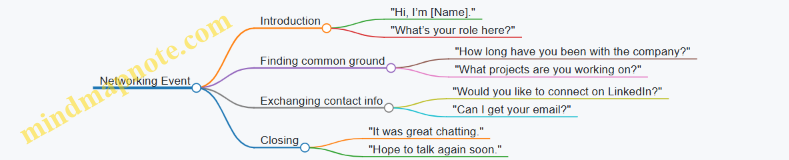
Example Dialogue:
You: Hi, I’m Mark. I don’t think we’ve met.
Colleague: Hi Mark, I’m Lisa. I work in finance.
You: Nice to meet you, Lisa. How long have you been with the company?
Colleague: About three years now. How about you?
You: Just over a year. What projects are you working on?
Colleague: Mostly budgeting for the new fiscal year.
You: Sounds interesting. Would you like to connect on LinkedIn?
Colleague: Sure, I’d like that.
You: Great. It was nice chatting with you.
Colleague: Likewise. Hope to talk again soon.
Scenario 4: Handling a Disagreement Politely
Mind Map:
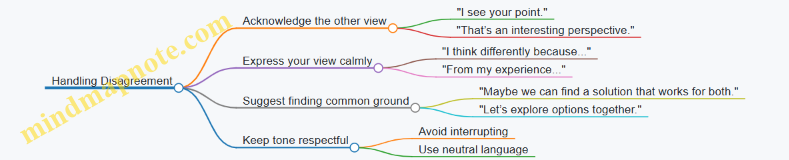
Example Dialogue:
You: I see your point about the timeline.
Colleague: Thanks. I think it’s tight but doable.
You: From my experience, we might need an extra week to ensure quality.
Colleague: That makes sense. Maybe we can adjust the schedule accordingly.
You: Yes, let’s discuss with the team to find a solution that works.
Scenario 5: Asking for Help or Clarification
Mind Map:
Example Dialogue:
You: Hi, do you have a moment?
Colleague: Sure, what’s up?
You: I’m unsure about the new reporting format. Could you explain how to fill it out?
Colleague: Absolutely, I can walk you through it.
You: Thanks, I appreciate your help.
Tips for Role-Playing
- Use these scenarios to practice both sides of the conversation.
- Focus on natural pauses and tone, not just words.
- Record yourself if possible to evaluate clarity and confidence.
- Try varying the phrases to avoid sounding scripted.
Role-playing builds familiarity with common workplace exchanges. The goal is to feel comfortable starting and maintaining conversations that support your professional relationships.
10.3 Self-assessment and feedback are essential tools for improving your workplace small talk skills. They help you identify what works, what doesn’t, and where you can make adjustments. This section provides practical techniques to evaluate your conversations and gather useful feedback, along with mind maps and examples to guide your reflection.
Self-Assessment Techniques
Start by observing your own conversations. After a small talk interaction, take a moment to reflect on several key aspects:
- Initiation: How easily did you start the conversation? Did you use a clear and friendly opener?
- Engagement: Were you able to keep the conversation going? Did you ask open-ended questions?
- Listening: Did you listen actively and respond appropriately?
- Body Language: Was your posture and eye contact inviting?
- Closure: Did you end the conversation smoothly?
Use a simple checklist or journal to note your observations. Over time, patterns will emerge that highlight strengths and areas for improvement.
Mind Map: Self-Assessment Focus Areas
Feedback Techniques
Feedback from others offers an external perspective. Here are ways to collect it effectively:
- Ask Colleagues or Friends: After a conversation, ask a trusted coworker or friend for honest feedback on your tone, clarity, and engagement.
- Request Specific Feedback: Instead of a general “How did I do?”, ask targeted questions like “Did I seem approachable?” or “Was I clear when I asked about your project?”
- Use Video or Audio Recordings: With permission, record your conversations or practice sessions. Review them to notice verbal and non-verbal cues.
- Peer Role-Playing: Practice small talk with a colleague and exchange feedback immediately.
Mind Map: Feedback Collection Methods
Example: Self-Assessment Journal Entry
Date: March 15
Situation: Coffee break chat with a new team member
Initiation: Used “Hi, I’m Alex. How are you finding the project so far?” - felt natural.
Engagement: Asked about their background and interests; they responded well.
Listening: I noticed I interrupted once; need to work on patience.
Body Language: Maintained eye contact but crossed arms, which might seem closed off.
Closure: Ended with “Great chatting, let’s catch up again soon.” Felt smooth.
Action Point: Practice waiting longer before responding and keep arms relaxed.
Example: Feedback Request
After a meeting, you might say:
“Hey, I’m trying to improve my small talk skills. Could you tell me if I came across as approachable during our chat? Was there anything I could do differently?”
Using Feedback to Improve
Combine your self-assessment notes with external feedback. Look for common themes. For example, if both you and others notice you interrupt often, focus on pausing before responding. If body language is mentioned, try practicing in front of a mirror or recording yourself.
Mind Map: Improvement Cycle

Regularly revisiting this cycle will help you build confidence and refine your small talk skills steadily. The goal is progress, not perfection. Small adjustments accumulate into more natural and effective workplace conversations.
10.4 Building confidence in workplace small talk is less about sudden breakthroughs and more about steady, deliberate repetition. Practicing conversations regularly helps internalize phrases, improve comfort with language, and reduce hesitation. This section outlines practical approaches to repetition and how they contribute to confidence.
Why Repetition Matters
Repetition reinforces memory and muscle memory. When you repeat phrases or conversation patterns, your brain creates stronger neural pathways, making it easier to recall and use them naturally. This reduces the mental load during real interactions, allowing you to focus on listening and responding rather than searching for words.
Best Practices for Repetition
-
Start Small and Specific: Focus on a few key phrases or questions relevant to your daily work context. For example, practice greetings, asking about weekend plans, or commenting on a project update.
-
Use Role-Playing: Simulate conversations with a colleague or friend. Role-playing helps you experience different responses and adapt your language accordingly.
-
Record and Review: Record yourself practicing small talk. Listening back reveals areas for improvement and tracks progress.
-
Integrate into Daily Routine: Use moments like coffee breaks or elevator rides to practice short conversations. Frequent, brief practice beats occasional long sessions.
-
Vary Contexts: Practice small talk in different settings—face-to-face, phone, or video calls—to build versatility.
Mind Map: Steps to Build Confidence Through Repetition
Mind Map: Common Small Talk Phrases to Practice
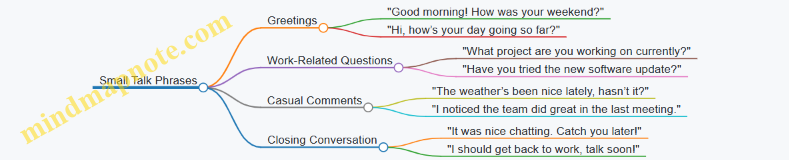
Examples of Repetition in Practice
Example 1: Practicing a Greeting
- Day 1: Say aloud “Good morning! How was your weekend?” five times.
- Day 2: Use the phrase in a real conversation or role-play.
- Day 3: Record yourself saying the phrase and listen for natural tone.
- Day 4: Modify the phrase slightly, e.g., “Hi, did you do anything fun this weekend?”
Example 2: Role-Playing a Networking Introduction
- Prepare a short introduction: “Hi, I’m Alex from marketing. What department are you in?”
- Practice with a partner, alternating roles.
- Repeat until the introduction feels natural and confident.
Example 3: Using Written Small Talk
- Draft an email opening: “I hope you had a good weekend. I wanted to check in on the project status.”
- Rewrite the sentence in different ways.
- Use the best version in actual emails.
Tips to Keep Repetition Effective
- Avoid rote memorization without understanding. Know the meaning and context of phrases.
- Mix repetition with active listening to respond naturally.
- Celebrate small improvements to stay motivated.
- Keep practice sessions brief but consistent to prevent burnout.
In summary, repetition is a practical tool for building small talk confidence. By practicing key phrases regularly, simulating conversations, and reviewing your performance, you create a foundation that makes workplace interactions smoother and less stressful.
10.5 Examples: Sample Dialogues with Annotations
Below are several sample dialogues illustrating common workplace small talk situations. Each dialogue is followed by annotations explaining the choice of phrases, tone, and strategies used to keep the conversation smooth and professional.
Dialogue 1: Starting a Conversation with a New Colleague
Anna: Hi, I don’t think we’ve met before. I’m Anna from marketing. How long have you been with the company?
Ben: Hello Anna, I’m Ben. I just started last month in the IT department.
Anna: That’s great! How are you finding things so far?
Ben: It’s been good, a lot to learn but everyone’s been helpful.
Anna: I’m glad to hear that. If you ever want to grab coffee or have questions, feel free to ask.
Ben: Thanks, I appreciate that.
Annotations:
- Anna opens with a polite introduction and an open-ended question to invite Ben to share.
- Ben responds briefly but positively, keeping the tone friendly.
- Anna follows up with a supportive offer, which builds rapport.
- The exchange is brief but leaves room for future interaction.
Dialogue 2: Small Talk During a Coffee Break
Carlos: Morning, Lisa. Did you catch the game last night?
Lisa: Morning, Carlos. I missed it, actually. Was it good?
Carlos: Yeah, it was close until the last minute. Makes for exciting watching.
Lisa: Sounds like I should watch the highlights later. Do you usually follow the team?
Carlos: I do, especially during the season. Helps me unwind after work.
Annotations:
- Carlos uses a topical question (sports) to start the chat.
- Lisa admits she missed the event but shows interest, which keeps the conversation going.
- Carlos shares a personal habit, making the talk more relatable.
- Lisa’s question invites further sharing, showing engagement.
Dialogue 3: Networking at a Professional Event
Emma: Hi, I’m Emma from the finance team. What department are you with?
David: Hi Emma, I’m David, project management. It’s nice to meet you.
Emma: Likewise. What kind of projects are you managing currently?
David: Mostly software rollouts. It’s challenging but rewarding.
Emma: That sounds interesting. I’m always curious how finance and project teams collaborate.
David: Absolutely, coordination is key. Maybe we can chat more about that sometime.
Annotations:
- Emma starts with a simple introduction and question about David’s role.
- David gives a concise description that invites curiosity.
- Emma connects their roles to find common ground.
- David suggests continuing the conversation, which is a good networking move.
Dialogue 4: Handling a Sensitive Topic Politely
Sophie: I heard there might be some changes in the team structure soon. Have you heard anything?
Mark: I’ve heard some rumors but nothing confirmed yet. It’s best to wait for official news.
Sophie: You’re right. Speculating doesn’t help. How’s your current project going?
Mark: It’s going well, thanks. Focusing on that keeps me busy.
Annotations:
- Sophie raises a potentially sensitive topic cautiously.
- Mark uses neutral language to avoid spreading unconfirmed information.
- Sophie redirects the conversation to a safer, work-related subject.
- Mark responds positively, helping to maintain a professional tone.
Dialogue 5: Virtual Meeting Warm-Up
Host: Good morning, everyone! Before we start, how’s everyone’s week going so far?
Jin: Morning! Pretty busy but productive. How about you?
Host: Same here. Glad to hear productivity is up. Any weekend plans?
Maria: I’m planning a short hike. Looking forward to some fresh air.
Host: That sounds nice. Hopefully, the weather holds up.
Annotations:
- The host uses an inclusive question to engage all participants.
- Jin responds with a brief update and reciprocates the question.
- The host acknowledges and moves the conversation to a lighter topic.
- Maria shares a personal plan, which adds warmth to the virtual setting.
Mind Maps in
Mind Map 1: Starting Small Talk
- Start with a greeting
  - "Hi", "Hello"
- Introduce yourself if needed
  - "I’m [Name] from [Department]"
- Ask open-ended questions
  - "How long have you been here?"
  - "How are you finding things?"
- Offer support or common ground
  - "Let me know if you need anything"
Mind Map 2: Maintaining Small Talk
- Listen actively
  - Nod, brief affirmations
- Respond with interest
  - "That sounds interesting"
- Share related experiences
  - "I also enjoy that"
- Ask follow-up questions
  - "What do you like most about it?"
Mind Map 3: Handling Sensitive Topics
- Recognize sensitivity
  - Avoid rumors
- Use neutral language
  - "I’ve heard some rumors but nothing confirmed"
- Redirect conversation
  - "How’s your project going?"
- Maintain professionalism
  - Stay calm and polite
Mind Map 4: Networking Phrases
- Introduce yourself
  - "I’m [Name], I work in [Department]"
- Ask about role
  - "What projects are you working on?"
- Find common ground
  - "Our teams often collaborate on..."
- Suggest follow-up
  - "Let’s connect later to discuss"
These examples and mind maps provide a practical framework for initiating and sustaining workplace small talk. The annotations highlight how simple phrases and thoughtful responses contribute to positive professional interactions.