English for Healthcare Workers
Chapter 1: Introduction to Healthcare Communication
1.1 Effective communication in healthcare is the foundation of quality patient care. It shapes how information is exchanged between healthcare workers, patients, and their families. When communication is clear and accurate, it reduces errors, builds trust, and improves patient outcomes.
Why Communication Matters in Healthcare
- Patient Safety: Misunderstandings can lead to medication errors, missed symptoms, or incorrect treatments.
- Patient Satisfaction: Patients who feel heard and understood are more likely to follow treatment plans.
- Team Coordination: Healthcare often involves multiple professionals; clear communication ensures everyone is on the same page.
- Legal and Ethical Responsibility: Accurate documentation and communication protect both patients and healthcare workers.
Mind Map: Key Elements of Effective Healthcare Communication
Examples of Communication Impact
Example 1: Medication Instructions
Poor communication: Nurse says, “Take this pill twice daily.”
Better communication: Nurse says, “Please take one pill in the morning and one in the evening, after meals. If you feel dizzy, call us immediately.”
This example shows how adding specifics and safety advice prevents confusion and potential harm.
*Example 2: Patient Concerns
Poor communication: Nurse asks, “Are you okay?”
Better communication: Nurse asks, “Can you describe any pain or discomfort you’re feeling right now?”
The second question invites detailed responses, helping the nurse understand the patient’s condition better.
Mind Map: Benefits of Effective Communication
Best Practices Embedded in Communication
- Use plain language instead of medical jargon.
- Confirm understanding by asking patients to repeat instructions.
- Listen more than you speak; patients often provide clues about their condition.
- Be mindful of tone and body language; they can reinforce or contradict your words.
- Document conversations accurately to maintain continuity of care.
In summary, effective communication is not just about talking; it’s about making sure the right message is received and understood by everyone involved. This reduces risks, builds relationships, and supports better healthcare delivery.
1.2 Basic Medical Terminology for Healthcare Workers
Medical terminology forms the backbone of communication in healthcare settings. For nurses and caregivers, understanding and using these terms correctly ensures clear exchanges with colleagues and patients. This section introduces essential medical terms, grouped by categories, with explanations and examples to make them easier to remember and apply.
Understanding Medical Terms: Roots, Prefixes, and Suffixes
Most medical words are built from three parts:
- Root: The main part of the word, often indicating a body part or system.
- Prefix: Added before the root to modify its meaning (e.g., location, number, time).
- Suffix: Added after the root to indicate a procedure, condition, or disease.
Example:
- Cardiology
- Root: cardio (heart)
- Suffix: -logy (study of)
- Meaning: The study of the heart.
Mind Map: Common Medical Roots
Mind Map: Useful Prefixes
Mind Map: Common Suffixes
Examples of Medical Terms in Use
-
Gastritis
- gastr- (stomach) + -itis (inflammation)
- Meaning: Inflammation of the stomach lining.
- Usage: “The patient complains of stomach pain, which may indicate gastritis.”
-
Hypoglycemia
- hypo- (low) + glyc- (sugar) + -emia (blood condition)
- Meaning: Low blood sugar.
- Usage: “We need to monitor her blood sugar closely to prevent hypoglycemia.”
-
Bradycardia
- brady- (slow) + cardia (heart)
- Meaning: Slow heart rate.
- Usage: “The ECG shows bradycardia, which requires further assessment.”
-
Nephrectomy
- nephr- (kidney) + -ectomy (removal)
- Meaning: Surgical removal of a kidney.
- Usage: “The patient is scheduled for a nephrectomy next week.”
Practical Vocabulary for Daily Use
- Vital signs: Measurements like temperature, pulse, respiration, and blood pressure.
- Symptom: A sign or indication of a condition reported by the patient.
- Diagnosis: The identification of a disease or condition.
- Treatment: The care given to improve or cure a condition.
- Medication: Drugs prescribed to treat illness.
Example dialogue:
- Nurse: “Can you describe your symptoms?”
- Patient: “I have a headache and feel dizzy.”
- Nurse: “We will check your vital signs and inform the doctor for a diagnosis.”
Tips for Remembering Medical Terms
- Break down complex words into parts.
- Relate terms to body parts or functions you know.
- Use flashcards with terms and definitions.
- Practice using terms in simple sentences.
Mastering basic medical terminology helps healthcare workers communicate efficiently and confidently. This foundation supports better patient care and teamwork.
1.3 Understanding patient needs through language is a fundamental skill for healthcare workers. It goes beyond simply hearing words; it involves interpreting what patients say, how they say it, and what they might be hesitant to express. Language is the primary tool for uncovering patients’ concerns, fears, and expectations.
Why Language Matters in Understanding Patient Needs
Patients come from diverse backgrounds, with varying levels of health literacy and emotional states. Clear communication helps identify their physical symptoms, emotional wellbeing, and social circumstances that affect health. Misunderstandings can lead to incorrect diagnoses, poor treatment adherence, or dissatisfaction.
Components of Patient Communication
- Verbal Language: The words patients use to describe symptoms, feelings, and questions.
- Non-Verbal Cues: Tone, facial expressions, body language, and pauses.
- Contextual Understanding: Cultural background, education level, and emotional state.
Mind Map: Key Elements in Understanding Patient Needs
Listening Actively
Active listening means fully concentrating on the patient’s words without interrupting, then reflecting or summarizing to confirm understanding. For example, if a patient says, “I feel tired all the time,” an active listener might respond, “You’ve been feeling very tired lately; can you tell me more about when it started?” This invites elaboration and shows empathy.
Asking Open-Ended Questions
Open-ended questions encourage patients to provide more detailed information. Instead of asking, “Do you have pain?” try, “Can you describe how you’re feeling today?” This approach uncovers more nuanced information.
Mind Map: Question Types to Understand Patient Needs
Clarification and Paraphrasing
Sometimes patients use vague or unfamiliar terms. Clarifying means asking for specifics, while paraphrasing involves repeating what the patient said in your own words to check understanding. For example:
- Patient: “I feel off balance.”
- Nurse: “Do you mean you feel dizzy or unsteady when you walk?”
This avoids assumptions and ensures accurate information gathering.
Recognizing Emotional Needs
Patients may express fear, frustration, or confusion indirectly. Phrases like “I’m worried about my test results” or a hesitant tone signal emotional needs. Acknowledging these feelings helps build trust.
Example:
- Patient: “I’m scared about the surgery.”
- Nurse: “It’s normal to feel scared. Would you like me to explain what will happen step-by-step?”
Mind Map: Emotional Cues and Responses
Examples of Patient-Healthcare Worker Conversations
Example 1: Understanding Pain
- Nurse: “Can you describe your pain?”
- Patient: “It’s a sharp pain in my chest.”
- Nurse: “Is the pain constant or does it come and go?”
- Patient: “It comes and goes, mostly when I breathe deeply.”
This exchange helps pinpoint the nature and triggers of pain.
Example 2: Addressing Emotional Concerns
- Nurse: “How are you feeling about your treatment?”
- Patient: “I’m a bit nervous about the side effects.”
- Nurse: “That’s understandable. Let’s talk about what you might expect and how we can manage any side effects.”
This approach validates the patient’s feelings and opens a supportive dialogue.
Summary
Understanding patient needs through language requires attention to what is said, how it is said, and what remains unsaid. Using active listening, open-ended questions, clarification, and emotional recognition helps healthcare workers gather accurate information and build rapport. These communication skills improve patient care and satisfaction.
1.4 Clear and compassionate communication is the backbone of effective healthcare. It ensures patients feel heard, understood, and respected, which can improve their cooperation and overall experience. Here are key best practices to keep in mind:
Use Simple, Direct Language
Avoid jargon and complex medical terms when possible. Patients often feel overwhelmed by unfamiliar words. Instead of saying “hypertension,” say “high blood pressure.” This reduces confusion and builds trust.
Speak Slowly and Clearly
Healthcare environments can be noisy or stressful. Speaking at a moderate pace and enunciating words helps patients catch important details. Pausing occasionally allows them to process information.
Listen Actively
Communication is two-way. Show you’re listening by nodding, maintaining eye contact, and repeating or summarizing what the patient says. This confirms understanding and shows respect.
Use Open-Ended Questions
Instead of questions that can be answered with yes or no, ask questions that encourage patients to share more details. For example, “Can you describe your pain?” rather than “Does it hurt?”
Show Empathy and Patience
Acknowledge patients’ feelings without judgment. Phrases like “I understand this is difficult” or “Take your time” help patients feel supported.
Confirm Understanding
Ask patients to repeat instructions or information in their own words. This ensures they have understood correctly and gives a chance to clarify.
Use Nonverbal Communication Effectively
Facial expressions, gestures, and posture can reinforce your words. Smiling gently or leaning slightly forward signals attentiveness and warmth.
Be Mindful of Cultural Differences
Respect cultural norms regarding eye contact, personal space, and communication style. Adjust your approach to make patients comfortable.
Mind Map: Best Practices for Clear and Compassionate Communication
Examples
Example 1: Using Simple Language and Confirming Understanding
Nurse: “You have high blood pressure, which means your heart is working harder than usual. We’ll give you medicine to help lower it. Do you understand how to take your medicine?”
Patient: “I think so. I take one pill every morning?”
Nurse: “Exactly, one pill every morning with breakfast. If you have questions, just ask.”
Example 2: Active Listening and Open-Ended Questions
Nurse: “Can you tell me more about the pain you’re feeling?”
Patient: “It’s a sharp pain in my chest that comes and goes.”
Nurse: “How long does the pain usually last when it comes?”
Patient: “Maybe a few minutes.”
Nurse: “Thank you for sharing that. It helps us understand your condition better.”
Example 3: Showing Empathy and Using Nonverbal Cues
Nurse (gently smiling and nodding): “I understand this is a tough time for you. We’re here to help you through it. Take your time to ask any questions you have.”
Example 4: Cultural Sensitivity
Nurse: “In your culture, is there a preferred way you like to receive information or make decisions about your care?”
Patient: “Yes, I usually discuss things with my family first.”
Nurse: “Thank you for telling me. We’ll make sure to involve your family in the discussions.”
By applying these practices, healthcare workers can build stronger connections with patients and create a more supportive environment. Clear and compassionate communication is not just about exchanging information—it’s about fostering understanding and trust.
1.5 Examples: Introducing Yourself and Establishing Rapport with Patients
When you first meet a patient, your introduction sets the tone for the entire interaction. A clear, friendly introduction helps patients feel more comfortable and builds trust. This section presents practical examples and mind maps to guide you through effective self-introductions and rapport-building.
Mind Map: Key Elements of Introducing Yourself
Example 1: Basic Introduction
Nurse: “Good morning, my name is Sarah. I am the nurse assigned to your care today. How are you feeling this morning?”
Patient: “I’m okay, thank you.”
Nurse: “Great. If you need anything or have questions, please let me know.”
Mind Map: Building Rapport Through Communication
Example 2: Introducing Yourself with Empathy and Encouraging Dialogue
Caregiver: “Hello, I’m John, your caregiver for today. I understand that being in the hospital can be stressful. How are you feeling right now?”
Patient: “A little nervous, to be honest.”
Caregiver: “That’s completely understandable. If you want, you can tell me what worries you the most. I’m here to help.”
Patient: “I’m worried about the tests they’re going to do.”
Caregiver: “Thank you for sharing that. I’ll explain what to expect as best as I can, and if you have any questions, just ask.”
Example 3: Introducing Yourself in a Busy Ward
Nurse: “Hi, I’m Maria, one of the nurses on the ward. I’ll be checking on you this afternoon. Is there anything you need right now?”
Patient: “No, not at the moment.”
Nurse: “Alright, I’ll be back soon to take your vital signs. Feel free to call if you need anything before then.”
Mind Map: Common Phrases for Introductions and Rapport
Tips for Effective Introductions and Rapport
- Always speak slowly and clearly, especially if the patient’s first language is not English.
- Use the patient’s preferred name and title to show respect.
- Match your tone to the situation: calm and reassuring when patients are anxious, warm and friendly during routine care.
- Pay attention to non-verbal cues like facial expressions and body language.
- Avoid rushing; even a brief moment of genuine attention can improve patient comfort.
By combining clear introductions with empathetic communication, healthcare workers can create a positive environment that encourages patient cooperation and trust. Practice these examples and adapt them to your own style and the needs of your patients.
Chapter 2: Patient Admission and Initial Assessment
2.1 Greeting Patients and Collecting Personal Information
When a patient arrives, the first interaction sets the tone for the entire care experience. Greeting patients warmly and collecting their personal information accurately are foundational skills for healthcare workers. This section breaks down the essential language and communication strategies needed to perform these tasks effectively.
Why Greeting Matters
A clear, polite greeting helps patients feel seen and respected. It also establishes trust and reduces anxiety. Simple phrases like “Good morning, I’m [Name], and I’ll be assisting you today” work well.
Key Components of Greeting and Information Collection
Mind Map: Greeting and Collecting Personal Information
Sample Dialogue: Greeting and Collecting Basic Information
Nurse: Good afternoon! My name is Sarah, and I’ll be helping you today. May I have your full name, please?
Patient: It’s John Smith.
Nurse: Thank you, Mr. Smith. Could you please tell me your date of birth?
Patient: It’s March 12, 1975.
Nurse: Got it. And what is the best phone number to reach you?
Patient: It’s 555-1234.
Nurse: Perfect. Do you have an emergency contact we should note?
Patient: Yes, my wife, Mary, at 555-5678.
Nurse: Thank you. Lastly, do you have any allergies or medical conditions we should be aware of?
Patient: I’m allergic to penicillin.
Nurse: Noted. Thanks for sharing that.
Best Practices for Collecting Information
- Use open but focused questions: Instead of asking “Do you have any allergies?” you might say, “Can you tell me if you have any allergies to medications or foods?”
- Repeat information back: This confirms accuracy and shows you are listening.
- Maintain eye contact and use a friendly tone: This encourages openness.
- Be mindful of privacy: Collect sensitive information discreetly.
Mind Map: Communication Tips for Greeting and Information Gathering
Example: Handling a Patient Who Is Nervous or Hesitant
Nurse: Hello, I’m David. I’ll be helping you today. Can you please tell me your full name?
Patient: Um… I’m not sure if I should say.
Nurse: That’s okay. Your information helps us keep you safe and provide the best care. Everything you share stays confidential. When you’re ready, I’m here to listen.
This approach acknowledges the patient’s feelings and gently encourages cooperation.
Summary
Greeting patients and collecting personal information require clear language, patience, and respect. Using simple phrases, confirming details, and showing empathy make this process smoother and more effective. These skills build the foundation for all subsequent communication in healthcare settings.
2.2 Asking About Medical History and Current Symptoms
When nurses and caregivers ask about a patient’s medical history and current symptoms, the goal is to gather accurate and relevant information efficiently while making the patient feel comfortable and heard. Clear, simple questions paired with attentive listening help build trust and ensure the information collected is useful for diagnosis and care.
Key Areas to Cover When Asking About Medical History
- Past illnesses and surgeries: Understanding previous health issues can reveal patterns or risks.
- Chronic conditions: Conditions like diabetes or hypertension affect current care plans.
- Allergies: Knowing allergies prevents dangerous reactions.
- Medications: Current prescriptions or over-the-counter drugs impact treatment choices.
- Family medical history: Some conditions have hereditary links.
Key Areas to Cover When Asking About Current Symptoms
- Onset: When did the symptoms start?
- Duration: How long have they lasted?
- Intensity: How severe are the symptoms?
- Location: Where exactly is the symptom felt?
- Quality: What does the symptom feel like (sharp, dull, throbbing)?
- Aggravating or relieving factors: What makes it better or worse?
Mind Map: Medical History Questions
Mind Map: Current Symptoms Questions
Best Practices for Asking About Medical History and Symptoms
- Use simple, direct questions. Avoid medical jargon unless the patient understands it.
- Ask one question at a time to avoid confusion.
- Use open-ended questions first, then follow up with specific ones.
- Confirm understanding by paraphrasing or summarizing the patient’s answers.
- Be patient and give the patient time to respond.
- Observe non-verbal cues such as hesitation or discomfort.
Examples of Questions and Sample Dialogues
Example 1: Asking About Past Illnesses and Surgeries
Nurse: “Have you had any serious illnesses or surgeries in the past?”
Patient: “Yes, I had my appendix removed five years ago.”
Nurse: “Thank you. Any other health problems we should know about?”
Patient: “No, that’s all.”
Example 2: Asking About Allergies and Medications
Nurse: “Are you allergic to any medications, foods, or other things?”
Patient: “I’m allergic to penicillin.”
Nurse: “Got it. Are you currently taking any medicines, including vitamins or over-the-counter drugs?”
Patient: “Just a daily aspirin.”
Example 3: Asking About Current Symptoms
Nurse: “Can you tell me when your headache started?”
Patient: “It began yesterday afternoon.”
Nurse: “Is the pain constant or does it come and go?”
Patient: “It’s mostly constant but gets worse when I move my head.”
Nurse: “How would you describe the pain? Sharp, dull, or throbbing?”
Patient: “It’s a dull ache.”
Nurse: “Does anything make it better or worse?”
Patient: “Rest helps a bit, but bright lights make it worse.”
Tips for Clear Communication
- When patients struggle to describe symptoms, offer examples: “Is the pain sharp like a knife or more like pressure?”
- Use visual aids or body diagrams if available to help patients point out symptom locations.
- Avoid leading questions that suggest an answer, such as “Your pain isn’t too bad, is it?”
- Respect cultural differences in expressing pain or illness; some patients may understate symptoms.
Gathering medical history and symptom details is a foundational skill. It requires balance: being thorough without overwhelming the patient, and being clear without sounding mechanical. Practice these questions and listen carefully to responses to build confidence and improve patient care.
2.3 Explaining admission procedures clearly is a key skill for healthcare workers, especially nurses and caregivers who often serve as the first point of contact for patients. Clear explanations help reduce patient anxiety, ensure cooperation, and improve the overall admission experience. This section breaks down how to communicate admission steps effectively, using simple language and structured information.
Key Points to Cover When Explaining Admission Procedures
- What admission means and why it’s necessary
- Documents and information the patient needs to provide
- Steps involved in the admission process
- What patients can expect during and after admission
- How long the process might take
- Who will assist them and how to ask questions
Mind Map: Explaining Admission Procedures
Step-by-Step Explanation Example
When speaking to a patient, you might say:
“Welcome! To get started, we’ll need to register you by collecting some basic information like your name, date of birth, and contact details. Then, we’ll ask about your medical history and any current symptoms. This helps us understand your needs better. After that, a nurse will check your vital signs and assign you a room. The whole process usually takes about 30 minutes. If you have any questions at any point, just let me know.”
Best Practices for Explaining Admission Procedures
- Use Plain Language: Avoid medical jargon. Instead of “initial assessment,” say “a quick health check.”
- Break Information into Small Steps: Present the process in clear, manageable parts.
- Use Visual Aids if Possible: Simple charts or pamphlets can help reinforce spoken explanations.
- Confirm Understanding: Ask patients to repeat key points or ask if they have questions.
- Be Patient and Reassuring: A calm tone helps ease patient concerns.
Example Dialogue
Nurse: “Good morning! To admit you, I’ll first take some personal details like your full name and birthday.”
Patient: “Okay.”
Nurse: “Next, we’ll ask about your health history and any current problems. This helps us give you the best care. Then, a nurse will check your blood pressure and temperature. After that, we’ll find a room for you to rest. The whole process usually takes about half an hour. Does that sound alright?”
Patient: “Yes, thank you for explaining.”
Nurse: “You’re welcome. If you need anything during the process, just let me know.”
Mind Map: Communication Tips for Admission
By structuring explanations clearly and using examples like these, healthcare workers can make admission procedures easier to understand and less intimidating for patients.
2.4 Best Practices for Active Listening and Clarification
Active listening and clarification are essential skills for healthcare workers. They ensure that you understand patients accurately and that patients feel heard and respected. This section breaks down practical steps and examples to help you master these skills.
What is Active Listening?
Active listening means fully concentrating on what the patient says, not just hearing the words but understanding the message behind them. It involves paying attention to verbal and non-verbal cues, withholding judgment, and responding thoughtfully.
Why is Active Listening Important?
- Builds trust and rapport
- Reduces misunderstandings
- Encourages patients to share more information
- Improves accuracy in diagnosis and care
Mind Map: Components of Active Listening
Practical Tips for Active Listening
-
Focus fully on the patient. Put away phones or paperwork. Face the patient and maintain eye contact without staring.
-
Observe non-verbal signals. Notice facial expressions, tone of voice, and body posture. These often reveal feelings or concerns the patient may not say aloud.
-
Use short verbal cues. Words like “uh-huh,” “I understand,” or “go on” encourage patients to continue.
-
Avoid interrupting. Let the patient finish their thoughts before responding.
-
Paraphrase to confirm understanding. For example, “So you’ve been feeling dizzy for three days, is that right?”
-
Ask open-ended questions. These invite detailed answers, e.g., “Can you describe the pain?”
-
Summarize key points. At the end of the conversation, briefly repeat important information to ensure accuracy.
Mind Map: Clarification Techniques
Examples of Active Listening and Clarification in Practice
Example 1: Patient Describing Symptoms
Patient: “I’ve been feeling really tired and sometimes my chest hurts.”
Nurse: “You mentioned feeling tired and chest pain. Can you tell me more about the chest pain? Is it sharp, dull, or something else?”
Patient: “It’s more like a tightness, especially when I walk.”
Nurse: “So, a tight feeling in your chest that happens during walking. Have you noticed if it gets better when you rest?”
Patient: “Yes, it eases after a few minutes of resting.”
Nurse: “Thank you for explaining. That helps me understand your symptoms better.”
Example 2: Clarifying Medication Instructions
Patient: “I take my pills every day, but sometimes I forget if I took them.”
Caregiver: “I understand. To help, can you tell me when you usually take your medication?”
Patient: “In the morning, but I’m not always sure if I did.”
Caregiver: “Would setting a reminder or using a pill organizer help you remember?”
Patient: “Yes, that sounds helpful.”
Summary
Active listening and clarification are not just about hearing words but about understanding the patient’s experience and ensuring clear communication. Using attentive body language, verbal feedback, paraphrasing, and thoughtful questions improves patient care and workplace efficiency. Practice these steps regularly to build confidence and competence in your healthcare communication.
2.5 Examples: Sample Admission Conversations with Patients
When admitting a patient, clear and polite communication is essential. The goal is to gather accurate information while making the patient feel comfortable and respected. Below are sample conversations and mind maps to illustrate typical admission dialogues.
Mind Map: Key Points in Patient Admission Conversation
Example 1: Basic Admission Conversation
Nurse: Good morning. My name is Sarah, and I will be helping you with your admission today. Can I please have your full name?
Patient: Good morning. I’m John Smith.
Nurse: Thank you, Mr. Smith. Could you please tell me your date of birth?
Patient: It’s March 12, 1975.
Nurse: Great. Now, can you share your contact phone number?
Patient: Sure, it’s 555-1234.
Nurse: Thank you. Have you had any serious illnesses or surgeries in the past?
Patient: I had appendicitis surgery about ten years ago.
Nurse: Noted. Are you allergic to any medications or foods?
Patient: No allergies.
Nurse: Are you currently taking any medications?
Patient: Just blood pressure pills.
Nurse: Okay. What brings you to the hospital today?
Patient: I’ve been having chest pain for two days.
Nurse: I understand. We will take good care of you. Your information will be kept confidential. Do you consent to the admission and treatment?
Patient: Yes, I do.
Nurse: Thank you, Mr. Smith. I will now complete your admission paperwork and a doctor will see you shortly.
Example 2: Admission Conversation with Clarification and Empathy
Nurse: Hello, I’m Maria, your nurse today. Can I have your full name, please?
Patient: Hi, I’m Linda Johnson.
Nurse: Thank you, Ms. Johnson. When is your birthday?
Patient: July 8, 1980.
Nurse: Perfect. Could you tell me your phone number?
Patient: It’s 555-6789.
Nurse: Have you had any health problems before or surgeries?
Patient: I have asthma.
Nurse: Thank you for sharing. Are you allergic to anything?
Patient: Yes, I’m allergic to penicillin.
Nurse: That’s important to know. Are you taking any medications now?
Patient: I use an inhaler daily.
Nurse: Got it. What is the reason for your visit today?
Patient: I’ve had a high fever and cough for three days.
Nurse: That sounds uncomfortable. We’ll do our best to help you. Your information is private and will only be used for your care. Is it okay to proceed with admission?
Patient: Yes, that’s fine.
Nurse: Thank you. I’ll finish your admission form and let the doctor know.
Example 3: Admission Conversation with Elderly Patient
Nurse: Good afternoon. I’m James, the nurse helping with your admission. May I have your full name?
Patient: Afternoon. It’s George Wilson.
Nurse: Thank you, Mr. Wilson. Could you please tell me your date of birth?
Patient: It’s January 5, 1940.
Nurse: And your phone number?
Patient: I don’t have a phone, but my daughter’s number is 555-4321.
Nurse: That’s helpful. Have you had any major illnesses or surgeries?
Patient: I had a hip replacement last year.
Nurse: Thank you. Do you have any allergies?
Patient: No allergies.
Nurse: Are you taking any medicines?
Patient: Yes, blood thinners and pain medication.
Nurse: What brought you to the hospital today?
Patient: I’ve been feeling dizzy and weak.
Nurse: I see. We’ll take good care of you. Your information will be kept confidential. Do you agree to the admission and treatment?
Patient: Yes, I do.
Nurse: Great. I’ll complete your admission now and keep your daughter informed.
Tips for Admission Conversations
- Use simple, clear language.
- Speak slowly and check for understanding.
- Repeat or rephrase questions if needed.
- Show empathy and patience.
- Confirm key details before moving on.
- Explain why you need certain information.
These examples demonstrate how to balance professionalism with approachability, ensuring patients feel respected and understood during admission.
Chapter 3: Communicating Symptoms and Medical Conditions
3.1 Asking About Pain, Discomfort, and Other Symptoms
Effective communication about pain and symptoms is essential for accurate assessment and treatment. Patients may describe their experiences in many ways, so healthcare workers need clear, simple questions and attentive listening.
Key Points When Asking About Pain and Symptoms
- Use open-ended questions first to encourage patients to describe their experience in their own words.
- Follow up with specific questions to clarify details such as location, intensity, duration, and factors that worsen or relieve symptoms.
- Use simple language and avoid medical jargon.
- Be patient and allow pauses; some patients may need time to find the right words.
- Observe nonverbal cues like facial expressions or body language for additional information.
Mind Map: Asking About Pain
Mind Map: Asking About Other Symptoms
Examples of Questions and Patient Responses
Example 1: Asking About Pain Location and Intensity
- Nurse: “Can you show me where it hurts?”
- Patient: “Right here, in my lower back.”
- Nurse: “On a scale from 0 to 10, where 0 means no pain and 10 means the worst pain you can imagine, how bad is it?”
- Patient: “It’s about a 6.”
Example 2: Clarifying Type and Duration of Pain
- Nurse: “Is the pain sharp, dull, or burning?”
- Patient: “It’s more of a dull ache.”
- Nurse: “Does it come and go or is it there all the time?”
- Patient: “It comes and goes, usually worse in the evening.”
Example 3: Asking About Other Symptoms
- Nurse: “Besides the pain, have you noticed anything else, like nausea or dizziness?”
- Patient: “Yes, sometimes I feel a bit dizzy when I stand up quickly.”
Example 4: Understanding Impact on Daily Life
- Nurse: “Is the pain stopping you from doing your usual activities?”
- Patient: “Yes, I can’t walk as far as I used to.”
Tips for Clear Symptom Inquiry
- Use a pain scale chart if available to help patients quantify pain.
- Repeat or rephrase questions if the patient seems confused.
- Confirm understanding by summarizing what the patient said: “So, your pain is mostly in your lower back and feels like a dull ache, is that right?”
- Encourage patients to mention any new or unusual symptoms, even if they seem unrelated.
Asking about pain and symptoms is a step-by-step process. Start broad, then narrow down. This approach helps patients feel heard and provides you with the detailed information needed for care decisions.
3.2 Describing symptoms clearly is a key skill for healthcare workers. Patients often struggle to explain what they feel, so using simple, precise language helps avoid confusion and ensures accurate care. This section focuses on how to guide patients and how to use straightforward terms yourself.
Why Simple and Precise Language Matters
Medical jargon can confuse patients and even colleagues. Instead, use common words that describe sensations, locations, and durations clearly. For example, instead of “cephalalgia,” say “headache.” Instead of “dyspnea,” say “shortness of breath.”
Key Elements When Describing Symptoms
- Type of symptom: pain, swelling, dizziness, etc.
- Location: where exactly the symptom occurs
- Intensity: mild, moderate, severe
- Duration: how long it lasts
- Frequency: how often it happens
- Triggers or relieving factors: what makes it better or worse
Mind Map: Describing Symptoms
Using Descriptive Words for Common Symptoms
- Pain: sharp, dull, throbbing, burning, stabbing
- Swelling: puffy, enlarged, firm
- Breathing: shortness of breath, wheezing, tightness
- Digestive: nausea, vomiting, bloating, diarrhea
Mind Map: Describing Pain
Examples of Simple Symptom Descriptions
- “I have a sharp pain in my lower right abdomen that comes and goes.”
- “My head feels like it’s throbbing, mostly on the left side.”
- “I feel short of breath when I walk up stairs.”
- “There is a burning sensation when I urinate.”
- “My legs feel swollen and heavy, especially at the end of the day.”
Guiding Patients to Describe Symptoms
Ask open but focused questions:
- “Can you point to where it hurts?”
- “Is the pain sharp or dull?”
- “How long does the pain last?”
- “Does anything make it better or worse?”
Encourage patients to avoid vague terms like “bad” or “weird” without further explanation. Instead, ask them to compare the sensation to something familiar, such as “like pins and needles” or “like a tight band.”
Practice Dialogue
Nurse: “Can you tell me about your pain?”
Patient: “It’s a bad pain in my stomach.”
Nurse: “Is it sharp or dull?”
Patient: “It’s sharp.”
Nurse: “Where exactly?”
Patient: “Right here,” (points to lower right abdomen).
Nurse: “Does it come and go or is it constant?”
Patient: “It comes and goes.”
Nurse: “Does anything make it better or worse?”
Patient: “It hurts more when I move.”
This kind of step-by-step questioning helps turn vague complaints into clear, actionable information.
Summary
Using simple and precise language to describe symptoms improves communication between healthcare workers and patients. It reduces misunderstandings and supports accurate diagnosis and treatment. Mind maps can help organize symptom descriptions, and examples show how to apply these principles in everyday conversations.
3.3 Understanding and Using Common Medical Descriptions
In healthcare communication, clear and accurate descriptions of medical conditions and symptoms are essential. Patients often use everyday language, while healthcare workers need to translate these into medically appropriate terms without losing clarity. This section focuses on common medical descriptions, their meanings, and how to use them effectively in conversations.
Key Categories of Medical Descriptions
Medical descriptions generally fall into categories related to symptoms, physical findings, and diagnostic terms. Understanding these categories helps in organizing information and communicating precisely.
Mind Map: Common Medical Descriptions
Describing Pain
Pain is one of the most common symptoms patients report. Describing pain accurately helps determine its cause and severity.
- Sharp pain: sudden and intense, like a knife or needle.
- Dull pain: persistent and mild, often described as aching.
- Burning pain: feels hot or like a sting.
- Throbbing pain: rhythmic, pulsing sensation.
Example:
Nurse: “Can you describe your pain? Is it sharp, dull, or burning?”
Patient: “It’s a sharp pain in my lower back when I move.”
This exchange helps the nurse identify the pain type and guides further assessment.
Sensory Descriptions
Patients may describe sensations like numbness or tingling, which indicate nerve involvement.
- Numbness: loss of sensation or feeling.
- Tingling: pins-and-needles sensation.
- Weakness: reduced strength or difficulty moving.
Example:
Nurse: “Do you feel any numbness or tingling in your hands or feet?”
Patient: “Yes, my left hand feels tingly and a bit weak.”
This information can signal neurological issues requiring attention.
Other Common Symptoms
- Fatigue: feeling unusually tired or exhausted.
- Dizziness: sensation of spinning or lightheadedness.
- Nausea: feeling like vomiting.
Example:
Nurse: “Have you experienced dizziness or nausea recently?”
Patient: “I’ve been feeling dizzy, especially when I stand up quickly.”
These descriptions help in assessing hydration, blood pressure, or inner ear problems.
Physical Findings
When observing patients, healthcare workers describe visible signs.
- Swelling: enlargement of body parts due to fluid.
- Redness: erythema, often a sign of inflammation or infection.
- Rash: skin eruption, which can vary in appearance.
- Bruising: discoloration from bleeding under the skin.
Example:
Nurse: “I see some redness and swelling around your ankle. Does it hurt when I touch it?”
Patient: “Yes, it’s painful and warm to the touch.”
This description suggests inflammation or injury.
Diagnostic Terms in Everyday Language
Some medical terms are used in everyday speech but may need clarification.
- Fever: elevated body temperature, often indicating infection.
- Infection: invasion by bacteria, viruses, or fungi.
- Inflammation: body’s response causing redness, swelling, and pain.
- Chronic: long-lasting or recurring condition.
- Acute: sudden onset, often severe.
Example:
Nurse: “Do you have a fever or chills?”
Patient: “Yes, I had a fever last night.”
This helps determine urgency and treatment.
Mind Map: Describing Symptoms and Signs in Patient Conversations
Tips for Using Medical Descriptions Effectively
- Use simple language first, then introduce medical terms as needed.
- Confirm patient understanding by repeating or paraphrasing.
- Avoid jargon when speaking with patients; use clear, relatable terms.
- Observe non-verbal cues that may indicate pain or discomfort.
- Document descriptions accurately for handovers and records.
Practice Example: Describing a Patient’s Symptom
Nurse: “Can you tell me about the pain in your chest?”
Patient: “It feels like a heavy pressure, kind of squeezing.”
Nurse: “Is the pain sharp or dull?”
Patient: “More dull, but it comes and goes.”
Nurse: “Do you notice if it gets worse when you breathe deeply or move?”
Patient: “Yes, it hurts more when I take a deep breath.”
This conversation helps the nurse understand the nature of the chest pain and decide on next steps.
By mastering common medical descriptions and practicing their use in conversations, healthcare workers can improve patient care and reduce misunderstandings. Clear communication builds trust and supports accurate diagnosis and treatment.
3.4 Confirming patient understanding is a crucial step in healthcare communication. It ensures that patients grasp the information about their symptoms, diagnosis, treatment, or care instructions. Without confirmation, misunderstandings can lead to poor adherence, errors, or dissatisfaction.
Why Confirm Understanding?
- Patients may be anxious or distracted.
- Medical terms can be confusing.
- Cultural or language differences may interfere.
- Patients might hesitate to ask questions.
Best Practices for Confirming Patient Understanding
Use the Teach-Back Method
Ask patients to repeat information in their own words. This shows what they understood and highlights gaps.
Example:
- Nurse: “I just explained how to take your medication. Can you tell me how you will take it when you get home?”
- Patient: “I will take one pill every morning after breakfast.”
Ask Open-Ended Questions
Instead of yes/no questions, use questions that require explanation.
Example:
- Nurse: “What symptoms should make you call the clinic?”
- Patient: “If I get a fever or my pain gets worse.”
Use Simple Language and Avoid Jargon
Replace complex terms with everyday words and check if the patient is following.
Example:
- Instead of “hypertension,” say “high blood pressure.”
Observe Nonverbal Cues
Look for signs of confusion like furrowed brows, silence, or avoiding eye contact.
Summarize Key Points Together
Recap the main instructions and ask if anything is unclear.
Example:
- Nurse: “So, to be sure we’re on the same page, you will rest, take your medication twice a day, and call us if you notice swelling. Is that right?”
Encourage Questions
Make it clear that questions are welcome and important.
Example:
- Nurse: “Do you have any questions about what we discussed?”
Mind Map: Confirming Patient Understanding
Mind Map: Teach-Back Method Steps
Additional Examples
Example 1: Medication Instructions
- Nurse: “You need to take this pill twice a day with food. Can you tell me when you will take it?”
- Patient: “In the morning and at night after eating.”
Example 2: Symptom Monitoring
- Nurse: “What signs should you watch for that mean you need to see a doctor?”
- Patient: “If I feel short of breath or my chest hurts.”
Example 3: Post-Discharge Care
- Nurse: “After you leave the hospital, what will you do to care for your wound?”
- Patient: “I will keep it clean and dry and change the bandage every day.”
Confirming understanding is not a one-time task but a continuous process. It builds trust, reduces errors, and empowers patients to take an active role in their care.
3.5 Examples: Dialogue on Symptom Description and Clarification
When patients describe symptoms, clarity is key. Nurses and caregivers must ask questions that help pinpoint the nature, intensity, and duration of symptoms without confusing or overwhelming the patient. Below are practical examples and mind maps to guide effective symptom conversations.
Mind Map: Key Aspects of Symptom Description
Example Dialogue 1: Clarifying Pain Description
Nurse: “Can you tell me where you feel the pain?”
Patient: “It’s in my stomach.”
Nurse: “Is it in one spot or all over your stomach?”
Patient: “Mostly on the right side, just below my ribs.”
Nurse: “How would you describe the pain? Is it sharp, dull, or something else?”
Patient: “It’s a sharp pain, like a stabbing feeling.”
Nurse: “On a scale from 1 to 10, with 10 being the worst pain you’ve ever felt, how bad is it right now?”
Patient: “About a 7.”
Nurse: “Does the pain come and go, or is it constant?”
Patient: “It comes and goes, but it lasts for about 10 minutes each time.”
Nurse: “Have you noticed if anything makes it better or worse?”
Patient: “It gets worse when I take deep breaths or move around.”
Example Dialogue 2: Describing a Headache
Caregiver: “Can you describe your headache for me?”
Patient: “It’s like a pressure around my forehead.”
Caregiver: “Is the pressure mild or strong?”
Patient: “It’s moderate, not too bad but uncomfortable.”
Caregiver: “How long have you had this headache?”
Patient: “Since this morning, so about six hours.”
Caregiver: “Does anything make it better or worse?”
Patient: “It gets worse when I look at bright lights or try to concentrate.”
Caregiver: “Do you have any other symptoms, like nausea or dizziness?”
Patient: “A little bit of nausea, yes.”
Mind Map: Questions to Clarify Symptoms
Example Dialogue 3: Clarifying Shortness of Breath
Nurse: “Are you having trouble breathing?”
Patient: “Yes, I feel short of breath.”
Nurse: “Is it difficult to breathe in, breathe out, or both?”
Patient: “Mostly when I breathe in.”
Nurse: “Does it happen at rest or only when you move?”
Patient: “It gets worse when I walk or climb stairs.”
Nurse: “Do you have any chest pain or coughing?”
Patient: “I have a mild cough but no chest pain.”
Nurse: “How long have you been feeling this way?”
Patient: “For the past two days.”
Tips for Symptom Clarification
- Use simple, direct questions.
- Avoid medical jargon when speaking with patients.
- Repeat or rephrase patient responses to confirm understanding.
- Encourage patients to describe symptoms in their own words.
- Use scales (like 1 to 10 for pain) to quantify subjective experiences.
- Be patient and allow time for patients to think and respond.
Clear symptom description helps healthcare workers make accurate assessments and provide better care. Practicing these dialogues and using the mind maps can improve your confidence and effectiveness in patient communication.
Chapter 4: Explaining Medical Procedures and Treatments
4.1 Introducing Common Medical Procedures to Patients
When introducing medical procedures to patients, clarity and empathy are key. Patients often feel anxious or confused about what will happen, so using simple language and a structured explanation helps them understand and feel more comfortable.
Key Elements to Cover When Explaining a Procedure:
- Name of the procedure: Use the common term first, then the medical term if necessary.
- Purpose: Why is the procedure needed?
- Steps involved: What will happen during the procedure?
- Duration: How long will it take?
- Preparation: What should the patient do before the procedure?
- Aftercare: What to expect afterward and any special instructions.
- Risks and benefits: Briefly mention common risks and benefits without overwhelming the patient.
Mind Map: Explaining a Medical Procedure
Example 1: Explaining a Blood Test
“We are going to do a blood test today. This means we will take a small sample of your blood to check for things like your blood count and sugar levels. The nurse will clean your arm, then use a small needle to draw blood from a vein. It usually takes just a few minutes. You don’t need to do anything special before the test, but it’s good to stay relaxed. Afterward, you might have a small bruise where the needle was, but that will go away quickly. The test helps us understand your health better so we can give you the right treatment.”
Mind Map: Blood Test Explanation
Example 2: Explaining an X-Ray
“You will have an X-ray to take pictures of your bones or chest. This helps us see if there are any fractures or problems inside. You will stand or lie still while the machine takes the images, which takes about 10 to 15 minutes. You don’t need to prepare, but please remove any metal objects like jewelry. The procedure is painless and safe, but it uses a small amount of radiation. We use it only when necessary to get important information about your condition.”
Mind Map: X-Ray Explanation
Example 3: Explaining a Catheter Insertion
“A catheter is a thin tube we insert to help drain urine from your bladder. This is often done if you can’t urinate on your own. First, we clean the area to reduce infection risk. Then, gently, the catheter is placed into your urethra and into your bladder. You might feel some pressure but it shouldn’t be painful. The procedure takes about 5 to 10 minutes. After insertion, the catheter will stay in place until it’s safe to remove it. We will explain how to care for it to avoid infections.”
Mind Map: Catheter Insertion Explanation
Tips for Effective Explanation
- Use short sentences and common words.
- Check for understanding by asking patients to repeat key points.
- Use visual aids or gestures if possible.
- Be patient and ready to answer questions.
- Avoid medical jargon unless you explain it clearly.
By combining clear structure with simple language and examples, healthcare workers can help patients feel informed and reassured about medical procedures.
4.2 Explaining medication instructions clearly is a vital skill for healthcare workers. Patients often feel overwhelmed by medical terms or unsure about how to take their medicines correctly. Clear communication reduces errors, improves adherence, and supports recovery.
Key Elements to Cover When Explaining Medication Instructions
Mind Map: Explaining Medication Instructions
Explaining Dosage and Frequency
Use simple numbers and relatable time frames. Instead of “Take 1 tablet twice daily,” say “Take one pill in the morning and one in the evening.” Clarify what “morning” and “evening” mean for the patient’s routine.
Example:
“Take one tablet with breakfast and one tablet with dinner. That means after you finish eating in the morning and in the evening.”
Explaining Method of Administration
Demonstrate or describe how to take the medicine. For oral tablets, mention swallowing with water. For topical creams, explain the amount and area to apply.
Example:
“Apply a thin layer of this cream to the affected area twice a day. Make sure your skin is clean and dry before applying.”
Timing and Food Instructions
Be explicit about whether the medication should be taken with food or on an empty stomach. Explain why if possible.
Example:
“Take this medicine 30 minutes before meals because food can reduce how well it works.”
Special Instructions and Storage
Mention if the medication needs refrigeration or should be kept away from light.
Example:
“Keep this medicine in the refrigerator and do not freeze it.”
Side Effects
Briefly mention common side effects and what to do if they occur. Avoid overwhelming the patient but ensure they know when to seek help.
Example:
“Some people feel a little dizzy or nauseous at first. If you have a rash or difficulty breathing, call your doctor immediately.”
Missed Dose
Explain what to do if a dose is missed, avoiding confusion.
Example:
“If you forget a dose, take it as soon as you remember. But if it’s almost time for your next dose, skip the missed one. Don’t take two at the same time.”
When to Contact Healthcare Provider
Clarify signs or symptoms that require medical attention.
Example:
“If you notice swelling, severe stomach pain, or unusual bleeding, contact your healthcare provider right away.”
Example Dialogue
Nurse: “This is your antibiotic. You’ll take one pill in the morning and one in the evening, after meals. That means after breakfast and dinner.”
Patient: “Do I swallow it with water?”
Nurse: “Yes, take it with a full glass of water. Also, keep the medicine in the fridge to keep it fresh.”
Patient: “What if I miss a dose?”
Nurse: “If you forget, take it as soon as you remember. But if it’s almost time for your next dose, just skip the missed one. Don’t double up.”
Patient: “Are there side effects?”
Nurse: “Some people feel a bit dizzy or nauseous. If you get a rash or have trouble breathing, call us immediately.”
Tips for Clear Explanation
- Use simple language, avoiding medical jargon.
- Check patient understanding by asking them to repeat instructions.
- Use visual aids or written instructions when possible.
- Speak slowly and clearly.
- Be patient and encourage questions.
Clear medication instructions help patients feel confident and safe. Taking the time to explain properly reduces mistakes and supports better health outcomes.
4.3 Discussing Treatment Plans and Expected Outcomes
When discussing treatment plans with patients, clarity and empathy are key. Patients often feel overwhelmed by medical jargon or uncertain about what to expect. Your role is to translate clinical details into understandable terms and set realistic expectations.
Key Points to Cover When Discussing Treatment Plans
- Purpose of the treatment: Explain why a particular treatment is recommended.
- Steps involved: Outline what the treatment entails.
- Duration: Give an idea of how long the treatment will last.
- Possible side effects or risks: Mention common side effects and any serious risks.
- Expected outcomes: Describe what improvements or changes the patient might notice.
- Patient’s role: Clarify any actions the patient needs to take.
Mind Map: Elements of a Treatment Plan Discussion
Explaining the Purpose
Start by explaining the reason for the treatment in simple terms. For example:
“This medication helps lower your blood pressure to reduce the risk of heart problems.”
Avoid technical terms like “antihypertensive” unless you immediately explain them.
Describing the Procedure
Break down the treatment steps clearly. For instance:
“You will take one pill every morning with breakfast. We will check your blood pressure weekly to see how well it works.”
If the treatment involves multiple steps, list them in order.
Discussing Duration
Give a realistic timeline:
“You will need to take this medication for at least three months. After that, we will review your progress.”
Avoid vague phrases like “for a while”.
Talking About Side Effects
Be honest but reassuring:
“Some people feel a little dizzy when they start this medicine, but it usually gets better after a few days. If you notice swelling or severe headaches, please tell us immediately.”
This balances awareness with reassurance.
Setting Expectations for Outcomes
Explain what the patient might notice:
“You may start feeling better within two weeks, but it can take up to a month to see the full effect.”
Clarify that some treatments manage symptoms rather than cure.
Clarifying Patient’s Role
Highlight what the patient needs to do:
“It’s important to take the medication exactly as prescribed and avoid missing doses. Also, try to reduce salt in your diet to help the treatment work better.”
Example Conversation
Nurse: “Mrs. Lee, we’re starting you on a new medication to help control your blood sugar. This will help prevent complications like nerve damage or vision problems.”
Patient: “How do I take it?”
Nurse: “You’ll take one pill every morning with food. We’ll check your blood sugar levels every two weeks to see how it’s working.”
Patient: “Are there side effects?”
Nurse: “Some people feel a bit tired or nauseous at first, but these usually go away. If you have any severe symptoms like chest pain or difficulty breathing, call us right away.”
Patient: “How long will I need to take it?”
Nurse: “At least three months, then we’ll review your progress and decide the next steps.”
Patient: “Okay, I’ll do my best.”
Nurse: “Great. Remember, taking your medication regularly and following the diet advice will help you get the best results.”
Mind Map: Sample Patient Conversation Flow
By structuring discussions this way, healthcare workers can ensure patients understand their treatment plans and feel supported throughout their care.
4.4 Using layman’s terms and visual aids effectively helps healthcare workers bridge the gap between medical knowledge and patient understanding. The goal is to communicate clearly without overwhelming patients with jargon or complex explanations.
Why Use Layman’s Terms?
Medical terminology can confuse or intimidate patients. Simplifying language ensures patients grasp their conditions, treatments, and instructions, which improves compliance and reduces anxiety. For example, instead of saying “hypertension,” say “high blood pressure.”
Best Practices for Using Layman’s Terms
- Identify key medical terms and find simple alternatives: Prepare a list of common medical terms and their plain-language equivalents.
- Use analogies and familiar concepts: Comparing the body or disease processes to everyday objects or experiences helps patients visualize and understand.
- Break down complex information into smaller parts: Explain step-by-step rather than all at once.
- Check for understanding: Ask patients to repeat information in their own words.
- Avoid over-simplifying: Be accurate but clear. For example, say “the heart pumps blood” rather than “the heart is a pump,” which might confuse.
Mind Map: Simplifying Medical Language
Visual Aids: Why and How
Visual aids support verbal explanations by providing a concrete reference. They help patients remember information and clarify abstract concepts.
Best Practices for Using Visual Aids
- Choose simple, clear images: Avoid cluttered or overly detailed diagrams.
- Use labels and arrows: Highlight key parts or steps.
- Combine visuals with verbal explanations: Point to the image as you talk.
- Use real objects when possible: For example, show a pill bottle when explaining medication.
- Adapt visuals to patient needs: Consider cultural background, language proficiency, and cognitive ability.
Mind Map: Effective Visual Aids
Examples
Example 1: Explaining Diabetes
- Medical term: “Diabetes mellitus”
- Layman’s explanation: “Diabetes means your body has trouble using sugar from food for energy. It’s like your body can’t open the door to let sugar inside your cells.”
- Visual aid: A simple drawing of a cell with a locked door and sugar molecules outside.
Example 2: Explaining a Blood Test
- Medical term: “Complete blood count”
- Layman’s explanation: “This test checks the different parts of your blood, like red cells that carry oxygen and white cells that fight germs.”
- Visual aid: A chart with colored circles representing red and white blood cells.
Example 3: Medication Instructions
- Instead of: “Take one tablet orally twice daily after meals.”
- Say: “Take one pill by mouth two times a day, once after breakfast and once after dinner.”
- Visual aid: A daily schedule with pictures of breakfast and dinner times.
Summary
Using layman’s terms and visual aids together creates a clearer, more supportive communication environment. This approach respects patients’ perspectives and improves their ability to follow medical advice.
4.5 Examples: Conversations Explaining Procedures and Medications
When explaining medical procedures and medications, clarity and simplicity are key. Patients often feel anxious or confused, so using straightforward language and confirming understanding helps build trust and compliance. Below are practical examples paired with mind maps to organize key points.
Mind Map: Explaining a Medical Procedure
Example 1: Explaining a Blood Test Procedure
Nurse: “We will take a small sample of your blood to check your health. It’s called a blood test. It helps the doctor understand how your body is working.”
Patient: “Will it hurt?”
Nurse: “You might feel a quick pinch when the needle goes in, but it’s usually over fast. The whole process takes about five minutes. Afterward, we’ll press a small bandage on your arm.”
Patient: “Is there anything I should do after?”
Nurse: “Just keep the bandage on for a few hours and avoid heavy lifting with that arm for the rest of the day. If you feel dizzy or have any unusual pain, please tell us immediately.”
Patient: “Okay, thank you.”
Nurse: “Do you have any questions before we start?”
Mind Map: Explaining Medication
Example 2: Explaining a New Medication
Caregiver: “This medicine is called Amoxicillin. It’s an antibiotic that helps fight infections. You’ll take one pill three times a day after meals.”
Patient: “Can I take it with water?”
Caregiver: “Yes, take each pill with a full glass of water. Try to take it at the same times every day to keep the medicine working well.”
Patient: “Are there side effects?”
Caregiver: “Some people might feel a little stomach upset or get a rash. If you notice any severe reactions like difficulty breathing or swelling, call us right away.”
Patient: “Should I avoid anything while taking it?”
Caregiver: “Avoid alcohol and don’t skip doses, even if you feel better. Also, store the medicine in a cool, dry place away from sunlight.”
Patient: “Got it.”
Caregiver: “Do you want me to write down the schedule for you?”
Example 3: Explaining a Physical Therapy Procedure
Nurse: “You’ll have a physical therapy session to help improve your knee movement. The therapist will guide you through exercises that stretch and strengthen your muscles.”
Patient: “Will it be painful?”
Nurse: “You might feel some discomfort, but it shouldn’t be sharp pain. If it hurts too much, tell the therapist immediately. Sessions usually last about 30 minutes.”
Patient: “How often will I need to do this?”
Nurse: “Typically, three times a week for the next month. You’ll also get exercises to do at home.”
Patient: “What should I wear?”
Nurse: “Wear comfortable clothes that allow you to move easily.”
Nurse: “Any questions before your first session?”
Tips for Effective Explanation
- Use simple words and avoid jargon.
- Break information into small, manageable parts.
- Check for understanding by asking patients to repeat key points.
- Use visual aids or gestures when possible.
- Encourage questions and answer patiently.
These examples show how to balance thoroughness with simplicity. Clear explanations reduce patient anxiety and improve cooperation, which leads to better healthcare outcomes.
Chapter 5: Emergency Communication and Urgent Care
5.1 Recognizing and describing emergency symptoms is a crucial skill for healthcare workers. Emergencies often require quick, clear communication to ensure patients receive timely care. This section focuses on identifying key symptoms that signal urgent medical attention and how to describe them accurately to colleagues or emergency responders.
Understanding Emergency Symptoms
Emergency symptoms usually indicate a serious or life-threatening condition. They often appear suddenly and may worsen rapidly. Common categories include:
- Respiratory distress: Difficulty breathing, wheezing, choking
- Cardiac symptoms: Chest pain, palpitations, fainting
- Neurological signs: Sudden weakness, confusion, seizures
- Bleeding and trauma: Heavy bleeding, severe pain, unconsciousness
- Allergic reactions: Swelling, rash, difficulty swallowing
Mind Map: Recognizing Emergency Symptoms
Describing Symptoms Clearly
When describing symptoms, use simple, specific language. Avoid vague terms like “feeling bad” or “not right.” Instead, focus on:
- What the symptom is (e.g., “sharp chest pain”)
- Where it is located (e.g., “pain in the center of the chest”)
- When it started (e.g., “started 10 minutes ago”)
- How severe it is (e.g., “pain rated 8 out of 10”)
- Any changes or progression (e.g., “pain is getting worse”)
Example 1: Respiratory Distress
- Patient says: “I can’t breathe well, and my chest feels tight.”
- Nurse reports: “The patient is experiencing shortness of breath and chest tightness that started 15 minutes ago. They are wheezing and have a bluish tint around their lips.”
Example 2: Chest Pain
- Patient says: “I have a crushing pain in my chest that started suddenly.”
- Nurse reports: “Patient reports sudden onset of crushing chest pain rated 9 out of 10, located centrally. Pain radiates to left arm. Patient appears pale and sweaty.”
Example 3: Neurological Symptoms
- Patient says: “My right arm feels weak and I can’t speak clearly.”
- Nurse reports: “Patient has sudden right-sided weakness and slurred speech. Symptoms began 20 minutes ago. Patient is alert but confused.”
Mind Map: Describing Symptoms
Best Practices
- Use patient’s own words when possible but clarify medical terms.
- Confirm details by asking follow-up questions: “When did this start?” “Can you point to the pain?”
- Observe non-verbal cues like facial expressions, skin color, and breathing patterns.
- Communicate findings promptly and clearly to the healthcare team.
Summary
Recognizing emergency symptoms requires attention to specific signs and swift, precise description. Using structured language helps avoid misunderstandings and speeds up response. Practice describing symptoms with clear, concise phrases and always verify details with the patient when possible.
5.2 Communicating Urgent Instructions to Patients and Families
In urgent situations, clear and direct communication is essential. Patients and their families may be stressed or confused, so your instructions must be simple, precise, and reassuring. The goal is to ensure they understand what to do immediately and why it matters.
Key Principles for Urgent Communication
- Use simple language: Avoid medical jargon. Use everyday words.
- Be direct but calm: Give clear commands without sounding alarmist.
- Repeat important points: Confirm understanding by asking patients or family members to repeat instructions.
- Use short sentences: Break down complex instructions into manageable steps.
- Provide reasons: Briefly explain why the instruction is important to encourage compliance.
- Check for understanding: Use questions like “Can you tell me what you will do next?”
Mind Map: Communicating Urgent Instructions
Examples of Urgent Instructions and Their Communication
Example 1: Patient with chest pain
- Nurse: “Please sit down and stay calm. I’m going to call the doctor right now. If the pain gets worse or you feel dizzy, press this button immediately. Do you understand?”
- Patient: “Yes, sit down, call doctor, press button if worse.”
Example 2: Family member asked to assist with patient movement
- Nurse: “When you help your mother sit up, please support her back with one hand and hold her arm with the other. Move slowly to avoid dizziness. Can you do that?”
- Family: “Support back and arm, move slowly. Got it.”
Example 3: Instructions for medication in an urgent setting
- Nurse: “Take this pill now with a full glass of water. Do not eat anything for 30 minutes after. This helps the medicine work faster. Repeat what I said.”
- Patient: “Take pill now, drink water, no food for 30 minutes.”
Mind Map: Steps to Confirm Understanding
Tips for Handling Language Barriers or Stress
- Speak slowly and clearly.
- Use gestures or visual aids if available.
- Avoid rushing; give time to process.
- Be patient and ready to repeat.
In summary, urgent instructions must be concise, clear, and confirmed. The combination of simple language, calm delivery, and verification ensures patients and families know exactly what to do when it matters most.
5.3 Coordinating with Medical Teams During Emergencies
In emergency situations, clear and efficient communication with the medical team is critical. Nurses and caregivers often act as the bridge between patients and doctors, paramedics, or specialists. Coordinating well means sharing accurate information quickly, confirming instructions, and ensuring everyone understands their roles.
Key Elements of Coordination
- Clear Identification: State your name, role, and location immediately.
- Concise Patient Summary: Provide essential details such as patient condition, vital signs, and any immediate interventions.
- Specific Requests: Clearly state what you need from the team (e.g., medication, equipment, assistance).
- Confirmation: Repeat back instructions or orders to avoid misunderstandings.
- Documentation: Record all communications and actions taken.
Mind Map: Coordination Steps in Emergency Communication
Mind Map: Common Phrases for Emergency Coordination
Example 1: Coordinating with a Doctor During a Cardiac Emergency
Nurse: “Dr. Smith, this is Nurse Lee from ICU, room 12. Patient John Doe is experiencing chest pain, blood pressure 90 over 60, pulse irregular at 110.”
Doctor: “Understood. Start oxygen at 4 liters per minute and prepare for ECG. Notify me immediately of any changes.”
Nurse: “Starting oxygen at 4 L/min and preparing ECG now. Will notify you of any changes.”
Doctor: “Thank you.”
Example 2: Requesting Equipment During a Respiratory Emergency
Caregiver: “This is Maria, caregiver on floor 3. Patient Jane Smith is having difficulty breathing, oxygen saturation dropped to 85%. Could you please send a portable oxygen tank and suction device to room 305?”
Respiratory Therapist: “On my way with the equipment.”
Caregiver: “Thank you. I’ll prepare the patient for oxygen therapy.”
Tips for Effective Coordination
- Speak slowly and clearly, especially when under pressure.
- Use standard medical terms but be ready to explain if needed.
- Avoid unnecessary details; focus on what the team needs to know now.
- Stay calm and composed to help others stay focused.
- Always confirm instructions to prevent errors.
Clear communication during emergencies can save lives. By following structured coordination steps and using precise language, healthcare workers ensure the team functions smoothly even in high-stress moments.
5.4 Staying calm and clear under pressure is essential for healthcare workers, especially in emergencies where every second counts. Clear communication helps prevent mistakes and reassures patients and colleagues. Here are practical strategies and examples to maintain composure and clarity.
Mind Map: Staying Calm and Clear Under Pressure
Breathe Deeply and Focus
When an emergency arises, your body reacts with stress. Taking a slow, deep breath helps reduce tension and sharpens focus. This simple act can prevent rushed or unclear speech.
Example:
- Instead of saying, “Oh no, this is bad!”, pause, breathe, then say, “Patient is experiencing chest pain, heart rate elevated.”
Prioritize and Organize Information
Identify the most critical facts first. Avoid overwhelming listeners with unnecessary details.
Example:
- Say, “Patient unconscious, breathing shallow, pulse weak,” rather than a long list of symptoms.
Use Simple, Direct Language
Complex medical jargon can confuse listeners during emergencies. Use straightforward terms and short sentences.
Example:
- Instead of “The patient is exhibiting signs of myocardial infarction,” say “The patient has chest pain and trouble breathing.”
Repeat and Confirm Key Points
Repetition ensures the message is understood and reduces errors.
Example:
- “Administer oxygen at 4 liters per minute. Repeat: oxygen, 4 liters per minute.”
Speak Slowly and Clearly
Stress can speed up speech, making it harder to understand. Deliberate pacing helps.
Example:
- “We need to move the patient to the ICU now.”
Use Standard Phrases and Protocols
Standardized language reduces confusion and speeds up response.
Example:
- Using phrases like “Code Blue in Room 3” immediately signals urgency and location.
Manage Your Emotions Professionally
Acknowledge your feelings internally but maintain a calm, steady voice. This reassures patients and team members.
Example:
- Instead of showing panic, say, “Stay with me, we’re getting help now.”
Take Brief Pauses When Needed
Pausing briefly before responding or giving instructions allows you to collect your thoughts and avoid mistakes.
Example:
- After assessing a patient, pause before reporting findings to ensure accuracy.
Example Scenario
Situation: A patient suddenly collapses in the ward.
Poor Response: “Oh my gosh! The patient just fell! Someone call a doctor!”
Best Practice Response:
- Take a deep breath.
- Assess quickly: “Patient unconscious, no pulse detected. Starting CPR now.”
- Call out clearly: “Code Blue, Room 5. Initiating CPR.”
- Repeat instructions: “Administer epinephrine. Repeat: epinephrine.”
This approach keeps the team focused, reduces confusion, and speeds up lifesaving actions.
Summary
Staying calm and clear under pressure means controlling your breathing, organizing your thoughts, using simple language, confirming understanding, and managing emotions professionally. These steps help you communicate effectively when it matters most.
5.5 Examples: Emergency Scenario Role-Play and Phrases
Emergencies demand clear, concise communication. This section provides practical examples and mind maps to help healthcare workers navigate urgent situations with confidence.
Mind Map 1: Emergency Communication Flow
Mind Map 2: Key Phrases for Emergency Situations
Example 1: Patient Complaining of Chest Pain
Nurse: “Hello, I’m Nurse Maria. Can you tell me exactly where the pain is?”
Patient: “It’s right in the middle of my chest, and it’s very sharp.”
Nurse: “Are you feeling any shortness of breath or sweating?”
Patient: “Yes, I feel a bit dizzy and sweaty.”
Nurse: “Thank you for telling me. I’m going to call the doctor immediately and stay with you. Try to breathe slowly and stay calm.”
Example 2: Calling for Emergency Assistance
Nurse (on phone): “This is Nurse John in Ward 4. We have a patient experiencing severe chest pain, sweating, and dizziness. Requesting immediate medical assistance.”
Operator: “Understood. How many patients are involved?”
Nurse: “Just one patient.”
Operator: “Help is on the way. Stay with the patient and monitor vital signs.”
Example 3: Reassuring a Patient During an Emergency
Nurse: “I know this is frightening, but you’re doing well. Help is coming, and I’m right here with you. If you feel any change, please tell me immediately.”
Patient: “Thank you. I’m trying to stay calm.”
Nurse: “That’s good. Keep breathing slowly. We’ll take care of you.”
Example 4: Reporting an Emergency to a Doctor
Nurse: “Doctor, the patient in room 12 is experiencing acute chest pain, sweating, and dizziness. Blood pressure is 90 over 60, pulse is rapid. I have started oxygen therapy.”
Doctor: “Prepare for ECG and notify the cardiology team. Keep monitoring vital signs closely.”
Nurse: “Understood, doctor.”
Example 5: Emergency Scenario Role-Play Script
Situation: Patient suddenly collapses in the ward.
- Nurse 1: “Patient has collapsed. Checking responsiveness.”
- Nurse 2: “No response. Calling emergency code now.”
- Nurse 1: “Starting CPR. Can you bring the defibrillator?”
- Nurse 2: “On it. Alerting the emergency team.”
- Nurse 1: “Patient’s pulse is weak but present. Continue chest compressions.”
These examples and mind maps focus on practical language and clear steps. They help healthcare workers communicate efficiently during emergencies, ensuring patient safety and team coordination.
Chapter 6: Patient Monitoring and Follow-Up Communication
6.1 Reporting Vital Signs and Changes in Patient Condition
In healthcare, reporting vital signs and changes in a patient’s condition is a fundamental communication task. It ensures that the care team stays informed and can respond appropriately. Vital signs typically include temperature, pulse, respiration rate, and blood pressure. Other observations might include oxygen saturation, pain levels, skin color, and mental status.
Key Vital Signs to Report
- Temperature (T): Indicates fever or hypothermia.
- Pulse (P): Heart rate and rhythm.
- Respiration Rate (R): Breaths per minute and breathing quality.
- Blood Pressure (BP): Systolic and diastolic values.
- Oxygen Saturation (SpO2): Percentage of oxygen in blood.
- Pain Level: Usually on a scale of 0 to 10.
What to Include When Reporting
- The exact measurement (e.g., 38.2°C, 110 bpm).
- The time the measurement was taken.
- Any notable changes from previous readings.
- Patient’s subjective comments if relevant (e.g., “feeling dizzy”).
- Context such as activity level or medication timing.
Mind Map: Reporting Vital Signs
Mind Map: Reporting Changes in Patient Condition
Examples of Reporting Vital Signs
Example 1: Routine Report to Nurse Supervisor
“At 10:00 AM, the patient’s temperature was 37.8°C, pulse 88 beats per minute, regular rhythm, respiration rate 18 per minute, and blood pressure 120 over 75. Oxygen saturation was 96% on room air. No complaints of pain. All values are within expected ranges.”
Example 2: Reporting a Notable Change
“At 2:30 PM, the patient’s temperature rose to 38.5°C from 37.2°C earlier this morning. Pulse increased to 110, and the patient reported feeling chills. Blood pressure dropped slightly to 110 over 70. Oxygen saturation remains stable at 95%.”
Example 3: Reporting an Urgent Concern
“At 6:45 PM, the patient’s respiration rate increased to 28 breaths per minute, shallow and labored. Oxygen saturation dropped to 88% despite oxygen therapy. Pulse is rapid at 130 bpm and irregular. The patient is complaining of chest tightness and dizziness. Immediate medical evaluation recommended.”
Tips for Clear and Effective Reporting
- Use precise numbers rather than vague terms like “high” or “low.”
- Mention the time of measurement to track trends.
- Compare current readings with previous ones to highlight changes.
- Include patient’s subjective experience when relevant.
- Avoid medical jargon when communicating with non-clinical staff or patients.
- Speak clearly and confirm that the receiver understands the information.
Practice Dialogue
Nurse: “Mr. Lee, I just took your vital signs. Your temperature is 37.5°C, pulse 90 and steady, breathing 20 times per minute, and your blood pressure is 125 over 80. How are you feeling?”
Patient: “A bit tired, but no pain.”
Nurse (to doctor): “Doctor, at 11 AM, Mr. Lee’s temperature was 37.5°C, pulse 90 regular, respiration 20, BP 125/80. He reports mild fatigue but no pain.”
Doctor: “Thank you. Please continue monitoring and notify me if the temperature exceeds 38°C or if he reports new symptoms.”
Reporting vital signs and patient condition changes is about accuracy, clarity, and context. It keeps everyone on the same page and helps deliver timely care. Clear communication can make a difference in patient outcomes, even if it’s just a simple sentence with numbers and observations.
6.2 Communicating with Doctors and Other Healthcare Professionals
Effective communication between nurses, caregivers, doctors, and other healthcare professionals is essential for patient safety and quality care. This section focuses on practical language and strategies to ensure clear, concise, and respectful exchanges.
Key Elements of Professional Communication
- Clarity: Use simple, direct language. Avoid jargon unless everyone understands it.
- Brevity: Provide necessary information without unnecessary detail.
- Accuracy: Report facts precisely, including measurements, times, and observations.
- Respect: Maintain a polite tone, even when under pressure.
- Confirmation: Repeat or summarize information to avoid misunderstandings.
Mind Map: Components of Effective Communication with Healthcare Professionals
Common Scenarios and Language Examples
1. Reporting Patient Status to a Doctor
When updating a doctor, focus on vital signs, changes, and any concerns.
Example:
Nurse: “Doctor, this is Nurse Lee. I’m calling about Mr. Smith in room 204. His blood pressure has dropped to 90 over 60, and he’s complaining of dizziness since this morning. His heart rate is 110 beats per minute.”
Doctor: “Has he had any chest pain or shortness of breath?”
Nurse: “No chest pain reported, but he mentioned mild shortness of breath after walking to the bathroom.”
Doctor: “Thank you. Please monitor his vitals every hour and notify me if his condition worsens.”
Tips: Start with patient identification, state the main issue, provide relevant data, and be ready to answer follow-up questions.
2. Asking for Clarification or Instructions
When unsure about a treatment plan or order, it’s better to ask than guess.
Example:
Nurse: “Doctor, regarding Mrs. Patel’s medication, should I hold the morning dose of her blood pressure medication since her systolic reading was 85?”
Doctor: “Yes, please hold it for now and recheck her blood pressure in two hours.”
Tips: Phrase questions clearly and specify the exact information you need.
3. Collaborating with Other Healthcare Professionals
Communication is not only with doctors but also with therapists, pharmacists, and other team members.
Example:
Nurse: “Hi, this is Nurse Kim. I noticed Mr. Johnson’s wound dressing is saturated. Could the wound care team assess it today?”
Wound Care Nurse: “Thanks for letting me know. I’ll check on him this afternoon and update you.”
Tips: Use polite requests and confirm follow-up actions.
Mind Map: Steps for a Successful Phone or In-Person Report
Best Practices Summary
- Prepare before communicating: have all necessary information at hand.
- Use structured formats like SBAR (Situation, Background, Assessment, Recommendation) to organize reports.
- Speak clearly and at a moderate pace.
- Avoid assumptions; ask if unsure.
- Document all communications accurately.
Example Using SBAR Format
Situation: “Doctor, I’m calling about Mrs. Garcia in room 312. She has a fever of 39°C and increased shortness of breath.”
Background: “She was admitted two days ago with pneumonia and has been on antibiotics.”
Assessment: “Her oxygen saturation dropped to 88% on room air, and she’s more fatigued than yesterday.”
Recommendation: “Should we increase her oxygen or consider further tests?”
Doctor: “Increase oxygen to 4 liters per minute and arrange a chest X-ray. Keep me updated.”
This method keeps communication focused and efficient.
Clear communication with doctors and other healthcare professionals reduces errors and improves patient outcomes. Practice these examples and mind maps to build confidence and skill in your daily work.
6.3 Documenting Patient Information Accurately
Accurate documentation is a cornerstone of effective healthcare. It ensures continuity of care, supports clinical decisions, and protects both patients and healthcare workers legally. When documenting patient information, clarity, precision, and completeness are key.
Why Accuracy Matters
- Prevents medical errors by providing clear information to all team members.
- Enables tracking of patient progress and response to treatment.
- Serves as a legal record of care provided.
- Facilitates communication between multidisciplinary teams.
Key Elements to Document
- Patient identification details (name, date of birth, ID number).
- Date and time of entry.
- Observations and vital signs.
- Patient complaints and symptoms.
- Treatments given and medications administered.
- Patient responses and any changes in condition.
- Communication with other healthcare professionals.
- Any incidents or unusual events.
Best Practices for Accurate Documentation
- Use clear, concise language avoiding ambiguous terms.
- Write in chronological order.
- Use objective language; avoid assumptions or opinions.
- Use approved abbreviations only.
- Double-check spelling, especially of medications and medical terms.
- Sign and date every entry.
- Correct errors properly by striking through with a single line and initialing.
Mind Map: Components of Accurate Patient Documentation
Examples of Accurate Documentation Entries
Example 1: Vital Signs Entry
“2024-06-15 08:00 - Patient John Smith, DOB 1980-04-12. BP 130/85 mmHg, HR 78 bpm, Temp 37.0°C, RR 16 breaths/min. Patient reports mild headache, no nausea or dizziness.”
Example 2: Medication Administration
“2024-06-15 14:30 - Administered 500 mg paracetamol orally to Jane Doe, DOB 1975-09-30, for fever. Patient tolerated medication well, no adverse reactions observed.”
Example 3: Incident Reporting
“2024-06-15 10:15 - Patient Mary Lee, DOB 1968-02-20, experienced a brief fall while attempting to get out of bed unassisted. No visible injuries. Incident reported to supervising nurse and physician.”
Mind Map: Common Documentation Mistakes to Avoid
Tips for Improving Documentation Skills
- Practice writing clear, concise notes regularly.
- Familiarize yourself with institutional documentation policies.
- Review your entries for completeness before finalizing.
- Use checklists when appropriate to ensure no information is missed.
- Ask for feedback from supervisors or colleagues.
In sum, documenting patient information accurately is not just a task but a responsibility that supports patient safety and quality care. Clear, precise records make your work easier and safer for everyone involved.
6.4 Timely and precise reporting is a cornerstone of effective healthcare communication. It ensures that patient care is continuous, accurate, and safe. When you report information promptly and clearly, you help your team make informed decisions without delay. Here are best practices to keep in mind:
Be Clear and Concise
Avoid unnecessary details that can obscure the main point. Focus on relevant facts: what changed, when, and how it affects the patient.
Use Objective Language
Describe observations rather than interpretations. For example, say “Patient’s temperature is 38.5°C” instead of “Patient seems feverish.”
Report Changes Immediately
Any sudden or significant change in patient condition should be communicated without delay. Early reporting can prevent complications.
Follow a Standard Structure
Organize your report logically. A common method is SBAR (Situation, Background, Assessment, Recommendation). This keeps communication consistent and easy to follow.
Confirm Understanding
After reporting, check that the receiver has understood the information correctly. This can be a quick summary or a question.
Document Accurately
Write down the report details as soon as possible to maintain accuracy and provide a record.
Mind Map: Key Elements of Timely and Precise Reporting
Example 1: Reporting a Change in Vital Signs Using SBAR
Situation: “Mr. Lee’s blood pressure dropped to 90/60 mmHg at 3 PM.”
Background: “He was admitted with pneumonia and had stable vitals until now.”
Assessment: “He appears pale and slightly confused. Pulse is 110 bpm.”
Recommendation: “I recommend immediate evaluation by the physician and monitoring for potential shock.”
Example 2: Clear and Objective Reporting
Instead of: “The patient looks worse.”
Say: “The patient’s respiratory rate increased from 18 to 28 breaths per minute over the last hour, and oxygen saturation dropped from 96% to 90%.”
Example 3: Confirming Understanding
After reporting: “Do you need me to repeat any details or clarify anything?”
Receiver replies: “No, I understand. I will notify the doctor immediately.”
Example 4: Documentation Sample
“At 15:00, patient’s BP dropped to 90/60 mmHg, pulse 110 bpm, respiratory rate 28/min, SpO2 90%. Patient pale and confused. Reported to Dr. Smith at 15:05. Monitoring continued every 15 minutes.”
Following these practices helps maintain a smooth flow of information, reduces errors, and supports patient safety. Clear, timely, and precise reporting is not just a task—it’s a vital part of patient care.
6.5 Examples: Sample Reports and Interprofessional Communication
Effective communication between healthcare workers is essential for patient safety and quality care. Clear, concise, and accurate reporting ensures that all team members understand the patient’s current condition and care plan. Below are examples and mind maps to illustrate how to structure reports and communicate with colleagues.
Mind Map: Components of a Patient Report
Example 1: Nurse-to-Nurse Shift Handover Report
Context: Nurse A is handing over a patient to Nurse B at the end of a shift.
“Patient Jane Smith, 68 years old, ID 12345. Vital signs stable: BP 130/80, pulse 78, temperature 37°C. She reported mild chest discomfort at 3 PM, but it resolved after administering nitroglycerin. No new symptoms since then. Wound dressing on left arm changed at 2 PM, no signs of infection. Patient is alert and oriented, pain level 2 out of 10. Next steps: monitor vital signs every 4 hours and prepare for scheduled ECG at 10 AM tomorrow.”
Key points:
- Clear patient identification
- Current vital signs and symptom update
- Recent interventions
- Observations on patient status
- Plan for next shift
Mind Map: Interprofessional Communication Flow
Example 2: Nurse Reporting to Doctor
Context: Nurse calls the doctor to report a change in patient condition.
“Hello Dr. Lee, this is Nurse Patel on Ward 3. I wanted to update you on Mr. John Doe, room 12. His blood pressure dropped to 90/60 this afternoon, and he is feeling dizzy. We’ve given him IV fluids as per protocol, but the dizziness persists. No chest pain or shortness of breath noted. Would you advise any further interventions or assessments?”
Key points:
- Identification of caller and patient
- Clear description of change in condition
- Actions already taken
- Request for guidance
Example 3: Written Patient Progress Note
Context: Nurse documents patient progress in the medical record.
“04/15/2024 14:00 – Patient Maria Lopez, post-op day 2, reports pain level 4/10 at incision site. Vital signs: BP 125/78, HR 82, Temp 37.2°C. Wound clean, no redness or swelling observed. Administered prescribed analgesic at 13:30. Encouraged ambulation with assistance; patient tolerated well. Plan: continue pain management, monitor wound, and assess mobility progress.”
Key points:
- Date and time stamp
- Patient identification
- Current symptoms and vital signs
- Interventions performed
- Observations and plan
Tips for Effective Reporting and Communication
- Use simple, precise language avoiding jargon when possible.
- Stick to facts and avoid assumptions.
- Organize information logically: patient ID, current status, interventions, observations, and plan.
- Confirm understanding by inviting questions or feedback.
- Maintain professionalism and confidentiality in all communications.
These examples and structures help ensure that healthcare workers share information clearly and efficiently, reducing errors and improving patient care.
Chapter 7: Communicating with Patients with Special Needs
7.1 Language Tips for Talking with Elderly Patients
Communicating with elderly patients requires patience, clarity, and respect. Age can bring changes in hearing, memory, and processing speed, so adapting your language and approach helps ensure understanding and comfort. Below are practical tips, organized into key areas, with examples and mind maps to guide you.
Speak Clearly and Slowly
- Use a moderate pace, not too fast or too slow.
- Enunciate words without shouting.
- Pause between sentences to allow processing time.
Example:
Instead of: “You need to take your medication twice a day after meals.”
Try: “Please take your medicine two times each day. Take it after you eat.”
Use Simple and Familiar Words
- Avoid medical jargon or complex terms.
- Use everyday language.
- Break down information into small parts.
Example:
Instead of: “You have hypertension, which means high blood pressure.”
Try: “Your blood pressure is higher than normal.”
Check Understanding Often
- Ask simple questions to confirm comprehension.
- Encourage patients to repeat instructions in their own words.
Example:
“Can you tell me when you will take your medicine?”
Use Positive and Respectful Language
- Address patients by their preferred name or title.
- Avoid talking down or using overly simplistic language that feels patronizing.
Example:
“Mr. Smith, would you like me to explain the treatment again?”
Incorporate Non-Verbal Communication
- Maintain eye contact.
- Use gentle gestures to support explanations.
- Watch for signs of confusion or discomfort.
Mind Map: Key Communication Tips for Elderly Patients
Mind Map: Common Challenges and Solutions
Practical Examples
Example 1: Explaining Medication
Nurse: “Mrs. Lee, this pill helps your heart work better. Take one pill in the morning and one at night after you eat. Do you understand?”
Patient: “One in the morning and one at night after food?”
Nurse: “Yes, that’s right. If you want, I can write it down for you.”
Example 2: Asking About Symptoms
Nurse: “Mr. Johnson, are you feeling any pain today?”
Patient: “A little in my chest.”
Nurse: “Can you point to where it hurts?”
Patient: “Here, on the left side.”
Nurse: “Thank you. I will tell the doctor.”
Example 3: Giving Instructions
Nurse: “Please try to walk a little every day. Start with a short walk around your room. Is that okay?”
Patient: “Yes, I can do that.”
Nurse: “Great. If you feel tired, stop and rest.”
Adapting your communication style to the needs of elderly patients improves their experience and outcomes. Clear language, patience, and respect are the foundation. Use these tips and examples as a guide to build effective conversations every day.
7.2 Communicating with Patients with Hearing or Speech Impairments
Communicating effectively with patients who have hearing or speech impairments requires patience, clarity, and the right tools. The goal is to ensure understanding without causing frustration or discomfort. This section covers practical strategies, communication techniques, and examples to help healthcare workers navigate these interactions smoothly.
Key Strategies for Communication
- Face the patient directly: Maintain eye contact and ensure your face is well-lit to aid lip-reading.
- Speak clearly, not loudly: Use a normal tone and pace; shouting distorts speech and can be counterproductive.
- Use simple language: Avoid jargon and complex sentences.
- Confirm understanding: Use yes/no questions or ask patients to repeat information.
- Utilize visual aids: Write down key points or use pictures.
- Be patient: Allow extra time for responses.
- Use assistive devices if available: Such as hearing aids or speech-to-text apps.
Mind Map: Communication Techniques for Hearing or Speech Impaired Patients
Practical Examples
Example 1: Basic Greeting and Information Gathering
Nurse: “Hello, my name is Sarah. Can you tell me your name? You can write it down if you prefer.”
Patient: (writes name on paper)
Nurse: “Thank you, Mr. Lee. Are you feeling any pain today? Please nod for yes or shake your head for no.”
Patient: (nods)
Nurse: “Where is the pain? Point to the area on this body chart.”
Patient: (points to lower back)
This example shows using writing and gestures to bridge communication gaps.
Example 2: Explaining Medication Instructions
Nurse: “This medicine is for your headache. Take one pill every six hours. I will write this down for you.”
Patient: (looks at written note)
Nurse: “Do you understand? Please nod if yes.”
Patient: (nods)
Nurse: “If you have questions later, you can write them down or ask me anytime.”
Here, combining verbal explanation with written instructions helps ensure clarity.
Example 3: Using Gestures and Visual Aids in Emergency
Nurse: (points to patient’s chest and makes a coughing gesture) “Are you having trouble breathing?”
Patient: (nods)
Nurse: (shows thumbs up and points to emergency button) “Press this if you need help immediately.”
This example demonstrates quick non-verbal communication in urgent situations.
Tips for Speech-Impaired Patients
- Encourage alternative communication methods such as writing, gestures, or communication boards.
- Be attentive to facial expressions and body language.
- Avoid finishing sentences for the patient; give them time to express themselves.
- Use yes/no questions to simplify responses.
Mind Map: Supporting Speech-Impaired Patients
In summary, clear communication with patients who have hearing or speech impairments depends on adapting your approach to their needs. Combining verbal clarity with visual aids, gestures, and patience creates an environment where patients feel understood and respected. Practice these techniques regularly to build confidence and improve patient care outcomes.
7.3 Cultural Sensitivity and Language Considerations
Healthcare workers often interact with patients from diverse cultural backgrounds. Understanding cultural sensitivity and language considerations is essential to provide respectful and effective care. This section covers key concepts, practical tips, and examples to help nurses and caregivers navigate cultural differences in communication.
What is Cultural Sensitivity?
Cultural sensitivity means recognizing and respecting differences in beliefs, values, customs, and communication styles. It involves being aware of your own cultural biases and adapting your approach to meet the needs of patients from various backgrounds.
Why It Matters in Healthcare
- Patients may have different ways of expressing pain or discomfort.
- Some cultures have specific health beliefs or practices.
- Language barriers can lead to misunderstandings.
- Respectful communication builds trust and improves patient outcomes.
Mind Map: Key Elements of Cultural Sensitivity in Healthcare
Language Considerations
-
Use Simple, Clear Language Avoid medical jargon. Use plain words to explain conditions and treatments.
-
Speak Slowly and Clearly This helps patients who are not fluent in English.
-
Check for Understanding Ask patients to repeat information in their own words.
-
Use Visual Aids Pictures, diagrams, and gestures can bridge language gaps.
-
Employ Professional Interpreters When possible, use trained interpreters rather than family members.
-
Be Mindful of Non-Verbal Communication Eye contact, gestures, and personal space vary across cultures.
Mind Map: Language Considerations for Healthcare Communication
Practical Examples
Example 1: Explaining Medication to a Patient with Limited English
Instead of: “Take one tablet orally twice daily after meals to manage your hypertension.”
Try: “Take one pill by mouth two times a day. Take it after you eat. This will help lower your blood pressure.”
Example 2: Respecting Cultural Norms About Physical Contact
If a patient comes from a culture where physical touch is limited between genders, ask before touching or performing an exam. For instance, say, “I need to check your blood pressure. Is it okay if I place my arm around yours?”
Example 3: Using the Teach-Back Method
After explaining wound care, ask, “Can you tell me how you will clean your wound at home?”
This confirms understanding and allows correction if needed.
Example 4: Handling Non-Verbal Communication Differences
In some cultures, avoiding eye contact shows respect, not evasiveness. If a patient looks down while answering, do not assume dishonesty or disinterest.
Tips for Building Cultural Sensitivity
- Ask open-ended questions about patient preferences.
- Avoid assumptions based on appearance or accent.
- Be patient and allow extra time for communication.
- Show respect for cultural practices, even if unfamiliar.
- Document any cultural considerations in patient records.
Mind Map: Best Practices for Cultural Sensitivity
By integrating cultural sensitivity and language awareness into daily practice, healthcare workers can improve communication, reduce misunderstandings, and provide care that respects each patient’s unique background.
7.4 Patience and empathy are essential qualities when communicating with patients who have special needs. They help build trust, reduce anxiety, and improve cooperation. Practicing patience means allowing extra time for patients to express themselves and not rushing interactions, even if you feel pressed for time. Empathy involves understanding the patient’s feelings and perspectives without judgment, which can be communicated through words, tone, and body language.
Mind Map: Best Practices for Patience and Empathy
Patience in Practice
When a patient struggles to find words or takes longer to respond, resist the urge to finish their sentences or rush ahead. For example, if an elderly patient hesitates, say, “Take your time, I’m here to listen.” This simple phrase signals patience and respect. Avoid showing signs of impatience such as checking your watch or interrupting.
Empathy in Practice
Empathy can be shown by acknowledging emotions: “I can see this is difficult for you.” This validates the patient’s feelings without minimizing them. Tone matters; a calm, gentle voice conveys understanding better than a hurried or flat one. Nonverbal cues like nodding or leaning slightly forward also reinforce empathy.
Example 1: Communicating with a Hearing-Impaired Patient
Nurse: “I want to make sure you understand your medication schedule. Would you prefer if I write it down or use pictures?”
Patient: nods
Nurse: “Great, I’ll prepare a written schedule for you. Please ask if anything is unclear.”
Here, the nurse patiently offers options and uses clear communication methods, showing empathy by adapting to the patient’s needs.
Example 2: Supporting a Patient with Speech Difficulties
Patient: “I… pain… here.”
Nurse: “You’re feeling pain here? (points to area) Can you show me with your hand?”
Patient: gestures to lower back
Nurse: “Thank you for showing me. I understand it’s your lower back. I’ll let the doctor know. Take your time to tell me more if you can.”
The nurse patiently encourages communication and uses empathy by recognizing the patient’s effort and discomfort.
Example 3: Dealing with an Anxious Elderly Patient
Patient: “I’m scared about the test.”
Nurse: “It’s normal to feel scared. I’ll be here with you the whole time, and I’ll explain everything step by step.”
This response acknowledges the patient’s fear and offers reassurance without dismissing their feelings.
Summary
Patience means giving space and time; empathy means connecting with feelings. Both require active listening, clear communication, and appropriate nonverbal signals. Adjusting your approach to each patient’s unique needs improves understanding and comfort. Remember, small gestures and simple words often make the biggest difference.
7.5 Examples: Adapted Conversations for Special Needs Patients
When communicating with patients who have special needs, adapting your language and approach is essential. This section provides practical examples and mind maps to help you navigate conversations with elderly patients, those with hearing or speech impairments, and culturally diverse individuals.
Mind Map: Key Adaptations for Special Needs Communication
Example 1: Conversation with an Elderly Patient
Nurse: “Good morning, Mrs. Lee. How are you feeling today?”
Patient: “A bit tired, but okay.”
Nurse: “I understand. Are you having any pain or discomfort right now?”
Patient: “My back hurts a little.”
Nurse: “Thank you for telling me. I will check your back carefully. If you need anything, please press the call button.”
Best practices demonstrated: Slow, clear speech; simple vocabulary; reassurance; non-verbal support (e.g., gentle touch).
Example 2: Communicating with a Patient with Hearing Impairment
Caregiver: (Facing the patient directly, speaking clearly) “Hello, Mr. Gomez. Are you feeling okay today?”
Patient: (Nods, looks confused)
Caregiver: (Writes on a notepad) “Do you have any pain?”
Patient: (Points to chest)
Caregiver: (Nods) “Chest pain. Thank you. I will inform the nurse.”
Best practices demonstrated: Facing patient, using written communication, confirming understanding.
Example 3: Supporting a Patient with Speech Impairment
Nurse: “Hi, Sam. Can you tell me if you feel cold? Please answer yes or no.”
Patient: (Nods)
Nurse: “Okay, you feel cold. I will bring you a blanket.”
Patient: (Shakes head)
Nurse: “No cold? Thank you for telling me.”
Best practices demonstrated: Using yes/no questions, patience, confirming responses.
Example 4: Culturally Sensitive Communication
Caregiver: “Good afternoon, Mr. Patel. How are you today?”
Patient: “I am fine, thank you.”
Caregiver: “Are you comfortable with the room temperature?”
Patient: “It is a bit cold.”
Caregiver: “I will adjust the thermostat for you. Please let me know if you need anything else.”
Best practices demonstrated: Polite, respectful language; avoiding slang; offering assistance.
Mind Map: Techniques to Confirm Understanding
Example 5: Teach-Back Method with a Patient with Special Needs
Nurse: “I showed you how to use the inhaler. Can you please tell me how you will use it at home?”
Patient: “I will shake it, breathe out, put the mouthpiece in, then press and breathe in slowly.”
Nurse: “That’s correct. Great job!”
Best practices demonstrated: Using teach-back to confirm understanding.
These examples and mind maps illustrate how small adjustments in communication can make a big difference. Being clear, patient, and respectful helps build trust and ensures that patients with special needs receive the care and understanding they deserve.
Chapter 8: Workplace Communication and Team Collaboration
8.1 Effective Communication with Colleagues and Supervisors
In healthcare settings, clear communication among team members is essential for patient safety and smooth operations. Nurses and caregivers often work in fast-paced environments where misunderstandings can lead to errors. This section focuses on practical ways to communicate effectively with colleagues and supervisors, emphasizing clarity, respect, and efficiency.
Key Elements of Effective Communication
- Clarity: Use simple, direct language. Avoid jargon when possible, or explain it if necessary.
- Respect: Acknowledge others’ roles and perspectives.
- Active Listening: Pay attention, ask clarifying questions, and confirm understanding.
- Timeliness: Share information promptly to support decision-making.
- Conciseness: Keep messages brief but complete.
Mind Map: Effective Communication with Colleagues and Supervisors
Practical Examples
Example 1: Reporting a Patient’s Change in Condition to a Supervisor
Situation: A nurse notices a patient’s blood pressure has dropped significantly.
-
Nurse: “Hello, Dr. Smith. I wanted to inform you that Mr. Johnson’s blood pressure dropped to 90 over 60 this morning. He’s also feeling dizzy. Should I prepare for any specific interventions?”
-
Supervisor: “Thanks for the update. Please monitor him closely and notify me immediately if it drops further or if he loses consciousness.”
Why it works: The nurse provides clear, relevant information and asks for guidance, showing respect and readiness to act.
Example 2: Asking a Colleague for Help with a Task
Situation: A caregiver needs assistance moving a patient safely.
-
Caregiver: “Hi Maria, could you help me move Mr. Lee to his wheelchair? I want to make sure we do it safely.”
-
Colleague: “Sure, I’m available now. Let’s coordinate our movements to avoid strain.”
Why it works: The request is polite and specific, emphasizing safety and teamwork.
Example 3: Clarifying Instructions from a Supervisor
Situation: A nurse receives a new medication order but wants to confirm details.
-
Nurse: “Dr. Patel, I just want to confirm the dosage for the new medication. Is it 5 milligrams twice a day?”
-
Supervisor: “Yes, that’s correct. Administer it after meals.”
Why it works: The nurse confirms critical information to avoid mistakes.
Tips for Everyday Communication
- When handing over a shift, summarize key patient information clearly and in order of priority.
- Use names when addressing colleagues to personalize communication.
- If you don’t understand something, ask immediately rather than guessing.
- Keep written communication professional and free of abbreviations that might confuse others.
- Use positive language to encourage cooperation, e.g., “Let’s check this together” instead of “You missed this.”
Mind Map: Communication Challenges and Solutions
Effective communication with colleagues and supervisors is a skill that improves with practice. By focusing on clear, respectful, and timely exchanges, healthcare workers can contribute to safer patient care and a more supportive workplace.
8.2 Giving and Receiving Feedback Professionally
Effective feedback is a key skill in healthcare settings. It helps improve patient care, supports teamwork, and promotes personal growth. Feedback is a two-way street: giving it clearly and receiving it openly are equally important.
Giving Feedback
When giving feedback, focus on being specific, objective, and constructive. Avoid vague comments like “You need to be better.” Instead, describe the behavior or situation clearly and explain its impact.
Mind Map: Giving Feedback
Example 1: Specific and Constructive Feedback
“During the last shift, I noticed the medication chart was not updated immediately after administration. This caused some confusion during rounds. To avoid this, please update the chart right after giving medication. If you need help managing time, I’m happy to discuss strategies.”
Example 2: Using “I” Statements
“I felt concerned when the patient’s pain level wasn’t checked during your rounds because it’s important to monitor pain closely. Could you make sure to include that in your next check?”
Receiving Feedback
Receiving feedback well means listening without interrupting, asking clarifying questions, and reflecting on the points made. It’s normal to feel defensive, but try to focus on the message, not the delivery.
Mind Map: Receiving Feedback
Example 3: Responding to Feedback
“Thank you for pointing that out. I hadn’t realized the chart update was delayed. I’ll make sure to update it immediately going forward. If I run into any issues, I’ll let you know.”
Example 4: Asking for Clarification
“Could you explain what you mean by ‘more thorough patient checks’? I want to make sure I understand exactly what you expect.”
Best Practices for Feedback in Healthcare Teams
- Keep it professional: Focus on work-related behavior, not personal traits.
- Be timely: Feedback is most effective when given soon after the event.
- Balance positive and negative: Recognize good work alongside areas for improvement.
- Encourage dialogue: Feedback should be a conversation, not a lecture.
- Respect privacy: Deliver sensitive feedback in private settings.
Summary
Giving and receiving feedback professionally requires clarity, respect, and openness. Using specific examples and focusing on behaviors rather than personalities makes feedback useful. Listening actively and asking questions when receiving feedback helps turn comments into growth opportunities. These skills build trust and improve team performance in healthcare environments.
8.3 Handling Conflicts and Difficult Conversations at Work
Conflicts and difficult conversations are part of any workplace, including healthcare settings. Handling them well is essential to maintain a professional environment and ensure patient care is not compromised. This section breaks down practical strategies, communication tips, and examples to help navigate these situations smoothly.
Understanding Conflict in Healthcare Teams
Conflicts often arise from miscommunication, differences in opinions, stress, or unclear roles. Recognizing the source helps address the issue effectively.
Best Practices for Handling Difficult Conversations
- Prepare mentally: Know the issue and your goals.
- Choose the right time and place: Private, quiet settings reduce distractions.
- Use “I” statements: Focus on your feelings and observations rather than blaming.
- Listen actively: Let the other person speak without interruption.
- Stay calm and respectful: Keep your tone steady and avoid sarcasm.
- Seek common ground: Identify shared goals, like patient well-being.
- Agree on next steps: Clarify what both parties will do moving forward.
Mind Map: Steps to Manage Difficult Conversations
Example 1: Addressing a Colleague’s Missed Task
Scenario: Nurse A notices Nurse B frequently delays chart updates.
Conversation:
- Nurse A: “I’ve noticed the patient charts sometimes get updated late, which makes it harder for me to plan care. Can we talk about how to improve this?”
- Nurse B: “I’ve been overwhelmed with patient load lately. Sorry about that.”
- Nurse A: “I understand it’s busy. Maybe we can find a way to share the workload or set reminders?”
- Nurse B: “That sounds helpful. Let’s try that.”
This example uses an “I” statement, acknowledges the other’s situation, and proposes a solution.
Example 2: Handling a Disagreement About Patient Care
Scenario: Two caregivers disagree on how to assist a patient with mobility.
Conversation:
- Caregiver 1: “I think we should use the walker for Mrs. Lee to avoid falls.”
- Caregiver 2: “I’m concerned it might make her feel less independent.”
- Caregiver 1: “That’s a good point. How about we encourage her to try walking short distances with the walker and see how she feels?”
- Caregiver 2: “I like that approach. Let’s discuss it with the nurse too.”
Here, both parties express concerns and work toward a compromise.
Mind Map: Communication Tips for Conflict Resolution
Handling Emotions
Emotions can run high during conflicts. Recognize your feelings and those of others without letting them control the conversation. If emotions escalate, suggest a short break and return when calmer.
When to Seek Help
If a conflict cannot be resolved between parties, involve a supervisor or mediator. This ensures issues are addressed professionally and do not affect patient care.
Summary
Handling conflicts and difficult conversations requires preparation, clear communication, empathy, and a focus on solutions. Using simple language, active listening, and respectful dialogue helps maintain teamwork and a positive workplace atmosphere.
8.4 Best Practices for Clear Shift Handover Reports
Shift handover reports are a critical part of healthcare communication. They ensure continuity of care by passing essential patient information from one team to the next. Clear, concise, and accurate handovers reduce errors and improve patient outcomes. Here are best practices to keep your handover reports effective and easy to follow.
Key Elements of a Shift Handover Report
- Patient Identification: Name, age, room number, and ID.
- Current Condition: Vital signs, symptoms, and any changes since last report.
- Treatments and Medications: What has been given, what is scheduled.
- Pending Tests or Procedures: What is planned or awaiting results.
- Alerts and Risks: Allergies, fall risk, infection control precautions.
- Care Plan and Priorities: What needs immediate attention or monitoring.
Mind Map: Structure of a Clear Shift Handover
Tips for Effective Handover Communication
-
Be Concise but Complete: Avoid unnecessary details but don’t skip important information. For example, instead of “Patient is stable,” specify what stable means: “Vital signs within normal range, no new symptoms.”
-
Use Standardized Formats: Many hospitals use SBAR (Situation, Background, Assessment, Recommendation) or similar frameworks. This keeps reports consistent and easier to follow.
-
Speak Clearly and Check Understanding: Whether verbal or written, clarity matters. Pause for questions and confirm the receiver understands key points.
-
Highlight Changes and Concerns: Emphasize anything new or unusual since the last shift. This helps prioritize care.
-
Avoid Jargon When Possible: Use simple language, especially if the next caregiver is less experienced or if the report is shared with multidisciplinary teams.
-
Document the Report: Always write down the handover summary, even if you give it verbally. This provides a reference and reduces miscommunication.
Mind Map: Best Practices for Handover Communication
Example 1: Verbal Handover Using SBAR
Situation: “Mrs. Lee, 68, room 204, admitted for pneumonia. Currently stable.”
Background: “She has a history of asthma and hypertension. Started antibiotics yesterday.”
Assessment: “Temperature is 37.8°C, oxygen saturation 94% on 2L nasal cannula. Complains of mild shortness of breath but no chest pain.”
Recommendation: “Continue antibiotics, monitor respiratory status closely, and prepare for chest X-ray results expected this afternoon.”
Example 2: Written Handover Note
Patient: John Smith, 55, Room 310
Condition: Post-operative day 2 after appendectomy. Vital signs stable; BP 120/80, HR 78.
Medications: Pain medication administered at 8 AM; next dose due at 2 PM.
Tests: Awaiting lab results for CBC, expected by noon.
Alerts: Allergic to penicillin.
Care Plan: Encourage mobilization today; monitor wound site for signs of infection.
Common Pitfalls to Avoid
- Overloading with irrelevant details that distract from key points.
- Using ambiguous terms like “patient doing okay” without specifics.
- Forgetting to mention changes or new orders.
- Assuming the next caregiver has background knowledge.
- Skipping documentation after verbal handover.
Final Thoughts
Clear shift handover reports are a cornerstone of safe patient care. By focusing on structured, precise communication and confirming understanding, healthcare workers can ensure smooth transitions between shifts. Using simple language, emphasizing changes, and documenting thoroughly will make your handovers reliable and effective.
8.5 Examples: Sample Dialogues for Team Meetings and Handoffs
Effective communication during team meetings and handoffs is essential for patient safety and smooth workflow. Below are practical examples and mind maps to illustrate common scenarios.
Mind Map: Key Elements of a Shift Handoff
Example 1: Nurse-to-Nurse Shift Handoff
Outgoing Nurse: “Good evening, Sarah. Room 204 is Mr. Johnson, 68 years old, admitted for pneumonia. His oxygen saturation has been stable around 95%, but he had a slight fever this afternoon, 38.2°C.”
Incoming Nurse: “Thanks, Lisa. Any changes in his medication?”
Outgoing Nurse: “No changes today. He’s on IV antibiotics every 8 hours, last dose at 3 PM. He’s due for the next dose at 11 PM.”
Incoming Nurse: “Got it. Any mobility issues?”
Outgoing Nurse: “Yes, he needs assistance when walking due to weakness. Also, he’s allergic to penicillin, so watch for any reactions.”
Incoming Nurse: “Thanks for the update. I’ll keep an eye on his vitals and meds.”
Mind Map: Effective Team Meeting Communication
Example 2: Team Meeting Dialogue
Charge Nurse: “Let’s start with patient updates. Tom, can you update us on Mrs. Lee in room 310?”
Nurse Tom: “Mrs. Lee is recovering well post-surgery. Her pain is controlled, but she’s having some nausea. We adjusted her meds accordingly.”
Charge Nurse: “Thanks. Any concerns from the night shift?”
Nurse Sarah: “We noticed her blood pressure dropped slightly around 2 AM, but it stabilized after fluids.”
Charge Nurse: “Good catch. Please monitor closely. Next, we need volunteers for the flu vaccination clinic on Friday.”
Nurse Alex: “I can help with that.”
Charge Nurse: “Great. Lastly, any issues with equipment or supplies?”
Nurse Tom: “The new infusion pumps are working well, but we need more batteries.”
Charge Nurse: “Noted. I’ll arrange for those. Thanks, everyone.”
Example 3: Handoff with a Caregiver and Nurse
Caregiver: “Hi, I’m handing over Mr. Patel in room 112. He’s been stable, but he had some trouble eating today.”
Nurse: “Thanks for letting me know. Did he refuse food or was it difficulty swallowing?”
Caregiver: “He seemed tired and only ate half his meal. No choking observed.”
Nurse: “Okay, I’ll check his hydration and appetite during my rounds and inform the dietitian if needed. Any other concerns?”
Caregiver: “His mood was a bit low this afternoon.”
Nurse: “I’ll keep an eye on that and offer support. Thanks for the update.”
These examples show how clear, concise, and structured communication helps maintain continuity of care. Using simple language and confirming understanding reduces errors and builds teamwork. Mind maps can guide what information to cover, ensuring nothing important is missed.
Chapter 9: Patient Education and Health Promotion
9.1 Preventive care and healthy lifestyle choices are foundational topics for healthcare workers to communicate clearly to patients. Preventive care means actions taken to avoid illness or detect health issues early, before symptoms appear. Healthy lifestyle choices support overall well-being and reduce the risk of chronic diseases.
Mind Map: Preventive Care
Mind Map: Healthy Lifestyle Choices
Explaining Preventive Care
When talking about preventive care, start by explaining it as a way to keep people healthy, not just treating illness. For example, say: “Preventive care means doing things like getting vaccines or regular check-ups to catch problems early or stop them before they start.” This sets a positive tone.
Use simple language to describe common screenings: “We check your blood pressure to see if your heart is working well. If it’s too high, we can help you manage it before it causes problems.” This helps patients understand why tests matter.
Examples of Conversations
Example 1: Vaccination
Nurse: “Have you had your flu shot this year? It helps protect you from getting sick during flu season.”
Patient: “I’m worried about side effects.”
Nurse: “Most people only have mild reactions, like a sore arm. The benefits of preventing the flu usually outweigh the small risks.”
Example 2: Lifestyle Advice
Caregiver: “Eating more fruits and vegetables can help your body fight illness and keep your energy up. Do you have a favorite healthy snack?”
Patient: “I like apples.”
Caregiver: “Great! Apples are a good choice. Adding a few more servings of fruits or veggies each day can make a big difference.”
Best Practices
- Use everyday language, avoiding medical jargon.
- Relate advice to the patient’s daily life and preferences.
- Encourage questions to ensure understanding.
- Reinforce positive actions rather than focusing on negatives.
Example Dialogue: Encouraging Exercise
Nurse: “Regular physical activity helps your heart and muscles stay strong. What kind of activities do you enjoy?”
Patient: “I like walking but don’t do it often.”
Nurse: “Starting with short walks a few times a week is a good way to build up. Even 10 minutes counts.”
Summary
Clear communication about preventive care and healthy lifestyle choices involves explaining the purpose, benefits, and practical steps patients can take. Using relatable examples and encouraging dialogue helps patients feel involved and motivated to maintain their health.
9.2 Teaching patients how to manage chronic conditions is a key part of healthcare communication. Chronic conditions like diabetes, hypertension, asthma, or arthritis require ongoing care and lifestyle adjustments. Nurses and caregivers play a vital role in helping patients understand their condition, treatment plan, and daily management strategies.
Understanding the Patient’s Condition
Start by explaining the condition in simple terms. Avoid jargon. For example, instead of “hypertension,” say “high blood pressure,” and explain it as “when the force of blood against your artery walls is too high.”
Key Areas to Cover When Teaching Chronic Condition Management
Medication
Explain why the medication is necessary, how to take it, and what side effects might occur. Use examples:
- “Take this pill every morning with food to help control your blood sugar.”
- “If you feel dizzy or have a headache after taking this, let us know.”
Lifestyle Changes
Discuss practical steps:
- Diet: “Try to eat more vegetables and less sugary food. For example, swap soda for water or unsweetened tea.”
- Exercise: “A 20-minute walk daily can help your heart and blood pressure.”
- Smoking: “Quitting smoking helps your lungs and reduces flare-ups.”
- Stress: “Try deep breathing or short breaks when you feel overwhelmed.”
Monitoring
Teach patients what to watch for and when to get help:
- “If you notice swelling in your legs or sudden shortness of breath, contact your doctor.”
- “Keep track of your blood sugar levels daily and bring the records to your appointments.”
Support
Encourage involving family or friends:
- “Ask a family member to remind you about your medication.”
- “Joining a support group can help you share experiences and tips.”
Example Dialogue
Nurse: “Mrs. Lee, managing your diabetes means taking your medication on time and watching what you eat. Do you have any questions about your pills?”
Patient: “Sometimes I forget if I took them.”
Nurse: “A good trick is to set an alarm or keep your pills next to your toothbrush. Also, eating balanced meals helps keep your sugar steady.”
Patient: “I like walking but get tired quickly.”
Nurse: “Start with short walks and gradually increase. Even 10 minutes counts.”
Mind Map: Teaching Medication Management
Mind Map: Lifestyle Advice
Mind Map: Monitoring and Support
By breaking down complex information into manageable parts and using clear examples, healthcare workers can empower patients to take control of their chronic conditions. The goal is to make patients feel informed, supported, and confident in their daily care routines.
9.3 Using simple language to explain complex medical concepts is essential for effective communication between healthcare workers and patients. It helps patients understand their health conditions, treatments, and care instructions, which can improve adherence and outcomes. The goal is to break down complicated ideas into clear, manageable pieces without losing accuracy.
Why Use Simple Language?
- Patients come from diverse backgrounds with varying levels of health literacy.
- Medical jargon can confuse or intimidate patients.
- Clear explanations build trust and reduce anxiety.
Strategies for Simplifying Complex Concepts
Use Everyday Words
Avoid technical terms when possible. For example, say “high blood pressure” instead of “hypertension.”
Break Information into Small Steps
Explain one idea at a time. This prevents overwhelming the patient.
Use Analogies and Metaphors
Relate medical concepts to familiar experiences.
Use Visual Aids and Mind Maps
Visuals can help patients see relationships and processes.
Check Understanding Frequently
Ask patients to repeat information in their own words.
Mind Map: Simplifying Medical Explanations
Example 1: Explaining Diabetes
Complex: “Diabetes mellitus is a chronic metabolic disorder characterized by hyperglycemia resulting from defects in insulin secretion, insulin action, or both.”
Simple: “Diabetes is a condition where your body has trouble using sugar properly because it doesn’t make enough insulin or can’t use it well. Insulin is a hormone that helps sugar get into your cells to give you energy.”
Analogy: “Think of insulin like a key that opens the door to your cells so sugar can get in. In diabetes, the key doesn’t work well or there aren’t enough keys.”
Example 2: Explaining Blood Pressure
Complex: “Hypertension is a condition where the force of the blood against your artery walls is too high, which can lead to heart disease or stroke.”
Simple: “High blood pressure means your blood is pushing too hard against the walls of your blood vessels. This can make your heart work harder and may cause problems later.”
Analogy: “Imagine a garden hose. If the water pressure is too high, the hose can get damaged. Your blood vessels are like that hose.”
Mind Map: Explaining Treatment Plans
Example 3: Explaining Medication Instructions
Complex: “Take one tablet orally twice daily with food to minimize gastrointestinal irritation.”
Simple: “Take one pill two times a day. It’s best to take it with meals so your stomach doesn’t get upset.”
Tips for Practice
- Prepare key points before speaking.
- Use short sentences.
- Pause to let patients ask questions.
- Use positive and encouraging language.
By consistently applying these techniques, healthcare workers can make complex medical information accessible and less intimidating for patients, supporting better communication and care.
9.4 Encouraging patient questions and participation is a key part of effective healthcare communication. When patients feel comfortable asking questions, they better understand their health, treatments, and care plans. This leads to improved outcomes and greater satisfaction.
Why Encourage Questions?
- Clarifies misunderstandings
- Builds trust between patient and caregiver
- Helps tailor care to individual needs
- Empowers patients to take an active role in their health
Best Practices for Encouraging Patient Questions and Participation
Use Open-Ended Questions
Open-ended questions invite patients to share more information and express concerns. Instead of “Do you understand?”, ask “What questions do you have about this?” or “How do you feel about this treatment?”
Create a Welcoming Atmosphere
Simple gestures like smiling, maintaining eye contact, and nodding encourage patients to speak up. Use friendly language and avoid medical jargon that might intimidate or confuse.
Pause and Give Time
After explaining something, pause and wait. Silence can feel uncomfortable, but it gives patients time to process information and formulate questions.
Normalize Questions
Say things like “Many patients ask this question” or “It’s normal to have concerns about this”. This reassures patients that their questions are valid.
Repeat and Summarize
Encourage patients to repeat information in their own words. This confirms understanding and opens the door for corrections or questions.
Use Visual Aids
Diagrams, charts, or simple drawings can help patients grasp complex ideas and prompt questions.
Invite Family or Caregivers
Sometimes patients hesitate to ask questions alone. Including family members can increase participation and support.
Follow Up
Ask if they have questions later or provide a way to contact you. Patients may think of questions after the appointment.
Mind Map: Encouraging Patient Questions
Example 1: Using Open-Ended Questions
Caregiver: “We’ve talked about your medication schedule. What questions do you have about taking your pills?”
Patient: “I’m not sure what to do if I miss a dose.”
Caregiver: “That’s a good question. If you miss a dose, you should…”
Example 2: Normalizing Questions
Caregiver: “It’s common to feel unsure about the side effects. What concerns do you have?”
Patient: “I’m worried the medicine will make me feel tired.”
Caregiver: “Many patients feel that way at first. Let’s talk about how to manage that.”
Example 3: Pausing to Allow Questions
Caregiver: “Now that we’ve gone over your diet plan, take a moment to think about it. What questions come to mind?”
(Pause and wait quietly)
Patient: “Can I still eat fruit?”
Caregiver: “Yes, certain fruits are great. Let’s review which ones.”
Mind Map: Patient Participation Techniques
Example 4: Teach-Back Method
Caregiver: “Can you tell me how you will take your medication each day?”
Patient: “I take one pill after breakfast and one after dinner.”
Caregiver: “Exactly right. If you ever forget, call us to check what to do next.”
Summary
Encouraging questions is about creating a safe space where patients feel heard and understood. Using open-ended questions, welcoming gestures, pauses, normalization, and follow-up opportunities helps patients engage actively in their care. Visual aids and involving family members can further support communication. Practicing these techniques leads to clearer understanding and better health outcomes.
9.5 Examples: Patient Education Conversations and Materials
Patient education is a key part of healthcare communication. It helps patients understand their conditions, treatments, and how to take care of themselves. Below are practical examples and mind maps to guide conversations and materials for patient education.
Mind Map: Patient Education Conversation Structure
Example 1: Educating a Patient on Managing Diabetes
Nurse: “Good morning, Mr. Lee. Today, I want to talk about how you can manage your diabetes at home. Is that okay?”
Patient: “Yes, please. I want to understand better.”
Nurse: “Great. Diabetes means your blood sugar is higher than normal. To keep it under control, you need to watch what you eat, take your medicine, and check your blood sugar regularly.”
Patient: “What kind of food should I avoid?”
Nurse: “Try to limit sugary foods like candies and sodas. Instead, eat more vegetables, whole grains, and lean proteins. Also, remember to eat at regular times.”
Patient: “How often should I check my blood sugar?”
Nurse: “Usually, before meals and at bedtime, but your doctor will tell you the exact times. If you notice symptoms like feeling very thirsty or tired, check more often.”
Nurse: “Do you have any questions so far?”
Patient: “No, it’s clear.”
Nurse: “Good. Remember, managing diabetes is a daily effort, but you’re not alone. We’re here to help.”
Mind Map: Key Points for Chronic Condition Education
Example 2: Teaching a Patient How to Use an Inhaler
Caregiver: “Hello, Mrs. Gomez. I’m going to show you how to use your inhaler properly. This helps your lungs get the medicine they need.”
Patient: “I’ve tried before, but I’m not sure if I’m doing it right.”
Caregiver: “No problem. First, shake the inhaler well. Then, breathe out fully. Next, put the mouthpiece in your mouth and press down on the inhaler while you breathe in slowly. Hold your breath for about 10 seconds, then breathe out gently.”
Patient: “Okay, I’ll try.”
Caregiver: “Great! Remember to rinse your mouth after using the inhaler to avoid irritation. Do you want to practice again?”
Patient: “Yes, please.”
Example 3: Explaining Post-Surgery Care Instructions
Nurse: “Hi, Mr. Patel. After your surgery, it’s important to keep the wound clean and dry. Change the dressing once a day or if it gets wet.”
Patient: “How do I change the dressing?”
Nurse: “Wash your hands first. Then gently remove the old dressing, clean the area with the wipes we gave you, and put on a new sterile dressing. Avoid touching the wound directly.”
Patient: “What signs should I watch for?”
Nurse: “Look for redness, swelling, increased pain, or any pus. If you see these, call your doctor right away.”
Nurse: “Do you feel comfortable doing this at home?”
Patient: “Yes, I think so.”
Mind Map: Patient Education Materials Design
Example 4: Written Material Sample for Hypertension Management
Title: How to Manage Your High Blood Pressure
- Take your medicine every day as your doctor prescribed.
- Eat less salt and avoid processed foods.
- Exercise for at least 30 minutes most days.
- Check your blood pressure regularly.
- Avoid smoking and limit alcohol.
- If you feel dizzy or have headaches, tell your healthcare provider.
Remember: Small changes can make a big difference.
These examples and mind maps illustrate how to structure patient education conversations and materials. Clear explanations, checking understanding, and providing supportive materials help patients take an active role in their care.
Chapter 10: Handling Difficult Situations and Emotional Support
10.1 Communicating Bad News with Sensitivity
Communicating bad news is one of the most challenging tasks for healthcare workers. It requires a balance of honesty, empathy, and clarity. The goal is to deliver information in a way that respects the patient’s feelings while ensuring they understand the situation. This section breaks down the key elements and offers practical examples to help you navigate these conversations.
Key Elements of Sensitive Communication
Mind Map: Steps to Deliver Bad News
Practical Tips
- Avoid rushing: Give the patient time to absorb the news.
- Use “warning shots”: Phrases like “I’m afraid I have some difficult news” prepare the listener.
- Watch non-verbal cues: Your body language should match your words.
- Be honest but gentle: Don’t sugarcoat facts, but avoid bluntness.
Example 1: Delivering a Diagnosis
Nurse: “Mr. Lee, I have the results from your tests. I’m afraid the scans show that the infection is more serious than we first thought.”
Patient: “What does that mean?”
Nurse: “It means we need to start a stronger treatment to help your body fight it. I know this isn’t easy to hear. Do you have any questions right now?”
Example 2: Informing About a Delay in Treatment
Caregiver: “Ms. Johnson, I want to let you know there’s a delay in your surgery schedule. I understand this might be upsetting. We’re doing everything to reschedule as soon as possible.”
Patient: “How long will the delay be?”
Caregiver: “At this moment, it looks like it will be about a week. I’ll keep you updated as I get more information. Please let me know if you want me to explain anything else.”
Example 3: Discussing End-of-Life Care
Nurse: “Mrs. Patel, the doctors have reviewed your condition, and it’s clear that the treatments are no longer improving your health. We want to focus on keeping you comfortable and supporting you in the best way possible.”
Patient: “So, what happens now?”
Nurse: “We will work with you and your family to manage any pain and help with daily activities. If you have concerns or wishes, please tell me.”
Mind Map: Phrases to Use When Delivering Bad News
Delivering bad news is never easy, but approaching it with preparation, clear language, and empathy helps patients feel respected and supported. Practice these techniques and examples to build confidence and improve your communication in difficult moments.
10.2 Supporting patients and families in crisis requires clear communication, empathy, and practical assistance. Healthcare workers often encounter situations where patients or their families face sudden illness, injury, or distressing news. The goal is to provide emotional support while maintaining professionalism and ensuring that information is conveyed accurately and compassionately.
Key Elements of Support
- Active Listening: Pay close attention to what the patient or family member says. Use verbal nods like “I see” or “That sounds difficult” to show engagement.
- Simple Language: Avoid medical jargon. Use straightforward terms to explain situations or procedures.
- Emotional Validation: Acknowledge feelings without judgment. Phrases like “It’s understandable to feel upset” help patients feel heard.
- Practical Guidance: Offer clear steps or options available to them, reducing uncertainty.
- Calm Presence: Maintain a steady tone and body language to help reduce anxiety.
Mind Map: Supporting Patients and Families in Crisis
Example 1: Supporting a Family After Unexpected Diagnosis
Scenario: A nurse informs a family about a sudden diagnosis.
Nurse: “I know this news might be overwhelming. It’s okay to feel upset. If you have any questions, I’m here to help explain things clearly.”
Family Member: “What happens next?”
Nurse: “The doctor will discuss treatment options soon. Meanwhile, I can provide information about what to expect and support you through this.”
This exchange shows acknowledgment of emotions, offers reassurance, and sets expectations.
Mind Map: Conversation Flow in Crisis Support

Example 2: Comforting a Patient Experiencing Anxiety
Scenario: A caregiver notices a patient is visibly anxious before a procedure.
Caregiver: “I can see this is making you nervous. Would you like me to explain what will happen step by step?”
Patient: “Yes, please. I’m worried I won’t understand.”
Caregiver: “I’ll be with you the whole time, and you can ask me anything. The procedure usually takes about 30 minutes, and you might feel some pressure but no pain.”
This example highlights offering information to reduce fear and providing reassurance.
Practical Tips
- Use short sentences and pause to allow questions.
- Mirror the patient’s or family’s tone to build rapport.
- Avoid dismissing concerns; instead, validate and redirect.
- Keep your body language open and non-threatening.
- Know when to involve counselors or social workers for additional support.
Supporting patients and families during crises is about balancing factual clarity with emotional sensitivity. Clear communication paired with genuine empathy helps reduce confusion and fear, creating a more supportive environment for everyone involved.
10.3 Managing Stress and Emotional Responses Professionally
Healthcare workers often face stressful situations that can trigger strong emotional responses. Managing these reactions effectively is crucial for maintaining professionalism, ensuring patient safety, and preserving personal well-being. This section offers practical strategies and examples to help nurses and caregivers handle stress and emotions in the workplace.
Understanding Stress and Emotional Responses
Stress is a natural reaction to challenging situations, but unmanaged stress can impair judgment and communication. Emotional responses such as frustration, anxiety, or sadness may arise from patient conditions, workload, or interpersonal conflicts.
Key Strategies for Managing Stress and Emotions
- Self-Awareness: Recognize your emotional state early. Notice physical signs like increased heart rate, tension, or irritability.
- Pause and Breathe: Take a brief moment to breathe deeply and center yourself before responding.
- Use Neutral Language: Avoid emotionally charged words when speaking with patients or colleagues.
- Seek Support: Share concerns with trusted colleagues or supervisors when appropriate.
- Set Boundaries: Know your limits and communicate them respectfully.
- Practice Empathy: Understand patient emotions without absorbing them.
Mind Map: Managing Stress and Emotional Responses
Example 1: Handling Frustration During a Busy Shift
Scenario: Nurse Maria feels overwhelmed by a sudden influx of patients and begins to feel frustrated.
Practice: Maria notices her clenched jaw and shallow breathing (self-awareness). She steps aside for a moment, inhales deeply three times (pause and breathe), then returns to her tasks. When speaking with a colleague about the workload, she says, “The current patient load is challenging, but let’s prioritize the most urgent cases first,” avoiding blaming language.
Example 2: Responding to a Distressed Patient Calmly
Scenario: A patient is anxious about an upcoming procedure and expresses fear loudly.
Practice: Caregiver John listens attentively without interrupting (active listening). He responds with a calm tone, “I understand this is worrying. Let me explain what will happen step by step,” using simple language. John keeps his own emotions steady, preventing the patient’s anxiety from escalating.
Mind Map: Communication Techniques Under Stress
Example 3: Sharing Concerns with a Supervisor
Scenario: Caregiver Lee feels emotionally drained after caring for a terminally ill patient.
Practice: Lee approaches the supervisor and says, “I want to discuss how the last few days have affected me. I think I need some support to manage my stress better.” This direct and respectful communication opens the door for assistance without compromising professionalism.
Practical Tips Summary
- Recognize your feelings early to prevent escalation.
- Use breathing as a quick reset tool.
- Choose words that maintain professionalism and calm.
- Don’t hesitate to ask for help when needed.
- Keep empathy balanced to support patients without personal emotional overload.
Managing stress and emotional responses is a skill that improves with practice. Applying these strategies helps healthcare workers maintain clear communication and deliver better care even in difficult moments.
10.4 Building trust and providing comfort are essential skills for healthcare workers, especially when patients face uncertainty or distress. Trust forms the foundation of effective care, while comfort helps patients feel safe and supported. Here are clear best practices, organized with mind maps and examples to illustrate each point.
Mind Map: Building Trust
Mind Map: Providing Comfort
Consistency
Patients notice when healthcare workers keep their word. If you say you will return in 10 minutes, do so. This reliability builds trust over time. For example, if a patient asks when their medication will arrive, give a realistic time and update them if delays occur.
Honesty
Being honest doesn’t mean overwhelming patients with technical details. It means providing clear, truthful answers and admitting when you need to check with a doctor or specialist. For instance, if a patient asks about a side effect you’re unsure of, say, “Let me confirm that for you to be accurate.”
Respect
Respect includes using the patient’s preferred name and pronouns, knocking before entering the room, and protecting confidentiality. Simple phrases like, “I’m going to close the curtain for your privacy,” show respect and help patients feel valued.
Active Listening
Active listening means more than hearing words. It involves nodding, paraphrasing, and asking clarifying questions. For example, if a patient says, “I’m worried about the surgery,” respond with, “It sounds like you have some concerns about the procedure. Can you tell me more?”
Empathy
Empathy is recognizing and validating emotions without trying to fix them immediately. A patient saying, “I’m scared,” benefits from a response like, “It’s completely normal to feel scared. I’m here to support you.” This acknowledgment builds emotional trust.
Physical Comfort
Small actions can make a big difference. Adjusting a patient’s bed, offering a warm blanket, or helping them sit up comfortably shows attentiveness. For example, before starting a procedure, ask, “Would you like me to adjust your pillow?”
Emotional Comfort
Tone of voice matters. Speaking softly and calmly can reduce anxiety. Reassuring phrases like, “You’re doing well,” or “We’re taking good care of you,” help patients feel safe.
Clear Communication
Explain what you are doing before you do it. For example, say, “I’m going to check your blood pressure now. You might feel the cuff tighten.” Then pause to ensure the patient understands and consents.
Presence
Sometimes just being there is comforting. If a patient is anxious before a test, staying nearby or holding their hand (if appropriate) can ease fear. For example, “I’ll stay here with you until the nurse arrives.”
Environment
A quiet, private space reduces stress. Closing doors, lowering voices, and dimming lights when possible help patients relax. For example, before discussing sensitive information, say, “Let’s move to a private area so we can talk comfortably.”
Examples
Example 1: Building Trust Through Honesty and Active Listening
Patient: “Will this medicine make me feel sleepy?”
Nurse: “Some people do feel sleepy after taking it. Have you taken this medicine before?”
Patient: “No, this is my first time.”
Nurse: “Okay, I’ll watch for that and let you know what to expect. If you feel too drowsy, please tell me right away.”
Example 2: Providing Comfort with Clear Communication and Presence
Patient: “I’m nervous about the blood test.”
Caregiver: “I understand. I’ll explain each step before I start, and I’ll be right here with you the whole time. If you want me to stop, just say so.”
Patient: “Thank you, that helps.”
Example 3: Respect and Physical Comfort
Caregiver: “I’m going to help you sit up now. Would you like a pillow behind your back?”
Patient: “Yes, please.”
Caregiver: “Great, I’ll make sure you’re comfortable before we continue.”
In summary, building trust and providing comfort require consistent, honest, respectful, and empathetic communication combined with attention to physical and emotional needs. These practices create a supportive environment where patients feel safe and cared for.
10.5 Examples: Compassionate Communication in Challenging Scenarios
Compassionate communication is essential when delivering difficult news or supporting patients and families during tough times. The goal is to be clear, honest, and empathetic without overwhelming the listener. Below are practical examples and mind maps to guide you through common challenging conversations.
Mind Map: Key Elements of Compassionate Communication
Example 1: Delivering a Diagnosis of Chronic Illness
Scenario: A nurse needs to inform a patient about a new diagnosis of diabetes.
Dialogue:
Nurse: “Mr. Lee, your test results show that your blood sugar levels are higher than normal. This means you have diabetes, which is a condition we can manage together. I understand this might be a lot to take in. How are you feeling about this news?”
Patient: “I’m worried. What does this mean for my life?”
Nurse: “It means we’ll work on a plan that includes healthy eating, exercise, and possibly medication. Many people live full lives with diabetes. I’m here to help you every step of the way. Do you have any questions right now?”
Best Practices Illustrated:
- Clear explanation without jargon
- Acknowledging emotions
- Offering support and inviting questions
Example 2: Supporting a Family After a Patient’s Surgery Complication
Scenario: A caregiver speaks with family members after a patient experiences complications post-surgery.
Dialogue:
Caregiver: “Mrs. Garcia, I want to update you about your husband. The surgery was more complicated than expected, and he’s currently in the ICU. The doctors are closely monitoring him. I know this is difficult news. How can I support you right now?”
Family Member: “Is he going to be okay?”
Caregiver: “At this moment, the team is doing everything possible. It’s normal to feel anxious. If you want, I can explain what the next steps are or connect you with the doctor when they’re available.”
Best Practices Illustrated:
- Honest but measured information
- Recognizing family’s emotional state
- Offering practical support
Example 3: Communicating End-of-Life Care Options
Scenario: A nurse discusses palliative care with a patient’s family.
Dialogue:
Nurse: “Mr. Patel’s condition has progressed despite treatment. We want to focus on his comfort and quality of life now. Palliative care can help manage pain and other symptoms. I know this is hard to hear. What questions do you have about this approach?”
Family Member: “Does this mean you’re giving up on him?”
Nurse: “Not at all. Palliative care means we’re shifting our goal to making sure he feels as comfortable as possible. We’re still here to support him and your family through this.”
Best Practices Illustrated:
- Clear explanation of care goals
- Addressing misconceptions
- Providing reassurance
Mind Map: Steps for Compassionate Difficult Conversations
Example 4: Handling a Patient’s Emotional Reaction to Bad News
Scenario: A caregiver informs a patient about a treatment failure.
Dialogue:
Caregiver: “I have some difficult news about your treatment results. The medication hasn’t worked as we hoped. I’m here to help you understand what this means and what options we have next.”
Patient: “I’m scared and don’t know what to do.”
Caregiver: “It’s completely normal to feel scared. We’ll take this one step at a time. Would you like me to explain the next steps or just sit with you for a moment?”
Best Practices Illustrated:
- Honest communication
- Allowing space for emotions
- Offering choices in response
These examples show how combining clarity, empathy, honesty, and support creates a communication style that respects patients’ and families’ needs during tough moments. Practicing these conversations with real or simulated scenarios helps build confidence and skill.
Chapter 11: Telephone and Virtual Communication Skills
11.1 Answering and Making Professional Healthcare Calls
In healthcare settings, telephone communication is a daily necessity. Whether you are answering calls from patients, family members, or other healthcare professionals, or making calls yourself, clarity and professionalism are key. This section covers essential language, structure, and etiquette to handle these calls effectively.
Key Elements of Answering Healthcare Calls
- Identify Yourself and Your Role: Start by stating your name and position clearly.
- Listen Actively: Pay close attention to the caller’s needs without interrupting.
- Clarify and Confirm: Repeat important information to avoid misunderstandings.
- Maintain a Calm Tone: Speak clearly and calmly, even if the caller is upset.
- Take Notes: Record key details for accurate follow-up.
Mind Map: Answering a Healthcare Call
Mind Map: Making a Healthcare Call
Examples of Answering Calls
Example 1: Patient Calling to Report Symptoms
Nurse: “Good afternoon, this is Maria, nurse at City Clinic. How can I assist you today?”
Patient: “Hi, I’ve been feeling dizzy and have a headache since last night.”
Nurse: “I’m sorry to hear that. Just to confirm, the dizziness started last night and you also have a headache?”
Patient: “Yes, that’s right.”
Nurse: “Have you taken any medication for these symptoms?”
Patient: “No, I haven’t.”
Nurse: “Thank you for the information. I recommend you come to the clinic for an evaluation. Can I schedule an appointment for you?”
Example 2: Family Member Calling About Patient Status
Nurse: “Hello, this is John, nurse at Green Valley Hospital. How may I help you?”
Caller: “I’m calling to ask about my mother, Jane Smith, who was admitted yesterday.”
Nurse: “I understand your concern. For privacy, can you please confirm your relationship and your mother’s date of birth?”
Caller: “I’m her son, and her birthday is March 12, 1945.”
Nurse: “Thank you. I can tell you she is stable and resting comfortably. If you want, I can connect you with her attending physician for more details.”
Examples of Making Calls
Example 1: Calling a Patient to Schedule a Follow-Up
Nurse: “Good morning, this is Alex from Riverside Clinic. I’m calling to schedule your follow-up appointment after your recent visit. Is now a good time?”
Patient: “Yes, thank you.”
Nurse: “We have openings next Tuesday or Thursday afternoon. Which day works better for you?”
Patient: “Thursday works best.”
Nurse: “Great, I’ve scheduled you for Thursday at 2 p.m. Please remember to bring your medication list.”
Example 2: Calling a Doctor for Patient Information
Nurse: “Hello Dr. Lee, this is Sarah, the nurse on Ward 3. I’m calling about Mr. Thompson’s medication schedule.”
Doctor: “Hi Sarah, what do you need to know?”
Nurse: “The patient’s chart shows two different times for his antibiotics. Could you please confirm the correct schedule?”
Doctor: “The correct schedule is every eight hours, starting at 8 a.m.”
Nurse: “Thank you, Doctor. I will update the chart accordingly.”
Tips for Professional Healthcare Calls
- Use polite language such as “please,” “thank you,” and “may I.”
- Avoid jargon when speaking with patients or family members.
- Speak slowly and clearly, especially if the caller’s first language is not English.
- Confirm key details by repeating or summarizing.
- Keep calls concise but thorough.
- Always end with a clear closing statement.
Telephone communication is often the first point of contact and can set the tone for the entire care experience. Practicing these skills will help you communicate confidently and effectively in your healthcare role.
11.2 Communicating Clearly via Telehealth Platforms
Telehealth has become a common way for healthcare workers to connect with patients remotely. Clear communication in this setting is essential because the usual in-person cues—like body language and physical touch—are limited or absent. This section focuses on practical strategies to ensure your message is understood and that patients feel supported.
Key Elements of Clear Telehealth Communication
- Preparation: Test your equipment and environment before the session. Ensure good lighting, minimal background noise, and a stable internet connection.
- Introduction: Start by introducing yourself clearly, stating your role and purpose of the call.
- Patient Identification: Confirm the patient’s identity to avoid errors.
- Clear Speech: Speak slowly and enunciate, avoiding jargon or complex medical terms.
- Visual Aids: Use screen sharing or digital tools to help explain conditions or treatments.
- Check Understanding: Pause regularly to ask if the patient has questions or needs clarification.
- Summarize: Recap key points at the end of the session.
- Privacy: Remind patients about confidentiality and ensure you are in a private space.
Mind Map: Components of Effective Telehealth Communication
Practical Examples
Example 1: Starting a Telehealth Session
Nurse: “Good morning, Mrs. Lee. This is Sarah, your nurse. I’m here to discuss your recent blood test results and answer any questions you have. Before we start, can you please confirm your full name and date of birth?”
This introduction sets a professional tone, confirms patient identity, and states the purpose clearly.
Example 2: Explaining a Medication Change
Nurse: “We’re going to adjust your medication to help control your blood pressure better. Instead of taking one pill in the morning, you’ll take half a pill twice a day. Does that make sense so far?”
Here, the nurse uses simple language and checks for understanding.
Example 3: Using Visual Aids
Nurse: “I’m going to share my screen now to show you a diagram of how your lungs work. This will help explain why the inhaler is important. Let me know if you can see the image clearly.”
Visual aids compensate for the lack of physical presence.
Example 4: Summarizing and Closing
Nurse: “To summarize, you’ll take the new medication twice daily, monitor your blood pressure every morning, and call us if you notice any dizziness. Do you have any questions before we finish?”
Summarizing reinforces instructions and invites final questions.
Tips for Overcoming Common Telehealth Challenges
- Technical issues: Have a backup plan, such as a phone call, if video fails.
- Patient discomfort with technology: Offer simple, step-by-step guidance.
- Limited non-verbal cues: Use verbal affirmations like “I understand” or “Thank you for sharing that” to maintain connection.
Clear communication over telehealth platforms requires deliberate effort to replace in-person nuances with verbal clarity and visual support. Practicing these techniques will help you provide effective care remotely.
11.3 Managing Confidentiality and Privacy Over the Phone
When healthcare workers communicate by phone, maintaining patient confidentiality and privacy is crucial. Unlike face-to-face conversations, phone calls can be overheard or intercepted more easily, so extra care is needed.
Key Principles of Confidential Phone Communication
- Verify the caller’s identity before sharing information.
- Limit the information shared to what is necessary.
- Avoid discussing sensitive details in public or noisy environments.
- Use secure lines when possible, especially for sensitive information.
- Document phone conversations accurately and promptly.
Mind Map: Managing Confidentiality Over the Phone
Verifying Caller Identity
Before discussing any patient information, confirm who you are speaking with. This can be the patient, a family member, or another healthcare professional. Use at least two identifiers, such as full name and date of birth. If the caller cannot provide these, politely explain that you cannot share information without proper verification.
Example:
Nurse: “Good morning, this is Nurse Lee from City Hospital. May I have your full name and date of birth to verify your identity?”
Caller: “It’s John Smith, born March 12, 1975.”
Nurse: “Thank you, Mr. Smith. How can I assist you today?”
Limiting Information Shared
Only provide information that the caller needs to know. Avoid volunteering extra details that could compromise privacy. If the caller requests information beyond your scope or without proper authorization, explain the limitations clearly.
Example:
Caller: “Can you tell me all the test results for my mother?”
Nurse: “I can confirm that your mother’s appointment is scheduled for tomorrow. For detailed test results, please have your mother or her authorized representative contact us directly.”
Choosing the Right Environment
Make calls from a quiet, private space where conversations cannot be overheard. If you receive a call in a public area, ask to call back or move to a private location before discussing sensitive information.
Example:
Nurse (on a busy ward): “I’m sorry, this is not a private area. May I call you back in a few minutes from a quieter place?”
Documenting Phone Conversations
After each call, note the time, date, caller’s identity, and the information exchanged. This record helps maintain accountability and continuity of care.
Example:
Phone Log Entry:
- Date: 2024-06-10
- Time: 14:30
- Caller: John Smith (patient)
- Purpose: Appointment confirmation
- Notes: Verified identity, confirmed appointment for June 12
Mind Map: Phone Call Documentation
Using Secure Communication Channels
Whenever possible, use hospital-approved phone lines or encrypted communication tools. Avoid sharing sensitive information over personal phones or unsecured lines.
Example:
Nurse: “For your privacy, I will send the detailed report through our secure patient portal instead of discussing it over the phone.”
Handling Voicemail and Messages
If you must leave a message, keep it brief and avoid revealing sensitive information. Identify yourself and request a callback.
Example:
“Hello, this is Nurse Lee from City Hospital. Please call us back at your earliest convenience. Thank you.”
Summary
Managing confidentiality and privacy over the phone requires verifying identities, sharing only necessary information, choosing private environments, documenting calls, and using secure communication methods. These steps protect patient information and build trust.
Practice Example: Role-Play
Scenario: A family member calls asking for a patient’s medication details.
Nurse: “Hello, this is Nurse Lee. May I have your name and your relation to the patient?”
Caller: “I’m Sarah, the patient’s daughter.”
Nurse: “Thank you, Sarah. Could you please provide your mother’s date of birth for verification?”
Caller: “It’s July 5, 1950.”
Nurse: “I appreciate that. For medication details, we need a signed consent from your mother. I can help you with the process to obtain that.”
This example shows polite verification and clear explanation of privacy rules.
By following these guidelines, healthcare workers can maintain confidentiality and privacy effectively during phone communications.
11.4 Confirming information and instructions during telephone or virtual healthcare communication is essential to avoid misunderstandings that could affect patient care. It ensures that both the healthcare worker and the patient (or colleague) are on the same page. This section outlines practical methods and examples to help you confirm information clearly and efficiently.
Why Confirming Matters
- Prevents errors in medication, treatment, or scheduling.
- Builds trust by showing attentiveness.
- Clarifies any ambiguous points immediately.
Key Strategies for Confirming Information
- Repeat Back: Restate what you heard in your own words.
- Ask for Confirmation: Use simple questions like “Is that correct?” or “Did I get that right?”
- Summarize: Give a brief overview of the main points before ending the call.
- Use Numbers and Dates Clearly: Spell out or repeat important numbers and dates.
- Encourage Questions: Invite the other person to ask if anything is unclear.
Mind Map: Confirming Information and Instructions
Examples of Confirming Information
Example 1: Confirming Medication Instructions
- Nurse: “You said you take 10 milligrams of Lisinopril every morning, correct?”
- Patient: “Yes, that’s right.”
- Nurse: “Great. So, just to confirm, you take one pill at 8 a.m. daily.”
- Patient: “Exactly.”
Example 2: Confirming Appointment Details
- Receptionist: “Your appointment is on Thursday, the 15th, at 2:30 p.m. Did I get that right?”
- Patient: “Yes, Thursday at 2:30.”
- Receptionist: “Perfect. I’ll send you a reminder the day before. Do you have any questions?”
- Patient: “No, that’s clear. Thank you.”
Example 3: Summarizing After a Virtual Consultation
- Nurse: “To summarize, you should take your insulin twice a day, once before breakfast and once before dinner. If your blood sugar goes above 200, call your doctor immediately. Does that sound right?”
- Patient: “Yes, I understand.”
- Nurse: “And remember, if you have any questions later, you can call the clinic.”
Tips for Clear Confirmation
- Speak slowly and clearly, especially when stating numbers or medical terms.
- Avoid jargon unless you are sure the patient understands it.
- Use positive language to encourage openness, e.g., “Please let me know if anything is unclear.”
- When confirming sensitive information, be respectful and patient.
- In virtual settings, check audio quality to ensure messages are heard correctly.
Mind Map: Common Phrases for Confirming Information
Confirming information is a simple step that can prevent many communication errors. Practicing these techniques will make your telephone and virtual conversations more effective and safer for everyone involved.
11.5 Examples: Telephone Scripts and Virtual Consultation Dialogues
Effective communication over the phone or through virtual platforms is essential for healthcare workers. It requires clarity, patience, and the ability to convey empathy without physical presence. Below are practical examples and mind maps to guide you through common scenarios.
Mind Map: Key Elements of Telephone Communication in Healthcare
Example 1: Answering a Patient Call
Nurse: Good morning, this is Sarah from City Clinic. How can I assist you today?
Patient: Hi, I’m feeling dizzy and have a headache.
Nurse: I’m sorry to hear that. Can you tell me when the dizziness started?
Patient: It began this morning.
Nurse: Do you have any other symptoms, like fever or nausea?
Patient: No fever, just the headache and dizziness.
Nurse: Thank you for sharing that. I recommend you come in for an assessment today. If symptoms worsen, please call emergency services immediately.
Patient: Okay, thank you.
Nurse: You’re welcome. We’ll see you soon. Take care.
Mind Map: Virtual Consultation Structure
Example 2: Virtual Consultation Dialogue
Caregiver: Hello, this is Maria, your caregiver. Can you hear me clearly?
Patient: Yes, I can.
Caregiver: Great. I’m here to check on how you’ve been feeling since your last visit. How is your breathing today?
Patient: It’s a bit better, but I still get short of breath when walking.
Caregiver: That’s helpful to know. Are you using your inhaler as prescribed?
Patient: Yes, twice a day.
Caregiver: Excellent. Keep monitoring your symptoms, and if you notice any worsening, please contact your doctor immediately.
Patient: Will do. Thank you.
Caregiver: You’re welcome. I’ll check in again next week. Have a good day.
Best Practices Illustrated in Examples
- Clear Identification: Always start by stating your name and role.
- Confirming Identity: Ask for the patient’s name to ensure you are speaking to the right person.
- Simple Language: Avoid jargon; use terms the patient can understand.
- Active Listening: Ask follow-up questions to gather complete information.
- Summarizing: Repeat key points to confirm understanding.
- Setting Expectations: Explain next steps and when to seek urgent care.
- Polite Closing: End the call with a friendly but professional tone.
Additional Telephone Phrases
- “Could you please describe your symptoms in more detail?”
- “Let me make sure I understand you correctly…”
- “If you experience any of these symptoms, please call us immediately…”
- “I will note this information and inform the doctor.”
- “Do you have any questions before we end the call?”
Mastering telephone and virtual communication helps maintain patient safety and satisfaction. Practice these dialogues and mind maps to build confidence and clarity in your healthcare conversations.
Chapter 12: Documentation and Reporting in Healthcare Settings
12.1 Writing Clear and Concise Patient Notes
Patient notes are the backbone of communication in healthcare settings. They provide a written record of a patient’s condition, treatment, and progress. Clear notes help ensure continuity of care, reduce errors, and support legal documentation. Writing them well is a skill that combines precision, clarity, and brevity.
Key Principles for Writing Patient Notes
- Be factual and objective: Record what you observe or what the patient reports, not your interpretations or assumptions.
- Use simple, precise language: Avoid jargon when possible; if medical terms are necessary, use them correctly.
- Be concise but complete: Include all relevant information without unnecessary detail.
- Use chronological order: Document events and observations in the order they occur.
- Maintain patient confidentiality: Write notes with privacy in mind, avoiding unnecessary personal details.
Mind Map: Components of Effective Patient Notes
Structure Explained
-
Patient Identification and Date/Time: Always start with clear identification and the exact date and time of the note. This avoids confusion and helps track the timeline.
-
Subjective Information (S): This is what the patient tells you. For example, “Patient reports mild headache since morning.”
-
Objective Information (O): What you observe or measure. For example, “Blood pressure 130/85 mmHg, temperature 37.2°C.”
-
Assessment (A): Your clinical impression or diagnosis based on the subjective and objective data. For example, “Tension headache likely.”
-
Plan (P): What actions you will take or recommend. For example, “Advise rest, prescribe acetaminophen 500 mg every 6 hours as needed.”
This is often called the SOAP note format.
Example 1: Simple SOAP Note
Patient: Maria Lopez
DOB: 1985-07-12
Date: 2024-06-15 09:30

S: Patient complains of sore throat and mild fever for two days.
O: Temperature 38.1°C, throat appears red with mild swelling.
A: Possible viral pharyngitis.
P: Recommend increased fluid intake, rest, and acetaminophen 500 mg every 6 hours as needed. Follow-up in 3 days or sooner if symptoms worsen.

Signed: Nurse John Smith, RN
Tips for Clarity and Conciseness
- Use bullet points or short sentences to improve readability.
- Avoid vague terms like “good” or “bad”; specify what you mean.
- Use standard abbreviations only when widely accepted and understood.
- Write in the present tense for current observations.
- Avoid unnecessary repetition.
Common Pitfalls to Avoid
- Writing opinions instead of facts.
- Omitting important details such as medication doses or times.
- Using ambiguous language.
- Forgetting to sign and date the note.
Mind Map: Common Abbreviations and Their Meanings

Example 2: Note Including Medication Administration
Patient: John Kim
DOB: 1970-03-22
Date: 2024-06-15 14:00

S: Patient reports mild chest discomfort after walking.
O: BP 140/90 mmHg, HR 88 bpm, no diaphoresis, lungs clear.
A: Stable angina suspected.
P: Administered nitroglycerin 0.4 mg sublingually. Monitor vitals every 15 minutes. Notify physician if pain persists.

Signed: Nurse Anna Lee, RN
Practice Exercise
Try writing a note for a patient who has just been admitted with stomach pain. Include subjective complaints, objective findings, your assessment, and a plan. Use the SOAP format and keep it clear and concise.
Writing patient notes is a practical skill that improves with practice. Keeping notes clear, factual, and structured helps everyone involved in patient care stay informed and safe.
12.2 Using Standardized Forms and Electronic Health Records (EHRs)
Standardized forms and Electronic Health Records (EHRs) are essential tools in modern healthcare. They help organize patient information consistently, making it easier for healthcare workers to communicate, document, and retrieve data accurately. Understanding how to use these tools effectively is a key skill for nurses and caregivers.
What Are Standardized Forms?
Standardized forms are pre-designed templates used to collect specific patient information. They ensure that all necessary details are captured in a uniform way, reducing errors and omissions. Examples include admission forms, medication administration records, and vital signs charts.
What Are Electronic Health Records?
EHRs are digital versions of patients’ paper charts. They store comprehensive patient data, including medical history, test results, treatment plans, and progress notes. EHRs allow multiple healthcare providers to access and update patient information in real time.
Mind Map: Key Components of Standardized Forms and EHRs
Why Use Standardized Forms and EHRs?
- Consistency: They help ensure that all healthcare workers collect and record the same types of information.
- Accuracy: Predefined fields reduce the chance of missing important details.
- Efficiency: Quick data entry saves time during busy shifts.
- Communication: Clear records improve handoffs between shifts and departments.
- Legal Protection: Proper documentation supports compliance with healthcare regulations.
Best Practices for Using Standardized Forms and EHRs
- Complete Every Required Field: Leaving fields blank can cause confusion or delays in care.
- Use Clear and Simple Language: Avoid abbreviations unless they are standard and widely understood.
- Double-Check Patient Identity: Always verify the patient’s name and ID before entering data.
- Update Records Promptly: Enter information as soon as possible to maintain accuracy.
- Maintain Confidentiality: Log out of systems when not in use and handle paper forms securely.
- Report Errors Correctly: If you make a mistake, follow your facility’s protocol for corrections rather than erasing or overwriting.
Examples of Standardized Form Entries
Example 1: Admission Form
| Field | Entry |
|---|---|
| Patient Name | Maria Lopez |
| Date of Birth | 1985-07-12 |
| Allergies | Penicillin |
| Reason for Admission | High fever and cough |
| Current Medications | None |
| Signature | Nurse John Smith, 2024-06-15 |
Example 2: Vital Signs Chart
| Time | Temperature | Pulse | Blood Pressure | Respiratory Rate |
|---|---|---|---|---|
| 08:00 | 38.2°C | 90 | 120/80 mmHg | 18 breaths/min |
| 12:00 | 37.8°C | 88 | 118/78 mmHg | 16 breaths/min |
Example of EHR Note Entry
Patient: Maria Lopez
Date: 2024-06-15
Note: Patient admitted with fever and cough. Temperature 38.2°C, pulse 90 bpm. Administered acetaminophen 500 mg at 08:30. Monitoring vital signs every 4 hours. No known drug allergies except penicillin. Plan to review chest X-ray results.
Mind Map: Workflow for Using EHRs

Tips for Navigating EHR Systems
- Familiarize yourself with the layout and common functions.
- Use search features to quickly find patient records or specific information.
- Use dropdown menus and checkboxes when available to reduce typing errors.
- Keep notes concise but informative.
- Ask for help or training if you encounter unfamiliar features.
Using standardized forms and EHRs well improves patient safety and care quality. It also makes your work smoother by reducing confusion and helping you stay organized. Practice regularly and pay attention to detail to become confident in these essential communication tools.
12.3 Reporting Incidents and Unusual Events Accurately
In healthcare, incidents and unusual events can range from minor mishaps to serious safety concerns. Accurate reporting ensures patient safety, legal compliance, and continuous improvement. This section explains how to report these events clearly and effectively.
What Counts as an Incident or Unusual Event?
- Medication errors
- Patient falls
- Equipment malfunction
- Unexpected patient reactions
- Breaches of hygiene or protocol
- Communication breakdowns
Why Accurate Reporting Matters
- Provides a clear record for follow-up
- Helps identify patterns to prevent recurrence
- Supports legal and regulatory requirements
- Protects patients and staff
Mind Map: Key Elements of Incident Reporting
Writing an Incident Report: Step-by-Step
-
Identify the Incident Clearly Use simple, precise language. Avoid assumptions or blaming.
Example: “At 3:15 PM, patient Mr. Smith slipped in the bathroom and sustained a minor bruise on his left arm.”
-
Describe What Happened Include facts only. Note what you saw, heard, or did.
Example: “The floor was wet due to a leaking faucet. No warning signs were present.”
-
State When and Where Include exact date, time, and location.
Example: “Incident occurred on March 10, 2024, in room 204 bathroom.”
-
List People Involved Include patients, staff, or visitors.
Example: “Patient Mr. Smith and nurse Jane Doe were present.”
-
Explain Immediate Actions Taken What was done right after the incident?
Example: “Nurse Jane Doe assisted Mr. Smith to sit down and applied ice to the bruise. Doctor was notified.”
-
Note the Outcome Describe any injuries or effects.
Example: “Patient reported mild pain but no loss of consciousness.”
-
Suggest Follow-Up or Prevention Include recommendations to avoid future incidents.
Example: “Maintenance requested to fix faucet leak and place warning signs.”
Mind Map: Common Pitfalls in Incident Reporting
Examples of Incident Report Entries
Example 1: Medication Error “On April 5, 2024, at 9:00 AM, nurse John Lee administered 5 mg of medication X to patient Mrs. Brown instead of the prescribed 2 mg. The error was discovered immediately. The doctor was informed, and Mrs. Brown was monitored for adverse effects. No side effects observed. Staff reminded to double-check dosages before administration.”
Example 2: Equipment Malfunction “At 2:30 PM on March 22, 2024, the blood pressure monitor in room 310 displayed inconsistent readings. Nurse Anna Kim noticed the issue during routine checks. The device was taken out of service and reported to biomedical engineering for repair. Manual blood pressure measurements were used until replacement.”
Tips for Clear and Effective Reporting
- Write in the first person when describing your actions.
- Use past tense for events that have occurred.
- Avoid speculation; stick to what you know.
- Keep sentences short and focused.
- Review your report for clarity before submitting.
Accurate incident reporting is a vital skill for healthcare workers. It protects patients and staff alike by creating a reliable record that supports safety and quality care.
12.4 Maintaining confidentiality and accuracy in healthcare documentation is essential for patient safety, legal compliance, and professional integrity. Confidentiality means protecting patient information from unauthorized access or disclosure. Accuracy involves recording information clearly, completely, and without errors. Both are equally important and interlinked: inaccurate records can lead to breaches of confidentiality, and careless handling of confidential information can undermine trust and care quality.
Confidentiality Best Practices
- Limit Access: Only share patient information with authorized personnel who need it for care or administrative purposes.
- Secure Storage: Keep paper records in locked cabinets and electronic records behind passwords and encryption.
- Use Private Spaces: Discuss patient information in private areas, avoiding public or shared spaces.
- Anonymize When Possible: Remove or mask identifying details when using data for training or reporting.
- Follow Legal Guidelines: Adhere to laws and institutional policies on patient privacy.
Accuracy Best Practices
- Record Promptly: Document information as soon as possible after patient interaction to avoid forgetting details.
- Be Clear and Specific: Use precise language and avoid ambiguous terms.
- Use Standard Terminology: Employ accepted medical terms and abbreviations to reduce misunderstandings.
- Double-Check Entries: Review notes for errors or omissions before finalizing.
- Date and Sign: Always include the date, time, and your identification on records.
Mind Map: Maintaining Confidentiality
Mind Map: Ensuring Accuracy
Examples
Example 1: Confidentiality in Practice
Incorrect: Nurse discusses a patient’s diagnosis loudly in the hallway where others can overhear.
Correct: Nurse waits until inside the patient’s room or a private office to discuss the diagnosis, ensuring no unauthorized persons can hear.
Example 2: Accuracy in Documentation
Incorrect: “Patient feels bad.”
Correct: “Patient reports sharp abdominal pain rated 7/10, starting two hours ago, localized to the lower right quadrant.”
Example 3: Combining Confidentiality and Accuracy
When transferring patient information to another department, use secure electronic systems with role-based access. Ensure the notes are complete and precise, including all relevant observations and interventions, while avoiding unnecessary personal details unrelated to care.
Maintaining confidentiality and accuracy requires constant attention and discipline. It protects patients and supports effective care. By following these best practices, healthcare workers uphold professional standards and contribute to a safer healthcare environment.
12.5 Examples: Sample Documentation and Reporting Templates
Accurate documentation and clear reporting are essential in healthcare. They ensure continuity of care, legal protection, and effective communication among team members. Below are practical examples and mind maps to help you understand how to organize and present information clearly.
Mind Map: Patient Progress Note Structure
This structure helps keep notes consistent and easy to follow.
Example 1: SOAP Note (Subjective, Objective, Assessment, Plan)
Date: 2024-06-15 08:30
Patient: Jane Doe, 68 years old
S: Patient reports mild chest discomfort lasting 10 minutes, described as “pressure-like,” occurring after walking upstairs.
O: Blood pressure 140/85 mmHg, pulse 78 bpm, respiratory rate 18/min, oxygen saturation 97% on room air. No diaphoresis observed.
A: Possible angina pectoris.
P: Monitor vital signs every 4 hours. Notify physician if pain worsens or new symptoms develop. Administer prescribed nitroglycerin as ordered.
Mind Map: Incident Report Template
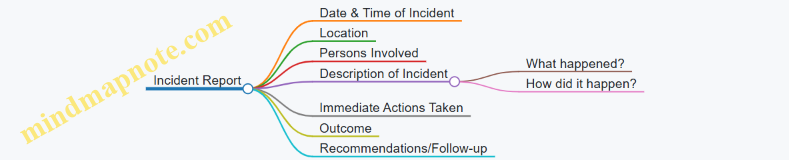
This format ensures all relevant details are captured for review.
Example 2: Incident Report
Date/Time: 2024-06-14 14:45
Location: Ward 3B, Room 12
Persons Involved: Nurse John Smith, Patient Mary Lee
Description: Patient Mary Lee slipped while attempting to get out of bed without assistance. No visible injuries.
Immediate Actions: Assisted patient back to bed, assessed for pain or injury, informed charge nurse.
Outcome: Patient remained stable, no bruises or cuts found.
Recommendations: Reinforce patient education on calling for help before moving. Place non-slip socks on patient.
Mind Map: Shift Handover Report
A structured handover reduces errors and keeps everyone informed.
Example 3: Shift Handover Note
Date: 2024-06-15 07:00
Patients: 5 total
- John Carter - Stable, vitals normal, completed morning meds.
- Lisa Wong - Post-op day 2, wound clean, dressing changed at 06:30.
- Ahmed Khan - Complained of dizziness, BP 110/70, monitored closely.
- Maria Gomez - Awaiting lab results for blood cultures.
- Tom Lee - Requires assistance with mobility, scheduled physiotherapy at 10:00.
Alerts: Monitor Ahmed Khan for hypotension signs.
Example 4: Medication Administration Record (MAR) Entry
| Date | Time | Medication | Dose | Route | Administered By | Notes |
|---|---|---|---|---|---|---|
| 2024-06-15 | 08:00 | Paracetamol 500mg | 1 tab | Oral | Nurse A. Smith | Patient tolerated well. |
Tips for Effective Documentation:
- Use clear, concise language.
- Avoid abbreviations unless standardized and understood.
- Record facts, not opinions.
- Write legibly or use electronic records.
- Date and sign every entry.
- Correct errors by striking through with one line, initialing, and dating.
These examples and templates provide a foundation for consistent, professional documentation and reporting. Practice adapting them to your workplace’s specific forms and protocols.