English Vocabulary Builder for Daily Life
Chapter 1: Foundations of Daily English Vocabulary
1.1 Common Greetings and Introductions with Usage Examples
Greetings and introductions are the first steps in any conversation. They set the tone and help establish connection. Mastering these basics is essential for daily life communication.
Basic Greetings
Greetings vary by time of day, formality, and context. Here are common examples:
- Hello: A universal greeting suitable for almost any situation.
- Hi: Informal and friendly.
- Good morning: Used before noon.
- Good afternoon: Used from noon until early evening.
- Good evening: Used in the evening.
- Hey: Very informal, often among friends.
Mind Map: Basic Greetings
Examples:
- “Good morning, Sarah. How are you today?”
- “Hey, Tom! Long time no see.”
- “Hello! Welcome to the meeting.”
Introducing Yourself
When meeting someone new, introductions typically include your name and sometimes additional information like your job or where you’re from.
Common phrases:
- “My name is [Name].”
- “I’m [Name].”
- “Nice to meet you.”
- “Pleased to meet you.”
Mind Map: Introductions
Examples:
- “Hi, I’m Emma. Nice to meet you.”
- “My name is John, and I work as a graphic designer.”
- “Pleased to meet you. I’m from Chicago.”
Asking Someone’s Name
To keep a conversation going, you often need to ask for the other person’s name politely:
- “What’s your name?”
- “May I ask your name?”
- “Could you tell me your name?”
Examples:
- “Hi, I’m Lisa. What’s your name?”
- “May I ask your name, please?”
Common Responses to Greetings
Responding appropriately keeps conversations smooth:
- “Hello!”
- “Hi!”
- “Good morning!”
- “I’m fine, thank you. And you?”
Examples:
- “Good afternoon! How are you?”
- “Hi! I’m doing well, thanks.”
Polite Small Talk Starters
After greetings, small talk helps ease into deeper conversations:
- “How are you today?”
- “How’s your day going?”
- “Did you have a good weekend?”
Examples:
- “Hello, Mark. How’s your day going so far?”
- “Hi, Anna. Did you have a good weekend?”
Mind Map: Conversation Starters
Practice Exercise Examples
- Fill in the blanks:
- “___, I’m David. ___ to meet you.”
- “Good ___! How are you?”
- Match the greeting with the correct time of day:
- Good morning
- Good evening
- Good afternoon
- Role-play:
- Person A: Greet Person B and introduce yourself.
- Person B: Respond with a greeting and ask Person A’s name.
Summary
Understanding and using common greetings and introductions correctly helps start conversations confidently. They are simple but powerful tools for daily communication. Practice these phrases with real examples to build comfort and fluency.
1.2 Basic Pronouns and Their Practical Applications
Pronouns are words that replace nouns in sentences, helping us avoid repetition and making communication smoother. They are essential in daily English because they allow us to refer to people, objects, and ideas without constantly repeating names or nouns.
Types of Basic Pronouns
Here is a mind map summarizing the main types of pronouns you’ll encounter:
Personal Pronouns
Personal pronouns refer to specific people or things. They change form depending on whether they are the subject or object of a sentence.
- Subject pronouns perform the action: She runs fast.
- Object pronouns receive the action: I saw him yesterday.
Examples:
- I am learning English.
- Can you help me?
- He likes coffee.
- The teacher called us.
Possessive Pronouns
Possessive pronouns show ownership or possession. They come in two forms:
- Possessive adjectives modify nouns: my book, their house.
- Possessive pronouns stand alone: The book is mine.
Examples:
- This is my pen.
- That car is hers.
- We forgot our tickets.
Reflexive Pronouns
Reflexive pronouns are used when the subject and object of a sentence are the same person or thing.
Examples:
- I taught myself to cook.
- She looked at herself in the mirror.
- They prepared themselves for the exam.
Demonstrative Pronouns
These pronouns point to specific things.
Examples:
- This is delicious.
- Those are my shoes.
Interrogative Pronouns
Used to ask questions.
Examples:
- Who is at the door?
- What do you want?
Practical Usage Examples
-
Avoiding repetition:
- Instead of: Maria likes Maria’s dog because Maria takes care of Maria’s dog well.
- Use: Maria likes her dog because she takes good care of it.
-
Clarifying ownership:
- Is this your book or mine?
-
Expressing reflexive actions:
- He fixed the car himself.
-
Pointing out objects:
- Can you pass me that?
-
Asking questions:
- Who called you last night?
Mind Map: Personal Pronouns in Sentences
Practice Exercises (Examples)
-
Replace the noun with the correct pronoun:
- John is tired. John will rest. → He is tired. He will rest.
-
Fill in the blanks with possessive pronouns:
- This is ___ (my/mine) jacket.
- The blue car is ___ (their/theirs).
-
Identify reflexive pronouns in sentences:
- She prepared herself for the test.
-
Choose the correct demonstrative pronoun:
- ___ (This/Those) apples are fresh.
-
Form questions using interrogative pronouns:
- ___ (Who/What) is your teacher?
Understanding pronouns and their practical applications helps you speak and write more naturally. They keep your language concise and clear, which is especially useful in daily conversations.
1.3 Essential Verbs for Everyday Communication
Verbs are the engines of sentences. They show action, state, or occurrence and are essential for expressing what happens or what someone does. In daily life, a handful of verbs appear repeatedly because they cover common activities and states. This section focuses on those verbs, illustrating their use with clear examples and organizing them into mind maps to help visualize connections.
Core Action Verbs
These verbs describe common actions you perform or observe regularly.
Examples:
- I go to the gym every morning.
- Can you come here for a moment?
- She does her homework after school.
- We make dinner together.
- Please take this book with you.
- He gives good advice.
- I got a new phone yesterday.
- Do you use this software often?
- They work from nine to five.
- The children play outside after class.
Verbs of State and Being
These verbs describe conditions, feelings, or existence rather than actions.
Examples:
- I am happy today.
- She has three cats.
- They like Italian food.
- We want to visit the museum.
- He needs help with his project.
- Do you know the answer?
- I think it will rain.
- She feels tired after work.
- They believe in fair treatment.
- It seems cold outside.
Communication Verbs
These verbs relate to exchanging information or expressing thoughts.
Examples:
- Please say your name.
- She told me a secret.
- Can I ask you something?
- He answered quickly.
- We talk every evening.
- They speak three languages.
- Listen carefully to the instructions.
- Did you hear that noise?
- Could you explain this again?
- I agree with your idea.
Mind Map: Essential Verbs Overview
Practice Exercises
-
Fill in the blanks: Choose the correct verb from the list (go, have, say, feel, make).
- I ___ to the store every Saturday.
- She ___ a delicious cake for the party.
- They ___ happy about the news.
- Can you ___ your name, please?
- We ___ three dogs at home.
-
Match the verbs to their categories:
- Know
- Take
- Talk
- Want
- Work
Categories: Action Verbs, State Verbs, Communication Verbs
-
Create sentences: Use each verb below in a sentence that describes your daily routine.
- Do
- Feel
- Ask
- Give
- Play
This section covers verbs that form the backbone of everyday English. Understanding and practicing these verbs will help you express actions, states, and communication clearly and confidently.
1.4 Frequently Used Nouns in Daily Contexts
Nouns are the backbone of everyday communication. They name people, places, things, and ideas, making conversations concrete and meaningful. This section focuses on nouns you will encounter and use regularly in daily life, organized by common themes. Understanding these nouns and how they fit into sentences will help you express yourself clearly and confidently.
Common Categories of Daily Nouns
Here is a mind map to organize frequently used nouns by category:
People
Nouns that refer to people are essential for identifying who is involved in a situation. Examples:
- Family: mother, father, sister, brother, child
- Friends and acquaintances: friend, neighbor, classmate
- Work-related: colleague, boss, employee
Example sentences:
- “My sister is coming to visit this weekend.”
- “I spoke with my colleague about the project.”
Places
Knowing place nouns helps describe where actions happen. Common places include:
- Home and surroundings: house, apartment, garden
- Public places: school, office, store, park
- Transportation hubs: station, airport
Example sentences:
- “We met at the park after work.”
- “She left her keys at home.”
Objects
Objects are things you can touch or see, often involved in daily tasks. Examples:
- Personal items: phone, wallet, bag
- Household items: chair, table, lamp
- Tools and gadgets: pen, computer, watch
Example sentences:
- “Please put your phone on silent during the meeting.”
- “I need a pen to write this down.”
Food
Food nouns are useful for talking about meals, shopping, and preferences. Examples:
- Basic items: bread, water, fruit
- Meals: breakfast, lunch, dinner
- Ingredients: sugar, salt, oil
Example sentences:
- “I had fruit and yogurt for breakfast.”
- “Can you buy some bread and milk?”
Time
Time nouns help situate events and plan activities. Examples:
- Parts of the day: morning, afternoon, evening
- Units of time: hour, minute, day, week
- Special times: weekend, holiday
Example sentences:
- “The meeting is scheduled for 3 o’clock in the afternoon.”
- “I will visit you next weekend.”
Feelings
Feelings and emotions are often expressed with nouns. Examples:
- happiness, sadness, anger, fear, surprise
Example sentences:
- “She showed great happiness when she received the news.”
- “Fear kept him from trying something new.”
Practice with Nouns in Sentences
Try filling in the blanks with appropriate nouns from the categories above:
- “My ___ called me this morning to check on the plan.”
- “I left my ___ on the kitchen table.”
- “We went to the ___ to buy some groceries.”
- “He felt a lot of ___ before his presentation.”
- “She spends most of her day at the ___.”
Mind Map: Using Nouns in Context
Tips for Mastering Daily Nouns
- Group nouns by theme to remember them better.
- Practice using nouns in simple sentences.
- Notice nouns in conversations and writing.
- Use nouns with adjectives to add detail (e.g., “red apple,” “busy street”).
By focusing on these frequently used nouns and practicing them in context, you will build a solid vocabulary foundation for everyday English communication.
1.5 Adjectives to Describe People, Places, and Things
Adjectives are words that add detail and color to nouns. They help us describe people, places, and things more precisely, making our communication clearer and more engaging. In daily life, knowing the right adjectives can make your descriptions more vivid and your conversations more effective.
Describing People
When describing people, adjectives often relate to appearance, personality, or mood. Here’s a mind map to organize common adjectives for people:
Examples:
- “She is a friendly and confident speaker.”
- “The tall man looked nervous before the meeting.”
- “My grandmother is kind and always cheerful.”
Describing Places
Adjectives for places often describe size, condition, or atmosphere. Here’s a mind map:
Examples:
- “The small café has a cozy atmosphere.”
- “Our office is spacious but can be noisy during lunch hours.”
- “They live in an old, quiet neighborhood.”
Describing Things
For objects or things, adjectives often describe shape, color, texture, or quality. Mind map below:
Examples:
- “She bought a round, smooth vase for the living room.”
- “The blue jacket feels soft and warm.”
- “This old book has a rough cover but valuable content.”
Practice Exercise
Try describing the following with adjectives from the lists above:
- A person you admire.
- Your favorite place to relax.
- An object you use every day.
Sample answers:
- “My friend is a funny and kind person.”
- “The park near my house is peaceful and spacious.”
- “My phone is small, black, and smooth.”
Using adjectives thoughtfully helps you paint clearer pictures with words. Remember to match adjectives to the noun you describe and keep your descriptions relevant to the context.
1.6 Simple Prepositions and Their Usage in Sentences
Prepositions are small words that connect nouns, pronouns, or phrases to other words within a sentence. They often indicate relationships of time, place, direction, cause, or manner. Understanding simple prepositions is essential because they help clarify meaning and make sentences more precise.
Common Simple Prepositions
Here is a list of frequently used simple prepositions:
- at
- in
- on
- to
- for
- with
- by
- from
- about
- of
Mind Map: Simple Prepositions by Function
Prepositions of Place
- at: used for specific points or locations.
- Example: “She is waiting at the bus stop.”
- in: used for enclosed spaces or areas.
- Example: “The keys are in the drawer.”
- on: used for surfaces.
- Example: “The book is on the table.”
Prepositions of Time
- at: used for specific times.
- Example: “The meeting starts at 3 p.m.”
- in: used for longer periods such as months, years, centuries, or parts of the day.
- Example: “We will visit in July.”
- on: used for specific days and dates.
- Example: “Her birthday is on Monday.”
Prepositions of Direction
- to: indicates movement toward a place.
- Example: “He is going to the office.”
- from: indicates movement away from a place.
- Example: “She came from the park.”
- into: indicates movement inside something.
- Example: “The cat jumped into the box.”
Prepositions of Cause or Reason
- because of: shows the reason for something.
- Example: “The game was canceled because of rain.”
- due to: formal alternative to because of.
- Example: “The delay was due to traffic.”
Prepositions of Manner or Means
- by: indicates the means of doing something.
- Example: “She traveled by train.”
- with: indicates the instrument or accompaniment.
- Example: “He cut the paper with scissors.”
Mind Map: Examples of Prepositions in Sentences
Usage Tips
- Prepositions are always followed by a noun or pronoun, never a verb directly. For example, “She is interested in music,” not “She is interested in sing.”
- Some prepositions can be tricky because their use depends on context. For example, “in the morning” but “at night.”
- Avoid ending sentences with prepositions in formal writing when possible, but in everyday speech, it is often acceptable.
Practice Examples
-
Fill in the blanks with the correct preposition:
- The keys are ___ the table. (on/in/at)
- We will meet ___ 5 p.m. (at/in/on)
- She walked ___ the park to get home. (to/from/into)
- The letter was sent ___ mail. (by/with/from)
- The meeting was canceled ___ rain. (because of/due to/with)
-
Create sentences using these prepositions:
- at
- in
- on
- to
- by
Understanding and practicing these simple prepositions will improve your ability to describe locations, times, directions, reasons, and manners clearly and naturally.
1.7 Practice Exercises: Building Simple Sentences Using Core Vocabulary
This section focuses on helping you create clear, simple sentences using the essential vocabulary introduced earlier. The goal is to combine words naturally, forming sentences that you can use in everyday conversations.
Mind Map: Sentence Components
Example 1: Basic Sentence Structure
-
Subject + Verb
- “I eat.”
- “She runs.”
-
Subject + Verb + Object
- “He reads a book.”
- “They like music.”
Exercise 1: Fill in the blanks
Complete the sentences using the words in parentheses.
- I ___ (eat, run, sleep).
- She ___ (has, like, go) a dog.
- They ___ (play, read, write) football.
- We ___ (drink, see, hear) water.
Mind Map: Adding Descriptions
Example 2: Adding Adjectives and Adverbs
- “The big dog runs fast.”
- “She reads a red book carefully.”
Exercise 2: Create sentences
Use the following words to make sentences:
- big, small, happy, sad
- quickly, slowly, well
- cat, car, teacher, apple
Example: “The happy cat sleeps well.”
Mind Map: Using Prepositions
Example 3: Sentences with Prepositions
- “The book is on the table.”
- “She sits near the window.”
Exercise 3: Match and write
Match the prepositions with the objects and write sentences.
- Prepositions: in, on, under
- Objects: the chair, the box, the bed
Example: “The cat is under the bed.”
Practice Exercise: Putting It All Together
Write five sentences using the following guidelines:
- Use a subject and verb.
- Add an object.
- Include at least one adjective.
- Use a prepositional phrase.
Example: “The small dog sleeps on the chair.”
Additional Tips
- Start simple, then add details.
- Use words you know confidently.
- Practice speaking your sentences aloud.
By practicing these exercises, you will strengthen your ability to form clear, practical sentences that fit everyday situations.
Chapter 2: Vocabulary for Home and Family Life
2.1 Family Members and Relationships with Contextual Examples
Understanding family vocabulary is essential for everyday conversations. Family members come in many forms, and knowing the right terms helps you describe relationships clearly. Below are key family terms organized by generation and relationship type, along with examples to show how they fit into daily speech.
Immediate Family Mind Map
Examples:
- “My mother is a teacher.”
- “I have two brothers and one sister.”
- “Her husband works in finance.”
Extended Family Mind Map
Examples:
- “We visited my grandparents last weekend.”
- “My uncle is coming to the party.”
- “She has three cousins in New York.”
Family Relationship Terms Mind Map
Examples:
- “My sister-in-law is very kind.”
- “He has a stepfather who lives nearby.”
- “Her half-brother shares the same mother.”
Practical Usage Examples
-
Introducing family members:
- “This is my father, John.”
- “I have two sisters and one brother.”
-
Talking about relationships:
- “My aunt is my mother’s sister.”
- “My nephew just started school.”
-
Describing family events:
- “We are having a family reunion with all the cousins.”
- “My grandparents live in the countryside.”
-
Using possessive forms:
- “Her brother’s car is new.”
- “Our mother’s cooking is delicious.”
Practice Exercises
-
Fill in the blanks with the correct family member:
- “My _______ is married to my father.”
- “My _______ is my mother’s daughter.”
- “My _______ is my uncle’s child.”
-
Match the relationship to the description:
- Aunt
- Nephew
- Step-sister
a) Your sibling’s son
b) Your parent’s sister
c) Your parent’s child from another relationship -
Write a short paragraph introducing your immediate family using at least five family terms.
This section equips you with the vocabulary to talk about family clearly and naturally. The mind maps help organize the terms visually, while the examples show how to use them in everyday situations.
2.2 Household Items and Furniture Vocabulary
Understanding the names and uses of household items and furniture is essential for everyday communication. This section covers common objects found in different rooms of a home, grouped by function and location, with clear examples and mind maps to organize the vocabulary.
Mind Map: Household Items by Room
Kitchen Items
- Refrigerator: A large appliance used to keep food cold. Example: “I put the milk back in the refrigerator after using it.”
- Oven: Used for baking or roasting food. Example: “The oven needs to preheat before I bake the cake.”
- Microwave: Heats food quickly using microwaves. Example: “I warmed up my lunch in the microwave.”
- Sink: Basin used for washing dishes and hands. Example: “Please wash the vegetables in the kitchen sink.”
- Dishwasher: Machine that cleans dishes automatically. Example: “After dinner, I loaded the dishwasher.”
- Toaster: Appliance for browning bread slices. Example: “I like my toast crispy, so I use the toaster for two minutes.”
Living Room Furniture
- Sofa: A comfortable seat for multiple people. Example: “We sat on the sofa to watch the movie.”
- Coffee Table: Low table placed in front of the sofa. Example: “I put my cup of tea on the coffee table.”
- Television (TV): Device for watching shows and movies. Example: “The television is mounted on the wall.”
- Bookshelf: Furniture for storing books. Example: “The bookshelf holds all my novels and magazines.”
- Lamp: Provides light, often placed on tables or floors. Example: “I turned on the lamp to read at night.”
Bedroom Essentials
- Bed: Furniture for sleeping. Example: “I bought a new bed with a memory foam mattress.”
- Wardrobe: Tall cabinet for storing clothes. Example: “Her wardrobe is full of jackets and dresses.”
- Nightstand: Small table beside the bed. Example: “I keep my alarm clock on the nightstand.”
- Dresser: Chest of drawers for clothes. Example: “He folded his shirts and put them in the dresser.”
- Mirror: Reflective surface for checking appearance. Example: “She looked in the mirror before leaving.”
Bathroom Items
- Toilet: Fixture for sanitation. Example: “The bathroom has a clean toilet.”
- Shower: Area or device for washing with water. Example: “I take a shower every morning.”
- Bathtub: Large container for bathing. Example: “The bathtub is filled with warm water.”
- Sink: Basin for washing hands and face. Example: “He washed his hands in the bathroom sink.”
- Towel Rack: Holder for towels. Example: “The towel rack is near the shower.”
Miscellaneous Household Items
- Vacuum Cleaner: Device for cleaning floors by suction. Example: “I use the vacuum cleaner to remove dust from the carpet.”
- Iron: Appliance for removing wrinkles from clothes. Example: “She used the iron to press her shirt.”
- Laundry Basket: Container for carrying dirty or clean clothes. Example: “The laundry basket is full of clothes to wash.”
- Clock: Device that shows time. Example: “The clock on the wall chimes every hour.”
Practice Examples
-
Fill in the blank: “Please put the dirty dishes in the ________ after dinner.” (Answer: dishwasher)
-
Match the item to the room:
- Sofa → Living Room
- Wardrobe → Bedroom
- Toaster → Kitchen
- Bathtub → Bathroom
-
Sentence creation: Use the word “nightstand” in a sentence.
- Example: “I keep a lamp and a book on my nightstand.”
-
Identify the item: “This appliance heats food quickly using microwaves.” (Answer: microwave)
This vocabulary set provides a solid foundation for talking about everyday household items. Familiarity with these terms helps in describing your living space, asking for help, or shopping for home goods.
2.3 Daily Routines and Chores Vocabulary with Practical Sentences
Daily routines and household chores form a significant part of everyday life. Knowing the right vocabulary to describe these activities helps you communicate clearly about your day-to-day tasks. Below, you’ll find key words organized into categories, practical example sentences, and mind maps to visualize how these terms connect.
Mind Map: Daily Routines
Common Vocabulary for Daily Routines
- Wake up: to stop sleeping
- Get up: to rise from bed
- Brush teeth: clean teeth with a toothbrush
- Take a shower: wash the body with water
- Get dressed: put on clothes
- Eat breakfast/lunch/dinner: have meals
- Go to work/school: leave home to work or study
- Do homework: complete school assignments
- Exercise: physical activity
- Relax: rest or do something enjoyable
- Go to bed: prepare to sleep
Example Sentences for Daily Routines
- I usually wake up at 7 a.m. on weekdays.
- After waking up, I brush my teeth and take a shower.
- She gets dressed quickly because she is running late.
- We eat breakfast together as a family every morning.
- He goes to work by bus.
- In the evening, I like to read before I go to bed.
Mind Map: Household Chores
Common Vocabulary for Household Chores
- Vacuum: clean floors with a vacuum cleaner
- Sweep: clean floors with a broom
- Mop: clean floors with a wet mop
- Dust: remove dust from surfaces
- Wash dishes: clean plates, cups, and utensils
- Do laundry: wash and dry clothes
- Iron: remove wrinkles from clothes
- Fold clothes: arrange clothes neatly after drying
- Take out the trash: remove garbage from the house
- Water plants: give water to plants
Example Sentences for Household Chores
- I vacuum the living room every Saturday.
- Could you please wash the dishes after dinner?
- She folds the laundry while watching TV.
- We take out the trash every evening.
- He waters the plants twice a week.
- After cooking, I always clean up the kitchen.
Practice Exercise
Fill in the blanks with the correct word from the list: wake up, brush teeth, vacuum, cook, take out trash, fold clothes.
- Every morning, I ______ at 6:30 a.m.
- After dinner, I help ______ the kitchen.
- On Sundays, I ______ the carpet in the living room.
- She always ______ before going to bed.
- On Mondays, we ______ to keep the house clean.
- After drying, I ______ neatly and put clothes away.
Understanding and using these words will help you describe your daily life clearly and confidently. Try to incorporate them into your conversations or writing about your routines and chores. This practice will make your English more practical and relevant.
2.4 Describing Home Environments Using Adjectives
When talking about your home, adjectives help paint a clear picture. They describe size, condition, style, and atmosphere. Using the right adjectives makes your description precise and relatable.
Categories of Adjectives for Home Environments
Here’s a mind map to organize adjectives by the aspect of the home they describe:
Size
- Small: A small room or house is compact and may feel cozy or limited in space.
- Spacious: This means there is plenty of room to move around.
- Cramped: When a space feels too tight or crowded.
- Roomy: Similar to spacious, but often used to describe a pleasant amount of space.
Example: “My living room is spacious, with enough room for a large sofa and a dining table.”
Condition
- Clean: Free of dirt and mess.
- Messy: Untidy, with things scattered around.
- Tidy: Neatly arranged and organized.
- Cluttered: Filled with too many items, making it look disorderly.
- Well-maintained: Kept in good condition, with repairs done regularly.
Example: “The kitchen is always clean and well-maintained, which makes cooking more enjoyable.”
Style
- Modern: Featuring contemporary design, often with sleek lines and minimal decoration.
- Traditional: Classic design, often with familiar or older styles.
- Minimalist: Simple and uncluttered, with only essential items.
- Cozy: Warm and comfortable, often small and inviting.
- Rustic: Natural, rough, or country-style elements.
Example: “Our bedroom has a cozy, rustic style with wooden furniture and soft lighting.”
Atmosphere
- Warm: Inviting and comfortable, often with warm colors or good heating.
- Bright: Filled with natural light or good artificial lighting.
- Dark: Lacking light, which can feel gloomy or intimate.
- Quiet: Peaceful, without much noise.
- Lively: Full of activity and energy.
Example: “The study is bright during the day, making it a perfect place to work.”
Features
- Airy: Having good airflow and feeling open.
- Comfortable: Pleasant to be in, often with soft furniture.
- Inviting: Makes people want to enter or stay.
- Elegant: Stylish and tasteful.
- Simple: Plain and without unnecessary decoration.
Example: “The living room is airy and inviting, with large windows and soft cushions.”
Combined Examples
- “Our apartment is small but tidy and modern.”
- “They live in a spacious, well-maintained house with a warm atmosphere.”
- “The kitchen feels cluttered and dark, so we plan to repaint it.”
- “Her bedroom is cozy and bright, decorated in a minimalist style.”
Practice Exercise
Try describing your own home or a room using adjectives from each category. For example:
- Size: ___________
- Condition: ___________
- Style: ___________
- Atmosphere: ___________
- Features: ___________
Then, write a few sentences combining these adjectives to give a clear picture.
Example: “My living room is roomy and tidy. It has a modern style with bright lighting. The space feels comfortable and inviting.”
Using adjectives thoughtfully helps you communicate your home environment clearly and vividly without overcomplicating the description.
2.5 Expressing Needs and Requests at Home
When living or spending time at home, expressing needs and making requests clearly is essential for smooth communication. Whether you’re asking for help, requesting an item, or stating a preference, the right words and phrases make a difference.
Key Vocabulary and Phrases
- Could you…? – Polite way to ask someone to do something.
- Would you mind…? – Another polite request form.
- Can I have…? – Asking for permission or requesting an item.
- I need… – Directly stating a necessity.
- Please and Thank you – Politeness markers that soften requests.
- Would it be possible to…? – Formal, polite way to ask.
- Could you help me with…? – Asking for assistance.
Mind Map: Expressing Needs and Requests
Examples in Context
-
Requesting help with a chore:
- “Could you help me with the dishes, please?”
- “Would you mind taking out the trash?”
-
Asking for an item:
- “Can I have the salt, please?”
- “I need a towel to dry my hands.”
-
Making a polite suggestion or request:
- “Would it be possible to lower the volume on the TV?”
- “Could you please close the window? It’s a bit cold.”
-
Expressing urgency or necessity:
- “I need to use the bathroom now.”
- “Could you bring me the phone charger?”
Practice Exercise Examples
-
Fill in the blanks with appropriate phrases:
- “________ you help me carry these bags?”
- “I ________ some water, please.”
- “________ you mind turning off the lights?”
- “Can I ________ the remote control?”
-
Role-play scenario:
Imagine you want to borrow a kitchen utensil. Practice saying:- “Could I borrow the blender for a moment?”
- “Would you mind if I use the oven?”
Tips for Effective Requests
- Use polite forms to maintain harmony at home.
- Be clear and specific about what you need.
- Add “please” to soften requests.
- Show appreciation by saying “thank you” after the request is fulfilled.
Clear communication about needs and requests helps avoid misunderstandings and keeps home life comfortable. Practicing these phrases in everyday situations builds confidence and fluency.
2.6 Practice Exercises: Writing About Your Home and Family
Writing about your home and family is a practical way to use everyday vocabulary. This section offers exercises designed to help you describe your living space, family members, and daily routines clearly and naturally.
Mind Map: Describing Your Home
Mind Map: Talking About Family Members
Exercise 1: Describe Your Home
Write 5-7 sentences about your home using the vocabulary from the mind map. Include details about the rooms, furniture, and any appliances you use daily.
Example:
“My home has three bedrooms and a small kitchen. In the living room, there is a comfortable sofa and a wooden table. The kitchen has a refrigerator and a microwave where I prepare meals. I like spending time in the garden because it is quiet and green.”
Exercise 2: Introduce Your Family
Write 5-7 sentences introducing your family members. Mention their roles and a simple description of their personality or what they like.
Example:
“I live with my mother, father, and younger sister. My mother is very kind and enjoys cooking. My father works as an engineer and likes reading books. My sister is playful and loves to draw. We often spend weekends together watching movies.”
Exercise 3: Daily Routine at Home
Write 5-7 sentences describing a typical day at home. Use verbs and vocabulary related to daily activities.
Example:
“In the morning, I wake up and eat breakfast in the kitchen. After that, I clean my room and help my mother with the chores. In the evening, we have dinner together in the dining room. Sometimes, I watch TV or read a book before going to bed.”
Exercise 4: Comparing Rooms or Family Members
Write 4-6 sentences comparing two rooms in your home or two family members. Use comparative adjectives.
Example:
“The living room is larger than the bedroom, and it has more windows. My father is taller than my mother, but my mother is more patient.”
Exercise 5: Asking and Answering Questions
Practice writing questions and answers about home and family.
Example:
Q: “How many rooms are there in your house?”
A: “There are four rooms: two bedrooms, a kitchen, and a living room.”
Q: “Who do you live with?”
A: “I live with my parents and my brother.”
Tips for Writing
- Use simple sentences to keep your writing clear.
- Include adjectives to make descriptions more vivid but stay precise.
- Use present simple tense to describe routines and facts.
- Check your spelling and grammar after writing.
By practicing these exercises, you will become more confident describing your home and family in English. Try to write a few sentences daily and gradually add more details as you learn new words.
Chapter 3: Food and Dining Vocabulary
3.1 Common Food Items and Ingredients with Usage Examples
Understanding common food items and ingredients is essential for everyday conversations about meals, shopping, and cooking. This section introduces key vocabulary grouped by categories, along with practical examples to show how these words fit naturally into sentences.
Mind Map: Common Food Items
Fruits
- Apple: “I usually eat an apple for breakfast because it’s easy and healthy.”
- Banana: “Bananas are great for a quick energy boost during the day.”
- Orange: “She peeled an orange and shared the slices with her friends.”
- Grape: “We bought a bunch of grapes to snack on while watching the movie.”
Vegetables
- Carrot: “Carrots add a nice crunch to salads and are rich in vitamins.”
- Potato: “Mashed potatoes are a popular side dish at dinner.”
- Tomato: “Tomatoes are often used in sauces and sandwiches.”
- Lettuce: “Lettuce is the base of many fresh salads.”
Proteins
- Chicken: “Grilled chicken is a common protein choice for a healthy meal.”
- Beef: “Beef stew is perfect for cold evenings.”
- Fish: “Fish is a good source of omega-3 fatty acids.”
- Eggs: “Scrambled eggs are quick to prepare and filling.”
Grains
- Rice: “Rice is a staple food in many cultures and pairs well with vegetables.”
- Bread: “I like whole grain bread for sandwiches.”
- Pasta: “Pasta comes in many shapes and is often served with tomato sauce.”
Dairy
- Milk: “Milk is used in cooking and as a drink.”
- Cheese: “Cheese adds flavor to dishes like pizza and salads.”
- Yogurt: “Yogurt can be eaten plain or with fruit for breakfast.”
Condiments & Spices
- Salt: “A pinch of salt can enhance the taste of any dish.”
- Pepper: “Freshly ground pepper adds a bit of heat.”
- Sugar: “Sugar is used to sweeten desserts and drinks.”
- Olive oil: “Olive oil is commonly used for cooking and salad dressings.”
Usage Examples in Context
- “Could you please buy some tomatoes and lettuce for the salad?”
- “I prefer grilled chicken over fried because it’s healthier.”
- “Add a little salt and pepper to the soup to bring out the flavors.”
- “For breakfast, I usually have yogurt with fresh fruit like bananas or grapes.”
- “She baked a loaf of bread and served it with cheese and olive oil.”
Practice Exercise
Fill in the blanks with the correct food item from the list: apple, carrot, chicken, rice, sugar.
- I like to eat a fresh ___ as a snack.
- Please chop the ___ for the soup.
- We had ___ and vegetables for dinner.
- ___ is a common side dish in many Asian meals.
- Add a spoonful of ___ to sweeten the tea.
This section equips you with essential vocabulary to talk about everyday food items and ingredients. The examples demonstrate how these words appear naturally in conversation and writing, helping you build confidence in using them.
3.2 Meals of the Day and Related Vocabulary
Understanding the vocabulary related to meals is essential for everyday conversations about food, schedules, and social interactions. Meals are typically divided into three main parts of the day: breakfast, lunch, and dinner. Each meal has its own set of common foods, phrases, and cultural nuances.
Main Meals Mind Map
Breakfast Vocabulary and Examples
Breakfast is often the first meal of the day and can range from light to hearty depending on culture and personal preference.
- Eggs: “I like my eggs scrambled for breakfast.”
- Toast: “Can you please make some toast?”
- Cereal: “She eats cereal with milk every morning.”
- Fruit: “Fresh fruit is a healthy breakfast choice.”
- Coffee/Tea: “He drinks coffee to wake up.”
- Juice: “Orange juice is a popular breakfast drink.”
Example sentence: “For breakfast, I usually have toast with jam and a cup of coffee.”
Lunch Vocabulary and Examples
Lunch is typically eaten around midday and can be a quick or social meal.
- Sandwich: “I packed a turkey sandwich for lunch.”
- Salad: “She ordered a Caesar salad.”
- Soup: “Tomato soup is perfect on a cold day.”
- Pasta: “Pasta with tomato sauce is my favorite lunch.”
- Soda/Water: “Would you like soda or water with your lunch?”
Example sentence: “We usually take a 30-minute lunch break at work.”
Dinner Vocabulary and Examples
Dinner is often the main meal of the day, eaten in the evening.
- Meat: “Grilled chicken is on the menu for dinner.”
- Vegetables: “Steamed vegetables are a healthy side dish.”
- Rice/Potatoes: “Mashed potatoes go well with steak.”
- Dessert: “Chocolate cake is my favorite dessert after dinner.”
- Wine: “They had a glass of red wine with dinner.”
Example sentence: “We invited friends over for dinner and served pasta and salad.”
Additional Meal-Related Terms
Practice Examples
- Fill in the blank: “For _____, I usually eat cereal and drink orange juice.”
- Match the meal to the typical time: Breakfast - Morning, Lunch - _____, Dinner - Evening.
- Create a sentence using the word “salad” related to lunch.
These examples and vocabulary sets help build a practical understanding of meals and their related language, making daily conversations clearer and more natural.
3.3 Ordering Food and Drinks: Phrases and Vocabulary
Ordering food and drinks is a common situation where clear vocabulary and polite phrases make communication smooth and pleasant. This section breaks down useful words and expressions, supported by mind maps and examples to illustrate practical usage.
Key Vocabulary Categories
Common Phrases for Ordering
-
Starting the order:
- “Hello, I’d like to place an order, please.”
- “Could I see the menu, please?”
- “May I order now?”
-
Ordering food:
- “I would like the grilled chicken with a side of vegetables.”
- “Could I have the vegetarian pasta, please?”
- “I’ll take two cheeseburgers, medium rare.”
-
Ordering drinks:
- “Can I get a glass of water?”
- “I’d like a coffee, black, no sugar.”
- “May I have a large orange juice?”
-
Asking about options:
- “Does this dish contain nuts?”
- “Is the soup spicy?”
- “What desserts do you have today?”
-
Special requests:
- “Could you make it less salty?”
- “I’m allergic to dairy; can this be made without cheese?”
- “Please make it to go.”
-
Ending the order:
- “That’s all, thank you.”
- “Could we have the bill, please?”
Mind Map: Polite Ordering Interaction
Example Dialogues
Example 1: Ordering at a Café
- Customer: “Good afternoon. May I order, please?”
- Server: “Of course. What would you like?”
- Customer: “I’d like a cappuccino and a blueberry muffin, please.”
- Server: “Would you like that to eat here or to go?”
- Customer: “To eat here, thanks.”
- Server: “Great. Anything else?”
- Customer: “No, that’s all.”
- Server: “Your order will be ready shortly.”
Example 2: At a Restaurant
- Server: “Hello, are you ready to order?”
- Customer: “Yes. Could I have the grilled salmon with steamed vegetables?”
- Server: “Certainly. How would you like your salmon cooked?”
- Customer: “Well done, please.”
- Server: “Any drinks?”
- Customer: “A glass of white wine, please.”
- Server: “Perfect. I’ll bring your order soon.”
Practice Exercises
- Fill in the blanks:
- “___ I have the chicken salad, please?”
- “Could you make it ___ spicy?”
- “I’d like a ___ coffee, no sugar.”
- Role-play:
- Take turns being the customer and the server. Use polite phrases to order food and drinks.
- Write a short dialogue:
- Imagine you are ordering at a fast-food restaurant. Include greetings, ordering, and asking about an allergy.
Mastering these phrases and vocabulary will help you feel confident when ordering food and drinks in English-speaking environments. Politeness combined with clear requests makes the experience pleasant for both you and the server.
3.4 Describing Taste, Texture, and Preferences
When talking about food, describing taste and texture helps others understand what to expect. It also allows you to express your likes and dislikes clearly. This section covers common vocabulary and phrases for taste, texture, and preferences, supported by examples and mind maps.
Taste Vocabulary
Taste refers to the basic sensations detected by the tongue. The primary tastes include sweet, sour, salty, bitter, and umami (savory). Here is a simple mind map to organize taste words:
Examples:
- “The lemonade is tangy and refreshing.”
- “I like my coffee a bit bitter, not too sweet.”
- “This soup has a rich, meaty flavor.”
Texture Vocabulary
Texture describes how food feels in the mouth. It can greatly affect enjoyment. Common texture words include:
Examples:
- “The fresh apple is crunchy and juicy.”
- “These cookies are crispy on the outside but chewy inside.”
- “The sauce is creamy and smooth.”
Expressing Preferences
When sharing your food preferences, you can use simple phrases combined with taste and texture words.
Common phrases:
- “I prefer…”
- “I like…”
- “I don’t like…”
- “I’m not a fan of…”
- “I enjoy…”
- “I usually avoid…”
Examples:
- “I prefer spicy food to sweet desserts.”
- “I’m not a fan of bitter vegetables.”
- “I enjoy crunchy snacks more than soft ones.”
Mind Map: Combining Taste, Texture, and Preferences
Practice Examples
-
Describe the taste and texture of your favorite fruit.
- “Mangoes are sweet and juicy with a smooth texture.”
-
Express a dislike using taste and texture.
- “I don’t like sour candies because they are too tangy and sticky.”
-
Compare two foods using taste and texture.
- “I prefer crunchy carrots over soft cooked carrots because I like the texture.”
-
Use a sentence to explain a preference.
- “I usually avoid salty snacks but enjoy sweet ones.”
Using clear taste and texture vocabulary alongside preference phrases helps make your descriptions precise and engaging. This clarity improves everyday conversations about food, whether ordering at a restaurant or sharing recipes.
3.5 Kitchen Utensils and Appliances Vocabulary
In everyday cooking and food preparation, knowing the names and functions of kitchen utensils and appliances is essential. This section introduces common tools and devices found in most kitchens, along with practical examples of how to use these words in context.
Mind Map: Kitchen Utensils
Mind Map: Kitchen Appliances
Key Vocabulary and Usage Examples
Knife: A sharp tool used for cutting or chopping food.
- Example: “Use a sharp knife to slice the vegetables evenly.”
Peeler: A small tool designed to remove the outer skin of fruits or vegetables.
- Example: “I peeled the carrots with a peeler before cooking.”
Grater: A utensil with small holes used to shred cheese or vegetables.
- Example: “Grate some cheese to sprinkle on top of the pasta.”
Spoon: A basic utensil used for stirring or serving.
- Example: “Stir the soup with a wooden spoon.”
Whisk: A tool with wire loops used to beat or mix ingredients.
- Example: “Whisk the eggs until they are fluffy.”
Spatula: A flat tool used for flipping or spreading.
- Example: “Use a spatula to flip the pancakes.”
Measuring Cup: A cup marked with measurements for liquids or dry ingredients.
- Example: “Pour one cup of milk using the measuring cup.”
Measuring Spoon: Small spoons marked with precise measurements.
- Example: “Add a teaspoon of salt to the recipe.”
Ladle: A large, deep spoon used for serving soups or stews.
- Example: “Serve the soup with a ladle.”
Tongs: A tool used to grip and lift hot food.
- Example: “Use tongs to turn the grilled chicken.”
Colander: A bowl with holes used to drain water from pasta or vegetables.
- Example: “Drain the pasta in a colander after boiling.”
Rolling Pin: A cylindrical tool used to flatten dough.
- Example: “Roll the dough with a rolling pin before cutting.”
Pastry Brush: A brush used to spread butter, oil, or glaze.
- Example: “Brush the pie crust with egg wash using a pastry brush.”
Sifter: A tool used to sift flour or powdered sugar.
- Example: “Sift the flour to remove lumps before baking.”
Stove: The appliance with burners used for cooking food on the top surface.
- Example: “Heat the pan on the stove before adding oil.”
Oven: An enclosed appliance used for baking or roasting.
- Example: “Bake the cake in the oven at 180 degrees Celsius.”
Microwave: An appliance that heats food quickly using microwaves.
- Example: “Reheat leftovers in the microwave for two minutes.”
Blender: A device used to mix or puree food.
- Example: “Blend the fruits to make a smoothie.”
Food Processor: A versatile appliance for chopping, slicing, or mixing ingredients.
- Example: “Use the food processor to chop the nuts finely.”
Toaster: A small appliance for browning slices of bread.
- Example: “Toast the bread in the toaster until golden brown.”
Refrigerator: An appliance used to keep food cold and fresh.
- Example: “Store the milk in the refrigerator to keep it fresh.”
Freezer: A compartment or appliance used to freeze food.
- Example: “Put the leftover soup in the freezer for later.”
Dishwasher: A machine that automatically cleans dishes.
- Example: “Load the plates into the dishwasher after dinner.”
Practice Exercises
-
Match the utensil or appliance with its correct use:
- Knife
- Blender
- Colander
- Oven
a) Used to drain water from cooked pasta
b) Used to chop vegetables
c) Used to bake a cake
d) Used to mix fruits into a smoothie -
Fill in the blanks with the correct kitchen vocabulary:
- I used a _______ to peel the apples.
- Please put the dirty dishes in the _______.
- The soup is hot; use the _______ to serve it.
- We need a _______ to measure two cups of flour.
-
Write a short paragraph describing how you would prepare a salad using at least five kitchen utensils or appliances from this section.
Understanding these kitchen tools and appliances will help you communicate clearly when cooking, shopping for kitchen items, or following recipes. The examples show how these words fit naturally into everyday conversations.
3.6 Practice Exercises: Role-Playing Restaurant Conversations
Role-playing restaurant conversations is an effective way to practice vocabulary and phrases related to dining out. This section provides structured exercises that simulate real-life scenarios, helping you gain confidence in ordering food, asking questions, and handling typical restaurant interactions.
Mind Map: Key Vocabulary and Phrases for Restaurant Conversations
Exercise 1: Basic Ordering
Scenario: You enter a restaurant and want to order a meal.
Example Dialogue:
- Customer: Hello, a table for one, please.
- Host: Right this way. Here is the menu.
- Customer: Thank you. Could I have the grilled chicken with a side salad?
- Waiter: Certainly. Would you like something to drink?
- Customer: Yes, a glass of water, please.
Practice Task: Use the phrases above to create your own ordering dialogue. Try to include at least one question about the menu.
Exercise 2: Asking About Ingredients and Preferences
Scenario: You want to make sure your meal fits your dietary needs.
Example Dialogue:
- Customer: Excuse me, does the pasta contain any nuts?
- Waiter: No, it does not.
- Customer: Great. Is the sauce spicy?
- Waiter: It’s mildly spicy, but we can make it less spicy if you prefer.
- Customer: Please make it less spicy. Thank you.
Practice Task: Write a short conversation where you ask about two different dishes, focusing on ingredients or preparation.
Exercise 3: Compliments and Requests
Scenario: After eating, you want to compliment the food and ask for the bill.
Example Dialogue:
- Customer: The soup was delicious.
- Waiter: I’m glad you enjoyed it.
- Customer: Could I have the bill, please?
- Waiter: Of course. I’ll bring it right away.
Practice Task: Create a dialogue where you compliment the meal and politely ask for something (e.g., extra napkins, a doggy bag).
Exercise 4: Handling a Mistake
Scenario: You received the wrong order and need to address it politely.
Example Dialogue:
- Customer: Excuse me, I ordered the fish, but this is chicken.
- Waiter: I’m very sorry. Let me fix that for you right away.
- Customer: Thank you, I appreciate it.
Practice Task: Write a short role-play where you report a problem with your order and the waiter responds.
Tips for Role-Playing
- Use polite expressions such as “please,” “thank you,” and “excuse me.”
- Practice both roles: customer and waiter. This helps understand both sides of the conversation.
- Focus on clear pronunciation of key vocabulary.
- Try to vary your sentences by using different verbs and adjectives.
These exercises provide a practical way to apply vocabulary and phrases in context. Repeating them will improve your comfort with restaurant conversations and help you communicate more naturally.
Chapter 4: Shopping and Money Vocabulary
4.1 Vocabulary for Types of Stores and Markets
Understanding the different types of stores and markets is essential for everyday conversations about shopping. Each type has its own vocabulary and typical products, which helps you describe where you shop or ask for items clearly.
Common Types of Stores and Markets
- Supermarket: A large self-service store selling food and household goods.
- Grocery store: Smaller than a supermarket, mainly selling food and everyday items.
- Convenience store: Open long hours, sells snacks, drinks, and essentials.
- Department store: A large store divided into sections selling clothing, electronics, home goods, and more.
- Pharmacy / Drugstore: Sells medicines, health products, and sometimes cosmetics.
- Bakery: Specializes in bread, cakes, and pastries.
- Butcher shop: Sells fresh meat.
- Fish market: Sells fresh fish and seafood.
- Clothing store / Boutique: Sells clothes and fashion accessories.
- Bookstore: Sells books and sometimes stationery.
- Hardware store: Sells tools, building materials, and home repair items.
- Farmers’ market: An open-air market where farmers sell fresh produce directly.
- Flea market: A place where second-hand goods are sold, often outdoors.
Mind Map: Types of Stores and Markets
Usage Examples
- “I need to stop by the supermarket to buy some vegetables and milk.”
- “The pharmacy is just around the corner if you need any cold medicine.”
- “She bought a fresh loaf of bread from the bakery this morning.”
- “We got our steaks from the butcher shop downtown.”
- “On Saturdays, the farmers’ market has the freshest fruits and homemade jams.”
- “I found a vintage lamp at the flea market last weekend.”
Practice Exercise
Match the store or market type with the items you would typically buy there:
- Hardware store
- Bookstore
- Convenience store
- Fish market
- Department store
Items:
- a) Hammer and nails
- b) Novel and magazines
- c) Sandwich and soda
- d) Salmon and shrimp
- e) Clothes and electronics
(Answers: 1-a, 2-b, 3-c, 4-d, 5-e)
Additional Notes
When talking about stores, the word “shop” is often interchangeable with “store” but can imply a smaller or more specialized place (e.g., “shoe shop”). Also, markets often refer to open-air or temporary setups, while stores are usually permanent buildings.
Using this vocabulary will help you specify where you shop or want to go, making your conversations clearer and more precise.
4.2 Money, Currency, and Payment Methods
Understanding money and payment vocabulary is essential for everyday transactions. This section covers common terms related to currency, types of money, and ways to pay, with practical examples and mind maps to organize the concepts.
Key Vocabulary
- Currency: The system of money in general use in a particular country (e.g., dollar, euro, yen).
- Coin: A small, flat, round piece of metal used as money.
- Banknote / Bill: Paper money issued by a bank or government.
- Change: Coins returned after a purchase when paying with cash.
- Cash: Physical money, including coins and banknotes.
- Credit Card: A card allowing purchases on credit, to be paid later.
- Debit Card: A card that deducts money directly from a bank account.
- Check / Cheque: A written order directing a bank to pay money.
- Digital Payment: Paying electronically via apps or online platforms.
- Receipt: A document proving payment was made.
Mind Map: Types of Money
Mind Map: Payment Methods
Practical Usage Examples
-
Cash Payment:
- “Can I pay in cash?”
- “Here’s $20. Keep the change.”
-
Using a Credit Card:
- “Do you accept credit cards?”
- “Please enter your PIN to complete the payment.”
-
Digital Payment:
- “I’ll send the money through the app.”
- “Is there a fee for online transfers?”
-
Asking for Change:
- “Could you give me change for a $50 bill?”
- “I need coins for the parking meter.”
Common Phrases and Sentences
- “How much does this cost?”
- “Can I have a receipt, please?”
- “Do you take debit cards?”
- “Is it possible to split the bill?”
- “I’d like to pay with cash.”
- “Can you break a $10 bill?”
Practice Exercise
Fill in the blanks with the correct word from the vocabulary list:
- I paid with my __________ because I didn’t have any cash.
- The cashier gave me __________ after I paid with a $20 bill.
- You can use a __________ to withdraw money from an ATM.
- Please keep your __________ as proof of purchase.
- Many people now prefer __________ payments using their phones.
Answers
- credit card
- change
- debit card
- receipt
- digital
This section equips you with the essential terms and phrases to handle money and payments confidently in daily life. The mind maps help visualize the categories, while the examples show how to use the vocabulary naturally.
4.3 Asking for Prices and Bargaining Phrases
When shopping, knowing how to ask for prices and bargain politely can save money and make interactions smoother. This section covers common phrases and strategies for discussing prices in everyday situations.
Asking for Prices
Start with simple, clear questions to find out the cost of an item. Use polite forms to keep the conversation friendly.
Common Phrases:
- “How much is this?”
- “What’s the price of this item?”
- “Could you tell me the cost of this?”
- “Is this on sale?”
- “Do you have a price list?”
Examples:
- “Excuse me, how much is this jacket?”
- “Can you tell me the price of these shoes?”
- “Is this fruit fresh and how much does it cost per kilo?”
Bargaining Phrases
Bargaining is common in many markets and shops. It’s important to be polite and respectful while negotiating.
Key Phrases for Bargaining:
- “Is that the best price you can offer?”
- “Can you give me a discount?”
- “If I buy two, can you lower the price?”
- “That’s a bit expensive for me. Can you reduce it?”
- “Would you accept [amount] for this?”
- “I really like this, but my budget is limited.”
Examples:
- “This bag is nice, but can you make it cheaper?”
- “If I pay in cash, can I get a discount?”
- “I want to buy three. Can you give me a better price?”
Mind Map: Asking for Prices
Mind Map: Bargaining Phrases
Tips for Effective Price Asking and Bargaining
- Always start politely; a friendly tone encourages cooperation.
- Listen carefully to the seller’s response before replying.
- Use numbers when proposing a price to show seriousness.
- Be ready to walk away if the price doesn’t meet your budget.
- Remember that bargaining is a conversation, not a confrontation.
Practice Examples
-
Scenario: Asking for the price
Customer: “Excuse me, how much is this watch?”
Seller: “It’s $50.”
-
Scenario: Bargaining
Customer: “That’s a bit high for me. Could you do $40?”
Seller: “I can lower it to $45, but no less.”
Customer: “Alright, I’ll take it for $45.”
-
Scenario: Buying multiple items
Customer: “If I buy three shirts, can you give me a discount?”
Seller: “Yes, I can give you 10% off.”
Customer: “Great, thank you!”
Using these phrases and strategies will help you communicate clearly and confidently when discussing prices and negotiating in English-speaking environments.
4.4 Describing Products: Size, Color, and Quality
When describing products, clear and precise vocabulary helps communicate exactly what you mean. This section focuses on three key attributes: size, color, and quality. Each attribute has specific words and phrases that make descriptions more vivid and useful in everyday conversations, especially when shopping or comparing items.
Size
Size is often the first characteristic people notice. It can refer to dimensions, volume, weight, or capacity. Here are common size descriptors:
- Small: tiny, compact, petite, miniature
- Medium: average, moderate, standard
- Large: big, huge, enormous, spacious
Mind Map: Size
Examples:
- “This backpack is compact, perfect for daily use.”
- “I need a medium-sized shirt, not too tight or loose.”
- “The sofa is spacious enough to seat five people comfortably.”
Color
Color descriptions can be simple or detailed. Basic colors are easy to remember, but adding modifiers helps specify the shade or tone.
- Basic colors: red, blue, green, yellow, black, white, brown, gray
- Modifiers: light, dark, bright, dull, pastel, neon
Mind Map: Color
Examples:
- “She bought a light blue dress for the summer party.”
- “The dark green jacket keeps you warm and looks stylish.”
- “I prefer bright colors because they stand out.”
Quality
Quality describes how good or bad a product is. It can relate to durability, appearance, or performance.
- Positive quality adjectives: excellent, durable, reliable, high-quality, sturdy, premium
- Neutral or moderate: average, acceptable, fair
- Negative quality adjectives: poor, flimsy, cheap, low-quality, fragile
Mind Map: Quality
Examples:
- “This phone case is made of durable material and protects well.”
- “The shoes are of average quality but comfortable for daily wear.”
- “Avoid that brand; their products are often flimsy and break easily.”
Combining Size, Color, and Quality
Descriptions become more informative when you combine these attributes.
Example Sentences:
- “I’m looking for a small, bright red backpack that’s sturdy enough for hiking.”
- “They sell large, dark gray sofas made from premium leather.”
- “She chose a medium-sized, pastel blue sweater that feels soft and reliable.”
Practice Exercise
Write three sentences describing a product you recently bought or want to buy. Include size, color, and quality in each sentence.
Example:
- “I bought a compact, black camera that is very reliable for outdoor photography.”
Using precise vocabulary for size, color, and quality helps you communicate clearly and make better choices when shopping or discussing products.
4.5 Common Shopping Expressions and Polite Requests
When shopping, clear communication helps you get what you need smoothly. Using polite expressions not only shows respect but also makes interactions more pleasant. Below are key phrases and examples organized to help you navigate typical shopping situations.
Mind Map: Polite Requests in Shopping
Mind Map: Common Shopping Expressions
Examples of Polite Requests and Expressions
-
Asking for Assistance
- “Excuse me, could you help me find the dairy section?”
- “Would you mind showing me where the headphones are?”
-
Inquiring About Products
- “Is this jacket available in medium size?”
- “Could you tell me if this phone comes with a warranty?”
-
Making a Purchase Request
- “May I have two of these, please?”
- “Could I get a receipt with this purchase?”
-
Checking Payment Options
- “Do you accept contactless payments?”
- “Is it possible to pay in installments?”
-
Asking About Discounts or Offers
- “Is there any discount on this item today?”
- “Are there any ongoing promotions?”
-
Clarifying Return Policies
- “What is your return policy if the product is defective?”
- “Can I exchange this item if it doesn’t fit properly?”
-
Expressing Gratitude
- “Thank you for your assistance.”
- “I appreciate your help.”
Tips for Using Polite Requests in Shopping
- Start with a greeting or polite opener: “Excuse me,” or “Hello.”
- Use modal verbs like “could,” “would,” and “may” to soften requests.
- Add “please” to make your request courteous.
- Always thank the person helping you, regardless of the outcome.
Practice Exercise
Rewrite the following direct requests into polite shopping expressions:
- “Give me that shirt.”
- “Where is the milk?”
- “I want to pay by card.”
- “Do you have discounts?”
Sample answers:
- “Could I please have that shirt?”
- “Could you tell me where the milk is?”
- “May I pay by card?”
- “Is there a discount available?”
Using these expressions will make your shopping conversations smoother and more effective. Politeness encourages helpful responses and creates a positive atmosphere for both you and the shop staff.
4.6 Practice Exercises: Simulated Shopping Dialogues
This section focuses on practical exercises designed to help you practice common shopping conversations. These dialogues cover asking for prices, requesting product information, bargaining politely, and completing purchases. Each exercise includes a mind map to organize key vocabulary and phrases, followed by example dialogues and practice prompts.
Mind Map: Key Vocabulary and Phrases for Shopping Dialogues
Example Dialogue 1: Asking About Price and Product Details
Customer: Excuse me, how much is this jacket?
Shop Assistant: It’s $75. Would you like to try it on?
Customer: Yes, please. Do you have it in medium size?
Shop Assistant: Let me check… Yes, here it is.
Customer: Great. Also, is this waterproof?
Shop Assistant: Yes, it’s made with water-resistant material.
Customer: Perfect, I’ll take it.
Shop Assistant: Excellent choice. Will you be paying by card or cash?
Customer: Card, please.
Example Dialogue 2: Bargaining and Payment
Customer: This blender looks good. How much is it?
Shop Assistant: It’s $120.
Customer: That’s a bit high. Can you offer a discount?
Shop Assistant: I can give you 10% off if you buy today.
Customer: If I buy two, can you do 15%?
Shop Assistant: For two, yes, 15% discount.
Customer: Great, I’ll take two then.
Shop Assistant: Wonderful. How would you like to pay?
Customer: Cash.
Practice Exercise 1: Fill in the Blanks
Complete the dialogue with appropriate phrases from the mind map.
Customer: Excuse me, ________ this watch?
Shop Assistant: It’s $50. ________ try it on?
Customer: Yes, do you have it in black?
Shop Assistant: Let me see… Yes, here you go.
Customer: ________ accept credit cards?
Shop Assistant: Yes, we do.
Customer: Thanks. I’ll pay by card.
Practice Exercise 2: Role-Play
Pair up with a partner. One person is the customer, the other is the shop assistant. Use the vocabulary and phrases from the mind map to simulate a shopping conversation. Try to include:
- Asking about price
- Requesting product details
- Bargaining politely
- Completing the purchase
Switch roles and repeat.
Practice Exercise 3: Create Your Own Dialogue
Write a short dialogue between a customer and a shop assistant. Include at least three questions about the product and one bargaining attempt. Use polite expressions and complete the conversation with payment details.
These exercises aim to build confidence in everyday shopping situations. Practicing these dialogues helps you become comfortable with common phrases and improves your ability to respond naturally. Remember, polite language and clear questions make shopping smoother for everyone involved.
Chapter 5: Work and Office Vocabulary
5.1 Common Job Titles and Workplace Roles
Understanding job titles and workplace roles is essential for effective communication in professional settings. This section introduces common job titles, grouped by industry and function, along with clear examples of how to use them in sentences.
Mind Map: Job Titles by Industry
Mind Map: Job Titles by Function
Examples of Job Titles in Sentences
- “The manager is responsible for overseeing the team’s daily tasks.”
- “Our nurse will assist you during your hospital stay.”
- “She works as a software developer at a tech company.”
- “The receptionist greeted visitors and answered phone calls.”
- “He was promoted to director after five years with the company.”
Common Workplace Roles Explained
- Manager: Oversees a team or department, assigns tasks, and ensures goals are met.
- Assistant: Supports managers or executives by handling administrative duties.
- Analyst: Examines data or processes to provide insights and recommendations.
- Technician: Handles technical equipment or systems, often in IT or engineering.
- Executive: Holds a senior position, involved in decision-making at a high level.
Usage Examples with Role Descriptions
- “As a project manager, she coordinates schedules and resources to keep the project on track.”
- “The HR assistant organizes interviews and maintains employee records.”
- “Our financial analyst prepares reports to help the company understand its budget.”
- “The IT technician fixed the network issue quickly.”
- “The marketing executive developed the new advertising campaign.”
Practice Exercise
Fill in the blanks with the correct job title from the list: manager, nurse, developer, receptionist, director.
- The __________ schedules meetings and answers phone calls at the front desk.
- A __________ plans and leads the company’s strategic goals.
- The __________ writes code to build software applications.
- The __________ cares for patients and assists doctors.
- The __________ supervises the team and assigns daily tasks.
This section equips you with essential vocabulary to identify and describe common roles in the workplace, helping you communicate clearly about jobs and responsibilities.
5.2 Office Equipment and Supplies Vocabulary
In any office, certain tools and supplies form the backbone of daily work. Knowing their names and how to use them in sentences helps you communicate clearly and confidently. This section introduces common office equipment and supplies, grouped by function, with practical examples.
Mind Map: Office Equipment
Mind Map: Office Supplies
Detailed Vocabulary with Examples
Desktop computer: The main machine used for work.
- “Please save your document on the desktop computer before leaving.”
Laptop: A portable computer.
- “I brought my laptop to the meeting to take notes.”
Monitor: The screen attached to a computer.
- “The monitor is too small; can I get a larger one?”
Keyboard and Mouse: Input devices for typing and navigation.
- “The keyboard is sticky; I need to clean it.”
Printer: Device that produces physical copies of documents.
- “Can you print the report on the color printer?”
Scanner: Converts physical documents into digital files.
- “I scanned the contract and emailed it to the client.”
Desk: The table where you work.
- “My desk is cluttered; I should organize it.”
Chair: Where you sit.
- “The chair is adjustable for better posture.”
Filing cabinet: Storage for documents.
- “The invoices are in the second drawer of the filing cabinet.”
Bookshelf: Holds books and binders.
- “Please put the new manuals on the top shelf.”
Telephone: Used for voice communication.
- “I answered the telephone on the first ring.”
Headset: Combines headphones and microphone.
- “Using a headset helps during conference calls.”
Fax machine: Sends and receives documents over phone lines.
- “We still use the fax machine for some official documents.”
Projector: Displays images or presentations on a screen.
- “The projector is ready for the presentation at 10 a.m.”
Whiteboard and Marker: For writing notes during meetings.
- “She wrote the agenda on the whiteboard with a blue marker.”
Pen and Pencil: Basic writing tools.
- “I prefer to take quick notes with a pencil.”
Highlighter: Used to emphasize text.
- “Highlight the important points in the report.”
Notepad and Sticky notes: For jotting down reminders.
- “I left a sticky note on your desk about the meeting.”
Printer paper and Envelopes: Essential for printing and mailing.
- “We need more printer paper in the supply closet.”
Stapler: Joins papers together.
- “Please staple these documents before submitting them.”
Paper clips and Binder clips: Hold papers without damaging them.
- “Use a binder clip for thick stacks of paper.”
Folders and Binders: Organize documents.
- “Keep all project files in the blue binder.”
Tape and Scissors: For sealing and cutting.
- “Can you pass me the tape and scissors?”
Labels: Used to identify files or boxes.
- “Label the folders clearly for easy access.”
Practice Examples
-
Fill in the blank: “I need to print the report, but the ___ is out of ink.”
- (Answer: printer)
-
Sentence creation: Use the words “stapler” and “documents” in a sentence.
- Example: “Please staple the documents before handing them in.”
-
Matching: Match the item to its function.
- Mouse → Navigates the computer screen
- Fax machine → Sends documents over the phone line
- Highlighter → Emphasizes text
-
Dialogue practice:
- A: “Do you have a pen I can borrow?”
- B: “Sure, here you go. Also, the printer is ready if you want to print your report.”
-
Describe your workspace: Write 3-4 sentences using at least five vocabulary words from this section.
Understanding and using these office equipment and supplies terms will make your communication smoother and your daily tasks easier. Keep this vocabulary handy, and try to incorporate these words naturally when discussing office-related topics.
5.3 Daily Work Activities and Tasks
In any workplace, certain activities and tasks form the backbone of daily operations. Knowing the vocabulary related to these helps you communicate clearly about what you do, plan your workday, and collaborate with colleagues.
Key Vocabulary Categories
Below is a mind map that organizes common daily work activities and tasks into categories:
This structure helps you see the range of tasks you might encounter and the verbs commonly used to describe them.
Examples with Usage
-
Planning: “I need to prioritize my tasks for the day to meet the deadline.” Here, “prioritize” means to decide which tasks are most important.
-
Communication: “She sent an email to update the team about the project status.” The word “email” is both a noun and a verb in daily work contexts.
-
Execution: “Please review the report before submitting it.” “Review” means to examine or check carefully.
-
Collaboration: “We will coordinate with the marketing department for the product launch.” “Coordinate” involves organizing activities between different people or groups.
-
Problem Solving: “He had to troubleshoot the software issue to get it working again.” “Troubleshoot” means to identify and fix problems.
-
Administrative: “Don’t forget to file the invoices by the end of the day.” “File” here means to organize documents systematically.
Practice Exercise
Fill in the blanks with the correct word from the vocabulary list:
- I need to ______ my calendar to fit all the meetings tomorrow.
- Can you ______ the latest figures in the report?
- Let’s ______ with the client to confirm the delivery date.
- She will ______ the documents after the meeting.
- We had to ______ the network problem quickly.
(Answers: 1. organize, 2. update, 3. coordinate, 4. file, 5. troubleshoot)
Additional Mind Map: Verbs for Work Tasks
This second map groups verbs by their function, which can help you choose the right word when describing your work.
Summary
Understanding and using these daily work activity words will make your conversations and writing about your job more precise. Try to use these verbs actively when talking about your tasks, whether in meetings, emails, or casual chats at work.
5.4 Describing Skills and Qualifications
When talking about skills and qualifications, clarity and precision are key. Whether you’re describing your own abilities or someone else’s, the goal is to communicate exactly what can be done and how well. This section provides vocabulary and structures to help you do that effectively.
Key Vocabulary Categories for Skills and Qualifications
Mind Map: Skills and Qualifications Vocabulary
Describing Skills: Examples and Usage
-
Hard Skills refer to specific, teachable abilities. For example:
- “I am proficient in Microsoft Excel and can create complex spreadsheets.”
- “She has advanced programming skills in Python and Java.”
-
Soft Skills are personal attributes that affect how you work. For example:
- “He demonstrates strong leadership and excellent communication skills.”
- “Time management is one of her key strengths.”
-
Expressing Ability:
- “I can operate heavy machinery safely.”
- “They are able to solve complex problems under pressure.”
- “She is skilled at negotiating contracts.”
-
Experience:
- “I have five years of experience in customer service.”
- “He is experienced in managing large teams.”
-
Proficiency Levels:
- “I am a beginner in French but an advanced user of Spanish.”
- “She is an expert in data analysis.”
Describing Qualifications: Examples and Usage
-
Educational Qualifications:
- “I hold a Bachelor’s degree in Business Administration.”
- “He earned a diploma in Graphic Design.”
-
Professional Certifications:
- “She has a certification in Project Management.”
- “They hold a valid teaching license.”
-
Training and Courses:
- “I completed a training course on digital marketing.”
- “He attended workshops on conflict resolution.”
-
Experience as a Qualification:
- “My five years of experience in sales qualify me for this position.”
Useful Phrases for Describing Skills and Qualifications
- “I am proficient in…”
- “I have experience with…”
- “I am skilled at…”
- “I am capable of…”
- “I hold a qualification in…”
- “I completed training in…”
- “I am certified to…”
- “I have a strong background in…”
Mind Map: Phrases to Describe Skills and Qualifications
Practice Examples
-
Describe your computer skills:
- “I am proficient in Microsoft Word and Excel, with advanced skills in creating spreadsheets and reports.”
-
Talk about your language abilities:
- “I have intermediate proficiency in French and basic knowledge of German.”
-
Explain your qualifications for a job:
- “I hold a Bachelor’s degree in Marketing and completed a professional certification in digital advertising.”
-
Describe your soft skills:
- “I am skilled at teamwork and have strong communication skills, which help me collaborate effectively.”
-
Express experience level:
- “I have over three years of experience in customer support and am able to handle difficult situations calmly.”
Using these words and phrases will help you clearly communicate your skills and qualifications in conversations, resumes, or interviews. The mind maps organize vocabulary logically, making it easier to remember and apply them naturally.
5.5 Professional Communication: Emails and Meetings
Effective communication in the workplace often hinges on two key skills: writing clear emails and participating productively in meetings. This section covers essential vocabulary, phrases, and strategies for both.
Writing Professional Emails
Emails are a primary form of communication in many offices. They must be clear, polite, and purposeful. Here are the main components and vocabulary to consider:
- Subject Line: Summarizes the email topic. Keep it concise and relevant.
- Greeting: Formal or informal depending on the recipient (e.g., “Dear Mr. Smith,” or “Hi Jane,”).
- Opening Sentence: States the purpose (e.g., “I am writing to…” or “Following up on our meeting…”).
- Body: Details the message. Use clear paragraphs and bullet points if needed.
- Closing Sentence: Summarizes or requests action (e.g., “Please let me know if you have any questions.”).
- Sign-off: Polite endings like “Best regards,” “Sincerely,” or “Thank you,” followed by your name.
Mind Map: Email Structure
Common Phrases for Emails
| Purpose | Example Phrase |
|---|---|
| Request | “Could you please send me…” |
| Follow-up | “I am following up on…” |
| Providing Information | “Please find attached…” |
| Apologizing | “I apologize for the delay…” |
| Offering Help | “Let me know if I can assist further.” |
Example Email
Subject: Meeting Agenda for Thursday

Dear Team,

I am writing to share the agenda for our upcoming meeting on Thursday at 10 AM. Please find the details below:

- Project updates
- Budget review
- Upcoming deadlines

Please review the agenda and let me know if you have any additional topics to discuss.

Best regards,
Alex
Participating in Meetings
Meetings require clear speaking and listening skills. Knowing the right vocabulary helps you express ideas, agree or disagree politely, and keep discussions on track.
Mind Map: Meeting Vocabulary
Useful Phrases for Meetings
| Function | Example Phrase |
|---|---|
| Starting the meeting | “Let’s get started.” |
| Introducing topics | “The first item on the agenda is…” |
| Giving opinion | “I believe that…” |
| Asking for clarification | “Could you explain that further?” |
| Agreeing | “I agree with your point.” |
| Disagreeing politely | “I see your point, but…” |
| Summarizing | “To summarize, we have decided…” |
| Closing the meeting | “Let’s wrap up and schedule the next meeting.” |
Example Meeting Dialogue
Manager: Good morning, everyone. Let's get started. The first item on the agenda is the project timeline.

Team Member 1: I believe we need to extend the deadline by two weeks due to recent delays.

Team Member 2: Could you explain the reasons for the delays?

Team Member 1: Mainly supplier issues and unexpected technical problems.

Manager: I see your point, but we should also consider client expectations.

Team Member 3: To summarize, we will review the timeline and update the client accordingly.

Manager: Exactly. Let's wrap up and schedule the next meeting for next Monday.
Practice Exercises
-
Email Writing: Write an email to your manager requesting time off next week. Include a clear subject line, polite greeting, reason for the request, and a closing sentence.
-
Meeting Role-Play: With a partner, simulate a meeting where you discuss planning a team event. Use phrases for agreeing, disagreeing, and summarizing.
-
Vocabulary Matching: Match the following phrases to their functions:
- “Please find attached the report.”
- “Could you clarify your last point?”
- “I apologize for the inconvenience.”
- “Let’s move on to the next topic.”
Functions:
- Apologizing
- Requesting clarification
- Providing information
- Transitioning topics
Mastering professional emails and meetings improves workplace communication and helps you contribute confidently. Practice these structures and phrases regularly to build your skills.
5.6 Practice Exercises: Writing Simple Work-Related Sentences
This section focuses on helping you write clear, straightforward sentences about common work situations. The goal is to practice vocabulary related to jobs, tasks, and workplace communication. We’ll use mind maps to organize ideas and provide examples to guide your writing.
Mind Map 1: Job Titles and Roles
Job Titles
├── Manager
├── Assistant
├── Engineer
├── Salesperson
├── Receptionist
└── Technician
Example sentences:
- The manager schedules the weekly meetings.
- Our receptionist answers phone calls.
Mind Map 2: Daily Work Activities
Work Activities
├── Attend meetings
├── Write reports
├── Answer emails
├── Make phone calls
├── Prepare presentations
└── Organize files
Example sentences:
- I attend meetings every Monday morning.
- She writes reports about the project progress.
Mind Map 3: Workplace Communication
Communication
├── Request information
├── Give instructions
├── Ask for help
├── Confirm appointments
└── Share updates
Example sentences:
- Could you please send me the latest sales data?
- I will confirm the appointment by email.
Practice Exercise 1: Write Sentences Using Job Titles
Write one sentence for each job title below. Use simple verbs to describe what the person does.
- Engineer
- Salesperson
- Technician
Sample answers:
- The engineer designs new products.
- The salesperson contacts potential clients.
- The technician fixes computer problems.
Practice Exercise 2: Describe Daily Tasks
Choose three activities from the “Daily Work Activities” mind map. Write sentences about what you or a colleague do during a typical workday.
Sample answers:
- I answer emails in the morning.
- She prepares presentations for the team.
- We organize files every Friday.
Practice Exercise 3: Workplace Requests and Instructions
Write sentences to practice polite workplace communication. Use these prompts:
- Asking for information
- Giving instructions
- Confirming a meeting
Sample answers:
- Could you send me the report by 3 PM?
- Please update the client list before the meeting.
- I confirm our meeting for Thursday at 10 AM.
Tips for Writing Work-Related Sentences
- Use clear subject-verb-object structure (e.g., “She completes tasks.”).
- Keep sentences short and direct.
- Use common verbs related to work (e.g., attend, write, call).
- Include time expressions when possible (e.g., “every day,” “in the afternoon”).
- Practice polite forms for requests and instructions.
By practicing these exercises, you will build confidence in writing simple, effective sentences about your work life. Use the mind maps to organize your thoughts before writing. Repetition with variation helps solidify vocabulary and sentence patterns.
Chapter 6: Travel and Transportation Vocabulary
6.1 Modes of Transportation and Related Terms
Transportation is a fundamental part of daily life, connecting people and places. Understanding the vocabulary related to different modes of transportation helps you communicate clearly when traveling, giving directions, or discussing plans. This section covers common types of transportation and key terms associated with them, illustrated with examples and mind maps to organize the information.
Main Modes of Transportation
Here is a mind map that categorizes the primary modes of transportation:
Each mode has distinct vocabulary and usage contexts. Let’s explore them with examples.
Land Transportation
Car: The most common personal vehicle. Example: “I drive my car to work every day.”
Bus: A large vehicle that carries many passengers on fixed routes. Example: “Take the bus number 12 to get downtown.”
Bicycle: A two-wheeled vehicle powered by pedaling. Example: “She rides her bicycle in the park on weekends.”
Motorcycle: A motor-powered two-wheeler, faster than a bicycle. Example: “He bought a motorcycle for quick city travel.”
Train: A series of connected vehicles running on tracks, used for longer distances. Example: “The train from New York to Boston takes about four hours.”
Tram: A rail vehicle that runs on city streets, often called streetcar. Example: “The tram stops every few blocks in the city center.”
Subway (Metro): An underground train system used in many large cities. Example: “We took the subway to avoid traffic.”
Scooter: A small motorized or non-motorized vehicle, often used for short trips. Example: “She uses an electric scooter to get around campus.”
Water Transportation
Boat: A small vessel for traveling on water. Example: “They rented a boat to explore the lake.”
Ship: A large vessel designed for transporting goods or passengers across seas. Example: “The cruise ship docked at the harbor.”
Ferry: A boat or ship that carries passengers and vehicles across a body of water. Example: “The ferry connects the island to the mainland.”
Air Transportation
Airplane: A powered flying vehicle with fixed wings. Example: “I booked a flight on an airplane to visit my family.”
Helicopter: A flying vehicle with rotating blades, capable of vertical takeoff. Example: “The helicopter landed on the hospital roof.”
Vocabulary Related to Transportation
- Driver: The person who operates a vehicle. Example: “The bus driver was very friendly.”
- Passenger: Someone who travels in a vehicle but does not drive. Example: “Passengers must fasten their seat belts.”
- Ticket: A pass or receipt that allows travel on public transportation. Example: “I bought a train ticket online.”
- Route: The path or course a vehicle follows. Example: “The bus route includes stops at the mall and the library.”
- Schedule: The timetable for departures and arrivals. Example: “Check the train schedule before you leave.”
- Station: A place where passengers board or leave a vehicle. Example: “The subway station is near the park.”
- Fare: The cost of a trip on public transportation. Example: “The bus fare is two dollars.”
Mind Map: Transportation Vocabulary
Practice Examples
- “I usually take the bus to work because the fare is cheaper than driving.”
- “The train schedule shows the next departure at 3:15 PM from the central station.”
- “She prefers riding her bicycle on weekends to stay fit.”
- “We caught the ferry to the island and enjoyed the scenic trip.”
- “The driver asked all passengers to wear seat belts before departure.”
Understanding these terms and their usage will help you navigate conversations about transportation with confidence. The next sections will build on this vocabulary by exploring how to book tickets, ask for directions, and describe travel experiences.
6.2 Booking Tickets and Asking for Directions
When traveling, two essential skills are booking tickets and asking for directions. Both require specific vocabulary and phrases that help you communicate clearly and efficiently. This section covers key words, expressions, and practical examples to make these tasks straightforward.
Booking Tickets
Booking tickets can happen at a counter, over the phone, or online. Knowing the right terms and questions helps you avoid confusion.
Key Vocabulary:
- Ticket (single, return/round-trip)
- Departure and arrival
- Destination
- Seat (window, aisle)
- Class (economy, business, first)
- Schedule
- Fare/price
- Reservation
- Confirmation
- Cancellation
- Refund
Common Questions and Phrases:
- “I would like to book a ticket to [destination].”
- “What time does the next train/bus/flight leave?”
- “Is there a direct route or do I need to change?”
- “Do you have any seats available on [date/time]?”
- “Can I reserve a window seat?”
- “How much is a one-way ticket?”
- “Is the fare refundable?”
- “Can I pay by card?”
Example Dialogue:
Agent: “Good morning. How can I help you?”
Traveler: “Hi, I’d like to book a round-trip ticket to Chicago for next Friday.”
Agent: “Sure. What time would you prefer to depart? Morning or afternoon?”
Traveler: “Morning, please.”
Agent: “We have a 9:00 AM and an 11:30 AM departure. Which one works for you?”
Traveler: “9:00 AM, please. And a return ticket for Sunday afternoon.”
Agent: “The return flights are at 2:00 PM and 5:00 PM.”
Traveler: “I’ll take the 5:00 PM.”
Agent: “Great. Your total fare is $150. Would you like to pay now?”
Traveler: “Yes, by credit card.”
Asking for Directions
When you’re in an unfamiliar place, asking for directions is a daily necessity. Clear questions and understanding common responses make navigation easier.
Key Vocabulary:
- Directions (left, right, straight ahead)
- Landmarks (building, park, station)
- Intersection/crossroads
- Block
- Traffic lights
- Street names
- Distance (near, far, next to, across from)
Common Questions and Phrases:
- “Excuse me, could you tell me how to get to [place]?”
- “Is it far from here?”
- “Can you show me on the map?”
- “Should I take the first/second left or right?”
- “How long does it take to walk there?”
- “Is there a bus or train that goes there?”
Example Dialogue:
Traveler: “Excuse me, can you tell me how to get to the central train station?”
Local: “Sure. Go straight ahead for two blocks, then turn right at the traffic lights. The station will be on your left, next to the post office.”
Traveler: “Thank you. Is it within walking distance?”
Local: “Yes, about a 10-minute walk.”
Mind Maps
Booking Tickets Mind Map
Asking for Directions Mind Map
Practice Exercises
- Fill in the blanks:
- “I want to book a ___ ticket to New York.”
- “Is there a ___ seat available on the 3 PM flight?”
- “Can you tell me how to get to the ___ museum?”
- Role-play:
- One person acts as a ticket agent, the other as a traveler booking a ticket.
- Practice asking and giving directions to a local landmark.
- Write a short dialogue:
- Imagine you are at a bus station. Write a conversation where you ask about ticket prices and bus schedules.
Mastering these phrases and vocabulary will make booking tickets and asking for directions less stressful and more effective. Practice with real or simulated conversations to build confidence.
6.3 Airport and Train Station Vocabulary
Traveling through airports and train stations involves specific vocabulary that helps you navigate, communicate, and understand announcements. This section covers essential words and phrases, grouped by function and location, with practical examples.
Mind Map: Airport Vocabulary
Mind Map: Train Station Vocabulary
Key Vocabulary with Examples
-
Check-in counter: “Please proceed to the check-in counter to get your boarding pass.”
-
Boarding pass: “Keep your boarding pass handy; you’ll need it to board the plane.”
-
Baggage drop: “After check-in, drop your luggage at the baggage drop area.”
-
Security checkpoint: “Remove your laptop and liquids before passing through the security checkpoint.”
-
Gate: “The flight to New York will board at gate 12B.”
-
Customs: “Declare any items you are bringing into the country at customs.”
-
Ticket counter: “Buy your train ticket at the ticket counter or use the ticket machine.”
-
Platform: “The train to Boston departs from platform 4.”
-
Reservation: “Make a seat reservation for the high-speed train to ensure a spot.”
-
Waiting room: “Wait in the waiting room until your train is announced.”
-
Transfer: “You will need to transfer trains at the central station.”
Practical Usage Examples
- At the Airport
- “Excuse me, where is the check-in counter for flight 345?”
- “Your boarding gate is C7, and boarding starts at 3:30 PM.”
- “Please place your carry-on luggage on the conveyor belt for the security scan.”
- “There is a delay of 45 minutes due to weather conditions.”
- At the Train Station
- “Is this the platform for the express train to Chicago?”
- “I need to reserve a seat for the 10:15 AM train.”
- “The train is arriving on platform 2 in five minutes.”
- “Where can I store my luggage while I wait?”
Practice Exercises
Exercise 1: Match the word to its definition
- Boarding pass
- Platform
- Customs
- Reservation
Definitions:
A. The place where you wait for your train or plane to arrive
B. Official inspection of goods and passengers entering a country
C. A document that allows you to board a plane or train
D. Booking a seat in advance
Exercise 2: Fill in the blanks
- Please show your _______ at the gate before boarding.
- The train to Paris departs from _______ 5.
- You must go through _______ after landing in a foreign country.
- I made a _______ to ensure I have a seat on the morning train.
Exercise 3: Role-play dialogue
A: “Where can I check in for flight 789?”
B: “The check-in counter is straight ahead, near the main entrance.”
A: “Thank you. Also, where is the security checkpoint?”
B: “After check-in, follow the signs to the security checkpoint on your left.”
This vocabulary and practice will help you feel more confident navigating airports and train stations, making your travel smoother and less stressful.
6.4 Describing Travel Experiences and Destinations
When talking about travel experiences and destinations, it’s useful to organize your vocabulary around key themes: the place itself, activities, feelings, and practical details. This helps you communicate clearly and paint a picture for your listener or reader.
Mind Map: Describing a Destination
Mind Map: Describing Travel Experiences
Examples of Describing Destinations
- “The city is located on the coast, with beautiful sandy beaches and a mild climate most of the year.”
- “This mountain village is surrounded by dense forests and offers fresh air and quiet streets.”
- “The capital is known for its historic buildings, lively markets, and a rich cultural scene.”
Examples of Describing Travel Experiences
- “During my trip, I spent most days hiking through national parks and exploring small towns nearby.”
- “I enjoyed trying local dishes at street markets, which gave me a real taste of the culture.”
- “The train ride was comfortable and offered scenic views of the countryside.”
- “Although the weather was rainy, visiting the museums made the day interesting.”
Practical Vocabulary and Phrases
- Describing places: “a bustling city”, “a quiet village”, “a popular tourist spot”, “a remote island”
- Talking about activities: “We went sightseeing at the old castle.”, “I spent the afternoon swimming in the lake.”, “We took a guided tour of the museum.”
- Expressing feelings: “I felt relaxed after spending time on the beach.”, “The crowded streets made me a bit tired.”, “I was excited to try new foods.”
Practice Exercise
Write a short paragraph describing a place you have visited or want to visit. Include details about the location, what you did there, and how you felt. Use at least five vocabulary words or phrases from the examples above.
By organizing your description into these categories and using clear examples, you can effectively share your travel stories or describe destinations in a way that others can easily understand and imagine.
6.5 Safety and Emergency Vocabulary While Traveling
Traveling introduces situations where safety and emergencies might arise unexpectedly. Knowing the right vocabulary helps you communicate clearly and get assistance quickly. This section presents key terms and phrases, organized in a mind map format, followed by practical examples.
Mind Map: Safety and Emergency Vocabulary
Vocabulary with Examples
-
Emergency: A sudden, serious situation requiring immediate action.
- Example: “In case of emergency, dial 112.”
-
Ambulance: A vehicle that takes sick or injured people to the hospital.
- Example: “The ambulance arrived quickly after the accident.”
-
First Aid: Immediate care given to someone who is injured or ill.
- Example: “Do you know how to give first aid for a burn?”
-
Police Station: The place where police officers work and where you report crimes.
- Example: “I went to the police station to report my stolen bag.”
-
Embassy / Consulate: Official offices representing your country abroad.
- Example: “If you lose your passport, contact your embassy.”
-
Lost: Unable to find something.
- Example: “I lost my wallet on the train.”
-
Stolen: Taken without permission.
- Example: “My phone was stolen at the market.”
-
Accident: An unexpected event causing damage or injury.
- Example: “There was a car accident near the hotel.”
-
Danger: The possibility of harm or injury.
- Example: “Be careful; the road is slippery and dangerous.”
-
Safe: Free from harm or risk.
- Example: “Is this neighborhood safe to walk at night?”
Practical Phrases and Usage
-
Asking for Help
- “Excuse me, I need help.”
- “Can you call an ambulance?”
- “Where is the nearest hospital?”
- “Please call the police.”
-
Reporting an Incident
- “My bag was stolen at the airport.”
- “I slipped and hurt my ankle.”
- “There has been a fire in the building.”
-
Describing Symptoms or Problems
- “I feel dizzy and have a headache.”
- “I think I broke my arm.”
- “I lost my passport and need assistance.”
Mind Map: Emergency Contacts and Actions
Example Dialogue
Traveler: “Hello, I need help. I slipped on the stairs and hurt my leg.”
Hotel Staff: “I’m sorry to hear that. I’ll call an ambulance right away. Can you tell me where you are?”
Traveler: “I’m in room 305, near the elevator.”
Hotel Staff: “Help is on the way. Please stay calm and don’t move too much.”
This vocabulary and these phrases form the foundation for handling safety and emergencies while traveling. Practicing them will help you respond clearly and confidently when needed.
6.6 Practice Exercises: Planning a Trip Dialogue
Planning a trip involves using vocabulary related to transportation, accommodation, activities, and asking for information. This section provides exercises to practice these words and phrases through a realistic dialogue.
Mind Map: Key Vocabulary for Planning a Trip
Example Dialogue: Planning a Weekend Trip
Anna: Hi, I’m planning a trip to the city next weekend. Can you help me with some information?
Travel Agent: Of course! What kind of transportation are you thinking about?
Anna: I’m considering taking the train. When is the next train to the city?
Travel Agent: The next train leaves at 9:30 AM. Would you like me to check ticket prices?
Anna: Yes, please. Also, do you know if there are any good hotels near the city center?
Travel Agent: There are several. Do you prefer a hotel or a hostel?
Anna: A hotel would be better. Something affordable but comfortable.
Travel Agent: I recommend the Grand Hotel. It’s close to the main attractions and has rooms available next weekend.
Anna: Great! Can you help me make a reservation?
Travel Agent: Sure. How many nights will you stay?
Anna: Two nights, please.
Travel Agent: Done. Anything else you’d like to do while you’re there?
Anna: I’d like to visit a museum and maybe go hiking if possible.
Travel Agent: There’s a popular museum downtown and a hiking trail about 30 minutes from the city.
Anna: Perfect. How do I get to the hiking trail from the hotel?
Travel Agent: You can take a taxi or a bus. The bus stop is near the hotel entrance.
Anna: Thanks for your help!
Practice Exercise 1: Fill in the Blanks
Complete the dialogue below using appropriate words from the mind map.
Traveler: I want to book a ___ to the beach town.
Agent: The next ___ leaves at 8:00 AM.
Traveler: How much is the ___?
Agent: It costs $25.
Traveler: Can you recommend a ___ near the beach?
Agent: Yes, the Ocean View ___ is very popular.
Traveler: Is there a ___ for the hotel?
Agent: Yes, I can make a ___ for you.
Traveler: Thank you! What activities can I do there?
Agent: You can go ___, visit the aquarium, or take a ___ tour.
Practice Exercise 2: Create Your Own Dialogue
Using the vocabulary from the mind map, write a short dialogue between two people planning a trip. Include:
- Choosing transportation
- Booking accommodation
- Asking about activities
- Getting directions
Try to use at least five words or phrases from the mind map.
Practice Exercise 3: Role Play
Pair up with a partner. One person acts as a traveler; the other is a travel agent. The traveler asks questions about a trip, and the agent provides information. Use the vocabulary and phrases learned in this chapter.
These exercises encourage active use of vocabulary in a practical context. By practicing dialogues like these, you become more comfortable discussing travel plans and asking for information, which are common situations in daily life.
Chapter 7: Health and Wellness Vocabulary
7.1 Parts of the Body and Common Ailments
Understanding the parts of the body and common ailments is essential for everyday conversations, especially when describing how you feel or seeking medical help. This section covers key vocabulary with clear examples and mind maps to organize the information.
Body Parts Mind Map
Common Ailments Mind Map
Detailed Vocabulary and Examples
Head and Face
- Forehead: The area above your eyes. Example: “He wiped the sweat off his forehead.”
- Eyes: Used for seeing. Example: “My eyes feel tired after reading.”
- Ears: For hearing. Example: “She has pierced ears.”
- Nose: Used for smelling and breathing. Example: “His nose is running because of a cold.”
- Mouth: For speaking and eating. Example: “Open your mouth wide for the dentist.”
- Teeth: Used for chewing. Example: “Brushing your teeth twice a day is important.”
- Tongue: Helps with tasting and speaking. Example: “The spicy food burned my tongue.”
Upper Body
- Neck: Connects the head to the body. Example: “He stretched his neck after sitting for hours.”
- Shoulders: Support the arms. Example: “She shrugged her shoulders.”
- Arms: From shoulder to hand. Example: “He raised his arm to ask a question.”
- Elbows: The joint in the middle of the arm. Example: “She bumped her elbow on the table.”
- Wrists: Connect the hand to the arm. Example: “He wears a watch on his wrist.”
- Hands: Used for holding and touching. Example: “Wash your hands before eating.”
- Fingers and Thumb: For grasping and feeling. Example: “She counted on her fingers.”
Torso
- Chest: The front upper part of the body. Example: “He felt pain in his chest after running.”
- Back: The rear part of the torso. Example: “She has a sore back from lifting boxes.”
- Abdomen (Stomach): The area below the chest. Example: “He has a stomachache after eating too much.”
Lower Body
- Legs: From hips to feet. Example: “She hurt her leg playing soccer.”
- Knees: The joint in the middle of the leg. Example: “He bent his knees to pick up the box.”
- Ankles: Connect the feet to the legs. Example: “She twisted her ankle while hiking.”
- Feet: For standing and walking. Example: “His feet were cold after the walk.”
- Toes: At the end of the feet. Example: “She stubbed her toe on the chair.”
Common Ailments with Examples
- Headache: Pain in the head. “I have a headache after working all day.”
- Migraine: A severe headache often with nausea. “She missed work because of a migraine.”
- Dizziness: Feeling faint or unsteady. “He felt dizziness when he stood up quickly.”
- Sore throat: Pain or irritation in the throat. “A sore throat can make swallowing difficult.”
- Cough: A sudden expulsion of air from the lungs. “She has a dry cough that won’t go away.”
- Chest pain: Discomfort in the chest area. “Chest pain should always be checked by a doctor.”
- Shortness of breath: Difficulty breathing. “He experienced shortness of breath after climbing stairs.”
- Stomachache: Pain in the abdomen. “Eating too much candy gave me a stomachache.”
- Nausea: Feeling like you might vomit. “The medicine caused nausea.”
- Indigestion: Discomfort in the stomach after eating. “Indigestion can cause bloating and gas.”
- Muscle pain: Soreness or ache in muscles. “Muscle pain is common after exercise.”
- Sprain: Injury to ligaments. “She has a sprain in her ankle from running.”
- Numbness: Loss of sensation. “His hand went numb after sitting awkwardly.”
- Rash: Red or irritated skin. “The rash appeared after touching the plant.”
- Itching: An uncomfortable sensation on the skin. “Mosquito bites cause itching.”
- Bruise: Discolored skin from injury. “He got a bruise on his arm after bumping into the door.”
Practice Examples
-
Describe a symptom:
- “I have a sore throat and a cough.”
- “My stomach hurts after lunch.”
-
Ask about a problem:
- “Where does it hurt?”
- “Do you feel dizzy or have a headache?”
-
Respond to a question:
- “My back is sore from sitting too long.”
- “I twisted my ankle while jogging.”
-
Use in a sentence:
- “She rubbed her temples because of a headache.”
- “He has a rash on his arm that itches a lot.”
This vocabulary and these examples will help you communicate clearly about your body and health in everyday situations. Practice using these words in sentences to become comfortable describing how you feel or understanding others.
7.2 Visiting the Doctor: Questions and Phrases
When visiting a doctor, clear communication is essential. Knowing the right vocabulary and phrases helps you describe symptoms, ask questions, and understand advice. This section focuses on practical language for common situations during a medical visit.
Mind Map: Key Question Categories When Visiting the Doctor
Describing Symptoms
When you explain your condition, be specific. Use simple words and clear phrases.
- “I have a headache that started two days ago.”
- “My throat feels sore and it hurts when I swallow.”
- “The pain is sharp and gets worse when I move my arm.”
- “I noticed swelling around my ankle after I twisted it yesterday.”
Use intensity words like mild, moderate, or severe to describe pain.
- “The pain is mild in the morning but becomes severe by evening.”
Mention timing and frequency.
- “I cough mostly at night.”
- “The dizziness comes and goes throughout the day.”
Medical History and Background
Doctors often ask about your past health to understand your current problem better.
- “Do you have any allergies to medicine or food?”
- “Are you currently taking any medications?”
- “Have you had this problem before?”
- “Do you have any chronic illnesses like diabetes or asthma?”
Answer honestly and clearly. If you don’t know, it’s okay to say so.
- “I’m not sure if I’m allergic to any medications.”
Asking for Explanations
If you don’t understand something, ask for clarification.
- “Can you explain what this diagnosis means?”
- “What causes this condition?”
- “Are there any tests I need to take?”
- “How serious is this problem?”
These questions help you get a better grasp of your health situation.
Treatment and Medication
Understanding treatment instructions is crucial.
- “What medicine should I take?”
- “How many times a day and for how long?”
- “Are there any side effects I should watch for?”
- “Can I take this medicine with food?”
- “Should I avoid any activities or foods while on this treatment?”
Doctors may give lifestyle advice.
- “Do I need to rest more?”
- “Should I change my diet or exercise routine?”
Follow-up and Next Steps
Knowing when to return or what to monitor helps prevent complications.
- “When should I come back for a check-up?”
- “What symptoms mean I should seek help immediately?”
- “Is there anything I should do if the symptoms get worse?”
Practice Examples
- Describing a Symptom:
“Doctor, I have had a persistent cough for five days. It is dry and sometimes makes me feel tired.”
- Answering Medical History:
“I am allergic to penicillin and I take blood pressure medicine daily.”
- Asking for Explanation:
“What does it mean if my blood pressure is high?”
- Understanding Treatment:
“How often should I take this antibiotic? Can I drink coffee while on it?”
- Follow-up Question:
“If the pain doesn’t improve in a week, should I come back?”
Clear, simple language helps both you and your doctor. Using these questions and phrases can make your visit more effective and less stressful.
7.3 Medicines and Treatments Vocabulary
Understanding vocabulary related to medicines and treatments is essential for clear communication in health-related situations. This section introduces common terms, grouped by categories, with practical examples and mind maps to organize the information.
Mind Map: Types of Medicines
Pain Relievers
Pain relievers reduce discomfort caused by injury or illness. Paracetamol (also called acetaminophen) is widely used for mild to moderate pain and fever. Ibuprofen is a nonsteroidal anti-inflammatory drug (NSAID) that also reduces inflammation. Aspirin serves similar purposes but is less commonly used for pain due to its blood-thinning effects.
Example:
- “Take two paracetamol tablets every six hours if you have a headache.”
- “Ibuprofen can help reduce the swelling around the injury.”
Antibiotics
Antibiotics fight bacterial infections. They are ineffective against viruses. Common antibiotics include amoxicillin and ciprofloxacin. It’s important to complete the full course prescribed by a doctor.
Example:
- “The doctor prescribed amoxicillin for your throat infection.”
- “Do not stop taking ciprofloxacin even if you feel better.”
Antiseptics
Antiseptics are substances applied to skin or wounds to prevent infection. Hydrogen peroxide and iodine are common antiseptics.
Example:
- “Clean the cut with hydrogen peroxide before applying a bandage.”
- “Iodine can be used to disinfect the wound.”
Vitamins and Supplements
Vitamins and supplements support health and compensate for dietary deficiencies. Vitamin C boosts the immune system; iron tablets help treat anemia.
Example:
- “Take one vitamin C tablet daily during cold season.”
- “Iron supplements should be taken with food to avoid stomach upset.”
Cough and Cold Remedies
These medicines relieve symptoms of colds and respiratory infections. Cough syrup soothes the throat; decongestants reduce nasal swelling.
Example:
- “Use cough syrup before bedtime to ease coughing.”
- “Decongestant nasal spray should not be used for more than three days.”
Mind Map: Common Treatment Actions
Administration Methods
Medicines can be taken in different ways. Oral medicines are swallowed. Topical treatments are applied to the skin. Injections deliver medicine directly into the body.
Example:
- “Take the tablets with water after meals.”
- “Apply the cream to the affected area twice a day.”
- “The nurse gave an injection to reduce inflammation.”
Dosage Instructions
Dosage includes how much medicine to take and how often. Following instructions prevents underdosing or overdosing.
Example:
- “Take one tablet every 8 hours.”
- “Do not exceed three doses per day.”
Side Effects
Side effects are unwanted reactions. Common ones include nausea, drowsiness, or allergic reactions.
Example:
- “This medicine may cause drowsiness; avoid driving.”
- “If you experience a rash, stop taking the medicine and consult a doctor.”
Precautions
Precautions include warnings about allergies and interactions with other medicines.
Example:
- “Inform your doctor if you are allergic to penicillin.”
- “Do not take this medicine with alcohol.”
Practice Examples
-
Fill in the blanks:
- “For a mild fever, take two ______ every six hours.”
- “Apply the ______ cream to the rash twice daily.”
-
Match the medicine to its use:
- Paracetamol — a) Antibiotic
- Amoxicillin — b) Pain reliever
- Hydrogen peroxide — c) Antiseptic
-
Write a short instruction:
- How to take cough syrup safely.
This vocabulary section equips you with the words and phrases needed to discuss medicines and treatments clearly and confidently in everyday situations.
7.4 Healthy Habits and Lifestyle Vocabulary
Maintaining a healthy lifestyle involves a set of habits and choices that contribute to physical and mental well-being. This section introduces key vocabulary related to healthy habits, with examples to show how these words fit naturally into everyday conversations.
Mind Map: Healthy Habits Vocabulary
Nutrition
Balanced diet means eating a variety of foods in the right proportions. For example: “She follows a balanced diet by including vegetables, proteins, and whole grains in every meal.”
Vitamins are nutrients essential for health. You might say: “Vitamin C helps boost the immune system.”
Hydration refers to drinking enough water. For instance: “Proper hydration is important, especially during hot weather.”
Portion control is managing the amount of food eaten. Example: “Portion control can help prevent overeating.”
Physical Activity
Exercise is any physical activity done to stay fit. Example: “He does 30 minutes of exercise every morning.”
Stretching helps prepare muscles for activity and prevent injury. For example: “Stretching before a run reduces muscle stiffness.”
Cardio refers to aerobic exercises that increase heart rate. Example: “Swimming is a great cardio workout.”
Strength training involves exercises that build muscle strength. For instance: “Strength training can improve bone density.”
Rest and Recovery
Sleep is essential for recovery. Example: “Adults generally need 7-9 hours of sleep per night.”
Relaxation includes activities that reduce stress, such as reading or listening to music. For example: “Taking time for relaxation helps maintain mental balance.”
Meditation is a practice to calm the mind. Example: “Meditation can improve focus and reduce anxiety.”
Hygiene
Handwashing is a simple way to prevent illness. Example: “Regular handwashing reduces the spread of germs.”
Dental care involves brushing and flossing teeth. For instance: “Good dental care prevents cavities and gum disease.”
Personal cleanliness includes bathing and grooming. Example: “Maintaining personal cleanliness is important for social interactions.”
Mental Health
Stress management refers to techniques to handle stress effectively. Example: “Yoga is a popular method of stress management.”
Positive thinking means focusing on optimistic thoughts. For example: “Positive thinking can improve overall mood.”
Social interaction involves engaging with others. Example: “Regular social interaction supports emotional well-being.”
Practice Examples
- “To stay healthy, I drink plenty of water to maintain good hydration.”
- “After work, I do strength training twice a week to build muscle.”
- “Getting enough sleep helps me feel energized throughout the day.”
- “I practice meditation for 10 minutes each morning to clear my mind.”
- “Washing my hands before meals is a habit I never skip.”
- “Managing stress through deep breathing exercises has made a difference in my mood.”
This vocabulary forms the foundation for discussing healthy lifestyle choices clearly and confidently. Using these words in context helps make conversations about health practical and relatable.
7.5 Expressing Symptoms and Feelings Clearly
When describing symptoms or feelings, clarity is key. Being precise helps others understand your condition and respond appropriately. This section provides vocabulary, sentence structures, and mind maps to organize your thoughts and express yourself effectively.
Mind Map: Types of Symptoms
Mind Map: Describing Pain
Useful Vocabulary and Phrases
- Pain: ache, sting, throb, cramp, pinch
- Intensity: slight, mild, moderate, severe, unbearable
- Duration: constant, occasional, intermittent, sudden
- Location: localized, radiating, widespread
- Feelings: dizzy, nauseous, weak, short of breath, restless
Examples of Expressing Symptoms
-
Describing pain with location and intensity:
- “I have a sharp pain in my lower back that comes and goes.”
- “There’s a dull ache in my right knee that’s been constant since yesterday.”
-
Describing sensations:
- “My fingers feel numb and tingly, especially in the morning.”
- “I’m experiencing a burning sensation in my chest after eating.”
-
Describing emotional feelings:
- “Lately, I’ve been feeling anxious and restless, especially at night.”
- “I feel sad and tired most of the day, without any clear reason.”
-
Describing duration and frequency:
- “The headache is intermittent; it lasts about 10 minutes and then goes away.”
- “I’ve had a constant cough for three days now.”
-
Combining symptoms:
- “I feel weak and dizzy, and I have a mild fever.”
- “There’s a throbbing pain in my temple, and I feel nauseous.”
Sentence Structures for Clarity
-
I have [symptom] in/on my [body part].
- “I have a sharp pain in my chest.”
-
The pain is [intensity] and [duration].
- “The pain is moderate and constant.”
-
I feel [feeling] when/after [activity or time].
- “I feel dizzy when I stand up quickly.”
-
My [body part] feels [sensation].
- “My hands feel numb.”
-
I have been experiencing [symptom] for [time period].
- “I have been experiencing fatigue for two weeks.”
-
The symptom gets worse/better when [condition].
- “The headache gets worse when I’m in bright light.”
Practice Exercise
Write sentences describing the following situations:
- You have a mild, constant headache.
- Your stomach feels burning after meals.
- You feel anxious before an important event.
- Your joints ache intermittently.
- You experience dizziness when standing up too fast.
Clear communication about symptoms and feelings helps in getting the right support. Using specific vocabulary and structured sentences reduces confusion and improves understanding.
7.6 Practice Exercises: Describing Health Situations
When describing health situations, clarity and accuracy are essential. This section offers exercises that help you use vocabulary related to symptoms, body parts, and common ailments in practical contexts. Each exercise is paired with mind maps to organize ideas and examples to illustrate usage.
Mind Map 1: Describing Symptoms
Example sentences:
- “I have a sharp pain in my lower back when I bend.”
- “She feels a burning sensation in her throat.”
- “He has been coughing for three days and feels very tired.”
Exercise 1: Write three sentences describing different symptoms you or someone else might experience. Use at least two adjectives from the mind map.
Mind Map 2: Body Parts Commonly Mentioned in Health Contexts
Example sentences:
- “My stomach hurts after eating too much.”
- “She has pain in her right knee after jogging.”
- “He feels dizzy and has pressure in his chest.”
Exercise 2: Describe a health problem involving at least two different body parts. Use clear, simple sentences.
Mind Map 3: Common Ailments and Conditions
Example sentences:
- “I caught a cold and have a runny nose.”
- “He has a sprained ankle from playing soccer.”
- “She suffers from allergies during spring.”
Exercise 3: Choose one ailment from the mind map and write a short paragraph describing symptoms, affected body parts, and possible causes.
Mind Map 4: Expressing Duration and Severity
Example sentences:
- “The headache started suddenly and is quite severe.”
- “She has a mild cough that comes and goes.”
- “His back pain is constant but moderate in intensity.”
Exercise 4: Combine vocabulary from this mind map with previous ones to describe a health situation including when it started and how bad it is.
Practice Dialogue
Situation: You call a doctor to describe your symptoms.
- “Hello, Doctor. I’ve been feeling a dull pain in my lower back for two days. It started gradually after I helped move furniture.”
- “Do you have any other symptoms?”
- “Yes, sometimes I feel tingling in my left leg, but no numbness.”
- “Have you taken any medication?”
- “Just some over-the-counter painkillers, but the pain is still moderate.”
Exercise 5: Write a similar dialogue describing a different health issue, using vocabulary from the mind maps.
Summary
These exercises encourage you to practice vocabulary related to symptoms, body parts, ailments, and how to express duration and severity. Using mind maps helps organize your thoughts and ensures you cover important details when describing health situations. Clear descriptions improve communication with healthcare providers and help you express your condition accurately.
Chapter 8: Education and Learning Vocabulary
8.1 School Subjects and Academic Terms
In everyday English, knowing the names of school subjects and related academic terms is essential for discussing education, schedules, or learning experiences. This section presents common subjects and key academic vocabulary, accompanied by examples and mind maps to clarify relationships.
Common School Subjects
Here is a list of frequently encountered school subjects:
- Mathematics
- Science
- English
- History
- Geography
- Art
- Music
- Physical Education (PE)
- Computer Science
- Foreign Languages (e.g., Spanish, French, German)
Each subject has its own focus and vocabulary. For example, Mathematics involves numbers, formulas, and problem-solving, while History centers on past events and timelines.
Mind Map: School Subjects
This mind map groups subjects by category, helping visualize how subjects relate to one another.
Academic Terms Related to School Subjects
- Curriculum: The set of courses and content taught in a school.
- Syllabus: An outline of topics covered in a particular subject.
- Lecture: A formal talk given by a teacher or professor.
- Assignment: A task or project given to students.
- Exam/Test: A formal assessment of knowledge or skills.
- Grade/Mark: The score or evaluation received on an assignment or exam.
- Semester/Term: A division of the academic year.
Mind Map: Academic Terms
This map organizes academic terms by their function in the school environment.
Examples in Context
- “I have a Mathematics exam next week, so I’m reviewing algebra and geometry.”
- “Our History syllabus includes ancient civilizations and modern history.”
- “The teacher gave us an assignment to write a report on climate change.”
- “She received a high grade on her science project.”
- “This semester, I’m taking English, Biology, and Physical Education.”
Practice Exercises
-
Match the subject with its description:
- a) Biology
- b) Geography
- c) Music
i) Study of the earth and its features
ii) Study of living organisms
iii) Study of sound and instruments -
Fill in the blanks:
- I have a _______ (formal talk) on computer programming tomorrow.
- The _______ (outline of topics) for my English class is very detailed.
-
Write sentences using the following words: syllabus, assignment, grade.
Understanding these subjects and terms will help you talk about education clearly and confidently. The mind maps provide a visual way to organize and remember the vocabulary. Practice using these words in sentences to become comfortable with their meanings and contexts.
8.2 Classroom Objects and Activities
In any classroom, certain objects and activities form the backbone of daily learning. Knowing their names and how to talk about them helps you participate confidently in school conversations.
Common Classroom Objects
Here’s a mind map to organize key classroom objects:
Each object has a clear role. For example, a notebook is where students write notes, while a textbook contains the main course material. The whiteboard is a modern replacement for the blackboard, used by teachers to write or display information.
Practical Examples
- “Can I borrow a pen to take notes?”
- “Please open your textbook to page 45.”
- “The teacher wrote the homework on the whiteboard.”
- “I lost my eraser; do you have an extra one?”
Classroom Activities
Classroom activities often involve interaction with these objects. Here’s a mind map of typical activities:
Each activity has vocabulary associated with it. For example, during writing essays, students might discuss a draft or a final version. In group discussions, phrases like “I agree” or “What do you think?” are common.
Usage Examples
- “We have to complete the worksheet by tomorrow.”
- “During the group discussion, everyone shared their ideas.”
- “The teacher asked me to read aloud the first paragraph.”
- “I’m practicing my presentation for the science project.”
Integrated Practice
Try describing your classroom using these words and activities:
- Name five objects you use every day.
- Describe a typical classroom activity you enjoy.
- Use at least three verbs related to classroom actions (e.g., write, read, listen).
Example: “Every day, I sit at my desk and write notes in my notebook. Sometimes, we read aloud from the textbook and discuss the topic in groups.”
This approach helps connect vocabulary with real situations, making it easier to remember and use effectively.
8.3 Describing Study Habits and Skills
When talking about study habits and skills, it helps to organize your thoughts clearly. Study habits refer to the routines and behaviors that support learning, while study skills are the specific techniques or strategies used to understand and remember information.
Mind Map: Study Habits
Mind Map: Study Skills
Examples of Describing Study Habits
- “I usually study in the evening when it’s quiet, which helps me concentrate better.”
- “Setting a fixed time every day for studying keeps me consistent and reduces last-minute cramming.”
- “I find that breaking my study time into 25-minute focused sessions with 5-minute breaks improves my attention.”
- “I avoid studying in noisy places because distractions make it hard to retain information.”
Examples of Describing Study Skills
- “I take notes by writing down only the main ideas to keep my summaries clear and easy to review.”
- “When reading a textbook, I skim the headings first to get an overview before reading in detail.”
- “Using flashcards helps me memorize vocabulary by repeating the words regularly.”
- “Before exams, I practice with old tests to familiarize myself with the question format and timing.”
Practice Exercise
Write three sentences describing your own study habits or skills. Use words like ‘schedule,’ ‘focus,’ ‘note-taking,’ or ‘practice.’ For example: “I focus best when I study in a quiet room without my phone.”
8.4 Talking About Teachers and Students
When discussing teachers and students, vocabulary often centers on roles, characteristics, and interactions. Understanding these words helps describe educational settings clearly and naturally.
Mind Map: Roles and People
Teachers are the individuals who guide learning. Common terms include:
- Professor: Usually a university-level teacher.
- Instructor: A general term for someone who teaches.
- Tutor: Provides extra help, often one-on-one.
- Lecturer: Delivers lectures, often in higher education.
- Mentor: Offers guidance beyond academics.
Students are those who learn. Terms vary by context:
- Pupil: Often used for younger students.
- Learner: Anyone acquiring knowledge.
- Classmate: Fellow student in the same class.
- Freshman: First-year student.
- Graduate: Someone who has completed a degree.
Mind Map: Characteristics and Qualities
Describing teachers often involves qualities like:
- Patient: Able to handle questions calmly.
- Knowledgeable: Well-informed in their subject.
- Strict: Enforces rules firmly.
- Supportive: Encourages students.
- Experienced: Has taught for many years.
Students can be:
- Curious: Eager to learn.
- Attentive: Focused during lessons.
- Hardworking: Puts effort into studies.
- Distracted: Loses focus easily.
- Confident: Believes in their abilities.
Mind Map: Actions and Interactions
Teachers:
- Explain concepts clearly.
- Assign homework or projects.
- Assess student performance.
- Encourage participation.
- Discipline when rules are broken.
Students:
- Listen carefully.
- Participate in discussions.
- Submit assignments on time.
- Ask questions when unclear.
- Collaborate with peers.
Examples
- The professor explained the complex theory patiently, making sure every student understood.
- Our instructor assigned a group project that encouraged collaboration among classmates.
- The tutor was very supportive, helping the learner improve confidence.
- The strict teacher disciplined students who were distracted during class.
- The freshman asked many questions, showing curiosity and eagerness.
- Hardworking pupils submitted their homework before the deadline.
Practice Sentences
- Describe your favorite teacher using three adjectives.
- Write a sentence about a student who is attentive but sometimes distracted.
- Create a dialogue where a teacher encourages a shy student to participate.
This vocabulary and these examples provide a solid base for discussing teachers and students in everyday conversations or writing. Using precise words helps convey clear and accurate descriptions of educational experiences.
8.5 Expressing Opinions and Asking Questions in Class
In classroom settings, expressing opinions and asking questions are essential skills. They help you engage with the material, clarify doubts, and participate actively. This section provides vocabulary and phrases tailored for these purposes, along with mind maps to organize ideas and examples that show how to use them naturally.
Mind Map: Expressing Opinions
Mind Map: Asking Questions
Vocabulary and Phrases
- Expressing Agreement: “I agree with the point about…”, “That’s a good observation.”
- Expressing Disagreement politely: “I see it differently because…”, “I’m not sure I agree with that idea.”
- Giving Opinions: “In my opinion, this method works best because…”, “I believe that understanding vocabulary helps improve communication.”
- Softening Opinions: “It seems to me that this could be improved by…”, “Maybe we could consider another approach.”
- Asking for Clarification: “Could you explain that part again?”, “What exactly does this term mean?”
- Confirming Understanding: “So, you’re saying that… Is that right?”, “Am I correct in understanding that…?”
- Seeking Opinions: “What do you think about this example?”, “How do you feel about the use of this word?”
- Follow-up Questions: “Why does this happen?”, “How can we apply this in real life?”
Examples
- Expressing Opinions
-
Student A: “I think using flashcards is an effective way to memorize vocabulary.”
-
Student B: “I agree. It helps me remember words better.”
-
Student A: “In my opinion, practicing speaking is more important than just reading.”
-
Student B: “I see it differently because reading helps with grammar and sentence structure.”
- Asking Questions
-
Student: “Could you explain what ‘phrasal verbs’ are?”
-
Teacher: “Sure, phrasal verbs are verbs combined with prepositions or adverbs that change the meaning.”
-
Student: “So, does that mean ‘look up’ means something different from just ‘look’?”
-
Teacher: “Exactly. ‘Look up’ can mean to search for information.”
- Combining Opinions and Questions
- Student A: “I believe this vocabulary list covers the most useful words. What do you think?”
- Student B: “It’s good, but maybe we could add more words related to technology.”
- Student A: “That’s a good point. Could you suggest some examples?”
Practice Exercise
Imagine you are in class discussing a new topic. Use the following prompts to practice expressing your opinion and asking questions:
- Express your agreement or disagreement with a classmate’s statement.
- Give your personal view on the topic.
- Ask for clarification about a word or concept.
- Confirm your understanding of what the teacher said.
- Ask a follow-up question to deepen the discussion.
Example:
- “I think this method is effective because… What do you think?”
- “Could you explain that term again?”
- “So, if I understand correctly, this means… Is that right?”
Using these phrases and structures will help you participate confidently in class discussions. Practice regularly to become comfortable expressing your thoughts and asking questions clearly.
8.6 Practice Exercises: Writing About Your Learning Experience
Writing about your learning experience helps you organize thoughts, use relevant vocabulary, and express ideas clearly. This section provides exercises and mind maps to guide your writing. Each exercise includes examples to illustrate how to use vocabulary related to education and learning.
Mind Map 1: Key Vocabulary for Learning Experience
Exercise 1: Describe Your Favorite Subject
Write 5-7 sentences about your favorite subject. Use words from the mind map such as subjects, activities, and feelings.
Example:
“My favorite subject is science because I enjoy doing experiments. I like reading about plants and animals. Sometimes, the lessons are difficult, but I feel motivated to learn more. In class, we often work in groups, which helps me understand better.”
Mind Map 2: Describing Study Habits and Challenges
Exercise 2: Write About Your Study Routine and Challenges
Write 6-8 sentences explaining how you study and what difficulties you face. Include solutions you use.
Example:
“I usually study in the evening after dinner. I take notes during class and review them the next day. Sometimes, I find math problems difficult and get frustrated. To solve this, I ask my teacher for help and study with friends. Taking short breaks also helps me stay focused.”
Mind Map 3: Expressing Opinions on Learning Methods
Exercise 3: Compare Two Learning Methods
Write 5-7 sentences comparing two learning methods you have experienced. State your opinion and reasons.
Example:
“I find group work more effective than lectures because I can ask questions and discuss ideas. Lectures sometimes feel boring since I just listen without much interaction. However, online classes are flexible and allow me to study at my own pace. Hands-on activities help me remember better because I practice what I learn.”
Exercise 4: Write a Short Paragraph About a Memorable Learning Moment
Use 7-10 sentences to describe a specific time when you learned something important or interesting. Include details about the subject, activity, and your feelings.
Example:
“Last year, I learned how to write a short story in my language class. Our teacher gave us a fun assignment to create characters and a plot. I enjoyed writing because I could use my imagination. At first, I was confused about how to start, but after discussing with classmates, I felt more confident. When I finished, I was proud of my work. This experience made me interested in creative writing.”
Exercise 5: Reflect on Your Learning Goals
Write 5-8 sentences about your current learning goals and how you plan to achieve them. Use vocabulary related to skills, motivation, and study habits.
Example:
“My goal is to improve my English speaking skills. I practice speaking with friends and watch English videos. I also try to learn new vocabulary every day. Sometimes, I feel shy, but I remind myself that practice is important. I plan to join a conversation club to gain more confidence.”
These exercises encourage you to use vocabulary in context and express your thoughts clearly. Writing regularly about your learning experience will help you improve both your language skills and self-awareness as a learner.
Chapter 9: Social Life and Relationships Vocabulary
9.1 Describing Friends and Social Activities
When talking about friends and social activities, vocabulary helps you express relationships, personalities, and the ways you spend time together. This section focuses on useful words and phrases to describe friends and the activities you enjoy in social settings.
Describing Friends: Key Vocabulary
Friends can be described by their personality, appearance, or the role they play in your life. Here’s a mind map to organize these ideas:
Example sentences:
- “My best friend is very supportive and always listens when I have a problem.”
- “I have a funny friend who makes everyone laugh at parties.”
- “She’s a childhood friend; we’ve known each other since we were kids.”
Talking About Social Activities
Social activities are the things you do with friends or groups. Vocabulary here includes types of activities, places, and ways to describe them.
Example sentences:
- “We often go to the park for a walk after work; it’s relaxing.”
- “Last weekend, we attended a concert that was really exciting.”
- “I enjoy having dinner with friends at a cozy café.”
Combining Descriptions
You can combine descriptions of friends and activities to create fuller sentences.
Examples:
- “My outgoing friend loves going to clubs and meeting new people.”
- “I usually play sports with my close friends on weekends; it’s both fun and energetic.”
- “We invited our neighbors to a barbecue, and it was a relaxing afternoon.”
Practice Exercise
Write three sentences describing a friend and a social activity you do together. Use at least one personality adjective and one activity description.
Sample answer:
- “My funny friend and I often watch movies at the cinema; it’s always entertaining.”
- “I have a shy friend who enjoys quiet dinners at home rather than big parties.”
- “We like playing basketball with our work friends; it helps us stay active and have fun.”
This vocabulary and these examples will help you talk clearly about your social life and the people in it.
9.2 Invitations, Accepting, and Declining Politely
Invitations are a common part of social interaction. Knowing how to invite someone, accept an invitation, or decline politely is essential for smooth communication. This section covers vocabulary and phrases used in these situations, along with examples and mind maps to organize the information clearly.
Mind Map: Invitations
Making Invitations
Invitations often start with a question or suggestion. Common phrases include:
- “Would you like to join me for dinner?”
- “Do you want to come to the movie tonight?”
- “How about going for a walk this afternoon?”
- “Let’s meet at the café tomorrow.”
- “Are you free to attend the party on Saturday?”
These phrases are polite and open-ended, encouraging a positive response.
Accepting Invitations
When accepting, it’s good to show enthusiasm and gratitude. Examples:
- “Yes, I’d love to come.”
- “That sounds great, thank you!”
- “I’d be happy to join you.”
- “Sure, count me in.”
- “Thanks for inviting me, I’m looking forward to it.”
Using positive language makes the other person feel appreciated.
Declining Invitations Politely
Sometimes you need to say no without offending. Here are ways to decline gently:
- “I’m sorry, I can’t make it.”
- “Unfortunately, I have other plans that day.”
- “Thanks for the invitation, but I have to work late.”
- “I appreciate the invite, but I need to rest.”
- “Maybe another time, I’d love to join you then.”
Adding a reason or suggesting another time softens the refusal.
Mind Map: Polite Responses
Examples in Context
-
Invitation: “Would you like to come to my birthday party on Friday?”
Accepting: “Yes, I’d love to! What time does it start?”
Declining: “Thanks for inviting me, but I have to work that evening. Maybe next time!”
-
Invitation: “How about grabbing lunch tomorrow?”
Accepting: “That sounds great, I’m free after 12.”
Declining: “I’m sorry, I have a meeting at that time. Let’s try another day.”
-
Invitation: “Do you want to join us for a hike this weekend?”
Accepting: “Sure, count me in!”
Declining: “I appreciate the invite, but I need to catch up on some rest.”
Practice Exercise
Fill in the blanks with appropriate phrases to accept or decline:
-
“Would you like to come to the concert with me?”
-
“__________, I’d love to!”
-
“__________, I have other plans.”
-
-
“Let’s have coffee tomorrow morning.”
-
“__________, that sounds perfect.”
-
“__________, I have an appointment then.”
-
-
“Are you free to join our book club meeting?”
-
“__________, thank you for inviting me.”
-
“__________, maybe next time.”
-
Mastering these phrases and understanding their use will help you navigate social situations with ease and politeness.
9.3 Expressing Emotions and Feelings
Understanding how to express emotions and feelings clearly is essential for effective communication. Emotions often influence how we interact with others, and using the right vocabulary helps convey your state of mind accurately.
Basic Emotion Categories Mind Map
This simple map groups emotions into positive, negative, and neutral categories, which can help you choose the right words depending on the situation.
Expressing Happiness and Joy
Words like “happy,” “pleased,” “content,” and “excited” describe different levels of positive feelings. For example:
- “I’m happy to see you.” (general positive feeling)
- “She was excited about the trip.” (strong positive anticipation)
- “He felt content after finishing his work.” (calm satisfaction)
Using these words with examples helps listeners understand the intensity and nature of your feelings.
Expressing Sadness and Disappointment
Sadness can be expressed with words such as “sad,” “disappointed,” “upset,” and “down.” For example:
- “I’m sad that you’re leaving.” (general sadness)
- “She was disappointed with the test results.” (unmet expectations)
- “He felt upset after the argument.” (emotional disturbance)
These words help communicate the specific kind of sadness you feel.
Expressing Anger and Frustration
Anger and frustration are common emotions that can be described with words like “angry,” “annoyed,” “frustrated,” and “irritated.” Examples:
- “I’m angry about the delay.” (strong displeasure)
- “She was annoyed by the noise.” (mild irritation)
- “He felt frustrated when the computer crashed.” (blocked progress)
Choosing the right word can help express how intense your feelings are.
Expressing Anxiety and Worry
Words such as “anxious,” “nervous,” “worried,” and “concerned” describe feelings related to unease or fear. For example:
- “I’m anxious about the interview.” (anticipatory nervousness)
- “She felt nervous before the presentation.” (temporary unease)
- “He was worried about his health.” (ongoing concern)
These expressions clarify the nature and cause of your anxiety.
Expressing Surprise and Confusion
Surprise and confusion can be communicated with words like “surprised,” “shocked,” “confused,” and “puzzled.” Examples:
- “I was surprised by the news.” (unexpected event)
- “She looked shocked after hearing the story.” (strong surprise)
- “He was confused by the instructions.” (lack of understanding)
These words help describe your reaction to unexpected or unclear situations.
Mind Map: Common Emotion Verbs and Adjectives
Using verbs and adjectives together can create clear sentences, such as “I feel happy,” or “She looks nervous.”
Practical Usage Examples
- “I feel excited about the weekend plans.”
- “He looks tired after the long trip.”
- “They seem worried about the exam results.”
- “She sounds happy on the phone.”
Practice Exercise
Fill in the blanks with the correct emotion word from the list: happy, angry, nervous, surprised, sad.
- I was ___ when I heard the good news.
- She felt ___ because her phone was lost.
- He was ___ before giving his speech.
- They were ___ to see the unexpected guest.
- I get ___ when people are rude.
Tips for Expressing Emotions
- Use specific words to describe how you feel rather than general terms.
- Match your tone and body language to your words for clearer communication.
- When unsure, describe the situation that caused the feeling to provide context.
Expressing emotions clearly helps others understand you better and makes conversations more meaningful.
9.4 Talking About Hobbies and Interests
When discussing hobbies and interests, the goal is to express what you enjoy doing, why you like it, and sometimes how often you engage in these activities. This section focuses on vocabulary and phrases that help you talk about your pastimes clearly and naturally.
Key Vocabulary for Hobbies and Interests
- Hobbies: activities done regularly for pleasure (e.g., painting, gardening, reading)
- Interests: subjects or activities that attract your attention (e.g., history, technology, music)
- Pastime: something you do to relax or enjoy yourself
- Leisure activities: activities done during free time
- To enjoy: to take pleasure in something
- To be fond of: to like something
- To be interested in: to have curiosity or enthusiasm about something
- To spend time on: to dedicate time to an activity
- To take up: to start a new hobby or activity
Mind Map: Expressing Hobbies and Interests
Example Sentences
- “I enjoy reading historical novels because they help me learn about the past while relaxing.”
- “My favorite hobby is gardening; I find it calming and rewarding to see plants grow.”
- “I’m fond of playing the guitar, and I practice a few times a week.”
- “She takes up yoga to improve her flexibility and reduce stress.”
- “We often go hiking on weekends because we like spending time outdoors.”
- “He’s an expert at chess and enjoys competing in local tournaments.”
Common Phrases for Discussing Hobbies
- “In my free time, I usually…”
- “One of my hobbies is…”
- “I’m interested in…”
- “I spend a lot of time…”
- “I started… last year.”
- “I like… because…”
Practice Examples
-
Fill in the blanks:
- “I _______ (enjoy / am interested in) painting because it allows me to express my creativity.”
- “On weekends, I often _______ (go / playing) cycling with friends.”
-
Match hobbies with reasons:
- Reading — a) helps improve concentration
- Running — b) keeps me fit
- Cooking — c) allows me to try new flavors
-
Write a short paragraph about your favorite hobby, including how often you do it and why you like it.
Mind Map: Asking About Hobbies
Example Dialogue
A: “What do you like to do in your free time?”
B: “I enjoy painting. It helps me relax after work.”
A: “That’s interesting. How long have you been painting?”
B: “About three years now. I usually paint on weekends.”
A: “Do you prefer any particular style?”
B: “I like landscapes the most because I enjoy nature.”
This section equips you with vocabulary and structures to talk about hobbies and interests confidently. Using these words and phrases will help you share your passions and learn about others’ in everyday conversations.
9.5 Making Plans and Arrangements
Making plans and arrangements is a key part of social life vocabulary. It involves proposing ideas, agreeing on details, and confirming commitments. This section covers common phrases, vocabulary, and sentence structures used when organizing meetings, outings, or events.
Key Vocabulary and Phrases
- Suggesting a plan: “How about…”, “Shall we…”, “Would you like to…”, “Let’s…”
- Agreeing: “Sounds good”, “That works for me”, “I’d love to”, “Sure, let’s do it”
- Declining politely: “I’m afraid I can’t”, “Maybe another time”, “Sorry, I have other plans”
- Asking for details: “What time?”, “Where shall we meet?”, “Who else is coming?”
- Confirming: “So, we’re meeting at…”, “Just to confirm, the plan is…”
Mind Map: Making Plans and Arrangements
Examples of Making Plans
- Suggesting an activity:
- “How about going to the new cafe this Saturday?”
- “Shall we watch a movie tonight?”
- “Would you like to join me for a walk in the park?”
- “Let’s meet for lunch tomorrow.”
- Agreeing to a plan:
- “Sounds good, what time?”
- “That works for me, see you then.”
- “I’d love to, thanks for inviting me.”
- “Sure, let’s do it!”
- Declining politely:
- “I’m afraid I can’t make it on Saturday.”
- “Maybe another time, I have a lot of work.”
- “Sorry, I have other plans that day.”
- Asking for details:
- “What time shall we meet?”
- “Where shall we meet?”
- “Who else is coming?”
- Confirming plans:
- “So, we’re meeting at 3 PM at the cafe?”
- “Just to confirm, the plan is to meet at the park entrance at 5?”
Practice Exercise
Fill in the blanks with appropriate phrases from the vocabulary list:
-
A: “___ going to the museum this weekend?”
B: “Sounds good! What time?”
-
A: “___ meet at the library at 4 PM?”
B: “I’m afraid I can’t, I have a dentist appointment.”
-
A: “___ you like to come to the concert with us?”
B: “I’d love to! Who else is coming?”
-
A: “___ to confirm, we’re meeting at the cafe at 2?”
B: “Yes, see you there!”
Mastering these phrases and structures will help you organize social activities smoothly and confidently. Practice using them in real conversations or writing to become comfortable with everyday planning vocabulary.
9.6 Practice Exercises: Role-Playing Social Conversations
Role-playing social conversations is a practical way to build confidence and fluency in everyday English. These exercises focus on common social situations where you interact with friends, acquaintances, or new people. The goal is to practice vocabulary and phrases naturally while responding appropriately.
Mind Map: Key Elements of Social Conversations
Exercise 1: Greeting and Small Talk
Scenario: You meet a new neighbor for the first time.
Practice Dialogue:
- A: Hello! I don’t think we’ve met before. I’m Sarah.
- B: Hi Sarah, I’m Tom. Nice to meet you.
- A: Nice to meet you too. How are you settling in?
- B: It’s going well, thanks. The weather has been great for unpacking.
- A: Yes, it’s been sunny all week. Do you enjoy outdoor activities?
- B: I do. I like hiking and cycling. How about you?
- A: I’m a fan of gardening and walking in the park.
Focus Vocabulary:
- Greetings: Hello, Nice to meet you
- Small talk topics: Weather, hobbies
- Polite questions: How are you?, Do you enjoy…
Exercise 2: Making and Responding to Invitations
Scenario: Inviting a friend to a weekend event.
Practice Dialogue:
- A: Hi Mike, are you free this Saturday? There’s a music festival downtown.
- B: Hi! That sounds fun. What time does it start?
- A: It starts at 3 PM. Would you like to go together?
- B: Yes, I’d love to. Should we meet at the station?
- A: Perfect. Let’s meet at 2:30 PM.
- B: Great, see you then!
Alternative: Polite Decline
- B: Thanks for the invite, but I have to work this Saturday.
- A: No problem. Maybe next time!
Focus Vocabulary:
- Invitations: Are you free?, Would you like to…
- Accepting: I’d love to, Yes
- Declining politely: Thanks for the invite, but…
Exercise 3: Expressing Feelings and Opinions
Scenario: Talking about a recent movie with a friend.
Practice Dialogue:
- A: Did you see the new action movie last night?
- B: Yes, I did. I thought it was exciting but a bit predictable.
- A: I agree. The special effects were great, though.
- B: Absolutely. What did you think of the main actor’s performance?
- A: He was convincing. I liked his character.
Focus Vocabulary:
- Expressing opinions: I thought, I agree, I liked
- Describing feelings: exciting, predictable, convincing
Exercise 4: Making Plans and Changing Them
Scenario: Planning a coffee meet-up and adjusting the time.
Practice Dialogue:
- A: Are we still on for coffee tomorrow at 10 AM?
- B: Actually, can we move it to 11 AM? I have a meeting in the morning.
- A: Sure, 11 AM works for me.
- B: Great, see you then!
Focus Vocabulary:
- Confirming plans: Are we still on for…, works for me
- Changing plans: Can we move it to…, Actually
Tips for Role-Playing
- Use simple sentences and clear vocabulary.
- Practice both sides of the conversation.
- Focus on natural responses rather than perfect grammar.
- Repeat exercises with different vocabulary to build flexibility.
These role-playing exercises help you practice essential social vocabulary and phrases in realistic contexts. Repeating them will improve your comfort and ability to engage in daily conversations.
Chapter 10: Nature and Environment Vocabulary
10.1 Weather and Seasons Vocabulary with Examples
Understanding weather and seasons vocabulary is essential for everyday conversations, planning activities, and describing the environment. This section introduces key terms, grouped logically, with clear examples and mind maps to visualize connections.
Weather Types
Weather describes the atmospheric conditions at a particular time and place. Here are common weather terms:
- Sunny: When the sun is shining brightly.
- Cloudy: When the sky is covered with clouds.
- Rainy: When rain is falling.
- Snowy: When snow is falling.
- Windy: When there is a strong wind.
- Stormy: When there is severe weather, often with thunder and lightning.
- Foggy: When there is thick mist reducing visibility.
- Humid: When the air feels damp and moist.
- Cold: When the temperature is low.
- Hot: When the temperature is high.
Mind Map: Weather Types
Examples:
- “It’s sunny today, perfect for a picnic.”
- “The sky looks cloudy; it might rain later.”
- “We had a stormy night with thunder and lightning.”
- “It’s very humid this morning, so dress lightly.”
Seasons Vocabulary
Seasons divide the year into four parts, each with distinct weather patterns:
- Spring: The season when plants start to grow, temperatures rise, and rain is common.
- Summer: The warmest season, often sunny and dry.
- Autumn (Fall): The season when leaves change color and fall, temperatures cool.
- Winter: The coldest season, often with snow or frost.
Mind Map: Seasons
Examples:
- “In spring, flowers bloom and the weather gets warmer.”
- “We go to the beach every summer because it’s hot.”
- “Autumn is beautiful with colorful leaves falling.”
- “Winter often brings snow and cold winds.”
Weather Conditions and Descriptions
Here are phrases and adjectives to describe weather conditions more precisely:
- Drizzle: Light rain.
- Downpour: Heavy rain.
- Blizzard: A severe snowstorm with strong winds.
- Breeze: A gentle wind.
- Thunder: The sound during a storm.
- Lightning: The flash of light during a storm.
- Frost: Thin ice crystals forming on surfaces when it’s cold.
- Heatwave: A period of unusually hot weather.
Mind Map: Weather Conditions
Examples:
- “There was a light drizzle this morning, so take an umbrella.”
- “The downpour flooded the streets quickly.”
- “A blizzard made travel impossible last winter.”
- “A cool breeze made the hot day more comfortable.”
- “We heard thunder before the lightning lit up the sky.”
- “The grass was covered in frost after a cold night.”
Talking About Temperature
Common expressions to describe temperature:
- Freezing: Extremely cold.
- Chilly: Uncomfortably cool.
- Mild: Neither hot nor cold.
- Warm: Pleasantly hot.
- Boiling: Extremely hot.
Mind Map: Temperature Descriptions
Examples:
- “It’s freezing outside; wear a heavy coat.”
- “The evening is a bit chilly, so bring a sweater.”
- “Spring days are often mild, not too hot or cold.”
- “The sun makes the room warm in the afternoon.”
- “The desert can be boiling during the day.”
Practice Sentences
-
Describe today’s weather using at least two vocabulary words.
- Example: “Today is cloudy and a bit humid.”
-
Use a season word in a sentence describing an activity.
- Example: “I like to go hiking in autumn because the weather is cool.”
-
Combine a weather condition and temperature description.
- Example: “There was a downpour during the chilly evening.”
This vocabulary set helps you talk about the weather and seasons clearly and naturally. The mind maps provide a visual grouping to make memorization easier, while examples show how to use each term in everyday conversation.
10.2 Plants, Animals, and Natural Features
Understanding vocabulary related to plants, animals, and natural features helps you describe the world around you more precisely. This section groups key words into categories and provides examples to show how they fit into everyday conversation.
Plants
Plants are living organisms that grow in soil or water and are essential to life. Here are common categories:
Examples:
- “The oak tree in our backyard provides plenty of shade in summer.”
- “She planted tulips along the garden path to add color in spring.”
- “I bought fresh carrots and potatoes from the market today.”
Animals
Animals can be categorized by habitat, type, or common usage. Here’s a simple mind map:
Examples:
- “Our dog loves to play fetch in the park every afternoon.”
- “The eagle soared high above the mountains, scanning for prey.”
- “Fishermen caught several crabs along the shore this morning.”
Natural Features
Natural features refer to physical elements of the Earth’s surface and environment. They shape landscapes and influence daily life.
Examples:
- “The mountain trail offers a great view of the valley below.”
- “We spent the afternoon fishing by the lake near our cabin.”
- “Strong winds knocked down several trees during the storm last night.”
Practical Usage Tips
- When describing plants or animals, include adjectives to specify size, color, or condition: “a tall pine tree,” “a small brown dog.”
- Use natural features vocabulary to give directions or describe locations: “The café is near the river, just past the forest.”
- Combine vocabulary for richer descriptions: “The sunflower field stretched across the plateau under a clear blue sky.”
Practice Examples
- Describe your favorite plant or flower and why you like it.
- Talk about an animal you have seen recently and where you saw it.
- Use natural features vocabulary to explain how to get from your home to a nearby park or natural site.
By mastering these words and their practical examples, you can talk about nature with confidence and clarity.
10.3 Environmental Issues and Conservation Terms
Understanding environmental vocabulary helps in discussing important topics clearly and accurately. This section introduces key terms related to environmental issues and conservation, supported by mind maps and practical examples.
Key Terms and Concepts Mind Map
Pollution
Pollution refers to the introduction of harmful substances into the environment. It can affect air, water, and soil.
- Air pollution includes smoke, dust, and gases released by factories and vehicles.
- Water pollution involves contaminants like chemicals or waste entering rivers, lakes, or oceans.
- Soil pollution happens when harmful chemicals seep into the ground, affecting plants and animals.
Example: “The factory was fined for causing air pollution by releasing excessive smoke into the atmosphere.”
Climate Change
Climate change describes long-term shifts in weather patterns, often caused by human activities.
- Global warming is the rise in Earth’s average temperature.
- Greenhouse gases such as carbon dioxide and methane trap heat in the atmosphere.
Example: “Burning fossil fuels increases greenhouse gases, which contribute to global warming.”
Deforestation
Deforestation is the clearing of forests for agriculture, logging, or urban development.
It reduces biodiversity and affects climate regulation.
Example: “Deforestation in the Amazon rainforest has accelerated due to increased farming activities.”
Waste Management
Waste management involves handling garbage and recycling to reduce environmental impact.
- Recycling means processing used materials to make new products.
- Landfills are designated areas where waste is buried.
Example: “Recycling paper and plastic helps reduce the amount of waste sent to landfills.”
Conservation
Conservation focuses on protecting natural resources and wildlife.
- Wildlife protection includes efforts to safeguard endangered species.
- Sustainable practices aim to use resources without depleting them.
- Renewable energy sources like solar and wind reduce reliance on fossil fuels.
Example: “Using solar panels is a sustainable practice that supports conservation efforts.”
Conservation Terms Mind Map
Practice Examples
-
Sentence: “The city has launched a campaign to reduce air pollution by encouraging public transport.”
- Vocabulary: air pollution, campaign, public transport
-
Sentence: “Recycling glass and plastic bottles helps conserve natural resources.”
- Vocabulary: recycling, conserve, natural resources
-
Sentence: “Protecting endangered species is a key part of wildlife conservation.”
- Vocabulary: endangered species, wildlife conservation
-
Sentence: “Switching to wind power reduces greenhouse gas emissions.”
- Vocabulary: wind power, greenhouse gas emissions
By using these terms and examples, you can discuss environmental topics with clarity and precision. Practice forming sentences with these words to build confidence in everyday conversations about the environment.
10.4 Describing Outdoor Activities and Locations
When talking about outdoor activities and locations, vocabulary helps paint a clear picture of what you are doing or where you are going. This section covers common words and phrases to describe various outdoor activities and the places where they happen. We will also explore how to use adjectives and prepositions to add detail and clarity.
Mind Map: Outdoor Activities Vocabulary
Mind Map: Outdoor Locations Vocabulary
Describing Outdoor Activities
Use verbs like “go,” “do,” “try,” and “enjoy” to talk about activities. Adding adverbs or adjectives can specify how the activity is done.
- “I enjoy hiking in the mountains during autumn.”
- “She goes cycling every weekend to stay fit.”
- “They tried kayaking on the river last summer.”
- “We often have picnics in the city park when the weather is nice.”
Adjectives such as “relaxing,” “challenging,” “exciting,” or “peaceful” help describe the nature of the activity.
- “Camping in the forest can be very peaceful.”
- “Rock climbing is a challenging sport that requires strength and focus.”
Describing Outdoor Locations
Use specific nouns to name the location and adjectives to describe its features.
- “The beach was sandy and warm, perfect for swimming.”
- “The forest trail is narrow and shaded by tall trees.”
- “We walked along the riverbank, where the water was clear and cool.”
Prepositions help specify the relationship between the activity and the location.
- “We camped near the lake.”
- “She ran through the park every morning.”
- “They set up their tent beside the river.”
Examples Combining Activities and Locations
- “On Sunday, we went hiking up the mountain trail. The path was steep but offered beautiful views.”
- “During our vacation, we spent a day fishing by the lake. The calm water made it easy to relax.”
- “The children enjoyed playing in the playground near the garden.”
- “He likes cycling along the beach promenade early in the morning.”
Practice Exercise
Fill in the blanks with suitable words from the vocabulary above:
- I love _______ (activity) in the _______ (location) because it is so _______ (adjective).
- They went _______ (activity) near the _______ (location) last weekend.
- The _______ (location) was _______ (adjective) and perfect for a _______ (activity).
Summary
Describing outdoor activities and locations involves naming the activity, specifying the location, and adding descriptive words to give more detail. Using verbs, nouns, adjectives, and prepositions together creates clear and vivid sentences that communicate exactly what you want to say.
10.5 Expressing preferences about nature involves using vocabulary and sentence structures that clearly communicate likes, dislikes, and opinions related to natural environments, weather, plants, animals, and outdoor activities. This section focuses on practical language to describe what you enjoy or avoid in nature, helping you engage in conversations about the outdoors with clarity and confidence.
Key Vocabulary for Expressing Preferences About Nature
- Like / Love / Enjoy: Words to express positive feelings.
- Dislike / Hate / Avoid: Words to express negative feelings.
- Prefer: To indicate a stronger liking for one thing over another.
- Favorite: To identify something you like the most.
- Interested in: To show curiosity or attraction.
- Not a fan of: A casual way to express dislike.
- Fond of: To express affection or liking.
Common Sentence Structures
- I like/enjoy/love + [noun/verb+ing]
- I prefer + [noun/verb+ing] + to + [noun/verb+ing]
- My favorite + [noun] + is/are + [specific example]
- I’m not a fan of + [noun/verb+ing]
- I dislike/hate + [noun/verb+ing]
- I’m interested in + [noun/verb+ing]
- I’m fond of + [noun/verb+ing]
Mind Map: Expressing Preferences About Nature
Mind Map: Vocabulary Categories for Nature Preferences
Practical Examples
- Talking about Weather Preferences
- I enjoy sunny days because they make me feel energetic.
- I’m not a fan of rainy weather; it makes me want to stay indoors.
- I prefer cool, windy days to hot and humid ones.
- My favorite season is autumn because I love the crisp air and colorful leaves.
- Expressing Likes and Dislikes About Animals
- I’m fond of birds, especially when I hear them singing in the morning.
- I dislike mosquitoes because their bites are itchy and annoying.
- I love watching dolphins when I’m near the ocean.
- I avoid snakes whenever I see them on hiking trails.
- Describing Plant Preferences
- I enjoy having flowers in my garden; roses are my favorite.
- I prefer tall trees that provide plenty of shade.
- I’m interested in growing herbs like basil and mint.
- I’m not a fan of weeds because they take nutrients from other plants.
- Talking About Outdoor Activities
- I love hiking in the mountains; it’s peaceful and refreshing.
- I prefer camping to staying in hotels because I enjoy being close to nature.
- I’m interested in birdwatching, especially spotting rare species.
- I dislike gardening in the summer because it’s too hot.
Practice Exercise Examples
- Write three sentences about your favorite type of weather and explain why you like it.
- Compare two outdoor activities you enjoy, using “prefer” to show which one you like more.
- Describe an animal you like and one you dislike, including reasons.
- Use “not a fan of” in a sentence about a natural element or outdoor activity.
Summary
Expressing preferences about nature is about clearly stating what you enjoy or avoid in the natural world. Using simple verbs like “like,” “prefer,” and “dislike,” combined with specific nouns and activities, helps make your opinions clear. The vocabulary and sentence patterns introduced here provide a solid foundation for everyday conversations about nature.
10.6 Practice Exercises: Writing Descriptions of Natural Scenes
Writing about nature requires attention to detail and the ability to organize your thoughts clearly. This section provides exercises designed to help you describe natural scenes using the vocabulary and structures introduced earlier.
Exercise 1: Mind Map for Describing a Forest Scene
Use this mind map to write a short paragraph describing a forest. For example:
“The forest is filled with tall pine trees whose needles create a soft carpet on the ground. Birds chirp from the branches above, while a gentle breeze rustles the leaves. The air smells fresh, with hints of damp earth and wildflowers. Walking along the uneven trail, you feel calm and refreshed.”
Exercise 2: Describing a Beach Scene
Create your own mind map or use the following to guide your description.
Example paragraph:
“The beach stretches with fine white sand warmed by the sun. Clear blue waves crash gently against the shore as seagulls call overhead. Children laugh while building sandcastles nearby. The salty sea air mixes with the scent of sunscreen. Walking along the shore, you feel relaxed and content.”
Exercise 3: Combining Senses in a Mountain Scene
Use this mind map to focus on multiple senses.
Write a paragraph incorporating at least three senses:
“The mountain peaks rise sharply, their tops covered in snow. Pine forests stretch across the slopes, filling the air with a fresh, woody scent. A clear stream flows nearby, its gentle sound blending with the whistle of the wind. The cool breeze brushes your skin, bringing a sense of calm and awe.”
Exercise 4: Describing a Garden Using Adjectives
List adjectives from your vocabulary to describe a garden scene. Organize them by category:
- Colors: green, red, yellow, purple
- Sizes: small, large, tiny, tall
- Textures: soft, rough, smooth, prickly
- States: blooming, wilting, fresh, dry
Example paragraph:
“The garden is full of blooming flowers in red, yellow, and purple. Tall green bushes provide shade, while small soft petals cover the ground. Some plants look fresh and healthy, but a few leaves are wilting under the sun.”
Exercise 5: Writing from a Photo or Memory
Choose a photo of a natural scene or recall a place you have visited. Use the following prompts to guide your description:
- What do you see?
- What sounds are present?
- Are there any smells?
- How does the place make you feel?
- What actions are happening or could happen there?
Write a paragraph incorporating these details. For example:
“In the quiet meadow, wildflowers sway gently in the breeze. Bees buzz from flower to flower, collecting nectar. The air smells sweet and fresh after a light rain. Sitting here, you feel peaceful and connected to nature.”
These exercises encourage you to use vocabulary actively and think about how to combine sensory details effectively. Writing natural scene descriptions improves your ability to communicate clearly and vividly without overcomplicating your language.
Chapter 11: Technology and Communication Vocabulary
11.1 Common Technology Devices and Terms
Technology devices are part of everyday life, and knowing their names and functions helps you communicate clearly. This section covers essential devices and related terms, with examples and mind maps to organize the information.
Key Devices and Terms
- Smartphone: A mobile phone with advanced features like internet access, apps, and a touchscreen.
- Laptop: A portable computer with a screen and keyboard.
- Tablet: A touchscreen device larger than a smartphone, often used for reading or browsing.
- Desktop Computer: A non-portable computer typically used at a desk.
- Monitor: The screen used with a desktop computer.
- Keyboard: The device used to type on a computer.
- Mouse: A pointing device to interact with a computer screen.
- Printer: A device that produces a paper copy of digital documents.
- Router: A device that connects multiple devices to the internet.
- Modem: A device that connects a home network to the internet service provider.
- USB Drive: A small portable storage device.
- Headphones: Devices worn over or in the ears to listen to audio privately.
- Speaker: A device that plays sound aloud.
Mind Map: Technology Devices
Usage Examples
- “I use my smartphone to check emails and make calls.”
- “My laptop is light enough to carry to work every day.”
- “Can you print this document on the printer?”
- “The router is not working, so the internet is down.”
- “I saved the file on a USB drive to transfer it to another computer.”
- “She listens to music with her headphones while working.”
Mind Map: Common Terms Related to Devices
Additional Examples with Terms
- “Please connect the mouse to the USB port.”
- “The monitor displays the information from the computer.”
- “Our office uses a high-speed modem for internet access.”
- “The speaker volume is too low; can you increase it?”
This vocabulary forms the base for discussing technology devices in daily life. Practice using these terms in sentences to become comfortable with their meanings and applications.
11.2 Using the Internet and Social Media Vocabulary
The internet and social media have become central to daily communication. Understanding the vocabulary related to these platforms helps you navigate conversations, instructions, and interactions online. This section introduces key terms, grouped by function, with examples and mind maps to clarify relationships.
Core Vocabulary Categories
Explanation and Examples
Platforms refer to the websites or apps where people interact. For example, “I posted a photo on Instagram yesterday.” Here, Instagram is the platform.
Actions describe what users do online. To post means to share content publicly or with friends. Example: “She posted a funny video on her story.”
To like something is to show approval, often by clicking a thumbs-up or heart icon. Example: “I liked your comment on Facebook.”
Share means to send or repost content so others can see it. Example: “He shared the news article with his followers.”
Comment is to write a response under a post. Example: “They commented on my photo with compliments.”
Follow means to subscribe to someone’s updates, while unfollow stops receiving them. Example: “I followed a new cooking channel on YouTube.”
Subscribe is often used for channels or newsletters, meaning to sign up for regular updates. Example: “Don’t forget to subscribe to the podcast.”
Upload means to send files from your device to the internet. Example: “She uploaded her vacation pictures to Facebook.”
Download is the reverse—saving files from the internet to your device. Example: “I downloaded the new app yesterday.”
Stream refers to watching or listening to content live or on-demand without downloading. Example: “We streamed the concert online.”
Communication terms help describe interactions. A message is a written communication sent electronically. Example: “I sent him a message on WhatsApp.”
Chat is a real-time conversation, often informal. Example: “We chatted for hours on Messenger.”
DM (Direct Message) is a private message on social media. Example: “She sent me a DM to ask about the event.”
A notification alerts you to new activity, like a comment or message. Example: “I got a notification that someone tagged me.”
To tag someone means to link their profile in a post or comment. Example: “He tagged me in a photo from the party.”
A mention is similar, referring to someone by name in a post or comment. Example: “She mentioned you in her tweet.”
Content Types include various formats:
- Photo: a still image.
- Video: moving images with sound.
- Status Update: a short text post about what someone is doing or feeling.
- Story: temporary posts that disappear after 24 hours.
- Live Stream: broadcasting live video.
- Meme: humorous or viral images or videos.
Example: “He shared a meme that made everyone laugh.”
Privacy and Security terms are important for safe internet use. Your profile is your personal page.
An account is your registered identity on a platform.
A password protects your account.
To block someone means to prevent them from contacting or seeing your content.
To report is to notify the platform about inappropriate behavior.
Settings allow you to control privacy and notifications.
Example: “I changed my privacy settings to keep my profile private.”
Technical Terms help describe how the internet works:
- Wi-Fi: wireless internet connection.
- Browser: software to access websites (e.g., Chrome, Firefox).
- Link or URL: the web address of a page.
- App: a software application.
- Server: a computer that stores websites and data.
Example: “Open your browser and type the URL to visit the site.”
Mind Map: Actions on Social Media
Mind Map: Communication Methods
Practice Examples
- Fill in the blanks:
- “I just ___ a new photo on Instagram.”
- “Can you ___ my post if you like it?”
- “She sent me a ___ to ask about the meeting.”
- “Don’t forget to ___ the channel for weekly updates.”
- Match the term to the definition:
- Upload
- Block
- Stream
- Tag
Definitions:
- a) To prevent someone from seeing your content.
- b) To send files from your device to the internet.
- c) To watch live video online.
- d) To link someone’s profile in a post.
- Create sentences using these words:
- Comment
- Notification
- Password
- Follow
This vocabulary set forms the backbone of everyday conversations about internet and social media use. Familiarity with these terms will help you understand instructions, participate in online discussions, and express your experiences clearly.
11.3 Describing Actions: Sending Messages, Making Calls
In daily communication, describing how we send messages or make calls is essential. This section covers common verbs, phrases, and sentence structures used to talk about these actions clearly and naturally.
Mind Map: Key Verbs for Communication Actions
Sending Messages
When describing sending messages, the verbs send, text, email, message, and forward are common. The context determines which fits best.
- Send is the most general verb.
- Text usually refers to SMS or instant messaging.
- Email is specific to electronic mail.
- Forward means passing a message to someone else.
Examples:
- “I will send you the report by email this afternoon.”
- “She texted me the address before the meeting.”
- “Please forward the invitation to the rest of the team.”
- “He replied quickly to my message.”
Practice Tip:
Use these verbs in simple sentences to describe your communication habits.
Making Calls
Talking about phone calls involves verbs like call, ring, dial, answer, hang up, and pick up.
- Call is the general term for making a phone connection.
- Ring often describes the phone making a sound.
- Dial refers to entering the number.
- Answer means to pick up the call.
- Hang up means to end the call.
Examples:
- “I will call you after lunch.”
- “My phone rang three times before I answered.”
- “She dialed the wrong number by mistake.”
- “He didn’t pick up the call because he was busy.”
- “After the conversation, I hung up.”
Practice Tip:
Try describing a recent phone call using these verbs.
Combining Actions
Often, sending messages and making calls happen in sequence or together.
Example Dialogue:
- A: “Did you call Sarah?”
- B: “Not yet. I sent her a text first.”
- A: “Good idea. Sometimes she doesn’t answer her phone.”
Mind Map: Common Phrases and Expressions
Usage Notes
- When referring to text messages, text can be a noun or verb: “I sent a text” / “I texted her.”
- Call can be both noun and verb: “I got a call” / “I will call you.”
- Use answer and pick up interchangeably, but pick up is more informal.
- Hang up is informal but widely used.
Practice Exercises
- Write three sentences describing how you communicate with friends using the verbs: send, text, call, answer, hang up.
- Create a short dialogue where one person asks if the other has called or messaged someone.
- Rewrite this sentence using a different verb: “I sent her an email yesterday.”
Mastering these verbs and phrases will help you describe everyday communication clearly and naturally.
11.4 Troubleshooting and Asking for Help
When technology or devices don’t work as expected, knowing how to describe the problem and ask for help clearly is essential. This section focuses on vocabulary and phrases useful for troubleshooting common issues and requesting assistance.
Key Vocabulary for Troubleshooting
- Issue: A problem or difficulty.
- Error: A mistake or fault, often shown as a message.
- Crash: When a program or device suddenly stops working.
- Freeze: When a device or screen stops responding.
- Restart: To turn off and then turn on again.
- Update: To install the latest software or fixes.
- Connection: The link between devices or to the internet.
- Battery: The power source of a device.
- Settings: Options to change how a device or program works.
- Compatible: Able to work together.
Common Phrases for Describing Problems
- “My computer won’t start.”
- “The app keeps crashing whenever I open it.”
- “I get an error message saying ‘File not found.’”
- “The screen freezes and doesn’t respond to clicks.”
- “I can’t connect to the Wi-Fi.”
- “The battery drains quickly.”
- “The printer is not printing even though it’s on.”
- “I’m not sure if this software is compatible with my operating system.”
Asking for Help: Polite and Clear Requests
- “Could you help me with this problem?”
- “I’m having trouble with my phone. Can you assist me?”
- “Do you know how to fix an issue where the screen freezes?”
- “Can you show me how to update the software?”
- “I’m not sure what this error message means. Could you explain it?”
- “Would you mind checking my connection settings?”
- “Is there a way to restart the device safely?”
Mind Map: Troubleshooting Vocabulary
Mind Map: Asking for Help Phrases
Examples in Context
- Describing a Problem:
“My laptop screen freezes every time I try to open a document. I’ve tried restarting, but it still happens.”
- Asking for Help:
“Could you help me figure out why my phone won’t connect to the Wi-Fi?”
- Explaining an Error:
“I get an error message that says ‘Network timeout.’ What does that mean?”
- Requesting Instructions:
“Can you show me how to update the app? I’m not sure where to find the update option.”
- Reporting Battery Issues:
“The battery drains very fast on my tablet. Is there a way to check what’s causing this?”
Practice Exercise
Write a short dialogue between a person experiencing a computer problem and a tech support agent. Use at least three troubleshooting vocabulary words and two polite requests for help. For example:
- Person: “My computer won’t start, and I see an error message. Can you help me?”
- Agent: “Sure, what does the error message say?”
This practice helps you become comfortable explaining problems and asking for assistance clearly.
Understanding and using these words and phrases will make it easier to communicate technical problems and get the help you need efficiently.
11.5 Expressing Opinions About Technology
When discussing technology, expressing your opinion clearly helps others understand your perspective. Opinions can be positive, negative, or neutral, and often include reasons or examples to support them. Here are some common ways to express opinions about technology, along with examples and mind maps to organize your thoughts.
Common Phrases to Express Opinions
- I think that…
- In my opinion…
- I believe…
- From my point of view…
- It seems to me that…
- I feel that…
- I’m not sure about…
- I don’t really like…
- I prefer…
- I’m a fan of…
Mind Map: Expressing Opinions About Technology
Examples of Expressing Opinions
Positive Opinion:
- “I think smartphones are very useful because they help me stay organized and connected.”
- “In my opinion, video calls make it easier to communicate with family who live far away.”
Negative Opinion:
- “I don’t really like using new software when it’s complicated and takes a long time to learn.”
- “From my point of view, some apps collect too much personal information, which is worrying.”
Neutral Opinion:
- “It seems to me that social media can be helpful for staying in touch, but it can also be distracting.”
- “I’m not sure about the latest gadgets; sometimes they add features that I don’t need.”
Practice: Organizing Your Opinion
Use this simple mind map to prepare your opinion before speaking or writing:
Example:
- What I think: I believe online learning is helpful.
- Why I think so: It offers flexibility and access to many resources.
- Example: I took an online course and could study at my own pace.
- Conclusion: Overall, online learning suits people with busy schedules.
Tips for Clear Opinions
- Be specific: Instead of “Technology is good,” say “Technology helps me save time on daily tasks.”
- Give reasons: Explain why you like or dislike something.
- Use examples: Personal or general examples make your opinion stronger.
- Avoid absolute statements: Use words like “often,” “sometimes,” or “usually” to sound balanced.
- Practice polite disagreement: “I see your point, but I think…”
Expressing opinions about technology becomes easier with practice. Using clear phrases, supporting your views with reasons, and organizing your thoughts with mind maps can help you communicate effectively in daily conversations.
11.6 Practice Exercises: Simulated Tech Support Conversations
This section focuses on practical exercises designed to help you use technology and communication vocabulary in realistic tech support scenarios. These exercises encourage you to practice asking for help, describing problems, and understanding solutions clearly.
Mind Map: Key Vocabulary for Tech Support Conversations
Exercise 1: Identifying the Problem
Read the following short dialogues and underline the words or phrases that describe the problem.
-
Customer: “My laptop won’t start when I press the power button.”
Support: “Have you tried plugging it into the charger?” -
Customer: “The screen freezes every time I open the browser.”
Support: “Let’s try clearing your cache.” -
Customer: “I get an error message saying ‘Network not found.’”
Support: “Are you connected to Wi-Fi?”
Exercise 2: Matching Questions and Responses
Match the question on the left with the most appropriate response on the right.
| Question | Response |
|---|---|
| 1. “Can you help me reset my password?” | a) “Please go to the settings and select ‘Reset Password.’” |
| 2. “What should I do if my phone is slow?” | b) “Try closing unused apps and restarting the phone.” |
| 3. “How do I update my software?” | c) “You can update it through the system preferences menu.” |
Exercise 3: Role-Playing a Tech Support Call
Use the vocabulary and phrases below to create a short dialogue between a customer and a tech support agent. Practice both roles.
Customer phrases:
- “I’m having trouble connecting to the internet.”
- “The Wi-Fi icon shows a question mark.”
- “I’ve already restarted my router.”
- “What else can I try?”
Support phrases:
- “Let’s check your network settings.”
- “Can you tell me if other devices can connect?”
- “Try forgetting the network and reconnecting.”
- “If that doesn’t work, we can reset your network adapter.”
Exercise 4: Fill in the Blanks
Complete the sentences with the correct tech support vocabulary.
- When your device is not responding, the first step is usually to ______ it.
- If you see an ______ message, write down the exact words to tell the support agent.
- To fix connection issues, you might need to check your ______ settings.
- If the problem continues, the agent might suggest a ______ of your device.
Exercise 5: Writing a Support Request Email
Write a short email to tech support describing a problem with your device. Use clear vocabulary and include:
- The device type
- The problem you are experiencing
- Any steps you have already tried
- A polite request for help
Example:
"Subject: Help Needed with Laptop Battery Issue
Dear Support Team,
I am writing because my laptop battery drains very quickly. I have tried adjusting the power settings and closing unused programs, but the problem remains. Could you please advise on what I should do next?
Thank you for your assistance.
Best regards,
[Your Name]"
These exercises aim to build confidence in using tech-related vocabulary in practical conversations. Repeating these scenarios will help you communicate clearly and solve common technical problems with ease.
Chapter 12: Time and Calendar Vocabulary
12.1 Days, Months, and Dates Vocabulary
Understanding how to talk about days, months, and dates is essential for everyday communication. Whether scheduling appointments, planning events, or simply discussing time, this vocabulary forms the backbone of clear temporal expression.
Days of the Week
The seven days of the week are:
- Monday
- Tuesday
- Wednesday
- Thursday
- Friday
- Saturday
- Sunday
These words are always capitalized in English. They are commonly used to specify when something happens or will happen.
Example sentences:
- “I have a meeting on Monday.”
- “We usually go hiking on Saturdays.”
Mind Map: Days of the Week
Months of the Year
There are twelve months in a year:
- January
- February
- March
- April
- May
- June
- July
- August
- September
- October
- November
- December
Like days, months are capitalized. They are used to indicate when an event occurs within the year.
Example sentences:
- “Her birthday is in April.”
- “We plan to travel in December.”
Mind Map: Months of the Year
Dates and Ordinal Numbers
Dates in English are usually expressed using ordinal numbers (first, second, third, etc.) for the day, combined with the month.
Ordinal numbers for dates:
- 1st (first)
- 2nd (second)
- 3rd (third)
- 4th (fourth)
- 5th (fifth)
- … and so on.
Example sentences:
- “The meeting is on July 4th.”
- “Our anniversary is on the 21st of November.”
When writing dates, formats vary:
- American English: Month/Day/Year (e.g., July 4, 2024)
- British English: Day/Month/Year (e.g., 4 July 2024)
Both are correct; context determines which to use.
Mind Map: Dates
Talking About Days and Dates
When referring to days, you can use prepositions to specify time:
- On + day or date: “on Monday,” “on July 4th”
- In + month or year: “in October,” “in 2023”
- At + time: “at 3 PM”
Examples:
- “The party is on Saturday.”
- “We will visit in March.”
- “The train leaves at 9 o’clock.”
Common Phrases with Days and Dates
- “What day is it today?”
- “Today is Wednesday, the 15th of March.”
- “My appointment is next Friday.”
- “I was born in June.”
- “Let’s meet on the 10th.”
Practice Examples
-
Fill in the blank:
- “I have a dentist appointment ___ Tuesday.”
- Correct answer: on
-
Choose the correct date format:
- “Her birthday is ___ 12/08/2024.”
- If American English: August 12, 2024
- If British English: 12 August 2024
-
Write the date using ordinal numbers:
- “The event is on March 3.”
- “The event is on March 3rd.”
-
Use a complete sentence:
- “(Monday) / (meet) / (friend)”
- “I will meet my friend on Monday.”
Summary
Mastering days, months, and dates vocabulary helps you communicate clearly about time. Remember to use the correct prepositions and formats depending on context. Practice with examples to become comfortable expressing dates naturally.
12.2 Telling Time and Scheduling
Telling time and managing schedules are essential skills in daily life. This section covers vocabulary and phrases used to express time clearly and to arrange appointments or events.
Basic Time Vocabulary
- Hour: One of the 24 divisions of the day.
- Minute: One sixtieth of an hour.
- Second: One sixtieth of a minute.
- AM (Ante Meridiem): Time from midnight to noon.
- PM (Post Meridiem): Time from noon to midnight.
Common Ways to Tell Time
- Exact time: “It is 3:00 PM.”
- Using ‘o’clock’: “It’s five o’clock.”
- Quarter and half:
- “Quarter past two” means 2:15.
- “Half past six” means 6:30.
- “Quarter to nine” means 8:45.
Mind Map: Expressing Time
Phrases for Scheduling
- Setting an appointment:
- “Let’s meet at 2 PM.”
- “Can we schedule the meeting for Thursday at 10 o’clock?”
- Confirming time:
- “Is 4:30 PM convenient for you?”
- “Does 9 AM work for the appointment?”
- Rescheduling:
- “Can we move the meeting to Friday morning?”
- “I need to postpone our appointment to next week.”
Mind Map: Scheduling Vocabulary
Examples of Telling Time
- “The train leaves at half past seven.”
- “The movie starts at quarter to nine.”
- “I usually wake up at 6 o’clock.”
- “The store closes at 5 PM.”
Examples of Scheduling Conversations
-
A: “Can we meet tomorrow at 3 PM?”
-
B: “Yes, 3 PM works for me.”
-
A: “I’m sorry, I have to reschedule our appointment.”
-
B: “No problem. When would you like to meet instead?”
-
A: “Let’s schedule the team meeting for Monday at 10 o’clock.”
-
B: “Sounds good. I’ll send out the invitation.”
Practice Exercises
-
Write the following times in words:
- 4:15
- 11:30
- 7:45
-
Create a short dialogue arranging a meeting at 2 PM.
-
Rewrite this sentence using ‘quarter to’: “The meeting is at 8:45.”
-
Respond politely to this question: “Is 9 AM good for you?”
-
Write a sentence to postpone an appointment.
Mastering these expressions will help you communicate time clearly and manage your daily schedule effectively.
12.3 Talking About Past, Present, and Future Events
Understanding how to talk about events in different time frames is essential for clear communication. English uses specific vocabulary and structures to indicate whether something happened, is happening, or will happen. This section covers key phrases, verb tenses, and practical examples to help you express past, present, and future events accurately.
Mind Map: Time Frames and Common Expressions
Mind Map: Verb Tenses for Time Frames
Talking About the Past
The simple past tense is the most common way to talk about completed actions or events that happened at a specific time in the past.
Examples:
- I visited my grandparents last weekend.
- She finished her homework yesterday.
When describing an action that was ongoing at a particular time in the past, use the past continuous tense.
Examples:
- I was reading when the phone rang.
- They were playing soccer all afternoon.
The present perfect tense connects past actions with the present, often used to describe experiences or actions without specifying when they happened.
Examples:
- I have traveled to three countries.
- She has just finished her project.
Talking About the Present
The simple present tense describes habitual actions, general truths, or facts.
Examples:
- I walk to work every day.
- Water boils at 100 degrees Celsius.
The present continuous tense is used for actions happening right now or temporary situations.
Examples:
- I am studying English at the moment.
- They are staying with us this week.
Talking About the Future
The simple future tense with “will” expresses decisions made at the moment of speaking or predictions.
Examples:
- I will call you later.
- It will rain tomorrow.
“Going to” indicates planned actions or intentions.
Examples:
- I am going to visit my friend next weekend.
- They are going to start a new project.
The present continuous can also describe fixed future arrangements.
Examples:
- I am meeting my boss at 3 PM.
- She is flying to New York next Monday.
Practice Examples
-
Past:
- Yesterday, I ___ (go) to the supermarket.
- While I ___ (cook), the phone rang.
- I ___ (never/see) that movie before.
-
Present:
- She usually ___ (drink) coffee in the morning.
- Right now, I ___ (write) an email.
-
Future:
- I ___ (will/finish) the report by tomorrow.
- We ___ (are going to/visit) the museum next Saturday.
- They ___ (are meeting) us at the restaurant tonight.
Summary Table: Time Expressions and Verb Tenses
| Time Frame | Time Expressions | Verb Tense Example | Example Sentence |
|---|---|---|---|
| Past | yesterday, last week, ago | Simple Past | I watched a movie yesterday. |
| Past | while, when | Past Continuous | She was reading when I arrived. |
| Past | ever, never, just | Present Perfect | I have just finished my homework. |
| Present | now, every day, usually | Simple Present | He works at a bank. |
| Present | at the moment, currently | Present Continuous | I am eating lunch now. |
| Future | tomorrow, next week, soon | Simple Future (will) | They will travel next month. |
| Future | going to, plan to | Going to | I am going to start a new job. |
| Future | fixed plans (with time) | Present Continuous (future) | She is meeting her friend tomorrow. |
Mastering these structures and expressions will help you clearly communicate about events in any time frame. Practice by describing your own past experiences, current activities, and future plans using the examples and exercises above.
12.4 Expressing Frequency and Duration
Understanding how to talk about frequency and duration is essential for describing how often or how long something happens. These concepts help you communicate clearly about routines, habits, events, and experiences.
Frequency: How Often Something Happens
Frequency refers to the number of times an action occurs within a specific period. Common adverbs and phrases used to express frequency include:
- Always
- Usually
- Often
- Sometimes
- Rarely
- Never
Mind Map: Frequency Adverbs
Examples:
- I always drink coffee in the morning.
- She usually goes for a walk after dinner.
- They often visit their grandparents on weekends.
- We sometimes watch movies on Friday nights.
- He rarely eats fast food.
- I never smoke.
Notice that frequency adverbs usually come before the main verb but after the verb “to be”:
- She is always on time.
- They are usually busy on Mondays.
Duration: How Long Something Lasts
Duration describes the length of time an event or action continues. Common expressions include:
- For + period of time
- Since + starting point
- All day / all night / all week
- From… to…
Mind Map: Duration Expressions
Examples:
- I worked for three hours yesterday.
- She has lived here since 2015.
- They stayed at the park all afternoon.
- The store is open from 8 AM to 10 PM.
When using “since,” the action usually continues up to the present, often paired with the present perfect tense:
- He has studied English since 2018.
Combining Frequency and Duration
You can combine frequency and duration to give a fuller picture of an activity:
- I go jogging three times a week.
- She reads for 30 minutes every evening.
- They visit their parents once a month.
Mind Map: Frequency + Duration
Examples:
- I call my parents every day.
- She practices piano twice a week.
- We clean the house once a month.
- He exercises for 45 minutes every morning.
Practice Exercises
-
Fill in the blanks with the correct frequency adverb:
- I _______ drink tea in the afternoon.
- They _______ go to the gym on weekends.
- She is _______ late for meetings.
-
Write sentences using “for” or “since” to describe duration:
- (Example) I have lived here / 2010
- (Your turn) ________________
-
Combine frequency and duration in sentences:
- (Example) He studies / 2 hours / every day
- (Your turn) ________________
Mastering these expressions will help you describe your routines and experiences with clarity and precision.
12.5 Making Appointments and Reminders
Making appointments and setting reminders are essential skills for managing time effectively in daily life. This section covers common vocabulary, phrases, and sentence structures used when arranging meetings, scheduling events, and reminding others or yourself about important tasks.
Key Vocabulary and Phrases
- Appointment: a planned meeting or arrangement.
- Schedule: to arrange for something to happen at a particular time.
- Reschedule: to change the time of an appointment.
- Confirm: to verify or make sure about an appointment.
- Cancel: to call off an appointment.
- Reminder: a message or note to help remember something.
- Availability: the times when someone is free.
- Time slot: a specific period reserved for an appointment.
- Deadline: the latest time by which something must be done.
Mind Map: Making Appointments
Mind Map: Setting Reminders
Practical Examples
- Making an Appointment
- “Are you available for a meeting on Wednesday afternoon?”
- “I’m free after 4 PM. Does that work for you?”
- “Let’s schedule it for 4:30 PM then.”
- “Please confirm if that time is good.”
- Rescheduling an Appointment
- “Something came up; can we reschedule our appointment to Friday?”
- “Friday works. What time do you suggest?”
- “How about 11 AM?”
- “Perfect, I’ll update my calendar.”
- Cancelling an Appointment
- “I’m sorry, but I need to cancel our meeting tomorrow.”
- “No problem, let me know when you want to reschedule.”
- Setting a Reminder
- “Can you remind me to call the doctor at 3 PM?”
- “Sure, I’ll set a reminder on your phone.”
- “Don’t forget to submit the report by Friday.”
- Confirming an Appointment
- “Just confirming our appointment for Monday at 10 AM.”
- “Yes, I’ll be there. Thank you for the reminder.”
Tips for Clear Communication
- Always specify the date and time clearly.
- Use polite language when requesting or changing appointments.
- Confirm appointments to avoid misunderstandings.
- When setting reminders, specify the exact time and method (e.g., phone alert, note).
- Be concise but complete in your messages.
Mastering these phrases and vocabulary will help you manage your daily schedule smoothly and communicate your plans clearly to others.
12.6 Practice Exercises: Planning Your Daily Schedule
Planning your daily schedule requires vocabulary related to time, activities, and frequency. This section provides exercises to practice these words in context, helping you organize and talk about your day clearly.
Mind Map: Key Vocabulary for Daily Scheduling
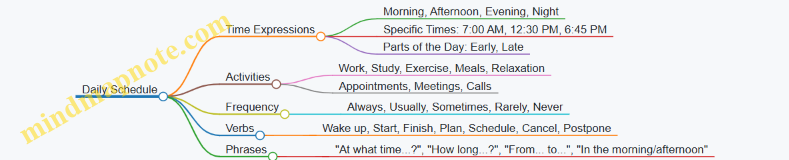
Exercise 1: Fill in the blanks with appropriate time expressions and verbs.
- I usually _______ (wake up) at 7:00 AM.
- My workday _______ (start) at 9:00 AM and _______ (finish) at 5:00 PM.
- I have lunch _______ (at/in) the afternoon.
- On Mondays, I _______ (attend) a meeting from 10:00 AM to 11:00 AM.
- I _______ (exercise) in the evening.
Example answers:
- wake up
- starts, finishes
- in
- attend
- exercise
Exercise 2: Match the activities with the correct time of day.
| Activity | Time of Day |
|---|---|
| Breakfast | Morning |
| Dinner | Evening |
| Study session | Afternoon |
| Sleep | Night |
| Morning jog | Early morning |
Example: Breakfast - Morning
Exercise 3: Create sentences using the following schedule details.
- Wake up: 6:30 AM
- Breakfast: 7:00 AM
- Work: 8:30 AM to 12:00 PM
- Lunch break: 12:00 PM to 1:00 PM
- Work: 1:00 PM to 5:30 PM
- Gym: 6:00 PM
- Dinner: 7:30 PM
- Relax: 8:00 PM to 10:00 PM
Example sentence: I wake up at 6:30 AM and have breakfast at 7:00 AM.
Exercise 4: Use frequency adverbs to describe your routine.
Fill in the blanks with always, usually, sometimes, rarely, or never.
- I _______ check my emails first thing in the morning.
- I _______ skip breakfast.
- I _______ take a walk after lunch.
- I _______ work late on Fridays.
- I _______ go to bed before 10 PM.
Example answers:
- always
- rarely
- sometimes
- usually
- never
Exercise 5: Plan a simple daily schedule.
Write a short paragraph describing your typical day using time expressions, activities, and frequency words. Use at least five vocabulary items from the mind map.
Example: I usually wake up at 7:00 AM. I have breakfast in the morning and start work at 9:00 AM. I take a lunch break at 12:30 PM. In the evening, I exercise and then relax before going to bed.
Mind Map: Structuring a Daily Schedule Paragraph
These exercises focus on practical vocabulary and sentence structures to help you confidently talk about your daily schedule. Practice regularly to improve clarity and fluency when discussing time and activities.
Chapter 13: Describing People and Personalities
13.1 Physical Appearance Vocabulary
Understanding and describing physical appearance is a fundamental part of everyday communication. Whether introducing someone, describing a character, or simply making conversation, having the right vocabulary helps convey clear and accurate images. This section organizes key terms into categories, supported by mind maps and examples to illustrate practical usage.
Mind Map: Basic Physical Features
Height and Build
- Tall: Someone who is above average height.
- Example: “She is tall, so she often helps reach items on high shelves.”
- Short: Below average height.
- Example: “He is short but very fast on his feet.”
- Slim: A thin and fit body shape.
- Example: “The model has a slim figure.”
- Athletic: Muscular and fit, often associated with sports.
- Example: “His athletic build shows he spends time exercising.”
- Stocky: Broad and solidly built.
- Example: “The stocky man carried the heavy boxes easily.”
- Overweight: Above a healthy weight.
- Example: “The doctor advised him to lose weight because he is overweight.”
Hair
- Color:
- Blonde, brown, black, red, gray.
- Example: “She has long, curly red hair that stands out in a crowd.”
- Style:
- Straight, curly, wavy, bald.
- Example: “He prefers to keep his hair short and straight.”
Eyes
- Color: Blue, brown, green, hazel.
- Example: “Her green eyes sparkle when she laughs.”
Skin
- Tone: Fair, olive, dark.
- Example: “He has an olive skin tone from spending time outdoors.”
- Features:
- Freckles: Small brown spots, often from sun exposure.
- Example: “The child’s face was covered with cute freckles.”
- Wrinkles: Lines on the skin, usually from aging.
- Example: “Her wrinkles tell stories of a life well-lived.”
- Scars: Marks left after an injury.
- Example: “He has a scar above his eyebrow from a childhood accident.”
- Freckles: Small brown spots, often from sun exposure.
Mind Map: Describing Facial Features
Facial Features
-
Face Shape:
- Round: Soft curves, wider cheeks.
- Example: “She has a round face that looks friendly.”
- Oval: Balanced proportions, slightly longer than wide.
- Example: “His oval face suits many hairstyles.”
- Square: Strong jawline and broad forehead.
- Example: “The actor’s square face gives him a commanding presence.”
- Heart-shaped: Wider forehead, narrow chin.
- Example: “Her heart-shaped face is complemented by bangs.”
- Round: Soft curves, wider cheeks.
-
Nose:
- Small, large, straight, hooked.
- Example: “He has a straight nose that fits well with his other features.”
-
Mouth:
- Full lips: Thick and well-defined.
- Example: “Her full lips make her smile very noticeable.”
- Thin lips: Narrow and less pronounced.
- Example: “He has thin lips that rarely show a smile.”
- Full lips: Thick and well-defined.
-
Eyebrows:
- Thick, thin, arched.
- Example: “Her thick eyebrows frame her eyes nicely.”
-
Teeth:
- Straight, crooked, white.
- Example: “He has straight, white teeth that brighten his face.”
Practice Examples
- Describing a Person in a Sentence:
- “The tall man with curly black hair and blue eyes smiled warmly.”
- Comparing Two People:
- “She is shorter than her brother and has straight blonde hair, while he has wavy brown hair.”
- Noticing Details:
- “I noticed the freckles on her fair skin and the small scar near her left eyebrow.”
This vocabulary set helps you paint clear pictures when talking about people’s appearance. Using these words accurately improves both your descriptive skills and your ability to understand others’ descriptions.
13.2 Personality traits and characteristics describe the consistent patterns in how people think, feel, and behave. Understanding these traits helps us describe ourselves and others more precisely in everyday conversations. This section introduces common personality traits, grouped by their general nature, and provides examples to show how to use them naturally.
Personality Traits Mind Map
Positive Traits
Friendly: Someone who is easy to talk to and kind. Example: “My neighbor is very friendly; she always greets me with a smile.”
Honest: A person who tells the truth and can be trusted. Example: “He is honest about his mistakes, which makes him a reliable colleague.”
Patient: Able to stay calm and wait without getting upset. Example: “Teachers need to be patient when explaining difficult topics.”
Confident: Feeling sure about your abilities. Example: “She was confident during her presentation and answered all questions clearly.”
Creative: Good at thinking of new ideas. Example: “The designer is very creative and always comes up with unique concepts.”
Neutral Traits
Quiet: Someone who doesn’t talk much. Example: “He is quiet in meetings but listens carefully.”
Shy: Feeling nervous around others, especially strangers. Example: “She is shy at first but opens up once she feels comfortable.”
Serious: Focused and not joking much. Example: “He has a serious attitude when working on important projects.”
Thoughtful: Careful and considerate about others. Example: “She is thoughtful and always remembers her friends’ birthdays.”
Negative Traits
Impatient: Easily annoyed by waiting. Example: “He gets impatient in long lines.”
Moody: Changing emotions quickly, sometimes unpredictable. Example: “She can be moody, happy one moment and upset the next.”
Stubborn: Not willing to change opinions or plans. Example: “He is stubborn and refuses to try new methods.”
Lazy: Unwilling to work or use effort. Example: “Sometimes I feel lazy on weekends and just want to relax.”
Rude: Not polite or respectful. Example: “It’s rude to interrupt someone when they are speaking.”
Using Personality Traits in Sentences
- To describe someone directly: “My brother is very patient with children.”
- To explain behavior: “She was shy at the party, so she stayed close to her friends.”
- To give advice: “Try to be more confident when you speak in public.”
Practice Examples
-
Choose the correct trait: “Mark is always willing to help and listens carefully. He is very ____.”
- (a) rude
- (b) friendly
- (c) lazy
- Correct answer: (b) friendly
-
Fill in the blank: “If you want to finish the project on time, you should not be ____.”
- Suggested answer: lazy
-
Match the sentence to the trait:
- Sentence: “She doesn’t like to talk much in groups.”
- Trait: Quiet
Summary
Personality traits help us communicate clearly about people’s behavior and attitudes. Grouping traits into positive, neutral, and negative categories makes it easier to choose the right word for the situation. Using examples in everyday contexts improves understanding and helps build vocabulary naturally.
13.3 Expressing likes and dislikes about people is a common part of everyday conversation. It helps you share your opinions clearly and politely. This section covers useful vocabulary, sentence structures, and examples to communicate your feelings about others effectively.
Key Vocabulary
- Likes: admire, appreciate, enjoy, respect, like, adore, prefer
- Dislikes: dislike, avoid, can’t stand, don’t like, resent, find annoying
- Neutral or mixed feelings: indifferent, neutral, have mixed feelings about
Common Sentence Structures
-
Positive:
- I like/enjoy/adore + [noun/pronoun] + because + [reason].
- I appreciate + [noun/pronoun] + for + [reason].
- I admire + [noun/pronoun] + due to + [quality/behavior].
-
Negative:
- I don’t like/dislike + [noun/pronoun] + because + [reason].
- I can’t stand + [noun/pronoun] + when + [behavior].
- I avoid + [noun/pronoun] + because + [reason].
-
Neutral:
- I’m indifferent to + [noun/pronoun].
- I have mixed feelings about + [noun/pronoun].
Mind Map: Expressing Likes and Dislikes About People
Examples of Expressing Likes
- I admire Sarah because she is always honest and reliable.
- I enjoy spending time with Tom since he has a great sense of humor.
- I appreciate how Maria listens carefully during conversations.
- I like John’s creativity; he always comes up with interesting ideas.
- I prefer working with people who are organized and punctual.
Examples of Expressing Dislikes
- I don’t like it when people interrupt during meetings.
- I can’t stand it when someone is constantly late.
- I avoid talking to Mark because he tends to be negative.
- I dislike people who are rude to others.
- I resent it when colleagues take credit for my work.
Examples of Neutral or Mixed Feelings
- I’m indifferent to whether my coworker wears formal or casual clothes.
- I have mixed feelings about Anna; she’s friendly but sometimes unreliable.
Practice Tips
- When expressing dislikes, aim to focus on specific behaviors rather than personal attacks.
- Use polite language to keep conversations respectful.
- Balance your opinions by mentioning positive traits if appropriate.
Mind Map: Reasons for Likes and Dislikes
Using these vocabulary and structures will help you express your feelings about people clearly and politely in daily conversations.
13.4 Talking About Emotions and Moods
Understanding how to express emotions and moods in English is essential for clear communication. Emotions are immediate feelings like happiness or anger, while moods tend to last longer and describe general states, such as feeling cheerful or gloomy.
Common Emotion Words and Their Usage
| Emotion | Description | Example Sentence |
|---|---|---|
| Happy | Feeling pleasure or contentment | “I felt happy when I received your message.” |
| Sad | Feeling sorrow or unhappiness | “She was sad after hearing the news.” |
| Angry | Feeling strong displeasure | “He got angry because of the delay.” |
| Excited | Feeling eager or enthusiastic | “They are excited about the trip.” |
| Nervous | Feeling anxious or worried | “I was nervous before the exam.” |
| Calm | Feeling peaceful and relaxed | “She remained calm during the meeting.” |
Mind Map: Basic Emotions
Expressing Intensity
You can modify emotion words to express intensity:
- Slightly happy (mild positive feeling)
- Very sad (strong negative feeling)
- Extremely nervous (high anxiety)
Example: “I was very happy to see you.” vs. “I was slightly happy with the results.”
Talking About Moods
Moods describe how someone feels over a period of time and are often less intense than emotions.
| Mood | Description | Example Sentence |
|---|---|---|
| Cheerful | Generally happy and optimistic | “He has been cheerful all day.” |
| Gloomy | Generally sad or depressed | “The weather made her feel gloomy.” |
| Restless | Unable to relax or stay still | “I felt restless waiting for the news.” |
| Energetic | Full of energy | “She’s been energetic since morning.” |
| Moody | Changing moods frequently | “He’s moody when he’s tired.” |
Mind Map: Moods
Phrases for Describing Emotions and Moods
- “I feel…” + [emotion/mood]
- “She seems…” + [emotion/mood]
- “They look…” + [emotion/mood]
- “He’s in a… mood.”
Examples:
- “I feel nervous about the interview.”
- “She seems calm today.”
- “They look excited for the concert.”
- “He’s in a good mood this morning.”
Using Emotions in Questions
- “How do you feel?”
- “Are you feeling okay?”
- “What’s wrong?”
- “Why do you look upset?”
Example Dialogue:
- A: “You look tired. Are you feeling okay?”
- B: “I’m just a bit sad because I missed the event.”
Practice Exercise
Fill in the blanks with the correct emotion or mood word:
- After the long walk, I felt very ___. (tired, happy, nervous)
- She was ___ when she heard the good news. (angry, excited, gloomy)
- He’s been ___ all day, probably because of the rain. (cheerful, restless, calm)
- I feel ___ before giving a presentation. (nervous, energetic, sad)
Summary
Being able to name and describe emotions and moods helps you share how you feel and understand others better. Use simple words like happy, sad, or calm, and add modifiers like very or slightly to express intensity. Remember, emotions are often short-lived and strong, while moods last longer and are more general. Practice using these words in everyday conversations to become more comfortable expressing feelings.
13.5 Compliments and Polite Expressions
Compliments and polite expressions are essential tools in everyday communication. They help build rapport, show respect, and create a positive atmosphere. Using them appropriately can make interactions smoother and more pleasant.
Understanding Compliments
A compliment is a positive statement about someone’s appearance, abilities, or qualities. It can be simple or more detailed, but it should always feel genuine. Compliments often follow this structure:
- Subject + verb + positive adjective/noun/phrase
Examples:
- “You have a great smile.”
- “That was an excellent presentation.”
Common Compliments Mind Map
Polite Expressions
Polite expressions are phrases used to show respect, soften requests, or express gratitude. They often include words like “please,” “thank you,” “excuse me,” and “sorry.”
Common categories include:
- Greetings and farewells: “Good morning,” “Have a nice day”
- Requests: “Could you please…?,” “Would you mind…?”
- Gratitude: “Thank you,” “I appreciate it”
- Apologies: “I’m sorry,” “Excuse me”
Polite Expressions Mind Map
Using Compliments Effectively
- Be sincere: Avoid over-the-top praise; it can seem insincere.
- Be specific: General compliments like “Good job” are fine, but specific ones like “Your report was very clear and well-organized” carry more weight.
- Consider context: Compliments should fit the situation and relationship.
Example:
- Instead of “You’re smart,” say “You explained that concept very clearly.”
Examples of Compliments in Daily Life
- To a colleague: “Your presentation was very informative.”
- To a friend: “I like your jacket; it looks great on you.”
- To a family member: “Thank you for cooking dinner; it tastes wonderful.”
Polite Expressions in Practice
- Making a request: “Could you please send me the report by Friday?”
- Expressing thanks: “Thank you for helping me with the project.”
- Apologizing: “I’m sorry for being late to the meeting.”
Practice Exercise
Fill in the blanks with appropriate compliments or polite expressions:
- “_____ for your help today; I couldn’t have finished without you.”
- “_____ you mind closing the door? It’s a bit chilly.”
- “You have a _____ way of explaining things; it makes learning easier.”
- “_____ me, could I ask a quick question?”
- “That’s a _____ idea; I hadn’t thought of that.”
Summary
Compliments and polite expressions are small but powerful parts of communication. They help maintain positive relationships and show respect. Using them thoughtfully and naturally will improve your daily interactions.
13.6 Practice Exercises: Describing Yourself and Others
Describing people clearly and accurately is a useful skill in everyday conversation. This section offers exercises to help you practice vocabulary related to physical appearance, personality traits, and emotions. Each exercise includes examples and mind maps to organize your thoughts.
Mind Map 1: Describing Physical Appearance
Example:
“My sister is tall and slim. She has long, curly brown hair and green eyes. She usually wears glasses.”
Mind Map 2: Describing Personality Traits
Example:
“John is very friendly and hardworking. He is a bit shy when meeting new people but always honest.”
Mind Map 3: Describing Emotions and Moods
Example:
“After the meeting, she looked tired but content with the results.”
Exercise 1: Describe Yourself
Write 5-7 sentences describing your physical appearance, personality, and current mood. Use vocabulary from the mind maps.
Example:
“I am average height with short, straight black hair. My eyes are brown. I consider myself friendly and patient. Today, I feel relaxed because I finished my work early.”
Exercise 2: Describe a Family Member or Friend
Choose one person you know well. Write 5-7 sentences describing their appearance and personality.
Example:
“My brother is tall and athletic. He has short blonde hair and blue eyes. He is very funny and outgoing but can be stubborn sometimes.”
Exercise 3: Match Adjectives to People
Read the sentences and decide which adjective fits best.
- Sarah always helps others and tells the truth. She is very _______. (honest / lazy)
- Mike is quiet and doesn’t talk much in groups. He is _______. (shy / funny)
- Tom has a beard and wears glasses. He is _______. (tall / bearded)
Answers: 1. honest 2. shy 3. bearded
Exercise 4: Fill in the Blanks
Complete the sentences with appropriate words from the mind maps.
- My friend has _______ hair and _______ eyes.
- She is very _______ and always makes people laugh.
- Today, I feel _______ because I had a good day.
Sample answers:
- curly, blue
- funny
- cheerful
Exercise 5: Create a Dialogue
Write a short conversation where two people describe themselves or others.
Example:
A: “Can you describe your new colleague?”
B: “Sure. She is short with long brown hair and green eyes. She seems very friendly and hardworking.”
A: “Sounds nice. What about her personality?”
B: “She is a bit shy but very patient.”
These exercises encourage you to combine vocabulary naturally. Use the mind maps to organize your descriptions before writing or speaking. Practice regularly to gain confidence in describing people clearly and accurately.
Chapter 14: Household Maintenance and Repairs Vocabulary
14.1 Common Tools and Equipment Names
When working around the house, knowing the names of common tools and equipment is essential. This section introduces key vocabulary with clear examples and organizes them into categories to help you remember and use them effectively.
Hand Tools
Hand tools are manually operated and are the backbone of household repairs.
Hand Tools
├── Hammer
├── Screwdriver
│   ├── Flathead
│   └── Phillips
├── Pliers
│   ├── Needle-nose
│   └── Slip-joint
├── Wrench
│   ├── Adjustable
│   └── Pipe wrench
├── Tape measure
├── Utility knife
└── Level
- Hammer: Used to drive nails into wood or remove them. Example: “I used the hammer to hang the picture frame.”
- Screwdriver: Comes in two main types—flathead and Phillips—used to tighten or loosen screws. Example: “The Phillips screwdriver fits the screws on the cabinet door.”
- Pliers: Useful for gripping and bending wires or small objects. Needle-nose pliers are for precision tasks, while slip-joint pliers adjust to different sizes. Example: “I used needle-nose pliers to pull out the small nail.”
- Wrench: Used to turn nuts and bolts. Adjustable wrenches fit various sizes; pipe wrenches are for plumbing. Example: “An adjustable wrench helped me fix the leaking pipe.”
- Tape measure: For measuring lengths and distances. Example: “I measured the window frame with a tape measure.”
- Utility knife: A sharp blade for cutting materials like cardboard or carpet. Example: “I used the utility knife to open the box.”
- Level: Ensures surfaces or objects are perfectly horizontal or vertical. Example: “I checked the shelf with a level to make sure it was straight.”
Power Tools
Power tools use electricity or batteries to make tasks easier and faster.
Power Tools
├── Drill
│   ├── Corded
│   └── Cordless
├── Jigsaw
├── Circular saw
├── Sander
└── Nail gun
- Drill: Used to make holes or drive screws. Corded drills plug into power outlets; cordless drills run on batteries. Example: “I used a cordless drill to assemble the furniture.”
- Jigsaw: A saw with a narrow blade for cutting curves and shapes in wood or plastic. Example: “The jigsaw helped me cut a circular hole in the board.”
- Circular saw: A power saw with a round blade for straight cuts in wood or metal. Example: “I cut the plywood with a circular saw.”
- Sander: Smooths surfaces by abrasion with sandpaper attached. Example: “I used the sander to prepare the table for painting.”
- Nail gun: Drives nails quickly using compressed air or electricity. Example: “The nail gun made hanging the paneling much faster.”
Fasteners and Accessories
These are items used alongside tools to complete repairs or projects.
Fasteners and Accessories
├── Nails
├── Screws
├── Bolts
├── Washers
└── Anchors
- Nails: Thin metal pins hammered into wood or walls. Example: “I hammered nails to secure the frame.”
- Screws: Metal fasteners with spiral threads, tightened with a screwdriver. Example: “I used screws to attach the hinges.”
- Bolts: Similar to screws but usually used with nuts. Example: “The table legs were attached with bolts and washers.”
- Washers: Small flat rings placed under nuts or screw heads to distribute pressure. Example: “I added washers to prevent damage to the wood.”
- Anchors: Inserted into walls to hold screws securely, especially in drywall. Example: “Wall anchors kept the shelf brackets firmly in place.”
Examples in Context
- “Before hanging the mirror, I measured the wall with a tape measure and marked the spot using a pencil.”
- “I used a level to make sure the shelf was straight before drilling holes with my cordless drill.”
- “The utility knife helped me open the package quickly without damaging the contents.”
- “When the pipe leaked, I grabbed my adjustable wrench and tightened the fittings.”
Practice Exercise
Match the tool to its description:
- A tool used to drive nails.
- A device that measures length.
- A power tool for making holes.
- A tool used to grip and bend wires.
- A tool that ensures surfaces are horizontal.
Answers:
1 - Hammer
2 - Tape measure
3 - Drill
4 - Pliers
5 - Level
Understanding these common tools and equipment names will help you communicate clearly when discussing household repairs or shopping for supplies. Familiarity with these terms also makes following instructions and manuals easier.
14.2 Describing Problems and Repairs Needed
When discussing household problems and repairs, clear and precise vocabulary helps communicate the issue effectively. This section covers common terms and phrases used to describe problems, the parts involved, and the type of repair needed. Using these words correctly can make conversations with repair professionals or neighbors smoother.
Mind Map: Common Household Problems
Mind Map: Describing Repairs Needed

Vocabulary and Usage Examples
1. Plumbing Problems
- Leak: “There is a leak under the kitchen sink. Water is dripping steadily.”
- Clog: “The bathroom drain is clogged; the water drains very slowly.”
- Burst pipe: “A pipe burst in the basement, and water flooded the floor.”
- Drip: “The faucet has a drip that wastes water and needs fixing.”
2. Electrical Issues
- Power outage: “We had a power outage last night affecting the whole house.”
- Flickering lights: “The living room lights flicker when I turn on the fan.”
- Faulty switch: “The light switch in the hallway doesn’t work properly.”
- Tripped breaker: “The circuit breaker tripped when I used the heater.”
3. Structural Problems
- Crack: “There is a crack in the wall near the window.”
- Broken window: “One of the bedroom windows is broken and needs replacement.”
- Door jammed: “The front door is jammed and won’t open easily.”
- Loose tiles: “Some tiles in the bathroom are loose and could fall off.”
4. Appliance Issues
- Not working: “The dishwasher is not working; it doesn’t start.”
- Making noise: “The washing machine makes a loud noise during the spin cycle.”
- Overheating: “The oven overheats and turns off automatically.”
- Won’t start: “The refrigerator won’t start after the power outage.”
Phrases to Describe Problems
-
“The [item] is [problem].”
- Example: “The heater is leaking water.”
-
“There seems to be a problem with [item/part].”
- Example: “There seems to be a problem with the electrical wiring.”
-
“[Item] is not functioning properly.”
- Example: “The air conditioner is not functioning properly.”
-
“I noticed that [problem description].”
- Example: “I noticed that the faucet handle is loose.”
-
“[Problem] occurs when [condition].”
- Example: “The lights flicker when I turn on the microwave.”
Explaining the Repair Needed
-
“It needs to be fixed/repaired.”
- Example: “The leaking pipe needs to be fixed as soon as possible.”
-
“It should be replaced.”
- Example: “The broken window should be replaced to keep the house secure.”
-
“It requires cleaning/unclogging.”
- Example: “The kitchen drain requires unclogging because water is backing up.”
-
“The switch needs tightening/adjusting.”
- Example: “The door handle is loose and needs tightening.”
-
“We need to inspect the wiring.”
- Example: “We need to inspect the wiring to find the cause of the power outage.”
Practice Examples
- “The bathroom faucet is dripping constantly. It needs to be fixed to stop wasting water.”
- “There is a crack in the living room wall near the ceiling. It might need inspection and repair.”
- “The refrigerator won’t start after the storm. It probably needs to be checked by a technician.”
- “The front door is jammed and hard to open. It requires adjustment or repair.”
- “The kitchen sink is clogged and water is not draining. We should try unclogging it first.”
Using clear descriptions and appropriate verbs when talking about household problems helps avoid confusion. Whether you are explaining the issue to a repair person or describing it to a friend, these phrases and vocabulary will make your communication straightforward and effective.
14.3 Asking for Help and Giving Instructions
When dealing with household maintenance and repairs, clear communication is essential. Whether you are asking a neighbor for assistance or instructing a handyman, using precise and polite language helps avoid misunderstandings. This section focuses on vocabulary and sentence structures useful for requesting help and providing instructions.
Mind Map: Asking for Help
Mind Map: Giving Instructions
Examples of Asking for Help
- Polite request with problem description:
“Could you please help me fix the leaking faucet in the kitchen? It started dripping last night and is getting worse.”
- Offering details and urgency:
“Would you mind taking a look at the heater? It’s not turning on, and it’s quite cold today, so I need it fixed soon.”
- Simple direct request:
“Can you help me replace the broken window pane?”
Examples of Giving Instructions
- Step-by-step repair instruction:
“First, turn off the main water valve. Then, use a wrench to loosen the pipe fitting. After that, remove the damaged section carefully. Finally, replace it with the new pipe and tighten everything back.”
- Safety-focused instruction:
“Before you start, make sure to unplug the appliance. Use gloves to protect your hands when handling sharp parts.”
- Confirming and offering support:
“Once you finish, please check if the leak has stopped. If you run into any problems, just call me.”
Practical Tips
- Use polite modal verbs like “could,” “would,” and “can” to soften requests.
- Be specific about the problem to help the helper understand the situation quickly.
- When giving instructions, break down the task into clear, manageable steps.
- Include safety advice to prevent accidents.
- Always offer to answer questions or provide further assistance.
Clear communication in these situations not only makes the repair process smoother but also builds good relationships with those helping you. Practicing these phrases and structures will make you more confident when you need to ask for help or give instructions around the house.
14.4 Safety Vocabulary for Home Repairs
When working on home repairs, safety is the first priority. Knowing the right vocabulary helps you communicate clearly about hazards, precautions, and proper procedures. Here, we present key safety terms organized into categories, with examples and mind maps to clarify their relationships.
Mind Map: Personal Protective Equipment (PPE)
Example: “Before sanding the old paint, put on safety glasses and a respirator to avoid inhaling dust.”
Mind Map: Common Hazards
Example: “Watch out for exposed wires to prevent electrical shock while fixing the outlet.”
Mind Map: Safety Actions and Warnings
Example: “Always turn off the power at the circuit breaker before replacing a light fixture.”
Mind Map: Tools and Equipment Safety
Example: “Inspect the drill for frayed cords before starting your project.”
Practical Usage Examples
- “Please wear gloves and safety glasses when handling the paint stripper.”
- “There’s a wet floor sign to prevent slips near the plumbing repair area.”
- “Make sure the ladder is stable and on level ground before climbing.”
- “Keep a fire extinguisher nearby when working with flammable materials.”
- “Use ear protection when operating the power saw to protect your hearing.”
Practice Exercise
Fill in the blanks with the correct safety vocabulary:
- Before starting electrical repairs, always ___ the power.
- To protect your eyes from flying debris, wear ___ glasses.
- When working with loud tools, use ___ protection.
- Keep your workspace clear to avoid ___ and trips.
- If you smell fumes, ___ the area immediately.
Answers: 1. turn off 2. safety 3. ear 4. slips 5. ventilate
Understanding and using safety vocabulary correctly reduces risks and makes home repairs smoother. Clear communication about safety helps everyone stay protected.
14.5 Scheduling and discussing maintenance tasks is an essential part of household management. Clear communication helps ensure that repairs and upkeep happen on time and with minimal confusion. This section focuses on vocabulary and phrases useful for planning, confirming, and following up on maintenance activities.
Mind Map: Key Vocabulary for Scheduling Maintenance
Mind Map: Common Phrases for Maintenance Discussions
Examples with Explanations
- Scheduling a Repair
“I’d like to schedule a repair for the leaking sink. Are you available this Thursday afternoon?”
- This sentence clearly states the task and proposes a specific time.
- Confirming Appointment Details
“Yes, Thursday afternoon works. I’ll arrive around 2 PM. Do you need me to be home?”
- The responder confirms the time and asks about access requirements.
- Asking for Preparation Instructions
“Please clear the area under the sink so I can work comfortably.”
- This instruction helps the homeowner prepare for the visit.
- Rescheduling a Task
“Something came up. Can we move the appointment to Friday morning instead?”
- A polite request to change the scheduled time.
- Reminding About an Appointment
“Just a reminder: I’ll be there tomorrow at 10 AM to inspect the heating system.”
- A clear reminder message to avoid missed appointments.
Practice Exercise
Imagine you need to arrange a maintenance visit to fix a broken window. Write a short dialogue using the vocabulary and phrases above, including:
- Requesting an appointment
- Confirming the date and time
- Asking about preparation
- Sending a reminder
Summary
When scheduling and discussing maintenance tasks, use clear, direct language. Specify the task, propose or confirm times, and clarify any requirements. Politeness and precision help avoid misunderstandings and ensure smooth communication.
14.6 Practice Exercises: Writing Requests for Repairs
When you need to ask for repairs at home, clarity and politeness are key. Writing a clear request helps the person responsible understand the problem and act quickly. This section offers practical exercises to help you write effective repair requests.
Mind Map: Components of a Repair Request
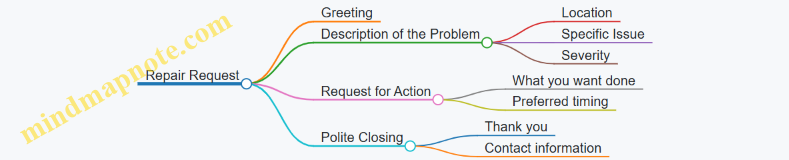
Example 1: Requesting a Plumbing Repair
Dear Building Manager,
I am writing to inform you that the kitchen sink in my apartment is leaking. Water drips continuously from the faucet, causing a puddle on the countertop. The leak started yesterday and seems to be getting worse.
Could you please arrange for a plumber to fix this as soon as possible? I am available in the afternoons for the repair.
Thank you for your assistance.
Best regards,
[Your Name]
Mind Map: Vocabulary for Describing Problems
Exercise 1: Write a request for repairing a broken heater in your living room. Include:
- A greeting
- Description of the problem
- Request for repair
- Polite closing
Example 2: Requesting Electrical Repair
Hello Maintenance Team,
The light fixture in the hallway has stopped working. It flickers on and off and sometimes does not turn on at all. This has been happening for two days.
Please could someone check and repair the wiring? I am usually home after 5 PM.
Thank you for your help.
Sincerely,
[Your Name]
Mind Map: Polite Phrases for Requests
Exercise 2: Compose a repair request for a noisy air conditioner in your bedroom. Use polite phrases and specify a convenient time for the repair.
Example 3: Requesting Furniture Repair
Dear Landlord,
The handle on the front door is loose and sometimes falls off. This makes it difficult to open and close the door properly.
Could you please send someone to fix it at your earliest convenience? I am available any weekday morning.
Thank you very much.
Best,
[Your Name]
Exercise 3: Write a request to fix a broken window lock. Include a clear description and a polite closing.
Tips for Writing Repair Requests
- Be specific about the problem and its location.
- Mention when the problem started or how often it occurs.
- Use polite language to make your request respectful.
- Suggest convenient times for the repair if possible.
- Include your contact information for follow-up.
These exercises will help you practice writing clear and polite repair requests. Try to use the vocabulary and phrases from the mind maps to make your writing more effective.
Chapter 15: Emergency and Safety Vocabulary
15.1 Common Emergency Situations Vocabulary
Emergencies come in many forms, and knowing the right vocabulary helps you communicate clearly and quickly when it matters most. This section introduces essential words and phrases related to common emergency situations, organized to make them easy to remember and use.
Mind Map: Types of Emergencies
Key Vocabulary and Examples
Medical Emergencies
- Injury: harm or damage to the body.
- “He has a leg injury from the fall.”
- Allergic reaction: the body’s adverse response to an allergen.
- “She is having an allergic reaction to peanuts.”
- Unconscious: not awake or aware.
- “The patient is unconscious and needs immediate help.”
Fire Emergencies
- Smoke: visible vapor from fire.
- “I see smoke coming from the kitchen.”
- Flames: the visible part of fire.
- “The flames are spreading quickly.”
- Evacuate: to leave a dangerous place.
- “Please evacuate the building calmly.”
Accidents
- Car crash: collision involving vehicles.
- “There was a car crash on the highway.”
- Fall: dropping down unintentionally.
- “He had a bad fall from the ladder.”
- Electrical shock: injury caused by electricity.
- “She got an electrical shock while fixing the lamp.”
Natural Disasters
- Earthquake: shaking of the ground.
- “The earthquake lasted about 30 seconds.”
- Flood: overflow of water onto land.
- “The flood damaged many homes.”
- Storm: severe weather with wind and rain.
- “The storm caused power outages.”
Crime-Related Emergencies
- Theft: stealing property.
- “There was a theft at the store last night.”
- Assault: physical attack.
- “He reported an assault to the police.”
- Vandalism: deliberate damage to property.
- “The graffiti is an act of vandalism.”
Mind Map: Emergency Actions and Responses
Practical Usage Examples
- “Call 911 immediately if someone is unconscious or not breathing.”
- “Apply pressure to stop the bleeding until help arrives.”
- “During a fire, use the stairs to evacuate; do not use the elevator.”
- “If you witness a car crash, report the exact location and number of vehicles involved.”
- “Stay calm and describe the emergency clearly when speaking to the operator.”
Practice Exercise
Fill in the blanks with the correct emergency vocabulary:
- When you see _______ in a building, you should evacuate immediately.
- If someone is not breathing, you may need to perform _______.
- A sudden shaking of the ground is called an _______.
- If you witness a _______ at a store, call the police.
- To stop an injury from getting worse, apply _______ to a bleeding wound.
Answers:
- smoke or flames
- CPR
- earthquake
- theft
- pressure
This vocabulary forms the foundation for communicating effectively in emergencies. Clear language can save time and lives, so practicing these words and phrases helps build confidence for real situations.
15.2 Calling for Help and Giving Information
When you find yourself in an emergency, clear communication is essential. Calling for help involves providing accurate, concise information so responders can act quickly and effectively. This section covers key vocabulary, phrases, and strategies to help you give the right details without confusion.
Mind Map: Key Elements When Calling for Help
Essential Vocabulary and Phrases
- Emergency: A serious, unexpected situation requiring immediate action.
- Help: Assistance or aid.
- Accident: An unplanned event causing injury or damage.
- Injured: Hurt or wounded.
- Fire: Uncontrolled burning.
- Trapped: Unable to escape.
- Unconscious: Not awake or aware.
- Location: The place where something is.
- Landmark: A recognizable object or feature near a location.
- Caller: The person making the call.
Step-by-Step Guide to Calling for Help
-
Start with a greeting and identify the emergency service:
- “Hello, this is an emergency. I need an ambulance.”
- “Fire department, please. There is a fire at my location.”
-
Provide your name and exact location:
- “My name is Sarah Johnson. I am at 123 Maple Street, near the central park.”
- “I’m at the second floor of the Green Tower, apartment 204.”
-
Describe the emergency clearly:
- “There has been a car accident. Two people are injured.”
- “There is a fire in the kitchen. Smoke is filling the room.”
-
Answer any questions calmly and precisely:
- “Yes, there is someone unconscious.”
- “No, the fire has not spread to other rooms yet.”
-
Stay on the line until told to hang up:
- “I will wait for the ambulance to arrive.”
Mind Map: Useful Phrases for Giving Information
Examples
Example 1: Medical Emergency
Caller: “Hello, I need an ambulance. My friend has collapsed and is not breathing. We are at 45 Oak Avenue, next to the library.”
Operator: “Can you tell me your name?”
Caller: “Yes, it’s Mark Lee.”
Operator: “Is your friend conscious?”
Caller: “No, he is unconscious.”
Operator: “Stay calm. Help is on the way.”
Example 2: Fire Emergency
Caller: “Fire department, please. There is a fire in my apartment building at 78 Pine Street, apartment 12B.”
Operator: “Is anyone trapped inside?”
Caller: “Yes, my neighbor is trapped on the third floor.”
Operator: “Are you in a safe place?”
Caller: “Yes, I am outside now.”
Operator: “Help is coming. Please stay away from the building.”
Practice Exercise
Imagine you witness a car accident. Write a short dialogue where you call emergency services. Include:
- Your name and location
- Description of the accident
- Number of people involved
- Any injuries
- Answer questions from the operator
Clear, direct communication saves time and lives. Practice these phrases and structures to be ready if you ever need to call for help.
15.3 Describing Accidents and Injuries
When talking about accidents and injuries, clear and precise vocabulary helps convey the situation effectively. This section focuses on common words and phrases used to describe different types of accidents, injuries, and related circumstances.
Mind Map: Types of Accidents
Mind Map: Describing Injuries
Common Vocabulary and Usage Examples
-
Slip: To lose your footing and slide unintentionally.
- Example: “She slipped on the wet floor but didn’t hurt herself.”
-
Trip: To catch your foot on something and stumble.
- Example: “He tripped over the cable and fell.”
-
Fall: To drop down suddenly.
- Example: “The child fell off the swing and scraped his knee.”
-
Cut: A break in the skin caused by a sharp object.
- Example: “I cut my finger while chopping vegetables.”
-
Burn: Injury caused by heat, chemicals, or electricity.
- Example: “She burned her hand on the hot stove.”
-
Bruise: A dark mark on the skin from an impact.
- Example: “He has a bruise on his arm from bumping into the door.”
-
Sprain: Injury to a ligament caused by twisting.
- Example: “She sprained her ankle during the hike.”
-
Fracture: A broken bone.
- Example: “He fractured his wrist in the fall.”
-
Concussion: A mild brain injury caused by a blow to the head.
- Example: “After the accident, he showed signs of a concussion.”
-
Bleeding: Loss of blood from the body.
- Example: “The cut was deep and started bleeding heavily.”
-
Swelling: Enlargement of a body part due to injury.
- Example: “There was swelling around the injured knee.”
Describing the Accident Scene
-
Use clear, simple phrases to describe what happened.
- Example: “He slipped on the wet floor and fell, hitting his elbow.”
- Example: “The cyclist collided with a car at the intersection.”
-
Mention the cause if known.
- Example: “She tripped over a loose carpet edge.”
-
Describe the immediate effect.
- Example: “He felt sharp pain and noticed bleeding from the cut.”
Describing the Injury Details
-
Specify the injured body part.
- Example: “She has a bruise on her left thigh.”
-
Mention the type of injury.
- Example: “He suffered a sprain in his right ankle.”
-
Indicate the severity.
- Example: “The burn was minor and only affected the surface of the skin.”
-
Describe symptoms if relevant.
- Example: “He experienced dizziness and headache after the fall.”
Practice Examples
-
Describe this situation: Someone fell while running and hurt their wrist.
- “He was running and tripped over a rock. He fell and hurt his wrist, which started to swell.”
-
Describe this injury: A person burned their hand on a hot pan.
- “She accidentally touched a hot pan and burned her hand. The skin turned red and painful.”
-
Describe a car accident injury: A driver hit their head on the steering wheel.
- “During the collision, the driver’s head hit the steering wheel, causing a concussion and a cut on the forehead.”
Using these words and structures will help you describe accidents and injuries clearly and accurately. Practice by imagining different scenarios and describing what happened and the injuries involved.
15.4 Safety Instructions and Warnings
Safety instructions and warnings are essential vocabulary in daily life, especially in emergencies or when handling potentially dangerous situations. Understanding these terms helps you follow rules, avoid accidents, and communicate clearly when safety is at stake.
Key Vocabulary Categories
Safety Instructions and Warnings Mind Map
Practical Examples with Usage
- Do not touch the electrical panel when your hands are wet.
- Keep away from the construction site; it is dangerous.
- Always wear a helmet when riding a bike.
- Use only approved cleaning products to avoid chemical reactions.
- Avoid running near slippery floors.
- In case of fire, use stairs instead of the elevator.
- Follow the evacuation plan posted on the wall.
- Turn off the gas valve before leaving the house.
- Keep clear of the machinery while it is operating.
Warnings on signs:
- Danger: High voltage – Do not enter.
- Caution: Wet floor – Walk carefully.
- Warning: Flammable materials – No open flames.
- Toxic – Handle with gloves.
Usage Notes
- Instructions often start with imperative verbs (Do, Keep, Wear, Use).
- Warnings are usually short and direct to catch attention quickly.
- Safety vocabulary is often paired with visual signs or symbols.
- When giving instructions, clarity and simplicity are key.
Practice Exercises
-
Match the instruction to the correct situation:
- a) Wear protective gloves
- b) Keep away
- c) Turn off
Situations:
- ___ When handling chemicals
- ___ Before fixing electrical wiring
- ___ From the construction zone
-
Fill in the blanks:
- _____ the door in case of emergency.
- _____ children from the cleaning supplies.
- _____ the area before starting the machine.
-
Write a short safety instruction for each of these scenarios:
- Using a ladder
- Cooking with hot oil
- Crossing a busy street
Understanding and using safety instructions and warnings correctly can prevent accidents and ensure clear communication during emergencies. Practice these phrases regularly to build confidence in everyday situations.
15.5 Expressing Urgency and Asking for Assistance
In emergency or urgent situations, clear and direct communication is essential. Expressing urgency and asking for help requires specific vocabulary and sentence structures that convey the need for immediate attention without confusion. This section focuses on practical phrases and vocabulary to help you communicate effectively when time matters.
Mind Map: Expressing Urgency
Mind Map: Asking for Assistance
Key Vocabulary and Phrases
- Urgent: Something requiring immediate action.
- Emergency: A serious, unexpected situation needing quick response.
- Help/Assist: To give support or aid.
- Right now / Immediately / As soon as possible: Time expressions emphasizing urgency.
- Please / Could you / Would you mind: Politeness markers to soften requests.
Examples of Expressing Urgency
- “I need to speak with a doctor immediately.”
- “This is urgent; please respond as soon as possible.”
- “There’s an emergency at the front desk.”
- “Can you help me quickly?”
- “Please hurry, the situation requires urgent attention.”
Examples of Asking for Assistance
- “Could you please help me carry these boxes?”
- “Would you mind calling a taxi for me?”
- “Can you assist me with this form?”
- “I need help fixing my computer.”
- “Please help me find the nearest hospital.”
Combined Examples: Expressing Urgency While Asking for Assistance
- “I’m feeling dizzy and need help immediately. Can someone assist me?”
- “There’s a fire in the kitchen! Please call the fire department right now.”
- “My car broke down on the highway. Could you please help me as soon as possible?”
- “I lost my wallet and need urgent assistance to cancel my cards.”
- “The patient is unconscious. We need medical help immediately.”
Practice Exercises
-
Rewrite the following sentence to make it more urgent:
- “I need help with my luggage.”
- Example answer: “I need help with my luggage right now, please.”
-
Create a polite request asking for assistance in an emergency:
- Example answer: “Could you please call an ambulance? It’s urgent.”
-
Match the urgency adverb with the correct sentence:
- a) “Please respond ___ (immediately / slowly) to the emergency call.”
- b) “I need assistance ___ (as soon as possible / whenever you can).”
-
Role-play: Imagine you are in a store and suddenly feel unwell. Write a sentence asking for urgent help.
-
Fill in the blanks with suitable words:
- “There is an ________ at home. I need help ________.”
Using clear, concise language combined with polite expressions helps ensure your request for assistance is understood and acted upon promptly. Practice these phrases and vocabulary regularly to build confidence in urgent communication.
15.6 Practice Exercises: Emergency Role-Play Scenarios
In this section, you will practice essential vocabulary and phrases used during emergencies through role-play scenarios. These exercises help you become comfortable with asking for help, describing situations, and responding clearly and calmly. Each scenario includes a mind map to organize key vocabulary and example dialogues to guide your practice.
Mind Map: Emergency Vocabulary Overview
Scenario 1: Reporting a Fire
Situation: You see a fire in a building nearby. You need to call the fire department.
Key Vocabulary: fire, smoke, building, emergency, help, address, phone number
Example Dialogue:
- Caller: “Hello, I want to report a fire. There is smoke coming from a building at 123 Main Street.”
- Operator: “Is anyone inside?”
- Caller: “I’m not sure, but I see people outside.”
- Operator: “Help is on the way. Please stay safe and keep away from the building.”
Practice: Take turns playing the caller and the operator. Use the vocabulary from the mind map to expand your descriptions.
Scenario 2: Calling an Ambulance for an Injury
Situation: Someone has fallen and hurt their leg. You need to call for medical help.
Key Vocabulary: injured, fall, pain, ambulance, emergency, location, first aid
Example Dialogue:
- Caller: “Hello, I need an ambulance. Someone has fallen and is hurt.”
- Operator: “Can you tell me your location?”
- Caller: “We are at the corner of Oak Street and 5th Avenue. The person is in pain and cannot stand.”
- Operator: “Help is coming. Is the person conscious?”
- Caller: “Yes, they are awake but in pain.”
Practice: Practice describing injuries and symptoms clearly. Try to include details about the person’s condition.
Scenario 3: Reporting a Theft
Situation: Your bicycle was stolen from outside a store. You want to report it to the police.
Key Vocabulary: stolen, bicycle, description, location, time, police, report
Example Dialogue:
- Caller: “Hello, I want to report a stolen bicycle. It was taken from outside the supermarket on Elm Street.”
- Officer: “When did this happen?”
- Caller: “About an hour ago. The bike is red with a black seat.”
- Officer: “Thank you. We will send an officer to take your statement.”
Practice: Use adjectives to describe stolen items. Practice giving clear information about time and place.
Scenario 4: Asking for Help After a Car Accident
Situation: You witnessed a minor car accident and want to call emergency services.
Key Vocabulary: accident, car, injured, crash, location, emergency, help
Example Dialogue:
- Caller: “There has been a car accident on Highway 10 near exit 5. Two cars crashed.”
- Operator: “Are there any injuries?”
- Caller: “One person looks hurt and is not moving.”
- Operator: “We are sending an ambulance and police now. Please do not move the injured person.”
Practice: Practice giving clear descriptions of accidents and the condition of people involved.
Scenario 5: Natural Disaster Emergency
Situation: You need to report flooding in your neighborhood.
Key Vocabulary: flood, water, danger, evacuation, emergency, location
Example Dialogue:
- Caller: “Hello, I want to report flooding on River Road. The water is rising quickly and people may need to evacuate.”
- Operator: “Thank you for the information. Are there people trapped?”
- Caller: “Not yet, but some houses are already surrounded by water.”
- Operator: “Please stay safe and follow evacuation orders.”
Practice: Use descriptive words to explain the situation clearly and calmly.
Tips for Role-Play Practice
- Speak slowly and clearly.
- Use simple sentences.
- Repeat important information if needed.
- Practice both roles: the person asking for help and the emergency operator.
- Focus on using the vocabulary and phrases from the mind maps.
These exercises will help you feel more confident in emergency situations and improve your ability to communicate effectively when it matters most.
Chapter 16: Entertainment and Leisure Vocabulary
16.1 Types of Entertainment and Activities
Entertainment and leisure activities come in many forms, each offering a way to relax, connect, or simply pass the time. Understanding the vocabulary related to these types helps you talk about your interests clearly and understand others when they share theirs.
Mind Map: Types of Entertainment
Indoor Activities
Indoor entertainment often takes place at home or in enclosed spaces. Watching movies is a common example. You might say, “I enjoy watching comedies on weekends.” Reading books is another popular activity, with phrases like, “She is reading a mystery novel.” Board games such as chess or Monopoly are social and interactive, e.g., “We played a board game last night.” Listening to music can be casual or focused: “He listens to jazz while working.” Cooking can also be entertaining: “Trying new recipes is a fun way to spend the evening.”
Outdoor Activities
Outdoor activities involve physical movement or nature. Sports vocabulary includes words like soccer, tennis, and swimming. Example: “They play tennis every Saturday.” Hiking involves walking in nature: “We went hiking in the mountains.” Gardening refers to growing plants: “She spends her mornings gardening.” Picnics are meals eaten outdoors: “We had a picnic in the park.” Biking is riding a bicycle: “He bikes to work daily.”
Social Activities
Social entertainment focuses on interaction with others. Parties are gatherings: “There was a birthday party last weekend.” Dining out means eating at restaurants: “We like dining out on Fridays.” Attending concerts involves watching live music: “She attended a rock concert.” Visiting museums is cultural: “They visited the art museum.” Going to theaters means watching plays or movies: “We are going to the theater tonight.”
Digital Entertainment
Digital entertainment uses electronic devices. Video games are interactive games: “He spends an hour playing video games.” Streaming shows means watching TV or movies online: “She streams documentaries.” Social media involves platforms like Facebook or Instagram: “They use social media to stay connected.” Podcasts are audio programs: “I listen to podcasts during my commute.” Online classes are educational: “He takes online classes to learn new skills.”
Examples in Sentences
- “After work, I usually watch a movie or listen to music to relax.”
- “On weekends, we enjoy hiking or having a picnic with friends.”
- “She invited me to a party where we played board games and danced.”
- “My brother spends a lot of time playing video games and streaming shows.”
Practice Exercise
Write five sentences describing your favorite entertainment activities. Use vocabulary from at least two categories above. For example: “I like reading books and going to concerts.”
16.2 Talking About Movies, Music, and Books
When discussing movies, music, and books, having the right vocabulary helps you express opinions, describe content, and engage in conversations effectively. This section provides useful words, phrases, and examples to talk about these popular forms of entertainment.
Mind Map: Key Vocabulary for Movies, Music, and Books
Talking About Movies
Genres and Descriptions:
- “I enjoy action movies because they are fast-paced and exciting.”
- “Documentaries often provide insightful information about real events.”
Discussing Plot and Characters:
- “The plot had an unexpected twist near the end that caught me off guard.”
- “The protagonist was relatable, but the antagonist felt one-dimensional.”
Expressing Opinions:
- “The special effects were impressive, but the storyline was a bit predictable.”
- “I found the movie gripping from start to finish.”
Example Conversation:
- A: “Have you seen the new thriller?”
- B: “Yes, the suspense kept me on edge, but I thought the ending was rushed.”
Talking About Music
Genres and Elements:
- “Jazz music often features improvisation and complex rhythms.”
- “The lyrics in this song are very poetic and meaningful.”
Describing Sound and Instruments:
- “The guitar solo was catchy and really stood out.”
- “I like mellow tunes when I want to relax.”
Expressing Opinions:
- “This album is inspiring; every track tells a story.”
- “Some songs feel repetitive, but the overall vibe is good.”
Example Conversation:
- A: “What kind of music do you listen to?”
- B: “Mostly rock and pop. I like upbeat songs that energize me.”
Talking About Books
Genres and Formats:
- “I prefer fiction novels, especially fantasy stories with rich world-building.”
- “Audiobooks are convenient for me during commutes.”
Discussing Plot and Characters:
- “The character development in this book is excellent; you really understand their motivations.”
- “The setting is vividly described, making it easy to imagine the scenes.”
Expressing Opinions:
- “I found the book engaging, but some chapters were a bit slow.”
- “The writing style is clear and accessible.”
Example Conversation:
- A: “Have you read any good books lately?”
- B: “Yes, a mystery novel that kept me guessing until the last page.”
Practice Examples
-
Describe your favorite movie using at least three vocabulary words from the mind map.
- “My favorite movie is a comedy with a clever plot and well-developed characters.”
-
Express your opinion about a song you recently heard.
- “The rhythm is upbeat and the lyrics are catchy, making it hard to stop listening.”
-
Talk about a book you are currently reading.
- “It’s a fantasy novel with detailed settings and an engaging storyline.”
Using these words and phrases will help you communicate clearly and confidently when discussing movies, music, and books in everyday conversations.
16.3 Describing Preferences and Opinions
When talking about entertainment, sharing your preferences and opinions helps others understand what you enjoy and why. This section covers useful vocabulary and phrases to express likes, dislikes, and personal views clearly and naturally.
Key Vocabulary for Preferences
- Like / Love / Enjoy: Express positive feelings toward something.
- Prefer: Indicate a choice between options.
- Dislike / Hate: Express negative feelings.
- Favorite: The thing you like the most.
- Would rather: Express preference in a polite way.
- Interested in: Show curiosity or attraction.
- Not a fan of: Polite way to say you don’t like something.
Useful Phrases for Opinions
- “I think that…”
- “In my opinion…”
- “I feel that…”
- “It seems to me that…”
- “From my point of view…”
- “I believe…”
Mind Map: Expressing Preferences
Mind Map: Expressing Opinions
Examples of Expressing Preferences
- “I really enjoy watching comedies because they make me laugh.”
- “I prefer action movies over romantic ones because they are more exciting.”
- “My favorite type of music is jazz because of its smooth rhythms.”
- “I’m not a fan of horror films; they’re too scary for me.”
- “I would rather listen to podcasts than watch TV in the evenings.”
Examples of Expressing Opinions
- “In my opinion, this movie has a great storyline but the acting could be better.”
- “I think that the soundtrack adds a lot to the overall experience.”
- “From my point of view, the book was more interesting than the film adaptation.”
- “It seems to me that this game is designed for beginners rather than experts.”
- “I believe that attending live concerts is more enjoyable than listening to recorded music.”
Practice Exercise
Write three sentences about your entertainment preferences using at least two phrases from the vocabulary lists above. For example:
- “I love watching documentaries because they teach me new things.”
- “I prefer reading books to watching movies.”
- “In my opinion, comedies are the best way to relax after work.”
This practice helps you combine vocabulary and opinion phrases naturally. Remember, expressing preferences and opinions clearly makes conversations more engaging and helps you connect with others over shared interests.
16.4 Making Recommendations and Invitations
When you want to suggest an activity or invite someone to join you, choosing the right words can make your message clear and polite. This section covers vocabulary and phrases for making recommendations and invitations, with examples and mind maps to organize your thoughts.
Making Recommendations
Recommendations are suggestions about what someone might enjoy or find useful. They can be casual or formal depending on the situation.
Common phrases for recommendations:
- “I recommend…”
- “You might like…”
- “Have you tried…?”
- “Why don’t you…?”
- “It’s a good idea to…”
- “If you enjoy X, you should try Y.”
Example sentences:
- “I recommend the new Italian restaurant downtown; their pasta is excellent.”
- “You might like the comedy show this weekend; it’s really funny.”
- “Have you tried the hiking trail near the lake? It’s beautiful this time of year.”
- “Why don’t you join us for the movie night on Friday?”
Mind map for making recommendations:
Making Invitations
Invitations invite someone to participate in an event or activity. Politeness and clarity are important.
Common invitation phrases:
- “Would you like to…?”
- “Do you want to…?”
- “How about…?”
- “Let’s…”
- “You’re invited to…”
- “Please join us for…”
Example sentences:
- “Would you like to come to my birthday party this Saturday?”
- “Do you want to grab coffee after work?”
- “How about going to the art exhibit this weekend?”
- “Let’s watch the game together tonight.”
Mind map for making invitations:
Combining Recommendations and Invitations
Sometimes you want to recommend something and invite someone at the same time. This can make your suggestion more engaging.
Example sentences:
- “I recommend the new café on Main Street. Would you like to check it out with me?”
- “There’s a great jazz concert tonight. How about we go together?”
- “If you enjoy hiking, you should try the trail at Green Park. Want to join me this weekend?”
Mind map for combined use:
Practice Examples
- Recommendation: “If you like mystery novels, I recommend reading ‘The Silent Patient.’”
- Invitation: “Would you like to join us for dinner tomorrow?”
- Combined: “There’s a new art exhibit in town. I think you’d like it. How about we visit it this Saturday?”
Tips for Effective Recommendations and Invitations
- Be clear about what you are suggesting or inviting.
- Use polite language to make the other person comfortable.
- Provide reasons or benefits when recommending.
- Match the tone to the relationship (formal or casual).
- When inviting, specify time, place, or activity if possible.
This approach will help you communicate your ideas smoothly and encourage positive responses.
16.5 Planning Leisure Time and Events
Planning leisure activities or events requires vocabulary that helps express intentions, preferences, timing, and coordination. This section covers useful words and phrases, supported by mind maps and examples, to help you organize and talk about your free time effectively.
Key Vocabulary Categories for Planning
Mind Map: Planning a Weekend Outing
Example Sentences
- “Are you free this Saturday afternoon? I’m planning a picnic at the park.”
- “Let’s meet at 10 a.m. by the museum entrance.”
- “I’ll bring sandwiches and drinks. What would you like to bring?”
- “If it rains, we can reschedule or go to the cinema instead.”
- “Thanks for inviting me! I’ll check my schedule and let you know.”
Mind Map: Organizing a Movie Night
Practice Examples
- “I’m thinking of hosting a movie night on Friday. Would you like to join?”
- “What kind of movies do you prefer? Comedy or thriller?”
- “I’ll order some pizza and get popcorn. Do you want to bring drinks?”
- “Let’s start around 7 p.m. so we can watch two movies.”
Useful Phrases for Planning and Confirming
- Making suggestions: “How about…”, “What if we…”, “Maybe we could…”
- Asking availability: “Are you available on…”, “Does that work for you?”
- Confirming plans: “So, we’re meeting at…”, “I’ll see you then.”
- Changing plans: “Something came up, can we move it to…?”, “I’m sorry, I can’t make it.”
Mind Map: Coordinating a Group Dinner
Example Dialogue
- A: “Would you like to come to dinner this Friday?”
- B: “Sounds great! What time?”
- A: “Let’s meet at 7 p.m. at the Italian restaurant downtown.”
- B: “Perfect. Should I bring anything?”
- A: “Just yourself! But let me know if you have any food allergies.”
By using these vocabulary sets and phrases, you can plan your leisure time clearly and confidently. Practice by imagining your own events and using the mind maps to organize your thoughts before speaking or writing.
16.6 Practice Exercises: Discussing Your Favorite Pastimes
This section helps you practice vocabulary and expressions related to hobbies and leisure activities. You will find mind maps to organize ideas and examples that show how to talk about your favorite pastimes clearly and naturally.
Mind Map 1: Types of Pastimes
This mind map helps you categorize hobbies, making it easier to choose words and phrases when describing what you enjoy.
Mind Map 2: Describing Your Pastime
Use this structure to add details when talking about your hobbies, making your descriptions more complete and interesting.
Example 1: Talking About a Hobby
“I often go hiking on weekends because it helps me relax and enjoy nature. I usually spend about three hours on the trails, and I find it both refreshing and a good way to stay fit.”
This example uses frequency, duration, reasons, and feelings to give a full picture of the pastime.
Example 2: Sharing a Creative Activity
“I enjoy painting in my free time. Sometimes I spend the whole afternoon working on a new piece. It’s challenging but very rewarding when I finish something I like.”
Notice how the speaker describes the activity with emotions and time spent.
Exercise 1: Fill in the Blanks
Complete the sentences with your own information.
- My favorite pastime is __________.
- I usually do it __________ (frequency).
- I spend about __________ (duration) doing it.
- I like it because __________ (reason).
- It makes me feel __________ (feeling).
Exercise 2: Short Paragraph Writing
Write a short paragraph (4-5 sentences) about one of your hobbies. Use the mind maps above to include details about the type of activity, how often you do it, why you enjoy it, and how it makes you feel.
Exercise 3: Conversation Practice
Imagine you meet someone new and want to talk about your hobbies. Use the following prompts:
- What do you like to do in your free time?
- How often do you do that?
- Why do you enjoy it?
- How does it make you feel?
Try to answer these questions aloud or write your responses.
By organizing your thoughts with these mind maps and practicing with examples and exercises, you will become more comfortable discussing your favorite pastimes in everyday conversations.
Chapter 17: Transportation and Directions Vocabulary
17.1 Asking for and Giving Directions
When you find yourself in an unfamiliar place, knowing how to ask for and give directions clearly can make all the difference. This section covers essential vocabulary and phrases, along with practical examples and mind maps to help you navigate conversations about directions.
Key Vocabulary for Asking and Giving Directions
- Turn left / right: Change direction to the left or right.
- Go straight / straight ahead: Continue forward without turning.
- Intersection / crossroads: Where two or more roads meet.
- Block: The distance between two intersections.
- Traffic light / stoplight: A signal with red, yellow, and green lights controlling traffic.
- Landmark: A recognizable object or building used for orientation.
- Corner: The point where two streets meet.
- Across from / opposite: On the other side of the street or area.
- Next to / beside: Immediately adjacent to something.
- Near / close to: A short distance away.
- Far / a long way: A considerable distance away.
Mind Map: Basic Directions Vocabulary
Common Phrases for Asking Directions
- “Excuse me, could you tell me how to get to [place]?”
- “Can you please show me the way to [place]?”
- “Is this the right way to [place]?”
- “How far is it to [place]?”
- “Which way is [place]?”
Examples:
-
Asking: “Excuse me, could you tell me how to get to the train station?”
-
Asking: “Is the library near here?”
-
Asking: “Can you please show me the way to the nearest pharmacy?”
Common Phrases for Giving Directions
- “Go straight for two blocks.”
- “Turn left at the traffic light.”
- “It’s on the right, next to the bank.”
- “You’ll see a big red building on your left.”
- “Cross the street and it’s opposite the park.”
- “Take the second right after the gas station.”
Examples:
-
Giving: “Go straight ahead for about 100 meters, then turn right at the corner.”
-
Giving: “The post office is across from the supermarket.”
-
Giving: “After you pass the traffic light, the museum will be on your left.”
Mind Map: Asking and Giving Directions Phrases
Tips for Clear Directions
- Use simple, direct language.
- Reference well-known landmarks.
- Mention distances or approximate time if possible.
- Confirm understanding by asking if the person needs more help.
Practice Examples
Scenario 1: You want to find a café.
- Asking: “Excuse me, is there a café nearby?”
- Giving: “Yes, go straight for one block, then turn left at the bookstore. The café is next to the bank.”
Scenario 2: Someone asks you for directions to the city hall.
- Asking: “Can you tell me how to get to city hall?”
- Giving: “Sure. Walk straight ahead until you reach the traffic light, then turn right. City hall is the large white building on your left.”
Mastering these phrases and vocabulary will help you communicate effectively when navigating new places or assisting others. Practice by imagining different locations and giving or asking for directions using the words and structures above.
17.2 Describing Locations and Landmarks
When describing locations and landmarks, clarity and precision are key. Whether giving directions, sharing travel experiences, or simply talking about a place, using the right vocabulary helps your listener or reader visualize the setting accurately.
Key Vocabulary for Locations
- Location types: city, town, village, neighborhood, suburb, district, region
- Landmarks: monument, statue, building, park, museum, bridge, square, tower
- Position words: near, next to, opposite, across from, between, behind, in front of, along, at the corner of
- Distance terms: close to, far from, a few steps away, within walking distance, several miles from
Mind Map: Describing Locations
Mind Map: Common Landmarks
Examples of Describing Locations and Landmarks
-
Using position words:
- “The library is next to the city hall.”
- “You’ll find the statue in front of the museum.”
- “The park is behind the shopping center.”
-
Combining distance and landmarks:
- “Our hotel is within walking distance of the main square.”
- “The bridge is about two miles far from the train station.”
-
Describing a neighborhood:
- “The neighborhood is quiet and residential, with a small park at the corner of Maple Street and Oak Avenue.”
-
Giving directions using landmarks:
- “Go straight down this street, then turn left at the church. The café is opposite the church entrance.”
-
Describing a city area:
- “The downtown district has several tall buildings, including a famous tower near the river.”
Practice Sentences
- “The museum is located between the post office and the city park.”
- “You can see the old castle from the hilltop.”
- “The fountain stands at the center of the town square.”
- “The bus stop is across from the supermarket.”
Tips for Clear Descriptions
- Use specific landmarks to help orient your listener.
- Combine position words with distance terms for precision.
- Mention street names or well-known buildings when possible.
- Keep sentences simple and direct to avoid confusion.
By using these vocabulary words and structures, you can describe locations and landmarks in a way that is easy to understand and helpful for everyday conversations.
17.3 Vocabulary for Road Signs and Traffic
Understanding road signs and traffic vocabulary is essential for safe and effective communication when navigating streets and highways. This section introduces common terms related to road signs, traffic signals, and road markings, supported by clear examples and mind maps to organize the information.
Key Categories of Road Signs
Road signs generally fall into three main categories: regulatory, warning, and informational. Each category serves a distinct purpose and uses specific shapes and colors to convey meaning.
Regulatory Signs
Regulatory signs tell drivers what they must or must not do. They are usually rectangular or octagonal and often use red, white, or black colors.
-
Stop Sign: An octagonal red sign with the word “STOP”. It means you must come to a complete stop before proceeding.
- Example: “At the intersection, you must stop at the stop sign and check for other vehicles.”
-
Yield Sign: A downward-pointing triangle, usually red and white, indicating you must slow down and give way to traffic on the main road.
- Example: “When you see a yield sign, prepare to stop if necessary to let other cars pass.”
-
Speed Limit Sign: A rectangular sign showing the maximum speed allowed, typically in miles or kilometers per hour.
- Example: “The speed limit sign says 50 km/h, so do not exceed that speed.”
-
No Entry Sign: A red circle with a white horizontal bar, indicating that entry is prohibited.
- Example: “You cannot enter this street because of the no entry sign.”
-
One Way Sign: A rectangular sign with an arrow indicating traffic must move in one direction only.
- Example: “This is a one-way street; drive only in the direction of the arrow.”
Warning Signs
Warning signs alert drivers to potential hazards or changes in road conditions ahead. They are typically diamond-shaped and yellow or orange.
-
Curve Ahead: Indicates a bend in the road.
- Example: “Slow down because there is a sharp curve ahead.”
-
Pedestrian Crossing: Warns that pedestrians may be crossing the road.
- Example: “Watch for people crossing at the pedestrian crossing sign.”
-
Slippery Road: Indicates the road may be slippery when wet.
- Example: “Drive carefully; the slippery road sign means the surface can be dangerous in rain.”
-
School Zone: Signals a nearby school and the need to reduce speed.
- Example: “Reduce your speed in the school zone during school hours.”
-
Animal Crossing: Warns of animals that may cross the road.
- Example: “Be alert for deer crossing where the animal crossing sign is posted.”
Informational Signs
Informational signs provide helpful details about services, directions, or facilities.
-
Parking Sign: Indicates where parking is allowed or restricted.
- Example: “You can park here during business hours according to the parking sign.”
-
Hospital Sign: Shows the location of medical facilities.
- Example: “The hospital sign points to the nearest emergency room.”
-
Gas Station Sign: Indicates where fuel is available.
- Example: “Refuel soon; the gas station sign is coming up on the right.”
-
Exit Sign: Marks highway or freeway exits.
- Example: “Take the next exit to reach downtown.”
-
Rest Area Sign: Shows designated rest stops.
- Example: “The rest area sign means you can stop for a break ahead.”
Traffic Signals Vocabulary
Traffic signals control vehicle and pedestrian flow using colored lights.
-
Red Light: Means stop.
- Example: “Stop at the red light until it turns green.”
-
Yellow Light: Warns the light is about to change to red; prepare to stop.
- Example: “Slow down when the light turns yellow.”
-
Green Light: Means go if the way is clear.
- Example: “Proceed through the intersection when the light is green.”
-
Flashing Red Light: Treat as a stop sign.
- Example: “Stop completely at the flashing red light before continuing.”
-
Flashing Yellow Light: Proceed with caution.
- Example: “Slow down and watch for hazards at the flashing yellow light.”
Road Markings Vocabulary
Road markings guide drivers and pedestrians using painted lines and symbols.
-
Solid Line: Do not cross or overtake.
- Example: “Stay in your lane when there is a solid line.”
-
Broken Line: You may cross or overtake if safe.
- Example: “You can pass another car when the line is broken.”
-
Double Solid Line: No crossing or overtaking in either direction.
- Example: “Never cross double solid lines.”
-
Pedestrian Crosswalk: Marked area for people to cross.
- Example: “Stop for pedestrians at the crosswalk.”
-
Stop Line: A solid white line indicating where vehicles must stop at signals or signs.
- Example: “Stop before the stop line at the red light.”
Mind Map: Traffic Signals and Road Markings
Practice Examples
-
Scenario: You approach an intersection with a red octagonal sign.
- Question: What should you do?
- Answer: Stop completely before the intersection.
-
Scenario: You see a yellow diamond-shaped sign with a curved arrow.
- Question: What does this mean?
- Answer: There is a curve ahead; reduce speed and drive carefully.
-
Scenario: The traffic light turns yellow as you approach.
- Question: What is the safest action?
- Answer: Slow down and prepare to stop unless you are too close to stop safely.
-
Scenario: You see a solid white line on your side of the road.
- Question: Can you overtake another vehicle?
- Answer: No, crossing a solid line is not allowed.
-
Scenario: There is a flashing red light at a pedestrian crossing.
- Question: How should you respond?
- Answer: Stop completely and wait until it is safe to proceed.
Mastering this vocabulary will help you understand and follow traffic rules, improving safety and communication on the road.
17.4 Using maps and navigation tools is a practical skill that helps you find your way in unfamiliar places or plan routes efficiently. Understanding the vocabulary related to maps and navigation tools makes it easier to communicate directions, ask for help, or follow instructions.
Key Vocabulary for Maps and Navigation Tools
- Map: A visual representation of an area showing roads, landmarks, and geographical features.
- Legend (or Key): Explains the symbols and colors used on a map.
- Compass Rose: Shows directions (North, South, East, West) on a map.
- Scale: Indicates the relationship between distances on the map and actual distances.
- Route: The path or course taken from one place to another.
- Landmark: A recognizable feature used to help navigate.
- GPS (Global Positioning System): A device or app that uses satellites to determine your exact location.
- Waypoint: A specific point on a route or map.
- Zoom In/Out: Adjusting the map view to see more detail or a larger area.
Basic Concepts
Maps use symbols and colors to represent real-world objects. For example, blue often indicates water, green shows parks or forests, and black or red lines represent roads. The legend explains these symbols.
The compass rose helps you understand orientation. North is usually at the top of the map. Knowing this helps you align the map with your surroundings.
The scale tells you how distances on the map relate to real distances. For example, 1 cm on the map might equal 1 km in reality.
Mind Map: Components of a Map
Using Navigation Tools
Navigation tools include traditional paper maps and digital devices like GPS units or smartphone apps. Both types require understanding how to read directions and interpret the information provided.
When using a GPS, you usually enter your destination, and it calculates the best route. It often gives turn-by-turn instructions, such as “Turn left in 200 meters.”
Mind Map: Navigation Tools
Practical Examples
- Reading a Paper Map
Imagine you have a map of a city. You want to get from the train station to a museum.
- First, locate the train station and the museum on the map.
- Check the legend to understand the symbols for roads, parks, and landmarks.
- Note the compass rose to orient the map so that north on the map matches north in real life.
- Trace the route, noting street names and landmarks you will pass.
Example sentence: “From the train station, walk east along Main Street until you reach the large park, then turn right to find the museum.”
- Using a GPS Device
You enter the address of a restaurant into your GPS.
- The device calculates the fastest route.
- It tells you to “Turn right in 300 meters.”
- You follow the instructions until you arrive.
Example sentence: “The GPS said to take the second left after the gas station.”
Common Phrases for Asking and Giving Directions Using Maps
- “Can you show me where we are on the map?”
- “Which way is north?”
- “How far is it from here to the nearest subway station?”
- “Follow this road until you see the church on your left.”
- “Take the second exit at the roundabout.”
Practice Exercise
Look at a simple map of a neighborhood. Write directions from your home to a nearby store using at least five vocabulary words from this section (e.g., landmark, route, turn, compass, scale).
Understanding maps and navigation tools helps you move confidently in new places. The vocabulary and concepts here form the basis for clear communication about directions and location.
17.5 Expressing Distance and Travel Time
Understanding how to talk about distance and travel time is essential when navigating or describing journeys. This section covers common vocabulary, phrases, and examples to help you communicate clearly about how far something is and how long it takes to get there.
Key Vocabulary and Phrases
- Distance terms: near, far, close, a short distance, a long distance, miles, kilometers, blocks, meters
- Time terms: minutes, hours, seconds, half an hour, quarter of an hour
- Phrases to express distance:
- “It’s about 5 miles from here.”
- “The station is within walking distance.”
- “It’s a short drive away.”
- “The supermarket is two blocks down the street.”
- Phrases to express travel time:
- “It takes around 20 minutes to get there by bus.”
- “The trip should take about an hour.”
- “Walking there will take roughly 15 minutes.”
- “By car, it’s a 10-minute drive.”
Mind Map: Expressing Distance
Mind Map: Expressing Travel Time
Examples with Explanations
-
Distance example:
- “The library is about 3 blocks from here.”
- Explanation: Using “about” indicates an approximate distance. “Blocks” is a common urban measurement.
-
Travel time example:
- “It takes around 15 minutes to walk to the park.”
- Explanation: “Around” softens the exactness, and “to walk” specifies the mode of travel.
-
Combined example:
- “The train station is 2 miles away, and it takes about 10 minutes to get there by car.”
- Explanation: Distance and time are both given, along with the mode of transport.
-
Using comparative terms:
- “The grocery store is closer than the post office.”
- Explanation: “Closer” compares two distances.
-
Expressing longer durations:
- “Driving to the airport usually takes over an hour.”
- Explanation: “Over an hour” indicates a minimum time expected.
Practice Exercises
-
Fill in the blanks:
- “The museum is ___ (distance) from here. It’s about a 20-minute walk.”
- “By bus, it takes ___ (time) to get downtown.”
-
Match the phrases:
- “A short distance” → a) 10 miles
- “About half an hour” → b) 30 minutes
- “Within walking distance” → c) close enough to walk
-
Create sentences:
- Describe how far your favorite café is from your home.
- Explain how long it takes to get to your workplace by car.
Mastering these expressions will help you give clear directions, plan trips, and discuss travel details with confidence.
17.6 Practice Exercises: Navigating a City Dialogue
Navigating a city requires a good grasp of vocabulary related to directions, landmarks, and transportation. This section offers practical exercises to help you practice these words and phrases in realistic conversations.
Mind Map: Key Vocabulary for City Navigation
Example Dialogue 1: Asking for Directions on the Street
Tourist: Excuse me, could you tell me how to get to the city museum?
Local: Sure. Go straight down this street for two blocks, then turn left at the traffic light. The museum is next to the big park.
Tourist: So I go straight for two blocks, then left at the traffic light, and it’s next to the park?
Local: Exactly. You can’t miss it.
Tourist: Thanks a lot!
Example Dialogue 2: Using a Map to Confirm Directions
Visitor: Hi, I’m trying to find the train station. Can you help me?
Resident: Of course. Let me see your map.
Visitor: Here it is.
Resident: Okay, you’re here. Walk straight along this street until you reach the post office. Then turn right. The train station will be about 5 minutes from there.
Visitor: So, walk straight to the post office, then right, and it’s a 5-minute walk?
Resident: Yes, that’s correct.
Practice Exercise 1: Fill in the blanks
Complete the sentences using the words from the mind map.
- To get to the bank, go _______ for three blocks, then turn _______ at the traffic light.
- The bus stop is _______ the library and the supermarket.
- Is the post office _______ or far from here?
- You should take the _______ if you want to get downtown quickly.
Practice Exercise 2: Role-Play
Pair up with a partner. One person is a visitor asking for directions; the other is a local giving directions. Use the vocabulary from the mind map. Switch roles after completing one dialogue.
Suggested scenarios:
- Finding a restaurant
- Getting to the nearest subway station
- Locating a public park
Practice Exercise 3: Writing Directions
Imagine you are giving directions to a friend visiting your city. Write a short paragraph explaining how to get from the airport to the city center. Use at least five vocabulary words from the mind map.
Tips for Practice
- When giving directions, use clear landmarks and simple instructions.
- Confirm understanding by repeating or asking questions.
- Practice both asking and giving directions to build confidence.
These exercises aim to make city navigation vocabulary practical and memorable. Regular practice will help you communicate clearly and navigate unfamiliar places with ease.
Chapter 18: Clothing and Fashion Vocabulary
18.1 Names of Clothing Items and Accessories
Understanding the names of clothing items and accessories is essential for everyday conversations, shopping, and describing what you or others are wearing. This section covers common clothing categories, specific items, and typical accessories, organized to help you visualize and remember them effectively.
Clothing Categories Mind Map
Accessories Mind Map
Detailed Descriptions and Examples
Tops: These are garments worn on the upper body. A T-shirt is usually casual, made of cotton, and short-sleeved. For example, “She wore a blue T-shirt to the picnic.” A blouse is typically a more formal or feminine shirt, often with buttons or decorative elements. “The blouse she chose had delicate lace on the sleeves.”
Bottoms: This category includes pants, jeans, shorts, and skirts. Jeans are sturdy denim pants popular for casual wear. “He bought new jeans for the weekend.” Skirts vary in length and style; “She wore a knee-length skirt to the office.”
Outerwear: These are clothes worn over other garments to provide warmth or protection. A coat is generally heavier and longer than a jacket. “He put on his coat before going out in the cold.” A raincoat is waterproof, used during wet weather.
Dresses and Suits: A dress is a one-piece garment for women or girls. “The dress she wore was perfect for the party.” A suit usually refers to a matching jacket and pants or skirt, often worn in professional settings.
Sleepwear: These are clothes worn for sleeping. Pajamas can be a set of shirt and pants, while a nightgown is a loose dress.
Undergarments: These are worn beneath outer clothes. Underwear includes briefs or boxers, and bras provide support for women. “She bought new underwear for comfort.”
Accessories:
- Hats and caps protect from sun or cold. “He wore a baseball cap during the game.”
- Scarves can be decorative or for warmth. “She wrapped a wool scarf around her neck.”
- Necklaces and ties add style or formality. “His tie matched his suit perfectly.”
- Gloves and mittens keep hands warm; mittens cover all fingers together.
- Footwear varies by occasion: shoes for formal, sneakers for casual, sandals for warm weather, and boots for rough terrain or cold.
- Bags serve practical and fashion purposes. “She carried a leather handbag.”
- Belts hold up pants and add style. “He fastened his belt before the meeting.”
- Watches tell time and can be accessories.
- Sunglasses protect eyes and complete outfits.
Practice Examples
- Identify the item: “She put on her ___ before going outside in the rain.” (Answer: raincoat)
- Fill in the blank: “He bought a new pair of ___ to wear at the gym.” (Answer: sneakers)
- Match the description:
- A warm accessory worn around the neck: ___ (scarf)
- Formal upper body garment worn with pants or skirt: ___ (blouse or shirt)
- Footwear suitable for the beach: ___ (sandals)
- Sentence creation: Use the words “hat,” “jacket,” and “boots” in a sentence describing a winter outfit.
Example: “She wore a warm hat, a thick jacket, and sturdy boots to stay comfortable in the snow.”
This section aims to build a solid vocabulary foundation for discussing clothing and accessories in everyday situations. The mind maps help organize the items logically, while examples clarify usage in context.
18.2 Describing Colors, Styles, and Fabrics
When talking about clothing, describing colors, styles, and fabrics accurately helps others understand exactly what you mean. These three aspects often come together to give a full picture of an outfit or garment.
Colors
Colors are the first thing people notice. They can be basic or specific, and knowing how to describe them clearly is useful.
- Basic colors: red, blue, green, yellow, black, white, brown, gray, orange, purple, pink
- Shades and tones: light blue, dark green, navy, sky blue, beige, charcoal, maroon
- Patterns involving color: striped, polka-dot, checked, floral
Mind Map: Colors
Examples:
- “She wore a bright red dress to the party.”
- “His shirt is a pale blue with thin white stripes.”
- “I prefer dark colors like navy or charcoal for winter coats.”
Styles
Style refers to the shape, cut, or design of clothing. It affects how the garment fits and looks.
- Common styles: casual, formal, sporty, vintage, bohemian
- Cuts and fits: slim fit, loose, tailored, oversized, cropped
- Garment types: A-line skirt, pencil skirt, bomber jacket, trench coat, hoodie
Mind Map: Styles
Examples:
- “He prefers slim fit jeans because they look neat.”
- “The jacket has a tailored cut that fits well at the shoulders.”
- “For the event, she chose a formal gown with a classic A-line style.”
Fabrics
Fabric describes the material the clothing is made from. It influences texture, comfort, and appearance.
- Natural fabrics: cotton, wool, silk, linen, leather
- Synthetic fabrics: polyester, nylon, spandex, acrylic
- Texture descriptions: soft, rough, smooth, coarse, stretchy
Mind Map: Fabrics
Examples:
- “This shirt is made of soft cotton, perfect for summer.”
- “Her scarf is silk, which feels smooth against the skin.”
- “The jacket uses a polyester blend that resists wrinkles.”
Combining Descriptions
You can combine color, style, and fabric to give a full description.
Example:
- “He wore a navy slim fit wool blazer.”
- “She bought a light pink cotton blouse with a loose fit.”
- “The dress is a floral silk A-line style, ideal for spring.”
Practice Tip
Try describing your own clothes using these three categories. Start with the color, add the style or cut, then mention the fabric and texture. This approach helps create clear and complete descriptions.
18.3 Talking About Shopping for Clothes
When discussing shopping for clothes, the vocabulary centers on items, preferences, sizes, colors, and the shopping experience itself. Understanding these terms and phrases helps you communicate clearly whether you’re browsing, asking for assistance, or making a purchase.
Key Vocabulary and Concepts
- Clothing Items: shirt, pants, dress, jacket, skirt, blouse, sweater, coat, shorts, suit
- Sizes: small, medium, large, extra-large, plus size, fitted, loose
- Colors: red, blue, black, white, green, yellow, pink, gray, beige
- Materials: cotton, wool, silk, denim, leather, polyester
- Shopping Phrases: “Do you have this in a different size?”, “Can I try this on?”, “Where is the fitting room?”, “Is this on sale?”, “How much does this cost?”
Mind Map: Clothing Shopping Vocabulary
Mind Map: Asking for Help in a Clothing Store

Practical Examples
-
Asking about size and color:
“Excuse me, do you have this jacket in a medium size? Also, is it available in black?”
-
Requesting to try on clothes:
“Can I try on these pants? Where is the fitting room?”
-
Inquiring about price and discounts:
“How much does this dress cost? Is it on sale right now?”
-
Describing preferences:
“I prefer cotton shirts because they are comfortable in summer.”
-
Talking about fit:
“This sweater feels a bit tight. Do you have a looser fit?”
Practice Exercise
Imagine you are in a clothing store. Write a short dialogue using at least five of the vocabulary words or phrases above. For example:
- Customer: “Hi, do you have this shirt in a large size?”
- Salesperson: “Let me check. Yes, we have it in blue and white. Would you like to try it on?”
- Customer: “Yes, please. Where is the fitting room?”
This exercise helps you apply vocabulary naturally and prepares you for real-life shopping conversations.
By focusing on these words and phrases, you can confidently discuss clothing shopping, ask questions, and express preferences clearly.
18.4 Expressing Preferences and Opinions on Fashion
When talking about fashion, expressing your preferences and opinions clearly helps you communicate what you like or dislike about clothing styles, colors, or trends. This section provides useful vocabulary and sentence structures to share your thoughts effectively.
Key Vocabulary
- Like / Love / Enjoy: to express positive feelings about something.
- Prefer: to indicate a stronger liking for one option over another.
- Dislike / Hate: to express negative feelings.
- Comfortable / Practical / Stylish / Trendy / Classic / Casual / Formal: adjectives to describe clothing.
- Fit / Size / Material / Color / Pattern: nouns often used when discussing clothes.
- Look / Style / Design: terms to describe the overall appearance.
Useful Phrases
- “I really like the way this jacket fits.”
- “I prefer wearing casual clothes on weekends.”
- “This dress is stylish but not very comfortable.”
- “I’m not a fan of bright colors for work attire.”
- “The material feels soft and breathable.”
- “That pattern looks a bit too busy for my taste.”
Sentence Structures
-
Expressing Likes:
- “I like/love/enjoy + [noun/verb+ing]”
- Example: “I enjoy wearing sneakers because they are comfortable.”
-
Expressing Preferences:
- “I prefer + [noun/verb+ing] + to + [noun/verb+ing]”
- Example: “I prefer jeans to shorts in cooler weather.”
-
Expressing Dislikes:
- “I don’t like/don’t enjoy + [noun/verb+ing]”
- Example: “I don’t like tight clothes because they restrict movement.”
-
Giving Opinions:
- “In my opinion, + [statement]”
- “I think + [statement]”
- Example: “In my opinion, classic styles never go out of fashion.”
Mind Map: Expressing Preferences and Opinions on Fashion
Examples with Explanations
-
“I prefer wearing sneakers to sandals because they provide better support.”
- Shows a clear preference and gives a practical reason.
-
“In my opinion, neutral colors are more versatile for everyday wear.”
- States an opinion about color choices.
-
“I don’t like clothes that are too tight; they feel uncomfortable.”
- Expresses dislike and explains why.
-
“This jacket looks stylish but is not very practical for rainy weather.”
- Balances positive and negative opinions about the same item.
-
“I love classic designs because they never go out of style.”
- Shares a positive feeling and a reason.
-
“I would rather wear casual clothes on weekends than formal ones.”
- Uses a polite way to express preference between two options.
Practice Exercise
Write sentences expressing your preferences or opinions about the following topics:
- Your favorite type of clothing for work or school.
- Colors you like or dislike wearing.
- A piece of clothing you find comfortable or uncomfortable.
- Your opinion about trendy versus classic styles.
Try to use phrases like “I prefer,” “I think,” and descriptive adjectives such as “comfortable,” “stylish,” or “practical.”
18.5 Dressing for Occasions and Weather
Dressing appropriately for different occasions and weather conditions is an essential part of daily life vocabulary. It helps you communicate clearly about what to wear, understand recommendations, and express preferences. This section breaks down key vocabulary and phrases, supported by mind maps and examples.
Mind Map: Dressing for Occasions
Explanation:
- Formal occasions require polished, often traditional clothing like suits or dresses.
- Casual wear is relaxed and comfortable, suitable for everyday activities.
- Business casual strikes a balance, often seen in workplaces.
- Party attire varies but often includes dressier or festive items.
- Outdoor events call for practical clothing adapted to weather and activity.
Mind Map: Dressing for Weather
Explanation:
- Hot weather clothing is light and breathable.
- Cold weather clothing focuses on insulation and layering.
- Rainy weather requires waterproof or water-resistant items.
- Windy weather calls for wind-resistant layers and secure accessories.
Vocabulary and Usage Examples
-
Formal: “He wore a dark suit and tie to the wedding.”
-
Casual: “On weekends, I usually wear jeans and a T-shirt.”
-
Business casual: “The office dress code is business casual, so a polo shirt and chinos are fine.”
-
Party: “She chose a cocktail dress and heels for the birthday party.”
-
Outdoor event: “Don’t forget your sunglasses and hat for the picnic.”
-
Hot weather: “I packed shorts and tank tops for the beach trip.”
-
Cold weather: “She put on a thick coat, scarf, and gloves before going outside.”
-
Rainy weather: “He always carries an umbrella and wears a raincoat when it rains.”
-
Windy weather: “A windbreaker and layered clothing helped him stay warm on the blustery day.”
Practice Exercises
-
Match the occasion with the appropriate clothing item:
- Wedding → ___
- Hiking → ___
- Office meeting → ___
- Casual lunch → ___
-
Fill in the blanks with suitable weather-related clothing:
- When it’s raining, I wear a ___.
- On a hot day, I prefer to wear ___.
- In winter, gloves and a ___ are necessary.
-
Write a short paragraph describing what you would wear to a formal event in cold weather.
Understanding these vocabulary groups and practicing their use will help you describe clothing choices clearly and confidently in everyday conversations.
18.6 Practice Exercises: Describing Your Outfit
When describing an outfit, it helps to organize your thoughts around key elements: clothing items, colors, fabrics, styles, and accessories. Below are structured mind maps and examples to guide your practice.
Mind Map: Components of an Outfit
Mind Map: Describing an Outfit
Example 1: Simple Description
“Today, I am wearing a light blue cotton shirt paired with dark denim jeans. The shirt fits comfortably and has a casual style, perfect for a relaxed day at work. I am also wearing white sneakers and a black leather belt to complete the look.”
Example 2: More Detailed Description
“My outfit consists of a black wool blazer over a white silk blouse. The blazer is tailored and fits snugly, giving a formal and professional appearance. I chose gray trousers made from a soft fabric that contrasts nicely with the blazer. For footwear, I am wearing black leather loafers. To add a bit of personality, I have silver hoop earrings and a matching watch. This outfit is ideal for a business meeting.”
Practice Exercise 1: Fill in the Blanks
Complete the sentences by choosing appropriate words.
- I am wearing a ______ (color) ______ (fabric) ______ (clothing item) that is ______ (fit/style).
- My ______ (bottoms) are ______ (color) and made of ______ (fabric).
- For shoes, I have chosen ______ (type) in ______ (color).
- I added ______ (accessory) to complement my outfit.
- This outfit is suitable for ______ (occasion).
Practice Exercise 2: Write Your Own Description
Write a paragraph describing what you are wearing today or what you wore recently. Use the following prompts to guide your writing:
- What clothing items are you wearing?
- What colors and fabrics are they?
- How do the clothes fit you?
- What style do they represent?
- What accessories are you using?
- Why did you choose this outfit?
- For what occasion is this outfit appropriate?
Practice Exercise 3: Matching Game
Match the clothing items with their descriptions:
| Clothing Item | Description |
|---|---|
| Blazer | a. Casual, loose-fitting top made of cotton |
| Sneakers | b. Formal outerwear, often tailored |
| T-shirt | c. Comfortable shoes, usually for sports or casual wear |
| Scarf | d. A long piece of fabric worn around the neck |
Practice Exercise 4: Multiple Choice
Choose the best description for this outfit:
“A red silk dress with a fitted waist, paired with black leather heels and a silver necklace.”
A) Casual and sporty
B) Formal and elegant
C) Vintage and loose
D) Comfortable and practical
(Correct answer: B)
By working through these exercises, you will improve your ability to describe outfits clearly and accurately, using vocabulary related to clothing, colors, fabrics, and styles. This skill is useful in everyday conversations, shopping, and social settings.
Chapter 19: Celebrations and Holidays Vocabulary
19.1 Common Holidays and Festive Events
Holidays and festive events form an important part of daily vocabulary because they often come up in conversations, invitations, and cultural exchanges. Knowing the names of these occasions and the words associated with them helps you participate in social interactions more confidently.
Mind Map: Common Holidays
Mind Map: Vocabulary Around Holidays
Examples of Common Holidays and Their Vocabulary
Christmas: Celebrated on December 25th, Christmas is associated with decorations like Christmas trees, lights, and ornaments. People exchange gifts and say “Merry Christmas”. Typical activities include singing carols and enjoying festive meals.
Example sentence: “Every year, we decorate the house with colorful lights for Christmas.”
Easter: A Christian holiday commemorating the resurrection of Jesus, often celebrated with egg hunts and special church services.
Example sentence: “The children enjoyed the Easter egg hunt in the garden.”
Ramadan: A holy month for Muslims involving fasting from dawn to sunset. It ends with the celebration of Eid al-Fitr.
Example sentence: “During Ramadan, many families gather to break their fast together at sunset.”
Halloween: Celebrated on October 31st, it involves dressing in costumes, trick-or-treating, and pumpkin carving.
Example sentence: “Kids go door-to-door asking for candy on Halloween night.”
Thanksgiving: A North American holiday focused on giving thanks, usually celebrated with a large meal including turkey.
Example sentence: “Our family tradition is to watch the Thanksgiving parade on TV before dinner.”
Practice Examples
- Identify the holiday: “People light candles and exchange gifts on this holiday in December.” (Answer: Christmas)
- Fill in the blank: “On Halloween, children wear _____ and go trick-or-treating.” (Answer: costumes)
- Match the activity to the holiday:
- Fasting → Ramadan
- Turkey dinner → Thanksgiving
- Egg hunt → Easter
Usage Tips
When talking about holidays, it’s useful to know both the name of the event and common associated words like greetings, activities, and decorations. For example, saying “Happy Diwali” is appropriate during the festival of lights, while “Happy New Year” works for January 1st celebrations.
In conversations, you might be asked about your favorite holiday or how you celebrate certain events. Using specific vocabulary like “feast,” “parade,” or “gift exchange” adds clarity and detail.
Summary
This section covers the names of widely recognized holidays and festive events, along with common vocabulary linked to them. Understanding these words helps you describe celebrations, participate in greetings, and discuss traditions with ease.
19.2 Vocabulary for Decorations and Traditions
When discussing celebrations and holidays, decorations and traditions form the heart of the experience. Understanding the vocabulary around these topics helps you describe events clearly and participate in conversations about cultural practices.
Key Vocabulary Categories
Here is a mind map outlining common vocabulary related to decorations and traditions:
Decorations Vocabulary with Examples
-
Fairy lights: Small string lights often used to brighten up rooms or outdoor spaces during holidays.
- Example: “We hung fairy lights around the window to create a cozy atmosphere.”
-
Ornaments: Decorative objects, especially those hung on trees or walls.
- Example: “The Christmas tree was covered with colorful ornaments, including glass baubles and stars.”
-
Garlands: A string or chain of flowers, leaves, or other materials used for decoration.
- Example: “They draped green garlands along the staircase railing.”
-
Wreaths: Circular arrangements of flowers, leaves, or twigs, often hung on doors.
- Example: “A pine wreath with red berries welcomed guests at the front door.”
-
Banners: Long strips of cloth or paper with messages or designs.
- Example: “The birthday party had colorful banners that said ‘Happy Birthday’.”
-
Ribbons: Narrow strips of fabric used for tying or decoration.
- Example: “She tied a red ribbon around the gift box.”
-
Candles: Wax sticks with wicks that are lit for light or decoration.
- Example: “The table centerpiece included scented candles for a warm glow.”
-
Lanterns: Portable light sources, often decorative.
- Example: “Paper lanterns were hung outside during the festival.”
Traditions Vocabulary with Examples
-
Rituals: Established or customary actions performed during celebrations.
- Example: “Lighting the menorah candles is a key ritual during Hanukkah.”
-
Exchanging gifts: The act of giving presents to friends or family.
- Example: “Exchanging gifts is a tradition on Christmas morning.”
-
Singing carols: Singing traditional songs related to holidays.
- Example: “The children went door-to-door singing Christmas carols.”
-
Feast: A large meal, often with special dishes.
- Example: “The Thanksgiving feast included turkey, stuffing, and pumpkin pie.”
-
Parades: Public processions with music, floats, and performers.
- Example: “The city’s New Year parade featured colorful costumes and dancers.”
-
Fireworks: Explosive devices used for light and sound displays.
- Example: “Fireworks lit up the sky on Independence Day.”
-
Toasts: Raising a glass and speaking in honor of someone or something.
- Example: “At the wedding, the best man gave a heartfelt toast.”
-
Blessings: Words or prayers wishing good fortune.
- Example: “The family shared blessings before the holiday meal.”
Practice Examples
- Describe a decorated room for a holiday party.
- “The living room was bright with fairy lights and colorful banners. A wreath hung on the door, and candles flickered on the table.”
- Explain a tradition from a holiday you celebrate.
- “During Diwali, we light lanterns and candles to symbolize the victory of light over darkness. We also exchange sweets and gifts with family and friends.”
- Write a short paragraph about a festival’s decorations and activities.
- “At the festival, streets were lined with paper lanterns and garlands. People participated in parades and enjoyed fireworks at night. Traditional songs were sung, and everyone shared a large feast.”
Summary
Knowing these words allows you to talk about how people decorate spaces and observe customs during holidays. Using concrete examples helps make the vocabulary memorable and practical for everyday conversations.
19.3 Invitations and Party Planning Phrases
When inviting someone to a party or event, using clear and polite language is essential. Invitations can be formal or informal, depending on the occasion and the relationship between the host and the guest. Below are common phrases and vocabulary organized by purpose, along with examples and mind maps to help visualize connections.
Mind Map: Invitations Vocabulary
Common Invitation Phrases and Examples
-
Opening the Invitation:
- “You are invited to a birthday party on Saturday, July 10th.”
- “Please join us for a dinner celebration at 7 p.m.”
- “We would be delighted if you could attend our anniversary gathering.”
-
Providing Details:
- “The party will be held at 123 Maple Street.”
- “The event starts at 6:30 p.m. and ends at 10 p.m.”
- “Dress code: casual.”
-
Requesting Confirmation (RSVP):
- “Please RSVP by June 30th.”
- “Kindly let us know if you will be attending.”
- “RSVP to Sarah at 555-1234 or [email protected].”
-
Polite Expressions:
- “We hope you can make it.”
- “Your presence would mean a lot to us.”
- “Looking forward to celebrating with you.”
Mind Map: Party Planning Phrases
Useful Phrases for Party Planning
-
Discussing Arrangements:
- “We need to decide on the venue by next week.”
- “Let’s plan the menu to include vegetarian options.”
- “Could you handle the decorations?”
-
Scheduling Activities:
- “The cake cutting will be at 8 p.m.”
- “We’ll start with some games at 7:15 p.m.”
- “Music will play throughout the evening.”
-
Sending Reminders:
- “Just a reminder about the party this Saturday.”
- “Please let us know if your plans change.”
- “Looking forward to seeing you soon!”
Practice Examples
- Invitation Example:
"Dear John,
You are invited to our summer barbecue on Saturday, August 14th, at 3 p.m. The event will take place at our home, 45 Oak Lane. Please RSVP by August 7th. We hope you can make it!
Best regards,
Emily"
- Party Planning Conversation:
Alice: “Have you sent out the invitations yet?”
Bob: “Yes, I emailed them yesterday. I asked everyone to RSVP by Friday.”
Alice: “Great. Have we confirmed the catering?”
Bob: “Not yet. I’m calling the company tomorrow.”
Alice: “Perfect. I’ll take care of the decorations.”
Using these phrases and structures will help you communicate clearly and politely when inviting others or organizing events. Practice by writing your own invitations and planning conversations to become comfortable with the vocabulary and expressions.
19.4 Expressing Gratitude and Congratulations
Expressing gratitude and congratulations is a crucial part of social interactions, especially during celebrations and holidays. These expressions help strengthen relationships and show appreciation or recognition. This section covers common phrases, vocabulary, and examples to use in everyday situations.
Mind Map: Expressing Gratitude
Mind Map: Expressing Congratulations
Common Phrases for Gratitude
- “Thank you for coming to the party.”
- “I really appreciate your help with the decorations.”
- “Thanks a lot for the lovely gift.”
- “Many thanks for your kind words.”
- “I’m grateful for your support during the event.”
Examples in Context
-
At a birthday party:
- Host: “Thank you all for celebrating with me today.”
- Guest: “Thanks for inviting me!”
-
After receiving help:
- “I appreciate your help with setting up the decorations.”
- Response: “No problem, happy to help!”
-
When receiving a gift:
- “Thank you for the thoughtful present.”
- Response: “You’re welcome! I’m glad you liked it.”
Common Phrases for Congratulations
- “Congratulations on your graduation!”
- “Well done on finishing the project ahead of schedule.”
- “Best wishes on your new job.”
- “Happy anniversary!”
- “Great job on your performance.”
Examples in Context
-
At a wedding:
- “Congratulations to both of you on your marriage.”
- Response: “Thank you so much!”
-
After a promotion:
- “Well done on your promotion. You earned it.”
- Response: “I appreciate that, thank you!”
-
On a personal achievement:
- “Great job completing the marathon!”
- Response: “Thanks! It was tough but rewarding.”
Practice Exercises
-
Fill in the blanks with appropriate gratitude expressions:
- “_____ for helping me with the invitations.”
- “I’m really _____ for your support.”
-
Match the occasion with the correct congratulatory phrase:
- Graduation → ___________
- New baby → ___________
- Job promotion → ___________
-
Write a short thank-you note for a gift received at a holiday party.
-
Role-play a conversation where you congratulate a friend on a recent achievement and respond to their thanks.
Using these phrases and examples will help you express gratitude and congratulations naturally and appropriately in daily life, making your interactions more positive and meaningful.
19.5 Talking About Cultural Celebrations
Cultural celebrations are an important part of daily life vocabulary because they reflect traditions, values, and social customs. When discussing cultural celebrations, it helps to know specific vocabulary related to events, activities, and expressions commonly used.
Key Vocabulary for Cultural Celebrations
- Festival: A special event, often annual, celebrating a particular culture, religion, or tradition.
- Tradition: A custom or belief passed down through generations.
- Ritual: A set of actions performed in a specific order, often with symbolic meaning.
- Ceremony: A formal event marking an important occasion.
- Parade: A public procession celebrating an event.
- Costume: Special clothing worn for celebrations.
- Decoration: Items used to make a place look festive.
- Gift exchange: The act of giving presents to others.
- Feast: A large meal, often part of a celebration.
- Fireworks: Explosive displays used to mark celebrations.
Mind Map: Vocabulary Around Cultural Celebrations
Talking About Specific Celebrations
When describing a cultural celebration, it is useful to mention the occasion, typical activities, and the feelings associated with it.
Example 1: “During the Lunar New Year, families gather to share a feast and exchange red envelopes as a symbol of good luck. Streets are decorated with lanterns, and there are often dragon parades.”
Example 2: “Diwali is known as the Festival of Lights. People light oil lamps, decorate their homes, and set off fireworks. It is a time for family reunions and gift exchanges.”
Example 3: “On Independence Day, many communities hold parades and outdoor concerts. People often wear costumes in national colors and enjoy barbecues with friends and family.”
Mind Map: Describing a Cultural Celebration
Practice Examples
- “What traditional foods do people eat during Thanksgiving?”
- “Describe a festival you have attended and what activities you took part in.”
- “How do people celebrate weddings in your culture?”
Sample Dialogue
A: “Have you ever been to a carnival?”
B: “Yes, I went last year. There were colorful costumes, music, and lots of dancing. It felt very lively.”
A: “Did you try any special food?”
B: “I did. They served traditional snacks that I had never tasted before.”
Tips for Using Vocabulary in Context
- Use specific words like parade, feast, or ritual to add detail.
- Mention the purpose or meaning behind the celebration to show understanding.
- Describe sensory details such as sights, sounds, and tastes to make your description vivid but clear.
By practicing these vocabulary words and expressions, you can confidently talk about cultural celebrations in everyday conversations.
19.6 Practice Exercises: Writing Invitations and Thank You Notes
Writing invitations and thank you notes is a practical skill that combines vocabulary, tone, and structure. This section focuses on clear, polite, and effective communication through written messages for social occasions.
Mind Map: Components of an Invitation
Each part plays a role in making the invitation complete and easy to understand.
Example Invitation:
Dear Sarah,
I would like to invite you to my birthday party on Saturday, July 15th, at 7 PM. The party will be held at my house, 123 Maple Street.
Please let me know if you can come by July 10th.
Looking forward to celebrating with you!
Best regards,
Emily
Mind Map: Components of a Thank You Note
This structure helps convey gratitude clearly and warmly.
Example Thank You Note:
Dear John,
Thank you so much for the lovely book you sent me. I have already started reading it and am enjoying it a lot.
Your thoughtfulness means a lot to me.
Warm regards,
Anna
Exercise 1: Fill in the Blanks (Invitation)
Complete the invitation by filling in the missing details.
Dear ________,
You are invited to a ________ on ________ (date) at ________ (time). The event will take place at ________ (location).
Please RSVP by ________ (date).
Hope to see you there!
Best,
Exercise 2: Match the Phrases
Match the phrases on the left with their appropriate use in invitations or thank you notes on the right.
| Phrase | Use Type |
|---|---|
| “Please let me know if you can come.” | Invitation RSVP |
| “I really appreciate your kindness.” | Thank You Expression |
| “The party will be held at my home.” | Invitation Location |
| “Thank you for the wonderful gift.” | Thank You Specific Mention |
Exercise 3: Write Your Own Invitation
Write a short invitation for a casual get-together. Include:
- A greeting
- Purpose of the event
- Date and time
- Location
- RSVP request
Use simple, polite language.
Exercise 4: Write a Thank You Note
Imagine you received a gift or help from a friend. Write a thank you note that:
- Starts with a greeting
- Expresses thanks clearly
- Mentions the gift or favor specifically
- Ends with a warm closing
Tips for Writing Invitations and Thank You Notes
- Keep your language polite and straightforward.
- Use clear dates, times, and locations in invitations.
- Personalize thank you notes by mentioning the specific gift or favor.
- Keep sentences short and to the point.
- Use appropriate greetings and closings depending on your relationship with the recipient.
By practicing these exercises, you will become more comfortable with the vocabulary and structure needed to write effective invitations and thank you notes for everyday social situations.
Chapter 20: Review and Integrated Practice
20.1 Vocabulary Recap by Thematic Groups
To help consolidate your learning, this section revisits key vocabulary from the book, organized by themes. Each mind map visually groups related words, followed by practical examples to reinforce usage.
Home and Family
Home & Family
├── Family Members
│   ├── mother
│   ├── father
│   ├── sibling
│   ├── cousin
│   └── grandparent
├── Household Items
│   ├── chair
│   ├── table
│   ├── refrigerator
│   └── lamp
└── Daily Activities
    ├── cooking
    ├── cleaning
    ├── laundry
    └── gardening
Examples:
- “My mother is cooking dinner in the kitchen.”
- “Please turn off the lamp before you go to bed.”
- “I do the laundry every Saturday.”
Food and Dining
Food & Dining
├── Food Items
│   ├── bread
│   ├── cheese
│   ├── chicken
│   └── vegetables
├── Meals
│   ├── breakfast
│   ├── lunch
│   └── dinner
└── Dining Actions
    ├── order
    ├── taste
    ├── cook
    └── serve
Examples:
- “I usually have bread and cheese for breakfast.”
- “Can I order the grilled chicken, please?”
- “She likes to cook fresh vegetables every day.”
Shopping and Money
Shopping & Money
├── Places
│   ├── supermarket
│   ├── market
│   └── store
├── Payment
│   ├── cash
│   ├── credit card
│   └── receipt
└── Shopping Actions
    ├── buy
    ├── sell
    ├── bargain
    └── pay
Examples:
- “I went to the market to buy fresh fruit.”
- “Do you accept credit cards or only cash?”
- “She tried to bargain for a lower price.”
Work and Office
Work & Office
├── Job Titles
│   ├── manager
│   ├── assistant
│   ├── engineer
│   └── teacher
├── Equipment
│   ├── computer
│   ├── printer
│   └── phone
└── Activities
    ├── meet
    ├── write
    ├── call
    └── plan
Examples:
- “The manager scheduled a meeting for tomorrow.”
- “I need to print the report using the printer.”
- “She will call the client this afternoon.”
Travel and Transportation
Travel & Transportation
├── Modes
│   ├── car
│   ├── bus
│   ├── train
│   └── airplane
├── Places
│   ├── airport
│   ├── station
│   └── hotel
└── Actions
    ├── book
    ├── travel
    ├── arrive
    └── depart
Examples:
- “We will travel by train to the city.”
- “She booked a room at the hotel near the airport.”
- “The bus will depart at 9 a.m.”
Health and Wellness
Health & Wellness
├── Body Parts
│   ├── head
│   ├── arm
│   ├── leg
│   └── stomach
├── Common Ailments
│   ├── cold
│   ├── fever
│   ├── headache
│   └── cough
└── Actions
    ├── rest
    ├── take medicine
    ├── visit doctor
    └── exercise
Examples:
- “I have a headache and need to rest.”
- “The doctor advised me to take medicine twice a day.”
- “Regular exercise helps keep you healthy.”
Education and Learning
Education & Learning
├── Subjects
│   ├── math
│   ├── science
│   ├── history
│   └── language
├── Classroom Items
│   ├── book
│   ├── pen
│   ├── desk
│   └── board
└── Activities
    ├── study
    ├── read
    ├── write
    └── listen
Examples:
- “She studies math and science at school.”
- “Please bring your book and pen to class.”
- “We listen carefully during the lecture.”
Social Life and Relationships
Social Life & Relationships
├── People
│   ├── friend
│   ├── neighbor
│   ├── colleague
│   └── partner
├── Activities
│   ├── invite
│   ├── meet
│   ├── talk
│   └── celebrate
└── Emotions
    ├── happy
    ├── sad
    ├── excited
    └── angry
Examples:
- “I invited my friends to the party.”
- “We talk about our day every evening.”
- “She felt excited before the trip.”
Nature and Environment
Nature & Environment
├── Weather
│   ├── sunny
│   ├── rainy
│   ├── windy
│   └── snowy
├── Natural Features
│   ├── mountain
│   ├── river
│   ├── forest
│   └── beach
└── Animals & Plants
    ├── bird
    ├── tree
    ├── flower
    └── fish
Examples:
- “The sunny weather made the beach perfect for swimming.”
- “We saw many birds in the forest.”
- “The river flows gently through the valley.”
Technology and Communication
Technology & Communication
├── Devices
│   ├── phone
│   ├── computer
│   ├── tablet
│   └── camera
├── Actions
│   ├── call
│   ├── send
│   ├── receive
│   └── browse
└── Internet & Social Media
    ├── email
    ├── message
    ├── post
    └── chat
Examples:
- “I sent an email to my colleague.”
- “She uses her phone to call friends.”
- “We browse the internet for news updates.”
Each thematic group organizes related vocabulary to make connections clearer. Using mind maps like these helps you see how words fit together in real-life contexts. Practice forming sentences with these groups to strengthen your recall and fluency.
20.2 Mixed Practice Exercises with Contextual Sentences
This section offers exercises that combine vocabulary from various chapters to simulate real-life situations. Each exercise includes a mind map to organize related words and phrases, followed by example sentences and practice prompts.
Exercise 1: Planning a Weekend Outing
Mind Map:
Example Sentences:
- “I will take the bus at 10 a.m. to meet my friends downtown.”
- “Let’s check the restaurant menu before we order.”
- “The weather forecast says it will be sunny, perfect for our picnic.”
- “She accepted the invitation to join us for dinner.”
Practice Prompts:
- Write a short paragraph describing your plan for a weekend outing using at least five words from the mind map.
- Create a dialogue between two friends deciding how to get to the restaurant and what to eat.
Exercise 2: At the Doctor’s Office
Mind Map:
Example Sentences:
- “I have a sore throat and a slight fever since yesterday.”
- “How long have you been feeling this pain in your stomach?”
- “The doctor prescribed a tablet to take twice a day after meals.”
- “Are you allergic to any medicines?”
Practice Prompts:
- Write a dialogue between a patient and a doctor using at least six vocabulary words from the mind map.
- Describe symptoms you might have and what questions the doctor could ask.
Exercise 3: Shopping for Clothes
Mind Map:
Example Sentences:
- “Can I try on this blue dress in the fitting room?”
- “Is there a discount on these shoes?”
- “I prefer cotton fabric because it is comfortable.”
- “Do you accept card payments?”
Practice Prompts:
- Write a short conversation between a customer and a shop assistant discussing a purchase.
- List five clothing items you would buy and describe their color and size.
Exercise 4: Giving and Asking for Directions
Mind Map:
Example Sentences:
- “Go straight for two blocks, then turn left at the corner.”
- “The supermarket is near the park, just five minutes away on foot.”
- “Can you tell me how to get to the post office?”
- “Is the bank far from here?”
Practice Prompts:
- Write directions from your home to a nearby place using at least five words from the mind map.
- Create a dialogue where one person asks for directions and the other provides them.
Exercise 5: Describing a Daily Routine
Mind Map:
Example Sentences:
- “I usually wake up at 7 a.m. and eat breakfast at home.”
- “In the afternoon, I go to the gym to exercise.”
- “She never works on weekends.”
- “We sometimes take a walk in the park in the evening.”
Practice Prompts:
- Write a paragraph describing your typical day using vocabulary from the mind map.
- Make sentences about how often you do certain activities.
Exercise 6: Making a Phone Call
Mind Map:
Example Sentences:
- “Hello, this is John. I’m calling to confirm our meeting.”
- “Could you please send me the details by email?”
- “Sorry to bother you, but I need to cancel the appointment.”
- “Thank you for your help. Goodbye!”
Practice Prompts:
- Write a phone conversation where you invite a friend to an event.
- Practice polite phrases by creating sentences for different call purposes.
These exercises encourage combining vocabulary from different topics, helping you use words naturally in context. The mind maps serve as visual organizers to group related words, making it easier to recall and apply them. Try to use the vocabulary actively rather than just recognizing it. Writing and speaking practice based on these exercises will strengthen your command of everyday English vocabulary.
20.3 Writing short paragraphs that combine vocabulary from different daily life topics helps solidify your understanding and improves your ability to communicate naturally. This section guides you through creating such paragraphs, using mind maps to organize ideas and examples to illustrate practical usage.
Organizing Ideas with Mind Maps
Mind maps help you visualize connections between vocabulary sets. Here are three examples that combine multiple themes.
Mind Map 1: Planning a Weekend Trip
This map shows how travel, food, social life, and weather vocabulary come together when planning a trip.
Mind Map 2: A Day at Work
Here, vocabulary related to work, time management, health, and technology intersect.
Mind Map 3: Hosting a Dinner Party
This map combines vocabulary about food, home, social interactions, and clothing.
Writing Paragraphs Using Multiple Vocabulary Sets
When writing, start with a clear topic sentence, then add details using vocabulary from different areas. Here are examples based on the mind maps.
Example 1: Planning a Weekend Trip
“This weekend, I plan to take the bus from the main station to visit my friends in the countryside. I bought my ticket yesterday and checked the map to find the best route. We will eat at a local restaurant where I want to order the chef’s special from the menu. The weather forecast says it will be sunny, which is perfect for our outdoor plans. I’m excited to meet everyone and enjoy the fresh air.”
This paragraph uses travel, food, social, and weather vocabulary naturally.
Example 2: A Day at Work
“My workday starts with a morning meeting where my colleague and I discuss the email updates and upcoming deadlines. I have several appointments scheduled in the afternoon, so I make sure to take short breaks to avoid stress and headaches. I often drink water at my desk while using the computer and answering calls or messages. Sometimes, the printer causes delays, but I manage to stay on track.”
Here, work, time, health, and technology terms are combined smoothly.
Example 3: Hosting a Dinner Party
“Last Saturday, I hosted a dinner party at my home. I spent the afternoon cleaning the kitchen and decorating the table. For the menu, I prepared an appetizer, a main course, and a dessert, along with a variety of drinks. My guests complimented my casual dress and accessories, which made me feel confident. We enjoyed lively conversation throughout the evening.”
This paragraph blends food, home, social, and clothing vocabulary.
Practice Tips
- Choose two or three related themes from your vocabulary list.
- Create a mind map to organize key words and ideas.
- Write a short paragraph (5-7 sentences) using vocabulary from each theme.
- Focus on clarity and natural flow rather than complexity.
- Use concrete details to make your writing specific and engaging.
By regularly practicing this way, you’ll become more comfortable mixing vocabulary sets and expressing yourself in varied daily situations.
20.4 Listening and speaking are two essential skills for using vocabulary effectively in daily life. This section offers practical suggestions to improve these skills through focused practice, using the vocabulary covered in previous chapters. The goal is to build confidence in understanding spoken English and expressing ideas clearly.
Listening Practice Suggestions
-
Contextual Listening: Listen to short dialogues or audio clips that use vocabulary from specific themes, such as shopping or travel. Focus on identifying key words and phrases rather than understanding every word.
-
Active Listening with Note-Taking: While listening, jot down unfamiliar words or expressions. Later, check their meanings and practice using them in sentences.
-
Predictive Listening: Before listening, review the topic and try to predict what vocabulary or phrases might appear. This primes your brain to recognize relevant words.
-
Listening for Details: Practice listening for specific information like numbers, dates, or directions. This sharpens attention and helps with practical comprehension.
-
Repeated Listening: Listen to the same audio multiple times. The first time for general understanding, subsequent times to catch details and pronunciation nuances.
Speaking Practice Suggestions
-
Role-Playing: Use vocabulary in simulated conversations related to daily situations, such as ordering food or asking for directions. This helps internalize phrases and builds fluency.
-
Describing Pictures or Scenes: Look at images and describe them using new vocabulary. This encourages spontaneous use of words and phrases.
-
Storytelling: Create short stories or personal anecdotes incorporating target vocabulary. This practice links words to meaningful contexts.
-
Question and Answer Drills: Practice asking and answering questions using vocabulary sets, which aids in forming correct sentence structures.
-
Self-Monitoring: Record your speech and listen to it. Notice pronunciation, intonation, and vocabulary usage, then adjust accordingly.
Mind Maps for Listening and Speaking Practice
Below are mind maps in format to organize practice ideas and vocabulary themes.
Mind Map 1: Listening Practice Strategies
Mind Map 2: Speaking Practice Techniques
Examples of Listening and Speaking Practice
Example 1: Role-Playing a Restaurant Order
- Speaker A: “Good evening! May I take your order?”
- Speaker B: “Yes, I’d like the grilled chicken with a side of vegetables, please.”
- Speaker A: “Would you like anything to drink?”
- Speaker B: “Just water, thank you.”
This exercise uses food and dining vocabulary and polite expressions. Practice both roles to improve comprehension and speaking.
Example 2: Describing a Picture
Look at a photo of a park. Describe it aloud:
“In the picture, there are tall green trees and a small pond. People are sitting on benches, and children are playing near the playground. The sky is clear and blue.”
This encourages using vocabulary related to nature, people, and activities.
Example 3: Listening for Directions
Listen to a short audio where someone explains how to get to a library:
“Go straight for two blocks, then turn left at the traffic light. The library is next to the bank.”
After listening, answer questions like:
- How many blocks do you go straight?
- Where do you turn?
- What landmark is near the library?
This sharpens attention to spatial vocabulary and prepositions.
Example 4: Storytelling with Daily Life Vocabulary
Tell a short story about your morning routine:
“I wake up at 7 a.m. I brush my teeth and have breakfast. Then I get dressed and leave for work.”
Use verbs and nouns related to daily activities. This practice helps link vocabulary to personal experience.
Summary
Consistent listening and speaking practice, grounded in relevant vocabulary, enhances both comprehension and expression. Using varied methods—role-play, description, question drills, and self-review—makes practice engaging and effective. Mind maps can help organize your approach and keep track of progress.
20.5 Continuing to build your English vocabulary after this book requires consistent, varied practice and a strategic approach. Here are practical tips to keep your learning steady and effective.
Use Context to Remember Words
Memorizing isolated words is less effective than learning them within meaningful contexts. When you encounter a new word, try to note down a sentence or two where it naturally fits. This helps your brain link the word to real-life situations.
Example: Instead of just remembering “bargain,” think: “I found a great bargain at the market yesterday.”
Group Words by Themes
Organizing vocabulary into thematic groups helps your brain create connections, making recall easier. For instance, group words related to food, travel, or emotions.
Here’s a simple mind map for the theme “Food”:
Practice Using New Words in Sentences
Writing or speaking sentences with new words helps solidify your understanding. Try to create sentences that relate to your daily life or interests.
Example: If you learn the word “appointment,” you might say, “I have a doctor’s appointment at 3 PM tomorrow.”
Review Regularly
Vocabulary fades without review. Schedule short, frequent review sessions rather than long, infrequent ones. Revisiting words after a day, a week, and a month improves retention.
Engage in Active Reading and Listening
When you read or listen to English, note down unfamiliar words. Try to guess their meaning from context before checking a dictionary. This active engagement helps deepen your understanding.
Use Flashcards with a Twist
Flashcards are useful, but add example sentences or images to make them more memorable. Digital flashcard apps often allow you to include these extras.
Speak and Write Regularly
Using vocabulary in speaking and writing forces you to recall and apply words. Even short daily journals or conversations with friends can be valuable.
Connect Words to Personal Experiences
Linking words to your own experiences or stories makes them more meaningful.
Example: For the word “celebrate,” think about your last birthday party and say, “We celebrated with cake and music.”
Break Down Complex Words
Analyze longer words by their parts (prefixes, roots, suffixes). Understanding word formation helps you guess meanings and remember them.
Example: “Unhappy” = un- (not) + happy (feeling good) = not happy.
Set Realistic Goals
Aim to learn a manageable number of words each week. Quality matters more than quantity. Focus on words you can realistically use soon.
Mind Map: Strategies for Vocabulary Development
Final Thought
Vocabulary building is a gradual process. By mixing these approaches, you create a rich environment for learning. Keep your practice varied and connected to your daily life, and your vocabulary will grow naturally and usefully.
20.6 Final Practice Test: Comprehensive Usage Examples
This final practice test covers a broad range of vocabulary from the previous chapters. It is designed to assess your understanding of essential words and their practical usage in daily life. Each section includes a mind map to organize related words and concepts, followed by example sentences and exercises.
Section 1: Daily Life Essentials
Mind Map: Daily Life Essentials
Examples:
- “Hello! How are you today?”
- “My mother cooks dinner every evening.”
- “Please come to the meeting on time.”
- “I usually sleep eight hours a night.”
Exercise: Fill in the blanks with the correct word from the mind map.
- “_____ you help me with this task?”
- “My _____ is very kind and supportive.”
- “I will _____ to the store later.”
Section 2: Food and Dining
Mind Map: Food and Dining
Examples:
- “I ordered chicken and rice for lunch.”
- “Breakfast usually includes bread and fruit.”
- “This soup is too spicy for me.”
Exercise: Write a short dialogue between a customer and a waiter using at least three words from the mind map.
Section 3: Shopping and Money
Mind Map: Shopping and Money
Examples:
- “The price of this shirt is twenty dollars.”
- “I want to buy fresh vegetables at the market.”
- “Can I pay with a credit card?”
Exercise: Match the words to their definitions:
- Change
- Mall
- Expensive
Section 4: Travel and Transportation
Mind Map: Travel and Transportation
Examples:
- “I booked a taxi to the airport.”
- “The train arrives at 3 PM.”
- “Where is the nearest hotel?”
Exercise: Answer the questions using words from the mind map:
- “How do you usually travel to work?”
- “When does your flight arrive?”
Section 5: Health and Wellness
Mind Map: Health and Wellness
Examples:
- “I have a pain in my leg.”
- “She is feeling sick and needs to rest.”
- “You should visit the doctor if the fever continues.”
Exercise: Create sentences describing symptoms using the words from the mind map.
Section 6: Social Life and Relationships
Mind Map: Social Life and Relationships
Examples:
- “I invited my friends to a party.”
- “She was happy to accept the invitation.”
- “He declined the call because he was busy.”
Exercise: Write a short invitation message using at least two words from the mind map.
Section 7: Review Exercise - Mixed Vocabulary
Instructions: Use the vocabulary from the previous sections to complete the paragraph.
“Yesterday, I _____ (travel) by _____ (mode of transport) to visit my _____ (family member). We had _____ (meal) together, and I _____ (order) some delicious _____ (food item). After dinner, I _____ (call) my _____ (friend) to invite them to a _____ (social activity). I felt very _____ (emotion) because it was a great day.”
Answer Key Example: “Yesterday, I traveled by train to visit my mother. We had dinner together, and I ordered some delicious chicken. After dinner, I called my friend to invite them to a party. I felt very happy because it was a great day.”
This final practice test encourages you to apply vocabulary in realistic contexts. The mind maps help organize words by theme, making it easier to recall and use them effectively. Completing these exercises will strengthen your ability to communicate clearly in everyday situations.