French Vocabulary Workbook for Travel and Work
Chapter 1: Foundations of French Vocabulary for Travel and Work
1.1 Basic French Pronunciation and Alphabet
French pronunciation can seem tricky at first, but understanding its alphabet and sound system lays a solid foundation. The French alphabet uses the same 26 letters as English, but many letters have different sounds or are silent depending on context.
The French Alphabet
| Letter | Name in French | Approximate English Sound |
|---|---|---|
| A | a | like ‘a’ in ‘father’ |
| B | bé | like ‘b’ in ‘bat’ |
| C | cé | like ‘k’ in ‘cat’ or ‘s’ in ‘cent’ |
| D | dé | like ‘d’ in ‘dog’ |
| E | e | like ‘e’ in ‘taken’ (often silent or schwa) |
| F | effe | like ‘f’ in ‘fun’ |
| G | gé | like ‘g’ in ‘go’ or ‘zh’ in ‘measure’ |
| H | hache | silent in most cases |
| I | i | like ‘ee’ in ‘see’ |
| J | ji | like ‘zh’ in ‘measure’ |
| K | ka | like ‘k’ in ‘kite’ |
| L | elle | like ‘l’ in ‘love’ |
| M | emme | like ‘m’ in ‘man’ |
| N | enne | like ‘n’ in ‘nice’ |
| O | o | like ‘o’ in ‘more’ |
| P | pé | like ‘p’ in ‘pen’ |
| Q | ku | like ‘k’ in ‘key’ |
| R | erre | a guttural sound, no English equivalent |
| S | esse | like ‘s’ in ‘sun’ or ‘z’ in ‘rose’ |
| T | té | like ‘t’ in ‘top’ |
| U | u | a rounded front vowel, no English equivalent |
| V | vé | like ‘v’ in ‘van’ |
| W | double vé | like ‘v’ or ‘w’ depending on word |
| X | ixe | like ‘ks’ in ‘box’ |
| Y | i grec | like ‘ee’ or ‘y’ in ‘yes’ |
| Z | zède | like ‘z’ in ‘zebra’ |
Mind Map: French Alphabet Overview
Vowels and Their Sounds
French vowels have pure sounds, meaning they are pronounced clearly without gliding into other sounds. The five main vowels are A, E, I, O, U, but their pronunciation varies with accents and context.
- A: Always like ‘a’ in ‘father’. Example: papa (dad).
- E: Can be tricky; often silent at the end of words or pronounced as a schwa (ə), a soft, unstressed sound. Example: le (the) is pronounced like ‘luh’.
- I: Like ‘ee’ in ‘see’. Example: ici (here).
- O: Like ‘o’ in ‘more’. Example: mot (word).
- U: A unique sound made by rounding lips while saying ‘ee’. Example: lune (moon).
Mind Map: Vowels and Pronunciation
Consonants with Special Notes
- C: Pronounced as ‘k’ before A, O, U (e.g., carte), and as ‘s’ before E, I, Y (e.g., cent).
- G: Hard ‘g’ as in ‘go’ before A, O, U (e.g., gare), soft ‘zh’ sound before E, I, Y (e.g., gilet).
- H: Always silent; it never forms a sound but can affect liaison (linking between words).
- R: Pronounced in the throat, a voiced uvular fricative. It’s different from the English ‘r’ and takes practice.
Mind Map: Consonants with Variable Sounds
Accents and Their Effects
French uses accents on vowels that change pronunciation or meaning.
- é (accent aigu): Pronounced like ‘ay’ in ‘say’. Example: café.
- è (accent grave): Pronounced like ‘e’ in ‘bed’. Example: père.
- ê (accent circonflexe): Often lengthens the vowel sound. Example: forêt.
- ë, ï, ü (tréma): Indicates vowels are pronounced separately. Example: Noël.
Practice Examples
- Bonjour (Hello): Pronounced [bɔ̃ʒuʁ]. Note the nasal ‘on’ and guttural ‘r’.
- Merci (Thank you): Pronounced [mɛʁsi]. Soft ‘r’ and clear vowels.
- Oui (Yes): Pronounced [wi]. Simple, but the ‘u’ sound is rounded.
Practice Activity
Try pronouncing these words aloud, paying attention to vowel purity and consonant sounds:
- chat (cat)
- fille (girl)
- gare (station)
- hôtel (hotel)
- rue (street)
Repeat each word slowly, then at normal speed. Notice how the silent letters and accents affect the sound.
Summary
Understanding the French alphabet and pronunciation rules helps avoid common mistakes. Focus on vowel purity, the silent nature of some consonants, and the unique French ‘r’ and ‘u’ sounds. With practice, these sounds become natural and clear.
1.2 Essential Greetings and Introductions
When traveling or working in a French-speaking environment, greetings and introductions form the foundation of polite and effective communication. Mastering these basics helps you make a good first impression and navigate social interactions smoothly.
Core Greetings
French greetings vary depending on the time of day and the level of formality. Here’s a simple breakdown:
- Bonjour (Hello/Good morning): Used from morning until late afternoon. Appropriate in most formal and informal situations.
- Bonsoir (Good evening): Used from late afternoon or early evening onward.
- Salut (Hi/Hello): Informal, used among friends or peers.
- Au revoir (Goodbye): Standard farewell.
- À bientôt (See you soon): Friendly way to say goodbye.
- Bonne journée (Have a good day): Said when parting during the day.
- Bonne soirée (Have a good evening): Said when parting in the evening.
Mind Map: Basic Greetings
Introducing Yourself and Others
Introductions often follow greetings. Here are key phrases:
- Je m’appelle [Name]. (My name is [Name].)
- Enchanté(e). (Nice to meet you.)
- Voici [Name]. (This is [Name].) — when introducing someone else.
- Je suis [profession]. (I am a [profession].)
- Je viens de [country/city]. (I come from [country/city].)
Note: The final “e” in “Enchanté(e)” is pronounced only if the speaker identifies as female.
Mind Map: Introductions
Asking and Answering Simple Questions
To keep conversations flowing, you’ll need to ask and answer basic questions:
- Comment vous appelez-vous ? (What is your name? - formal)
- Comment tu t’appelles ? (What is your name? - informal)
- D’où venez-vous ? (Where are you from? - formal)
- Tu viens d’où ? (Where are you from? - informal)
- Que faites-vous dans la vie ? (What do you do for a living? - formal)
- Tu fais quoi comme travail ? (What do you do for work? - informal)
Example answers:
- Je m’appelle Claire.
- Je viens de Paris.
- Je suis ingénieur.
Practice Examples
- Formal introduction:
- A: Bonjour, comment vous appelez-vous ?
- B: Bonjour, je m’appelle Marc. Enchanté.
- A: Enchanté, Marc. D’où venez-vous ?
- B: Je viens de Lyon. Et vous ?
- Informal introduction:
- A: Salut, tu t’appelles comment ?
- B: Salut, je m’appelle Sophie. Et toi ?
- A: Moi, c’est Julien. Tu fais quoi comme travail ?
- B: Je suis étudiante.
Politeness and Formality
French distinguishes between formal and informal language. Use vous for formal or polite situations, such as meeting someone for the first time in a professional context or addressing elders. Use tu with friends, family, or people your age once invited to do so.
When in doubt, start with vous. You can switch to tu if the other person suggests it.
Mind Map: Formal vs Informal
Summary
This section equips you with essential greetings and introductions to start conversations politely and confidently. Practice these phrases aloud, paying attention to pronunciation and context. The next sections will build on this foundation with more vocabulary and situational examples.
1.3 Numbers, Dates, and Time Expressions
Understanding numbers, dates, and time expressions is essential for everyday communication in French, especially when traveling or working. This section covers cardinal numbers, ordinal numbers, how to express dates, days, months, and telling time.
Numbers in French
French numbers follow logical patterns but include some irregularities, especially from 70 upwards. Here’s a mind map summarizing the key groups:
Example:
- 21: vingt et un (note the “et” before “un”)
- 75: soixante-quinze (60 + 15)
- 99: quatre-vingt-dix-neuf (80 + 19)
Ordinal Numbers
Ordinal numbers indicate position or order (first, second, third, etc.). They are formed by adding “-ième” to the cardinal number, with some exceptions.
- premier / première (1st)
- deuxième (2nd)
- troisième (3rd)
- quatrième (4th)
- cinquième (5th)
- dixième (10th)
Example:
- “Le premier étage” means “the first floor.”
- “La troisième réunion” means “the third meeting.”
Dates in French
Dates are typically written and spoken in the order: day, month, year.
- The day is a cardinal number (except for the first day of the month).
- The first day is “le premier”.
- Months are not capitalized.
Months:
- janvier, février, mars, avril, mai, juin, juillet, août, septembre, octobre, novembre, décembre
Example Dates:
- 1st March 2024: le premier mars deux mille vingt-quatre
- 15 July 2023: le quinze juillet deux mille vingt-trois
Mind map for dates:
Days of the Week
- lundi (Monday)
- mardi (Tuesday)
- mercredi (Wednesday)
- jeudi (Thursday)
- vendredi (Friday)
- samedi (Saturday)
- dimanche (Sunday)
Example:
- “Nous avons une réunion lundi.” (We have a meeting on Monday.)
Telling Time
French uses the 24-hour clock in formal contexts but the 12-hour clock is common in casual speech.
Basic structure:
- “Il est” + [hour] + “heure(s)” + [minutes]
Examples:
- 3:00 – Il est trois heures.
- 3:15 – Il est trois heures quinze.
- 3:30 – Il est trois heures et demie.
- 3:45 – Il est quatre heures moins le quart. (literally “four hours minus the quarter”)
Mind map for telling time:
Practice Examples
-
Expressing a date:
- Q: How do you say “April 5th, 2022”?
- A: Le cinq avril deux mille vingt-deux.
-
Asking the time:
- Q: “Quelle heure est-il?”
- A: “Il est dix heures vingt.”
-
Using numbers in context:
- Q: “Combien ça coûte?” (How much does it cost?)
- A: “Ça coûte vingt-cinq euros.”
-
Ordinal number in use:
- “Je travaille au troisième étage.” (I work on the third floor.)
Summary
Mastering numbers, dates, and time expressions allows you to handle appointments, schedules, and everyday interactions confidently. Remember the special cases in numbers above 60, use “le premier” for the first day of the month, and practice telling time with both the 12-hour and 24-hour systems. The examples and mind maps here provide a solid foundation for practical use.
1.4 Common Question Words and Simple Sentence Structures
Asking questions is essential when traveling or working in a French-speaking environment. This section introduces the most common French question words and shows how to build simple, clear questions using them. Alongside, you’ll find mind maps to visualize connections and examples to practice.
Common French Question Words
| French | English | Usage Example |
|---|---|---|
| Qui | Who | Qui est là ? (Who is there?) |
| Que / Qu’ | What | Que faites-vous ? (What are you doing?) |
| Où | Where | Où est la gare ? (Where is the station?) |
| Quand | When | Quand part le train ? (When does the train leave?) |
| Pourquoi | Why | Pourquoi étudiez-vous le français ? (Why are you studying French?) |
| Comment | How | Comment allez-vous ? (How are you?) |
| Combien | How much / How many | Combien ça coûte ? (How much does it cost?) |
Mind Map: French Question Words
Simple Sentence Structures for Questions
French questions can be formed in several ways. Here are three common structures:
-
Intonation (Rising voice)
- Statement form with rising intonation at the end.
- Example: Vous parlez français ? (You speak French?)
-
Est-ce que + statement
- Adds “Est-ce que” at the beginning to form a question.
- Example: Est-ce que vous parlez français ? (Do you speak French?)
-
Inversion
- Inverts the subject and verb.
- Example: Parlez-vous français ? (Do you speak French?)
Mind Map: Question Formation Methods
Examples Using Question Words and Structures
| Question Word | Intonation Example | Est-ce que Example | Inversion Example |
|---|---|---|---|
| Qui | Tu connais Paul ? | Est-ce que tu connais Paul ? | Connais-tu Paul ? |
| Que | Tu fais quoi ? | Est-ce que tu fais quoi ? | Que fais-tu ? |
| Où | Tu vas où ? | Est-ce que tu vas où ? | Où vas-tu ? |
| Quand | Tu arrives quand ? | Est-ce que tu arrives quand ? | Quand arrives-tu ? |
| Pourquoi | Tu pars pourquoi ? | Est-ce que tu pars pourquoi ? | Pourquoi pars-tu ? |
| Comment | Tu fais comment ? | Est-ce que tu fais comment ? | Comment fais-tu ? |
| Combien | Ça coûte combien ? | Est-ce que ça coûte combien ? | Combien ça coûte ? |
Practice Examples
-
Ask about location:
- Où est la station de métro ? (Where is the metro station?)
- Est-ce que la station est proche ? (Is the station close?)
- La station est-elle proche ? (Is the station close?)
-
Ask about time:
- Quand part le bus ? (When does the bus leave?)
- Est-ce que le bus part à l’heure ? (Does the bus leave on time?)
- Le bus part-il à l’heure ? (Does the bus leave on time?)
-
Ask about quantity:
- Combien coûte ce billet ? (How much does this ticket cost?)
- Est-ce que ce billet coûte cher ? (Is this ticket expensive?)
- Ce billet coûte-t-il cher ? (Is this ticket expensive?)
Tips for Using Questions Naturally
- When speaking informally, intonation questions are common and quick.
- In writing or formal speech, “Est-ce que” and inversion are preferred.
- Inversion can be tricky with verbs ending in vowels; a “-t-” is inserted for ease of pronunciation (e.g., “A-t-il ?”).
- Question words usually come at the beginning of the question.
This section provides the building blocks for asking clear questions in French. Practice forming questions with different structures and question words to gain confidence. The next sections will build on this foundation with more vocabulary and practical dialogues.
1.5 Practice Activity: Introducing Yourself and Asking Basic Questions
This activity focuses on the essential skills of introducing yourself and asking simple questions in French. These skills are foundational for travel and work situations where first impressions and clear communication matter.
Mind Map: Introducing Yourself
Mind Map: Asking Basic Questions
Examples with Explanations
Example 1: Informal Introduction
-
Bonjour! Je m’appelle Claire. Et toi, comment tu t’appelles?
- (Hello! My name is Claire. And you, what is your name?)
-
Je m’appelle Marc. Enchanté!
- (My name is Marc. Nice to meet you!)
Explanation: This exchange uses informal language suitable for peers or casual encounters. “Et toi” means “and you,” inviting the other person to share their name.
Example 2: Formal Introduction in a Work Setting
-
Bonjour, je m’appelle Monsieur Dupont. Comment vous appelez-vous?
- (Hello, my name is Mr. Dupont. What is your name?)
-
Je suis Madame Lefèvre. Ravi de faire votre connaissance.
- (I am Mrs. Lefèvre. Pleased to meet you.)
Explanation: Formal pronouns “vous” and polite phrases are used here, appropriate for professional contexts.
Example 3: Asking About Profession and Origin
-
Quel est votre métier?
- (What is your job?)
-
Je suis ingénieur.
- (I am an engineer.)
-
D’où venez-vous?
- (Where do you come from?)
-
Je viens de Lyon.
- (I come from Lyon.)
Explanation: Simple question-and-answer format helps practice common queries.
Practice Exercises
- Fill in the blanks:
- Bonjour, je m’____ Pierre.
- Comment ____-tu?
- Je ____ de Paris.
- Quel est ton ____?
- Match the questions with the correct responses:
| Question | Response |
|---|---|
| Comment vous appelez-vous? | Je suis professeur. |
| D’où viens-tu? | Je m’appelle Sophie. |
| Quel est ton métier? | Je viens de Marseille. |
- Role-play:
Pair up and practice a short dialogue where one person introduces themselves and asks the other about their name, origin, and job. Use both formal and informal forms.
This section builds confidence in basic conversational skills. By combining vocabulary with practical examples and exercises, you can quickly become comfortable with simple introductions and questions in French.
Chapter 2: Vocabulary for Transportation and Directions
2.1 Modes of Transportation Vocabulary
Understanding transportation vocabulary is essential for navigating French-speaking environments, whether you’re commuting to work or exploring a new city. This section presents key terms organized by categories, with examples and mind maps to help visualize connections.
Common Modes of Transportation
- La voiture (car)
- Le bus (bus)
- Le train (train)
- Le métro (subway/metro)
- Le tramway (tram)
- Le vélo (bicycle)
- La moto (motorcycle)
- Le taxi (taxi)
- L’avion (airplane)
- Le bateau (boat)
Mind Map: Modes of Transportation
Additional Vocabulary Related to Transportation
- Un arrêt de bus (bus stop)
- Une gare (train station)
- Un aéroport (airport)
- Un billet (ticket)
- Un conducteur / une conductrice (driver)
- Un passager / une passagère (passenger)
- Un embouteillage (traffic jam)
- Le trafic (traffic)
Practical Examples
-
Asking about transportation:
- “Où est l’arrêt de bus le plus proche ?” (Where is the nearest bus stop?)
- “Le train pour Lyon part à quelle heure ?” (What time does the train to Lyon leave?)
-
Using transportation modes in sentences:
- “Je prends le métro tous les matins pour aller au travail.” (I take the metro every morning to go to work.)
- “Nous avons loué une voiture pour visiter la campagne.” (We rented a car to visit the countryside.)
-
Describing a trip:
- “Le taxi nous a déposés à l’aéroport en 20 minutes.” (The taxi dropped us off at the airport in 20 minutes.)
- “Le bateau part du port à 15 heures.” (The boat leaves the port at 3 p.m.)
Mind Map: Transportation Vocabulary in Context
Practice Activity Example
Translate and complete the sentences:
- Je prends ___ (the bus) pour aller au travail.
- Où est ___ (the train station) la plus proche ?
- Le ___ (taxi) est arrivé en retard ce matin.
- Nous avons acheté ___ (tickets) pour le métro.
- Elle préfère voyager en ___ (airplane) parce que c’est plus rapide.
This vocabulary set forms the backbone of everyday conversations about travel and commuting. Familiarity with these terms will make it easier to ask questions, understand directions, and describe your movements in French-speaking environments.
2.2 Asking for and Understanding Directions
When traveling in a French-speaking area, knowing how to ask for and understand directions is essential. This section covers key vocabulary, common phrases, and strategies to navigate conversations about location and movement.
Key Vocabulary
- à gauche – to the left
- à droite – to the right
- tout droit – straight ahead
- près de – near
- loin de – far from
- au coin de – at the corner of
- en face de – opposite
- à côté de – next to
- le carrefour – intersection
- le rond-point – roundabout
- le feu (tricolore) – traffic light
- la rue – street
- l’avenue – avenue
- le boulevard – boulevard
- le pont – bridge
- le passage piéton – pedestrian crossing
Common Phrases to Ask for Directions
- Excusez-moi, où se trouve…? – Excuse me, where is…?
- Pouvez-vous me dire comment aller à…? – Can you tell me how to get to…?
- Est-ce que c’est loin d’ici? – Is it far from here?
- Je cherche la rue… – I’m looking for… street
- Comment puis-je aller à…? – How can I get to…?
Common Phrases to Give Directions
- Allez tout droit. – Go straight ahead.
- Tournez à gauche / à droite. – Turn left / right.
- C’est près d’ici. – It’s near here.
- C’est au coin de la rue. – It’s at the corner of the street.
- Traversez le pont. – Cross the bridge.
- Passez devant le café. – Pass in front of the café.
Mind Map: Asking for Directions
Mind Map: Giving Directions
Example Dialogues
Example 1: Asking for a Museum
- Tourist: Excusez-moi, où se trouve le musée d’art moderne?
- Local: Allez tout droit, puis tournez à gauche au carrefour.
- Tourist: C’est loin d’ici?
- Local: Non, c’est à environ cinq minutes à pied.
Example 2: Finding a Pharmacy
- You: Bonjour, pouvez-vous me dire comment aller à la pharmacie?
- Passerby: Bien sûr. Prenez la première rue à droite, puis continuez tout droit jusqu’au feu.
- You: Merci beaucoup!
Example 3: Clarifying Directions
- You: Pardon, le supermarché est-il en face de la gare?
- Resident: Non, il est à côté de la gare, pas en face.
Tips for Understanding Directions
- Listen for landmarks mentioned, such as cafés, stations, or parks.
- Pay attention to verbs like tourner (turn) and aller (go).
- Note the use of tout droit (straight ahead) for continuing on the same path.
- When unsure, repeat the directions back in French to confirm.
Practice Activity
Imagine you are in a French city and need to find the post office. Write a short dialogue where you ask a local for directions and they respond using at least three directional phrases and two landmarks. Use the vocabulary and structures from this section.
This approach to asking for and understanding directions combines vocabulary with practical examples and simple practice, making it easier to navigate French-speaking environments confidently.
2.3 Common Phrases for Buying Tickets and Checking Schedules
When traveling in French-speaking countries, buying tickets and checking schedules are everyday tasks. Mastering the right vocabulary and phrases will make these interactions smoother and less stressful.
Key Vocabulary
- Billet – ticket
- Horaire – schedule, timetable
- Départ – departure
- Arrivée – arrival
- Aller simple – one-way ticket
- Aller-retour – round-trip ticket
- Réservation – reservation
- Guichet – ticket counter
- Automate – ticket machine
- Correspondance – connection, transfer
- Retard – delay
- Annulation – cancellation
Mind Map: Ticket Purchase Vocabulary
Common Phrases for Buying Tickets
- Je voudrais un billet pour Paris, s’il vous plaît.
- (I would like a ticket to Paris, please.)
- Un aller simple ou un aller-retour ?
- (One-way or round-trip?)
- À quelle heure part le prochain train pour Lyon ?
- (What time does the next train to Lyon leave?)
- Y a-t-il une correspondance à Marseille ?
- (Is there a connection in Marseille?)
- Je voudrais réserver un billet pour demain matin.
- (I would like to book a ticket for tomorrow morning.)
- Est-ce que ce billet est remboursable ?
- (Is this ticket refundable?)
- Où se trouve le guichet pour les billets de bus ?
- (Where is the ticket counter for bus tickets?)
- Puis-je payer par carte ?
- (Can I pay by card?)
Mind Map: Checking Schedules
Common Phrases for Checking Schedules
- À quelle heure part le prochain bus pour Nice ?
- (What time does the next bus to Nice leave?)
- Le train est-il à l’heure ?
- (Is the train on time?)
- Y a-t-il un retard sur ce vol ?
- (Is there a delay on this flight?)
- Où puis-je consulter les horaires ?
- (Where can I check the schedules?)
- Combien de temps dure le trajet ?
- (How long does the trip take?)
- Est-ce que ce train fait une correspondance à Bordeaux ?
- (Does this train have a connection in Bordeaux?)
Practice Examples
-
At the ticket counter:
- Agent: « Bonjour, comment puis-je vous aider ? »
- You: « Bonjour, je voudrais un aller-retour pour Marseille, départ vendredi matin. »
- Agent: « Très bien. Préférez-vous la première ou la seconde classe ? »
- You: « La seconde classe, s’il vous plaît. »
-
Checking a schedule on a display board:
- You: « Excusez-moi, à quelle heure part le train pour Strasbourg ? »
- Local: « Il part à 14h30 du quai 5. »
-
Using a ticket machine:
- Screen options: « Destination », « Date », « Heure », « Billet simple », « Aller-retour »
- You select: Destination: Lyon, Date: aujourd’hui, Heure: 16h00, Aller simple
-
Asking about delays:
- You: « Est-ce que le train pour Toulouse a du retard ? »
- Agent: « Oui, il a 15 minutes de retard. »
Tips
- When buying tickets, always specify the type (aller simple or aller-retour) and class if relevant.
- Use polite phrases such as s’il vous plaît and merci to keep interactions smooth.
- If you are unsure about the schedule, ask Où puis-je consulter les horaires ? to find the official timetable.
- For connections, clarify with Y a-t-il une correspondance ? to avoid surprises.
- When using machines, look for words like billet, destination, and heure to navigate menus.
Mastering these phrases and vocabulary will help you confidently handle ticket purchases and schedule checks in French-speaking environments.
2.4 Practice Activity: Navigating a Train Station or Airport
Navigating a train station or airport in a French-speaking country requires a mix of vocabulary, phrases, and understanding of common signs. This practice activity focuses on key words and expressions, supported by mind maps to organize the vocabulary, and practical examples to illustrate usage.
Mind Map 1: Key Vocabulary for Train Stations and Airports
Mind Map 2: Common Phrases for Asking Directions and Information
Mind Map 3: Directions and Navigation Terms
Practical Examples
Example 1: Asking for the platform
- Vous: « Excusez-moi, où est le quai pour le train à Lyon? »
- Agent: « Le quai numéro 5, tout droit puis à gauche. »
Example 2: Checking flight status
- Vous: « Bonjour, est-ce que le vol AF123 pour Paris est à l’heure? »
- Agent: « Non, il y a un retard de 30 minutes. »
Example 3: Buying a ticket
- Vous: « Bonjour, je voudrais un billet aller-retour pour Marseille, s’il vous plaît. »
- Guichetier: « Aller simple ou aller-retour? »
- Vous: « Aller-retour. »
Example 4: Asking about luggage check-in
- Vous: « Où puis-je enregistrer mes bagages? »
- Agent: « Au comptoir d’enregistrement, à droite après le contrôle de sécurité. »
Example 5: Finding the taxi stand
- Vous: « Où est la station de taxis? »
- Employé: « La station est juste à la sortie, à gauche. »
Practice Activity Instructions
- Review the vocabulary mind maps and memorize the key terms.
- Practice pronouncing the common phrases aloud.
- Role-play the examples with a partner or alone, switching roles.
- Write your own short dialogues using the vocabulary and phrases.
- Visualize a train station or airport scenario and describe your actions in French using the direction terms.
This activity aims to build confidence in asking questions, understanding responses, and navigating common travel environments in French-speaking areas.
2.5 Practical Example: Asking for Directions in a City
When you find yourself in a French-speaking city, asking for directions is one of the most useful skills to have. This section provides practical vocabulary, common phrases, and a mind map to help you navigate these conversations with confidence.
Key Vocabulary for Asking Directions
- Où (Where)
- est / sont (is / are)
- la rue (the street)
- le boulevard (the boulevard)
- l’avenue (the avenue)
- le carrefour (the crossroads)
- le coin (the corner)
- à gauche (to the left)
- à droite (to the right)
- tout droit (straight ahead)
- près de (near)
- loin de (far from)
- le métro (the subway)
- l’arrêt de bus (the bus stop)
- le pont (the bridge)
- la place (the square)
Common Phrases to Ask for Directions
- Excusez-moi, où est…? (Excuse me, where is…?)
- Pouvez-vous me dire où se trouve…? (Can you tell me where … is?)
- Comment puis-je aller à…? (How can I get to…?)
- Est-ce loin d’ici? (Is it far from here?)
- C’est près d’ici? (Is it near here?)
Mind Map: Asking for Directions
Example Dialogues
Example 1: Asking for a Museum
- Vous: Excusez-moi, où est le musée d’art moderne ?
- Passant: Le musée est à deux rues d’ici. Allez tout droit, puis tournez à droite au carrefour.
- Vous: Merci beaucoup !
Example 2: Finding the Metro Station
- Vous: Bonjour, pouvez-vous me dire où se trouve la station de métro la plus proche ?
- Passant: Bien sûr. Continuez tout droit sur cette avenue, puis prenez la deuxième à gauche. La station est juste là.
- Vous: Parfait, merci !
Example 3: Asking if a Place is Far
- Vous: Est-ce loin d’ici, la gare ?
- Passant: Non, pas du tout. C’est à environ cinq minutes à pied. Allez tout droit et traversez le pont.
- Vous: Très bien, merci.
Practice Activity
Try to create your own short dialogue using the vocabulary and phrases above. For example, ask for directions to a café or a pharmacy, and then answer as if you are the local giving directions. Use the mind map as a guide to include question starters, places, directions, and distance terms.
Mastering these phrases and vocabulary will make your travel in French-speaking cities smoother and less stressful. Remember, locals appreciate polite and clear questions, so starting with “Excusez-moi” or “Bonjour” sets the right tone. Keep this section handy for quick reference when you’re out exploring.
Chapter 3: Accommodation and Lodging Vocabulary
3.1 Types of Accommodation and Related Vocabulary
When traveling or working in a French-speaking environment, knowing the vocabulary related to accommodation is essential. This section covers the common types of lodging you might encounter, along with associated terms to help you understand and communicate effectively.
Common Types of Accommodation
- Hôtel (Hotel): A commercial establishment offering rooms for rent, usually with services like reception, housekeeping, and sometimes meals.
- Auberge (Inn): Smaller than a hotel, often family-run, offering a cozy atmosphere and sometimes meals.
- Chambre d’hôtes (Bed and Breakfast): A private home offering rooms and breakfast to guests.
- Appartement (Apartment): A self-contained housing unit, often rented for short or long stays.
- Gîte (Holiday Cottage): A furnished vacation home, typically in rural areas.
- Camping (Campsite): An outdoor area where you can pitch a tent or park a camper.
- Résidence hôtelière (Serviced Apartment): Apartments with hotel-like services, suitable for longer stays.
- Auberge de jeunesse (Youth Hostel): Budget accommodation, often with shared rooms and facilities.
Related Vocabulary
- Réservation (Reservation)
- Clé / Carte d’accès (Key / Access Card)
- Réception (Reception / Front Desk)
- Chambre simple / double / triple (Single / Double / Triple room)
- Étage (Floor / Level)
- Petit déjeuner (Breakfast)
- Service de ménage (Housekeeping service)
- Wi-Fi / Connexion Internet (Wi-Fi / Internet connection)
- Vue sur la mer / la ville (Sea view / city view)
- Annulation (Cancellation)
- Tarif (Rate / Price)
Mind Map: Types of Accommodation
Example Sentences
- Je voudrais réserver une chambre double avec vue sur la mer.
- L’auberge de jeunesse offre des dortoirs à prix abordable.
- Est-ce que le petit déjeuner est inclus dans le tarif de la chambre ?
- Le gîte est situé en pleine campagne, parfait pour se reposer.
- La réception est ouverte 24 heures sur 24.
Practice Activity Example
Imagine you are booking accommodation for a business trip. Use the following phrases to complete the dialogue:
- Bonjour, je voudrais faire une réservation pour une chambre simple.
- Est-ce que le Wi-Fi est disponible dans la chambre ?
- Quel est le tarif par nuit ?
- Le petit déjeuner est-il inclus ?
- À quelle heure est le service de ménage ?
This vocabulary and these examples provide a solid foundation for discussing accommodation in French, whether for travel or work purposes.
3.2 Booking a Room: Key Phrases and Questions
When booking a room in French, whether by phone, email, or in person, certain phrases and questions are essential. They help you communicate clearly and ensure you get the accommodation you need. Below, you’ll find key vocabulary, common expressions, and examples organized through mind maps and practical sentences.
Mind Map: Booking a Room - Core Vocabulary
Mind Map: Booking a Room - Key Questions
Common Phrases for Booking a Room
- Je voudrais réserver une chambre pour deux nuits, du 10 au 12 juin.
- Est-ce que vous avez une chambre double disponible?
- Le petit déjeuner est-il compris dans le prix?
- Y a-t-il un parking sur place?
- Quels sont les horaires d’arrivée et de départ?
- Puis-je payer par carte bancaire?
- Quelles sont vos conditions d’annulation?
Example Dialogue: Booking a Room by Phone
Client: Bonjour, je voudrais réserver une chambre simple pour une nuit, le 15 juillet.
Réceptionniste: Bonjour, monsieur. Oui, nous avons une chambre simple disponible. Le tarif est de 80 euros, petit déjeuner inclus.
Client: Parfait. La chambre a-t-elle une salle de bain privée?
Réceptionniste: Oui, toutes nos chambres simples ont une salle de bain privée.
Client: Très bien. Puis-je payer par carte de crédit?
Réceptionniste: Oui, nous acceptons les cartes Visa et Mastercard.
Client: Merci. Je confirme la réservation.
Réceptionniste: Merci, monsieur. Votre réservation est confirmée pour le 15 juillet.
Practice Activity
Try creating your own booking dialogue using the vocabulary and questions above. Imagine you need a double room for three nights with wifi and breakfast included. Write both sides of the conversation, focusing on clarity and politeness.
This section equips you with the language tools to book accommodation confidently. The mind maps help organize vocabulary and questions logically, while the examples show how to apply them naturally in conversation.
3.3 Checking In and Checking Out Procedures
Checking in and checking out at a hotel are essential moments in travel, often requiring clear communication in French. This section focuses on the vocabulary and phrases you’ll need to handle these interactions smoothly, along with practical examples and mind maps to organize the key concepts.
Key Vocabulary and Phrases for Checking In
- Réservation (Reservation)
- Chambre (Room)
- Clé / Carte (Key / Card)
- Formulaire (Form)
- Passeport / Carte d’identité (Passport / ID card)
- Date d’arrivée / Date de départ (Arrival date / Departure date)
- Durée du séjour (Length of stay)
- Petit déjeuner inclus (Breakfast included)
- Numéro de chambre (Room number)
- Ascenseur (Elevator)
- Bagages (Luggage)
Typical Phrases for Checking In
- « Bonjour, j’ai une réservation au nom de [Nom]. » (Hello, I have a reservation under the name [Name].)
- « À quelle heure est le petit déjeuner ? » (What time is breakfast?)
- « Puis-je avoir la clé de ma chambre, s’il vous plaît ? » (May I have my room key, please?)
- « Où se trouve l’ascenseur ? » (Where is the elevator?)
- « Est-ce que le Wi-Fi est gratuit ? » (Is the Wi-Fi free?)
Mind Map: Checking In Vocabulary and Concepts
Key Vocabulary and Phrases for Checking Out
- Facture (Bill)
- Paiement (Payment)
- Carte de crédit / Espèces (Credit card / Cash)
- Clé / Carte (Key / Card)
- Départ (Departure)
- Bagages (Luggage)
- Service de navette (Shuttle service)
Typical Phrases for Checking Out
- « Je voudrais régler la facture, s’il vous plaît. » (I would like to settle the bill, please.)
- « Acceptez-vous les cartes de crédit ? » (Do you accept credit cards?)
- « Puis-je laisser mes bagages ici après le départ ? » (Can I leave my luggage here after checkout?)
- « À quelle heure est le départ ? » (What time is checkout?)
- « Merci pour votre accueil. » (Thank you for your hospitality.)
Mind Map: Checking Out Vocabulary and Concepts
Practical Examples
Example 1: Checking In Dialogue
- Client: Bonjour, j’ai une réservation au nom de Martin.
- Réceptionniste: Bonjour Monsieur Martin. Pour combien de nuits restez-vous ?
- Client: Trois nuits, du 12 au 15 avril.
- Réceptionniste: Très bien. Puis-je voir votre passeport, s’il vous plaît ?
- Client: Bien sûr. Voilà.
- Réceptionniste: Merci. Voici votre clé, votre chambre est au troisième étage. Le petit déjeuner est servi de 7h à 10h.
- Client: Parfait, merci. Où est l’ascenseur ?
- Réceptionniste: Juste à droite du hall.
Example 2: Checking Out Dialogue
- Client: Bonjour, je voudrais régler la facture.
- Réceptionniste: Bien sûr, Monsieur. Vous avez utilisé le minibar ?
- Client: Non, je ne l’ai pas utilisé.
- Réceptionniste: Très bien. Le total est de 450 euros.
- Client: Je paie par carte.
- Réceptionniste: Merci. Voulez-vous que nous gardions vos bagages jusqu’à votre départ ?
- Client: Oui, ce serait gentil.
- Réceptionniste: Pas de problème. Le départ est à midi.
- Client: Merci beaucoup pour tout.
Practice Activity
Try to write a short dialogue where you check in at a hotel and ask about breakfast and Wi-Fi. Then, write a second dialogue where you check out and ask about luggage storage and payment options. Use the vocabulary and phrases above.
This section equips you with the language tools to manage hotel check-ins and check-outs confidently. The mind maps help visualize the vocabulary categories, while the examples show how these words and phrases fit naturally into conversation.
3.4 Describing Room Features and Amenities
When discussing accommodations in French, being able to describe room features and amenities clearly is essential. This helps ensure your needs are met and avoids misunderstandings. Below, you will find key vocabulary, structured mind maps to organize concepts, and practical examples to illustrate usage.
Key Vocabulary Categories
- Room Types: chambre (room), suite (suite), appartement (apartment)
- Furniture: lit (bed), table (table), chaise (chair), armoire (wardrobe), bureau (desk)
- Facilities: salle de bain (bathroom), douche (shower), baignoire (bathtub), toilettes (toilet)
- Amenities: climatisation (air conditioning), chauffage (heating), Wi-Fi (Wi-Fi), télévision (TV), minibar (minibar)
- Room Features: balcon (balcony), vue (view), étage (floor), ascenseur (elevator), fenêtre (window)
Mind Map: Room Features and Amenities
Mind Map: Describing Room Conditions
Practical Examples
- Describing a room when booking:
-
“Je voudrais une chambre double avec une salle de bain privée et la climatisation.”
(I would like a double room with a private bathroom and air conditioning.) -
“Est-ce que la chambre a un balcon avec vue sur la mer ?”
(Does the room have a balcony with a sea view?)
- Asking about amenities:
-
“Y a-t-il le Wi-Fi gratuit dans la chambre ?”
(Is there free Wi-Fi in the room?) -
“La chambre est-elle équipée d’un minibar ?”
(Is the room equipped with a minibar?)
- Describing room conditions after arrival:
-
“La chambre est propre et spacieuse, mais un peu bruyante à cause de la rue.”
(The room is clean and spacious, but a bit noisy because of the street.) -
“Le lit est confortable, mais il n’y a pas de chauffage.”
(The bed is comfortable, but there is no heating.)
- Requesting changes or additional features:
-
“Pourriez-vous me donner une chambre plus calme, s’il vous plaît ?”
(Could you give me a quieter room, please?) -
“J’aimerais une chambre au dernier étage avec ascenseur.”
(I would like a room on the top floor with an elevator.)
Practice Tips
- When describing a room, start with the type and size, then mention key features and amenities.
- Use adjectives carefully to convey conditions (e.g., propre vs sale).
- Ask questions politely using “Est-ce que” or inversion for formal settings.
- Pay attention to gender and number agreement in adjectives (e.g., une chambre propre, des chambres propres).
Mastering this vocabulary and these structures will help you communicate your accommodation needs clearly and confidently in French-speaking environments.
3.5 Practice Activity: Role-Playing a Hotel Reservation
This activity focuses on practicing vocabulary and phrases used when making a hotel reservation in French. The goal is to build confidence in asking for and providing key information clearly and politely.
Mind Map: Key Vocabulary and Phrases for Hotel Reservations
Example Dialogue: Making a Hotel Reservation
Client: Bonjour, je voudrais réserver une chambre, s’il vous plaît.
Reception: Bonjour, bien sûr. Pour quelle date souhaitez-vous la réservation ?
Client: Du 10 au 15 juillet.
Reception: Très bien. Préférez-vous une chambre simple ou double ?
Client: Une chambre double, avec salle de bain et wifi, si possible.
Reception: Nous avons une chambre double disponible avec ces options. Le tarif est de 80 euros par nuit, petit déjeuner inclus.
Client: Parfait. Puis-je avoir votre nom pour la réservation ?
Reception: Bien sûr, c’est Monsieur Dupont.
Client: Merci, Monsieur Dupont. Voici mon nom : Claire Martin, mon numéro de téléphone est le 06 12 34 56 78.
Reception: Merci, Madame Martin. Votre réservation est confirmée. Vous recevrez un e-mail de confirmation.
Client: Merci beaucoup.
Practice Instructions
-
Pair up: One person plays the role of the client, the other the hotel receptionist.
-
Use the mind map: Refer to the vocabulary and phrases to guide your conversation.
-
Switch roles: After one round, swap roles to practice both sides.
-
Focus on clarity: Speak slowly and clearly, using polite expressions.
-
Add details: Try to include additional requests such as asking about parking, breakfast times, or cancellation policies.
Additional Examples for Practice
-
Asking about availability:
- “Avez-vous une chambre avec vue sur la mer ?”
- “Est-ce que le petit déjeuner est compris dans le prix ?”
-
Confirming details:
- “Pouvez-vous me rappeler l’adresse de l’hôtel ?”
- “À quelle heure est le check-in ?”
-
Handling problems:
- “Je voudrais modifier ma réservation, est-ce possible ?”
- “Y a-t-il un parking disponible pour les clients ?”
This role-play exercise helps integrate essential vocabulary with practical communication skills. It encourages active use of polite requests, date and room specifications, and personal information exchange, all within a realistic travel context.
3.6 Practical Example: Handling Issues with Your Accommodation
When staying in a hotel, hostel, or rental, problems can arise. Knowing how to address these issues in French helps you communicate clearly and resolve them efficiently. This section covers common accommodation problems, useful vocabulary, and example dialogues.
Common Accommodation Issues Mind Map
Key Vocabulary and Phrases
| French Phrase | English Translation | Notes |
|---|---|---|
| La chambre est sale | The room is dirty | Useful for cleanliness issues |
| Il n’y a pas d’eau chaude | There is no hot water | Essential for comfort |
| La climatisation ne fonctionne pas | The air conditioning is not working | Common in summer stays |
| Il y a trop de bruit | There is too much noise | For noisy environments |
| Ma réservation n’est pas trouvée | My reservation is not found | Booking-related problem |
| J’ai réservé une chambre simple, pas une suite | I booked a single room, not a suite | Clarifies booking errors |
| Le personnel est désagréable | The staff is unfriendly | For service complaints |
| Il manque des serviettes | There are no towels | Missing amenities |
| Il y a une erreur sur la facture | There is a mistake on the bill | Billing issues |
| La serrure ne fonctionne pas | The lock is not working | Safety concern |
Example Dialogue 1: Reporting a Room Problem
Client: Bonjour, je voudrais signaler un problème dans ma chambre.
Receptionist: Bien sûr, quel est le problème ?
Client: La climatisation ne fonctionne pas et il fait très chaud.
Receptionist: Je suis désolé. Nous allons envoyer quelqu’un pour la réparer tout de suite.
Client: Merci. Aussi, il n’y a pas d’eau chaude ce matin.
Receptionist: Je vais vérifier cela immédiatement. Nous vous remercions de votre patience.
Example Dialogue 2: Booking Issue
Client: Bonjour, j’ai une réservation pour une chambre simple, mais on m’a donné une suite.
Receptionist: Je m’excuse pour cette erreur. Voulez-vous que je vous donne la chambre simple que vous avez réservée ?
Client: Oui, s’il vous plaît. Je préfère la chambre simple.
Receptionist: Très bien, je vais arranger cela tout de suite.
Example Dialogue 3: Billing Error
Client: Excusez-moi, il y a une erreur sur ma facture.
Receptionist: Quelle est l’erreur, monsieur/madame ?
Client: On m’a facturé le petit déjeuner alors que je ne l’ai pas pris.
Receptionist: Je vais corriger cela immédiatement. Merci de nous l’avoir signalé.
Practice Activity: Role-Play
Imagine you arrive at your accommodation and notice the room is not as expected. Use the vocabulary and phrases above to:
- Politely explain the problem to the receptionist.
- Ask for a solution or alternative.
- Confirm any changes or actions to be taken.
Try to include at least two different issues in your dialogue.
Handling accommodation issues calmly and clearly in French helps avoid misunderstandings and ensures a smoother stay. Using the right vocabulary and polite expressions will make your communication effective and professional.
Chapter 4: Dining and Food Vocabulary
4.1 Common Food and Drink Vocabulary
When traveling or working in a French-speaking environment, knowing basic food and drink vocabulary is essential. It helps you order meals, understand menus, and communicate dietary preferences clearly. This section groups common words into categories and provides simple examples to illustrate their use.
Food Categories Mind Map
Drink Categories Mind Map
Examples in Context
-
Ordering a meal:
- “Je voudrais un poulet rôti avec une salade, s’il vous plaît.” (I would like a roast chicken with a salad, please.)
- “Avez-vous du fromage de chèvre?” (Do you have goat cheese?)
-
Asking about drinks:
- “Je prends un café noir.” (I’ll have a black coffee.)
- “Est-ce que vous avez du jus d’orange frais?” (Do you have fresh orange juice?)
-
Describing preferences:
- “Je suis allergique aux noix.” (I am allergic to nuts.)
- “Je préfère le poisson au bœuf.” (I prefer fish to beef.)
Useful Vocabulary for Menu Reading
- Entrée – appetizer or starter
- Plat principal – main course
- Dessert – dessert
- Boisson – drink
- Sans gluten – gluten-free
- Végétarien(ne) – vegetarian
Practice Activity Example
Imagine you are at a café and want to order lunch. Use the vocabulary above to create a simple order:
“Bonjour, je voudrais une salade niçoise et un verre de vin rouge, s’il vous plaît.”
This sentence uses food and drink vocabulary, polite phrasing, and a clear request.
Mastering these basic words and phrases will make dining and socializing around food easier and more enjoyable during your travels or work in French-speaking settings.
4.2 Ordering at a Restaurant: Essential Phrases
When you find yourself at a French restaurant, knowing how to order clearly and politely is key. This section provides essential phrases, structured by typical interactions, to help you navigate menus, place orders, and communicate preferences.
Mind Map: Ordering at a Restaurant
Getting the Waiter’s Attention
Start politely. In French culture, a respectful approach is appreciated. Use “Excusez-moi” (Excuse me) or “S’il vous plaît” (Please) to catch the server’s attention without interrupting abruptly.
Example:
- Excusez-moi, s’il vous plaît.
Asking for the Menu
If menus are not immediately provided, ask:
- Puis-je avoir le menu ? (May I have the menu?)
If you want a specific menu, such as a lunch menu:
- Avez-vous le menu du déjeuner ? (Do you have the lunch menu?)
Ordering Food
The most common polite phrase is:
- Je voudrais… (I would like…)
Alternatively, you can say:
- Je prends… (I’ll have…)
When unsure what to order, ask for recommendations:
- Que recommandez-vous ? (What do you recommend?)
Example:
- Je voudrais le poulet rôti, s’il vous plaît.
- Que recommandez-vous comme entrée ?
Asking About Dishes
To understand what a dish contains, use:
- Qu’est-ce que c’est ? (What is this?)
- Est-ce que c’est épicé ? (Is it spicy?)
- Est-ce qu’il y a des noix ? (Does it contain nuts?)
This helps avoid surprises and manage allergies or preferences.
Example:
- Est-ce que ce plat contient du gluten ?
Expressing Dietary Preferences
If you have dietary restrictions, it’s important to communicate them clearly:
- Je suis végétarien(ne). (I am vegetarian.)
- Je ne mange pas de viande. (I do not eat meat.)
- J’ai des allergies alimentaires. (I have food allergies.)
You can specify the allergy:
- Je suis allergique aux arachides. (I am allergic to peanuts.)
Ordering Drinks
Common phrases include:
- Un verre d’eau, s’il vous plaît. (A glass of water, please.)
- Une bouteille de vin rouge/blanc. (A bottle of red/white wine.)
If you want sparkling or still water:
- De l’eau gazeuse / plate, s’il vous plaît.
Asking for the Bill
When finished, ask for the bill politely:
- L’addition, s’il vous plaît.
If you want to split the bill:
- Pouvons-nous avoir des additions séparées ? (Can we have separate bills?)
Practice Examples
-
Ordering a meal:
- Vous: Excusez-moi, je voudrais le steak-frites, s’il vous plaît.
- Serveur: Très bien. Et comme boisson ?
- Vous: Un verre de vin rouge, merci.
-
Asking about a dish:
- Vous: Qu’est-ce que c’est, la ratatouille ?
- Serveur: C’est un plat de légumes mijotés.
-
Expressing allergies:
- Vous: Je suis allergique aux fruits de mer. Ce plat en contient-il ?
- Serveur: Non, il n’y en a pas.
Mastering these phrases will make ordering in French restaurants smoother and more enjoyable. Politeness and clarity are valued, so combining simple vocabulary with courteous expressions works best.
4.3 Understanding Menus and Dietary Preferences
When dining in a French-speaking environment, understanding menus and expressing dietary preferences is essential. Menus often use specific vocabulary and sometimes regional terms, so recognizing these words helps avoid confusion and ensures a pleasant meal.
Key Vocabulary for Menus
- Entrée: Starter or appetizer (in France, this means the first course, not the main dish).
- Plat principal: Main course.
- Dessert: Dessert.
- Boissons: Drinks.
- À la carte: Ordering individual dishes.
- Menu du jour: Daily set menu, usually at a fixed price.
- Formule: A set menu or meal deal.
Common Food Categories on Menus
- Viande: Meat
- Poisson: Fish
- Légumes: Vegetables
- Fromage: Cheese
- Soupes: Soups
- Salades: Salads
Expressing Dietary Preferences and Restrictions
- Je suis végétarien(ne). — I am vegetarian.
- Je ne mange pas de viande. — I don’t eat meat.
- Je suis allergique aux noix. — I am allergic to nuts.
- Sans gluten, s’il vous plaît. — Gluten-free, please.
- Je préfère un plat sans lactose. — I prefer a lactose-free dish.
Mind Map: Menu Structure
Mind Map: Dietary Preferences
Practical Examples
-
Reading a Menu Item:
“Poulet rôti avec légumes de saison” means “Roast chicken with seasonal vegetables.”
-
Asking if a dish contains allergens:
“Est-ce que ce plat contient des noix ?” — Does this dish contain nuts?
-
Requesting a modification:
“Je voudrais ce plat sans fromage, s’il vous plaît.” — I would like this dish without cheese, please.
-
Ordering a vegetarian meal:
“Avez-vous des plats végétariens ?” — Do you have vegetarian dishes?
-
Expressing a preference:
“Je préfère un plat sans gluten.” — I prefer a gluten-free dish.
Tips for Navigating Menus
- Look for the word “plat du jour” for a daily special, often a good value.
- If unsure about ingredients, ask “Quels sont les ingrédients ?” (What are the ingredients?).
- Use polite phrases like “S’il vous plaît” and “Merci” when making requests.
- When in doubt, ordering simple dishes such as “salade” or “soupe” can be safer for dietary restrictions.
Practice Activity
Try to translate and understand the following menu excerpt:
- Salade niçoise
- Boeuf bourguignon
- Quiche lorraine
- Soupe de poisson
- Tarte tatin
Then, write a polite question asking if the quiche contains eggs or dairy.
This section equips you with the vocabulary and phrases to confidently read menus and communicate dietary needs, making dining experiences smoother and more enjoyable in French-speaking contexts.
4.4 Handling Payments and Tipping
When you finish a meal or a service in France, handling payments and tipping appropriately is important. This section covers key vocabulary, typical phrases, and cultural norms to help you navigate these moments smoothly.
Mind Map: Payment Methods
Mind Map: Common Payment Phrases
Vocabulary and Expressions
- L’addition – the bill/check
- Le pourboire – tip/gratuity
- Le service est compris – service is included
- Payer – to pay
- En espèces – in cash
- Par carte – by card
- Diviser l’addition – to split the bill
- Le terminal de paiement – payment terminal
Cultural Notes on Tipping
In France, tipping is less obligatory than in some other countries. Restaurants often include a service charge (usually around 15%) in the bill, indicated by “service compris.” This means the waiter’s salary is covered, and tipping is a gesture of appreciation rather than a requirement. Leaving a small tip (5-10%) or rounding up the bill is common if the service was good.
For other services like taxis or hairdressers, rounding up or leaving a small tip is appreciated but not mandatory.
Example Dialogues
Example 1: Asking for the bill and paying by card
- Client: “L’addition, s’il vous plaît.”
- Server: “Bien sûr, je vous apporte ça tout de suite.”
- (The server brings the bill.)
- Client: “Puis-je payer par carte?”
- Server: “Oui, voici le terminal.”
- Client: “Merci.”
Example 2: Confirming if service is included and leaving a tip
- Client: “Le service est-il compris dans l’addition?”
- Server: “Oui, monsieur, le service est compris.”
- Client: “Très bien, je vais laisser un petit pourboire.”
Example 3: Splitting the bill
- Client 1: “Peut-on diviser l’addition?”
- Server: “Oui, pas de problème. Combien de parts?”
- Client 2: “Deux, s’il vous plaît.”
Practice Activity
Imagine you have just finished dining at a café. Write a short dialogue where you ask for the bill, confirm if the service is included, and decide how to pay. Include a question about tipping politely.
This section equips you with the vocabulary and phrases to handle payments confidently and respectfully in French-speaking environments. Understanding cultural expectations around tipping helps avoid awkward moments and shows appreciation for good service.
4.5 Practice Activity: Ordering a Meal and Asking About Ingredients
When dining in a French-speaking environment, knowing how to order a meal and inquire about ingredients is essential. This activity focuses on practical vocabulary, common phrases, and polite ways to ask questions in a restaurant setting.
Mind Map: Key Vocabulary for Ordering a Meal
Mind Map: Useful Phrases for Ordering and Asking About Ingredients
Example Dialogue: Ordering a Meal and Asking About Ingredients
Customer: Bonjour, je voudrais le plat du jour, s’il vous plaît.
Serveur: Bien sûr. C’est un poulet rôti avec des légumes.
Customer: Est-ce que le plat contient des noix ?
Serveur: Non, il n’y a pas de noix dans ce plat.
Customer: Parfait. Et est-ce que c’est épicé ?
Serveur: Non, ce n’est pas épicé.
Customer: Très bien, je le prends. Et comme boisson, un verre d’eau.
Serveur: Très bien, je vous apporte ça tout de suite.
Practice Activity Instructions
-
Role-Play: Pair up with a partner. One person plays the customer, the other the server. Use the vocabulary and phrases above to simulate ordering a meal.
-
Ingredient Inquiry: The customer should ask at least two questions about ingredients or dietary restrictions.
-
Politeness Practice: Make sure to use polite expressions such as “s’il vous plaît” and “merci.”
-
Switch Roles: After one round, switch roles and try a different dish or scenario.
Additional Practice: Fill-in-the-Blanks
Complete the following sentences with appropriate vocabulary:
- “Je voudrais _______ (the main course) et comme dessert, _______.”
- “Est-ce que ce plat contient _______ (an ingredient you want to ask about)?”
- “Je suis allergique à _______. Ce plat en contient-il ?”
- “L’addition, _______ (please).”
This activity encourages practical use of vocabulary and polite expressions in real-life dining situations. Asking about ingredients not only helps with dietary needs but also shows cultural awareness and respect for the local cuisine.
4.6 Practical Example: Expressing Allergies and Preferences
When dining in a French-speaking environment, clearly communicating allergies and food preferences is essential. This ensures your safety and helps create a pleasant experience. Below, you’ll find a structured approach to expressing these needs, supported by mind maps and practical examples.
Mind Map: Key Vocabulary for Allergies and Preferences
Mind Map: Useful Sentence Structures
Practical Examples
- Expressing a Nut Allergy:
-
Je suis allergique aux fruits à coque. Est-ce que ce plat en contient ?
(I am allergic to nuts. Does this dish contain any?)
-
Je ne peux pas manger de noix ou d’amandes.
(I cannot eat walnuts or almonds.)
- Requesting Gluten-Free Options:
-
Avez-vous des options sans gluten ?
(Do you have gluten-free options?)
-
Je préfère éviter le gluten, avez-vous un plat adapté ?
(I prefer to avoid gluten; do you have a suitable dish?)
- Communicating Vegan Preference:
-
Je suis végétalien, donc je ne mange pas de produits d’origine animale.
(I am vegan, so I do not eat animal products.)
-
Ce plat est-il végétalien ?
(Is this dish vegan?)
- Asking About Spiciness:
-
Ce plat est-il épicé ?
(Is this dish spicy?)
-
Je préfère les plats doux.
(I prefer mild dishes.)
- Explaining Lactose Intolerance:
-
Je suis intolérant au lactose. Ce plat contient-il du lait ou du fromage ?
(I am lactose intolerant. Does this dish contain milk or cheese?)
-
Pouvez-vous me recommander un plat sans produits laitiers ?
(Can you recommend a dish without dairy products?)
Practice Activity Example
Imagine you are at a restaurant and need to explain your allergies and preferences. Use the following dialogue as a model:
Client: Bonjour, je suis allergique aux fruits à coque. Ce plat en contient-il ?
Serveur: Bonjour, non, ce plat ne contient pas de fruits à coque. Avez-vous d’autres allergies ?
Client: Oui, je suis aussi intolérant au lactose. Est-ce que ce plat contient du fromage ?
Serveur: Non, il n’y a pas de fromage dans ce plat. Nous avons aussi des options végétaliennes si vous préférez.
Client: Parfait, je préfère un plat végétalien et sans épices.
Serveur: Très bien, je vous recommande notre salade de quinoa, elle est végétalienne et douce.
Client: Merci beaucoup.
This example shows how to combine allergy information with preferences, using clear and polite language. It also demonstrates how to ask questions about ingredients and confirm suitability.
By mastering these phrases and vocabulary, you can confidently communicate your dietary needs in French, making dining experiences safer and more enjoyable.
Chapter 5: Workplace Vocabulary and Professional Communication
5.1 Common Job Titles and Workplace Terms
Understanding job titles and workplace vocabulary is essential for clear communication in professional settings. This section introduces common French job titles and key workplace terms, with examples and mind maps to help organize the information.
Job Titles
French job titles often reflect the role’s function or level of responsibility. Here are some frequently encountered titles:
- Le directeur / La directrice — Director or manager
- Le chef de projet — Project manager
- L’ingénieur / L’ingénieure — Engineer
- Le technicien / La technicienne — Technician
- Le secrétaire / La secrétaire — Secretary
- Le comptable — Accountant
- Le vendeur / La vendeuse — Salesperson
- Le consultant / La consultante — Consultant
- Le développeur / La développeuse — Developer (software)
- Le réceptionniste — Receptionist
- Le responsable des ressources humaines — Human Resources Manager
- Le stagiaire — Intern
Workplace Terms
These terms describe common roles, departments, and workplace concepts:
- Le bureau — Office
- La réunion — Meeting
- Le collègue — Colleague
- Le patron / La patronne — Boss
- Le contrat — Contract
- Le salaire — Salary
- Le poste — Position or job
- Le CV (curriculum vitae) — Resume
- La candidature — Job application
- Le stage — Internship
- La pause déjeuner — Lunch break
- Le congé — Leave or vacation
Mind Map: Job Titles
Mind Map: Workplace Terms
Examples
- Je suis ingénieur chez Renault. (I am an engineer at Renault.)
- Le directeur organise une réunion à 10 heures. (The director is organizing a meeting at 10 a.m.)
- Elle travaille comme secrétaire dans une grande entreprise. (She works as a secretary in a large company.)
- Le stagiaire prépare le rapport pour le chef de projet. (The intern is preparing the report for the project manager.)
- Mon collègue est responsable des ressources humaines. (My colleague is the human resources manager.)
Practice Activity
Match the French job title with its English equivalent:
- Le comptable
- La vendeuse
- Le chef de projet
- Le technicien
- La réceptionniste
Answers:
- Accountant
- Salesperson
- Project manager
- Technician
- Receptionist
This section provides a solid foundation for recognizing and using common job titles and workplace terms in French. The mind maps help visualize categories, while examples show how these words fit naturally into sentences.
5.2 Describing Your Job and Responsibilities
When you describe your job in French, clarity and precision matter. You want to communicate your role, the tasks you handle, and your daily responsibilities in a way that is easy to understand. This section offers vocabulary, sentence structures, and examples to help you talk about your work confidently.
Key Vocabulary
- Le poste – the position/job title
- Le métier – the profession/trade
- Les responsabilités – responsibilities
- Les tâches – tasks
- Le service / le département – department
- Le supérieur / le manager – supervisor/manager
- L’équipe – team
- Travailler – to work
- Gérer – to manage
- Organiser – to organize
- Superviser – to supervise
- Communiquer – to communicate
- Rédiger – to write/draft
- Analyser – to analyze
- Résoudre – to solve
Mind Map: Describing Your Job
Sentence Structures to Describe Your Job
- Je suis [poste].
- Ex: Je suis ingénieur.
- Je travaille dans le secteur/la branche de [domaine].
- Ex: Je travaille dans le secteur bancaire.
- Mes responsabilités principales sont de + [infinitif].
- Ex: Mes responsabilités principales sont de gérer les projets.
- Je m’occupe de + [nom].
- Ex: Je m’occupe de la communication interne.
- Je fais + [nom].
- Ex: Je fais des analyses de marché.
- Je collabore avec + [personnes ou départements].
- Ex: Je collabore avec l’équipe marketing.
Examples
-
Je suis assistant administratif.
- Mes responsabilités principales sont de gérer l’agenda de mon supérieur et d’organiser les réunions.
- Je m’occupe aussi de la rédaction des comptes rendus.
-
Je travaille comme développeur informatique dans une start-up.
- Je développe des applications mobiles et je teste les nouvelles fonctionnalités.
- Je collabore étroitement avec l’équipe design.
-
Je suis responsable des ventes dans une entreprise de textile.
- Je gère une équipe de cinq commerciaux.
- Je prépare les rapports de performance mensuels et je négocie avec les clients importants.
Practice Activity
Try to write a short paragraph describing your own job or a job you know well. Use the vocabulary and sentence structures above. For example:
“Je suis [poste]. Je travaille dans [secteur]. Mes responsabilités incluent [responsabilités]. Je collabore avec [personnes/départements].”
Additional Mind Map: Daily Tasks Breakdown
This approach helps you organize your thoughts and vocabulary logically when describing your job and responsibilities in French.
5.3 Scheduling Meetings and Appointments
Scheduling meetings and appointments in French requires a mix of vocabulary related to time, polite expressions, and verbs that express intention or availability. This section covers key phrases, sentence structures, and practical examples to help you arrange meetings smoothly.
Key Vocabulary and Phrases
- Prendre rendez-vous – to make an appointment
- Fixer une réunion – to set up a meeting
- Être disponible – to be available
- Proposer une date/heure – to suggest a date/time
- Confirmer – to confirm
- Reporter – to postpone
- Annuler – to cancel
- Horaire – schedule
- Agenda – calendar
- Heure – hour/time
- Date – date
- Lieu – place/location
Mind Map: Scheduling a Meeting
Common Verbs and Expressions
| French Verb/Expression | English Equivalent | Example Sentence |
|---|---|---|
| Prendre rendez-vous | To make an appointment | Je voudrais prendre rendez-vous avec le directeur. |
| Être disponible | To be available | Êtes-vous disponible mardi à 14 heures ? |
| Proposer | To propose/suggest | Je propose que nous nous rencontrions jeudi matin. |
| Confirmer | To confirm | Pouvez-vous confirmer la date de la réunion ? |
| Reporter | To postpone | Nous devons reporter la réunion à vendredi. |
| Annuler | To cancel | Je dois annuler notre rendez-vous. |
Example Dialogues
Example 1: Proposing a Meeting
- Marie: Bonjour Paul, pouvons-nous fixer une réunion pour discuter du projet ?
- Paul: Bonjour Marie, oui bien sûr. Quelle date vous conviendrait ?
- Marie: Seriez-vous disponible mercredi à 10 heures ?
- Paul: Mercredi à 10 heures me va parfaitement. Où souhaitons-nous nous retrouver ?
- Marie: Au bureau, salle 3B.
- Paul: Parfait, à mercredi alors.
Example 2: Confirming and Changing an Appointment
- Sophie: Bonjour, je voulais confirmer notre rendez-vous de demain à 15 heures.
- Marc: Bonjour Sophie, malheureusement, je dois reporter. Seriez-vous disponible jeudi à la même heure ?
- Sophie: Oui, jeudi à 15 heures me convient.
- Marc: Très bien, c’est noté. Je vous enverrai une confirmation par email.
Polite Phrases for Scheduling
- Seriez-vous disponible…? – Would you be available…?
- Est-ce que cela vous convient ? – Does that suit you?
- Je vous propose de… – I suggest that we…
- Merci de me confirmer… – Please confirm…
- Je reste à votre disposition pour toute question. – I remain at your disposal for any questions.
Practice Activity: Write a Short Email to Schedule a Meeting
Use the following prompts to write a brief email in French:
- Greet the recipient.
- Propose a date and time for the meeting.
- Ask if the proposed time is convenient.
- Suggest a location.
- Politely ask for confirmation.
Example:
"Bonjour Mme Dupont,
Je souhaiterais fixer un rendez-vous pour discuter du rapport annuel. Seriez-vous disponible mardi prochain à 11 heures ? Nous pourrions nous retrouver dans la salle de conférence.
Merci de me confirmer si cette date vous convient.
Cordialement,
Jean Martin"
Tips for Scheduling Meetings in French
- Use vous form for formal or professional contexts.
- When suggesting times, use 24-hour format (e.g., 14 heures) for clarity.
- Confirm details explicitly to avoid misunderstandings.
- When postponing, always apologize briefly and propose an alternative.
- Keep emails and messages polite but concise.
This section equips you with the vocabulary and structures to schedule meetings effectively in French, whether by phone, email, or in person.
5.4 Writing and Understanding Emails and Messages
Effective communication in French at work often involves emails and messages. These written forms require clarity, politeness, and appropriate vocabulary. This section covers the vocabulary and structures needed to write and understand common professional emails and messages.
Key Components of a French Professional Email
- Subject (Objet): A concise summary of the email’s purpose.
- Greeting (Salutation): Formal or semi-formal opening.
- Introduction (Introduction): Briefly state the reason for writing.
- Body (Corps du message): Main content, details, requests, or information.
- Closing (Formule de politesse): Polite phrase to end the email.
- Signature (Signature): Your name and contact information.
Mind Map: Structure of a French Professional Email
Common Greetings and Closings
| Purpose | French Phrase | Notes |
|---|---|---|
| Formal Greeting | Monsieur / Madame | Use with last name if known |
| Semi-formal | Bonjour | Suitable for colleagues |
| Informal | Salut | Use only with close coworkers |
| Formal Closing | Je vous prie d’agréer… | Full formal closing phrase |
| Polite Closing | Cordialement | Common and safe choice |
| Friendly Closing | Bien à vous | Slightly warmer tone |
Example of a formal closing:
Je vous prie d’agréer, Madame, Monsieur, l’expression de mes salutations distinguées.
Useful Phrases for Email Writing
-
Starting an email:
- Je me permets de vous contacter au sujet de…
- Suite à votre demande, je vous envoie…
- Je vous écris afin de…
-
Requesting information or action:
- Pourriez-vous me fournir…
- Serait-il possible de…
- Je vous serais reconnaissant(e) de…
-
Giving information:
- Je vous informe que…
- Veuillez trouver ci-joint…
- Nous confirmons que…
-
Apologizing or explaining delays:
- Je vous prie de bien vouloir nous excuser pour…
- En raison de…, nous ne pourrons pas…
-
Closing politely:
- Dans l’attente de votre réponse…
- Restant à votre disposition pour toute information complémentaire…
Mind Map: Useful Email Phrases by Function
Example 1: Formal Email Requesting a Meeting
Subject: Demande de rendez-vous
Email:
Madame Dupont,
Je me permets de vous contacter afin de convenir d’un rendez-vous pour discuter du projet en cours. Pourriez-vous me faire savoir vos disponibilités la semaine prochaine ?
Dans l’attente de votre réponse, je vous prie d’agréer, Madame, l’expression de mes salutations distinguées.
Jean Martin
Chargé de projet
[email protected]
Example 2: Semi-formal Email Confirming a Delivery
Subject: Confirmation de la livraison
Email:
Bonjour Monsieur Lefèvre,
Je vous informe que votre commande a été expédiée ce jour et devrait arriver sous trois jours ouvrables. Vous trouverez ci-joint le bon de livraison.
Cordialement,
Sophie Bernard
Service client
Understanding and Responding to Messages
When reading emails or messages, look for key phrases indicating the purpose:
- Request: Pourriez-vous…, Serait-il possible de…
- Information: Je vous informe que…, Veuillez noter que…
- Confirmation: Nous confirmons que…, Votre rendez-vous est fixé…
- Apology: Nous vous prions de nous excuser pour…
Respond by mirroring the tone and structure. For example, if the sender uses formal language, reply formally.
Practice Activity: Writing a Professional Email
Write an email to a colleague to:
- Request information about a project deadline.
- Confirm your availability for a meeting.
- Politely close the email.
Use the vocabulary and structures above.
This section equips you with the vocabulary and framework to write and understand professional emails and messages in French. The examples and mind maps help organize your thoughts and ensure your communication is clear and appropriate.
5.5 Practice Activity: Introducing Yourself in a Professional Setting
Introducing yourself clearly and confidently is a key skill in any professional environment. This activity focuses on common vocabulary and phrases used to present yourself, your role, and your background in French. It also includes simple practice exercises to help you get comfortable with these expressions.
Mind Map: Key Elements of a Professional Introduction
Useful Vocabulary and Phrases
| English | French | Notes |
|---|---|---|
| Hello / Good morning | Bonjour | Formal greeting |
| My name is… | Je m’appelle… | Basic self-introduction |
| I work as a… | Je travaille comme… | Job title introduction |
| I am a… | Je suis… | Alternative to describe your role |
| I work at… | Je travaille chez… | Company or organization |
| I am responsible for… | Je suis responsable de… | Describing responsibilities |
| I have X years of experience | J’ai X années d’expérience | Talking about experience |
| Previously, I worked at… | Avant, je travaillais chez… | Past work experience |
| Nice to meet you | Enchanté(e) | Polite closing phrase |
| If you have any questions | Si vous avez des questions | Invitation to continue conversation |
Example 1: Basic Professional Introduction
French:
“Bonjour, je m’appelle Claire Dupont. Je travaille comme assistante de projet chez TechSolutions. J’ai cinq ans d’expérience dans la gestion de projets informatiques. Enchantée de faire votre connaissance.”
English:
“Hello, my name is Claire Dupont. I work as a project assistant at TechSolutions. I have five years of experience in IT project management. Nice to meet you.”
Example 2: Introducing Yourself in a Meeting
French:
“Bonjour à tous, je suis Marc Lefèvre, chef de produit chez Innovatech. Je suis responsable du développement de nouveaux logiciels. Avant cela, j’ai travaillé dans le marketing digital pendant trois ans. Si vous avez des questions, n’hésitez pas.”
English:
“Hello everyone, I am Marc Lefèvre, product manager at Innovatech. I am responsible for software development. Before that, I worked in digital marketing for three years. If you have any questions, feel free.”
Practice Exercise
- Write a short introduction about yourself using the structure below:
- Greeting
- Your full name
- Your job title
- The company or department you work for
- One sentence about your experience or responsibilities
- A polite closing phrase
-
Pair up with a partner or practice aloud. Take turns introducing yourselves as if meeting for the first time in a professional context.
-
Try to vary your vocabulary by using synonyms for “work” (e.g., “je suis”, “je travaille comme”) and different ways to describe your experience.
Tips for Clear Introductions
- Keep sentences short and simple.
- Use polite and formal language unless you know the environment is informal.
- Practice pronunciation of key terms like job titles and company names.
- Smile and maintain eye contact to convey confidence.
This activity helps you build a solid foundation for professional communication in French. Regular practice will make your introductions feel natural and help you start conversations smoothly in work-related settings.
5.6 Practical Example: Making a Phone Call at Work
Making a phone call in a professional French-speaking environment involves clear vocabulary, polite expressions, and a logical flow. This section breaks down the key components of a work-related phone call, supported by mind maps and examples to help you practice.
Mind Map: Structure of a Professional Phone Call
Key Vocabulary and Phrases
| Function | French Phrase | English Equivalent |
|---|---|---|
| Greeting | Bonjour, ici [Name] de [Company]. | Hello, this is [Name] from [Company]. |
| Checking availability | Est-ce que je vous dérange ? | Am I disturbing you? |
| Stating purpose | Je vous appelle au sujet de… | I’m calling regarding… |
| Asking for info | Pourriez-vous me confirmer… ? | Could you confirm for me…? |
| Clarifying | Pourriez-vous répéter, s’il vous plaît ? | Could you repeat, please? |
| Confirming | Donc, si je comprends bien… | So, if I understand correctly… |
| Closing | Merci pour votre temps. Au revoir. | Thank you for your time. Goodbye. |
Example 1: Scheduling a Meeting
French:
- Bonjour, ici Claire Dupont de la société TechSolutions.
- Est-ce que je vous dérange ?
- Je vous appelle au sujet de la réunion prévue la semaine prochaine.
- Pourriez-vous me confirmer si le mardi à 14h vous convient ?
- Très bien, merci. Je vous enverrai une invitation par email.
- Merci pour votre temps. Au revoir.
English:
- Hello, this is Claire Dupont from TechSolutions.
- Am I disturbing you?
- I’m calling regarding the meeting scheduled for next week.
- Could you confirm if Tuesday at 2 p.m. works for you?
- Very well, thank you. I will send you an invitation by email.
- Thank you for your time. Goodbye.
Example 2: Requesting Information
French:
- Bonjour, c’est Marc Lefèvre de la société Innovatech.
- Est-ce un bon moment pour parler ?
- Je vous appelle pour obtenir des informations sur la livraison de la commande numéro 452.
- Pourriez-vous me dire quand elle est prévue ?
- Merci beaucoup pour votre aide.
- Bonne journée, au revoir.
English:
- Hello, this is Marc Lefèvre from Innovatech.
- Is this a good time to talk?
- I’m calling to get information about the delivery of order number 452.
- Could you tell me when it is scheduled?
- Thank you very much for your help.
- Have a good day, goodbye.
Practice Activity
Try creating your own phone call script based on this structure. Use the mind map to guide your flow and include at least five phrases from the vocabulary table. For example, imagine you need to confirm a project deadline or request a report.
Tips for Effective Phone Calls
- Speak clearly and at a moderate pace.
- Use polite expressions to maintain professionalism.
- Confirm important details to avoid misunderstandings.
- Keep the call focused and concise.
- End with a clear summary and polite farewell.
By practicing these examples and using the mind map as a guide, you’ll gain confidence in handling work-related phone calls in French.
Chapter 6: Shopping and Money Vocabulary
6.1 Vocabulary for Stores and Products
When shopping in French-speaking environments, knowing the right vocabulary for stores and products helps you communicate clearly and efficiently. This section organizes key terms into categories, supported by mind maps and examples to illustrate usage.
Stores (Les magasins)
Understanding the types of stores is the first step to navigating shopping situations. Here is a mind map to organize common store types:
Example:
- « Je vais à la boulangerie pour acheter du pain. » (I am going to the bakery to buy bread.)
- « Où est la pharmacie la plus proche ? » (Where is the nearest pharmacy?)
Products (Les produits)
Products vary widely depending on the store. Below is a mind map grouping common products by category:
Example:
- « Je voudrais acheter du fromage et du vin pour le dîner. » (I would like to buy cheese and wine for dinner.)
- « Ce magasin vend des téléphones et des ordinateurs. » (This store sells phones and computers.)
Useful Phrases for Shopping
- « Combien ça coûte ? » (How much does it cost?)
- « Avez-vous ce produit en taille M ? » (Do you have this product in size M?)
- « Je cherche des légumes frais. » (I am looking for fresh vegetables.)
- « Où puis-je trouver la caisse ? » (Where can I find the checkout?)
Mind Map: Shopping Vocabulary Overview
By grouping vocabulary into these categories, you can quickly identify and recall words relevant to your shopping needs. Practice by imagining shopping scenarios, naming stores and products aloud, and using the example phrases to build confidence.
6.2 Asking Prices and Bargaining
When shopping in French-speaking countries, knowing how to ask about prices and negotiate can be very useful. This section covers key vocabulary, common phrases, and practical examples to help you communicate clearly and confidently.
Key Vocabulary
- Prix (price)
- Combien ça coûte ? (How much does it cost?)
- C’est combien ? (How much is it?)
- Le prix est… (The price is…)
- Cher / chère (expensive)
- Bon marché (cheap, good deal)
- Réduction (discount)
- Baisser le prix (to lower the price)
- Négocier (to bargain/negotiate)
- Marchander (to haggle)
- Offre spéciale (special offer)
Asking for Prices
The simplest way to inquire about the price is to ask:
- “Combien ça coûte ?”
- “C’est combien ?”
- “Quel est le prix de cet article ?” (What is the price of this item?)
You can also specify the item:
- “Combien coûte cette chemise ?” (How much does this shirt cost?)
Expressing Prices
When the seller tells you the price, they might say:
- “Le prix est vingt euros.” (The price is twenty euros.)
- “Ça coûte quinze euros.” (It costs fifteen euros.)
If you want to confirm or clarify:
- “C’est le prix final ?” (Is this the final price?)
- “Est-ce que le prix inclut la TVA ?” (Does the price include VAT?)
Bargaining and Negotiating
Bargaining is common in markets and some shops but less so in department stores or supermarkets. To ask if a discount is possible:
- “Est-ce que vous pouvez baisser le prix ?” (Can you lower the price?)
- “Y a-t-il une réduction ?” (Is there a discount?)
- “C’est votre meilleur prix ?” (Is this your best price?)
If the seller offers a discount:
- “Merci, c’est gentil.” (Thank you, that’s kind.)
- “Je peux payer en espèces ?” (Can I pay in cash?) Sometimes paying cash helps get a better price.
If you want to suggest a price:
- “Je peux vous offrir dix euros ?” (Can I offer you ten euros?)
- “Seriez-vous d’accord pour quinze euros ?” (Would you agree to fifteen euros?)
Mind Map: Asking Prices and Bargaining
Example Dialogues
Example 1: Asking the price in a market
- Client: “Bonjour, combien ça coûte, ce sac ?”
- Vendeur: “Bonjour, ce sac coûte 25 euros.”
- Client: “C’est votre meilleur prix ?”
- Vendeur: “Je peux vous le faire à 20 euros.”
- Client: “D’accord, je le prends.”
Example 2: Negotiating a discount
- Client: “Ce pull est un peu cher. Est-ce que vous pouvez baisser le prix ?”
- Vendeur: “Je peux vous faire une réduction de 10%.”
- Client: “Merci, c’est parfait.”
Example 3: Confirming price details
- Client: “Le prix inclut-il la TVA ?”
- Vendeur: “Oui, le prix est TTC.”
- Client: “Très bien, je vais payer par carte.”
Practice Tips
- When bargaining, keep your tone polite and friendly.
- Use numbers you hear to confirm prices.
- Practice common phrases aloud to gain confidence.
- Remember that in many stores, prices are fixed, so bargaining may not be appropriate.
Mind Map: Practical Phrases for Bargaining
This section equips you with the vocabulary and phrases to ask about prices clearly and negotiate when appropriate. Practice these examples to feel more comfortable in real-life shopping situations.
6.3 Payment Methods and Currency Terms
When traveling or working in a French-speaking environment, understanding how to talk about money and payment methods is essential. This section covers common vocabulary related to currency, payment options, and phrases you’ll need when handling transactions.
Key Currency Terms
- Euro (l’euro): The official currency in France and many European countries.
- Centime (le centime): The subdivision of the euro, 1 euro = 100 centimes.
- Billet (le billet): Banknote or bill.
- Pièce (la pièce): Coin.
- Monnaie (la monnaie): Change (coins or the money returned after a purchase).
- Taux de change (le taux de change): Exchange rate.
Common Payment Methods
- En espèces / En liquide: Paying with cash.
- Carte bancaire / Carte de crédit / Carte de débit: Bank card / Credit card / Debit card.
- Chèque (le chèque): Check.
- Virement bancaire (le virement bancaire): Bank transfer.
- Paiement sans contact: Contactless payment.
- Portefeuille électronique / Paiement mobile: E-wallet / Mobile payment.
Mind Map: Payment Methods Vocabulary
Useful Phrases When Paying
- Je voudrais payer en espèces. — I would like to pay in cash.
- Acceptez-vous les cartes de crédit ? — Do you accept credit cards?
- Puis-je payer sans contact ? — Can I pay contactless?
- Avez-vous de la monnaie pour un billet de 20 euros ? — Do you have change for a 20 euro bill?
- Le terminal de paiement ne fonctionne pas. — The payment terminal is not working.
- Puis-je avoir un reçu, s’il vous plaît ? — Can I have a receipt, please?
Mind Map: Common Payment Phrases
Examples in Context
-
At a café:
Client: « Bonjour, je voudrais un café et je vais payer en liquide. »
Serveur: « Très bien, ça fera 2,50 euros. »
Client: « Voici 5 euros, avez-vous de la monnaie ? »
Serveur: « Oui, voici 2,50 euros en pièces. »
-
At a store:
Client: « Acceptez-vous les cartes de crédit ? »
Caissier: « Oui, nous acceptons Visa et Mastercard. »
Client: « Parfait, je vais payer par carte. »
-
At a hotel reception:
Client: « Puis-je payer par virement bancaire ? »
Réceptionniste: « Oui, mais le paiement doit être effectué avant votre arrivée. »
-
When the card machine fails:
Client: « Le terminal de paiement ne fonctionne pas. Puis-je payer en espèces ? »
Caissier: « Bien sûr, pas de problème. »
Practice Activity
Imagine you are at a market and want to buy souvenirs. Write a short dialogue where you ask about prices, state your preferred payment method, and ask for change if paying in cash. Use at least three vocabulary words or phrases from this section.
Mastering these terms and phrases will help you navigate everyday transactions smoothly, whether you’re buying a coffee, paying for a taxi, or settling a hotel bill. Keep this vocabulary handy and practice the examples aloud to build confidence.
6.4 Returning and Exchanging Items
When shopping in France, knowing how to return or exchange items smoothly can save time and avoid confusion. This section covers essential vocabulary, common phrases, and practical examples to help you handle these situations confidently.
Key Vocabulary for Returns and Exchanges
Mind Map: Returning and Exchanging Items
Common Phrases and Examples
-
Je voudrais retourner cet article, s’il vous plaît.
- (I would like to return this item, please.)
-
Est-ce que je peux échanger ce produit contre une autre taille ?
- (Can I exchange this product for another size?)
-
Voici mon ticket de caisse.
- (Here is my receipt.)
-
Le produit est défectueux / endommagé.
- (The product is defective / damaged.)
-
Quelle est votre politique de retour ?
- (What is your return policy?)
-
Puis-je être remboursé ?
- (Can I get a refund?)
-
Je l’ai acheté hier, est-ce que le délai de retour est encore valable ?
- (I bought it yesterday; is the return period still valid?)
-
L’article doit être dans son emballage d’origine.
- (The item must be in its original packaging.)
-
Je préfère un échange plutôt qu’un remboursement.
- (I prefer an exchange rather than a refund.)
Practical Example 1: Returning a Defective Item
Customer: Bonjour, je voudrais retourner ce casque audio. Il ne fonctionne pas correctement.
Store Clerk: Avez-vous le ticket de caisse ?
Customer: Oui, le voici.
Store Clerk: Très bien. Notre politique permet un retour sous 14 jours si le produit est défectueux.
Customer: Parfait. Est-ce que je peux être remboursé ou échanger pour un autre modèle ?
Store Clerk: Vous pouvez choisir. Souhaitez-vous un remboursement ou un échange ?
Customer: Je préfère un échange, s’il vous plaît.
Practical Example 2: Exchanging for a Different Size
Customer: Bonjour, j’aimerais échanger cette chemise. La taille est trop petite.
Store Clerk: Avez-vous le ticket de caisse et l’emballage d’origine ?
Customer: Oui, tout est ici.
Store Clerk: Très bien. Nous avons la taille au-dessus en stock. Voulez-vous l’essayer ?
Customer: Oui, merci.
Store Clerk: Voilà, la cabine d’essayage est par là.
Tips for Returning and Exchanging Items
- Always keep your receipt or proof of purchase; it’s essential.
- Check the store’s return policy before buying, especially for sale items.
- Keep the original packaging and tags intact if you think you might return the item.
- Be clear and polite when explaining the reason for your return or exchange.
- Ask if the refund will be in cash, store credit, or back to your card.
- If the item is defective, mention the defect clearly to avoid misunderstandings.
Practice Activity
Imagine you bought a pair of shoes that are too tight. Write a short dialogue where you ask to exchange them for a larger size. Use the vocabulary and phrases above. Include asking about the return policy and showing your receipt.
6.5 Practice Activity: Shopping Dialogue and Price Negotiation
This section focuses on practical vocabulary and phrases used when shopping in French, especially when negotiating prices. The goal is to build confidence in everyday shopping situations, from markets to boutiques.
Mind Map: Key Vocabulary for Shopping and Negotiation
Common Phrases and Expressions
-
Asking for the price:
- “Combien ça coûte ?” (How much does this cost?)
- “Quel est le prix de ce produit ?” (What is the price of this product?)
-
Expressing that the price is high:
- “C’est un peu cher.” (It’s a bit expensive.)
- “Vous pouvez faire un prix ?” (Can you give me a better price?)
-
Negotiating:
- “Je peux avoir une réduction ?” (Can I have a discount?)
- “Si j’en prends deux, est-ce que vous faites un prix ?” (If I take two, do you give a discount?)
-
Confirming purchase:
- “Je le prends.” (I’ll take it.)
- “Ça marche, merci.” (That works, thank you.)
Example Dialogue
At a Market Stall:
- Client: “Bonjour, combien coûtent ces pommes ?”
- Vendeur: “Bonjour ! Elles sont à 3 euros le kilo.”
- Client: “C’est un peu cher. Vous pouvez baisser le prix ?”
- Vendeur: “Je peux vous les faire à 2,50 euros le kilo.”
- Client: “D’accord, je prends deux kilos.”
- Vendeur: “Très bien, ça fera 5 euros.”
Practice Activity Instructions
- Role-play: Pair up with a partner. One person is the customer, the other the seller.
- Scenario: The customer wants to buy souvenirs or clothes at a market or store.
- Task: Use the vocabulary and phrases above to ask about prices, negotiate, and complete the purchase.
- Variation: Try negotiating discounts for buying multiple items or for paying in cash.
Mind Map: Negotiation Strategies
Additional Example
At a Boutique:
- Client: “Cette veste est très belle. Quel est le prix ?”
- Vendeur: “Elle coûte 120 euros.”
- Client: “C’est un peu au-dessus de mon budget. Peut-on négocier ?”
- Vendeur: “Je peux vous faire 110 euros si vous la prenez aujourd’hui.”
- Client: “D’accord, je la prends.”
This practice activity encourages active use of vocabulary and phrases in a realistic context. The mind maps organize key terms and strategies, making it easier to recall and apply them during conversations. The examples demonstrate natural exchanges, showing how negotiation can be polite and effective.
6.6 Practical Example: Handling a Refund or Complaint
When shopping in France, knowing how to handle a refund or complaint politely and effectively is essential. This section provides clear vocabulary, phrases, and a mind map to guide you through the process.
Key Vocabulary and Phrases
- Remboursement – Refund
- Réclamation – Complaint
- Ticket de caisse / reçu – Receipt
- Échange – Exchange
- Produit défectueux – Defective product
- Insatisfait(e) – Unsatisfied
- Service client – Customer service
- Garantie – Warranty
- Politique de retour – Return policy
- Preuve d’achat – Proof of purchase
Mind Map: Steps to Handle a Refund or Complaint
Example Dialogue 1: Requesting a Refund
Client: Bonjour, je voudrais faire une réclamation concernant ce produit.
Service client: Bonjour, quel est le problème avec le produit ?
Client: Il est défectueux, il ne fonctionne pas comme prévu. Voici mon ticket de caisse.
Service client: Merci. Avez-vous essayé de le retourner dans les 14 jours ?
Client: Oui, je l’ai acheté il y a une semaine. Je souhaiterais un remboursement, s’il vous plaît.
Service client: Très bien, nous allons procéder au remboursement. Voulez-vous un échange ou un avoir ?
Client: Un remboursement, merci.
Example Dialogue 2: Making a Complaint About Poor Service
Client: Bonjour, je suis un peu insatisfait du service que j’ai reçu.
Responsable: Je suis désolé d’entendre cela. Pouvez-vous m’expliquer ce qui s’est passé ?
Client: J’ai attendu plus de 30 minutes sans assistance, et personne ne m’a aidé.
Responsable: Je comprends. Nous allons faire le nécessaire pour améliorer cela. Souhaitez-vous que je vous propose une compensation ?
Client: Oui, ce serait apprécié.
Useful Expressions
- Je voudrais faire une réclamation. – I would like to make a complaint.
- Ce produit est défectueux. – This product is defective.
- Puis-je avoir un remboursement, s’il vous plaît ? – May I have a refund, please?
- Voici mon ticket de caisse. – Here is my receipt.
- Quelle est votre politique de retour ? – What is your return policy?
- Je ne suis pas satisfait(e) du service. – I am not satisfied with the service.
- Pouvez-vous m’aider avec ce problème ? – Can you help me with this problem?
Practice Activity
Imagine you bought a jacket that has a broken zipper. Write a short dialogue where you explain the problem to the store clerk and ask for a refund or exchange. Use the vocabulary and phrases above.
Mastering these phrases and understanding the flow of a refund or complaint conversation will help you navigate French stores confidently and politely. Remember, clear communication and politeness go a long way in resolving issues smoothly.
Chapter 7: Health, Emergencies, and Safety Vocabulary
7.1 Common Medical Terms and Symptoms
When traveling or working abroad, knowing basic medical vocabulary in French can be essential. This section introduces common medical terms and symptoms to help you communicate clearly in health-related situations.
Key Medical Terms Mind Map
Common Symptoms Mind Map
Examples with Context
- J’ai mal à la tête depuis ce matin.
- (I have had a headache since this morning.)
- Je ressens une douleur aiguë dans le dos.
- (I feel a sharp pain in my back.)
- J’ai de la fièvre et je tousse beaucoup.
- (I have a fever and I am coughing a lot.)
- Je me sens étourdi et j’ai des nausées.
- (I feel dizzy and nauseous.)
- J’ai une coupure sur le bras.
- (I have a cut on my arm.)
Practical Phrases for Describing Symptoms
- Où avez-vous mal ?
- (Where do you have pain?)
- Depuis quand ressentez-vous ces symptômes ?
- (Since when have you had these symptoms?)
- Est-ce que la douleur est constante ou intermittente ?
- (Is the pain constant or intermittent?)
- Avez-vous de la fièvre ?
- (Do you have a fever?)
- Est-ce que vous avez des allergies ?
- (Do you have any allergies?)
Practice Activity Example
Imagine you need to explain your symptoms to a pharmacist or doctor. Use the following template:
- Bonjour, je ne me sens pas bien. J’ai [symptom] depuis [duration].
- J’ai mal à [body part] et j’ai aussi [additional symptom].
- Est-ce que vous pouvez me conseiller un médicament ?
For example:
- Bonjour, je ne me sens pas bien. J’ai de la fièvre depuis deux jours.
- J’ai mal à la gorge et j’ai aussi une toux sèche.
- Est-ce que vous pouvez me conseiller un médicament ?
This structure helps you communicate clearly and get the help you need.
Understanding and using these terms will make medical situations less stressful and more manageable during your travel or work in French-speaking environments.
7.2 Visiting a Pharmacy or Doctor
When you visit a pharmacy (pharmacie) or a doctor (médecin) in a French-speaking environment, knowing the right vocabulary and phrases helps you communicate clearly and efficiently. This section covers essential terms, common questions, and typical exchanges you might encounter.
Key Vocabulary Mind Map
Typical Phrases and Examples
-
At the pharmacy:
- Bonjour, je cherche quelque chose pour la toux. (Hello, I’m looking for something for a cough.)
- Avez-vous un sirop contre la toux sèche? (Do you have syrup for dry cough?)
- Est-ce que ce médicament nécessite une ordonnance? (Does this medicine require a prescription?)
- Combien de fois dois-je le prendre par jour? (How many times should I take it per day?)
-
At the doctor’s office:
- J’ai mal à la gorge depuis trois jours. (I have a sore throat for three days.)
- Est-ce que vous pouvez me prescrire quelque chose? (Can you prescribe something for me?)
- Avez-vous des allergies? (Do you have any allergies?)
- Prenez-vous des médicaments actuellement? (Are you currently taking any medication?)
Mind Map: Common Questions and Responses
Practice Dialogue Example
Pharmacist: Bonjour, comment puis-je vous aider?
You: Bonjour, j’ai une forte toux depuis deux jours. Avez-vous quelque chose pour ça?
Pharmacist: Oui, nous avons un sirop contre la toux sèche. Voulez-vous que je vous explique comment l’utiliser?
You: Oui, s’il vous plaît.
Pharmacist: Prenez une cuillère à soupe trois fois par jour. Évitez de conduire après la prise car cela peut provoquer de la somnolence.
You: Merci beaucoup.
Tips for Clear Communication
- Speak slowly and clearly, especially with medical terms.
- Use simple sentences and repeat important information if needed.
- Don’t hesitate to ask for clarification: Pouvez-vous répéter, s’il vous plaît? (Can you repeat, please?)
- Mention any allergies or current medications early in the conversation.
This section equips you with practical vocabulary and phrases to handle common situations at pharmacies and doctors’ offices. The mind maps organize the information logically, making it easier to recall and apply. The examples demonstrate how to use the vocabulary naturally in conversation.
7.3 Emergency Phrases and Asking for Help
When you find yourself in an emergency situation in a French-speaking environment, knowing the right phrases can make a crucial difference. This section provides practical vocabulary and expressions to communicate clearly and efficiently.
Key Emergency Vocabulary
- Urgence – Emergency
- Aide – Help
- Police – Police
- Pompiers – Firefighters
- Ambulance – Ambulance
- Accident – Accident
- Blessé(e) – Injured
- Malade – Sick
- Perdu(e) – Lost
- Feu – Fire
- Danger – Danger
Mind Map: Asking for Help in an Emergency
Common Emergency Phrases
- Au secours! – Help!
- Appelez la police! – Call the police!
- J’ai besoin d’un médecin. – I need a doctor.
- Il y a un incendie. – There is a fire.
- Quel est votre emplacement? – What is your location?
- Je suis blessé(e). – I am injured.
- Pouvez-vous venir rapidement? – Can you come quickly?
- Je ne me sens pas bien. – I don’t feel well.
Mind Map: Information to Provide When Asking for Help
Practical Examples
-
Calling Emergency Services:
French:
“Bonjour, je suis à la rue de la Paix, numéro 12. Il y a un accident, une personne est blessée et saigne beaucoup. Pouvez-vous envoyer une ambulance rapidement?”English:
“Hello, I am at 12 Rue de la Paix. There is an accident, one person is injured and bleeding heavily. Can you send an ambulance quickly?” -
Asking for Help on the Street:
French:
“Excusez-moi, pouvez-vous m’aider? Je suis perdu(e) et je cherche la gare.”English:
“Excuse me, can you help me? I am lost and looking for the train station.” -
Reporting a Fire:
French:
“Il y a un feu dans l’immeuble à côté. Appelez les pompiers!”English:
“There is a fire in the building next door. Call the firefighters!”
Practice Activity
Try to create your own emergency call using the following prompts:
- State your location.
- Describe the emergency.
- Mention how many people are involved.
- Request the appropriate help.
Example:
“Bonjour, je suis au 45 avenue Victor Hugo. Il y a un accident de voiture, deux personnes sont blessées. Envoyez une ambulance, s’il vous plaît.”
This section aims to build confidence in expressing urgent needs clearly and calmly in French, helping you handle unexpected situations with practical language skills.
7.4 Describing Accidents and Injuries
When describing accidents and injuries in French, clarity and accuracy are essential. Whether you are reporting an incident to emergency personnel, explaining symptoms to a doctor, or recounting an event to a colleague, knowing the right vocabulary and sentence structures helps avoid confusion.
Key Vocabulary Categories
- Types of Accidents: chute (fall), collision (collision), brûlure (burn), coupure (cut), fracture (fracture), entorse (sprain), accident de voiture (car accident)
- Body Parts: tête (head), bras (arm), jambe (leg), main (hand), pied (foot), dos (back), cou (neck)
- Injury Descriptions: douleur (pain), enflé(e) (swollen), saignement (bleeding), rougeur (redness), ecchymose (bruise), engourdi(e) (numb), coup (blow)
- Severity and Symptoms: léger(e) (mild), grave (serious), étourdi(e) (dizzy), inconscient(e) (unconscious), respirer (to breathe), saigner (to bleed)
Mind Map: Describing an Accident
Mind Map: Describing Injuries and Symptoms
Useful Phrases and Examples
-
Describing the accident:
- “Je suis tombé(e) dans la rue.” (I fell on the street.)
- “Il y a eu une collision entre deux voitures.” (There was a collision between two cars.)
- “Je me suis brûlé(e) avec de l’eau chaude.” (I burned myself with hot water.)
-
Describing injuries:
- “J’ai une coupure au bras.” (I have a cut on my arm.)
- “Ma jambe est enflée et douloureuse.” (My leg is swollen and painful.)
- “Il a une fracture au poignet.” (He has a fracture in his wrist.)
-
Describing symptoms:
- “Je ressens une douleur aiguë à la tête.” (I feel a sharp pain in my head.)
- “Il saigne beaucoup.” (He is bleeding a lot.)
- “Je me sens étourdi(e) et faible.” (I feel dizzy and weak.)
-
Reporting severity:
- “La blessure est légère, mais il faut quand même consulter un médecin.” (The injury is mild, but it’s still necessary to see a doctor.)
- “C’est une blessure grave, il faut appeler une ambulance.” (It’s a serious injury; an ambulance must be called.)
Sentence Structures to Describe Accidents and Injuries
-
Subject + verb + body part + adjective:
- “J’ai mal à la tête.” (I have a headache/lit. I have pain in the head.)
- “Elle a le bras cassé.” (She has a broken arm.)
-
Subject + se + verb (reflexive) + preposition + place:
- “Je me suis coupé(e) le doigt.” (I cut my finger.)
- “Il s’est blessé au genou.” (He injured his knee.)
-
Use of “avoir” + noun to express symptoms:
- “J’ai une entorse au pied.” (I have a sprain on my foot.)
- “Nous avons des ecchymoses après la chute.” (We have bruises after the fall.)
Practice Examples
-
Describe a fall:
- “Hier, je suis tombé(e) dans les escaliers. J’ai une douleur au dos et une ecchymose sur la jambe.” (Yesterday, I fell down the stairs. I have back pain and a bruise on my leg.)
-
Report a burn:
- “Je me suis brûlé(e) en touchant la casserole chaude. La brûlure est rouge et douloureuse.” (I burned myself by touching the hot pan. The burn is red and painful.)
-
Explain a car accident injury:
- “Après l’accident de voiture, il avait une coupure au front et il se sentait étourdi.” (After the car accident, he had a cut on his forehead and felt dizzy.)
-
Describe symptoms to a pharmacist:
- “J’ai une entorse au poignet, il est enflé et je ressens une douleur constante.” (I have a sprain on my wrist, it is swollen and I feel constant pain.)
Tips for Clear Communication
- Always specify the body part affected.
- Use simple adjectives to describe pain and symptoms.
- Indicate the severity to help prioritize care.
- When possible, mention how the accident happened to provide context.
- Practice common phrases aloud to improve confidence in emergencies.
This section equips you with the vocabulary and structures to describe accidents and injuries clearly and effectively in French. The mind maps organize the information logically, making it easier to recall under pressure.
7.5 Practice Activity: Explaining Symptoms to a Pharmacist
When visiting a pharmacy in a French-speaking country, clear communication about your symptoms is crucial. This practice activity focuses on vocabulary and phrases to help you describe common health issues accurately and efficiently.
Mind Map: Key Symptom Categories
Mind Map: Describing Symptoms
Useful Phrases for Explaining Symptoms
- J’ai mal à la tête depuis hier soir. (I have had a headache since last night.)
- Je tousse beaucoup et j’ai mal à la gorge. (I cough a lot and have a sore throat.)
- J’ai de la fièvre et je me sens très fatigué(e). (I have a fever and feel very tired.)
- Mon estomac me fait mal après avoir mangé. (My stomach hurts after eating.)
- J’ai des vertiges quand je me lève. (I feel dizzy when I stand up.)
Practice Dialogue Example
Pharmacist: Bonjour, comment puis-je vous aider ?
You: Bonjour, j’ai mal à la gorge et je tousse depuis deux jours.
Pharmacist: Avez-vous de la fièvre ou d’autres symptômes ?
You: Oui, j’ai un peu de fièvre et je me sens fatigué.
Pharmacist: Je vous conseille ce sirop contre la toux et des pastilles pour la gorge. Buvez beaucoup d’eau.
You: Merci beaucoup.
Practice Activity Instructions
- Review the symptom vocabulary and phrases.
- Write a short description of your symptoms using the vocabulary.
- Pair up with a partner or practice aloud, taking turns being the pharmacist and the patient.
- Use the mind maps to expand your descriptions by adding intensity, duration, and location.
- Try to respond to possible pharmacist questions using simple answers.
This activity helps you build confidence in explaining health issues clearly and understanding the pharmacist’s recommendations. It also prepares you to ask follow-up questions if needed, such as:
- Est-ce que ce médicament a des effets secondaires ? (Does this medication have side effects?)
- Combien de fois par jour dois-je le prendre ? (How many times a day should I take it?)
Clear, precise communication can make a big difference when you need help abroad. Practicing these phrases and scenarios will make your pharmacy visits smoother and less stressful.
7.6 Practical Example: Calling Emergency Services
When you need to call emergency services in France, clear and concise communication is essential. This section provides practical vocabulary, example dialogues, and mind maps to help you prepare for such situations.
Key Vocabulary for Emergency Calls
- Urgence (emergency)
- Pompiers (firefighters)
- Police (police)
- Ambulance (ambulance)
- Accident (accident)
- Blessé(e) (injured)
- Malade (sick)
- Feu (fire)
- Appeler (to call)
- Aidez-moi (help me)
- Où êtes-vous? (Where are you?)
- Adresse (address)
- Numéro de téléphone (phone number)
- Urgent (urgent)
Mind Map: Structure of an Emergency Call
Example Dialogue: Calling for an Ambulance
Caller: Bonjour, je m’appelle Marie Dupont. Je téléphone au 15, c’est une urgence médicale.
Operator: Bonjour Madame Dupont, quelle est la nature de l’urgence?
Caller: Mon ami a eu un accident de vélo, il est blessé à la tête et il ne répond pas.
Operator: Où êtes-vous exactement?
Caller: Nous sommes au 12 rue Lafayette, près du parc central.
Operator: Restez en ligne, une ambulance est en route. Pouvez-vous vérifier s’il respire?
Caller: Oui, il respire, mais il est inconscient.
Operator: Ne le déplacez pas. Restez calme, les secours arrivent.
Mind Map: Useful Phrases for Emergency Calls
Tips for Effective Emergency Calls
- Speak slowly and clearly.
- Use simple sentences.
- Provide exact location details.
- Stay on the line until told to hang up.
- If you don’t understand, ask politely for repetition.
Practice Activity
Imagine you witness a fire in a hotel. Practice calling the emergency number (18 for firefighters) using the vocabulary and structure above. Include:
- Your name and phone number
- Description of the fire
- Location details
- Number of people involved
Example:
“Bonjour, je m’appelle Paul Martin, je téléphone au 18. Il y a un incendie au 5 avenue des Champs. Le feu est au deuxième étage, plusieurs personnes sont bloquées à l’intérieur.”
This practical example aims to build confidence in handling emergency calls in French by combining essential vocabulary, structured communication, and real-life scenarios.
Chapter 8: Social Interactions and Cultural Etiquette
8.1 Polite Expressions and Formal vs. Informal Language
When speaking French, choosing the right level of politeness is essential. French distinguishes clearly between formal and informal language, especially in greetings, requests, and everyday interactions. Using the wrong form can create awkwardness or even offense, so understanding when and how to use polite expressions is key.
The “Tu” vs. “Vous” Distinction
One of the most important aspects of politeness in French is the choice between “tu” and “vous” for “you.”
- “Tu” is informal and used with friends, family, children, or people your age or younger when you have an established rapport.
- “Vous” is formal or plural. Use it with strangers, elders, superiors at work, or in professional settings.
This distinction affects verbs, pronouns, and even adjectives.
Mind Map: Tu vs. Vous
Common Polite Expressions
Here are some standard polite expressions, with notes on their formality:
| French Phrase | English Translation | Formality |
|---|---|---|
| Bonjour | Hello / Good morning | Formal / Neutral |
| Salut | Hi / Bye | Informal |
| Bonsoir | Good evening | Formal / Neutral |
| Comment allez-vous ? | How are you? | Formal |
| Ça va ? | How’s it going? | Informal |
| S’il vous plaît | Please | Formal |
| S’il te plaît | Please | Informal |
| Merci | Thank you | Neutral |
| Je vous en prie | You’re welcome | Formal |
| De rien | You’re welcome / No problem | Informal |
| Excusez-moi | Excuse me | Formal |
| Pardon | Sorry / Excuse me | Informal |
Note how many expressions have both formal and informal versions, often differing only by pronoun or verb form.
Polite Requests and Questions
When making requests or asking questions, formality influences verb conjugation and phrasing.
- Formal: “Pourriez-vous m’aider, s’il vous plaît ?” (Could you help me, please?)
- Informal: “Tu peux m’aider, s’il te plaît ?” (Can you help me, please?)
Adding “s’il vous plaît” or “s’il te plaît” softens the request.
Mind Map: Polite Requests
Greetings and Farewells
Formal greetings often include titles or last names, while informal greetings use first names or nicknames.
- Formal: “Bonjour, Monsieur Dupont. Comment allez-vous ?”
- Informal: “Salut, Marie ! Ça va ?”
Farewells also differ:
- Formal: “Au revoir, Madame. Bonne journée.”
- Informal: “Salut ! À plus !”
Practice Examples
-
Formal greeting at work:
- “Bonjour, Madame Martin. Comment allez-vous aujourd’hui ?”
-
Informal greeting with a friend:
- “Salut, Paul ! Ça va ?”
-
Formal request:
- “Pourriez-vous me passer le dossier, s’il vous plaît ?”
-
Informal request:
- “Tu peux m’aider avec ce document ?”
-
Thanking someone formally:
- “Merci beaucoup pour votre aide.”
-
Thanking informally:
- “Merci !”
Tips for Choosing Formality
- When in doubt, start formal. It’s easier to switch to informal than to correct a too-familiar tone.
- Pay attention to how others address you.
- In professional emails or meetings, always use “vous” unless invited otherwise.
- Use titles like “Monsieur,” “Madame,” or professional titles when appropriate.
Summary Mind Map
Understanding and using polite expressions correctly will make your interactions smoother and more respectful, whether traveling or working in French-speaking environments.
8.2 Making Small Talk and Conversational Phrases
Small talk is a key social skill in any language, and French is no exception. It helps break the ice, build rapport, and create a comfortable atmosphere whether you’re at work, traveling, or meeting new people. This section focuses on common topics, useful phrases, and how to navigate typical conversational exchanges.
Common Small Talk Topics in French
- Weather (Le temps)
- Work and profession (Le travail)
- Family (La famille)
- Hobbies and interests (Les loisirs)
- Travel and places (Les voyages)
- Food and drink (La nourriture)
Mind Map: Small Talk Topics and Phrases
Useful Phrases for Starting and Maintaining Small Talk
-
Starting a conversation:
- Bonjour, comment ça va ? (Hello, how are you?)
- Vous travaillez ici ? (Do you work here?)
- C’est une belle journée, n’est-ce pas ? (It’s a beautiful day, isn’t it?)
-
Showing interest:
- Ah bon ? Racontez-moi. (Oh really? Tell me more.)
- C’est intéressant. (That’s interesting.)
- Depuis combien de temps ? (How long have you been…?)
-
Responding politely:
- Oui, c’est vrai. (Yes, that’s true.)
- Je comprends. (I understand.)
- C’est une bonne idée. (That’s a good idea.)
-
Changing topics smoothly:
- À propos, avez-vous entendu parler de… ? (By the way, have you heard about…?)
- En parlant de ça… (Speaking of that…)
-
Ending the conversation:
- C’était un plaisir de parler avec vous. (It was a pleasure talking with you.)
- Je dois y aller, à bientôt ! (I have to go, see you soon!)
Mind Map: Conversation Flow
Examples of Small Talk Dialogues
Example 1: At a Work Event
- A: Bonjour, comment ça va ? (Hello, how are you?)
- B: Ça va bien, merci. Et vous ? (I’m good, thanks. And you?)
- A: Très bien. Vous travaillez dans quel domaine ? (Very well. What field do you work in?)
- B: Je suis ingénieur informatique. Et vous ? (I’m a software engineer. And you?)
- A: Je travaille en marketing. Depuis combien de temps êtes-vous ici ? (I work in marketing. How long have you been here?)
- B: Depuis trois ans. Et vous ? (For three years. And you?)
- A: Depuis un an. C’est un bel événement, n’est-ce pas ? (For one year. It’s a nice event, isn’t it?)
- B: Oui, tout à fait.
Example 2: Meeting Someone While Traveling
- A: Bonjour, vous êtes en vacances ici ? (Hello, are you on vacation here?)
- B: Oui, c’est ma première fois à Lyon. (Yes, it’s my first time in Lyon.)
- A: Ah, vous allez adorer la ville. Quels endroits avez-vous visités ? (Ah, you will love the city. What places have you visited?)
- B: J’ai vu la vieille ville et la basilique. (I saw the old town and the basilica.)
- A: Super choix ! Avez-vous goûté la cuisine locale ? (Great choice! Have you tried the local cuisine?)
- B: Pas encore, des recommandations ? (Not yet, any recommendations?)
- A: Essayez la quenelle, c’est délicieux. (Try the quenelle, it’s delicious.)
Tips for Effective Small Talk in French
- Use polite forms (vous) unless invited to use tu.
- Keep questions open-ended to encourage longer answers.
- Listen actively and respond with relevant comments.
- Use filler phrases like “Ah bon ?” or “C’est intéressant” to show engagement.
- Be mindful of cultural differences; French small talk often includes polite formalities.
This section equips you with practical phrases and structures to confidently engage in everyday conversations. Practice these examples aloud, and try creating your own dialogues using the mind maps as a guide.
8.3 Invitations, Accepting, and Declining Politely
When interacting in French, invitations and responses carry nuances that reflect politeness and social etiquette. Understanding how to invite, accept, or decline politely is essential for smooth communication in both social and professional contexts.
Mind Map: Invitations and Responses in French
Invitations: How to Formulate Them
Invitations in French vary depending on the level of formality and the relationship between speakers. Formal invitations often use conditional or polite verb forms, while informal ones rely on simpler, direct expressions.
Examples:
- Formal: “Seriez-vous disponible pour un déjeuner vendredi ?” (Would you be available for lunch on Friday?)
- Informal: “Tu veux venir au cinéma ce soir ?” (Do you want to come to the cinema tonight?)
Using “voulez-vous” or “seriez-vous” signals respect and politeness, suitable for colleagues or acquaintances. Informal invitations often use “tu” forms and casual phrases like “ça te dit de…”.
Accepting Invitations
Accepting an invitation politely in French involves clear confirmation and often an expression of pleasure or gratitude. The tone and vocabulary again depend on formality.
Examples:
- Formal acceptance: “Avec plaisir, merci pour l’invitation.” (With pleasure, thank you for the invitation.)
- Informal acceptance: “Oui, super, j’ai hâte !” (Yes, great, I’m looking forward to it!)
Adding a phrase like “merci” (thank you) or “avec joie” (with joy) softens the acceptance and shows enthusiasm.
Declining Invitations Politely
Saying no in French requires tact to avoid offense. It’s common to thank the inviter first, then give a reason or express regret.
Examples:
- Formal decline: “Je vous remercie, mais je ne pourrai pas assister à la réunion.” (Thank you, but I won’t be able to attend the meeting.)
- Informal decline: “Désolé(e), je ne peux pas cette fois, mais on se voit bientôt !” (Sorry, I can’t this time, but we’ll see each other soon!)
Providing a reason, even briefly, is considered polite. If possible, offering an alternative shows goodwill.
Offering Alternatives
If you cannot accept an invitation, suggesting another time or option helps maintain the relationship.
Examples:
- Formal: “Serait-il possible de reporter notre rendez-vous à la semaine prochaine ?” (Would it be possible to postpone our meeting to next week?)
- Informal: “On se voit un autre jour ?” (Shall we meet another day?)
This approach keeps communication open and shows interest despite the refusal.
Practice Examples
- Invitation (formal):
*“Bonjour Madame Dupont, seriez-vous disponible pour un café jeudi matin ?”
Acceptance:
*“Bonjour Monsieur Martin, avec plaisir, jeudi matin me convient parfaitement.”
Decline:
*“Bonjour Monsieur Martin, je vous remercie, mais je suis prise jeudi matin. Peut-être vendredi ?”
- Invitation (informal):
*“Salut Claire, ça te dit d’aller au parc cet après-midi ?”
Acceptance:
*“Oui, super, j’adore l’idée ! À quelle heure ?”
Decline:
*“Pas possible aujourd’hui, désolé(e). On se fait ça un autre jour ?”
Mastering invitations and polite responses in French helps build rapport and navigate social and professional situations smoothly. The key is matching the level of formality to the context and expressing yourself clearly and courteously.
8.4 Understanding French Customs and Etiquette
French customs and etiquette shape everyday interactions, both social and professional. Knowing these helps avoid misunderstandings and shows respect for local culture. This section covers key areas where etiquette matters most, with clear examples and mind maps to organize the information.
Greetings and Social Politeness
In France, greetings are more formal than in many English-speaking countries. A firm handshake is common in professional settings, while among friends and family, a light kiss on both cheeks (la bise) is typical. The number of kisses varies by region but usually two.
- Always say “Bonjour” (Good day) or “Bonsoir” (Good evening) when entering shops or meeting someone.
- Use “Monsieur” or “Madame” followed by the last name in formal situations.
- Avoid jumping directly to first names unless invited.
Example:
When entering a bakery, say “Bonjour, Madame” before asking for a baguette.
Dining Etiquette
Meals are social events in France, and table manners are important.
- Keep hands visible on the table, but not elbows.
- Use utensils for most foods; bread is often torn by hand.
- Wait for the host to say “Bon appétit” before starting.
- Do not start eating before everyone is served.
Example:
At a business lunch, wait for the senior person to begin eating before you start.
Communication Style
French communication tends to be more formal and indirect compared to some cultures.
- Politeness formulas like “s’il vous plaît” (please) and “merci” (thank you) are expected.
- Interrupting is generally avoided; wait for pauses to speak.
- Expressing disagreement politely is preferred over bluntness.
Example:
Instead of saying “I disagree,” say “Je comprends votre point, mais…” (I understand your point, but…)
Punctuality
Punctuality is valued but has some flexibility depending on context.
- For business meetings, arrive on time or a few minutes early.
- For social events, arriving 10-15 minutes late is often acceptable.
Example:
Arriving exactly at 7:00 PM for a dinner invitation may be considered early; 7:10 PM is more common.
Gift Giving
When invited to a French home, bringing a small gift is customary.
- Flowers (avoid chrysanthemums, associated with funerals).
- A bottle of wine or chocolates.
- Avoid overly expensive gifts.
Example:
Bringing a modest bottle of wine to a dinner party is appreciated.
Mind Maps
Understanding these customs helps create positive impressions and smoother interactions. The French appreciate when visitors make an effort to respect their social norms, even if not perfectly mastered. Simple gestures like greeting properly or waiting to start eating can open doors both socially and professionally.
8.5 Practice Activity: Engaging in a Social Conversation
Social conversations in French often revolve around everyday topics like weather, hobbies, work, and family. This activity focuses on building vocabulary and phrases to help you start, maintain, and politely end casual conversations.
Mind Map: Starting a Social Conversation
Mind Map: Maintaining the Conversation
Mind Map: Ending the Conversation Politely
Example Dialogue 1: Meeting a Colleague at a Work Event
Marie: Salut, je m’appelle Marie. Et toi ?
Paul: Bonjour Marie, je suis Paul. Enchanté.
Marie: Tu travailles dans quel département ?
Paul: Je suis dans le marketing. Et toi ?
Marie: Je travaille en ressources humaines. Tu aimes ton travail ?
Paul: Oui, beaucoup. J’aime bien la créativité que ça demande. Et toi ?
Marie: C’est pareil pour moi. J’aime aider les gens à trouver leur place.
Paul: C’était sympa de discuter. On se revoit au bureau.
Marie: Oui, à bientôt Paul !
Example Dialogue 2: Chatting with a Neighbor
Sophie: Bonjour, je suis Sophie, votre voisine du 3e étage.
Luc: Bonjour Sophie, je m’appelle Luc. Ravi de vous rencontrer.
Sophie: Vous habitez ici depuis longtemps ?
Luc: Depuis deux ans. Et vous ?
Sophie: Depuis six mois. Vous aimez le quartier ?
Luc: Oui, c’est calme et pratique. Vous avez des enfants ?
Sophie: Oui, deux. Ils vont à l’école du quartier.
Luc: C’est super. On pourrait organiser un goûter pour les enfants un de ces jours.
Sophie: Bonne idée ! Je vous enverrai un message.
Luc: Parfait, à bientôt Sophie.
Practice Activity Instructions
- Role-play: Pair up with a partner or practice aloud by yourself. Use the mind maps to guide your conversation.
- Start the conversation: Greet and introduce yourself using the phrases from the “Starting a Conversation” mind map.
- Keep it going: Ask questions and respond with interest, sharing your own experiences.
- End politely: Use the expressions from the “Ending the Conversation” mind map to close the interaction smoothly.
Try to vary your vocabulary and expressions each time you practice. Focus on clarity and natural flow rather than perfection. The goal is to feel comfortable initiating and maintaining simple social conversations in French.
This activity builds confidence by combining vocabulary, common phrases, and polite social cues. Practicing these conversations will help you navigate everyday social interactions during travel or at work events.
8.6 Practical Example: Responding to Invitations at Work or Social Events
When you receive an invitation in French, whether for a work-related event or a social gathering, your response should be polite, clear, and appropriate to the context. This section provides practical phrases, examples, and mind maps to help you respond effectively.
Key Vocabulary and Phrases
-
Accepting an invitation:
- Oui, avec plaisir. (Yes, with pleasure.)
- Je serais ravi(e) de venir. (I would be delighted to come.)
- Merci pour l’invitation, j’accepte volontiers. (Thank you for the invitation, I gladly accept.)
-
Declining politely:
- Je suis désolé(e), mais je ne pourrai pas venir. (I’m sorry, but I won’t be able to come.)
- Malheureusement, j’ai un empêchement. (Unfortunately, I have a prior commitment.)
- Merci beaucoup, mais je dois décliner cette fois. (Thank you very much, but I have to decline this time.)
-
Asking for details:
- À quelle heure commence la réunion/la fête? (What time does the meeting/party start?)
- Où aura lieu l’événement? (Where will the event take place?)
- Y a-t-il un code vestimentaire? (Is there a dress code?)
-
Proposing alternatives:
- Je ne pourrai pas le jour prévu, mais seriez-vous disponible un autre jour? (I can’t make it on the scheduled day, but would you be available another day?)
- Peut-on se voir un autre moment? (Can we meet another time?)
Mind Map: Responding to Invitations
Example 1: Accepting a Work Invitation
Invitation:
Bonjour Claire,
Nous organisons un déjeuner d’équipe vendredi à 12h30 au restaurant Le Jardin. Peux-tu venir?
Merci,
Marc
Response:
Bonjour Marc,
Oui, avec plaisir! Merci pour l’invitation. Je serai là vendredi à 12h30. Pourrais-tu me confirmer l’adresse exacte?
À bientôt,
Claire
Example 2: Politely Declining a Social Invitation
Invitation:
Salut Julien,
Tu es invité à la fête d’anniversaire de Sophie samedi soir chez elle. Ça te dit de venir?
Amicalement,
Emma
Response:
Salut Emma,
Merci beaucoup pour l’invitation. Malheureusement, je ne pourrai pas venir samedi, j’ai déjà un engagement. J’espère que vous passerez une excellente soirée!
À bientôt,
Julien
Example 3: Asking for More Information Before Responding
Invitation:
Bonjour Sophie,
Nous organisons une réunion informelle jeudi soir. Peux-tu venir?
Bien à toi,
Paul
Response:
Bonjour Paul,
Merci pour l’invitation. Pourrais-tu me dire à quelle heure et où aura lieu la réunion? Y aura-t-il un repas?
Merci d’avance,
Sophie
Practice Activity
Imagine you receive an invitation to a company networking event. Write two responses: one accepting and one declining politely. Use the vocabulary and structures above.
This practical example shows how to handle invitations with clarity and courtesy. The key is to match your tone to the situation—formal for work, slightly more relaxed for social events—while always being polite and clear. Asking for details when needed shows interest and helps avoid misunderstandings.
Chapter 9: Accommodation of Work Travel: Logistics and Arrangements
9.1 Booking Business Travel and Accommodation Vocabulary
When arranging business travel, clear communication is essential. This section covers the key vocabulary and phrases used when booking flights, trains, hotels, and other accommodations. Understanding these terms helps avoid misunderstandings and ensures smooth planning.
Key Vocabulary Categories
Example Dialogue: Booking a Hotel Room for Business Travel
Client: Bonjour, je voudrais réserver une chambre pour un voyage d’affaires.
Receptionist: Bien sûr. Pour quelle date souhaitez-vous la réservation ?
Client: Du 10 au 12 mai, une chambre simple, s’il vous plaît.
Receptionist: Très bien. Nous avons une chambre simple disponible avec petit déjeuner inclus. Voulez-vous confirmer la réservation ?
Client: Oui, merci. Puis-je payer par carte de crédit ?
Receptionist: Oui, nous acceptons les cartes Visa et Mastercard.
Client: Parfait. Merci beaucoup.
Receptionist: Avec plaisir. Votre réservation est confirmée.
Example Dialogue: Booking a Flight
Client: Bonjour, je voudrais réserver un vol pour Paris en classe affaires.
Agent: Pour quelle date et à quelle heure ?
Client: Le 15 juin, départ le matin.
Agent: Nous avons un vol à 8h30 avec une escale à Lyon. Est-ce que cela vous convient ?
Client: Oui, c’est parfait. Combien coûte le billet ?
Agent: Le tarif est de 450 euros, non remboursable.
Client: Très bien, je confirme.
Practice Mind Map: Booking Vocabulary Overview
Tips for Using This Vocabulary
- When booking, always specify dates clearly using “du [date] au [date]”.
- Confirm payment methods early to avoid surprises.
- Ask about cancellation policies if your plans might change.
- Use polite forms such as “je voudrais” or “je souhaiterais” to sound courteous.
- Repeat important details like dates and room types to ensure accuracy.
This vocabulary and these examples provide a solid foundation for booking business travel and accommodation in French. Practice using these terms in context to build confidence and fluency.
9.2 Discussing Travel Itineraries and Schedules
When discussing travel itineraries and schedules in French, clarity and precision are key. Whether arranging meetings, confirming flights, or planning daily activities, the vocabulary and expressions you use should help avoid confusion and ensure smooth communication.
Key Vocabulary and Phrases
- L’itinéraire (itinerary)
- Le programme (schedule, program)
- Le vol (flight)
- Le train (train)
- Le départ (departure)
- L’arrivée (arrival)
- La correspondance (connection, transfer)
- Le rendez-vous (appointment, meeting)
- À quelle heure… ? (At what time…?)
- Quand est-ce que… ? (When is…?)
- Combien de temps dure… ? (How long does… last?)
- Est-ce que le vol est direct ? (Is the flight direct?)
- Y a-t-il une escale ? (Is there a stopover?)
- Le retard (delay)
- Le changement d’heure (time change)
Mind Map: Discussing Travel Itineraries
Mind Map: Scheduling and Confirming Appointments
Practical Examples with Translations
-
Asking about a flight schedule:
- French: « À quelle heure part le vol pour Paris ? »
- English: “What time does the flight to Paris leave?”
-
Confirming an appointment time:
- French: « Notre rendez-vous est-il toujours fixé à 14 heures ? »
- English: “Is our meeting still scheduled for 2 p.m.?”
-
Inquiring about connections:
- French: « Y a-t-il une correspondance à Lyon ? »
- English: “Is there a connection in Lyon?”
-
Discussing delays:
- French: « Le train a un retard de 30 minutes. »
- English: “The train is delayed by 30 minutes.”
-
Asking about duration:
- French: « Combien de temps dure le trajet en train ? »
- English: “How long is the train journey?”
-
Confirming itinerary details:
- French: « Voici l’itinéraire pour la journée : réunion à 9 heures, déjeuner à midi, visite du site à 15 heures. »
- English: “Here is the itinerary for the day: meeting at 9 a.m., lunch at noon, site visit at 3 p.m.”
Practice Activity: Constructing a Travel Schedule Dialogue
Imagine you are coordinating a business trip with a colleague. Use the following prompts to create a dialogue:
- Confirm departure and arrival times.
- Ask about possible delays or changes.
- Discuss meeting times and locations.
- Clarify transportation connections.
Example:
- Person A: « Le vol décolle à 8 h 30, et l’arrivée est prévue à 10 h 45. »
- Person B: « Parfait. Est-ce qu’il y a une escale ? »
- Person A: « Non, c’est un vol direct. Ensuite, le rendez-vous est à 12 heures au centre-ville. »
- Person B: « Très bien, je prendrai un taxi depuis l’aéroport. »
Tips for Clear Communication
- Use specific times rather than vague expressions like “in the morning.”
- Confirm details by repeating them back.
- Ask for clarification if you don’t understand a schedule change.
- When mentioning dates, specify the day and date to avoid confusion.
Mastering this vocabulary and these expressions will help you navigate conversations about travel plans and work schedules with confidence and precision.
9.3 Handling Changes and Cancellations
When traveling or managing work trips, plans can shift unexpectedly. Knowing how to express changes and cancellations clearly in French is essential to avoid confusion and maintain professionalism. This section covers key vocabulary, useful phrases, and practical examples to help you handle these situations smoothly.
Key Vocabulary
- Modifier – to change
- Annuler – to cancel
- Réserver – to book/reserve
- Report / Reporter – postponement / to postpone
- Confirmer – to confirm
- Disponibilité – availability
- Frais d’annulation – cancellation fees
- Remboursement – refund
- Délai – deadline/time limit
- Imprévu – unforeseen event
Common Phrases for Changes and Cancellations
- Je voudrais modifier ma réservation. (I would like to change my reservation.)
- Est-il possible de reporter mon vol? (Is it possible to postpone my flight?)
- Je dois annuler ma réservation à cause d’un imprévu. (I have to cancel my reservation due to an unforeseen event.)
- Y a-t-il des frais d’annulation? (Are there cancellation fees?)
- Quand est le délai pour annuler sans frais? (What is the deadline to cancel without fees?)
- Pouvez-vous confirmer la nouvelle date? (Can you confirm the new date?)
- Je souhaite un remboursement. (I would like a refund.)
Mind Map: Expressing Changes and Cancellations
Practical Examples
Example 1: Changing a Hotel Reservation
Client: Bonjour, je voudrais modifier ma réservation pour le 12 mai au lieu du 10 mai.
Reception: Bien sûr, je vérifie la disponibilité… Oui, c’est possible. Je confirme la nouvelle date.
Client: Merci. Y a-t-il des frais pour ce changement?
Reception: Non, pas si vous modifiez avant 48 heures.
Example 2: Cancelling a Flight
Client: Bonjour, je dois annuler mon vol du 5 juin.
Agent: D’accord. Voulez-vous un remboursement ou un avoir pour un futur vol?
Client: Un remboursement, s’il vous plaît. Quels sont les frais d’annulation?
Agent: Les frais sont de 50 euros, déduits du montant remboursé.
Example 3: Postponing a Business Meeting
Vous: Bonjour, est-il possible de reporter notre réunion prévue demain à vendredi?
Collègue: Oui, vendredi me convient. Je vous envoie une confirmation.
Practice Activity
Write a short dialogue where you call a hotel to change your booking dates. Use at least three vocabulary words from the list above and include a question about cancellation fees or availability. Then, write a response from the hotel staff confirming or denying your request.
Handling changes and cancellations in French requires clear communication and polite phrasing. Using the vocabulary and examples here will help you manage these situations with confidence and professionalism.
9.4 Communicating with Travel Agencies and Colleagues
When arranging business travel, clear communication with travel agencies and colleagues is essential. This section focuses on practical vocabulary and phrases to help you coordinate travel plans efficiently.
Key Vocabulary and Phrases
- Réserver (to book/reserve)
- Itinéraire (itinerary)
- Vol direct / avec escale (direct flight / with stopover)
- Date de départ / date de retour (departure date / return date)
- Chambre simple / double (single / double room)
- Annulation / modification (cancellation / modification)
- Budget (budget)
- Confirmation (confirmation)
- Délai (deadline)
- Disponibilité (availability)
- Frais supplémentaires (additional fees)
Mind Map: Communicating with Travel Agencies
Mind Map: Communicating with Colleagues
Examples for Communicating with Travel Agencies
-
Booking a Flight and Hotel
“Bonjour, je voudrais réserver un vol direct pour Paris, départ le 10 juin et retour le 15 juin. Aussi, une chambre simple dans un hôtel proche du centre-ville, s’il vous plaît.”
-
Requesting Itinerary Details
“Pouvez-vous m’envoyer l’itinéraire complet avec les horaires des vols et les informations sur l’hôtel?”
-
Asking About Changes
“Est-il possible de modifier la date de retour au 17 juin? Quels sont les frais supplémentaires?”
-
Confirming Booking
“Merci de me confirmer la réservation par email avec tous les détails nécessaires.”
Examples for Communicating with Colleagues
-
Sharing Travel Plans
“Je serai à Lyon du 10 au 15 juin. Nous pourrions organiser une réunion le 12 au matin.”
-
Coordinating Meeting Times
“Est-ce que 14h le 11 juin vous convient pour notre rendez-vous?”
-
Discussing Preferences
“Je préfère un vol direct si possible, mais je peux accepter une escale si le prix est plus avantageux.”
-
Updating on Changes
“Mon vol a été retardé, j’arriverai à 18h au lieu de 16h.”
Practice Activity
Imagine you need to arrange a business trip through a travel agency and inform your team. Write a short dialogue or email including:
- Requesting flight and hotel options
- Asking about costs and deadlines
- Sharing your itinerary with colleagues
- Notifying about any changes
This exercise helps integrate vocabulary and phrases naturally.
Clear, precise communication reduces misunderstandings and ensures smooth travel arrangements. Using the right terms and polite expressions makes interactions professional and efficient.
9.5 Practice Activity: Planning a Business Trip Dialogue
This activity focuses on practicing vocabulary and phrases useful for organizing a business trip in French. You will work through a dialogue between a traveler and a travel coordinator, covering booking flights, accommodation, and scheduling meetings.
Mind Map: Key Vocabulary and Phrases for Planning a Business Trip
Example Dialogue: Planning a Business Trip
Coordonnateur de voyage (Travel Coordinator): Bonjour, comment puis-je vous aider pour votre prochain déplacement professionnel ?
Voyageur (Traveler): Bonjour, je dois organiser un voyage à Lyon la semaine prochaine. Pouvez-vous m’aider à réserver le vol et l’hôtel ?
Coordonnateur: Bien sûr. Pourriez-vous me donner les dates exactes de votre voyage ?
Voyageur: Je partirai le lundi 10 avril et reviendrai le vendredi 14 avril.
Coordonnateur: Très bien. Préférez-vous un vol direct ou avec escale ?
Voyageur: Un vol direct, si possible, pour gagner du temps.
Coordonnateur: D’accord. Je vais vérifier les vols directs disponibles. Concernant l’hôtel, avez-vous une préférence ?
Voyageur: Un hôtel proche du centre-ville ou du lieu de la réunion serait idéal.
Coordonnateur: Compris. Je vais aussi vérifier la disponibilité des hôtels d’affaires dans cette zone. Avez-vous besoin d’une salle de réunion sur place ?
Voyageur: Oui, une salle équipée pour une réunion de 5 personnes.
Coordonnateur: Parfait. Je vais préparer un devis avec les options de vol, d’hôtel et de salle de réunion. Avez-vous un budget à respecter ?
Voyageur: Oui, le budget total ne doit pas dépasser 1500 euros.
Coordonnateur: Très bien. Je vous envoie les propositions par e-mail d’ici demain. N’oubliez pas de me fournir votre passeport et les détails de votre carte d’entreprise.
Voyageur: Merci beaucoup pour votre aide.
Coordonnateur: Avec plaisir. N’hésitez pas à me contacter si vous avez d’autres demandes.
Practice Instructions
-
Role-play: Pair up with a partner. One person acts as the travel coordinator, the other as the traveler. Use the vocabulary and phrases from the mind map to create your own dialogue.
-
Customize: Change the destination, dates, and preferences to fit different scenarios.
-
Focus on clarity: Make sure to ask and answer questions clearly, using polite and professional language.
-
Write it down: After practicing aloud, write your dialogue to reinforce vocabulary and sentence structure.
Additional Examples of Useful Phrases
- Réserver un vol aller-retour pour Paris, s’il vous plaît. (Book a round-trip flight to Paris, please.)
- Y a-t-il des vols disponibles le matin ? (Are there any morning flights available?)
- Je préfère une chambre non-fumeur avec accès Wi-Fi. (I prefer a non-smoking room with Wi-Fi access.)
- Pouvez-vous confirmer la réservation par e-mail ? (Can you confirm the booking by email?)
- Quel est le budget alloué pour ce déplacement ? (What is the budget allocated for this trip?)
- Avez-vous besoin d’un transfert de l’aéroport à l’hôtel ? (Do you need a transfer from the airport to the hotel?)
This practice activity encourages you to use practical vocabulary in context, helping to build confidence in organizing business travel in French.
9.6 Practical Example: Resolving Travel Issues Professionally
When traveling for work, unexpected problems can arise: delayed flights, lost reservations, or miscommunications. Handling these issues calmly and clearly in French is essential. This section provides vocabulary, phrases, and a mind map to guide you through resolving travel problems professionally.
Key Vocabulary and Phrases
| French Phrase | English Translation | Notes |
|---|---|---|
| “Je rencontre un problème avec…” | “I am having a problem with…” | Polite way to introduce an issue |
| “Ma réservation a été annulée.” | “My reservation was cancelled.” | Useful for hotel or transport issues |
| “Le vol est retardé de…” | “The flight is delayed by…” | Specify delay duration |
| “Pouvez-vous m’aider, s’il vous plaît ?” | “Can you help me, please?” | Polite request for assistance |
| “Je voudrais parler à un responsable.” | “I would like to speak to a manager.” | For escalation |
| “Y a-t-il une autre solution ?” | “Is there another solution?” | Asking for alternatives |
| “Je vous remercie pour votre aide.” | “Thank you for your help.” | Polite closing |
Mind Map: Steps to Resolve Travel Issues Professionally
Example Dialogue: Flight Delay
Traveler: Bonjour, je rencontre un problème avec mon vol. Il est retardé de deux heures. Pouvez-vous m’aider, s’il vous plaît ?
Agent: Bonjour, je suis désolé pour le retard. Nous faisons de notre mieux pour vous accueillir rapidement. Souhaitez-vous un bon de repas pendant l’attente ?
Traveler: Oui, merci. Y a-t-il une autre solution pour arriver plus tôt ?
Agent: Malheureusement, non. Le prochain vol disponible est dans deux heures. Je peux vous fournir un bon pour le salon d’attente.
Traveler: Très bien, je vous remercie pour votre aide.
Example Dialogue: Hotel Reservation Issue
Traveler: Bonjour, ma réservation a été annulée, mais j’ai une confirmation par email. Pouvez-vous vérifier, s’il vous plaît ?
Receptionist: Bonjour, laissez-moi vérifier. Effectivement, il y a eu un problème avec notre système. Nous avons une chambre disponible pour vous.
Traveler: Merci. Puis-je avoir une chambre avec un lit double ?
Receptionist: Oui, c’est possible. Je vais mettre à jour votre réservation.
Traveler: Je vous remercie beaucoup.
Practice Activity
Imagine you face a lost luggage situation. Write a short dialogue using the vocabulary and steps above. Include:
- Explaining the problem
- Asking for help
- Requesting alternatives
- Closing politely
Handling travel issues professionally in French requires clear communication, polite requests, and confirming solutions. Using the vocabulary and structure above will help you navigate these situations with confidence and ease.
Chapter 10: Technology and Communication Vocabulary
10.1 Common Technology and Office Equipment Terms
In any professional or travel setting, understanding basic technology and office equipment vocabulary in French is essential. This section introduces key terms, grouped logically to help you remember and use them effectively. Each group is accompanied by a mind map in format and practical examples.
Computers and Devices
- ordinateur (computer)
- portable (laptop)
- écran (screen/monitor)
- clavier (keyboard)
- souris (mouse)
- imprimante (printer)
- scanner (scanner)
- tablette (tablet)
- téléphone portable (mobile phone)
- chargeur (charger)
Example:
- « Mon ordinateur portable ne s’allume pas. Le chargeur est peut-être défectueux. »
- (My laptop won’t turn on. The charger might be faulty.)
Office Equipment
- photocopieuse (photocopier)
- fax (fax machine)
- téléphone fixe (landline phone)
- projecteur (projector)
- tableau blanc (whiteboard)
- câble USB (USB cable)
- clé USB (USB flash drive)
- casque audio (headset)
Example:
- « Peux-tu envoyer ce document par fax ? La photocopieuse est en panne. »
- (Can you send this document by fax? The photocopier is broken.)
Software and Connectivity
- logiciel (software)
- application (app)
- réseau (network)
- connexion Internet (Internet connection)
- mot de passe (password)
- sauvegarde (backup)
- mise à jour (update)
- télécharger (to download)
- installer (to install)
Example:
- « J’ai besoin de télécharger la dernière mise à jour du logiciel avant la réunion. »
- (I need to download the latest software update before the meeting.)
Troubleshooting and Usage
- allumer (to turn on)
- éteindre (to turn off)
- redémarrer (to restart)
- imprimer (to print)
- scanner (to scan)
- connecter (to connect)
- déconnecter (to disconnect)
- enregistrer (to save)
Example:
- « Si l’imprimante ne fonctionne pas, essayez de la redémarrer. »
- (If the printer isn’t working, try restarting it.)
Practice Activity
Create simple sentences using the vocabulary above. For example:
- « Je dois connecter mon ordinateur au réseau Wi-Fi. » (I need to connect my computer to the Wi-Fi network.)
- « Le projecteur ne s’allume pas, peux-tu vérifier le câble ? » (The projector won’t turn on, can you check the cable?)
Try to describe your workspace or a recent technical issue using these terms.
By grouping terms and pairing them with clear examples, this section aims to build your confidence in discussing technology and office equipment in French, whether you’re troubleshooting, setting up devices, or communicating with colleagues.
10.2 Using Phones, Computers, and Internet Vocabulary
When working or traveling in a French-speaking environment, understanding the vocabulary related to phones, computers, and the internet is essential. This section covers common terms and phrases you will encounter, along with practical examples and mind maps to help organize the information.
Key Vocabulary Categories
Mind Map: Phone Vocabulary
Example:
- Je vais passer un appel à mon collègue. (I am going to make a call to my colleague.)
- Le téléphone est en mode silencieux, je n’entends pas la sonnerie. (The phone is on silent mode, I don’t hear the ringtone.)
Mind Map: Computer Vocabulary
Example:
- Je dois sauvegarder ce fichier avant de fermer l’ordinateur. (I need to save this file before shutting down the computer.)
- L’imprimante ne répond pas, je vais vérifier la connexion. (The printer is not responding, I will check the connection.)
Mind Map: Internet Vocabulary
Example:
- Pour accéder au site web, entrez votre identifiant et mot de passe. (To access the website, enter your username and password.)
- Je dois télécharger le document avant la réunion. (I need to download the document before the meeting.)
Practical Examples in Context
-
Making a Phone Call at Work:
- Bonjour, c’est Paul à l’appareil. Puis-je parler à Madame Dupont ?
- (Hello, this is Paul speaking. May I speak with Mrs. Dupont?)
-
Reporting a Computer Issue:
- Mon ordinateur ne s’allume pas, je pense que la batterie est déchargée.
- (My computer won’t turn on; I think the battery is dead.)
-
Using Internet at a Hotel:
- Est-ce que le Wi-Fi est gratuit ici ? Quel est le mot de passe ?
- (Is the Wi-Fi free here? What is the password?)
-
Sending an Email Attachment:
- Je vais téléverser le fichier dans l’email avant de l’envoyer.
- (I will upload the file to the email before sending it.)
Practice Activity
Translate the following sentences into French using the vocabulary above:
- I need to charge my phone because the battery is low.
- Can you send me the link to the website?
- The printer is out of paper.
- Please save your work before closing the program.
- I received a voicemail from my manager.
This section provides a solid foundation for understanding and using vocabulary related to phones, computers, and the internet in French. The mind maps help visualize the categories and connections between terms, while the examples show how to apply them in everyday situations.
10.3 Troubleshooting Basic Technical Issues
When working or traveling, technical problems can pop up unexpectedly. Knowing the right vocabulary and phrases in French to describe and solve these issues is essential. This section focuses on common technical problems and how to communicate them clearly.
Common Technical Problems Vocabulary
- L’ordinateur ne s’allume pas (The computer won’t turn on)
- L’écran est noir (The screen is black)
- Le clavier ne répond pas (The keyboard is not responding)
- La connexion Internet est lente (The internet connection is slow)
- Le logiciel ne fonctionne pas (The software is not working)
- Le téléphone ne charge pas (The phone is not charging)
- Le son ne marche pas (The sound is not working)
- L’imprimante est en panne (The printer is broken)
Mind Map: Common Technical Issues and Solutions
Useful Phrases to Describe Problems
- Je rencontre un problème avec… (I am having a problem with…)
- L’appareil ne fonctionne pas correctement. (The device is not working properly.)
- Je ne peux pas me connecter à Internet. (I cannot connect to the internet.)
- Le logiciel plante souvent. (The software crashes often.)
- Le son est coupé. (The sound is cut off.)
- L’écran reste noir après le démarrage. (The screen stays black after startup.)
Mind Map: Steps to Troubleshoot
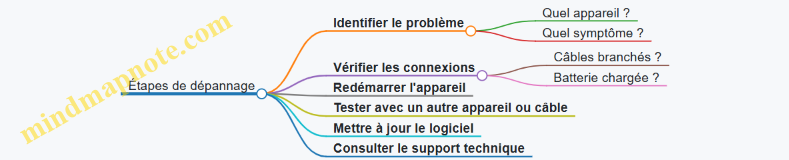
Examples of Troubleshooting Conversations
Example 1: Computer Won’t Turn On
- Vous : Bonjour, mon ordinateur ne s’allume pas.
- Support : Avez-vous vérifié que le câble d’alimentation est bien branché ?
- Vous : Oui, il est branché, mais toujours rien.
- Support : Essayez de maintenir le bouton d’alimentation enfoncé pendant 10 secondes.
Example 2: Slow Internet Connection
- Vous : La connexion Internet est très lente aujourd’hui.
- Collègue : Avez-vous essayé de redémarrer le routeur ?
- Vous : Pas encore, je vais le faire.
Example 3: Printer Not Working
- Vous : L’imprimante ne répond plus.
- Support : Est-elle allumée et connectée à l’ordinateur ?
- Vous : Oui, mais elle affiche un message d’erreur.
- Support : Quel est le message ?
- Vous : “Papier coincé”.
Practice Activity
Match the problem with the correct troubleshooting step:
| Problème | Étape de dépannage |
|---|---|
| L’écran est noir | Vérifier les connexions |
| Le logiciel plante | Mettre à jour le logiciel |
| Pas de son | Tester avec un autre appareil |
| L’imprimante affiche une erreur | Consulter le support technique |
Try to describe a technical problem you might face using the vocabulary and phrases above. Then, outline the steps you would take to solve it in French.
This section equips you with the vocabulary and phrases to clearly explain technical issues and follow logical steps to solve them. Practicing these will help you communicate efficiently when technology acts up during your travel or work.
10.4 Communicating via Email, Chat, and Video Calls
Effective communication in French across email, chat, and video calls requires understanding both vocabulary and common expressions suited to each medium. This section covers key phrases, structure, and etiquette for professional and casual contexts.
Mind Map: Communication Channels and Key Features
Email Communication
Emails in French often follow a formal structure, especially in work contexts. The tone depends on the recipient but tends to be polite and clear.
Key Vocabulary and Phrases:
- Objet (Subject)
- Cher/Chère (Dear) + title or name
- Je vous écris pour… (I am writing to…)
- Veuillez trouver ci-joint… (Please find attached…)
- Dans l’attente de votre réponse… (Looking forward to your reply…)
- Cordialement / Bien à vous (Regards)
Example Email:
Objet : Confirmation de la réunion du 15 mars
Cher Monsieur Dupont,
Je vous écris pour confirmer notre réunion prévue le 15 mars à 10h. Veuillez trouver ci-joint l’ordre du jour.
N’hésitez pas à me contacter si vous avez des questions.
Cordialement,
Marie Lefèvre
Practice Tip: Write a short email confirming an appointment or requesting information, using the above phrases.
Chat Communication
Chat messages tend to be shorter and more informal but still polite in professional settings. French chat often uses contractions and abbreviations, but clarity remains important.
Key Vocabulary and Phrases:
- Salut (Hi)
- Ça va ? (How are you?)
- Ok, d’accord (Okay)
- À tout à l’heure (See you later)
- Merci (Thanks)
- Peux-tu… ? / Tu peux… ? (Can you…?)
Example Chat Exchange:
Paul: Salut Sophie, tu peux m’envoyer le rapport ?
Sophie: Salut Paul, oui, je te l’envoie tout de suite.
Paul: Merci ! À plus.
Sophie: À plus.
Practice Tip: Simulate a chat conversation asking for a document or confirming a meeting.
Video Call Communication
Video calls combine spoken language with visual cues. Politeness and turn-taking are important, as is managing technical issues.
Key Vocabulary and Phrases:
- Bonjour à tous (Hello everyone)
- Est-ce que vous m’entendez ? (Can you hear me?)
- Je vous passe la parole à… (I’m giving the floor to…)
- Un instant, j’ai un problème technique. (One moment, I have a technical problem.)
- Merci pour votre présentation. (Thank you for your presentation.)
- Nous pouvons commencer? (Can we start?)
Example Dialogue:
Marie: Bonjour à tous, merci d’être là. Est-ce que vous m’entendez bien ?
Jean: Oui, très bien.
Marie: Parfait. Je vous passe la parole à Paul pour commencer.
Paul: Merci, Marie. Je vais présenter les résultats du trimestre.
Practice Tip: Practice introducing yourself and asking if others can hear you clearly.
Mind Map: Common Phrases by Medium
Tips for Clear Communication
- Be concise: Whether writing or speaking, keep messages clear and to the point.
- Match formality: Adjust your tone depending on the recipient and context.
- Confirm understanding: In video calls, check if others can hear or see you.
- Use polite expressions: They smooth interactions and show respect.
- Avoid slang in professional contexts: Keep language appropriate.
This section equips you with practical vocabulary and expressions to communicate effectively in French across email, chat, and video calls. Practice using these examples and mind maps to build confidence in real situations.
10.5 Practice Activity: Writing a Professional Email
Writing professional emails in French requires clarity, politeness, and the right vocabulary. This section guides you through the essential parts of a professional email, provides useful phrases, and offers practice examples.
Structure of a Professional Email
Here is a simple mind map outlining the key components of a professional email:
Key Phrases for Each Part
| Part | French Phrases (Examples) | English Equivalent |
|---|---|---|
| Subject Line | Objet : Demande de rendez-vous | Subject: Request for a meeting |
| Greeting | Madame, Monsieur, Bonjour, Cher Monsieur Dupont | Dear Sir/Madam, Hello, Dear Mr. Dupont |
| Opening Sentence | Je me permets de vous contacter concernant… | I am contacting you regarding… |
| Body - Purpose | Je vous écris pour… | I am writing to… |
| Body - Details | Afin de vous informer que…, Je souhaiterais vous préciser… | To inform you that…, I would like to specify… |
| Request/Action | Pourriez-vous me confirmer…, Serait-il possible de… | Could you confirm…, Would it be possible to… |
| Closing Sentence | Dans l’attente de votre réponse, je vous remercie par avance. | Looking forward to your reply, thank you in advance. |
| Polite Closing | Cordialement, Bien à vous, Sincères salutations | Best regards, Yours sincerely |
| Signature | Prénom Nom, Poste, Société | First Name Last Name, Position, Company |
Mind Map: Polite Closings
Example 1: Requesting a Meeting
Subject: Objet : Demande de rendez-vous
Email:
Madame Dupont,
Je me permets de vous contacter concernant l’organisation d’une réunion pour discuter du projet en cours. Je souhaiterais savoir si vous seriez disponible la semaine prochaine pour un rendez-vous.
Pourriez-vous me confirmer vos disponibilités ?
Dans l’attente de votre réponse, je vous remercie par avance.
Cordialement,
Jean Martin
Chef de projet
Société XYZ
Example 2: Following Up on a Previous Email
Subject: Objet : Suivi de ma demande
Email:
Monsieur Lefèvre,
Je vous écris pour faire suite à mon courriel envoyé la semaine dernière concernant la commande numéro 12345. Je souhaiterais savoir si vous avez pu examiner ma demande.
Je vous serais reconnaissant de bien vouloir me tenir informé.
Bien à vous,
Sophie Bernard
Assistante commerciale
Entreprise ABC
Practice Task
Write an email in French using the structure and phrases above. Choose one of the following scenarios:
- Request information about a training session.
- Confirm attendance at a business event.
- Apologize for a delayed response.
Use the mind maps to help organize your email. Focus on clear, polite language and proper structure.
Tips for Writing Professional Emails in French
- Always use formal greetings unless you know the recipient well.
- Keep sentences concise and to the point.
- Use “vous” form for politeness.
- Avoid slang or overly casual expressions.
- Double-check spelling and accents.
- End with a polite closing that matches the tone.
This practice will help you feel more confident writing emails in French for work or travel-related communication.
10.6 Practical Example: Reporting a Technical Problem at Work
When you encounter a technical problem at work, communicating it clearly in French helps resolve the issue faster. This section provides useful vocabulary, example sentences, and mind maps to organize your thoughts before reporting the problem.
Key Vocabulary
- Le problème technique – technical problem
- Le logiciel – software
- Le matériel / le hardware – hardware
- Le bug / le dysfonctionnement – bug / malfunction
- Le plantage – crash
- L’écran (m.) – screen
- Le clavier – keyboard
- La souris – mouse
- L’imprimante (f.) – printer
- Le réseau – network
- La connexion Internet – internet connection
- Le mot de passe – password
- Le message d’erreur – error message
- Redémarrer – to restart
- Mettre à jour – to update
- Le service informatique – IT department
Mind Map: Structuring Your Report
Example Sentences
-
Décrire le problème
- “Mon ordinateur ne répond plus depuis ce matin.”
- “Le logiciel de gestion plante dès que j’essaie d’ouvrir un fichier.”
- “Je reçois un message d’erreur indiquant ‘Connexion impossible’.”
-
Préciser la fréquence et le moment
- “Le problème est apparu hier après la mise à jour.”
- “Cela se produit plusieurs fois par jour, surtout en début d’après-midi.”
-
Expliquer les actions déjà faites
- “J’ai redémarré l’ordinateur, mais le problème persiste.”
- “J’ai vérifié que tous les câbles sont bien branchés.”
-
Exprimer l’impact
- “Je ne peux pas accéder à mes fichiers, ce qui retarde mon travail.”
- “Cela m’empêche d’envoyer des emails importants.”
-
Demander de l’aide
- “Pouvez-vous envoyer quelqu’un du service informatique ?”
- “Merci de me tenir informé dès que possible.”
Sample Dialogue
Employé : Bonjour, j’ai un problème avec mon ordinateur. Le logiciel de comptabilité plante à chaque fois que je tente d’ouvrir un rapport.
Support IT : Depuis quand cela se produit-il ?
Employé : Depuis ce matin, juste après la mise à jour automatique.
Support IT : Avez-vous essayé de redémarrer votre ordinateur ?
Employé : Oui, plusieurs fois, mais ça ne change rien.
Support IT : D’accord, je vais envoyer un technicien pour vérifier. Pouvez-vous rester disponible cet après-midi ?
Employé : Oui, merci beaucoup.
Tips for Clear Communication
- Start with a brief description of the problem.
- Include when and how often it happens.
- Mention any error messages exactly as they appear.
- List what you have already tried to fix it.
- Explain how it affects your work.
- Politely ask for assistance and suggest a preferred time if needed.
Using these steps will help your message be understood quickly and accurately, speeding up the resolution process.
Chapter 11: Practical Grammar and Vocabulary Integration
11.1 Using Verbs Common in Travel and Work Contexts
Verbs are the engines of communication, especially when traveling or working in a French-speaking environment. This section focuses on verbs frequently used in these contexts, providing clear examples and mind maps to organize them by function and usage.
Core Verbs for Travel and Work
Here is a mind map that groups essential verbs by their main functions:
-
Verbs of Movement
- aller (to go)
- venir (to come)
- partir (to leave)
- arriver (to arrive)
- retourner (to return)
-
Verbs of Communication
- parler (to speak)
- demander (to ask)
- répondre (to answer)
- expliquer (to explain)
- téléphoner (to call)
-
Verbs of Action
- travailler (to work)
- réserver (to book/reserve)
- acheter (to buy)
- payer (to pay)
- organiser (to organize)
-
Verbs of Perception and Understanding
- voir (to see)
- entendre (to hear)
- comprendre (to understand)
- savoir (to know [facts])
- connaître (to know [people, places])
-
Verbs of Assistance and Service
- aider (to help)
- chercher (to look for)
- trouver (to find)
- attendre (to wait)
- utiliser (to use)
Examples in Context
-
Aller (to go)
- Je vais à l’aéroport demain. (I am going to the airport tomorrow.)
- Nous allons travailler ensemble cette semaine. (We are going to work together this week.)
-
Réserver (to book/reserve)
- Elle a réservé une chambre d’hôtel pour trois nuits. (She booked a hotel room for three nights.)
- Pouvez-vous réserver une salle de réunion ? (Can you book a meeting room?)
-
Travailler (to work)
- Il travaille dans une agence de voyages. (He works in a travel agency.)
- Nous travaillons sur un projet important. (We are working on an important project.)
-
Demander (to ask)
- Je voudrais demander des informations sur les horaires. (I would like to ask for information about the schedules.)
- Elle demande où se trouve la salle de conférence. (She asks where the conference room is.)
-
Comprendre (to understand)
- Je ne comprends pas la question. (I don’t understand the question.)
- Comprenez-vous les instructions ? (Do you understand the instructions?)
Mind Map: Verbs by Tense Usage in Travel and Work
Practice Examples
-
Simple Present:
- Je travaille à Paris. (I work in Paris.)
- Tu réserves un billet d’avion. (You book a plane ticket.)
-
Passé Composé:
- Nous avons réservé une voiture de location. (We booked a rental car.)
- Elle a parlé avec le directeur. (She spoke with the manager.)
-
Future Simple:
- Ils arriveront à l’hôtel à 18 heures. (They will arrive at the hotel at 6 PM.)
- Je téléphonerai au bureau demain. (I will call the office tomorrow.)
-
Conditional:
- Pourriez-vous m’aider avec ce document ? (Could you help me with this document?)
- Je voudrais réserver une table pour deux. (I would like to book a table for two.)
Tips for Using These Verbs
- Many verbs are regular in -er (like travailler, réserver, organiser), which makes conjugation straightforward.
- Irregular verbs like aller, venir, and savoir require memorization but are very common.
- Politeness often involves the conditional tense, especially in work and travel requests.
- Practice combining verbs with common nouns (e.g., réserver une chambre, travailler sur un projet) to build useful phrases.
This section provides a solid foundation for using verbs effectively in travel and work situations. The mind maps help visualize categories, while examples show practical usage. Regular practice with these verbs will improve both comprehension and speaking confidence.
11.2 Prepositions of Place, Time, and Direction
Prepositions are small words that connect nouns, pronouns, or phrases to other parts of a sentence, often indicating relationships of place, time, or direction. In French, mastering these prepositions is essential for clear communication, especially when describing locations, scheduling, or giving directions.
Prepositions of Place
These prepositions describe where something or someone is located.
- à — at, in, to
- dans — inside, in
- sur — on
- sous — under
- devant — in front of
- derrière — behind
- entre — between
- près de — near
- loin de — far from
- au-dessus de — above
- au-dessous de — below
Mind Map: Prepositions of Place
Examples:
- Le café est à côté de la gare. (The café is next to the station.)
- Les clés sont dans mon sac. (The keys are in my bag.)
- Le livre est sur la table. (The book is on the table.)
- Le chat dort sous la chaise. (The cat sleeps under the chair.)
- La voiture est garée devant la maison. (The car is parked in front of the house.)
- Le jardin est derrière l’immeuble. (The garden is behind the building.)
- Le bureau est entre la salle de réunion et la cuisine. (The office is between the meeting room and the kitchen.)
- L’hôtel est près de la plage. (The hotel is near the beach.)
- La station de métro est loin de l’aéroport. (The subway station is far from the airport.)
- Le tableau est accroché au-dessus de la cheminée. (The painting is hung above the fireplace.)
- La cave est au-dessous de la maison. (The cellar is below the house.)
Prepositions of Time
These prepositions indicate when something happens.
- à — at (time)
- en — in (months, years, seasons)
- dans — in (future time)
- depuis — since, for (duration continuing into present)
- pendant — during
- pour — for (duration planned or expected)
- avant — before
- après — after
Mind Map: Prepositions of Time
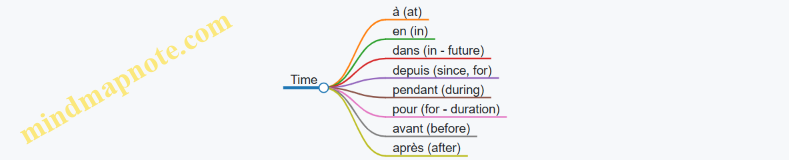
Examples:
- Le train part à 18 heures. (The train leaves at 6 p.m.)
- Nous partons en vacances en juillet. (We go on vacation in July.)
- Elle est née en 1990. (She was born in 1990.)
- Je commencerai le travail dans une heure. (I will start work in one hour.)
- Il travaille ici depuis cinq ans. (He has been working here for five years.)
- Nous avons visité Paris pendant le week-end. (We visited Paris during the weekend.)
- Je reste à Paris pour deux semaines. (I am staying in Paris for two weeks.)
- Il faut arriver avant midi. (You must arrive before noon.)
- Nous irons au restaurant après la réunion. (We will go to the restaurant after the meeting.)
Prepositions of Direction
These prepositions express movement toward a place or goal.
- à — to
- vers — towards
- jusqu’à — up to, until
- chez — to the home or place of someone
- dans — into
- par — through, by
Mind Map: Prepositions of Direction
Examples:
- Je vais à la gare. (I am going to the station.)
- Elle marche vers le parc. (She is walking towards the park.)
- Le bus va jusqu’à la frontière. (The bus goes up to the border.)
- Nous dînons chez Paul ce soir. (We are having dinner at Paul’s place tonight.)
- Il entre dans la salle de réunion. (He enters the meeting room.)
- Le colis passe par la douane. (The package goes through customs.)
Practice Examples
-
Fill in the blank with the correct preposition of place:
- Le bureau est ___ côté de la fenêtre. (Answer: à)
-
Choose the right preposition of time:
- Je commence le travail ___ lundi. (Answer: à or le, but commonly le lundi; for this workbook, focus on à for specific times, so better: Je commence le travail le lundi.)
-
Complete with a preposition of direction:
- Elle va ___ la bibliothèque. (Answer: à)
Understanding these prepositions and their contexts helps you describe locations, schedule events, and give clear directions. Practice using them in sentences related to your travel and work situations to build confidence and accuracy.
11.3 Forming Questions and Negations
Forming questions and negations is essential for clear communication in French, especially in travel and work contexts where you often need to ask for information or clarify misunderstandings. This section breaks down the main structures and provides practical examples.
Asking Questions in French
There are three common ways to form questions:
- Intonation (Rising pitch)
- Using “est-ce que”
- Inversion of subject and verb
Each has its place depending on formality and context.
Intonation
Simply raise your voice at the end of a statement to turn it into a question. This is informal and common in spoken French.
Example:
- Vous parlez anglais. (You speak English.)
- Vous parlez anglais? (Do you speak English?)
Using “est-ce que”
Place “est-ce que” at the start of a statement to form a question. This is neutral and works in most situations.
Structure:
Est-ce que + subject + verb + rest of sentence?
Example:
- Est-ce que vous travaillez ici? (Do you work here?)
Inversion
Invert the subject and verb for a more formal or written style.
Structure:
Verb-subject + rest of sentence?
If the verb ends with a vowel and the subject starts with a vowel, insert a “-t-” for pronunciation.
Example:
- Travaillez-vous ici? (Do you work here?)
- Aime-t-il le café? (Does he like coffee?)
Mind Map: Question Formation
Question Words
Common interrogative words include:
- Qui (Who)
- Que / Qu’ (What)
- Où (Where)
- Quand (When)
- Pourquoi (Why)
- Comment (How)
- Combien (How much / How many)
They can be combined with the question forms above.
Examples:
- Où est la gare? (Where is the train station?)
- Pourquoi travaillez-vous tard? (Why do you work late?)
- Comment est-ce que je peux vous aider? (How can I help you?)
Mind Map: Question Words
Forming Negations
French negation typically surrounds the verb with two parts: ne (or n’ before a vowel) and a second negative word, most commonly pas.
Basic negation structure:
Subject + ne/n' + verb + pas + rest
Example:
- Je parle français. (I speak French.)
- Je ne parle pas français. (I do not speak French.)
In spoken French, the ne is often dropped, but it is important to learn the full form.
Other Negative Expressions
Besides pas, French uses other negative words:
- jamais (never)
- rien (nothing)
- plus (no more)
- personne (no one)
- aucun(e) (none)
Examples:
- Je ne mange jamais de viande. (I never eat meat.)
- Il n’y a rien ici. (There is nothing here.)
- Nous ne travaillons plus ici. (We no longer work here.)
Negation with Infinitives
When negating an infinitive, place ne pas before the infinitive verb.
Example:
- Je préfère ne pas voyager ce week-end. (I prefer not to travel this weekend.)
Mind Map: Negation
Combining Questions and Negations
Negation can be combined with questions in all three question forms.
Examples:
- Intonation: Vous ne travaillez pas ici? (You don’t work here?)
- Est-ce que: Est-ce que vous ne parlez pas anglais? (Don’t you speak English?)
- Inversion: Ne travaillez-vous pas demain? (Are you not working tomorrow?)
Practice Examples
- Turn the statement into a question using inversion:
- Elle arrive à 9h. → Arrive-t-elle à 9h?
- Negate the sentence:
- Nous comprenons la situation. → Nous ne comprenons pas la situation.
- Form a question with negation using “est-ce que”:
- Tu veux du café. → Est-ce que tu ne veux pas de café?
- Use a question word with negation:
- Il travaille aujourd’hui. → Pourquoi ne travaille-t-il pas aujourd’hui?
Mastering these structures will help you ask clear questions and express negation accurately, which is crucial for effective communication in both travel and work settings.
11.4 Connecting Ideas with Conjunctions
Conjunctions are the glue that holds sentences and ideas together. In French, they help you link words, phrases, and clauses smoothly, making your communication clearer and more natural. This section covers the most common conjunctions used in travel and work contexts, with examples and mind maps to illustrate their use.
Types of Conjunctions
-
Coordinating Conjunctions (Les conjonctions de coordination)
- They connect elements of equal grammatical rank: words, phrases, or clauses.
- Common ones: et (and), mais (but), ou (or), donc (therefore), car (because), ni (neither/nor), or (yet/however).
-
Subordinating Conjunctions (Les conjonctions de subordination)
- They introduce dependent clauses, showing cause, time, condition, etc.
- Common ones: parce que (because), quand (when), si (if), bien que (although), pendant que (while), avant que (before).
Mind Map: Coordinating Conjunctions
Mind Map: Subordinating Conjunctions
Coordinating Conjunctions in Use
-
et (and): Joins similar ideas.
- Je prends un taxi et un billet de train. (I’m taking a taxi and a train ticket.)
-
mais (but): Introduces a contrast.
- Je veux travailler, mais je dois voyager. (I want to work, but I have to travel.)
-
ou (or): Presents alternatives.
- Voulez-vous un café ou un thé? (Do you want coffee or tea?)
-
donc (therefore): Shows a conclusion.
- Le vol est annulé, donc je reste à l’hôtel. (The flight is canceled, therefore I’m staying at the hotel.)
-
car (because): Gives a reason (more formal than parce que).
- Je pars tôt, car j’ai une réunion. (I’m leaving early because I have a meeting.)
-
ni (neither/nor): Used to negate two elements.
- Je n’ai ni temps ni argent. (I have neither time nor money.)
-
or (yet/however): Introduces a contradiction or new information.
- Il travaille beaucoup, or il est souvent fatigué. (He works a lot, yet he is often tired.)
Subordinating Conjunctions in Use
-
parce que (because): Explains cause.
- Je reste à Paris parce que j’ai une conférence. (I’m staying in Paris because I have a conference.)
-
quand (when): Indicates time.
- Quand j’arrive, je t’appelle. (When I arrive, I’ll call you.)
-
si (if): Expresses condition.
- Si tu as besoin d’aide, demande-moi. (If you need help, ask me.)
-
bien que (although): Shows concession.
- Bien que fatigué, il travaille encore. (Although tired, he is still working.)
-
pendant que (while): Indicates simultaneous actions.
- Je travaille pendant que tu voyages. (I work while you travel.)
-
avant que (before): Indicates something happening prior to another.
- Je finis le rapport avant que tu arrives. (I finish the report before you arrive.)
Mind Map: Examples of Conjunctions in Sentences
Practice Activity
Try combining these ideas using conjunctions:
- I want to book a hotel room. I don’t have my passport.
- The meeting is at 10 a.m. I will prepare the presentation.
- You can take a taxi. You can walk to the office.
- I’m tired. I will finish the report.
Example answers:
- Je veux réserver une chambre d’hôtel, mais je n’ai pas mon passeport.
- La réunion est à 10 heures, donc je préparerai la présentation.
- Tu peux prendre un taxi ou marcher jusqu’au bureau.
- Je suis fatigué, mais je finirai le rapport.
Using conjunctions correctly will make your French sound more connected and natural, whether you’re discussing work plans or travel arrangements.
11.5 Practice Activity: Constructing Sentences Using New Vocabulary
This activity focuses on building sentences by combining vocabulary related to travel and work with basic grammar structures. The goal is to practice forming clear, simple sentences that you can use in everyday situations.
Mind Map 1: Sentence Components for Travel and Work
Example Sentences
- Je réserve une chambre pour demain.
- (I book a room for tomorrow.)
- Vous travaillez à l’hôtel aujourd’hui.
- (You work at the hotel today.)
- Il va à la réunion rapidement.
- (He goes to the meeting quickly.)
Mind Map 2: Common Verbs and Their Objects
Constructing Sentences Using Verb + Object
- Je demande des informations. (I ask for information.)
- Nous payons la facture. (We pay the invoice.)
- Elle réserve un billet. (She books a ticket.)
Mind Map 3: Adding Time and Place
Examples Combining Time and Place
- Je travaille au bureau aujourd’hui. (I work at the office today.)
- Ils vont à l’aéroport demain. (They go to the airport tomorrow.)
- Tu réserves une chambre à l’hôtel ce soir. (You book a room at the hotel this evening.)
Practice Steps
- Choose a subject from Mind Map 1.
- Pick a verb and an object from Mind Map 2.
- Add a time or place phrase from Mind Map 3.
- Construct a sentence.
- Translate it to English to check understanding.
Practice Examples
- Elle demande une facture à l’hôtel demain.
- Nous payons un billet à l’aéroport aujourd’hui.
- Je vais à la réunion ce soir.
Try creating five sentences using this method. Focus on clarity and accuracy rather than complexity. This approach helps you internalize vocabulary and sentence structure simultaneously.
Tips for Sentence Construction
- Start simple: Subject + Verb + Object.
- Gradually add time and place for more detail.
- Use verbs in the present tense to describe current or near-future actions.
- Repeat vocabulary in different combinations to reinforce learning.
This practice will help you confidently form sentences for common travel and work situations.
11.6 Practical Example: Describing Daily Routines at Work and Travel
Describing daily routines is a useful skill when communicating about your schedule, explaining your habits, or simply sharing information about your day. In both work and travel contexts, routines often involve a sequence of actions, locations, and time references. This section provides clear examples and mind maps to help you organize vocabulary and sentence structures effectively.
Mind Map: Daily Work Routine Vocabulary
Mind Map: Daily Travel Routine Vocabulary
Example Sentences: Describing a Typical Workday
- “Je me réveille à six heures du matin et je prends une douche avant de prendre mon petit déjeuner.”
- “Je pars au travail en voiture et j’arrive au bureau vers huit heures trente.”
- “Je commence la journée en répondant aux emails et en préparant la réunion de dix heures.”
- “À midi, je déjeune avec mes collègues à la cantine.”
- “L’après-midi, je travaille sur un projet important et je fais une pause café vers quinze heures.”
- “Je finis ma journée de travail à dix-sept heures et je rentre chez moi pour me détendre.”
Example Sentences: Describing a Typical Travel Day
- “Je me lève tôt pour prendre le petit déjeuner à l’hôtel avant de vérifier mon itinéraire.”
- “Je prends un taxi pour aller au centre-ville et je visite un musée célèbre.”
- “À midi, je déjeune dans un petit restaurant local et je goûte des spécialités françaises.”
- “L’après-midi, j’utilise le métro pour me rendre à un autre site touristique.”
- “Le soir, je dîne avec des collègues dans un restaurant et je prépare mes affaires pour la réunion du lendemain.”
Practice Tips
- Use time expressions like “le matin”, “à midi”, “l’après-midi”, and “le soir” to structure your description.
- Combine verbs with reflexive pronouns for daily habits (e.g., “se réveiller”, “se coucher”).
- Include connectors such as “puis” (then), “ensuite” (next), and “après” (after) to link actions smoothly.
- Practice forming negative sentences to describe what you do not do (e.g., “Je ne prends pas de café le matin.”).
By organizing your vocabulary and sentences around these routines, you can clearly communicate your daily activities in both professional and travel contexts. The mind maps help visualize the categories of actions, while the examples demonstrate natural phrasing and structure.
Chapter 12: Review and Consolidation Activities
12.1 Vocabulary Quizzes by Thematic Areas
This section offers targeted vocabulary quizzes organized by key themes from the workbook. Each quiz includes a mind map to visualize word groups and example sentences to clarify usage. The goal is to reinforce vocabulary retention through varied, context-rich practice.
Quiz 1: Transportation and Directions
Example Sentences:
- “Où est la station de métro la plus proche?” (Where is the nearest metro station?)
- “Le train part du quai numéro trois.” (The train leaves from platform number three.)
Quiz Sample Questions:
- What is the French word for “bus”?
- How do you say “turn left” in French?
- Translate: “I need a ticket to Paris.”
Quiz 2: Accommodation and Lodging
Example Sentences:
- “Je voudrais réserver une chambre pour deux nuits.” (I would like to book a room for two nights.)
- “La chambre est-elle équipée du Wi-Fi?” (Is the room equipped with Wi-Fi?)
Quiz Sample Questions:
- How do you say “reception” in French?
- Translate: “Is breakfast included?”
- What word means “noisy”?
Quiz 3: Dining and Food
Example Sentences:
- “Je voudrais le menu du jour, s’il vous plaît.” (I would like the daily special, please.)
- “Je suis allergique aux noix.” (I am allergic to nuts.)
Quiz Sample Questions:
- What is the French word for “waiter”?
- How do you say “I would like”?
- Translate: “Can I pay by card?”
Quiz 4: Workplace Vocabulary
Example Sentences:
- “Je dois programmer une réunion avec le client.” (I need to schedule a meeting with the client.)
- “Pouvez-vous envoyer le rapport avant la date limite?” (Can you send the report before the deadline?)
Quiz Sample Questions:
- How do you say “colleague” in French?
- Translate: “I will call the manager.”
- What is the French word for “deadline”?
Quiz 5: Health and Emergencies
Example Sentences:
- “J’ai mal à la tête depuis ce matin.” (I have had a headache since this morning.)
- “Appelez une ambulance, s’il vous plaît!” (Call an ambulance, please!)
Quiz Sample Questions:
- What is the French word for “pharmacy”?
- How do you say “I have a fever”?
- Translate: “Is there a doctor nearby?”
Each quiz encourages active recall and contextual understanding. The mind maps help organize vocabulary visually, making connections clearer. The examples show how words fit naturally into sentences, and the quiz questions test recognition and production. This approach balances memorization with practical use, supporting steady progress in French vocabulary for travel and work.
12.2 Role-Playing Scenarios Combining Travel and Work Vocabulary
Role-playing is a practical way to apply vocabulary in contexts that mirror real-life situations. This section provides scenarios where travel and work vocabulary intersect, helping you practice both sets of terms naturally.
Mind Map: Core Vocabulary Areas for Role-Playing
Scenario 1: Planning a Business Trip
Context: You are speaking with a travel agent to arrange your upcoming business trip.
Key Vocabulary:
- Réservation (reservation)
- Vol (flight)
- Hôtel (hotel)
- Itinéraire (itinerary)
- Réunion (meeting)
- Confirmation (confirmation)
Example Dialogue:
Vous: Bonjour, je voudrais réserver un vol pour Paris la semaine prochaine. J’ai aussi besoin d’un hôtel proche du centre-ville.
Agent: Bien sûr. Pour quelle date souhaitez-vous partir ?
Vous: Le lundi 10 juin, avec un retour le vendredi 14.
Agent: Très bien. Voulez-vous que je vous envoie l’itinéraire et la confirmation par email ?
Vous: Oui, s’il vous plaît. J’ai aussi une réunion prévue le mercredi matin, pourriez-vous choisir un hôtel près du quartier d’affaires ?
Agent: Absolument. Je vous envoie tout cela dans l’heure.
Practice Tip: Try substituting different cities, dates, or meeting details to personalize the dialogue.
Scenario 2: Checking In at a Hotel for Work
Context: You arrive at your hotel and need to check in for a business stay.
Key Vocabulary:
- Réception (reception)
- Réservation (reservation)
- Carte d’identité (ID card)
- Clé (key)
- Petit-déjeuner (breakfast)
- Wifi (Wi-Fi)
Example Dialogue:
Vous: Bonjour, j’ai une réservation au nom de Dupont.
Réceptionniste: Bonjour, Monsieur Dupont. Puis-je voir votre carte d’identité, s’il vous plaît ?
Vous: Bien sûr. Voici ma carte.
Réceptionniste: Merci. Votre chambre est au troisième étage. Le petit-déjeuner est servi de 7h à 10h. Le wifi est gratuit.
Vous: Parfait, merci. Y a-t-il une salle pour les réunions ?
Réceptionniste: Oui, au rez-de-chaussée. Je peux vous fournir les horaires.
Practice Tip: Practice asking about amenities or services relevant to your work needs.
Scenario 3: Asking for Directions to a Meeting Location
Context: You are in a new city and need to find the office where your meeting is scheduled.
Key Vocabulary:
- Bureau (office)
- Rue (street)
- Tourner (to turn)
- Continuer (to continue)
- Intersection (intersection)
- À gauche / à droite (left / right)
Example Dialogue:
Vous: Excusez-moi, pourriez-vous m’indiquer comment aller au bureau de la société Martin ?
Passant: Bien sûr. Continuez tout droit sur cette rue, puis tournez à gauche au deuxième feu.
Vous: Merci. Est-ce loin d’ici ?
Passant: Non, c’est à environ cinq minutes à pied.
Practice Tip: Use this structure to ask for directions to various places like restaurants, hotels, or conference centers.
Scenario 4: Handling a Flight Delay Professionally
Context: Your flight is delayed, and you need to inform your colleagues and adjust your schedule.
Key Vocabulary:
- Retard (delay)
- Vol (flight)
- Reporté (postponed)
- Réunion (meeting)
- Informer (to inform)
- Reprogrammer (to reschedule)
Example Dialogue:
Vous (email): Bonjour, je vous informe que mon vol est retardé de deux heures. La réunion prévue à 15h devra être reprogrammée.
Collègue: Merci pour l’information. Nous allons prévenir les autres participants.
Practice Tip: Write or role-play similar messages to communicate changes clearly and politely.
Scenario 5: Networking at a Business Dinner Abroad
Context: You attend a dinner with international colleagues and want to introduce yourself and ask about their work.
Key Vocabulary:
- Présentation (introduction)
- Travail (work)
- Projet (project)
- Collaboration (collaboration)
- Intérêt (interest)
Example Dialogue:
Vous: Bonjour, je m’appelle Claire. Je travaille dans le marketing.
Collègue: Enchanté, Claire. Je suis Jean, responsable des ventes.
Vous: Quels projets menez-vous actuellement ?
Collègue: Nous développons une nouvelle stratégie pour le marché européen.
Vous: Intéressant. J’aimerais beaucoup collaborer sur ce sujet.
Practice Tip: Prepare questions and responses to keep conversations flowing naturally.
These scenarios combine travel and work vocabulary in practical, everyday contexts. Role-playing them helps internalize phrases and vocabulary, making real interactions smoother and more confident.
12.3 Listening and Reading Comprehension Exercises
This section focuses on strengthening your ability to understand spoken and written French in practical travel and work contexts. Comprehension is key to effective communication, and practicing with realistic examples will help you recognize vocabulary and sentence structures in use.
Listening Comprehension
Listening exercises here simulate common situations you might encounter. Each exercise includes a short audio script (written here for practice), followed by questions to test understanding.
Exercise 1: At the Train Station Announcement
Audio Script: “Mesdames et messieurs, le train à destination de Lyon partira de la voie 3 dans dix minutes. Veuillez vous présenter à bord rapidement. Merci.”
Questions:
- Where is the train going?
- From which platform does it depart?
- How much time do passengers have before departure?
Exercise 2: Booking a Hotel Room Over the Phone
Audio Script:
“Bonjour, je voudrais réserver une chambre pour deux nuits, du 12 au 14 juin, s’il vous plaît. Avez-vous une chambre avec vue sur la mer?”
Questions:
- What dates is the caller requesting?
- How many nights will they stay?
- What specific room feature do they want?
Exercise 3: Workplace Meeting Reminder
Audio Script:
“N’oubliez pas la réunion demain à 14 heures dans la salle B. Nous discuterons du nouveau projet et des échéances.”
Questions:
- When is the meeting scheduled?
- Where will it take place?
- What topics will be discussed?
Reading Comprehension
Reading exercises present short texts or dialogues followed by questions. These texts use vocabulary and structures relevant to travel and work.
Exercise 1: Email from a Colleague
Text:
“Bonjour Claire,
Je vous écris pour confirmer notre rendez-vous jeudi à 10 heures. Nous parlerons des résultats du dernier trimestre. Merci de me prévenir si vous avez un empêchement.
Cordialement,
Marc”
Questions:
- Who is the sender?
- What is the purpose of the email?
- What should Claire do if she cannot attend?
Exercise 2: Hotel Description on a Website
Text:
“L’Hôtel du Parc offre des chambres confortables avec Wi-Fi gratuit, petit déjeuner inclus, et un accès facile au centre-ville. Le personnel est disponible 24h/24 pour répondre à vos besoins.”
Questions:
- What amenities does the hotel provide?
- Is breakfast included?
- How accessible is the hotel to the city center?
Exercise 3: Short Dialogue at a Restaurant
Text:
“Client: Je voudrais le plat du jour, s’il vous plaît.
Serveur: Très bien. Et comme boisson?
Client: Un verre d’eau, merci.”
Questions:
- What did the client order?
- What drink did the client choose?
Mind Maps for Comprehension Strategies
Mind maps help organize ideas and vocabulary to improve understanding. Here are two examples relevant to this section.
Mind Map 1: Key Vocabulary for Travel Announcements
Mind Map 2: Workplace Meeting Vocabulary
Tips for Effective Comprehension Practice
- Listen or read multiple times to catch different details.
- Note unfamiliar words and look up their meanings.
- Try to summarize the main idea in your own words.
- Use context clues to infer meanings when vocabulary is unknown.
- Practice answering questions without translating word-for-word.
By regularly practicing with these exercises and mind maps, you will build confidence in understanding French in everyday travel and work situations.
12.4 Writing Practice: Emails, Messages, and Notes
Effective written communication is essential in both travel and work settings. This section focuses on practical writing skills for emails, messages, and notes, emphasizing clarity, politeness, and appropriate vocabulary.
Key Components of Written Communication
- Greeting: Sets the tone and addresses the recipient appropriately.
- Purpose: Clearly states the reason for writing.
- Details: Provides necessary information in a concise manner.
- Closing: Ends politely with a call to action or well wishes.
Mind Map: Structure of a Formal Email
Mind Map: Informal Message Structure
Examples and Practice
Example 1: Formal Email for a Hotel Booking Inquiry
Subject: Demande de renseignements pour une réservation
Bonjour Madame,
Je souhaite réserver une chambre pour deux personnes du 10 au 15 juillet. Pourriez-vous me confirmer la disponibilité et les tarifs, s’il vous plaît ?
Je vous remercie par avance pour votre réponse.
Cordialement,
Jean Dupont
Example 2: Informal Message to a Colleague
Salut Claire,
Peux-tu me dire si la réunion de demain est toujours prévue à 14h ?
Merci !
À plus,
Marc
Example 3: Short Note Left for a Host
Bonjour,
Merci pour votre accueil. Je suis parti ce matin à 8h pour prendre mon train.
Bonne journée,
Sophie
Practice Activity
Write a short email to your workplace manager to request a day off. Use a formal tone, include the reason briefly, and end politely.
Hints:
- Start with a polite greeting.
- State the date and reason.
- Thank the manager for considering your request.
- Use a formal closing.
Vocabulary Tips
- Use “Je vous prie de…” to politely ask.
- Use “Dans l’attente de votre réponse” to express anticipation.
- Use “Cordialement” or “Bien à vous” for formal closings.
- For informal notes, simple phrases like “Merci”, “À bientôt”, or “Salut” work well.
Common Phrases for Writing
| French Phrase | English Translation | Usage Example |
|---|---|---|
| Je me permets de vous écrire | I am writing to you | Je me permets de vous écrire au sujet de… |
| Pourriez-vous me confirmer… | Could you confirm for me… | Pourriez-vous me confirmer la date ? |
| Je vous remercie par avance | Thank you in advance | Je vous remercie par avance pour votre aide. |
| Dans l’attente de votre réponse | Looking forward to your reply | Dans l’attente de votre réponse, cordialement. |
| Cordialement | Sincerely | Cordialement, Jean Dupont |
This section encourages you to practice writing in realistic contexts, balancing formality and clarity. Writing well-crafted emails, messages, and notes will make your communication smoother whether you are traveling or working in a French-speaking environment.
12.5 Practice Activity: Simulated Travel and Work Situations
This activity combines vocabulary and phrases from travel and work contexts into realistic scenarios. The goal is to practice switching between different settings smoothly and using appropriate language for each. Below are detailed mind maps and examples to guide your practice.
Mind Map 1: Travel Situation – At the Airport
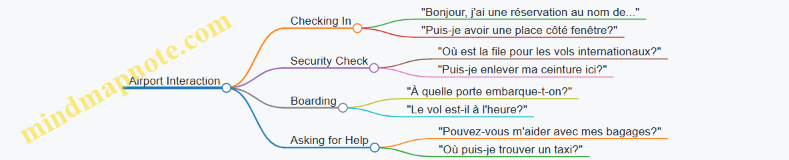
Example Dialogue:
- Passenger: “Bonjour, j’ai une réservation au nom de Dupont.”
- Agent: “Bonjour, Monsieur Dupont. Votre vol part à 14h30. Préférez-vous une place côté couloir ou fenêtre?”
- Passenger: “Fenêtre, s’il vous plaît.”
- Agent: “Très bien. Voici votre carte d’embarquement.”
Mind Map 2: Work Situation – Scheduling a Meeting
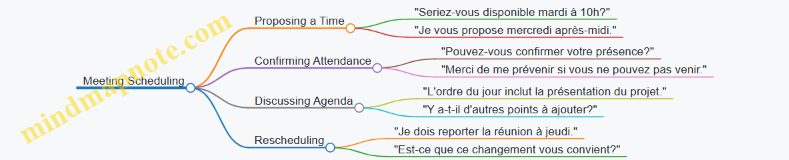
Example Dialogue:
- Employee: “Bonjour, seriez-vous disponible mardi à 10h pour une réunion?”
- Manager: “Mardi matin, je suis pris. Que diriez-vous de mercredi après-midi?”
- Employee: “Parfait. Je vous envoie une invitation.”
Mind Map 3: Combined Scenario – Business Trip
Example Dialogue:
-
Employee: “Bonjour, je voudrais réserver un vol pour Paris le 10 mai.”
-
Travel Agent: “Très bien. Préférez-vous un vol direct ou avec escale?”
-
Employee: “Direct, s’il vous plaît.”
-
Later at the hotel:
-
Employee: “Bonjour, ma réservation est au nom de Martin. La chambre a-t-elle le wifi?”
-
Receptionist: “Oui, le wifi est gratuit dans tout l’hôtel.”
-
At work:
-
Employee: “Pouvez-vous m’aider à imprimer ces documents pour la réunion?”
-
Colleague: “Bien sûr, je m’en occupe.”
Practice Instructions
-
Role-play: Partner up or record yourself acting out these dialogues. Switch roles to practice both asking and responding.
-
Vocabulary Recall: Use the mind maps to create your own sentences or questions related to each situation.
-
Mix and Match: Combine elements from different mind maps to create new scenarios, such as asking for directions to a meeting location after arriving at the airport.
-
Write and Speak: Write short paragraphs describing your own travel or work experiences using the vocabulary and then read them aloud.
-
Self-Check: After practicing, try to summarize the key phrases and vocabulary without looking at the mind maps.
This activity encourages flexible use of vocabulary and phrases in realistic contexts, helping you feel more confident navigating both travel and work situations in French.
12.6 Practical Example: Self-Assessment and Progress Tracking
Self-assessment is a key step in mastering French vocabulary for travel and work. It helps you identify what you know well and what needs more practice. Progress tracking keeps your learning organized and motivates steady improvement. This section offers practical tools and examples to help you evaluate your vocabulary skills effectively.
Self-Assessment Mind Map
Self-Assessment Mind Map
This mind map breaks down the areas to evaluate. For example, recognizing a word on a list is different from using it fluently in conversation. Tracking each area separately gives a clearer picture of your strengths and weaknesses.
Progress Tracking Mind Map
Progress Tracking Mind Map
This mind map helps organize your learning over time. For instance, you might track how many new travel-related words you learn each week or how your confidence improves in work-related conversations.
Example Self-Assessment Checklist
| Skill Area | Can Do Confidently | Needs Practice | Notes |
|---|---|---|---|
| Recognize travel words (e.g., “billet”, “gare”) | ✅ | Familiar with ticket and station terms | |
| Use workplace vocabulary in sentences | ✅ | Need to practice job titles and verbs | |
| Understand directions when spoken | ✅ | Can follow simple directions well | |
| Write short emails using learned vocabulary | ✅ | Struggle with formal phrases | |
| Pronounce common phrases correctly | ✅ | Pronunciation improving |
Use this checklist regularly. Update the “Notes” column with specific examples or difficulties you encounter.
Sample Progress Log Entry
Date: 2024-06-15
Focus Area: Ordering food at a restaurant
New Words Learned: “la carte” (menu), “l’addition” (bill), “sans gluten” (gluten-free)
Practice Activity: Role-play ordering a meal with a partner
Self-Assessment: Felt confident asking about ingredients but hesitated when requesting the bill.
Next Steps: Practice polite phrases for requesting the bill and thanking the server.
Tips for Effective Self-Assessment and Tracking
- Be honest but kind to yourself. Not knowing a word is part of learning.
- Use specific examples when noting difficulties; vague comments don’t help.
- Set small, measurable goals, like learning five new words a week.
- Review your progress weekly to adjust your study plan.
- Combine self-assessment with real practice, such as speaking with native speakers or writing emails.
By regularly assessing your vocabulary skills and tracking your progress, you create a clear path forward. This approach helps you focus on areas that need attention and reinforces what you already know, making your French learning for travel and work more effective and manageable.