Humor and Persuasion Foundations
1. Humor, Persuasion, and Communication Goals
1.1 Defining Humor in Communication: What Counts and What Doesn’t
Humor in communication is not “anything funny.” It is a deliberate way of creating a moment of shared recognition that changes how people pay attention to what comes next. In persuasion, that “what comes next” matters more than the laugh itself. A useful definition is: humor is a controlled mismatch between expectation and meaning, delivered in a way that the audience can safely interpret.
What Counts as Humor
1) Shared recognition
Humor works when the audience can see the same twist you see. If only you understand the reference, it becomes a private joke, not communication.
Example: “Our onboarding is so thorough it includes a welcome packet, a calendar invite, and a second invite to the first invite.” Most listeners recognize the pattern of over-scheduling.
2) Expectation meets meaning
A joke usually has a setup that creates a prediction, followed by a payoff that reframes the prediction. The payoff can be small and still effective.
Example: “I promised I’d keep this short. I’m starting with the short version of the long version.” The humor comes from the mismatch between “short” and what follows.
3) Safety and respect
Humor can be sharp, but it should not require the audience to feel humiliated to get the point. When people feel targeted, they stop processing the message.
Example: “Our process has two speeds: ‘works on my machine’ and ‘works after we restart everything.’” The target is the system, not a person.
4) Purposeful timing
Humor counts when it supports the communication goal: clarifying, reducing tension, or making a key idea easier to remember.
Example: “If you only remember one thing today, let it be this: the numbers are consistent, even when the labels change.” The humor is light, and the message remains clear.
What Doesn’t Count as Humor
1) Random quips
A sentence that merely sounds playful without a recognizable twist is not humor; it’s decoration.
Less effective example: “Anyway, that’s pretty cool.” Without a setup-payoff relationship, there is no shared mismatch.
2) Confusing wordplay
Wordplay that the audience cannot decode quickly is not “clever,” it is friction. Humor should reduce cognitive load, not add it.
Less effective example: a dense pun that requires background knowledge the audience doesn’t have.
3) Punchlines that replace the message
If the joke becomes the main event, the persuasive content gets crowded out.
Less effective example: a long story whose only takeaway is the story itself, with no clear claim or next step.
4) Humor that asks the audience to do emotional labor
If the audience must manage discomfort, the message competes with self-protection.
Less effective example: mocking a group’s accent, disability, or financial situation to “make a point.” Even if some people laugh, the cost is usually trust.
Mind Map: Humor Criteria for Communication
A Practical Test You Can Run
Before you use a line, ask three questions in order:
- Could the audience predict the setup and then recognize the twist? If not, it likely won’t land.
- What is the target of the humor? If it’s a vulnerable person or a group identity, it usually fails the safety test.
- What does the audience do next because of the humor? If nothing changes, the humor is probably decorative.
Micro-Examples That Show the Difference
- Counts: “Our meeting agenda has three items: the agenda, the time, and the reason the agenda is late.” Target is the process; the twist is immediate.
- Doesn’t count: “Our meeting is late. Ha.” No setup, no payoff, no shared recognition.
- Counts: “I’m not saying the spreadsheet is haunted. I’m saying it updates itself when nobody is watching.” Target is the tool; the message can still be about data accuracy.
- Doesn’t count: “You’re so disorganized.” The humor is actually an insult, and the audience will focus on defense, not the point.
Humor that counts is structured, interpretable, and connected to the communication goal. Humor that doesn’t count is either unstructured, unsafe, or disconnected from what the audience needs to understand or remember.
1.2 Persuasion Outcomes: Attention, Comprehension, Acceptance, and Recall
Persuasion is not one switch. It is a chain of outcomes that happen in order, and each link has its own failure modes. If you aim for humor, you still need the chain to hold: attention must be earned, comprehension must be supported, acceptance must be justified, and recall must be designed.
Attention
Attention is the moment your audience decides, consciously or not, to keep processing. Humor helps when it creates a short mismatch that the brain resolves quickly. The key is that the resolution should point back to your message, not away from it.
A simple example: you’re explaining a policy change. Instead of starting with a dry list, you open with a one-line contrast: “We used to approve requests by email. Now we approve them by form. Yes, the form is the boss.” The joke is small, but it signals a shift in process. Then you immediately state the practical takeaway: “Here’s what you need to submit and when.”
What to watch for: if people laugh but then ask, “Wait, what are we deciding?” you got attention without direction. Fix by tying the punchline to the first concrete claim.
Comprehension
Comprehension is understanding the structure of the idea, not just hearing it. Humor can reduce comprehension when it adds extra interpretation steps. Your goal is to make the message easier to parse, using humor as a framing device.
Use humor to clarify relationships. Example: “Think of the budget like a grocery cart. You can’t buy everything, but you can still make smart choices within the limit.” Then you explain the three categories and what counts as “in the cart.” The analogy gives a mental model, and the humor makes the model feel familiar.
A practical check: after your explanation, can someone restate the claim in their own words without repeating your joke? If not, the joke may be consuming working memory.
Acceptance
Acceptance is the audience’s willingness to agree or act. It depends on reasons, credibility, and perceived fairness. Humor can lower resistance by making the speaker feel human and the topic feel less threatening, but it cannot replace justification.
Example: you want buy-in for a new workflow. A safe humor move is to acknowledge friction without blaming: “This new step feels like extra paperwork. That’s because it is. The point is fewer mistakes later.” Then you provide one reason that matters to them: “Fewer mistakes means fewer rework cycles.”
Acceptance also requires that the humor does not target the audience’s identity or competence. If the joke implies “you should have known better,” you may get a laugh and still lose trust.
Recall
Recall is what survives after the meeting ends. Humor can act as a retrieval cue because it creates distinctive encoding. But recall improves when the humorous element is paired with a repeatable phrase or a memorable structure.
A reliable method is to attach humor to a rule. Example: “Rule one: if it’s not written down, it didn’t happen. Rule two: if it’s written down, it can be found. That’s the whole system—no magic, just receipts.” The humor is brief, and the “rule” format makes the message easy to retrieve.
To test recall, ask for a one-sentence summary from the audience after a short delay. If they remember the joke but not the rule, you need a tighter link between punchline and takeaway.
Mind Map: Persuasion Outcomes Chain
Integrated Example: One Message, Four Outcomes
Imagine you’re presenting a safety guideline.
- Attention: “Today’s rule is simple: if you can’t explain the setup, you can’t run the test.”
- Comprehension: “The setup is like a recipe. If you skip steps, you don’t get the result you expect.”
- Acceptance: “We’re doing this to prevent rework and reduce incidents. It’s not about blame; it’s about consistency.”
- Recall: “Remember the recipe rule: explain the setup, then run the test.”
Each step uses humor differently: as a hook, as a model, as a tone-setter, and as a retrieval cue. When you design for all four outcomes, humor becomes a tool for clarity rather than a distraction from it.
1.3 Mechanisms of Influence: How Laughter Can Support or Undermine Messages
Laughter influences persuasion through several mechanisms that work at different stages: before people process your message, while they process it, and after they remember it. The same laugh can help or hurt depending on which mechanism dominates.
Mind Map: Influence Mechanisms for Humor
Stage 1: Entry and Attention
Humor often improves the odds that people stay with you long enough to process the message. A well-timed joke creates novelty, which interrupts automatic scanning. For example, in a meeting where everyone expects a dry status update, starting with a brief, relevant quip—“If this slide looks familiar, it’s because last month’s problems are still on the calendar”—signals that something different is coming.
Laughter can also act as a safety signal. When the room laughs at a mild, non-threatening observation, listeners infer that the speaker is not hostile. That inference matters because people resist messages more strongly when they expect conflict. However, safety is conditional: if the humor feels like mockery, the safety signal flips into threat.
Finally, laughter can create social alignment. When people share a reaction, they feel part of the same group, which increases openness. A simple example is a presenter acknowledging a common inconvenience—“Yes, the printer is still doing its dramatic pauses”—which invites agreement before the presenter asks for cooperation.
Stage 2: Processing and Judgment
Once attention is secured, humor changes how people process information. One mechanism is cognitive easing: mild amusement reduces perceived effort, making it easier to follow a complex explanation. For instance, when explaining a policy with many steps, you can frame the sequence as a “choose-your-own-adventure” path, then immediately list the steps clearly. The humor lowers friction; the structure carries the meaning.
Another mechanism is incongruity resolution. Many jokes work by presenting a mismatch and then resolving it. That resolution can train the listener to accept your intended interpretation. Example: “We’re not cutting corners; we’re cutting the parts that don’t hold weight.” The mismatch between “cutting” and “quality” is resolved by the follow-up definition.
But humor can also trigger heuristic shortcuts. If listeners treat the joke as the main event, they may infer that the message is less serious or less precise. Consider a compliance briefing where the speaker jokes about “rules being suggestions.” Even if the intent is to be friendly, the audience may downgrade the importance of the actual requirements.
Credibility is the hinge. Humor can increase perceived competence when it demonstrates accurate observation and control. It undermines credibility when it signals carelessness or when the punchline contradicts the evidence. A useful test is to ask whether the joke would still make sense if the listener focused only on the facts. If the joke depends on ignoring facts, it will likely weaken judgment.
Stage 3: Memory and Action
Humor can improve retention by adding encoding cues. A memorable line gives the brain a handle to grab later. For example, a training session might include: “If you can’t explain it in one breath, you can’t defend it in ten minutes.” Even if the audience forgets the full training content, they may remember the “one breath” rule.
Emotional tagging also matters. Laughter attaches a feeling to the surrounding information, which can strengthen recall. That effect is helpful when the emotion supports the message, and harmful when it attaches to the wrong target. If the room laughs at the wrong part—say, the speaker’s complaint rather than the proposed solution—later recall will favor the complaint.
Humor can reduce resistance when it lowers defensiveness. A respectful joke about a shared obstacle can make disagreement feel safer. Example: “We all want faster results; the trick is choosing which shortcut doesn’t create rework.” The humor acknowledges tension while steering toward a practical principle.
Failure Modes and How They Undermine Messages
Misfit with audience norms is the most common failure. A joke that works with colleagues may land poorly with clients if it violates expectations about professionalism or power distance.
Punchlines can steal focus. If the joke is longer than the explanation, listeners remember the punchline but not the claim. Keep the joke brief and ensure the next sentence restates the point in plain terms.
Targeting is another risk. Humor aimed at a person or group can create contempt, which increases resistance and reduces trust. Even when the audience laughs, the laughter may be social rather than persuasive.
Ambiguity after the joke undermines clarity. If the audience cannot tell what you want them to do or believe, the humor becomes noise. A reliable pattern is: joke, then immediate interpretation, then the actionable takeaway.
Example: Supportive vs Undermining Humor
Supportive version: “Our goal is fewer escalations. If every issue becomes a fire drill, we’re not solving problems—we’re scheduling them.” Then the speaker lists the three prevention steps.
Undermining version: “Escalations are just how the system shows it’s alive.” The audience may laugh, but they also learn that escalations are acceptable, which conflicts with the intended message.
Laughter is not a substitute for reasoning. It is a tool that changes attention, processing, and memory. When the humor is brief, relevant, respectful, and followed by clear interpretation, it supports persuasion. When it shifts focus, weakens credibility, or targets the wrong thing, it undermines the message.
1.4 Mapping Your Audience and Context Before You Write a Joke
Before you write a joke, map the situation like you would map a route: you need the starting point, the destination, and the obstacles. Humor is not just decoration; it changes how people process your message. A joke that lands with one group can distract or offend another, even when the underlying point is correct.
Identify the Audience’s Job to Be Done
Ask what the audience is trying to accomplish in that moment. Are they deciding, learning, negotiating, or venting? A joke that helps someone learn should reduce confusion, not introduce it.
Example: In a team meeting, if the audience’s job is to choose a plan, a joke about “mystery spreadsheets” can make the problem feel approachable. If the audience’s job is to report progress to leadership, the same joke might sound like you are avoiding accountability.
Determine Their Baseline Knowledge and Stakes
Humor depends on shared context. Estimate how much they already know and what they stand to lose.
- Low knowledge: Use humor that explains, not humor that assumes.
- High stakes: Avoid jokes that imply incompetence, risk, or disrespect.
Example: When explaining a new policy, a light line about “forms that multiply like rabbits” can work if it clearly points to the actual steps. If you joke about “ignoring the rules,” you risk signaling that the rules are optional.
Diagnose Their Emotional Temperature
People arrive with emotions that shape what they hear. Look for cues: meeting fatigue, recent conflict, time pressure, or skepticism.
A practical method is to classify the room into one of three modes:
- Tension mode: People are guarded and quick to interpret sarcasm.
- Boredom mode: People need novelty and clearer structure.
- Anxiety mode: People need reassurance and concrete next steps.
Example: In tension mode, a joke that targets a person’s mistake can escalate. In boredom mode, a joke that breaks monotony without blaming anyone can reset attention.
Choose the Humor’s Target and Direction
A joke needs a target. Decide whether the target is:
- The situation (safe)
- The speaker (often safe)
- A shared system (usually safe)
- A group or individual (riskier)
Rule of thumb: the more personal the target, the more you must earn the right to joke.
Example: “I promised I’d be brief, and then I remembered I’m me” is self-targeted and generally safer than “Some people don’t read the instructions.”
Map Context Constraints Before You Draft
Context includes time, setting, medium, and audience interaction.
- Time: Short windows favor quick setup and immediate relevance.
- Medium: Written humor needs clarity because tone can be misread.
- Interaction: If you will answer questions, leave room for follow-up rather than stacking multiple jokes.
Example: In a slide deck, a single caption joke near the key point can be effective. In a long email, multiple jokes can blur the main claim.
Build a Simple Audience-Context Matrix
Use a matrix to decide what kind of humor fits.
| Audience Need | Stakes | Best Humor Move | Avoid |
|---|---|---|---|
| Decide | Medium | Situation-based, concise | Inside jokes |
| Learn | Low | Explanatory, analogy-based | Sarcasm |
| Reassure | High | Self-aware, process-focused | Blame |
| Negotiate | Medium-High | Tension-reducing, respectful | Mocking opponents |
Example: If stakes are high and the audience needs reassurance, choose humor that reduces uncertainty: “The goal is simple; the steps are what get long.”
Mind Map Your Inputs and Outputs
Use this mind map to connect audience facts to humor choices.
Run a Quick Pre-Draft Test
Before writing the joke, answer three questions in plain language.
- What should the audience understand or feel after the joke? If you cannot state it, the joke will likely become a detour.
- What is the most likely misinterpretation? If the worst interpretation is disrespect, revise the target.
- Where does the joke sit in the message flow? Put it near the point it clarifies, not near a random transition.
Example: If your message is “We need a new process,” a joke should either explain why the old process fails or reduce fear about the change. A joke that only signals “this is annoying” may earn a laugh but weaken commitment.
Integrated Example from Mapping to Joke
Scenario: You are presenting a quarterly update to a mixed group. Some are new, time is tight, and there is mild frustration about delays.
Mapping decisions:
- Audience job: learn and align
- Stakes: medium
- Emotional temperature: mild tension
- Target: shared system
- Constraint: short time
Resulting joke direction: focus on the process, not on people.
Example line: “Our timeline didn’t slip because we forgot the plan; it slipped because the plan met reality and reality won a few rounds.”
This keeps the target on the situation, acknowledges frustration without blaming, and sets up the next part of the update with a calmer tone.
1.5 Establishing Ethical Boundaries for Humor Use
Humor is persuasive only when people feel safe enough to listen. Ethical boundaries help you keep the message intact while still using comic techniques to improve attention and retention. The goal is not to avoid humor; it is to control who bears the cost of the joke.
Core Ethical Principles
Start with three principles you can apply to any draft.
- Respect the audience’s dignity. A joke should not require someone else’s humiliation to land.
- Protect the vulnerable. If a group is more likely to be harmed by misunderstanding, your humor needs extra care.
- Stay truthful in intent. Humor can simplify, but it should not disguise misleading claims.
A practical test: after the punchline, would you still be comfortable explaining the underlying point to the person who might be most offended by the setup?
Identify Your Humor’s Target
Ethical humor depends on what you aim at. Targeting can be intentional or accidental.
- Target the situation. The problem, the process, or the mismatch between expectations and reality.
- Target the speaker’s fallibility. Your own error, limited knowledge, or learning curve.
- Avoid targeting identity. Traits like race, religion, disability, gender, or nationality should not become the basis for a punchline.
Example: “I tried to fix the spreadsheet with one formula. The spreadsheet responded by creating five new tabs.” This targets the situation, not a person.
Use Power-Aware Language
Power dynamics change how a joke lands. In a workplace, a teacher-student relationship, or a sales conversation, the speaker often has more influence than the listener.
- If you have authority, avoid jokes that could be read as permission to dismiss concerns.
- If you are a peer, still avoid humor that pressures someone to accept a framing they did not choose.
A quick check: if the audience member could reasonably feel they must laugh to avoid consequences, the humor is ethically risky.
Separate Humor from Harmful Content
Sometimes a line is funny but still ethically unacceptable because it smuggles in harmful ideas.
Use a two-layer review:
- Content layer: What does the joke say directly?
- Implication layer: What does it suggest about who deserves respect, credibility, or fairness?
Example: “We don’t need accessibility features; users will adapt.” Even if delivered lightly, the implication undermines fairness. Replace with a situation-based alternative: “Accessibility isn’t a ‘nice-to-have.’ It’s the difference between ‘works for some’ and ‘works for most.’”
Mind Map: Ethical Humor Boundaries
Build a Boundary-First Workflow
Ethics becomes easier when you draft with constraints.
- Write the message without humor. Define the claim, the reason, and the action.
- Add humor as a wrapper, not a substitute. The joke should point back to the message, not replace it.
- Run a boundary check on the setup. The setup often carries the risk; the payoff can be harmless even if the setup is not.
- Revise for clarity after the joke. If the punchline makes the audience unsure what you actually mean, you have created confusion rather than persuasion.
Example walkthrough: Suppose your message is “We need to reduce meeting time.” A risky version might mock “people who can’t focus.” A boundary-respecting version targets the process: “Our meetings keep expanding like they’re trying to win a growth contest. Let’s set a time box and end on decisions.”
Handle Mistakes Without Doubling Down
Ethical communication includes repair. If someone signals discomfort, treat it as data.
- Acknowledge the impact briefly.
- Re-state the intended message plainly.
- Adjust future drafts by changing the target or the wording.
Example response: “You’re right to flag that. The point I meant was about time boxes, not about anyone’s ability to focus. I’ll phrase it that way next time.”
Practical Boundary Examples You Can Reuse
- Allowed: “I thought I had a simple plan. Then the plan asked for a second plan.”
- Allowed: “I used the wrong metric once. Now I check the definition before I check the numbers.”
- Avoid: “People like you always…”
- Avoid: “That’s just how [identity group] is.”
Ethical boundaries keep humor from becoming a shortcut around respect. When you choose the right target, match the power dynamic, and keep the message truthful, the joke can do its job: improve attention and help the audience remember what matters.
2. The Psychology of Attention and Memory with Comic Inputs
2.1 Attention Capture: Novelty, Pattern Disruption, and Timing
Attention is not a switch you flip; it is a sequence of small permissions your audience grants. You earn those permissions by changing what they expect, when they expect it, and how quickly they can make sense of the change.
Novelty That Still Fits the Message
Novelty works when it is specific enough to feel new but familiar enough to be understood immediately. A generic “surprise” forces extra interpretation, which competes with your main point.
Start with a baseline expectation, then add a controlled twist. For example, if you are explaining a customer-support policy, you can open with a familiar scenario and then shift the angle:
- Baseline: “Most people think refunds are automatic.”
- Twist: “Refunds are automatic only when the request matches a pattern the system can verify.”
The novelty is not the topic; it is the framing. Your audience recognizes the domain and then notices a new rule.
A practical test: if the audience could guess the next sentence after your opener, you likely used too little novelty. If they cannot guess the next sentence at all, you likely used too much.
Pattern Disruption Without Confusion
People attend to patterns because patterns reduce effort. Pattern disruption captures attention by breaking a prediction, but you must repair the prediction fast.
Use a three-step structure:
- State the expected pattern.
- Break it with one clear mismatch.
- Reconnect it to your purpose with a simple explanation.
Example in a presentation about meeting deadlines:
- Expected pattern: “We miss deadlines because we run out of time.”
- Mismatch: “We miss deadlines because we treat the last week as the planning phase.”
- Reconnection: “Planning needs to happen before the work becomes urgent.”
Notice the mismatch is concrete (“last week as planning”), not abstract (“bad habits”). The repair is also concrete (“planning needs to happen before work becomes urgent”).
Pattern disruption can also be linguistic. If your audience expects formal phrasing, a short plain sentence can act like a speed bump that makes them pay attention. If your audience expects a long explanation, a brief contrast can do the same job.
Timing That Matches Human Rhythms
Timing is where novelty and disruption become usable. Even a good twist fails if it arrives too early, too late, or without a reason to care.
Think in three timing windows:
- Entry window: the first 10–20 seconds. Your goal is to establish relevance, not to prove expertise.
- Compression window: the moment you introduce a key idea. Your goal is to reduce the time between “I’m listening” and “I understand.”
- Reinforcement window: just before the audience might drift. Your goal is to refresh attention without changing the topic.
A simple timing rule: place your strongest novelty where the audience would otherwise go passive. In a talk, that is often after a definition or after a section transition. In writing, that is often at the start of a paragraph that would otherwise repeat earlier points.
Mind Map: Attention Capture Mechanics
Example: One Opener, Three Attention Strategies
Scenario: You want people to remember a three-step process for handling objections.
- Novelty opener: “Most objections are not problems; they are missing information.”
- Pattern disruption opener: “You were taught to argue back. Try asking first.”
- Timing opener: “Before you respond, pause for one question. Then use the three steps.”
Each opener changes attention, but the best choice depends on where your audience is in the moment. If they are skeptical, pattern disruption helps. If they are distracted, timing helps. If they are curious but unsure, novelty helps.
A Simple Practice Loop
Draft three versions of the same opening. Keep the message identical, but vary one factor at a time: novelty, disruption, or timing. Then check two things: whether the audience can predict the next sentence, and whether the key idea arrives quickly enough to be useful. If either fails, adjust the factor you changed rather than rewriting everything.
2.2 Cognitive Load and Clarity: Keeping Humor from Overloading Processing
Humor can reduce resistance, but it also consumes mental effort. Cognitive load is the total “work” your audience must do to understand and remember what you say. If the humor adds extra work without paying it back in clarity, the message becomes harder to process and recall.
The Core Idea: Humor Adds Processing Steps
Most persuasive messages already require several steps: interpret the claim, evaluate reasons, connect evidence, and track the call to action. Humor inserts additional steps such as noticing the setup, holding an expectation, and resolving the punchline. When those steps are too demanding, attention shifts from the argument to the joke.
A simple test is to ask: “If someone misses the humor, do they still get the point?” If the answer is no, the humor is doing more than entertaining; it is acting as a gate. Gates increase cognitive load.
Types of Load and What Humor Does to Each
- Intrinsic load comes from the complexity of the topic itself. Humor cannot remove intrinsic load, but it can help by simplifying structure.
- Extraneous load comes from avoidable confusion: unclear wording, tangled sentences, or mismatched tone. Humor often increases extraneous load when it is inserted abruptly or explained too long.
- Germane load is the effort that supports learning: organizing ideas and building mental models. Well-placed humor can increase germane load by creating a memorable contrast or a simple mental picture.
The goal is not “less load.” The goal is to shift effort away from confusion and toward understanding.
Clarity First: Design the Sentence So the Point Survives
Clarity is a structural property. Before adding humor, write the message as if you were being perfectly plain. Then add humor only where it can be processed without breaking the argument.
Use these clarity rules:
- One idea per sentence. If a sentence contains both the argument and the joke mechanism, readers must do two jobs at once.
- Predictable placement. Put the punchline at the end of a short unit so the audience knows when to stop processing.
- Shared referents. Use familiar objects, roles, or routines. Humor that depends on obscure context forces extra interpretation.
Example: Instead of “Our plan is solid, and also the spreadsheet is basically a therapist,” say “Our plan is solid. The spreadsheet is the therapist: it listens, then shows the numbers.” The second version keeps the claim intact while still using a light metaphor.
Timing and Density: Keep the Audience from Catching Up
Cognitive load spikes when the audience must re-read or mentally rewind. Humor increases the chance of rewind if it is too dense or too frequent.
A practical approach is to treat humor like seasoning:
- Use humor at transitions (moving from one section to the next) rather than inside the middle of a complex explanation.
- Keep humor short and self-contained. If the joke requires a multi-step setup, it should replace a chunk of explanation, not sit on top of it.
- Limit humor per unit. If you have three key reasons, consider one humor beat that reinforces the overall pattern rather than three separate jokes.
The “Meaning Resolution” Check
A punchline should resolve a specific expectation. If it resolves something unrelated to the message, the audience spends effort on the wrong target.
Use this check:
- Setup: What expectation are you creating?
- Resolution: What does the punchline clarify?
- Message link: How does that clarification map to the claim or reason?
If the link is weak, rewrite the setup so the humor points to the argument.
Humor and Clarity Mind Map
Mind Map: Humor Without Overload
Example: Revising a Dense Explanation
Original (high extraneous load): “We should adopt the policy because it reduces risk, and honestly the risk is like a cat: it always lands on its feet, so we can’t ignore it, but the policy makes it behave.”
Issues: multiple metaphors, unclear mapping, and the humor competes with the causal explanation.
Revised (lower extraneous load): “Adopt the policy because it reduces risk. Think of risk like a cat: it lands on its feet unless you change the environment. This policy changes the environment, so the risk has fewer ways to show up.”
The humor now supports the causal chain. The audience can follow the reasoning without decoding a separate joke.
Practical Micro-Edits That Reduce Load
- Replace “also” and “honestly” with direct connectors like “because” and “so.”
- Convert long jokes into short comparisons that fit one sentence.
- If you must explain a joke, shorten the argument around it to keep total processing time stable.
Humor works best when it reduces confusion, not when it adds a second problem to solve.
2.3 Encoding and Retrieval: Why Memorable Lines Stick
Memorable lines stick because they are encoded in a way that makes later retrieval easier. Encoding is not just “remembering”; it is the brain’s process of turning what you hear into a form you can re-access. Retrieval is the later act of finding that stored form when you need it, such as when answering a question or summarizing a point.
A useful way to think about this is: good lines reduce the work of both steps. They make encoding more likely by standing out, and they make retrieval more likely by offering clear cues.
Encoding: Making the Line Worth Storing
Start with distinctiveness. When a line is noticeably different in sound, structure, or meaning, it competes less with similar information. Humor often helps here because it introduces controlled mismatch—something that briefly violates expectation and then resolves. That “brief violation” creates a mental event, which is easier to store than a flat statement.
Next is meaning. A line sticks when it connects to an existing mental model. If your audience already has a category for the idea, the line can be slotted into it. For example, “The fastest way to lose trust is to sound certain when you’re not” is easier to encode than “Trust is important,” because it maps onto a known category: credibility.
Finally, encoding benefits from structure. Short, repeatable phrasing creates a stable template. Consider the difference between:
- “We should be careful with claims.”
- “If you can’t verify it, don’t present it as fact.” The second line has a clear rule format, which the brain can store as a pattern.
Retrieval: Making the Line Easy to Find
Even well-encoded lines can fail if retrieval cues are weak. Retrieval cues are the signals present at recall time that point you to the right memory. In persuasion settings, cues come from the surrounding message: the topic, the order of points, and the phrasing that frames the line.
Humor can strengthen retrieval cues in two ways. First, it creates a distinctive “handle” in the mind. If the line is the only one with a particular rhythm or contrast, it becomes easier to locate. Second, it often compresses a rule into a compact form, so the cue “that situation” maps directly to “that rule.”
A simple example: suppose you explain a policy and include one memorable line.
- Routine: “Our process ensures compliance.”
- Memorable: “Compliance isn’t a mood; it’s a checklist.” Later, when someone asks about the process, the cue “compliance” triggers the stored contrast between mood and checklist.
The Encoding-to-Retrieval Loop
Memorable lines work best when the same features that help encoding also help retrieval. If the line is distinctive, meaningful, and structured, it tends to be both stored and later cued.
Mind Map: Encoding and Retrieval Mechanics
Practical Example: Turning a Point Into a Retrieval-Friendly Line
Take a common persuasive goal: reduce objections about cost.
Start with a plain statement:
- “The investment pays off through reduced downtime.”
Now encode it with meaning and structure:
- “Pay once, avoid the expensive kind of waiting.”
Add a controlled mismatch that creates a handle, without changing the underlying claim:
- “The cheapest option is the one that doesn’t keep you waiting.”
Why this sticks: “waiting” is a vivid cue, the phrasing is compact, and the contrast between “cheapest” and “waiting” creates a distinctive event. When the audience later recalls the cost argument, the cue “cost” plus the situation “we’re worried about downtime” points back to the line.
Common Failure Points
A line can be funny but not memorable if it lacks structure. If it’s a one-off joke with no rule or mapping, retrieval cues may not exist. Another failure is meaning drift: if the humorous twist changes the message, the audience may remember the twist but not the intended takeaway.
A final failure is over-compression. If the line is too abstract, it may encode as a clever sound rather than a usable cue. The fix is to keep the line tied to a concrete situation or decision.
Quick Self-Check Before You Use a Line
Ask three questions:
- Can the audience restate the line as a rule or principle?
- Does the line connect to a category they already understand?
- When someone brings up the topic later, will the surrounding context naturally cue this exact phrasing?
If the answers are yes, the line has a strong chance of being encoded clearly and retrieved reliably.
2.4 Humor as a Retrieval Cue: Designing Recall-Friendly Phrases
Humor can help people remember because it changes how information is encoded and later retrieved. A retrieval cue is a small part of a message that triggers the rest of the memory when you see or hear it again. The goal is not to make the audience laugh and then hope for the best. The goal is to attach a memorable cue to the specific claim, reason, or step you want recalled.
Foundational Idea: Cues Beat Content
People rarely recall full sentences on demand. They recall fragments that stand in for a larger idea. In persuasive settings, those fragments should map to your message structure. If your talk has three key points, your humor should produce three cue phrases that each point to one key point.
A good cue phrase has four traits:
- Distinctiveness: it stands out from surrounding wording.
- Consistency: you reuse it in the same form.
- Coverage: it points to a specific part of the message.
- Retrievability: it is easy to recognize later, even if the audience forgets details.
Designing the Cue Phrase
Start with a plain target statement, then convert it into a cue phrase using a comic technique. Keep the cue phrase short enough to be repeated without effort.
Step 1: Choose the Target Unit
Pick one unit you want recalled. Examples include:
- “We reduce risk by testing early.”
- “Clarity beats cleverness in onboarding.”
- “Small habits compound.”
Step 2: Select a Comic Mechanism
Use one mechanism per cue phrase. Mixing mechanisms can make the cue harder to recognize.
Common mechanisms that work well for recall:
- Contrast: pair two ideas that clash.
- Exaggeration: scale something to an obvious extreme.
- Reversal: swap the expected outcome.
- Rule-of-thumb phrasing: turn a principle into a memorable line.
Step 3: Attach the Cue to the Target Word
The cue phrase should contain at least one anchor word from the target unit. If the target is “testing early,” the cue phrase should include “early” or “test.” Without an anchor, the audience may remember the joke but not the point.
Step 4: Make the Cue Repeatable
A cue phrase should survive being repeated by the speaker, a slide, or a listener’s own retelling. Avoid obscure references and long setups.
Mind Map: Cue Design Workflow
Examples That Map Cue to Meaning
Example 1: Contrast Cue for a Claim
Target unit: “Clarity beats cleverness.”
Cue phrase: “Don’t be clever; be clear.”
Comic mechanism: contrast. The humor is mild, but the cue is distinct and easy to repeat. The anchor word “clear” matches the target.
How to deploy:
- First mention: “Clarity beats cleverness—don’t be clever; be clear.”
- Reinforcement: “Remember the rule: don’t be clever; be clear.”
Example 2: Exaggeration Cue for a Process Step
Target unit: “Test early to reduce risk.”
Cue phrase: “Test early, or you’ll pay later.”
Comic mechanism: exaggeration via consequence framing. The cue is short, includes “early,” and signals the causal structure.
Deployment:
- When introducing the process: “Test early, or you’ll pay later.”
- When summarizing: “That’s why we test early—so we don’t pay later.”
Example 3: Reversal Cue for a Common Misconception
Target unit: “More features can confuse users.”
Cue phrase: “If everything is important, nothing is.”
Comic mechanism: reversal and rule-of-thumb phrasing. The cue is memorable because it sounds like a principle.
Deployment:
- After presenting an example: “If everything is important, nothing is—so we prioritize.”
Advanced Detail: Cue Placement and Spacing
A cue phrase works best when it appears at three moments:
- At first mention: the audience hears the cue before the full explanation.
- During a concrete example: the cue reappears while the audience can see the point.
- Near the end: the cue is used to summarize, not to introduce new ideas.
This spacing helps retrieval because the cue becomes the index for the memory. If you only use the cue once, it may be treated as a one-off joke. If you reuse it at the right moments, it becomes a handle.
Quality Checks You Can Run in Minutes
Read your cue phrase aloud and ask:
- Could someone repeat it after hearing it once?
- Does it contain an anchor word from the target unit?
- Does it point to one specific idea, not three?
- Would the audience still understand the point if they missed the laugh?
If any answer is “no,” shorten the phrase, simplify the mechanism, or reattach the anchor word.
Mini Practice: Rewrite Three Targets Into Cue Phrases
Use this structure:
- Target unit: ______
- Cue phrase: ______
- Comic mechanism: ______
- Anchor word: ______
Example filled:
- Target unit: “Reduce risk by testing early.”
- Cue phrase: “Test early, or you’ll pay later.”
- Comic mechanism: consequence exaggeration.
- Anchor word: early.
When you finish, your cues should feel like short rules rather than punchlines. The laugh is optional; the retrieval function is not.
2.5 Measuring Impact in Practice: What to Observe in Real Sessions
Measuring impact in real sessions is less about finding one magic metric and more about watching a chain of effects. Humor can help attention, but it can also steal time or confuse meaning. Your job is to observe where the chain strengthens and where it breaks.
What to Observe First: The Session-Level Signals
Start with signals you can see without instruments.
- Attention behavior: Look for changes in posture, eye contact, and interruptions. A useful sign is that people stop multitasking right after the humorous hook.
- Comprehension checks: Watch for accurate restatements. If listeners repeat the core claim correctly, humor likely supported encoding rather than distracting from it.
- Engagement quality: Note whether questions become more specific. Vague “That was funny” reactions are weaker than “How does that apply to my situation?” reactions.
- Emotional tone: Track whether laughter is followed by openness or by defensiveness. If people laugh and then withdraw, the humor may have created social distance.
A simple rule: if humor increases attention but reduces accurate restatement, you have a clarity problem, not a persuasion problem.
What to Observe Next: The Message-Level Signals
Now zoom in on the message structure.
- Hook effectiveness: Does the humorous opening lead into the claim without a derailment? If the audience needs you to repeat the claim, the hook is too costly.
- Transition smoothness: Humor should act like a bridge. Watch whether you can move from the punchline to the reason-evidence sequence with minimal re-explaining.
- Retention cues: After the session, do people remember the key phrase or the analogy you used? Even partial recall matters if it points to the intended takeaway.
- Resistance markers: Listen for objections that are actually about the content. If objections are about the joke itself, you’re paying attention tax.
A Practical Observation Framework
Use a lightweight scorecard during or immediately after the session.
- Timing: Did the humor land early enough to earn attention, or late enough to feel like a detour?
- Comprehension: Can the audience summarize the claim in their own words?
- Relevance: Do they connect the humor to the point, or treat it as separate entertainment?
- Follow-through: Do they act on the call to action, or do they only react emotionally?
You can capture this with quick notes right after each segment.
Mind Map: Session Observation Signals
Example: Interpreting What You See
Imagine a short pitch with a humorous opener: “Our process is like a GPS: it doesn’t drive for you, but it does stop you from taking the scenic route.”
During the session, you notice three things:
- People laugh and then immediately repeat the claim: “So the point is preventing avoidable detours.”
- A question comes up about implementation, not about the joke.
- Afterward, two attendees independently mention “scenic route” when summarizing.
This pattern suggests humor improved attention and created a retrieval cue. The humor didn’t replace substance; it helped the audience encode the metaphor.
Now consider a contrasting case. The audience laughs, but later they ask, “Was that supposed to be about people who don’t plan?” You then have to restate the claim and clarify the analogy.
Here, the humor likely increased attention but reduced comprehension. The fix is usually structural: tighten the setup, shorten the punchline, and connect the joke to the claim in one sentence.
Example: A Simple In-Session Scorecard
Use a 1–3 scale for each segment.
- Attention gained: 1 = no change, 2 = brief lift, 3 = sustained focus
- Comprehension held: 1 = frequent clarification, 2 = some confusion, 3 = accurate restatement
- Relevance preserved: 1 = joke dominates, 2 = mixed, 3 = joke supports the point
- Retention cue present: 1 = no recall, 2 = partial recall, 3 = correct takeaway phrase
After the session, write one sentence each for what worked and what cost time. That single sentence becomes your revision target.
What to Do with the Data
Treat observations as diagnostic, not judgment.
- If attention rises but comprehension drops, reduce cognitive load: fewer jokes per segment, clearer claim placement, and shorter transitions.
- If comprehension rises but retention is weak, add a deliberate reinforcement cue: repeat the key phrase once later, or restate the analogy with a concrete example.
- If retention is strong but follow-through is weak, the humor may be engaging without addressing the decision barrier. Watch whether the call to action is specific enough to act on.
Good measurement doesn’t just tell you whether people laughed. It tells you whether the laughter helped them understand, remember, and choose.
3. Comic Technique Toolkit: Core Devices and Their Effects
3.1 Setup and Payoff: Building Predictable Surprise
Predictable surprise is the feeling that something unexpected happens, but only because you prepared the audience to recognize the logic of the twist. In persuasion, this matters because surprise can either support comprehension or derail it. The goal is to make the audience think, “That makes sense,” not “I missed something.”
Start with two roles in your message: the setup, which establishes expectations, and the payoff, which changes one element while keeping the rest consistent. If the payoff contradicts everything, people treat it as noise. If it contradicts only one piece, people treat it as a correction.
A practical way to design this is to choose a single “hinge” variable. The hinge is the part of the idea that can flip without breaking the overall meaning. Examples of hinge variables include the time horizon (“today” versus “this year”), the cause (“because of X” versus “despite X”), the scale (“small change” versus “system change”), or the identity of the actor (“you” versus “the process”).
Setup: Establishing a Stable Frame
A setup does three jobs. First, it gives the audience a stable frame: the topic, the stakes, and the rule they should use. Second, it signals the tone so the audience knows what kind of attention to bring. Third, it plants one or two specific details that the payoff can later reuse.
A setup that works for humor is often plain on purpose. If you make the setup too clever, the audience spends effort decoding it instead of tracking the hinge. For instance, if you’re persuading a team to adopt a new workflow, you can start with a familiar complaint and a simple rule:
- “We keep redoing the same step.”
- “So we need a rule that prevents rework.”
Notice what’s missing: no twist yet. You’re building a mental model the audience can hold.
Payoff: Flipping One Element Cleanly
The payoff should reuse the setup’s details so the audience feels the connection. The surprise comes from the hinge flip, not from introducing unrelated facts. A clean payoff has two qualities: it is specific, and it resolves the tension created by the setup.
Consider a short persuasive example.
Setup: “We keep redoing the same step. That’s not a motivation problem; it’s a handoff problem.”
Payoff: “So instead of asking people to care more, we’ll make the handoff impossible to misunderstand.”
The hinge is the cause. The payoff doesn’t deny the complaint; it reassigns the explanation. That’s why the surprise feels earned.
The Predictability Loop
Predictability doesn’t mean the audience guesses the exact line. It means they can predict the kind of move you’re making. You can create that loop by using consistent structure.
One reliable structure is “expectation → constraint → twist.”
- Expectation: what the audience assumes.
- Constraint: what reality forces.
- Twist: the revised interpretation.
This structure keeps the payoff from feeling random.
Mind Map: Setup and Payoff Mechanics
Example: From Generic Claim to Comic-Enhanced Clarity
Claim (generic): “We should standardize our process.”
Setup: “Every week we run the same meeting. Different people, same agenda, same outcome: we still miss the one decision that matters.”
Hinge: the reason for the miss.
Payoff: “Not because the team is inconsistent. Because the process lets the decision hide in the gaps.”
Action (reinforcement): “Standardization isn’t control; it’s a way to make the decision show up every time.”
The humor is subtle here: the “decision hides in the gaps” line reframes a frustration without insulting anyone. The audience can track the hinge flip from “people” to “process,” and the payoff naturally supports the standardization recommendation.
Common Failure Modes and Fixes
- Payoff introduces new information. Fix by reusing setup details and limiting the hinge flip to one variable.
- Setup is too vague. Fix by adding one concrete phrase the payoff can echo.
- Payoff contradicts the whole frame. Fix by keeping the frame intact and changing only the hinge.
- Humor competes with the claim. Fix by ensuring the payoff resolves the tension and points to the persuasive next step.
Predictable surprise is a design discipline: build a stable frame, choose one hinge, and deliver a payoff that reuses what you already earned. When those parts line up, the audience laughs or smiles for the right reason—because the message finally makes sense.
3.2 Contrast and Incongruity When Meaning Breaks in a Controlled Way
Contrast and incongruity work when your audience expects one meaning and receives another. The key is control: the break must be small enough to be understood quickly, and structured enough to point back to your real message.
Start with the expectation. In persuasion, people arrive with a default interpretation: “This is how things usually work,” “This person usually means X,” or “The problem is Y.” Contrast interrupts that default by swapping in a different frame. Incongruity is the moment of mismatch; contrast is the deliberate pairing that makes the mismatch legible.
A controlled break has three properties. First, it is anchored. You keep one stable element—your topic, your audience’s goal, or a shared value—so the audience can reattach meaning. Second, it is brief. The mismatch should resolve within a sentence or two, not require a lecture. Third, it is directional. The punch of incongruity must steer attention toward the claim you want accepted.
The Mechanism in Plain Terms
Think of your message as a two-step circuit.
- Establish a normal interpretation.
- Introduce a mismatch that forces a re-interpretation.
If step two doesn’t connect back to step one, the audience experiences confusion rather than insight. If step two connects back too slowly, the audience forgets what the “normal” was.
Here is a simple example. Suppose you want people to adopt a new process.
- Normal interpretation: “New processes are usually extra work.”
- Controlled incongruity: “This one looks like extra work the first day, then stops being work by day three.”
- Reattachment: “Because it removes the repeated steps that cause rework.”
The audience gets the mismatch (“stops being work”), then regains meaning through the reason.
Mind Map: Contrast and Incongruity Controls
Building the Break Without Losing the Plot
Use a “setup–break–repair” pattern.
- Setup: State the common belief in plain language.
- Break: Introduce a twist that contradicts the belief.
- Repair: Provide the mechanism that makes the twist reasonable.
A practical rule: the repair should contain a causal link, not just a restatement. “Because…” beats “So that means…” when you want retention.
Example in a workplace setting. You want buy-in for clearer handoffs.
- Setup: “Handoffs are where things go wrong.”
- Break: “Ours go wrong when we treat them like a formality.”
- Repair: “A short checklist turns ‘I thought you meant’ into ‘I can verify.’”
The incongruity is treating handoffs as a formality, which contradicts the belief that handoffs are inherently risky. The repair explains how the checklist changes interpretation.
Choosing the Right Kind of Incongruity
Not all mismatches persuade equally. Select incongruity that matches the cognitive task.
- For explaining: use contrast between “what it feels like” and “what it actually does.”
- “It feels slower, but it prevents rework.”
- For persuading: use contrast between “what people assume” and “what the evidence shows.”
- “We assumed more options help; the data says fewer choices reduce drop-off.”
- For motivating: use contrast between “effort today” and “cost avoided later.”
- “Two minutes now saves twenty minutes later.”
This selection matters because the audience needs the mismatch to serve the same goal as the rest of the message.
Micro-Examples You Can Reuse
- Contrast a belief with a constraint.
- “We can’t fix everything. We can fix the one step that creates the most errors.”
- Contrast intent with outcome.
- “We meant to be helpful. We accidentally made the process harder to follow.”
- Contrast speed with accuracy.
- “Fast answers are fine until they’re wrong. Then speed just spreads the mistake.”
Each one sets up an expectation, introduces a mismatch, and then points back to a practical reason.
Quick Self-Check for Control
Before you use a contrast line, verify three questions.
- What expectation did I set?
- What anchor keeps the audience oriented?
- What sentence repairs the mismatch with a cause?
If you can answer all three in one glance, the humor is likely to land as understanding rather than as noise.
3.3 Wordplay and Language Mechanics: Puns, Rhythm, and Repetition
Wordplay works best when it serves the persuasion job: it grabs attention, reduces friction, and makes the key idea easier to remember. Puns, rhythm, and repetition are three language mechanics that do this by shaping how your audience’s mind processes sound, structure, and pattern.
Puns That Stay on Message
A pun is a meaning shift that rides on a shared sound or form. In persuasion, the risk is that the audience remembers the joke but misses the claim. The fix is to design the pun so the “twist” points back to your message.
Start with a two-part test. First, ask whether the pun can be understood in one read without extra context. Second, confirm that the pun’s alternate meaning maps to your intended takeaway.
Example: If your message is about simplifying onboarding, you might say, “We don’t add steps; we remove the steps that make onboarding feel like a maze.” The wordplay is light, but the contrast (“remove steps” vs “maze”) reinforces the claim.
For stronger puns, keep the structure predictable: setup states the topic, the pun line reframes it, and the next sentence returns to the practical implication.
Example: “Your first week shouldn’t be a scavenger hunt. We built onboarding so you’re not searching for answers—you’re getting them.” The “scavenger hunt” phrase is playful, and the follow-up sentence locks the meaning to the benefit.
Rhythm That Improves Comprehension
Rhythm is the pattern of emphasis and pacing in language. It matters because people process speech in chunks, not isolated words. When rhythm is consistent, listeners can track your logic even while they’re enjoying the phrasing.
Use three rhythm tools: parallel structure, controlled sentence length, and strategic stress.
Parallel structure means repeating the same grammatical frame. It signals that the items belong together and reduces mental work.
Example: “We measure clarity, we measure speed, and we measure whether people can act.” The repeated “we measure” keeps the list coherent.
Controlled sentence length prevents the message from turning into a single long breath. A short sentence after a longer one often functions like a signpost.
Example: “The policy is simple. The steps are clear. The outcome is predictable.” Each short line acts as a checkpoint.
Strategic stress means placing key words where the voice naturally lands: near the start of a clause, at the end of a sentence, or right before a contrast.
Example: “Don’t optimize for attention. Optimize for understanding.” The contrast lands on the final word of each clause.
Repetition That Creates Retrieval Cues
Repetition is not redundancy when it is purposeful. In persuasion, repetition creates retrieval cues: the audience later recognizes the phrase and can reconstruct the associated idea.
Use repetition in three ways: exact phrase repetition, patterned variation, and spaced reinforcement.
Exact phrase repetition is useful for a single core line. Keep it short and stable.
Example: “Make it easy to start.” Repeat that line at the hook, in the middle as a transition, and near the end as the call to action.
Patterned variation repeats the idea while changing the wording so it doesn’t feel mechanical.
Example: “Make it easy to start.” Then: “Reduce the first-step effort.” Then: “Lower the effort before the first win.” The audience hears the same concept through different surfaces.
Spaced reinforcement means you repeat across time or sections rather than in one cluster. In a talk, that might be once in the opening, once after a key explanation, and once before the ask.
Mind Map: Wordplay and Language Mechanics
Putting It Together in One Mini Segment
A practical way to integrate all three mechanics is to write a short segment with a single claim, then layer language tools around it.
Claim: “Your onboarding should reduce confusion and speed up action.”
Draft with mechanics: “Onboarding shouldn’t feel like a scavenger hunt. We remove the steps that create confusion. Make it easy to start. When the first task is clear, people move faster—because they don’t waste time searching for what comes next.”
The pun phrase (“scavenger hunt”) adds a quick emotional picture, rhythm (“We remove…”) keeps the logic moving, and repetition (“Make it easy to start”) becomes the retrieval cue that ties the segment together.
3.4 Exaggeration and Understatement: Calibrating Intensity
Exaggeration and understatement are intensity controls. They change how strongly a statement signals “this matters” without changing the underlying claim. Used well, they guide attention to the part of your message you want remembered. Used poorly, they either waste credibility or make the audience miss the point.
Start with a foundation: intensity has three layers. First is the factual layer, what you can support. Second is the comedic layer, how far you bend the wording from literal truth. Third is the relational layer, how safe the audience feels while hearing the bend. Calibration means choosing the smallest comedic bend that still produces the intended effect.
A practical rule: exaggerate the least you can while still making the contrast obvious. If the audience has to work to understand what you’re exaggerating, the joke becomes a puzzle and the persuasion becomes a scavenger hunt.
Mind Map: Intensity Calibration
Magnitude, Specificity, and Duration
Magnitude is how far you push the wording. Understatement uses smaller-than-literal language; exaggeration uses larger-than-literal language. Specificity is how concrete the wording is. A specific exaggeration (“two hours of paperwork”) often lands better than a vague one (“a lot of paperwork”). Duration is how long you keep the bend before returning to the factual layer.
Example of magnitude control:
- Overstated: “This form takes forever.”
- Calibrated: “This form takes about as long as waiting for a bus that never arrives.”
- Safe understatement: “It’s not the fastest form in the world.”
The second option uses a clear comparison without claiming an impossible bus scenario. The third option signals mildness, which can be useful when stakes are high.
Duration control matters because intensity can drift. If you keep exaggerating after the audience has “gotten it,” you start training them to doubt your seriousness.
A simple structure prevents drift: state the claim, add one intensity line, then return to the claim with a concrete takeaway.
Targeting and Relational Safety
Intensity must match the target. If the target is a process (“the system”), exaggeration is usually safer than if the target is a person (“you”). Understatement can be a good tool when you want to avoid sounding accusatory.
Example for a team update:
- Risky exaggeration: “You all missed the deadline.”
- Calibrated understatement: “We’re a bit behind schedule.”
- Credible exaggeration with process target: “The timeline slipped like a shopping cart on ice.”
Notice how the last line keeps the bend on the situation, not on the audience’s character.
Advanced Calibration: Absolute vs Relative Language
A common credibility trap is absolute language. “Always,” “never,” “everyone,” and “no one” invite the audience to check reality. Relative language (“often,” “in many cases,” “for most teams”) gives you room to use intensity without breaking the factual layer.
Example:
- Absolute exaggeration: “This method always works.”
- Calibrated exaggeration: “This method usually works, and when it doesn’t, we can see why quickly.”
Understatement can also be calibrated by adding a boundary. “Not ideal” becomes more useful when paired with what you will do instead.
Failure Modes and Fixes
- Credibility loss
- Symptom: the audience laughs but then stops listening.
- Fix: reduce magnitude and add a clarifier line that restates the factual claim.
- Confusion about the claim
- Symptom: the audience remembers the joke, not the point.
- Fix: place the intensity line after the claim, not before it, and keep it short.
- Wrong targeting
- Symptom: the audience feels judged.
- Fix: shift the target from people to systems, or use understatement to soften the relational edge.
Example: One Message, Two Intensities
Claim: “We need to standardize the reporting format.”
Exaggeration version:
- “Right now, our reports are like five different languages. Standardizing the format will make the numbers comparable in minutes, not hours.”
Understatement version:
- “Our reports vary more than they need to. Standardizing the format will make comparisons faster and reduce rework.”
Both versions keep the factual layer intact. The difference is intensity: the exaggeration uses a stronger contrast to grab attention, while the understatement prioritizes calm clarity.
Calibration is not about being funnier. It’s about matching the strength of the comedic bend to the stakes, the audience’s safety, and the clarity of the underlying claim.
3.5 Self-Deprecation and Relatability: Using Vulnerability Without Weakening Credibility
Self-deprecation works when it signals honesty and shared humanity, not when it erases competence. The goal is to show you’re a real person who can notice flaws and still deliver. That balance depends on three choices: what you admit, how you frame it, and what you do next.
Start with a foundation: credibility is built from patterns, not from a single moment of humility. If your message consistently demonstrates care, accuracy, and follow-through, a small admission can strengthen trust. If your humor repeatedly implies you’re unreliable, the same admission becomes evidence of incompetence.
A useful rule is to separate “I’m imperfect” from “I’m incapable.” The first invites connection. The second creates doubt. For example, “I misread the first email and had to correct it” is an imperfection. “I’m bad at reading emails” is a capability claim. The first can be funny and safe; the second undermines the reason people should listen.
Next, choose the vulnerability level. Low-level vulnerability is about process: you missed a detail, you needed clarification, you forgot a step. Medium-level vulnerability is about judgment: you changed your mind after new information. High-level vulnerability is about identity or values: you’re not the kind of person who can do this. In persuasion contexts, keep vulnerability at low to medium levels unless the audience already trusts you deeply.
Now decide the framing. Self-deprecation should point outward to the audience’s experience. Instead of centering your flaws, connect them to a shared problem: “This is where most people get stuck” or “I’ve seen this confusion before.” That shift makes your humor a bridge rather than a spotlight.
Timing matters too. Place the admission early enough to establish rapport, but not so early that it delays the main point. A practical structure is: quick admission → one sentence of competence → the claim you want the audience to accept. Example: “I once treated ‘quick’ like ‘instant’ and missed a deadline. Since then, I plan in stages, and that’s why this approach works.” The humor earns attention; the competence earns belief.
Here are integrated examples that show the difference between weakening and strengthening credibility.
Example:
- Weakening version: “I’m terrible at explaining this, so you’ll probably get lost.”
- Why it fails: it predicts failure and asks the audience to lower expectations.
- Strengthening version: “I used to explain this in one long run, and people told me it felt like a blur. Now I break it into three steps, and the confusion drops.”
- Why it works: it admits a past mistake, then immediately demonstrates a fix.
- Relatable version: “I’m the kind of person who trusts the first draft. That’s why I always do a second pass before I send anything.”
- Why it works: it’s human, but it still communicates a reliable habit.
A common advanced technique is “bounded humility.” You admit a flaw that is relevant to the topic, then you set a boundary that protects competence. For instance, “I missed the edge case the first time, but I now run a checklist for it every time.” The audience hears both honesty and control.
Another technique is “contrast with a standard.” Humor lands better when it contrasts your earlier approach with your current method. “I used to wing the opening. Now I write the first sentence to match the audience’s question.” This turns self-deprecation into evidence of improvement.
Finally, watch for repetition. One well-placed admission can humanize you. Repeated self-erasure trains the audience to expect low performance. If you want to use humor again, vary the type: one time you admit a process slip; another time you share a lesson learned; another time you acknowledge uncertainty without claiming incompetence.
A quick self-check before you speak or write: If the audience believed only the joke, would they still understand why you’re credible? If the answer is no, revise the admission so it includes a competence anchor and a specific takeaway.
4. Audience-Centered Humor Design
4.1 Audience Segmentation: Values, Knowledge, and Sensitivities
Audience segmentation is not about labeling people; it’s about choosing the right assumptions so your humor lands without stealing attention from your point. For persuasive communication, three inputs matter most: what your audience values, what they already know, and what they are sensitive to. When these are clear, you can pick the right level of explanation, the right targets for jokes, and the right boundaries for tone.
Values
Values are the criteria your audience uses to judge whether an idea is worth acting on. They show up as preferences for fairness, safety, autonomy, status, belonging, efficiency, or creativity. Humor can support values when it signals shared priorities.
A practical way to surface values is to look at the language people use when they agree or disagree. If they say “that’s practical,” they likely value usefulness. If they say “that feels disrespectful,” they likely value fairness and dignity.
Example: In a workplace presentation about process changes, a joke about “saving time” will resonate with an audience that values efficiency. The same joke may fall flat—or feel dismissive—to an audience that values careful quality. The difference isn’t intelligence; it’s what they treat as the real goal.
Knowledge
Knowledge is the audience’s current understanding of the topic and the vocabulary they can use comfortably. If your humor depends on technical details, you need enough shared context for the punchline to be understood. If your humor is too basic, you waste time and may signal low respect.
Segment knowledge by asking three questions:
- Do they know the key terms?
- Do they know the typical tradeoffs?
- Do they have a mental model of how the system works?
Example: Suppose you want to persuade a mixed group about a new reporting dashboard. If one subgroup knows what “leading indicators” means and another doesn’t, you can use a light analogy for the second group while keeping the first group engaged with a quick, concrete example. The humor should point to the same idea, not to different ideas.
Sensitivities
Sensitivities are the topics, groups, or situations that can trigger discomfort, defensiveness, or misunderstanding. These are not universal; they depend on lived experience, organizational culture, and the stakes of the moment.
A useful rule: humor should rarely target the audience’s identity or competence. It’s safer to target situations, systems, or your own limited perspective. Even then, you need to match the intensity to the room.
Example: If you’re speaking to a team that recently faced layoffs, a joke about “job security” can be heard as trivializing. A safer alternative is to joke about the awkwardness of change management itself—something you can critique without implying blame on individuals.
Mind Map: Values, Knowledge, Sensitivities
Turning Segmentation Into Message Choices
Segmentation becomes useful when it changes decisions you can see in the message.
First, choose your humor target. If values are shared, you can use humor to reinforce them. If values differ, use humor to reduce friction rather than to score points. If sensitivities are high, avoid jokes that require the audience to “laugh along” at something personal.
Second, choose your explanation level. Humor can be a shortcut, but only when the audience can follow the shortcut. If knowledge is uneven, use humor that relies on everyday logic rather than specialized facts.
Third, choose your tone intensity. A mild joke can create warmth without shifting the topic. A sharper joke can create distance if the audience feels the stakes are serious.
Example: Imagine you’re persuading two groups to adopt a new customer-support workflow. Group A values speed; Group B values accuracy. Group A can handle a quick line about “faster tickets” as long as you don’t mock the effort behind quality. Group B benefits from a joke that highlights the absurdity of “rushing without checking,” framed as a system problem, not a personal flaw.
Quick Self-Check Before You Use Humor
Before delivering a humorous line, verify three things:
- Does the joke support a value the audience already respects?
- Can the audience understand the setup without extra teaching?
- Does the joke avoid sensitive targets, especially identity and competence?
If any answer is “no,” adjust the device, not the message. Humor is a delivery choice; persuasion is the outcome.
4.2 Relevance And Identification: Making Humor Serve the Message
Humor works best when it points at the same problem your message is solving. Relevance means the joke shares the audience’s mental target: the situation they recognize, the decision they face, or the misunderstanding they carry. Identification means they can see themselves in the setup without feeling accused. When both are present, the humor becomes a shortcut to attention and comprehension, not a detour.
Start with the Message Target
Before writing any lines, name the message target in plain terms. For example:
- Target: “Choose the simpler plan because it reduces errors.”
- Target: “Adopt the new process because it saves time in the long run.”
- Target: “Respond to objections calmly because the customer is worried, not hostile.”
Now ask two questions for every humorous element: “Does this refer to the target?” and “Does this help the audience move toward the target?” If the answer is no, the humor may still be funny, but it won’t serve the message.
Use Identification Through Shared Constraints
Identification is easiest when the joke is about constraints the audience already feels. Constraints are things like limited time, unclear instructions, competing priorities, or the awkwardness of asking questions.
Example: In a meeting about a new reporting tool, a relevant joke is not “People are bad at spreadsheets.” A better setup is: “We all have the same spreadsheet, and somehow it has different numbers on every tab.” That frames the audience’s real experience and leads naturally to the need for a single source of truth.
Match Humor Type to the Persuasion Job
Different persuasion jobs need different humor functions.
- If the job is clarity, use humor to simplify the mental model.
- If the job is motivation, use humor to reduce fear of trying.
- If the job is resistance, use humor to lower defensiveness.
A practical rule: the punchline should land on the same idea as your main claim. If your claim is “This process prevents mistakes,” the punchline should point to prevention, not to personality.
Mind Map: Relevance and Identification Path
Build a Setup That Mirrors Reality
A strong setup is specific enough to feel true, but not so detailed that it becomes a story. Aim for one recognizable image.
Example setup for a customer support policy:
- “When a customer says ‘It doesn’t work,’ we usually hear three different problems: the device, the settings, or the expectation.”
Then add a humor beat that clarifies the categories:
- “So we ask the same three questions—because apparently we’re all living in the same mystery novel.”
The humor reinforces the structure of your troubleshooting approach.
Convert Laughter Into a Clear Next Step
Humor should not end the thought. It should hand off to the instruction.
Example transition:
- “That’s why we start with the settings. If we fix the expectation first, the rest becomes easy.”
Notice how the message target returns immediately. The audience laughs, then knows what to do.
Avoid the Two Common Misalignments
- Joke About The Audience, Not The Problem
If the humor targets incompetence, the audience may laugh once and then withdraw. Replace blame with a shared process problem.
- Weak: “Some people can’t follow instructions.”
- Better: “Instructions are only helpful when they match the situation you’re in.”
- Joke That’s Funny But Off-Topic
If the punchline points to something unrelated—like a random observation about office life—the audience’s attention splits. Keep the punchline tied to the same claim.
Example: Turning a Standard Claim Into a Relevant Line
Claim: “Using the checklist reduces rework.”
Standard version: “We should use the checklist to reduce rework.”
Humor-serving version:
- Setup: “Rework is what happens when we discover the missing step after the work is already done.”
- Punchline: “It’s like finding your keys after you’ve already left the house—impressive commitment, but not efficient.”
- Transition: “The checklist prevents that by catching the step before it costs time.”
The joke is relevant because it describes the same failure mode your checklist prevents. Identification is present because most people have experienced the “too late” moment. The punchline points directly to the claim.
Quick Self-Check Before You Use the Joke
For each humorous line, verify:
- The setup describes a situation the audience recognizes.
- The punchline points to the same idea as your main claim.
- The next sentence tells them what to do with the claim.
When these three conditions hold, humor becomes a tool for relevance and identification, and the message stays in control.
4.3 Cultural and Context Fit: Avoiding Misfires in Shared Meaning
Shared meaning is the quiet agreement that “we’re talking about the same thing.” Humor and persuasion both depend on that agreement, so misfires usually happen when the audience’s cultural assumptions, situational norms, or language interpretations don’t match yours. The goal is not to remove personality; it’s to prevent your message from being understood in a different category than you intended.
Start with three layers of fit. First is cultural fit: what your audience treats as normal, respectful, or funny. Second is context fit: what the setting allows and what the moment requires. Third is relational fit: how your audience expects someone like you to speak. A line that lands in one layer can still fail if another layer is off.
Mind Map: Cultural and Context Fit
Build Shared Meaning with Specificity
Misfires often come from references that feel obvious to you but are not shared. Instead of relying on a cultural shorthand, name the concrete situation. For example, “That’s a classic Monday problem” may confuse an international audience where “Monday” doesn’t carry the same emotional label. A safer version is: “On the first workday after a weekend, people often miss the latest update.” The humor can still exist, but the meaning anchor is explicit.
A practical method is to rewrite any joke or playful line into two sentences: one that states the factual situation, and one that adds the humorous angle. If the humorous sentence is removed, the factual sentence should still make sense.
Check Language Conventions and Politeness
Even when the topic is shared, wording can shift interpretation. Some audiences treat direct criticism as rude; others treat it as efficient. Humor that uses sarcasm or exaggerated understatement can be read as disrespect if the audience expects straightforwardness.
Example: In a team meeting, you might say, “Great job, everyone—especially the part where we didn’t miss the deadline.” If the audience reads sarcasm as blame, the persuasive goal (improving reliability) gets replaced by a social problem (feeling accused). A context-fit alternative keeps the playful contrast but signals respect: “We hit the deadline. The best part is that we didn’t have to rush at the end.”
Align Humor Expectations with the Audience’s Tolerance
Humor styles vary in how much ambiguity they tolerate. Wordplay assumes shared language knowledge. Irony assumes the audience will infer intent. If your audience is likely to prefer clarity, use humor that points to the message rather than hiding it.
Example: Instead of “Our process is so simple it’s practically invisible,” which can sound like a complaint, try: “Our process has fewer steps than it used to. That means fewer chances to lose track.” The line is light, but it still supports the claim.
Use Context Signals to Choose the Right Target
Where humor “points” matters. In high-stakes settings—performance reviews, safety briefings, customer complaints—jokes that target a person, group, or mistake can be interpreted as minimizing consequences. Humor can still work, but it should target the situation, not the audience’s competence.
Example: During a support call, avoid: “Don’t worry, the app is just being dramatic again.” A better fit is: “The app is timing out more often than usual today. Let’s fix it step by step.” The tone stays human without turning the user into the punchline.
Add a Meaning Anchor After the Joke
A common misfire pattern is the “punchline without a bridge.” The audience laughs, then wonders what you wanted them to do or believe. After any humorous line, add one sentence that restates the purpose in plain terms.
Example: “I promise this slide won’t bite. The point is simple: we’re changing the order because it reduces rework.” The humor earns attention; the anchor preserves comprehension.
Quick Self-Check Before You Use Humor
Ask four questions. Does the line rely on an idiom or reference the audience may not share? Does the tone match the setting’s expectations for respect and clarity? Does the humor shift attention away from the claim or call to action? If someone misses the joke, would they still understand the message?
When you answer these questions honestly, cultural and context fit becomes less about guessing and more about designing for shared meaning. The result is humor that supports persuasion instead of competing with it.
4.4 Tone Matching: Aligning Humor Style with Brand and Role
Tone matching is the practice of choosing a humor style that fits both who you are (your role) and what you represent (your brand). When the match is right, the joke feels like part of the message rather than a detour. When it’s wrong, people may still laugh, but they stop trusting the point you’re trying to make.
Start with Role Constraints
Your role sets the “permission structure” for humor. A customer support agent can use light, reassuring humor because the job is to reduce friction. A compliance officer should use humor sparingly and only in ways that reinforce clarity and fairness. The same joke can be warm in one role and careless in another.
A simple way to test role fit is to ask: what does the audience need from me in this moment—calm, competence, empathy, or urgency? Then choose humor that supports that need. If the need is calm, use gentle understatement. If the need is competence, use humor that clarifies rather than distracts.
Define Brand Tone in Plain Terms
Brand tone is not a personality slogan; it’s a consistent pattern of how you treat the reader. Write three short rules that describe your brand’s humor behavior. For example:
- We don’t mock people; we mock situations.
- We keep jokes short and close to the point.
- We avoid sarcasm that could be read as contempt.
These rules prevent “style drift,” where a team member uses a different humor mode and accidentally changes how the audience interprets your intent.
Map Humor Styles to Audience Expectations
Different humor styles carry different signals. Pick the style that matches what your audience expects from your role.
- Playful observation signals friendliness and attention.
- Dry understatement signals control and precision.
- Light analogy signals teaching and structure.
- Self-deprecation signals humility, but only when it doesn’t reduce credibility.
- Wordplay signals craft, but can cost clarity if overused.
If your audience is anxious, avoid humor that introduces uncertainty. If your audience is skeptical, avoid humor that sounds like you’re dodging the question.
Mind Map: Tone Matching Workflow
Use Placement to Keep Humor Aligned
Even a good joke can break tone if placed at the wrong moment. Early in a message, humor should function as a low-friction invitation to listen. Midway, it should help the audience track the argument. Near the end, it should reinforce the action step, not replace it.
A practical rule: if the audience could misunderstand your main point without the joke, the joke is too risky for that placement.
Intensity Control with Role-Based Guardrails
Intensity is how sharp the humor feels. A helpful guardrail is to keep the “target” less threatening than the “message.” For instance, you can joke about a confusing form, but not about a customer’s intelligence. You can admit your own process error, but not imply the customer is at fault.
Example: Same Idea, Different Tone
Scenario: You’re explaining why a meeting ran long.
Role: Project Manager (calm competence)
- Observation humor: “We didn’t ‘lose time’; we found it—mostly in the parts we should have clarified earlier.”
- Why it fits: it acknowledges reality, stays respectful, and points to a process improvement.
Role: Customer Support (reassuring empathy)
- Gentle understatement: “The agenda expanded a bit. That’s on us, and we’ll tighten it next time.”
- Why it fits: it reduces blame, signals accountability, and keeps the tone steady.
Role: Executive (measured authority)
- Dry clarity: “The schedule slipped because we chose accuracy over speed. The good news is the decision is now clearer.”
- Why it fits: it avoids casualness while still using a controlled, slightly humorous contrast.
Example: Self-Deprecation Without Credibility Loss
Self-deprecation works when it’s about your process, not your competence. A safe pattern is: admit a small, specific mistake; then immediately state the correction.
- “I misread the first draft. I caught it before we sent it, and the final version reflects the agreed requirements.”
This keeps the humor from turning into a general “I’m incompetent” signal.
Mind Map: Tone Checks Before You Publish
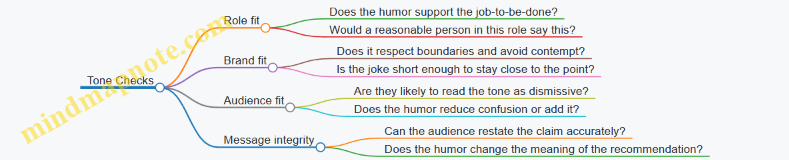
Final Integration
Tone matching is not about finding the funniest voice; it’s about choosing the right humor signals for your role and brand. When you align humor style, intensity, and placement, the audience experiences the joke as evidence of care and competence, which makes the persuasion work easier.
4.5 Testing Humor in Drafts: Quick Checks for Clarity and Fit
Humor works best when it clarifies the message instead of competing with it. The quickest way to test that is to run your draft through a small set of checks that focus on three things: what the audience notices, what they understand, and what they remember.
Quick Check 1: The One-Sentence Meaning Test
Write a single sentence that states the persuasive point of the paragraph or slide segment, ignoring the joke. Then read the original with the humor included. If the one-sentence meaning changes, the humor is steering attention away from the claim.
Example: If your message is “We reduce costs by simplifying onboarding,” but your joke makes the audience focus on how awkward onboarding feels, you may have a clarity problem. Fix by tying the punchline to the mechanism: “Our onboarding is shorter because we removed the steps that only existed to impress nobody.”
Quick Check 2: The Setup-Payoff Alignment Check
Every joke needs a setup that the audience can track and a payoff that lands on the intended target. Scan for three signals:
- The setup names the topic plainly.
- The payoff resolves the expectation you created.
- The resolution points back to your message.
If the payoff is clever but not connected, the audience may laugh and still miss the point.
Example: “Our policy is simple: if it’s not clear, it’s not approved.” If the setup is about safety, the payoff should reinforce safety clarity, not just sound like a slogan.
Quick Check 3: The Clarity-First Read
Do a “silent read” pass where you remove delivery cues. Read the text as if you were a busy reader skimming on a phone. If the joke requires timing to be understood, rewrite it so the meaning is visible on the page.
Example: Instead of “You’ll see why it’s called the ‘two-minute’ form,” use “The form takes two minutes because it asks only for what we can actually use.” The humor becomes a property of the claim, not a performance trick.
Quick Check 4: The Fit Check for Audience and Context
Test whether the humor matches the audience’s expectations and the situation’s stakes. Ask two questions:
- Would a reasonable person in this context feel respected?
- Does the humor match the level of formality required?
Example: In a compliance training, a joke about “loopholes” can feel like you’re encouraging avoidance. A safer fit is humor about process friction: “If the form feels long, it’s because we’re trying to prevent the kind of mistakes that create extra work later.”
Quick Check 5: The Retention Cue Check
Humor should create a retrieval handle. After reading, can you point to a phrase the audience is likely to repeat? If not, the joke may be entertaining but forgettable.
Example: “We don’t just ‘save time.’ We remove the steps that make time disappear.” This gives a repeatable contrast that supports the claim.
Mind Map: Draft Testing Flow
A Simple Revision Loop
Use the checks to decide one of three actions for each humorous line: keep it, revise it, or remove it.
- Keep when the one-sentence meaning stays stable and the payoff reinforces the mechanism.
- Revise when the joke is understandable but the connection to the claim is thin.
- Remove when the humor changes the topic, requires performance to make sense, or risks disrespect.
Example: Two Draft Lines Compared
Draft A: “We’ll streamline your workflow—because nobody has time to do the same thing twice. (Also, the old process was basically a sequel nobody asked for.)”
Check results: Meaning is clear, but the “sequel” reference may distract and doesn’t specify the mechanism.
Draft B: “We’ll streamline your workflow by removing duplicate steps. Nobody has time to do the same thing twice, and we’re cutting the steps that repeat.”
Check results: The humor is now tied to the mechanism, and the repeatable phrase “duplicate steps” supports retention.
Quick Checklist You Can Run in Minutes
- Can you state the point without the joke?
- Does the payoff resolve the setup and point back to the claim?
- Does the joke read clearly without timing?
- Does it fit the audience’s expectations and stakes?
- Is there a phrase likely to be remembered and repeated?
When these answers are consistently “yes,” your humor is doing its job: it earns attention, supports understanding, and leaves a trace the audience can recall.
5. Crafting Persuasive Messages with Humor Structure
5.1 Message Architecture: Claim, Reasons, Evidence, and Call to Action
A persuasive message is easier to remember when it has a predictable skeleton. Humor can ride on top of that skeleton, but it should not replace it. Think of your message as four linked parts: a clear Claim, supporting Reasons, credible Evidence, and a specific Call to Action.
Claim
The claim is the single sentence your audience should be able to repeat. It states what you want them to believe or do. If your claim is vague, humor will only make the vagueness more noticeable.
Practical rule: Write the claim in plain language, then trim it until it fits one breath.
Example (informing): “You can reduce meeting time by 20% by using a written agenda and a timekeeper.”
Example (persuading): “Adopting the agenda template will make our meetings shorter without reducing decisions.”
Humor integration: Use a light contrast to sharpen the claim, not to distract from it.
- “If the agenda is ‘we’ll see what happens,’ the meeting will oblige.”
Reasons
Reasons explain why the claim is true. They are not proof, but they tell the audience what mechanism connects the claim to reality. Usually, two to four reasons are enough.
Practical rule: Each reason should answer one question the audience naturally has.
- “How does this work?”
- “Why will it not backfire?”
- “What changes for the participants?”
Example reasons for the meeting claim:
- “A written agenda reduces wandering.”
- “A timekeeper prevents late topics from consuming the whole session.”
- “Pre-work clarifies decisions, so less time is spent restating basics.”
Humor integration: Humor can label the problem the reason fixes.
- “Meetings don’t run out of time; they run out of focus.”
Evidence
Evidence is what makes reasons believable. It can be data, examples, observations, or credible testimony. Evidence should match the strength of your claim.
Practical rule: Pair each reason with at least one evidence item.
- For “reduces wandering,” show a before-and-after agenda example.
- For “pre-work clarifies decisions,” show a sample pre-read and the resulting decision log.
Example evidence set:
- Before: 60-minute meetings with no agenda; decisions scattered across chat.
- After: 45-minute meetings with a one-page agenda; decisions captured in a shared notes doc.
- Observed result: “Average duration dropped from 60 to 48 minutes over four weeks.”
Humor integration: Use humor to make evidence easier to process, not to undermine it.
- “We didn’t ‘feel’ shorter meetings. We measured them. Feelings are great, but spreadsheets are stubborn.”
Call to Action
The call to action tells the audience exactly what to do next, with a clear boundary on time and effort. Without it, even a well-structured argument becomes a nice conversation.
Practical rule: Specify the action, the owner, and the deadline.
- “Use the template in the next two meetings and report the duration by Friday.”
Example CTA: “Adopt the agenda template for the next two team meetings. Send the meeting length and decision count to me by Friday, and we’ll review the results.”
Humor integration: Keep the CTA respectful and concrete.
- “No heroics required. Just bring the agenda and let the timekeeper do their job.”
Mind Map: Claim Reasons Evidence Call to Action
Integrated Example Walkthrough
Claim: “Using a written agenda and a timekeeper will shorten our meetings without reducing decisions.”
Reasons:
- “A written agenda reduces wandering.”
- “A timekeeper prevents late topics from consuming the session.”
Evidence:
- “In two pilot meetings, the agenda was one page and decisions were captured in shared notes. Average duration dropped from 60 to 48 minutes.”
Call to Action: “Use the template and timekeeper role in the next two meetings. Send the meeting length and decision count by Friday.”
If you want humor to help, place it where it clarifies the structure: a quick line that highlights the claim, a short remark that labels the reason’s problem, and a grounded joke that keeps the evidence from feeling abstract. When the skeleton is solid, the humor has something stable to stand on—like a punchline with a reliable setup.
5.2 Where Humor Belongs: Hooks, Transitions, and Reinforcement Points
Humor belongs in three predictable places: at the start to earn attention, in the middle to move people across ideas, and at the end to help them remember what mattered. The goal is not to “add jokes,” but to place comic moments where they reduce friction. When humor is used elsewhere, it often competes with the message instead of supporting it.
Hooks: Opening Lines That Earn Attention
A hook is the first moment where you decide whether the audience will keep processing. Humor works best here when it creates a small, safe surprise without changing the topic.
Use a hook when:
- The audience is likely distracted or skeptical.
- Your first claim is important but easy to misunderstand.
- You need a quick “permission” to listen.
A practical pattern is problem → mild twist → promise of value.
Example (sales pitch opener):
- “If you’ve ever tried to ‘optimize’ a process by adding more steps, congratulations—you’re already doing analytics. Today we’ll make the process shorter, not just more complicated.”
Why it works: the audience recognizes themselves (relatability), the twist is gentle (no insult), and the promise clarifies the purpose immediately.
Transitions: Humor That Moves People Between Ideas
Transitions are the bridges between sections. Humor here should do one job: signal a change in direction while keeping comprehension steady. The audience should feel the shift, not lose the thread.
Use humor in transitions when:
- You are switching from background to recommendation.
- You need to compare options.
- You must address an objection without sounding defensive.
A reliable transition device is contrast with a clean reframe.
Example (moving from evidence to recommendation):
- “The data says the current approach is slow. The good news is that ‘slow’ is fixable—unlike my ability to find my keys on the first try.”
The second sentence is funny, but it also resets attention and re-centers on the actionable point. Notice what’s missing: no new topic, no extra claim, and no lingering punchline that delays the next idea.
Reinforcement Points: Humor That Improves Recall
Reinforcement points are where you restate the message in a memorable form. Humor helps when it compresses a key idea into a phrase people can repeat.
Use humor for reinforcement when:
- You have a short list of takeaways.
- You want the audience to remember a rule, not just a story.
- You need a final line that sounds like a summary.
A strong reinforcement structure is rule → comic image → repeatable wording.
Example (closing a training segment):
- “Here’s the rule: make the next step obvious. If your audience has to ‘figure it out,’ you’ve already lost. Keep it simple enough that even a distracted person could follow it.”
If you want a lighter touch, you can add a micro-image:
- “Make the next step obvious—like a door with a sign that actually points to the door.”
Mind Map: Placement Logic for Humor
Putting It Together: A Single Segment Example
Imagine a five-minute talk with one main recommendation. You can place humor like this:
- Hook: open with a relatable misstep and promise the fix.
- Transition: use a brief contrast to move from evidence to the recommendation.
- Reinforcement: end with a repeatable rule stated in plain language, optionally with a small comic image.
Example mini-script:
- Hook: “If your plan requires a spreadsheet just to start, you’re not planning—you’re auditioning for confusion.”
- Transition: “The numbers show where the delays come from. The fix is simpler than it sounds—like taking the long way only once.”
- Reinforcement: “Rule: remove the extra step. If the next action isn’t obvious, the message didn’t land.”
When you keep humor tied to these three functions, it becomes a tool for attention, comprehension, and recall rather than decoration.
5.3 Integrating Humor Without Replacing Substance
Humor earns its place when it supports the message’s job: making the audience understand, accept, and remember. The risk is that a joke can become the main event, pushing the real point into the background. The fix is not to “use less humor,” but to integrate it so the audience still tracks the argument.
Start with a simple rule: every humorous moment must point to a specific part of the persuasion structure. If your message has a claim, reasons, evidence, and a call to action, then humor should attach to one of those components. A good test is to ask what changes in the listener after the joke. If nothing changes except mood, the humor is probably replacing substance.
The Message Stack
Think of your message as a stack of layers that must stay in order.
- Layer 1: Claim — what you want them to believe.
- Layer 2: Reason — why the claim is plausible.
- Layer 3: Evidence — what makes it credible.
- Layer 4: Action — what you want them to do next.
- Layer 5: Humor — a tool that improves attention or reduces friction.
Humor belongs in Layer 5, but it can still influence how the audience processes Layers 1–4. For example, a light contrast can clarify a reason, and a brief exaggeration can make a common misconception easier to spot.
Where Humor Fits Best
Use humor at three reliable locations.
- At the entry to a section: a hook that signals “pay attention, this matters.”
- At a transition: a bridge that helps the audience move from one idea to the next.
- At a reinforcement point: a short repeatable line that makes the key takeaway easier to recall.
Avoid placing humor inside the evidence itself. If you interrupt data with punchlines, you force the audience to re-interpret the numbers, which increases confusion.
Mind Map: Humor as a Supporting Mechanism
A Systematic Integration Method
Use this sequence when revising a draft.
- Mark the persuasion spine: underline the claim, circle each reason, label evidence, and highlight the action.
- Identify the “substance-critical” sentences: these are the ones that carry facts, definitions, or the logic chain.
- Place humor only in non-critical sentences: openings, transitions, and short summaries.
- Write the joke as a function, not a decoration: specify whether it improves clarity, reduces tension, or creates a recall cue.
- Compress the humorous part: if the audience needs time to understand the joke, it’s too long or too complex.
Example: Turning a Pitch Into Integrated Humor
Original (substance-first): “Using a checklist reduces missed steps. In our trials, teams completed the process with fewer errors. You can start by adopting the checklist for the next two weeks.”
Revised (humor integrated): “Using a checklist reduces missed steps—because humans are great at many things, but ‘remembering every step at 4:55 p.m.’ isn’t one of them. In our trials, teams completed the process with fewer errors. If you want the simplest start, adopt the checklist for the next two weeks and review what you missed.”
Notice what stayed intact: the evidence sentence still carries the trial result, and the call to action remains direct. The humor sits in the entry to the section and frames the reason without touching the data.
Common Failure Patterns and Fixes
- Punchline inside evidence: the audience remembers the joke but misremembers the number. Fix by moving the humor to the transition after the data.
- Humor that targets the audience: it may get a reaction, but it can reduce acceptance. Fix by aiming the joke at the situation or at a neutral, shared constraint.
- Humor that competes with the claim: if the claim is delayed, the listener may not know what they’re supposed to believe. Fix by stating the claim early, then using humor to make it easier to hold.
A Final Check for Substance Preservation
After editing, ask three questions while reading aloud:
- Can you restate the claim in one sentence without mentioning the joke?
- Does the evidence still sound like evidence, not like a setup?
- Does the call to action still feel like the next step, not the punchline?
If the answers are yes, the humor is doing its job: it improves attention and retention while the persuasion structure stays in charge.
5.4 Building a Persuasive Arc: From Engagement to Action
A persuasive arc is the sequence that turns attention into understanding and understanding into a decision. Humor can help at the start, but the arc still needs a clear job at each step: engage, clarify, justify, and move.
Step 1: Engagement That Signals Relevance
Engagement is not entertainment for its own sake. It answers, “Why should I care right now?” Use a short comic moment that points to the problem you will solve.
Example: In a meeting about onboarding delays, you might say, “Our onboarding timeline has two speeds: ‘fast’ and ‘we’ll circle back.’ Today we’ll fix the second one.” The joke is mild, but it frames the real issue: delays.
Practical rule: keep the humorous opener under one breath, then immediately name the topic in plain language.
Step 2: Clarity That Prevents Misunderstanding
After engagement, the audience needs a simple mental model. Humor can reduce tension, but clarity prevents the audience from laughing and then getting lost.
Use a three-part explanation:
- What is happening (the current state)
- What it causes (the consequence)
- What you propose (the direction)
Example: “Right now, new hires wait for access. That slows their first week. We’ll use a checklist that triggers access before day one.”
If you include a comic line here, make it descriptive rather than clever. “No more ‘mystery buttons’ on day one” is clearer than a pun that requires decoding.
Step 3: Justification That Converts Interest Into Belief
Belief comes from reasons and evidence, not from the joke. Humor should support the logic by making the stakes feel concrete.
A reliable structure is claim → reason → evidence → implication.
- Claim: “This checklist reduces time-to-productivity.”
- Reason: “Access is the bottleneck.”
- Evidence: “In a pilot, new hires completed setup in 24 hours instead of 5 days.”
- Implication: “Managers spend less time chasing requests.”
To integrate humor, place it at the transition between logic steps. For instance: “The bottleneck isn’t effort; it’s waiting. Waiting is great for movies, not for onboarding.” Then return to the evidence.
Step 4: Resistance Handling That Keeps Trust Intact
People rarely resist the idea itself; they resist the cost, the risk, or the uncertainty. Address the most likely objections before they become silent doubts.
Use a “softener” plus a direct answer:
- Softener: acknowledge the concern without dismissing it
- Direct answer: explain how you reduce the concern
Example: “You might worry this adds process. It doesn’t add steps; it removes the back-and-forth by assigning owners. The checklist is one page.”
Humor here should be reassuring, not mocking. “We’re not building a bureaucracy; we’re building a receipt” works because it clarifies the purpose.
Step 5: Action That Turns Belief Into a Decision
Action requires specificity. The audience should know what happens next, who does it, and when.
End with a small, concrete ask:
- Decision: “Approve the pilot for two teams.”
- Owner: “I’ll coordinate with HR and IT.”
- Timing: “We start next Monday.”
- Follow-up: “We review results in two weeks.”
If you want a final humorous beat, make it a memory anchor tied to the action. Example: “Let’s trade ‘circle back’ for ‘checklist back.’ If we can’t measure it, we won’t keep it.” Then stop.
Mind Map: Engagement to Action Arc
Example: One-Minute Segment with the Full Arc
Engagement: “Our onboarding timeline has two speeds: fast and ‘we’ll circle back.’ Today we’ll fix the second one.”
Clarity: “New hires wait for system access. That delays their first week. The proposal is a one-page checklist that triggers access before day one.”
Justification: “The bottleneck is waiting, not effort. In a pilot, setup took 24 hours instead of five days, so managers stopped chasing requests.”
Resistance handling: “You might worry this adds process. It removes back-and-forth by assigning owners, and the checklist stays one page.”
Action: “If you approve, we run a two-team pilot starting next Monday. We review results in two weeks, and if we can’t measure improvement, we stop.”
This arc works because each step has a distinct purpose. Humor can open doors, but the structure carries the message to a decision.
5.5 Example Walkthrough: Turning a Standard Pitch Into a Comic-Enhanced Version
A standard pitch usually follows a clean logic: you state a claim, support it with reasons and evidence, then ask for a next step. The comic-enhanced version keeps that structure, but it adds a small, controlled disruption so people pay attention and remember the key line.
Step 1: Start with the Baseline Pitch
Baseline pitch (for a team considering a new onboarding process):
“Onboarding is inconsistent, so new hires take longer to reach productivity. We propose a structured onboarding plan with a checklist, weekly milestones, and a single owner. This will reduce ramp time and improve confidence. If you approve, we can pilot it with the next cohort and review results after 30 days.”
This is clear, but it has two weaknesses for retention: it repeats the same idea in different forms (“inconsistent,” “longer,” “reduce”), and it lacks a memorable anchor line.
Step 2: Choose One Humor Goal
Pick one place where humor will do real work. In this pitch, the best target is the opening problem statement, because it’s where attention is won or lost.
Humor goal: make the “inconsistent onboarding” problem concrete with a short contrast.
Step 3: Map the Message Into Claim, Reasons, Evidence, and Call to Action
Step 4: Convert the Opening Into a Comic-Enhanced Hook
Replace the abstract “inconsistent onboarding” with a simple, everyday image.
Original: “Onboarding is inconsistent, so new hires take longer to reach productivity.”
Comic-enhanced option:
“Right now onboarding depends on who you get. It’s less ‘welcome aboard’ and more ‘good luck, and please don’t ask where the checklist is.’”
Why this works: the humor is specific, not mean. It highlights the inconsistency without attacking individuals.
Step 5: Keep the Persuasive Arc Intact
Now you return to substance immediately. The humor line should not replace the logic; it should lead into it.
Revised pitch:
“Right now onboarding depends on who you get. It’s less ‘welcome aboard’ and more ‘good luck, and please don’t ask where the checklist is.’
Onboarding should be predictable, because predictability reduces wasted time. We propose a structured onboarding plan with a checklist, weekly milestones, and a single owner. The checklist prevents missed steps, and the weekly milestones create a clear rhythm for learning. If you approve, we can pilot it with the next cohort and review results after 30 days.”
Notice what changed: the reasons are tightened into one causal chain (“predictability reduces wasted time”), and the evidence is phrased as mechanisms (“prevents missed steps,” “creates a clear rhythm”).
Step 6: Add One Memorable Reinforcement Line
A single reinforcement line improves recall without adding more jokes.
Add after the mechanism sentence:
“Think of it as a map, not a mystery.”
Final comic-enhanced pitch:
“Right now onboarding depends on who you get. It’s less ‘welcome aboard’ and more ‘good luck, and please don’t ask where the checklist is.’
Onboarding should be predictable, because predictability reduces wasted time. We propose a structured onboarding plan with a checklist, weekly milestones, and a single owner. The checklist prevents missed steps, and the weekly milestones create a clear rhythm for learning. Think of it as a map, not a mystery.
If you approve, we can pilot it with the next cohort and review results after 30 days.”
Step 7: Quick Quality Checks
- Humor density: one hook line and one reinforcement line. No scattered jokes.
- Target safety: the joke points at the process, not at people.
- Logic continuity: the pitch returns to claim and mechanisms within two sentences.
- Retention anchor: “map, not a mystery” is short enough to repeat later.
Step 8: Optional Variant for Different Audiences
If the audience is more formal, keep the same structure but soften the phrasing:
“Onboarding varies by manager, which means new hires can’t rely on a consistent path. We propose a structured onboarding plan with a checklist, weekly milestones, and a single owner. The checklist prevents missed steps, and the weekly milestones create a clear rhythm for learning. Think of it as a map, not a mystery.”
The humor goal stays the same, but the delivery is less conversational. The persuasion logic remains unchanged, so the message still lands even when the tone shifts.
6. Timing, Delivery, and Performance Mechanics
6.1 Timing Fundamentals: Pauses, Speed, and Emphasis
Timing is the part of delivery that decides whether your audience keeps up, stays oriented, and remembers what mattered. Three levers do most of the work: pauses (when you stop), speed (how fast you move), and emphasis (what you highlight). Used together, they shape attention without changing the underlying message.
Pauses That Create Meaning
A pause is not empty time; it’s a boundary marker. Your audience uses those boundaries to chunk information.
- Micro-pauses (a fraction of a second) help you separate clauses. Example: “The proposal is simple—pause—because it reduces risk.” The pause signals that the second part explains the first.
- Structural pauses (about one beat) separate sections. Example: “First, the problem. Second, the plan. Third, the outcome.” Even if the words are identical, the pauses make the sequence feel deliberate.
- After a key line pause long enough for the audience to register it. Example: “We can cut costs without cutting service.” If you rush into the next sentence, the key line becomes background noise.
A practical rule: if a sentence contains a claim, reason, or call to action, give it at least one pause opportunity—either before the claim or after it.
Speed That Matches Processing
Speed is not about speaking slowly; it’s about aligning your pace with cognitive load.
- Normal speed works for familiar framing. Example: “Today we’ll cover three steps.”
- Slower speed helps when you introduce numbers, comparisons, or unfamiliar terms. Example: “The new workflow reduces handoffs from 12 to 7.” If you say the numbers at the same pace as the surrounding text, listeners often miss the exact values.
- Variable speed is usually better than a constant rate. Slow down for the “why,” speed up for the “what,” and slow again for the “so what.”
To practice, mark your script with three speeds: steady, reduced, and brief acceleration. Then rehearse once with a metronome-like rhythm in your head. You’re training consistency, not performance.
Emphasis That Guides Attention
Emphasis is how you tell the audience what to treat as important. It can be done through voice, word choice, and placement.
- Emphasize the noun or verb that carries the meaning. Example: “We will measure results, not assume them.”
- Use emphasis to correct direction. Example: “Not ‘faster.’ Clearer. Not ‘more.’ Better.” The emphasis turns a list into a set of decisions.
- Avoid stacking emphasis on every sentence. If everything is highlighted, nothing is.
A useful check: if you remove the emphasis, does the sentence still make sense? If not, you may be relying on delivery to compensate for unclear writing.
Integrated Timing Workflow
Timing works best when it follows the message structure.
- Identify the message spine: claim, reasons, evidence, action.
- Place pauses at spine transitions: before a new reason, after evidence, before the call to action.
- Adjust speed for complexity: slow for dense segments, steady for transitions.
- Emphasize only spine elements: the claim, the strongest reason, the action.
Mind Map: Timing Levers and Their Jobs
Example: Rewriting a Delivery Segment
Here’s the same content with different timing choices.
Version A: rushed and flat “We need a plan that reduces risk and improves speed. The new process cuts handoffs from twelve to seven. That means fewer delays and clearer ownership.”
Version B: timed for attention and retention “We need a plan that reduces risk—pause—while improving speed. The new process cuts handoffs from twelve to seven—pause—so fewer delays are inevitable. That means clearer ownership—pause—and less time spent guessing.”
Notice what changed: pauses mark transitions, speed would slow on “twelve to seven,” and emphasis would land on “reduces risk,” “twelve to seven,” and “clearer ownership.” The words are mostly the same, but the audience has fewer moments where they must guess what matters.
Quick Self-Check During Rehearsal
Record one run and listen for three things:
- Do you pause after the claim before moving on?
- Do you slow down on any numbers or unfamiliar terms?
- Do you emphasize only the decision points, not every sentence?
If any answer is “no,” adjust timing first before rewriting. Clear timing often reveals writing issues immediately, because the audience will either follow the structure or get lost at the same spots every time.
6.2 Delivery Choices: Reading, Speaking, and Conversational Framing
Delivery is not decoration; it determines how your audience processes the same words. The core idea is simple: reading, speaking, and conversational framing each change the pace of understanding, the amount of context you must supply, and the level of correction you can do in real time.
Foundational Principle: Match Delivery to Processing
When people listen, they can’t reread a sentence. When they read, they can. When you speak conversationally, you can also adjust based on facial expressions and interruptions. So choose delivery based on what your message requires:
- High precision (numbers, definitions, careful qualifiers) usually benefits from reading or a written handout.
- High persuasion (reducing resistance, building agreement) often benefits from speaking with clear signposting.
- High uncertainty (questions, objections, mixed knowledge) benefits from conversational framing that invites correction.
A practical rule: if your message includes “if…then” logic, make the structure visible in the delivery mode you choose.
Reading: Control Pace and Reduce Misunderstanding
Reading works best when you need consistent wording and when the audience may skim. Your job is to design for the eye.
How to read persuasively
- Front-load the point in the first line, then support it. If the audience must wait, they will assume the worst.
- Use short paragraphs that each contain one idea. A reader can stop without losing the thread.
- Mark transitions with explicit phrases like “The reason is…” or “Here’s the trade-off…”.
Example:
- Weak: “We should change the policy because it improves outcomes.”
- Strong reading version: “We should change the policy. It improves outcomes by reducing delays. The trade-off is a short adjustment period, which we can manage with training.”
Reading also helps with humor. If you want a joke to land, place it where the reader can pause. A punchline embedded in a long sentence often turns into confusion.
Speaking: Use Signposting and Timing
Speaking adds immediacy, but it removes the audience’s ability to revisit your phrasing. That means you must create “checkpoints” so listeners know where they are.
Speaking structure that holds attention
- Open with a map: what you’ll cover and why it matters.
- Deliver one claim at a time with a brief reason.
- Repeat the key phrase near the end, not verbatim every time, but clearly.
Timing choices
- Slow down at the claim.
- Speed up through examples.
- Pause before the punchline or the conclusion so the audience can process the shift.
Example: “Here’s the decision we’re making today: we’ll switch vendors. The reason is reliability. First, fewer delays. Second, clearer reporting. And yes, the new dashboard is actually readable—no, I’m not saying that because I built it.”
The humor here functions as a credibility-friendly aside, not a distraction.
Conversational Framing: Invite Alignment Without Losing Control
Conversational framing treats the audience as a partner in meaning. You still lead, but you do it through questions, acknowledgments, and small confirmations.
Core moves
- Start with shared context: “Most of you have seen…”
- Ask a calibration question: “Which part is hardest right now?”
- Reflect the concern before answering: “So the issue isn’t effort; it’s uncertainty.”
- Offer a concrete next step tied to the concern.
This approach reduces resistance because people feel heard, and it improves retention because the audience links your message to their own problem.
Example: “Before I explain the plan, quick check: is your main concern cost, time, or risk? Okay—risk. That’s the one we designed around. We’ll use a phased rollout so you can verify results before scaling. If anything looks off, we stop and reassess.”
Mind Map: Delivery Choices and Their Effects
Integrated Decision Guide
Choose delivery by asking three questions:
- Can the audience reread? If not, add checkpoints.
- Does the message require exact wording? If yes, read or provide text.
- Will people interrupt with objections? If yes, use conversational framing.
A final integration tactic: even in conversation, borrow reading’s clarity by stating the claim plainly, and borrow speaking’s timing by pausing at the claim and the conclusion. That combination keeps the message both understandable and memorable.
6.3 Body Language and Voice: Supporting the Punchline Intention
A punchline lands when the audience can predict the direction of the joke and then feel the controlled mismatch. Body language and voice are the steering wheel and the brake: they guide attention to the setup, signal when the meaning shifts, and keep the message intact after the laugh.
Core Principle: Match Nonverbal Signals to the Message Job
Start by deciding what the punchline is supposed to do. In persuasion, it usually either (a) reduces resistance, (b) clarifies a point by making it concrete, or (c) creates a memorable cue for later recall. Your nonverbal behavior should serve that job.
- If the goal is clarity, your delivery should stay steady and readable. The humor should feel like a helpful annotation, not a detour.
- If the goal is reducing resistance, your delivery should lower threat. That means relaxed posture, slower pace, and a voice that sounds cooperative rather than performative.
- If the goal is a recall cue, you need a clean moment of emphasis right at the punchline so the audience can store it.
Voice Mechanics That Protect the Punchline
Voice does three things: it sets expectations, marks transitions, and controls how long the audience has to process the new meaning.
- Pace control during the setup: Keep the setup slightly slower than your normal speaking rate. This gives listeners time to build the pattern the joke will later disrupt.
- Pitch and volume as a boundary: Use a small rise or increase in volume at the setup’s final phrase, then drop back for the punchline. The contrast helps the audience notice the shift.
- Timing after the punchline: Do not rush into the next sentence. A short pause lets the laugh finish and prevents the next point from colliding with the punchline’s meaning.
A practical rule: if you can’t pause for one beat without losing the audience, your setup is probably too long or too dense.
Body Language That Signals Intent Without Overacting
Body language should communicate “I’m still in control of the conversation.” Overacting often reads as uncertainty, which makes the audience work harder and reduces trust.
- Posture: Keep shoulders level and torso oriented toward the audience. Leaning forward only at the punchline can work, but leaning forward throughout the joke can feel like pressure.
- Hands: Use open palms or hands that move in the same direction as your sentence. For the punchline, reduce hand motion rather than increasing it; motion at the wrong time competes with the verbal shift.
- Eye contact: Hold eye contact through the setup’s key claim, then widen your gaze slightly at the punchline. That widening signals a meaning change.
Mind Map: Delivery Signals for Punchline Intention
Integrated Example: Turning a Point Into a Punchline Without Losing Substance
Imagine you’re explaining why a process matters.
Plain version: “We document decisions so we don’t repeat debates.”
Humor-enhanced version: “We document decisions so we don’t re-run the same debate like it’s a weekly show. If the meeting is the plot, the notes are the ending.”
Now apply delivery choices:
- During “We document decisions,” keep pace normal and posture steady.
- On “so we don’t re-run the same debate,” slow slightly and use a small forward tilt to underline the cause.
- At “like it’s a weekly show,” lift volume just a touch and let your hands move once to the side, as if pointing to the idea.
- At “the notes are the ending,” reduce hand motion, articulate the final phrase clearly, and pause for one beat.
The pause matters because it separates the joke from the next persuasive step. After the beat, you can continue: “That means fewer surprises and faster follow-through.” The audience has already stored the cue.
Advanced Detail: Calibrating for Different Audience Responses
If the audience laughs quickly, you can shorten the pause slightly and move on. If they laugh late or not at all, keep your tone neutral and continue the message without adding extra jokes. Your goal is to preserve the persuasive thread, not to win a performance contest.
A reliable check: after the punchline, ask yourself whether the audience could repeat your main claim in one sentence. If they can’t, your delivery likely made the humor the headline instead of the point.
6.4 Handling Silence and Misses: Recovery Techniques That Preserve Trust
Silence and missed moments are normal parts of live communication. The goal is not to eliminate them, but to recover in a way that keeps the audience feeling respected and informed. When you recover well, people interpret the pause as “they’re thinking,” not “they’re lost.”
Foundational Principle: Trust Is a Process, Not a Mood
Trust grows from three signals: clarity, control, and care. Clarity means the audience knows what happens next. Control means you steer the conversation back to the message. Care means you avoid blaming the audience or pretending nothing happened.
A practical rule: if you notice a miss, treat it as a cue to simplify, not to perform. Humor can help, but only after you re-establish the message lane.
Mind Map: Recovery Priorities
Step 1: Pause with Purpose
A pause that lasts too long feels like avoidance. A pause that lasts just long enough feels like thought. Use a “micro-pause” of about one beat before you speak again. During that beat, look at the audience as a group, not at the floor or notes.
If you’re waiting for laughter that doesn’t come, don’t chase it. Instead, pivot to the message sentence that the joke was meant to support.
Example: You say, “The policy is simple—like assembling furniture with only one instruction.” No one laughs. You continue, “That’s why the steps are listed in the order you’ll actually do them.” The audience learns that the joke was a bridge, not the destination.
Step 2: Diagnose Quickly, Then Choose One Move
Most misses fall into four buckets.
- Timing issue: The joke is late or the punchline arrives after the audience has moved on mentally.
- Misunderstanding: The audience heard the wrong meaning.
- Joke landed wrong: The humor created discomfort or confusion.
- External interruption: Sound, slides, or room conditions disrupt flow.
Pick one recovery move that matches the bucket. Trying to do two at once often increases confusion.
Step 3: Use Bridge Lines That Reconnect to the Message
Bridge lines are short statements that re-anchor the audience. They should be factual, not defensive.
- For timing misses: “Let me restate the point in plain terms.”
- For misunderstanding: “What I meant was…”
- For a joke that didn’t land: “The joke was just a way to say this next part clearly.”
- For interruptions: “Where we left off was the reason this matters.”
These lines preserve control because they tell the audience exactly what you’re doing next.
Step 4: Recover Humor Without Pretending It Was Perfect
If the humor misfires, you have two safe options: clarify or replace.
Clarify means you correct the meaning without repeating the joke. Keep it brief.
Example: “I said ‘quick fix,’ but I don’t mean shortcuts. I mean a clear sequence.”
Replace means you move to a clean example that carries the same lesson.
Example: After a confusing punchline, you switch to: “Here’s a real scenario: a team member misses a deadline because the approval step is unclear. The fix is to define who approves and when.”
Avoid apologizing in a way that invites the audience to judge your competence. A single neutral acknowledgment is enough.
Step 5: Confirm Understanding with a Specific Check
After recovery, ask a question that is easy to answer. Specificity reduces pressure.
- “Does that make the sequence clearer?”
- “Which part feels most confusing: the reason or the steps?”
- “Should I walk through one example or two?”
If you get a vague response, don’t interrogate. Offer a choice and proceed.
Advanced Detail: Handling Silence During Q&A
Silence in Q&A often signals either hesitation or a question that wasn’t heard. Use a two-part recovery: repeat the question in your own words, then answer the underlying need.
Example: Audience member is quiet after asking something. You say, “I’m hearing you ask whether the message should change for different roles. Yes—here’s how.” Then you give one role-specific example and one universal principle.
Quick Reference Mind Map: Recovery Moves
When you treat silence as a communication event rather than a personal failure, your recovery becomes predictable. Predictability is what preserves trust: the audience always knows you will return to the message, explain it clearly, and move forward with care.
6.5 Example Walkthrough: Rehearsing a Humor-Infused Explanation for Clarity
A humor-infused explanation works best when the joke is treated like a tool, not a decoration. Rehearsal is where you confirm that the audience still receives the core meaning on time.
Step 1: Start with the Core Explanation
Write a plain version first. Keep it to three beats:
- What the idea is.
- Why it matters.
- How to apply it.
Example topic: “Why a short agenda improves meetings.”
- Beat 1: An agenda sets expectations for time and outcomes.
- Beat 2: Clear expectations reduce side conversations.
- Beat 3: A simple agenda lets people prepare and decide faster.
If you cannot say these three beats in under 45 seconds, the humor will only add confusion.
Step 2: Choose One Humor Device with a Job
Pick a single device that supports clarity. For this example, use contrast and a quick exaggeration.
- Device job: Make the “before” state vivid so the “after” state feels like a fix.
Draft humor line (for the hook):
“Without an agenda, meetings are like GPS with no destination—everyone’s busy, and somehow nobody arrives.”
This line is not the lesson. It’s a mental image that points to the lesson.
Step 3: Place the Humor at the Right Moment
Use a simple placement rule: humor goes before the explanation of the problem, then you immediately translate it into the concept.
Rehearsal script:
- Hook: GPS-with-no-destination image.
- Translation: “That’s what happens when there’s no shared outcome.”
- Explanation: “An agenda creates a shared outcome and time boundaries.”
- Application: “Try three items: goal, decisions needed, and time per item.”
If you place the joke after the explanation, the audience may remember the joke and miss the point.
Step 4: Practice Delivery as a Sequence, Not a Performance
Rehearse with a metronome mindset: each beat has a target length.
- Hook: 6–8 seconds.
- Translation: 10–12 seconds.
- Explanation: 15–18 seconds.
- Application: 10–12 seconds.
Say it twice slowly, then once at normal speed. On the third run, keep the hook crisp and do not stretch the punchline.
Step 5: Use a “Clarity Check” After the Joke
After the hook, ask yourself one question: “What sentence would the audience write down?”
For this example, the write-down sentence should be:
“An agenda creates shared outcomes and time boundaries, which reduces side conversations.”
If your write-down sentence is still the joke image, you need a faster translation.
Step 6: Mind Map for Rehearsal Flow
Step 7: Example Rehearsal Passes
Pass A: Plain clarity (no humor). “An agenda sets expectations for outcomes and time. When people know what decisions are needed, side conversations drop. Use three items: goal, decisions, and time per item.”
Pass B: Add the humor hook. “Without an agenda, meetings are like GPS with no destination—everyone’s busy, and somehow nobody arrives. That’s what happens when there’s no shared outcome. An agenda creates shared outcomes and time boundaries, which reduces side conversations. Try three items: goal, decisions needed, and time per item.”
Pass C: Tighten for clarity. Remove any sentence that does not change the audience’s understanding or next action.
Step 8: Final Micro-Edits That Preserve Meaning
- Replace vague words with specific ones: “better meetings” becomes “fewer side conversations.”
- Keep the joke line short enough to repeat once without losing the thread.
- Ensure the application step is concrete enough to try the same day.
When rehearsal is done this way, the humor earns its place: it helps the audience notice the problem, then it hands them a clear method to fix it.
7. Humor Types for Different Persuasion Tasks
7.1 Informing: Using Humor to Explain Complex Ideas Simply
Complex ideas often fail for two reasons: people cannot form a mental model, and they cannot keep it stable long enough to use. Humor helps with both when it is used as an explanation tool rather than decoration. The goal is not to make the audience laugh; the goal is to make the concept easier to notice, compare, and remember.
Start with the Core Model
Before adding any joke, define the smallest accurate model that explains the topic. Write it as three parts: what it is, what it does, and what changes when it works. For example, if you are informing about “feedback loops,” your core model might be: a system measures a state, compares it to a target, then adjusts actions. That model is the anchor; humor only clarifies it.
A simple test: if someone repeats your model back in their own words, do they still describe the same mechanism? If not, fix the model first. Humor cannot repair a broken explanation.
Use Humor to Reduce Abstraction
Complexity usually comes from abstraction. Humor can lower abstraction by mapping the idea to a familiar situation.
Example: “A feedback loop is like a thermostat.”
- Informing step: thermostat measures temperature.
- Humor step: it “doesn’t guess”; it checks.
- Clarifying payoff: the audience stops treating the system as magic and starts treating it as measurement plus adjustment.
Keep the comparison concrete. Avoid jokes that require background knowledge the audience does not have.
Choose a Humor Device That Matches the Explanation
Different devices support different kinds of understanding.
- Contrast helps when the audience confuses two similar things.
- Exaggeration helps when the audience underestimates scale or frequency.
- Wordplay helps when the audience needs a memorable label.
- Self-aware understatement helps when the topic is technical and the audience feels intimidated.
Example using contrast: “People think a feedback loop is just ‘reaction.’ It’s not reaction; it’s reaction after measurement.” The humor is mild, but the contrast forces a correct mental model.
Build a Stepwise Explanation with a Predictable Pattern
A reliable structure keeps humor from derailing comprehension. Use a three-step rhythm:
- State the concept in plain language.
- Add a short humorous analogy that highlights one mechanism.
- Return to the concept with a precise sentence.
Example for “encryption”:
- Plain language: “Encryption turns readable data into scrambled data.”
- Humor analogy: “It’s like putting your grocery list in a drawer and writing it in a code only your key can read.”
- Precision: “The key controls how the scrambling can be reversed.”
Notice the pattern: the analogy points to one mechanism, then the explanation names it.
Mind Map: Humor for Informing Complex Ideas
Avoid Common Failure Modes
Humor backfires when it competes with the mechanism.
- Two mechanisms in one joke. If the analogy implies multiple processes, the audience may remember the story but miss the mechanism.
- Punchlines that require insider knowledge. If the audience must know a specific culture, job role, or jargon, the humor becomes a barrier.
- Humor that replaces definitions. A joke can illustrate, but it should not be the only explanation.
A practical rule: if you remove the humorous line, the explanation should still be complete and accurate.
Example: Turning a Technical Concept Into a Simple Informing Segment
Topic: “Why load balancing matters in web services.”
- Core model: traffic is distributed across multiple servers to prevent overload.
- Plain language: “Instead of one server doing everything, requests get shared.”
- Humor analogy: “Imagine one cashier handling every checkout line. Load balancing is adding more cashiers and routing customers to the shortest line.”
- Precision return: “A load balancer routes requests based on rules such as capacity or current load.”
- Mechanism check: “What changes when it works?” Answer: fewer timeouts and smoother response times.
The humor is not the point; it is the bridge to the mechanism. When the audience can restate the model after the analogy, the humor has done its job.
7.2 Persuading: Using Humor to Strengthen Arguments and Reduce Resistance
Persuasion often fails for a simple reason: the listener protects their identity. Humor can lower that guard when it signals respect, shared reality, and a willingness to see the other side. The goal is not to make people laugh; it is to make them safer to think.
Core Principle: Humor as Resistance Reduction
Start with the mechanism. Resistance drops when three things happen in sequence: (1) attention is secured, (2) threat is reduced, and (3) the argument feels workable. Humor can contribute to all three, but only if it is tied to the argument rather than floating above it.
A practical test: if you remove the joke, does the reasoning still stand? If the answer is no, the humor is propping up weak logic. If the answer is yes, the humor is doing supportive work.
Mind Map: Humor That Strengthens Arguments
Step 1: Build a Claim That Can Survive a Joke
Humor works best when the underlying claim is already solid. Write the claim in one sentence, then list the two most likely objections. For each objection, decide what the listener fears: being judged, losing status, wasting time, or being misunderstood.
Example setup:
- Claim: “A shorter meeting can produce better decisions.”
- Objection: “We’ll miss important details.”
- Hidden fear: “You’re implying we’re inefficient.”
A humor line should address the fear before it addresses the claim.
Step 2: Use Humor to Reframe, Not to Dismiss
Resistance often comes from feeling talked down to. Reframe by acknowledging the concern and gently correcting the assumption.
Example:
- “If we cut the meeting in half, we won’t magically stop having questions. We’ll just stop pretending the questions will solve themselves while we’re all waiting for the next slide.”
This does two things. First, it validates that questions exist. Second, it reframes the problem as process, not competence.
Step 3: Match Humor Type to the Objection
Different objections need different humor functions.
- If the objection is about time: use understatement.
- “We’re not saving time by being faster. We’re saving time by being less repetitive.”
- If the objection is about complexity: use contrast.
- “Complex problems don’t need longer meetings; they need clearer ownership.”
- If the objection is about trust: use self-deprecation that stays professional.
- “I’ve sat through meetings where the agenda was ‘discuss everything.’ That’s not a plan; it’s a weather report.”
The key is that the humor points toward the reasoning, not away from it.
Step 4: Place the Joke Where It Reduces Threat
Placement matters more than cleverness.
- Before the claim: use a small, low-risk observation to set a cooperative tone.
- Inside a reason: use humor to make a mechanism concrete.
- After an objection: use humor to reframe the objection as solvable.
Example flow:
- “I know ‘shorter meeting’ sounds like a diet plan for calendars.” (before claim)
- “Here’s the mechanism: we decide what must be decided today, and everything else becomes a follow-up owner.” (inside reason)
- “If we still need discussion, we schedule it with a purpose, not with a time block and hope.” (after objection)
Step 5: Keep the Argument Visible
A common failure is letting the joke become the main event. To prevent that, follow a simple pattern: humor line, then immediate reasoning in plain language.
Mini-template:
- Humor line that acknowledges the fear.
- One-sentence mechanism.
- One concrete example.
- One clear call to action.
Example:
- “We don’t need more meetings; we need fewer ‘maybe later’ decisions.”
- “Shorter meetings work when the agenda is a decision list.”
- “If it’s not a decision, it’s not on the agenda.”
- “Let’s pilot this next week with three decisions and one owner per item.”
Step 6: Use Micro-Checks for Misfire
Before delivering, check three signals:
- Does the humor target an idea, a process, or a shared situation?
- Does the listener still know what you want them to do?
- Would a skeptical person feel respected after the joke?
If any answer is no, revise the line to keep the reasoning intact and the respect clear.
Example: Turning Resistance Into Cooperation
Objection: “Your plan ignores edge cases.”
Humor line: “Edge cases are real. The trick is not letting them run the whole show.”
Reason: “We handle edge cases by defining triggers for escalation, not by debating every possibility up front.”
Example: “If a request has X criteria, it goes to review; otherwise it follows the standard path.”
Action: “Let’s agree on the triggers first, then we can test the workflow.”
The listener gets acknowledgment, a mechanism, and a concrete next step. The humor reduces defensiveness, while the structure carries the persuasion.
7.3 Motivating: Using Humor to Encourage Action and Commitment
Motivation is not just energy; it is a sequence of decisions. Humor can help at each decision point: it lowers the emotional cost of starting, clarifies what “done” looks like, and makes the next step feel socially safe. The key is to use humor as a tool for commitment, not as a substitute for instructions.
Start with the commitment problem. People often want the outcome but avoid the first step because it feels ambiguous, effortful, or slightly embarrassing. A well-placed joke can reduce all three. First, it creates a brief mental reset, so the task stops feeling like a wall and starts feeling like a manageable action. Second, it can define the “start line” in plain language. Third, it can normalize the awkward part of beginning, which reduces self-conscious resistance.
A practical way to design motivating humor is to pair it with a concrete action. Humor should point to a specific behavior, time window, or measurable output. If the joke floats above the task, it entertains but does not commit. If it lands on the next step, it becomes a cue.
Consider a common scenario: asking someone to join a weekly planning call. A dry message might say, “Let’s schedule a time.” A motivating humor version could say, “I promise the meeting will not be a surprise pop quiz. Pick a time, and we’ll keep it to 25 minutes.” The humor does two jobs: it reassures them that the experience will be predictable, and it tells them exactly what to do next.
Another scenario: encouraging a customer to try a new feature. Instead of “You should use it,” try, “If you can open the app, you can run this in under two minutes. Worst case, you’ll learn what not to click next.” The joke reduces fear of wasting time and frames learning as a normal outcome. The action remains explicit: open the app and run the feature.
Commitment strengthens when people can imagine success without needing perfect conditions. Humor helps by making “good enough” feel acceptable. Use understatement to define a small win: “We’re not aiming for masterpiece mode; we’re aiming for ‘sent’ mode.” Then follow with a clear threshold: “Draft three bullets, then send.” This turns motivation into a checklist.
Timing matters. Use humor early enough to reduce friction before the ask, but not so early that it distracts from the task. A reliable pattern is: acknowledge the difficulty, deliver a short joke, then immediately state the action. Keep the joke to one beat so the audience can move on.
To avoid undermining commitment, ensure the humor does not imply the task is optional or pointless. The joke should support effort, not mock it. Also avoid humor that targets the audience’s competence. If you want to be playful, aim at the situation, the process, or your own habits.
Example:
A team lead wants people to submit a status update by Friday. The motivating version could be: “Friday is coming fast, like a calendar with commitment issues. Submit your update by 3 p.m.—three bullets: what changed, what’s blocked, what you need.” The humor makes the deadline feel less threatening, and the bullets remove ambiguity.
Example:
A manager wants a direct report to practice a difficult conversation. Instead of “Have the talk,” use: “Let’s do the practice run before the real one. You’ll sound better after one rehearsal than after ten intentions. Book 20 minutes today and write two sentences you want to say.” The joke reduces pressure, while the action and output are concrete.
Advanced detail comes from matching humor to the type of commitment. For low-stakes actions, use light reassurance and quick thresholds. For higher-stakes actions, use humor to reduce fear of judgment and to clarify boundaries: “We’re practicing, not performing.” For group commitments, add a social cue: “Reply with your time slot so we can lock it in.” Humor then supports coordination rather than individual bravery.
Finally, close the loop. After the joke and the ask, confirm the next step in one sentence. Motivation is fragile when people have to interpret what you meant. When the action is unambiguous, humor becomes a reliable nudge toward follow-through.
7.4 Negotiating and Influencing: Humor That Lowers Tension Without Surrender
Negotiation often fails for reasons that have nothing to do with the facts. People arrive with status concerns, fear of losing face, and uncertainty about what the other side really wants. Humor can reduce that friction, but only if it supports the negotiation rather than replacing it. The goal is simple: lower temperature while keeping boundaries intact.
Foundational Principle: Humor Serves the Deal
Humor works best when it targets process, not people. A process joke says, “We’re both dealing with the same messy reality.” A personal joke says, “You’re the problem,” and that invites defense. In practice, you can treat humor like a tool for pacing: it slows the moment enough for clearer thinking.
A useful test is to ask what happens if the other party laughs. If laughter makes it easier to discuss terms, you’re on track. If laughter makes it harder to talk about specifics, you’ve created a detour.
Tension Map: Where Negotiations Heat Up
Tension usually concentrates in predictable places:
- Ambiguity: “What exactly are we agreeing to?”
- Asymmetry: “Why do they get more?”
- Identity: “Are we being disrespected?”
- Time pressure: “We don’t have time for this.”
Humor should address one of these without changing your stance. If you’re unwilling to concede on a key term, don’t joke your way into surrender. Instead, use humor to keep the conversation cooperative while you hold the line.
Humor Techniques That Preserve Boundaries
-
Light framing before a hard point
Use a short, neutral opener that acknowledges difficulty.- Example: “This is one of those ‘simple in theory, complicated in practice’ topics. Let’s make it concrete.” Then state the non-negotiable clearly.
-
Incongruity about logistics
Point out the mismatch between what people expect and what the situation requires.- Example: “We’re trying to price a service that behaves like a moving target. That’s not a flaw in anyone’s character; it’s just the nature of the work.” You’re reducing blame while keeping the constraint.
-
Self-aware clarification
When you might be misunderstood, use humor to invite correction.- Example: “I’m going to sound picky for a moment. It’s not because I enjoy paperwork; it’s because the details prevent surprises later.” This signals good intent and reduces defensiveness.
-
Shared-problem humor
Make the other party feel included in the problem-solving.- Example: “If we both pretend this is easy, we’ll end up negotiating the wrong thing. Let’s negotiate the right thing.”
Mind Map: Humor That Lowers Tension Without Surrender
Advanced Application: The Three-Step Move
When tension rises, use a structured response so humor doesn’t become a substitute for negotiation.
-
Name the friction neutrally
- Example: “I can see this is where the numbers start to feel personal.”
-
Add a process joke that resets the frame
- Example: “The spreadsheet doesn’t care about anyone’s intentions, only about inputs.”
-
Return to a specific next step
- Example: “So let’s list the inputs we can change: scope, timeline, and payment schedule.”
This sequence keeps humor tethered to action.
Example: Holding a Key Term Without Escalation
Scenario: You must keep a strict delivery date, but the other party wants flexibility.
- Tension: “You’re being unreasonable.”
- Humor move: “I get why you want flexibility. Unfortunately, our timeline is like a train schedule: it can’t negotiate with the passengers.”
- Boundary: “We can adjust the scope, not the delivery date.”
- Offer: “If you want earlier access to some deliverables, we can prioritize modules A and B.”
The humor lowers temperature by reducing blame, while the boundary remains explicit.
Example: Defusing a Status Challenge
Scenario: The other party questions your competence.
- Tension: “Your proposal looks like guesswork.”
- Humor move: “Fair question. My favorite kind of guesswork is the kind we can replace with assumptions we can verify.”
- Boundary: “Here are the assumptions behind the pricing.”
- Next step: “If any assumption is wrong, we’ll correct it and recompute.”
This approach treats the challenge as a problem to solve, not a personal attack to absorb.
Practical Rules for Safe Use
- Keep humor brief; longer jokes compete with decision-making.
- Avoid sarcasm, especially when the other party is already uncertain.
- Don’t joke about the other party’s motives.
- If the other party doesn’t engage, switch to plain language immediately.
Humor that lowers tension without surrender is less about being funny and more about being precise: it reduces defensiveness, then returns the conversation to terms, options, and next steps.
7.5 Example Walkthrough: Selecting Humor Styles for a Multi-Goal Presentation
A multi-goal presentation usually has three jobs: get attention, reduce resistance, and make the next step easy to remember. Humor can help with all three, but only if you choose the style that matches the job and the moment.
Step 1: List the Goals and the Moment They Belong To
Start with a simple goal-to-moment map.
- Goal A: Attention happens at the opening and during transitions.
- Goal B: Acceptance happens when you introduce a constraint, trade-off, or request.
- Goal C: Retention happens when you summarize, preview the plan, or repeat the key idea.
If you try to use one humor style for every moment, you’ll either dilute the message or risk sounding inconsistent.
Step 2: Choose Humor Styles by Function
Different humor styles do different work. Use this as a selection rule, not a rigid law.
- Light observational humor fits Attention because it signals “we’re aligned” without challenging the audience.
- Contrast and incongruity fits Acceptance because it reframes a problem in a controlled way.
- Exaggeration fits Retention because it creates a memorable mental image, as long as it stays plausible.
- Self-deprecation fits Acceptance when you own a small limitation, not when you undermine your competence.
- Wordplay and rhythm fit Retention because they create a repeatable phrase.
Mind Map: Humor Style Selection for Multi-Goal Presentations
Step 3: Run a Concrete Walkthrough with One Presentation
Assume a 12-minute presentation for a team meeting. The goals are:
- Attention: “Why this matters now.”
- Acceptance: “Here’s the trade-off and the request.”
- Retention: “Remember the plan in three steps.”
Opening (Goal A: Attention)
You want a quick, low-risk line that makes the room feel seen.
- Option: Observational humor
- Example line: “If your calendar feels like it’s running on caffeine, you’re not alone. Today is about making the next two weeks less chaotic.”
Reasoning: it acknowledges a shared experience, then immediately points to the purpose. The humor doesn’t compete with the message; it shortens the distance between speaker and audience.
Transition to the trade-off (Goal B: Acceptance)
Now you must introduce a constraint: “We can’t do everything.” Humor should reduce defensiveness, not mock the constraint.
- Option: Contrast and incongruity
- Example line: “We’re aiming for ‘fast and correct,’ not ‘fast and hopeful.’ Hope is great for birthdays; it’s not a project plan.”
Reasoning: the contrast clarifies the standard you’re using. After the line, state the trade-off plainly: “That means we’ll prioritize X and delay Y.” The joke buys attention; the explanation earns acceptance.
The request (Goal B: Acceptance)
A request often triggers resistance. Use humor to show you understand the cost.
- Option: Limited self-deprecation
- Example line: “I’ll be the first to admit I’ve asked for timelines before without checking the dependencies. This time, we’ll do it the boring way: list dependencies first.”
Reasoning: the self-deprecation is specific and process-focused. It signals competence by showing you’ve learned, not by lowering your status.
Summary (Goal C: Retention)
Retention needs repeatable structure. Humor here should create a phrase people can repeat.
- Option: Wordplay and rhythm
- Example line: “Our plan is three steps: See it, Set it, Ship it. If you remember nothing else, remember that order.”
Reasoning: the rhythm turns the plan into a cue. Then you repeat the steps with the same wording, not synonyms.
Step 4: Check for Style Collisions
Before finalizing, scan for mismatches:
- If the opening is playful but the trade-off section becomes sarcastic, the tone will feel unstable.
- If the summary uses complex wordplay, it may reduce recall for people who are already busy.
- If self-deprecation appears near a credibility claim, keep it small and tied to a concrete improvement.
Step 5: Final Selection in One View
- Attention: Observational humor to create alignment.
- Acceptance: Contrast and controlled self-deprecation to reduce defensiveness.
- Retention: Rhythm-based phrases to anchor the plan.
This selection keeps humor functional: it earns attention early, supports acceptance during friction, and improves recall at the moment of repetition.
8. Credibility, Trust, and Risk Management
8.1 Credibility Signals: Competence, Fairness, and Respect
Credibility is not a mood; it’s a set of signals your audience can test. In persuasion, people rarely ask, “Do I like you?” They ask, “Can you handle this?” “Are you playing straight?” and “Are you treating me like a person?” When competence, fairness, and respect align, humor can land without turning into a distraction.
Competence Signals That Survive Questions
Competence means your message is grounded in reality and your reasoning holds up under scrutiny. Three signals do most of the work.
-
Specificity over vagueness. Instead of “We can improve turnaround,” say “We reduced first-response time from 36 hours to 18 by changing triage rules.”
-
Process visibility. People trust what they can follow. A simple outline—inputs, steps, checks—lets them see how you got from problem to recommendation.
-
Error-aware language. You don’t need to confess mistakes; you do need to show you understand constraints. “This works when data quality is high; when it isn’t, we start with a cleanup step” signals competence.
Humor can support competence when it clarifies complexity. Example: “Our current workflow is like a shopping cart with four wheels missing—everyone can still push it, but it’s not going to roll smoothly.” The joke points to a concrete weakness, not to your audience’s intelligence.
Fairness Signals That Reduce Resistance
Fairness is the audience’s belief that you’re not hiding the ball. It shows up when you represent trade-offs honestly and treat objections as legitimate.
-
Balanced framing. Present the best case and the cost. “Lowering risk usually means slower rollout” is fair because it names the trade-off.
-
Consistent standards. Apply the same criteria to your proposal and alternatives. If you criticize competitors for missing metrics, you should include metrics for your own plan.
-
Respectful concession. Acknowledge what your audience already knows. “You’re right that cost pressure is real; that’s why we’re prioritizing the steps with the fastest payback” prevents the feeling of being talked down to.
Humor can reinforce fairness when it surfaces the shared problem. Example: “If we pretend there’s no downside, we’ll end up surprised later. Surprise is great for birthdays, not for budgets.” The line is light, but it keeps the conversation grounded in consequences.
Respect Signals That Keep the Audience in the Room
Respect is how you treat people’s agency—whether you assume they can think, choose, and disagree. It’s not about being agreeable; it’s about being considerate.
-
Audience-centered language. Use “you” to describe their goals and constraints, not their flaws. “You need a plan that fits your staffing” is respectful.
-
Consent to complexity. Invite questions and show you can slow down. “If you want, we can walk through the assumptions behind the numbers” signals you won’t punish curiosity.
-
Non-targeting humor. Avoid jokes that rely on mocking the audience, their identity, or their competence. Humor that targets systems, processes, or your own limited information is safer.
A respectful comedic move is self-correction. Example: “I’m going to oversimplify for a minute—then I’ll show the part that matters. Oversimplification is my cardio.” It’s playful, but it also promises precision afterward.
Mind Map: Credibility Signals
Integrated Example: One Message, Three Signals
Imagine you’re pitching a new onboarding process.
- Competence: “We’ll cut time-to-first-task by standardizing templates and adding a 10-minute checklist review.”
- Fairness: “This may add a small step for managers, but it reduces rework and support tickets.”
- Respect: “If your team has different workflows, we’ll adapt the checklist rather than forcing a single version.”
A single humor line can tie them together without hijacking the point: “Right now onboarding is like learning a new tool by guessing which button is broken. The checklist makes the ‘broken button’ part optional.” The joke targets the process, not the people, and it supports the competence claim.
Credibility is strongest when each signal is testable. If your audience can verify your numbers, see your trade-offs, and feel included in the reasoning, humor becomes a tool for attention and retention rather than a risk.
8.2 Humor That Backfires: Common Failure Patterns and Why They Fail
Humor backfires when it steals attention from the message, damages trust, or creates confusion that the audience has to work to resolve. The failure patterns below are common because they each break a different part of the persuasion chain: attention, comprehension, credibility, or retrieval.
Failure Pattern 1: The Joke Comes Before the Point
If the audience has to wait for the “real” message, their attention can drift to the entertainment instead of the purpose. This is especially likely when the setup is long or the payoff is unrelated to the claim.
Example: A manager starts a team meeting with a story about a “mysterious spreadsheet” for two minutes, then says, “Anyway, we need to change the reporting process.” People remember the story, not the change.
Why it fails: the brain treats the joke as the main task. When the message arrives late, it competes with the already-encoded narrative.
Fix: state the purpose in one sentence, then place the humor as a short interruption that reinforces the point.
Failure Pattern 2: Humor Targets the Audience Instead of the Situation
Punching down or making the audience feel foolish reduces psychological safety. Even if the joke is “light,” the audience may interpret it as disrespect.
Example: “Some of you probably still think the old method is fine. Bless your optimism.”
Why it fails: the audience spends cognitive effort protecting status rather than processing reasons.
Fix: aim humor at the shared problem, the system, or your own learning curve.
Failure Pattern 3: The Punchline Is Too Vague to Understand
If the audience can’t quickly infer the punchline, they may miss the intended meaning. Confusion is not the same as surprise.
Example: “We’re not saying the numbers are wrong. We’re saying they’re… emotionally unavailable.”
Why it fails: the metaphor doesn’t map to the concrete issue, so comprehension stalls.
Fix: keep the humor tied to a specific, observable behavior or decision.
Failure Pattern 4: Humor Overloads Working Memory
Complex wordplay, dense references, or rapid-fire jokes can increase cognitive load. When people are busy decoding, they can’t encode the argument.
Example: A slide deck includes multiple puns per paragraph while the speaker also explains a new policy.
Why it fails: the audience’s mental bandwidth is consumed by processing the joke mechanics.
Fix: use one humor device per key idea. Make the rest of the message plain.
Failure Pattern 5: The Tone Conflicts with the Stakes
Humor can feel inappropriate when the topic involves risk, harm, or high consequence. A mismatch signals that the speaker may not take the matter seriously.
Example: “Don’t worry about the compliance issue. It’s basically a paperwork prank.”
Why it fails: tone is a credibility cue. If the audience senses minimization, they discount the message.
Fix: match humor intensity to the emotional temperature of the topic.
Failure Pattern 6: The Joke Undermines the Claim
Some jokes accidentally weaken the argument by implying the claim is negotiable, exaggerated, or based on flimsy logic.
Example: “Our plan will work. Worst case, we’ll just improvise like it’s a sitcom.”
Why it fails: the audience hears “no real control,” which reduces acceptance.
Fix: ensure the humor supports certainty about process, not uncertainty about outcomes.
Failure Pattern 7: The Audience Doesn’t Share the Reference
Cultural, professional, or personal references can exclude parts of the audience. Even “harmless” references can create a sense of being left out.
Example: “As any engineer knows, this is just like the time we ‘fixed’ the bug by deleting the folder.”
Why it fails: if the audience can’t interpret the reference, the joke becomes noise.
Fix: use references that are explainable in one sentence, or avoid them entirely.
Mind Map: Humor Backfire Pathways
A Quick Diagnostic Sequence
First, ask what the audience is likely to remember after ten seconds. If it’s the joke mechanics rather than the claim, the placement or clarity is off. Next, ask whether the audience could feel judged, dismissed, or confused. If either risk is present, adjust the target, simplify the punchline, or reduce humor density.
Example: Revising a Backfiring Line
Original: “This new policy is like dieting. You’ll hate it at first, but it’s for your own good.”
Problem: it can sound patronizing and vague about what changes.
Revision: “The policy changes one thing: approvals move from email to the form. It will feel slower for a day, then it stops the back-and-forth.”
The humor is removed, but the persuasive function stays: clear mapping, concrete steps, and a realistic expectation that supports acceptance.
8.3 Avoiding Harmful Targets: Punching Up, Punching in, and Neutral Humor
Humor changes how people process a message, so the target of the joke matters as much as the joke itself. A useful starting point is to treat “who gets the hit” as a design parameter, like volume for a speaker: too high and it distorts the message.
Foundational Targeting Rules
Punching up means the joke points at people or systems with more power, status, or control. Punching in means the joke points at people with less power, fewer options, or greater vulnerability. Neutral humor aims at situations, behaviors, or shared quirks without assigning blame to a vulnerable group.
A practical test: if the audience can easily identify who is “supposed” to be embarrassed, the joke is likely punching in. If the audience can identify a process, policy, or universal human habit instead, the joke is more likely neutral.
Mind Map: Targeting Spectrum
Punching Up: How to Keep It Fair
Punching up works best when the joke is about the mismatch between what powerful people claim and what they do. For example, if a manager says “We’re a family,” you can joke about the policy that requires “family” to submit expense reports within 24 hours. The target is the claim and the system that enforces it, not the employee who must comply.
A second example: in a presentation about customer support, you might say, “Our ticketing system is so efficient it routes every complaint to the same person—me. I’m honored to be the single point of failure.” The “hit” lands on the process, not on a coworker’s competence.
To avoid accidental punching in, keep the punchline anchored to decisions, incentives, or rules. If the joke requires the audience to laugh at someone’s helplessness, it has crossed the line.
Punching In: Common Failure Patterns
Punching in often shows up as “harmless” observations that still assign inferiority. A joke like “Some people just can’t handle spreadsheets” may sound generic, but it often lands on the group that already feels judged. Even if the speaker intends encouragement, the audience may hear a ranking.
Another failure pattern is using identity traits as shorthand for incompetence. “Of course that happened; that’s just how they are” is rarely neutral because it turns a complex situation into a stereotype.
A third pattern is timing. If you make a joke right after someone shares a mistake, the humor can feel like a social correction rather than a shared laugh. The message then becomes: “Your error is the entertainment.”
Neutral Humor: Make the Situation the Character
Neutral humor is often the easiest way to protect trust while still gaining attention. The trick is to aim at the situation’s logic rather than at a person’s worth.
Example: instead of “You forgot the deadline because you’re disorganized,” try “The calendar and I have a complicated relationship. It keeps insisting the deadline is earlier than my plans.” The target is the mismatch between intention and reality.
Example: for a meeting that starts late, you can say, “We’re practicing the ancient art of ‘starting on time’ by beginning with a warm-up.” The joke acknowledges the problem without blaming an individual.
Neutral humor also works well for abstract concepts. When explaining a policy, you can say, “This form has three sections, but it only asks one question: ‘Did you read the instructions?’” The punchline targets the design of the process.
Mind Map: Choosing the Target
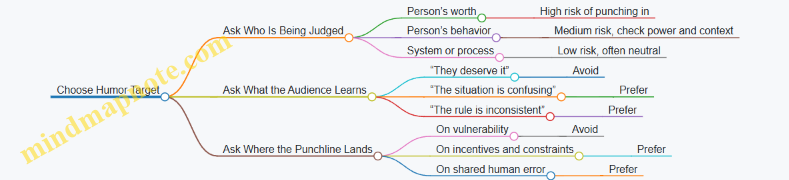
Integrated Example: Revising a Risky Line
Original: “Some people just don’t get it, and then we all pay.”
Revision for punching up or neutral: “When the instructions are unclear, everyone pays—especially the people who have to fix the confusion.”
The revision shifts the target from an implied group’s intelligence to the process that creates repeated work. The audience can still laugh, but the persuasion goal stays intact: clarity and accountability without humiliation.
Quick Checklist for Safe Targeting
Before you use a joke, confirm that the punchline does not require the audience to feel superior to a vulnerable person. If the joke can be understood as criticism of a rule, incentive, or shared situation, it is more likely to support trust and message retention.
8.4 Managing Misinterpretation: Clarity, Context, and Follow-Through
Humor can reduce resistance, but it also creates a new risk: the audience may interpret the joke as the message, or miss the message because the joke arrives first. Managing misinterpretation means designing for three failure points—unclear intent, missing context, and weak follow-through—then testing each one with simple checks.
Clarity That Survives the Punchline
Start by separating “what’s funny” from “what’s true.” A clear message has a stable core that remains understandable even if someone remembers only the punchline.
Use a two-layer structure:
- Layer one is the claim you want the audience to accept.
- Layer two is the humor that makes the claim easier to notice.
Example:
- Claim: “Our onboarding takes less time than you think.”
- Humor: “It’s not a maze. It’s more like a hallway with snacks.”
If the audience forgets the exact line, they should still retain the claim. A practical clarity check is to rewrite the sentence without the humor and confirm the meaning stays the same.
Next, watch for ambiguous targets. If the joke could be read as criticism of the listener, you may accidentally trigger defensiveness. Replace vague jabs with specific, non-personal observations.
Example revision:
- Risky: “Some teams love meetings so much they schedule them for fun.”
- Clearer: “We can cut meeting time by 15% when we stop repeating the same status updates.”
Context That Prevents Wrong Conclusions
Context tells people how to interpret the humor. Without it, the audience may assume the speaker is joking about the wrong thing.
Provide context in three ways:
- Purpose framing: one sentence that states why you’re using humor.
- Scope markers: words that limit what the joke covers.
- Timing alignment: place the humor where the audience already has the relevant information.
Example:
- Purpose framing: “Here’s a quick analogy to explain the process.”
- Scope marker: “In this case, not in general.”
- Timing alignment: explain the steps first, then use a short joke about the step that often confuses people.
A simple diagnostic is to ask: “If someone only hears the joke, what would they think I’m saying?” If the answer is not the intended message, add a short bridge sentence.
Bridge sentence examples:
- “The joke is about the confusion, not about your effort.”
- “I’m using this to highlight the tradeoff, not to dismiss concerns.”
Follow-Through That Converts Laughter Into Understanding
Follow-through is what turns a moment of amusement into retained meaning. Humor without follow-through often leaves the audience with a feeling but not a takeaway.
Use a three-step close:
- Re-state the core in plain language.
- Connect it to action by naming the next step.
- Confirm comprehension with a quick check.
Example:
- Humor: “The first draft is like a first haircut—uneven, but it grows into shape.”
- Re-state: “So we start rough to learn faster.”
- Action: “Submit the draft by Thursday so we can adjust before final review.”
- Check: “What part of the process do you want clarified—scope, timeline, or format?”
For presentations, follow-through can be a slide that repeats the key point in a single sentence. For conversations, it can be a summary at the end of the exchange.
Mind Map: Misinterpretation Control Loop
Example: Turning a Risky Joke Into a Safe, Useful Line
Original attempt:
- “We’re not ignoring your feedback. We’re just letting it marinate.”
Likely misinterpretations:
- “They’re delaying decisions.”
- “They don’t take feedback seriously.”
Revised version with clarity, context, and follow-through:
- Context: “We’re using feedback in a structured way, so it doesn’t get lost.”
- Humor: “Think of it as marinating, but with a calendar.”
- Follow-through: “You’ll see updates in the next review cycle, and we’ll explain what changed and what didn’t.”
- Check: “Does that timeline match what you need?”
The humor remains, but the audience gets the intended meaning: feedback is processed, not ignored.
A Practical Checklist for the Moment
Before you deliver the line, run three fast checks:
- Humor-removed meaning: Can someone understand the claim without the joke?
- Joke-only interpretation: If they remember only the joke, do they still get the point?
- Next step stated: Do you name what happens after the laughter?
When these three answers are “yes,” misinterpretation becomes less likely, and the audience’s attention has a clear place to land.
8.5 Example Walkthrough: Revising a Risky Joke Into a Safer, Still-Funny Line
A risky joke usually fails in one of two ways: it targets a group or person in a way that can be read as contempt, or it relies on a premise that makes the audience feel unsafe. The fix is not “remove humor.” The fix is to move the humor target from people to situations, and to keep the message’s purpose intact.
Step 1: Identify the Risk Type in the Original Line
Original risky line (example):
“Our competitors are so disorganized they probably need a map to find their own website.”
Why it’s risky:
- It insults a competitor as incompetent, which can trigger defensiveness.
- It implies a personal failing rather than a neutral observation.
- It can be interpreted as a jab at character, not a critique of process.
Step 2: Preserve the Persuasive Function
What the line is trying to do:
- Establish contrast: “We’re clearer and more reliable.”
- Create attention: make the contrast memorable.
- Reduce friction: make the comparison feel light.
So we keep the contrast and the memorability, but we change what gets “punched.”
Step 3: Shift the Target from People to Systems
Replace “competitors are disorganized” with something about a process, a situation, or an observable experience.
Safer direction:
- Focus on the audience’s experience: “When you search for X, it takes too long.”
- Focus on the system: “The navigation doesn’t guide you.”
- Focus on the outcome: “You end up hunting for basic info.”
Step 4: Keep the Structure That Makes It Funny
Many jokes work because they follow a predictable pattern: setup → exaggeration → punchline. We can keep that rhythm while changing the target.
Original pattern:
- Setup: “Competitors are disorganized”
- Exaggeration: “need a map”
- Punchline: the image of confusion
Revised pattern:
- Setup: “When you try to find X”
- Exaggeration: “you end up touring the site like it’s a museum”
- Punchline: the image of wasted time
Step 5: Draft Three Candidate Revisions
Candidate A (process-focused):
“If you’re trying to find X on their site, you’ll feel like you’re taking a scenic route—lots of turns, not much destination.”
Candidate B (audience-experience focused):
“Their navigation is so indirect that you don’t search for X—you audition for it.”
Candidate C (lightly self-aware, still comparative):
“We built our pages to answer the first question you have. Their pages sometimes answer the second question you didn’t know you had.”
Step 6: Apply a Quick Safety Checklist
Use this checklist on each candidate:
- Does it avoid personal insults? (Competence stays about the system.)
- Does it avoid “they are bad people” framing? (No character judgments.)
- Does it still support the persuasion goal? (Contrast remains.)
- Is the humor understandable without extra context? (The audience can “get it” fast.)
Candidate A scores well on clarity and safety. Candidate B is clever but may be slightly abstract. Candidate C is safe and precise, but the humor is subtler.
Step 7: Choose One and Tighten It for Delivery
Pick Candidate A for a typical business talk because it’s concrete and easy to say.
Final revised line:
“If you’re trying to find X on their site, you’ll feel like you’re taking a scenic route—lots of turns, not much destination.”
Tightening notes:
- “Feel like” softens the claim while keeping the image.
- “Lots of turns, not much destination” is a clean punchline that lands quickly.
Mind Map: Risk Revision Path
Step 8: Micro-Rehearsal for Message Retention
To help the audience remember the point, pair the joke with a direct follow-up sentence that states the benefit.
Example follow-up:
“That’s why we organize pages around the first question people ask.”
Now the humor earns attention, and the follow-up locks in the persuasive takeaway.
9. Writing Practice: From Draft to Punchline-Ready Copy
9.1 Writing for Readability: Sentence Design and Visual Rhythm
Readability is not a style preference; it is a delivery system for your persuasion. When sentences are easy to parse, readers spend their attention on the message instead of decoding it. Humor can help, but only if the sentence structure carries the meaning cleanly to the punchline.
The Sentence Job Description
A sentence has three jobs: it names the topic, it moves the thought forward, and it signals how the parts relate. If any job fails, the reader slows down. Slowing down is fine when you want reflection, but it is risky when you want comprehension and recall.
Start with a simple rule: put the main subject and main verb early. Compare these.
- Less readable: “In order to improve retention, a cue can be used by speakers.”
- More readable: “Speakers can use cues to improve retention.”
The second version reduces mental bookkeeping. It also makes the action clear, which matters when you later attach a humorous line as reinforcement.
Visual Rhythm: How the Page Teaches
Visual rhythm is the pattern your reader sees before they fully read. It comes from sentence length, paragraph shape, and the placement of emphasis. A page with long, uniform sentences forces the eye to work continuously. A page with varied lengths creates natural pauses.
Use a consistent paragraph size: one idea per paragraph, usually 2–4 sentences. If a paragraph needs more, split it so the reader gets a reset point.
A practical rhythm target for persuasive writing is this: most sentences should be short enough to scan in one breath, while a few longer sentences carry the reasoning. The longer sentences should still be structurally simple, not stuffed with clauses.
Sentence Design Tools That Keep Meaning Stable
- Prefer concrete subjects: “Your audience remembers…” beats “It is remembered…”
- Use active voice when you can: “We test the hook” is clearer than “The hook is tested.”
- Limit stacked modifiers: “a clear, brief, retention-friendly cue” is harder than “a clear cue. It is brief.”
- Keep one main point per sentence: If you need two claims, split them.
- Use transitions sparingly but precisely: “So,” “Because,” and “However” should match the logic, not just decorate it.
Humor fits best when it interrupts the reader at a controlled moment. That requires the sentence around the joke to be stable. If the sentence is already tangled, the joke becomes noise.
A Readability Checklist for Drafts
Use this checklist on each paragraph:
- Can I identify the main claim in the first sentence?
- Does each sentence contain one clear move?
- Are there any sentences longer than necessary?
- Do I have at least one “reset” point every few lines?
- Does any humorous line sit on top of a clear grammatical structure?
If you answer “no” to the first two questions, fix structure before you rewrite for tone.
Mind Map: Sentence Design and Visual Rhythm
Example: From Dense to Readable
Here is a before-and-after that shows both sentence design and rhythm.
Before “Because the audience may not immediately understand the value of the cue, it is important that you explain why it matters and how it improves recall.”
After “Your audience might not see why the cue matters. Explain the reason. Then show how it improves recall.”
The after version uses shorter sentences to create pauses. It also makes the reader’s next action obvious: explain, then show.
Now add a humor-friendly reinforcement line without breaking readability.
“Your audience might not see why the cue matters. Explain the reason. Then show how it improves recall—because memory, like a calendar, needs a reminder.”
The joke works because the sentence remains grammatical and the metaphor is brief. The reader still knows what to do and what outcome to expect.
Advanced Detail: Clause Control
When sentences get long, the problem is usually clause control, not length. A sentence becomes hard when it contains multiple subordinate clauses that compete for attention.
A simple technique is to convert one subordinate clause into a separate sentence. If the clause carries a distinct idea, splitting it usually improves both clarity and rhythm.
- Hard: “When you use cues, which help people remember, you should also repeat the key phrase.”
- Clear: “Cues help people remember. Repeat the key phrase too.”
The second version keeps each thought in its own lane. That lane clarity is what makes humor land cleanly when you add it later.
9.2 Punchline Craft: Precision, Brevity, and Controlled Surprise
A persuasive punchline is not a decoration; it is a compression tool. It should carry the message’s meaning while creating a small, safe moment of surprise. Precision means the line points to the exact idea you want remembered. Brevity means it lands without dragging attention away from the claim. Controlled surprise means the audience can predict the logic after the fact.
The Core Equation of a Punchline
Start with a simple structure: setup → expectation → twist → meaning.
- Setup states a familiar situation.
- Expectation frames what the audience thinks will happen.
- Twist breaks that expectation in one step.
- Meaning ties the twist back to your persuasive point.
If you skip meaning, you get a joke. If you skip twist, you get a slogan. If you skip setup, the audience can’t calibrate the surprise.
Precision: Aim at One Message, Not Many
A precise punchline names the target idea in plain language. Avoid stuffing multiple claims into the same line. If your message has three reasons, pick one reason for the punchline and let the others be supported in the surrounding sentences.
Example:
- Weak: “People don’t listen because life is busy, and also because attention is broken, and also because your message is unclear.”
- Precise: “Busy isn’t the problem. Unclear is.”
The second line is short, but it also tells you what to fix.
Brevity: Remove Everything That Doesn’t Change the Outcome
Brevity is editing discipline. Cut words that do not change the reader’s mental model. A useful test is whether the sentence still works if you remove an adjective or an extra clause.
Example:
- Wordy: “In most cases, you will probably find that people tend to forget what you said unless you repeat it.”
- Brief: “If you don’t repeat it, they forget.”
The brief version makes the cause-and-effect relationship explicit.
Controlled Surprise: Break the Pattern, Then Repair It
Surprise should be earned by contrast, not by confusion. The twist must be understandable as soon as the audience hears it.
Use one of these controlled twist methods:
- Expectation reversal: the opposite is true.
- Category shift: you treat the situation as a different kind of problem.
- Cause reframe: the reason changes.
Example (Expectation Reversal):
- Setup: “More information sounds helpful.”
- Twist: “It’s often noise.”
- Meaning: “Clarity beats volume.”
Mind Map: Punchline Craft Components
Build a Punchline from Your Claim
Write your claim as a single sentence first. Then craft a punchline that restates that claim in a sharper form.
Step-by-step method:
- Draft the claim: “People remember what they can retrieve.”
- Choose an expectation: “If it’s interesting, it will stick.”
- Create the twist: “Interesting helps, but retrieval wins.”
- Verify meaning: the twist points back to retrieval.
Result: “Interesting helps. Retrieval wins.”
This line is brief, precise, and it signals the mechanism you want the audience to remember.
Punchline Density and Placement
A punchline should be rare enough to matter. If every sentence tries to surprise, none of them do. Place punchlines at moments where the audience is most likely to lose the thread: after a claim, before a key example, or at the end of a short explanation.
Example placement pattern:
- Claim: “Clarity beats volume.”
- Support: one concrete example.
- Reinforcement: a second short line that echoes the mechanism.
Common Failure Modes and Fixes
-
Punchline without twist: it sounds like a proverb.
- Fix: add a single contrast word or phrase that changes the expectation.
-
Twist without meaning: it’s funny but doesn’t guide action.
- Fix: end with the mechanism or the decision rule.
-
Twist that requires explanation: the audience must think too long.
- Fix: make the twist interpretable on first read by using familiar categories.
Example: Convert a Plain Statement Into a Punchline
Plain: “When you repeat the key idea in different words, people remember it better.”
Punchline draft:
- Setup: “People don’t need more facts.”
- Expectation: “They need one strong statement.”
- Twist: “They need the idea in more than one form.”
- Meaning: “Repeat the key idea, not the exact sentence.”
Final punchline set:
- “One sentence isn’t enough. One idea in new clothes is.”
- Meaning check: the audience knows what to do next.
Mind Map: Quick Punchline Checklist
Precision, brevity, and controlled surprise work together. Precision ensures the punchline points to the message. Brevity keeps attention on the point. Controlled surprise makes the line memorable without forcing the audience to decode it.
9.3 Humor Density: How Much Is Too Much in a Persuasive Message
Humor density is the proportion of your message that uses comic techniques rather than direct explanation, evidence, or instruction. Too little humor can leave attention flat; too much can make the audience feel like they’re being entertained instead of persuaded. The goal is not a fixed percentage. The goal is a stable balance where humor reliably supports the persuasion job.
Start with a simple baseline: every persuasive message needs three functional layers—meaning, support, and action. Meaning answers what you want people to believe. Support explains why it’s credible. Action tells them what to do next. Humor should appear as a tool inside these layers, not as a fourth layer that competes for time.
A practical way to set humor density is to decide how many “attention events” you can afford. An attention event is a moment that changes the listener’s mental state: a surprising contrast, a quick reframe, a memorable line. If you stack too many events, the audience spends effort tracking the jokes instead of processing the claim. If you space them well, each event becomes a signpost that helps people remember where they are in the argument.
Use this rule of thumb: one humor beat per major idea. A “major idea” is a claim or a reason that you would otherwise label as a bullet, a section, or a paragraph topic. Within each major idea, keep humor to one short device—setup and payoff—then return to explanation. If you need two different jokes for the same major idea, you probably need to split the idea into two parts.
Mind Map: Humor Density Control
Placement determines whether humor feels helpful or noisy. Hooks work best at the start because they earn permission to continue. Transitions work best when you’re moving between reasons, since a quick comic bridge can reduce the sense of abrupt topic changes. Reinforcement lines work best at the end of a section, where a short humorous tag can make the takeaway easier to repeat.
Humor is least efficient inside dense evidence. If you’re walking through numbers, definitions, or a multi-step process, the audience needs stable cognitive footing. A joke there can interrupt the mental sequence. If you must include humor during evidence, keep it to a single, low-complexity line that does not require the audience to reinterpret the facts.
Calibration signals tell you whether your current density is too high. After each humor beat, check whether the next sentence is easy to understand without re-reading. If listeners need you to explain the joke before they can understand the claim, you’ve spent persuasion time on comic processing. Another signal is audience behavior: if people laugh but then ask questions that show confusion about the argument, the humor likely displaced the message.
Consider two examples.
Example: Low Density That Still Persuades
You’re pitching a policy change with three reasons. You open with one light, relevant contrast: “If we keep doing the same thing, we’ll keep getting the same results. That’s not strategy; that’s scheduling.” Then you present Reason One with a clear explanation and one concrete example. You move to Reason Two with a brief transition line and continue with evidence. You end each reason with a short reinforcement tag that restates the takeaway in plain language. Humor appears four times total across the full pitch, and each time it points back to a claim.
Example: High Density That Undermines Clarity
Same pitch, but every paragraph includes a new joke, often with wordplay and extra setup. The audience laughs frequently, yet the evidence feels fragmented. When you reach the call to action, people remember the tone but not the specific policy mechanism. The issue isn’t that humor exists; it’s that the message layers are no longer dominant. The audience’s attention keeps resetting.
A final calibration step is to count humor beats against major ideas. If you have three major ideas, aim for three to five humor beats total, depending on complexity. If your message is technical, lean toward three. If it’s conversational and the evidence is straightforward, you can use five, but still keep one device per beat and return to explanation immediately.
When in doubt, reduce. Removing one humor beat usually improves clarity more than it harms engagement, because persuasion depends on processing the claim, not just enjoying the delivery.
9.4 Editing for Consistency: Tone, Terms, and Message Alignment
Consistency is what lets humor do its job without stealing attention from the point. Editing for consistency means you check three things in order: tone stays steady, terms stay precise, and the message keeps its promise from opener to call to action.
Tone Consistency: One Voice, One Temperature
Tone is the emotional “volume” of your writing. Humor can raise it, but it should not change it mid-paragraph. Start by labeling your intended tone in one sentence, such as “calm and practical with occasional light humor.” Then edit in passes:
-
Tone anchors. Pick two lines that represent the tone you want. For example, an opener like “Here’s the simple version first” and a transition like “Now the part that usually causes confusion.” Keep those lines as reference points.
-
Humor intensity control. If a joke uses exaggeration, the surrounding sentences should remain straightforward. Example: “Our onboarding takes 12 minutes, not 12 hours” can sit next to “You’ll get a checklist and a short practice.” If you add another joke immediately after, reduce the second one’s sharpness or length.
-
Audience respect. Humor should not change into sarcasm when you hit a disagreement. If you write “That’s a fair question” in one place, don’t switch to “Sure, if you enjoy headaches” later.
Example revision (tone):
- Draft: “The dashboard is easy. Unless you like mystery novels.”
- Edited: “The dashboard is easy to read. If something looks confusing, it’s usually a filter setting.”
Terms Consistency: Same Words, Same Meaning
Terms are the labels your reader uses to build mental structure. When terms shift, the reader has to re-learn your system.
-
Create a term list. Before final edits, list the key nouns and verbs you rely on: “plan,” “trial,” “risk,” “approval,” “next step.” Keep them stable.
-
Avoid near-synonyms for critical concepts. If you call it “trial” once and “pilot” later, you may imply a different commitment level. Use one term unless you intentionally define a difference.
-
Check pronouns and referents. Humor often adds quick references like “that thing” or “the whole mess.” Replace them with the exact term the reader needs.
Example revision (terms):
- Draft: “During the trial, you’ll see results. After the pilot, we review your metrics.”
- Edited: “During the trial, you’ll see results. After the trial, we review your metrics.”
Message Alignment: Humor That Points, Not Wanders
Message alignment ensures every humorous beat supports the same claim. A common failure pattern is “joke first, point later,” where the point arrives but feels unrelated.
Use a simple alignment check:
-
Claim lock. Write the single claim in one line: “This approach reduces time-to-value by clarifying the first decision.”
-
Reason mapping. Under that claim, list the reasons you intend to support. Each reason should have at least one non-humorous sentence that states it plainly.
-
Humor placement rule. Humor should appear in one of three roles:
- Hook: earns attention before the claim.
- Bridge: helps the reader move between reasons.
- Reinforcement: repeats the key idea in a memorable form.
If a joke doesn’t fit one of those roles, it probably belongs elsewhere or needs a rewrite.
Example walkthrough (alignment):
- Claim: “We reduce time-to-value by clarifying the first decision.”
- Hook line: “Most teams don’t fail at execution; they fail at choosing what to do first.”
- Humor beat: “It’s like starting a road trip by arguing about the snacks.”
- Bridge line: “Once the first decision is clear, the rest becomes a sequence, not a debate.”
- Reinforcement: “Clear first steps turn effort into progress.”
Mind Map: Editing Consistency Workflow
A Practical Editing Pass Plan
Do four quick passes rather than one long edit.
- Pass 1: Tone sweep. Highlight every humorous line and check whether the surrounding sentences match the same emotional temperature.
- Pass 2: Terms sweep. Search for your key terms and confirm they appear consistently, especially near humor.
- Pass 3: Alignment sweep. For each humorous line, write one plain sentence that states what it supports. If you can’t, revise or remove.
- Pass 4: Readability check. Make sure the humor doesn’t create extra steps for comprehension. If a reader must decode the joke before understanding the point, the message alignment is off.
Consistency editing is not about making everything bland. It’s about making the reader’s job predictable: the voice stays steady, the vocabulary stays reliable, and the humor always points back to the same claim.
9.5 Example Walkthrough: Converting a Bullet-Point Brief Into a Humorous Script
Start with a bullet-point brief that has the right ingredients but not the right shape. The goal is to turn each bullet into a line that either (1) earns attention, (2) clarifies meaning, or (3) helps the audience remember and act.
Step 1: Read the Brief Like a Listener
Imagine you’re hearing the message for the first time. Mark each bullet as one of three jobs:
- Attention job: gets people to lean in.
- Clarity job: explains the idea without extra work.
- Retention job: creates a cue the audience can repeat later.
Example brief (for a 2-minute pitch):
- “We reduce onboarding time.”
- “We use a guided checklist.”
- “Teams make fewer mistakes.”
- “It’s easy to roll out.”
- “We can start next week.”
Step 2: Create a Message Spine
A script needs a spine so the humor doesn’t float. Use this order:
- One-sentence claim.
- Two reasons.
- One concrete mechanism.
- One benefit summary.
- One clear call to action.
Here’s the spine mapped to the brief:
- Claim: reduce onboarding time.
- Reasons: fewer mistakes, easier rollout.
- Mechanism: guided checklist.
- Summary: faster start with less rework.
- Action: start next week.
Step 3: Choose Humor That Matches the Job
Humor should serve the job. For attention, use a quick contrast. For clarity, use a simple analogy. For retention, use a short repeatable phrase.
Mind Map: Humor Placement and Message Jobs
Step 4: Draft the Script with Built-In Checks
Write the first draft without worrying about perfect jokes. Then revise each line to ensure it still performs its job.
Example Script Draft (about 2 minutes)
“Onboarding shouldn’t feel like assembling furniture with the instructions missing the picture. We reduce onboarding time by giving teams a guided checklist.
Here’s the difference: without a checklist, people do what most humans do—guess, ask, and then fix the same issue twice. With our approach, the checklist tells you what to do next and what ‘done’ looks like.
The result is fewer mistakes. Not because people suddenly become experts, but because the steps are explicit and the common pitfalls are built into the flow.
It’s also easy to roll out. You don’t need a new process that everyone resents; you start with the checklist, run it for a small group, and then expand once it’s working.
If you want to see it in action, we can start next week. One pilot, a short feedback cycle, and then we scale the checklist to the rest of the team.
And if you remember one line from this talk, make it this: check it, then ship it.”
Step 5: Tighten for Clarity and Timing
Now remove anything that doesn’t add meaning. Also ensure the humor is brief enough that the audience doesn’t miss the mechanism.
Quick edits to apply:
- Replace vague phrasing with specific actions.
- Keep the joke to one sentence, then return to the mechanism.
- Make the call to action concrete.
Revised script (same structure, tighter):
“Onboarding shouldn’t feel like assembling furniture with the instructions missing the picture. We reduce onboarding time with a guided checklist.
Without it, teams guess, ask, and fix the same issue twice. With it, the checklist shows the next step and defines what ‘done’ means.
That’s how we get fewer mistakes: the steps are explicit, and the common pitfalls are handled before they become rework.
Rollout is straightforward. Start with a pilot group, run the checklist, collect feedback, then expand.
We can begin next week. One pilot, then scale.
Remember the rule: check it, then ship it.”
Step 6: Validate with a Simple Internal Test
Read the script aloud once. Then answer three questions:
- Can someone repeat the claim in one sentence?
- Did the mechanism appear before the benefits?
- Is there one repeatable phrase for retention?
If any answer is “no,” adjust the order first, then shorten the humor.
Step 7: Optional Micro-Variant for Different Audiences
If the audience is more technical, swap the furniture line for a process line:
- “Onboarding shouldn’t feel like running a pipeline without a test plan.”
Keep the checklist as the mechanism and keep “check it, then ship it” as the retention cue.
That’s the conversion: bullets become jobs, jobs become a spine, and humor becomes a tool that supports attention, clarity, and memory.
10. Applying Humor Across Formats and Channels
10.1 Live Speaking: Openers, Q&A, and Audience Interaction
Live speaking has one job: make your message easy to notice, easy to understand, and easy to remember while people are actively thinking about other things. Humor can help, but only if it is timed to the audience’s attention and anchored to your purpose.
Openers That Set Expectations Without Overpromising
A strong opener does three things in the first minute: it signals relevance, it reduces uncertainty, and it earns permission to be brief. Start with a concrete observation about the room or the topic, then state what the audience will be able to do after you finish.
Example opener (neutral, slightly playful):
“Before we get into details, quick check: if you’ve ever left a meeting thinking, ‘I liked the idea, but I can’t explain it to anyone,’ this talk is for you. By the end, you’ll have a simple way to structure a message so people remember the point, not just the vibe.”
Where humor fits: use a short, low-risk line that describes a shared experience, then move on immediately. If the joke becomes the main event, you lose the thread.
The Opener Mind Map
Q&A That Protects Clarity and Keeps Momentum
Q&A is not a detour; it is part of the message delivery. Your job is to convert questions into structured answers that reinforce your main points.
Use a three-step response pattern:
- Restate the question in plain language.
- Answer the core point directly.
- Tie back to your framework with one sentence.
Example:
Audience: “How do I know when humor is too much?”
You: “Good question. The core issue is whether the humor competes with the claim. Here’s the rule: if people can’t repeat your main point after the joke, the joke is doing the work. Now, connect that to our earlier structure—hook, reason, evidence, and a clean call to action.”
If you don’t know an answer, say so and offer what you can do: “I don’t have the exact figure, but I can explain the method we’d use to verify it.” This keeps trust intact.
Audience Interaction That Feels Natural
Interaction should be small enough to control and useful enough to matter. Choose one of three interaction types.
-
Micro-polls: one question, two or three options.
“By a show of hands, which is harder for you: getting attention, staying clear, or making people remember?” -
Prediction prompts: ask what they expect, then confirm or correct.
“Before I show the example, predict which line people will remember: the statistic or the one-sentence summary.” -
Live rewriting: take a short phrase from your own script and improve it with the audience’s input.
“I’ll read a draft sentence. Tell me what part sounds confusing, and we’ll fix it.”
Humor can support interaction by lowering defensiveness, but keep it observational. Avoid jokes that blame the audience or mock their confusion.
Q&A and Interaction Mind Map
A Cohesive Flow from Opener to Q&A
A practical structure for a 30–45 minute session:
- Opener (1 minute): shared friction + outcome.
- Framework (10–12 minutes): explain the message structure with one example.
- Application (10–12 minutes): show a before-and-after rewrite where humor improves retention.
- Interaction (5 minutes): micro-poll or prediction prompt tied to the framework.
- Q&A (remaining time): use the three-step pattern and always connect back.
Example Q&A tie-back line:“That’s exactly the difference between a joke that gets a laugh and a joke that supports recall. In our structure, the humor belongs in the hook or the reinforcement, not in the evidence.”
The result is consistent: even when the audience steers the conversation, your message stays anchored. Humor becomes a tool for attention and memory, not a substitute for thinking.
10.2 Slides and Visual Aids: Captioning, Timing, and Visual Punchlines
Slides work like a two-channel message: what the audience hears and what they can read. Humor adds a third job—making the audience look up at the right moment—without stealing attention from the point. The goal is simple: the slide should clarify, the caption should guide, and the punchline should land as reinforcement, not as a detour.
Captioning That Guides Attention
Captioning is not decoration; it is a control surface for reading speed. Use short, complete phrases that match what you will say next. If your spoken sentence is long, your caption should be shorter than your speech, because people read faster than you talk.
A practical rule: one caption line per idea, with a maximum of 8–12 words per line. When you need more, split into two captions and reveal them in sequence.
Example: Instead of a slide that reads “Our process improves quality by reducing errors across the workflow,” use a caption like “Fewer errors, same workflow.” Then say the supporting detail verbally. The audience gets the headline instantly, and your explanation fills the gaps.
Caption timing matters too. If the caption appears before you mention it, some people will read ahead and miss your emphasis. If it appears after you finish the idea, they may feel you changed the subject. Align the caption reveal with the first sentence you use to introduce the idea.
Timing That Prevents Cognitive Overload
Humor often increases the number of “things to process” in a short window: the setup, the visual, and the meaning. Timing keeps that manageable.
Use a three-beat rhythm:
- State the claim.
- Show the visual support.
- Add the humorous reinforcement.
Keep the humorous beat brief. If the audience needs more than a second to interpret the joke, you have turned reinforcement into a new task.
Example: Claim: “This checklist reduces rework.” Visual: a simple before/after diagram with two boxes. Humorous reinforcement: a caption like “Less ‘oops,’ more ‘done.’” The joke is small enough to be processed while the audience still tracks the checklist benefit.
Visual Punchlines That Stay Attached to the Message
A visual punchline should be a meaning-preserving twist. It should point back to the same claim, not to a separate topic.
Choose one of these visual patterns:
- Contrast: show a “messy” version and a “fixed” version, then add a short caption that reframes the difference.
- Incongruity: depict an exaggerated mismatch that still maps to the concept (for instance, a “wrong tool” icon next to the right process step).
- Repetition with a Twist: reuse the same graphic element across slides, changing only one small detail at the punchline moment.
Avoid punchlines that require cultural knowledge the audience might not share. If the joke depends on a specific reference, the visual becomes a quiz.
Mind Map: Slide Design Flow for Humor and Clarity
Example: Turning a Standard Slide Into a Captioned, Timed Segment
Topic: “We reduce errors by standardizing handoffs.”
Slide 1 (before humor):
- Visual: a two-step flow diagram with “handoff A” to “handoff B.”
- Caption: “Standard handoffs reduce errors.”
- Spoken emphasis: “The handoff is where mistakes multiply.”
Slide 2 (support):
- Visual: same diagram, but add a checklist icon at the handoff.
- Caption: “Checklist makes the transfer consistent.”
- Spoken emphasis: “When the same items are verified every time, fewer things slip.”
Slide 3 (visual punchline):
- Visual: a small “mystery box” labeled “handoff details” on the left, replaced by a “labeled box” on the right.
- Caption: “No more surprise contents.”
- Spoken line: “You don’t need detective work—just the checklist.”
The punchline works because it maps directly to the claim: surprise contents represent missing information, and the checklist represents consistent handoffs.
Practical Checklist for Your Next Deck
Before presenting, run a quick pass: read each caption aloud without your slides. If you can’t say it cleanly, the caption is too dense. Then rehearse the reveal order once, focusing on whether the humorous beat arrives after the audience understands the claim. If it arrives early, shorten the setup or move the joke to the final reinforcement slide.
10.3 Email and Messaging: Short-Form Humor That Still Persuades
Short-form humor works in email and messaging when it does three jobs quickly: it earns attention, it clarifies the point, and it reduces friction to respond. The trick is to treat humor as a formatting tool, not as the message itself.
Start with the foundation: your reader is scanning. In a typical inbox, they see the sender, subject line, first line, and any preview text. Humor that arrives only after several paragraphs is late; humor that appears in the first line or subject can function like a visual cue that says, “This is worth your time.” Keep the joke small enough to be understood in one read.
Next, match humor to the persuasion stage. If your goal is to inform, use humor to simplify a complex idea into a single, concrete comparison. If your goal is to persuade, use humor to lower resistance by acknowledging a likely concern. If your goal is to motivate, use humor to make the next step feel easier, not heavier.
A useful rule for short-form: one setup, one payoff, one clear action. The setup can be a familiar situation. The payoff should connect directly to your claim or request. The action should be explicit and easy to answer.
Mind Map: Humor Placement and Purpose
Subject Lines That Don’t Lose the Plot
A subject line should still communicate the topic. Humor can be a twist on the topic, not a detour. For example, if you’re requesting a meeting, avoid jokes that hide the purpose.
- Weak: “Quick question (and a tiny confession)”
- Strong: “Can we align on the timeline? I’m aiming for ‘soon-ish’”
The second keeps the topic visible while adding a human tone. “Soon-ish” signals flexibility without sounding vague.
First-Line Humor That Sets Expectations
Your first line should establish what the reader will get. Humor can do that by setting a realistic expectation.
Example message:
“Hi Sam—this will be a short note. If you’re expecting a 12-step plan, I’m not that person.”
Why it works: it promises brevity, it reduces the reader’s mental load, and it makes the request feel less like a trap.
Transition Lines That Keep Substance Intact
When you need to move from humor to content, use a transition that re-centers the message.
Example:
“I’ll keep it simple: we need your sign-off by Thursday so we can start the next batch.”
The humor is now behind you; the transition line restores clarity.
Closing Lines That Invite a Reply
A closing joke should not replace the ask. It should make responding feel normal.
Example:
“If you’d rather not, just tell me ‘not now’—I’ll stop nudging like a polite calendar reminder.”
This reduces social pressure and gives the reader an easy response option.
A Simple Template for Short-Form Persuasion
Use this structure:
- One-line humor or relatable observation
- One-sentence context
- One-sentence claim or reason
- One explicit ask with a low-effort reply option
Example template filled in:
“Before you ask, yes, I read the whole thread. No, I didn’t miss the one detail that matters.”
“We’re ready to finalize the draft, but we need your approval on the final paragraph.”
“Your input here prevents rework later.”
“Can you reply ‘approved’ or ‘edit’ by 3pm?”
Common Failure Patterns to Avoid
- Humor that targets the reader’s intelligence: it may get a laugh, but it usually kills trust.
- Humor that creates uncertainty about the ask: if the reader has to guess, the persuasion goal loses.
- Wordplay that depends on timing or tone: in text, it often lands as confusion.
Mind Map: Quick Checks Before Sending
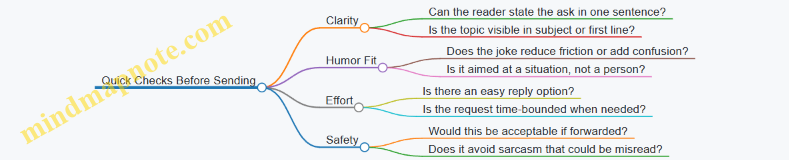
Short-form humor persuades when it behaves like good formatting: it guides attention, supports understanding, and makes the next step feel straightforward. Keep it brief, keep it connected to the ask, and let the message do the heavy lifting.
10.4 Social and Short Video: Constraints, Hooks, and Retention-Friendly Structure
Short video has three constraints that shape everything: time, attention volatility, and limited context. Your job is to make the viewer understand the point quickly, then keep them watching long enough to store it in memory. Humor can help, but only if it supports comprehension rather than competing with it.
Core Constraint Model
Start by deciding what the viewer must know by the end. Then work backward to the first second.
- Time budget: Assume the viewer decides within the first few seconds. If the opening doesn’t signal the topic and payoff, the rest won’t matter.
- Context budget: Viewers often arrive mid-scroll. Your first line must stand alone.
- Cognitive budget: Every extra idea costs processing time. Humor should compress meaning, not add new threads.
A practical rule: one video should contain one claim and one supporting reason. If you need two reasons, split into two videos.
Hook Design That Fits the Format
A hook is not a joke for its own sake. It’s a promise of relevance delivered through a recognizable pattern.
Use one of these hook types:
- Problem-to-Pattern: Show a common mistake, then name the pattern.
- Example: “If your ‘quick tip’ keeps getting ignored, it’s usually because it’s missing one sentence.”
- Contradiction With Clarity: State something that sounds wrong, then correct it immediately.
- Example: “The fastest way to be persuasive is not to be louder. It’s to be clearer.”
- Mini-Story With a Turn: Start with a tiny scenario, then reveal the lesson.
- Example: “I watched a teammate pitch for 30 seconds and lose the room. The fix was one change.”
Humor works best as the turn, not the setup. The setup should be understandable even without the punchline.
Retention-Friendly Structure
Retention is built through predictable beats. Viewers stay when they can anticipate progress.
A simple structure for 20–45 seconds:
- 0–3 seconds: Topic + payoff in plain language.
- 3–12 seconds: One reason explained with a concrete example.
- 12–25 seconds: Humor as a compression device (a contrast, exaggeration, or quick reframe).
- 25–40 seconds: Repeat the claim using different wording, then add a single action step.
- 40–45 seconds: Close with a short line that can be quoted.
Avoid multi-part jokes that require setup. If the punchline depends on details you haven’t introduced yet, it will land late and reduce comprehension.
Mind Map: Hook and Retention Workflow
Integrated Example: From Plain to Comic-Enhanced
Plain version (no humor): “Most people lose persuasion by burying the point. Say the claim first, then give one reason.”
Short video version with structure:
- 0–3s: “If your message gets ignored, it’s usually because the point shows up late.”
- 3–12s: “Start with the claim: ‘Here’s what you should do.’ Then add one reason, like a simple benefit.”
- 12–25s: “Otherwise you’re basically asking people to watch a movie without the trailer. They don’t hate you. They just leave.”
- 25–40s: “So: claim first, one reason second. That’s the whole sequence.”
- 40–45s: “Make the point early, and the rest can earn its place.”
Notice how the humor is a quick analogy that reinforces the structure. The viewer can still follow the instruction without enjoying the joke.
Practical Editing for Retention
When you cut, cut for comprehension first.
- Remove filler words that don’t change the viewer’s understanding.
- Keep sentences short around the hook and the action step.
- Use one visual anchor if possible: a single on-screen phrase that matches the spoken claim.
- End with a line that can be repeated without losing meaning.
Mind Map: Humor That Helps Persuasion
A retention-friendly short video is less about being funny and more about being legible. Humor earns its spot when it clarifies the claim, tightens the explanation, and leaves the viewer with a line they can remember.
10.5 Example Walkthrough: Adapting the Same Message for Three Different Formats
You have one core message and three delivery formats. The goal is not to “make it fun everywhere,” but to keep the same claim, reasons, and call to action while adjusting where humor sits, how it is paced, and how it is reinforced.
Step 1: Lock the Core Message
Start by writing a single, format-agnostic version:
- Claim: “Switching to a simpler workflow reduces missed deadlines.”
- Reason 1: “Fewer steps means fewer handoff errors.”
- Reason 2: “Clear next actions make progress visible.”
- Call to Action: “Try the workflow for two weeks and track outcomes.”
Now decide what humor will do. In this example, humor will serve as a memory cue and a low-friction opener, not as a replacement for evidence.
Step 2: Choose a Humor Role and a Single Reusable Line
Pick one reusable line that can be adapted without changing meaning:
- Reusable line: “If your process needs a map, it’s not a process—it’s an expedition.”
This line works because it creates a quick mental image, then you immediately translate it into the workflow claim.
Step 3: Adapt for Three Formats
Format A: Live Speaking (5–7 minutes)
Placement: opener and one reinforcement point.
Structure: hook → claim → two reasons → CTA.
Example script (condensed):
“Quick question: if your process needs a map, it’s not a process—it’s an expedition. Here’s the claim: switching to a simpler workflow reduces missed deadlines. First, fewer steps means fewer handoff errors. Second, clear next actions make progress visible, so problems surface earlier. If you want to see whether this fits your team, try the workflow for two weeks and track outcomes.”
Why it works: the reusable line earns attention, then the next sentence converts the joke into the claim. The second reason is delivered plainly so listeners can evaluate it.
Format B: Slides (about 6 slides)
Placement: one title line and one speaker note.
Structure: slide headline → one supporting bullet → visual cue.
Example slide set:
- Slide 1 Title: “Stop the Expedition: Simplify the Workflow”
- Slide 2 Bullet: “Claim: Fewer missed deadlines”
- Slide 3 Bullet: “Reason 1: Fewer steps, fewer handoffs”
- Slide 4 Bullet: “Reason 2: Clear next actions, visible progress”
- Slide 5 Speaker Note: “Reinforce: ‘If your process needs a map…’ Then point to the handoff diagram.”
- Slide 6 CTA: “Two-week trial + outcome tracking”
Why it works: slides carry the logic; humor becomes a label that helps recall the logic. The speaker note prevents the slide from becoming a joke dump.
Format C: Email (120–180 words)
Placement: subject line and first sentence.
Structure: short hook → claim → two reasons → CTA.
Example email:
Subject: Stop the Expedition: A simpler workflow
“If your process needs a map, it’s not a process—it’s an expedition. I’m sharing a simple change that can reduce missed deadlines: switch to a workflow with fewer steps and clearer next actions.
Why it helps: fewer steps reduce handoff errors, and explicit next actions make progress visible so issues show up earlier.
If you’re interested, try the workflow for two weeks and track outcomes. Reply with your current process steps, and I’ll suggest a simplified version to start with.”
Why it works: the email keeps humor at the front so the reader sees it before deciding whether to continue. The rest stays informational to preserve trust.
Mind Map: Message Adaptation Across Formats
Step 4: Check for Three Consistency Tests
- Same claim: each format must state the reduction in missed deadlines.
- Same reasons: both reasons must appear, even if phrased differently.
- Same CTA: each format must ask for the two-week trial and tracking.
If any test fails, revise the format-specific text until the core message is unmistakable. Humor can vary in placement and intensity, but the persuasion structure should not.
11. Practical Exercises and Templates for Message Retention
11.1 The Humor-Message Match Template: Aligning Device to Purpose
Humor works best when it serves a specific job in your message. The Humor-Message Match Template is a practical way to choose a comic device that supports your purpose instead of competing with it. You start with the persuasion goal, then pick the device that naturally strengthens the next step your audience should take.
Step 1: Name the Purpose in One Sentence
Write a single sentence that answers: “After hearing this, what should the audience do, believe, or remember?” Keep it concrete.
Example purposes:
- “The audience should remember the three benefits.”
- “The audience should feel safe enough to ask questions.”
- “The audience should accept a recommendation despite minor objections.”
Step 2: Identify the Message Function
Humor should attach to a message function. Use one primary function per segment.
- Attention Hook: Get people to stay with you.
- Comprehension Aid: Make a concept easier to parse.
- Resistance Reduction: Lower friction or defensiveness.
- Retention Cue: Help the audience recall later.
- Action Framing: Make the next step feel reasonable.
Step 3: Choose the Comic Device That Fits the Function
Different devices do different work. Match the device to the function by using the “why it helps” logic.
- Setup and Payoff fits Retention Cue because the payoff creates a memorable closure.
- Contrast and Incongruity fits Comprehension Aid because it highlights the difference between what people expect and what’s true.
- Exaggeration and Understatement fits Resistance Reduction because it signals you’re not taking a hard-sell stance.
- Wordplay and Rhythm fits Retention Cue because repeated phrasing becomes a mental handle.
- Self-Deprecation fits Action Framing when used to reduce social distance, not to undermine competence.
Step 4: Add a “Message Anchor” So Humor Doesn’t Drift
A humor line needs an anchor that ties it back to the point. The anchor is a plain sentence that restates the takeaway immediately after the joke.
Anchor formula:
- Humor line → short pause → “So the point is…” + the actual claim.
Example:
- Humor line: “I used to think ‘quick fix’ meant ‘done in five minutes.’ Turns out it means ‘done in five minutes… plus coffee.’”
- Anchor: “So the point is: plan for small steps, not instant miracles.”
Step 5: Check for Three Failure Modes
Before you finalize, verify:
- Clarity: Can someone repeat the takeaway without repeating the joke?
- Proportion: Does the humor take longer than the explanation?
- Targeting: Is the humor aimed at a situation or a shared experience, not at the audience’s intelligence or identity?
Mind Map: Humor-Message Match Template
Example: Matching Device to Purpose Without Losing the Point
Scenario: You’re pitching a simple onboarding checklist to a team that thinks checklists are “bureaucracy.”
- Purpose: “The audience should accept the checklist as a time-saver.”
- Primary Function: Resistance Reduction.
- Device Choice: Exaggeration with a quick anchor.
Draft segment:
- “I used to treat onboarding like a scavenger hunt. If someone asked where the files were, I’d say, ‘They’re around here somewhere.’ That approach is great—if your goal is to measure how long confusion lasts.”
- Anchor: “So the checklist isn’t paperwork; it’s a way to cut the first-week confusion.”
Notice how the exaggeration criticizes a behavior, not the people. The anchor converts the joke into a clear claim.
Example: Retention Cue with Setup and Payoff
Purpose: “The audience should remember the three steps.”
- Primary Function: Retention Cue.
- Device Choice: Setup and Payoff.
Draft segment:
- “Onboarding has three steps: first, we tell you what ‘done’ looks like. Second, we show you where the answers live. Third, we check that you can repeat it without us.”
- Anchor: “That’s the whole system: define, locate, and verify.”
The humor isn’t required here; the structure is the device. The payoff is the crisp three-part closure that the audience can repeat.
Use this template for each segment of your message. When the device and purpose match, humor becomes a tool for understanding and recall, not a detour from them.
11.2 The Attention Hook Builder: Creating Multiple Hook Options
Attention hooks are short openings designed to earn the next sentence. The goal is not to “go viral” or impress; it is to reduce the audience’s uncertainty about why they should keep listening. A strong hook does three things in sequence: it signals relevance, it creates a small curiosity gap, and it points toward the message you actually plan to deliver.
Foundational Hook Types You Can Combine
Start with four reliable hook families. Each family can produce several options, which matters because different audiences respond to different entry points.
- Problem-first hooks: Lead with a friction the audience recognizes.
- Example: “If your team keeps agreeing on the goal but stalling on the next step, the issue is usually not motivation.”
- Myth-or-misconception hooks: Correct a common belief.
- Example: “The reason people don’t remember your message isn’t that it was too long. It’s that it never gave them a retrieval path.”
- Contrast hooks: Compare two outcomes or two approaches.
- Example: “Most presentations try to persuade at the end. The ones people remember persuade at the beginning.”
- Micro-story hooks: Use a brief, concrete moment.
- Example: “During a meeting, someone asked one question that changed the whole discussion. The answer was simple, but the timing was everything.”
A practical rule: pick one family per hook option, then keep the rest of the structure consistent so you can compare results.
Build a Hook Set Instead of One Hook
Create at least three hook options for the same message. Use the same core claim and call to action, but vary the opening mechanism.
Use this workflow:
- Step 1: Name the audience’s job-to-be-done in one sentence.
- Step 2: Identify one friction they feel while doing that job.
- Step 3: Choose a hook family that best addresses that friction.
- Step 4: Write the hook in one breath (roughly 12–18 words for spoken delivery).
- Step 5: Add a bridge sentence that states what the audience will get.
Bridge sentences prevent hooks from becoming decorative. A hook without a bridge is a tease; a hook with a bridge is a promise you can keep.
Attention Hook Builder Mind Map
Mind Map: Hook Options and Their Components
Example: Same Message, Multiple Hooks
Assume your core message is: “Use a short retrieval cue to improve message retention.” Your audience is a manager preparing a weekly update.
Hook Option A: Problem-first
- Hook: “Your weekly update probably gets attention, then fades by lunch.”
- Bridge: “Here’s a simple retrieval cue you can add so the key point shows up later.”
Hook Option B: Myth-or-misconception
- Hook: “More detail won’t fix retention in your weekly update.”
- Bridge: “Retention improves when you give people a cue to retrieve the point.”
Hook Option C: Contrast
- Hook: “Most updates explain the point once. The best ones help people recall it twice.”
- Bridge: “I’ll show you where to place the first cue and how to reinforce it.”
Hook Option D: Micro-story
- Hook: “Last month, a team lead asked, ‘What’s the one thing we should remember from this update?’”
- Bridge: “That question is the basis of a retrieval cue you can use every week.”
Notice the pattern: each hook creates a different curiosity path, but each bridge immediately tells the audience what to expect.
Advanced Details That Keep Hooks Effective
1) Control the curiosity gap. Curiosity should be about the method, not about vague drama. If the audience can’t predict what they’ll learn, they may disengage.
2) Keep the first line concrete. Abstract openings force extra interpretation. “Retention improves with cues” is clearer than “Memory is complicated.”
3) Match hook intensity to context. In high-stakes meetings, use problem-first or contrast hooks. In casual settings, micro-stories can work well because the audience expects narrative.
4) Avoid mismatch. If your hook promises a story, your bridge should deliver a lesson from that story. If your hook promises a correction, your bridge should state the corrected idea and the reason.
Quick Selection Method
After drafting three to five options, choose the one that best satisfies these checks:
- The audience can restate the hook in their own words.
- The bridge sentence feels like the natural next step.
- The hook does not introduce a new topic that you won’t cover.
Once you select one, keep the other options as backups for different audiences or delivery moods. The point of multiple hooks is not variety for its own sake; it is coverage for real human differences in what people notice first.
11.3 The Recall Reinforcement Plan: Repetition, Variation, and Cues
People remember what they can retrieve. Humor helps by making a moment more distinctive, but recall still depends on how often the message is revisited, how it changes across revisits, and what signals tell the brain where to look.
The Core Idea
A recall reinforcement plan has three moving parts:
- Repetition keeps the message accessible.
- Variation prevents the message from becoming a single fragile memory.
- Cues act like signposts that trigger the right retrieval path.
A practical way to think about it: repetition builds strength, variation builds flexibility, and cues reduce the search cost.
Repetition That Doesn’t Feel Like Repetition
Repetition works best when you repeat the meaning, not the exact wording. Use a “same claim, different packaging” rule.
- Example: If your persuasive claim is “Clear next steps increase follow-through,” you can repeat it as:
- “Make the next step obvious.”
- “Reduce decision friction.”
- “Tell people what happens after they agree.”
Humor can be the packaging. A short joke can reintroduce the claim without sounding like a copy-paste. Keep the humorous line brief and let the claim land immediately after.
A simple schedule for one message segment:
- First pass: introduce the claim with a clear reason.
- Second pass: restate the claim with a quick example.
- Third pass: restate the claim with a contrast or “common mistake” correction.
Variation That Builds Robust Memory
Variation means you revisit the message through different angles so the audience can retrieve it under different conditions.
Use three types of variation:
- Perspective variation: same idea, different viewpoint.
- “If you’re the customer…” vs “If you’re the team…”
- Format variation: same idea, different structure.
- claim → reason → example, then later example → lesson → next step
- Emphasis variation: same idea, different focal word.
- “obvious next step” vs “reduced friction”
Humor supports variation when it changes the route to the idea. For instance, a light exaggeration can highlight the problem, while a tiny self-aware line can highlight the solution.
- Example:
- Problem framing: “If the next step is a scavenger hunt, people will treat it like one.”
- Solution framing: “So we make the next step a single, visible action.”
Cues That Trigger Retrieval
Cues are the smallest elements that help people find the message later. They can be verbal, structural, or emotional.
Common cue types:
- Verbal cues: a repeated phrase that signals “this is the key.”
- “The takeaway is…”
- Structural cues: consistent placement.
- the claim always appears right after the hook
- Contrast cues: “instead of X, do Y.”
- Humor cues: a distinctive setup that reliably precedes the claim.
A reliable pattern is cue → humor beat → claim. The humor beat should be short enough that it doesn’t delay comprehension.
- Example:
- Cue: “Here’s the rule.”
- Humor beat: “Not the rule you forget the moment you leave the room.”
- Claim: “The rule is: make the next step obvious.”
Mind Map: Recall Reinforcement Plan
Putting It Together: A Mini Plan
Assume the message is: “People act faster when the next step is specific.”
- Pass 1 (hook + claim):
- Cue: “Rule of thumb.”
- Humor beat: “Vague instructions are how calendars become fiction.”
- Claim: “Specific next steps speed action.”
- Pass 2 (example + restatement):
- Variation: switch to perspective (“For a busy person…”).
- Example: “Instead of ‘review later,’ ask for ‘approve by 3 p.m.’.”
- Restate: “Specific next steps speed action.”
- Pass 3 (contrast + correction):
- Variation: change format to mistake → fix.
- Contrast: “If you say ‘sometime this week,’ you’re outsourcing the decision.”
- Claim: “Specific next steps speed action.”
If you want a quick self-check, ask: “Could someone repeat the claim after hearing only one pass?” If the answer is no, add a cue or tighten the claim placement.
Common Failure Points
- Over-repetition of wording: audiences tune out because the surface text feels identical.
- Variation without a stable anchor: if the claim drifts, humor becomes noise.
- Cues that appear once: a cue needs consistency to become a retrieval trigger.
A good plan makes the claim easy to find, not just easy to laugh at.
11.4 Workshop Exercises: Peer Review, Timing Drills, and Clarity Checks
These exercises turn humor from a “nice idea” into a usable persuasive tool. Each activity has a clear target: peer review checks fit, timing drills check delivery, and clarity checks protect the message from getting buried.
Workshop Setup and Roles
Assign three roles for each round: Speaker (delivers), Reviewer (gives structured feedback), and Recorder (captures scores and quotes). Keep rounds short: 3 minutes to deliver, 5 minutes to review, 2 minutes to revise. Use the same message template each time so improvements show up in the results, not in the structure.
Mind Map: What You Are Testing
Peer Review Exercise: The Fit Scorecard
Give reviewers a checklist and require evidence. Reviewers must quote the exact line that caused the reaction.
Use this scorecard (0–2 each):
- Claim is stated plainly.
- Reasons are specific, not generic.
- Humor line is clearly connected to the claim or a reason.
- Humor does not distract from the main point.
- The audience can repeat the key message after hearing it.
Example prompt for the Speaker:
- “In one minute, explain why your audience should switch to the proposed plan, and include one humor line that supports the reason.”
Example humor line that supports clarity:
- “If we keep doing it the old way, we’ll keep getting the old results. That’s not strategy; that’s a subscription.”
What reviewers should look for:
- The humor should point back to a reason (“old way” leads to “old results”), not float beside it.
- If the humor lands but the claim becomes harder to repeat, the humor is too independent.
Timing Drills: Setup, Pause, Payoff
Timing is where humor either becomes a tool or turns into noise. Practice three passes, each with a different constraint.
Pass 1: Setup clarity only
- Deliver the setup without the punchline. The listener should be able to predict the category of the joke (contrast, exaggeration, or wordplay).
Pass 2: Pause discipline
- Add a deliberate pause after the setup and a shorter pause after the punchline.
- Rule: if you rush, the listener can’t process the meaning shift.
Pass 3: Payoff control
- Deliver the punchline at the same volume as the surrounding sentences, then slightly slow down on the final word.
Mini example with timing cues:
- Setup: “We asked for one change.”
- Pause.
- Payoff: “We got three. Which is impressive, because we didn’t even ask for a sequel.”
- Short pause.
- Reinforcement: “So the plan needs a single decision point.”
Clarity Checks: Remove Confusion Without Removing Humor
Clarity checks protect retention. Perform them in this order so you don’t “fix” the wrong thing.
- One-idea sentences
- Rewrite any sentence that contains two separate claims.
- Example: “This saves time and improves quality” becomes “This saves time. It also improves quality.”
- Replace vague references
- Swap “that” and “this” for nouns.
- Example: “That’s the problem” becomes “The current approval step is the problem.”
- Confirm the recall line
- Ask the listener to finish this sentence: “The main point was…”
- If they can’t, the humor may be stealing attention from the claim.
- Check the humor’s job
- Ask: “Does the humor explain, contrast, or reduce resistance?”
- If it only signals that you’re joking, revise it so it points to a reason.
Integrated Revision Loop
After each round, the Speaker revises using one rule from each exercise:
- From peer review: keep the best-connected humor line and remove one confusing phrase.
- From timing drills: add one pause and slow one key word.
- From clarity checks: ensure the claim is repeatable in one breath.
Close the workshop by reading the final version aloud once without stopping. If the audience can repeat the claim and the humor line in the same order, the message is doing its job.
11.5 Example Walkthrough: Building a Full Persuasive Segment with Retention Hooks
This walkthrough turns a plain persuasive message into a complete segment that keeps attention and improves recall. The goal is not to add jokes everywhere; it is to place humor where it supports the message’s structure.
Step 1: Start with the Persuasive Skeleton
Write the segment as four parts: a clear claim, two to three reasons, one concrete example, and a call to action.
Draft skeleton
- Claim: “Our onboarding should take less time and feel more predictable.”
- Reason 1: “People get stuck when steps are unclear.”
- Reason 2: “Predictable sequences reduce rework.”
- Example: “New hires currently bounce between tools and instructions.”
- Call to action: “Adopt a guided onboarding flow for the next cohort.”
Retention starts here because the audience can track the logic even before any humor appears.
Step 2: Choose Retention Hooks That Match Each Part
Use a hook type that reinforces the function of each part.
- Hook for the claim: a short, memorable line that frames the problem.
- Hook for reasons: a micro-contrast that makes the cause feel obvious.
- Hook for the example: a vivid “before” snapshot that the audience can replay.
- Hook for the call to action: a closing line that signals what to do next.
Step 3: Build the Segment Text with Integrated Humor
Below is a full example segment you can read aloud or adapt for slides.
Segment draft “Let’s talk about onboarding time. Right now, our new hires spend more time figuring out where to click than learning what to do. That’s not training; that’s a scavenger hunt.
First reason: unclear steps create stalls. When someone can’t tell whether they’re on step two or step seven, they pause to search for confirmation. Second reason: predictable sequences reduce rework. If the path is consistent, people make fewer wrong turns and ask better questions.
Here’s what that looks like today. A new hire starts in one tool, then gets an instruction that points to another system, then discovers the checklist was written for a different role. By the time they reach the actual task, they’ve already done three rounds of ‘Wait, is this the right version?’
So the ask is simple. For the next cohort, adopt a guided onboarding flow with a single checklist and role-specific steps. If we can turn onboarding from scavenger hunt to guided route, we’ll cut confusion and move people into real work faster.”
Notice the humor is functional: it labels the problem (“scavenger hunt”), clarifies a mechanism (“wrong turns”), and makes the example concrete (“three rounds of ‘Wait, is this the right version?’”).
Step 4: Add a Mind Map to Verify Coverage
Use the mind map to check that each persuasive element has a retention hook and that no hook competes with the logic.
Step 5: Tighten for Recall Without Increasing Humor Density
If you want stronger retention, reduce the number of humorous images and make each one do more work.
Revision rule
- Keep one metaphor for the problem and one for the fix.
- Keep reason hooks short and tied to a mechanism.
- Keep the example hook as a single vivid phrase.
Example of a tightening edit
Replace: “more time figuring out where to click than learning what to do” with “more time clicking than learning.” Then keep the “scavenger hunt” line as the main label.
Step 6: Use a Simple Delivery Check
Before finalizing, rehearse with two questions in mind.
- Can the audience repeat the claim in one sentence?
- Can they summarize the example as a single scene?
If either answer is “not really,” shorten the surrounding sentences and keep the hook phrases intact.
This produces a persuasive segment where humor is not decoration. It is a set of memory anchors placed at the exact points where the audience needs structure.
12. Evaluation and Iteration: Improving Results Without Guesswork
12.1 Defining Success Metrics: Engagement, Understanding, and Recall
Success metrics for humor-assisted persuasion should be measurable, specific, and tied to the communication goal. If you only track “people laughed,” you’ll miss whether they understood the point or remembered it later. A useful approach is to define three outcome buckets—engagement, understanding, and recall—then choose observable indicators for each.
Engagement
Engagement answers: Did the audience pay attention and stay with you?
Start with behavioral signals you can observe without interpreting too much. For live sessions, track how often people look up, ask questions, or respond to prompts. For written or slide-based formats, track whether people continue reading or viewing after the humor moment.
Common engagement indicators:
- Response rate: How many people react (laughter, nods, “that’s true” comments) within a short window after the humorous line.
- Turn-taking: In discussions, how often the humor line triggers a question or a follow-up.
- Drop-off point: Where attention fades, such as leaving a page, skipping a slide, or stopping reading.
Example: In a team meeting, you add a one-sentence joke to open a proposal. If questions spike in the first five minutes and fewer people check phones, engagement likely improved. If laughter happens but questions drop, the humor may have distracted from the purpose.
Understanding
Understanding answers: Did they interpret the message correctly?
Humor can increase attention, but it can also create ambiguity. Understanding metrics should test meaning, not just reaction.
Use short checks that map directly to your claim and reasons. For live talks, ask a quick “What’s the main point?” question. For written content, include a one-sentence summary prompt or a multiple-choice check.
Common understanding indicators:
- Correct paraphrase rate: Percentage of responses that restate the claim accurately.
- Reason alignment: Whether people can identify at least one supporting reason you intended.
- Misinterpretation rate: How often people repeat a wrong interpretation of the joke’s target or implication.
Example: You say, “We don’t need more meetings; we need fewer, better ones.” If the audience laughs but then argues about meeting frequency without connecting to “better ones,” understanding may be low even with high engagement.
Recall
Recall answers: Will they remember the message later, in a usable form?
Recall is where humor often helps, because memorable phrasing can act like a cue. But you still need to measure it.
Measure recall at two time horizons: immediate (right after) and delayed (after a gap). The delayed check should be long enough to test retention, not just short-term memory.
Common recall indicators:
- Key phrase recall: Whether people can reproduce the central line or close paraphrase.
- Claim recall: Whether they remember the main recommendation.
- Reason recall: Whether they remember one supporting reason.
Example: After a presentation, ask participants to write the recommendation and one reason. If they can’t recall the reason but can recall the punchline, the humor may be memorable while the persuasion content is not.
Mind Map: Metrics That Stay Tied to Meaning
A Simple Measurement Plan
Pick one metric per bucket to start, then add more only if you need detail.
- Engagement: Count reactions and note the moment they occur.
- Understanding: Use a one-question check that forces paraphrase.
- Recall: Run an immediate write-down and a delayed check.
To keep the system consistent, define a scoring rule. For instance, paraphrases earn a point only if they match the intended claim. Reason recall earns a point only if it matches one of your stated reasons.
Example: Turning Metrics Into Decisions
Suppose you test two versions of a short pitch.
- Version A gets more laughter and higher continuation, but paraphrase accuracy is lower.
- Version B gets slightly less laughter, yet paraphrase accuracy is higher and delayed recall of the reason improves.
The decision follows the metrics: keep the humor only where it supports correct interpretation. You might revise the joke to remove ambiguity, or move it to a transition where the claim is already clear.
Mind Map: From Metrics to Action
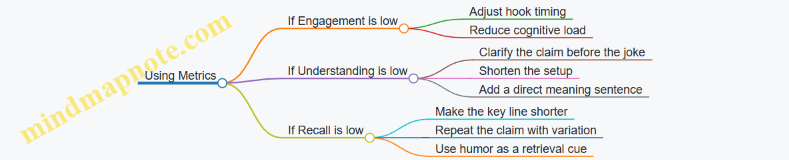
What “Good” Looks Like
Good metrics are not about maximizing laughter. They show that humor increases attention without changing meaning, and that the audience can later repeat the claim and at least one reason. When engagement, understanding, and recall move together, you can trust that the humor is doing persuasion work rather than just entertaining.
12.2 Collecting Feedback: What to Ask and How to Interpret Responses
Feedback is only useful if it points to a specific part of the communication pipeline: attention, comprehension, acceptance, or recall. Start by deciding what you want to improve, then ask questions that can be mapped back to that target. If you skip that mapping, you’ll get opinions without diagnostic value.
The Feedback Loop That Matches Persuasion Stages
Use a simple chain: stimulus → reaction → interpretation → revision. The stimulus is your message with its humor elements. The reaction is what the audience did or said. The interpretation is your best guess about why. The revision is a change you can justify.
Ask for feedback in the same order your audience experiences the message.
- Attention: Did they notice the message and the humorous moment?
- Comprehension: Did they understand the point behind the humor?
- Acceptance: Did the humor reduce resistance or create doubt?
- Recall: Could they repeat the key claim or line later?
What to Ask for High-Signal Responses
Keep questions concrete and time-bounded. Vague prompts like “Was it funny?” often produce vague answers. Better prompts tie humor to a measurable effect.
Attention questions
- “What was the first part that got your attention, and why?”
- “Where did you expect the message to go next?”
Comprehension questions
- “In one sentence, what do you think I wanted you to believe or do?”
- “Which line made the main idea easiest or hardest to understand?”
Acceptance questions
- “Did the humor make you more willing to consider the claim, less willing, or no change?”
- “What concern, if any, did the humor raise for you?”
Recall questions
- “After a minute, what do you remember as the key point?”
- “Can you quote or paraphrase the funniest line you recall?”
Process questions
- “If you could change one thing, what would it be: the joke, the explanation, or the call to action?”
- “What part felt out of place, if any?”
How to Interpret Responses Without Guessing
Treat feedback as evidence, not verdicts. A single comment can be misleading; patterns across respondents are more reliable.
1) Humor landed but meaning didn’t
- Signals: People report laughter or “that was clever,” but they misstate the claim.
- Interpretation: The humor may be competing with the explanation.
- Revision: Shorten the setup, move the claim earlier, or add a direct bridge sentence after the punchline.
2) Meaning landed but humor felt risky
- Signals: People understand the point but mention discomfort, confusion about intent, or distrust.
- Interpretation: The humor may be undermining credibility or targeting the wrong target.
- Revision: Reduce intensity, remove self-deprecation that sounds like avoidance, or shift to neutral contrast.
3) Everything felt clear but recall is weak
- Signals: People agree in the moment but can’t repeat the claim later.
- Interpretation: The message may lack a retrieval cue.
- Revision: Add a repeatable phrase that summarizes the claim and tie it to the humor moment.
4) Confusion about the “why”
- Signals: People can repeat the claim but can’t explain the reason.
- Interpretation: Humor may be masking the logic chain.
- Revision: Keep humor in the hook or transition, then present reasons plainly with one example.
Mind Map: Feedback Questions Mapped to Persuasion Effects
Example: Interpreting a Mixed Response Set
Suppose five listeners respond to a short pitch with one humorous line.
- Three say: “I laughed, but I’m not sure what you wanted me to do.”
- Two say: “I got the point, but the joke made me worry you were minimizing the issue.”
Interpretation: The first group indicates a meaning gap; the second indicates a trust gap. These are different problems, so you shouldn’t fix only one.
A systematic revision would:
- Move the call to action into the first two sentences.
- Follow the punchline with a plain bridge: “So the takeaway is…”
- Reduce the joke’s sharpness while keeping the same structure.
Then collect feedback again using the same question set, so you can tell whether the change improved attention, comprehension, acceptance, and recall in the intended way.
12.3 Observational Diagnostics: Identifying Where Humor Helps or Hurts
Humor changes behavior through observable pathways: it can increase attention, reduce perceived threat, and make a message easier to remember. It can also distract, confuse, or shift the audience’s interpretation away from your point. The goal of diagnostics is not to judge taste; it is to identify which pathway is operating in your specific setting.
The Diagnostic Lens
Start with three foundational signals you can observe without special tools.
- Attention signal: Do people look up, lean in, or stop multitasking when the humor appears?
- Comprehension signal: After the humor, do they accurately restate the intended claim?
- Retention signal: Later, can they recall the key line or the supporting reason tied to the humor?
If attention rises but comprehension drops, the humor is likely “winning the moment” while losing the message. If comprehension rises but retention is weak, the humor may be too general or not anchored to a specific idea.
Humor Diagnostics Mind Map
Mind Map: What to Watch and What It Means
A Systematic Observation Workflow
Use a repeatable sequence so you can compare sessions.
Step 1: Mark the exact humor moment. Note the timestamp or sentence where the audience laughs, smiles, or shows recognition. Then note the next sentence that carries the main claim.
Step 2: Record immediate reactions. In live settings, watch for three micro-behaviors: head orientation toward the speaker, reduced fidgeting, and quicker re-engagement after the laugh. A laugh followed by immediate eye contact with the speaker is usually a good sign; a laugh followed by people turning back to phones suggests the humor became the event.
Step 3: Test comprehension right after. Ask a single, low-friction question: “What’s the main point I just made?” or “Which reason supports that?” If the answer matches your intended claim, the humor likely supports processing rather than replacing it.
Step 4: Test retention later. Use a short delay: at the end of the meeting, the next day, or after a different segment. Ask for either the key line or the reason. Retention that points to the humor but not the message indicates a mismatch.
Example: Humor Helps Without Stealing the Point
A manager explains a policy change. They add a line: “This isn’t a surprise quiz; it’s a calendar update.” The audience smiles, then the manager immediately states the policy in one sentence and follows with two concrete steps. In diagnostics, attention rises at the humor moment, comprehension answers repeat the policy correctly, and later recall includes the “calendar update” phrasing tied to the steps. The humor works because it is anchored to a specific expectation and followed by a plain bridge.
Example: Humor Hurts Through Ambiguity
A presenter uses wordplay: “We’re not changing the rules; we’re changing the ‘how’.” The audience chuckles, but later questions show confusion about whether the policy itself changed. Diagnostics show attention increased, yet comprehension faltered. The likely cause is that the humor created an interpretation gap: the audience spent processing the phrasing rather than the operational meaning.
Example: Humor Hurts Through Trust Erosion
A speaker jokes about a group’s competence to “lighten the mood.” Even if laughter occurs, diagnostics often reveal slower engagement, fewer follow-up questions, and paraphrases that include the joke rather than the proposal. The likely cause is that targeting shifts the audience’s attention from the message to social risk. In these cases, the fix is not “try harder”; it is to remove the target or redirect humor toward self, process, or shared constraints.
Turning Observations Into Adjustments
When you see a pattern, choose one adjustment at a time.
- If attention rises but comprehension drops: shorten the setup and add a one-sentence bridge that restates the claim in plain language.
- If comprehension rises but retention drops: tie the humor to a memorable, repeatable phrase that names the reason or the action.
- If trust seems to fall: eliminate targeted jokes and reduce humor density so the message remains the center.
Diagnostics are complete when you can explain the observed outcome using a specific mechanism and a specific change you would make next.
12.4 Iteration Workflow Revising Structure Delivery and Humor Density
Iteration is where humor stops being a “nice idea” and becomes a controlled part of persuasion. The workflow below treats three variables as separate levers: structure (where the message goes), delivery (how it lands), and humor density (how much of it appears per unit time or space). You revise them in that order so you don’t end up fixing delivery when the real issue is the message path.
Step 1: Diagnose the Failure Mode
Start by sorting feedback into one of four buckets. This prevents the common mistake of changing jokes when the problem is comprehension.
- Attention failure: people miss the point or ask what you’re talking about.
- Understanding failure: they heard you but can’t explain the claim or logic.
- Acceptance failure: they understand but resist the recommendation.
- Recall failure: they like it in the moment but can’t repeat the key line later.
A quick check: ask someone to summarize your main claim in one sentence. If they can’t, humor density is probably not the first fix.
Step 2: Revise Structure Before You Touch Jokes
Use a simple message spine: Claim → Reasons → Evidence → Call to Action. Humor should support transitions and reinforcement, not replace reasons.
- If attention is weak, add a hook that previews the claim.
- If understanding is weak, place humor after the first definition, not before it.
- If acceptance is weak, use humor to reduce friction around objections.
- If recall is weak, repeat the same core phrase with variation.
Example: A product pitch says, “Our system saves time.” Then it jumps to a joke about “spreadsheets that breed.” If the audience can’t restate the claim, move the joke to a later reinforcement moment: after you define what “saves time” means.
Step 3: Adjust Delivery with Micro-Edits
Delivery changes how the audience interprets intent. Make small, testable edits.
- Timing: insert a half-beat pause before the punchline so the audience knows to listen for the twist.
- Emphasis: stress the word that carries the persuasion meaning, not the funny word.
- Framing: if the humor is self-referential, keep the seriousness marker close to it, like “Here’s the part that matters.”
Example: If a line is “That’s not a bug; it’s a feature,” but you rush past the seriousness, listeners may remember the joke and miss the policy implication. Slow down at the transition: “It’s a feature—meaning you can rely on it.”
Step 4: Tune Humor Density with a Rate Limit
Humor density is how often humor appears relative to the message’s complexity. A practical rule: increase humor only after the audience can restate the claim.
Use a density scale for one segment:
- Low: one humor moment per 60–90 seconds or per 5–7 sentences.
- Medium: one humor moment per 30–60 seconds.
- High: frequent jokes, but only if the underlying logic is already simple.
If recall is weak, reduce density and add one repeatable line. If attention is weak, add one earlier hook but keep the rest of the segment cleaner.
Step 5: Run a Controlled Revision Cycle
Revise one lever at a time, then test.
- Structure pass: rewrite the order of ideas; keep humor lines unchanged.
- Delivery pass: rehearse and adjust pauses and emphasis; keep structure unchanged.
- Density pass: move, cut, or consolidate humor; keep the claim and reasons unchanged.
Example: You remove two jokes but keep the same claim and evidence. If recall improves, your earlier density was too high for the audience’s cognitive load.
Step 6: Use a Revision Checklist
Before you finalize, verify these items.
- The audience can state the claim after hearing the segment.
- Each humor moment has a job: hook, transition, objection relief, or reinforcement.
- The punchline does not carry the only “meaningful” sentence.
- The key phrase appears at least twice with variation.
Mind Map: Iteration Workflow Levers and Tests
Step 7: Apply a Mini Case Study
On 2026-04-15, a presenter tested a training explanation with three jokes. Afterward, participants remembered the jokes but not the steps.
- Structure pass: the presenter reordered steps so each reason followed a definition.
- Delivery pass: pauses were added before each step label.
- Density pass: two jokes were removed, and one reinforcement line was repeated after the final step.
Result: participants could list the steps and quote the reinforcement phrase, even if they couldn’t recall every joke. That outcome is the point: humor supports retention, not replaces it.
Iteration is successful when the audience’s understanding improves without requiring them to “work around” the humor. When you change structure, delivery, and density in that sequence, you get cleaner cause-and-effect and fewer accidental regressions.
12.5 Example Walkthrough: A Before-and-After Revision Using Measured Feedback
A team used humor in a short sales presentation and tracked three signals: (1) first-30-second attention, (2) clarity of the main claim, and (3) recall of the call to action after the meeting. They also collected quick written feedback: “What line did you remember?” and “What felt confusing or off?”
Before: The Draft and the Measured Results
Audience context: mid-level managers, skeptical about “yet another productivity pitch.”
Original opener (approx. 35 seconds):
- “We all know meetings could be shorter. If time were money, we’d all be rich. Anyway, today I’ll show you how to save time.”
- Then the presenter jumped into three features without restating the core claim.
Measured feedback:
- Attention: good at the joke, then dropped during the feature list.
- Clarity: several people wrote “not sure what you want us to do.”
- Recall: only 2 of 10 remembered the call to action; 6 remembered a generic “save time” idea.
- Confusion: one comment said the opener felt like a complaint, not a plan.
The problem wasn’t that the opener was “bad humor.” It was that the humor didn’t carry the message structure. The joke created attention, but the presentation didn’t convert that attention into a clear claim and a memorable next step.
Mind Map: Before State
After: The Revised Version
The revision kept the same goal—save time—but changed how humor was used. The opener now does three jobs: it signals the problem, states the claim, and previews the action. Humor becomes a retrieval cue rather than a standalone moment.
Revised opener (approx. 40 seconds):
- “Meetings have two settings: ‘urgent’ and ‘we’ll circle back.’ If we could press ‘circle back’ and it would circle back to the decision, I’d be out of a job. Today’s claim is simple: we can cut meeting time by making decisions visible before the meeting starts.”
- “I’ll show one workflow you can try this week, and I’ll end with a one-sentence script you can use to start the next meeting.”
Reinforcement moves during the talk:
- After each section, the presenter repeats the claim in a slightly different form: “Visible decisions before the meeting.”
- A short line appears right before the call to action: “If your meeting has no decision, it’s just a calendar event.”
Call to action (final 20 seconds):
- “Try the workflow on one meeting this week. If you want, I’ll send the one-sentence opener we practiced.”
Mind Map: After State
Measured Results After
- Attention: still strong in the first 30 seconds, with less drop during the middle because the claim stayed visible.
- Clarity: 9 of 10 wrote the call to action in their notes.
- Recall: 7 of 10 remembered the “visible decisions before the meeting” idea; 6 remembered the “calendar event” line.
- Confusion: fewer comments about “complaint tone,” because the humor now points toward a method.
What Changed, Systematically
- Humor moved earlier from “joke” to “function.” It framed the problem and introduced the claim.
- The message structure stayed intact. The feature list was no longer the first thing the audience had to interpret.
- Retention cues were added. Repetition was not identical; it was claim-consistent and timed to transitions.
- The call to action became specific. “Try one meeting this week” is easier to recall than “save time.”
Example: A Quick Before-and-After Line Substitution
| Element | Before | After |
|---|---|---|
| Opener humor | “If time were money…” | “Meetings have two settings…” |
| Claim | implied (“show you how”) | explicit (“cut meeting time by making decisions visible”) |
| Action preview | none | workflow this week + one-sentence script |
| Reinforcement | none | marker lines after each section |
| Ending | generic | specific condition + memorable line |