Linguistic Humor and Verbal Comedy Foundations
1. Scope, Definitions, and Analytical Goals
1.1 Defining Humor, Verbal Comedy, and Linguistic Humor
Humor is a communicative outcome: an utterance or event leads an audience to experience amusement, often accompanied by a sense that something has been interpreted in an unexpected way. That outcome depends on more than wording. It also depends on shared background knowledge, timing, social expectations, and the audience’s willingness to treat the moment as “meant to be funny.”
Verbal comedy is humor delivered through language. It can be spoken, written, or performed, but the primary vehicle is linguistic form: word choice, sound patterns, syntax, and discourse structure. A stand-up punchline is verbal comedy, as is a caption that hinges on a single ambiguous phrase. In both cases, the audience’s interpretation is guided by linguistic cues that signal where the “turn” in meaning should happen.
Linguistic humor is a narrower lens on verbal comedy. It treats humor as something that can be explained using linguistic mechanisms rather than only psychological reactions. The key idea is that jokes often rely on regularities in language: how words map to meanings, how sentences constrain interpretation, how speakers manage implicatures, and how discourse creates expectations. When those mechanisms are identified, humor becomes analyzable rather than purely subjective.
What Counts as Humor Versus What Produces It
Not every amusing moment is a joke. A sudden slip of the tongue can be funny, yet it may not be crafted for a punchline. Conversely, a carefully built joke may fail to land if the audience lacks context or if the delivery signals the wrong attitude. For analysis, it helps to separate:
- Humor as effect: the audience’s amusement.
- Comedy as design: the speaker’s linguistic and interactional choices.
- Linguistic humor as explanation: the linguistic resources that make the design possible.
A simple example clarifies the difference. If someone says, “I used to be indecisive, but now I’m not sure,” the humor comes from a meaning shift that the audience recognizes as intentional. The design is verbal: the contrast between “used to” and “now,” plus the final clause that reverses the expected state. The linguistic explanation is that the second clause reconfigures the proposition so the “resolution” becomes the joke.
Core Components of Linguistic Humor
Linguistic humor typically involves three interacting components.
- Meaning tension: two interpretations compete, or an interpretation conflicts with expectations.
- Resolution or reframing: the audience is guided to a new interpretation that makes the tension coherent.
- Communicative stance: the speaker’s attitude signals that the audience should treat the reframing as playful rather than literal.
Consider a pun: “Time flies like an arrow; fruit flies like a banana.” The first clause primes the audience to treat “flies” as a verb meaning “moves through air.” The second clause forces a different reading where “flies” is a noun phrase subject and “like” expresses preference. The resolution is not a correction of a mistake; it is a controlled shift in lexical meaning and syntactic roles.
Mind Map: Humor, Verbal Comedy, Linguistic Humor
A Practical Working Definition
For this book, humor is treated as a communicative event whose effect is amusement, verbal comedy is humor realized through linguistic form and interaction, and linguistic humor is the study of how linguistic mechanisms create the interpretive tensions and resolutions that audiences recognize as funny.
This definition keeps analysis grounded. It does not require assuming that every joke has a single “correct” explanation, but it does require that claims about humor point to observable linguistic signals—such as ambiguity, role shifts, implicature triggers, or discourse cues—that make the comic interpretation available.
1.2 Humor as Communication: Speaker, Addressee, and Context
Humor is not just a property of words; it is a coordinated event between a speaker, an addressee, and a situation. The same sentence can be funny, flat, or offensive depending on who says it, to whom, and under what expectations. Treating humor as communication keeps the analysis grounded: we ask what the speaker intends, what the addressee infers, and what the surrounding context makes plausible.
Speaker
The speaker’s role includes choosing a linguistic form and managing expectations. In many jokes, the speaker first signals a normal conversational path, then changes the meaning or perspective at the punchline. Consider:
- “I told my computer I needed a break. Now it won’t stop sending me KitKat ads.”
The speaker frames the situation as ordinary (“I needed a break”), then relies on the addressee to reinterpret “break” as both rest and interruption. The speaker’s choice of a familiar scenario (work with a computer) reduces the effort needed to build the initial interpretation.
Speakers also control stance. A dry delivery, a smile, or a prefaced remark (“You’re going to hate this”) can shift how the addressee should treat the utterance. Even in text-only settings, punctuation and framing (“—” or “Now…”) can guide the reader toward a humorous reading.
Addressee
The addressee is not a passive receiver. Humor requires the addressee to perform inference: they must decide which interpretation to adopt and when to revise it. A useful way to model this is as a two-stage process.
- Build an initial meaning that fits the setup.
- Detect a mismatch at the punchline and revise the meaning to restore coherence.
Example:
- “My therapist says I have a fear of commitment. That’s why I never commit to anything.”
The addressee first treats “commitment” as emotional or relational. At the punchline, they revise “commit” to mean “to commit to a task,” turning the therapist’s diagnosis into a literalized wordplay. If the addressee misses the revision step, the sentence reads like a non sequitur rather than a joke.
Addressees also bring background knowledge and social awareness. A pun that works for one group may fail for another if the shared assumptions are missing or if the utterance violates norms the addressee expects.
Context
Context includes physical setting, relationship, prior discourse, and shared norms. It determines what counts as a relevant assumption and what counts as a permissible violation.
Key context dimensions:
- Shared knowledge: Do speaker and addressee know the same facts or conventions?
- Relationship: Are they friends, strangers, coworkers, or family?
- Genre and expectations: Is this a joke exchange, a complaint, or a serious report?
- Timing and turn structure: Where does the humorous line appear in the conversation?
Example of context sensitivity:
- Friend to friend: “You call that cooking? It’s basically edible wallpaper.”
- Stranger to stranger: the same line can sound like an insult rather than playful exaggeration.
The linguistic content is similar, but the social context changes the pragmatic interpretation. Humor often depends on the addressee recognizing that the speaker is not making a literal threat to the other person’s competence.
Integrated Example Walkthrough
Take this short exchange:
- A: “Did you finish the report?”
- B: “Yes. I submitted it… to the printer.”
The speaker (B) uses a setup that invites a straightforward answer. The addressee (A) expects completion in the relevant system. The punchline shifts the meaning of “submitted” to a physical action, creating a mismatch. The context matters: if they share a workplace where printing is a common bottleneck, the joke lands as a mild complaint; if not, it may sound like confusion.
In communication terms, humor is the addressee’s successful recognition of a speaker-guided reinterpretation under contextual constraints. When that recognition fails, the same utterance stops being funny and becomes merely odd, rude, or unclear.
1.3 Core Analytical Units: Utterances, Turns, Scripts, and Exchanges
Humor analysis needs units you can point to. If you only label “the joke,” you miss how meaning is built and timed. This section defines four practical units—utterances, turns, scripts, and exchanges—and shows how to use them together.
Utterances as Meaning-Bearing Segments
An utterance is a stretch of speech (or text) that carries a single intended meaning contribution in context. In jokes, an utterance often contains the setup’s claim, the punchline’s twist, or a cue that invites a particular interpretation.
Example:
- Utterance 1: “I tried to catch fog yesterday.”
- Utterance 2: “Mist.”
Utterance 1 contributes an event claim that sounds literal. Utterance 2 contributes a reanalysis cue: the word “mist” both names fog and supplies the punchline’s payoff.
Best practice: mark utterance boundaries where interpretation shifts, not where grammar ends. A comma can be inside one utterance; a short standalone phrase can be a new utterance if it changes the interpretive task.
Turns as Turn-Taking Units
A turn is what one speaker says before another speaker takes over. Turns matter because humor often relies on who gets the floor and when. A punchline delivered at the end of a turn can feel like a completion; a punchline that is interrupted can feel like a derailment.
Example (two speakers):
- Speaker A (Turn): “I told my printer a joke.”
- Speaker B (Turn): “Did it laugh?”
- Speaker A (Turn): “No, it just kept printing the punchline.”
Here, Speaker B’s turn is a meaning request. Speaker A’s next turn supplies the humorous reinterpretation.
Best practice: record turn boundaries even when the utterance boundaries are unclear. If you later compare versions of a joke, turn structure often stays stable while wording changes.
Scripts as Shared Expectation Templates
A script is a structured expectation about how an event typically unfolds. Humor frequently works by violating a script at a specific point. The violation can be lexical (a word fits the wrong role), semantic (the roles don’t match), or pragmatic (the expected next move is replaced).
Example script: “Ordering food.”
- Expected: greeting → order → confirmation → payment.
Humorous deviation:
- “I’ll have the usual.”
- “Great. Name?”
- “My usual is ‘surprised I’m still hungry.’”
The speaker uses “usual” as a personal narrative rather than a dish. The script for ordering is still present, but the roles are reassigned.
Best practice: write the script in plain steps. When you can state the expected sequence, you can locate exactly where the joke swaps the expected move.
Exchanges as Interactional Packages
An exchange is a connected sequence of turns that accomplishes a local interactional goal, such as a question-answer pair, a complaint-response pair, or a request-acceptance pair. Exchanges are where pragmatic meaning becomes visible: the same utterance can be funny in one exchange type and flat in another.
Example exchange: question-answer.
- Speaker A: “Why are you late?”
- Speaker B: “I took the scenic route.”
- Speaker A: “To where?”
- Speaker B: “To the part where I realize I’m still late.”
The humor is not only in the last utterance. It depends on the exchange’s structure: the follow-up question forces a specification, and the final answer redefines “scenic route” as an internal realization.
Best practice: label the exchange type (question-answer, offer-acceptance, repair, teasing) before analyzing the words. This prevents treating every punchline as a standalone object.
Mind Map: How the Units Fit Together
Worked Integration Example
Text:
- A: “I bought a calendar.”
- B: “For what?”
- A: “So I could plan my jokes.”
- B: “And?”
- A: “I’m booked solid.”
- Utterances: A’s first claim, B’s request for purpose, A’s plan statement, B’s prompt for outcome, A’s punchline.
- Turns: each speaker’s floor segments; the punchline lands at the end of A’s turn.
- Script: “calendar use” expects scheduling events; “booked solid” is expected to describe appointments.
- Exchange: question-answer chain; each question narrows the interpretive space until the final reanalysis makes “booked” refer to joke timing.
When you can name all four units, you can explain humor without guessing. You show how meaning is packaged, timed, and redirected.
1.4 Data Types and Annotation Practices for Humorous Language
Humor analysis starts with data that is specific enough to explain why a listener laughs, not just that they did. The same utterance can be funny for different reasons, so annotation must track both the linguistic signals and the interpretation path.
Data Types for Humorous Language
1) Written Texts
Written jokes, captions, and dialogue transcripts are stable and easy to re-check. They are ideal for studying orthographic puns, punctuation-driven ambiguity, and fixed punchline placement. Example: “I used to be a banker, but I lost interest.” The comma-less rhythm and the final noun choice are part of the effect.
2) Spoken Interaction
Spoken humor includes timing, pauses, repairs, and prosody. A pun can land only after a pause that signals a second reading. Example: “I told my computer I needed a break—now it won’t stop sending me Kit-Kats.” The pause before the brand reference helps the listener reframe.
3) Multimodal Humor
Memes, comics, and video clips combine language with gesture, gaze, and visual framing. Annotation should include which modality supplies the key cue. Example: a comic shows a “spell check” button while the caption says “I’m not wrong, I’m just autocorrected.” The visual “button” supports the literalization.
4) Elicited Judgments
When you ask participants to rate funniness or explain interpretations, you get evidence about which reading they adopt. This is useful for ambiguity resolution, but it must be treated as interpretation data, not proof of author intent. Example: participants choose between “banker lost interest” as finance vs. boredom.
5) Naturalistic Conversation
Everyday talk contains teasing, irony, and playful disagreement. The data is messy, which is exactly why it matters: humor often depends on prior turns. Example: “Sure, you’re totally on time” said after a late arrival.
Annotation Practices That Stay Grounded
A good annotation scheme separates what is observed from what is inferred. Observed layers include tokens, spans, and discourse moves. Inferred layers include intended meaning, implicature, and the humor mechanism.
Step 1: Define the Unit of Analysis
Use consistent units such as utterance, clause, or turn. For wordplay, annotate the smallest span that triggers the alternate reading. Example: in “I’m reading a book on anti-gravity,” annotate “anti-gravity” as the pivot span.
Step 2: Mark Context Dependencies
Humor often relies on earlier commitments. Record the minimal context needed for the punchline reading. Example: if “anti-gravity” is funny because the next line says “It’s impossible to put down,” you must include the expectation shift.
Step 3: Annotate Ambiguity Explicitly
Label ambiguity type and the competing senses. For polysemy, list the sense candidates; for homophony, record the sound-aligned forms. Example: “I can’t believe I got fired from the calendar factory. All I did was take a day off.” Annotate “day off” as both literal absence and workplace scheduling.
Step 4: Track Pragmatic Moves
Record speech-act function and pragmatic intent cues such as irony markers, politeness strategies, or indirectness. Example: “Nice job” after a mistake can be a directive to self-correct or a face-threatening evaluation; the annotation should capture the stance.
Step 5: Link Semantic Structure to the Punchline
Annotate the semantic mismatch that creates incongruity. Example: “calendar factory” sets an expectation of time production; “take a day off” flips the role of “day” from product to employee absence.
Step 6: Keep Explanations Reproducible
Each inferred label should point to the evidence span. If two annotators disagree, the scheme should reveal whether the disagreement is about the linguistic cue or the interpretation.
Mind Map: Annotation Layers for Humorous Language
Example Annotation Mini-Set
Utterance: “I told the waiter I wanted my steak well done. He said, ‘Don’t worry, it’s already done.’”
- Observed spans: “well done” (pivot), “already done” (echo)
- Ambiguity: “well done” as cooking degree vs. completion status
- Pragmatic move: reassurance/response speech act
- Semantic mismatch: cooking expectation conflicts with completion interpretation
- Humor mechanism: literalization of a degree phrase into a completion claim
This structure keeps the analysis systematic: you can see the cue, the competing meanings, the pragmatic framing, and the semantic conflict that makes the punchline work.
1.5 Ethical and Methodological Boundaries in Humor Analysis
Humor analysis is not only about explaining why something is funny; it is also about choosing what you will treat as evidence and what you will refuse to treat as evidence. A clear boundary keeps interpretations grounded in language data rather than in assumptions about people.
Start with the basic unit of analysis: the utterance and its immediate context. If you move too quickly to motives, you risk inventing intent. For example, consider the line “Nice job, genius.” The words alone do not prove whether the speaker is joking, angry, or sarcastic; you need contextual cues such as prior conversation, prosody, or shared norms. Methodologically, you can annotate what is observable (lexical choice, polarity markers, discourse position) and label intent only when the context supports it.
A second boundary concerns harm. Humor often targets groups, identities, or vulnerabilities. In analysis, you can describe the linguistic mechanism without endorsing the target. If a joke relies on a slur, your job is to document how the language functions (e.g., dehumanizing reference, stereotype activation, or face threat), not to reproduce the slur as a punchline. When quoting, use minimal necessary excerpts and consider redaction that preserves the linguistic features you analyze.
A third boundary concerns consent and privacy. If you use real conversational data, anonymize speakers and remove identifying details. Even when the text is public, the analysis can still create new exposure by linking a person to a specific humorous interaction. A practical rule is to treat any identifiable speaker as a data subject and to store only what you need for annotation.
Mind Map: Ethical and Methodological Boundaries
Example: Evidence Discipline Without Mind Reading
Suppose a dataset includes: “I love waiting in traffic. It’s my cardio.” A purely linguistic reading can note metaphorical mapping (traffic as exercise), evaluative polarity (“love”), and incongruity (waiting as cardio). A boundary is to avoid claiming the speaker’s health goals or emotional state. Instead, you can say the utterance performs a positive stance while describing an unpleasant situation, which is consistent with humorous re-framing.
Example: Harm-Aware Description with Minimal Quotation
If a joke uses a derogatory label to make a punchline, you can analyze how the label functions as a target and how the surrounding grammar signals evaluation. For instance, you can code the structure “X is so Y” where the adjective carries negative social meaning, and you can note whether the speaker uses irony markers or laughter cues. You do not need to reproduce the exact term to explain the mechanism.
Example: Reliability Through Decision Criteria
Ambiguity is common in humor, so boundaries must include coding rules. If annotators disagree on whether a line is sarcastic or merely critical, the guideline should specify what counts as evidence. For example: treat sarcasm as present only when there is a mismatch between literal evaluation and contextual expectations, such as prior complaints or explicit contrastive cues. This turns “vibes” into criteria.
Example: Reporting Integrity with Clear Scope
When you write results, separate “what the text does” from “what the speaker intended.” A careful report might say: “The utterance uses positive evaluative language paired with a negative situation description, producing a mismatch that supports humorous interpretation.” That phrasing stays within what the linguistic evidence can justify.
These boundaries make humor analysis more rigorous and more respectful. They also improve interpretability: readers can see why an explanation follows from the language, and where uncertainty remains.
2. Linguistic Foundations for Humor Analysis
2.1 Phonology and Sound Patterns in Verbal Comedy
Verbal comedy often works before listeners fully interpret words. Before meaning settles, the ear notices timing, stress, rhythm, and sound similarity. Phonology matters because humor frequently depends on how quickly an audience can predict a sound pattern—and how the text then redirects that prediction.
Core Sound Ingredients
Start with the smallest units: phonemes, syllables, and prosody. A phoneme is a contrastive sound (like /p/ vs /b/), while syllables group phonemes into pronounceable chunks. Prosody covers stress, intonation, and timing. In jokes, these ingredients can create two effects: (1) a listener’s expectation about what comes next, and (2) a mismatch between the expected sound-to-meaning mapping and the actual one.
Consider a simple pun based on sound. If a speaker says, “I used to be a banker, but I lost interest,” the humor relies on the near-sound alignment between “interest” as money return and “interest” as attention. The phonological route is not the whole mechanism, but it helps the listener notice the pivot quickly.
Sound Similarity and Word Recognition
Many wordplay jokes use similarity at the level of onset, rhyme, or full word form. Near-homophones are especially useful because they feel familiar while still allowing a deliberate reinterpretation.
Example:
- “I’m reading a book on anti-gravity. It’s impossible to put down.”
The punchline depends on the listener hearing “put down” as both “place” and “stop reading.” Sound doesn’t create the ambiguity alone, but it supports the rapid processing of the phrase so the double meaning can land at the end.
Stress, Accent, and Punchline Placement
Stress patterns guide interpretation. English stress often highlights content words, and that highlighting can steer which meaning becomes salient.
Example:
- “I didn’t say he stole the money. I said he borrowed it.”
If “borrowed” is stressed more strongly than “stole,” the listener’s attention shifts to the softer action. The humor comes from the pragmatic maneuver, but the phonological emphasis makes the maneuver audible.
In many jokes, the punchline is prosodically marked: a final rise, a lengthened vowel, or a sudden change in tempo. These cues help the audience treat the last segment as the interpretive key.
Rhythm and Timing in Spoken Humor
Rhythm is the pattern of syllable duration and stress across an utterance. Timing affects whether a listener experiences a setup as complete or incomplete.
Example:
- “The chef told me, ‘Don’t worry about the salt.’ Then he said, ‘Actually, worry about it a lot.’”
The comedic effect is partly structural, but timing matters: the pause after the first reassurance creates a moment where the audience expects a stable instruction. The second clause arrives with a different rhythm and forces a reanalysis.
Intonation and Attitude Encoding
Intonation can signal whether an utterance is literal, ironic, or corrective. Humor often uses intonation to invite one interpretation while delivering another.
Example:
- “That was… great.”
A falling tone with strong stress on “great” can signal sarcasm, especially when the context contradicts the evaluation. The phonological form tells the listener how to read the semantics.
Worked Micro-Analysis
Take: “I told my computer I needed more space. Now it won’t stop sending me updates.”
- Sound cue: “space” and “updates” are not homophones, so the humor is not a pure sound pun.
- Prosodic cue: the phrase “Now it won’t stop” often gets a steady, slightly compressed rhythm, then “updates” is stressed as the final interpretive anchor.
- Result: the listener’s expectation is “more storage,” but the final word forces a different frame, where “space” is treated as “mental space” or “attention space.” Phonology helps the pivot land cleanly.
Summary of the Section
Phonology contributes to humor by shaping how quickly and how confidently listeners commit to a sound-based interpretation. Stress and intonation guide which words become pivots, while rhythm and timing create the sense that a setup is complete right before the punchline reorients meaning.
2.2 Morphology and Word Formation Mechanisms in Jokes
Morphology shapes how words are built, and jokes often exploit that building process. A punchline may change meaning by swapping an affix, resegmenting a compound, or forcing a word to behave like a different part of speech. The key idea is simple: if listeners expect a familiar word-formation pattern, the joke can break that expectation while still sounding grammatical.
Core Morphological Tools in Comic Language
Affixation is the most direct lever. Prefixes and suffixes can encode stance, degree, or category. For example, adding -ish often signals approximation: “It’s 10 minutes-ish.” In humor, the same suffix can be used where approximation is implausible: “The meeting is 3 seconds-ish.” The mismatch makes the listener re-evaluate what the speaker is doing pragmatically, not just semantically.
Derivation changes lexical category. Turning a noun into a verb (“to google,” “to text”) can create a comic mismatch when the new verb is used with an odd argument structure: “I texted the wall until it answered.” The morphology licenses the verb, but the semantics and selectional expectations do the real work.
Compounding combines stems into a new unit. Jokes frequently treat compounds as if their internal boundaries are flexible. Consider “taxi driver.” If the context shifts to a literal driver of taxis, the compound becomes a source of reanalysis: “My new roommate is a taxi driver. He drives taxis. In the living room.” The humor comes from forcing the compound to mean what it already says, but in a context where that meaning is absurd.
Clipping and blending compress forms, which can create a playful ambiguity about what the original word was. A blend like “brunch” is conventional, but a novel blend can be funny when it suggests a category shift: “I’m on a ‘lunchcation’—I left work for lunch and never returned.” The listener infers the intended pattern even if the blend is new.
Mind Map: Morphology to Comic Effect
Systematic Walkthrough of Joke Types
1. Affixation that changes the scale of commitment
Start with a baseline: “I’ll be there soon.” Add a suffix that normally softens: “I’ll be there soon-ish.” Now push it: “I’ll be there soon-ish, but only in the way a rumor is soon.” The affix sets a mild expectation; the follow-up forces a different interpretation of what “soon” is doing in the conversation.
2. Derivation that licenses a new syntactic role
Listeners accept that English can coin verbs from nouns. The joke is to use that license where it creates a strange event structure. Example: “I’m going to ‘email’ the problem.” The verb form suggests sending an email as the action, but the context can make the “problem” the recipient or the sender, turning a normal derivational pattern into a semantic trap.
3. Compounds that invite literal parsing
Compounds are usually processed as single lexical items. Humor can reactivate their internal structure. Example: “I bought a ‘self-help’ book. It helped itself—by taking up the whole shelf.” The compound is treated as if it contains an agentive role, which is not how the phrase is normally understood.
4. Blends that create a category shift
Blends can be funny when they imply a new category with rules borrowed from the source words. Example: “I’m doing ‘workcations.’ I work, but only on vacation—so I work less, and I feel guilty more.” The blend signals that the usual category boundaries are being redrawn.
5. Inflection that clashes with the intended meaning
Inflection is smaller than derivation, but it can still carry comic force. Example: “The meeting was canceled, but it still happened.” The tense and aspect frame the event as completed or realized; the follow-up contradicts that frame, making the listener notice the grammatical packaging of time.
Worked Examples with Morphological Diagnosis
Example 1: “I asked for one small favor. They gave me a favor-ish amount.”
- Morphology: favor + -ish.
- Comic mechanism: the suffix signals approximation, but “favor” is already a countable request; the joke turns a social unit into a measurable quantity.
Example 2: “He’s a professional ‘complimenter.’ He compliments the toaster.”
- Morphology: compliment + -er.
- Comic mechanism: the agentive suffix creates a role expectation; the object (“toaster”) forces a semantic mismatch.
Example 3: “My roommate is a ‘laundry philosopher.’ He sorts socks by meaning.”
- Morphology: laundry + philosopher as a compound-like label.
- Comic mechanism: the label suggests a serious category; the content makes the category literal in a trivial domain.
Practical Best Practices for Using Morphology in Analysis
When analyzing a joke, identify the word-formation operation first, then ask what listeners expected the resulting word to mean. Next, check whether the humor comes from (a) a wrong scale, (b) a wrong category, (c) a forced literal boundary, or (d) a mismatch between grammatical licensing and semantic plausibility. This sequence keeps the explanation grounded in the morphology rather than in vague “wordplay” claims.
2.3 Syntax and Structural Manipulations for Comic Effect
Humor often depends on what a sentence expects to do next. Syntax—word order, phrase structure, and clause organization—creates those expectations. Comic effect usually arrives when the structure is bent in a way that is still grammatical enough to be processed, but wrong enough to force a second look.
Foundational Idea: Structure as an Expectation Machine
A listener builds a parse incrementally. For example, after hearing “The detective found the…” the parser expects a noun phrase to follow. If the continuation instead triggers a different structure, the listener must reanalyze. The reanalysis cost is part of the joke, especially when the punchline resolves the ambiguity by making the “wrong” structure suddenly useful.
Core Structural Tools
-
Reordering and delayed resolution
Place the element that should matter early at the end, so the setup commits the listener to a path that the punchline later contradicts.- Example: “I told the waiter I wanted my steak well done. He brought me a calendar.” The syntax of the setup (“I told X I wanted Y”) promises a straightforward transfer of preference. The final noun (“calendar”) forces a structural reinterpretation: the “well done” phrase is treated as literal timing rather than cooking quality.
-
Clause attachment shifts
Use prepositional phrases or subordinate clauses that can attach to different constituents.- Example: “I saw the man with the telescope.” The phrase “with the telescope” can attach to “the man” (he has it) or to “saw” (I used it). A comic continuation can pick one interpretation late.
- Example continuation: “He was very proud of his eyesight.” This continuation favors the “man has it” attachment, retroactively changing what the listener thought the sentence meant.
-
Parallelism with a twist
Keep the same syntactic frame across multiple clauses, then change the semantic role of one repeated slot.- Example: “She likes hiking, she likes museums, and she likes paying full price.” The repeated “she likes + noun” structure sets a pattern of benign interests. The last noun phrase changes the pragmatic target: “paying full price” is framed as a choice that contradicts the implied norm.
-
Subordination that misleads
Subordinate clauses can signal cause, condition, or concession. Humor can exploit that by making the logical relation syntactically plausible but pragmatically odd.- Example: “If you can’t handle me at my worst, you don’t deserve me at my best.” The “if” clause sets a conditional expectation. The punchline reframes “deserve” as if it were a measurable requirement, turning a social claim into a rule-like structure.
-
Syntactic category switching
Treat a word as one category in the setup and another in the punchline by exploiting minimal structural cues.- Example: “Time flies like an arrow. Fruit flies like a banana.” The first clause leads the listener to parse “flies” as a verb meaning “moves through time.” The second clause forces “flies” to be a noun phrase head (“fruit flies”) while “like” becomes a verb of preference.
Mind Map: Syntax Levers and Their Comic Effects
Worked Micro-Analysis: From Structure to Effect
Consider: “I tried to catch the fog. I missed.”
- Setup structure: “I tried to + verb” signals an attempted action with an expected result.
- Punchline structure: “I missed” is syntactically complete but semantically underspecified. “Missed” usually selects an object (“missed the bus”). Here, the object is implied by the earlier infinitival complement (“catch the fog”).
- Comic mechanism: the syntax of the setup licenses a normal event chain, while the punchline compresses it into a blunt outcome. The listener must map “missed” onto “catch the fog,” turning an abstract target into something that behaves like a catchable object.
Practical Best Practice for Writers and Analysts
When you revise a joke, check whether the syntax creates a specific expectation and whether the punchline forces a single structural reinterpretation rather than a vague surprise. A good test is to ask: “What parse did the listener commit to at the end of the setup?” If the punchline can be explained as a consequence of that parse being redirected, the humor has a stable linguistic foundation.
2.4 Lexical Semantics: Sense Relations and Meaning Selection
Lexical semantics studies how word meanings are organized and how speakers choose among them in context. A single word can carry multiple senses, and humor often depends on steering the listener toward the “wrong” sense at the right moment. To analyze that steering, you need two tools: sense relations (how meanings relate) and meaning selection (how context picks one meaning).
Sense Relations as a Map of Meaning
Words do not store meanings as isolated blobs. They cluster into networks shaped by several relation types.
- Polysemy: one word has related senses. Example: bank can mean “river edge” and “financial institution.” The senses are distinct, but historically and conceptually connected.
- Homonymy: unrelated meanings share the same form. Example: bat as an animal vs. bat as sports equipment. Context must separate them.
- Synonymy: different words with overlapping meaning. Example: start and begin.
- Antonymy: opposites. Example: hot vs. cold.
- Hyponymy and Hypernymy: “kind of” structure. Example: sparrow is a kind of bird; bird is a kind of animal.
- Meronymy and Holonymy: part–whole structure. Example: wheel is part of car.
These relations matter because they constrain what counts as a plausible sense in a given environment. If a sentence supplies cues that fit one sense relation but clash with another, the listener’s selection process becomes visible.
Meaning Selection as Contextual Choice
Meaning selection is the mechanism that picks a sense for a word in context. Listeners do not choose randomly; they use cues from nearby words, grammatical structure, and discourse expectations.
A simple way to model selection is to treat each candidate sense as having different “compatibility profiles.” Context then boosts one profile and suppresses others.
Example 1: Sense disambiguation by selectional preferences
- Literal: “She sat on the bank and watched the water.”
- bank fits the river-edge sense because sat and watched the water support that profile.
- Misdirection: “She sat on the bank and negotiated the interest rate.”
- The financial sense becomes compatible with negotiated and interest rate.
Example 2: Humor via delayed or forced selection
- “I tried to catch the interest in the lecture, but it kept slipping away.”
- interest can mean “curiosity” or “financial interest.” The sentence pushes toward “curiosity” with lecture, but the verb slipping away invites a more physical/financial reinterpretation. The joke lands when the listener briefly entertains the alternative sense and then reconciles the mismatch.
How Sense Relations Interact with Selection
Sense relations provide the candidate set; context decides among them.
- With polysemy, context often selects smoothly because senses are related. Humor can still work by emphasizing the boundary: “I’m reading a book about light—it’s so bright I can’t focus.” The word light supports multiple related senses (illumination vs. not heavy), and the sentence nudges the listener to switch.
- With homonymy, context must do more work because senses are unrelated. Humor can exploit that extra effort: “The coach told the team to run faster, then he ran out of patience.” The first coach is a role; the second clause makes coach feel like a vehicle only if the listener momentarily reanalyzes.
Mind Map: Sense Relations and Meaning Selection
A Practical Mini-Procedure for Analysis
When you read a humorous line, treat each ambiguous word as a decision point.
- List plausible senses using sense relations (polysemy/homonymy first).
- Identify context cues that support each sense (verbs, selectional restrictions, and typical co-occurrences).
- Mark the moment where the listener’s selection shifts or stalls.
- Explain the effect: the joke typically depends on the listener briefly committing to one sense and then revising.
Example 3: Step-by-step selection
- “The planner drew a map of the party, but the party planned itself.”
- planner suggests a person who designs events.
- The second clause forces a reinterpretation: planned itself treats planning as an autonomous process, making the word feel like it also refers to a device or system that “plans.” The humor comes from the sense shift triggered by the grammatical structure planned itself.
Sense relations tell you what meanings are available; meaning selection tells you which one the listener is guided toward. Humor often works by manipulating that guidance—either by delaying commitment or by making the cues pull in competing directions.
2.5 Discourse and Coherence: How Humor Fits into Conversation
Humor rarely arrives as a standalone object. It is produced inside a turn, interpreted against prior turns, and evaluated by how well it fits the ongoing purpose of the exchange. Discourse coherence explains why a joke can feel “on point” even when its literal content is odd.
Foundational Discourse Pieces
A conversation is built from turns, but coherence is built from relations. Two speakers may say unrelated sentences, yet the exchange can still feel coherent if the listener can connect them through a shared goal.
Common coherence relations include:
- Elaboration: one utterance adds detail to another.
- Contrast: one utterance opposes an expectation.
- Cause or Reason: one utterance explains why something happened.
- Correction: one utterance revises a prior claim.
- Purpose shift: the topic changes while the interactional goal remains stable.
Humor often uses contrast or correction, but it still needs a bridge. Without a bridge, the listener cannot tell whether the speaker is joking, changing topics, or being uncooperative.
Humor as a Discourse Move
Treat a joke as a move with a job. The job might be to:
- soften disagreement,
- manage tension,
- display alignment,
- invite a shared interpretation,
- or reframe a problem.
For example, consider a workplace exchange:
A: “The report is late.”
B: “Yes. It’s on a different timeline.”
The second utterance is humorous, but it also functions as mitigation. It reframes lateness as a scheduling difference rather than a failure. Coherence comes from the relation between the complaint and the response: the joke is anchored to the same issue.
Coherence Mechanisms That Make Jokes Work
Reference and Grounding
Humor depends on shared referents. Pronouns, definite descriptions, and repeated nouns create grounding.
A: “Did you fix the printer?”
B: “I fixed the idea of the printer.”
The humor relies on “the printer” being the same entity in both turns. If B had said “that thing,” the listener would have to work harder to connect the punchline to the prior topic.
Expectation Management
Coherence is partly expectation. A setup establishes a likely continuation; the punchline changes the continuation.
A: “I tried a new diet.”
B: “How’s it going?”
A: “Great. I’m eating only what I can pronounce.”
The coherence relation is elaboration on “a new diet.” The punchline works because it stays within the diet frame while violating the expected criteria for “diet success.”
Repair and Reanalysis
Many jokes are built on repair: the speaker corrects, reinterprets, or reanalyzes what was just said.
A: “Your email was… short.”
B: “I know. I was going for concise. Not con-sigh-nce.”
The wordplay invites a reanalysis of “short” into a phonological joke. The coherence comes from the immediate responsiveness to A’s evaluation.
Mind Map: Discourse Coherence for Humor
Worked Example with Stepwise Coherence
Context: Two friends plan a weekend.
A: “We should do something outdoors.”
B: “Sure. I’m great at outdoors.”
A: “You mean hiking?”
B: “No, I mean I’m good at being outside.”
The joke succeeds because B keeps the outdoor frame active. The first line sets a shared goal: choosing an outdoor activity. The second line signals a humorous mismatch, but it still stays within the same topic. The third line offers a candidate interpretation (“hiking”), and the fourth line performs a correction by narrowing “outdoors” to literal location. Coherence is maintained through a chain of relations: goal alignment, then contrast, then correction.
Advanced Detail: Coherence Across Multiple Turns
In longer exchanges, coherence is maintained by local and global links. Local links connect adjacent turns; global links connect the exchange to an overarching purpose such as planning, negotiating, or comforting.
A joke can be locally coherent but globally incoherent. For instance, if a speaker uses wordplay to respond to a safety concern, the listener may interpret it as avoidance rather than humor. In that case, the discourse relation is not contrast or mitigation but a mismatch in interactional purpose.
Practical Checklist for Interpreting Humor in Discourse
- Identify the ongoing goal of the exchange.
- Locate the referents that anchor the joke to prior talk.
- Determine the coherence relation the listener likely uses.
- Check whether the punchline performs contrast, correction, or elaboration within the same frame.
- Ask whether the joke changes the purpose of the interaction or merely changes the interpretation of a shared topic.
When these steps align, humor becomes more than a clever sentence. It becomes a coherent conversational action.
3. Ambiguity as a Engine of Wordplay
3.1 Types of Ambiguity: Lexical, Syntactic, and Semantic
Ambiguity is when a single linguistic form supports more than one plausible interpretation. Humor often depends on how quickly an audience can choose the “wrong” reading, or how a later cue forces a reanalysis. A useful way to study this is to separate ambiguity by where it arises: in the word (lexical), in the structure (syntactic), or in the meaning relations (semantic).
Lexical Ambiguity
Lexical ambiguity happens when a word or short phrase has multiple dictionary senses that fit the immediate context. The key is that the sentence structure is stable; the uncertainty comes from the lexicon.
Example:
- “I saw her duck.”
- Reading A: duck as a bird.
- Reading B: duck as a verb meaning to bend or lower the head.
In jokes, lexical ambiguity is often staged by using a verb that can select either a concrete object (bird) or an action (ducking). A common best practice is to mark the two candidate senses explicitly before you analyze the punchline, because the humor frequently depends on which sense the listener commits to first.
Syntactic Ambiguity
Syntactic ambiguity arises when the sentence structure can be parsed in more than one way, even if the words are unambiguous. The same tokens support different attachment choices, scope relations, or constituent boundaries.
Example:
- “I saw the man with the telescope.”
- Reading A: the man has the telescope.
- Reading B: I used the telescope.
Here the ambiguity is about attachment: whether “with the telescope” modifies “the man” or modifies the seeing event. For analysis, it helps to rewrite each reading as a compact paraphrase. If the paraphrases differ in who possesses the instrument, you are likely dealing with syntactic attachment.
Syntactic ambiguity also appears in scope:
- “Every student read a book.”
- Reading A: one book could be shared across students.
- Reading B: each student may have read possibly different books.
Humor can exploit scope confusion by setting up an expectation about distribution and then flipping it at the punchline.
Semantic Ambiguity
Semantic ambiguity involves meaning relations that allow multiple interpretations at the level of concepts, roles, or entailments. Unlike lexical ambiguity, the ambiguity may not be traceable to a single word sense; it can come from how meanings combine.
Example:
- “The bank raised the interest rate.”
- Reading A: a financial institution raised rates.
- Reading B: a river bank raised something (less plausible in ordinary contexts, but still a semantic possibility).
The word “bank” is polysemous, but the semantic ambiguity is the broader question of which conceptual frame is active: finance frame versus geography frame. Another example shows semantic mismatch:
- “Time flies like an arrow.”
- Reading A: time moves quickly.
- Reading B: “flies” is literal motion of insects, with “like an arrow” describing the manner.
In humor, semantic ambiguity often works by letting the audience start with a frame that makes the sentence coherent, then using the punchline to reveal that a different frame was required.
How the Three Types Interact
In real data, the types can stack. A pun may begin with lexical ambiguity (“duck”), then the listener’s syntactic commitment (“saw” + object) narrows the options, and the punchline finally selects the semantic frame that makes the joke land.
Practical Diagnostic Steps
When you encounter an ambiguous humorous line, use a three-step check. First, test lexical ambiguity by substituting synonyms or paraphrases that preserve structure; if the ambiguity remains, it may be syntactic or semantic. Second, test syntactic ambiguity by rebracketing attachments in paraphrase form; if the meaning changes in who does what, structure is the culprit. Third, test semantic ambiguity by asking which frame makes the sentence most coherent; if coherence depends on selecting a conceptual domain, you are in semantic territory.
These distinctions are not just academic. They guide how you annotate: lexical ambiguity gets sense labels, syntactic ambiguity gets parse or attachment labels, and semantic ambiguity gets frame or entailment labels. With that separation in place, later sections can explain how pragmatics and context push the audience toward one interpretation at the expense of another.
3.2 Homonymy, Polysemy, and Sense Competition in Punchlines
Humor often hinges on meaning that is available in more than one way. The key difference is whether the competing meanings come from the same word form (homonymy) or from related senses within a single lexical entry (polysemy). In both cases, a punchline works by steering the listener toward one interpretation during the setup, then forcing a switch at the end.
Foundational Distinctions
Homonymy: two unrelated meanings share the same form. Example: “I used to be a banker, but I lost interest.” Here “interest” can mean financial interest and personal interest. The meanings are not just different senses of one concept; they are distinct lexical meanings that happen to coincide.
Polysemy: one lexical entry has multiple related senses. Example: “That’s a light bag.” “Light” can mean low weight or not heavy in brightness. The senses are connected through a broader notion of “not heavy,” but the interpretation still competes.
Sense competition: the listener maintains multiple candidate meanings until context makes one dominant. Punchlines exploit the moment when the dominant candidate is no longer compatible with the final material.
How Punchlines Create Competition
A setup typically provides cues that make one meaning easiest to activate. These cues can be grammatical (selectional patterns), semantic (topic expectations), or pragmatic (what the speaker is trying to do). The punchline then introduces a constraint that the earlier interpretation cannot satisfy.
Consider: “Time flies like an arrow. Fruit flies like a banana.” The first sentence primes “flies” as a verb meaning move through air. The second sentence forces a different reading: “flies” as insects, and “like” as preference. The humor comes from the listener’s rapid reanalysis rather than from a single surprising fact.
Mind Map: Meaning Sources and Switching Points
Worked Examples with Systematic Analysis
Example 1: Homonymy via selectional mismatch
- Setup: “I’m great at saving money.”
- Punchline: “I even saved the receipt.”
The setup primes “saving” as preserving funds. The punchline shifts “saved” to the literal act of keeping a document. The switch is clean because “save money” and “save a receipt” differ in typical objects.
Example 2: Polysemy via modifier pressure
- Setup: “The chef served a hot sauce.”
- Punchline: “Not for taste—she needed it for the hot water.”
“Hot” is polysemous: temperature and contextual suitability. The setup makes temperature salient. The punchline reorients the phrase toward a different sense by changing the relevant domain to water.
Example 3: Sense competition across a grammatical frame
- Setup: “I can’t believe the bank closed early.”
- Punchline: “It was a bank of clouds.”
“Bank” is homonymous: financial institution vs landform or mass. The setup primes the financial sense because of “closed early,” which fits institutions. The punchline supplies “bank of clouds,” which cannot cohere with the institution reading.
Advanced Detail: Why the Switch Feels Instant
Listeners do not wait for the punchline to start interpreting. They build a provisional structure: who did what to whom, and which sense of each ambiguous word is most likely. Sense competition becomes funny when the provisional structure is plausible enough to be adopted, but fragile enough to be overturned by the final constraint.
A useful diagnostic is to ask what would make the setup interpretation fail. If the punchline changes the likely argument type, the earlier sense becomes incompatible. If it changes the event type, the earlier sense becomes semantically odd. If it changes the pragmatic goal, the earlier sense becomes unnecessary.
Mind Map: Common Switching Constraints
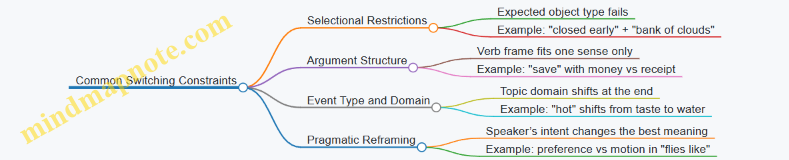
Summary of the Mechanism
Homonymy and polysemy both create a pool of candidate meanings. Punchlines make one candidate feel right during the setup, then introduce a constraint that forces the listener to replace it. The result is not just a surprise; it is a structured reanalysis that the listener can complete quickly because the language provides enough cues to compute the new sense.
3.3 Garden-Path and Structural Reanalysis in Humorous Parsing
Garden-path effects happen when an initial parse fits the early cues, but later material forces the parser to revise the structure. Humor often exploits this cost: the listener invests effort in the first structure, then the punchline retroactively makes that structure look “almost right” in a misleading way. Structural reanalysis is the mechanism behind that revision.
Foundational Idea: Why the First Parse Wins
Human sentence processing favors speed and plausibility. Early words constrain likely structures, so the parser commits to a hypothesis before it has seen the whole sentence. In jokes, the setup typically provides cues that strongly suggest one syntactic role, then the punchline supplies a cue that contradicts it.
A simple diagnostic is to ask what the listener would likely do after the setup alone. If the setup makes a clear structural expectation, the joke can later redirect it.
Structural Reanalysis: What Changes When the Parser Revises
Reanalysis can involve:
- Constituent attachment changes: deciding whether a phrase modifies a noun or a verb.
- Category reinterpretation: treating a word as a different part of speech than initially assumed.
- Clause boundary shifts: revising where one clause ends and another begins.
The key is that the revision is not merely “new information”; it changes the structural commitments made earlier.
Garden-Path Patterns Common in Verbal Humor
-
Attachment Ambiguity
The setup encourages one attachment, and the punchline forces the other.Example:
- Setup: “I saw the man with the telescope.”
- Punchline: “Turns out he was filming a documentary.”
Many listeners initially attach “with the telescope” to “the man.” The punchline makes a different interpretation salient: the telescope is part of the filming setup rather than the man’s possession in the intended way.
-
Part-of-Speech Reanalysis
A word that can function as noun or verb is introduced in a context that biases one category.Example:
- Setup: “Time flies like an arrow.”
- Punchline: “Fruit flies like a banana.”
The first clause biases “flies” toward a verb meaning “moves through time.” The second clause reanalyzes “flies” as a noun, making the humor depend on the listener’s structural expectations.
-
Clause Boundary and Subordination Shifts
The setup can suggest a main clause, then the punchline introduces a structure that requires a different boundary.Example:
- Setup: “After the meeting ended, the report was still on my desk.”
- Punchline: “So I guess the meeting didn’t end.”
The listener expects a straightforward temporal relation. The punchline reframes the event structure, treating “ended” as something like a conversational endpoint rather than a literal one, which triggers a reanalysis of how the temporal clause constrains the main clause.
A Systematic Parsing Walkthrough
Consider a compact garden-path joke:
- Setup: “The coach told the player the strategy was simple.”
- Punchline: “Then he explained it for forty minutes.”
Step 1: After “the strategy was simple,” the listener likely commits to a completed content unit: the coach’s message is that the strategy is simple.
Step 2: “Then he explained it for forty minutes” conflicts with the expectation that “simple” correlates with brief explanation. The parser does not only revise meaning; it revises the structure of the discourse relation. “Simple” is reinterpreted as ironic or as a claim about appearance rather than actual complexity.
Step 3: The listener retrofits the earlier clause to support the new discourse structure: the setup becomes a misleading characterization that sets up the contrast.
This is reanalysis at the interface of syntax and discourse: the structural commitment to “the coach’s message is straightforward” is replaced by a structure where the message is a setup for irony.
Mind Map: Garden-Path to Reanalysis in Humor
Example: Tracking Attachment Reanalysis
Example:
- Setup: “I met the sister of the actor who lives downtown.”
- Punchline: “She said the actor doesn’t.”
The setup can be parsed so that “who lives downtown” modifies “the actor.” The punchline forces a reanalysis: the listener must consider that the relevant “downtown” property may attach differently, or that the intended target of the relative clause is not the actor. Even when the exact syntactic repair is debated, the comedic effect relies on the listener’s need to revise the earlier attachment.
Practical Checklist for Building or Analyzing This Effect
- Identify the first plausible structure after the setup.
- Identify the later cue that makes that structure untenable.
- Specify the structural change (attachment, category, or boundary).
- Explain how the punchline makes the revised structure feel more coherent than the original.
When these steps line up, the joke’s punchline does more than surprise; it forces a structural rewrite, and that rewrite is where the humor lives.
3.4 Ambiguity Resolution Strategies: Repair, Reinterpretation, and Reframing
Ambiguity rarely stays unresolved in real conversation. Speakers and listeners use cues to decide which meaning is intended, and when the first guess fails, they recover. This section treats resolution as a sequence of moves: (1) detect a mismatch, (2) attempt repair or reinterpretation, and (3) if needed, reframe the whole situation so a new interpretation becomes natural.
Mind Map: Resolution Pathways
Repair: Fixing the Signal
Repair is the most direct strategy: the speaker (or listener) corrects the form so the intended meaning becomes recoverable. In humor, repair can be delayed to create a brief wrong turn, then used to land the punchline.
1) Self-correction. A speaker notices a likely misread and revises. Example: “I told the waiter the soup was too hot—well, too cold.” The first clause triggers a temperature expectation; the correction flips the semantic value.
2) Clarifying addition. The speaker appends a constraint that selects one sense. Example: “I’m looking for a bank—you know, the one with the river, not the one with fees.” The second clause narrows the referent by domain.
3) Repetition with altered wording. Repeating the ambiguous phrase but changing one element forces a new parse. Example: “He’s fine with it. I mean, he’s okay with it.” The near-synonym signals that “fine” should be read as “acceptable,” not “healthy.”
4) Confirmation checks. The speaker or listener asks whether the intended reading was reached. Example: “When you said ‘left,’ did you mean the direction or the remaining part?” This turns ambiguity into an explicit decision point.
Repair is effective when the ambiguity is local and the speaker can afford extra words. It is less effective when the joke depends on keeping the wrong reading alive long enough for the audience to notice the switch.
Reinterpretation: Changing the Meaning Without Changing the Form
Reinterpretation keeps the wording but changes how it is understood. The key is that the listener revises the interpretation model rather than the utterance.
1) Sense switching. Polysemy allows a single word to support multiple readings. Example: “I used to hate facial hair, but then it grew on me.” The phrase “grew on me” pushes the listener from a literal dislike to a metaphorical acceptance.
2) Attachment change. Syntactic ambiguity often resolves by re-parsing. Example: “I saw the man with the telescope.” Two readings exist: the man has the telescope, or I used the telescope. A follow-up like “He was pointing it at the moon” selects the second.
3) Pragmatic strengthening. The listener uses context to prefer one meaning even if both are grammatically possible. Example: “Can you pass the salt?” In isolation it could be a question about ability, but the request reading is strengthened by typical conversational goals.
In humor, reinterpretation can be the mechanism that produces the punchline: the audience first commits to one reading, then the context forces a different one.
Reframing: Rebuilding the Situation Model
Reframing goes beyond local meaning selection. It changes what the conversation is “about,” so the ambiguous material suddenly fits a new frame.
1) Change the discourse goal. Example: “I’m not saying the plan is bad. I’m saying it’s… ambitious.” The speaker reframes from evaluation to mitigation, turning a negative assessment into a softened stance.
2) Shift speaker attitude. Irony often works by reframing literal content as attitude rather than truth. Example: “Great job on the report. It’s exactly what I needed—three days ago.” The praise frame is replaced by a complaint frame.
3) Recast the referent or event type. Example: “That’s not a mistake; it’s a feature.” The utterance reframes an error as intentional design, changing the semantic expectations for “feature.”
4) Rebuild the inference chain. Sometimes the ambiguity is resolved only after the listener revises the reasoning steps. Example: “He’s a real genius. He solved the problem by deleting the file.” The “genius” inference is reframed from technical competence to a different, possibly sarcastic, evaluation standard.
Worked Mini-Sequence: From Repair to Reframing
Consider: “Your presentation was short. I liked that.” If “short” is read as “brief,” the compliment fits. If the audience knows the talk missed required content, “short” becomes a complaint. A later line can trigger reframing: “Short on details, long on confidence.” The first sentence invites one reading; the second sentence changes the frame from length to completeness, resolving the ambiguity by redefining what “short” measures.
Practical Takeaway
Use repair when you can correct the signal, reinterpretation when the wording can support a new parse or sense, and reframing when the whole conversational goal or attitude must shift. In humorous communication, these strategies often appear in quick succession: a listener commits, a mismatch appears, and then the discourse frame is adjusted so the punchline becomes the most coherent option.
3.5 Worked Examples: Annotating Ambiguity Across Joke Types
This section shows one consistent annotation approach across several joke types. The goal is to separate (a) what the sentence literally says, (b) what the hearer infers, and (c) where ambiguity creates the pivot to the punchline. Use the same steps each time so the differences you see come from the joke, not from the analyst.
Core Annotation Workflow
- Segment the exchange into setup and punchline turns.
- Mark candidate meanings for the ambiguous material (lexical, syntactic, or semantic).
- Track resolution pressure: what context makes one meaning more likely before the punchline.
- Identify the pivot: the moment the hearer’s interpretation flips.
- State the comic effect in one sentence: what mismatch or reanalysis the hearer experiences.
Mind Map: Annotation Pipeline
Example 1: Lexical Ambiguity with Polysemy
Text: “I used to be indecisive. Now I’m not sure.”
- Ambiguous item: not sure.
- Candidate meanings:
- Meaning A: uncertainty about a decision (literal).
- Meaning B: ironic stance that “certainty” is itself the joke target.
- Resolution pressure: The first sentence promises improvement: “Now I’m not sure” conflicts with that expectation.
- Pivot: The hearer reinterprets “not sure” as a punchline that undercuts the claim of decisiveness.
- Comic effect: A semantic mismatch between the stated change and the final state.
Annotation note: You can label the ambiguity as semantic-pragmatic rather than purely lexical, because the literal meaning is stable while the pragmatic framing flips.
Example 2: Syntactic Ambiguity with Garden-Path Reanalysis
Text: “The man saw the girl with the telescope.”
- Ambiguous structure: attachment of with the telescope.
- Candidate meanings:
- Meaning A: the man used the telescope.
- Meaning B: the girl had the telescope.
- Resolution pressure: Default parsing often attaches the prepositional phrase to the nearest plausible noun phrase, but the plausibility of “girl with a telescope” can be weaker depending on context.
- Pivot: In a humorous retelling, the punchline can force Meaning B by adding a cue like: “She was the one who insisted on astronomy.”
- Comic effect: The hearer’s initial parse is revised after the context supplies a new attachment target.
Annotation note: Even if the sentence is not inherently funny, the method works: humor often comes from making the reanalysis feel like a trap.
Example 3: Homophone Puns with Meaning Switching
Text: “Time flies like an arrow. Fruit flies like a banana.”
- Ambiguous item: flies.
- Candidate meanings:
- Meaning A: flies as a verb meaning “moves through air.”
- Meaning B: flies as insects.
- Resolution pressure: The first clause sets up the idiom time flies.
- Pivot: The second clause introduces fruit, which blocks the idiom reading and activates the insect reading.
- Comic effect: A lexical switch that preserves surface form while changing the semantic frame.
Annotation note: Mark the pivot as “frame change,” not just “word meaning change,” because the argument structure changes too.
Mind Map: Ambiguity Types and Typical Pivots
Example 4: Semantic Incongruity with Selectional Restrictions
Text: “I told my computer I needed a break, and it said: ‘No problem—be right back.’”
- Ambiguous target: break and the implied role of computer.
- Candidate meanings:
- Meaning A: a human rest.
- Meaning B: a literal interruption in computing.
- Resolution pressure: The verb told and the conversational setup push a human-like interaction frame.
- Pivot: The response phrase be right back selects the “temporary interruption” interpretation.
- Comic effect: Selectional mismatch resolved by treating the computer as a conversational agent with human timing.
Integrated Annotation Template (Use for All Examples)
- Setup: quote the relevant clause(s).
- Ambiguity label: lexical / syntactic / semantic.
- Candidate meanings: list at least two.
- Pre-pivot expectation: what the hearer likely assumes.
- Pivot trigger: the exact word/structure/context cue.
- Post-pivot interpretation: the meaning after the flip.
- Comic effect: one sentence describing the mismatch or reanalysis.
This template keeps the analysis systematic: you always locate the ambiguity, then you always specify the pivot and the resulting comic effect.
4. Pragmatics of Humor: Inference, Implicature, and Intent
4.1 Pragmatic Meaning vs. Literal Content
When people say something, they rarely mean only the dictionary meaning of the words. Literal content is what the sentence would communicate if you treated it as a straightforward description. Pragmatic meaning is what the speaker intends the listener to infer, given context, shared assumptions, and conversational goals. Humor often depends on the gap between these two layers: the literal reading is available, but the pragmatic reading is the one that matters.
Literal Content as a Baseline
Literal content comes from compositional semantics: word meanings combine according to syntax. Consider the sentence:
“It’s cold in here.”
Literal content: the temperature is low. On its own, this is a complete proposition.
In ordinary conversation, though, utterances also function as actions. The same sentence can be used to request a change, not to report a fact.
Pragmatic Meaning as Inference
Pragmatic meaning arises when listeners interpret an utterance as performing a communicative act. The listener asks: what would make this utterance relevant right now?
Example:
A: “It’s cold in here.”
B: “Want me to close the window?”
B treats A’s words as a request. The pragmatic meaning is: please adjust the environment. The literal content remains true or false, but it is not the main point.
Mind Map: Two Layers of Meaning
How Humor Uses the Gap
Humor frequently begins with a literal interpretation that feels natural, then steers the listener toward a different pragmatic reading.
Example 1: Over-literal complaint
“I asked for a quiet room.”
Literal content: the speaker made a request.
If the speaker then adds:
“They gave me one. It’s just not the one I meant.”
The literal content about “a quiet room” is still present, but the pragmatic meaning shifts. The speaker is not merely reporting; they are criticizing the mismatch between expectation and outcome. The joke works because the listener must reconcile the literal setup with the pragmatic punch: the “quiet room” is quiet in a way that makes the request absurd.
Example 2: Polite form, pointed intent
“Nice job.”
Literal content: the speaker evaluates the listener positively.
In a context where the listener just spilled coffee on a document, the pragmatic meaning becomes: That was a mistake. The words are positive, but the situation supplies the inference. Humor often relies on this kind of mismatch between surface form and intended attitude.
Speech Acts and Indirectness
Pragmatic meaning is tightly linked to speech acts. A sentence can be grammatically declarative yet function as a request, warning, or refusal.
Example:
“You might want to check that.”
Literal content: the listener has an opportunity to check something.
Pragmatic meaning: I’m telling you to check it, because there’s a problem. If the speaker then says it after the listener already checked, the utterance can become sarcastic, and the pragmatic meaning can flip into blame.
Mind Map: From Context to Pragmatic Meaning
Advanced Detail: Why Literal Content Still Matters
Even when pragmatic meaning dominates, literal content constrains inference. Listeners use it as evidence: it limits what the speaker could plausibly intend.
If someone says:
“That’s the last time I’m doing this.”
Literal content: a future refusal.
Pragmatic meaning depends on context. If the speaker has already done it once, the line can be a genuine boundary. If they have said it repeatedly, the pragmatic meaning may be resignation or mock seriousness. The humor comes from the listener noticing that the literal boundary is undermined by the discourse history.
Worked Mini-Analysis
“Great. Now we’re out of coffee.”
Literal content: coffee supply is depleted.
Pragmatic meaning: I’m annoyed, and I want a solution. If the speaker then points at a nearly full bag in plain sight, the pragmatic meaning can become: Someone is being careless. The literal statement sets up the situation; the context supplies the intended attitude and target.
In short, literal content gives you the sentence’s propositional skeleton. Pragmatic meaning adds the communicative purpose and attitude that make the utterance fit the moment. Humor thrives when those layers don’t align cleanly, forcing the listener to compute the intended meaning rather than stopping at the surface.
4.2 Gricean Reasoning and Cooperative Principle Violations
Grice’s framework treats conversation as a joint activity. Speakers normally assume that the other party is trying to be helpful, relevant, and truthful enough to make interpretation possible. Humor often rides on the edge of that assumption: the speaker still produces an utterance, but the reasoning path that would normally make it coherent is disrupted.
The Cooperative Principle and Its Maxims
The Cooperative Principle is the expectation that participants will cooperate to achieve mutual understanding. Grice operationalizes this expectation through maxims:
- Quantity: provide the right amount of information.
- Quality: say what you believe to be true.
- Relation: make your contribution relevant.
- Manner: be clear, orderly, and avoid obscurity.
In ordinary talk, listeners infer meaning beyond the literal sentence by combining what was said with what would be expected under these maxims. When a maxim is flouted, the listener looks for an alternative explanation that restores cooperation at a higher level.
From Literal Meaning to Inference
Consider a baseline. If someone asks, “Do you know where the keys are?” and you reply, “They’re on the table,” the listener can treat the answer as both informative and relevant. If instead you say, “The table is doing its best,” the literal content is unhelpful, but the listener can infer a humorous mismatch: you are not describing the world; you are signaling that the keys are likely on the table while using a playful distortion.
Gricean reasoning works like a constraint system. The listener starts with literal meaning, checks whether it satisfies the maxims, and then searches for an interpretation that makes the speaker cooperative.
Violations, Flouting, and Why Humor Uses Them
A violation is a straightforward breach that does not invite a cooperative reinterpretation. A flout is a deliberate breach that signals “look for another meaning.” Humor more often uses flouting because it gives the listener a solvable puzzle.
Quantity Flouting
If someone asks, “How was the meeting?” and you answer, “It happened,” you provide too little. The listener infers that the meeting was probably dull or disappointing, because the speaker chose an uninformative response that still relates to the question.
Example: “How did the interview go?” — “I survived.”
- Literal: survival is not an interview outcome.
- Maxim pressure: Quantity is minimal.
- Inference: the interview was stressful or unpleasant.
Quality Flouting
Quality concerns truthfulness. Humor can flout it by stating something obviously false or by presenting a belief that the listener knows the speaker cannot genuinely hold.
Example: “I love waiting in line. It’s my favorite hobby.”
- Literal: incompatible with typical preferences.
- Maxim pressure: Quality is violated.
- Inference: the speaker is expressing dislike, often with irony.
A key point is that the listener does not treat the utterance as a factual claim. Instead, the utterance becomes an attitude marker.
Relation Flouting
Relevance can be disrupted while still leaving a trail for inference. The listener asks why the speaker chose this topic.
Example: “Did you finish the report?” — “I had a very productive nap.”
- Literal: no report status.
- Maxim pressure: Relation is off-target.
- Inference: the report is not finished, and the speaker is mocking the situation.
Humor here often depends on shared background: both parties know what “productive nap” implies in context.
Manner Flouting
Manner is about clarity and order. Humor can exploit deliberate obscurity, over-precision, or convoluted phrasing.
Example: “I placed the item in a location that is not currently accessible to your immediate perception.”
- Literal: too indirect to be useful.
- Maxim pressure: Manner is needlessly obscure.
- Inference: the item is somewhere obvious but the speaker is being comically formal.
Worked Mini-Scenarios: Reasoning Steps
Use a consistent reasoning sequence:
- Identify the question or conversational goal.
- Compare the utterance to the maxims.
- Decide whether the breach looks deliberate.
- Infer the intended meaning that restores cooperation.
Example: “Are you coming to dinner?” — “I’m on a strict schedule.”
- Goal: confirm attendance.
- Maxim check: Relation is weak; Quantity is thin.
- Deliberateness: the phrasing sounds patterned, not accidental.
- Inference: the speaker likely cannot come, using a humorous bureaucratic excuse.
Mind Map: Gricean Reasoning and Cooperative Principle Violations
Putting It Together
When a joke works, the listener can reconstruct a coherent intention even though the utterance breaks one of the maxims. The cooperative goal shifts from “provide the direct literal answer” to “signal an attitude, status, or evaluation in a way that fits the conversational norms of the moment.” That shift is exactly what Gricean reasoning captures.
4.3 Conversational Implicature and Humor-Driven Inference
Conversational implicature is what a listener infers beyond the literal meaning of an utterance. Humor often depends on that extra layer: the speaker says something that is technically compatible with the rules of conversation, but the listener’s best inference leads to an interpretation that is funny because it clashes with expectations, norms, or the immediate situation.
Start with the basic move: the listener assumes the speaker is cooperative and that the utterance is relevant. If the literal content seems under-informative, oddly specific, or mismatched to the context, the listener searches for an implicature that makes the utterance “make sense.” Humor can be produced when the implicature is easy to compute, but the resulting interpretation is incongruous.
The Inference Pipeline
- Literal content extraction: Identify the propositional meaning.
- Relevance check: Ask what the utterance is doing in this moment.
- Expectation alignment: Compare with what would normally be said under similar circumstances.
- Implicature generation: Choose an inference that restores coherence.
- Comic evaluation: Notice why the inferred meaning is surprising, ironic, or structurally mismatched.
A key practical point is that implicatures are not random guesses. They are constrained by what would be reasonable for the speaker to intend given the context.
Mind Map: Humor-Driven Implicature
Under-Informativeness and the Missing Piece
Suppose two coworkers are planning a deadline.
- A: “The report is almost done.”
- B: “Great. Which parts are left?”
If “almost done” is used when nothing is actually close, the listener can infer an implicature: the speaker is minimizing the delay. The humor comes when the listener’s inference is confirmed by later evidence, turning a vague reassurance into a misleading signal.
A compact example:
- A: “I’m on my way.”
- B: “From where?”
If A is clearly not traveling, B’s question invites the implicature that A is not being literal. The comedic effect often arises because the listener can compute a plausible non-literal meaning quickly, then realizes it is inconveniently specific.
Over-Informativeness and Hidden Attitude
Sometimes speakers provide extra detail that seems unnecessary. The listener then infers an attitude or intention.
- A: “I didn’t forget your birthday. I just didn’t remember it was today.”
The literal content is self-exculpatory, but the implicature is harsher: A is treating the situation as a technicality rather than a social obligation. The humor lands because the listener recognizes the mismatch between the excuse’s form and the relationship’s norms.
A smaller version:
- A: “I can’t come to the meeting. I have a conflict.”
- B: “What kind?”
If A answers with something trivial, B’s inference is that A is avoiding rather than constrained. The implicature is driven by the expectation that “conflict” should be weighty.
Indirectness and Indirect Speech Acts
Humor frequently uses indirectness: the speaker performs an act while avoiding direct confrontation. The listener infers the intended act.
- A: “Your presentation was… interesting.”
Literally, this is neutral. In context—say the audience looks confused—the implicature is negative evaluation. The humor can come from the understatement: the speaker chooses a safe, bland phrase while the listener reconstructs the real judgment.
Another example:
- A: “Nice job following the instructions.”
If the instructions were clearly not followed, the implicature is that A is criticizing. The listener’s inference is guided by the contrast between the phrase and the observable outcome.
Mismatch Between Cooperative Intent and Content
A particularly reliable humor pattern is when the utterance appears cooperative but the implicature reveals a different goal.
- A: “I’m great at multitasking.”
- B: “Then why are you holding the phone while you’re typing the email?”
The literal claim is compatible with the scene, but the implicature is that A’s self-description is inflated. The listener computes the implicature that A is boasting, then sees the boast collapse under immediate evidence.
Worked Mini-Analysis: From Utterance to Punchline
Consider:
- A: “I love giving feedback.”
- B: “When?”
Literal meaning: A enjoys the act of feedback.
Contextual expectation: If A loves it, feedback should appear soon.
Implicature: A’s “love” is rhetorical, not action-guided.
Comic evaluation: B’s question forces the gap between stated attitude and behavior to become explicit.
In humor-driven inference, the listener’s implicature is often the bridge between what was said and what is actually meant. The punchline is frequently the moment the listener realizes that the speaker’s words were chosen to steer inference toward a meaning that is socially or logically awkward.
4.4 Speech Acts and Indirectness in Comic Utterances
Humor often rides on a mismatch between what an utterance does (its speech act) and what it seems to do on the surface. A speaker may issue a request that sounds like a complaint, or a statement that functions like a warning. Indirectness helps because it forces the listener to infer the intended act, and the joke can land when that inference is guided toward an unexpected target.
Foundations: Speech Acts as Action Types
Speech acts classify utterances by function. A few common types matter for comic utterances:
- Assertives: commit the speaker to a proposition (“It’s raining.”)
- Directives: attempt to get the addressee to do something (“Open the window.”)
- Commissives: commit the speaker to future action (“I’ll call you.”)
- Expressives: express attitude (“Great.”)
- Declarations: change the world via institutional authority (“You’re fired.”)
In humor, the same words can be used to perform a different act than the literal form suggests. For example, “Nice job” is often an expressive, but in context it can function as a directive to stop making mistakes.
Indirectness as Inference Work
Indirectness occurs when the speaker’s intended act is not the most direct reading. The listener must infer intent using context, prior discourse, and expectations about cooperation. Comic effect can come from:
- Over-inference: the listener searches for a polite or literal meaning, but the context makes that path wrong.
- Under-inference: the listener assumes the speaker is being straightforward, then realizes the utterance was an act of criticism, refusal, or threat.
- Reversal: the utterance invites one inference, then the punchline forces a different one.
A simple example shows the mechanism. Suppose someone drops a plate.
- Literal directive: “Be careful.”
- Indirect comic act: “Impressive technique.”
The second sentence looks like an expressive compliment, but in context it functions as a reprimand. The humor comes from treating a mishap as if it were a skill demonstration.
Indirect Requests and Comic Politeness
Indirect directives are a common route to humor because they preserve surface politeness while smuggling in a stronger act. Consider:
- Surface: “Could you maybe not do that?”
- Likely act: a firm request to stop, possibly with annoyance.
To make it funny, the speaker can exaggerate the politeness while keeping the underlying pressure constant. The listener recognizes the mismatch: the form is soft, but the situation is not.
Example:
A coworker repeatedly interrupts.
- Speaker: “Would you mind pausing your thoughts for a moment?”
- Addressee inference: the speaker wants silence.
- Comic landing: the coworker replies, “I’m not sure I can. They’re on a subscription plan.”
The first utterance sets up a conventional indirect request. The response literalizes the metaphorical framing, turning the indirectness into a literal constraint.
Indirect Assertions as Warnings and Critiques
Assertives can function as directives or warnings when the speaker uses information to steer behavior. Humor can arise when the assertion is too specific, too formal, or too confident for the situation.
Example:
Someone says, “The floor is wet.” while standing near a puddle.
- Literal act: an assertion.
- Indirect act: a warning not to step there.
For comic effect, the speaker can make the warning sound like a neutral report while the context signals urgency. If the addressee then steps in anyway, the humor is partly the listener’s failed inference and partly the speaker’s deadpan certainty.
Mind Map: Speech Acts and Indirectness in Humor
Advanced Detail: Questions, Negation, and Commitments
Questions are often indirect directives. “Do you have to do that right now?” can be a request to stop, not a genuine inquiry. Negation also shifts acts. “You don’t want to do that” typically functions as a warning or refusal, even though it grammatically resembles a prediction.
Commissives can be comic when they appear to commit the speaker while the context reveals evasion. “I’ll totally handle it” can be sincere in one setting and a noncommittal dodge in another. The listener’s inference depends on whether the speaker has a track record of follow-through.
Example:
At the end of a meeting, someone says, “I’ll send the notes.”
- Literal act: a promise.
- Indirect act: a way to close the interaction.
- Comic landing: the next day, the notes arrive as a single sentence: “Good luck.” The utterance’s indirectness is exposed by the mismatch between commitment and content.
Putting It Together: A Systematic Reading Strategy
When analyzing a comic utterance, treat it as a two-layer object:
- Surface act: what the grammar most directly performs.
- Intended act: what the context most plausibly requires.
Then ask what the listener is expected to infer. If the joke depends on a specific inference path, the punchline typically either confirms the inference in an unexpected way or breaks it by revealing a different intended act than the surface suggests.
4.5 Worked Examples: Mapping Pragmatic Steps to Punchlines
Humor often hinges on a predictable path: a speaker sets up a literal interpretation, the listener computes pragmatic meaning from context, and the punchline forces a reanalysis. In this section, each example is annotated as a sequence of pragmatic steps, showing how inference and intent interact with ambiguity.
Mind Map: Pragmatic Steps to Punchlines
Example 1: Ambiguity with a Cooperative Twist
Text: A: “I’m reading a book about anti-gravity.” B: “Nice. Does it work?”
Step-by-step mapping:
- Setup Utterance: A states a topic. The listener expects a literal report about reading.
- Listener Inference: B computes a relevant question. Under normal cooperation, “Does it work?” targets whether the book’s ideas are effective.
- Tension Point: The phrase “anti-gravity” is not a typical book topic, so the listener anticipates either metaphor or exaggeration.
- Punchline Reanalysis: The humor lands when the listener realizes the question can be answered only by a physical test, not by reading progress. The implied answer is: “It works only if gravity is removed,” which is absurd.
- Comic Effect: The punchline is not a new sentence; it is the pragmatic mismatch created by treating a fantastical claim as testable. The listener’s reanalysis turns the exchange into a deadpan “scientific” stance.
Pragmatic takeaway: the comedy comes from how the second speaker’s inference treats the first speaker’s utterance as a normal informational claim.
Mind Map: What Changes at the Punchline
Example 2: Speech Act Reinterpretation
Text: Manager: “Your report is excellent.” Employee: “Thanks. I didn’t think you’d read it.”
Step-by-step mapping:
- Setup Utterance: The manager performs a compliment, which normally signals genuine positive evaluation.
- Listener Inference: The employee assumes the manager’s compliment follows workplace norms: praise should correspond to actual assessment.
- Tension Point: The employee’s reply introduces a competing implicature: the employee expects the manager not to read reports.
- Punchline Reanalysis: “Your report is excellent” is reinterpreted as echoic or strategic—praise used to manage face, not to report a true belief.
- Comic Effect: The humor resolves when the employee’s line reveals the intended pragmatic meaning: the manager’s utterance is treated as ironic or as a polite cover.
Pragmatic takeaway: the punchline is the employee’s inference about intent. The second speaker does not merely respond to content; they respond to the likely attitude behind the compliment.
Example 3: Incongruity Through Selectional Expectations
Text: Friend: “I can’t find my keys.” You: “Have you tried looking in the place where you keep losing things?”
Step-by-step mapping:
- Setup Utterance: The friend reports a problem. The listener expects a helpful search strategy.
- Listener Inference: “Have you tried…” invites a practical action. The listener also tracks a pattern: the friend often misplaces items.
- Tension Point: The phrase “the place where you keep losing things” is vague but strongly suggests a habitual location.
- Punchline Reanalysis: The listener realizes the “place” is not a specific drawer; it is a characterization of the friend’s behavior. The utterance shifts from advice to a mild accusation.
- Comic Effect: The humor is pragmatic: the second speaker uses a conditional suggestion to express judgment while keeping the surface form cooperative.
Pragmatic takeaway: the punchline reframes the speech act from assistance to commentary on the interlocutor’s habits.
Mind Map: Mapping Steps to Evidence
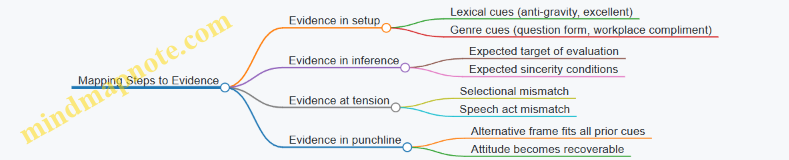
Across these examples, the listener’s job is consistent: compute a plausible pragmatic interpretation, notice where it strains against context or norms, then revise the frame so the punchline becomes the most coherent explanation of speaker intent.
5. Semantic Structures Underlying Humorous Meaning
5.1 Semantic Frames and Role Structures in Comedy
Semantic frames describe “who is doing what to whom, in what kind of situation.” In comedy, the frame is often set up normally, then a later cue forces the listener to map the utterance onto a different frame than the one they expected. Role structures are the skeleton of that mapping: roles like AGENT, PATIENT, INSTRUMENT, GOAL, and BENEFICIARY tell the mind which participants belong together.
Foundational Idea: Frames as Expectations
A frame is not just a dictionary definition. It includes typical participants and typical relations. For example, the “Restaurant Ordering” frame expects a CUSTOMER, a WAITER, and a MENU item, with actions like ORDER and SERVE. If someone says, “I’ll have the soup,” the listener activates that frame automatically.
Comedy often exploits the fact that listeners try to keep the frame consistent. When a punchline introduces a mismatching role or swaps the expected action, the listener must revise the frame. That revision is where the humor lives.
Role Structures as Mapping Constraints
Role structures constrain interpretation. If an utterance assigns an AGENT role to something that cannot normally act, the listener either rejects the sentence as impossible or reinterprets it under a different frame.
Consider two readings of the same surface pattern:
- “The email attacked my inbox.”
- “The email arrived in my inbox.”
The first invites a “Violence” frame where EMAIL is treated as an AGENT and INBOX as a TARGET. The second invites a “Communication Delivery” frame where EMAIL is a THEME and INBOX is a LOCATION. The humor comes from the mismatch between the literal roles and the semantic roles required by the activated frame.
How Frames Get Built in Steps
A practical way to analyze jokes is to track three moves: (1) frame activation, (2) role assignment, and (3) frame repair or frame switching.
- Frame activation happens through verbs, nouns, and common collocations.
- “I filed a complaint” activates “Legal/Administrative” expectations.
- Role assignment follows grammatical cues.
- Subject usually maps to AGENT or EXPERIENCER.
- Direct object often maps to PATIENT or THEME.
- Frame switching is triggered by a later cue that breaks the initial mapping.
- “The complaint was rejected because it was too honest” forces a different frame where “honesty” behaves like a policy-violating object.
Mind Map: Frame and Role Mechanics in Humor
Worked Examples with Explicit Role Shifts
Example 1: Misplaced roles through a familiar verb
Setup: “My phone called me at 3 a.m.”
- Likely frame: “Communication Event”
- Roles under that frame: PHONE as INSTRUMENT or DEVICE; CALL as event; ME as RECIPIENT.
Punchline: “It said I was overdue on my sleep.”
- New frame: “Medical/Coaching Appointment”
- Role shift: PHONE becomes AGENT delivering advice; ME becomes PATIENT/CLIENT; SLEEP becomes something with a schedule.
The humor is not only that phones talk. It is that the roles and relations now match a coaching frame rather than a calling frame.
Example 2: Frame switching via a single noun
Setup: “I brought a knife to the meeting.”
- Likely frame: “Workplace Meeting”
- Roles: SPEAKER as AGENT; MEETING as EVENT; KNIFE as unexpected object.
Punchline: “They said it was for cutting the agenda.”
- New frame: “Culinary/Butchery” or “Tool-based craft”
- Role shift: KNIFE becomes INSTRUMENT with a literal cutting relation; AGENDA becomes PATIENT-like material.
The listener repairs the frame by treating “agenda” as something physically cuttable, which makes the metaphor literal enough to be funny.
Advanced Detail: Polyframe Jokes and Competing Frames
Some jokes don’t fully switch frames; they keep two frames active and let them compete. In that case, the punchline supplies cues that satisfy both frames partially, so the listener oscillates.
For instance, “I’m reading a book about anti-gravity. It’s impossible to put down.”
- Frame A: “Reading/Books” with roles BOOK as THEME and READER as EXPERIENCER.
- Frame B: “Physics/Gravity” with roles BOOK as OBJECT and DOWN as direction.
The punchline keeps both role assignments plausible: “put down” is simultaneously an action in the reading frame and a physical action in the gravity frame. The humor comes from the listener’s ability to maintain both mappings long enough to notice the overlap.
Summary: What to Look for When Analyzing Frames
When you analyze a joke, identify the initial frame, assign roles from syntax, then locate the cue that forces a different role structure. Comedy is often a controlled mismatch: the listener’s expectations are correct until the punchline makes the semantic roles behave as if a different situation is happening.
5.2 Selectional Restrictions and Meaning Mismatch
Selectional restrictions are the expectations a verb or predicate has about the kinds of arguments it can take. In plain terms: many words “prefer” certain semantic types. When a sentence violates those preferences, the listener often repairs the meaning by reinterpreting the mismatch, and that repair can be the source of humor.
Foundational Idea: Semantic Types as Compatibility Checks
Start with a simple compatibility view. Suppose the verb eat expects an argument that can be consumed. If you say, “I ate the book,” the listener notices a type mismatch: books are not typical food. The mismatch is not just an error; it creates a prompt for reinterpretation.
A useful way to model this is as a set of semantic roles and constraints:
- Predicate: eat
- Expected object type: edible thing
- Actual object type: informational artifact
- Result: mismatch triggers reinterpretation
Meaning Mismatch as a Trigger for Reinterpretation
Humor often uses a mismatch that is easy to detect but also easy to “fix” in a non-literal way. The fix can be metaphorical (“I ate the book” = I read it intensely), metonymic (“The town ate the rumor” = people believed it), or structural (“The printer ate my homework” = it failed to produce it).
The key is that the listener can reach a coherent alternative meaning without abandoning the sentence. If the mismatch is too severe, the sentence becomes confusing rather than funny.
Selectional Restrictions in Action
Consider three patterns.
- Literal mismatch with a plausible figurative repair
- “The chef ate the review.”
- Expected: edible object.
- Actual: evaluation.
- Repair: ate means “absorbed” or “took seriously,” yielding a comic image of the chef consuming criticism.
- Metaphor that preserves grammatical structure
- “I devoured the instructions.”
- Expected: edible object.
- Actual: document.
- Repair: devoured maps to “read quickly and thoroughly.”
- Mismatch that points to a different event type
- “My phone swallowed my battery.”
- Expected: battery goes into phone.
- Actual: phone is treated as an eater.
- Repair: the sentence is reinterpreted as a malfunction narrative, where the phone “consumes” power.
Mind Map: Selectional Restrictions and Mismatch
Systematic Diagnostic: Where the Joke Lives
To analyze a humorous line, separate three layers.
- What the grammar licenses: the sentence is well-formed, so the listener expects a meaningful interpretation.
- What the semantics expects: selectional restrictions predict a certain argument type.
- What the context allows: the surrounding discourse makes a particular repair plausible.
Example: “I ate the homework.”
- Grammar: subject + verb + object.
- Semantic expectation: eat requires edible object.
- Contextual repair: homework becomes something you “consume” by studying or finishing.
The humor comes from the brief clash between literal consumption and the socially familiar act of doing homework.
Advanced Detail: Degree of Mismatch and Interpretability
Not all mismatches are equal. Two factors matter.
- Distance between expected and actual types: “eat” with “apple” is fine; “eat” with “idea” is farther but still repairable via metaphor.
- Availability of a conventional mapping: if a community already uses “consume” for media (“consume content”), the repair is faster and the joke can be tighter.
A line like “I ate the podcast” may feel less funny than “I ate the podcast schedule,” because the first has a ready-made metaphor for listening, while the second forces a more specific, concrete reinterpretation.
Worked Mini-Set: Same Structure, Different Repairs
- “She swallowed the explanation.”
- Expected: edible object.
- Repair: accept/believe.
- “She swallowed the question.”
- Expected: edible object.
- Repair: avoid/withhold response.
- “She swallowed the microphone.”
- Expected: edible object.
- Repair: stage mishap; the mismatch becomes a physical comedy scenario.
Each sentence uses the same selectional violation, but the repair differs because the object noun points to different plausible alternative meanings.
Practical Takeaway for Humor Analysis
When you see a humorous mismatch, ask two questions. First, what semantic type does the predicate expect? Second, what repair keeps the sentence interpretable while shifting meaning in a way that fits the context? If both answers are reachable, the listener experiences a quick, satisfying reinterpretation—exactly the kind of mental “type correction” that can turn a clash into a punchline.
5.3 Metaphor, Metonymy, and Conceptual Mapping in Jokes
Humorous meaning often comes from how speakers map one domain of experience onto another. A joke rarely just “contains” a metaphor; it uses the mapping to license an interpretation that the listener can compute quickly, then forces a mismatch at the punchline.
Metaphor as Cross-Domain Mapping
Metaphor treats one conceptual domain as if it were another. In jokes, the mapping is usually set up early and then exploited by pushing it further than the literal world allows.
- Foundational idea: a target domain (what the speaker talks about) is interpreted via a source domain (what the speaker borrows structure from).
- Practical test: replace the metaphorical phrase with a literal paraphrase and see whether the joke still makes sense.
Example: “My job is a treadmill.”
- Mapping: JOB → TREADMILL (work keeps you moving, but you don’t arrive).
- Punchline move: the speaker adds treadmill-like consequences: “I run all day and still end up at the same place.”
- The humor comes from extending the mapping into a literal-sounding description of a non-literal situation.
Metonymy as Within-Domain Substitution
Metonymy shifts reference within the same domain by using a salient part, label, or associated entity.
- Foundational idea: the joke relies on a “stand-in” that is close enough in the listener’s mental model to feel natural.
- Practical test: ask what entity the phrase points to, not what it literally names.
Example: “The White House denied it.”
- Metonymy: INSTITUTION → PEOPLE/DECISION-MAKERS.
- In jokes, the substitution can be overextended so the listener momentarily treats the stand-in as the whole.
Example: “I asked the White House for directions, and it gave me a press release.”
- The setup activates the metonymic link (White House = decision-making actors).
- The punchline blocks the expected action (directions) and replaces it with the institution’s typical output.
Conceptual Mapping as Constraint System
Conceptual mapping works like a constraint system: once the listener accepts a source-to-target mapping, they expect certain entailments.
- Metaphor constraints: roles, actions, and typical outcomes from the source domain become available for the target.
- Metonymy constraints: the stand-in inherits the behaviors and outputs associated with the part.
Example: “He’s a walking dictionary.”
- Mapping: PERSON → DICTIONARY.
- Constraint: a dictionary “defines” and “contains entries,” so the listener anticipates definitional behavior.
- Punchline: “Ask him a question and he corrects your pronunciation.”
- The humor comes from a partial satisfaction of the dictionary role (correction) paired with an unexpected mismatch (pronunciation rather than definition).
Mind Map: Metaphor, Metonymy, and Mapping Moves
Systematic Walkthrough from Setup to Punchline
- Choose a mapping: decide whether the joke uses cross-domain structure (metaphor) or within-domain reference (metonymy).
- Activate expectations: include a phrase that makes the mapping salient.
- Add a compatible detail: give one element that fits the mapping so the listener commits.
- Introduce the mismatch: the punchline either violates a constraint (metaphor) or swaps the expected action/output (metonymy).
Example (metaphor): “My phone is my therapist.”
- Setup: PHONE → THERAPIST.
- Compatible detail: “It listens without judging.”
- Mismatch: “Then it sends me a survey asking how I’m doing.”
- The listener expects therapeutic follow-up; instead they get customer feedback mechanics.
Example (metonymy): “I called customer service, and the hold music started negotiating.”
- Setup: CUSTOMER SERVICE → THE VOICE/CHANNEL.
- Compatible detail: hold music is associated with waiting and service.
- Mismatch: hold music is treated as an agent that negotiates, which is a playful over-literalization of the stand-in.
Advanced Detail: Mapping Strength and Ambiguity
Jokes often succeed when the mapping is strong enough to guide interpretation but weak enough to allow a quick reanalysis.
- Strong mapping: “walking dictionary” strongly suggests definitional behavior.
- Weaker mapping: “the office is angry” can mean people, policies, or atmosphere, so the punchline can steer the interpretation.
Example: “The office is angry today.”
- Metonymy: OFFICE → PEOPLE/ATMOSPHERE.
- Punchline: “Good thing I brought earplugs.”
- The humor depends on the listener choosing a particular metonymic target (atmosphere/people) and then treating it as something physically “loud.”
In short, metaphor and metonymy are not just figures of speech; they are structured ways of transferring meaning. Jokes exploit that structure by making the listener’s expectations visible, then bending them at the punchline so the mapping itself becomes the source of the laugh.
5.4 Entailment, Contradiction, and Incongruity in Humor
Humor often depends on meaning relations: what a sentence entails, what it contradicts, and what it leaves inconsistent. In linguistic terms, entailment and contradiction describe logical pressure between propositions, while incongruity describes the mismatch between what the listener expects the discourse to support and what it actually supports.
Entailment as a Baseline for Expectations
Entailment holds when one proposition makes another proposition true in all relevant interpretations. In humor analysis, entailment is the “default track” the listener uses to predict the next meaning step.
Example:
- “My toaster is broken.”
- Entails: the toaster is not functioning.
- Likely supports: the speaker cannot toast bread.
A joke can work by keeping entailments plausible up to the setup, then forcing a different semantic conclusion at the punchline.
Contradiction as Semantic Pressure
Contradiction holds when one proposition makes another false under the same interpretation. Humor can exploit contradiction by making the listener commit to an interpretation that the punchline then denies.
Example:
- “I told the truth to the judge.”
- “So I got a lie sentence.”
The first clause invites entailment: the speaker provided truthful information. The punchline introduces a contradiction-like shift: “lie sentence” conflicts with the expected mapping between truth-telling and legal outcomes.
The key is that contradiction is not only about logical impossibility; it can also be about semantic role reversal, category mismatch, or a switch in the meaning of a key word.
Incongruity as a Controlled Meaning Clash
Incongruity is the listener’s experience of mismatch. It can arise when entailment paths and contradiction cues collide, producing a moment where the discourse can no longer satisfy a single coherent interpretation.
A useful way to model this is to separate three layers:
- Propositional layer: what is asserted.
- Relational layer: entailment and contradiction between propositions.
- Interpretive layer: the listener’s evolving hypothesis about what kind of meaning the speaker intends.
When the punchline changes the interpretive layer, the relational layer can suddenly look inconsistent, even if each individual sentence is ordinary.
Mind Map of Meaning Relations in Humor
Mind Map: Entailment, Contradiction, and Incongruity
Worked Example with Stepwise Relations
Consider a compact joke:
- “I’m great at multitasking.”
- “I can waste time in three different ways.”
Step 1: Setup entailments
- “I’m great at multitasking” entails: the speaker can handle multiple tasks effectively.
- The listener expects positive evaluation tied to productive outcomes.
Step 2: Punchline contradiction cues
- “waste time” contradicts the expected productive evaluation.
- “three different ways” preserves quantity but changes the task type.
Step 3: Incongruity resolution
The listener reinterprets “multitasking” as “simultaneously managing multiple forms of inefficiency.” The humor comes from the clash between the entailment path of the setup and the contradiction-like semantic reframing at the punchline.
Advanced Detail: Local vs Global Inconsistency
Not all incongruity is global. Some jokes create local inconsistency that can be repaired by a meaning shift.
-
Local inconsistency: the contradiction is confined to a specific word sense or role assignment.
- Example: “I used to be indecisive. Now I’m not sure.”
- The punchline contradicts the expected entailment that decisiveness improved, but the contradiction is resolved by a shift in how “not sure” functions as a new state description.
-
Global inconsistency: the discourse cannot be made coherent without abandoning the initial interpretive frame.
- Example: “This statement is false.”
- The contradiction is structural, and the listener’s interpretive options are constrained.
In humor, local inconsistency is often easier to process because the listener can repair it quickly. Global inconsistency can still be funny, but it tends to rely on shared tolerance for paradox-like meaning.
Practical Takeaway for Analysis
When you annotate a joke, identify:
- The entailment commitments created by the setup.
- The contradiction cues introduced by the punchline.
- The interpretive shift that turns contradiction into a coherent humorous reading.
If you can name the listener’s “before” expectation and the “after” reinterpretation, you can explain why the incongruity is felt and how it becomes intelligible.
5.5 Worked Examples: Building Semantic Representations for Jokes
Semantic representations for jokes are not meant to “guess the punchline.” They aim to model what meanings are activated, how they compete, and which interpretation becomes dominant at the end. A practical workflow is: (1) identify the joke’s semantic targets, (2) build candidate meaning structures, (3) mark the ambiguity or mismatch, and (4) show how the punchline forces a selection.
Step 1: Choose a Representation Style
Use one consistent format so comparisons are meaningful. A simple, readable option is a frame-like structure with roles and constraints.
- Frame: the event type (e.g., REQUEST, EVALUATION, POSSESSION).
- Roles: participants (agent, object, recipient).
- Constraints: selectional restrictions (what kinds of entities can fill roles).
- Links: which words trigger which frame elements.
Step 2: Example One Pun with Sense Competition
Joke: “I used to be a banker, but I lost interest.”
Activated senses
- Interest₁: financial interest (money earned).
- Interest₂: personal interest (curiosity/engagement).
Candidate semantic representations
Candidate A: financial frame
- Frame: EARN_INTEREST
- Roles:
- Holder: I
- Asset: (implied savings/loan)
- Rate: (implied)
- Verb mapping: “lost” → decrease/absence of earnings
- Constraint: “interest” must be money-related
Candidate B: psychological frame
- Frame: HAVE_INTEREST
- Roles:
- Experiencer: I
- Topic: (unspecified)
- Verb mapping: “lost” → reduced engagement
- Constraint: “interest” must be attitude-related
Mismatch marker
- “used to be a banker” primes a financial setting.
- “lost interest” supports both frames, but the second frame becomes salient because the phrase “lost” is more natural with attitudes in everyday speech.
Punchline selection
The final interpretation is typically Candidate B, because the joke’s humor depends on switching from a professional financial register to a personal emotional one.
Step 3: Example Two Semantic Mismatch with Pragmatic Support
Joke: “Time flies like an arrow. Fruit flies like a banana.”
This joke uses a single surface pattern to trigger different semantic frames.
Mind map of meaning triggers
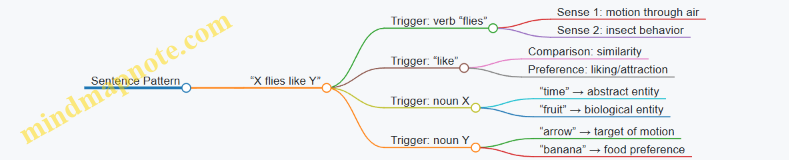
Candidate semantic representations
Candidate A: time-motion comparison
- Frame: MOTION_COMPARISON
- Roles:
- Theme: time
- Manner: like an arrow
- Constraint: Theme can be compared to a moving object
- “like” = similarity
Candidate B: insect-preference frame
- Frame: PREFERENCE
- Roles:
- Experiencer: fruit flies (insect subject)
- Preferred item: banana
- Constraint: “flies” must be insect sense
- “like” = preference
Selection mechanism
The second sentence forces reanalysis: “fruit flies” is a conventional noun phrase for insects, and “like a banana” is a natural preference construction. The humor comes from the reader carrying the first frame into the second, then correcting it.
Step 4: Example Three Building a Representation from Roles and Constraints
Joke: “The comedian said the truth. Then he told a lie.”
This joke is often funny because it invites a semantic model where “truth” and “lie” are treated as compatible with the same speaker action, but the timeline and verb choices create a tension.
Representation skeleton
- Frame: SPEECH_EVENT
- Speaker: comedian
- Content: proposition p
- Modality: assert
- Evaluation: truth-status
Two-step candidate structures
Utterance 1
- SPEECH_EVENT₁
- Content: p
- Evaluation: TRUE
- Trigger: “said the truth”
Utterance 2
- SPEECH_EVENT₂
- Content: q
- Evaluation: FALSE
- Trigger: “told a lie”
Where the humor lives
A reader expects a single coherent stance, but the semantics allows two distinct propositions with different truth-status. The joke’s effect is strengthened when “the truth” is interpreted as a specific content rather than a general attitude, making the shift to “a lie” feel like a direct contradiction in the same conversational space.
Consolidated Mind Map for Representation Building
A good semantic representation ends with a clear “why this one” statement: which frame becomes dominant, which constraint is satisfied, and which earlier assumption had to be revised.
6. Wordplay Mechanisms: Homophones, Puns, and Beyond
6.1 Homophones And Near-Homophones: Sound-Based Ambiguity
Sound-based ambiguity happens when listeners map the same (or very similar) sound pattern onto different word forms or meanings. Homophones are the cleanest case: different spellings and meanings share the same pronunciation, like “two” and “too.” Near-homophones are messier: they sound close enough that perception and context can push the listener toward the “wrong” candidate, such as “their” vs. “there” or “right” vs. “write.” In humor, this ambiguity is useful because the setup often encourages one interpretation, and the punchline forces a different one.
Core Mechanism: Candidate Selection from Sound
When someone hears an utterance, they do not retrieve a single meaning instantly. They generate a short list of plausible lexical candidates based on the acoustic signal, then narrow it using context, grammar, and expectations.
A simple example shows the basic move:
- Setup: “I’m going to buy two tickets.”
- Alternative interpretation: “too tickets” is odd in standard grammar, so the listener rejects it.
Humor works when both candidates can fit well enough to survive early filtering, at least until the punchline. That survival depends on three factors:
- Phonetic similarity: the sound overlap must be strong.
- Syntactic compatibility: each candidate must be able to occupy the same grammatical slot.
- Semantic plausibility: context must make more than one meaning temporarily reasonable.
Homophones in Practice: Meaning Switching
Homophones often create a “meaning switch” without changing the sentence’s structure. The listener’s first pass interpretation is then reinterpreted.
Example:
- “I used to be a baker, but I couldn’t make enough dough.”
Here, “dough” is not a homophone of a common alternative in the same way as “dough/dow,” but the joke still relies on sound-adjacent meaning competition: “dough” evokes money, and the listener’s mental model shifts from literal baking ingredients to financial success. For a clearer homophone contrast, consider:
- “I’m reading a book about anti-gravity. It’s impossible to put down—because it keeps falling for me.”
The humor is not a strict homophone pair, but it demonstrates the same principle: the listener’s expectation is guided by familiar patterns, and the final interpretation changes what the key word is “doing” in the message.
To keep the sound-based focus, use a direct homophone pair:
- “I asked the librarian if the book was overdue. She said, ‘No, it’s due—too.’”
The punchline exploits the listener’s ability to treat “due” and “too” as interchangeable sounds while forcing a second meaning that re-frames the exchange.
Near-Homophones in Practice: Perception Under Uncertainty
Near-homophones are especially common in fast speech, accents, and noisy environments. They allow jokes to hinge on how listeners repair uncertainty.
Example:
- “Their cat is really good at math.”
- Punchline: “Yeah, it keeps adding up—then it there goes the answer.”
The punchline nudges the listener toward a different word form (“there” instead of “their”) by using a context that makes the “there” reading feel more natural at the end of the sentence. The listener’s earlier commitment is then exposed as fragile.
A more compact version:
- “I told my friend to meet me at the pier.”
- “Which pier?”
- “The one by the pear tree.”
Even if “pier” and “pear” are not identical in every accent, they are close enough for many listeners to treat them as the same sound category, enabling a clean reinterpretation.
Mind Map: Sound-Based Ambiguity in Humor
Advanced Detail: How to Engineer a Punchline
A reliable sound-based joke usually follows a pattern: the setup makes one candidate feel “default,” and the punchline supplies a cue that makes the alternative candidate suddenly better.
Consider a near-homophone pair in a minimal setup:
- Setup: “I can’t believe the waiter forgot the order.”
- Punchline: “He said, ‘Sorry, I meant to weight her—she’s on a diet.’”
Even if “waiter/weight her” is not a standard homophone pair, it illustrates the engineering logic. The setup primes “waiter” as the agent, while the punchline forces a reanalysis where the same sound material is interpreted as a verb phrase (“weight her”). The listener’s earlier candidate list is not wrong because of sound alone; it becomes wrong because the punchline changes what the sentence is about.
Quick Diagnostic Checklist
Use this checklist to test whether a sound-based ambiguity will likely land:
- Does the sound similarity allow multiple candidates without heavy strain?
- Can each candidate fit the same grammatical position?
- Does the punchline add a cue that makes the second reading clearly preferable?
- Is the first reading plausible enough that the listener would naturally choose it during the setup?
When these conditions hold, homophones and near-homophones become more than word tricks; they become a controlled way to manage interpretation in real time.
6.2 Puns: Lexical Overlap and Meaning Switching
A pun works when the listener can connect the same lexical material to two (or more) meaning targets. The “overlap” is usually a shared form—same sound, same spelling, or same morphemes. The “switching” happens when context makes one meaning salient for a moment, then a second meaning becomes equally available at the punchline. The key is that the switch is not random; it is guided by grammar, selectional expectations, and discourse cues.
Core Mechanism: One Form, Two Meaning Targets
Start with a minimal setup: a word or phrase that has multiple senses, or a pair of forms that are close enough to be treated as the same by the listener. Then craft a context that nudges the first sense. Finally, place a punchline element that forces a reanalysis toward the second sense.
Example (polysemy with lexical overlap):
- “I used to be a banker, but I lost interest.”
The setup primes “interest” as a financial concept. The punchline reorients “interest” toward attention or motivation. The overlap is the noun “interest”; the switching is the sense shift triggered by “lost.”
Meaning Switching as a Controlled Reanalysis
Listeners interpret utterances incrementally. Early words create expectations about what kinds of meanings fit. In puns, the punchline violates or redirects those expectations while still using the same lexical form.
Consider a near-minimal contrast:
- “I lost interest in the account.” (single sense, no switch)
- “I lost interest.” (ambiguous until context supplies a target)
A pun exploits that ambiguity by making the first sense plausible in the setup and then making the second sense more coherent at the punchline.
Where the Switch Comes From
Meaning switching can be driven by several linguistic signals.
- Selectional mismatch: The punchline uses the form in a way that only one sense can satisfy.
- “The dentist was great—he really knew how to fill time.”
“Fill” is compatible with dentistry in the setup, but “time” pushes toward the non-dental sense at the punchline.
- Syntactic framing: Grammar can constrain which sense is likely.
- “I’m reading a book on anti-gravity. It’s impossible to put down.”
The phrase “put down” is idiomatic for stopping reading, but the anti-gravity framing makes the literal “down” interpretation feel available, enabling a switch.
- Discourse alignment: Prior mention makes one sense active; the punchline reattaches the form to a different discourse role.
- “My friend is great at saving money. He never spends a penny.”
“Saving money” primes a literal financial role. The punchline “never spends a penny” can be treated as both literal and figurative, depending on how “penny” is framed in the discourse.
Mind Map: Lexical Overlap and Meaning Switching
Worked Example: From Setup to Punchline
Example:
- “I tried to catch fog yesterday. Mist.”
The overlap is the verb “catch.” In the setup, “catch” suggests capturing something physical. The punchline “Mist” supplies the second target: fog/mist as the thing that resists being caught. The listener’s reanalysis is guided by the abrupt nominal punchline, which removes the expectation of an object phrase and instead treats “mist” as the relevant referent.
Common Failure Modes
A pun can feel forced when the two meanings are not both accessible. If the setup does not activate sense A strongly, the listener may jump directly to sense B and miss the intended switch. If the punchline does not constrain meaning B, the listener may treat it as a non sequitur rather than a reanalysis.
A quick diagnostic: if you remove the punchline, does the setup still sound like it has a clear meaning? If yes, the pun likely has a workable sense A. Then check whether the punchline makes sense B more coherent than sense A without changing the form.
Mini-Set of Puns with Different Switch Drivers
- Polysemy: “I’m great at multitasking. I can waste time efficiently.”
- “efficiently” shifts from productivity to criticism.
- Selectional mismatch: “He broke his arm trying to reach the high note.”
- “high” toggles between spatial and musical scales.
- Idiomatic frame: “She’s on a seafood diet. She sees food and she eats.”
- “sees” and “eats” align idiomatically, then literalize the mechanism.
In each case, the lexical overlap is stable, while the meaning target changes because the surrounding words make one interpretation fit better at the end.
6.3 Spelling, Orthography, and Visual Wordplay
Spelling and orthography matter in humor because written language exposes choices that speech often hides. In print, the audience can see letter patterns, spacing, capitalization, and punctuation, then compare them to expectations. Visual wordplay uses that visibility to create ambiguity, misdirection, or a second interpretation.
Foundational Concepts for Visual Meaning
Orthography as a meaning signal. Spelling conventions are not just storage; they guide readers toward a word’s identity. When a joke changes spelling, it can signal a different lexical item, a different morphological analysis, or a different social stance.
Expectation and pattern matching. Readers typically predict upcoming letters and word boundaries. Humor can exploit this by introducing a near-match that looks correct at first glance, then fails on a later detail.
Surface form vs. underlying structure. A pun may depend on phonology, but visual wordplay depends on surface form. The key question is what the reader can infer from the visible string: a known word, a plausible misspelling, or a deliberate graphic twist.
Mechanisms of Spelling-Based Humor
1. Misspelling as a semantic cue. A misspelling can be treated as a different word if it resembles a real one. For example, “I used to be indecisive, now I’m not sure” works in speech, but in writing you can add a visual twist: “I used to be in-deci-sive” to suggest a split into parts. The humor comes from forcing the reader to parse spelling as structure.
2. Homographic ambiguity. Some jokes rely on the same letters supporting multiple segmentations. Consider “ice cream” vs. “I scream.” In writing, you can emphasize the segmentation by spacing: “I scream / ice cream.” The reader’s eye supplies the missing sound, then the meaning flips.
3. Capitalization and emphasis. Capital letters can mark proper names, shouting, or contrast. A simple example: “I love my dog” vs. “I love my DOG.” The second version can be read as emphasis or as a shift to a different referent, especially if the surrounding text supports it.
4. Punctuation as a reanalysis trigger. Commas and apostrophes can change scope. “Let’s eat, Grandma” vs. “Let’s eat Grandma” is a classic case where punctuation changes the parse. Humor often works by making the “wrong” parse briefly plausible.
5. Spacing and line breaks. Word boundaries are part of orthography. A joke can move meaning by moving boundaries: “I scream / for ice cream” can be rendered as “I scream for / ice cream” to suggest a different relationship between the verb and the object.
Mind Map: Visual Wordplay Components
Worked Examples with Integrated Reasoning
Example 1: Misspelling that points to a different word. Text: “The sign said ‘NO TRESPASSING,’ but the cat kept trespassing anyway.” Reasoning: The joke is not the misspelling itself; it’s the orthographic emphasis. If you add a deliberate variant like “NO TRESPASSING” printed as “NO TRESPASSIN’,” the reader infers a different register and then re-evaluates the cat’s “rule-breaking” as a mismatch between formal signage and casual behavior.
Example 2: Punctuation-driven parse flip. Text: “I can’t believe you ate the cake, too.” Variant: “I can’t believe you ate the cake too.” Reasoning: The comma version can suggest disbelief about two separate actions, while the no-comma version leans toward disbelief about one action plus an additional participant. The humor often comes from how quickly the reader commits to one scope and then corrects it.
Example 3: Spacing as a segmentation pun. Text: “I scream for ice cream.” Visual variant: “I scream / for ice cream.” Reasoning: The slash makes the boundary salient. The reader’s eye treats “scream” as a complete unit, then the phrase “for ice cream” becomes a separate step that can feel like a caption to a visual gag.
Practical Best Practices for Writing and Analyzing
Keep the orthographic change minimal but interpretable. If the altered spelling is too far from any recognizable pattern, the audience loses the chance to reanalyze. A near-match is usually enough.
Provide a local cue that licenses the second reading. Without context, “wrong” punctuation can look like an error rather than a joke. A surrounding sentence that repeats the intended structure helps the reader treat the orthography as deliberate.
Check whether the humor depends on reading speed. Visual wordplay often works best when the reader can pause and look again. If the text is too dense, the mechanism may fail because the audience never gets the chance to notice the orthographic signal.
Annotate the mechanism explicitly. When analyzing, record what changed (spelling, capitalization, punctuation, spacing) and what interpretation shifted (lexical identity, segmentation, scope, or stance). That separation prevents vague explanations like “it’s ambiguous,” which tells you nothing about how the ambiguity is produced.
6.4 Morphological Puns: Affixation, Compounding, and Clipping
Morphological puns create humor by exploiting how word parts combine. Instead of relying only on sound-alike words, they play with prefixes, suffixes, stems, and word boundaries so that the listener’s first structural parse conflicts with the intended one. A useful way to analyze these puns is to track three layers: the morphemes you can see, the word you expect to form, and the meaning you end up with.
Core Mechanism: Two Parses from One Form
A morphological pun typically offers two plausible segmentations. The audience starts with a “default” parse based on common affixes and familiar compounds, then the punchline nudges a different segmentation that yields a different meaning.
Example:
- “I used to be a banker, but I lost interest.” The humor hinges on the suffix-like chunk “-er” (agentive) and the noun “interest.” The surface form supports a role-reading (“banker”) while the punchline reassigns the key noun to a different semantic domain (financial interest vs. lack of interest).
Affixation Puns: Prefixes and Suffixes as Meaning Switches
Affixation puns work when an affix is ambiguous in function or when the audience can plausibly treat a string as an affix even if it is not the one you “should” use.
- Homophonous or near-homophonous affixes
- “That’s a very unusual solution—so un kind of you.” The prefix un- is treated as a negator in the first clause, then reinterpreted as part of unkind in the second clause. The joke is structural: the listener’s segmentation changes midstream.
- Suffix reanalysis
- “I’m reading a book on anti-gravity. It’s impossible to put down.” The suffix -gravity is stable, but the pun comes from treating anti- as a semantic operator that should cancel gravity, while the punchline treats “anti-gravity” as a property that affects the book’s physical behavior. The morphology sets up an expectation about meaning composition; the punchline changes what the composition is doing.
- Agentive vs. evaluative readings
- “My neighbor is a real help-er.” The agentive -er invites a “person who helps” reading, but the context can shift it toward “someone who helps in a way that causes trouble,” turning the same morphology into an attitude marker.
Compounding Puns: Boundary Placement and Category Confusion
Compounds are especially pun-friendly because word boundaries are flexible in interpretation. The listener decides whether a sequence is a single compound, a compound inside a larger phrase, or a phrase with an embedded noun.
Example:
- “I bought shoes for my dog. They’re bark-ain.” The intended compound is bargain, but the pun overlays a boundary that yields bark + -ain-like residue. Even when the sound is doing work, the morphological angle matters: the audience is encouraged to treat the first chunk as a meaningful morpheme.
A clearer morphological boundary example:
- “The city has a new recycling program. It’s trashparent.” Here trash is treated as the first member of a compound, while the second member is reinterpreted as -parent (as in “transparent”). The humor comes from category confusion: the listener expects a normal adjective, then gets a compound that points to waste.
Practical best practice: when analyzing a compound pun, write down the two candidate segmentations explicitly, then state which one is “default” and which one is “forced” by the punchline.
Clipping Puns: Truncation as a Meaning Trap
Clipping shortens words, but it also removes cues that normally signal the original category. That makes it easier to reinterpret the remaining string as a different morpheme or as the start of a new word.
- Clipped forms that resemble affixes
- “I’m on a strict diet: no veg. Just veggie—and if you ask, it’s a very serious plan.” The clipped veg becomes a pivot that invites reanalysis of ve- as a prefix-like chunk. The joke works because the clipped form is short enough to be treated as a building block.
- Clipping that changes the expected semantic frame
- “My professor said the exam would be cumulative. I asked if that meant ‘cume’—and he said, ‘No, it means you can’t skip the basics.’” The humor depends on treating the clipped portion as if it were a separate lexical item. The audience’s morphological expectation (“this chunk should map to a known word”) conflicts with the intended meaning (“cumulative” as a technical description).
Mind Map: Morphological Pun Components
Worked Mini-Analysis Template
Use this sequence for any morphological pun:
- Identify the surface string that carries the ambiguity.
- Propose two segmentations into morphemes.
- Label the default parse (what most listeners would try first).
- Explain what the punchline forces (the reinterpretation trigger).
- State the meaning difference created by the new morphology.
Example (template applied):
- “I tried to catch fog yesterday. I mist.” Surface string: “mist.” Segmentation options: mist as a noun/verb vs mis- + t-like residue (a near-affix reading). Default parse: “mist” as the verb meaning “failed to catch.” Forced parse: the sound and spelling nudge a “mis-” style reanalysis that makes the failure feel like a systematic error.
Morphological puns are most reliable when the audience can plausibly compute both structures quickly. When the two parses are too far apart, the listener spends effort on guessing rather than enjoying the structural switch.
6.5 Worked Examples: Diagnosing the Exact Source of the Pun
A pun usually looks like one trick, but it is often a chain: sound or spelling similarity creates a candidate meaning, context selects one sense, and the punchline exploits the mismatch. Diagnosing the exact source means naming the smallest linguistic move that produces the shift.
Step 1: Mark the Meaning Shift Point
Write the setup meaning and the punchline meaning as two short paraphrases. Then underline the word or phrase that changes interpretation. Example: “I used to be a banker, but I lost interest.” The shift happens on interest: first as “money earned,” then as “motivation.”
Step 2: Test competing mechanisms
For the underlined item, ask which mechanism could plausibly generate both readings.
- Lexical ambiguity: the same form has multiple senses.
- Phonological similarity: different forms sound alike.
- Orthographic similarity: different forms look alike.
- Morphological structure: affixes or compounds create a new parse.
- Syntactic reanalysis: the grammar invites a different attachment.
If only one mechanism can produce both readings without forcing extra assumptions, that is the pun’s source.
Step 3: Use minimal-context probes
Replace the pun word with a near-synonym that keeps the surrounding grammar. If the joke collapses, the pun depends on the exact form. Then try a paraphrase that preserves the form but changes context. If the joke still works, the mechanism is likely semantic ambiguity rather than sound.
Mind Map: Diagnosing the Source of a Pun
Example 1: Lexical Ambiguity with Sense Competition
Text: “I’m reading a book on anti-gravity. It’s impossible to put down.”
Shift point: put down.
Candidate mechanisms: lexical ambiguity vs. idiom vs. syntactic reanalysis.
Probe: If you replace put down with place, the second meaning (“stop reading”) disappears. The phrase put down is an idiom meaning “criticize” or “stop using,” but here it is also interpreted literally as “lower something.” The pun works because the setup primes a physical domain (anti-gravity), making the literal reading salient, while the punchline relies on the idiomatic reading.
Diagnosis: The pun source is lexical ambiguity plus idiom literalization: put down supports both a literal physical action and an idiomatic “stop reading/using” interpretation.
Example 2: Homophony and Sound-Based Selection
Text: “Time flies like an arrow. Fruit flies like a banana.”
Shift point: flies.
Candidate mechanisms: homophony vs. polysemy vs. syntactic change.
Probe: The form flies is identical in spelling and pronunciation, but the subject changes: “time” vs. “fruit.” The verb phrase flies like X is interpreted as “moves in a manner” in the first sentence and as “prefers X” in the second. The mechanism is not homophony; it is polysemy of the construction where like selects a preference reading.
Diagnosis: The pun source is constructional meaning shift: the same surface pattern triggers different semantic roles because time and fruit support different verb senses under like.
Example 3: Orthographic Similarity and Spelling-Driven Reanalysis
Text: “The magician got arrested for stealing watches. He was caught red-handed.”
Shift point: red-handed.
Candidate mechanisms: idiom vs. visual wordplay.
Probe: If you change red-handed to caught immediately, the watch theme loses its visual hook. The phrase normally means “caught in the act,” but the watch context makes red-handed interpretable as “having red watch hands” (the hands of a clock/watch). The pun depends on the idiom being reinterpreted through the literal meaning of its components.
Diagnosis: The pun source is idiom literalization supported by orthographic/lexical compositionality: red-handed is treated as a literal description of watch hands rather than only a fixed idiom.
Example 4: Morphology and a New Parse
Text: “I told my computer I needed a break, and it said: ‘No problem—I’ll go to sleep.’”
Shift point: sleep.
Candidate mechanisms: metaphor vs. morphological structure.
Probe: The joke is not about a single ambiguous word with two dictionary senses; it is about how the system’s “sleep” command maps onto human rest. Still, the diagnostic move is to check whether any morphological alternative exists. Here, sleep is not morphologically ambiguous; the mechanism is semantic mapping of a technical term onto a human activity.
Diagnosis: The pun source is semantic frame transfer: the technical meaning of sleep is reinterpreted as human “rest,” producing the humorous mismatch.
Final Diagnostic Template
Use this one-sentence format for any pun:
Mechanism: [lexical ambiguity / homophony / orthographic similarity / morphological parse / constructional shift / idiom literalization / semantic frame transfer].
Trigger: [the exact form].
Justification: [which probe shows the other reading depends on that form].
When you can fill all three parts without hand-waving, you have diagnosed the pun’s exact source.
7. Figurative Language and Comic Reinterpretation
7.1 Irony and Echoic Meaning in Verbal Comedy
Irony is often treated as “saying the opposite,” but in linguistic terms it is more precise: the speaker echoes a prior thought, attitude, or expectation and signals a mismatch between that echoed content and the speaker’s stance. Echoic meaning is the mechanism that makes this possible. The listener recognizes that the utterance is not meant to be taken at face value; it is meant to be taken as a comment on something else.
Core Idea of Echoic Meaning
Echoic meaning involves three layers.
- An echoed proposition: what someone (often the speaker, sometimes a group) is taken to believe or expect.
- A stance toward the echoed proposition: approval, rejection, mockery, or correction.
- A signal that the stance is not the literal one: prosody, context, lexical cues, or conversational history.
A simple example shows the layers.
- Context: Someone arrives late to a meeting.
- Utterance: “Great timing.” Literal reading: the timing is good. Echoic reading: the late arrival is being commented on by echoing the “good timing” expectation and rejecting it.
The humor comes from the listener’s effort to align the utterance with the context. The listener quickly infers that the echoed attitude (“this is good timing”) is being treated as wrong or foolish.
How Listeners Detect Irony
Listeners use pragmatic cues rather than a single “irony marker.” Common cues include:
- Contextual contradiction: the situation makes the literal claim implausible.
- Attitude words and evaluation: “great,” “excellent,” “perfect” often become targets when the world disagrees.
- Prosodic mismatch: flat or exaggerated stress can indicate that the literal evaluation is not the intended one.
- Conversational history: irony is easier when the listener knows what was previously said or assumed.
Consider a classroom scenario.
- Student: “I studied all night.”
- Teacher: “That explains the spelling.” The teacher’s utterance echoes the student’s implied claim of competence and stance-shifts it into a critique.
Echoic Meaning as Attitude Management
In verbal comedy, irony frequently manages social attitudes. The speaker can mock a belief without directly stating “your belief is wrong.” Echoing lets the speaker keep the surface form polite or neutral while still communicating disapproval.
Example:
- Colleague A: “I love this new policy. It’s so efficient.”
- Colleague B: “Yes, it’s efficient at making everyone submit the same form twice.” Colleague B echoes the “efficient” evaluation and then supplies evidence that undermines it. The humor is not only in the contradiction; it is in the way the speaker lets the listener do the comparison.
Types of Irony in Humorous Speech
Irony in comedy often clusters into a few recurring patterns.
1) Evaluative Irony
The speaker uses positive evaluation terms for negative outcomes.
- “Nice job cleaning the kitchen.” (The kitchen is still messy.) Echoed attitude: “the kitchen is now clean.” Stance: rejection, often with mild scolding.
2) Corrective Irony
The speaker echoes a mistaken explanation and reframes it.
- “I’m not late. I’m just early for the next meeting.” Echoed proposition: “time works differently for me.” Stance: mockery through a reanalysis of the claim.
3) Echoic Sarcasm
The speaker targets a prior utterance or attitude more explicitly.
- A: “I’m great at directions.”
- B: “Sure. You just turned left at the sign that says ‘Right.’” Echoed content: “I’m good at directions.” Stance: disbelief and teasing.
Mind Map: Irony and Echoic Meaning
Worked Micro-Analysis
Take this exchange.
- Person 1: “I totally understand this.”
- Person 2: “Then you can explain it to the class.” Literal reading: Person 2 is requesting an explanation. Echoic reading: Person 2 echoes Person 1’s confidence and signals that the confidence is unwarranted. The humor is grounded in the mismatch between claimed understanding and the immediate test.
Common Failure Modes
Irony can fail when the listener cannot identify the echoed target or the stance signal.
- If the context is missing, “Great timing” may sound like genuine praise.
- If the evaluative term is not clearly incompatible with the situation, the listener may not infer rejection.
- If multiple plausible echoes exist, the listener may choose the wrong one, reducing the comedic effect.
In practice, good verbal comedy makes the echoed content easy to locate and the stance easy to compute, so the listener’s interpretation feels like a quick, satisfying correction rather than a guessing game.
7.2 Hyperbole and Understatement: Scale Manipulation
Hyperbole and understatement are scale operations: speakers adjust the magnitude of an event, property, or evaluation so the listener must recalibrate what “counts” as normal. The humor often comes from a mismatch between (a) the scale implied by the words and (b) the scale supported by the situation, shared knowledge, or conversational norms.
Foundational Concepts of Scale
Start with three ingredients.
- Baseline scale: what the listener assumes is typical for the context. If someone says “That took five minutes,” the baseline is “a short task.”
- Linguistic scale marker: words and constructions that push magnitude up or down. Examples include “literally,” “a million,” “barely,” “just,” “the tiniest,” and “the end of the world.”
- Contextual evidence: what the situation actually supports. If the task took an hour, the evidence conflicts with the baseline implied by the marker.
Humor emerges when the listener detects the conflict and then infers an intended attitude rather than the literal magnitude.
Hyperbole as Overshoot
Hyperbole exaggerates beyond the baseline. The listener typically treats the utterance as an evaluation cue: “This is important,” “This is extreme,” or “I’m impressed/annoyed.”
Example 1
- Speaker: “I waited forever for the bus.”
- Situation: The bus was delayed by 12 minutes.
- Scale move: “forever” overshoots the baseline.
- Likely inference: the delay felt long due to impatience, inconvenience, or timing pressure.
A useful diagnostic is to ask what would make the hyperbole reasonable. If the listener can’t map “forever” to any plausible duration, the exaggeration functions as affect signaling.
Understatement as Undershoot
Understatement minimizes beyond the baseline. It can signal politeness, irony, or a deliberate refusal to treat something as serious.
Example 2
- Speaker: “It’s just a small problem.”
- Situation: The system is down for everyone.
- Scale move: “just” undershoots the baseline severity.
- Likely inference: the speaker is either downplaying to reduce tension or being sarcastic.
Understatement often relies on the listener’s ability to notice what is being minimized. If the listener misses the mismatch, the line may sound merely inaccurate rather than funny.
Mind Map: Scale Manipulation
Pragmatic Mechanics: How the Listener Resolves the Mismatch
Scale manipulation is rarely “free-floating.” It is anchored by pragmatic expectations.
- Non-literal interpretation: the listener treats the magnitude term as a proxy for attitude.
- Relevance check: the listener asks whether the exaggeration/understatement helps communicate something efficiently. If it does, the non-literal reading becomes more likely.
- Social calibration: the listener considers whether the speaker is being cooperative, teasing, or trying to soften impact.
Example 3 (politeness vs. irony)
- Speaker A: “Sorry, I’m a bit late.”
- Speaker B: “A bit late? You missed the whole meeting.”
- Scale move: “a bit” undershoots.
- Resolution: B interprets it as either face-saving politeness or mild irony, depending on tone and relationship.
Advanced Details: Choosing the Right Scale Move
Hyperbole and understatement differ in how they invite interpretation.
- Hyperbole tends to invite an “intensity” reading: the event is more significant than expected.
- Understatement tends to invite a “stance” reading: the speaker is minimizing to manage face, reduce conflict, or create irony.
Both can be combined with other mechanisms from humor analysis.
Example 4 (scale plus literalization)
- Speaker: “I’m starving.”
- Follow-up: “Okay, but you ate two hours ago.”
- Scale move: “starving” exaggerates.
- Added cue: the follow-up forces a reconsideration, making the humor hinge on whether “starving” is affective exaggeration or a literal claim.
Mini-Framework for Annotation
When analyzing a line, record three fields.
- Scale direction: up (hyperbole) or down (understatement).
- Marker type: duration, quantity, evaluation, or finality (“the end,” “always,” “never”).
- Intended function: intensity, mitigation, irony, or distancing.
Example 5
- “I’ve told you a thousand times.”
- Scale direction: up.
- Marker type: quantity.
- Intended function: frustration plus emphasis, not arithmetic.
Scale manipulation is effective because it turns a linguistic mismatch into a communicative shortcut: the listener stops treating magnitude as a measurement and starts treating it as a signal.
7.3 Sarcasm and Attitude Marking in Humor Delivery
Sarcasm is a mismatch between what a speaker says and what the speaker intends the addressee to infer. In humor delivery, it often marks attitude—typically negative, dismissive, or ironic—while using a surface form that looks cooperative or neutral. The key is that sarcasm is not just “saying the opposite.” It is a structured signal that invites the listener to compute an attitude from context, not from literal content.
Core Components of Sarcasm
-
Surface proposition: the literal meaning of the words. Example: “Great job cleaning the kitchen.”
-
Intended attitude: the speaker’s evaluation, often critical. Example: the kitchen is still messy, so the intended attitude is “you did a bad job.”
-
Contextual trigger: evidence that makes the literal reading implausible. Example: visible crumbs, a sink full of dishes, or a prior complaint.
-
Inferential route: the listener’s reasoning path from trigger to attitude. Example: “If the kitchen is dirty, then ‘great job’ must be ironic.”
A practical best practice is to annotate sarcasm by separating literal content from inferred attitude. That prevents the common mistake of treating sarcasm as a simple polarity flip.
Attitude Marking Mechanisms
Sarcasm can be delivered through several linguistic and interactional channels. Often, more than one channel works together.
-
Lexical choice: evaluative words used in a context that contradicts them. Example: “Nice timing” said while someone arrives late.
-
Prosody and emphasis: stress patterns and intonation that cue irony. Example: “Nice timing” with a falling tone on “nice” and a marked pause before “timing.”
-
Discourse framing: setup that primes the listener for a contrast. Example: “You said you’d be done by 5.” Then: “Sure. At 5.”
-
Speech-act mismatch: using a polite or congratulatory act to perform a criticism. Example: “Congratulations on your solution” after a wrong answer.
-
Quotative or echo-like packaging: repeating the other person’s claim to highlight its failure. Example: “You said it was ‘fine’.” Said while pointing at damage.
A useful practice is to ask, for each utterance, which channel is doing the heavy lifting. If the context already makes the literal reading impossible, lexical cues may be enough. If the context is ambiguous, prosody and framing become more important.
Mind Map: Sarcasm and Attitude Marking
Worked Examples with Reasoning Steps
Example 1: Mock praise
- Context: A student submits an essay with obvious typos.
- Utterance: “Impressive work. The spelling is really… creative.”
- Literal surface: praise for quality.
- Contextual trigger: typos.
- Inferential route: “creative” is a substitute for “wrong,” so the intended attitude is criticism.
- Attitude marking: the speaker performs evaluation while keeping the surface form polite.
Example 2: Speech-act mismatch
- Context: Someone interrupts repeatedly during a meeting.
- Utterance: “Please, go ahead.”
- Literal surface: permission.
- Contextual trigger: the interruption pattern.
- Inferential route: the speaker is not granting permission; they are signaling annoyance.
- Attitude marking: the utterance performs a complaint disguised as cooperation.
Example 3: Echoing to highlight failure
- Context: A coworker says, “It’s fixed,” but the bug remains.
- Utterance: “It’s fixed, right.”
- Literal surface: a confirmation request.
- Contextual trigger: the bug persists.
- Inferential route: the speaker treats the claim as unreliable and signals skepticism.
- Attitude marking: the echo frames the prior statement as the target.
Systematic Checklist for Analysis
When analyzing sarcasm in delivery, use a four-step sequence.
- Identify the surface proposition.
- Identify the contextual trigger that makes literal meaning unlikely.
- Infer the intended attitude and specify its type (disapproval, dismissal, mock praise, or skepticism).
- Determine the dominant marking channel(s): lexical, prosody, framing, speech-act mismatch, or echoing.
This approach keeps the analysis grounded in observable cues and prevents the analysis from collapsing into vague claims like “it sounds sarcastic.”
7.4 Deadpan and Literalization of Figurative Expressions
Deadpan humor often works by treating a figurative expression as if it were literal. The listener expects a figurative reading, but the speaker’s delivery and follow-up cues force a different parse: the phrase becomes a concrete event, object, or physical action. The result is a controlled mismatch between what the words conventionally mean and what the conversation temporarily makes them mean.
Foundational Idea: Figurative Meaning as a Default
Many expressions are conventionalized shortcuts. For example, “I’m all ears” normally signals attention, not anatomy. In ordinary talk, listeners use pragmatic expectations to select the figurative sense. Deadpan humor disrupts that selection by reducing signals that would normally guide the listener away from literal interpretation.
A useful way to model the mechanism is to separate three layers:
- the lexical form (the words),
- the conventional figurative meaning (what the community typically intends), and
- the interactional meaning (what the speaker is doing right now). Deadpan literalization keeps layer 1 constant, weakens layer 2, and strengthens layer 3.
How Deadpan Delivery Changes Interpretation
Deadpan style is not just “no emotion.” It is a pattern of cues that makes the speaker’s utterance sound like a straightforward report. When the speaker avoids typical markers of figurative use—exaggerated tone, explicit framing like “meaning,” or clarifying gestures—the listener has fewer reasons to abandon literal parsing.
Consider the setup:
- Speaker: “I’m all ears.”
- Listener expectation: attention.
- Deadpan shift: the speaker continues as if the ears are literal.
The humor lands when the next sentence supplies details that are compatible with literalization but incompatible with the figurative intent.
Step-by-Step Mechanism
- Trigger: a conventional figurative expression appears in a context that could support literal reading.
- Constraint: the speaker provides minimal pragmatic guidance, so the listener’s default figurative interpretation is not reinforced.
- Continuation: the speaker adds a follow-up that presupposes literal content.
- Resolution: the listener reanalyzes the whole exchange, treating the earlier phrase as literal for coherence.
This is why deadpan literalization often uses short turns. The fewer additional cues, the easier it is for the listener to commit to a literal parse before the punchline forces revision.
Mind Map: Deadpan and Literalization
Examples with Integrated Reasoning
Example 1: Body-part idiom
- Speaker: “I’m all ears.”
- Speaker: “Please speak directly into my left ear. The right one is busy.”
The first line invites the figurative reading. The second line introduces a division of labor between ears, which is not part of the conventional meaning. Because the speaker continues without any distancing marker, the listener revises the interpretation: the phrase is now treated as literal.
Example 2: Control metaphor
- Speaker: “I’m steering the conversation.”
- Speaker: “Turn left at the topic change. We’re going too fast.”
“Steering” is often metaphorical for guiding discussion. The deadpan literalization comes from spatial instructions and speed talk, which are coherent only if steering is literal.
Example 3: Measurement expression
- Speaker: “That claim is a stretch.”
- Speaker: “I measured it. It’s longer than the table.”
The first sentence uses a common figurative evaluation. The second sentence supplies measurement and a physical comparison, forcing a literal reinterpretation of “stretch.”
Advanced Detail: Choosing the Right Figurative Phrase
Not every figurative expression supports deadpan literalization equally. Phrases that already involve concrete imagery—body parts, motion, physical dimensions—are easier to literalize because the listener can map them onto a plausible scene. Abstract idioms can still work, but the speaker must supply concrete anchors (objects, actions, locations) to make the literal parse coherent.
Advanced Detail: Avoiding Accidental Ambiguity Collapse
Sometimes the literal reading is too implausible, and the listener treats the whole exchange as nonsense rather than humor. A practical fix is to keep the literal continuation within the boundaries of everyday plausibility. “My right ear is busy” is odd but still within the realm of a physical body. “My left ear is running a spreadsheet” may be funny, but it risks becoming pure absurdity rather than a clean figurative-to-literal shift.
Quick Diagnostic for Writers
If you want the mechanism to work, test whether the punchline does one job: it makes the earlier figurative phrase literal by adding a single concrete dependency. When that dependency is clear, the listener’s reanalysis feels like a neat correction, not a scramble.
7.5 Worked Examples: Tracing Figurative-to-Literal Shifts
Figurative-to-literal shifts happen when a listener first interprets an expression as figurative, then a later cue forces a literal reanalysis. The humor usually comes from the mismatch between the expected figurative meaning and the newly required literal meaning.
Core Mechanism
A reliable way to trace the shift is to track three stages: (1) initial figurative interpretation, (2) a cue that blocks that interpretation, and (3) a literal reanalysis that makes the sentence compositional but odd.
Stage 1: Initial figurative interpretation
- Example cue: a common idiom or metaphorical verb phrase.
- Listener expectation: the speaker is not talking about physical objects or measurable events.
Stage 2: Blocking cue
- Example cue: a follow-up clause that treats the figurative element as if it were concrete.
- Listener update: the earlier figurative reading becomes incompatible with the new information.
Stage 3: Literal reanalysis
- Example cue: the grammar now supports a literal role assignment (agent, instrument, location).
- Result: the utterance becomes semantically coherent but pragmatically surprising.
Mind Map: Figurative-to-Literal Tracing
Example 1: Idiom Followed by Physicalization
Text: “I’m on a roll today. The printer is jammed, but my ideas keep coming out.”
Stage 1: “on a roll” is typically figurative, meaning things are going well. The listener expects an evaluation of performance, not a literal relationship to a machine.
Stage 2: “The printer is jammed” introduces a concrete device and “coming out” treats output as physical matter. The phrase “ideas keep coming out” blocks the purely figurative reading because it aligns with printer output.
Stage 3: Literal reanalysis: the speaker’s “ideas” are treated as if they are printed pages or paper feed. The humor is that the speaker’s success is explained through a mechanical process, turning an idiom into a mock technical report.
Quick practice: If you replace “on a roll” with “in a good mood,” the printer clause no longer forces a literal reanalysis, and the joke weakens.
Example 2: Metaphor with a Measurement Trap
Text: “Her apology was so sincere it could fill a bathtub. I didn’t even need to turn on the tap.”
Stage 1: “fill a bathtub” is metaphorical hyperbole, suggesting a large amount of remorse.
Stage 2: “I didn’t even need to turn on the tap” introduces a literal water source and a causal dependency. That cue makes the bathtub image incompatible with a purely emotional reading.
Stage 3: Literal reanalysis: the apology is treated as a liquid substance that can be dispensed without plumbing. The sentence becomes compositional—apology as a measurable fluid—while the pragmatics remain absurd.
Why it works: The second clause supplies a world-knowledge constraint (bathtubs require water), which forces the listener to reinterpret the metaphor as if it were literal.
Example 3: Figurative Verb with Concrete Argument Roles
Text: “He’s a real bookworm. After the meeting, he chewed through the agenda and asked for the next chapter.”
Stage 1: “bookworm” is figurative for a person who reads a lot.
Stage 2: “chewed through the agenda” assigns a physical action to the person and treats “agenda” as something edible. “next chapter” further supports a literal text-like structure.
Stage 3: Literal reanalysis: the agenda is treated as a chewable document, and the meeting becomes a narrative with chapters. The humor is the forced mapping from human reading behavior to bodily chewing.
Mind Map: What to Mark in Your Notes
Mini-Template for Your Own Tracing
- Identify the figurative expression and state its default non-literal meaning.
- Locate the clause that introduces physicality, measurement, or concrete causation.
- Rebuild the sentence literally by assigning roles to the new concrete entities.
- Explain the humor as an expectation mismatch, not just “it’s weird.”
Used this way, the shift becomes traceable rather than mysterious: the joke is a controlled reanalysis, guided by grammar and a single well-placed cue.
8. Humor, Politeness, and Social Meaning
8.1 Politeness Theory and Face Management in Jokes
Politeness theory starts from a simple observation: people do not only exchange information; they also manage social standing. In humor, that management becomes part of the mechanism. A joke can protect face, threaten it briefly, or exploit the audience’s expectations about what is “safe” to say.
Foundational Concepts for Face
Face is the public self-image a person wants others to recognize. Two dimensions matter most. Positive face is the desire to be liked, approved of, and treated as cooperative. Negative face is the desire to have freedom of action and not be imposed upon.
Politeness strategies are ways to reduce the social cost of acts that could threaten face. A request can be softened, an opinion can be hedged, and a correction can be framed as help rather than judgment. In jokes, the speaker often performs a controlled violation: the utterance looks like it will threaten face, then the punchline reframes it as harmless, or at least as play.
Mind Map: Face and Politeness Moves in Humor
How Jokes Use Politeness Strategies
Positive politeness builds rapport. In jokes, it can create a setup where the speaker appears supportive, then the punchline shifts the meaning to reveal a mismatch. Consider:
Example: “You’re a great listener. I mean, you always hear me out.”
The first clause flatters positive face. The second clause sounds like praise but carries a subtle critique: the listener may be hearing without understanding or may be enduring the speaker’s monologue. The humor depends on how quickly the audience detects the shift from approval to evaluation.
Negative politeness reduces imposition through indirectness. Jokes often mimic careful phrasing and then use the same phrasing to deliver something that would normally be too blunt.
Example: “If it’s not too much trouble, could you stop being wrong?”
The request form suggests respect for negative face. The content threatens positive face by targeting correctness. The comedic effect comes from the polite wrapper being “too formal” for the aggressive target.
Off-record strategies rely on hints. Humor can work like a social wink: the speaker implies something deniable, and the audience supplies the intended interpretation.
Example: “Nice handwriting. It’s almost readable.”
The speaker avoids a direct insult like “your handwriting is bad.” Instead, the hint invites the audience to infer the negative evaluation. The audience’s inference is what makes the joke land.
Staged Face Threat and Reframe
A common pattern is face-work escalation followed by a reframe. The utterance initially threatens face, but the punchline signals that the threat is not meant seriously.
Example: “I told my boss I needed a day off for mental health. He said, ‘Sure.’ Then he scheduled a meeting for that day.”
The humor targets workplace authority, but politeness still matters. The speaker’s framing (“I needed…”) is socially acceptable, and the boss’s response (“Sure”) is a cooperative move. The punchline reframes the “sure” as compliance without care, creating incongruity while keeping the speaker’s own face relatively intact.
Disagreements and Corrections Without Losing Face
Corrections are face-threatening because they imply the other person is wrong. Jokes can soften corrections by using politeness markers that suggest the correction is not a judgment.
Example: “I’m not saying your plan is bad. I’m saying it has the same success rate as a coin toss.”
The first sentence protects positive face by denying negative intent. The second sentence still delivers a damaging evaluation. The audience reads the denial as a strategic politeness move rather than a literal refusal to judge.
Audience Alignment as the Safety Mechanism
Politeness is not only about the speaker’s wording; it is also about whether the audience recognizes the intended stance. When the audience shares the inference that the threat is playful, the same utterance can be funny rather than hostile.
Example: “I would agree with you, but then we’d both be wrong.”
The line threatens positive face by implying the other person is wrong. Yet it is widely treated as a joke because the structure signals wit rather than hostility. The audience alignment turns a potential insult into a stylized contradiction.
Practical Checklist for Analyzing a Joke’s Face Work
- Identify the face dimension at risk: positive, negative, or both.
- Classify the act: request, correction, disagreement, criticism, or insult.
- Note the politeness strategy used in the surface form: direct, positive, negative, or off-record.
- Track the punchline’s reframe: does it cancel the threat, intensify it, or redirect it?
- Confirm audience alignment: what cues tell listeners the speaker’s stance is playful?
When these steps are applied consistently, jokes stop looking like random wordplay and start looking like structured social actions. The humor often comes from how carefully the speaker imitates politeness while steering the audience toward a meaning that would be socially costly if it were meant literally.
8.2 Mock Politeness, Overpoliteness, and Off-Record Strategies
Politeness is not just about being nice; it is about managing social risk. In humor, speakers often imitate politeness to create a mismatch between what the words claim and what the situation actually demands. That mismatch can be mild (a wink to the audience) or sharp (a way to criticize while sounding courteous).
Foundations of Politeness Moves
A basic politeness move has two parts: a content goal and a social strategy. The content goal might be requesting, refusing, or blaming. The social strategy controls how much pressure the speaker applies to the addressee. When humor uses mock politeness, it typically keeps the social strategy “polite” while changing the content goal to something that should not be softened so much.
Mock politeness often relies on recognizable formulae: “Please,” “If you don’t mind,” “After you,” and “Would you be so kind.” These phrases are easy to spot, so the audience can quickly detect the contrast when the speaker’s intent is actually hostile, impatient, or dismissive.
Mock Politeness as Performance
Mock politeness is a deliberate imitation of courteous language to signal an attitude that contradicts the surface form. The speaker may be annoyed, superior, or sarcastic, but the wording pretends otherwise.
Example:
- “Oh, by all means, take your time. I’m sure the meeting will wait for you.”
The request-like structure (“by all means”) and the deferential tone (“I’m sure”) clash with the implied complaint. The audience infers that the speaker is not genuinely granting freedom; they are highlighting the addressee’s delay.
A useful diagnostic is to ask what the speaker would say if they were truly being polite. If the “polite” version would reduce pressure, but the utterance instead increases pressure or blame, then mock politeness is likely doing the work.
Overpoliteness and Its Comic Pressure
Overpoliteness happens when the speaker uses more politeness than the situation requires. This can be comic because it draws attention to the speaker’s anxiety, power imbalance, or excessive formality.
Overpoliteness can also function as a soft threat. The more elaborate the politeness, the more the addressee may feel they must comply to avoid embarrassment.
Example:
- “When you have a moment, if it would not be too inconvenient for your schedule, could you possibly stop doing that?”
If the “that” is clearly disruptive, the elaborate phrasing becomes part of the joke: the speaker is treating an obvious boundary as if it were a delicate negotiation.
Overpoliteness is especially effective when the context is ordinary and the politeness is not. The audience notices the effort and treats it as evidence of hidden tension.
Off-Record Strategies and Indirect Signaling
Off-record strategies communicate indirectly so the speaker can plausibly deny a direct intent. The addressee is expected to infer the real meaning. Humor uses this deniability to create a gap between what is said and what is meant.
Common off-record patterns include hints, questions that function as statements, and observations that imply a request.
Example:
- “The printer is making a very interesting sound again.”
On the surface, this is an observation. In context, it can mean “Please fix it,” “Stop using it,” or “Why is this happening again?” The humor comes from the speaker’s restraint: they avoid a direct command while still steering the addressee toward the intended action.
Off-record humor often depends on shared expectations. If the audience can infer the likely intent, the indirectness feels clever rather than evasive.
Mind Map: How Politeness Becomes Comic
Integrated Mini-Set of Examples
-
Mock politeness with blame: “Nice job on the report. It’s exactly as thorough as the last one.”
-
Overpoliteness with impatience: “If you could just, in your own time, finish that task whenever it is convenient for the universe…”
-
Off-record with a request: “I’m noticing a recurring problem with the lights.”
In each case, the audience does not stop at the literal meaning. They track the politeness style, compare it to what the situation calls for, and infer the real stance. That inference is where the humor lives: the language performs politeness, while the context supplies the correction.
8.3 Threats to Face and Mitigation Techniques in Comic Speech
Face concerns what people want to be seen as: competent, considerate, and socially safe. In comic speech, the punchline often depends on temporarily stressing those expectations. The trick is that the speaker must manage the stress so the audience still feels included rather than targeted.
Foundational Concepts for Face Threats
A face threat happens when an utterance makes the addressee look bad, looks like the speaker is imposing, or signals disrespect. In humor, the threat can be intentional (to create incongruity) or accidental (to create a misunderstanding that becomes funny).
Common face-threatening acts include:
- Imposition: asking for time, effort, or compliance.
- Negative evaluation: implying the addressee is incompetent, careless, or wrong.
- Loss of autonomy: telling someone what they must do.
- Loss of positive face: undermining their desired social image.
A useful diagnostic is to ask: “Which face wants to be protected here, and who is doing the threatening—speaker, addressee, or the situation?” Once you can name the target, mitigation becomes systematic rather than accidental.
How Comic Speech Creates Face Threats
Humor frequently uses one of three routes.
-
Direct mismatch: the speaker says something that evaluates the addressee in a way the context does not license.
- Example: “Nice job. You found the one button that definitely does nothing.”
- Face pressure: negative evaluation, but softened by the obvious exaggeration.
-
Role reversal: the speaker treats the addressee as if they hold less authority or competence than expected.
- Example: “Relax, I’ll handle the instructions. You just press the glowing thing.”
- Face pressure: loss of competence image.
-
Expectation violation: the speaker performs politeness cues and then switches to a blunt assessment.
- Example: “Of course, take your time. I’m sure the meeting will wait for your thoughts.”
- Face pressure: negative evaluation plus sarcasm.
These routes work because the audience recognizes the threat and then watches the speaker manage it.
Mitigation Techniques That Keep Humor Socially Safe
Mitigation is not “being nice.” It is controlling how the threat is packaged so the addressee can accept the joke without losing dignity.
Softening Through Framing
Framing signals that the speaker is not making a serious judgment.
- Example: “I’m not saying you’re wrong, I’m saying your plan is… ambitious.”
- Mechanism: the speaker downgrades commitment, turning evaluation into a playful stance.
Using Off-Record Indirection
Instead of stating the threat as a direct claim, the speaker hints.
- Example: “The printer seems to have opinions today.”
- Mechanism: the threat shifts from “you caused it” to “the situation is odd,” reducing blame.
Lexical Downtoners and Quantifiers
Small words can change the force of evaluation.
- Example: “That was a slight detour from the instructions.”
- Mechanism: “slight” makes the negative assessment proportionate to the comic exaggeration.
Positive Politeness Moves
The speaker can protect positive face by showing alignment or shared identity.
- Example: “Only you would try that. Respect.”
- Mechanism: praise for uniqueness offsets the competence threat.
Self-Deprecation and Shared Responsibility
When the speaker risks face too, the addressee’s risk feels smaller.
- Example: “I asked for ‘the quick fix.’ I should’ve specified ‘quick for everyone else.’”
- Mechanism: the speaker shares the blame, turning the joke into a joint event.
Timing and Repair
Comic speech often includes a quick correction that signals the speaker’s intent.
- Example: “You’re totally right—well, mostly right. Okay, you’re right.”
- Mechanism: repair reduces the chance that the addressee reads the utterance as hostile.
Mind Map: Face Threats and Mitigation in Comic Speech
Worked Example: Choosing the Mitigation
Suppose a coworker submits a report with a clear formatting error.
-
High threat: “This is embarrassing. Did you even look?”
- Face risk: direct negative evaluation and autonomy loss.
-
Mitigated comic: “Good news: the content is solid. The formatting is on a different adventure.”
- Face risk: reduced by separating content from form and using a playful metaphor.
-
More mitigated: “I’m impressed you got it in before lunch. Next time, we’ll keep the layout from wandering.”
- Face risk: reduced by praising speed and treating the issue as a shared process.
The difference is not the presence of humor; it is the control of who is blamed, how strongly, and whether the addressee can accept the evaluation as part of a friendly exchange.
Practical Checklist for Comic Face Management
Before delivering a joke, check three points:
- Target: Is the threat aimed at the addressee, or at the situation or the shared task?
- Force: Are downtoners, framing, or indirection lowering the evaluation?
- Exit: Is there a repair cue, praise, or shared stance that lets the addressee save face after the punchline?
When these align, the humor can be sharp without becoming socially costly.
8.4 Group Identity, In-Group/Out-Group Marking, and Register
Humor often depends on who is “in the room” linguistically. Speakers signal group membership through word choice, pronunciation, politeness style, and what they treat as shared knowledge. Register—how language is tailored to a situation and relationship—becomes a practical tool for marking in-group alignment and out-group distance.
Core Concepts
Group identity is communicated through repeated linguistic habits. In-group marking happens when a speaker uses forms that the target audience recognizes as belonging to their community. Out-group marking can be explicit (using different forms) or implicit (using forms that sound “off” for the setting). Register ties these choices to context: a joke at a workplace meeting typically uses different formality than a joke among friends.
A useful way to think about this is as a three-way match:
- Identity cues: dialect, slang, honorifics, discourse habits.
- Relationship cues: degree of familiarity, power, and obligation.
- Context cues: setting, topic sensitivity, and audience expectations. When the match is tight, humor lands faster because the listener can predict the speaker’s stance.
Mind Map: How Identity and Register Shape Humor
In-Group Marking Through Shared Lexicon
In-group lexicon works like a shortcut for stance. Example: In a team that calls code reviews “gardening,” a manager says, “I’m going to do some gardening today—please bring your weeds.” The humor relies on the listener recognizing the in-group metaphor. If an outsider hears it, the line may read as confusing rather than funny.
A practical best practice is to treat shared terms as conditional. If you are analyzing a joke, ask whether the punchline depends on the listener already knowing the term. If yes, the joke is structurally “insider-coded.”
In-Group Marking Through Discourse Style
Register also includes how people manage turns and soften statements. Example: Among friends, someone might say, “I totally meant to send the email… eventually.” The hedging and mild self-deprecation signal familiarity. In a formal meeting, the same structure would sound odd because it violates expectations about accountability.
For analysis, compare two versions of the same idea:
- Friend register: “I meant to send it. Eventually.”
- Workplace register: “I intended to send it earlier; I apologize for the delay.” The friend version invites alignment; the workplace version reduces the risk of sounding unserious.
Out-Group Marking Through Register Mismatch
Humor can come from a deliberate mismatch, but the listener’s reaction depends on whether the mismatch is framed as playful or as disrespectful. Example: A student tells a professor, “No worries, I’ll submit it when the universe aligns.” The phrase “when the universe aligns” is friend-like register. The mismatch can trigger laughter for some listeners, but it can also read as dismissive.
A best practice for interpreting such cases is to look for mitigation markers. If the speaker adds a respectful frame—“I’m working on it now; I’ll submit by Friday”—the mismatch becomes a brief comic seasoning rather than a full identity rejection.
Politeness, Face, and Group Boundaries
Politeness choices often encode group boundaries. In-group humor may use bald-on-record requests or playful teasing because the relationship licenses it. Out-group humor may fail because the same linguistic act threatens face without the expected relational support.
Example: “You’re brilliant—like, dangerously brilliant. Please stop breaking the build.” The teasing “dangerously” can be acceptable inside a trusted group. Outside that group, it can sound like criticism disguised as praise.
When analyzing, track whether the speaker uses:
- Positive politeness: solidarity markers (“we,” shared goals).
- Negative politeness: deference and restraint (“if you can,” “sorry to bother”). A joke that shifts from negative to positive politeness can signal a move from out-group caution to in-group bonding.
Worked Mini-Analysis Template
Use this sequence to connect identity, register, and humor:
- Identify the register baseline for the setting.
- Mark the identity cues that depart from that baseline.
- Determine whether the punchline requires insider knowledge.
- Check for mitigation that signals “play” rather than “attack.”
- Predict the likely listener reaction for in-group vs out-group audiences.
Example application: “Boss, I brought you the report. It’s short because the data is tired.” The metaphor “data is tired” is casual and playful. If the workplace register expects formal explanation, the line marks out-group style. If the speaker also adds, “I can walk you through the key points in five minutes,” the humor becomes a controlled identity signal rather than a boundary violation.
8.5 Worked Examples: Analyzing Social Effects of Linguistic Choices
Linguistic choices shape humor not only by how they mean, but by how they position people. In practice, you can track social effects by connecting (1) politeness and face, (2) pragmatic inference, (3) group alignment, and (4) discourse management. The same joke mechanism can land warmly or awkwardly depending on who speaks, to whom, and under what conversational norms.
Mind Map: Social Effects of Linguistic Choices
Example: Mock Politeness with a Low-Stakes Target
Scenario: Two coworkers, Sam and Lee, are sorting files. Sam says, “Great, the printer is ‘helping’ again.” Lee replies, “It’s doing its best. We should thank it.”
Step 1: Identify face moves. Sam’s phrasing uses quotation marks around “helping,” which signals a stance of mild criticism without direct blame. Lee’s response extends the stance by treating the printer as a cooperative agent, which preserves both coworkers’ positive face: neither person is accused of incompetence.
Step 2: Track pragmatic inference. The literal content is that the printer is malfunctioning. The intended meaning is that the situation is annoying, but the annoyance is shared rather than weaponized. The implicature is: “This is a common nuisance; we can handle it together.”
Step 3: Check social alignment. The humor targets the printer, not a person. That choice reduces the risk of status threat. Even if Lee disagreed about the printer’s “best,” the response remains affiliative because it stays within the same shared frame: troubleshooting as a team activity.
Step 4: Predict social uptake. If the group laughs and continues the task, the linguistic choices likely supported solidarity. If someone responds with confusion or irritation, the likely issue is not the mechanism but the mismatch in assumed shared context (for example, if the printer problem is new to one person).
Example: Direct Insult Framed as a Joke
Scenario: During a meeting, Jordan says, “Nice slide. It’s almost as clear as your last one.”
Step 1: Identify face moves. The phrase “nice slide” is positive politeness on the surface, but the comparison “almost as clear as your last one” is a negative evaluation. This creates a face conflict: the speaker performs praise while delivering a downgrade.
Step 2: Track pragmatic inference. The intended meaning is “your previous slide was unclear, and this one is also unclear.” The implicature is strong because the structure is conventional for criticism. There is little room for a charitable interpretation.
Step 3: Check group alignment. In many workplaces, public critique threatens negative face (freedom from imposition) and positive face (being respected). If Jordan and the addressee do not have a history of playful teasing, the joke reads as a status move.
Step 4: Discourse management. If the addressee responds with silence or a defensive explanation, that is a repair signal. A safer alternative would be to shift the target from the person to the artifact: “The slide is close; we just need one more label.” The linguistic choice changes the social effect by lowering the threat.
Example: In-Group Register and Its Boundary
Scenario: In a student group, Priya says, “This problem is a trap. You’ll fall for it if you read too fast.” Omar replies, “Only if you’re speedrunning the basics.”
Step 1: Identify group alignment. “Trap” and “speedrunning” are register choices that assume shared norms. They can build camaraderie because they treat the audience as competent enough to recognize the reference.
Step 2: Track pragmatic inference. The humor implies guidance: slow down, check the details. The stance is corrective without being condescending.
Step 3: Check boundary conditions. If a new member joins and does not share the reference, the humor can become exclusionary. The social effect then shifts from affiliative to distancing, even though the semantic content still offers help.
Practical Checklist for Social Effects
- Who is the target: person, artifact, situation, or abstract idea?
- Does the wording protect face or threaten it (directness, comparisons, quotation framing)?
- How strong is the implicature (can a charitable reading survive)?
- Does the register match the relationship and shared scripts?
- What uptake signals appear next (laughter, agreement, repair, topic shift)?
Using these steps keeps the analysis grounded: you explain why the humor lands socially by linking linguistic form to pragmatic inference and face management, then confirming with conversational outcomes.
9. Discourse Dynamics: Timing, Setup, and Punchline Structure
9.1 Narrative Setup and Expectation Building
Narrative setup is the part of a humorous exchange that shapes what the listener thinks is coming next. In linguistic terms, it builds expectations about reference, roles, genre, and relevance. The punchline works when the final utterance forces a reanalysis that is both surprising and still interpretable. Setup is not filler; it is the scaffolding that makes the reinterpretation feel earned.
What Expectations Are Made Of
Expectations are built from several signals that listeners track in parallel:
- Reference stability: who is being talked about, and what the key nouns refer to. If the setup introduces “the manager” and the punchline suddenly treats “manager” as a verb, the listener must be able to connect the two.
- Event structure: what kind of event is unfolding (request, complaint, plan, explanation). A joke that begins as a plan but ends as a refusal relies on that event-frame mismatch.
- Genre cues: whether the speaker is telling a story, giving advice, or reporting dialogue. Genre cues guide which inferences are “allowed.”
- Pragmatic goals: what the speaker seems to be trying to accomplish—inform, persuade, warn, or tease. Humor often uses a goal that is later contradicted.
- Processing effort: how much the listener is asked to remember. Setup should be just detailed enough to support the later reinterpretation.
A useful rule of thumb is: the setup should make one interpretation easy, then the punchline should make a different interpretation equally easy.
Setup Moves That Create Predictable Paths
-
Establish a baseline interpretation
The speaker presents a straightforward reading first. Example: “I tried to fix my sleep schedule.” The listener expects a description of steps and outcomes. -
Add one constraint that narrows the space
A small detail reduces alternatives. Example: “I set an alarm for 7 a.m.” Now the listener expects morning-related resolution. -
Signal a conversational contract
The speaker implies how the story will proceed: “So I did this, then that.” This reduces the chance the listener will treat the punchline as unrelated. -
Plant a lexical or structural hinge
A single word or construction can later be reinterpreted. Example: “alarm.” In some jokes, “alarm” shifts from a device to an emotional state. -
Keep the audience’s inference path coherent
Setup should not contradict itself. If it does, the listener may abandon the intended reading before the punchline arrives.
Example: Setup to Reanalysis
Text: “I told my phone to stop autocorrecting. It said, ‘Okay.’ Then it started autocorrecting my apologies.”
- Baseline: The listener expects autocorrect to be disabled.
- Constraint: The speaker reports direct speech, so the listener treats the phone as a conversational participant.
- Hinge: “autocorrecting my apologies” redefines the target of correction.
- Reanalysis: The punchline reframes the phone’s compliance as a new behavior, not a shutdown.
The humor comes from the mismatch between the expected outcome (stop correcting) and the actual outcome (correcting a different category of text).
Mind Map: Narrative Setup Components
Example: Expectation Building Through Structure
Text: “My coworker asked if I could cover the meeting. I said, ‘Sure.’ Then I realized they meant cover the meeting like a blanket.”
- The setup uses a common request-response pattern (“asked if… I said, ‘Sure’”).
- The phrase “cover the meeting” is the hinge. In setup, it means “attend in place of someone.”
- The punchline forces a literal reading of “cover,” turning a role substitution into a physical action.
Notice how the setup makes the figurative reading feel natural. Without that naturalness, the literal reinterpretation would look random.
Common Failure Modes
- Overstuffed setup: too many details create memory load, so the listener cannot track the hinge.
- Unsignaled genre shift: if the story contract changes abruptly, the punchline may feel disconnected.
- Hinge without linkage: a clever word choice must be anchored earlier; otherwise the listener cannot connect the two meanings.
Practical Checklist for Writing Setup
- Can a listener state the baseline interpretation in one sentence?
- Is there a single hinge word or structure that remains stable until the punchline?
- Does the setup narrow expectations without contradicting itself?
- Does the punchline offer a reanalysis that is plausible given the setup details?
When these conditions hold, the setup does its real job: it makes the eventual surprise understandable rather than merely unexpected.
9.2 Turn-Taking, Repair, and Timing in Spoken Humor
Spoken humor depends on how speakers manage the flow of turns. A joke is rarely just a sentence; it is a sequence of expectations built turn by turn, then disrupted at a precise moment. Timing includes not only when the punchline arrives, but also how long the speaker allows the listener to commit to an interpretation.
Core Idea: Turn-Taking as Expectation Management
Turn-taking organizes who speaks next and how listeners track relevance. In ordinary talk, listeners assume the next turn will continue the current line of action. Humor often works by keeping that assumption intact through the setup, then switching the intended action at the punchline.
Example:
- A: “I tried to cook pasta without boiling water.”
- B: “That sounds… ambitious.”
- A: “It was a dry pasta. I mean, it was literally dry.”
B’s short agreement turn (“ambitious”) buys time and signals that the conversation is still about feasibility. The final clarification shifts the frame from effort to outcome, turning the earlier evaluation into a setup for the incongruity.
Repair: How Speakers Fix, Reframe, and Signal Comic Intent
Repair is the process of correcting, revising, or clarifying what was said. In humor, repair can be used in two ways: to make an interpretation more precise, or to expose that the speaker is steering toward a different meaning.
Types of Repair in Comic Speech
- Self-repair: the speaker corrects their own wording.
- Other-repair: a listener prompts correction.
- Reframing repair: the speaker withdraws the prior frame and replaces it with a new one.
Example of reframing repair:
- A: “I’m great at multitasking.”
- B: “Really?”
- A: “Yes. I can do two things at once.”
- A: “Well—two things, technically.”
- A: “I can do one thing, and then the other thing… later.”
The “well—two things, technically” is a repair that changes the standard of evaluation. The listener’s expectation of competence is replaced with a narrower definition, which makes the final contrast land.
Timing: Micro-Delays, Overlaps, and Release Points
Timing is often realized through pauses, lengthening, and turn completion. A punchline frequently arrives at a “release point,” where the listener has enough time to form a plausible interpretation but not enough time to abandon it.
Key timing mechanisms:
- Pause before the pivot: a brief silence can mark that the speaker is about to change direction.
- Prosodic emphasis on the pivot: stress can highlight the exact word that triggers reinterpretation.
- Turn-final completion: finishing the setup cleanly can make the punchline feel like a deliberate add-on rather than a continuation.
Example with timing cues (written as punctuation):
- A: “My phone battery lasts forever.”
- B: “How long?”
- A: “Until I need it.”
The setup is complete and confident. The punchline is short, which makes the reinterpretation immediate. If A had added extra explanation, the listener would have time to adjust, weakening the snap.
Mind Map: Turn-Taking, Repair, and Timing
Worked Interaction Patterns
Pattern 1: Listener Confirmation Then Pivot
A listener’s brief confirmation can function like a “hold” on the current interpretation.
- A: “I joined a gym to get stronger.”
- B: “Nice.”
- A: “It worked. I’m stronger at… not going.”
B’s “Nice” keeps the conversation on track. The pivot arrives when the listener expects a physical outcome.
Pattern 2: Repair as Punchline Delivery
Sometimes the punchline is delivered through a repair itself.
- A: “I told my friend I’d be on time.”
- A: “I was on time.”
- A: “For the next meeting.”
The repetition is a repair-like move: it corrects the earlier claim by changing what “on time” means. The humor comes from the listener accepting the correction while still anticipating a normal definition.
Pattern 3: Other-Repair That Makes the Joke Stronger
A listener can help by asking for clarification at the right moment.
- A: “I’m reading a book about anti-gravity.”
- B: “Is it any good?”
- A: “It’s hard to put down.”
B’s question invites evaluation, which aligns with the setup. The punchline then reinterprets “put down” as physical placement rather than stopping reading.
Practical Checklist for Analysis
When analyzing spoken humor, track three layers in order: (1) what turn the listener believes is coming next, (2) whether repair changes wording, meaning, or evaluation criteria, and (3) where the timing signals a pivot. If any layer is missing, the joke may still be funny, but the linguistic mechanism becomes harder to see.
9.3 Cohesion and Reference: Pronouns, Definite Descriptions, and Shifts
Cohesion is what makes a joke feel like one piece rather than a set of unrelated lines. In humor, cohesion often comes from reference: the audience tracks who or what is being talked about, then notices a shift that the punchline exploits. This section focuses on three tools—pronouns, definite descriptions, and reference shifts—and shows how they interact with ambiguity.
Core Idea: Reference Tracking
When a speaker uses a pronoun like it or they, the listener searches for an antecedent. When a speaker uses a definite description like the manager or the problem, the listener assumes a specific, identifiable entity in the discourse model. Humor frequently plays with that model: it keeps the audience tracking one referent, then reassigns the reference at the punchline.
Pronouns as Cohesion Glue
Pronouns are efficient because they avoid repeating nouns, but they also create dependency. Consider this mini-exchange:
- A: “I tried calling the landlord.”
- B: “How did it go?”
- A: “Great. He answered, and then he hung up.”
The pronoun it in “How did it go?” points to the calling event, not to the landlord. The later “He answered” shifts the focus from event to agent, but the shift is still coherent because the discourse already introduced the landlord as the relevant participant.
A common comic move is to make the antecedent search feel easy, then quietly change what the pronoun is meant to refer to.
Example:
- “My phone died. I charged it all night.”
- “So did the battery.”
The first sentence sets up it as the phone. The second sentence uses the battery as the new center, turning the earlier pronoun into a misdirection. The humor lands because the audience’s reference tracking is momentarily “correct,” then forced to revise.
Definite Descriptions as Controlled Specificity
Definite descriptions signal that the speaker believes the referent is uniquely identifiable. In jokes, that belief can be exploited.
Example:
- “I asked the barista for extra foam.”
- “The barista said the machine was on strike.”
“The barista” is straightforward: it refers to the person introduced by the first line. “The machine” is also definite, but it introduces a new referent with a strong assumption of salience. The punchline effect comes from treating the machine as an agent with motives, while the definite article makes that agent feel “real” inside the discourse.
A more pointed pattern is when a definite description seems to refer to one entity but is actually anchored to another via a semantic relation.
Example:
- “I bought a used dictionary.”
- “It came with notes from the previous owner.”
- “The margins were full of advice.”
“The previous owner” is anchored to the dictionary’s history. “The margins” are anchored to the physical object. The cohesion is maintained by consistent definiteness, while the humor comes from treating margins as a place where advice can be stored like a person’s thoughts.
Reference Shifts and How They Work
A reference shift is a deliberate change in what the audience should treat as the current referent. Shifts can be local (within a sentence) or global (across turns). The key is that the shift must be motivated enough to be noticed as a shift rather than as confusion.
Systematic Reading of a Joke with Shifts
To analyze a humorous exchange, track three layers: (1) the antecedents introduced, (2) the referents selected by pronouns and definites, and (3) the moment where the discourse model must be revised.
Example:
- “I told my GPS to take me home.”
- “It said it couldn’t find the address.”
- “I told it to stop being dramatic.”
Step 1: “my GPS” introduces an entity. Step 2: “It” selects the GPS as the speaker of the message. Step 3: “the address” is a definite description that anchors a specific missing item. The shift happens when “stop being dramatic” treats the GPS’s failure as an attitude rather than a technical limitation. The pronoun it stays the same, but the interpretation of what it is doing changes, which is a reference shift at the level of role assignment.
Practical Checklist for Writing Cohesion That Can Shift
- Introduce a referent early with a clear noun phrase (the barista, my GPS).
- Use pronouns to keep the audience’s tracking lightweight (it, he, they).
- Add definite descriptions that feel uniquely identifiable, even if they will be reinterpreted (the machine, the address).
- Reserve the revision for the punchline so the audience experiences a clean “before” and “after.”
When these steps are followed, cohesion does its job: it makes the joke readable. Then the reference shift does its job: it makes the punchline feel like a precise correction rather than a random twist.
9.4 Contrast, Parallelism, and Structural Repetition for Comic Impact
Humor often depends on how expectations are built and then redirected. Contrast, parallelism, and structural repetition are three closely related tools: they shape what the audience predicts next, and they control how meaning shifts when the punchline arrives.
Contrast as Expectation Management
Contrast works by setting up two competing interpretations, two viewpoints, or two scales of evaluation. The audience starts aligning with one, then the text forces a switch.
A simple example uses evaluation contrast:
- Setup: “That’s a great plan.”
- Continuation: “For someone who enjoys losing.” The first clause invites a positive assessment; the second clause flips the evaluative frame. The humor comes from the rapid reclassification of “great” as “great for a different goal.”
Contrast can also be structural, not just semantic. If the first sentence follows a pattern that signals sincerity, the second sentence can reuse the same pattern while changing the stance.
Parallelism as a Predictable Scaffold
Parallelism means repeating grammatical structure, discourse position, or semantic roles so the audience can anticipate the next element. This predictability is useful because it makes deviations more noticeable.
Consider a parallel setup:
- “She asked for clarity, she asked for proof, she asked for patience.” If the final element breaks the pattern—“She asked for patience, and then she changed the rules”—the audience feels the mismatch between the established rhythm and the new behavior. Parallelism turns the punchline into a structural event, not just a semantic one.
Parallelism can be local (within a sentence) or global (across turns). In dialogue, repeating a turn-initial frame like “I told you…” primes the listener to expect a particular kind of follow-up; the joke lands when the follow-up is about something else.
Structural Repetition as a Timing Device
Structural repetition repeats a larger unit: a clause template, a discourse move, or a multi-sentence sequence. Unlike parallelism, which is often about matching form element-by-element, structural repetition is about reusing the same “slot” in the conversation.
Example:
- “I wanted a quiet morning.”
- “I wanted a quiet morning.”
- “I wanted a quiet morning.” Then the punchline arrives: “The neighbors wanted a quiet morning too—so they practiced.” The repetition creates a rhythm of expectation: each repetition suggests the next sentence will add a new detail about the same goal. The punchline changes the target of the goal, turning “quiet morning” from a personal desire into a shared conflict.
Mind Map: Contrast, Parallelism, Structural Repetition
Putting Them Together Without Losing Clarity
A reliable pattern is: establish a scaffold, repeat it enough to create a stable prediction, then introduce contrast at the exact point where the audience expects continuation.
Example with all three:
- “I love cooking.”
- “I love cooking.”
- “I love cooking.”
- “That’s why I read the recipe like it’s a threat.” Repetition sets up a sincere stance. Parallelism (“I love cooking” repeated) keeps the audience locked into the same frame. Contrast arrives when “love” is reinterpreted through a new attitude toward the recipe.
When you analyze such jokes, track three questions in order: What is the scaffold the audience learns? Where does the text keep that scaffold stable? What exactly changes at the punchline point—evaluation, viewpoint, or the target of the repeated structure?
9.5 Worked Examples: Annotating Discourse Moves in Exchanges
Discourse moves are the small, observable actions speakers take turn by turn: setting up expectations, signaling alignment, repairing misunderstandings, and steering interpretation toward the punchline. In humor, these moves often matter as much as the words themselves. The goal of annotation is to connect each move to a linguistic mechanism (reference, inference, reanalysis, stance) and to the comic effect (surprise, reversal, or mismatch).
Mind Map: Discourse Moves for Humor Annotation
Example: A Setup Pivot Punchline Exchange
Consider this short dialogue.
A: “I’m trying to be more organized.”
B: “Great. Where do you keep your calendar?”
A: “In my head.”
B: “So it’s on the wall… just not the wall you’re using.”
Step-by-step annotation (move by move):
-
A Setup Turn: “I’m trying to be more organized.”
- Move label: Setup expectation about organization.
- Evidence: Goal statement with a general standard.
- Interpretation step: Listener anticipates concrete organizational tools.
- Comic effect link: Prepares a mismatch between abstract claim and physical reality.
-
B Setup Turn: “Where do you keep your calendar?”
- Move label: Cohesive reference invitation.
- Evidence: Definite “your calendar” assumes a shared referent.
- Interpretation step: Prompts a location answer, reinforcing the expectation of a tangible system.
- Comic effect link: Narrows the space of plausible interpretations.
-
A Pivot Turn: “In my head.”
- Move label: Frame shift from physical storage to mental storage.
- Evidence: Literal location phrase used metaphorically.
- Interpretation step: Listener must reanalyze “keep” and “where” as metaphorical.
- Comic effect link: Creates incongruity by treating a metaphor as a spatial fact.
-
B Punchline Turn: “So it’s on the wall… just not the wall you’re using.”
- Move label: Reanalysis completion plus stance.
- Evidence: “on the wall” repeats the physical frame; “not the wall you’re using” targets the addressee’s literal body.
- Interpretation step: The listener maps “head” to “wall” via a new category assignment.
- Comic effect link: Converts the earlier metaphor into a concrete, slightly absurd spatial scenario.
A useful annotation habit is to record the listener’s interpretation step explicitly. Humor often depends on what the addressee is forced to assume at each turn.
Example: Repair and Reframing in a Misunderstanding
Now a case where the exchange includes repair.
A: “Nice tie. Is it a clip-on?”
B: “No, it’s a slip-on.”
A: “Right. So it’s… a tie that doesn’t want to be tied down.”
Step-by-step annotation:
-
A Setup Turn: “Nice tie. Is it a clip-on?”
- Move label: Indirect classification question.
- Evidence: “Is it a clip-on?” invites a binary technical answer.
- Interpretation step: Listener expects a straightforward product description.
-
B Repair Turn: “No, it’s a slip-on.”
- Move label: Correction.
- Evidence: Negation plus replacement term.
- Interpretation step: Listener updates the classification.
- Comic effect link: Sets up a new lexical item (“slip-on”) that can be exploited for figurative meaning.
-
A Punchline Turn: “So it’s… a tie that doesn’t want to be tied down.”
- Move label: Reframing via semantic extension.
- Evidence: “tied down” activates a common idiom; the tie is treated as an agent.
- Interpretation step: Listener links the technical correction to an attitude reading.
- Comic effect link: Turns the corrected term into a character-like property.
The repair move is not just housekeeping. It supplies the exact lexical material the punchline later repurposes.
Example: Cohesion Through Reference and Lexical Repetition
This exchange relies on repeated phrasing.
A: “I told my phone to stop distracting me.”
B: “Did it listen?”
A: “It did. Now it just distracts me quietly.”
Annotation focus:
- Move label for A Setup Turn: Stance claim with personification.
- Evidence: “told my phone” treats the device as an addressee.
- Move label for B Pivot Turn: Inference question.
- Evidence: “Did it listen?” presupposes a communicative channel.
- Move label for A Punchline Turn: Resolution through contrast.
- Evidence: “quietly” contrasts with the expected outcome of stopping.
- Interpretation step: Listener reinterprets “stop distracting” as “reduce noise,” not “remove distraction.”
Here, the discourse move “Did it listen?” functions like a checkpoint. The punchline works because the exchange has already committed to a listening model.
Practical Annotation Checklist for Exchanges
For each turn, label the move, then record three items: (1) what expectation is created or updated, (2) what linguistic evidence forces a particular interpretation step, and (3) how that step produces the comic effect. When you do this consistently, the dialogue becomes a chain of accountable decisions rather than a collection of clever lines.
10. Measuring Incongruity and Interpreting Comic Effects
10.1 Incongruity as a Linguistic Construct
Incongruity is not just “something surprising.” In humor, it is a structured mismatch between what a listener expects a sentence to mean and what the sentence actually licenses. Linguistically, that mismatch can be located in semantics (what is true or plausible), pragmatics (what is intended or inferred), or discourse (how the utterance fits the ongoing exchange). Treating incongruity as a construct helps you describe jokes with evidence rather than taste.
Core Components of Incongruity
Expectation source. Listeners build expectations from prior context, grammatical form, and lexical meaning. For example, “The doctor prescribed…” primes a medical frame.
Meaning license. The utterance then constrains interpretation through semantic roles, selectional restrictions, and pragmatic inference. “The doctor prescribed sleep” licenses a literal medical reading.
Mismatch trigger. Humor arises when the utterance also licenses an incompatible reading. “The doctor prescribed sleep” can become comic if the context makes “sleep” clearly non-medical, such as a workplace rule.
Resolution pressure. Listeners try to resolve the mismatch. The joke lands when the resolution either fails in a principled way or succeeds only by adopting a different frame.
A Systematic Typology of Linguistic Incongruity
-
Semantic mismatch. The sentence implies incompatible properties. Example: “My phone has a ‘Do Not Disturb’ mode, but it still interrupts me.” The first clause suggests silence; the second clause asserts the opposite.
-
Selectional restriction violation. Verbs and adjectives expect certain argument types. Example: “I’m reading a book about anti-gravity. It’s impossible to put down.” “Put down” normally selects physical objects; the joke shifts the frame to metaphorical “put down” as “stop reading.”
-
Pragmatic mismatch. The utterance’s literal content conflicts with the intended communicative function. Example: “Great job, you spilled the coffee again.” The surface praise conflicts with the speaker’s likely negative evaluation.
-
Discourse mismatch. The utterance breaks coherence relations like cause, contrast, or topic continuity. Example: “I asked for directions. The map laughed at me.” The second clause refuses the expected discourse relation between request and response.
-
Structural mismatch. Grammar or prosody sets up one interpretation path, then the punchline forces reanalysis. Example: “I told my computer I needed a break. It said, ‘No problem—I’ll go to sleep.’” The first clause sets a human-centered expectation; the second clause reassigns agency.
Mind Map: Incongruity as a Linguistic Construct
Worked Example: Tracing the Mismatch
Consider: “I tried to catch the bus, but it kept changing its mind.”
- Expectation source: “catch the bus” evokes a physical pursuit with stable goals.
- Meaning license: “kept changing its mind” licenses an agent with beliefs and intentions.
- Mismatch trigger: the bus is treated as a mental agent, violating typical selectional expectations for “change one’s mind.”
- Resolution pressure: the listener can reframe “changing its mind” as a metaphor for schedule variability or route changes.
- Why it works: the joke doesn’t merely say “the bus was late.” It forces a specific linguistic mismatch—agency assignment—then resolves it through a frame shift.
Mind Map: Where Incongruity Lives in the Sentence
Practical Diagnostics for Analysts
To analyze a joke, ask three questions in order: (1) What expectation is activated by the setup? (2) What linguistic constraint in the punchline forces an incompatible interpretation? (3) What resolution strategy the listener adopts to make the utterance coherent enough to be funny? When you can answer these with explicit linguistic mechanisms—roles, restrictions, inference, coherence—you have treated incongruity as a construct rather than a vague reaction.
10.2 Detecting Meaning Mismatch: Semantic and Pragmatic Dimensions
Meaning mismatch is the moment where what a listener can compute from the words stops matching what the speaker’s communicative goal requires. Humor often depends on that gap being detectable, but not so large that interpretation collapses. A useful way to detect mismatch is to separate semantic meaning (what the words and structures contribute) from pragmatic meaning (what the utterance is doing in context).
Semantic Dimensions of Mismatch
Start with the semantic “inputs” the listener can derive without special context: word senses, compositional structure, and selectional expectations. Mismatch shows up when these inputs predict one interpretation while the joke requires another.
-
Sense competition: a word has multiple plausible senses, and the setup steers the listener toward one. The punchline forces a different sense.
- Example: “I used to be indecisive. Now I’m not sure.”
- Semantic path A: “not sure” as uncertainty.
- Semantic path B: “not sure” as a stable state of indecision reframed as identity.
- The mismatch is not just ambiguity; it’s a shift in what counts as the relevant property.
- Example: “I used to be indecisive. Now I’m not sure.”
-
Selectional restriction failure: predicates expect certain semantic types, but the joke violates them.
- Example: “Time flies like an arrow. Fruit flies like a banana.”
- “flies” selects an animate subject in the first clause; the second clause reassigns “flies” to a noun meaning.
- The semantic mismatch is type reanalysis: event-verb reading vs. insect-noun reading.
- Example: “Time flies like an arrow. Fruit flies like a banana.”
-
Entailment and contradiction: the punchline makes the earlier semantic commitments impossible.
- Example: “My boss told me to be myself. So I quit.”
- The setup implies compliance with “be myself” as a workplace instruction; the punchline makes that instruction pragmatically incompatible with the speaker’s action.
- Even when no single word is ambiguous, the semantic commitments clash with the implied scenario.
- Example: “My boss told me to be myself. So I quit.”
Pragmatic Dimensions of Mismatch
Pragmatic mismatch concerns what the utterance is taken to mean as an action: requesting, warning, evaluating, joking, or performing facework. Humor frequently relies on a mismatch between the inferred speech act and the literal form.
-
Speech act reclassification: the listener initially treats the utterance as sincere, then it is reinterpreted as a joke.
- Example: “Great job on the report. It’s exactly what I asked for—wrong.”
- Literal semantics supports praise.
- Pragmatic inference initially treats it as genuine evaluation.
- The “wrong” marker forces a reclassification to corrective sarcasm.
- Example: “Great job on the report. It’s exactly what I asked for—wrong.”
-
Implicature conflict: the setup licenses an inference that the punchline cancels.
- Example: “I love waiting in lines. It really brings out the best in people.”
- Pragmatic inference from “love” suggests positive stance.
- The second clause implies the opposite, creating a mismatch between stance implicature and the evaluative content.
- Example: “I love waiting in lines. It really brings out the best in people.”
-
Expectation management: the context creates a default relevance or goal, and the punchline violates it.
- Example: “Can you pass the salt?” (spoken while holding the salt)
- Semantics is a request.
- Pragmatics suggests the request is not about salt but about something else (e.g., politeness ritual, mild teasing, or testing attention).
- Example: “Can you pass the salt?” (spoken while holding the salt)
Integrated Detection Workflow
Use a two-pass method: first detect semantic mismatch candidates, then test whether pragmatic goals resolve them.
-
Pass 1: Semantic scan
- Identify ambiguous items, predicate-argument type expectations, and compositional structures.
- Mark where the predicted interpretation becomes unstable.
-
Pass 2: Pragmatic test
- Infer the likely speech act and stance from the setup.
- Check whether the punchline forces a different stance, act, or relevance relation.
- If both semantic and pragmatic shifts occur, the mismatch is usually stronger and the humor more robust.
Worked Example: Pinpointing the Mismatch
Consider: “I told my computer I needed a break. Now it won’t stop sending me KitKat ads.”
- Semantic: “break” supports a literal pause reading and a food reading.
- Pragmatic: the speaker’s intent is complaint-as-joke about automation. The punchline forces a pragmatic shift: the computer is treated as an agent that “interprets” the request in a literal, commercial way.
- Mismatch detection: the humor depends on both layers. Semantically, “break” is reinterpreted; pragmatically, the utterance is reclassified from a request for rest to a trigger for targeted advertising.
When you can state the mismatch as a specific change—sense, type, entailment, speech act, stance, or relevance—you can explain the joke without hand-waving. The listener’s interpretive path becomes visible, and the punchline’s job becomes precise.
10.3 Processing Considerations: Reanalysis and Effort in Interpretation
Humor interpretation often involves more than “getting the meaning.” The listener builds an initial interpretation quickly, then revises it when the punchline forces a different structure, sense, or pragmatic inference. This revision is reanalysis, and it costs processing effort. The key idea is that comic timing and linguistic design can make that effort feel manageable rather than frustrating.
Initial Parse and Expectation Building
A listener typically starts with a default parse: the most likely syntactic structure, the most salient word senses, and the most cooperative pragmatic inference. For example, consider:
“Time flies like an arrow. Fruit flies like a banana.”
At the first sentence, “flies” strongly suggests the verb “fly,” and “like an arrow” supports a comparison. When “Fruit flies” appears, the listener must reanalyze “flies” as a noun phrase subject and treat “like a banana” as a preference frame. The humor comes partly from how quickly the first interpretation is formed and how cleanly the second interpretation replaces it.
Reanalysis Triggers in Humorous Language
Reanalysis is more likely when the text contains a pivot that changes one of three things: structure, sense, or inference.
- Structural pivot: the grammar supports two readings, but only one fits the punchline.
- “I used to be indecisive. Now I’m not sure.” The first clause suggests improvement; the second clause forces a reanalysis of “now” as not resolving indecision but reframing it.
- Sense pivot: a word’s meaning shifts between senses that are both plausible.
- “I’m reading a book on anti-gravity. It’s impossible to put down.” “Put down” is first processed as “place,” then reinterpreted as “stop reading,” requiring a meaning switch.
- Inference pivot: the pragmatic goal changes, such as from literal reporting to attitude display.
- “Nice job. You spilled it again.” The second clause forces the listener to treat “Nice job” as ironic evaluation rather than sincere praise.
Effort as a Feature, Not a Bug
Reanalysis costs time and cognitive resources, but humor can be designed so the revision is short and rewarding. A useful way to think about effort is “how far the listener must travel from the initial interpretation.” If the punchline only tweaks a detail, the listener revises smoothly. If it requires abandoning the entire parse, the joke may fail for some audiences.
A practical diagnostic is to ask: what would the listener believe at the end of the setup, and what must they believe after the punchline? The larger the gap, the more effort is required.
Mind Map: Reanalysis and Effort in Interpretation
Worked Example: Measuring the Revision Distance
Take:
“I told my computer I needed a break. It said: ‘No problem—I’ll go to sleep.’”
Setup processing: “break” suggests human rest; “it said” suggests a direct response. Punchline processing: “go to sleep” reinterprets “break” as a computer state change. The revision is moderate: the listener keeps the conversational frame (response to a request) but changes the target domain of “break.” If the setup had been “I told my computer I needed a break from reality,” the inference pivot would likely be larger, increasing effort.
Worked Example: When Reanalysis Becomes Too Expensive
Consider a pun that depends on a rare sense:
“I’m great at telling jokes. I have a good sense of humor and a sense of… sense.”
If the audience does not readily access the intended technical or lexical sense of “sense,” the listener cannot complete the reanalysis efficiently. The result is not just “no laugh,” but a stalled interpretation: the listener may spend effort searching for the missing sense rather than revising a currently available one.
Practical Takeaways for Interpretation
When analyzing a joke, track three checkpoints: (1) what interpretation is built at the end of the setup, (2) what linguistic cue forces the revision, and (3) how much must be discarded versus updated. Reanalysis is the mechanism; effort is the cost; successful humor is often the case where the cost is small enough to feel like a quick correction rather than a breakdown.
10.4 Annotation Schemes for Humor Features and Reliability Checks
A good annotation scheme does two things at once: it tells annotators what to mark, and it makes disagreements explainable. For humor features, that means you separate (a) linguistic evidence you can point to in the text from (b) interpretive labels that depend on context. Reliability checks then measure whether different people reach the same labels for the same evidence.
Start with a Two-Layer Annotation Model
Layer 1 captures observable properties: ambiguity sites, lexical overlap, figurative markers, and discourse moves. Layer 2 captures interpretation: the intended mechanism (e.g., pun vs. irony), the humor target, and the pragmatic effect (e.g., face threat softened).
Example:
- Utterance: “I used to be indecisive. Now I’m not sure.”
- Layer 1 evidence: negation/contrast (“used to” vs. “now”), modal uncertainty (“not sure”), and a self-contradiction pattern.
- Layer 2 label: incongruity via pragmatic reanalysis of “not sure” as a reversal of the claimed improvement.
This separation prevents annotators from “guessing the joke” when the text only supports evidence.
Define Feature Inventory with Decision Rules
Use a compact inventory where each feature has:
1) a definition, 2) inclusion criteria, 3) exclusion criteria, and 4) a minimal example.
Core feature set for this section:
- Ambiguity Site: where multiple readings are linguistically licensed.
- Wordplay Mechanism: pun, homophone, orthographic play, morphological twist.
- Pragmatic Move: implicature, indirect speech act, echoic stance, cooperative principle tension.
- Semantic Mismatch: selectional restriction violation, frame clash, entailment/contradiction.
- Discourse Timing: setup vs. punchline boundary, including repair or reframe.
Example decision rule:
- If a phrase is literally true but context makes it socially inappropriate, mark Pragmatic Move as implicature or face management, not Semantic Mismatch.
Provide Annotation Units and Boundaries
Annotate at consistent units so features do not “float.” A practical unit is the utterance plus any immediately adjacent turn that supplies the mechanism.
Boundary rules:
- Mark Ambiguity Site spans only where alternative parses or senses are available.
- Mark Punchline Boundary at the smallest span that forces the reanalysis.
Example:
- “That’s a great plan—if you’re a magician.”
- Setup: “That’s a great plan—”
- Punchline boundary: “if you’re a magician” (it licenses the reanalysis of “great plan” as conditional impossibility).
Mind Map of the Scheme and Checks
Mind Map: Humor Feature Annotation and Reliability Checks
Reliability Checks That Match the Data Type
Not all disagreements are equal. Use metrics aligned to what you annotated.
- Categorical labels (e.g., Wordplay Mechanism): compute agreement such as Cohen’s kappa or Krippendorff’s alpha.
- Span annotations (e.g., Ambiguity Site): use overlap measures like token-level F1 or span IoU.
- Hierarchical labels (e.g., mechanism type with subtypes): report agreement at each level, because coarse labels may match while fine labels diverge.
Pilot, Then Diagnose Disagreements
A pilot run should be small but structured. Annotators label the same subset, then you review disagreements by feature.
Common error patterns and fixes:
- Boundary errors: one annotator marks too much context. Fix by tightening span rules with examples.
- Sense selection errors: both annotators see ambiguity, but choose different senses. Fix by adding “licensed reading” criteria tied to nearby cues.
- Context-missing errors: one annotator assumes background not present. Fix by requiring explicit textual triggers for Layer 2 interpretation.
Example disagreement resolution:
- Utterance: “I’m reading a book on anti-gravity. It’s impossible to put down.”
- If one annotator labels Semantic Mismatch and another labels Pragmatic Move, check whether the evidence supports a literal semantic clash (anti-gravity) or a figurative reanalysis (“impossible to put down” as hyperbolic effect). The scheme should force the label to follow the strongest textual cue.
Finalize with a Change Log and a Stability Target
After revisions, run a second pilot. Keep a change log that records which rules changed and why, so reliability improvements are traceable. Stability is reached when disagreements cluster less and when new examples produce similar label distributions.
Example of a rule update entry:
- “Ambiguity Site spans now exclude the entire clause when only one word is polysemous; include only the polysemous token and its immediate syntactic governor.”
This keeps the scheme consistent across annotators and across time, which is exactly what reliability checks are meant to verify.
10.5 Worked Examples: From Feature Extraction to Interpretation
A good interpretation starts with features you can point to, then a chain of reasoning that explains why those features matter for the hearer. The workflow below uses three compact examples and keeps the same logic each time: extract linguistic signals → map them to ambiguity or pragmatic inference → predict the intended meaning → check whether the predicted reading fits the punchline.
Mind Map: Feature Extraction to Interpretation
Example 1: Pun with Sense Competition
Utterance: “I used to be indecisive. Now I’m not sure.”
Feature extraction
- Lexical: “indecisive” suggests difficulty choosing; “not sure” suggests uncertainty.
- Semantic: the phrase “now I’m not sure” conflicts with the expectation that improvement removes uncertainty.
- Pragmatic: the speaker presents a change-of-state claim (“used to… now…”), which invites a causal interpretation.
Interpretation
- Literal reading: the speaker is less indecisive but still uncertain.
- Inference: the contrast marker “now” implies the second clause should reflect a different, improved property.
- Comic mechanism: the punchline keeps uncertainty but re-labels it as a different kind of decisiveness. The humor comes from the hearer noticing that the “improvement” claim is undermined by the second clause.
Consistency check
- The second clause is short and self-contained, so it forces the hearer to reinterpret “indecisive” as “unable to commit to a confident answer,” not merely “unable to choose.”
Example 2: Syntactic Reanalysis with Selectional Mismatch
Utterance: “Time flies like an arrow. Fruit flies like a banana.”
Feature extraction
- Lexical: “flies” is ambiguous between a verb (moves through air) and a noun (insect).
- Syntactic: “like” can introduce a comparison or express preference; the structure supports both.
- Semantic: “time” cannot literally “fly” like an insect; “fruit” can.
- Pragmatic: the repetition signals a deliberate parallelism, encouraging a controlled reanalysis.
Interpretation
- First sentence: “time” is treated as a metaphorical entity that “flies,” and “like an arrow” reads as a comparison.
- Second sentence triggers reanalysis: “fruit flies” is now read as a noun phrase (insects), not a metaphor.
- The phrase “like a banana” shifts from comparison to preference, because insects can be said to “like” food.
- Comic mechanism: the hearer experiences a category flip—metaphor becomes literal biology—while the surface grammar stays nearly the same.
Consistency check
- The second sentence would be odd if “fruit flies” were still metaphorical, so the punchline forces the intended noun-verb reinterpretation.
Example 3: Pragmatic Speech Act Mismatch with Irony
Utterance: “Sure, I’ll totally help you—after I finish my ‘quick’ task.”
Feature extraction
- Lexical: “sure” and “totally” are commitment markers; “quick” is in quotes, signaling distance from the literal meaning.
- Pragmatic: the speaker performs a promise-like speech act but adds a condition that delays help.
- Discourse: the setup implies cooperation; the final phrase reframes the commitment as non-serious.
- Semantic: “quick” conflicts with the expectation that a task described as quick will be completed soon.
Interpretation
- Literal promise hypothesis: the speaker will help soon.
- Pragmatic inference: quoted “quick” signals irony, so the hearer should treat “quick” as “not quick.”
- Speech act mismatch: the utterance uses promise language to perform refusal or avoidance indirectly.
- Comic mechanism: incongruity between the form of agreement and the practical effect on the addressee.
Consistency check
- The delay is explicit (“after I finish…”), so the hearer can map the intended meaning to an indirect refusal without needing extra background.
Mind Map: Feature to Mechanism Mapping
Putting It Together: A Minimal Scoring Checklist
For each example, you can score whether the interpretation is justified by: (1) at least one concrete feature (lexical/syntactic/semantic/pragmatic), (2) a single inference step that explains the feature’s role, and (3) a punchline constraint that makes the intended reading the most coherent one. When all three are present, the analysis is not just plausible; it is anchored to the text.
11. Analytical Frameworks and Step-by-Step Case Studies
11.1 A Unified Workflow: From Text to Linguistic Explanation
A good linguistic explanation of humor does not start with “what’s funny,” but with “what linguistic choices are present, and what interpretation steps they force.” The workflow below keeps that promise by moving from observable text to explicit linguistic mechanisms, then to the pragmatic and semantic consequences that create the punchline.
Step 1: Fix the Data Unit and Context
Start by choosing the smallest unit that still carries the joke’s meaning: a single utterance, a two-turn exchange, or a short script. Then record the minimum context needed for interpretation: speaker role, setting, and any shared background assumed by the text.
Example: “I told my computer I needed a break, and it said: ‘No problem—I’ll go to sleep.’”
- Data unit: one speaker turn with quoted response.
- Context: personification of a computer; “sleep” has both literal and human meanings.
Step 2: Segment the Utterance into Meaning-Bearing Pieces
Break the text into segments that correspond to linguistic decisions: lexical items, constructions, and quoted material. This prevents the common mistake of treating the whole joke as one blob.
Example segmentation:
- Setup: “I told my computer I needed a break”
- Trigger: “it said”
- Punchline: “No problem—I’ll go to sleep.”
Step 3: Identify Candidate Mechanisms
List plausible humor mechanisms before committing to one explanation. For this example, candidates include:
- Word sense shift: “break” and “sleep” map to human routines.
- Pragmatic mismatch: the computer’s “response” imitates human politeness.
- Semantic incongruity: computers do not literally sleep like people, yet the text treats them as agents.
Step 4: Annotate Ambiguity and Sense Selection
Mark where ambiguity exists and how the punchline resolves it. Here, “break” can mean a pause in work, but the joke pushes it toward a human rest routine. “Sleep” similarly shifts from a technical state to a human-like action.
Quick annotation:
- break: work pause → rest routine
- sleep: computer low-power mode → human bedtime
Step 5: Derive Pragmatic Inference Step by Step
Explain what the listener infers beyond literal content. The setup invites a cooperative interpretation: the speaker requests a break; the computer “answers” as if it shares human norms. The punchline then uses that inference to create a mismatch that still feels coherent.
Example inference chain:
- Literal request: “I need a break.”
- Cooperative assumption: the computer will respond appropriately.
- Personification rule: treat the computer as an agent with intentions.
- Response choice: “No problem” signals agreement.
- Action mapping: “go to sleep” fulfills the request using a human routine label.
Step 6: Build a Semantic Structure for the Punchline
Represent the punchline as a structured meaning, not just a paraphrase. A simple frame view works well.
- Agent: computer (treated as animate)
- Speech act: agreement/assurance
- Intended action: “sleep”
- Target of action: the speaker’s work context (implied)
This structure shows why the joke lands: the semantic roles are filled in a way that is linguistically licensed by personification, but semantically surprising in real-world terms.
Step 7: Connect Linguistic Evidence to Comic Effect
Finally, state the comic effect as a consequence of the earlier steps. In this example, the humor comes from a controlled semantic mismatch: the text forces a human-style interpretation of technical terms while keeping the interaction pragmatically smooth.
Mind Map: Unified Workflow
Example: Mini-Run Through the Workflow
Text: “I told my computer I needed a break, and it said: ‘No problem—I’ll go to sleep.’”
- Data unit: one exchange with quoted response.
- Segmentation: request → response marker → assurance + action.
- Mechanisms: personification plus sense shift for “break” and “sleep.”
- Ambiguity: “sleep” is reinterpreted from technical state to human routine.
- Pragmatics: the computer’s “No problem” treats the request as cooperative and norm-governed.
- Semantics: roles are filled as if the computer is an agent who can perform a rest action.
- Comic effect: interpretation is smooth at the discourse level, but the world-model mismatch stays visible.
Step 8: Sanity Checks That Prevent Common Errors
Before finalizing, verify three things: (1) every claim about meaning is tied to a specific textual cue, (2) the explanation predicts the punchline’s interpretation rather than restating it, and (3) the account distinguishes literal content from inferred pragmatic meaning.
If any step fails, return to segmentation and candidate mechanisms. Humor explanations improve quickly once the workflow becomes a habit: observe, annotate, infer, structure, then connect evidence to effect.
11.2 Coding Ambiguity, Pragmatics, and Semantic Structure Together
A useful coding scheme treats humor as a chain: semantic structure supplies candidate meanings, ambiguity determines which candidates compete, and pragmatics explains why the hearer should pick the “funny” one. If you code these layers separately, you often end up with contradictions like “the joke is ambiguous” but “the hearer has no reason to choose the punchline meaning.” The fix is to code them jointly, using the same utterance span as the anchor.
Mind Map: Integrated Coding Workflow
Step 1: Code Semantic Structure First, but Keep Alternatives
Start by writing a compact semantic sketch for the utterance, not a full formal logic. Mark the main predicate(s) and their roles. Then list the candidate role-fillers that the text allows.
Example:
- Utterance: “I used to be indecisive. Now I’m not sure.”
- Semantic sketch: predicate CHANGE(INDIVIDUAL, property). Candidate properties: DECISION_STATE vs UNCERTAINTY_STATE.
Even before you label ambiguity, you can see that the second clause supplies a property that conflicts with the first clause’s expected outcome.
Step 2: Identify Ambiguity That Creates Candidate Competition
Code ambiguity as a property of the utterance, not as a vague label. Use one of three tags: lexical, syntactic, or pragmatic.
Example:
- “Now I’m not sure.”
- Ambiguity tag: lexical/polysemy of sure.
- Candidate meaning A: “confident/decided.”
- Candidate meaning B: “certain/known.”
The joke works because the first clause sets up a decision-improvement expectation, while the second clause keeps uncertainty.
Step 3: Code Pragmatics as the Reason the Hearer Reinterprets
Pragmatics answers: What inference makes the punchline meaning the most relevant or most coherent choice? Code the pragmatic mechanism in a small set of slots.
Use these pragmatic fields:
- Expectation source: what the hearer anticipates after the setup.
- Inference trigger: what signals the shift.
- Speech act/stance: literal report, echo, or attitude.
Example:
- Expectation source: CHANGE implies improved decisiveness.
- Inference trigger: “not sure” contradicts the expected property.
- Stance: self-deprecating report that treats “indecisive” as a stable trait.
Step 4: Link the Layers with a Single “Meaning Choice” Record
Create one record per utterance span that explicitly connects:
- semantic candidates,
- ambiguity type,
- pragmatic mechanism,
- the chosen meaning.
Example record (informal):
- Span: “I used to be indecisive. Now I’m not sure.”
- Semantic candidates: DECISIVE vs UNCERTAIN.
- Ambiguity type: lexical (sure).
- Pragmatic mechanism: expectation violation + self-deprecating stance.
- Meaning choice: UNCERTAIN as the “real” property after the change.
- Comic effect: incongruity resolved as a joke about the speaker’s identity, not a genuine improvement.
Layer Links for Annotation
- Semantic candidates
  -> Ambiguity type narrows competition
    -> Pragmatic mechanism selects meaning
      -> Comic effect follows from selection
Step 5: Add Processing Notes Without Overclaiming
You can code a minimal processing path: initial parse and reinterpretation. Keep it descriptive.
Example processing path:
- Initial parse: “Now I’m not sure” is a temporary uncertainty.
- Reinterpretation: it is a stable trait claim, making the “used to” line ironic.
Step 6: Handle Multi-Mechanism Jokes with Priority Rules
Some jokes stack mechanisms, like wordplay plus implicature. Use a priority rule to avoid double-counting:
- If ambiguity directly supplies the punchline meaning, code it as primary.
- If pragmatics mainly licenses the punchline after ambiguity is already present, code pragmatics as secondary.
Example:
- “That’s my favorite kind of math: the kind that makes you feel irrational.”
- Primary ambiguity: irrational (logical meaning vs emotional meaning).
- Secondary pragmatics: stance shift that invites the hearer to treat “favorite” as ironic.
This joint coding keeps your analysis consistent: semantic structure provides the candidate meanings, ambiguity explains why more than one candidate is available, and pragmatics explains why one candidate becomes the hearer’s best explanation for the speaker’s intent.
11.3 Case Study Type A: Pun-Heavy Micro-Jokes
Pun-heavy micro-jokes are short exchanges where the punchline depends on switching meanings while keeping the surface form stable. The linguistic work happens fast: the setup primes one interpretation, the punchline forces a different sense, and the listener retrofits the earlier words to fit.
Foundational Setup and What Counts as a Pun
A practical definition helps analysis stay consistent. In this case study, a pun is a meaning shift driven by a shared form, such as the same spelling, the same sound, or the same morphological shape. “Micro-joke” means the text is typically one or two sentences, so the semantic switch must be compact.
A reliable workflow starts with three checkpoints. First, identify the shared form that survives into the punchline. Second, list the candidate meanings that the listener could access at the setup. Third, specify the exact moment where the intended meaning becomes the only coherent option.
Mind Map: Pun Mechanics and Interpretation
Example 1: Homophone Switch with Minimal Context
Consider this micro-joke:
Text: “I used to be afraid of hurdles. Now I just jump right over them.”
The shared form is hurdles. At the setup, the listener expects literal obstacles in a track context. The punchline keeps the same word but shifts the meaning toward problems/obstacles in general. The humor comes from the listener’s quick acceptance that the second sentence is both literal and metaphorical.
Systematic Analysis
- Setup meaning: hurdles as physical barriers.
- Punchline reinterpretation: hurdles as general difficulties.
- Why it works: “jump right over” is compatible with both senses, so the listener can map the same verb phrase onto two semantic frames without extra explanation.
A useful annotation practice is to mark the semantic frame for each sentence. In this case, the first sentence activates a sports frame; the second sentence activates a general-problem frame while still sounding sports-compatible.
Example 2: Polysemy with a Part-of-Speech Pivot
Text: “Time flies like an arrow. Fruit flies like a banana.”
The shared form is flies. The setup primes flies as a verb meaning “moves through time.” The punchline forces flies as a noun meaning “insects,” and the following “like” becomes a preposition of preference rather than a comparison marker.
Mind Map: Local Ambiguity in a Two-Line Pun
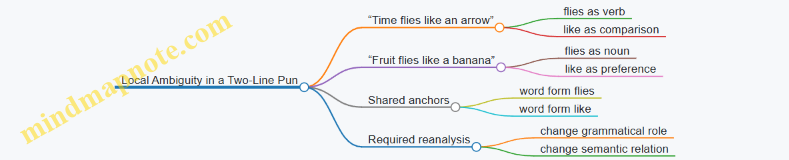
The listener’s job is not just to pick a second meaning; it is to update the grammatical roles. That update is the core linguistic mechanism in many pun-heavy micro-jokes: the surface words stay, but the syntactic and semantic relationships change.
Example 3: Morphological Pun with Selectional Constraints
Text: “I’m reading a book on anti-gravity. It’s impossible to put down.”
This joke uses a morphological and semantic contrast. The shared form is put down, which normally describes placing an object. Anti-gravity primes a literal physical scenario, but the punchline exploits the idiom put down meaning “stop reading” or “criticize.” The humor is compact because the phrase is already idiomatic, and the anti-gravity topic makes the literal reading feel momentarily plausible.
Systematic Analysis
- Setup constraint: anti-gravity suggests physical impossibility.
- Punchline constraint: “put down” is idiomatic, so the listener expects a non-literal meaning.
- Resolution: both readings can be entertained briefly, and the idiom becomes the final coherent interpretation.
Advanced Details: How to Diagnose the Intended Switch
Pun-heavy micro-jokes often fail when the listener cannot identify the intended alternative meaning quickly. To diagnose success, check three features.
- Form stability: the pun relies on a word or phrase that remains unchanged.
- Compatibility window: the setup meaning must be plausible enough to be activated, but the punchline must make the alternative meaning more coherent.
- Minimal repair: the listener should not need extra background; the text itself should supply the cues.
Mind Map: A Practical Diagnostic Checklist
Consolidated Takeaway
In pun-heavy micro-jokes, the linguistic engine is rapid reanalysis. The setup activates one semantic frame, the punchline preserves surface form while shifting grammatical role, sense, or idiomatic status, and the listener retrofits the earlier sentence so the whole exchange becomes consistent. When the shared form is stable and the compatibility window is tight, the humor lands with little extra context.
11.4 Case Study Type B: Irony and Implicature-Based Humor
Irony-based humor often works by making the literal meaning look plausible while the intended meaning is signaled indirectly. The hearer then infers a different proposition, usually one that conflicts with the surface content. In linguistic terms, the joke typically relies on (a) a pragmatic mismatch between what is said and what is meant, and (b) implicatures that guide the listener toward the intended interpretation.
Foundational Setup: Literal Content Versus Intended Meaning
Start with a simple distinction. Literal content is the proposition contributed by the utterance under standard semantics. Intended meaning is the proposition the speaker wants the addressee to recover through pragmatic reasoning. In irony, the intended meaning is commonly the negation or reversal of the literal content, but the negation is not stated directly.
Example:
- A: “Great job fixing the printer.”
- B: (printer still broken)
Literal content: A praises B’s action.
Pragmatic inference: Given the outcome, A cannot sincerely praise B. The hearer infers an ironic attitude, often equivalent to “You did not fix it.”
This inference is not random. It is constrained by context and by expectations about cooperative communication. If the printer remains broken, the praise becomes a poor fit for the literal goal of evaluation, so the hearer searches for an alternative meaning.
Implicature Mechanics: How the Listener Gets There
Implicatures arise when the speaker’s utterance, combined with context, makes additional assumptions likely. In irony, the speaker’s choice of an apparently positive evaluation triggers a reasoning path:
- The utterance is relevant to the current state of affairs.
- The literal evaluation would be inconsistent with that state.
- The speaker likely intends a different evaluation.
- The most economical alternative is a negative evaluation expressed indirectly.
Example:
- “Nice timing.” (said while someone arrives after the meeting ends)
Literal content: The timing is good.
Context: The meeting already ended.
Implicature: The speaker intends “Your timing was bad,” while avoiding a direct accusation.
Mind Map: Core Reasoning Steps
Worked Case Study: A Short Exchange with Analyzable Turns
Consider a two-turn dialogue.
- C: “You’re really on top of things.”
- D: “I am?”
- C: “The report is due tomorrow, and you just started the spreadsheet.”
Literal content: C praises D’s organization.
Pragmatic constraint: The report is not yet started, so the praise is not credible.
Implicature: C intends “You are not on top of things.”
The second turn (“I am?”) is crucial. It signals that D has not fully committed to the ironic interpretation yet, or that D is requesting confirmation. C then supplies the contextual evidence that makes the ironic inference stable. Humor lands because the listener can see the reasoning being completed: the utterance first appears to be praise, then the addressee realizes it is an indirect critique.
Mind Map: Linguistic Signals That Support Irony
Advanced Detail: Why the Joke Often Avoids Direct Negation
Irony frequently substitutes an indirect negative evaluation for a direct one. A direct statement like “You’re not on top of things” is efficient but can be socially costly. Indirectness can preserve face while still communicating the negative assessment. The hearer’s implicature work becomes part of the humor: the listener participates in deriving the intended meaning.
Example:
- “Wow, that was fast.” (after a long delay)
Direct alternative: “That was slow.”
Irony alternative: “Wow, that was fast.”
The comic effect comes from the temporary alignment with the literal praise, followed by a quick correction driven by context.
Case Study Summary: A Checklist for Analysis
To analyze an irony-and-implicature joke systematically, verify each step:
- What proposition does the utterance literally assert?
- What contextual facts make that assertion implausible?
- What pragmatic expectation is violated (sincerity, relevance, or fit)?
- What implicature is the listener meant to recover?
- How does the dialogue structure confirm the inference (evidence, timing, or a follow-up turn)?
When these pieces line up, the humor is not just “sarcastic tone.” It is a structured meaning shift: the listener performs a constrained reanalysis and arrives at an intended attitude that contradicts the surface evaluation.
11.5 Case Study Type C: Figurative Language and Semantic Mismatch
Figurative-language humor often works by steering the listener toward a literal interpretation, then snapping the meaning into a different semantic frame. The mismatch is not random; it is engineered through lexical choices, grammatical cues, and pragmatic expectations.
Foundational Setup
Start with a baseline: figurative expressions typically carry a conventional meaning. For example, “That idea is a gem” usually signals positive evaluation, not literal gemstones. Humor appears when the surrounding context pressures a literal reading, or when the figurative meaning is treated as if it were literal.
A useful diagnostic question is: what semantic frame does the listener activate first, and what frame is forced by the punchline? In Type C, the punchline usually reassigns roles, properties, or selectional restrictions so the earlier frame becomes incompatible.
Semantic Mismatch Mechanisms
Semantic mismatch in this case study comes from three recurring moves.
-
Literalization of a figurative predicate
- Figurative: “You’re a genius.”
- Literal pressure: a follow-up that demands physical or measurable properties.
-
Selectional restriction violation
- Many verbs expect certain kinds of arguments. Humor arises when the text supplies an argument that fits the figurative reading but fails the literal one.
-
Frame switching via a concrete detail
- The setup stays abstract, then the punchline introduces a detail that belongs to a different domain.
Worked Example 1: Literalization Through Follow-Up
Setup: “My roommate is a night owl.”
Punchline: “Yeah, he hoots at the smoke alarm.”
First, “night owl” activates a figurative frame: a person who stays up late. The punchline introduces “smoke alarm,” which belongs to a safety domain and expects human-like reactions such as calling, checking, or evacuating. “Hoots” shifts the predicate into an animal frame, making the earlier figurative mapping incompatible. The humor is the listener’s forced reanalysis: the roommate is not just nocturnal; he is treated as literally owl-like.
Worked Example 2: Selectional Restriction and Role Reassignment
Setup: “Her explanation was music to my ears.”
Punchline: “Too bad it was out of tune.”
The phrase “music to my ears” normally licenses an evaluation frame: the explanation was pleasant or understandable. “Out of tune” introduces a musical property that requires a sound-producing object. The listener must reinterpret “explanation” as something that can be tuned, which is semantically odd under literal semantics but coherent under the figurative-to-literal shift. The mismatch is precise: the punchline supplies a property that belongs to the music domain, not the communication domain.
Worked Example 3: Frame Switching with a Concrete Anchor
Setup: “That plan is a house of cards.”
Punchline: “He built it in the living room and forgot to bring the cards.”
The setup activates a metaphorical frame: fragility and collapse risk. The punchline adds “built it in the living room,” which invites a physical construction frame. “Forgot to bring the cards” then completes the physical scenario, but it contradicts the metaphor’s intended abstraction. The listener’s interpretation flips from risk assessment to missing materials, creating the comic effect.
Mind Map: Figurative Language and Semantic Mismatch
Systematic Annotation Template
When analyzing a Type C joke, annotate in this order.
- Figurative Trigger: the expression that normally maps to a conventional meaning.
- Initial Semantic Frame: what roles and properties the listener expects.
- Punchline Constraint: the property, verb, or argument that cannot fit the initial frame.
- Reanalysis Result: the new frame that makes the punchline coherent.
- Mismatch Payoff: why the new frame is surprising but interpretable.
Closing Synthesis
Type C humor is stable because it uses ordinary figurative conventions and then applies a targeted semantic pressure. The punchline does not merely add a funny detail; it supplies constraints that the initial figurative frame cannot satisfy. Once the listener reassigns the frame, the joke becomes coherent, and the mismatch turns from confusion into a clean, interpretable shift.
12. Building a Practical Toolkit for Humor Linguistics
12.1 Creating a Corpus of Humorous Data with Clear Inclusion Criteria
A humor corpus is only as useful as its inclusion criteria. If you cannot say, in one or two sentences, why a text belongs, you will struggle to compare mechanisms like ambiguity, implicature, and semantic mismatch. The goal here is to build a dataset where each item’s context and linguistic form are clear enough to support analysis.
Step 1: Define the Unit of Analysis
Decide what you will treat as the “item” in the corpus. Common choices are:
- Single utterance (best for punchlines and wordplay)
- Exchange (best for pragmatic inference and timing)
- Short script (best for setup-to-resolution structure)
Example: If a joke is “I told my computer I needed a break, and it said: ‘No problem—I’ll go to sleep.’” you can store either the whole exchange or just the final quoted response. Pick one and keep it consistent.
Step 2: Specify Inclusion Criteria for Humor Presence
Require evidence that the item is intended or recognized as humorous. Use criteria that are observable rather than subjective.
Inclusion criteria (practical version):
- The item contains a resolution point (punchline, twist, or interpretive payoff) that changes the meaning of the setup.
- The item is presented in a humor frame (stand-up transcript, joke format, meme caption with a clear punchline, or conversational turn that is treated as funny by participants).
- There is enough context to infer the intended contrast (literal vs. intended meaning, expected vs. violated constraint).
Example: “That’s a nice watch—what time is it?” is not automatically humor. It becomes eligible if the surrounding exchange makes the answer a punchline (e.g., the speaker uses a pun that depends on timing or a misread).
Step 3: Specify Inclusion Criteria for Linguistic Analyzability
Humor can be funny without being linguistically tractable. Set requirements for what you must be able to annotate.
Linguistic analyzability criteria:
- The text must include enough words to locate the mechanism (e.g., the ambiguous form, the inference trigger, the semantic mismatch).
- The item must preserve spelling and punctuation when wordplay depends on orthography.
- If the mechanism is phonological, you must have transcription or a reliable written representation.
Example: A meme that only shows an image with no caption is usually excluded unless the verbal component is fully captured.
Step 4: Capture Context Without Overstuffing
Context should be sufficient to interpret pragmatic intent and reference, but not so large that annotation becomes unmanageable.
Context fields to store:
- Speaker and addressee (or roles)
- Setting (chat, stand-up, classroom, workplace)
- Preceding turns up to the point where the setup becomes stable
- Any explicit cues like “joking,” laughter markers, or contrastive discourse markers
Example: For a pun, you often need only the immediately preceding line that makes the ambiguous word salient.
Step 5: Create a Balanced Sampling Plan
A corpus should not overfit one mechanism. Use quotas so you can compare categories.
Sampling targets (example):
- 25% ambiguity-driven wordplay (homonymy, polysemy, garden paths)
- 25% pragmatic inference humor (implicature, indirectness)
- 25% semantic structure humor (frame mismatch, entailment violations)
- 25% mixed cases (figurative language plus ambiguity)
Example: If you collect only puns from one source, you may miss how humor works when the punchline relies on inference rather than lexical form.
Step 6: Use a Simple Eligibility Checklist
Apply the same checklist to every candidate item.
- Humor payoff present
- Mechanism location possible
- Context sufficient for interpretation
- Text form preserved (spelling, punctuation, quoted material)
- No missing critical tokens (e.g., the ambiguous word is present)
Example: If a transcript omits the punchline word due to transcription error, exclude it or mark it as incomplete.
Mind Map: Corpus Inclusion Workflow
Example: Annotatable vs. Non-annotatable Items
Eligible: “I used to hate facial hair. Now I’m clean-shaven.” The humor depends on a semantic shift of “clean-shaven” and a contrast with the setup.
Ineligible (as text): “😂😂😂” without surrounding lines. There is no linguistic material to locate the mechanism.
Step 7: Record Decisions Transparently
For each included item, store why it passed. This prevents silent drift in criteria.
Example decision note: “Included because the punchline reinterprets ‘clean-shaven’ as a status change and the setup establishes a contrast with facial hair.”
When these steps are followed, the corpus becomes a stable foundation for later annotation of ambiguity, pragmatic inference, and semantic structure, with fewer surprises during analysis.
12.2 Designing Annotation Guidelines for Ambiguity and Pragmatic Moves
Annotation guidelines are only useful if they tell you what to mark, when to mark it, and how to justify the mark. For humor, that means treating ambiguity and pragmatic inference as observable choices in the utterance, not as vague “the joke is funny” reactions.
Core Principle: Separate Signals from Interpretations
Start by distinguishing two layers:
- Linguistic signals you can point to in the text (e.g., a homophone, a modal verb, a pronoun with shifting reference).
- Interpretive moves you infer from those signals (e.g., reanalysis, implicature, facework).
A good guideline forces annotators to record both, but in different fields. Example: “I used to be indecisive. Now I’m not sure.” The ambiguity is in not sure; the pragmatic move is a shift from literal self-description to a self-undermining stance.
Annotation Unit and Scope
Use a consistent unit so disagreements don’t become structural.
- Unit: one utterance (or one turn) plus the immediate context needed to resolve reference.
- Scope rule: annotate only ambiguity and pragmatic moves that are triggered within the unit or by the immediately preceding unit.
If the setup contains the key ambiguity but the punchline resolves it, annotate both units: mark the trigger in the setup, then mark the resolution in the punchline.
Mind Map: What to Annotate
Step-by-Step Guideline Workflow
- Mark the trigger span: highlight the smallest text span that creates ambiguity or signals a pragmatic move.
- Choose the ambiguity type (if applicable): lexical, syntactic, or semantic. If multiple types apply, allow multiple tags but require a primary tag.
- Record the resolution moment: specify whether the unit itself resolves the ambiguity or whether resolution depends on the next unit.
- Label the pragmatic move: select from a fixed set (e.g., implicature, speech act shift, facework, echoic stance).
- Write a one-sentence justification that references the trigger and the resolution, not the annotator’s feelings.
Practical Tag Set with Decision Rules
Use short labels with explicit criteria.
- Ambiguity Trigger
- Lexical: the same word form supports two plausible senses in context.
- Syntactic: two parses are plausible without changing the words.
- Semantic: the meaning clashes with typical selectional expectations.
- Pragmatic Move
- Implicature: the utterance suggests more than it literally states.
- Speech Act Shift: the surface form performs a different act than expected (e.g., “Nice job” functioning as criticism).
- Facework: the utterance manages threat or support to the addressee’s social standing.
- Echoic Stance: the speaker attributes a prior thought or norm and comments on it.
Worked Example: Ambiguity and Pragmatics Together
Utterance: “That’s a great plan—if you like chaos.”
- Ambiguity Trigger: if you like chaos (conditional framing creates a contrast between “great plan” and a nonstandard criterion for success).
- Ambiguity Type: semantic/pragmatic boundary; tag as semantic mismatch because “great plan” typically selects for order, while “chaos” flips the evaluation.
- Pragmatic Move: speech act shift from praise to criticism via conditional qualification.
- Resolution Moment: resolved within the same utterance because “if you like chaos” supplies the evaluation criterion.
- Justification Template: “The praise phrase is evaluated against an unexpected success condition, turning literal compliment into negative stance.”
Worked Example: Ambiguity Resolution Across Turns
Setup: “I’m reading a book on anti-gravity.”
Punchline: “It’s impossible to put down.”
- Setup Trigger: anti-gravity (semantic frame mismatch with “reading” and “book” expectations).
- Setup Ambiguity Type: semantic (selectional expectations about what anti-gravity implies).
- Punchline Resolution: put down (literal physical action vs idiomatic “stop reading”).
- Pragmatic Move: implicature that the book’s topic changes the normal behavior of reading.
Reliability Checks That Don’t Require Guesswork
After tagging, run two quick consistency tests:
- Trigger-Resolution Link: every resolution tag must point back to a trigger span.
- Alternative Interpretation Check: if annotators disagree, require them to name the competing sense or competing parse and then choose which one is supported by the context.
These rules keep disagreements grounded in evidence rather than in “which reading feels right.”
Minimal Annotation Form
Keep the form small enough to complete reliably.
- Utterance ID
- Trigger span
- Ambiguity type (primary)
- Resolution unit (same/next)
- Pragmatic move (one or more)
- Justification sentence
- Alternative interpretation (optional but required when disagreement occurs)
With these guidelines, ambiguity and pragmatic moves become traceable decisions, not after-the-fact explanations.
12.3 Writing Explanations: Linking Linguistic Evidence to Comic Effect
A good humor explanation does more than say “it’s ambiguous” or “it’s ironic.” It shows which linguistic signals create which interpretive options, and how the final punchline steers the listener toward one option. The key is to write in a chain: evidence → interpretation options → pragmatic inference → comic effect.
1) Start with the Evidence You Can Point To
Pick a small set of observable features: a word with multiple senses, a syntactic attachment point, a tense shift, a politeness marker, or a discourse reference. Then quote the exact span and state what it could mean.
Example:
- Utterance: “I used to be indecisive. Now I’m not so sure.”
- Evidence: “used to” plus the contrastive “now,” and the phrase “not so sure.”
Interpretation options:
- “Now I’m not so sure” could mean improved decisiveness (ironic understatement), or it could mean the speaker is still uncertain (literal reading).
2) Map Evidence to Linguistic Mechanisms
Next, name the mechanism in plain terms and connect it to the evidence.
- Ambiguity mechanism: a word or structure supports two readings.
- Pragmatic mechanism: the listener infers intent that differs from literal content.
- Semantic mechanism: selectional expectations are violated or reframed.
Example (mechanism linkage):
- “used to” sets up a change-of-state expectation.
- “not so sure” blocks the expected endpoint, creating a mismatch between the setup’s promise and the punchline’s content.
3) Show the Listener’s Inference Steps
Humor often depends on what the addressee infers while processing. Write the inference as a sequence of short claims.
Example (step-by-step inference):
- The speaker claims a past trait: indecisiveness.
- “Now” signals improvement.
- The punchline supplies “not so sure,” which normally signals continued uncertainty.
- The listener revises: the improvement claim is not literal; it is a self-deprecating joke.
This is not mind reading; it’s describing how common conversational expectations guide interpretation.
4) Tie the Final Interpretation to Comic Effect
Comic effect is the outcome of the interpretive steering. Specify what changes for the listener at the punchline.
Example (comic effect):
- The listener experiences a quick reanalysis: the “improvement” frame collapses.
- The collapse produces incongruity, then resolves as irony/self-report.
5) Use a Consistent Explanation Template
A reliable template prevents gaps and repetition.
- Feature: what linguistic element appears.
- Candidate Meanings: what readings it supports.
- Contextual Expectation: what the setup leads the listener to anticipate.
- Pragmatic Steering: what inference makes the punchline workable.
- Effect: what the listener ends up noticing.
Mind Map: Evidence to Effect
Example: A Pun Explanation with Clear Links
Utterance: “Time flies like an arrow. Fruit flies like a banana.”
- Feature: “flies” and the prepositional phrase “like ….”
- Candidate Meanings:
- “flies” as a verb of motion (time flies).
- “flies” as insects (fruit flies).
- “like” as a comparison vs as a preference relation.
- Contextual Expectation: the first sentence primes a comparison structure about time.
- Pragmatic Steering: the second sentence forces a reanalysis of “flies” and “like,” turning the grammatical pattern into a semantic switch.
- Effect: the listener notices the pattern reuse, then laughs at the abrupt category change from abstract motion to living creatures.
Example: A Pragmatics Explanation with Politeness Markers
Utterance: “Could you possibly close the window?” said during a storm.
- Feature: modal “could,” hedging “possibly,” and the indirect request form.
- Candidate Meanings:
- Literal ability question.
- Indirect request with urgency.
- Contextual Expectation: storm context makes the request time-sensitive.
- Pragmatic Steering: the listener treats the hedges as politeness, not doubt, and infers an urgent directive.
- Effect: the humor (if present) comes from the mismatch between formality/softening and the high-stakes situation, which makes the request feel comically “over-managed.”
Quality Checks That Keep Explanations Tight
Before finalizing, verify three things: (1) every claim is anchored to a textual feature, (2) the punchline’s effect is described as a listener shift, and (3) the mechanism label (ambiguity, pragmatics, semantics) matches the evidence you actually used.
12.4 Common Pitfalls: Overgeneralization, Circular Explanations, and Missing Context
Humor analysis fails most often in three predictable ways: it stretches a pattern until it fits everything, it explains the joke using the joke, and it treats context as optional. The fix is not to be more clever; it is to be more precise about what evidence you have and what you are claiming.
Overgeneralization
Overgeneralization happens when you turn a local observation into a universal rule. For instance, you might notice that many puns rely on homophones and then conclude that “puns always depend on sound similarity.” That rule breaks immediately with spelling-based wordplay like “I used to be a banker, but I lost interest.” The humor comes from a lexical sense shift tied to a written form and a conventional phrase, not from a homophone.
A practical safeguard is to separate three layers:
- the mechanism you think is present,
- the linguistic evidence that supports it,
- the scope of your claim.
Example: “That’s a terrible pun.” If you analyze it as “the speaker violates Grice’s Maxim of Quantity,” you should check whether the utterance is actually too informative, too vague, or simply not cooperative in a way that the listener can verify. If you cannot point to a specific mismatch, you should not elevate the mechanism into a general law.
Circular Explanations
Circular explanations treat the punchline as proof of the analysis. A classic loop looks like this: “The joke is funny because it is incongruous; it is incongruous because it is funny.” This is not an argument; it is a restatement.
To avoid the loop, anchor your explanation in a testable linguistic property. Incongruity can be operationalized as a mismatch between:
- the semantic role expected by the setup and the role realized in the punchline,
- the pragmatic inference licensed by the preceding turn and the inference required by the punchline,
- the selectional restrictions implied by the verb or construction and the entity actually used.
Example: “I told my computer I needed a break, and it said: ‘No problem—I’ll go to sleep.’” If you say it is funny because “the computer misunderstands,” you should show the mismatch: the setup invites a human-like request for rest, while the response maps “break” onto a literal state change. The humor is tied to a specific semantic and pragmatic reanalysis, not to the fact that people laughed.
Missing Context
Missing context is the silent killer of interpretability. Humor often depends on shared assumptions: prior discourse, speaker identity, setting, or genre conventions. Without those, the same sentence can become either a joke or a plain statement.
Example: “Nice weather we’re having.” In a sunny setting, it is likely a sincere comment. In a tense context—say, after a cancellation—listeners may treat it as ironic, because they infer an attitude toward the situation. The linguistic form is identical; the pragmatic interpretation changes because the context supplies the missing premise.
A second context pitfall is confusing “context provided in the text” with “context assumed by the audience.” In short joke scripts, the setup often compresses background. If you ignore that compression, you may mislabel the mechanism. For instance, “I’m reading a book on anti-gravity. It’s impossible to put down.” The listener supplies the general knowledge that “put down” is a physical action and that “impossible” signals a semantic clash. The text does not spell out those assumptions, but the audience uses them.
Mind Map: Pitfall Checks
A Systematic Checklist
Before you finalize an analysis, run three quick checks.
-
Scope check: Does your claim cover only the observed data, or does it pretend to cover all humor of that type? If you cannot justify the scope, narrow it.
-
Evidence check: Can you point to a specific linguistic feature that forces the interpretation? If your evidence is “the punchline,” rewrite the explanation so it references the mismatch that leads to the punchline.
-
Context check: What must the listener already know for the joke to work? If that knowledge is not in the text, treat it as an assumption and state it explicitly in your analysis.
When these checks are applied consistently, your explanations become easier to verify and harder to dismiss. The goal is not to eliminate interpretation; it is to make interpretation accountable to language, inference, and context.
12.5 Reproducible Example Set: Annotated Mini-Jokes Across Mechanisms
A reproducible example set works when each mini-joke is annotated with the same workflow: (1) identify the surface ambiguity or mismatch, (2) state the pragmatic inference that licenses the punchline, (3) map the semantic structure that makes the final interpretation coherent, and (4) note the discourse move that delivers the shift. The five mini-jokes below follow that pattern and use consistent labels so you can reuse the set in your own notes.
Mind Map: Mechanisms to Annotations
Mini-Joke 1: Lexical Ambiguity with Sense Competition
Text: “I used to hate facial hair. Now I’m on a beard diet.”
- Surface Trigger: “beard” competes with “bread” as a near-homophone; “diet” selects a food-related frame.
- Pragmatic Inference: The speaker signals a playful reframe rather than a literal dietary plan; the audience should treat the phrase as a pun.
- Semantic Structure: Frame A is EATING with roles (agent, food, restriction). The punchline maps “beard” into the food slot via sound similarity, producing a mismatch that becomes coherent once the pun is recognized.
- Discourse Delivery: The setup establishes a personal preference change; the punchline swaps the lexical item while keeping the “now I’m on X” pattern.
Mind Map: Mini-Joke 1 Annotation Flow
Mini-Joke 2: Syntactic Reanalysis with Garden-Path
Text: “The magician got so good at card tricks that he started doing them in the dark. Now everyone says he’s really light on his feet.”
- Surface Trigger: “light” can describe illumination or agility; the sentence encourages a temporary focus on darkness.
- Pragmatic Inference: The speaker invites a reinterpretation of “light” as a trait after the dark setup primes the illumination reading.
- Semantic Structure: Two candidate meanings for light are activated. The final clause selects the AGILITY frame, where “on his feet” is a strong constraint.
- Discourse Delivery: The setup points to darkness; the punchline uses a fixed idiom pattern that forces the agility reading.
Mini-Joke 3: Sound-Based Pun with Orthographic Stability
Text: “I told my computer I needed a break. It said, ‘No problem—I’ll go to sleep.’”
- Surface Trigger: “break” shifts from human rest to a command-like pause; “sleep” is both a human state and a system mode.
- Pragmatic Inference: The listener infers that the computer is being personified, so literal system behavior stands in for conversational politeness.
- Semantic Structure: The REQUEST speech act is mapped onto a SYSTEM ACTION frame. The “sleep” action satisfies the request under a different domain.
- Discourse Delivery: The first sentence frames a complaint; the second provides an immediate, domain-shifted response.
Mini-Joke 4: Figurative Literalization with Role Mismatch
Text: “My boss told me to ‘think outside the box.’ I did. Now I’m in trouble.”
- Surface Trigger: “outside the box” is figurative location; the punchline literalizes it.
- Pragmatic Inference: The audience recognizes the idiom and expects a metaphorical interpretation; the punchline reverses that expectation.
- Semantic Structure: The WORKPLACE frame expects compliance with a cognitive instruction. The literal move violates the LOCATION CONTROL constraint, creating a contradiction that is resolved as comic framing.
- Discourse Delivery: The setup quotes the idiom; the punchline supplies a concrete consequence that only makes sense under literalization.
Mini-Joke 5: Pragmatic Implicature Clash with Cooperative Expectations
Text: “Do you want to hear a joke about construction? I’m still working on it.”
- Surface Trigger: “still working on it” can mean ongoing preparation or literal construction activity.
- Pragmatic Inference: The speaker flouts the expectation of immediate delivery; the listener infers a delay is being used as the joke’s mechanism.
- Semantic Structure: The OFFER frame expects a completed artifact (the joke). The punchline maps “working on it” to a BUILDING frame, contradicting completion while staying relevant to the topic.
- Discourse Delivery: The question creates a promise; the answer delays fulfillment in a way that reinterprets the topic.
Mind Map: Mechanism to Funny Effect
To reuse this set, keep the same four annotation fields for every new joke: Surface Trigger, Pragmatic Inference, Semantic Structure, and Discourse Delivery. If you can fill all four without adding new assumptions, the analysis is stable enough to be reproducible.