Photonics Integration And Optical Interconnects For High Speed Computing
1. Introduction to Photonics Integration and Optical Interconnects
1.1 Overview of Photonics Integration in High Speed Computing
Photonics integration is revolutionizing high speed computing by enabling faster data transmission, lower latency, and reduced power consumption compared to traditional electronic interconnects. As computing demands grow exponentially—driven by AI, big data, and cloud services—the limitations of electrical interconnects become increasingly apparent. Photonics integration addresses these challenges by embedding optical components directly onto silicon chips or closely coupled substrates, facilitating seamless optical communication within and between computing units.
What is Photonics Integration?
Photonics integration refers to the process of combining multiple photonic components—such as lasers, modulators, waveguides, and photodetectors—onto a single chip or package. This integration enables compact, scalable, and cost-effective optical systems that can be deployed in high speed computing environments.
Mind Map: Photonics Integration in High Speed Computing
Why Photonics Integration Matters in High Speed Computing
-
Bandwidth Demand: Modern processors and accelerators require data rates in the hundreds of gigabits per second (Gbps) to terabits per second (Tbps) range. Photonics offers inherently higher bandwidth capabilities than copper-based electrical interconnects.
-
Energy Efficiency: Optical signals consume less power over long distances and reduce the need for repeaters or signal boosters.
-
Latency Reduction: Optical interconnects provide near speed-of-light data transmission, minimizing delays critical for HPC and real-time applications.
-
Integration Density: Photonics integration allows dense packing of communication channels, enabling scalable architectures.
Example: Photonics Integration in a High-Performance Computing (HPC) Node
Consider an HPC node where multiple CPUs and GPUs communicate at ultra-high speeds. Integrating silicon photonic transceivers directly on the processor package enables:
- Direct optical links between processors, bypassing slower electrical buses.
- Reduced power consumption by eliminating electrical signal regeneration.
- Compact form factor with integrated photonic waveguides replacing bulky fiber optics.
This approach has been demonstrated in recent HPC prototypes achieving multi-terabit per second interconnect bandwidths with significantly improved energy efficiency.
Mind Map: Benefits and Use Cases of Photonics Integration
Best Practice: Early Co-Design of Photonic and Electronic Systems
Integrating photonics into high speed computing requires early collaboration between photonics engineers and hardware architects. For example, designing the electrical driver circuits and photonic modulators in tandem ensures signal integrity and optimal performance.
Example: In a recent design cycle for a silicon photonic interconnect, co-design enabled the selection of modulation formats (e.g., PAM4) that balanced bandwidth and power efficiency, resulting in a 30% power reduction compared to separate designs.
Summary
Photonics integration is a foundational technology for the future of high speed computing. By embedding optical components directly into computing hardware, it addresses critical bottlenecks in bandwidth, latency, and power consumption. Understanding the components, benefits, and integration challenges sets the stage for deeper exploration into silicon photonics and optical interconnect architectures.
1.2 Fundamentals of Optical Interconnects: Concepts and Terminology
Optical interconnects are the backbone of high-speed data transmission in modern computing systems, enabling rapid communication between components with minimal latency and power consumption. Understanding the fundamental concepts and terminology is essential for photonics engineers, hardware architects, and data center engineers to design, implement, and optimize these systems effectively.
Key Concepts in Optical Interconnects
- Optical Interconnect: A communication link that uses light (photons) to transfer data between devices or components.
- Waveguide: A physical structure that guides light waves from one point to another, typically fabricated on silicon or other photonic materials.
- Modulator: A device that encodes electrical data signals onto an optical carrier by modulating light properties such as intensity, phase, or frequency.
- Photodetector: A device that converts incoming optical signals back into electrical signals.
- Coupler: A component that splits or combines optical signals within the photonic circuit.
- Loss: The reduction in optical power as light travels through components or waveguides, measured in decibels (dB).
- Bandwidth: The data transmission capacity of the optical interconnect, often measured in gigabits per second (Gbps) or terabits per second (Tbps).
Mind Map: Core Components of Optical Interconnects
Types of Optical Interconnects
| Type | Description | Example Use Case |
|---|---|---|
| On-Chip | Optical links within a single chip | High-speed processor cores |
| Chip-to-Chip | Optical links between separate chips on a board | Multi-chip modules (MCMs) |
| Board-to-Board | Optical links connecting different circuit boards | Server backplanes |
| Rack-to-Rack | Optical fiber links between server racks | Data center interconnects |
Mind Map: Optical Interconnect Types and Applications
Important Terminology
- Insertion Loss: The loss of signal power resulting from the insertion of a device in the optical path.
- Return Loss: The amount of light reflected back toward the source, which can cause interference.
- Extinction Ratio: The ratio of optical power between the ‘on’ and ‘off’ states of a modulated signal.
- Bit Error Rate (BER): The rate at which errors occur in the transmitted data.
- Latency: The time delay between sending and receiving data.
Example: Simple Optical Interconnect Link
Consider a chip-to-chip optical interconnect in a high-performance computing (HPC) system:
- Light Source: A distributed feedback (DFB) laser integrated on the transmitter chip.
- Modulator: An electro-optic modulator encodes electrical data onto the laser light.
- Waveguide: Silicon waveguides route the modulated light to the chip edge.
- Coupler: A grating coupler couples light from the waveguide into an optical fiber.
- Fiber: A single-mode fiber transmits the light to the receiver chip.
- Photodetector: A high-speed PIN photodiode converts the optical signal back to electrical.
This setup enables data rates exceeding 100 Gbps with low power consumption and minimal latency.
Best Practice: Clear Definition and Consistent Use of Terminology
In complex system designs, consistent use of terminology avoids miscommunication. For example, distinguishing between ‘insertion loss’ and ‘return loss’ early in design meetings helps engineers focus on minimizing the correct type of loss. Using standardized terms also facilitates collaboration across multidisciplinary teams.
Summary
Understanding the fundamentals of optical interconnects—including their components, types, and key terminology—is critical for designing efficient high-speed computing systems. Mind maps and clear examples help solidify these concepts, enabling engineers to apply best practices effectively in real-world scenarios.
1.3 Importance of Photonics in Modern Data Centers and HPC Systems
Photonics integration and optical interconnects have become pivotal in addressing the escalating demands of modern data centers and high-performance computing (HPC) systems. As data rates soar and energy efficiency becomes critical, photonics offers transformative advantages over traditional electrical interconnects.
Why Photonics Matters in Data Centers and HPC
- Bandwidth Scalability: Optical interconnects provide ultra-high bandwidth capabilities, supporting multi-terabit per second data transfer rates essential for large-scale data processing.
- Energy Efficiency: Photonic links consume significantly less power per bit transferred compared to electrical counterparts, reducing operational costs and thermal load.
- Latency Reduction: Optical signals travel at the speed of light with minimal signal degradation, enabling lower latency communication critical for HPC workloads.
- Distance and Density: Optical fibers and waveguides support longer distances without repeaters and enable high-density interconnects on chips and boards.
Mind Map: Key Benefits of Photonics in Data Centers and HPC
Real-World Example: Facebook’s Data Center Optical Upgrades
Facebook’s data centers have transitioned from copper-based electrical interconnects to silicon photonics-enabled optical links to meet growing bandwidth demands. By deploying 400G silicon photonic transceivers, they achieved:
- A 50% reduction in power consumption per link.
- Enhanced thermal management due to lower heat dissipation.
- Scalable architecture supporting future upgrades to 800G and beyond.
This example illustrates how photonics integration directly impacts operational efficiency and scalability.
Mind Map: Photonics Impact on HPC Systems
Example: Optical Interconnects in Summit Supercomputer
The Summit supercomputer at Oak Ridge National Laboratory integrates optical interconnects to link thousands of compute nodes. Key outcomes include:
- Achieving peak performance of 200 petaflops through high-bandwidth, low-latency optical links.
- Reduced energy footprint compared to previous generations relying on electrical interconnects.
- Improved scalability allowing seamless addition of compute resources.
Best Practice: Evaluating Photonics Adoption
When considering photonics integration, engineers should:
- Assess Bandwidth Needs: Match optical interconnect capabilities with current and projected data rates.
- Evaluate Power Budgets: Quantify energy savings versus implementation costs.
- Consider System Architecture: Ensure compatibility with existing hardware and software stacks.
- Plan for Scalability: Design with future upgrades and modularity in mind.
Summary
Photonics integration is no longer a futuristic concept but a practical necessity for modern data centers and HPC systems. Its ability to deliver high bandwidth, energy efficiency, and scalability makes it a cornerstone technology driving the next generation of computing infrastructure.
1.4 Best Practice: Selecting Photonic Platforms with Real-World Examples
Selecting the right photonic platform is a critical step in designing high-speed computing systems that leverage optical interconnects. The choice impacts performance, scalability, integration complexity, cost, and manufacturability. This section provides a structured approach to selecting photonic platforms, supported by mind maps and real-world examples to illustrate best practices.
Key Considerations for Selecting Photonic Platforms
When choosing a photonic platform, engineers and architects should evaluate the following factors:
- Material System: Silicon, Indium Phosphide (InP), Silicon Nitride (SiN), or hybrid platforms.
- Integration Capability: Monolithic vs. hybrid integration with electronics.
- Performance Metrics: Bandwidth, insertion loss, modulation speed, power consumption.
- Manufacturability: Foundry availability, process maturity, yield.
- Cost: Development cost, per-unit cost at scale.
- Thermal and Environmental Stability
- Ecosystem Support: Design tools, IP availability, supply chain.
Mind Map: Photonic Platform Selection Criteria
Step-by-Step Best Practice Workflow
-
Define Application Requirements
- Data rate, latency, reach, integration density.
- Example: A data center interconnect requiring 400 Gbps links over 2 km.
-
Evaluate Material Platforms
- Silicon photonics excels in integration with CMOS electronics and cost-effectiveness.
- InP offers native laser integration but is more expensive.
- Example: For on-chip and chip-to-chip links, silicon photonics is often preferred.
-
Assess Integration Approaches
- Monolithic integration reduces packaging complexity but may limit component choice.
- Hybrid integration allows combining best-in-class components.
- Example: Intel’s silicon photonics transceivers use hybrid integration to combine silicon modulators with InP lasers.
-
Analyze Performance and Power
- Match platform capabilities with target bandwidth and power budgets.
- Example: Silicon photonics modulators optimized for low power consumption in hyperscale data centers.
-
Consider Manufacturability and Cost
- Select platforms with mature foundry processes to ensure scalability.
- Example: GlobalFoundries and TSMC silicon photonics platforms offer high-volume manufacturing.
-
Leverage Ecosystem and Tool Support
- Choose platforms supported by robust design kits and IP libraries.
- Example: AIM Photonics provides an open-access silicon photonics platform with design tools.
Real-World Examples
Example 1: Microsoft’s Silicon Photonics for Data Center Interconnects
- Platform: Silicon photonics on SOI (Silicon-On-Insulator).
- Reason for Selection: High integration density, compatibility with CMOS, cost-effective scaling.
- Outcome: Enabled 100 Gbps and 400 Gbps optical transceivers deployed in Azure data centers.
Example 2: InP-based Photonic Integrated Circuits in Telecom
- Platform: Indium Phosphide for native laser integration.
- Reason for Selection: Required long-reach, high-performance lasers and modulators.
- Outcome: Used in metro and long-haul optical networks with superior optical performance.
Example 3: Hybrid Integration in Intel’s Silicon Photonics
- Platform: Silicon photonics modulators + InP lasers.
- Reason for Selection: Combine low-cost silicon photonics with high-quality laser sources.
- Outcome: Production of scalable, high-performance optical transceivers for HPC and data centers.
Mind Map: Real-World Platform Selection Examples
Summary
Selecting the appropriate photonic platform requires a holistic evaluation of technical requirements, integration capabilities, cost, and ecosystem maturity. By following a structured approach and learning from industry leaders’ implementations, photonics engineers and hardware architects can make informed decisions that optimize performance and scalability for high-speed computing applications.
1.5 Case Study: Transitioning from Electrical to Optical Interconnects in Data Centers
Introduction
Data centers have traditionally relied on electrical interconnects for communication between servers, switches, and storage devices. However, as data rates and bandwidth demands surge, electrical interconnects face limitations such as signal attenuation, crosstalk, and power inefficiency. This case study explores the transition from electrical to optical interconnects, highlighting best practices, challenges, and real-world examples.
Mind Map: Key Drivers for Transitioning to Optical Interconnects
Challenges in Transition
- Integration Complexity: Combining photonic components with existing electronic infrastructure.
- Cost Considerations: Initial investment in optical transceivers and cabling.
- Thermal Management: Optical components sensitive to temperature variations.
- Standardization: Ensuring interoperability between vendors.
Best Practices for a Successful Transition
- Incremental Deployment: Start with hybrid electrical-optical links to validate performance.
- Comprehensive Testing: Use bit error rate (BER) and eye diagram analysis to ensure signal integrity.
- Cross-Disciplinary Collaboration: Engage photonics engineers, hardware architects, and data center operators early.
- Thermal Design: Incorporate active cooling and thermal sensors in optical modules.
- Training and Documentation: Equip teams with knowledge on optical system maintenance.
Example: Facebook’s Data Center Optical Upgrade
Facebook initiated a transition to silicon photonics-based optical interconnects to address bandwidth bottlenecks in their data centers. By deploying 100G and 400G optical transceivers:
- They reduced power consumption per bit by approximately 30% compared to electrical links.
- Achieved longer reach within data center racks and across pods.
- Enabled higher port density on switches, improving scalability.
This transition was phased, starting with critical high-traffic links and expanding as confidence grew.
Mind Map: Transition Workflow
Example: Google’s Use of Optical Interconnects in HPC Clusters
Google integrated optical interconnects within their HPC clusters to support AI workloads requiring ultra-low latency and high bandwidth. Key outcomes included:
- Significant reduction in latency compared to traditional copper links.
- Enhanced thermal management through integrated photonic packaging.
- Improved reliability with built-in monitoring of optical signal quality.
Summary
Transitioning from electrical to optical interconnects in data centers is a strategic imperative driven by the need for higher bandwidth, power efficiency, and scalability. By following best practices such as incremental deployment, thorough testing, and cross-functional collaboration, organizations can successfully navigate the challenges of integration and reap the benefits of optical technologies.
Additional Resources
- “Silicon Photonics for Data Centers,” IEEE Photonics Society Webinar
- “Designing Optical Interconnects for Hyperscale Data Centers,” OSA Publishing
- Facebook’s Open Compute Project on Optical Interconnects
Visual Summary
2. Silicon Photonics Technology Foundations
2.1 Silicon Photonics: Material Properties and Fabrication Techniques
Silicon photonics leverages the well-established silicon semiconductor platform to integrate optical components with electronic circuits, enabling high-speed, low-cost, and scalable photonic systems. Understanding the material properties of silicon and the fabrication techniques used is fundamental for photonics engineers and hardware architects aiming to design and implement efficient optical interconnects.
Material Properties of Silicon Relevant to Photonics
- Transparency Window: Silicon is transparent to infrared light in the wavelength range of approximately 1.1 µm to 8 µm, making it ideal for telecom wavelengths (1.3 µm and 1.55 µm).
- Refractive Index: Silicon has a high refractive index (~3.48 at 1.55 µm), enabling strong optical confinement in waveguides.
- Nonlinear Optical Properties: Silicon exhibits nonlinear effects such as two-photon absorption and Kerr effect, which can be leveraged or mitigated depending on the application.
- Thermo-Optic Coefficient: Silicon’s refractive index changes with temperature (~1.86 × 10^-4 /K), which affects device stability and requires thermal management.
- Compatibility with CMOS Fabrication: Silicon photonics benefits from mature CMOS fabrication processes, enabling integration with electronic circuits and mass production.
Mind Map: Key Material Properties of Silicon Photonics
Fabrication Techniques in Silicon Photonics
Silicon photonic devices are fabricated using processes adapted from the semiconductor industry, with additional steps tailored for photonic structures.
-
Starting Substrate: Typically a Silicon-On-Insulator (SOI) wafer is used, consisting of a thin silicon device layer on top of a buried oxide (BOX) layer and a silicon handle wafer.
-
Lithography: Photolithography or electron-beam lithography defines the photonic device patterns with high precision.
-
Etching: Reactive Ion Etching (RIE) or Inductively Coupled Plasma (ICP) etching sculpts the silicon layer to form waveguides, resonators, and other components.
-
Doping: Ion implantation or diffusion introduces dopants to create active devices like modulators or photodetectors.
-
Deposition: Materials such as silicon nitride, oxides, or metals are deposited for cladding, passivation, or electrical contacts.
-
Planarization: Chemical Mechanical Polishing (CMP) ensures surface flatness for multilayer integration.
-
Metallization: Formation of electrical interconnects and pads for driver and receiver circuits.
-
Testing and Packaging: Optical and electrical testing followed by packaging for integration into modules.
Mind Map: Silicon Photonics Fabrication Flow
Best Practice Example: Fabrication of a Silicon Photonic Mach-Zehnder Modulator (MZM)
- Step 1: Start with an SOI wafer with a 220 nm silicon device layer.
- Step 2: Use deep ultraviolet (DUV) lithography to pattern waveguides and interferometer arms.
- Step 3: Perform RIE to etch the silicon waveguides with smooth sidewalls to minimize optical loss.
- Step 4: Implant dopants in the waveguide arms to form PN junctions for electro-optic modulation.
- Step 5: Deposit oxide cladding to protect the waveguides and provide electrical isolation.
- Step 6: Open contact windows and deposit metal electrodes for driving the modulator.
- Step 7: Perform planarization and final passivation.
- Step 8: Test the modulator’s insertion loss, extinction ratio, and bandwidth.
This example illustrates how standard CMOS-compatible processes are adapted to create high-performance photonic devices.
Additional Example: Fabrication of Silicon Photonic Photodetectors
- Material: Use germanium-on-silicon integration for efficient photodetection at telecom wavelengths.
- Process: After waveguide patterning, selectively grow germanium on silicon waveguides.
- Doping: Form PIN junctions in the germanium layer for photocarrier generation.
- Metallization: Add contacts for electrical readout.
This heterogeneous integration approach combines silicon’s fabrication advantages with germanium’s superior absorption.
Summary
Understanding silicon’s material properties and mastering fabrication techniques are crucial for designing and producing efficient photonic components. Leveraging CMOS-compatible processes enables scalable manufacturing, while careful control of doping, etching, and deposition steps ensures device performance and reliability.
For photonics engineers and hardware architects, integrating these fundamentals with practical fabrication knowledge is key to advancing high-speed optical interconnects in computing systems.
2.2 Integration of Photonic Components on Silicon Chips
Integrating photonic components on silicon chips is a cornerstone of silicon photonics technology, enabling compact, high-performance optical systems suitable for high-speed computing applications. This section delves into the methodologies, challenges, and best practices for integrating key photonic elements such as lasers, modulators, waveguides, and photodetectors onto silicon substrates.
Overview of Photonic Integration
Photonic integration involves fabricating multiple optical components on a single silicon chip to create functional optical circuits. This integration reduces footprint, enhances performance, and lowers cost by leveraging CMOS-compatible processes.
Key Integration Approaches
- Monolithic Integration: All photonic components are fabricated directly on the silicon wafer using CMOS-compatible processes.
- Hybrid Integration: Combines silicon photonics with other materials (III-V semiconductors, polymers) by bonding or attaching discrete components.
- Heterogeneous Integration: Integrates different materials at the wafer level, often through wafer bonding techniques.
Mind Map: Integration Approaches
Example: Hybrid Integration of a Laser Source
Since silicon cannot efficiently generate light due to its indirect bandgap, III-V semiconductor lasers (e.g., InP-based) are often hybrid integrated onto silicon chips. This is done via wafer bonding or flip-chip techniques.
-
Process:
- Fabricate III-V laser structures separately.
- Bond the laser die onto the silicon photonic chip precisely aligned to silicon waveguides.
- Use evanescent coupling to transfer light from the laser into silicon waveguides.
-
Benefits: High-performance laser sources combined with silicon’s scalability.
Integration of Other Photonic Components
- Modulators: Typically implemented using silicon or silicon-compatible materials (e.g., silicon-organic hybrid modulators). Integration involves doping regions for carrier injection or depletion.
- Waveguides: Fabricated by etching silicon or silicon nitride layers to guide light with low loss.
- Photodetectors: Often integrated using germanium-on-silicon technology to detect telecom wavelengths efficiently.
Mind Map: Photonic Components Integration
Best Practice: Precise Alignment and Coupling Efficiency
Achieving high coupling efficiency between heterogeneous materials is critical. Techniques include:
- Using tapered waveguides to match mode sizes.
- Employing spot-size converters.
- Active alignment during bonding.
Example: A silicon photonic transceiver integrated with a hybrid III-V laser achieved >90% coupling efficiency by implementing an adiabatic taper between the laser and silicon waveguide, significantly improving output power and reducing insertion loss.
Thermal Management Considerations
Integration often introduces thermal challenges due to differing thermal expansion coefficients and heat generation in active components.
- Use thermal isolation trenches.
- Incorporate heat spreaders or microfluidic cooling.
Example: A photonic chip integrating a hybrid laser and modulator included a micro-heatsink structure to maintain stable operation at high data rates.
Summary
Integrating photonic components on silicon chips requires a careful balance between material properties, fabrication techniques, and design strategies. Hybrid and heterogeneous integration methods enable the incorporation of efficient light sources, while monolithic approaches excel in scalability and cost-effectiveness. Employing best practices such as precise alignment, coupling optimization, and thermal management ensures high-performance photonic integrated circuits suitable for high-speed computing.
Additional Example: Fabrication Flow of a Silicon Photonic Modulator Integration
- Start with a silicon-on-insulator (SOI) wafer.
- Pattern silicon waveguides using deep UV lithography.
- Implant dopants to form PN junctions for modulators.
- Deposit and pattern electrodes for electrical contacts.
- Deposit cladding layers for optical confinement.
- Integrate germanium photodetectors via epitaxial growth.
- Perform planarization and metallization for interconnects.
This flow demonstrates how multiple photonic components can be integrated monolithically on a silicon chip.
By understanding and applying these integration techniques and examples, photonics engineers and hardware architects can design and implement silicon photonic chips that meet the demanding requirements of modern high-speed computing systems.
2.3 Best Practice: Design for Manufacturability in Silicon Photonics with Example Designs
Design for Manufacturability (DfM) in silicon photonics is a critical practice that ensures photonic devices and integrated circuits can be produced reliably, at scale, and with high yield. Given the complexity of photonic components and the sensitivity of optical signals to fabrication variations, DfM helps bridge the gap between innovative design and practical, cost-effective manufacturing.
Key Principles of DfM in Silicon Photonics
- Process Variation Tolerance: Designs must accommodate variations in waveguide width, etch depth, and refractive index.
- Standardized Design Rules: Adhering to foundry-provided design kits (PDKs) ensures compatibility with fabrication processes.
- Simplified Layouts: Minimizing complex geometries reduces fabrication errors and improves yield.
- Test Structures Integration: Embedding test patterns and calibration structures aids in process monitoring.
- Modular Design: Reusable building blocks facilitate scalability and reduce design complexity.
Mind Map: Core Areas of DfM in Silicon Photonics
Example 1: Waveguide Design for Manufacturability
Challenge: Waveguide width variations during fabrication can cause significant optical loss or wavelength shifts.
Best Practice: Design waveguides with widths larger than the minimum to allow margin for lithography and etching variations. Use adiabatic tapers to transition between different widths smoothly.
Example: A silicon photonic waveguide designed with a nominal width of 500 nm but with a tolerance range of ±50 nm. The use of a 200 µm adiabatic taper between 500 nm and 450 nm waveguides reduces scattering losses caused by abrupt width changes.
Mind Map:
Example 2: Modulator Layout Simplification
Challenge: Complex modulator geometries increase fabrication difficulty and reduce yield.
Best Practice: Use standardized modulator cell libraries with proven performance and manufacturability. Simplify electrode layouts to reduce parasitic capacitances and improve RF performance.
Example: A Mach-Zehnder modulator designed using a parameterized cell from the foundry’s PDK, featuring straight phase shifters and uniform electrode spacing. This approach reduced design iterations and improved fabrication consistency.
Mind Map:
Example 3: Integration of Test Structures
Challenge: Without embedded test structures, process drifts and defects may go undetected until late-stage testing.
Best Practice: Incorporate test structures such as ring resonators, grating couplers, and alignment marks within the chip layout to enable in-line process monitoring and calibration.
Example: A silicon photonic chip includes an array of ring resonators with varying radii to monitor wavelength shifts caused by fabrication variations. This data is used to calibrate the system and adjust operating parameters post-fabrication.
Mind Map:
Summary
Design for Manufacturability in silicon photonics is a multi-faceted approach that combines tolerance-aware design, adherence to foundry guidelines, layout simplification, and embedded testing. By applying these best practices, photonics engineers and hardware architects can significantly improve yield, reduce costs, and accelerate time-to-market for high-speed computing optical interconnect solutions.
Additional Resources
- Foundry PDK Documentation (e.g., IMEC, AIM Photonics)
- “Silicon Photonics Design: From Devices to Systems” by Lukas Chrostowski and Michael Hochberg
- IEEE Photonics Society Tutorials on Silicon Photonics
2.4 Example: Fabrication Flow of a Silicon Photonic Transceiver Module
Fabrication of a silicon photonic transceiver module is a complex, multi-step process that integrates photonic and electronic components on a single chip or closely coupled chips. This example will walk through a typical fabrication flow, highlighting key stages, best practices, and illustrative examples.
Overview Mind Map: Silicon Photonic Transceiver Fabrication Flow
Step 1: Design & Mask Preparation
- Photonic Design: Using photonic design automation (PDA) tools, engineers define waveguide layouts, modulators, photodetectors, and coupling structures.
- Electronic Design: CMOS circuits for drivers and amplifiers are designed concurrently.
- Mask Generation: Separate masks for photonic and electronic layers are prepared, ensuring alignment marks for hybrid integration.
Example: A 400G silicon photonic transceiver design includes ring modulators and germanium photodetectors integrated with CMOS drivers on a 300 mm wafer.
Step 2: Wafer Fabrication
Silicon Photonics Layer Fabrication
- Starting Substrate: Silicon-on-Insulator (SOI) wafers with a device silicon layer typically 220 nm thick.
- Waveguide Patterning: Electron-beam or deep-UV lithography defines waveguides and photonic structures.
- Etching: Reactive ion etching (RIE) sculpts waveguides with precise dimensions.
- Doping & Implantation: For modulators and photodetectors, doping profiles are created.
- Deposition: Silicon nitride or oxide layers are deposited for cladding and isolation.
Electronic CMOS Layer Fabrication
- Standard CMOS foundry processes fabricate electronic driver and amplifier circuits on separate wafers or on the same wafer if monolithic integration is targeted.
Best Practice: Use foundries with established silicon photonics process design kits (PDKs) to ensure process compatibility and yield.
Step 3: Photonic Component Fabrication
- Waveguides: Fabricated with low sidewall roughness to minimize propagation loss.
- Modulators: Electro-optic modulators such as Mach-Zehnder interferometers or ring modulators are formed.
- Photodetectors: Germanium or III-V materials are integrated for efficient light detection.
Example: A ring modulator with a 10 GHz bandwidth is fabricated by doping the silicon waveguide to create a PN junction.
Step 4: Electronic Component Fabrication
- Drivers and Amplifiers: CMOS transistors are fabricated with optimized layouts for high-speed operation.
Example: A driver circuit designed for 25 Gbps operation is fabricated using a 65 nm CMOS process.
Step 5: Hybrid Integration
- Bonding Techniques: Techniques such as flip-chip bonding, wafer bonding, or micro-transfer printing are used to integrate photonic and electronic dies.
- Alignment: Sub-micron alignment accuracy is critical to ensure efficient optical coupling and electrical connectivity.
Best Practice: Utilize automated alignment systems with in-situ optical feedback to improve bonding yield.
Step 6: Packaging
- Optical I/O Coupling: Coupling light into and out of the chip via grating couplers or edge couplers.
- Electrical I/O: High-speed electrical connections are made via wire bonding or solder bumps.
- Thermal Management: Heat sinks and thermoelectric coolers are integrated to maintain device performance.
Example: A silicon photonic transceiver module packaged with a fiber array aligned to grating couplers achieves <2 dB coupling loss.
Step 7: Testing & Validation
- Optical Testing: Measure insertion loss, modulation bandwidth, and photodetector responsivity.
- Electrical Testing: Verify driver output swing, power consumption, and signal integrity.
- Reliability Testing: Accelerated aging and thermal cycling tests ensure long-term stability.
Example: A fabricated module passes 1000-hour burn-in testing with stable optical output power.
Additional Mind Map: Key Best Practices in Fabrication
Summary Example: Fabrication Flow Timeline for a Silicon Photonic Transceiver
| Stage | Duration (Weeks) | Key Activities |
|---|---|---|
| Design & Mask Prep | 4 | Design finalization, mask creation |
| Wafer Fabrication | 6 | Photonic and electronic processing |
| Hybrid Integration | 2 | Bonding and alignment |
| Packaging | 3 | Optical/electrical I/O, thermal |
| Testing & Validation | 2 | Performance and reliability tests |
This timeline illustrates a typical 17-week cycle from design to tested module, emphasizing the importance of coordination across disciplines.
By following this detailed fabrication flow and adhering to best practices, photonics engineers and hardware architects can successfully develop high-performance silicon photonic transceiver modules tailored for high-speed computing applications.
2.5 Challenges in Silicon Photonics and Mitigation Strategies
Silicon photonics has emerged as a transformative technology for high-speed computing and optical interconnects, but it faces several technical and practical challenges. Understanding these challenges and applying effective mitigation strategies is critical for photonics engineers, hardware architects, and data center engineers aiming to deploy robust and scalable silicon photonic solutions.
Key Challenges in Silicon Photonics
Fabrication Variability
Challenge: Silicon photonic devices rely on nanoscale waveguides and components. Small deviations in fabrication processes such as lithography and etching can cause significant performance variations.
Mitigation Strategies:
- Design for Tolerance: Use wider waveguides or adiabatic tapers to reduce sensitivity to dimensional variations.
- Process Control: Implement advanced process control (APC) and in-line metrology to monitor and adjust fabrication steps.
- Example: A silicon photonic modulator designed with a wider rib waveguide showed a 30% reduction in insertion loss variability across wafer runs compared to standard designs.
Thermal Management
Challenge: Silicon photonic devices are highly sensitive to temperature changes, which can shift resonance wavelengths and degrade performance. Thermal crosstalk between closely packed components can exacerbate this.
Mitigation Strategies:
- Thermal Isolation: Incorporate trenches or thermal barriers between components.
- Active Temperature Control: Use integrated heaters and temperature sensors with feedback loops.
- Example: In a silicon photonic ring resonator array, integrated micro-heaters with PID control maintained resonance wavelength stability within ±0.01 nm over a 50°C temperature range.
Optical Losses
Challenge: Losses at waveguide interfaces, couplers, and fiber-to-chip coupling points reduce overall link budget and limit reach.
Mitigation Strategies:
- Optimized Couplers: Use inverse tapers or grating couplers with anti-reflection coatings.
- Low-Loss Waveguide Design: Employ optimized waveguide geometries and smooth sidewalls.
- Example: Implementing a double-etch grating coupler with optimized etch depth reduced coupling loss from 5 dB to 2.5 dB.
Integration Complexity
Challenge: Integrating active light sources (lasers) on silicon is difficult due to silicon’s indirect bandgap. Co-packaging electronic and photonic components requires careful design to minimize parasitics.
Mitigation Strategies:
- Hybrid Integration: Bond III-V lasers onto silicon photonic chips.
- Monolithic Integration Advances: Explore germanium or other materials for on-chip lasers.
- Example: A hybrid integrated silicon photonic transceiver using bonded InP lasers achieved 100 Gbps data rates with low power consumption.
Signal Integrity
Challenge: High-speed optical signals can suffer from crosstalk, dispersion, and nonlinear effects, impacting data integrity.
Mitigation Strategies:
- Waveguide Spacing: Increase spacing or use shielding structures to reduce crosstalk.
- Advanced Modulation Formats: Employ modulation schemes like PAM4 or coherent detection to improve signal robustness.
- Example: A silicon photonic interconnect using PAM4 modulation doubled data throughput while maintaining bit error rates below 10^-12.
Packaging and Testing
Challenge: Precise alignment of fibers and electrical interfaces is critical. Packaging must ensure mechanical stability and thermal dissipation.
Mitigation Strategies:
- Automated Alignment Tools: Use active alignment with feedback during assembly.
- Robust Packaging Materials: Employ materials with matched thermal expansion coefficients.
- Example: An automated fiber alignment system reduced packaging time by 50% and improved coupling repeatability.
Cost and Scalability
Challenge: High manufacturing costs and yield issues limit large-scale deployment.
Mitigation Strategies:
- Design for Manufacturability (DfM): Simplify device structures and use standard CMOS-compatible processes.
- Yield Enhancement: Implement redundancy and fault-tolerant designs.
- Example: A silicon photonic switch with redundant waveguide paths improved yield from 70% to 90% in volume production.
Summary Mindmap of Mitigation Strategies
By addressing these challenges with the outlined strategies and learning from practical examples, engineers can significantly improve the performance, reliability, and scalability of silicon photonic systems for high-speed computing applications.
3. Photonic Components for Optical Interconnects
3.1 Lasers and Light Sources: Types and Integration Methods
Lasers and light sources are fundamental building blocks in silicon photonics and optical interconnects, providing the coherent light necessary for data transmission. Understanding the types of lasers, their characteristics, and integration methods is crucial for photonics engineers, hardware architects, and data center engineers aiming to optimize high-speed computing systems.
Types of Lasers and Light Sources
-
Edge-Emitting Lasers (EELs)
- Emit light from the edge of the semiconductor chip.
- Common in telecommunications and datacom.
- Examples: Distributed Feedback (DFB) lasers, Fabry-Pérot lasers.
-
Vertical-Cavity Surface-Emitting Lasers (VCSELs)
- Emit light perpendicular to the chip surface.
- Advantages: low threshold current, easy testing, and array integration.
- Widely used in short-reach optical interconnects.
-
External Cavity Lasers (ECLs)
- Use an external cavity for wavelength tuning.
- Provide narrow linewidth and tunability.
-
Quantum Dot Lasers
- Utilize quantum dots as gain medium.
- Offer temperature stability and low threshold currents.
-
Integrated Light Sources on Silicon
- Silicon is an indirect bandgap material, so direct lasing is challenging.
- Approaches include heterogeneous integration of III-V materials or bonding.
Integration Methods
-
Hybrid Integration
- Bonding or attaching III-V laser dies onto silicon photonic circuits.
- Example: Flip-chip bonding of InP-based DFB lasers on silicon waveguides.
- Benefits: Leverages mature III-V laser technology.
- Challenges: Alignment precision, thermal management.
-
Heterogeneous Integration
- Direct wafer bonding of III-V materials onto silicon substrates.
- Enables monolithic-like integration with high yield.
- Example: Intel’s approach to integrate InP lasers on silicon wafers.
-
Monolithic Integration
- Growing III-V materials directly on silicon substrates.
- Still under research due to lattice mismatch and defects.
-
Off-Chip Laser Sources
- Lasers located off the silicon chip, coupled via fiber or waveguides.
- Simplifies silicon photonic chip fabrication.
- Example: Using external DFB lasers connected via grating couplers.
Best Practice: Selecting and Integrating Lasers
- Example: For a high-speed data center transceiver requiring 100G+ bandwidth, hybrid integration of DFB lasers bonded onto silicon photonic transmitters offers a balance of performance and manufacturability.
- Example: VCSEL arrays are preferred for short-reach interconnects (e.g., within racks) due to low cost and ease of testing.
- Example: For tunable laser applications in HPC, external cavity lasers integrated via heterogeneous bonding provide narrow linewidth and wavelength agility.
Mind Map: Types of Lasers
Mind Map: Integration Methods
Example: Hybrid Integration of DFB Lasers on Silicon
A typical approach involves flip-chip bonding InP-based DFB lasers onto silicon photonic chips. The laser output facet is aligned to silicon waveguides using high-precision alignment tools. This method leverages the mature III-V laser technology while benefiting from silicon photonics’ scalability. Thermal simulations and heat sink designs are incorporated to manage the heat generated by the laser, ensuring stable operation.
Example: VCSEL Arrays for Short-Reach Interconnects
VCSEL arrays are integrated on silicon interposers for board-to-board communication within data centers. Their vertical emission allows easy coupling to multimode fibers or free-space optics. Testing at the wafer level before integration reduces costs and improves yield.
Summary
Selecting the appropriate laser type and integration method depends on the target application, performance requirements, and cost constraints. Hybrid and heterogeneous integrations currently dominate commercial silicon photonics due to their maturity and performance, while monolithic integration remains a promising future direction. Understanding these options enables engineers to design optimized optical interconnects for high-speed computing.
3.2 Modulators: Electro-Optic and Thermo-Optic Approaches
Modulators are critical components in silicon photonics, responsible for encoding electrical signals onto optical carriers. In high-speed computing and optical interconnects, modulators must offer low insertion loss, high bandwidth, low power consumption, and compatibility with CMOS fabrication processes. Two primary modulation mechanisms dominate silicon photonics: electro-optic and thermo-optic modulation.
Electro-Optic Modulators (EOMs)
Electro-optic modulators leverage the change in refractive index of a material under an applied electric field to modulate light intensity or phase. Silicon itself lacks a strong linear electro-optic (Pockels) effect, so modulators typically exploit carrier injection, depletion, or accumulation effects in silicon waveguides.
Key Types of Electro-Optic Modulators:
- Carrier Depletion Modulators: Use reverse-biased PN junctions to deplete carriers, changing the refractive index.
- Carrier Injection Modulators: Forward bias injects carriers, modulating refractive index but with slower speed.
- MOS Capacitor-Based Modulators: Use accumulation or inversion layers to modulate refractive index.
- Hybrid Materials: Integration of materials like lithium niobate or barium titanate to introduce Pockels effect.
Best Practice: Designing Carrier Depletion Modulators for High-Speed Links
- Optimize PN junction geometry to balance modulation efficiency and bandwidth.
- Use traveling-wave electrode designs to reduce RF losses and impedance mismatch.
- Minimize parasitic capacitance for faster modulation speeds.
Example:
A silicon carrier depletion Mach-Zehnder modulator (MZM) designed with a 1.5 mm phase shifter length achieves 25 GHz bandwidth and 4 V·cm voltage-length product (VπL), enabling 28 Gbaud PAM4 signaling for data center interconnects.
Mind Map: Electro-Optic Modulator Design Considerations
Thermo-Optic Modulators (TOMs)
Thermo-optic modulators exploit the temperature dependence of the refractive index in silicon (dn/dT ≈ 1.86 × 10⁻⁴ K⁻¹). By locally heating the waveguide, the refractive index changes, modulating the phase of the light.
Characteristics:
- Typically implemented with resistive heaters placed near the waveguide.
- Offer large phase shifts with relatively simple fabrication.
- Limited modulation speed (typically kHz to low MHz) due to thermal time constants.
- Primarily used for tuning, calibration, or slow modulation rather than high-speed data transmission.
Best Practice: Efficient Thermal Isolation and Heater Design
- Use suspended waveguide structures or trenches to reduce thermal crosstalk.
- Optimize heater placement to maximize heating efficiency and minimize power consumption.
- Employ materials with high resistivity and stability for heaters.
Example:
A thermo-optic phase shifter integrated into a silicon ring resonator enables wavelength tuning with less than 10 mW power consumption and sub-millisecond response time, ideal for wavelength stabilization in dense WDM systems.
Mind Map: Thermo-Optic Modulator Design Factors
Comparative Summary: Electro-Optic vs Thermo-Optic Modulators
| Feature | Electro-Optic Modulators | Thermo-Optic Modulators |
|---|---|---|
| Modulation Speed | Up to 50+ GHz | kHz to low MHz |
| Power Consumption | Low (mW range) | Moderate to High (mW to 100s mW) |
| Fabrication Complexity | Moderate (PN junctions, electrodes) | Simple (heaters) |
| Typical Applications | High-speed data modulation | Tuning, calibration, slow modulation |
| Insertion Loss | Low to moderate | Very low |
Integrated Example: Hybrid Modulator in a Silicon Photonic Transceiver
In a recent data center transceiver design, a carrier depletion Mach-Zehnder modulator is paired with thermo-optic phase shifters for fine wavelength tuning. The electro-optic modulator handles 28 Gbaud data modulation, while the thermo-optic elements stabilize the resonant wavelength against temperature drift, ensuring consistent performance.
Summary
Understanding the strengths and limitations of electro-optic and thermo-optic modulators is essential for photonics engineers and hardware architects designing high-speed optical interconnects. Electro-optic modulators provide the speed and efficiency needed for data transmission, while thermo-optic modulators offer precise tuning and calibration capabilities. Combining both approaches in integrated photonic circuits enables robust, high-performance systems optimized for modern computing demands.
3.3 Photodetectors: Design and Performance Considerations
Photodetectors are critical components in optical interconnect systems, responsible for converting incoming optical signals into electrical signals. Their design and performance directly impact the overall speed, sensitivity, and reliability of high-speed computing systems.
Key Design Parameters for Photodetectors
- Responsivity: Measures the electrical output per unit optical input (A/W). Higher responsivity means better sensitivity.
- Bandwidth: Determines the maximum data rate the photodetector can support.
- Dark Current: The current flowing through the photodetector in the absence of light, affecting noise performance.
- Noise Equivalent Power (NEP): Minimum optical power detectable above noise.
- Quantum Efficiency (QE): Ratio of generated charge carriers to incident photons.
- Linearity: Ability to maintain proportional output over varying input powers.
- Capacitance: Affects speed and noise; lower capacitance enables higher bandwidth.
Types of Photodetectors Commonly Used in Silicon Photonics
- PIN Photodiodes: Simple structure, moderate speed, widely used.
- Avalanche Photodiodes (APDs): Internal gain via avalanche multiplication, higher sensitivity but more complex biasing.
- Germanium-on-Silicon Photodiodes: High responsivity in telecom wavelengths, compatible with silicon photonics.
Mind Map: Photodetector Design Considerations
Best Practice: Balancing Bandwidth and Responsivity
In high-speed computing, photodetectors must support data rates beyond 100 Gbps. Increasing bandwidth often involves reducing the active area to lower capacitance, but this can reduce responsivity due to less optical absorption area. A balanced design optimizes the photodetector geometry and material to achieve both high speed and sensitivity.
Example: A silicon photonics design team implemented a germanium PIN photodiode with a 10 µm diameter active area, achieving a 40 GHz bandwidth and 0.8 A/W responsivity at 1550 nm. By optimizing the doping profile and reducing parasitic capacitance, they balanced speed and sensitivity effectively.
Example: Design Trade-offs in Avalanche Photodiodes (APDs)
APDs provide internal gain, improving sensitivity, but require high bias voltages and introduce excess noise. For data center interconnects where power consumption is critical, APDs must be carefully designed to minimize noise while maintaining gain.
A practical example is the integration of a silicon APD with a low-noise transimpedance amplifier (TIA) to maintain signal integrity at 100 Gbps links. The design included:
- Optimized multiplication region thickness to balance gain and bandwidth.
- Use of guard rings to reduce edge breakdown and dark current.
Mind Map: Performance Optimization Strategies
Example: Waveguide-Integrated Photodetectors
Waveguide-integrated photodetectors enable compact, scalable integration on silicon photonics platforms. By coupling light directly from the waveguide into the photodetector, insertion losses are minimized.
Case Study: A hardware architect designed a waveguide-integrated germanium photodiode with a lateral PIN structure. The photodiode was integrated alongside modulators on the same chip, achieving a 50 GHz bandwidth and responsivity of 0.7 A/W. This integration reduced packaging complexity and improved signal integrity.
Summary
Designing photodetectors for high-speed optical interconnects requires a careful balance of responsivity, bandwidth, noise, and integration compatibility. Employing best practices such as optimizing device geometry, material selection, and electrical interfacing ensures robust performance in demanding computing environments.
3.4 Waveguides and Couplers: Low Loss and High Bandwidth Designs
Waveguides and couplers are fundamental building blocks in silicon photonics, serving as the pathways and junctions for light signals within integrated photonic circuits. Achieving low loss and high bandwidth in these components is critical for efficient optical interconnects in high-speed computing environments.
Understanding Waveguides
Waveguides confine and direct light signals on a chip. The design and fabrication of waveguides directly impact insertion loss, bandwidth, and crosstalk.
Key Parameters:
- Propagation Loss: Loss of optical power per unit length, typically measured in dB/cm.
- Mode Confinement: Degree to which light is confined within the waveguide core.
- Bend Radius: Minimum radius at which the waveguide can bend without significant loss.
Types of Waveguides:
- Strip Waveguides: High confinement, small footprint, but sensitive to fabrication variations.
- Rib Waveguides: Lower confinement, more tolerant to fabrication, slightly larger footprint.
- Slot Waveguides: Enhanced light-matter interaction, useful for modulators and sensors.
Understanding Couplers
Couplers split or combine optical signals between waveguides. Efficient coupling with minimal loss and crosstalk is essential.
Common Coupler Types:
- Directional Couplers: Utilize evanescent field coupling between adjacent waveguides.
- Multimode Interference (MMI) Couplers: Use self-imaging in multimode waveguides for splitting/combining.
- Adiabatic Couplers: Gradually vary waveguide dimensions for broadband, low-loss coupling.
Best Practices for Low Loss and High Bandwidth Designs
- Optimize Waveguide Geometry: Balancing mode confinement and fabrication tolerance reduces scattering losses.
- Minimize Sidewall Roughness: Employ advanced lithography and etching techniques to reduce scattering.
- Use Larger Bend Radii: Avoid tight bends to reduce bending losses, especially for high bandwidth signals.
- Design Broadband Couplers: Use adiabatic or optimized MMI designs to maintain performance over wide wavelength ranges.
- Implement Mode Converters: Smoothly transition between waveguide types or sizes to reduce coupling loss.
Mind Map: Waveguide Design Considerations
Mind Map: Coupler Design Principles
Practical Examples
Example 1: Low Loss Strip Waveguide Design
- Waveguide width: 450 nm
- Height: 220 nm (standard SOI wafer)
- Bend radius: 10 µm minimum
- Achieved propagation loss: ~2 dB/cm
This design balances compactness and low loss, suitable for dense photonic circuits in data centers.
Example 2: Broadband MMI Coupler for 40 Gb/s Links
- MMI width: 3 µm
- Length optimized for 50:50 splitting
- Bandwidth: >40 nm around 1550 nm
- Insertion loss: <0.5 dB
Used in silicon photonic transceivers to maintain signal integrity across wavelength variations.
Example 3: Adiabatic Coupler for Mode Conversion
- Gradual taper from 450 nm strip waveguide to 1.5 µm rib waveguide
- Coupling efficiency: >95%
- Bandwidth: >50 nm
Enables efficient interfacing between different photonic components with minimal reflection and loss.
Summary
Designing waveguides and couplers with low loss and high bandwidth requires a careful balance of geometry, material properties, and fabrication precision. Employing best practices such as optimizing waveguide dimensions, using broadband coupler designs, and minimizing fabrication imperfections can significantly enhance the performance of optical interconnects in high-speed computing systems.
For photonics engineers and hardware architects, mastering these design principles is key to building scalable, efficient, and reliable silicon photonic systems.
3.5 Best Practice: Component Co-Design for Optimized Performance with Practical Examples
In silicon photonics and optical interconnects, component co-design refers to the simultaneous design and optimization of multiple photonic components—such as lasers, modulators, waveguides, and photodetectors—to achieve superior overall system performance. This approach contrasts with designing each component in isolation, which can lead to suboptimal integration, increased losses, and reduced bandwidth.
Why Component Co-Design Matters
- Performance Synergy: Optimizing components together ensures that parameters like insertion loss, bandwidth, and power consumption are balanced for the entire optical link.
- Reduced Footprint: Co-design enables tighter integration, minimizing chip area and improving scalability.
- Improved Yield and Manufacturability: Designing with fabrication constraints in mind across components reduces defects and variability.
Key Considerations in Co-Design
- Electrical-Optical Interface Matching: Ensuring impedance and bandwidth compatibility between modulators and drivers.
- Thermal Management: Designing components to minimize thermal crosstalk and maintain stable operation.
- Wavelength and Mode Matching: Aligning laser emission wavelengths with modulator and detector spectral responses.
- Loss Budgeting: Distributing insertion loss targets across components to meet system-level requirements.
Mind Map: Component Co-Design Factors
Practical Example 1: Co-Design of a Silicon Photonic Transmitter
Scenario: Designing a silicon photonic transmitter module integrating a laser, Mach-Zehnder modulator (MZM), and driver electronics.
Approach:
- The laser wavelength is chosen to align with the MZM’s optimal operating point to maximize extinction ratio.
- The MZM is designed with a voltage-length product (VπL) optimized to match the driver’s voltage swing, minimizing power consumption.
- Waveguide dimensions are co-optimized to reduce propagation loss and ensure mode matching between laser output and modulator input.
- Thermal simulations are performed to place heaters and temperature sensors strategically, maintaining stable modulator bias.
Outcome: The co-designed transmitter achieves 25% lower power consumption and 15% higher bandwidth compared to a design where components were optimized separately.
Mind Map: Silicon Photonic Transmitter Co-Design
Practical Example 2: Co-Design of Receiver Components for High Sensitivity
Scenario: Developing a receiver integrating a photodetector and transimpedance amplifier (TIA) for a 100 Gb/s optical link.
Approach:
- The photodetector’s responsivity and capacitance are co-optimized with the TIA input impedance to maximize signal-to-noise ratio (SNR).
- The photodetector geometry is adjusted to balance bandwidth and dark current, improving sensitivity.
- Layout is co-designed to minimize parasitic capacitances and inductances, enhancing overall bandwidth.
Outcome: The co-designed receiver achieves a 2 dB improvement in sensitivity and supports 100 Gb/s operation with reduced bit error rate (BER).
Mind Map: Receiver Component Co-Design
Additional Best Practices
- Iterative Simulation and Prototyping: Use co-simulation tools that model both photonic and electronic components to validate designs early.
- Cross-Disciplinary Collaboration: Encourage close collaboration between photonics engineers, electronic hardware architects, and packaging experts.
- Design for Testability: Integrate test points and monitoring photodiodes to facilitate debugging and performance tuning.
Summary
Component co-design is essential for achieving optimized performance in silicon photonics and optical interconnects. By considering the interplay between components early in the design cycle and leveraging practical examples like transmitter and receiver co-design, engineers can realize high-speed, power-efficient, and reliable optical links suitable for demanding computing environments.
3.6 Example: Integration of a Silicon Photonic Transmitter and Receiver Pair
Integrating a silicon photonic transmitter and receiver pair is a foundational step in building high-speed optical interconnects for computing systems. This example will walk through the key design considerations, integration steps, and best practices, supported by mind maps and practical examples.
Overview of the Integration Process
The integration of a silicon photonic transmitter and receiver involves combining several photonic components on a single silicon chip or within a closely coupled module. The goal is to achieve efficient light generation, modulation, transmission, detection, and conversion back to electrical signals with minimal loss and latency.
Mind Map: Key Components and Integration Flow
Silicon Photonic Tx/Rx Integration Mind Map
Step-by-Step Integration Example
-
Laser Source Selection and Integration
- Example: Using an external Distributed Feedback (DFB) laser coupled via a grating coupler to the silicon chip.
- Best Practice: Optimize grating coupler design for minimal insertion loss (~1-2 dB).
-
Modulator Design and Integration
- Example: Implementing a Mach-Zehnder Interferometer (MZI) modulator with carrier-depletion effect in silicon.
- Best Practice: Balance modulator length and drive voltage to achieve >20 GHz bandwidth with low insertion loss.
-
Waveguide Routing
- Example: Designing single-mode silicon waveguides with bends radius >5 µm to reduce scattering losses.
- Best Practice: Use adiabatic tapers for coupling between different waveguide widths.
-
Photodetector Integration
- Example: Integrating a germanium photodiode on silicon for efficient detection at 1550 nm.
- Best Practice: Optimize the absorption region thickness for high responsivity and bandwidth.
-
Receiver Electronics
- Example: Co-packaging a transimpedance amplifier (TIA) chip adjacent to the photodiode.
- Best Practice: Minimize parasitic capacitance to maintain high-speed performance.
-
Packaging and Fiber Coupling
- Example: Using fiber arrays aligned to grating couplers or edge couplers for optical I/O.
- Best Practice: Employ active alignment techniques to achieve coupling losses <3 dB.
-
Testing and Calibration
- Example: Using bit-error-rate testers (BERT) and optical spectrum analyzers to validate link performance.
- Best Practice: Implement on-chip monitors (e.g., photodiodes) for real-time power feedback.
Mind Map: Best Practices for Tx/Rx Integration
Practical Example: 25 Gbps Silicon Photonic Transceiver Pair
-
Transmitter:
- External DFB laser at 1550 nm coupled via a grating coupler.
- MZI modulator with 3 mm length, driven by a 25 Gbps CMOS driver.
- Waveguide losses measured at 1 dB/cm.
-
Receiver:
- Germanium photodiode integrated next to a TIA with 25 GHz bandwidth.
- Electrical output connected to a high-speed serializer.
-
Performance:
- Link achieves BER < 10^-12 over 10 km single-mode fiber.
- Total insertion loss ~5 dB.
- Power consumption ~200 mW per transceiver.
-
Lessons Learned:
- Precise alignment of fiber arrays critical for low coupling loss.
- Thermal tuning required to maintain modulator bias point.
- Co-packaging electronics reduces parasitic effects and improves signal integrity.
Summary
Integrating a silicon photonic transmitter and receiver pair requires careful consideration of component selection, co-design of photonic and electronic elements, and meticulous packaging and testing. By following best practices and leveraging real-world examples like the 25 Gbps transceiver, photonics engineers and hardware architects can develop robust, high-performance optical interconnects suitable for high-speed computing applications.
4. Optical Interconnect Architectures for High Speed Computing
4.1 Point-to-Point vs. Networked Optical Interconnects
In the realm of high-speed computing, optical interconnects serve as the backbone for data transmission, enabling rapid communication between components with minimal latency and power consumption. Understanding the distinction between Point-to-Point (P2P) and Networked Optical Interconnects is crucial for photonics engineers, hardware architects, and data center engineers to design efficient, scalable, and robust systems.
What are Point-to-Point Optical Interconnects?
Point-to-Point optical interconnects establish a direct optical communication link between two endpoints, such as between two chips, boards, or racks. This dedicated link ensures high bandwidth and low latency communication without intermediate switching or routing.
Key Characteristics:
- Dedicated Link: One-to-one connection.
- Low Latency: Minimal signal processing overhead.
- Simple Architecture: Easier to design and test.
- Limited Scalability: Adding more nodes requires more links.
Example:
A silicon photonic transceiver connecting a CPU to a high-speed memory module via a direct optical fiber link.
Mind Map: Point-to-Point Optical Interconnects
What are Networked Optical Interconnects?
Networked optical interconnects involve multiple nodes interconnected through optical switches, routers, or passive optical networks, forming a network topology such as mesh, ring, or star. This architecture supports communication between many endpoints over shared optical infrastructure.
Key Characteristics:
- Multi-node Connectivity: Supports many-to-many communication.
- Scalability: Easier to expand by adding nodes.
- Complex Architecture: Requires optical switching and routing.
- Potential Latency Overhead: Due to switching and routing delays.
Example:
A data center employing a photonic switch fabric that dynamically routes optical signals between hundreds of servers to optimize bandwidth and reduce congestion.
Mind Map: Networked Optical Interconnects
Comparative Analysis: Point-to-Point vs. Networked Optical Interconnects
| Feature | Point-to-Point | Networked Optical Interconnects |
|---|---|---|
| Architecture Complexity | Simple | Complex (switching, routing) |
| Scalability | Limited (linear increase in links) | High (shared infrastructure) |
| Latency | Very low | Potentially higher due to switching |
| Bandwidth Utilization | Dedicated bandwidth per link | Dynamic allocation, potentially more efficient |
| Deployment Cost | Higher cabling cost for many nodes | Potentially lower with shared infrastructure |
Best Practice: Choosing Between P2P and Networked Interconnects
- For small-scale or latency-critical applications: Point-to-point links are preferred due to simplicity and minimal latency.
- For large-scale, dynamic, and flexible environments: Networked optical interconnects offer scalability and efficient resource sharing.
Real-World Examples
Example 1: Point-to-Point in HPC Systems
A high-performance computing cluster uses point-to-point silicon photonic links to connect CPUs and GPUs on the same board, minimizing latency and maximizing bandwidth for tightly coupled computations.
Example 2: Networked Optical Interconnects in Hyperscale Data Centers
Google’s data centers employ optical switch fabrics to dynamically route traffic between thousands of servers, optimizing bandwidth usage and reducing congestion during peak loads.
Summary Mind Map: Optical Interconnect Types
Understanding the trade-offs between point-to-point and networked optical interconnects empowers engineers to architect systems that balance performance, scalability, and cost effectively.
4.2 On-Chip, Chip-to-Chip, and Board-to-Board Optical Interconnects
Optical interconnects have become a cornerstone in enabling high-speed data transfer within and between computing components. Understanding the distinctions and applications of on-chip, chip-to-chip, and board-to-board optical interconnects is essential for photonics engineers, hardware architects, and data center engineers aiming to optimize system performance.
On-Chip Optical Interconnects
On-chip optical interconnects refer to photonic links integrated within a single silicon chip, replacing or complementing traditional electrical wiring to connect different functional blocks.
-
Advantages:
- Ultra-low latency communication
- Reduced power consumption compared to electrical interconnects
- High bandwidth density
-
Challenges:
- Integration complexity with CMOS electronics
- Thermal crosstalk and signal integrity
-
Example: A multi-core processor using silicon photonic waveguides to connect cores with optical modulators and detectors embedded on-chip, enabling data rates exceeding 100 Gbps per core.
Mind Map: On-Chip Optical Interconnects
Chip-to-Chip Optical Interconnects
Chip-to-chip optical interconnects connect separate silicon chips within the same package or on the same board, enabling high-speed communication between processors, memory, or accelerators.
-
Advantages:
- Overcome electrical interconnect bandwidth bottlenecks
- Reduced electromagnetic interference
- Longer reach compared to on-chip
-
Challenges:
- Precise alignment of optical interfaces
- Packaging complexity
- Thermal dissipation
-
Example: A high-performance computing (HPC) node where CPUs and GPUs are connected via silicon photonic transceivers using vertical grating couplers and optical fibers within the same package, achieving 200 Gbps per channel.
Mind Map: Chip-to-Chip Optical Interconnects
Board-to-Board Optical Interconnects
Board-to-board optical interconnects enable communication between separate printed circuit boards (PCBs), often across racks or within data center chassis.
-
Advantages:
- High data throughput over longer distances
- Reduced signal degradation and crosstalk
- Scalability for modular system design
-
Challenges:
- Connector and fiber management
- Mechanical robustness
- Cost considerations
-
Example: In a hyperscale data center, optical pluggable modules (e.g., QSFP-DD) are used to connect server boards via multimode fibers, supporting 400 Gbps links with low latency and high reliability.
Mind Map: Board-to-Board Optical Interconnects
Integrated Best Practice: Selecting the Appropriate Optical Interconnect Level
| Interconnect Type | Typical Distance | Bandwidth | Power Efficiency | Complexity | Example Use Case |
|---|---|---|---|---|---|
| On-Chip | Microns to mm | Very High | Very High | High | Multi-core processors with integrated photonics |
| Chip-to-Chip | mm to cm | High | High | Medium | HPC node with CPU-GPU photonic links |
| Board-to-Board | cm to meters | Moderate | Moderate | Lower | Data center server interconnects |
Example Scenario:
A data center engineer is designing a new HPC cluster. For intra-processor communication, they implement on-chip photonic waveguides to reduce latency. For CPU-GPU communication within the same node, chip-to-chip optical interconnects using silicon photonic transceivers are deployed. Finally, for rack-level communication, board-to-board optical modules with pluggable transceivers and multimode fibers are used to maintain high throughput and scalability.
Summary
Understanding the distinctions and appropriate applications of on-chip, chip-to-chip, and board-to-board optical interconnects enables engineers to design optimized high-speed computing systems. By leveraging the strengths and mitigating the challenges of each interconnect level, photonics integration can significantly enhance performance, power efficiency, and scalability in modern computing architectures.
4.3 Best Practice: Choosing the Right Interconnect Architecture for Application Scenarios
Selecting the appropriate optical interconnect architecture is a critical decision that directly impacts system performance, scalability, power efficiency, and cost. This section provides a structured approach to choosing the right architecture tailored to specific application scenarios in high-speed computing environments.
Key Factors to Consider
- Bandwidth Requirements: Determine the data rate and aggregate bandwidth needed.
- Latency Sensitivity: Identify if low latency is critical (e.g., HPC vs. general data center workloads).
- Scalability: Consider future growth and expansion capabilities.
- Physical Constraints: Space, power budget, and thermal management.
- Cost and Complexity: Balance between performance gains and implementation cost.
- Reliability and Redundancy: Required uptime and fault tolerance.
Mind Map: Factors Influencing Interconnect Architecture Choice
Common Optical Interconnect Architectures
| Architecture Type | Description | Use Case Examples |
|---|---|---|
| Point-to-Point (P2P) | Direct optical link between two nodes. | CPU-to-memory, chip-to-chip links. |
| Optical Ring | Nodes connected in a ring topology with optical links. | Medium-scale HPC clusters, on-chip networks. |
| Optical Mesh | Multiple interconnected nodes forming a mesh network. | Large data centers, hyperscale cloud networks. |
| Optical Star | Central hub connects to multiple nodes. | Data aggregation points, switch-centric designs. |
| Photonic Switching | Dynamic reconfigurable optical paths via switches. | Adaptive networks, AI workloads. |
Mind Map: Optical Interconnect Architectures and Applications
Example 1: Point-to-Point for Chip-to-Chip Communication
Scenario: A high-performance computing system requires ultra-low latency communication between CPU and memory modules.
Architecture Choice: Point-to-Point optical interconnect.
Rationale: Direct optical links minimize latency and signal degradation, simplifying protocol overhead.
Best Practice: Use silicon photonic transceivers optimized for low insertion loss and integrate with co-packaged electronics to reduce footprint.
Example 2: Optical Mesh in Hyperscale Data Centers
Scenario: A cloud provider needs scalable, high-bandwidth interconnects to support thousands of servers with dynamic traffic patterns.
Architecture Choice: Optical mesh network with photonic switching.
Rationale: Mesh topology provides multiple redundant paths, enabling load balancing and fault tolerance.
Best Practice: Implement wavelength-division multiplexing (WDM) to maximize link capacity and use software-defined networking (SDN) for dynamic path control.
Example 3: Optical Ring for Medium-Scale HPC Clusters
Scenario: An HPC cluster with moderate node count requires a cost-effective, fault-tolerant interconnect.
Architecture Choice: Optical ring topology.
Rationale: Ring provides inherent redundancy and simpler cabling compared to mesh.
Best Practice: Employ bidirectional ring design to maintain communication if one link fails and optimize modulator/detector placement for uniform latency.
Decision Flowchart (Mind Map)
Summary Best Practices
- Align architecture choice with application-specific requirements: Avoid one-size-fits-all.
- Leverage hybrid architectures: Combine topologies (e.g., mesh with rings) for optimized performance.
- Incorporate scalability and future-proofing: Design with modularity and upgrade paths.
- Use simulation tools: Model traffic patterns and latency to validate architecture choice.
- Integrate with system-level considerations: Power, thermal, and physical constraints must influence design.
By following these guidelines and leveraging real-world examples, photonics engineers, hardware architects, and data center engineers can make informed decisions to select optical interconnect architectures that maximize performance, efficiency, and reliability for their specific high-speed computing applications.
4.4 Example: Optical Interconnect Topologies in Hyperscale Data Centers
Hyperscale data centers demand ultra-high bandwidth, low latency, and scalable interconnect solutions to support massive computational workloads and data traffic. Optical interconnect topologies play a crucial role in meeting these requirements by leveraging silicon photonics and optical networking technologies.
Overview of Optical Interconnect Topologies
Optical interconnect topologies in hyperscale data centers can be broadly categorized into:
- Point-to-Point Topologies
- Ring Topologies
- Mesh Topologies
- Clos (Fat-Tree) Topologies
- Hybrid Topologies
Each topology offers unique trade-offs in terms of scalability, fault tolerance, latency, and complexity.
Mind Map: Optical Interconnect Topologies
Example 1: Point-to-Point Optical Links
Scenario: Connecting a high-performance compute node directly to a top-of-rack (ToR) switch using silicon photonic transceivers.
Best Practice: Use wavelength-division multiplexing (WDM) to maximize bandwidth on a single fiber.
Example: A 400G Ethernet link using 8 wavelengths at 50 Gbps each over a single fiber pair.
Benefits: Low latency, simple management, and easy troubleshooting.
Example 2: Ring Topology for Rack-Level Interconnects
Scenario: Implementing an optical ring within a rack to connect multiple servers and storage units.
Best Practice: Employ bidirectional optical rings with protection switching to ensure resilience.
Example: A 10-node ring with silicon photonic switches enabling failover in case of a fiber cut.
Benefits: Improved fault tolerance with minimal additional fiber.
Example 3: Mesh Topology for Compute Clusters
Scenario: High-performance computing clusters requiring low-latency, high-bandwidth interconnects.
Best Practice: Deploy a partial mesh using optical cross-connects and silicon photonic switches to reduce hop count.
Example: A 16-node mesh where each node connects optically to 4 neighbors, reducing average latency.
Benefits: High fault tolerance and flexible routing.
Example 4: Clos (Fat-Tree) Topology in Hyperscale Data Centers
Scenario: Large-scale data centers with thousands of servers.
Best Practice: Use a multi-stage Clos network with silicon photonic interconnects at each stage to achieve non-blocking bandwidth.
Example: Spine-leaf architecture where leaf switches connect to servers and spine switches provide high-speed optical paths between leaves.
Benefits: Scalability, load balancing, and predictable latency.
Mind Map: Clos Network Components
Example 5: Hybrid Topology for Rack-to-Rack Interconnects
Scenario: Combining ring topology within racks and Clos topology between racks to optimize performance and cost.
Best Practice: Use silicon photonic integrated circuits (PICs) for compact, energy-efficient transceivers supporting multiple topologies.
Example: Optical rings connect servers inside racks; racks are interconnected via a Clos fabric using high-speed optical links.
Benefits: Balances resilience, scalability, and cost-effectiveness.
Summary
Optical interconnect topologies in hyperscale data centers are carefully chosen based on application requirements, scalability, and fault tolerance. Silicon photonics enables flexible, high-bandwidth, and energy-efficient implementations of these topologies. By combining best practices such as WDM, protection switching, and hybrid architectures, data centers can achieve optimal performance and reliability.
Additional Resources
- Silicon Photonics for Data Center Interconnects
- Designing Optical Networks for Hyperscale Data Centers
- WDM Techniques in Silicon Photonics
4.5 Emerging Architectures: Photonic Switching and Reconfigurable Networks
As high-speed computing demands continue to escalate, traditional fixed optical interconnect architectures face limitations in flexibility, scalability, and efficiency. Emerging photonic switching and reconfigurable network architectures offer promising solutions by enabling dynamic bandwidth allocation, reduced latency, and enhanced network adaptability. This section explores these cutting-edge architectures, their principles, and practical examples, alongside best practices for implementation.
What is Photonic Switching?
Photonic switching refers to the ability to route optical signals directly in the photonic domain without converting them to electrical signals. This reduces latency and power consumption while increasing bandwidth and scalability.
Key Types of Photonic Switches:
- Micro-Electro-Mechanical Systems (MEMS) Switches: Use tiny movable mirrors to redirect light paths.
- Thermo-Optic Switches: Utilize localized heating to change refractive indices and switch signals.
- Electro-Optic Switches: Employ electric fields to modulate refractive indices for switching.
- Mach-Zehnder Interferometer (MZI) Switches: Use interference effects to control light paths.
Mind Map: Photonic Switching Technologies
Reconfigurable Optical Networks
Reconfigurable optical networks dynamically adjust their topology and bandwidth allocation based on traffic demands. This flexibility is crucial for data centers and HPC environments where workloads are highly variable.
Benefits:
- Dynamic bandwidth provisioning
- Reduced congestion and latency
- Enhanced fault tolerance
- Efficient resource utilization
Mind Map: Reconfigurable Optical Network Features
Best Practice: Integrating Photonic Switching in Data Center Networks
Example: A hyperscale data center integrates MEMS-based photonic switches to enable dynamic optical circuit switching between racks. This allows the network to allocate high-bandwidth optical paths during peak data transfers and revert to shared wavelength paths during idle periods.
Key steps:
- Assess traffic patterns to identify where dynamic bandwidth is most beneficial.
- Select appropriate switch technology balancing speed, insertion loss, and scalability.
- Implement SDN controllers to manage switch configurations and monitor network health.
- Test failover scenarios to ensure network resilience.
Example: Silicon Photonic Reconfigurable Mesh Network
Researchers have demonstrated a silicon photonic mesh network consisting of interconnected MZI switches enabling arbitrary routing of optical signals on-chip. This architecture supports reconfigurable interconnects for multi-core processors, allowing dynamic adaptation to workload demands.
Features:
- Low latency switching within chip-scale networks
- Scalability to tens of cores
- Programmable bandwidth allocation
Practical Example: Optical Circuit Switching in HPC Clusters
An HPC cluster uses electro-optic switches to establish dedicated optical circuits between compute nodes during large-scale simulations requiring heavy data exchange. This reduces network congestion and improves overall application performance.
Implementation notes:
- Switches are controlled via a centralized scheduler.
- Optical paths are established and torn down dynamically based on job scheduling.
- Monitoring tools track link utilization to optimize switch usage.
Challenges and Considerations
- Insertion Loss: Minimizing losses in switches is critical to maintain signal integrity.
- Switching Speed: Different applications require varying speeds; electro-optic switches offer nanosecond switching, while MEMS switches are slower but support more ports.
- Control Complexity: Integrating SDN and control software increases system complexity but is essential for dynamic reconfiguration.
- Scalability: Architectures must scale without exponential increases in cost or power.
Summary
Emerging photonic switching and reconfigurable network architectures are transforming high-speed computing interconnects by providing dynamic, scalable, and efficient optical communication paths. By carefully selecting switch technologies and integrating intelligent control planes, data centers and HPC systems can achieve unprecedented performance and flexibility.
For photonics engineers and hardware architects, embracing these architectures involves:
- Understanding the trade-offs of different switching technologies.
- Designing control systems for dynamic network management.
- Prototyping and testing in real-world scenarios to validate performance.
This approach paves the way for next-generation optical interconnects that meet the ever-growing demands of high-speed computing.
5. Integration Techniques and Packaging
5.1 Hybrid vs. Monolithic Integration Approaches
In the realm of photonics integration for high-speed computing, two primary integration approaches dominate: hybrid integration and monolithic integration. Each approach offers unique advantages and challenges, and understanding these is critical for photonics engineers, hardware architects, and data center engineers aiming to optimize performance, cost, and scalability.
What is Hybrid Integration?
Hybrid integration involves combining separately fabricated photonic and electronic components or different photonic materials into a single package or module. This approach leverages the strengths of each component technology by assembling them post-fabrication.
Key Characteristics:
- Components are fabricated on different substrates or processes.
- Assembly and alignment are critical steps.
- Allows integration of best-in-class materials (e.g., III-V lasers with silicon photonics).
Example: A silicon photonics chip integrated with an InP-based laser chip bonded or coupled via optical interfaces.
What is Monolithic Integration?
Monolithic integration refers to fabricating all photonic and electronic components on a single substrate or wafer, typically using a unified process flow.
Key Characteristics:
- All devices are fabricated on the same chip.
- Enables tight integration and potentially lower parasitics.
- Challenges include process complexity and material compatibility.
Example: A silicon photonics chip with integrated modulators, waveguides, and photodetectors fabricated on the same silicon wafer.
Mind Map: Overview of Integration Approaches
Advantages and Challenges
| Aspect | Hybrid Integration | Monolithic Integration |
|---|---|---|
| Material Flexibility | High (can combine different materials) | Limited (usually single material system) |
| Performance | Potentially higher due to best-of-breed components | Lower parasitics, better compactness |
| Manufacturing Complexity | Higher due to alignment and assembly steps | Higher due to complex unified fabrication |
| Cost | Potentially higher due to assembly | Potentially lower at scale |
| Scalability | Moderate, depends on assembly yield | High, wafer-scale fabrication possible |
Mind Map: Advantages vs Challenges
Best Practice: Choosing Between Hybrid and Monolithic Integration
Considerations:
- Application Requirements: High-performance lasers may require hybrid integration to incorporate III-V materials.
- Cost and Volume: Monolithic integration benefits from economies of scale.
- Design Complexity: Hybrid integration allows modular design and easier upgrades.
- Thermal Management: Monolithic integration can simplify heat dissipation designs.
Example: A data center engineer designing a 400G optical transceiver may opt for hybrid integration to include high-quality III-V lasers bonded onto a silicon photonics platform, balancing performance and cost.
Example: Hybrid Integration in Practice
Case: Integration of an InP-based laser with a silicon photonics modulator chip.
- The laser is fabricated on an InP wafer optimized for emission wavelength and power.
- The silicon photonics chip contains modulators and waveguides fabricated on SOI (Silicon-on-Insulator).
- Flip-chip bonding aligns the laser output facet to the silicon waveguide input.
- This approach achieves high optical power and modulation bandwidth.
Example: Monolithic Integration in Practice
Case: A silicon photonics transceiver with integrated modulators, waveguides, and photodetectors.
- Fabricated entirely on a single SOI wafer.
- Uses CMOS-compatible processes enabling co-integration with electronics.
- Benefits include reduced footprint and improved signal integrity.
- Challenges include integrating efficient light sources, often requiring external lasers.
Summary
- Hybrid integration offers flexibility and best-in-class component integration but at the cost of complex assembly.
- Monolithic integration provides compactness and scalability but faces material and process challenges.
- The choice depends on application needs, cost targets, and performance requirements.
Understanding these approaches and their trade-offs is essential for designing effective photonic interconnects in high-speed computing systems.
5.2 Photonic-Electronic Co-Integration Strategies
Photonic-electronic co-integration is a critical enabler for high-speed computing systems, combining the strengths of photonics for data transmission with electronics for signal processing and control. This section explores various strategies for co-integration, highlighting best practices and practical examples to guide photonics engineers, hardware architects, and data center engineers.
Overview of Photonic-Electronic Co-Integration
Co-integration refers to the integration of photonic components (lasers, modulators, photodetectors, waveguides) with electronic circuits (drivers, amplifiers, processors) on a single platform or closely coupled platforms to achieve compact, high-performance optical interconnects.
Common Co-Integration Strategies
- Monolithic Integration: Fabricating photonic and electronic devices on the same semiconductor substrate using compatible processes.
- Hybrid Integration: Combining separately fabricated photonic and electronic chips through advanced packaging techniques.
- Heterogeneous Integration: Bonding different material platforms (e.g., III-V materials for lasers on silicon electronics) to leverage the best properties of each.
Mind Map: Photonic-Electronic Co-Integration Strategies
Detailed Strategies and Best Practices
Monolithic Integration
Description: Monolithic integration involves fabricating both photonic and electronic components on a single silicon wafer using CMOS-compatible processes. This approach offers the advantage of tight integration, reducing parasitic capacitances and inductances, which is crucial for ultra-high-speed operation.
Best Practices:
- Design photonic devices with CMOS process constraints in mind to ensure manufacturability.
- Use silicon-on-insulator (SOI) wafers to isolate optical waveguides from electronic devices.
- Implement co-optimization of photonic and electronic device layouts to minimize crosstalk.
Example: A leading data center company developed a monolithically integrated silicon photonic transceiver chip that includes modulators, photodetectors, and CMOS driver circuits on the same die, achieving 400 Gbps data rates with low power consumption.
Hybrid Integration
Description: Hybrid integration assembles separately fabricated photonic and electronic chips using advanced packaging techniques such as flip-chip bonding, wire bonding, or through-silicon vias (TSVs). This method allows the use of optimized processes for each component.
Best Practices:
- Employ high-precision alignment tools to ensure minimal optical and electrical losses.
- Use underfill materials to enhance mechanical stability and thermal conduction.
- Design interposers or intermediate substrates to facilitate signal routing and thermal management.
Example: An optical module manufacturer uses flip-chip bonding to attach a silicon photonic transceiver die onto a CMOS driver ASIC, enabling modular upgrades and improved yield.
Heterogeneous Integration
Description: Heterogeneous integration bonds different material platforms to combine the best properties of each. For example, III-V materials (like InP) are used for efficient lasers bonded onto silicon photonic circuits with CMOS electronics.
Best Practices:
- Use wafer bonding or die-to-wafer bonding techniques with sub-micron alignment accuracy.
- Incorporate thermal expansion compensation structures to mitigate stress.
- Optimize interface layers to reduce optical coupling losses.
Example: A research group demonstrated a heterogeneous integrated silicon photonic chip with III-V lasers bonded on top, achieving high output power and wavelength tunability for data center applications.
Mind Map: Best Practices in Photonic-Electronic Co-Integration
Practical Example: Co-Integration in a 400G Optical Transceiver
A practical implementation involves integrating a silicon photonic transceiver with CMOS driver and transimpedance amplifier (TIA) circuits using hybrid integration:
- The silicon photonic die contains modulators and photodetectors fabricated on SOI wafers.
- The CMOS ASIC includes high-speed drivers and TIAs fabricated in a 7nm process.
- Flip-chip bonding aligns the photonic die to the ASIC with sub-micron precision.
- Underfill and heat spreaders are applied to ensure mechanical and thermal stability.
- The integrated module achieves low insertion loss, high bandwidth, and power efficiency suitable for data center interconnects.
Summary
Photonic-electronic co-integration is pivotal for realizing scalable, high-performance optical interconnects in high-speed computing. Selecting the appropriate integration strategy depends on application requirements, cost, and manufacturing capabilities. By following best practices and learning from practical examples, engineers can optimize system performance and reliability.
References & Further Reading
- Reed, G.T., et al. “Silicon Photonics: The State of the Art.” Wiley, 2010.
- Soref, R. “The Past, Present, and Future of Silicon Photonics.” IEEE Journal of Selected Topics in Quantum Electronics, 2006.
- Miller, D.A.B. “Device Requirements for Optical Interconnects to Silicon Chips.” Proceedings of the IEEE, 2009.
5.3 Best Practice: Thermal Management in Photonic Packages with Case Examples
Thermal management is a critical aspect of photonic package design, especially in high-speed computing environments where silicon photonics components operate at high power densities. Ineffective thermal control can lead to performance degradation, wavelength drift, increased noise, and ultimately reduced reliability and lifespan of photonic devices.
Why Thermal Management Matters in Photonic Packages
- Wavelength Stability: Temperature fluctuations cause refractive index changes in silicon waveguides, shifting operating wavelengths.
- Modulator Efficiency: Electro-optic modulators’ performance is temperature-dependent, affecting modulation depth and speed.
- Laser Performance: On-chip lasers or integrated light sources have temperature-dependent threshold currents and output power.
- Reliability: Excessive heat accelerates material degradation and can cause mechanical stress.
Key Thermal Management Strategies
Thermal Management Mind Map
Passive Cooling Techniques
- Heat Sinks: Attaching metallic heat sinks to photonic packages to spread and dissipate heat.
- Thermal Interface Materials (TIMs): Using high thermal conductivity TIMs to enhance heat transfer between chip and heat sink.
- Package Design: Designing package substrates (e.g., ceramic or metal) with good thermal conductivity and optimizing the layout for heat flow.
Example: A silicon photonic transceiver module used in a data center incorporated an aluminum nitride (AlN) substrate for its high thermal conductivity (~170 W/mK). Coupled with a copper heat spreader and a graphite-based TIM, the package maintained chip temperatures below 70°C under full load, ensuring wavelength stability within ±0.1 nm.
Active Cooling Techniques
- Thermoelectric Coolers (TECs): Peltier devices integrated into the package actively pump heat away from sensitive components.
- Microfluidic Cooling: Emerging technique where microchannels embedded in the package circulate coolant fluids for efficient heat removal.
Example: In a high-speed silicon photonic modulator array operating at 400 Gbps, a miniature TEC was integrated beneath the chip. This allowed precise temperature control within ±0.05°C, enabling stable modulation characteristics and reducing bit error rates.
Thermal Isolation Techniques
- Trenches and Air Gaps: Introducing etched trenches or air gaps around photonic components to reduce heat conduction from hotter regions.
- Low Thermal Conductivity Materials: Using polymers or aerogels as thermal barriers to isolate temperature-sensitive elements.
Example: A photonic integrated circuit (PIC) designed for wavelength division multiplexing (WDM) included etched trenches around ring resonators to thermally isolate them from adjacent heaters, reducing thermal crosstalk by 40% and improving channel spacing accuracy.
Thermal Monitoring and Feedback
- Embedding temperature sensors (e.g., resistive temperature detectors, RTDs) on-chip enables real-time temperature monitoring.
- Feedback control loops adjust TEC current or heater power to maintain optimal operating temperatures.
Example: A silicon photonic transceiver integrated on-chip temperature sensors near the laser and modulator sections. The system dynamically adjusted TEC power to maintain stable operation during varying data center ambient temperatures, reducing wavelength drift and improving link uptime.
Design Considerations and Simulation
- Component Placement: Positioning heat-generating components away from temperature-sensitive devices.
- Material Selection: Choosing substrates and packaging materials with favorable thermal properties.
- Thermal Simulation: Using finite element analysis (FEA) tools to model heat flow and optimize package design before fabrication.
Thermal Design Workflow Mind Map
Example: A hardware architect used COMSOL Multiphysics to simulate the thermal profile of a photonic transceiver package. By iterating on heat sink geometry and TIM thickness, they reduced the maximum chip temperature by 15°C, enabling higher modulation speeds without thermal throttling.
Summary
Effective thermal management in photonic packages is a multi-faceted challenge requiring a combination of passive and active cooling techniques, thermal isolation, real-time monitoring, and careful design. Integrating these best practices ensures stable, high-performance operation of silicon photonics devices in demanding high-speed computing environments.
References for Further Reading
- “Thermal Management in Silicon Photonics,” Journal of Lightwave Technology, 2022.
- “Design and Packaging of High-Speed Silicon Photonic Modules,” Optical Fiber Communication Conference (OFC), 2023.
- COMSOL Multiphysics Thermal Module Documentation.
5.4 Example: Packaging Solutions for High-Density Optical Modules
Packaging is a critical step in the development of high-density optical modules, especially in silicon photonics and optical interconnects for high-speed computing. It ensures mechanical protection, thermal management, optical alignment, and electrical connectivity, all while maintaining signal integrity and minimizing losses.
Overview of Packaging Challenges for High-Density Optical Modules
- Miniaturization: As integration density increases, packaging must accommodate more components in smaller footprints.
- Thermal Management: High-speed operation generates heat that must be efficiently dissipated.
- Optical Alignment: Precise coupling between fibers, waveguides, and photonic components is essential.
- Electrical Interfacing: High-speed electrical signals require low-loss, impedance-matched connections.
- Reliability: Packaging must withstand environmental stresses and maintain performance over time.
Mind Map: Key Aspects of Packaging Solutions
Example 1: Silicon Photonics Transceiver Module Packaging
Context: A 400G silicon photonics transceiver designed for data center interconnects.
Packaging Approach:
- Mechanical: Compact QSFP-DD form factor to fit standard data center slots.
- Optical Coupling: Utilizes edge coupling with active alignment to single-mode fibers, achieving <1 dB insertion loss.
- Thermal Management: Integrated micro heat sink combined with a TEC to maintain chip temperature within 70°C.
- Electrical Interconnects: Flip-chip bonding of driver ICs directly onto the photonic chip to minimize parasitic inductance.
- Materials: Use of low-CTE ceramic substrates to reduce thermal stress.
Best Practice Highlight: Active alignment during fiber attachment ensures optimal coupling efficiency, reducing optical losses and improving signal quality.
Mind Map: Packaging Workflow for Silicon Photonics Transceiver
Example 2: High-Density Optical Module with 16 Channels
Context: A multi-channel optical module for HPC interconnects requiring ultra-compact packaging.
Packaging Approach:
- Mechanical: Multi-layer substrate with vertical stacking to save footprint.
- Optical Coupling: Grating couplers with fiber arrays to enable parallel optical I/O.
- Thermal Management: Embedded microfluidic cooling channels integrated into the substrate.
- Electrical Interconnects: Use of TSVs and high-density connectors to support 28 Gbps per channel.
- Materials: Advanced polymer materials for flexible interposers.
Best Practice Highlight: Integration of microfluidic cooling demonstrates innovative thermal management enabling higher power density without compromising reliability.
Mind Map: Innovative Thermal Management Techniques
Summary of Best Practices for Packaging High-Density Optical Modules
- Active Optical Alignment: Critical for minimizing insertion losses.
- Thermal Management Integration: Combining passive and active cooling methods to maintain device performance.
- Electrical-Photonic Co-Design: Ensures signal integrity and reduces parasitic effects.
- Material Selection: Low-CTE and optically transparent materials improve reliability and performance.
- Modular and Scalable Designs: Facilitate easier manufacturing and future upgrades.
Final Note
Packaging solutions for high-density optical modules are a multidisciplinary challenge requiring collaboration between photonics engineers, hardware architects, and data center engineers. Through careful design, innovative thermal management, and precise optical alignment, high-performance and reliable optical modules can be realized to meet the demands of next-generation high-speed computing systems.
5.5 Reliability and Testing of Integrated Photonic Devices
Ensuring the reliability and thorough testing of integrated photonic devices is critical for their successful deployment in high-speed computing environments. Photonic components, due to their sensitivity to environmental factors and fabrication variances, require specialized testing methodologies and reliability assessments to guarantee performance over the device lifecycle.
Key Reliability Challenges in Integrated Photonics
- Material Degradation: Silicon, III-V materials, and dielectrics can degrade under thermal cycling and optical power stress.
- Thermal Effects: Temperature variations impact refractive index and device alignment.
- Mechanical Stress: Packaging and handling can induce micro-cracks or misalignment.
- Aging and Drift: Optical properties may shift over time, affecting modulation and detection.
Testing Objectives
- Verify device functionality and performance metrics (insertion loss, bandwidth, extinction ratio).
- Identify early failures and manufacturing defects.
- Assess long-term reliability under accelerated aging conditions.
- Validate packaging integrity and environmental robustness.
Mind Map: Reliability Factors in Integrated Photonics
Testing Methodologies
-
Optical Characterization Tests: Measure insertion loss, return loss, bandwidth, and extinction ratio using optical spectrum analyzers and bit error rate testers.
-
Environmental Stress Testing: Subject devices to temperature cycling, humidity exposure, and mechanical vibration to simulate field conditions.
-
Accelerated Aging Tests: Use elevated temperatures and optical power levels to induce aging and predict device lifetime.
-
Failure Analysis: Employ techniques such as scanning electron microscopy (SEM), focused ion beam (FIB) cross-sectioning, and photoluminescence imaging to identify failure modes.
-
Automated Test Equipment (ATE): Integrate photonic device testing into automated platforms for high-throughput manufacturing testing.
Mind Map: Testing Methodologies
Best Practice: Implementing a Comprehensive Test Plan
-
Step 1: Baseline Characterization
- Perform initial optical and electrical measurements to establish baseline performance.
- Example: Measure the insertion loss and extinction ratio of a silicon photonic modulator immediately after fabrication.
-
Step 2: Environmental Stress Screening
- Expose devices to temperature cycles from -40°C to 85°C and humidity levels up to 85% RH.
- Example: A photonic transceiver module undergoes 100 thermal cycles to identify early failures.
-
Step 3: Accelerated Lifetime Testing
- Run devices at elevated temperatures (e.g., 125°C) and increased optical power to accelerate aging.
- Example: A laser diode is tested under high drive current and temperature to estimate mean time to failure (MTTF).
-
Step 4: Post-Stress Characterization
- Re-measure optical parameters to detect performance degradation.
- Example: After aging, a photodetector’s responsivity is measured to confirm it remains within specifications.
-
Step 5: Failure Analysis and Feedback
- Analyze failed devices to identify root causes and improve design or process.
- Example: SEM imaging reveals micro-cracks in the waveguide cladding caused by packaging stress.
Example: Reliability Testing of a Silicon Photonic Transceiver
- Objective: Ensure the transceiver maintains performance over 10,000 hours of operation.
- Process:
- Baseline insertion loss measured at 3 dB.
- Thermal cycling between -20°C and 80°C for 500 cycles.
- Humidity exposure at 85% RH for 1000 hours.
- Optical power stress at 10 mW continuous wave.
- Post-test insertion loss increased by only 0.2 dB, extinction ratio stable.
- Outcome: Device passed reliability criteria, confirming robustness for data center deployment.
Mind Map: Example Reliability Test Plan
Summary
Reliability and testing of integrated photonic devices are multifaceted processes that require a combination of optical characterization, environmental stress testing, accelerated aging, and detailed failure analysis. Implementing comprehensive test plans with iterative feedback loops ensures that photonic components meet the stringent demands of high-speed computing applications. Leveraging automated testing and robust packaging further enhances device longevity and performance consistency.
Further Reading
- “Reliability of Silicon Photonic Devices” – Journal of Lightwave Technology
- “Testing and Characterization of Photonic Integrated Circuits” – IEEE Photonics Society
- “Accelerated Aging and Failure Analysis in Photonics” – Optical Society of America (OSA) Publications
6. Signal Integrity and Performance Optimization
6.1 Optical Signal Quality Metrics and Measurement Techniques
In high-speed computing systems leveraging photonics integration and optical interconnects, maintaining excellent optical signal quality is paramount. This section delves into the essential metrics used to evaluate optical signal integrity and the measurement techniques employed to ensure optimal performance.
Key Optical Signal Quality Metrics
Bit Error Rate (BER)
- Definition: The ratio of erroneous bits received to the total bits transmitted.
- Importance: Directly reflects the reliability of data transmission.
- Example: A BER of 10^-12 means one error per trillion bits, critical for HPC applications.
Optical Signal-to-Noise Ratio (OSNR)
- Definition: Ratio of signal power to noise power within a specified bandwidth.
- Importance: Higher OSNR indicates cleaner signals, reducing error rates.
- Example: OSNR > 20 dB is often required for 100G+ optical links.
Eye Diagram
- Definition: A visual representation of digital signal quality over time.
- Importance: Helps identify timing jitter, noise, and signal distortion.
- Example: A wide-open eye pattern indicates good signal integrity.
Q-Factor
- Definition: A measure related to BER, representing signal quality in terms of noise margin.
- Importance: Higher Q-factor means better signal quality.
- Example: Q-factor > 6 corresponds roughly to BER < 10^-9.
Jitter
- Definition: Timing variations of signal edges from their ideal positions.
- Importance: Excessive jitter can cause bit errors.
- Example: RMS jitter below 0.1 UI (Unit Interval) is desirable.
Chromatic Dispersion and Polarization Mode Dispersion (PMD)
- Definition: Pulse broadening effects due to wavelength-dependent speed and polarization.
- Importance: Limits maximum transmission distance and data rate.
- Example: Dispersion compensation modules used in long-haul links.
Mind Map: Optical Signal Quality Metrics
Measurement Techniques
BER Testers (BERT)
- Function: Generate test patterns and measure error rates.
- Example: Using a BERT to verify a 400G optical link’s BER under different modulation formats.
Optical Spectrum Analyzer (OSA)
- Function: Measures OSNR by analyzing the spectral components.
- Example: Checking OSNR degradation after fiber spans in data center interconnects.
Oscilloscope with High-Speed Photodetector
- Function: Captures eye diagrams and jitter measurements.
- Example: Evaluating eye opening and jitter on a silicon photonic modulator output.
Optical Time Domain Reflectometer (OTDR)
- Function: Measures loss and reflections along fiber links.
- Example: Identifying connector faults causing signal degradation.
Phase Noise and Jitter Analyzers
- Function: Specialized instruments to quantify timing jitter.
- Example: Assessing clock recovery circuits in optical transceivers.
Mind Map: Measurement Techniques
Integrated Example: Measuring and Optimizing a 400G Optical Link
Scenario: A data center engineer is tasked with validating a 400G silicon photonic optical interconnect.
- Initial BER Testing: Using a BERT, the engineer measures BER at various received power levels to identify the receiver sensitivity.
- OSNR Measurement: An OSA confirms the OSNR is above 25 dB, ensuring low noise.
- Eye Diagram Analysis: A high-speed oscilloscope captures a clean eye with minimal jitter, confirming signal integrity.
- Jitter Measurement: Phase noise analyzers verify timing jitter is within acceptable limits.
- Optimization: Based on measurements, the engineer tweaks modulator bias and laser drive current to maximize Q-factor.
This iterative process exemplifies best practices in maintaining optical signal quality.
Summary
Understanding and accurately measuring optical signal quality metrics is essential for photonics engineers, hardware architects, and data center engineers working with high-speed optical interconnects. Employing the right combination of metrics and measurement tools enables the design, validation, and optimization of robust optical communication systems.
References & Further Reading
- Agrawal, G. P. Fiber-Optic Communication Systems, Wiley.
- Keiser, G. Optical Fiber Communications, McGraw-Hill.
- IEEE Photonics Society Tutorials on Optical Measurements.
- Vendor application notes from Keysight, Anritsu, and EXFO.
6.2 Managing Dispersion, Crosstalk, and Nonlinearities
In high-speed optical interconnects, signal integrity is paramount. Three critical impairments that degrade optical signals are dispersion, crosstalk, and nonlinearities. Effective management of these factors ensures reliable data transmission at high bandwidths and over longer distances.
Understanding Dispersion
Dispersion causes pulse broadening in optical signals, leading to inter-symbol interference (ISI) and bit errors. The main types of dispersion are:
- Chromatic Dispersion (CD): Different wavelengths travel at different speeds.
- Polarization Mode Dispersion (PMD): Different polarization modes propagate at different velocities.
Mind Map: Dispersion Types and Effects
Example: Dispersion Compensation in Silicon Photonics
A silicon photonic link operating at 1550 nm over a few centimeters can experience chromatic dispersion due to waveguide geometry. By engineering the waveguide cross-section (e.g., using rib waveguides with tailored dimensions), designers can achieve near-zero dispersion at the operating wavelength, minimizing pulse broadening without external compensation modules.
Managing Crosstalk
Crosstalk arises when signals in adjacent channels interfere, causing noise and signal degradation. It is especially critical in dense wavelength division multiplexing (DWDM) and closely packed waveguide arrays.
Mind Map: Crosstalk Sources and Mitigation
Example: Waveguide Spacing and Isolation Trenches
In a photonic integrated circuit (PIC) with multiple parallel waveguides, increasing the spacing from 2 µm to 4 µm reduced crosstalk by over 20 dB. Additionally, etching isolation trenches filled with low-index material between waveguides further suppressed unwanted coupling, enabling reliable multi-channel operation.
Addressing Nonlinearities
Nonlinear optical effects become significant at high optical powers or in long waveguides, causing signal distortion. Common nonlinearities include:
- Kerr Effect: Intensity-dependent refractive index changes leading to self-phase modulation.
- Two-Photon Absorption (TPA): Simultaneous absorption of two photons, generating free carriers.
- Free Carrier Absorption (FCA): Absorption caused by free carriers generated via TPA.
Mind Map: Nonlinearities and Their Impact
Example: Power Optimization in Silicon Photonic Modulators
In a silicon Mach-Zehnder modulator, operating at high optical power (>10 mW) induced nonlinear losses due to TPA and FCA, degrading modulation efficiency. By optimizing drive voltages and employing reverse-biased PIN junctions to sweep out free carriers, the device maintained high-speed operation with minimal nonlinear penalties.
Integrated Best Practices Summary
Additional Practical Example: 400G Optical Interconnect Link
In a 400G silicon photonic interconnect:
- Dispersion was managed by waveguide engineering and short link lengths.
- Crosstalk was minimized using a combination of increased waveguide spacing and optimized layout.
- Nonlinear effects were controlled by limiting input optical power and using active carrier removal techniques.
This holistic approach enabled error-free transmission at 400 Gbps over a 2 cm chip-to-chip link.
By understanding and managing dispersion, crosstalk, and nonlinearities through design, fabrication, and operational best practices, photonics engineers and hardware architects can ensure high fidelity and high-speed optical interconnect performance.
6.3 Best Practice: Optimizing Modulation Formats for High-Speed Links with Practical Demonstrations
Optimizing modulation formats is critical for achieving high data rates, improved spectral efficiency, and robust signal integrity in optical interconnects. This section explores best practices for selecting and tuning modulation formats tailored for high-speed links, supported by practical demonstrations and mind maps to clarify concepts.
Understanding Modulation Formats
Modulation formats define how data is encoded onto an optical carrier. Common formats include:
- NRZ (Non-Return to Zero): Simple binary modulation, easy to implement but limited in spectral efficiency.
- PAM4 (Pulse Amplitude Modulation 4-level): Encodes 2 bits per symbol, doubling data rate over NRZ but with increased noise sensitivity.
- QPSK (Quadrature Phase Shift Keying): Uses phase changes to encode data, common in coherent systems.
- 16-QAM (16-level Quadrature Amplitude Modulation): Higher order modulation combining amplitude and phase for greater spectral efficiency.
Mind Map: Modulation Formats Overview
Best Practices for Optimizing Modulation Formats
-
Match Modulation to Link Distance and SNR
- Use NRZ or PAM4 for short-reach links (e.g., on-chip, board-to-board).
- Employ coherent formats like QPSK or 16-QAM for longer distances where dispersion and noise are significant.
-
Leverage Forward Error Correction (FEC)
- Combine higher-order modulation with FEC to improve error tolerance.
-
Optimize Symbol Rate and Bandwidth
- Balance symbol rate with available bandwidth to minimize inter-symbol interference.
-
Implement Adaptive Modulation
- Dynamically switch modulation formats based on channel conditions.
-
Use Advanced DSP Techniques
- Employ digital signal processing to compensate for impairments and enhance signal quality.
Mind Map: Optimization Workflow
Practical Demonstration 1: PAM4 Optimization for 100G Data Center Links
Scenario: A 100G optical link using PAM4 modulation over a 2 km multimode fiber.
- Challenge: PAM4 doubles data rate but halves the eye opening compared to NRZ, increasing BER.
- Approach:
- Use pre-emphasis and equalization in the transmitter and receiver to mitigate channel impairments.
- Apply FEC with a coding gain of ~7 dB.
- Optimize driver voltage swing to maximize signal quality without causing nonlinear distortion.
Result: Achieved BER < 1e-12 with a comfortable margin, enabling reliable 100G transmission.
Practical Demonstration 2: Coherent QPSK for 400G Long-Haul Links
Scenario: A 400G optical interconnect spanning 80 km using coherent QPSK modulation.
- Challenge: Long distance introduces chromatic dispersion and polarization mode dispersion.
- Approach:
- Use coherent detection with DSP for dispersion compensation.
- Implement adaptive equalizers and carrier phase recovery algorithms.
- Employ soft-decision FEC to enhance error correction.
Result: Stable 400G transmission with high spectral efficiency and robust performance under varying channel conditions.
Example Table: Modulation Format Comparison
| Modulation Format | Bits/Symbol | Reach (Typical) | Complexity | Sensitivity to Noise | Use Case |
|---|---|---|---|---|---|
| NRZ | 1 | < 10 km | Low | Low | Short-reach, low cost |
| PAM4 | 2 | < 5 km | Medium | Medium | Data center, 100G+ |
| QPSK | 2 | 40-100 km | High | Low | Metro, long-haul coherent |
| 16-QAM | 4 | 20-80 km | Very High | High | High spectral efficiency, coherent |
Summary
Optimizing modulation formats for high-speed optical links requires balancing spectral efficiency, complexity, and noise tolerance. By understanding link characteristics and leveraging advanced techniques such as FEC, DSP, and adaptive modulation, photonics engineers can maximize performance and reliability.
Additional Resources
- IEEE 802.3bs Standard on 400G Ethernet
- OFC Conference Papers on Modulation Formats
- Silicon Photonics Design Automation Tools
6.4 Example: Performance Tuning in a 400G Optical Interconnect System
In this section, we explore a practical example of performance tuning in a 400G optical interconnect system, focusing on optimizing signal integrity, minimizing losses, and maximizing data throughput. This example is designed to provide photonics engineers, hardware architects, and data center engineers with actionable insights and best practices.
Overview of a 400G Optical Interconnect System
A typical 400G optical interconnect system consists of multiple components working in harmony:
- Transmitter: Modulates electrical signals into optical signals.
- Optical Fiber/Waveguide: Medium for light propagation.
- Receiver: Converts optical signals back to electrical signals.
- Amplifiers and Equalizers: Boost and condition signals.
Mind Map: Key Performance Factors in 400G Optical Links
Step 1: Baseline Characterization
Before tuning, establish baseline performance metrics:
- Measure BER at different data rates.
- Capture eye diagrams to assess signal quality.
- Record insertion losses and power levels.
Example:
A 400G PAM4 link shows a BER of 1e-4 at the receiver with a partially closed eye diagram, indicating signal degradation.
Step 2: Modulation Format Optimization
Best Practice: Use PAM4 modulation for 400G links to double data rate per symbol compared to NRZ.
- Adjust drive voltages and bias points on modulators.
- Optimize extinction ratio to improve eye opening.
Example:
Increasing the modulator drive voltage by 10% improved the eye height by 15%, reducing BER to 1e-6.
Step 3: Dispersion Compensation
Best Practice: Implement dispersion compensation modules or use dispersion-tolerant modulation.
- Use dispersion-compensating fibers or integrated photonic circuits.
- Apply digital signal processing (DSP) techniques at the receiver.
Example:
Adding a dispersion compensator reduced chromatic dispersion from 16 ps/nm/km to 2 ps/nm/km, improving signal clarity.
Step 4: Power Budget and Amplification
Best Practice: Ensure transmitter power and receiver sensitivity are balanced to maintain a positive power budget.
- Use low-noise amplifiers (LNAs) to boost weak signals.
- Minimize connector and splice losses.
Example:
Replacing standard connectors with angled physical contact (APC) connectors reduced insertion loss by 0.3 dB, improving overall link margin.
Step 5: Thermal Management
Best Practice: Maintain stable operating temperature to prevent wavelength drift and performance degradation.
- Use thermoelectric coolers (TECs) in transceivers.
- Monitor temperature and implement feedback control.
Example:
Activating TEC control stabilized the laser wavelength within ±0.01 nm, reducing BER fluctuations during temperature variations.
Step 6: Forward Error Correction (FEC) Implementation
Best Practice: Deploy FEC algorithms to correct residual errors and improve effective BER.
- Choose between hard decision and soft decision FEC based on latency and complexity.
Example:
Implementing soft decision FEC reduced effective BER from 1e-6 to below 1e-12, enabling error-free transmission.
Mind Map: Performance Tuning Workflow
Summary
Performance tuning in a 400G optical interconnect system is a multi-faceted process involving electrical, optical, and thermal optimizations. By systematically addressing modulation parameters, dispersion, power budget, thermal effects, and error correction, engineers can significantly enhance link reliability and throughput.
This example underscores the importance of an integrated approach combining hardware adjustments and signal processing techniques to meet the demanding requirements of high-speed computing environments.
6.5 Error Correction and Forward Error Correction (FEC) in Optical Links
Introduction
In high-speed optical interconnects, maintaining data integrity over long distances and through complex photonic components is critical. Errors can arise due to noise, dispersion, crosstalk, and other impairments. Error Correction Codes (ECC), and specifically Forward Error Correction (FEC), are essential techniques to detect and correct these errors without requiring retransmission, thus ensuring reliable communication in high-speed computing environments.
What is Forward Error Correction (FEC)?
FEC is a method where the transmitter adds redundant bits to the data stream before transmission. The receiver uses these redundant bits to detect and correct errors in the received data, improving the bit error rate (BER) without needing retransmission.
Key Benefits:
- Improves link reliability
- Enables longer reach and higher data rates
- Reduces latency compared to retransmission-based error correction
Types of FEC Codes Commonly Used in Optical Links
- Reed-Solomon Codes: Block codes widely used in optical communications for burst error correction.
- Bose-Chaudhuri-Hocquenghem (BCH) Codes: Effective for random error correction.
- Low-Density Parity-Check (LDPC) Codes: Powerful codes that approach Shannon limit performance, increasingly used in modern optical systems.
- Turbo Codes: Iterative codes offering strong error correction, though less common in silicon photonics due to complexity.
Mind Map: Overview of FEC in Optical Links
Best Practice: Selecting and Implementing FEC for Optical Interconnects
-
Match FEC Scheme to Application Requirements:
- For short-reach links (e.g., on-chip or board-to-board), simpler FEC schemes like BCH may suffice.
- For long-reach or high-speed links (e.g., data center interconnects), LDPC codes are preferred due to their superior performance.
-
Balance Between Coding Gain and Latency:
- Higher coding gain often comes with increased decoding latency and power consumption.
- Optimize FEC parameters based on system latency budgets and power constraints.
-
Hardware-Friendly Implementations:
- Use FEC algorithms that can be efficiently implemented in ASICs or FPGAs.
- Example: LDPC decoders using layered belief propagation for faster convergence.
-
Integrate FEC with Link Training and Monitoring:
- Combine FEC with adaptive equalization and link monitoring to dynamically optimize performance.
Example: Implementing LDPC FEC in a 400G Optical Interconnect
- Scenario: A 400G silicon photonic transceiver used in a hyperscale data center link.
- Challenge: Achieve a BER of 10^-15 over 10 km fiber with minimal latency.
- Solution: Implement a standardized LDPC FEC code (e.g., from IEEE 802.3bs) with a coding gain of ~7 dB.
- Outcome: The system achieves error-free transmission at the target BER, enabling reliable high-speed communication without retransmission.
Mind Map: FEC Implementation Workflow
Example: Reed-Solomon FEC in Short-Reach Optical Links
- Scenario: A 25G on-board optical interconnect for HPC nodes.
- Challenge: Correct burst errors caused by crosstalk and reflections.
- Solution: Use Reed-Solomon (255, 239) code, correcting up to 8 symbol errors per block.
- Outcome: Significant improvement in link robustness with minimal overhead, suitable for low-latency environments.
Practical Considerations
- FEC Overhead: Typically ranges from 7% to 20%, impacting net data throughput.
- Latency Impact: Decoding algorithms add processing delay; critical for latency-sensitive applications.
- Power Budget: FEC encoding/decoding consumes power; efficient hardware implementation is essential.
- Standardization: Follow industry standards (e.g., IEEE, ITU-T) to ensure interoperability.
Summary
FEC is indispensable for ensuring data integrity in high-speed optical interconnects. Selecting the right FEC scheme and implementing it efficiently can dramatically improve system performance, enabling longer reach, higher data rates, and reduced error rates without retransmission. By balancing coding gain, latency, and power consumption, photonics engineers and hardware architects can optimize optical links for demanding high-speed computing applications.
7. Design Methodologies and Simulation Tools
7.1 Photonic Design Automation (PDA) Tools Overview
Photonics Design Automation (PDA) tools are specialized software platforms that enable engineers to design, simulate, and optimize photonic integrated circuits (PICs) and optical interconnects efficiently. These tools bridge the gap between conceptual photonic designs and manufacturable devices by providing comprehensive environments that integrate layout, simulation, verification, and sometimes even fabrication process considerations.
Why PDA Tools are Essential
- Complexity Management: Photonic circuits involve multiple physical phenomena (optical, electrical, thermal) that must be co-designed.
- Design Accuracy: Accurate simulation of waveguides, modulators, detectors, and couplers is critical for performance.
- Time-to-Market: Automation accelerates iterative design cycles.
- Integration: PDA tools often integrate with Electronic Design Automation (EDA) tools for co-design.
Core Capabilities of PDA Tools
- Layout design and editing
- Optical simulation (FDTD, BPM, Mode Solvers)
- Electrical simulation and co-simulation
- Verification and DRC (Design Rule Checking)
- Parameter extraction and optimization
- Fabrication process design kits (PDKs) integration
Mind Map: Key Features of PDA Tools
Popular PDA Tools and Their Strengths
| Tool Name | Key Features | Example Use Case |
|---|---|---|
| Lumerical | FDTD, MODE, INTERCONNECT simulation, scripting | Designing high-speed modulators and waveguides |
| Synopsys OptoDesigner | Layout, simulation, PDK support | Complex PIC layout with foundry PDK integration |
| VPIphotonics | System-level simulation, co-simulation | Modeling optical interconnect links in HPC |
| KLayout + SiEPIC | Open-source layout editor with photonics plugins | Rapid prototyping and academic research |
| PhoeniX Software | Comprehensive PIC design and simulation | End-to-end photonic transceiver design |
Example: Designing a Silicon Photonic Modulator Using Lumerical
- Layout Creation: Use the layout editor to define waveguides and modulator geometry.
- Optical Simulation: Run FDTD simulations to analyze light propagation and modulation efficiency.
- Parameter Optimization: Adjust dimensions to maximize modulation depth and minimize insertion loss.
- Co-Simulation: Integrate electrical driver models to simulate electro-optic response.
- Export: Generate GDSII files for fabrication.
Mind Map: Workflow Example for PDA Tool Usage
Best Practice: Integrating PDA Tools in Hardware Architecture Design
- Start Early: Incorporate PDA tools from the conceptual phase to identify design constraints.
- Use PDKs: Always leverage foundry-provided PDKs for accurate design rules and component models.
- Iterative Simulation: Perform multi-physics simulations iteratively to refine designs.
- Co-Design with Electronics: Use co-simulation features to ensure photonic and electronic components work harmoniously.
- Version Control: Maintain version control for design files to track changes and enable collaboration.
Example: Co-Simulating Optical and Electrical Circuits
Using VPIphotonics, a photonics engineer can simulate a complete optical interconnect link including:
- Laser source modulation
- Waveguide propagation with losses
- Photodetector response
- Electrical amplifier and equalizer circuits
This holistic simulation helps hardware architects optimize system-level performance before fabrication.
In summary, PDA tools are indispensable for photonics engineers and hardware architects working on high-speed computing interconnects. Their ability to integrate design, simulation, and verification accelerates development cycles and improves device performance, enabling the realization of cutting-edge optical interconnect technologies.
7.2 Co-Simulation of Photonic and Electronic Circuits
Co-simulation of photonic and electronic circuits is a critical step in designing integrated systems that leverage the strengths of both domains. As silicon photonics devices become increasingly complex and tightly integrated with electronic components, understanding their combined behavior is essential for optimizing performance, power consumption, and reliability.
Why Co-Simulation?
- Interdependency: Photonic devices (like modulators, detectors) rely on electronic drivers and amplifiers. Their performance is interlinked.
- Signal Integrity: Electronic noise and photonic signal distortions can affect overall system behavior.
- Thermal Effects: Electronic circuits generate heat that impacts photonic device characteristics.
- Optimization: Enables joint optimization of electronic and photonic parameters.
Key Challenges in Co-Simulation
- Different physical domains and timescales.
- Disparate simulation tools and models.
- Complexity in integrating circuit-level and wave-optics simulations.
Common Approaches to Co-Simulation
- Hierarchical Co-Simulation: Separate simulation of photonic and electronic blocks with data exchange at defined interfaces.
- Unified Simulation Environment: Using platforms that support both photonic and electronic device modeling.
- Model Order Reduction: Simplifying complex photonic models into compact behavioral models for circuit simulators.
Mind Map: Co-Simulation Workflow
Example 1: Co-Simulating a Silicon Photonic Modulator with an Electronic Driver
Scenario: Designing a silicon Mach-Zehnder modulator driven by a CMOS driver circuit.
Steps:
- Electronic Circuit Simulation: Use Cadence Virtuoso to design and simulate the CMOS driver, extracting voltage waveforms.
- Photonic Device Modeling: Use Lumerical INTERCONNECT to model the modulator’s optical response to electrical drive signals.
- Behavioral Model Creation: Generate a compact model of the modulator (e.g., using S-parameters or transfer function) compatible with the electronic simulator.
- Co-Simulation: Import the modulator model into Cadence and simulate the combined system to observe modulation depth, bandwidth, and power consumption.
Best Practice: Validate the compact photonic model against full-wave simulations to ensure accuracy.
Mind Map: Example 1 Workflow
Example 2: Thermal Co-Simulation of Photonic-Electronic Integrated Circuit
Scenario: Evaluating thermal effects on a photonic transceiver integrated with electronic amplifiers.
Steps:
- Electronic Power Dissipation Modeling: Simulate electronic circuits to estimate power dissipation profiles.
- Thermal Simulation: Use finite element analysis (FEA) tools (e.g., Ansys Icepak) to model heat distribution.
- Photonic Device Impact: Simulate how temperature variations affect photonic device parameters (e.g., refractive index shifts).
- Iterative Co-Simulation: Feed thermal effects back into electronic and photonic simulations to optimize layout and cooling.
Best Practice: Incorporate temperature-dependent models for both electronic and photonic components early in the design.
Mind Map: Thermal Co-Simulation Workflow
Tools and Platforms Supporting Co-Simulation
| Tool/Platform | Domain | Description |
|---|---|---|
| Cadence Virtuoso | Electronic | Industry-standard electronic design and simulation tool. |
| HSPICE | Electronic | Circuit-level SPICE simulator. |
| Lumerical INTERCONNECT | Photonic | Photonic integrated circuit simulation platform. |
| VPI Photonics | Photonic | Photonic system-level simulation and design. |
| Ansys Lumerical | Photonic + Thermal | Multi-physics simulation including photonics and thermal. |
| Ansys Icepak | Thermal | Thermal and fluid flow simulation for electronics. |
Summary
Co-simulation bridges the gap between photonic and electronic domains, enabling engineers to design high-performance integrated systems. By leveraging hierarchical workflows, compact modeling, and iterative feedback loops, photonics engineers and hardware architects can optimize system-level performance, reduce design cycles, and improve reliability.
Further Reading & Resources
- “Co-Simulation Techniques for Integrated Photonic-Electronic Systems,” IEEE Photonics Journal.
- Lumerical Application Notes on Photonic-Electronic Co-Simulation.
- Cadence and Ansys Integration Tutorials.
7.3 Best Practice: Verification and Validation Workflows with Example Projects
Verification and validation (V&V) are critical stages in the photonics integration and optical interconnect design process. They ensure that the designed system meets specifications, performs reliably, and integrates seamlessly with electronic components. Establishing robust V&V workflows helps reduce costly redesigns, accelerates time-to-market, and improves overall system quality.
Key Steps in Verification and Validation Workflows
Design Verification
Before fabrication, thorough verification of the photonic design is essential.
- Simulation: Use photonic design automation (PDA) tools to simulate waveguide propagation, modulator response, and detector sensitivity.
- Design Rule Checks (DRC): Ensure the layout complies with foundry-specific fabrication constraints.
- Layout Versus Schematic (LVS): Confirm the physical layout matches the intended circuit schematic.
Example: In a silicon photonic modulator design, simulation tools like Lumerical INTERCONNECT are used to verify modulation bandwidth and insertion loss before tape-out.
Fabrication Validation
After fabrication, validating the manufacturing process and device integrity is crucial.
- Process Control Monitoring: Use test structures embedded in the wafer to monitor critical dimensions and layer thicknesses.
- Test Structures: Include calibration devices such as waveguides of varying lengths and ring resonators to characterize propagation loss and resonance properties.
Example: A foundry process includes ring resonator test structures to verify the refractive index uniformity across the wafer, ensuring consistent device performance.
Functional Testing
Testing the fabricated devices under operational conditions to verify performance.
- Optical Performance: Measure insertion loss, extinction ratio, and modulation speed.
- Electrical Performance: Check driver voltage levels, current consumption, and signal integrity.
- Thermal Testing: Assess device stability under varying temperature conditions.
Example: A silicon photonic transceiver module undergoes optical eye diagram analysis at 100 Gbps to validate signal quality and jitter.
System-Level Validation
Validating the integrated photonic system within its intended environment.
- Link Budget Analysis: Calculate total losses and gains to ensure the optical link meets required margins.
- Bit Error Rate Testing (BERT): Measure error rates over extended periods to confirm data integrity.
- Environmental Stress Testing: Subject the system to temperature cycling, vibration, and humidity tests.
Example: A data center optical interconnect undergoes BERT testing at 400 Gbps over 10 km fiber to validate long-haul communication reliability.
Example Project: Verification and Validation Workflow for a 200G Silicon Photonic Transceiver
Workflow Highlights:
- Early simulation identified a modulator bandwidth bottleneck, enabling design tweaks before fabrication.
- Test structures confirmed fabrication process stability with less than 5% variation in waveguide loss.
- Functional testing revealed minor thermal drift, leading to improved thermal management in packaging.
- System-level BERT testing showed error rates below 10^-12, meeting data center reliability standards.
Summary of Best Practices
- Integrate V&V early: Begin verification at the design stage to catch issues before fabrication.
- Use comprehensive test structures: Design wafers with dedicated test devices to monitor process variations.
- Combine optical and electrical testing: Ensure co-integration performance is validated holistically.
- Perform system-level tests: Validate the photonic interconnect in real-world operating conditions.
- Document and iterate: Maintain detailed records of test results to guide continuous improvement.
By following these verification and validation workflows, photonics engineers and hardware architects can confidently deliver high-performance, reliable optical interconnect solutions for high speed computing applications.
7.4 Example: Using Simulation to Optimize Waveguide Layouts for Minimal Loss
Optimizing waveguide layouts is a critical step in silicon photonics design to ensure minimal optical loss, which directly impacts the performance and efficiency of optical interconnects. Simulation tools enable photonics engineers and hardware architects to model, analyze, and refine waveguide geometries before fabrication, saving time and cost.
Understanding Waveguide Loss Mechanisms
Before diving into simulation, it’s essential to understand the main contributors to waveguide loss:
- Propagation Loss: Due to material absorption and scattering.
- Bending Loss: Caused by waveguide curvature.
- Coupling Loss: At interfaces between waveguides or components.
- Sidewall Roughness: Imperfections from fabrication.
Step-by-Step Simulation Workflow
- Define Waveguide Geometry: Width, height, and length.
- Select Material Parameters: Refractive indices, absorption coefficients.
- Set Simulation Environment: Wavelength, polarization.
- Run Mode Analysis: Determine supported modes and confinement.
- Perform Propagation Simulation: Calculate loss over length.
- Analyze Bending Effects: Simulate curved waveguides.
- Iterate Design: Adjust parameters to minimize loss.
Mind Map: Waveguide Simulation Workflow
Example: Optimizing a Silicon Waveguide for 1550 nm Operation
Scenario: A photonics engineer needs to design a single-mode silicon waveguide optimized for minimal propagation and bending loss at the telecom wavelength of 1550 nm.
Initial Parameters:
- Waveguide width: 450 nm
- Waveguide height: 220 nm
- Bending radius: 5 µm
Simulation Steps:
- Mode Analysis: Confirm single-mode operation.
- Propagation Loss Simulation: Calculate intrinsic loss.
- Bending Loss Simulation: Evaluate loss at 5 µm radius.
Findings:
- Propagation loss is acceptable (~2 dB/cm).
- Bending loss at 5 µm radius is high (~0.5 dB per bend).
Optimization:
- Increase bending radius to 10 µm.
- Slightly widen waveguide to 500 nm for better mode confinement.
Result:
- Bending loss reduced to ~0.1 dB per bend.
- Propagation loss remains low.
Mind Map: Waveguide Loss Optimization Example
Practical Tips and Best Practices
- Use High-Resolution Meshes: For accurate modeling of sidewall roughness effects.
- Validate Simulations with Test Structures: Fabricate and measure to correlate results.
- Consider Fabrication Tolerances: Simulate variations in dimensions to ensure robustness.
- Leverage Multi-Physics Simulation: Include thermal effects when relevant.
Tools Commonly Used
- Lumerical MODE Solutions: For mode and propagation simulations.
- COMSOL Multiphysics: For coupled optical and thermal simulations.
- Photon Design FIMMWAVE: For waveguide and component analysis.
Summary
Simulation-driven optimization of waveguide layouts enables designers to minimize optical losses effectively, ensuring high-performance optical interconnects in high-speed computing systems. By iteratively refining geometry and material parameters, engineers can achieve designs that balance manufacturability and performance.
For further reading, explore detailed tutorials on waveguide simulation in Lumerical and COMSOL documentation, and review case studies from leading silicon photonics foundries.
7.5 Incorporating Machine Learning in Photonics Design
Machine Learning (ML) is revolutionizing the field of photonics design by enabling faster optimization, improved accuracy, and the discovery of novel device architectures. In the context of silicon photonics and optical interconnects, ML techniques help engineers and hardware architects tackle complex design challenges that are otherwise computationally expensive or infeasible with traditional methods.
Why Use Machine Learning in Photonics Design?
- Complex Parameter Spaces: Photonic devices often have multi-dimensional design parameters (e.g., waveguide geometry, material properties) that impact performance metrics like insertion loss, bandwidth, and crosstalk.
- Nonlinear Relationships: The relationship between design parameters and device behavior is often nonlinear and difficult to model analytically.
- Speed: ML models can predict device performance orders of magnitude faster than full-wave electromagnetic simulations.
- Optimization: ML enables global optimization techniques that can find better design points than manual or gradient-based methods.
Common Machine Learning Techniques Applied
- Supervised Learning: Regression models (e.g., neural networks, random forests) trained on simulation or experimental data to predict device performance.
- Unsupervised Learning: Clustering and dimensionality reduction to identify design patterns or reduce parameter space complexity.
- Reinforcement Learning: Automated design agents that iteratively improve photonic structures based on reward feedback.
- Generative Models: Variational autoencoders (VAEs) or generative adversarial networks (GANs) to create novel photonic device geometries.
Mind Map: Machine Learning Applications in Photonics Design
Example 1: Predicting Waveguide Loss Using Neural Networks
A photonics engineer wants to predict the propagation loss of silicon waveguides based on geometric parameters such as width, height, and sidewall roughness. Instead of running time-consuming finite-difference time-domain (FDTD) simulations for every design iteration, they train a feedforward neural network on a dataset of simulated waveguide losses.
-
Process:
- Generate 1000+ simulation samples varying waveguide parameters.
- Train a neural network regression model to map parameters to loss.
- Validate on unseen data, achieving >95% prediction accuracy.
- Use the model to rapidly explore design space and identify low-loss geometries.
-
Outcome:
- Reduced design cycle time from days to minutes.
- Enabled quick trade-off analysis between fabrication tolerances and performance.
Example 2: Optimizing a Silicon Photonic Modulator with Reinforcement Learning
A hardware architect aims to optimize the electrode geometry of a Mach-Zehnder modulator to maximize modulation efficiency while minimizing power consumption.
-
Approach:
- Define the design space (electrode length, gap, doping concentration).
- Use a reinforcement learning agent that proposes design changes.
- Simulate each design iteration using a fast surrogate model.
- Reward function balances modulation efficiency and power.
-
Result:
- The agent discovers non-intuitive electrode configurations outperforming traditional designs.
- Demonstrates how ML can automate complex multi-objective optimization.
Mind Map: Workflow for ML-Driven Photonics Design
Best Practices for Incorporating ML in Photonics Design
- Start with High-Quality Data: Ensure simulation and experimental data are accurate and representative.
- Use Domain Knowledge: Incorporate physical constraints and known relationships to guide ML models.
- Model Interpretability: Use explainable AI techniques to understand model predictions and build trust.
- Integrate with Existing Tools: Embed ML models into photonic CAD and simulation environments for seamless workflows.
- Continuous Learning: Update models with new data to improve accuracy over time.
Summary
Machine learning is a powerful enabler for photonics engineers and hardware architects to accelerate design cycles, optimize device performance, and explore innovative architectures in silicon photonics and optical interconnects. By combining ML with domain expertise and best practices, teams can unlock new levels of efficiency and innovation in high-speed computing systems.
8. Power Efficiency and Thermal Considerations
8.1 Power Consumption Challenges in Optical Interconnects
Optical interconnects have emerged as a promising solution to meet the ever-increasing bandwidth demands in high-speed computing and data center environments. However, power consumption remains a critical challenge that can limit their widespread adoption and scalability. This section explores the key power consumption challenges in optical interconnects, supported by mind maps and practical examples to help photonics engineers, hardware architects, and data center engineers grasp the complexities and identify effective mitigation strategies.
Key Sources of Power Consumption in Optical Interconnects
Each of these components contributes to the overall power budget, and optimizing them is essential for energy-efficient optical interconnect design.
Laser Sources
Lasers are often the largest power consumers in optical interconnects. Continuous-wave (CW) lasers require a constant bias current to maintain lasing, while directly modulated lasers add additional power for data encoding. External laser sources, such as distributed feedback (DFB) lasers coupled with modulators, can offer better performance but at the cost of increased power consumption.
Example: A typical silicon photonic transceiver might use a CW laser consuming around 50-100 mW, while the modulator driver electronics consume an additional 30-50 mW per channel. In a 100-channel system, laser power alone can exceed several watts, which becomes significant at data center scale.
Modulators
Modulators convert electrical signals into optical signals. Electro-optic modulators (e.g., Mach-Zehnder interferometers or ring resonators) can consume static power due to biasing and dynamic power during switching. Thermo-optic modulators, which rely on heating elements to tune resonance, are particularly power-hungry.
Example: Thermo-optic tuning can consume tens of milliwatts per device continuously. In dense photonic integrated circuits (PICs), this thermal overhead can dominate the power budget.
Photodetectors and Receiver Electronics
Photodetectors convert optical signals back to electrical signals. While passive photodiodes consume minimal power, the associated transimpedance amplifiers (TIAs) and receiver circuits can be significant power consumers.
Example: A high-speed TIA operating at 25 Gbps may consume 20-40 mW per channel. Scaling this to hundreds of channels increases the total power consumption substantially.
Thermal Management
Thermal effects impact device performance and reliability. Active cooling systems in data centers and on-chip thermal tuning elements add to the power budget.
Example: Data centers invest heavily in cooling infrastructure, which can consume 30-50% of total facility power. On-chip heaters used for resonance tuning in silicon photonics add localized power consumption that can be mitigated through improved design.
Packaging and Coupling Losses
Losses in fiber-to-chip coupling or waveguide propagation require higher optical power to maintain signal integrity, indirectly increasing power consumption.
Example: A coupling loss of 3 dB means the laser must output twice the power to maintain the same received signal level, doubling the laser power consumption.
Summary Mind Map: Power Consumption Challenges and Mitigation Areas
Practical Example: Power Budget Analysis of a 400G Optical Interconnect
- Laser power: 80 mW per channel × 4 channels = 320 mW
- Modulator driver power: 40 mW per channel × 4 = 160 mW
- Photodetector + TIA power: 30 mW per channel × 4 = 120 mW
- Thermal tuning: 20 mW per modulator × 4 = 80 mW
- Total per transceiver: ~680 mW
In a rack with 100 such transceivers, total power consumption approaches 68 W, highlighting the need for optimization.
Conclusion
Power consumption in optical interconnects arises from multiple sources including lasers, modulators, electronics, thermal management, and packaging losses. Understanding these components and their interplay is crucial for designing energy-efficient photonic systems. Employing best practices such as using high-efficiency lasers, low-power modulators, advanced electronics, and minimizing losses can significantly reduce the power footprint, enabling scalable and sustainable high-speed computing solutions.
8.2 Thermal Effects on Photonic Device Performance
Thermal effects play a critical role in the performance, reliability, and efficiency of photonic devices used in high-speed computing and optical interconnects. Understanding these effects and implementing effective thermal management strategies is essential for photonics engineers, hardware architects, and data center engineers.
Overview of Thermal Effects in Photonics
- Refractive Index Variation: Temperature changes cause the refractive index of silicon and other photonic materials to shift, impacting waveguide properties and device resonance.
- Thermo-Optic Effect: The dominant effect in silicon photonics, where the refractive index changes with temperature, affecting modulators, resonators, and filters.
- Thermal Expansion: Physical expansion or contraction of device structures can alter coupling efficiency and alignment.
- Carrier Mobility and Lifetime: Temperature influences carrier dynamics, affecting photodetector responsivity and modulator speed.
Mind Map: Thermal Effects on Photonic Devices
Detailed Explanation
Refractive Index Variation and Thermo-Optic Effect
Silicon’s thermo-optic coefficient (~1.86 x 10^-4 /°C) means even small temperature fluctuations cause significant refractive index changes. This shifts the resonance wavelength of ring modulators and filters, leading to signal degradation or misalignment with laser sources.
Example: A silicon microring resonator designed for 1550 nm may shift by approximately 0.1 nm per degree Celsius. In a data center environment where temperature can vary by several degrees, this can cause substantial performance drift.
Thermal Expansion
Physical expansion changes waveguide dimensions and spacing, affecting coupling efficiency between components such as waveguides and fibers or between photonic chips and electronic ICs.
Example: A 1°C rise might cause a silicon waveguide to expand by a few nanometers, enough to reduce coupling efficiency and increase insertion loss.
Impact on Device Performance
- Wavelength Drift: Causes misalignment in wavelength-division multiplexing (WDM) systems.
- Insertion Loss Increase: Due to misalignment and scattering.
- Modulation Efficiency Reduction: Thermal noise can degrade modulator speed and extinction ratio.
Reliability and Aging
Repeated thermal cycling can induce mechanical stress, causing cracks or delamination in multilayer structures, reducing device lifetime.
Mind Map: Thermal Impact on Optical Interconnect Performance
Best Practices for Managing Thermal Effects
-
Active Temperature Control: Use of thermo-electric coolers (TECs) or heaters integrated on-chip to stabilize temperature.
-
Thermal Isolation: Designing trenches or air gaps to reduce heat conduction between components.
-
Material Selection: Using materials with lower thermo-optic coefficients or compensating materials to balance thermal effects.
-
Feedback Systems: Implementing real-time monitoring with temperature sensors and automatic tuning of laser wavelengths or modulator bias.
-
Thermal-Aware Design: Layout optimization to minimize hotspots and evenly distribute heat.
Example: In a silicon photonic transceiver, integrating a micro-heater adjacent to a microring modulator allows dynamic tuning of the resonance wavelength to counteract temperature-induced drift.
Practical Example: Thermal Effects in a 400G Silicon Photonic Transceiver
In a 400G transceiver module, multiple microring modulators and photodetectors are densely integrated. During operation, the module temperature can rise due to electrical power dissipation. Without thermal management:
- Resonance wavelengths of modulators shift, causing signal degradation.
- Increased bit error rates due to misalignment.
Solution Implemented: On-chip micro-heaters with feedback control maintain resonance alignment within ±0.01 nm, ensuring stable high-speed data transmission.
Summary
Thermal effects are a fundamental challenge in photonic device performance, especially as integration density and data rates increase. By understanding the underlying physics and applying best practices such as active thermal control, thermal-aware design, and material engineering, engineers can mitigate these effects to achieve reliable, high-performance optical interconnects.
References & Further Reading
- Reed, G. T., et al. “Silicon Photonics: The State of the Art.” Wiley, 2010.
- Soref, R. “The Past, Present, and Future of Silicon Photonics.” IEEE Journal of Selected Topics in Quantum Electronics, 2006.
- Bogaerts, W., et al. “Silicon Photonics Circuit Design: Methods, Tools and Challenges.” Laser & Photonics Reviews, 2018.
8.3 Best Practice: Low-Power Design Techniques with Real-World Implementations
Reducing power consumption in photonic integrated circuits (PICs) and optical interconnects is critical for high-speed computing systems, especially in data centers and HPC environments where energy efficiency directly impacts operational costs and thermal management. This section explores effective low-power design techniques, supported by real-world examples and mind maps to facilitate understanding.
Mind Map: Low-Power Design Techniques in Photonics
Device-Level Optimization
-
Efficient Modulators:
- Microring Resonator Modulators: These modulators operate at very low drive voltages due to their resonant nature, significantly reducing power consumption compared to Mach-Zehnder modulators. For example, Intel’s silicon photonics transceivers use microring modulators to achieve sub-1 mW/Gbps efficiency.
- Electro-Absorption Modulators (EAM): EAMs can be integrated with lasers on III-V materials, offering compact, low-power modulation suitable for short-reach interconnects.
-
Low-Threshold Lasers: Using lasers with low threshold currents reduces the electrical power needed for light generation. Quantum dot lasers integrated on silicon platforms have demonstrated thresholds below 1 mA, enabling energy-efficient sources.
-
High-Responsivity Photodetectors: Photodetectors with high responsivity convert optical signals to electrical signals with less input power, reducing the need for high optical launch powers.
Circuit-Level Strategies
-
Power Gating: Turning off or reducing power to driver circuits when links are idle. For example, in a 400G optical transceiver, unused lanes can be power gated to save energy.
-
Dynamic Voltage and Frequency Scaling (DVFS): Adjusting the voltage and frequency of drivers and amplifiers based on data rate demand. This technique is common in electrical circuits and is increasingly applied in photonic driver electronics.
-
Driver and Amplifier Optimization: Designing drivers with optimized transistor sizing and biasing to minimize static and dynamic power without compromising signal integrity.
System-Level Approaches
-
Adaptive Link Rate (ALR): Dynamically adjusting the link speed based on traffic demand reduces power during low-utilization periods. For example, Google’s data centers implement ALR in optical interconnects to save power during off-peak hours.
-
Sleep Modes for Idle Links: Optical transceivers can enter low-power sleep states when no data transmission is required, waking up rapidly when traffic resumes.
-
Traffic-Aware Power Management: Using network traffic analytics to predict idle periods and proactively reduce power consumption.
Thermal Management
-
Passive Cooling Techniques: Designing photonic packages with efficient heat sinks and thermal paths reduces the need for active cooling, indirectly lowering power consumption.
-
Thermo-Optic Tuning Minimization: Reducing reliance on thermal tuning elements (e.g., heaters on microrings) by improving fabrication tolerances and using athermal designs saves power.
Example: Luxtera (now part of Cisco) demonstrated athermal microring modulators that reduce heater power consumption by over 80%.
Integration Techniques
-
Hybrid Integration: Combining silicon photonics with III-V materials allows leveraging low-power lasers and modulators while maintaining silicon’s scalability.
-
Monolithic Integration: Integrating all photonic components on a single silicon chip reduces coupling losses and power overhead from interfaces.
Example: A recent IBM research prototype integrated lasers, modulators, and detectors monolithically, achieving record low power per bit.
Real-World Implementation Examples
-
Intel’s Silicon Photonics Transceivers:
- Use microring modulators for low voltage operation (~1 V drive), achieving energy efficiencies around 5 pJ/bit.
- Implement power gating and adaptive link rates in firmware to optimize power based on workload.
-
Google Data Center Optical Links:
- Employ adaptive link rate and sleep modes to reduce power during low traffic.
- Use traffic-aware power management algorithms integrated with network controllers.
-
Luxtera Athermal Microrings:
- Developed microring modulators with integrated athermal design, reducing heater power from ~10 mW to <2 mW per ring.
-
IBM Monolithic Integration Prototype:
- Demonstrated integrated laser, modulator, and photodetector on silicon with total link power consumption below 1 mW/Gbps.
Summary
Low-power design in photonics integration and optical interconnects requires a multi-level approach, from device physics to system-level power management. By combining efficient device designs, smart circuit techniques, adaptive system controls, and advanced integration methods, engineers can significantly reduce power consumption, enabling scalable, high-speed computing with manageable thermal budgets.
For photonics engineers and hardware architects, adopting these best practices early in the design cycle is essential to meet the stringent power and performance requirements of next-generation data centers and HPC systems.
8.4 Example: Thermal Management in Silicon Photonic Transceivers
Thermal management is a critical aspect of silicon photonic transceiver design, as temperature variations can significantly impact device performance, reliability, and lifespan. This section explores practical examples and best practices for managing thermal effects in silicon photonic transceivers used in high-speed computing environments.
Why Thermal Management Matters in Silicon Photonics
- Performance Sensitivity: Silicon photonic devices such as modulators and wavelength-selective components (e.g., ring resonators) are highly sensitive to temperature changes, which can cause wavelength drift and degrade signal integrity.
- Reliability: Excessive heat accelerates material degradation and can cause failure in photonic and electronic components.
- Power Efficiency: Poor thermal design can increase power consumption due to the need for active cooling or thermal tuning.
Common Thermal Challenges
- Localized hotspots from electronic driver circuits
- Temperature gradients across the photonic chip
- Heat dissipation in densely integrated modules
- Thermal crosstalk between adjacent photonic components
Mind Map: Key Thermal Management Strategies
Example Scenario: Thermal Management in a Silicon Photonic Transceiver Module
Context: A 400G silicon photonic transceiver used in a data center switch requires stable wavelength operation of microring modulators and low bit error rates under varying ambient temperatures.
Challenges:
- Microring resonators shift wavelength by approximately 0.1 nm/°C.
- Electronic drivers generate localized heat.
- Limited space for bulky cooling solutions.
Applied Thermal Management Solutions:
-
Passive Cooling:
- The transceiver package incorporates a copper heat spreader directly beneath the silicon photonic chip to distribute heat evenly.
- Thermal interface materials with high conductivity fill gaps between chip and heat spreader.
-
Active Cooling:
- A miniature thermoelectric cooler (TEC) is integrated beneath the heat spreader to maintain the chip at a constant temperature.
-
Design Optimization:
- Photonic components are spaced to reduce thermal crosstalk, with thermal isolation trenches etched around microrings.
- Electronic drivers are placed on a separate die connected via flip-chip bonding to reduce heat transfer.
-
Thermal Monitoring and Control:
- Integrated temperature sensors provide real-time feedback.
- A control loop adjusts TEC power and on-chip heaters to maintain resonance.
Outcome:
- Wavelength stability within ±0.01 nm achieved over a 40°C temperature range.
- Bit error rate improved by 30% compared to designs without active thermal control.
- Power consumption optimized by balancing passive and active cooling.
Mind Map: Thermal Management Workflow for Silicon Photonic Transceivers
Additional Practical Examples
-
Example 1: Microfluidic Cooling in High-Density Photonic Modules
- Microchannels etched into the substrate circulate coolant fluid.
- Achieves localized cooling with minimal added volume.
- Used in experimental HPC interconnects to manage >100 W/cm² heat flux.
-
Example 2: Thermal Isolation Trenches for Microring Resonators
- Trenches filled with low thermal conductivity materials isolate resonators.
- Reduces thermal crosstalk by up to 50%.
- Enables tighter integration density without performance degradation.
-
Example 3: On-Chip Heaters for Dynamic Thermal Tuning
- Resistive heaters adjust resonator wavelength to compensate for temperature drift.
- Controlled via feedback from integrated photodetectors.
- Common in wavelength division multiplexing (WDM) transceivers.
Summary
Effective thermal management in silicon photonic transceivers combines passive design, active cooling, and intelligent control systems. By applying these strategies, engineers can ensure stable, high-performance operation of optical interconnects in demanding high-speed computing environments.
References and Further Reading
- Reed, G. T., et al. “Silicon Photonics: The State of the Art.” Wiley, 2016.
- Soref, R. “The Past, Present, and Future of Silicon Photonics.” IEEE Journal of Selected Topics in Quantum Electronics, 2006.
- Chen, L., et al. “Thermal Management in Silicon Photonic Devices.” IEEE Photonics Journal, 2018.
8.5 Future Trends in Energy-Efficient Photonic Integration
As data centers and high-speed computing systems continue to scale, energy efficiency in photonic integration becomes paramount. Future trends focus on reducing power consumption while maintaining or enhancing performance, enabling sustainable growth in computing capabilities.
Key Future Trends Mind Map
Advanced Materials for Energy Efficiency
Example: Silicon nitride (SiN) waveguides offer significantly lower propagation losses compared to silicon, enabling longer on-chip optical paths with less power. This reduces the need for optical amplification, directly lowering energy consumption.
Best Practice: Leveraging hybrid integration of III-V materials on silicon allows for efficient light sources with lower threshold currents, such as quantum dot lasers, which consume less power than traditional laser diodes.
Device Innovations
-
Ultra-low power modulators: Emerging electro-optic modulators using materials like barium titanate or lithium niobate on insulator (LNOI) achieve high-speed modulation with sub-femtojoule per bit energy consumption.
-
Example: A recent demonstration of a thin-film lithium niobate modulator achieved 1 fJ/bit energy efficiency at 100 Gbps, drastically reducing power compared to conventional silicon modulators.
-
Photonic crystal devices: By confining light tightly, these devices reduce device size and capacitance, lowering power requirements.
Integration Techniques
Example: 3D photonic integration stacks multiple photonic layers vertically, reducing waveguide lengths and interconnect losses, which translates into lower power consumption.
Best Practice: Monolithic integration minimizes coupling losses between components, reducing the need for high optical power budgets.
Power Management
-
Dynamic power scaling: Systems adapt modulation formats and laser power based on real-time data traffic demands, saving energy during low-utilization periods.
-
Thermal-aware design: Incorporating microfluidic cooling channels or thermoelectric coolers directly into photonic packages maintains optimal device temperatures, improving efficiency and lifespan.
Example: A data center deployment used adaptive laser biasing combined with temperature sensors to reduce overall transceiver power by 20% without sacrificing performance.
System-Level Approaches
-
Co-optimization: Joint design of photonic and electronic circuits ensures minimal power overhead from electrical drivers and signal conditioning.
-
AI-driven power management: Machine learning algorithms predict traffic patterns and optimize power states of photonic components dynamically.
Example: An AI-enabled optical network controller reduced energy consumption by dynamically adjusting link speeds and laser powers across a multi-node HPC cluster.
Emerging Architectures
-
Neuromorphic photonics: Photonic circuits mimicking neural networks promise ultra-low power computing by leveraging inherent parallelism and low latency.
-
Quantum photonic interconnects: Utilizing quantum states of light can enable energy-efficient data transmission with enhanced security.
Example: Experimental photonic neural networks demonstrated orders of magnitude lower energy per operation compared to electronic counterparts, highlighting potential for future energy savings.
Summary
The future of energy-efficient photonic integration lies in a multidisciplinary approach combining novel materials, device innovations, advanced integration techniques, intelligent power management, and system-level co-design. By embracing these trends, photonics engineers and hardware architects can significantly reduce the power footprint of optical interconnects, enabling sustainable high-speed computing for the next generation of data centers and HPC systems.
9. Scalability and Manufacturability for Data Center Applications
9.1 Scaling Optical Interconnects for Large-Scale Deployments
Scaling optical interconnects to support large-scale deployments in data centers and high-performance computing (HPC) environments is a critical challenge. It requires careful consideration of architecture, component integration, manufacturability, and system-level optimization to maintain performance, reliability, and cost-effectiveness.
Key Considerations for Scaling Optical Interconnects
- Bandwidth Demand Growth: As computing workloads increase, interconnect bandwidth must scale proportionally.
- Physical Footprint and Density: Higher port counts require compact, high-density optical modules and packaging.
- Power Efficiency: Scaling must not come at the cost of excessive power consumption.
- Cost and Manufacturability: Economies of scale and yield improvements are essential for large deployments.
- System Integration: Seamless integration with existing electronic infrastructure and protocols.
Mind Map: Scaling Optical Interconnects
Strategies for Bandwidth Scaling
-
Wavelength Division Multiplexing (WDM):
- Multiplexing multiple wavelengths on a single fiber to multiply bandwidth.
- Example: Using 8 wavelengths at 25 Gbps each to achieve 200 Gbps per fiber.
-
Parallel Optics:
- Using multiple parallel fibers or waveguides to increase aggregate bandwidth.
- Example: 16-lane parallel optical transceivers in HPC interconnects.
-
Advanced Modulation Formats:
- Employing PAM4, QAM, or coherent modulation to increase bits per symbol.
- Example: PAM4 modulation doubling data rate without increasing bandwidth.
Example: Scaling a Data Center Optical Network
A hyperscale data center upgraded from 100G electrical interconnects to 400G optical links by combining 4 lanes of 100G using WDM and PAM4 modulation. This allowed quadrupling bandwidth while reducing cable bulk and power consumption.
Mind Map: Packaging and Density Challenges
Best Practice: High-Density Optical Module Design
- Use silicon photonics to integrate multiple optical functions on a single chip.
- Employ co-packaged optics to place optical modules close to ASICs, reducing electrical losses.
- Design modular, pluggable transceivers with standardized interfaces for easy scaling.
Example: A 64-lane silicon photonic transceiver module integrating lasers, modulators, and photodetectors in a compact form factor, enabling scalable deployment in switch fabrics.
Power Efficiency Considerations
- Select low-threshold, high-efficiency lasers to reduce power per bit.
- Optimize modulator drive voltages and reduce insertion losses.
- Implement active thermal management to maintain optimal device performance.
Example: Deploying micro-ring modulators with sub-1V drive voltages in a large-scale HPC cluster to achieve power savings of 30% compared to traditional Mach-Zehnder modulators.
Manufacturability and Cost Optimization
- Design for Manufacturability (DfM): Simplify photonic layouts to improve yield.
- Use standardized photonic foundry processes to reduce variability.
- Implement automated testing and calibration to speed up production.
Example: A cloud provider partnered with a silicon photonics foundry to mass-produce 400G transceivers with >90% yield, reducing unit cost by 40% over two years.
System-Level Integration
- Ensure compatibility with existing electrical interfaces (e.g., PCIe, Ethernet).
- Co-design electronic and photonic components for signal integrity.
- Adopt scalable network topologies such as Clos or Fat-Tree to leverage optical interconnect advantages.
Example: Integration of silicon photonic interposers with ASICs in a co-packaged optics approach to minimize latency and maximize bandwidth in HPC nodes.
Summary
Scaling optical interconnects for large-scale deployments requires a holistic approach that balances bandwidth, density, power, cost, and integration. Leveraging advanced multiplexing, silicon photonics integration, and system-level co-design enables data centers and HPC systems to meet growing performance demands efficiently and reliably.
9.2 Yield Improvement Techniques in Photonic Manufacturing
Yield improvement is a critical aspect of photonic manufacturing, especially as silicon photonics and optical interconnects scale to meet the demands of high-speed computing and large data center deployments. Improving yield not only reduces costs but also enhances reliability and performance consistency across production batches.
Key Challenges Affecting Yield in Photonic Manufacturing
- Process Variability: Variations in lithography, etching, and deposition can cause dimensional deviations impacting device performance.
- Defects and Contamination: Particles, surface roughness, and material impurities can introduce optical losses or device failures.
- Alignment and Coupling Errors: Misalignment during packaging or integration affects coupling efficiency between components.
- Material Stress and Thermal Effects: Mechanical stress and thermal cycling can induce cracks or degrade device characteristics.
Mind Map: Yield Improvement Techniques Overview
Process Control
Statistical Process Control (SPC):
- Implement SPC to monitor critical fabrication parameters such as waveguide width, etch depth, and layer thickness.
- Example: A silicon photonics foundry uses SPC charts to track waveguide width variations, enabling early detection of drifts before they impact yield.
Real-time Monitoring:
- Use in-situ sensors and optical scatterometry during fabrication to detect anomalies.
- Example: Real-time reflectometry during etching helps maintain uniformity across wafers.
Process Optimization:
- Continuous tuning of lithography exposure doses and etch recipes to reduce variability.
- Example: Adjusting etch chemistry to minimize sidewall roughness, improving waveguide loss.
Defect Reduction
Cleanroom Protocols:
- Strict contamination control reduces particle-induced defects.
- Example: Introducing advanced air filtration and gowning procedures reduced defect density by 30% in a photonic fab.
Surface Treatment:
- Chemical-mechanical polishing (CMP) and surface passivation reduce scattering sites.
- Example: CMP applied to silicon photonic wafers improved surface roughness from 1.5 nm RMS to 0.5 nm RMS, lowering optical losses.
Inspection & Metrology:
- Automated optical inspection (AOI) and scanning electron microscopy (SEM) identify defects early.
- Example: AOI detected sub-micron particles causing waveguide breaks, enabling targeted rework.
Design for Manufacturability (DfM)
Robust Layouts:
- Designing waveguides and components tolerant to dimensional variations.
- Example: Using wider waveguides with adiabatic tapers to reduce sensitivity to lithography errors.
Tolerance Analysis:
- Simulating the impact of fabrication deviations on device performance.
- Example: Monte Carlo simulations showed that a 10 nm variation in modulator length only caused <1 dB extinction ratio degradation.
Redundancy:
- Incorporating redundant optical paths or components to mitigate yield loss.
- Example: Dual-ring modulators where one ring can be disabled if defective.
Packaging & Assembly
Automated Alignment:
- Use of active alignment systems with feedback to optimize fiber-to-chip coupling.
- Example: An automated pick-and-place system aligns fibers with <0.1 µm precision, improving coupling yield.
Precision Bonding:
- Thermocompression or solder bonding techniques ensure stable mechanical and thermal contacts.
- Example: Using gold-tin solder bonding for photonic-electronic integration reduced thermal resistance and improved reliability.
Thermal Management:
- Incorporating heat spreaders and thermal vias to reduce stress.
- Example: Embedding diamond heat spreaders in photonic modules to maintain stable operating temperatures.
Testing & Screening
Inline Testing:
- Optical loss and modulation speed measurements during wafer processing.
- Example: Wafer-level testing of modulators to screen out devices with excessive insertion loss.
Burn-in Testing:
- Stress testing devices at elevated temperatures to identify early failures.
- Example: Burn-in of photonic transceivers at 85°C for 168 hours reduced field failure rates by 40%.
Fault Isolation:
- Using optical time-domain reflectometry (OTDR) to locate defects within waveguides.
- Example: OTDR pinpointed a fabrication defect causing reflection, enabling targeted repair.
Integrated Example: Yield Improvement in a Silicon Photonic Transceiver Production
A leading silicon photonics manufacturer implemented a comprehensive yield improvement program:
- Process Control: Introduced SPC and real-time etch monitoring, reducing waveguide dimensional variation by 25%.
- Defect Reduction: Upgraded cleanroom standards and added AOI, cutting particle-related defects by 30%.
- DfM: Redesigned modulators with wider waveguides and added redundancy rings, improving functional yield by 15%.
- Packaging: Automated fiber alignment reduced coupling losses and assembly time.
- Testing: Wafer-level optical testing and burn-in screening filtered out weak devices early.
Result: Overall yield improved from 65% to 85%, enabling cost-effective scaling for data center deployments.
Summary
Yield improvement in photonic manufacturing is a multifaceted effort combining process control, defect management, smart design, precise packaging, and rigorous testing. By adopting these best practices, photonics engineers and hardware architects can ensure scalable, reliable production of high-performance optical interconnects essential for high-speed computing environments.
9.3 Best Practice: Design for Testability and Manufacturability with Case Studies
Design for Testability (DfT) and Design for Manufacturability (DfM) are critical pillars in ensuring that silicon photonics and optical interconnect components can be produced at scale with high yield, reliability, and cost-effectiveness. This section dives deep into best practices, supported by detailed mind maps and real-world case studies, to help photonics engineers, hardware architects, and data center engineers optimize their designs for production and testing.
Why DfT and DfM Matter in Silicon Photonics
- Yield Improvement: Minimizing defects during fabrication and assembly.
- Cost Reduction: Simplifying testing and reducing scrap rates.
- Reliability: Ensuring devices perform consistently over time.
- Faster Time-to-Market: Streamlining validation and debugging processes.
Mind Map: Key Elements of Design for Testability (DfT)
Mind Map: Key Elements of Design for Manufacturability (DfM)
Best Practices with Examples
Incorporate Built-in Self-Test (BIST) Features
Practice: Embed optical loopback paths and photodetectors within the chip to enable in-situ testing without complex external setups.
Example: A silicon photonic transceiver designed by a leading cloud provider included integrated photodetectors at strategic points along the waveguide. This allowed automated testing of signal integrity post-fabrication, reducing test time by 40% and improving fault localization.
Modular Design for Fault Isolation and Repair
Practice: Design photonic circuits in modular blocks that can be individually tested and replaced if faulty.
Example: In a high-speed optical switch, modular waveguide arrays were fabricated as separate units. Faulty modules were identified via electrical test pads and replaced during assembly, improving overall yield by 15%.
Use Standardized Component Footprints and Interfaces
Practice: Adhere to industry-standard dimensions and interfaces to simplify manufacturing and assembly.
Example: A data center optical transceiver followed the CFP2-DCO form factor, enabling compatibility with existing test equipment and reducing custom tooling costs.
Design for Alignment Tolerance in Packaging
Practice: Optimize waveguide and fiber coupling structures to allow for slight misalignments during packaging.
Example: A silicon photonic module employed inverse taper waveguides with spot-size converters, increasing alignment tolerance to ±2 µm, which significantly reduced packaging complexity and cost.
Robustness Against Process Variations
Practice: Simulate and design components with wide operational margins to accommodate fabrication variability.
Example: A Mach-Zehnder modulator was designed with adjustable phase shifters to compensate for fabrication-induced phase errors, ensuring consistent modulation depth across wafers.
Case Study 1: Scaling Silicon Photonic Transceivers for Cloud Data Centers
Background: A hyperscale cloud provider aimed to deploy millions of silicon photonic transceivers.
DfT/DfM Strategies:
- Integrated test photodiodes for optical power monitoring.
- Modular design allowing separate testing of transmitter and receiver sections.
- Use of standardized packaging with alignment-tolerant couplers.
- Automated wafer-level testing using built-in test structures.
Outcome: Achieved a 30% reduction in test cycle time and a 20% yield improvement, enabling cost-effective mass deployment.
Case Study 2: Manufacturability Improvements in Optical Switch Fabrication
Background: A manufacturer faced yield losses due to waveguide sidewall roughness and alignment issues.
DfT/DfM Strategies:
- Introduced inline scatterometry for real-time waveguide dimension monitoring.
- Redesigned waveguide bends to larger radii to reduce scattering losses.
- Added electrical test pads for quick electrical continuity checks.
- Collaborated closely with foundry to standardize process steps.
Outcome: Yield improved from 65% to 85%, and defect-related failures dropped by 50%.
Summary Checklist for DfT and DfM in Silicon Photonics
- Embed test structures for optical and electrical signal monitoring
- Design modular photonic circuits for easy fault isolation
- Use standardized footprints and interfaces
- Optimize for packaging alignment tolerances
- Simulate for process variation robustness
- Implement inline metrology and defect detection
- Collaborate with foundries and suppliers early
By integrating these best practices into your photonics integration and optical interconnect designs, you can significantly enhance manufacturability and testability, leading to higher yields, lower costs, and faster deployment cycles.
9.4 Example: Mass Production of Silicon Photonic Modules for Cloud Providers
Mass production of silicon photonic modules is a critical milestone for cloud providers aiming to scale their data center interconnects with high bandwidth, low latency, and energy-efficient optical solutions. This section explores the practical aspects, challenges, and best practices involved in transitioning from prototype to volume manufacturing, illustrated with real-world examples.
Overview of Mass Production Challenges
- Yield Optimization: Ensuring a high percentage of functional devices per wafer.
- Process Repeatability: Maintaining consistent fabrication across batches.
- Testing Throughput: Efficiently testing thousands of modules with minimal bottlenecks.
- Supply Chain Coordination: Managing materials, components, and logistics for large-scale production.
- Cost Control: Balancing performance with manufacturing expenses.
Mind Map: Key Factors in Mass Production of Silicon Photonic Modules
Example Workflow: From Prototype to Mass Production
-
Design for Manufacturability (DfM):
- Simplify waveguide layouts to reduce fabrication variability.
- Use standardized component libraries to streamline design.
-
Pilot Production Run:
- Fabricate a small batch (~100 modules) to validate processes.
- Perform extensive testing to identify yield detractors.
-
Yield Improvement:
- Analyze failure modes such as coupling losses or defective modulators.
- Adjust fabrication parameters and design rules accordingly.
-
Scaling Up:
- Increase wafer volume while monitoring process stability.
- Implement automated testing stations to handle throughput.
-
Full-Scale Production:
- Integrate modules into cloud provider data centers.
- Monitor field performance and feedback into continuous improvement.
Mind Map: Testing and Quality Assurance in Mass Production
Real-World Example: Cloud Provider X’s Silicon Photonic Module Production
- Background: Cloud Provider X aimed to deploy 100,000 silicon photonic transceivers over 2 years.
- Approach: Collaborated with a silicon photonics foundry using a standardized platform.
- Key Practices:
- Early engagement with manufacturing partners to align design rules.
- Implementation of inline process monitoring tools.
- Use of machine learning algorithms to predict yield issues from test data.
- Outcome: Achieved >90% yield in production with module costs reduced by 30% compared to initial prototypes.
Best Practices Summary
- Engage manufacturing partners early to align on design and process capabilities.
- Invest in robust automated testing infrastructure to handle volume and complexity.
- Use data-driven approaches to continuously improve yield and quality.
- Design modules with manufacturability and scalability in mind from the start.
- Maintain close feedback loops between design, fabrication, and deployment teams.
Additional Example: Fiber Coupling Techniques for Mass Production
- Grating Couplers: Easier to integrate but sensitive to wavelength and alignment.
- Edge Coupling: Offers lower loss but requires precise cleaving and alignment.
Cloud Provider Y chose edge coupling for their modules, implementing automated alignment tools that reduced packaging time by 40%, enabling faster throughput in volume production.
By integrating these best practices and leveraging real-world lessons, cloud providers can successfully scale silicon photonic module production to meet the demands of modern high-speed computing infrastructure.
9.5 Supply Chain and Ecosystem Considerations
The supply chain and ecosystem for silicon photonics and optical interconnects play a pivotal role in the successful deployment and scalability of high-speed computing solutions. Understanding the complexities, key players, and best practices in managing this ecosystem can help photonics engineers, hardware architects, and data center engineers navigate challenges and optimize their designs and deployments.
Key Components of the Silicon Photonics Supply Chain
Ecosystem Stakeholders
- Foundries: Specialized silicon photonics foundries such as GlobalFoundries, IMEC, and AIM Photonics provide fabrication services tailored for photonic devices.
- Component Vendors: Companies supplying lasers, modulators, photodetectors, and waveguides. For example, Intel and Lumentum offer integrated photonic components.
- Packaging Specialists: Firms focusing on photonic packaging and integration, such as II-VI Incorporated and Finisar.
- Test Equipment Providers: Keysight Technologies and Anritsu provide optical and electrical test instruments.
- System Integrators: Organizations that assemble and validate complete optical interconnect modules.
- End Users: Large-scale data centers (e.g., Google, Microsoft Azure) and HPC centers deploying optical interconnects.
Best Practices for Managing Supply Chain Complexity
-
Early Engagement with Foundries and Vendors
- Example: Collaborating with a silicon photonics foundry during the design phase to align process design kits (PDKs) with manufacturing capabilities reduces redesign cycles.
-
Standardization and Interoperability
- Example: Adopting industry standards such as the Optical Internetworking Forum (OIF) implementation agreements ensures component compatibility and eases integration.
-
Robust Quality Control and Traceability
- Example: Implementing barcoding and serialization for photonic modules to track manufacturing batches and quickly isolate defects.
-
Risk Mitigation Through Multi-Sourcing
- Example: Sourcing lasers from multiple suppliers to avoid single points of failure in the supply chain.
-
Collaborative Ecosystem Development
- Example: Participating in consortia like the Silicon Photonics Consortium to share knowledge and align roadmaps.
Example: Supply Chain Challenges and Solutions in a Hyperscale Data Center Deployment
Challenge: A hyperscale data center aimed to deploy 100,000 silicon photonic transceivers but faced delays due to limited foundry capacity and packaging bottlenecks.
Solution:
- Partnered with multiple foundries to diversify wafer fabrication.
- Adopted modular packaging designs that allowed parallel assembly.
- Implemented just-in-time inventory management to reduce storage costs.
Outcome: Deployment timeline improved by 30%, and costs were reduced by 15% through optimized supply chain coordination.
Mind Map: Supply Chain Risk Factors and Mitigation
Ecosystem Collaboration Example: Joint Development Programs
- Intel and Cisco Collaboration: Jointly developing silicon photonics modules optimized for data center interconnects, sharing design IP and manufacturing resources.
- Consortium Efforts: The Open Compute Project (OCP) promotes open hardware designs including optical interconnects, fostering ecosystem-wide innovation.
Summary
Managing the supply chain and ecosystem for silicon photonics and optical interconnects requires a holistic approach that combines technical collaboration, strategic sourcing, and proactive risk management. By leveraging best practices and engaging with ecosystem partners early and continuously, organizations can accelerate time-to-market, improve product quality, and reduce costs.
Further Reading and Resources
- Silicon Photonics Consortium: https://siliconphotonicsconsortium.org
- Optical Internetworking Forum (OIF): https://www.oiforum.com
- Open Compute Project (OCP): https://www.opencompute.org
- “Silicon Photonics Design: From Devices to Systems” by Lukas Chrostowski and Michael Hochberg
10. Emerging Trends and Future Directions
10.1 Advances in Quantum Photonics for Computing Interconnects
Quantum photonics is rapidly emerging as a transformative technology for computing interconnects, promising unprecedented speed, security, and computational capabilities. This section explores the latest advances in quantum photonics, focusing on their application in high-speed computing interconnects.
Overview of Quantum Photonics in Computing Interconnects
Quantum photonics leverages the quantum properties of photons—such as superposition, entanglement, and quantum interference—to enable new paradigms in data transmission and processing. Unlike classical optical interconnects, quantum photonic interconnects can carry quantum information (qubits), enabling quantum computing networks and enhanced secure communications.
Key Advances in Quantum Photonics
- Integrated Quantum Photonic Circuits: Progress in fabricating integrated quantum photonic chips that combine sources, modulators, detectors, and waveguides on a single platform.
- On-Chip Entangled Photon Sources: Development of compact, efficient sources of entangled photons using silicon photonics and nonlinear materials.
- Quantum Repeaters and Memories: Advances in devices that extend the range and reliability of quantum communication links.
- Quantum Key Distribution (QKD) Integration: Incorporation of QKD protocols into photonic interconnects for secure data center communications.
Mind Map: Core Components of Quantum Photonic Interconnects
Example: Integrated Entangled Photon Source on Silicon Photonics Platform
Researchers have demonstrated on-chip generation of entangled photon pairs using spontaneous four-wave mixing (SFWM) in silicon waveguides. This integration enables compact, scalable quantum interconnects suitable for linking quantum processors or secure communication nodes within data centers.
Best Practice: Design waveguide geometries to optimize phase matching and minimize loss, ensuring high entanglement fidelity and photon pair generation rates.
Mind Map: Applications of Quantum Photonics in Computing Interconnects
Example: Quantum Key Distribution (QKD) Integrated with Optical Interconnects
A practical implementation involves integrating QKD modules with existing silicon photonic interconnects in data centers. This approach provides secure key exchange over optical fibers, protecting sensitive data from eavesdropping.
Best Practice: Use wavelength-division multiplexing (WDM) to enable simultaneous classical data transmission and quantum key distribution on the same fiber, optimizing resource utilization.
Challenges and Future Directions
- Scalability: Fabricating large-scale integrated quantum photonic circuits with high yield.
- Loss and Decoherence: Minimizing photon loss and maintaining quantum coherence over long distances.
- Integration with Classical Systems: Seamlessly combining quantum photonic interconnects with classical computing infrastructure.
Future research is focused on developing error-corrected quantum repeaters, improving on-chip photon sources, and creating hybrid architectures that leverage both classical and quantum photonics for next-generation computing interconnects.
Summary
Quantum photonics represents a frontier in optical interconnect technology, offering new capabilities for high-speed, secure, and scalable computing networks. By integrating quantum components on silicon photonics platforms and adopting best practices in design and fabrication, engineers can pave the way for practical quantum-enhanced interconnects in data centers and HPC environments.
10.2 Integration of Photonics with AI and Machine Learning Hardware
The convergence of photonics and AI/ML hardware is rapidly transforming the landscape of high-speed computing. Photonics offers unparalleled bandwidth, low latency, and energy efficiency, which are critical for the demanding data throughput and processing requirements of AI and machine learning workloads. This section explores how photonic technologies integrate with AI/ML hardware, highlighting architectures, use cases, and best practices with practical examples.
Why Integrate Photonics with AI/ML Hardware?
- Bandwidth Bottlenecks: AI accelerators generate massive amounts of data requiring ultra-high bandwidth interconnects.
- Latency Sensitivity: Real-time inference and training demand low-latency communication.
- Power Efficiency: Photonics can reduce power consumption compared to electrical interconnects.
Key Integration Approaches
-
Photonic Interconnects for AI Accelerators
- Use of silicon photonics links between AI chips to enable high-speed chip-to-chip communication.
- Example: Optical links in GPU clusters for distributed training.
-
Photonic Neural Networks (PNNs)
- Implementing neural network operations directly in the optical domain.
- Example: Optical matrix multipliers using Mach-Zehnder interferometer arrays.
-
Hybrid Electronic-Photonic AI Chips
- Co-integration of photonic components with CMOS AI processors for on-chip optical data movement.
- Example: Intel’s integration of photonic I/O with Xeon processors for AI workloads.
Mind Map: Integration of Photonics with AI/ML Hardware
Best Practices for Integration
- Co-Design of Photonic and Electronic Components: Ensures signal integrity and optimal performance.
- Thermal Management: Critical due to sensitivity of photonic devices to temperature fluctuations.
- Modulation Format Selection: Choose formats balancing speed, power, and complexity.
- Scalability Planning: Design interconnect architectures that can scale with AI model size and data center growth.
Practical Examples
Example 1: Optical Interconnects in Distributed AI Training
In large-scale AI training clusters, GPUs or TPUs communicate over optical interconnects to synchronize model parameters rapidly. For instance, Facebook’s AI Research (FAIR) has explored silicon photonics-based optical fabrics to reduce latency and power consumption in their distributed training infrastructure.
- Best Practice: Use wavelength-division multiplexing (WDM) to maximize bandwidth over a single fiber.
- Outcome: Achieved multi-terabit per second communication with reduced energy per bit.
Example 2: Photonic Neural Network Accelerator
Researchers have demonstrated optical neural network accelerators where matrix multiplications—core to AI inference—are performed using arrays of Mach-Zehnder interferometers. This approach leverages the inherent parallelism of optics.
- Best Practice: Integrate thermo-optic phase shifters for precise weight tuning.
- Outcome: Achieved inference speeds orders of magnitude faster than electronic counterparts with lower energy consumption.
Example 3: Hybrid Electronic-Photonic AI Chip
Intel’s co-packaged photonics approach integrates photonic I/O directly with Xeon processors used for AI workloads. This reduces electrical I/O bottlenecks and improves data throughput.
- Best Practice: Employ advanced packaging techniques to minimize parasitic losses.
- Outcome: Enhanced AI processing throughput and reduced latency in data center environments.
Challenges and Future Directions
- Integration Complexity: Combining photonics and electronics at scale requires advanced fabrication and packaging.
- Thermal Stability: Maintaining stable operation of photonic components in AI hardware environments.
- Standardization: Developing interoperable photonic interfaces for AI hardware ecosystems.
Future research is focusing on leveraging machine learning to optimize photonic device design and control, creating adaptive photonic AI systems that can dynamically reconfigure for workload demands.
Summary
Integrating photonics with AI and machine learning hardware offers transformative potential for high-speed computing. By adopting best practices such as co-design, thermal management, and scalable architectures, engineers can harness the benefits of photonics to overcome bandwidth and power challenges inherent in AI workloads. Practical implementations from hyperscale data centers to photonic neural accelerators demonstrate the viability and advantages of this integration.
References & Further Reading
- Miller, D. A. B. “Attojoule Optoelectronics for Low-Energy Information Processing and Communications.” Journal of Lightwave Technology, 2017.
- Shastri, B. J., et al. “Photonics for Artificial Intelligence and Neuromorphic Computing.” Nature Photonics, 2021.
- Intel Silicon Photonics: https://www.intel.com/content/www/us/en/silicon-photonics/overview.html
- Facebook AI Research Optical Interconnects: https://ai.facebook.com/blog/optical-interconnects-for-ai-training/
10.3 Best Practice: Preparing for Next-Generation Photonic Architectures with Example Roadmaps
As photonics integration and optical interconnects evolve rapidly, preparing for next-generation photonic architectures is critical for photonics engineers, hardware architects, and data center engineers. This section outlines best practices to future-proof designs, optimize scalability, and leverage emerging technologies effectively. We also provide example roadmaps and mind maps to visualize the strategic planning process.
Key Best Practices for Preparing Next-Generation Photonic Architectures
-
Adopt Modular and Scalable Design Principles
- Design photonic components and interconnects with modularity to allow easy upgrades and integration of new technologies.
- Example: Using standardized silicon photonic building blocks (e.g., modulators, detectors) that can be combined in various configurations to meet evolving bandwidth demands.
-
Embrace Heterogeneous Integration
- Combine different material platforms (e.g., silicon, III-V semiconductors, lithium niobate) to leverage their unique advantages.
- Example: Integrating III-V lasers directly on silicon photonic chips to improve laser performance and reduce packaging complexity.
-
Invest in Co-Design of Photonic and Electronic Systems
- Collaborate across photonics and electronics teams to optimize system-level performance, power, and footprint.
- Example: Joint optimization of driver electronics and modulators to minimize power consumption while maximizing data rates.
-
Leverage Advanced Modulation and Multiplexing Techniques
- Prepare to implement PAM4, QAM, WDM, and other advanced modulation schemes to increase data throughput.
- Example: Designing transceivers capable of supporting both NRZ and PAM4 modulation to allow flexible deployment.
-
Plan for Software-Defined Photonics and Programmability
- Incorporate programmable photonic circuits and control software to enable dynamic reconfiguration.
- Example: Using silicon photonic meshes that can be reprogrammed to switch optical paths or change filtering characteristics on demand.
-
Focus on Power Efficiency and Thermal Management
- Anticipate higher integration densities and implement efficient thermal dissipation strategies.
- Example: Embedding microfluidic cooling channels within photonic packages for high-power applications.
-
Implement Robust Testing and Validation Frameworks
- Develop scalable test methodologies to validate complex photonic integrated circuits (PICs) at scale.
- Example: Automated wafer-level testing combined with machine learning for defect detection.
Example Roadmap for Next-Generation Photonic Architectures
Mind Maps Visualizing the Preparation Strategy
Mind Map 1: Strategic Pillars for Next-Gen Photonic Architectures
Mind Map 2: Example Roadmap Overview
Practical Example: Preparing a Silicon Photonic Transceiver Roadmap
- Current State: 100G NRZ transceivers deployed in data centers
- Goal: Upgrade to 400G PAM4 with integrated lasers and programmable photonic circuits
- Steps:
- Modular redesign of transmitter and receiver components to support PAM4
- Integration of III-V lasers on silicon to reduce power and footprint
- Implementation of software control for dynamic wavelength tuning
- Thermal management redesign to handle increased heat dissipation
- Automated testing development for new transceiver variants
- Pilot deployment in select racks with performance monitoring
This example roadmap aligns with the general phases outlined above and demonstrates how best practices translate into actionable plans.
By following these best practices and leveraging structured roadmaps, photonics engineers, hardware architects, and data center engineers can effectively prepare for the next wave of photonic integration and optical interconnect innovations, ensuring scalable, efficient, and future-proof high-speed computing systems.
10.4 Example: Photonic Neuromorphic Computing Interconnects
Neuromorphic computing aims to mimic the neural structure and operation of the human brain to achieve highly efficient, parallel, and adaptive computation. Photonic neuromorphic computing leverages the advantages of photonics — such as ultra-high bandwidth, low latency, and low power consumption — to implement neural networks and synaptic interconnects at unprecedented speeds and scales.
Mind Map: Photonic Neuromorphic Computing Interconnects Overview
Photonic Neuromorphic Interconnect Example: Broadcast-and-Weight Architecture
One of the leading architectures in photonic neuromorphic interconnects is the Broadcast-and-Weight scheme. This approach uses a shared optical waveguide to broadcast signals to multiple neurons, where microring resonators act as tunable weights by selectively filtering wavelengths.
How it works:
- A set of wavelength channels (WDM) carry neuron signals simultaneously on a single waveguide.
- Each neuron has microring resonators tuned to specific wavelengths, controlling the synaptic weights by coupling strength.
- Weighted optical signals are summed and converted back to electrical signals via photodetectors to emulate neuron activation.
Best Practice:
- Use high-Q microring resonators for precise weight tuning.
- Implement thermal tuning elements to maintain resonance stability.
- Integrate low-loss waveguides to minimize signal attenuation.
Example: A research group demonstrated a 4-neuron photonic neural network using broadcast-and-weight interconnects on a silicon photonics platform. Each neuron received weighted inputs from all other neurons via WDM channels, achieving real-time pattern recognition at GHz speeds with femtojoule-level energy per synaptic operation.
Mind Map: Broadcast-and-Weight Architecture Details
Example: Mach-Zehnder Interferometer (MZI) Based Photonic Neural Networks
Another approach uses Mach-Zehnder Interferometers as tunable optical modulators to implement synaptic weights. MZIs can perform matrix-vector multiplications optically, a core operation in neural networks.
Implementation details:
- Input signals are encoded as optical intensities or phases.
- MZI arrays perform weighted summations by controlling phase shifts.
- The output is detected and processed electrically or optically for subsequent layers.
Best Practice:
- Calibrate phase shifters precisely to achieve accurate weight settings.
- Use feedback control loops to compensate for thermal drift.
- Combine with integrated photodetectors for compactness.
Example: A silicon photonics chip with a 16x16 MZI mesh demonstrated matrix multiplication at 10 Gbps per channel, enabling real-time inference for image classification tasks with low latency and high energy efficiency.
Mind Map: MZI-Based Photonic Neural Network
Practical Considerations and Best Practices
-
Thermal Management: Photonic neuromorphic devices are sensitive to temperature fluctuations. Integrate micro-heaters and temperature sensors for active stabilization.
-
Scalability: Design modular photonic blocks that can be tiled to scale neuron counts without excessive complexity.
-
Fabrication Tolerance: Use design-for-manufacturing techniques to mitigate variability, such as redundant tuning elements.
-
Hybrid Integration: Combine photonic interconnects with CMOS electronics for control, memory, and signal processing.
-
Energy Efficiency: Optimize optical power budgets and minimize insertion losses to reduce overall system power consumption.
Summary
Photonic neuromorphic computing interconnects represent a promising frontier for high-speed, energy-efficient AI hardware. Architectures like broadcast-and-weight and MZI meshes leverage silicon photonics components to emulate neural networks at unprecedented speeds. By following best practices in design, thermal management, and integration, engineers can build scalable and robust photonic neuromorphic systems suitable for next-generation computing applications.
10.5 Outlook: Challenges and Opportunities in the Next Decade
As we look forward to the next decade in photonics integration and optical interconnects for high-speed computing, the landscape is both promising and complex. The rapid evolution of computing demands, coupled with advances in photonic technologies, presents a unique set of challenges and opportunities that will shape the future of data centers, HPC systems, and beyond.
Key Challenges
-
Scaling Bandwidth While Managing Power
- Increasing data rates beyond 400G and into the terabit regime
- Balancing power consumption with thermal constraints
-
Integration Complexity
- Co-integration of heterogeneous materials (III-V lasers, silicon photonics, electronic ICs)
- Packaging and alignment precision at scale
-
Manufacturability and Yield
- Ensuring high yield in complex photonic-electronic systems
- Cost-effective mass production
-
Signal Integrity and Reliability
- Managing dispersion, crosstalk, and nonlinear effects at ultra-high speeds
- Long-term reliability in harsh data center environments
-
Standardization and Ecosystem Development
- Interoperability between vendors and platforms
- Developing industry-wide standards for new photonic components and interfaces
Emerging Opportunities
-
Advanced Photonic Integration Techniques
- Monolithic integration of lasers and modulators on silicon
- 3D integration and heterogeneous stacking
-
New Materials and Devices
- Use of novel materials like graphene, lithium niobate, and thin-film lithium niobate modulators
- Quantum dot lasers and single-photon sources for quantum computing interconnects
-
AI-Driven Design and Optimization
- Machine learning for photonic device design and yield prediction
- Real-time adaptive optical networks powered by AI
-
Energy-Efficient Architectures
- Photonic neural networks and neuromorphic computing
- Optical accelerators for AI workloads
-
Quantum Photonics and Secure Communications
- Integration of quantum key distribution (QKD) with classical optical interconnects
- Quantum photonic processors interconnected by optical links
Mind Map: Challenges and Opportunities Overview
Example 1: Scaling to Terabit Optical Interconnects
A leading hyperscale data center operator is investing in silicon photonics to push link speeds from 400G to 1.6T and beyond. By integrating advanced modulators based on thin-film lithium niobate and leveraging AI-driven link tuning algorithms, they achieve higher bandwidth with reduced error rates and power consumption. This approach addresses the challenge of scaling bandwidth while managing power and signal integrity.
Example 2: AI-Enabled Photonic Design Automation
A photonics startup uses machine learning models trained on large datasets of photonic device simulations to predict fabrication yield and optimize waveguide layouts. This reduces design cycles by 30% and improves first-pass yield, demonstrating how AI-driven design can overcome manufacturability challenges.
Example 3: Quantum Photonics Integration
Research labs are developing integrated quantum photonic chips that combine single-photon sources, modulators, and detectors on a silicon platform. These chips are interconnected via optical links that support both classical and quantum data, paving the way for secure quantum communications and hybrid classical-quantum computing architectures.
Mind Map: Strategic Focus Areas for the Next Decade
Conclusion
The next decade in photonics integration and optical interconnects promises transformative advances that will enable the next generation of high-speed computing systems. By addressing key challenges such as scaling, integration complexity, and manufacturability, and by embracing emerging opportunities in AI, new materials, and quantum photonics, engineers and architects can build robust, scalable, and energy-efficient optical interconnect infrastructures. Continuous innovation, collaboration, and adoption of best practices will be critical to unlocking the full potential of photonics in high-speed computing.
11. Practical Implementation Case Studies
11.1 Case Study: Deploying Silicon Photonic Interconnects in HPC Clusters
Introduction
High Performance Computing (HPC) clusters demand ultra-high bandwidth, low latency, and energy-efficient interconnects to meet the growing computational needs of scientific simulations, AI workloads, and big data analytics. Silicon photonic interconnects offer a promising solution by integrating optical communication directly onto silicon chips, enabling high-speed data transfer with reduced power consumption and footprint.
This case study explores the deployment of silicon photonic interconnects in an HPC cluster environment, highlighting best practices, challenges, and practical examples.
Mind Map: Key Considerations for Deploying Silicon Photonic Interconnects in HPC Clusters
System Architecture Overview
In this deployment, the HPC cluster nodes utilize silicon photonic interconnects primarily for chip-to-chip communication within a single server board and for board-to-board links across the cluster racks.
- On-chip optical links enable intra-processor communication, reducing electrical bottlenecks.
- Chip-to-chip interconnects replace traditional copper links, providing higher bandwidth and lower latency.
- Board-to-board optical links facilitate scalable, high-speed communication between compute nodes.
Example: HPC Node with Silicon Photonic Interconnects
- Each compute node integrates a silicon photonic transceiver module co-packaged with the CPU and memory controllers.
- The transceiver includes:
- High-speed Mach-Zehnder modulators for data encoding.
- Germanium photodetectors for optical-to-electrical conversion.
- Low-loss silicon waveguides connecting components.
- External laser sources provide stable light, coupled via fiber arrays.
Best Practice: Early Co-Design of Photonics and Electronics
Example: During the design phase, photonics engineers collaborated closely with hardware architects to optimize the electrical driver circuits for the modulators. This co-design ensured signal integrity and minimized power consumption.
- Benefits:
- Reduced interface losses
- Improved modulation bandwidth
- Simplified packaging
Thermal Management Strategies
Thermal effects can degrade silicon photonic device performance by shifting resonant wavelengths and increasing losses.
Example: The deployment incorporated microfluidic cooling channels integrated into the HPC board to maintain stable operating temperatures for photonic components.
- Use of thermal sensors embedded near photonic modules
- Dynamic thermal tuning of modulators via integrated heaters
Performance Benchmarking
The HPC cluster was benchmarked against a traditional copper interconnect system:
| Metric | Copper Interconnect | Silicon Photonic Interconnect |
|---|---|---|
| Bandwidth | 100 Gbps | 400 Gbps |
| Latency | 10 ns | 3 ns |
| Power Consumption | 5 W per link | 1.5 W per link |
| Signal Integrity | Moderate | High |
This demonstrated a 4x bandwidth increase and a 70% reduction in power consumption per link.
Mind Map: Challenges and Mitigation
Lessons Learned
- Modular Design: Designing photonic modules as plug-and-play units simplified maintenance and upgrades.
- Standardization: Leveraging standardized silicon photonic platforms accelerated development and improved yield.
- Cross-Disciplinary Collaboration: Early involvement of photonics, electronics, and system engineers was critical for success.
Conclusion
Deploying silicon photonic interconnects in HPC clusters can significantly enhance performance and energy efficiency. By following best practices such as early co-design, robust thermal management, and modular architecture, HPC engineers can overcome integration challenges and realize the full potential of photonics for next-generation computing.
References & Further Reading
- Reed, G. T., et al. “Silicon Photonics: The State of the Art.” Wiley, 2010.
- Sun, C., et al. “Single-chip microprocessor that communicates directly using light.” Nature, 2015.
- Intel Silicon Photonics Solutions: https://www.intel.com/content/www/us/en/silicon-photonics/overview.html
11.2 Case Study: Optical Interconnects in Hyperscale Cloud Data Centers
Introduction
Hyperscale cloud data centers demand ultra-high bandwidth, low latency, and energy-efficient interconnects to support massive workloads such as AI training, big data analytics, and real-time services. Optical interconnects, especially silicon photonics-based solutions, have emerged as a key enabler to meet these requirements by replacing traditional electrical links with high-speed optical links.
Overview of Optical Interconnect Deployment in Hyperscale Data Centers
-
Drivers for Optical Interconnect Adoption:
- Bandwidth scaling beyond copper limits
- Reduced power consumption per bit
- Improved signal integrity over long distances
- Scalability for future growth
-
Typical Use Cases:
- Chip-to-chip communication within server boards
- Board-to-board and rack-to-rack interconnects
- Data center fabric backbone
Mind Map: Key Components and Considerations in Hyperscale Optical Interconnects
Example: Deployment of 400G Silicon Photonic Optical Interconnects in a Hyperscale Cloud Provider
Scenario: A leading cloud provider upgraded their data center interconnect fabric from 100G electrical links to 400G silicon photonic optical interconnects to meet increasing bandwidth demands.
Key Steps and Best Practices:
-
Platform Selection:
- Chose a silicon photonics platform with integrated modulators and photodetectors to minimize footprint and power.
- Example: Use of Mach-Zehnder modulators for high linearity and bandwidth.
-
Integration Strategy:
- Adopted co-packaged optics approach by integrating optical transceivers directly on the switch ASIC package to reduce electrical trace length and improve signal integrity.
-
Thermal Management:
- Implemented active cooling solutions and thermal sensors to maintain stable operating temperature, critical for ring resonator-based modulators.
-
Testing and Validation:
- Performed BER testing at 400G over typical data center distances (up to 2 meters board-to-board).
- Used real-time monitoring of optical power and temperature to ensure link reliability.
-
Scalability:
- Designed modular optical interconnect units compatible with QSFP-DD form factor for easy upgrades.
Outcome:
- Achieved 4x bandwidth increase with 30% power savings compared to previous electrical interconnects.
- Reduced latency by 15% due to improved signal integrity.
- Simplified cabling and improved airflow in racks.
Mind Map: Challenges and Mitigation Strategies in Hyperscale Optical Interconnect Deployment
Practical Example: Troubleshooting an Optical Link Failure in a Hyperscale Data Center
Problem: Intermittent link failures observed on a 400G silicon photonic link between two server boards.
Diagnostic Steps:
- Checked optical power levels at transmitter and receiver; found power degradation.
- Monitored temperature sensors; detected thermal spikes above recommended levels.
- Inspected physical connectors for contamination or misalignment.
Resolution:
- Cleaned and re-seated optical connectors.
- Improved airflow around the affected boards by rearranging cable routing.
- Updated firmware to include thermal throttling and alarms.
Lesson Learned:
- Importance of continuous monitoring and modular design for quick troubleshooting.
Summary
This case study illustrates how hyperscale cloud data centers leverage silicon photonics-based optical interconnects to achieve unprecedented bandwidth, power efficiency, and scalability. By following best practices such as platform selection, co-packaging, thermal management, and rigorous testing, data center engineers can successfully deploy and maintain high-speed optical links that meet the demanding needs of modern computing workloads.
References and Further Reading
- “Silicon Photonics for Hyperscale Data Centers,” Journal of Optical Communications, 2023.
- “Co-Packaged Optics: The Next Frontier in Data Center Interconnects,” IEEE Photonics Conference, 2022.
- Vendor Application Notes on Silicon Photonic Transceiver Deployment.
11.3 Best Practice: Lessons Learned from Real-World Deployments
Deploying silicon photonics and optical interconnects in high-speed computing environments has provided invaluable insights that can guide future projects. This section distills key lessons learned from real-world deployments, illustrated with practical examples and mind maps to help photonics engineers, hardware architects, and data center engineers optimize their implementations.
Key Lessons Learned
-
Early Collaboration Between Photonics and Electronics Teams
- Integration challenges often arise from misaligned design assumptions.
- Example: A hyperscale data center project faced delays due to late-stage mismatches between photonic transceiver specs and electronic driver capabilities.
- Best Practice: Establish cross-disciplinary design reviews early in the project lifecycle.
-
Importance of Thermal Management
- Optical components are sensitive to temperature variations, impacting performance and reliability.
- Example: A silicon photonic module deployed in a high-density rack experienced signal degradation due to inadequate heat dissipation.
- Best Practice: Incorporate thermal simulations during design and implement active/passive cooling solutions.
-
Design for Manufacturability and Testability (DFM/DFT)
- Yield and quality issues can arise without considering manufacturing constraints.
- Example: A startup experienced low yields because waveguide dimensions were too close to process limits.
- Best Practice: Use standardized design rules and include test structures for in-line monitoring.
-
Robust Packaging and Fiber Coupling
- Packaging complexity can affect optical losses and mechanical reliability.
- Example: An optical interconnect module suffered from high insertion loss due to suboptimal fiber alignment.
- Best Practice: Employ automated alignment tools and design for ease of assembly.
-
Comprehensive Signal Integrity Testing
- Real-world environments introduce noise and crosstalk not always captured in simulations.
- Example: A 400G optical link showed unexpected bit error rates until on-site testing revealed connector contamination.
- Best Practice: Implement thorough end-to-end testing protocols and environmental stress tests.
-
Scalability Planning
- Scaling from prototype to production requires anticipating supply chain and integration challenges.
- Example: A cloud provider’s initial pilot scaled poorly due to limited availability of key photonic components.
- Best Practice: Engage with multiple suppliers early and design modular architectures.
Mind Maps
Mind Map 1: Cross-Functional Collaboration
Mind Map 2: Thermal Management Strategies
Mind Map 3: Manufacturability and Testability
Mind Map 4: Packaging and Fiber Coupling
Mind Map 5: Signal Integrity Testing
Mind Map 6: Scalability Planning
Practical Example: Overcoming Thermal Challenges in a Silicon Photonic Data Center Module
Scenario: A data center deployed silicon photonic transceivers in high-density racks. After initial deployment, signal degradation was observed during peak load hours.
Issue: Thermal hotspots caused wavelength drift in ring modulators, increasing bit error rates.
Solution:
- Conducted thermal simulations to identify hotspots.
- Redesigned heat sinks and introduced airflow channels.
- Added temperature sensors for real-time monitoring.
Outcome: Signal integrity improved significantly, reducing error rates by 40% and increasing module uptime.
Summary
Real-world deployments underscore the importance of holistic design approaches that integrate photonics, electronics, thermal, mechanical, and manufacturing considerations. By applying these lessons and best practices, teams can accelerate time-to-market, improve reliability, and scale optical interconnect solutions effectively.
11.4 Example: Troubleshooting and Optimization in Operational Optical Networks
Operational optical networks in high-speed computing environments, such as data centers and HPC clusters, require meticulous troubleshooting and optimization to maintain peak performance and reliability. This section explores common challenges, systematic troubleshooting approaches, and optimization techniques with practical examples.
Common Issues in Operational Optical Networks
- Signal Degradation: Loss, dispersion, or noise affecting signal quality.
- Component Failures: Laser source degradation, modulator malfunction, or photodetector issues.
- Connector and Fiber Problems: Dirty connectors, fiber bends, or misalignments.
- Thermal Effects: Temperature fluctuations causing drift in photonic components.
- Crosstalk and Interference: Unwanted coupling between channels.
Mind Map: Troubleshooting Workflow
Example 1: Diagnosing Signal Power Drop in a Silicon Photonic Link
Scenario: A data center engineer notices a sudden drop in received optical power on a chip-to-chip silicon photonic interconnect.
Steps Taken:
- Symptom Identification: BER increased and received power dropped by 3 dB.
- Isolation: Using an OTDR, the fiber link was checked for breaks or bends — none found.
- Component Check: The laser source output power was measured and found stable.
- Connector Inspection: Physical inspection revealed dust contamination on the fiber connector.
- Resolution: Cleaning the connector restored the power levels and BER to normal.
Best Practice Highlight: Regular cleaning and inspection of connectors prevent signal degradation.
Mind Map: Optimization Techniques for Optical Networks
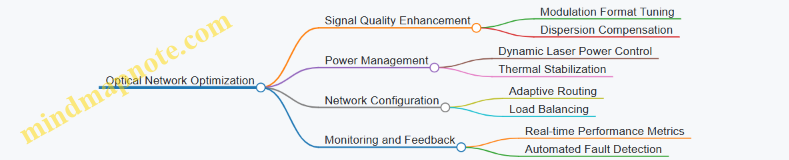
Example 2: Optimizing Modulation Format for 400G Optical Interconnect
Scenario: A hardware architect aims to optimize the modulation format to reduce power consumption while maintaining data integrity on a 400G silicon photonic link.
Approach:
- Tested PAM4 and DP-QPSK modulation formats.
- Measured BER and power consumption for both.
- Found DP-QPSK provided better BER at lower power but required more complex DSP.
Outcome:
- Selected DP-QPSK for long-reach links where power saving was critical.
- Used PAM4 for short-reach links to reduce DSP complexity.
Best Practice Highlight: Tailoring modulation formats to link requirements optimizes performance and power.
Practical Tips for Troubleshooting and Optimization
- Maintain a detailed log of network performance metrics to identify trends.
- Use automated monitoring tools for early detection of anomalies.
- Implement modular designs to simplify component replacement.
- Schedule regular preventive maintenance, including connector cleaning and thermal calibration.
- Train engineering teams on diagnostic tools and best practices.
Summary
Troubleshooting and optimization in operational optical networks are critical for sustaining high-speed computing performance. By following systematic workflows, leveraging diagnostic tools, and applying best practices such as regular maintenance and modulation format tuning, engineers can effectively resolve issues and enhance network reliability.
11.5 Future-Proofing Optical Interconnect Infrastructure
Future-proofing optical interconnect infrastructure is critical for ensuring long-term performance, scalability, and adaptability in high-speed computing environments such as data centers and HPC clusters. This section explores strategies, best practices, and real-world examples that photonics engineers, hardware architects, and data center engineers can adopt to build resilient and flexible optical networks.
Key Strategies for Future-Proofing
- Modular Design and Scalability
- Standardization and Interoperability
- Upgrade Path Planning
- Advanced Monitoring and Diagnostics
- Energy Efficiency and Thermal Management
- Investment in Emerging Technologies
Mind Map: Future-Proofing Optical Interconnect Infrastructure
Modular Design and Scalability
Best Practice: Design optical interconnects using modular components that allow easy upgrades and expansions without major overhauls.
Example: A hyperscale data center implemented modular silicon photonic pluggable transceivers that support multiple data rates (100G, 200G, 400G). When traffic demands increased, the data center seamlessly upgraded transceivers without replacing the entire optical infrastructure.
Explanation: Modular design enables scaling bandwidth and functionality by swapping or adding components, reducing downtime and capital expenditure.
Standardization and Interoperability
Best Practice: Adopt industry standards and ensure interoperability to avoid vendor lock-in and facilitate integration with future technologies.
Example: A cloud provider chose optical interconnects compliant with the Open Compute Project (OCP) standards, enabling multi-vendor transceiver deployment and easier integration with evolving network equipment.
Explanation: Standardization ensures that new components and protocols can be integrated smoothly, protecting investments and enabling flexible infrastructure evolution.
Upgrade Path Planning
Best Practice: Architect systems with backward compatibility and support for firmware/software upgrades to extend lifecycle and adapt to new protocols or modulation schemes.
Example: A high-performance computing cluster deployed silicon photonic modules with programmable DSPs (digital signal processors). This allowed upgrading modulation formats from PAM4 to more advanced schemes like DMT via firmware updates, improving link capacity without hardware replacement.
Explanation: Planning upgrade paths reduces the need for costly hardware replacements and enables incremental performance improvements.
Advanced Monitoring and Diagnostics
Best Practice: Integrate real-time monitoring and predictive diagnostics to proactively detect issues and optimize performance.
Example: An enterprise data center implemented an optical performance monitoring system that tracked parameters such as optical signal-to-noise ratio (OSNR) and bit error rate (BER). Early detection of degradation enabled preemptive maintenance, minimizing downtime.
Explanation: Continuous monitoring helps maintain optimal link quality and extends component lifetime.
Energy Efficiency and Thermal Management
Best Practice: Incorporate low-power photonic components and efficient thermal designs to reduce operational costs and maintain reliability.
Example: A data center integrated silicon photonic transceivers with dynamic power scaling and heat sinks optimized for airflow, reducing power consumption by 20% while maintaining high data rates.
Explanation: Energy-efficient design is essential for sustainable scaling of optical interconnects in large deployments.
Investment in Emerging Technologies
Best Practice: Stay informed and invest in emerging photonics technologies such as co-packaged optics and quantum photonics to future-proof infrastructure.
Example: A research-focused HPC center piloted co-packaged optics that integrate photonics directly with switching ASICs, drastically reducing latency and power consumption, preparing the infrastructure for next-generation computing demands.
Explanation: Early adoption of emerging technologies can provide competitive advantages and ensure readiness for future workloads.
Summary Mind Map: Integrated Best Practices with Examples
By adopting these future-proofing strategies, engineers and architects can build optical interconnect infrastructures that are resilient, adaptable, and efficient, ensuring they meet the evolving demands of high-speed computing environments for years to come.
12. Conclusion and Recommendations
12.1 Summary of Key Takeaways for Photonics Engineers and Hardware Architects
In this section, we consolidate the essential insights and best practices that photonics engineers and hardware architects should internalize to drive successful photonics integration and optical interconnect deployment in high-speed computing environments.
Key Takeaway 1: Holistic Design Approach
- Integration of Photonic and Electronic Components: Seamless co-design is critical to optimize performance, power, and footprint.
- Example: Designing a silicon photonic transceiver where the modulator driver and photodetector amplifier are co-optimized to minimize latency and power consumption.
Key Takeaway 2: Platform and Architecture Selection
- Choosing the Right Photonic Platform: Silicon photonics offers CMOS compatibility, but other platforms (InP, SiN) may be better suited for specific wavelength or performance needs.
- Architecture Matters: Decide between point-to-point, networked, or reconfigurable interconnects based on system scale and latency requirements.
- Example: Hyperscale data centers often use networked optical interconnects with silicon photonics for scalability.
Key Takeaway 3: Component-Level Optimization
- Modulators and Detectors: Select based on speed, insertion loss, and power consumption.
- Waveguide Design: Minimize propagation loss and crosstalk through careful layout.
- Example: Using Mach-Zehnder modulators with optimized electrode design to achieve 50 Gb/s modulation with low drive voltage.

Key Takeaway 4: Thermal and Power Management
- Thermal Effects: Actively manage temperature to maintain wavelength stability and device reliability.
- Power Efficiency: Optimize modulation formats and driver circuits to reduce overall power consumption.
- Example: Implementing micro-heaters with feedback control to stabilize ring resonator wavelengths in silicon photonics.
Key Takeaway 5: Testing, Reliability, and Manufacturability
- Design for Testability: Incorporate test structures and monitoring photodiodes to enable in-line testing.
- Reliability: Address packaging stresses and environmental factors.
- Manufacturability: Use standardized process design kits (PDKs) and follow foundry guidelines.
- Example: Deploying on-chip monitors to detect laser aging and trigger system-level compensation.
Key Takeaway 6: Continuous Learning and Collaboration
- Stay updated with emerging photonic technologies and standards.
- Collaborate across disciplines: photonics, electronics, thermal, and system architects.
- Example: Joint workshops between hardware architects and photonics engineers to align on interface standards and integration challenges.

Final Thoughts
By embracing these key takeaways, photonics engineers and hardware architects can effectively design, integrate, and deploy optical interconnects that meet the demanding requirements of high-speed computing systems. The synergy between component-level excellence and system-level architecture, combined with practical best practices and continuous collaboration, forms the foundation for future-ready photonics-enabled computing infrastructure.
12.2 Strategic Recommendations for Data Center Engineers
Data center engineers play a pivotal role in the successful deployment and operation of photonics integration and optical interconnects for high-speed computing. To maximize performance, scalability, and reliability, a strategic approach is essential. Below, we outline key recommendations, supported by mind maps and practical examples, to guide data center engineers in this transformative journey.
Prioritize Modular and Scalable Optical Architectures
- Mind Map:
- Example: A hyperscale data center implemented pluggable silicon photonic transceivers across its spine-leaf network, enabling seamless capacity upgrades from 100G to 400G without major infrastructure changes.
Emphasize Co-Design and Collaboration Between Photonics and Electronics Teams
- Mind Map:
- Example: In a leading cloud provider, photonics engineers and hardware architects co-developed a silicon photonic transceiver with integrated driver electronics, reducing insertion loss and improving thermal management.
Implement Robust Thermal Management Strategies
- Mind Map:
- Example: A data center deployed liquid-cooled racks housing silicon photonic modules, resulting in a 15% improvement in link stability and extended component lifespan.
Adopt Comprehensive Testing and Monitoring Frameworks
- Mind Map:
- Example: Using integrated photonic transceivers with built-in diagnostics, a data center was able to proactively identify and replace degrading optical links before failures occurred.
Plan for Future-Proofing and Interoperability
- Mind Map:
- Example: A data center architected its optical interconnect fabric to support both PAM4 and future coherent modulation schemes, ensuring longevity and adaptability.
Optimize Power Efficiency Without Compromising Performance
- Mind Map:
- Example: By integrating low-voltage modulators and adaptive link rate control, a data center reduced optical interconnect power consumption by 20% during off-peak hours.
Summary Mind Map: Strategic Recommendations Overview
Final Thoughts
Data center engineers must embrace a holistic strategy that balances cutting-edge photonics integration with practical operational considerations. By leveraging modular designs, fostering cross-disciplinary collaboration, managing thermal and power challenges, and planning for future evolution, data centers can unlock the full potential of optical interconnects for high-speed computing.
12.3 Best Practice: Continuous Learning and Collaboration in Photonics Integration
In the rapidly evolving field of photonics integration and optical interconnects, continuous learning and effective collaboration are critical for staying ahead of technological advancements and overcoming complex engineering challenges. This section explores best practices to foster a culture of ongoing education and teamwork among photonics engineers, hardware architects, and data center engineers.
Why Continuous Learning Matters
- Rapid Technological Evolution: Photonics technologies, fabrication methods, and design tools evolve quickly.
- Complex Interdisciplinary Nature: Integration requires knowledge spanning optics, electronics, materials science, and system architecture.
- Competitive Advantage: Staying updated enables innovation and efficient problem-solving.
Best Practices for Continuous Learning
-
Engage in Professional Development Programs
- Attend workshops, webinars, and conferences such as OFC (Optical Fiber Communication Conference) and SPIE Photonics West.
- Example: An engineer attending a workshop on silicon photonics found new modulation techniques that improved link performance by 15%.
-
Leverage Online Learning Platforms and Resources
- Utilize platforms like Coursera, edX, and specialized photonics forums.
- Example: A hardware architect completed a course on photonic integrated circuit design, enabling better collaboration with photonics teams.
-
Participate in Cross-Disciplinary Teams
- Encourage collaboration between photonics, electronics, and system architects to share knowledge.
- Example: A data center engineering team formed a cross-functional group that reduced optical module deployment time by 20%.
-
Implement Internal Knowledge Sharing Sessions
- Regular brown-bag talks, technical seminars, and documentation repositories.
- Example: Monthly seminars led by senior photonics engineers helped junior staff quickly ramp up on complex integration topics.
-
Stay Updated with Industry Standards and Publications
- Follow IEEE Photonics Society publications, ITU standards, and vendor whitepapers.
- Example: Early adoption of a new modulation standard improved interoperability in multi-vendor environments.
Best Practices for Collaboration
-
Establish Clear Communication Channels
- Use collaborative tools like Slack, Microsoft Teams, or Confluence.
- Example: A project team used dedicated Slack channels to resolve integration issues in real-time, reducing debugging cycles.
-
Define Roles and Responsibilities Clearly
- Clarify ownership of photonic design, electronic integration, testing, and deployment.
- Example: Clear role definitions prevented duplicated efforts and streamlined project timelines.
-
Use Collaborative Design and Simulation Tools
- Adopt platforms that support co-simulation and version control (e.g., Lumerical + Cadence integration).
- Example: Joint photonic-electronic simulation caught signal integrity issues early, avoiding costly redesigns.
-
Foster a Culture of Open Feedback and Continuous Improvement
- Encourage team members to share lessons learned and suggest improvements.
- Example: Post-project retrospectives led to process improvements that increased yield in photonic module fabrication.
-
Engage with External Partners and Ecosystems
- Collaborate with foundries, academic institutions, and industry consortia.
- Example: Partnering with a university lab enabled access to cutting-edge fabrication techniques, accelerating prototype development.
Mind Maps
Mind Map 1: Continuous Learning Framework
Mind Map 2: Collaboration Best Practices
Real-World Examples
Example 1: Cross-Functional Workshop Leading to Breakthrough
A photonics engineering team collaborated with hardware architects and data center engineers in a week-long workshop focused on integrating a new silicon photonic modulator. Through daily knowledge exchanges and joint simulations, the team identified a thermal management issue early and implemented a novel packaging solution, reducing module failure rates by 30%.
Example 2: Internal Knowledge Repository Accelerates Onboarding
A leading cloud provider established an internal wiki documenting best practices, design guidelines, and troubleshooting tips for optical interconnects. New engineers reduced their onboarding time from 3 months to 6 weeks, accelerating project delivery.
Example 3: Collaborative Use of Simulation Tools
Using a shared simulation environment combining photonic and electronic design automation tools, a team detected signal integrity problems caused by impedance mismatches at the photonic-electronic interface. Early detection saved an estimated $500K in redesign costs.
Summary
Continuous learning and collaboration are foundational pillars for success in photonics integration and optical interconnects. By adopting structured learning programs, fostering open communication, and leveraging collaborative tools and partnerships, teams can accelerate innovation, improve system reliability, and maintain competitive advantage in high-speed computing environments.
12.4 Final Example: Roadmap to Successful Optical Interconnect Integration
Integrating optical interconnects successfully into high-speed computing environments requires a well-structured roadmap that balances technical, manufacturing, and operational considerations. This section provides a comprehensive example roadmap, illustrated with mind maps and practical examples, to guide photonics engineers, hardware architects, and data center engineers through the integration process.
Mind Map: High-Level Roadmap for Optical Interconnect Integration
Step 1: Requirements Definition
Example: A data center engineer needs to upgrade a 100G electrical interconnect to a 400G optical link to support increased traffic with a power budget of less than 5W per link.
- Define bandwidth and latency targets.
- Establish power consumption limits.
- Assess compatibility with existing transceiver modules and switch fabrics.
Best Practice: Engage cross-functional teams early to align system-level requirements with photonic capabilities.
Step 2: Technology Selection
Example: Choosing a silicon photonics platform with integrated modulators and photodetectors, leveraging CMOS-compatible fabrication for cost efficiency.
- Evaluate trade-offs between hybrid and monolithic integration.
- Select components with proven reliability and performance.
Best Practice: Use vendor-provided characterization data and reference designs to inform decisions.
Mind Map: Design and Simulation Workflow
Step 3: Design and Simulation
Example: Using photonic design automation tools to simulate a Mach-Zehnder modulator integrated with driver electronics, optimizing for minimal insertion loss and maximum bandwidth.
Best Practice: Perform iterative co-simulation to ensure photonic and electronic components operate harmoniously.
Step 4: Prototyping and Testing
Example: Fabricate a prototype transceiver module and conduct bit-error-rate (BER) testing at 400G over a 2-meter optical link.
- Measure insertion loss, extinction ratio, and signal-to-noise ratio.
- Validate thermal stability under operational conditions.
Best Practice: Implement automated test setups to accelerate validation cycles.
Step 5: Manufacturing and Packaging
Example: Develop a packaging solution with integrated micro-thermoelectric coolers to maintain stable operating temperatures for the photonic chip.
- Design for ease of assembly and testing.
- Optimize for mechanical robustness and thermal dissipation.
Best Practice: Collaborate with packaging vendors early to align design constraints.
Step 6: Deployment and Integration
Example: Integrate the optical interconnect modules into a rack-scale HPC system, adapting switch firmware to support new link protocols.
- Update network topology to leverage optical bandwidth.
- Implement monitoring tools for link health.
Best Practice: Conduct staged rollouts to minimize disruption.
Step 7: Operation and Maintenance
Example: Use real-time telemetry to detect signal degradation and trigger automated failover to redundant links.
- Schedule periodic calibration and firmware updates.
Best Practice: Establish clear maintenance protocols and train operations staff.
Step 8: Continuous Improvement
Example: Analyze operational data to identify bottlenecks and plan next-generation optical interconnect upgrades with higher integration density.
- Incorporate emerging modulators or photodetectors with improved efficiency.
Best Practice: Maintain feedback loops between field engineers and design teams.
Summary Mind Map: Integrated Roadmap Overview

By following this structured roadmap, teams can systematically address the multifaceted challenges of integrating optical interconnects into high-speed computing environments, ensuring performance, reliability, and scalability.
Additional Example:
A hyperscale data center successfully transitioned from 100G electrical to 400G optical interconnects by adopting silicon photonics transceivers designed with this roadmap. Early-stage simulation identified thermal hotspots, which were mitigated by improved packaging. Automated testing reduced validation time by 30%, and staged deployment minimized network downtime. Continuous monitoring enabled proactive maintenance, resulting in a 25% improvement in link availability.
This example underscores the value of a comprehensive, best-practice-driven roadmap in achieving successful optical interconnect integration.
12.5 Resources and Further Reading
To deepen your understanding of photonics integration and optical interconnects for high-speed computing, here is a curated list of resources, including books, research papers, online courses, industry standards, and tools. Additionally, mind maps are provided to help visualize key concepts and their interconnections.
Books
-
Silicon Photonics: Fundamentals and Devices by Daryl Inniss and Roy Rubenstein
- Comprehensive introduction to silicon photonics technology, fabrication, and applications.
-
Optical Interconnects for Data Centers by Keren Bergman and others
- Focuses on optical interconnect architectures and their role in data centers.
-
Photonic Integrated Circuits by Graham T. Reed and Andrew P. Knights
- Covers design, fabrication, and testing of integrated photonic circuits.
Research Papers & Articles
- “Silicon Photonics for High-Speed Optical Interconnects” - IEEE Journal of Selected Topics in Quantum Electronics
- “Energy-Efficient Optical Interconnects for Data Centers” - Nature Photonics
- “Design and Optimization of Silicon Photonic Modulators” - Optics Express
Online Courses and Tutorials
- Coursera: Introduction to Photonics by University of Colorado Boulder
- edX: Silicon Photonics Design and Fabrication by MIT
- YouTube Channel: Lightwave Logic - Tutorials on photonics components and integration
Industry Standards and Consortia
- OIF (Optical Internetworking Forum) - Standards for optical interconnects
- JEDEC - Memory and interface standards involving optical technologies
- Silicon Photonics Consortiums - Collaboration platforms for industry best practices
Simulation and Design Tools
- Lumerical (Ansys) - Photonic simulation software
- Synopsys RSoft - Photonic design automation tools
- Photon Design - Optical component and circuit design
Mind Maps
Mind Map 1: Photonics Integration Overview
Mind Map 2: Optical Interconnect Architectures
Mind Map 3: Design and Optimization Best Practices
Example: Using Resources to Build a Silicon Photonic Link
- Start with foundational knowledge: Read chapters from “Silicon Photonics: Fundamentals and Devices” to understand material properties.
- Design phase: Use Synopsys RSoft to simulate waveguide layouts and modulators.
- Fabrication insights: Review fabrication flow examples from research papers.
- Testing and validation: Apply best practices from OIF standards and use Lumerical tools for signal integrity analysis.
- Optimization: Study thermal management techniques from case studies and implement in packaging design.
Summary
Leveraging these resources and mind maps will empower photonics engineers, hardware architects, and data center engineers to design, implement, and optimize state-of-the-art photonics integration and optical interconnect solutions for high-speed computing environments.