Smart Manufacturing Ecosystems Powered by Cognitive Factories
1. Introduction to Smart Manufacturing Ecosystems
1.1 Defining Smart Manufacturing and Cognitive Factories
Smart Manufacturing represents the integration of advanced technologies such as the Industrial Internet of Things (IIoT), Artificial Intelligence (AI), robotics, and data analytics into manufacturing processes to create highly flexible, efficient, and adaptive production systems. It emphasizes connectivity, real-time data exchange, and automation to optimize operations and respond dynamically to changing demands.
Cognitive Factories take Smart Manufacturing a step further by embedding cognitive technologies—such as machine learning, natural language processing, and advanced analytics—into factory operations. These factories are capable of learning from data, reasoning, and making autonomous decisions to continuously improve manufacturing processes.
Mind Map: Understanding Smart Manufacturing
Mind Map: Characteristics of Cognitive Factories
Example 1: Smart Manufacturing in Action – Automotive Assembly Line
A leading automotive manufacturer implemented Smart Manufacturing by deploying IIoT sensors across their assembly line to monitor equipment health and production status in real-time. Using AI-driven analytics, the system predicts potential machine failures before they occur, reducing downtime by 30%. The integration of collaborative robots (cobots) assists human workers in repetitive tasks, improving safety and productivity.
Example 2: Cognitive Factory – Electronics Manufacturer
An electronics manufacturer transformed its factory into a Cognitive Factory by integrating machine learning algorithms that analyze production data to detect subtle quality deviations. The factory’s systems autonomously adjust machine parameters to correct issues without human intervention. Additionally, operators use voice-activated assistants to query machine status and receive recommendations, enhancing decision-making speed and accuracy.
Summary
Smart Manufacturing is the foundation that digitizes and automates manufacturing processes, while Cognitive Factories build upon this foundation by incorporating advanced AI capabilities that enable learning, reasoning, and autonomous optimization. Together, they form the backbone of modern, resilient, and efficient manufacturing ecosystems.
1.2 The Evolution from Traditional to Smart Manufacturing
Smart manufacturing represents a transformative shift from conventional production methods to highly digitized, interconnected, and intelligent systems. Understanding this evolution helps factory managers and industrial engineers appreciate the value cognitive factories bring to modern manufacturing ecosystems.
Traditional Manufacturing: Characteristics and Challenges
- Manual Processes: Heavy reliance on human labor and manual data collection.
- Isolated Systems: Machines and processes often operate in silos with limited integration.
- Reactive Maintenance: Equipment is serviced after failure or based on fixed schedules.
- Limited Data Utilization: Data is often recorded on paper or basic spreadsheets, lacking real-time insights.
- Quality Control: Mostly manual inspection leading to variable quality and delayed defect detection.
Example: In a traditional automotive assembly line, workers manually inspect parts and record defects on paper logs, leading to delays in identifying quality issues and increased downtime.
Transition Drivers to Smart Manufacturing
- Need for Increased Efficiency: To meet growing demand and reduce costs.
- Quality Improvement: Consistent product quality with minimal defects.
- Flexibility: Ability to quickly adapt to product variations and customization.
- Data Availability: Advances in sensors and connectivity enable real-time data capture.
- Competitive Pressure: Global competition pushing for innovation and agility.
Smart Manufacturing: Key Features
- Connected Systems: Machines, devices, and people interconnected via IIoT.
- Real-Time Data Analytics: Continuous monitoring and analysis of production data.
- Predictive Maintenance: AI algorithms predict equipment failures before they occur.
- Automation and Robotics: Integration of cobots and automated guided vehicles (AGVs).
- Digital Twins: Virtual models of physical assets for simulation and optimization.
- Adaptive Processes: Systems that self-adjust based on data insights.
Example: A consumer electronics manufacturer uses sensors on assembly machines to monitor performance in real time. AI analyzes the data to predict when a machine needs maintenance, reducing unexpected downtime by 30%.
Mind Map: Evolution from Traditional to Smart Manufacturing
Mind Map: Benefits of Smart Manufacturing Over Traditional
Practical Example: Textile Factory Transformation
Before: A textile factory relied on manual loom adjustments and paper-based quality checks. Downtime was frequent due to unexpected machine failures.
After: By implementing sensor networks and AI-driven analytics, the factory enabled predictive maintenance and automated quality inspections. This led to a 25% increase in throughput and a 40% reduction in defects.
Summary
The evolution from traditional to smart manufacturing is not just about technology adoption but a fundamental change in how factories operate. Cognitive factories leverage connectivity, AI, and automation to create ecosystems that are more efficient, flexible, and resilient. For factory managers and industrial engineers, embracing this evolution is critical to staying competitive and driving continuous improvement.
1.3 Key Components of a Smart Manufacturing Ecosystem
A smart manufacturing ecosystem is a complex, interconnected network of technologies, processes, and people working together to optimize production, improve quality, and increase agility. Understanding its key components is essential for factory managers and industrial engineers aiming to implement or enhance cognitive factories.
Core Components Mind Map
Detailed Explanation with Examples
-
Industrial Internet of Things (IIoT)
- IIoT forms the sensory nervous system of a smart factory. Sensors embedded in machines collect real-time data such as temperature, vibration, and throughput.
- Example: A beverage bottling plant uses IIoT sensors on conveyor belts to detect jams early, reducing downtime by 30%.
-
Data Management
- Efficient data collection and storage enable factories to harness the power of analytics. Cloud platforms allow scalable storage, while edge computing processes data locally for low latency.
- Example: An electronics manufacturer uses edge computing to analyze soldering quality data on-site, enabling instant defect detection.
-
Artificial Intelligence & Machine Learning
- AI algorithms analyze historical and real-time data to predict equipment failures, optimize production schedules, and enhance quality control.
- Example: A metal fabrication shop implements predictive maintenance AI that forecasts machine wear, reducing unexpected breakdowns by 40%.
-
Digital Twins
- Digital twins are virtual replicas of physical assets or entire factories, enabling simulation and scenario testing without disrupting real operations.
- Example: A pharmaceutical company uses digital twins to simulate production line changes, reducing process validation time by 25%.
-
Automation & Robotics
- Robots and cobots automate repetitive tasks, improve precision, and collaborate safely with human workers.
- Example: A consumer electronics plant deploys cobots for delicate assembly tasks, increasing throughput while maintaining quality.
-
Cybersecurity
- Protecting the ecosystem from cyber threats is critical. This includes securing networks, devices, and implementing incident response plans.
- Example: A smart factory in the automotive sector implements multi-layered security protocols, preventing ransomware attacks.
-
Human-Machine Interface (HMI)
- Intuitive dashboards and AR interfaces empower operators with actionable insights and remote assistance.
- Example: Maintenance technicians use AR glasses to receive step-by-step repair instructions, reducing repair time by 20%.
-
Supply Chain Integration
- Seamless data exchange with suppliers and logistics partners ensures just-in-time delivery and inventory optimization.
- Example: An aerospace manufacturer integrates supplier data to adjust production schedules dynamically based on component availability.
-
Sustainability & Energy Management
- Monitoring energy consumption and waste streams helps factories minimize environmental impact and reduce costs.
- Example: A chemical plant uses AI-driven energy management systems to optimize power usage, cutting energy costs by 15%.
Summary Mind Map: Benefits Linked to Components
By understanding and effectively integrating these key components, factory managers and industrial engineers can build resilient, adaptive, and high-performing smart manufacturing ecosystems powered by cognitive factories.
1.4 Benefits of Integrating Cognitive Factories in Manufacturing
Integrating cognitive factories into manufacturing processes brings transformative benefits that enhance productivity, quality, agility, and sustainability. Cognitive factories leverage AI, IoT, advanced analytics, and automation to create intelligent, self-optimizing manufacturing ecosystems.
Key Benefits Overview
Enhanced Productivity and Operational Efficiency
Cognitive factories utilize AI-driven predictive maintenance and real-time monitoring to minimize unplanned downtime and optimize machine utilization.
Example: A global electronics manufacturer implemented AI-based predictive maintenance on their SMT lines. By analyzing sensor data and historical failure patterns, they reduced machine downtime by 30%, resulting in a 15% increase in overall equipment effectiveness (OEE).
Improved Quality and Reduced Defects
AI-powered visual inspection systems and anomaly detection algorithms enable cognitive factories to identify defects early and maintain consistent product quality.
Example: A metal fabrication plant integrated AI-based image recognition to inspect weld seams. This system detected defects with 95% accuracy, reducing scrap rates by 20% and improving customer satisfaction.
Increased Agility and Flexibility
Cognitive factories can quickly adapt production schedules and processes based on real-time demand signals and supply chain conditions.
Example: A pharmaceutical manufacturer used AI-driven demand forecasting integrated with production scheduling. This allowed rapid shifts in batch sizes and product variants, reducing lead times by 25%.
Cost Reduction and Resource Optimization
By optimizing energy consumption, raw material usage, and labor allocation, cognitive factories reduce operational costs.
Example: A food processing plant implemented AI to optimize oven temperatures and baking times, cutting energy consumption by 18% while maintaining product quality.
Sustainability and Environmental Impact
Cognitive factories support sustainability goals through waste reduction, energy efficiency, and circular economy practices.
Example: A chemical plant used AI-driven process controls to minimize off-spec batches and reduce hazardous waste generation by 15%, aligning with environmental compliance standards.
Workforce Empowerment and Safety
Cognitive factories provide workers with AI-driven decision support tools, enhancing productivity and safety.
Example: In an automotive assembly plant, augmented reality (AR) guided by AI assists operators during complex assembly tasks, reducing errors by 40% and improving ergonomics.
Summary
Integrating cognitive factories creates a smart manufacturing ecosystem that drives:
- Higher productivity through predictive maintenance and real-time monitoring
- Superior quality via AI-enabled inspection and anomaly detection
- Greater agility with adaptive scheduling and demand responsiveness
- Cost savings by optimizing resources and energy
- Sustainability through waste and emissions reduction
- Empowered workforce with AI tools enhancing safety and decision-making
These benefits collectively position manufacturers to compete effectively in the rapidly evolving industrial landscape.
1.5 Real-World Example: How a Tier 1 Automotive Supplier Transformed Operations
In the highly competitive automotive industry, Tier 1 suppliers play a crucial role in delivering high-quality components just in time to original equipment manufacturers (OEMs). This example illustrates how a leading Tier 1 automotive supplier leveraged cognitive factory principles to transform its operations, improve efficiency, and reduce costs.
Background
The supplier faced challenges including frequent production downtime, quality inconsistencies, and supply chain disruptions. Their traditional manufacturing setup relied heavily on manual inspections and reactive maintenance, leading to delays and increased operational costs.
Transformation Objectives
- Increase production uptime by 20%
- Reduce defect rates by 30%
- Enhance supply chain visibility and responsiveness
- Empower workforce with real-time insights and training
Implementation of Cognitive Factory Elements
1. Industrial IoT and Sensor Deployment
- Installed sensors on critical machinery to monitor vibration, temperature, and operational status.
- Enabled real-time data collection for predictive maintenance.
2. AI-Powered Predictive Maintenance
- Developed machine learning models to predict equipment failures before they occurred.
- Scheduled maintenance proactively, reducing unplanned downtime.
3. Digital Twin Creation
- Created virtual replicas of production lines to simulate and optimize workflows.
- Tested process changes virtually before physical implementation.
4. Automated Quality Inspection
- Deployed AI-driven vision systems to detect defects at various stages.
- Reduced human error and accelerated inspection cycles.
5. Integrated Supply Chain Analytics
- Connected supplier data with production schedules.
- Used predictive analytics to anticipate material shortages and adjust orders dynamically.
6. Workforce Enablement
- Provided operators with AR-based guidance for complex assembly tasks.
- Delivered training modules based on real-time performance data.
Mind Map: Transformation Overview
Detailed Example: Predictive Maintenance in Action
Scenario: A key stamping press was prone to unexpected breakdowns, causing costly line stoppages.
Solution:
- Sensors measured vibration and temperature continuously.
- AI models analyzed patterns to detect early signs of wear.
- Maintenance alerts were sent 48 hours before predicted failure.
Result:
- Unplanned downtime reduced by 40%.
- Maintenance costs optimized by scheduling repairs only when necessary.
Detailed Example: AI-Driven Quality Inspection
Scenario: Manual inspection of welds was slow and inconsistent.
Solution:
- High-resolution cameras captured images of welds.
- AI algorithms identified defects such as cracks or incomplete welds.
- Defective parts were flagged instantly for rework.
Result:
- Inspection time reduced by 50%.
- Defect detection accuracy improved by 30%.
Mind Map: AI-Driven Quality Inspection Workflow
Impact and Lessons Learned
- Cross-Functional Collaboration: Success required close cooperation between IT, operations, and engineering teams.
- Data Quality is Critical: Reliable sensor data was foundational for AI effectiveness.
- Change Management: Engaging the workforce early helped ease adoption of new technologies.
- Scalability: Starting with pilot lines enabled gradual scaling across the plant.
This example demonstrates how cognitive factories, powered by smart manufacturing technologies and best practices, can drive significant operational improvements for Tier 1 automotive suppliers, setting a benchmark for the industry.
2. Core Technologies Enabling Cognitive Factories
2.1 Industrial Internet of Things (IIoT) and Sensor Networks
Overview
The Industrial Internet of Things (IIoT) refers to the interconnected network of sensors, instruments, and other devices linked together with industrial applications. These connections enable data collection, exchange, and analysis to improve manufacturing efficiency, safety, and decision-making.
Sensor networks form the backbone of IIoT, providing real-time data from machines, production lines, and environmental conditions. By leveraging IIoT and sensor networks, cognitive factories gain the ability to monitor operations continuously, predict failures, and optimize processes.
Key Components of IIoT and Sensor Networks
Best Practices for IIoT and Sensor Network Deployment
-
Start with a Clear Objective: Define what you want to achieve with IIoT—whether it’s predictive maintenance, quality control, or energy management.
-
Select Appropriate Sensors: Choose sensors that match the environmental conditions and measurement requirements. For example, vibration sensors for rotating equipment monitoring.
-
Ensure Reliable Connectivity: Use a mix of wired and wireless networks based on factory layout and interference considerations.
-
Implement Edge Computing: Process data locally to reduce latency and bandwidth usage, enabling real-time decision-making.
-
Prioritize Security: Secure devices and networks to prevent unauthorized access and data breaches.
-
Plan for Scalability: Design the sensor network to accommodate future expansion and integration with other systems.
Example 1: Predictive Maintenance in a Steel Manufacturing Plant
Scenario: A steel plant installs vibration and temperature sensors on critical motors and rollers.
- Sensors continuously monitor equipment health.
- Data is processed at the edge to detect anomalies.
- Alerts are sent to maintenance teams before failures occur.
Outcome: Reduced unplanned downtime by 30%, saving significant repair costs.
Example 2: Environmental Monitoring in a Pharmaceutical Factory
Scenario: Humidity and temperature sensors are deployed across cleanrooms.
- Real-time monitoring ensures compliance with strict environmental standards.
- Automated alerts trigger HVAC adjustments when parameters drift.
Outcome: Maintained product quality and regulatory compliance with minimal manual intervention.
Mind Map: IIoT Use Cases in Smart Manufacturing
Integrating Sensor Networks with Cognitive Factory Systems
- Data Fusion: Combine data from multiple sensors to create a comprehensive view of machine health or process status.
- AI and Machine Learning: Use sensor data to train models that predict failures or optimize parameters.
- Digital Twins: Feed sensor data into digital twins for real-time simulation and scenario testing.
Summary
IIoT and sensor networks are foundational to cognitive factories, enabling continuous data-driven insights. By following best practices and leveraging real-world examples, factory managers and industrial engineers can successfully deploy IIoT solutions that enhance operational efficiency, safety, and product quality.
2.2 Artificial Intelligence and Machine Learning in Manufacturing
Artificial Intelligence (AI) and Machine Learning (ML) are revolutionizing manufacturing by enabling factories to become more adaptive, efficient, and predictive. These technologies empower cognitive factories to analyze vast amounts of data, learn from patterns, and make autonomous decisions that optimize production processes.
Understanding AI and ML in Manufacturing
- Artificial Intelligence (AI): The simulation of human intelligence processes by machines, especially computer systems.
- Machine Learning (ML): A subset of AI that enables systems to learn from data and improve their performance without being explicitly programmed.
Key Applications of AI and ML in Manufacturing
Best Practices and Examples
Predictive Maintenance
Best Practice: Use ML algorithms to analyze sensor data from machines to predict failures before they occur, reducing downtime and maintenance costs.
Example: A large automotive parts manufacturer implemented an AI-driven predictive maintenance system that monitors vibration and temperature data from CNC machines. The system predicted bearing failures with 90% accuracy, allowing maintenance teams to intervene proactively, reducing unplanned downtime by 30%.
Quality Control
Best Practice: Deploy computer vision powered by AI to perform real-time quality inspections, identifying defects faster and more accurately than manual inspection.
Example: An electronics assembly plant integrated AI-based visual inspection cameras on their production lines. The system detects soldering defects and component misplacements instantly, improving defect detection rates by 40% and reducing scrap rates.
Demand Forecasting
Best Practice: Utilize ML models to analyze historical sales data, market trends, and external factors to forecast demand accurately, enabling better inventory and production planning.
Example: A consumer goods manufacturer applied ML-driven demand forecasting, which incorporated seasonal trends and promotional events. This led to a 15% reduction in inventory holding costs and improved order fulfillment rates.
Adaptive Scheduling
Best Practice: Implement AI systems that dynamically adjust production schedules based on real-time data such as machine availability, order priority, and supply chain status.
Example: A pharmaceutical manufacturer uses AI to reschedule production lines instantly when raw material delays occur, minimizing idle time and ensuring timely delivery.
Energy Management
Best Practice: Leverage AI to monitor and optimize energy consumption across manufacturing operations, reducing costs and environmental impact.
Example: A chemical plant deployed AI algorithms to analyze energy usage patterns and adjust equipment operation schedules, achieving a 12% reduction in energy costs.
Mind Map: AI & ML Workflow in Manufacturing
Challenges and Considerations
- Data Quality: AI/ML models require high-quality, relevant data for accurate predictions.
- Integration: Seamless integration with existing manufacturing systems is critical.
- Workforce Training: Employees need training to work alongside AI-enabled systems.
- Scalability: Solutions should be scalable to adapt to evolving manufacturing needs.
Summary
AI and ML are foundational to cognitive factories, enabling smarter decision-making and automation. By adopting best practices such as predictive maintenance, AI-driven quality control, and adaptive scheduling, manufacturers can significantly enhance operational efficiency and competitiveness.
2.3 Digital Twins: Virtual Replicas for Real-Time Decision Making
What is a Digital Twin?
A Digital Twin is a dynamic virtual representation of a physical asset, process, or system that continuously updates and simulates the real-world counterpart using real-time data. It enables manufacturers to monitor, analyze, and optimize operations remotely and proactively.
Why Digital Twins Matter in Smart Manufacturing
- Real-time Monitoring: Provides live insights into equipment health and process status.
- Predictive Maintenance: Anticipates failures before they occur, reducing downtime.
- Process Optimization: Simulates changes to improve efficiency without disrupting production.
- Enhanced Collaboration: Offers a shared platform for engineering, operations, and management.
Mind Map: Core Components of a Digital Twin
How Digital Twins Work: Step-by-Step
- Data Acquisition: Sensors on machines collect real-time data (temperature, vibration, speed).
- Data Integration: Data streams are aggregated and fed into the digital twin platform.
- Modeling & Simulation: The digital twin simulates the physical asset’s behavior under current and hypothetical conditions.
- Analysis & Insights: AI algorithms analyze data to detect anomalies or predict failures.
- Decision Making: Operators receive actionable insights to optimize performance or schedule maintenance.
Example 1: Digital Twin in an Automotive Assembly Line
A major automotive manufacturer implemented digital twins for their robotic welding stations. By continuously monitoring robot arm positions, torque, and cycle times, the digital twin detected subtle deviations indicating wear in a welding tool.
Best Practice: Instead of waiting for a breakdown, the system triggered a maintenance alert, preventing costly downtime.
Outcome: 15% reduction in unplanned stoppages and improved weld quality consistency.
Mind Map: Benefits of Digital Twins in Manufacturing
Example 2: Digital Twin for Predictive Maintenance in a Food Processing Plant
A food processing facility used digital twins to monitor conveyor belts and packaging machines. The digital twin integrated vibration and temperature sensor data to predict bearing failures.
Best Practice: Maintenance was scheduled during planned downtime, avoiding production interruptions.
Outcome: Increased equipment lifespan by 20% and reduced emergency repairs by 30%.
Integrating Digital Twins with Other Smart Manufacturing Technologies
- IIoT: Provides the sensor data backbone.
- AI/ML: Powers predictive analytics and anomaly detection.
- Edge Computing: Enables real-time processing close to the asset.
- Cloud Platforms: Facilitate scalability and data storage.
Mind Map: Challenges and Solutions in Digital Twin Implementation
Summary
Digital twins serve as the cornerstone of cognitive factories by providing a real-time, virtual mirror of manufacturing assets and processes. They empower factory managers and industrial engineers to make informed decisions, optimize operations, and drive continuous improvement through predictive insights and simulations.
By adopting best practices such as starting with pilot projects, ensuring high-quality data, and integrating digital twins with AI and IIoT technologies, manufacturers can unlock significant operational benefits and maintain a competitive edge in the smart manufacturing landscape.
2.4 Edge Computing and Cloud Integration Best Practices
In the realm of cognitive factories, the seamless integration of edge computing and cloud technologies is critical to achieving real-time responsiveness, scalability, and efficient data processing. This section explores best practices for combining edge and cloud computing to optimize smart manufacturing ecosystems.
Understanding Edge Computing and Cloud Integration
- Edge Computing involves processing data near the source of data generation (e.g., sensors, machines) to reduce latency and bandwidth use.
- Cloud Computing provides centralized, scalable resources for data storage, advanced analytics, and long-term insights.
Together, they create a hybrid architecture that balances speed, reliability, and computational power.
Best Practices for Edge and Cloud Integration
Architect for Distributed Computing
- Design systems where time-sensitive data is processed at the edge, while aggregated data and heavy analytics run in the cloud.
- Use microservices and containerization to enable flexible deployment across edge and cloud environments.
Prioritize Data Filtering and Aggregation at the Edge
- Implement local data pre-processing to reduce noise and volume before sending data to the cloud.
- Example: A smart factory uses edge devices to filter sensor anomalies locally, sending only relevant alerts to the cloud for further analysis.
Ensure Robust Connectivity and Failover Mechanisms
- Use hybrid connectivity options (wired, wireless, 5G) to maintain reliable data flow.
- Implement local fallback modes so edge devices can operate autonomously during network outages.
Secure Data Across Edge and Cloud
- Employ end-to-end encryption and secure authentication protocols.
- Regularly update edge device firmware and cloud security policies.
Leverage AI and Analytics at Both Layers
- Deploy lightweight AI models on edge devices for real-time decision-making.
- Use cloud resources for training complex models and performing historical trend analysis.
Monitor and Manage Edge Devices Centrally
- Use cloud-based device management platforms for remote monitoring, updates, and diagnostics.
Mind Map: Edge and Cloud Integration Best Practices
Example 1: Predictive Maintenance in a Food Processing Plant
A food processing facility implemented edge computing devices on their critical machinery to monitor vibration and temperature sensors in real time. These edge devices run AI models locally to detect early signs of equipment wear and trigger immediate alerts to the maintenance team.
Simultaneously, the aggregated sensor data is sent to the cloud where more sophisticated analytics identify long-term trends and optimize maintenance schedules. This hybrid approach reduced unplanned downtime by 30% and minimized data transmission costs.
Example 2: Quality Control in Electronics Assembly
An electronics manufacturer deployed edge devices equipped with machine vision cameras to inspect circuit boards on the production line. The edge devices perform instant defect detection, rejecting faulty units immediately.
Data about defects and production parameters are streamed to the cloud for root cause analysis and process optimization. The cloud platform also manages firmware updates for edge devices, ensuring continuous improvement.
This integration improved defect detection speed and accuracy, leading to a 25% reduction in scrap rates.
Summary
Integrating edge computing with cloud platforms in cognitive factories enables smart manufacturing systems to be both responsive and scalable. By following best practices such as distributed architecture design, local data filtering, robust connectivity, strong security, AI deployment at multiple layers, and centralized device management, factory managers and industrial engineers can unlock significant operational efficiencies and innovation potential.
2.5 Example: Implementing AI-Driven Predictive Maintenance in a Food Processing Plant
Predictive maintenance (PdM) powered by AI is revolutionizing how food processing plants maintain their equipment, reduce downtime, and ensure product quality. This example illustrates the step-by-step approach to implementing AI-driven PdM in a mid-sized food processing facility.
Overview
A food processing plant faced frequent unplanned equipment failures, leading to costly downtime and product spoilage. Traditional preventive maintenance schedules were either too frequent, causing unnecessary costs, or too sparse, missing critical failures.
The plant decided to implement an AI-driven predictive maintenance system to optimize maintenance schedules, predict failures before they occur, and improve overall equipment effectiveness (OEE).
Step 1: Data Collection and Sensor Deployment
- Installed IoT sensors on critical equipment such as mixers, conveyors, and packaging machines.
- Sensors monitored vibration, temperature, motor current, and acoustic signals.
- Data was continuously streamed to an edge computing device for initial processing.
Mind Map: Data Collection
Step 2: Data Preprocessing and Feature Engineering
- Raw sensor data was cleaned to remove noise and outliers.
- Features such as RMS vibration levels, temperature gradients, and motor current spikes were extracted.
- Historical maintenance records and failure logs were integrated to label data for supervised learning.
Mind Map: Data Preprocessing
Step 3: Model Development and Training
- Selected machine learning models including Random Forest and LSTM (Long Short-Term Memory) networks for time-series prediction.
- Trained models on labeled datasets to predict remaining useful life (RUL) and imminent failures.
- Validated models using cross-validation and real-world test data.
Example:
- The LSTM model successfully predicted bearing failures 48 hours in advance with 92% accuracy.
Mind Map: Model Development
Step 4: Deployment and Integration
- Deployed the AI models on edge devices for low-latency predictions.
- Integrated predictive alerts into the plant’s maintenance management system (CMMS).
- Maintenance teams received real-time notifications on mobile devices when anomalies were detected.
Mind Map: Deployment
Step 5: Continuous Monitoring and Improvement
- Established feedback loops where maintenance outcomes were fed back to retrain models.
- Periodic model retraining ensured adaptation to changing equipment behavior.
- Performance metrics such as downtime reduction, maintenance cost savings, and OEE improvements were tracked.
Example:
- Within 6 months, the plant reduced unplanned downtime by 30% and maintenance costs by 20%.
Mind Map: Continuous Improvement
Best Practices Highlighted
- Start Small: Begin with critical equipment to demonstrate value before scaling.
- Cross-Functional Collaboration: Engage maintenance, IT, and operations teams early.
- Data Quality: Invest in sensor calibration and data cleaning for reliable models.
- User-Friendly Interfaces: Ensure alerts and dashboards are intuitive for maintenance staff.
- Continuous Learning: Use ongoing data to refine models and adapt to new failure modes.
Summary
Implementing AI-driven predictive maintenance in a food processing plant involves a systematic approach from sensor deployment to continuous improvement. By leveraging AI models such as LSTM for time-series prediction and integrating insights into maintenance workflows, plants can significantly reduce downtime, optimize maintenance costs, and maintain high product quality.
This example underscores how cognitive factories harness AI to transform traditional maintenance into a proactive, data-driven process.
3. Data Management and Analytics in Cognitive Factories
3.1 Data Collection Strategies for Smart Manufacturing
In the realm of smart manufacturing, effective data collection is the foundation upon which cognitive factories build their intelligence and operational excellence. Without accurate, timely, and relevant data, AI algorithms, predictive analytics, and automation cannot function optimally. This section delves into the best practices for data collection strategies tailored to smart manufacturing environments, supported by clear examples and mind maps to visualize the concepts.
Why Data Collection Matters
- Enables real-time monitoring and control
- Supports predictive maintenance and quality assurance
- Facilitates continuous improvement and process optimization
- Provides insights for supply chain and inventory management
Key Data Sources in Smart Manufacturing
- Sensors & IoT Devices: Temperature, pressure, vibration, humidity, machine status
- Machine Logs: Operational parameters, error codes, cycle times
- Quality Inspection Systems: Visual inspection, dimensional measurements
- Enterprise Systems: ERP, MES, SCM data
- Human Inputs: Operator feedback, manual logs
Mind Map: Data Collection Sources and Methods
Best Practices for Data Collection
- Define Clear Objectives: Identify what questions the data should answer (e.g., reduce downtime, improve quality).
- Select Relevant Data Points: Avoid data overload by focusing on parameters that impact key performance indicators (KPIs).
- Ensure Data Accuracy and Consistency: Calibrate sensors regularly and standardize data formats.
- Implement Real-Time Data Acquisition: Use edge computing to process data locally for faster decision-making.
- Integrate Data Silos: Combine data from machines, quality systems, and enterprise software for holistic insights.
- Secure Data Collection: Protect data integrity and privacy through encryption and access controls.
Example 1: Data Collection in a Smart Automotive Assembly Line
A leading automotive manufacturer deployed a network of vibration and temperature sensors on robotic arms and conveyor belts. Data was streamed in real-time to an edge computing device that filtered anomalies and sent alerts to maintenance teams. By focusing on vibration thresholds, the plant reduced unexpected robot failures by 30% within six months.
Mind Map for this example:
Example 2: Manual and Automated Data Collection in a Food Processing Plant
In a food processing facility, quality inspection data was collected both manually by operators and automatically via vision systems. Operators logged batch information and visual defects using tablets, while cameras captured high-resolution images analyzed by AI for contamination detection. The combined data sources improved defect detection rates by 25% and enhanced traceability.
Mind Map:
Emerging Data Collection Techniques
- Wireless Sensor Networks: Reduce wiring complexity and enable flexible sensor placement.
- Smart Wearables for Operators: Collect ergonomic and safety data.
- Environmental Monitoring: Track factory conditions affecting product quality.
Summary
Effective data collection in smart manufacturing requires a strategic approach that balances comprehensive coverage with data relevance and quality. Combining sensor data, machine logs, quality inspection results, and human inputs creates a rich dataset that cognitive factories can leverage to optimize operations, reduce costs, and improve product quality.
By implementing best practices and learning from real-world examples, factory managers and industrial engineers can design data collection systems that serve as the backbone of their smart manufacturing ecosystems.
3.2 Ensuring Data Quality and Integrity
In the realm of cognitive factories, data is the lifeblood that drives decision-making, predictive analytics, and process optimization. Ensuring data quality and integrity is paramount to unlocking the full potential of smart manufacturing ecosystems. Poor data quality can lead to incorrect insights, production delays, and increased costs.
Key Dimensions of Data Quality
- Accuracy: Data must correctly represent the real-world values it is intended to capture.
- Completeness: All necessary data points should be collected without gaps.
- Consistency: Data should be uniform across different systems and time periods.
- Timeliness: Data must be available when needed to support real-time decisions.
- Validity: Data should conform to defined formats and rules.
- Uniqueness: Avoidance of duplicate records to maintain clarity.
Mind Map: Dimensions of Data Quality
Best Practices to Ensure Data Quality and Integrity
Implement Robust Data Validation at Source
- Use sensors and devices with built-in error detection.
- Apply validation rules during data entry or capture to prevent incorrect data.
Example: In a semiconductor manufacturing plant, sensors monitoring wafer thickness automatically flag readings outside expected tolerances, preventing faulty data from entering the system.
Establish Standardized Data Formats and Protocols
- Adopt industry standards such as OPC UA for interoperability.
- Use consistent units of measurement and timestamp formats.
Example: A global automotive parts manufacturer standardized its data formats across plants worldwide, enabling seamless aggregation and comparison of production metrics.
Regular Data Auditing and Cleansing
- Schedule periodic reviews to identify and correct anomalies or missing data.
- Use automated tools to detect duplicates and inconsistencies.
Example: An electronics assembly line uses AI-powered software to scan historical production data weekly, identifying and correcting sensor drift errors.
Secure Data Transmission and Storage
- Encrypt data in transit and at rest to prevent tampering.
- Use checksums and hash functions to verify data integrity.
Example: A pharmaceutical manufacturer encrypts sensor data from production lines to cloud storage, ensuring data is not altered during transmission.
Implement Real-Time Monitoring and Alerts
- Set up dashboards that monitor data quality metrics continuously.
- Trigger alerts for data anomalies or sensor failures.
Example: A food processing plant uses a real-time dashboard that alerts engineers when temperature sensor data deviates unexpectedly, enabling immediate corrective action.
Mind Map: Best Practices for Data Quality
Example Scenario: Improving Data Quality in a Smart Factory
Context: A consumer electronics manufacturer faced frequent production delays due to inconsistent data from multiple sensor networks.
Solution:
- Introduced edge computing devices to validate sensor data locally before forwarding.
- Standardized data formats across all plants.
- Deployed an AI-driven data cleansing tool to identify and correct anomalies.
- Set up a centralized dashboard with real-time alerts for data quality issues.
Outcome: Data accuracy improved by 30%, enabling more reliable predictive maintenance and reducing downtime by 15%.
Summary
Ensuring data quality and integrity in cognitive factories requires a multi-faceted approach combining technology, standards, and continuous monitoring. By embedding best practices such as validation at the source, standardization, auditing, security, and real-time monitoring, factory managers and industrial engineers can trust their data and drive smarter manufacturing decisions.
3.3 Advanced Analytics and Real-Time Insights
In the era of cognitive factories, advanced analytics and real-time insights are pivotal for unlocking the full potential of smart manufacturing ecosystems. These capabilities empower factory managers and industrial engineers to make data-driven decisions swiftly, optimize processes, and respond proactively to operational challenges.
What is Advanced Analytics in Smart Manufacturing?
Advanced analytics refers to the use of sophisticated techniques such as machine learning, statistical modeling, and data mining to analyze complex manufacturing data. It goes beyond traditional reporting by uncovering hidden patterns, predicting future outcomes, and prescribing optimal actions.
Real-Time Insights
Real-time insights involve processing and analyzing data as it is generated on the factory floor, enabling immediate visibility into operations. This immediacy is critical for rapid decision-making, minimizing downtime, and maintaining quality standards.
Mind Map: Components of Advanced Analytics and Real-Time Insights
Best Practices for Implementing Advanced Analytics and Real-Time Insights
-
Integrate Diverse Data Sources: Combine data from machines, sensors, quality checks, and supply chain systems to create a comprehensive view.
-
Leverage Edge Computing: Process critical data locally to reduce latency and enable faster insights.
-
Use Predictive Models: Employ machine learning models trained on historical data to forecast equipment failures or quality deviations.
-
Visualize Data Effectively: Use dashboards and alerts to communicate insights clearly to operators and managers.
-
Continuously Update Models: Regularly retrain analytics models with new data to maintain accuracy.
Example 1: Real-Time Anomaly Detection in Electronics Assembly
A mid-sized electronics manufacturer implemented an AI-driven analytics platform that monitored soldering machines in real time. By analyzing temperature, vibration, and cycle time data, the system detected anomalies indicating potential defects before they occurred. This early warning allowed operators to adjust parameters immediately, reducing defect rates by 15% and avoiding costly rework.
Mind Map: Real-Time Anomaly Detection Workflow
Example 2: Predictive Maintenance in a Food Processing Plant
A food processing facility integrated advanced analytics to predict maintenance needs for its packaging line. Using vibration and temperature sensors, combined with historical maintenance records, the AI model predicted bearing failures up to 48 hours in advance. This enabled scheduled maintenance during planned downtime, increasing equipment availability by 12% and reducing emergency repairs.
Mind Map: Predictive Maintenance Analytics
Summary
Advanced analytics and real-time insights form the backbone of cognitive factories by transforming raw data into actionable intelligence. By adopting best practices such as integrating diverse data sources, leveraging edge computing, and continuously refining predictive models, manufacturers can achieve significant improvements in efficiency, quality, and cost-effectiveness.
These capabilities not only enhance operational performance but also build resilience and agility in increasingly complex manufacturing ecosystems.
3.4 Leveraging Big Data for Continuous Improvement
In the realm of cognitive factories, big data is not just a buzzword—it’s a foundational pillar that enables continuous improvement across manufacturing processes. By systematically collecting, analyzing, and acting on vast amounts of data, factory managers and industrial engineers can uncover hidden inefficiencies, predict failures before they occur, and optimize operations in real time.
What is Big Data in Smart Manufacturing?
Big data refers to the massive volume of structured and unstructured data generated by machines, sensors, production lines, supply chains, and even human inputs. In smart manufacturing ecosystems, this data is harnessed to create actionable insights that drive quality, efficiency, and innovation.
Why Leverage Big Data for Continuous Improvement?
- Identify Bottlenecks: Analyze production flow data to pinpoint slowdowns.
- Predictive Maintenance: Use historical sensor data to forecast equipment failures.
- Quality Enhancement: Detect subtle deviations in product quality before defects arise.
- Energy Optimization: Monitor energy consumption patterns to reduce waste.
Mind Map: Leveraging Big Data for Continuous Improvement
Practical Example: Reducing Downtime in Electronics Assembly
A mid-sized electronics manufacturer implemented big data analytics by aggregating sensor data from assembly robots, environmental conditions, and operator logs. By analyzing this data, they discovered that slight temperature fluctuations in the assembly area correlated with increased robot errors and downtime.
Actions Taken:
- Installed additional environmental sensors.
- Adjusted HVAC systems to maintain optimal temperature.
- Developed predictive models to alert operators before errors occurred.
Results:
- 15% reduction in unplanned downtime.
- Improved product quality consistency.
- Enhanced operator confidence through real-time alerts.
Mind Map: Example - Electronics Assembly Downtime Reduction
Best Practices for Leveraging Big Data
- Start Small, Scale Gradually: Begin with a pilot project focusing on a critical process.
- Ensure Data Quality: Garbage in, garbage out. Invest in sensor calibration and data validation.
- Foster Cross-Functional Teams: Combine expertise from IT, OT, and production.
- Implement Feedback Loops: Use insights to make real-time adjustments and track their impact.
- Prioritize Data Security and Privacy: Protect sensitive manufacturing and customer data.
Additional Example: Continuous Improvement in a Beverage Plant
A beverage manufacturer used big data analytics to optimize their bottling line. By analyzing data from flow meters, pressure sensors, and quality checks, they identified that minor pressure drops during peak hours caused inconsistent fill levels.
Solution: Automated pressure regulation and real-time monitoring dashboards.
Impact:
- Reduced product waste by 10%.
- Improved customer satisfaction due to consistent product quality.
Mind Map: Beverage Plant Bottling Line Optimization
Summary
Leveraging big data for continuous improvement in cognitive factories empowers manufacturing leaders to transform raw data into strategic assets. By embracing data-driven decision-making, factories can enhance operational efficiency, product quality, and sustainability, creating a resilient and competitive manufacturing ecosystem.
3.5 Case Study: Using Analytics to Reduce Downtime in Electronics Assembly
In the fast-paced world of electronics assembly, minimizing downtime is critical to maintaining productivity, meeting delivery schedules, and reducing operational costs. This case study explores how a mid-sized electronics manufacturer leveraged advanced analytics within their cognitive factory ecosystem to significantly reduce downtime and improve overall equipment effectiveness (OEE).
Background
The manufacturer specialized in assembling printed circuit boards (PCBs) for consumer electronics. They faced frequent unplanned downtime due to equipment failures, process bottlenecks, and quality issues. Traditional reactive maintenance and manual data tracking limited their ability to identify root causes promptly.
Objective
- Reduce unplanned downtime by at least 30% within 6 months.
- Improve predictive maintenance capabilities.
- Enhance real-time visibility into assembly line performance.
Approach: Analytics-Driven Downtime Reduction
The company implemented an integrated analytics platform connected to their Industrial IoT (IIoT) sensors and manufacturing execution system (MES). The approach involved:
- Data Collection: Capturing real-time data from machines, sensors, and operator inputs.
- Data Integration: Consolidating data streams into a centralized data lake.
- Descriptive Analytics: Visualizing downtime events and patterns.
- Predictive Analytics: Using machine learning models to forecast equipment failures.
- Prescriptive Analytics: Recommending maintenance schedules and process adjustments.
Mind Map: Analytics Workflow for Downtime Reduction
Implementation Details and Best Practices
-
Sensor Deployment and Data Quality:
- Installed vibration and temperature sensors on critical assembly machines.
- Ensured data accuracy through calibration and periodic validation.
-
Data Integration:
- Used middleware to integrate MES and sensor data.
- Established a data governance framework to maintain data integrity.
-
Machine Learning Models:
- Trained models on historical downtime and sensor data.
- Employed anomaly detection algorithms to identify early warning signs.
-
Visualization Dashboards:
- Created real-time dashboards accessible to factory managers and engineers.
- Included drill-down capabilities to analyze downtime by machine, shift, and cause.
-
Cross-Functional Collaboration:
- Engaged maintenance, production, and quality teams in interpreting analytics insights.
- Conducted regular review meetings to adjust strategies based on data.
Example: Predictive Maintenance Alert
- Scenario: The vibration sensor on a pick-and-place machine showed increasing irregularities.
- Analytics Insight: Predictive model flagged a high probability of motor failure within 48 hours.
- Action: Maintenance team received an automated alert and scheduled a proactive repair.
- Outcome: Avoided unexpected breakdown and saved approximately 8 hours of downtime.
Results
- Downtime Reduction: Achieved a 35% reduction in unplanned downtime within 5 months.
- Increased OEE: Overall equipment effectiveness improved by 12%.
- Cost Savings: Estimated savings of $250,000 annually due to reduced downtime and maintenance costs.
- Improved Responsiveness: Faster root cause analysis and decision-making.
Lessons Learned
- Data is foundational: High-quality, timely data is essential for effective analytics.
- Start small, scale fast: Begin with critical machines and expand analytics coverage gradually.
- Cross-team collaboration drives success: Involving all stakeholders ensures actionable insights.
- Continuous improvement: Analytics models must be regularly updated with new data.
Summary
This case study demonstrates how embedding analytics into a cognitive factory ecosystem empowers electronics assembly operations to proactively reduce downtime. By combining IIoT data, machine learning, and cross-functional collaboration, factory managers and industrial engineers can unlock significant productivity gains and cost savings.
For factory managers and industrial engineers aiming to replicate this success, focus on establishing robust data infrastructure, selecting appropriate analytics tools, and fostering a culture of data-driven decision-making.
4. Designing and Implementing Smart Manufacturing Ecosystems
4.1 Assessing Current Manufacturing Capabilities and Gaps
Assessing your current manufacturing capabilities and identifying gaps is a critical first step toward successfully integrating cognitive factory technologies into your smart manufacturing ecosystem. This process helps factory managers and industrial engineers understand where their operations stand, what resources are available, and what challenges need to be addressed to unlock the full potential of smart manufacturing.
Why Assessing Capabilities and Gaps Matters
- Informed Decision-Making: Understanding existing strengths and weaknesses enables targeted investments.
- Risk Mitigation: Identifies potential bottlenecks or vulnerabilities before implementation.
- Resource Optimization: Aligns workforce skills, technology, and processes for maximum impact.
Key Areas to Assess
Step-by-Step Assessment Framework
- Inventory Existing Assets: Catalog machinery, software, sensors, and network infrastructure.
- Evaluate Automation and Digitalization Levels: Determine which processes are manual, semi-automated, or fully automated.
- Analyze Data Collection and Usage: Identify what data is captured, how it’s stored, and how it’s currently used.
- Assess Workforce Skills: Survey employees on digital literacy, AI familiarity, and openness to new technologies.
- Review Process Efficiency: Map workflows to spot redundancies or delays.
- Identify Security Posture: Check for vulnerabilities in IT/OT convergence.
Example: Assessing a Mid-Sized Electronics Assembly Plant
- Technology: Mostly manual assembly lines with some robotic arms; limited sensor deployment; no centralized data platform.
- Processes: Quality checks done manually; maintenance reactive rather than predictive.
- Workforce: Skilled technicians but limited AI or data analytics training.
- Data Management: Data siloed in spreadsheets; no real-time analytics.
- Security: Basic firewall protection; no dedicated cybersecurity team.
Gap Identified: Lack of integrated data infrastructure and predictive maintenance capability.
Mind Map: Example Gap Analysis for the Electronics Plant
Best Practices for Effective Assessment
- Engage Cross-Functional Teams: Include IT, OT, engineering, and operations to get a holistic view.
- Use Standardized Assessment Tools: Frameworks like Industry 4.0 Maturity Models can provide benchmarks.
- Leverage Workshops and Interviews: Gather qualitative insights from frontline workers.
- Document Findings Clearly: Use visual tools like mind maps and dashboards for transparency.
- Prioritize Gaps by Impact and Feasibility: Focus on quick wins and strategic investments.
Practical Example: Using a Maturity Model
A factory manager uses the Smart Industry Readiness Index (SIRI) to score their plant across dimensions such as process automation, digitalization, and workforce readiness. The results highlight low scores in data analytics and cybersecurity, guiding the next steps in technology upgrades and training programs.
Summary
Assessing current manufacturing capabilities and gaps is foundational to building a cognitive factory. By systematically evaluating technology, processes, workforce, data management, and security, factory managers and industrial engineers can create a clear roadmap for transformation that aligns with organizational goals and maximizes ROI.
4.2 Roadmap Development for Cognitive Factory Integration
Developing a comprehensive roadmap for integrating cognitive factory capabilities into your manufacturing ecosystem is a critical step toward achieving smart manufacturing success. This roadmap serves as a strategic guide that aligns technology adoption, process transformation, and workforce readiness with business objectives.
Key Phases in Roadmap Development
-
Assessment & Vision Setting
- Evaluate current manufacturing processes, technologies, and workforce skills.
- Define clear objectives for cognitive factory integration aligned with business goals.
-
Technology Selection & Pilot Planning
- Identify suitable AI, IoT, robotics, and analytics technologies.
- Design pilot projects to validate technology fit and ROI.
-
Infrastructure & Data Strategy
- Plan for necessary IT/OT infrastructure upgrades.
- Develop data governance, collection, and analytics frameworks.
-
Implementation & Scaling
- Roll out successful pilots at scale.
- Integrate systems across departments and supply chain partners.
-
Continuous Improvement & Innovation
- Monitor KPIs and feedback loops.
- Foster a culture of innovation and agility.
Mind Map: Cognitive Factory Integration Roadmap
Example: Roadmap Development at a Pharmaceutical Manufacturing Facility
Context: A pharmaceutical manufacturer aimed to reduce batch production time and improve quality consistency by integrating cognitive factory technologies.
-
Assessment & Vision: Conducted workshops with production, quality, and IT teams to identify bottlenecks and set a vision for AI-driven process optimization.
-
Technology Selection: Chose AI-based predictive analytics for equipment maintenance and digital twins for process simulation.
-
Pilot Planning: Launched a pilot on a single production line to monitor equipment health and simulate process changes.
-
Infrastructure: Upgraded network infrastructure to support real-time data streaming and implemented secure cloud storage.
-
Implementation: Scaled AI models to other lines after pilot success; integrated data dashboards for operators.
-
Continuous Improvement: Established monthly review meetings to analyze KPIs like batch cycle time and defect rates, adjusting AI models accordingly.
Best Practices for Roadmap Development
-
Engage Cross-Functional Teams Early: Include stakeholders from production, IT, quality, and supply chain to ensure alignment.
-
Start Small with Pilots: Validate technology and processes on a smaller scale before full deployment.
-
Focus on Data Quality: Reliable data is foundational; invest in cleaning and governance upfront.
-
Plan for Workforce Enablement: Training and change management are essential to adoption.
-
Iterate and Adapt: Use feedback and performance data to refine the roadmap continuously.
By following a structured roadmap development approach, factory managers and industrial engineers can systematically integrate cognitive factory capabilities, minimizing risks and maximizing value creation.
4.3 Cross-Functional Collaboration: IT, OT, and Engineering Teams
In the era of smart manufacturing ecosystems powered by cognitive factories, seamless collaboration between IT (Information Technology), OT (Operational Technology), and Engineering teams is critical for success. Each group brings unique expertise and perspectives that, when integrated effectively, drive innovation, operational efficiency, and agility.
Why Cross-Functional Collaboration Matters
- Bridging the Gap: IT focuses on data, networks, and software, while OT manages physical devices, machinery, and control systems. Engineering teams design and optimize processes and products. Collaboration ensures these domains work harmoniously.
- Accelerating Digital Transformation: Joint efforts enable faster deployment of AI, IoT, and automation technologies.
- Enhancing Problem-Solving: Diverse expertise leads to comprehensive solutions addressing both technical and operational challenges.
Key Collaboration Areas
- Data Integration & Management
- Cybersecurity
- Process Optimization
- Change Management & Training
Mind Map: Cross-Functional Collaboration Framework
Best Practices for Effective Collaboration
-
Establish Clear Communication Channels:
- Use collaborative platforms like Microsoft Teams or Slack with dedicated channels for cross-team discussions.
- Schedule regular sync meetings involving representatives from all teams.
-
Define Shared Goals and KPIs:
- Align on objectives such as reducing downtime, improving quality, or accelerating innovation.
- Example KPI: Mean Time to Repair (MTTR) improvements through joint IT-OT analytics.
-
Create Cross-Functional Teams for Projects:
- Form agile squads combining IT, OT, and engineering experts for specific initiatives.
- Example: A team tasked with deploying AI-powered predictive maintenance.
-
Develop a Unified Data Strategy:
- Agree on data standards, formats, and access controls.
- Implement middleware solutions to enable interoperability between IT and OT systems.
-
Joint Training and Knowledge Sharing:
- Conduct workshops where OT staff learn about cybersecurity basics and IT staff understand control system constraints.
-
Leverage Collaborative Tools:
- Use digital twins collaboratively developed by engineering and IT to simulate and optimize processes.
Example: Collaborative Deployment of an AI-Driven Predictive Maintenance System
-
Scenario: A mid-sized electronics manufacturer aims to reduce unplanned downtime.
-
Collaboration Steps:
- Engineering Team: Identifies critical machinery and defines maintenance requirements.
- OT Team: Installs sensors and ensures real-time data acquisition from equipment.
- IT Team: Develops the AI model, integrates data pipelines, and sets up cloud analytics.
-
Outcome:
- Downtime reduced by 30% within six months.
- Cross-team dashboards provide actionable insights accessible to all stakeholders.
Mind Map: Collaborative AI Deployment Workflow
Overcoming Common Collaboration Challenges
| Challenge | Solution | Example |
|---|---|---|
| Siloed Communication | Implement integrated communication platforms and regular cross-team meetings | Weekly cross-functional standups to discuss project progress |
| Misaligned Priorities | Define shared goals and KPIs upfront | Aligning IT’s cybersecurity goals with OT’s operational uptime objectives |
| Technical Language Barriers | Organize cross-training sessions to build mutual understanding | OT engineers learning basic cloud concepts; IT staff understanding PLC operations |
| Data Integration Difficulties | Use middleware and standardized data protocols | Deploying MQTT protocols to enable sensor data flow between OT devices and IT systems |
Summary
Cross-functional collaboration among IT, OT, and engineering teams is the backbone of successful cognitive factory initiatives. By fostering open communication, aligning goals, sharing knowledge, and leveraging collaborative tools, manufacturing organizations can unlock the full potential of smart manufacturing ecosystems.
This integrated approach not only accelerates innovation but also ensures resilient, efficient, and adaptive production environments.
4.4 Change Management and Workforce Training Best Practices
In the journey toward implementing cognitive factories within smart manufacturing ecosystems, effective change management and workforce training are critical success factors. This section explores best practices to ensure smooth transitions, employee engagement, and skill development, supported by practical examples and visual mind maps to aid understanding.
Understanding Change Management in Smart Manufacturing
Change management involves preparing, supporting, and helping individuals, teams, and organizations in making organizational change. In the context of cognitive factories, it means managing the shift from traditional manufacturing processes to AI-driven, automated, and interconnected systems.
Key Objectives:
- Minimize resistance
- Maximize adoption
- Maintain productivity
- Foster continuous learning
Mind Map: Change Management Components
Best Practices for Change Management
-
Establish a Clear Vision and Objectives
- Communicate why the cognitive factory initiative matters.
- Example: A global electronics manufacturer held town halls explaining how AI-driven predictive maintenance would reduce downtime by 30%, aligning the workforce with the goal.
-
Engage Leadership at All Levels
- Leaders must visibly support and participate in change efforts.
- Example: In a pharmaceutical plant, managers underwent the same AI training as operators, demonstrating commitment.
-
Create Open Communication Channels
- Encourage two-way communication to address concerns.
- Example: A food processing company implemented a digital suggestion box and weekly Q&A sessions during rollout.
-
Involve Employees Early and Often
- Include workers in pilot projects and feedback loops.
- Example: An automotive parts manufacturer formed cross-functional teams to test new robotics, increasing buy-in.
-
Monitor Progress and Adapt
- Use KPIs and employee feedback to refine strategies.
- Example: A textile factory tracked training completion rates and adjusted schedules to improve participation.
Workforce Training Best Practices
Training is essential to equip employees with the skills needed to operate, maintain, and optimize cognitive factory technologies.
Mind Map: Workforce Training Strategy
Best Practices for Workforce Training
-
Conduct Comprehensive Skills Assessments
- Identify existing competencies and gaps.
- Example: A chemical plant used surveys and practical tests to map operator skills before AI system deployment.
-
Develop Role-Based Training Curricula
- Tailor content to specific job functions (e.g., operators, engineers, maintenance).
- Example: In a consumer goods factory, operators received training focused on AI interface navigation, while engineers learned about data analytics.
-
Incorporate Hands-On and Immersive Learning
- Use workshops and VR simulations to enhance engagement.
- Example: A metal fabrication plant implemented VR scenarios simulating robotic arm troubleshooting.
-
Leverage E-Learning for Flexibility
- Provide online modules accessible anytime.
- Example: An aerospace manufacturer offered microlearning videos on cognitive factory concepts accessible via mobile devices.
-
Establish Continuous Learning and Support Systems
- Provide mentorship, refresher courses, and helpdesk support.
- Example: A pharmaceutical facility paired experienced operators with AI specialists for ongoing coaching.
-
Evaluate Training Effectiveness and Iterate
- Use assessments and performance data to improve training.
- Example: A food processing plant tracked error rates post-training and adjusted materials accordingly.
Integrated Example: Change Management and Training in Action
Scenario: A mid-sized automotive component manufacturer is implementing AI-powered predictive maintenance in its cognitive factory.
-
Change Management: Leadership communicates the vision via monthly town halls and newsletters. Employees participate in pilot testing and provide feedback through digital platforms.
-
Training: Role-based training is developed. Operators attend hands-on workshops and complete e-learning modules. Engineers receive advanced analytics training. VR simulations are used to practice new procedures.
-
Outcome: Within six months, downtime reduces by 25%, employee satisfaction with the new systems improves, and continuous improvement initiatives emerge from the workforce.
Summary
Effective change management combined with targeted workforce training ensures that cognitive factory initiatives succeed by fostering acceptance, building skills, and enabling continuous adaptation. Employing clear communication, leadership involvement, employee engagement, and tailored training programs—supported by immersive technologies and ongoing evaluation—creates a resilient and capable workforce ready for the future of smart manufacturing.
4.5 Example: Step-by-Step Implementation in a Pharmaceutical Manufacturing Facility
Implementing a cognitive factory ecosystem in a pharmaceutical manufacturing facility involves a structured approach that integrates smart manufacturing technologies, data analytics, and workforce collaboration to enhance quality, compliance, and efficiency. Below is a detailed step-by-step guide with mind maps and examples to illustrate best practices.
Step 1: Initial Assessment and Goal Setting
- Objective: Understand current manufacturing capabilities, identify pain points, and define clear goals.
- Activities:
- Conduct process audits.
- Interview key stakeholders (production, quality, IT, compliance).
- Define KPIs such as batch yield, cycle time, and defect rate.
Mind Map:
Example: The facility discovered frequent deviations in tablet coating thickness, causing batch rejections and delays.
Step 2: Technology Selection and Infrastructure Setup
- Objective: Choose appropriate IIoT devices, AI platforms, and data infrastructure.
- Activities:
- Deploy sensors on coating machines to monitor temperature, humidity, and thickness.
- Implement a cloud-based data platform for real-time analytics.
- Set up secure network architecture ensuring compliance with FDA 21 CFR Part 11.
Mind Map:
Example: The facility installed non-invasive ultrasonic sensors to continuously measure coating thickness without interrupting production.
Step 3: Data Collection and Integration
- Objective: Collect high-quality data and integrate it with existing Manufacturing Execution Systems (MES).
- Activities:
- Calibrate sensors and validate data accuracy.
- Integrate sensor data streams with MES and Quality Management Systems (QMS).
- Establish data governance policies.
Mind Map:
Example: Sensor data was integrated with MES to trigger alerts when coating thickness deviated beyond control limits, enabling immediate corrective actions.
Step 4: AI Model Development and Deployment
- Objective: Develop AI models for predictive quality control and process optimization.
- Activities:
- Use historical and real-time data to train machine learning models predicting coating defects.
- Deploy models on edge devices for low-latency decision making.
- Continuously retrain models with new data.
Mind Map:
Example: An AI model predicted coating defects with 92% accuracy, allowing operators to adjust machine parameters proactively.
Step 5: Workforce Training and Change Management
- Objective: Equip staff with skills to operate and trust the new cognitive systems.
- Activities:
- Conduct hands-on training sessions.
- Develop easy-to-understand dashboards and alerts.
- Foster a culture of continuous improvement.
Mind Map:
Example: Operators used interactive dashboards showing real-time coating quality metrics, improving engagement and reducing errors.
Step 6: Continuous Monitoring and Optimization
- Objective: Use insights from AI and analytics to refine processes and ensure compliance.
- Activities:
- Monitor KPIs and process deviations.
- Implement feedback loops for process adjustments.
- Schedule regular audits and model performance reviews.
Mind Map:
Example: Continuous monitoring reduced batch rejections by 30% within six months and improved regulatory audit readiness.
Summary Mind Map of the Implementation Process
Key Takeaways:
- Start with clear goals aligned to quality and compliance.
- Select technologies that integrate seamlessly with existing systems.
- Leverage AI for predictive insights to reduce defects.
- Engage and train workforce for smooth adoption.
- Use continuous feedback to drive ongoing improvements.
This step-by-step approach demonstrates how a pharmaceutical manufacturing facility can successfully transition into a cognitive factory, unlocking enhanced efficiency, quality, and regulatory compliance through smart manufacturing ecosystems.
5. Automation and Robotics in Cognitive Factories
5.1 Role of Collaborative Robots (Cobots) in Smart Manufacturing
Collaborative robots, commonly known as cobots, are transforming the landscape of smart manufacturing by working alongside human operators to enhance productivity, flexibility, and safety. Unlike traditional industrial robots that operate in isolation, cobots are designed to interact safely with humans, making them ideal for dynamic manufacturing environments.
What Are Cobots?
Cobots are lightweight, flexible robots equipped with advanced sensors and AI capabilities that allow them to perform tasks collaboratively with human workers. They can assist in repetitive, precise, or ergonomically challenging tasks, freeing up human workers to focus on higher-value activities.
Mind Map: Key Attributes of Cobots in Smart Manufacturing
Benefits of Cobots in Smart Manufacturing Ecosystems
- Enhanced Productivity: Cobots can operate continuously on repetitive tasks, increasing throughput.
- Improved Safety: With built-in sensors and compliance features, cobots reduce workplace accidents.
- Greater Flexibility: Easily reprogrammable for different tasks, cobots adapt quickly to changing production needs.
- Cost Savings: Lower installation and maintenance costs compared to traditional automation.
- Human-Cobot Collaboration: Cobots assist workers without replacing them, fostering a safer and more efficient work environment.
Example 1: Automotive Assembly Line
A mid-sized automotive manufacturer integrated cobots into their assembly line to assist with the installation of heavy components such as doors and dashboards. The cobots handled the precise positioning and holding of parts while human workers performed fastening and quality checks. This collaboration reduced worker fatigue and improved assembly accuracy.
- Best Practice: Use cobots for ergonomically challenging tasks to reduce worker injury risks.
Mind Map: Human-Cobot Interaction Workflow
Example 2: Electronics Manufacturing
In a consumer electronics factory, cobots were deployed for precision soldering and component placement. The cobots’ AI-driven vision systems detected component alignment in real-time, while human operators monitored quality and handled exceptions. This hybrid approach improved yield rates and reduced defects.
- Best Practice: Combine AI vision with cobots for high-precision tasks requiring adaptability.
Integration Best Practices
- Start Small: Pilot cobot deployment on a single process before scaling.
- Involve Operators Early: Engage workers in programming and workflow design to ensure acceptance.
- Focus on Safety: Implement comprehensive risk assessments and safety protocols.
- Leverage Data: Use cobot-generated data to optimize processes continuously.
- Train Workforce: Provide training on cobot operation and maintenance.
Summary
Cobots are a cornerstone of smart manufacturing ecosystems, enabling seamless human-robot collaboration. By adopting cobots, factory managers and industrial engineers can boost productivity, improve safety, and maintain flexibility in their operations.
5.2 Integrating Robotics with AI for Adaptive Processes
In smart manufacturing, the integration of robotics with artificial intelligence (AI) is revolutionizing how factories operate by enabling adaptive, flexible, and highly efficient processes. This section explores the synergy between robotics and AI, illustrating best practices and providing concrete examples to help factory managers and industrial engineers harness these technologies effectively.
What Does Integration of Robotics with AI Mean?
Robotics refers to the use of programmable machines to perform tasks, often repetitive or dangerous, while AI endows these robots with the ability to learn, adapt, and make decisions based on data inputs and environmental changes. Together, they create adaptive processes where robots can adjust their behavior in real-time to optimize production.
Key Benefits of AI-Enabled Robotics in Adaptive Processes
- Flexibility: Robots can switch tasks or adjust parameters without manual reprogramming.
- Improved Quality: AI algorithms detect defects or anomalies and adjust robot actions accordingly.
- Increased Efficiency: Adaptive scheduling and path planning reduce downtime and bottlenecks.
- Safety: AI helps robots recognize humans and obstacles, enhancing workplace safety.
Mind Map: Core Components of Robotics-AI Integration
Best Practices for Integrating Robotics with AI
-
Start with Clear Use Cases: Identify processes where adaptability adds value, such as variable assembly lines or quality inspection.
-
Leverage Sensor Fusion: Combine multiple sensor inputs (vision, force, temperature) to give robots a comprehensive understanding of their environment.
-
Implement Machine Learning for Decision Making: Use supervised and reinforcement learning to enable robots to improve over time.
-
Ensure Real-Time Data Processing: Utilize edge computing to minimize latency in robot responses.
-
Promote Human-Robot Collaboration: Design systems where AI-enabled robots assist rather than replace human workers, enhancing productivity and safety.
-
Iterative Testing and Validation: Continuously monitor robot performance and retrain AI models to adapt to new conditions.
Example 1: Adaptive Pick-and-Place in Electronics Manufacturing
A consumer electronics factory implemented AI-powered robotic arms equipped with computer vision to handle components of varying sizes and shapes. The AI models analyze real-time images to adjust grip strength and placement precision dynamically, reducing errors by 30% and increasing throughput by 20%.
- Mind Map: Adaptive Pick-and-Place Workflow
Example 2: AI-Driven Mobile Robots for Material Handling
In an automotive parts factory, AI-enabled autonomous mobile robots (AMRs) navigate dynamically changing warehouse layouts. Using reinforcement learning, these robots optimize their routes in real-time, avoiding obstacles and coordinating with other robots to prevent congestion.
- Mind Map: AI-Driven Mobile Robot Navigation
Example 3: Collaborative Robots (Cobots) with AI for Assembly
A pharmaceutical packaging line uses cobots integrated with AI to assist human operators. The AI enables the cobots to learn from human motions and adapt their assistance accordingly, improving ergonomics and reducing operator fatigue.
- Mind Map: AI-Enabled Cobot Collaboration
Challenges and Solutions
-
Challenge: Data Quality and Volume
- Solution: Implement robust data collection and preprocessing pipelines.
-
Challenge: Integration Complexity
- Solution: Use modular architectures and standardized communication protocols.
-
Challenge: Workforce Adaptation
- Solution: Provide comprehensive training and involve operators in design.
Summary
Integrating robotics with AI transforms manufacturing processes into adaptive, intelligent workflows capable of responding to variability and complexity. By following best practices and learning from real-world examples, factory managers and industrial engineers can unlock significant productivity, quality, and safety gains.
For further reading, explore case studies on AI-powered robotics platforms and attend workshops on human-robot collaboration in smart factories.
5.3 Safety Protocols and Compliance in Automated Environments
Automated environments, especially those involving robotics and AI-driven machinery, introduce new safety challenges that require rigorous protocols and strict compliance to ensure worker safety and operational continuity. This section explores essential safety protocols, compliance standards, and best practices tailored for cognitive factories.
Key Safety Protocols in Automated Environments
-
Risk Assessment and Hazard Identification
- Conduct thorough risk assessments before deploying automation.
- Identify potential hazards such as robot collisions, unexpected machine movements, and electrical risks.
-
Safety Zones and Physical Barriers
- Define and implement safety zones using light curtains, safety mats, and physical barriers.
- Use fencing or transparent shields to separate humans from robotic work cells.
-
Emergency Stop Systems (E-Stops)
- Install easily accessible emergency stop buttons throughout the facility.
- Ensure E-Stops are tested regularly and integrated with all automated equipment.
-
Collaborative Robot (Cobot) Safety Features
- Utilize force and speed limiting to prevent injury during human-robot interaction.
- Implement real-time monitoring to detect unexpected contact.
-
Lockout/Tagout (LOTO) Procedures
- Establish strict LOTO protocols for maintenance and repair.
- Train personnel on proper isolation of energy sources.
-
Regular Safety Audits and Inspections
- Schedule routine audits to verify compliance with safety standards.
- Use checklists tailored to automated equipment and AI systems.
-
Worker Training and Certification
- Provide comprehensive training on automated system operation and emergency procedures.
- Ensure certification for personnel working directly with or near robots.
Compliance Standards to Follow
-
ISO 10218 (Robots and Robotic Devices – Safety Requirements)
- Specifies safety requirements for industrial robots and robot systems.
-
ISO/TS 15066 (Collaborative Robots Safety Requirements)
- Provides guidelines for safe human-robot collaboration.
-
OSHA Regulations (Occupational Safety and Health Administration)
- Enforces workplace safety standards including machinery safeguards.
-
ANSI/RIA R15.06 (Industrial Robots and Robot Systems – Safety Requirements)
- U.S. standard harmonized with ISO 10218.
-
IEC 61508 (Functional Safety of Electrical/Electronic/Programmable Electronic Safety-related Systems)
- Addresses safety-related systems design and implementation.
Mind Map: Safety Protocols in Automated Environments
Mind Map: Compliance Standards for Automated Manufacturing
Example 1: Safety Protocol Implementation in an Automotive Assembly Line
A leading automotive manufacturer integrated collaborative robots on their assembly line to assist with heavy lifting. To ensure safety:
- They installed light curtains around robot work cells to immediately stop robots if a human enters the zone.
- Emergency stop buttons were placed every 10 meters along the line.
- Operators underwent specialized training on cobot interaction and emergency procedures.
- Regular safety audits were conducted monthly, resulting in zero incidents over two years.
This approach ensured compliance with ISO/TS 15066 and OSHA standards while maintaining high productivity.
Example 2: Compliance and Safety in a Food Packaging Plant
A food packaging facility deployed AI-powered robotic arms for sorting and packing. Key safety measures included:
- Implementing physical barriers with transparent panels to allow visibility but prevent accidental entry.
- Using force-limited cobots that automatically reduce speed upon detecting human presence.
- Establishing strict lockout/tagout procedures during maintenance to prevent accidental startups.
- Conducting quarterly training sessions for all staff on updated safety protocols.
These steps helped the plant meet ANSI/RIA R15.06 standards and maintain a safe working environment.
Best Practices Summary
- Always conduct detailed risk assessments before automation deployment.
- Combine physical safety measures with advanced sensor-based systems.
- Ensure emergency systems are accessible and regularly tested.
- Train workers continuously and certify their competency.
- Stay updated with evolving safety standards and regulations.
- Perform regular audits and incorporate feedback loops to improve safety.
By embedding these safety protocols and compliance measures, factory managers and industrial engineers can create automated environments that are both productive and safe, fostering trust and resilience within smart manufacturing ecosystems.
5.4 Best Practices for Robot Fleet Management
Managing a fleet of robots in a cognitive factory environment requires a strategic approach to ensure operational efficiency, safety, and scalability. Below are best practices enriched with mind maps and practical examples to guide factory managers and industrial engineers.
Key Best Practices for Robot Fleet Management
Fleet Size Optimization & Task Allocation
- Best Practice: Analyze production demands and workflows to determine the optimal number of robots.
- Example: A consumer electronics manufacturer used simulation software to model production lines, reducing their robot fleet by 15% while maintaining throughput.
- Tip: Assign robots to tasks based on their capabilities and workload to maximize utilization.
Real-Time Status Tracking & Health Diagnostics
- Best Practice: Implement centralized dashboards that provide live updates on each robot’s status, battery levels, and error alerts.
- Example: A food processing plant deployed IIoT sensors on their cobots, enabling instant detection of anomalies and reducing downtime by 20%.
Predictive Maintenance & Scheduled Servicing
- Best Practice: Use AI-driven analytics to predict when robots need maintenance before failures occur.
- Example: A pharmaceutical factory integrated machine learning models analyzing motor vibrations to schedule maintenance, cutting unexpected breakdowns by half.
System Interoperability & Data Sharing
- Best Practice: Ensure robots from different vendors and generations communicate seamlessly through standardized protocols (e.g., OPC UA).
- Example: An automotive supplier integrated legacy robots with new AI-enabled units via middleware, enabling coordinated workflows and data exchange.
Safety Compliance & Emergency Procedures
- Best Practice: Regularly update safety protocols and conduct drills to prepare for emergencies involving robot fleets.
- Example: A metal fabrication plant implemented geofencing and emergency stop systems for their robot fleet, resulting in zero safety incidents over two years.
Operator Training & Continuous Learning
- Best Practice: Provide comprehensive training programs for operators and maintenance staff, including VR simulations for hands-on experience.
- Example: A textile manufacturer used augmented reality training modules to reduce operator errors by 30% when managing robot fleets.
Summary Table of Best Practices with Examples
| Best Practice | Description | Example Scenario |
|---|---|---|
| Fleet Size Optimization | Align fleet size with production needs | Consumer electronics plant reduced fleet by 15% |
| Real-Time Monitoring | Use dashboards and sensors for live status | Food processing plant cut downtime by 20% |
| Predictive Maintenance | AI analytics to forecast maintenance needs | Pharma factory halved unexpected breakdowns |
| System Interoperability | Standard protocols for seamless communication | Automotive supplier integrated legacy and new robots |
| Safety Compliance | Updated protocols and emergency drills | Metal fabrication plant achieved zero incidents |
| Operator Training | VR/AR and hands-on training for staff | Textile manufacturer reduced errors by 30% |
By adopting these best practices, factory managers and industrial engineers can effectively manage robot fleets, ensuring high productivity, safety, and adaptability within cognitive factories.
5.5 Example: Deploying AI-Enabled Robotics in a Consumer Goods Plant
In this section, we explore a practical example of how a mid-sized consumer goods manufacturer successfully integrated AI-enabled robotics into their production line to enhance efficiency, flexibility, and product quality.
Background
The plant produces a variety of household cleaning products with frequent changes in packaging and formulations. Manual handling and packaging processes were causing bottlenecks, inconsistent quality, and high labor costs.
Objectives
- Automate repetitive and labor-intensive tasks
- Improve packaging accuracy and speed
- Enable flexible production for multiple SKUs
- Reduce operational costs and downtime
Step 1: Identifying Suitable Robotics Applications
The plant identified key areas where AI-enabled robotics could add value:
- Pick and Place Operations: Handling bottles and containers from conveyor belts to packaging trays
- Quality Inspection: Using AI vision systems to detect defects or labeling errors
- Palletizing: Stacking finished product boxes efficiently for shipment
Step 2: Selecting AI-Enabled Robotics Solutions
The plant chose collaborative robots (cobots) equipped with AI-powered vision and adaptive gripping technology.
- Adaptive Grippers: AI algorithms analyze object shape and weight in real-time to adjust grip strength
- Vision Systems: Deep learning models trained to recognize defects, mislabels, or missing caps
- Integration: Robots connected to the plant’s Manufacturing Execution System (MES) for real-time feedback and control
Step 3: Implementation and Integration
- Pilot Phase: Deployed cobots on a single packaging line to validate performance
- Training: Operators and engineers trained on robot programming and maintenance
- Data Collection: AI models continuously refined with production data to improve accuracy
Step 4: Results and Benefits
- Increased Throughput: Packaging speed improved by 30%, reducing bottlenecks
- Improved Quality: Defect detection accuracy reached 98%, minimizing returns
- Flexibility: Robots quickly reprogrammed for new product variants, reducing changeover time by 40%
- Worker Safety: Reduced repetitive strain injuries by automating heavy lifting
Mind Map: AI-Enabled Robotics Deployment in Consumer Goods Plant
Detailed Example: AI Vision for Quality Inspection
The AI vision system was trained using thousands of images of bottles with various defects such as:
- Missing caps
- Label misalignment
- Surface contamination
Using convolutional neural networks (CNNs), the system could detect defects with high precision and trigger robotic arms to remove defective items from the line.
Best Practice: Continual retraining of AI models with new defect types ensures sustained accuracy.
Mind Map: AI Vision Quality Inspection Workflow
Lessons Learned and Best Practices
- Cross-Functional Collaboration: Success required close cooperation between production, IT, and engineering teams.
- Incremental Deployment: Starting with a pilot line minimized risks and allowed iterative improvements.
- Operator Involvement: Training and involving operators early increased acceptance and smooth transition.
- Data-Driven Refinement: Leveraging production data to continuously improve AI models was critical.
This example demonstrates how AI-enabled robotics can transform consumer goods manufacturing by combining automation with intelligent decision-making, ultimately driving efficiency, quality, and flexibility.
6. Quality Control and Process Optimization through AI
6.1 AI-Driven Quality Inspection Techniques
In the era of smart manufacturing, AI-driven quality inspection has revolutionized how factories ensure product excellence. Traditional manual inspections are often time-consuming, error-prone, and inconsistent. AI-powered systems, leveraging computer vision, machine learning, and deep learning, offer automated, accurate, and real-time quality control.
Key AI-Driven Quality Inspection Techniques
AI-Driven Quality Inspection Techniques Mind Map
Computer Vision for Defect Detection
Computer vision systems use cameras and AI algorithms to inspect products for defects such as scratches, dents, misalignments, or color inconsistencies.
Example: A consumer electronics manufacturer implemented a computer vision system to inspect smartphone screens for micro-scratches. The AI model was trained on thousands of images, enabling it to detect defects smaller than the human eye could reliably identify, reducing defective product shipments by 30%.
Machine Learning for Anomaly Detection
Machine learning models analyze sensor data and production parameters to identify anomalies that could indicate quality issues.
Example: In a metal fabrication plant, vibration and acoustic sensors feed data into an anomaly detection model that flags irregularities in welding processes. This early detection prevented faulty welds, improving overall product reliability.
Deep Learning with Convolutional Neural Networks (CNNs)
CNNs excel at image-based inspections by automatically extracting features and classifying defects with high accuracy.
Example: A pharmaceutical company uses CNNs to inspect pill coatings for color uniformity and shape consistency. The system processes thousands of pills per minute, ensuring batch quality without slowing production.
Sensor Fusion for Enhanced Inspection
Combining data from multiple sensor types (visual, thermal, acoustic) provides a more comprehensive quality assessment.
Example: An automotive parts manufacturer integrates thermal imaging with visual inspection to detect hidden cracks in engine components that are invisible to standard cameras.
Robotics Integration for Automated Handling and Inspection
Robotic arms equipped with AI-driven inspection tools can manipulate products to inspect multiple angles and perform quality checks without human intervention.
Example: In a food packaging plant, robotic systems inspect and sort products based on size and shape, rejecting those that do not meet quality standards, enhancing throughput and reducing contamination risks.
Best Practices for Implementing AI-Driven Quality Inspection
Best Practices Mind Map
Summary
AI-driven quality inspection techniques empower factories to achieve higher accuracy, speed, and consistency in quality control. By leveraging computer vision, machine learning, deep learning, sensor fusion, and robotics, manufacturers can detect defects early, reduce waste, and improve customer satisfaction.
These techniques, when combined with best practices such as thorough data collection, continuous model training, and workforce engagement, create a robust quality inspection framework essential for cognitive factories.
6.2 Real-Time Process Monitoring and Anomaly Detection
Real-time process monitoring and anomaly detection are critical capabilities within cognitive factories that enable manufacturers to maintain optimal production quality, reduce downtime, and quickly respond to unexpected issues. By continuously tracking process parameters and identifying deviations from normal behavior, factories can proactively address problems before they escalate.
What is Real-Time Process Monitoring?
Real-time process monitoring involves the continuous collection, analysis, and visualization of manufacturing data as it is generated. This allows factory managers and industrial engineers to observe the health and performance of machines, production lines, and processes instantaneously.
Key aspects include:
- Continuous data acquisition from sensors and devices
- Instantaneous data processing and visualization
- Alerts and notifications for threshold breaches
What is Anomaly Detection?
Anomaly detection refers to the identification of unusual patterns or behaviors in data that do not conform to expected norms. In manufacturing, anomalies often indicate equipment malfunctions, quality issues, or process inefficiencies.
Types of anomalies:
- Point anomalies: Single data points that are outliers
- Contextual anomalies: Data points anomalous in a specific context (e.g., temperature spike during a particular phase)
- Collective anomalies: A series of data points that collectively indicate abnormal behavior
Mind Map: Components of Real-Time Process Monitoring and Anomaly Detection
Best Practices for Real-Time Process Monitoring and Anomaly Detection
-
Deploy a robust sensor network: Ensure comprehensive coverage of critical process parameters with reliable and calibrated sensors.
-
Use edge computing for latency reduction: Process data near the source to enable faster anomaly detection and reduce bandwidth usage.
-
Implement adaptive thresholding: Instead of fixed limits, use dynamic thresholds that adjust based on historical data and operating conditions.
-
Leverage machine learning models: Utilize unsupervised learning (e.g., clustering, autoencoders) to detect unknown anomalies without labeled data.
-
Integrate visualization tools: Provide intuitive dashboards that highlight anomalies and trends for quick decision-making.
-
Establish clear alert protocols: Define severity levels and response workflows to ensure timely and appropriate actions.
-
Continuously update models: Retrain anomaly detection algorithms with new data to maintain accuracy.
Example 1: Real-Time Monitoring in a Plastic Injection Molding Plant
Scenario: A plastic injection molding plant implemented real-time monitoring of mold temperature, injection pressure, and cycle time.
Implementation:
- Sensors installed on molds and machines collected data every second.
- Edge devices processed data locally to detect deviations in injection pressure.
- An anomaly detection model flagged unusual pressure spikes indicating potential mold clogging.
- Operators received immediate alerts via mobile devices.
Outcome:
- Early detection of mold issues reduced scrap rates by 15%.
- Unplanned downtime decreased by 20% due to proactive maintenance.
Mind Map: Workflow of Anomaly Detection in Injection Molding
Example 2: Vibration-Based Anomaly Detection in a CNC Machining Center
Scenario: A manufacturer used vibration sensors on CNC spindles to monitor machine health.
Implementation:
- Vibration data streamed in real-time to a cloud platform.
- A machine learning model trained on normal operating data identified subtle deviations indicating bearing wear.
- Alerts triggered preventive maintenance before catastrophic failure.
Outcome:
- Avoided costly spindle replacement and production stoppages.
- Increased machine availability by 12%.
Mind Map: Vibration Anomaly Detection Process
Summary
Real-time process monitoring combined with advanced anomaly detection empowers cognitive factories to maintain high operational efficiency and product quality. By integrating sensor networks, edge/cloud computing, and AI-driven analytics, manufacturers can detect issues early, reduce downtime, and optimize maintenance schedules. Implementing best practices and learning from practical examples ensures a successful deployment that delivers measurable benefits.
6.3 Feedback Loops for Continuous Process Improvement
In cognitive factories, feedback loops are essential mechanisms that enable continuous process improvement by systematically collecting, analyzing, and acting upon data from manufacturing operations. These loops create a dynamic environment where processes are constantly refined to enhance quality, efficiency, and adaptability.
What is a Feedback Loop?
A feedback loop in manufacturing is a cyclical process where outputs or results are monitored and used as inputs to adjust and optimize the process. This iterative approach ensures that deviations or inefficiencies are quickly identified and corrected.
Why Feedback Loops Matter in Cognitive Factories
- Real-time Adaptation: Immediate response to process variations.
- Data-Driven Decisions: Leveraging AI and analytics for informed adjustments.
- Quality Assurance: Early detection of defects reduces waste.
- Operational Efficiency: Minimizes downtime and resource consumption.
Mind Map: Components of Feedback Loops in Cognitive Factories
Types of Feedback Loops
- Closed-Loop Control Systems: Automated systems that adjust process parameters in real-time based on sensor data.
- Human-in-the-Loop Feedback: Operators or engineers review analytics and make adjustments.
- Hybrid Feedback Loops: Combination of automated and human decision-making.
Best Practices for Implementing Feedback Loops
- Integrate High-Quality Data Sources: Ensure sensors and data collection methods are accurate and reliable.
- Leverage AI for Predictive Insights: Use machine learning models to anticipate issues before they occur.
- Establish Clear KPIs: Define measurable indicators such as defect rates, cycle times, and energy consumption.
- Enable Cross-Functional Collaboration: Encourage communication between operators, engineers, and IT teams.
- Implement Scalable Solutions: Design feedback loops that can grow with factory complexity.
Example: Feedback Loop in Action – Reducing Defects in Metal Fabrication
Scenario: A metal fabrication plant experiences fluctuating defect rates in welding operations.
Step 1: Data Collection
- Sensors monitor welding temperature, speed, and alignment.
- Quality inspection stations record defect occurrences.
Step 2: Data Analysis
- AI models analyze correlations between welding parameters and defects.
- Statistical Process Control charts highlight deviations.
Step 3: Decision Making
- Automated system adjusts welding speed and temperature in real-time.
- Alerts sent to operators when anomalies persist.
Step 4: Action Implementation
- Welding machines recalibrate settings automatically.
- Maintenance scheduled if sensor data indicates equipment wear.
Step 5: Monitoring & Verification
- Defect rates tracked continuously.
- Feedback loop refines AI models with new data.
Outcome: Defect rates reduced by 30%, improving yield and reducing rework costs.
Mind Map: Continuous Process Improvement Cycle Using Feedback Loops
Additional Example: AI-Enabled Feedback Loop in Electronics Assembly
Context: An electronics manufacturer uses vision systems to inspect solder joints.
- Vision AI detects anomalies in real-time.
- Feedback loop triggers robotic rework stations to fix defects immediately.
- Data from rework is fed back to adjust soldering machine parameters.
- Continuous learning improves AI detection accuracy and process stability.
Result: Significant reduction in defective units shipped and faster throughput.
Summary
Feedback loops are the backbone of continuous process improvement in cognitive factories. By combining real-time data collection, AI-driven analysis, and automated or human decision-making, manufacturers can create adaptive systems that enhance quality, efficiency, and responsiveness. Implementing robust feedback loops with clear KPIs and collaborative workflows ensures sustainable operational excellence.
6.4 Best Practices for Integrating Quality AI Systems
Integrating AI systems into quality control processes is a transformative step for any manufacturing facility aiming to enhance product quality, reduce defects, and optimize operational efficiency. Below are best practices that factory managers and industrial engineers should follow to ensure successful AI integration in quality management.
Define Clear Quality Objectives and KPIs
- Establish what quality metrics AI should improve (e.g., defect rate, inspection speed, false positives).
- Align AI goals with overall manufacturing quality standards.
Example: A metal fabrication plant sets a goal to reduce surface defect detection time by 50% using AI-powered visual inspection.
Start with Pilot Projects
- Begin AI integration with small-scale pilot projects to validate effectiveness.
- Use pilot results to refine algorithms and workflows before full deployment.
Example: An electronics assembly line pilots AI-based solder joint inspection on a single production cell before scaling to the entire line.
Ensure High-Quality and Diverse Training Data
- Collect comprehensive datasets representing all product variations and defect types.
- Include edge cases and rare defects to improve AI robustness.
Example: A consumer goods manufacturer collects thousands of labeled images of packaging defects under different lighting conditions to train their AI model.
Integrate AI Systems Seamlessly with Existing Processes
- Design AI tools to complement, not disrupt, current workflows.
- Ensure interoperability with Manufacturing Execution Systems (MES) and Quality Management Systems (QMS).
Example: A pharmaceutical plant integrates AI inspection data directly into their MES, enabling real-time quality alerts without manual intervention.
Maintain Human-in-the-Loop for Validation
- Use AI to assist human inspectors rather than fully replace them initially.
- Allow human experts to review AI decisions, especially for ambiguous cases.
Example: In a food processing facility, AI flags potential foreign object contamination, which is then verified by quality inspectors before product release.
Continuous Model Monitoring and Updating
- Regularly monitor AI performance metrics to detect drift or degradation.
- Retrain models periodically with new data to maintain accuracy.
Example: An automotive parts manufacturer schedules monthly retraining of their AI defect detection model using the latest production data.
Foster Cross-Functional Collaboration
- Engage quality engineers, data scientists, IT, and operations teams throughout integration.
- Encourage feedback loops to improve AI system usability and effectiveness.
Example: A textile manufacturer forms a cross-disciplinary team to optimize AI inspection algorithms and address practical deployment challenges.
Prioritize Explainability and Transparency
- Choose AI models that provide interpretable outputs to build trust among operators.
- Document AI decision criteria and workflows.
Example: A chemical plant uses AI models that highlight defect regions on product images, helping inspectors understand why a product was flagged.
Plan for Scalability and Flexibility
- Design AI systems that can scale across multiple production lines or facilities.
- Ensure adaptability to new product types or quality standards.
Example: A packaging company develops modular AI inspection solutions that can be quickly customized for different product SKUs.
Mind Map: Best Practices for Integrating Quality AI Systems
Additional Example: Reducing Defects in Metal Fabrication Using Cognitive Analytics
A metal fabrication company integrated an AI-powered visual inspection system to detect surface defects such as scratches and dents. By following best practices:
- They started with a pilot on one production line.
- Collected over 10,000 labeled images covering all defect types.
- Integrated AI outputs with their MES for real-time alerts.
- Maintained human inspectors to verify flagged defects.
- Monitored AI performance monthly and retrained models with new data.
Result: Defect detection accuracy improved by 30%, inspection throughput increased by 40%, and overall scrap rates dropped by 15% within six months.
By adhering to these best practices, factory managers and industrial engineers can effectively harness AI to elevate quality control, ensuring smarter, faster, and more reliable manufacturing processes.
6.5 Case Example: Reducing Defects in Metal Fabrication Using Cognitive Analytics
Introduction
Metal fabrication is a complex manufacturing process involving cutting, bending, and assembling metal parts. Defects such as warping, surface imperfections, and dimensional inaccuracies can lead to costly rework and scrap. Leveraging cognitive analytics enables manufacturers to identify root causes of defects, optimize processes, and improve quality in real time.
Understanding the Challenge
-
Common Defects in Metal Fabrication:
- Warping due to uneven heating
- Surface scratches or dents
- Incorrect dimensions from machine calibration errors
- Weld defects such as porosity or cracks
-
Impact:
- Increased scrap rates
- Delays in delivery
- Higher operational costs
Cognitive Analytics Approach
Cognitive analytics combines AI, machine learning, and advanced data analytics to process large volumes of manufacturing data and provide actionable insights.
Key Steps:
-
Data Collection:
- Sensors on machines capturing temperature, pressure, vibration
- Quality inspection data (visual, ultrasonic, X-ray)
- Operator logs and maintenance records
-
Data Integration:
- Centralized data lake combining structured and unstructured data
-
Anomaly Detection:
- Machine learning models identify patterns linked to defects
-
Root Cause Analysis:
- Correlate anomalies with process parameters and environmental factors
-
Predictive Recommendations:
- Suggest process adjustments to prevent defects
Mind Map: Cognitive Analytics Workflow in Metal Fabrication
Example: Implementation at a Metal Fabrication Plant
Company: SteelWorks Inc.
Problem: High defect rate (~8%) in laser cutting and welding stages causing rework and delayed shipments.
Solution Steps:
- Installed IIoT Sensors: Temperature, vibration, and laser power sensors on cutting machines.
- Integrated Quality Inspection: Automated visual inspection cameras capturing surface defects.
- Built Data Pipeline: Collected and stored data in a cloud-based platform.
- Developed ML Models: Trained models to detect anomalies correlating with defects.
- Real-time Monitoring Dashboard: Alerts operators when parameters deviate from optimal ranges.
Results:
- Defect rate reduced from 8% to 2.5% within 6 months.
- Scrap costs decreased by 40%.
- Improved on-time delivery by 15%.
Mind Map: Defect Reduction Strategy at SteelWorks Inc.
Best Practices for Applying Cognitive Analytics in Metal Fabrication
- Start Small: Pilot with one process or machine before scaling.
- Ensure Data Quality: Calibrate sensors and validate inspection data.
- Cross-Functional Collaboration: Involve operators, engineers, and data scientists.
- Continuous Model Training: Update ML models with new data to improve accuracy.
- Actionable Insights: Present findings in intuitive dashboards for quick decision-making.
Additional Example: Predictive Welding Defect Prevention
At a consumer electronics manufacturer, cognitive analytics was used to analyze welding parameters and environmental conditions. The system predicted potential weld porosity defects and recommended adjustments in welding speed and current, reducing defects by 30% and improving product reliability.
Summary
Using cognitive analytics in metal fabrication empowers manufacturers to proactively detect and reduce defects, optimize processes, and enhance product quality. The integration of sensor data, machine learning, and real-time monitoring creates a resilient and adaptive manufacturing environment.
References & Further Reading
- “AI in Metal Fabrication: Case Studies and Best Practices” - Industrial AI Journal
- “Implementing Predictive Quality Analytics” - Smart Manufacturing Review
- “IIoT Sensor Deployment Strategies” - Manufacturing Technology Insights
7. Supply Chain Integration within Smart Manufacturing Ecosystems
7.1 Enhancing Supply Chain Visibility with Cognitive Technologies
Supply chain visibility is the ability to track and monitor all components, processes, and flows within the supply chain in real-time or near real-time. Enhanced visibility enables faster decision-making, risk mitigation, and improved operational efficiency. Cognitive technologies—such as Artificial Intelligence (AI), Machine Learning (ML), Internet of Things (IoT), and advanced analytics—play a pivotal role in transforming traditional supply chains into intelligent, transparent ecosystems.
Why Supply Chain Visibility Matters
- Improved Responsiveness: Quickly adapt to disruptions or demand changes.
- Risk Management: Identify and mitigate risks proactively.
- Cost Reduction: Optimize inventory and reduce waste.
- Customer Satisfaction: Provide accurate delivery timelines and transparency.
Cognitive Technologies Driving Visibility
How Cognitive Technologies Enhance Visibility
-
Real-Time Tracking and Monitoring
- IoT sensors attached to shipments, pallets, or containers provide continuous location and condition data (e.g., temperature, humidity).
- Example: A global electronics manufacturer uses IoT sensors on components to monitor transit conditions, ensuring sensitive parts are not exposed to damaging environments.
-
Predictive Analytics for Demand and Supply
- AI algorithms analyze historical and external data (weather, market trends) to forecast demand and potential supply disruptions.
- Example: A consumer packaged goods company leverages ML models to predict demand spikes during holiday seasons, adjusting procurement accordingly.
-
Anomaly Detection and Risk Identification
- Machine learning models detect unusual patterns such as delayed shipments or irregular supplier performance.
- Example: An automotive supplier uses AI to flag delays caused by customs clearance issues, enabling proactive rerouting.
-
End-to-End Traceability with Blockchain
- Blockchain ensures secure, tamper-proof records of every transaction and movement.
- Example: A pharmaceutical company uses blockchain to verify the authenticity and origin of raw materials, reducing counterfeit risks.
-
Collaborative Platforms and Data Sharing
- Cloud-based platforms aggregate data from multiple stakeholders, providing a unified view.
- Example: A food supply chain integrates supplier, logistics, and retailer data on a cloud platform to synchronize inventory and reduce spoilage.
Best Practices for Implementing Cognitive Supply Chain Visibility
Example: Enhancing Visibility in an Aerospace Supply Chain
Context: An aerospace manufacturer faced challenges with delayed parts and lack of transparency across multiple suppliers.
Solution:
- Deployed IoT sensors on critical shipments to track location and environmental conditions.
- Implemented AI-driven predictive analytics to forecast delays based on historical data and external factors like weather.
- Used a blockchain platform to securely share shipment data with suppliers and logistics partners.
- Developed a centralized dashboard accessible to all stakeholders.
Outcome:
- Reduced average shipment delays by 30%.
- Improved supplier collaboration and trust.
- Enhanced ability to proactively manage risks.
Summary
Enhancing supply chain visibility with cognitive technologies empowers factory managers and industrial engineers to make data-driven decisions, reduce risks, and optimize operations. By integrating AI, IoT, blockchain, and cloud computing, manufacturers can build resilient and transparent supply chains that adapt dynamically to changing conditions.
7.2 Predictive Analytics for Demand Forecasting and Inventory Management
Predictive analytics has become a cornerstone in smart manufacturing ecosystems, especially within cognitive factories, where data-driven decisions optimize demand forecasting and inventory management. By leveraging historical data, real-time inputs, and advanced machine learning algorithms, manufacturers can anticipate customer demand more accurately and manage inventory levels efficiently, reducing costs and improving service levels.
Why Predictive Analytics Matters in Demand Forecasting and Inventory Management
- Improved Accuracy: Traditional forecasting methods often rely on historical averages or simple trend analysis, which can miss subtle patterns. Predictive analytics uses complex models to capture seasonality, market trends, and external factors.
- Reduced Stockouts and Overstocks: Accurate demand forecasts help maintain optimal inventory, minimizing lost sales due to stockouts and reducing carrying costs from excess inventory.
- Enhanced Responsiveness: Real-time data integration allows factories to adjust production schedules and inventory dynamically in response to market changes.
Key Components of Predictive Analytics in This Context
- Data Collection: Sales history, market trends, promotions, weather data, social media sentiment, and supply chain information.
- Feature Engineering: Identifying relevant variables such as seasonality, product lifecycle stage, and economic indicators.
- Modeling Techniques: Time series forecasting (ARIMA, Prophet), regression models, machine learning algorithms (Random Forest, Gradient Boosting), and deep learning (LSTM networks).
- Validation and Monitoring: Continuous model evaluation and retraining to maintain accuracy.
Mind Map: Predictive Analytics Workflow for Demand Forecasting and Inventory Management
Best Practices for Implementing Predictive Analytics
- Integrate Cross-Functional Data: Combine sales, marketing, production, and supply chain data for holistic forecasting.
- Leverage External Data Sources: Incorporate weather forecasts, economic indicators, and competitor activity to improve prediction accuracy.
- Use Ensemble Models: Combine multiple modeling approaches to capture different data patterns.
- Automate Model Retraining: Ensure models adapt to changing market conditions.
- Collaborate with Domain Experts: Validate model outputs with insights from sales and operations teams.
Example 1: Demand Forecasting in a Consumer Electronics Manufacturer
A consumer electronics company implemented a predictive analytics solution combining historical sales data with social media sentiment analysis and promotional calendars. By using a Gradient Boosting model, they improved forecast accuracy by 20%, enabling better inventory planning and reducing stockouts during product launches.
Outcome:
- Reduced emergency orders by 30%
- Lowered inventory holding costs by 15%
- Improved customer satisfaction due to product availability
Mind Map: Inventory Management Optimization Using Predictive Analytics
Example 2: Inventory Management in an Automotive Parts Supplier
An automotive parts supplier used predictive analytics to forecast demand fluctuations linked to vehicle production schedules and supplier lead times. They integrated these forecasts into their inventory management system, dynamically adjusting reorder points and safety stock.
Outcome:
- Inventory levels reduced by 25% without impacting production
- Lead times shortened by 10% due to better supplier coordination
- Enhanced ability to respond to unexpected demand changes
Practical Tips for Factory Managers and Industrial Engineers
- Start with a pilot project focusing on a single product line to validate predictive analytics benefits.
- Ensure data quality by implementing rigorous data governance practices.
- Use visualization dashboards to make forecast insights accessible to all stakeholders.
- Train staff on interpreting predictive analytics outputs and integrating them into decision-making.
Summary
Predictive analytics empowers cognitive factories to transform demand forecasting and inventory management from reactive to proactive processes. By embracing data-driven models and continuous learning, manufacturers can optimize inventory, reduce costs, and enhance customer satisfaction — key advantages in today’s competitive smart manufacturing landscape.
7.3 Collaborative Platforms for Supplier and Partner Engagement
In smart manufacturing ecosystems, collaboration with suppliers and partners is critical for achieving agility, transparency, and efficiency. Collaborative platforms serve as digital hubs where manufacturers, suppliers, logistics providers, and other stakeholders can seamlessly share information, coordinate activities, and jointly solve problems in real time.
Why Collaborative Platforms Matter
- Enhanced Communication: Break down silos and enable instant communication.
- Transparency: Real-time visibility into inventory, production schedules, and shipments.
- Agility: Faster response to disruptions or demand changes.
- Innovation: Co-creation opportunities through shared data and insights.
Key Features of Collaborative Platforms
- Centralized data repository
- Real-time dashboards and alerts
- Workflow automation and task management
- Secure document sharing
- Integration with ERP, MES, and supply chain systems
- Analytics and reporting tools
Mind Map: Components of Collaborative Platforms
Best Practices for Supplier and Partner Engagement
- Establish Clear Communication Protocols: Define who communicates what, when, and how to avoid confusion.
- Ensure Data Accuracy and Timeliness: Real-time data updates prevent delays and errors.
- Promote Transparency: Share relevant KPIs and performance metrics openly.
- Leverage Automation: Automate routine tasks like order confirmations and shipment tracking.
- Foster Trust and Security: Implement robust cybersecurity measures to protect sensitive information.
- Provide Training and Support: Ensure all partners are proficient in using the platform.
Example 1: Collaborative Platform in Automotive Parts Manufacturing
A leading automotive parts manufacturer implemented a cloud-based collaborative platform connecting over 50 suppliers. Through this platform:
- Suppliers updated inventory levels daily.
- Production planners adjusted schedules based on supplier capacity.
- Quality issues were flagged and resolved collaboratively within hours.
Outcome: 20% reduction in lead times and 15% decrease in stockouts.
Example 2: Food & Beverage Industry Partner Engagement
A food processing company integrated its supplier network via a collaborative portal that included:
- Real-time temperature and shipment tracking for perishable goods.
- Automated alerts for delayed deliveries.
- Shared compliance documentation.
Outcome: Improved freshness of raw materials and reduced waste by 10%.
Mind Map: Workflow Example for Supplier Collaboration
Tips for Selecting a Collaborative Platform
- Compatibility with existing systems
- Scalability to onboard new partners
- User-friendly interface
- Strong security features
- Customizable workflows
- Support for mobile access
Final Thoughts
Collaborative platforms are the backbone of smart manufacturing ecosystems, enabling synchronized operations across complex supply chains. By adopting best practices and leveraging real-world examples, factory managers and industrial engineers can enhance supplier and partner engagement, driving efficiency, innovation, and resilience throughout the manufacturing lifecycle.
7.4 Best Practices for Secure and Transparent Data Sharing
In smart manufacturing ecosystems, secure and transparent data sharing is critical to ensure collaboration among suppliers, partners, and internal teams without compromising sensitive information or operational integrity. Cognitive factories rely heavily on data exchange, making it essential to implement best practices that safeguard data while promoting trust and efficiency.
Key Principles of Secure and Transparent Data Sharing
- Data Confidentiality: Ensuring that only authorized parties can access sensitive information.
- Data Integrity: Guaranteeing that data is accurate and unaltered during transmission.
- Data Availability: Making sure data is accessible when needed for decision-making.
- Transparency: Providing clear visibility into who accesses data and how it is used.
- Compliance: Adhering to industry standards and regulations (e.g., GDPR, ISO 27001).
Best Practices Mind Map
Detailed Explanation of Practices with Examples
-
Data Encryption
- Encrypt data both at rest and in transit to prevent unauthorized interception.
- Example: A semiconductor manufacturer encrypts sensor data streams using TLS protocols to secure communication between edge devices and cloud servers.
-
Access Control
- Implement Role-Based Access Control (RBAC) to restrict data access based on job functions.
- Use Multi-Factor Authentication (MFA) for critical systems.
- Example: In a pharmaceutical plant, only quality control engineers can access batch data, enforced through RBAC and MFA.
-
Data Governance
- Define clear data ownership and responsibilities.
- Establish policies for data usage, sharing, and retention.
- Example: An automotive supplier creates a data governance committee that oversees data sharing policies with tier-2 suppliers.
-
Audit Trails and Monitoring
- Maintain logs of who accessed what data and when.
- Use real-time monitoring tools to detect unusual access patterns.
- Example: An electronics manufacturer uses SIEM (Security Information and Event Management) tools to monitor data access and trigger alerts on anomalies.
-
Secure Communication Protocols
- Use industry-standard protocols like TLS/SSL and VPNs for secure data transmission.
- Example: A food processing company uses VPN tunnels to securely connect remote manufacturing sites to the central data hub.
-
Data Anonymization and Masking
- Mask or anonymize sensitive data before sharing with external partners.
- Aggregate data to protect individual data points.
- Example: A textile manufacturer shares anonymized production yield data with suppliers to optimize raw material delivery without exposing proprietary information.
-
Partner Agreements and Legal Frameworks
- Draft clear data sharing contracts specifying permitted uses and security requirements.
- Use Non-Disclosure Agreements (NDAs) to protect intellectual property.
- Example: An aerospace manufacturer requires all partners to sign NDAs and data handling agreements before accessing design data.
-
Blockchain for Transparency
- Employ blockchain technology to create immutable records of data exchanges.
- Use smart contracts to automate compliance and data sharing rules.
- Example: A chemical plant pilots a blockchain-based system to track raw material provenance and ensure transparent supply chain data sharing.
Example Scenario: Secure Data Sharing in an Aerospace Supply Chain
- Context: Multiple suppliers collaborate on component manufacturing for aircraft assembly.
- Challenge: Sharing design and quality data securely while maintaining transparency and compliance.
- Solution:
- Implement RBAC and MFA to restrict access to sensitive design files.
- Use encrypted VPN connections for data transmission.
- Establish data sharing agreements with clear usage policies.
- Maintain audit logs and use blockchain to verify data authenticity.
- Outcome: Enhanced trust among partners, reduced risk of data breaches, and improved collaboration efficiency.
Summary
Secure and transparent data sharing is foundational for the success of smart manufacturing ecosystems powered by cognitive factories. By combining technical controls like encryption and access management with organizational policies and emerging technologies such as blockchain, factory managers and industrial engineers can foster collaboration while protecting critical data assets.
7.5 Example: Optimizing Just-In-Time Delivery in an Aerospace Supply Chain
Just-In-Time (JIT) delivery is critical in the aerospace industry due to the high cost of inventory, complex supply chains, and stringent quality requirements. Optimizing JIT delivery using cognitive factory principles and smart manufacturing ecosystems can significantly enhance efficiency, reduce costs, and improve supplier collaboration.
Context and Challenges
- Aerospace manufacturers rely on numerous suppliers for precision parts.
- Delays or excess inventory can cause production halts or increased costs.
- Supply chain visibility is often limited, making forecasting and scheduling difficult.
- Quality control is paramount; defective parts can cause costly recalls or safety issues.
Cognitive Factory Approach to JIT Optimization
By integrating AI, IoT, and advanced analytics into the aerospace supply chain, manufacturers can create a responsive, transparent, and predictive JIT delivery system.
Mind Map: Key Components of Optimized JIT Delivery in Aerospace Supply Chain
Step-by-Step Example: Implementing JIT Optimization in an Aerospace Supply Chain
-
Deploy IoT Sensors and Trackers:
- Attach IoT sensors to critical components shipments to monitor location, temperature, and handling conditions.
- Example: A supplier ships turbine blades with embedded sensors reporting real-time status to the manufacturer.
-
Integrate Supplier Data into a Unified Platform:
- Use cloud-based collaboration tools to consolidate order status, inventory levels, and quality reports from multiple suppliers.
- Example: A centralized dashboard shows live updates from 20+ suppliers.
-
Apply Predictive Analytics:
- Use historical data and AI models to forecast demand fluctuations and potential delays.
- Example: Machine learning algorithms predict a supplier’s lead time increase due to upcoming maintenance.
-
Automate Scheduling and Alerts:
- Dynamically adjust production schedules based on real-time supply chain data.
- Example: If a shipment is delayed, the system automatically reschedules assembly line tasks and notifies relevant teams.
-
Implement AI-Driven Quality Control:
- Share inspection data across the supply chain to ensure only compliant parts enter production.
- Example: An AI system flags a batch of rivets with potential defects, preventing their use.
-
Establish Continuous Feedback Loops:
- Monitor KPIs such as on-time delivery rate, inventory turnover, and defect rates.
- Example: Monthly reviews identify bottlenecks and drive supplier performance improvements.
Mind Map: Benefits Realized from JIT Optimization
Real-World Example: Aerospace OEM Case Study
An aerospace OEM partnered with its tier-1 suppliers to implement a cognitive factory-powered JIT system. By integrating IoT tracking, AI-driven demand forecasting, and cloud collaboration platforms, they achieved:
- 25% reduction in inventory holding costs.
- 30% improvement in on-time delivery performance.
- 15% decrease in production downtime caused by part shortages.
- Enhanced supplier responsiveness through automated alerts and shared dashboards.
This transformation enabled the OEM to meet tight production schedules while maintaining high quality and compliance standards.
Best Practices Summary
- Start with mapping the entire supply chain and identifying critical parts.
- Invest in IoT infrastructure for real-time visibility.
- Leverage AI and machine learning for accurate forecasting and risk detection.
- Foster transparent collaboration among suppliers and internal teams.
- Continuously monitor KPIs and iterate on processes.
Optimizing JIT delivery in aerospace supply chains through cognitive factories not only drives operational excellence but also builds resilience against disruptions, ensuring manufacturers can meet demanding production goals with agility and precision.
8. Sustainability and Energy Efficiency in Cognitive Factories
8.1 Monitoring and Reducing Energy Consumption with AI
In the era of smart manufacturing, energy efficiency is not just an environmental imperative but also a critical factor for cost reduction and operational excellence. Cognitive factories leverage Artificial Intelligence (AI) to monitor, analyze, and optimize energy consumption in real-time, enabling factories to operate sustainably while maintaining productivity.
Why Monitor Energy Consumption?
- Identify energy-intensive processes
- Detect abnormal energy usage patterns
- Optimize machine and system scheduling
- Support sustainability goals and regulatory compliance
How AI Enhances Energy Monitoring
AI systems can process vast amounts of sensor data from machines, HVAC systems, lighting, and other energy-consuming assets to provide actionable insights. Key AI capabilities include:
- Anomaly Detection: Spot unusual spikes or drops in energy usage that may indicate equipment faults or inefficiencies.
- Predictive Analytics: Forecast energy demand based on production schedules, weather conditions, and historical data.
- Optimization Algorithms: Suggest adjustments in machine operation, load balancing, or equipment scheduling to minimize energy waste.
Mind Map: AI-Driven Energy Monitoring in Cognitive Factories
Best Practices for Implementing AI-Based Energy Monitoring
- Comprehensive Sensor Deployment: Ensure all critical energy-consuming equipment and environmental factors are monitored.
- Data Integration: Combine energy data with production, maintenance, and environmental data for holistic insights.
- Continuous Learning Models: Use machine learning models that adapt over time to changing factory conditions.
- User-Friendly Dashboards: Provide factory managers and engineers with intuitive visualization tools for quick decision-making.
- Actionable Alerts: Set up automated notifications for anomalies or optimization opportunities.
Example 1: AI-Driven HVAC Optimization in a Smart Factory
A large electronics manufacturing plant integrated AI-powered energy monitoring to optimize its HVAC system. By analyzing sensor data on temperature, humidity, and occupancy alongside production schedules, the AI system adjusted HVAC operation dynamically. This resulted in a 20% reduction in energy consumption without compromising environmental conditions critical for product quality.
Example 2: Predictive Energy Management in a Textile Factory
A textile factory deployed AI models to predict peak energy demand periods based on historical production data and external weather forecasts. The system recommended rescheduling non-critical processes to off-peak hours and adjusting machine loads, reducing peak demand charges by 15% and overall energy costs by 10%.
Mind Map: Steps to Reduce Energy Consumption Using AI
Summary
AI-powered energy monitoring in cognitive factories transforms raw data into strategic insights, enabling proactive energy management. By adopting best practices and leveraging real-world examples, factory managers and industrial engineers can significantly reduce energy consumption, lower costs, and contribute to a sustainable manufacturing future.
8.2 Waste Minimization through Smart Process Controls
Waste minimization is a critical aspect of sustainable manufacturing and cost reduction. Smart process controls leverage advanced sensors, AI algorithms, and real-time data analytics to optimize manufacturing processes, reduce material waste, and improve overall efficiency. This section explores how cognitive factories implement smart process controls to minimize waste, supported by practical examples and mind maps.
What is Waste Minimization in Manufacturing?
Waste minimization refers to strategies and practices aimed at reducing the amount of scrap, defective products, excess materials, and energy loss generated during manufacturing processes.
Role of Smart Process Controls
Smart process controls use real-time monitoring and AI-driven decision-making to adjust process parameters dynamically, ensuring optimal operation conditions that reduce waste generation.
Mind Map: Components of Waste Minimization through Smart Process Controls
Best Practices for Waste Minimization Using Smart Process Controls
-
Deploy High-Precision Sensors:
- Example: In a plastics injection molding plant, installing high-accuracy temperature and pressure sensors allows the system to maintain optimal melt conditions, reducing defective parts and material scrap.
-
Implement AI-Based Anomaly Detection:
- Example: A metal stamping factory uses machine learning models to detect deviations in press force patterns, signaling tool wear early and preventing defective batches.
-
Use Closed-Loop Control Systems:
- Example: A food processing line integrates feedback loops that adjust ingredient flow rates in real-time based on viscosity sensor data, minimizing ingredient waste.
-
Optimize Material Feeding and Inventory:
- Example: An electronics assembly plant employs just-in-time material feeding controlled by AI forecasts, reducing excess component usage and obsolescence.
-
Energy Usage Adaptation:
- Example: A chemical plant uses smart controls to modulate heating cycles based on real-time reaction data, reducing energy waste and improving yield.
Example 1: Reducing Paint Waste in Automotive Manufacturing
Scenario: An automotive assembly plant faced significant paint overspray waste, leading to high material costs and environmental concerns.
Smart Process Control Solution:
- Installed laser sensors to monitor paint thickness in real-time.
- AI algorithms analyzed sensor data to adjust spray nozzle pressure and paint flow dynamically.
- Feedback loops enabled immediate corrections during the painting process.
Outcome:
- Paint waste reduced by 25% within six months.
- Improved paint quality consistency.
- Lower environmental impact due to reduced VOC emissions.
Example 2: Minimizing Scrap in Sheet Metal Fabrication
Scenario: A sheet metal fabrication shop experienced frequent scrap due to incorrect cutting parameters.
Smart Process Control Solution:
- Deployed vibration and force sensors on cutting tools.
- Machine learning models predicted tool wear and cutting inefficiencies.
- Automated alerts prompted timely tool maintenance and parameter adjustments.
Outcome:
- Scrap rates dropped by 30%.
- Increased tool life and reduced downtime.
Mind Map: Workflow of Smart Process Control for Waste Minimization
Summary
Smart process controls empower cognitive factories to minimize waste by continuously monitoring manufacturing processes, analyzing data with AI, and implementing real-time adjustments. These technologies not only reduce material and energy waste but also improve product quality and operational efficiency.
By adopting these best practices and learning from real-world examples, factory managers and industrial engineers can drive sustainable manufacturing transformations that align with both economic and environmental goals.
8.3 Circular Economy Principles Applied to Manufacturing Ecosystems
The circular economy is a transformative approach that shifts manufacturing ecosystems from a traditional linear “take-make-dispose” model to a regenerative system focused on resource efficiency, waste minimization, and product lifecycle extension. Applying circular economy principles within smart manufacturing ecosystems powered by cognitive factories enables factories to optimize resource usage, reduce environmental impact, and create sustainable value chains.
Key Circular Economy Principles in Manufacturing Ecosystems
- Design for Longevity and Reusability: Products and components are designed to last longer, be easily repaired, or reused.
- Resource Recovery: Materials are recovered and recycled back into the production cycle.
- Product as a Service (PaaS): Shifting from selling products to offering them as services to encourage reuse and refurbishment.
- Waste as a Resource: Waste streams are minimized and repurposed as inputs for other processes.
- System Thinking: Considering the entire ecosystem, including suppliers, customers, and end-of-life management.
Mind Map: Circular Economy Principles in Manufacturing Ecosystems
How Cognitive Factories Enable Circular Economy Principles
-
Data-Driven Product Lifecycle Management: Cognitive factories leverage AI and IoT to monitor product usage and condition in real-time, enabling predictive maintenance and timely refurbishments.
-
Optimized Resource Recovery: Advanced analytics identify waste streams and optimize recycling processes, reducing raw material consumption.
-
Enhanced Traceability: Blockchain and digital twin technologies provide transparent tracking of materials and components throughout the supply chain.
-
Dynamic Production Scheduling: AI-driven scheduling adapts production to demand fluctuations, minimizing overproduction and excess inventory.
-
Collaborative Platforms: Cloud-based ecosystems facilitate collaboration among suppliers, manufacturers, and customers to close material loops.
Example 1: Circular Economy in an Electronics Manufacturing Ecosystem
A leading electronics manufacturer implemented cognitive factory technologies to support circular economy initiatives:
- Design for Disassembly: Products were redesigned with modular components for easy repair and recycling.
- IoT-Enabled Asset Tracking: Sensors embedded in devices provided data on usage and wear, enabling predictive maintenance and refurbishment offers.
- Take-Back Program: Customers returned used devices, which were then sorted and recycled efficiently using AI-powered sorting robots.
Outcome: The company reduced raw material costs by 25%, extended product lifecycles by 30%, and decreased electronic waste sent to landfills.
Mind Map: Electronics Manufacturer Circular Economy Workflow
Example 2: Circular Economy in Automotive Manufacturing
An automotive manufacturer integrated circular economy principles by leveraging cognitive factory capabilities:
- Material Substitution: AI-driven material analysis identified sustainable alternatives with lower environmental impact.
- Remanufacturing: Used parts were collected and remanufactured using robotic automation and quality AI inspection.
- Supply Chain Collaboration: Digital platforms connected suppliers and recyclers to ensure closed-loop material flows.
Outcome: The factory achieved a 40% reduction in virgin material use and improved overall sustainability ratings.
Best Practices for Applying Circular Economy Principles in Smart Manufacturing Ecosystems
- Incorporate Circularity Early: Embed circular economy thinking in product design and process planning stages.
- Leverage Real-Time Data: Use cognitive factory data streams to monitor and optimize resource use continuously.
- Foster Cross-Industry Collaboration: Engage with suppliers, customers, and recyclers to create closed-loop systems.
- Invest in Workforce Training: Equip employees with skills to manage circular processes and technologies.
- Measure and Report Impact: Establish KPIs related to circularity such as material recovery rates and waste reduction.
By integrating circular economy principles within cognitive factories, manufacturers can build resilient, sustainable ecosystems that not only reduce environmental impact but also unlock new economic opportunities through innovation and efficiency.
8.4 Best Practices for Reporting and Compliance with Environmental Standards
In the era of smart manufacturing ecosystems powered by cognitive factories, environmental compliance and transparent reporting are not just regulatory requirements but strategic imperatives. Leveraging AI, IoT, and advanced analytics enables factories to monitor, report, and improve their environmental footprint efficiently and accurately.
Key Best Practices for Reporting and Compliance
-
Automated Data Collection and Integration
- Utilize IIoT sensors to continuously monitor emissions, energy consumption, water usage, and waste generation.
- Integrate data streams into centralized platforms for real-time visibility.
-
Standardized Reporting Frameworks
- Adopt globally recognized standards such as ISO 14001, GRI (Global Reporting Initiative), and CDP (Carbon Disclosure Project).
- Ensure data formats and metrics align with regulatory and stakeholder expectations.
-
Real-Time Compliance Monitoring
- Implement AI-driven analytics to detect deviations from environmental thresholds instantly.
- Trigger alerts and corrective actions automatically to prevent violations.
-
Transparent and Accessible Reporting
- Use dashboards and visualization tools to present environmental data clearly to internal teams and external stakeholders.
- Facilitate audit trails and documentation for regulatory inspections.
-
Continuous Improvement through Feedback Loops
- Analyze historical data to identify trends and areas for improvement.
- Incorporate findings into operational adjustments and sustainability initiatives.
-
Employee Training and Engagement
- Educate staff on environmental policies and the importance of accurate reporting.
- Encourage proactive participation in sustainability goals.
Mind Map: Best Practices for Environmental Reporting and Compliance
Example 1: AI-Enabled Environmental Reporting in a Chemical Manufacturing Plant
Scenario: A chemical plant implemented IIoT sensors across its production lines to monitor volatile organic compound (VOC) emissions and energy consumption.
Implementation:
- Data from sensors fed into a cloud-based analytics platform.
- AI models analyzed emissions in real-time, comparing them against regulatory limits.
- Automated alerts notified plant managers of any threshold breaches.
- Monthly environmental reports were generated automatically, formatted according to ISO 14001 standards.
Outcome:
- Reduced manual reporting effort by 70%.
- Improved compliance with environmental regulations.
- Enabled proactive maintenance and process optimization to reduce emissions.
Mind Map: AI-Enabled Environmental Reporting Workflow
Example 2: Transparent Sustainability Reporting in an Electronics Assembly Facility
Scenario: An electronics manufacturer sought to improve transparency with customers and regulators by publishing detailed sustainability reports.
Implementation:
- Deployed a centralized dashboard displaying energy usage, waste recycling rates, and water consumption.
- Integrated data from multiple factories into a single platform.
- Used visualization tools to create interactive reports accessible to stakeholders.
Outcome:
- Enhanced stakeholder trust and brand reputation.
- Identified opportunities to reduce water usage by 15% through targeted initiatives.
- Streamlined audit processes with readily available documentation.
Mind Map: Transparent Sustainability Reporting Components
Summary
By embedding these best practices into smart manufacturing ecosystems, factory managers and industrial engineers can ensure robust environmental compliance while driving sustainability initiatives. Cognitive factories equipped with AI and IoT technologies transform environmental reporting from a compliance burden into a strategic advantage, fostering a culture of transparency, continuous improvement, and responsible manufacturing.
8.5 Example: Achieving Carbon Footprint Reduction in a Chemical Plant
Reducing the carbon footprint in chemical manufacturing is a critical goal for sustainability and regulatory compliance. Cognitive factories leverage AI, IoT, and advanced analytics to optimize energy use, minimize waste, and enhance process efficiency. This example illustrates how a mid-sized chemical plant successfully reduced its carbon emissions by 25% within 18 months by implementing smart manufacturing ecosystem principles.
Step 1: Baseline Assessment and Data Collection
The plant began by establishing a comprehensive baseline of its carbon emissions sources. This involved deploying IoT sensors across energy-intensive equipment and processes to collect real-time data on:
- Energy consumption (electricity, steam, compressed air)
- Raw material usage and waste generation
- Emissions from chemical reactions and combustion processes
Mind Map: Baseline Assessment
Step 2: AI-Driven Energy Optimization
Using the collected data, the plant implemented AI algorithms to identify inefficiencies and optimize energy consumption. Key actions included:
- Predictive maintenance scheduling to avoid energy waste from malfunctioning equipment
- Dynamic adjustment of process parameters to minimize energy use without compromising product quality
- Load balancing across equipment to reduce peak energy demand
Example: The AI system detected that a heat exchanger was operating below optimal efficiency, causing excessive steam consumption. After maintenance guided by AI insights, steam usage dropped by 12%, directly reducing carbon emissions.
Mind Map: Energy Optimization
Step 3: Waste Minimization and Circular Economy Practices
The plant integrated AI-powered analytics to minimize chemical waste and recycle by-products:
- Real-time monitoring of reaction yields to reduce off-spec batches
- Identification of waste streams suitable for reuse or conversion into secondary products
- Implementation of closed-loop water and solvent recycling systems
Example: By optimizing reaction conditions, the plant reduced off-spec batches by 15%, cutting raw material waste and associated emissions.
Mind Map: Waste Minimization
Step 4: Renewable Energy Integration and Emission Tracking
To further reduce carbon footprint, the plant incorporated renewable energy sources and enhanced emission tracking:
- Installation of solar panels to supplement electricity needs
- Use of AI to forecast renewable energy availability and adjust operations accordingly
- Continuous emissions monitoring systems (CEMS) integrated with AI for anomaly detection and compliance reporting
Example: Solar energy contributed 18% of the plant’s electricity consumption, reducing reliance on fossil fuels.
Mind Map: Renewable Energy & Emission Tracking
Step 5: Workforce Engagement and Continuous Improvement
The plant emphasized training and engagement to sustain carbon footprint reduction:
- Workshops on energy-saving practices and sustainability goals
- Real-time dashboards displaying energy and emissions KPIs accessible to operators
- Feedback loops enabling frontline workers to suggest improvements
Example: Operator suggestions led to minor process tweaks that improved energy efficiency by an additional 3%.
Mind Map: Workforce Engagement
Summary of Results
| Metric | Before Implementation | After 18 Months | Improvement |
|---|---|---|---|
| Carbon Emissions (tons CO2e) | 10,000 | 7,500 | 25% |
| Energy Consumption (MWh) | 15,000 | 11,250 | 25% |
| Off-spec Batch Rate (%) | 8 | 6.8 | 15% |
| Renewable Energy Use (%) | 0 | 18 | N/A |
This example demonstrates how cognitive factory technologies and best practices can be synergistically applied to achieve significant carbon footprint reductions in chemical manufacturing, delivering both environmental and economic benefits.
9. Cybersecurity Challenges and Solutions in Smart Manufacturing
9.1 Identifying Cyber Threats in Cognitive Factory Environments
Cognitive factories, as advanced smart manufacturing ecosystems, rely heavily on interconnected devices, AI-driven systems, and cloud-based platforms. While these technologies drive efficiency and innovation, they also introduce a broad spectrum of cyber threats that factory managers and industrial engineers must vigilantly identify and mitigate.
Understanding the Cyber Threat Landscape
Cyber threats in cognitive factories arise from multiple vectors, including network vulnerabilities, insider risks, and sophisticated malware targeting industrial control systems (ICS). Recognizing these threats early is critical to safeguarding operational continuity, intellectual property, and worker safety.
Mind Map: Cyber Threat Categories in Cognitive Factories
Key Cyber Threats Explained with Examples
Malware and Ransomware
Malware can infiltrate cognitive factory systems through infected USB drives, phishing emails, or compromised software updates. Ransomware specifically encrypts critical data and demands payment for release.
Example: In 2019, a manufacturing plant experienced a ransomware attack that encrypted its production scheduling system, halting operations for 48 hours and causing significant financial losses.
Phishing Attacks
Phishing targets employees by masquerading as trusted entities to steal credentials or deliver malware.
Example: An engineer received an email appearing to be from the IT department requesting password verification, which led to unauthorized access to the factory’s control network.
Insider Threats
Employees or contractors with access may intentionally or accidentally cause breaches.
Example: A disgruntled employee downloaded sensitive design files onto a personal device, exposing intellectual property.
Supply Chain Attacks
Attackers compromise third-party software or hardware integrated into the factory ecosystem.
Example: A compromised firmware update from a supplier introduced vulnerabilities into robotic controllers.
Network Vulnerabilities
Unsecured IIoT devices and weak network segmentation can allow attackers to move laterally within the factory network.
Example: An unsecured sensor was exploited to gain access to the central control system.
Mind Map: Attack Vectors and Entry Points
Best Practices for Early Threat Identification
- Continuous Monitoring: Implement real-time monitoring tools to detect unusual network traffic or device behavior.
- Regular Vulnerability Assessments: Conduct periodic scans and penetration tests on factory systems and IIoT devices.
- Employee Training: Educate staff on recognizing phishing attempts and safe cybersecurity practices.
- Access Controls: Enforce strict authentication and authorization policies.
- Incident Reporting Mechanisms: Establish clear protocols for reporting suspicious activities.
Example Scenario: Detecting a Man-in-the-Middle Attack
In a cognitive factory, encrypted data between sensors and the central system suddenly shows anomalies. Network monitoring tools alert the security team to unexpected packet interceptions. Investigation reveals an attacker inserted a rogue device to intercept and manipulate sensor data, potentially causing faulty production decisions. Early detection allowed the factory to isolate the device and prevent operational disruption.
Summary
Identifying cyber threats in cognitive factory environments requires a comprehensive understanding of the diverse attack surfaces introduced by interconnected technologies. By mapping out potential threats and entry points, and learning from real-world examples, factory managers and industrial engineers can proactively strengthen their defenses and ensure resilient manufacturing operations.
9.2 Implementing Robust Security Frameworks and Protocols
In the era of smart manufacturing and cognitive factories, cybersecurity is paramount. Implementing robust security frameworks and protocols ensures the protection of sensitive data, operational continuity, and safety of industrial environments. This section explores key strategies, best practices, and real-world examples to help factory managers and industrial engineers build resilient security postures.
Key Components of a Robust Security Framework
Step 1: Establish Comprehensive Security Policies
- Access Control: Define role-based access to systems and data. Use the principle of least privilege.
- Data Privacy: Ensure compliance with regulations (e.g., GDPR, CCPA). Protect sensitive manufacturing data.
- Incident Response: Develop clear procedures for detecting, reporting, and responding to security incidents.
Example: A semiconductor manufacturer implemented strict access controls limiting data access only to authorized engineers, reducing insider threat risks.
Step 2: Deploy Advanced Security Technologies
- Use network segmentation to isolate critical manufacturing systems from corporate IT networks.
- Implement encryption for data both at rest and in transit to prevent interception.
- Utilize SIEM solutions to collect and analyze logs for early threat detection.
Example: A food processing plant segmented its OT network from IT and deployed IDS sensors, successfully detecting and blocking unauthorized access attempts.
Step 3: Implement Rigorous Processes
- Risk Assessment: Regularly evaluate vulnerabilities and potential threats.
- Vulnerability Management: Continuously scan and remediate weaknesses.
- Patch Management: Apply security patches promptly to all devices and software.
Example: An electronics assembly facility adopted an automated vulnerability scanning tool that reduced patching time from weeks to days, minimizing exposure.
Step 4: Foster a Security-Aware Workforce
- Conduct regular cybersecurity training tailored to manufacturing staff.
- Define clear roles and responsibilities for security.
- Promote a culture where employees report suspicious activities without fear.
Example: A pharmaceutical manufacturer introduced monthly phishing simulation exercises, increasing employee awareness and reducing click rates by 70%.
Integrated Mind Map: End-to-End Security Framework for Cognitive Factories
Summary
Implementing robust security frameworks and protocols in cognitive factories requires a holistic approach that combines policies, technology, processes, and people. By adopting best practices such as network segmentation, continuous vulnerability management, and workforce training, manufacturers can safeguard their smart manufacturing ecosystems against evolving cyber threats.
Additional Real-World Example
Case Study: A global automotive parts manufacturer integrated a multi-layered security framework including zero-trust network architecture, automated patch management, and continuous employee training. This approach prevented a sophisticated ransomware attack that targeted their production line, enabling uninterrupted manufacturing and protecting intellectual property.
By embedding these security principles into the smart manufacturing ecosystem, factory managers and industrial engineers can ensure operational resilience and trust in their cognitive factories.
9.3 Best Practices for Securing IIoT Devices and Networks
Industrial Internet of Things (IIoT) devices and networks form the backbone of cognitive factories, enabling real-time data collection, automation, and intelligent decision-making. However, their connectivity and often distributed nature expose manufacturing environments to significant cybersecurity risks. Securing IIoT devices and networks is critical to protect intellectual property, ensure operational continuity, and maintain safety.
Key Best Practices for Securing IIoT Devices and Networks
Device Authentication and Identity Management
- Ensure every IIoT device has a unique, verifiable identity.
- Use strong authentication protocols such as certificates, hardware security modules (HSMs), or secure elements.
- Implement role-based access control (RBAC) to restrict device permissions.
Network Segmentation and Micro-Segmentation
- Separate IIoT networks from corporate IT networks to limit attack surfaces.
- Use VLANs, firewalls, and software-defined networking (SDN) to create secure zones.
- Apply micro-segmentation to isolate critical devices and services within the IIoT network.
Secure Communication Protocols
- Employ encrypted communication protocols such as TLS, DTLS, or MQTT with SSL.
- Avoid legacy protocols that transmit data in plaintext.
- Use VPNs or private networks for remote IIoT device access.
Regular Firmware and Software Updates
- Establish automated patch management systems for IIoT devices.
- Verify firmware authenticity before deployment to prevent supply chain attacks.
- Schedule updates during planned maintenance windows to minimize disruption.
Continuous Monitoring and Anomaly Detection
- Deploy Intrusion Detection Systems (IDS) and Intrusion Prevention Systems (IPS) tailored for IIoT.
- Use AI-driven analytics to detect unusual device behavior or network traffic.
- Integrate monitoring with Security Information and Event Management (SIEM) platforms.
Physical Security Controls
- Protect IIoT devices from tampering or unauthorized physical access.
- Use tamper-evident seals and secure enclosures.
- Restrict access to critical network hardware and gateways.
Incident Response and Recovery Planning
- Develop clear procedures for responding to IIoT security incidents.
- Maintain backups of device configurations and critical data.
- Conduct regular drills simulating cyberattacks on IIoT infrastructure.
Mind Map: Securing IIoT Devices and Networks
Example: Securing IIoT in a Smart Automotive Assembly Line
Context: A smart automotive factory implemented hundreds of IIoT sensors and robotic controllers to optimize assembly processes. After a cybersecurity audit, several vulnerabilities were identified, including unencrypted communication and outdated device firmware.
Actions Taken:
- All IIoT devices were assigned unique digital certificates for authentication.
- The network was segmented to isolate the IIoT devices from corporate IT systems.
- MQTT communication was upgraded to MQTT over TLS.
- An automated patch management system was deployed, ensuring devices received timely firmware updates.
- AI-powered anomaly detection tools were integrated to monitor device behavior and network traffic.
- Physical access to IIoT gateways was restricted with biometric locks.
- Incident response plans were developed, and staff underwent cybersecurity training.
Outcome: The factory saw a significant reduction in security incidents, improved system uptime, and increased confidence in their smart manufacturing ecosystem.
Additional Example: Protecting IIoT in a Food Processing Plant
Scenario: The plant used IIoT sensors to monitor temperature and humidity in real-time. However, devices were connected via unsecured Wi-Fi networks, exposing them to potential interception.
Best Practice Implementation:
- Migrated IIoT devices to a dedicated, segmented network with strict firewall rules.
- Enforced WPA3 encryption on wireless networks.
- Deployed VPN tunnels for remote device management.
- Implemented multi-factor authentication (MFA) for accessing IIoT management consoles.
Result: Enhanced data confidentiality and integrity, compliance with food safety regulations, and minimized risk of cyber threats disrupting production.
Summary
Securing IIoT devices and networks requires a multi-layered approach combining strong authentication, network segmentation, encrypted communications, proactive monitoring, and physical security. Integrating these best practices into your cognitive factory ecosystem not only safeguards assets but also ensures resilient and reliable manufacturing operations.
9.4 Incident Response and Recovery Planning
In the context of smart manufacturing and cognitive factories, incident response and recovery planning are critical to ensure minimal disruption and rapid restoration of operations after a cybersecurity incident. Due to the interconnected nature of Industrial Internet of Things (IIoT) devices, operational technology (OT), and information technology (IT) systems, a well-structured and rehearsed incident response plan is essential.
Key Objectives of Incident Response and Recovery Planning
- Rapid Detection: Quickly identify security incidents to reduce impact.
- Containment: Limit the spread of the incident within the manufacturing ecosystem.
- Eradication: Remove the root cause and any malicious artifacts.
- Recovery: Restore systems to normal operation safely.
- Lessons Learned: Analyze the incident to improve future defenses.
Mind Map: Incident Response Lifecycle in Cognitive Factories
Best Practices for Incident Response and Recovery in Smart Manufacturing
-
Preparation and Training:
- Conduct regular cybersecurity awareness training tailored for factory floor personnel and IT/OT teams.
- Develop clear incident response playbooks covering various attack scenarios, including ransomware, insider threats, and supply chain attacks.
-
Leverage AI and Automation:
- Use AI-powered security information and event management (SIEM) systems to detect anomalies in real-time.
- Automate containment actions such as network segmentation or device isolation to reduce response time.
-
Segmentation and Access Controls:
- Implement network segmentation to contain breaches within limited zones.
- Enforce strict access controls and multi-factor authentication for critical systems.
-
Backup and Recovery Strategy:
- Maintain frequent, secure backups of critical OT and IT data.
- Test recovery procedures regularly to ensure reliability.
-
Cross-Functional Coordination:
- Establish communication channels among IT, OT, security teams, and management.
- Include external partners such as cybersecurity vendors and law enforcement in the response plan.
Example: Incident Response and Recovery in a Smart Factory
Scenario: A mid-sized electronics manufacturer detects unusual network traffic originating from a programmable logic controller (PLC) on the assembly line.
Response Steps:
- Identification: AI-driven monitoring tools flag the anomaly, triggering an alert to the security operations center (SOC).
- Containment: The affected PLC is isolated from the network using automated network segmentation.
- Eradication: Security engineers identify malware injected via a compromised USB device and remove it.
- Recovery: The PLC is restored from a clean backup, firmware is updated, and the system is gradually brought back online.
- Lessons Learned: The incident review highlights the need for stricter USB device policies and enhanced employee training.
Mind Map: Recovery Planning Components
Additional Example: Ransomware Attack Recovery in a Chemical Plant
Situation: A ransomware attack encrypts critical control system data, halting production.
Incident Response:
- Immediate network isolation to prevent spread.
- Activation of incident response team and communication with stakeholders.
- Use of offline backups to restore control system data.
- Verification of system integrity before resuming operations.
Outcome: Production resumes within 48 hours with minimal data loss.
Key Takeaway: Regular offline backups and rehearsed recovery plans are vital for resilience.
Summary
Incident response and recovery planning in cognitive factories require a proactive, well-coordinated approach that leverages technology, people, and processes. By integrating AI-driven detection, automating containment, maintaining robust backups, and fostering cross-functional collaboration, factory managers and industrial engineers can safeguard smart manufacturing ecosystems against evolving cyber threats.
9.5 Case Study: Mitigating Ransomware Attacks in a Smart Factory
Overview
Ransomware attacks pose a significant threat to smart manufacturing ecosystems, where interconnected devices and systems create multiple attack surfaces. This case study explores how a mid-sized electronics manufacturing factory successfully mitigated a ransomware attack by implementing a comprehensive cybersecurity strategy tailored for cognitive factories.
Incident Summary
- Factory: Electronics assembly plant with integrated IIoT devices and AI-driven process controls.
- Attack Vector: Phishing email leading to malware infiltration.
- Impact: Temporary shutdown of production lines, encrypted critical operational data.
- Response Time: Initial detection within 30 minutes, containment within 4 hours.
Step 1: Early Detection and Response
- Best Practice: Deploy AI-powered anomaly detection systems that monitor network traffic and device behavior in real-time.
- Example: The factory used an AI-based Intrusion Detection System (IDS) that flagged unusual outbound traffic from a programmable logic controller (PLC).
Step 2: Network Segmentation and Isolation
- Best Practice: Segment the network to isolate critical systems and prevent malware spread.
- Example: The factory had segmented its production network from corporate IT, enabling rapid isolation of infected segments.
Step 3: Backup and Recovery Strategy
- Best Practice: Maintain regular, immutable backups stored offline or in secure cloud environments.
- Example: The factory’s automated backup system created daily snapshots of critical data, enabling a rollback to pre-attack state within hours.
Step 4: Incident Response and Communication
- Best Practice: Establish a clear incident response plan including roles, communication channels, and escalation protocols.
- Example: The factory’s cybersecurity team coordinated with IT, OT, and management, communicating transparently with stakeholders and regulators.
Step 5: Workforce Training and Awareness
- Best Practice: Conduct regular cybersecurity training focused on phishing, social engineering, and safe device usage.
- Example: After the attack, the factory implemented quarterly training sessions and simulated phishing campaigns, reducing susceptibility by 60%.
Step 6: Continuous Monitoring and Improvement
- Best Practice: Use dashboards and KPIs to monitor cybersecurity posture and adapt defenses.
- Example: The factory tracked metrics such as mean time to detect (MTTD) and mean time to respond (MTTR), achieving a 40% improvement within six months.
Summary of Key Lessons
- AI-powered detection is critical for early ransomware identification.
- Network segmentation limits malware propagation.
- Immutable backups enable fast recovery without paying ransom.
- Clear incident response plans and communication reduce downtime.
- Workforce training significantly lowers attack success rates.
- Continuous monitoring drives ongoing security enhancements.
Final Thoughts
This case study demonstrates that mitigating ransomware in smart factories requires a multi-layered approach combining technology, processes, and people. By integrating best practices organically into their cognitive factory ecosystem, the electronics manufacturer not only recovered swiftly but also strengthened its defenses against future cyber threats.
10. Future Trends and Innovations in Cognitive Factories
10.1 Advances in AI and Autonomous Manufacturing Systems
Artificial Intelligence (AI) and autonomous manufacturing systems are revolutionizing the way factories operate, enabling unprecedented levels of efficiency, flexibility, and intelligence. This section explores the latest advances in AI technologies and how they empower autonomous manufacturing systems to transform smart manufacturing ecosystems.
Key Advances in AI for Manufacturing
- Deep Learning and Computer Vision: Enhanced defect detection, quality inspection, and process monitoring through image and video analysis.
- Reinforcement Learning: Adaptive control systems that learn optimal manufacturing strategies through trial and error.
- Natural Language Processing (NLP): Improved human-machine interfaces and intelligent assistants for factory floor operations.
- Generative AI: Automated design optimization and predictive maintenance scheduling.
- Explainable AI (XAI): Transparent AI decision-making to foster trust and compliance.
Autonomous Manufacturing Systems Overview
Autonomous manufacturing systems integrate AI with robotics, IoT, and edge computing to enable self-governing production lines capable of:
- Real-time decision making
- Dynamic scheduling and resource allocation
- Self-optimization and adaptation
- Predictive maintenance and fault recovery
Mind Map: AI Technologies Driving Autonomous Manufacturing
Mind Map: Components of Autonomous Manufacturing Systems
Example 1: AI-Powered Adaptive Assembly Line
A leading electronics manufacturer implemented reinforcement learning algorithms to enable their assembly line robots to adapt dynamically to variations in component supply and product design. The system continuously learns from production data, optimizing robot movements and task sequencing, which resulted in a 15% increase in throughput and a 20% reduction in changeover time.
Example 2: Autonomous Quality Inspection with Computer Vision
A consumer goods factory deployed deep learning-based computer vision systems to autonomously inspect products for defects at multiple stages of production. This AI-driven inspection replaced manual checks, improving defect detection accuracy by 30% and reducing inspection time by 50%, leading to higher product quality and customer satisfaction.
Mind Map: Benefits of AI and Autonomous Systems in Manufacturing
Best Practices for Implementing AI-Driven Autonomous Systems
- Start with Pilot Projects: Begin with small-scale deployments to validate AI models and system integration.
- Ensure Data Quality: High-quality, labeled data is critical for training effective AI models.
- Cross-Functional Collaboration: Engage IT, OT, and engineering teams early to align objectives and technical requirements.
- Invest in Workforce Training: Equip operators and engineers with skills to manage and maintain AI systems.
- Monitor and Iterate: Continuously monitor system performance and retrain AI models to adapt to changing conditions.
By embracing these advances in AI and autonomous manufacturing systems, factory managers and industrial engineers can unlock new levels of productivity, agility, and resilience in their smart manufacturing ecosystems.
10.2 Integration of Augmented Reality (AR) and Virtual Reality (VR)
The integration of Augmented Reality (AR) and Virtual Reality (VR) technologies into cognitive factories is revolutionizing the way factory managers and industrial engineers design, operate, and maintain smart manufacturing ecosystems. These immersive technologies enable enhanced visualization, training, remote collaboration, and real-time data interaction, driving efficiency and reducing errors.
Understanding AR and VR in Manufacturing
- Augmented Reality (AR): Overlays digital information onto the physical world, enhancing the user’s perception and interaction with their environment.
- Virtual Reality (VR): Creates a fully immersive digital environment, allowing users to interact within a simulated space.
Benefits of AR and VR Integration
- Improved training effectiveness with immersive, hands-on experiences.
- Enhanced maintenance and repair through guided AR instructions.
- Streamlined design and prototyping using VR simulations.
- Remote collaboration enabling experts to assist on-site workers virtually.
Mind Map: AR and VR Applications in Cognitive Factories
Best Practices for AR and VR Integration
- Start with Clear Use Cases: Identify specific pain points such as complex assembly, maintenance, or training needs where AR/VR can add measurable value.
- User-Centric Design: Develop AR/VR applications with input from end-users to ensure usability and relevance.
- Hardware Selection: Choose appropriate devices (e.g., AR glasses like Microsoft HoloLens, VR headsets like Oculus Quest) based on the environment and task.
- Integration with Existing Systems: Ensure AR/VR platforms can connect with MES, ERP, and IoT systems for real-time data access.
- Scalability and Flexibility: Design solutions that can evolve with changing manufacturing processes and technologies.
- Security Considerations: Protect sensitive data accessed or transmitted through AR/VR applications.
Example 1: AR-Guided Maintenance in an Automotive Plant
A leading automotive manufacturer implemented AR glasses for maintenance technicians. When a machine fault occurs, the technician receives real-time, step-by-step visual instructions overlaid on the equipment. Remote experts can see what the technician sees and provide guidance, reducing downtime by 30% and minimizing errors.
Example 2: VR-Based Training for Hazardous Material Handling
A chemical manufacturing facility uses VR simulations to train workers in handling hazardous materials safely. Trainees navigate virtual scenarios replicating emergency situations, allowing them to practice responses without risk. This approach improved safety compliance scores by 25% within six months.
Mind Map: Steps to Implement AR/VR in a Cognitive Factory
Example 3: VR for Factory Layout Planning
An electronics manufacturer used VR to simulate new production line layouts before physical installation. Engineers and operators walked through the virtual factory floor to identify bottlenecks and ergonomic issues, enabling design adjustments that reduced installation time by 20% and improved worker comfort.
Conclusion
Integrating AR and VR into cognitive factories empowers factory managers and industrial engineers to visualize complex processes, train personnel more effectively, and collaborate seamlessly across locations. By following best practices and leveraging real-world examples, manufacturers can unlock the full potential of these immersive technologies to create smarter, more agile manufacturing ecosystems.
10.3 Quantum Computing Potential in Manufacturing Optimization
Quantum computing is emerging as a transformative technology with the potential to revolutionize manufacturing optimization by solving complex problems that classical computers struggle with. This section explores how quantum computing can enhance manufacturing processes, reduce costs, and accelerate innovation.
Understanding Quantum Computing in Manufacturing
Quantum computers leverage principles of quantum mechanics, such as superposition and entanglement, to process vast combinations of possibilities simultaneously. This capability enables them to tackle optimization problems, simulations, and data analysis tasks more efficiently than classical computers.
Key Advantages:
- Parallelism: Ability to evaluate multiple solutions at once.
- Speed: Faster processing for combinatorial optimization.
- Complexity Handling: Manage highly complex systems with many variables.
Mind Map: Quantum Computing Applications in Manufacturing Optimization
Example 1: Quantum-Enhanced Scheduling Optimization in Automotive Manufacturing
Challenge: Automotive factories often face complex scheduling problems involving multiple production lines, varying demand, and limited resources.
Quantum Solution: Using quantum annealing, a type of quantum computing, manufacturers can rapidly evaluate millions of scheduling permutations to find the optimal production sequence that minimizes downtime and maximizes throughput.
Outcome: A leading automotive manufacturer implemented a quantum-inspired scheduling algorithm, resulting in a 15% increase in production efficiency and a 10% reduction in operational costs.
Example 2: Material Discovery with Quantum Molecular Simulation
Challenge: Developing new lightweight, durable materials for aerospace manufacturing requires simulating molecular interactions, which is computationally intensive.
Quantum Solution: Quantum computers can simulate molecular structures and reactions at an atomic level more accurately and quickly than classical computers.
Outcome: A collaboration between a quantum computing startup and an aerospace firm led to the discovery of a new composite material that reduced aircraft weight by 8%, improving fuel efficiency.
Mind Map: Quantum Computing Workflow for Manufacturing Optimization
Best Practices for Integrating Quantum Computing in Manufacturing
- Start Small: Pilot quantum algorithms on specific optimization problems before scaling.
- Hybrid Approaches: Combine classical and quantum computing to leverage strengths of both.
- Collaborate: Partner with quantum computing experts and technology providers.
- Invest in Talent: Train industrial engineers and data scientists in quantum concepts.
- Monitor Progress: Continuously evaluate quantum algorithm performance against classical benchmarks.
Future Outlook
While quantum computing is still in early stages, rapid advancements suggest it will become a critical tool for smart manufacturing ecosystems. Factory managers and industrial engineers should stay informed and explore pilot projects to harness its potential for optimization, innovation, and competitive advantage.
10.4 Emerging Business Models Enabled by Smart Manufacturing Ecosystems
Smart manufacturing ecosystems, powered by cognitive factories, are not only transforming production processes but also enabling innovative business models that redefine value creation, customer engagement, and operational efficiency. These emerging models leverage real-time data, AI-driven insights, and interconnected platforms to create new revenue streams and competitive advantages.
Key Emerging Business Models
Mind Map: Product-as-a-Service (PaaS)
Mind Map: Mass Customization & On-Demand Manufacturing
Example: Collaborative Ecosystems & Platform Models
A leading electronics manufacturer formed a digital platform connecting suppliers, logistics providers, and customers. This ecosystem enabled real-time sharing of production schedules, inventory levels, and quality data. As a result, the company reduced lead times by 30%, improved supplier responsiveness, and co-developed new product variants with partners. The platform also facilitated predictive analytics services offered to smaller suppliers, creating additional revenue streams.
Example: Outcome-Based Contracts in Smart Manufacturing
A smart factory equipment provider shifted from traditional sales to outcome-based contracts where customers pay based on equipment uptime and energy efficiency. Using embedded AI and IoT sensors, the provider continuously monitors machine performance and optimizes operations remotely. This model incentivizes the provider to ensure maximum reliability and energy savings, aligning with customer goals and fostering long-term partnerships.
Strategic Considerations for Adopting Emerging Business Models
- Data Ownership & Privacy: Clear agreements on data sharing and protection are essential.
- Technology Integration: Seamless interoperability between factory systems and platforms.
- Customer Engagement: Transparent communication about new service offerings and benefits.
- Scalability: Ability to scale services across multiple sites and geographies.
- Regulatory Compliance: Adhering to industry standards and environmental regulations.
By embracing these emerging business models, factory managers and industrial engineers can unlock new value propositions, enhance operational resilience, and position their organizations at the forefront of the smart manufacturing revolution.
10.5 Example: Pilot Projects Incorporating AI-Driven Autonomous Production Lines
In recent years, pilot projects integrating AI-driven autonomous production lines have become pivotal in demonstrating the transformative potential of cognitive factories. These projects serve as testbeds for validating new technologies, refining workflows, and showcasing tangible benefits such as increased efficiency, reduced downtime, and enhanced product quality.
Case Study 1: Automotive Component Manufacturer
Overview: A leading automotive parts manufacturer initiated a pilot project to implement an AI-driven autonomous production line focusing on stamping and assembly processes.
Key Features:
- AI-powered robotic arms capable of self-adjusting to variations in raw materials.
- Real-time quality inspection using computer vision.
- Predictive maintenance scheduling based on sensor data analytics.
Outcomes:
- 20% increase in throughput.
- 30% reduction in defects.
- 25% decrease in unplanned downtime.
Case Study 2: Electronics Assembly Line
Overview: An electronics manufacturer piloted an autonomous production line incorporating AI for component placement and soldering.
Key Features:
- Machine learning algorithms optimizing placement paths.
- Autonomous mobile robots (AMRs) delivering components just-in-time.
- AI-driven anomaly detection to flag soldering defects immediately.
Outcomes:
- 15% reduction in cycle time.
- Enhanced flexibility to switch product variants with minimal reprogramming.
Mind Map: Components of AI-Driven Autonomous Production Lines
Mind Map: Benefits Realized from Pilot Projects
Best Practices Illustrated by Pilot Projects
- Start Small and Scale: Begin with a focused production segment to validate AI integration before full-scale deployment.
- Cross-Functional Teams: Engage operators, engineers, IT, and data scientists collaboratively.
- Iterative Learning: Use pilot data to refine AI models and robotic behaviors continuously.
- Robust Data Collection: Ensure high-quality sensor data to feed AI algorithms.
- Safety First: Implement comprehensive safety measures for human-robot collaboration.
Example Workflow of an AI-Driven Autonomous Production Line
- Raw materials arrive and are scanned by IoT sensors.
- AI algorithms analyze material quality and adjust robotic parameters.
- Robotic arms perform assembly with real-time vision-based quality checks.
- Autonomous mobile robots transport subassemblies between stations.
- Predictive analytics monitor equipment health and schedule maintenance.
- Operators receive alerts and insights via augmented reality dashboards.
- Finished products undergo final AI-driven inspection before packaging.
Summary
Pilot projects incorporating AI-driven autonomous production lines demonstrate how cognitive factories can revolutionize manufacturing. By combining robotics, AI, and advanced data infrastructure, these projects achieve significant improvements in efficiency, quality, and flexibility. Factory managers and industrial engineers can leverage these insights and best practices to plan and implement their own autonomous production initiatives, ensuring a competitive edge in the evolving manufacturing landscape.
11. Measuring Success: KPIs and Performance Metrics for Cognitive Factories
11.1 Defining Relevant KPIs for Smart Manufacturing
In smart manufacturing ecosystems powered by cognitive factories, defining relevant Key Performance Indicators (KPIs) is crucial to measure success, optimize processes, and drive continuous improvement. KPIs provide actionable insights into operational efficiency, quality, cost, and sustainability, enabling factory managers and industrial engineers to make data-driven decisions.
What Makes a KPI Relevant in Smart Manufacturing?
- Alignment with strategic business goals
- Measurable and quantifiable
- Actionable and timely
- Reflective of real-time and historical performance
- Balanced across different operational dimensions
Core Categories of KPIs in Smart Manufacturing
Mind Map: KPIs for Smart Manufacturing
Example 1: Overall Equipment Effectiveness (OEE)
- Definition: Measures how effectively a manufacturing operation is utilized compared to its full potential.
- Calculation: OEE = Availability × Performance × Quality
- Why It Matters: Helps identify losses due to downtime, slow cycles, and defects.
- Example: A smart factory uses IIoT sensors to monitor machine uptime and cycle speed, feeding data into AI analytics that calculate OEE in real-time. If OEE drops below 85%, alerts trigger maintenance or process review.
Example 2: First Pass Yield (FPY)
- Definition: Percentage of products manufactured correctly without rework.
- Why It Matters: Indicates process quality and efficiency.
- Example: An electronics assembly line integrates AI-powered visual inspection systems that detect defects immediately, improving FPY from 92% to 97% within six months.
Example 3: Energy Consumption per Unit
- Definition: Amount of energy used to produce one unit of product.
- Why It Matters: Critical for sustainability and cost reduction.
- Example: A chemical plant implements AI-driven energy management systems that optimize furnace usage, reducing energy consumption per unit by 12% year-over-year.
Best Practices for Defining KPIs
- Involve cross-functional teams to ensure KPIs reflect all operational aspects.
- Use a balanced scorecard approach to avoid overemphasis on one area.
- Ensure KPIs are SMART (Specific, Measurable, Achievable, Relevant, Time-bound).
- Leverage real-time data from cognitive factory systems for timely insights.
- Regularly review and update KPIs to reflect evolving business goals and technologies.
By carefully selecting and defining KPIs tailored to your smart manufacturing ecosystem, you empower your team to monitor progress effectively, identify bottlenecks, and continuously enhance factory performance.
11.2 Data-Driven Performance Dashboards and Reporting
In the era of cognitive factories, data-driven performance dashboards and reporting are essential tools for factory managers and industrial engineers to monitor, analyze, and optimize manufacturing processes in real-time. These dashboards consolidate vast amounts of data from various sources into intuitive visualizations, enabling quick decision-making and continuous improvement.
Why Data-Driven Dashboards Matter
- Real-time visibility: Immediate insights into production status, machine health, and quality metrics.
- Informed decision-making: Data-backed decisions reduce guesswork and improve operational efficiency.
- Performance tracking: Monitor KPIs and detect deviations early to prevent costly downtime.
- Cross-functional alignment: Share insights across teams for collaborative problem-solving.
Key Features of Effective Performance Dashboards
- Customizable Views: Tailored to roles (e.g., factory managers, engineers, operators).
- Real-Time Data Integration: Live feeds from IIoT sensors, MES, ERP systems.
- Drill-Down Capabilities: From high-level KPIs to detailed machine or process data.
- Alerts and Notifications: Automated triggers for anomalies or threshold breaches.
- Historical Data Analysis: Trend visualization for continuous improvement.
Mind Map: Components of a Data-Driven Performance Dashboard
Example: Implementing a Dashboard for a Consumer Electronics Factory
Scenario: A factory producing smartphones wants to reduce downtime and improve quality.
- Data Sources: IIoT sensors on assembly lines, MES tracking production stages, quality inspection stations.
- Dashboard Metrics: OEE, mean time between failures (MTBF), defect rates per batch, machine temperature.
- Visualization: Real-time line charts for throughput, heat maps highlighting machines with frequent faults.
- Alerts: Automated notifications sent to maintenance when temperature exceeds thresholds.
Outcome: The factory manager can quickly identify bottlenecks, schedule preventive maintenance, and reduce defects by 15% within 3 months.
Mind Map: Workflow for Dashboard Reporting
Best Practices for Dashboard Design and Reporting
- Focus on Relevant KPIs: Avoid clutter by showing metrics that drive action.
- Ensure Data Accuracy: Implement validation and cleansing processes.
- User-Centric Design: Customize dashboards based on user roles and needs.
- Mobile Accessibility: Enable access on tablets and smartphones for floor staff.
- Automate Reporting: Schedule regular reports to keep stakeholders informed.
- Incorporate Predictive Insights: Use AI to forecast trends and suggest actions.
Example: KPI Dashboard in a Textile Manufacturing Plant
- KPIs Displayed: Machine uptime, fabric defect rate, energy usage per shift.
- Features: Color-coded status indicators (green/yellow/red), drill-down to individual machines.
- Reporting: Weekly automated email summaries to plant managers.
Result: Enabled proactive maintenance scheduling, reducing unplanned downtime by 20%.
Summary
Data-driven performance dashboards and reporting are the backbone of cognitive factories, transforming raw data into actionable insights. By leveraging real-time visualization, role-based customization, and automated alerts, factory managers and industrial engineers can drive operational excellence and foster a culture of continuous improvement.
11.3 Continuous Improvement Cycles Based on Metrics
Continuous improvement is a cornerstone of smart manufacturing ecosystems, especially within cognitive factories where data-driven decision-making is paramount. Leveraging performance metrics effectively allows factory managers and industrial engineers to identify bottlenecks, optimize processes, and drive operational excellence.
Understanding Continuous Improvement Cycles
Continuous improvement cycles are iterative processes that use collected data and KPIs to refine manufacturing operations. The most common frameworks include Plan-Do-Check-Act (PDCA) and DMAIC (Define, Measure, Analyze, Improve, Control).
Mind Map: Continuous Improvement Cycle Overview
Integrating Metrics into Continuous Improvement
Metrics provide the factual basis for each stage of the cycle:
- Plan: Use historical data to identify areas with the largest gaps or highest variability.
- Do: Track implementation progress and adherence to new procedures.
- Check: Compare post-implementation metrics with baseline KPIs.
- Act: Decide whether to adopt, adjust, or discard changes based on data.
Mind Map: Metrics Role in Continuous Improvement
Example 1: Reducing Machine Downtime in Electronics Assembly
Scenario: A factory experiences frequent unplanned downtime on a critical SMT (Surface Mount Technology) line.
Step 1 - Plan: Analyze downtime logs and identify that 40% of downtime is due to feeder jams.
Step 2 - Do: Implement AI-powered predictive maintenance sensors on feeders to detect early signs of jams.
Step 3 - Check: After 3 months, downtime due to feeder jams drops by 60%, verified by comparing new sensor data with historical records.
Step 4 - Act: Standardize sensor installation across all SMT lines and schedule regular maintenance based on AI alerts.
Mind Map: Downtime Reduction Improvement Cycle
Example 2: Improving Product Quality in Metal Fabrication
Scenario: A metal fabrication plant faces high defect rates in welded joints.
Step 1 - Plan: Use AI-driven quality inspection data to identify that 25% of defects occur during a specific welding shift.
Step 2 - Do: Introduce operator training and adjust welding parameters during that shift.
Step 3 - Check: Quality inspection metrics show a 30% reduction in defects for the targeted shift.
Step 4 - Act: Roll out training and parameter adjustments to all shifts, and implement ongoing monitoring.
Mind Map: Quality Improvement Cycle
Best Practices for Continuous Improvement Using Metrics
- Set Clear, Relevant KPIs: Ensure metrics align with strategic goals.
- Use Real-Time Data: Leverage IIoT and AI for up-to-date insights.
- Engage Cross-Functional Teams: Include operators, engineers, and IT for holistic perspectives.
- Document and Communicate: Keep detailed records and share results transparently.
- Iterate Rapidly: Shorten improvement cycles to maintain momentum.
By embedding continuous improvement cycles based on robust metrics, cognitive factories empower factory managers and industrial engineers to foster a culture of ongoing excellence, adaptability, and innovation.
11.4 Best Practices for Benchmarking Against Industry Standards
Benchmarking is a critical practice for cognitive factories aiming to measure their performance, identify gaps, and drive continuous improvement. By comparing key performance indicators (KPIs) and operational metrics against industry standards, factory managers and industrial engineers can ensure their smart manufacturing ecosystems remain competitive and aligned with best practices.
Why Benchmarking Matters in Cognitive Factories
- Provides objective performance insights
- Identifies areas for improvement and innovation
- Supports strategic decision-making and resource allocation
- Facilitates knowledge sharing and collaboration across the industry
Best Practices for Effective Benchmarking
Define Clear Objectives and Scope
- Determine which processes, KPIs, or technologies to benchmark
- Align benchmarking goals with business strategy and operational priorities
Select Relevant Industry Standards and Frameworks
- Use standards such as ISO 22400 (Key Performance Indicators for Manufacturing Operations), ISA-95 (Enterprise-Control System Integration), or industry-specific benchmarks
- Consider maturity models like the Smart Industry Readiness Index (SIRI)
Collect Accurate and Consistent Data
- Establish standardized data collection methods
- Use automated data capture via IIoT sensors and manufacturing execution systems (MES)
Analyze Data with Contextual Awareness
- Compare data considering factory size, product complexity, and technology adoption level
- Use advanced analytics and visualization tools to identify trends and outliers
Engage Cross-Functional Teams
- Involve production, quality, IT, and supply chain teams to interpret results and identify root causes
Develop Actionable Improvement Plans
- Prioritize initiatives based on benchmarking insights
- Set realistic targets and timelines
Monitor Progress and Update Benchmarks Regularly
- Establish continuous benchmarking cycles
- Adapt benchmarks as industry standards evolve
Mind Map: Benchmarking Best Practices in Cognitive Factories
Example 1: Benchmarking Production Efficiency in an Electronics Assembly Plant
Context: A mid-sized electronics manufacturer wanted to benchmark its production efficiency against industry standards to reduce cycle times and improve throughput.
Approach:
- Selected ISO 22400 KPIs such as Overall Equipment Effectiveness (OEE), cycle time, and first-pass yield.
- Automated data collection using IIoT sensors on assembly lines.
- Compared metrics with industry averages from a benchmarking consortium.
- Identified that their OEE was 10% below the industry median.
- Cross-functional team analyzed bottlenecks and implemented AI-driven scheduling.
Outcome:
- Achieved a 15% improvement in OEE within 6 months.
- Reduced cycle time by 12%, aligning with top quartile performers.
Mind Map: Electronics Assembly Plant Benchmarking Example
Example 2: Quality Benchmarking in a Metal Fabrication Facility
Context: A metal fabrication plant sought to benchmark its defect rates and scrap percentages against industry standards to improve product quality.
Approach:
- Adopted ISA-95 framework for data integration and quality KPIs.
- Implemented AI-powered visual inspection systems to collect real-time defect data.
- Benchmarked defect rates against published industry reports and peer facilities.
- Found defect rate was 3% higher than the industry average.
- Launched targeted process optimization initiatives based on AI insights.
Outcome:
- Reduced defect rate by 2.5% within 4 months.
- Achieved scrap reduction of 18%, saving significant material costs.
Mind Map: Metal Fabrication Quality Benchmarking Example
Tips for Factory Managers and Industrial Engineers
- Start benchmarking with a few critical KPIs before expanding scope.
- Leverage industry associations and benchmarking consortia for reliable data.
- Use benchmarking as a collaborative tool, not just a competitive measure.
- Document lessons learned and share best practices internally.
Summary
Benchmarking against industry standards is a powerful method to drive performance improvements in cognitive factories. By following structured best practices, leveraging relevant standards, and engaging cross-functional teams, manufacturing leaders can unlock valuable insights and accelerate their smart manufacturing journey.
11.5 Example: KPI-Driven Transformation in a Textile Manufacturing Plant
In this section, we explore how a mid-sized textile manufacturing plant leveraged KPI-driven strategies to transform its operations, improve efficiency, and boost product quality by integrating cognitive factory principles.
Background
The textile plant was facing challenges such as high defect rates, frequent machine downtime, and inconsistent production throughput. The management decided to adopt a KPI-driven approach powered by Industrial AI and smart manufacturing technologies to address these issues.
Step 1: Defining Relevant KPIs
The first step was to identify and define KPIs that aligned with the plant’s strategic goals:
- Overall Equipment Effectiveness (OEE): Measures machine availability, performance, and quality.
- Defect Rate: Percentage of defective fabric produced.
- Downtime Duration: Total time machines were non-operational.
- Production Throughput: Number of fabric rolls produced per shift.
- Energy Consumption per Unit: Energy used per fabric roll.
Step 2: Data Collection and Integration
The plant installed IIoT sensors on weaving machines and dyeing equipment to collect real-time data on machine status, speed, temperature, and energy consumption. Data was aggregated into a centralized cloud platform enabling real-time analytics.
Step 3: Analytics and Visualization
Using AI-powered analytics, the plant developed dashboards that visualized KPIs in real-time, highlighting bottlenecks and deviations.
Mind Map: KPI Dashboard Components
Step 4: Root Cause Analysis and Continuous Improvement
When a spike in defect rate was detected, AI algorithms analyzed correlated variables such as machine temperature and operator shifts, identifying that a specific dyeing machine was overheating during the third shift.
Best Practice: Implement automated alerts for KPI thresholds to enable proactive interventions.
Step 5: Action and Results
- Machine Maintenance: Scheduled preventive maintenance was adjusted based on predictive insights.
- Operator Training: Targeted training was provided to the third shift team.
- Process Optimization: Adjusted dyeing temperature parameters to optimal ranges.
Outcomes:
- OEE improved from 65% to 82% within 6 months.
- Defect rate reduced by 40%.
- Downtime decreased by 30%.
- Energy consumption per unit dropped by 15%.
Mind Map: KPI-Driven Transformation Workflow
Additional Example: Energy Efficiency KPI in Textile Plant
By monitoring energy consumption per unit, the plant identified that older motors in the spinning section were inefficient. Replacing these with energy-efficient motors led to a 10% reduction in overall energy costs.
Summary
This example demonstrates how a textile manufacturing plant successfully used KPI-driven strategies within a cognitive factory framework to achieve significant operational improvements. The integration of real-time data, AI analytics, and targeted actions enabled continuous performance enhancement and sustainable manufacturing practices.
12. Conclusion and Strategic Recommendations
12.1 Recap of Key Best Practices for Cognitive Factory Implementation
Implementing a cognitive factory within a smart manufacturing ecosystem requires a strategic blend of technology, process optimization, and workforce engagement. Below is a comprehensive recap of the key best practices, supported by mind maps and real-world examples to facilitate understanding and application.
Mind Map: Key Best Practices Overview
Technology Integration
Best Practice: Start with a robust foundation of IIoT devices and sensors to collect real-time data, coupled with AI and machine learning algorithms for predictive insights.
Example: A food processing plant implemented AI-driven predictive maintenance by deploying sensors on critical machinery. This reduced unexpected downtime by 30%, enabling proactive repairs before failures occurred.
Data Management
Best Practice: Establish rigorous data collection and quality assurance protocols to ensure analytics are based on accurate and timely information.
Example: An electronics assembly facility used automated data validation techniques to improve data integrity, which led to a 15% improvement in defect detection accuracy.
Process Design & Change Management
Best Practice: Conduct a thorough assessment of current capabilities and develop a clear roadmap. Foster collaboration between IT, OT, and engineering teams, and invest in workforce training to ease the transition.
Example: A pharmaceutical manufacturer followed a phased implementation roadmap with cross-functional teams and comprehensive training sessions, resulting in a smooth transition to cognitive factory operations with minimal disruption.
Automation & Robotics
Best Practice: Integrate collaborative robots (cobots) with AI to enable adaptive and flexible manufacturing processes while maintaining strict safety standards.
Example: A consumer goods plant deployed AI-enabled cobots that adjusted their tasks based on real-time production data, increasing throughput by 20% while ensuring worker safety.
Quality & Process Optimization
Best Practice: Use AI-driven quality inspection and real-time process monitoring to detect anomalies early and implement feedback loops for continuous improvement.
Example: A metal fabrication shop implemented cognitive analytics to identify defect patterns, reducing scrap rates by 25% within six months.
Supply Chain Integration
Best Practice: Enhance supply chain visibility with cognitive technologies and predictive analytics, and use collaborative platforms for secure data sharing among partners.
Example: An aerospace supplier optimized just-in-time delivery by integrating AI-based demand forecasting and supplier collaboration tools, improving on-time delivery rates by 18%.
Sustainability
Best Practice: Monitor energy consumption with AI and apply smart process controls to minimize waste, aligning with circular economy principles.
Example: A chemical plant used AI to optimize energy usage during batch processing, achieving a 12% reduction in carbon footprint.
Cybersecurity
Best Practice: Implement comprehensive security frameworks tailored for IIoT environments, including device hardening, network segmentation, and incident response planning.
Example: A smart factory mitigated ransomware risks by deploying multi-layered security protocols and conducting regular cybersecurity drills, ensuring rapid recovery from attempted breaches.
Performance Measurement
Best Practice: Define clear KPIs aligned with business goals, utilize data-driven dashboards for real-time monitoring, and foster a culture of continuous improvement.
Example: A textile manufacturing plant tracked production efficiency, defect rates, and energy consumption through integrated dashboards, enabling data-driven decisions that boosted overall equipment effectiveness (OEE) by 22%.
Mind Map: Implementation Workflow
By following these best practices, factory managers and industrial engineers can effectively harness the power of cognitive factories to create resilient, efficient, and adaptive smart manufacturing ecosystems.
12.2 Strategic Roadmap for Factory Managers and Industrial Engineers
Creating a strategic roadmap for integrating cognitive factories within smart manufacturing ecosystems is essential for factory managers and industrial engineers aiming to drive innovation, efficiency, and resilience. This roadmap provides a structured approach to planning, executing, and scaling smart manufacturing initiatives.
Step 1: Assess Current State and Define Objectives
- Conduct a comprehensive audit of existing manufacturing processes, technologies, and workforce capabilities.
- Identify pain points such as bottlenecks, quality issues, or downtime.
- Define clear, measurable objectives aligned with business goals (e.g., reduce downtime by 20%, improve yield by 15%).
Example: A mid-sized electronics manufacturer performed a baseline assessment revealing frequent machine failures and inconsistent product quality. Their objective was to implement predictive maintenance and AI-driven quality control to reduce defects by 25% within 12 months.
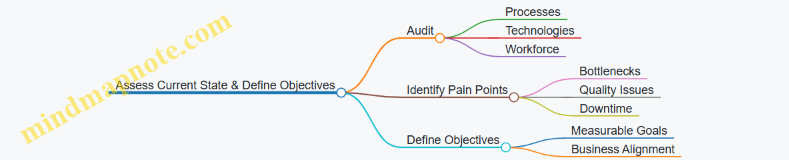
Step 2: Develop a Technology Integration Plan
- Select appropriate technologies such as IIoT sensors, AI analytics platforms, digital twins, and robotics based on assessment.
- Prioritize quick-win projects that demonstrate value early.
- Plan for integration with existing IT/OT systems ensuring interoperability.
Example: The electronics manufacturer chose to start with IIoT sensor deployment on critical machines and integrated an AI-based predictive maintenance platform that interfaced with their existing MES (Manufacturing Execution System).
Step 3: Build Cross-Functional Teams and Foster Collaboration
- Establish teams including factory managers, industrial engineers, IT specialists, data scientists, and operators.
- Promote open communication channels to align goals and share insights.
- Provide training programs to upskill workforce on new technologies and processes.
Example: The company formed a Smart Manufacturing Task Force comprising representatives from production, maintenance, IT, and quality assurance. Regular workshops and hands-on training sessions were held to build AI literacy among operators.
Step 4: Implement Pilot Projects and Iterate
- Launch pilot projects in controlled environments to validate technology and processes.
- Collect data and feedback to refine solutions.
- Use pilot results to build business cases for broader deployment.
Example: The electronics manufacturer piloted AI-driven predictive maintenance on a single production line. After reducing unplanned downtime by 30%, they expanded the solution plant-wide.

Step 5: Scale and Optimize
- Roll out successful pilots across the entire manufacturing ecosystem.
- Continuously monitor KPIs and use AI-driven analytics to optimize operations.
- Establish continuous improvement cycles leveraging real-time data.
Example: After scaling, the company implemented a centralized dashboard providing real-time insights on machine health, production efficiency, and quality metrics, enabling proactive decision-making.
Step 6: Ensure Sustainability and Cybersecurity
- Integrate energy-efficient practices and monitor environmental impact.
- Implement robust cybersecurity measures to protect data and infrastructure.
- Regularly update systems and train staff on security protocols.
Example: The manufacturer adopted AI-based energy monitoring to reduce consumption by 10% and deployed network segmentation and multi-factor authentication to safeguard IIoT devices.
Summary Mindmap: Strategic Roadmap Overview
By following this strategic roadmap, factory managers and industrial engineers can systematically transform their manufacturing operations into cognitive factories that are agile, efficient, and future-ready.
12.3 Overcoming Common Challenges and Pitfalls
Implementing cognitive factories within smart manufacturing ecosystems is a transformative journey that comes with its share of challenges. Recognizing these common pitfalls early and adopting strategic measures can significantly improve the success rate of your smart manufacturing initiatives. In this section, we explore key challenges, practical solutions, and illustrative examples to help factory managers and industrial engineers navigate this complex landscape.
Common Challenges Mind Map
Data Management Issues
Challenge: Poor data quality and siloed information can cripple AI-driven decision-making.
Best Practice: Establish a robust data governance framework that ensures data accuracy, consistency, and accessibility across departments.
Example: A mid-sized electronics manufacturer faced inconsistent sensor data from different production lines, leading to unreliable predictive maintenance alerts. By implementing a centralized data platform with automated data validation rules, they improved data quality by 35%, resulting in more accurate AI insights and a 20% reduction in unplanned downtime.
Technology Integration
Challenge: Integrating new cognitive factory technologies with legacy systems often causes compatibility and scalability issues.
Best Practice: Adopt modular, open-architecture solutions and use middleware platforms that facilitate interoperability.
Example: A food processing plant struggled to integrate their existing SCADA system with new AI-based quality inspection tools. By deploying an IIoT middleware layer that standardized communication protocols, they achieved seamless integration, enabling real-time quality feedback and reducing product defects by 15%.
Workforce Adaptation
Challenge: Resistance to change and skill gaps can slow down adoption of smart manufacturing technologies.
Best Practice: Engage employees early, provide continuous training, and promote a culture of innovation.
Example: A pharmaceutical manufacturer introduced AI-powered process optimization but initially faced pushback from operators. They launched a comprehensive upskilling program combined with hands-on workshops, which increased employee confidence and led to a 25% improvement in process efficiency within six months.
Cybersecurity Risks
Challenge: Increased connectivity exposes manufacturing ecosystems to cyber threats.
Best Practice: Implement multi-layered security measures, conduct regular audits, and develop incident response plans.
Example: An automotive parts supplier experienced a phishing attack targeting their IIoT network. Post-incident, they deployed network segmentation, endpoint protection, and mandatory cybersecurity training, which prevented further breaches and secured sensitive production data.
Change Management
Challenge: Lack of clear vision and poor communication can derail smart manufacturing projects.
Best Practice: Develop a clear strategic roadmap, involve stakeholders at all levels, and maintain transparent communication channels.
Example: A textile factory’s initial cognitive factory rollout stalled due to unclear objectives. After revising their strategy to include regular cross-departmental meetings and leadership buy-in, the project regained momentum and achieved a 30% increase in operational agility.
Cost and ROI Concerns
Challenge: High upfront costs and unclear ROI metrics can make it difficult to justify investments.
Best Practice: Start with pilot projects, define measurable KPIs, and use phased investments to demonstrate incremental value.
Example: A chemical plant piloted AI-based energy optimization on a single production line. By tracking energy savings and reduced downtime, they proved a 12% cost reduction, which justified scaling the solution plant-wide.
Summary Mind Map: Overcoming Challenges
By proactively addressing these challenges with proven best practices and real-world examples, factory managers and industrial engineers can build resilient, efficient, and adaptive cognitive factories that unlock the full potential of smart manufacturing ecosystems.
12.4 Final Thoughts: Building Resilient and Adaptive Manufacturing Ecosystems
In today’s rapidly evolving industrial landscape, resilience and adaptability are no longer optional—they are essential for survival and growth. Cognitive factories, powered by smart manufacturing ecosystems, offer a transformative pathway to achieve these qualities. This section synthesizes the core principles and practical insights to help factory managers and industrial engineers build manufacturing ecosystems that can withstand disruptions, adapt to changing demands, and continuously improve.
Key Pillars of Resilient and Adaptive Manufacturing Ecosystems
Embracing Technological Agility
A resilient ecosystem leverages modular and scalable technologies. For example, a mid-sized electronics manufacturer implemented digital twins combined with AI-driven predictive maintenance. When a critical machine showed early signs of wear, the system automatically adjusted production schedules and ordered parts, avoiding costly downtime. This flexibility allowed the factory to adapt quickly without halting operations.
Fostering a Culture of Continuous Learning and Collaboration
Technology alone is insufficient without a workforce ready to embrace change. Cross-functional teams that include IT, OT, and engineering experts foster innovation and rapid problem-solving. For instance, a consumer goods plant established weekly “innovation huddles” where operators and engineers shared insights from AI-powered quality control dashboards, leading to a 15% reduction in defects within six months.
Agile and Data-Driven Processes
Agility in manufacturing means being able to pivot production lines and processes swiftly. Using real-time data analytics, a pharmaceutical manufacturer optimized batch sizes dynamically based on demand forecasts, reducing inventory costs and waste. Feedback loops from quality AI systems enabled immediate adjustments, ensuring consistent product quality.

Prioritizing Cybersecurity and Risk Management
As ecosystems become more interconnected, vulnerabilities increase. A smart factory producing automotive components faced a ransomware attack attempt but successfully repelled it by implementing a layered cybersecurity framework, including network segmentation and continuous monitoring. This proactive stance ensured minimal operational impact and preserved customer trust.
Embedding Sustainability as a Core Value
Resilience also means being environmentally responsible. A chemical plant integrated AI to monitor energy consumption and optimize heating processes, reducing energy use by 20%. This not only lowered costs but also aligned with corporate sustainability goals, enhancing brand reputation.
Summary Mindmap: Building Resilient & Adaptive Manufacturing Ecosystems
Final Example: Cognitive Factory in Action
Consider a global aerospace supplier that faced supply chain disruptions during a crisis. By leveraging its cognitive factory ecosystem, which integrated AI-powered supply chain analytics, real-time production monitoring, and a highly trained workforce, the company rapidly reconfigured its production schedules and sourced alternative materials. This adaptability minimized delays and maintained customer commitments, illustrating the power of resilient manufacturing ecosystems.
In conclusion, building resilient and adaptive manufacturing ecosystems requires a holistic approach that combines advanced technologies, empowered people, agile processes, robust data strategies, and a commitment to sustainability and security. By embedding these principles, factory managers and industrial engineers can future-proof their operations and thrive in an uncertain world.
12.5 Resources and Further Reading for Continuous Learning
To stay at the forefront of smart manufacturing and cognitive factory advancements, continuous learning is essential. Below is a curated list of resources, categorized by topic, along with mind maps to help visualize key concepts and examples for practical understanding.
A. Books and Industry Reports
- “Smart Manufacturing: Concepts and Methods” by Masoud Soroush
- “Artificial Intelligence for Smart Manufacturing” by Jay Lee
- McKinsey & Company: The Smart Factory of the Future (Industry report)
- World Economic Forum: Shaping the Future of Advanced Manufacturing and Production
B. Online Courses and Certifications
- Coursera: AI For Everyone by Andrew Ng
- edX: Industrial Internet of Things (IIoT) on Microsoft Azure
- MIT OpenCourseWare: Data Science and Big Data Analytics
- Udacity: Robotics Software Engineer Nanodegree
C. Industry Communities and Forums
- Industrial Internet Consortium (IIC)
- Smart Manufacturing Leadership Coalition (SMLC)
- LinkedIn Groups: Smart Manufacturing & Industry 4.0
- Reddit: r/IndustrialAutomation
D. Software and Tools
- Siemens MindSphere – Industrial IoT platform
- PTC ThingWorx – IoT and AR platform
- TensorFlow and PyTorch – AI frameworks
- Tableau and Power BI – Data visualization tools
Mind Maps
Smart Manufacturing Ecosystem Overview
Cognitive Factory Implementation Roadmap

AI Applications in Smart Manufacturing
Cybersecurity in Cognitive Factories
Practical Examples for Continuous Learning
-
Example 1: Predictive Maintenance Learning Path
- Start with understanding sensor data basics
- Explore machine learning models for time series data
- Experiment with open datasets like NASA Turbofan Engine Degradation Simulation
- Implement a simple predictive maintenance model using Python
-
Example 2: Digital Twin Development
- Learn CAD and simulation tools (e.g., Siemens NX, ANSYS)
- Study IoT data integration techniques
- Build a basic digital twin prototype for a conveyor system
- Use real-time data to simulate and optimize operations
-
Example 3: AI-Driven Quality Inspection
- Understand image processing fundamentals
- Use open-source tools like OpenCV
- Train a convolutional neural network (CNN) to detect defects
- Deploy the model on edge devices for real-time inspection
Tips for Effective Continuous Learning
- Set clear learning goals aligned with your factory’s strategic objectives.
- Join webinars and workshops hosted by industry leaders.
- Participate in pilot projects to gain hands-on experience.
- Collaborate with cross-functional teams to broaden your perspective.
- Regularly review and update your knowledge as technologies evolve.
By leveraging these resources, mind maps, and examples, factory managers and industrial engineers can build a strong foundation and continuously enhance their expertise in smart manufacturing ecosystems powered by cognitive factories.