Design For Manufacturability And Cost Optimization In Hybrid Additive And CNC Workflows
1. Introduction to Hybrid Manufacturing Workflows
1.1 Overview of Hybrid Additive and CNC Manufacturing
Hybrid manufacturing combines the strengths of additive manufacturing (AM) and computer numerical control (CNC) machining to produce complex, high-precision parts efficiently and cost-effectively. This approach leverages the design freedom of AM with the accuracy and surface finish quality of CNC machining.
What is Hybrid Manufacturing?
Hybrid manufacturing integrates additive and subtractive processes within a single workflow or machine setup. Typically, a part is first built up layer-by-layer using additive techniques such as selective laser melting (SLM), fused deposition modeling (FDM), or directed energy deposition (DED). Subsequently, CNC machining operations refine critical features, improve tolerances, and achieve desired surface finishes.
Mind Map: Core Components of Hybrid Manufacturing
Why Combine Additive and CNC?
- Design Freedom + Precision: AM allows creation of intricate internal channels or lattice structures impossible with traditional machining, while CNC ensures critical dimensions and finishes are met.
- Cost Efficiency: Reduces raw material waste by building near-net-shape parts additively, then machining only necessary areas.
- Lead Time Reduction: Enables faster prototyping and production by minimizing multiple setups and tooling changes.
Example: Aerospace Bracket Production
An aerospace bracket with complex internal cooling channels is first additively manufactured using DED. The rough shape includes intricate internal passages for weight reduction and thermal management. After the build, CNC milling refines mounting surfaces and holes to tight aerospace tolerances, ensuring proper assembly and function.
This hybrid approach reduces material waste by 40% compared to fully machined brackets and cuts lead time by 25%.
Mind Map: Benefits and Challenges of Hybrid Manufacturing
Key Takeaways
- Hybrid manufacturing is a synergistic approach combining additive and subtractive methods.
- It enables production of parts with complex geometries and high precision.
- Effective workflow planning and design for manufacturability are essential to maximize benefits.
This section sets the foundation for understanding how hybrid workflows can revolutionize manufacturing by blending the best of both worlds: the limitless design potential of additive manufacturing and the precision and finish quality of CNC machining.
1.2 Benefits and Challenges of Combining Additive and Subtractive Processes
Hybrid manufacturing workflows that combine additive manufacturing (AM) and subtractive CNC machining harness the strengths of both technologies to create parts that are complex, precise, and cost-effective. Understanding the benefits and challenges of this combination is essential for manufacturing process engineers, industrial engineers, and operations managers aiming to optimize production.
Benefits of Combining Additive and Subtractive Processes
-
Design Freedom with Precision
- Additive manufacturing enables the creation of complex geometries, internal channels, and lightweight lattice structures that are difficult or impossible to machine.
- CNC machining provides high precision, excellent surface finish, and tight tolerances on critical features.
-
Cost and Time Efficiency
- Additive manufacturing reduces material waste by building parts layer-by-layer only where needed.
- CNC machining can rapidly finish critical surfaces and features, reducing post-processing time.
- Hybrid workflows can reduce overall lead times by minimizing multiple setups and enabling near-net-shape production.
-
Material Utilization and Sustainability
- Combining processes reduces raw material consumption compared to full subtractive manufacturing.
- Enables repair and refurbishment by adding material only where needed.
-
Improved Mechanical Properties
- Hybrid parts can leverage the best properties of both processes, such as dense machined surfaces combined with lightweight internal AM structures.
-
Flexibility in Production
- Hybrid workflows allow for rapid prototyping and easy design iteration.
- Suitable for low to medium volume production runs with complex requirements.
Mind Map: Benefits of Hybrid Additive and CNC Manufacturing
Challenges of Combining Additive and Subtractive Processes
-
Process Integration Complexity
- Aligning additive and subtractive steps requires careful planning to ensure proper registration and fixturing.
- CAD/CAM software integration can be complex, requiring expertise in both domains.
-
Material and Process Compatibility
- Differences in thermal histories and residual stresses between AM and CNC processes can cause distortion or warping.
- Selecting materials suitable for both additive and subtractive processing can be limiting.
-
Surface Finish and Tolerancing Issues
- Additive surfaces often require significant machining to meet tight tolerances.
- Managing dimensional accuracy across processes is challenging.
-
Equipment and Capital Investment
- Hybrid manufacturing requires investment in both AM and CNC equipment, potentially increasing capital costs.
- Maintenance and training for hybrid systems add operational complexity.
-
Quality Control Complexity
- Inspection methods must accommodate both AM and machined features.
- Non-destructive testing can be more complicated for hybrid parts.
-
Lead Time and Workflow Coordination
- Hybrid workflows can introduce bottlenecks if additive and subtractive steps are not well synchronized.
Mind Map: Challenges of Hybrid Additive and CNC Manufacturing
Examples Illustrating Benefits and Challenges
Example 1: Aerospace Bracket with Internal Cooling Channels
- Benefit: Additive manufacturing creates complex internal cooling channels impossible to machine conventionally.
- Benefit: CNC machining finishes mounting surfaces to tight aerospace tolerances.
- Challenge: Ensuring accurate alignment between AM and machined features requires precise fixturing.
- Challenge: Managing residual stress from AM to avoid distortion during machining.
Example 2: Medical Implant with Customized Geometry
- Benefit: AM allows patient-specific porous structures for bone ingrowth.
- Benefit: CNC machining achieves smooth articulating surfaces.
- Challenge: Material compatibility limits choice to biocompatible alloys suitable for both processes.
- Challenge: Complex quality control needed to inspect porous and machined surfaces.
Example 3: Automotive Tooling Insert
- Benefit: Hybrid workflow reduces lead time by building near-net-shape inserts additively and finishing critical surfaces by CNC.
- Benefit: Material waste is minimized compared to full subtractive machining.
- Challenge: Workflow coordination to avoid delays between additive build and machining.
Summary
Combining additive and subtractive manufacturing processes unlocks significant benefits in design freedom, precision, cost efficiency, and sustainability. However, it also introduces challenges related to process integration, material compatibility, surface finish, and quality control. Successful hybrid manufacturing requires a balanced approach that leverages best practices in both domains, supported by careful planning, skilled workforce, and appropriate technology investment.
1.3 Key Terminology and Concepts in Hybrid Manufacturing
Hybrid manufacturing combines additive manufacturing (AM) and subtractive manufacturing (CNC machining) processes to leverage the strengths of both methods. Understanding the key terminology and concepts is essential for manufacturing process engineers, industrial engineers, and operations managers to design, plan, and optimize hybrid workflows effectively.
Key Terminology
- Additive Manufacturing (AM): A process of creating parts by adding material layer by layer, commonly known as 3D printing.
- CNC Machining: A subtractive manufacturing process where material is removed from a solid block using computer-controlled cutting tools.
- Hybrid Manufacturing: The integration of additive and subtractive processes within a single workflow or machine to produce complex parts efficiently.
- Build Orientation: The direction in which a part is fabricated in additive manufacturing, affecting surface quality, support requirements, and build time.
- Support Structures: Temporary material added during AM to support overhangs or complex geometries, later removed in post-processing.
- Toolpath: The programmed route that a CNC machine’s cutting tool follows to remove material.
- Post-Processing: Operations performed after the main manufacturing steps, including support removal, surface finishing, heat treatment, or inspection.
- Tolerancing: The allowable variation in part dimensions to ensure proper fit and function.
- Feature Segmentation: Dividing a part’s geometry into sections best suited for either additive or subtractive manufacturing.
- Material Deposition Rate: Speed at which material is added in AM, influencing build time and cost.
Core Concepts Mind Map
Example: Terminology in Practice
Consider the manufacturing of a complex aerospace bracket:
- The bracket’s internal cooling channels are produced using additive manufacturing to create intricate geometries impossible with traditional methods.
- The external surfaces requiring tight tolerances and smooth finishes are machined using CNC machining.
- The build orientation is selected to minimize support structures inside the channels, reducing post-processing time.
- The toolpath for CNC is optimized to reduce tool changes and machining time.
- Feature segmentation divides the bracket into additive and subtractive zones.
Hybrid Workflow Concepts Mind Map
Additional Examples
-
Support Structures:
- Example: A turbine blade printed with AM requires support structures on overhangs. By adjusting the build orientation, supports are minimized, reducing material waste and labor.
-
Toolpath Optimization:
- Example: A mold insert is CNC-machined after additive build. The toolpath is programmed to machine only critical surfaces, saving time and tooling costs.
-
Feature Segmentation:
- Example: A medical implant has porous lattice structures made additively for bone integration, while the mounting surfaces are machined to tight tolerances.
Understanding these terms and concepts lays the foundation for designing efficient hybrid manufacturing workflows that optimize cost, quality, and lead time.
1.4 Real-World Examples of Hybrid Manufacturing Applications
Hybrid manufacturing, which combines additive manufacturing (AM) and CNC machining, is revolutionizing production across various industries by leveraging the strengths of both processes. Below are detailed examples and mind maps illustrating how hybrid workflows are applied in real-world scenarios.
Example 1: Aerospace Component Production
Context: Aerospace parts often require complex geometries, lightweight structures, and tight tolerances. Hybrid manufacturing enables the production of intricate internal channels via additive manufacturing, followed by precise CNC machining of critical surfaces.
Process:
- Additive manufacturing builds the complex internal lattice and cooling channels.
- CNC machining finishes mounting surfaces and critical interfaces.
Benefits:
- Weight reduction through lattice structures.
- Improved thermal management.
- Reduced lead time compared to traditional subtractive-only methods.
Mind Map:
Example 2: Medical Device Implants
Context: Customized implants require patient-specific geometry and biocompatible surfaces. Hybrid manufacturing allows for near-net-shape AM production with CNC machining for surface finish and fitting accuracy.
Process:
- AM creates the customized implant shape based on patient scans.
- CNC machining refines joint surfaces and critical interfaces.
Benefits:
- Customization for individual patients.
- Improved implant fit and longevity.
- Cost-effective small batch production.
Mind Map:
Example 3: Automotive Tooling Inserts
Context: Automotive manufacturers require durable tooling inserts with conformal cooling channels to improve cycle times. Hybrid manufacturing produces inserts with internal cooling via AM and precise external features via CNC.
Process:
- AM builds the internal conformal cooling channels.
- CNC machines external surfaces and critical dimensions.
Benefits:
- Improved cooling efficiency.
- Extended tool life.
- Faster production cycles.
Mind Map:
Example 4: Consumer Electronics Enclosures
Context: Enclosures require aesthetic surfaces and internal mounting features. Hybrid manufacturing enables rapid prototyping with AM and high-quality surface finishes with CNC.
Process:
- AM produces the prototype enclosure with internal features.
- CNC machining polishes external surfaces and adds threaded holes.
Benefits:
- Rapid design iteration.
- High-quality surface finish.
- Reduced tooling costs.
Mind Map:
Example 5: Industrial Pumps and Valves
Context: Complex flow paths and tight sealing surfaces are critical. Hybrid manufacturing allows building complex internal geometries with AM and finishing sealing surfaces with CNC.
Process:
- AM creates complex internal flow channels.
- CNC machines sealing faces and mounting points.
Benefits:
- Enhanced fluid dynamics.
- Improved sealing and assembly.
- Reduced manufacturing complexity.
Mind Map:
Summary
These examples demonstrate how hybrid manufacturing workflows enable the production of parts that are otherwise difficult or impossible to manufacture efficiently with only additive or subtractive methods. By strategically combining AM and CNC machining, manufacturers can optimize for cost, quality, and performance across diverse industries.
2. Fundamentals of Design for Manufacturability (DFM) in Hybrid Processes
2.1 Principles of DFM for Additive Manufacturing
Design for Manufacturability (DFM) in additive manufacturing (AM) focuses on creating parts that maximize the strengths of AM technologies while minimizing costs, build time, and post-processing efforts. Unlike traditional subtractive methods, AM allows for complex geometries, internal features, and part consolidation, but also introduces unique constraints such as support structures, build orientation, and layer resolution.
Key Principles of DFM for Additive Manufacturing
Minimize Support Structures
- Why: Supports increase material usage, build time, and post-processing labor.
- How: Design self-supporting angles (typically >45°), use chamfers or fillets instead of sharp overhangs.
Optimize Part Orientation
- Why: Orientation affects surface finish, build time, and support requirements.
- How: Orient parts to minimize supports on critical surfaces and reduce layer count.
Design for Layer Resolution and Surface Finish
- Why: Layer thickness impacts surface roughness and build time.
- How: Use thicker layers for non-critical surfaces to save time; thinner layers for detailed areas.
Consolidate Parts
- Why: Reduces assembly time, fasteners, and potential failure points.
- How: Combine multiple components into a single print when feasible.
Incorporate Functional Features
- Why: AM enables internal channels, lattice structures, and complex geometries.
- How: Design conformal cooling channels or lightweight lattice infills to improve performance.
Consider Material and Process Constraints
- Why: Different AM processes (SLA, SLS, DMLS, FDM) have unique limitations.
- How: Tailor designs to process-specific minimum feature sizes, tolerances, and material behaviors.
Plan for Post-Processing
- Why: Supports removal, surface finishing, and heat treatments add cost and time.
- How: Design with easy access for support removal and finishing tools.
Mind Map: Principles of DFM for Additive Manufacturing
Practical Examples
Example 1: Minimizing Supports for a Bracket
Original Design: A bracket with a horizontal overhang of 30° from vertical, requiring extensive support.
DFM Improvement: Redesign the overhang angle to 60°, adding a fillet to transition smoothly. This reduces support volume by 70%, cutting material use and post-processing time.
Example 2: Part Consolidation in a Valve Assembly
Original Design: Valve body assembled from 5 separate CNC-machined parts.
DFM Improvement: Redesigned as a single AM part with integrated channels and mounting features, eliminating assembly steps and reducing leak points.
Example 3: Optimizing Orientation for Surface Finish
Scenario: A turbine blade requires a smooth aerodynamic surface.
DFM Improvement: Orient the blade so the aerodynamic surface faces upward, minimizing layer lines and supports on that critical face, improving surface finish and reducing polishing effort.
Example 4: Designing Internal Cooling Channels
Scenario: Injection mold core requires cooling.
DFM Improvement: Use AM to incorporate conformal cooling channels that follow the mold geometry, improving cooling efficiency and reducing cycle time.
Summary
Designing for additive manufacturing requires a shift in mindset from traditional machining. By focusing on minimizing supports, optimizing orientation, leveraging AM’s unique capabilities like part consolidation and internal features, and planning for post-processing, engineers can significantly reduce costs and improve manufacturability. These principles, supported by practical examples, serve as a foundation for successful hybrid workflows integrating AM and CNC machining.
2.2 Principles of DFM for CNC Machining
Design for Manufacturability (DFM) in CNC machining focuses on creating parts that are easy, efficient, and cost-effective to produce using subtractive manufacturing methods. Applying DFM principles early in the design phase reduces production time, minimizes waste, and lowers overall costs.
Key Principles of DFM for CNC Machining
Design Simplification
- Reduce Complex Features: Avoid intricate geometries that require special tooling or multiple setups.
- Minimize Tight Tolerances: Only specify tight tolerances where functionally necessary to reduce machining time.
Example: Instead of designing a part with a complex internal pocket requiring specialized cutters, redesign the pocket with simpler shapes or split it into multiple parts that can be easily machined and assembled.
Material Selection
- Choose Machinable Materials: Select materials known for good machinability, such as aluminum alloys or certain plastics, to reduce tool wear and machining time.
- Consider Material Cost & Availability: Balance performance requirements with cost and lead time.
Example: For a prototype, use 6061 aluminum instead of stainless steel to reduce machining hours and tooling costs.
Feature Design
- Standard Hole Sizes: Use standard drill sizes to avoid custom tooling.
- Avoid Deep Cavities: Deep pockets increase cycle time and risk tool deflection.
- Use Rounded Corners: Sharp internal corners require EDM or special tooling; use fillets to simplify machining.
Example: A bracket originally designed with sharp 90° internal corners was redesigned with 3 mm fillets, eliminating the need for EDM and reducing machining time by 25%.
Setup and Tooling
- Minimize Setup Changes: Design parts to be machined in fewer setups to reduce labor and alignment errors.
- Design for Standard Tool Access: Ensure tools can reach all features without collision.
Example: A gearbox housing was redesigned so all critical features were accessible from one side, enabling single-setup machining and improving accuracy.
Tolerancing & Surface Finish
- Apply Realistic Tolerances: Avoid unnecessarily tight tolerances that increase machining difficulty and cost.
- Specify Cost-Effective Surface Finishes: Use finishes achievable by standard machining rather than expensive polishing or grinding.
Example: Changing a tolerance from ±0.01 mm to ±0.05 mm on a non-critical dimension reduced machining time by 15% without affecting function.
Part Orientation
- Optimize for Fixturing: Design features to facilitate easy and secure fixturing.
- Minimize Repositioning: Reduce the number of times the part must be repositioned during machining.
Example: A custom clamp was designed with flat datum surfaces to enable quick and repeatable fixturing, reducing setup time by 40%.
Batch Processing
- Design for Multiple Parts per Setup: Use symmetrical or modular designs to machine multiple parts simultaneously.
- Use Symmetry: Symmetrical parts can be fixtured more easily and reduce programming complexity.
Example: A set of identical brackets was redesigned to fit four per fixture plate, quadrupling throughput without additional machine time.
Summary Table of DFM Principles with Examples
| Principle | Best Practice | Example Outcome |
|---|---|---|
| Design Simplification | Avoid complex pockets and tight tolerances | 25% reduction in machining time |
| Material Selection | Use machinable, cost-effective materials | Prototype cost reduced by 30% |
| Feature Design | Use standard holes and rounded corners | Eliminated EDM, saved tooling costs |
| Setup and Tooling | Minimize setups, ensure tool access | Single-setup machining improved accuracy |
| Tolerancing & Finishes | Apply realistic tolerances, standard finishes | 15% faster machining without functional impact |
| Part Orientation | Design for easy fixturing | Setup time cut by 40% |
| Batch Processing | Machine multiple parts per setup | Throughput increased 4x |
By applying these DFM principles for CNC machining, manufacturing process engineers and designers can significantly reduce production costs and lead times while maintaining or improving part quality and functionality.
2.3 Integrating DFM Principles Across Hybrid Workflows
Design for Manufacturability (DFM) in hybrid additive and CNC workflows requires a holistic approach that leverages the strengths of both processes while mitigating their limitations. Integrating DFM principles across these workflows ensures optimized part design, reduced production costs, and improved quality.
Key Considerations for Integration
- Process Synergy: Identify which features are best suited for additive manufacturing (AM) and which for CNC machining.
- Design Partitioning: Strategically divide the part into segments optimized for each process.
- Material Compatibility: Ensure materials used in AM and CNC stages are compatible or can be joined effectively.
- Tolerance Management: Balance the achievable tolerances of both processes to meet functional requirements.
- Post-Processing Planning: Design with post-processing steps in mind to minimize time and cost.
Mind Map: Integrating DFM Principles Across Hybrid Workflows
Best Practices with Examples
-
Process Synergy: Assigning Features to the Most Suitable Process
- Practice: Use additive manufacturing for complex internal geometries, lattice structures, or lightweight features that are difficult or impossible to machine.
- Example: A cooling channel inside an injection mold insert is additively manufactured to create conformal cooling, while the external surfaces are CNC machined for precision and surface finish.
-
Design Partitioning: Modularizing the Part for Hybrid Production
- Practice: Break down the design into modules or segments that can be separately optimized and manufactured by AM or CNC.
- Example: A drone frame is designed with a central body additively manufactured to incorporate complex internal wiring channels, while the arms are CNC machined for strength and precision.
-
Material Compatibility: Selecting Materials and Joining Methods
- Practice: Choose materials that can be joined reliably, such as using the same alloy for both AM and CNC parts or selecting compatible adhesives or mechanical fasteners.
- Example: A titanium bracket is partially additively built and then machined; the design includes dovetail joints to mechanically lock the AM and CNC sections.
-
Tolerance Management: Aligning Design Tolerances with Process Capabilities
- Practice: Assign tighter tolerances to CNC-machined features and looser tolerances to AM features, designing interfaces accordingly.
- Example: A hybrid gearbox housing has bearing seats machined to ±0.01 mm tolerance, while the surrounding complex ribs are additively manufactured with ±0.1 mm tolerance.
-
Post-Processing Planning: Designing for Efficient Finishing and Assembly
- Practice: Design parts to minimize support removal, enable easy access for finishing tools, and simplify assembly.
- Example: A medical implant is additively manufactured with minimal supports and designed with flat surfaces for CNC finishing to achieve required surface roughness.
Mind Map: Example Workflow for Hybrid DFM Integration
Summary
Integrating DFM principles across hybrid additive and CNC workflows is essential to harness the full potential of both manufacturing methods. By carefully analyzing part features, partitioning designs, managing materials and tolerances, and planning post-processing, engineers can optimize manufacturability and reduce costs. Real-world examples demonstrate how these principles translate into tangible benefits such as improved performance, reduced lead times, and cost savings.
2.4 Case Study: Designing a Complex Aerospace Component for Hybrid Production
In this section, we explore a detailed case study of designing a complex aerospace bracket using a hybrid additive and CNC machining workflow. This example highlights how Design for Manufacturability (DFM) principles are applied to optimize both manufacturability and cost.
Background
A leading aerospace manufacturer required a lightweight, high-strength bracket to support avionics equipment. The component features complex internal channels for weight reduction and cooling, tight tolerances on mounting surfaces, and a requirement for excellent surface finish on critical interfaces.
Traditional CNC machining of this part was costly and time-consuming due to the intricate internal features. Pure additive manufacturing was considered but posed challenges in achieving the required surface finish and dimensional accuracy on mounting points.
A hybrid manufacturing approach was selected to leverage the strengths of both additive manufacturing and CNC machining.
Step 1: Initial Design and Requirements
-
Functional Requirements:
- Support avionics equipment securely
- Incorporate internal cooling channels
- Maintain strict tolerances on mounting surfaces (±0.05 mm)
- Minimize weight
-
Material: Aerospace-grade aluminum alloy (Al 7075)
-
Manufacturing Constraints:
- CNC machining for critical surfaces
- Additive manufacturing for complex internal geometries
Step 2: Design for Additive Manufacturing (DfAM) Considerations
- Internal Channels: Designed with smooth curves and consistent cross-sections to minimize support structures and improve flow.
- Orientation: Part oriented to minimize supports on critical surfaces.
- Support Structures: Reduced by incorporating self-supporting angles (>45°) and lattice infills where possible.
Step 3: Design for CNC Machining Considerations
- Critical Surfaces: Flat mounting faces and bolt holes designed with standard tooling access.
- Feature Simplification: Complex external features simplified to reduce tool changes.
- Tolerances: Tight tolerances reserved for CNC-machined surfaces only.
Step 4: Hybrid Workflow Planning
- Additive Manufacturing: Build the near-net shape including internal channels and complex geometries.
- CNC Machining: Post-process critical surfaces for dimensional accuracy and surface finish.
Mind Map: Hybrid Design Considerations
Step 5: Example - Redesigning the Bracket
Original Design: Fully CNC machined, requiring multiple setups and complex tooling to create internal channels via drilling and milling.
Hybrid Design: Internal channels created via additive manufacturing, external mounting surfaces machined post-build.
Outcome:
- Additive build time reduced by 25% through optimized orientation and support reduction.
- CNC machining time reduced by 40% by limiting machining to critical surfaces only.
- Overall cost reduced by approximately 30%.
Step 6: Lessons Learned and Best Practices
- Early collaboration between design, additive manufacturing, and CNC machining teams is critical.
- Use CAD tools capable of separating features by manufacturing method.
- Prioritize additive manufacturing for complex internal features and CNC for high-precision external surfaces.
- Optimize part orientation to reduce supports and post-processing.
Additional Mind Map: Cost Optimization Strategies
Summary
This case study demonstrates how applying DFM principles tailored to hybrid additive and CNC workflows can significantly improve manufacturability and reduce costs in aerospace components. By strategically assigning features to the most suitable manufacturing process and optimizing design accordingly, manufacturers can achieve high-performance parts with efficient production cycles.
3. Material Selection and Its Impact on Manufacturability and Cost
3.1 Material Properties Relevant to Additive Manufacturing
Additive manufacturing (AM), also known as 3D printing, enables the creation of complex geometries layer-by-layer. However, the success of AM depends heavily on understanding the material properties that influence printability, mechanical performance, and post-processing requirements. This section explores the key material properties relevant to AM, illustrated with mind maps and practical examples.
Key Material Properties in Additive Manufacturing
Mechanical Properties
-
Tensile Strength & Yield Strength: These determine the load a printed part can withstand before failure or permanent deformation. For example, Inconel 718 printed via laser powder bed fusion exhibits high tensile strength (~1100 MPa), making it suitable for aerospace components.
-
Elastic Modulus: Influences stiffness. Polymers like ABS have a lower modulus (~2 GPa) compared to metals like titanium (~110 GPa).
-
Ductility: Important for parts expected to undergo deformation without cracking. Some AM metals may exhibit anisotropy affecting ductility.
-
Fatigue Resistance: Critical for cyclic loading applications. AM parts may require heat treatment to improve fatigue life.
Example: A hybrid aerospace bracket printed in titanium alloy must balance tensile strength and fatigue resistance to endure operational stresses.
Thermal Properties
-
Melting Point: Defines the processing temperature window. For instance, aluminum alloys melt around 660°C, requiring specific laser parameters in powder bed fusion.
-
Thermal Conductivity: Affects heat dissipation during printing; metals generally have higher conductivity than polymers.
-
Thermal Expansion: Mismatch in thermal expansion can cause warping or residual stress.
-
Heat Deflection Temperature: Relevant for polymers to ensure dimensional stability under load and heat.
Example: Nylon 12 used in selective laser sintering has a heat deflection temperature around 178°C, suitable for functional prototypes but limited for high-temp applications.
Rheological Properties
-
Viscosity: For material extrusion (FDM), filament viscosity affects flow through the nozzle.
-
Flowability: Powder flowability is critical in powder bed fusion to ensure uniform layers.
-
Particle Size Distribution: Influences packing density and surface finish.
Example: Metal powders with a narrow particle size distribution (15-45 microns) improve layer uniformity and reduce porosity in laser powder bed fusion.
Chemical Properties
-
Oxidation Resistance: Some metals oxidize during printing, affecting mechanical properties.
-
Corrosion Resistance: Important for parts exposed to harsh environments.
-
Reactivity with Atmosphere: AM often requires inert atmospheres (argon, nitrogen) to prevent unwanted reactions.
Example: Stainless steel 316L is popular in AM due to good corrosion resistance and relatively low oxidation.
Surface Properties
-
Surface Energy: Affects powder spreading and layer adhesion.
-
Roughness: AM parts typically have higher surface roughness, influencing post-processing needs.
Example: SLA printed parts have smoother surfaces compared to powder bed fusion, impacting finishing costs.
Compatibility with AM Processes
Different AM processes have unique material requirements:
-
Powder Bed Fusion: Requires fine, spherical powders with good flowability.
-
Directed Energy Deposition: Can use wire or powder feedstock; material properties must tolerate rapid melting and solidification.
-
Material Extrusion: Filament or pellet rheology critical.
-
Vat Photopolymerization: Requires photopolymer resins with specific curing properties.
Example: Titanium alloy Ti-6Al-4V is widely used in powder bed fusion but less common in extrusion due to filament limitations.
Summary Mind Map
By understanding and selecting materials based on these properties, manufacturing process engineers and designers can optimize hybrid additive and CNC workflows for performance, cost, and manufacturability.
3.2 Material Considerations for CNC Machining
When designing parts for CNC machining within a hybrid manufacturing workflow, material selection plays a pivotal role in manufacturability, cost, and final part performance. Understanding the machinability, mechanical properties, and cost implications of different materials helps engineers optimize both the additive and subtractive stages.
Key Material Properties Affecting CNC Machining
- Hardness: Harder materials increase tool wear and machining time.
- Toughness: Materials with high toughness can cause tool deflection or breakage.
- Thermal Conductivity: Affects heat dissipation during cutting, influencing tool life.
- Ductility: Highly ductile materials may cause built-up edge on tools.
- Surface Finish Capability: Some materials achieve better finishes with less effort.
Machinability Factors
- Cutting Speed and Feed Rates: Vary significantly by material.
- Tool Wear Rate: Materials like titanium cause faster tool wear.
- Chip Formation: Continuous chips can clog tools; segmented chips are easier to manage.
Mind Map: Material Considerations for CNC Machining
Common CNC Materials and Their Considerations
| Material | Machinability | Cost Impact | Example Use Case |
|---|---|---|---|
| Aluminum | Excellent | Low | Lightweight housings, brackets |
| Stainless Steel | Moderate to Difficult | Moderate | Corrosion-resistant parts |
| Titanium | Difficult | High | Aerospace components, implants |
| Brass | Excellent | Moderate | Electrical connectors, fittings |
| Carbon Steel | Good | Low to Moderate | Structural components |
| Plastics (e.g., PEEK, Delrin) | Easy | Low | Insulators, lightweight parts |
Example 1: Choosing Aluminum 6061 Over Stainless Steel for a CNC Bracket
Scenario: A manufacturing engineer needs to produce a bracket with moderate strength and corrosion resistance.
-
Aluminum 6061:
- Machinability: Excellent, allows higher feed rates and faster cycle times.
- Cost: Lower raw material and tooling wear costs.
- Weight: Lightweight, beneficial for assembly.
-
Stainless Steel 304:
- Machinability: Moderate, slower cutting speeds, higher tool wear.
- Cost: Higher tooling and machining time costs.
- Weight: Heavier, may impact product performance.
Decision: Aluminum 6061 is selected to optimize machining cost and cycle time while meeting mechanical requirements.
Example 2: Managing Tool Wear When Machining Titanium Alloy
Challenge: Titanium alloys are known for poor machinability due to low thermal conductivity and high strength.
Best Practices:
- Use specialized carbide or coated tools.
- Employ lower cutting speeds with high feed rates.
- Implement effective coolant strategies to reduce heat.
- Design parts to minimize deep cuts or complex features that increase tool engagement.
Result: By considering these factors early in design, machining costs and tool replacement frequency are significantly reduced.
Mind Map: Cost Impact of Material Choice in CNC Machining
Summary
Material considerations for CNC machining are critical to balancing manufacturability and cost in hybrid workflows. By understanding the machinability characteristics and cost implications of materials, engineers can make informed decisions that optimize tool life, machining time, and overall production costs. Integrating these considerations early in the design phase ensures smoother transitions between additive and subtractive processes, leading to efficient hybrid manufacturing outcomes.
3.3 Hybrid Material Strategies: Combining Materials for Optimal Performance
In hybrid additive and CNC workflows, selecting and combining materials strategically can unlock superior performance characteristics while optimizing cost and manufacturability. Hybrid material strategies leverage the unique advantages of different materials, enabling engineers to tailor parts for strength, weight, thermal properties, corrosion resistance, and cost efficiency.
Understanding Hybrid Material Strategies
Hybrid material strategies involve the deliberate use of two or more materials within a single component or assembly, often combining additive manufacturing (AM) materials with CNC-machined materials. This approach can be applied in several ways:
- Multi-material parts: Parts manufactured additively using multiple materials or combined with CNC-machined components made from different materials.
- Material inserts: Embedding CNC-machined inserts of high-performance materials into additively manufactured structures.
- Surface enhancements: Applying coatings or surface treatments via additive processes on CNC-machined substrates.
Mind Map: Hybrid Material Strategy Considerations
Key Factors When Combining Materials
-
Material Compatibility: Ensure chemical, thermal, and mechanical compatibility to avoid issues like galvanic corrosion, delamination, or thermal mismatch.
-
Joining Techniques: Select appropriate joining methods such as mechanical fastening, adhesive bonding, or metallurgical bonding enabled by additive processes.
-
Process Constraints: Consider limitations of both additive and subtractive processes for each material (e.g., melting points, machinability).
-
Design for Assembly: Design interfaces and transitions between materials to optimize strength and minimize stress concentrations.
Example 1: Titanium-Aluminum Hybrid Aerospace Bracket
-
Challenge: Achieve a lightweight yet strong bracket with complex internal cooling channels.
-
Strategy: Use additive manufacturing to create the complex internal lattice and cooling channels in aluminum for weight savings, then integrate CNC-machined titanium inserts at high-stress mounting points for enhanced strength.
-
Outcome: The hybrid material approach reduced weight by 25% compared to an all-titanium part while maintaining structural integrity.
Mind Map: Titanium-Aluminum Hybrid Bracket Design
Example 2: Medical Implant with Stainless Steel Core and Additive Porous Titanium Surface
-
Challenge: Create an implant that combines mechanical strength with excellent osseointegration.
-
Strategy: CNC machine a stainless steel core for strength and durability, then additively manufacture a porous titanium surface layer to promote bone ingrowth.
-
Outcome: The hybrid material design improved implant longevity and patient outcomes while controlling material costs.
Mind Map: Medical Implant Hybrid Material Approach
Best Practices for Hybrid Material Strategies
-
Early Design Collaboration: Engage materials scientists, process engineers, and designers early to select compatible materials and processes.
-
Simulation and Testing: Use finite element analysis (FEA) and thermal simulations to predict behavior at material interfaces.
-
Iterative Prototyping: Build prototypes to validate joining methods and performance before full production.
-
Documentation: Maintain detailed records of material properties, process parameters, and inspection results for traceability.
Summary
Hybrid material strategies in hybrid additive and CNC workflows enable the creation of parts that are optimized for performance and cost. By carefully selecting and combining materials, engineers can exploit the strengths of each manufacturing process and material, leading to innovative solutions across industries such as aerospace, medical, and automotive. Incorporating best practices and leveraging examples like titanium-aluminum aerospace brackets or stainless steel-titanium implants provides a roadmap for successful hybrid material design.
3.4 Example: Cost and Performance Trade-offs in Titanium vs Aluminum Hybrid Parts
In hybrid manufacturing workflows, material selection plays a pivotal role in balancing cost, performance, and manufacturability. Titanium and aluminum are two commonly used metals, each with distinct properties that influence design decisions in additive and CNC processes.
Overview of Titanium vs Aluminum in Hybrid Manufacturing
| Property | Titanium | Aluminum |
|---|---|---|
| Density | ~4.5 g/cm³ | ~2.7 g/cm³ |
| Strength-to-Weight | High | Moderate |
| Corrosion Resistance | Excellent | Good (varies by alloy) |
| Machinability | Difficult, tool wear higher | Easier, faster machining |
| Additive Manufacturing | Challenging, slower builds | Easier, faster builds |
| Cost | High material and process cost | Lower material and process cost |
Mind Map: Key Considerations for Titanium vs Aluminum Hybrid Parts
Example Scenario: Hybrid Manufacturing of a Structural Bracket
Design Brief:
- A lightweight structural bracket with complex internal cooling channels.
- Must withstand cyclic loading and corrosive environments.
- Target production volume: 100 units.
Option 1: Titanium Hybrid Part
- Additive manufacturing used to create internal channels and complex geometry.
- CNC machining used for mounting surfaces and critical tolerances.
Option 2: Aluminum Hybrid Part
- Additive manufacturing for internal channels.
- CNC machining for external features and finishing.
Cost Breakdown (Estimated per Part)
| Cost Element | Titanium Hybrid (USD) | Aluminum Hybrid (USD) |
|---|---|---|
| Raw Material | 150 | 50 |
| Additive Build Time | 8 hours @ $50/hr = 400 | 5 hours @ $50/hr = 250 |
| CNC Machining Time | 3 hours @ $75/hr = 225 | 2 hours @ $75/hr = 150 |
| Tooling Wear & Consumables | 50 | 20 |
| Post-Processing | 75 | 50 |
| Total Cost | 900 | 520 |
Performance Comparison
| Parameter | Titanium Hybrid | Aluminum Hybrid |
|---|---|---|
| Weight | 0.8 kg | 0.5 kg |
| Tensile Strength | 900 MPa | 300 MPa |
| Corrosion Resistance | Excellent | Moderate |
| Fatigue Life | High | Moderate |
Design and Manufacturing Insights
- Titanium parts deliver superior strength and corrosion resistance, making them ideal for demanding environments, but at a significantly higher cost and longer manufacturing time.
- Aluminum parts offer cost savings and faster production but may require design adjustments to compensate for lower strength and corrosion resistance.
- Hybrid workflows enable leveraging additive manufacturing to create complex internal features that would be impossible or costly with CNC alone.
- CNC machining complements by providing high-precision surfaces and critical tolerances.
Mind Map: Decision Factors for Material Choice in Hybrid Parts
Practical Tips for Engineers
- When using titanium, minimize CNC machining by maximizing additive features to reduce tool wear and machining time.
- For aluminum, consider increasing CNC machining scope to reduce additive build time and cost.
- Use simulation tools to estimate build times and machining efforts early in the design phase.
- Factor in post-processing steps like heat treatment or surface finishing, which differ between materials.
Summary
Choosing between titanium and aluminum in hybrid additive and CNC workflows involves balancing cost, performance, and manufacturability. Titanium offers superior mechanical properties but at a higher cost and complexity, while aluminum provides cost-effective and faster production with some trade-offs in strength and durability. By understanding these trade-offs and applying best practices in design and process planning, manufacturing engineers can optimize hybrid parts for their specific application needs.
4. Design Strategies to Optimize Additive Manufacturing Steps
4.1 Minimizing Support Structures Through Smart Geometry Design
In hybrid additive and CNC workflows, minimizing support structures during the additive manufacturing phase is critical to reducing material waste, post-processing time, and overall production costs. Smart geometry design plays a pivotal role in achieving this by optimizing part orientation, feature shapes, and internal structures to reduce or eliminate the need for supports.
Why Minimize Support Structures?
- Cost Reduction: Supports consume extra material and increase build time.
- Post-Processing Efficiency: Removing supports requires manual labor or additional machining, increasing lead time.
- Surface Quality: Supports can leave marks or require additional finishing, impacting aesthetics and function.
- Environmental Impact: Less material usage means less waste.
Key Strategies for Smart Geometry Design
- Self-Supporting Angles: Designing overhangs at angles typically greater than 45° to the build plate reduces the need for supports.
- Incorporating Chamfers and Fillets: Smooth transitions instead of sharp overhangs help maintain structural integrity without supports.
- Splitting Complex Parts: Dividing a complex geometry into multiple parts that can be printed without supports and later assembled.
- Internal Lattice Structures: Using internal lattices to reduce weight and material without compromising strength.
- Utilizing Natural Supports: Designing features that can act as supports for other overhanging features.
Mind Map: Strategies to Minimize Support Structures
Example 1: Redesigning a Bracket to Reduce Supports
Original Design: A bracket with a horizontal arm extending at 90° from the base, requiring extensive support under the arm.
Smart Geometry Redesign:
- The arm is angled upward at 60°, making it self-supporting.
- Chamfers added at the junction between arm and base to reduce stress concentration.
- The bracket is split into two parts: base and arm, printed separately without supports, then assembled.
Result: Support material reduced by 70%, post-processing time cut in half, and overall cost savings of 25%.
Mind Map: Bracket Redesign Example
Example 2: Utilizing Natural Supports in a Medical Device Housing
Scenario: A medical device housing with multiple internal channels and overhangs.
Smart Design Approach:
- Internal channels designed with gradual slopes (>45°) to avoid supports.
- Structural ribs positioned to serve as natural supports for adjacent overhangs.
- Rounded edges and fillets incorporated to maintain strength and reduce stress.
Outcome: The design eliminated the need for internal support structures, reducing build time by 20% and improving surface finish quality.
Mind Map: Medical Device Housing Support Minimization
Best Practices Summary
- Always analyze overhang angles and redesign features to be self-supporting where possible.
- Use chamfers and fillets to smooth transitions and reduce stress concentrations.
- Consider part segmentation to print complex geometries without supports.
- Leverage internal lattice or honeycomb structures to reduce weight and material.
- Design features that can act as natural supports for other parts of the geometry.
By integrating these smart geometry design principles, manufacturing engineers can significantly optimize the additive manufacturing phase within hybrid workflows, leading to cost savings, improved quality, and faster production cycles.
4.2 Orientation and Layer Thickness Optimization for Cost and Quality
Optimizing part orientation and layer thickness in additive manufacturing is critical to balancing cost, build time, and final part quality. These parameters directly influence support requirements, surface finish, mechanical properties, and overall production efficiency.
Why Orientation Matters
- Support Structure Minimization: Proper orientation can reduce the need for support material, lowering material usage and post-processing time.
- Surface Quality: Surfaces oriented parallel to the build plate typically have better finish due to layer stacking.
- Build Time: Orientation affects the number of layers and thus the total build time.
- Mechanical Properties: Direction of layers influences anisotropy in strength.
Why Layer Thickness Matters
- Resolution and Surface Finish: Thinner layers yield finer detail and smoother surfaces.
- Build Time: Thicker layers reduce the number of layers, speeding up production.
- Cost: Faster builds reduce machine time costs but may compromise quality.
Mind Map: Factors Influencing Orientation Choice
Mind Map: Layer Thickness Trade-offs
Best Practices for Orientation Optimization
- Analyze Geometry for Overhangs: Orient parts to minimize unsupported overhangs greater than 45°, reducing support structures.
- Prioritize Critical Surfaces: Position surfaces requiring high-quality finish parallel to the build plate.
- Reduce Build Height: Orient to minimize vertical height, decreasing the number of layers and build time.
- Consider Load Directions: Align layers to optimize mechanical strength along load paths.
- Plan for Post-Processing: Ensure accessibility for CNC machining or finishing operations.
Best Practices for Layer Thickness Selection
- Match Layer Thickness to Feature Size: Use thinner layers for fine details and thicker layers for bulk areas.
- Balance Quality and Speed: Select a layer thickness that meets surface finish requirements without excessive build time.
- Test and Iterate: Prototype with different layer thicknesses to identify optimal settings.
Example 1: Orientation Optimization of a Complex Bracket
A manufacturing engineer was tasked with producing a lightweight bracket with intricate internal channels. Initial orientation placed the bracket upright, resulting in heavy support structures inside the channels and long build time.
Optimization Steps:
- Rotated the bracket 45° to reduce internal overhangs.
- Critical mounting surfaces oriented parallel to the build plate for smooth finish.
- Resulted in 40% less support material and 25% reduction in build time.
Outcome:
- Reduced material cost and post-processing effort.
- Improved surface quality on functional surfaces.
Example 2: Layer Thickness Trade-off for a Medical Device Component
A medical device housing required a smooth external surface and rapid prototyping.
Scenario:
- Initial build used 20 micron layers, producing excellent surface finish but a 20-hour build time.
- Switched to 60 micron layers, reducing build time to 8 hours.
Result:
- Slightly rougher surface, but still within acceptable tolerance.
- Post-processing polishing was easier and less time-consuming.
- Overall cost savings of 35% due to reduced machine time.
Integrated Mind Map: Orientation and Layer Thickness Optimization Workflow
Summary
Optimizing orientation and layer thickness is a powerful lever to reduce costs and improve quality in additive manufacturing within hybrid workflows. By carefully analyzing part geometry, prioritizing critical surfaces, and balancing build speed with surface finish, manufacturing engineers can achieve efficient, high-quality production. Integrating these considerations early in the design phase ensures seamless downstream CNC machining and overall cost optimization.
4.3 Designing for Post-Processing Efficiency
Post-processing in additive manufacturing (AM) plays a critical role in achieving the desired surface finish, dimensional accuracy, and mechanical properties. Designing parts with post-processing efficiency in mind can significantly reduce labor, time, and cost, while improving overall quality. This section explores best practices and examples to optimize designs for streamlined post-processing in hybrid additive and CNC workflows.
Key Considerations for Post-Processing Efficiency
- Minimize Support Structures: Supports require removal and surface finishing, increasing post-processing time.
- Design for Easy Access: Ensure that surfaces requiring finishing are accessible to tools and operators.
- Reduce Complex Surface Areas: Complex geometries can complicate finishing and inspection.
- Standardize Surface Finishes: Design surfaces to require consistent finishing methods.
- Plan for Machining Allowances: Leave sufficient material for CNC finishing where needed.
Mind Map: Designing for Post-Processing Efficiency
Best Practices with Examples
1. Minimizing Support Structures
Example: A bracket designed with overhangs angled at 60° instead of 30° reduces the need for supports. This change decreased support removal time by 40% and improved surface quality on critical load-bearing faces.
2. Designing for Accessibility
Example: A complex fluid channel component was redesigned to have open ports and larger access holes, enabling easier manual and automated finishing tools to reach internal surfaces, reducing post-processing time by 25%.
3. Simplifying Surface Complexity
Example: A lattice structure used for weight reduction was limited to non-contact areas, while load-bearing surfaces were designed as smooth, machinable faces. This approach reduced polishing and inspection efforts.
4. Standardizing Surface Finishes
Example: Grouping all sealing surfaces to require the same surface roughness allowed batch processing with a single finishing method, improving throughput and consistency.
5. Planning Machining Allowances
Example: A turbine blade was additively manufactured with a 0.5 mm machining allowance on aerodynamic surfaces. This enabled precise CNC finishing to meet tight tolerances, balancing build speed and final quality.
Mind Map: Post-Processing Workflow Impact
Integrated Example: Hybrid Manufacturing of a Custom Heat Exchanger
- Design Challenge: Complex internal channels for fluid flow, requiring additive manufacturing, combined with precise external mounting features needing CNC machining.
- Post-Processing Strategy:
- Internal channels designed with self-supporting angles to minimize supports.
- External surfaces designed with machining allowances and standardized finish requirements.
- Access holes incorporated for abrasive blasting and inspection probes.
- Outcome: Post-processing time reduced by 35%, with improved dimensional accuracy and surface quality, enabling faster assembly and better performance.
Summary
Designing for post-processing efficiency is essential to capitalize on the strengths of hybrid additive and CNC workflows. By minimizing supports, ensuring accessibility, simplifying surfaces, standardizing finishes, and planning machining allowances, engineers can reduce costs, improve quality, and accelerate production cycles.
4.4 Example: Redesigning a Bracket to Reduce Additive Build Time by 30%
In this section, we explore a practical example of redesigning a bracket originally intended for additive manufacturing (AM) to reduce build time by 30%. This example highlights how thoughtful design modifications, guided by Design for Manufacturability (DFM) principles, can optimize production efficiency without compromising part functionality.
Original Design Challenges
The original bracket design featured:
- Complex overhangs requiring extensive support structures.
- Thick solid sections leading to longer print times.
- Inefficient build orientation increasing layer count.
These factors contributed to excessive build time and material usage.
Step 1: Analyze Original Design Using Mind Map
Step 2: Redesign Strategies to Reduce Build Time
Key redesign goals:
- Minimize support structures by adjusting geometry and orientation.
- Reduce solid volume by introducing lattice or hollow sections.
- Optimize build orientation to reduce layer count.
Step 3: Redesigned Bracket Mind Map
Step 4: Quantitative Results
| Metric | Original Design | Redesigned Design | Improvement (%) |
|---|---|---|---|
| Build Time (hours) | 10 | 7 | 30 |
| Support Material (g) | 50 | 15 | 70 |
| Material Usage (g) | 200 | 150 | 25 |
| Post-Processing Time (h) | 2 | 1 | 50 |
Step 5: Visual Example
- Original Orientation: Upright with tall vertical dimension.
- Redesigned Orientation: Laid flat, reducing layers and supports.
Step 6: Lessons Learned and Best Practices
- Orientation Matters: Changing build orientation can drastically reduce build time and support needs.
- Geometry Simplification: Avoiding steep overhangs and sharp corners reduces supports.
- Material Reduction: Using lattice structures maintains strength while reducing volume.
- Post-Processing Efficiency: Design for easy support removal to save labor time.
This example demonstrates that by applying DFM principles specifically tailored to additive manufacturing, engineers can achieve significant time and cost savings. The redesign process is iterative and benefits from combining CAD analysis, simulation, and practical experience.
Additional Mind Map: Summary of Design for Additive Manufacturing (DfAM) Practices Applied
By integrating these practices, the redesigned bracket achieved a 30% reduction in build time, showcasing the power of thoughtful design in hybrid additive and CNC workflows.
5. Design Strategies to Optimize CNC Machining Steps
5.1 Simplifying Features to Reduce Tool Changes and Setup Time
In CNC machining, every additional tool change and setup adjustment adds time and cost to the manufacturing process. Simplifying part features to minimize these factors is a critical design strategy for cost optimization and efficiency in hybrid workflows. This section explores best practices for feature simplification, supported by mind maps and practical examples.
Why Simplify Features?
- Reduce Tool Changes: Complex features often require specialized tools. Each tool change increases cycle time.
- Minimize Setup Time: Multiple setups for different orientations or tool access add overhead.
- Improve Process Stability: Fewer tool changes reduce the chance of errors and tool wear.
- Lower Costs: Less machine time and fewer tools reduce overall production cost.
Key Strategies for Feature Simplification
Feature Simplification Mind Map
Practical Examples
Example 1: Uniform Hole Sizes to Reduce Tool Changes
Original Design: A bracket with holes of 3 different diameters requiring 3 tool changes.
Optimized Design: Redesign holes to two standard diameters, reducing tool changes from 3 to 2.
Impact: Reduced machining time by 15% and simplified tool inventory.
Example 2: Grouping Pockets of Similar Depth
Original Design: Multiple pockets with varying depths requiring multiple passes and tool adjustments.
Optimized Design: Standardize pocket depths where possible, allowing machining in fewer passes.
Impact: Reduced setup time and improved toolpath efficiency.
Example 3: Designing for 3-Axis Machining
Original Design: Features requiring 5-axis machining due to undercuts and angled surfaces.
Optimized Design: Modify features to eliminate undercuts and orient angled surfaces to be accessible by 3-axis tools.
Impact: Enabled use of more common 3-axis machines, reducing cost and lead time.
Mind Map: Tool Change Reduction Benefits
Tips for Designers
- Early collaboration with CNC programmers to understand tooling constraints.
- Use design guidelines from CNC tool manufacturers.
- Leverage CAD software feature recognition to identify complex features.
- Prototype and simulate machining to validate feature simplification.
By thoughtfully simplifying features, designers can significantly reduce the number of tool changes and setups required in CNC machining steps of hybrid workflows. This not only accelerates production but also lowers costs and improves part quality, making it a cornerstone practice in design for manufacturability and cost optimization.
5.2 Designing for Standard Tool Access and Toolpath Efficiency
Efficient CNC machining relies heavily on designing parts that allow easy and effective tool access. Poorly designed features can lead to complex toolpaths, increased machining time, frequent tool changes, and higher costs. This section explores best practices for designing parts to maximize standard tool access and optimize toolpath efficiency, supported by practical examples and mind maps.
Key Principles for Designing Standard Tool Access
- Use Standard Tool Sizes and Types: Designing features compatible with commonly available tools (e.g., end mills, drills, ball nose cutters) reduces tooling costs and setup complexity.
- Avoid Deep, Narrow Cavities: These require specialized long-reach tools that are slower and prone to deflection.
- Design Features with Clear Tool Approach: Ensure tools can approach features without collision or awkward angles.
- Minimize Undercuts and Complex Geometries: These often require multi-axis machining or special tooling.
- Incorporate Chamfers and Fillets: These reduce tool wear and allow smoother toolpaths.
Mind Map: Factors Influencing Tool Access and Toolpath Efficiency
Designing Features for Standard Tool Access
-
Feature Dimensions:
- Design holes and pockets with diameters matching standard drill and end mill sizes (e.g., 6mm, 8mm, 12mm).
- Avoid features smaller than the smallest available tool to prevent custom tooling.
-
Depth-to-Diameter Ratio:
- Keep the depth-to-diameter ratio below 3:1 for standard end mills to avoid chatter and deflection.
- Example: For a 10mm diameter pocket, keep depth ≤ 30mm.
-
Tool Approach Paths:
- Ensure straight-line access for tools.
- Avoid features blocked by bosses or ribs that prevent tool entry.
-
Use of Chamfers and Fillets:
- Add fillets at internal corners to reduce tool wear and allow smoother toolpaths.
- Chamfers on edges facilitate tool entry and reduce burr formation.
Toolpath Efficiency Considerations
- Minimize Tool Changes: Group features requiring the same tool to reduce tool swaps.
- Optimize Feature Layout: Arrange features to allow continuous machining paths.
- Use Adaptive Clearing Toolpaths: These maintain consistent tool engagement, reducing cycle time.
- Plan Roughing and Finishing Separately: Roughing removes bulk material quickly; finishing achieves tight tolerances.
Mind Map: Toolpath Optimization Strategies
Practical Example 1: Redesigning a Pocket for Tool Access
Original Design:
- A deep rectangular pocket 50mm deep and 15mm wide.
- Sharp internal corners.
- Narrow entry path blocked by ribs.
Issues:
- Depth-to-width ratio > 3:1 causing tool deflection.
- Sharp corners require slow finishing passes.
- Tool cannot access pocket easily due to ribs.
Redesign:
- Increase pocket width to 20mm to reduce depth-to-width ratio.
- Add 3mm fillets to internal corners.
- Remove or thin ribs to allow straight tool approach.
Outcome:
- Standard 20mm end mill can be used.
- Reduced machining time by 25%.
- Improved surface finish due to fillets.
Practical Example 2: Optimizing Hole Patterns for Toolpath Efficiency
Scenario:
- A part has 20 holes of various diameters scattered randomly.
Challenges:
- Frequent tool changes for different drill sizes.
- Inefficient machine movement between holes.
Optimization:
- Standardize hole diameters where possible to reduce tool variety.
- Group holes by size and machine each group sequentially.
- Arrange hole pattern in a logical sequence to minimize rapid moves.
Result:
- Tool changes reduced from 5 to 2.
- Machining cycle time decreased by 18%.
Summary Checklist for Designing Standard Tool Access and Toolpath Efficiency
- Use standard tool sizes and avoid custom tooling.
- Keep depth-to-diameter ratios within recommended limits.
- Ensure clear, straight tool approach paths.
- Avoid undercuts and complex geometries requiring special tools.
- Add fillets and chamfers to internal corners and edges.
- Group features by tooling requirements to minimize tool changes.
- Plan machining order to separate roughing and finishing.
- Optimize feature layout for continuous toolpaths.
By following these guidelines, manufacturing engineers and designers can significantly reduce machining time and cost, improve part quality, and streamline hybrid additive and CNC workflows.
5.3 Tolerancing and Surface Finish Considerations for Cost Reduction
In hybrid manufacturing workflows, particularly those combining additive manufacturing (AM) and CNC machining, tolerancing and surface finish decisions significantly impact both manufacturability and cost. Understanding how to strategically apply tolerances and specify surface finishes can reduce machining time, minimize rework, and optimize material usage.
Understanding Tolerancing in Hybrid Workflows
Tolerances define the allowable variation in a part’s dimensions and geometry. Overly tight tolerances increase machining complexity and cost, while overly loose tolerances may compromise functionality.
Key Points:
- Additive manufacturing typically achieves tolerances around ±0.1 mm to ±0.3 mm depending on technology.
- CNC machining can achieve much tighter tolerances, often ±0.01 mm or better.
- Hybrid workflows leverage AM for near-net shape and CNC for finishing critical features.
Mind Map: Tolerancing Impact on Cost and Manufacturability
Surface Finish Considerations
Surface finish affects part performance (e.g., friction, fatigue resistance) and aesthetics. AM parts often have rougher surfaces requiring post-processing.
Key Points:
- AM surface roughness (Ra) can range from 5 to 20 microns depending on process.
- CNC machining can achieve Ra < 0.8 microns with fine tooling.
- Specifying unnecessarily fine finishes on non-critical surfaces increases cost.
Mind Map: Surface Finish and Cost Relationship
Best Practices for Tolerancing and Surface Finish in Hybrid Designs
-
Apply tight tolerances only where functionally necessary.
- Example: A bearing seat requires ±0.01 mm, but mounting holes can tolerate ±0.1 mm.
-
Use AM to produce near-net shape with loose tolerances, then CNC machine critical features.
- Example: A complex bracket is additively built with ±0.2 mm tolerance; critical bolt holes are machined to ±0.02 mm.
-
Specify surface finishes based on functional requirements, not aesthetic preference.
- Example: Internal cooling channels printed with rough surface are acceptable; sealing surfaces are machined smooth.
-
Design features to minimize the need for tight tolerances on AM-produced surfaces.
- Example: Incorporate locating features that can be machined post-build rather than relying on AM accuracy.
-
Leverage standard tolerances and finishes to reduce inspection and rework costs.
Examples
Example 1: Hybrid Aerospace Bracket
- The bracket is printed with AM to create complex geometry.
- Critical mounting holes are machined to ±0.015 mm tolerance.
- Non-critical surfaces have a surface finish of Ra 12 microns (as-built).
- Result: Machining time reduced by 40%, cost savings of 25% compared to full CNC.
Example 2: Medical Device Housing
- Housing body printed with ±0.2 mm tolerance.
- Mating flange faces CNC finished to Ra 0.8 microns for sealing.
- Tight tolerances limited to flange and connector interfaces.
- Result: Improved sealing performance with minimal additional cost.
Example 3: Industrial Tooling Insert
- Insert printed with AM, rough surface Ra ~15 microns.
- Critical wear surfaces CNC finished to Ra 0.4 microns.
- Tolerances on wear surfaces ±0.01 mm; other surfaces ±0.1 mm.
- Result: Extended tool life and reduced machining hours.
Summary
Optimizing tolerancing and surface finish in hybrid additive and CNC workflows is a balancing act between cost, functionality, and manufacturability. By strategically applying tight tolerances and fine finishes only where necessary, engineers can leverage the strengths of both AM and CNC processes to reduce overall production costs while maintaining part quality.
5.4 Example: CNC Machining Optimization of a Hybrid Mold Insert
In this section, we explore a practical example of optimizing CNC machining within a hybrid additive and subtractive workflow, focusing on a mold insert used in injection molding. This example demonstrates how thoughtful design and machining strategies can reduce cycle time, lower costs, and improve part quality.
Background
Mold inserts often require complex internal cooling channels for efficient thermal management. Traditional CNC machining of these channels can be time-consuming and costly due to intricate toolpaths and difficult access. Hybrid manufacturing enables the additive creation of complex internal features, followed by CNC machining for critical surfaces and tolerances.
Initial Design Challenges
- Complex conformal cooling channels difficult to machine conventionally.
- Tight tolerances on cavity surfaces requiring high-precision CNC finishing.
- Long machining times due to multiple setups and tool changes.
Optimization Goals
- Reduce CNC machining time and tool wear.
- Maintain or improve dimensional accuracy and surface finish.
- Leverage additive manufacturing to produce complex internal geometries.
Step 1: Design for Hybrid Manufacturing
- Additive portion: Internal cooling channels and core geometry printed using metal powder bed fusion.
- CNC portion: Critical cavity surfaces and mounting features machined post-additive build.
Mind Map: Design Partitioning
Step 2: CNC Machining Strategy Optimization
- Feature simplification: Rounded corners replaced with fillets to reduce tool wear.
- Tool access: Orienting the part to minimize tool collisions and allow longer tool reach.
- Tool selection: Using specialized long-reach ball nose end mills for deep cavities.
- Setup reduction: Combining multiple features into single setups where possible.
Mind Map: CNC Machining Optimization
Step 3: Tolerancing and Surface Finish Considerations
- Assigning tighter tolerances only to critical surfaces to reduce unnecessary machining time.
- Using rough machining passes for bulk material removal and finishing passes for precision.
- Specifying surface finishes that balance performance and machining cost.
Example:
- Cavity surface tolerance: ±0.01 mm
- Non-critical surfaces: ±0.1 mm
- Surface finish on cavity: Ra 0.4 µm
Step 4: Post-Processing and Inspection
- After CNC machining, the mold insert undergoes heat treatment and polishing.
- Coordinate Measuring Machine (CMM) inspection ensures dimensional compliance.
Outcome and Benefits
- CNC machining time reduced by 35% due to fewer setups and optimized toolpaths.
- Tool wear decreased by 20% through feature simplification and better tool selection.
- Improved mold performance due to conformal cooling channels produced additively.
- Cost savings realized by combining additive complexity with CNC precision.
Summary Table: Optimization Impact
| Aspect | Before Optimization | After Optimization | Improvement |
|---|---|---|---|
| CNC Machining Time | 20 hours | 13 hours | 35% reduction |
| Tool Wear | High | Moderate | 20% reduction |
| Setup Count | 5 | 3 | 40% reduction |
| Dimensional Accuracy | ±0.01 mm (all surfaces) | ±0.01 mm (critical only) | Maintained |
Visual Summary: Mind Map of Overall Optimization Process
This example illustrates how integrating design for manufacturability principles with hybrid manufacturing workflows can significantly optimize CNC machining operations, reduce costs, and enhance part performance in advanced production engineering contexts.
6. Seamless Integration of Additive and CNC Processes
6.1 Workflow Planning: Deciding Which Features to Additively Manufacture vs Machine
Effective workflow planning is critical in hybrid manufacturing to leverage the strengths of both additive manufacturing (AM) and CNC machining. Deciding which features to produce additively and which to machine directly impacts cost, quality, lead time, and overall manufacturability. This section explores key considerations, strategies, and practical examples to guide engineers in making these decisions.
Key Considerations for Feature Allocation
- Complexity of Geometry: AM excels at producing complex, organic, or internal features that are difficult or impossible to machine.
- Tolerance and Surface Finish Requirements: CNC machining typically achieves tighter tolerances and superior surface finishes.
- Material Removal Volume: Features requiring large amounts of material removal are often more cost-effective to machine.
- Build Orientation and Support Structures: Features that would require excessive supports in AM may be better machined.
- Lead Time and Batch Size: Consider production volume and time constraints.
Mind Map: Factors Influencing Feature Allocation
Step-by-Step Workflow Planning Approach
-
Identify All Features of the Part
- Break down the part into discrete features: holes, pockets, ribs, bosses, internal channels, etc.
-
Classify Features by Manufacturing Suitability
- Use criteria such as complexity, tolerance, and surface finish to classify features as AM-friendly or CNC-friendly.
-
Evaluate Cost and Time Implications
- Estimate build time and machining time for each feature.
- Consider post-processing requirements.
-
Optimize Feature Grouping
- Group features to minimize setups and transitions between AM and CNC.
-
Finalize Hybrid Workflow Plan
- Decide sequence: AM first followed by CNC finishing is common.
Mind Map: Workflow Planning Process
Practical Examples
Example 1: Aerospace Bracket
- Features: Complex internal lattice structure, mounting holes, and flat mating surfaces.
- Decision:
- Internal lattice produced via AM due to complexity and weight reduction.
- Mounting holes and flat surfaces machined for tight tolerances and surface finish.
- Outcome: Reduced weight and improved strength with cost-effective finishing.
Example 2: Medical Implant
- Features: Porous surface for bone ingrowth, precise threaded holes.
- Decision:
- Porous surface additively manufactured to achieve bio-compatible texture.
- Threaded holes machined to ensure precise fit.
- Outcome: Enhanced biological performance and reliable assembly.
Example 3: Custom Tooling Insert
- Features: Complex cooling channels, external mounting features.
- Decision:
- Cooling channels additively manufactured to enable conformal cooling.
- External features CNC machined for accuracy.
- Outcome: Improved tool life and reduced cycle times.
Tips and Best Practices
- Use CAD software with hybrid manufacturing modules to visualize and simulate feature allocation.
- Collaborate early with manufacturing teams to understand machine capabilities and constraints.
- Consider iterative prototyping to validate workflow decisions.
- Document decisions and rationale for future reference and continuous improvement.
By thoughtfully analyzing part features and applying these principles, manufacturing process engineers and operations managers can develop optimized hybrid workflows that balance cost, quality, and lead time effectively.
6.2 Aligning CAD Models for Hybrid Manufacturing Compatibility
In hybrid manufacturing workflows, the CAD model serves as the foundational blueprint that bridges additive manufacturing (AM) and CNC machining processes. Proper alignment and preparation of CAD models ensure seamless transition between the two manufacturing methods, reduce errors, and optimize cost and time efficiency.
Why Align CAD Models for Hybrid Manufacturing?
- Process Integration: Ensures that additive and subtractive features are clearly defined and compatible.
- Tolerance Management: Facilitates proper fit and finish between AM-built sections and CNC-machined surfaces.
- Toolpath Planning: Enables efficient CAM programming for both AM and CNC stages.
- Error Reduction: Minimizes rework caused by misalignment or incompatible geometry.
Key Considerations for CAD Model Alignment
- Feature Segmentation: Clearly separate features intended for additive vs. subtractive processes.
- Datum and Reference Planes: Establish common coordinate systems and datums for both processes.
- Model Simplification: Remove unnecessary details that complicate machining or additive steps.
- Assembly Interfaces: Design and model interfaces for joining or finishing between AM and CNC parts.
Mind Map: CAD Model Alignment Workflow
Step-by-Step Best Practices
-
Define Manufacturing Zones in the CAD Model
- Use CAD layers or bodies to separate additive and subtractive features.
- Example: For a hybrid aerospace bracket, model the complex internal cooling channels as additive bodies, while the mounting faces are defined as subtractive bodies.
-
Establish Common Datums and Coordinate Systems
- Set a global origin point and datum planes that both AM and CNC programmers can reference.
- Example: Use the bottom-left corner of the part as the origin; this ensures CNC toolpaths align perfectly with the AM-built base.
-
Simplify Geometry Where Possible
- Remove small fillets or chamfers that do not affect function but complicate machining.
- Example: Small decorative fillets on an AM lattice can be omitted in the CNC machining model to reduce toolpath complexity.
-
Design Clear Interfaces Between AM and CNC Sections
- Model flat, accessible surfaces for machining after additive build.
- Include alignment features such as pins or grooves to aid assembly.
- Example: A medical device housing may have a flat flange designed for CNC finishing and screw holes modeled precisely for post-processing.
-
Validate the Combined Model
- Run interference and clearance checks.
- Simulate assembly and machining sequences.
- Example: Use CAD software to simulate the CNC toolpath on the AM-built geometry to ensure no collisions occur.
Example: Aligning a Hybrid Automotive Bracket CAD Model
-
Scenario: A bracket with a complex internal lattice (additive) and precise mounting holes (CNC).
-
Approach:
- The lattice structure is modeled as a separate body tagged for AM.
- Mounting holes and flanges are modeled with tight tolerances on a separate body for CNC.
- A shared datum plane is established at the base.
- Assembly features such as dowel pin holes are modeled with CNC tolerances.
- The combined model is exported with layers intact for respective process planning.
Mind Map: Example - Automotive Bracket CAD Alignment
Tips for Effective CAD Alignment
- Use parametric modeling to easily adjust features for either process.
- Maintain clear naming conventions for additive and subtractive features.
- Collaborate closely with both AM and CNC teams early in the design phase.
- Utilize CAD software plugins or modules specialized for hybrid manufacturing.
Summary
Aligning CAD models for hybrid manufacturing compatibility is a critical step that ensures smooth integration of additive and CNC processes. By clearly segmenting features, establishing common datums, designing precise interfaces, and validating the combined model, manufacturers can optimize workflows, reduce costs, and improve part quality.
Proper CAD alignment is not just a technical necessity but a strategic enabler for successful hybrid manufacturing.
6.3 Managing Interfaces and Assembly Points Between Additive and CNC Features
In hybrid manufacturing workflows, managing the interfaces and assembly points between additively manufactured features and CNC-machined components is critical to ensure part integrity, dimensional accuracy, and functional performance. This section explores best practices, design considerations, and real-world examples to seamlessly integrate these two manufacturing methods.
Key Considerations for Interface Management
- Dimensional Tolerances: Ensuring tight tolerances at interfaces to maintain fit and function.
- Surface Finish Compatibility: Matching surface finishes to enable proper bonding or assembly.
- Material Compatibility: Considering thermal expansion, bonding characteristics, and mechanical properties.
- Mechanical Joining Methods: Designing for screws, press fits, adhesives, or welding where applicable.
- Stress Concentration Minimization: Avoiding sharp corners or abrupt changes at interfaces.
Mind Map: Interface Management Factors
Design Strategies for Effective Interfaces
-
Define Clear Interface Boundaries in CAD: Use distinct layers or bodies to separate additive and CNC features, enabling precise control over each process.
-
Incorporate Machining Allowances: Add extra material in additive features where CNC finishing will occur to achieve final dimensions and surface quality.
-
Use Locating Features: Design pins, slots, or bosses to aid alignment and assembly between additive and machined parts.
-
Plan for Post-Processing: Consider heat treatments, surface finishing, or coating processes that may affect interface dimensions.
-
Design for Accessibility: Ensure CNC tools can reach machining areas near the interface without collision.
Mind Map: Design Strategies for Interfaces
Example 1: Aerospace Bracket with Hybrid Features
Scenario: A lightweight aerospace bracket is additively manufactured with complex internal lattice structures and CNC-machined mounting surfaces.
- Interface Management: The mounting surfaces are designed with machining allowances to be finished by CNC for tight tolerances.
- Locating Features: Precision dowel pin holes are additively printed but finished by CNC to ensure exact alignment with the aircraft frame.
- Surface Finish: Additive surfaces are left rough for weight savings, while CNC-machined interfaces have smooth finishes for proper sealing and fastening.
Outcome: This approach ensures structural complexity and weight reduction from additive manufacturing while maintaining critical mechanical interfaces through CNC machining.
Example 2: Medical Device Housing with Embedded Channels
Scenario: A medical device housing is produced using additive manufacturing to embed fluid channels, with CNC machining applied to external mounting flanges.
- Interface Management: The flange areas are designed as separate CAD bodies with machining stock to be removed by CNC.
- Joining Method: Mechanical fasteners attach the housing to other components; locating bosses are CNC-machined for precision.
- Material Considerations: The additive material is biocompatible polymer, while CNC machining is performed on a metal insert integrated into the housing.
Outcome: The hybrid approach allows complex internal features with additive manufacturing and precise external interfaces with CNC machining, ensuring assembly accuracy and device functionality.
Practical Tips
- Use Simulation Tools: Employ CAD/CAM software to simulate assembly and check for interference or misalignment.
- Coordinate Tolerances: Work closely with manufacturing teams to define achievable tolerances for both additive and CNC processes.
- Prototype Interfaces: Build prototypes to validate fit and function before full production.
- Document Interfaces Clearly: Maintain detailed drawings and 3D models highlighting interface zones and critical dimensions.
By carefully managing interfaces and assembly points between additive and CNC features, manufacturers can leverage the strengths of both processes to produce complex, high-quality parts optimized for cost and performance.
6.4 Example: Hybrid Manufacturing of a Medical Device Housing with Integrated Channels
In this section, we explore a practical example of designing and manufacturing a medical device housing that incorporates integrated fluidic channels using a hybrid additive and CNC machining workflow. This example highlights how best practices in design for manufacturability and cost optimization can be applied to a complex, high-precision component.
Project Overview
- Component: Medical device housing with integrated cooling and fluid channels
- Material: Biocompatible aluminum alloy
- Manufacturing Goal: Combine additive manufacturing to create complex internal channels with CNC machining for high-precision external features and surface finishes
Design Challenges
- Complex internal channels that are impossible to machine conventionally
- Tight tolerances on external mounting surfaces
- Requirement for smooth internal channel surfaces to ensure fluid flow
- Minimizing post-processing and assembly steps
Hybrid Workflow Breakdown
Step 1: Designing for Additive Manufacturing
- Internal Channels: Designed with smooth curves and optimized cross-sections to reduce turbulence.
- Support Minimization: Channels oriented to avoid internal supports, reducing post-processing.
- Wall Thickness: Maintained consistent wall thickness around channels for structural integrity.
Example: The fluidic channels were designed as hollow, continuous paths with a minimum diameter of 3 mm to ensure printability and flow efficiency. Orientation was chosen so channels ran mostly parallel to the build plate to avoid trapped powder and support structures.
Step 2: Designing for CNC Machining
- External Features: Flat mounting surfaces, threaded holes, and sealing faces designed with standard machining allowances.
- Tool Access: Features positioned to allow easy access with standard tools, minimizing setups.
- Tolerances: Critical dimensions specified with ±0.05 mm tolerance.
Example: The housing’s external faces were designed with 5 mm machining stock allowance to allow for finishing passes, ensuring dimensional accuracy and surface finish.
Step 3: CAD Model Integration
- The additive and subtractive features were modeled in a single CAD environment.
- Clear separation of additive geometry (internal channels and near-net shape) and CNC features (external finishing).
- Use of datum references and alignment features to ensure accurate registration between processes.
Example: The CAD model included a reference plane at the base of the housing to align the CNC machining coordinate system with the additive build orientation.
Step 4: Manufacturing Execution
- Additive Manufacturing: The housing was printed using selective laser melting (SLM) with optimized parameters for surface finish inside channels.
- Post-Processing: Minimal support removal and heat treatment for stress relief.
- CNC Machining: Finished external features in a single setup using 5-axis machining.
Example: The additive build took 18 hours, with post-processing of 2 hours. CNC machining took 3 hours, achieving required tolerances and surface finishes.
Step 5: Inspection and Quality Control
- Internal channels inspected using CT scanning to verify geometry and absence of defects.
- External features measured with coordinate measuring machines (CMM).
Example: CT scans confirmed channel diameters within ±0.1 mm, while CMM measurements verified external tolerances.
Cost and Time Optimization Highlights
- Using additive manufacturing for internal channels eliminated complex multi-part assemblies.
- CNC machining only applied where high precision and surface finish were critical, reducing machining time.
- Integrated design reduced assembly steps and potential leak points.
Result: Overall production time reduced by 25%, and cost savings of approximately 15% compared to traditional multi-part machined assemblies.
Summary Mind Map
This example demonstrates how thoughtful design for manufacturability and cost optimization can be achieved by leveraging the strengths of both additive and CNC machining in a hybrid workflow, particularly for complex medical device components requiring precision and integrated functionality.
7. Cost Modeling and Estimation in Hybrid Manufacturing
7.1 Key Cost Drivers in Additive Manufacturing
Additive Manufacturing (AM) offers unparalleled design freedom and rapid prototyping capabilities, but understanding the key cost drivers is essential for effective cost optimization in hybrid workflows. This section explores the primary factors influencing AM costs, supported by mind maps and practical examples.
Key Cost Drivers Overview
Material Costs
Material is often the single largest contributor to AM cost. High-performance powders (e.g., titanium, Inconel) are expensive, and some processes require additional support materials that cannot be recycled easily.
Example:
-
Printing a titanium aerospace bracket costs significantly more per kilogram than aluminum due to raw material price and powder recycling limitations.
-
Using lattice structures reduces material volume and cost while maintaining strength.
Material Costs Mind Map
Machine Costs
Machine depreciation and maintenance are fixed costs that scale with usage. Energy consumption varies by technology (e.g., laser power in SLM vs. electron beam in EBM).
Example:
-
A Direct Metal Laser Sintering (DMLS) machine consumes more energy per build hour than a fused filament fabrication (FFF) printer, impacting cost.
-
Frequent calibration reduces scrap but increases downtime.
Machine Costs Mind Map
Build Time
Build time directly affects machine availability and labor costs. Complex geometries with fine features increase build time.
Example:
-
Printing a part with 50-micron layer thickness takes twice as long as at 100 microns, doubling machine time costs.
-
Orienting a part to minimize height reduces the number of layers and build time.
Build Time Mind Map
Post-Processing
Post-processing can be labor-intensive and costly, including support removal, surface finishing, and heat treatments to relieve residual stresses.
Example:
-
A complex lattice structure requires extensive support removal and ultrasonic cleaning, increasing labor hours.
-
CNC machining of critical surfaces after printing adds cost but improves tolerances.
Post-Processing Mind Map
Labor Costs
Skilled labor is needed for machine setup, build monitoring, and quality inspection. Automation can reduce but not eliminate these costs.
Example:
-
Complex builds require constant monitoring to avoid defects, increasing labor hours.
-
Automated powder handling systems reduce manual intervention.
Labor Costs Mind Map
Design Complexity
Design choices impact cost by influencing the need for supports, build orientation, and post-processing.
Example:
-
Designing self-supporting angles (>45°) reduces support material and removal time.
-
Incorporating internal channels may require complex support structures, increasing cost.
Design Complexity Mind Map
Batch Size & Production Volume
Larger batch sizes improve machine utilization and reduce per-part cost. Nesting multiple parts in one build maximizes efficiency.
Example:
-
Printing 10 identical parts simultaneously reduces cost per part compared to single builds.
-
Small batch or one-off parts have higher unit costs due to setup and machine idle time.
Batch Size Mind Map
Summary
Understanding these cost drivers enables manufacturing engineers and operations managers to make informed decisions when designing parts for additive manufacturing or integrating AM into hybrid workflows. Optimizing material usage, build orientation, and post-processing can significantly reduce costs without compromising quality.
Practical Example: Cost Impact of Build Orientation
A manufacturer redesigned a complex bracket to be printed at a 30° angle instead of flat. This reduced support structures by 40%, cutting material waste and post-processing time. Build time decreased by 15% due to fewer layers, resulting in an overall cost saving of 25% per part.
This example highlights how design decisions directly influence multiple cost drivers simultaneously.
7.2 Key Cost Drivers in CNC Machining
CNC machining is a highly precise and versatile subtractive manufacturing process, but its costs can vary widely depending on several factors. Understanding the key cost drivers is essential for manufacturing process engineers, industrial engineers, and operations managers to optimize design and production workflows effectively.
Major Cost Drivers in CNC Machining
Below is a mind map outlining the primary cost drivers:
Material Costs
Material costs are often the largest single expense in CNC machining. The choice of material affects not only the raw cost but also machining difficulty and scrap rates.
Example:
- Aluminum 6061 is cheaper and easier to machine than stainless steel 316, leading to lower tool wear and faster cycle times.
- Using a billet size closer to the finished part size reduces material waste and cost.
Machine Time
Machine time includes setup and actual cutting time. Longer machining times increase costs directly.
- Setup Time: Time to mount the part, install tools, and program the machine.
- Cycle Time: Time taken to complete the machining operations.
- Tool Changes: Frequent tool changes increase cycle time and risk errors.
Example:
- Designing parts with fewer complex features can reduce tool changes and cycle time.
- Using standard tooling and fixtures can minimize setup time.
Tooling Costs
Cutting tools wear out and need replacement. Harder materials and complex features increase tool wear.
- High-quality carbide tools cost more upfront but last longer.
- Specialized tools for intricate features add to tooling costs.
Example:
- A part requiring deep internal cavities may need custom long-reach tools, increasing tooling expenses.
Labor Costs
Labor includes programming CNC code, machine operation, and quality inspection.
- Highly skilled programmers and operators command higher wages.
- Complex parts require more programming and inspection time.
Example:
- Simplifying part geometry reduces programming complexity and labor time.
Complexity of Part
More complex parts with multiple features, tight tolerances, and fine surface finishes increase machining time and costs.
- Tight tolerances require slower cutting speeds and more frequent inspections.
- Complex geometries may require multi-axis machining.
Example:
- A part with multiple pockets, threads, and fine finishes will cost more than a simple block with holes.
Batch Size
Small batch sizes increase per-part costs due to setup time amortization.
- Larger batches spread setup costs over more parts.
- Volume discounts on materials and tooling may apply.
Example:
- Producing 10 parts vs 100 parts: the setup cost per part is 10x higher in the smaller batch.
Post-Processing
Additional processes like deburring, heat treatment, or coating add to total cost.
Example:
- A machined part requiring anodizing adds both time and cost.
Machine Type and Technology
More advanced machines (e.g., 5-axis CNC) can reduce cycle times but have higher hourly rates.
- Older machines may be slower and less precise.
Example:
- Using a 5-axis machine to machine complex contours in one setup reduces handling and time compared to multiple 3-axis setups.
Integrated Example: Cost Impact of Design Choices
Consider a bracket designed for CNC machining:
- Design A: Complex geometry with deep pockets, tight tolerances (±0.01 mm), and multiple tool changes.
- Design B: Simplified geometry with larger fillets, standard tolerances (±0.1 mm), and fewer features.
| Cost Driver | Design A Impact | Design B Impact |
|---|---|---|
| Material Waste | High (due to complex shape) | Low (simpler shape) |
| Machine Time | Long (multiple setups & tools) | Short (single setup, fewer tools) |
| Tooling Costs | High (specialized tools) | Low (standard tools) |
| Labor Costs | High (complex programming & QC) | Low (simpler programming) |
| Post-Processing | Extensive (deburring, polishing) | Minimal |
Result: Design B reduces CNC machining costs by approximately 40% compared to Design A, demonstrating the importance of considering cost drivers early in the design phase.
Summary
By carefully considering and optimizing these key cost drivers, manufacturing teams can significantly reduce CNC machining expenses while maintaining quality and functionality. Early collaboration between design and manufacturing engineers is critical to balance complexity, tolerances, and cost.
7.3 Developing a Unified Cost Model for Hybrid Workflows
In hybrid manufacturing workflows that combine additive manufacturing (AM) and CNC machining, developing a unified cost model is essential to accurately estimate production expenses, optimize design decisions, and improve overall process efficiency. This section explores the components of such a cost model, how to integrate cost drivers from both processes, and provides practical examples and mind maps to clarify the approach.
Key Components of a Unified Cost Model
A comprehensive cost model for hybrid workflows should consider the following elements:
- Material Costs
- Raw material price for additive feedstock (powders, filaments)
- Raw material price for CNC stock (bars, plates)
- Machine Costs
- AM machine hourly operating cost (electricity, maintenance, depreciation)
- CNC machine hourly operating cost
- Labor Costs
- Setup time and operator involvement for both AM and CNC
- Post-processing labor (support removal, surface finishing)
- Processing Time
- Build time for AM
- Machining time for CNC
- Tooling Costs
- Tool wear and replacement for CNC
- Specialized tooling or fixtures
- Quality Control Costs
- Inspection and testing expenses
- Overhead and Indirect Costs
- Facility, administration, and logistics
Mind Map: Unified Cost Model Components
Integrating Additive and CNC Cost Drivers
The challenge in hybrid workflows is to balance the cost drivers from both manufacturing methods. For example, a complex internal feature might be cheaper to produce additively, while external surfaces requiring tight tolerances might be better suited for CNC finishing.
A unified cost model must:
- Break down the part into additive and subtractive segments.
- Assign cost drivers to each segment based on process parameters.
- Sum costs while accounting for overlaps (e.g., post-processing that applies to both).
Mind Map: Cost Integration Workflow
Example: Cost Estimation for a Hybrid Aerospace Bracket
Scenario: A bracket with complex internal lattice structures produced additively and critical mounting surfaces machined via CNC.
| Cost Element | Additive Segment | CNC Segment | Notes |
|---|---|---|---|
| Material Cost | $120 | $80 | Titanium powder vs. stock material |
| Machine Operating Cost | $200 | $150 | Based on build and machining hours |
| Labor Cost | $50 | $70 | Setup, monitoring, post-processing |
| Tooling Cost | $0 | $40 | CNC tooling and fixtures |
| Quality Control | $30 | $30 | Inspection for both segments |
| Overhead | $40 | $40 | Allocated proportionally |
| Total Cost | $440 | $410 | Unified Total: $850 |
This example shows how the unified cost model sums the costs from both processes to provide a holistic estimate.
Best Practices for Developing Unified Cost Models
- Use Modular Costing: Break down the part and processes into modular segments for easier cost assignment.
- Leverage Historical Data: Use real machine data and past job costs to improve accuracy.
- Incorporate Design Changes Early: Adjust cost models dynamically as design evolves.
- Automate Cost Calculations: Integrate cost modeling into CAD/CAM software where possible.
Mind Map: Best Practices
By systematically developing a unified cost model that captures all relevant cost drivers from both additive and CNC processes, manufacturing engineers and operations managers can make informed decisions that optimize both manufacturability and cost efficiency in hybrid workflows.
7.4 Example: Cost Comparison of Fully CNC vs Hybrid Production for a Custom Tooling Part
In this section, we explore a detailed cost comparison between producing a custom tooling part entirely via CNC machining versus using a hybrid approach that combines additive manufacturing (AM) and CNC machining. This example highlights how design for manufacturability and process selection impact overall cost efficiency.
Part Description:
- Component: Custom injection mold insert
- Material: Tool steel (H13)
- Complexity: Internal cooling channels with conformal geometry
- Dimensions: 150mm x 100mm x 50mm
Manufacturing Approaches:
| Approach | Description |
|---|---|
| Fully CNC | Entire part machined from a solid block of H13 tool steel. Complex internal channels milled traditionally. |
| Hybrid (Additive + CNC) | Internal cooling channels produced via metal additive manufacturing; external features finished with CNC machining. |
Cost Breakdown Mind Map
Detailed Cost Analysis
| Cost Element | Fully CNC (USD) | Hybrid (USD) | Notes |
|---|---|---|---|
| Raw Material | 1200 | 900 | Hybrid uses less bulk material; AM powder cost higher per kg but less waste overall |
| Machining Time | 40 hours (3200) | 15 hours (1200) | Hybrid reduces machining time by machining only external features |
| Additive Build Time | N/A | 20 hours (1000) | AM time for internal channels |
| Tooling & Fixtures | 800 | 400 | Hybrid requires simpler fixtures |
| Labor | 1500 | 1300 | Hybrid requires cross-trained operators |
| Post-Processing | 600 | 600 | Similar heat treatment and finishing costs |
| Total Estimated Cost | 7700 | 5400 | Hybrid approach yields ~30% cost savings |
Key Observations:
- Material Efficiency: Hybrid manufacturing significantly reduces material waste by building complex internal features additively rather than machining away large volumes.
- Time Savings: CNC machining time is drastically reduced in the hybrid approach, as only external features and critical tolerances require subtractive finishing.
- Labor and Tooling: Hybrid workflows require operators skilled in both AM and CNC, but tooling complexity and setup times decrease.
- Post-Processing: Both approaches require similar heat treatment and finishing, so these costs are comparable.
Mind Map: Decision Factors for Hybrid vs Fully CNC
Practical Example: Redesigning the Mold Insert
- Original Fully CNC Design: Internal cooling channels designed as straight drilled holes, limiting cooling efficiency.
- Hybrid Design: Redesigned channels with conformal geometry enabled by AM, improving cooling performance and cycle times.
- Result: Hybrid design not only reduces cost but also enhances functional performance.
Summary
This example demonstrates that adopting a hybrid additive and CNC workflow for complex tooling parts can lead to significant cost savings (approximately 30%) while improving part functionality. By carefully analyzing cost drivers and manufacturing constraints, engineers can optimize designs to leverage the strengths of both additive and subtractive processes.
Recommendations for Manufacturing Process Engineers and Operations Managers:
- Evaluate part geometry to identify features best suited for AM vs CNC.
- Use cost modeling tools to estimate savings and justify hybrid workflows.
- Invest in cross-training staff to handle hybrid manufacturing processes.
- Collaborate closely with design teams to implement DFM principles tailored to hybrid production.
This comprehensive cost comparison example underscores the importance of integrating design for manufacturability with cost optimization strategies in hybrid additive and CNC workflows.
8. Quality Control and Inspection in Hybrid Manufacturing
8.1 Inspection Techniques for Additive Manufactured Features
Inspection of additive manufactured (AM) features is critical to ensure part quality, dimensional accuracy, and functional performance. Due to the unique layer-by-layer build process and complex geometries possible with AM, inspection techniques often differ from traditional manufacturing methods. This section explores key inspection methods, their applications, and practical examples to help manufacturing process engineers and operations managers optimize quality control in hybrid workflows.
Mind Map: Inspection Techniques for Additive Manufactured Features
Non-Destructive Testing (NDT)
Visual Inspection:
- The first and simplest step.
- Detects obvious surface defects like cracks, porosity, and incomplete fusion.
- Example: Inspecting a titanium aerospace bracket post-build to identify surface anomalies before further processing.
Computed Tomography (CT) Scanning:
- Provides 3D internal and external visualization.
- Detects internal porosity, voids, and dimensional deviations.
- Example: A medical implant with complex internal channels is CT scanned to verify internal geometry and detect defects invisible to surface inspection.
Ultrasonic Testing:
- Uses high-frequency sound waves to detect internal flaws.
- Effective for thicker AM parts where CT scanning might be cost-prohibitive.
- Example: Inspection of large metal AM parts in automotive applications to identify delaminations.
X-Ray Radiography:
- 2D imaging method to detect internal defects.
- Faster than CT but less detailed.
- Example: Quality check of small AM parts for porosity before CNC finishing.
Dimensional Inspection
Coordinate Measuring Machines (CMM):
- Contact-based measurement of precise dimensions.
- Suitable for critical features with tight tolerances.
- Example: Measuring mating surfaces on a hybrid AM/CNC aerospace component to ensure proper fit.
Optical Scanners:
- Non-contact, fast scanning of complex geometries.
- Generates point clouds for comparison with CAD models.
- Example: Scanning an AM turbine blade to verify blade curvature and surface features.
Laser Scanning:
- High-resolution surface mapping.
- Useful for reverse engineering and quality control.
- Example: Inspecting AM prototypes for dimensional accuracy before CNC machining.
Surface Quality Inspection
Surface Roughness Measurement:
- Quantifies surface texture, critical for functional surfaces.
- Instruments include profilometers and confocal microscopes.
- Example: Measuring surface roughness of an AM mold insert to determine if post-processing is needed.
Microscopy:
- Optical microscopy for surface defect analysis.
- Scanning Electron Microscopy (SEM) for microstructural evaluation.
- Example: SEM analysis of AM metal powder fusion zones to assess microstructure and detect cracks.
Mechanical Testing
Though not always part of routine inspection, mechanical testing validates material properties.
Hardness Testing:
- Ensures material meets required hardness specifications.
- Example: Hardness testing of AM steel parts to confirm heat treatment effectiveness.
Tensile Testing:
- Confirms strength and ductility.
- Example: Testing AM coupons produced alongside parts to validate process parameters.
In-Process Monitoring
Thermal Imaging:
- Monitors temperature distribution during build.
- Helps detect anomalies like overheating or incomplete melting.
- Example: Real-time thermal monitoring of metal powder bed fusion to prevent defects.
Layer-by-Layer Monitoring:
- Cameras and sensors track each layer’s quality.
- Enables early detection of defects, reducing scrap.
- Example: Optical monitoring system flags deviations during polymer AM builds.
Practical Example: Inspection Workflow for a Hybrid Aerospace Bracket
- Post-Additive Build:
- Visual inspection to detect surface defects.
- CT scanning to verify internal channels and detect porosity.
- Dimensional Verification:
- Optical scanning to compare as-built geometry with CAD.
- CMM measurement of critical mounting interfaces.
- Surface Quality:
- Surface roughness measurement to determine need for CNC finishing.
- In-Process Monitoring Data Review:
- Analyze thermal imaging logs to confirm build consistency.
This integrated inspection approach ensures the AM features meet specifications before CNC machining, reducing rework and optimizing cost.
Summary
Inspection of additive manufactured features requires a combination of advanced non-destructive techniques, precise dimensional measurement tools, and in-process monitoring to ensure quality and manufacturability. By selecting appropriate inspection methods tailored to the part’s complexity and criticality, manufacturing engineers can effectively control quality, reduce scrap, and optimize hybrid manufacturing workflows.
8.2 Inspection Techniques for CNC Machined Features
Inspection of CNC machined features is critical to ensure dimensional accuracy, surface finish, and overall quality compliance with design specifications. Effective inspection techniques help reduce rework, scrap, and production delays, ultimately optimizing cost and manufacturability.
Key Inspection Techniques for CNC Machined Features
-
Coordinate Measuring Machines (CMM)
- Uses a probe to measure the geometry of a part with high precision.
- Suitable for complex geometries and tight tolerances.
- Can be manual or automated.
-
Optical and Vision Systems
- Non-contact measurement using cameras and lasers.
- Ideal for delicate or small features.
- Fast inspection cycles.
-
Surface Roughness Measurement
- Uses profilometers or stylus instruments.
- Ensures surface finish meets functional and aesthetic requirements.
-
Gauge Blocks and Go/No-Go Gauges
- Simple, cost-effective tools for quick pass/fail checks.
- Best for high-volume production with repetitive features.
-
Laser Scanning and 3D Scanning
- Captures full 3D surface data.
- Useful for reverse engineering and complex freeform surfaces.
-
Micrometers, Calipers, and Dial Indicators
- Manual tools for quick dimensional checks.
- Good for basic features and quick verification.
Mind Map: CNC Machined Features Inspection Techniques
Best Practices and Examples
Coordinate Measuring Machines (CMM)
Best Practice: Use CMM for features requiring tight tolerances (e.g., ±0.01 mm) or complex geometries such as multi-axis holes, pockets, and curved surfaces.
Example: A precision aerospace bracket with multiple drilled holes and milled pockets is inspected using an automated CMM. The CMM program is developed to measure hole diameters, center-to-center distances, and pocket depths in a single setup, reducing inspection time by 40% compared to manual measurement.
Optical and Vision Systems
Best Practice: Employ optical systems for small, delicate parts or features where contact measurement risks damage or deformation.
Example: Inspection of tiny electronic connector housings with fine features is performed using a laser triangulation system. The non-contact method ensures no damage to fragile plastic parts and allows rapid inspection inline during production.
Surface Roughness Measurement
Best Practice: Measure surface finish on functional surfaces such as sealing faces, bearing journals, or mating surfaces to ensure proper fit and performance.
Example: A hydraulic valve body’s sealing surfaces are checked with a stylus profilometer to verify Ra values below 0.8 µm, ensuring leak-tight assembly.
Gauge Blocks and Go/No-Go Gauges
Best Practice: Use for high-volume production where quick pass/fail decisions are needed on standard features like shaft diameters or hole sizes.
Example: In automotive production, a Go/No-Go gauge is used to verify the diameter of machined shafts before assembly, enabling operators to quickly reject out-of-spec parts without complex measurement.
Laser Scanning and 3D Scanning
Best Practice: Apply 3D scanning for complex freeform surfaces or when reverse engineering is required.
Example: A turbine blade with aerodynamic surfaces is scanned using a white light scanner to compare the manufactured part against the CAD model, identifying deviations and informing corrective machining.
Manual Measurement Tools
Best Practice: Use micrometers and calipers for quick checks and setup verification, especially in early production stages.
Example: During CNC setup, operators use micrometers to verify raw stock thickness and calipers to check critical hole diameters before running full programs, preventing costly errors.
Integrating Inspection into Hybrid Manufacturing
In hybrid workflows combining additive and CNC machining, inspection of machined features is often performed after additive build and before final machining to ensure proper feature alignment and dimensional accuracy.
Example: After additive manufacturing a near-net shape, a CMM inspection verifies datum features before CNC finishing. This ensures machining operations are accurately referenced, reducing scrap and rework.
Summary
Inspection techniques for CNC machined features vary from high-precision CMMs to simple gauges, each suited to different feature types, tolerances, and production volumes. Selecting the right inspection method and integrating it effectively into the manufacturing workflow ensures quality, reduces costs, and supports design for manufacturability goals.
8.3 Integrated Quality Assurance Strategies for Hybrid Parts
Hybrid manufacturing combines additive manufacturing (AM) and CNC machining to produce complex parts with enhanced functionality. Ensuring quality across both processes requires integrated quality assurance (QA) strategies that address the unique challenges of each method while maintaining overall part integrity.
Key Components of Integrated QA for Hybrid Parts
- Process-Specific Inspection: Tailored inspection techniques for AM and CNC features.
- Interface and Assembly Verification: Ensuring seamless integration between additively built and machined sections.
- Data Integration and Traceability: Centralized data collection from both processes for comprehensive quality tracking.
- Feedback Loops for Continuous Improvement: Using inspection data to refine design and process parameters.
Mind Map: Integrated QA Strategy Overview
Additive Manufacturing QA Techniques
Additive manufacturing often introduces unique quality challenges such as layer-wise defects, porosity, and surface roughness. Common QA techniques include:
- Non-Destructive Testing (NDT): Methods like X-ray computed tomography (CT) scanning detect internal defects without damaging the part.
- Optical and Laser Scanning: Captures surface geometry to verify dimensional accuracy and detect surface anomalies.
- Surface Roughness Profilometry: Measures surface finish to ensure it meets functional requirements.
Example: A turbine blade produced via selective laser melting (SLM) undergoes CT scanning to detect internal porosity before CNC finishing. Defects detected early prevent costly downstream machining errors.
CNC Machining QA Techniques
CNC machining quality assurance focuses on geometric tolerances, surface finish, and tool condition:
- Coordinate Measuring Machines (CMM): Precisely measure critical dimensions and geometric tolerances.
- Surface Finish Gauges: Ensure the machined surfaces meet specified roughness values.
- Tool Wear Monitoring Systems: Detect tool degradation to prevent quality loss.
Example: After machining the hybrid part’s critical mounting holes, CMM inspection confirms positional tolerances within ±0.01 mm, ensuring proper assembly.
Interface and Assembly Verification
The junction between additively manufactured and CNC-machined features is critical:
- Alignment Checks: Use of precision fixtures and optical measurement to verify that AM and CNC features align correctly.
- Assembly Fit Verification: Trial assembly or digital simulation to ensure mating parts fit without interference.
Example: A medical device housing with additively manufactured internal channels and CNC-machined external threads undergoes optical alignment verification to ensure thread engagement without stress.
Mind Map: Interface and Assembly QA
Data Integration and Traceability
Maintaining a unified QA data system enables comprehensive traceability:
- Centralized QA Database: Collects inspection data from AM and CNC stages.
- Real-Time Monitoring: Sensors and software track process parameters and quality metrics.
- Digital Twins: Virtual replicas of parts used to predict and verify quality outcomes.
Example: A hybrid aerospace bracket’s QA data from CT scans, CMM measurements, and process logs are integrated into a digital twin, enabling rapid root cause analysis when deviations occur.
Feedback Loops for Continuous Improvement
Using integrated QA data to refine manufacturing:
- Process Parameter Adjustments: Modify AM laser power or CNC feed rates based on defect trends.
- Design Iterations: Update CAD models to improve manufacturability and reduce quality risks.
- Training and SOP Updates: Incorporate lessons learned into operator training and standard operating procedures.
Example: After detecting recurring surface roughness issues on AM features, process parameters are optimized and design fillets are added to reduce stress concentrations, improving overall quality.
Summary
Integrated quality assurance in hybrid additive and CNC workflows requires a holistic approach combining specialized inspection methods, interface verification, data integration, and continuous feedback. By implementing these strategies, manufacturers can ensure high-quality parts that leverage the strengths of both additive and subtractive processes.
Additional Mind Map: Summary of Integrated QA Strategies
8.4 Example: Using CT Scanning and CMM for Hybrid Aerospace Components
In hybrid manufacturing workflows, especially in aerospace applications, ensuring the quality and dimensional accuracy of components is paramount. Aerospace parts often have complex internal geometries created via additive manufacturing combined with precision features machined using CNC. This complexity demands advanced inspection methods such as Computed Tomography (CT) scanning and Coordinate Measuring Machines (CMM) to verify both internal and external features.
Why Use CT Scanning and CMM Together?
- CT Scanning allows non-destructive inspection of internal structures, porosity, and hidden features that are impossible to measure with traditional tools.
- CMM provides high-precision measurement of external surfaces and critical interfaces, ensuring tight tolerances are met.
Together, they provide a comprehensive quality assurance approach for hybrid aerospace components.
Case Example: Inspection of a Hybrid Additively Manufactured Turbine Blade with CNC Machined Interfaces
Component Description:
- Internal cooling channels created via additive manufacturing (AM).
- External aerodynamic surfaces finished with CNC machining.
- Tight tolerances on mounting interfaces.
Inspection Goals:
- Verify internal channel geometry and detect any blockages or defects.
- Measure external aerodynamic surfaces for conformity.
- Confirm dimensional accuracy of mounting features.
Step 1: CT Scanning for Internal Features
- The turbine blade is scanned using a high-resolution industrial CT scanner.
- Scan data is reconstructed into a 3D volumetric model.
- Internal channels are segmented and compared against the CAD model.
- Porosity and internal defects are identified.
Mind Map: CT Scanning Workflow
Example Insight:
- CT scan revealed a slight blockage in one cooling channel, which was not visible externally. This allowed corrective action before assembly.
Step 2: CMM Inspection for External and Interface Features
- The same turbine blade is mounted on a CMM with a precision probe.
- Key external aerodynamic surfaces are measured for form and profile.
- Mounting holes and interfaces are checked for positional accuracy and diameter.
- Measurements are compared to CAD nominal values.
Mind Map: CMM Inspection Workflow
Example Insight:
- CMM measurements confirmed that the CNC machined mounting holes were within ±0.01 mm tolerance, ensuring proper assembly fit.
Step 3: Integrated Quality Reporting
- Combine CT and CMM data for a full picture of part quality.
- Use software tools to overlay internal and external deviations.
- Provide actionable feedback to manufacturing teams.
Mind Map: Integrated Quality Control
Best Practices for Using CT and CMM in Hybrid Aerospace Components
- Early Planning: Define inspection requirements during design to ensure features are measurable.
- Fixture Design: Create adaptable fixtures compatible with both CT scanning and CMM probing.
- Data Alignment: Use reference features to align CT and CMM data accurately.
- Regular Calibration: Maintain equipment calibration for reliable measurements.
- Cross-functional Collaboration: Involve design, manufacturing, and quality teams in interpreting inspection data.
Summary
Using CT scanning and CMM in tandem enables comprehensive inspection of hybrid aerospace components, ensuring both internal additive features and external machined surfaces meet stringent aerospace standards. This integrated approach reduces risk, improves product quality, and supports cost-effective manufacturing by catching defects early.
For manufacturing process engineers and operations managers, adopting these inspection techniques is critical to optimize hybrid workflows and maintain the high reliability demanded in aerospace applications.
9. Software Tools and Digital Twins for Hybrid Workflow Optimization
9.1 CAD/CAM Software Capabilities for Hybrid Manufacturing
Hybrid manufacturing workflows, which combine additive manufacturing (AM) and CNC machining, require sophisticated CAD/CAM software solutions that can seamlessly handle both processes within a unified environment. This section explores the essential software capabilities that enable efficient design, process planning, and execution of hybrid manufacturing projects.
Key CAD/CAM Software Capabilities for Hybrid Manufacturing
Example 1: Using Autodesk Fusion 360 for Hybrid Manufacturing
Autodesk Fusion 360 offers an integrated CAD/CAM environment that supports both additive and subtractive manufacturing workflows. A manufacturing engineer designing a complex aerospace bracket can:
- Model the bracket with parametric features.
- Use the additive workspace to generate support structures and optimize build orientation.
- Switch to the CAM workspace to create CNC toolpaths for machining critical surfaces.
- Simulate both additive build and CNC machining processes within the same software.
- Export combined process plans for seamless production.
This integration reduces errors and accelerates the design-to-manufacturing cycle.
Example 2: Siemens NX for Advanced Hybrid Manufacturing
Siemens NX provides advanced CAD/CAM capabilities tailored for hybrid workflows:
- Feature-based segmentation automatically identifies which features are better suited for additive or subtractive manufacturing.
- Multi-axis toolpath generation supports complex machining after additive build.
- Integrated simulation tools predict distortion during additive build and compensate toolpaths accordingly.
For instance, a medical device manufacturer used Siemens NX to produce a titanium implant with internal lattice structures additively and machined precise mating surfaces post-build, achieving high accuracy and reduced lead times.
Mind Map: Workflow Overview in CAD/CAM for Hybrid Manufacturing
Best Practices for Leveraging CAD/CAM Software in Hybrid Manufacturing
- Maintain a single, unified CAD model to avoid data translation errors.
- Use software with built-in additive and subtractive capabilities to streamline workflow.
- Leverage simulation tools early to identify potential build or machining issues.
- Automate feature recognition to optimize process allocation.
- Integrate cost and time estimation features to guide design decisions.
- Collaborate using cloud-based platforms to ensure version control and team alignment.
By selecting and mastering CAD/CAM software with these capabilities, manufacturing engineers and operations managers can significantly improve the efficiency, cost-effectiveness, and quality of hybrid additive and CNC manufacturing workflows.
9.2 Simulation and Process Planning for Cost and Time Reduction
In hybrid manufacturing workflows that combine additive manufacturing (AM) and CNC machining, simulation and process planning are critical tools to optimize production efficiency, reduce costs, and minimize lead times. This section explores how simulation software and strategic process planning can be leveraged to achieve these goals, supported by practical examples and mind maps to clarify key concepts.
Why Simulation and Process Planning Matter
- Predict and mitigate manufacturing issues: Simulations help foresee potential defects, distortions, or tool collisions before physical production.
- Optimize build orientation and toolpaths: Proper planning reduces material usage, machining time, and post-processing.
- Balance additive and subtractive steps: Deciding which features to print and which to machine can be optimized through simulation.
- Cost and time forecasting: Simulations provide data to estimate cycle times and costs more accurately.
Key Simulation Types in Hybrid Workflows
Simulation Types Mind Map
Process Planning Steps for Cost and Time Reduction
Process Planning Mind Map
Example 1: Optimizing Build Orientation to Reduce Support Structures and Machining Time
Scenario: A complex aerospace bracket requires both additive and CNC steps. Initial design had heavy support structures and long machining cycles.
Simulation Approach:
- Use AM simulation software to test multiple build orientations.
- Evaluate support volume and predicted distortion.
- Simulate CNC toolpaths for each orientation to assess machining accessibility.
Outcome:
- Selected an orientation that reduced support volume by 40%, lowering material waste and print time.
- Improved CNC access reduced machining time by 25% due to fewer tool changes and simpler setups.
Result: Overall manufacturing cost decreased by 18%, and lead time shortened by 22%.
Example 2: Toolpath Simulation to Avoid Collisions and Reduce Cycle Time
Scenario: A hybrid mold insert requires precise CNC machining after additive deposition.
Simulation Approach:
- Import the hybrid CAD model into CAM software.
- Run toolpath simulations to detect potential collisions and overcuts.
- Adjust machining strategies to use high-efficiency roughing and adaptive finishing.
Outcome:
- Collision detection prevented costly rework.
- Optimized toolpaths reduced machining time by 30%.
Result: Improved part quality and reduced production costs.
Best Practices for Simulation and Process Planning
- Integrate simulation early: Incorporate simulation during the design phase to influence manufacturability.
- Iterate frequently: Use simulation feedback to refine both additive and subtractive steps.
- Leverage digital twins: Create digital replicas of the hybrid process for real-time monitoring and adjustments.
- Collaborate cross-functionally: Engage design, manufacturing, and quality teams in simulation reviews.
Summary
Simulation and process planning are indispensable for cost and time optimization in hybrid additive and CNC workflows. By leveraging advanced simulation tools and strategic planning, manufacturers can reduce waste, avoid errors, and streamline production, ultimately delivering higher quality parts faster and at lower cost.
9.3 Digital Twin Implementation for Real-Time Process Monitoring
Digital twins have emerged as a transformative technology in hybrid additive and CNC manufacturing workflows. By creating a virtual replica of physical manufacturing processes, digital twins enable real-time monitoring, predictive analytics, and process optimization, ultimately leading to improved quality, reduced costs, and faster production cycles.
What is a Digital Twin?
A digital twin is a dynamic, virtual representation of a physical system or process that continuously receives data from sensors and other sources to mirror the real-time status and behavior of its physical counterpart.
Key Components:
- Physical Asset: The actual machine or process (e.g., CNC mill, additive printer).
- Digital Model: The virtual representation in software.
- Data Connection: Sensors and IoT devices feeding real-time data.
- Analytics Engine: Software algorithms analyzing data for insights.
Benefits of Digital Twin in Hybrid Manufacturing
- Real-time monitoring of additive and CNC processes.
- Early detection of anomalies and defects.
- Optimization of process parameters on the fly.
- Reduction in scrap and rework.
- Enhanced traceability and documentation.
Mind Map: Digital Twin Implementation Workflow
Example: Real-Time Monitoring of a Hybrid Aerospace Part Production
Scenario: A manufacturer produces aerospace brackets using additive manufacturing for complex internal channels, followed by CNC machining for critical surfaces.
Implementation:
- Sensors monitor laser power, powder bed temperature, and layer deposition during additive steps.
- CNC machine sensors track spindle load, tool wear, and vibration.
- Data streams feed into a digital twin platform that simulates the build and machining processes.
- The system detects a slight deviation in powder bed temperature that could cause porosity.
- An alert triggers an automatic adjustment to laser power and notifies the operator.
- Post-machining, the twin compares expected vs actual tool wear, predicting tool replacement before failure.
Outcome: Reduced defects by 25%, minimized downtime, and optimized tool usage.
Mind Map: Data Flow in Digital Twin for Hybrid Manufacturing
Best Practices for Implementing Digital Twins in Hybrid Workflows
- Start Small: Begin with critical process segments before scaling.
- Ensure Data Quality: Use calibrated sensors and validate data streams.
- Integrate Seamlessly: Align digital twin models with existing CAD/CAM and MES systems.
- Enable Real-Time Feedback: Automate control loops where possible.
- Train Operators: Equip staff to interpret digital twin insights effectively.
Additional Example: Predictive Maintenance Using Digital Twins
A large-scale CNC machining center integrated with a digital twin monitors spindle vibration and temperature. The twin predicts bearing wear and schedules maintenance before catastrophic failure. This proactive approach reduces unplanned downtime by 40% and lowers maintenance costs.
Summary
Digital twin implementation in hybrid additive and CNC workflows offers a powerful tool for real-time process monitoring and optimization. By leveraging sensor data, advanced analytics, and simulation models, manufacturers can enhance quality, reduce costs, and accelerate production timelines.
9.4 Example: Using Simulation to Optimize Build Orientation and Toolpaths
In hybrid additive and CNC workflows, simulation plays a critical role in optimizing both build orientation for additive manufacturing and toolpaths for CNC machining. Proper simulation can significantly reduce production time, material waste, and cost while improving part quality.
Why Optimize Build Orientation?
Build orientation affects:
- Support structure requirements
- Surface finish quality
- Build time and cost
- Residual stresses and distortion
Why Optimize Toolpaths?
Toolpath optimization impacts:
- Machining time
- Tool wear
- Surface finish
- Machine load and energy consumption
Step 1: Simulation for Build Orientation Optimization
Objective: Find the orientation that minimizes support structures and build time while ensuring part integrity.
Simulation Tools:
- Additive manufacturing simulation software (e.g., Autodesk Netfabb, Materialise Magics)
- Finite Element Analysis (FEA) for stress and distortion prediction
Process:
- Import the CAD model into the simulation software.
- Generate multiple build orientations.
- For each orientation, simulate:
- Support volume and placement
- Build time estimation
- Thermal distortion and residual stress
- Compare results to select the optimal orientation.
Example: A complex aerospace bracket was simulated in three orientations:
- Orientation A: Minimal supports but high residual stress near mounting holes.
- Orientation B: Moderate supports and balanced stress distribution.
- Orientation C: Least residual stress but highest support volume.
Simulation results favored Orientation B, balancing cost and quality.
Step 2: Simulation for CNC Toolpath Optimization
Objective: Generate efficient toolpaths that reduce machining time and tool wear while maintaining dimensional accuracy.
Simulation Tools:
- CAM software with toolpath simulation (e.g., Mastercam, Siemens NX)
- Machine tool kinematics simulation
Process:
- Import the hybrid part geometry with additive features.
- Define machining operations and tooling.
- Simulate toolpaths to detect collisions, overcuts, and inefficient moves.
- Optimize parameters such as feed rate, spindle speed, and step-over.
- Validate surface finish and tolerance achievement.
Example: For a hybrid mold insert, initial toolpaths caused excessive air cutting and tool changes. Simulation helped identify:
- Redundant tool retracts
- Suboptimal lead-in/lead-out moves
- Areas where climb milling reduced tool wear
After optimization, machining time was reduced by 20%, and tool life improved.
Mind Maps
Mind Map 1: Build Orientation Optimization
Mind Map 2: CNC Toolpath Optimization
Integrated Example: Hybrid Part Workflow
- Initial Design: A medical device housing with internal cooling channels designed additively and external features machined.
- Build Orientation Simulation: Multiple orientations tested; optimal chosen to minimize supports inside channels.
- Additive Build: Printed with minimal supports, reducing post-processing.
- Toolpath Simulation: Machining toolpaths simulated to avoid collisions with delicate additive features.
- Optimization: Toolpaths refined to reduce machining time by 15%.
- Outcome: Final part met tight tolerances with reduced cost and lead time.
Summary
Simulation-driven optimization of build orientation and CNC toolpaths is essential in hybrid manufacturing workflows. By leveraging advanced simulation tools, engineers can make informed decisions that balance cost, quality, and production efficiency.
This approach leads to:
- Reduced material waste and support structures
- Shorter build and machining times
- Improved surface finish and dimensional accuracy
- Lower overall manufacturing costs
For manufacturing process engineers and operations managers, incorporating simulation early in the design phase is a best practice that yields measurable benefits throughout the production lifecycle.
10. Sustainability and Environmental Considerations
10.1 Reducing Waste Through Hybrid Manufacturing
Hybrid manufacturing, which combines additive manufacturing (AM) and CNC machining, offers significant opportunities to reduce material waste compared to traditional subtractive-only processes. By strategically leveraging the strengths of both technologies, manufacturers can minimize scrap, optimize material usage, and improve sustainability.
Why Waste Reduction Matters
- Material costs often represent a large portion of total production expenses.
- Reducing waste lowers environmental impact by conserving raw materials and reducing energy consumption associated with material processing.
- Waste reduction aligns with lean manufacturing principles and corporate sustainability goals.
How Hybrid Manufacturing Reduces Waste
- Additive Manufacturing Builds Near-Net Shape: AM creates parts layer-by-layer, adding material only where needed, drastically reducing bulk material removal.
- CNC Machining for Precision Features: CNC is used to machine critical surfaces and tolerances, avoiding the need to machine entire parts from solid blocks.
- Material Selection and Reuse: Hybrid workflows allow using less expensive or recycled materials in additive steps and high-quality materials only where precision is needed.
Mind Map: Waste Reduction Strategies in Hybrid Manufacturing
Practical Examples
Example 1: Aerospace Bracket Production
- Traditional CNC machining of a titanium bracket requires starting from a large billet, removing up to 70% of the material as chips.
- Using hybrid manufacturing, the bracket is additively built close to final shape, with internal lattice structures to reduce weight.
- CNC machining is then applied only to critical mounting surfaces.
- Result: Material waste reduced by over 60%, with significant cost savings and shorter lead times.
Example 2: Custom Medical Implant
- Custom implants require complex geometries and tight tolerances.
- Additive manufacturing produces the complex porous structure for bone integration.
- CNC machining finishes the implant surfaces that interface with surgical tools.
- Powder reuse strategies recycle unused powder, reducing material consumption.
- Result: Waste minimized while meeting stringent quality requirements.
Example 3: Automotive Tooling Insert
- A tooling insert with conformal cooling channels is additively manufactured.
- Only the critical sealing surfaces are machined.
- By designing the part to minimize support structures and orienting it optimally, support waste is reduced.
- Result: Less material discarded, improved cooling performance, and reduced cycle times.
Best Practices to Reduce Waste in Hybrid Manufacturing
- Design for Minimal Supports: Use self-supporting angles and lattice structures to reduce support material and post-processing waste.
- Optimize Part Orientation: Orient parts to minimize overhangs and support requirements.
- Leverage Near-Net Shape: Use additive manufacturing to build as close to final geometry as possible.
- Plan CNC Machining Strategically: Limit machining to critical surfaces and features only.
- Reuse and Recycle Materials: Implement powder recycling and chip collection systems.
- Integrate Digital Workflows: Use simulation and process planning software to predict and minimize waste before production.
By embracing these strategies, manufacturing process engineers and operations managers can significantly reduce waste, lower costs, and improve the sustainability of their hybrid manufacturing workflows.
10.2 Energy Consumption Comparison: Additive vs CNC
Understanding the energy consumption differences between additive manufacturing (AM) and CNC machining is critical for optimizing hybrid workflows, reducing operational costs, and improving sustainability. This section explores the energy profiles of both processes, factors influencing consumption, and practical examples to illustrate these concepts.
Energy Consumption in Additive Manufacturing
Additive manufacturing builds parts layer-by-layer, often using energy-intensive processes such as laser sintering, electron beam melting, or material extrusion. Key contributors to energy use include:
- Powering the energy source: Lasers, electron beams, or extruders consume significant electricity.
- Thermal management: Maintaining build chamber temperatures and cooling systems.
- Motion systems: Moving the print head or build platform precisely.
- Post-processing: Support removal, heat treatment, and surface finishing.
Mind Map: Energy Consumption Factors in Additive Manufacturing
Energy Consumption in CNC Machining
CNC machining removes material from a solid block using cutting tools driven by motors. Energy consumption drivers include:
- Spindle power: High-speed rotation of cutting tools.
- Axis movement: Precise positioning of the tool and workpiece.
- Coolant systems: Pumps and chillers to manage heat.
- Auxiliary systems: Tool changers, lighting, and control electronics.
Mind Map: Energy Consumption Factors in CNC Machining
Comparative Analysis
| Aspect | Additive Manufacturing | CNC Machining |
|---|---|---|
| Energy Intensity | High due to lasers/electron beams and thermal control | Moderate to high depending on spindle load and cycle time |
| Material Utilization | Near-net shape, minimal waste | Significant material removal waste |
| Process Duration | Often longer build times | Typically faster per part but depends on complexity |
| Post-Processing Energy | Can be significant (support removal, heat treatment) | Usually less energy-intensive post-processing |
Mind Map: Energy Consumption Comparison Overview
Example 1: Energy Use in Producing a Complex Bracket
- Additive Route: Using selective laser melting (SLM), the bracket is built layer-by-layer over 8 hours consuming approximately 15 kWh. Post-processing including support removal and heat treatment adds 3 kWh.
- CNC Route: Machining the bracket from a solid aluminum block takes 2 hours with an energy consumption of 10 kWh, but generates 60% material waste.
Insight: Although CNC machining uses less energy per part, the material waste and associated embodied energy in raw material production can make the additive route more sustainable overall.
Example 2: Hybrid Workflow Energy Optimization
A manufacturer produces a titanium aerospace component with complex internal channels:
- Additive Step: Internal channels are additively manufactured, consuming 12 kWh over 6 hours.
- CNC Step: External features are finished by CNC machining in 1.5 hours consuming 8 kWh.
By combining processes, the manufacturer reduces total energy use by 20% compared to full additive manufacturing and reduces material waste by 50% compared to full CNC machining.
Best Practices to Reduce Energy Consumption in Hybrid Workflows
- Design for minimal support in additive steps to reduce laser usage and post-processing energy.
- Optimize build orientation to shorten print times and reduce thermal cycling.
- Select cutting parameters in CNC to balance speed and energy efficiency.
- Use energy-efficient machines and maintain equipment regularly.
- Leverage software simulations to predict and minimize energy consumption before production.
Summary
Energy consumption in additive manufacturing tends to be higher per unit time due to energy-intensive heat sources and thermal management, but benefits from reduced material waste and near-net shape production. CNC machining generally consumes less energy per cycle but generates more waste and may require longer material processing upstream. Hybrid workflows can leverage the strengths of both, optimizing energy use and sustainability when designed thoughtfully.
This understanding empowers manufacturing engineers and operations managers to make informed decisions balancing cost, energy, and environmental impact.
10.3 Designing for Recyclability and Material Reuse
Designing for recyclability and material reuse is a critical aspect of sustainable manufacturing, especially within hybrid additive and CNC workflows. By considering end-of-life scenarios and material lifecycle early in the design phase, manufacturers can significantly reduce waste, lower costs, and contribute to environmental stewardship.
Key Principles of Designing for Recyclability and Material Reuse
- Material Selection: Choose materials that are widely recyclable or reusable within existing recycling streams.
- Design for Disassembly: Facilitate easy separation of components to enable efficient recycling or reuse.
- Minimize Material Complexity: Avoid mixing incompatible materials that complicate recycling.
- Standardization: Use standard materials and components to simplify reuse and recycling.
- Surface Treatments and Coatings: Select coatings that do not hinder recyclability.
Mind Map: Designing for Recyclability and Material Reuse
Material Selection in Hybrid Manufacturing
In hybrid workflows, additive manufacturing often uses specialized powders or filaments, while CNC machining works with bulk stock materials. Selecting materials that can be recycled or reused in both processes is essential.
- Example: Aluminum alloys such as 6061 or 7075 are widely recyclable and can be used in both additive (e.g., powder bed fusion) and subtractive processes.
- Best Practice: Use the same alloy grade for additive powder and CNC stock to simplify recycling streams.
Design for Disassembly
Design parts so that additive and CNC components can be separated easily at end-of-life.
- Use mechanical fasteners instead of permanent adhesives where possible.
- Design snap-fit joints or modular interfaces to separate hybrid features.
Example: A hybrid automotive bracket with an additively manufactured lattice structure bonded to a CNC-machined base plate using screws instead of glue allows for easy separation and recycling of each material.
Minimizing Material Complexity
Avoid combining incompatible materials that complicate recycling.
- Avoid multi-material overmolding or coatings that cannot be separated.
- Prefer mono-material designs or materials compatible with the same recycling stream.
Example: Instead of adding a polymer coating on a metal part, consider anodizing or other metal surface treatments that do not interfere with metal recycling.
Standardization
Using standard materials and components enhances recyclability and reuse.
- Use common alloys and polymer grades.
- Design parts to accept standard fasteners and connectors.
Example: Designing a hybrid aerospace component with standard titanium alloy powder and CNC stock, and using standard bolt sizes, facilitates easier repair, reuse, and recycling.
Surface Treatments and Coatings
Surface treatments can affect recyclability.
- Choose eco-friendly coatings that do not contaminate recycling streams.
- Avoid heavy metal-based paints or coatings that require special disposal.
Example: Using powder coating instead of liquid paint on a hybrid manufactured enclosure reduces volatile organic compounds (VOCs) and simplifies recycling.
Process Considerations in Hybrid Workflows
- Additive manufacturing powders can often be recycled within the process but may degrade after multiple cycles.
- CNC machining generates chips that can be collected and recycled if uncontaminated.
- Design parts to minimize powder waste and machining scrap.
Example: Designing a part with internal voids additively to reduce material usage, combined with CNC finishing only on critical surfaces, reduces overall scrap and facilitates recycling of leftover materials.
Example Case Study: Recyclable Hybrid Medical Device Housing
A medical device housing was designed using a hybrid workflow combining additive manufacturing for complex internal channels and CNC machining for external surfaces.
- Material: Medical-grade aluminum alloy, fully recyclable.
- Design: Modular housing with snap-fit joints for easy disassembly.
- Surface: Anodized finish instead of paint to maintain recyclability.
- Outcome: At end-of-life, the device can be disassembled, with aluminum components recycled efficiently, and internal polymer seals replaced or recycled separately.
Summary Checklist for Designing for Recyclability and Material Reuse
- Select recyclable and compatible materials for both additive and CNC processes.
- Design for easy disassembly with mechanical fasteners.
- Avoid multi-material combinations that hinder recycling.
- Use standard materials and components.
- Choose eco-friendly surface treatments.
- Minimize material waste in design to reduce scrap.
- Plan for recycling or reuse of leftover powders and chips.
By integrating these practices into hybrid additive and CNC workflows, manufacturers can optimize not only cost and manufacturability but also environmental impact, supporting sustainable production goals.
10.4 Example: Lifecycle Assessment of a Hybrid Manufactured Automotive Part
Lifecycle Assessment (LCA) is a crucial tool to evaluate the environmental impact of a product throughout its entire life—from raw material extraction, manufacturing, use, and end-of-life disposal or recycling. In the context of hybrid additive and CNC manufacturing workflows, LCA helps identify opportunities for sustainability improvements and cost savings.
Case Study Overview: Hybrid Manufactured Automotive Suspension Bracket
An automotive suspension bracket was redesigned and produced using a hybrid workflow: additive manufacturing (Selective Laser Melting - SLM) for complex internal lattice structures and CNC machining for critical mounting surfaces and precision features.
The goal was to reduce weight, maintain structural integrity, and optimize manufacturing cost and environmental impact.
Step 1: Defining the Scope of the LCA
- Raw Material Extraction: Titanium alloy powder for additive, titanium billets for CNC
- Manufacturing: Additive build + CNC finishing
- Use Phase: Assumed 10 years in vehicle
- End-of-Life: Recycling or landfill
Step 2: Mapping the Lifecycle Stages
Lifecycle Stages Mind Map
Step 3: Environmental Impact Assessment
| Lifecycle Stage | Additive Manufacturing Impact | CNC Machining Impact | Hybrid Workflow Impact |
|---|---|---|---|
| Raw Material | High energy for powder atomization | Energy for billet forging | Combined but reduced billet volume |
| Manufacturing | High energy laser operation, minimal waste | Significant material waste, tooling wear | Reduced waste, optimized energy use |
| Use Phase | Weight reduction (~20%) improves fuel efficiency | Heavier part, less fuel savings | Fuel savings proportional to weight reduction |
| End-of-Life | Powder recycling challenges | Established metal recycling | Improved recyclability due to less waste |
Step 4: Cost vs Environmental Trade-offs
- Additive manufacturing reduces material waste but consumes more energy.
- CNC machining produces more scrap but is faster for certain features.
- Hybrid approach balances energy use and material efficiency.
Step 5: Mind Map of Cost and Sustainability Optimization
Cost and Sustainability Optimization Mind Map
Step 6: Practical Examples and Lessons Learned
- Example 1: Using lattice infill reduced part weight by 20%, improving vehicle fuel economy by approximately 1.5% over the vehicle lifetime.
- Example 2: CNC finishing focused only on critical surfaces reduced machining time by 35%, lowering energy consumption and tooling costs.
- Example 3: Designing the part with modular interfaces enabled easier disassembly and recycling, reducing end-of-life environmental impact.
Conclusion
This lifecycle assessment demonstrates that hybrid manufacturing workflows can significantly improve the sustainability profile of automotive components by balancing material efficiency, energy consumption, and manufacturing precision. By integrating design for manufacturability with cost and environmental considerations, manufacturers can deliver high-performance parts with reduced ecological footprints.
References
- ISO 14040: Environmental management — Life cycle assessment — Principles and framework
- Case studies on hybrid manufacturing in automotive industry
- Research articles on additive manufacturing energy consumption and sustainability
11. Scaling Hybrid Manufacturing for Production
11.1 Challenges in Scaling from Prototyping to Mass Production
Scaling hybrid additive and CNC workflows from prototyping to mass production introduces a unique set of challenges that manufacturing engineers, operations managers, and industrial engineers must carefully navigate. Understanding these challenges early helps optimize design, reduce costs, and ensure consistent quality.
Key Challenges Overview
Process Stability and Repeatability
Challenge: Prototyping often tolerates variability; mass production demands tight process control to ensure every part meets specifications.
- Machine Calibration: Frequent calibration of both additive and CNC machines is essential to maintain dimensional accuracy.
- Environmental Control: Temperature, humidity, and dust control become critical to avoid process drift.
- Example: A medical device manufacturer scaled a hybrid workflow for implant housings. Initially, additive builds showed minor dimensional shifts due to temperature fluctuations. Implementing climate control stabilized the process, reducing scrap rates by 15%.
Production Throughput and Cycle Time Optimization
Challenge: Prototyping prioritizes flexibility over speed; mass production requires maximizing throughput without sacrificing quality.
- Cycle Time Reduction: Optimizing build orientation in additive manufacturing and minimizing tool changes in CNC machining.
- Machine Utilization: Balancing workload between additive and subtractive machines to avoid bottlenecks.
- Example: An aerospace supplier reduced additive build time by redesigning parts to minimize support structures and adjusted CNC toolpaths to reduce machining time by 20%, enabling a 30% increase in daily output.
Quality Consistency and Inspection
Challenge: Ensuring every part meets stringent quality standards requires scalable inspection strategies.
- Inspection Frequency: Increasing sampling rates and integrating inline inspection tools.
- Statistical Process Control (SPC): Using data analytics to monitor process trends and predict defects.
- Example: A hybrid manufacturer integrated inline optical scanners post-additive build and pre-CNC machining, enabling early defect detection and reducing rework costs by 25%.
Supply Chain and Material Management
Challenge: Scaling production increases demand for raw materials and consumables, requiring robust supply chain management.
- Material Availability: Ensuring consistent supply of powders for additive and raw stock for CNC.
- Lead Times: Managing longer lead times for specialty materials.
- Inventory Management: Balancing just-in-time delivery with buffer stock to avoid downtime.
- Example: A tooling company experienced delays due to inconsistent powder supply. By qualifying multiple suppliers and implementing inventory tracking software, they reduced material shortages by 40%.
Workforce and Skill Development
Challenge: Hybrid workflows require personnel skilled in both additive and subtractive manufacturing, as well as process integration.
- Training Needs: Developing cross-disciplinary training programs.
- Cross-Functional Teams: Encouraging collaboration between design, manufacturing, and quality teams.
- Example: An industrial manufacturer launched a training initiative combining additive design principles with CNC programming, reducing setup errors by 35%.
Cost Control and Economies of Scale
Challenge: Managing costs while scaling production to maintain profitability.
- Economies of Scale: Leveraging bulk material purchases and optimized machine scheduling.
- Tooling and Fixtures: Investing in durable tooling that supports hybrid processes.
- Maintenance Costs: Scheduling preventive maintenance to avoid unplanned downtime.
- Example: A consumer electronics manufacturer negotiated bulk powder contracts and implemented predictive maintenance on CNC machines, reducing overall production costs by 18%.
Summary
Scaling from prototyping to mass production in hybrid additive and CNC workflows demands a holistic approach addressing process stability, throughput, quality, supply chain, workforce, and cost management. By proactively identifying and mitigating these challenges, manufacturers can unlock the full potential of hybrid manufacturing at scale.
Additional Example: Hybrid Automotive Bracket Production
- Prototyping Stage: Single additive build with manual CNC finishing.
- Scaling Challenges: Variability in additive builds, CNC bottlenecks, inconsistent inspection.
- Solutions Implemented: Automated CNC tool changers, inline 3D scanning, supplier diversification for powder.
- Outcome: Achieved a 5x increase in production volume with consistent quality and 22% cost reduction.
11.2 Automation Opportunities in Hybrid Workflows
Automation is a key enabler for scaling hybrid additive and CNC manufacturing workflows efficiently. By integrating automation at various stages, manufacturers can reduce cycle times, improve repeatability, and lower labor costs, while maintaining high quality. This section explores the main automation opportunities in hybrid workflows, supported by practical examples and mind maps to visualize the concepts.
Key Automation Areas in Hybrid Manufacturing
Design Automation
Automation begins at the design stage where CAD models can be parameterized to quickly adapt to different part variants or optimize for manufacturability.
- CAD Parameterization: Using parametric CAD models allows engineers to automatically adjust dimensions or features based on input variables, speeding up design iterations.
- Feature Recognition: Automated software tools can identify features suitable for additive or CNC processes, suggesting hybrid manufacturing splits.
Example: A manufacturer of custom aerospace brackets uses CAD automation to generate multiple size variants. The software flags complex internal channels for additive fabrication and external mounting points for CNC machining, streamlining the design handoff.
Process Planning Automation
Automating the generation of toolpaths and build orientations reduces manual programming time and minimizes errors.
- CAM Toolpath Generation: Advanced CAM software can automatically generate efficient CNC toolpaths based on design features and machine capabilities.
- Build Orientation Optimization: Algorithms analyze the part geometry to select orientations that minimize support structures and machining effort.
Example: In a hybrid workflow for a medical implant, process planning software automatically generates additive build layers and CNC finishing paths, reducing programming time by 50%.
Machine Automation
Automation on the shop floor is critical for seamless hybrid manufacturing.
- Robotic Part Handling: Robots can transfer parts between additive machines and CNC centers, reducing manual labor and contamination risks.
- Automated Tool Changes: CNC machines equipped with automatic tool changers optimize machining time by switching tools without operator intervention.
- In-situ Monitoring: Sensors and cameras monitor build quality in real-time, enabling immediate corrective actions.
Example: An automotive supplier employs robotic arms to move parts from a metal additive printer to a CNC machining cell, enabling continuous 24/7 production with minimal human oversight.
Post-Processing Automation
Post-processing steps such as support removal and surface finishing can be automated to improve throughput.
- Support Removal: Automated debinding or chemical baths remove additive supports without manual labor.
- Surface Finishing: Robotic polishing or shot peening systems enhance surface quality consistently.
Example: A tooling manufacturer uses automated ultrasonic cleaning and robotic polishing stations to finish hybrid manufactured molds, cutting post-processing time by 40%.
Quality Control Automation
Automated inspection ensures consistent quality and reduces inspection cycle times.
- Inline Inspection: Integration of 3D scanning or laser measurement systems within the workflow enables real-time dimensional checks.
- AI-based Defect Detection: Machine learning algorithms analyze sensor data or images to detect anomalies early.
Example: A supplier of aerospace components uses inline CT scanning combined with AI to detect internal defects in hybrid parts immediately after additive build, preventing costly downstream machining of defective parts.
Summary Mind Map of Automation Opportunities
Conclusion
Automation in hybrid additive and CNC workflows unlocks significant productivity and cost benefits. By leveraging design automation, process planning tools, robotic handling, automated post-processing, and AI-driven quality control, manufacturers can scale hybrid production efficiently while maintaining high quality. Implementing these automation opportunities requires careful integration and investment but yields strong returns through reduced cycle times, lower labor costs, and improved consistency.
11.3 Workforce Training and Skill Development
In hybrid additive and CNC manufacturing workflows, the workforce plays a pivotal role in ensuring seamless integration, quality, and cost efficiency. As these workflows combine the complexities of both additive manufacturing (AM) and subtractive CNC machining, specialized skills and continuous training are essential to keep pace with evolving technologies and processes.
Importance of Workforce Training in Hybrid Manufacturing
- Bridging Knowledge Gaps: Operators and engineers must understand both additive and subtractive processes to optimize workflows.
- Reducing Errors: Skilled personnel can identify potential design or process issues early, minimizing costly rework.
- Enhancing Flexibility: Cross-trained staff can adapt to changing production demands and troubleshoot hybrid systems.
Core Skill Sets for Hybrid Manufacturing Workforce
Training Approaches and Best Practices
-
Cross-Functional Training Programs
- Rotate employees through AM and CNC departments.
- Example: A CNC operator spends 2 weeks learning AM machine setup and operation, gaining hands-on experience with powder bed fusion equipment.
-
Simulation and Virtual Training
- Use CAD/CAM software simulators to practice toolpath generation and additive build planning without material waste.
- Example: Trainees use digital twins to simulate hybrid build sequences, identifying potential collisions or errors before production.
-
Certification and Formal Education
- Encourage certifications like Certified Additive Manufacturing Technician (CAM-T) and CNC programming certificates.
- Partner with technical schools offering hybrid manufacturing curricula.
-
On-the-Job Mentoring
- Pair less experienced staff with hybrid manufacturing experts.
- Example: A junior engineer shadows a hybrid workflow specialist during a complex aerospace part production, learning how to optimize design for manufacturability.
-
Continuous Improvement Workshops
- Regular sessions to review process feedback, share lessons learned, and update best practices.
Example Mind Map: Training Program Structure
Example: Training Impact on Production Efficiency
A mid-sized manufacturer implemented a 6-month cross-training program for their hybrid manufacturing team. Before training, the average production cycle time for a hybrid aerospace bracket was 18 days with a 12% rework rate. After training:
- Cycle time reduced to 13 days (28% improvement).
- Rework rate dropped to 5%.
- Operators reported increased confidence in troubleshooting hybrid process issues.
This example illustrates how investing in workforce training directly contributes to cost optimization and manufacturability improvements.
Recommendations for Operations Managers
- Conduct skills gap analyses to identify training needs.
- Develop tailored training plans combining classroom, virtual, and hands-on learning.
- Foster a culture of continuous learning and knowledge sharing.
- Leverage external resources such as industry workshops, webinars, and certifications.
- Monitor training effectiveness through KPIs like error rates, cycle times, and employee feedback.
Summary
Workforce training and skill development are critical enablers of successful hybrid additive and CNC manufacturing workflows. By equipping employees with comprehensive knowledge and practical experience across both domains, organizations can unlock greater efficiency, reduce costs, and maintain high-quality standards in complex production environments.
11.4 Example: Scaling a Hybrid Workflow for Consumer Electronics Enclosures
Scaling a hybrid manufacturing workflow for consumer electronics enclosures involves a strategic balance between additive manufacturing (AM) and CNC machining to meet increasing production volumes, maintain quality, and optimize cost. This example will walk through the key considerations, challenges, and solutions when transitioning from prototyping to mass production.
Understanding the Product Requirements
- Complex Geometry: Consumer electronics enclosures often have intricate internal channels for wiring, cooling features, and mounting points.
- Material Properties: Lightweight, durable, and sometimes EMI shielding materials are needed.
- Surface Finish: High-quality surface finish for aesthetics and tactile feel.
- Volume: From hundreds to tens of thousands of units.
Hybrid Workflow Overview
- Additive Manufacturing: Used for complex internal features, rapid design iterations, and lightweight lattice structures.
- CNC Machining: Applied for external surfaces, precise mounting features, and high-quality finishes.
Mind Map: Scaling Considerations for Hybrid Manufacturing
Step 1: Prototype to Pilot Production
Example:
- Initial prototypes of the enclosure are 3D printed using selective laser sintering (SLS) to validate complex internal geometries.
- CNC machining is used to produce external shells with tight tolerances.
- Lessons learned: Support structures in AM were minimized by reorienting parts, reducing post-processing time by 25%.
Mind Map: Prototype Phase Focus
Step 2: Process Stabilization and Optimization
- Implement batch printing of multiple enclosures per build plate to improve AM throughput.
- Design modular CNC fixtures to reduce setup times.
- Introduce standardized tooling for common features.
Example:
- By nesting 8 enclosures in one AM build, machine utilization improved by 60%.
- CNC setups reduced from 2 hours to 45 minutes per batch.
Mind Map: Process Optimization
Step 3: Scaling to Mass Production
- Invest in automation such as robotic part handling between AM and CNC stations.
- Use digital twin simulations to predict bottlenecks and optimize workflow.
- Develop supplier partnerships for raw materials and outsourced finishing.
Example:
- Automated robotic arms transfer parts from AM machines to CNC cells, reducing manual handling errors.
- Digital twin simulations forecast a 15% reduction in lead time after workflow adjustments.
Mind Map: Mass Production Scaling

Key Best Practices and Lessons Learned
- Design for Hybrid Manufacturability: Early collaboration between design, AM, and CNC teams to optimize features for each process.
- Modular Fixturing: Enables quick changeovers and reduces downtime.
- Batch Processing: Maximizes machine utilization and reduces per-part costs.
- Automation: Critical for consistent quality and throughput at scale.
- Continuous Feedback Loop: Use data analytics from production to refine designs and processes.
Summary Table: Scaling Hybrid Workflow Example
| Phase | Focus Area | Key Actions | Outcome/Benefit |
|---|---|---|---|
| Prototype | Design Validation | 3D print complex parts, CNC external | Rapid iteration, reduced errors |
| Pilot Production | Process Stabilization | Batch printing, fixture standardization | Improved throughput, cost savings |
| Mass Production | Automation & Integration | Robotic handling, digital twins | Higher volume, consistent quality |
This example illustrates how consumer electronics enclosures can be efficiently scaled using a hybrid additive and CNC workflow by strategically optimizing each phase of production, leveraging automation, and fostering cross-disciplinary collaboration.
12. Future Trends and Innovations in Hybrid Manufacturing
12.1 Emerging Technologies Enhancing Hybrid Manufacturing
Hybrid manufacturing, which combines additive manufacturing (AM) and CNC machining, is rapidly evolving due to several emerging technologies that enhance efficiency, precision, and cost-effectiveness. This section explores key technologies driving this evolution, supported by mind maps and practical examples.
Key Emerging Technologies in Hybrid Manufacturing
Advanced Robotics and Automation
Robotics is revolutionizing hybrid manufacturing by enabling seamless transitions between additive and subtractive processes. Collaborative robots (cobots) can safely work alongside human operators to automate tasks such as part transfer, tool changes, and inspection.
Example: A manufacturer uses a 6-axis robotic arm to perform additive deposition via Directed Energy Deposition (DED) and then automatically switches to CNC milling on the same part without manual intervention. This reduces cycle time by 25% and improves repeatability.
Artificial Intelligence (AI) and Machine Learning (ML)
AI and ML algorithms analyze vast amounts of process data to optimize parameters, predict failures, and detect defects early. This leads to improved quality and reduced scrap rates.
Example: An aerospace company implements ML models to predict optimal laser power and feed rates during LPBF additive steps, minimizing porosity and reducing post-machining time by 15%.
Advanced Sensor Integration
Embedding sensors within hybrid manufacturing equipment enables real-time monitoring of temperature, vibrations, and material deposition quality. This data feeds back to control systems for immediate adjustments.
Example: A hybrid manufacturing cell integrates thermal cameras and acoustic sensors to monitor melt pool stability during additive deposition, triggering automatic pauses when anomalies are detected, preventing costly defects.
Multi-Material and Functionally Graded Materials (FGM)
Emerging additive technologies now allow the creation of parts with gradual transitions between materials or embedded functionalities, which CNC machining can then refine.
Example: A tooling manufacturer produces a hybrid mold insert with a wear-resistant surface layer additively deposited over a tough, machinable substrate, extending tool life by 40%.
High-Speed and High-Precision Additive Techniques
Techniques like Directed Energy Deposition (DED) and Ultrasonic Additive Manufacturing (UAM) have matured, offering faster build rates and better integration with CNC machining.
Example: A defense contractor uses DED to rapidly build up worn turbine blade sections, followed by CNC machining to restore precise aerodynamic profiles, reducing turnaround time from weeks to days.
Digital Twin and Simulation Technologies
Digital twins create virtual replicas of hybrid manufacturing processes, enabling simulation, optimization, and real-time monitoring.
Example: An automotive supplier uses a digital twin to simulate thermal distortions during additive build and CNC machining, adjusting process parameters proactively to maintain tolerances.
Advanced Post-Processing Technologies
Post-processing innovations such as automated CNC finishing, laser polishing, and integrated heat treatments improve surface quality and mechanical properties efficiently.
Example: A medical device manufacturer employs laser polishing after hybrid manufacturing to achieve biocompatible surface finishes without manual labor, cutting finishing time by 50%.
Summary Mind Map
These emerging technologies collectively push the boundaries of what hybrid manufacturing can achieve, enabling more complex, cost-effective, and high-quality production workflows. Incorporating them thoughtfully into design and process planning is essential for manufacturing engineers and operations managers aiming to stay competitive in advanced manufacturing landscapes.
12.2 AI and Machine Learning for Process Optimization
Artificial Intelligence (AI) and Machine Learning (ML) are revolutionizing hybrid additive and CNC manufacturing workflows by enabling smarter, faster, and more cost-effective production processes. These technologies analyze vast amounts of data generated during manufacturing to optimize parameters, predict failures, and improve overall quality.
Key Applications of AI and ML in Hybrid Manufacturing
- Process Parameter Optimization: AI algorithms can analyze historical and real-time data to fine-tune parameters such as laser power, feed rate, and tool paths for additive and subtractive steps.
- Predictive Maintenance: ML models predict machine wear or failures before they occur, reducing downtime.
- Quality Prediction and Defect Detection: AI systems identify patterns linked to defects, enabling early intervention.
- Adaptive Control: Real-time adjustments during manufacturing based on sensor feedback.
- Design Optimization: AI-driven generative design to create manufacturable and cost-efficient geometries.
Mind Map: AI and ML Applications in Hybrid Manufacturing
Example 1: AI-Driven Parameter Optimization in Laser Powder Bed Fusion (LPBF)
A manufacturer producing aerospace brackets used ML models trained on previous build data to optimize laser power and scan speed. By analyzing parameters correlated with porosity and surface finish, the AI suggested a parameter set that reduced build time by 15% and improved part density. This optimization was integrated into the hybrid workflow where the additive base was produced with these AI-optimized parameters before CNC finishing.
Mind Map: Workflow of AI-Driven Parameter Optimization
Example 2: Predictive Maintenance in CNC Machines
An automotive parts manufacturer implemented ML algorithms analyzing vibration, temperature, and acoustic sensor data from CNC machines. The system predicted spindle bearing failures up to 48 hours in advance, allowing scheduled maintenance that avoided costly downtime and scrap. This predictive maintenance approach was crucial in hybrid workflows where CNC finishing is the bottleneck.
Mind Map: Predictive Maintenance Process
Example 3: AI for Quality Prediction and Defect Detection
In a medical device hybrid manufacturing setup, high-resolution images from in-process cameras were fed into convolutional neural networks (CNNs) to detect surface defects on additively manufactured parts before CNC finishing. Early detection enabled rework or scrap decisions, reducing downstream costs and improving yield.
Mind Map: AI-Based Quality Control

Best Practices for Implementing AI and ML in Hybrid Manufacturing
- Data Quality and Quantity: Ensure comprehensive and clean datasets from both additive and CNC processes.
- Cross-Disciplinary Collaboration: Combine expertise from manufacturing engineers, data scientists, and operators.
- Iterative Model Training: Continuously update models with new data to improve accuracy.
- Integration with Existing Systems: Seamlessly connect AI tools with CAD/CAM and shop floor control systems.
- User Training: Educate staff on interpreting AI outputs and acting accordingly.
Summary
AI and Machine Learning offer transformative opportunities for optimizing hybrid additive and CNC workflows. From parameter tuning and predictive maintenance to quality control and adaptive process adjustments, these technologies help reduce costs, improve quality, and accelerate production cycles. Incorporating AI-driven insights into design and manufacturing decisions is becoming a best practice for advanced manufacturing engineers and operations managers aiming to stay competitive.
12.3 Advanced Materials and Multi-Material Hybrid Manufacturing
Hybrid manufacturing workflows—combining additive manufacturing (AM) and CNC machining—unlock new possibilities by leveraging advanced materials and multi-material integration. This section explores how advanced materials and multi-material approaches enhance performance, functionality, and cost-effectiveness in hybrid manufacturing.
Understanding Advanced Materials in Hybrid Manufacturing
Advanced materials refer to engineered materials with superior mechanical, thermal, electrical, or chemical properties tailored for demanding applications. Examples include high-performance alloys, composites, ceramics, and functionally graded materials.
Key categories:
- Metal Alloys: Titanium alloys (Ti-6Al-4V), Inconel, stainless steel, aluminum alloys
- Composites: Carbon fiber reinforced polymers (CFRP), metal matrix composites (MMC)
- Ceramics: Silicon carbide, alumina
- Functionally Graded Materials (FGMs): Materials with gradual variation in composition or structure
Mind Map: Advanced Materials in Hybrid Manufacturing
Multi-Material Hybrid Manufacturing: Concept and Benefits
Multi-material manufacturing involves fabricating parts combining two or more materials with complementary properties to achieve enhanced performance. Hybrid workflows enable this by:
- Using additive manufacturing to deposit or build complex geometries with one material
- Utilizing CNC machining to precisely shape or finish features in another material
Benefits:
- Tailored mechanical properties (e.g., wear resistance + toughness)
- Weight reduction by combining lightweight and high-strength materials
- Integration of functional materials (e.g., conductive, magnetic)
- Reduced assembly steps by consolidating components
Mind Map: Multi-Material Hybrid Manufacturing Workflow
Design Considerations for Multi-Material Hybrid Parts
-
Material Compatibility:
- Thermal expansion coefficients
- Chemical bonding and adhesion
- Mechanical property matching
-
Interface Design:
- Geometries that promote mechanical interlocking
- Surface treatments to improve bonding
-
Process Sequencing:
- Which material to deposit or machine first
- Post-processing requirements
-
Cost Implications:
- Material cost vs performance gain
- Additional process steps
Example 1: Aerospace Bracket with Titanium and Aluminum
A lightweight aerospace bracket is designed using a titanium core for strength and aluminum outer features for weight savings. The bracket is additively manufactured with titanium to create the complex load-bearing lattice structure. CNC machining finishes the aluminum outer shell, ensuring tight tolerances and smooth surfaces.
- Benefits:
- Weight reduction by 20%
- Improved fatigue resistance
- Reduced assembly time by integrating parts
Example 2: Medical Implant with Metal-Ceramic Hybrid Structure
A dental implant combines a titanium base (machined via CNC) with an additively manufactured ceramic coating for biocompatibility and wear resistance. The ceramic layer is deposited using additive techniques that allow complex surface textures promoting osseointegration.
- Benefits:
- Enhanced implant longevity
- Improved patient outcomes
- Customizable surface properties
Mind Map: Case Study - Multi-Material Hybrid Implant

Emerging Trends in Advanced Materials for Hybrid Manufacturing
- Functionally Graded Materials (FGMs): Gradual transition between materials to reduce stress concentrations
- Multi-Material Metal Additive Manufacturing: Machines capable of depositing different metals in a single build
- Embedded Sensors and Electronics: Integrating conductive materials within structural parts
Summary
Advanced materials and multi-material hybrid manufacturing enable engineers to push the boundaries of design, performance, and cost optimization. By carefully selecting materials, designing interfaces, and sequencing processes, hybrid workflows can produce parts that are lighter, stronger, and more functional than traditional single-material components.
For manufacturing process engineers and operations managers, embracing these strategies can lead to competitive advantages in product innovation and production efficiency.
12.4 Example: Predictive Maintenance and Adaptive Control in Hybrid Systems
Hybrid manufacturing systems, which integrate additive manufacturing (AM) and CNC machining, rely heavily on complex machinery and precise process control. Predictive maintenance and adaptive control are critical to ensuring uptime, quality, and cost efficiency.
What is Predictive Maintenance in Hybrid Manufacturing?
Predictive maintenance uses data-driven techniques to predict when equipment failures might occur, allowing maintenance to be scheduled proactively before breakdowns happen. This approach minimizes unplanned downtime and reduces maintenance costs.
What is Adaptive Control?
Adaptive control dynamically adjusts manufacturing parameters in real-time based on sensor feedback to maintain optimal process conditions, improving part quality and reducing scrap.
Mind Map: Predictive Maintenance in Hybrid Systems
Mind Map: Adaptive Control in Hybrid Systems
Real-World Example: Predictive Maintenance and Adaptive Control in a Hybrid Aerospace Component Production Line
Context: A manufacturer producing aerospace brackets uses a hybrid workflow combining laser powder bed fusion (LPBF) additive manufacturing followed by CNC finishing.
Predictive Maintenance Implementation:
- Sensors Installed: Vibration sensors on CNC spindles, temperature sensors on LPBF laser modules, acoustic sensors on powder handling systems.
- Data Analytics: Machine learning models analyze sensor data to detect early signs of bearing wear and laser misalignment.
- Outcome: Scheduled bearing replacements before failure prevented costly downtime; laser recalibration improved build consistency.
Adaptive Control Implementation:
- Real-Time Monitoring: Optical sensors monitor melt pool size during LPBF; force sensors track cutting forces during CNC.
- Parameter Adjustment: Laser power and scan speed dynamically adjusted to maintain melt pool stability; CNC feed rate modified in response to tool wear detected via force sensors.
- Outcome: Improved surface finish consistency, reduced rework rates by 15%, and extended tool life.
Example Mind Map: Hybrid System Workflow with Predictive Maintenance and Adaptive Control
Additional Example: Automotive Hybrid Manufacturing Line
An automotive supplier uses hybrid manufacturing to produce complex engine components. They implemented predictive maintenance by integrating power consumption sensors on CNC machines and temperature sensors on additive machines. Using AI algorithms, they detected abnormal power spikes indicating tool wear and heat buildup signaling potential additive process faults.
Adaptive control was applied by adjusting laser parameters in real-time to compensate for powder bed inconsistencies and modifying CNC feed rates based on live tool condition data. This resulted in a 20% reduction in scrap rates and a 25% increase in machine availability.
Summary
Predictive maintenance and adaptive control are transformative strategies in hybrid additive and CNC workflows. By leveraging sensor data, machine learning, and real-time feedback loops, manufacturers can optimize machine uptime, reduce costs, and improve part quality. Integrating these technologies is essential for scaling hybrid manufacturing operations efficiently and sustainably.
13. Summary and Best Practice Guidelines
13.1 Recap of Key Design and Cost Optimization Strategies
In this section, we consolidate the essential strategies for designing manufacturable and cost-effective parts in hybrid additive and CNC workflows. These strategies are critical for Manufacturing Process Engineers, Industrial Engineers, and Operations Managers aiming to optimize production efficiency, reduce costs, and maintain high-quality standards.
Mind Map: Key Design Strategies for Hybrid Manufacturing
Mind Map: Cost Optimization Strategies
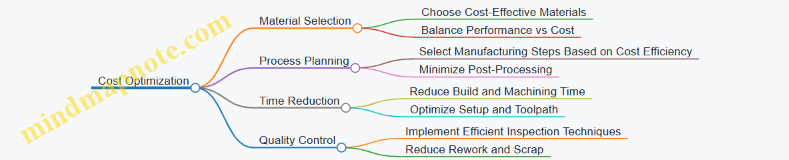
Summary of Key Strategies with Examples
Minimize Support Structures in Additive Manufacturing
- Strategy: Design geometries that reduce or eliminate the need for supports to save material and post-processing time.
- Example: Redesigning a bracket with self-supporting angles reduced support material by 40%, cutting build time and cleanup costs.
Optimize Part Orientation
- Strategy: Orient parts to minimize build height and improve surface finish on critical faces.
- Example: Rotating a medical device housing so that critical sealing surfaces faced upwards reduced machining time by 25% post-build.
Simplify Features for CNC Machining
- Strategy: Avoid complex internal features that require multiple tool changes or special tooling.
- Example: Replacing intricate internal pockets with simpler cavities reduced CNC cycle time by 30%.
Design for Standard Tool Access
- Strategy: Ensure all features are accessible with standard tools to avoid custom tooling costs.
- Example: Modifying a mold insert design to eliminate deep undercuts allowed use of off-the-shelf end mills, saving tooling expenses.
Define Clear Interfaces Between Additive and CNC Features
- Strategy: Plan assembly points and transitions to ensure seamless integration and reduce alignment errors.
- Example: Incorporating precision dowel pin holes in the additive section enabled accurate CNC machining alignment, reducing scrap.
Material Selection Balancing Cost and Performance
- Strategy: Choose materials that meet functional requirements without unnecessary expense.
- Example: Using aluminum alloy for the bulk of a part with titanium only in high-stress additive features optimized cost and strength.
Minimize Post-Processing
- Strategy: Design parts to reduce the need for extensive finishing, polishing, or heat treatment.
- Example: Designing lattice structures with smooth transitions reduced surface finishing time by 50%.
Implement Efficient Quality Control
- Strategy: Use integrated inspection methods to detect defects early and reduce rework.
- Example: Employing CT scanning on hybrid aerospace components identified internal defects before machining, avoiding costly scrap.
Integrated Example: Hybrid Manufacturing of a Custom Tooling Part
- Challenge: High complexity part requiring internal cooling channels and tight tolerances.
- Design Approach:
- Additive manufacturing used for internal channels with optimized orientation to minimize supports.
- CNC machining applied to external surfaces with simplified features for standard tooling.
- Clear interface defined with dowel pins for precise alignment.
- Cost Impact: 35% reduction in total production cost compared to fully CNC machined part.
- Outcome: Improved lead time and part performance with reduced scrap.
By applying these strategies thoughtfully, hybrid manufacturing workflows can achieve significant improvements in manufacturability and cost efficiency while maintaining or enhancing part quality.
13.2 Checklist for Designing Hybrid Additive and CNC Parts
Designing parts for hybrid additive and CNC workflows requires a systematic approach to ensure manufacturability, cost-efficiency, and quality. This checklist consolidates best practices into actionable steps, supported by mind maps and practical examples.
Hybrid Design Checklist Mind Map
Detailed Checklist Items with Examples
Material Selection
- Ensure the chosen material is suitable for both additive manufacturing and CNC machining.
- Example: Titanium alloys are excellent for aerospace hybrid parts but require careful parameter tuning in AM and specialized tooling in CNC.
Geometry Optimization
- Design complex internal features additively to reduce machining complexity.
- Minimize overhangs and support structures in AM by orienting parts strategically.
- Example: Redesign a heat exchanger with internal channels additively manufactured, while external mounting features are CNC machined for precision.
Process Planning
- Clearly define which features are best produced by AM and which by CNC.
- Plan the sequence to avoid rework or damage to features.
- Example: Build a medical implant additively, then machine critical surfaces for tight tolerances.
Tolerancing & Surface Finish
- Assign tighter tolerances to CNC-machined features and looser ones to AM features where possible.
- Specify surface finishes achievable by each process.
- Example: A turbine blade’s aerodynamic surfaces are CNC machined to fine tolerances, while the internal lattice structure is additively produced.
Assembly & Interfaces
- Design interfaces between AM and CNC sections to allow easy assembly or integration.
- Consider using dovetail joints or snap fits where applicable.
- Example: A hybrid drone frame with additively manufactured complex joints and CNC-machined mounting points.
Cost & Time Estimation
- Use software tools to estimate build and machining times early in design.
- Optimize design to reduce tool changes and support removal time.
- Example: Iteratively redesign a tooling insert to reduce additive build time by 25% and CNC setup time by 15%.
Quality Control
- Identify critical inspection points and select appropriate measurement methods (e.g., CMM for machined surfaces, CT scanning for internal AM features).
- Example: Quality plan for a hybrid aerospace bracket includes laser scanning of AM lattice and tactile probing of machined holes.
Sustainability
- Design to minimize material waste by reducing support structures and excess machining.
- Consider energy consumption differences between AM and CNC.
- Example: A hybrid automotive part redesigned to reduce machining volume by 40%, lowering energy use and scrap.
Mind Map: Geometry Optimization Focus
Mind Map: Process Planning and Quality Control
By following this checklist and leveraging the mind maps, manufacturing process engineers, industrial engineers, and operations managers can systematically design parts that maximize the strengths of both additive and CNC machining, leading to optimized cost, improved quality, and efficient production workflows.
13.3 Common Pitfalls and How to Avoid Them
Hybrid additive and CNC workflows offer tremendous advantages but also present unique challenges. Understanding common pitfalls and proactively addressing them is critical to achieving manufacturability and cost optimization.
Pitfall 1: Poor Process Selection
Choosing the wrong manufacturing process for specific features can lead to increased costs, longer lead times, and quality issues.
How to Avoid:
- Analyze part geometry to identify features best suited for additive (complex internal channels, lattice structures) vs CNC (high-precision surfaces, tight tolerances).
- Use decision matrices or flowcharts during design reviews.
Example: A pump housing initially designed to be fully CNC machined had complex internal cooling channels that required extensive machining time and tooling. By redesigning the channels for additive manufacturing and machining only the external surfaces, production time dropped by 40%.
Pitfall 2: Inadequate Design for Support Structures
Additive manufacturing often requires support structures that increase material usage, post-processing time, and cost.
How to Avoid:
- Orient parts to minimize overhangs.
- Design self-supporting angles (>45°).
- Incorporate features like chamfers or fillets to reduce supports.
Mind Map:
- Support Structure Pitfalls
- Excessive Material Use
- Increased Post-Processing
- Surface Quality Issues
- Avoidance Strategies
- Optimize Part Orientation
- Design Self-Supporting Features
- Use Chamfers and Fillets
Example: A bracket was redesigned with a 50° overhang angle instead of 30°, eliminating the need for supports on one side and reducing post-processing by 25%.
Pitfall 3: Overly Tight Tolerances on Additive Features
Applying CNC-level tight tolerances to additive features can increase build time and scrap rates unnecessarily.
How to Avoid:
- Assign realistic tolerances based on the capabilities of each process.
- Use additive manufacturing for near-net-shape and CNC for final precision.
Example: A medical implant design specified ±0.01 mm tolerance on an additive-built lattice structure. Relaxing this to ±0.1 mm for additive and finishing critical surfaces with CNC reduced costs by 30% without compromising function.
Pitfall 4: Ignoring Material Compatibility and Residual Stresses
Mismatch in material properties or residual stresses from additive processes can cause distortion or poor bonding during CNC machining.
How to Avoid:
- Select compatible materials for hybrid processes.
- Incorporate stress-relief heat treatments between additive and machining steps.
- Simulate residual stresses during design.
Mind Map:
- Material & Stress Pitfalls
- Material Incompatibility
- Residual Stress-Induced Distortion
- Mitigation Techniques
- Compatible Material Selection
- Heat Treatment Processes
- Residual Stress Simulation
Example: A titanium aerospace bracket experienced warping after additive build. Introducing an intermediate annealing step before CNC machining stabilized the part geometry.
Pitfall 5: Poor Interface and Assembly Design
Improperly designed interfaces between additive and CNC features can cause assembly difficulties and misalignment.
How to Avoid:
- Design clear, accessible interfaces.
- Use alignment features such as pins or dovetails.
- Allow for tolerance stack-up in hybrid joints.
Example: A hybrid-manufactured valve body initially had a tight press-fit interface between additive and machined components, causing assembly issues. Redesigning with a tapered alignment feature improved assembly speed and reliability.
Pitfall 6: Neglecting Post-Processing Requirements
Underestimating the time and cost of finishing steps like support removal, surface polishing, or heat treatment can derail cost optimization.
How to Avoid:
- Include post-processing in early cost models.
- Design parts to minimize complex finishing.
- Standardize post-processing workflows.
Example: A complex lattice structure required extensive manual support removal. By redesigning with modular lattice sections, supports were easier to remove, cutting finishing time by 50%.
Pitfall 7: Insufficient Communication Between Design and Manufacturing Teams
Lack of collaboration can lead to designs that are difficult or expensive to manufacture.
How to Avoid:
- Foster cross-functional teams including design, additive, and CNC experts.
- Use collaborative digital platforms for design reviews.
Example: Early involvement of CNC machinists in the design phase identified features that would require custom tooling, allowing redesign and cost savings.
Summary Mind Map of Common Pitfalls and Solutions
By recognizing and addressing these pitfalls early in the design and planning stages, manufacturing process engineers, industrial engineers, and operations managers can significantly improve the manufacturability, quality, and cost-effectiveness of hybrid additive and CNC workflows.
13.4 Final Case Study: End-to-End Hybrid Manufacturing Success Story
Overview
This case study explores the successful design, manufacturing, and cost optimization of a high-performance hydraulic manifold used in heavy machinery. The project leveraged a hybrid manufacturing workflow combining additive manufacturing (AM) and CNC machining to achieve complex internal channel geometries, tight tolerances, and cost efficiency.
Project Goals
- Produce a lightweight, compact hydraulic manifold with complex internal fluid channels.
- Reduce lead time compared to traditional CNC-only manufacturing.
- Optimize cost without compromising quality or performance.
- Enable easy scalability for future production runs.
Step 1: Initial Design and DFM Analysis
- Design Challenges: Complex internal channels for fluid flow, tight sealing surfaces, and multiple threaded ports.
- DFM Approach:
- Use additive manufacturing to create internal channels impossible to machine conventionally.
- Use CNC machining for critical sealing surfaces and threaded features requiring high precision.
Mind Map: Initial Design Considerations
Step 2: Material Selection and Hybrid Workflow Planning
- Selected Aluminum 7075 for its strength-to-weight ratio and compatibility with both AM and CNC.
- Planned workflow:
- Additive build of the near-net shape with internal channels.
- CNC machining of sealing surfaces, threaded holes, and critical dimensions.
Example:
- By printing the internal channels additively, the design avoided complex multi-axis machining setups, reducing setup time by 40%.
Mind Map: Workflow Planning
Step 3: Design Optimization for Manufacturability and Cost
-
Additive Design Adjustments:
- Optimized channel geometry to minimize support structures, reducing post-processing time.
- Oriented the part to reduce build height, cutting build time by 25%.
-
CNC Design Adjustments:
- Standardized thread sizes to use common tooling.
- Simplified sealing surfaces to flat faces for easier inspection and machining.
Example:
- Reorienting the part reduced support material by 30%, saving material costs and cleanup labor.
Mind Map: Design Optimization
Step 4: Manufacturing Execution
-
Additive Manufacturing:
- Used selective laser melting (SLM) with aluminum powder.
- Post-build heat treatment to relieve stresses.
-
CNC Machining:
- 5-axis machining centers used for sealing surfaces and threading.
- In-process probing ensured dimensional accuracy.
Example:
- The hybrid approach reduced total manufacturing lead time from 8 weeks (traditional CNC) to 4.5 weeks.
Step 5: Quality Control and Inspection
- Employed CT scanning to verify internal channel integrity.
- Used coordinate measuring machines (CMM) for critical external dimensions and threaded features.
Example:
- CT scans detected minor porosity in non-critical areas, allowing targeted rework rather than scrapping.
Step 6: Cost and Performance Outcomes
- Cost Savings: Approximately 35% reduction compared to fully CNC-machined manifolds.
- Performance: Improved hydraulic flow efficiency due to optimized internal channels.
- Scalability: Workflow documented and standardized for batch production.
Mind Map: Outcomes Summary
Key Takeaways and Best Practices
- Early integration of DFM principles for both additive and CNC is critical.
- Material selection must consider compatibility with both processes.
- Orientation and support minimization in AM significantly impact cost and quality.
- CNC machining should focus on precision features and finishing.
- Hybrid workflows can halve lead times and reduce costs while enabling complex designs.
- Comprehensive inspection strategies ensure quality without excessive scrap.
This case study exemplifies how thoughtful design and process integration in hybrid manufacturing workflows can deliver superior products efficiently and cost-effectively, providing a replicable model for advanced manufacturing teams.