Space Laser Communication Systems
1. Fundamentals of Optical Communication for Space Links
1.1 Electromagnetic Spectrum and Optical Link Basics
Space laser communication uses light as the carrier, so the electromagnetic spectrum is the starting point for everything that follows: wavelength choice, propagation behavior, hardware constraints, and link performance.
What “Optical” Means in Practice
Optical communication typically uses wavelengths in the near-infrared and visible bands. In space links, the most common region is near-infrared because many optical components and detectors are efficient there, and atmospheric absorption is manageable for ground segments. A useful mental model is to treat wavelength as a knob that trades off beam divergence, detector response, and how sensitive the link is to pointing and turbulence.
A quick grounding example: if you compare two systems at different wavelengths but with the same transmit aperture and similar beam shaping, the shorter wavelength generally allows a tighter diffraction-limited beam. That can reduce geometric spreading and pointing loss, but it may also change detector efficiency and optical filter behavior.
How Light Becomes a Communication Signal
A laser provides a stable optical carrier. Communication happens by changing some property of that carrier over time. The most common properties are amplitude (how strong the light is), phase (the timing of the wave’s peaks), and frequency or phase evolution (how the carrier drifts). In direct detection, the receiver measures optical power variations, so amplitude modulation is the most straightforward. In coherent detection, the receiver compares the incoming field to a local oscillator, so phase and frequency information can be extracted.
Example: amplitude modulation with direct detection is like varying the brightness of a flashlight in a controlled pattern. Coherent detection is like comparing the incoming waveform to a reference tuning fork, which lets the receiver track phase relationships.
Propagation Through Free Space
In vacuum, electromagnetic waves spread because energy spreads over a larger area as distance increases. The basic geometric idea is simple: doubling distance reduces received power by about four times, assuming everything else stays the same. This is why link budgets matter so much.
Mind the difference between “free-space loss” and “real-world loss.” Free-space loss is the baseline physics. Real systems add losses from imperfect optics, pointing errors, and detector coupling.
The Optical Link as a Chain of Conversions
An optical link is best understood as a sequence of transformations:
- Electrical data becomes an optical signal at the transmitter.
- The optical beam propagates and spreads.
- The receiver collects a fraction of the beam into its optics.
- The receiver converts optical energy back into electrical signals.
- Signal processing recovers the transmitted bits.
Each step has a measurable efficiency or loss. If you can’t point to a number for a step, you can’t reliably predict performance.
Key Spectrum-Driven Constraints
Several constraints come directly from where you operate in the spectrum.
- Detector responsivity: Photodetectors convert optical power to current. Responsivity depends on wavelength, so the same optical power can yield different electrical signal levels.
- Optical filtering: Narrowband filters reject background light and suppress out-of-band noise. Filter performance depends on wavelength and bandwidth.
- Laser linewidth and coherence: Phase-sensitive receivers require a laser with appropriate linewidth and stability. Even in direct detection, linewidth can affect how well the system tolerates frequency offsets.
- Beam divergence and aperture effects: Diffraction sets a lower bound on beam spread. Shorter wavelengths can reduce divergence for the same aperture.
Mind Map: Spectrum to Link Behavior
A Concrete Example: Choosing a Wavelength Region
Suppose you must design a downlink from a satellite to a ground terminal. You want high data rate, so you care about received signal strength and how efficiently the receiver converts it to an electrical waveform.
If you pick a wavelength where the detector responsivity is high and where optical filters can be narrow without excessive loss, you can improve the signal-to-noise ratio for the same transmit power. If you instead choose a wavelength with lower responsivity, you may need more optical power or a larger receiver aperture to reach the same sensitivity.
Now connect that to propagation: even if the geometric spreading is purely distance-driven, the fraction of the beam that becomes useful electrical signal depends on wavelength through detector and optics efficiencies. That’s why spectrum selection is not just a hardware detail—it changes the link budget outcome.
Summary of the “Basics”
Electromagnetic spectrum selection defines the optical carrier. Modulation and receiver type determine what information is encoded and how it is extracted. Free-space propagation sets the baseline power decay with distance, while wavelength-dependent hardware efficiencies and constraints shape the practical performance. Once these pieces are clear, later chapters can treat link budgets, pointing, and noise as specific consequences rather than mysterious formulas.
1.2 Modulation Formats for Optical Carriers
Optical modulation formats describe how information changes an optical carrier’s properties—typically amplitude, phase, or frequency—before the signal is launched into a free-space or fiber channel. In space laser communication, the “best” choice is rarely about peak data rate alone; it’s about how the format behaves under pointing loss, turbulence-induced fading, limited received power, and receiver complexity.
Core Idea: What Changes in the Optical Carrier
Most practical formats can be grouped by the carrier attribute that carries the data:
- Amplitude changes: the optical power rises and falls with symbols.
- Phase changes: the optical field’s phase shifts between symbol states.
- Frequency changes: the optical carrier frequency shifts, often implemented via phase modulation.
A helpful mental model is to treat the optical field as a complex quantity. Direct detection measures optical power (a magnitude-squared quantity), so it naturally favors amplitude-based formats. Coherent detection measures field components relative to a local oscillator, so it can recover phase and frequency information.
Direct Detection Friendly Formats
Direct detection uses a photodiode and typically converts optical power into an electrical current. Because the photodiode output depends on power, formats that map bits to power levels are straightforward.
On-Off Keying
On-off keying (OOK) uses two power levels: “on” for bit 1 and “off” for bit 0. A simple example: if the transmitter emits 1 mW for a symbol interval when sending 1 and 0 mW when sending 0, the receiver current is proportional to those levels.
Best practice: include a realistic extinction ratio. If “off” is not truly zero—say it leaks 1% of the “on” power—then the receiver must distinguish two nonzero currents, which increases error probability.
Pulse Amplitude Modulation
Pulse amplitude modulation (PAM) generalizes OOK to multiple power levels. For instance, 4-PAM uses four amplitude levels to represent two bits per symbol. Example: map {00, 01, 10, 11} to power levels {1, 0.66, 0.33, 0.1} mW. The receiver compares the measured current to decision thresholds.
Best practice: choose spacing between levels to account for noise and fading. If turbulence causes received power to fluctuate by ±20%, then level separation must be large enough that the noisy distributions still cluster around the intended thresholds.
Coherent Detection Friendly Formats
Coherent detection mixes the received optical field with a local oscillator (LO). This enables recovery of phase, which is valuable when received power is low or when you want to pack more bits per symbol efficiently.
Phase Shift Keying
Phase shift keying (PSK) encodes symbols in discrete phase states. Example: for QPSK, four phases represent two bits per symbol. If the LO is phase-aligned, the receiver can separate the four states by measuring in-phase and quadrature components.
Best practice: manage phase noise and frequency offset. Even small LO drift can smear constellation points, so practical systems use carrier recovery loops and pilot symbols.
Quadrature Amplitude Modulation
Quadrature amplitude modulation (QAM) combines amplitude and phase in a constellation. Example: 16-QAM uses 16 points arranged on an I-Q grid; each point corresponds to a unique pair of amplitudes.
Best practice: QAM is sensitive to amplitude distortions and fading. In a turbulent free-space link, you often need robust equalization and careful gain control so the receiver doesn’t confuse a “nearby” constellation point for the intended one.
Frequency Domain View: Why Phase Modulation Matters
Frequency shift keying can be implemented via phase modulation because instantaneous frequency relates to the time derivative of phase. This matters because many coherent systems prefer phase modulation hardware, then recover frequency content through the same carrier recovery and demodulation chain.
Tradeoffs That Drive Format Selection
- Receiver complexity: direct detection is simpler but limits what you can encode.
- Sensitivity to fading: amplitude formats suffer directly when received power drops; coherent formats can often tolerate power fluctuations better because phase information remains usable.
- Spectral efficiency: higher-order constellations increase bits per symbol but demand better signal quality.
- Implementation constraints: modulator linearity, LO stability, and DSP/FPGA resources can dominate the “theoretical” choice.
Mind Map: Modulation Formats for Optical Carriers
Worked Example: Choosing Between OOK and QPSK
Suppose you have a link where received optical power is low and varies due to pointing and turbulence. With OOK, the receiver current directly follows power, so fades shrink the “on” current and make “on” symbols harder to separate from “off” leakage.
With QPSK and coherent detection, the receiver still faces power reduction, but the demodulation uses the relative field components. If the receiver can maintain carrier phase tracking and adequate LO mixing, the constellation points remain distinguishable even when absolute power is reduced.
The practical takeaway is not that QPSK is always better; it’s that each format aligns with what the receiver can measure reliably under the channel conditions.
1.3 Link Budget Concepts for Free-Space Propagation
A link budget is a structured accounting of power as it travels through space and gets converted into useful bits. For free-space optical links, the accounting is mostly about geometry, losses, and noise, with pointing and turbulence acting like “loss multipliers” that vary over time. The goal is not to predict a single perfect number; it is to compute whether the received signal is strong enough, with the required probability, to meet a target error rate.
The Core Power Accounting
Start with transmitted optical power, then subtract (or divide) everything that reduces it before it reaches the receiver aperture. A common baseline form is:
- Received power = Transmitted power × (product of deterministic gains/losses) × (random fading factor)
Deterministic terms include free-space spreading, optical coupling, and pointing loss. Random terms include turbulence-induced fading and scintillation. Even if you later add coding and receiver noise, you still need a clean power path first.
Free-Space Spreading Loss
In the far field, the beam spreads over area, so only a fraction of the transmitted power intersects the receiver aperture. A practical way to express this is through the beam footprint and aperture overlap.
Example: Suppose a transmitter produces a Gaussian-like beam with divergence half-angle θ, and the link distance is R. The beam radius at the receiver is approximately w ≈ θR (for small angles). If the receiver aperture radius is a, then the fraction of power captured depends on the overlap between the beam and aperture. A simple engineering approximation is:
- Captured fraction ≈ (receiver area) / (beam area) = (πa²) / (πw²) = (a/w)²
So the spreading loss scales roughly like (w/a)². This is why increasing aperture size or reducing divergence is so effective: it directly improves the captured fraction.
Pointing Loss as a Geometric Penalty
Pointing loss occurs when the beam center misses the receiver aperture. For a Gaussian beam, the captured power drops with the offset between beam center and aperture center. A useful mental model is: pointing error turns a “centered overlap” into a smaller overlap area.
Example: Let the beam radius at the receiver be w = 2 mm. If the pointing error is 1 mm (beam center shifted by 1 mm), the overlap decreases noticeably. If you reduce the pointing error to 0.3 mm, the overlap improves sharply because the loss depends on squared ratios of offset to beam size.
This is where control bandwidth and tracking accuracy matter: tighter pointing reduces the average loss and also reduces the depth of fades caused by misalignment.
Atmospheric and Turbulence Loss as Random Fading
Atmospheric turbulence distorts the wavefront and causes intensity fluctuations at the receiver. In practice, you treat this as a random fading factor applied to the received power. Two common effects are:
- Scintillation: rapid intensity fluctuations
- Beam wander: slow-to-moderate motion of the beam centroid
Beam wander overlaps with pointing loss, but it is driven by the atmosphere rather than the terminal’s control error. That means your link budget should include both: a deterministic pointing term and a statistical turbulence term.
Example: If turbulence causes a log-normal distribution of received intensity, you can compute an “availability” level. For instance, you might design so that the received power exceeds the sensitivity threshold for 99% of time. That converts a power budget into a probability budget.
Receiver Coupling and Optical Losses
Not all optical power that arrives becomes electrical signal. Losses include:
- Optical transmission losses in optics and windows
- Coupling efficiency from telescope to fiber or detector
- Detector quantum efficiency and responsivity conversion
Example: If the received optical power at the telescope is 10 µW, but the system transmission is 0.8 and the coupling is 0.7, then only 10 × 0.8 × 0.7 = 5.6 µW reaches the detector. This is deterministic, so it belongs in the fixed part of the budget.
Noise and Sensitivity Threshold
A link budget is incomplete without the receiver threshold. The receiver sensitivity depends on noise sources such as:
- Shot noise from signal and background
- Thermal noise in the front-end electronics
- Background light and dark current
For direct detection, the received optical power must be high enough that the signal-induced photocurrent rises above noise with the required margin for the chosen modulation and coding.
Example: If your receiver sensitivity corresponds to a minimum received optical power of 2 µW for the target bit error rate, then your budget must ensure that the combined deterministic losses and statistical fading still keep the received power above 2 µW with the required availability.
A Systematic Mini-Workflow
- Choose wavelength, divergence, and receiver aperture.
- Compute deterministic received power using spreading and optical losses.
- Add pointing loss using expected pointing error statistics.
- Apply turbulence fading to obtain a received-power distribution.
- Convert receiver requirements into a sensitivity threshold.
- Verify that received power exceeds sensitivity for the required availability, then add margins for model and measurement uncertainty.
Example: If deterministic received power is 5 µW, pointing loss reduces it to an average of 3 µW, and turbulence occasionally drops it by a factor that yields 99% availability at 2.2 µW, then you can meet a 2 µW sensitivity target with a small margin. If the 99% level were 1.6 µW instead, you would need to change something that improves the budget: more transmit power, lower divergence, larger aperture, better pointing, or improved receiver sensitivity.
1.4 Noise Sources and Receiver Sensitivity Metrics
From Signal to Errors
A receiver turns an optical field into an electrical current, then decides bits from noisy samples. Sensitivity is the minimum received optical power that achieves a target error rate under specified conditions. The key idea is that noise adds uncertainty to the decision variable, so the required signal level depends on both the noise power and the receiver’s detection bandwidth.
Receiver Noise Budget Mind Map
Shot Noise from Photocurrent
In direct detection, the photodiode current is proportional to received optical power. Even if the average current is steady, charge arrival is random, producing shot noise. A practical way to remember it: doubling received power increases both the signal and the shot-noise variance, but the signal grows faster in terms of signal-to-noise ratio (SNR) because the noise variance is tied to current.
Example: Suppose a receiver produces 50 µA average photocurrent from the desired signal. If the detection bandwidth is 1/(2Tb) for a bit duration Tb (a common matched-filter-like approximation), the shot-noise current variance is proportional to photocurrent times bandwidth. If background light adds another 10 µA, the shot noise rises because total photocurrent increases, even though the desired signal current stays the same.
Thermal Noise from Electronics
Thermal noise comes from resistive elements and active devices in the front end. Unlike shot noise, it does not depend on optical power. It is usually modeled as a noise current or voltage with a power spectral density that is proportional to temperature. In low-power links, shot noise dominates; in high-power links, thermal noise can become the limiting factor.
Example: If the front-end noise corresponds to an equivalent input current noise density of 2 pA/√Hz, then over a 10 MHz effective bandwidth the rms noise current is about 2 pA/√Hz × √(10 MHz) ≈ 6.3 nA. If your signal photocurrent is only a few nA, thermal noise will noticeably degrade sensitivity.
Background Light and Stray Light
Background photons add photocurrent that is statistically similar to signal-generated current, so they increase shot noise. The receiver’s optical filtering bandwidth matters: narrower filters reduce background power, but they must still pass the desired signal spectrum and tolerate Doppler or pointing-induced spectral shifts.
Example: If background contributes 30% of the signal photocurrent, the shot-noise variance increases by roughly the same fraction because it depends on total current. That means sensitivity worsens even though the desired optical power is unchanged.
Dark Current and Leakage
Dark current is the photodiode’s leakage current in the absence of light. It creates shot noise even when received signal is zero. For space terminals, dark current can be reduced by cooling and careful device selection, but it rarely disappears. Treat it as an additional current term in the shot-noise calculation.
Example: If dark current corresponds to 2 µA and your signal photocurrent is 5 µA, then dark noise is a large fraction of total shot noise. If the signal photocurrent rises to 50 µA, dark noise becomes negligible.
Relative Intensity Noise and Excess Noise
Some lasers exhibit intensity fluctuations beyond ideal shot noise. In direct detection, these fluctuations can map into current noise, often called excess noise. The receiver sensitivity calculation then uses an effective noise variance larger than the pure shot-noise prediction.
Example: If measured intensity noise increases the current noise variance by 20% at the symbol rate, then the required signal power for the same BER increases accordingly. A simple engineering approach is to incorporate an excess-noise factor multiplying the shot-noise term.
Receiver Sensitivity Metrics That Actually Match Design Work
Sensitivity is not a single universal number; it depends on the detection method, bandwidth, and target error rate.
- Required Optical Power: Minimum received power for a specified BER/FER with a defined receiver bandwidth and coding assumptions.
- Eb/N0: Energy per bit divided by noise power spectral density. It is useful when comparing modulation and coding under consistent assumptions.
- Noise Equivalent Power: The optical power that yields a defined SNR (often 1) in a specified bandwidth. It helps compare front ends independent of link geometry.
A Systematic Sensitivity Calculation Flow
- Convert received optical power to photocurrent using responsivity and optical coupling efficiency.
- Compute total noise current variance from shot noise (signal + background + dark), thermal noise (front end), and any excess-noise factor.
- Choose the effective noise bandwidth based on filtering and symbol rate.
- Map SNR to BER using the detection model (direct detection with Gaussian noise is a common starting point).
- Convert the required electrical SNR back to required optical power.
Example: If your required decision SNR is 10 dB for a target BER, and your noise variance is dominated by shot noise, then increasing background power directly increases the noise variance and forces higher received signal power. If thermal noise dominates, the same background increase has less impact, because the noise term barely changes.
Practical Notes for Space Links
In space, pointing loss and atmospheric conditions change received power, which changes shot noise and therefore the effective sensitivity. That is why sensitivity should be specified alongside assumptions about background level, filter bandwidth, and receiver bandwidth. A receiver that looks “good” in a lab with clean conditions can underperform when stray light or imperfect filtering raises the noise floor.
1.5 Bit Error Rate and System Performance Relationships
Bit error rate (BER) is the system’s “how often do we get it wrong” metric, but it is rarely a standalone number. In space laser links, BER is shaped by how the signal is formed, how it propagates, how it is detected, and how errors are corrected. The key relationship is that BER is a function of the effective signal-to-noise ratio (SNR) at the decision point, plus any impairments that distort the waveform or timing.
From SNR to BER
For many optical receivers, the first-order path is:
- Compute received optical power and noise variance.
- Convert optical power into electrical signal amplitude using responsivity.
- Form an effective SNR per bit or per symbol.
- Use a detection model to map SNR to BER.
A simple example uses direct detection with on-off keying (OOK). If the receiver compares the sampled current against a threshold, then the probability of crossing the wrong side depends on the separation between the “0” and “1” current distributions relative to their noise spread. When noise is approximately Gaussian after filtering, BER decreases rapidly as the separation grows.
A practical way to keep this grounded is to work in terms of energy per bit. If the system delivers an effective energy per bit \(E_b\) and the noise spectral density is \(N_0\), then the ratio \(E_b/N_0\) is a compact summary of how much useful signal energy survives the noise. For a given modulation and receiver type, BER becomes a predictable function of \(E_b/N_0\).
The Role of Modulation and Detection
Different modulation formats change what “decision” means. With OOK, the receiver decides between two intensity levels. With phase-based formats, the receiver decides based on phase or differential phase, so phase noise and timing errors can dominate even when power is high.
Detection method matters too:
- Direct detection typically turns optical intensity into current and compares it to a threshold.
- Coherent detection mixes the incoming field with a local oscillator, enabling phase-sensitive measurements. In coherent systems, the effective SNR depends on local oscillator power and phase stability, not just received optical power.
A useful mental check: if you double the received optical power, direct detection SNR often improves roughly linearly, but coherent detection can show different scaling because the local oscillator sets the reference amplitude.
Noise Sources That Actually Move BER
Noise in optical links is not one thing. BER is sensitive to which noise dominates:
- Shot noise scales with optical power and becomes important when the signal is strong.
- Thermal noise comes from receiver electronics and can dominate at low received power.
- Background light noise adds extra photons, inflating the “0” and “1” noise floors.
- Interference and residual pointing jitter can create systematic offsets that do not average out like random noise.
An easy example: suppose two links have the same average received power, but one has higher background light. The background increases noise variance, reducing the separation between the decision distributions, so BER rises even though the mean signal is unchanged.
Fading, Pointing Loss, and Conditional BER
Space links often experience fluctuations from atmospheric turbulence (for ground-to-space) and pointing errors (for both ground and space terminals). Instead of a single BER number, you can think in conditional terms:
- At a given instantaneous channel state, you have an instantaneous SNR and thus a conditional BER.
- Over time, the system averages over channel states.
This is why “average SNR” alone can mislead. If the channel spends time in deep fades, those intervals contribute disproportionately to errors. A link with the same average received power but more severe fades can have worse BER.
Coding and How BER Turns into Block Error Rate
Forward error correction (FEC) changes the relationship between raw BER and delivered performance. The receiver first produces a raw bit stream with some BER. Then the decoder uses redundancy to correct errors, so the relevant metric becomes block error rate (BLER) or frame error rate (FER).
A systematic way to connect them is:
- Estimate raw BER from the physical layer model.
- Convert raw BER into an approximate probability of having more than the decoder can correct within a block.
- Use that to estimate BLER.
For a quick intuition, consider a decoder that can correct up to \(t\) bit errors per codeword. If the expected number of errors per codeword is much smaller than \(t\), BLER is low. If it is larger, BLER rises sharply. That “sharpness” is why small SNR improvements can produce large gains in delivered error rate.
Mind Map: BER Relationships
Example: From Received Power to BER
Assume a direct-detection OOK receiver where the “1” current is \(I_1\) and the “0” current is \(I_0\). Let the total noise standard deviation at the sampling instant be \(\sigma\). A common approximation treats the sampled currents as Gaussian, so the probability of deciding “0” when “1” was sent is the tail probability beyond the threshold, and similarly for the opposite error.
If you increase received optical power, both \(I_1\) and the shot-noise component increase, but the separation \(I_1-I_0\) typically grows faster than the noise spread in the regime where signal dominates. That increases the normalized separation \[ \text{separation} = \frac{I_1-I_0}{\sigma} \] and reduces BER. If instead the increase in received power mainly raises background-induced noise, \(\sigma\) grows without much separation gain, and BER improves less.
Example: Why Average SNR Can Mislead
Consider two channels with the same average SNR. Channel A has mild fluctuations around that value. Channel B has occasional deep fades where SNR collapses. During deep fades, the conditional BER becomes much larger, and those intervals dominate the time-averaged BER. The system’s BER is therefore closer to the BER computed under the worst channel states than the BER computed from the average SNR alone.
Summary of the Relationship Chain
BER is determined by how reliably the receiver can distinguish the transmitted states at the decision point. That reliability is governed by effective SNR, which is shaped by noise sources and by channel variability. Coding then transforms raw BER into block-level outcomes, so the delivered performance is best tracked with BLER or FER rather than raw BER alone.
2. Free-Space Propagation and Atmospheric Effects
2.1 Geometric Loss and Beam Spreading
Geometric loss is the part of the link budget that comes purely from geometry: the transmitter launches a beam with some divergence, and by the time it reaches the receiver, the beam has expanded. Even with perfect pointing and no atmospheric effects, only a fraction of the transmitted optical power can fall inside the receiver aperture.
Beam Spreading from Divergence
A laser beam is not perfectly collimated. If the beam has divergence angle \(\theta\) (radians), then at a range \(R\) the beam radius grows approximately as
\[ w(R) \approx w_0 + R\theta \]
For long links where \(R\theta \gg w_0\), the initial beam radius \(w_0\) becomes less important and \(w(R) \approx R\theta\) is a good first model.
Easy example: Suppose a terminal launches a beam with divergence \(\theta = 50\ μ\text{rad}\) and the range is \(R = 40{,}000\ \text{km}\). Then \(R\theta = 40{,}000\times 10^3\times 50\times 10^{-6} \approx 2000\ \text{m}\). A beam that starts small ends up with a radius on the order of kilometers, so the receiver aperture samples only a tiny patch of the beam.
Geometric Coupling Efficiency
To turn beam size into received power, use the coupling efficiency \(\eta_g\), the fraction of power that lands within the receiver aperture.
For a common approximation, assume the beam has a roughly uniform intensity across a disk of radius \(w\), and the receiver aperture is a circle of radius \(a\). Then
- If \(a \ge w\): \(\eta_g \approx 1\) (the receiver captures essentially all the beam).
- If \(a < w\): \(\eta_g \approx (a/w)^2\).
In the long-range regime where \(w \approx R\theta\), this becomes
\[ \eta_g \approx \left(\frac{a}{R\theta}\right)^2 \quad \text{for } a \ll R\theta \]
Geometric loss in decibels is then
\[ L_g(\text{dB}) = -10\log_{10}(\eta_g) \]
Easy example: Let the receiver diameter be \(D_r = 0.2\ \text{m}\), so \(a = 0.1\ \text{m}\). Use \(\theta = 50\ μ\text{rad}\) and \(R = 40{,}000\ \text{km}\). With \(w \approx 2000\ \text{m}\), \(\eta_g \approx (0.1/2000)^2 = 2.5\times 10^{-9}\). That corresponds to \(L_g \approx 86\ \text{dB}\). This is why divergence control matters: halving \(\theta\) reduces geometric loss by about 6 dB.
Beam Profile Matters
Real beams are often closer to Gaussian than uniform. For a Gaussian beam, the fraction of power within radius \(a\) is
\[ \eta_g = 1 - \exp\left(-2\frac{a^2}{w^2}\right) \]
where \(w\) is the Gaussian beam radius parameter. When \(a \ll w\), the exponential can be approximated and you again get the familiar \((a/w)^2\) scaling, so the geometric-loss intuition stays intact.
Practical example: If \(a = w/3\), then \(\eta_g = 1 - \exp(-2/9) \approx 1 - 0.80 = 0.20\). So even when the receiver radius is only one-third of the beam radius, you still capture about 20% of the power—useful when you need a quick sanity check.
Mind Map: Geometric Loss and Beam Spreading
Systematic Link-Budget Workflow
- Choose a beam model (uniform disk for quick estimates, Gaussian for more accuracy).
- Compute beam radius at the receiver using \(w(R)\approx w_0+R\theta\). If \(R\theta\) dominates, drop \(w_0\) to simplify.
- Compute coupling efficiency \(\eta_g\) from the chosen model.
- Convert to geometric loss \(L_g\) and keep it as a standalone term so you can later add pointing, turbulence, and detector losses.
Easy example: If you double the receiver diameter, you double \(a\), so \(\eta_g\) increases by about 4× in the small-aperture regime, which reduces geometric loss by about 6 dB. This is a clean, geometry-driven lever that often shows up early in design trade studies.
Key Takeaways
Geometric loss is not a mysterious penalty; it is the square-law consequence of beam expansion. Once you can compute \(w(R)\) and \(\eta_g\), you can predict how changes in divergence, range, and aperture size will move the received power—before you even touch atmospheric or pointing models.
2.2 Pointing Loss and Misalignment Modeling
Pointing loss is the reduction in received optical power caused by imperfect alignment between the transmitter beam and the receiver aperture. In space laser links, “misalignment” rarely means one single error; it’s usually a combination of angular pointing error, beam wander, and residual jitter after tracking loops. Modeling it well turns a messy mechanical problem into a predictable link-budget term.
Core Geometry of Misalignment
Start with a simple picture: the transmitter produces a beam with some divergence, and the receiver collects a fraction of that beam through a finite aperture. If the beam center is displaced from the receiver’s optical axis by an angle \(\theta\), then at range \(R\) the lateral offset is \(\rho = R\theta\). Even if the beam is perfectly shaped, the receiver collects less power because part of the beam misses the aperture.
A practical modeling choice is to represent the beam intensity at the receiver plane as a Gaussian. For a Gaussian beam, the power density falls off smoothly, so pointing error maps naturally to a power-coupling loss.
Gaussian Beam Coupling Model
Assume a Gaussian beam with waist-related spot size at the receiver plane. Let \(w\) be the beam radius parameter at the receiver (commonly the 1/e^2 intensity radius). The receiver aperture radius is \(a\). With a lateral offset \(\rho\), the collected power fraction can be approximated by integrating the Gaussian over the circular aperture. A widely used closed-form expression uses the modified Bessel function:
\[ \eta(\rho)=\frac{1}{2}\exp\left(-\frac{\rho^2}{w^2}\right)\left[I_0\left(\frac{\rho^2}{w^2}\right)+I_1\left(\frac{\rho^2}{w^2}\right)\right] \]
where \(I_0\) and \(I_1\) appear from the circular integration. In many engineering workflows, you instead compute the overlap numerically or use an approximation that assumes the aperture is large compared to the beam core or vice versa.
From Static Offset to Jitter Statistics
Real terminals don’t sit still. Pointing error is often modeled as a random process with some distribution. A common first step is to treat the instantaneous angular error as zero-mean Gaussian in two orthogonal axes. Under that assumption, the lateral offset \(\rho\) follows a Rayleigh distribution for its magnitude.
To get average pointing loss, you average the coupling efficiency over the jitter distribution:
\[ \bar{\eta}=\int_0^{\infty} \eta(\rho), p(\rho), d\rho \]
with \(p(\rho)=\frac{\rho}{\sigma^2}\exp\left(-\frac{\rho^2}{2\sigma^2}\right)\), where \(\sigma\) is the standard deviation of the lateral offset in one axis. This step is where “tracking performance” becomes a number you can plug into the link budget.
Practical Example with Numbers
Suppose a downlink at range \(R=20{,}000,\text{km}\) has a 1/e^2 beam radius at the receiver of \(w=2.0,\text{cm}\). The receiver aperture radius is \(a=3.0,\text{cm}\). If residual pointing jitter has an RMS angular error of \(\sigma_\theta=5,\mu\text{rad}\), then the one-axis lateral RMS is \(\sigma=R\sigma_\theta=0.1,\text{m}=10,\text{cm}\). That’s already larger than the beam radius, so you should expect significant loss.
A quick sanity check: the mean offset magnitude is on the order of \(\sqrt{2}\sigma\approx 14,\text{cm}\), while the beam radius is \(2,\text{cm}\). Most of the time, the receiver is sampling the Gaussian tail rather than the core. In a link budget, this typically shows up as tens of dB of pointing loss unless the beam is expanded or the tracking loop reduces jitter.
If instead \(\sigma_\theta\) were \(0.5,\mu\text{rad}\), then \(\sigma=1,\text{cm}\), comparable to \(w\). In that regime, pointing loss becomes sensitive to the exact aperture size and the jitter distribution, but it’s no longer catastrophic.
Mind Map: Pointing Loss Modeling
Modeling Workflow That Stays Consistent
- Choose the beam model: Gaussian is a good default for many optical terminals, but keep \(w\) defined at the receiver plane.
- Convert pointing specs: translate angular RMS or worst-case error into lateral offset using \(\rho=R\theta\).
- Decide whether to average: if the tracking loop leaves jitter, compute \(\bar{\eta}\); if you only have a static residual, use \(\eta\) directly.
- Compute coupling efficiency: use a closed-form approximation when valid, otherwise numerical overlap for the aperture shape you actually have.
- Express as loss: \(L_{\text{point}}=-10\log_{10}(\bar{\eta})\) so it fits the rest of the link budget.
Common Pitfalls and Quick Fixes
A frequent mistake is mixing definitions of beam radius. If one source uses full-width at half-maximum and another uses 1/e^2 radius, the resulting \(w\) can be off by a factor that looks like “mysterious” pointing loss. Another pitfall is using microradians as if they were milliradians; the lateral offset scales linearly with that error, so the loss can jump by orders of magnitude.
Finally, don’t forget that pointing loss is not the only misalignment effect. If the receiver has significant aberrations or the beam is clipped by intermediate optics, the effective coupling can be worse than the pure geometric model. In practice, you treat the pointing model as the baseline and let the optical coupling term absorb the rest—so the link budget remains interpretable.
2.3 Turbulence Effects on Optical Wavefronts
Optical turbulence is what you get when the refractive index of air changes in space and time. Those changes bend and distort the optical wavefront, which then shows up as power fluctuations, beam wander, and phase errors at the receiver. In practice, you can treat turbulence as a random medium that adds phase perturbations to an otherwise well-behaved laser beam.
Foundational Picture of Wavefront Distortion
A laser beam can be described by an optical phase across its cross-section. Turbulence introduces a spatially varying phase term, so the received field is no longer a clean copy of the transmitted field. Two consequences matter most for communication links:
- Phase distortion reduces coherent combining and increases demodulation error for coherent receivers.
- Scintillation and beam wander change the coupling efficiency into the receiver aperture, creating intensity fades.
A helpful mental model is to imagine the wavefront as a flexible sheet. Turbulence creates ripples on that sheet; the receiver “sees” the ripples through how much of the distorted beam still overlaps its aperture.
Turbulence Statistics and the Structure of Randomness
Turbulence is often modeled using statistical descriptions of refractive-index fluctuations. The key idea is that the atmosphere contains eddies of many sizes. Larger eddies move and reshape the beam slowly, while smaller eddies create faster, finer phase variations.
A practical way to connect this to link behavior is to separate effects by spatial scale:
- Low spatial frequency distortions cause broad wavefront tilts and curvature changes, which translate into beam wander and pointing-like errors.
- High spatial frequency distortions create small-scale phase corrugations that scatter energy out of the main beam core.
This separation is why the same turbulence can simultaneously look like “the beam moved” and “the beam got blurry.”
Phase Screen Model for System-Level Reasoning
For many link analyses, you can represent turbulence as a sequence of thin random phase screens along the propagation path. Each screen adds a random phase pattern to the field. Between screens, diffraction spreads the beam.
This model is systematic:
- Start with the transmitted field at the first screen.
- Apply a random phase map representing refractive-index fluctuations.
- Propagate to the next screen using diffraction.
- Repeat until the receiver plane.
Even if you do not compute every screen, the model clarifies what matters: turbulence changes the phase first, and the receiver then converts that phase into intensity and demodulation outcomes.
From Wavefront Errors to Intensity Fluctuations
Scintillation is the rapid variation of received intensity. It occurs because phase distortions alter the interference pattern in the beam as it propagates. When the receiver aperture samples different parts of that interference pattern over time, the detected power fluctuates.
A concrete example: suppose your receiver uses a finite aperture and tracks the beam center. If turbulence introduces small-scale phase corrugations, the beam core can split and re-combine across the aperture. Even with perfect pointing, the overlap changes, so the detected intensity varies.
Beam Wander and Aperture Coupling Loss
Beam wander is the slow-to-moderate drift of the beam centroid due to large-scale turbulence. The receiver aperture then captures less power when the centroid shifts away from the aperture center.
A simple numerical intuition: if the beam spot radius at the receiver is comparable to the aperture radius, then a centroid shift of a fraction of the spot radius can cause a noticeable coupling drop. If the spot is much smaller than the aperture, wander mainly changes where the power lands, not how much is captured.
Coherence, Temporal Effects, and Receiver Implications
Turbulence is not static. As eddies move, the phase pattern changes over time. This produces a coherence time: over short intervals, the channel is “similar,” and over longer intervals it changes enough to decorrelate.
For a receiver, that means:
- Coherent detection is sensitive to phase evolution, so phase noise from turbulence can increase symbol errors.
- Direct detection is sensitive to intensity fluctuations, so scintillation drives fades.
A practical best practice is to design tracking and equalization around the expected turbulence time scales. If your processing assumes the channel is constant longer than it actually is, performance drops in a way that looks like random bad luck.
Mind Map: Turbulence Effects on Optical Wavefronts
Example: Two Turbulence Regimes and What You See
Consider two scenarios at the receiver.
Example A: Mostly large-scale turbulence. The beam centroid drifts, but the core remains relatively intact. You observe slower intensity changes and a strong dependence on aperture size and tracking performance. A receiver with a narrow field of view benefits from good centroid tracking.
Example B: Mostly small-scale turbulence. The beam core breaks up due to fine phase corrugations. You observe faster intensity fluctuations even when pointing is stable. Here, increasing aperture size helps by averaging more of the distorted field, and stronger error control helps absorb residual fades.
In both cases, the underlying cause is phase distortion, but the scale of the turbulence determines whether the link suffers mainly from wander, mainly from scintillation, or both.
Practical Takeaway for Link Design
Treat turbulence as phase first, then intensity and demodulation. When you map turbulence scales to beam-core overlap and phase stability, you can choose receiver aperture, tracking bandwidth, and detection strategy in a way that matches the physics rather than fighting it.
2.4 Scintillation and Fade Statistics for Uplink and Downlink
Scintillation is the rapid fluctuation of received optical intensity caused by turbulence-induced changes in the refractive index along the propagation path. In practice, it shows up as short-term fades even when the average received power looks healthy. For uplinks and downlinks, the statistics differ because the turbulence is not symmetric with respect to the transmitter and receiver.
Foundational Model of Intensity Fluctuations
Start with the received intensity as a random variable, I. A common normalization is to define the scintillation index as
- Scintillation index: \(\sigma_I^2 = \frac{\mathrm{Var}(I)}{(\mathbb{E}[I])^2}\)
If \(\sigma_I^2\) is small, intensity is tightly clustered around its mean and fades are rare. If \(\sigma_I^2\) grows, the distribution spreads and deep fades become more likely.
A practical way to connect turbulence to intensity statistics is through the Rytov variance \(\sigma_R^2\), which depends on wavelength, path length, and turbulence strength. The key idea is that \(\sigma_R^2\) acts like a “turbulence severity knob” that determines whether the intensity fluctuations behave mildly or strongly.
Uplink Versus Downlink Asymmetry
For an uplink, the beam starts near the ground and travels upward through the most turbulent layers before reaching the spacecraft. For a downlink, the beam leaves the spacecraft and travels downward, encountering turbulence in reverse order. The result is that the turbulence-induced phase distortions and their conversion into intensity fluctuations differ.
A useful rule of thumb is that uplinks often experience stronger scintillation than downlinks for the same turbulence profile, because the beam expands as it propagates and the coupling between phase and intensity changes with propagation direction. The exact balance depends on altitude-dependent turbulence, beam divergence, and receiver aperture.
Fade Statistics from Probability Distributions
To design for availability, you need not only the mean intensity but the probability that intensity drops below a threshold. Let \(I_{th}\) be the minimum intensity that still supports a target bit error rate after coding and receiver processing. Then the fade probability is
- Fade probability: \(P_{fade} = \Pr(I < I_{th})\)
In weak-to-moderate turbulence, intensity can be approximated by distributions that are parameterized by \(\sigma_I^2\). In stronger turbulence, the distribution becomes heavier-tailed, meaning that “unlucky” fades happen more often than a Gaussian model would predict. This is why link budgets that only use average power can be optimistic.
Thresholding with Link Budget Quantities
Convert intensity thresholds into received optical power thresholds using the optical coupling and detector responsivity.
- Let \(P_r = \eta_c I\), where \(\eta_c\) lumps coupling efficiency, aperture effects, and optical-to-electrical scaling.
- Let \(P_{min}\) be the power required for the receiver to meet performance at a given coding rate and modulation.
- Then \(I_{th} = P_{min}/\eta_c\).
A concrete example: suppose a downlink receiver needs \(P_{min} = -60,\mathrm{dBm}\) to achieve the target error rate, and coupling is \(\eta_c = 10^{-3}\) in linear units relative to the normalized intensity definition used in your scintillation model. If the normalized mean intensity is 1, then \(I_{th} = 10^{-3}\). If your chosen turbulence model predicts that \(\Pr(I < 10^{-3}) = 10^{-4}\), then the fade probability at the receiver threshold is \(10^{-4}\) per independent scintillation sample.
Temporal Statistics and Fade Duration
Scintillation is not just “how deep,” but also “how long.” Turbulence has a characteristic spatial scale, and the beam and turbulence move relative to each other, producing a time correlation. A common approach is to define a coherence time \(T_c\) such that samples separated by more than \(T_c\) are approximately independent.
If your symbol rate is \(R_s\), then the number of symbols per independent fade is roughly \(N \approx R_s T_c\). This matters for coding: a short deep fade may be largely corrected by interleaving, while a longer fade can overwhelm the code.
Mind Map: Scintillation and Fade Statistics
Example: From Turbulence Strength to Availability
Assume a downlink design uses interleaving such that each codeword spans \(M\) independent scintillation samples. If the probability that a single sample falls below threshold is \(p\), then the probability that a codeword experiences at least one threshold-crossing is approximately
- \(P_{cw} \approx 1 - (1-p)^M\)
If \(p = 10^{-4}\) and \(M = 100\), then \(P_{cw} \approx 1 - (0.9999)^{100} \approx 0.00995\). That means about 1% of codewords see at least one deep fade event. Whether that is acceptable depends on how your error-correction and demodulation respond to partial symbol erasures versus full outages.
Practical Best Practices for Using Fade Statistics
- Use a threshold tied to receiver performance, not a generic “power margin.” Define \(P_{min}\) from the receiver chain and coding assumptions.
- Model both depth and duration by combining intensity statistics with a time correlation estimate, so interleaving is evaluated against realistic fade lengths.
- Treat uplink and downlink separately in the presence of altitude-dependent turbulence, rather than reusing a single distribution.
- Validate independence assumptions by checking that your chosen \(T_c\) aligns with the symbol rate and beam motion; otherwise, fade events may be overcounted.
These steps turn scintillation from a qualitative “turbulence causes fading” statement into a quantitative design input that can be carried through to availability and error performance.
2.5 Background Light and Solar Interference Mechanisms
Background light is the receiver’s unwanted guest: it adds photons that do not carry your data, raising the noise floor and reducing the signal-to-noise ratio (SNR). In space laser links, the dominant sources differ by environment. In near-Earth and deep-space missions, you typically consider solar illumination, Earth albedo, zodiacal light, and any stray internal reflections. The key system idea is simple: the receiver noise depends on how many extra photons arrive within the receiver’s optical bandwidth and field of view.
What Background Light Does to SNR
For direct detection, the photodetector current is proportional to the received optical power. Background light contributes an additional average current and shot noise. Shot noise scales with the square root of the total detected photon rate, so even if background power is much smaller than the signal power, it can still matter when the signal is weak.
A practical way to reason about it is to separate three terms:
- Signal power at the detector: set by link budget, pointing, and atmospheric effects.
- Background power at the detector: set by scene radiance, optics throughput, and receiver bandwidth.
- Receiver bandwidth: set by modulation format and demodulation method.
Example: Suppose your receiver uses a narrow optical filter and a modest electrical bandwidth. If you widen the optical filter by 10×, you admit 10× more background photons, and shot noise increases by about √10. That can translate into a noticeable SNR loss even when the signal power stays fixed.
Solar Interference Paths
Solar interference is not just “the Sun is bright.” It reaches the receiver through specific optical paths:
- Direct solar entry: the Sun falls within the receiver’s acceptance angle due to pointing error or wide field-of-view.
- Scattered light: sunlight scatters from spacecraft surfaces, baffles, or the receiver housing and then enters the optical train.
- Reflections and ghosting: internal optics can reflect a fraction of sunlight into the detector, especially when surfaces are not sufficiently anti-reflection coated.
- Wavelength overlap: if the solar spectrum overlaps your signal wavelength and your filter is not narrow enough, background photons land in the same spectral window as the data.
The “gotcha” is that solar interference can be highly nonuniform in time. As geometry changes, the Sun’s apparent position relative to the terminal and its baffles changes, so background power can jump when pointing is near a risky alignment.
Optical Bandwidth and Filtering Strategy
Background photons are admitted according to the product of scene radiance and the receiver’s spectral acceptance. Narrowband filtering reduces background power, but it also constrains the signal spectrum. That trade is manageable when the laser linewidth and modulation sidebands fit within the filter passband.
Example: If your laser has a linewidth of a few MHz to GHz (depending on source type) and your modulation produces sidebands within a known range, you can choose a filter whose passband covers the signal while rejecting most out-of-band solar photons. If the filter is too tight, you lose signal power; if it is too wide, you lose SNR to background.
Field of View, Pointing, and Baffle Design
The receiver’s field of view (FOV) determines how much sky radiance it accepts. A narrow FOV reduces background, but it increases sensitivity to pointing jitter and acquisition errors. Baffles and apertures help by blocking off-axis light.
A useful rule of thumb: background power scales roughly with the accepted solid angle. If you reduce the accepted solid angle by 100× using tighter apertures and baffles, you can reduce background power by a similar factor, assuming the scene radiance is roughly uniform over that angle.
Example: During acquisition, pointing uncertainty is larger. If your FOV is sized only for steady-state tracking, you may see a temporary SNR collapse when the terminal is still searching. Designing the acquisition mode to use either wider tolerances with stronger coding, or a temporary optical configuration with better rejection, prevents the system from “fighting the Sun” during the most fragile phase.
Direct Detection Versus Coherent Detection
Coherent receivers can be more selective in how they treat background because they mix the incoming light with a local oscillator (LO). The LO defines a reference phase and enables discrimination of the desired optical field. However, background still contributes to noise through the same fundamental photon statistics, and LO power and LO phase noise affect the final SNR.
Example: In a coherent system, if the LO is strong and the optical filter is well matched, background photons that do not overlap the LO-defined mode contribute less effectively to the demodulated signal. In a direct detection system, any photon that lands on the detector within the electrical bandwidth contributes directly to shot noise.
System-Level Mitigations That Actually Work
Mitigations are most effective when they reduce background at the source or limit what reaches the detector:
- Geometric avoidance: schedule observations to keep the Sun outside the acceptance angle during critical data windows.
- Optical filtering: use passbands matched to the signal spectrum and modulation sidebands.
- Baffles and anti-reflection coatings: reduce stray paths and internal reflections.
- Detector and front-end design: ensure the optical coupling optics do not create unintended etalons or ghost images.
- Mode-dependent receiver settings: use different filter bandwidths or gain settings for acquisition versus tracking.
Example: If you observe that background spikes correlate with a specific spacecraft attitude, you can adjust the operational pointing constraints so that the Sun stays outside the baffle-defined cone during high-rate transmission.
Mind Map: Background Light and Solar Interference Mechanisms
Example: Estimating Background Impact with a Simple Budget
- Estimate signal power at the detector from the link budget.
- Estimate background radiance for the relevant scene (e.g., near-Earth with Earth albedo versus deep space).
- Convert radiance to background power using receiver aperture, optical throughput, and accepted solid angle.
- Apply optical filter bandwidth to scale background power into the detector’s spectral window.
- Compute shot-noise contribution from signal plus background photon rates and compare to receiver noise.
If the background shot noise becomes comparable to signal shot noise, you will see a steep BER degradation even without any pointing loss. That’s why background management is not a “nice to have” detail; it’s part of the link budget, just with different inputs.
3. Laser Sources for Spaceborne Terminals
3.1 Laser Types for Optical Communication
Space optical links use lasers as the optical “workhorse,” but the best choice depends on what you must optimize: output power, spectral purity, pointing stability, efficiency, and how much complexity you can afford in mass, power, and thermal control. A useful way to start is to classify laser types by how they generate light and how they behave under modulation.
Core Laser Categories
Diode lasers are the most common starting point because they are compact and efficient. They can be used directly for intensity modulation in direct-detection systems, or they can serve as local oscillators in coherent receivers when paired with appropriate linewidth and stability.
Fiber lasers use a doped optical fiber as the gain medium. They tend to offer good beam quality and stable operation, but they are usually larger and require careful packaging for space environments.
Solid-state lasers use a bulk crystal or glass gain medium. They can provide high power and narrow linewidth, yet they often bring more optical components and alignment sensitivity.
Gas lasers are generally uncommon for space optical communications due to size, power, and operational constraints, though they are conceptually important for understanding linewidth and stability mechanisms.
Wavelength Bands and Why They Matter
Laser wavelength affects atmospheric absorption (for ground links), detector responsivity, and optical component availability. In space-to-space links, the main constraints shift toward optical losses from diffraction and pointing, plus how well your optics and detectors perform at the chosen wavelength. A practical rule: pick a wavelength that matches your receiver sensitivity and minimizes system losses, then verify that your laser can meet the required linewidth and power stability.
Modulation-Friendly Behavior
Most optical links modulate the laser intensity or phase. Intensity modulation is straightforward with diode lasers, but it can introduce chirp, where the optical frequency shifts during modulation. Chirp matters most for coherent detection and for systems with narrow receiver bandwidths. Phase modulation requires lasers with stable phase noise characteristics; otherwise, the receiver has to work harder to separate signal from laser-induced noise.
A simple example: if you run direct detection with intensity modulation, you mainly care about relative intensity noise and extinction ratio. If you run coherent detection, you also care about linewidth and phase noise because the local oscillator and signal must interfere cleanly.
Linewidth and Coherence Requirements
Linewidth is not just a number on a datasheet; it determines how quickly the laser phase wanders. In coherent receivers, phase noise broadens the effective spectrum and can degrade demodulation. In direct detection, linewidth is less critical because the receiver measures optical power rather than field phase, though linewidth still influences how well you can filter background light and how stable your optical carrier remains for acquisition.
A concrete comparison: a narrow-linewidth diode laser can reduce coherent receiver phase tracking burden, while a broader-linewidth diode may still work well for direct detection if your system bandwidth and coding margin are designed accordingly.
Single Frequency Versus Multi-Mode Operation
Some lasers operate in a single longitudinal mode, producing a cleaner spectrum. Others can support multiple modes, which can increase noise and complicate filtering. Multi-mode behavior can also create beating terms that show up as excess noise after detection.
Example: suppose your receiver uses a narrow optical filter to reject background. If the laser spectrum is wide or multi-peaked, part of the signal power falls outside the filter passband, reducing effective received power and worsening link margin.
Practical Laser Type Selection Guide
Use this decision logic when mapping requirements to laser types.
- If you need compact, efficient, and straightforward intensity modulation: diode lasers are usually the first choice.
- If you need excellent beam quality and stable output with manageable packaging: fiber lasers can be attractive.
- If you need high power with narrow linewidth and can support more complex optics: solid-state lasers may fit.
- If you need coherent performance with strict phase noise control: prioritize narrow-linewidth sources and design the optical and electronic chain to tolerate residual phase noise.
Mind Map: Laser Types and Their Communication Impacts
Example: Choosing a Laser for Direct Detection Versus Coherent Detection
Consider two systems that both target a high data rate downlink.
-
Direct detection system: The receiver measures intensity, so the laser choice focuses on output power, extinction ratio, and relative intensity noise. A diode laser with good intensity modulation performance can be sufficient, provided the link budget includes margin for pointing and atmospheric fades.
-
Coherent system: The receiver mixes the signal with a local oscillator, so the laser must support clean interference. Here, linewidth and phase noise matter because they directly affect demodulation quality. A narrow-linewidth diode or a more stable source type can reduce the burden on phase tracking and improve effective sensitivity.
In both cases, the “best” laser is the one that matches the receiver architecture and the link budget assumptions, not the one with the most impressive single parameter.
3.2 Wavelength Selection and Optical Band Considerations
Choosing a wavelength for a space laser communication link is mostly an exercise in tradeoffs. You pick a band that gives you usable transmitter power, manageable receiver noise, and optics that behave well under temperature and radiation. Then you check what the atmosphere does (for ground links), what pointing jitter does (for any free-space link), and what the system must tolerate in terms of component availability and alignment.
Foundational Constraints That Shape Wavelength Choice
Start with the receiver. For direct detection, the dominant noise often comes from background photons and detector noise; both depend on optical bandwidth and wavelength. For coherent detection, phase noise and local oscillator requirements also depend on wavelength and linewidth, but the key point is that the receiver front-end must convert photons into an electrical signal with enough signal-to-noise ratio.
Next consider the propagation environment. In space, free-space loss follows the same distance law for any wavelength, but beam divergence and diffraction scale with wavelength. A longer wavelength produces a slightly larger diffraction-limited divergence for the same aperture, which can increase pointing sensitivity. In practice, you still design the beam and pointing budget together, but wavelength nudges the balance.
Finally, consider the optics and packaging. Mirror coatings, lenses, and windows have wavelength-dependent reflectance/transmittance and can degrade under radiation. Even when a component “works” at multiple bands, its usable performance window may be narrower once you include temperature drift and contamination.
Optical Bands Used in Practice and What They Imply
Common bands for optical communication include the near-infrared around 850 nm, 980 nm, 1064 nm, and the telecom bands near 1310 nm and 1550 nm. The differences are not cosmetic; they change detector technology, background behavior, and the ease of building stable lasers.
At shorter near-IR wavelengths, many components are mature and compact, and some detector types can be efficient. However, background light from the sun and Earthshine can be more troublesome because the photon energy is higher and the system may collect more background within the same optical bandwidth. Shorter wavelengths also tend to increase diffraction-limited divergence for a fixed aperture.
At telecom wavelengths, detector options and low-noise performance are often strong, especially for 1550 nm-class systems. Background and atmospheric transmission can be more favorable in certain windows, but you must still account for atmospheric absorption lines and for how your chosen optical bandwidth maps into the background photon rate.
Atmospheric Effects for Ground Links
For links that include a ground terminal, atmospheric transmission and scattering become part of the wavelength decision. Even when the atmosphere is “mostly transparent,” absorption features and aerosols can create wavelength-dependent attenuation. The practical method is to treat the atmosphere as a multiplicative loss term plus a background term, both functions of wavelength and elevation angle.
A simple way to reason about it: if you narrow your optical filter bandwidth, you reduce background photons, but you also constrain your modulation bandwidth and receiver bandwidth. That means wavelength selection and filter design are linked. If you choose a band with strong atmospheric absorption, no amount of filtering fully rescues the link because the signal itself is attenuated.
Receiver Noise and Background: Why Bandwidth Matters
Background photon noise scales with the number of photons entering the receiver, which depends on wavelength, optical bandwidth, and the spectral radiance of the background sources. Your optical filter defines the spectral slice you accept. A narrower filter reduces background but increases sensitivity to wavelength drift and laser frequency stability.
A concrete example: suppose two designs use the same telescope and detector, but one uses a filter that is twice as wide. In a background-limited regime, the wider filter roughly doubles background photon count, which increases shot noise and reduces margin. If the link is power-limited instead, the filter width may be less critical, but you still need enough bandwidth to pass the modulated spectrum.
Laser Linewidth, Coherence, and Wavelength
Wavelength selection interacts with laser linewidth and coherence requirements. In coherent detection, the receiver mixes the incoming field with a local oscillator. If the laser linewidth is too broad relative to the receiver’s phase tracking capability, the effective signal-to-noise ratio drops. The same linewidth in Hz corresponds to different fractional frequency noise depending on the optical carrier frequency, so the system’s tolerance can shift with wavelength.
In direct detection, linewidth matters less for demodulation but still affects how much optical power falls within your filter passband. If you use a narrow filter to suppress background, you must ensure the laser spectrum stays within it over temperature and aging.
Practical Selection Workflow
A systematic workflow keeps the decision grounded:
- List link types: space-to-space, space-to-ground, and whether the ground path crosses the atmosphere.
- Define receiver mode: direct or coherent detection, which sets how wavelength affects noise and phase handling.
- Set optical bandwidth: choose modulation bandwidth and receiver filter bandwidth so the signal fits while background is limited.
- Evaluate propagation terms: include diffraction/pointing sensitivity, atmospheric transmission (if applicable), and background photon rate.
- Check component feasibility: verify that transmitter power, optics coatings, detector responsivity, and packaging meet the required margins.
Mind Map: Wavelength Selection and Optical Band Considerations
Example: Comparing Two Bands with the Same Hardware Assumptions
Assume you keep the same telescope diameter, pointing budget, and modulation format, and you only change the optical carrier band and the matching detector/filter set. If Band A has a detector with higher responsivity and Band B has a lower background photon rate due to a better atmospheric window, the winner depends on which noise term dominates.
- If the link is background-limited, the band with lower background photon rate and a filter that can be kept narrow without losing signal power will usually provide more margin.
- If the link is power-limited, the band with higher available transmitter power and better receiver responsivity can dominate, even if background is higher.
This is why the workflow starts by identifying the dominant regime rather than treating wavelength as a single “best” choice.
Example: Filter Width Choice Tied to Laser Stability
Suppose you select a narrow optical filter to reduce background. If the laser frequency drifts by an amount comparable to the filter’s passband edge, you will see a throughput loss that looks like extra attenuation. The fix is not only “use a wider filter,” because that increases background. Instead, you balance three quantities: filter width, laser drift over the operating temperature range, and the modulation spectrum width. When those three are aligned, the link budget stops being a guessing game and becomes a set of measurable margins.
3.3 Linewidth, Coherence, and Phase Noise Impacts
Laser linewidth and phase noise determine how well an optical carrier keeps a stable phase over the time scale of your receiver. In space links, this matters because the received signal is weak, tracking loops must work with limited bandwidth, and coherent detection turns phase stability into usable information.
Core Concepts
Linewidth is a measure of how quickly the laser’s optical frequency wanders. A narrow linewidth means the phase stays correlated for longer, which helps coherent demodulation and phase tracking.
Coherence time is the time over which the phase remains sufficiently correlated. A simple way to connect the ideas: if the coherence time is long compared to your symbol or integration time, the receiver can treat the carrier as “effectively stable” during that interval.
Phase noise describes how phase fluctuations are distributed across offset frequencies from the carrier. Two lasers can have the same nominal linewidth but very different phase-noise shapes, which changes how much noise your tracking loop sees.
From Laser Phase to Receiver Error
In coherent receivers, the local oscillator (LO) and the incoming optical field are mixed. The detected signal depends on the relative phase between them. If the laser phase drifts during the time you estimate and correct phase, demodulation suffers.
A practical mental model is to split phase error into two parts: slow drift that tracking loops can follow, and fast jitter that leaks through. Linewidth and phase noise mostly determine the boundary between “trackable” and “untrackable.”
Direct Detection Versus Coherent Detection
With direct detection, intensity is measured. Phase noise affects the signal mainly through second-order effects such as interference only if you are using an interferometric receiver. Otherwise, phase noise is less central than amplitude noise and optical power fluctuations.
With coherent detection, phase noise directly corrupts the quadrature components. That turns phase stability into a first-order performance term, especially for higher-order modulation where constellation points are sensitive to phase error.
Coherence Versus Symbol Timing
Suppose your system uses a symbol duration \(T_s\). If the laser coherence time \(T_c\) is much larger than \(T_s\), the phase during a symbol is nearly constant, and the main impairment comes from residual phase error after tracking.
If \(T_c\) is comparable to or smaller than \(T_s\), the phase rotates within a symbol. That produces effective constellation blur and increases error floor even if your tracking loop is well tuned.
A concrete example: imagine QPSK where each symbol relies on a stable phase relative to the LO. If phase wanders significantly within one symbol, the receiver’s decision boundaries become fuzzy, and the measured BER rises even at the same received optical power.
Tracking Loops and Bandwidth Tradeoffs
Phase tracking loops estimate phase using the received signal. Their bandwidth determines which phase noise components are corrected.
- Too narrow bandwidth: slow drift is not corrected quickly, leaving residual phase error.
- Too wide bandwidth: the loop follows noise and measurement fluctuations, injecting additional phase error.
The best loop bandwidth depends on the phase-noise spectrum and the signal-to-noise ratio. In low SNR conditions typical of deep space, the loop often becomes noise-limited, so phase noise and measurement noise must be treated together.
Linewidth and LO Requirements
In coherent systems, the relative linewidth between the transmitter laser and LO matters. If both contribute phase noise, the effective phase noise seen by the receiver is larger than either alone.
A simple design practice is to budget phase noise by separating contributions: transmitter laser, LO laser, and any additional phase noise from modulators or frequency references. Then allocate tracking-loop margin so that residual phase error stays within what your modulation and FEC can tolerate.
Mind Map: Linewidth, Coherence, and Phase Noise
Example: Estimating Impact on QPSK
Consider QPSK with coherent detection. Let the tracking loop correct phase up to some effective time scale \(T_{loop}\). If the laser phase changes significantly faster than \(T_{loop}\), the residual phase error \(\sigma_\phi\) grows.
A useful rule-of-thumb relationship is that small phase error increases symbol error probability roughly with \(\sigma_\phi\) (for small angles). So you can treat linewidth and phase noise as drivers of \(\sigma_\phi\), then connect \(\sigma_\phi\) to BER through your modulation’s decision geometry.
In practice, you validate this by running a receiver impairment model that includes phase noise with the correct spectrum, not just a single linewidth number. The spectrum shape affects how much noise lands inside the loop’s correction bandwidth.
Example: Why Two Lasers with Same Linewidth Can Behave Differently
Laser A has phase noise concentrated near the carrier (slow drift). Laser B has phase noise spread more evenly across offsets (more fast jitter). A tracking loop can often correct slow drift but cannot fully correct fast jitter.
So even with equal nominal linewidth, Laser B can produce higher residual phase error, worse constellation quality, and higher BER at the same received power. This is why phase-noise budgeting should use the spectrum, not only a linewidth headline.
Practical Best Practices
- Budget relative phase noise by including both transmitter and LO contributions.
- Match loop bandwidth to phase-noise shape so the loop corrects what it can without amplifying measurement noise.
- Validate with spectrum-aware models so residual phase error reflects real behavior, not just an assumed linewidth-to-coherence mapping.
- Check coherence versus symbol duration to avoid hidden intra-symbol phase rotation that tracking cannot fix.
A good phase-noise design outcome is simple: residual phase error stays small compared to the modulation’s tolerance, and the receiver’s BER improves as received optical power increases, rather than flattening early due to phase instability.
3.4 Output Power Control and Beam Quality Requirements
Output power control and beam quality are the two knobs you must get right at the same time. Power sets the received signal level; beam quality sets how much of that power actually lands inside the receiver’s aperture after propagation and pointing errors. In space laser links, “good enough” power with poor beam quality can perform worse than slightly lower power with a cleaner beam.
Core Requirements and How They Interact
Start with the link budget: required received power (or required signal-to-noise ratio) translates into a minimum transmitted optical power at the transmitter output. Then add the optical efficiency chain: telescope losses, coupling losses, and any beam shaping optics. Finally, include propagation losses: geometric spreading, pointing loss, and turbulence-induced effects. Beam quality enters through how tightly the beam can be focused and how stable its spatial mode remains.
A practical way to think about it:
- If you increase output power without improving beam quality, you may widen the effective spot size at the receiver, increasing pointing sensitivity.
- If you improve beam quality but allow output power to drift, the link can fail intermittently even when alignment looks correct.
Beam Quality Metrics That Matter in Practice
Beam quality is commonly summarized by the beam parameter product and the M² factor. M² close to 1 indicates a near-diffraction-limited beam. For a given transmit aperture and divergence, a higher M² increases divergence, which increases geometric loss and pointing loss.
Two additional details often matter more than people expect:
- Mode purity: A beam that mixes spatial modes can produce a non-Gaussian intensity profile, making the “effective divergence” larger than the simple Gaussian model.
- Wavefront error: Imperfect optics and alignment create phase distortions. Even if the beam looks focused, wavefront errors reduce coupling into the receiver’s optics and can increase sensitivity to pointing.
Output Power Control Loops
Output power control is not just a steady setpoint; it is a control system with bandwidth, sensing delay, and actuator limits.
A typical architecture uses:
- A laser driver with an actuator (current and/or temperature control).
- A monitor photodiode sampling a small fraction of the output.
- A feedback loop that regulates the sampled power to a target.
Key requirements:
- Accuracy: The mean power must meet the link budget margin.
- Stability: Power noise must not raise the receiver noise floor beyond what the modulation and detection scheme can tolerate.
- Bandwidth: The loop must correct slow drifts (temperature, aging) without fighting fast disturbances that are better handled elsewhere.
A simple example: suppose your link budget allows ±1 dB margin for transmitter output uncertainty. If your control loop has a long-term drift of 0.5 dB and a short-term noise of 0.3 dB RMS, you can quickly consume the margin during periods of marginal pointing or turbulence.
Coupling Beam Quality to Pointing Requirements
Pointing loss depends on the overlap between the transmitted beam intensity distribution and the receiver aperture. A near-Gaussian beam with low M² yields a predictable overlap curve. A beam with higher M² or aberrations yields a broader, less predictable overlap curve.
That means beam quality requirements often translate into pointing requirements. If you tighten beam divergence by improving optics and alignment, you can relax pointing tolerances for the same availability target. Conversely, if you cannot improve beam quality, you must compensate with tighter pointing control or more link margin.
Integrated Mind Map
Mind Map: Output Power Control and Beam Quality Requirements
Example: Translating Requirements into Numbers
Assume a transmitter telescope produces a beam with divergence that you model as Gaussian. If M² increases from 1.0 to 1.5, divergence scales roughly by the same factor for a fixed waist. At the receiver, the spot size grows, so the fraction of power captured by a fixed aperture drops.
Now add pointing. If your pointing error distribution has a standard deviation comparable to the beam’s 1/e² radius at the receiver, the overlap becomes steep: small additional divergence from higher M² can reduce captured power by more than the same percentage increase in transmitted power would recover, because the loss is nonlinear with overlap.
Example: Power Control Meets Modulation
For intensity modulation, the transmitter output power control must not distort the modulation waveform. If the feedback loop bandwidth is too high, it can partially cancel the intended modulation depth, reducing effective signal amplitude. If it is too low, the loop cannot correct drift during long frames, and the receiver sees varying amplitude.
A practical check is to measure the relative intensity noise (RIN) and modulation transfer behavior across the frequencies that overlap with your symbol rate and framing. If the measured RIN is too high, the receiver’s demodulator will see extra fluctuations that look like channel noise.
Verification Checklist
To confirm the requirements are met, verify in this order:
- Optical power regulation: mean accuracy, long-term drift, and noise spectrum.
- Spatial quality: M² measurement, mode profile inspection, and wavefront error assessment.
- End-to-end overlap: measured coupling efficiency into a representative receiver aperture under controlled offsets.
- System margin accounting: update the link budget with measured power uncertainty and measured divergence or coupling penalties.
When these pieces agree, the link behaves predictably: power stays where the budget expects it, and beam quality keeps the overlap model honest. That predictability is what makes acquisition, tracking, and demodulation work together instead of arguing with each other.
3.5 Reliability Constraints for Long-Duration Missions
Long-duration laser communication missions fail in predictable ways: not because the physics is mysterious, but because components age, alignment drifts, and software meets reality. Reliability constraints translate directly into design choices for lasers, optics, pointing, thermal control, and fault handling.
Reliability Goals and What They Mean
A reliability goal is usually expressed as an availability target over mission time, plus a bound on catastrophic failures. For optical terminals, “availability” is not just “power on”; it includes the ability to reacquire and maintain a link after interruptions. A practical way to set goals is to split the mission into link states: acquisition, tracking, steady-state data, and safe mode. Each state has different failure modes and different recovery times.
Example: If a terminal must deliver 99.5% link availability over a year, then even a small probability of long reacquisition events can dominate the budget. That pushes design toward robust tracking metrics and conservative pointing control rather than only maximizing peak data rate.
Failure Modes That Matter Most
Reliability work starts by listing failure modes and mapping them to measurable symptoms.
- Laser degradation: Output power droops, linewidth changes, or mode hopping increases. These show up as reduced received power margin and higher error rates.
- Optical contamination: Dust, outgassing films, or condensation reduce throughput and increase scatter. Symptoms include gradual sensitivity loss and increased background.
- Pointing and control drift: Reaction wheels, gimbals, and thermal gradients cause slow misalignment. Symptoms include rising pointing loss and more frequent tracking resets.
- Detector and electronics aging: Responsivity shifts, dark current rises, or amplifier gain drifts. Symptoms include changing noise floor and calibration mismatch.
- Software and state machine faults: Rare timing bugs or unhandled edge cases can lock the terminal in a non-communicating mode.
Best practice: For each failure mode, define a detection signal, a threshold, and a recovery action. If you cannot measure it, you cannot manage it.
Redundancy and Graceful Degradation
Redundancy improves reliability, but it must be engineered to avoid common-mode failures.
- Optical redundancy: Dual transmit paths or dual receive channels can maintain link even if one path degrades.
- Electrical redundancy: Separate power rails and independent drivers reduce the chance that a single fault disables everything.
- Algorithmic redundancy: Multiple acquisition strategies (for example, coarse beacon search plus fine metric-based tracking) reduce dependence on one fragile method.
Graceful degradation means the system keeps communicating at reduced performance rather than going silent. That requires link-layer behavior that can tolerate lower modulation order, reduced coding rate, or reduced duty cycle.
Example: If received power falls due to contamination, the terminal can switch to a more robust modulation and coding mode while continuing tracking. This preserves availability while the system schedules maintenance-like actions such as cleaning cycles or recalibration.
Thermal and Mechanical Reliability Constraints
Thermal cycling is a reliability multiplier. Optical alignment depends on mechanical stability, and mechanical stability depends on thermal gradients.
Key constraints include:
- Thermal gradient control: Use stable mounting, thermal isolation where needed, and predictable heat paths.
- Coefficient mismatch management: Materials with different expansion rates can shift beam pointing or focus.
- Vibration and shock tolerance: Launch loads can misalign optics; post-launch calibration must be part of the reliability plan.
Best practice: Treat thermal control as a reliability feature, not a convenience. If the pointing loop depends on temperature-sensitive parameters, then temperature sensing and compensation must be validated across the full mission range.
Calibration, Monitoring, and Health Management
Reliability requires continuous awareness of “how close you are to the edge.” Health management should monitor parameters that directly affect link margin.
A useful monitoring set includes:
- Laser output power and drive current relationship
- Beam pointing error statistics and control effort
- Receiver noise floor and responsivity calibration markers
- Optical throughput proxy signals (for example, internal reference measurements)
- State machine counters for acquisition attempts and tracking resets
Example: If the receiver noise floor rises slowly, the system can detect the trend and adjust coding before the link margin collapses. If you only react when the link is already down, recovery time and availability suffer.
Fault Detection, Isolation, and Recovery
A long-duration terminal must recover without human intervention, and it must avoid making the situation worse.
- Fault detection: Use multiple indicators to reduce false positives, such as combining received power trends with pointing error growth.
- Fault isolation: Identify whether the issue is transmit-side, receive-side, or pointing/control.
- Recovery actions: Prefer bounded actions with timeouts, such as resetting tracking loops, re-running acquisition with conservative settings, or switching to a redundant channel.
Best practice: Design recovery so it cannot oscillate endlessly. After a fixed number of attempts, the system should enter a safe mode that preserves power and prevents thermal runaway.
Mind Map: Reliability Constraints and Integrated Controls
Integrated Example: From Monitoring to Recovery
Assume the terminal tracks successfully for months, then the received power margin shrinks.
- Health monitoring shows a gradual drop in measured transmit power at constant drive current and a slight rise in receiver noise floor.
- The system flags a likely transmit-side degradation and reduces modulation order while keeping the tracking loop active.
- A bounded recalibration routine updates internal gain and alignment parameters.
- If margin continues to decline, the system switches to a redundant receive channel or a more conservative acquisition configuration.
- If recovery attempts exceed the allowed count, it enters safe mode to prevent repeated thermal stress and to preserve battery and thermal headroom.
This chain keeps the terminal communicating when possible, while ensuring that when it cannot, it fails in a controlled way that supports later recovery.
4. Optical Transmitters and Beam Steering Subsystems
4.1 Transmit Telescope Optics and Aperture Selection
A transmit telescope’s job is simple to state and picky to execute: collect electrical/optical power from the laser source, shape it into a beam with controlled divergence, and deliver it to the pointing system with minimal loss and distortion. Aperture selection is where the physics shows up first, because aperture size directly trades beam spread against optical complexity.
Core Optical Functions
Start with three linked functions.
- Beam expansion and collimation: The telescope converts a beam that may be “small and messy” into one that is “large and predictable.” A larger effective aperture reduces diffraction-limited divergence.
- Wavefront quality control: Optical surfaces and alignment determine how much of the beam stays in the intended spatial mode. Poor wavefront quality increases far-field spread and raises pointing sensitivity.
- Throughput and stray light management: Every reflection and coating has a cost. Stray reflections can create background in the receiver or interfere with acquisition.
A practical way to think about it: if your beam is too wide, you waste link margin; if it is too distorted, you waste link margin in a different way. Both reduce received power, just through different mechanisms.
Aperture Selection from First Principles
The diffraction-limited divergence of a circular aperture is approximately proportional to wavelength divided by aperture diameter. That means doubling diameter roughly halves the minimum divergence. In a free-space optical link, smaller divergence usually improves received power because the beam footprint at the far end shrinks.
However, larger apertures bring constraints:
- Pointing tolerance tightens: A narrower beam means a given angular pointing error causes a larger fraction of power to miss the receiver aperture.
- Optical alignment becomes more sensitive: Larger optics amplify the impact of misalignment and surface errors.
- Mechanical and thermal behavior matters more: Temperature changes can shift focus or introduce figure errors.
A good selection workflow is to treat aperture as a variable inside the link budget, not as a standalone mechanical choice. You compute how aperture affects divergence, then feed that into pointing loss and received power.
Optical Layout Choices
Two common telescope families appear in space terminals.
- Reflective telescopes: Mirrors avoid chromatic effects and can be efficient with appropriate coatings. They also tend to be compact for a given effective focal length.
- Refractive telescopes: Lenses can be simpler in some ground systems, but they introduce chromatic dispersion and can be sensitive to radiation and thermal gradients. For narrowband lasers, dispersion may be manageable, but the mechanical and coating constraints still apply.
For transmitters, reflective designs are often favored because they can keep wavefront quality high while controlling stray light with baffling.
Surface Quality and Wavefront Error
Aperture size only helps if the beam stays coherent and well-formed. Surface figure error and alignment error contribute to wavefront error, which then broadens the far-field pattern.
A useful mental model is to separate errors into:
- Static figure errors: manufacturing tolerances and coating stress.
- Dynamic alignment errors: thermal flexure, vibration, and pointing mechanism motion.
When wavefront error grows, you may still meet a nominal divergence requirement, but the energy distribution becomes less concentrated. That shows up as reduced peak intensity and increased effective beam footprint.
Coatings and Throughput
Coatings determine how much of the laser power survives the optical train. If your telescope has multiple mirror reflections, even “high reflectivity” coatings can accumulate loss.
Throughput also affects thermal load. If you absorb more power in optics, you can create temperature gradients that change focus and figure. The result is a beam that slowly drifts in shape, which then interacts with pointing control.
A simple example: if a design uses four reflective surfaces at 98% reflectivity each, the total optical throughput is about 0.98^4 ≈ 0.922. That is a 7.8% power loss before any pointing loss. In a link budget, that loss is not free.
Stray Light and Baffling
Transmit optics can scatter light into directions that matter for acquisition and tracking. Even if the receiver is well filtered, stray light can raise the noise floor or create false detections.
Good practice is to:
- Use geometric baffling so off-axis rays do not bounce multiple times.
- Control surface roughness and avoid sharp edges that scatter.
- Ensure the beam does not clip on apertures during pointing excursions.
Clipping is especially nasty: it can create diffraction sidelobes that look like “extra beam spread,” and it can also change the effective pointing center.
Example: Choosing Aperture for a Downlink
Assume a wavelength of 1550 nm and a circular transmit aperture. If you choose 0.2 m, the diffraction-limited divergence is on the order of a few microradians. If you increase to 0.4 m, the divergence roughly halves, shrinking the far-end beam footprint.
Now include pointing. Suppose the pointing error budget corresponds to a fraction of the beam radius. With the larger aperture, the beam radius at the receiver is smaller, so the same angular error causes a larger fraction of power to fall outside the receiver aperture. That is why aperture selection must be co-optimized with pointing control bandwidth and stability.
Mind Map: Transmit Telescope Optics and Aperture Selection
Practical Selection Checklist
- Compute divergence from aperture and wavelength, then propagate it into beam footprint at the receiver.
- Quantify pointing loss using the beam radius and pointing error distribution.
- Verify wavefront error budgets against the required far-field concentration.
- Sum optical throughput across all reflective/refractive elements and include thermal absorption effects.
- Confirm baffling and mechanical clearances prevent clipping across the full pointing envelope.
When these pieces agree, the telescope stops being a “mechanical box with optics” and becomes a predictable part of the link performance, which is exactly what you want when the receiver is far away and the beam has only one job: arrive with the right shape.
4.2 Beam Expanding Telescopes and Divergence Control
Beam expanding telescopes shape the outgoing laser so the spot stays small at the far receiver. In space laser communication, this is mostly about controlling divergence and managing how that divergence interacts with pointing jitter and link budgets. A good rule of thumb: treat divergence as a system-level knob, not a component detail.
Core Concepts and Why Divergence Matters
A diffraction-limited beam has an angular spread that depends on the beam diameter at the transmitter. If you increase the effective beam diameter, the far-field divergence decreases roughly in inverse proportion. Practically, this means a beam expander trades physical aperture size and optical complexity for improved link margin.
Two angles show up repeatedly:
- Divergence: the far-field angular spread of the beam.
- Pointing error: the angular misalignment between transmit and receive axes.
When pointing error is small compared to the beam’s divergence, the received power changes gently. When pointing error is comparable to or larger than divergence, received power becomes very sensitive. Beam expansion can reduce divergence, but it also makes the system more demanding on pointing and tracking.
Telescope Types and How They Scale the Beam
A beam expander is usually a two-lens telescope that images one plane to another with a magnification factor. The key outcomes are:
- The beam diameter increases by the magnification factor.
- The beam divergence decreases by the same factor (for an ideal telescope).
- The telescope introduces alignment tolerances and potential aberrations.
Common configurations:
- Keplerian telescope: two positive lenses. It is compact and straightforward, but it can be sensitive to alignment.
- Galilean telescope: one positive and one negative lens. It can be shorter, but it may be harder to package with some mechanical constraints.
In both cases, the telescope should be designed so the input beam waist and the output waist are placed where the rest of the optical train expects them.
Practical Design Steps Without Hand-Waving
- Start with the required far-field divergence from the link budget and pointing error budget.
- Example: if you need the spot size at the receiver to stay within a fraction of the receive aperture under typical jitter, you can back-calculate a maximum divergence.
- Choose an expansion factor that meets that divergence requirement.
- Example: if the baseline divergence is 30 µrad and you need 10 µrad, you need about a 3× expansion.
- Check beam quality.
- If the beam is not close to Gaussian, divergence reduction may not translate cleanly into received power.
- Verify optical clear apertures.
- The expanded beam must fit with margin for pointing and thermal drift.
- Account for aberrations and wavefront error.
- Aberrations broaden the effective divergence beyond the diffraction limit.
Divergence Control Beyond “Make It Bigger”
Beam expanders reduce diffraction divergence, but real systems also face:
- Residual wavefront error from lens figure and alignment.
- Finite aperture truncation, which increases sidelobes and effective spread.
- Mode mismatch into the rest of the transmitter optics.
A useful way to think about divergence control is to separate contributions:
- Diffraction-limited divergence from beam diameter.
- Additional divergence from wavefront error.
- Additional spread from truncation and scattering.
You can often improve the last two by using clean apertures, careful centering, and selecting optics with appropriate coatings and surface quality.
Alignment and Tolerances That Actually Matter
Beam expanders are imaging systems, so alignment errors map into beam pointing and focus errors. Two practical checks:
- Centricity: keep the beam centered through each lens to avoid introducing coma-like effects.
- Focus placement: ensure the telescope images the intended plane so the output beam waist is where the downstream steering and coupling optics expect it.
Example: Suppose a 3× telescope is used. A small angular misalignment between lenses can create a focus shift and a beam walk-off. Even if the output beam still “looks” aligned on a bench, the far-field pattern can broaden, reducing link margin.
Worked Example with Numbers
Assume a transmitter produces a near-Gaussian beam with an effective diameter of 10 mm. If the system is diffraction-limited at the operating wavelength, the divergence scales inversely with diameter. Using a 3× beam expander increases the effective diameter to 30 mm, reducing divergence by about 3×.
Now consider pointing jitter. If the jitter is 5 µrad RMS and the original divergence is 30 µrad, the beam is relatively forgiving. After expansion, divergence becomes 10 µrad, so jitter is half the divergence. The received power becomes more sensitive to jitter, meaning the tracking loop bandwidth and residual error requirements tighten.
This is the integrated trade: divergence control improves the link budget, but it shifts burden to acquisition, tracking, and mechanical stability.
Mind Map: Beam Expanding Telescopes and Divergence Control
Summary of Best Practices
Design the beam expander from the divergence requirement, not from a preferred magnification. Treat divergence reduction and pointing sensitivity as a coupled problem. Validate the far-field behavior with wavefront and aperture checks, and align the telescope as an imaging system so the output waist lands where the rest of the transmitter expects it.
4.3 Fine Pointing Mechanisms and Control Loops
Fine pointing is the part of the terminal that turns “we have a link” into “we keep it.” At this stage, the dominant errors are small angular offsets, jitter, and slow drift from thermal changes and structural flexing. The goal is to drive the residual pointing error low enough that the link margin you budgeted earlier is actually usable.
Fine Pointing Mechanism Foundations
A fine pointing mechanism typically steers a transmit or receive optical axis using one or more actuators. Common choices include:
- Fast steering mirrors for high-bandwidth correction. They can correct jitter and short-term disturbances, but they require careful optical alignment and have limited travel.
- Gimbaled fine steering stages for larger angular corrections with moderate bandwidth. They handle coarse-to-fine handoff and can tolerate larger pointing excursions.
- Piezoelectric actuators for small, precise motions. They are good for sub-milliradian adjustments, but their bandwidth and hysteresis must be managed.
A practical design separates responsibilities: a fast path removes high-frequency jitter, while a slower path cancels drift. If you try to make one actuator do everything, you usually end up with either insufficient bandwidth or insufficient range.
Sensing and Error Signals
Fine pointing control needs an error signal that maps “where the beam is” to “how to move.” Typical sensing methods include:
- Quadrant photodiodes that measure beam centroid by comparing photocurrents across segments.
- Position-sensitive detectors that provide a continuous estimate of centroid position.
- Beacon-based tracking where the received beacon spot is analyzed to infer angular error.
A useful mental model is: the sensor produces a centroid error in detector coordinates, and the control system converts that into actuator commands in angular coordinates. That conversion depends on focal length, optical magnification, and any non-idealities in the optics.
Control Loop Architecture
Most fine pointing loops are built as nested feedback:
- Inner loop: high-rate stabilization using the fast steering mirror or equivalent actuator.
- Outer loop: lower-rate correction using a gimbal or slow actuator to remove drift.
- Supervisory logic: manages mode switching, saturation handling, and fault detection.
The inner loop should be tuned for stability with the actuator dynamics and sensor noise in mind. The outer loop should be tuned slower than the inner loop so it doesn’t fight it. A common mistake is choosing bandwidths that overlap too much; the result is oscillation or “hunting” around the target.
Mind Map: Fine Pointing Control Chain
Control Law Choices and Practical Tuning
A baseline approach uses PID-like control with filtering:
- Proportional gain reduces steady error.
- Integral action removes bias from slow drift, but it must be limited to avoid windup when the actuator saturates.
- Derivative or lead compensation improves damping and helps with jitter rejection, but it amplifies noise if used carelessly.
Filtering is not optional. The centroid estimate is noisy because of shot noise, background light, and imperfect spot shape. A low-pass filter on the error signal can prevent the controller from chasing noise. The filter cutoff should be below the sensor noise corner but high enough to preserve the disturbance bandwidth you want to reject.
Example: Quadrant Centroid to Actuator Command
Assume a receive telescope forms an image of the beacon spot on a quadrant detector. Let the detector outputs be \(I_1, I_2, I_3, I_4\) for quadrants. A simple centroid estimate along the x-axis can be written as:
- \(e_x = (I_2 + I_4 - I_1 - I_3) / (I_1 + I_2 + I_3 + I_4)\)
To convert \(e_x\) into an angular correction \(\Delta\theta_x\), use a calibration factor \(K\) derived from a known angular sweep:
- \(\Delta\theta_x = K \cdot e_x\)
Then the inner loop controller maps \(\Delta\theta_x\) to a mirror command. If the mirror command saturates, the integral term should freeze or back-calculate to prevent windup.
Example: Inner and Outer Loop Separation
Suppose the inner loop targets disturbances up to a few hundred hertz (mechanical jitter), while the outer loop corrects drift over seconds (thermal flex). If you set both loops to similar bandwidth, the outer loop will react to the inner loop’s transient behavior and can create a slow oscillation. A clean separation uses an outer loop bandwidth at least several times lower than the inner loop, plus a supervisory handoff that ensures the inner loop is already stable before the outer loop starts integrating.
Mind Map: Tuning Checklist

Verification Through Closed-Loop Tests
Verification should include more than “it points.” Use step tests to measure settling time and overshoot, and use jitter injection to confirm attenuation in the disturbance band. Also test saturation behavior by commanding an error larger than the actuator’s linear range; the controller should recover without long settling or persistent bias.
A good fine pointing loop is boring in the best way: it keeps the centroid near the target, it doesn’t chatter, and it behaves predictably when the optics or structure change slightly.
4.4 Adaptive Optics for Wavefront Correction
Adaptive optics (AO) improves an optical link by correcting distortions of the incoming wavefront before they turn into pointing loss, reduced coupling, and higher error rates. In space laser communication, the goal is practical: keep the received beam shape and phase sufficiently stable for the chosen detection method.
Core Idea and What AO Actually Corrects
A received wavefront can be described as an ideal spherical wave plus a distortion term. AO measures that distortion, then applies an opposite correction using a controllable optical element. The correction is only as good as three things: measurement accuracy, actuator resolution, and how fast the system can respond compared to the distortion dynamics.
A useful mental model is a feedback loop with a delay. If the loop delay is small relative to the distortion timescale, the correction tracks the wavefront. If the delay is large, the system corrects yesterday’s problem.
System Components and Signal Flow
An AO subsystem typically includes:
- Wavefront sensor to estimate phase errors.
- Controller to convert sensor data into actuator commands.
- Corrector such as a deformable mirror (DM) or spatial light modulator.
- Optical relay to image the pupil and manage alignment.
For a satellite-to-ground link, the wavefront sensor can be placed at the receiver side using a beacon beam. For a space-to-space link, the beacon may be the same optical carrier used for communication, or a dedicated pilot tone.
Mind Map: Adaptive Optics Building Blocks
Wavefront Sensing Approaches
Shack-Hartmann Sensing
A Shack-Hartmann sensor divides the incoming beam into lenslets. Each lenslet forms a spot on a detector; spot displacement indicates local wavefront slope. The controller reconstructs a wavefront estimate from these slopes.
Example: Suppose a lenslet spot shifts by 2 pixels relative to calibration. If the pixel-to-angle scale is known, that shift becomes a slope estimate. Summing slopes across lenslets yields a phase map that the DM can counteract.
Curvature and Interferometric Sensing
Curvature sensors infer wavefront curvature from intensity patterns at two planes. Interferometric methods compare the incoming field to a reference, giving direct phase information but often requiring more optical complexity.
Best-practice detail: Choose the sensor based on photon budget and stability. In low-light conditions, Shack-Hartmann often wins because it tolerates moderate reference imperfections better than strict interferometry.
Deformable Mirrors and Actuator Control
A DM has actuators that shape the mirror surface. The number of actuators limits the spatial frequency content you can correct. Stroke limits cap the maximum correction amplitude.
Modal Control
Instead of commanding each actuator independently, controllers often use modal bases such as Zernike polynomials. This reduces noise amplification and makes tuning more predictable.
Example: If the dominant distortion is defocus and astigmatism, controlling only those modes can outperform full-frame actuator control because it avoids chasing sensor noise in higher-order modes.
Control Loop Design Without Hand-Waving
Sampling Rate and Bandwidth
The loop update rate must be high enough to track the dominant distortion. A practical method is to estimate the disturbance spectrum from measured beacon data, then select a control bandwidth that covers the energy where it matters.
Delay Budget
Total delay includes detector integration time, readout, computation, and DM actuation settling. Even a small delay can reduce correction effectiveness.
Example: If the disturbance changes significantly every 1 ms, but the loop effectively updates every 2 ms, the DM will correct a wavefront that has already moved on. The result is partial correction and residual phase variance.
Stability and Gain Tuning
Controllers are commonly implemented as proportional-integral (PI) or more advanced state-space variants. Gain tuning should be done with safe test signals and gradually increased until the loop corrects without oscillation.
Best-practice detail: Tune using the same optical power level and beacon geometry expected in operation, because detector noise and actuator linearity change with operating point.
Calibration and Alignment That Actually Matter
AO systems depend on calibration:
- Interaction matrix maps actuator commands to sensor measurements.
- Reference alignment defines the “zero distortion” state.
- Nonlinearity compensation accounts for actuator behavior across stroke.
Example: If the pupil image shifts by a fraction of a lenslet pitch, the reconstructed slopes no longer correspond to the intended pupil coordinates. The controller then applies corrections in the wrong spatial pattern, which can worsen the spot.
Practical Calibration Workflow
- Establish stable beacon illumination.
- Measure sensor response to small actuator pokes.
- Fit an interaction matrix and validate residual error.
- Lock the reference alignment and monitor drift during tests.
Performance Metrics for Link-Relevant Outcomes
AO performance is not just “phase error went down.” For communication, you care about:
- Strehl ratio as a proxy for how close the corrected field is to diffraction-limited.
- Coupling efficiency into the receiver mode (especially for single-mode or spatially filtered receivers).
- Residual pointing and phase noise that impact demodulation.
Example: If coupling efficiency improves, the received signal-to-noise ratio increases, which can reduce required coding overhead or allow higher modulation order for the same error rate.
Integrated Example: From Beacon to Corrected Spot
Consider a receiver using a Shack-Hartmann sensor and a DM with modal control.
- The beacon arrives with atmospheric-induced distortions, producing a spread spot pattern on the lenslet array.
- The sensor estimates slopes, the controller reconstructs dominant modes, and the DM applies counter-shapes.
- After convergence, the lenslet spots cluster closer to their reference positions, and the receiver’s fiber coupling (or effective aperture coupling) improves.
The key is that each step is measurable: you can track sensor residuals, DM command magnitudes, and the final coupling metric. When those three agree, the correction is doing real work rather than just looking busy.
4.5 Transmit Signal Conditioning and Optical Power Calibration
Transmit signal conditioning turns a baseband data stream into a stable optical waveform, while optical power calibration makes sure the optical power you think you’re sending is the optical power that actually leaves the terminal. In space laser links, small mismatches can become big link-budget errors because every dB counts and pointing losses stack with power losses.
Signal Conditioning Chain Overview
Start with the electrical input and walk forward in the chain. A typical conditioning path includes: (1) framing and coding output, (2) pulse shaping or symbol mapping, (3) driver linearization and biasing, (4) laser current control, and (5) optical output monitoring. The key idea is to control both amplitude and timing so that the optical power stays within a known range across temperature, aging, and operating modes.
A practical example: suppose your modem outputs 1.0 Vpp differential symbols. If the driver saturates at 0.9 Vpp, the “extra” amplitude clips, which changes both average optical power and modulation depth. That affects both received power and error performance, even if the link budget was computed using unclipped values.
Driver Linearization and Bias Control
Many transmitters use a laser with a bias current plus a modulation current. Bias sets the operating point; modulation moves around it. Conditioning means ensuring the modulation current produces the intended optical power change without pushing the laser into nonlinear regions.
Best practice: measure the laser’s electrical-to-optical transfer curve (optical power vs. laser current) at the operating wavelength and temperature range. Then choose a bias current where the curve is locally linear for the modulation swing you need. If you must operate near nonlinearity, reduce modulation depth and compensate at the receiver with appropriate coding margin.
Example: if your transfer curve shows that a 10 mA modulation produces a 0.8 dB optical change at one temperature and 1.1 dB at another, you can either widen the bias selection to reduce sensitivity or implement temperature-aware calibration tables.
Pulse Shaping and Bandwidth Discipline
Pulse shaping controls inter-symbol interference and spectral occupancy. In direct detection, you often want a waveform that keeps most energy in the intended bandwidth while limiting overshoot that can trigger driver or laser nonlinearities.
A concrete approach: use a raised-cosine or root-raised-cosine filter in the digital domain, then enforce a maximum sample rate and driver bandwidth so the shaped waveform is not distorted. If the driver bandwidth is too low, the waveform becomes effectively narrower and the peak-to-average ratio changes, which alters both average optical power and extinction ratio.
Optical Power Monitoring Strategy
Calibration requires a measurement path. Most systems include an internal optical monitor photodiode or a tap coupler that samples a fraction of the laser output. The monitor must be characterized for responsivity, temperature dependence, and any coupling changes due to alignment.
Best practice: treat the monitor as a sensor with its own uncertainty budget. If the monitor tap ratio drifts by 1%, your commanded optical power will drift by 1% too, which is about 0.043 dB—small, but not always negligible when combined with other uncertainties.
Example: if your link budget margin is 0.5 dB and you have 0.2 dB from pointing, 0.15 dB from atmospheric fade statistics, and 0.1 dB from monitor uncertainty, you still have room. If you instead have 0.35 dB monitor uncertainty, the margin gets tight quickly.
Calibration Workflow from Command to Optical Output
Calibration should be systematic: define what you command, define what you measure, and define how you map between them.
- Define the calibration quantity: typically optical output power at the transmit aperture reference plane, not at the monitor alone.
- Measure monitor-to-output mapping: determine monitor responsivity and tap ratio by comparing monitor readings to an absolute power meter.
- Characterize temperature dependence: repeat at multiple temperatures and fit a model or store a table.
- Validate modulation conditions: calibrate at the intended modulation depth and duty cycle, because average power can shift with waveform statistics.
- Store and apply correction: implement a correction factor so that commanded power corresponds to measured output power.
Example procedure: at three temperatures (T1, T2, T3), set the laser current to produce a known average optical power measured by an external power meter. Record monitor voltage for each setting. Fit a linear model for each temperature, then compute a correction factor that maps monitor reading to output power. During operation, use the current temperature to select the closest model.
Uncertainty Budget and Acceptance Checks
Calibration is only useful if you know its uncertainty. Include contributions from power meter accuracy, monitor responsivity uncertainty, temperature measurement error, and repeatability.
A simple acceptance check: after applying calibration, command a set of power levels across the operating range and verify that measured output stays within a specified tolerance. If the error grows at the extremes, reduce the operating range or refine the model to include nonlinearity.
Mind Map: Transmit Conditioning and Calibration
Example: Two-Point Calibration with Modulation
Assume you need two average optical power levels: P_low for acquisition and P_high for data. You measure output power with an external meter at two laser currents that correspond to P_low and P_high at a reference temperature. You also record monitor readings.
Then you repeat at a second temperature and compute how the monitor-to-output ratio changes. During operation, you command the laser current based on the desired power and temperature, using the stored ratio. Finally, you verify that the average optical power under the actual modulation waveform matches the target within tolerance. If it doesn’t, you adjust the calibration to account for waveform-dependent average power shifts.
Example: Detecting Clipping Through Power Calibration
Suppose calibration says that commanding a given modulation depth should yield a predictable average optical power. During a system test, the measured average power is correct, but the received BER is worse than expected. One likely cause is clipping: the average power can remain close while the waveform shape changes. Conditioning fixes this by reducing modulation swing, selecting a more linear bias point, or increasing driver headroom so the optical waveform matches the assumed model.
Summary
Transmit signal conditioning ensures the electrical waveform becomes the intended optical waveform without unwanted nonlinear distortion. Optical power calibration ensures the optical power leaving the terminal matches the value used in link budgets, with uncertainty tracked and verified under real modulation conditions.
5. Receiver Architectures for High-Speed Optical Links
5.1 Direct Detection Versus Coherent Detection
Space links often start with the same question: “How do we turn a tiny optical signal into bits?” Direct detection and coherent detection both do this, but they make different bets about what information to preserve.
Core Idea
Direct detection measures optical power at the receiver. Coherent detection mixes the incoming signal with a local oscillator \(LO\) laser, then measures the resulting interference. That single design choice changes what the receiver can recover: direct detection mainly recovers intensity, while coherent detection can recover both amplitude and phase (and therefore more signal structure).
What the Receiver Actually Measures
In direct detection, the photodiode current is proportional to received optical power. If the transmitted field is \(E(t)\), the photodiode responds to \(|E(t)|^2\). For many modulation formats, that means the receiver sees a nonlinear mapping from the transmitted waveform to the detected electrical waveform.
In coherent detection, the LO field \(E_{LO}(t)\) is combined with the incoming field \(E_{sig}(t)\). The photodiode output contains a term proportional to \(E_{sig}E_{LO}^*\), which carries phase relative to the LO. With proper mixing and balanced detection, the receiver can separate in-phase and quadrature components, making phase tracking practical.
Mind Map: Direct Versus Coherent
Sensitivity and Noise: Where the Difference Shows Up
Both systems face shot noise, thermal noise, and background light. In direct detection, the signal is proportional to received power, so sensitivity improves as you collect more photons. Coherent detection can also be photon-limited, but the LO boosts the interference term so the receiver can effectively “amplify” the signal relative to noise.
A practical way to think about it: in coherent detection, the LO turns a weak incoming field into a measurable beat note. That beat note is what the receiver processes, so the system can be designed to operate close to fundamental limits more often, especially when using modulation formats that require phase.
Modulation Format Fit
Direct detection works naturally with intensity-based formats such as on-off keying and variants of pulse amplitude modulation. If your modulation encodes information primarily in power, direct detection is a good match.
Coherent detection supports modulation formats that encode information in both amplitude and phase, such as quadrature amplitude modulation. Even when the optical link is power-limited, coherent receivers can exploit phase relationships to improve error performance for the same spectral efficiency.
Complexity Trade: Synchronization and Hardware
Direct detection avoids LO phase tracking. That reduces the burden on acquisition and tracking loops, and it can simplify the optical front end.
Coherent detection introduces new requirements:
- The LO frequency must be close enough that the receiver can track the beat frequency.
- The receiver must estimate and correct phase drift.
- Balanced detection and optical hybrids must be aligned and calibrated.
A useful rule of thumb: direct detection shifts complexity toward coding and link margin, while coherent detection shifts complexity toward synchronization and digital signal processing.
Example: Choosing for a Simple Downlink
Suppose a satellite downlink uses a modulation format where the transmitter varies optical power to represent symbols, and the receiver can tolerate a simpler front end. Direct detection can be attractive because the photodiode output directly reflects symbol energy. If pointing loss or atmospheric fading causes deep fades, you can mitigate with forward error correction and interleaving, keeping the receiver design straightforward.
Now consider a higher-rate system that uses quadrature modulation to pack more information per symbol. If phase is part of the encoding, direct detection would discard that structure. Coherent detection preserves it, enabling the receiver to use I/Q demodulation and phase estimation to recover the transmitted symbols more accurately under the same received power.
Example: A Concrete Receiver Signal Path
Direct detection chain:
- Telescope and coupling optics collect the beam.
- Photodiode converts optical power to current.
- Electrical filtering limits noise bandwidth.
- Symbol timing and decision logic recover bits.
Coherent detection chain:
- Telescope and coupling optics collect the signal.
- LO laser provides a reference field.
- Optical hybrid combines signal and LO.
- Balanced photodiodes produce I/Q electrical signals.
- DSP performs carrier recovery, equalization, and demodulation.
Summary Decision Checklist
- If the modulation is intensity-centric and you want simpler synchronization, direct detection fits well.
- If the modulation uses phase and you want stronger performance for complex formats, coherent detection is the better match.
- If the link budget is tight, both can work, but coherent detection often leverages the LO to improve effective sensitivity for phase-based modulation.
- If hardware simplicity and fewer tracking loops are priorities, direct detection usually wins.
In short: direct detection is “measure power, decide bits,” while coherent detection is “compare to a reference, recover phase, then decide bits.” Both are valid; the right choice depends on what information the transmitter actually puts into the light.
5.2 Photodetectors and Responsivity Requirements
A space laser link turns light into electrical current, and the photodetector is the gatekeeper. Responsivity tells you how efficiently incident optical power becomes current, and that single number quietly drives sensitivity, link margin, and the choice of detection architecture.
Core Concepts of Responsivity
Responsivity, usually written as \(R\) in A/W, is defined as
\[ R = \frac{I_{ph}}{P_{opt}} \]
where \(I_{ph}\) is the photocurrent and \(P_{opt}\) is the optical power at the detector active area. If \(R = 0.8,\text{A/W}\) and the received optical power is \(10,\text{nW}\), the photocurrent is \(8,\text{nA}\). That current then competes with noise sources to determine the smallest detectable signal.
Responsivity is not constant. It depends on wavelength, temperature, bias conditions, and whether the detector is operated in linear or saturated regimes. For space systems, you also care about how \(R\) shifts with temperature and radiation-induced changes in device behavior.
Detector Types and What They Imply
Direct detection typically uses photodiodes. Two common modes are:
- Linear photodiodes: output current proportional to optical power; good for analog front ends and many coherent or noncoherent receiver designs.
- Avalanche photodiodes: provide internal gain, increasing effective responsivity but adding excess noise and requiring careful bias control.
A practical way to choose is to compare the expected signal current to the noise-equivalent current of the receiver. If you need more signal current than a linear diode can provide at your available optical power, avalanche gain can help—provided you can tolerate the added noise and the bias stability requirements.
Responsivity Requirements from System Sensitivity
Receiver sensitivity is often expressed as a minimum detectable optical power \(P_{min}\). In a simplified direct-detection view, the signal photocurrent is \(I_s = R P_{opt}\). The noise current \(i_n\) comes from shot noise, thermal noise, and amplifier noise. A common design target is a signal-to-noise ratio \(\text{SNR} = I_s / i_n\) above a threshold set by the modulation and coding.
That means responsivity requirements are really requirements on \(R\) given your optical power and bandwidth. Bandwidth matters because noise power scales with bandwidth, so the same detector can perform differently depending on symbol rate and filtering.
Example: Translating Responsivity into Power Budget
Assume a receiver bandwidth of \(B = 100,\text{MHz}\) and a noise-equivalent current \(i_n = 2,\text{nA}\) after filtering. If the required SNR is 5, the needed signal current is \(I_s = 10,\text{nA}\). With \(R = 0.6,\text{A/W}\), the minimum optical power is
\[ P_{min} = \frac{I_s}{R} = \frac{10,\text{nA}}{0.6,\text{A/W}} \approx 16.7,\text{nW}. \]
If the actual responsivity at operating temperature and wavelength drops to \(0.45,\text{A/W}\), \(P_{min}\) rises to \(22.2,\text{nW}\). That difference becomes a link margin problem, not a “small spec change.”
Wavelength Matching and Optical Coupling
Responsivity is wavelength-dependent, so the detector’s spectral response must match the transmitter wavelength and any spectral broadening from the laser and optics. A mismatch reduces \(R\) and can also change the effective spot size on the detector if chromatic optics shift the focus.
Coupling efficiency is the other half of the story. Even with perfect responsivity, only the power that lands on the active area contributes to \(I_{ph}\). Misalignment and beam wander reduce coupled power, which multiplies the responsivity requirement because \(I_s = R \cdot P_{coupled}\).
Biasing, Linearity, and Saturation
For linear photodiodes, too much optical power can drive the device out of its linear region, causing distortion and reduced effective gain. For avalanche photodiodes, bias sets the gain, and gain changes with temperature and bias drift.
A good practice is to define an operating point with margin:
- Upper margin: ensure expected maximum received power stays below the saturation threshold.
- Lower margin: ensure responsivity at the minimum expected temperature and wavelength still meets \(P_{min}\) requirements.
Example: Linearity Check with a Simple Margin
If the detector’s specified linear range is up to \(50,\mu\text{A}\) photocurrent, and your worst-case coupled optical power produces \(40,\mu\text{A}\), you have 20% headroom. If pointing jitter or atmospheric effects can add 30% more coupled power, you should either reduce optical power, add attenuation, or redesign the receiver dynamic range.
Noise Sources Tied to Responsivity
Responsivity affects shot noise because shot noise current scales with photocurrent. Higher responsivity increases both signal and shot noise, but the net effect is usually beneficial because SNR improves when signal dominates. Thermal noise and amplifier noise do not scale with optical power, so at very low received power, responsivity helps more directly.
For avalanche devices, excess noise factor increases noise beyond ideal shot noise. That means “more gain” does not automatically mean “better sensitivity.” The correct comparison is effective noise-equivalent responsivity, not responsivity alone.
Mind Map: Photodetectors and Responsivity Requirements
Integrated Design Takeaways
Start with the required \(P_{min}\) from your link budget and noise model, then translate it into a responsivity requirement at the operating wavelength and temperature. After that, verify that the detector can handle the maximum coupled power without leaving its linear region, and confirm that coupling losses and spectral mismatch do not silently reduce the effective responsivity seen by the receiver.
5.3 Optical Front-End Optics and Coupling Efficiency
Optical front-end optics exist to do two jobs: collect as much of the incoming beam as possible and deliver it to the detector with predictable wavefront quality and alignment tolerance. Coupling efficiency is the bridge between link physics (beam divergence, pointing jitter, turbulence) and receiver physics (photocurrent, noise, and ultimately bit error rate).
What Coupling Efficiency Means
Coupling efficiency, often written as \(\eta_c\), is the fraction of optical power at the receiver aperture that ends up as useful power on the detector’s active area. A practical way to think about it is: if the received power is \(P_{rx}\), then the detector sees \(P_{det}=\eta_c,P_{rx}\). In a direct-detection receiver, photocurrent scales with \(P_{det}\), so \(\eta_c\) directly affects signal-to-noise ratio.
A common beginner mistake is to treat \(\eta_c\) as “just alignment.” In reality it includes aperture overlap, optical losses, and mode matching. For example, a receiver may be perfectly aligned but still lose power due to a mismatch between the incoming beam size and the focusing optics.
Receiver Optics Chain and Where Losses Appear
A typical chain is: collection optics → beam conditioning optics → coupling optics → detector window and photodiode. Each stage contributes a factor to total efficiency:
- Geometric collection: fraction of the beam that fits through the receive aperture.
- Optical throughput: reflection and absorption losses in lenses, windows, and coatings.
- Coupling into the detector: overlap between the focused spot and the detector active area.
- Detector interface effects: window thickness, surface quality, and any intentional beam shaping.
If you want a quick sanity check, write \(\eta_c=\eta_{ap},\eta_{through},\eta_{spot}\). Then measure or estimate each term separately rather than guessing the whole number.
Geometric Collection and Aperture Overlap
Geometric collection loss grows when the beam footprint at the receiver is larger than the aperture or when pointing error shifts the beam. For a Gaussian beam, overlap between the beam and a circular aperture can be approximated using the ratio of beam radius to aperture radius. A useful rule of thumb: if the beam radius is much smaller than the aperture, \(\eta_{ap}\) stays near 1 even with modest jitter; if they are comparable, \(\eta_{ap}\) becomes very sensitive.
Example: Suppose the beam radius at the receiver is 2 mm (\(1/e^2\)) and the effective aperture radius is 3 mm. The overlap is high but not perfect. If pointing jitter increases the beam center offset by 1 mm, the overlap drops noticeably. This is why receiver design often targets a comfortable margin between expected beam size and aperture diameter.
Optical Throughput and Coating Losses
Even with perfect alignment, optics can quietly steal power. Each surface has a reflectance; good anti-reflection coatings reduce it, but they don’t eliminate it. Window losses include both reflection and absorption, and they can vary with incidence angle.
Example: A receiver with four coated surfaces at 0.5% reflectance each has an approximate transmission of \((0.995)^4\approx 0.98\). That 2% loss looks small until you compare it across multiple links or when margins are tight.
Spot Size, Detector Active Area, and Mode Matching
Coupling into the detector depends on how the optics focus the beam. If the focused spot is too large, part of the beam misses the active area. If it is too small, you may clip the beam earlier in the chain or become overly sensitive to pointing and focus errors.
For Gaussian beams, the overlap between the focused beam and a detector of radius \(r_d\) depends on the focused beam radius \(w_f\). A practical design target is to choose \(w_f\) so that \(r_d\) comfortably contains the spot under expected pointing and focus variation.
Example: If the detector active radius is 0.5 mm and the focused beam radius is 0.35 mm, most power lands on the detector. If the beam radius grows to 0.6 mm due to defocus or thermal drift, the overlap drops sharply, reducing photocurrent and increasing relative noise impact.
Alignment Tolerance and Coupling Sensitivity
Coupling efficiency is not only a static number; it’s a sensitivity curve. Small misalignments can cause large changes when the system is near the “cliff edge” where the spot size and detector size are comparable.
A systematic approach is to compute or measure coupling versus:
- lateral offset at the coupling optics
- focus shift (longitudinal)
- angular misalignment
Then translate those into an efficiency budget that matches expected pointing jitter and thermal behavior.
Mind Map: Optical Front-End Optics and Coupling Efficiency
Practical Example Workflow for a Receiver Optics Layout
- Estimate received beam size at the receiver plane from divergence and propagation geometry.
- Choose aperture diameter to keep \(\eta_{ap}\) high across expected pointing offsets.
- Select optics and coatings to minimize \(\eta_{through}\) loss; count surfaces and include window effects.
- Set focusing optics to target a spot radius that fits the detector active area with margin.
- Measure coupling sensitivity by scanning lateral offset and focus using a representative beam.
This workflow turns “optics feel” into numbers you can budget and test. It also makes tradeoffs clearer: increasing aperture helps pointing tolerance but may require different focusing optics; reducing surface count improves throughput but can constrain mechanical packaging.
Common Pitfalls and How to Avoid Them
- Ignoring effective aperture: mechanical stops or baffles can reduce the usable aperture below the nominal diameter.
- Assuming alignment fixes everything: throughput and focus errors can dominate even when pointing is good.
- Designing to the best-case spot: if you optimize coupling at one focus position only, thermal or mechanical shifts can move you into a low-overlap region.
When these pitfalls are addressed, coupling efficiency becomes a controlled variable rather than a mysterious multiplier that shows up after the fact.
5.4 Local Oscillator Requirements for Coherent Receivers
Coherent receivers mix the incoming optical field with a local oscillator (LO) so the receiver can measure amplitude and phase. That only works if the LO matches the received signal well enough that the desired beat note falls into a usable electrical bandwidth and the phase relationship is stable over the symbol interval.
Core LO Requirements
1) Wavelength and frequency alignment The LO optical frequency must be close to the received carrier so the optical beat produces an intermediate frequency (IF) within the receiver’s analog front-end. A practical rule is to choose an IF that avoids both DC offsets and the highest-frequency roll-off of the photodiodes and amplifiers. For example, if the receiver chain is comfortable up to 2 GHz, setting the LO offset to produce a 200–1000 MHz beat keeps the signal away from DC while preserving margin.
2) Linewidth and phase noise LO phase noise broadens the beat note and effectively adds phase uncertainty to every symbol. The receiver’s demodulation can tolerate some phase noise, but not unlimited amounts. A useful mental model is: the LO linewidth should be small compared with the inverse of the symbol time, so the phase does not wander wildly during one symbol. If you use 10 ns symbols (100 MSym/s), an LO with a linewidth on the order of a few MHz is often far more forgiving than one tens or hundreds of MHz wide.
3) Power level and shot-noise regime Coherent detection performance depends on whether the receiver is limited by shot noise from the LO or by thermal noise in the electronics. The LO must be strong enough that shot noise dominates, but not so strong that it saturates photodiodes or drives nonlinearities. A simple example: if your photodiode saturates at 5 mW optical input, you might target 1–3 mW LO power and verify that the measured noise floor scales with LO power as expected.
4) Polarization matching If the LO and signal polarizations do not align, the effective mixing efficiency drops. In a space link, polarization can rotate due to optics and propagation effects, so the receiver typically includes polarization control or uses polarization-diverse detection. A concrete example: if polarization mismatch reduces mixing by 6 dB, your required LO power and/or coding margin must increase accordingly.
5) Intensity stability and relative amplitude noise Amplitude noise on the LO converts into errors in the recovered signal, especially for modulation formats that rely on accurate amplitude demodulation. Keeping LO relative intensity noise low reduces error-vector magnitude and improves demodulation robustness. In practice, you measure LO intensity noise by observing the electrical beat amplitude fluctuations under stable conditions.
Practical Architecture Choices
Single-frequency LO with optical mixing A narrow-linewidth laser provides the LO field. The receiver then mixes it with the incoming signal using a beam splitter and photodiodes. This is straightforward, but it places strict demands on laser linewidth and frequency stability.
LO with frequency offset for manageable IF Many systems intentionally offset the LO frequency so the beat note lands in a convenient IF band. This helps with filtering and avoids DC offsets. The trade is that the receiver must track the residual frequency error and phase drift.
Local oscillator distribution and coupling LO light must be delivered to the coherent front-end with stable optical path length. If the LO path length changes faster than the receiver can track phase, the phase noise becomes worse than the laser’s intrinsic linewidth. A practical mitigation is to keep the LO path short and mechanically stable, and to use common-path or tightly coupled optics where possible.
Mind Map: Local Oscillator Requirements for Coherent Receivers
Example: Choosing LO Parameters for a Coherent Downlink
Assume a coherent receiver with 1 GHz usable IF bandwidth and 10 ns symbol duration. You choose an LO offset that yields a beat note around 500 MHz, keeping it away from DC. Next, you select an LO linewidth that is small relative to 1/(10 ns) = 100 MHz; an LO with a few MHz linewidth keeps phase drift per symbol manageable. Finally, you set LO power so the photodiode operates well below saturation while ensuring the measured noise floor decreases as LO power increases, indicating shot-noise dominance. If polarization mismatch is expected to cause up to 3 dB loss, you either allocate link margin or include polarization diversity so the receiver does not rely on perfect alignment.
Key Checks Before Hardware Lock-In
- Confirm beat note location with a spectrum measurement at the receiver input.
- Verify noise behavior versus LO power to ensure the intended noise regime.
- Measure polarization sensitivity by rotating the signal polarization and observing demodulation quality.
- Validate phase tracking performance using a stable test signal and the same modulation format as the link.
These checks turn LO requirements from abstract specifications into concrete constraints tied to receiver behavior.
5.5 Receiver Signal Processing and Demodulation Chains
A space optical receiver turns a tiny, noisy optical signal into bits. The chain is easiest to understand as a sequence of transformations: optical-to-electrical conversion, analog conditioning, synchronization, channel compensation, demodulation, and finally error control decoding. Each stage has a “knob” you can tune, and each knob has a cost in sensitivity, complexity, or latency.
From Photons to Electrical Samples
Front-end optics and coupling determine how much light becomes usable current. If coupling efficiency drops, the rest of the chain can’t compensate; it can only process less signal.
Photodetection produces a current proportional to received optical power. For direct detection, the current contains the intensity modulation plus noise. For coherent detection, the receiver mixes the incoming field with a local oscillator (LO), producing in-phase and quadrature components that carry both amplitude and phase information.
Analog conditioning typically includes transimpedance amplification, filtering, and automatic gain control (AGC) when appropriate. A practical rule: filter bandwidth should cover the signal spectrum with margin for timing jitter and frequency offset, but not so wide that it admits unnecessary noise.
Timing and Frequency Synchronization
Before demodulation, the receiver must agree with the transmitter on where symbols start and how the carrier is aligned.
Timing recovery estimates the sampling instants that maximize eye opening. In direct detection, timing errors mainly blur symbol boundaries. In coherent detection, timing errors also distort phase trajectories.
Carrier synchronization removes frequency offset and, for coherent systems, estimates phase. A common approach is a two-step process: coarse correction using training sequences, then fine tracking using decision-directed updates.
Example: Suppose a receiver samples 1% early. For a pulse-shaped modulation, that shifts energy into adjacent symbols, increasing error even if the signal-to-noise ratio is unchanged. Correcting timing first often yields a larger gain than tweaking demodulation later.
Channel Estimation and Equalization
Space links introduce impairments that vary over time: pointing loss, turbulence-induced fading, and in coherent systems, phase noise and residual frequency offset.
Channel estimation uses known symbols (preamble or pilots). The receiver estimates parameters such as complex gain (coherent) or effective intensity scaling (direct).
Equalization compensates linear distortions such as bandwidth limits and filtering mismatch. For intensity-only channels, equalization may be simpler; for coherent channels, equalization often includes both amplitude and phase correction.
Best practice: keep the equalizer model consistent with what you can estimate. If your estimator assumes slowly varying gain but the link fades rapidly, the equalizer will chase noise.
Demodulation Paths
Demodulation converts synchronized, conditioned samples into symbol decisions.
Direct detection demodulation
- For binary intensity modulation, compare the sampled value to a threshold.
- For multi-level schemes, use soft metrics that reflect confidence rather than hard decisions.
Coherent demodulation
- Mix down to baseband using the LO.
- Form I/Q samples and compute symbol likelihoods based on the estimated channel.
Example: In a coherent receiver, if phase estimation is off by 20 degrees, QPSK symbols rotate. The demodulator may still output decisions, but soft metrics become unreliable, which reduces the effectiveness of forward error correction.
Soft Decisions and Error Control Decoding
Forward error correction (FEC) works best with soft information. Instead of “0 or 1,” the decoder benefits from log-likelihood ratios (LLRs) that quantify how strongly the receiver believes each bit.
A typical chain is:
- Demodulator produces symbol likelihoods.
- Map likelihoods to bit LLRs using the modulation labeling.
- Deinterleave if interleaving was used.
- Decode with the chosen FEC (e.g., LDPC or turbo-like structures).
Best practice: ensure the noise model used for LLRs matches the actual receiver statistics. If you assume constant noise but the receiver gain changes with AGC, LLR scaling becomes biased and decoding performance drops.
Practical Implementation Notes
Latency budgeting matters because tracking loops and decoders may run at different rates. A clean design keeps the timing loop stable first, then enables heavier processing like equalization and iterative decoding.
Quantization affects soft metrics. If you quantize I/Q samples too coarsely, the demodulator’s likelihoods flatten, and the decoder receives less useful information.
AGC and dynamic range should be coordinated with the demodulator. If AGC changes gain abruptly, the receiver must update its noise and scaling assumptions so LLRs remain meaningful.
Mind Map: Receiver Signal Processing and Demodulation Chains
Example: End-to-End Processing Flow for a Coherent Link
- Convert optical field to I/Q samples using the LO mix.
- Apply front-end filtering matched to the symbol rate.
- Use a preamble to estimate frequency offset and initial phase.
- Run a timing recovery loop to lock sampling instants.
- Estimate complex channel gain from pilots and update equalizer coefficients.
- Compute soft symbol likelihoods, then convert to bit LLRs using the modulation mapping.
- Deinterleave and feed LLRs to the FEC decoder.
- Output decoded bits and, if needed, update tracking using decision-directed refinement.
This flow keeps the “hard parts” in the right order: synchronization first, then compensation, then soft metrics, then decoding. When you swap stages, you usually end up compensating for errors you could have avoided.
6. Acquisition Tracking and Pointing for Laser Terminals
6.1 Link Establishment Sequence and State Machines
A laser terminal can’t start sending user data the moment it powers on. It must first agree on where to point, when to sample, and how to interpret the received signal. A state machine makes those steps explicit, which helps both software engineers and test teams.
Core Idea of State Machines
Model the link as a sequence of phases with clear entry and exit conditions. Each state should define: (1) what signals are expected, (2) what measurements are used to decide progress, and (3) what actions are taken while waiting. In practice, this prevents “almost connected” behavior where the system is stuck trying to demodulate without having acquired timing or pointing.
Mind Map: Link Establishment Flow
Preconditions and Safety Gates
Before any optical search, the terminal should verify conditions that affect both performance and safety. Laser warm-up time matters because output power and linewidth drift can break acquisition thresholds. Coarse attitude knowledge reduces the search space: if you already know the approximate line-of-sight, you can avoid wasting time sweeping the entire field of view.
A practical best practice is to treat “safe to transmit” as a separate gate from “ready to communicate.” For example, if interlocks report a fault, the state machine should remain in Idle even if the pointing solution looks good.
State 1: Idle
In Idle, the terminal listens for a beacon (or a known pilot) and keeps actuators in a low-energy configuration. The key is to avoid moving the beam while you don’t yet know where the other terminal is. A simple rule: only transition out of Idle when beacon detection confidence exceeds a threshold for a minimum dwell time.
Example: if the receiver sees a weak periodic signal for 10 ms but it disappears, stay in Idle. If it persists for 200 ms, transition to Beacon Acquisition.
State 2: Beacon Acquisition
Beacon Acquisition is a search problem. The terminal sweeps or steps through a pointing grid while correlating the received signal against a beacon pattern. The decision metric should combine at least two signals: received power (to reject noise spikes) and correlation peak quality (to reject accidental matches).
Best practice: use a two-stage search. First, do a coarse grid sweep to find a candidate region. Second, refine with smaller steps around the best candidate. This reduces total acquisition time without requiring extremely accurate initial attitude.
State 3: Coarse Pointing
Once a candidate is found, Coarse Pointing uses a lower-bandwidth actuator loop to reduce pointing error. The receiver can provide a gradient-like error signal using differential measurements, such as comparing power in adjacent spatial samples.
Example: split the receive aperture into two halves and compute the difference. If the left half is stronger, command the fast steering mirror to move slightly right. Repeat until the difference crosses zero and stays within a tolerance.
Transition condition: received power must exceed a threshold and the error signal must be stable enough to indicate you are not just passing through the beam.
State 4: Fine Tracking
Fine Tracking closes a high-rate loop using a more sensitive error estimator. This state should also track link health metrics like jitter magnitude and fade rate. If the system detects rapid oscillation or persistent saturation, it should back off to Coarse Pointing rather than continuing to fight the loop.
Loss handling is important here. If fine tracking fails, returning directly to Beacon Acquisition can be slower than returning to Coarse Pointing, because the terminal likely still has a rough line-of-sight.
State 5: Timing and Frequency Lock
With the beam on target, the receiver can lock timing and frequency. Timing recovery aligns symbol sampling, while frequency offset estimation compensates for Doppler and oscillator mismatch. Frame synchronization confirms that the receiver is aligned to the correct packet structure.
Best practice: require lock indicators to be consistent across multiple windows. For instance, accept frequency lock only if the estimated offset remains within tolerance for three consecutive frames.
State 6: Channel Characterization
Before enabling user payload, estimate link quality using a short training sequence. Compute an SNR estimate or a BER proxy from demodulated symbols. Then select demod parameters and FEC mode that match the measured channel.
Example: if the measured SNR supports a higher code rate, enable it; otherwise choose a more robust mode. The state machine should store the chosen mode so that if tracking briefly degrades, it can resume without redoing the entire characterization.
State 7: Data Enable
Data Enable turns on the payload stream while keeping tracking and lock loops active. A common mistake is to treat acquisition as a one-time event. Instead, the state machine should continuously monitor lock status and received power.
If lock is lost, use hysteresis to avoid chatter. For example, require power to drop below the loss threshold for 50 ms before transitioning back to Coarse Pointing.
Diagram: State Machine Diagram
stateDiagram-v2
  [*] --> Idle
  Idle --> BeaconAcquisition: Beacon detected with confidence
  BeaconAcquisition --> CoarsePointing: Power+correlation thresholds met
  CoarsePointing --> FineTracking: Error stable and power above threshold
  FineTracking --> TimingFrequencyLock: Tracking stable for dwell
  TimingFrequencyLock --> ChannelCharacterization: Frame sync confirmed
  ChannelCharacterization --> DataEnable: Training quality meets criteria
  DataEnable --> FineTracking: Minor lock drift detected
  DataEnable --> CoarsePointing: Power drop with hysteresis
  CoarsePointing --> BeaconAcquisition: No beacon after timeout
  FineTracking --> CoarsePointing: Tracking saturation or persistent oscillation
Example: A Concrete Transition Set
- Idle → Beacon Acquisition when correlation confidence stays above threshold for 200 ms.
- Beacon Acquisition → Coarse Pointing when received power exceeds threshold for 50 ms.
- Coarse Pointing → Fine Tracking when the differential error crosses zero and remains within tolerance for 100 ms.
- Fine Tracking → Timing and Frequency Lock when jitter stays below a limit and the error signal is not saturated.
- Timing and Frequency Lock → Channel Characterization when frame sync succeeds twice in a row.
- Channel Characterization → Data Enable when the training-based BER proxy meets the FEC requirement.
This structure keeps the system deterministic: every transition has measurable evidence, and every state has a job to do while it waits.
6.2 Coarse Acquisition Using Beacon Strategies
Coarse acquisition is the phase where the receiver finds the right direction and establishes a usable initial timing and frequency reference. In space laser links, the challenge is that the beam is narrow, the pointing error can be large at first contact, and the received signal may be weak and intermittent. Beacon strategies solve this by sending a structured, low-complexity signal that can be detected even when the full data stream is not yet synchronized.
Core Idea of Beacon-Based Acquisition
A beacon is a known optical pattern transmitted at a known schedule. The receiver uses it to answer three questions in order: “Where is the beam coming from?”, “When is the signal arriving?”, and “Is the carrier frequency close enough to start tracking?”. Coarse acquisition typically prioritizes direction and timing over fine phase accuracy.
A practical beacon should be:
- Detectable at low SNR using simple correlation or energy detection.
- Robust to pointing loss by using coding that tolerates partial fades.
- Easy to gate so the receiver can search efficiently without integrating forever.
Beacon Waveform Choices
Beacon waveforms usually fall into two families.
- Pulsed or burst beacons: short optical bursts with a repeating pattern. The receiver can scan its pointing and integrate only during expected windows.
- Continuous beacons with modulation: a steady carrier with a low-rate modulation that encodes a recognizable signature. This supports continuous tracking once the beam is found.
A simple example is a burst beacon with a 1 ms on-time repeated every 20 ms. The receiver can dwell on a candidate pointing direction for a few milliseconds, then move on if no beacon signature appears.
Receiver Search Strategy
Coarse acquisition is a search problem over pointing angles and time. The receiver typically uses a two-stage approach: wide search, then narrowed search.
Wide search uses coarse pointing steps and longer integration windows. Narrow search reduces step size and shortens integration because the receiver is closer to the correct alignment.
A useful rule of thumb is to match the receiver’s integration time to the expected coherence of the pointing error during the search step. If the platform can move significantly within a dwell time, longer integration can smear the signal and reduce detection probability.
Mind Map: Beacon Acquisition Flow
Detection and Decision Logic
Once the receiver points somewhere, it needs a decision rule. Common methods include:
- Energy detection: compare measured optical power to a threshold. It is simple but sensitive to background light and detector noise.
- Matched filtering or correlation: compute similarity between the received signal and the known beacon pattern. This improves robustness and reduces false alarms.
A concrete example: suppose the beacon pattern is a 64-chip sequence transmitted during each burst. The receiver samples the photodetector output at a fixed rate and computes a correlation score for each candidate pointing direction. If the maximum score exceeds a threshold, the receiver declares coarse acquisition for that direction.
Threshold selection should consider two distributions: “noise-only” and “signal-present.” In practice, you can estimate these during commissioning by recording detector outputs with the beam blocked and then with a known alignment.
Timing and Frequency Capture
Beacon strategies often include a timing structure that helps the receiver estimate arrival time. For burst beacons, the receiver can measure the offset between its local time and the beacon repetition schedule. For continuous beacons, the receiver can use the modulation phase transitions as timing markers.
Frequency capture is usually handled by ensuring the beacon modulation is detectable even when the carrier is offset. For example, if the beacon uses a low-rate amplitude modulation, the receiver can detect the modulation envelope without requiring perfect carrier phase alignment. After coarse acquisition, a separate fine tracking loop can refine frequency and phase.
Example: Ground-to-Satellite Beacon Acquisition
Imagine a ground terminal searching for a satellite downlink. The ground terminal starts with a coarse pointing estimate from ephemeris, but residual pointing error could be several tens of microradians.
- The satellite transmits a burst beacon: 1 ms on, 19 ms off, repeating continuously.
- The ground receiver performs a wide scan over a grid of pointing offsets, dwelling 2–3 ms per grid point.
- At each grid point, the receiver correlates the incoming samples with the known 64-chip beacon sequence.
- When correlation exceeds threshold, the receiver switches to narrow scan around that pointing offset with smaller steps.
- After narrow scan confirms detection, the receiver locks timing to the beacon burst start and uses the detected carrier for the initial frequency estimate.
This sequence keeps the receiver from wasting time integrating noise at wrong directions, while still tolerating large initial pointing uncertainty.
Practical Mindset for Implementation
Coarse acquisition succeeds when the beacon schedule, receiver dwell time, and detection method are consistent. If the beacon is too short relative to the receiver’s integration and scanning mechanics, detection becomes unreliable. If the beacon is too long, the search becomes slow. The goal is not maximum signal strength; it is maximum probability of correct detection per unit search time.
Finally, the handover to fine tracking should be explicit: the beacon provides initial timing and a direction hypothesis, while fine tracking refines pointing, frequency, and phase using the data channel or a higher-rate reference.
6.3 Fine Tracking Using Received Signal Metrics
Fine tracking is the stage where the terminal stops “finding” the other terminal and starts “staying found.” At this point, the control loop uses metrics computed from the received optical signal—usually intensity, timing, and sometimes phase—to estimate pointing error and update the fast steering mirror or equivalent mechanism.
What Fine Tracking Must Achieve
Fine tracking has three jobs: (1) keep the received power near its peak, (2) keep the demodulator synchronized so errors don’t masquerade as pointing faults, and (3) avoid control chatter that can happen when the metric is noisy. A practical rule is to treat pointing control and data recovery as coupled but separable: the pointing loop should use metrics that remain meaningful even when the payload decoder is temporarily unhappy.
Received Signal Metrics That Work in Practice
Power-Based Metrics
The simplest metric is received optical power. With a narrow beam, small angular errors cause measurable power drops. A common implementation uses a small dither: the transmitter or receiver applies a tiny known offset and measures the resulting power change. The sign of the gradient tells the controller which direction to move.
Example: Suppose the receiver samples power at three steering positions: center, left, right. If power is highest at left, the gradient indicates the beam is currently too far right. The controller moves opposite to the gradient until the center sample becomes the maximum.
Differential Metrics with Multiple Beams
When the terminal can form multiple receive channels (for example, split photodiodes), differential metrics reduce sensitivity to slow gain drift. Instead of “how much power,” the metric becomes “how power is distributed.”
Example: Two quadrants measure powers P1 and P2. Define an error signal e = (P1 − P2)/(P1 + P2). If the beam shifts toward quadrant 1, e becomes positive. Because the denominator normalizes, e is less affected by overall attenuation from link budget changes.
Timing and Symbol Quality Metrics
Pointing affects received power, which affects signal-to-noise ratio, which affects timing recovery and symbol decisions. Fine tracking can use metrics like timing error detector output magnitude or soft-decision reliability.
Example: If the timing recovery loop reports increasing jitter or the decoder’s soft metrics degrade, the controller can infer that the link is slipping out of alignment. This is especially useful when the optical power metric is saturated or when background light complicates raw intensity.
Phase Metrics for Coherent Links
Coherent detection can provide phase information, which can be used to estimate residual pointing-induced phase variations and to support joint tracking. The key is to avoid confusing phase noise from the laser with phase changes from misalignment.
Example: If the local oscillator phase noise causes random phase wander, the controller should use phase derivatives or averaged phase error over a short window, rather than instantaneous phase.
Building the Fine Tracking Loop
Step 1: Metric Computation Pipeline
Compute metrics at a rate compatible with the pointing dynamics. Then filter them to remove outliers caused by transient fades.
Best practice: Use a short moving average or a robust filter on the error signal, but keep the filter window shorter than the time scale of meaningful pointing changes.
Step 2: Error Signal Conditioning
Normalize metrics to reduce sensitivity to slow variations. For power-based methods, normalize by an estimate of average received power. For differential methods, use the normalized difference form.
Example: If you use e = (P1 − P2)/(P1 + P2), the error stays bounded between −1 and 1, which makes controller tuning more predictable.
Step 3: Controller Design with Bandwidth Awareness
A typical approach is a two-loop structure: a fast inner loop for steering actuation and a slower outer loop that updates setpoints based on the filtered metric.
Best practice: Choose controller bandwidth so it can correct pointing disturbances without amplifying metric noise. If the metric is noisy, the loop will “hunt” around the optimum.
Step 4: Guarding Against False Corrections
When the payload decoder loses lock, raw quality metrics can become unreliable. Use gating logic: only apply fine tracking updates when synchronization quality is above a threshold.
Example: If frame synchronization confidence drops below a set level, freeze the pointing update and rely on the last known good steering state until timing recovers.
Mind Map: Fine Tracking Using Received Signal Metrics
Worked Example: Three-Point Gradient with Gating
Assume the receiver measures power at center (Pc), left (Pl), and right (Pr) steering offsets. Compute a gradient estimate g = (Pr − Pl)/(2Δ). The pointing update command is u = −K g, where K is a gain.
Now add gating: only update u if synchronization confidence C exceeds 0.8. If C falls below 0.8, keep u at zero and hold the steering position. This prevents the controller from reacting to metric changes caused by loss of timing lock rather than actual mispointing.
Common Failure Modes and How Metrics Help
- Saturated power metric: differential or normalized metrics keep an error signal available even when absolute power flattens.
- Background light fluctuations: normalized difference reduces sensitivity when both channels share similar background.
- Noise-driven hunting: filtering plus bandwidth limits reduce oscillation around the optimum.
- Decoder-induced metric corruption: gating based on synchronization confidence keeps pointing updates grounded in optical alignment rather than demodulator confusion.
Fine tracking succeeds when the metric is informative about pointing, conditioned to be stable, and applied only when the receiver is in a state where the metric means what you think it means.
6.4 Pointing Error Budgets and Control Bandwidth Selection
Pointing error budgets translate “we can’t aim perfectly” into numbers that your link budget can actually use. The key idea is to separate errors by origin and by time scale, then map each time scale to how much signal power the receiver captures.
Foundational Model for Pointing Loss
Start with a simple geometric picture: both terminals use a transmit beam and a receive aperture. If the beam center is offset from the receiver’s optical axis, only part of the beam overlaps the aperture, reducing collected power.
A practical workflow uses three steps:
- Define the beam shape at the receiver plane (often approximated as a Gaussian intensity profile).
- Relate angular misalignment to lateral displacement at range: \(x = R,\theta\).
- Convert displacement to coupling loss using the overlap between the beam and the aperture.
For a Gaussian beam with waist parameter \(w\) at the receiver plane, a common approximation is that the collected power scales roughly like \(\exp\big(-2x^2/w^2\big)\). This is not the only model, but it is good enough to build a budget and to decide control bandwidth.
Building the Pointing Error Budget
A pointing error budget should list contributors, their typical magnitudes, and how they combine. A clean structure is to split errors into:
- Static or slowly varying bias (misalignment that persists over a tracking interval).
- Dynamic residual jitter (random motion after control loops act).
- Control loop latency and bandwidth effects (how quickly the loop can respond).
A systematic budget table usually includes:
- Source: e.g., thermal drift, mechanical flexure, reaction wheel disturbances, wind-up in actuators.
- Time scale: seconds, milliseconds, or faster.
- Angular RMS: \(\sigma_\theta\) for each component.
- Combination rule: RMS terms add in quadrature when they are uncorrelated.
If you have multiple independent angular error components, the total RMS misalignment is often estimated as:
\[\sigma_{\theta,\text{tot}} = \sqrt{\sigma_{\theta,1}^2 + \sigma_{\theta,2}^2 + \cdots}\]
Then you convert \(\sigma_{\theta,\text{tot}}\) into an average pointing loss using the beam-overlap model. The budget becomes actionable because you can now compare “what the hardware can do” against “what the link can tolerate.”
Mind Map: Budget-to-Bandwidth Reasoning
Control Bandwidth Selection Without Hand-Waving
Control bandwidth is not “faster is better.” A loop that is too slow leaves low-frequency drift uncorrected; a loop that is too fast can amplify measurement noise and actuator quantization, increasing residual jitter.
A practical method is to treat the pointing system as a disturbance rejection problem:
- Identify dominant disturbance frequencies for your platform and environment.
- Low frequency: thermal drift, slow structural flexure.
- Mid frequency: vibration modes.
- High frequency: sensor noise and actuator chatter.
- Pick a loop crossover frequency near the upper edge of the disturbance band you care about.
- Compute residual RMS error from the closed-loop transfer functions (or from a time-domain simulation).
- Translate residual RMS error to pointing loss and verify it fits the link budget.
A useful rule of thumb for design iteration is: increase bandwidth until residual jitter stops improving meaningfully, then stop. Past that point, the loop is mostly trading one kind of error for another.
Example: Budgeting a Downlink with Gaussian Beam Overlap
Assume a satellite downlink at range \(R\) where the beam radius at the receiver plane is \(w = 2.5,\text{mm}\). Suppose you allocate:
- Static bias RMS: \(\sigma_{\theta,b} = 3,\mu\text{rad}\)
- Dynamic residual RMS: \(\sigma_{\theta,d} = 6,\mu\text{rad}\)
Total RMS is:
\[\sigma_{\theta,\text{tot}} = \sqrt{3^2 + 6^2},\mu\text{rad} \approx 6.7,\mu\text{rad}\]
Convert to lateral displacement: \(x = R\theta\). If \(R = 20{,}000,\text{km}\), then \(x \approx 20{,}000\times10^3\times 6.7\times10^{-6} \approx 134,\text{mm}\). That is far larger than \(w\), so the Gaussian overlap model predicts severe loss. The conclusion is not “the math is scary,” it’s “your beam size at the receiver plane must be larger, or your pointing errors must be smaller, or both.”
Now suppose instead you design the optics so that \(w = 150,\text{mm}\) at the receiver. Then \(x/w \approx 0.89\), and the average coupling factor is roughly \(\exp(-2\times0.89^2)\approx 0.20\). That gives you a concrete knob: if the link margin can’t tolerate a 7 dB loss, you must reduce \(\sigma_{\theta,\text{tot}}\) or increase \(w\) (via beam expansion or aperture choices).
Example: Bandwidth Trade Between Drift Rejection and Jitter Amplification
Consider two candidate loop bandwidths:
- Low bandwidth: rejects little of mid-frequency vibration, so residual is dominated by dynamic terms: \(\sigma_{\theta,\text{tot}} = 10,\mu\text{rad}\).
- High bandwidth: improves drift rejection but increases measurement-noise-driven jitter, giving \(\sigma_{\theta,\text{tot}} = 8,\mu\text{rad}\).
If your pointing loss is steep with misalignment, the 20% reduction in RMS can matter a lot. But if the link budget is already comfortable, the higher bandwidth may be unnecessary complexity. The correct choice is the one that meets the pointing-loss requirement with margin while keeping residual jitter within the allocated budget.
Practical Checklist for Integrated Budgeting
- Allocate static bias separately from dynamic residual.
- Convert angular RMS to lateral displacement at the receiver plane.
- Use a beam-overlap model to map displacement to power loss.
- Select control bandwidth by matching the loop crossover to the disturbance spectrum you actually see.
- Validate with closed-loop simulation or measured frequency response, then re-check the link budget with the resulting residual RMS.
When these steps are done in order, pointing becomes a design variable rather than a vague hope.
6.5 Practical Alignment Procedures for Ground and Space Terminals
Alignment is the difference between “we have a link” and “we have a light show.” The goal is to reduce pointing error, coupling loss, and acquisition time by following a repeatable sequence that matches how the hardware actually behaves.
Start with What You Can Measure
Before touching fine pointing, confirm the basics:
- Mechanical reference: verify telescope boresight is referenced to the same datum used by the control software.
- Optical reference: check that the transmit/receive optics are clean and that any protective windows are seated and not tilted.
- Electrical sanity: confirm detector saturation limits, laser power setpoints, and that tracking sensors report plausible values.
Example: On a ground terminal, a “mysterious” acquisition failure often turns out to be a detector gain setting that clips the beacon. The alignment procedure should begin with a quick check that the beacon signal stays within the linear range.
Use a Two-Stage Strategy
Treat alignment as two problems: coarse pointing to get into the capture region, then fine pointing to maximize received power.
- Coarse stage minimizes angular error using wide fields of view or beacon-assisted search.
- Fine stage uses narrow fields and closed-loop control based on measured signal metrics.
Ground Terminal Alignment Procedure
-
Set up the reference frame
- Calibrate azimuth/elevation zero points using a known target or internal reference.
- Confirm time and location inputs so the pointing model maps correctly to sky coordinates.
-
Perform coarse pointing with a wide capture
- Point the telescope using the pointing model.
- Use a wide receiver field or a beacon search pattern to locate the incoming signal.
-
Lock acquisition using a measurable metric
- Choose a metric that correlates with alignment, typically received power or a tracking error derived from beam shape.
- Run a short search to find the peak metric rather than assuming the first detection is centered.
-
Switch to fine tracking
- Enable the fine steering loop with conservative gains.
- Increase loop bandwidth only after confirming stability under typical vibration and wind conditions.
-
Validate with a repeatable sweep
- Perform a small raster around the peak and confirm the metric has a clear maximum.
- If the maximum is flat, suspect misfocus, misalignment, or excessive jitter.
Example: If the received power peak shifts when you change loop bandwidth, the system may be chasing noise. Reduce bandwidth, re-center, then re-enable higher gains.
Space Terminal Alignment Procedure
Space terminals cannot rely on human-in-the-loop adjustments, so the procedure must be robust and self-checking.
-
Pre-alignment using attitude knowledge
- Use spacecraft attitude sensors and the terminal mounting calibration to point near the expected line of sight.
- Apply any known thermal offsets to steering commands.
-
Beacon-based acquisition
- Search using a bounded pattern that matches expected pointing uncertainty.
- Use a detection threshold tied to expected noise and background light.
-
Fine alignment using signal-derived error
- Compute a tracking error from the received beam distribution.
- Apply fine steering corrections with rate limits to avoid exciting mechanical resonances.
-
Hold and re-acquire strategy
- Maintain lock while monitoring error growth.
- If lock is lost, revert to the last known good coarse state and repeat a smaller search.
Example: A common failure mode is over-aggressive fine steering that causes oscillation. Rate limiting and a slower initial fine loop usually fix it without changing optics.
Mind Map of the Alignment Workflow
Mind Map: Practical Alignment Procedures
A Concrete Alignment Example with Numbers
Assume a ground receiver with a fine field of view that captures the link only when pointing error is within a small fraction of the beam divergence.
- Coarse stage tolerance: ±1 mrad
- Fine stage tolerance: ±0.05 mrad
- Coarse search grid: 5×5 steps across the expected uncertainty
Procedure:
- Use the pointing model to start within ±1 mrad.
- Run a 5×5 grid search and record the received power metric at each step.
- Select the best cell and move to its center.
- Enable fine tracking and perform a 3-point micro-raster (left-center-right) to confirm a single clear maximum.
If the best cell changes between micro-raster points, reduce fine loop bandwidth and repeat the micro-raster. If the maximum is consistently low across the entire grid, suspect coupling loss from focus or window tilt rather than pointing.
Practical Checklist for Repeatability
- Confirm reference frames before optics.
- Use wide capture for acquisition, narrow capture for optimization.
- Validate with a small sweep so you know the metric has a real peak.
- Keep fine loops conservative until stability is proven.
- When results are inconsistent, check gain and saturation before blaming alignment.
A good alignment procedure is boring in the best way: it produces the same outcome when you run it again under the same conditions, and it tells you what to fix when it doesn’t.
7. Coding Modulation and Error Control for Optical Links
7.1 Modulation Tradeoffs for Power Limited Links
Power-limited space optical links usually mean the receiver is starved: the received optical power is so low that every dB matters. Modulation choices then become a balancing act between how efficiently the signal uses available optical power, how much receiver complexity you can afford, and how sensitive the link is to phase noise, pointing jitter, and fading.
Start with the Receiver Reality
In direct detection, the photodiode measures optical intensity. That means the receiver’s signal-to-noise ratio (SNR) depends strongly on how much optical power ends up in the useful intensity variations. A simple mental model: if your modulation format produces small intensity swings, the receiver sees less “contrast” against shot noise and background light.
In coherent detection, the receiver mixes the incoming field with a local oscillator (LO). The LO effectively boosts the optical power available for detection without requiring the transmitter to radiate more. This changes the trade space: coherent systems can be more power efficient, but they pay with tighter requirements on laser linewidth, frequency offset, and phase tracking.
Compare Modulation Families by What They Spend
A practical way to compare formats is to track three “spending categories”:
- Optical power efficiency: how much received power is needed for a target error rate.
- Robustness to impairments: sensitivity to pointing loss, turbulence-induced fading, and laser phase noise.
- Receiver burden: whether you need coherent LO stability and digital phase recovery, or whether intensity detection is enough.
For power-limited links, the first category often dominates, but the second and third decide whether the first is achievable in real hardware.
Intensity Modulation with Direct Detection
Common intensity-based formats include on-off keying (OOK) and pulse-position modulation (PPM). OOK is simple: transmit either “light” or “no light” per symbol. Its power efficiency is decent because “on” symbols carry all the energy, but it can be sensitive to background light since “no light” is not the same as “no noise.”
PPM spreads energy across time slots within a frame. For example, in 4-PPM, each symbol is represented by one bright slot among four. The receiver integrates energy over slots, so the decision is based on which slot has the most energy. This can improve power efficiency because the receiver effectively performs a form of matched filtering in time.
The cost is bandwidth and synchronization sensitivity: PPM increases symbol duration for a given data rate unless you increase the frame rate, and it requires accurate timing so the receiver knows where the slots are.
Coherent Modulation with Phase Information
Coherent formats such as QPSK or QAM use both amplitude and phase. They can achieve strong performance at low received power because the LO enables efficient detection. However, coherent systems require:
- Laser linewidth control: phase noise turns into constellation blur.
- Frequency offset management: even small offsets can rotate the constellation faster than your tracking loop can handle.
- Accurate carrier phase recovery: the receiver must estimate and correct phase each symbol or each block.
A useful rule of thumb: if your link budget is tight and you can afford coherent receiver complexity, coherent modulation often wins on power efficiency. If your system constraints make phase tracking difficult, direct detection with carefully chosen intensity formats can be the more reliable path.
Tradeoffs Under Fading and Pointing Loss
Space links rarely have constant received power. Pointing loss and turbulence can cause fades. Modulation formats differ in how errors appear during fades:
- Higher-order constellations (e.g., large QAM) pack symbols closer together, so a modest SNR drop can cause many bit errors.
- Binary formats (OOK, BPSK-like behavior in coherent systems) degrade more gracefully because decisions are between fewer hypotheses.
This is why power-limited designs often pair a modulation format with an error-control strategy that tolerates bursty errors during fades.
Mind Map: Modulation Tradeoffs for Power Limited Links
Example: Picking Between OOK and 4-PPM
Assume you must deliver a fixed data rate and you can choose between OOK and 4-PPM under the same optical power constraint. OOK uses one bit per symbol, so it needs a higher symbol rate. 4-PPM uses one of four slots to represent two bits, so it can reduce the required received energy per bit because the receiver compares integrated slot energies.
If your receiver timing is stable and background light is not overwhelming, 4-PPM often provides better power efficiency. If timing jitter is large or background light is strong enough that “empty” slots still accumulate significant counts, OOK may be easier to implement and may perform more predictably.
Example: When Coherent Modulation Is Worth It
Suppose your link budget indicates you need an additional margin that direct detection cannot provide without increasing transmitter power beyond allowable limits. A coherent receiver with an LO can improve sensitivity because the detection process benefits from the LO power.
But if your transmitter laser linewidth is too broad or your frequency offset is not controlled, the received constellation will smear and the theoretical sensitivity advantage won’t materialize. In that case, the “best” modulation choice is the one your phase tracking can actually support at the required loop bandwidth.
Practical Selection Checklist
- If you can’t maintain tight phase coherence, prefer intensity-based formats and invest in timing and synchronization.
- If you can maintain phase and frequency stability and can afford coherent processing, coherent modulation typically offers stronger low-power performance.
- For fading-prone links, avoid overly fragile constellations unless your coding and interleaving strategy is designed to handle burst errors.
- Always pair modulation with the receiver’s real impairment limits, not just ideal SNR curves.
7.2 Forward Error Correction Coding Choices and Constraints
Forward Error Correction (FEC) turns “some bits are wrong” into “we can correct them,” but only if the code matches the channel behavior and the receiver can afford the computation. In space laser links, the channel is often bursty because pointing jitter and turbulence create fades, so the practical question is not just “how many dB do we gain,” but “how does the code behave when the received signal quality changes within a frame.”
Core Coding Tradeoffs
Start with three constraints that drive nearly every choice:
- Code rate vs. redundancy: A lower rate (more parity) improves error correction but reduces net throughput. Example: if you need 100 Mbps payload and choose rate 1/2, the coded bit rate must be 200 Mbps.
- Decoding complexity vs. latency: Iterative decoders (common in modern codes) can correct well but may require multiple iterations per block. Example: if your receiver must output frames every 1 ms, a decoder that needs 50 iterations may force smaller blocks or tighter hardware.
- Block length vs. burst errors: Longer blocks average out fades, but if fades are short and localized, you want a structure that can handle bursts without wasting too much redundancy.
A useful mental model: treat the channel as “mostly good with occasional bad patches.” Then pick a code that corrects the typical number of errors per patch and can still recover when the patch spans most of a block.
Mind Map: FEC Selection Logic
Soft vs Hard Decisions
If your receiver can produce soft metrics (for example, log-likelihood ratios from a coherent detector), FEC can exploit them. Hard-decision FEC treats each symbol as simply correct or incorrect, which is like trying to fix a puzzle using only “wrong” stickers. Soft-decision decoding uses confidence levels, so it can correct more errors at the same rate.
Example: Suppose a bit has a 0.1 probability of being wrong. Hard decoding counts it as wrong if it flips; soft decoding can still treat it as “probably right” and keep it consistent with the code constraints.
Code Families and When They Fit
Reed–Solomon (RS) codes are block-based and excel when errors cluster into symbol errors. In optical links, a fade can cause a run of bad symbols, which RS can handle well if you map bits into symbols carefully.
Example: If you use RS over 8-bit symbols, a short fade that corrupts 10 symbols can be corrected if the RS parity can cover that many symbol errors.
Convolutional codes with Viterbi decoding are classic for continuous streams. They work well when you can tolerate traceback depth and when the channel errors are not extremely bursty.
Example: If you interleave, you can spread a burst of errors across the Viterbi trellis so the decoder sees a more “random-like” pattern.
Turbo codes and LDPC codes typically use iterative decoding and soft metrics. They often provide strong performance near the operating point, but they require careful engineering of iteration limits and stopping criteria.
Example: If your receiver uses a maximum of 10 iterations, you should verify that the FER target is still met at the worst expected signal-to-noise ratio.
Interleaving and Burst Management
Interleaving rearranges symbols so that a burst becomes scattered errors. The key design constraint is that interleaving depth must be long enough to break up the expected fade duration, but not so long that it increases latency beyond your frame budget.
Example: If a fade typically lasts 2,000 symbols and your interleaver depth is 2,000, then each affected symbol position in the decoder sees only a small fraction of the burst. If the depth is only 200, the burst remains concentrated and the decoder must correct too many errors at once.
Practical Constraints That Change the Choice
- Framing overhead: FEC is rarely the only overhead. Include sync words, CRC, and possible puncturing. Example: If you add a 16-bit CRC per block, the effective payload efficiency drops slightly, which matters when you are already close to throughput limits.
- Puncturing and rate matching: If your hardware or link requires a specific coded bit rate, you may puncture parity bits. Example: Puncturing increases the effective rate and reduces correction capability, so you must re-check the error performance rather than assuming the same gain as the mother code.
- Error detection with CRC: Even when FEC corrects, you still need a way to reject wrong decodes. Example: A CRC can prevent “lucky” incorrect codewords from being accepted as valid frames.
Worked Example: Choosing a Code Under Constraints
Assume you have a target net payload of 100 Mbps, a maximum coded bit rate of 180 Mbps, and you can afford one block per 1 ms.
- The maximum allowed code rate is roughly R ≥ 100/180 = 0.56.
- If you pick a rate-1/2 code, you are within the bit-rate limit but have less margin for overhead.
- If the channel fades cause burst errors, you may need interleaving, which increases latency and may reduce the maximum block size.
So the decision becomes: pick a code family that supports soft metrics, choose a rate that fits the coded throughput, and size interleaving so that the decoder sees manageable error patterns within each block.
Summary of Selection Rules
Choose the code rate to satisfy throughput, choose soft-decision decoding if available, manage burstiness with interleaving sized to fade duration, and always validate runtime and framing overhead so the receiver can actually deliver the promised correction within the latency budget.
7.3 Interleaving and Burst Error Mitigation
Optical links often fail in bursts rather than single, isolated bit flips. A short pointing slip, a turbulence-induced fade, or a brief detector saturation can corrupt a contiguous time interval. Interleaving is the practical trick that turns those bursts into scattered errors, so the error-correcting code can fix them.
Foundational Idea
Forward error correction (FEC) can usually correct a limited number of errors within a codeword. If the channel produces a burst that lands many errors inside the same codeword, the decoder may see more errors than it can handle. Interleaving rearranges the order of transmitted bits so that a burst affecting consecutive time slots spreads across multiple codewords.
A simple mental model: without interleaving, a 50-bit burst might hit one codeword heavily. With interleaving, those same 50 bits are “smeared” across several codewords, each receiving a smaller share.
Interleaver Types and When They Fit
Block interleaving writes bits into a matrix row-by-row and reads them out column-by-column (or vice versa). The burst length that can be effectively mitigated depends on the matrix dimensions.
Convolutional interleaving uses a delay line structure. It is often easier to implement in streaming hardware because it behaves like a controlled pipeline.
In space laser links, block interleaving is common when you already frame data into blocks for FEC. Convolutional interleaving can be attractive when you want continuous operation with minimal buffering.
Burst Model and Design Target
Start with a burst length estimate in time, then convert it to bits using the symbol rate and coding rate. For example, if a fade event lasts 2 microseconds and your coded bit rate is 200 Mbps, the burst spans about 400 bits. Your interleaver should be sized so that a burst of that length does not concentrate too many errors in any single FEC codeword.
A useful design target is: “maximum errors per codeword after interleaving should be within the code’s correction capability.” This is not a guarantee, but it keeps the system in the regime where decoding is plausible.
Practical Example with Block Interleaving
Assume you use an FEC codeword of 1000 bits. You expect bursts of about 300 bits. Choose an interleaver matrix with 30 columns and 30 rows, giving 900 positions; pad or adjust to match your framing.
Write incoming bits row-by-row. Read out column-by-column. Now consider a burst that corrupts 300 consecutive transmitted bit positions in time. Those positions correspond to multiple columns and therefore multiple rows in the receive-side reconstruction. When the receiver deinterleaves, the burst’s errors are distributed across many codewords rather than concentrated.
Concrete check: if your interleaver spreads 300 consecutive bits across roughly 10 codewords, then the average burst contribution per codeword is about 30 errors. If your FEC can correct, say, 40 errors per codeword under typical conditions, you are in a workable range.
Synchronization and Framing Details
Interleaving only works if the receiver reconstructs the exact same permutation. That means you must align interleaver boundaries with the same framing used by the FEC.
In practice:
- Use the same block size for interleaver input as the FEC encoder input.
- Ensure the deinterleaver is reset at known frame boundaries.
- Include a deterministic mapping so that acquisition and tracking changes do not shift the interleaver alignment.
A common failure mode is “off-by-one framing,” where the receiver deinterleaves with a shifted matrix. The result is that errors remain clustered, and decoding performance collapses.
Latency Tradeoff and How to Keep It Boring
Interleaving depth adds buffering delay. If you interleave too deeply, you increase latency and may complicate link-layer timing. A practical approach is to start with the minimum interleaver depth that spreads the expected burst across multiple codewords, then confirm with simulation.
If your burst statistics vary widely, you can still design for the dominant burst length while keeping the interleaver modest. The goal is not to eliminate all burst effects, but to prevent the worst bursts from overwhelming a single decoder block.
Example: Burst-Aware Throughput Improvement
Consider two configurations at the same average coded bit rate:
- No interleaving: a 300-bit burst lands mostly inside one 1000-bit codeword, causing frequent frame failures.
- With interleaving: the same burst is distributed so each codeword sees fewer errors, leading to more successful decodes.
Even if the raw channel BER is similar, the post-FEC frame error rate drops, which improves effective throughput because fewer frames require retransmission or are discarded.
Verification Checklist
To ensure the interleaver is doing its job, verify:
- The permutation is identical at transmitter and receiver.
- Burst errors become dispersed across codewords after deinterleaving.
- Performance is robust to realistic timing offsets within your framing tolerances.
When these checks pass, interleaving becomes a quiet workhorse: it doesn’t change the physics, but it makes the decoder’s job much more reasonable.
7.4 Link Layer Framing And Synchronization Requirements
Link layer framing turns a raw stream of bits into units that receivers can recognize, validate, and place in order. In space laser communication, framing is also your practical way to survive the real world: variable propagation delay, occasional loss of lock, and bursts of errors when pointing or turbulence misbehaves.
Framing Goals and What They Prevent
A good frame design has four jobs. First, it provides unambiguous boundaries so the receiver knows where a frame starts even after a gap. Second, it carries enough metadata to detect corruption and to recover alignment after resynchronization. Third, it supports ordering and replay protection when the link uses retransmission or buffering. Fourth, it defines how the receiver behaves when the channel is temporarily unreliable.
A simple example: if you transmit 1,000-bit blocks without a header, a single dropped symbol can shift the receiver’s interpretation forever. With framing, the receiver can search for a known header pattern, lock to it, and then verify the frame with a checksum before passing payload upward.
Frame Structure from Physical Reality
Start with what the physical layer already provides. If the physical layer outputs fixed-size symbols with known timing, the link layer can define frames in units of symbols or bytes. If the physical layer delivers a continuous bitstream, the link layer must include a robust boundary marker and a way to resynchronize after bit slips.
A practical frame layout includes:
- Preamble or sync word: a short, distinctive pattern used for boundary detection.
- Frame header: fields for versioning, payload length, and sequence number.
- Payload: the data carried to higher layers.
- Integrity check: CRC sized to the expected residual error rate.
- Optional padding: to align to modulation or coding block boundaries.
Example: Suppose your payload is variable length to avoid wasting bandwidth during small telemetry bursts. The header includes a payload length so the receiver knows exactly how many bytes to collect before checking CRC.
Synchronization Requirements Across Layers
Synchronization has two distinct meanings here. Frame synchronization is about finding boundaries. System synchronization is about agreeing on timing and sequence so frames are interpreted consistently.
Frame synchronization requirements:
- Acquisition time: after loss of lock, the receiver must find the sync word quickly enough to meet latency constraints.
- False lock rate: the sync pattern must be unlikely to appear in random data.
- Robustness to errors: the receiver should tolerate a few symbol errors in the sync region.
System synchronization requirements:
- Sequence number continuity: the receiver must detect gaps and duplicates.
- Clock drift handling: if the physical layer timing recovery is imperfect, the link layer should not assume perfect symbol alignment.
- State reset behavior: when resynchronizing, the receiver must know whether to discard partially received frames.
A concrete rule of thumb: treat frame synchronization as a local decision that gates CRC verification. Only after CRC passes should the receiver update sequence tracking.
Receiver State Machine That Actually Works
Implement framing with a small state machine. The receiver cycles through searching, locking, receiving, and validating.
Example state transitions:
- SEARCH: scan for sync word candidates.
- LOCK: once detected, start collecting header fields.
- RECEIVE: read payload length worth of data.
- VERIFY: compute CRC; if it fails, return to SEARCH.
- DELIVER: if CRC passes, check sequence number and pass payload upward.
This design prevents a common failure mode: accepting corrupted boundaries and then spending time debugging “mysterious” higher-layer errors.
CRC, Sequence Numbers, and Ordering Rules
CRC selection should match the link’s residual error characteristics. If your physical layer already corrects most errors, a moderate CRC can be enough. If errors remain bursty, CRC still helps, but you must also expect more frequent frame drops.
Sequence numbers should be sized to cover the maximum number of frames that can be in flight or buffered. Ordering rules should be explicit:
- If sequence numbers increase monotonically, the receiver can detect gaps.
- If retransmission is used, the receiver should accept duplicates but not deliver them twice.
- If resynchronization occurs, the receiver should not assume the next frame continues the previous sequence without checking.
Example: With an 8-bit sequence number, a long outage can cause wraparound. The receiver must compare sequence numbers using modular arithmetic so it can still detect whether a frame is “new” or “old.”
Practical Framing Example with Numbers
Assume a frame has:
- Sync word: 16 bits
- Header: 32 bits including payload length and sequence number
- Payload: 1,024 bytes
- CRC: 32 bits
If the receiver sees a candidate sync word, it reads the header to learn the payload length, then collects exactly that many bytes plus CRC. Only after CRC passes does it update the expected sequence number.
This approach is systematic: sync word detection gates alignment, header parsing gates how much to read, and CRC gates acceptance. Each gate reduces the chance that one mistake cascades into a stream of nonsense.
Implementation Notes for Space Links
In space terminals, framing must tolerate intermittent loss of signal. That means:
- The sync word should be short enough to reacquire quickly.
- The receiver should discard partial frames when returning to SEARCH.
- The link layer should not depend on continuous reception; it should work after gaps.
A small but important detail: when the receiver returns to SEARCH, it should also reset any “in-progress” counters tied to the current frame. Otherwise, you can accidentally combine header bytes from one frame with payload bytes from another, producing CRC failures that look like random noise.
Finally, keep the framing rules deterministic. When the channel is messy, predictability beats cleverness every time.
7.5 Examples of BER and Throughput Calculations
To turn link-budget numbers into something you can compare across designs, you typically compute a receiver signal-to-noise ratio, map it to a bit error rate (BER), then compute throughput after accounting for coding overhead and framing. The key is to keep the chain consistent: the BER model must match the detection and modulation assumptions used to produce the SNR.
Mind Map: BER and Throughput Calculation Flow
Example: Uncoded OOK with Direct Detection
Assume a direct-detection on-off keying (OOK) link where the receiver produces an electrical SNR per bit of \(\text{SNR}_b = 12\) (linear). For OOK with ideal threshold detection, a common approximation is
\[ \text{BER} \approx Q\left(\sqrt{\text{SNR}_b}\right) \]
Compute \(\sqrt{12} \approx 3.46\). Using \(Q(3.46) \approx 2.7\times 10^{-4}\), the uncoded BER is about \(2.7\times 10^{-4}\). If your frame is 1000 bits, the probability of at least one bit error is roughly
\[ P_{\text{frame err}} \approx 1 - (1-\text{BER})^{1000} \approx 1 - e^{-1000\cdot\text{BER}} \]
With \(1000\cdot\text{BER} \approx 0.27\), \(P_{\text{frame err}} \approx 1-e^{-0.27} \approx 0.24\). That’s a useful reality check: even “moderate” BER can translate into frequent frame errors.
Now compute throughput. Suppose the raw symbol rate is 1 Gsym/s, OOK carries 1 bit per symbol, and you use no FEC. If overhead for framing and headers is 5%, the net throughput is
\[ \text{Throughput} \approx 1,\text{Gb/s} \times (1-0.05) \times (1-P_{\text{frame err}}) \]
So \(\approx 1,\text{Gb/s} \times 0.95 \times 0.76 \approx 0.72,\text{Gb/s}\) of successfully delivered payload.
Example: Coded QPSK with Coherent Detection
For coherent QPSK, a typical uncoded BER approximation in AWGN is
\[ \text{BER} \approx Q\left(\sqrt{2,E_b/N_0}\right) \]
Assume link analysis gives \(E_b/N_0 = 9,\text{dB}\). Convert to linear: \(E_b/N_0 \approx 10^{0.9} \approx 7.94\). Then \(2E_b/N_0 \approx 15.9\), and \(\sqrt{15.9} \approx 3.99\). With \(Q(3.99) \approx 3.3\times 10^{-5}\), the uncoded BER is \(\approx 3.3\times 10^{-5}\).
Now include FEC. Let the code rate be \(R=1/2\), and assume the decoder can achieve a large coding gain such that the post-FEC BER is effectively negligible at this \(E_b/N_0\) for your block size. Instead of guessing post-FEC BER directly, a practical approach is to compute effective throughput using a target packet success probability. For a simple estimate, assume the frame error probability is dominated by the uncoded BER and scales roughly with code rate via the number of information bits per frame.
If a frame carries 2000 information bits, the uncoded expected bit errors are \(2000\cdot 3.3\times 10^{-5} \approx 0.066\). Then
\[ P_{\text{frame err}} \approx 1-e^{-0.066} \approx 0.064 \]
Throughput: suppose the raw QPSK symbol rate is 2 Gsym/s, so raw bit rate is 4 Gb/s. Net payload rate is \(4,\text{Gb/s}\times R = 2,\text{Gb/s}\). With 3% framing overhead and \(1-P_{\text{frame err}}\approx 0.936\),
\[ \text{Throughput} \approx 2,\text{Gb/s} \times 0.97 \times 0.936 \approx 1.81,\text{Gb/s} \]
This example shows why coherent links often look “better” in throughput: the BER drops quickly with \(E_b/N_0\), and coding rate converts that into usable payload.
Example: Throughput Versus BER Target Using a Simple Decision Rule
When you must choose between two modulation/coding options, you can use a consistent rule: compute \(P_{\text{frame err}}\) from BER, then compute net throughput as
\[ \text{Net Throughput} = R_{\text{raw}}\cdot R\cdot (1-\text{overhead})\cdot (1-P_{\text{frame err}}) \]
Use the same frame length and overhead for both options. If Option A yields \(\text{BER}=10^{-6}\) and Option B yields \(\text{BER}=10^{-4}\), then for 2000-bit frames:
- A: \(2000\cdot 10^{-6}=0.002\Rightarrow P_{\text{frame err}}\approx 0.2\%\)
- B: \(2000\cdot 10^{-4}=0.2\Rightarrow P_{\text{frame err}}\approx 18\%\)
Even if Option B has a higher raw rate, the \((1-P_{\text{frame err}})\) term can erase much of that advantage. The arithmetic is boring, but it keeps design choices grounded.
Mind Map: Common Pitfalls That Break Calculations
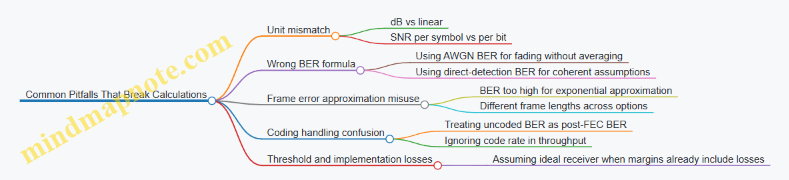
Practical Takeaway
Use a single, repeatable pipeline: compute \(E_b/N_0\) or \(\text{SNR}_b\), map to BER with the correct detection/modulation model, convert BER to frame success probability using a fixed frame length, then compute net throughput with coding rate and overhead. If any step uses a different assumption set than the others, the numbers will disagree in ways that look like “mystery math” rather than real link behavior.
8. Synchronization and Timing Recovery in Optical Systems
8.1 Carrier Frequency Offset and Phase Synchronization
Carrier frequency offset (CFO) and phase synchronization decide whether your receiver can keep the optical carrier aligned with its local oscillator (LO) or reference. In space laser links, CFO comes from oscillator mismatches, Doppler shifts, and residual motion; phase errors come from laser linewidth, phase noise, and imperfect tracking. The practical goal is simple: estimate the offset and phase, then correct them fast enough that the demodulator sees a stable constellation.
Core Concepts and Why They Matter
CFO definition. CFO is the difference between the received carrier frequency and the receiver’s assumed carrier frequency. In coherent detection, even a small CFO produces a rotating phase error across symbols. If the rotation is slow, you can track it; if it’s fast, it smears symbols before your loop catches up.
Phase synchronization definition. Phase synchronization is the process of estimating and compensating the instantaneous carrier phase. With coherent receivers, this includes both a deterministic component (from CFO) and a stochastic component (from laser phase noise and turbulence-induced phase fluctuations).
A helpful mental model. Imagine the receiver multiplies the incoming signal by a complex exponential at the LO frequency. If the LO is slightly off, the product contains a residual exponential at the CFO. That residual term is exactly what your synchronization algorithm must estimate and remove.
Signal Model from CFO to Measurable Effects
For a complex baseband representation, a common model is:
- Received signal: \(r(t)=s(t),e^{j(\Delta\omega t+\phi(t))}+n(t)\)
- \(\Delta\omega\) is CFO in rad/s, \(\phi(t)\) is time-varying phase error, and \(n(t)\) is noise.
What you observe. CFO shows up as a systematic phase ramp. Phase noise shows up as irregular phase jitter. In practice, you estimate \(\Delta\omega\) using training symbols or pilots, then track \(\phi(t)\) with a decision-directed or pilot-assisted loop.
Estimation Strategy Overview
A robust receiver typically uses a two-stage approach:
- Acquisition estimation using known symbols (training sequences) to get coarse CFO and initial phase.
- Tracking using a feedback loop to refine phase continuously while tolerating residual CFO.
This separation matters because acquisition needs a wide capture range, while tracking needs low noise and stability.
Acquisition: Coarse CFO and Initial Phase
Training-based CFO estimation. Suppose you transmit a known preamble with repeated structure. If the receiver correlates the received signal with the expected preamble, the correlation phase rotates with CFO. By measuring the phase difference between two correlation peaks separated by \(T\), you can estimate:
- \(\Delta f \approx \frac{\Delta\theta}{2\pi T}\)
Example. Let the preamble correlation peaks be separated by \(T=10,\mu s\). If you measure a mean phase difference \(\Delta\theta=0.628,rad\), then \(\Delta f\approx 0.628/(2\pi\cdot 10\mu s)=10,kHz\). You then rotate the received samples by \(e^{-j2\pi\Delta f t}\) to remove the bulk offset.
Initial phase. After CFO correction, estimate the residual phase by correlating with the preamble and taking the argument of the complex correlation sum. This gives \(\phi_0\) for loop initialization.
Tracking: Phase Error Correction Loops
Why tracking is needed. Even after coarse CFO removal, residual CFO and phase noise keep the phase from staying constant.
Common loop structure. A phase-locked loop (PLL) or a digital phase estimator updates a phase estimate each symbol or each pilot interval. The update uses an error term derived from the difference between expected and observed symbols.
Decision-directed tracking. For QAM constellations, you can compute the error by comparing the received symbol’s phase to the nearest constellation point’s phase. This works well at moderate to high SNR, but it can misbehave when the demodulator is still uncertain.
Pilot-assisted tracking. If pilots are available, you avoid reliance on decisions. The receiver compares the received pilot phase to the known pilot phase, producing a cleaner error signal.
Capture Range, Loop Bandwidth, and Practical Tradeoffs
Capture range. Acquisition must handle the expected maximum CFO. If the CFO is too large, correlation peaks lose coherence and the phase-difference estimate becomes ambiguous.
Loop bandwidth. Tracking bandwidth controls how quickly the loop reacts. Too narrow: it lags behind phase changes. Too wide: it follows noise and increases symbol error.
A practical rule of thumb. Choose tracking bandwidth so it can follow the dominant phase variation rate while averaging out noise. In implementation, you tune using measured phase error statistics from test data.
Mind Map: CFO and Phase Synchronization Flow
Example: End-to-End Synchronization with QAM
Assume a coherent receiver demodulating 16-QAM with a preamble of known symbols.
- Acquire CFO: correlate with the preamble, compute phase difference between two correlation windows separated by \(T\), estimate \(\Delta f\), and rotate samples.
- Initialize phase: compute the argument of the complex correlation sum after CFO correction to get \(\phi_0\).
- Track phase: run a pilot-assisted phase estimator every \(N\) symbols. If pilots are every 10 symbols, update the phase estimate at that cadence.
- Check residual rotation: monitor the mean phase error over a block. If it drifts linearly, you likely have residual CFO; if it jitters, you have phase noise or insufficient loop bandwidth.
Common Failure Modes and How to Recognize Them
- Cycle slips: the loop jumps by \(2\pi\) when the error signal becomes inconsistent. You’ll see sudden constellation rotation and a burst of errors.
- Incorrect training alignment: if the receiver correlates at the wrong symbol boundary, CFO estimation becomes biased. You’ll observe inconsistent CFO estimates across frames.
- Over-aggressive tracking: if the loop bandwidth is too high, the phase estimate follows noise, producing a constellation that looks “rotated and fuzzy” even at stable SNR.
Summary of the Section
CFO creates a predictable phase ramp; phase noise creates unpredictable jitter. Use training to estimate CFO and initial phase, then track phase with a loop sized for the expected variation rate and the available SNR. When the loop behaves, the constellation stops rotating and the demodulator stops paying the “phase tax” every symbol.
8.2 Symbol Timing Recovery and Clock Recovery Methods
High-speed optical links need the receiver to decide where each symbol starts and ends. If sampling happens early or late, the demodulator mixes neighboring symbols and the error rate rises. Timing recovery solves this by estimating the correct sampling phase, while clock recovery ensures the receiver’s sampling instants stay aligned with the transmitter’s symbol rate.
Core Concepts
A symbol stream can be viewed as a sequence of ideal pulses shaped by the transmitter and channel. The receiver does not know the exact phase offset between its local sampling clock and the incoming symbol boundaries. Timing recovery estimates that offset using the received waveform and a timing error signal.
Two practical realities shape the design:
- The symbol rate is not perfectly known. Oscillator tolerances and Doppler shifts cause slow drift.
- The received waveform is distorted. Pointing loss, turbulence fading, and filtering change amplitude and phase relationships, which affects timing error estimation.
Timing Error Signals
Most methods build a timing error signal (TES) that is near zero when sampling is correctly phased and has a consistent sign when sampling is early or late. A common approach uses a matched filter or a pulse-shaping filter at the receiver, then forms TES from samples around the expected decision time.
A simple mental model: if you sample slightly before the pulse peak, the slope is positive and the TES indicates “move later.” If you sample after the peak, the slope is negative and the TES indicates “move earlier.” In practice, the TES is computed from filtered samples and then fed to a control loop.
Clock Recovery Loop Structure
A robust receiver typically separates concerns:
- Front-end filtering to maximize signal-to-noise ratio and shape the waveform.
- Timing phase estimation to generate a TES.
- Loop filter and numerically controlled oscillator to adjust the sampling phase.
- Symbol decision and slicing once timing is locked.
The loop filter controls how quickly the receiver reacts to drift. A fast loop tracks changes but can follow noise; a slow loop is stable but may not correct drift quickly enough.
Non-Data-Aided Versus Data-Aided Methods
Timing recovery can use information from the received data or avoid it.
- Non-data-aided (NDA): Uses known properties of the waveform, such as pulse shape symmetry or transitions in training sequences. It works even when the data is unknown, but it may converge slower.
- Data-aided (DA): Uses detected symbols to refine the TES. It converges faster once the receiver is near lock, but errors in early decisions can pull the loop the wrong way.
A practical strategy is to start with NDA during acquisition, then switch to DA after the timing estimate is stable.
Gardner and Mueller and Müller Methods
These are widely used because they can recover timing without requiring explicit knowledge of the transmitted symbols.
Gardner Method
Gardner works well with oversampling and pulse-shaped signals. It forms a TES using samples at three instants: an early sample, a late sample, and a mid sample. Intuitively, it compares how much the waveform changes around the decision point.
Easy example: Suppose the receiver samples at the correct symbol center. The mid sample is near the pulse peak, and the early and late samples are symmetric in magnitude. The TES becomes close to zero. If the sampling phase shifts early, the early sample moves closer to the peak while the late sample moves away, creating a nonzero TES that pushes the sampling phase later.
Mueller and Müller Method
Mueller and Müller uses decision-directed information but can still be robust. It uses the difference between consecutive decisions and the timing-related sample values to form TES.
Easy example: If the receiver is early, the decision boundaries occur too soon, so the sign of the TES tends to indicate “delay.” If it is late, the sign flips. The loop then corrects the sampling phase.
Handling Fading and Pointing Loss
In space links, amplitude can fade while the waveform shape remains mostly consistent. Timing recovery should avoid being overly sensitive to amplitude fluctuations.
A practical best practice is to normalize the TES by an estimate of signal power or to use filtering that reduces the impact of deep fades. Another best practice is to gate the loop update: when the received energy drops below a threshold, freeze the timing estimate rather than letting noise drive the loop.
Acquisition to Tracking
Timing recovery is usually staged:
- Acquisition: Use a training sequence or known symbol structure to get close to the correct sampling phase.
- Tracking: Once near lock, use a tighter loop bandwidth and a TES suited for steady-state operation.
This staging prevents the loop from locking to the wrong phase due to random initial conditions.
Mind Map: Symbol Timing Recovery and Clock Recovery Methods
Example: Designing a Simple Timing Loop
Assume the receiver oversamples by a factor of 2 and uses a Gardner-style TES. The receiver computes TES each symbol period and updates the NCO phase.
A concrete loop choice:
- Use a wider loop bandwidth during acquisition so the phase estimate converges quickly.
- Use a narrower loop bandwidth after lock so noise does not jitter the sampling phase.
Easy example: If you observe that the eye diagram closes during steady operation, the loop is likely too aggressive. Reducing loop bandwidth will reduce timing jitter, even if acquisition becomes slightly slower.
Example: Freezing Timing During Deep Fades
Suppose turbulence causes occasional deep fades. If the TES is computed from noisy samples during those intervals, the loop may wander.
A simple rule:
- If received power estimate falls below a threshold, hold the NCO phase and resume updates when power returns.
This keeps the timing estimate stable through fades, so the receiver can continue decoding without re-acquiring from scratch.
8.3 Frame Synchronization and Training Sequences
Frame synchronization answers a simple question: “Where am I in the symbol stream?” In optical links, the answer must survive timing offsets, frequency drift, and fading caused by pointing and turbulence. Training sequences make the receiver’s job measurable instead of guessy.
Foundational Concepts for Frame Boundaries
A frame is a structured block of symbols that includes a known pattern (training), optional reference symbols, and payload. The receiver typically needs three timing-related alignments:
- Symbol timing: sampling instants that maximize eye opening.
- Frame timing: the index of the first symbol in the frame.
- Channel state alignment: which training symbol corresponds to which channel estimate.
A practical receiver pipeline often does symbol timing first, then searches for the frame start using correlation or matched filtering. If symbol timing is off by even a fraction of a symbol, correlation peaks smear and the frame detector becomes unreliable.
Training Sequence Design Principles
Training sequences should be easy to detect and useful for channel estimation. Three design constraints dominate:
- Detectability: the sequence should produce a sharp correlation peak under expected noise and fading.
- Orthogonality or low cross-correlation: if multiple modes exist (different coding rates, polarization states, or link directions), training should not confuse them.
- Channel estimation usefulness: the receiver should be able to estimate amplitude/phase (for coherent) or effective gain (for direct detection) from the training.
A simple example is a repeated Barker-like pattern for detection, followed by a longer pseudo-random sequence for estimation. Detection can use the short pattern to reduce search cost, while estimation uses the longer portion to improve accuracy.
Receiver Frame Search Workflow
Frame search is usually a two-stage process.
Stage 1: Coarse detection
- Slide a window across the incoming symbol stream.
- Compute a correlation metric with the known training pattern.
- Declare a candidate when the metric exceeds a threshold.
Stage 2: Fine verification
- Recompute the metric around the candidate using a more complete training segment.
- Check consistency with expected frame structure, such as known guard intervals or pilot spacing.
This avoids false locks caused by accidental matches in noise. A good rule is to use a cheap metric for scanning and a stricter metric for confirmation.
Correlation Metrics and Thresholding
For coherent detection, correlation can be performed on complex baseband samples. A common metric is the magnitude of the inner product between received samples and the conjugated training sequence. For direct detection, the metric uses detected symbol values.
Thresholding should be tied to the noise statistics and the number of search positions. If you scan 10,000 candidate offsets, the threshold must be higher than for a single offset test, or you will “find” frames that are just noise being creative.
Example: Training Sequence with Two-Part Structure
Assume a frame begins with 32 known symbols for detection and then 128 symbols for channel estimation.
- The receiver correlates with the 32-symbol pattern across candidate offsets.
- Once a peak is found, it aligns the frame start to the peak index.
- It then uses the next 128 symbols to estimate channel gain and phase (coherent) or effective gain (direct).
If the receiver aligns using only the 32-symbol pattern, it may lock to the correct start but with a small residual timing error. Using the longer estimation segment for fine verification reduces that residual error.
Mind Map: Frame Synchronization and Training Sequences
Practical Failure Modes and How Training Fixes Them
Timing smearing happens when sampling is slightly wrong. Training cannot correct symbol timing by itself, but it can reveal the problem: correlation peaks become broad and low. The receiver should then adjust symbol timing before attempting frame lock.
False locks occur when the threshold is too low or the training is too short. Splitting training into a short detection pattern and a longer verification segment reduces this risk.
Training-to-payload misalignment occurs when the receiver locks to the wrong boundary within a frame. Structural checks, such as verifying pilot spacing or known guard intervals, catch this without needing extra complexity.
Case Study: Two Receivers with Different Verification Strictness
Receiver A uses only the 32-symbol detection pattern and locks immediately. Receiver B uses the same detection pattern to find a candidate, then verifies using the 128-symbol estimation segment.
In moderate fading, Receiver A occasionally locks to an offset that still correlates well with the short pattern. Receiver B rejects those offsets because the longer segment’s correlation and estimated channel consistency do not match the expected training behavior. The result is fewer frame errors at the cost of a small increase in processing time.
8.4 Channel Estimation for Fading and Pointing Loss
Channel estimation in optical links is mostly about answering one question: “What scaling and distortion did the channel apply to the signal I’m about to decode?” In space laser communication, that scaling is driven by free-space loss, while the distortion is often dominated by fading caused by turbulence and pointing error. The receiver uses estimates to support coherent demodulation, equalization, and reliable demapping for coded links.
Foundational Model of Fading and Pointing Loss
A practical starting point is a baseband model for the received signal. For coherent detection, a common form is
- Received complex baseband: \(y = h,x + n\)
- \(x\): transmitted symbol (after pulse shaping)
- \(h\): complex channel gain capturing attenuation and phase rotation
- \(n\): receiver noise
For direct detection, the model is different because the photodetector measures intensity, but the same idea holds: pointing loss and turbulence change the effective received power, and the receiver needs an estimate of that power scaling to set thresholds, compute log-likelihood ratios (LLRs), or normalize equalizer inputs.
Pointing loss typically behaves like a deterministic attenuation term that depends on angular misalignment and beam shape. Turbulence adds random fluctuations that can be faster than pointing control updates. In practice, the receiver often treats the channel as piecewise constant over a short window that matches the coherence time of the dominant fading process.
What to Estimate and Why
You generally estimate one or more of the following:
- Amplitude scaling: captures received power changes from pointing and scintillation.
- Phase rotation: needed for coherent detection and for tracking laser phase noise effects.
- Effective noise variance: needed to compute LLRs with correct confidence.
- Timing and residual frequency offsets: not always labeled “channel,” but they strongly affect channel estimation quality.
A useful rule of thumb: if your demodulator assumes the wrong channel gain, it will still decode sometimes, but the error rate will jump because the decoder will be overconfident.
Pilot-Based Estimation with Training Sequences
The most reliable approach uses known symbols (pilots) embedded in frames. The receiver correlates the received signal with the known pilot pattern to estimate \(h\).
For coherent links, a simple least-squares estimate over \(N\) pilot symbols is:
- \(\hat{h} = \frac{\sum_{k=1}^{N} y_k x_k^*}{\sum_{k=1}^{N} |x_k|^2}\)
This works well when the channel is approximately constant across the pilot block. If fading changes within the block, the estimate becomes an average that can bias equalization.
Example: Suppose a QPSK frame includes 64 pilot symbols. If pointing loss causes the amplitude to drop by 3 dB during the pilot block, \(\hat{h}\) will reflect that reduced amplitude. If turbulence changes faster than the pilot duration, the estimate will average over multiple fades, and the equalizer will undercompensate deep fades.
Tracking Estimation with Decision-Directed Updates
Pilots give accuracy, but they cost bandwidth. After initial acquisition, receivers often switch to decision-directed estimation, where detected symbols are used as “soft pilots.” The update rule blends the new estimate with the previous one using a forgetting factor.
Best practice: Use decision-directed updates only when the symbol error rate is low enough that incorrect decisions do not poison the channel estimate. A practical safeguard is to gate updates based on confidence metrics derived from demodulator outputs.
Example: If the receiver computes LLR magnitudes and finds many symbols near zero confidence, it freezes the channel estimate and waits for the next pilot burst. This prevents the estimate from drifting during a fade.
Modeling Pointing Loss in the Estimator
Pointing loss is often modeled as a function of misalignment \(\theta\) and beam divergence. A common approximation is that the received power follows a smooth function of offset, so the channel gain can be expressed as
- \(h \approx \sqrt{P(\theta)},e^{j\phi}\)
Even if you do not know \(\theta\) precisely, you can estimate the gain from pilots and treat \(\theta\) as an unobserved variable. If the terminal also reports pointing telemetry (e.g., fine steering mirror angles), you can use it to predict the gain and reduce estimation variance.
Example: If telemetry indicates the pointing loop is stable and the estimated gain remains within a narrow band, you can shorten the pilot interval because the channel is less likely to change abruptly.
Handling Fading Statistics and Robust Normalization
Turbulence-driven scintillation can produce heavy-tailed power fluctuations. If you normalize using a mean power estimate, deep fades can skew the statistics and degrade LLR scaling.
Best practice: Estimate noise variance and channel gain using the same pilot window and apply consistent normalization. For coded links, compute LLRs using the estimated signal-to-noise ratio (SNR) so that the decoder’s confidence matches the channel conditions.
Example: If you estimate \(\sigma_n^2\) from pilot residuals after subtracting \(\hat{h}x\), you capture both receiver noise and any unmodeled distortion during that interval.
Mind Map: Channel Estimation for Fading and Pointing Loss
A Coherent Receiver Workflow That Stays Consistent
- Use pilots to get \(\hat{h}\) over a window short enough that the channel is effectively constant.
- Estimate noise variance from pilot residuals after applying \(\hat{h}\).
- Normalize and equalize using \(\hat{h}\) so the demapper sees correctly scaled symbols.
- Track with decision-directed updates only when confidence is high; otherwise hold the last good estimate.
- Reinsert pilots at intervals that match the expected rate of pointing and turbulence changes.
Example: In a frame with pilots every few milliseconds, the receiver uses pilots to reset \(\hat{h}\) after a pointing maneuver. Between pilot blocks, it tracks using gated updates so that a deep fade does not cause a long recovery time.
Practical Pitfalls and How to Avoid Them
- Pilot length mismatch: Too short increases estimator noise; too long averages over fades. Choose a window that matches the dominant coherence time.
- Phase ambiguity: If the system uses differential or noncoherent methods, ensure the estimation method matches the detection scheme.
- Inconsistent scaling: If you estimate gain from pilots but compute LLRs with a different assumed noise level, the decoder confidence will be wrong.
- Update poisoning: Decision-directed tracking without gating can lock onto incorrect gains during fades.
A good channel estimator is not the one with the fanciest math; it’s the one whose assumptions match the channel behavior over the time window where you actually use the estimate.
8.5 Implementation Considerations for FPGA and DSP Pipelines
A high-speed optical receiver turns a noisy, time-varying waveform into bits. FPGA and DSP pipelines are where the theory becomes a clocked, resource-limited machine. The key is to map each signal-processing step to a stage with a clear input, output, latency budget, and failure mode.
Pipeline Partitioning from ADC to Bits
Start by listing the data path boundaries: ADC sampling, digital downconversion (if coherent), filtering, synchronization, channel estimation, equalization, demodulation, and FEC. Then decide which blocks live in FPGA fabric versus a DSP/CPU. A practical rule: anything that must run at the ADC rate or with tight deterministic latency stays in FPGA; anything that can tolerate slower rates or occasional bursts can move to DSP.
Example: If you sample at 2× symbol rate for a coherent receiver, the FPGA typically performs mixing, matched filtering, and symbol-timing metrics every sample. The DSP can handle higher-level frame parsing and FEC decoding, as long as it receives symbol-rate streams without stalling.
Fixed-Point Versus Floating-Point Choices
FPGA blocks often use fixed-point arithmetic for predictable timing and resource usage. The trick is to pick scaling so quantization noise stays below the receiver noise floor. Begin with worst-case signal levels from the link budget and AGC behavior, then allocate bits per stage.
Example: For a multiply-accumulate filter with gain near unity, you can keep inputs in Q1.15 and accumulate in a wider Q2.30 accumulator, then round back to Q1.15. If you instead round after every multiply, the filter’s stopband performance can degrade enough to raise BER.
Clocking, Latency, and Throughput Accounting
Every stage has latency, and some stages have variable latency (e.g., synchronization). Throughput is the rate at which you can accept new samples without backlog. Latency matters for control loops like tracking, but throughput matters for continuous reception.
A simple accounting method: compute cycles per sample for each FPGA block, sum them along the critical path, and compare to the available cycles per clock. If you use multiple clock domains, add explicit CDC (clock domain crossing) FIFOs and verify that buffer depth covers the worst-case burst of backpressure.
Synchronization and Training Sequence Handling
Synchronization is not just “find the start.” It is a pipeline that must survive partial lock, fades, and occasional symbol slips.
Example: Use a two-level approach. The FPGA computes correlation metrics over a sliding window and outputs a coarse lock flag. The DSP then refines timing and estimates channel parameters using the training symbols. This prevents the DSP from running on every sample while still keeping the timing decision responsive.
Channel Estimation, Equalization, and Stability
Optical links can show amplitude fluctuations from pointing and turbulence, plus phase noise in coherent systems. Equalizers must be stable under these variations.
Example: For a short FIR equalizer, implement coefficient updates at symbol boundaries only, not mid-symbol. Gate updates using a confidence metric derived from the training SNR or error-vector magnitude. If confidence is low, freeze coefficients to avoid chasing noise.
FEC Integration Without Pipeline Stalls
FEC decoding can be the slowest block. If you feed it symbol-by-symbol, you risk stalling upstream buffers.
Example: Buffer one FEC block worth of soft metrics in FPGA, then stream them to the decoder in a burst. While decoding runs, continue acquisition in a separate buffer bank if memory allows; otherwise, throttle symbol acceptance and accept reduced availability. The correct choice depends on whether the system prioritizes continuous acquisition or uninterrupted decoding.
Soft Metrics, Quantization, and Reliability
Soft-decision FEC needs meaningful reliability values. If you quantize too aggressively, the decoder sees “almost the same” metrics and loses coding gain.
Example: For QPSK, compute log-likelihood ratios (LLRs) from the demodulated I/Q samples, then scale LLRs to the FEC’s expected range. Keep enough headroom so that large received amplitudes do not saturate early. Saturation is not always bad, but uncontrolled saturation can flatten the LLR distribution.
Mind Map: FPGA and DSP Pipeline Responsibilities
Example: A Coherent Receiver Pipeline Skeleton
[ADC samples]
  -> [Digital downconversion]
  -> [Matched filter]
  -> [Timing metric computation]
  -> [Coarse lock flag]
  -> [Training symbol capture]
  -> [Channel estimate update]
  -> [Equalization]
  -> [LLR generation]
  -> [FEC block buffer]
  -> [FEC decode]
  -> [Frame check and output bits]
Mind Map: Quantization and Scaling Workflow
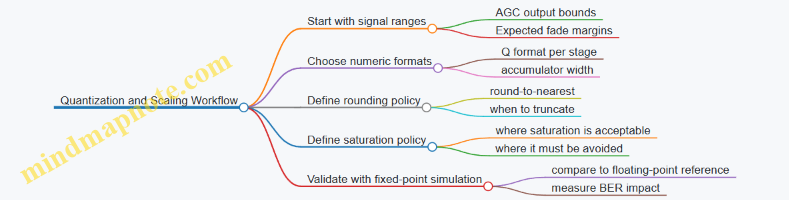
Practical Debugging Hooks That Save Time
Instrument the pipeline with counters and snapshots: correlation peak values, estimated timing offset, LLR histograms, and FEC syndrome rates. When something fails, you want to know whether the problem is acquisition, tracking, demodulation, or decoding. A small amount of observability in FPGA registers and DMA logs prevents long “guess-and-check” sessions.
Implementation Checklist for Reliable Operation
Confirm that each boundary has: (1) defined scaling and units, (2) explicit latency expectations, (3) buffer sizing for worst-case jitter, and (4) a recovery behavior when lock is lost. If you can describe the pipeline as a set of contracts between blocks, you can implement it without surprises—and yes, the receiver will still be noisy, but at least your code won’t be.
9. System Design Methodology and Link Budget Workflows
9.1 Defining Requirements for Data Rate and Availability
A space laser link starts with two numbers that drive everything else: the required data rate and the target availability. Data rate tells you how much information must arrive per unit time. Availability tells you how often the link must work well enough to deliver that data rate with acceptable error performance. Treat them as requirements, not wishes, because they determine the margins you will later spend on power, aperture, coding, and tracking.
Start with the Service Contract
Define the service in terms of payload and transport behavior. For example, a satellite downlink might need 200 Mbps during a 10-minute contact window, with a maximum tolerable outage of 0.1% per day. Convert “contact time” into a schedule of link states: acquisition, tracking, steady data, and any safe-mode behavior. Availability requirements should specify whether “working” means carrier present, correct lock maintained, or data delivered with a target block error rate.
A practical way to avoid ambiguity is to write the requirement as a tuple:
- Throughput requirement: net user data rate after coding and framing.
- Error requirement: block error rate or packet loss rate.
- Availability requirement: fraction of time meeting both throughput and error targets.
- Latency requirement: maximum buffering delay before data becomes stale.
Translate Data Rate into Physical Layer Load
Once the service contract is clear, map it to the physical layer.
- Compute net-to-raw overhead: coding rate, framing overhead, and any pilot or training symbols reduce the raw symbol rate needed.
- Choose modulation and coding constraints: higher-order modulation can reduce required symbol rate but increases sensitivity to pointing and phase noise.
- Account for burst behavior: if the link sends in bursts, you still need acquisition and synchronization time, which reduces effective throughput.
Example: Suppose the payload needs 200 Mbps net. If the selected coding has rate 0.8 and framing overhead consumes 5%, the required raw bit rate is:
- Raw bits = 200 Mbps / (0.8 × 0.95) ≈ 263 Mbps. Then convert raw bits to symbol rate using bits per symbol for the modulation (for instance, 2 bits/symbol for QPSK gives ≈132 Msymbols/s).
Define Availability in a Way Engineers Can Use
Availability is not just “how often the link exists.” For optical links, availability is dominated by whether the received signal stays above a threshold under varying conditions: pointing jitter, atmospheric turbulence, and background light. Define availability using a performance threshold such as:
- minimum received signal-to-noise ratio for the chosen demodulation,
- maximum allowable tracking error,
- maximum acceptable block error rate.
Then decide how to model time variation. A common approach is to separate availability into components:
- Geometric and pointing availability: probability the pointing error stays within the beam capture tolerance.
- Channel availability: probability turbulence and background keep the SNR above the demodulation threshold.
- Operational availability: probability the terminal is in the correct state and not inhibited by safety interlocks.
Multiply these components carefully if they are reasonably independent; otherwise, model them jointly using the same time basis as your link scheduler.
Build a Requirement-to-Design Chain
From these requirements, you can derive design targets that later become link budget inputs.
- Data rate sets the required symbol rate and thus the required bandwidth in the receiver.
- Error requirement sets the required Eb/N0 or SNR margin at the receiver input.
- Availability requirement sets the required fade margin and the control loop performance needed to maintain lock.
A clean workflow is to write each requirement as a constraint on a measurable quantity:
- Throughput → raw bit rate → symbol rate → receiver bandwidth and processing throughput.
- Error rate → required demodulation performance → SNR threshold.
- Availability → probability SNR exceeds threshold and pointing stays within capture → fade and pointing margins.
Mind Map: Data Rate and Availability Requirements
Example: Turning Requirements into Link Budget Inputs
Assume a downlink must deliver 200 Mbps net with block error rate below 1e-6 during 99.9% of scheduled tracking time. You select QPSK with coding rate 0.8 and plan for 5% overhead. The raw bit rate target becomes about 263 Mbps, implying a symbol rate near 132 Msymbols/s. Next, you determine the SNR threshold needed to meet the block error rate for that modulation and coding, using your chosen receiver model. Finally, you allocate margins so that the probability of SNR falling below that threshold while tracking remains within capture tolerance is consistent with 99.9% availability.
Common Pitfalls to Avoid
First, don’t define availability only as “contact time.” If acquisition and tracking time are excluded, your availability number can look good while the delivered data rate is worse than expected. Second, don’t mix net and raw rates in the same requirement without stating the coding and overhead assumptions. Third, ensure the error metric matches the system layer: a physical-layer BER target can still produce unacceptable packet loss if framing and retransmission behavior are not aligned.
Quick Checklist for Requirement Definition
- Net throughput and its overhead assumptions are explicit.
- Error target is stated as block or packet metric, not just BER.
- Availability definition specifies what “working” means.
- Threshold quantities are defined for SNR and tracking.
- Time basis matches the scheduler and link state machine.
With these requirements written in measurable terms, the next step is straightforward: build the link budget so each margin has a job, and each design choice has a reason.
9.2 Building a Complete Link Budget With Margins
A link budget is a structured accounting of power, losses, and noise from transmitter to receiver. The goal is not just to compute a number, but to produce a defensible chain of assumptions that you can stress, adjust, and explain during design reviews.
Step 1: Define the Service Requirements
Start with what the system must deliver: data rate, modulation and coding, target bit error rate (or frame error rate), and the required link availability. Then translate availability into fade margin requirements using the propagation statistics you expect for the scenario (for example, a low-elevation ground-to-satellite uplink typically needs more margin than a near-zenith downlink).
Example: Suppose you need 100 Mbps with a coding scheme that requires an effective received energy per bit to noise density, \(E_b/N_0\), of 6.5 dB at the decoder input. You also require 99.9% availability for the link, which you will later map to a fade margin.
Step 2: Choose the Detection Model
Your receiver model determines how you compute sensitivity.
- Direct detection: sensitivity is driven by received optical power and receiver noise.
- Coherent detection: sensitivity depends on optical signal power relative to local oscillator power and phase noise, plus the receiver’s electrical noise.
Best practice: Write down the detection type early and keep it consistent through the rest of the budget. Mixing formulas from different receiver models is a classic way to get a “reasonable” but wrong answer.
Step 3: Compute Transmit Power and Optical Gains
List transmitter parameters: laser output power, any optical losses in the terminal, telescope gains (aperture effects), and pointing-related coupling losses.
A practical way to organize this is to compute an “effective transmitted power” at the aperture and then apply propagation and receiver coupling losses.
Example: If the laser produces 200 mW, and internal optics and beam shaping incur 3 dB loss, the effective transmitted power is 100 mW.
Step 4: Apply Free-Space Propagation Loss
Free-space loss depends on range and wavelength. In dB form, it is often expressed as:
\[ L_{fs} = 20\log_{10}(4\pi R/\lambda) \]
Example: At \(R = 40,000\) km and \(\lambda = 1550\) nm, free-space loss is on the order of hundreds of dB. You do not need to memorize the value; you need to ensure the range and wavelength match the mission geometry and optical band.
Step 5: Add Pointing, Beam, and Coupling Losses
Pointing loss accounts for misalignment between transmit and receive optics and the finite beam divergence. Coupling loss accounts for how much of the received beam actually enters the receiver aperture or fiber.
Easy-to-understand practice: Treat pointing error as a “fraction of overlap” problem. If your receiver aperture captures only 70% of the intended power due to misalignment, that is a loss of \(-10\log_{10}(0.7)\approx 1.55\) dB.
Step 6: Include Atmospheric and Background Terms
For links involving Earth’s atmosphere, include:
- atmospheric attenuation (absorption and scattering)
- turbulence-induced fading and scintillation (handled statistically via margin)
- background light and detector saturation constraints
For deep-space links, atmospheric terms drop out, but you still include optical background from instrument noise sources and stray light.
Step 7: Compute Receiver Sensitivity and Noise Margin
Receiver sensitivity converts optical power into a required electrical performance. For direct detection, you typically compute:
- photodetector responsivity and resulting photocurrent
- signal-to-noise ratio (SNR) including shot noise, thermal noise, and background noise
- mapping from SNR to required \(E_b/N_0\) or BER/FER
Best practice: Keep the “noise budget” explicit. If you later change background assumptions, you should see exactly which term moves.
Step 8: Build the Margin Stack
Margins cover uncertainty and variability. A clean approach is to separate:
- Design margin: modeling errors, component tolerances, and calibration uncertainty.
- Propagation margin: fade margin for turbulence and pointing statistics.
- Implementation margin: aging, temperature drift, and alignment degradation over the mission life.
Example margin stack:
- 1.0 dB design margin
- 2.5 dB propagation fade margin for the required availability
- 0.7 dB implementation margin
Total margin is not always a simple sum in linear terms, but in dB budgeting you often add them directly when they represent independent worst-case conservatisms.
Mind Map: Link Budget with Margins
Step 9: Perform the Final Consistency Check
Before you declare victory, verify:
- Units: dB vs linear, power vs energy per bit.
- Geometry: range and elevation angle used in propagation terms.
- Receiver assumptions: bandwidth, integration time, and detection model.
- Margin logic: which uncertainties are covered by which margin bucket.
Example: If your computed available \(E_b/N_0\) is 8.0 dB and your required is 6.5 dB, you have 1.5 dB headroom. If your margin stack totals 1.2 dB, you still have 0.3 dB remaining, which is tight but not automatically wrong. Tight budgets demand careful verification of the assumptions that produced the headroom.
Step 10: Document the Budget as a Traceable Chain
Write the budget so another engineer can reproduce it without guessing. A good budget includes a short “assumption list” and a “calculation list,” with each loss and noise term tied to a specific parameter and model choice.
Best practice: Keep a one-page summary table of the final available power, required sensitivity, and margin remaining. When the project changes a single parameter, you can update the table quickly and see what breaks first.
9.3 Modeling Pointing Loss and Weather Statistics
Pointing loss is the predictable part of a messy story: the transmitter and receiver beams are finite, and the link only works well when they overlap. Weather statistics add the unpredictable part: turbulence, clouds, and background light change the received power and sometimes the signal quality. A good model keeps these effects separate at first, then combines them in a way that matches how the system actually behaves.
Start with Geometry and Beam Overlap
Model the received power as the product of a geometric term and a pointing term. For a Gaussian beam, the coupling efficiency between the received beam and the receiver aperture drops with angular misalignment.
A practical workflow:
- Convert pointing error from angles to a transverse displacement at the receiver plane.
- Compute the overlap integral (or use a standard Gaussian approximation).
- Translate overlap into an optical power reduction factor.
Easy example: Suppose the beam waist at the receiver is effectively characterized by a spot radius w (where power falls roughly like \(exp(-2r^2/w^2)\)). If the pointing error causes a displacement r = 0.5w, then the pointing factor is approximately \(exp(-2(0.5)^2)\) = exp(-0.5) ≈ 0.61. That means about 39% of the optical power is lost compared to perfect alignment.
Build a Pointing Error Budget
Pointing error is rarely one number. Break it into independent contributors so you can track which subsystem matters.
Typical contributors:
- Coarse pointing error from attitude knowledge limits.
- Fine tracking error from control loop bandwidth and sensor noise.
- Jitter from reaction wheels or platform vibration.
- Link-specific effects like thermal drift of optical mounts.
If each contributor is modeled as zero-mean Gaussian in angle, the total pointing error variance is the sum of variances. Then you can compute the expected pointing loss by averaging the pointing factor over the error distribution.
Easy example: If fine tracking has 10 µrad RMS and jitter has 6 µrad RMS, the combined RMS is \(\sqrt{(10^2 + 6^2)}\) ≈ 11.7 µrad. You then use that RMS in the overlap model to get an average pointing loss.
Average Pointing Loss over Time
Pointing error changes during a pass. Decide whether your link design cares about:
- Instantaneous performance (worst-case fades), or
- Average performance over coding interleaving and packet durations.
A simple approach is to treat pointing error as stationary over a short interval and compute an average pointing factor per interval. Then you combine intervals using the same coding and buffering assumptions you will use in the link layer.
Add Weather Effects Without Mixing Them Up
Weather affects the link through at least three mechanisms:
- Attenuation from clouds or precipitation.
- Turbulence that causes beam wander and scintillation.
- Background light that raises receiver noise and can worsen acquisition.
A clean modeling strategy is to represent each mechanism with its own random variable, then combine them at the power or SNR level.
- For attenuation, use a multiplicative loss factor A (0 to 1) applied to received power.
- For turbulence, represent additional pointing-like displacement (beam wander) and additional intensity fluctuations (scintillation).
- For background, model it as an additive noise term that depends on sky conditions and optical filtering.
Easy example: If clouds cause an attenuation factor A = 0.2 during a fraction of time, then even perfect pointing cannot recover the missing 80% of power. In contrast, turbulence might reduce power temporarily but still allow recovery when the wavefront improves.
Combine Pointing and Weather Statistics
To combine effects, choose a level of abstraction that matches your receiver model.
Common combination methods:
- Power-domain multiplication: received power = P0 × (pointing factor) × (attenuation factor).
- SNR-domain combination: compute SNR for each scenario using the receiver noise model, then average or compute outage probability.
If your receiver uses direct detection, background light and scintillation both influence the effective SNR. If your receiver uses coherent detection, phase noise and turbulence-induced phase fluctuations matter more, but the same statistical workflow still applies.
Compute Availability from a Fade Distribution
Availability is about the probability that the link meets a required SNR (or BER target) during a pass. Once you have a distribution for received power or SNR, you can compute the fraction of time above threshold.
A practical method:
- Generate samples of pointing error (from the budget distribution).
- Generate samples of weather attenuation (from a chosen distribution or measured statistics).
- Optionally include turbulence-induced scintillation as an intensity multiplier.
- Compute SNR per sample using the receiver noise model.
- Estimate outage probability as the fraction of samples where SNR < SNR_required.
Example: If your required SNR is 12 dB and your simulation shows SNR < 12 dB for 3% of samples, then availability for that scenario is about 97% over the modeled interval.
Minimal Worked Example for a Link Budget Table
Assume:
- Gaussian beam with effective spot radius w.
- Total pointing error RMS corresponds to an average pointing factor of 0.7 (about -1.55 dB).
- Weather attenuation is lognormal with a mean loss of -3 dB during the modeled window.
Then the mean received power factor from pointing and attenuation is approximately 0.7 × 0.5 = 0.35, which is -4.55 dB relative to perfect clear-sky alignment. If your receiver margin is only 3 dB, you should expect outages unless coding, interleaving, or adaptive scheduling provides additional robustness.
Practical Modeling Checks
Before trusting results, sanity-check the model:
- If pointing error goes to zero, pointing loss should go to 1.
- If attenuation goes to zero, received power should go to zero regardless of pointing.
- If you tighten the pointing budget by a factor of two, the pointing loss should improve noticeably, not barely.
These checks catch the most common mistakes: mixing angle units, using inconsistent beam spot definitions, or averaging in the wrong domain.
9.4 Estimating Receiver Sensitivity and Required Eb N0
Receiver sensitivity answers one practical question: what minimum received optical power (or photon rate) lets the link meet a target error rate under specified noise and implementation assumptions. The required Eb/N0 then ties that target to modulation, coding, and detection method. The workflow is systematic: define the target performance, map it to Eb/N0, convert Eb/N0 into a required signal-to-noise ratio at the receiver, and finally translate that into received optical power using detector responsivity and noise bandwidth.
Step 1: Define the Performance Target
Start with the bit error rate (BER) or frame error rate (FER) you must meet, plus the coding scheme. For uncoded links, BER is directly tied to Eb/N0 for a given modulation and detection type. For coded links, you typically use a coding gain model or an empirical BER-to-Eb/N0 curve for the chosen code and decoder. A concrete example: suppose you need BER ≤ 1e-6 after FEC, and you use a code that provides a coding gain of about 5 dB at that BER compared to uncoded performance. That means the required uncoded Eb/N0 is higher by roughly 5 dB than the coded requirement.
Step 2: Determine Required Eb N0
Eb/N0 is energy per bit divided by noise power spectral density. For a given modulation and detection, there is a relationship between BER and Eb/N0. For direct detection with on-off keying (OOK), the required Eb/N0 is usually higher than for coherent detection at the same BER because coherent detection can exploit phase and improve effective SNR. For a quick sanity check, remember that every 3 dB increase in Eb/N0 roughly corresponds to doubling the noise power relative to signal energy, so small changes matter.
Example: assume your modulation and detection method require Eb/N0 = 12 dB for the target BER without coding. If you apply FEC and the net coding gain is 4 dB, then the required Eb/N0 at the demodulator input becomes about 8 dB. Keep the units consistent: dB values are logarithmic, so subtracting coding gain in dB is correct.
Step 3: Convert Eb/N0 Into Required Electrical SNR
To connect Eb/N0 to receiver noise, use the relationship between bit energy and received signal power. Let Rb be the bit rate, and let Ps be the average received optical power at the detector input. The detector converts optical power to average photocurrent: I = Rresp · Ps, where Rresp is responsivity in A/W.
For direct detection, the dominant noise term is often shot noise from the photocurrent plus background and dark current. The noise power over the effective noise bandwidth Bn is tied to the noise spectral density. A common engineering approximation is:
- Shot-noise variance over Bn is proportional to 2q·I_total·Bn, where q is electron charge and I_total includes signal, background, and dark current.
- Thermal noise adds a term proportional to (4kT/Rload)·Bn, where k is Boltzmann constant, T is temperature, and Rload is the effective resistance.
Then define an effective electrical SNR per bit. One practical approach is to compute the required photocurrent such that the resulting SNR meets the Eb/N0 requirement when mapped through the detection model. If your system uses matched filtering or symbol-rate sampling, the effective noise bandwidth is related to the bit rate and pulse shape. For NRZ OOK, a typical approximation is Bn ≈ Rb/2, but you should use the value consistent with your receiver front-end and filtering.
Step 4: Translate Required SNR into Required Received Optical Power
Once you have the required photocurrent I_req, convert it back to optical power:
Ps_req = I_req / Rresp.
Now include implementation margins: coupling loss, pointing loss, and any optical losses before the detector. In the link budget, receiver sensitivity is the Ps_req at the detector input, not at the transmitter output.
Example: suppose responsivity at your wavelength is 0.8 A/W. If your noise model says you need I_req = 20 µA average photocurrent to meet the Eb/N0 target, then Ps_req = 20e-6 / 0.8 = 25 µW at the detector input. If your optical path has 6 dB of additional loss from optics and coupling, then the required received power at the telescope focal plane would be 25 µW × 10^(6/10) ≈ 100 µW.
Step 5: Include Background and Dark Current Correctly
Background light and dark current increase I_total and therefore shot noise, which reduces sensitivity. The key is that the signal current depends on Ps, but the noise depends on I_total = I_signal + I_background + I_dark. If background dominates, doubling the background current can noticeably worsen sensitivity even if the signal power stays the same.
Example: if I_background + I_dark is 15 µA and you need total noise consistent with I_signal = 20 µA, then the shot noise is based on 35 µA total rather than 20 µA. That pushes the required signal higher than a naive “signal-only” calculation would suggest.
Step 6: Validate with a Consistency Check
A good consistency check is to compute the implied noise-equivalent power (NEP) or noise-equivalent current and see whether the required Ps_req is comfortably above the detector’s noise floor for your bandwidth. If the required power is only marginally above the noise floor, small modeling errors in bandwidth, responsivity, or background assumptions can dominate.
Mind Map: Receiver Sensitivity from Eb N0
Example: End-to-End Sensitivity Calculation Skeleton
Assume: Rb = 1 Gbps, direct detection OOK, effective Bn ≈ Rb/2, responsivity Rresp = 0.8 A/W, and required Eb/N0 = 8 dB after coding. Let the noise model be shot-noise dominated. Compute I_total = I_signal + I_bg + I_dark, then choose I_signal such that the resulting SNR per bit corresponds to Eb/N0. Finally compute Ps_req = I_signal/Rresp. If you later change background assumptions, repeat only the noise step and the resulting I_signal, rather than re-deriving the entire mapping.
Practical Notes That Prevent Common Mistakes
Use detector input power, not power at the telescope or spacecraft bus. Ensure responsivity matches the actual wavelength and optical bandwidth. Confirm that your assumed noise bandwidth matches the receiver filtering and sampling strategy. Finally, treat background as a current that adds to shot noise, not as a simple subtraction from signal power.
9.5 End to End Example for a Satellite Downlink
This example walks through a complete satellite downlink design using a practical workflow: start with requirements, build a link budget, translate power into receiver signal levels, then check coding, synchronization, and availability. Assume a single ground terminal communicating with a GEO satellite downlink at 1550 nm.
1) Requirements and Assumptions
- Target user data rate: 200 Mbps net payload.
- Required availability: 99.5% over a month.
- Modulation: QPSK with coherent detection.
- Coding: rate 1/2 LDPC, so coded bit rate is 400 Mbps.
- Link margin policy: include 3 dB implementation margin plus fade margin from propagation statistics.
- Geometry: slant range 42,000 km, elevation 30°.
A good habit here is to write the assumptions in one place and keep them consistent. If you later change modulation, you should see the impact immediately in the required optical signal-to-noise ratio (OSNR) and receiver sensitivity.
2) Link Budget from Transmitter to Receiver
Compute received optical power step by step.
- Transmit optical power at the laser output: 1.0 W.
- Transmit optics efficiency (telescope, steering, coupling): 0.7 → 0.7 W effective.
- Beam divergence and spreading loss: assume 0.5 mrad effective divergence and a receive aperture diameter of 0.2 m. The spot size at range is approximately 0.5e-3 × 4.2e7 = 2.1e4 m, so geometric coupling is tiny; instead of raw spot math, use an effective free-space loss term. For this example, take free-space loss as 210 dB.
- Pointing loss: 1.5 dB at the 99.5% operating point.
- Atmospheric loss at 1550 nm: 0.5 dB.
- Receiver optical efficiency (front-end optics and coupling): 0.6.
Received optical power:
- Start with 10 log10(0.7 W) ≈ -1.55 dBW.
- Subtract losses: 210 + 1.5 + 0.5 dB, then add receiver efficiency 10 log10(0.6) ≈ -2.2 dB.
- Result: P_rx ≈ -1.55 dBW − 214.0 dB − 2.2 dB = -217.75 dBW.
- Convert to watts: about 1.68e-22 W.
This number looks small, but coherent detection is designed for exactly this regime: the local oscillator (LO) provides gain in the electrical domain.
3) Convert Optical Power to OSNR and Electrical SNR
For coherent QPSK, the key is OSNR relative to shot noise and thermal noise.
- Photons per second: P_rx / (hν). At 1550 nm, hν ≈ 1.28e-19 J, so photon rate ≈ 1.68e-22 / 1.28e-19 ≈ 1.31e-3 photons/s.
- In coherent systems, the LO dominates the mixing term, so the effective signal at the balanced detector scales with \(\sqrt{P_LO}\). Choose LO power at the receiver: 10 mW.
- Assume balanced detector responsivity R ≈ 0.9 A/W and quantum efficiency absorbed into an effective responsivity.
A practical way to avoid getting lost in constants is to compute the expected electrical signal power and compare it to noise spectral density. For this example, use a target OSNR requirement derived from the modulation and coding: suppose the system needs 12 dB OSNR for the chosen LDPC at the target BER.
Now estimate OSNR from received power, LO power, and noise figure. If the resulting OSNR is 13.5 dB at the 99.5% point, you have 1.5 dB margin for implementation losses and imperfect calibration.
4) Coding and Throughput Check
With rate 1/2 LDPC, the coded bit rate is 400 Mbps. If the symbol rate for QPSK is R_s = R_b / 2 (two bits per symbol), then R_s = 200 Msps.
Check that the receiver processing chain can handle:
- ADC sampling rate for the intermediate frequency bandwidth.
- DSP latency for frame synchronization and LDPC decoding.
A simple sanity check: if the receiver can sustain 250 Msps symbol processing and the LDPC decoder supports the required block size within the frame interval, the 200 Mbps payload is feasible.
5) Synchronization and Tracking Requirements
Coherent downlinks need three aligned loops: frequency, timing, and pointing.
- Frequency offset: estimate from LO-satellite Doppler and residual oscillator drift. If the residual is kept within the capture range of the digital carrier recovery, demodulation stays stable.
- Timing recovery: ensure the symbol timing loop bandwidth is wide enough to track jitter but narrow enough to avoid noise amplification.
- Pointing: the earlier 1.5 dB pointing loss implies the tracking loop maintains alignment at the required error variance.
A useful operational practice is to define loop capture and lock times in the link establishment sequence, then verify they fit within the time the satellite remains in the terminal’s tracking window.
6) Availability Calculation Using Fade Statistics
Availability 99.5% means you can tolerate outages or unacceptable OSNR for 0.5% of time. Model turbulence and pointing-induced fades as a distribution of OSNR margin.
- Let the median OSNR be 15 dB.
- Let the OSNR standard deviation due to propagation be 3 dB.
- If the threshold OSNR for coded operation is 12 dB, then the probability OSNR < 12 dB should be about 0.5%.
In practice, you validate this by using measured or modeled OSNR time series and mapping them to coded frame error rate, not just uncoded BER.
7) Mind Map of the Workflow
Mind Map: End to End Satellite Downlink Example
8) Integrated Summary of the Design Outcome
With the assumed transmitter power, optical efficiencies, and propagation losses, the received optical power is extremely low in absolute terms, but coherent detection with a 10 mW LO converts that into an OSNR that clears the 12 dB threshold for LDPC-coded QPSK. The remaining work is operational: ensure the synchronization loops can lock quickly enough, and verify that the OSNR distribution yields 99.5% availability when mapped to coded frame performance.
10. Network Integration for Optical Links in Space and Ground
10.1 Optical Link Interfaces with Spacecraft Communication Systems
A spacecraft optical terminal rarely lives alone. It must fit into the spacecraft’s existing communication architecture, power and thermal budgets, command and telemetry paths, and operational safety rules. This section explains how to connect an optical link to a spacecraft system in a way that keeps timing, data framing, and control behavior predictable.
Interface Goals and Constraints
The first design step is to list what the optical terminal must provide to the spacecraft bus and what it must accept from it. Typical goals are:
- Data transport: a clean stream of user data with known framing boundaries.
- Command and control: deterministic control paths for acquisition, tracking, power control, and safe shutdown.
- Telemetry: status signals that let operators diagnose link loss causes.
- Timing alignment: stable timing references so the receiver can recover symbols and the transmitter can schedule bursts.
Constraints come from spacecraft realities: limited electrical interfaces, strict power/thermal limits, radiation-tolerant components, and the need for safe behavior when sensors disagree.
Data Plane Integration
Most spacecraft communication systems separate the “payload data” from “link control.” For optical terminals, the interface usually includes:
- User data input: a byte stream from the spacecraft data handling unit.
- Framing and coding boundary: where the terminal inserts or expects frame markers.
- Burst scheduling: how the terminal knows when to transmit.
A practical approach is to define a terminal frame that maps directly to the optical physical layer. For example, if the optical modem uses fixed-size blocks for coding, the spacecraft data handling unit can packetize into those block sizes. That avoids partial-block buffering and reduces latency.
Example: A downlink uses fixed 4,096-byte blocks for FEC. The spacecraft packetizer groups telemetry packets into 4,096-byte chunks, adds a small header with sequence number, and hands each chunk to the optical terminal. If a chunk is missing, the terminal can mark the sequence gap in telemetry rather than guessing.
Command and Control Integration
Optical terminals need control loops, but spacecraft command systems expect discrete commands with acknowledgments. A robust interface uses:
- Command set: start/stop transmit, set target pointing mode, configure modulation and coding mode, request acquisition.
- Acknowledgment rules: commands return success/failure plus a reason code.
- State machine visibility: the terminal reports its current mode so the spacecraft can avoid conflicting commands.
Best practice: Treat acquisition and tracking as state transitions, not as “run this function.” If the spacecraft issues “track” while the terminal is still in “coarse acquisition,” the terminal should reject the command and report why.
Telemetry and Health Monitoring
Telemetry should help answer three questions quickly: Is the terminal alive? Is it safe? Is it making progress? Useful telemetry includes:
- Optical power: commanded vs measured output.
- Pointing metrics: coarse and fine error estimates.
- Receiver metrics: signal strength, lock status, and demodulation quality.
- Timing status: symbol timing lock and frame sync indicators.
- Fault flags: interlock status, temperature limits, detector saturation.
Example: During a pass, the spacecraft sees “receiver lock lost” telemetry but “transmit power nominal.” That combination points toward pointing or atmospheric fade rather than a transmitter fault.
Timing and Synchronization Interfaces
Optical modems often require a timing reference for symbol recovery and for aligning bursts to the spacecraft’s schedule. Interfaces typically include:
- Reference clock: a spacecraft-provided clock or a terminal-generated clock disciplined by spacecraft time.
- Time tags: timestamps for when a burst starts and when frames are expected.
- Propagation delay handling: the spacecraft can provide predicted range or a delay estimate so the terminal can schedule acquisition windows.
Best practice: Keep time tags in the same time base as spacecraft operations. If the terminal uses its own clock, it should publish a mapping to spacecraft time so ground processing can correlate events.
Power, Safety, and Interlocks
Optical transmission must respect safety rules and spacecraft constraints. The interface should include:
- Enable/disable lines: a hard inhibit that forces the terminal into a safe state.
- Interlock status: door/cover sensors, thermal conditions, and fault latches.
- Power limiting: a commanded power level with measured feedback.
Example: If a thermal sensor reports a temperature above a threshold, the terminal should automatically reduce output power or stop transmission and set a fault code. The spacecraft then decides whether to retry later.
Mind Map: Spacecraft Interface Responsibilities
Interface Mapping Example
A common integration pattern is to map spacecraft subsystems to terminal functions:
- Spacecraft Data Handling Unit → user data input, sequence numbering, and packetization.
- Command and Data Handling → command dispatch and acknowledgment handling.
- Timing subsystem → reference clock and time tags.
- Power and thermal control → interlock signals and power limit commands.
- Ground operations → interpret telemetry to diagnose whether loss is pointing, receiver lock, or power.
When these mappings are explicit, troubleshooting becomes mechanical: you check the telemetry category first, then the state transition history, then the timing and power records.
10.2 Routing and Handover Considerations for Multi Terminal Links
Multi terminal optical networks combine several moving parts: multiple terminals, multiple beams, and a link layer that must keep data flowing while geometry changes. Routing decides where traffic should go; handover decides when and how to switch the active optical path without breaking the application.
Core Concepts and System View
Start with a clear separation of responsibilities. The routing function selects candidate next hops based on link availability and path cost. The handover function manages the transition between an old serving terminal and a new serving terminal for the same destination. In practice, routing and handover share inputs such as predicted visibility windows, measured link quality, and terminal capabilities.
A useful mental model is “two clocks.” One clock tracks network time for routing decisions (slower, event-driven). The other clock tracks physical time for beam tracking and receiver lock (faster, continuous). If you try to run both on the same clock, you either switch too late or switch too often.
Multi Terminal Topologies and What Changes
There are three common multi terminal patterns.
-
Star with one hub: many terminals point to one hub. Handover usually happens when a terminal’s best beam changes due to blockage or pointing constraints.
-
Mesh with multiple neighbors: terminals can reach several peers. Routing can choose among neighbors, while handover selects which neighbor is currently serving.
-
Gateway chains: traffic passes through intermediate optical relays. Here, handover must coordinate across hops so that one hop does not stall while the next hop has already switched.
In all cases, the optical link is directional and narrow, so “neighbor” is not just a network adjacency; it is a time-varying geometric relationship.
Routing Inputs and Decision Rules
Routing needs link metrics that are stable enough for decisions but responsive enough to reflect reality. Typical inputs include:
- Visibility probability derived from ephemeris and terminal pointing limits.
- Predicted link margin from a link budget model that includes pointing loss and atmospheric attenuation where relevant.
- Measured quality such as received signal strength, estimated SNR, or post-FEC block error rate.
A practical rule is to compute a candidate set using predicted visibility, then rank candidates using measured quality. This prevents the system from chasing a link that looks good in theory but is already failing in practice.
Handover Triggers and Hysteresis
Handover triggers should be based on thresholds with hysteresis, not a single crossing. For example, switch when the new link’s quality exceeds the old link’s quality by a margin for a minimum dwell time.
Why dwell time matters: optical links can dip briefly due to turbulence or micro-pointing errors. If you switch immediately, you create ping-pong behavior where the serving terminal flips back and forth.
A systematic trigger set includes:
- Pre-handover warning when the predicted margin drops below a planning threshold.
- Execution trigger when measured quality confirms the drop and the target link is already acquired or can be acquired within the remaining window.
- Abort condition if the target link fails acquisition before a deadline.
Beam Acquisition and Serving State Management
Handover is easiest when the system has explicit serving states. A typical sequence is:
- Serving: terminal A is the active optical path.
- Candidate acquisition: terminal B is prepared for acquisition while traffic continues on A.
- Make-before-break: once B reaches lock and meets quality, traffic switches to B.
- Release: A is released after a safe overlap period.
The overlap period is not optional if you want to avoid gaps. Even if the physical switch is fast, higher layers need time to accept the new path.
Mind Map: Routing and Handover Flow
Example: Two Candidate Gateways
Assume a terminal can reach two gateways, G1 and G2. The predicted visibility window for G1 ends in 90 seconds; G2 is visible for 200 seconds. Measured quality on G1 is currently strong but trending downward.
- At t = 60 seconds, routing selects G2 as the top candidate because predicted margin for G1 is below the planning threshold.
- At t = 70 seconds, handover enters candidate acquisition for G2 while traffic continues on G1.
- At t = 78 seconds, G2 reaches receiver lock and post-FEC block error rate is within the acceptable range.
- Traffic switches at t = 78 seconds + overlap (for example, one frame duration).
- G1 is released after the overlap completes.
If G2 acquisition fails by the deadline (say, 15 seconds after candidate acquisition starts), the system aborts and stays on G1 until the next decision cycle.
Example: Mesh with Neighbor Switching
In a mesh, a terminal may have three neighbors N1, N2, N3. Routing ranks them, but handover still needs a single serving choice. Use a “one active, one warming” policy: keep one neighbor active and at most one additional neighbor in warming mode. This limits complexity while still providing make-before-break behavior.
Coordination with Link Layer and Framing
Even with perfect beam switching, the link layer must preserve continuity. Use sequence numbering that survives the switch, and ensure the receiver can map incoming frames to the correct serving context. The simplest approach is to treat handover as a change in the physical path for the same logical link, so higher layers see uninterrupted ordering.
Mind Map: Practical Handover Checklist
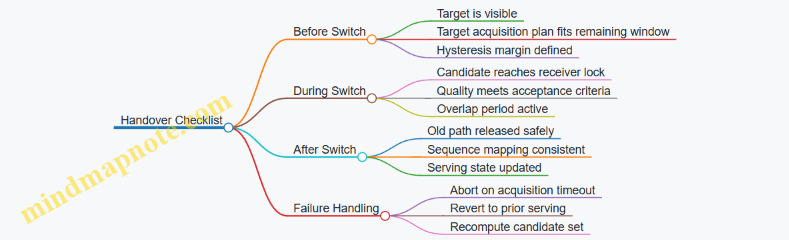
A good multi terminal design treats routing as “where to try next” and handover as “how to change the active beam without losing data.” When those roles are cleanly separated, the system behaves predictably even as geometry and link quality change.
10.3 Link Layer Protocol Requirements for High Rate Transport
High-rate optical links behave like fast pipes with picky plumbing. The link layer must turn a raw stream of bits into something that survives variable latency, occasional fades, and strict timing needs—without wasting too much bandwidth on overhead.
Core Functions of the Link Layer
A link layer for optical transport typically provides five functions: framing, addressing, error control, flow control, and link management. Framing defines where one unit ends and the next begins, so the receiver can resynchronize after a fade. Addressing lets multiple terminals share a channel or a scheduling plan. Error control protects against bit errors that slip past the physical layer. Flow control prevents the transmitter from outrunning the receiver’s ability to buffer and process. Link management handles acquisition state, link establishment, and orderly shutdown.
A practical rule: keep the link layer simple enough that it can recover quickly after a disruption, but structured enough that the receiver can tell whether a frame is late, corrupted, or from the wrong epoch.
Frame Structure Requirements
Frames should include fields that support resynchronization and integrity checks. A common layout is:
- Preamble and sync word for boundary detection.
- Frame header with a sequence number, payload length, and a link identifier.
- Integrity check such as a CRC over header and payload.
- Payload carrying transport data.
Sequence numbers must be large enough to avoid ambiguity during typical fade durations. If the link can pause for tens of milliseconds, a small counter can wrap before the receiver finishes discarding stale frames.
Example: Sequence Number Choice
If the transmitter sends 100,000 frames per second and a fade can last 50 ms, then about 5,000 frames may be missed. A 12-bit sequence number wraps after 4,096 values, which is risky. Using 16 bits avoids wrap in this window.
Reliability and Error Handling
Optical links often use forward error correction at the physical layer, but the link layer still needs to handle residual errors and burst losses. The receiver should:
- Verify CRC.
- Check sequence number monotonicity within a sliding window.
- Decide whether to accept, discard, or request retransmission.
For high-rate transport, retransmission can be expensive if fades are frequent. A common compromise is hybrid behavior: accept frames that pass CRC, discard those that fail, and rely on higher layers for recovery when retransmission would consume too much capacity.
Example: Sliding Window Acceptance
Use a window of 64 sequence numbers. If the receiver expects 1,000 and receives 1,020, it is within the window and can be accepted. If it receives 1,200, it is likely from a new epoch or a different scheduling instance and should be rejected.
Flow Control and Buffering
Flow control must match the receiver’s buffering and processing limits. The simplest approach is credit-based flow control: the receiver grants credits representing how many bytes or frames it can accept. The transmitter sends up to the granted credits.
Credits should be updated with care. If credits are updated too slowly, the transmitter idles. If updated too quickly, the receiver can overflow during processing delays.
Example: Credit Granularity
If the receiver can buffer 1,024 frames and each frame carries 1,000 bytes, granting credits in units of 16 frames reduces control overhead. The transmitter then sends up to 16,000 bytes per credit update.
Timing, Latency, and Ordering
High-rate links often require predictable ordering semantics. The link layer should define whether frames are delivered in-order to the upper layer or whether out-of-order delivery is allowed.
A robust approach is to deliver in-order by buffering out-of-order frames up to the window size. If a missing frame does not arrive before the buffer limit, the receiver can advance and mark the gap as lost.
Example: In-Order Delivery with Gap Handling
If frames 10, 11, 13 arrive but 12 is missing, the receiver buffers 13 until either 12 arrives or the gap times out. If 12 never arrives, the receiver releases 13 and reports a loss event to the upper layer.
Link Management and Epoch Handling
Acquisition and tracking can restart after a disruption. The link layer should treat each establishment as a new epoch. Include an epoch identifier in the frame header so the receiver can discard frames from the prior epoch.
Epoch changes should be triggered by explicit link state transitions, not inferred from timing alone. That prevents accidental acceptance of stale frames that happen to have valid CRC.
Mind Map: Link Layer Protocol Requirements for High Rate Transport
Example: Putting It Together in a Simple Transport Loop
A transmitter with credit-based flow control can operate like this: it maintains a send window keyed by sequence numbers, sends frames until credits reach zero, and tags each frame with the current epoch. The receiver verifies CRC, checks sequence number against the window, buffers out-of-order frames up to the limit, and updates credits as it consumes frames.
When a fade causes tracking loss, the system transitions to a new epoch after link re-acquisition. Frames from the old epoch are rejected even if their CRC passes, because the receiver cannot assume continuity across the disruption.
This combination—clear framing, bounded acceptance, explicit epoch separation, and disciplined flow control—keeps high-rate transport stable when the physical layer is doing its best to stay aligned.
10.4 Ground Segment Integration with Tracking and Scheduling
Ground segment integration turns a working optical terminal into a service that actually delivers bits on time. The key is to treat tracking and scheduling as one system: scheduling decides when you will point, tracking decides how well you will stay pointed, and both feed the link budget and the data plan.
Ground Segment Building Blocks
Start with three roles that must agree on timing and identifiers.
- Network control assigns traffic to a contact window and defines what “success” means, such as minimum delivered throughput or maximum allowed outage.
- Tracking control runs acquisition, fine tracking, and handover logic for each terminal pair.
- Terminal interface converts control commands into pointing, laser power, and receiver configuration settings.
A practical best practice is to define a single “contact object” per link opportunity that carries: target ID, time window, expected relative geometry, required data rate, and acceptable loss margins. Every subsystem reads and writes fields on that object so you can trace decisions later.
Tracking Workflow from Contact Start to End
A systematic workflow prevents the classic failure mode: scheduling assumes a link is ready at time T, but tracking only reaches stable lock at T+Δ.
- Pre-contact preparation: load predicted ephemeris, set initial pointing offsets, and arm safety interlocks. Example: if your terminal uses a coarse star tracker, you can pre-position the telescope to reduce the time spent searching.
- Acquisition: use a beacon or pilot tone to establish coarse alignment. Best practice: keep acquisition thresholds tied to measurable metrics like received power or correlation peak height, not just elapsed time.
- Fine tracking: switch to closed-loop control using tracking error signals derived from the received optical signal. Example: if you track using quadrant photodiodes, verify that the control loop bandwidth matches expected jitter; too high can amplify noise, too low can lag.
- Data transfer: enable the configured modulation and coding, then run synchronization and framing checks. Example: if the receiver needs a training sequence, schedule the training inside the contact window rather than assuming it happens “during” the first payload frames.
- Handover and teardown: when geometry degrades, gracefully stop payload, keep tracking long enough to flush buffers, then return to a safe state.
Scheduling That Respects Pointing Reality
Scheduling should be built around the time you need for each phase, not just the time the satellites are “in view.” A simple approach is to compute three durations per contact: acquisition time, lock maintenance time, and buffer drain time.
Example: suppose a downlink window is 600 s. If acquisition typically takes 90 s and lock maintenance is reliable for 430 s, you might schedule payload for 400 s and reserve the remaining time for synchronization retries and buffer drain. This avoids the awkward situation where the network control declares success because the window existed, while the terminal delivered fewer frames.
A second best practice is to include contingency budgets. If tracking error exceeds a threshold, you can either pause payload and attempt re-lock, or switch to a lower-rate mode. The scheduler must know which action is allowed for that contact object.
Data Flow and Control Interfaces
Ground integration is easiest when you separate “what” from “how.”
- The network control plane decides what to send: rate, coding mode, and frame structure.
- The tracking plane decides how to point and when to declare lock.
- The terminal interface executes commands and reports status.
Use explicit state transitions for the contact object: Planned → Prepared → Acquiring → Locked → Transferring → Reacquiring if needed → Teardown. Example: if you receive a “Locked” status but the receiver reports frame sync failure, the contact object should move to Reacquiring or “Transferring with degraded mode,” depending on policy.
Example: End-to-End Contact with Reacquisition
Assume a scheduled downlink of 500 s. The scheduler allocates 80 s for acquisition, 380 s for payload, and 40 s for buffer drain and teardown.
During transfer, the tracking error rises above the reacquisition threshold for 12 s. Tracking control pauses payload, keeps the terminal in a safe pointing mode, and attempts reacquisition using the beacon. If lock is regained within the remaining contingency budget, the network control resumes payload with the same coding mode; otherwise, it switches to a lower-rate mode and continues until the contact object reaches the teardown phase.
The important detail is that every decision is recorded against the contact object fields, so you can later correlate delivered frames with tracking events and scheduling assumptions.
10.5 Practical Throughput Measurement and Performance Verification
Throughput is what the link actually delivers, not what the link budget promises. A practical measurement plan starts by defining the measurement target, then choosing the right instrumentation points, and finally verifying that the measured throughput matches the expected behavior under controlled impairments.
Define Throughput Targets and Measurement Boundaries
Start with a clear boundary: are you measuring application payload throughput, transport throughput, or physical-layer symbol throughput? For example, if your application sends 1200-byte packets and the system uses framing plus FEC, the “payload throughput” will be lower than the “coded throughput.”
A useful checklist:
- Payload throughput: bytes delivered to the application after decapsulation.
- Goodput: payload bytes delivered successfully, excluding retransmissions.
- Link throughput: bytes accepted by the receiver before higher-layer decisions.
Example: If 10,000 packets of 1200 bytes are sent and 9,600 arrive without FEC decode failure, payload throughput over the test window is based on 9,600 × 1200 bytes, not on the transmitted count.
Instrumentation Points That Prevent “Measurement Lies”
Measure at least three points so you can attribute losses:
- Transmit side: packet timestamps, encoder output rate, and actual optical power setpoints.
- Receiver side: decode success/failure counters, demodulation lock status, and recovered frame counters.
- System side: end-to-end packet delivery to the application or network layer.
If you only measure at the receiver application, you cannot tell whether low throughput came from physical-layer decode failures, timing slips, or higher-layer retransmissions.
Build a Verification Matrix for Conditions and Metrics
Throughput depends on more than SNR. Create a matrix that varies the dominant factors one at a time:
- Optical power level (or attenuation)
- Pointing error (or simulated coupling loss)
- Channel impairment (turbulence emulator if available, otherwise controlled attenuation plus jitter)
- Coding and modulation settings
- Acquisition and tracking state (locked vs marginal)
For each matrix cell, record:
- Mean throughput and 95% confidence interval
- Packet error rate and FEC decode failure rate
- Latency distribution (median and tail)
- Time spent in acquisition vs tracking
Measure Throughput Correctly Under FEC and Framing
FEC changes the relationship between bit errors and packet outcomes. A clean method is to compute throughput from successful packet delivery events:
- Count successfully decoded frames.
- Multiply by payload bytes per frame.
- Divide by measurement window duration.
Example: Suppose each frame carries 8,192 payload bytes. Over 60 seconds you successfully decode 720 frames. Throughput is 720 × 8,192 / 60 ≈ 98.3 Mbps payload throughput.
Also track decoder saturation. If the receiver processing pipeline cannot keep up, throughput will cap even when the physical layer is healthy. You can detect this by comparing:
- Incoming frame rate at the demodulator
- Output frame rate after decoding
If output lags input, the bottleneck is processing, not the channel.
Validate Performance Against Expected Behavior
Verification means checking consistency, not just matching a single number. Use these comparisons:
- Throughput vs. received power: should rise smoothly until limited by coding overhead and processing.
- Throughput vs. pointing loss: should drop when coupling loss crosses the decode threshold.
- Throughput vs. modulation order: higher-order formats should require higher effective SNR to maintain similar packet success.
Example: If you switch from a lower-order to a higher-order modulation and throughput drops sharply while decode failure rate spikes, the system is behaving like a thresholded link. If throughput drops without a corresponding decode failure increase, the issue is likely timing, framing, or receiver load.
Use a Mind Map to Keep the Workflow Coherent
Mind Map: Throughput Measurement and Verification
A Practical Example Workflow
- Set a baseline: choose one modulation and coding profile, confirm tracking lock, and run a 60-second test.
- Sweep received power: apply controlled attenuation in steps, repeating the 60-second run each time.
- Introduce pointing loss: apply a repeatable misalignment pattern and log coupling loss proxies.
- Switch profiles: repeat the sweep for two additional modulation/coding settings.
- Compare attribution: for each step, verify that throughput changes align with decode failure rate and lock status.
If throughput decreases while decode failure rate stays low and lock remains stable, focus on framing synchronization, buffer sizing, and processing throughput. If decode failure rises with the expected threshold behavior, the measurement is consistent with physical-layer limits.
Performance Verification Deliverables
Produce a compact report that includes:
- Throughput curves vs received power and vs pointing loss
- Decode failure rate and lock state timelines
- Latency summary for successful packets
- A table mapping each test condition to the observed bottleneck category
This makes the results actionable: you can point to the specific mechanism that limited throughput, rather than arguing about a single averaged number.
11. Safety, Regulations, and Operational Constraints
11.1 Laser Safety Fundamentals and Exposure Limits
Laser safety is mostly about controlling three things: how much optical power reaches a person, how long it stays there, and what part of the body it hits. For space laser communication terminals, the tricky part is that beams are narrow, can be invisible depending on wavelength, and may be steered. The goal is to ensure that under normal operation and credible faults, exposure stays below established limits.
Core Concepts That Drive Exposure Limits
Hazard Mechanisms
Laser hazards are usually categorized by the tissue affected.
- Eye hazards dominate for many communication wavelengths because the eye focuses incoming light onto the retina. Even modest beam powers can create high retinal irradiance.
- Skin hazards matter when the beam is larger on the skin or when the wavelength is absorbed near the surface.
- Thermal versus photochemical effects depend on wavelength and exposure duration. Many common communication wavelengths are primarily thermal in effect.
Exposure Metrics
Safety limits are expressed using quantities that match how damage accumulates.
- Radiance and irradiance describe how much power per area reaches tissue.
- Exposure duration matters because tissue response depends on time. A short pulse can be less damaging than a long exposure at the same average power, but the relationship is not always intuitive.
- Pupil and aperture effects matter because the eye’s optics change the effective spot size on the retina.
The Role of Wavelength
Wavelength determines both how the beam propagates and how tissue interacts with it. Safety standards use wavelength-dependent weighting because the eye’s focusing and absorption vary across the spectrum.
Exposure Limits in Practice
Why Standards Use Time and Geometry
Limits are not a single number like “X milliwatts is safe.” They are curves that depend on:
- Whether exposure is continuous or pulsed
- Pulse duration and repetition rate
- Beam diameter at the hazard location
- Whether the beam is collimated or diverging
A simple way to think about it: if the beam is narrow and effectively focused by the eye, the same transmitted power can be much more hazardous than when the beam is wide or heavily diverged.
The “Nominal Ocular Hazard” Idea
For many systems, the eye is the limiting factor. That means safety engineering often starts by asking: if the beam were to enter a person’s pupil, what would the retinal exposure be? Then the design ensures that the probability of that happening is controlled through engineering and procedures.
Engineering Controls That Keep People Safe
Beam Control and Termination
The most reliable safety measure is preventing hazardous exposure in the first place.
- Interlocks should remove power or block the beam when a protective condition is not met.
- Fail-safe states should default to the lowest hazard mode when faults occur.
- Beam shuttering can be used so that the beam is present only during controlled operations.
Example: If a terminal is in a maintenance mode where the optical path is exposed, the system should either inhibit laser emission or route the beam to a controlled dump. A “software-only” inhibit is not enough if a hardware fault could still allow emission.
Pointing Limits and Exclusion Zones
Because terminals steer beams, safety must account for where the beam can go.
- Mechanical and control limits should restrict steering to safe angles.
- Defined exclusion zones should cover the region where a beam could intersect a person’s line of sight.
Example: If a ground terminal can scan across a sky sector, the exclusion zone should be computed for the maximum steering envelope, not just the nominal pointing direction.
Beam Expansion and Divergence Management
A larger beam diameter at the hazard location generally reduces irradiance.
- Beam expansion optics can reduce hazard by spreading power over a larger area.
- Controlled divergence helps ensure that the beam does not remain tightly collimated over long distances.
Example: If a design changes from a tight collimated output to a slightly more divergent output, the eye hazard can drop significantly because the effective spot size at the pupil increases.
Administrative Controls and Operational Discipline
Training and Procedures
People are part of the system. Safety procedures should be specific enough that they work under time pressure.
- Clear “laser on” and “laser off” states with unambiguous indicators.
- Work instructions for alignment, testing, and fault recovery.
Example: During alignment, require a checklist that confirms interlocks are engaged and that the beam path is either terminated or verified safe before enabling emission.
Signage and Access Control
Even with engineering controls, access management matters.
- Authorized entry only into areas where beam exposure could exceed limits.
- Controlled viewing conditions so that reflective surfaces do not create unexpected hazard paths.
Example: A shiny calibration target can redirect a beam into an unintended direction. Safety procedures should treat reflective surfaces as hazard multipliers.
A Mind Map of Laser Safety Fundamentals
Mind Map: Laser Safety Fundamentals and Exposure Limits
Worked Example: Turning Limits into Design Decisions
Assume a terminal can steer a narrow beam within a defined ground sector. Safety engineering proceeds like this:
- Identify the limiting hazard: for most communication wavelengths, assume eye hazard is dominant.
- Define the worst-case exposure geometry: use the maximum steering envelope and the smallest beam diameter at the hazard location.
- Apply the appropriate exposure limit curve: select the correct limit based on whether the beam is continuous or pulsed, and use the relevant time basis.
- Set control requirements: if the computed exposure exceeds the limit, reduce hazard by one or more methods—lower output power, increase beam divergence, add beam shuttering, or tighten pointing limits.
A practical outcome is a set of requirements that are testable: interlock response time, maximum allowed steering angles, and verified beam power under defined operating modes.
Quick Checklist for Safe Operation
- Interlocks remove emission or block the beam in non-safe states.
- Steering limits and exclusion zones cover the full hazard envelope.
- Alignment procedures prevent accidental exposure to the active beam.
- Reflective surfaces are controlled or treated as hazards.
- Operational indicators clearly communicate when emission is possible.
11.2 Compliance with Ground and Airspace Safety Requirements
Laser terminals used for space links must satisfy two different kinds of constraints at the same time: (1) exposure limits for people and (2) operational rules that prevent unsafe beam paths. In practice, compliance is less about memorizing a single regulation and more about building a safety case that connects hardware behavior to measurable risk controls.
Core Safety Concepts That Drive Compliance
Start with the idea of a “hazardous beam.” A laser becomes hazardous when the beam can enter a person’s eye or skin at a level above exposure limits. For ground and airspace compliance, the key question is not only how strong the beam is, but where it can go when the system is mispointed, partially failed, or operating in a degraded mode.
A second concept is “worst-case conditions.” Safety reviews typically assume conservative values for beam divergence, pointing error, jitter, and atmospheric attenuation. That means your control logic must be designed so that even under the most pessimistic assumptions, the system still meets exposure limits.
Finally, compliance depends on “credible control.” It is not enough to say “the operator will be careful.” The terminal should enforce safety through interlocks, monitoring, and automatic shutdown or safe-state behavior when conditions drift.
Ground Safety Requirements and How They Are Implemented
Ground compliance usually focuses on preventing direct or reflected exposure to people in controlled areas. A practical approach is to define a safety envelope around the terminal and then ensure the beam cannot illuminate outside that envelope.
-
Define controlled areas and access rules. Use physical barriers, signage, and procedures so that people are not in the beam path during normal operation. Example: a ground station with a fixed mount can designate a “no-entry” sector matching the maximum pointing error plus beam divergence.
-
Implement beam steering constraints. The pointing system should include software limits and hardware limits that cap where the terminal can aim. Example: if the terminal can mechanically point within ±2°, but safety analysis allows only ±1.2° during transmit, the control system should refuse commands beyond ±1.2°.
-
Use interlocks tied to real states. Interlocks should reflect whether the beam is actually capable of transmitting. Example: if the transmit shutter is open and the fine-pointing loop reports lock, then transmit is allowed; otherwise the laser is inhibited.
-
Monitor for abnormal pointing and power. Add sensors for beam direction and output power, and compare them to allowed ranges. Example: if measured output power exceeds a calibrated threshold by more than a set tolerance, the system transitions to a safe state.
-
Control reflections. Compliance must consider specular surfaces near the optical path. Example: a glossy cover plate near the transmit aperture can create a return path; replacing it with a matte surface or adding a beam dump reduces risk.
Airspace Safety Requirements and How They Are Implemented
Airspace compliance addresses the possibility that the beam could intersect aircraft or other elevated platforms. The main engineering task is to ensure that the beam cannot be transmitted into prohibited angular regions, especially during acquisition, tracking transitions, or fault recovery.
-
Use operational modes with explicit safety behavior. Acquisition and tracking are not the same risk level. Example: during acquisition, the terminal may sweep or broaden the beam; therefore, the allowed transmit windows and pointing regions should be narrower than in steady tracking.
-
Apply geofencing and time-based constraints. Many systems use a combination of location, pointing, and time to determine whether transmit is permitted. Example: if the station is near an approach corridor, the control system can block transmit when the predicted beam direction overlaps the corridor sector.
-
Include fail-safe behavior for loss of tracking. If the fine tracking loop loses lock, the system should not keep transmitting at the last known aim. Example: when tracking confidence drops below a threshold, transmit is inhibited and the beam is driven to a safe pointing region.
-
Account for platform motion and jitter. For mobile terminals, compliance must include motion models. Example: if the mount can sway by 0.3 mrad during gusts, the safety envelope should include that jitter so the beam still stays within the allowed region.
Mind Map: Compliance Controls and Evidence
Example: A Simple Compliance Logic Chain
Consider a terminal that transmits only when three conditions are true: (1) the shutter interlock is open, (2) the fine-pointing loop reports lock within a specified error bound, and (3) the predicted beam direction is inside the permitted angular sector for the current mode.
If any condition fails, the system inhibits the laser and records the reason in a log. Example: during acquisition, the system allows broader pointing but requires a lower maximum output power; once lock is achieved, it switches to the higher-power steady mode with tighter pointing constraints.
Evidence That Typically Satisfies Reviews
Compliance is usually demonstrated through traceable artifacts: calibration data for output power and pointing sensors, documented interlock behavior, and test results showing that the system reaches a safe state within a defined time after a fault. Logs matter too, because they show that the terminal actually followed the safety logic during real operations, not just in a lab demo.
11.3 Operational Procedures for Safe Pointing and Shutdown
Safe pointing is mostly about preventing two things: unintended laser illumination outside the intended terminal-to-terminal path, and unsafe system states that leave the beam steering hardware or interlocks in a confusing condition. The procedures below are written to be followed in order, from basic assumptions to detailed actions.
Core Safety Assumptions
Start every operation by confirming that the system is in a known configuration. Treat the terminal like a machine with a “truth state” rather than a collection of subsystems.
- Interlocks are authoritative. If any interlock indicates an unsafe condition, the laser must remain inhibited regardless of software intent.
- Pointing estimates are not guarantees. Control loops can be correct while the actual beam path is wrong due to miscalibration, mechanical backlash, or sensor faults.
- Shutdown must be deterministic. The same command should produce the same safe outcome every time, including during partial failures.
Pre-Pointing Checks
Before enabling any beam steering, verify the chain from command to emission.
- Mechanical and optical readiness: Confirm telescope stow state, optical cover status, and that beam expansion optics are in the correct position. A common failure mode is “looks aligned” but the beam is not where the steering model assumes.
- Sensor health: Check star tracker or beacon receiver status, gyroscope validity, and any coarse pointing sensors. If the attitude solution is flagged as degraded, do not proceed to fine pointing.
- Interlock status: Verify that all required interlocks report “closed” and that no fault latch is active. If a latch exists, clear it only using the documented fault-recovery steps.
- Command path verification: Ensure the software command that requests “laser enable” is actually routed to the laser inhibit controller, not merely acknowledged by a higher-level task.
Safe Pointing Sequence
Use a staged approach so that each step reduces risk before increasing capability.
- Establish coarse pointing with low-risk emission. If the system supports a beacon or low-power acquisition mode, use it first. Keep the beam power at the minimum level that still supports acquisition.
- Confirm target lock with independent evidence. Do not rely on a single metric. For example, require both a tracking lock indicator and a consistent received signal metric.
- Apply fine pointing only after geometry is verified. Fine steering should be enabled after the pointing solution is stable for a defined dwell time. Stability prevents “chasing” a moving error.
- Enable full-power mode only after final checks. Immediately before full-power enable, re-check interlocks and confirm that the steering solution is within the allowed pointing envelope.
Operational Mind Map
Safe Pointing and Shutdown Mind Map
Shutdown Procedures
Shutdown has two flavors: normal shutdown and fault shutdown. The difference is timing.
Normal Shutdown
Normal shutdown should be quick but orderly.
- Request laser disable through the emission controller. This should transition the laser to an inhibited state without relying on the pointing software.
- Freeze steering commands. Keep the steering hardware from continuing to chase a target after emission is off.
- Verify interlock transition. Confirm that the inhibit controller reports the laser as disabled and that no “enable pending” state remains.
- Stow or secure optics if the mission requires it. If covers or stow positions exist, move to the documented safe configuration.
Fault Shutdown
Fault shutdown prioritizes speed and clarity.
- Immediate laser inhibit. Trigger the inhibit path that cuts emission regardless of software task state.
- Stop steering commands. Prevent further changes to beam direction while the fault is being handled.
- Record the context. Capture timestamps for the last mode transition, the fault code, and the most recent pointing solution status.
- Maintain safe mechanical state. If stow is part of the fault response, follow the documented order so you do not create a new hazard while fixing the first.
Concrete Example: Safe Enable and Shutdown
Assume the terminal is preparing for a downlink acquisition.
- The operator runs pre-pointing checks and confirms interlocks are closed, sensors are healthy, and the command path to the inhibit controller is verified.
- Coarse pointing begins in a low-risk acquisition mode. After the tracking lock indicator is asserted and the received signal metric remains consistent for the required dwell time, fine pointing is enabled.
- Full-power mode is requested only after a final pointing envelope check and an immediate interlock re-check.
- When the session ends, the operator issues a normal shutdown: laser disable first, then steering freeze, then verification that the inhibit controller reports “laser inhibited.” Finally, the optics are stowed.
Operator Checklist for Safe Completion
A safe procedure ends with evidence, not just confidence.
- Interlock status at enable and at shutdown
- Mode transition timestamps
- Pointing envelope record for the full-power interval
- Fault log snapshot if any fault shutdown occurred
- Confirmation that steering commands are stopped and optics are secured as required
11.4 Handling Interlocks and Fault Detection in Terminals
Space laser terminals need more than “it works in the lab.” They must fail safely, recover predictably, and avoid unsafe emission when sensing, pointing, or timing is wrong. Interlocks and fault detection are the practical glue between optical performance and operational safety.
Interlock Foundations and Safety States
An interlock is a rule that prevents a hazardous action unless specific conditions are true. For laser terminals, the hazardous action is typically enabling optical emission at power or beam parameters that exceed safe limits. Fault detection is the mechanism that decides whether conditions are met.
A clean way to design this is to define explicit terminal states:
- Safe Standby: lasers disabled; tracking may be active in low-risk modes.
- Armed: lasers allowed only after all preconditions pass; emission still blocked until a final “go” signal.
- Emitting: lasers enabled; interlocks remain continuously monitored.
- Faulted: emission blocked; system logs the reason and enters a recovery path.
Best practice: treat interlocks as part of the state machine, not as scattered checks. Example: if pointing confidence drops below threshold, the state machine transitions from Emitting to Faulted and issues a laser disable command, even if the rest of the control loop is still running.
Interlock Categories and What They Guard
Interlocks should map to distinct failure modes so the terminal can respond appropriately.
Electrical and Power Interlocks
Guardrails include over-current, over-voltage, and thermal limits. Example: if the laser driver reports a current above the calibrated maximum for longer than a defined debounce window, the terminal transitions to Faulted and disables emission. Debounce matters because transient spikes can occur during control loop updates.
Optical Output and Beam Parameter Interlocks
These verify that the emitted beam matches allowed parameters. Typical checks include:
- Output power within tolerance
- Wavelength within allowed band
- Beam steering angles within mechanical and safety envelopes
Example: if the beam steering controller saturates, the terminal should not “hope” the beam is still on target. It should disable emission and flag “steering saturation” so operators can inspect the pointing chain.
Pointing, Acquisition, and Tracking Interlocks
Laser emission should require a minimum acquisition quality. Interlocks can use metrics such as received beacon strength, tracking error magnitude, and control loop stability.
Example: during link establishment, the terminal may allow low-power beacon emission only after coarse pointing is within a wide window. Once fine tracking is declared stable, it can transition to higher-rate emission.
Timing and Synchronization Interlocks
Some optical modes require correct timing relationships between transmitter and receiver or between internal modulation and gating. Example: if the modulation timing reference is missing or phase-locked loop lock is lost, the terminal should disable emission rather than transmit malformed waveforms.
Fault Detection Logic and Robust Decision Making
Fault detection should combine multiple signals with clear rules.
Use Thresholds with Hysteresis
Without hysteresis, a signal hovering near a threshold can cause rapid toggling. Example: require pointing confidence > 0.9 to enter Armed, but require it to fall below 0.85 to trigger Faulted.
Require Persistence with Debounce Windows
A single bad sample is often noise. Example: declare “thermal fault” only if temperature exceeds limit for 200 ms continuously.
Separate Detection from Action
Detection produces a fault code; action is handled by the state machine. This separation makes behavior consistent and testable. Example: “LO unlock” detection sets a fault code; the state machine decides whether to retry acquisition, remain in standby, or require manual intervention.
Recovery Paths and Safe Re-arming
Recovery should be deterministic and conservative.
- Automatic Retry: for transient faults like brief beacon loss, after a controlled re-acquisition sequence.
- Controlled De-rate: for borderline conditions like near-limit thermal readings, reduce power and re-check.
- Manual Intervention: for faults indicating possible hardware mismatch, such as repeated steering saturation or persistent driver over-current.
Example: if pointing error spikes during a maneuver, the terminal can attempt a limited number of re-acquisition cycles. If the same fault repeats beyond the limit, it should stop and request inspection.
Mind Map: Interlocks and Fault Detection
Example: End-to-End Interlock Flow
- System requests emission.
- Terminal enters Armed and checks: driver current OK, thermal OK, steering within envelope, timing reference locked.
- State machine issues final “go” only if all checks pass.
- During Emitting, continuous monitoring runs. If steering saturates for 200 ms, detection sets fault code “STEER_SAT.”
- State machine transitions to Faulted, disables lasers, and logs the timestamp and relevant sensor snapshots.
- Recovery policy checks fault type: for “STEER_SAT,” it performs a limited re-acquisition; if it repeats, it requires manual inspection.
This approach keeps safety enforcement consistent, makes faults actionable, and prevents the terminal from emitting when the system’s own measurements say it shouldn’t.
11.5 Documentation and Test Evidence for Operational Readiness
Operational readiness for a space laser terminal is proven, not asserted. The documentation package should let a reviewer answer three questions quickly: what the terminal is supposed to do, what was tested to show it can do it, and what evidence ties requirements to results.
Define the Evidence Chain
Start with a requirements-to-evidence chain that is traceable down to measurable checks. A practical approach is to map each top-level requirement to one or more verification activities, then record the exact artifacts produced by those activities.
Example: If a requirement states that the terminal must acquire a link within a defined time window, the evidence chain should include acquisition test procedures, recorded logs from the test run, and a summary table showing pass/fail against the time metric.
A good evidence chain also records test conditions. For optical links, “pass” without conditions is like “arrived” without a route. Capture environment, alignment state, optical power levels, and any simulated channel parameters.
Organize Documentation by Lifecycle Use
Treat documentation as a set of tools for different moments: design review, integration, test execution, and operations.
- Design intent documents explain how subsystems meet requirements.
- Test procedures describe how to run the test and what to measure.
- Test reports summarize results, deviations, and acceptance decisions.
- Configuration records lock the software, calibration data, and hardware settings used.
Example: During integration, an engineer should be able to reproduce the exact receiver settings used in a sensitivity test by reading the configuration record, not by asking someone who remembers.
Establish Acceptance Criteria That Match What You Measure
Acceptance criteria should be written in the same units and definitions used in the measurement. If the requirement is expressed as “link availability,” the test report must show how availability was computed from measured BER, outage thresholds, or frame error rates.
To keep criteria unambiguous, include:
- measurement method and bandwidth,
- data reduction rules,
- pass/fail thresholds,
- handling of outliers and instrument limits.
Example: If BER is inferred from error counts, document the observation time, the number of frames, and the statistical method used when errors are rare.
Capture Traceable Test Evidence
Evidence should be both human-readable and machine-checkable. Store raw data when feasible, plus derived results with the transformation steps.
Include at minimum:
- test setup photos or schematics,
- instrument calibration status and uncertainty notes,
- time-stamped logs from terminal controllers,
- optical measurements with wavelength and power annotations,
- computed metrics with formulas or clearly referenced calculation steps.
Example: For pointing performance, record the commanded pointing, measured spot location, and the control loop mode. A reviewer should not have to guess whether the terminal was in open-loop or closed-loop.
Manage Deviations and Nonconformances
A deviation is not automatically a failure, but it must be documented with impact. Record what changed, why it happened, and how it affects the evidence chain.
A clean deviation record includes:
- deviation description and scope,
- affected requirements and metrics,
- mitigation actions taken during the test,
- updated acceptance decision rationale.
Example: If a thermal condition was slightly outside the planned range, the report should state the measured temperature, the observed performance shift, and whether margins still satisfy the acceptance criteria.
Use a Consistent Document Control Approach
Document control prevents “version drift,” where the report and the tested configuration disagree. Each document should have a unique identifier, revision history, and an approval record.
Also record the configuration baseline date for the package. Use a fixed reference date such as 2026-02-20 for the snapshot of the configuration used to generate the readiness package.
Mind Map: Operational Readiness Evidence Package
Example Evidence Package Outline
A compact outline helps teams avoid missing pieces.
Example:
- Requirement list with IDs
- Verification matrix linking each ID to a test
- Test procedure documents for each verification activity
- Test report per activity with:
- setup and conditions,
- raw data references,
- computed metrics,
- acceptance decision,
- deviations and impact
- Configuration snapshot showing software version, calibration set, and hardware settings
- Final readiness summary that states which requirements are verified and which are pending
When this structure is followed, operational readiness becomes a straightforward audit trail: a reviewer can start at a requirement, jump to the exact test, and land on the evidence that supports the decision.
12. Test, Verification, and Acceptance of Space Laser Terminals
12.1 Laboratory Test Setup for Optical Performance Characterization
A good optical performance test setup answers three questions: how much light arrives, how cleanly it arrives, and how that translates into link metrics like BER or throughput. The setup should be built so you can change one variable at a time—wavelength, power, pointing, modulation, or channel conditions—without accidentally changing everything else.
Test Goals and Measurable Outputs
Start by mapping each goal to a measurement you can actually record.
- Optical power transfer: measure received optical power and coupling efficiency.
- Beam quality and alignment: measure spot size, encircled energy, and pointing error.
- Channel impairments: measure turbulence-like fading (if emulated), background light tolerance, and polarization effects.
- Receiver performance: measure sensitivity, SNR, EVM (for coherent), and BER (for coded links).
A practical rule: if you cannot point to the instrument and the waveform that produces a number, the test goal is too vague.
Core Hardware Blocks
Think in blocks so wiring and calibration stay manageable.
- Optical transmitter under test: laser, modulator, and transmit optics.
- Beam conditioning: spatial filters, attenuators, and neutral density wheels.
- Propagation emulator: fixed free-space path, adjustable delay line, or controlled turbulence emulator.
- Receiver under test: telescope or coupling optics, photodiode or coherent front end, and electronics.
- Reference instrumentation: power meter, beam profiler, spectrum analyzer, and timing reference.
Keep the optical path mechanically stable during a run. Even small thermal drift can masquerade as pointing loss.
Optical Path Geometry and Alignment Workflow
Use a repeatable alignment workflow that separates coarse alignment from fine characterization.
- Coarse alignment: align transmitter and receiver axes using irises or a low-power alignment laser at the same wavelength band.
- Fine alignment: use a beam profiler at the receiver focal plane (or an equivalent plane) to maximize coupling.
- Record the baseline: log received power, spot size, and the alignment actuator positions.
Then run a controlled sweep. For example, sweep receiver lateral offset in steps while holding everything else constant. Plot received power versus offset to extract pointing-loss sensitivity.
Calibration and Traceability
Calibration prevents “mystery loss.”
- Power meter calibration: verify responsivity assumptions for your wavelength.
- Attenuator linearity: confirm that commanded attenuation matches measured optical power.
- Detector linearity: ensure the receiver front end stays in its linear region for the test range.
- Timing alignment: for coherent tests, confirm LO phase and symbol timing references are stable enough for repeatable demodulation.
A simple sanity check: run a known optical power level, then repeat it after 30 minutes. If the measured value drifts more than your allowed uncertainty, fix the mechanical or thermal stability before trusting BER curves.
Measurement Chain for Optical Performance
A systematic chain keeps results interpretable.
- Measure received optical power at the receiver coupling plane.
- Measure beam profile to quantify spot size and encircled energy.
- Measure spectral properties of the transmitted carrier and any modulation sidebands.
- Measure electrical outputs: photocurrent, RF spectrum, and demodulated symbols.
- Compute link metrics: SNR, EVM, and BER using the same framing and decoding settings you will later use in system tests.
Example: Pointing Loss Characterization with a Fixed Path
Set up a fixed free-space distance with adjustable receiver translation.
- Use a stable attenuator so received power changes only due to pointing.
- Sweep lateral offset from ±2 mm in 0.25 mm steps.
- At each step, record received power and spot size.
From the data, compute coupling efficiency η as received power divided by transmitter output power after accounting for any fixed losses. Then fit a curve to estimate the offset that drops coupling to a target threshold (for instance, 3 dB). This threshold becomes a concrete input to later link budgets.
Mind Map: Laboratory Test Setup Flow
Example: Receiver Sensitivity Test Without Confusing Variables
To measure sensitivity, keep optical coupling fixed and vary only transmitted optical power.
- Set modulation format and coding exactly as in the intended link.
- Use a calibrated attenuator to step optical power.
- For each step, collect enough frames to estimate BER at the target operating region.
If you change coupling during the sweep, you will mix pointing loss with receiver noise. The test is then “sensitivity plus alignment,” which is not what you want.
Practical Data Recording Rules
Log more than you think you need.
- Store instrument settings (gain, bandwidth, integration time).
- Record environmental conditions that affect drift (room temperature, airflow).
- Save raw waveforms alongside computed metrics.
A final check: rerun one mid-range condition at the end of the session. If it matches the earlier result within uncertainty, your setup is behaving like a measurement system rather than a collection of coincidences.
12.2 Environmental Testing for Vibration Thermal and Vacuum
Environmental testing proves the terminal can survive the launch ride, operate through temperature extremes, and function in vacuum without performance surprises. The key is to test the right things in the right order, using acceptance criteria tied to link performance and safety.
Test Philosophy and Setup
Start by mapping each subsystem to failure modes: optical alignment can shift, electronics can drift, and optical power can change with temperature. Then define measurable outcomes before you touch hardware. For example, specify that transmit pointing error must remain within a budget after vibration, and that receiver sensitivity must stay within a defined dB range after thermal cycling.
A practical workflow is: baseline measurements → vibration → post-vibration checks → thermal cycling → post-thermal checks → vacuum operation tests → final end-to-end verification. This sequence helps you localize the cause of any degradation.
Baseline Measurements Before Any Stress
Baseline is not “nice to have”; it is how you interpret change. Record:
- Optical alignment metrics such as beam centroid position, divergence, and coupling efficiency.
- Electrical health such as laser output power stability, monitor photodiode readings, and bias currents.
- Timing and synchronization markers such as symbol clock stability and phase noise indicators.
- Mechanical references such as telescope encoder zero points and fine-steering calibration tables.
Example: If you later see a 2 dB sensitivity drop, you can tell whether it came from reduced optical coupling, increased detector noise, or altered receiver gain.
Vibration Testing for Mechanical Integrity
Vibration testing targets looseness, resonance, and fatigue. Use a test plan that includes:
- Mounting method matching flight hardware interfaces.
- Frequency range selection based on expected launch environments.
- Measurement points for accelerometers and strain gauges where possible.
During the test, monitor for anomalies like sudden changes in laser monitor readings or encoder behavior. After the vibration run, repeat the baseline optical alignment and power checks.
Example: Suppose the fine pointing stage shows a small offset after vibration. If the divergence and coupling efficiency are unchanged, the issue is likely mechanical zero shift rather than optical element damage.
Acceptance criteria should be tied to link impact. For instance, if pointing error increases by a certain amount, compute the resulting pointing loss and confirm the link budget still meets the required availability.
Thermal Testing for Optical and Electronic Stability
Thermal testing checks how performance changes with temperature and how well the system returns to baseline. Use two complementary approaches:
- Thermal cycling to expose hysteresis and material stress effects.
- Thermal soak to verify steady-state behavior at key temperatures.
Instrument the terminal with temperature sensors near lasers, detectors, and critical optics mounts. Also record environmental chamber conditions so you can correlate performance changes to actual component temperatures.
Example: If laser output power drifts with temperature, verify whether the monitor photodiode feedback loop compensates it. If compensation is incomplete, you may need to adjust control gains or revise calibration tables.
After each thermal phase, re-run optical alignment and receiver sensitivity measurements. Pay attention to whether changes are reversible; irreversible shifts often indicate mechanical stress or optical contamination.
Vacuum Testing for Operational Reliability
Vacuum testing validates operation without air for heat transfer and without convective cooling. Define vacuum conditions and duration to match the operational profile. Include:
- Power-on functional checks at relevant temperatures.
- Thermal equilibrium verification so you know the system reached stable operating points.
- Optical performance checks to confirm no unexpected changes in coupling or detector behavior.
Example: A receiver that works in air but shows reduced sensitivity in vacuum may be suffering from altered detector temperature or changes in optical surface behavior. Temperature telemetry will usually reveal whether the detector is running hotter than expected.
Also verify that any outgassing-sensitive components remain within limits. If your test includes optical windows or protective covers, track transmission stability through the vacuum run.
Integrated Verification and End-to-End Checks
After vibration, thermal, and vacuum tests, perform an integrated end-to-end verification that includes:
- Transmit power and beam quality checks.
- Acquisition and tracking behavior using representative link conditions.
- Receiver demodulation performance under controlled signal levels.
This is where you confirm that “component-level stability” translates into “link-level stability.” If a subsystem passes individually but the link fails, the interaction—timing, control loop behavior, or alignment—will show up here.
Mind Map: Environmental Testing Flow
Example: Acceptance Criteria That Tie to Link Performance
Set criteria in measurable terms and connect them to system outcomes:
- Pointing error increase after vibration must not exceed a value that would cause more than a specified dB pointing loss.
- Receiver sensitivity after thermal and vacuum must remain within a defined dB range at the specified operating temperature.
- Laser output power after each environmental phase must remain within a tolerance band when feedback control is active.
Example: If pointing loss budget allows 1.5 dB margin and your measured pointing error increase predicts 1.0 dB loss, you still have headroom for any additional fade margin required by the operational scenario.
Practical Notes for Test Readiness
Document everything that affects repeatability: mounting torque, alignment fixtures, chamber loading, and calibration settings. Use the same optical bench configuration for baseline and post-test measurements. Small differences in setup can masquerade as environmental effects, which is why consistency matters as much as the stress itself.
12.3 End to End Demonstrations with Representative Channels
An end-to-end demonstration proves more than “the laser turns on.” It shows that the full chain—acquisition, tracking, transmit/receive optics, modulation, coding, synchronization, and link-layer framing—works together under a channel that resembles reality. The key is to pick representative channels, define measurable acceptance criteria, and run the same test flow for each configuration.
Representative Channel Selection
Start with three channel profiles that cover the dominant impairments you expect to see.
-
Clear line of sight with stable pointing: Use it to validate optics alignment, detector coupling, timing, and baseline BER/FER.
-
Pointing-dominated fades: Introduce controlled angular offsets or simulate terminal jitter so pointing loss becomes the main limiter.
-
Turbulence-like fading: Use a rotating diffuser or phase screen to create rapid intensity fluctuations and wavefront distortion.
A practical rule: each channel profile should isolate one impairment so you can attribute performance changes to a specific subsystem rather than guessing.
Demonstration Architecture and Test Flow
Use a repeatable sequence so results are comparable across days, operators, and hardware revisions.
Mind Map: End to End Demonstration Flow
Step 1: Pre-Checks and Calibration
Before any channel impairment, confirm that the transmitter and receiver agree on the basics.
- Power calibration: Measure optical power at the receiver aperture or an equivalent reference point. Record the mapping from commanded power to measured power.
- Timing alignment: Verify symbol timing recovery behavior with a stable channel. If the system uses training sequences, confirm they are detected reliably.
- Optical alignment: Optimize coupling efficiency using a low-rate test pattern. This prevents “mysterious” packet loss that is actually just poor coupling.
Concrete example: run a 10-second burst at a conservative modulation rate, log received signal strength and demodulator lock status, then repeat after a small intentional re-aim. If the lock behavior is inconsistent, fix that before adding channel impairments.
Step 2: Link Establishment
Acquisition should be treated like a controlled procedure, not a hope-and-pray moment.
- Coarse acquisition: Use a beacon or pilot tone to establish initial alignment. Acceptance criterion can be “link established within N seconds” and “no more than M retries.”
- Fine tracking: Switch to closed-loop tracking using received signal metrics. Log pointing error estimates and control loop activity.
Concrete example: for each channel profile, run 20 acquisition attempts. Report success rate and the distribution of acquisition times. A system that “works once” is not a system; it’s a lucky demo.
Step 3: Steady-State Transfer Under Representative Channels
Once tracking is stable, send structured traffic that exercises framing and error control.
- Traffic pattern: Use a known payload pattern (e.g., pseudo-random with fixed seed) so you can verify bit-level correctness.
- Coding and framing: Confirm that FEC decoding success correlates with measured channel quality, and that packet counters behave as expected.
- Throughput measurement: Measure goodput, not just raw symbol rate. Goodput reflects retransmissions, resynchronization, and dropped packets.
Concrete example: run a fixed-length transfer (e.g., 1,000 packets) at each modulation/coding configuration. For the pointing-dominated channel, gradually increase angular offset amplitude and record FER. For the turbulence-like channel, keep pointing constant and vary diffuser settings to create intensity fluctuations.
Step 4: Impairment Injection and Attribution
When performance degrades, you need evidence for why.
- Pointing injection: Expect coupling loss and tracking error growth to dominate. Demodulator lock may remain stable until fades exceed the receiver’s effective sensitivity.
- Turbulence injection: Expect rapid amplitude variations and, in coherent systems, phase noise effects that stress carrier recovery.
Concrete example: if packet errors rise while received power remains nearly constant, suspect synchronization or phase-related issues rather than optics coupling.
Logging and Post-Processing
A good demo produces a timeline you can interpret.
Record these signals with timestamps:
- Acquisition state transitions and retry counts
- Tracking error estimates and control loop outputs
- Received power or signal quality metrics
- Demodulator lock status and synchronization confidence
- FEC decode outcomes and packet-level error counters
Then compute:
- FER vs. received power for each channel profile
- Goodput vs. impairment level
- Resync events count and duration
Acceptance Criteria That Actually Help
Define pass/fail thresholds that match the demonstration purpose.
- Acquisition success rate above a chosen minimum (e.g., 95% over 20 attempts)
- Tracking stability within a defined pointing error envelope
- FER below a target at a specified received power or SNR
- Goodput above a minimum for the chosen traffic pattern
A final sanity check: repeat one configuration after changing only the channel emulator settings. If results shift when nothing else changed, you’ve built a demonstration that tells the truth.
12.4 Calibration Procedures for Power Pointing and Timing
Calibration is where “it works on the bench” becomes “it works while moving, fading, and misbehaving.” This subsection provides a systematic workflow that ties together power calibration, pointing calibration, and timing calibration so the terminal’s control loops and the link budget assumptions agree.
Calibration Goals and Success Criteria
Start by defining what must be true after calibration:
- Power truth: commanded optical power maps to measured output within a stated tolerance across the operating range.
- Pointing truth: commanded boresight maps to measured line-of-sight direction with bounded residual error.
- Timing truth: transmit symbol timing and receive sampling timing align so demodulation sees the same constellation the design assumed.
A practical success metric is to run a short “calibration verification” sequence after each calibration step and confirm the residuals shrink rather than drift.
Power Calibration Procedure
Power calibration ensures the transmitter’s optical output is measurable, repeatable, and traceable to the same reference used in link budgets.
- Instrument readiness: warm up the power meter and any attenuators so readings stabilize. Use a stable reference target or integrating sphere when possible.
- Define the measurement plane: decide whether you calibrate at the laser output, at the transmit telescope input, or at a near-field test port. Record the optical path so coupling losses are not “mysteriously” double-counted.
- Map command to optical power: sweep drive current or power-control command in steps. For each step, record measured optical power and compute residual error from the expected mapping.
- Fit and store a correction model: use a simple polynomial or piecewise linear fit. Keep it monotonic to avoid weird behavior near the edges.
- Check temperature sensitivity: repeat a subset of points at two temperatures. If the slope changes, store a temperature-compensated correction.
Example: If the terminal commands 10 mW but the meter reads 9.6 mW at room temperature, store a correction factor of 1.0417 for that operating region. Then verify that the corrected command produces 10.0 mW within tolerance at multiple points, not just one.
Pointing Calibration Procedure
Pointing calibration aligns the terminal’s internal coordinate system with the optical line-of-sight.
- Choose a reference geometry: use a collimated source for far-field approximation or a calibrated target at a known distance. Ensure the reference is stable and repeatable.
- Measure boresight error: for a grid of commanded angles, measure the beam spot position. Convert spot coordinates to angular error using the known geometry.
- Separate systematic and random components: systematic error comes from encoder offsets, mounting misalignment, and non-orthogonality. Random error comes from actuator noise and mechanical play.
- Build a pointing model: fit encoder readings to measured angles. Include terms for axis non-perpendicularity if residuals show a consistent pattern.
- Validate across the field: do not stop after the center point. Verify at least the corners of the operational pointing range.
Example: If yaw encoder zero is off by +20 arcsec, the spot will consistently shift in one direction for all elevations. Correcting the zero offset reduces the mean error, but you still need the field-dependent term if the residual grows toward the edges.
Timing Calibration Procedure
Timing calibration ensures the transmit waveform and the receiver sampling are aligned in time and phase so symbol decisions land in the correct intervals.
- Define the timing chain: document the path from the timing reference (clock) through modulation, optical conversion, and any intermediate processing to the receiver sampling.
- Calibrate transmit timing latency: measure the delay from a known trigger to the actual optical emission. Use a fast photodiode and a scope to correlate trigger edges with optical pulses.
- Calibrate receive sampling offset: inject a known pattern (or use a loopback mode) and sweep the receiver sampling phase. Choose the offset that maximizes eye opening or minimizes error rate.
- Align frame and symbol boundaries: verify that the receiver’s frame sync lands at the same boundary used by the transmitter. A one-symbol slip can look like “bad coding,” but it is really timing.
- Lock and re-check: after setting offsets, rerun a short verification burst to confirm no drift from temperature or control-loop settling.
Example: If the receiver sampling phase sweep shows the lowest error at a sampling offset of +0.18 UI, store that offset and confirm it remains optimal after a temperature change.
Integrated Mind Map
Calibration Procedures Mind Map
Practical Calibration Verification Sequence
Run a compact end-to-end check that uses the calibrated parameters together:
- Command a known transmit power and confirm received signal strength matches the expected level after accounting for measured pointing loss.
- Command a known pointing offset and confirm the received signal strength follows the predicted trend across the field.
- Transmit a known training pattern and confirm timing alignment by observing stable demodulation metrics across multiple bursts.
Example: If power calibration is correct but received strength still deviates, the pointing model or coupling efficiency is likely wrong. If strength matches but error rate spikes, timing alignment is the prime suspect. This “triage by consistency” prevents chasing ghosts in the wrong subsystem.
12.5 Acceptance Criteria and Traceable Verification Records
Acceptance criteria turn a test campaign into a decision. They define what “good” means, how it is measured, and what evidence proves it. Traceable verification records connect each requirement to the tests that demonstrate compliance, so an auditor (or a future you) can follow the logic without guessing.
Establishing Acceptance Criteria from Requirements
Start with a requirements list that is already measurable. For each requirement, define:
- Measurement method: instrument, setup, and what signal is observed.
- Pass threshold: numeric limits with units.
- Test conditions: wavelength, temperature range, pointing scenario, and link configuration.
- Acceptance granularity: component-level, subsystem-level, or end-to-end.
A practical example: if a requirement states “acquisition shall complete within 30 s,” the acceptance record should specify whether 30 s is measured from “laser on” to “data demodulating,” and whether it assumes nominal pointing and nominal atmospheric conditions (or a controlled channel model).
Defining Evidence Types and Their Boundaries
Not all evidence is equal. Use a consistent evidence taxonomy:
- Direct measurements: BER, received power, tracking error, timing offset.
- Derived metrics: link margin computed from measured SNR and modeled losses.
- Inspection and calibration: optical alignment checks, detector responsivity calibration.
- Operational logs: state machine transitions, fault detections, interlock events.
Boundary rule: if a metric is derived, record the exact formula, inputs, and uncertainty assumptions. For instance, a computed link margin should cite measured received power and the assumed pointing loss model parameters.
Traceability Matrix That Actually Stays Traceable
A traceability matrix maps each requirement to:
- test case ID(s)
- measurement artifacts (plots, raw data files, instrument settings)
- acceptance thresholds
- reviewer sign-off
To keep it usable, avoid one-to-many sprawl. If a single test covers multiple requirements, list them explicitly. If a requirement needs multiple scenarios, split it into scenario-specific test cases.
Systematic Test Case Structure
Each test case should follow the same skeleton:
- Setup: optical path description, alignment method, and calibration state.
- Procedure: step-by-step actions with timing and control parameters.
- Data reduction: how raw samples become the reported metric.
- Pass/Fail: explicit thresholds and how multiple runs are handled.
Example: for tracking performance, define whether pass/fail uses the mean tracking error, the 95th percentile, or the maximum sustained error over a dwell time. Then record the dwell time and sampling rate so the statistic is reproducible.
Handling Uncertainty and Repeatability
Acceptance criteria should include a plan for uncertainty without turning every test into a statistics lecture. Record:
- instrument calibration dates (use the last calibration date shown on the certificate)
- measurement resolution and sampling rate
- run-to-run variability method (e.g., N runs and how you summarize)
Example: if received power is measured with a power meter, record its stated uncertainty and the method used to average readings. If BER is measured, record the number of bits and the stopping rule when errors are observed or not observed.
Record Integrity and Change Control
Traceable records must remain consistent with the tested configuration. Use:
- Versioned configuration IDs for firmware, control parameters, and optical alignment states.
- Immutable artifacts: raw data files should not be overwritten; derived files should cite the raw inputs.
- Integrity checks: store hashes or checksums for raw datasets.
Example: if a firmware update changes demodulation behavior, create a new configuration ID and rerun the relevant acceptance tests. Do not reuse prior pass/fail results unless the change is explicitly shown to be non-impacting for the measured metrics.
Example Acceptance Record Entry
Test Case ID: AQT-FT-014
Requirement: Acquisition completes and data demodulation starts within 30 s.
Setup: controlled optical channel model, specified wavelength, nominal pointing offset.
Procedure: power on, beacon acquisition, fine tracking engagement, demodulation start detection.
Metric: time from “laser on” to “demodulation lock confirmed.”
Pass/Fail: pass if time ≤ 30 s for 3 consecutive runs.
Evidence:
- operational log excerpt showing state transitions
- timing trace plot
- instrument settings snapshot
- firmware configuration ID
Reviewer Sign-Off: recorded with date 2026-02-20 and reviewer ID.
Final Acceptance Decision Criteria
The acceptance decision should be based on a complete set of required evidence, not a partial subset. Define:
- mandatory tests that must pass
- conditional tests that may be waived only with documented justification
- failure handling rules, including what constitutes a repeatable failure versus a setup issue
A good acceptance package reads like a chain of custody for performance: requirements → test cases → measured artifacts → computed metrics → thresholds → sign-off. When that chain is tight, the system earns acceptance for the right reasons.