Spanish for Customer Service Professionals
1. Introduction to Customer Service in Spanish
1.1 Understanding the Role of Customer Service Professionals
Customer service professionals act as the bridge between a company and its customers. Their primary responsibility is to ensure that customers’ needs and concerns are addressed clearly and efficiently. This role requires a combination of communication skills, problem-solving abilities, and patience.
At its core, customer service involves listening carefully to what the customer says, understanding their needs, and responding appropriately. In Spanish-speaking environments, this also means being aware of cultural nuances and language specifics that affect how messages are received.
Key Responsibilities of Customer Service Professionals
- Greeting and welcoming customers: Making a good first impression by using polite and appropriate language.
- Identifying customer needs: Asking questions and clarifying requests to understand what the customer wants.
- Providing accurate information: Explaining products, services, or policies clearly.
- Handling complaints: Responding calmly and empathetically to dissatisfaction.
- Processing transactions: Managing orders, payments, and returns accurately.
- Following up: Ensuring customer satisfaction after the interaction.
Mind Map: Core Functions of Customer Service Professionals
Example: Greeting a Customer in Spanish
Customer Service Professional: “Buenos días, ¿en qué puedo ayudarle hoy?”
Customer: “Estoy buscando información sobre sus planes de telefonía móvil.”
This simple exchange shows the importance of a polite greeting and an open-ended question to invite the customer to explain their needs.
Mind Map: Communication Flow in Customer Interaction
Example: Clarifying a Customer’s Request
Customer Service Professional: “¿Podría especificar qué tipo de plan le interesa? Tenemos opciones para uso básico y para datos ilimitados.”
Customer: “Me interesa un plan con muchos datos porque uso mucho internet.”
Here, the professional uses a clarifying question to narrow down the customer’s needs, making it easier to provide relevant information.
Why Language Matters in Customer Service
Using the right words and tone in Spanish can make a big difference. For example, choosing between “tú” and “usted” depends on the formality of the situation and the customer’s preferences. Politeness formulas like “por favor” and “gracias” help build goodwill.
Mind Map: Politeness and Tone in Spanish Customer Service
Understanding the role of customer service professionals means recognizing that their work is about clear communication, problem resolution, and relationship building. Mastering these elements in Spanish requires both language skills and an awareness of customer expectations.
1.2 Key Spanish Vocabulary for Customer Service
In customer service, clear communication depends on knowing the right words. This section organizes essential Spanish vocabulary into categories relevant to everyday interactions. Each category includes examples to show how these words fit into typical dialogues.
Greetings and Politeness
- Hola – Hello
- Buenos días – Good morning
- Buenas tardes – Good afternoon
- Buenas noches – Good evening / Good night
- ¿En qué puedo ayudarle? – How can I help you?
- Por favor – Please
- Gracias – Thank you
- De nada – You’re welcome
- Disculpe – Excuse me / Sorry
Example:
Agente: Buenos días, ¿en qué puedo ayudarle?
Cliente: Hola, necesito información sobre mi pedido, por favor.
Identifying the Customer’s Needs
- ¿Qué necesita? – What do you need?
- ¿Puede explicar el problema? – Can you explain the problem?
- ¿Cuál es su pregunta? – What is your question?
- Detalles – Details
- Información – Information
- Solicitud – Request
Example:
Agente: Para poder ayudarle mejor, ¿puede darme más detalles sobre su solicitud?
Cliente: Sí, necesito cambiar la dirección de entrega.
Product and Service Terms
- Producto – Product
- Servicio – Service
- Precio – Price
- Garantía – Warranty
- Disponibilidad – Availability
- Características – Features
- Oferta – Offer / Promotion
Example:
Agente: Este producto tiene una garantía de un año y está disponible en varios colores.
Cliente: Perfecto, ¿cuál es el precio?
Transactions and Payments
- Pedido – Order
- Factura – Invoice
- Recibo – Receipt
- Pago – Payment
- Tarjeta de crédito – Credit card
- Efectivo – Cash
- Devolución – Return
- Cambio – Exchange
Example:
Agente: ¿Cómo desea realizar el pago, con tarjeta de crédito o en efectivo?
Cliente: Con tarjeta, por favor.
Handling Complaints and Solutions
- Problema – Problem
- Queja – Complaint
- Error – Error / Mistake
- Disculpa – Apology
- Resolver – To resolve
- Solución – Solution
- Reclamo – Claim
- Satisfacción – Satisfaction
Example:
Agente: Lamento el inconveniente. Vamos a resolver este problema lo antes posible.
Cliente: Gracias, espero una solución rápida.
Scheduling and Appointments
- Cita – Appointment
- Fecha – Date
- Hora – Time
- Confirmar – To confirm
- Reprogramar – To reschedule
- Cancelar – To cancel
Example:
Agente: ¿Le gustaría confirmar su cita para el viernes a las 3 p.m.?
Cliente: Sí, por favor, confirme esa hora.
Technical Support
- Soporte técnico – Technical support
- Problema técnico – Technical problem
- Fallo – Failure / Breakdown
- Solucionar – To fix / solve
- Instrucciones – Instructions
- Equipo – Equipment
Example:
Agente: Para solucionar el fallo, siga estas instrucciones paso a paso.
Cliente: Entendido, gracias por la ayuda.
Mind Maps in
Mind Map: Greetings and Politeness
Mind Map: Customer Needs
Mind Map: Transactions and Payments
Mind Map: Complaints and Solutions
Mind Map: Scheduling and Appointments
Mastering these words and phrases will help you navigate most customer service conversations in Spanish. Use the examples to practice fitting vocabulary into real situations. The mind maps offer a quick visual guide to organize your learning and recall key terms efficiently.
1.3 Basic Spanish Greetings and Polite Expressions
In customer service, first impressions often start with a greeting. Spanish greetings vary depending on the time of day, level of formality, and context. Using the right greeting sets a respectful and friendly tone.
Common Greetings by Time of Day
- Buenos días – Good morning (used until around noon)
- Buenas tardes – Good afternoon (from noon until evening)
- Buenas noches – Good evening / Good night (used after dark or when parting at night)
These greetings are formal and safe for most customer interactions.
Informal Greetings
- Hola – Hello (neutral, can be informal or semi-formal depending on tone)
- ¿Qué tal? – How’s it going? (casual)
- ¿Cómo estás? – How are you? (informal)
In customer service, it’s best to lean toward formal greetings unless you know the customer well.
Polite Expressions to Use Alongside Greetings
- Por favor – Please
- Gracias – Thank you
- De nada – You’re welcome
- Disculpe – Excuse me (to get attention or apologize)
- Perdón – Sorry (for minor mistakes or interruptions)
Mind Map: Basic Spanish Greetings
Examples in Customer Service Contexts
- Formal Greeting in Person:
- Agent: “Buenos días, ¿en qué puedo ayudarle hoy?”
- Customer: “Buenos días, necesito información sobre sus productos.”
- Phone Greeting:
- Agent: “Gracias por llamar a [Company], buenas tardes. ¿Cómo puedo asistirle?”
- Customer: “Buenas tardes, tengo una pregunta sobre mi pedido.”
- Using Politeness to Soften Requests:
- Agent: “Por favor, ¿podría proporcionarme su número de cliente?”
- Customer: “Claro, es el 12345.”
- Apologizing Politely:
- Agent: “Disculpe la espera, estoy revisando la información para usted.”
Mind Map: Polite Expressions in Customer Service
Tips for Using Greetings and Polite Expressions
- Always match the formality to the situation. When in doubt, use formal greetings.
- Use “usted” form (formal you) with customers unless invited to use “tú”.
- Politeness phrases like “por favor” and “gracias” improve the tone and customer experience.
- Smile when speaking; it affects your tone even over the phone.
By mastering these basic greetings and polite expressions, you create a respectful and welcoming environment for Spanish-speaking customers. The next sections will build on this foundation with more complex dialogues and scripts.
1.4 Pronunciation is key to clear communication in Spanish, especially in customer service where misunderstandings can slow down or complicate interactions. This section focuses on practical pronunciation tips that help you sound natural and be easily understood by Spanish-speaking customers.
Vowel Sounds
Spanish vowels are consistent and pure, unlike English vowels which can change depending on the word. There are five vowels in Spanish: a, e, i, o, u. Each has a single, clear sound.
- a as in “casa” (house) sounds like the ‘a’ in “father”
- e as in “mesa” (table) sounds like the ‘e’ in “bet”
- i as in “vino” (wine) sounds like the ‘ee’ in “see”
- o as in “lobo” (wolf) sounds like the ‘o’ in “more” but shorter
- u as in “luna” (moon) sounds like the ‘oo’ in “food”
Mind map for vowels:
Consonants to Watch
Some consonants differ from English and can change meaning if mispronounced.
- r: Spanish has a tapped (single) and rolled (trilled) r. The single tap occurs in words like “pero” (but), while the trill appears in “perro” (dog). Practice the difference to avoid confusion.
- ll: Traditionally pronounced like a ‘y’ in “yes” (e.g., “llama”), but in some regions it sounds like ‘j’ in “jelly”.
- ñ: Pronounced like ‘ny’ in “canyon” (e.g., “niño” means child).
- h: Always silent, so “hola” is pronounced “ola”.
Mind map for consonants:
Stress and Accentuation
Stress usually falls on the second-to-last syllable if the word ends in a vowel, ‘n’, or ‘s’. If it ends in other consonants, stress falls on the last syllable. Accents (´) mark exceptions.
Examples:
- “cliente” (client) – stress on “clien”
- “servicio” (service) – stress on “vi”
- “teléfono” (telephone) – accent on “lé” indicates stress
Misplacing stress can change meaning or make words hard to understand.
Common Pronunciation Pitfalls
- V and B: Both are pronounced like a soft ‘b’. For example, “vaca” (cow) and “boca” (mouth) sound very similar.
- Z and C (before e or i): In many Spanish-speaking regions, pronounced like ‘s’. In Spain, pronounced like ‘th’ in “think”.
Practical Examples
- “¿Cómo puedo ayudarle?” (How can I help you?)
- Note the clear vowels and the rolled ‘r’ in “ayudarle”.
- “Su pedido está listo.” (Your order is ready.)
- Stress on “pe” in “pedido” and clear ‘d’ sounds.
- “Lo siento por la espera.” (I’m sorry for the wait.)
- Soft ‘s’ sounds and silent ‘h’ in “espera”.
Mind Map Summary
Mastering these pronunciation basics will improve your clarity and confidence when speaking Spanish in customer service settings. Clear speech reduces misunderstandings and helps build rapport with customers.
1.5 Establishing rapport with Spanish-speaking customers is a foundational step in effective customer service. Rapport builds trust, eases communication, and creates a positive experience. This section covers practical ways to connect naturally and respectfully, using language and behavior tailored to Spanish-speaking clients.
Key Elements of Rapport Building
Use Appropriate Greetings
In Spanish, greetings set the tone. Choose between formal and informal based on context and customer cues. For example, use “Buenos días, ¿en qué puedo ayudarle?” (Good morning, how can I help you?) for formal settings. If the customer uses informal language, you might respond with “Hola, ¿cómo estás?” (Hi, how are you?).
Example:
- Formal: “Buenas tardes, señor Martínez, ¿cómo puedo asistirle hoy?”
- Informal: “Hola, Carlos, ¿qué tal?”
Respect Politeness Norms
Spanish often distinguishes between formal “usted” and informal “tú.” When in doubt, default to “usted” to show respect. Polite phrases like “por favor” (please), “gracias” (thank you), and “disculpe” (excuse me) go a long way.
Example:
- “¿Podría indicarme su número de cliente, por favor?”
- “Gracias por su paciencia.”
Practice Active Listening
Show engagement by paraphrasing or confirming what the customer says. This demonstrates understanding and encourages openness.
Example:
- Customer: “No recibí mi pedido a tiempo.”
- Agent: “Entiendo que su pedido llegó con retraso, ¿correcto?”
Use Small Talk Thoughtfully
Brief, relevant small talk can humanize the interaction. Mentioning the weather or local events can create connection without overstepping.
Example:
- “Hoy hace un día soleado, ¿verdad? Espero que eso mejore su ánimo.”
Show Empathy
Acknowledge feelings and concerns genuinely. Simple phrases like “Lamento la molestia” (I’m sorry for the inconvenience) help soothe frustration.
Example:
- “Comprendo que esta situación es frustrante para usted, y haré lo posible para ayudarle.”
Mind Map: Politeness and Empathy
Integrated Example Dialogue
Customer: “Hola, no entiendo cómo usar esta función en la aplicación.”
Agent: “Buenas tardes, señor Gómez. Entiendo que tiene dudas sobre la función. ¿Podría decirme cuál es la parte que le resulta más confusa?”
Customer: “No sé cómo activar las notificaciones.”
Agent: “Perfecto, gracias por aclararlo. Le guiaré paso a paso para activar las notificaciones. Si en algún momento tiene preguntas, no dude en decírmelo.”
Summary
Building rapport with Spanish-speaking customers involves mindful language choices, respectful tone, and genuine engagement. Using formal greetings, polite expressions, active listening, light small talk, and empathy creates a welcoming environment. These practices help customers feel valued and understood, making the service experience smoother for both parties.
2. Greeting and Welcoming Customers
2.1 Formal and Informal Greetings in Spanish
In customer service, the way you greet someone sets the tone for the entire interaction. Spanish offers a range of greetings that vary by formality, time of day, and region. Understanding when to use formal or informal greetings is essential for respectful and effective communication.
Formal vs. Informal Greetings
Spanish distinguishes between formal and informal address primarily through pronouns and verb conjugations. Formal greetings use “usted” (you, formal), while informal greetings use “tú” (you, informal). In customer service, formal greetings are usually preferred unless you know the customer well or the company culture encourages a casual tone.
Common Formal Greetings
- Buenos días (Good morning)
- Buenas tardes (Good afternoon)
- Buenas noches (Good evening / Good night)
- ¿Cómo está usted? (How are you? - formal)
- Mucho gusto en atenderle (Pleased to assist you)
Common Informal Greetings
- Hola (Hello)
- ¿Qué tal? (How’s it going?)
- ¿Cómo estás? (How are you? - informal)
- ¿Qué pasa? (What’s up?)
Mind Map: Formal Greetings
Mind Map: Informal Greetings
Examples in Context
Formal:
- Customer Service Agent: “Buenos días, ¿cómo está usted hoy?”
- Customer: “Muy bien, gracias.”
Informal:
- Agent (in a casual setting): “Hola, ¿qué tal?”
- Customer: “Bien, ¿y tú?”
When to Use Formal or Informal Greetings
- Use formal greetings when addressing customers you do not know, especially in professional or official settings.
- Use informal greetings only if the customer initiates or if the company culture supports a relaxed tone.
- When in doubt, default to formal; it is safer and shows respect.
Additional Notes
- Time-based greetings are straightforward and polite. For example, “Buenos días” is used until midday, “Buenas tardes” from midday until evening, and “Buenas noches” in the evening or when saying goodbye at night.
- The phrase “¿Cómo está usted?” is formal and polite, while “¿Cómo estás?” is informal.
- In some Latin American countries, informal greetings may be more common even in customer service, but formality is generally preferred.
Practice Dialogue
Scenario: A customer walks into a store.
- Agent: “Buenas tardes, ¿en qué puedo ayudarle?”
- Customer: “Buenas tardes, necesito información sobre sus productos.”
- Agent: “Con gusto, le ayudaré.”
This exchange uses formal greetings and polite language, appropriate for most customer service situations.
Mastering these greetings will help you start conversations on the right foot and build a respectful connection with Spanish-speaking customers.
2.2 Welcoming customers effectively, whether in person or over the phone, sets the tone for the entire interaction. In Spanish, this involves using appropriate greetings, polite expressions, and clear introductions that convey attentiveness and professionalism.
Mind Map: Welcoming Customers in Person
Mind Map: Welcoming Customers Over the Phone
Examples: Welcoming Customers in Person
Formal:
- “Buenos días, bienvenido a [nombre de la empresa]. ¿En qué puedo ayudarle hoy?”
- “Buenas tardes, gracias por visitarnos. ¿Busca algo en particular?”
Informal:
- “Hola, ¿cómo puedo ayudarte?”
- “¡Bienvenido! ¿Quieres que te muestre nuestras novedades?”
Examples: Welcoming Customers Over the Phone
Formal:
- “Buenos días, gracias por llamar a [nombre de la empresa]. Le habla María. ¿En qué puedo ayudarle?”
- “Buenas tardes, mi nombre es Carlos. Estoy a su disposición para cualquier consulta.”
Informal:
- “Hola, habla Ana. ¿En qué te puedo ayudar?”
- “Gracias por llamar, ¿qué necesitas hoy?”
Best Practices Integrated
- Use the appropriate level of formality: In person, observe the customer’s demeanor to adjust your tone. Over the phone, default to formal unless the customer signals otherwise.
- Introduce yourself clearly: This builds trust and personalizes the interaction.
- Ask open questions: Instead of yes/no, use phrases like “¿En qué puedo ayudarle?” to invite detailed responses.
- Maintain politeness: Use “por favor” and “gracias” naturally within the conversation.
- Be attentive to tone and body language: Smile and maintain eye contact in person; use a warm, clear voice on the phone.
Welcoming customers is more than just words; it’s about creating a positive first impression that encourages open communication. Using these Spanish phrases and approaches will help customer service professionals connect effectively from the start.
2.3 Practical Scripts: First Impressions Matter
Making a good first impression in customer service is crucial. It sets the tone for the entire interaction and influences how customers perceive your professionalism and willingness to help. In Spanish, the way you greet and introduce yourself can build trust and comfort quickly. This section provides practical scripts and mind maps to help you master these initial moments.
Mind Map: Components of a Strong First Impression
Basic Greeting and Introduction Scripts
| Situation | Spanish Script | English Translation |
|---|---|---|
| Formal, in-person | “Buenos días, mi nombre es Ana y estoy para ayudarle. ¿En qué puedo asistirle hoy?” | “Good morning, my name is Ana and I am here to help you. How can I assist you today?” |
| Informal, phone call | “Hola, soy Carlos del servicio al cliente. ¿Cómo puedo ayudarte?” | “Hello, I’m Carlos from customer service. How can I help you?” |
| Formal, email greeting | “Estimado/a cliente, le saluda María del departamento de atención al cliente. Estoy a su disposición para cualquier consulta.” | “Dear customer, this is María from the customer service department. I am at your disposal for any questions.” |
Mind Map: Greeting Variations
Example Dialogue: Formal In-Person Greeting
Customer Service Rep: “Buenas tardes, mi nombre es Luis y soy su asesor hoy. ¿En qué puedo ayudarle?”
Customer: “Buenas tardes, estoy buscando información sobre sus productos.”
Customer Service Rep: “Con gusto le ayudaré. ¿Hay algún producto en particular que le interese?”
This script demonstrates a polite and clear introduction followed by an open-ended question to engage the customer.
Example Dialogue: Informal Phone Greeting
Customer Service Rep: “Hola, habla Marta del equipo de soporte. ¿Cómo puedo ayudarte hoy?”
Customer: “Hola Marta, tengo un problema con mi pedido.”
Customer Service Rep: “Entiendo, vamos a ver cómo solucionarlo. ¿Puedes darme tu número de pedido, por favor?”
The informal tone here suits a friendly, approachable atmosphere, common in less formal customer service contexts.
Best Practices Embedded in Scripts
- Use the customer’s preferred form of address: If unsure, start formal (using “usted”) and adjust if the customer uses informal language.
- State your name and role clearly: It personalizes the interaction and builds trust.
- Offer help explicitly: Phrases like “¿En qué puedo ayudarle?” invite the customer to share their needs.
- Keep tone positive and open: Even in brief greetings, a warm tone encourages customer engagement.
Mind Map: Common Polite Phrases for First Impressions
Tips for Practice
- Record yourself delivering these scripts to check pronunciation and tone.
- Practice switching between formal and informal versions depending on the context.
- Role-play with a partner to simulate real customer interactions.
Mastering these practical scripts will help you create positive first impressions consistently, making customers feel welcomed and valued from the start.
2.4 Using positive language and tone is a cornerstone of effective customer service communication in Spanish. It shapes how customers perceive the interaction and influences their overall satisfaction. Positive language focuses on what can be done rather than what cannot, and it helps maintain a constructive atmosphere even when addressing problems.
Why Positive Language Matters
- It reduces customer frustration.
- It builds trust and rapport.
- It encourages cooperation and understanding.
Key Elements of Positive Language and Tone
Mind Map: Positive Language and Tone
Using Affirmative Phrases Instead of Negative Ones
| Negative Phrase (Spanish) | Positive Alternative (Spanish) | English Translation |
|---|---|---|
| “No puedo hacer eso.” | “Lo que puedo hacer es…” | “I can’t do that.” / “What I can do is…” |
| “No está disponible ahora.” | “Estará disponible a partir de…” | “It is not available now.” / “It will be available from…” |
| “No entiendo.” | “Permítame explicarlo de otra manera.” | “I don’t understand.” / “Let me explain it another way.” |
Examples of Positive Language in Customer Service
Example 1: Handling a Request
- Negative: “No tenemos ese producto en stock.”
- Positive: “Actualmente no tenemos ese producto, pero puedo ofrecerle una alternativa que podría interesarle.”
Example 2: Explaining a Delay
- Negative: “Su pedido está retrasado.”
- Positive: “Su pedido llegará un poco más tarde de lo esperado, y estamos trabajando para que llegue lo antes posible.”
Tone: How to Sound Positive
- Use polite forms such as “por favor” and “gracias”.
- Smile while speaking; it naturally affects your tone.
- Keep your voice steady and avoid sounding rushed or irritated.
Mind Map: Tone in Customer Service
Practical Script Incorporating Positive Language and Tone
Customer: “No puedo encontrar el artículo que quiero.”
Agent: “Entiendo que está buscando un artículo específico. ¿Podría darme más detalles para ayudarle a encontrar la mejor opción?”
Customer: “Quiero un cargador para mi teléfono, pero no está en la tienda.”
Agent: “Actualmente no tenemos ese cargador en stock, pero puedo mostrarle modelos compatibles que tenemos disponibles. ¿Le gustaría que le ayude con eso?”
Tips for Maintaining Positive Language
- Replace “no” with “sí” or “podemos” when possible.
- Focus on what you can do, not what you cannot.
- Use encouraging words like “claro”, “por supuesto”, “con gusto”.
- When delivering bad news, sandwich it between positive statements.
Summary
Positive language and tone are practical tools that help create smoother, more pleasant customer interactions. They reduce tension, clarify communication, and leave customers feeling valued. Practicing these techniques in Spanish customer service will improve both your confidence and your customers’ experience.
2.5 Handling multiple customers at the same time is a common challenge in customer service, especially in busy environments. Managing this effectively in Spanish requires clear communication, polite interruptions, and organized dialogue to ensure every customer feels attended to without confusion or frustration.
Mind Map: Key Strategies for Handling Multiple Customers Simultaneously
Prioritize and Assess
When multiple customers approach, quickly gauge who needs immediate help and who can wait a moment. For example, if one customer has a quick question and another needs a detailed explanation, politely address the quick question first. This keeps the flow moving.
Example:
- “Un momento, por favor, señora. Voy a atenderle en un instante.”
- “Señor, ¿podría esperar un momento mientras atiendo a esta persona?”
Polite Interruptions and Turn-Taking
Spanish has polite phrases to manage interruptions without sounding rude. Use phrases like “Con permiso” or “Disculpe que interrumpa” to signal you need to address another customer briefly.
Example:
- “Con permiso, solo un momento, por favor.”
- “Disculpe que interrumpa, enseguida termino con usted.”
Multitasking with Notes
Keep a small notepad or digital device handy to jot down customer names, requests, or questions. This helps you remember details when switching between customers.
Example Script:
- “Para asegurarme de no olvidar su pedido, voy a anotarlo rápidamente.”
Managing Expectations
Set clear expectations about wait times or when you will return to a customer. This reduces frustration and shows respect for their time.
Example:
- “Voy a atenderle en cinco minutos, gracias por su paciencia.”
- “Mientras espera, ¿le gustaría revisar nuestro catálogo?”
Practical Dialogue Example
Scenario: Two customers approach simultaneously at a service counter.
Customer 1: “Hola, necesito ayuda con un producto.”
Customer 2: “Buenos días, quiero hacer una devolución.”
Agent:
“Buenos días a ambos. Señor, un momento por favor, voy a ayudar a esta señora primero porque su consulta será rápida.”
(turns to Customer 1)
“¿En qué puedo ayudarle con el producto?”
(after assisting Customer 1 briefly)
(turns to Customer 2)
“Gracias por esperar. ¿Podría indicarme el motivo de la devolución?”
Closing Each Interaction
Before moving fully to the next customer, confirm that the first customer’s needs are met or that you will follow up shortly.
Example:
- “¿Hay algo más en lo que pueda ayudarle?”
- “Si necesita algo más, no dude en llamarme.”
Mind Map: Useful Spanish Phrases for Multiple Customers
By combining clear prioritization, polite language, and organization, you can handle multiple Spanish-speaking customers smoothly. The key is to communicate openly about timing and to use respectful phrases that maintain a positive atmosphere even during busy moments.
3. Understanding Customer Needs and Requests
3.1 Asking Open-Ended Questions in Spanish
Open-ended questions are essential tools in customer service. They invite customers to share more information, express their needs, and feel heard. Unlike yes/no questions, open-ended questions encourage dialogue and provide richer details, which help you tailor your service effectively.
Why Use Open-Ended Questions?
- They encourage customers to explain their situation in their own words.
- They help uncover underlying issues or preferences.
- They demonstrate genuine interest and active listening.
Common Spanish Open-Ended Question Starters
Examples of Open-Ended Questions with Context
-
Understanding Customer Needs
- “¿Qué tipo de producto está buscando hoy?”
- Invites the customer to describe their preferences rather than limiting them to options.
- “¿Qué tipo de producto está buscando hoy?”
-
Clarifying Issues
- “¿Cómo describiría el problema que está experimentando con el dispositivo?”
- Encourages the customer to explain the issue in detail.
- “¿Cómo describiría el problema que está experimentando con el dispositivo?”
-
Exploring Preferences
- “¿Qué características son más importantes para usted en este servicio?”
- Helps identify priorities.
- “¿Qué características son más importantes para usted en este servicio?”
-
Gathering Background Information
- “¿Cuándo notó por primera vez este inconveniente?”
- Establishes timeline context.
- “¿Cuándo notó por primera vez este inconveniente?”
-
Encouraging Feedback
- “¿Qué podríamos hacer para mejorar su experiencia con nosotros?”
- Opens the door for constructive criticism.
- “¿Qué podríamos hacer para mejorar su experiencia con nosotros?”
Best Practices for Using Open-Ended Questions
- Keep questions simple and clear. Avoid complex or compound questions that may confuse the customer.
- Use polite forms. For example, use “¿Cómo puedo ayudarle?” instead of a direct command.
- Listen actively. After asking, give the customer space to answer fully without interruption.
- Follow up with probing questions if answers are vague or incomplete.
- Balance open-ended questions with closed ones when you need specific information.
Additional Mind Map: Structuring Open-Ended Questions
Using open-ended questions in Spanish customer service conversations helps build rapport and uncovers valuable information. Practice these question forms and adapt them to your specific workplace scenarios to communicate more effectively.
3.2 Clarifying Customer Requests Politely
When a customer makes a request, it’s crucial to ensure you fully understand what they need before proceeding. Clarifying requests politely helps avoid mistakes, shows respect, and builds trust. In Spanish, this involves using specific phrases that invite the customer to elaborate or confirm details without sounding abrupt or impatient.
Why Clarify?
- Prevents misunderstandings
- Saves time by addressing the right issue immediately
- Demonstrates attentiveness and professionalism
Key Strategies for Polite Clarification
- Use softening phrases
- Ask open-ended questions
- Repeat or paraphrase what the customer said
- Confirm details explicitly
Mind Map: Polite Clarification Techniques
Examples of Polite Clarification in Spanish
Example 1: Clarifying a Product Request
Customer: “Quiero un teléfono nuevo.”
Agent: “Claro, ¿podría aclararme qué características busca en el teléfono? ¿Prefiere una cámara específica o una cierta capacidad de almacenamiento?”
Here, the agent uses “¿podría aclararme…?” to gently ask for more details, inviting the customer to specify without pressure.
Example 2: Confirming Service Details
Customer: “Necesito ayuda con mi factura.”
Agent: “Entiendo, ¿me permite preguntarle si se refiere a la factura de este mes o a una anterior?”
The phrase “¿me permite preguntarle…?” softens the question, making it polite and respectful.
Example 3: Paraphrasing to Confirm Understanding
Customer: “Quiero cambiar mi plan de internet.”
Agent: “Entonces, si entiendo bien, usted desea cambiar a un plan con mayor velocidad, ¿es correcto?”
Paraphrasing helps ensure both parties are on the same page.
Example 4: Using Open-Ended Questions
Customer: “Estoy interesado en sus servicios.”
Agent: “Perfecto, ¿podría explicarme un poco más sobre qué tipo de servicios le interesan?”
Open-ended questions encourage customers to provide more information.
Common Polite Clarification Phrases with Translations
| Spanish Phrase | English Translation | Usage Tip |
|---|---|---|
| ¿Podría aclararme…? | Could you clarify for me…? | Use to gently ask for more information |
| ¿Me permite preguntarle…? | May I ask you…? | Polite way to introduce a question |
| ¿Podría explicarme un poco más sobre…? | Could you explain a bit more about…? | Encourages elaboration |
| Entonces, usted quiere decir que…? | So, you mean that…? | Paraphrasing to confirm understanding |
| ¿Es correcto que…? | Is it correct that…? | Explicit confirmation of details |
Tips for Effective Clarification
- Match your tone to the situation: formal for new or older customers, slightly informal if rapport is established.
- Avoid yes/no questions when you want more detail; prefer open-ended ones.
- Listen carefully to the customer’s response before proceeding.
- Use repetition or paraphrasing to show you are actively listening.
- Be patient; some customers may need time to explain.
Clarifying customer requests politely in Spanish is a skill that combines language and empathy. Using the right phrases and tone helps ensure clear communication and a positive customer experience.
3.3 Active listening is a fundamental skill in customer service, especially when communicating in Spanish. It means fully concentrating on what the customer says, understanding their message, responding thoughtfully, and remembering the information. This section covers useful Spanish phrases and techniques to demonstrate active listening, helping you build trust and avoid misunderstandings.
Key Components of Active Listening
- Paying Attention: Focus on the customer’s words without distractions.
- Showing That You’re Listening: Use verbal and non-verbal cues.
- Providing Feedback: Paraphrase or summarize to confirm understanding.
- Deferring Judgment: Avoid interrupting or jumping to conclusions.
- Responding Appropriately: Answer clearly and respectfully.
Mind Map: Active Listening Phrases in Spanish
Examples of Active Listening Phrases and Their Use
- Paying Attention
- Customer: “No puedo encontrar el recibo de mi compra.”
- Agent: “Entiendo lo que dice. ¿Podría darme más detalles sobre la compra?”
Here, “Entiendo lo que dice” signals that you are focused on the customer’s concern.
- Showing That You’re Listening
- Customer: “El producto llegó dañado.”
- Agent: “Claro, lamento escuchar eso. Vamos a solucionarlo.”
Using “Claro” and expressing empathy shows engagement.
- Providing Feedback
- Customer: “Quiero cambiar mi cita para otro día.”
- Agent: “Entonces, usted dice que desea reprogramar su cita. ¿Es correcto?”
Paraphrasing confirms you understood the request.
- Deferring Judgment
- Customer: “El servicio fue muy lento hoy.”
- Agent: “Gracias por explicarlo con detalle. Permítame revisar lo que pasó.”
This response acknowledges the complaint without interrupting or dismissing.
- Responding Appropriately
- Customer: “Necesito ayuda con la instalación del software.”
- Agent: “Voy a ayudarle con eso. Primero, ¿puede decirme qué sistema operativo usa?”
Offering clear next steps shows readiness to assist.
Mind Map: Techniques to Practice Active Listening
Practical Tips
- When a customer speaks, avoid thinking about your answer while they talk. Instead, focus on their words.
- Use short phrases like “Sí,” “Entiendo,” or “Claro” to encourage them to continue.
- After they finish, restate their main concern in your own words to confirm understanding.
- If something is unclear, ask polite clarifying questions such as “¿Podría explicarlo un poco más?”
- Keep your tone calm and respectful, especially when handling complaints.
Mastering these phrases and techniques will help you communicate more effectively with Spanish-speaking customers, making interactions smoother and more productive.
3.4 Practical Dialogue Examples for Needs Assessment
Assessing a customer’s needs accurately is the foundation of effective customer service. Asking the right questions and listening carefully helps avoid misunderstandings and ensures the customer feels heard. Below are practical dialogue examples and mind maps to illustrate how to conduct needs assessments in Spanish.
Mind Map: Key Question Types for Needs Assessment
Example 1: Retail Store - Electronic Devices
Agent: Buenos días, ¿en qué puedo ayudarle hoy?
Customer: Hola, estoy buscando un teléfono nuevo.
Agent: Perfecto. ¿Qué características son importantes para usted en un teléfono?
Customer: Me gustaría que tenga buena cámara y batería duradera.
Agent: Entiendo. ¿Prefiere alguna marca en particular o está abierto a opciones?
Customer: Prefiero Samsung, pero puedo considerar otras marcas.
Agent: Muy bien. ¿Qué tamaño de pantalla le gusta? ¿Grande o más compacto?
Customer: Prefiero una pantalla grande.
Agent: Entonces, le recomiendo este modelo Samsung con cámara de 48 megapíxeles y batería para todo el día. ¿Le gustaría que le muestre cómo funciona?
Customer: Sí, por favor.
Example 2: Telecommunications Customer Support
Agent: Buenas tardes, gracias por llamar a Soporte. ¿En qué puedo ayudarle?
Customer: Quiero cambiar mi plan telefónico.
Agent: Claro, ¿qué uso le da principalmente a su teléfono? ¿Llamadas, mensajes o datos?
Customer: Uso mucho los datos para navegar y ver videos.
Agent: Entiendo. ¿Cuántos gigabytes de datos consume aproximadamente al mes?
Customer: Creo que alrededor de 10 GB.
Agent: Perfecto. ¿Le gustaría un plan con datos ilimitados o algo más económico con un límite?
Customer: Prefiero algo económico, pero que no me falten datos.
Agent: En ese caso, le puedo ofrecer un plan con 12 GB y llamadas ilimitadas. ¿Le interesa?
Customer: Sí, suena bien.
Example 3: Hotel Reception
Agent: Buenas tardes, ¿en qué puedo ayudarle?
Customer: Quiero reservar una habitación.
Agent: Claro, ¿para qué fechas necesita la habitación?
Customer: Del 10 al 15 de julio.
Agent: ¿Prefiere habitación individual o doble?
Customer: Doble, por favor.
Agent: ¿Necesita alguna característica especial, como vista al mar o acceso para discapacitados?
Customer: Una habitación con vista al mar sería ideal.
Agent: Perfecto, tenemos disponibilidad para esas fechas. ¿Desea incluir desayuno?
Customer: Sí, por favor.
Mind Map: Steps in Needs Assessment Dialogue
Tips Embedded in Examples
- Use open-ended questions to invite detailed responses.
- Follow up with clarifying questions to ensure understanding.
- Confirm key points to avoid misinterpretation.
- Match solutions to the customer’s expressed needs.
- Maintain a polite and patient tone throughout.
These examples and mind maps provide a clear framework for assessing customer needs in Spanish. Practicing these dialogues will help build confidence and improve communication accuracy.
3.5 Confirming understanding is a key step in customer service conversations, especially when language differences exist. It helps prevent miscommunication, reduces errors, and builds trust. In Spanish, this means using clear, simple phrases to check that both you and the customer are on the same page.
Why Confirm Understanding?
- Avoids costly mistakes (wrong orders, misinterpreted requests)
- Shows attentiveness and respect
- Encourages customers to clarify or add details
Common Strategies to Confirm Understanding
- Paraphrasing what the customer said
- Asking direct confirmation questions
- Summarizing key points before moving on
Mind Map: Confirming Understanding Techniques
Examples of Confirming Understanding in Spanish
- Paraphrasing
Customer: “Quiero cambiar el color del producto a azul.”
Agent: “Entonces, usted quiere cambiar el color a azul, ¿es correcto?”
- Direct Confirmation Question
Agent: “Vamos a programar su cita para el martes a las 3 p.m., ¿está bien para usted?”
Customer: “Sí, perfecto.”
- Summarizing Before Ending Interaction
Agent: “Para resumir, ha solicitado una devolución y un reembolso para el artículo que compró la semana pasada. ¿Es correcto?”
Customer: “Sí, eso es.”
Tips for Effective Confirmation
- Use simple language; avoid complex vocabulary or idioms.
- Speak slowly and clearly.
- Repeat key information rather than the entire conversation.
- Be patient and give the customer time to respond.
- Use polite forms like “usted” to maintain professionalism.
Mind Map: Phrases to Confirm Understanding
Example Dialogue Incorporating Confirmation
Agent: “Buenos días, ¿en qué puedo ayudarle hoy?”
Customer: “Necesito cambiar la fecha de mi cita.”
Agent: “Perfecto. ¿Podría decirme la nueva fecha que prefiere?”
Customer: “El viernes a las 10 de la mañana.”
Agent: “Entonces, vamos a cambiar su cita para el viernes a las 10 a.m., ¿es correcto?”
Customer: “Sí, eso es.”
Agent: “Muy bien, su cita está confirmada. ¿Hay algo más en lo que pueda ayudarle?”
Customer: “No, gracias.”
Agent: “Gracias a usted por llamar. Que tenga un buen día.”
Confirming understanding is not just about repeating information; it’s about engaging the customer to ensure clarity. It reduces confusion and makes the customer feel heard. Using straightforward Spanish phrases and a friendly tone will make this process smooth and effective.
4. Providing Information and Explaining Products or Services
4.1 Describing Products and Services Clearly in Spanish
When describing products and services in Spanish, clarity is key. Customers appreciate straightforward explanations that help them understand what is offered without confusion. This section focuses on vocabulary, sentence structures, and strategies to communicate descriptions effectively.
Key Elements to Include When Describing Products or Services
- Name and Type: Clearly state what the product or service is.
- Features: Highlight important characteristics.
- Benefits: Explain how it helps or adds value.
- Usage: Briefly describe how to use it if relevant.
- Availability or Options: Mention colors, sizes, models, or service plans.
Mind Map: Describing Products and Services
Useful Vocabulary and Phrases
| Spanish Phrase | English Equivalent | Notes |
|---|---|---|
| Este producto es… | This product is… | Start with a clear identification |
| Cuenta con… | It has… | To introduce features |
| Ofrece… | It offers… | To highlight benefits |
| Es ideal para… | It is ideal for… | To suggest usage or target audience |
| Está disponible en… | It is available in… | To mention options |
| Fácil de usar | Easy to use | Common benefit phrase |
| Garantiza… | It guarantees… | To emphasize reliability or quality |
Example 1: Describing a Smartphone
“Este teléfono inteligente es un modelo reciente que cuenta con una pantalla de 6.5 pulgadas y una cámara de 48 megapíxeles. Ofrece una batería de larga duración que garantiza hasta 24 horas de uso continuo. Es ideal para usuarios que necesitan un dispositivo rápido y fácil de manejar. Está disponible en negro, azul y plata.”
Example 2: Describing a Cleaning Service
“Nuestro servicio de limpieza incluye la limpieza profunda de todas las áreas de su hogar, utilizando productos ecológicos que son seguros para niños y mascotas. Ofrecemos horarios flexibles para adaptarnos a sus necesidades. Es ideal para quienes buscan mantener su casa impecable sin preocuparse por los detalles.”
Sentence Structures to Keep Descriptions Clear
- Use simple present tense for facts: “Este producto tiene…”
- Use action verbs to describe benefits: “Ayuda a…”, “Permite…”
- Avoid long, complex sentences; break information into manageable parts.
- Use adjectives sparingly and precisely.
Mind Map: Sentence Structure for Descriptions
Tips for Effective Descriptions
- Focus on what matters to the customer: benefits often matter more than technical specs.
- Use examples or comparisons when helpful: “Es tan fácil de usar como un control remoto.”
- Confirm understanding by asking: “¿Le gustaría que le explique alguna característica en detalle?”
- Avoid jargon unless you know the customer is familiar with it.
Example 3: Describing a Software Service
“Nuestro software de gestión permite organizar sus tareas diarias de manera eficiente. Cuenta con una interfaz intuitiva que facilita su uso, incluso para principiantes. Ofrece reportes personalizados que ayudan a tomar decisiones rápidas. Está disponible en versión básica y profesional, según sus necesidades.”
By combining clear vocabulary, structured sentences, and customer-focused benefits, you can describe products and services in Spanish in a way that is both informative and easy to follow.
4.2 Using simple and concise language is essential in customer service, especially when communicating in a second language like Spanish. Clear communication reduces misunderstandings and builds trust. It also respects the customer’s time and makes the interaction smoother.
Why Simple and Concise Language Matters
- Avoids confusion: Complex sentences or unfamiliar vocabulary can confuse customers.
- Speeds up communication: Short, direct sentences help customers get the information they need quickly.
- Shows respect: Being clear shows you value the customer’s time and effort.
Key Principles for Simple and Concise Spanish
Mind Map: Principles of Simple and Concise Language
Examples of Simplifying Language
| Complex Spanish Phrase | Simple and Concise Version | Explanation |
|---|---|---|
| “Nos gustaría informarle que su pedido ha sido procesado exitosamente.” | “Su pedido está procesado.” | Shorter, direct, removes filler. |
| “Si tiene alguna duda o pregunta, no dude en contactarnos.” | “Si tiene preguntas, llámenos.” | Uses common words, shorter. |
| “Estamos trabajando para resolver el problema a la mayor brevedad posible.” | “Estamos resolviendo el problema pronto.” | More direct, less formal. |
Practical Tips
- Break down information: Instead of one long explanation, split it into smaller parts.
- Use familiar verbs: Prefer “tener” over “poseer”; “ayudar” over “asistir”.
- Avoid double negatives: They can confuse meaning.
- Repeat important points: Confirm details like dates, amounts, or names.
Mind Map: Simplifying Customer Service Responses
Example Dialogue: Before and After Simplification
Before: “Buenas tardes, le informamos que el producto que solicitó estará disponible para entrega en un plazo aproximado de cinco a siete días hábiles. Si requiere información adicional, no dude en comunicarse con nuestro departamento de atención al cliente.”
After: “Buenas tardes. Su producto llegará en 5 a 7 días. Si necesita más información, llámenos.”
The second version is easier to understand and quicker to process.
Summary
Simple and concise language means using everyday words, short sentences, and direct expressions. It helps customers understand quickly and reduces errors. Practicing this style improves communication and customer satisfaction.
4.3 Practical Scripts: Highlighting Features and Benefits
When explaining products or services in Spanish, it’s important to clearly connect features (the characteristics) with benefits (how those features help the customer). This section offers practical scripts and mind maps to help you communicate these points naturally and effectively.
Mind Map: Structure for Highlighting Features and Benefits
Script Example 1: Electronics Store
Agent: “Este teléfono tiene una batería de larga duración que puede durar hasta 24 horas con una sola carga. Esto significa que podrá usarlo todo el día sin preocuparse por cargarlo constantemente. ¿Le gustaría que le muestre cómo funciona?”
Customer: “Sí, por favor.”
Agent: “Perfecto. Además, cuenta con una cámara de 48 megapíxeles que toma fotos muy claras, ideal para capturar momentos importantes.”
Script Example 2: Hotel Booking
Agent: “Nuestra habitación estándar incluye Wi-Fi gratuito y acceso a la piscina. Esto le permite mantenerse conectado y relajarse después de un día de trabajo. ¿Prefiere una habitación con vista al mar?”
Customer: “Sí, eso suena bien.”
Agent: “Excelente. La habitación con vista al mar también tiene un balcón privado, perfecto para disfrutar del paisaje.”
Mind Map: Useful Phrases for Features and Benefits
Script Example 3: Software Service
Agent: “Nuestro software incluye actualizaciones automáticas, lo que significa que siempre tendrá la versión más reciente sin necesidad de descargar nada manualmente. Esto le ahorra tiempo y asegura que su sistema esté protegido. ¿Quiere que le explique cómo configurar las actualizaciones?”
Customer: “Sí, por favor.”
Agent: “Además, ofrecemos soporte técnico 24/7 para resolver cualquier problema rápidamente.”
Tips for Using These Scripts
- Keep sentences short and clear.
- Use familiar vocabulary but be ready to explain technical terms.
- Match formality to the customer’s tone.
- Pause after benefits to allow the customer to react or ask questions.
- Practice these scripts aloud to sound natural and confident.
By combining features with clear benefits, you help customers see the value of what you offer. These scripts and mind maps provide a straightforward way to practice and improve this skill in Spanish customer service conversations.
4.4 Handling technical questions confidently in Spanish requires a combination of clear language, patience, and structured communication. This section provides practical strategies, vocabulary, and example dialogues to help customer service professionals manage technical inquiries effectively.
Key Strategies for Handling Technical Questions
- Listen carefully and identify the issue: Use clarifying questions to understand the problem fully.
- Use simple, clear language: Avoid jargon unless the customer is familiar with technical terms.
- Confirm understanding: Repeat or paraphrase the issue to ensure you and the customer are on the same page.
- Provide step-by-step guidance: Break down solutions into manageable parts.
- Stay patient and calm: Technical problems can be frustrating; your tone can ease tension.
- Know when to escalate: If the issue is beyond your scope, guide the customer to the right resource.
Mind Map: Handling Technical Questions
Useful Spanish Phrases for Technical Support
| English | Spanish |
|---|---|
| Can you describe the problem? | ¿Puede describir el problema? |
| When did the issue start? | ¿Cuándo comenzó el problema? |
| Have you tried restarting it? | ¿Ha intentado reiniciarlo? |
| Let me guide you step by step. | Permítame guiarle paso a paso. |
| Please follow these instructions carefully. | Por favor, siga estas instrucciones con cuidado. |
| Is the device plugged in? | ¿Está el dispositivo conectado? |
| I understand how frustrating this is. | Entiendo lo frustrante que es esto. |
| I will escalate this to our technical team. | Voy a escalar esto a nuestro equipo técnico. |
Example Dialogue 1: Printer Issue
Customer: Mi impresora no está imprimiendo.
Agent: Entiendo. ¿Puede decirme si la impresora está encendida y conectada a la computadora?
Customer: Sí, está encendida y conectada.
Agent: Perfecto. ¿Ha intentado reiniciar la impresora?
Customer: No, no lo he hecho.
Agent: Por favor, apague la impresora, espere 10 segundos y vuelva a encenderla. ¿Puede decirme si la luz de encendido está fija o parpadeando?
Customer: La luz está parpadeando.
Agent: Eso indica que puede haber un atasco de papel. ¿Podría revisar si hay papel atascado dentro?
Customer: Sí, encontré un papel atascado. Lo saqué.
Agent: Excelente. Ahora intente imprimir de nuevo. ¿Funciona?
Customer: Sí, ya está imprimiendo. Muchas gracias.
Agent: Me alegra escuchar eso. ¿Hay algo más en lo que pueda ayudarle?
Example Dialogue 2: Internet Connection Problem
Customer: No puedo conectarme a internet.
Agent: Comprendo. ¿Está usando una conexión Wi-Fi o por cable?
Customer: Wi-Fi.
Agent: ¿Puede verificar si el router está encendido y las luces están normales?
Customer: Sí, las luces están encendidas, pero la luz de internet está roja.
Agent: Gracias por la información. Por favor, desconecte el router de la corriente, espere 30 segundos y vuelva a conectarlo.
Customer: Ya lo hice.
Agent: ¿La luz de internet cambió de color?
Customer: Ahora está verde.
Agent: Perfecto. Intente conectarse a internet nuevamente.
Customer: Funciona ahora. Muchas gracias por su ayuda.
Agent: De nada. Si vuelve a tener problemas, no dude en contactarnos.
Mind Map: Step-by-Step Troubleshooting
Tips for Confidence
- Practice common technical dialogues to build familiarity.
- Keep a glossary of technical terms handy.
- Use positive language: “Vamos a resolver esto juntos” (Let’s solve this together).
- If unsure, admit it politely and offer to find the answer.
- Use analogies when appropriate to explain complex ideas simply.
Handling technical questions in Spanish is about clarity, patience, and structure. Using these tools and examples will help you communicate effectively and reassure customers that their issues are being addressed professionally.
4.5 Tailoring information to customer profiles means adjusting how you present products or services based on the customer’s background, preferences, and needs. This approach helps customers feel understood and increases the chances of a successful interaction. In Spanish customer service, this requires not only language skills but also cultural and contextual awareness.
Why Tailoring Matters
Customers differ in their familiarity with your products, their language proficiency, and their expectations. Offering the same explanation to everyone can lead to confusion or disinterest. Instead, customizing your communication makes your message clearer and more relevant.
Key Factors to Consider
- Customer’s Level of Spanish: Is the customer fluent, intermediate, or a beginner? Use simpler vocabulary and slower speech for beginners.
- Customer’s Age and Demographics: Younger customers might prefer informal language; older customers often appreciate more formal expressions.
- Customer’s Prior Knowledge: Has the customer used your product before or is this their first time?
- Customer’s Purpose: Are they looking for detailed technical information or a quick overview?
Mind Map: Tailoring Information to Customer Profiles
Examples
Example 1: Beginner Spanish Speaker
Customer: “No entiendo mucho español. ¿Puede ayudarme?”
Agent: “Claro, le explicaré con palabras fáciles. Este producto es una cámara. Puede tomar fotos y videos. ¿Quiere saber cómo usarla?”
Best Practice: Use simple words and short sentences. Confirm understanding frequently.
Example 2: Formal Interaction with an Older Customer
Customer: “Buenos días. Estoy interesado en sus servicios de internet.”
Agent: “Buenos días, señor. Con gusto le explico nuestras opciones. ¿Prefiere un plan con mayor velocidad o uno más económico?”
Best Practice: Use formal address “usted” and polite phrasing. Show respect through tone.
Example 3: Technical Customer Seeking Details
Customer: “¿Cuál es la capacidad de almacenamiento de este dispositivo?”
Agent: “Este dispositivo tiene 256 gigabytes de almacenamiento interno y soporta tarjetas microSD de hasta 1 terabyte. ¿Le gustaría que le explique cómo insertar la tarjeta?”
Best Practice: Provide precise technical details. Offer additional help if needed.
Mind Map: Adjusting Language and Content
Practical Tips
- Start by assessing the customer’s language level and familiarity.
- Use questions to gauge what kind of information the customer wants.
- Repeat or rephrase information if the customer looks confused.
- Avoid jargon unless you are sure the customer understands it.
- Match formality to the customer’s style and cultural expectations.
Example Dialogue Incorporating Best Practices
Agent: “¿Cómo puedo ayudarle hoy?”
Customer: “Estoy buscando un teléfono nuevo, pero no sé mucho sobre las características técnicas.”
Agent: “Perfecto, le puedo explicar las características principales en términos sencillos. Por ejemplo, la cámara tiene 12 megapíxeles, lo que significa que puede tomar fotos claras y detalladas. ¿Le gustaría que le muestre algunos modelos?”
Customer: “Sí, por favor.”
This approach respects the customer’s level of knowledge and adapts the explanation accordingly.
5. Handling Complaints and Difficult Situations
5.1 Common Customer Complaints and Appropriate Responses
Customer complaints are a natural part of customer service. Handling them well requires understanding the typical issues customers face and responding with clear, respectful Spanish phrases. Below are common complaint categories, typical customer expressions, and suggested responses.
Mind Map: Common Customer Complaints
Product Issues
Customer complaint examples:
- “El producto llegó dañado.” (The product arrived damaged.)
- “Me enviaron un artículo equivocado.” (They sent me the wrong item.)
- “Faltan piezas en el paquete.” (There are missing parts in the package.)
Appropriate responses:
- “Lamento mucho que el producto haya llegado en esas condiciones. Permítame ayudarle a solucionarlo.” (I’m very sorry the product arrived like that. Let me help you fix this.)
- “Entiendo que recibió un artículo incorrecto. Vamos a corregirlo lo antes posible.” (I understand you received the wrong item. We’ll correct this as soon as possible.)
- “Gracias por informarnos sobre las piezas faltantes. Revisaremos su caso y le daremos una solución.” (Thank you for letting us know about the missing parts. We will review your case and provide a solution.)
Service Problems
Customer complaint examples:
- “He esperado mucho tiempo para recibir ayuda.” (I have waited a long time to get help.)
- “El empleado fue grosero conmigo.” (The employee was rude to me.)
- “No entendí bien la información que me dieron.” (I didn’t understand the information I was given.)
Appropriate responses:
- “Lamento la espera, estamos haciendo lo posible para atenderle pronto.” (I apologize for the wait; we are doing our best to assist you promptly.)
- “Siento que haya tenido esa experiencia. Le aseguro que no es nuestro estándar de atención.” (I’m sorry you had that experience. I assure you this is not our standard of service.)
- “Permítame aclarar cualquier duda que tenga para que la información sea más clara.” (Let me clarify any doubts you have so the information is clearer.)
Billing and Payment
Customer complaint examples:
- “Me cobraron de más.” (I was overcharged.)
- “No he recibido el reembolso que solicité.” (I haven’t received the refund I requested.)
- “Tuve problemas con el método de pago.” (I had problems with the payment method.)
Appropriate responses:
- “Voy a revisar su factura para asegurarme de que todo esté correcto.” (I will check your bill to make sure everything is correct.)
- “Entiendo su preocupación por el reembolso. Verificaré el estado y le informaré.” (I understand your concern about the refund. I will check the status and inform you.)
- “¿Podría darme más detalles sobre el problema con el pago para ayudarle mejor?” (Could you give me more details about the payment problem so I can assist you better?)
Delivery and Shipping
Customer complaint examples:
- “Mi pedido llegó tarde.” (My order arrived late.)
- “El paquete se perdió en el envío.” (The package got lost in shipping.)
- “El paquete llegó dañado.” (The package arrived damaged.)
Appropriate responses:
- “Lamento que su pedido haya llegado con retraso. Consultaré con el departamento de envíos.” (I’m sorry your order arrived late. I will check with the shipping department.)
- “Vamos a investigar la ubicación de su paquete y le mantendremos informado.” (We will investigate the location of your package and keep you informed.)
- “Gracias por avisarnos sobre el daño. Le ofreceremos una solución adecuada.” (Thank you for letting us know about the damage. We will offer you an appropriate solution.)
Examples of Integrated Responses in Dialogue
Example 1: Defective Product
- Cliente: “El televisor que compré no funciona.” (The TV I bought doesn’t work.)
- Agente: “Lamento que esté experimentando este problema. ¿Podría describirme qué sucede exactamente?” (I’m sorry you’re experiencing this problem. Could you describe exactly what is happening?)
- Cliente: “No enciende.” (It won’t turn on.)
- Agente: “Gracias por la información. Le ayudaré a gestionar un reemplazo o reparación según prefiera.” (Thank you for the information. I will help you arrange a replacement or repair as you prefer.)
Example 2: Late Delivery
- Cliente: “Mi pedido debía llegar ayer y todavía no lo recibo.” (My order was supposed to arrive yesterday and I still haven’t received it.)
- Agente: “Lamento la demora. Permítame verificar el estado del envío para darle una actualización precisa.” (I apologize for the delay. Let me check the shipping status to give you an accurate update.)
- Cliente: “Gracias.” (Thank you.)
- Agente: “He confirmado que el paquete está en tránsito y llegará mañana. Le pido disculpas por cualquier inconveniente.” (I have confirmed the package is in transit and will arrive tomorrow. I apologize for any inconvenience.)
Summary
Handling complaints effectively in Spanish involves recognizing common issues and responding with empathy, clarity, and solutions. Using polite, professional language helps maintain customer trust even when problems arise. The examples and mind maps above provide a practical foundation for addressing typical complaints with confidence.
5.2 Expressing Empathy and Apologizing in Spanish
When working in customer service, expressing empathy and apologizing sincerely are crucial skills. They help de-escalate tension and build trust. In Spanish, these expressions have nuances that reflect respect and understanding. This section presents practical phrases, mind maps to organize ideas, and examples to guide you.
Understanding Empathy and Apology in Spanish
Empathy shows the customer you understand their feelings or situation. Apologizing acknowledges a problem or inconvenience, even if it’s not your fault. Both require a tone that is genuine and respectful.
Mind Map: Components of Empathy and Apology
Common Empathy Phrases
- Entiendo cómo se siente. (I understand how you feel.)
- Comprendo su situación. (I understand your situation.)
- Lamento mucho los inconvenientes que esto le haya causado. (I am very sorry for the inconvenience this has caused you.)
- Sé que esto puede ser frustrante. (I know this can be frustrating.)
Common Apology Phrases
- Disculpe las molestias. (Sorry for the inconvenience.)
- Perdón por el error. (Sorry for the mistake.)
- Le pido disculpas por el retraso. (I apologize for the delay.)
- Lamento que esto haya sucedido. (I regret that this happened.)
Mind Map: Apology Structure
Examples in Context
Example 1: Apologizing for a delay
- Customer: “Mi pedido no ha llegado aún.”
- Agent: “Disculpe la demora en la entrega. Entiendo que esto puede ser frustrante. Permítame verificar el estado de su pedido y ayudarle.”
Example 2: Expressing empathy for a product issue
- Customer: “El producto que recibí está dañado.”
- Agent: “Lamento mucho que haya recibido un producto en mal estado. Comprendo su molestia y estoy aquí para ayudarle a resolverlo.”
Example 3: Apologizing for a billing error
- Customer: “Me cobraron de más en mi factura.”
- Agent: “Le pido disculpas por el error en su factura. Entiendo que esto es preocupante. Vamos a corregirlo inmediatamente.”
Tips for Using Empathy and Apologies Effectively
- Use the customer’s name if possible to personalize the interaction.
- Match the formality level of the customer (use “usted” for formal situations).
- Avoid over-apologizing; one sincere apology is enough.
- Combine empathy with action: always follow empathy with a solution or next step.
- Keep your tone calm and patient.
Mind Map: Combining Empathy and Apology with Action
Practice Script
- Agent: “Buenos días, ¿en qué puedo ayudarle hoy?”
- Customer: “Recibí un producto equivocado.”
- Agent: “Lamento mucho que haya recibido un producto incorrecto. Entiendo que esto puede ser inconveniente. Permítame corregir su pedido inmediatamente y organizar la devolución del producto equivocado.”
This approach combines empathy and apology naturally, showing the customer that their concern is heard and that you are ready to assist.
Mastering these phrases and structures will make your customer interactions smoother and more effective when dealing with issues. Expressing empathy and apologizing clearly in Spanish helps maintain professionalism and customer satisfaction.
5.3 Practical Dialogue Examples for Conflict Resolution
Conflict resolution in customer service requires calm, clarity, and empathy. The goal is to acknowledge the customer’s issue, express understanding, and offer a solution or next step. Below are practical dialogue examples in Spanish, paired with mind maps to visualize the flow of conversation.
Mind Map: Basic Conflict Resolution Flow
Example 1: Late Delivery Complaint
Customer: “Mi pedido debía llegar ayer, pero aún no lo he recibido.”
Service Rep: “Lamento mucho la demora en la entrega. ¿Podría proporcionarme su número de pedido para revisar el estado?”
Customer: “Claro, es el 12345.”
Service Rep: “Gracias. Veo que hubo un retraso en el envío debido a un problema logístico. Le ofrezco una compensación en su próxima compra y me aseguraré de que reciba su pedido hoy mismo. ¿Le parece bien?”
Customer: “Sí, eso está bien. Gracias por la ayuda.”
Service Rep: “Perfecto. Le enviaré una confirmación por correo electrónico. Si necesita algo más, no dude en contactarnos. Que tenga un buen día.”
Mind Map: Handling a Complaint About Product Quality
Example 2: Defective Product
Customer: “El artículo que compré está dañado y no funciona correctamente.”
Service Rep: “Lamento escuchar eso. ¿Podría decirme cuándo lo compró y qué problema presenta exactamente?”
Customer: “Lo compré hace una semana y no enciende.”
Service Rep: “Gracias por la información. Podemos ofrecerle un reemplazo o un reembolso. ¿Cuál prefiere?”
Customer: “Prefiero un reemplazo, por favor.”
Service Rep: “Perfecto. Le enviaré las instrucciones para devolver el producto defectuoso y le enviaremos el nuevo lo antes posible. ¿Hay algo más en lo que pueda ayudarle?”
Customer: “No, eso es todo. Muchas gracias.”
Service Rep: “Con gusto. Que tenga un buen día.”
Mind Map: When Customer Is Upset and Demanding
Example 3: Customer Upset About Billing Error
Customer: “¡Esto es inaceptable! Me están cobrando de más en mi factura.”
Service Rep: “Entiendo su preocupación y lamento el error en la factura. Permítame revisar los detalles para corregirlo.”
Customer: “Quiero que me devuelvan el dinero inmediatamente.”
Service Rep: “Voy a verificar la factura ahora mismo. Si hay un cobro incorrecto, procederemos con el reembolso lo antes posible. ¿Podría darme su número de cliente?”
Customer: “Es 67890.”
Service Rep: “Gracias. Estoy revisando su cuenta… Veo el error y ya he iniciado el proceso de reembolso. Recibirá la confirmación por correo en breve. ¿Hay algo más en lo que pueda ayudarle?”
Customer: “No, gracias por la ayuda.”
Service Rep: “De nada. Agradecemos su paciencia y esperamos servirle mejor en el futuro.”
These examples show how to balance professionalism with empathy, using clear language and structured responses. The mind maps help visualize the logical steps to take during conflict resolution, ensuring the conversation stays productive and respectful.
5.4 Maintaining professionalism under pressure is a key skill for customer service professionals, especially when communicating in Spanish. Stressful situations can arise from upset customers, technical issues, or misunderstandings. Staying calm and respectful helps resolve problems efficiently and preserves the company’s reputation.
Key Strategies to Maintain Professionalism
Stay Calm
When a customer is upset, your tone can either escalate or defuse the situation. Take a deep breath before responding. In Spanish, a calm tone is often conveyed through measured speech and polite expressions. For example:
Example:
- Customer: “¡Estoy muy enojado porque mi pedido llegó tarde!”
- You: “Lamento mucho la demora, señor. Permítame verificar qué sucedió.”
Here, “Lamento mucho” (I’m very sorry) acknowledges the issue without sounding defensive. Pausing briefly before replying gives you time to choose your words carefully.
Use Polite Language
Spanish customer service often uses formal address (usted) to show respect. Even when customers are informal, maintaining formality signals professionalism. Use polite phrases and softeners to reduce tension.
Example phrases:
- “¿Podría explicarme un poco más, por favor?” (Could you please explain a bit more?)
- “Entiendo su preocupación y haré lo posible para ayudarle.” (I understand your concern and will do my best to help you.)
These phrases show respect and willingness to assist.
Listen Actively
Active listening means confirming you understand the customer’s issue before responding. Repeat key points and ask clarifying questions.
Example:
- Customer: “No puedo acceder a mi cuenta.”
- You: “Entonces, usted no puede ingresar a su cuenta, ¿correcto?”
This confirms the problem and prevents misunderstandings.
Manage Emotions
Separate your feelings from the situation. If a customer is rude, respond professionally rather than emotionally. Focus on finding a solution.
Example:
- Customer: “¡Esto es inaceptable!”
- You: “Comprendo que esto le cause frustración. Vamos a ver cómo podemos resolverlo.”
Acknowledging frustration without matching the tone keeps the conversation constructive.
Clear Communication
Use simple, clear language. Avoid technical jargon unless you are sure the customer understands it. This reduces confusion and frustration.
Example:
- Instead of: “Su dispositivo tiene un problema de firmware.”
- Say: “Su equipo necesita una actualización para funcionar correctamente.”
Seek Help When Needed
If the issue is beyond your control, escalate politely. Explain that you will connect the customer with someone who can help further.
Example:
- “Para asegurar que reciba la mejor atención, voy a transferir su llamada a nuestro especialista.”
This reassures the customer that their issue is important.
Summary Mind Map
By combining these strategies, you can handle pressure gracefully and maintain positive customer relationships in Spanish-speaking environments.
5.5 Offering solutions and follow-up actions is a crucial step in resolving customer issues effectively. It demonstrates commitment to customer satisfaction and helps rebuild trust when problems arise. In Spanish customer service, clear communication combined with empathy is key to ensuring the customer feels heard and supported.
Mind Map: Offering Solutions and Follow-Up Actions
Step 1: Understand the Issue and Show Empathy
Before offering a solution, confirm you fully understand the customer’s problem. Use phrases like:
- “Entiendo que ha tenido un inconveniente con…” (I understand you have had an issue with…)
- “Para asegurarme de que comprendo bien, ¿podría explicarme un poco más?” (To make sure I understand correctly, could you explain a bit more?)
This reassures the customer that you are attentive and willing to help.
Step 2: Propose Clear and Practical Solutions
Offer options that fit the situation. For example:
- “Podemos cambiar el producto por uno nuevo o hacerle un reembolso. ¿Cuál prefiere?” (We can exchange the product for a new one or issue a refund. Which do you prefer?)
- “Si lo desea, puedo escalar este problema a nuestro departamento técnico para una revisión más detallada.” (If you wish, I can escalate this issue to our technical department for a more detailed review.)
Presenting choices empowers the customer and shows flexibility.
Step 3: Confirm Agreement and Next Steps
Make sure the customer agrees with the proposed solution and understands what will happen next:
- “Entonces, procederemos con el cambio del producto y le enviaremos la confirmación por correo electrónico. ¿Está bien?” (So, we will proceed with the product exchange and send you confirmation by email. Is that okay?)
- “¿Le parece bien que le llame mañana para informarle sobre el estado de su solicitud?” (Is it okay if I call you tomorrow to update you on the status of your request?)
Step 4: Summarize and Set Expectations
Briefly recap the agreed solution and any timelines involved:
- “Para resumir, recibirá el producto nuevo en un plazo de cinco días hábiles.” (To summarize, you will receive the new product within five business days.)
- “Nuestro equipo técnico le contactará en un máximo de 48 horas.” (Our technical team will contact you within 48 hours.)
This clarity helps avoid misunderstandings.
Step 5: Provide Contact Information and Encourage Further Communication
Always give the customer a way to reach you or the relevant department:
- “Si tiene alguna otra pregunta, no dude en llamarnos al número…” (If you have any other questions, don’t hesitate to call us at…)
- “Puede responder a este correo para cualquier consulta adicional.” (You can reply to this email for any further inquiries.)
Step 6: Schedule Follow-Up When Appropriate
If the issue requires ongoing attention, arrange a follow-up:
- “Le llamaré el viernes para asegurarme de que todo esté en orden.” (I will call you on Friday to make sure everything is in order.)
Step 7: End on a Positive Note
Thank the customer for their patience and trust:
- “Gracias por su paciencia mientras resolvíamos esto.” (Thank you for your patience while we resolved this.)
- “Apreciamos mucho que nos haya informado sobre este problema.” (We really appreciate you letting us know about this issue.)
Examples
Example 1: Product Defect
Customer: “El producto que recibí está dañado.”
Agent: “Lamento mucho que haya recibido un producto dañado. Para solucionar esto, podemos enviarle un reemplazo o hacerle un reembolso. ¿Cuál opción prefiere?”
Customer: “Prefiero un reemplazo.”
Agent: “Perfecto. Le enviaremos el nuevo producto en cinco días hábiles y le enviaremos un correo con la confirmación. ¿Le parece bien?”
Customer: “Sí, muchas gracias.”
Agent: “Gracias a usted por su comprensión. Si tiene alguna otra pregunta, puede contactarnos al número…”
Example 2: Service Delay
Customer: “Mi cita fue cancelada y no me avisaron.”
Agent: “Entiendo lo inconveniente que es eso. Para resolverlo, puedo ayudarle a reprogramar la cita para la próxima semana o, si prefiere, podemos ofrecerle una atención prioritaria. ¿Qué opción prefiere?”
Customer: “Prefiero la atención prioritaria.”
Agent: “Muy bien, he anotado su preferencia. Nuestro equipo le contactará mañana para coordinar los detalles. ¿Le parece bien?”
Customer: “Sí, muchas gracias por su ayuda.”
Agent: “Gracias a usted por su paciencia. No dude en llamarnos si necesita algo más.”
In summary, offering solutions and follow-up actions in Spanish customer service requires clear communication, empathy, and confirmation. Present options, set expectations, and maintain open channels for further contact. This approach builds confidence and helps resolve issues efficiently.
6. Processing Orders and Transactions
6.1 Key Vocabulary for Orders, Payments, and Receipts
In customer service, clarity around orders, payments, and receipts is crucial. Using the right Spanish vocabulary helps avoid confusion and builds trust. This section presents essential terms and phrases organized by category, supported by mind maps and examples to illustrate their use.
Vocabulary Mind Map: Orders
Example:
- “¿Desea hacer un pedido hoy?” (Would you like to place an order today?)
- “Su pedido está en proceso y llegará el viernes.” (Your order is being processed and will arrive on Friday.)
Vocabulary Mind Map: Payments
Example:
- “¿Cuál es su método de pago preferido?” (What is your preferred payment method?)
- “Le enviaré la factura por correo electrónico.” (I will send you the invoice by email.)
Vocabulary Mind Map: Receipts
Example:
- “Aquí tiene su recibo, por favor guárdelo.” (Here is your receipt, please keep it.)
- “La garantía cubre cualquier defecto durante un año.” (The warranty covers any defect for one year.)
Common Phrases Related to Orders, Payments, and Receipts
Example Dialogue
Customer Service Representative: “Buenos días, ¿en qué puedo ayudarle hoy?”
Customer: “Quisiera hacer un pedido de tres productos, por favor.”
Representative: “Perfecto. ¿Podría indicarme qué productos desea y la cantidad de cada uno?”
Customer: “Sí, dos unidades del producto A y una del producto B.”
Representative: “Muy bien. El total a pagar es de $75. ¿Cómo desea realizar el pago?”
Customer: “Con tarjeta de crédito, por favor.”
Representative: “Perfecto. Procesaré su pago y le enviaré el recibo por correo electrónico. ¿Desea que confirme la fecha de entrega?”
Customer: “Sí, por favor.”
Representative: “Su pedido llegará el próximo miércoles. ¿Hay algo más en lo que pueda ayudarle?”
Customer: “No, eso es todo. Muchas gracias.”
Representative: “Gracias a usted. Que tenga un buen día.”
This vocabulary and these examples provide a solid foundation for handling orders, payments, and receipts in Spanish. Using precise terms and clear phrases helps ensure smooth transactions and positive customer experiences.
6.2 Confirming Order Details with Customers
Confirming order details is a crucial step in customer service to ensure accuracy and avoid misunderstandings. This process involves repeating key information back to the customer, verifying quantities, product specifications, prices, delivery options, and any special requests. Doing this clearly in Spanish helps build trust and reduces errors.
Key Elements to Confirm
- Product name and description
- Quantity
- Price or cost
- Delivery or pickup method
- Payment method
- Special instructions or requests
Mind Map: Confirming Order Details
Useful Spanish Phrases for Confirmation
- “Para confirmar, usted ha pedido…” (To confirm, you have ordered…)
- “¿Es correcto que desea… ?” (Is it correct that you want…?)
- “¿La cantidad es… ?” (Is the quantity…?)
- “El precio total es…” (The total price is…)
- “¿Prefiere la entrega a domicilio o recoger en la tienda?” (Do you prefer home delivery or store pickup?)
- “¿Hay alguna instrucción especial que deba saber?” (Are there any special instructions I should know?)
Example Dialogue 1: Confirming a Product Order
Agent: Para confirmar, usted ha pedido tres camisetas talla M en color azul, ¿correcto?
Cliente: Sí, correcto.
Agent: Perfecto. El precio total es 45 dólares. ¿Prefiere que se las enviemos a su domicilio o las recoge en la tienda?
Cliente: Prefiero la entrega a domicilio.
Agent: Muy bien. ¿Hay alguna instrucción especial para la entrega?
Cliente: No, ninguna.
Agent: Excelente. Entonces, su pedido será enviado a la dirección que tenemos registrada. ¿Está todo correcto?
Cliente: Sí, muchas gracias.
Mind Map: Dialogue Flow for Confirmation
Example Dialogue 2: Confirming a Service Appointment Order
Agent: Para asegurarme, ha solicitado una cita para mantenimiento del aire acondicionado el viernes a las 10 de la mañana, ¿es correcto?
Cliente: Sí, eso es.
Agent: Perfecto. El costo será de 80 dólares. ¿Desea que le enviemos una confirmación por correo electrónico?
Cliente: Sí, por favor.
Agent: Muy bien. ¿Hay algo más que quiera agregar o alguna instrucción especial?
Cliente: No, eso es todo.
Agent: Entonces, su cita está confirmada para el viernes a las 10. Le enviaremos el correo en breve.
Tips for Effective Confirmation
- Speak clearly and at a moderate pace.
- Use simple, direct language.
- Pause after important details to allow the customer to respond.
- Repeat any corrections the customer provides.
- Summarize the entire order at the end before closing.
Mind Map: Best Practices for Confirmation
Confirming order details in Spanish is a step that benefits from patience and clarity. Using structured phrases and verifying each part of the order prevents mistakes and reassures the customer that their needs are understood and will be met.
6.3 Practical Scripts: Handling Payment Methods and Issues
Handling payments smoothly is a crucial part of customer service. This section provides practical Spanish scripts for common payment scenarios, including accepting payments, addressing payment issues, and clarifying payment methods. Each script is paired with explanations and a mind map to organize key phrases and concepts.
Mind Map: Payment Methods and Issues
Script 1: Accepting Payment by Credit Card
Customer Service: “¿Cómo desea pagar hoy? Aceptamos tarjeta de crédito, débito y efectivo.”
Customer: “Con tarjeta de crédito, por favor.”
Customer Service: “Perfecto. Por favor, inserte su tarjeta en el lector o pase la banda magnética.”
Customer: “Listo.”
Customer Service: “¿Desea el recibo impreso o enviado por correo electrónico?”
Customer: “Por correo electrónico, gracias.”
Customer Service: “Muy bien, la transacción fue exitosa. ¿Hay algo más en lo que pueda ayudarle?”
Explanation: This script covers polite payment acceptance, clear instructions, and confirming customer preferences. It uses simple verbs and polite forms to maintain professionalism.
Script 2: Handling a Declined Card
Customer Service: “Parece que la tarjeta fue rechazada. ¿Podría verificar con su banco o intentar otro método de pago?”
Customer: “No estoy seguro, pero puedo intentar con otra tarjeta.”
Customer Service: “Claro, cuando esté listo, puede pasar la otra tarjeta.”
Customer: “Listo, esta vez funcionó.”
Customer Service: “Perfecto, la transacción se completó. Gracias por su paciencia.”
Explanation: This script acknowledges the problem without blaming the customer. It offers a solution and reassures the customer, keeping the tone calm and helpful.
Script 3: Explaining Insufficient Funds
Customer Service: “La transacción no se pudo completar debido a fondos insuficientes. ¿Desea intentar otro método de pago?”
Customer: “Sí, pagaré en efectivo.”
Customer Service: “Muy bien, puede pagar en la caja cuando esté listo.”
Customer: “Gracias.”
Customer Service: “De nada, estoy aquí para ayudarle.”
Explanation: This script clearly explains the issue and smoothly transitions to an alternative payment method.
Script 4: Clarifying Payment Amount and Confirming Details
Customer Service: “El total a pagar es de 45 euros con impuestos incluidos. ¿Desea que le explique el desglose?”
Customer: “Sí, por favor.”
Customer Service: “Son 40 euros por el producto y 5 euros de impuestos. ¿Está todo correcto?”
Customer: “Sí, está bien.”
Customer Service: “Perfecto, procedemos con el pago.”
Explanation: This script helps avoid confusion by confirming the amount and offering transparency.
Script 5: Addressing Duplicate Payment Concerns
Customer Service: “Entiendo que está preocupado por un pago duplicado. Permítame revisar su cuenta.”
Customer: “Gracias, quiero asegurarme de no haber pagado dos veces.”
Customer Service: “Después de revisar, veo que solo hay un pago registrado. ¿Desea que le envíe un comprobante?”
Customer: “Sí, por favor.”
Customer Service: “Enviado. Si nota algo más, no dude en contactarnos.”
Explanation: This script reassures the customer and offers proof to resolve doubts.
Tips for Using These Scripts
- Always speak clearly and at a moderate pace.
- Use polite forms such as “por favor” and “gracias”.
- Confirm details to avoid misunderstandings.
- When problems arise, remain calm and offer alternatives.
- Tailor the language to the customer’s level of Spanish proficiency.
These scripts and mind maps provide a foundation for handling payment conversations effectively in Spanish, making the process smoother for both the customer and the service professional.
6.4 Ensuring accuracy and customer satisfaction during order processing is a critical part of customer service. Mistakes in orders can lead to frustration, delays, and loss of trust. Accuracy means confirming every detail clearly and double-checking information before finalizing the transaction. Customer satisfaction grows when clients feel heard, understood, and confident their needs are met.
Key Areas to Focus On
- Confirming Order Details: Repeat the order back to the customer to verify items, quantities, sizes, colors, and any special requests.
- Payment Accuracy: Clearly state the total amount, payment method, and any taxes or fees.
- Delivery Information: Confirm shipping address, delivery dates, and any instructions.
- Return and Exchange Policies: Explain these policies briefly to avoid surprises.
Mind Map: Ensuring Accuracy and Customer Satisfaction
Practical Examples
Example 1: Confirming an Order
Customer: “Quiero dos camisetas, una azul y una roja, talla mediana.”
Agent: “Perfecto, dos camisetas talla mediana, una azul y una roja. ¿Es correcto?”
Customer: “Sí, eso es.”
Agent: “Muy bien. ¿Desea agregar algo más?”
Example 2: Clarifying Payment Details
Agent: “El total es de 45 dólares, incluyendo impuestos. ¿Cómo desea pagar, con tarjeta o en efectivo?”
Customer: “Con tarjeta, por favor.”
Agent: “Perfecto, procederé con el pago con tarjeta.”
Example 3: Confirming Delivery Information
Agent: “¿Podría confirmarme la dirección de envío?”
Customer: “Sí, es Calle Mayor 123, apartamento 4B.”
Agent: “Gracias, la dirección es Calle Mayor 123, apartamento 4B. La entrega será dentro de tres días hábiles.”
Best Practices
- Use Simple and Clear Language: Avoid jargon or complex terms. For example, instead of “procesar el pago,” say “hacer el pago.”
- Repeat and Confirm: Always restate key details and ask for confirmation to catch errors early.
- Write Down or Enter Details Promptly: Document the order as the customer provides information to avoid memory lapses.
- Be Patient and Attentive: Some customers may need extra time to confirm details or ask questions.
- Summarize Before Finalizing: Provide a quick summary of the entire order and payment before completing the transaction.
Mind Map: Communication Techniques
Example of Summarizing Before Completion
Agent: “Para resumir, ha pedido dos camisetas, una azul y una roja, talla mediana. El total es 45 dólares, pagará con tarjeta, y la entrega será en Calle Mayor 123, apartamento 4B, en tres días hábiles. ¿Es correcto?”
Customer: “Sí, todo está bien.”
Agent: “Perfecto, gracias por su compra.”
By focusing on these steps, customer service professionals can reduce errors and enhance customer confidence, leading to smoother transactions and happier customers.
6.5 Explicando Claramente las Políticas de Devolución y Cambio
En el servicio al cliente, explicar las políticas de devolución y cambio con claridad es fundamental para evitar malentendidos y mantener la confianza del cliente. Aquí se presentan los puntos clave para comunicar estas políticas en español, acompañados de mapas mentales y ejemplos prácticos.
Mapa Mental: Políticas de Devolución y Cambio
Cómo Explicar las Políticas
-
Comience con el plazo para devoluciones y cambios: Es importante que el cliente sepa cuánto tiempo tiene para devolver o cambiar un producto.
Ejemplo:
“Usted tiene 30 días desde la fecha de compra para devolver o cambiar el producto.”
-
Describa las condiciones del producto para aceptar la devolución o cambio: Esto evita que el cliente intente devolver un artículo usado o dañado.
Ejemplo:
“El producto debe estar en su estado original, con etiquetas y embalaje intactos.”
-
Mencione la documentación necesaria: El recibo o factura es esencial para procesar la devolución.
Ejemplo:
“Por favor, traiga el recibo de compra para poder realizar la devolución.”
-
Explique el procedimiento para realizar la devolución o cambio: Indique dónde y cómo debe hacerlo el cliente.
Ejemplo:
“Puede devolver el producto en cualquiera de nuestras tiendas o enviarlo a nuestro centro de atención al cliente.”
-
Aclare las excepciones o productos no retornables: Algunos artículos pueden tener restricciones.
Ejemplo:
“Tenga en cuenta que los productos en oferta no son retornables.”
Ejemplos de Diálogos
Ejemplo 1: Cliente pregunta sobre devolución
Cliente: “¿Cuánto tiempo tengo para devolver este artículo?”
Agente: “Usted tiene 30 días desde la fecha de compra para realizar una devolución, siempre que el producto esté en su estado original y con el recibo.”
Ejemplo 2: Cliente quiere cambiar un producto
Cliente: “Quisiera cambiar esta camisa, pero ya la usé una vez.”
Agente: “Para poder hacer un cambio, el producto debe estar sin usar y con las etiquetas originales. Si cumple con estas condiciones, con gusto le ayudamos.”
Ejemplo 3: Cliente pregunta sobre productos en oferta
Cliente: “¿Puedo devolver un artículo que compré en oferta?”
Agente: “Los productos en oferta no son retornables según nuestra política, pero puedo ayudarle a revisar otras opciones.”
Frases Útiles para Explicar Políticas
- “La devolución debe realizarse dentro de los ___ días posteriores a la compra.”
- “El producto debe conservar su empaque original y etiquetas.”
- “Por favor, presente su comprobante de compra para procesar la devolución.”
- “Las devoluciones se pueden hacer en cualquiera de nuestras sucursales o por correo.”
- “Algunos productos, como ___, no son elegibles para devolución o cambio.”
Comunicar estas políticas con claridad y amabilidad ayuda a prevenir confusiones y mejora la experiencia del cliente. Usar ejemplos concretos y confirmar que el cliente ha entendido puede marcar la diferencia en una interacción exitosa.
7. Scheduling and Appointment Management
7.1 Asking for and Confirming Appointment Details
When scheduling appointments in Spanish, clarity and politeness are key. You want to ensure the customer feels understood and confident about the details. This section covers essential phrases, question structures, and confirmation techniques to handle appointment conversations smoothly.
Key Elements to Cover When Asking for Appointment Details
Mind Map: Asking for Appointment Details
Sample Dialogues
Example 1: Basic Appointment Scheduling
- Agent: Buenos días, ¿en qué puedo ayudarle?
- Customer: Quisiera agendar una cita.
- Agent: Claro, ¿para qué fecha le gustaría?
- Customer: El próximo miércoles, por favor.
- Agent: Perfecto, ¿a qué hora le conviene?
- Customer: A las 3 de la tarde.
- Agent: Muy bien, ¿podría darme su nombre y número de teléfono para confirmar?
- Customer: Sí, soy Ana López, y mi número es 555-123-4567.
- Agent: Gracias, Ana. Su cita está agendada para el miércoles a las 3 p.m. Le enviaremos un recordatorio.
Example 2: Confirming Details with Politeness and Clarity
- Agent: Para confirmar, la cita es el viernes a las 10 de la mañana, ¿correcto?
- Customer: Sí, así es.
- Agent: ¿Hay alguna indicación especial que debamos saber?
- Customer: No, ninguna.
- Agent: Perfecto. Muchas gracias por su tiempo.
Useful Phrases for Asking and Confirming
- ¿Podría indicarme la fecha que prefiere para la cita? (Could you tell me the date you prefer for the appointment?)
- ¿Le conviene mejor en la mañana o en la tarde? (Is morning or afternoon better for you?)
- Para asegurarme, la cita será el [día] a las [hora], ¿correcto? (To make sure, the appointment will be on [day] at [time], correct?)
- ¿Podría proporcionarme un número de contacto? (Could you provide me with a contact number?)
- ¿Hay algo más que debamos considerar para la cita? (Is there anything else we should consider for the appointment?)
Best Practices Integrated
- Always repeat the appointment details back to the customer to confirm accuracy.
- Use polite forms such as “podría” and “le conviene” to sound respectful.
- Offer options when possible, for example, suggest morning or afternoon slots.
- Collect contact information to facilitate reminders or changes.
- Keep sentences clear and concise to avoid confusion.
This approach ensures customers feel heard and confident about their appointment, reducing errors and improving overall service quality.
7.2 Rescheduling and Cancelling Appointments Politely
Rescheduling and cancelling appointments are common tasks in customer service. Handling these situations with tact and clarity helps maintain a positive relationship with customers. In Spanish, the tone should be polite and professional, using formal language unless the context allows otherwise.
Key Principles
- Be clear and concise: State the reason for rescheduling or cancellation briefly.
- Apologize politely: A simple apology shows respect for the customer’s time.
- Offer alternatives: Suggest new dates or options to demonstrate willingness to accommodate.
- Confirm understanding: Make sure the customer agrees with the new arrangement.
Mind Map: Polite Rescheduling and Cancelling
Common Phrases and Examples
| Situation | Spanish Phrase | English Translation |
|---|---|---|
| Apologizing for rescheduling | “Lamentamos informarle que necesitamos reprogramar su cita.” | “We regret to inform you that we need to reschedule your appointment.” |
| Giving a reason | “Debido a un conflicto de agenda, no podremos atenderle en la fecha original.” | “Due to a scheduling conflict, we won’t be able to assist you on the original date.” |
| Offering alternatives | “¿Le parece bien el próximo miércoles a las 3 p.m.?” | “Would next Wednesday at 3 p.m. work for you?” |
| Confirming the change | “Por favor, confirme si esta nueva fecha le conviene.” | “Please confirm if this new date suits you.” |
| Cancelling politely | “Lamentamos informarle que su cita ha sido cancelada.” | “We regret to inform you that your appointment has been cancelled.” |
| Offering assistance | “Si desea, podemos ayudarle a programar una nueva cita.” | “If you wish, we can help you schedule a new appointment.” |
Sample Dialogue: Rescheduling an Appointment
Agent: Buenos días, señor Martínez. Le llamo para informarle que, debido a un imprevisto, necesitamos reprogramar su cita del viernes.
Customer: Entiendo. ¿Cuándo podría ser la nueva fecha?
Agent: ¿Le parece bien el lunes a las 10 de la mañana? Si no, podemos buscar otro horario que le convenga.
Customer: El lunes a las 10 está perfecto.
Agent: Perfecto, entonces confirmo su cita para el lunes a las 10. Gracias por su comprensión.
Customer: Gracias a usted.
Sample Dialogue: Cancelling an Appointment
Agent: Buenas tardes, señora Gómez. Lamentamos informarle que su cita programada para mañana ha sido cancelada debido a un problema técnico.
Customer: Oh, entiendo. ¿Puedo reprogramarla?
Agent: Claro, ¿qué día le vendría bien? Estamos disponibles el jueves y viernes por la tarde.
Customer: El viernes por la tarde está bien.
Agent: Perfecto, la agendo para el viernes a las 4 p.m. ¿Le parece?
Customer: Sí, muchas gracias.
Agent: Gracias a usted por su paciencia. Quedo a su disposición para cualquier otra consulta.
Tips for Success
- Use formal “usted” forms unless you know the customer prefers informal.
- Keep sentences short and direct to avoid confusion.
- Use polite expressions like “por favor,” “gracias,” and “disculpe” regularly.
- When offering alternatives, provide at least two options.
- Confirm the new arrangement explicitly to avoid misunderstandings.
By integrating these phrases and approaches, customer service professionals can handle rescheduling and cancellations smoothly, preserving goodwill and professionalism.
7.3 Practical Communication Scripts for Calendar Coordination
Coordinating appointments and managing schedules in Spanish requires clear, polite, and precise language. This section offers practical scripts and mind maps to help you navigate common calendar-related conversations with customers.
Mind Map: Key Elements of Calendar Coordination
Script 1: Asking for Appointment Details
Agent: “Buenos días, ¿en qué fecha y hora le gustaría agendar su cita?”
Customer: “Me gustaría el jueves a las 3 de la tarde.”
Agent: “Perfecto, ¿podría indicarme el motivo de su cita para prepararnos mejor?”
Customer: “Es para una consulta técnica.”
Agent: “Muy bien, entonces agendamos su cita para el jueves a las 3 de la tarde para una consulta técnica.”
Script 2: Confirming an Appointment
Agent: “Solo para confirmar, su cita está programada para el martes 12 de septiembre a las 10:00 a.m. ¿Es correcto?”
Customer: “Sí, correcto.”
Agent: “Excelente. Si necesita cambiarla, no dude en contactarnos.”
Script 3: Proposing Alternative Times (Rescheduling)
Agent: “Lamentablemente, el horario que solicitó ya está ocupado. ¿Le parecería bien el miércoles a las 11 de la mañana o el jueves a las 2 de la tarde?”
Customer: “El miércoles a las 11 está bien.”
Agent: “Perfecto, he cambiado su cita para el miércoles a las 11 a.m.”
Script 4: Cancelling an Appointment
Agent: “Le llamo para informarle que, debido a un imprevisto, necesitamos cancelar su cita programada para mañana. ¿Le gustaría que le ayude a reprogramarla?”
Customer: “Sí, por favor.”
Agent: “¿Qué día y hora le convienen?”
Script 5: Reminder and Follow-Up
Agent: “Le recordamos que su cita es el viernes 15 a las 4 p.m. ¿Prefiere que le enviemos un recordatorio por mensaje o correo electrónico?”
Customer: “Por mensaje, gracias.”
Agent: “Perfecto, recibirá un mensaje el día anterior.”
Mind Map: Useful Phrases for Calendar Coordination
These scripts and phrases integrate best practices such as confirming details to avoid misunderstandings, offering alternatives politely, and maintaining a customer-friendly tone. Using clear, direct language helps ensure appointments are scheduled smoothly and customers feel valued.
Remember to adapt your tone based on the formality of the interaction and the customer’s preferences. Practicing these scripts will build confidence and improve your effectiveness in calendar coordination tasks.
7.4 Managing time effectively is essential in customer service, especially when scheduling and handling appointments. Good time management helps avoid double bookings, reduces wait times, and improves overall customer satisfaction. Here are practical best practices to keep your schedule organized and your customers happy.
Prioritize Appointments by Urgency and Importance
Not all appointments carry the same weight. Some require immediate attention, while others can be scheduled later. Prioritizing helps allocate your time efficiently.
Example: If a customer calls to reschedule a service due to an emergency, prioritize their new appointment over routine check-ins.
Confirm and Double-Check Appointment Details
Always verify the date, time, and service requested before finalizing an appointment. This reduces errors and the need for rescheduling.
Example script: “Para confirmar, su cita es el miércoles a las 3 de la tarde para la revisión del equipo, ¿correcto?”
Use Time Buffers Between Appointments
Allow short breaks between appointments to handle unexpected delays or to prepare for the next customer.
Example: If appointments are 30 minutes long, schedule them every 40 minutes to create a 10-minute buffer.
Group Similar Appointments Together
Scheduling similar types of appointments consecutively can improve efficiency by minimizing context switching.
Example: Schedule all product demo appointments in the morning and technical support in the afternoon.
Communicate Clearly About Appointment Times
Make sure customers understand the appointment time and any preparation needed. Clear communication reduces no-shows and late arrivals.
Example script: “Su cita es el jueves a las 10 de la mañana. Por favor, traiga su recibo y llegue 5 minutos antes.”
Use Reminders Effectively
Send reminders via phone, email, or text to reduce missed appointments.
Example: “Le recordamos su cita mañana a las 2 pm. Si necesita cambiarla, por favor llámenos.”
Handle Rescheduling Promptly
When customers request changes, update the schedule immediately and confirm the new details.
Example script: “He cambiado su cita para el viernes a las 11 de la mañana. ¿Le parece bien?”
Mind Map: Time Management for Scheduling
Mind Map: Communication for Scheduling
Example Dialogue Incorporating Best Practices
Customer: “Quisiera cambiar mi cita para otro día.”
Agent: “Claro, ¿qué día y hora le convienen?”
Customer: “¿Podría ser el viernes a las 11?”
Agent: “Perfecto, he actualizado su cita para el viernes a las 11 de la mañana. Le enviaré un recordatorio un día antes. ¿Hay algo más en lo que pueda ayudarle?”
Customer: “No, muchas gracias.”
Agent: “Gracias a usted. Que tenga un buen día.”
By applying these practices, you can manage your appointment schedule smoothly, reduce errors, and create a better experience for your Spanish-speaking customers.
7.5 Reminding Customers About Upcoming Appointments
Reminding customers about their upcoming appointments is a crucial step in customer service. It helps reduce no-shows, keeps schedules organized, and shows attentiveness. In Spanish, reminders should be polite, clear, and concise. This section covers useful phrases, best practices, and examples for different communication channels.
Key Elements of an Appointment Reminder
- Greeting: Start with a polite greeting.
- Identification: State who you are and the company or service.
- Appointment Details: Clearly mention the date, time, and location.
- Confirmation Request: Ask for confirmation or offer to reschedule.
- Closing: End with a courteous closing.
Mind Map: Structure of a Reminder Call or Message
Common Phrases for Reminders
| English | Spanish |
|---|---|
| “This is a reminder for your appointment on…” | “Este es un recordatorio para su cita el…” |
| “Your appointment is scheduled for…” | “Su cita está programada para…” |
| “Please confirm your appointment.” | “Por favor, confirme su cita.” |
| “If you need to reschedule, please contact us.” | “Si necesita reprogramar, por favor contáctenos.” |
| “Thank you for choosing us.” | “Gracias por elegirnos.” |
Example 1: Phone Call Reminder
Spanish:
Buenos días, soy Ana de Clínica Salud. Le llamo para recordarle que tiene una cita el miércoles 12 de julio a las 3 de la tarde en nuestra oficina. ¿Podría confirmar su asistencia, por favor? Si necesita cambiar la cita, no dude en llamarnos. Muchas gracias y que tenga un buen día.
English translation:
Good morning, this is Ana from Health Clinic. I am calling to remind you that you have an appointment on Wednesday, July 12th at 3 PM at our office. Could you please confirm your attendance? If you need to reschedule, don’t hesitate to call us. Thank you very much and have a good day.
Example 2: SMS Reminder
Spanish:
Recordatorio: Su cita con el Dr. Pérez es el viernes 15 de julio a las 10:00 a.m. Por favor, responda “Sí” para confirmar o llámenos para cambiarla.
English translation:
Reminder: Your appointment with Dr. Pérez is on Friday, July 15th at 10:00 AM. Please reply “Yes” to confirm or call us to reschedule.
Example 3: Email Reminder
Subject: Recordatorio de cita próxima
Body:
Estimado/a [Nombre],
Le recordamos que su cita está programada para el lunes 18 de julio a las 2:30 p.m. en nuestra sucursal ubicada en Calle Mayor 123.
Por favor, confirme su asistencia respondiendo a este correo o llámenos al 555-1234.
Si necesita cambiar la fecha o la hora, estaremos encantados de ayudarle.
Gracias por confiar en nosotros.
Saludos cordiales,
[Nombre del representante]
[Nombre de la empresa]
Best Practices
- Use clear dates and times: Avoid ambiguity. Spell out the day and time clearly.
- Be polite but direct: Use courteous language without being overly formal.
- Offer options: Always mention how to confirm or reschedule.
- Adapt tone to context: For formal services, use “usted”; for casual or regular clients, “tú” may be appropriate.
- Follow up if no response: A second reminder can be sent if confirmation is not received.
Mind Map: Communication Channels for Appointment Reminders
Using these structures and examples will help customer service professionals remind Spanish-speaking customers effectively, ensuring appointments are kept and customer relationships remain positive.
8. Providing Technical Support and Troubleshooting
8.1 In customer service roles involving technical support, having a solid grasp of common technical terms and phrases in Spanish is essential. This section introduces key vocabulary and expressions that help you communicate clearly and confidently with Spanish-speaking customers facing technical issues.
Core Technical Vocabulary
| English Term | Spanish Term | Notes |
|---|---|---|
| Device | Dispositivo | General term for gadgets |
| Software | Software | Same word, pronounced differently |
| Hardware | Hardware | Also borrowed, refers to physical components |
| Update | Actualización | Important for software and firmware |
| Error | Error | Common term for mistakes or faults |
| Bug | Fallo / Error | “Fallo” often used for malfunction |
| Crash | Bloqueo / Cierre inesperado | When a program stops working suddenly |
| Restart | Reiniciar | To reboot a device or program |
| Connection | Conexión | Refers to network or device links |
| Network | Red | Local or internet network |
| Password | Contraseña | Security credential |
| Login | Inicio de sesión | The act of signing in |
| Settings | Configuración | Options or preferences |
| Compatibility | Compatibilidad | Whether devices or software work together |
Mind Map: Technical Terms Overview
Common Phrases for Technical Support
- ¿Puede describir el problema que está experimentando?
- (Can you describe the problem you are experiencing?)
- ¿Ha intentado reiniciar el dispositivo?
- (Have you tried restarting the device?)
- ¿Está conectado a una red Wi-Fi estable?
- (Are you connected to a stable Wi-Fi network?)
- Voy a guiarlo paso a paso para solucionar el problema.
- (I will guide you step-by-step to solve the problem.)
- ¿Aparece algún mensaje de error en la pantalla?
- (Is there any error message on the screen?)
- Necesitamos actualizar el software para corregir este fallo.
- (We need to update the software to fix this issue.)
- ¿Puede confirmar si el dispositivo está encendido?
- (Can you confirm if the device is turned on?)
- Por favor, verifique que la contraseña sea correcta.
- (Please verify that the password is correct.)
Mind Map: Troubleshooting Phrases
Example Dialogue
Customer: No puedo conectarme a Internet desde mi computadora.
Agent: Entiendo. ¿Está conectado a una red Wi-Fi o por cable?
Customer: Estoy usando Wi-Fi.
Agent: Perfecto. ¿Ha intentado reiniciar el router y la computadora?
Customer: Sí, pero sigue sin funcionar.
Agent: Está bien. ¿Aparece algún mensaje de error cuando intenta conectarse?
Customer: Sí, dice “Conexión limitada”.
Agent: Gracias por la información. Vamos a verificar la configuración de red y actualizar el controlador si es necesario.
Tips for Using Technical Terms
- When possible, pair technical terms with simple explanations to ensure understanding.
- Use clear, step-by-step instructions to avoid confusion.
- Confirm comprehension by asking customers to repeat or summarize steps.
- Avoid jargon overload; focus on the terms most relevant to the issue.
Mastering these terms and phrases will help you navigate technical conversations with ease and professionalism, making customers feel supported and understood.
8.2 Guiding customers step-by-step through solutions is a core skill in customer service, especially when communicating in Spanish. Clear instructions reduce confusion and build confidence. The goal is to break down the process into manageable parts, use simple language, and check for understanding along the way.
Step 1: Prepare the Customer
Start by setting expectations. Let the customer know you will guide them through the process slowly and that they can ask questions anytime.
Example: “Ahora, le voy a guiar paso a paso para resolver el problema. Por favor, dígame si algo no está claro.”
Step 2: Use Clear, Sequential Language
Use ordinal numbers and transition words to signal each step clearly. Words like “primero” (first), “después” (then), “luego” (next), and “finalmente” (finally) help structure the instructions.
Example: “Primero, por favor, encienda el dispositivo. Después, espere a que la luz se ponga verde.”
Step 3: Use Simple and Familiar Vocabulary
Avoid technical jargon unless you are sure the customer understands it. When technical terms are necessary, explain them briefly.
Example: “Vamos a reiniciar el módem, que es el aparato que conecta su internet. Para eso, presione el botón rojo durante cinco segundos.”
Step 4: Confirm Each Step
After explaining a step, ask the customer to confirm they have completed it. This ensures they are following and gives you a chance to clarify.
Example: “¿Puede confirmar que el dispositivo está encendido y la luz está verde?”
Step 5: Use Visual or Physical References When Possible
If the customer is on the phone, describe what they should see or feel. This helps them identify the right buttons or indicators.
Example: “El botón está en la parte frontal, es redondo y tiene un símbolo de encendido.”
Step 6: Offer Encouragement and Patience
Acknowledge that the process might be new or challenging. A little encouragement keeps the customer engaged.
Example: “Muy bien, está haciendo un buen trabajo. Ahora vamos con el siguiente paso.”
Step 7: Summarize the Completed Steps
Before moving on, briefly recap what has been done. This reinforces understanding.
Example: “Entonces, ya encendió el dispositivo y la luz está verde. Ahora vamos a conectar el cable.”
Step 8: Provide Next Steps or Escalation if Needed
If the solution requires further action or escalation, explain it clearly.
Example: “Si esto no funciona, podemos programar una visita técnica. ¿Le parece bien?”
Mind Map: Guiding Customers Step-by-Step
Example Dialogue
Agent: “Hola, soy Ana. Le ayudaré con su impresora. Primero, por favor, asegúrese de que la impresora esté encendida. ¿Está encendida?”
Customer: “Sí, la luz está prendida.”
Agent: “Perfecto. Ahora, revise si hay papel en la bandeja. ¿Puede ver si hay papel?”
Customer: “Sí, hay papel.”
Agent: “Muy bien. El siguiente paso es verificar que el cable USB esté conectado a la computadora. ¿Puede confirmar eso?”
Customer: “Sí, está conectado.”
Agent: “Excelente. Ahora, por favor, apague la impresora y espere 10 segundos antes de encenderla de nuevo.”
Customer: “Listo, ya la apagué y la volví a encender.”
Agent: “¿La luz ahora parpadea o está fija?”
Customer: “Está fija.”
Agent: “Perfecto, eso indica que está lista. Intente imprimir una página de prueba y me dice si funciona.”
Customer: “Funcionó, muchas gracias.”
Agent: “De nada, me alegra ayudarle. Si tiene otro problema, no dude en llamar.”
By following these steps and examples, customer service professionals can guide Spanish-speaking customers through technical solutions clearly and patiently, improving the overall experience and reducing frustration.
8.3 Practical Dialogue Examples for Troubleshooting
Troubleshooting conversations in Spanish require clear, step-by-step guidance and patience. The goal is to help the customer identify the problem and work toward a solution without confusion. Below are practical dialogue examples with explanations and a mind map to organize the flow of troubleshooting communication.
Mind Map: Troubleshooting Dialogue Flow
Example 1: Troubleshooting a Slow Internet Connection
Agent: Buenos días, ¿en qué puedo ayudarle hoy?
Customer: Hola, mi conexión a internet está muy lenta.
Agent: Entiendo. ¿Desde cuándo ha notado que la conexión está lenta?
Customer: Desde ayer por la tarde.
Agent: Gracias por la información. ¿Podría decirme si está usando una conexión Wi-Fi o por cable?
Customer: Estoy usando Wi-Fi.
Agent: Perfecto. Primero, le recomiendo reiniciar el módem. ¿Puede apagarlo, esperar 30 segundos y volver a encenderlo?
Customer: Sí, ya lo hice.
Agent: ¿Ha mejorado la velocidad después de reiniciarlo?
Customer: Un poco, pero sigue lenta.
Agent: Vamos a hacer una prueba más. ¿Puede acercarse al módem y verificar si la señal mejora?
Customer: Sí, la señal es mejor cerca del módem.
Agent: Eso indica que la señal Wi-Fi podría estar débil en otras áreas. ¿Le gustaría que le ayude a configurar un repetidor de señal?
Customer: Sí, por favor.
Agent: Perfecto, le guiaré paso a paso…
Example 2: Troubleshooting a Printer Not Printing
Agent: Buenas tardes, ¿qué problema tiene con su impresora?
Customer: No imprime los documentos que envío desde mi computadora.
Agent: Comprendo. ¿La impresora muestra alguna luz o mensaje de error?
Customer: No, las luces están normales.
Agent: ¿Está conectada la impresora por cable o por red inalámbrica?
Customer: Está conectada por cable USB.
Agent: Gracias. Por favor, verifique que el cable USB esté bien conectado a la impresora y a la computadora.
Customer: Ya lo revisé y está bien conectado.
Agent: ¿Ha intentado reiniciar la impresora y la computadora?
Customer: No, no lo he hecho.
Agent: Por favor, apague ambos dispositivos, espere 20 segundos y enciéndalos nuevamente.
Customer: Listo, ya los reinicié.
Agent: Intente imprimir de nuevo y me dice qué sucede.
Customer: Ahora sí está imprimiendo.
Agent: Excelente. Si vuelve a tener problemas, no dude en contactarnos.
Example 3: Troubleshooting a Mobile App Crash
Agent: Hola, ¿en qué puedo ayudarle?
Customer: La aplicación que uso para hacer pedidos se cierra sola.
Agent: Entiendo. ¿Desde cuándo ocurre este problema?
Customer: Desde la última actualización.
Agent: ¿Ha intentado cerrar la aplicación completamente y abrirla de nuevo?
Customer: Sí, pero sigue cerrándose.
Agent: Vamos a intentar borrar la memoria caché de la aplicación. ¿Sabe cómo hacerlo o quiere que le guíe?
Customer: Por favor, guíeme.
Agent: En su teléfono, vaya a Configuración > Aplicaciones > [Nombre de la app] > Almacenamiento > Borrar caché.
Customer: Ya lo hice.
Agent: Intente abrir la aplicación otra vez.
Customer: Ahora funciona bien.
Agent: Perfecto. Si vuelve a tener problemas, podemos revisar otras opciones.
These examples show how to keep the conversation structured, polite, and solution-focused. Using clear Spanish phrases for each step helps the customer feel guided and supported. The mind map can serve as a quick reference to ensure no step is missed during troubleshooting calls or chats.
8.4 Patience and clarity are the cornerstones of effective technical support, especially when communicating in Spanish with customers who may have varying levels of technical knowledge. Maintaining a calm and clear approach helps prevent misunderstandings and builds trust.
Mind Map: Patience and Clarity in Technical Support
Patience
Patience begins with listening carefully. Allow the customer to explain their issue without interruption. In Spanish, phrases like “Entiendo, por favor continúe” (I understand, please continue) show you are attentive. Avoid rushing the conversation; some customers may need extra time to find the right words or understand technical terms.
When a customer struggles, use calming phrases such as “No se preocupe, estoy aquí para ayudarle” (Don’t worry, I am here to help you). This reassures them and reduces tension. If you feel frustration rising, take a breath and remember that patience helps resolve issues faster.
Clarity
Clear communication means using straightforward language. Avoid technical jargon unless you are sure the customer understands it. Instead of “actualizar el firmware,” say “actualizar el software del dispositivo” (update the device’s software). Speak at a moderate pace and enunciate words carefully.
Break down instructions into small steps. For example:
“Primero, encienda el dispositivo.” (First, turn on the device.)
“Luego, pulse el botón azul durante cinco segundos.” (Then, press the blue button for five seconds.)
After each step, check comprehension with questions like “¿Está claro hasta aquí?” (Is this clear so far?). This prevents confusion and allows you to adjust explanations.
Examples
Example 1: Demonstrating Patience
Customer: “No entiendo cómo conectar el Wi-Fi.”
Agent: “Está bien, vamos a hacerlo juntos paso a paso. ¿Puede ver el icono de Wi-Fi en la pantalla?”
Customer: “Sí, pero no sé qué hacer después.”
Agent: “Perfecto, ahora toque ese icono y le mostraré las opciones.”
Here, the agent listens, reassures, and guides slowly without rushing.
Example 2: Using Clarity
Agent: “Para reiniciar el dispositivo, mantenga presionado el botón rojo durante diez segundos. ¿Puede hacerlo?”
Customer: “Sí, ya lo hice.”
Agent: “Muy bien, ahora espere a que la luz verde parpadee. Esto indica que el reinicio fue exitoso.”
This clear, stepwise instruction helps the customer follow along easily.
Communication Techniques
Paraphrasing helps confirm understanding: “Entonces, el problema es que el dispositivo no se conecta a la red, ¿correcto?” (So, the problem is that the device is not connecting to the network, correct?).
Asking clarifying questions like “¿Desde cuándo ocurre esto?” (Since when has this been happening?) provides context.
Summarizing key points before ending the call ensures no details are missed: “Para recapitular, hemos actualizado el software y reiniciado el dispositivo. ¿Hay algo más en lo que pueda ayudarle?”
Cultural Sensitivity
In Spanish-speaking contexts, using formal address (“usted”) is often preferred in customer service. For example, “¿Cómo puedo ayudarle hoy?” sounds respectful and professional.
Avoid slang or idiomatic expressions that might confuse non-native speakers. Instead, keep language neutral and polite.
Summary
Patience means listening fully, allowing time, and using reassuring language. Clarity involves simple words, slow speech, stepwise instructions, and frequent checks for understanding. Combining these with respectful communication creates a positive technical support experience in Spanish.
8.5 Escalating Issues When Necessary
In customer service, not every problem can be solved at the first level. Knowing when and how to escalate an issue is essential to maintain professionalism and customer satisfaction. Escalation means passing the problem to someone with more authority, expertise, or resources to resolve it effectively.
When to Escalate
- The issue is beyond your knowledge or authority.
- The customer requests a supervisor or manager.
- The problem involves policy exceptions or sensitive matters.
- You have tried all standard solutions without success.
- The customer becomes increasingly frustrated or upset.
How to Escalate Politely and Clearly
- Acknowledge the customer’s concern.
- Explain that you want to ensure the best resolution.
- Inform them you will connect them with the appropriate person.
- Provide the name and role of the person if possible.
- Stay with the customer until the handoff is complete.
Mind Map: Escalation Process
Common Spanish Phrases for Escalation
| English Phrase | Spanish Equivalent |
|---|---|
| “I want to make sure you get the best help.” | “Quiero asegurarme de que reciba la mejor ayuda.” |
| “Let me connect you with my supervisor.” | “Permítame comunicarle con mi supervisor.” |
| “Please hold while I transfer your call.” | “Por favor, espere mientras transfiero su llamada.” |
| “My colleague will assist you further.” | “Mi colega le asistirá a continuación.” |
| “Thank you for your patience.” | “Gracias por su paciencia.” |
Example Dialogue
Customer: “No entiendo por qué no puedo obtener un reembolso.”
Agent: “Entiendo su preocupación y quiero asegurarme de que reciba la mejor ayuda posible. Permítame comunicarle con mi supervisor, quien podrá revisar su caso con más detalle. ¿Puede esperar un momento, por favor?”
Customer: “Sí, gracias.”
Agent: “Gracias por su paciencia. Le transfiero ahora.”
Mind Map: Language Tips for Escalation
Best Practices
- Always stay calm and composed.
- Avoid making promises you cannot keep.
- Document the reason for escalation and customer details.
- Follow up if possible to ensure the issue was resolved.
- Use escalation as a tool to improve customer experience, not as a way to avoid responsibility.
Escalation is a natural part of customer service. Handling it with clarity and respect in Spanish helps build trust and shows professionalism.
9. Closing Interactions and Saying Goodbye
9.1 Polite Closing Phrases and Farewells
Closing a customer service interaction politely in Spanish is essential for leaving a positive impression. The right words signal respect, appreciation, and readiness to assist again. This section covers common phrases, their appropriate contexts, and examples to help you end conversations smoothly.
Core Categories of Closing Phrases
Formal Closing Phrases
These are suitable for professional settings, especially when addressing customers you don’t know well or in written communication.
- Gracias por su visita / llamada / preferencia. (Thank you for your visit / call / preference.)
- Que tenga un buen día / excelente día. (Have a good day / excellent day.)
- Estamos a su disposición para cualquier consulta. (We are at your disposal for any questions.)
- Le agradecemos su confianza. (We appreciate your trust.)
Example:
“Gracias por su llamada. Estamos a su disposición para cualquier consulta adicional. Que tenga un excelente día.”
Informal Closing Phrases
Use these when the tone is more relaxed or when speaking with familiar customers.
- Gracias por venir. (Thanks for coming.)
- Que pases un buen día. (Have a good day.)
- Nos vemos pronto. (See you soon.)
- Cuídate. (Take care.)
Example:
“Gracias por venir hoy. Que pases un buen día y nos vemos pronto.”
Phone Call Closings
Phone conversations often require clear, polite closings that confirm the interaction is ending.
- Gracias por llamar a [nombre de la empresa]. (Thank you for calling [company name].)
- Si necesita algo más, no dude en llamarnos. (If you need anything else, don’t hesitate to call us.)
- Hasta luego / Que tenga un buen día. (See you later / Have a good day.)
Example:
“Gracias por llamar a Servicios XYZ. Si necesita algo más, no dude en llamarnos. Que tenga un buen día.”
Written Communication Closings
Emails and chats require polite but concise endings.
- Quedo a su disposición para cualquier consulta. (I remain at your disposal for any questions.)
- Saludos cordiales. (Kind regards.)
- Gracias por su atención. (Thank you for your attention.)
Example:
“Quedo a su disposición para cualquier consulta. Saludos cordiales, María Pérez.”
Mind Map: Examples by Context
Tips for Choosing the Right Closing
- Match the formality of the interaction.
- Use the customer’s preferred language style if known.
- Include a phrase that invites future contact when appropriate.
- Keep closings concise but warm.
Polite closing phrases in Spanish are straightforward but powerful. They reinforce professionalism and leave customers feeling respected and valued. Practice these phrases to make your endings as confident as your greetings.
9.2 Confirming customer satisfaction before ending an interaction is a crucial step in customer service. It ensures the customer feels heard, valued, and confident that their needs have been met. This final check also provides an opportunity to address any lingering concerns and leaves the door open for future communication.
Why Confirm Satisfaction?
- It verifies that the customer’s issue or request has been resolved.
- It builds trust and rapport by showing attentiveness.
- It reduces the likelihood of repeat contacts for the same issue.
- It encourages positive feedback and customer loyalty.
Key Elements to Include
- A clear question or statement asking if the customer is satisfied.
- An invitation to ask additional questions or express concerns.
- A polite and positive tone to end on a good note.
Mind Map: Confirming Customer Satisfaction
Practical Examples
Example 1: In-Person Interaction
- Agent: “¿Está satisfecho con la información que le proporcioné hoy?”
- Customer: “Sí, todo está claro.”
- Agent: “Perfecto. Si necesita algo más, estoy aquí para ayudarle. Que tenga un buen día.”
Example 2: Phone Call
- Agent: “Antes de finalizar, ¿hay alguna otra consulta que pueda resolver para usted?”
- Customer: “No, eso es todo. Muchas gracias.”
- Agent: “Me alegra haber podido ayudarle. Gracias por llamar y que tenga un excelente día.”
Example 3: Email or Chat
- Agent: “Por favor, confirme si la solución propuesta cumple con sus expectativas. Estoy a su disposición para cualquier otra consulta.”
- Customer: “Sí, muchas gracias por su ayuda.”
- Agent: “Gracias a usted por contactarnos. Que tenga un buen día.”
Tips for Effective Confirmation
- Use simple, clear language to avoid confusion.
- Match the formality level to the customer’s tone.
- Listen carefully to the customer’s response to catch any hesitation or doubt.
- If the customer is not satisfied, offer immediate assistance or escalate appropriately.
Mind Map: Phrases for Confirming Satisfaction
Confirming satisfaction is a simple but powerful step. It closes the interaction with clarity and care, ensuring customers leave with confidence and a positive impression.
9.3 Practical Scripts: Leaving a Positive Last Impression
Leaving a positive last impression is crucial in customer service. It ensures the customer feels valued and encourages future interactions. In Spanish, this involves polite closing phrases, confirming satisfaction, and inviting further contact. Below are practical scripts and mind maps to guide these final moments.
Mind Map: Key Elements of a Positive Closing Interaction
Script Example 1: Formal In-Person Closing
Agent: “¿Hay algo más en lo que pueda ayudarle hoy?”
Customer: “No, eso es todo, gracias.”
Agent: “Perfecto. Le agradecemos mucho su visita. Que tenga un excelente día.”
Customer: “Gracias, igualmente.”
Script Example 2: Phone Call Closing
Agent: “Antes de despedirnos, ¿hay alguna otra consulta que pueda resolver?”
Customer: “No, todo está claro.”
Agent: “Muy bien. Gracias por llamar. No dude en contactarnos si necesita algo más. Que tenga un buen día.”
Customer: “Gracias, adiós.”
Script Example 3: Informal Closing with Repeat Customers
Agent: “¿Quieres que te ayude con algo más?”
Customer: “No, gracias.”
Agent: “Perfecto, gracias por volver. ¡Nos vemos pronto!”
Customer: “Claro, hasta luego.”
Mind Map: Polite Farewell Phrases by Context
Tips for Leaving a Good Last Impression
- Always ask if the customer needs anything else before ending.
- Use the appropriate level of formality based on your relationship and context.
- Express genuine gratitude; avoid robotic or scripted tones.
- Invite future contact to show ongoing support.
- End with a clear, polite farewell.
Script Example 4: Closing an Email
"Estimado/a [Nombre],
Quedo atento/a a cualquier consulta adicional que pueda tener. Le agradezco su preferencia y le deseo un excelente día.
Atentamente,
[Su Nombre]"
Mind Map: Confirming Satisfaction
Using these scripts and approaches will help customer service professionals close interactions smoothly and leave customers feeling respected and appreciated.
9.4 Encouraging future contact is a subtle but important part of closing a customer interaction. It leaves the door open for ongoing communication, which can improve customer satisfaction and loyalty. In Spanish customer service, this involves using polite, clear phrases that invite customers to reach out again without sounding pushy.
Mind Map: Encouraging Future Contact
Key Phrases and Their Usage
-
No dude en contactarnos si tiene alguna pregunta.
- Translation: Don’t hesitate to contact us if you have any questions.
- Usage: This phrase reassures the customer that their questions are welcome at any time.
-
Estamos a su disposición para cualquier consulta futura.
- Translation: We are at your disposal for any future inquiries.
- Usage: Polite and formal, suitable for professional settings.
-
Puede llamarnos o enviarnos un correo electrónico cuando lo necesite.
- Translation: You can call us or send us an email whenever you need.
- Usage: Offering multiple contact options shows flexibility.
-
Será un placer atenderle nuevamente.
- Translation: It will be a pleasure to assist you again.
- Usage: Expresses eagerness to continue the relationship.
Examples in Context
Example 1: Phone Interaction
- Agent: “Gracias por llamar a nuestro servicio. No dude en contactarnos si tiene alguna pregunta adicional.”
- Customer: “Muchas gracias, lo haré.”
Example 2: In-Person Interaction
- Agent: “Si necesita ayuda en el futuro, estamos a su disposición. Será un placer atenderle nuevamente.”
- Customer: “Perfecto, gracias por su atención.”
Example 3: Email Closing
- “Quedamos atentos a cualquier consulta que pueda surgir. No dude en escribirnos cuando lo necesite.”
Best Practices
- Be clear but not pushy: Use phrases that invite contact without pressuring the customer.
- Offer multiple contact methods: Mention phone, email, chat, or in-person options to accommodate preferences.
- Match formality to context: Use formal language for professional or unfamiliar customers; informal for familiar or casual settings.
- Express genuine availability: Phrases like “Estamos aquí para ayudarle” convey readiness to assist.
- End on a positive note: Closing with a phrase that expresses pleasure in future contact leaves a good impression.
Additional Mind Map: Tone and Approach
Using these strategies in Spanish customer service conversations helps build trust and encourages customers to return or reach out again. It’s a small step that can make a big difference in customer relationships.
9.5 Documenting customer interactions is a key step in ensuring smooth follow-ups and maintaining a professional relationship. It helps keep track of what was discussed, what promises were made, and what actions need to be taken next. In Spanish customer service, clear and concise documentation also supports communication within a team, especially when multiple agents handle the same client.
Why Document?
- Keeps a record of customer needs and preferences.
- Provides context for future interactions.
- Helps avoid repeating questions or misunderstandings.
- Supports accountability and tracking of commitments.
What to Document?
- Customer’s full name and contact information.
- Date and time of interaction.
- Summary of the customer’s issue or request.
- Steps taken during the interaction.
- Any promises or commitments made.
- Next steps and deadlines.
- Customer’s feedback or satisfaction level.
Mind Map: Key Elements of Customer Interaction Documentation
Practical Example in Spanish
Scenario: A customer called to report a delayed shipment and requested a status update.
Documentation Entry:
- Cliente: María López
- Fecha y hora: 15/04/2024, 10:30 AM
- Solicitud: Consulta sobre retraso en envío del pedido #12345
- Acciones realizadas: Verificado estado con logística, envío programado para 17/04/2024
- Compromiso: Llamar a la cliente el 17/04 para confirmar entrega
- Comentarios: Cliente agradecida por la información
Mind Map: Example Documentation Breakdown
Tips for Effective Documentation
- Be concise but complete: Use clear sentences that summarize the interaction without unnecessary details.
- Use consistent terminology: This helps team members understand the notes quickly.
- Write in the customer’s language: If the interaction was in Spanish, document in Spanish to preserve nuances.
- Include follow-up dates: This prevents missed commitments.
- Note customer emotions or tone: If the customer was frustrated or pleased, a brief note helps tailor future responses.
Sample Phrases for Documentation in Spanish
- “Cliente solicitó información sobre…”
- “Se verificó el estado de…”
- “Se ofreció solución alternativa…”
- “Cliente mostró satisfacción con…”
- “Se acordó realizar seguimiento el…”
Mind Map: Documentation Best Practices
Why This Matters
Documenting interactions is not just about record-keeping; it’s about creating a seamless customer experience. When a colleague picks up a case, they can quickly understand the history and avoid making the customer repeat themselves. It also shows professionalism and respect for the customer’s time and concerns.
In summary, good documentation in Spanish customer service involves capturing essential details clearly, using appropriate language, and planning follow-ups carefully. This practice supports both customer satisfaction and team efficiency.
10. Cultural Sensitivity and Etiquette in Spanish Customer Service
10.1 Understanding Regional Variations in Spanish
Spanish is spoken across many countries, and its regional variations affect vocabulary, pronunciation, and even grammar. For customer service professionals, recognizing these differences can improve communication and avoid misunderstandings.
Key Areas of Variation
- Vocabulary: Different words for the same object or concept.
- Pronunciation: Variations in sounds and accents.
- Formality and Politeness: Levels of formality differ by region.
- Grammar: Use of pronouns and verb forms can vary.
Mind Map: Regional Variations Overview
Vocabulary Differences
Words can change meaning or be completely different. For example, the word for “bus” varies:
- Spain: “autobús”
- Mexico: “camión”
- Argentina: “colectivo”
Using the wrong term might confuse a customer or make your message less clear. When unsure, use more universal terms or clarify.
Example:
- Mexico: “¿En qué camión debo subir?” (Which bus should I take?)
- Spain: “¿En qué autobús debo subir?”
Pronunciation Variations
In Spain, especially in central and northern regions, the letters “c” (before “e” or “i”) and “z” are pronounced like the English “th” in “think”. This is called “ceceo”.
Example:
- “Gracias” sounds like “grathias” in Spain, but “grasias” in Latin America.
This difference rarely causes confusion but is good to recognize for better understanding and to avoid mishearing.
Formality and Politeness
The use of “tú” (informal you) and “usted” (formal you) varies. In many Latin American countries, customer service typically uses “usted” to show respect.
In Spain, “tú” is common among younger people or in casual settings, but “usted” remains standard in formal interactions.
Example dialogue:
- Mexico (formal): “¿En qué puedo ayudarle, señor?”
- Spain (informal): “¿En qué te puedo ayudar?”
Knowing when to use formal or informal forms helps set the right tone.
Grammar Differences
In Argentina and Uruguay, “vos” replaces “tú” for informal address, changing verb conjugations.
Example:
- Standard Spanish: “¿Cómo estás?”
- Argentine Spanish: “¿Cómo estás vos?” or simply “¿Cómo estás?” with a different intonation.
For customer service, “usted” remains safe and respectful across regions.
Mind Map: Politeness and Pronouns
Practical Example: Greeting a Customer
| Region | Greeting Example | Notes |
|---|---|---|
| Spain | “Buenos días, ¿en qué puedo ayudarle?” | Formal, polite, uses “usted” |
| Mexico | “Buenos días, ¿en qué le puedo ayudar?” | Formal, polite, uses “usted” |
| Argentina | “Buen día, ¿en qué puedo ayudarle?” | Formal, polite, uses “usted” |
Using “usted” is a safe default for customer service.
Summary
Understanding regional variations in Spanish helps customer service professionals communicate clearly and respectfully. Focus on:
- Using region-appropriate vocabulary or universal terms.
- Recognizing pronunciation differences to improve listening.
- Applying the correct level of formality, defaulting to “usted”.
- Being aware of grammar differences, especially pronouns.
This knowledge reduces confusion and builds better rapport with Spanish-speaking customers.
10.2 Respectful Language and Titles
In Spanish-speaking customer service, using respectful language and appropriate titles is essential for creating a positive interaction. Titles and forms of address convey respect, professionalism, and cultural awareness. Misusing them can unintentionally offend or distance the customer.
Formal vs. Informal Address
Spanish distinguishes between formal and informal ways to address someone, mainly through pronouns and verb conjugations.
- Formal: Use “usted” and third-person verb forms when speaking to customers you don’t know well, elders, or in professional contexts.
- Informal: Use “tú” and second-person verb forms only if the customer invites it or the setting is casual.
Best practice: Default to formal language unless the customer signals otherwise.
Common Titles and Their Usage
Titles often precede the surname or full name and show respect. Here are the most common ones:
- Señor (Sr.) — Mr.
- Señora (Sra.) — Mrs. or Ms. (used for married or adult women)
- Señorita (Srta.) — Miss (used for younger or unmarried women, but less common and sometimes avoided to prevent assumptions)
- Doctor (Dr.) / Doctora (Dra.) — For medical doctors or PhDs
- Licenciado (Lic.) / Licenciada (Lic.) — For university graduates in some countries
When in doubt, use “Señor” or “Señora” as a safe, respectful choice.
Mind Map: Forms of Address
Polite Phrases Using Titles
- “Buenos días, Señor Martínez. ¿En qué puedo ayudarle?”
- “Señora Gómez, ¿le gustaría que le explique las opciones disponibles?”
- “Doctora Pérez, aquí tiene la información que solicitó.”
Using the customer’s title before their last name adds a layer of respect and formality.
Avoiding Assumptions
Never assume marital status or age based on appearance. When unsure, “Señora” is generally safer than “Señorita.” If the customer introduces themselves with a title, mirror that usage.
Mind Map: Respectful Language Elements
Examples of Polite Requests and Responses
- Request: “¿Podría indicarme su número de cliente, por favor?”
- Response: “Con gusto, Señor Rodríguez. Su número es 12345.”
- Apology: “Disculpe la espera, Señora López. Estamos atendiendo su solicitud.”
These phrases combine respectful language with politeness markers to maintain professionalism.
Titles in Written Communication
In emails or messages, begin with:
- “Estimado Señor García,” (Dear Mr. García,)
- “Estimada Señora Fernández,” (Dear Mrs. Fernández,)
Closing with:
- “Atentamente,” (Sincerely,)
- “Saludos cordiales,” (Kind regards,)
This structure reinforces respect and professionalism.
Summary
Respectful language in Spanish customer service hinges on correct use of titles, formal pronouns, and polite expressions. When in doubt, err on the side of formality. Paying attention to these details helps build trust and smooth communication.
10.3 Avoiding cultural misunderstandings is essential when providing customer service in Spanish. Even small missteps can create confusion or discomfort, so understanding key cultural differences helps maintain respect and smooth communication.
Mind Map: Key Areas to Avoid Cultural Misunderstandings
Formal vs. Informal Address
Spanish has distinct forms for “you”: “tú” (informal) and “usted” (formal). Using “tú” with a customer you don’t know can seem disrespectful. When in doubt, use “usted” to show professionalism. For example:
- Formal: “¿En qué puedo ayudarle hoy?”
- Informal: “¿En qué te puedo ayudar hoy?”
Using the wrong form can unintentionally signal disrespect or over-familiarity.
Regional Vocabulary Differences
Spanish varies by country. Words common in one place may confuse or offend in another. For example, “coger” means “to take” in Spain but can be vulgar in some Latin American countries. Instead, use “tomar” to avoid misunderstandings.
Example:
- Spain: “¿Quiere coger un asiento?”
- Latin America: “¿Quiere tomar un asiento?”
Directness vs. Indirectness
Some Spanish-speaking cultures prefer indirect communication to avoid confrontation. Saying “No” outright may seem rude. Instead, soften refusals:
- Direct: “No tenemos ese producto.”
- Indirect: “En este momento, no contamos con ese producto, pero puedo ayudarle a encontrar una alternativa.”
This approach shows respect and keeps the conversation positive.
Use of Silence
In some cultures, silence is a natural part of conversation and not necessarily awkward. Allow pauses for the customer to think or respond without rushing. Interrupting or filling silence immediately can feel intrusive.
Personal Space
Physical distance norms vary. Some customers may expect more personal space, while others are comfortable with closer proximity. Pay attention to cues and adjust accordingly.
Gestures and Body Language
Hand gestures or facial expressions can have different meanings. For example, the “OK” sign (thumb and forefinger forming a circle) is positive in many places but offensive in others. Use neutral gestures and maintain open, friendly posture.
Titles and Honorifics
Using titles like “Señor,” “Señora,” or professional titles (e.g., “Doctor”) shows respect. Avoid dropping titles unless invited. For example:
- “Buenos días, Señor Martínez. ¿En qué puedo ayudarle?”
Appropriate Compliments
Compliments should be professional and genuine. Avoid personal comments that might be misinterpreted. For example, complimenting a customer’s choice of product is safer than commenting on appearance.
Practical Example Dialogue
Customer: “Hola, necesito ayuda con mi factura.”
Agent (formal): “Claro, señor. ¿Podría proporcionarme su número de cliente para revisar la información?”
Customer: “Sí, es 12345.”
Agent: “Gracias. Mientras reviso, ¿hay algo más en lo que pueda asistirle?”
Customer: “No, eso es todo por ahora.”
Agent: “Perfecto. Le informaré sobre cualquier detalle. Muchas gracias por su paciencia.”
This example uses formal address, polite phrasing, and avoids direct refusals or abrupt language.
Summary
Avoiding cultural misunderstandings means paying attention to language formality, regional vocabulary, communication style, nonverbal cues, and respectful address. When unsure, err on the side of politeness and formality. This approach builds trust and prevents unintended offense.
10.4 Practical Examples of Politeness and Formality Levels
In Spanish customer service, choosing the right level of politeness and formality is essential. It shapes how customers perceive your professionalism and respect. Spanish offers distinct ways to address people, mainly through the pronouns “tú,” “usted,” and sometimes “vosotros” or regional variants. Understanding when and how to use these forms can make communication smoother and more effective.
Mind Map: Politeness and Formality Levels in Spanish Customer Service
Formal Level: Using “Usted”
The pronoun “usted” is the standard formal way to address customers, especially in professional or unfamiliar contexts. It shows respect and maintains a polite distance.
Example greetings:
- “Buenos días, ¿en qué puedo ayudarle?” (Good morning, how can I help you?)
- “¿Podría indicarme su número de cliente, por favor?” (Could you please provide me your customer number?)
Polite requests:
- “¿Sería tan amable de esperar un momento?” (Would you be so kind as to wait a moment?)
Titles and last names:
- “Señor Gómez, su pedido está listo.” (Mr. Gómez, your order is ready.)
Using “usted” with polite verbs and indirect phrasing softens requests and shows deference. It’s the safest choice for first-time interactions or when the customer is older or in a position of authority.
Informal Level: Using “Tú”
“Tú” is informal and used when there is familiarity or if the customer invites it. It’s common in younger demographics or casual settings.
Example greetings:
- “Hola, ¿cómo estás?” (Hi, how are you?)
- “¿Me puedes dar tu número de pedido?” (Can you give me your order number?)
Direct requests:
- “Espera un momento, por favor.” (Wait a moment, please.)
First names:
- “Carlos, tu paquete llegará mañana.” (Carlos, your package will arrive tomorrow.)
Use “tú” only when appropriate, as it can sound disrespectful if used prematurely or with older customers.
Regional Variations
In Spain, “vosotros” is the informal plural form, while “ustedes” is formal plural. In Latin America, “ustedes” is used for both formal and informal plural.
Example in Spain:
- Formal plural: “¿En qué puedo ayudarles, señores?”
- Informal plural: “¿Cómo estáis?”
Example in Latin America:
- “¿En qué puedo ayudarles?” (used for all plural situations)
Knowing your audience’s region helps avoid confusion.
Mind Map: Examples of Politeness Phrases
Examples of Politeness in Requests and Responses
| Situation | Formal Example | Informal Example |
|---|---|---|
| Asking for information | “¿Me podría proporcionar su número de cuenta?” | “¿Me das tu número de cuenta?” |
| Apologizing for delay | “Le pido disculpas por la espera.” | “Perdón por la espera.” |
| Offering help | “¿En qué más puedo asistirle hoy?” | “¿En qué más te puedo ayudar?” |
| Closing conversation | “Muchas gracias por su llamada. Que tenga un buen día.” | “Gracias por llamar. Que tengas un buen día.” |
Tips for Choosing the Right Level
- When in doubt, start formal.
- Mirror the customer’s language style.
- Use formal language with older customers or in official settings.
- Use informal language only if invited or if the context is casual.
- Pay attention to cultural and regional norms.
Mastering these nuances improves customer comfort and builds trust. Politeness in Spanish is not just about words but about showing respect through formality and tone.
10.5 Building trust through cultural awareness is essential for customer service professionals working with Spanish-speaking clients. Trust is not just about delivering a service; it’s about showing respect for the customer’s cultural background and communication style. This section breaks down key elements that contribute to building trust, supported by practical examples and mind maps to clarify concepts.
Understanding Cultural Norms
Spanish-speaking cultures often place a high value on personal relationships and respect. Formality, politeness, and attentiveness are not just niceties but expected behaviors. Recognizing this helps avoid misunderstandings and builds a foundation of trust.
- Use appropriate titles such as “Señor,” “Señora,” or professional titles when addressing customers.
- Avoid overly casual language unless the customer initiates it.
- Show genuine interest in the customer’s needs beyond the transaction.
Mind Map: Key Elements of Cultural Awareness
Communication Style
Spanish communication often leans toward indirectness to maintain harmony and avoid confrontation. This means customers might hint at dissatisfaction rather than stating it outright. Recognizing subtle cues and responding with empathy is crucial.
Example:
Customer: “Creo que el producto no es exactamente lo que esperaba.”
Literal: “I think the product is not exactly what I expected.”
Instead of a blunt “What’s wrong?” a better response is:
Agent: “Entiendo, ¿podría contarme un poco más para que pueda ayudarle mejor?”
(“I understand, could you tell me a bit more so I can assist you better?”)
This invites elaboration without pressure.
Mind Map: Handling Indirect Communication
Relationship Building Through Small Talk
In many Spanish-speaking cultures, small talk is not wasted time but a way to build rapport. Asking about the customer’s day, family, or interests briefly can create a connection that makes the customer feel valued.
Example:
Agent: “¿Cómo ha estado hoy? Espero que todo vaya bien.”
(“How have you been today? I hope everything is going well.”)
This simple question can soften the interaction and make the customer more open.
Mind Map: Small Talk for Trust
Demonstrating Respect Through Language
Respect is shown not only through words but also tone and body language. Using “usted” instead of “tú” in most professional settings signals respect. Avoid interrupting and allow the customer to finish their thoughts.
Example:
Instead of “¿Qué quiere?” (What do you want?), say:
“¿En qué puedo ayudarle hoy?” (How can I help you today?)
This phrasing is more respectful and customer-focused.
Mind Map: Respectful Language
Confirming Understanding
Misunderstandings can erode trust quickly. Paraphrasing what the customer says and asking for confirmation shows attentiveness and care.
Example:
Agent: “Para asegurarme de que entiendo, usted desea cambiar la fecha de su cita, ¿correcto?”
(“To make sure I understand, you want to change your appointment date, correct?”)
This practice prevents errors and reassures the customer.
Mind Map: Confirming Understanding
Summary
Building trust through cultural awareness involves recognizing and respecting communication styles, using polite and formal language, engaging in relationship-building small talk, and confirming understanding carefully. These actions demonstrate respect and attentiveness, which customers appreciate and remember. Incorporating these practices naturally into your interactions will improve customer satisfaction and loyalty.
11. Written Communication: Emails, Chat, and Text Messages
11.1 Formal and Informal Email Greetings and Closings
In customer service, the way you start and end an email sets the tone for the entire interaction. Spanish offers a range of greetings and closings that vary by formality and context. Choosing the right one helps build rapport and shows respect for the customer’s preferences and cultural expectations.
Formal Greetings
Formal greetings are used when addressing customers you don’t know well, clients in professional settings, or when a respectful tone is necessary.
- Estimado/a [Nombre]: Equivalent to “Dear [Name],” this is a standard formal greeting. Use “Estimado” for a male recipient and “Estimada” for a female.
- Muy señor mío / Muy señora mía: A very formal and somewhat traditional greeting, similar to “Dear Sir” or “Dear Madam.”
- A quien corresponda: Used when the recipient is unknown, meaning “To whom it may concern.”
Informal Greetings
Informal greetings suit familiar customers, colleagues, or when the company culture is casual.
- Hola [Nombre]: Simple and friendly, equivalent to “Hi [Name].”
- Buenos días / Buenas tardes / Buenas noches: Time-specific greetings meaning “Good morning,” “Good afternoon,” and “Good evening.”
Formal Closings
Formal closings express respect and professionalism.
- Atentamente: A common closing meaning “Sincerely” or “Yours faithfully.”
- Cordialmente: Translates to “Cordially,” slightly warmer but still formal.
- Quedo a su disposición: Means “I remain at your disposal,” useful when inviting further contact.
Informal Closings
Informal closings are warmer and more casual.
- Saludos: Simply “Regards,” neutral and widely used.
- Un saludo: “A greeting,” slightly more personal.
- Gracias y saludos: “Thanks and regards,” good for friendly but professional tone.
Mind Map: Email Greetings
Mind Map: Email Closings
Examples of Formal Email Openings
Example 1:
Estimada Señora López:
Espero que este mensaje le encuentre bien. Le escribo para informarle sobre el estado de su pedido.
Example 2:
Muy señor mío:
Me permito contactarle para confirmar la cita programada para el próximo lunes.
Example 3:
A quien corresponda:
Adjunto encontrará la información solicitada sobre nuestros servicios.
Examples of Informal Email Openings
Example 1:
Hola Carlos:
Quería comentarte que tu solicitud ha sido procesada.
Example 2:
Buenos días Ana:
Gracias por ponerte en contacto con nosotros. Aquí tienes los detalles que pediste.
Examples of Formal Email Closings
Example 1:
Quedo a su disposición para cualquier consulta.
Atentamente,
Marta Gómez
Example 2:
Agradezco su atención y quedo a la espera de su respuesta.
Cordialmente,
Juan Pérez
Examples of Informal Email Closings
Example 1:
Gracias por tu tiempo.
Saludos,
Laura
Example 2:
Espero tus comentarios.
Un saludo,
Diego
Tips for Choosing Greetings and Closings
- Match the formality of your greeting and closing to the relationship and context.
- When in doubt, lean towards formal expressions; they are safer in professional settings.
- Use the recipient’s name whenever possible; it personalizes the message.
- Time-specific greetings (Buenos días, Buenas tardes) add a polite touch but are optional.
- Avoid overly casual closings like “Chao” or “Nos vemos” in customer service emails.
Selecting the right greeting and closing in Spanish emails helps create clear, respectful communication. It signals professionalism and care, making customers feel valued from the first word to the last.
11.2 Writing clear and concise messages in Spanish is essential for effective customer service communication. Customers appreciate messages that get straight to the point without sacrificing politeness or clarity. Here are key principles to keep in mind:
Use Simple Sentence Structures
Keep sentences short and direct. Avoid complex clauses that can confuse readers. For example:
- Less clear: “Le informamos que, debido a circunstancias imprevistas, su pedido podría sufrir un retraso en la entrega.”
- Clearer: “Su pedido podría retrasarse debido a circunstancias imprevistas.”
Choose Common Vocabulary
Use everyday words instead of technical jargon or uncommon terms. This helps avoid misunderstandings.
Be Polite but Efficient
Spanish customer service messages often include polite phrases. Use them, but don’t overdo it. Balance friendliness with brevity.
Organize Information Logically
Present information in a clear order: greeting, purpose, details, and closing.
Mind Map: Structure of a Clear Message
Example 1: Confirming an Appointment
"Estimado Sr. López,
Le confirmamos su cita para el martes 12 de septiembre a las 10:00 a.m. Por favor, llegue 10 minutos antes.
Quedamos a su disposición para cualquier consulta.
Atentamente,
María Pérez"
Example 2: Responding to a Product Inquiry
"Hola Ana,
Gracias por su interés en nuestro producto X. Actualmente, está disponible en tres colores: rojo, azul y negro.
Si desea realizar un pedido, no dude en contactarnos.
Saludos cordiales,
Equipo de Atención al Cliente"
Mind Map: Politeness Phrases
Avoid Redundancy
Don’t repeat information. For example, instead of saying “Por favor, confirme su asistencia. Le pedimos que confirme su asistencia,” choose one clear request.
Use Active Voice
Active voice makes sentences clearer and more direct.
- Passive: “Su solicitud será procesada pronto.”
- Active: “Procesaremos su solicitud pronto.”
Check for Cultural Nuances
Some phrases may sound too direct or too formal depending on the region. Adjust your tone accordingly.
Example 3: Apology for Delay
"Estimado cliente,
Lamentamos informarle que su pedido se retrasará dos días debido a problemas logísticos.
Agradecemos su comprensión y estamos a su disposición para cualquier duda.
Saludos,
Servicio al Cliente"
Mind Map: Common Message Types

Summary
Clear and concise Spanish messages combine simple language, polite expressions, logical organization, and cultural awareness. Using these principles helps customer service professionals communicate effectively and build positive relationships with Spanish-speaking customers.
11.3 Practical Scripts for Common Written Customer Interactions
Written communication in customer service often happens through emails, chat, or text messages. Each channel has its own tone and style, but clarity and politeness remain key. Below are practical scripts for typical scenarios, along with mind maps to organize your approach.
Mind Map: Structure of a Customer Service Email
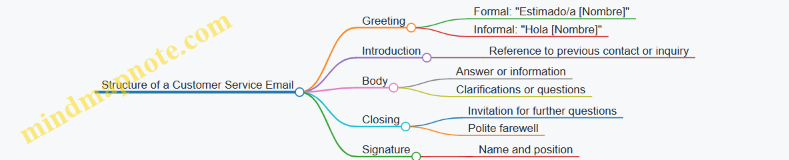
Example 1: Responding to a Product Inquiry (Email)
Subject: Información sobre el producto XYZ
Estimado Sr. López,
Gracias por su interés en nuestro producto XYZ. Le confirmo que el producto está disponible en varios colores y tamaños. Adjunto encontrará el catálogo actualizado con precios y especificaciones.
Si tiene alguna pregunta adicional o desea realizar un pedido, no dude en contactarme.
Atentamente,
María Pérez
Servicio al Cliente
Mind Map: Chat Message Flow for Quick Support
Example 2: Chat Support for a Delivery Status
Cliente: Hola, ¿puede decirme cuándo llegará mi pedido?
Agente: Hola, claro. ¿Podría proporcionarme su número de pedido, por favor?
Cliente: Sí, es 12345.
Agente: Gracias. Su pedido está programado para entrega el martes 10 de mayo.
Cliente: Perfecto, gracias.
Agente: De nada. ¿Hay algo más en lo que pueda ayudarle?
Cliente: No, eso es todo.
Agente: Que tenga un buen día.
Mind Map: Handling a Complaint via Email
Example 3: Responding to a Complaint Email
Estimado/a [Nombre],
Lamentamos mucho que haya tenido una experiencia insatisfactoria con nuestro servicio. Entendemos lo frustrante que puede ser y le pedimos disculpas por cualquier inconveniente.
Para resolver este problema, hemos iniciado una revisión de su caso y nos comprometemos a contactarle con una solución en un plazo de 48 horas.
Quedamos a su disposición para cualquier consulta adicional.
Atentamente,
Carlos Gómez
Atención al Cliente
Mind Map: Writing a Follow-Up Message
Example 4: Follow-Up Email After Support
Hola Ana,
Solo quería confirmar que su problema con la factura ha sido resuelto. Según nuestro registro, el ajuste ya se aplicó correctamente.
Por favor, avíseme si todo está en orden o si necesita ayuda adicional.
Saludos cordiales,
Luis Martínez
Servicio al Cliente
Tips for Effective Written Communication
- Keep sentences short and direct.
- Use polite but straightforward language.
- Match formality to the customer’s tone.
- Avoid jargon unless the customer is familiar with it.
- Always proofread for grammar and clarity.
- Use bullet points or numbered lists to organize complex information.
Written communication is often the first impression customers have of your service. Clear, courteous messages build trust and smooth interactions. These scripts and mind maps provide a foundation you can adapt to your specific workplace needs.
11.4 Best Practices: Tone and Professionalism in Writing
When communicating with customers in Spanish through emails, chat, or text messages, tone and professionalism are crucial. The written word lacks the vocal cues and body language that help convey intent, so choosing the right words and structure becomes your main tool to build trust and clarity.
Mind Map: Key Elements of Tone and Professionalism in Writing
Clarity
Clear writing prevents misunderstandings. Use straightforward vocabulary and avoid idiomatic expressions that might confuse non-native speakers. For example, instead of “Le agradecería que me hiciera saber…” (a formal but complex phrase), say “Por favor, infórmeme…” which is simpler and direct.
Example:
- Less clear: “Estamos trabajando para solucionar el inconveniente a la brevedad posible.”
- Clearer: “Estamos trabajando para resolver el problema lo antes posible.”
Short sentences help keep the message digestible. Avoid long, winding sentences that can lose the reader.
Politeness
Spanish customer service writing typically favors formal address, especially in professional settings. Use “usted” instead of “tú” unless you know the customer prefers informal language.
Start messages with formal greetings like “Estimado/a señor/a [Last Name],” and close with polite phrases such as “Quedo a su disposición para cualquier consulta adicional.”
Polite expressions soften requests and responses, making the interaction feel respectful.
Examples of polite phrases:
- “¿Podría proporcionarme más detalles, por favor?”
- “Le agradezco su paciencia.”
Positivity
Keep the tone solution-oriented. Instead of focusing on what cannot be done, highlight what you can do.
For example, instead of “No podemos enviar el producto hoy,” say “El producto será enviado mañana y le avisaremos cuando esté en camino.”
Avoid negative words like “problema” or “error” when possible; use alternatives like “situación” or “detalle” to soften the message.
Express willingness to assist:
- “Estoy aquí para ayudarle con cualquier duda que tenga.”
Consistency
Maintain the same level of formality and tone throughout the message. Switching from formal to informal or from positive to negative abruptly can confuse or unsettle the customer.
Align your tone with your company’s brand voice. If the company is traditionally formal, keep the language professional. If it’s more casual, a friendly but respectful tone works.
Accuracy
Proofread messages for grammar, spelling, and punctuation. Errors can undermine professionalism and confuse the reader.
Provide precise information. Double-check dates, numbers, and names before sending.
Example:
- Correct: “Su pedido llegará el 15 de mayo.”
- Incorrect: “Su pedido llegará el 15 de Mayo.” (Capitalization inconsistency)
Examples of Tone and Professionalism in Writing
Example 1: Formal Email Response
Estimado señor Pérez,
Gracias por contactarnos. Le confirmo que su pedido será enviado el 10 de junio. Si necesita más información, no dude en comunicarse conmigo.
Quedo a su disposición.
Atentamente,
María López
Example 2: Chat Message with Polite and Positive Tone
Buenas tardes, ¿en qué puedo ayudarle hoy? Estoy aquí para resolver cualquier duda que tenga.
Example 3: Text Message Confirming Appointment
Hola, Sr. García. Le confirmamos su cita para el miércoles a las 3:00 p.m. Por favor, avísenos si necesita cambiar la fecha.
In summary, writing with the right tone and professionalism in Spanish customer service means being clear, polite, positive, consistent, and accurate. These elements work together to create messages that customers find respectful and helpful, even without face-to-face interaction.
11.5 Handling complaints and requests via text or chat requires clarity, empathy, and efficiency. Unlike spoken conversations, written messages lack tone and immediate feedback, so choosing words carefully is essential. The goal is to acknowledge the customer’s issue, express understanding, provide a solution or next steps, and close politely.
Mind Map: Key Steps in Handling Complaints via Text or Chat
Mind Map: Useful Spanish Phrases for Complaints and Requests
Example 1: Handling a Complaint About a Late Delivery
Customer: “Hola, mi pedido debía llegar ayer y aún no lo he recibido. ¿Qué pasa?”
Agent: “Hola, gracias por avisarnos. Lamento que su pedido no haya llegado a tiempo. ¿Podría proporcionarme su número de pedido para revisar el estado?”
Customer: “Claro, es el 12345.”
Agent: “Gracias. He verificado y parece que hubo un retraso en el envío. Estimamos que llegará en dos días. Le ofrezco una disculpa por las molestias. ¿Le gustaría que le enviemos un código de descuento para su próxima compra?”
Customer: “Sí, eso estaría bien. Gracias.”
Agent: “Perfecto. Le enviaré el código por este medio. ¿Hay algo más en lo que pueda ayudarle?”
Customer: “No, eso es todo. Muchas gracias.”
Agent: “Gracias a usted por su comprensión. Que tenga un buen día.”
Example 2: Responding to a Request for Product Information
Customer: “Hola, ¿me puede decir si el modelo X está disponible en color azul?”
Agent: “Hola, gracias por su consulta. Actualmente, el modelo X está disponible en rojo y negro, pero no en azul. ¿Le gustaría que le informe cuando tengamos el color azul en stock?”
Customer: “Sí, por favor.”
Agent: “Perfecto, le avisaremos tan pronto esté disponible. ¿Desea información sobre otros modelos que sí tengan color azul?”
Customer: “Sí, me interesa.”
Agent: “Le enviaré una lista con opciones en azul. ¿Hay algo más en lo que pueda ayudarle?”
Customer: “No, muchas gracias.”
Agent: “Gracias a usted por contactarnos. Que tenga un excelente día.”
Tips for Writing Effective Complaint and Request Responses
- Use simple, direct language to avoid confusion.
- Start by acknowledging the message to show attentiveness.
- Express empathy to build rapport, even in brief texts.
- Ask only necessary questions to keep the conversation efficient.
- Offer clear solutions or alternatives without jargon.
- Confirm the customer’s satisfaction before ending the chat.
- Close with a polite phrase that invites future contact.
By following these guidelines and using the provided phrases and scripts, customer service professionals can handle complaints and requests via text or chat effectively, maintaining professionalism and positive customer relationships.
12. Role-Playing and Practice Exercises
12.1 Simulated Customer Service Scenarios in Spanish
Simulated scenarios help you practice real-world conversations before encountering them on the job. Below are common situations customer service professionals face, presented with mind maps and example dialogues in Spanish. Each scenario includes key phrases and vocabulary to guide your responses.
Scenario 1: Greeting and Identifying Customer Needs
Example Dialogue:
- Empleado: Buenos días, ¿en qué puedo ayudarle hoy?
- Cliente: Hola, estoy buscando un producto para el cuidado de la piel.
- Empleado: Perfecto, ¿podría decirme qué tipo de piel tiene o qué necesita específicamente?
- Cliente: Tengo piel sensible y necesito algo hidratante.
- Empleado: Entiendo, entonces le recomendaré productos suaves e hidratantes para piel sensible. ¿Le gustaría que le muestre algunas opciones?
Key Phrases:
- ¿En qué puedo ayudarle? (How can I help you?)
- ¿Podría decirme…? (Could you tell me…?)
- ¿Qué tipo de…? (What type of…?)
- Le recomendaré… (I will recommend…)
Scenario 2: Handling a Complaint
Example Dialogue:
- Cliente: Compré este producto ayer y ya no funciona.
- Empleado: Lamento mucho que tenga ese problema. ¿Podría contarme qué pasó exactamente?
- Cliente: No enciende cuando lo conecto.
- Empleado: Gracias por la información. Vamos a cambiarlo por uno nuevo o, si prefiere, le podemos ofrecer un reembolso. ¿Qué opción prefiere?
- Cliente: Prefiero un cambio, por favor.
- Empleado: Perfecto, le ayudaré con eso ahora mismo.
Key Phrases:
- Lamento mucho… (I’m very sorry…)
- ¿Podría contarme…? (Could you tell me…?)
- Vamos a… (We are going to…)
- ¿Qué opción prefiere? (Which option do you prefer?)
Scenario 3: Processing an Order
Example Dialogue:
- Empleado: ¿Qué producto desea ordenar hoy?
- Cliente: Quiero dos unidades del modelo X.
- Empleado: Perfecto, dos unidades del modelo X. El total es 50 dólares. ¿Cómo desea pagar?
- Cliente: Con tarjeta de crédito.
- Empleado: Muy bien, por favor pase su tarjeta.
- Empleado: Aquí tiene su recibo. ¿Necesita algo más?
- Cliente: No, gracias.
- Empleado: Gracias a usted. Que tenga un buen día.
Key Phrases:
- ¿Qué producto desea ordenar? (What product would you like to order?)
- El total es… (The total is…)
- ¿Cómo desea pagar? (How would you like to pay?)
- Aquí tiene su recibo. (Here is your receipt.)
Scenario 4: Scheduling an Appointment
Example Dialogue:
- Empleado: ¿En qué fecha le gustaría agendar su cita?
- Cliente: ¿Tiene disponibilidad el próximo martes?
- Empleado: Sí, tenemos horarios a las 10 a.m. y 3 p.m. ¿Cuál prefiere?
- Cliente: A las 3 p.m., por favor.
- Empleado: Perfecto, su cita está confirmada para el martes a las 3 p.m.
Key Phrases:
- ¿En qué fecha le gustaría…? (On what date would you like…?)
- ¿Tiene disponibilidad…? (Do you have availability…?)
- Su cita está confirmada para… (Your appointment is confirmed for…)
Scenario 5: Providing Technical Support
Example Dialogue:
- Cliente: Mi dispositivo no conecta a internet.
- Empleado: Vamos a revisar eso juntos. Primero, ¿puede verificar si el Wi-Fi está activado?
- Cliente: Sí, está activado.
- Empleado: Perfecto. Ahora, intente apagar y encender el dispositivo.
- Cliente: Listo, pero sigue sin funcionar.
- Empleado: Entiendo. Voy a escalar su caso a nuestro equipo técnico para una revisión más profunda.
Key Phrases:
- ¿Puede verificar…? (Can you check…?)
- Intente apagar y encender… (Try turning off and on…)
- Voy a escalar su caso… (I will escalate your case…)
Each scenario can be practiced aloud or with a partner. Focus on pronunciation, natural pauses, and adapting phrases to the situation. The mind maps help organize your approach, ensuring you cover all necessary steps without missing details. This method builds confidence and fluency for real customer interactions in Spanish.
12.2 Practice Scripts for Greeting and Needs Assessment
When greeting a customer and assessing their needs, clarity and politeness are key. These scripts show how to combine basic Spanish phrases with practical communication strategies. Each example includes a mind map to visualize the flow of conversation.
Mind Map: Greeting and Needs Assessment
Example 1: Formal Greeting and Needs Assessment
Customer Service Professional (CSP): Buenos días, ¿en qué puedo ayudarle hoy?
Customer: Estoy buscando un teléfono móvil nuevo.
CSP: Perfecto. ¿Qué características está buscando en su teléfono?
Customer: Quiero que tenga una buena cámara y mucha memoria.
CSP: Entiendo. ¿Podría decirme cuál es su presupuesto aproximado?
Customer: Alrededor de 300 dólares.
CSP: Muy bien, entonces está buscando un teléfono con buena cámara y mucha memoria, con un presupuesto de 300 dólares. ¿Es correcto?
Customer: Sí, eso es.
Example 2: Informal Greeting and Needs Assessment (Phone Support)
CSP: Hola, ¿cómo puedo ayudarte hoy?
Customer: Necesito ayuda con mi factura.
CSP: Claro, ¿podrías decirme qué problema tienes con la factura?
Customer: Me cobraron dos veces por el mismo servicio.
CSP: Entiendo. ¿Podrías proporcionarme el número de cuenta para revisar?
Customer: Sí, es 123456.
CSP: Gracias. Entonces, quieres que revisemos un cobro duplicado en tu factura, ¿correcto?
Customer: Exacto.
Example 3: Clarifying Needs in a Retail Setting
CSP: Buenas tardes, ¿en qué puedo ayudarle?
Customer: Estoy buscando un regalo para mi madre.
CSP: Muy bien. ¿Podría decirme qué tipo de regalo tiene en mente?
Customer: Algo relacionado con el cuidado personal.
CSP: Perfecto. ¿Prefiere productos como cremas, perfumes o algo más específico?
Customer: Perfumes, por favor.
CSP: Entiendo. ¿Hay alguna fragancia que le guste a su madre?
Customer: Le gustan las fragancias florales.
CSP: Entonces, está buscando un perfume con fragancia floral para su madre. ¿Es correcto?
Customer: Sí, gracias.
Mind Map: Key Phrases for Needs Assessment
Tips for Using These Scripts
- Use formal language when addressing unknown customers or in professional settings.
- Adjust tone and formality based on the customer’s cues.
- Always confirm the customer’s needs before proceeding.
- Use open-ended questions to encourage detailed responses.
- Listen actively and respond with empathy.
These scripts and mind maps offer a structured way to greet customers and understand their needs clearly and politely. Practicing them will help build confidence and improve communication efficiency in Spanish-speaking customer service environments.
12.3 Exercises for Handling Complaints and Difficult Customers
Handling complaints effectively is a key skill for customer service professionals. These exercises focus on practical language use, empathy, and problem-solving in Spanish. Each exercise includes a mind map to organize ideas and sample dialogues to practice.
Exercise 1: Identifying the Complaint and Showing Empathy
Objective: Practice recognizing the customer’s issue and responding with empathy.
Mind Map:
Example Dialogue:
- Customer: “Estoy muy decepcionado porque mi pedido llegó tarde y además estaba dañado.”
- Agent: “Lamento mucho que haya tenido esa experiencia. Entiendo lo frustrante que debe ser recibir un pedido en esas condiciones.”
Practice: Write your own empathetic response to this complaint:
“No recibí la factura con mi compra y necesito para mi contabilidad.”
Exercise 2: Clarifying the Issue and Confirming Understanding
Objective: Use polite questions to clarify the complaint and confirm details.
Mind Map:
Example Dialogue:
- Agent: “¿Podría indicarme cuándo realizó el pedido y qué producto llegó dañado?”
- Customer: “Lo hice la semana pasada y fue la cafetera.”
- Agent: “Gracias por la información. Para asegurarme, ¿la cafetera llegó con golpes visibles o no funcionaba?”
Practice: Formulate three polite questions to clarify a complaint about a delayed service.
Exercise 3: Offering Solutions and Alternatives
Objective: Practice proposing solutions clearly and politely.
Mind Map:
Example Dialogue:
- Agent: “Lamento el inconveniente. Podemos enviarle un reemplazo sin costo o procesar un reembolso. ¿Cuál opción prefiere?”
- Customer: “Prefiero el reemplazo, por favor.”
- Agent: “Perfecto, lo gestionaremos hoy mismo y le enviaremos el número de seguimiento.”
Practice: Write a script offering two solutions for a complaint about incorrect billing.
Exercise 4: Managing Difficult Customers Calmly
Objective: Use calming phrases and maintain professionalism.
Mind Map:
Example Dialogue:
- Customer: “¡Esto es inaceptable! Siempre me tratan mal aquí.”
- Agent: “Lamento que se sienta así. Estoy aquí para ayudarle y encontrar una solución juntos.”
Practice: Create three calming phrases in Spanish to use when a customer is upset.
Exercise 5: Closing the Interaction Positively
Objective: Practice ending the conversation on a positive note.
Mind Map:
Example Dialogue:
- Agent: “¿Hay algo más en lo que pueda ayudarle hoy?”
- Customer: “No, muchas gracias por su ayuda.”
- Agent: “Gracias a usted por su paciencia. Que tenga un buen día.”
Practice: Write a closing script for a resolved complaint.
These exercises encourage active use of Spanish in realistic complaint scenarios. Repeating them will build confidence and improve your ability to handle difficult conversations smoothly.
12.4 Role-Play for Order Processing and Scheduling
Role-playing is a practical way to build confidence and fluency in Spanish customer service interactions, especially for order processing and scheduling. This section provides structured dialogues, vocabulary, and mind maps to guide practice.
Mind Map: Order Processing Conversation Flow
Mind Map: Scheduling an Appointment
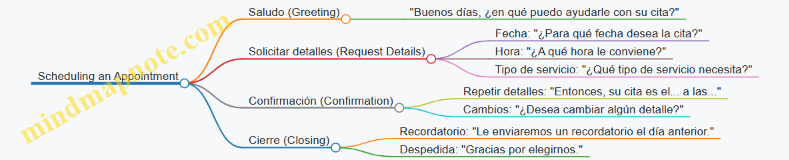
Example Role-Play 1: Processing an Order
Agent: “Buenos días, gracias por llamar a Tienda Sol. ¿En qué puedo ayudarle?”
Customer: “Hola, quiero hacer un pedido de camisetas.”
Agent: “Perfecto. ¿Qué modelo y cuántas camisetas desea?”
Customer: “Quiero cinco camisetas modelo azul talla M.”
Agent: “Muy bien, cinco camisetas azules talla M. ¿Podría proporcionarme su dirección de envío?”
Customer: “Claro, es Calle Luna 123, Ciudad Verde.”
Agent: “Gracias. ¿Cómo desea pagar, con tarjeta o efectivo?”
Customer: “Con tarjeta de crédito, por favor.”
Agent: “Perfecto. Su pedido será enviado en tres días hábiles. ¿Desea que le envíe el recibo por correo electrónico?”
Customer: “Sí, por favor.”
Agent: “Listo, entonces. Gracias por su compra, que tenga un buen día.”
Example Role-Play 2: Scheduling an Appointment
Agent: “Buenas tardes, ¿en qué puedo ayudarle con su cita?”
Customer: “Quisiera agendar una cita para servicio técnico.”
Agent: “Claro, ¿para qué fecha le gustaría?”
Customer: “El próximo martes, si es posible.”
Agent: “Tenemos disponibilidad a las 10:00 y a las 15:00. ¿Cuál prefiere?”
Customer: “A las 15:00 está bien.”
Agent: “Perfecto, entonces su cita es el martes a las 15:00 para servicio técnico. ¿Desea que le enviemos un recordatorio?”
Customer: “Sí, por favor.”
Agent: “Muy bien, le enviaremos un mensaje el día anterior. Gracias por su llamada.”
Tips for Role-Playing
- Practice both sides: agent and customer. This helps understand perspectives and anticipate responses.
- Use the mind maps to structure your dialogue and keep conversations on track.
- Focus on clarity and politeness; these are key in customer service.
- Incorporate common phrases and vocabulary from previous chapters.
- Record your role-plays to self-evaluate pronunciation and fluency.
Role-playing these scenarios repeatedly will build familiarity with typical phrases and improve your ability to handle real customer interactions smoothly.
12.5 Self-evaluation and peer feedback are essential tools for improving Spanish communication skills in customer service. They help identify strengths and areas for growth, making practice sessions more effective and targeted.
Self-Evaluation: Reflecting on Your Performance
Self-evaluation is about honest reflection. After a role-play or real interaction, ask yourself specific questions to gauge your performance:
- Did I use appropriate greetings and polite expressions?
- Was my pronunciation clear enough for the customer to understand?
- Did I listen actively and respond to the customer’s needs?
- How well did I handle any misunderstandings or complaints?
- Did I maintain a professional tone throughout?
Writing down answers can reveal patterns over time. For example, if you notice repeated difficulty with certain vocabulary or phrases, you can focus your practice there.
Mind Map: Self-Evaluation Focus Areas
Peer Feedback: Learning from Others
Peer feedback adds an external perspective. Colleagues can notice things you might miss. When giving feedback, focus on specific behaviors rather than general impressions. Use examples from the interaction to support your points.
Encourage peers to comment on:
- The naturalness of your Spanish expressions.
- How well you adapted language to the customer’s level.
- Your ability to stay calm and professional.
- Any moments where communication broke down.
Receiving feedback requires openness. Listen carefully, ask clarifying questions, and avoid defensive responses. Consider each comment as a chance to improve.
Mind Map: Peer Feedback Components
Practical Example: Self-Evaluation and Peer Feedback in Action
Scenario: Role-play handling a customer complaint about a delayed order.
Self-Evaluation Notes:
- Used polite apology phrases correctly.
- Struggled with pronunciation of “retraso”.
- Could have asked more clarifying questions.
- Maintained calm tone throughout.
Peer Feedback:
- “Your apology sounded sincere, which is important.”
- “Try to slow down when pronouncing longer words like ‘retraso’ to improve clarity.”
- “Asking the customer about their preferred resolution could make the interaction smoother.”
Tips for Effective Self-Evaluation and Peer Feedback
- Keep evaluations specific and focused on behaviors.
- Use a checklist or rubric tailored to customer service Spanish.
- Schedule regular feedback sessions to track progress.
- Balance positive comments with constructive suggestions.
- Practice delivering and receiving feedback respectfully.
Mind Map: Feedback Cycle

Incorporating self-evaluation and peer feedback into your learning routine creates a loop of continuous improvement. It helps you become more confident and effective in Spanish customer service conversations.
13. Glossary of Essential Spanish Customer Service Terms
13.1 Common Customer Service Vocabulary
In customer service, clear and precise language is key. Knowing the right Spanish words and phrases helps you communicate efficiently and professionally. Below is a structured overview of essential vocabulary organized by categories, followed by practical examples and mind maps to visualize connections.
Basic Customer Service Terms
- Cliente – Customer
- Servicio al cliente – Customer service
- Empleado/a – Employee
- Supervisor/a – Supervisor
- Consulta – Inquiry
- Queja – Complaint
- Sugerencia – Suggestion
- Solicitud – Request
- Respuesta – Response
- Solución – Solution
Example:
“El cliente tiene una queja sobre el producto.” (The customer has a complaint about the product.)
Interaction Verbs
- Atender – To assist
- Ayudar – To help
- Escuchar – To listen
- Responder – To respond
- Confirmar – To confirm
- Explicar – To explain
- Resolver – To resolve
- Cancelar – To cancel
- Programar – To schedule
- Esperar – To wait
Example:
“Por favor, espere un momento mientras confirmo su información.” (Please wait a moment while I confirm your information.)
Payment and Transaction Terms
- Pago – Payment
- Factura – Invoice
- Recibo – Receipt
- Tarjeta de crédito/débito – Credit/debit card
- Efectivo – Cash
- Reembolso – Refund
- Descuento – Discount
- Precio – Price
- Pedido – Order
- Confirmación – Confirmation
Example:
“¿Prefiere pagar con tarjeta de crédito o en efectivo?” (Do you prefer to pay with a credit card or cash?)
Politeness and Courtesy Phrases
- Por favor – Please
- Gracias – Thank you
- Disculpe – Excuse me / Sorry
- Con gusto – With pleasure
- ¿En qué puedo ayudarle? – How can I help you?
- Un momento, por favor – One moment, please
- ¿Podría repetir? – Could you repeat?
- Le agradezco su paciencia – I appreciate your patience
Example:
“Disculpe, ¿podría repetir su número de pedido?” (Excuse me, could you repeat your order number?)
Problem-Solving and Support Terms
- Problema – Problem
- Error – Error
- Fallo – Failure
- Soporte técnico – Technical support
- Garantía – Warranty
- Reparación – Repair
- Devolución – Return
- Asistencia – Assistance
- Solucionar – To solve
Example:
“Nuestro equipo de soporte técnico está aquí para ayudarle con cualquier problema.” (Our technical support team is here to help you with any problem.)
Mind Maps in
Mind Map 1: Customer Interaction Vocabulary
Mind Map 2: Payment and Transaction Terms
Mind Map 3: Politeness and Problem Solving
Practical Examples in Context
- Greeting and Offering Help:
“Buenos días, ¿en qué puedo ayudarle hoy?” (Good morning, how can I help you today?)
- Handling a Complaint:
“Lamento el inconveniente. Permítame verificar la información para ofrecerle una solución.” (I’m sorry for the inconvenience. Let me check the information to offer you a solution.)
- Confirming an Order:
“Su pedido número 12345 ha sido confirmado y será enviado mañana.” (Your order number 12345 has been confirmed and will be shipped tomorrow.)
- Requesting Patience:
“Un momento, por favor, estoy verificando los detalles de su cuenta.” (One moment, please, I am checking your account details.)
- Closing Interaction Politely:
“Gracias por su llamada. Que tenga un buen día.” (Thank you for your call. Have a good day.)
Mastering this vocabulary will help you navigate most customer service situations in Spanish with confidence and clarity. The mind maps provide a quick visual guide to group related terms, making it easier to remember and use them naturally during conversations.
13.2 Phrases for Greetings and Politeness
In customer service, how you greet and address customers sets the tone for the entire interaction. Spanish offers a range of greetings and polite expressions that vary depending on formality, time of day, and context. Using the right phrase helps build rapport and shows respect.
Basic Greetings
| Spanish Phrase | English Translation | Usage Notes |
|---|---|---|
| Hola | Hello | Informal, friendly |
| Buenos días | Good morning | Formal or informal, until noon |
| Buenas tardes | Good afternoon | Formal or informal, after noon until evening |
| Buenas noches | Good evening / Good night | Used as greeting in evening or to say goodbye |
Polite Expressions
| Spanish Phrase | English Translation | Usage Notes |
|---|---|---|
| ¿Cómo está usted? | How are you? (formal) | Formal, respectful |
| ¿Cómo estás? | How are you? (informal) | Informal, for peers or younger customers |
| Mucho gusto | Nice to meet you | Polite, used when meeting someone new |
| Encantado/a | Pleased to meet you | Slightly formal, gendered ending (o/a) |
| Por favor | Please | Essential for polite requests |
| Gracias | Thank you | Basic gratitude |
| De nada | You’re welcome | Polite response to thanks |
| Disculpe | Excuse me / Sorry | Use to get attention or apologize |
Mind Map: Greetings and Politeness
Examples in Context
-
Welcoming a Customer in a Formal Setting:
Agent: “Buenos días, ¿cómo está usted? Bienvenido a nuestra tienda. ¿En qué puedo ayudarle hoy?”
(Good morning, how are you? Welcome to our store. How can I help you today?)
-
Answering the Phone Informally:
Agent: “Hola, gracias por llamar. ¿Cómo estás?”
(Hello, thank you for calling. How are you?)
-
Polite Request:
Agent: “Por favor, ¿podría proporcionarme su número de cliente?”
(Please, could you provide me your customer number?)
-
Apologizing to Get Attention:
Agent: “Disculpe, ¿podría repetir eso? No lo entendí bien.”
(Excuse me, could you repeat that? I didn’t understand well.)
-
Expressing Gratitude and Closing:
Agent: “Gracias por su paciencia. ¿Hay algo más en que pueda ayudarle?”
(Thank you for your patience. Is there anything else I can help you with?)
Nuances to Keep in Mind
- Use “usted” forms to show respect, especially with older customers or in formal situations.
- “Tú” forms are acceptable with younger customers or when the relationship is informal.
- Gender endings matter in adjectives and participles: “Encantado” if you are male, “Encantada” if female.
- Time-specific greetings help show attentiveness to the moment.
- Politeness markers like “por favor” and “gracias” are expected and appreciated.
Mastering these phrases and their appropriate usage will help you create positive first impressions and maintain respectful, clear communication with Spanish-speaking customers.
13.3 Terms Related to Orders and Payments
In customer service, discussing orders and payments clearly is essential. Using the right Spanish terms helps avoid confusion and speeds up transactions. Below, you’ll find key vocabulary organized into categories, practical examples, and mind maps to visualize connections.
Key Vocabulary for Orders
- Pedido – order
- Orden – order (used interchangeably with pedido in some regions)
- Artículo – item
- Producto – product
- Cantidad – quantity
- Precio – price
- Total – total
- Factura – invoice
- Recibo – receipt
- Confirmar – to confirm
- Cancelar – to cancel
- Modificar – to modify
- Enviar – to send/ship
- Entrega – delivery
Key Vocabulary for Payments
- Pago – payment
- Método de pago – payment method
- Efectivo – cash
- Tarjeta de crédito – credit card
- Tarjeta de débito – debit card
- Transferencia bancaria – bank transfer
- Cheque – check
- Factura pendiente – outstanding invoice
- Saldo – balance
- Deuda – debt
- Reembolso – refund
- Descuento – discount
- Impuesto – tax
Mind Map: Order Process Vocabulary
Mind Map: Payment Terms
Practical Examples
Example 1: Confirming an Order
- Spanish: “¿Podría confirmar la cantidad y el precio del pedido, por favor?”
- English: “Could you please confirm the quantity and price of the order?”
Example 2: Explaining Payment Methods
- Spanish: “Aceptamos pagos en efectivo, con tarjeta de crédito o transferencia bancaria. ¿Cuál prefiere usar?”
- English: “We accept cash, credit card, or bank transfer payments. Which would you prefer to use?”
Example 3: Informing About Delivery
- Spanish: “Su pedido será enviado mañana y la entrega está prevista para el viernes.”
- English: “Your order will be shipped tomorrow, and delivery is scheduled for Friday.”
Example 4: Handling a Refund
- Spanish: “Para procesar el reembolso, necesitamos la factura y el recibo de compra.”
- English: “To process the refund, we need the invoice and the purchase receipt.”
Example 5: Discussing Discounts and Taxes
- Spanish: “El descuento aplicado es del 10%, y el impuesto correspondiente se añadirá al total.”
- English: “A 10% discount has been applied, and the applicable tax will be added to the total.”
Tips for Using These Terms
- Always confirm order details aloud to avoid mistakes.
- When discussing payments, clarify which methods are accepted.
- Use polite forms such as “podría” or “quisiera” when asking for confirmation or preferences.
- Be clear about amounts, especially when mentioning totals, taxes, and discounts.
- Repeat important numbers and details to ensure understanding.
This section equips you with the vocabulary and phrases to manage orders and payments confidently. The mind maps help visualize the relationships between terms, making it easier to recall and apply them during customer interactions.
13.4 Technical Support Terminology
Technical support often requires a specific set of vocabulary to communicate clearly and efficiently with customers. This section focuses on common terms and phrases used in Spanish technical support contexts, organized to help you understand and apply them in real conversations.
Mind Map: Core Technical Support Terms
Common Terms and Their Usage
-
Problema: General term for any issue. Example: “¿Cuál es el problema que está experimentando?” (What problem are you experiencing?)
-
Error: Specific fault or mistake in software or hardware. Example: “El sistema muestra un error al iniciar.” (The system shows an error when starting.)
-
Falla / Malfuncionamiento: When a device or system is not working properly. Example: “Parece que hay una falla en la impresora.” (It seems there is a failure in the printer.)
-
Diagnóstico: The process of identifying the cause of a problem. Example: “Vamos a realizar un diagnóstico para encontrar la causa.” (We are going to perform a diagnosis to find the cause.)
-
Reinicio: Restarting a device or system. Example: “Por favor, realice un reinicio del equipo.” (Please restart the device.)
-
Actualización: Installing the latest software or firmware. Example: “Necesita una actualización para corregir este problema.” (You need an update to fix this problem.)
-
Conectividad: Refers to internet or network connection issues. Example: “¿Está conectado a la red Wi-Fi?” (Are you connected to the Wi-Fi network?)
-
Cuenta y Contraseña: User account and password, essential for access. Example: “¿Ha intentado restablecer su contraseña?” (Have you tried resetting your password?)
Mind Map: Troubleshooting Steps Vocabulary
Example Dialogue: Diagnosing a Printer Issue
Agente: Buenos días, ¿en qué puedo ayudarle hoy?
Cliente: Mi impresora no está funcionando.
Agente: Entiendo. ¿Puede decirme qué tipo de error aparece en la pantalla?
Cliente: Dice “Error de conexión”.
Agente: Gracias. Vamos a verificar la conectividad. ¿Está la impresora conectada a la red Wi-Fi?
Cliente: Sí, pero creo que la señal es débil.
Agente: Le recomiendo reiniciar el router y la impresora. Esto suele solucionar problemas de conexión.
Cliente: Está bien, lo haré.
Agente: Perfecto. Si el problema persiste, podemos realizar una actualización del firmware.
Example Dialogue: Resetting a Password
Agente: Para acceder a su cuenta, ¿ha intentado restablecer su contraseña?
Cliente: No, no sé cómo hacerlo.
Agente: Le guiaré. Primero, vaya a la página de inicio de sesión y haga clic en “¿Olvidó su contraseña?”.
Cliente: Listo.
Agente: Ahora, ingrese su correo electrónico y recibirá un enlace para crear una nueva contraseña.
Cliente: Perfecto, gracias.
Agente: De nada. Si tiene problemas con el enlace, no dude en contactarnos nuevamente.
Tips for Using Technical Terms Effectively
-
Use simple language alongside technical terms to ensure understanding.
-
Confirm the customer’s familiarity with terms; offer explanations when needed.
-
Repeat or paraphrase important instructions to avoid confusion.
-
Combine terminology with clear action verbs (e.g., “reiniciar el equipo”, “actualizar el software”) to guide customers.
-
Maintain a calm and patient tone, especially when explaining complex issues.
This section equips you with the vocabulary and phrases needed to navigate technical support conversations in Spanish. Practice these terms within real or simulated dialogues to build confidence and clarity.
13.5 Expressions for Handling Complaints and Solutions
When working in customer service, handling complaints effectively is essential. In Spanish, clear and respectful expressions help de-escalate tension and guide the conversation toward a solution. Below is a structured overview of useful phrases, organized by stages of complaint handling, followed by mind maps to visualize the flow and examples illustrating their use.
Mind Map: Stages of Handling Complaints in Spanish
Listening and Acknowledging
Acknowledging the customer’s feelings and complaint is the first step. It shows you are attentive and respectful.
- “Entiendo su preocupación.” (I understand your concern.)
- “Lamento mucho lo ocurrido.” (I am very sorry about what happened.)
- “Gracias por informarnos sobre esto.” (Thank you for letting us know about this.)
Example:
Cliente: “El producto llegó dañado.”
Agente: “Entiendo su preocupación y lamento mucho que haya recibido un producto en esas condiciones.”
Apologizing Politely
A sincere apology can calm frustration. Use phrases that take responsibility without making excuses.
- “Le pido disculpas por las molestias.” (I apologize for the inconvenience.)
- “Siento las molestias causadas.” (I am sorry for the trouble caused.)
- “Disculpe las molestias que esto le haya ocasionado.” (Sorry for any inconvenience this may have caused you.)
Example:
“Le pido disculpas por las molestias y agradezco su paciencia mientras resolvemos esto.”
Clarifying the Issue
Gathering details helps identify the problem and find the right solution.
- “¿Podría darme más detalles sobre el problema?” (Could you give me more details about the problem?)
- “¿Cuándo ocurrió esto?” (When did this happen?)
- “¿Ha intentado alguna solución hasta ahora?” (Have you tried any solutions so far?)
Example:
“Para poder ayudarle mejor, ¿podría decirme qué modelo es y cuándo notó el problema?”
Offering Solutions
Present options clearly and politely. Tailor the response to the customer’s needs.
- “Podemos ofrecerle un reemplazo.” (We can offer you a replacement.)
- “Le propongo que…” (I suggest that you…)
- “¿Le gustaría que le enviemos un técnico?” (Would you like us to send a technician?)
- “Podemos procesar un reembolso si prefiere.” (We can process a refund if you prefer.)
Example:
“Para resolver esto, podemos enviarle un producto nuevo o procesar un reembolso. ¿Cuál opción prefiere?”
Confirming Satisfaction and Closing
Make sure the customer feels heard and satisfied before ending the interaction.
- “¿Le parece bien esta solución?” (Does this solution work for you?)
- “¿Hay algo más en lo que pueda ayudarle?” (Is there anything else I can help you with?)
- “Gracias por su comprensión.” (Thank you for your understanding.)
Example:
“¿Está de acuerdo con el reemplazo? Si necesita algo más, no dude en contactarnos.”
Mind Map: Example Complaint Handling Flow
Additional Useful Expressions
- “Voy a hacer todo lo posible para ayudarle.” (I will do everything possible to help you.)
- “Permítame verificar la información.” (Allow me to verify the information.)
- “Le agradezco que nos haya informado para poder mejorar.” (I appreciate you informing us so we can improve.)
- “Estamos comprometidos a resolver este problema.” (We are committed to resolving this issue.)
Using these expressions in the right context helps maintain professionalism and empathy. Practice combining them naturally to build confidence in handling complaints smoothly in Spanish.