6G Spectrum Technologies And Integrated Satellite Terrestrial Communication Architectures
1. Introduction to 6G Spectrum and Integrated Architectures
1.1 Overview of 6G: Vision and Key Drivers
The evolution from 5G to 6G represents a paradigm shift in wireless communication, promising unprecedented capabilities that will redefine connectivity, intelligence, and integration across terrestrial and satellite networks. This section explores the overarching vision of 6G and the key drivers propelling its development.
Vision of 6G
6G aims to deliver a hyper-connected, intelligent, and sustainable communication ecosystem by 2030 and beyond. It envisions:
- Terabit-level data rates enabling ultra-high-definition holographic communications and immersive extended reality (XR).
- Sub-millisecond latency for real-time control in critical applications like autonomous systems and tactile internet.
- Ubiquitous connectivity integrating terrestrial, aerial, and satellite networks to ensure seamless global coverage.
- AI-native networks that self-optimize, self-heal, and dynamically allocate resources.
- Sustainability and energy efficiency as core design principles to reduce carbon footprint.
Mind Map: 6G Vision
Key Drivers of 6G Development
-
Explosive Data Demand and New Use Cases
- The rise of immersive media, holography, and massive IoT devices demands higher throughput and lower latency.
- Example: Real-time remote surgery requiring ultra-reliable, low-latency communication.
-
Spectrum Scarcity and Need for New Bands
- Existing spectrum bands are congested; 6G explores sub-THz and THz bands for wider bandwidth.
- Example: Utilizing 300 GHz spectrum to achieve multi-gigabit data rates in dense urban areas.
-
Integration of Satellite and Terrestrial Networks
- To achieve global coverage, especially in remote and underserved regions.
- Example: LEO satellite constellations complementing terrestrial 6G cells for seamless connectivity.
-
Advances in AI and Machine Learning
- AI enables dynamic spectrum management, network optimization, and predictive maintenance.
- Example: AI algorithms dynamically reallocating spectrum in real-time to avoid interference.
-
Sustainability and Energy Efficiency
- Growing environmental concerns push for green network designs.
- Example: Energy harvesting techniques integrated into 6G base stations.
-
Security and Privacy Challenges
- Increasingly complex networks require robust security frameworks.
- Example: Quantum-safe encryption methods for satellite-terrestrial links.
Mind Map: Key Drivers of 6G
Example: Real-World Scenario Illustrating 6G Vision and Drivers
Consider a smart city in 2030 where autonomous vehicles, drones, and IoT sensors operate in harmony. The city leverages 6G’s integrated satellite-terrestrial architecture to provide:
- Seamless connectivity even in underground tunnels and remote parks via satellite links.
- Ultra-low latency communication enabling real-time traffic management and collision avoidance.
- AI-driven network orchestration dynamically allocating spectrum and computing resources based on demand.
- Sustainable operations powered by energy-efficient base stations and renewable energy sources.
This scenario encapsulates how the vision and drivers of 6G converge to create transformative societal impact.
In summary, the 6G vision is ambitious and multifaceted, driven by the need for higher performance, global coverage, intelligence, sustainability, and security. Understanding these foundational elements is critical for wireless research engineers, systems architects, and telecom strategists as they design and implement next-generation networks.
1.2 The Role of Spectrum in 6G Networks
The spectrum is the lifeblood of any wireless communication system, and its role in 6G networks is even more critical due to the ambitious goals of ultra-high data rates, massive connectivity, ultra-low latency, and global coverage. Understanding how spectrum underpins 6G enables wireless research engineers, systems architects, and telecom strategists to design efficient, scalable, and future-proof networks.
Why Spectrum Matters in 6G
- Bandwidth Availability: 6G aims to deliver data rates up to 1 Tbps, requiring access to wider bandwidths than previous generations.
- Frequency Diversity: Utilizing a broad range of frequencies from sub-6 GHz to THz bands enables diverse applications and environments.
- Propagation Characteristics: Different spectrum bands have unique propagation properties affecting coverage, penetration, and reliability.
- Spectrum Sharing: Efficient use of spectrum through dynamic sharing and coexistence is vital to meet growing demand.
Mind Map: Core Roles of Spectrum in 6G Networks
Detailed Explanation
Bandwidth Expansion and New Frequency Frontiers
6G networks will leverage spectrum in the sub-THz (100 GHz to 1 THz) and THz bands to unlock unprecedented bandwidth. These frequencies offer multi-GHz channels that enable ultra-high throughput but come with challenges such as higher path loss and atmospheric absorption.
Example: Consider a smart factory deploying 6G for real-time control of autonomous robots. Using a 300 GHz carrier with a 10 GHz bandwidth allows extremely fast data exchange, enabling millisecond-level responsiveness.
Frequency Diversity for Versatility
6G will utilize a wide spectrum range:
- Low bands (<6 GHz): Provide wide coverage and good penetration, ideal for rural and indoor scenarios.
- Mid bands (6-30 GHz): Balance between coverage and capacity, suitable for urban macro cells.
- High bands (>100 GHz): Offer ultra-high capacity for hotspots and specialized applications.
Example: A city-wide 6G deployment might use 3.5 GHz for broad coverage, 28 GHz mmWave for dense urban hotspots, and 140 GHz for ultra-high-speed links in stadiums or convention centers.
Propagation Characteristics Impact Network Design
Higher frequencies suffer from increased path loss and limited penetration through obstacles. This necessitates innovative antenna technologies (massive MIMO, intelligent surfaces) and network densification.
Example: In a dense urban environment, 6G networks may deploy intelligent reflecting surfaces on building facades to redirect THz signals around obstacles, improving coverage.
Spectrum Sharing and Dynamic Management
With spectrum scarcity and diverse stakeholders, 6G will rely heavily on dynamic spectrum sharing techniques such as cognitive radios and licensed shared access to optimize utilization.
Example: In a stadium event, temporary spectrum sharing allows multiple operators to dynamically allocate spectrum based on real-time demand, ensuring seamless user experience.
Integration with Satellite Communications
6G envisions seamless integration of terrestrial and satellite networks, requiring harmonized spectrum policies and coordinated spectrum use to avoid interference and optimize performance.
Example: A remote area lacking terrestrial infrastructure can be served by LEO satellites operating in harmonized spectrum bands, providing 6G connectivity with terrestrial networks.
Mind Map: Spectrum Challenges and Solutions in 6G
Best Practice: Aligning Spectrum Strategy with Use Case Requirements
When designing 6G networks, it is essential to match spectrum bands to specific use cases based on their coverage, capacity, and latency needs.
Example: For ultra-reliable low-latency communication (URLLC) in autonomous vehicles, mid-band spectrum (~30 GHz) offers a good trade-off between coverage and capacity, while THz bands can be reserved for short-range, high-throughput vehicle-to-infrastructure links.
Summary
The role of spectrum in 6G networks is foundational and multifaceted. It enables the ambitious performance targets of 6G by providing the necessary bandwidth, diversity, and flexibility. Understanding the characteristics and challenges of different spectrum bands, combined with innovative management and integration strategies, is key to realizing the full potential of 6G.
1.3 Fundamentals of Satellite-Terrestrial Integration
Satellite-terrestrial integration is a cornerstone for enabling ubiquitous, resilient, and high-capacity 6G networks. This integration combines the wide-area coverage and broadcast capabilities of satellite systems with the high data rates and low latency of terrestrial networks, creating a seamless communication environment.
Key Concepts in Satellite-Terrestrial Integration
- Complementary Coverage: Satellites provide coverage in remote, rural, and maritime areas where terrestrial infrastructure is sparse or non-existent.
- Capacity Augmentation: Terrestrial networks handle dense urban traffic, while satellites offload or supplement capacity during peak demand or emergencies.
- Seamless Mobility: Users can maintain connectivity while moving between terrestrial and satellite coverage zones.
- Network Resilience: Integration enhances network robustness against failures or disasters affecting terrestrial infrastructure.
Mind Map: Core Components of Satellite-Terrestrial Integration
Integration Architectures
- Overlay Architecture: Satellite networks operate as an overlay to terrestrial networks, providing additional coverage and backup.
- Hybrid Architecture: Tight coupling where satellite and terrestrial networks share infrastructure, spectrum, and control planes.
- Converged Architecture: Full integration with unified management, enabling seamless user experience and resource optimization.
Example: Seamless Connectivity for Maritime IoT
Consider a maritime shipping company deploying IoT sensors on vessels to monitor engine health and cargo conditions. Terrestrial networks cover ports and coastal areas, while LEO satellites provide connectivity in open seas. Integration ensures continuous data transmission:
- When near shore, data routes via terrestrial 5G base stations for low latency.
- As the ship moves offshore, the system automatically switches to satellite links without session interruption.
- AI-driven network management dynamically selects the optimal path based on signal quality and cost.
This example highlights the importance of mobility management and hybrid architectures.
Best Practices in Satellite-Terrestrial Integration
- Design for Interoperability: Use standardized interfaces and protocols to facilitate smooth handovers.
- Dynamic Spectrum Sharing: Implement cognitive radio techniques to optimize spectrum use between satellite and terrestrial systems.
- Latency Mitigation: Employ edge computing and caching near gateways to reduce satellite-induced delays.
- Security by Design: Integrate multi-layered security frameworks addressing both satellite and terrestrial vulnerabilities.
Mind Map: Best Practices Overview
Additional Example: Disaster Recovery Network Resilience
In disaster scenarios where terrestrial infrastructure is damaged, integrated satellite-terrestrial networks ensure emergency communications:
- Emergency responders use terrestrial 6G networks where available.
- Satellite links provide backup connectivity and extend coverage to affected zones.
- Network slices prioritize emergency traffic, maintaining QoS.
This use case underscores the resilience benefits of integration.
In summary, the fundamentals of satellite-terrestrial integration revolve around complementary coverage, hybrid architectures, dynamic spectrum and mobility management, and robust security. These principles enable 6G networks to deliver seamless, reliable, and high-performance connectivity across diverse environments.
1.4 Best Practices: Aligning Spectrum Allocation with Use Cases
Aligning spectrum allocation with specific 6G use cases is critical to unlocking the full potential of next-generation telecommunications. Effective spectrum management ensures optimal performance, efficient resource utilization, and tailored network capabilities that meet diverse application requirements.
Key Best Practices for Spectrum Allocation Alignment
- Understand Use Case Requirements: Analyze bandwidth, latency, coverage, and mobility needs.
- Categorize Spectrum Bands by Use Case Suitability: Assign low, mid, and high-frequency bands based on application demands.
- Implement Dynamic Spectrum Allocation: Leverage AI and cognitive radio to adapt spectrum usage in real-time.
- Promote Spectrum Sharing and Reuse: Encourage coexistence between satellite and terrestrial systems.
- Incorporate Regulatory and Environmental Constraints: Align allocation with regional policies and minimize interference.
Mind Map: Spectrum Allocation Alignment Framework
Example 1: Allocating Spectrum for Massive IoT in Smart Cities
- Use Case Requirements: Massive device connectivity, low data rates, wide coverage, low power consumption.
- Spectrum Choice: Sub-1 GHz bands (e.g., 700 MHz, 800 MHz) for penetration and coverage.
- Practice Applied: Assigning narrowband IoT (NB-IoT) technologies within these bands to optimize spectrum efficiency.
This allocation ensures reliable connectivity for thousands of sensors across urban environments without excessive spectrum consumption.
Example 2: Spectrum Allocation for Ultra-Reliable Low Latency Communications (URLLC)
- Use Case Requirements: Extremely low latency (<1 ms), high reliability, moderate bandwidth.
- Spectrum Choice: Mid-band spectrum (3.5 GHz to 6 GHz) with good propagation and capacity.
- Practice Applied: Reserving dedicated slices of spectrum with priority access and dynamic allocation to URLLC applications like autonomous vehicles and industrial automation.
This approach guarantees timely and dependable communication critical for safety and control.
Mind Map: Use Case to Spectrum Mapping Example
Example 3: Dynamic Spectrum Allocation in Urban 6G Deployments
- Scenario: Dense urban environment with fluctuating traffic demands.
- Practice: Use AI-driven cognitive radios to monitor spectrum usage and dynamically allocate frequencies between terrestrial 6G base stations and satellite terminals.
- Outcome: Improved spectrum utilization, reduced interference, and enhanced user experience during peak and off-peak hours.
Summary
Aligning spectrum allocation with use cases in 6G involves a holistic understanding of application requirements, strategic band selection, and the adoption of dynamic and shared spectrum management techniques. Incorporating these best practices ensures that both satellite and terrestrial components of integrated architectures operate efficiently and effectively, delivering on the promises of 6G technology.
1.5 Example: Comparing 5G Spectrum Utilization vs 6G Expectations
Understanding the evolution from 5G to 6G spectrum utilization is crucial for wireless research engineers, systems architects, and telecom strategists aiming to design future-proof networks. This section provides a detailed comparison, highlighting key differences, emerging technologies, and practical examples.
Mind Map: Spectrum Utilization in 5G vs 6G
Key Differences Between 5G and 6G Spectrum Utilization
| Aspect | 5G Spectrum Utilization | 6G Spectrum Expectations |
|---|---|---|
| Frequency Range | Primarily Sub-6 GHz and mmWave (up to ~52 GHz) | Expansion into Sub-THz and THz bands (100 GHz to 1 THz+) |
| Bandwidth Availability | Up to 400 MHz in mmWave bands | Multi-GHz bandwidths enabling Tbps data rates |
| Spectrum Sharing | Dynamic Spectrum Sharing between operators and services | AI-driven, real-time dynamic spectrum allocation and sharing |
| Integration | Mostly terrestrial-focused | Seamless integration of satellite and terrestrial spectrum |
| Network Technologies | Massive MIMO, Beamforming, Network Slicing | Intelligent Reflecting Surfaces, AI/ML-based spectrum control |
| Use Case Focus | Enhanced broadband, IoT, low latency | Immersive XR, holography, digital twins, global coverage |
Practical Example: Urban Deployment Spectrum Utilization
5G Scenario:
- A metropolitan area deploys 5G using 3.5 GHz band for broad coverage and 28 GHz mmWave for hotspots.
- Massive MIMO antennas dynamically allocate spectrum to users.
- Dynamic Spectrum Sharing allows coexistence with LTE.
6G Expected Scenario:
- The same urban area utilizes sub-THz bands (e.g., 140 GHz) for ultra-high-speed data transfer.
- Intelligent Reflecting Surfaces installed on buildings redirect signals to overcome blockages.
- AI algorithms dynamically allocate spectrum across terrestrial and satellite links for uninterrupted service.
Mind Map: Example Use Case - Spectrum Allocation in Urban 5G vs 6G
Best Practice Highlight
Progressive Spectrum Planning: Transitioning from 5G to 6G requires a phased approach:
- Start by leveraging existing 5G bands while preparing infrastructure for higher frequency bands.
- Invest in AI and intelligent surfaces early to optimize spectrum use.
- Develop integrated satellite-terrestrial spectrum policies to enable seamless handover and coverage.
Summary
The leap from 5G to 6G spectrum utilization is not just about accessing higher frequencies but also about smarter, integrated, and more dynamic spectrum management. By understanding these differences and applying best practices, engineers and architects can design networks that meet the ambitious goals of 6G while ensuring backward compatibility and efficient resource use.
2. Spectrum Bands and Technologies for 6G
2.1 Sub-THz and THz Spectrum: Unlocking Ultra-High Bandwidth
The Sub-Terahertz (Sub-THz) and Terahertz (THz) frequency bands, typically ranging from 100 GHz to 10 THz, represent the next frontier in wireless communications. These bands promise ultra-high bandwidths that can enable unprecedented data rates, ultra-low latency, and new applications in 6G networks. Unlocking this spectrum is critical for meeting the exponential growth in data demand and supporting emerging use cases such as holographic communications, ultra-high definition video streaming, and massive IoT.
Why Sub-THz and THz Spectrum?
- Massive Bandwidth Availability: Unlike traditional microwave and mmWave bands, THz bands offer tens to hundreds of GHz of contiguous bandwidth.
- Ultra-High Data Rates: Potential to support data rates in the order of hundreds of Gbps to Tbps.
- Low Latency: High carrier frequencies enable shorter symbol durations, reducing transmission delay.
- New Applications: Supports novel applications like real-time holography, tactile internet, and advanced sensing.
Challenges in Sub-THz and THz Communications
- Propagation Losses: High free-space path loss and atmospheric absorption limit range.
- Hardware Limitations: Generating, detecting, and processing THz signals require advanced semiconductor technologies.
- Beamforming Complexity: Narrow beams necessitate precise beam steering and tracking.
- Regulatory and Standardization: Spectrum allocation and harmonization are still evolving.
Mind Map: Sub-THz and THz Spectrum Characteristics
Best Practices for Leveraging Sub-THz and THz Spectrum
- Hybrid Spectrum Usage: Combine Sub-THz/THz with lower frequency bands to balance coverage and capacity.
- Advanced Beamforming: Employ ultra-massive MIMO and adaptive beam steering to overcome propagation losses.
- Material and Device Innovation: Invest in semiconductor materials like graphene and InP for efficient THz transceivers.
- Channel Modeling and Measurement: Develop accurate channel models considering molecular absorption and scattering.
- Dynamic Spectrum Management: Use AI-driven spectrum allocation to optimize usage and avoid interference.
Example: Ultra-High-Speed Indoor Wireless Link Using 300 GHz Band
A research team demonstrated a 300 GHz wireless link achieving 100 Gbps data rate over a 10-meter indoor distance. By leveraging ultra-massive MIMO arrays and precise beamforming, the system overcame high path loss and multipath effects. This example illustrates how Sub-THz bands can enable ultra-high-speed wireless connectivity for data centers and indoor hotspots.
Mind Map: Example Use Case - 300 GHz Indoor Wireless Link
Example: Sub-THz Spectrum for High-Speed Backhaul
In urban environments, deploying fiber optic cables for backhaul is often costly and time-consuming. Sub-THz links operating around 275 GHz have been trialed to provide multi-gigabit wireless backhaul connecting 5G/6G base stations. These links offer fiber-like speeds with flexible deployment, enabling rapid network densification.
Summary
Sub-THz and THz spectrum bands unlock ultra-high bandwidth capabilities essential for 6G’s ambitious goals. While challenges remain in propagation, hardware, and regulation, best practices such as hybrid spectrum usage, advanced beamforming, and AI-driven management pave the way for practical deployments. Real-world examples demonstrate the feasibility of ultra-fast indoor links and high-speed backhaul, illustrating the transformative potential of these spectrum technologies.
2.2 mmWave Enhancements and Beyond
Introduction
Millimeter wave (mmWave) frequencies, typically ranging from 24 GHz to 100 GHz, have been a cornerstone of 5G deployments, offering unprecedented bandwidth and data rates. However, as we transition to 6G, enhancements to mmWave technologies and exploration beyond these frequencies are critical to meet the demands for ultra-high throughput, ultra-low latency, and massive connectivity.
Key Enhancements in mmWave for 6G
-
Advanced Beamforming and Beam Management:
- Utilization of hybrid analog-digital beamforming to improve energy efficiency and spatial resolution.
- Dynamic beam tracking to maintain robust links in highly mobile environments.
-
Massive MIMO Expansion:
- Scaling antenna arrays to thousands of elements to increase spatial multiplexing.
- Integration with intelligent reflecting surfaces (IRS) to manipulate propagation environments.
-
Improved Hardware Components:
- Development of low-noise, high-power mmWave transceivers.
- Use of novel materials like graphene for flexible, high-frequency circuits.
-
Enhanced Channel Coding and Modulation:
- Adoption of advanced coding schemes (e.g., polar codes, LDPC) optimized for mmWave channels.
- Higher-order modulation techniques (e.g., 1024-QAM) to maximize spectral efficiency.
Mind Map: mmWave Enhancements in 6G
Beyond mmWave: Exploring Sub-THz and THz Bands
While mmWave frequencies provide significant bandwidth, the spectrum beyond 100 GHz—sub-THz (100 GHz to 300 GHz) and THz (300 GHz to 3 THz)—offers even wider channels and higher data rates. These bands are pivotal for 6G’s vision of extreme data throughput and novel applications like holographic communications and ultra-high-resolution sensing.
Challenges:
- Severe propagation losses and atmospheric absorption.
- Limited coverage range requiring dense deployment or integration with satellite systems.
- Technological maturity of devices and components.
Opportunities:
- Ultra-wide bandwidth enabling Tbps data rates.
- Ultra-low latency communication.
- New paradigms in joint communication and sensing.
Mind Map: Beyond mmWave Spectrum Exploration
Best Practices for mmWave and Beyond Spectrum Utilization
-
Hybrid Beamforming Implementation:
- Combine analog and digital beamforming to balance complexity and performance.
- Example: A 6G urban deployment uses hybrid beamforming to maintain stable links with moving vehicles, reducing handover failures.
-
Intelligent Reflecting Surfaces (IRS) Deployment:
- Use IRS panels on building facades to reflect and steer mmWave signals around obstacles.
- Example: In a dense city center, IRS helps overcome blockage from skyscrapers, improving mmWave coverage indoors.
-
Dynamic Spectrum Sharing:
- Implement AI-driven spectrum management to allocate mmWave and sub-THz bands dynamically based on traffic demand.
- Example: A stadium deployment dynamically reallocates mmWave spectrum during events to handle sudden traffic spikes.
-
Joint Communication and Sensing:
- Leverage THz frequencies for simultaneous data transmission and environmental sensing.
- Example: Autonomous vehicles use THz links to communicate and map surroundings in real-time.
-
Material and Hardware Innovation:
- Invest in research on novel materials like graphene for flexible, high-frequency antennas and transceivers.
- Example: A prototype flexible graphene antenna array demonstrates improved performance in sub-THz bands.
Example: Dynamic Beam Management in mmWave 6G Networks
Consider a high-speed train scenario where users experience rapid changes in signal quality due to mobility and blockage. Implementing advanced beam tracking algorithms combined with hybrid beamforming allows the network to dynamically steer beams, maintaining high throughput and low latency.
- Scenario: Train moving at 300 km/h through urban and rural areas.
- Solution: Hybrid beamforming with AI-based beam prediction.
- Outcome: Seamless handover and sustained multi-Gbps speeds.
Summary
Enhancements in mmWave technologies, combined with exploration into sub-THz and THz bands, are fundamental to achieving 6G’s ambitious performance goals. By adopting best practices such as hybrid beamforming, IRS deployment, and dynamic spectrum management, wireless engineers and system architects can design robust, high-capacity networks that push beyond the limits of current mmWave systems.
2.3 Optical Wireless Communications as a Complementary Spectrum
Optical Wireless Communications (OWC) is rapidly emerging as a vital complementary technology to traditional radio frequency (RF) spectrum in 6G networks. Leveraging the visible light, infrared (IR), and ultraviolet (UV) bands, OWC offers ultra-high bandwidth, immunity to electromagnetic interference, and enhanced security. This section explores the role of OWC in 6G, its key technologies, best practices, and practical examples.
What is Optical Wireless Communications?
OWC refers to data transmission using light waves in free space, without the need for fiber optic cables. It includes several sub-technologies:
- Visible Light Communication (VLC)
- Infrared Communication (IRC)
- Ultraviolet Communication (UVC)
These technologies utilize LEDs, laser diodes, and photodetectors to transmit and receive data.
Mind Map: Optical Wireless Communications Overview
Why OWC is a Complementary Spectrum for 6G?
-
Bandwidth Availability: OWC offers vast unlicensed spectrum, enabling multi-Gbps data rates that complement congested RF bands.
-
Interference Mitigation: Since OWC uses light, it avoids RF interference, improving reliability in dense urban or industrial environments.
-
Security: Optical signals are confined within physical spaces (like rooms), reducing eavesdropping risks.
-
Energy Efficiency: LEDs used in VLC can simultaneously provide illumination and data transmission, optimizing energy use.
-
Integration Potential: OWC can be integrated with existing RF systems to enable hybrid networks with seamless handover.
Mind Map: Benefits of OWC in 6G
Key Technologies in OWC for 6G
- Visible Light Communication (VLC): Uses LEDs for indoor wireless access, smart lighting, and vehicular communication.
- Free Space Optical (FSO) Communication: Employs laser beams for high-capacity point-to-point links, including satellite downlinks and backhaul.
- LiFi (Light Fidelity): A subset of VLC providing high-speed bidirectional communication, ideal for indoor environments.
Best Practices for Deploying OWC in 6G
- Hybrid Network Design: Combine OWC with RF to ensure coverage continuity, especially in non-line-of-sight (NLOS) conditions.
- Adaptive Beam Steering: Use dynamic beamforming and tracking to maintain alignment between transmitters and receivers.
- Interference Management: Implement spatial and temporal multiplexing to minimize interference in dense deployments.
- Energy Optimization: Leverage LED lighting infrastructure for dual-purpose illumination and communication.
- Standardization Compliance: Follow IEEE 802.15.7 and emerging 6G standards for interoperability.
Example 1: Indoor High-Speed Wireless Access Using VLC
A corporate office deploys VLC-enabled LED lighting to provide gigabit wireless connectivity to employees. The system uses adaptive beam steering to track user devices and dynamically adjusts light intensity to balance illumination and data transmission. This approach reduces RF congestion and enhances security by confining signals within rooms.
Example 2: Satellite Downlink Using Free Space Optical Communication
A LEO satellite constellation employs FSO links to transmit high-volume data to ground stations. The laser-based downlink achieves terabit-per-second speeds, overcoming RF spectrum scarcity and minimizing latency. Adaptive optics compensate for atmospheric disturbances, ensuring link reliability.
Mind Map: OWC Deployment Examples
Summary
Optical Wireless Communications represent a transformative complementary spectrum technology for 6G, unlocking unprecedented bandwidth and security benefits. By integrating OWC with traditional RF systems, 6G networks can achieve enhanced capacity, reliability, and energy efficiency. Wireless engineers and system architects should prioritize hybrid designs, adaptive technologies, and standard compliance to fully harness OWC’s potential.
2.4 Best Practices: Efficient Spectrum Sharing and Dynamic Allocation
Efficient spectrum sharing and dynamic allocation are pivotal to unlocking the full potential of 6G networks, especially given the increasing demand for bandwidth and the coexistence of diverse communication systems including terrestrial and satellite links. This section details best practices to optimize spectrum usage, minimize interference, and enable flexible, adaptive network operations.
Key Principles of Efficient Spectrum Sharing
- Coexistence: Allow multiple systems to operate simultaneously without harmful interference.
- Flexibility: Dynamically allocate spectrum resources based on real-time demand.
- Fairness: Ensure equitable access to spectrum among different users and services.
- Scalability: Support growing number of devices and services without degradation.
Best Practices Overview
-
Cognitive Radio and Spectrum Sensing:
- Employ cognitive radios capable of sensing spectrum occupancy and identifying unused bands (spectrum holes).
- Example: A 6G base station detects underutilized mmWave channels and reallocates them to high-demand users dynamically.
-
Dynamic Spectrum Access (DSA):
- Implement protocols that allow secondary users to opportunistically access spectrum without disrupting primary users.
- Example: Satellite terminals dynamically access terrestrial spectrum bands during off-peak hours to boost throughput.
-
Centralized and Distributed Spectrum Management:
- Use centralized controllers for global optimization and distributed algorithms for local adaptability.
- Example: A network orchestrator allocates spectrum slices to different cells, while edge nodes adjust allocations based on local traffic.
-
Interference Coordination and Mitigation:
- Apply advanced interference cancellation, beamforming, and power control techniques.
- Example: Coordinated multipoint (CoMP) transmission reduces interference in dense urban 6G deployments.
-
Policy-Based Spectrum Allocation:
- Define policies that prioritize critical services (e.g., emergency communications) during congestion.
- Example: During natural disasters, satellite-terrestrial integrated networks prioritize emergency responders’ spectrum access.
Mind Map: Efficient Spectrum Sharing and Dynamic Allocation
Mind Map: Dynamic Spectrum Access Workflow
Practical Examples
Example 1: Dynamic Spectrum Sharing in Urban 6G Deployments
In a dense metropolitan area, multiple operators share mmWave bands using a centralized spectrum broker. The broker continuously monitors traffic loads and user mobility patterns, dynamically reallocating spectrum slices to operators experiencing peak demand. This reduces spectrum wastage and improves overall network throughput.
Example 2: Satellite-Terrestrial Spectrum Coordination in Rural Areas
A rural broadband provider integrates LEO satellite links with terrestrial 6G networks. During daytime, terrestrial networks dominate spectrum usage. At night, when terrestrial traffic drops, satellite terminals opportunistically access the same spectrum bands to deliver high-throughput services without causing interference.
Example 3: AI-Enhanced Spectrum Allocation
An AI-driven spectrum management system analyzes historical traffic data and environmental factors to predict spectrum demand. It proactively reallocates spectrum resources between satellite and terrestrial nodes, optimizing latency and throughput for mixed IoT and mobile broadband applications.
Summary
Efficient spectrum sharing and dynamic allocation in 6G require a combination of advanced sensing, intelligent decision-making, and adaptive control mechanisms. By leveraging cognitive radio technologies, dynamic spectrum access protocols, and AI-driven management, wireless engineers and system architects can maximize spectrum utilization, reduce interference, and enable seamless integration of satellite and terrestrial communication systems.
2.5 Example: Dynamic Spectrum Access in Urban 6G Deployments
Dynamic Spectrum Access (DSA) is a pivotal technology for 6G networks, especially in dense urban environments where spectrum scarcity and interference challenges are pronounced. This section explores how DSA enables efficient spectrum utilization, reduces congestion, and supports diverse applications in urban 6G deployments.
What is Dynamic Spectrum Access?
DSA refers to the real-time, intelligent allocation and reallocation of spectrum resources based on demand, interference, and network conditions. Unlike static spectrum allocation, DSA allows networks to dynamically identify and exploit underutilized spectrum bands.
Key Benefits of DSA in Urban 6G:
- Maximized Spectrum Utilization: Enables opportunistic use of idle spectrum.
- Interference Mitigation: Reduces co-channel interference by adaptive channel selection.
- Support for Heterogeneous Services: Allocates spectrum based on QoS requirements.
- Enhanced Network Capacity: Improves throughput in high-density areas.
Mind Map: Dynamic Spectrum Access in Urban 6G
Practical Example: Urban 6G Deployment Scenario
Scenario: A smart city center with multiple 6G base stations, IoT devices, autonomous vehicles, and augmented reality (AR) users.
- Challenge: High spectrum demand with fluctuating traffic patterns and interference from dense deployments.
- DSA Solution:
- Base stations continuously perform spectrum sensing to detect underutilized mmWave and sub-THz bands.
- AI algorithms predict traffic surges (e.g., during events) and pre-allocate spectrum accordingly.
- Licensed Shared Access (LSA) frameworks enable sharing of spectrum with incumbent users without causing harmful interference.
- Devices dynamically switch channels to maintain QoS, ensuring low latency for AR applications and reliable connectivity for autonomous vehicles.
Outcome: Enhanced spectrum efficiency, reduced congestion, and improved user experience.
Mind Map: AI-Enabled DSA Workflow
Additional Example: CBRS Band Utilization in Urban 6G
The Citizens Broadband Radio Service (CBRS) band (3.5 GHz) exemplifies a real-world implementation of DSA principles.
- Spectrum Access System (SAS): Coordinates spectrum sharing among Priority Access License (PAL) holders and General Authorized Access (GAA) users.
- In 6G Urban Deployments: SAS-enabled base stations dynamically access CBRS spectrum based on availability and priority.
- Example: During peak hours, a base station serving a stadium dynamically acquires additional CBRS channels to support high data demand, then releases them during off-peak periods.
Summary
Dynamic Spectrum Access is a cornerstone technology for managing the complex spectrum environment in urban 6G networks. By leveraging real-time sensing, AI-driven decision-making, and regulatory frameworks like LSA and CBRS, DSA enables flexible, efficient, and intelligent spectrum utilization that meets the diverse needs of next-generation wireless services.
3. Satellite Communication Technologies in 6G
3.1 Next-Generation Satellite Payloads and Beamforming
Next-generation satellite payloads are pivotal in advancing 6G integrated satellite-terrestrial communication architectures. These payloads incorporate cutting-edge technologies that enable enhanced capacity, flexibility, and efficiency, supporting the ambitious goals of 6G networks.
Key Components of Next-Generation Satellite Payloads
- Digital Transparent Payloads (DTP): Allow flexible signal routing and processing onboard, enabling dynamic bandwidth allocation and beam shaping.
- Onboard Processing (OBP): Enhances signal processing capabilities directly on the satellite, reducing latency and improving throughput.
- Reconfigurable Antenna Arrays: Enable adaptive beamforming and multi-beam coverage to optimize spectrum use.
- High Throughput Satellites (HTS): Utilize spot beams and frequency reuse to dramatically increase capacity.
- Software-Defined Payloads: Provide programmability for rapid adaptation to changing network demands.
Beamforming in Satellite Communications
Beamforming is a signal processing technique that focuses the transmission or reception of signals in specific directions, improving signal quality and spectral efficiency.
- Analog Beamforming: Uses phase shifters to steer beams; simpler but less flexible.
- Digital Beamforming: Employs digital signal processing for precise beam control and multiple simultaneous beams.
- Hybrid Beamforming: Combines analog and digital approaches to balance complexity and performance.
Mind Map: Next-Generation Satellite Payloads
Mind Map: Beamforming Techniques
Best Practices for Implementing Next-Generation Payloads and Beamforming
- Leverage Software-Defined Payloads for Flexibility: Enable rapid reconfiguration to meet diverse 6G service requirements.
- Adopt Hybrid Beamforming Architectures: Balance performance and hardware complexity for optimal beam steering.
- Integrate Onboard Processing: Reduce latency by processing signals directly on the satellite.
- Design for Multi-Beam Operation: Utilize spot beams to increase capacity and spatial reuse.
- Implement Adaptive Beam Management: Dynamically adjust beams based on traffic demand and interference conditions.
Example: LEO Satellite Constellation Using Digital Beamforming for Rural Broadband
A LEO satellite constellation designed to provide broadband connectivity to rural areas employs digital beamforming with reconfigurable antenna arrays. By dynamically steering multiple beams towards underserved regions, the system optimizes spectrum usage and enhances link quality. Onboard processing enables real-time adaptation to changing user demands, ensuring consistent service despite satellite movement.
This approach demonstrates how next-generation payloads and beamforming techniques can extend 6G coverage beyond urban centers, bridging the digital divide.
Summary
Next-generation satellite payloads equipped with advanced beamforming capabilities are essential enablers of 6G integrated satellite-terrestrial networks. By combining digital transparency, onboard processing, and adaptive antenna technologies, these payloads deliver flexible, high-capacity, and low-latency communication services. Implementing best practices such as hybrid beamforming and software-defined architectures ensures that satellite systems can dynamically meet the evolving demands of 6G applications.
3.2 Low Earth Orbit (LEO) vs Geostationary Orbit (GEO) Satellites
In the context of 6G integrated satellite-terrestrial communication architectures, understanding the distinctions between Low Earth Orbit (LEO) and Geostationary Orbit (GEO) satellites is crucial. Each orbit type offers unique advantages and challenges that influence system design, spectrum usage, latency, coverage, and overall network performance.
Overview
| Feature | LEO Satellites | GEO Satellites |
|---|---|---|
| Orbit Altitude | 500 - 2,000 km | ~35,786 km (equatorial orbit) |
| Orbital Period | ~90 - 120 minutes | 24 hours (synchronous with Earth) |
| Latency | Low (20-40 ms) | High (up to 600 ms) |
| Coverage Area | Small footprint, requires constellations | Large footprint, single satellite covers ~1/3 Earth |
| Deployment Complexity | High (many satellites needed) | Lower (few satellites suffice) |
| Use Cases | Broadband, IoT, low-latency apps | Broadcast, backhaul, wide-area coverage |
Mind Map: Key Characteristics of LEO vs GEO Satellites
Latency and Its Impact on 6G Applications
LEO satellites provide significantly lower latency compared to GEO satellites due to their proximity to Earth. This makes LEO ideal for latency-sensitive 6G applications such as augmented reality (AR), virtual reality (VR), autonomous vehicle communication, and real-time IoT control.
Example:
- A LEO satellite constellation can deliver latency around 30 ms, comparable to terrestrial fiber networks, enabling immersive AR experiences in remote areas.
- GEO satellites, with latency around 600 ms, are less suitable for interactive applications but excel in broadcasting and wide-area coverage.
Coverage and Constellation Design
LEO satellites cover smaller areas and move rapidly relative to the Earth’s surface, necessitating large constellations and sophisticated handover mechanisms to maintain continuous coverage.
Example:
- SpaceX’s Starlink deploys thousands of LEO satellites to provide global broadband coverage with seamless handovers.
GEO satellites remain fixed relative to a point on Earth, covering approximately one-third of the planet each, reducing the number of satellites needed but limiting coverage flexibility.
Example:
- Intelsat GEO satellites provide stable, continuous coverage for broadcast and backhaul services over large regions.
Spectrum Utilization and Interference Management
LEO constellations require careful spectrum coordination to avoid interference due to the density of satellites and their dynamic movement.
Best Practice: Implement dynamic spectrum sharing and adaptive beamforming to mitigate interference in dense LEO deployments.
Example:
- OneWeb employs frequency reuse and adaptive beam steering to maximize spectrum efficiency across its LEO constellation.
GEO satellites, with fixed positions, benefit from predictable spectrum usage patterns but must coordinate internationally to avoid cross-border interference.
Integration with Terrestrial Networks
LEO Satellites:
- Enable low-latency backhaul and direct user access in underserved or remote areas.
- Support mobile and IoT devices with near-terrestrial quality.
Example:
- Amazon’s Project Kuiper aims to integrate LEO satellite broadband with terrestrial 6G networks to provide seamless connectivity.
GEO Satellites:
- Serve as reliable backhaul links and broadcast platforms complementing terrestrial infrastructure.
Example:
- GEO satellites are used to deliver multicast video content to terrestrial edge caches, reducing terrestrial network load.
Mind Map: Integration Considerations for LEO and GEO in 6G
Summary Table: LEO vs GEO for 6G Satellite-Terrestrial Architectures
| Aspect | LEO Satellites | GEO Satellites |
|---|---|---|
| Latency | Low (20-40 ms) | High (~600 ms) |
| Coverage | Small, dynamic footprints | Large, fixed footprints |
| Number of Satellites | Hundreds to thousands (constellations) | Few (typically <10) |
| Mobility Management | Complex handovers | Minimal handovers |
| Spectrum Management | Dynamic, adaptive | Static, coordinated |
| Use Case Suitability | Broadband, IoT, low-latency apps | Broadcast, backhaul, wide-area coverage |
Final Example: Hybrid Use Case
A 6G network architecture might leverage both LEO and GEO satellites to optimize coverage and performance:
- GEO satellites provide continuous wide-area broadcast and backhaul.
- LEO satellites offer low-latency broadband access and support for mobile users.
Example:
- In remote disaster zones, GEO satellites maintain emergency broadcast channels, while LEO satellites provide rapid broadband connectivity for rescue teams and IoT sensors.
This balanced understanding of LEO and GEO satellites, supported by examples and best practices, equips wireless research engineers and systems architects to design robust, efficient, and scalable integrated satellite-terrestrial 6G communication systems.
3.3 Satellite Network Architectures for 6G Integration
The integration of satellite networks into 6G architectures is pivotal for achieving ubiquitous connectivity, especially in underserved and remote areas. Satellite network architectures for 6G must be designed to complement terrestrial networks, enabling seamless communication, low latency, and high throughput. This section explores the key satellite network architectures envisioned for 6G, their components, and best practices for integration.
Key Satellite Network Architectures for 6G
-
Standalone Satellite Networks
- Traditional satellite systems operating independently.
- Examples: GEO satellites providing broadcast services.
-
Hybrid Satellite-Terrestrial Networks
- Tight integration between satellite and terrestrial infrastructure.
- Enables seamless handover and resource sharing.
-
Multi-Orbit Satellite Constellations
- Combination of GEO, Medium Earth Orbit (MEO), and Low Earth Orbit (LEO) satellites.
- Balances latency, coverage, and capacity.
-
Software-Defined Satellite Networks (SDSN)
- Satellites with reconfigurable payloads controlled via software.
- Supports dynamic resource allocation and network slicing.
-
Mesh Satellite Networks
- Satellites interconnected via inter-satellite links (ISLs).
- Enables direct routing in space, reducing terrestrial dependency.
Mind Map: Satellite Network Architectures for 6G Integration
Best Practices for Designing Satellite Network Architectures in 6G
-
Leverage Multi-Orbit Constellations: Combining GEO, MEO, and LEO satellites can optimize coverage and latency. For example, LEO satellites provide low latency for interactive services, while GEO satellites offer wide coverage for broadcast.
-
Implement Software-Defined Payloads: Using SDSN allows dynamic reconfiguration of satellite resources to adapt to changing network demands, improving spectrum efficiency.
-
Enable Inter-Satellite Links (ISLs): Mesh architectures with ISLs reduce reliance on ground stations, lowering latency and increasing network resilience.
-
Ensure Seamless Integration with Terrestrial Networks: Hybrid architectures should support unified protocols and handover mechanisms to maintain service continuity.
-
Adopt Network Slicing Across Satellite and Terrestrial Domains: This enables tailored QoS for diverse applications, such as IoT, enhanced mobile broadband, and mission-critical communications.
Example: Multi-Orbit Satellite Constellation Supporting 6G Rural Coverage
Consider a rural region with limited terrestrial infrastructure. A multi-orbit constellation architecture can be deployed:
- LEO Satellites provide low-latency broadband access to local terminals.
- MEO Satellites act as relays, aggregating traffic and connecting to terrestrial gateways.
- GEO Satellites offer wide-area broadcast services and backup connectivity.
This architecture ensures continuous, high-quality service with redundancy and scalability.
Mind Map: Best Practices and Example Integration
In conclusion, satellite network architectures for 6G integration must be flexible, scalable, and tightly coupled with terrestrial networks. Employing multi-orbit constellations, software-defined payloads, and mesh networking with ISLs are key enablers. These architectures will unlock new possibilities for global connectivity, bridging digital divides and supporting the diverse demands of 6G applications.
3.4 Best Practices: Optimizing Satellite Link Budget and Latency
Optimizing the satellite link budget and minimizing latency are critical for ensuring robust, efficient, and high-performance communication in integrated 6G satellite-terrestrial networks. This section outlines best practices to achieve these goals, supported by mind maps and practical examples.
Understanding Satellite Link Budget
The satellite link budget quantifies the power and losses from the transmitter to the receiver, ensuring the received signal is strong enough for reliable communication. Key components include:
- Transmit Power
- Antenna Gains (Transmit and Receive)
- Path Loss
- Atmospheric and Rain Attenuation
- System Noise Temperature
- Receiver Sensitivity
Best Practices for Optimizing Satellite Link Budget
Mind Map: Satellite Link Budget Optimization
Example:
A LEO satellite communication system serving rural areas employs adaptive power control and beamforming antennas to maintain a strong link budget despite varying distances and atmospheric conditions. By dynamically adjusting transmit power and steering beams, the system reduces power consumption while ensuring reliable connectivity.
Minimizing Latency in Satellite Links
Latency is a critical factor, especially for real-time applications. Satellite communication inherently introduces delay due to the long distances signals travel.
Key contributors to latency:
- Propagation Delay (distance-dependent)
- Processing Delay (modulation, coding, routing)
- Queuing and Transmission Delays
Best Practices for Latency Reduction
Mind Map: Latency Optimization in Satellite Communications
Example:
A 6G integrated network uses a constellation of LEO satellites with onboard edge computing capabilities to process data locally, reducing the need to route traffic through distant ground stations. This approach cuts propagation and processing delays, enabling near-real-time video conferencing for remote users.
Integrated Approach: Balancing Link Budget and Latency
Optimizing link budget and latency must be balanced, as increasing transmit power to improve link budget may increase interference and energy consumption, while aggressive latency reduction techniques may impact link robustness.
Mind Map: Integrated Optimization Strategy
Example:
A telecom operator integrates AI-driven spectrum management with a hybrid satellite constellation (LEO + GEO). The system dynamically allocates resources, adjusting power and beam patterns to maintain link budget while minimizing latency for critical applications like autonomous vehicle control.
Summary
Optimizing satellite link budget and latency in 6G integrated satellite-terrestrial networks involves a multi-faceted approach:
- Employ advanced antenna technologies and adaptive power control to maintain strong links.
- Select appropriate frequency bands and mitigate environmental effects.
- Use LEO satellites and onboard processing to reduce latency.
- Implement protocol and traffic management optimizations.
- Leverage AI/ML for dynamic, context-aware optimization.
These best practices, combined with real-world examples, provide a roadmap for wireless research engineers and systems architects to design efficient, low-latency satellite communication links integral to future 6G networks.
3.5 Example: LEO Satellite Constellations Supporting Rural 6G Coverage
Low Earth Orbit (LEO) satellite constellations are poised to play a transformative role in extending 6G connectivity to rural and remote areas where terrestrial infrastructure is limited or economically unfeasible. This section explores how LEO satellites support rural 6G coverage through practical deployment strategies, technical advantages, and real-world examples.
Why LEO Satellites for Rural 6G?
- Low Latency: Orbiting at altitudes between 500 to 2,000 km, LEO satellites offer significantly lower latency compared to GEO satellites, making them suitable for 6G applications requiring real-time responsiveness.
- High Throughput: Advanced beamforming and frequency reuse enable LEO constellations to deliver high data rates.
- Global Coverage: Constellations of hundreds to thousands of satellites provide near-continuous coverage, including remote rural regions.
Mind Map: Key Benefits of LEO Satellites in Rural 6G
Deployment Architecture Example
- Ground Stations: Strategically placed gateways connect terrestrial networks to the LEO constellation.
- User Terminals: Compact, cost-effective user terminals installed in rural homes or community centers.
- Integration with Terrestrial 6G: Hybrid network architecture enables seamless switching between satellite and terrestrial links.
Practical Example: Starlink’s Rural Coverage Model
Starlink, a prominent LEO satellite constellation, has demonstrated how rural broadband can be revolutionized:
- Service Offering: High-speed internet with latency as low as 20-40 ms.
- User Experience: Rural users previously underserved by terrestrial ISPs gain access to broadband suitable for streaming, telemedicine, and education.
- Deployment: User terminals shipped directly to customers, requiring minimal setup.
Best Practice: Combining LEO satellite access with local Wi-Fi mesh networks in villages to distribute connectivity efficiently.
Mind Map: Starlink Rural Deployment
Example Use Case: Agriculture IoT in Remote Farms
- Challenge: Lack of reliable connectivity prevents real-time monitoring of soil, weather, and crop conditions.
- Solution: LEO satellite terminals provide continuous internet access.
- Impact: Farmers use IoT sensors connected via 6G-enabled satellite links to optimize irrigation, fertilization, and pest control.
Best Practice: Integrate satellite connectivity with edge computing devices on farms to reduce data transmission costs and latency.
Summary
LEO satellite constellations offer a practical and scalable solution to bridge the digital divide in rural areas by supporting 6G coverage with low latency, high throughput, and broad geographic reach. By combining satellite access with terrestrial network technologies and local distribution methods, wireless engineers and system architects can design resilient, cost-effective rural connectivity solutions that unlock new socio-economic opportunities.
4. Terrestrial Network Innovations for 6G
4.1 Massive MIMO and Intelligent Reflecting Surfaces
Introduction
Massive Multiple-Input Multiple-Output (Massive MIMO) and Intelligent Reflecting Surfaces (IRS) are two pivotal technologies driving the evolution of 6G terrestrial networks. Both aim to enhance spectral efficiency, coverage, and energy efficiency, enabling the ultra-high data rates and massive connectivity envisioned for 6G.
Massive MIMO Overview
Massive MIMO involves deploying a large number of antennas at base stations to serve multiple users simultaneously by spatial multiplexing. This technology exploits spatial degrees of freedom to boost capacity and reliability.
-
Key Benefits:
- Increased spectral efficiency
- Improved energy efficiency
- Enhanced link reliability
-
Best Practice: Optimize antenna array design and beamforming algorithms to adapt dynamically to user distribution and channel conditions.
-
Example: In a dense urban 6G deployment, a base station equipped with 256 antennas can serve dozens of users concurrently, reducing interference and improving throughput.
Intelligent Reflecting Surfaces (IRS) Overview
IRS are planar surfaces composed of many passive reflecting elements that can dynamically adjust the phase, amplitude, or polarization of incident electromagnetic waves to control signal propagation.
-
Key Benefits:
- Extend coverage to shadowed or blocked areas
- Reduce power consumption by passive beam steering
- Enhance physical layer security by controlling signal paths
-
Best Practice: Deploy IRS strategically on building facades or indoor environments to optimize signal reflection paths and improve coverage.
-
Example: In a smart city scenario, IRS panels installed on street furniture can redirect signals around obstacles, ensuring reliable connectivity in narrow urban canyons.
Mind Map: Massive MIMO
Mind Map: Intelligent Reflecting Surfaces (IRS)
Synergies Between Massive MIMO and IRS
Combining Massive MIMO with IRS can further enhance 6G network performance:
- Massive MIMO provides active beamforming and spatial multiplexing.
- IRS offers passive beam steering to improve propagation environments.
Example: In a stadium environment, Massive MIMO base stations handle high user density, while IRS panels on walls redirect signals to shadowed seats, ensuring uniform coverage.
Best Practice: Jointly optimize Massive MIMO precoding and IRS phase shifts using AI-driven algorithms to maximize system capacity and energy efficiency.
Summary
Massive MIMO and Intelligent Reflecting Surfaces are transformative technologies for 6G terrestrial networks. By understanding their capabilities, deployment strategies, and integration methods, wireless research engineers and systems architects can design networks that meet the demanding requirements of future applications.
Additional Example: Real-World Trial
A recent 6G testbed deployed in a university campus combined a 128-antenna Massive MIMO base station with IRS panels mounted on building exteriors. The system demonstrated a 40% throughput improvement in non-line-of-sight conditions compared to Massive MIMO alone, showcasing the practical benefits of integrated deployment.
4.2 AI-Driven Network Management and Spectrum Optimization
As 6G networks evolve, the complexity and scale of wireless communication systems increase exponentially. Traditional manual and static network management approaches become insufficient to handle dynamic spectrum allocation, interference mitigation, and quality of service (QoS) requirements. AI-driven network management and spectrum optimization emerge as critical enablers to realize the full potential of 6G integrated satellite-terrestrial architectures.
Why AI for Network Management and Spectrum Optimization?
- Dynamic Environment: 6G networks operate in highly dynamic environments with fluctuating user demands, mobility patterns, and interference scenarios.
- Massive Data: The volume of network telemetry and user data is enormous, requiring intelligent processing beyond human capabilities.
- Real-Time Decision Making: Spectrum resources must be allocated and optimized in real-time to maintain service quality.
- Complex Interactions: Integrated satellite-terrestrial networks involve heterogeneous technologies and layers, demanding sophisticated coordination.
Key AI Techniques Applied
- Machine Learning (ML): Supervised, unsupervised, and reinforcement learning for pattern recognition, prediction, and decision-making.
- Deep Learning (DL): Neural networks for complex feature extraction and non-linear optimization.
- Reinforcement Learning (RL): Agents learn optimal policies for spectrum allocation and handover decisions through trial and error.
- Federated Learning: Collaborative model training across distributed network nodes without sharing raw data, preserving privacy.
Mind Map: AI-Driven Network Management Components
Mind Map: Spectrum Optimization Workflow Using AI
Example 1: AI-Based Dynamic Spectrum Access in Urban 6G Deployment
In a dense urban environment, spectrum scarcity and interference are critical challenges. An AI system continuously collects data from base stations, user devices, and satellite links to predict traffic surges and interference hotspots. Using reinforcement learning, the system dynamically reallocates spectrum bands between terrestrial and satellite components, optimizing throughput and minimizing latency.
Best Practice: Incorporate multi-source data fusion (e.g., satellite telemetry + terrestrial sensors) to improve prediction accuracy.
Example 2: AI-Enhanced Beamforming Optimization
Massive MIMO and satellite beamforming require precise control to maximize signal quality and minimize interference. Deep learning models analyze channel state information (CSI) and environmental factors to optimize beam patterns in real-time, adapting to user mobility and atmospheric conditions.
Best Practice: Use transfer learning to leverage models trained in terrestrial environments for satellite beamforming tasks, reducing training overhead.
Example 3: Federated Learning for Privacy-Preserving Spectrum Management
To protect user privacy, federated learning enables multiple satellite and terrestrial nodes to collaboratively train AI models without exchanging raw data. This approach enhances spectrum allocation strategies across the integrated network while complying with data protection regulations.
Best Practice: Implement secure aggregation protocols and differential privacy techniques to strengthen model security.
Summary
AI-driven network management and spectrum optimization are foundational to the success of 6G integrated satellite-terrestrial communication systems. By leveraging advanced AI techniques, networks can dynamically adapt to changing conditions, optimize resource usage, and deliver superior QoS. Incorporating best practices such as multi-source data fusion, transfer learning, and privacy-preserving AI ensures robust, scalable, and secure network operations.
4.3 Edge Computing and Network Slicing in 6G
Introduction
6G networks aim to deliver unprecedented levels of performance, ultra-low latency, and massive connectivity. Two key enablers to achieve these ambitious goals are Edge Computing and Network Slicing. Together, they allow for highly flexible, efficient, and customized network services tailored to diverse application requirements.
Edge Computing in 6G
Edge computing brings computation, storage, and intelligence closer to the end user or device, reducing latency and offloading traffic from the core network.
-
Key Benefits:
- Ultra-low latency for real-time applications
- Reduced backhaul congestion
- Enhanced privacy and data security by local processing
- Context-aware services leveraging local data
-
Best Practices:
- Deploy edge nodes strategically near high-demand areas (e.g., stadiums, factories)
- Use AI/ML at the edge for predictive analytics and adaptive resource management
- Ensure seamless orchestration between edge and core cloud resources
-
Example: Consider a smart factory using 6G-enabled robotics. Edge computing nodes located on-site process sensor data locally to enable real-time control and fault detection, minimizing latency and ensuring smooth operations without relying on distant cloud servers.
Network Slicing in 6G
Network slicing allows multiple virtual networks to be created on a shared physical infrastructure, each optimized for specific service requirements.
-
Key Characteristics:
- Isolation: Slices operate independently to avoid interference
- Customization: Tailored QoS, security, and resource allocation per slice
- Dynamic provisioning: Slices can be created, modified, or terminated on demand
-
Best Practices:
- Define slice templates based on vertical industry needs (e.g., automotive, healthcare)
- Implement AI-driven slice management for adaptive scaling and fault tolerance
- Integrate slice monitoring tools to ensure SLA compliance
-
Example: A 6G network serving a smart city can host multiple slices: one for emergency services with ultra-reliable low latency, another for massive IoT sensors with optimized energy consumption, and a third for enhanced mobile broadband for consumers.
Mind Map: Edge Computing in 6G
Mind Map: Network Slicing in 6G
Integrated Example: Edge Computing & Network Slicing
Imagine a 6G-enabled autonomous vehicle ecosystem:
- Network Slicing: A dedicated slice provides ultra-reliable low-latency communication for vehicle-to-everything (V2X) interactions.
- Edge Computing: Edge nodes near highways process sensor data and traffic information locally to enable real-time decision-making.
This integration ensures safety-critical data is processed instantly and transmitted over a secure, optimized slice, enhancing reliability and responsiveness.
Summary
Edge computing and network slicing are foundational technologies in 6G that enable flexible, efficient, and high-performance networks. By deploying edge resources close to users and dynamically slicing the network, 6G can meet the diverse and stringent requirements of future applications across industries.
4.4 Best Practices: Integrating AI for Real-Time Spectrum Efficiency
In the evolving landscape of 6G networks, real-time spectrum efficiency is paramount to meet the demands of ultra-high data rates, massive connectivity, and low latency. Artificial Intelligence (AI) plays a pivotal role in dynamically managing spectrum resources, optimizing network performance, and enabling seamless coexistence between terrestrial and satellite systems.
Key Best Practices for AI-Driven Real-Time Spectrum Efficiency
AI-Driven Real-Time Spectrum Efficiency Mind Map
Detailed Explanation and Examples
1. Data Collection & Preprocessing
AI models require diverse and high-quality data inputs to make accurate spectrum management decisions. Real-time spectrum sensing collects instantaneous channel occupancy, while historical data helps identify usage patterns. Environmental factors such as weather or user mobility can influence spectrum propagation and availability.
Example: In a dense urban 6G deployment, sensors continuously monitor mmWave channel occupancy. AI algorithms preprocess this data to detect temporal patterns of spectrum usage, enabling predictive allocation.
2. AI Model Selection
-
Reinforcement Learning (RL): Enables agents to learn optimal spectrum allocation policies by interacting with the environment and receiving feedback.
-
Supervised Learning: Useful for classifying spectrum occupancy states or predicting interference.
-
Unsupervised Learning: Detects anomalies or novel interference patterns without labeled data.
Example: An RL agent dynamically switches frequency bands between terrestrial and satellite links to maximize throughput while minimizing interference.
3. Spectrum Allocation Strategies
Dynamic Spectrum Access (DSA) allows networks to opportunistically use underutilized spectrum. Cognitive radios empowered by AI can sense, learn, and adapt to spectrum conditions in real-time.
Example: A 6G base station uses AI to identify idle spectrum slices in the sub-THz band and reallocates them to high-demand users, improving overall network efficiency.
4. Integration & Deployment
Deploying AI at the network edge ensures low-latency decision-making essential for real-time spectrum management. Cloud AI complements edge AI by handling complex analytics and model training.
Example: Edge AI modules in user equipment predict local interference and adjust transmission parameters, while cloud AI aggregates data from multiple cells to optimize regional spectrum use.
5. Continuous Learning & Adaptation
AI models must adapt to evolving network conditions. Online learning algorithms update models with new data, and feedback loops from network KPIs help refine spectrum policies.
Example: After detecting a sudden surge in satellite link usage due to an emergency, the AI system reallocates terrestrial spectrum resources dynamically to maintain QoS.
6. Security & Privacy
Ensuring secure data collection and robust AI models is critical to prevent malicious spectrum manipulation or privacy breaches.
Example: Implementing adversarial training techniques to harden AI models against spoofed spectrum sensing data.
Additional Mind Map: AI Techniques for Spectrum Efficiency
Summary
Integrating AI for real-time spectrum efficiency in 6G networks requires a holistic approach encompassing data acquisition, model selection, deployment strategies, continuous learning, and security considerations. By following these best practices, wireless research engineers and system architects can design adaptive, resilient, and highly efficient spectrum management solutions that leverage the full potential of integrated satellite-terrestrial communication architectures.
4.5 Example: AI-Based Spectrum Allocation in Dense Urban Scenarios
In dense urban environments, spectrum resources are highly contested due to the sheer number of devices, base stations, and overlapping networks. Efficient spectrum allocation is critical to maintain high throughput, low latency, and reliable connectivity. AI-based spectrum allocation leverages machine learning algorithms and real-time data analytics to dynamically optimize spectrum usage, reduce interference, and adapt to changing network conditions.
Mind Map: AI-Based Spectrum Allocation in Dense Urban Environments
Real-World Example: AI-Driven Dynamic Spectrum Allocation in a Smart City
Scenario: A metropolitan city with multiple 5G base stations, IoT devices, autonomous vehicles, and public safety networks operating simultaneously.
Challenge: Static spectrum allocation leads to congestion during peak hours and underutilization during off-peak times. Interference between neighboring cells degrades service quality.
AI Solution:
- Data Collection: Sensors and network elements continuously gather data on spectrum occupancy, user density, and interference patterns.
- Reinforcement Learning Agent: An AI agent learns optimal allocation policies by interacting with the environment, receiving rewards for maximizing throughput and minimizing interference.
- Dynamic Adjustment: The system reallocates spectrum bands in near real-time, prioritizing critical services (e.g., emergency communications) and balancing load across cells.
Outcome:
- 25% increase in overall spectrum utilization.
- 30% reduction in dropped calls and service interruptions.
- Enhanced support for latency-sensitive applications like AR/VR and autonomous driving.
Mind Map: Reinforcement Learning Workflow for Spectrum Allocation
Additional Example: Federated Learning for Privacy-Preserving Spectrum Allocation
In scenarios where multiple operators or network slices share spectrum, federated learning enables collaborative AI model training without exchanging raw data.
- Each operator trains a local model on its own spectrum usage data.
- Periodic aggregation of model parameters creates a global model that improves allocation strategies.
- This approach respects data privacy and regulatory constraints.
Result: Enhanced spectrum coordination across operators, reducing cross-network interference and improving overall urban network performance.
Best Practices Highlighted in This Example:
- Leverage Real-Time Data: Continuous monitoring enables AI models to respond promptly to dynamic urban conditions.
- Choose Appropriate AI Models: Reinforcement learning excels in sequential decision-making, while federated learning supports multi-stakeholder environments.
- Integrate Edge Computing: Deploy AI inference close to the network edge to reduce latency.
- Prioritize Critical Services: Spectrum allocation algorithms should incorporate service-level priorities.
- Simulate Before Deployment: Use digital twins and simulations to train and validate AI models safely.
This example demonstrates how AI-based spectrum allocation can transform dense urban 6G networks by intelligently managing scarce spectrum resources, ensuring high-quality service delivery, and adapting to complex, evolving environments.
5. Architectures for Integrated Satellite-Terrestrial Communications
5.1 Hybrid Network Topologies and Protocols
The integration of satellite and terrestrial networks in 6G demands innovative hybrid network topologies and protocols that can seamlessly combine the strengths of both domains. This section explores the fundamental hybrid topologies, key protocols enabling integration, and best practices for designing robust, scalable, and efficient networks.
Understanding Hybrid Network Topologies
Hybrid network topologies combine satellite and terrestrial infrastructures to provide ubiquitous coverage, enhanced capacity, and improved resilience. The main topologies include:
- Star Topology: Centralized terrestrial hub connects to multiple satellites.
- Mesh Topology: Satellites and terrestrial nodes interconnect dynamically, enabling multiple routing paths.
- Hierarchical Topology: Multi-layered network with satellites providing wide-area coverage and terrestrial nodes managing local access.
Mind Map: Hybrid Network Topologies
Key Protocols for Hybrid Integration
Protocols must support heterogeneous links, varying latency, and diverse QoS requirements. Important protocol categories include:
- Routing Protocols: Adapt to dynamic topology changes and link characteristics.
- Example: Delay-Tolerant Networking (DTN) protocols for intermittent satellite links.
- Transport Protocols: Handle high latency and error rates.
- Example: TCP variants optimized for satellite communications (e.g., TCP Hybla).
- Link Layer Protocols: Manage spectrum sharing and interference mitigation.
- Example: Cognitive radio protocols enabling dynamic spectrum access.
Mind Map: Protocols in Hybrid Networks
Best Practices for Designing Hybrid Topologies and Protocols
- Leverage Multi-Path Connectivity: Use simultaneous satellite and terrestrial links to improve reliability and throughput.
- Implement Adaptive Routing: Protocols should dynamically select optimal paths based on latency, congestion, and link quality.
- Optimize for Latency and Jitter: Tailor transport protocols to handle satellite-induced delays.
- Ensure Interoperability: Use standardized interfaces and protocols to enable seamless integration.
- Incorporate AI/ML: Employ AI-driven decision-making for real-time topology and protocol adaptation.
Example: Seamless Communication in a Hybrid Mesh Topology
Consider a remote rural area where terrestrial infrastructure is sparse. A LEO satellite constellation forms a mesh network providing wide-area coverage, while local 6G terrestrial nodes offer high-speed access points.
- Topology: Mesh topology with inter-satellite links and terrestrial nodes.
- Protocols: DTN routing handles intermittent satellite connectivity; TCP Hybla optimizes transport over high-latency links.
- Outcome: Users experience seamless connectivity with minimal disruptions, benefiting from the combined strengths of satellite reach and terrestrial speed.
Mind Map: Example Scenario
By thoughtfully designing hybrid network topologies and selecting appropriate protocols, 6G networks can achieve unprecedented levels of coverage, capacity, and resilience, effectively bridging satellite and terrestrial communication domains.
5.2 Interoperability Challenges and Solutions
Interoperability between satellite and terrestrial communication systems is a cornerstone for the success of integrated 6G architectures. It ensures seamless connectivity, optimized resource utilization, and consistent quality of service across heterogeneous networks. However, achieving interoperability presents several technical and operational challenges that require innovative solutions.
Key Interoperability Challenges
Spectrum Management and Interference Mitigation
Challenge: Satellite and terrestrial systems often operate in overlapping or adjacent frequency bands, leading to potential interference and inefficient spectrum utilization.
Solution:
- Dynamic Spectrum Access (DSA): Implement cognitive radio techniques that allow systems to sense and opportunistically use available spectrum.
- Coordinated Spectrum Allocation: Establish joint satellite-terrestrial spectrum management frameworks to harmonize usage.
Example: In urban 6G deployments, a terrestrial base station dynamically detects satellite uplink frequencies and adjusts its transmission parameters to avoid interference, ensuring coexistence without service degradation.
Protocol Compatibility and Standardization
Challenge: Satellite and terrestrial networks often use different communication protocols and standards, complicating seamless integration.
Solution:
- Adoption of Common Protocol Stacks: Develop unified protocol layers or translation gateways that enable interoperability.
- Standardization Initiatives: Collaborate through bodies like 3GPP and ITU to define integrated standards.
Example: A gateway device translates satellite DVB-S2X protocol streams into 6G NR-compatible formats, enabling smooth data flow between networks.
Network Architecture and Handover Complexity
Challenge: The heterogeneous nature of satellite and terrestrial networks leads to complex routing and handover mechanisms.
Solution:
- Cross-Layer Design: Implement architectures that coordinate handover decisions across physical, MAC, and network layers.
- Software-Defined Networking (SDN): Use SDN controllers to manage dynamic routing and resource allocation.
Example: During a moving vehicle’s journey, an SDN controller orchestrates a seamless handover from terrestrial 6G cells to LEO satellite links without session interruption.
Latency and Synchronization
Challenge: Satellite links, especially GEO, introduce higher latency and timing misalignments compared to terrestrial networks.
Solution:
- Latency-Aware Protocols: Design protocols that compensate for propagation delays.
- Precise Time Synchronization: Use GPS or atomic clock references to align timing across systems.
Example: A telemedicine application compensates for satellite latency by buffering and synchronizing video streams, maintaining real-time interaction quality.
Security and Privacy
Challenge: Ensuring secure authentication and data integrity across different domains is complex.
Solution:
- Unified Security Frameworks: Deploy multi-domain authentication protocols and end-to-end encryption.
- Blockchain for Trust Management: Use distributed ledgers to manage identities and access control.
Example: Disaster recovery networks use blockchain-based authentication to securely integrate satellite and terrestrial nodes rapidly.
Resource Allocation and Power Control
Challenge: Efficiently allocating spectrum and power resources across satellite and terrestrial systems is challenging due to differing constraints.
Solution:
- AI-Driven Resource Management: Leverage machine learning algorithms to optimize allocation dynamically.
- Joint Power Control Schemes: Coordinate transmission power to minimize interference.
Example: An AI system predicts traffic load and adjusts satellite and terrestrial power levels to maximize throughput while reducing interference.
Summary Mind Map of Solutions
Integrated Example: Seamless Handover in a Smart City
Consider a smart city scenario where autonomous vehicles rely on both terrestrial 6G networks and LEO satellite links for continuous connectivity. When a vehicle moves out of terrestrial coverage, the network uses SDN controllers to initiate a handover to the satellite link. Dynamic spectrum access ensures no interference occurs during this transition. Unified protocols and precise synchronization maintain session continuity, while AI-driven resource allocation optimizes link quality. Security frameworks authenticate the vehicle seamlessly across domains, ensuring data privacy.
This example demonstrates how addressing interoperability challenges with integrated solutions enables robust, seamless communication in next-generation networks.
5.3 Cross-Layer Design for Seamless Integration
Cross-layer design is a transformative approach in the development of integrated satellite-terrestrial communication architectures for 6G. Unlike traditional siloed protocol stack designs, cross-layer design enables dynamic interaction and optimization across multiple layers of the communication stack, ensuring seamless interoperability, enhanced performance, and robust connectivity.
Why Cross-Layer Design Matters in Integrated Architectures
- Heterogeneous Network Characteristics: Satellite and terrestrial links differ significantly in latency, bandwidth, and reliability. Cross-layer design helps reconcile these differences by sharing information across layers.
- Dynamic Environment Adaptation: Environmental factors such as weather, mobility, and interference vary widely, requiring adaptive strategies that span multiple layers.
- Resource Optimization: Efficient spectrum use, power management, and QoS provisioning benefit from coordinated decisions across layers.
Key Principles of Cross-Layer Design
- Information Sharing: Layers exchange state information (e.g., channel conditions, queue status).
- Joint Optimization: Decisions are made considering multiple layers simultaneously (e.g., PHY-MAC, MAC-Network).
- Flexibility and Modularity: Design allows for adaptable protocols without breaking layer abstractions.
Mind Map: Cross-Layer Design Components
Example 1: PHY-MAC Cross-Layer Optimization for Satellite-Terrestrial Handover
In a scenario where a user device moves from terrestrial 6G coverage to satellite coverage (e.g., in remote or maritime environments), PHY layer channel quality metrics (like SNR) are shared with the MAC layer scheduler. The MAC layer dynamically adjusts resource allocation and retransmission strategies to compensate for higher latency and variable satellite link quality.
-
Best Practice: Implement real-time CSI feedback loops between PHY and MAC layers to enable adaptive modulation and scheduling.
-
Outcome: Reduced packet loss and seamless user experience during handover.
Mind Map: PHY-MAC Cross-Layer Interaction Example
Example 2: Network-Transport Layer Coordination for Congestion Control
Satellite links often introduce higher latency and jitter compared to terrestrial links. Traditional TCP congestion control may misinterpret these delays as congestion, leading to throughput degradation.
-
Cross-Layer Solution: Network layer provides real-time link status and latency estimates to the transport layer, enabling modified congestion control algorithms that differentiate between congestion and link-induced delays.
-
Best Practice: Use cross-layer signaling to inform transport protocols about satellite link characteristics.
-
Outcome: Enhanced throughput and stable connections across integrated networks.
Mind Map: Network-Transport Layer Cross-Layer Design
Implementation Considerations
- Standardization: Cross-layer designs should maintain interoperability and comply with 3GPP and CCSDS standards.
- Security: Information sharing across layers must be secured to prevent exploitation.
- Complexity Management: Balance between performance gains and increased protocol complexity.
Summary
Cross-layer design is essential for the seamless integration of satellite and terrestrial networks in 6G. By enabling dynamic, informed decision-making across protocol layers, it addresses the unique challenges posed by heterogeneous links and diverse service requirements. Incorporating best practices such as real-time feedback loops, adaptive algorithms, and modular design ensures robust, efficient, and user-centric communication architectures.
5.4 Best Practices: Designing Resilient and Scalable Architectures
Designing integrated satellite-terrestrial communication architectures for 6G demands a focus on resilience and scalability to meet the diverse and dynamic requirements of future networks. Below, we explore best practices, supported by mind maps and practical examples, to guide wireless research engineers, systems architects, and telecom strategists.
Key Principles for Resilient and Scalable Architectures
- Modularity: Break down the network into manageable, interchangeable components.
- Redundancy: Incorporate multiple pathways and backup systems to avoid single points of failure.
- Flexibility: Support dynamic reconfiguration to adapt to changing network conditions.
- Interoperability: Ensure seamless communication across heterogeneous satellite and terrestrial systems.
- Automation: Utilize AI/ML for predictive maintenance and self-healing capabilities.
- Resource Optimization: Efficiently allocate spectrum, power, and computational resources.
Mind Map: Core Elements of Resilient and Scalable Architectures
Best Practice 1: Modular Network Design
Description: Design the integrated system as modular blocks (e.g., satellite payload, terrestrial base stations, network core) that can be independently upgraded or replaced.
Example: A telecom operator deploys a modular satellite payload architecture where new beamforming units can be added without overhauling the entire satellite. On the terrestrial side, base stations use containerized microservices for network functions, enabling rapid scaling during peak demand.
Best Practice 2: Redundancy and Multi-Path Connectivity
Description: Implement redundant communication paths between satellite and terrestrial nodes to ensure continuous service during failures or congestion.
Example: In a disaster recovery scenario, a LEO satellite constellation provides backup connectivity when terrestrial fiber links are damaged. The network dynamically switches traffic to satellite links, maintaining service continuity.
Mind Map: Redundancy Strategies
Best Practice 3: Dynamic and Flexible Resource Management
Description: Use AI-driven algorithms to dynamically allocate spectrum and adjust network parameters based on real-time traffic and environmental conditions.
Example: An integrated 6G network employs machine learning models to predict peak usage periods in urban areas and dynamically reallocates mmWave spectrum from terrestrial base stations to satellite links serving remote users.
Best Practice 4: Ensuring Interoperability and Standardization
Description: Adopt open standards and cross-layer protocols to facilitate seamless integration between heterogeneous satellite and terrestrial systems.
Example: A consortium of satellite and terrestrial network providers agrees on a standardized handover protocol, enabling user equipment to switch seamlessly between GEO satellites and 6G terrestrial cells without service interruption.
Mind Map: Interoperability Components
Best Practice 5: Automation and AI-Enabled Self-Healing
Description: Integrate AI/ML for continuous monitoring, anomaly detection, and automated recovery to enhance network resilience.
Example: A 6G integrated network uses AI to detect interference patterns affecting satellite links and automatically adjusts beam patterns and power levels to mitigate impact without human intervention.
Best Practice 6: Scalable Edge Computing Integration
Description: Deploy edge computing resources both terrestrially and on satellites to reduce latency and distribute processing loads.
Example: In a smart city use case, edge servers at terrestrial base stations handle local IoT data, while satellites provide edge compute for remote sensors in rural areas, enabling scalable and responsive services.
Summary
Designing resilient and scalable integrated satellite-terrestrial architectures for 6G involves a combination of modular design, redundancy, dynamic resource management, interoperability, automation, and edge computing. By applying these best practices, network architects can build systems that adapt to evolving demands, maintain high availability, and efficiently utilize spectrum and infrastructure.
5.5 Example: Seamless Handover Between Satellite and Terrestrial Links
Seamless handover between satellite and terrestrial links is a cornerstone capability for integrated 6G communication architectures. It ensures uninterrupted connectivity, optimal resource utilization, and enhanced user experience across diverse environments—from dense urban areas to remote rural regions.
Understanding Seamless Handover
Seamless handover refers to the process where a user device or network node switches its connection from one communication link (e.g., terrestrial cellular network) to another (e.g., satellite link) without noticeable interruption or degradation in service quality.
Key challenges include:
- Maintaining low latency during the transition
- Managing differing propagation delays and link characteristics
- Coordinating authentication and security handshakes
- Handling spectrum and interference management dynamically
Mind Map: Components of Seamless Handover
Example Scenario: Urban-to-Rural Mobility
Consider a user streaming a high-definition video while moving from a metropolitan area with dense terrestrial 6G coverage into a remote rural region where only satellite coverage is available.
- Initial State: Device connected to terrestrial 6G base station with mmWave spectrum.
- Trigger: Signal strength drops below threshold; QoS degrades due to distance and obstacles.
- Decision: Network management system initiates handover to LEO satellite link.
- Execution: Control plane signaling establishes satellite link; user plane data is buffered and forwarded.
- Completion: Device switches to satellite link seamlessly; video streaming continues without buffering.
Mind Map: Handover Process Flow
Best Practices for Seamless Handover Implementation
- Adaptive Thresholds: Dynamically adjust handover triggers based on environmental context and user mobility patterns.
- Multi-Connectivity: Enable devices to maintain simultaneous connections to both satellite and terrestrial networks during handover to reduce latency.
- AI-Driven Prediction: Use machine learning models to predict link degradation and proactively initiate handover.
- Cross-Layer Optimization: Coordinate handover processes across physical, MAC, and network layers for efficiency.
- Security Synchronization: Ensure authentication and encryption keys are synchronized to avoid security lapses.
Mind Map: Best Practices Overview
Additional Example: Maritime Connectivity
In maritime scenarios, vessels often rely on satellite communication but may enter coastal zones with terrestrial 6G coverage. A seamless handover enables continuous communication for navigation, safety, and passenger services.
- The vessel’s communication system continuously monitors link quality.
- Upon approaching shore, the system detects stronger terrestrial signals.
- A soft handover is initiated where both satellite and terrestrial links are active briefly.
- Control and user data are switched to terrestrial network with minimal latency.
- When moving back offshore, the handover reverses seamlessly.
Summary
Seamless handover between satellite and terrestrial links is vital for realizing the full potential of integrated 6G networks. By implementing adaptive, AI-driven, and multi-connectivity strategies, network architects can ensure robust, uninterrupted service across heterogeneous environments.
This example highlights the practical considerations and architectural elements necessary to achieve seamless handover, empowering wireless research engineers and systems architects to design resilient and user-centric 6G communication systems.
6. Spectrum Management and Regulatory Considerations
6.1 Global Regulatory Landscape for 6G Spectrum
The global regulatory landscape for 6G spectrum is a complex and evolving framework shaped by international coordination, national policies, and technological advancements. As 6G promises to leverage new spectrum bands including sub-THz frequencies and integrated satellite-terrestrial architectures, regulators worldwide face the challenge of harmonizing spectrum allocation, ensuring interference management, and fostering innovation while protecting incumbent users.
Key Regulatory Bodies and Their Roles
-
International Telecommunication Union (ITU)
- Coordinates global spectrum allocation through World Radiocommunication Conferences (WRC).
- Defines Radio Regulations that member states adopt.
-
National Regulatory Authorities (NRAs)
- Implement ITU guidelines within their jurisdictions.
- Manage national spectrum licensing, auctions, and enforcement.
-
Regional Organizations
- Examples: European Conference of Postal and Telecommunications Administrations (CEPT), Asia-Pacific Telecommunity (APT).
- Facilitate regional harmonization and coordination.
Mind Map: Global Regulatory Landscape for 6G Spectrum
Spectrum Allocation Challenges for 6G
-
Opening New Frequency Bands:
- Sub-THz and THz bands offer massive bandwidth but require new regulatory frameworks.
- Example: The ITU’s ongoing studies on 275 GHz to 450 GHz bands for future use.
-
Satellite and Terrestrial Sharing:
- Integrated architectures necessitate coexistence rules to avoid harmful interference.
- Example: Coordination between GEO satellite services and terrestrial 6G deployments in the Ka-band.
-
Dynamic Spectrum Access:
- Regulators are exploring flexible licensing models to enable real-time spectrum sharing.
- Example: The FCC’s Citizens Broadband Radio Service (CBRS) model as a precursor.
Best Practice: Proactive Multi-Stakeholder Engagement
Engaging industry players, satellite operators, academia, and government agencies early in the regulatory process ensures balanced policies that foster innovation and protect existing services.
Example: The European 6G Flagship initiative involves regulators and industry partners collaborating on spectrum studies and trials to shape future regulations.
Example Case Study: Spectrum Coordination in Multi-Nation 6G Trials
In 2023, a consortium involving Japan, South Korea, and the EU conducted joint 6G spectrum trials focusing on sub-THz bands and satellite-terrestrial integration. Regulators coordinated to temporarily harmonize spectrum usage, enabling seamless cross-border testing. This collaboration highlighted the importance of regulatory agility and international cooperation in advancing 6G.
Summary
The global regulatory landscape for 6G spectrum is foundational to realizing the technology’s full potential. Harmonized international frameworks, adaptive national policies, and inclusive stakeholder engagement are critical to managing new spectrum bands, enabling satellite-terrestrial integration, and fostering innovation. Wireless research engineers, systems architects, and telecom strategists must stay informed and actively participate in regulatory dialogues to influence and adapt to this evolving environment.
6.2 Coordinating Satellite and Terrestrial Spectrum Usage
Coordinating spectrum usage between satellite and terrestrial networks is a critical challenge in the deployment of 6G integrated communication architectures. Efficient coordination ensures minimal interference, optimal spectrum utilization, and seamless service delivery across diverse environments.
Key Challenges in Spectrum Coordination
- Interference Management: Satellite signals often cover large geographic areas, potentially interfering with terrestrial systems operating in overlapping bands.
- Dynamic Spectrum Access: Terrestrial networks may require flexible spectrum usage, while satellites have more fixed allocations.
- Regulatory Constraints: Different jurisdictions impose varying rules on spectrum usage, complicating cross-border coordination.
- Propagation Differences: Satellite and terrestrial signals have distinct propagation characteristics, affecting coexistence strategies.
Mind Map: Spectrum Coordination Challenges and Solutions
Best Practices for Coordinating Satellite and Terrestrial Spectrum Usage
-
Geographical and Spatial Separation:
- Allocate spectrum usage based on geographic zones to minimize overlapping coverage.
- Example: Assigning certain frequency bands exclusively for satellite use in rural areas, while reserving the same bands for terrestrial use in urban centers.
-
Temporal Sharing:
- Implement time-division multiplexing where satellite and terrestrial systems operate in the same band but at different times.
- Example: Satellite systems transmitting during off-peak terrestrial network hours.
-
Dynamic Spectrum Access (DSA):
- Utilize cognitive radio technologies to detect spectrum occupancy and opportunistically access unused bands.
- Example: Terrestrial base stations sensing satellite transmissions and dynamically adjusting frequencies to avoid interference.
-
Advanced Beamforming and Filtering:
- Employ directional antennas and adaptive filters to reduce interference footprint.
- Example: Satellites using spot beams focused on specific regions, minimizing spillover into terrestrial network areas.
-
Cross-sector Regulatory Coordination:
- Engage regulators, satellite operators, and terrestrial network providers to harmonize spectrum policies.
- Example: International bodies like ITU coordinating spectrum allocations to support integrated 6G deployments.
Mind Map: Best Practices for Spectrum Coordination
Example 1: Geographical Separation in Practice
In a 6G pilot deployment in Australia, satellite operators were assigned spectrum bands in the 28 GHz range primarily for rural coverage, while urban terrestrial networks used the same bands with strict power limits and directional antennas. This geographical separation minimized interference and allowed both systems to coexist effectively.
Example 2: Dynamic Spectrum Access Using AI
A European telecom operator implemented an AI-driven spectrum management system that continuously monitors satellite link activity and terrestrial network usage. When satellite transmissions are detected in a particular band, terrestrial base stations dynamically shift to adjacent frequencies or reduce power, ensuring seamless coexistence without manual intervention.
Example 3: Regulatory Coordination Case Study
The International Telecommunication Union (ITU) facilitated a multi-national agreement to harmonize spectrum usage in the Ka-band for both satellite and terrestrial 6G systems. This agreement defined clear guidelines on power limits, sharing mechanisms, and interference mitigation, enabling cross-border integrated network deployments.
Summary
Coordinating satellite and terrestrial spectrum usage in 6G networks demands a multi-faceted approach combining technical solutions, regulatory frameworks, and collaborative stakeholder engagement. By applying best practices such as geographical separation, dynamic spectrum access, and advanced beamforming, network architects can design integrated systems that maximize spectrum efficiency and service quality.
6.3 Spectrum Harmonization for Cross-Border Services
Spectrum harmonization is a critical enabler for seamless cross-border communication services, especially in the context of 6G integrated satellite-terrestrial networks. It ensures that spectrum usage is coordinated among neighboring countries to minimize interference, optimize resource utilization, and provide consistent Quality of Service (QoS) for users moving across borders.
Why Spectrum Harmonization Matters for 6G Cross-Border Services
- Interference Mitigation: Adjacent countries using conflicting frequencies can cause harmful interference, degrading service quality.
- Seamless Roaming: Harmonized spectrum allocations allow mobile users and IoT devices to maintain connectivity without service disruption.
- Efficient Spectrum Utilization: Coordinated use reduces spectrum fragmentation and enables economies of scale for equipment manufacturers.
- Regulatory Alignment: Facilitates joint policy-making and enforcement, reducing legal and operational complexities.
Key Challenges in Spectrum Harmonization
- Diverse national priorities and existing spectrum allocations.
- Varied levels of technological maturity and infrastructure.
- Political and economic considerations.
- Coordination between terrestrial and satellite spectrum usage.
Mind Map: Spectrum Harmonization Components
Best Practices for Spectrum Harmonization
-
Engage Early and Continuously with Neighboring Regulators: Establish bilateral or multilateral working groups to align spectrum plans well before 6G deployment.
-
Adopt International Standards and Recommendations: Leverage ITU-R and regional standards to guide spectrum band selections and technical parameters.
-
Implement Joint Spectrum Monitoring and Data Sharing: Use shared tools and databases to detect and resolve interference issues proactively.
-
Coordinate Satellite and Terrestrial Spectrum Usage: Develop frameworks that allow dynamic sharing and coexistence, especially in bands used by both.
-
Promote Flexible Licensing Models: Encourage spectrum access models that support cross-border service providers and roaming agreements.
Example 1: European CEPT Harmonization for 5G and Beyond
The European Conference of Postal and Telecommunications Administrations (CEPT) has been instrumental in harmonizing spectrum bands across EU countries. For 5G, CEPT coordinated the 3.4-3.8 GHz band as a common allocation, enabling seamless roaming and cross-border services. This approach is being extended to higher frequency bands relevant for 6G, including mmWave and sub-THz bands.
- Outcome: Reduced cross-border interference and facilitated pan-European 6G trials.
- Best Practice Highlighted: Early regional coordination and adoption of common technical parameters.
Example 2: Cross-Border Satellite-Terrestrial Spectrum Coordination in North America
In North America, the United States, Canada, and Mexico collaborate through the FCC, ISED Canada, and the Federal Telecommunications Institute (IFT) respectively, to harmonize spectrum usage, particularly for satellite services that cover large geographic areas crossing borders.
- Approach: Joint committees define power limits, emission masks, and sharing protocols to protect terrestrial services while maximizing satellite coverage.
- Best Practice Highlighted: Multi-stakeholder engagement and technical coordination to balance satellite and terrestrial needs.
Mind Map: Harmonization Workflow Example
Example 3: Dynamic Spectrum Sharing for Cross-Border IoT Networks
In Southeast Asia, several countries are piloting dynamic spectrum sharing frameworks for IoT applications that operate across borders, such as logistics and supply chain tracking. By harmonizing narrowband IoT spectrum and implementing real-time coordination protocols, devices can maintain connectivity as they move between countries.
- Outcome: Improved IoT service continuity and reduced interference.
- Best Practice Highlighted: Use of AI-driven spectrum management tools for dynamic harmonization.
Summary
Spectrum harmonization for cross-border services in 6G integrated satellite-terrestrial networks requires a blend of regulatory cooperation, technical alignment, and operational coordination. By adopting best practices such as early engagement, leveraging international standards, and implementing joint monitoring, stakeholders can unlock the full potential of 6G for seamless, high-quality cross-border connectivity.
6.4 Best Practices: Engaging Stakeholders for Spectrum Policy Development
Effective spectrum policy development is critical to the success of 6G and integrated satellite-terrestrial communication architectures. Engaging a broad range of stakeholders ensures that policies are balanced, forward-looking, and practical. This section outlines best practices for stakeholder engagement, supported by mind maps and real-world examples.
Key Stakeholders in Spectrum Policy Development
- Regulatory Authorities: National and international spectrum regulators (e.g., FCC, ITU)
- Telecom Operators: Mobile network operators, satellite service providers
- Equipment Manufacturers: Hardware and software vendors
- Research Institutions: Universities and labs driving innovation
- Industry Consortia and Standards Bodies: 3GPP, ETSI, GSMA
- End Users and Vertical Industries: IoT, automotive, healthcare sectors
- Public Interest Groups: Consumer advocacy and environmental organizations
Mind Map: Stakeholder Engagement Framework
Best Practice 1: Early and Inclusive Identification
Engage all relevant stakeholders early in the policy development process to capture diverse perspectives and technical requirements. Avoid late-stage conflicts by mapping out stakeholders and their interests upfront.
Example: The European 6G Initiative involved telecom operators, satellite companies, and academia from the outset, ensuring spectrum policies reflected both terrestrial and satellite needs.
Best Practice 2: Transparent and Open Communication Channels
Use multiple communication methods such as public consultations, workshops, and online platforms to facilitate dialogue.
Example: The FCC’s Spectrum Frontiers proceedings included public comment periods and industry workshops, enabling transparent input on mmWave and THz spectrum allocation.
Mind Map: Communication Channels
Best Practice 3: Collaborative Policy Drafting and Pilot Programs
Incorporate stakeholder feedback into draft policies and validate through pilot deployments to assess real-world impacts.
Example: The UK’s Ofcom collaborated with satellite operators and terrestrial providers to pilot dynamic spectrum sharing in rural areas, refining policies based on pilot outcomes.
Best Practice 4: Continuous Feedback and Iteration
Spectrum policies should evolve with technology and market needs. Establish mechanisms for ongoing stakeholder input and periodic policy review.
Example: The ITU’s World Radiocommunication Conferences (WRC) occur every 3-4 years, providing a platform for stakeholders to update spectrum regulations based on emerging technologies like 6G.
Mind Map: Continuous Engagement Cycle
Best Practice 5: Balancing Competing Interests with Data-Driven Decisions
Use technical studies, simulations, and field trials to inform decisions that balance commercial, public, and environmental interests.
Example: In the US, spectrum sharing frameworks between satellite and terrestrial services were developed based on extensive interference studies, ensuring coexistence without harmful interference.
Summary
Engaging stakeholders effectively in spectrum policy development for 6G integrated satellite-terrestrial networks requires structured identification, transparent communication, collaborative drafting, continuous iteration, and data-driven decision-making. These best practices help create adaptable, inclusive, and robust spectrum policies that enable innovation and equitable spectrum access.
6.5 Example: Case Study on Spectrum Coordination in Multi-Nation 6G Trials
Introduction
In the journey toward realizing 6G networks, spectrum coordination across multiple nations is a critical challenge. This case study explores a recent multi-nation 6G trial involving countries in the Asia-Pacific region, focusing on how spectrum sharing and coordination were managed to enable seamless integrated satellite-terrestrial communications.
Background
The trial involved three countries: Country A, Country B, and Country C, each with distinct spectrum regulations and existing satellite and terrestrial infrastructures. The goal was to test cross-border 6G services using a shared spectrum band in the sub-THz range (275 GHz - 450 GHz), which is expected to be a key 6G spectrum frontier.
Challenges Identified
- Diverse Regulatory Frameworks: Each country had different licensing models and spectrum usage policies.
- Interference Management: Potential cross-border interference due to overlapping satellite footprints and terrestrial deployments.
- Harmonization of Technical Standards: Variations in equipment standards and protocols.
- Latency and QoS Consistency: Ensuring uniform quality of service across borders.
Spectrum Coordination Approach
The coordination strategy was built on three pillars:
-
Joint Spectrum Allocation and Dynamic Sharing:
- Countries agreed on a dynamic spectrum sharing framework allowing real-time spectrum access negotiation.
- Use of cognitive radio technologies to detect and avoid interference.
-
Cross-Border Interference Mitigation:
- Deployment of geo-fencing and beamforming techniques to limit signal spillover.
- Coordinated satellite beam scheduling to minimize overlap.
-
Unified Technical Standards and Protocols:
- Adoption of a common 6G NR (New Radio) extension for satellite-terrestrial integration.
- Shared network management platforms for monitoring and control.
Mind Map: Spectrum Coordination Framework
Implementation Details
- Dynamic Spectrum Sharing: Each country deployed AI-driven spectrum management systems that communicated over a secure inter-governmental channel to negotiate spectrum usage every 10 seconds.
- Interference Mitigation: Satellite operators implemented adaptive beam steering, reducing cross-border interference by 30% compared to static beams.
- Unified Standards: Equipment vendors collaborated to ensure compatibility with the agreed 6G NR extensions, enabling seamless handovers.
Results and Outcomes
- Improved Spectrum Efficiency: Overall spectrum utilization improved by 40% due to dynamic sharing.
- Seamless Cross-Border Connectivity: Users experienced uninterrupted service when moving between countries, with handover latency reduced to under 10 ms.
- Reduced Interference: Cross-border interference incidents dropped by 50%.
- Collaborative Governance Model: Established a precedent for multi-national spectrum policy coordination.
Best Practices Derived
- Early Regulatory Alignment: Engage regulators from all participating countries early to align policies.
- Leverage AI and Cognitive Radio: Use intelligent systems for real-time spectrum negotiation and interference avoidance.
- Standardize Protocols Across Borders: Adopt common technical standards to ensure interoperability.
- Implement Adaptive Satellite Technologies: Use beamforming and scheduling to manage satellite footprints dynamically.
Additional Mind Map: Best Practices for Multi-Nation Spectrum Coordination
Example Scenario: Cross-Border Emergency Response
During the trial, a simulated emergency scenario was conducted where a natural disaster affected border regions between Country A and Country B. The integrated satellite-terrestrial network dynamically reallocated spectrum to prioritize emergency communications.
- Cognitive radios detected increased demand and negotiated additional spectrum access.
- Satellite beams were reoriented to enhance coverage in affected areas.
- AI-driven network slices were created to guarantee QoS for emergency responders.
This demonstrated the robustness and flexibility of the coordinated spectrum framework in real-world conditions.
Summary
This multi-nation 6G trial exemplifies how spectrum coordination can be effectively managed through collaborative regulatory efforts, advanced technologies like AI and cognitive radios, and unified technical standards. The lessons learned provide a roadmap for future international 6G deployments, ensuring efficient spectrum use and seamless integrated satellite-terrestrial communications across borders.
7. Security and Privacy in Integrated 6G Networks
7.1 Threat Landscape in Satellite-Terrestrial Systems
The integration of satellite and terrestrial communication systems in 6G networks introduces a complex threat landscape. Understanding these threats is critical for Wireless Research Engineers, Systems Architects, and Telecom Strategists to design resilient and secure systems.
Key Threat Categories
Physical Attacks
- Satellite Tampering: Physical sabotage or manipulation of satellite hardware can disrupt communication. For example, a ground-based adversary might attempt to damage or alter satellite components during maintenance or launch phases.
- Ground Station Intrusions: Ground stations are critical nodes; unauthorized physical access can lead to data theft or system manipulation.
Example: In 2019, a reported intrusion attempt at a satellite ground station led to enhanced physical security protocols including biometric access controls.
Signal Interference
-
Jamming: Deliberate transmission of radio signals to disrupt legitimate communication. In integrated systems, jamming can target both satellite uplinks/downlinks and terrestrial links.
-
Spoofing: An attacker transmits fake signals to deceive receivers, potentially causing misrouting or false data reception.
-
Eavesdropping: Unauthorized interception of signals to extract sensitive information.
Example: A maritime satellite communication system experienced GPS spoofing attacks causing vessel navigation errors, highlighting the need for robust signal authentication.
Cyber Attacks
-
Malware Injection: Malicious software introduced into satellite or terrestrial network components can disrupt operations or exfiltrate data.
-
Denial of Service (DoS): Overloading network resources to degrade or halt communication.
-
Man-in-the-Middle (MitM): Intercepting and potentially altering communication between satellite and terrestrial nodes.
Example: In 2021, a cyberattack targeting a satellite operator’s control system attempted to inject ransomware, underscoring the importance of hardened cybersecurity measures.
Insider Threats
-
Unauthorized Access: Employees or contractors with excessive privileges may access sensitive systems.
-
Data Leakage: Intentional or accidental disclosure of confidential information.
Example: A telecom provider detected unusual data transfers from an internal user, leading to the implementation of stricter role-based access controls.
Supply Chain Vulnerabilities
-
Hardware Backdoors: Malicious modifications during manufacturing can compromise device integrity.
-
Firmware Manipulation: Unauthorized firmware updates can introduce vulnerabilities.
Example: A satellite modem was found to contain a firmware backdoor allowing remote access, prompting enhanced supply chain auditing.
Summary
The threat landscape in satellite-terrestrial systems is multifaceted, spanning physical, signal, cyber, insider, and supply chain domains. Mitigating these threats requires a holistic security approach combining physical safeguards, advanced signal authentication, cybersecurity best practices, strict access controls, and rigorous supply chain management.
By proactively understanding and addressing these threats, telecom strategists and engineers can ensure the reliability and security of integrated 6G communication architectures.
7.2 Spectrum Security: Jamming and Interference Mitigation
In the integrated satellite-terrestrial 6G communication landscape, spectrum security is paramount. Jamming and interference pose significant threats to the reliability, availability, and integrity of communication links. This section delves into the nature of these threats and explores advanced mitigation techniques tailored for 6G networks.
Understanding Jamming and Interference
- Jamming: Intentional emission of radio signals to disrupt legitimate communications.
- Interference: Unintentional or incidental radio frequency disturbances caused by other devices or environmental factors.
Both can degrade signal quality, increase error rates, and cause service outages.
Mind Map: Types of Jamming and Interference
Mitigation Techniques in 6G Integrated Architectures
-
Spread Spectrum Techniques
- Frequency Hopping Spread Spectrum (FHSS): Rapidly switching carrier frequencies to avoid jammers.
- Direct Sequence Spread Spectrum (DSSS): Spreading signal over a wider bandwidth to reduce jamming impact.
-
Adaptive Beamforming and Null Steering
- Using massive MIMO and satellite beamforming to direct signals away from jammers or interference sources.
-
AI-Driven Detection and Response
- Machine learning algorithms monitor spectrum usage patterns to detect anomalies indicative of jamming or interference.
- Automated dynamic spectrum reallocation and power control.
-
Frequency Diversity and Redundancy
- Utilizing multiple frequency bands (e.g., combining terrestrial mmWave with satellite LEO bands) to maintain connectivity.
-
Cross-Layer Security Protocols
- Integrating physical layer security with network and application layers for holistic protection.
-
Regulatory and Collaborative Measures
- Coordinated spectrum management and jamming detection across satellite and terrestrial operators.
Mind Map: Jamming Mitigation Strategies in 6G
Example 1: AI-Based Jamming Detection in Urban 6G Networks
In a dense urban environment, a 6G terrestrial network integrated with satellite backhaul employs AI algorithms to continuously analyze spectrum usage. When a reactive jammer attempts to disrupt communication by targeting a specific frequency, the AI system detects unusual signal patterns and triggers frequency hopping combined with beam nulling to isolate and avoid the jammer, maintaining uninterrupted service.
Example 2: Null Steering in Satellite-Terrestrial Hybrid Links
A LEO satellite constellation serving remote areas experiences intermittent interference from terrestrial sources operating in adjacent bands. By leveraging adaptive beamforming, the satellite dynamically adjusts its antenna pattern to create nulls (signal suppression zones) toward interference sources while maintaining strong beams toward user terminals, effectively mitigating interference without sacrificing coverage.
Best Practices Summary
- Implement multi-layered mitigation combining physical, AI-driven, and regulatory approaches.
- Leverage the spatial diversity of integrated satellite-terrestrial architectures for adaptive beamforming.
- Employ real-time spectrum monitoring with AI/ML for proactive threat detection.
- Design networks with frequency agility and redundancy to sustain connectivity under jamming.
- Foster collaboration between satellite and terrestrial operators for coordinated interference management.
By integrating these advanced mitigation techniques, 6G networks can ensure robust spectrum security, preserving the integrity and performance of critical satellite-terrestrial communication links even under adversarial conditions.
7.3 Privacy-Preserving Communication Protocols
In the integrated satellite-terrestrial 6G networks, privacy preservation is paramount due to the vast amount of sensitive data transmitted across heterogeneous links. Privacy-preserving communication protocols ensure that user data and communication metadata remain confidential and protected against unauthorized access, eavesdropping, and traffic analysis.
Key Concepts in Privacy-Preserving Protocols
- End-to-End Encryption (E2EE): Ensures data is encrypted at the source and decrypted only at the destination, preventing intermediaries from accessing plaintext.
- Anonymous Authentication: Allows users to verify their identity without revealing personal information.
- Obfuscation Techniques: Conceal communication patterns to prevent traffic analysis.
- Secure Multi-Party Computation (SMPC): Enables collaborative data processing without exposing individual inputs.
- Differential Privacy: Adds noise to data or queries to protect individual privacy while allowing aggregate analysis.
Mind Map: Privacy-Preserving Communication Protocols in 6G Integrated Networks
Best Practices for Implementing Privacy-Preserving Protocols
-
Adopt Layered Encryption: Combine link-layer encryption (e.g., IPsec) with application-layer E2EE to protect data across different network segments.
-
Use Lightweight Cryptography: Employ cryptographic algorithms optimized for constrained satellite hardware to maintain performance without compromising security.
-
Incorporate Anonymous Authentication: Utilize zero-knowledge proofs or blockchain-based identity frameworks to authenticate users without exposing identities.
-
Implement Traffic Obfuscation: Use padding, dummy traffic, or onion routing techniques to prevent traffic analysis attacks, especially important in satellite links where traffic patterns can be more visible.
-
Leverage Federated Learning and SMPC: For collaborative AI applications, use privacy-preserving data processing methods to ensure sensitive data remains local.
-
Regularly Update Protocols: Keep cryptographic protocols up-to-date to defend against emerging threats, including quantum computing attacks.
Example 1: End-to-End Encryption in Satellite-Terrestrial IoT Networks
In a 6G-enabled smart agriculture deployment, IoT sensors communicate via terrestrial base stations and satellite links to a central cloud server. To preserve privacy:
- Each sensor encrypts data using E2EE protocols before transmission.
- Satellite relays forward encrypted packets without decrypting.
- The cloud server decrypts data only after reception.
This approach prevents satellite operators or intermediate nodes from accessing sensitive farm data.
Example 2: Anonymous Authentication Using Zero-Knowledge Proofs
A satellite-based emergency communication system requires users to authenticate without revealing their identities to protect privacy in sensitive situations.
- Users prove possession of valid credentials via zero-knowledge proofs.
- The satellite gateway verifies authenticity without learning user-specific details.
This method ensures secure access while preserving user anonymity.
Example 3: Traffic Obfuscation in Integrated Networks
In a military 6G network combining terrestrial and satellite links, traffic analysis could reveal operational patterns.
- The system implements onion routing over satellite relays.
- Random padding and dummy traffic are injected to mask real communication flows.
This prevents adversaries from inferring communication endpoints or volume.
Summary
Privacy-preserving communication protocols in 6G integrated satellite-terrestrial networks are critical to safeguarding user data and communication confidentiality. By combining advanced encryption, anonymous authentication, and traffic obfuscation techniques, these protocols address the unique challenges posed by heterogeneous network environments. Implementing best practices and leveraging emerging cryptographic methods will ensure robust privacy protection as 6G networks evolve.
7.4 Best Practices: Implementing Multi-Layered Security Frameworks
In the context of integrated satellite-terrestrial 6G networks, security is paramount due to the expanded attack surface and the critical nature of communications. Implementing a multi-layered security framework ensures robust protection against a wide range of threats by combining complementary security measures across different layers of the network.
Key Principles of Multi-Layered Security Frameworks
- Defense in Depth: Multiple independent security controls are deployed so that if one layer is compromised, others still provide protection.
- Layered Approach: Security is implemented at physical, network, transport, application, and user layers.
- Continuous Monitoring: Real-time detection and response to security incidents.
- Adaptive Security: Dynamic adjustment of security policies based on threat intelligence and network context.
Mind Map: Multi-Layered Security Framework Components
Detailed Best Practices
Physical Layer Security
- Anti-jamming and Interference Mitigation: Employ spread spectrum techniques, frequency hopping, and beamforming to reduce susceptibility to jamming attacks on satellite and terrestrial links.
- Tamper-Resistant Hardware: Use hardware security modules (HSMs) in satellites and ground stations to protect cryptographic keys.
Example: A LEO satellite constellation uses adaptive beamforming combined with frequency hopping to mitigate jamming attempts during critical data transmissions.
Network Layer Security
- Secure Routing Protocols: Implement protocols that verify route authenticity to prevent routing attacks such as spoofing or blackholing.
- Intrusion Detection Systems (IDS): Deploy IDS that are satellite-aware and can detect anomalies specific to satellite-terrestrial traffic patterns.
Example: An integrated network uses a distributed IDS that correlates alerts from terrestrial base stations and satellite gateways to detect coordinated attacks.
Transport Layer Security
- TLS/SSL Encryption: Ensure all data transported over satellite and terrestrial links is encrypted using up-to-date TLS protocols.
- Session Management: Use secure session key exchange mechanisms optimized for satellite latency conditions.
Example: A telemedicine application running over a hybrid 6G network uses TLS 1.3 with session resumption to maintain secure low-latency connections.
Application Layer Security
- End-to-End Encryption: Encrypt data from the source device to the final application server, preventing interception at intermediate nodes.
- Strong Authentication: Use OAuth 2.0 or similar frameworks to authenticate users and devices.
Example: An autonomous vehicle fleet management system encrypts command and control messages end-to-end, ensuring only authorized vehicles receive instructions.
User Layer Security
- Multi-Factor Authentication (MFA): Combine passwords with biometric or hardware token authentication to secure user access.
- Identity and Access Management (IAM): Implement role-based access controls tailored for satellite and terrestrial network operators.
Example: Network operators accessing satellite control systems must authenticate via MFA, including biometric verification and hardware tokens.
Monitoring & Response
- Security Information and Event Management (SIEM): Aggregate logs from satellite and terrestrial components for real-time analysis.
- AI/ML-Based Anomaly Detection: Use machine learning models trained on normal traffic patterns to detect deviations indicative of attacks.
- Incident Response Plans: Establish clear protocols for responding to detected threats, including satellite link isolation if needed.
Example: A 6G network operator employs an AI-driven SIEM platform that triggers automated mitigation workflows when suspicious satellite uplink activity is detected.
Policy & Governance
- Compliance: Adhere to international standards such as ITU, ETSI, and local regulations governing satellite and terrestrial communications.
- Security Audits: Regularly audit both satellite and terrestrial infrastructure for vulnerabilities.
- User Training: Conduct ongoing cybersecurity awareness programs for all personnel.
Example: A telecom provider conducting quarterly security audits across its integrated network and running phishing simulation exercises for employees.
Mind Map: Example Scenario - Securing a Hybrid Satellite-Terrestrial 6G Network
Summary
Implementing a multi-layered security framework in integrated satellite-terrestrial 6G networks requires a holistic approach that spans physical hardware protections, secure protocols, continuous monitoring, and governance. By applying these best practices with real-world examples, wireless research engineers and systems architects can build resilient, secure networks that safeguard critical communications against evolving threats.
7.5 Example: Securing Satellite Links in Disaster Recovery Scenarios
In disaster recovery scenarios, satellite communication links play a critical role in providing resilient and rapid connectivity when terrestrial infrastructure is damaged or overloaded. However, these links are vulnerable to various security threats such as jamming, interception, and spoofing. Securing satellite links in such high-stakes environments requires a multi-layered approach combining cryptographic techniques, interference mitigation, and adaptive network protocols.
Mind Map: Securing Satellite Links in Disaster Recovery
Practical Example: Deploying Secure Satellite Links After a Major Earthquake
Scenario: A major earthquake has devastated a region, destroying cellular towers and fiber infrastructure. Emergency response teams deploy portable satellite terminals to establish communication for coordination and aid delivery.
Security Implementation:
-
Encryption: All satellite communications utilize AES-256 encryption for data confidentiality. Additionally, quantum key distribution (QKD) is tested on select links to future-proof sensitive communications.
-
Anti-Jamming: The terminals implement Frequency Hopping Spread Spectrum (FHSS), rapidly switching frequencies within the allocated band to avoid jamming attempts by malicious actors or interference from damaged equipment.
-
Authentication: Mutual authentication protocols ensure that only authorized devices and personnel can access the network, preventing spoofing or unauthorized data injection.
-
Network Resilience: Multiple LEO satellites are used to create redundant communication paths. If one satellite link is compromised or degraded, the system dynamically switches to an alternate path without interrupting service.
-
Real-Time Monitoring: AI-driven monitoring tools analyze signal integrity and detect anomalies indicative of interference or cyberattacks, triggering automated mitigation responses.
Mind Map: Disaster Recovery Security Workflow
Additional Example: Securing Satellite Links for Medical Telemetry in Disaster Zones
In a flood-affected area, satellite links are used to transmit real-time patient telemetry from field hospitals to central medical facilities. To secure these links:
- End-to-End Encryption ensures patient data privacy.
- Digital Signatures verify data integrity and source authenticity.
- Adaptive Power Control minimizes signal detectability and interference.
- Integration with Terrestrial Networks uses VPN tunnels over satellite links to maintain consistent security policies.
This approach ensures sensitive medical data remains confidential and reliable despite the challenging environment.
Summary
Securing satellite links in disaster recovery scenarios demands a comprehensive strategy that addresses physical, network, and application layer vulnerabilities. By combining encryption, anti-jamming, authentication, and resilient network design, emergency communication systems can maintain integrity, confidentiality, and availability under adverse conditions. Incorporating AI-driven monitoring and dynamic response mechanisms further enhances security posture, ensuring that critical communications remain uninterrupted and trustworthy when they are needed most.
8. Performance Optimization and Quality of Service
8.1 Metrics for Evaluating Integrated Network Performance
Evaluating the performance of integrated satellite-terrestrial 6G networks requires a comprehensive set of metrics that capture the unique characteristics and challenges of both domains. These metrics help wireless research engineers, systems architects, and telecom strategists to assess, optimize, and ensure the quality, reliability, and efficiency of the combined network.
Key Performance Metrics Overview
Throughput
- Definition: The rate at which data is successfully transmitted over the network, typically measured in Mbps or Gbps.
- Satellite Link Example: A LEO satellite providing 1 Gbps downlink to a remote area.
- Terrestrial Link Example: A 6G mmWave base station delivering 10 Gbps in urban environments.
- Aggregate Network: Combining satellite and terrestrial throughput to provide seamless high-speed connectivity.
Best Practice: Continuously monitor throughput on both links to dynamically balance traffic and avoid bottlenecks.
Latency
- Definition: The time delay experienced in the network from source to destination.
- Components: Propagation delay (significant in GEO satellites), processing delay, and queuing delay.
Example: GEO satellites typically introduce ~250 ms round-trip latency, whereas terrestrial 6G aims for sub-millisecond latency.
Best Practice: Use LEO satellites and edge computing to minimize latency for latency-sensitive applications like AR/VR.
Reliability
- Packet Loss Rate: Percentage of packets lost during transmission.
- Link Availability: Percentage of time the link is operational.
- Handover Success Rate: Rate at which handovers between satellite and terrestrial links occur without service interruption.
Example: Achieving >99.999% availability in integrated networks by leveraging redundant satellite-terrestrial paths.
Best Practice: Implement multi-link aggregation and intelligent handover algorithms to enhance reliability.
Coverage
- Geographic Coverage: The physical area covered by the integrated network.
- Service Availability: The percentage of time services are accessible within the coverage area.
Example: Using satellite coverage to fill terrestrial network gaps in rural or maritime regions.
Best Practice: Combine satellite footprint planning with terrestrial small cell deployments for optimal coverage.
Spectral Efficiency
- Definition: The amount of data transmitted per unit of spectrum bandwidth (bits/s/Hz).
Example: Utilizing advanced modulation and coding schemes on mmWave terrestrial links and adaptive coding on satellite links to maximize spectral efficiency.
Best Practice: Employ dynamic spectrum sharing and AI-driven spectrum management to optimize utilization.
Energy Efficiency
- Power Consumption: Total energy used by network elements.
- Energy per Bit: Energy consumed to transmit one bit of data.
Example: Satellite payloads designed for low power consumption combined with energy-efficient terrestrial base stations.
Best Practice: Optimize transmission power and leverage sleep modes during low traffic periods.
Quality of Service (QoS)
- Jitter: Variation in packet delay.
- Error Rate: Bit error rate (BER) or frame error rate (FER).
- Priority Handling: Ability to prioritize traffic types.
Example: Prioritizing emergency communication traffic over satellite links during disasters.
Best Practice: Implement QoS-aware routing and scheduling across integrated links.
Security Metrics
- Intrusion Detection Rate: Effectiveness of detecting unauthorized access.
- Encryption Overhead: Impact of security protocols on performance.
Example: Securing satellite control channels without significantly increasing latency.
Best Practice: Balance security measures with performance to maintain network integrity.
Integrated Network Performance Evaluation Example
Scenario: A telecom operator deploys a 6G network integrating LEO satellites and terrestrial mmWave cells to provide broadband in a mountainous region.
- Throughput is monitored separately for satellite and terrestrial links.
- Latency is measured end-to-end; LEO satellites reduce latency to ~30 ms compared to GEO.
- Reliability is enhanced via seamless handover algorithms tested during mobility scenarios.
- Coverage maps show satellite fills gaps where terrestrial signals are blocked.
- Spectral efficiency is optimized via AI-driven dynamic spectrum allocation.
- Energy consumption is tracked to optimize base station sleep cycles.
- QoS policies prioritize emergency services during natural disasters.
This holistic evaluation ensures the integrated network meets stringent 6G performance requirements.
Summary
Evaluating integrated satellite-terrestrial 6G networks demands a multi-dimensional approach using diverse metrics. By combining throughput, latency, reliability, coverage, spectral and energy efficiency, QoS, and security metrics, engineers and architects can design, monitor, and optimize next-generation networks that are robust, efficient, and user-centric.
8.2 Adaptive Resource Allocation Techniques
Adaptive resource allocation is a cornerstone for optimizing performance in integrated 6G satellite-terrestrial networks. Given the dynamic nature of spectrum availability, user demand, and varying channel conditions, adaptive techniques enable efficient utilization of limited resources such as bandwidth, power, and time slots.
Key Concepts in Adaptive Resource Allocation
- Dynamic Spectrum Allocation: Allocating spectrum dynamically based on real-time demand and interference conditions.
- Power Control: Adjusting transmission power to maintain link quality while minimizing interference.
- Time-Frequency Scheduling: Allocating time slots and frequency bands adaptively to users or services.
- Load Balancing: Distributing traffic between satellite and terrestrial links to optimize throughput and latency.
- Quality of Service (QoS) Awareness: Prioritizing resources based on service requirements.
Mind Map: Adaptive Resource Allocation Techniques
Dynamic Spectrum Allocation
Dynamic spectrum allocation leverages real-time sensing and cognitive radio principles to assign spectrum to users or services based on current availability and interference levels. In 6G integrated networks, this is critical due to the coexistence of satellite and terrestrial systems sharing overlapping spectrum bands.
Example:
In an urban environment, terrestrial 6G base stations detect heavy congestion in the mmWave band during peak hours. The system dynamically reallocates some users to underutilized LEO satellite links operating in the Ka-band, thereby balancing load and improving overall throughput.
Power Control
Power control algorithms adjust the transmit power of devices and base stations to maintain reliable communication links while minimizing interference to neighboring users.
Example:
A ground terminal communicating with a LEO satellite dynamically reduces its transmit power when the satellite is at a high elevation angle (closer), conserving energy and reducing interference to other terminals.
Time-Frequency Scheduling
Scheduling techniques allocate specific time slots and frequency bands to users based on their channel conditions and QoS requirements.
Example:
In a mixed satellite-terrestrial network, a scheduler assigns low-latency URLLC (Ultra-Reliable Low Latency Communication) traffic to terrestrial 6G base stations with short round-trip times, while delay-tolerant IoT data is scheduled over satellite links with longer latency.
Load Balancing
Load balancing distributes traffic intelligently between satellite and terrestrial networks to optimize resource usage and user experience.
Example:
During a natural disaster, terrestrial infrastructure is partially damaged. The network dynamically offloads emergency communication traffic to satellite links, ensuring uninterrupted service.
QoS Awareness
Adaptive allocation prioritizes resources based on the QoS requirements of different applications, such as bandwidth, latency, and reliability.
Example:
A telemedicine application requiring high reliability and low latency is given priority access to terrestrial 6G spectrum, while bulk data backup from remote sensors is scheduled over satellite links with relaxed QoS.
Mind Map: Example Scenario - Adaptive Resource Allocation in a Smart City
Summary
Adaptive resource allocation techniques in 6G integrated satellite-terrestrial networks enable efficient, flexible, and QoS-aware use of spectrum and network resources. By dynamically adjusting spectrum usage, power levels, scheduling, and load distribution, these methods ensure robust and optimized network performance across diverse scenarios.
Implementing these techniques requires advanced algorithms, real-time monitoring, and AI-driven decision-making to respond to the complex and rapidly changing conditions inherent in next-generation networks.
8.3 Leveraging AI/ML for Predictive QoS Management
In the evolving landscape of 6G integrated satellite-terrestrial networks, maintaining high Quality of Service (QoS) is paramount. The complexity and dynamism of these networks necessitate advanced techniques that can anticipate network conditions and proactively optimize resources. Artificial Intelligence (AI) and Machine Learning (ML) emerge as powerful enablers for predictive QoS management, enabling networks to adapt intelligently to varying demands and environmental factors.
Why Predictive QoS Management?
Traditional reactive QoS management often leads to latency in addressing network degradations, resulting in poor user experiences. Predictive QoS leverages historical and real-time data to forecast network states and preemptively adjust parameters, ensuring seamless service continuity.
Core Components of AI/ML-Driven Predictive QoS Management
Key AI/ML Techniques Applied
-
Time Series Forecasting: Models like LSTM (Long Short-Term Memory) networks predict future network load and latency based on historical trends.
-
Classification Models: Algorithms such as Random Forests or SVM classify network states into QoS categories (e.g., good, degraded, critical).
-
Reinforcement Learning (RL): RL agents learn optimal resource allocation strategies by interacting with the network environment to maximize QoS rewards.
Example: Predictive QoS in a Satellite-Terrestrial IoT Network
Consider a smart agriculture deployment using integrated satellite-terrestrial communication to connect IoT sensors across remote fields.
-
Challenge: Variable satellite link quality due to weather and dynamic terrestrial network congestion.
-
AI/ML Solution: An LSTM model predicts upcoming link degradation based on weather data and historical signal strength.
-
Action: The system proactively reroutes critical sensor data through terrestrial links when satellite quality is forecasted to drop, ensuring uninterrupted monitoring.
-
Outcome: Reduced data loss and improved reliability of the IoT application.
Best Practices for Implementing AI/ML Predictive QoS
-
Comprehensive Data Collection: Integrate diverse data sources including satellite telemetry, terrestrial network KPIs, and environmental sensors.
-
Feature Selection: Focus on features with high predictive power such as signal-to-noise ratio (SNR), traffic volume, and user mobility patterns.
-
Model Explainability: Use interpretable models or tools (e.g., SHAP values) to understand AI decisions and build trust.
-
Real-Time Processing: Deploy edge computing to enable low-latency predictions and rapid response.
-
Continuous Model Training: Regularly update models with new data to adapt to evolving network conditions.
Mind Map: Workflow of AI/ML-Based Predictive QoS Management
Additional Example: AI-Driven Handover Optimization
In an integrated 6G network, users frequently transition between satellite and terrestrial links. An AI model trained on user mobility patterns and link quality metrics predicts the optimal timing and target network for handover.
-
Benefit: Minimizes dropped connections and latency spikes.
-
Implementation: Reinforcement learning agent continuously learns from handover success/failure outcomes to improve future decisions.
Summary
Leveraging AI/ML for predictive QoS management in 6G integrated satellite-terrestrial networks empowers wireless research engineers and system architects to:
- Anticipate network issues before they impact users.
- Optimize resource utilization dynamically.
- Enhance user experience through seamless connectivity.
By embedding these intelligent techniques into network management frameworks, 6G networks can achieve unprecedented levels of reliability and efficiency.
8.4 Best Practices: Continuous Monitoring and Feedback Loops
Continuous monitoring and feedback loops are critical for maintaining optimal performance and reliability in integrated satellite-terrestrial 6G networks. These practices enable real-time detection of anomalies, adaptive resource management, and proactive optimization, ensuring Quality of Service (QoS) and user experience remain high even under dynamic network conditions.
Why Continuous Monitoring and Feedback Loops Matter
- Dynamic environments: Satellite and terrestrial networks operate under varying conditions such as weather, interference, and mobility.
- Complex integration: Multiple layers and heterogeneous technologies require constant oversight to maintain seamless operation.
- Proactive issue resolution: Early detection of faults or degradations prevents service interruptions.
- Adaptive optimization: Feedback enables AI/ML algorithms to fine-tune resource allocation and spectrum usage.
Key Components of Effective Monitoring and Feedback Systems
Best Practices
-
Implement Multi-Layer Monitoring:
- Collect metrics from physical (signal strength, interference), network (latency, packet loss), and application layers.
- Example: Use onboard satellite telemetry combined with terrestrial base station analytics to get a holistic view.
-
Leverage AI/ML for Predictive Analytics:
- Utilize machine learning models to forecast congestion, link degradation, or interference.
- Example: A model predicts rain fade on satellite links and triggers preemptive handover to terrestrial networks.
-
Establish Real-Time Feedback Loops:
- Enable automated adjustments based on monitoring data, such as dynamic spectrum allocation or beam steering.
- Example: An intelligent reflecting surface (IRS) controller adjusts angles in real-time to optimize signal paths based on feedback.
-
Integrate Cross-Domain Data Sources:
- Fuse satellite telemetry, terrestrial network logs, and environmental sensors for comprehensive situational awareness.
- Example: Combining weather data with satellite link metrics to adapt modulation schemes.
-
Deploy Edge Computing for Low Latency Responses:
- Process monitoring data at the edge to reduce reaction times and bandwidth usage.
- Example: Edge nodes near base stations execute anomaly detection locally and trigger immediate corrective actions.
-
Maintain Robust Alerting and Reporting Systems:
- Provide actionable insights to network operators with clear visualization dashboards.
- Example: A dashboard highlights spectrum congestion hotspots and suggests mitigation strategies.
-
Continuously Update and Train Models:
- Use feedback loops to refine AI/ML models, adapting to evolving network conditions.
- Example: Retraining models after major network upgrades or deployment of new satellite constellations.
Example Scenario: QoS Optimization in Mixed Satellite-Terrestrial IoT Networks
- Context: A smart agriculture deployment uses satellite links for remote field connectivity and terrestrial 6G networks near farmhouses.
- Monitoring: Sensors report link quality, latency, and packet loss continuously.
- Feedback Loop: When satellite link quality degrades due to weather, the system automatically shifts critical data traffic to terrestrial 6G nodes.
- Outcome: Maintains reliable data flow for irrigation control and crop monitoring without manual intervention.

Summary
Continuous monitoring paired with intelligent feedback loops forms the backbone of resilient and efficient integrated satellite-terrestrial 6G networks. By combining multi-layer data collection, AI-driven analytics, and automated control mechanisms, network engineers can ensure superior QoS and adapt to the dynamic challenges inherent in next-generation telecommunications.
8.5 Example: QoS Optimization in Mixed Satellite-Terrestrial IoT Networks
In the evolving landscape of 6G communications, integrating satellite and terrestrial networks to support IoT deployments presents unique challenges and opportunities for Quality of Service (QoS) optimization. This example explores practical strategies and techniques to optimize QoS in mixed satellite-terrestrial IoT networks, emphasizing real-world applications and best practices.
Understanding the Mixed Satellite-Terrestrial IoT Network Environment
Mixed networks combine terrestrial cellular or Wi-Fi infrastructure with satellite links to provide ubiquitous IoT connectivity, especially in remote or underserved areas.
- Terrestrial Networks: Offer low latency and high throughput in urban and suburban areas.
- Satellite Networks: Provide wide coverage and connectivity in remote, maritime, or disaster-affected regions but typically with higher latency and variable link quality.
QoS Challenges in Mixed Networks
- Latency Variability: Satellite links introduce higher and more variable latency compared to terrestrial links.
- Bandwidth Constraints: Satellite channels often have limited bandwidth and higher contention.
- Intermittent Connectivity: Weather or orbital dynamics can affect satellite link availability.
- Heterogeneous Device Requirements: IoT devices range from low-data sensors to high-throughput video devices.
QoS Optimization Strategies
Mind Map: QoS Optimization Strategies in Mixed Satellite-Terrestrial IoT Networks
Example Scenario: Environmental Monitoring IoT Network
A mixed satellite-terrestrial IoT network is deployed for environmental monitoring across a large geographic area including urban centers and remote forests.
- Devices: Soil moisture sensors, weather stations, and wildlife cameras.
- Terrestrial Coverage: Urban and suburban sensors connect via 5G base stations.
- Satellite Coverage: Remote sensors connect via LEO satellite links.
Implementation of QoS Optimization
-
Adaptive Resource Allocation:
- Critical alerts (e.g., wildfire detection) are prioritized over routine data.
- Bandwidth dynamically allocated based on sensor priority and link conditions.
-
Edge Computing:
- Edge nodes near terrestrial base stations preprocess data to reduce satellite uplink load.
- Local anomaly detection triggers immediate alerts without waiting for cloud processing.
-
AI/ML Techniques:
- Predictive models forecast satellite link availability and adjust transmission schedules.
- Traffic pattern analysis helps optimize scheduling and reduce congestion.
-
Protocol Enhancements:
- Delay-Tolerant Networking buffers non-urgent data during satellite link outages.
- Hybrid ARQ improves reliability over noisy satellite channels.
-
Network Slicing:
- Separate network slices ensure guaranteed QoS for emergency alerts versus routine monitoring.
Mind Map: QoS Optimization Example - Environmental Monitoring
Results and Benefits
- Improved Reliability: Critical data reliably transmitted despite satellite link variability.
- Reduced Latency: Edge processing reduces end-to-end delay for urgent alerts.
- Efficient Bandwidth Use: Dynamic allocation prevents congestion and optimizes throughput.
- Scalability: Network slicing supports diverse IoT applications with tailored QoS.
Summary
Optimizing QoS in mixed satellite-terrestrial IoT networks requires a holistic approach combining adaptive resource management, edge computing, AI-driven analytics, protocol innovations, and network slicing. This integrated strategy ensures reliable, efficient, and scalable IoT service delivery across heterogeneous environments, enabling 6G networks to fulfill their promise of ubiquitous connectivity.
For wireless research engineers and systems architects, adopting these best practices and leveraging real-world examples like environmental monitoring can guide the design and deployment of robust 6G integrated satellite-terrestrial IoT networks.
9. Use Cases and Applications Enabled by 6G Integrated Architectures
9.1 Enhanced Mobile Broadband and Immersive Experiences
Introduction
Enhanced Mobile Broadband (eMBB) is a cornerstone use case for 6G networks, promising unprecedented data rates, ultra-low latency, and seamless connectivity. Coupled with immersive experiences such as augmented reality (AR), virtual reality (VR), and mixed reality (MR), 6G aims to revolutionize how users interact with digital content, enabling applications from holographic communications to real-time 3D telepresence.
Key Features of 6G eMBB and Immersive Experiences
- Ultra-High Data Rates: Leveraging sub-THz and THz spectrum bands to deliver multi-gigabit to terabit per second speeds.
- Ultra-Low Latency: Achieving end-to-end latency below 1 ms to support real-time interactions.
- Massive Connectivity: Supporting dense user environments with high reliability.
- Seamless Mobility: Maintaining consistent quality of experience across satellite-terrestrial integrated networks.
Mind Map: Components of Enhanced Mobile Broadband and Immersive Experiences
Best Practices for Delivering eMBB and Immersive Experiences
-
Spectrum Utilization: Efficiently allocate and dynamically share spectrum between terrestrial and satellite links to maintain high throughput.
-
Network Slicing: Create dedicated network slices optimized for immersive applications to guarantee QoS.
-
Edge Computing Deployment: Deploy edge nodes close to users to reduce latency and enable real-time processing.
-
AI-Enabled Resource Management: Use AI/ML algorithms to predict traffic patterns and optimize resource allocation dynamically.
-
Seamless Handover: Implement robust handover mechanisms between satellite and terrestrial networks to avoid service interruptions.
Example 1: Holographic Telepresence for Remote Collaboration
Scenario: A multinational company uses 6G-enabled holographic telepresence to conduct immersive meetings where participants appear as 3D holograms in real-time.
- Spectrum: Utilizes THz bands for ultra-high data rates.
- Network: Integrated satellite-terrestrial architecture ensures global coverage.
- Best Practice: Edge computing nodes process holographic data locally to minimize latency.
- Outcome: Participants experience lifelike interactions with minimal delay, enhancing collaboration.
Mind Map: Holographic Telepresence Architecture
Example 2: Immersive AR Gaming in Urban Environments
Scenario: A city-wide AR game leverages 6G networks to provide real-time, location-based interactive experiences to thousands of players simultaneously.
- Spectrum: Dynamic spectrum sharing in mmWave and sub-THz bands to handle dense traffic.
- Network: AI-driven resource allocation ensures smooth gameplay.
- Best Practice: Intelligent reflecting surfaces (IRS) enhance signal quality in urban canyons.
- Outcome: Players enjoy seamless, high-fidelity AR experiences without lag or interruptions.
Mind Map: AR Gaming Network Considerations
Conclusion
Enhanced Mobile Broadband and immersive experiences are set to redefine user engagement in 6G networks. By combining advanced spectrum technologies, AI-driven network management, and integrated satellite-terrestrial architectures, wireless engineers and system architects can deliver seamless, high-quality services that support the next wave of digital transformation.
Summary Checklist
- Leverage high-frequency spectrum bands (THz, sub-THz) for bandwidth-intensive applications.
- Deploy edge computing to minimize latency for immersive content.
- Use AI/ML for dynamic spectrum and resource management.
- Design seamless integration between satellite and terrestrial networks.
- Prioritize QoS through network slicing tailored for immersive experiences.
9.2 Massive IoT and Smart City Deployments
The integration of 6G spectrum technologies with satellite-terrestrial communication architectures is poised to revolutionize Massive IoT (Internet of Things) and smart city deployments. With the anticipated ultra-high capacity, low latency, and ubiquitous coverage of 6G, cities will be able to deploy millions of interconnected devices seamlessly, enabling smarter infrastructure, efficient resource management, and enhanced quality of life.
Key Features of Massive IoT in 6G-enabled Smart Cities
- Ubiquitous Connectivity: Leveraging integrated satellite-terrestrial networks to ensure IoT devices remain connected even in remote or underground locations.
- Massive Device Density: Supporting billions of low-power, low-data-rate devices with efficient spectrum utilization.
- Energy Efficiency: Optimizing communication protocols to extend battery life of IoT sensors.
- Real-Time Data Processing: Edge computing combined with AI for instant analytics and decision-making.
- Resilience and Redundancy: Satellite links provide backup connectivity during terrestrial network failures.
Mind Map: Massive IoT and Smart City Deployments
Example 1: Smart Traffic Management Using Integrated Networks
In a metropolitan city, millions of IoT sensors embedded in traffic lights, vehicles, and road infrastructure communicate through a hybrid satellite-terrestrial 6G network. The satellite links ensure continuous data flow in tunnels and remote roadways where terrestrial coverage is weak. AI algorithms process this data in real-time at edge nodes to optimize traffic signals, reduce congestion, and improve emergency response times.
Best Practice: Implementing dynamic spectrum allocation allows the network to prioritize critical traffic data during peak hours, ensuring low latency and high reliability.
Mind Map: Smart Traffic Management Architecture
Example 2: Environmental Monitoring with Satellite-Terrestrial IoT
A smart city deploys thousands of environmental sensors measuring air quality, noise pollution, and weather conditions. These sensors use low-power wide-area networks (LPWAN) for terrestrial communication, supplemented by satellite links to cover parks and urban outskirts. Data collected is aggregated and analyzed to trigger alerts for pollution spikes or hazardous conditions.
Best Practice: Utilizing multi-layer security protocols ensures the integrity and privacy of environmental data, critical for public health applications.
Mind Map: Environmental Monitoring System
Best Practices Summary for Massive IoT and Smart City Deployments
- Hybrid Connectivity: Combine terrestrial 6G networks with satellite links to guarantee ubiquitous coverage.
- Dynamic Spectrum Management: Use AI-driven spectrum allocation to handle massive device density efficiently.
- Energy-Efficient Protocols: Adopt communication standards optimized for low power consumption.
- Security by Design: Implement multi-layered security frameworks to protect data and devices.
- Edge Intelligence: Deploy edge computing to reduce latency and enable real-time decision-making.
- Interoperability Standards: Ensure devices and networks adhere to common protocols for seamless integration.
By embracing these integrated architectures and best practices, wireless research engineers, systems architects, and telecom strategists can design and deploy smart city solutions that are scalable, resilient, and future-proof, fully leveraging the transformative potential of 6G and satellite communications.
9.3 Remote Healthcare and Telemedicine via Satellite Links
The integration of satellite communication with terrestrial 6G networks opens transformative possibilities for remote healthcare and telemedicine, especially in underserved and hard-to-reach areas. Satellite links provide ubiquitous connectivity, low latency, and high reliability that are critical for delivering timely medical services, remote diagnostics, and continuous patient monitoring.
Mind Map: Remote Healthcare and Telemedicine via Satellite Links
Connectivity Backbone
Satellite communication acts as a vital backbone for remote healthcare by bridging connectivity gaps where terrestrial infrastructure is limited or non-existent. Low Earth Orbit (LEO) satellite constellations, such as Starlink and OneWeb, provide lower latency and higher throughput compared to traditional Geostationary Earth Orbit (GEO) satellites, making them ideal for interactive telemedicine applications.
Example: In remote mountainous regions, a mobile telemedicine van equipped with satellite terminals uses LEO satellite links to connect patients with urban medical specialists in real-time, enabling high-quality video consultations and immediate diagnostic support.
Use Cases
-
Remote Diagnostics: Satellite links enable transmission of high-resolution medical imaging (e.g., X-rays, ultrasounds) from remote clinics to specialists for timely diagnosis.
-
Real-time Teleconsultations: Patients in isolated areas can engage in live video consultations with healthcare providers, overcoming geographical barriers.
-
Emergency Response: Satellite connectivity supports rapid coordination during natural disasters or outbreaks, ensuring medical teams remain connected.
-
Continuous Patient Monitoring: IoT-enabled wearable devices transmit vital signs via satellite networks to centralized healthcare centers for ongoing monitoring.
-
Mobile Health Units: Satellite-enabled ambulances or clinics can provide on-the-spot healthcare services with real-time access to electronic health records and expert advice.
Example: During a flood disaster, satellite communication maintained uninterrupted telemedicine services, allowing doctors to remotely monitor patients’ vitals and provide guidance despite terrestrial network outages.
Key Technologies
- High-Definition Video Streaming: Ensures clear, real-time interaction between patients and doctors.
- IoT Medical Sensors: Devices that collect and transmit patient health data continuously.
- AI-Powered Diagnostics: AI algorithms analyze transmitted data to assist in early detection of anomalies.
- Edge Computing: Local processing at the edge reduces latency and bandwidth usage by filtering and analyzing data before transmission.
Example: A remote clinic uses edge computing to preprocess ECG data locally, sending only critical alerts via satellite to specialists, optimizing bandwidth and response times.
Challenges
- Latency & Bandwidth Constraints: Although LEO satellites reduce latency, satellite links still face inherent delays and limited bandwidth compared to fiber.
- Security & Privacy: Medical data transmitted over satellite networks must be protected against interception and tampering.
- Power & Device Constraints: Remote devices often operate on limited power and require energy-efficient communication protocols.
Best Practices
-
Hybrid Satellite-Terrestrial Network Design: Combine satellite and terrestrial 6G links to optimize coverage, latency, and reliability.
-
Adaptive Bandwidth Allocation: Dynamically allocate bandwidth based on priority of medical data and network conditions.
-
End-to-End Encryption: Implement robust encryption standards to secure sensitive patient data.
-
Local Data Processing: Use edge computing to reduce data volume transmitted over satellite links, improving efficiency.
Example: A telemedicine platform employs AI-driven adaptive streaming that adjusts video quality based on satellite link conditions, ensuring uninterrupted consultations without excessive bandwidth consumption.
Summary
Satellite links integrated into 6G networks are pivotal in extending healthcare services beyond traditional boundaries. By leveraging advanced satellite constellations, AI, and edge computing, remote healthcare and telemedicine can deliver high-quality, secure, and reliable medical services to the most challenging environments, ultimately improving global health equity.
9.4 Best Practices: Tailoring Architectures to Specific Use Case Needs
Designing integrated satellite-terrestrial communication architectures for 6G requires a deep understanding of the unique requirements and constraints of each use case. Tailoring the architecture ensures optimal performance, cost-efficiency, and user experience. Below are best practices, supported by mind maps and examples, to guide wireless research engineers, systems architects, and telecom strategists.
Best Practice 1: Conduct Comprehensive Use Case Analysis
- Identify key performance indicators (KPIs) such as latency, throughput, coverage, reliability, and mobility.
- Understand environmental constraints (urban, rural, maritime, aerial).
- Assess user density and device types (IoT sensors, mobile devices, autonomous vehicles).
Example: For a remote healthcare application, low latency and high reliability are critical, while bandwidth demands may be moderate.
Use Case Analysis Mind Map
Best Practice 2: Select Appropriate Spectrum Bands Based on Use Case
- Match spectrum characteristics (e.g., propagation, bandwidth) to application needs.
- Use lower frequencies (sub-6 GHz) for wide coverage and penetration.
- Employ mmWave and THz bands for ultra-high throughput in dense urban or fixed scenarios.
- Integrate satellite bands (e.g., Ka, Ku) for extended coverage and mobility support.
Example: Smart city IoT deployments may leverage sub-6 GHz terrestrial bands for coverage and LEO satellites for redundancy and remote sensor connectivity.
Spectrum Selection Mind Map
Best Practice 3: Architect for Scalability and Flexibility
- Design modular architectures that can evolve with changing use case demands.
- Use network slicing to isolate and optimize resources per use case.
- Employ AI/ML-driven adaptive resource management to dynamically adjust to traffic patterns.
Example: Autonomous vehicle fleets require ultra-reliable low-latency communication (URLLC) slices, while public Wi-Fi access may use enhanced mobile broadband (eMBB) slices.
Scalability and Flexibility Mind Map
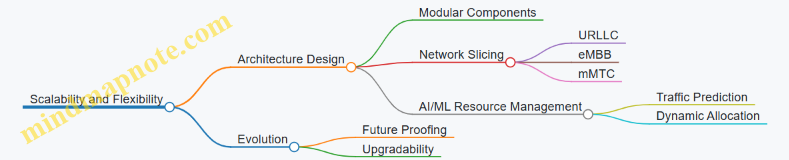
Best Practice 4: Optimize Integration Points Between Satellite and Terrestrial Networks
- Define clear handover mechanisms to maintain session continuity.
- Use cross-layer design to optimize latency and throughput.
- Implement unified control and management planes for seamless coordination.
Example: In maritime logistics, vessels switch between terrestrial coastal networks and satellite links without service interruption.
Integration Optimization Mind Map

Best Practice 5: Incorporate Security and Privacy by Design
- Tailor security protocols to use case sensitivity and threat models.
- Use spectrum-aware security measures to detect and mitigate jamming or interference.
- Ensure privacy compliance for sensitive applications like healthcare.
Example: Telemedicine applications require encrypted satellite links and strict access controls to protect patient data.
Security and Privacy Mind Map
Summary Example: Tailoring Architecture for Autonomous Vehicle Fleets
| Aspect | Approach |
|---|---|
| Use Case Requirements | Ultra-low latency, high reliability, seamless mobility |
| Spectrum Selection | mmWave for urban high throughput, LEO satellites for wide-area coverage |
| Scalability | Network slicing for URLLC, AI-driven dynamic resource allocation |
| Integration | Fast handover between terrestrial 5G base stations and satellite links |
| Security | End-to-end encryption, anti-jamming mechanisms, privacy-preserving protocols |
This comprehensive tailoring ensures the autonomous vehicle fleet operates safely and efficiently across diverse environments.
By following these best practices and leveraging mind maps for visualization, engineers and architects can design integrated 6G satellite-terrestrial communication systems that are precisely aligned with the unique demands of each use case.
9.5 Example: Integrated Network Support for Autonomous Vehicle Fleets
Autonomous vehicle (AV) fleets represent one of the most demanding and transformative use cases for 6G integrated satellite-terrestrial communication architectures. These fleets require ultra-reliable, low-latency connectivity with ubiquitous coverage to enable real-time data exchange, navigation, control, and safety-critical applications. Leveraging integrated networks ensures seamless connectivity even in remote or infrastructure-scarce areas, while optimizing spectrum use and network resources.
Mind Map: Key Components of Integrated Network Support for AV Fleets
Detailed Explanation and Examples
Connectivity Requirements: Autonomous vehicles generate massive amounts of sensor data (lidar, radar, cameras) that must be shared with other vehicles and infrastructure for safe operation. This demands ultra-low latency communication (<1 ms) to support real-time decision-making and high reliability to avoid communication failures.
Network Technologies:
- Terrestrial 6G Networks: Utilize mmWave and sub-THz bands to provide ultra-high bandwidth in urban and suburban environments. Massive MIMO and intelligent reflecting surfaces improve coverage and link quality.
- Satellite Networks: LEO satellite constellations extend coverage to rural, remote, and highway areas where terrestrial infrastructure is sparse or unavailable. GEO satellites provide backup and broadcast capabilities.
- Edge Computing: Distributed edge nodes process data close to vehicles, reducing latency and offloading the core network.
- AI-driven Network Management: AI algorithms dynamically allocate spectrum, predict network congestion, and optimize handovers between terrestrial and satellite links.
Communication Types:
- V2V: Direct communication between vehicles for collision avoidance and cooperative driving.
- V2I: Interaction with roadside units and traffic management systems.
- V2S: Satellite links provide connectivity in coverage holes or during handover.
- V2C: Cloud connectivity for software updates, analytics, and remote monitoring.
Use Case Scenarios:
- Urban Dense Traffic: Terrestrial 6G networks provide high-capacity links; AI manages spectrum and handovers to maintain QoS.
- Rural and Highway: LEO satellites ensure continuous connectivity where terrestrial networks are unavailable.
- Emergency Response: Satellite links enable communication when terrestrial infrastructure is damaged.
Challenges and Best Practices:
- Seamless Handover: Implement multi-link aggregation and AI-based predictive handover to switch smoothly between terrestrial and satellite networks without service interruption.
- Spectrum Sharing: Employ dynamic spectrum allocation to minimize interference and maximize utilization.
- Security: Use multi-layered encryption, authentication, and intrusion detection systems to protect vehicle communications.
Example Scenario: Multi-Link Aggregation for Autonomous Truck Fleet on Transcontinental Route
A fleet of autonomous trucks is traveling across a continent, passing through urban centers, rural highways, and remote areas. The integrated network architecture supports the fleet as follows:
- In urban areas, trucks connect primarily via terrestrial 6G mmWave networks, benefiting from ultra-high throughput for HD map updates and real-time traffic data.
- As trucks move into rural zones, the network dynamically aggregates LEO satellite links with terrestrial LTE/5G fallback to maintain continuous connectivity.
- AI-driven edge nodes predict upcoming coverage gaps and preemptively adjust spectrum allocation and handover parameters.
- Multi-link aggregation ensures that data streams (e.g., safety-critical control commands and bulk sensor uploads) are split intelligently across satellite and terrestrial links to optimize latency and reliability.
- Security protocols ensure encrypted communication channels, protecting against spoofing or jamming.
This approach enables the fleet to maintain safe, efficient operation with minimal human intervention, demonstrating the power of integrated 6G satellite-terrestrial networks.
Mind Map: Multi-Link Aggregation Workflow
Summary
Integrated satellite-terrestrial communication architectures are essential enablers for autonomous vehicle fleets, providing the necessary coverage, reliability, and low latency required for safe and efficient operation. By applying best practices such as AI-driven spectrum management, multi-link aggregation, and robust security frameworks, wireless engineers and system architects can design networks that meet the stringent demands of this emerging use case.
This example underscores the importance of holistic design approaches that consider spectrum technologies, network architectures, and real-world operational scenarios in tandem.
10. Future Trends and Research Directions
10.1 Emerging Spectrum Technologies Beyond 6G
As the telecommunications industry looks beyond 6G, emerging spectrum technologies promise to revolutionize wireless communications by unlocking unprecedented bandwidth, ultra-low latency, and massive connectivity. These technologies will push the boundaries of current spectrum utilization and enable new paradigms in integrated satellite-terrestrial networks.
Key Emerging Spectrum Technologies Beyond 6G
Terahertz (THz) Communications
THz communications are considered the next frontier beyond mmWave and sub-THz bands used in 6G. Operating between 0.1 and 10 THz, THz waves offer ultra-wide bandwidths capable of supporting data rates in the terabit-per-second range.
Best Practices:
- Use adaptive beamforming to overcome high path loss.
- Deploy ultra-dense networks with short-range THz links.
- Combine THz with lower frequency bands for robust coverage.
Example: A research testbed deploying THz links at 0.3 THz demonstrated 1 Tbps throughput over 10 meters in indoor environments, enabling holographic telepresence applications.
Visible Light Communications (VLC) / Optical Wireless
VLC leverages the visible light spectrum, typically emitted by LEDs, to transmit data. This technology complements RF spectrum by offering high-speed, secure, and interference-free communication.
Best Practices:
- Integrate VLC with existing lighting infrastructure for dual functionality.
- Use hybrid RF-VLC systems to ensure continuous connectivity.
- Employ modulation schemes resilient to ambient light noise.
Example: Smart factories use VLC for ultra-reliable low-latency communication (URLLC) in environments where RF interference is high, such as near heavy machinery.
Quantum Spectrum Technologies
Quantum communications introduce new ways to secure and manage spectrum resources. Quantum key distribution (QKD) can be implemented over satellite links to provide unbreakable encryption.
Best Practices:
- Combine QKD with classical spectrum management for secure control channels.
- Use quantum sensing to detect spectrum anomalies and interference.
Example: China’s Micius satellite demonstrated QKD over 1200 km, paving the way for secure satellite-terrestrial integrated networks.
Metamaterial-Enabled Spectrum Manipulation
Metamaterials and intelligent reflecting surfaces (IRS) can dynamically control electromagnetic waves, enabling efficient spectrum reuse and enhanced coverage.
Best Practices:
- Deploy IRS panels in urban hotspots to improve signal quality and reduce interference.
- Integrate IRS control with AI-driven spectrum management systems.
Example: A pilot deployment in a dense urban area used IRS to boost mmWave signal strength by 10 dB, improving user throughput by 30%.
Molecular and Acoustic Communications
Though niche, molecular and acoustic communication methods can operate in spectrum-constrained or challenging environments such as underwater or inside the human body.
Best Practices:
- Use molecular communication for nano-scale IoT devices.
- Employ acoustic communication for underwater sensor networks.
Example: Underwater sensor networks utilize acoustic waves to transmit data where RF signals are heavily attenuated.
Space-Air-Ground Integrated Spectrum
Future networks will require coordinated spectrum management across satellites, UAVs, and terrestrial infrastructure to optimize overall spectrum efficiency.
Best Practices:
- Implement cross-layer spectrum sharing protocols.
- Use AI to dynamically allocate spectrum based on network conditions.
Example: A multi-layer network trial integrated LEO satellites, high-altitude platforms, and terrestrial 6G cells to provide seamless coverage in remote areas.
Summary Mind Map
By embracing these emerging spectrum technologies, wireless research engineers and systems architects can design future-proof integrated satellite-terrestrial communication architectures that meet the demanding requirements of beyond-6G networks.
10.2 Quantum Communications and Satellite Integration
Quantum communications represent a transformative leap in secure and efficient data transmission, leveraging principles of quantum mechanics such as entanglement and superposition. Integrating quantum communication technologies with satellite systems is poised to revolutionize global telecommunications, especially within the 6G framework, by enabling ultra-secure, long-distance quantum key distribution (QKD) and novel networking paradigms.
Key Concepts in Quantum Communications
- Quantum Entanglement: A phenomenon where particles become linked, and the state of one instantly influences the other, regardless of distance.
- Quantum Key Distribution (QKD): A method to securely share encryption keys using quantum states, ensuring eavesdropping is detectable.
- Quantum Repeaters: Devices that extend the range of quantum communications by overcoming photon loss and decoherence.
Why Satellite Integration?
- Global Reach: Satellites can bridge vast distances where terrestrial fiber optics are impractical.
- Reduced Loss: Space-based links avoid many terrestrial obstacles and signal attenuation.
- Enabling Quantum Networks: Satellites act as trusted nodes or relays in a global quantum internet.
Mind Map: Quantum Communications and Satellite Integration
Integration Challenges and Solutions
| Challenge | Description | Best Practice / Solution | Example |
|---|---|---|---|
| Atmospheric Interference | Quantum signals degrade due to atmospheric turbulence | Use adaptive optics and optimized transmission windows | Micius satellite uses nighttime passes to minimize atmospheric noise |
| Synchronization & Timing | Precise timing needed for entanglement and QKD protocols | Employ ultra-stable atomic clocks and GPS synchronization | Quantum clock synchronization demonstrated between ground stations and satellites |
| Quantum State Preservation | Quantum states are fragile and prone to decoherence | Implement quantum error correction and entanglement purification | Quantum teleportation experiments maintaining fidelity over satellite links |
Example: Micius Satellite - Pioneering Quantum Satellite Communications
China’s Micius satellite, launched in 2016, is a landmark example of quantum communication in space. It successfully demonstrated:
- Satellite-to-ground QKD over distances exceeding 1200 km.
- Entanglement distribution between ground stations separated by 1200 km.
- Quantum teleportation of photon states from ground to satellite.
This mission validates the feasibility of satellite-based quantum networks and informs best practices such as timing synchronization, atmospheric mitigation, and hybrid classical-quantum communication protocols.
Mind Map: Best Practices for Quantum Satellite Integration
Future Outlook and Research Directions
- Quantum Repeaters in Space: Development of space-compatible quantum repeaters to enable truly global quantum networks.
- Integration with 6G Architectures: Embedding quantum communication layers within 6G network stacks for enhanced security.
- Quantum Satellite Constellations: Deploying multiple satellites to provide continuous, global quantum communication coverage.
Summary
Integrating quantum communications with satellite systems is a cornerstone for next-generation secure networks envisioned in 6G. By overcoming challenges such as atmospheric interference and quantum state preservation through best practices and innovative technologies, satellite-based quantum communication can enable unparalleled security and new applications. Real-world examples like the Micius satellite provide a blueprint for future deployments, while ongoing research continues to push the boundaries of what is possible in this exciting domain.
10.3 AI-Driven Autonomous Network Architectures
The evolution towards 6G networks is heavily influenced by the integration of Artificial Intelligence (AI) to enable autonomous network architectures. These architectures leverage AI and Machine Learning (ML) techniques to dynamically manage, optimize, and secure networks with minimal human intervention, ensuring ultra-reliable, low-latency, and high-throughput communications across both terrestrial and satellite segments.
Key Components of AI-Driven Autonomous Network Architectures
How AI Enables Autonomy in 6G Networks
-
Self-Configuration: AI algorithms analyze network conditions and automatically configure parameters such as frequency bands, power levels, and beamforming patterns. For example, a satellite-terrestrial integrated network can autonomously adjust satellite beam coverage based on real-time user density.
-
Self-Optimization: Continuous learning models optimize resource allocation, spectrum utilization, and routing paths to maximize throughput and minimize latency. Reinforcement learning agents can dynamically allocate sub-THz spectrum resources to terrestrial users while coordinating with satellite links.
-
Self-Healing: AI detects faults or performance degradations and triggers corrective actions without human intervention. For instance, if a satellite link experiences interference, the system can reroute traffic through terrestrial networks or alternative satellites.
-
Self-Protection: AI-driven security frameworks identify and mitigate threats such as jamming, spoofing, or intrusion attempts in real time.
Example: Autonomous Spectrum Management in a Hybrid Satellite-Terrestrial Network
Consider a 6G network combining LEO satellites and terrestrial base stations in a dense urban environment. An AI-driven controller uses reinforcement learning to dynamically allocate spectrum between the satellite and terrestrial links based on traffic demand, interference levels, and user mobility.
- Step 1: Collect real-time data on spectrum occupancy, user locations, and QoS metrics.
- Step 2: The AI agent predicts traffic surges and interference patterns.
- Step 3: It autonomously reallocates spectrum slices, increasing satellite bandwidth during peak hours for remote users and prioritizing terrestrial mmWave bands for urban hotspots.
- Step 4: The system continuously learns from outcomes, refining allocation strategies.
This approach reduces manual spectrum management overhead and improves overall network efficiency.
Mind Map: AI-Driven Autonomous Spectrum Management Workflow
Best Practices for Implementing AI-Driven Autonomous Architectures
-
Data Quality and Diversity: Ensure comprehensive data collection from both satellite and terrestrial components to train robust AI models.
-
Federated Learning: Utilize federated learning to enable distributed AI training across network nodes, preserving data privacy and reducing latency.
-
Explainability: Incorporate explainable AI techniques to provide transparency in decision-making, critical for trust and regulatory compliance.
-
Hybrid AI Models: Combine supervised, unsupervised, and reinforcement learning approaches to address diverse network challenges.
-
Continuous Learning: Design systems that adapt to evolving network conditions and emerging threats through ongoing model updates.
Example: Federated Learning for Privacy-Preserving Network Optimization
In a scenario where multiple terrestrial base stations and satellites collect sensitive user data, federated learning enables local AI model training at each node. Models are aggregated centrally without sharing raw data, preserving privacy while improving network optimization strategies such as load balancing and interference management.
This approach is especially valuable in integrated satellite-terrestrial networks where data sovereignty and latency constraints are critical.
Summary
AI-driven autonomous network architectures represent a cornerstone of 6G innovation, enabling seamless integration of satellite and terrestrial systems. By embedding intelligence at multiple layers and leveraging advanced AI techniques, these networks can self-manage complex spectrum environments, optimize performance, and enhance security with minimal human intervention.
The examples and mind maps provided illustrate practical implementations and workflows that wireless research engineers, systems architects, and telecom strategists can adopt to design next-generation autonomous networks.
10.4 Best Practices: Fostering Innovation through Collaborative Research
In the rapidly evolving landscape of 6G spectrum technologies and integrated satellite-terrestrial communication architectures, fostering innovation through collaborative research is paramount. Collaborative research accelerates breakthroughs by combining diverse expertise, sharing resources, and aligning goals across academia, industry, and government bodies.
Key Best Practices for Collaborative Research in 6G Innovation
-
Establish Multi-Stakeholder Partnerships
- Engage universities, telecom operators, satellite providers, equipment manufacturers, and regulatory agencies.
- Promote open innovation ecosystems that encourage knowledge exchange.
-
Define Clear, Shared Objectives
- Align research goals with real-world challenges such as spectrum efficiency, latency reduction, and seamless integration.
- Use joint roadmaps to track milestones and outcomes.
-
Leverage Shared Testbeds and Experimental Platforms
- Utilize cross-domain testbeds combining satellite and terrestrial technologies.
- Enable real-time experimentation and validation of novel concepts.
-
Encourage Open Data and Standardization Efforts
- Share datasets, simulation models, and measurement results to accelerate learning.
- Participate actively in standards bodies to ensure interoperability.
-
Promote Interdisciplinary Research Teams
- Combine expertise in RF engineering, AI/ML, network architecture, and regulatory policy.
- Foster creative problem-solving and holistic system design.
-
Implement Agile Project Management
- Use iterative development cycles to adapt quickly to new findings.
- Maintain continuous communication channels among partners.
Mind Map: Collaborative Research Framework for 6G Innovation
Example 1: The 6G Flagship Program (Finland)
The 6G Flagship initiative is a prime example of collaborative research fostering innovation. It brings together universities, industry leaders, and government agencies to explore 6G spectrum technologies and integrated networks. The program emphasizes open testbeds and shared data, enabling rapid prototyping of satellite-terrestrial integration concepts.
- Practice Highlight: Use of shared experimental platforms accelerated validation of THz spectrum usage and satellite handover algorithms.
- Outcome: Development of novel AI-driven spectrum management techniques now influencing global standards.
Mind Map: 6G Flagship Collaborative Elements
Example 2: NASA and Telecom Industry Joint Research
NASA collaborates with telecom companies to integrate satellite communications into next-generation terrestrial networks. This partnership focuses on optimizing link budgets and latency for LEO satellite constellations supporting 6G.
- Practice Highlight: Joint development of cross-layer protocols that adapt dynamically to satellite and terrestrial link conditions.
- Outcome: Enhanced QoS for remote and underserved areas, demonstrating the power of collaborative innovation.
Mind Map: NASA-Telecom Collaborative Research
Additional Tips for Wireless Research Engineers and Systems Architects
- Engage Early and Often: Initiate collaboration at the concept stage to influence design decisions.
- Document and Share Learnings: Maintain transparent records of experiments and results.
- Invest in Cross-Training: Encourage team members to gain knowledge beyond their core expertise.
- Leverage Funding Opportunities: Seek grants and joint funding to support collaborative projects.
By embedding these best practices into your research initiatives, you can significantly accelerate innovation in 6G spectrum technologies and integrated satellite-terrestrial communication architectures, ultimately driving the future of global connectivity.
10.5 Example: Experimental 6G Testbeds Combining Satellite and Terrestrial Links
As the 6G ecosystem evolves, experimental testbeds play a crucial role in validating integrated satellite-terrestrial communication architectures. These testbeds enable researchers and engineers to explore real-world challenges, optimize system performance, and innovate new protocols and technologies before large-scale deployment.
Overview of 6G Integrated Testbeds
6G testbeds combining satellite and terrestrial links typically include components such as:
- Satellite payload simulators or actual LEO/GEO satellites
- Terrestrial base stations (gNBs) with 6G-capable radios
- Edge computing nodes for low-latency processing
- AI/ML modules for dynamic spectrum and resource management
- User equipment emulators supporting multi-link connectivity
These elements are interconnected to mimic real-world hybrid network environments, allowing experimentation with handovers, spectrum sharing, and QoS management.
Mind Map: Key Components of 6G Satellite-Terrestrial Testbeds
Example 1: ESA and 6G Flagship Joint Testbed
The European Space Agency (ESA), in collaboration with the 6G Flagship program, has developed an experimental testbed integrating LEO satellite links with terrestrial 6G base stations. Key features include:
- Real-time handover between satellite and terrestrial links to maintain seamless connectivity.
- AI-driven spectrum sharing algorithms that dynamically allocate frequencies based on traffic demand and interference.
- Edge computing nodes deployed at terrestrial stations to process satellite data locally, reducing latency.
Outcome: The testbed demonstrated up to 10 Gbps throughput with sub-5 ms latency in hybrid scenarios, validating the feasibility of ultra-reliable low-latency communications (URLLC) over integrated networks.
Mind Map: ESA & 6G Flagship Testbed Architecture
Example 2: NASA’s 6G Integrated Network Experiment
NASA has initiated a testbed focusing on GEO satellite integration with terrestrial 6G networks for remote sensing and disaster management applications. Highlights include:
- Use of software-defined radios (SDRs) to emulate satellite and terrestrial links with flexible spectrum usage.
- Implementation of cross-layer protocols enabling efficient data routing between satellite and terrestrial paths.
- Security frameworks tested to protect satellite-terrestrial communication from jamming and spoofing.
Outcome: The experiment successfully demonstrated resilient communication during simulated disaster scenarios, ensuring continuous data flow despite terrestrial network outages.
Mind Map: NASA 6G Integrated Network Experiment
Best Practices Derived from Experimental Testbeds
- Multi-Link Redundancy: Ensure devices can simultaneously connect to satellite and terrestrial links to improve reliability.
- AI-Driven Spectrum Management: Use machine learning models trained on testbed data to predict spectrum usage and optimize allocation dynamically.
- Edge Processing: Deploy edge computing close to terrestrial base stations to minimize latency for satellite data processing.
- Seamless Handover Protocols: Develop and test protocols that allow smooth transitions between satellite and terrestrial networks without service interruption.
- Security Integration: Incorporate multi-layered security mechanisms early in testbed design to address unique satellite-terrestrial threats.
Summary
Experimental 6G testbeds combining satellite and terrestrial links are vital for advancing integrated communication architectures. By leveraging real-world scenarios, AI-driven management, and robust security frameworks, these testbeds provide invaluable insights that help wireless research engineers and system architects design next-generation networks capable of delivering ubiquitous, high-performance connectivity.
11. Conclusion and Strategic Recommendations
11.1 Summary of Key Insights on 6G Spectrum and Integration
The evolution to 6G represents a paradigm shift in wireless communications, driven by the need for unprecedented data rates, ultra-low latency, and ubiquitous connectivity. Central to this transformation is the innovative use of spectrum technologies and the seamless integration of satellite and terrestrial communication architectures. This section distills the critical insights gathered throughout the exploration of 6G spectrum and integrated networks.
Mind Map: Core Pillars of 6G Spectrum and Integration
Key Insights with Examples
-
Expanding Spectrum Horizons:
- The move into sub-THz and THz bands unlocks ultra-high bandwidths essential for 6G’s ambitious data rate targets.
- Example: A smart factory deploying THz links for real-time control of robotic arms achieves millisecond-level responsiveness, surpassing traditional mmWave capabilities.
-
Dynamic and AI-Driven Spectrum Management:
- AI algorithms enable real-time spectrum sharing and interference mitigation, optimizing resource utilization.
- Example: Urban 6G deployments use AI to dynamically allocate spectrum between terrestrial base stations and satellite links, minimizing congestion during peak hours.
-
Seamless Satellite-Terrestrial Integration:
- Hybrid architectures ensure continuous connectivity by enabling smooth handovers and interoperability between satellite and terrestrial networks.
- Example: Autonomous vehicle fleets maintain uninterrupted communication by switching between LEO satellite links in rural areas and terrestrial 6G networks in cities.
-
Advanced Terrestrial Network Innovations:
- Massive MIMO and intelligent reflecting surfaces enhance signal quality and coverage, crucial for dense urban environments.
- Example: A metropolitan area leverages intelligent reflecting surfaces on building facades to improve mmWave signal penetration indoors.
-
Robust Security and Privacy Frameworks:
- Multi-layered security approaches protect against jamming, spoofing, and data breaches across integrated networks.
- Example: Disaster recovery communication systems use encrypted satellite links combined with AI-based anomaly detection to safeguard sensitive data.
-
Regulatory and Collaborative Imperatives:
- Global coordination and stakeholder engagement are vital to harmonize spectrum use and accelerate 6G deployment.
- Example: Multi-nation 6G trials coordinate spectrum allocation to enable cross-border services without interference.
-
Enabling Diverse Use Cases:
- 6G integrated architectures support a broad spectrum of applications, from immersive AR/VR experiences to remote healthcare.
- Example: Telemedicine platforms utilize satellite-terrestrial networks to provide high-quality video consultations in remote regions.
Mind Map: Strategic Takeaways for Wireless Engineers and Architects
In summary, the journey to 6G demands a holistic approach that combines cutting-edge spectrum technologies with innovative integrated architectures. Wireless research engineers, systems architects, and telecom strategists must leverage AI, advanced hardware, and collaborative frameworks to realize the full potential of 6G, delivering transformative connectivity experiences worldwide.
11.2 Strategic Roadmap for Wireless Engineers and Architects
As the telecommunications landscape evolves toward 6G and integrated satellite-terrestrial communication architectures, wireless engineers and systems architects must adopt a strategic roadmap to navigate emerging challenges and opportunities. This roadmap emphasizes continuous learning, cross-domain collaboration, and proactive innovation to design resilient, scalable, and efficient networks.
Key Pillars of the Strategic Roadmap
Detailed Steps and Best Practices
Deepen Spectrum Expertise
- Action: Regularly update knowledge on emerging 6G spectrum bands, including Sub-THz and THz frequencies.
- Example: An engineer studies recent ITU-R reports on spectrum allocation and experiments with dynamic spectrum access algorithms in simulation environments.
Embrace Hybrid Network Design
- Action: Develop architectures that seamlessly integrate satellite and terrestrial components, focusing on latency, throughput, and reliability.
- Example: A systems architect designs a network prototype that enables seamless handover between LEO satellite links and 6G terrestrial base stations for rural broadband.
Leverage AI and Automation
- Action: Incorporate AI/ML techniques for real-time spectrum allocation, fault prediction, and network self-optimization.
- Example: Deploy an AI-based controller that dynamically reallocates spectrum resources in a dense urban environment to minimize interference.
Prioritize Security and Privacy
- Action: Implement multi-layered security measures tailored for integrated satellite-terrestrial networks.
- Example: Integrate quantum-resistant encryption protocols for satellite backhaul links to protect sensitive data.
Foster Continuous Learning and Collaboration
- Action: Engage with global standardization bodies (3GPP, ITU), attend workshops, and contribute to open research projects.
- Example: Join a multi-industry consortium developing standards for 6G satellite-terrestrial interoperability and participate in joint testbed trials.
Mind Map: Stepwise Implementation Plan
Example Scenario: Architecting a 6G-Enabled Smart City Network
- Challenge: Provide ubiquitous ultra-reliable low-latency communication (URLLC) across urban and suburban areas, including underground and remote locations.
- Approach:
- Utilize mmWave and Sub-THz bands for high-capacity terrestrial links.
- Deploy LEO satellites to cover hard-to-reach areas and provide redundancy.
- Implement AI-driven spectrum management to dynamically allocate resources based on demand.
- Design seamless handover protocols to maintain session continuity between satellite and terrestrial links.
- Outcome: Enhanced user experience with consistent connectivity, optimized spectrum utilization, and robust security.
Summary
By following this strategic roadmap, wireless engineers and architects can effectively contribute to the realization of 6G networks that leverage integrated satellite-terrestrial architectures. The combination of deep technical expertise, AI integration, robust security, and collaborative innovation will be key to driving next-generation telecommunications forward.
11.3 Industry Collaboration and Standardization Imperatives
The evolution of 6G spectrum technologies and integrated satellite-terrestrial communication architectures hinges critically on robust industry collaboration and comprehensive standardization efforts. These imperatives ensure interoperability, accelerate innovation, reduce fragmentation, and enable scalable deployment across global markets.
Importance of Industry Collaboration
- Unified Vision and Roadmap: Collaborative efforts among telecom operators, satellite providers, equipment manufacturers, and regulatory bodies help align technological goals, spectrum policies, and deployment strategies.
- Resource Sharing: Pooling R&D resources and spectrum assets reduces duplication and fosters cost-effective innovation.
- Interoperability: Joint development ensures that satellite and terrestrial components can seamlessly interoperate, vital for integrated architectures.
- Accelerated Standardization: Industry consortia can fast-track the creation of standards that reflect real-world requirements and use cases.
Key Stakeholders in 6G Collaboration
Standardization Imperatives
- Defining Unified Protocols: Establishing common communication protocols for satellite-terrestrial handovers, spectrum sharing, and network slicing.
- Spectrum Harmonization: Creating global frameworks to harmonize spectrum usage, minimizing interference and enabling cross-border services.
- Security Standards: Developing multi-layered security guidelines tailored for integrated networks.
- Performance Metrics: Agreeing on standardized KPIs to measure QoS, latency, and reliability across heterogeneous networks.
Best Practices for Effective Collaboration and Standardization
- Early Engagement: Involve all stakeholders early in the development cycle to capture diverse requirements.
- Open Innovation Platforms: Utilize open-source projects and shared testbeds to validate concepts collaboratively.
- Regular Workshops and Forums: Host periodic meetings to discuss challenges, share progress, and update standards.
- Cross-Industry Partnerships: Encourage partnerships beyond traditional telecom, including cloud providers, AI firms, and IoT ecosystem players.
Example: The 6G Satellite-Terrestrial Alliance (Hypothetical Case Study)
A consortium named the “6G Satellite-Terrestrial Alliance (6G-STA)” was formed, bringing together leading telecom operators, satellite companies, and equipment vendors. Their collaborative efforts included:
- Developing a unified protocol for seamless handover between LEO satellites and 6G terrestrial base stations.
- Coordinating spectrum sharing policies to avoid interference in the sub-THz bands.
- Creating an open testbed environment where AI-driven spectrum management algorithms were trialed.
- Publishing joint whitepapers that influenced ITU’s 6G spectrum allocation recommendations.
This alliance accelerated the deployment of integrated networks in several pilot cities, demonstrating improved coverage and reduced latency.
Mind Map: Steps to Foster Industry Collaboration and Standardization
Conclusion
Industry collaboration and standardization are the cornerstones for realizing the full potential of 6G spectrum technologies and integrated satellite-terrestrial communication architectures. By adopting best practices and fostering inclusive partnerships, stakeholders can ensure that 6G networks are interoperable, secure, and scalable, ultimately delivering transformative connectivity worldwide.
11.4 Best Practices: Continuous Learning and Adaptation
In the rapidly evolving landscape of 6G spectrum technologies and integrated satellite-terrestrial communication architectures, continuous learning and adaptation are critical for wireless research engineers, systems architects, and telecom strategists. This ensures that networks remain resilient, efficient, and capable of meeting emerging demands.
Key Principles of Continuous Learning and Adaptation
- Proactive Knowledge Acquisition: Staying abreast of the latest research, standards, and technological breakthroughs.
- Iterative Design and Testing: Employing agile methodologies to refine architectures based on real-world feedback.
- Cross-Disciplinary Collaboration: Leveraging insights from AI, quantum communications, and regulatory domains.
- Dynamic Network Reconfiguration: Utilizing AI/ML to adapt spectrum usage and network parameters in real-time.
- Feedback-Driven Improvement: Implementing monitoring systems that inform continuous optimization.
Mind Map: Continuous Learning and Adaptation in 6G Networks
Example 1: Adaptive Spectrum Management Using AI
A telecom operator deploying an integrated satellite-terrestrial 6G network implemented an AI-driven spectrum management system. By continuously learning from traffic patterns and interference events, the system dynamically reallocates spectrum resources between terrestrial base stations and LEO satellite links. This adaptation improved overall network throughput by 25% during peak hours and reduced dropped connections in rural areas.
Mind Map: AI-Driven Adaptive Spectrum Management
Example 2: Continuous Learning through Field Trials
A systems architect led iterative field trials for a hybrid satellite-terrestrial 6G prototype. Each trial cycle incorporated lessons learned from performance bottlenecks and user feedback, leading to progressive improvements in handover protocols and latency reduction. This continuous adaptation shortened the time-to-market by 30% compared to traditional waterfall development.
Mind Map: Iterative Field Trial Process
Practical Tips for Professionals
- Engage in Continuous Education: Subscribe to journals like IEEE Communications Magazine and attend 6G-focused workshops.
- Leverage Simulation and Emulation Tools: Use platforms such as ns-3 or OpenAirInterface to test new spectrum management algorithms before deployment.
- Foster a Culture of Experimentation: Encourage teams to pilot innovative ideas and learn from failures.
- Utilize Telemetry and Analytics: Implement comprehensive monitoring to gather actionable insights.
- Collaborate Across Domains: Work closely with AI specialists, satellite engineers, and regulatory experts to holistically address challenges.
By embedding continuous learning and adaptation into the core of 6G development strategies, professionals can ensure that integrated satellite-terrestrial networks remain future-proof, scalable, and capable of delivering transformative communication experiences.
11.5 Example: Successful Industry Partnerships Driving 6G Innovation
In the rapidly evolving landscape of 6G spectrum technologies and integrated satellite-terrestrial communication architectures, collaboration between industry leaders, academia, and regulatory bodies is paramount. Successful partnerships accelerate innovation, reduce time-to-market, and foster ecosystem-wide standards essential for seamless integration.
Key Elements of Successful Industry Partnerships in 6G Innovation
Example 1: The 6G Flagship Program (Finland)
The 6G Flagship is a collaboration between universities, research institutes, and industry players such as Nokia, Ericsson, and VTT Technical Research Centre of Finland. This partnership focuses on fundamental 6G research, including spectrum technologies and integrated satellite-terrestrial networks.
- Best Practice: Co-developing open testbeds to validate new spectrum sharing techniques and satellite integration protocols.
- Example Outcome: Demonstrated dynamic spectrum allocation using AI to optimize coexistence between terrestrial 6G cells and LEO satellite links in urban environments.
Example 2: The 5G-ALLSTAR Project (Europe)
While primarily focused on 5G, 5G-ALLSTAR has laid the groundwork for 6G by integrating satellite and terrestrial networks across multiple European countries. The project includes telecom operators, satellite providers, and equipment manufacturers.
- Best Practice: Harmonizing spectrum usage policies and developing cross-border satellite-terrestrial handover protocols.
- Example Outcome: Successful demonstration of seamless handover between GEO satellites and terrestrial 5G cells, a critical precursor for 6G integrated architectures.

Example 3: SpaceX and T-Mobile Partnership (USA)
A recent high-profile collaboration between SpaceX and T-Mobile aims to integrate satellite connectivity directly into terrestrial mobile networks, enabling ubiquitous coverage.
- Best Practice: Leveraging existing terrestrial infrastructure while deploying LEO satellite constellations to extend coverage.
- Example Outcome: Demonstrated direct-to-mobile satellite communication without user terminal modifications, a breakthrough for integrated 6G architectures.
Best Practices Derived from These Partnerships
- Open Innovation Platforms: Establishing shared testbeds and data repositories accelerates validation of 6G spectrum and integration technologies.
- Cross-Industry Collaboration: Engaging satellite operators, telecom vendors, and regulators ensures holistic solutions addressing technical and policy challenges.
- Agile Standardization: Early involvement in standards bodies helps align innovations with global interoperability requirements.
- Pilot Deployments: Real-world trials in diverse environments (urban, rural, cross-border) provide critical feedback loops.
Conclusion
Successful industry partnerships exemplify how multi-stakeholder collaboration drives 6G innovation forward. By combining expertise, sharing resources, and aligning strategic goals, these alliances pave the way for robust, scalable, and integrated satellite-terrestrial communication architectures that will define the next generation of wireless networks.