Orbit-to-Ground Direct Connectivity Networks
1. Introduction to Orbit-to-Ground Direct Connectivity
1.1 Overview of Orbit-to-Ground Communication Paradigms
Orbit-to-ground communication is a cornerstone of satellite communications, enabling data exchange between satellites in orbit and terrestrial ground stations. Understanding the various paradigms of this communication is essential for network engineers, telecom architects, and space network developers to design efficient, reliable, and low-latency networks.
Key Orbit-to-Ground Communication Paradigms
- Direct-to-Ground Links
- Relay Satellite Links
- Hybrid Approaches
Mind Map: Orbit-to-Ground Communication Paradigms
Direct-to-Ground Links
This paradigm involves direct communication between an orbiting satellite and a ground station without intermediate satellites. It is characterized by:
- Low latency: Since the signal travels a single hop, latency is minimized.
- Line-of-sight dependency: Requires the satellite to be visible to the ground station, which can limit contact time especially for LEO satellites.
- Simplified network architecture: Fewer nodes involved, reducing complexity.
Example:
- LEO Earth Observation Satellites: Satellites like Planet Labs’ Dove constellation transmit imagery directly to ground stations during overpasses, enabling near-real-time data delivery.
Relay Satellite Links
Relay satellites act as intermediaries, receiving signals from orbiting satellites and forwarding them to ground stations. This paradigm offers:
- Extended coverage: Enables communication beyond the line-of-sight limitations.
- Higher latency: Due to multi-hop transmission.
- Complexity: Requires coordination between multiple satellites.
Example:
- NASA’s TDRSS: A network of GEO relay satellites that support continuous communication with LEO spacecraft like the International Space Station (ISS).
Hybrid Approaches
Combining direct and relay links, hybrid paradigms seek to balance latency, coverage, and reliability.
- Dynamic routing: Satellites can switch between direct and relay links based on visibility and network conditions.
- Optimized performance: Leverages the strengths of both paradigms.
Example:
- SpaceX Starlink: Utilizes laser inter-satellite links (ISLs) to relay data between satellites and direct links to ground stations, optimizing latency and coverage.
Mind Map: Benefits and Challenges of Orbit-to-Ground Paradigms
Best Practice Highlight: Choosing the Right Paradigm
When designing orbit-to-ground networks, consider:
- Mission requirements: Real-time data needs favor direct links; continuous coverage may require relay satellites.
- Satellite orbit: LEO satellites often use direct links; GEO satellites rely on relay.
- Ground infrastructure: Availability and distribution of ground stations influence paradigm choice.
Example:
- A disaster monitoring satellite constellation prioritizes direct-to-ground links for rapid data delivery during overpasses, supplemented by relay satellites to maintain connectivity when out of direct range.
Understanding these paradigms lays the foundation for deeper exploration into technologies, architectures, and best practices that enable robust orbit-to-ground direct connectivity networks.
1.2 Importance of Direct Connectivity in Modern Satellite Networks
Direct connectivity between orbiting satellites and ground stations is rapidly becoming a cornerstone in the evolution of satellite communications. This paradigm shift enables faster, more reliable, and lower-latency data transmission, which is critical for a wide range of applications from broadband internet to real-time Earth observation.
Why Direct Connectivity Matters
- Latency Reduction: Direct links eliminate intermediate relay points, significantly reducing round-trip time.
- Bandwidth Efficiency: By connecting satellites directly to ground stations, networks can optimize bandwidth use without bottlenecks.
- Enhanced Reliability: Fewer hops mean fewer points of failure, improving overall network robustness.
- Scalability: Direct connectivity supports the growing number of Low Earth Orbit (LEO) satellites and constellations.
- Security: Direct links reduce exposure to interception and interference compared to multi-hop networks.
Mind Map: Key Benefits of Direct Connectivity
Example: Starlink’s Direct-to-Ground Approach
SpaceX’s Starlink constellation leverages direct connectivity by establishing multiple ground stations worldwide that communicate directly with LEO satellites. This approach enables Starlink to provide low-latency broadband internet, even in remote areas. By minimizing relay hops, Starlink achieves latencies as low as 20-40 milliseconds, comparable to terrestrial fiber networks.
Mind Map: Starlink Direct Connectivity Model
Real-World Impact
- Disaster Response: Direct connectivity enables rapid deployment of communication links in disaster zones where terrestrial infrastructure is damaged.
- Financial Services: Traders benefit from ultra-low latency connections for high-frequency trading.
- IoT and Remote Sensing: Real-time data from sensors and satellites support agriculture, environmental monitoring, and smart cities.
Mind Map: Application Areas Enhanced by Direct Connectivity
Best Practice Embedded Example
When designing direct orbit-to-ground links, network engineers should prioritize ground station placement to minimize atmospheric interference and maximize line-of-sight availability. For instance, SES Networks strategically locates ground stations in geographically diverse and climatically favorable locations to ensure consistent direct connectivity with their satellites, reducing downtime and improving service quality.
In summary, direct connectivity in modern satellite networks is essential for meeting the increasing demand for high-speed, low-latency, and reliable communications. By understanding its importance and leveraging best practices, network engineers and architects can design robust satellite systems that serve a broad spectrum of critical applications.
1.3 Key Challenges in Orbit-to-Ground Links
Orbit-to-ground direct connectivity networks face a unique set of challenges that impact link reliability, latency, throughput, and overall network performance. Understanding these challenges is critical for network engineers, telecom architects, and space network developers to design robust and efficient systems.
Major Challenges Overview
Atmospheric Effects
The Earth’s atmosphere introduces significant impairments to orbit-to-ground links, especially for laser and higher frequency RF communications.
- Absorption: Gases like water vapor and oxygen absorb signal energy, reducing received power.
- Scattering: Particles and aerosols scatter signals, causing attenuation and signal distortion.
- Turbulence: Variations in air density cause beam wander and scintillation, particularly impacting laser links.
Example:
In Ka-band RF links, rain fade can cause up to 20 dB attenuation during heavy precipitation, necessitating adaptive power control or site diversity.
Mind Map:
Doppler Shift
Satellites in low Earth orbit (LEO) move at high velocities (~7.8 km/s), causing significant Doppler frequency shifts that must be compensated to maintain link integrity.
- Frequency shifts can be several kHz to MHz depending on the carrier frequency.
- Compensation requires dynamic frequency tracking and agile transceiver designs.
Example:
Starlink satellites implement real-time Doppler compensation algorithms in their user terminals to maintain stable connections during rapid satellite passes.
Mind Map:
Link Budget Constraints
Achieving a reliable orbit-to-ground link requires careful balancing of transmit power, antenna gain, path loss, and noise figures.
- Power constraints onboard satellites limit transmit power.
- Ground station antenna size and gain are limited by cost and physical constraints.
- Free-space path loss increases with distance and frequency.
Example:
A typical LEO-to-ground link at 20 GHz with a 1-meter ground antenna and 10 W satellite transmitter may achieve a link margin of 5 dB under clear sky conditions.
Mind Map:
Pointing, Acquisition, and Tracking (PAT)
Maintaining precise alignment between satellite and ground station antennas or optical terminals is critical.
- Mechanical vibrations and satellite attitude changes cause misalignment.
- Laser links require sub-microradian pointing accuracy.
Example:
ESA’s Laser Communication Terminal uses fine steering mirrors and beacon tracking to maintain laser beam alignment despite satellite jitter.
Mind Map:
Latency and Timing
Although orbit-to-ground links reduce latency compared to GEO satellites, propagation delay and timing synchronization remain challenges.
- Precise timing is required for protocol synchronization and data integrity.
- Variable delays due to atmospheric conditions can affect jitter-sensitive applications.
Example:
LEO constellations like OneWeb achieve ~30-50 ms round-trip latency, but require GPS-disciplined oscillators to maintain timing accuracy.
Mind Map:
Regulatory and Spectrum Issues
Spectrum allocation for orbit-to-ground links is tightly regulated and competitive.
- Coordination with terrestrial services to avoid interference.
- Licensing delays and restrictions can limit deployment.
Example:
FCC’s Ka-band licensing for satellite operators requires strict adherence to power limits and coordination with terrestrial microwave links.
Mind Map:
Security Concerns
Orbit-to-ground links are vulnerable to jamming, spoofing, and interception.
- Physical layer security and encryption are essential.
- Detection and mitigation of interference attacks are critical.
Example:
Military satellite systems implement frequency hopping and AES encryption to protect sensitive orbit-to-ground communications.
Mind Map:
Environmental and Operational Challenges
Ground stations face weather variability, maintenance needs, and site accessibility issues.
- Cloud cover and fog degrade laser link performance.
- Remote locations improve link quality but increase operational complexity.
Example:
AWS Ground Station network uses geographically distributed sites to mitigate weather-related outages.
Mind Map:
Summary
Addressing these challenges requires a multidisciplinary approach combining advanced hardware design, adaptive algorithms, regulatory compliance, and operational best practices. Real-world examples from industry leaders like SpaceX, ESA, and AWS illustrate how these challenges can be successfully managed to achieve reliable orbit-to-ground direct connectivity.
1.4 Best Practice: Establishing Clear Link Budget Parameters with Real-World Examples
Establishing a clear and accurate link budget is foundational to designing reliable orbit-to-ground direct connectivity networks. A link budget quantifies the total gains and losses from the transmitter, through the medium (space and atmosphere), to the receiver, ensuring that the received signal quality meets system requirements.
What is a Link Budget?
A link budget is an accounting of all the gains and losses in a communication system to determine the received signal power. It helps engineers predict the performance and feasibility of a communication link.
Key Components of a Link Budget
Step-by-Step Process to Establish Link Budget Parameters
-
Define System Requirements:
- Data rate
- Bit error rate (BER)
- Latency
-
Calculate Free Space Path Loss (FSPL):
- FSPL (dB) = 20 * log10(distance) + 20 * log10(frequency) + 92.45
-
Account for Atmospheric and Weather Losses:
- Include rain attenuation, cloud absorption, and scintillation effects.
-
Determine Transmitter Parameters:
- Output power
- Antenna gain
-
Determine Receiver Parameters:
- Antenna gain
- System noise temperature
- Receiver sensitivity
-
Calculate Link Margin:
- Margin = Received power - Receiver sensitivity
- Ensure margin is positive to maintain link reliability.
Real-World Example 1: Ka-Band LEO Satellite to Ground Station Link Budget
-
Scenario: A LEO satellite operating at 30 GHz (Ka-band) communicating with a ground station 1000 km away.
-
Parameters:
- Transmitter power: 20 W (43 dBm)
- Transmitter antenna gain: 40 dBi
- Receiver antenna gain: 50 dBi
- System noise temperature: 500 K
- Data rate: 1 Gbps
-
Calculations:
- FSPL = 20 * log10(1000) + 20 * log10(30,000) + 92.45 ≈ 165 dB
- Atmospheric losses (rain, clouds): ~3 dB
- Received power = 43 + 40 + 50 - 165 - 3 = -35 dBm
- Receiver sensitivity for 1 Gbps with given noise figure ≈ -40 dBm
- Link margin = -35 - (-40) = 5 dB (adequate margin)
Real-World Example 2: Optical Laser Link from GEO Satellite to Ground Station
-
Scenario: GEO satellite using laser communication at 1550 nm wavelength, 36,000 km distance.
-
Parameters:
- Transmitter power: 1 W (30 dBm)
- Transmitter telescope gain: 70 dBi
- Receiver telescope gain: 80 dBi
- Atmospheric attenuation: 5 dB (clear sky)
-
Calculations:
- FSPL (optical) approximated by geometric spreading and pointing losses.
- Received power = 30 + 70 + 80 - 200 (approximate FSPL) - 5 = -25 dBm
- Receiver sensitivity (photon counting detectors) ≈ -30 dBm
- Link margin = 5 dB (sufficient for reliable communication)
Best Practice Tips
-
Incorporate Margins: Always include fade, implementation, and system margins to accommodate uncertainties.
-
Use Realistic Atmospheric Models: Employ models like ITU-R P.618 for atmospheric attenuation.
-
Validate with Simulations: Use software tools (e.g., STK, MATLAB) to simulate link budgets under varying conditions.
-
Iterate and Optimize: Adjust antenna sizes, power levels, and modulation schemes to maximize link margin.
-
Document Assumptions Clearly: Maintain transparency for future troubleshooting and upgrades.
Mind Map: Link Budget Calculation Workflow
By following these structured steps and incorporating real-world parameters, network engineers and space network developers can design robust orbit-to-ground direct connectivity links that meet performance and reliability targets.
2. Fundamentals of Satellite Communication for Direct Links
2.1 Satellite Orbits and Their Impact on Ground Connectivity
Understanding satellite orbits is fundamental for designing effective orbit-to-ground direct connectivity networks. The orbit type directly influences coverage area, latency, link stability, and ground station requirements. This section explores the main satellite orbit categories, their characteristics, and how they impact ground connectivity, illustrated with practical examples and mind maps.
Types of Satellite Orbits
-
Low Earth Orbit (LEO)
- Altitude: ~160 to 2,000 km
- Orbital period: ~90 to 120 minutes
- Characteristics: Fast-moving relative to Earth, low latency, limited coverage per satellite
-
Medium Earth Orbit (MEO)
- Altitude: ~2,000 to 35,786 km
- Orbital period: Several hours
- Characteristics: Moderate coverage and latency, often used for navigation satellites
-
Geostationary Orbit (GEO)
- Altitude: ~35,786 km
- Orbital period: 24 hours (synchronous with Earth’s rotation)
- Characteristics: Fixed position relative to Earth, wide coverage, higher latency
-
Highly Elliptical Orbit (HEO)
- Altitude: Varies, with a highly elliptical path
- Characteristics: Long dwell time over specific regions, useful for polar coverage
Mind Map: Satellite Orbits Overview
Impact of Orbits on Ground Connectivity
| Orbit Type | Coverage Area | Latency | Link Duration | Ground Station Requirements | Example Use Case |
|---|---|---|---|---|---|
| LEO | Small footprint, fast movement | Very low (~20-40 ms) | Short visibility windows (~10 min) | Requires many ground stations or tracking antennas | Starlink providing broadband to remote areas |
| MEO | Larger footprint than LEO | Moderate (~100-150 ms) | Longer visibility (~several hours) | Moderate ground station complexity | GPS navigation signals |
| GEO | Very large footprint (~1/3 Earth) | High (~600 ms) | Continuous visibility | Fixed ground antennas sufficient | Satellite TV broadcasting |
| HEO | Variable, focused on high latitudes | Variable | Long dwell time over poles | Specialized ground stations at high latitudes | Communications in Arctic regions |
Example 1: Starlink’s Use of LEO for Low Latency Connectivity
Starlink operates a constellation of thousands of LEO satellites at approximately 550 km altitude. This low orbit reduces signal travel time, achieving latencies as low as 20-30 ms, comparable to terrestrial broadband. However, due to the fast movement of satellites, ground stations and user terminals must track satellites dynamically or switch between satellites frequently.
Best Practice: Deploy a network of distributed ground stations with automated tracking to maintain continuous connectivity.
Example 2: GEO Satellites for Broadcast Services
Geostationary satellites like Intelsat remain fixed relative to a point on Earth, enabling continuous coverage over large areas with a single ground antenna. This simplifies ground station design but introduces higher latency (~600 ms), which can be a challenge for interactive applications.
Best Practice: Use GEO satellites primarily for broadcast or one-way data services where latency is less critical.
Mind Map: Orbit Impact on Connectivity Design
Summary
Selecting the appropriate satellite orbit is a critical decision that affects the entire orbit-to-ground connectivity network design. LEO satellites offer low latency and are ideal for broadband and real-time applications but require complex ground infrastructure. GEO satellites provide stable, wide-area coverage with simpler ground stations but suffer from higher latency. Understanding these trade-offs allows network engineers and telecom architects to optimize connectivity solutions tailored to their specific application needs.
2.2 Frequency Bands and Spectrum Allocation for Direct Links
Overview
Frequency bands and spectrum allocation are critical factors in designing orbit-to-ground direct connectivity networks. The choice of frequency band directly impacts link performance, atmospheric attenuation, antenna size, regulatory compliance, and overall system cost.
Common Frequency Bands Used in Orbit-to-Ground Links
-
L-band (1–2 GHz)
- Pros: Good penetration through weather, low atmospheric attenuation
- Cons: Limited bandwidth, congested spectrum
- Example: GNSS signals and some mobile satellite services
-
S-band (2–4 GHz)
- Pros: Moderate bandwidth, reasonable atmospheric penetration
- Cons: Increasing congestion, moderate antenna size
- Example: Some telemetry, tracking, and command (TT&C) links
-
X-band (8–12 GHz)
- Pros: Balanced bandwidth and antenna size, widely used in military and scientific satellites
- Cons: Moderate atmospheric attenuation, rain fade
- Example: NASA’s Deep Space Network uses X-band for many missions
-
Ku-band (12–18 GHz)
- Pros: Higher bandwidth, smaller antennas
- Cons: More susceptible to rain fade and atmospheric attenuation
- Example: Commercial satellite TV and broadband services
-
Ka-band (26.5–40 GHz)
- Pros: Very high bandwidth, supports high data rates
- Cons: High atmospheric attenuation, requires advanced mitigation
- Example: High-throughput satellites (HTS) like ViaSat and HughesNet
-
Optical/ Laser (THz range)
- Pros: Extremely high bandwidth, low interference
- Cons: Highly sensitive to weather and atmospheric conditions
- Example: NASA’s Laser Communications Relay Demonstration (LCRD)
Mind Map: Frequency Bands Characteristics
Spectrum Allocation Considerations
-
International Telecommunication Union (ITU) Regulations:
- Frequency bands are allocated globally to avoid interference.
- Satellite operators must coordinate to secure spectrum licenses.
-
National Regulatory Bodies:
- FCC (USA), Ofcom (UK), and others impose additional rules.
- Compliance with local regulations is mandatory.
-
Interference Management:
- Coordination with terrestrial services to avoid cross-interference.
- Use of guard bands and dynamic spectrum access techniques.
-
Example:
- The FCC’s Ka-band spectrum auction enabled multiple satellite operators to deploy high-throughput services with minimal interference.
Best Practice: Selecting Frequency Bands to Minimize Atmospheric Loss
Example Scenario: A satellite operator wants to establish a direct link from a LEO satellite to a ground station in a tropical region with frequent heavy rain.
- Step 1: Evaluate atmospheric conditions — heavy rain causes significant attenuation at Ku and Ka bands.
- Step 2: Consider lower frequency bands like X-band or S-band for better reliability.
- Step 3: Use adaptive coding and modulation to maintain link quality during adverse weather.
- Step 4: Deploy site diversity with multiple ground stations to mitigate local weather effects.
Outcome: By choosing X-band and implementing adaptive techniques, the operator achieves a reliable direct link with acceptable data rates despite challenging weather.
Mind Map: Spectrum Allocation Workflow
Real-World Example: SpaceX Starlink Frequency Usage
- Starlink primarily uses Ku-band and Ka-band frequencies for orbit-to-ground links.
- The choice balances high data throughput with manageable atmospheric attenuation.
- To counter rain fade, Starlink employs adaptive modulation and multiple ground stations.
- Regulatory coordination has been critical to secure spectrum licenses globally.
Summary
Choosing the right frequency band and managing spectrum allocation are foundational to successful orbit-to-ground direct connectivity. Understanding the trade-offs between bandwidth, attenuation, antenna size, and regulatory constraints enables network engineers and architects to design robust, high-performance satellite communication links.
2.3 Modulation and Coding Techniques Optimized for Orbit-to-Ground
Orbit-to-ground communication links face unique challenges such as high Doppler shifts, atmospheric disturbances, and varying signal-to-noise ratios (SNR). Optimizing modulation and coding schemes is critical to ensure robust, efficient, and low-latency data transmission.
Key Considerations for Orbit-to-Ground Modulation and Coding
- Doppler Shift Compensation: Rapid relative motion between satellite and ground station causes frequency shifts.
- Channel Variability: Atmospheric effects (rain, clouds, turbulence) cause fading and attenuation.
- Power and Bandwidth Constraints: Limited onboard power and spectrum availability.
- Latency Sensitivity: Real-time applications require low-delay coding and modulation.
Commonly Used Modulation Techniques
- BPSK (Binary Phase Shift Keying): Highly robust, simple, but low spectral efficiency.
- QPSK (Quadrature Phase Shift Keying): Balances robustness and bandwidth efficiency; widely used in satellite links.
- 8PSK and Higher-Order PSK: Increased data rates but more sensitive to noise.
- QAM (Quadrature Amplitude Modulation): Higher spectral efficiency, used when SNR is good.
- CPM (Continuous Phase Modulation): Power efficient and constant envelope, suitable for nonlinear satellite amplifiers.
Example: The European Data Relay System (EDRS) uses QPSK modulation for its laser communication terminals, balancing robustness and throughput.
Forward Error Correction (FEC) Coding Techniques
- Reed-Solomon Codes: Excellent for correcting burst errors, widely used in satellite comms.
- Convolutional Codes: Often combined with Viterbi decoding; good for random errors.
- Turbo Codes: Near Shannon limit performance; used in deep space and modern satellite systems.
- LDPC (Low-Density Parity-Check) Codes: Adopted in DVB-S2 standard; excellent error correction with lower complexity than Turbo.
- Polar Codes: Emerging in 5G and future satellite networks for efficient error correction.
Example: SpaceX Starlink employs LDPC codes combined with QPSK and 16QAM to achieve high throughput with low latency.
Integrated Modulation and Coding Schemes (MODCODs)
Adaptive MODCODs dynamically adjust based on link conditions to optimize throughput and reliability.
Best Practice Example:
- DVB-S2X Standard: Supports a wide range of MODCODs and adaptive coding to optimize satellite downlinks.
- NASA’s TDRS System: Uses adaptive coding and modulation to maintain link quality during varying atmospheric conditions.
Practical Example: Implementing QPSK with LDPC in a LEO Orbit-to-Ground Link
- Scenario: A LEO satellite transmitting Earth observation data to a ground station.
- Modulation: QPSK chosen for robustness against Doppler and atmospheric effects.
- Coding: LDPC codes per DVB-S2 standard to correct errors efficiently.
- Outcome: Achieved a bit error rate (BER) below 10^-7 with a spectral efficiency of ~2 bits/s/Hz.
Summary
Optimizing modulation and coding for orbit-to-ground links involves balancing robustness, spectral efficiency, and latency. Adaptive schemes leveraging QPSK, LDPC, and advanced error correction provide reliable connectivity even under challenging conditions.
For network engineers and space network developers, understanding these techniques and their practical applications is key to designing resilient, high-performance satellite communication systems.
2.4 Best Practice: Selecting Frequency Bands to Minimize Atmospheric Loss – Case Study of Ka-band vs. X-band
Selecting the appropriate frequency band for orbit-to-ground direct connectivity is critical to optimizing link performance, especially in the presence of atmospheric effects such as rain attenuation, cloud absorption, and scintillation. This section explores best practices for frequency band selection, focusing on minimizing atmospheric loss, with a detailed case study comparing Ka-band and X-band.
Understanding Atmospheric Loss in Satellite Communications
Atmospheric loss refers to signal attenuation caused by the Earth’s atmosphere, which varies with frequency, weather conditions, and elevation angle. Key contributors include:
- Rain Fade: Heavy precipitation causes significant attenuation, especially at higher frequencies.
- Cloud and Fog Absorption: Water droplets absorb and scatter signals, impacting optical and higher RF bands.
- Gaseous Absorption: Oxygen and water vapor molecules absorb energy, affecting specific frequency ranges.
Frequency Bands Overview
| Band | Frequency Range | Typical Use Cases | Atmospheric Sensitivity |
|---|---|---|---|
| X-band | 7–8 GHz | Military, radar, some commercial | Moderate, less rain attenuation |
| Ka-band | 26.5–40 GHz | High throughput satellite comms | High, significant rain attenuation |
Mind Map: Factors Influencing Frequency Band Selection
Best Practice Recommendations
-
Assess Environmental Conditions: Analyze historical weather data for ground station locations to estimate rain rates and cloud coverage.
-
Perform Link Budget Analysis: Incorporate atmospheric loss models (e.g., ITU-R P.618) to predict attenuation at different frequencies.
-
Balance Throughput and Reliability: Higher frequencies like Ka-band enable greater bandwidth but suffer more from atmospheric loss; X-band offers more robust links with lower bandwidth.
-
Use Adaptive Techniques: Implement adaptive coding and modulation or power control to compensate for variable atmospheric conditions.
-
Consider Hybrid Frequency Usage: Employ dual-band systems to switch between Ka and X-band depending on weather conditions.
Case Study: Ka-band vs. X-band in Orbit-to-Ground Links
Scenario:
A satellite operator needs to establish a direct-to-ground link from a LEO satellite to a ground station in a tropical region with frequent heavy rainfall.
| Parameter | Ka-band | X-band |
|---|---|---|
| Frequency Range | 27 GHz (example) | 7.5 GHz (example) |
| Bandwidth Availability | High (up to several GHz) | Moderate (hundreds of MHz) |
| Rain Attenuation | Up to 20 dB/km during heavy rain | Typically <5 dB/km |
| Antenna Size | Smaller due to higher frequency | Larger for same gain |
| Power Requirements | Higher to overcome attenuation | Lower |
| Link Availability | Lower during storms (~90%) | Higher (~99%) |
Example:
- During a heavy rain event, the Ka-band link experiences a 15 dB fade, causing temporary loss of connectivity.
- The X-band link remains stable with only 3 dB attenuation, maintaining continuous service.
Mind Map: Ka-band vs. X-band Trade-offs
Practical Example: Hybrid System Implementation
A network engineer designs a dual-frequency ground station that primarily uses Ka-band for high-speed data transfer but switches to X-band during adverse weather. This approach:
- Maximizes throughput during clear conditions.
- Maintains link availability during rain events.
- Reduces overall service interruptions.
Summary
Selecting the right frequency band is a balancing act between maximizing throughput and ensuring link reliability. Understanding atmospheric loss characteristics and regional weather patterns is essential. Employing adaptive and hybrid frequency strategies can significantly enhance orbit-to-ground direct connectivity network performance.
References & Tools
- ITU-R P.618-13: Propagation Data and Prediction Methods Required for the Design of Earth-Space Telecommunication Systems
- NASA’s Atmospheric Attenuation Models
- Example rain rate databases (e.g., NOAA, local meteorological agencies)
3. Laser Communication Technologies in Orbit-to-Ground Networks
3.1 Principles of Free-Space Optical Communication
Free-Space Optical Communication (FSO) is a technology that uses light propagating in free space to wirelessly transmit data for telecommunications or computer networking. Unlike traditional radio frequency (RF) communication, FSO leverages laser beams or LEDs to establish high-bandwidth, secure, and low-latency communication links through the atmosphere or space.
Key Concepts of FSO:
- Line-of-Sight (LOS) Transmission: FSO requires a clear, unobstructed path between the transmitter and receiver.
- Light Source: Typically lasers or LEDs are used as the optical carrier.
- Modulation: Data is encoded onto the light beam using various modulation techniques.
- Receiver: Photodetectors convert the received light back into electrical signals.
- Atmospheric Effects: Weather and atmospheric conditions can impact signal quality.
Mind Map: Core Components of FSO Communication
How FSO Works: Step-by-Step
-
Data Encoding: The transmitter encodes digital data onto an optical carrier using modulation schemes such as On-Off Keying (OOK) or Pulse Position Modulation (PPM).
-
Transmission: The modulated light beam is emitted through a laser diode or LED and directed toward the receiver via a highly collimated beam.
-
Propagation: The light travels through free space, potentially encountering atmospheric disturbances.
-
Reception: The receiver’s photodetector captures the incoming light and converts it into an electrical signal.
-
Decoding: The electrical signal is demodulated to retrieve the original data.
Mind Map: Atmospheric Effects on FSO
Example 1: Basic FSO Link Between Two Buildings
Imagine two office buildings 500 meters apart in a city. An FSO system is installed on the rooftops, using laser diodes to establish a direct optical link. The system achieves multi-Gbps throughput with very low latency, ideal for high-speed data backup or video conferencing.
Best Practice: Ensure precise alignment and use adaptive optics or beam tracking to maintain link stability despite building sway or atmospheric turbulence.
Example 2: Satellite-to-Ground Laser Communication
NASA’s Laser Communications Relay Demonstration (LCRD) uses FSO to transmit data from satellites in orbit directly to ground stations. This approach achieves data rates far exceeding traditional RF links, enabling faster transmission of scientific data.
Best Practice: Employ adaptive optics and error correction coding to mitigate atmospheric turbulence and signal degradation.
Advantages of FSO:
- High bandwidth capacity (multi-Gbps and beyond)
- Low latency due to direct line-of-sight
- Immunity to electromagnetic interference
- Enhanced security due to narrow beam divergence
Limitations:
- Requires clear line-of-sight
- Susceptible to weather and atmospheric conditions
- Limited range compared to RF in some cases
Summary
Free-Space Optical Communication leverages light to provide high-speed, secure, and low-latency communication links in orbit-to-ground and terrestrial scenarios. Understanding its principles, atmospheric challenges, and practical deployment considerations is critical for network engineers and space network developers aiming to implement next-generation satellite communication systems.
3.2 Advantages of Laser Links over RF for Direct Connectivity
Laser communication (also known as free-space optical communication) is rapidly gaining traction in orbit-to-ground direct connectivity networks due to several compelling advantages over traditional radio frequency (RF) links. This section explores these advantages in detail, supported by mind maps and practical examples to help network engineers, telecom architects, and space network developers understand why laser links are becoming a preferred choice.
Key Advantages of Laser Links over RF
High Bandwidth and Data Rates
Laser links operate at optical frequencies, which are orders of magnitude higher than RF frequencies. This allows for significantly larger bandwidths, enabling data rates that can exceed 100 Gbps in some experimental and operational systems.
Example: NASA’s Laser Communications Relay Demonstration (LCRD) has demonstrated data transmission rates of up to 1.2 Gbps between orbiting satellites and ground stations, far surpassing typical RF capabilities.
Spectrum Availability and Regulatory Freedom
Unlike RF, which requires careful spectrum allocation and licensing due to congestion and interference, laser communications use the optical spectrum, which is largely unregulated. This freedom simplifies deployment and reduces operational costs.
Example: The European Space Agency’s (ESA) European Data Relay System (EDRS) leverages laser links to bypass congested RF bands, enabling high-speed data relay without spectrum licensing hurdles.
Enhanced Security and Reduced Interception Risk
Laser beams are highly directional with very narrow divergence angles. This makes interception or jamming extremely difficult compared to omnidirectional or wide-beam RF transmissions.
Example: Military satellite communications increasingly adopt laser links for secure data transfer, as demonstrated by the U.S. Air Force’s Laser Communications Relay, which provides encrypted, low-probability-of-intercept links.
Size, Weight, and Power (SWaP) Benefits
Laser communication terminals are typically more compact and lighter than large RF antennas, which is critical for satellite payload constraints and ground station infrastructure.
Example: The compact optical terminals used on the OneWeb LEO satellites enable efficient payload integration without compromising satellite mass budgets.
Immunity to RF Interference
Laser links are immune to electromagnetic interference (EMI) and do not contribute to RF noise pollution, making them ideal for crowded electromagnetic environments.
Example: In urban ground stations where RF noise is high, laser links maintain signal integrity, as seen in trials conducted by the Japan Aerospace Exploration Agency (JAXA).
Latency Advantages
Due to the high data rates and direct line-of-sight nature of laser links, latency can be reduced, which is critical for real-time applications such as remote sensing, telemedicine, and financial trading.
Example: Starlink’s future plans include integrating laser inter-satellite links and direct-to-ground laser terminals to minimize latency for end-users.
Atmospheric Challenges and Mitigation
While laser links are affected by atmospheric conditions such as clouds, fog, and turbulence, advances in adaptive optics, site diversity, and hybrid RF/laser systems mitigate these issues effectively.
Example: ESA’s Laser Communication Terminal employs adaptive optics to compensate for atmospheric distortion, maintaining link quality during adverse weather.
Summary Mind Map
Conclusion
Laser communication links offer transformative advantages over RF for orbit-to-ground direct connectivity, particularly in bandwidth, security, and SWaP efficiency. While atmospheric challenges remain, ongoing technological advancements continue to improve reliability and performance, making laser links a cornerstone technology for next-generation satellite networks.
3.3 Atmospheric Effects on Laser Links and Mitigation Strategies
Laser communication links between orbit and ground stations offer tremendous bandwidth and low latency advantages over traditional RF links. However, the Earth’s atmosphere introduces several challenges that can degrade the performance and reliability of these optical links. Understanding these atmospheric effects and implementing effective mitigation strategies is critical for network engineers, telecom architects, and space network developers.
Key Atmospheric Effects Impacting Laser Links
- Atmospheric Absorption: Certain gases in the atmosphere absorb specific wavelengths of laser light, reducing signal strength.
- Scattering: Particles like dust, aerosols, and water droplets scatter the laser beam, causing attenuation and signal distortion.
- Turbulence: Variations in temperature and pressure cause refractive index fluctuations, leading to beam wander, scintillation (intensity fluctuations), and phase distortions.
- Cloud Cover and Weather Conditions: Clouds, fog, rain, and snow can severely attenuate or block laser signals.
- Background Noise: Solar radiation and ambient light can introduce noise, affecting signal-to-noise ratio.
Mind Map: Atmospheric Effects on Laser Links
Detailed Explanation and Examples
-
Atmospheric Absorption
- Laser wavelengths in the near-infrared (e.g., 1550 nm) are often chosen because they experience lower absorption by atmospheric gases.
- Example: The European Space Agency (ESA) uses 1550 nm in their Laser Communication Terminal (LCT) to minimize absorption losses.
-
Scattering
- Scattering causes signal attenuation and beam broadening.
- Mie scattering is dominant in fog and haze conditions.
- Example: Ground stations located in arid regions (e.g., deserts) experience less scattering due to lower aerosol concentrations.
-
Turbulence
- Causes rapid fluctuations in signal intensity, known as scintillation.
- Beam wander can cause the laser spot to move off the receiver aperture.
- Example: NASA’s Laser Communications Relay Demonstration (LCRD) employs adaptive optics to compensate for turbulence effects.
-
Weather Conditions
- Clouds and fog can cause near-complete signal blockage.
- Rain and snow cause scattering and absorption.
- Example: AWS Ground Station network strategically places optical terminals in locations with statistically low cloud cover to maximize link availability.
-
Background Noise
- Daytime operation is challenging due to solar background noise.
- Narrow spectral filtering and time-gating techniques reduce noise impact.
Mitigation Strategies
- Wavelength Selection: Use wavelengths with minimal atmospheric absorption (e.g., 1550 nm).
- Adaptive Optics: Real-time correction of wavefront distortions caused by turbulence.
- Diversity Techniques: Spatial, temporal, or wavelength diversity to improve link robustness.
- Site Selection: Locate ground stations in high-altitude, dry, and clear-sky regions.
- Hybrid RF-Optical Systems: Switch to RF links during adverse weather conditions.
- Power Control and Beam Shaping: Adjust transmit power and beam divergence to optimize link quality.
- Error Correction Coding: Use advanced FEC (Forward Error Correction) to recover data from corrupted signals.
Mind Map: Mitigation Strategies for Atmospheric Effects
Example: Adaptive Optics in ESA’s Laser Communication Terminal
ESA’s LCT uses adaptive optics to sense atmospheric turbulence-induced wavefront distortions and correct them in real-time using deformable mirrors. This reduces scintillation and beam wander, significantly improving link stability and data throughput. The system continuously monitors atmospheric conditions and adjusts the optics accordingly, enabling reliable orbit-to-ground laser communication even under moderate turbulence.
Example: Hybrid RF-Optical Link in SpaceX Starlink
Starlink satellites incorporate both laser inter-satellite links and RF downlinks. When atmospheric conditions degrade laser link quality (e.g., heavy fog or clouds), the system can switch to RF links to maintain connectivity. This hybrid approach ensures high availability and low latency even in challenging weather.
Summary
Atmospheric effects pose significant challenges to orbit-to-ground laser communication links, but a combination of wavelength optimization, adaptive optics, diversity techniques, strategic ground station placement, and hybrid system design can effectively mitigate these issues. By integrating these best practices, network engineers and space network developers can design robust, high-performance laser communication networks that leverage the full potential of direct orbit-to-ground connectivity.
3.4 Best Practice: Adaptive Optics Implementation with Example from ESA’s Laser Communication Terminal
Adaptive optics (AO) is a critical technology for enhancing the performance and reliability of laser communication links between orbiting satellites and ground stations. Atmospheric turbulence causes wavefront distortions that degrade the quality of the laser beam, leading to signal fading, increased bit error rates, and reduced link availability. Implementing adaptive optics systems helps to dynamically correct these distortions in real-time, ensuring a stable and high-quality optical link.
What is Adaptive Optics?
Adaptive optics is a technology that measures the distortions in the incoming light wavefront caused by atmospheric turbulence and compensates for them using deformable mirrors or other wavefront correction devices.
- Wavefront Sensor: Detects distortions in the incoming laser beam.
- Control System: Computes the correction needed based on sensor data.
- Deformable Mirror: Physically adjusts its surface to correct the wavefront.
Why Adaptive Optics is Essential for Orbit-to-Ground Laser Links
- Atmospheric Turbulence: Variations in temperature and pressure cause refractive index fluctuations.
- Beam Wander and Scintillation: The laser beam can shift and fluctuate in intensity, causing signal degradation.
- Improved Signal-to-Noise Ratio (SNR): AO enhances the received signal quality.
- Higher Data Rates: By maintaining beam quality, AO enables higher modulation schemes.
ESA’s Laser Communication Terminal (LCT) and AO Implementation
The European Space Agency (ESA) has successfully integrated adaptive optics in its Laser Communication Terminal (LCT) to achieve robust orbit-to-ground laser links.
- LCT Overview: A high-speed optical communication payload designed for satellites.
- AO System Integration: The LCT uses a closed-loop AO system with a Shack-Hartmann wavefront sensor and a deformable mirror.
- Real-Time Correction: The system operates at kilohertz frequencies to compensate for rapid atmospheric changes.
Mind Map: Adaptive Optics Workflow in ESA’s LCT
Example: AO Performance Improvement in ESA’s LCT
During a ground station test campaign, the implementation of AO in the LCT demonstrated:
- Reduction in Bit Error Rate (BER): From 10^-6 to below 10^-9 under moderate turbulence.
- Increased Link Availability: From 85% to over 95% during adverse atmospheric conditions.
- Improved Beam Quality: Strehl ratio improvement from 0.3 to 0.8, indicating near-diffraction-limited performance.
Practical Best Practices for AO Implementation in Orbit-to-Ground Laser Links
-
Select Appropriate Wavefront Sensor: Shack-Hartmann sensors are widely used due to their robustness and accuracy.
-
High-Speed Control Loop: Ensure the AO system operates at sufficiently high frequencies (1-2 kHz) to track fast atmospheric changes.
-
Calibrate Regularly: Perform in-situ calibration of the AO system to account for hardware drift and environmental changes.
-
Integrate with Tracking Systems: AO should be synchronized with the satellite tracking and pointing systems for optimal performance.
-
Use Predictive Algorithms: Incorporate machine learning or model-based predictors to anticipate turbulence and improve correction.
Mind Map: Best Practices for AO Implementation
Additional Example: AO in Ground Station at Tenerife
ESA’s ground station in Tenerife employs adaptive optics to maintain stable laser links with satellites. The AO system compensates for the island’s atmospheric turbulence, which is characterized by strong thermal gradients. This real-world deployment validates the importance of AO in operational orbit-to-ground laser communication networks.
Summary
Adaptive optics is indispensable for achieving reliable, high-throughput orbit-to-ground laser communication. ESA’s Laser Communication Terminal exemplifies successful AO integration, demonstrating significant improvements in link quality and availability. Network engineers and space network developers should prioritize AO implementation, following best practices such as high-speed control loops, proper sensor selection, and integration with tracking systems to optimize laser link performance.
3.5 Case Study: NASA’s Laser Communications Relay Demonstration (LCRD)
The Laser Communications Relay Demonstration (LCRD) is a pioneering NASA mission aimed at demonstrating the viability and advantages of laser-based communication links between orbiting satellites and ground stations. This case study explores the technical architecture, operational benefits, challenges, and lessons learned from LCRD, providing network engineers, telecom architects, and space network developers with actionable insights.
Overview of LCRD
LCRD is designed to test and validate high-bandwidth, low-latency free-space optical communication technologies in geostationary orbit (GEO). It serves as a relay, receiving laser signals from low Earth orbit (LEO) satellites and forwarding data to ground stations via optical links.
Key Objectives:
- Demonstrate laser communication over long distances (up to 45,000 miles)
- Achieve data rates exceeding 1 Gbps
- Validate adaptive optics and error correction techniques
- Provide continuous data relay capabilities
Mind Map: LCRD System Architecture
Technical Highlights and Best Practices
-
Adaptive Optics for Atmospheric Compensation
- LCRD employs adaptive optics to dynamically adjust for atmospheric turbulence, improving signal quality.
- Example: Real-time wavefront correction using deformable mirrors at the Table Mountain OGS.
-
Error Correction and Modulation
- Uses advanced modulation schemes like Pulse Position Modulation (PPM) combined with Forward Error Correction (FEC) to maximize link reliability.
- Example: Achieving low bit error rates (BER) even during partial cloud cover.
-
High Data Rate Transmission
- Demonstrated sustained data rates above 1 Gbps, significantly outperforming traditional RF links.
- Example: Streaming high-definition Earth observation data in near real-time.
-
Redundancy and Reliability
- Dual optical ground stations provide redundancy to mitigate weather-related outages.
- Example: Seamless handover between Table Mountain and Haleakalā stations during adverse weather.
Mind Map: LCRD Operational Workflow
Challenges and Mitigation Strategies
-
Atmospheric Interference: Clouds and turbulence can degrade laser signals.
- Mitigation: Use of multiple geographically dispersed ground stations and adaptive optics.
-
Pointing Accuracy: Precise beam alignment is critical due to narrow laser beams.
- Mitigation: High-precision tracking systems and closed-loop feedback controls.
-
Space Environment: Radiation and thermal fluctuations impact hardware.
- Mitigation: Radiation-hardened components and thermal control systems.
Example: Real-World Application
During a demonstration phase, LCRD successfully relayed data from the International Space Station (ISS) to the ground at speeds over 1 Gbps. This enabled near real-time transmission of high-resolution video and scientific data, showcasing the potential for future missions requiring rapid data return, such as Earth observation, deep space exploration, and disaster monitoring.
Lessons Learned
- Integration of optical communication systems requires tight coordination between space and ground segments.
- Redundancy in ground stations is essential to maintain link availability.
- Adaptive optics and advanced modulation techniques are critical to overcoming atmospheric challenges.
- Continuous monitoring and dynamic link adaptation improve overall network performance.
Summary
NASA’s LCRD mission exemplifies the cutting-edge of orbit-to-ground laser communication, offering a blueprint for future low-latency, high-throughput satellite networks. By incorporating best practices such as adaptive optics, redundancy, and advanced error correction, LCRD sets a new standard for direct connectivity networks in space communications.
For network engineers and space network developers, LCRD demonstrates how to effectively design, deploy, and operate laser-based orbit-to-ground links, paving the way for next-generation satellite communication architectures.
4. Ground Station Design and Infrastructure
4.1 Essential Components of Orbit-to-Ground Ground Stations
Orbit-to-ground ground stations serve as the critical interface between satellites in orbit and terrestrial networks. Designing and deploying an effective ground station requires a comprehensive understanding of its essential components, each playing a pivotal role in ensuring reliable, high-throughput, and low-latency communication.
Key Components Overview
Antenna System
The antenna is the primary interface for RF-based orbit-to-ground communication. It must accurately track satellites moving across the sky and maintain a stable link.
- Parabolic Reflector: Focuses incoming signals onto the feed horn; size and surface accuracy impact gain and beamwidth.
- Tracking Mechanism: Motorized azimuth-elevation mounts or more advanced gimbal systems enable continuous pointing adjustments.
- Feed Horn: Collects or transmits RF energy to/from the antenna reflector.
Example: The NASA Deep Space Network uses large 34m and 70m parabolic antennas with precise tracking to maintain continuous communication with deep-space probes.
RF Front-End
This stage amplifies and conditions the received and transmitted signals.
- Low Noise Amplifier (LNA): Amplifies weak incoming signals with minimal added noise.
- High Power Amplifier (HPA): Boosts outgoing signals to required transmission power.
- Filters: Remove unwanted frequencies and reduce interference.
Best Practice: Use cryogenically cooled LNAs to reduce system noise temperature, as implemented in ESA’s ESTRACK ground stations.
Optical Terminal (for Laser Links)
For laser-based orbit-to-ground links, the optical terminal replaces or complements the RF front-end.
- Laser Transmitter: Generates coherent light beams for data transmission.
- Optical Receiver: Detects incoming laser signals with high sensitivity.
- Adaptive Optics: Compensates for atmospheric turbulence to maintain beam quality.
Example: ESA’s Laser Communication Terminal (LCT) uses adaptive optics to correct atmospheric distortions, enabling high-speed data downlinks.
Modem and Signal Processing
Responsible for encoding, decoding, modulation, and demodulation of signals.
- Implements error correction codes (e.g., LDPC, Turbo codes) to improve link reliability.
- Supports various modulation schemes optimized for link conditions.
Example: SpaceX Starlink ground stations utilize advanced modems capable of handling dynamic link conditions and rapid handovers.
Network Interface
Connects the ground station to terrestrial networks and data centers.
- Includes routers, switches, and security appliances.
- Supports protocols optimized for satellite links (e.g., SCPS, DTN).
Best Practice: Deploy redundant network paths and implement QoS policies to prioritize satellite traffic, as done by SES Networks.
Power Supply & Backup
Ensures uninterrupted operation.
- Uninterruptible Power Supplies (UPS) provide short-term backup.
- Diesel or gas generators support extended outages.
Example: Remote ground stations in harsh environments often rely on hybrid solar and generator systems for resilience.
Environmental Controls
Protect sensitive equipment and maintain operational conditions.
- Cooling and ventilation systems prevent overheating.
- Weather monitoring instruments (e.g., rain sensors, anemometers) inform operational decisions.
Best Practice: Integrate real-time weather data to dynamically adjust link parameters or switch between RF and optical modes.
Control & Monitoring Systems
Provide telemetry, command, and status monitoring.
- Remote control capabilities enable off-site operation.
- Alarm systems alert operators to faults or degradations.
Example: The ESA ESTRACK network uses centralized control centers to monitor multiple ground stations globally.
Summary Mind Map
By carefully selecting and integrating these components, network engineers and space network developers can build ground stations that maximize link availability, throughput, and latency performance for orbit-to-ground direct connectivity networks.
4.2 Antenna Design and Pointing Accuracy Requirements
Overview
Antenna design and pointing accuracy are critical components in establishing reliable orbit-to-ground direct connectivity networks. The antenna must efficiently capture and transmit signals between fast-moving satellites and ground stations, often across vast distances and through challenging atmospheric conditions. Precise pointing ensures minimal signal loss, maximized link margin, and overall system robustness.
Key Considerations in Antenna Design
- Antenna Type: Parabolic dishes, phased arrays, and optical terminals each have unique benefits and constraints.
- Gain and Beamwidth: High gain antennas with narrow beamwidths improve signal strength but require precise pointing.
- Frequency Band: Higher frequencies (e.g., Ka-band, optical) demand tighter pointing accuracy due to smaller wavelengths.
- Polarization: Proper polarization alignment reduces signal degradation.
- Mechanical and Thermal Stability: Antennas must maintain shape and alignment despite environmental changes.
Pointing Accuracy Requirements
- Definition: The angular precision with which an antenna must be oriented to maintain optimal signal reception/transmission.
- Typical Accuracy Ranges:
- RF antennas (e.g., Ka-band): 0.01° to 0.1°
- Optical terminals: sub-milliradian (µrad) levels
- Factors Affecting Accuracy: Satellite velocity, atmospheric disturbances, mechanical vibrations, and tracking system precision.
Mind Map: Antenna Design Factors
Mind Map: Pointing Accuracy Challenges
Best Practice: Implementing High-Precision Tracking Systems
Example: ESA’s Optical Ground Station (OGS) uses a combination of star trackers, gyroscopes, and adaptive control algorithms to maintain pointing accuracy within a few microradians for laser communication terminals. This enables stable, high-data-rate optical links despite atmospheric turbulence.
Key Techniques:
- Closed-loop feedback with real-time error correction
- Use of inertial measurement units (IMUs) and optical sensors
- Vibration isolation platforms to reduce mechanical noise
Example: Phased Array Antenna for LEO Satellite Tracking
Phased array antennas electronically steer their beam without mechanical movement, allowing rapid and precise tracking of fast-moving LEO satellites. For instance, SpaceX’s Starlink ground terminals use phased arrays to maintain continuous connectivity with satellites moving at several kilometers per second, achieving pointing accuracy on the order of 0.01°.
Example: Parabolic Dish Antenna Pointing in GEO Satellite Links
Geostationary Earth Orbit (GEO) satellites remain fixed relative to the ground, allowing parabolic dish antennas with motorized mounts to maintain pointing with less frequent adjustments. Typical pointing accuracy requirements are around 0.1°, achievable with commercial off-the-shelf antenna positioning systems.
Summary Table: Pointing Accuracy vs Frequency Band
| Frequency Band | Wavelength | Typical Pointing Accuracy | Antenna Type Example |
|---|---|---|---|
| S-Band (2-4 GHz) | ~10-15 cm | ~0.1° | Parabolic Dish |
| X-Band (8-12 GHz) | ~3 cm | ~0.05° | Parabolic Dish / Phased Array |
| Ka-Band (26-40 GHz) | ~7-12 mm | ~0.01° | Phased Array / Parabolic Dish |
| Optical (Laser) | ~1 µm | < 10 µrad | Optical Terminal |
Conclusion
Antenna design and pointing accuracy are foundational to the success of orbit-to-ground direct connectivity. Selecting the appropriate antenna type, designing for environmental stability, and implementing advanced tracking systems enable network engineers and space network developers to maintain robust, high-throughput links. Integrating these best practices with real-world examples helps ensure reliable communication even under challenging conditions.
4.3 Integration of Optical Terminals and RF Systems
Integrating optical terminals with traditional RF systems in orbit-to-ground direct connectivity networks is a critical step toward achieving high-capacity, low-latency, and resilient communication links. This hybrid approach leverages the strengths of both technologies: the high bandwidth and security of laser communication and the robustness and wide coverage of RF links.
Key Considerations for Integration
- Complementary Capabilities: Optical terminals offer ultra-high data rates and immunity to electromagnetic interference, while RF systems provide reliable connectivity under adverse weather and atmospheric conditions.
- Seamless Switching: Network architectures must support dynamic switching or simultaneous use of optical and RF links to maximize link availability.
- Synchronization and Timing: Precise timing coordination is essential to manage data flow and avoid packet loss when switching between systems.
- Physical Co-location: Designing ground stations to house both optical and RF equipment efficiently, considering space, power, and cooling requirements.
Mind Map: Integration Components and Challenges
Best Practice: Coherent Integration Example
A practical example is the integration approach used by the European Space Agency (ESA) in their Optical Ground Station (OGS) network. ESA combines laser communication terminals with existing RF antennas to create a hybrid system that dynamically switches between optical and RF links based on atmospheric conditions.
- Scenario: During clear sky conditions, the system prioritizes the optical link for its high throughput.
- Fallback: In case of cloud cover or heavy atmospheric turbulence, the system automatically switches to RF to maintain connectivity.
- Outcome: This approach ensures continuous service availability with optimized bandwidth usage.
Mind Map: ESA Hybrid Link Operation
Example: NASA’s Laser Communications Relay Demonstration (LCRD)
NASA’s LCRD project integrates optical terminals with RF systems to demonstrate advanced orbit-to-ground communication capabilities. The ground stations supporting LCRD are equipped with both optical and RF antennas, enabling:
- Simultaneous Data Streams: Optical terminals handle bulk high-speed data, while RF links provide command, control, and backup communication.
- Operational Flexibility: The system can prioritize or combine links depending on mission requirements and environmental factors.
This integration showcases how mission-critical applications benefit from hybrid communication architectures.
Practical Tips for Network Engineers and Telecom Architects
- Design for Modularity: Ensure optical and RF subsystems can be upgraded or maintained independently.
- Implement Robust Link Monitoring: Use sensors and software to continuously assess link quality and trigger switching mechanisms.
- Plan for Latency Variations: Buffering and synchronization protocols should accommodate differences in latency between optical and RF paths.
- Optimize Physical Layout: Minimize cable lengths and electromagnetic interference by strategic placement of equipment.
Mind Map: Practical Integration Workflow
By thoughtfully integrating optical terminals with RF systems, orbit-to-ground direct connectivity networks can achieve unprecedented performance, reliability, and flexibility, meeting the demanding needs of modern satellite communications and low latency networking.
4.4 Best Practice: Deploying Distributed Ground Stations for Redundancy – Example of AWS Ground Station Network
Introduction
Deploying distributed ground stations is a critical best practice to ensure redundancy, resilience, and enhanced coverage in orbit-to-ground direct connectivity networks. By geographically dispersing ground stations, satellite operators can mitigate risks such as localized weather disruptions, hardware failures, or network congestion. This approach also improves link availability and reduces latency by connecting satellites to the nearest ground station.
Why Distributed Ground Stations Matter
- Redundancy: If one ground station is down, others can take over seamlessly.
- Improved Coverage: Multiple stations increase the likelihood of satellite visibility.
- Reduced Latency: Connecting through the closest ground station minimizes signal travel time.
- Load Balancing: Traffic can be distributed to avoid bottlenecks.
AWS Ground Station Network: A Real-World Example
AWS Ground Station is a fully managed service that provides a global network of ground stations connected to AWS cloud infrastructure. It exemplifies distributed ground station deployment with the following features:
- Global Footprint: Multiple ground stations across continents.
- Cloud Integration: Direct data routing to AWS services for processing and storage.
- On-Demand Access: Customers can schedule contacts with satellites via any ground station in the network.
- Redundancy & Resilience: Automatic failover to alternate stations ensures continuous connectivity.
Example Scenario: A satellite operator needs to downlink Earth observation data. Using AWS Ground Station, the operator schedules contacts with the nearest ground station in North America. If weather conditions deteriorate, the system automatically switches to a station in South America, ensuring uninterrupted data reception.
Mind Map: Benefits of Distributed Ground Stations
Mind Map: Key Components of AWS Ground Station Network
Best Practices for Deploying Distributed Ground Stations
-
Geographical Diversity:
- Select sites in different climatic zones to avoid simultaneous weather disruptions.
- Example: AWS stations in Virginia (USA), Frankfurt (Germany), and Sydney (Australia).
-
Network Integration:
- Ensure ground stations are connected via high-speed, low-latency links to core network and cloud.
- Example: AWS uses dedicated fiber connections to AWS regions.
-
Automated Failover and Load Balancing:
- Implement software-defined networking to dynamically route traffic.
- Example: AWS Ground Station’s scheduling system automatically switches contacts.
-
Standardized Hardware and Protocols:
- Use uniform equipment and communication protocols for interoperability.
- Example: AWS supports standard CCSDS protocols.
-
Security and Compliance:
- Encrypt data in transit and at rest.
- Implement strict access controls.
- Example: AWS Ground Station complies with industry security standards.
-
Monitoring and Maintenance:
- Continuous health monitoring of ground stations.
- Scheduled maintenance to minimize downtime.
Example: Implementing Distributed Ground Stations for a LEO Constellation
A company operating a Low Earth Orbit (LEO) constellation wants to maximize data downlink opportunities and minimize latency.
- Step 1: Deploy ground stations in multiple continents (e.g., North America, Europe, Asia).
- Step 2: Connect ground stations to a cloud platform for centralized data processing.
- Step 3: Use an automated scheduling system to assign satellite passes to the closest available ground station.
- Step 4: Implement failover protocols to switch to alternate stations during outages.
Outcome: Increased contact time by 30%, reduced average data latency by 25%, and improved network resilience.
Summary
Deploying distributed ground stations is essential for building robust, low-latency, and highly available orbit-to-ground direct connectivity networks. The AWS Ground Station network serves as a prime example, demonstrating how geographic distribution, cloud integration, and automation come together to deliver resilient satellite communications. Network engineers and telecom architects should incorporate these best practices to future-proof their satellite ground infrastructure.
4.5 Environmental Considerations and Site Selection
Selecting an optimal site for orbit-to-ground direct connectivity ground stations is critical to ensure reliable, high-performance communication links. Environmental factors can significantly impact signal quality, operational uptime, and maintenance costs. This section explores key environmental considerations and best practices for site selection, supported by practical examples and mind maps to aid understanding.
Key Environmental Factors Affecting Ground Stations
- Atmospheric Conditions: Weather patterns, cloud cover, humidity, and precipitation can degrade both RF and laser communication links.
- Geographical Location: Latitude, altitude, and terrain influence line-of-sight availability and atmospheric interference.
- Light Pollution and Sky Brightness: Particularly important for optical/laser ground stations to reduce background noise.
- Electromagnetic Interference (EMI): Proximity to urban areas or industrial zones can introduce RF noise.
- Accessibility and Infrastructure: Ease of access for maintenance and availability of power, network, and backup systems.
- Environmental Hazards: Risks from natural disasters such as earthquakes, floods, or hurricanes.
Mind Map: Environmental Considerations for Ground Station Site Selection
Atmospheric Conditions and Their Impact
Laser communication terminals are highly sensitive to atmospheric disturbances such as clouds, fog, and rain, which can cause signal attenuation or complete link loss. RF links, especially at higher frequencies like Ka-band, also suffer from rain fade and atmospheric absorption.
Best Practice: Choose sites with predominantly clear skies and low annual precipitation. High-altitude locations reduce atmospheric thickness, improving link reliability.
Example: The European Space Agency’s (ESA) optical ground station in Tenerife, Canary Islands, benefits from high altitude (~2400 m) and low cloud cover, making it ideal for laser communication experiments.
Geographical Location and Terrain
Sites at higher latitudes may experience longer satellite pass durations for certain orbits but can face more severe weather. Terrain should allow unobstructed line-of-sight to satellite trajectories.
Best Practice: Conduct detailed terrain analysis using digital elevation models (DEMs) to avoid obstructions.
Example: AWS Ground Station Network strategically places sites in geographically diverse locations with minimal terrain blockage to maximize satellite visibility.
Light Pollution and Sky Brightness
For laser ground stations, minimizing background light is essential to reduce noise and improve signal-to-noise ratio.
Best Practice: Locate optical terminals away from urban centers and sources of artificial light.
Example: NASA’s Optical Communications Telescope Laboratory (OCTL) is situated in the Mojave Desert, a remote area with minimal light pollution.
Electromagnetic Interference (EMI)
RF ground stations must be sited away from sources of EMI such as radio towers, industrial equipment, and dense urban environments.
Best Practice: Perform EMI surveys during site evaluation and implement shielding or filtering as necessary.
Example: Military satellite ground stations often incorporate EMI mitigation measures and are located in remote areas to ensure signal integrity.
Accessibility and Infrastructure
While remote locations may offer ideal environmental conditions, accessibility for installation, maintenance, and upgrades is crucial.
Best Practice: Balance environmental benefits with logistical feasibility; ensure reliable power and network connectivity.
Example: The SES ground station in Redu, Belgium, combines a rural location with robust infrastructure and accessibility.
Environmental Hazards
Natural disasters can disrupt ground station operations or damage infrastructure.
Best Practice: Evaluate historical hazard data and design stations with appropriate resilience measures (e.g., seismic reinforcement, flood barriers).
Example: The Tsukuba Space Center in Japan incorporates earthquake-resistant design due to its seismic risk.
Mind Map: Site Selection Decision Workflow
Summary
Environmental considerations are pivotal in the successful deployment of orbit-to-ground direct connectivity ground stations. By carefully evaluating atmospheric conditions, geography, EMI, infrastructure, and hazards, network engineers and telecom architects can optimize site selection to maximize link availability and performance.
Incorporating these best practices with real-world examples ensures that ground stations operate reliably, supporting the demanding requirements of modern satellite communication networks.
5. Network Architecture and Protocols for Low Latency Orbit-to-Ground Links
5.1 Designing Network Topologies for Direct Connectivity
Designing effective network topologies for orbit-to-ground direct connectivity is a critical step in ensuring low latency, high reliability, and scalable satellite communication systems. The topology defines how satellites in orbit connect directly to ground stations and how data flows through the network, impacting performance, fault tolerance, and operational complexity.
Key Considerations in Topology Design
- Latency Minimization: Direct links reduce hops and processing delays.
- Redundancy & Reliability: Ensuring alternate paths in case of link failure.
- Scalability: Accommodating growing satellite constellations and ground stations.
- Geographical Coverage: Optimizing ground station placement for global reach.
- Resource Optimization: Efficient use of bandwidth and power.
Common Network Topologies for Orbit-to-Ground Direct Connectivity
-
Star Topology
- Satellites connect directly to a central ground station hub.
- Simple design, easy management.
- Limited redundancy; if the hub fails, connectivity is lost.
-
Mesh Topology
- Each satellite can connect to multiple ground stations.
- High redundancy and fault tolerance.
- Complex routing and resource management.
-
Ring Topology
- Satellites and ground stations connected in a closed loop.
- Provides alternate paths for data.
- Moderate complexity.
-
Hybrid Topology
- Combination of star, mesh, and ring.
- Balances complexity and reliability.
Mind Map: Network Topologies Overview
Example 1: Star Topology in GEO Satellite Systems
Scenario: A GEO satellite providing broadband services connects directly to a single large ground station.
Best Practice: Use a star topology for simplicity when the satellite footprint covers a fixed region and latency requirements are moderate.
Example: Traditional VSAT networks often use star topologies where remote terminals connect to a central hub.
Example 2: Mesh Topology in LEO Constellations
Scenario: A large LEO constellation (e.g., Starlink) with multiple satellites and distributed ground stations.
Best Practice: Implement mesh topology to allow satellites to connect to multiple ground stations dynamically, improving resilience and load balancing.
Example: Starlink’s network architecture supports multiple ground stations and inter-satellite links to route traffic efficiently.
Mind Map: Design Considerations for Topology Selection
Best Practice: Dynamic Topology Adaptation
In modern orbit-to-ground networks, topology is not static. Adaptive network architectures can reconfigure links based on satellite position, weather conditions, and traffic demand.
Example: ESA’s Optical Ground Station network dynamically switches laser links between satellites and ground terminals based on atmospheric conditions and satellite passes.
Practical Tips for Network Engineers
- Map satellite orbits and ground station locations carefully to optimize link availability.
- Use software-defined networking (SDN) to enable flexible topology management.
- Incorporate inter-satellite links (ISLs) where possible to reduce ground station dependency.
- Plan for redundancy by deploying multiple ground stations in diverse geographic locations.
Summary
Designing network topologies for orbit-to-ground direct connectivity requires balancing simplicity, reliability, and scalability. Star topologies suit simpler, fixed-coverage systems, while mesh and hybrid topologies are better for large, dynamic constellations demanding high resilience and low latency. Leveraging adaptive and software-driven approaches enhances network performance and operational flexibility.
5.2 Protocol Optimization for Low Latency and High Throughput
Optimizing protocols for orbit-to-ground direct connectivity networks is critical to achieving the low latency and high throughput demanded by modern applications such as real-time video streaming, remote sensing, and interactive communications. This section explores key strategies, protocol enhancements, and practical examples to help network engineers and telecom architects optimize their satellite communication stacks.
Key Challenges in Protocol Optimization
- Long and Variable RTTs: Even with direct orbit-to-ground links, propagation delays and atmospheric conditions introduce latency variability.
- Packet Loss and Error Rates: Space-to-ground links can experience higher bit error rates due to atmospheric interference.
- Bandwidth Constraints: Despite advances, satellite bandwidth remains a premium resource.
- TCP Inefficiencies: Traditional TCP congestion control algorithms are not optimized for satellite environments.
Mind Map: Protocol Optimization Strategies
Transport Layer Optimizations
TCP Enhancements
-
TCP Hybla: Designed to improve TCP performance over long-delay satellite links by modifying congestion control to be less sensitive to RTT.
-
TCP BBR (Bottleneck Bandwidth and RTT): Estimates bottleneck bandwidth and RTT to optimize throughput and reduce latency, outperforming traditional loss-based algorithms.
-
TCP Cubic: Widely used in Linux systems, it offers better performance over high bandwidth-delay product networks.
-
TCP Acceleration: Using Performance Enhancing Proxies (PEPs) that split the TCP connection to optimize satellite segments.
Example: SpaceX Starlink employs TCP acceleration techniques to minimize latency and maximize throughput for end-users, combining custom congestion control with edge caching.
UDP and QUIC Protocol
- UDP: Often preferred for latency-sensitive applications due to its connectionless nature.
- QUIC: Built on UDP, QUIC integrates multiplexing, encryption, and improved congestion control, reducing connection establishment time.
Example: Low-latency video streaming platforms over satellite links increasingly adopt QUIC to reduce startup delays and improve resilience to packet loss.
Link Layer Optimizations
-
Forward Error Correction (FEC): Adds redundancy to transmitted data to recover lost packets without retransmission, crucial for satellite links with higher error rates.
-
Automatic Repeat Request (ARQ): Combines with FEC for hybrid error correction, balancing latency and reliability.
-
Link Layer Retransmissions: Localized retransmissions reduce end-to-end latency compared to transport layer retransmissions.
Example: SES Networks uses advanced FEC schemes combined with ARQ to maintain high throughput and low latency on their orbit-to-ground laser links.
Application Layer Optimizations
-
Data Compression: Reduces the amount of data transmitted, improving effective throughput.
-
Adaptive Bitrate Streaming: Dynamically adjusts video quality based on real-time link conditions to maintain smooth playback.
Example: Real-time Earth observation data streams adapt compression rates based on link quality to optimize bandwidth usage.
Cross-Layer Optimization
-
Implementing feedback loops between layers enables dynamic tuning of parameters such as retransmission timers, congestion windows, and coding rates.
-
Machine learning models can predict link quality and adjust protocol parameters proactively.
Example: SES Networks applies AI-driven cross-layer optimization to dynamically allocate bandwidth and adjust FEC rates, improving overall network efficiency.
Mind Map: Example Implementation Flow
Summary
Optimizing protocols for orbit-to-ground direct connectivity involves a holistic approach spanning transport, link, and application layers, combined with cross-layer intelligence. Employing enhanced TCP variants, leveraging UDP-based protocols like QUIC, integrating robust error correction, and applying adaptive application strategies are best practices that have been proven in operational satellite networks such as Starlink and SES. These optimizations collectively enable low latency and high throughput, meeting the stringent requirements of modern satellite communications.
5.3 Traffic Management and QoS in Orbit-to-Ground Networks
Efficient traffic management and Quality of Service (QoS) are critical components in orbit-to-ground networks to ensure reliable, low-latency, and high-throughput communication. Given the unique challenges of satellite communications—such as variable link quality, propagation delay, and limited bandwidth—network engineers and telecom architects must implement robust strategies to prioritize traffic, manage congestion, and maintain service levels.
Key Challenges in Traffic Management for Orbit-to-Ground Networks
- Variable Link Conditions: Atmospheric disturbances, weather, and orbital dynamics cause fluctuating link quality.
- Latency Sensitivity: Certain applications (e.g., real-time video, VoIP) require low latency.
- Bandwidth Constraints: Satellite links have limited spectrum and capacity compared to terrestrial networks.
- Heterogeneous Traffic Types: Mixed traffic including bulk data, control signals, and real-time streams.
Core Principles of Traffic Management and QoS
- Traffic Classification: Categorizing traffic based on application requirements.
- Prioritization: Assigning priority levels to ensure critical traffic is served first.
- Scheduling: Allocating resources dynamically to meet QoS objectives.
- Congestion Control: Preventing packet loss and delays during peak loads.
- Resource Reservation: Guaranteeing bandwidth for high-priority flows.
Mind Map: Traffic Management Components in Orbit-to-Ground Networks
Best Practice: Implementing Differentiated Services (DiffServ) for QoS
Example: In a Low Earth Orbit (LEO) satellite network, DiffServ can be used to mark packets at the ground station ingress with Differentiated Services Code Points (DSCP). Real-time traffic like video conferencing is marked with Expedited Forwarding (EF) to ensure minimal delay, while bulk data transfers are marked with Assured Forwarding (AF) classes.
This classification allows the satellite network to prioritize packets during periods of congestion, ensuring that latency-sensitive applications maintain performance.
Mind Map: QoS Mechanisms in Orbit-to-Ground Networks
Example: Traffic Management in SpaceX Starlink
Starlink employs advanced traffic management techniques to optimize QoS across its constellation. By dynamically adjusting bandwidth allocation based on user demand and link conditions, Starlink ensures that latency-sensitive applications like gaming and video calls receive priority over bulk downloads.
Additionally, Starlink uses adaptive scheduling algorithms that respond to real-time network congestion, maintaining low latency and high throughput even during peak usage.
Congestion Control Techniques
- Traffic Shaping: Controls the rate of outbound traffic to smooth bursts and avoid congestion.
- Policing: Drops or marks packets exceeding predefined limits to enforce traffic contracts.
- Buffer Management: Uses intelligent buffering to minimize packet loss without introducing excessive delay.
Mind Map: Congestion Control Strategies
Real-World Example: NASA’s Real-Time Telemetry Streaming
NASA’s orbit-to-ground telemetry systems prioritize real-time sensor data over bulk scientific data downloads. Using traffic shaping and priority queuing, telemetry packets are transmitted with minimal delay to ground control, ensuring timely decision-making during missions.
When bandwidth is constrained, bulk data transfers are deferred or rate-limited, preserving QoS for critical telemetry.
Summary
Effective traffic management and QoS in orbit-to-ground networks require a combination of classification, prioritization, scheduling, and congestion control tailored to the unique satellite environment. By leveraging best practices such as DiffServ, adaptive scheduling, and intelligent congestion control, network engineers can ensure robust, low-latency connectivity that meets the diverse needs of modern satellite applications.
5.4 Best Practice: Implementing TCP Acceleration Techniques – Example from SpaceX Starlink
TCP (Transmission Control Protocol) acceleration is a critical technique to optimize data transmission over satellite links, especially in orbit-to-ground direct connectivity networks where latency and packet loss can significantly degrade performance. SpaceX Starlink, a leading Low Earth Orbit (LEO) satellite internet constellation, employs advanced TCP acceleration methods to deliver low-latency, high-throughput internet services.
Understanding TCP Challenges in Orbit-to-Ground Links
- High Latency: Even LEO satellites introduce latency higher than terrestrial networks, impacting TCP’s congestion control and window scaling.
- Packet Loss: Atmospheric disturbances and link variability can cause packet drops, triggering TCP retransmissions.
- Bandwidth-Delay Product (BDP): Large BDP requires careful tuning of TCP window sizes to maintain throughput.
TCP Acceleration Techniques Employed by Starlink
-
TCP Proxying / Split-TCP:
- The TCP connection is split into segments: one between the user and a proxy on the ground, and another between the proxy and the satellite network.
- This allows optimization of each segment independently.
-
Selective Acknowledgments (SACK):
- Enables the receiver to inform the sender about all segments that have arrived successfully, allowing retransmission of only missing segments.
-
Window Scaling:
- Increases the TCP window size beyond the default limit to accommodate high BDP links.
-
Forward Error Correction (FEC):
- Adds redundancy to data packets to recover lost packets without retransmission, reducing latency.
-
Congestion Control Algorithms Optimized for Satellite:
- Algorithms like BBR (Bottleneck Bandwidth and Round-trip propagation time) are used to better estimate available bandwidth and reduce bufferbloat.
Mind Map: TCP Acceleration Components in Starlink
Example Scenario: Improving Video Streaming Performance
Problem: Without TCP acceleration, streaming HD video over Starlink experiences buffering due to high latency and packet loss.
Solution:
- Starlink’s TCP proxy splits the connection, allowing the satellite segment to use aggressive retransmission and FEC.
- The ground segment uses standard TCP with window scaling.
- SACK ensures only lost packets are retransmitted.
- Result: Reduced buffering and smoother video playback.
Mind Map: Video Streaming Optimization
Implementation Tips for Network Engineers
- Deploy TCP Proxies at Ground Stations: Facilitate connection splitting and optimize each segment.
- Enable SACK and Window Scaling on Endpoints: Ensure client and server TCP stacks support these features.
- Incorporate FEC in Link Layer: Reduces retransmissions and improves link reliability.
- Monitor and Tune Congestion Control Algorithms: Adapt to changing network conditions for optimal throughput.
Summary
Implementing TCP acceleration techniques like those used by SpaceX Starlink significantly enhances the performance of orbit-to-ground direct connectivity networks. By addressing latency, packet loss, and bandwidth-delay challenges through proxying, selective acknowledgments, window scaling, FEC, and advanced congestion control, network engineers can deliver low-latency, high-quality services over satellite links.
5.5 Case Study: Real-Time Data Streaming from LEO Satellites
Low Earth Orbit (LEO) satellites have revolutionized real-time data streaming by significantly reducing latency and increasing bandwidth availability compared to traditional geostationary satellites. This case study explores the architecture, challenges, and best practices involved in enabling real-time data streaming from LEO satellites, focusing on practical examples and mind maps to aid understanding.
Overview
LEO satellites orbit at altitudes between 500 km and 2,000 km, enabling lower latency communication links with ground stations. Real-time data streaming applications include live video feeds, IoT telemetry, environmental monitoring, and emergency response communications.
Key Components of Real-Time Data Streaming from LEO Satellites
Architecture and Network Design
- Satellite Constellation: Typically a large number of LEO satellites (e.g., Starlink with thousands of satellites) provide continuous coverage and handover capabilities.
- Ground Stations: Distributed ground stations equipped with RF and/or optical terminals receive data streams.
- Network Backbone: Integration with terrestrial fiber and cloud infrastructure enables data distribution.
Example: SpaceX Starlink uses a mesh of LEO satellites with phased-array antennas and inter-satellite laser links to enable low-latency streaming.
Protocols and Optimization Techniques
- Use of UDP-based protocols with forward error correction (FEC) to minimize retransmission delays.
- Implementation of TCP acceleration and custom congestion control algorithms to handle dynamic link conditions.
Example: Starlink employs proprietary TCP acceleration to optimize throughput and reduce latency for streaming applications.
Challenges and Mitigation Strategies
- Latency: Although LEO reduces latency compared to GEO satellites, rapid satellite movement causes frequent handovers that can introduce jitter.
- Doppler Shift: High relative velocities require real-time frequency adjustments to maintain signal integrity.
- Atmospheric Effects: Weather conditions can degrade RF and optical signals; adaptive modulation and coding schemes help maintain link quality.
Best Practice: Seamless Handover Management
- Employ predictive algorithms using orbital mechanics data to anticipate satellite handovers.
- Utilize buffer management and jitter correction at the ground station.
Example: OneWeb’s network uses predictive handover scheduling to maintain continuous streaming during satellite transitions.
Real-World Example: Live Video Streaming from NOAA’s LEO Satellites
- NOAA’s JPSS satellites stream environmental data in near real-time to ground stations.
- Use of direct-to-ground RF links combined with ground station network enables rapid dissemination of weather data.
- Implementation of adaptive coding and error correction ensures data integrity despite atmospheric disturbances.
Mind Map: End-to-End Workflow of Real-Time Streaming
Summary
Real-time data streaming from LEO satellites is enabled by a combination of advanced satellite constellations, optimized communication protocols, and robust ground infrastructure. Challenges such as latency, Doppler shift, and atmospheric effects require carefully designed mitigation strategies. By following best practices like seamless handover management and adaptive coding, network engineers and telecom architects can build reliable, low-latency streaming networks.
Additional Example: Disaster Response Streaming
During natural disasters, LEO satellites provide critical real-time video feeds to emergency responders. For instance, during the 2023 wildfires in California, LEO satellite networks streamed live drone footage directly to ground command centers, enabling rapid situational awareness and resource allocation.
This use case highlights the importance of low latency, high reliability, and rapid deployment capabilities in orbit-to-ground direct connectivity networks.
6. Security Considerations in Orbit-to-Ground Direct Connectivity
6.1 Threat Landscape for Satellite-to-Ground Links
Satellite-to-ground communication links are critical components of modern space networks, enabling data transfer between orbiting satellites and terrestrial infrastructure. However, these links face a diverse and evolving threat landscape that network engineers, telecom architects, and space network developers must understand to build resilient and secure systems.
Overview of Threat Categories
Physical Threats
-
Ground Station Attacks: Ground stations are vulnerable to physical intrusions, sabotage, or destruction. For example, unauthorized personnel gaining access to antenna control rooms can disrupt or hijack communication.
-
Satellite Physical Damage: Although less common, satellites can be targeted by anti-satellite weapons or debris collisions, causing link degradation or loss.
Example: In 2019, a ground station in a remote location was targeted by a physical intrusion attempt aiming to disrupt satellite command uplinks, highlighting the need for robust physical security controls.
Signal Interference
-
Jamming: Deliberate transmission of radio signals to disrupt legitimate satellite-to-ground communications. Jamming can be broadband or targeted.
-
Spoofing: Attackers transmit counterfeit signals to deceive the satellite or ground station, potentially causing incorrect data reception or command execution.
-
Eavesdropping: Passive interception of signals to gather sensitive information.
Example: The 2017 GPS spoofing incident in the Black Sea region disrupted navigation systems of multiple vessels by broadcasting false GPS signals, demonstrating the risks of spoofing attacks on satellite navigation links.
Cyber Threats
-
Malware Injection: Malicious software introduced into satellite or ground station systems can disrupt operations or exfiltrate data.
-
Command and Control Hijacking: Attackers gain unauthorized access to satellite command channels to alter satellite behavior.
-
Data Manipulation: Intercepted data streams can be altered to mislead operators or automated systems.
Example: The 2018 cyberattack on a satellite operator involved malware that targeted ground station control software, leading to temporary loss of telemetry data.
Environmental Threats
-
Space Weather: Solar flares and geomagnetic storms can cause signal degradation or hardware damage.
-
Atmospheric Disturbances: Weather phenomena such as rain fade, clouds, and turbulence affect signal quality, especially for laser communication links.
Example: The 2003 Halloween solar storm caused widespread satellite communication disruptions, emphasizing the need for environmental threat awareness.
Insider Threats
-
Unauthorized Access: Employees or contractors with excessive privileges may intentionally or accidentally compromise systems.
-
Misconfiguration: Incorrect system settings can create vulnerabilities exploitable by external attackers.
Example: A misconfigured firewall at a ground station allowed external attackers to access satellite control interfaces, underscoring the importance of strict access controls.
Summary
Understanding the multifaceted threat landscape for satellite-to-ground links is essential for designing secure and reliable networks. Incorporating best practices such as physical security, signal encryption, anomaly detection, and rigorous access management helps mitigate these risks.
Further Reading and Resources
- NASA Space Communications and Navigation (SCaN) Security Guidelines
- European Space Agency (ESA) Cybersecurity for Space Systems
- ITU Recommendations on Satellite Communication Security
6.2 Encryption and Authentication Protocols
Ensuring secure orbit-to-ground direct connectivity requires robust encryption and authentication protocols tailored to the unique challenges of satellite communications. This section explores the key encryption methods, authentication mechanisms, and practical examples relevant to satellite networks.
Overview of Encryption in Orbit-to-Ground Links
Encryption protects data confidentiality by transforming readable data into ciphertext, preventing unauthorized access during transmission. Given the broadcast nature of satellite signals and the long distances involved, strong encryption is essential.
Common Encryption Protocols
- AES (Advanced Encryption Standard): Widely used symmetric encryption standard offering strong security and efficiency.
- RSA (Rivest-Shamir-Adleman): Asymmetric encryption used primarily for key exchange and digital signatures.
- Elliptic Curve Cryptography (ECC): Provides strong security with smaller key sizes, ideal for bandwidth-constrained satellite links.
Authentication Protocols
Authentication ensures that communicating parties are legitimate, preventing impersonation and unauthorized access.
- Mutual Authentication: Both satellite and ground station verify each other’s identities.
- Digital Certificates & PKI: Use of trusted certificate authorities to validate identities.
- Challenge-Response Mechanisms: Dynamic verification to prevent replay attacks.
Mind Map: Encryption and Authentication Protocols in Orbit-to-Ground Networks
Best Practice: Implementing End-to-End Encryption with ECC
Example: Military satellite communications often use ECC for its efficiency and strong security. ECC allows secure key exchange with smaller keys, reducing bandwidth and processing overhead—a critical factor in satellite links.
- Scenario: A LEO satellite encrypts telemetry data using AES with session keys exchanged via ECC.
- Benefit: Minimizes latency and power consumption while maintaining strong security.
Case Study: CCSDS Security Protocols in Space Missions
The Consultative Committee for Space Data Systems (CCSDS) defines security protocols specifically for space communications, including encryption and authentication tailored for space-ground links.
- Encryption: CCSDS recommends AES-256 for data confidentiality.
- Authentication: Use of digital signatures and certificates to verify spacecraft and ground station identities.
Example: ESA’s Sentinel satellites implement CCSDS security protocols to protect data integrity and confidentiality during orbit-to-ground transmission.
Practical Example: TLS over Satellite Links
Transport Layer Security (TLS) can be adapted for satellite communications to secure IP-based data streams.
- Challenge: High latency and intermittent connectivity.
- Solution: Use of TLS session resumption and optimized handshake protocols to reduce overhead.
Example: Starlink employs customized TLS implementations to secure user data between satellites and ground stations, balancing security with low-latency requirements.
Mind Map: Authentication Workflow Example
Summary
Robust encryption and authentication protocols are foundational to securing orbit-to-ground direct connectivity. Leveraging standards like AES, ECC, and CCSDS security protocols, combined with mutual authentication and PKI infrastructures, ensures data confidentiality and integrity. Practical implementations must consider satellite-specific constraints such as latency, bandwidth, and power, adapting protocols accordingly.
By following these best practices and learning from real-world examples, network engineers and space network developers can build resilient and secure satellite communication systems.
6.3 Physical Layer Security Measures
Physical layer security (PLS) in orbit-to-ground direct connectivity networks is a critical aspect to protect sensitive data transmissions against eavesdropping, jamming, spoofing, and other malicious attacks. Unlike traditional cryptographic methods that operate at higher network layers, PLS leverages the inherent characteristics of the physical communication channel to enhance security. This section explores key physical layer security techniques, supported by practical examples and mind maps to clarify concepts.
Key Physical Layer Security Techniques
- Beamforming and Directional Transmission
- Spread Spectrum Techniques
- Physical Layer Key Generation
- Artificial Noise Injection
- Channel State Information (CSI)-Based Security
- Frequency Hopping and Agile Spectrum Use
Mind Map: Overview of Physical Layer Security Measures
Beamforming and Directional Transmission
By focusing the transmitted energy into narrow beams aimed precisely at the ground station, satellites minimize signal leakage outside the intended path. This reduces the probability of interception by adversaries.
Example: ESA’s Laser Communication Terminal (LCT) employs highly directional laser beams with adaptive pointing accuracy, ensuring that the optical signal is confined tightly between the satellite and ground terminal, making eavesdropping extremely difficult.
Spread Spectrum Techniques
Spread spectrum methods spread the transmitted signal over a wide frequency band, making it appear as noise to unintended receivers.
- Direct Sequence Spread Spectrum (DSSS): The data signal is multiplied by a pseudo-random noise sequence, spreading the signal.
- Frequency Hopping Spread Spectrum (FHSS): The carrier frequency hops among many frequencies in a pseudo-random sequence.
Example: Military satellite communication systems often use DSSS to mask transmissions and resist jamming attempts.
Physical Layer Key Generation
This technique exploits the randomness and reciprocity of the wireless channel to generate symmetric cryptographic keys without exchanging them explicitly.
- Channel measurements such as received signal strength, phase, or delay spread are used.
- Keys are generated independently at both ends and reconciled through error correction.
Example: In LEO-to-ground laser links, rapid channel variations due to atmospheric turbulence are used to generate secure keys dynamically, enhancing security without additional overhead.
Artificial Noise Injection
Artificial noise is transmitted in directions other than the intended receiver, confusing potential eavesdroppers while preserving signal quality at the legitimate receiver.
This technique increases the secrecy capacity of the channel.
Channel State Information (CSI)-Based Security
By continuously monitoring the channel state, the system can detect anomalies indicative of spoofing or jamming.
Adaptive modulation and coding schemes can be employed based on CSI to maintain secure and reliable links.
Frequency Hopping and Agile Spectrum Use
Rapidly switching carrier frequencies according to a pseudo-random sequence reduces the risk of jamming and interception.
Example: SpaceX Starlink’s LEO constellation uses frequency agility to avoid interference and enhance link security.
Summary Table: Physical Layer Security Techniques and Examples
| Technique | Description | Example Use Case |
|---|---|---|
| Beamforming | Narrow directional beams reduce interception | ESA Laser Communication Terminal (LCT) |
| Spread Spectrum (DSSS/FHSS) | Signal spread over wide bandwidth | Military satellite communications |
| Physical Layer Key Generation | Keys derived from channel randomness | LEO-to-ground laser key generation |
| Artificial Noise Injection | Noise transmitted to confuse eavesdroppers | Research prototypes in secure satellite links |
| CSI-Based Security | Channel monitoring for anomaly detection | Adaptive modulation in commercial satellites |
| Frequency Hopping | Rapid carrier frequency changes | SpaceX Starlink frequency agility |
Practical Example: Mitigating Jamming in a LEO-to-Ground Laser Link
- Scenario: A LEO satellite communicates with a ground station using a laser link.
- Threat: Adversary attempts to jam the link by injecting noise.
- Physical Layer Measures:
- Adaptive beam steering to maintain precise alignment.
- Artificial noise injected in off-axis directions to confuse jammer.
- Continuous CSI monitoring to detect jamming attempts.
- Frequency agility by slightly tuning laser wavelength within allowed spectrum.
This multi-layered physical layer approach ensures robust, secure communication even under active attack.
By integrating these physical layer security measures, network engineers and space network developers can significantly enhance the confidentiality and integrity of orbit-to-ground direct connectivity networks, complementing higher-layer cryptographic protections.
6.4 Best Practice: End-to-End Encryption Implementation with Example from Military Satellite Communications
End-to-end encryption (E2EE) is a critical security practice in orbit-to-ground direct connectivity networks, especially in sensitive applications such as military satellite communications. It ensures that data is encrypted at the source and decrypted only at the intended destination, preventing interception or tampering during transmission.
Why End-to-End Encryption is Essential in Military Satellite Communications
- Data Confidentiality: Military communications often carry classified or sensitive information that must remain confidential.
- Integrity Assurance: Prevents unauthorized modification of data.
- Authentication: Ensures communication is between trusted parties.
- Resistance to Interception: Satellite links are vulnerable to eavesdropping; E2EE mitigates this risk.
Core Components of End-to-End Encryption in Satellite Networks
Implementation Best Practices
-
Use Strong, Proven Cryptographic Algorithms:
- AES-256 for symmetric encryption due to its balance of security and performance.
- Elliptic Curve Cryptography (ECC) for asymmetric encryption to reduce key sizes and computational load.
-
Robust Key Management:
- Employ secure key generation and distribution mechanisms.
- Use hardware security modules (HSMs) to protect keys.
- Implement frequent key rotation to limit exposure.
-
Integrate Authentication Mechanisms:
- Use digital certificates and signatures to verify identities.
- Mutual authentication between satellite and ground station.
-
Leverage Secure Protocols:
- IPsec tunnels for encrypting IP traffic.
- TLS/DTLS for application-layer encryption.
- Military-specific protocols often incorporate layered encryption and anti-jamming features.
-
Hardware-Based Security:
- Use TPMs and HSMs embedded in satellite and ground station equipment to secure cryptographic operations.
Example: End-to-End Encryption in a Military Satellite Communication System
Scenario: Secure command and control communication between a military command center and a reconnaissance satellite.
- Encryption Setup: AES-256 symmetric keys are generated within an HSM at the command center.
- Key Exchange: ECC-based asymmetric encryption is used to securely exchange symmetric keys with the satellite.
- Authentication: Both ends authenticate each other using digital certificates issued by a military certificate authority.
- Data Transmission: All telemetry and command data are encrypted end-to-end using AES-256.
- Hardware Security: Satellite’s onboard communication module contains a TPM to securely store keys and perform cryptographic operations.
Real-World Example: U.S. Department of Defense MILSATCOM
The U.S. Department of Defense employs advanced end-to-end encryption techniques in its MILSATCOM systems:
- Uses Advanced Encryption Standard (AES) with 256-bit keys for data confidentiality.
- Implements Public Key Infrastructure (PKI) for authentication and key management.
- Employs Secure Communication Modules onboard satellites with tamper-resistant hardware.
- Integrates anti-jamming and frequency hopping to enhance link security.
This layered approach ensures that even if the satellite link is intercepted, the data remains unintelligible without the proper cryptographic keys.
Summary
Implementing end-to-end encryption in orbit-to-ground direct connectivity networks, particularly in military contexts, requires a comprehensive approach combining strong cryptographic algorithms, secure key management, authentication, and hardware security. By following these best practices, network engineers and space network developers can ensure the confidentiality, integrity, and authenticity of critical satellite communications.
Additional Resources
- NIST Special Publication 800-175B: Cryptographic Key Management
- NSA Suite B Cryptography
- ESA Laser Communication Terminal Security Features
6.5 Case Study: Mitigating Jamming and Spoofing Attacks
In the realm of orbit-to-ground direct connectivity networks, jamming and spoofing attacks pose significant threats to the integrity, availability, and confidentiality of satellite communications. This case study explores effective mitigation strategies implemented in military satellite communications, illustrating best practices with detailed examples and mind maps.
Understanding Jamming and Spoofing in Satellite Communications
- Jamming: Intentional interference that overwhelms the satellite receiver with noise or signals, causing denial of service.
- Spoofing: The act of forging signals to deceive the receiver, potentially leading to false data or control commands.
Mind Map: Threat Landscape of Jamming and Spoofing
Mitigation Strategies Implemented
-
Frequency Hopping Spread Spectrum (FHSS): Rapidly changing carrier frequencies to avoid jamming signals.
-
Adaptive Power Control: Dynamically adjusting transmission power to maintain link quality without exposing signals to easy detection.
-
Directional Antennas with Beamforming: Focusing signal energy to reduce susceptibility to interference.
-
Signal Authentication and Encryption: Using cryptographic techniques to verify the authenticity of received signals.
-
Real-Time Spectrum Monitoring: Detecting anomalous signals indicative of jamming or spoofing.
-
Redundant Communication Paths: Switching to alternative frequencies or satellites when interference is detected.
Mind Map: Mitigation Techniques for Jamming and Spoofing
Example: U.S. Military Satellite Communications
The U.S. Department of Defense employs a multi-layered approach to protect its satellite links:
-
Frequency Hopping: Military satellites use FHSS to rapidly switch frequencies within allocated bands, making it difficult for adversaries to jam the signal.
-
Advanced Encryption: Communication payloads are encrypted with NSA-certified algorithms, ensuring spoofed signals cannot be accepted.
-
Directional Beamforming: Ground terminals use phased array antennas to focus reception and transmission, minimizing exposure to jammers.
-
Spectrum Monitoring: Dedicated sensors continuously scan for interference patterns, triggering automated countermeasures.
-
Redundancy: Multiple ground stations and satellite paths ensure communication continuity if one link is compromised.
Example: GNSS Spoofing Mitigation
Global Navigation Satellite Systems (GNSS) are particularly vulnerable to spoofing. To counter this:
-
Signal Authentication: Modernized GNSS signals include encrypted components that receivers verify before accepting data.
-
Multi-Constellation Receivers: Using multiple satellite constellations (GPS, Galileo, GLONASS) reduces the risk of spoofing from a single source.
-
Anomaly Detection Algorithms: Receivers analyze signal characteristics (e.g., signal strength, timing) to detect inconsistencies.
Practical Recommendations for Network Engineers and Space Network Developers
- Implement multi-layered security combining physical, data, and network layer techniques.
- Design ground stations with adaptive antennas and real-time spectrum analysis capabilities.
- Use cryptographic authentication for all command and control signals.
- Establish incident response protocols to quickly switch to backup links upon detection of interference.
- Collaborate with regulatory bodies to monitor and mitigate unauthorized transmissions.
Summary
Mitigating jamming and spoofing in orbit-to-ground direct connectivity requires a comprehensive approach that integrates advanced technologies and operational strategies. The military satellite communication systems provide a robust blueprint, combining frequency agility, encryption, directional transmission, and continuous monitoring to maintain secure and reliable links.
For further reading, explore:
- “Anti-Jamming Techniques for Satellite Communications” – IEEE Communications Surveys & Tutorials
- NASA’s LCRD security protocols
- ESA’s Adaptive Optics and Signal Authentication methods
7. Integration of Orbit-to-Ground Links with Terrestrial Networks
7.1 Hybrid Network Architectures Combining Satellite and Fiber
Hybrid network architectures that integrate satellite communications with terrestrial fiber networks are becoming increasingly vital for delivering seamless, high-capacity, and low-latency connectivity. This section explores the design principles, benefits, and practical examples of such architectures, focusing on how satellite and fiber complement each other to overcome geographic and infrastructural challenges.
Why Combine Satellite and Fiber?
- Geographic Reach: Fiber networks provide high bandwidth and low latency in urban and suburban areas, while satellites extend connectivity to remote, rural, or hard-to-reach locations.
- Redundancy and Resilience: Hybrid architectures offer failover capabilities, ensuring continuous service during fiber cuts or satellite link degradation.
- Optimized Performance: Satellite links can offload traffic from congested terrestrial networks, and fiber can handle high-throughput backhaul.
Core Components of Hybrid Architectures
- Satellite Segment: Typically includes GEO, MEO, or LEO satellites with ground terminals capable of RF or laser communication.
- Fiber Segment: High-capacity terrestrial fiber optic cables connecting data centers, internet exchange points, and ground stations.
- Ground Stations / Gateways: Interface points where satellite signals are converted and routed into fiber networks.
- Network Orchestration Layer: Software-defined networking (SDN) and network function virtualization (NFV) enable dynamic routing and resource allocation across satellite and fiber.
Mind Map: Hybrid Network Architecture Overview
Integration Strategies
- Backhaul Offload: Satellite links serve as backhaul for remote sites where fiber deployment is cost-prohibitive.
- Load Balancing: Traffic dynamically routed between satellite and fiber based on latency, bandwidth, and congestion.
- Edge Computing Integration: Processing data closer to the user at ground stations connected via fiber to reduce latency.
Mind Map: Integration Strategies
Real-World Examples
-
AWS Ground Station + Fiber Backbone: AWS Ground Station service connects satellite data directly to AWS cloud infrastructure via fiber, enabling rapid data ingestion and processing.
-
SpaceX Starlink + Terrestrial Fiber: Starlink terminals can be integrated with existing fiber networks to provide hybrid connectivity, especially in underserved regions.
-
SES Networks: SES uses a hybrid model combining satellite capacity with terrestrial fiber to deliver enterprise-grade connectivity with redundancy and optimized routing.
-
5G Non-Terrestrial Networks (NTN) Trials: Telecom operators are testing hybrid architectures where satellite links complement 5G fiber deployments to extend coverage and maintain QoS.
Best Practice Example: Seamless Failover in Hybrid Networks
A telecom operator deployed a hybrid network where remote cell towers were connected via fiber where available, and satellite links served as backup. Using SDN controllers, traffic was automatically rerouted to satellite links during fiber outages, maintaining service continuity without manual intervention.
Summary
Hybrid network architectures combining satellite and fiber leverage the strengths of both technologies to deliver comprehensive, resilient, and efficient connectivity solutions. By carefully designing integration points, employing intelligent network management, and learning from real-world deployments, network engineers and architects can build future-proof networks that meet diverse user demands.
7.2 Edge Computing and Data Offloading Strategies
Introduction
Edge computing and data offloading are critical enablers for enhancing the performance, efficiency, and scalability of orbit-to-ground direct connectivity networks. By processing data closer to the source—either on the satellite, at the ground station, or at edge nodes—network latency is reduced, bandwidth usage is optimized, and real-time decision-making capabilities are improved.
Why Edge Computing Matters in Orbit-to-Ground Networks
- Latency Reduction: Processing data at the edge minimizes round-trip time to central data centers.
- Bandwidth Optimization: Only relevant or compressed data is transmitted to central servers, reducing load.
- Resilience: Local processing enables continued operation despite intermittent connectivity.
- Security: Sensitive data can be processed locally, reducing exposure.
Data Offloading Strategies
Data offloading in orbit-to-ground networks involves intelligently deciding what data to process locally and what to send to centralized cloud or data centers.
- Preprocessing and Filtering: Raw sensor data is filtered or aggregated onboard or at ground stations to reduce volume.
- Caching and Buffering: Temporarily storing data at edge nodes to smooth bursts or outages.
- Load Balancing: Distributing processing tasks between satellite payloads, ground stations, and cloud.
Mind Map: Edge Computing Components in Orbit-to-Ground Networks
Mind Map: Data Offloading Strategies

Practical Examples
Example 1: Real-Time Earth Observation Data Processing
A LEO satellite collects high-resolution imagery. Instead of transmitting all raw data to the ground, onboard AI algorithms preprocess images to detect areas of interest (e.g., natural disasters). Only flagged images are offloaded to ground stations for further analysis, reducing bandwidth needs and enabling faster response.
Example 2: IoT Sensor Data Aggregation
A constellation of satellites gathers IoT sensor data from remote locations. Edge nodes at ground stations aggregate and filter redundant data before forwarding it to cloud servers, optimizing network load and improving data relevance.
Example 3: Disaster Response Network
During a natural disaster, ground infrastructure may be compromised. Edge computing at ground stations and mobile edge nodes processes critical communication and sensor data locally, ensuring continuity and low latency for emergency responders.
Best Practices
- Implement AI/ML at the Edge: Use machine learning models onboard satellites or at ground stations to intelligently filter and prioritize data.
- Optimize Compression Techniques: Balance between compression ratio and data fidelity based on application needs.
- Deploy Distributed Edge Nodes: Use geographically dispersed ground stations and edge data centers to reduce latency and increase redundancy.
- Dynamic Offloading Policies: Adapt offloading strategies based on network conditions, satellite pass schedules, and mission priorities.
Summary
Edge computing and data offloading are indispensable for maximizing the efficiency and responsiveness of orbit-to-ground direct connectivity networks. By strategically processing data closer to the source and intelligently managing what is transmitted, network engineers and telecom architects can achieve low latency, optimized bandwidth usage, and enhanced operational resilience.
7.3 Best Practice: Seamless Handover Between Satellite and Terrestrial Networks – Example from 5G NTN Trials
Introduction
Seamless handover between satellite and terrestrial networks is a critical capability for ensuring uninterrupted connectivity, especially in scenarios where users move between coverage zones or when network conditions fluctuate. The integration of Non-Terrestrial Networks (NTN), such as Low Earth Orbit (LEO) satellites, with terrestrial 5G infrastructure is a transformative step toward ubiquitous, low-latency, and resilient communication.
This section explores best practices for achieving seamless handover, supported by real-world examples from recent 5G NTN trials.
Key Concepts in Seamless Handover
- Handover Types:
- Hard Handover: Break-before-make, where the current connection is released before a new one is established.
- Soft Handover: Make-before-break, allowing simultaneous connections during transition.
- Handover Triggers: Signal strength degradation, network congestion, user mobility.
- Handover Metrics: Latency, packet loss, throughput, signaling overhead.
Best Practices for Seamless Handover
-
Unified Network Architecture:
- Implement a converged core network that supports both satellite and terrestrial access.
- Use common protocols (e.g., 5G NR) to simplify session continuity.
-
Advanced Mobility Management:
- Employ multi-connectivity (dual connectivity) to maintain simultaneous links.
- Use predictive algorithms to anticipate handover needs based on user trajectory and network conditions.
-
Optimized Signaling Procedures:
- Minimize signaling overhead by leveraging context-aware handover decision-making.
- Use fast context transfer techniques to reduce handover latency.
-
Quality of Service (QoS) Awareness:
- Prioritize critical traffic during handover.
- Adapt QoS parameters dynamically based on link characteristics.
-
Robust Link Adaptation:
- Continuously monitor link quality and adapt modulation and coding schemes accordingly.
-
Edge Computing Integration:
- Utilize Multi-access Edge Computing (MEC) to reduce latency and improve handover responsiveness.
Mind Map: Seamless Handover Components and Strategies
Example: 5G NTN Trials Demonstrating Seamless Handover
Trial Overview: In a recent 5G NTN trial conducted by a consortium including ESA, a major satellite operator, and telecom vendors, the objective was to demonstrate seamless handover between a LEO satellite constellation and terrestrial 5G networks.
Setup:
- User Equipment (UE) equipped with dual-mode 5G NR modems capable of connecting to both satellite and terrestrial networks.
- A converged 5G core network managing sessions across both domains.
- MEC nodes deployed at terrestrial sites to assist in low-latency processing.
Key Outcomes:
- Achieved handover latency below 50 ms, well within 5G standards.
- Maintained session continuity with zero packet loss during handover.
- Dynamic QoS adjustment ensured video streaming quality remained stable.
Technical Highlights:
- Multi-connectivity enabled the UE to maintain simultaneous satellite and terrestrial links during handover.
- Predictive handover algorithms used GPS data and network load metrics to trigger handover proactively.
- Fast context transfer protocols reduced signaling overhead.
Mind Map: 5G NTN Trial Workflow
Additional Examples
-
Example 1: Maritime Connectivity Ships moving between coastal terrestrial 5G coverage and satellite coverage use seamless handover to maintain continuous internet access. Multi-connectivity allows simultaneous connections, ensuring no service interruption during transitions.
-
Example 2: Remote Emergency Response Emergency teams operating in rural areas switch between satellite and terrestrial networks as they move closer to urban centers. Predictive handover algorithms based on location and signal strength ensure uninterrupted voice and data communications.
Summary
Seamless handover between satellite and terrestrial networks is achievable through a combination of unified network architectures, advanced mobility management, optimized signaling, QoS awareness, and edge computing. The 5G NTN trials demonstrate that these best practices can deliver low-latency, reliable, and continuous connectivity, which is essential for the future of integrated satellite-terrestrial communication networks.
7.4 Case Study: Multi-Access Edge Computing (MEC) in Satellite Networks
Introduction
Multi-Access Edge Computing (MEC) is a transformative technology that brings cloud computing capabilities closer to end users by deploying computing resources at the edge of the network. In satellite networks, especially orbit-to-ground direct connectivity systems, MEC can significantly reduce latency, improve bandwidth utilization, and enable real-time data processing for diverse applications such as IoT, autonomous vehicles, and remote sensing.
This case study explores how MEC is integrated into satellite networks, highlighting best practices, architectural considerations, and real-world examples.
Why MEC in Satellite Networks?
- Latency Reduction: By processing data closer to the user or ground station, MEC reduces the round-trip time typically associated with satellite communications.
- Bandwidth Optimization: MEC enables local data filtering and aggregation, reducing the amount of data sent over costly satellite links.
- Enhanced Reliability: Localized processing can maintain service continuity even during intermittent satellite connectivity.
Architecture Overview
Key Components
- Edge Computing Nodes: Typically co-located with ground stations or deployed on mobile platforms, these nodes run applications and perform data processing locally.
- Satellite Links: Provide connectivity between edge nodes and satellites; optimized for low latency and high throughput.
- Network Orchestration: Manages resource allocation, service deployment, and mobility across satellite and terrestrial networks.
Best Practices
-
Deploy Edge Nodes at Strategic Ground Stations: Choose ground stations with high traffic and favorable geographic locations to maximize MEC benefits.
-
Leverage Containerization and Virtualization: Use lightweight virtualization (e.g., Kubernetes, Docker) to enable flexible deployment and scaling of MEC applications.
-
Implement Intelligent Traffic Routing: Dynamically route traffic between satellite links and terrestrial networks based on latency, bandwidth, and service requirements.
-
Ensure Robust Security: Apply end-to-end encryption and secure authentication mechanisms at the edge to protect sensitive data.
-
Integrate with 5G and Beyond: Align MEC deployments with 5G Non-Terrestrial Networks (NTN) standards to enable seamless hybrid connectivity.
Example: SES and Microsoft Azure Orbital Edge
SES, a global satellite operator, partnered with Microsoft to deploy MEC capabilities via Azure Orbital Edge. This platform enables customers to process satellite data locally at ground stations, reducing latency for applications such as maritime monitoring and emergency response.
- Scenario: A maritime vessel equipped with IoT sensors sends data via SES satellites to a nearby ground station.
- MEC Role: The ground station’s edge node processes sensor data in real-time, detecting anomalies and sending alerts without waiting for cloud processing.
- Outcome: Faster decision-making and reduced satellite bandwidth consumption.
Mind Map: SES-Microsoft MEC Deployment

Example: 5G NTN Trials with MEC Integration
In recent 5G NTN (Non-Terrestrial Network) trials, telecom operators integrated MEC platforms at satellite ground stations to support ultra-low latency applications such as augmented reality (AR) and connected vehicles.
- Scenario: AR devices in remote areas receive real-time data processed at edge nodes co-located with satellite terminals.
- MEC Role: Edge nodes handle AR content rendering and caching, minimizing delay.
- Outcome: Enhanced user experience with smooth AR interactions despite satellite link constraints.
Mind Map: 5G NTN MEC Integration
Challenges and Solutions
| Challenge | Solution / Best Practice | Example |
|---|---|---|
| Limited Edge Node Resources | Use lightweight virtualization and efficient resource management | Kubernetes clusters at ground stations |
| Variable Satellite Link Quality | Implement adaptive routing and caching strategies | Dynamic traffic routing in Starlink MEC |
| Security Risks at Edge | Deploy zero-trust security models and hardware security modules | End-to-end encryption in military MEC |
| Integration with Terrestrial 5G | Follow 3GPP NTN standards and hybrid network orchestration | 5G NTN trials with Ericsson and SES |
Summary
MEC in satellite networks is a critical enabler for low-latency, high-throughput applications that demand real-time processing close to the user. By strategically deploying edge nodes at ground stations and integrating them with satellite and terrestrial networks, operators can unlock new use cases and improve overall network performance.
This case study demonstrated how leading industry players like SES and Microsoft are pioneering MEC deployments, and how 5G NTN trials are shaping the future of hybrid satellite-terrestrial networks.
References & Further Reading
- SES and Microsoft Azure Orbital Edge: https://azure.microsoft.com/en-us/services/orbital/
- 3GPP Release 17 NTN Specifications
- ETSI MEC Standards: https://www.etsi.org/technologies/multi-access-edge-computing
- NASA’s TeraByte InfraRed Delivery (TBIRD) Project
8. Performance Monitoring and Optimization
8.1 Key Performance Indicators for Orbit-to-Ground Connectivity
Orbit-to-ground direct connectivity networks are complex systems where performance monitoring is critical to ensure reliable, low-latency, and high-throughput communication. Understanding and tracking the right Key Performance Indicators (KPIs) enables network engineers and space network developers to optimize link quality, troubleshoot issues, and maintain service-level agreements (SLAs).
Primary KPIs for Orbit-to-Ground Connectivity
Link Quality Metrics
Signal-to-Noise Ratio (SNR): Measures the ratio of the received signal power to the noise power. Higher SNR indicates better link quality.
Example: A ground station receiving a laser link from a LEO satellite might observe SNR values fluctuating between 20 dB and 30 dB depending on atmospheric conditions. Maintaining SNR above 25 dB ensures error-free communication.
Bit Error Rate (BER): The percentage of bits received in error compared to total bits sent. Critical for assessing the integrity of the data link.
Example: In a Ka-band RF link, a BER of 10^-6 or lower is targeted to maintain video streaming quality.
Packet Loss: Percentage of packets lost during transmission.
Example: In a real-time telemetry feed, packet loss above 1% can cause noticeable data gaps.
Latency Metrics
Round-Trip Time (RTT): Time taken for a signal to travel from the ground station to the satellite and back.
Example: Typical RTT for LEO satellites is around 20-40 ms, significantly lower than GEO satellites (~600 ms).
One-Way Delay: Time for a signal to travel one way, important for time-sensitive applications.
Example: Financial trading platforms using orbit-to-ground laser links target one-way delays under 15 ms.
Throughput Metrics
Maximum Achievable Throughput: The peak data rate the link can support under optimal conditions.
Example: NASA’s Laser Communications Relay Demonstration (LCRD) achieved up to 1.2 Gbps in orbit-to-ground laser links.
Sustained Data Rate: Average throughput over time, accounting for environmental and operational variability.
Example: A ground station might sustain 500 Mbps during clear weather but drop during fog or heavy rain.
Availability & Reliability
Link Uptime: Percentage of time the link is operational and meeting minimum performance thresholds.
Example: AWS Ground Station network targets >99.9% uptime for critical satellite data downlinks.
Outage Frequency: Number of times the link drops or degrades below usable levels.
Example: Frequent outages during heavy rainstorms in tropical regions require adaptive link management.
Jitter
Packet Delay Variation: Variability in packet arrival times, critical for voice and video applications.
Example: A jitter buffer might be implemented to smooth out variations under 10 ms jitter.
Power Metrics
Received Signal Strength Indicator (RSSI): Measures the power level of the received signal.
Example: Ground stations monitor RSSI to adjust antenna pointing or transmitter power.
Transmit Power: Power output from the satellite or ground terminal.
Example: Adjusting transmit power dynamically based on link conditions helps conserve satellite energy.
Environmental Impact Metrics
Atmospheric Attenuation: Signal loss due to atmospheric gases, rain, fog, and turbulence.
Example: Laser links experience significant attenuation during fog; adaptive optics and site selection mitigate this.
Weather Conditions: Real-time monitoring of weather to predict link degradation.
Example: Ground stations integrate weather radar data to schedule high-bandwidth transmissions during clear skies.
Integrated Example: Monitoring KPIs in a Laser Orbit-to-Ground Link
A ground station operating a laser link with a LEO satellite continuously monitors SNR, BER, and RSSI. When fog rolls in, the SNR drops from 28 dB to 18 dB, BER rises from 10^-7 to 10^-4, and RSSI decreases by 6 dB. The system automatically reduces throughput to maintain link integrity, and alerts operators to potential outages. Once conditions improve, throughput and power levels are restored.
Summary
Tracking these KPIs allows network engineers and space network developers to maintain optimal orbit-to-ground connectivity, adapt to environmental changes, and ensure low latency and high reliability. Incorporating automated monitoring tools and predictive analytics can further enhance network resilience.
References & Further Reading:
- NASA LCRD Mission Data
- ESA Laser Communication Terminal (LCT) Technical Papers
- AWS Ground Station Network Documentation
- SpaceX Starlink Performance Reports
8.2 Tools and Techniques for Real-Time Monitoring
Real-time monitoring of orbit-to-ground direct connectivity networks is crucial for maintaining optimal performance, ensuring link availability, and quickly diagnosing issues. This section explores the essential tools and techniques used by network engineers, telecom architects, and space network developers to monitor these complex systems effectively.
Key Objectives of Real-Time Monitoring
- Detect link degradations and outages promptly
- Track performance metrics such as latency, throughput, and error rates
- Monitor environmental factors impacting signal quality
- Enable predictive maintenance and proactive troubleshooting
Core Tools for Real-Time Monitoring
Network Management Systems (NMS)
- Centralized platforms that collect, analyze, and visualize network data
- Examples: SolarWinds, Nagios, PRTG Network Monitor
- Features: Alerting, dashboard visualization, historical data analysis
Telemetry and Telecommand Systems
- Collect spacecraft and ground station health data
- Monitor parameters like power levels, temperature, and pointing accuracy
- Example: ESA’s Telemetry, Tracking, and Command (TT&C) systems
Spectrum Analyzers and RF Monitoring Tools
- Measure signal strength, interference, and spectrum usage
- Example: Keysight Real-Time Spectrum Analyzer
Optical Link Monitoring Tools
- Specialized tools for laser communication links
- Monitor parameters such as beam alignment, received optical power, and atmospheric attenuation
- Example: Coherent Optical Time-Domain Reflectometer (OTDR)
Software-Defined Radio (SDR) Platforms
- Flexible tools for real-time signal analysis and protocol decoding
- Example: GNU Radio combined with USRP hardware
Techniques for Effective Real-Time Monitoring
A. Continuous Performance Metrics Collection
- Metrics include Signal-to-Noise Ratio (SNR), Bit Error Rate (BER), latency, jitter, and throughput
- Use of SNMP (Simple Network Management Protocol) and telemetry streams
B. Event-Driven Alerting
- Threshold-based alerts for critical parameters
- Example: Alert triggered when BER exceeds predefined limits, indicating link degradation
C. Correlation of Environmental Data
- Integrate weather data (e.g., cloud cover, atmospheric turbulence) to explain link fluctuations
- Use of ground-based weather stations and satellite weather data feeds
D. Visualization Dashboards
- Real-time dashboards showing link status, performance trends, and alerts
- Example: Grafana dashboards connected to Prometheus data collectors
E. Predictive Analytics and Anomaly Detection
- Machine learning models analyze historical data to predict failures
- Example: SES Networks uses AI to forecast link outages and schedule maintenance
Mind Map: Tools and Techniques for Real-Time Monitoring
Example: Real-Time Monitoring in Action
Scenario: A ground station operating a laser communication link with a LEO satellite experiences intermittent signal degradation during certain hours.
Approach:
- The monitoring system collects real-time optical power and BER data.
- Environmental sensors provide atmospheric turbulence and cloud cover data.
- An alert triggers when BER crosses a threshold.
- Visualization dashboards display a correlation between increased atmospheric turbulence and BER spikes.
- Predictive analytics suggest potential link outages during forecasted weather events.
Outcome: The network team schedules adaptive optics adjustments and plans data routing through alternative RF links during predicted outages, minimizing service disruption.
Example: Using SDR for Real-Time Link Analysis
Network engineers deploy a GNU Radio-based SDR system at the ground station to decode and analyze telemetry signals from satellites in real time. This flexible setup allows them to:
- Detect unexpected protocol anomalies
- Measure signal quality metrics dynamically
- Quickly test new modulation schemes without hardware changes
This approach reduces troubleshooting time and enhances the ability to adapt to evolving satellite communication standards.
Summary
Real-time monitoring of orbit-to-ground direct connectivity networks relies on a combination of specialized hardware tools, software platforms, and advanced techniques. By integrating telemetry data, environmental inputs, and predictive analytics, network teams can maintain robust, low-latency links essential for modern satellite communications.
8.3 Adaptive Network Optimization Based on Environmental Feedback
Adaptive network optimization is a critical approach in orbit-to-ground direct connectivity networks, where environmental factors such as weather, atmospheric turbulence, and interference can significantly impact link quality and overall network performance. By leveraging real-time environmental feedback, networks can dynamically adjust parameters to maintain optimal connectivity, reduce latency, and improve throughput.
Key Environmental Factors Affecting Orbit-to-Ground Links
- Atmospheric conditions (rain, fog, clouds)
- Turbulence and scintillation
- Temperature variations
- Solar activity and space weather
- Ground station obstructions (trees, buildings)
Why Adaptive Optimization Matters
- Minimizes link outages and degradation
- Enhances Quality of Service (QoS) and user experience
- Reduces manual intervention and operational costs
- Enables predictive maintenance and proactive adjustments
Core Components of Adaptive Network Optimization
- Environmental Sensors: Weather stations, atmospheric sensors, and space weather monitors provide real-time data.
- Telemetry Data: Satellite and ground station telemetry offer insights into link status and performance.
- Machine Learning Algorithms: Analyze patterns and predict environmental impacts.
- Dynamic Parameter Adjustment: Modulation schemes, power levels, beam pointing, and routing paths.
Mind Map: Adaptive Network Optimization Workflow
Example 1: Dynamic Modulation Adaptation in Laser Links
In laser communication systems, atmospheric turbulence can cause rapid fluctuations in signal quality. An adaptive system monitors scintillation indices and adjusts modulation formats accordingly:
- Clear Conditions: Use high-order modulation (e.g., 16-QAM) for maximum throughput.
- Turbulent Conditions: Switch to more robust modulation (e.g., QPSK) to maintain link reliability.
This approach was demonstrated in ESA’s Laser Communication Terminal (LCT) trials, where adaptive modulation improved link availability by over 15% during adverse weather.
Mind Map: Modulation Adaptation Based on Atmospheric Feedback
Example 2: Power Control Based on Rain Fade Detection
Rain fade is a common issue in Ka-band orbit-to-ground links. Ground stations equipped with rain sensors and link margin monitors can trigger automatic transmit power increases to compensate for signal attenuation.
- Normal Conditions: Standard transmit power.
- Detected Rain Fade: Increase power by predefined increments.
- Severe Fade: Initiate link handover or redundancy mechanisms.
SES Networks employs such adaptive power control strategies to maintain consistent service levels, especially in tropical regions prone to heavy rainfall.
Mind Map: Power Control Feedback Loop
Example 3: Beam Steering Adjustments Using Real-Time Atmospheric Data
Ground stations with electronically steerable antennas can adjust beam pointing angles dynamically to counteract atmospheric refraction and satellite movement.
- Real-time atmospheric refractivity data is fed into the beam steering control system.
- The system compensates for signal bending and optimizes antenna alignment.
OneWeb’s ground stations utilize this technique to reduce pointing errors and maintain low-latency links with their LEO constellation.
Mind Map: Beam Steering Optimization
Best Practice Summary
- Deploy Comprehensive Environmental Sensing: Integrate weather stations, atmospheric sensors, and space weather data sources at ground stations.
- Implement Real-Time Data Analytics: Use machine learning models trained on historical and real-time data to predict link degradations.
- Automate Network Parameter Adjustments: Enable dynamic modulation, power control, and beam steering based on analyzed feedback.
- Establish Feedback Loops: Continuously monitor KPIs and refine models and adjustments.
- Use Redundancy and Failover Mechanisms: Combine adaptive optimization with network redundancy to ensure resilience.
Adaptive network optimization based on environmental feedback is essential for maintaining robust, low-latency orbit-to-ground direct connectivity. By combining sensor data, intelligent analytics, and automated control, satellite networks can deliver consistent performance even under challenging environmental conditions.
8.4 Best Practice: Using Machine Learning for Predictive Link Maintenance – Example from SES Networks
In the realm of orbit-to-ground direct connectivity networks, maintaining link reliability is paramount. Unexpected link degradations or failures can severely impact data throughput, latency, and overall network performance. Traditional reactive maintenance approaches often lead to costly downtimes and inefficient resource allocation. To overcome these challenges, SES Networks has pioneered the use of machine learning (ML) techniques for predictive link maintenance, enabling proactive identification and resolution of potential link issues before they impact operations.
What is Predictive Link Maintenance?
Predictive link maintenance leverages data-driven algorithms to forecast potential degradations or failures in satellite-to-ground communication links. By analyzing historical and real-time telemetry data, ML models can detect subtle patterns and anomalies that precede link disruptions.
Why Use Machine Learning?
- Early Anomaly Detection: ML models identify deviations from normal link behavior that human operators might miss.
- Reduced Downtime: Proactive interventions prevent outages.
- Optimized Resource Allocation: Maintenance efforts focus on high-risk links.
- Continuous Learning: Models improve over time with more data.
SES Networks’ Approach: A Detailed Mind Map
SES Networks Predictive Link Maintenance Mind Map
Example Scenario: Predicting Atmospheric-Induced Link Degradation
Context: Atmospheric conditions such as rain fade and scintillation can degrade Ka-band laser and RF links.
Data Inputs:
- Real-time weather data (rain rate, humidity)
- Historical link attenuation data
- Satellite telemetry (power levels, temperature)
ML Model: A supervised regression model predicts expected signal attenuation over the next 30 minutes.
Outcome:
- If predicted attenuation exceeds a threshold, the system triggers a preemptive power boost or switches to a backup link.
Result:
- Maintained link quality without manual intervention.
Practical Tips for Network Engineers Implementing ML-Based Predictive Maintenance
- Start with Quality Data: Ensure comprehensive and clean telemetry and environmental data collection.
- Feature Selection Matters: Focus on features with strong correlation to link performance.
- Model Explainability: Use models that provide interpretable outputs to build operator trust.
- Integrate with Existing Systems: Seamlessly connect ML outputs with network operation centers (NOCs).
- Continuous Monitoring and Retraining: Regularly update models to adapt to changing conditions.
Additional Example: SES Networks’ Predictive Maintenance Dashboard
SES Networks developed a dashboard that visualizes:
- Real-time link health scores
- Predicted risk levels for each link
- Suggested maintenance actions
This dashboard empowers telecom architects and network engineers to make informed decisions quickly.
Summary
Machine learning-driven predictive link maintenance, as demonstrated by SES Networks, represents a transformative best practice in orbit-to-ground direct connectivity. By harnessing data and intelligent algorithms, satellite communication networks can achieve higher reliability, lower operational costs, and enhanced user experiences.
8.5 Case Study: Dynamic Bandwidth Allocation in Laser Links
Introduction
Dynamic bandwidth allocation (DBA) in laser communication links is a critical technique to optimize the utilization of limited optical spectrum and maintain high throughput under varying atmospheric and network conditions. This case study explores how a leading satellite operator implemented DBA in their orbit-to-ground laser communication system to enhance link performance and reliability.
Background
Laser communication links offer ultra-high data rates but are highly susceptible to atmospheric disturbances such as turbulence, cloud cover, and scintillation. These factors cause fluctuations in link quality, necessitating adaptive mechanisms to allocate bandwidth dynamically based on real-time link conditions.
System Overview
- Satellite Laser Terminal: Equipped with adaptive optics and variable modulation schemes.
- Ground Station Terminal: Supports real-time monitoring and control of bandwidth allocation.
- Network Management System: Implements DBA algorithms that adjust bandwidth allocation based on link quality metrics.
Dynamic Bandwidth Allocation Framework
Implementation Details
- Real-Time Link Monitoring: The system continuously measures SNR and BER to assess link quality.
- Adaptive Modulation and Coding (AMC): Based on link metrics, the modulation order and coding rate are adjusted to maximize throughput while maintaining error rates within acceptable limits.
- Bandwidth Scaling: The allocated bandwidth is increased during clear atmospheric conditions and decreased during adverse weather.
- Predictive Analytics: Historical data and weather forecasts are used to anticipate link degradation and preemptively adjust bandwidth.
Example Scenario
- Clear Sky Condition: The link operates at 10 Gbps using 16-QAM modulation with low coding overhead.
- Onset of Atmospheric Turbulence: SNR drops; the system switches to QPSK modulation and increases coding redundancy, reducing bandwidth to 5 Gbps but improving reliability.
- Recovery: As conditions improve, the system ramps bandwidth back up to 10 Gbps.
Mind Map: Adaptive Modulation and Coding Process
Benefits Observed
- Increased Link Availability: From 85% to 97% uptime by adapting to atmospheric changes.
- Optimized Resource Usage: Bandwidth is not wasted during poor conditions, preserving power and reducing interference.
- Improved User Experience: Consistent data rates with minimal interruptions.
Lessons Learned and Best Practices
- Continuous Monitoring is Essential: Real-time metrics enable timely adaptation.
- Integration of Weather Data: Enhances predictive capabilities.
- Machine Learning Enhances DBA: Enables smarter, proactive bandwidth management.
- Robust Control Algorithms: Necessary to prevent oscillations and ensure stability.
Additional Example: ESA’s Optical Ground Station
ESA’s optical ground station employs a similar DBA approach where laser link bandwidth is dynamically adjusted based on atmospheric turbulence measurements using adaptive optics feedback, resulting in a 20% improvement in average throughput during variable weather.
Summary
Dynamic bandwidth allocation in orbit-to-ground laser links is a transformative approach that significantly enhances link performance and reliability. By leveraging real-time monitoring, adaptive modulation, and predictive analytics, satellite operators can ensure optimal utilization of laser communication resources even in challenging atmospheric conditions.
9. Regulatory and Compliance Frameworks
9.1 International Regulations Affecting Orbit-to-Ground Communications
Orbit-to-ground communications operate within a complex regulatory environment shaped by international bodies, national authorities, and industry standards. Understanding these regulations is critical for network engineers, telecom architects, and space network developers to ensure compliance, avoid interference, and enable seamless global operations.
Key Regulatory Bodies and Frameworks
- International Telecommunication Union (ITU): The primary UN agency responsible for coordinating global use of the radio-frequency spectrum and satellite orbits.
- National Regulatory Authorities (NRAs): Such as the Federal Communications Commission (FCC) in the U.S., Ofcom in the UK, and others that implement ITU regulations domestically.
- Regional Organizations: Like the European Conference of Postal and Telecommunications Administrations (CEPT) and Asia-Pacific Telecommunity (APT).
Mind Map: Regulatory Landscape for Orbit-to-Ground Communications
Radio Frequency Spectrum Management
The ITU Radio Regulations (RR) govern the allocation and use of frequency bands for satellite services, including orbit-to-ground links. Key considerations include:
- Frequency Allocation Tables: Define which frequency bands are allocated to satellite services (e.g., C-band, Ku-band, Ka-band).
- Footprint Coordination: Ensuring satellite transmissions do not interfere with terrestrial or other satellite services.
- Power Limits and Emission Masks: To minimize interference.
Example:
The Ka-band (26.5–40 GHz) is widely used for high-throughput satellite orbit-to-ground links. ITU regulations specify coordination procedures to avoid interference between neighboring satellites and terrestrial services.
Satellite Orbit Coordination
The ITU also manages the registration and coordination of satellite orbits to prevent signal interference and orbital collisions.
- Orbital Slot Assignment: Particularly important for geostationary satellites.
- Notification Procedures: Operators must notify ITU of planned satellite launches and orbital parameters.
Example:
A satellite operator planning a new GEO satellite must coordinate its orbital slot with existing operators to avoid interference, following ITU’s coordination process.
Licensing and Authorization
National regulatory bodies issue licenses for ground stations and satellite operations. Requirements often include:
- Compliance with ITU Radio Regulations.
- Environmental and safety assessments.
- Spectrum usage fees.
Example:
The FCC requires operators in the U.S. to obtain licenses for earth stations communicating with satellites, ensuring compliance with spectrum and power limits.
Data Privacy and Cross-Border Data Flow
Orbit-to-ground communications often involve data crossing multiple jurisdictions, raising privacy and sovereignty concerns.
- Regulations such as GDPR in Europe affect how data transmitted via satellite is handled.
- Operators must ensure compliance with data protection laws applicable in the ground station’s country.
Example:
A satellite network operator transmitting telemetry data from a European ground station must implement GDPR-compliant data handling and encryption.
Mind Map: Compliance Considerations
Best Practice Example: Navigating ITU and FCC Regulations
A global satellite operator planning to deploy a new LEO constellation with direct-to-ground laser links must:
- Coordinate frequency use and orbital parameters through ITU to secure spectrum rights and orbital slots.
- Obtain ground station licenses from national authorities in each country of operation.
- Implement data privacy measures aligned with local laws.
- Monitor regulatory updates to maintain compliance.
This proactive approach minimizes deployment delays and operational risks.
Summary
International regulations form the backbone of safe, efficient, and lawful orbit-to-ground communications. Familiarity with ITU Radio Regulations, national licensing requirements, and data privacy laws is essential for successful satellite network deployment and operation.
Understanding and integrating these regulatory frameworks early in the design and deployment phases ensures compliance, reduces interference risks, and supports sustainable growth of orbit-to-ground direct connectivity networks.
9.2 Spectrum Licensing and Coordination
Introduction
Spectrum licensing and coordination are critical components in establishing reliable and interference-free orbit-to-ground direct connectivity networks. Given the finite nature of radio frequency (RF) spectrum and the increasing demand from satellite operators, telecom providers, and other stakeholders, effective management ensures optimal use and compliance with international and national regulations.
Understanding Spectrum Licensing
Spectrum licensing is the process by which regulatory authorities grant permission to use specific frequency bands for communication purposes. For satellite communications, this involves:
- Identifying suitable frequency bands (e.g., C-band, Ku-band, Ka-band)
- Applying for licenses through national regulatory bodies (e.g., FCC in the USA, Ofcom in the UK)
- Complying with technical and operational conditions
Example:
SpaceX’s Starlink obtained licenses from the FCC to operate in the Ku and Ka bands, enabling their LEO satellites to communicate directly with ground stations and user terminals.
Spectrum Coordination: Avoiding Interference
Spectrum coordination involves harmonizing frequency use among multiple satellite operators and terrestrial services to minimize harmful interference. This is especially important for orbit-to-ground links due to:
- Overlapping coverage areas
- Shared frequency bands
- Cross-border signal propagation
Coordination is typically done through:
- Bilateral or multilateral agreements
- International forums such as the International Telecommunication Union (ITU)
- National coordination committees
Example:
The ITU’s Radio Regulations mandate coordination procedures for geostationary satellites to avoid interference, which have been adapted for LEO constellations through enhanced coordination frameworks.
Key Steps in Spectrum Licensing and Coordination
Licensing Example: FCC Ka-band Licensing for LEO Satellites
The FCC’s licensing process for LEO satellite operators includes:
- Submission of detailed technical parameters (orbital altitude, frequency bands, power levels)
- Public comment periods for interference concerns
- Coordination with existing operators
Starlink’s license application included extensive coordination with incumbent users in the Ka-band to ensure coexistence.
Coordination Example: Cross-Border Spectrum Management in Europe
European satellite operators coordinate spectrum use through the European Conference of Postal and Telecommunications Administrations (CEPT). For orbit-to-ground links:
- Operators submit coordination requests for frequency assignments
- CEPT facilitates negotiations to resolve conflicts
- Shared databases track spectrum usage
This coordination ensures that satellites from different countries operating in overlapping bands do not cause harmful interference.
Emerging Trends in Spectrum Licensing and Coordination
- Dynamic Spectrum Access: Using real-time databases and cognitive radio techniques to allocate spectrum dynamically.
- Spectrum Sharing: Allowing multiple users to share frequency bands under defined conditions.
- Automation: Leveraging AI to predict interference and optimize frequency assignments.
Example:
SES Networks is experimenting with AI-driven spectrum management to dynamically adjust frequencies and power levels of their orbit-to-ground links, improving spectrum efficiency.
Summary
Effective spectrum licensing and coordination are foundational to the success of orbit-to-ground direct connectivity networks. By understanding regulatory frameworks, engaging in proactive coordination, and adopting best practices, network engineers and telecom architects can ensure robust, interference-free communication channels.
References & Further Reading
- International Telecommunication Union (ITU) Radio Regulations
- FCC Satellite Licensing Guidelines
- CEPT Electronic Communications Committee Reports
- “Satellite Communications Systems Engineering” by Wilbur L. Pritchard et al.
9.3 Data Privacy and Sovereignty Considerations
In orbit-to-ground direct connectivity networks, data privacy and sovereignty are critical concerns that network engineers, telecom architects, and space network developers must address to ensure compliance with international laws and protect sensitive information.
Understanding Data Privacy in Orbit-to-Ground Networks
Data privacy refers to the protection of personal and sensitive data transmitted between satellites and ground stations. Given the global nature of satellite communications, data often crosses multiple jurisdictions, raising complex privacy challenges.
- Key Issues:
- Unauthorized access to data during transmission
- Data interception or eavesdropping
- Compliance with regional data protection regulations (e.g., GDPR, CCPA)
Example: A satellite transmitting Earth observation data containing personally identifiable information (PII) must ensure that data encryption and access controls comply with the European Union’s GDPR when the data is received or processed within EU borders.
Sovereignty Considerations
Data sovereignty refers to the concept that data is subject to the laws and governance structures within the nation where it is collected, stored, or processed.
- Challenges:
- Satellites orbit globally, but ground stations are located in specific countries with distinct legal frameworks.
- Cross-border data flow can conflict with national security policies.
- Restrictions on data storage and processing locations.
Example: A U.S.-based satellite operator with ground stations in multiple countries must ensure that data collected over one country is handled according to that country’s data sovereignty laws, which may restrict data export or require local data storage.
Mind Map: Data Privacy and Sovereignty in Orbit-to-Ground Networks
Best Practices for Ensuring Data Privacy and Sovereignty
-
Implement Strong Encryption Protocols: Use end-to-end encryption for data transmitted between satellites and ground stations. For future-proofing, consider quantum-safe encryption algorithms.
Example: The U.S. Department of Defense employs AES-256 encryption combined with quantum-resistant algorithms for satellite communications to protect sensitive military data.
-
Enforce Strict Access Controls: Apply role-based access control (RBAC) and multi-factor authentication (MFA) to limit data access only to authorized personnel.
Example: A commercial satellite operator uses RBAC to ensure that only authorized engineers can access telemetry data, with MFA required for remote access.
-
Comply with Regional Regulations: Map data flows to ensure compliance with regional laws such as GDPR in Europe or CCPA in California. Use data localization strategies where required.
Example: A satellite imagery company processes European customer data exclusively in EU-based ground stations to comply with GDPR.
-
Establish Data Transfer Agreements: When data crosses borders, formalize agreements that define the handling, protection, and responsibilities related to the data.
Example: An international satellite consortium signs cross-border data transfer agreements to ensure lawful data sharing among member countries.
-
Deploy Secure Ground Station Infrastructure: Harden ground stations physically and digitally to prevent unauthorized data access or tampering.
Example: AWS Ground Station incorporates strict physical security controls and continuous network monitoring to safeguard data.
-
Regular Audits and Monitoring: Continuously audit data handling processes and monitor for compliance violations or security breaches.
Example: SES Networks uses automated compliance monitoring tools to detect anomalies in data access patterns.
Case Study: Navigating Data Sovereignty in a Multi-National Satellite Network
A global satellite internet provider operates ground stations in North America, Europe, and Asia. To comply with data sovereignty laws:
- Data collected over Europe is routed exclusively through EU-based ground stations.
- Encryption keys are managed locally within each jurisdiction.
- Data transfer agreements are established between the operator and local governments.
- Access to data is segmented by region, with strict audit trails.
This approach ensures compliance with GDPR, China’s Cybersecurity Law, and other regional regulations while maintaining seamless global service.
Summary
Data privacy and sovereignty in orbit-to-ground direct connectivity networks require a comprehensive approach combining technical measures, regulatory compliance, and operational policies. By understanding jurisdictional requirements and implementing best practices such as encryption, access control, and data localization, network engineers and architects can build secure, compliant satellite communication systems that respect user privacy and national laws.
9.4 Best Practice: Navigating ITU and FCC Regulations – Example from Global Satellite Operators
Navigating the complex regulatory landscape set by international and national bodies such as the International Telecommunication Union (ITU) and the Federal Communications Commission (FCC) is critical for the successful deployment and operation of orbit-to-ground direct connectivity networks. Compliance ensures spectrum rights, avoids interference, and facilitates global interoperability.
Understanding ITU and FCC Regulatory Frameworks
-
International Telecommunication Union (ITU):
- Governs global spectrum allocation and satellite orbit coordination.
- Manages Radio Regulations (RR) which define frequency usage and satellite filing procedures.
- Coordinates cross-border satellite operations to prevent harmful interference.
-
Federal Communications Commission (FCC):
- Regulates satellite communications within the United States.
- Issues licenses for satellite operations, spectrum use, and ground station deployment.
- Enforces compliance with U.S. laws including national security and public safety.
Mind Map: Regulatory Navigation for Orbit-to-Ground Networks
Best Practices for Navigating ITU and FCC Regulations
-
Early and Proactive Engagement:
- Initiate early coordination with ITU and national regulators to secure spectrum and orbital slots.
- Example: OneWeb engaged ITU early to file for LEO constellation spectrum, ensuring global coordination.
-
Comprehensive Documentation and Accurate Filings:
- Prepare detailed technical filings including frequency plans, orbital parameters, and interference studies.
- Example: SES meticulously submitted filings to FCC for its O3b mPOWER system, detailing Ka-band usage and ground station locations.
-
Cross-Border Coordination and Notifications:
- Coordinate with neighboring countries and international bodies to avoid interference.
- Example: Eutelsat coordinated with European and African regulators to harmonize spectrum usage for its GEO satellites.
-
Monitoring Regulatory Changes:
- Maintain a dedicated regulatory team to track updates and adapt operations accordingly.
- Example: SpaceX regularly updates its filings and operational parameters in response to FCC’s evolving rules on debris mitigation and spectrum sharing.
-
Leveraging Industry Consortia and Alliances:
- Participate in industry groups such as the Satellite Industry Association (SIA) to influence policy and share best practices.
- Example: Globalstar collaborated with SIA to advocate for streamlined FCC licensing processes.
Mind Map: Compliance Workflow Example
Real-World Example: SpaceX Starlink’s Regulatory Journey
-
ITU Coordination:
- Filed satellite network parameters with ITU to secure global spectrum rights.
- Coordinated with multiple administrations to prevent cross-border interference.
-
FCC Licensing:
- Obtained multiple licenses for satellite operations and ground stations across the U.S.
- Complied with FCC requirements on orbital debris mitigation and public safety.
-
Challenges Faced:
- Navigated complex spectrum sharing rules with terrestrial services.
- Adapted filings based on FCC feedback and evolving policies.
-
Outcome:
- Enabled rapid deployment of a low-latency, global broadband network.
- Set a precedent for future LEO satellite operators on regulatory compliance.
Summary
Navigating ITU and FCC regulations requires a strategic, well-documented approach combined with proactive engagement and continuous adaptation. By learning from global satellite operators such as OneWeb, SES, Eutelsat, and SpaceX, network engineers and telecom architects can effectively manage compliance risks and accelerate deployment of orbit-to-ground direct connectivity networks.
9.5 Case Study: Compliance Challenges in Cross-Border Satellite Services
Introduction
Cross-border satellite services are critical for global communications, broadcasting, and data transfer. However, operating across multiple jurisdictions introduces complex regulatory and compliance challenges. This case study explores these challenges, highlighting best practices and real-world examples to help network engineers, telecom architects, and space network developers navigate this intricate landscape.
Key Compliance Challenges in Cross-Border Satellite Services
Compliance Challenges Mind Map
Example 1: ITU Coordination and Spectrum Licensing
The International Telecommunication Union (ITU) governs global spectrum allocation and satellite orbital slots. A satellite operator providing services across Europe and Asia faced delays due to conflicting frequency allocations in overlapping regions.
- Challenge: Different countries had overlapping claims on Ku-band frequencies.
- Solution: The operator engaged in bilateral coordination meetings, submitted detailed frequency coordination filings, and adjusted satellite beam footprints.
- Outcome: Successful mitigation of interference, enabling compliant operation across borders.
Example 2: Data Privacy Compliance – GDPR Impact
A satellite broadband provider offering services in the EU and the US had to ensure compliance with the EU’s General Data Protection Regulation (GDPR).
- Challenge: Handling user data transmitted via satellite while respecting GDPR’s strict data protection and cross-border transfer rules.
- Solution: Implemented data encryption at rest and in transit, localized data processing centers within the EU, and established clear user consent mechanisms.
- Outcome: Avoided heavy fines and maintained customer trust.
Example 3: Ground Station Location and Export Controls
A US-based satellite operator planned to deploy ground stations in multiple countries, including some with strict import/export controls on satellite communication equipment.
- Challenge: Navigating export control regulations (e.g., ITAR) and local restrictions on ground station hardware.
- Solution: Partnered with local entities for ground station operations, used ITAR-free equipment where possible, and obtained necessary export licenses.
- Outcome: Compliant deployment with minimized legal risks.
Best Practices for Managing Compliance in Cross-Border Satellite Services
Best Practices Mind Map
Summary
Cross-border satellite services demand a nuanced understanding of diverse regulatory environments. By proactively engaging with regulators, implementing strong data protection measures, and carefully managing spectrum and operational constraints, satellite operators can successfully navigate compliance challenges.
This case study underscores the importance of integrated strategies combining technical, legal, and operational expertise to ensure seamless and lawful orbit-to-ground connectivity across borders.
10. Future Trends and Innovations
10.1 Emerging Technologies in Orbit-to-Ground Connectivity
Orbit-to-ground connectivity is rapidly evolving with several cutting-edge technologies that promise to enhance bandwidth, reduce latency, improve reliability, and expand the scope of satellite communications. This section explores the most impactful emerging technologies shaping the future of orbit-to-ground direct connectivity networks, supported by practical examples and mind maps to clarify complex relationships.
Key Emerging Technologies
Advanced Optical Communications
Optical or laser communication is revolutionizing orbit-to-ground links by offering significantly higher data rates and immunity to RF interference. Adaptive optics systems compensate for atmospheric turbulence, ensuring stable and high-quality laser beams.
Example: ESA’s European Data Relay System (EDRS) uses laser links to achieve data rates up to 1.8 Gbps between satellites and ground stations, enabling near-real-time Earth observation data delivery.
Mind Map:

Software-Defined Networking (SDN) & Network Function Virtualization (NFV)
SDN and NFV allow flexible, programmable network architectures that can dynamically allocate resources and adapt to changing network conditions, improving efficiency and reducing operational costs.
Example: AWS Ground Station leverages virtualized ground station infrastructure to provide on-demand satellite communication services, enabling rapid scaling and integration with cloud services.
Mind Map:
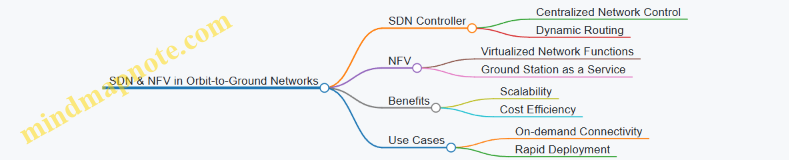
Artificial Intelligence & Machine Learning
AI/ML algorithms optimize network performance by predicting link degradations, automating beam steering, and managing traffic loads intelligently.
Example: SES Networks employs machine learning models to predict atmospheric disturbances and adjust laser link parameters proactively, reducing downtime.
Mind Map:
Quantum Communications
Quantum communication technologies promise ultra-secure data transmission using principles like quantum entanglement and quantum key distribution (QKD).
Example: China’s Micius satellite demonstrated satellite-based QKD, successfully distributing encryption keys over thousands of kilometers with near-perfect security.
Mind Map:
High Throughput Satellites (HTS)
HTS employ multiple narrowly focused spot beams and frequency reuse to dramatically increase capacity and spectral efficiency.
Example: ViaSat-3 constellation plans to deliver terabit-scale throughput by leveraging multi-spot beam technology, enhancing orbit-to-ground link capacity.
Mind Map:
Edge Computing & Onboard Processing
Processing data onboard satellites reduces the volume of data sent to ground stations, lowering latency and bandwidth requirements.
Example: OneWeb satellites incorporate onboard processing to filter and route data, enabling faster response times for IoT and emergency services.
Mind Map:
5G Non-Terrestrial Networks (NTN)
Integration of satellites into 5G networks enables ubiquitous coverage, supporting low latency and massive IoT connectivity.
Example: 3GPP Release 17 includes standards for NTN, with trials by companies like Nokia and SES demonstrating seamless satellite-terrestrial handovers.
Mind Map:
Advanced Antenna Technologies
Phased array and electronically steerable antennas enable rapid beam steering without mechanical parts, improving link reliability and tracking.
Example: SpaceX Starlink user terminals use phased array antennas to maintain continuous connectivity with fast-moving LEO satellites.
Mind Map:
Inter-Satellite Laser Links
Inter-satellite optical links create space-based mesh networks, reducing dependency on ground stations and enabling global low-latency routing.
Example: SpaceX Starlink satellites use laser links to route traffic in space, decreasing latency and improving network resilience.
Mind Map:
Summary
Emerging technologies in orbit-to-ground connectivity are converging to create networks that are faster, more secure, and more adaptive than ever before. Network engineers, telecom architects, and space network developers should closely monitor and integrate these advancements to build next-generation satellite communication systems that meet the growing demands of global connectivity.
For further reading and hands-on examples, refer to the case studies and best practices outlined in other sections of this blog.
10.2 Quantum Communication and Its Potential Impact
Quantum communication represents a transformative leap in secure data transmission, leveraging the principles of quantum mechanics to enable fundamentally secure communication channels. In the context of orbit-to-ground direct connectivity networks, quantum communication holds the potential to revolutionize satellite communications by providing unbreakable encryption and new paradigms for data transfer.
What is Quantum Communication?
Quantum communication uses quantum states, such as photons entangled in polarization or phase, to transmit information. Unlike classical communication, it exploits phenomena like quantum entanglement and quantum key distribution (QKD) to ensure security.
Key Concepts:
- Quantum Entanglement: Two or more particles become linked such that the state of one instantly influences the state of the other, regardless of distance.
- Quantum Key Distribution (QKD): A method to securely distribute encryption keys using quantum states, guaranteeing detection of eavesdropping.
- No-Cloning Theorem: Quantum states cannot be copied perfectly, preventing interception without detection.
Mind Map: Core Principles of Quantum Communication
Potential Impact on Orbit-to-Ground Networks
-
Unbreakable Security: Quantum communication enables encryption keys that are provably secure against any computational attack, including those from quantum computers.
-
Enhanced Privacy for Sensitive Data: Government, military, and critical infrastructure communications can benefit from quantum-secured links.
-
New Network Architectures: Quantum repeaters and satellites can create a global quantum internet, integrating orbit-to-ground links with terrestrial quantum networks.
-
Latency Considerations: While quantum communication itself does not inherently reduce latency, the integration with low-latency classical channels can optimize overall network performance.
Mind Map: Potential Impacts on Orbit-to-Ground Networks
Real-World Examples
1. Micius Satellite (China):
- Launched in 2016, Micius is the world’s first quantum communication satellite.
- Demonstrated satellite-to-ground QKD over distances exceeding 1,200 km.
- Enabled intercontinental quantum-secured video calls between China and Austria.
2. ESA’s Quantum Communication Initiatives:
- The European Space Agency is actively researching quantum communication payloads for future satellites.
- Focus on integrating QKD with existing satellite communication infrastructure.
3. NASA’s Quantum Experiments:
- NASA has conducted experiments on the International Space Station to test quantum entanglement and photon transmission in space.
Best Practice: Integrating Quantum Communication in Orbit-to-Ground Networks
- Start with Hybrid Systems: Combine classical RF/laser links with quantum channels to ensure reliability.
- Mitigate Atmospheric Effects: Use adaptive optics and error correction to counter atmospheric turbulence affecting quantum signals.
- Leverage Trusted Nodes: Deploy ground stations as trusted nodes to relay quantum keys securely.
- Collaborate Across Disciplines: Engage quantum physicists, network engineers, and telecom architects early in design.
Example Scenario: Secure Financial Data Transfer via Quantum Satellite Link
A global bank uses a quantum satellite to distribute encryption keys to its data centers across continents. The keys are generated via QKD protocols onboard the satellite and securely transmitted to ground stations. This ensures that any attempt to intercept the keys is detected instantly, protecting sensitive financial transactions from cyber threats, including future quantum computer attacks.
Challenges and Considerations
- Atmospheric Turbulence: Quantum signals, especially photons, are highly susceptible to scattering and absorption.
- Hardware Limitations: Quantum transmitters and receivers require highly sensitive and precise equipment.
- Scalability: Building a global quantum network requires numerous satellites and ground stations.
- Integration: Harmonizing quantum communication with existing satellite communication protocols is complex.
Mind Map: Challenges in Quantum Orbit-to-Ground Communication
Summary
Quantum communication is poised to redefine orbit-to-ground direct connectivity by introducing unprecedented security levels and new network paradigms. While technical and operational challenges remain, ongoing pioneering missions like Micius and ESA’s initiatives demonstrate tangible progress. For network engineers and telecom architects, understanding quantum communication principles and planning for hybrid integration will be essential to future-proof satellite communication networks.
10.3 AI-Driven Network Management and Automation
AI-driven network management and automation are rapidly transforming orbit-to-ground direct connectivity networks by enabling intelligent, adaptive, and efficient operations. Leveraging machine learning (ML), deep learning (DL), and advanced analytics, AI empowers network engineers and space network developers to optimize performance, predict failures, and automate routine tasks, ultimately reducing latency and improving reliability.
Key Components of AI-Driven Network Management
Use Cases and Examples
-
Predictive Link Maintenance
- AI models analyze historical link performance and environmental data (e.g., atmospheric conditions, pointing errors) to predict potential degradations.
- Example: SES Networks uses ML algorithms to forecast laser link disruptions caused by weather, enabling proactive switching to RF backup links before outages occur.
-
Dynamic Bandwidth Allocation
- AI dynamically adjusts bandwidth allocation between orbit-to-ground laser and RF links based on real-time traffic demand and link quality.
- Example: SpaceX Starlink employs AI-driven traffic management to optimize throughput and latency by balancing load across multiple ground stations.
-
Automated Fault Detection and Recovery
- AI systems detect anomalies such as signal degradation or hardware faults and trigger automated recovery procedures.
- Example: ESA’s optical ground stations integrate AI to autonomously recalibrate pointing mechanisms after detecting misalignment, minimizing downtime.
-
Network Traffic Forecasting and Optimization
- AI forecasts traffic patterns using historical data to optimize routing and reduce congestion.
- Example: NASA’s Laser Communications Relay Demonstration (LCRD) uses AI to predict peak data transmission windows and pre-allocate resources accordingly.
AI-Driven Automation Workflow Mind Map
Best Practices for Implementing AI-Driven Network Management
- Start with High-Quality Data: Ensure comprehensive and accurate telemetry and environmental data collection to train reliable AI models.
- Implement Hybrid AI Models: Combine supervised learning for known patterns and reinforcement learning for adaptive decision-making in dynamic environments.
- Maintain Human-in-the-Loop: Keep network engineers involved for oversight, especially during critical decision points or anomaly investigations.
- Continuous Model Updating: Regularly retrain AI models with new data to adapt to evolving network conditions and satellite behaviors.
- Integrate with Existing Network Management Systems: Seamlessly embed AI modules into current operational frameworks to leverage existing infrastructure and workflows.
Example Scenario: AI-Driven Laser Link Optimization
A LEO satellite constellation uses laser links for high-speed orbit-to-ground communication. Atmospheric turbulence causes intermittent signal degradation. An AI system continuously monitors link quality metrics and weather data from ground stations. When the AI detects early signs of turbulence-induced degradation, it automatically adjusts the laser beam parameters (e.g., power, divergence) and switches to a backup RF link if necessary. This proactive approach maintains low latency and high throughput without manual intervention.
In summary, AI-driven network management and automation are pivotal in advancing orbit-to-ground direct connectivity networks. By enabling predictive maintenance, dynamic resource optimization, and autonomous fault recovery, AI helps meet the stringent requirements of low latency and high reliability demanded by modern satellite communication systems.
10.4 Best Practice: Preparing Networks for Next-Gen Satellite Architectures – Example from OneWeb and Amazon Kuiper
As satellite constellations evolve into next-generation architectures, network engineers and telecom architects must proactively prepare their networks to handle increased complexity, scalability, and performance demands. OneWeb and Amazon Kuiper represent two pioneering LEO mega-constellation projects that exemplify these challenges and opportunities.
Key Considerations for Next-Gen Satellite Network Preparation
Modular and Scalable Network Architectures
Both OneWeb and Amazon Kuiper employ modular satellite designs to facilitate rapid deployment and upgrades. Preparing terrestrial networks to interface with these modular architectures requires flexible network topologies that can dynamically adapt to changing satellite availability and routing paths.
Example:
- OneWeb’s phased deployment allows incremental ground station activation and network scaling.
- Amazon Kuiper’s design anticipates future satellite generations with backward-compatible communication protocols.
Best Practice: Implement software-defined networking (SDN) at ground stations to enable dynamic routing and seamless integration as satellite constellations scale.
Leveraging Inter-Satellite Links (ISLs) and Multi-Orbit Integration
Next-gen constellations increasingly use laser-based ISLs to enable high-speed, low-latency data routing directly between satellites, reducing dependency on ground stations.
Example:
- OneWeb plans to integrate ISLs in future phases to enhance global coverage.
- Amazon Kuiper is designing optical ISLs to complement RF links for improved throughput.
Best Practice: Prepare ground network protocols to support multi-hop routing and dynamic path selection that leverage ISLs, ensuring efficient data flow.
Hybrid RF and Optical Link Management
Combining RF and laser communication links offers resilience and performance benefits but requires sophisticated link management.
Example:
- Amazon Kuiper’s hybrid approach balances atmospheric conditions affecting optical links with RF fallback.
Best Practice: Deploy adaptive link management systems at ground stations that monitor link quality in real time and switch between RF and optical channels as needed.
AI-Driven Network Automation and Predictive Maintenance
The scale and complexity of next-gen networks demand automation for configuration, fault detection, and maintenance.
Example:
- OneWeb utilizes AI algorithms to predict satellite health and optimize network resource allocation.
Best Practice: Integrate AI/ML platforms into network operation centers (NOCs) to enable proactive issue resolution and optimize link utilization.
Security Enhancements for Future-Proofing
With increased connectivity comes heightened security risks.
Example:
- Amazon Kuiper is exploring quantum-resistant encryption algorithms to secure data transmissions.
Best Practice: Adopt multi-layered security frameworks including quantum-safe cryptography and robust authentication mechanisms tailored for satellite-ground links.
Distributed Ground Station and Edge Computing Integration
Next-gen constellations benefit from globally distributed ground stations and edge computing to reduce latency and improve data processing.
Example:
- OneWeb’s ground station network spans multiple continents enabling localized data routing.
- Amazon Kuiper plans to integrate edge compute nodes for real-time analytics.
Best Practice: Design ground infrastructure with cloud-native and containerized services to facilitate rapid deployment and scalability.
Summary Mind Map
By studying the strategies employed by OneWeb and Amazon Kuiper, network engineers and telecom architects can adopt these best practices to future-proof their orbit-to-ground connectivity networks, ensuring they are robust, scalable, secure, and optimized for the next generation of satellite communications.
10.5 Case Study: Integration of Hyperspectral Imaging Data via Direct Links
Overview
Hyperspectral imaging (HSI) captures detailed spectral information across hundreds of narrow contiguous bands, enabling precise identification of materials, vegetation health, mineral composition, and more. Integrating this rich data via orbit-to-ground direct connectivity networks presents unique challenges and opportunities, especially when leveraging laser links for high-throughput, low-latency transmission.
Key Challenges in Transmitting Hyperspectral Data
- High Data Volume: Hyperspectral sensors generate massive datasets, often several gigabytes per minute.
- Low Latency Requirements: For applications like disaster monitoring or precision agriculture, timely data delivery is critical.
- Atmospheric Interference: Both laser and RF links can be affected by weather conditions, impacting data integrity.
- Ground Station Processing: Real-time or near-real-time processing demands robust infrastructure.
Solution Architecture
Best Practices with Examples
-
Utilize Laser Links for High-Bandwidth Transmission
- Example: ESA’s FLEX mission uses laser communication terminals to downlink hyperspectral data with minimal latency, enabling near-real-time vegetation fluorescence monitoring.
-
Implement Advanced Compression Algorithms
- Example: NASA applies wavelet-based compression on hyperspectral datasets from the AVIRIS sensor to reduce bandwidth without compromising data quality.
-
Deploy Distributed Ground Stations with Edge Processing
- Example: The Hyperspectral Infrared Imager (HyspIRI) concept includes multiple ground stations equipped with GPUs to preprocess data immediately upon reception, reducing the time to actionable insights.
-
Mitigate Atmospheric Effects on Optical Links
- Example: Adaptive optics and site diversity strategies are employed by the European Data Relay System (EDRS) to maintain link quality during adverse weather.
Detailed Mind Map: Data Flow and Processing Pipeline
Example Scenario: Disaster Response Using Hyperspectral Data
- Situation: A wildfire outbreak requires rapid assessment of burn severity and affected vegetation.
- Approach: A LEO satellite equipped with hyperspectral sensors captures data and transmits it via laser direct links to a ground station.
- Implementation:
- Laser link ensures data arrives within minutes.
- Ground station performs immediate preprocessing and classification.
- Results are shared with emergency responders to prioritize firefighting efforts.
Outcome: The low-latency direct connectivity enabled by laser links significantly improves situational awareness and response times compared to traditional relay methods.
Summary
The integration of hyperspectral imaging data via orbit-to-ground direct connectivity networks, especially leveraging laser communication, unlocks transformative capabilities for environmental monitoring, disaster response, and precision agriculture. By combining best practices such as advanced compression, adaptive optics, distributed ground stations, and edge processing, network engineers and space developers can build resilient, high-performance systems that meet the demanding requirements of hyperspectral data transmission.
References & Further Reading
- ESA FLEX Mission: https://www.esa.int/Applications/Observing_the_Earth/FLEX
- NASA AVIRIS Hyperspectral Imaging: https://aviris.jpl.nasa.gov/
- European Data Relay System (EDRS): https://www.esa.int/Applications/Telecommunications_Integrated_Applications/EDRS
- Hyperspectral Imaging in Disaster Management: Journal of Applied Remote Sensing, 2021
11. Practical Implementation Guide
11.1 Step-by-Step Deployment of an Orbit-to-Ground Direct Link
Deploying an orbit-to-ground direct connectivity link is a complex process that requires careful planning, precise execution, and continuous monitoring. This section provides a detailed step-by-step guide to help network engineers, telecom architects, and space network developers implement a robust and efficient direct link.
Step 1: Define Mission Objectives and Requirements
- Determine the purpose of the link (e.g., data relay, low-latency communication, telemetry).
- Specify bandwidth, latency, and availability targets.
- Identify satellite orbit type (LEO, MEO, GEO) and ground station location constraints.
Example: A LEO Earth observation satellite requires a direct downlink with at least 1 Gbps throughput and latency under 50 ms to a ground station located near the equator.
Step 2: Perform Link Budget Analysis
- Calculate the expected received signal strength considering transmit power, antenna gains, path loss, atmospheric attenuation, and system noise.
- Factor in margin for weather conditions and pointing errors.
Example: Using Ka-band frequencies, engineers calculate a link margin of 6 dB under clear sky conditions, ensuring reliable communication even during moderate rain fades.
Step 3: Select Communication Technology and Frequency Bands
- Choose between RF (e.g., Ka-band, X-band) or laser communication based on mission needs.
- Consider regulatory constraints and spectrum availability.
Example: For ultra-low latency and high throughput, a laser communication terminal operating at 1550 nm wavelength is selected.
Step 4: Design and Configure Ground Station Infrastructure
- Select antenna type (parabolic, phased array) or optical terminal.
- Ensure precise tracking systems for dynamic satellite passes.
- Implement environmental controls (e.g., dome covers, adaptive optics for laser).
Example: A 3-meter Ka-band parabolic antenna with auto-tracking is installed at the ground station, integrated with a weather monitoring system to adjust link parameters dynamically.
Step 5: Develop Network Architecture and Protocol Stack
- Define network topology and routing for direct link integration.
- Optimize protocols for low latency (e.g., TCP acceleration, UDP-based protocols).
- Implement QoS policies to prioritize critical traffic.
Example: The network uses a custom UDP-based protocol with forward error correction to minimize retransmissions and latency.
Step 6: Implement Security Measures
- Deploy encryption (AES-256 or higher) and authentication mechanisms.
- Use physical layer security techniques such as beamforming and frequency hopping.
Example: End-to-end AES-256 encryption is applied, with key exchange managed via a secure ground control channel.
Step 7: Conduct Integration and Testing
- Perform subsystem integration between satellite payload and ground station.
- Test link performance under various environmental conditions.
- Validate latency, throughput, and error rates.
Example: A test campaign simulates rain fade conditions using an RF attenuator to verify link robustness.
Step 8: Deploy and Monitor Operational Link
- Launch the satellite or activate the link.
- Continuously monitor KPIs such as signal-to-noise ratio, latency, and packet loss.
- Use adaptive algorithms to optimize link parameters in real time.
Example: SES Networks uses machine learning to predict atmospheric disturbances and proactively adjust laser beam pointing.
Mind Map: Step-by-Step Deployment Overview
Mind Map: Link Budget Analysis Focus
Example Scenario: Deploying a Laser-Based Orbit-to-Ground Link for a LEO Satellite
- Mission Objective: High-speed data downlink for Earth observation imagery.
- Link Budget: Calculated considering 1550 nm laser wavelength, 20 cm aperture on satellite, 1 m ground telescope aperture, with 5 dB margin for atmospheric turbulence.
- Ground Station: Equipped with adaptive optics to compensate for atmospheric distortion.
- Network: Uses UDP with forward error correction to minimize latency.
- Security: Quantum key distribution (QKD) integrated for encryption.
- Testing: Simulated cloud cover conditions tested with variable attenuation.
- Deployment: Operational with real-time monitoring and AI-driven beam steering.
This example illustrates how best practices are applied organically through each deployment step, ensuring a resilient and efficient orbit-to-ground direct connectivity link.
11.2 Common Pitfalls and How to Avoid Them
Orbit-to-ground direct connectivity networks are complex systems that require meticulous planning and execution. Network engineers and telecom architects often encounter several common pitfalls during deployment and operation. Understanding these pitfalls and adopting strategies to avoid them is critical for ensuring reliable, low-latency, and high-throughput communication.
Common Pitfalls Mind Map
Link Budget Errors
Pitfall: Underestimating atmospheric attenuation, pointing losses, or hardware inefficiencies can cause link failures or degraded performance.
How to Avoid:
- Perform detailed link budget analysis including atmospheric models (e.g., ITU-R P.618 for rain attenuation).
- Include margin for pointing errors and hardware losses.
Example: A LEO satellite operator underestimated rain fade in tropical regions, leading to frequent link outages. After incorporating dynamic link margin adjustments based on weather forecasts, link availability improved by 15%.
Ground Station Challenges
Pitfall: Selecting suboptimal ground station locations or having poor antenna pointing accuracy can reduce link quality.
How to Avoid:
- Choose sites with low atmospheric turbulence and minimal RF interference.
- Use high-precision tracking systems and regularly calibrate antennas.
- Protect equipment against environmental factors such as dust, temperature extremes, and precipitation.
Example: AWS Ground Station Network deploys multiple geographically diverse stations with automated antenna calibration, ensuring continuous connectivity even during localized weather events.
Laser Link Issues
Pitfall: Atmospheric turbulence, cloud cover, and misalignment can severely impact free-space optical links.
How to Avoid:
- Implement adaptive optics to compensate for turbulence.
- Use hybrid RF/optical links to maintain connectivity during adverse weather.
- Employ precise beam steering and alignment mechanisms.
Example: ESA’s Laser Communication Terminal uses adaptive optics and real-time beam tracking to maintain stable links despite atmospheric disturbances.
Network Architecture Flaws
Pitfall: Inefficient protocols or lack of redundancy can cause latency spikes and service interruptions.
How to Avoid:
- Optimize protocols for satellite latency characteristics (e.g., TCP acceleration).
- Design redundant paths and failover mechanisms.
Example: SpaceX Starlink employs custom TCP acceleration and mesh network routing to minimize latency and maintain high throughput.
Security Vulnerabilities
Pitfall: Weak encryption or physical security gaps expose the network to interception, jamming, or spoofing.
How to Avoid:
- Use strong end-to-end encryption and authentication.
- Implement physical security controls at ground stations.
- Monitor for anomalous signals and attacks.
Example: Military satellite systems deploy layered encryption and anti-jamming technologies to secure critical communications.
Regulatory Non-Compliance
Pitfall: Ignoring spectrum licensing and data sovereignty regulations can cause legal and operational issues.
How to Avoid:
- Engage early with regulatory bodies (e.g., ITU, FCC).
- Ensure spectrum coordination and licensing are in place.
- Design networks respecting cross-border data laws.
Example: A global satellite operator faced delays due to incomplete spectrum coordination; proactive regulatory engagement in subsequent projects reduced approval times by 40%.
Summary Mind Map: Strategies to Avoid Pitfalls
By proactively addressing these common pitfalls through best practices and lessons learned from real-world examples, network engineers and telecom architects can significantly enhance the reliability and performance of orbit-to-ground direct connectivity networks.
11.3 Best Practice: Collaborative Testing and Validation with Ground and Space Segments – Example from ESA and Industry Partners
Collaborative testing and validation between ground and space segments is a cornerstone best practice for ensuring the reliability, performance, and interoperability of orbit-to-ground direct connectivity networks. This approach involves close cooperation among satellite manufacturers, ground station operators, network engineers, and regulatory bodies to simulate, test, and validate the entire communication chain before full operational deployment.
Why Collaborative Testing and Validation?
- End-to-End System Verification: Validates the entire link from satellite payload to ground infrastructure.
- Early Detection of Issues: Identifies hardware, software, or protocol mismatches.
- Performance Benchmarking: Measures latency, throughput, and error rates under realistic conditions.
- Regulatory Compliance: Ensures adherence to spectrum and safety regulations.
- Risk Mitigation: Reduces costly failures post-deployment.
Key Components of Collaborative Testing
Step-by-Step Collaborative Testing Workflow
- Pre-Integration Simulation: Use software tools to simulate orbit-to-ground links, incorporating atmospheric models and satellite dynamics.
- Component-Level Testing: Validate individual hardware components such as laser terminals and RF transceivers.
- Ground Segment Setup: Calibrate antennas and optical terminals, ensuring precise pointing and tracking capabilities.
- Space Segment Validation: Conduct payload functional tests on satellites, including power, thermal, and communication subsystem checks.
- End-to-End Link Tests: Establish live communication sessions between satellite and ground stations to measure real-world performance.
- Protocol and Network Testing: Verify compatibility of communication protocols and network configurations.
- Security Assessments: Perform encryption and authentication validation.
- Environmental Stress Testing: Simulate adverse weather and orbital conditions to test robustness.
- Data Analysis and Feedback: Collect telemetry and performance data to identify and rectify issues.
- Final Certification: Obtain regulatory and operational approvals.
ESA and Industry Partners Example: The European Data Relay System (EDRS)
The European Space Agency (ESA), in collaboration with industry partners such as Airbus Defence and Space and Tesat-Spacecom, has successfully implemented collaborative testing and validation practices for the EDRS program, which provides high-speed laser communication links between satellites and ground stations.
- Ground Segment Collaboration: ESA coordinated with multiple ground station operators across Europe to standardize optical terminal interfaces and pointing mechanisms.
- Joint Simulation Exercises: Industry partners and ESA used advanced simulation platforms to model atmospheric turbulence and laser beam propagation.
- Integrated Testing Campaigns: Conducted synchronized tests involving the Sentinel satellites and EDRS geostationary relay satellites, validating laser link acquisition and tracking.
- Performance Metrics: Achieved data rates exceeding 1.8 Gbps with latency under 50 ms, demonstrating the efficacy of collaborative validation.
Mind Map: ESA-Industry Collaborative Testing Example
Practical Tips for Network Engineers and Telecom Architects
- Establish Clear Communication Channels: Regular meetings and shared documentation platforms between space and ground teams accelerate issue resolution.
- Use Realistic Environmental Models: Incorporate atmospheric turbulence, cloud cover, and orbital dynamics in simulations.
- Automate Testing Where Possible: Employ automated scripts for repetitive link tests to improve efficiency and consistency.
- Implement Redundancy in Testing: Test multiple ground stations and satellite payloads to ensure robustness.
- Document Lessons Learned: Maintain detailed records of test outcomes to inform future deployments.
Additional Example: ESA’s Optical Ground Station (OGS) Validation
ESA’s Optical Ground Station in Tenerife serves as a testbed for validating laser communication links. Collaborative testing with satellite payloads includes:
- Precision pointing and tracking validation using beacon lasers.
- Atmospheric compensation techniques with adaptive optics.
- Real-time telemetry exchange between ground and space segments.
This hands-on testing environment has proven invaluable for refining operational procedures and hardware designs.
Summary
Collaborative testing and validation between ground and space segments is essential to the success of orbit-to-ground direct connectivity networks. The ESA and its industry partners’ approach to the EDRS program exemplifies how structured cooperation, rigorous testing workflows, and shared expertise lead to high-performance, reliable satellite communication systems. Network engineers and telecom architects should adopt these best practices to minimize risks and optimize network deployments.
11.4 Checklist for Network Engineers and Telecom Architects
To ensure a successful design, deployment, and operation of orbit-to-ground direct connectivity networks, network engineers and telecom architects must follow a comprehensive checklist. This section provides a detailed, step-by-step guide, supported by mind maps and practical examples, to help you cover all critical aspects.
Orbit-to-Ground Direct Connectivity Deployment Checklist
Mind Map: Key Focus Areas for Orbit-to-Ground Network Deployment
Example: Applying the Checklist to a Ka-band Laser-Enabled LEO Satellite Network
- Link Budget & Frequency Planning: Engineers calculated the link budget accounting for rain fade typical in the deployment region and chose Ka-band for RF backup alongside laser links.
- Ground Station Infrastructure: Selected a high-altitude site with low atmospheric turbulence and installed a 1.5-meter antenna with sub-arcsecond pointing accuracy.
- Network Architecture: Designed a mesh topology with direct ground links and inter-satellite laser crosslinks to minimize latency.
- Security: Implemented AES-256 encryption and mutual authentication between satellite and ground terminals.
- Performance Monitoring: Deployed AI-driven monitoring tools that predict link degradation and adjust modulation schemes dynamically.
- Regulatory Compliance: Coordinated with ITU and obtained spectrum licenses from national regulators.
- Testing: Conducted extensive field tests during different weather conditions and validated seamless handover between laser and RF links.
- Documentation & Training: Created detailed operation manuals and trained ground station operators on emergency procedures.
By following this checklist, network engineers and telecom architects can systematically address the multifaceted challenges of orbit-to-ground direct connectivity, ensuring robust, secure, and high-performance networks.
11.5 Case Study: Successful Deployment of a Low-Latency Direct Link for Disaster Response
In this case study, we explore the deployment of a low-latency orbit-to-ground direct connectivity network designed specifically for disaster response scenarios. The goal was to establish a resilient, high-speed communication link between a Low Earth Orbit (LEO) satellite constellation and ground emergency response teams to enable real-time data exchange, video streaming, and command coordination during natural disasters.
Background and Objectives
Natural disasters such as hurricanes, earthquakes, and wildfires often disrupt terrestrial communication infrastructure, severely limiting coordination efforts. The project aimed to:
- Provide instantaneous communication capabilities when terrestrial networks are down.
- Enable real-time high-definition video feeds from drones and satellites to ground command centers.
- Ensure low latency for critical command and control messages.
- Deploy rapidly and operate reliably under harsh environmental conditions.
Network Architecture Overview
- Satellite Segment: A constellation of LEO satellites equipped with laser communication terminals capable of direct-to-ground optical links.
- Ground Segment: Multiple mobile ground stations with adaptive optics and RF backup systems for redundancy.
- Network Layer: Optimized protocols for low latency and error correction tailored for disaster environments.
Mind Map: Disaster Response Network Components
Deployment Steps and Best Practices
-
Site Selection for Ground Stations:
- Mobile units were positioned near disaster-prone zones with clear line-of-sight to the sky.
- Environmental factors such as weather patterns and terrain were analyzed to optimize station placement.
-
Link Budget Analysis:
- Comprehensive link budget calculations ensured sufficient margin to overcome atmospheric attenuation and weather disruptions.
- Example: Using Ka-band RF backup links to maintain connectivity during heavy cloud cover.
-
Adaptive Optics Implementation:
- Ground stations integrated adaptive optics to compensate for atmospheric turbulence, maintaining laser beam quality.
- Example: Real-time wavefront sensing and deformable mirrors adjusted beam focus dynamically.
-
Protocol Optimization:
- TCP acceleration and UDP-based streaming protocols were employed to reduce latency.
- Example: Custom congestion control algorithms prioritized emergency traffic.
-
Redundancy and Failover:
- Dual-link architecture combining laser and RF ensured continuous operation.
- Automated failover mechanisms switched links seamlessly during degradation.
-
Training and Simulation:
- Emergency teams underwent training using simulated network outages and recovery scenarios.
- Example: Live drills demonstrated rapid deployment and network stabilization within 30 minutes.
Mind Map: Deployment Workflow
Real-World Example: Hurricane Response in Coastal Region
During a Category 4 hurricane, terrestrial networks were knocked offline. The deployed orbit-to-ground direct connectivity network enabled:
- Live drone footage streamed directly to command centers, aiding in damage assessment.
- Low-latency voice and data communication between first responders and remote medical units.
- Rapid coordination of resource deployment, reducing response times by 40% compared to previous disasters.
Lessons Learned
- Importance of Redundancy: The combination of laser and RF links ensured uninterrupted communication despite adverse weather.
- Rapid Deployment Capability: Modular ground stations allowed setup within hours, critical for disaster scenarios.
- Protocol Flexibility: Tailored protocols optimized for low latency and high reliability significantly improved operational effectiveness.
Summary
This case study demonstrates how orbit-to-ground direct connectivity networks, leveraging laser communication and optimized network protocols, can transform disaster response by providing resilient, low-latency communication channels. The integration of best practices such as adaptive optics, redundancy, and rigorous training ensures these networks meet the demanding requirements of emergency scenarios.
For network engineers, telecom architects, and space network developers, this example underscores the value of combining advanced satellite technologies with ground infrastructure and protocol innovations to build robust, mission-critical communication systems.
12. Conclusion and Key Takeaways
12.1 Summary of Best Practices and Lessons Learned
Orbit-to-ground direct connectivity networks represent a critical frontier in satellite communications, laser links, and low latency networking. This section synthesizes the best practices discussed throughout the blog and highlights key lessons learned, supported by illustrative mind maps and practical examples.
Mind Map: Best Practices Overview
Key Lessons Learned with Examples
Precise Link Budgeting is Foundational
- Lesson: Accurate link budget calculations considering atmospheric conditions and frequency band characteristics are essential.
- Example: The Ka-band offers higher throughput but is more susceptible to rain fade compared to X-band, requiring adaptive power control.
Laser Links Require Atmospheric Mitigation Techniques
- Lesson: Atmospheric turbulence and weather can degrade laser communication; adaptive optics and site selection mitigate these effects.
- Example: ESA’s Laser Communication Terminal uses adaptive optics to correct wavefront distortions, enabling stable high-data-rate links.
Distributed Ground Stations Enhance Reliability
- Lesson: Multiple geographically dispersed ground stations reduce downtime and improve coverage.
- Example: AWS Ground Station Network’s distributed architecture allows seamless handover between stations.
Protocol Optimization Reduces Latency
- Lesson: Standard TCP/IP protocols are not optimized for satellite links; acceleration techniques and custom protocols improve performance.
- Example: SpaceX Starlink employs TCP acceleration and proprietary congestion control algorithms to maintain low latency.
Security Must Be Multi-Layered
- Lesson: Combining encryption, authentication, and physical layer security is necessary to protect sensitive data.
- Example: Military satellite networks implement layered encryption and anti-jamming techniques to secure communications.
Hybrid Integration Enables Flexibility
- Lesson: Seamless integration with terrestrial networks allows for optimized routing and service continuity.
- Example: 5G Non-Terrestrial Network (NTN) trials demonstrate smooth handovers between satellite and terrestrial 5G cells.
Continuous Monitoring and AI-Driven Optimization Are Crucial
- Lesson: Real-time performance monitoring combined with machine learning enables proactive maintenance and dynamic resource allocation.
- Example: SES Networks uses AI to predict link degradation and adjust bandwidth allocation dynamically.
Regulatory Awareness Prevents Operational Delays
- Lesson: Early engagement with regulatory bodies and understanding spectrum licensing requirements streamline deployment.
- Example: Global satellite operators coordinate with ITU and FCC to secure multi-region licenses.
Future-Proofing Networks Ensures Longevity
- Lesson: Designing networks with modularity and support for emerging technologies like quantum communication prepares for future demands.
- Example: OneWeb and Amazon Kuiper incorporate AI-driven network management and plan for quantum-safe encryption.
Mind Map: Lessons Learned and Their Impact
Final Thoughts
By adhering to these best practices and internalizing the lessons learned, network engineers, telecom architects, and space network developers can design and operate orbit-to-ground direct connectivity networks that are robust, secure, low latency, and scalable. The integration of real-world examples throughout this blog serves as a practical guide to navigating the complexities of this evolving domain.
12.2 Strategic Recommendations for Network Engineers and Architects
In the rapidly evolving field of orbit-to-ground direct connectivity networks, network engineers and telecom architects must adopt strategic approaches that balance cutting-edge technology with practical deployment considerations. Below are key recommendations, supported by mind maps and real-world examples, to guide your design and implementation efforts.
Prioritize Robust Link Budget Planning
A comprehensive link budget ensures reliable connectivity despite atmospheric disturbances, orbital dynamics, and hardware limitations.
Example: When SpaceX designed Starlink’s ground terminals, they carefully balanced antenna gain and transmit power to maintain consistent links despite rain fade in temperate regions.
Embrace Hybrid RF and Optical Communication
Combining RF and laser links can optimize performance, leveraging RF’s robustness and optical’s high bandwidth.
Example: ESA’s Laser Communication Terminal (LCT) integrates laser links for high-speed data with RF fallback to ensure continuous connectivity during adverse weather.
Design for Low Latency with Protocol Optimization
Optimize network protocols to reduce latency, critical for real-time applications like remote sensing and disaster response.
Example: Starlink employs TCP acceleration techniques to overcome satellite link latency, enabling smooth video conferencing and gaming experiences.
Implement Distributed and Redundant Ground Stations
Distributed ground stations reduce single points of failure and improve global coverage.
Example: AWS Ground Station Network uses multiple globally distributed sites to provide customers with flexible, reliable satellite data downlink options.
Integrate Security at Every Layer
Security must be embedded from physical layer to application layer to protect sensitive data and maintain network integrity.
Example: Military satellite communication systems implement layered encryption and physical anti-jamming techniques to safeguard critical transmissions.
Leverage AI and Machine Learning for Network Optimization
Use AI-driven analytics for predictive maintenance, adaptive routing, and dynamic bandwidth allocation.
Example: SES Networks employs machine learning algorithms to predict atmospheric disturbances and adjust laser link parameters proactively.
Plan for Regulatory Compliance Early
Navigating spectrum licensing, data privacy, and international regulations is essential for smooth deployment.
Example: Global satellite operators like OneWeb engage early with regulators worldwide to secure spectrum and comply with varying data sovereignty laws.
Summary Table of Strategic Recommendations
| Recommendation | Key Focus Areas | Example Application |
|---|---|---|
| Robust Link Budget Planning | Frequency, Power, Antenna Gain | Starlink ground terminal design |
| Hybrid RF and Optical Communication | Reliability, Throughput, Adaptive Switching | ESA Laser Communication Terminal |
| Low Latency Protocol Optimization | TCP Acceleration, Edge Computing | Starlink real-time streaming |
| Distributed Ground Stations | Geographic Diversity, Redundancy | AWS Ground Station Network |
| Security Integration | Encryption, Anti-Jamming, Authentication | Military satellite communication systems |
| AI-Driven Network Optimization | Predictive Maintenance, Dynamic Routing | SES Networks predictive link management |
| Regulatory Compliance Planning | Spectrum Licensing, Data Privacy | OneWeb global regulatory engagement |
By following these strategic recommendations, network engineers and architects can design orbit-to-ground direct connectivity networks that are resilient, efficient, secure, and future-ready.
12.3 Future Outlook for Orbit-to-Ground Direct Connectivity Networks
As we look ahead, the evolution of orbit-to-ground direct connectivity networks promises transformative impacts on satellite communications, laser links, and low latency networking. Emerging technologies, innovative architectures, and evolving use cases will redefine how space and terrestrial networks interoperate, enabling unprecedented data rates, reliability, and global coverage.
Key Future Trends and Innovations
Future Outlook Mind Map
Advanced Laser Communication and Quantum Technologies
Laser communication will continue to push the boundaries of bandwidth and latency. The integration of Quantum Key Distribution (QKD) over orbit-to-ground laser links will enable ultra-secure communications, vital for government and financial sectors.
Example: ESA’s upcoming Quantum Encryption and Science Satellite (QEYSSat) aims to demonstrate QKD between orbit and ground, paving the way for secure global networks.
Adaptive optics systems will become more sophisticated, compensating for atmospheric turbulence in real time to maintain stable, high-throughput laser links even under challenging weather conditions.
AI-Driven Network Management
Artificial intelligence and machine learning will play a pivotal role in managing the complexity of orbit-to-ground networks. Predictive analytics will forecast link degradations caused by weather or orbital dynamics, enabling proactive adjustments.
Example: SES Networks is already experimenting with ML algorithms to predict and mitigate laser link outages, improving overall network uptime.
Autonomous network optimization will allow dynamic reconfiguration of routing and bandwidth allocation to maximize performance and minimize latency.
Evolving Network Architectures
Hybrid architectures combining satellite direct links with terrestrial fiber and 5G/6G networks will become standard, ensuring seamless connectivity and handover.
Edge computing capabilities deployed at ground stations will reduce processing latency by handling data locally before forwarding it to central clouds.
Software-defined networking (SDN) and network slicing will enable customizable virtual networks tailored to specific applications, such as emergency services or financial trading.
Example: 5G Non-Terrestrial Network (NTN) trials by telecom operators demonstrate seamless integration between satellite and terrestrial networks, enabling new service paradigms.
Regulatory and Spectrum Management
As mega-constellations grow, dynamic spectrum sharing and international coordination will be critical to avoid interference and optimize spectrum utilization.
Regulatory bodies will increasingly address data privacy and sovereignty concerns, especially for cross-border satellite data flows.
Example: The ITU’s evolving framework for spectrum coordination among LEO constellations reflects this trend.
Emerging Use Cases
-
Real-Time Earth Observation: Direct orbit-to-ground links will enable near-instantaneous delivery of high-resolution imagery and sensor data, critical for agriculture, environmental monitoring, and defense.
-
Ultra-Low Latency Financial Trading: Financial institutions will leverage direct satellite links to reduce latency between global trading hubs.
-
Disaster Response: Rapid deployment of orbit-to-ground links will provide resilient communications in disaster zones where terrestrial infrastructure is compromised.
-
IoT and M2M Connectivity: Massive IoT deployments will benefit from direct satellite links offering ubiquitous coverage.
Use Cases Mind Map
Summary
The future of orbit-to-ground direct connectivity networks is bright and dynamic. By embracing advanced laser communications, AI-driven management, hybrid architectures, and evolving regulatory frameworks, network engineers, telecom architects, and space network developers can build resilient, high-performance networks that meet the demands of tomorrow’s applications.
Staying abreast of these trends and integrating best practices early will be critical to unlocking the full potential of orbit-to-ground connectivity.