Advanced Industrial Noise and Vibration Control Engineering
1. Fundamentals of Industrial Noise and Vibration Mechanisms
1.1 Sources of Machinery Noise and Vibration in Industrial Systems
Industrial noise and vibration rarely come from a single “bad part.” They are usually the combined result of excitation (what shakes or radiates), transmission (how it travels), and response (how structures and enclosures react). This section maps the most common machinery sources so you can connect measurements to likely causes without guessing.
Core Excitation Sources
Rotating machinery generates periodic forces from imbalance, misalignment, and bearing defects. Imbalance acts like a rotating weight, producing a force at the rotation frequency and its harmonics. Misalignment adds a directional component that often shows up strongly at bearing locations and can excite structural modes. Bearing defects create impacts and high-frequency content, which can be heard as a gritty “texture” and measured as broadband vibration spikes.
Reciprocating machinery produces time-varying forces from piston motion, valve events, and crankshaft dynamics. The dominant excitation often includes the fundamental stroke frequency and its harmonics, plus sharp transients from impacts or clearances. A compressor with worn valve seats may still run, but the vibration signature becomes less periodic and more impulsive, which also increases airborne noise through enclosure panel radiation.
Gear trains and transmissions add mesh stiffness variation. Gear tooth contact changes the effective stiffness as teeth engage and disengage, producing vibration at the mesh frequency and sidebands related to shaft speed and load. Backlash and tooth wear can increase amplitude and broaden the frequency content, making the noise less “tonal” and more “hissy” or “buzz-like.”
Hydraulic and pneumatic systems introduce pressure pulsations and flow-induced excitation. In pumps and compressors, pressure ripple couples into piping and supports, turning flexible pipe runs into sound radiators. In pneumatic lines, turbulence and valve switching can generate broadband vibration that excites hangers and nearby structural members.
Impact and clearance events include belt slap, coupling looseness, rubbing, and mechanical contact. These sources are often intermittent, so they may be missed if you only look at steady-state averages. They can also create strong low-frequency components when impacts excite structural resonances.
How Vibration Becomes Noise
Vibration is not automatically noise; it becomes noise when it drives an acoustic radiator. A motor baseplate can vibrate, but the airborne sound level depends on whether panels, covers, ducts, and openings move efficiently. The same excitation can produce different noise outcomes depending on enclosure stiffness, panel size, and damping.
A useful mental model is: force → structural motion → surface radiation → sound pressure at the receiver. For example, a gearbox may generate strong vibration at the mesh frequency, but if the gearbox is fully enclosed with well-sealed panels, the dominant noise at the operator position may shift to duct leakage or flanking paths through the frame.
Transmission Paths That Multiply the Problem
Even when the excitation is localized, transmission can spread it. Common paths include:
- Direct mounting path: machine feet to baseplate to floor.
- Structural coupling: shared beams, skids, and frames that act like bridges.
- Piping coupling: rigid or poorly supported pipe runs that carry vibration into other equipment.
- Flanking through penetrations: cable trays, wall penetrations, and duct interfaces that bypass intended isolation.
This is why two machines with similar vibration levels can produce very different noise levels in the same room.
Mind Map: Machinery Noise and Vibration Sources
Concrete Examples You Can Use Immediately
Example 1: Pump with a “clean” tone that grows louder with speed If the dominant vibration and noise increase proportionally with motor speed and show harmonics, imbalance or misalignment is likely. The practical check is to compare vibration at the bearing housing and at the baseplate corners; a strong baseplate response suggests efficient radiation.
Example 2: Gearbox with a repeating buzz plus a rough edge A repeating buzz at mesh frequency with sidebands indicates gear mesh excitation. If the rough edge increases after load changes, backlash or wear may be contributing. Inspecting mounting tightness and gearbox-to-baseplate contact often matters because looseness can amplify radiation.
Example 3: Compressor with intermittent knocks Intermittent knocks often point to clearance, valve issues, or belt/coupling problems. Because these events are transient, time-domain observation and order tracking around operating conditions are more informative than a single averaged spectrum.
Practical Takeaway
When you identify the excitation type—rotating, reciprocating, gear mesh, fluid pulsation, or impact—you narrow the likely transmission and radiation mechanisms. That connection is what turns measurements into design decisions, instead of turning them into a collection of interesting graphs.
1.2 Noise Transmission Paths Through Airborne Structureborne and Flanking Routes
Industrial noise rarely travels in a single, polite line from source to receiver. It usually takes multiple routes at once, and the “loudest” path is often not the one you initially suspect. This section builds a practical map of how machinery noise reaches people, then shows how to use that map to choose effective control measures.
Core Idea: Two Main Routes Plus a Sneaky Third
- Airborne path: sound radiates into air and reaches the receiver directly.
- Structureborne path: vibration excites building elements, which radiate sound from their surfaces.
- Flanking path: sound bypasses the intended barrier by traveling through alternate structural or geometric routes, such as side walls, beams, ducts, or penetrations.
A useful mental model is to treat the building like a set of coupled “sound highways.” If you block one highway, traffic often reroutes.
Airborne Transmission Path
Airborne noise is driven by sound power radiated by the machine and its enclosure gaps. Typical contributors include fan housings, motor vents, compressor discharge openings, and panel seams.
What to look for in the field
- Audible noise that changes strongly with distance and direction.
- Clear “line of sight” from machine to receiver.
- Strong tonal components that match rotational speeds, indicating direct radiation.
Easy example: A small pump in a room with a partially closed cover. If the cover has a gap around the cable entry, you can often hear the same pitch at the receiver even when the cover is otherwise intact. The gap becomes a local airborne radiator.
Engineering implication: Airborne control focuses on reducing sound radiation and improving barrier sound insulation (mass, sealing, and surface continuity).
Structureborne Transmission Path
Structureborne noise starts with vibration. The machine baseplate and mounts transmit dynamic forces into the foundation, beams, and floors. Those elements then vibrate and radiate sound into the air.
Key mechanism
- Vibration energy enters the structure.
- Structural modes shape where and how strongly surfaces radiate.
- Radiation efficiency depends on panel size, boundary conditions, and damping.
Easy example: A gearbox mounted on stiff supports. Even if the gearbox enclosure is reasonably sealed, the floor can become the main radiator. You may feel vibration near the base and hear a broader-band “rumble” at the receiver.
Engineering implication: Structureborne control emphasizes reducing force transmission (isolation) and reducing structural response (damping and stiffness tuning).
Flanking Transmission Routes
Flanking is what happens when the “main barrier” is not the only route. Sound can travel around it through:
- Side walls and adjacent partitions connected to the same frame.
- Beams and columns that bridge the barrier.
- Floor slabs that connect rooms.
- Penetrations like pipe sleeves, cable trays, and anchor bolts.
- Ductwork that carries pressure fluctuations and radiates at openings.
Easy example: You install a heavy acoustic enclosure around a compressor. The enclosure sits on a steel frame that is bolted to the building structure. The compressor’s vibration now couples into the frame and then into the building, bypassing the enclosure’s intended isolation.
Engineering implication: Flanking control requires detailing, not just material selection. Seals, decoupling, and controlled interfaces matter.
Mind Map: Transmission Paths and What They Mean
Systematic Diagnostic Workflow
- Start with direction and distance: If noise drops quickly with distance, airborne is likely significant. If it stays strong, structureborne or flanking may dominate.
- Check vibration at interfaces: Touch and measure near mounts, baseplate edges, and nearby walls. Strong vibration at a wall suggests structureborne radiation.
- Identify bypass points: Look for rigid connections between the machine support and building structure, and for penetrations that connect rooms.
- Use targeted “interruptions”: Temporarily add soft isolation at a suspected rigid bridge or seal a suspected gap, then re-check noise and vibration. If the change is immediate and repeatable, you found a path.
Integrated Example: One Machine, Three Paths
A motor-driven fan sits in an equipment bay. The receiver is in an adjacent office.
- Airborne: the fan discharge opening leaks sound through a poorly sealed duct collar.
- Structureborne: the fan’s baseplate excites the floor slab, which radiates a low-frequency component.
- Flanking: a cable tray is bolted to both the bay frame and the office wall, carrying vibration and enabling sound bypass.
A coherent solution combines: sealing the duct collar, adding isolation at the fan mounts, and decoupling the cable tray with resilient supports and proper sleeve detailing. Treating only one path often improves things, but treating all three is what makes the improvement stick.
1.3 Vibration Excitation Types Including Rotating Reciprocating and Impact Loads
Industrial vibration starts with excitation: a force or motion that injects energy into the machine and its support system. The same mounting and isolation hardware can behave very differently depending on whether the excitation is periodic, broadband, or impulsive. A good control and isolation design begins by classifying the excitation type, then mapping it to the dominant frequency content and the likely transmission paths.
Rotating Loads and Periodic Excitation
Rotating equipment produces vibration because rotating elements do not generate perfectly steady forces. Common causes include unbalance, misalignment, gear tooth stiffness variation, and bearing defects. The key feature is periodicity: the excitation repeats every revolution or every gear mesh.
Unbalance is the simplest mental model. Imagine a rotor with its center of mass offset from its rotation axis. As it spins, the centrifugal force rotates with it, creating a harmonic force at the rotational frequency. If the rotor speed is 1800 rpm, that is 30 Hz, so you expect strong response near 30 Hz and often its harmonics. Misalignment and bearing effects can add additional frequency components, including sidebands around the rotational frequency.
A practical example: a pump on elastomer mounts shows a peak at 30 Hz in accelerometer data on the baseplate. When the speed increases to 1500 rpm, the peak shifts to 25 Hz. That tracking with speed is a strong clue that the dominant excitation is rotating and periodic rather than random.
Reciprocating Loads and Strong Harmonic Content
Reciprocating machines—engines, compressors, and some pumps—convert rotational motion into back-and-forth motion. The resulting forces are not purely sinusoidal. Even if the crank rotates smoothly, the piston motion produces acceleration that changes rapidly near dead centers. That creates a force waveform with many harmonics.
A useful way to think about it: the fundamental frequency corresponds to the crank rotation rate, but the force waveform contains higher harmonics that can excite structural modes even when the fundamental is well isolated. For a compressor with a 20 Hz crank frequency, you might see significant response at 40 Hz, 60 Hz, and beyond, depending on geometry and valve dynamics.
Example: a reciprocating compressor exhibits high vibration at a structural resonance near 75 Hz. The crank frequency is 15 Hz, and 5th harmonic lands at 75 Hz. Isolation that targets only the fundamental can miss the real culprit.
Impact Loads and Broadband Excitation
Impact excitation is different because it injects energy in short time intervals. Impacts can come from mechanical clearances closing, loose components, contact between rotating and stationary parts, valve slam, or structural impacts from handling and maintenance. The frequency content is broadband because a sharp impulse contains many frequencies.
In practice, impact events often show up as:
- Time-domain spikes or bursts in acceleration.
- A high-frequency tail in spectra.
- Low coherence between sensors at frequencies where the response is dominated by random impacts rather than a stable periodic source.
Example: a conveyor drive shows occasional high acceleration bursts at the gearbox housing. When you compare spectra from steady operation to spectra during the bursts, the burst periods increase energy across a wide band. That pattern suggests impacts or intermittent contact rather than a clean rotating harmonic.
Excitation Classification Mind Map
Mind Map: Vibration Excitation Types
Mapping Excitation to Measurement and Design Choices
Once you identify the excitation type, you can choose measurement and design checks that match it.
For rotating loads, confirm speed tracking: peaks should move with rpm. For reciprocating loads, check harmonics against structural modal frequencies; a resonance at a harmonic can dominate even if the fundamental is modest. For impact loads, use time-domain inspection to locate bursts and compare coherence across sensors to distinguish intermittent forcing from stable periodic sources.
A simple integrated workflow looks like this: start with operational speed and load state, record time signals and spectra, then interpret peaks using the excitation classification. If the dominant energy follows rpm, treat it as rotating. If it aligns with harmonic multiples of crank frequency, treat it as reciprocating. If energy appears as bursts with broadband content, treat it as impact. This classification step prevents the common mistake of designing isolation around the wrong frequency story—like tuning a lock to the wrong key shape.
1.4 Modal Behavior of Machine Foundations and Supporting Structures
A machine rarely “vibrates as a whole.” Instead, its foundation and nearby structure respond through a set of vibration shapes called modes. Each mode has a natural frequency, a deformation pattern, and an effective stiffness and damping. Modal behavior matters because the machine’s operating forces excite specific frequencies, and the structure’s mode shapes determine where motion and stress concentrate.
From Rigid Body Motion to Deformation Modes
At very low frequencies, a foundation may behave almost like a rigid block: the baseplate translates and rotates with limited internal strain. As frequency increases, internal deformation becomes significant—columns bend, slabs flex, and anchor regions shear. The transition is not a single cutoff; it’s gradual, and it shows up in measured frequency response functions (FRFs) as peaks and changes in phase.
A practical way to think about modes is to imagine the structure “choosing” a deformation pattern when driven near a natural frequency. If the machine force spectrum overlaps that frequency, the corresponding mode contributes strongly to motion at the machine mounting points.
Modal Parameters That Actually Get Used
For engineering work, you typically need:
- Natural frequencies: where peaks occur.
- Mode shapes: relative motion at the baseplate, anchors, beams, and surrounding floor.
- Modal damping: how quickly peaks decay; it affects resonance amplification.
- Modal participation factors: how strongly the machine input couples into each mode.
Participation factors are the “bridge” between excitation and response. Two modes at similar frequencies can produce very different machine-point motion if one mode barely moves the mounting region.
Boundary Conditions and Why They Change Everything
Modes depend heavily on boundary conditions: how the foundation is connected to the surrounding structure, how anchors are grouted, and whether the baseplate is effectively tied to the slab. A common field surprise is that a “stiff” foundation can still have flexible local modes if the grout thickness, anchor embedment, or interface stiffness is inconsistent.
Even small changes in contact conditions can shift natural frequencies and alter mode shapes. That’s why operational modal analysis (OMA) and FRF-based identification are so useful: they capture the real boundary conditions, not the idealized drawing.
Coupling Between Foundation and Supporting Structure
A foundation is rarely isolated from the building. The slab, beams, columns, and floor system form a coupled dynamic network. This coupling creates two common outcomes:
- Mode splitting: what would be separate foundation and floor modes become distinct but nearby modes.
- Energy sharing: motion at the machine can be reduced while motion elsewhere increases, or vice versa.
A useful diagnostic is to compare measured motion at the machine mount and at nearby structural points. If peaks align in frequency but differ in relative amplitude, you’re seeing the same modal family moving through the structure.
How Machine Mounting Interfaces Select Modes
The machine-to-foundation interface includes baseplate stiffness, anchor flexibility, and any isolation elements. These features act like filters. For example, a stiff baseplate can transmit higher-frequency content efficiently, exciting higher modes of the foundation and floor. Conversely, a compliant mount can reduce transmission at some frequencies but may introduce new resonances in the combined system.
A concrete example: consider a pump on a baseplate with four anchor bolts. If the grout is well bonded, the anchors constrain rotation and the foundation modes that involve baseplate rocking may shift upward. If bonding is poor, rocking modes can drop in frequency and show larger motion at the pump feet, even if the foundation mass is unchanged.
Mind Map: Modal Behavior Workflow
Example: Reading Modes from a Frequency Response
Suppose you measure an FRF from a shaker or from operational excitation at the machine mounting point to a nearby floor point. You see a strong peak at 38 Hz and a smaller peak at 41 Hz. The phase at both peaks changes consistently, indicating modal behavior rather than measurement noise.
Next, you compare relative amplitudes: at 38 Hz the mount moves much more than the floor point, suggesting a foundation-dominant mode. At 41 Hz the floor point amplitude becomes comparable, suggesting a coupled floor-foundation mode. That distinction guides mitigation: foundation-local changes (anchor stiffness, baseplate bonding, local damping) target the 38 Hz mode, while broader structural detailing or isolation strategy is more relevant for the 41 Hz mode.
Example: Damping as a Mode-Specific Reality
Engineers sometimes apply one damping value to the whole structure. In practice, damping varies by mode because strain energy distribution changes with the mode shape. A mode that bends the slab heavily may show higher effective damping than a mode dominated by localized shear at grout interfaces.
A practical check is to estimate damping from peak bandwidths for each identified mode. If the damping differs significantly across modes, then a single “global damping” assumption will mispredict which resonance is most problematic.
Summary of the Logical Chain
Modal behavior starts with geometry and boundary conditions, then moves through identification of natural frequencies and mode shapes, and finally connects those modes to machine excitation through participation factors and mounting stiffness. When you treat the foundation and supporting structure as a coupled modal system, you can explain observed peaks, predict where motion concentrates, and choose mitigation actions that target the right deformation patterns.
1.5 Measurement Setup for Noise and Vibration Including Sensor Placement and Reference Levels
A good measurement setup answers two questions: “What is the system doing?” and “Where did the signal come from?” The trick is to make sensor placement and reference levels consistent enough that results from different days, operators, or machines still mean the same thing.
Measurement Goals and What You Must Decide First
Start by choosing the measurement objective, because it dictates sensor type, location, and reference. Common objectives include:
- Identify dominant vibration paths from machine to foundation or structure.
- Quantify airborne noise from an enclosure, duct, or room.
- Correlate vibration to noise using time or frequency relationships.
- Verify isolation performance by comparing before/after levels.
Then decide the primary coordinate system: define axes for accelerometers (e.g., X along the machine length, Y transverse, Z vertical) and define microphone height and orientation rules for repeatability.
Sensor Placement for Vibration Measurements
Vibration sensors typically include accelerometers for structural motion and sometimes velocity or displacement transducers for special cases.
Accelerometer placement rules
- Measure where the motion matters, not where it is convenient. For machinery, that usually means near the mounting interface: baseplate corners, skid feet, or bearing housing.
- Use consistent mounting. Surface prep and mounting method (stud, magnet, adhesive) affect high-frequency content. If you must use magnets, document the magnet type and contact condition.
- Avoid “sensor lies”. Do not place sensors on thin covers that move differently from the load-bearing structure unless the goal is to measure cover radiation.
- Capture coupling. If you want transmission paths, place sensors on both sides of the interface: machine base and foundation, or foundation and adjacent wall.
Reference placement Pick one location as a reference channel for comparisons. A practical choice is a point that is mechanically stable and representative of the structure’s overall motion, such as a foundation corner away from direct mounting bolts.
Example: A pump on elastomer mounts shows high vibration at the bearing housing. Place accelerometers at:
- Bearing housing (X and Z)
- Baseplate corner (X and Z)
- Foundation reference point (X and Z) This lets you see whether isolation reduces motion at the foundation or merely shifts it within the baseplate.
Sensor Placement for Noise Measurements
Noise measurements use microphones for sound pressure level and sometimes intensity probes for directional studies.
Microphone placement rules
- Control geometry. Keep distance from the source consistent (e.g., 1 m from the enclosure face) and document the exact location.
- Control orientation. Point the microphone diaphragm toward the dominant source region unless you are intentionally mapping directionality.
- Avoid local artifacts. Keep microphones away from reflective edges, cable runs, and operator positions that can create standing waves or shadowing.
- Use height consistency. For industrial rooms, a common practice is microphone height around ear level for receiver relevance, while still recording the height in your notes.
Example: To evaluate an enclosure retrofit, measure at the same three receiver points before and after: center of the access panel, near the duct outlet, and near the enclosure seam. If only one point improves, the issue is likely flanking through a specific opening or duct connection.
Reference Levels and Calibration Discipline
Reference levels are what make numbers comparable.
Calibration basics
- Perform a microphone calibration before and after the session using the same calibrator and settings.
- For accelerometers, verify sensitivity and mounting integrity. If you use charge amplifiers, confirm the charge sensitivity and polarity.
Reference level choices
- For vibration, you typically report acceleration in g or velocity in mm/s, and you may also compute RMS values over defined bands.
- For noise, you report sound pressure level in dB re 20 µPa, often as A-weighted or unweighted depending on the objective.
Operational reference Record machine operating conditions: speed, load, and any control settings. A measurement at 1480 rpm is not the same as 1500 rpm, even if the difference seems small.
Time, Frequency, and Synchronization
If you want vibration-to-noise correlation, synchronization matters.
- Use tachometer or speed reference for rotating machinery so you can align spectral peaks with orders.
- For transient events (impacts, start-up), capture sufficient pre-trigger and post-trigger time.
- Ensure consistent windowing and averaging settings so the same frequency resolution is used across runs.
Mind Map: Measurement Setup
Practical Checklist for a Clean Measurement Run
- Define axes and document sensor coordinates.
- Choose reference locations for vibration and receiver points for noise.
- Calibrate microphones before and after.
- Record operating conditions and speed reference.
- Verify signal quality on-site: check for clipping, poor contact, or unstable levels.
- Save raw data with clear naming that includes date, machine ID, and configuration.
A measurement setup is successful when someone else can reproduce your geometry and reference levels and get the same story from the data—even if they do not know your exact intuition about the machine.
2. Standards Measurement Methods and Engineering Data Handling
2.1 Acoustic Measurement Standards for Industrial Environments
Industrial noise measurements are only useful if they are repeatable. Standards exist to make results comparable across time, teams, and sites. This section explains what those standards typically require, how to set up a measurement so it actually represents the machinery, and how to report results without accidentally measuring the room instead of the machine.
What Standards Are Trying to Control
Most acoustic standards aim to control three things: the source, the path, and the receiver.
- Source control means you measure the machinery under defined operating conditions, not “whatever the plant happened to do today.”
- Path control means you manage reflections, background noise, and geometry so the microphone hears the intended sound field.
- Receiver control means you place and orient the microphone consistently and document the environment so someone else can reproduce the setup.
A practical way to remember this is: if you can’t describe the operating state, microphone position, and environment, you can’t defend the number.
Core Quantities and How They Are Used
Industrial standards commonly revolve around these quantities:
- Sound Pressure Level (SPL) in dB, usually reported as A-weighted (dBA) to reflect human hearing sensitivity.
- Equivalent continuous level (often written as Leq), which converts a time-varying signal into one level that has the same energy.
- Peak levels for impulsive events such as impacts, valve chatter, or hammering.
- Frequency content using octave or third-octave bands, which helps distinguish tonal machinery from broadband noise.
When you measure only overall dBA, you can miss the mechanism. Band data often explains why a control measure worked—or why it didn’t.
Measurement Conditions That Must Be Documented
Standards typically require you to record conditions that affect results:
- Operating state: speed, load, valve positions, and whether the machine is in steady operation or cycling.
- Background noise: the level without the target machine running. If background is too high, your “machine level” becomes a guess.
- Environment: room type, reverberation characteristics, and whether the measurement is in free field or a semi-enclosed space.
- Weather and ground effects for outdoor measurements, including wind shielding and microphone height.
A simple rule of thumb for planning: if background is within a few dB of the target, you need either longer averaging, better separation, or a different measurement approach.
Microphone Placement and Orientation
Standards specify microphone height and placement rules to reduce bias from reflections and human movement.
- Use a consistent height relative to the floor and keep the microphone away from obstacles that can create local reflections.
- Maintain a defined orientation (commonly microphone axis pointing toward the sound source or following the standard’s guidance for the measurement type).
- Avoid placing the microphone where it “sees” only a reflection. If the direct sound is blocked, you may measure the room.
Example: Why One Meter Can Matter
Two measurements taken at the same height but one meter apart can differ noticeably in a reflective industrial bay. If you’re comparing before/after results, keep the microphone location fixed and mark it so the next surveyor doesn’t “improve” the position.
Time Weighting, Averaging, and Impulses
Industrial noise often includes both steady components (fans, motors) and impulsive components (impacts, intermittent flow). Standards define time weighting and averaging so you don’t average away what matters.
- For steady machinery, Leq over an appropriate duration captures typical exposure.
- For impulsive events, peak or impulse-sensitive metrics are needed, because Leq can understate the risk of short-duration high levels.
Example: Valve Chatter vs. Motor Hum
A compressor may show moderate dBA overall, but a valve may generate sharp peaks. If you only report Leq, the chatter can look harmless even when peaks exceed thresholds.
Frequency Analysis and Bandwidth Choices
Frequency analysis is usually done in octave or third-octave bands. The choice affects how clearly you can identify tonal components.
- Octave bands are robust for general characterization.
- Third-octave bands often separate closely spaced tones, which matters for gear mesh and bearing-related components.
If your goal is to select acoustic treatments, band data is more actionable than a single number.
Mind Map: Acoustic Measurement Standards in Practice
Calibration and Quality Checks
Standards require calibration verification before and after measurements. This is not bureaucracy; it’s how you detect drift, damaged microphones, or recording errors.
A practical workflow is: calibrate, measure, then calibrate again. If the second calibration differs beyond the allowed tolerance, you either repeat the measurement or clearly document the limitation.
Reporting That Lets Others Reproduce the Result
A good report includes:
- the measurement type (overall, band, impulsive)
- microphone location description and height
- operating conditions and measurement duration
- background noise notes and how it was handled
- calibration status
Example: A Minimal but Complete Measurement Note
A measurement note should be specific enough that another team could stand in the same spot, run the same operating state, and expect a similar result. If your note says only “measured near the pump,” it’s not a measurement standard—it’s a memory.
Integrated Example Workflow
- Record machine operating state and confirm it is stable for the intended measurement window.
- Measure background with the machine off or in a clearly defined non-target condition.
- Place the microphone at the standardized height and orientation, keeping the location fixed for comparisons.
- Choose metrics that match the signal character: Leq for steady components, peak for impulsive events, and band analysis when you need mechanism-level insight.
- Calibrate before and after, and document any anomalies.
- Report overall and band results with the conditions checklist so the numbers are interpretable.
This workflow turns standards from a list of rules into a measurement method that produces numbers you can actually use.
2.2 Vibration Measurement Standards for Machinery and Structures
Vibration measurements for machinery and structures are only useful if they are repeatable. Standards define how sensors are mounted, how signals are recorded, and how results are reported so that two teams measuring the same asset can compare apples to apples. In practice, you’ll see three layers of standardization: the physical measurement setup, the signal processing choices, and the reporting format.
Measurement Goals and What Standards Actually Protect
Start by stating the measurement goal in plain terms: identify dominant frequencies, quantify transmissibility, verify isolation performance, or check compliance against acceptance limits. Standards protect you from common failure modes: inconsistent sensor orientation, mismatched bandwidth, uncontrolled mounting conditions, and results reported in incompatible units.
A useful mental model is: standards reduce measurement variability, not engineering uncertainty. You still need good judgment, but the rules remove avoidable chaos.
Sensor and Mounting Standards for Repeatability
Most vibration standards assume that the sensor measures the motion at a defined point and direction. That sounds obvious until you compare a magnet-mounted accelerometer to a properly torqued stud mount.
Key mounting practices:
- Consistent reference direction: define axes relative to machine geometry (e.g., X along the shaft line, Y transverse, Z vertical). If you later rotate the sensor, you must rotate the interpretation too.
- Rigid coupling: use stud mounts or adhesive designed for the temperature and frequency range. Soft interfaces smear high-frequency content.
- Surface preparation: clean, remove paint where required, and ensure flat contact. A thin layer of grime can act like a tiny spring.
- Cable management: route cables to avoid strain on the sensor body and to prevent triboelectric noise.
Easy example: measuring a pump baseplate. If you mount one accelerometer on bare metal and another on painted steel, the painted location often shows lower amplitude at higher frequencies because the mounting compliance changes.
Instrument Settings Standards for Comparable Spectra
Standards typically constrain how you choose sampling rate, record length, windowing, and averaging.
Core choices:
- Sampling rate: must exceed twice the highest frequency of interest, with margin for anti-alias filtering.
- Record length: sets frequency resolution. Short records blur narrow peaks like bearing defect sidebands.
- Windowing and averaging: reduce leakage and stabilize results. Use consistent settings across runs.
- Triggering and synchronization: for rotating machinery, synchronize with tachometer signals when possible so harmonics and order tracking are meaningful.
Easy example: a motor running at 1500 rpm. If you measure with a record length that doesn’t capture an integer number of revolutions, the 25 Hz harmonic energy can spread across bins, making it look weaker than it really is.
Directionality and Coordinate Conventions
Standards emphasize that vibration is vector-valued. Reporting only a magnitude can hide the real problem.
Recommended reporting approach:
- Provide component spectra (e.g., X, Y, Z) and note the physical orientation.
- For machine diagnostics, align axes with known excitation directions: axial for thrust-related issues, radial for imbalance and misalignment, and vertical for foundation coupling.
Easy example: a gearbox with a dominant gear mesh frequency. If the sensor is mounted in the wrong direction, you may still see the mesh frequency but with reduced amplitude, delaying correct interpretation.
Bandwidth, Filtering, and Units
Standards define how to handle filters so you don’t accidentally compare filtered RMS values to unfiltered ones.
Common reporting units:
- Acceleration in m/s² or g
- Velocity in mm/s or in/s
- Displacement in µm or mils
A practical rule: choose the unit that matches the engineering question. Velocity often correlates well with overall vibration severity for many rotating machines, while acceleration is useful for higher-frequency bearing and structural effects.
Easy example: comparing two retrofit results. If one team reports velocity after applying a bandpass and the other reports broadband velocity, the numbers can disagree even if the physical vibration improved.
Time Domain, Frequency Domain, and Order Domain
Standards typically allow multiple domains, but they require consistent processing.
- Time domain: useful for transients, impacts, and verifying sensor health.
- Frequency domain: useful for identifying resonances and steady periodic excitation.
- Order domain: useful when speed varies; it maps spectral content to multiples of rotational speed.
Easy example: a compressor with variable speed during warm-up. Frequency spectra can shift, while order spectra keep the excitation aligned to shaft orders.
Reporting Requirements and Traceability
Standards usually require that you document enough detail to reproduce the measurement.
Minimum reporting checklist:
- Sensor type, sensitivity, and mounting method
- Coordinate system and sensor orientation
- Sampling rate, record length, window, and averaging
- Filter settings and bandwidth
- Tachometer usage and synchronization method
- Operating conditions at the time of measurement
If you need a date for a calibration record, use a date like 2026-03-15 rather than the current day.
Mind Map: Vibration Measurement Standards for Machinery and Structures
Integrated Example Workflow for a Machinery Mount
- Define axes and mounting plan on the baseplate.
- Confirm sensor coupling method and surface prep.
- Set sampling rate and record length to resolve expected harmonics.
- Use tachometer synchronization for rotating equipment.
- Process in the chosen domain and report component spectra with units and bandwidth.
The result is not just a spectrum; it’s a measurement that another engineer can repeat and interpret without guessing what changed between runs.
2.3 Time Frequency Analysis for Rotating Machinery and Transient Events
Rotating machinery rarely behaves like a single steady sine wave. Even when the speed is constant, the vibration can change with load, lubrication state, and bearing condition. When speed varies or events occur abruptly—like a startup, coast-down, or a brief rub—time-frequency analysis helps you see what frequency content exists, when it exists, and how it evolves.
Core Idea of Time Frequency Analysis
Time-frequency analysis converts a signal from “what frequency is present” into “what frequency is present at each time.” The practical trade is resolution: you cannot have perfect time and perfect frequency simultaneously. A short time window gives good time localization but blurry frequency detail; a long window gives sharp frequency detail but smears events in time.
A common workflow is:
- Choose a window length and overlap.
- Compute a short-time spectrum across time.
- Interpret ridges, bands, and bursts in relation to rotational orders and transient events.
From Time Signals to Spectra
Start with the basics you already trust: a time waveform and its Fourier spectrum. The Fourier spectrum assumes stationarity, meaning the signal statistics do not change during the analysis window. For rotating machines, stationarity is often violated during transients and sometimes even during steady operation when load or phase relationships shift.
Time-frequency methods relax that assumption by analyzing short segments. The result is a spectrogram-like representation where each pixel corresponds to energy at a frequency and time.
Windowing and Overlap Choices
Windowing reduces spectral leakage, which otherwise makes one frequency smear into neighbors. A Hann window is a safe default because it suppresses leakage without overly distorting peaks.
Overlap improves smoothness and reduces the chance you miss short events. For example, with a 1-second window at 50% overlap, a 0.2-second burst still appears in multiple adjacent time slices, making it easier to localize.
Order Tracking for Rotating Machinery
Rotating components create harmonics tied to rotational speed. Instead of labeling frequency in Hz, order tracking labels content by multiples of shaft speed (1×, 2×, 0.5×, etc.). This matters when speed drifts.
To do order tracking, you need a tachometer or speed reference. Then you map each time sample to an instantaneous angle or order. In practice, you compute an order axis and re-sample the time-frequency representation so that a bearing defect at, say, 3× stays aligned even if RPM changes.
Easy example: A pump runs from 1450 to 1500 RPM during a test. In Hz, the 1× component moves from about 24.2 Hz to 25.0 Hz, so it looks like a slanted band. In order units, it stays horizontal at 1×, making it easier to compare runs.
Interpreting Ridges, Bands, and Sidebands
In a spectrogram or order-tracked map:
- Horizontal ridges suggest stable order content.
- Slanted ridges suggest speed variation or imperfect order tracking.
- Thick bands often indicate broadband excitation, like impacts or looseness.
- Sidebands around a harmonic can indicate modulation, such as bearing defects interacting with shaft rotation.
A useful rule of thumb is to relate observed patterns to physical mechanisms. For instance, a bearing defect often produces periodic impacts that create energy across a range of frequencies, but the repetition rate still maps to an order. That combination produces both a repeating structure and broadband spread.
Transient Events and Burst Detection
Transients show up as localized energy bursts. The key is to avoid averaging them away. If you use too long a window, a 50 ms rub event becomes a faint smear across time. If you use too short a window, frequency peaks become hard to identify.
A systematic approach is to run two analyses:
- A shorter window to localize the event time.
- A longer window to identify the dominant frequencies during the event.
Easy example: During startup, a gearbox shows a brief increase in energy around 2×. A short-window spectrogram pins the burst to 12–14 seconds. Then a longer-window spectrum computed only over that interval confirms whether the burst is dominated by 2× harmonic content or by a resonance excited by the event.
Practical Signal Conditioning for Reliable Maps
Time-frequency results depend on preprocessing:
- Use consistent sensor mounting and orientation.
- Remove obvious DC offsets and trends.
- Ensure sampling rate supports the highest frequency of interest with margin.
- Check for clipping; clipped signals create artificial broadband energy that looks like “mystery events.”
Mind Map: Time Frequency Analysis Workflow
Example: Startup with Speed Drift and a Short Impact
Suppose you record vibration from a motor-driven compressor during startup. The tachometer shows RPM rising nonlinearly. In Hz-based spectrograms, the 1× component appears as a curved band. After order tracking, the 1× band becomes nearly horizontal, confirming correct mapping.
Near the moment of a brief impact, you see a short-lived thick band spanning multiple frequencies. The order-tracked map shows that the burst repeats at a specific order, indicating the impact is synchronized with rotation rather than random noise. A short-window view gives the impact timing; a longer-window view over that interval identifies whether the burst excites a structural resonance or primarily adds harmonic energy.
Example: Loose Coupling Showing Modulation
A loose coupling can produce vibration that is strongest at a main harmonic but varies in amplitude. In the time-frequency map, you may see a main ridge with sidebands that appear and disappear as the looseness “loads and unloads.” If the sidebands align consistently with a modulation order tied to another rotating element, you can separate coupling-related modulation from unrelated broadband disturbances.
Summary of What to Look For
Use time-frequency analysis to answer three questions: which orders are active, when they are active, and whether the behavior is steady, speed-dependent, or burst-like. When you combine order tracking with careful window selection, the map becomes a structured way to connect measured patterns to rotating mechanisms and transient events.
2.4 Calibration Verification and Uncertainty Control for Field Testing
Field testing is where good theory meets messy reality: cables get moved, temperatures drift, and sensors sometimes get installed “just for a minute.” Calibration verification and uncertainty control keep your results defensible. The goal is simple: prove that the measurement chain is behaving as expected, and quantify how much error remains.
Calibration Verification: What You Check and Why
Start with the measurement chain: sensor → cable → signal conditioner or data acquisition (DAQ) → software scaling → output units. Verification happens at two levels.
-
Instrument readiness: confirm the sensor type, range, and sensitivity settings match the test plan. A common failure mode is using the wrong sensitivity value in the acquisition software, which can shift absolute levels without changing relative trends.
-
Chain behavior: verify that the chain produces consistent readings under a known input. For accelerometers, this often means a shaker calibration or a reference vibration source. For microphones, it typically means a calibrator tone at a specified sound pressure level.
A practical workflow is to perform a pre-test check, a mid-test check if the test is long or conditions change, and a post-test check. If pre and post differ beyond your acceptance limits, treat the data as suspect and document the likely cause.
Uncertainty Control: Turning “Good Enough” Into Numbers
Uncertainty is not a single number pulled from thin air. It is the combination of multiple contributions, each tied to a mechanism.
- Type A uncertainty comes from repeatability: how much the readings vary when you repeat the measurement under the same conditions.
- Type B uncertainty comes from specifications and assumptions: sensor calibration certificate tolerances, DAQ gain accuracy, and resolution limits.
Compute uncertainty by combining contributions (typically root-sum-square). Then propagate it through any transformations you apply, such as converting acceleration to velocity, applying weighting, or computing spectral levels.
A useful mindset: if your uncertainty is dominated by one term, fix that term first. For example, if the largest contribution is sensor sensitivity tolerance, improving the calibration method matters more than tweaking windowing in the spectral analysis.
Acceptance Criteria and Documentation
Define acceptance limits before testing. Examples include:
- Microphone calibration tone deviation within a specified dB range.
- Accelerometer sensitivity change between pre and post within a specified percent.
- DAQ scaling consistency checks using a known reference signal.
Document at minimum: sensor serial numbers, calibration dates (use the certificate date, e.g., 2026-03-15), mounting method, cable routing, DAQ settings, environmental conditions, and the exact verification results.
Mind Map: Calibration and Uncertainty Workflow
Example: Microphone Calibration Tone and Uncertainty Budget
Suppose a microphone is calibrated with a tone nominally at 94.0 dB re 20 µPa. Your measured level is 93.6 dB pre-test and 93.7 dB post-test.
-
Drift check: the difference between pre and post is 0.1 dB, which is small. If your acceptance limit is ±0.5 dB, the chain passes.
-
Uncertainty contributions: include the calibrator tolerance (from its certificate), the measurement repeatability (Type A from repeated tone readings), and DAQ resolution (Type B). Combine them to get a standard uncertainty for the calibration factor.
-
Apply to results: when you report sound pressure level at a receiver, include the calibration uncertainty as part of the total uncertainty. If you compute A-weighted levels, ensure the weighting transformation is applied consistently, and do not forget that uncertainty in the underlying SPL carries through.
Example: Accelerometer Sensitivity Drift During a Long Run
You mount accelerometers on a pump skid and run a 2-hour test. Pre-test sensitivity verification gives a reference output that matches the expected value within 2%. Post-test shows a 6% change.
- If your acceptance limit is 3%, the post-test indicates drift beyond tolerance.
- The uncertainty budget should reflect that the effective sensitivity during the run is uncertain. A conservative approach is to treat the sensitivity as varying within the observed pre-to-post range, then propagate that into acceleration and any derived quantities.
- If the drift correlates with connector movement or temperature exposure, you can justify a more targeted uncertainty model, but only if you have documented evidence from the test log.
Example: Repeatability Trials for Type a Uncertainty
Before the main run, repeat the same operating condition three times and compute the key metric (for instance, a 1/3-octave band level). If the three values are 78.2, 78.4, and 78.3 dB, the spread is small. Use that spread to estimate Type A uncertainty. If the spread is large, you likely have a setup issue (loose mounting, inconsistent excitation, or unstable operating conditions) rather than a purely statistical problem.
Practical Takeaways That Prevent Most Measurement Headaches
- Verify the chain before and after, and define acceptance limits in advance.
- Build an uncertainty budget that matches your processing steps, not just your sensor.
- Use repeatability to catch setup problems early; use certificates to quantify known tolerances.
- Report uncertainty in a way that supports engineering decisions, not just compliance paperwork.
2.5 Data Reduction Workflows from Raw Signals to Design Inputs
Raw measurements rarely arrive in a form that a design model can use. Data reduction turns time signals into stable, engineering-ready inputs: spectra, transfer functions, coherence, and uncertainty bounds. The workflow below is systematic: it starts with signal hygiene, then moves through feature extraction, then ends with design parameters.
Define Design Targets Before Touching the Data
Start by writing down what the design needs. Typical targets include: (1) dominant vibration orders for rotating machines, (2) transmissibility between mounting points, (3) enclosure sound transmission indicators, and (4) damping-related metrics from decay or FRF shapes. If you cannot state the target in one sentence, you will reduce the data in circles.
Example: For a pump on elastomer mounts, the design model may need the transmissibility magnitude from baseplate acceleration to nearby floor acceleration across 10–200 Hz, plus a damping estimate to tune the isolation system. That dictates the analysis windows, frequency resolution, and whether you need cross-spectral quantities.
Preprocess Signals for Repeatable Analysis
Preprocessing prevents “analysis artifacts” from masquerading as physics.
-
Check units and channel mapping. Confirm accelerometer orientation, microphone calibration factors, and consistent sign conventions. A swapped axis can look like a phase shift that never existed.
-
Remove obvious bad segments. Drop intervals with sensor dropouts, clipping, or operator-caused impacts. Keep a log so later reviewers know what was excluded.
-
Detrend and window. For steady-state runs, detrend each segment to reduce low-frequency drift. Apply a window (commonly Hann) before FFT to control spectral leakage.
-
Set sampling and anti-aliasing expectations. If you see energy near Nyquist, treat it as a warning. Aliasing can create false peaks that survive averaging.
Choose the Right Analysis Mode
Different questions require different transforms.
- Steady-state rotating behavior: Use block averaging with FFT to estimate power spectral density (PSD) and cross-PSD.
- Transient events: Use time-domain segmentation around the event, then compute decay rates or short-time spectra.
- System identification: Use frequency response functions (FRFs) from input-output pairs.
Example: If you are comparing two mount configurations, compute FRFs from an excitation reference (e.g., tach-synchronous force proxy or controlled shaker input) to response accelerations. If you only compute PSDs, you may miss whether the change is due to excitation differences or actual isolation performance.
Compute Spectral Quantities with Coherence Checks
For vibration and acoustic coupling, cross-spectral methods are the backbone.
- PSD estimates how much energy exists at each frequency.
- FRF estimates how output responds relative to input.
- Coherence indicates whether the relationship is consistent or dominated by noise.
A practical rule: if coherence is low in a band where you intend to design, treat the FRF magnitude and phase there as unreliable. You can still report it, but you should not tune a model to it.
Convert Spectra to Engineering Features
Design inputs are usually features, not raw spectra.
Common feature extractions:
- Peak picking with order tracking: Convert frequency peaks to orders using tach data for rotating machines.
- Band-averaged levels: Compute RMS or A-weighted equivalents for sound pressure, or band-limited RMS acceleration for vibration.
- Transmissibility: Ratio of response PSDs or FRF magnitudes between two points.
- Damping indicators: Use FRF curvature, half-power bandwidth, or decay envelopes depending on whether you have forced or free response.
Example: For a gearbox, you may identify sideband peaks around the gear mesh frequency. Those order-based peaks become targets for isolation tuning and enclosure treatment placement.
Estimate Uncertainty and Guard Against Overconfidence
Uncertainty comes from finite averaging, sensor noise, and environmental variability.
- Use the number of averages to estimate confidence in PSD/FRF smoothness.
- Track variability across repeated runs.
- Report coherence alongside FRF so readers can see where the data supports the model.
Example: If transmissibility curves from three runs differ by 6 dB in a band, do not average them into a single “truth” without noting the spread. That spread often becomes the design margin.
Validate Reduced Data Against Physical Expectations
Validation is not a vibe check; it is a consistency check.
- Energy balance sanity: If input energy increases but output decreases across all bands, verify sensor scaling and sign conventions.
- Causality and phase behavior: FRF phase should change smoothly through resonances; abrupt jumps can indicate processing errors.
- Repeatability across operating points: A peak that moves with speed should move with speed.
Example: If a resonance frequency stays fixed while the machine speed changes, it might be a structural mode of the foundation rather than a machine order. That distinction affects how you interpret the isolation system.
Package Design Inputs in a Model-Friendly Format
The final step is turning results into inputs your modeling tools can use.
- Provide frequency vectors and units.
- Provide FRF magnitude and phase (or transmissibility) with confidence notes.
- Provide damping estimates with the method used.
- Provide band-averaged levels for acceptance criteria.
Mini Example from Raw to Design Inputs
Suppose you measure baseplate acceleration (output) and a reference excitation signal (input) from a controlled impact test.
- Segment the record around the impact and apply a window.
- Compute cross-PSD and FRF between input and output.
- Check coherence; if coherence drops below a threshold in a band, mark that band as low-confidence.
- Convert FRF magnitude to transmissibility relative to a second sensor location.
- Extract resonance frequencies and damping indicators from FRF shape.
- Output a table of frequency points with transmissibility magnitude and phase, plus damping estimates for the isolation model.
The design model then uses these reduced quantities directly, rather than re-deriving them from raw signals under time pressure. That is the whole point: fewer surprises, more traceable engineering decisions.
3. Modeling Machinery Vibration for Control Design
3.1 Lumped Parameter Models for Machine Mounts and Foundations
A lumped parameter model represents a machine and its support as a small set of masses, springs, and dampers. The goal is not to mimic every bolt and weld; it is to predict the dominant dynamic behavior in the frequency range that matters for noise and vibration control.
Core Modeling Idea
Start with the simplest motion that actually couples to the problem. For many machines, the dominant response is vertical translation of the baseplate and foundation. If lateral motion is significant, you add degrees of freedom (DOFs) rather than pretending it does not exist.
A typical 1-DOF vertical model uses:
- Mass (m): effective moving mass of the machine plus baseplate portion that participates in the mode.
- Spring stiffness (k): equivalent stiffness of mounts or foundation compliance.
- Damping (c): energy loss from mounts, soil, and internal friction.
The equation of motion for harmonic excitation is:
\[ m\ddot{x} + c\dot{x} + kx = F_0\cos(\omega t) \]
where (x) is displacement and \(F_0\) is the excitation force transmitted into the support.
From Physical Parts to Equivalent Elements
Lumped parameters come from combining real components into equivalents.
-
Mount stiffness and damping
- If mounts act in parallel (multiple pads under a baseplate), stiffness adds: \(k_{eq}=\sum k_i\).
- Damping can be treated similarly when using viscous damping as an approximation.
- Example: four identical elastomer mounts under a pump baseplate give \(k_{eq}=4k\) and \(c_{eq}=4c\).
-
Foundation compliance
- A rigid foundation assumption is often wrong when the foundation is tall, slender, or soil is soft.
- In a lumped model, foundation flexibility can be represented as an additional spring in series with mount compliance.
- Series combination: \(1/k_{eq}=1/k_{mount}+1/k_{foundation}\).
-
Effective mass
- The machine does not move as a rigid block in every case, so you use an effective mass based on test data or a consistent assumption.
- Practical approach: estimate effective mass from measured resonance frequency and known stiffness, then refine with additional measurements.
Governing Quantities That Drive Design
Once you have \(m\), \(c\), and \(k\), the model yields the key metrics.
- Natural frequency: \(\omega_n=\sqrt{k/m}\), \(f_n=\omega_n/(2\pi)\).
- Damping ratio: \(\zeta=c/(2\sqrt{km})\).
- Static deflection: \(\delta_{st}=W/k\), where \(W\) is supported weight.
A useful sanity check: if the calculated static deflection is tiny compared to the mount’s physical travel allowance, you may have overestimated stiffness or ignored compliance elsewhere.
Frequency Response and Isolation Performance
For harmonic force excitation, the displacement transmissibility depends on frequency ratio \(r=\omega/\omega_n\).
- Below resonance, the system moves with the force input.
- Near resonance, response peaks unless damping is sufficient.
- Above resonance, isolation improves: the transmitted force to the foundation decreases relative to excitation.
Example: Suppose a pump mount system has \(f_n=12,Hz\) and the dominant forcing is at 30 Hz (e.g., running speed harmonics). Then \(r=30/12=2.5\). In a lightly damped system, the displacement response may still be moderate, but the transmitted force typically drops compared with operation near resonance. This is why designers often target forcing frequencies well above the system’s natural frequency.
Extending to 2-DOF and 3-DOF Models
When the baseplate can rock or when both vertical and horizontal motions matter, you add DOFs.
-
2-DOF example: vertical translation \(x\) and rocking rotation \(\theta\).
- The rocking stiffness depends on mount layout geometry and stiffness distribution.
- Coupling terms appear because rotation changes the effective lever arms of mount forces.
-
3-DOF example: vertical translation plus two orthogonal horizontal translations.
- This is common for machines with significant lateral excitation or when piping imposes side loads.
A 2-DOF model is still manageable and often captures the “why did it resonate differently than expected?” moments.
Parameter Identification Using Simple Tests
Lumped models are only as good as their parameters. You can identify them with straightforward measurements.
-
Free decay (if safe)
- Displace the system slightly and release.
- Measure decay rate to estimate damping ratio.
-
Forced response sweep
- Apply a known excitation and measure displacement or acceleration.
- Extract \(f_n\) from the peak or phase change.
-
Operational data refinement
- Use measured vibration at the machine base and foundation to update effective mass and damping.
Example: If the measured resonance is 10 Hz but the model predicts 12 Hz, you likely overestimated stiffness or underestimated effective mass. Adjusting \(k\) or \(m\) to match resonance often improves predictions across the band.
Mind Map: Lumped Parameter Modeling Workflow
Practical Example: Building a 1-DOF Model for a Pump
Assume a pump baseplate is supported by four identical elastomer mounts.
- Determine mount stiffness per mount, \(k\), from manufacturer data or a test.
- Compute equivalent stiffness \(k_{eq}=4k\).
- Include foundation compliance as a series spring if soil flexibility is non-negligible.
- Estimate effective mass \(m\) using measured resonance frequency \(f_n\): \(m=k_{eq}/(2\pi f_n)^2\).
- Estimate damping ratio \(\zeta\) from decay or from the width of the resonance peak.
With \(m\), \(k\), and \(c\), you can compute expected response at the machine’s forcing frequencies and compare options such as stiffer mounts, softer mounts, or adding damping treatments.
A lumped model is a disciplined shortcut: it keeps the physics that matter and trims the rest. When the model is calibrated to measured resonance and damping, it becomes a reliable engineering tool rather than a guess with equations.
3.2 Finite Element Modeling for Structural Response and Modal Extraction
Finite element modeling (FEM) turns “the structure moves” into a set of equations you can interrogate at specific frequencies. For industrial noise and vibration control, the goal is usually practical: predict where motion concentrates, estimate how changes (mounts, damping layers, baseplate details) shift resonances, and extract modal shapes that guide isolation and damping design.
Core Modeling Workflow
Start with a model that is just detailed enough to represent the physics you care about.
-
Define the modeling objective
- Modal extraction for resonance locations and mode shapes.
- Structural response for frequency response functions (FRFs) and transmission paths.
- Coupling to acoustic or enclosure effects only when needed.
-
Choose the element and representation level
- Use beam elements for long slender members, shell elements for plates and panels, solid elements for thick regions, and spring-damper elements for mounts.
- If the structure is mostly rigid in a direction, resist the urge to model every bolt as a solid; that detail often adds cost without improving modal accuracy.
-
Set boundary conditions that match the real support conditions
- A “fixed” boundary is rarely real. Foundations and surrounding structures provide stiffness and damping.
- A good compromise is to use spring supports or impedance-like constraints at interfaces.
-
Assemble mass and stiffness consistently
- Modal results depend on mass distribution. If you lump mass incorrectly, you can get the right mode shapes with wrong frequencies—or the reverse.
-
Run eigenvalue analysis for modal extraction
- Extract enough modes to cover the frequency band of interest, including the modes that might be excited by machine harmonics.
-
Validate with measurement-backed checks
- Compare predicted natural frequencies and mode shape correlations with operational modal analysis or impact/hammer tests.
Modeling Choices That Matter Most
Geometry and Mesh Strategy
A mesh is not a decoration; it controls numerical stiffness and mass.
- For shell and plate-like parts, use a mesh density that resolves curvature and expected deformation wavelengths. A common rule is to ensure several elements per half-wavelength in the highest frequency of interest.
- For local features like stiffeners, openings, or baseplate ribs, refine locally rather than globally.
Material Properties and Damping Representation
Modal extraction typically uses undamped eigenmodes, but damping still matters for response.
- Use temperature-appropriate elastic moduli when the machine operates hot.
- For damping, represent it via proportional damping (if it fits the structure) or via modal damping ratios assigned after eigenmodes are extracted.
- If you model constrained layer damping, include the layer geometry and interface behavior; otherwise, treat the damping as an equivalent loss factor on relevant modes.
Mounts and Interfaces
Mounts are often the dominant “design lever,” so model them explicitly.
- Represent elastomer mounts as spring-damper elements with direction-dependent stiffness.
- For baseplate-to-foundation interfaces, include stiffness from grout and contact conditions; a fully fixed interface can overpredict resonance frequencies.
Modal Extraction Details
Eigenvalue analysis yields natural frequencies and mode shapes. The mode shapes are the real workhorses: they tell you where to place sensors, where damping treatments will be effective, and which structural paths carry energy.
Key outputs to extract:
- Natural frequencies for resonance identification.
- Mode shapes for deformation patterns.
- Modal participation factors to estimate which modes are likely to be excited by forces at specific locations.
A practical check is to look for “mode swapping” when you refine the mesh. If two close modes exchange identities as the mesh changes, you may need better mesh consistency or a clearer interface definition.
From Modes to Structural Response
Once you have modes, you can compute frequency response.
- Use modal superposition to estimate FRFs between force application points and measurement points.
- Compare FRF peaks and anti-resonances to identify whether the model captures both stiffness-dominated and mass-dominated behavior.
A simple but effective workflow:
- Extract modes.
- Compute FRFs using the same force locations used in testing.
- Compare peak frequencies and relative amplitudes.
- Adjust uncertain parameters (interface stiffness, mount stiffness, damping ratios) within physically reasonable bounds.
Mind Map: Finite Element Modeling for Modal Extraction
Example: Pump Baseplate Modal Model
Suppose a pump sits on a baseplate with elastomer mounts, and you want to know which modes will be excited near the pump’s running speed harmonics.
- Model the baseplate as shells, include stiffeners as shell ribs, and represent the pump feet and mount interfaces with spring elements.
- Apply spring supports at the foundation interface with stiffness values derived from grout and contact tests or conservative estimates.
- Extract modes up to the highest harmonic of interest plus a margin.
- After extraction, inspect the first few bending and torsional modes. If a mode shows large rotation of the pump mounting plane, it is a prime candidate for isolation tuning or damping placement.
To connect this to measurements, compare predicted natural frequencies with impact test results at the baseplate corners. If the first bending mode matches but the torsional mode is off, the likely culprit is interface stiffness asymmetry or an under-modeled stiffener detail.
Example: Mount Stiffness Sensitivity Check
Mount stiffness uncertainty is common because installation conditions vary.
- Run a small parameter sweep: increase and decrease mount stiffness by a realistic range.
- Track how natural frequencies shift and which mode shapes remain stable.
- Use the stable modes to guide design decisions, and treat unstable ones as indicators that the model needs better interface definition.
This approach keeps the model honest: it tells you which predictions are robust and which depend on assumptions you should verify with test data.
3.3 Coupled Acoustic Structural Modeling for Enclosures and Ducts
Coupled acoustic structural modeling treats an enclosure or duct as two interacting systems: the structure moves, and that motion changes the air pressure; the air pressure then loads the structure. The goal is not to “predict everything perfectly,” but to produce a model that explains measured behavior and supports design decisions like panel thickness, stiffener spacing, gasket strategy, and duct lining.
Foundational Coupling Concepts
Start with a clear separation of degrees of freedom. The structure is represented by modal coordinates (or finite elements), while the acoustic field is represented by pressure modes (or an equivalent acoustic network). Coupling happens through boundary conditions at interfaces: where the structure forms part of the air domain, normal structural velocity equals the normal particle velocity of the air.
A practical mental model is a two-way energy exchange. Panel motion radiates sound into the air volume and duct, while pressure fluctuations excite panel bending and torsion. If you only model the structure with a “lumped” acoustic load, you miss how the enclosure geometry shapes pressure distribution. If you only model acoustics with rigid walls, you miss how structural compliance changes resonance frequencies and transmission loss.
Modeling Workflow from Geometry to Coupled Equations
- Define the coupled domain: choose the air region (enclosure interior, duct interior, or both) and the structural region (panels, baseplate, stiffeners, duct shell, end caps). Decide which boundaries are coupled and which are rigid or acoustically absorbing.
- Choose discretization levels: use structural modes for global behavior and finite elements for local details like stiffener junctions. For acoustics, use pressure modes for simple cavities or a finite element acoustic mesh for complex shapes.
- Assemble the coupled system: the coupled model typically yields a frequency-domain system where structural dynamics and acoustic pressure are linked by interface terms. In practice, software handles the algebra, but you must still ensure consistent units, consistent boundary definitions, and stable coupling at the interface.
- Include damping and losses: structural damping can be modal (material loss factors) or Rayleigh-like. Acoustic losses include viscothermal effects (often approximated), lining absorption, and leakage paths if present.
- Validate with targeted measurements: compare predicted and measured transfer functions such as sound pressure level at a receiver versus excitation at a machine mount, or structural acceleration versus acoustic drive.
Interface Conditions That Actually Matter
The interface between structure and air is where most modeling errors hide. Three details are worth extra attention:
- Normal velocity continuity: the air particle velocity normal to the surface must match the structural surface velocity. If you approximate the interface as “pressure-only,” you can get the right resonance peaks but wrong coupling strength.
- Effective boundary impedance: duct linings and porous absorbers are often modeled as an impedance boundary. The impedance depends on lining thickness, flow resistivity, and frequency. If you treat lining as purely absorbing with a constant coefficient, you may misplace the frequency where coupling changes character.
- Seals and gaps: small leaks can dominate transmission at some frequencies. If you ignore leakage, the model may overestimate isolation and underpredict measured sound levels.
Mind Map: Coupled Modeling Elements
Advanced Details Without the Headaches
Modal truncation: using too few structural modes can miss panel bending shapes that strongly affect radiation. Using too many modes can create numerical noise and slow convergence. A good practice is to include enough modes to cover the frequency band of interest with margin, then check that predicted coupling peaks align with measured ones.
Acoustic mesh strategy: for duct sections, a coarse mesh may smear higher-order modes. If the duct is long relative to wavelength, consider a hybrid approach: treat the duct as an acoustic network for propagation and use detailed modeling only near transitions like bends, expansions, and end connections.
Coupling strength diagnostics: after solving, inspect modal participation factors for both structure and acoustic field. If a structural mode has high participation but the acoustic pressure modes show little response, the interface boundary conditions or impedance settings are likely inconsistent.
Example: Enclosure Panel with Duct Connection
Imagine a pump enclosure connected to a duct that carries air from the enclosure to an exhaust plenum. The pump generates vibration that excites the enclosure walls. A coupled model proceeds like this:
- Model the enclosure walls and stiffeners with structural modes, including the panel region near the duct flange.
- Model the duct interior with acoustic modes and apply an impedance boundary to the duct lining if present.
- Couple the duct flange region to the enclosure wall so that panel motion drives pressure in the duct.
- Add a gasket compliance or a simplified leakage path if field measurements show higher-than-predicted sound at certain frequencies.
A useful check is to compute the predicted sound pressure at a receiver location in the duct and compare it to the predicted structural acceleration at the flange. If both show peaks at the same frequencies, coupling is behaving consistently. If the structural peaks appear but the acoustic response is flat, the acoustic boundary conditions are likely too rigid or the lining impedance is set unrealistically.
Example: Lining Impedance Boundary with Frequency-Dependent Behavior
Suppose you have a duct lining of thickness t and you model it with an impedance boundary. Use a frequency-dependent impedance rather than a constant absorption coefficient. Then, examine how the coupled resonance peaks shift with frequency. If the model shows a sharp change in coupling around the lining’s effective quarter-wave region, that behavior should also appear in measured transfer functions. If it does not, either the lining parameters are off or the interface coupling area is modeled too coarsely.
Practical Output Metrics
For design decisions, focus on metrics that connect directly to engineering actions:
- Transmission loss through the enclosure at duct-relevant bands.
- Sound pressure level at receiver points versus excitation source location.
- Structural response distribution to identify which panel regions need damping treatments or stiffening.
- Sensitivity to boundary assumptions such as gasket stiffness, lining impedance, and leakage area.
A coupled model is successful when it explains why certain frequencies are loud and others are quiet, and when its “knobs” correspond to real construction choices. That’s the difference between a model that looks detailed and one that helps you build the right thing.
3.4 Parameter Identification From Test Data for Model Updating
A model is only as useful as its parameters. In vibration and noise control, those parameters often drift from “as-designed” values due to installation tolerances, material variability, and boundary condition differences. Parameter identification is the disciplined process of adjusting model parameters so the model reproduces measured behavior—typically frequency response functions (FRFs), operational modal analysis (OMA) results, or time-domain responses.
Core Idea and What Gets Identified
Start by separating what you can measure from what you need to predict.
- Measured quantities: FRFs (transfer functions), coherence, modal frequencies and mode shapes, damping estimates, and sometimes sound power or sound pressure spectra.
- Model parameters: stiffnesses, masses, damping coefficients, coupling terms, boundary spring constants, enclosure panel properties, and effective transmission path gains.
A practical rule: identify parameters that strongly influence the outputs you care about. If the goal is mount tuning, focus on mount stiffness and damping; if the goal is enclosure resonance, focus on panel stiffness, damping, and boundary conditions.
Step 1: Define the Updating Problem
Write the updating target as an error between measured and predicted outputs.
- Choose outputs: e.g., receptance FRF at a receiver point, or mobility at a machine base.
- Choose frequency range: include the modes that matter for the control objective; avoid ranges where coherence is poor.
- Choose parameter set: keep it small enough to be identifiable.
A common pitfall is trying to estimate too many parameters at once. If you do, the optimizer can “fit” noise instead of physics. Good updating problems are constrained and interpretable.
Step 2: Prepare Test Data for Identification
Measured FRFs are not automatically ready for updating.
- Check coherence: low coherence means the model will chase measurement artifacts.
- Ensure consistent reference frames: sensor orientation and coordinate conventions must match the model.
- Remove obvious contamination: electrical cross-talk, sensor saturation, and time-window leakage.
- Convert to the right domain: if your model is modal, use FRFs or modal parameters consistently.
Example: If you measured FRFs with a hammer and the coherence drops above a certain frequency, restrict the identification to the lower band where the structure is excited and observed reliably.
Step 3: Select a Parameterization That Behaves
Parameters should change the model outputs in a smooth, physically meaningful way.
- Use effective stiffness and damping for mounts when detailed material behavior is unknown.
- Use modal damping ratios if the model is modal and you only need damping at specific modes.
- For boundary conditions, use spring constants that represent the foundation interface stiffness.
Keep parameters bounded. For instance, stiffness should not become negative, and damping should remain within plausible ranges.
Step 4: Choose an Identification Strategy
Two common strategies work well in industrial settings.
Frequency-Domain FRF Fitting
Minimize the difference between measured and predicted FRFs over selected frequencies.
- Objective: reduce magnitude and phase error, not just magnitude.
- Weighting: weight frequencies near resonances more heavily if those dominate the control performance.
Modal Parameter Updating
Identify modal frequencies and mode shapes first, then tune parameters to match them.
- Objective: match eigenvalues and modal participation factors.
- Damping handling: damping is often the trickiest part; use consistent damping definitions.
A simple workflow is FRF fitting for stiffness and mass, then modal damping refinement using the same dataset.
Step 5: Solve the Optimization Carefully
Optimization is where good engineering judgment prevents “parameter soup.”
- Use initial guesses from design calculations or prior tests.
- Apply regularization to discourage unrealistic parameter changes.
- Validate with holdout checks: fit on one frequency band or one operating condition, validate on another.
Example: Update mount stiffness using FRFs measured at low speed, then validate the updated model by predicting FRFs at a higher speed where the mount’s effective behavior may differ due to nonlinearities. If the prediction fails, the parameterization needs refinement (e.g., add a nonlinear stiffness term or separate operating regimes).
Step 6: Validate and Interpret the Updated Parameters
Validation is not optional; it is the difference between a model that explains and a model that merely fits.
- FRF prediction check: compare measured vs predicted FRFs at multiple receiver points.
- Mode shape sanity: updated mode shapes should resemble measured shapes in qualitative features (node locations, dominant motion regions).
- Parameter plausibility: updated values should align with installation realities (e.g., baseplate contact conditions).
If the updated parameters look implausible, it often means the model structure is missing something: an overlooked coupling path, incorrect boundary conditions, or an incomplete representation of damping.
Mind Map: Parameter Identification Workflow
Example: Updating a Machine Mount Model from FRFs
Assume a simplified mount model with two parameters: effective vertical stiffness (k) and damping (c). You measure a mobility FRF at the machine base over a band containing the first resonance.
- Compute the measured FRF \(H_{meas}(f)\) and confirm coherence is high in the band.
- Predict \(H_{pred}(f; k, c)\) using the current model.
- Minimize an error metric such as complex FRF error or magnitude-phase error with higher weight near resonance.
- After convergence, validate by predicting an FRF at a second receiver point (e.g., a nearby structural node). If the updated model matches both points, the parameters are likely identifiable and physically meaningful.
Example: Updating Boundary Stiffness for Foundation Coupling
If the model consistently underpredicts resonance frequency, the foundation interface is likely stiffer in reality than assumed. Update the boundary spring stiffnesses representing the foundation contact. Then re-check not only the resonance frequency but also the relative mode shape participation at the machine base. If the frequency matches but the mode shape does not, the model is missing a coupling path rather than only having the wrong stiffness.
Practical Checklist for Reliable Updating
- Use only frequency ranges with good coherence.
- Keep the parameter set small and interpretable.
- Weight resonances according to control relevance.
- Validate on additional points or conditions.
- Treat implausible parameters as a signal of model incompleteness.
Parameter identification is less about “finding numbers” and more about ensuring the model’s physics aligns with what the structure actually does under test conditions.
3.5 Model Validation Using Frequency Response Functions and Coherence Checks
Model validation answers one question: does the model predict what you measure, at the same frequencies and for the same excitation conditions? Frequency Response Functions (FRFs) and coherence checks provide a practical way to judge that, without pretending the world is perfectly linear.
Core Idea of FRF Based Validation
An FRF describes how the system output responds to a known input at each frequency. For vibration problems, a common choice is the transfer from an excitation force to a measured response such as acceleration at a mounting point or displacement at a panel. If your model is correct, the predicted FRF magnitude and phase should match the measured FRF within reasonable bounds over the frequency band where the model is intended to operate.
A useful mental model: FRFs are like “frequency fingerprints.” When the excitation is consistent and the measurement quality is good, the fingerprints line up; when they don’t, either the model is missing something or the data is contaminated.
Measurement Setup That Makes Validation Possible
Validation is only as good as the input-output pairing. Use the same reference channels in measurement and in the model’s assumed locations. Typical best practices include:
- Use a force reference channel that corresponds to the actual excitation point and direction. If you use a stinger, ensure the force sensor is calibrated and the force direction matches the model DOF.
- Measure outputs at the DOFs you modeled. If the model predicts baseplate vertical motion, don’t validate using a nearby point that is dominated by a different mode.
- Control the operating state. If the machine is running, keep speed steady during each sweep and record speed for later alignment.
A small but common mistake: validating a model built for “free-free” boundary conditions using data collected with a rigidly clamped test rig. The FRF will disagree, and the coherence may still look decent—because the data is clean, just not comparable.
Building the FRF Comparison
Start with a measured FRF and compute the predicted FRF from the model. For linear models, the predicted FRF typically comes from the dynamic stiffness or receptance/accelerance formulation. Then compare:
- Magnitude: usually in dB for clarity.
- Phase: unwrap carefully so discontinuities don’t masquerade as errors.
- Resonance locations: peak frequencies and anti-resonances.
- Bandwidth behavior: whether the model tracks the slope between peaks.
A systematic approach is to validate in stages:
- Single DOF or substructure checks: verify mount stiffness and damping behavior before adding enclosures and piping.
- Modal region checks: compare around each dominant mode rather than expecting perfect agreement everywhere.
- Global checks: after local tuning, compare the full band.
Coherence Checks for Data Quality
Coherence quantifies how much of the output is linearly related to the input at each frequency. High coherence means the FRF estimate is trustworthy; low coherence means the FRF may be dominated by noise, unmeasured inputs, or nonlinearities.
Practical interpretation:
- High coherence across a band: you can trust magnitude and phase trends and use them to tune model parameters.
- Low coherence near a resonance: often indicates poor excitation control, sensor issues, or additional excitation paths.
- Low coherence at specific frequencies: can indicate impacts, backlash, or frictional effects that violate linear assumptions.
When coherence is low, do not “force” the model to match. Instead, fix the measurement or revise the model scope.
Mind Map: Validation Workflow
Example: Mount and Baseplate Model Validation
Consider a pump mounted on elastomer isolators. The model includes isolator stiffness and damping, baseplate modal behavior, and a simplified foundation interface.
- Measure: excite the pump baseplate with a force hammer (or shaker) at the pump mounting region. Measure baseplate acceleration at the same location used in the model.
- Compute FRF: obtain the accelerance FRF from force to acceleration.
- Check coherence: coherence is high from 20 Hz to 200 Hz, but drops sharply near 145 Hz.
- Interpret mismatch:
- In 20–120 Hz, the predicted peak is within 5% frequency and phase trend matches. This suggests the isolator parameters and baseplate boundary conditions are reasonable.
- Around 145 Hz, the measured FRF shows a peak shift and coherence drops. Instead of tuning damping to force agreement, inspect the excitation control. Often the hammer contact or shaker coupling changes at that frequency due to local compliance.
- Refine: improve contact repeatability or use a different excitation method, then re-measure. After correction, coherence rises and the peak aligns better.
The key lesson: coherence tells you whether a mismatch is likely model-related or measurement-related.
Example: Running Machinery with Speed-Dependent Effects
For a gearbox, the excitation depends on rotational speed. Validation should focus on narrow speed windows where the FRF estimate is meaningful.
- Align frequency axes using the measured speed so that harmonics fall at the correct frequencies.
- Compare FRFs at harmonics and nearby bands rather than expecting a single static FRF to represent all operating points.
- Use coherence to detect unmodeled inputs such as structural resonances excited by other components. If coherence is low at a harmonic, you may be measuring the combined effect of multiple sources, not the one represented in the model.
Acceptance Criteria That Stay Honest
Define acceptance criteria before tuning. For example:
- Peak frequency error within a chosen tolerance in the target band.
- Phase agreement within a specified range at dominant modes.
- Coherence above a threshold over the band used for tuning.
If the model matches only where coherence is high, you can be confident the agreement is meaningful. If it matches where coherence is low, treat it as a coincidence until the measurement quality is improved.
Practical Decision Rules
- Mismatch + High Coherence: adjust model parameters or boundary conditions; the data is reliable.
- Mismatch + Low Coherence: fix excitation, sensor placement, or operating stability; the data is not reliably tied to the input.
- Good FRF Match + Poor Coherence: don’t celebrate. Improve coherence first so the match is trustworthy.
This combination of FRF comparison and coherence gating turns validation into a controlled engineering process rather than a guessing game with plots.
4. Acoustic Isolation Engineering for Machinery and Enclosures
4.1 Isolation Design Goals Including Sound Power Reduction and Transmission Loss
Isolation design goals should be stated in measurable terms before you pick hardware. For industrial machinery, two outcomes usually matter most: (1) reducing the sound power radiated into the surrounding space, and (2) reducing transmission loss from the machine into the building structure and then to receivers.
Sound Power Reduction Goals
Sound power is the total acoustic energy a source emits per unit time, independent of room geometry. In practice, you estimate it from measurements or manufacturer data, then predict how much of that power reaches receivers after isolation and enclosure effects.
A useful starting point is to separate noise into airborne and structureborne contributions. Airborne noise is what travels through air directly from the machine or enclosure openings. Structureborne noise is what the machine excites in mounts, baseplates, and nearby walls; those vibrating surfaces then radiate sound.
Design goal phrasing that works:
- Reduce radiated sound power by lowering vibration at the radiating surfaces.
- Reduce airborne leakage by improving enclosure sealing and controlling openings.
Easy example: A pump sits on a baseplate with gaps around a sheet-metal guard. Even if the pump itself is quiet, the guard panel can “sing” because it is lightly coupled to the vibrating baseplate. Closing the gaps and adding a constrained damping layer to the guard’s mounting points often reduces radiated sound more than adding a thicker, untreated panel.
Transmission Loss Goals
Transmission loss (TL) describes how much vibration energy is reduced as it passes through an isolation system. For machinery, you care about transmission from the machine to:
- the foundation and floor,
- nearby walls and columns,
- and connected components like piping supports.
A good isolation target is not a single TL number across all frequencies. Instead, you define performance over the operating band: around dominant running speeds, harmonics, and transient events like start-up.
Easy example: A compressor produces strong vibration at 1× running speed and at 2×. If the isolation system’s resonance sits near 1×, TL will be poor right where you need it. Shifting the system’s natural frequency lower (or changing mount stiffness and damping) can improve TL at 1× without making the system worse at higher frequencies.
Linking Sound Power and Transmission Loss
Sound power reduction and transmission loss are connected because structureborne noise is often the dominant path. Lower transmission into the structure reduces surface vibration, which reduces radiated sound power.
A practical way to connect the two goals is to use a chain model:
- Machine excitation forces act on the mounts.
- Isolation system shapes the transmitted force spectrum.
- Foundation and nearby panels respond with specific vibration modes.
- Those surfaces radiate sound into the room.
This chain is why “just add foam” rarely works. Foam mainly affects airborne absorption; it does not stop the force from entering the structure.
Mind Map: Isolation Design Goals
Systematic Goal-Setting Workflow
- Identify dominant excitations. Use operational measurements to find peaks at running speed, harmonics, and transient windows.
- Identify dominant paths. Compare accelerometer data on the baseplate and nearby panels with microphone data near likely radiators. If panel vibration rises when airborne levels stay similar, structureborne dominates.
- Define frequency bands for targets. Choose bands around the dominant peaks rather than a single broadband number.
- Set separate targets for airborne and structureborne. For airborne, focus on leakage and absorption around openings. For structureborne, focus on TL through mounts and on reducing radiating surface motion.
- Translate targets into design constraints. Mount natural frequency, allowable deflection, and installation stiffness all constrain what TL and sound power reduction are achievable.
Easy example: Suppose you need lower noise at 250–500 Hz where a gearbox harmonic is strong. You might set a TL target for the machine-to-foundation path in that band, while also setting an enclosure goal to reduce airborne leakage at the same frequencies. If measurements show the floor vibration drops but room noise does not, the remaining contribution is likely airborne leakage or a different radiating surface than you assumed.
Practical Acceptance Metrics
To keep goals from becoming wishful thinking, define acceptance metrics that match the physics:
- Sound power or receiver band levels measured before and after isolation changes.
- Transmitted vibration reduction measured at baseplate and key structural points.
- Coherence checks between machine excitation and structural response to confirm the isolation system is actually breaking the coupling.
When these metrics agree, you can be confident that the isolation design goals are being met for the right reasons, not just because the room got quieter in a way you cannot explain.
4.2 Isolation Mount Selection Based on Stiffness Damping and Load Paths
Isolation mounts are chosen to control how forces travel from a machine into its base and surrounding structure. The core idea is simple: stiffness sets the force-to-motion relationship, damping controls how quickly energy dies out, and load paths determine where the energy actually goes. If you get those three right, the rest of the design becomes a matter of checking details rather than guessing.
Foundational Concepts That Drive Mount Choice
Stiffness sets the isolation frequency. For a single mount group supporting a rigid machine, the natural frequency is roughly proportional to \(\sqrt{k/m}\), where \(k\) is effective stiffness and \(m\) is supported mass. Lower stiffness usually improves isolation at higher frequencies, but it can create large static deflections and risk bottoming or misalignment.
Damping reduces resonance peaks. Without damping, the system can amplify vibration near its natural frequency. With damping, the peak narrows and the transmitted force drops more smoothly across frequency. Damping also affects how the system behaves during start-stop events, where forces sweep through resonance.
Load paths decide what “isolated” really means. A mount can be soft in the vertical direction yet still transmit energy through side loads, anchor bolts, piping connections, or baseplate bridges. Mount selection must therefore include the mechanical routes for force transfer, not just the mount’s vertical spring rate.
Stepwise Selection Workflow
Define the Load Cases and Directions
Start with the machine’s operating loads: steady weight, dynamic forces from rotating elements, and any transient impacts. Then map directions: vertical, horizontal, and moment loads from torque reaction, belt tension, or misalignment.
Easy example: A pump on a skid typically has strong vertical excitation from rotating imbalance and smaller horizontal components from coupling misalignment. If you only size vertical stiffness, the horizontal motion may still couple into the piping and create a “surprise” noise problem.
Choose a Mount Type That Matches the Motion You Need
Common mount families include elastomeric pads, coil springs, air springs, and combinations with snubbers or guides. Elastomeric mounts provide both stiffness and inherent damping, while spring systems often need added damping elements.
Easy example: If the machine must tolerate frequent starts and stops, elastomeric mounts can be attractive because their damping helps control resonance crossings without extra hardware.
Size Stiffness for Target Isolation Without Unacceptable Deflection
Use static deflection \(\delta = W/k\) to check practical limits. A common engineering habit is to keep deflection within a range that preserves alignment and avoids bottoming under maximum load.
Easy example: Suppose a mount group supports 20 kN and the selected effective stiffness is 2 MN/m. Static deflection is \(\delta = 20{,}000/2{,}000{,}000 = 0.01\) m, or 10 mm. If the design clearance to a stop is 8 mm, you either increase stiffness, add travel stops, or change the mount configuration.
Select Damping to Control Peak Transmission
Damping can come from material hysteresis (elastomer), friction elements, or tuned dampers. The goal is not maximum damping everywhere; it is enough damping to reduce the resonance peak and manage transient behavior.
Easy example: Two mount options might have similar stiffness. The one with higher effective damping will typically show lower transmitted vibration near the system natural frequency, which matters if the machine’s operating speed passes through that region.
Build the Load Path Model and Check Bypass Routes
Treat the mount group as the intended compliance path, then identify unintended rigid links: anchor bolts, baseplate-to-floor contact, grout bridges, rigid piping hangers, and cable trays. If these bypass the mount compliance, the isolation benefit shrinks.
Easy example: A “perfect” vertical isolator under the baseplate can still fail to reduce noise if the exhaust pipe is rigidly supported to the building frame. The pipe becomes a structural antenna, carrying vibration into the receiver.
Mind Map: Mount Selection Logic
Integrated Example: Pump on a Baseplate with Piping Coupling
A pump skid is mounted on four isolation pads supporting a baseplate. The design target is to reduce transmitted vibration to the building floor in the 100–500 Hz band where the receiver is sensitive.
- Stiffness: Effective vertical stiffness is selected so the system natural frequency sits below the dominant excitation band, while static deflection stays within alignment limits.
- Damping: Elastomer selection is based on its effective damping so the resonance peak is not overly sharp when the pump speed sweeps through critical values.
- Load paths: The piping is checked for rigid hangers that could bypass the isolators. If rigid supports exist, flexible sections or isolated hangers are used so the piping does not reintroduce a stiff path.
- Mount layout: The mount spacing is reviewed to ensure rotational moments from torque reaction do not cause uneven compression that would change effective stiffness and create side loading.
The result is not just a “soft mount,” but a controlled mechanical system where compliance and energy dissipation occur in the places that matter.
4.3 Enclosure Design for Machinery Noise Control Including Panels Seals and Openings
A machinery enclosure reduces noise by controlling two things: how sound energy reaches the outside (transmission through surfaces) and how it escapes through “short circuits” like gaps, penetrations, and openings. The enclosure is not just a box; it is a system of panels, joints, seals, and airflow paths that must be treated as one acoustic circuit.
Core Principles for Panel-Based Sound Reduction
Start with panel behavior. A panel’s sound insulation depends on its mass, stiffness, and damping, plus how it is mounted. A thin sheet can be light and cheap, but it often has a coincidence region where airborne sound couples efficiently into panel bending waves. Practical best practice is to use a heavier panel for the same footprint, and to add constrained damping or a second layer with an air gap when you need more reduction in the mid frequencies.
Mounting details matter as much as material. If the panel is rigidly welded to a vibrating base, it can act like a loudspeaker diaphragm. Use controlled boundary conditions: isolate the enclosure from the machine base with vibration isolation mounts, and avoid hard bridges that bypass the isolation layer. If you must connect structurally, connect in a way that limits dynamic stiffness at the noise-critical frequencies.
Panel Construction Choices That Actually Change Results
A single-layer panel is straightforward: increase surface mass and ensure good damping. For many industrial machines, a double-wall approach performs better: two panels separated by an air cavity, with the cavity filled using appropriate absorption to reduce cavity resonance. The cavity is not a magic sponge; it mainly helps suppress internal standing waves and reduces the effective coupling between walls.
A useful rule of thumb for design thinking is to treat the enclosure as a set of transmission loss “bottlenecks.” The weakest bottleneck might be a panel with poor mounting, a seam with leakage, or an opening that is acoustically transparent. When you test, you will often find the bottleneck quickly by comparing sound levels near seams and near the largest opening.
Seals and Joints for Preventing Acoustic Short Circuits
Even a high-performance panel can fail if air leaks. Sound travels through gaps by pressure-driven flow, and the enclosure becomes a duct. Therefore, design joints first, then panels.
Common joint types include lap joints, butt joints with backing strips, and door frames. For each joint, specify: contact surfaces, compression method, seal material, and maintenance plan. A seal that works on day one but loses compression after thermal cycling is a design that will eventually teach you humility.
Practical examples:
- Door perimeter seal: Use a continuous gasket and ensure the door closes with consistent compression. If the door is frequently opened, choose a gasket that tolerates repeated cycling without flattening.
- Panel-to-frame seam: Add a backing strip so the seal compresses uniformly along the seam length. Uneven compression creates micro-leaks that show up as “mystery” noise outside the enclosure.
Openings for Airflow, Access, and Service
Openings are unavoidable: cooling air, ventilation, cable routing, and maintenance access. The enclosure should treat each opening as an acoustic component, not a hole.
For ventilation, use ducted paths with acoustic treatment. A simple approach is to route intake and exhaust through baffles or labyrinth sections so that sound must change direction and pass through absorbing material. The goal is to reduce the effective acoustic transmission while keeping pressure drop within the fan’s capability.
For access doors and service panels, use acoustic curtains or double-door arrangements when the process allows. If you cannot use double doors, ensure the single door has robust sealing and that hinges and latches do not create gaps under load.
For cable and pipe penetrations, avoid “fill it with foam and hope” solutions. Use grommets and properly rated fire-stop or acoustic seal systems that maintain integrity after vibration and temperature changes. Penetrations often become the dominant leakage path because they are small but numerous.
Integrated Design Workflow for Panels, Seals, and Openings
- Define the noise target by frequency. Identify which bands matter most for the receiver.
- Select panel strategy. Choose single-layer mass, double-wall cavity, and damping approach based on the frequency bands.
- Design the enclosure boundary. Specify mounting isolation and prevent hard acoustic bridges.
- Engineer joints and seals. Treat seams and doors as primary acoustic elements.
- Model and detail openings. Add baffles, labyrinths, and treated ducts; constrain pressure drop.
- Verify with measurements. Perform before-after checks and inspect for leakage at seams and around penetrations.
Mind Map: Enclosure Noise Control Components
Example: Cooling Vent with Minimal Noise Escape
A pump enclosure needs airflow for motor cooling. The first attempt uses a simple louvered opening and achieves only modest reduction because sound leaks through the opening like a chimney. The fix is to add a ducted intake path with a baffle section and lining, and to route exhaust through a similar treated path. The enclosure now reduces noise outside the enclosure while maintaining fan performance by limiting added pressure drop. During commissioning, the team checks for leakage around the duct joints and confirms that the door gasket compression is uniform.
Example: Door That “Looks Sealed” but Isn’t
A service door is installed with a gasket, but the outside noise remains high at low and mid frequencies. Inspection finds that the latch pulls the door slightly out of plane, compressing the gasket strongly at the center but leaving a small gap near the corners. Replacing the latch geometry and adding a backing strip to support uniform compression restores the expected reduction. The lesson is simple: a seal is a system of geometry and compression, not just a material strip.
4.4 Airborne Noise Control Using Barriers Absorbers and Duct Silencers
Airborne noise control starts with one practical question: where does the sound travel before it reaches the receiver? For machinery, the answer is usually a mix of direct radiation from housings and noise carried through openings, ducts, and pipe penetrations. The goal is to reduce sound energy along those paths using barriers, absorbers, and duct silencers—each with a different job.
Foundational Concepts That Drive Design
Sound Transmission Paths in Industrial Layouts
Airborne sound reaches people through three common routes: (1) direct line-of-sight radiation from equipment surfaces, (2) reflections from nearby walls and ceilings, and (3) guided propagation through ducts and openings. Barriers mainly reduce route (1) and part of (2). Absorbers mainly reduce reflections that build up route (2). Duct silencers mainly target route (3), where sound is funneled like a bad idea through a straw.
Frequency Matters More Than People Expect
Barriers are most effective at higher frequencies because they rely on blocking and diffraction limits. Absorbers work across a broader range but depend on material thickness and airflow conditions. Duct silencers are tuned to the duct geometry and flow regime, so the same “silencer” can behave very differently in a 150 mm duct versus a 600 mm duct.
Barriers for Airborne Noise Reduction
What Barriers Actually Do
A barrier reduces sound at the receiver by increasing the path length and forcing diffraction around the obstacle. The effectiveness depends on barrier height relative to the source-receiver geometry and on whether the barrier is continuous without gaps. Even small openings can create a new transmission path that bypasses the barrier’s benefit.
Practical Barrier Design Steps
- Map the source and receiver positions and identify the likely line-of-sight path.
- Choose barrier height and placement so the barrier blocks the dominant radiation angle.
- Seal edges and joints to prevent leakage around the barrier.
- Treat nearby reflective surfaces if the room is hard-walled, because reflections can “wrap around” the barrier effect.
Easy Example
A compressor sits near a wall. A barrier placed between the compressor and the operator reduces direct sound, but the operator still hears a steady hiss. The hiss is likely traveling through a nearby service opening. Sealing that opening and adding a small absorber panel on the wall behind the operator often yields more improvement than raising the barrier alone.
Absorbers for Controlling Reflections
When Absorption Is the Right Tool
Absorbers are most useful when the room or enclosure has strong reflections that increase overall sound level. If the noise is dominated by reverberant buildup rather than direct radiation, absorption reduces the “echo contribution” and makes the receiver experience a lower average level.
Absorber Types and Selection Logic
- Porous absorbers (fiberglass, mineral wool) convert sound energy to heat through viscous losses. They work best when mounted with an air gap or sufficient thickness.
- Panel absorbers (including perforated face with backing) can target lower frequencies by adding a resonant mechanism.
Installation Practices That Matter
- Maintain airflow and cleanliness requirements for industrial environments; dust loading can reduce performance.
- Use protective facings where fibers would be exposed.
- Avoid compressing porous media, which changes thickness and airflow resistivity.
Easy Example
A pump room has hard concrete walls and a noticeable “ring” at mid frequencies. Adding absorptive panels to the ceiling and upper wall sections reduces the reverberant level. The pump’s direct sound may not change much, but the operator’s measured overall level drops because the reflected energy is reduced.
Duct Silencers for Guided Airborne Noise
Why Ducts Need Special Treatment
In ducted systems, sound is guided by the duct walls, so it can travel long distances with less spreading than free-field radiation. A duct silencer introduces acoustic impedance changes and internal flow paths that reduce sound transmission.
Common Duct Silencer Mechanisms
- Reactive silencers use geometry and resonant elements to create attenuation at specific frequency bands.
- Dissipative silencers use porous media to convert acoustic energy to heat.
- Hybrid designs combine both approaches for broader performance.
Design Steps That Prevent “Looks Right, Works Wrong”
- Measure or estimate the duct flow rate and temperature, because airflow affects pressure drop and acoustic behavior.
- Confirm duct dimensions and straight-run availability for mounting and performance.
- Select silencer type based on the dominant frequency content and acceptable pressure loss.
- Check for contamination and maintenance access, especially where porous media could foul.
- Ensure proper sealing at flanges and transitions to avoid bypass leakage.
Easy Example
A ventilation duct carries fan noise. A reactive silencer reduces a narrow band, but the operator still hears broadband noise. Switching to a hybrid silencer (reactive section plus dissipative lining) reduces both the tonal components and the broadband hiss, while keeping pressure drop within the fan’s operating margin.
Integrated Design Mind Map
Mind Map: Airborne Noise Control with Barriers, Absorbers, and Duct Silencers
Quick Verification Checklist
After installing barriers, absorbers, or duct silencers, verify performance in frequency bands rather than only using a single broadband reading. If improvement is missing at a particular band, the cause is usually one of three things: a bypass opening, insufficient absorber thickness or coverage, or a duct silencer mismatch to duct size and flow conditions. In other words, the physics is rarely offended by good measurements.
4.5 Flanking Transmission Control Through Structural Detailing and Penetration Management
Flanking transmission is what happens when vibration or sound energy takes a detour around your intended isolation path. In practice, it usually shows up as “the isolation worked, but the receiver still complains,” because energy travels through structural bridges, imperfect seals, and penetrations that bypass the isolation layer.
Foundational Concept: Identify Where the Detour Starts
Start by separating two flanking routes:
- Structural flanking: vibration travels through frames, baseplates, walls, floors, and fasteners.
- Airborne flanking: sound leaks through gaps, ducts, cable trays, and unsealed openings.
A useful rule of thumb: if a component touches both the “isolated” and “non-isolated” sides with a continuous stiff path, you have a candidate flanking bridge. If you can trace a straight line from the machine to the receiver through rigid connections or unsealed openings, you can usually trace the problem.
Structural Detailing: Break Stiff Paths Without Creating New Ones
1) Baseplate and Frame Interfaces
When a machine sits on isolators, the baseplate should not become a rigid ladder that connects to the building. Common best practices include:
- Use isolation gaps at interfaces: leave a deliberate clearance between the baseplate and surrounding steelwork, then support the baseplate only through the isolators.
- Avoid “helpful” welds: welding the baseplate to adjacent structural members often defeats isolation by creating a direct load path.
- Control anchor behavior: if anchors are required for safety, design them so they restrain only the needed directions while maintaining isolation in the vibration-relevant directions.
Easy example: A pump skid is mounted on elastomer mounts. The installer welds a steel bracket from the skid to the pipe rack “to stop wobble.” The bracket becomes a rigid bridge; vibration levels at the rack rise at the same frequencies as the pump. Removing the rigid bracket and using an isolated restraint restores the expected reduction.
2) Fasteners, Brackets, and Cable Supports
Fasteners are small, but they are often the stiffest elements in the system. Treat them like transmission lines:
- Isolate brackets from the isolated mass using slotted holes, resilient pads, or dedicated isolated supports.
- Keep cable trays off the isolated base. If trays must cross an isolation boundary, use flexible sections and maintain separation.
- Use gaskets and compliant layers under brackets that mount to isolated surfaces.
Easy example: A cable tray is bolted to the machine enclosure frame, which is isolated from the floor. The tray bolts create a stiff path that couples enclosure vibration into the building. Adding resilient pads under the tray supports and maintaining a separation gap at the boundary reduces the coupling.
3) Pipe Supports and Penetrations Through Isolated Floors
Pipes often carry both dynamic forces and acoustic leakage. For flanking control:
- Support piping with isolation-aware hangers so the pipe does not “grab” the building through rigid brackets.
- Use flexible connectors where appropriate to reduce force transfer.
- Seal penetrations with materials that remain compliant under movement.
Easy example: A flexible coupling exists at the pump, but the pipe passes through an unsealed sleeve in the isolated floor. The sleeve is rigidly grouted, creating a hard bridge. Sealing with a compliant fire-rated system and using an isolation-aware sleeve detail reduces both vibration transfer and noise leakage.
Penetration Management: Seal the Air Path and Control the Mechanical Path
Penetrations are where good intentions meet reality: sleeves, firestopping, cable entries, and duct connections. Manage them as two problems—air leakage and mechanical bridging.
1) Sleeve Design and Treatment
- Use sleeves that allow relative movement between isolated and non-isolated sides.
- Avoid rigid fill that spans the isolation boundary unless the design explicitly accounts for the resulting stiffness.
- Maintain continuity of the isolation layer around the penetration.
2) Firestopping and Acoustic Sealing Together
Firestopping systems can be acoustic assets or acoustic liabilities depending on installation.
- Choose systems that accommodate movement and do not crack under expected deflection.
- Ensure proper backer materials and thickness so the seal behaves as intended.
- Seal both sides of the penetration where the boundary is interrupted.
Easy example: A contractor installs a firestopping “plug” that is too rigid and too thin. After thermal cycling, it cracks, creating a narrow air leak that dominates high-frequency noise. Replacing it with the correct thickness and movement-capable system restores the seal.
3) Cable and Conduit Entries
- Use bulkhead-style sealing for groups of cables rather than many small gaps.
- Prevent cable trays from bridging the boundary with rigid clips.
- Seal conduit ends so they do not act like small resonant ducts.
Mind Map: Flanking Transmission Control Through Detailing
Integrated Example Workflow: From Site Walk to Detail Fix
- Walk the boundary between isolated equipment and building structure, marking every rigid connection, sleeve, and seal.
- Classify each item as structural bridge, air leak, or both.
- Correct the highest-stiffness bridges first (welds, rigid brackets, grouted sleeves spanning the boundary).
- Then correct sealing continuity (movement-capable firestopping, compliant acoustic seals, bulkhead cable entries).
- Verify with targeted measurements at the receiver location and at intermediate structural points to confirm the detour path is gone.
This approach keeps the work systematic: you stop the detour at its most direct route, then you close the air leaks that let the remaining vibration “sound louder than it is.”
5. Structural Damping Design and Material Selection
5.1 Damping Mechanisms Including Viscoelastic Constrained Layer and Friction Damping
Industrial vibration control often fails for a simple reason: the structure keeps storing energy even after the excitation stops. Damping is what turns that stored energy into heat (or, more precisely, into internal energy changes that do not return as useful vibration). Two widely used mechanisms are viscoelastic constrained layer damping and friction damping. They differ in how they dissipate energy, how they behave with frequency and temperature, and how they are installed.
Mind Map: Damping Mechanisms
Viscoelastic Constrained Layer Damping
A constrained layer system uses a viscoelastic core sandwiched between two relatively stiff layers, often steel or aluminum. When the host structure bends, the skins try to move differently. That relative motion forces shear deformation in the viscoelastic layer. The viscoelastic material’s internal friction converts the shear energy into heat.
A useful mental model is “shear does the work.” If the viscoelastic layer is too thin, shear strain may be small and the system becomes less effective. If it is too thick, the core can behave less like a shear element and more like a compliant filler, reducing the coupling to the host bending mode. The skins matter too: stiffer skins increase the relative motion that drives shear in the core.
Easy example: treating a vibrating baseplate panel. Suppose a steel baseplate plate vibrates strongly around 200 Hz due to a machine mounting mode. A constrained layer patch is bonded to the underside. If the patch is bonded with full-area adhesive and the skins are stiff, the plate’s bending causes shear in the viscoelastic layer. The result is a lower resonant peak and faster decay of vibration after a transient.
Installation practices that make or break performance.
- Bond quality controls shear transfer. Voids or poor wetting reduce effective shear strain. A practical check is to ensure adhesive coverage and avoid “dry spots” during curing.
- Surface preparation prevents debonding. Clean, roughened surfaces improve adhesion and reduce peel stresses.
- Operating temperature must match the material behavior. Viscoelastic materials have a temperature-dependent loss factor. If the plant runs hot, the damping peak may shift away from the dominant vibration frequency.
Advanced detail without mystery: loss factor and modal damping. In design, you often estimate how the constrained layer changes modal damping by considering strain energy in the host and in the damping layer. The goal is not to maximize damping at every frequency, but to increase damping where the structure actually spends energy—typically near resonances excited by rotating machinery.
Friction Damping
Friction damping dissipates energy through sliding at an interface. Unlike viscoelastic damping, it does not rely on shear deformation of a polymer layer. Instead, it relies on tangential force resisting relative motion. Each small slip event dissipates energy roughly proportional to the normal force, friction coefficient, slip distance, and contact conditions.
Easy example: a bolted joint that refuses to stay quiet. Consider a machine support bracket bolted to a frame. If the bolts are tightened to a controlled preload, the joint may exhibit micro-sliding under vibration. That micro-sliding dissipates energy and reduces the amplitude of the bracket’s bending resonance. If the preload is too low, the joint may slip excessively, causing noise, wear, and loss of stiffness. If preload is too high, the joint may stick and friction damping becomes minimal.
Key design variables.
- Normal force sets the friction level. Preload determines whether the interface reaches the slip threshold during operation.
- Surface condition affects friction stability. Smooth, contaminated, or uneven surfaces can change friction behavior unpredictably.
- Contact area influences energy dissipation. Larger areas can dissipate more energy for the same slip behavior.
- Joint stiffness controls how much relative motion occurs. A very stiff joint may prevent slip; a very flexible joint may cause large motion and instability.
Practical integration with structural design. Friction damping often works best when the joint is designed as a controlled interface rather than an afterthought. For example, adding a friction layer or using a tuned friction damper can convert a problematic connection into a predictable energy sink.
Choosing Between the Two Mechanisms
Viscoelastic constrained layer damping is typically favored when you want damping distributed over a surface and you can manage temperature and bonding quality. Friction damping is typically favored when you can control preload and interface behavior at joints or designed contact points.
A simple selection rule of thumb: if the dominant vibration is driven by bending of plates and you can bond a damping layer reliably, constrained layer damping is often efficient. If the dominant energy transfer occurs through interfaces—bolted connections, clamped overlays, or designed contact surfaces—friction damping can be more directly targeted.
Quick Comparison Mind Map
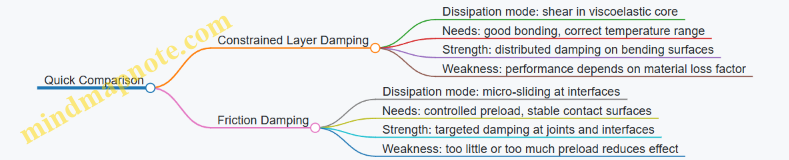
Example Integration into a Damping Plan
For a machine skid supporting a gearbox, you might combine both mechanisms: constrained layer damping on the skid’s underside to reduce panel resonances, and friction damping at a bolted interface where the skid couples to the foundation frame. The constrained layer reduces bending energy in the skid, while friction damping reduces energy that would otherwise feed back through the connection. The combined approach works because each mechanism addresses a different energy path, rather than trying to force one material to solve every problem.
5.2 Damping Material Characterization for Temperature and Frequency Dependence
Damping materials rarely behave like a single, fixed “loss factor.” Their stiffness and loss change with temperature, excitation frequency, and even how the material is mounted. Characterization is the step where you turn that messy reality into usable design inputs for isolation mounts and constrained-layer damping.
Core Concepts for Temperature and Frequency Dependence
Start with the two quantities you will actually use in engineering models: complex stiffness and loss factor. For many damping layers, the material can be treated as viscoelastic, meaning the stress lags strain. In practice, you can represent this with a complex modulus (E^* = E’ + jE''), where (E’) controls stiffness and (E'') controls energy dissipated per cycle.
Temperature shifts the balance between molecular mobility and mechanical response. Frequency changes how much time the material has to rearrange internally during each cycle. The result is that the loss peak moves: at some temperatures the material dissipates strongly at a certain frequency band, and outside that band it looks stiffer and less lossy.
Measurement Strategy That Produces Design-Grade Inputs
A useful characterization plan has three layers: specimen preparation, test matrix, and data reduction.
-
Specimen preparation: Use the same surface preparation and bonding method you will use in the final assembly. A damping layer that is bonded with a thin, compliant adhesive can show a different effective modulus than the damping sheet alone. Keep thickness consistent and record it, because viscoelastic response can be thickness-sensitive.
-
Test matrix: Choose a temperature range that covers expected operating conditions and a frequency range that covers the dominant excitation bands. For rotating machinery, that often means around the running speed harmonics and nearby structural resonances.
-
Data reduction: Convert raw force-displacement or stress-strain data into storage and loss moduli, then into an equivalent loss factor or complex stiffness for the frequency-temperature points you measured.
Mind Map: What You Measure and Why
Practical Testing Details That Prevent Bad Data
Amplitude matters. Many damping polymers show nonlinear behavior at higher strain. Keep strain within the linear viscoelastic regime for characterization, then verify that the operating strain in the mount stays in that regime. If you cannot guarantee that, characterize at multiple strain levels and use the one that matches the expected operating range.
Temperature control matters. Temperature gradients across the specimen can smear the loss peak. Use sufficient equilibration time and ensure the specimen is thermally uniform before starting a frequency sweep.
Boundary conditions matter. A damping layer in a constrained-layer setup experiences shear deformation. If you characterize using a test that imposes a different deformation mode, you may misestimate the effective shear loss. Prefer test geometries that mimic the dominant strain energy in the final application.
Turning Measurements into Engineering Parameters
Once you have (E’(f,T)) and (E''(f,T)), you need a form that your structural model can use.
A common approach is to compute a loss factor \[ \eta(f,T) = \frac{E''(f,T)}{E’(f,T)} \] Then map
- Isolation design: use η to estimate effective damping in the dynamic stiffness of the mount.
- Constrained-layer damping: use η to compute energy dissipation per cycle from shear strain energy in the damping layer.
If your design model expects a single damping value per frequency band, you can integrate η over the band weighted by expected response amplitude. For example, if the structure’s response is strongest between 40–80 Hz, you can compute an amplitude-weighted average loss factor over that band rather than using a single peak value.
Example: Selecting a Damping Layer for a Pump Baseplate
Assume a pump baseplate experiences dominant excitation around 55 Hz at normal operating temperature and may see up to 70 Hz during certain operating points. You test the damping sheet and find:
- At 25°C, η peaks near 90 Hz.
- At 45°C, η peaks near 60 Hz.
- At 60°C, η drops and the peak shifts above 80 Hz.
If the baseplate runs near 45°C, the material is a good match because the loss peak aligns with the excitation band. If the plant routinely reaches 60°C, the same material may underperform because the loss peak moves away from the excitation. The characterization data therefore directly informs whether you choose the material as-is, adjust the operating temperature, or select a formulation with a loss peak closer to the expected frequency band at the expected temperature.
Example: Checking Whether Your Model Uses the Right Temperature
Suppose your structural model uses a constant loss factor η = 0.15. Your characterization shows η = 0.15 at 45°C and 55 Hz, but η = 0.08 at 55°C and 55 Hz. If the mount temperature rises during steady operation, the predicted damping will be too optimistic. The fix is straightforward: use η(f,T) at the mount’s measured or estimated operating temperature, not just the ambient lab temperature.
Quality Checks and Uncertainty Handling
Before you trust the fitted curves, verify repeatability across specimens and confirm that the loss peak location is consistent. Report uncertainty as a band on η rather than a single number. In design, that uncertainty becomes a margin: if the damping layer is near a loss peak, small temperature errors can matter; if it sits on a flatter region of the curve, the design is more forgiving.
Summary of Outputs You Should Have at the End
By the end of characterization, you should have a usable representation of η(f,T) and stiffness (E’(f,T)) for the deformation mode you care about, plus a clear mapping from test conditions to mount operating conditions. That is what turns damping from a hopeful assumption into a controlled design input.
5.3 Constrained Layer Damping Layouts for Plates Beams and Machine Skids
Constrained Layer Damping (CLD) reduces vibration by forcing a viscoelastic layer to shear while it is held between two stiffer layers. The “constrained” part matters: if the viscoelastic layer can freely expand, it mostly squishes instead of shearing, and damping drops. A good layout therefore starts with geometry and load paths, then moves to material pairing, then to installation details that keep the shear strain where you need it.
Core Layout Logic for Plates
A plate CLD strip typically uses a stiff base layer (often steel) plus a viscoelastic layer plus a stiff constraining layer (often another steel sheet). The viscoelastic layer should be thin enough to develop shear strain under bending curvature, but thick enough to avoid premature stiffness dominance. In practice, designers choose a viscoelastic thickness that yields meaningful shear strain at the target frequency band, then verify with a simple bending strain estimate and a frequency response check.
Easy example: A 10 mm steel plate supports a pump motor. If the plate’s first bending mode is around 200 Hz, you place CLD on the region of maximum bending strain for that mode, usually near the plate’s mid-span or near the baseplate corners depending on boundary conditions. You do not cover the entire plate if you can avoid it; you cover the strain hot spots so the added mass and stiffness don’t shift the system in the wrong direction.
Layout Logic for Beams
For beams, the bending strain varies linearly through the thickness and peaks at the surfaces. CLD is most effective when the viscoelastic layer is oriented so that bending curvature produces shear in the viscoelastic layer. A common approach is to bond CLD to the beam’s neutral axis region only if you can guarantee shear transfer; otherwise, place it near the surfaces where bending strain is highest.
Easy example: A steel beam under a conveyor drive has a dominant vibration around 300 Hz. You install CLD on the top flange where the beam experiences tensile strain during that mode. If the beam is bolted at both ends, the mid-span is usually the strain maximum, so the CLD strip runs along the mid-span length rather than stopping short.
Layout Logic for Machine Skids
Machine skids behave like thick beams with multiple support points, and they often excite vibration through baseplate bending plus local plate modes. CLD works best when it targets the skid’s bending strain regions while respecting interfaces to mounts, grout, and piping supports.
Easy example: A skid supports a compressor with four mounting points. The skid shows high response near the spans between mounts. You place CLD strips on the skid surfaces between mounts, not directly under the mount pads where you need predictable stiffness and load transfer. This keeps damping where motion is large while preserving the mount’s mechanical function.
Mind Map: Constrained Layer Damping Layout Decisions
Practical Design Steps That Keep Layouts Honest
- Identify where bending strain is largest. Use measured mode shapes or a validated model to locate strain hot spots. CLD is not a blanket solution; it is a targeted one.
- Choose coverage style. Use strips for beams and skids, patches for plates, and staggered segments if you must avoid mount hardware. Segmenting can reduce stiffness increase while keeping shear strain where it matters.
- Select layer thicknesses as a pair. Viscoelastic thickness and constraining layer stiffness should be chosen together. If the constraining layer is too flexible, the viscoelastic layer can deform without sufficient shear. If it is too stiff, the system may shift modes and reduce the strain energy available for damping.
- Plan for edges and terminations. Sharp edges can concentrate strain and cause early debonding. Tapered terminations or controlled scarfing of the constraining layer helps distribute shear.
- Control bonding quality. CLD performance depends on full-area contact. Voids, uneven adhesive thickness, and contaminated surfaces reduce shear transfer. A simple field check is to verify bondline thickness consistency and inspect for edge lift after curing.
Example: Plate Patch Layout with Strain Targeting
A plate shows maximum bending strain near two corners for a nuisance frequency. You apply two CLD patches centered on those corners, each sized so the patch edges fall outside the high-strain region. You keep a gap around bolt patterns and cable trays so you don’t create unintended stiff bridges. After installation, you compare the vibration amplitude at the nuisance frequency before and after; if the reduction is small, the usual causes are wrong strain targeting, poor bond coverage, or constraining layer stiffness mismatch.
Example: Beam Strip Layout with Termination Control
A beam’s dominant mode has maximum strain at mid-span. You bond a CLD strip along the mid-span length, with terminations that are mechanically supported and bonded smoothly. If the strip ends are left unsupported, the constraining layer can peel under cyclic shear, so you either extend the strip slightly into lower-strain regions or add local backing plates where access allows.
Example: Skid CLD Between Mount Points
For a skid with four mounts, you place CLD strips on the skid surfaces between mounts, leaving a clear zone under each mount pad. This avoids interfering with mount stiffness and keeps damping focused on the bending spans. You also avoid covering areas where piping clamps or guards require rigid attachment, since those attachments can create stiff paths that bypass the CLD.
Installation Checklist for Layout Success
- Surface preparation matches the adhesive requirements.
- Bondline thickness is consistent across the patch or strip.
- Constraining layer is continuous where shear transfer is needed.
- Terminations are smooth and mechanically stable.
- CLD does not compromise mount interfaces, grout behavior, or critical clearances.
When these steps are followed, CLD layouts become predictable: you can explain why the damping works in terms of shear strain distribution, and you can troubleshoot failures without guessing.
5.4 Damping Effectiveness Estimation Using Modal Strain Energy Methods
When you add damping to a structure, you want to know two things: how much it reduces vibration at the frequencies you care about, and whether the damping is actually “used” by the modes that get excited. Modal strain energy methods answer both by connecting damping to where the structure stores strain energy.
Core Idea from Strain Energy to Damping
For a lightly damped structure, each mode behaves like a single-degree-of-freedom oscillator with an effective modal damping ratio, \(\zeta_n\). Modal strain energy methods estimate \(\zeta_n\) from the distribution of strain energy in the damped and undamped parts.
A practical starting point is the energy balance form:
- The modal strain energy \(U_n\) represents how much elastic energy the mode stores.
- The dissipated energy per cycle is proportional to the damping mechanism’s loss factor and the strain energy located in the damping layer or damping region.
If the damping mechanism is modeled with a complex stiffness (or an equivalent loss factor), the modal loss factor \(\eta_n\) can be approximated as an energy-weighted average of local loss factors.
Step 1: Identify Modes and Their Strain Energy Distribution
- Compute or measure the mode shapes \(\phi_n\) for the structure with the damping layer included geometrically (even if material damping is not yet applied).
- For each mode, compute strain energy density across elements or regions.
In finite element terms, you can obtain strain energy per element from the modal strain field. In a simplified hand approach, you can treat the structure as a set of regions with representative strain levels, then weight by those levels.
Easy example: a machine baseplate with a constrained layer damping (CLD) patch. The patch sits on top of the plate. In the mode where the baseplate bends strongly, the patch experiences high shear strain; in a mode dominated by rigid-body motion, the patch sees little strain and contributes little damping.
Step 2: Define Local Loss Factors for the Damping Mechanism
Local loss factor \(\eta_i\) depends on the damping material and how it is loaded (shear for CLD, tension/compression for viscoelastic layers, frictional slip for friction damping). You typically use material characterization data to assign \(\eta\) to the damping region.
For CLD, the relevant strain is often the shear strain in the viscoelastic layer. That means you should not weight by total bending energy alone; you weight by the shear energy in the layer.
Easy example: if your CLD patch is thin and the shear strain is concentrated near the interface, a thick region of the baseplate with moderate bending might contribute less damping than a smaller patch area with high shear.
Step 3: Compute Modal Loss Factor Using Energy Weighting
A common energy-weighted estimate is:
\[\eta_n \approx \frac{\sum_i \eta_i,U_{n,i}}{\sum_i U_{n,i}}\]
where \(U_{n,i}\) is the strain energy associated with region \(i\) for mode \(n\). The modal damping ratio follows from \(\zeta_n \approx \eta_n/2\) for small damping.
Key nuance: \(U_{n,i}\) must correspond to the deformation that drives dissipation. If you use the wrong energy measure, you can predict strong damping where the damping layer is actually idle.
Step 4: Convert Modal Damping to Expected Response Reduction
Once you have \(\zeta_n\), you can estimate how the resonance peak changes. For a single mode under harmonic excitation, the displacement magnitude near resonance scales roughly with \(1/\zeta_n\) (exact scaling depends on how you define the response and whether you are on resonance or off-resonance).
Easy example: suppose mode 3 has \(\zeta_3\) increase from 0.5% to 2%. The resonance peak magnitude can drop by about a factor of 4, assuming excitation and modal participation stay similar. In practice, excitation may shift slightly because damping can change effective stiffness, but the energy method captures the dominant effect.
Step 5: Validate with Modal Assurance and Measurement Checks
Energy methods assume the mode shapes used for weighting are representative. Validate by checking:
- Modal assurance between predicted and measured shapes.
- Frequency response coherence around the modes you plan to damp.
- Consistency of damping effectiveness across multiple excitation conditions.
Easy example: if you measure FRFs before and after adding damping and see reduced peak heights at the targeted modes but not others, that pattern should match the strain energy distribution you used in the weighting.
Mind Map: Modal Strain Energy Damping Effectiveness
Worked Example: CLD Patch on a Baseplate
Assume a baseplate mode \(n\) where the total strain energy is split into two regions: the CLD patch region (1) and the rest of the plate (2). Let the shear-driven strain energy in the CLD layer be \(U_{n,1}=30\) units, and the remaining strain energy in the plate be \(U_{n,2}=70\) units. Use a loss factor for the viscoelastic layer of \(\eta_1=0.25\). For the rest of the plate, assume structural damping is small and take \(\eta_2=0.02\).
Then:
\[\eta_n \approx \frac{0.25\cdot 30 + 0.02\cdot 70}{30+70} = \frac{7.5+1.4}{100}=0.089\]
So \(\zeta_n \approx 0.089/2 = 0.0445\), or about 4.5% modal damping for that mode. If the same mode is excited by the machine at its operating speed band, you should expect a noticeable reduction in resonance amplitude at that mode, while modes with low shear strain in the patch will show smaller \(\eta_n\).
Practical Design Takeaways
- Weight by the strain that actually dissipates energy, not by whatever strain is easiest to compute.
- Use mode-by-mode results to decide whether your damping placement matches the excitation spectrum.
- Treat validation as part of the method: if the measured peak reductions don’t align with the predicted strain energy participation, the model’s energy mapping or loss factors need adjustment.
5.5 Installation Practices Including Surface Preparation Bonding and Quality Verification
A damping or isolation system is only as good as what happens at the interface. The goal of this section is simple: make the contact surfaces predictable, make the bond line behave as designed, and prove the result with checks that catch common failure modes before they become maintenance work.
Surface Preparation Principles
Start by treating surface preparation as part of the design, not a housekeeping step. Most bond failures come from contamination, unevenness, or chemistry mismatch.
- Remove contaminants completely: oil, cutting fluids, dust, paint overspray, and rust all interfere with adhesion. Use the same cleaning method across the whole job so the bond line is consistent.
- Achieve the right roughness: smooth surfaces reduce mechanical interlock; overly rough surfaces can create voids and thick adhesive pockets. Target a uniform profile that matches the adhesive or damping layer requirements.
- Control moisture and temperature: many adhesives are sensitive to humidity and cure conditions. Store materials as specified, and avoid installing when surfaces are wet or condensing.
- Plan for edge effects: damping layers often start failing at edges where stresses concentrate. Clean and prepare edges and corners, not just the center.
Mind Map: Surface Preparation Workflow
Bonding Practices for Damping and Isolation Components
Bonding is where theory meets reality. A bond line that is too thick, too thin, or uneven changes stiffness and damping, which changes the system’s frequency response.
- Mix and apply adhesives correctly: follow the specified ratio and mixing time. Incomplete mixing creates soft spots that look fine at first and then drift.
- Use controlled bond-line thickness: spacers, not guesswork, help keep thickness consistent. If the design assumes a thin layer, thick patches can shift resonances.
- Apply with full wet-out: the adhesive should contact the entire prepared surface without dry islands. For larger areas, work in sections so the adhesive doesn’t skin over.
- Clamp or press with the right pressure: too little pressure leaves voids; too much can squeeze adhesive out and starve the bond.
- Prevent movement during cure: vibration from nearby work, foot traffic, or handling can create micro-gaps. Treat cure as a no-surprises period.
- Seal where needed: some systems require edge sealing to prevent moisture ingress and to keep the bond line from drying unevenly.
Example: Constrained Layer Damping on a Baseplate
A baseplate gets a viscoelastic layer bonded to the underside of a steel plate. The installer cleans the steel to remove rust and oil, then abrades to a uniform profile. Adhesive is mixed to the specified ratio, spread to a controlled thickness using a notched tool, and the assembly is clamped evenly. After cure, the installer checks for adhesive squeeze-out patterns and verifies that edges are fully wetted. If a corner shows a dry line, that area is corrected before the system is put into service.
Quality Verification That Actually Catches Problems
Quality verification should be layered: quick checks to prevent obvious mistakes, and targeted checks to confirm the bond behaves as intended.
Visual and Dimensional Checks
- Bond-line continuity: look for gaps, dry edges, and bubbles.
- Thickness consistency: compare multiple points against the expected range.
- Surface cleanliness at installation: confirm no new contamination occurred between prep and bonding.
Cure and Handling Verification
- Cure time and conditions: record start and end times, temperature, and humidity if required.
- Mechanical handling rules: verify the component wasn’t moved or loaded before the adhesive reached handling strength.
Performance-Oriented Checks
For vibration control systems, the best verification is a measurement that reflects the interface.
- Baseline comparison: if possible, measure before and after installation using the same sensor locations and mounting method.
- Frequency response sanity checks: confirm that expected resonance shifts or attenuation bands appear where the design predicts.
- Repeatability: re-measure at a few points to ensure the result isn’t a one-off.
Mind Map: Quality Verification Layers
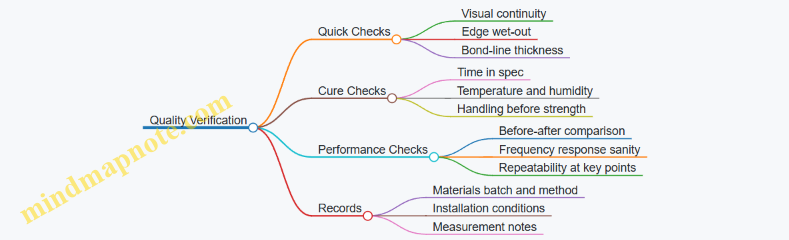
Common Failure Modes and How Installation Prevents Them
- Contamination under the bond: solved by consistent cleaning and avoiding re-contamination before bonding.
- Uneven bond thickness: solved by controlled application tools and spacers.
- Edge debonding: solved by thorough edge preparation and edge sealing where specified.
- Premature loading: solved by cure-time discipline and clear handling rules.
- Inconsistent cure due to environment: solved by installing within specified conditions and recording them.
Practical Checklist for Installers
- Confirm surface is clean, dry, and uniformly prepared.
- Verify adhesive mixing ratio and pot life.
- Apply adhesive to achieve designed bond-line thickness.
- Clamp evenly and prevent movement during cure.
- Record cure conditions and times.
- Perform visual and dimensional checks.
- Run before-after measurements where feasible and document results.
A well-installed damping or isolation interface should look boring: uniform bond lines, no loose edges, and measurements that match the expected behavior. That’s the point—boring is reliable.
6. Vibration Isolation Systems for Machinery Mounting
6.1 Single Degree of Freedom Isolation Theory for Translational and Rotational Modes
Single degree of freedom (SDOF) isolation treats a machine on a mount as one dominant motion mode. That assumption is often good enough for early design and for checking whether an isolation system will reduce transmitted vibration in the frequency band that matters.
Core Model and Motion Coordinates
Start with a rigid machine supported by an elastic element. Choose a coordinate that matches the dominant motion:
- Translational SDOF: the machine moves vertically (or horizontally) relative to the base.
- Rotational SDOF: the machine rocks about a pivot due to uneven stiffness or moment excitation.
In both cases, the mount provides an effective stiffness \(k\) and damping \(c\). The machine provides an effective mass \(m\) for translation or an effective moment of inertia \(I\) for rotation.
Translational SDOF Equation and Isolation Metrics
For base-excited vibration, a common form is:
\[ m\ddot{x} + c\dot{x} + kx = -m\ddot{y} \]
where \(x\) is machine displacement and \(y\) is base displacement. Define the natural frequency and damping ratio:
- \(\omega_n = \sqrt{k/m}\)
- \(\zeta = c/(2m\omega_n)\)
Let \(r = \omega/\omega_n\) be the frequency ratio. The key engineering quantity is the transmissibility: the ratio of transmitted motion (or force) to the excitation.
A practical takeaway: isolation improves when the excitation frequency is above the natural frequency. In plain terms, the mount “stays out of the way” when the machine is forced to move faster than the spring can follow.
Rotational SDOF and Effective Stiffness
For rocking, replace translation variables with rotational equivalents:
- \(I\) replaces \(m\)
- \(\theta\) replaces \(x\)
- effective rotational stiffness \(k_\theta\) replaces \(k\)
Then:
- \(\omega_{n,\theta} = \sqrt{k_\theta/I}\)
- \(\zeta_\theta = c_\theta/(2I\omega_{n,\theta})\)
How do you get \(k_\theta\)? If the machine sits on multiple mounts, the rotational stiffness depends on the geometry and the mount stiffness distribution. A simple check is to compute the moment needed for a small rotation and divide by the resulting rotation angle.
Damping Ratio Effects Without Hand-Waving
Damping reduces peak response near resonance, but it also changes high-frequency transmissibility. With very low damping, the system can “ring” at \(r \approx 1\). With higher damping, the resonance peak flattens, yet the system may transmit more at high \(r\). That tradeoff is why designers often target a damping ratio that balances resonance control and isolation performance.
A useful rule of thumb for design checks is to evaluate transmissibility at:
- \(r \approx 1\) for resonance risk
- the operating frequency ratio \(r_{op}\) for isolation benefit
Mind Map: Translational and Rotational SDOF Isolation
Example: Translational Isolation Check for a Pump Mount
Assume a pump effective mass \(m = 120,\text{kg}\). Choose an effective mount stiffness \(k = 60,000,\text{N/m}\). Then:
- \(\omega_n = \sqrt{60,000/120} = \sqrt{500} \approx 22.36,\text{rad/s}\)
- \(f_n = \omega_n/(2\pi) \approx 3.56,\text{Hz}\)
If the dominant excitation is at \(f = 20,\text{Hz}\), then \(r = 20/3.56 \approx 5.6\). That is well into the isolation region. Next, pick a damping ratio \(\zeta\) based on mount type and measured or expected damping. The design check is to ensure the resonance peak is not excited during start-up or low-speed operation, and that the operating point sits at sufficiently high \(r\).
Example: Rotational Rocking Mode from Uneven Mount Stiffness
Consider a rectangular base supported by four mounts. If two opposite mounts are stiffer (or more compressed) than the other two, the system can rock under a moment excitation from piping forces or imbalance.
A practical workflow:
- Estimate \(k\) for each mount from static deflection under load.
- Convert mount stiffnesses into an effective rotational stiffness \(k_\theta\) using the base geometry.
- Compute \(\omega_{n,\theta}\) and compare it to the excitation frequency.
Even if translation isolation looks excellent, a rocking natural frequency closer to operating excitation can dominate the transmitted vibration at the machine casing.
Practical Design Implications for SDOF
- Treat translation and rotation as separate checks. A mount set can isolate one motion well and amplify the other.
- Use SDOF to set early targets for \(f_n\) and \(\zeta\), not to replace full multi-degree-of-freedom modeling.
- Confirm that the assumed effective parameters match installation reality: mount stiffness depends on preload, temperature, and how the baseplate is supported.
When these checks agree, the isolation system behaves predictably: resonance stays controlled, and operating vibration is reduced rather than rerouted into a different motion mode.
6.2 Multi Degree of Freedom Isolation Including Rigid Body Modes and Coupling
Single-degree-of-freedom isolation treats the machine like a mass on one spring. Real mounts rarely behave so politely. Multi degree of freedom (MDOF) isolation accounts for translation in multiple directions and rotation about multiple axes, plus the fact that the machine, baseplate, and foundation are connected through real, imperfect stiffness and damping. The payoff is better prediction of what actually moves, where it moves, and how that motion turns into noise and vibration at the receiver.
Core Concepts of MDOF Isolation
An MDOF mount system can be represented as a mass matrix for the machine/base assembly, coupled to stiffness and damping matrices from the isolators and interfaces. The key practical idea is that each isolator set contributes stiffness in more than one direction, and the coupling terms mean motion in one direction can excite motion in another.
Rigid body modes are the low-frequency motions where the machine/base assembly moves as a whole rather than deforming internally. Typical rigid body modes include:
- Vertical translation (heave)
- Horizontal translation (surge and sway)
- Rocking rotations (pitch and roll)
At frequencies near these modes, the isolators may not provide much attenuation because the system is still “following” the excitation. Above them, isolation improves, but coupling can create unexpected peaks.
Modeling the Coupled System Without Getting Lost
Start with a coordinate set that matches how the machine is supported: three translations and three rotations are common. Then build stiffness and damping contributions from isolators and any compliant interfaces (like grout layers, baseplate flexure, or gasketed connections).
A practical workflow:
- Choose reference points for the machine mass center and for the mount attachment geometry.
- Assemble stiffness terms from isolator directional stiffness and geometry lever arms.
- Include damping in a way that matches the isolator behavior (often proportional or frequency-dependent approximations are used, but the model must reproduce measured transmissibility trends).
- Solve for the coupled natural modes and mode shapes.
Mode shapes matter because they tell you which direction dominates at each resonance. A “vertical” resonance may include significant rocking, which changes how piping and enclosures experience motion.
Rigid Body Modes and Why They Matter
Rigid body modes are not just a modeling detail; they control operational comfort and mechanical safety. For example, if the heave mode is tuned too high, the machine can transmit more vibration into the foundation at the running speed harmonics. If rocking modes are too low, the baseplate can rotate enough to stress piping joints or loosen flexible couplings.
A concrete example: a pump on four elastomer mounts. Even if the mounts are selected for vertical compliance, the mount layout creates lateral stiffness and rotational stiffness. If the pump has a strong horizontal force component from misalignment or hydraulic forces, lateral excitation can couple into rocking, which then couples back into vertical motion through the mount geometry.
Coupling Paths That Create Surprises
Coupling comes from three common sources:
- Geometric coupling: rotations create effective vertical displacement at mount corners.
- Stiffness coupling: isolators and interfaces provide off-diagonal stiffness terms.
- Boundary coupling: the foundation and surrounding structure are not infinitely rigid, so the “fixed” base actually moves.
To keep coupling from becoming a black box, check the mode shapes and the participation factors. If a mode you thought was mostly vertical shows strong rotation, treat it as a coupled problem in the design checks.
Design Checks That Stay Practical
For each operational excitation frequency, evaluate transmissibility in the directions that matter to the receiver. Typical receiver metrics include:
- Vibration at the foundation or nearby equipment mounts
- Relative motion between machine and piping
- Enclosure panel excitation through baseplate motion
Then perform these checks:
- Resonance avoidance: ensure operational harmonics do not land near coupled rigid body modes.
- Coupled peak control: if a coupled mode creates a peak in a sensitive direction, adjust mount stiffness distribution or add rotational restraint.
- Travel and stability: confirm that the isolators do not bottom out during startup, shutdown, or transient loads.
Mind Map: MDOF Isolation Reasoning
Example: Four-Mount Pump with Lateral Force Component
Assume the pump experiences a lateral periodic force due to a rotating imbalance. Even if the isolators are chosen primarily for vertical compliance, the four-mount layout produces a rocking mode that can be excited by lateral forcing. The rocking mode can then create vertical motion at the mount corners, increasing foundation vibration.
A systematic fix is to:
- Rebalance mount stiffness distribution so rocking natural frequencies move away from the dominant excitation harmonics.
- Add a controlled lateral restraint element that increases lateral stiffness without overly raising vertical stiffness.
- Verify with coupled mode shapes that the heave response at the running speed decreases, not just the lateral response.
The “gotcha” to watch: increasing lateral stiffness can shift coupling so that a different mode becomes the dominant peak. That’s why the coupled mode check is non-negotiable.
Example: Coupled Isolation with Piping Constraints
Consider a machine with flexible hoses connected to rigid piping. If the piping constraint effectively adds stiffness to one side of the baseplate, it changes the boundary conditions and can split a rigid body mode into two closely spaced coupled modes. The result is a broader frequency range of higher transmissibility.
A practical mitigation is to model the piping constraint as an added directional stiffness and damping at the connection points, then re-check the coupled modes. In design terms, you’re not just isolating the machine; you’re isolating the machine plus its constraint network.
6.3 Isolation System Tuning for Operational Speed Ranges and Load Variations
Isolation systems behave differently across speed and load because the machine’s excitation spectrum and the isolator’s effective stiffness and damping both change. Tuning is the process of aligning the isolator’s dynamic behavior with the machine’s operating points so that transmissibility stays low where it matters.
Foundational Tuning Targets
Start with two measurable goals.
-
Keep the isolator’s resonance away from dominant excitation bands. For a simple mount, the key frequency is the isolator’s natural frequency. If the machine’s forcing frequency approaches that natural frequency, vibration transmission rises.
-
Maintain adequate damping and travel margin across load. Elastomer and spring systems shift their natural frequency with load, and damping effectiveness can vary with temperature, aging, and mounting conditions.
A practical example: a pump runs at 900–1500 rpm, with strong harmonics at 2× and 3× speed. If the isolator natural frequency sits near 30–50 Hz, then 900 rpm (15 Hz) might be acceptable, but 1500 rpm (25 Hz) and 3× (75 Hz) could land closer to resonance or anti-resonance regions. Tuning aims to keep the worst-case forcing frequencies in the “safe” side of the transmissibility curve.
Stepwise Tuning Workflow
Step 1: Map operational speed to forcing frequencies. Convert rpm to Hz (Hz = rpm/60). Then list the likely excitation orders: 1× for imbalance, 2× for misalignment or belt/gear effects, and higher orders when relevant. Include any known transient events like start-up coast-down.
Step 2: Estimate isolator natural frequency under minimum and maximum load. For mounts, natural frequency scales with effective stiffness and supported mass. If the isolator stiffness increases with load, the natural frequency rises; if stiffness decreases, it falls. Use manufacturer curves when available, or derive stiffness from static deflection tests at representative loads.
Step 3: Choose a tuning strategy that fits the isolator type.
- Elastomer mounts: tuning often means selecting durometer and geometry so that natural frequency stays in a band that avoids the excitation orders across load.
- Springs with snubbers or dampers: tuning includes selecting spring rate and setting damping so that the peak transmissibility is controlled.
Step 4: Validate with transmissibility checks. Use a frequency response view: transmissibility is low when forcing frequency is well above the natural frequency for typical passive isolation. But if the system has multiple modes (baseplate, piping, enclosure), you must check the whole structure, not just the isolator.
Mind Map: Tuning Inputs to Design Decisions
Handling Load Variation Systematically
Load variation shifts the isolator’s natural frequency and can change damping behavior. Treat load variation as a set of operating cases rather than a single “average” condition.
Example: a compressor skid supports 60% load during one production mode and 100% load during another. If static deflection at 60% load is 6 mm and at 100% load is 4 mm, stiffness increases with load. Natural frequency rises accordingly. If your forcing at 2× speed is near the natural frequency at 60% load, it might move away at 100% load, or the reverse could happen depending on the direction of stiffness change. The safe approach is to compute transmissibility for both cases and ensure the worst-case peak is acceptable.
Practical Tuning Rules That Actually Help
-
Tune to the worst-case forcing frequency, not the average. If 3× speed is the dominant contributor at high load, use that case even if 1× dominates at low load.
-
Use a “margin band” around the isolator natural frequency. Instead of aiming for a single natural frequency, define a range where transmissibility remains low for all operating speeds. This accounts for uncertainty in stiffness, mounting, and model assumptions.
-
Check travel and bottoming during start-up. Isolation can reduce steady-state vibration but still allow large deflections during coast-down. Ensure the isolator’s maximum deflection under dynamic and static loads stays below the safe limit.
-
Confirm that structural modes don’t undo the isolator. If the baseplate has a mode near an excitation order, the isolator may not deliver the expected benefit. In that case, adjust baseplate stiffness, add damping, or re-tune mount stiffness.
Example: Selecting Mount Stiffness for a Pump
A pump operates from 1000 to 1800 rpm. Dominant orders are 1× and 2×. Forcing frequencies are 16.7–30 Hz (1×) and 33.3–60 Hz (2×).
You test mounts at two loads and find natural frequency shifts from 18 Hz at light load to 24 Hz at full load. That places 1× forcing near the natural frequency at the light-load case, which risks a transmissibility peak. You re-select mounts to target natural frequency 12–16 Hz across the load range. Now 1× forcing is well above natural frequency for both load cases, and 2× forcing is even further above, reducing transmission. Finally, you verify travel during start-up so the isolators do not bottom out when the machine passes through the 12–16 Hz region.
Verification Through Operational Checks
After tuning, verify at multiple speeds that cover the risky orders. A good field check is to measure vibration at the machine casing and at the support structure while sweeping speed in steps. If the casing-to-structure ratio improves where predicted and worsens where predicted, your tuning logic is doing its job. If not, the likely culprit is an unmodeled structural mode or a load-dependent stiffness assumption that doesn’t match reality.
6.4 Dynamic Stiffness and Damping Modeling for Elastomer Springs and Air Springs
Dynamic stiffness and damping turn “a spring is a spring” into something you can actually design with. For elastomer mounts and air springs, the key is that stiffness and damping depend on frequency, deformation mode, and operating conditions. The goal of modeling is not perfection; it is a usable representation of the mount’s force response so you can predict transmissibility and resonance behavior across the machine’s speed range.
Foundational Concepts for Dynamic Modeling
Start with the force–displacement relationship in the frequency domain. For small motions, many mount behaviors can be approximated as linear time-invariant, even if the material is nonlinear in a strict sense. In practice, you model the mount as a complex stiffness:
- Dynamic stiffness: \(k(\omega) = k’(\omega) + j k''(\omega)\)
- Equivalent damping: often expressed via a loss factor or an equivalent viscous damping \(c_{eq}(\omega)\)
For a single degree of freedom (SDOF) isolation system, the mount force is commonly written as \(F(\omega)=k(\omega)X(\omega)\). The imaginary part captures energy loss per cycle, which is what damping really is: energy that does not come back.
Elastomer Springs Modeling Path
Elastomer mounts typically show frequency-dependent stiffness and damping because the rubber’s shear modulus changes with excitation rate and temperature. A practical modeling workflow is:
- Choose deformation mode: shear-dominant mounts behave differently from compression-dominant mounts.
- Define the reference geometry: effective shear area, rubber thickness, and any bonded interfaces.
- Represent stiffness as a function of frequency: use measured or manufacturer data for \(k’(\omega)\).
- Represent losses: use a loss factor \(\eta(\omega)\) or equivalent damping \(c_{eq}(\omega)\).
- Include mounting constraints: bolt torque, baseplate compliance, and any slip interfaces can change the effective dynamic behavior.
A common engineering link between loss factor and complex stiffness is \(\eta(\omega) = k''(\omega)/k’(\omega)\). If you prefer viscous damping, for SDOF you can use \(c_{eq}(\omega)=\eta(\omega),k’(\omega)/\omega\). The units work out cleanly, and the model stays consistent with the complex stiffness view.
Air Springs Modeling Path
Air springs behave like a spring plus a damping mechanism from gas compression and flow restrictions. The dynamic stiffness depends on whether the air spring is treated as:
- Adiabatic (fast compression, little heat exchange)
- Isothermal (slow compression, more heat exchange)
- Intermediate with effective polytropic exponent \(n\)
In addition, real air springs include orifice or restriction damping. That restriction creates a frequency-dependent loss because pressure equalization cannot keep up at higher frequencies.
A practical modeling approach is to represent the air spring as a complex stiffness with two contributions:
- Gas compression stiffness \(k_{gas}(\omega)\)
- Restriction-related damping captured through \(k''(\omega)\) or an equivalent \(c_{eq}(\omega)\)
You can often fit \(k’(\omega)\) and \(k''(\omega)\) from test data at the relevant operating pressure and load.
Mind Map: Dynamic Stiffness and Damping Modeling
Example: Elastomer Mount Dynamic Stiffness Fit
Assume you have a shear elastomer mount supporting a machine with an estimated mount natural frequency near 18 Hz. You measure or obtain data for \(k’(\omega)\) and \(\eta(\omega)\) at 10, 18, and 30 Hz.
- At 18 Hz: \(k’(\omega)=120,\text{kN/m}\)
- At 18 Hz: \(\eta(\omega)=0.12\)
Compute equivalent viscous damping:
\(\omega=2\pi\cdot 18\approx 113,\text{rad/s}\)
\(c_{eq}(\omega)=\eta,k’/\omega \approx 0.12\cdot 120000/113 \approx 127,\text{N·s/m}\)
Now you can estimate transmissibility for harmonic excitation. If the machine’s forcing frequency is near the mount resonance, the damping level strongly affects peak response. If you used a constant damping value instead of \(\eta(\omega)\), you would likely mis-predict the peak height.
Example: Air Spring Dynamic Stiffness with Restriction Effects
Consider an air spring with a nominal static stiffness of 40 kN/m at operating pressure. If you excite it with small harmonic motion, you observe that stiffness increases slightly with frequency while damping grows more noticeably due to restriction flow.
A simple modeling fit might look like:
- \(k’(\omega)\) rises from 40 kN/m at 5 Hz to 55 kN/m at 25 Hz
- \(k''(\omega)\) increases such that \(\eta(\omega)\) goes from 0.05 to 0.14 over the same range
This matters because the resonance shifts upward while the damping also increases. The net effect is not always “better isolation at higher frequency”; it depends on where the machine’s forcing sits relative to the shifted resonance.
Practical Modeling Checks That Prevent Design Surprises
- Phase consistency: damping shows up as phase lag between force and displacement. If your model matches magnitude but not phase, your damping is wrong.
- Load dependence: elastomer stiffness and air spring stiffness both change with preload. Use the operating load, not the empty-mount condition.
- Mode coupling: mounts rarely act as pure SDOF. If the baseplate has flexible modes, the “effective” dynamic stiffness you infer from a simple model can drift.
- Small-motion assumption: if the machine produces larger deflections, the linear complex stiffness model becomes less accurate. In that case, you still can use it, but you must fit it at the actual motion level.
Summary of the Modeling Logic
Elastomer mounts: model complex stiffness from frequency-dependent shear or compression behavior and hysteresis losses, then convert to equivalent damping for SDOF calculations. Air springs: model complex stiffness from gas compression behavior and restriction-related losses, again using operating pressure and load. In both cases, the most reliable path is to fit \(k’(\omega)\) and \(\eta(\omega)\) (or \(k''(\omega)\)) to measured data near the frequencies that matter for the machine’s excitation.
6.5 Practical Design Checks Including Bottoming Travel Limits and Safety Factors
A vibration isolation system is only as good as its worst-case behavior. The “bottoming” check ensures the isolators never run out of travel under real loads, while the safety factor check ensures the design survives uncertainty in stiffness, damping, installation, and operating conditions.
Mind Map: Bottoming and Safety Checks
Step 1: Define the Displacement Budget
Start with the isolator’s static deflection under the maximum supported load. Let the maximum vertical load be \(W_{max}\). For a mount with effective vertical stiffness \(k_{eff}\), the static deflection is:
\[\delta_{static}=\frac{W_{max}}{k_{eff}}\]
Then add dynamic displacement. A practical way is to use the measured or modeled transmissibility region at the operating frequency. If you have a frequency response function, use the peak displacement ratio \(M_d\) (output displacement over static deflection). Then:
\[\delta_{peak}=\delta_{static}\times M_d\]
If you do not have \(M_d\), use a conservative dynamic factor \(C_d\) so that \(\delta_{peak}=\delta_{static}(1+C_d)\). For many industrial mounts, \(C_d\) is often selected from test data or prior similar designs; the key is to justify it with evidence from the same mount family and similar temperature.
Step 2: Determine Available Travel and Clearance
Available travel is the distance from the installed operating position to the first contact surface (bump stop, metal-to-metal limit, or hard stop). Define:
- \(h_{free}\): free height of the isolator
- \(h_{install}\): height after installation and leveling
- \(h_{contact}\): height at which contact occurs
Then available travel is:
\[\delta_{avail}=h_{install}-h_{contact}\]
A common mistake is treating \(\delta_{avail}\) as “the clearance you can see.” In reality, contact can occur earlier due to manufacturing tolerances, baseplate settlement, or uneven grout. Include a small geometric tolerance margin in \(h_{contact}\) or in the final clearance check.
Step 3: Apply a Bottoming Limit with a Clearance Ratio
Use a clearance ratio to keep the system away from contact even under uncertainty. A simple rule is:
\[\delta_{peak} \le (1-\gamma),\delta_{avail}\]
where \(\gamma\) is the clearance margin fraction. For critical machinery mounts, \(\gamma\) is typically chosen larger than for noncritical supports because contact can sharply increase transmitted vibration and stress the mount.
Example: A pump mount has \(\delta_{avail}=6,mm\). The maximum load gives \(\delta_{static}=2.4,mm\). At the operating speed, the displacement ratio is \(M_d=1.35\), so \(\delta_{peak}=3.24,mm\). If you select \(\gamma=0.25\), the allowable peak is \(0.75\times 6=4.5,mm\). Since \(3.24<4.5\), bottoming is not expected.
Now add installation tolerance: suppose stiffness could be 10% lower than assumed, which increases deflection. If \(k_{eff}\) drops by 10%, \(\delta_{static}\) rises by about 11%. The updated \(\delta_{peak}\) becomes \(3.24\times 1.11=3.60,mm\), still below 4.5 mm.
Step 4: Check Start-Up and Shutdown Conditions
Bottoming often happens during transient events when loads or excitation change faster than the control system can respond. Include at least two cases:
- Start-up: when torque and unbalance may be higher and the system passes through resonance.
- Shutdown: when rotational speed decays and the excitation frequency crosses the same region.
For each case, compute \(\delta_{peak}\) using the worst-case excitation amplitude or the highest displacement response from your model. If you only check steady-state, you can miss the peak that occurs while passing through a resonance band.
Step 5: Apply Safety Factors to Stiffness and Load
Safety factors should reflect uncertainty sources, not just “make it bigger.” A systematic approach is to use separate factors:
- Load factor \(F_W\) applied to \(W_{max}\)
- Stiffness factor \(F_k\) applied to \(k_{eff}\) as a reduction (use \(k_{eff}/F_k\))
Then:
\[\delta_{static,design}=\frac{F_W,W_{max}}{k_{eff}/F_k}=\frac{F_W,F_k,W_{max}}{k_{eff}}\]
Pick \(F_W\) to cover variations in operating load, pipe loads, and thermal effects; pick \(F_k\) to cover mount stiffness tolerance and temperature effects. If you have test data for the mount family, base these factors on the observed spread rather than guesswork.
Example: Assume \(F_W=1.15\) and \(F_k=1.10\). Then \(\delta_{static,design}\) increases by \(1.265\) relative to the nominal. If nominal \(\delta_{static}=2.4,mm\), design static becomes \(3.04,mm\). With \(M_d=1.35\), \(\delta_{peak}=4.10,mm\). With \(\delta_{avail}=6,mm\) and \(\gamma=0.25\), allowable is 4.5 mm, so the design still clears the limit.
Step 6: Verify with a Simple Field Check
After installation, verify the static deflection matches the design target within tolerance. Measure the installed height and compute the implied deflection. If the deflection is significantly smaller than expected, the mount may be overcompressed or the load path may be bypassing the isolators. If it is significantly larger, you may have reduced clearance margin and should re-check bottoming.
A final sanity check is to confirm that the isolators are not preloaded into the nonlinear region unintentionally. If the mount is already near its hardening point, the stiffness uncertainty grows and the bottoming risk rises—exactly the situation your clearance ratio was meant to prevent.
7. Active and Semi Active Vibration Mitigation Techniques
7.1 Actuation Options Including Electromagnetic Hydraulic and Piezoelectric Systems
Actuation is the part of a vibration mitigation system that turns an electrical control signal into a mechanical force. In practice, you pick an actuator by matching three things: the force or displacement you need at the structure, the bandwidth you must cover, and the environment you must survive (temperature, dust, oil, and available mounting space). A good selection also considers how the actuator couples to the structure, because the actuator’s “strength” is only useful if it acts where the structure responds.
Core Actuation Requirements
Start with the mechanical target. For vibration control, you usually need either:
- Force actuation at a mounting point to counteract dynamic loads.
- Displacement actuation to impose motion that reduces relative vibration.
Then translate the target into actuator constraints:
- Bandwidth: how fast the force must change to affect the frequencies of interest.
- Stroke: maximum displacement available without bottoming out.
- Force capacity: peak and continuous force under worst-case operating conditions.
- Efficiency and heat: especially for continuous operation.
- Mounting stiffness: the actuator must not “waste” its output in compliance at brackets and interfaces.
A quick sanity check: if your actuator can only deliver force at a point that is nearly a vibration node for the mode you care about, control effort will look like it’s working on paper while doing little in the field.
Electromagnetic Actuation
Electromagnetic actuators convert current to force using a magnetic circuit. They come in common forms such as voice-coil style linear actuators and solenoid-like devices.
How they work mechanically: current produces magnetic attraction or repulsion, moving an armature against a spring or guide. The force is limited by coil current, magnetic saturation, and thermal rise.
Where they fit well:
- Medium force with good controllability.
- Systems where you can mount an actuator directly to a baseplate, enclosure wall, or bracket.
- Applications needing moderate bandwidth.
Practical example: Suppose you want to reduce vibration at a gearbox housing around 200–400 Hz. You mount a linear electromagnetic actuator between the housing and a rigid reference frame. You choose a control law that commands force based on measured acceleration. If the actuator is mounted on a flexible bracket, the bracket can create a local resonance that shifts the effective force-to-acceleration transfer function. The fix is not “more control,” it’s stiffer mounting and a model update using measured frequency response.
Key integration details:
- Use a rigid mechanical interface and avoid soft fasteners.
- Provide thermal management for the coil and a current limit in the drive electronics.
- Ensure the actuator’s electrical dynamics (inductance) don’t bottleneck the control bandwidth.
Hydraulic Electromechanical Actuation
Hydraulic actuation uses a pump and valves to move a piston, producing force through fluid pressure. In vibration control, you typically see electrohydraulic systems where the control signal drives a valve that meters flow.
How they work mechanically: the controller commands valve position, changing flow into or out of a cylinder. Pressure builds and the piston moves, generating force on the structure.
Where they fit well:
- High force requirements.
- Large structures where displacement stroke matters.
- Environments where robust force delivery is more important than compactness.
Practical example: Consider a heavy reciprocating compressor on a foundation where the dominant vibration is at low frequency, say 10–30 Hz. Electromagnetic actuators might struggle with required stroke and force. An electrohydraulic actuator can provide the needed low-frequency authority. The control loop must account for fluid dynamics: delays from valve response and compressibility effects can reduce phase margin. The engineering response is to measure the closed-loop plant dynamics and tune the controller with those real delays in mind, rather than assuming an ideal actuator.
Key integration details:
- Manage fluid temperature and maintain consistent operating pressure.
- Use proper hose routing and avoid introducing air into the hydraulic circuit.
- Design for leakage control and safe fail states.
Piezoelectric Actuation
Piezoelectric actuators generate strain when voltage is applied. They are often used as stacks, rings, or benders, sometimes with mechanical amplification (lever mechanisms) to increase effective stroke.
How they work mechanically: voltage produces electric field in the ceramic, causing expansion or contraction. The actuator’s stiffness is typically high, which is helpful for transferring force into structures.
Where they fit well:
- High bandwidth control at higher frequencies.
- Situations where compact, high-stiffness actuation is valuable.
- Fine force/displacement control with minimal moving mass.
Practical example: You want to reduce panel vibration in an equipment enclosure around 800–1500 Hz. A piezoelectric stack actuator bonded to a panel can apply localized force with minimal added mass. The control signal is a high-voltage drive, and the actuator’s strain-to-force depends strongly on the bonding layer stiffness. If the adhesive layer is too compliant, the actuator may move without effectively loading the panel mode. A practical fix is to select an adhesive system with appropriate modulus and thickness, then verify the actuator’s effective transfer function with a simple frequency sweep.
Key integration details:
- Use a high-voltage amplifier matched to the actuator capacitance.
- Protect against depolarization and mechanical overload.
- Ensure bonding quality and surface preparation for repeatable coupling.
Mind Map: Actuator Selection Logic
Choosing Between Them with One Example Workflow
- Identify the dominant vibration band and whether you need force or displacement authority.
- Estimate required force at the mounting point using a simple transfer path model (machine-to-structure-to-sensor).
- Check stroke and bandwidth feasibility for each actuator type.
- Confirm coupling quality by measuring the actuator’s effect on the structure (a frequency sweep with the actuator driven open-loop is often enough to catch mounting mistakes).
- Only then finalize the control design, because the actuator’s real dynamics determine stability margins.
If you follow that sequence, actuator choice stops being a “hardware preference” and becomes a controlled engineering decision tied to measurable plant behavior.
7.2 Control Strategies for Vibration Reduction Including Feedback and Feedforward
Industrial vibration control is easiest to reason about when you separate two jobs: (1) deciding what the machine is doing right now, and (2) deciding what to do about it before the problem grows. Feedback handles the first job using measured error. Feedforward handles the second job using a reference that predicts the disturbance. In practice, good systems combine both, because measurements are never perfect and predictions are never exact.
Core Control Variables and Error Definitions
Start by defining the controlled quantity. Common choices are vibration velocity at a bearing, base acceleration at a foundation, or sound pressure at a receiver. For each choice, define an error signal that represents “how far from target.” A typical target is a band-limited reduction around dominant orders (for rotating equipment) or around resonance peaks (for structural modes).
A useful mental model: feedback tries to drive error toward zero using what you can measure; feedforward tries to cancel the disturbance using what you can measure or estimate before it excites the structure.
Feedback Control Strategy
Feedback control uses sensors and an actuator to reduce error. The actuator might be an active mount, a shaker, or a variable damping element. The controller computes an actuation command from the current error.
Feedback Loop Structure
A standard loop is:
- Sensor measures vibration signal (y(t)).
- Controller forms error (e(t)=r(t)-y(t)), where (r(t)) is the desired level (often zero in a vibration suppression problem).
- Controller outputs command (u(t)) to the actuator.
- Actuator changes the mechanical impedance or applies force.
Practical Design Choices
- Choose a controller form that matches dynamics. If the plant behaves roughly like a second-order system in the frequency band of interest, a proportional-integral-derivative style controller can work, but many industrial designs use frequency-domain shaping or state-space control to avoid unstable behavior outside the band.
- Limit the control bandwidth. Actuators and mounts have usable frequency ranges. If you command beyond them, you waste effort and can amplify noise.
- Handle sensor noise and delays. A small time delay can turn a stabilizing loop into a destabilizing one. Filtering the sensor signal and using phase-aware controller design prevents “correcting” the wrong phase.
Easy Example
A pump baseplate shows a strong peak at 60 Hz. You place an accelerometer on the base and drive an active mount. With feedback, the controller reduces the measured acceleration at 60 Hz by applying counteracting forces. If the loop is tuned too aggressively, the system may start oscillating at a nearby frequency where phase margin is low—so you tune while watching stability and not just steady-state reduction.
Feedforward Control Strategy
Feedforward uses a disturbance reference to compute the actuator command without waiting for the vibration to appear. For rotating machinery, the disturbance is often tied to shaft speed, gear mesh timing, or bearing load modulation.
Feedforward Loop Structure
A typical feedforward setup:
- A reference signal (x(t)) is obtained from tachometer pulses, encoder angle, or a gearbox mesh sensor.
- A feedforward filter (F(cdot)) maps reference to predicted vibration contribution.
- The actuator command \(u_{ff}(t)=F(x(t))\) cancels the predicted effect.
Practical Design Choices
- Use a reference that is phase-consistent. If the reference timing drifts relative to the actual excitation, cancellation becomes partial and can even increase vibration.
- Model the plant mapping from actuator to measured vibration. A simple approach uses measured frequency response functions to build a filter that approximates inverse dynamics in the target band.
- Include robustness through gain limits. Feedforward can be very effective when the disturbance is repeatable, but it should not demand unrealistic actuator forces.
Easy Example
A compressor has a known 1× order vibration component. You measure shaft angle and build a feedforward filter that generates a periodic actuator force synchronized to the shaft. When the operating speed changes slightly, the periodic timing still tracks, so cancellation remains strong near the order frequency.
Combined Feedback and Feedforward
Combining them is usually the most reliable approach:
- Feedforward cancels the predictable part of the disturbance.
- Feedback corrects the remaining error caused by modeling mismatch, unmeasured disturbances, and parameter drift.
A common structure is: total command \(u(t)=u_{ff}(t)+u_{fb}(t)\). The feedback loop is often tuned more conservatively because feedforward already reduces the dominant component.
Mind Map: Feedback and Feedforward Control
Integrated Example Workflow
- Measure baseline behavior. Identify dominant orders or resonance peaks using time-frequency analysis.
- Select sensors and actuators. Ensure the sensor location is sensitive to the controlled vibration and the actuator can influence the relevant mode.
- Build feedforward first if reference exists. Use tachometer/angle or mesh timing to create a synchronized cancellation command, with conservative amplitude limits.
- Add feedback for residual error. Tune the feedback loop in the same band, watching stability margins and actuator saturation.
- Validate with before-after metrics. Compare RMS vibration and peak levels in the target band, and confirm that off-band behavior does not worsen.
Common Failure Modes and How to Avoid Them
- Phase mismatch in feedforward: cancellation weakens; fix by verifying timing alignment and reference scaling.
- Over-aggressive feedback gains: oscillations appear; reduce gain, add filtering, and re-check delay effects.
- Actuator saturation: the controller “runs out of authority”; enforce command limits and retune.
- Unmodeled coupling paths: vibration moves to another location; measure multiple points and control the most relevant one, or use multi-channel control when necessary.
7.3 Sensor Placement for Observability and Robust Control Performance
Good control starts with a simple question: what can the controller “see” well enough to act? Sensor placement is the practical answer to that question. In industrial vibration mitigation, the goal is observability across the relevant modes and operating conditions, while keeping measurements stable, repeatable, and not overly sensitive to mounting artifacts.
Foundational Observability Concepts
Observability means the measured signals contain enough information to infer the system’s important states or at least the quantities that matter for control. For vibration systems, those quantities are often modal contributions (e.g., baseplate bending) and coupling paths (e.g., machine-to-floor transmission through mounts and piping).
A useful rule of thumb: if you can’t measure the dominant motion that causes the disturbance, you’ll end up controlling a symptom. For example, placing an accelerometer only on a rigid enclosure panel may miss the baseplate mode that actually drives the panel through structural coupling.
Identify What Must Be Measured
Start from the excitation and the control objective.
- If the objective is to reduce radiated noise from a casing, measure structural motion that drives panel vibration and, when feasible, include a microphone or proxy for acoustic output.
- If the objective is to reduce transmitted vibration to the floor, measure at the isolation interface and at the dominant structural path.
- If the objective is to protect a sensitive component, measure near the component’s mounting and include at least one reference that captures the excitation.
A practical workflow is to use a quick operational modal analysis or frequency response sweep to identify peaks and coherence between candidate locations. Coherence helps you avoid sensors that “move” but don’t move together with the controlled effect.
Placement Strategy for Robustness
Robust control performance depends on measurement quality under changing conditions: load, temperature, belt tension, oil pressure, and minor installation differences.
- Measure where motion is large and repeatable. Mount sensors on surfaces with stable stiffness and good contact. A sensor on a thin sheet metal bracket can pick up local bending that changes with tightening torque.
- Cover the dominant modes with minimal sensors. Use one sensor to capture the main excitation and one or two to capture the controlled response. For multi-axis systems, prioritize directions aligned with the expected motion of mounts and baseplate.
- Avoid measuring only at nodes. A node can look quiet at one operating point and become active at another due to boundary condition changes. If you see a consistent null across multiple runs, that location may be safe; otherwise, treat it as risky.
- Separate sensing from actuation influence when possible. If an actuator’s magnetic field or mechanical reaction contaminates the sensor, the controller may “chase its own tail.” Use physical separation and wiring discipline, and verify with an actuator-off baseline.
- Use reference sensors to improve estimation. A tachometer or speed reference is valuable for rotating machinery because it anchors the phase relationship between excitation and response.
Sensor Types and What They Measure
- Accelerometers are effective for modal motion and isolation performance. Choose mounting that preserves high-frequency response without slipping.
- Velocity sensors can be useful for lower-frequency control where displacement trends matter.
- Displacement sensors (e.g., proximity probes) are helpful when you need direct control of relative motion across an isolation interface.
- Force or current sensors can serve as auxiliary measurements for actuator effort and to detect saturation.
Concrete Placement Examples
Example: Pump on Elastomer Mounts
- Sensor A: accelerometer on the pump baseplate near the center of mass to capture the dominant bending mode.
- Sensor B: accelerometer on the floor or foundation at the mount footprint to capture transmission.
- Optional Sensor C: tachometer for phase reference to align control with blade-pass or shaft harmonics.
If Sensor B is placed on a nearby pipe support instead of the foundation, the controller may reduce pipe motion while leaving mount-to-foundation transmission largely unchanged.
Example: Gearbox with Enclosure Panels
- Sensor A: accelerometer on the gearbox housing to capture excitation.
- Sensor B: accelerometer on the enclosure panel at a location with high panel participation (identified via a quick tap test).
- Optional Sensor C: microphone near the receiver side if the control objective includes airborne noise.
If Sensor B is placed near a panel edge that behaves like a boundary condition, the measurement can become overly sensitive to fastener preload changes.
Mind Map: Sensor Placement for Observability
Practical Validation Steps
After installation, verify that the sensor signals are informative rather than merely noisy.
- Coherence check: confirm that the sensor used for control has strong coherence with the response you intend to reduce over the target frequency band.
- Phase consistency: for rotating equipment, confirm that phase relationships remain stable across short operating windows.
- Mounting repeatability: loosen and retighten once (if safe) or compare two mounting orientations to ensure the dominant spectral peaks remain in place.
- Actuator contamination test: run the system with the actuator disabled, then enabled at low level, and confirm that sensor changes align with expected mechanical effects rather than electrical or magnetic coupling.
When these checks pass, the controller has a measurement that is both observant and stubbornly consistent—exactly what robust control needs.
7.4 Semi Active Control Using Variable Damping and Magnetorheological Devices
Semi-active vibration control changes the damping force in real time while keeping the system passive in the energy sense: it can dissipate energy, but it does not inject net energy like a fully active actuator. That constraint is exactly why semi-active approaches are popular in industrial settings where reliability and fail-safe behavior matter.
Core Idea of Variable Damping
A typical mount or support can be modeled as a mass–spring–damper. The spring stores energy; the damper removes it. If you can vary the damping coefficient based on measured motion, you can reduce resonance peaks and limit how much energy the structure keeps “recycling.”
A practical rule of thumb: use higher damping when the structure is moving fast (large velocity), and lower damping when motion is small so you don’t over-constrain the system. The control target is not “zero motion at all times,” but reduced vibration at the frequencies that matter for noise and fatigue.
Simple Example
Consider a pump on a flexible base. At a certain operating speed, the baseplate has a strong mode around 30 Hz. If you increase damping during the high-velocity portion of each cycle, the resonance peak drops. If you keep damping high all the time, you may shift the effective dynamics and increase transmitted forces at other frequencies. Variable damping lets you trade off these effects.
Magnetorheological Devices as Damping Actuators
Magnetorheological (MR) dampers change their apparent viscosity using a magnetic field. Inside the damper, a fluid with suspended particles becomes more resistant to flow when magnetized. The result is a controllable damping force that responds quickly to electrical current.
Key practical details:
- Force capability is finite. The damper has a maximum controllable force, so control logic must respect saturation.
- Response has dynamics. The magnetic field changes quickly, but not infinitely; control should avoid demanding unrealistically fast switching.
- Temperature matters. Viscosity and fluid behavior vary with temperature, so the same current may not produce the same damping at all times.
Example: MR Damper on a Machine Skid
A machine skid is mounted on four supports. Each support includes an MR damper in parallel with a spring element. Sensors measure vertical acceleration at the skid and optionally displacement at one corner. The controller computes a desired damping level and commands each damper. If one corner shows higher motion due to uneven loading, the controller can apply different damping commands per support, improving overall balance.
Control Logic That Works in Real Hardware
Semi-active control typically uses a measured signal such as velocity, acceleration, or a filtered estimate of modal velocity. The controller then selects a damping state or a target damping coefficient.
Skyhook Damping Concept in Plain Terms
A common approach is “skyhook” damping, which aims to emulate a damper connected to a fixed reference. In practice, the controller chooses damping proportional to the product of measured velocity and a reference sign, so the damper dissipates energy effectively during motion.
A workable implementation uses a rule like:
- If the measured velocity indicates the structure is moving in a direction that would benefit from dissipation, request higher damping.
- If motion is small or the phase relationship is unfavorable, request lower damping.
This avoids trying to predict the future; it reacts to what the structure is doing now.
Energy-Based Switching for MR Dampers
Because MR dampers can be commanded among discrete damping levels, switching logic is often used. A robust pattern is to compare the current “damping power” against a threshold and choose the damping level that reduces the estimated energy growth.
A practical workflow:
- Measure velocity (or acceleration filtered to velocity).
- Estimate instantaneous kinetic energy proxy, proportional to velocity squared.
- For each candidate damping level, estimate the expected change in energy over a short time window.
- Select the level that yields the most negative energy change.
This keeps the controller grounded in what the damper can actually do.
System Integration and Sensor Placement
Semi-active control is only as good as the observability of the motion you care about.
- Measure near the vibration-critical location. For noise radiation, that might be a panel or baseplate corner; for fatigue, it might be a support interface.
- Avoid sensors that saturate. Industrial vibration can be large during start-up and trips; choose sensor ranges that survive those conditions.
- Filter carefully. Velocity estimates from acceleration require filtering; too much filtering adds delay, too little amplifies noise.
Example: Choosing a Measurement Point
If a baseplate mode dominates at 30 Hz, place the accelerometer where that mode has strong motion. If you place it where a different mode dominates, the controller may increase damping at the wrong times, reducing one resonance while leaving another untouched.
Practical Design Checks
Before commissioning, verify these constraints:
- Saturation behavior: confirm what happens when the controller requests damping beyond the MR damper’s limits.
- Fail-safe mode: define a default damping command for sensor faults or power loss.
- Command rate: ensure the control update rate matches the damper’s response and avoids excessive switching.
Example: Start-Up and Trip Handling
During start-up, the system may sweep through resonances. A controller that assumes steady-state operation can overreact. A simple fix is to use a different damping strategy during speed ramping, such as limiting the maximum damping command until velocity exceeds a threshold.
Mind Map: Semi Active Control with Variable Damping and MR Devices
Mini Case Example: Reducing a Resonance Peak
A compressor exhibits a strong vibration peak at a single frequency band that correlates with radiated noise from a nearby panel. The retrofit uses MR dampers on the compressor mounts. The controller increases damping when the measured velocity at the baseplate interface rises, reducing the resonance peak. After tuning, the vibration amplitude at the target band drops while the overall transmitted force remains within acceptable limits, because the damping is not held at maximum outside the high-motion portions of the cycle.
7.5 Implementation Considerations Including Power Amplifiers Wiring and System Integration
A vibration control system is only as good as its wiring, grounding, and signal routing. The control algorithm can be perfect on paper and still produce disappointing results if the sensors saturate, the amplifier clips, or the actuator current returns through the wrong path.
Power Amplifier Selection and Operating Limits
Start with the actuator’s required force or displacement and translate that into electrical demands. Check three amplifier limits: maximum output current, maximum output voltage, and current at the lowest load impedance you expect. For example, a voice-coil actuator may need high current near resonance; if the amplifier current limit is reached, the controller will behave like it is “working” while actually losing authority.
Then verify bandwidth. If your controller targets frequencies up to 200 Hz, the amplifier should have stable gain and phase well beyond that range so the loop doesn’t inherit unexpected phase lag. A simple sanity check is to compare the amplifier’s specified small-signal bandwidth with the highest control frequency and ensure there is margin.
Finally, plan for thermal behavior. Mount the amplifier where airflow matches the manufacturer’s assumptions. A common field issue is that the amplifier runs fine during commissioning and then derates after an hour, causing the loop gain to drop.
Wiring Topology Signal Integrity and Grounding
Treat the wiring like part of the control system. Use a star grounding approach where possible: sensors and controller grounds meet at a single reference point, and power returns do not share that reference path.
Separate wiring into three physical groups:
- Sensor cables: low-level, shielded, routed away from actuator power leads.
- Actuator power cables: higher current, routed with proper shielding and strain relief.
- Communication and timing lines: kept distinct from both sensor and actuator wiring.
Shielding helps only if the shield is terminated correctly. Terminate shields at the controller end for sensor cables when that matches the system’s grounding strategy, and use consistent termination for actuator cables to avoid ground loops.
A practical example: if a piezo actuator is driven by a high-voltage amplifier, keep its HV cable away from accelerometer leads. Even when shields are present, capacitive coupling can inject noise into the measurement and cause the controller to “chase” the noise.
Actuator Drive Compatibility and Protection
Actuators have electrical and mechanical limits. Implement protection so the amplifier doesn’t become the safety system. Use current limiting, voltage limiting, and where appropriate, software saturation handling.
Mechanical protection matters because isolation mounts can bottom out or slip. Add travel monitoring if the actuator stroke is close to the allowable range. If you cannot add sensors, enforce conservative command limits in software and confirm with a no-load test.
Also consider polarity. A sign error between actuator command and measured response can turn damping into excitation. During commissioning, run a low-amplitude test and verify that the measured vibration decreases at the target frequency.
System Integration from Controller to Plant
Integration is easiest when you define interfaces clearly: signal names, units, scaling factors, and timing assumptions. Establish a single sample rate for the controller and ensure the analog-to-digital and digital-to-analog paths match that rate.
Use consistent scaling so the controller output corresponds to actuator command units. For instance, if the controller outputs “volts” but the amplifier expects “current,” you need a known transfer relationship or a current-mode driver.
Timing and latency are often overlooked. If the control loop includes filtering, anti-aliasing, and actuator driver delays, the effective phase margin changes. Measure closed-loop behavior with the same configuration used in commissioning, not with a simplified bench setup.
Commissioning Workflow and Acceptance Checks
Commissioning should proceed in layers: measurement verification, open-loop actuator response, then closed-loop stabilization.
- Sensor verification: confirm channel polarity, check noise floor, and ensure no clipping.
- Open-loop actuator response: apply small commands and measure transfer functions to confirm the actuator couples to the intended mode.
- Closed-loop engagement: start with conservative gains and gradually increase while monitoring amplifier output and vibration reduction.
- Acceptance checks: verify reduction at the target frequencies and confirm no new peaks appear in nearby bands.
A concrete example: for a gearbox mount, you might target 1× and 2× rotational orders. During acceptance, check both orders and also inspect harmonics that can shift when the mount stiffness changes due to actuator loading.
Mind Map: Implementation Considerations
Example: Wiring a Sensor and Actuator Pair
A typical setup uses an accelerometer on the machine housing and a force actuator on the baseplate. Route the accelerometer cable in a dedicated tray away from the actuator cable. Terminate the accelerometer shield at the controller end to match the controller’s ground reference. For the actuator cable, use a shielded twisted pair for the drive conductors and ensure the shield connects at the amplifier end as specified.
During commissioning, apply a small sinusoidal command at the target frequency and confirm that the measured acceleration decreases when the controller is enabled. If it increases, swap actuator polarity in software and repeat the sign check before adjusting gains.
Example: Preventing Amplifier Clipping During Startup
Many systems experience higher vibration during warm-up or load changes. Implement a startup ramp for actuator commands so the amplifier does not immediately hit current limits. Monitor amplifier output current during the first minutes of operation; if you see frequent saturation, reduce initial gain or increase the command ramp time. This keeps the controller in its linear operating region long enough to establish stable damping.
8. Damping and Isolation for Rotating Machinery and Reciprocating Equipment
8.1 Gearbox and Bearing Excitation Modeling for Noise and Vibration Control
Gearboxes and bearings are repeatable troublemakers: they generate periodic forces, those forces excite structural modes, and the resulting motion radiates noise. Modeling turns that chain into something you can compute and design against.
Core Modeling Goal
Build a frequency-domain map from machine speed to excitation forces, then to predicted vibration at mounting points and radiated noise drivers. The practical output is a set of transfer functions and force spectra you can use for isolation tuning, damping selection, and enclosure checks.
Excitation Sources You Must Separate
- Gear mesh forces: periodic normal and tangential components tied to gear mesh frequency and its harmonics.
- Bearing element pass frequencies: forces from rolling element geometry and load distribution, producing characteristic lines.
- Eccentricity and misalignment: often shows up as lower-order harmonics and sidebands around rotational orders.
- Lubrication and internal clearances: can broaden lines or add additional components, especially under load changes.
A useful habit is to model each source with its own line spectrum and then superpose them at the structure.
Gear Mesh Frequency and Harmonics
For a gear pair, the mesh frequency is
- f_mesh = z_p · f_rot where z_p is the number of pinion teeth and f_rot is shaft rotational frequency.
Gear mesh forces are not pure sinusoids; they include amplitude modulation from load sharing and tooth stiffness variation. In practice, represent mesh excitation as:
- a main line at f_mesh
- additional lines at n · f_mesh
- sidebands around these lines if you observe modulation in measurements.
Example: A gearbox with pinion teeth z_p = 20 running at 1800 rpm gives f_rot = 30 Hz and f_mesh = 600 Hz. If your structure has a mounting resonance near 600–1200 Hz, you expect strong vibration unless isolation shifts or damping reduces response.
Bearing Pass Frequencies
Bearing geometry maps shaft speed to characteristic frequencies. A common modeling approach uses element pass frequencies and their harmonics:
- BPFO: ball pass frequency outer race
- BPFI: ball pass frequency inner race
- FTF: fundamental train frequency
- BSF: ball spin frequency
Even if you do not model every detail of defect physics, you can still use these lines to predict where bearing-related excitation will land in the spectrum.
Example: If BPFI falls near a baseplate bending mode, you will see peaks that track speed. That is a strong indicator that bearing excitation is the dominant driver rather than gear mesh.
Force-to-Structure Mapping
Once you have excitation lines, convert them into forces at the gearbox housing and then into predicted vibration.
- Define force locations: typically bearing seats, gearbox housing mounts, and sometimes internal supports.
- Choose a structural model:
- Lumped model for quick isolation studies (mass-spring-damper at mounts).
- Modal model for detailed response (mode shapes and modal damping).
- Use frequency response functions:
- compute H(ω) from excitation force at a location to response at a measurement point.
- Account for coupling:
- gearbox-to-baseplate coupling through bolts and interfaces
- housing-to-enclosure coupling through panel radiation paths
Example: If your FRF from housing force to baseplate velocity shows a resonance at 950 Hz, and your gear mesh harmonics place energy at 900 and 1000 Hz, you should expect a broadened response peak rather than a single narrow line.
Damping and Amplitude Scaling
Amplitude scaling is where models become believable. Use measured data to set effective damping and force magnitudes.
- Start with manufacturer or test-based estimates for damping ratios.
- Adjust force amplitudes so predicted line levels match measured spectra at a reference speed.
- Keep damping consistent across speeds unless you have evidence of strong load-dependent changes.
A simple check is coherence: if measured response is coherent with the excitation order lines, your line-based model is doing its job.
Mind Map: Excitation Modeling Workflow
Integrated Example: From Speed to Predicted Mount Vibration
Assume you measure vibration at a baseplate accelerometer while sweeping speed.
- Compute f_rot from rpm.
- Build a gear mesh spectrum with lines at n · f_mesh.
- Add bearing lines at BPFO/BPFI and their harmonics.
- Superpose forces and apply the FRF from housing force to baseplate response.
- Compare predicted peaks with measured peaks that track speed.
If a measured peak appears at a frequency that is not near any gear mesh or bearing pass line, treat it as a structural or installation-related excitation (for example, a resonance being excited by a broadband component) and refine the model accordingly.
Practical Modeling Pitfalls to Avoid
- Mixing coordinate frames: ensure force directions and response directions are consistent.
- Ignoring interface stiffness changes: bolt preload and mounting condition can shift FRFs.
- Overfitting amplitudes: adjust force magnitudes at one operating point, then verify across the speed range.
- Assuming a single dominant source: gear mesh and bearing lines often overlap; superposition matters.
When the model reproduces both the line locations (order tracking) and the relative peak magnitudes (amplitude scaling), you can use it confidently to guide isolation tuning and damping placement for the gearbox system.
8.2 Balancing Alignment and Mounting Effects on Vibration Levels
Balancing and alignment are not separate topics from mounting; they are the reason mounting behaves the way it does. A “good” mount can still produce high vibration if the machine is forced into misalignment, or if imbalance loads excite the mount in a frequency range where its stiffness and damping are least helpful.
Foundational Concepts That Link the Three
Imbalance Creates a Forcing Function
Imbalance in rotating parts generates a periodic force at the running speed (and often harmonics). That force acts on the machine baseplate, then travels through mounts into the foundation and surrounding structure. If the mount is tuned to reduce motion at one frequency but the imbalance energy lands elsewhere, the vibration level rises.
Easy example: A pump running at 1800 rpm (30 Hz) with a small rotor imbalance produces a strong 30 Hz component. If the mount’s vertical natural frequency is near 25–35 Hz, the baseplate motion can amplify instead of attenuate.
Misalignment Changes Load Paths and Contact Conditions
Misalignment increases axial and lateral forces in bearings, couplings, and seals. Those forces can be mostly static (causing higher bearing load) or dynamic (causing additional excitation at shaft speed and twice shaft speed). The mount then sees not only imbalance forces but also alignment-induced forces that may vary with load and temperature.
Easy example: A slightly offset coupling can create a cyclic bending moment on the shaft. Even if the rotor is well balanced, the mount experiences extra cyclic loading because the machine is effectively “pushed” off its intended operating geometry.
Mounting Determines How Forces Become Motion
Mounts convert forces into displacements through stiffness and damping. The same imbalance force produces different vibration amplitudes depending on mount stiffness directionality (vertical vs horizontal), preload, and how the baseplate is constrained.
Easy example: Two identical elastomer mounts under a baseplate can behave differently if one installation leaves a gap under the baseplate (soft contact) while the other fully seats the baseplate (stiffer contact). The vibration response changes even though the hardware is the same.
Balancing Practices That Prevent Mount Overexcitation
- Balance the rotating assembly before final mounting. If you balance while the machine is already mounted, the mount can mask or distort the measurement by adding compliance.
- Use the correct balance quality for the operating speed range. Balance grade that looks fine at a single speed may be inadequate across a speed sweep.
- Check for imbalance introduced by installation. Coupling halves, belt sheaves, and fan blades can add imbalance if they are not matched or if fasteners loosen.
Practical example: After replacing a coupling spacer, a motor that previously ran smoothly starts showing a strong 1× component. Re-checking balance at the coupling assembly level often reveals a small mass mismatch.
Alignment Practices That Reduce Unwanted Excitation
- Align using the final operating condition. Aligning cold and then running hot can change shaft positions through thermal growth.
- Control angular and parallel offsets separately. Many alignment tools report a single number, but the bearing and coupling response depends on both.
- Verify alignment after tightening and after re-torquing. Tightening can pull the machine into a different position, especially on baseplates with multiple adjustment points.
Practical example: A technician aligns a gearbox to a motor, then tightens anchor bolts. The vibration drops briefly, then returns after a day. A common cause is baseplate movement during bolt torque settling, which changes alignment.
Mounting Effects That Amplify or Calm the System
Stiffness Directionality and Baseplate Contact
Mounts often have different stiffness in different directions. If the baseplate is not evenly supported, the effective stiffness becomes uneven, creating rocking modes.
Easy example: If only two mounts carry most of the load, the baseplate rocks. That rocking can show up as higher vibration at 1× and 2× even when the rotor balance is unchanged.
Preload and Gap Management
Preload affects how quickly mounts engage and how much motion occurs before contact constraints take over.
Easy example: A mount system with unintended gaps can behave like a “soft-then-stiff” spring. During startup, the system may be soft, then suddenly stiff after contact, producing a noticeable transient vibration signature.
Anchor Bolt and Grout Boundary Conditions
Foundation coupling depends on whether the baseplate is fully grouted, partially grouted, or left with voids. Voids create local flexibility and can shift resonances.
Easy example: Two identical machines on similar foundations show different vibration peaks because one baseplate has a grout void near a mount, lowering local stiffness.
Integrated Workflow for Balancing, Alignment, and Mounting
- Measure baseline vibration at operating speed with mounts installed but before final alignment tweaks.
- Confirm imbalance symptoms by checking whether 1× dominates and whether phase relationships are consistent.
- Perform alignment with the machine at operating temperature if feasible, then re-check after tightening.
- Inspect mount loading by verifying even contact, preload, and absence of gaps.
- Re-measure and compare the dominant components and their amplitudes after each change.
This order matters because alignment changes bearing and coupling forces, while mounting changes how those forces become motion. If you change both at once, you lose the ability to attribute the improvement.
Mind Map: Balancing Alignment and Mounting Effects
Example: Diagnosing a 1× Peak After a Mount Replacement
A compressor shows a higher 1× vibration peak after replacing mounts. The technician suspects imbalance, but the rotor was not disturbed.
- Step 1: Check whether the 1× phase is consistent with the original rotor imbalance signature. If phase shifts, the excitation path likely changed.
- Step 2: Inspect baseplate contact. Uneven seating can create rocking that increases 1× amplitude.
- Step 3: Re-check alignment at operating temperature. Mount replacement can alter baseplate height slightly, changing coupling geometry.
- Step 4: Confirm preload and absence of gaps. A soft-then-stiff engagement during startup can increase the measured peak.
After correcting uneven seating and re-aligning, the 1× component drops while the mount replacement remains in place, confirming that the mount altered the load path rather than the rotor imbalance alone.
8.3 Reciprocating Engine and Compressor Vibration Mitigation Using Mounting and Damping
Reciprocating engines and compressors generate vibration because rotating crank mechanisms convert steady rotation into periodic acceleration. The result is a repeating force on the frame at harmonics of crank speed, plus additional components from piston slap, valve impacts, and flow-induced pulsations. Mounting and damping work best when they treat the machine as a force source with a frequency-dependent transmission path, not as a single “vibration level.”
Foundational Model of What You Are Controlling
Start with a simple mental model: the machine applies dynamic forces to its baseplate, the baseplate and foundation form a structural system with resonances, and the mounting elements provide stiffness and damping that shape how much force reaches the building. For reciprocating equipment, the key is that the dominant excitation frequencies often sit near or between structural modes, so small changes in mounting stiffness can move the system from “mostly isolated” to “mostly amplified.”
A practical workflow is:
- Identify excitation orders (crank-related harmonics) from operating speed.
- Identify structural natural frequencies of the machine support system.
- Choose mounting stiffness and damping so isolation is effective at the excitation frequencies while avoiding resonance overlap.
- Add damping where it reduces peak response without making the system too soft or unstable.
Mounting Strategy for Reciprocating Loads
Mounting design has two competing goals: reduce transmitted force and keep the machine stable under static weight and dynamic rocking. Reciprocating machines often have significant overturning moments, so you cannot rely only on vertical compliance.
Step 1: Determine the load components. Treat the machine as having vertical force and moment. If the baseplate is wide, rocking modes can be prominent. A quick check is to compare baseplate width to mounting spacing; wide spacing with uneven stiffness increases rocking sensitivity.
Step 2: Select mounting stiffness by frequency placement. For isolation, you generally want the mounting system’s natural frequency below the lowest significant excitation order, but not so low that the system becomes compliant and increases motion at higher harmonics. A common engineering compromise is to target the mounting system natural frequency at roughly one-third to one-fifth of the lowest dominant excitation frequency, then verify with measured frequency response.
Step 3: Use damping to control resonance peaks. Elastomer mounts provide some damping, but reciprocating systems often benefit from additional damping elements or constrained-layer treatments on the baseplate to reduce sharp peaks at structural modes.
Easy example. A compressor runs at 600 rpm (10 Hz). If the first strong harmonic is around 20 Hz and a structural mode of the support system is near 18–22 Hz, a too-stiff mount may place the system resonance right on the excitation. Switching to a softer mount shifts the support natural frequency downward, reducing force transmission at 20 Hz, but you must confirm that rocking and higher harmonics do not become worse.
Damping Approaches That Actually Help
Damping is not just “more is better.” Excess damping can reduce isolation effectiveness by increasing dynamic force transfer, especially when the damping is concentrated in the wrong direction.
1. Constrained-layer damping on the baseplate. Apply viscoelastic layers to baseplate regions that experience bending during operation. The goal is to reduce modal strain energy in the baseplate modes that couple into the foundation.
2. Damped mounting elements. Use mounts with controlled damping characteristics so the system has a predictable loss factor. This matters because reciprocating excitation is narrowband around orders, and you want damping to flatten peaks rather than create new ones.
3. Friction damping where motion is controlled. If you can design a controlled slip interface (for example, between a baseplate and a structural adapter), friction can dissipate energy during small relative motions. The key is repeatability: uncontrolled slip can loosen fasteners and change behavior over time.
Easy example. A reciprocating compressor shows a sharp transmitted-force peak at a specific frequency. Adding constrained-layer damping to the baseplate reduces the peak by lowering the baseplate’s bending response, while leaving the mounting stiffness unchanged. The transmitted-force curve becomes smoother, and the overall vibration at the foundation drops even if the machine motion at resonance is not eliminated.
Mounting Layout Details That Prevent Surprises
Reciprocating machines are sensitive to asymmetry. Even if the mounts have the right stiffness on paper, real installations can create unintended coupling.
- Leveling and preload: Uneven preload changes effective stiffness and can introduce tilt. Use consistent leveling procedures and verify mount compression.
- Mount spacing and symmetry: Symmetric layouts reduce rocking coupling. If you must use an asymmetric layout, compensate with stiffness matching and check rocking modes.
- Baseplate rigidity: A flexible baseplate can shift modal behavior into the excitation band. Reinforce or treat the baseplate if modal peaks align with crank harmonics.
- Piping and cable connections: Rigid piping can bypass isolation. Use flexible connections and ensure supports do not “hard-bridge” the machine to the building.
Verification Using Frequency Response and Operational Checks
After installation, verify with a measurement plan that targets both motion and transmitted response.
Minimum practical checks:
- Measure machine vibration at the baseplate and at the foundation or nearby structural element.
- Run at multiple speeds to separate excitation orders from structural resonances.
- Compare transmissibility trends: you want reduced response at excitation orders and no new peaks introduced by the mounting.
Easy example. If you test at 500 rpm and 600 rpm, the excitation orders shift proportionally. If the peak stays fixed in frequency, it is likely a structural mode. If the peak follows the excitation order, it is likely excitation-driven amplification, indicating the mounting stiffness is not positioned correctly.
Mind Map: Reciprocating Engine and Compressor Mounting and Damping
Integrated Example Plan for a Real Retrofit
- Gather operating speed and identify dominant excitation orders.
- Measure current vibration at the machine baseplate and foundation to locate peaks.
- Choose mount stiffness to move the support natural frequency away from the dominant excitation band.
- Add constrained-layer damping to baseplate regions that show high bending response.
- Recheck piping and support paths to ensure isolation is not bypassed.
- Validate with multi-speed measurements and confirm that peak response is reduced at the excitation orders without creating new amplified bands.
8.4 Coupled System Effects Between Machine Skids Piping and Supports
Machine skids rarely act alone. The skid, its mounting system, the piping network, and the surrounding supports form one mechanical system with shared stiffness, shared damping, and shared resonances. When you treat only the skid or only the piping, you often fix the symptom and leave the coupling path intact.
Foundational Coupling Concepts
Start with three practical ideas.
-
Shared dynamic compliance: If the skid baseplate flexes, the piping sees that motion through hangers, clamps, and flexible joints. The piping then feeds back forces into the skid through those same attachment points.
-
Multiple excitation sources: Rotating machinery creates periodic forces; pressure pulsations create additional excitation in the fluid-structure system; thermal expansion adds slow but real displacement that changes boundary conditions.
-
Mode shape compatibility: Coupling is strongest when the skid and piping have compatible mode shapes at the same frequency. A “stiff” skid can still couple strongly if it has a bending mode near a piping resonance.
A useful mental model is a two-mass system: the skid behaves like one mass with frequency-dependent stiffness, while the piping-and-support network behaves like another. The “springs” are the attachments and the “dampers” are material damping plus friction in joints and supports.
How Coupling Happens in Real Installations
Coupling typically occurs through these mechanisms.
- Hanger and clamp stiffness: Rigid clamps transmit bending moments; soft hangers reduce force transfer but may increase relative motion and stress at flexible joints.
- Rigid pipe runs and short spans: Short, stiff segments act like levers, injecting forces into the skid at attachment points.
- Baseplate boundary conditions: Grout quality, anchor bolt preload, and contact area determine how “fixed” the skid really is. A partially bonded baseplate can behave like a springy support, shifting resonances.
- Flexible joints and bellows: These reduce force transfer only in the directions they are designed for. Misalignment or constrained travel can turn a “flexible” element into a rigid link.
- Support interaction: If the piping supports are connected to the same structural members that carry the skid, the structure becomes a common path for both systems.
Systematic Workflow for Identifying the Dominant Coupling Path
-
Define the attachment map: List every connection between skid and piping: nozzle loads, flange connections, rigid clamps, hanger locations, and any flexible elements. Note which attachments are intended to be load-bearing versus motion-accommodating.
-
Measure or estimate frequency content: Use operational measurements when possible. Even a basic spectrum helps: look for peaks in skid vibration and compare them to piping-related peaks or acoustic indicators.
-
Check boundary condition realism: Verify whether the skid is truly isolated from the building or if it is effectively tied in through piping supports, electrical conduits, or structural brackets.
-
Perform a coupling-focused model: A full finite element model is not always necessary, but you need at least a frequency-dependent representation of skid compliance and piping compliance. Include the attachment stiffness and damping at hanger and clamp points.
-
Validate with targeted tests: Use operational modal analysis or frequency response checks to confirm that the coupled system has the predicted mode shapes and that the dominant forces occur at the expected attachments.
Practical Design and Best-Practice Moves
-
Separate “force paths” from “motion paths”: Use flexible joints to accommodate motion while ensuring that load-bearing supports carry steady loads. If both are mixed in the same attachment, coupling becomes harder to control.
-
Tune attachment stiffness intentionally: If a hanger is too stiff, it injects piping bending into the skid. If it is too soft, it increases relative motion and can excite local piping modes. The goal is not “soft everywhere,” but “soft where it matters.”
-
Avoid accidental rigid bridges: A rigid bracket that ties the piping support to the skid can bypass intended isolation. Treat these bridges like unplanned springs.
-
Respect travel and alignment: Flexible elements must have room to move. A bellows that is constrained by nearby steel will behave like a stiff coupler and create high nozzle loads.
-
Consider thermal effects on coupling: Thermal expansion changes hanger geometry and can shift the effective stiffness of the piping support system, altering coupling at operating temperature.
Mind Map: Coupled System Effects Between Machine Skids Piping and Supports
Example: Pump Skid with Suction Piping and Hanger-Induced Coupling
A pump skid shows a strong vibration peak at a frequency that matches a piping bending resonance. The suction line is clamped to the skid at two locations and supported by hangers that connect to the same structural beam carrying the skid.
What the coupling analysis reveals: The skid baseplate has a bending mode near the piping resonance. The rigid clamps transmit bending moments into the skid, while the shared structural beam provides a common path that reinforces the coupled mode.
What changes it:
- Replace one rigid clamp with a motion-accommodating support that allows relative displacement while still controlling steady loads.
- Adjust hanger stiffness so the piping resonance shifts away from the skid peak.
- Add a small isolation gap or redesign the bracket so the piping support does not rigidly bridge into the skid structure.
What to verify: After changes, the nozzle load spectrum should show reduced energy at the coupled resonance frequency, and the skid vibration peak should drop without creating a new peak at a nearby frequency.
Example: Flexible Joint Constrained by Piping Layout
A bellows expansion joint is installed to reduce thermal forces, but nearby piping guides limit its axial travel. During warm-up, the bellows becomes effectively rigid, increasing force transfer into the skid.
Coupling mechanism: The constrained bellows turns a motion path into a force path, raising the effective stiffness between piping and skid.
Fix: Rework guide locations and confirm travel clearance at operating temperature. Then re-check nozzle loads during start-up and steady operation.
Key Takeaway
Coupling is usually not mysterious. It is the predictable result of attachment stiffness, shared structural paths, and mode shape alignment. When you map connections, compare frequency content, and control which elements carry force versus motion, the skid and piping stop fighting each other and start behaving like a coordinated system.
8.5 Case Based Design Examples for Typical Industrial Machine Types
Mind Map: Case Based Design Examples
Case Study: Centrifugal Pump on Baseplate
Start with what the pump actually excites: the dominant forcing is usually bearing-related and shaft-speed harmonics, transmitted into the baseplate and then into the floor. A practical workflow is to measure accelerations on the baseplate and at the floor at the same frequency bands, then compute transmissibility. If the floor shows strong peaks at the same frequencies as the baseplate, isolation is the first lever.
A common design outcome is to target the isolation system so its natural frequency sits below the lowest significant operating frequency, but not so low that the static deflection becomes excessive. For example, if the pump runs at 1500 rpm (25 Hz) and you see a baseplate resonance around 18 Hz, you can tune the mount system to place the isolation resonance around 10–14 Hz. That reduces transmitted vibration at 25 Hz and above.
Next, add structural damping where strain energy concentrates. On a pump baseplate, that often means constrained-layer damping on the baseplate regions near the mount locations and near the pump feet. A simple check is to compare baseplate response before and after damping: if the resonance peaks flatten without shifting too much, you improved damping rather than just changing stiffness.
Finally, treat airborne noise with enclosure discipline. Even a well-isolated pump can “sound loud” if the enclosure has leaky panels or poorly sealed cable penetrations. In practice, you verify by measuring sound pressure near the enclosure surface and then repeating after sealing the obvious gaps.
Case Study: Reciprocating Compressor on Skid
Reciprocating machines bring a different problem: excitation is broader-band and includes strong harmonics from piston motion and valve dynamics. Isolation still matters, but tuning must respect the fact that multiple frequency components will hit the structure.
A systematic approach is to identify the frequency bands with the highest vibration energy using time-frequency analysis, then compare those bands to the isolation transmissibility curve. If the compressor has a prominent harmonic at, say, 60 Hz and the isolation resonance is near 55–65 Hz, you will amplify rather than reduce. The fix is usually to retune mounts or change the effective stiffness by altering the mount layout, not just swapping to “softer” elastomers.
Because reciprocating systems often excite the skid and nearby piping, piping supports must be treated as part of the isolation system. A practical detail is to use consistent support stiffness and avoid hard clamps that create rigid shortcuts. You can confirm improvement by measuring at the pipe near the support and comparing coherence between compressor acceleration and pipe acceleration before and after the support changes.
Structural damping helps with the skid’s bending modes. Apply damping to the skid panels or stiffeners that show high strain energy in the measured modal shapes. The goal is to reduce peak amplitudes across several harmonics, not to chase one “magic” resonance.
Case Study: Gearbox and Motor on Common Frame
Gearboxes often produce noise through gear mesh forces and through how those forces excite frame modes. The key is to separate what is happening at the gearbox from what is happening at the frame.
Measure accelerations on the gearbox housing and on the frame at multiple points, then compute coherence. High coherence at gear-mesh harmonics indicates direct transmission into the frame. If the frame radiates strongly, enclosure and damping are effective; if the frame response is weak but the receiver is still loud, airborne leakage or duct paths may dominate.
For integrated control, start with damping on the frame members that carry the gearbox load. Constrained-layer damping on the frame rails can reduce frame vibration without changing alignment. Then address acoustic isolation by ensuring the gearbox enclosure panels are not mechanically shorted to the building through rigid brackets.
A practical acceptance metric is reduction in receiver vibration velocity at the dominant harmonics and reduction in sound pressure level at the receiver location after the changes. Use the same measurement geometry and operating point to avoid “false wins.”
Case Study: Fan and Duct System with Enclosure
Fans create both tonal noise and broadband flow noise. Here, the “machine” is only half the story; the duct system can act like a loudspeaker.
Begin by identifying whether the receiver is dominated by direct airborne leakage from the fan enclosure or by duct radiation. A quick method is to compare sound pressure near the enclosure surface with sound pressure at the duct outlet while keeping the fan speed constant. If duct outlet levels track with fan speed harmonics, duct radiation is likely dominant.
Then apply acoustic isolation where it matters: duct liners, silencers, and flexible connections that prevent vibration from becoming structureborne excitation. Flexible connections should be designed for the expected static loads and should not introduce misalignment that causes rubbing or additional noise.
Structural damping can be used on duct supports and nearby brackets to reduce vibration transfer into the building. Verify by measuring bracket acceleration and checking whether duct-to-structure transmissibility drops in the key bands.
Case Study: Conveyor Drive with Impact-Like Excitation
Conveyor drives often include intermittent loading, belt tension changes, and occasional impact-like events from product transfer. These events can excite low-frequency structural modes and create audible “thumps” even when steady-state vibration looks moderate.
Use time-domain event detection to capture when the excitation occurs, then correlate those times with acceleration and sound pressure. If the dominant events align with specific structural resonances, isolation tuning must consider transient response, not only steady-state transmissibility.
A practical mitigation is to combine isolation for the drive unit with damping for the supporting structure. Isolation reduces how much the drive shakes the frame; damping reduces how long the frame rings after each event. For transient control, damping effectiveness is judged by decay rate after an event and by reduction in peak acceleration during the event window.
Finally, check mechanical interfaces. Loose fasteners, worn couplings, and belt mis-tracking can create repeatable impacts. Correcting those issues often reduces both vibration and noise more reliably than adding more isolation stiffness changes.
Integrated Design Checklist for All Cases
Define the dominant path first, then tune isolation to avoid resonance overlap, add damping where strain energy concentrates, and treat piping or duct interfaces as part of the same system. Verify with before-after measurements at the same operating points, using transmissibility and coherence to confirm that the changes reduced the intended coupling rather than shifting it elsewhere.
9. Structural Modification and Foundation Engineering
9.1 Foundation Design Principles Including Mass Stiffness and Energy Dissipation
A machine foundation is not just “a big block.” It is a tuned system that decides how much vibration stays with the machine and how much travels into the building. The core levers are mass, stiffness, and energy dissipation. Treat them as a set of knobs that trade off against each other, then verify with measurements.
Mass Stiffness and Energy Dissipation as a System
Mass reduces transmitted motion by lowering the acceleration response for a given dynamic force. In practice, it also shifts resonances downward, which can be good or bad depending on where the machine’s excitation frequencies land.
Stiffness controls the static deflection and the natural frequency of the support. Too stiff can couple the machine strongly to the structure, while too soft can place the foundation’s resonance near operating speeds.
Energy dissipation reduces vibration amplitude by converting mechanical energy into heat. This is where many “it should work on paper” designs either succeed or disappoint, because real damping depends on interfaces, grout behavior, soil or slab contact, and material aging.
Mind Map: Foundation Design Levers
Step 1: Identify Excitation Frequencies and Critical Modes
Start with the machine’s forcing spectrum: bearing defect orders, gear mesh harmonics, blade pass frequencies, and any reciprocating components. Then identify which foundation modes matter. For many industrial setups, the first few translational and rocking modes dominate transmission. A foundation that is “stiff enough” in one direction can still rock or twist if the geometry and reinforcement allow it.
Example: A pump has dominant forcing at 1× running speed and a weaker component at 2×. If the foundation’s rocking mode sits near 2×, the second harmonic can become the main contributor to floor vibration even when 1× is well separated.
Step 2: Choose a Frequency Separation Strategy
The usual goal is to avoid operating near foundation resonances. A practical approach is to target a natural frequency for the support system that is sufficiently separated from dominant excitation orders, considering uncertainty in stiffness and damping.
Mass and stiffness are linked: increasing mass tends to lower natural frequency, while increasing stiffness raises it. That means “add weight” and “make it rigid” can move the resonance in opposite directions. Decide which direction you need based on where the excitation sits.
Example: If the machine runs at 30 Hz and the foundation resonance is predicted at 28 Hz, adding mass may push it to 22–25 Hz, worsening the overlap with a nearby harmonic. Instead, adjust stiffness through baseplate thickness, reinforcement layout, or isolation interface selection.
Step 3: Estimate Damping Where It Actually Lives
Damping is not a single material property. In foundations, it comes from:
- Concrete and reinforcement internal damping
- Grout and contact damping at the machine baseplate interface
- Soil or slab contact losses if the foundation is supported by ground or a compliant mat
- Frictional slip in any interface that can micro-move under load
A useful engineering habit is to treat damping as an uncertainty band rather than a fixed number. If you assume 5% damping but the interface behaves closer to 1–2%, the predicted response can be far too optimistic.
Example: Two identical baseplates on different grout procedures can show noticeably different decay rates after a controlled impact test. The difference often traces to surface preparation, grout thickness uniformity, and whether voids exist.
Step 4: Detail Interfaces to Control Stiffness and Damping
Foundation performance is heavily influenced by how the machine connects to the concrete.
- Baseplate contact quality: uniform grout thickness and full bearing reduce unintended compliance.
- Anchor and leveling practice: inconsistent tightening can introduce looseness that increases damping variability and reduces repeatability.
- Reinforcement and cracking control: cracks change effective stiffness and can alter mode shapes.
Example: If anchor grout is thin in one corner, the baseplate can tilt slightly under load, increasing rocking response and making the foundation behave “softer” than modeled.
Step 5: Use a Simple Model to Guide Decisions, Then Verify
A foundation model can start simple: lumped mass for the machine and foundation, stiffness representing the support interface, and damping representing energy loss. Use it to check resonance locations and relative sensitivity to mass and stiffness changes. Then verify with operational modal analysis or transfer function measurements.
Example: After installing a revised baseplate thickness, you measure the transfer function from machine mount accelerations to floor vibration. If the resonance peak shifts upward as expected but the peak height stays high, the issue is likely damping or interface behavior rather than stiffness.
Mind Map: Practical Design Checks

Summary of the Foundation “Knobs”
Mass, stiffness, and energy dissipation are not independent. Mass and stiffness set where the system resonates; damping sets how tall the resonance peaks become. Good foundation engineering makes those choices with realistic interface assumptions, then confirms them with measurements so the design stops being a guess and starts being a controlled outcome.
9.2 Stiffness Enhancement and Its Tradeoffs with Resonance and Transmission
Stiffness enhancement means increasing the effective stiffness of a foundation, baseplate, or support interface so the system deflects less under load. In vibration control, that often sounds like a universal good thing—until you remember that stiffness also shifts natural frequencies and changes how forces transmit through the structure. The goal is not “maximum stiffness,” but stiffness that places resonances away from excitation and reduces transmission at the frequencies that matter.
Core Idea: Stiffness Changes Two Things
First, stiffness changes the system’s natural frequencies. For a simple single-degree-of-freedom model, the natural frequency scales roughly with the square root of stiffness. If you increase stiffness, the resonant peaks move upward.
Second, stiffness changes transmission. Even when resonance is avoided, the force-to-response ratio depends on stiffness and damping. A stiffer support can reduce displacement at low frequencies, but it can increase transmitted force into connected structures if the interface becomes a more efficient load path.
Where Tradeoffs Show Up in Real Machinery
Consider a pump on a baseplate. The pump produces periodic forces at running speed and harmonics. If the baseplate-plus-foundation system has a resonance near one of those harmonics, you get large motion and noise. Increasing stiffness can move that resonance upward, reducing motion at the original operating point.
Now consider the building frame connected to the foundation. If the foundation becomes stiffer, it may couple more strongly to the frame. The pump might vibrate less locally, but the frame might vibrate more, shifting the noise problem from “machine bay” to “nearby rooms.” This is why stiffness enhancement must be evaluated as a system, not a component.
Mind Map: Stiffness Enhancement Decision Logic
Step 1: Identify the Excitation Spectrum
Start with the machine’s force content. Rotating equipment typically excites at 1× speed and harmonics, plus bearing-related components. Reciprocating equipment adds strong broadband content and impacts. You do not need a perfect spectrum; you need a credible range of frequencies where excitation is significant.
Easy example: a motor-driven fan at 1800 rpm has 30 Hz fundamental (1×) and 60 Hz (2×). If your foundation resonance sits near 60 Hz, stiffness enhancement might help by pushing that resonance to, say, 80–90 Hz. But if you push it too far, you might land near 120 Hz where a harmonic exists.
Step 2: Determine the Current Resonance and Transmission Behavior
Use either measurement or modeling to answer two questions:
- Where are the dominant resonances of the machine-support system?
- How does vibration transmit from the machine into the surrounding structure?
A practical method is to obtain frequency response functions (FRFs) from a reference point on the baseplate or machine to points on the foundation and nearby receivers. Coherence helps confirm that the same source drives both locations.
Easy example: if the FRF from baseplate to a nearby wall shows a strong peak at the same frequency where the baseplate motion peaks, you have a direct transmission path. Stiffness changes should target that frequency behavior.
Step 3: Choose the Type of Stiffness Enhancement
Stiffness can be increased in different ways, and each affects modes differently.
- Massive stiffness increase: thicker baseplate, added ribs, or heavier foundation. This often raises frequencies but can also increase force transmission.
- Local stiffness increase: stiffening only under critical load paths, such as under bearing pedestals. This can reduce relative motion where it matters while limiting global coupling.
- Interface stiffness increase: stiffer grout or improved baseplate-to-foundation contact. This reduces slip and can raise effective stiffness without major structural changes.
Easy example: improving grout quality and eliminating voids can increase effective stiffness and reduce rocking. If the rocking mode was causing misalignment and high vibration, this can help without dramatically changing the entire foundation’s global coupling.
Step 4: Understand the Resonance Tradeoff Mechanism
When you increase stiffness, you typically shift resonant peaks upward. That reduces response at frequencies below the new resonance, but it can increase response near the shifted resonance. The tradeoff is therefore about where the new peaks land relative to operating speed and harmonics.
A useful rule of thumb is to avoid placing a strong resonance within the “excitation band” where the machine produces significant energy. The excitation band is not just 1×; it includes harmonics and sometimes bearing sidebands.
Step 5: Manage Transmission, Not Just Displacement
If stiffness enhancement reduces machine motion but increases transmitted force, you may still fail the receiver requirement. Transmission depends on how the interface couples to other structural elements.
Mitigation pairing is often necessary:
- Increase stiffness where it reduces critical relative motion.
- Add damping or isolation where it reduces transmitted energy.
- Ensure that stiffening does not create a direct rigid bridge to sensitive receivers.
Easy example: adding baseplate ribs can raise local stiffness, but if the ribs connect rigidly into a wall-formwork region, the wall may see higher vibration. Adding damping layers on the rib surfaces or adjusting connection details can reduce that transmission.
Step 6: Use Incremental Verification
Stiffness enhancement is rarely a one-shot decision. Small changes can reorder modes, especially in multi-mode systems like baseplates with multiple supports.
A systematic approach is to:
- Apply a limited stiffness change.
- Re-measure or re-check FRFs.
- Confirm that the resonance peaks moved away from excitation and that receiver points did not worsen.
Easy example: after adding ribs, you might see baseplate displacement drop at 60 Hz, but wall vibration rises at 90 Hz. That tells you the new resonance is now exciting the wall. The fix is not to remove stiffness, but to adjust the stiffening layout or add damping at the coupling interface.
Practical Summary
Stiffness enhancement works when it shifts resonances away from dominant excitation and does not create a stronger transmission bridge to receivers. Treat stiffness as a design variable with measurable consequences: it changes both where the system resonates and how forces travel. The best results come from pairing stiffness changes with damping and connection-detail control, then verifying with FRFs and before-after measurements.
9.3 Isolation Interfaces Between Foundations and Surrounding Structures
A foundation rarely acts alone. It sits inside a web of slabs, walls, soil, pipe racks, and building frames, and that web creates extra paths for vibration and noise. The goal of an isolation interface is simple: control how energy leaves the foundation and how much of the surrounding structure “talks back” into it.
Core Interface Concepts
Start with the two directions of coupling.
-
Foundation to surrounding structure: vibration from the machine base travels into the adjacent slab, columns, and walls. This is often the dominant path for structureborne noise at nearby receivers.
-
Surrounding structure to foundation: building motion from other equipment, foot traffic, or HVAC duct vibration can excite the foundation. Even a well-isolated machine can suffer if the interface transmits building motion efficiently.
In practice, you manage both by treating the interface as a controlled boundary condition. A “good” boundary condition is not necessarily soft everywhere; it is soft in the right directions and stiff enough to keep alignment and safety margins.
Interface Mechanisms You Must Account For
1) Contact stiffness at grout and bearing surfaces Grout and bearing pads set the effective stiffness between foundation and adjacent elements. Higher stiffness increases transmission at many frequencies, but too much softness can create excessive motion and fatigue.
2) Flanking through reinforcements and ties Rebar continuity, anchor bolts, and steel plates can bypass isolation layers. A common failure mode is installing an isolation gap in one place while leaving a solid steel bridge elsewhere.
3) Airborne and structureborne coupling through penetrations Pipe sleeves, cable trays, and duct penetrations can carry vibration and also leak sound. Even if the foundation is isolated, rigid sleeves can create a direct mechanical path.
4) Soil-structure interaction Soil is not a perfect spring. Its stiffness and damping vary with moisture, compaction, and depth. Interface design should assume that the soil will not behave like a neat textbook element.
Systematic Design Workflow
Step 1: Identify the interface boundaries List every element that touches or nearly touches the foundation: adjacent slabs, curb walls, pipe racks, cable trays, and any structural beams. Mark which connections are rigid, semi-rigid, or potentially isolatable.
Step 2: Map coupling paths by frequency Use measured or estimated frequency response functions to see where transmission is strongest. If you do not have data yet, begin with the machine’s dominant excitation orders and harmonics, then check for nearby structural resonances.
Step 3: Choose the isolation strategy by path type
- For direct contact paths, use an isolation layer or controlled gap.
- For steel bridges, break continuity with isolating sleeves or redesign the connection.
- For penetrations, use resilient sleeves and flexible connections.
- For adjacent slabs, consider separation joints and controlled stand-off details.
Step 4: Verify with acceptance checks Confirm that interface changes reduce measured transfer at key frequencies and do not introduce unacceptable base motion, alignment drift, or safety issues.
Practical Details That Work
Isolation gaps and separation joints A separation joint should be continuous where it matters. If the gap is blocked by a cable tray bracket or a grout “bridge,” the isolation layer becomes decorative. A simple field check is to trace every potential contact from the foundation edge to the surrounding slab.
Resilient sleeves for penetrations For pipes and conduits, use sleeves with a resilient liner and seal the annulus to prevent air leakage. The mechanical goal is to prevent rigid contact between the foundation and the surrounding structure through the penetration.
Controlled grout interfaces When grout is required for leveling or load spreading, limit its role in transmission. For example, use grout where it supports load transfer but avoid full-area rigid bonding to adjacent structural elements. If the design requires bonding, add a resilient layer elsewhere in the load path so the interface is not uniformly stiff.
Steel continuity breaks If anchor bolts or plates must pass near an isolation layer, include isolating washers or redesign the bracket so the steel does not create a direct rigid bridge across the interface.
Mind Map: Isolation Interfaces Between Foundations and Surrounding Structures
Example: Retrofitting a Pump Foundation Interface
A pump sits on a baseplate grouted to a foundation block. Nearby, a housekeeping slab is poured flush against the foundation edge. After commissioning, vibration levels at the slab-mounted equipment increase at the pump’s 1× and 2× running speeds.
Diagnosis: the slab is rigidly connected through direct contact and a few steel supports for cable trays. The interface is effectively a stiff bridge.
Fix:
- Cut and remove rigid contact at the foundation edge and install a continuous separation joint with a resilient filler.
- Replace rigid cable tray standoffs near the interface with isolated supports that do not touch the foundation.
- Add resilient sleeves for any remaining penetrations and seal the annulus.
Verification: repeat transfer measurements from foundation accelerometers to receivers on the adjacent slab. The target is a reduction at the pump’s dominant frequencies without increasing base motion beyond the alignment tolerance.
Example: Preventing Building Motion Excitation
A compressor foundation is isolated from the machine using elastomer mounts, but the building has another rotating system nearby. During that system’s operating window, the compressor shows elevated vibration even though its own mounts are unchanged.
Diagnosis: the surrounding structure excites the foundation through rigid connections at the interface, such as grouted bearing pads or continuous steel elements.
Fix: break rigid continuity at the interface by introducing resilient pads or isolating sleeves where structural members connect to the foundation, and ensure penetrations do not create rigid mechanical bridges.
Verification: compare compressor vibration during the other system’s on/off cycles and confirm that the interface modifications reduce the building-to-foundation transfer at the relevant frequencies.
9.4 Grouting Anchors and Baseplate Detailing for Controlled Boundary Conditions
A baseplate is only as good as the boundary conditions it creates. In vibration control, “controlled” means repeatable stiffness, predictable damping contribution, and consistent load transfer from machine feet into anchors and the foundation. Grout and anchor detailing are where those boundary conditions are won or lost.
Foundational Boundary Condition Concepts
Start with what the machine “sees.” The baseplate-foot interface and the foundation interface together define how forces turn into motion. If the grout layer is thin in some areas and thick in others, the local stiffness varies, which shifts resonances and can amplify specific frequency bands. If anchors are over-constrained or poorly aligned, they can introduce bending moments that the machine did not intend to generate.
A practical way to think about it: grout behaves like a stiffness bridge, while anchors behave like force carriers. The baseplate transfers both vertical loads and moments; the foundation must accept them without creating unintended rocking or shear slip.
Grout Selection and Performance Targets
Choose grout based on mechanical properties and constructability. For vibration work, the key targets are compressive strength, low shrinkage, and adequate bond to both baseplate and foundation. Low shrinkage matters because shrinkage can create micro-gaps that reduce effective stiffness right after commissioning.
A simple example: two grouts both meet a 28-day compressive strength spec, but one is formulated for minimal bleeding and shrinkage. During installation, the low-shrinkage grout maintains contact around anchor sleeves, so the baseplate stiffness stays close to the design assumption.
Surface Preparation and Contact Quality
Bond quality is not optional. Remove laitance, dust, and loose concrete; create a surface profile that allows grout to mechanically key. For steel, ensure baseplate surfaces are clean and free of paint or contaminants in the grout contact zone.
Example: if the foundation top is smooth and sealed, grout may cure with good strength but poor bond. Under cyclic loading, the baseplate can micro-slip, increasing vibration levels at the machine’s dominant harmonics.
Baseplate Detailing for Predictable Load Paths
Detail the baseplate so load paths are direct and moments are controlled.
- Use appropriate leveling pads or grout pockets so the baseplate does not “bridge” over voids.
- Provide grout thickness that matches the grout system capability; extremely thin layers can be difficult to place without defects.
- Avoid sharp changes in baseplate thickness near anchor zones; stiffness discontinuities can concentrate stress and alter local modal behavior.
A concrete example: a baseplate with a thickened pad only under the center can cause the outer feet to rely on grout stiffness that is lower than expected. The foundation interface then behaves like a partial support, shifting the rocking mode downward.
Anchor Grouting and Sleeve Management
Anchors must be positioned and grouted so they carry load without creating unintended compliance.
- Keep anchor sleeves aligned and clean so grout can fully surround the shank where required.
- Ensure grout does not trap air around the anchor, especially near the sleeve ends.
- Use procedures that maintain grout flow into corners and around reinforcement.
Example: if grout is poured too quickly, it can trap air bubbles around anchor sleeves. The anchor still holds static load, but under vibration the effective stiffness drops, and the baseplate can show higher response near the foundation’s local modes.
Controlled Boundary Conditions Through Grout Placement
Placement is a boundary condition event. Use methods that promote full contact: proper pour sequence, vibration or flow techniques compatible with the grout, and continuous filling to avoid cold joints.
A systematic checklist for placement quality:
- Confirm baseplate is level and supported during the pour.
- Verify grout mix consistency and temperature.
- Maintain continuous filling until grout reaches the intended thickness everywhere.
- Inspect for voids and honeycombing before cure proceeds.
Verification Using Measurements and Acceptance Logic
After installation, verify that the boundary conditions behave as intended.
- Perform operational vibration checks at the machine’s key speed and harmonic frequencies.
- Compare baseline frequency response or overall vibration metrics to commissioning targets.
- If possible, use impact testing or operational modal analysis to confirm that support stiffness and damping are within expected ranges.
Example: if the dominant resonance peak shifts upward after rework, it suggests improved contact and stiffness. If it shifts downward, it can indicate grout defects, insufficient thickness, or anchor misalignment.
Mind Map: Grouting Anchors and Baseplate Detailing
Example: Pump Baseplate with Anchor Sleeves
A pump baseplate is installed on a concrete foundation with four anchor groups. The design assumes a uniform grout layer stiffness.
- Foundation top is roughened and cleaned to ensure bond.
- Baseplate is leveled using temporary supports, leaving grout pockets fully accessible.
- Grout is mixed to the specified water ratio and placed continuously, starting from one corner to drive flow through the entire pocket.
- Anchor sleeves are checked for alignment before grout placement.
- After cure, operational checks confirm that the dominant harmonic response matches the commissioning baseline within the acceptance band.
If the measured response is higher than expected at a specific frequency, the first suspects are voids, poor bond, or anchor sleeve grout defects—because those directly change the interface stiffness the model assumed.
9.5 Verification Testing After Structural Changes Using Operational Modal Analysis
Structural changes—new baseplates, grouting, added stiffeners, altered boundary conditions—often shift modal frequencies, mode shapes, and damping. Operational Modal Analysis (OMA) verifies those changes using measured responses under normal operating or ambient excitation, without requiring a controlled impact hammer. The goal is not just “did it change,” but “did it change in the way the design assumed,” and “did it introduce new coupling paths.”
Foundational Setup and Planning
Start by defining what “success” means for the specific structural change. Typical targets include reduced transmissibility at machine operating orders, reduced vibration at receiver points, and stable modal behavior across the relevant speed range. Then choose measurement locations that can distinguish local baseplate effects from global foundation effects.
A practical rule: place sensors so that at least one set captures the machine-side structure and another set captures the surrounding building or adjacent equipment frame. If you only measure near the machine, you can confirm improvement locally while missing a flanking path that now dominates.
Measurement Strategy for OMA
Use accelerometers (or velocity sensors) with consistent mounting quality. For baseplate verification, measure vertical and horizontal directions if the change affects rocking or shear. For foundation verification, include at least one sensor on the foundation mass and one on the supporting slab or frame.
Collect data during steady operating conditions when excitation is repeatable. If the machine runs through speed ranges, segment the data by speed bins and treat each bin as its own OMA dataset. This prevents mixing modes that are only present at certain speeds.
Data Conditioning and Quality Checks
Before modal extraction, verify signal quality: check for clipping, excessive noise, and sensor dropouts. Use coherence between channels to confirm that the structure is being excited in a way that supports stable modal identification. Low coherence across many channels usually means either poor mounting, insufficient excitation energy, or a measurement layout that misses the active degrees of freedom.
Windowing and overlap should be chosen to balance frequency resolution and stationarity. If the machine load changes during the record, modal estimates can smear. When in doubt, shorten records and increase the number of segments.
Modal Identification and Model Updating
Apply an OMA method such as frequency domain decomposition or stochastic subspace identification. Extract modal frequencies, damping ratios, and mode shapes. Then compare the “before” and “after” modal sets.
Mode matching is the heart of verification. Use modal assurance criteria (MAC) to pair modes with similar shapes. Frequency shifts alone can mislead: a small frequency change with a large shape change can indicate a boundary condition shift rather than improved stiffness.
Update the structural model if you have one. The verification is strongest when the measured modal changes align with the predicted changes in stiffness and damping distribution.
Interpreting Results with Engineering Meaning
A structural change often increases stiffness, which typically raises natural frequencies. However, damping can also change because grout quality, contact conditions, and added materials alter energy dissipation. If damping decreases while frequencies increase, transmissibility at certain bands may worsen even though the structure feels “stiffer.”
Also watch for new modes. Adding stiffeners can create local modes that were previously outside the operating band. If those new modes couple to the machine base, you may see increased vibration at specific receiver points.
Mind Map: Verification Workflow
Example: Grouted Anchor and Baseplate Stiffness Change
A pump baseplate was re-grouted and anchor details were tightened to reduce rocking. Measurements were taken before and after the work at four points: two on the baseplate corners and two on the adjacent slab. Data were collected at a steady pump speed, then split into speed bins of ±2%.
After OMA, the dominant vertical mode frequency increased by 18%. MAC pairing showed the mode shape remained consistent, suggesting the stiffness increase was the main effect. Damping decreased slightly, which explained why vibration at a nearby receiver point improved at some frequencies but not all. A follow-up check confirmed that a horizontal rocking mode moved closer to an operating harmonic, so additional constrained-layer damping was added to the baseplate underside.
The verification step prevented a common mistake: declaring success based on the single most visible frequency shift while ignoring the mode that actually aligned with the excitation harmonic.
Example: Detecting a New Flanking Path
In a compressor retrofit, a foundation stiffener reduced vibration at the machine skid. OMA after the change revealed a new mode with a different mode shape, paired by MAC to a previously weakly excited mode. The new mode had higher participation on the adjacent pipe support frame, indicating that the stiffener altered load paths. The fix was not more stiffness; it was improved isolation at the pipe support interface and a revised restraint layout.
Acceptance Criteria and Documentation
Acceptance should be based on consistent modal pairing and engineering relevance. A reasonable set of criteria includes: (1) matched modes show MAC above a chosen threshold, (2) frequency shifts fall within the expected direction and magnitude from the structural change, (3) damping changes do not contradict observed transmissibility trends, and (4) no new modes appear within the critical excitation bands without a mitigation plan.
Document the measurement conditions, sensor locations, data segmentation method, identification settings, and the before/after modal comparison table. If the results are used to sign off installation quality, include the reasoning that links modal changes to the specific structural modification made on site.
10. Piping Supports and System Level Vibration Control
10.1 Vibration Coupling Through Piping Hangers and Supports
Piping rarely behaves like a standalone line. It is a springy, mass-bearing structure that connects to equipment, floors, and walls through hangers, guides, and anchors. Those connections decide how much machine vibration becomes piping motion, and how much piping motion becomes noise, fatigue, and misalignment. The goal of this section is to trace the coupling path from excitation to support reaction, then turn that into practical design checks.
Foundational Concepts of Coupling
Start with the simplest picture: a machine creates a periodic force at a nozzle, the nozzle transmits force into the pipe, and the pipe transmits force into supports. Each hanger or support provides a stiffness and damping path. If the support is too stiff at a relevant frequency, it acts like a hard link and sends vibration straight into the building. If it is too soft, the pipe can move excessively, increasing stress and changing clearances.
A useful mental model is to treat each support as a frequency-dependent spring. At low frequencies, many supports behave “stiffer than you think” because friction, geometry, and contact conditions dominate. At higher frequencies, the same support can become effectively more compliant due to local bending and slip. That is why two supports that look identical on paper can behave differently after installation.
What Hangers and Supports Actually Do
Hangers and supports typically provide one or more of these functions:
- Vertical load carrying so the pipe does not sag.
- Lateral restraint to control sway and limit stress.
- Guidance to allow thermal expansion while preventing unwanted motion.
- Dynamic isolation when the support includes elastomeric elements or springs.
- Damping through friction, elastomer shear, or engineered dampers.
The coupling strength depends on which function dominates at the frequencies of interest. For example, a guide that is meant to allow axial expansion can still create strong lateral coupling if its sliding surfaces bind under load.
Mind Map: Coupling Path and Design Levers
Systematic Design Logic
-
Identify the dominant excitation frequencies at the machine-to-nozzle interface. For rotating equipment, the key frequencies are the running speed and its harmonics; for reciprocating equipment, consider the crank-order content.
-
Map the pipe spans and support locations to determine where bending modes are likely. A long span with a stiff support at one end can create a local mode that amplifies motion near the support.
-
Classify each support by its intended motion constraint: vertical support, lateral restraint, axial guidance, or anchoring. Then check whether the actual hardware matches the intent.
-
Estimate effective stiffness and damping. For spring hangers, stiffness is not just the spring rate; it includes geometry, preload, and any secondary compliance in the hanger rod and attachment points. For friction-based supports, damping can be significant but highly variable.
-
Run a structural check using a piping model that includes support stiffness at the correct directions. The model should reflect whether a guide truly slides or behaves like a partial anchor.
-
Validate with targeted measurements. A practical approach is to measure vibration at the nozzle and at representative pipe locations near supports, then compare phase and amplitude trends across the operating range.
Easy-to-Understand Examples
Example 1: Stiff hanger causing building transmission A pump runs at 1800 rpm (30 Hz) with a strong 2nd harmonic at 60 Hz. The pipe is supported by rigid hangers near the pump. When the pump starts, vibration at the pipe increases at 60 Hz, and floor vibration rises in the same band. The piping model shows that the support stiffness is high in the lateral direction, so the pipe behaves like a lever that drives the building. Switching to spring hangers with appropriate lateral compliance reduces the lateral reaction at 60 Hz, lowering both pipe motion and floor response.
Example 2: Guide binding increasing nozzle stress A steam line uses guides to allow thermal expansion. During commissioning, operators notice that the line does not move smoothly during temperature ramp-up. Later, nozzle strain gauges show elevated stress at harmonics of the pump that feeds condensate. The likely cause is partial binding in the guide, turning a “sliding” boundary into a stiffer restraint. Correcting surface condition, alignment, and lubrication restores intended guidance behavior and reduces the effective restraint stiffness.
Example 3: Friction damping that disappears A contractor installs a support with friction pads to reduce motion. In steady operation, vibration seems acceptable, but after maintenance the vibration increases sharply. The friction surfaces were cleaned or replaced, changing the friction coefficient. The lesson is that friction damping is not a stable design parameter. If damping is needed, use engineered damping elements or elastomeric components with known behavior.
Practical Installation Checks That Prevent Surprises
- Verify directionality: a support labeled “lateral restraint” must actually restrain laterally without unintentionally stiffening vertical or axial motion.
- Check preload and travel limits: spring hangers must have correct preload so they do not bottom out during thermal expansion or load changes.
- Control contact conditions: ensure guides and anchors have consistent contact surfaces, clearances, and alignment.
- Avoid unintended rigid bridges: welds, clamps, or cable trays that touch the pipe can create extra stiffness paths.
Summary of What to Control
Vibration coupling through piping hangers and supports is governed by effective stiffness, damping, and boundary conditions in the directions that matter for the excitation frequencies. Design the supports to match intended motion, model the correct directional behavior, and confirm with measurements near the nozzle and near the most influential supports.
10.2 Snubbers Guides and Restraints for Dynamic Load Management
Snubbers and restraints manage the “too much, too fast” problem in piping and equipment support systems. They allow controlled motion under normal conditions, then limit excessive relative movement during dynamic events such as seismic excitation, sudden pressure transients, or equipment start-up shocks. The goal is simple: keep loads within design limits while preventing fatigue from repeated impacts.
Foundational Concepts for Dynamic Restraint
Start with what you are trying to control. Dynamic load management is about limiting relative displacement, relative velocity, and sometimes rotation between connected components.
- Relative displacement control prevents large gaps from opening and closing, which drives impact and fretting.
- Relative velocity control reduces the severity of transient forces by dissipating energy.
- Load path control ensures the restrained force goes where the structure can handle it, not into thin pipe walls or weak anchors.
A practical way to think about it: a snubber is a “motion governor,” while a restraint is a “hard boundary.” Many systems use both, because the boundary alone can be too stiff and create high peak forces.
Snubber Types and How They Behave
Snubbers are typically categorized by how they dissipate energy and how they engage.
- Hydraulic snubbers use fluid flow through orifices to create velocity-dependent damping. They are common where repeatable energy dissipation is needed.
- Friction snubbers rely on controlled friction surfaces. They can be effective for limiting displacement, but their performance depends strongly on surface condition and temperature.
- Spring-based limiters provide a restoring force and limit travel, but they can be less effective at energy dissipation unless paired with damping.
A useful engineering check is to confirm that the snubber’s force–displacement curve matches the event you care about. If the curve is too soft, it won’t limit motion; if it’s too stiff, it can transfer excessive force.
Restraints That Complement Snubbers
Restraints include guides, stops, and anchors that prevent uncontrolled movement in specific directions.
- Pipe guides control lateral motion while allowing axial movement when needed.
- Stops and travel limits cap maximum displacement so the system cannot “bottom out” into hard contact.
- Anchors and tie-downs define the primary load path for thrust and dynamic forces.
The key integration rule: restraints should define the geometry and boundaries, while snubbers manage the transient energy. If both are doing the same job, you often get either unnecessary stiffness or unnecessary complexity.
Design Workflow for Guides and Restraints
A systematic workflow keeps the design from becoming a guessing game.
- Define the motion modes: axial expansion, lateral sway, vertical lift, and rotation. Identify which modes the snubber should engage.
- Establish allowable motion limits: use clearances, fatigue concerns, and stress limits to set maximum relative displacement.
- Select restraint directionality: guides should constrain only the needed degrees of freedom.
- Choose snubber engagement characteristics: ensure the snubber begins to act before the system reaches damaging travel.
- Verify load path and structural capacity: check anchors, baseplates, and supporting steel for the restrained forces.
- Plan for installation tolerances: misalignment can cause binding, uneven friction, or premature engagement.
Mind Map: Snubbers and Restraints for Dynamic Load Management
Example: Lateral Sway Control for a Pump Discharge Line
Imagine a pump discharge line supported by hangers and guides. During start-up, the line experiences a lateral sway due to thrust and dynamic coupling. Without snubbers, the line can approach a stop, contact it briefly, then rebound—repeat enough times and you get fatigue at the hanger connection.
A practical solution:
- Use lateral guides to keep the pipe centered and reduce uncontrolled rubbing.
- Add stops to cap maximum lateral displacement with a small clearance margin.
- Install hydraulic snubbers in the lateral direction so they engage during fast motion, not during slow thermal drift.
The reasoning chain is straightforward. Guides reduce unnecessary motion, stops prevent hard contact beyond a limit, and snubbers handle the transient energy so the system doesn’t “ping-pong” into the stop.
Example: Axial Thrust Management with Controlled Travel
Consider a reciprocating compressor with a discharge line that sees axial thrust during pressure transients. If the supports are too rigid, the thrust can create high stress in the pipe and anchors.
A common integrated approach:
- Allow axial movement through appropriate sliding supports.
- Use snubbers to limit axial velocity and displacement during the transient.
- Add travel limiters so the pipe cannot reach a hard stop under worst-case event conditions.
This setup keeps normal thermal expansion from constantly loading the snubbers, while still preventing excessive axial travel during fast transients.
Installation and Maintenance Checks That Prevent Surprises
Even a good design can fail in the field if the system binds or engages at the wrong time.
- Confirm alignment so the snubber axis matches the intended motion direction.
- Verify clearances so stops are not contacted during normal operation.
- Ensure free travel for the degrees of freedom that should move.
- Check fastener torque and anchor tightness to avoid slip that changes the effective stiffness.
A slightly playful but useful rule: if you can’t describe how the system moves in each operating condition, you probably haven’t finished the design yet.
10.3 Flexible Couplings and Alignment Control for Reduced Excitation Transfer
Flexible couplings reduce how much machine vibration gets passed through the drive train, but they do it only when alignment and installation are handled like a system, not a one-time “bolt it up” task. The goal is simple: keep the coupling from turning misalignment into periodic forces that excite shafts, bearings, and the connected structure.
Foundational Concepts for Excitation Transfer
Misalignment creates time-varying forces at the coupling. Those forces show up as shaft torque ripple, bearing load modulation, and sometimes axial thrust changes. Even when the coupling is “flexible,” it still has geometry and stiffness that convert angular and parallel offsets into excitation.
There are two common alignment errors:
- Angular misalignment: shafts are not parallel. This tends to create a stronger cyclic component at the coupling.
- Parallel misalignment: shafts are offset laterally. This can increase bending moments and bearing reaction forces.
A coupling also has internal stiffness and backlash-like behavior depending on type. Elastomer elements, gear couplings, and diaphragm couplings each respond differently to misalignment, so the same alignment error can produce different vibration outcomes.
Coupling Selection Linked to Alignment Reality
Start with the coupling’s intended operating envelope: allowable misalignment, speed range, torque, and temperature. Then compare that envelope to what you can actually achieve during installation. If the coupling allows only small misalignment but the machine base settles or the piping load pulls the gearbox, you will repeatedly “win” during alignment and “lose” during operation.
A practical rule: choose a coupling that can tolerate the expected installation and service conditions, but do not use flexibility as a substitute for correct alignment. Flexibility reduces sensitivity; it does not erase excitation.
Alignment Control Workflow That Prevents Rework
- Establish reference datums: use the coupling hubs and shaft centerlines, not arbitrary housing edges. Clean, measure, and record the as-found condition.
- Set initial alignment cold: follow the manufacturer’s procedure for dial indicators or laser alignment, including how to handle soft foot and base irregularities.
- Check for soft foot: a single loose foot can shift the machine when bolts are tightened, creating alignment error that no coupling can fully compensate.
- Verify after tightening: re-check alignment after final torque. Many coupling problems are “tightening-induced,” not “installation-induced.”
- Include thermal effects when relevant: if the machine warms significantly, alignment should be checked at operating temperature or using the manufacturer’s thermal method.
How Flexible Elements Reduce Excitation
Flexible elements typically work by allowing controlled relative motion between hubs while maintaining torque transmission. That relative motion reduces the stiffness of the force path created by misalignment.
However, the coupling can introduce its own excitation if the element is overstressed or if the coupling is installed with incorrect preload or element seating. For example, an elastomer element that is compressed beyond its intended range can increase effective stiffness, raising transmitted forces.
Advanced Details for Reduced Excitation Transfer
1. Balance coupling stiffness with alignment tolerances If you tighten alignment to the coupling’s minimum allowable misalignment, you reduce cyclic forces. If you relax alignment to the maximum allowable, you may increase excitation even if the coupling remains “within spec.” Use the manufacturer’s recommended target, not just the maximum.
2. Control hub fit and runout Misalignment is not only angular or parallel. Hub bore fit, keying, and runout can create radial force components. Measure runout on the hubs and ensure proper seating.
3. Manage axial position and end float Axial misplacement can change bearing loading and coupling element working range. Verify axial position with the coupling’s intended end float or spacer requirements.
4. Prevent piping and gearbox loads from re-aligning the shafts A common failure mode is “alignment done, then piping connected.” Support piping so it does not pull the gearbox or motor into a new position. After all connected loads are installed, re-check alignment.
Mind Map: Flexible Couplings and Alignment Control
Example: Pump and Motor Coupling Retrofit
A pump and motor were coupled with an elastomer element coupling. Initial alignment looked acceptable on the first check, but vibration at the coupling frequency remained high after piping connection.
What was found: soft foot on the motor base caused a shift when final bolts were tightened. Then, once piping supports were installed, the gearbox flange pulled slightly, changing parallel alignment.
What fixed it:
- Shimming corrected soft foot so tightening did not move the motor.
- Piping supports were adjusted to remove flange pull.
- Alignment was re-verified after all connections were tightened.
- Hub runout was checked and corrected by reseating the hubs.
Result: the cyclic component associated with coupling excitation dropped, and bearing vibration became steadier across the operating range.
Example: Gear Coupling with Excess Element Stress
A gear coupling was installed with alignment set near the allowable limit to “make it fit.” During commissioning, the coupling element temperature rose and vibration increased.
What was found: the element was operating with higher effective stiffness due to overstress from misalignment plus incorrect hub seating. The coupling still transmitted torque, but excitation transfer increased.
What fixed it:
- Alignment was moved toward the manufacturer’s target, not the maximum.
- Hubs were reinstalled with correct seating and verified runout.
- Axial position was confirmed to keep the element within its intended working range.
Result: vibration decreased without changing the coupling type, because the excitation path was reduced at the source rather than masked downstream.
10.4 Pipe Routing and Expansion Loop Detailing for Vibration Reduction
Pipe vibration problems usually start with geometry: where the pipe goes, how it turns, and how it is allowed to move. Good routing reduces the amount of dynamic motion that can couple into supports, pumps, and nearby structures. Expansion loop detailing then controls the pipe’s thermal and mechanical movement without turning the loop into a springy, resonant “vibration amplifier.”
Foundational Concepts for Routing
Start by separating three behaviors that often get mixed together:
- Static deflection from weight and thermal expansion.
- Dynamic motion from excitation (pump pulsation, compressor flow, rotating machinery, valve impacts).
- Support interaction where hangers, guides, and anchors convert pipe motion into forces.
A practical routing rule is to keep the pipe’s dynamic motion small at the locations that matter most: near rotating equipment nozzles, at rigidly constrained penetrations, and at support points with limited adjustability.
Routing Layout Principles That Reduce Coupling
-
Minimize long unsupported spans. Long spans behave like beams that can flex and pump energy into supports. If you must span, add intermediate supports sized for the expected loads.
-
Avoid abrupt direction changes near equipment. Sharp elbows close to a nozzle can increase local flexibility and create higher bending stresses. Use gradual offsets where space allows.
-
Keep the pipe’s centerline aligned with support intent. If the pipe is forced to “reach” supports, you create unintended bending moments. Align routing so hangers and guides can be installed without twisting.
-
Plan for thermal movement early. Routing that looks tidy at ambient temperature can become misaligned after heat-up, forcing the pipe to drag against guides or anchors.
Expansion Loop Detailing Logic
An expansion loop is not just a shape; it is a controlled path for thermal expansion. The loop should allow movement while keeping reaction forces on equipment and anchors within limits.
Key design intent:
- Allow axial expansion to be absorbed by loop geometry rather than by pushing/pulling equipment nozzles.
- Constrain bending where it is harmful and allow it where it is harmless.
- Prevent the loop from becoming a resonant structure by controlling span lengths and support stiffness.
Support Strategy for Loops and Offsets
Use a consistent support taxonomy:
- Anchors restrain axial movement at selected points.
- Guides allow controlled movement in one direction while preventing lateral displacement.
- Hangers carry vertical load and can be tuned for stiffness.
- Restraints and snubbers limit excessive motion during transients.
A common mistake is to treat every support as “rigid.” In reality, the loop needs a mix of freedom and restraint. For example, guides near the loop should prevent lateral drift that would add bending, while allowing the intended thermal movement direction.
Geometry Checks That Matter in Practice
Perform these checks in a simple order:
-
Thermal expansion path check. Confirm that the loop actually absorbs the expansion rather than transferring it to equipment.
-
Clearance check. Ensure the loop has room to move without contacting adjacent steel, cable trays, or insulation edges.
-
Support load check. Verify hanger and anchor forces under thermal and operating conditions. If anchor loads are high, the loop is not doing its job.
-
Dynamic flexibility check. Identify spans that could resonate with excitation frequencies. Even without full modal analysis, you can reduce risk by avoiding long, lightly supported spans and by keeping loop legs reasonably supported.
Example: Pump Suction Line with Thermal Growth
A plant has a pump with a suction line that runs 18 m to a header. During start-up, the line heats and pushes on the pump nozzle. The fix is not “stiffer supports”; it is a routing change plus loop detailing.
Step 1: Reroute to create a loop near the middle of the run. Place the loop where it can absorb most thermal growth, not right next to the pump.
Step 2: Use anchors at the header side and guides along the run. The pump side becomes a controlled interface so nozzle forces stay low.
Step 3: Add intermediate hangers to shorten effective spans. This reduces bending motion that can couple into the pump baseplate.
Step 4: Verify clearances and insulation thickness. The loop must move without rubbing insulation or striking nearby steel.
Result: thermal expansion is taken up by loop geometry, while support forces at the pump interface drop and measured vibration at the nozzle flange decreases.
Mind Map: Pipe Routing and Expansion Loop Detailing
Example: Avoiding a “Loop That Springs”
A compressor discharge line uses an expansion loop but still shows high vibration at a nearby support. The loop legs are long and lightly supported, so the loop behaves like a flexible beam. The improvement is straightforward: add hangers to reduce effective span lengths and adjust guide locations so lateral motion is restrained. After these changes, the loop still moves thermally, but its dynamic bending amplitude drops, reducing forces transmitted into the support frame.
Practical Detailing Checklist
- Place loops where they absorb expansion, not where they protect a nozzle by force.
- Keep spans short and supports consistent to reduce bending motion.
- Use guides to control lateral drift and prevent unintended bending.
- Confirm clearances through the full thermal range, including insulation.
- Validate that anchor and hanger loads under operating conditions are reasonable.
10.5 System Level Measurement Plans for Identifying Dominant Coupling Paths
A system-level measurement plan aims to answer one practical question: which path carries most of the vibration or noise from the machine to the receiver. “Dominant” usually means the biggest contributor over the frequencies that matter for comfort, equipment limits, or regulatory targets. The plan below moves from setup fundamentals to decision-grade results.
Define the Coupling Problem with Clear Boundaries
Start by listing the likely coupling routes between source and receiver:
- Airborne sound from the machine and enclosure openings.
- Structureborne vibration through mounts, baseplates, foundations, and nearby steelwork.
- Flanking transmission through walls, beams, pipe racks, and cable trays.
- Secondary excitation where one component vibrates and then excites another (for example, a pipe vibrating and driving a nearby duct).
Example: A pump in a skidded package causes high noise in a nearby control room. The receiver is the room microphone, but the coupling may be through the floor slab (structureborne) or through ducted air leaks (airborne). Your boundaries decide which sensors you place and which data you trust.
Build a Measurement Map Before You Measure
Create a physical map of the system with candidate nodes. Each node becomes a measurement location for accelerometers, microphones, or velocity sensors.
Choose Operating States That Actually Separate Paths
Measure at multiple operating points, not just “full load.” Dominant paths can swap when speed changes because excitation lines move in frequency.
Practical approach:
- Steady-state points: low, mid, and high speed within normal operation.
- Load changes: if torque or flow changes alter excitation.
- Transient events: start-up or shutdown if impacts or looseness are suspected.
Example: For a gearbox, the gear mesh harmonics shift with speed. If you only measure at one speed, you may miss that a flanking beam dominates at a harmonic that appears only at mid-speed.
Instrumentation Strategy That Supports Causality
Use a reference that tracks the excitation. For rotating machinery, a tachometer is often the cleanest reference. If tach signals are unreliable, motor current or a measured force can work, but coherence may drop.
Sensor placement rules:
- Put accelerometers on both sides of suspected interfaces: for example, one on the baseplate near a mount and one on the foundation directly under that mount.
- For piping, measure at pipe support points and at a nearby rigidly connected component (like a bracket or duct hanger).
- For airborne coupling, place microphones at the receiver and at likely emission openings (near vents, panel seams, or duct entrances).
Data Collection Plan with Repeatability Checks
A good plan includes repeatability before analysis.
- Record enough duration for stable averages at each operating point.
- Verify sensor mounting tightness and cable routing to avoid adding your own “mystery path.”
- Confirm tach alignment and check for clipping or saturation.
Example: If a sensor cable is loosely routed across a vibrating beam, you may measure cable motion rather than structural motion. A quick tap test on the structure can reveal whether the response changes in a physically consistent way.
Analysis Outputs That Rank Coupling Paths
Use frequency-domain relationships to compare paths across the same frequency grid.
Core outputs:
- FRFs or transfer functions from reference to each response location.
- Cross-spectral coherence to confirm the response is meaningfully linked to the reference.
- Band-limited ranking so you don’t let a single narrow line dominate a decision.
Decision rule that works in practice:
- Rank paths by transfer magnitude only where coherence is acceptably high.
Example: A pipe support shows a high transfer at a gear harmonic, but coherence is low. That often indicates the sensor is picking up unrelated vibration. The baseplate-to-slab path may have slightly lower transfer but higher coherence, making it the more reliable dominant contributor.
Validate with Targeted, Low-Disruption Changes
After ranking, validate by making a small change that affects one path more than others.
- Loosen or tighten a single mounting interface temporarily if safe.
- Add a temporary clamp to a suspected flanking connection.
- Apply a small, controlled damping patch to a panel edge.
Example: If the ranking suggests the foundation slab dominates, a temporary clamp at a beam-to-slab interface should reduce the receiver response at the relevant harmonics. If nothing changes, the ranking likely pointed at the wrong interface.
Example Measurement Layout for a Typical Plant Retrofit
- Reference: tachometer at the machine.
- Source-side responses: accelerometers on each mount and on the baseplate center.
- Interface responses: accelerometers on the foundation at each mount footprint.
- Flanking responses: accelerometers on the nearest beam and on a pipe rack support.
- Receiver: microphone in the room and, if feasible, a second microphone near the enclosure opening.
This layout supports a straightforward comparison: mount-to-foundation transfer versus mount-to-beam flanking transfer versus enclosure opening airborne contribution. The ranking then tells you where isolation, damping, or sealing will pay off first.
11. Industrial Noise Control Integration from Source to Receiver
11.1 Prioritizing Control Measures Using Source Path and Receiver Criteria
Industrial noise and vibration problems rarely have one villain. A gearbox can be the source, but the foundation can be the amplifier, and the receiver can be the limiting factor for compliance. Prioritization is how you spend effort where it actually changes what people and equipment experience.
Step 1: Define the Receiver Requirements First
Start with what must be satisfied: typical receiver criteria include operator hearing limits, equipment functional limits, and process quality constraints. Convert these into measurable targets such as A-weighted sound pressure level at a workstation, octave-band sound pressure level in a room, or vibration velocity at a sensitive component.
Example: If a pump room must meet a workstation limit, you prioritize reductions that affect airborne sound reaching that room. If the constraint is a control cabinet malfunction from vibration, you prioritize transmission to the cabinet mounting points, even if the room is still loud.
Step 2: Map Source Path Mechanisms
Next, identify how energy travels from the machine to the receiver. Use a simple classification:
- Airborne path: sound radiates from casing, ducts, and openings.
- Structureborne path: vibration excites the baseplate, floor, and nearby walls.
- Flanking path: energy bypasses the main barrier through penetrations, shared frames, or cable trays.
Example: A partially enclosed compressor may still fail noise targets because the enclosure is rigidly connected to a wall that becomes a secondary radiator. The source is still the compressor, but the dominant path is flanking.
Step 3: Build a Source Path Receiver Matrix
Create a matrix that links each candidate control measure to each path and receiver. Score each combination by expected impact and feasibility.
Use a practical scoring approach:
- Impact: how strongly the measure reduces the relevant quantity at the receiver (sound level, vibration velocity, or both).
- Coverage: whether it addresses the dominant path or only a minor one.
- Feasibility: installation space, downtime, maintainability, and risk to machine operation.
Example: Adding acoustic absorption inside an enclosure can strongly reduce airborne radiation but may do little for vibration-induced floor noise. Conversely, improving base isolation can reduce structureborne transmission but won’t fix duct-borne tonal noise.
Step 4: Use Measurement to Confirm Dominant Paths
Before committing to hardware, confirm which paths dominate at the frequencies that matter.
- For airborne noise: measure sound pressure near the receiver and around likely radiating surfaces.
- For structureborne noise: measure vibration at the machine mounting, baseplate, and receiver structure.
- Use frequency-domain thinking: tonal components from rotating machinery often dominate at specific orders, while broadband components may come from impacts or airflow.
Example: If vibration at the floor peaks at the same frequency as the receiver’s noise complaint, structureborne coupling is likely. If the receiver shows strong tonal noise but floor vibration is modest, airborne radiation or duct transmission is more likely.
Step 5: Prioritize by “Most Leverage per Constraint”
Rank measures using a rule of thumb: pick the smallest set of actions that changes the dominant path to the receiver.
A common ordering that works in practice:
- Eliminate or reduce excitation at the source when it is straightforward (alignment correction, balancing, tightening loose parts, fixing airflow leaks).
- Interrupt the dominant transmission path (isolation mounts for structureborne, sealing and panel treatment for airborne, decoupling penetrations for flanking).
- Add damping where motion concentrates (baseplate constrained-layer damping, tuned damping for structural modes).
- Verify with before-after measurements at the receiver, not just at the machine.
Example: If a fan’s blade-pass tone is the main issue, balancing and inlet conditioning can reduce excitation. If the tone persists, then enclosure sealing and duct silencing target the path.
Mind Map: Source Path Receiver Prioritization
Example: Two Competing Constraints
A packaging line has two complaints: operators report high noise near the control room, and the line’s encoder occasionally misreads due to vibration.
- For the encoder: prioritize structureborne transmission to the encoder bracket. Isolation mounts under the machine base and decoupling of the encoder cable routing from the vibrating frame typically give the biggest improvement.
- For the operators: prioritize airborne radiation and flanking. Sealing enclosure seams, adding panel mass where sound leaks, and treating duct openings can reduce sound pressure at the control room.
The key is that the “best” measure for one receiver may not be the best for the other, so the matrix prevents you from optimizing the wrong outcome.
Step 6: Document the Rationale So It Stays Correct
Record the dominant paths, the scoring logic, and the measurement evidence. This matters because later troubleshooting will otherwise treat symptoms as causes, and you’ll end up repeating work with different labels.
11.2 Integrated Design Workflow Combining Isolation Damping and Enclosure Treatments
Integrated control starts by treating the machine, its support, and its noise path as one system. The goal is not just to “reduce vibration” or “quiet the enclosure,” but to reduce the receiver’s exposure at the frequencies that matter, while keeping the design buildable and verifiable.
Step 1: Define Performance Targets and Constraints
Begin with measurable targets: sound pressure level at receiver positions, sound power limits for equipment bays, and vibration limits at mounting points or on critical surfaces. Then list constraints that often decide the outcome: available mounting space, allowable baseplate mass, maintenance access, temperature range, and maximum permissible motion (for example, clearance to piping).
Example: A pump room has a target of 5 dB reduction in the 250–500 Hz band at two operator locations. The pump runs at 30 Hz shaft speed with a strong 2× harmonic. The enclosure must fit around existing ductwork, and the mount travel cannot exceed 6 mm.
Step 2: Map Excitation Sources to Transmission Paths
Identify what excites the structure and what carries it to the receiver. Typical paths include airborne radiation from the machine and enclosure, structureborne transmission through mounts and baseplates, and flanking through walls, floors, and penetrations.
Practical check: If the dominant vibration is at 2× running speed, but the receiver noise peaks at a different band, you likely have a structural resonance or enclosure panel mode shaping the response.
Step 3: Build a System Model That Matches the Decision You Need
Use a model that is detailed enough to guide isolation and enclosure choices. A common workflow is:
- Use a frequency-domain model for mounts and baseplate modes.
- Use panel or enclosure transmission estimates for airborne-to-structure coupling.
- Include damping in the structural model, not just stiffness.
Example: A simple mount model predicts a resonance near 20 Hz. Since the operating speed is 30 Hz, isolation will help, but only if the baseplate and enclosure do not introduce a strong mode near 60 Hz (2×). That becomes a design target.
Step 4: Choose Isolation and Damping as a Coupled Pair
Isolation changes how much force reaches the structure; damping changes how much of that energy stays and rings down.
- If you only isolate: the machine may move more, and the baseplate can still ring if damping is low.
- If you only damp: you reduce ringing, but you still transmit too much force.
Example: For a skid-mounted compressor, elastomer mounts reduce transmitted force above the mount resonance. Adding constrained-layer damping to the baseplate reduces the panel’s modal peaks, lowering the enclosure’s “singing” at the harmonic band.
Step 5: Design the Enclosure for Transmission Loss and Leakage Control
Enclosures work through mass, stiffness, and damping of panels, plus control of openings. The enclosure should be treated as part of the structural system, not a separate box.
Key practices:
- Use double-layer or stiffened panels where panel modes are expected.
- Seal doors, inspection ports, and cable penetrations.
- Decouple the enclosure from the machine support so the enclosure does not become a parallel transmission path.
Example: A “mostly sealed” enclosure still leaks at a cable gland. After sealing and adding a flexible conduit section, the measured receiver noise drops in the same band as the cable penetration’s structural vibration.
Step 6: Integrate Flanking and Penetrations Early
Flanking often defeats otherwise good isolation. Treat walls, floors, and duct interfaces as transmission elements.
Practice: Specify how the enclosure is attached to the building. If rigid brackets connect the enclosure to a vibrating wall, you can lose the benefit of panel damping.
Step 7: Verify with a Measurement Plan That Matches the Model
Before finalizing, plan measurements that confirm each design assumption:
- Mount transmissibility or baseplate vibration at key points.
- Enclosure surface velocity to locate panel modes.
- Receiver sound pressure levels to confirm the noise path reduction.
Example: If the model predicts a baseplate mode at 120 Hz, measure baseplate velocity and enclosure panel velocity near that frequency. If the receiver noise drops but panel velocity does not, you may have reduced airborne leakage rather than structural radiation.
Step 8: Iterate Using Targeted Changes
Iteration should be surgical. Change one element at a time and re-measure the same metrics.
Common iteration moves:
- Adjust mount stiffness or add damping to shift and reduce peaks.
- Add or relocate damping patches to reduce specific modal peaks.
- Improve sealing and decouple enclosure attachments to reduce flanking.
Mind Map: Integrated Workflow for Isolation Damping and Enclosure Treatments
Example: Pump Retrofit with Integrated Isolation and Enclosure
Start with receiver targets in the 250–500 Hz band. Measure pump and baseplate vibration to confirm dominant harmonics. Select mounts so the mount resonance sits well below the operating band, then add constrained-layer damping to the baseplate to reduce modal peaks that coincide with the enclosure panel modes. Finally, seal inspection openings and decouple the enclosure from the baseplate using compliant attachments. Verify by repeating receiver SPL measurements and checking that enclosure surface velocity peaks align with the reduced noise band.
This workflow keeps the design coherent: isolation reduces what reaches the structure, damping controls how the structure behaves, and the enclosure prevents the receiver from seeing the remaining motion—especially through leaks and flanking paths.
11.3 Acoustic Treatment Selection for Rooms Ducts and Equipment Bays
Selecting acoustic treatment for rooms, ducts, and equipment bays is mostly about controlling where sound energy goes after it leaves the source. The practical workflow is: (1) identify dominant noise paths and frequency bands, (2) choose treatments that target those bands with the right placement, (3) verify with measurements that match the acceptance criteria.
Foundational Concepts That Drive Material Choice
Sound in industrial spaces is rarely “one problem.” You typically have a mix of airborne sound from panels, leaks, and openings, plus duct-borne sound that travels with airflow. Acoustic treatment addresses both by controlling absorption, reflection, and transmission.
-
Absorption reduces reverberant build-up. It is most effective when the treatment is placed where sound energy is likely to reach surfaces repeatedly, such as walls and ceilings in rooms.
-
Duct lining reduces sound traveling inside ducts. It works best when the lining is protected from airflow erosion and when the duct geometry doesn’t short-circuit the effect.
-
Barriers and enclosures reduce transmission through openings and weak boundaries. Even strong absorption won’t fix a large leak.
A useful mental model: absorption reduces “how long sound hangs around,” while barriers reduce “how much sound escapes.” Duct lining is absorption applied to the path itself.
Step 1: Determine What You’re Treating
Start with a frequency-resolved measurement plan. Use octave or one-third-octave bands so you can match treatments to band behavior.
- Rooms: If the sound level is dominated by reverberation, you’ll see relatively smooth levels across positions and a strong dependence on distance from the source.
- Ducts: If the noise changes with duct operating conditions and correlates with fan speed or flow, duct-borne paths are likely dominant.
- Equipment bays: If noise is concentrated around doors, cable penetrations, and panel seams, transmission and flanking dominate.
Easy example: A compressor bay shows high levels near the door even when the room is otherwise quiet. Treating the ceiling alone won’t help much; you need sealing and targeted absorption near the opening area.
Step 2: Choose Treatment Type by Frequency Band
Different materials behave differently across frequency.
- Fibrous absorbers (mineral wool, glass wool) are strong at mid to high frequencies. They need an air gap or sufficient thickness to perform well at lower mid bands.
- Membrane or panel absorbers can target specific low-mid bands but require careful mounting and tuning.
- Perforated face with backing combines surface impedance control with fibrous absorption, improving performance where plain fibrous layers would be less effective.
Easy example: If measurements show a peak around 500 Hz, a thin blanket won’t do much. A thicker absorber or a perforated panel with backing can shift effectiveness downward.
Step 3: Select Placement That Matches Sound Field Behavior
Placement matters as much as material.
Rooms
- Treat ceiling and upper walls first because sound energy often reflects there and builds up.
- Avoid covering only small areas. For meaningful reverberation reduction, target a reasonable coverage ratio and keep surfaces continuous.
Easy example: If you line only a small patch above a machine, the rest of the room still provides reflective surfaces, so the overall reverberation time barely changes.
Ducts
- Line straight runs where sound has time to interact with the lining.
- Keep lining away from bends unless you have verified performance; turbulence can reduce effective absorption.
- Use acoustic insulation with protective liners where airflow erosion is a concern.
Easy example: A duct with a 90° elbow right after the fan may show poor benefit from lining near the elbow. Lining the first long straight section downstream often yields better results.
Equipment Bays
- Prioritize absorbing surfaces that are “visible” from the source through openings and internal reflections.
- Combine with sealing at penetrations. Absorption can’t compensate for a poorly sealed cable tray or door gasket.
Easy example: After installing door seals, the noise drops noticeably. Adding absorptive panels on the interior walls then reduces the remaining reverberant component.
Step 4: Check Practical Constraints
Industrial environments add constraints that affect acoustic performance.
- Temperature and humidity: Some adhesives and facings degrade; choose systems rated for the environment.
- Air velocity and dust: Duct linings need protective facings and stable fibers.
- Cleanability and hygiene: Food or clean areas may require specific surface finishes.
- Fire safety: Use rated materials and assemblies consistent with the facility requirements.
Easy example: A bay with frequent washdowns may require sealed, cleanable facings over absorbers; otherwise the absorber becomes a maintenance problem and performance drops.
Step 5: Verify with Acceptance Metrics
Use before-after measurements in the same operating conditions.
- For rooms: compare sound pressure levels at representative receiver points and confirm reverberation reduction trends.
- For ducts: compare levels at duct outlets and near the fan discharge under stable flow.
- For bays: compare receiver points near doors and typical operator locations.
A good acceptance approach is to define target reductions by band where possible, not just broadband totals.
Mind Map: Acoustic Treatment Selection Logic
Example: Integrated Room and Duct Treatment Plan
A facility reports high broadband noise near a control room wall. Measurements show strong mid-frequency content and a correlation with fan speed.
- Duct path check: Levels at the duct outlet are high, and the spectrum matches fan harmonics.
- Duct lining: Install protected fibrous lining on a long straight duct section, avoiding the immediate elbow region.
- Room absorption: Add ceiling and upper-wall absorbers sized for the dominant mid bands.
- Receiver verification: After installation, confirm the reduction at receiver points and ensure the door and wall penetrations remain sealed.
The result is typically a combined reduction: duct lining reduces what reaches the room, and room absorption reduces how much remains reverberant once inside.
11.4 Verification Using Before After Measurements and Acceptance Metrics
Verification is where the design stops being a set of good intentions and becomes a measurable outcome. The goal is to confirm that the installed isolation, damping, and acoustic measures reduce noise and vibration at the receiver while staying within mechanical and operational constraints.
Define What “Success” Means Before You Measure
Start by writing acceptance metrics in plain terms and tying them to the physics you expect to change.
- Noise metric: choose a receiver-based quantity such as A-weighted sound pressure level (SPL) at key locations, or a band-limited metric around dominant tones.
- Vibration metric: choose a response quantity such as acceleration RMS or velocity RMS at machine mounts, baseplate, or nearby structural points.
- Transmission metric: if you can, use frequency response functions (FRFs) or transfer functions between a reference input (e.g., bearing housing acceleration) and receiver points.
- Operational constraints: include checks like mount travel margin, temperature limits for damping materials, and no increase in vibration at other critical points.
A practical acceptance statement might read: “At the operator position, the dominant 1/3-octave band containing the gearbox tone decreases by at least 5 dB after installation, and the mount acceleration RMS decreases by at least 30% without exceeding allowable travel.”
Plan the Before After Test Like a Controlled Experiment
Before/after comparisons fail when the test conditions drift. Lock down the essentials.
- Same operating states: match speed, load, and duty cycle. If the process varies, record it and use only comparable windows.
- Same measurement locations: mark sensor coordinates and use consistent mounting methods. A magnet that “works fine” on one day can be a different story on another.
- Same instrumentation settings: sampling rate, bandwidth, averaging time, windowing, and trigger conditions should match.
- Same environmental conditions: note HVAC status, doors open/closed, and background noise. If background changes, document it and use it to interpret results.
Example: For a pump, run three steady-state windows at the same RPM before and after. Use identical sensor mounting on the baseplate corner and the operator-side panel.
Measure with Metrics That Match the Mechanism
Use measurement choices that reflect how the control works.
- Isolation improvements often show up as reduced transmissibility at specific frequency bands, not necessarily across the whole spectrum.
- Damping improvements often reduce resonance peaks and broaden the response reduction around modes.
- Enclosure improvements often reduce airborne contributions at receiver points more than at structural points.
So, if you expect airborne reduction from enclosure sealing, measure both inside/outside enclosure points and at a structural reference. If the receiver drops but the structural point does not, you likely improved airborne paths.
Use Acceptance Metrics with Clear Pass Fail Logic
Convert raw measurements into decision-ready numbers.
- Noise: compute SPL differences at the receiver. For tonal content, compare band levels or tone amplitudes at the same frequency bins.
- Vibration: compute RMS acceleration/velocity in defined bands. Use consistent band edges tied to machine orders or measured peaks.
- Uncertainty and repeatability: include repeat runs and report variability. A 1–2 dB change with high scatter is not the same as a 5 dB change with tight repeatability.
A simple decision rule can be: “Pass if the mean reduction exceeds the acceptance threshold and the after measurement variability overlaps the before variability only within the expected uncertainty.”
Mind Map: Before After Verification
Example: Retrofit with Mount Isolation and Panel Sealing
Assume a machine bay where operator complaints focus on a gearbox tone.
- Before: measure operator SPL at the dominant tone band and acceleration on the baseplate near the gearbox mount. Record three steady windows at the same RPM.
- Install: replace mounts with tuned elastomer isolators and seal enclosure panel joints.
- After: repeat the same windows and locations.
Expected pattern:
- If isolation is effective, baseplate acceleration RMS in the tone band drops.
- If sealing is effective, operator SPL at the tone band drops more than the structural point suggests.
Acceptance:
- Operator tone band decreases by at least 5 dB.
- Baseplate acceleration RMS decreases by at least 30%.
- No increase in mount travel beyond the allowable margin.
Reporting That Stays Useful After the Site Walk
A good verification report is short where it can be and specific where it matters.
- Include a table listing each acceptance metric, before mean, after mean, difference, and pass/fail.
- Attach representative plots: SPL spectra at the receiver and vibration spectra at the structural points.
- State the test conditions that made the comparison valid: RPM/load, sensor mounting method, and any background changes.
A final line that helps everyone: “The measured reductions align with the expected control mechanism: airborne paths improved at the receiver, and structural excitation decreased at the mounts.”
11.5 Documentation of Design Assumptions Calculations and Installation Requirements
Good vibration and noise control designs fail most often for boring reasons: someone assumed the wrong operating condition, a calculation used the wrong boundary condition, or installation changed the stiffness path. This section standardizes how to document assumptions, calculations, and installation requirements so the design intent survives real-world work.
Design Assumptions That Must Be Written Down
Start with a short “Assumptions Register” that lists each assumption, its basis, and what would invalidate it.
- Operating condition envelope: Include speed range, load range, duty cycle, and start/stop behavior. Example: if a pump runs at 1450–1750 rpm, document whether the mount tuning targets the midrange or the worst-case resonance.
- Source characterization: State what excitation model or measured spectrum you used (e.g., bearing defect frequencies, gear mesh orders, broadband imbalance). Example: if you used a measured acceleration spectrum, note the measurement location and whether it represents the installed condition.
- Transmission path model: Identify which paths are included (airborne through enclosure, structureborne through baseplate, flanking through walls/ducts). Example: if you assume flanking is “secondary,” document the check you performed (e.g., comparing measured coherence or estimating transmission loss).
- Boundary conditions: Record foundation stiffness assumptions, baseplate anchorage details, and whether piping is treated as rigidly connected or supported. Example: “Anchors installed with specified torque; grout thickness 25–40 mm” is more useful than “properly grouted.”
- Material properties and damping: List damping loss factors or stiffness/damping curves used for elastomers and constrained-layer treatments, plus temperature and frequency context. Example: “Elastomer dynamic stiffness at 20–30°C; installation temperature within 15°C of test condition.”
Calculations That Should Be Traceable
Calculations should be reproducible from the document alone. Use a consistent structure: inputs, method, intermediate results, and outputs.
Minimum calculation set
- Isolation performance: show transmissibility or dynamic stiffness-based isolation estimates across the operating band.
- Resonance and clearance checks: confirm that the isolation system avoids excessive motion at start/stop and does not bottom out.
- Structural damping effectiveness: show how damping placement and expected strain energy participation lead to a predicted reduction.
- Enclosure and sealing: show expected attenuation for relevant frequency bands and identify leakage points.
- Coupling checks: for piping and supports, show how hanger stiffness and restraint strategy affect force transfer.
Example calculation documentation snippet
- Inputs: pump speed 1450–1750 rpm; mount static deflection 6 mm; mount stiffness at operating temperature 1.2e6 N/m per mount; number of mounts 4; base mass 4200 kg.
- Method: compute natural frequency and transmissibility at 1× and 2× running speed.
- Output: predicted transmissibility peak at 28 Hz; operating band 24–29 Hz; therefore add damping layer or adjust mount stiffness to shift the peak.
- Validation note: include a plan to measure FRFs after installation and compare peak frequency and slope.
Installation Requirements That Protect the Design
Installation requirements should be written as “do this, verify that” statements.
- Mount installation: specify leveling tolerances, torque values, grout thickness, and whether shims are allowed. Example: “No shims under elastomer; leveling within ±0.5 mm across baseplate; torque per manufacturer spec; verify no side-load from misalignment.”
- Surface preparation for damping treatments: specify cleaning method, primer use, cure time, and bond coverage. Example: “Remove oil/scale; abrade to specified finish; apply primer; cure 24 h before load; verify bond coverage visually and by tap test.”
- Enclosure sealing: specify gasket type, compression range, and treatment of penetrations. Example: “All cable and pipe penetrations sealed with specified elastomeric compound; do not use rigid foam for acoustic sealing.”
- Piping support and restraint: specify hanger stiffness class, snubber placement, and restraint direction. Example: “Allow thermal expansion with sliding support; restrain axial movement with guides; install snubbers to limit relative motion under dynamic loads.”
- Quality verification: define acceptance checks tied to the assumptions. Example: “After installation, measure accelerations at base and machine; confirm peak frequency shift within ±10% of predicted; document any deviations and corrective actions.”
Mind Map: Documentation Flow from Assumptions to Acceptance
Mind Map: What to Verify After Installation
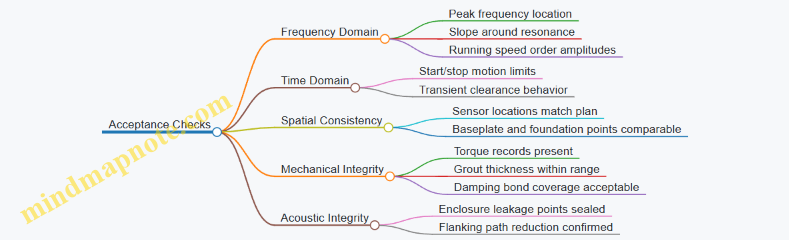
Integrated Example: One Retrofit with Clear Traceability
A retrofit replaces machine mounts and adds constrained-layer damping to the baseplate. The assumptions register states the speed range, base mass estimate, anchor stiffness, and damping loss factor used. The calculations show the predicted transmissibility peak shifts away from the 1× running speed and that the baseplate mode targeted by the damping has sufficient strain energy participation. Installation requirements specify grout thickness, anchor torque, damping surface prep, and curing time. Verification then measures accelerations at the machine and foundation, compares peak frequency and order amplitudes to predictions, and records any mismatch with corrective actions such as re-leveling or rework of a poorly bonded damping patch.
Documentation Format That Keeps Teams Aligned
Use a single document structure: assumptions register first, then calculations, then installation requirements, then verification plan and sign-off. When a new contractor touches the job, they should be able to answer three questions without searching: what we assumed, what we computed, and what we must check before declaring success.
12. Practical Design Examples and Engineering Calculations
12.1 Example Design of Elastomer Mounts for a Pump with Operational Speed Constraints
A pump’s vibration problem usually shows up as a frequency pattern: peaks at running speed and its harmonics, plus sidebands from bearing defects or flow effects. The goal of elastomer mounts is to reduce transmitted vibration to the foundation while keeping the mount natural frequency safely away from the pump’s dominant excitation band.
Step 1: Define the Constraints from Operating Speed
Start with the pump’s speed range and the frequencies you must avoid. Suppose the pump runs from 1450 to 1750 rpm.
- Running speed: 1450/60 = 24.2 Hz to 1750/60 = 29.2 Hz
- First harmonic: 48.3 to 58.3 Hz
- Second harmonic: 72.5 to 87.5 Hz
A practical rule is to place the mount’s natural frequency below the lowest excitation frequency by a margin, so the isolation works where it matters. For elastomer mounts, you typically target a natural frequency around one-third to one-fifth of the lowest forcing frequency, then verify it doesn’t drift upward due to temperature or aging.
Step 2: Estimate Loads and Determine Mount Count
Compute the static load per mount from the pump weight, baseplate weight, and any steady loads from piping and guards. Example assumption:
- Pump plus baseplate mass: 420 kg
- Total static load: 420 × 9.81 = 4120 N
- Add 20% for piping and dynamic margin: 4940 N
- Use 4 mounts for symmetry: 4940/4 = 1235 N per mount
If the pump has a tall center of mass or significant moment, you may need more mounts or a stiffer layout to control rocking. Symmetry reduces cross-coupling between translation and rotation.
Step 3: Choose Mount Type and Target Natural Frequency
Select elastomer mounts with appropriate durometer range and geometry (shear mounts or compression mounts). For a first-pass design, target a natural frequency fn near 8–10 Hz.
- Lowest forcing frequency is 24.2 Hz
- Ratio fn/forcing ≈ 0.33 to 0.41, which is in the isolation-friendly range
To check the target, use the single-degree-of-freedom approximation:
- fn = (1/2π) √(k/m)
- Rearranged: k = (2πfn)^2 m
For one mount, m is the supported mass share. If the 4 mounts share equally, m ≈ 420/4 = 105 kg.
- With fn = 9 Hz: k ≈ (2π×9)^2 × 10⁵ ≈ 3.4×10^5 N/m
- That is 340 N/mm equivalent stiffness per mount
Step 4: Convert Stiffness to Deflection and Verify Operating Travel
Elastomer mounts must not bottom out and must remain in a predictable stiffness region. Static deflection δ is:
- δ = F/k
- With F = 1235 N and k = 3.4×10^5 N/m: δ ≈ 0.0036 m = 3.6 mm
Check two things:
- Clearance to bottoming: design for at least 2× the static deflection as margin.
- Dynamic deflection at operating speed: near resonance, motion can grow, but the isolation ratio reduces it away from fn. You still verify that the predicted peak displacement stays within the mount’s allowable strain.
Step 5: Account for Damping and Frequency-Dependent Stiffness
Elastomer damping is not a constant; it depends on excitation level and temperature. Use a conservative damping ratio ζ for preliminary calculations (often in the 5–15% range for elastomer systems) and then confirm with test data or manufacturer curves.
A useful engineering check is to ensure the transmissibility at the running speed is low enough. For a lightly damped isolator, transmissibility drops as frequency ratio r = f/ fn increases. With fn = 9 Hz and f = 24–29 Hz, r ≈ 2.7–3.2, which typically yields meaningful reduction.
Step 6: Validate with a Frequency Response View
Even if the SDOF model looks good, real systems have multiple modes and coupling through the baseplate. Use a simplified frequency response check to confirm that the mount resonance is not accidentally shifted upward by baseplate stiffness or by constrained boundary conditions.
    flowchart TD
A[Inputs] --> B[Operating speed range]
A --> C[Pump and baseplate mass]
A --> D[Static load per mount]
B --> E[Compute forcing frequencies]
C --> F[Choose mount count and share]
D --> G[Target natural frequency fn]
E --> H[Check fn/forcing ratio]
G --> I[Compute mount stiffness k]
I --> J[Compute static deflection]
J --> K[Check travel and strain limits]
K --> L[Apply damping and estimate transmissibility]
L --> M[Confirm no resonance near running speed]
M --> N[Plan verification measurement]
Step 7: Practical Mount Selection and Installation Details
Select mounts whose rated stiffness and allowable deflection match the computed values with margin. Then control installation variables that quietly change stiffness:
- Ensure baseplate leveling so elastomer compression is uniform across mounts.
- Use consistent torque on anchor bolts and avoid over-constraining with rigid shims.
- Keep grout thickness uniform if grouting is used; thick or uneven grout can create stiff paths.
- Route piping with flexible connections near the pump to reduce additional dynamic forces.
Step 8: Verification Plan Using On-Site Measurements
After installation, verify the isolation behavior by measuring vibration at the pump casing and at the foundation. A simple acceptance metric is the reduction in vibration amplitude around running speed compared to a baseline or compared to a reference direction.
Mind Map: Design Workflow for Elastomer Pump Mounts
This example design is intentionally structured: it starts with the frequencies that matter, turns them into a mount natural frequency target, then converts that target into stiffness, deflection, and installation checks. The final step is measurement, because elastomer systems behave like real systems, not like neat equations on paper.
12.2 Example Enclosure Design for Airborne Noise Reduction With Seal and Flanking Checks
An enclosure reduces airborne noise by adding transmission loss through panels and by preventing leakage at openings. In practice, the enclosure is only as good as its weakest leak path, so the design process should treat sealing and flanking as first-class requirements, not afterthoughts.
Step 1: Define the Noise Target and Operating Conditions
Start with the measured or predicted sound pressure level (SPL) at the receiver location and the frequency range that matters. Suppose a pump room has a dominant tone around 500 Hz and broadband energy from 200 Hz to 2 kHz. The goal is a 10 dB reduction at the nearest operator position.
A useful planning check is to separate airborne reduction needs from vibration-driven radiation. If the pump baseplate radiates strongly, enclosure panels must be treated as structural radiation sources too; otherwise, you may overestimate airborne-only performance.
Step 2: Choose Enclosure Type and Panel Strategy
For a machinery bay, a common approach is a double-wall or single-wall enclosure with constrained damping and stiff framing. The panel strategy should match the dominant frequencies:
- For mid frequencies (roughly 300 Hz to 2 kHz), panel mass and stiffness dominate transmission loss.
- For lower frequencies, panel resonances and flanking paths often dominate, so sealing and structural decoupling become critical.
Example decision: Use 12 mm steel outer panels with a 25 mm mineral wool layer and a 1.5 mm inner liner, mounted to a stiff frame with resilient mounts. The mineral wool improves absorption inside the cavity, reducing internal reflections that otherwise re-radiate through the panel.
Step 3: Design the Sealing System for Real-World Gaps
Airborne noise reduction collapses when there are uncontrolled gaps. Treat every interface as a potential leak: doors, cable penetrations, duct connections, and panel seams.
Door and Access
Use a perimeter gasket with a continuous compression path. A practical rule is to ensure the gasket is compressed when the door is closed, not merely touching. Add a threshold strip to reduce the “bottom gap” that often forms after repeated use.
Example: A door with a 6 mm nominal gasket compression. If the door sags by 2 mm over time, the remaining compression still maintains contact, preventing a new leak frequency.
Seams and Panel Joints
Use overlapping seams or tongue-and-groove details rather than butt joints. If butt joints are unavoidable, use a backing strip and a sealant rated for the operating temperature.
Example: Overlap seams with a 20 mm overlap reduce direct air paths. Even if the sealant cracks slightly, the overlap still forces tortuous leakage.
Penetrations for Power and Control
Cable trays and conduit penetrations are frequent flanking starters. Use grommets or brush seals for small penetrations and fire-rated acoustic sealant for larger ones.
Example: For a conduit bundle, use a single bulkhead penetration with a sealing collar and a backing foam ring. Avoid multiple small penetrations that create many independent leak points.
Step 4: Check Flanking Paths Through Structure and Mounting
Flanking occurs when sound energy bypasses the enclosure panels via the structure. The enclosure frame, floor interface, and any rigid connections to the machine or building can create a low-resistance path.
Frame-to-Floor Interface
Introduce resilient isolation between the enclosure frame and the floor. The goal is to reduce the transmission of vibration that can radiate as airborne noise through the building.
Example: Mount the enclosure frame on elastomer pads with a natural frequency well below the enclosure’s dominant panel resonance range. This keeps the frame from acting like a secondary radiator.
Rigid Connections to Ducts and Piping
If the enclosure connects to ductwork or piping, use flexible connectors and avoid rigid couplings that bridge the isolation gap.
Example: Use a flexible duct section with an acoustic liner and ensure the duct does not touch the enclosure frame at multiple points.
Step 5: Internal Absorption and Airflow Considerations
Enclosures need ventilation. Ventilation openings can become “acoustic short circuits” if not treated.
Example: For an intake and exhaust, use baffles lined with mineral wool and maintain a labyrinth path. Keep the airflow velocity reasonable to avoid generating new noise at the louvers.
Step 6: Verification with Before-After Measurements and Acceptance Checks
Measure at the receiver location with the machine operating in steady conditions. Then repeat with the enclosure installed and sealed.
Acceptance logic:
- If the reduction is strong at mid frequencies but weak at low frequencies, suspect flanking or panel resonance.
- If reduction is inconsistent across frequencies, suspect leakage at doors or penetrations.
A practical diagnostic: temporarily apply controlled sealing tape to suspected seams and re-measure. If SPL drops noticeably, you found the leak class.
Mind Map: Enclosure Design Workflow with Seal and Flanking Checks
Worked Example Summary
For the pump room case, the combined panel strategy plus internal absorption provides baseline transmission loss, while the sealing package prevents leakage-driven failure. The flanking checks—especially the resilient frame interface and flexible duct connections—address the low-frequency and “mystery” paths that often survive even well-built panels. The final verification step confirms whether the enclosure behaves like a barrier or like a fancy speaker with better manners.
12.3 Example Structural Damping Treatment Design for a Machine Baseplate
A practical baseplate damping design starts with one question: which vibration modes actually matter for the noise and vibration you measure at the receiver? The goal here is to reduce baseplate motion at the dominant operating frequencies while keeping the machine aligned and the installation robust.
Step 1: Define the Design Targets Using Measured Behavior
Begin with operational data from the machine and baseplate. You want frequency bands where motion is both high and correlated with the noise you care about.
- Pick 3–5 target frequencies (or narrow bands) around the operating speed harmonics.
- For each target, note the baseplate response level and the mode shape if you have it (from FRFs or operational modal analysis).
Easy example: If your pump runs at 25 Hz (1500 rpm) and you see peaks at 25 Hz, 50 Hz, and 75 Hz, treat those as targets. If the 50 Hz peak is much sharper than the others, prioritize damping for the mode that drives that peak.
Step 2: Choose a Damping Mechanism and Layout Strategy
For a baseplate, constrained layer damping (CLD) is often effective because it converts bending strain energy into heat using a viscoelastic layer sandwiched between stiff layers.
Core idea: CLD works best where the baseplate experiences bending strain. If a mode is mostly rigid-body motion, CLD won’t help much.
Easy example: If the 50 Hz mode shows strong curvature near the center span, place CLD patches near that region rather than only near the edges.
Step 3: Estimate Strain Energy Hotspots from a Simple Model
You can do this with a finite element model, but a simplified workflow still works.
- Identify approximate bending regions from mode shapes.
- Assume strain energy density is proportional to squared curvature.
- Use that to rank candidate patch locations.
Rule of thumb: Put more damping area where curvature is higher, and avoid areas that are mostly nodal lines for the target mode.
Step 4: Select Materials and Determine Thickness
CLD performance depends on the viscoelastic layer’s complex modulus at your frequencies and temperature.
- Choose a viscoelastic layer with a loss factor that is meaningful in your target band.
- Keep the stiff layers (steel or aluminum) thin enough to allow strain transfer but thick enough to distribute load.
- Use a thickness that does not “lock out” strain transfer by being too stiff.
Easy example: If the viscoelastic layer is too thin, it may not develop shear deformation under bending. If it’s too thick, it can reduce stiffness too much and shift resonances or create excessive compliance.
Step 5: Compute an Effective Damping Increase for the Target Mode
A full derivation is model-dependent, but the engineering workflow is consistent:
- Determine the baseplate’s modal damping ratio ζ0 for the target mode (from FRF bandwidth or curve fitting).
- Estimate the additional damping Δζ contributed by the CLD patches using strain energy participation.
- Ensure the resulting resonance amplitude reduction matches the measured peak reduction you need.
Easy example: If ζ0 is 1% and you can raise it to 3% at 50 Hz, the peak response typically drops noticeably because the resonance becomes less sharp. The exact factor depends on how close you operate to resonance.
Step 6: Verify Resonance Shifts and Alignment Constraints
Damping treatments add mass and stiffness. Even when the intent is “just damping,” the baseplate can shift modal frequencies.
- Check that the new resonance frequencies do not move into a more problematic operating band.
- Confirm that added mass does not overload leveling pads or distort the baseplate.
Easy example: If your 75 Hz target is close to an operating harmonic, a resonance shift of even a few Hz can change the benefit. That’s why you verify after installation.
Step 7: Installation Details That Actually Matter
CLD effectiveness is sensitive to bond quality and surface preparation.
- Prepare surfaces to remove oil, rust, and paint; roughen to promote adhesion.
- Use controlled curing or approved bonding methods; avoid uneven adhesive thickness.
- Ensure the viscoelastic layer is continuous and not pinched at edges.
- Apply uniform clamping pressure during cure.
Easy example: Two patches with the same dimensions can behave very differently if one has a thin, poorly bonded adhesive region. That region can act like a “dead” area with low strain transfer.
Step 8: Acceptance Testing with Before After Measurements
After installation, re-measure the same operational conditions.
- Compare peak amplitudes at the target frequencies.
- Confirm damping ratio increase for the target mode.
- Check that other modes did not worsen significantly.
Easy example: If the 50 Hz peak drops but the 100 Hz peak rises, you may have over-damped one mode and shifted energy into another. Adjust patch placement or area.
Mind Map: Baseplate CLD Design Workflow
Worked Mini-Example with Concrete Numbers
Assume a baseplate with a measured 50 Hz target mode:
- Baseline modal damping ratio ζ0 = 1.2%
- Measured peak amplitude at 50 Hz is 10 units (relative)
- CLD patches are planned in the high-curvature region with total patch area = 12% of plate area
- After installation, ζ1 is estimated to be 3.0% based on strain energy participation
A typical outcome is a reduction in resonance peak amplitude because the resonance becomes less sharp. If the measured peak drops from 10 to about 6 units, that’s a 40% reduction at the target. If instead it only drops to 9 units, the likely causes are poor bonding, insufficient viscoelastic performance at temperature, or patch placement near a nodal line.
Practical Design Checklist
- Target frequencies chosen from real operating data
- Patch locations align with strain energy hotspots
- Viscoelastic layer selected for the actual temperature and frequency band
- Bonding and curing procedures controlled
- Before/after verification confirms both damping increase and acceptable resonance shifts
12.4 Example Vibration Isolation System Verification Using Frequency Response Functions
A good isolation design earns its keep when it performs under real operating conditions. Frequency Response Functions (FRFs) are a practical way to verify that the isolation system attenuates vibration where it matters, and that it does not create surprises like unexpected resonances or weak coupling paths.
Step 1: Define the Verification Targets
Start by writing down what “verified” means in measurable terms.
- Primary target frequency bands: the machine’s dominant orders (e.g., 1×, 2×, blade pass) and the expected structural resonances.
- Primary response points: typically the machine casing/baseplate and the receiver location (nearby floor, duct, or equipment bay).
- Acceptance metric: a ratio such as transmissibility from input to output. For isolation, you often want a low output/input magnitude across the band.
Example: A pump runs at 1800 rpm (30 Hz). You care about 30 Hz (1×), 60 Hz (2×), and nearby harmonics up to 200 Hz. You also care about whether the floor motion near the pump baseplate is reduced relative to the foundation input.
Step 2: Choose Inputs Sensors and Excitation
FRFs need a defined input and a measurable output.
- Input: force (impact hammer or shaker) applied to the foundation or baseplate, or an acceleration reference if you use operational FRFs.
- Sensors: accelerometers on the machine baseplate (output) and on the foundation (input reference). If you suspect rotational coupling, add a second sensor to estimate rocking.
- Coherence check: plan to reject frequency lines with low coherence.
Example: Apply a controlled impact to the foundation at the same location each run. Mount accelerometers at the pump baseplate center and on the foundation block directly under the mount group.
Step 3: Acquire FRFs and Validate Data Quality
Collect FRFs over a frequency range that covers:
- the isolation system’s expected resonance region,
- the machine’s operating band,
- and at least one decade above the highest frequency of interest (so you can see whether behavior changes).
Use these checks:
- Coherence: keep lines above a chosen threshold (commonly 0.8) to trust the FRF.
- Repeatability: compare multiple impacts; the FRF magnitude should be stable.
- Linearity: ensure the response does not scale nonlinearly with excitation level.
Example: If the FRF magnitude changes shape when you increase impact force, you likely hit a nonlinear contact condition like loose grout or a slipping mount.
Step 4: Compute Transmissibility from FRFs
For verification, you want a ratio that reflects isolation performance.
If you have an FRF from foundation force to baseplate acceleration, you can form a transmissibility-like metric:
- Magnitude ratio:
- output: baseplate acceleration magnitude,
- input: foundation acceleration magnitude or force-based reference.
A simple and effective approach is to compare before and after installation:
- Isolation improvement:
- \(\Delta M(f)=20\log_{10}\left(\frac{|H_{after}(f)|}{|H_{before}(f)|}\right)\)
Negative values indicate reduction.
Example: After installing elastomer mounts, the FRF magnitude at 30 Hz drops by 12 dB, while at 95 Hz it increases by 4 dB. That tells you the isolation moved the resonance behavior: good at 1×, but you must check whether 95 Hz aligns with a harmonic or structural mode.
Step 5: Interpret Key Features in the FRF
FRFs are not just numbers; they show system behavior.
- Low-frequency region: isolation often improves as stiffness decreases, but too-soft mounts can increase static deflection and risk bottoming.
- Isolation resonance: expect a peak near the mount system’s natural frequency. A well-designed system places this peak away from dominant excitation orders.
- High-frequency region: damping and structural constraints determine how quickly the response decays.
Example: If you see a sharp peak at 60 Hz, it may mean the mount stiffness is lower than predicted or the baseplate boundary conditions changed during installation.
Step 6: Confirm Mount Behavior with Operational Checks
After the lab-style FRF, verify under operating conditions using operational FRFs or order tracking.
- Compare the FRF-predicted attenuation at 30 Hz and 60 Hz with measured vibration spectra during startup steady-state.
- If the operational spectrum shows a peak where FRFs predicted attenuation, suspect changes in coupling: piping contact, cable trays, or loosened fasteners.
Example: The FRF shows 10 dB attenuation at 30 Hz, but during operation the baseplate acceleration at 30 Hz is unchanged. A quick inspection reveals a rigid pipe support touching the baseplate during thermal expansion.
Mind Map: FRF Verification Workflow
Step 7: Document Evidence and Tie It to Design Assumptions
A verification report should connect the FRF results to what the design assumed.
Include:
- mount natural frequency estimate from FRF,
- damping behavior inferred from peak width and decay,
- measured attenuation at each target order,
- and any deviations with a clear cause.
Example: “At 30 Hz, transmissibility decreased by 12 dB; the mount resonance peak shifted from 52 Hz to 58 Hz, consistent with increased effective stiffness due to improved grout contact. At 95 Hz, transmissibility increased by 4 dB; inspection confirmed a structural mode of the baseplate that was not included in the simplified model.”
Step 8: Quick Numerical Example for Decision Making
Suppose the FRF magnitude ratio (output/input) at 30 Hz is:
- Before: \(|H_{before}(30)| = 0.020\) (m/s² per m/s²)
- After: \(|H_{after}(30)| = 0.006\)
Then:
- \(\Delta M(30)=20\log_{10}(0.006/0.020)=20\log_{10}(0.3)\approx -10.5,\text{dB}\)
If your acceptance threshold is at least 8 dB reduction at 1×, the system passes at 30 Hz. You still check 60 Hz and the resonance region to ensure the improvement is not bought with a new problem.
12.5 Example Integrated Noise and Vibration Retrofit Plan With Measurement and Acceptance Steps
This retrofit plan targets a typical industrial package: a pump skid on a concrete base, with airborne noise from the pump and motor, plus structureborne vibration that travels through the baseplate, grouted anchors, and nearby piping supports. The goal is to reduce both receiver noise and vibration levels at the operating speed range, using isolation, damping, and acoustic containment in a coordinated way.
Step 1: Define Acceptance Targets and Constraints
Start by writing measurable targets before touching hardware. Use existing logs or short surveys to set baseline metrics.
- Noise acceptance: receiver A-weighted sound pressure level reduction at key operating points, plus a limit on tonal components if present.
- Vibration acceptance: limits on overall velocity at the machine housing and on base or nearby structural points, plus a frequency-domain check at dominant orders.
- Constraints: allowable footprint, maintenance access, maximum mount deflection, and any limits on enclosure internal temperature.
A practical trick: define two sets of acceptance criteria—one for “must meet” at the dominant operating point, and one for “should meet” across the speed sweep.
Step 2: Baseline Survey with Coherent Measurement
Measure before modifying so you can attribute improvements.
- Sensor placement: accelerometers on the pump housing and baseplate corners; a reference accelerometer on the foundation; microphones at the receiver and near the enclosure openings.
- Operational points: at least three steady states (low, mid, high speed) and one transient start/stop if the noise is tonal during ramp.
- Data quality checks: verify coherence between excitation and response channels for the frequency bands where you expect isolation to work.
Example: if the dominant vibration peak is at a bearing-related frequency, you want coherence between the housing response and the foundation reference around that peak. Low coherence usually means you are measuring the wrong location or missing the real excitation path.
Step 3: Diagnose Dominant Paths and Failure Modes
Use the baseline to decide what to fix first.
- Airborne path: if microphones show strong levels near openings and the enclosure is leaky, acoustic isolation will be limited until sealing and panel transmission are addressed.
- Structureborne path: if base accelerations track housing accelerations closely at the same frequencies, the mount and foundation interface are the priority.
- Flanking path: if receiver noise remains high even after local enclosure improvements, check ducting, cable trays, and rigid piping connections.
Step 4: Retrofit Package Design with Integrated Logic
Build the retrofit as a linked set of changes, not a pile of parts.
-
Acoustic isolation and containment
- Add a machine enclosure with treated panels and controlled openings.
- Seal penetrations around cables and piping sleeves.
- Use a gasketed access door so the enclosure does not become a “mostly open” box.
-
Structural damping
- Apply constrained-layer damping to the baseplate or skid panels where feasible.
- Keep damping treatments away from moving interfaces and ensure surface prep is consistent.
-
Vibration isolation
- Select mounts based on the required isolation frequency range and static deflection limits.
- Verify that the mount natural frequency sits below the dominant excitation band but not so low that travel limits are exceeded.
-
Foundation and interface detailing
- Confirm grouting and anchor contact quality.
- Ensure piping supports do not bypass the isolation system with rigid connections.
Step 5: Installation Sequence That Preserves Measurement Meaning
Order matters because each change can affect the next.
- Install mounts and verify alignment and travel limits.
- Apply damping treatments.
- Build enclosure and complete sealing.
- Rework piping supports and add restraints or flexible sections where required.
After each major phase, take quick spot checks at the dominant operating point so you do not discover problems only at the end.
Step 6: Post-Retrofit Measurement with Matched Conditions
Repeat the baseline measurement plan using the same operating points and sensor locations.
- Matched conditions: same speed setpoints, same load, same microphone height and orientation.
- Before-after comparison: focus on the dominant frequency bands and tonal components.
- Isolation verification: compare housing-to-foundation transfer behavior at the key peaks.
Example: if enclosure sealing reduces receiver noise but housing vibration remains unchanged, the plan still succeeded for airborne control, but you should not claim full system vibration mitigation.
Step 7: Acceptance Testing and Documentation
Acceptance is not just “it sounds quieter.” Use a structured checklist.
- Noise: confirm receiver reduction meets the must criteria at the dominant operating point.
- Vibration: confirm overall velocity and peak frequency-domain levels meet limits at the housing and base points.
- Operational robustness: verify performance at low and high speed steady states.
- Installation evidence: record mount part numbers, torque checks, damping coverage area, enclosure seal inspection results, and piping support changes.
If a criterion fails, use the measurement deltas to pinpoint the path: airborne failure points to enclosure leakage or panel transmission; vibration failure points to mount tuning, foundation interface, or rigid bypasses.
Mind Map: Integrated Retrofit Plan Flow
Example Acceptance Checklist for One Operating Point
- Receiver noise: meets must reduction at dominant tonal frequency band.
- Housing vibration: peak amplitude reduced by the required margin.
- Base vibration: reduced peak or reduced transfer ratio at the dominant band.
- Enclosure: no visible gaps at penetrations and access door seals.
- Piping supports: no rigid bypass connection that reintroduces the dominant peak.
This checklist keeps the retrofit accountable to measurements, while the integrated logic prevents “improvements” that only move the problem to a different path.