Biofertilizer Benchmarking and Crop Nutrition Analytics
1. Scope and Definitions for Biofertilizer Benchmarking
1.1 Defining Biofertilizers and Microbial Inputs by Function and Delivery Form
Biofertilizers are products that use living microorganisms to improve crop nutrition and soil function. The key word is living: the same “species name” can behave differently depending on strain, formulation, and how the product is applied. Microbial inputs is the broader umbrella that includes inoculants, consortia, and microbial-based amendments used to influence nutrient availability, plant uptake, or root-zone processes.
What Counts as a Biofertilizer
A practical definition for benchmarking is: a microbial input intended to deliver a measurable agronomic effect through biological activity. That effect might show up as better nutrient uptake, improved nutrient cycling, or reduced nutrient losses. If a product is mostly a nutrient salt with microbes added as decoration, it belongs in a different category for analysis.
Core Functions by Nutrient Pathway
Microbial inputs are easiest to compare when you classify them by the job they do in the nutrient pathway.
- Nitrogen support: microbes convert atmospheric nitrogen into plant-available forms or help plants access nitrogen already present in soil.
- Phosphorus mobilization: microbes release phosphorus from soil minerals or organic matter so roots can access it.
- Potassium and micronutrient access: microbes can influence solubilization or root-zone chemistry for nutrients that are often less mobile.
- Plant growth support beyond nutrients: some microbes produce compounds that affect root architecture, which indirectly changes nutrient uptake.
- Soil biological activity: microbes can increase enzyme activity and respiration patterns that correlate with nutrient cycling.
A simple way to keep this grounded: ask what changes in the soil-plant system you expect to measure. If the expected change is only “better growth,” you’ll struggle to benchmark. If the expected change maps to nitrogen, phosphorus, or root-zone activity, you can design trials and metrics.
Delivery Forms and Why They Matter
Delivery form describes how microbes are packaged and where they are placed relative to the plant.
- Seed treatment: microbes are applied to seeds so they colonize early root zones. Example: a farmer coats maize seeds with a slurry containing a nitrogen-supporting inoculant and plants immediately.
- Soil application: microbes are mixed into soil or applied in-furrow. Example: a consortium is delivered near the seed row so it can establish in the rhizosphere.
- Root drench or transplant dip: microbes are applied directly to the root system during transplanting. Example: seedlings are dipped briefly in a prepared inoculant suspension before planting.
- Foliar application: microbes are sprayed on leaves. Example: a formulation is applied at vegetative stage to influence nutrient-related processes through leaf-associated activity.
- Granular or coated carriers: microbes are embedded in a solid carrier for easier handling. Example: a granular product is broadcast and lightly incorporated.
Delivery form affects survival, colonization timing, and exposure to oxygen, sunlight, and desiccation. That’s why two products with the same microbial label can perform differently: one might be designed for seed contact, while the other is designed for soil moisture conditions.
Mind Map: Function and Delivery Form
Example: Classifying a Product for Benchmarking
Imagine a product labeled “phosphate-solubilizing bacteria.” To define it clearly for benchmarking, specify:
- Function: phosphorus mobilization via solubilization.
- Delivery form: soil application in-furrow.
- Expected measurable change: increased available phosphorus in soil near the root zone and improved plant phosphorus content.
- Practical constraints: soil moisture at application, time between application and rainfall or irrigation, and carrier stability.
If instead the same microbes are sold as a foliar spray, the expected pathway and measurable outcomes may shift. The product label alone is not enough; the delivery form tells you where the biology is supposed to act.
Example: Two “Nitrogen” Products That Are Not the Same
Consider two inoculants both described as “nitrogen related.” One is a nitrogen-fixing consortium applied to soil at planting. The other is a microbial blend applied as a foliar spray during early vegetative growth.
They differ in where nitrogen-related activity is likely to occur, how quickly colonization can happen, and which soil or plant measurements best capture the effect. Benchmarking starts by separating these into function-plus-delivery categories so comparisons are fair and interpretable.
1.2 Establishing Benchmarking Objectives for Yield Quality and Nutrient Use Efficiency
Benchmarking starts with objectives that are specific enough to measure and broad enough to guide decisions. For yield quality and nutrient use efficiency, the goal is not just “more yield,” but “better yield with less wasted nutrient.” That distinction matters because microbial inputs can change nutrient availability, timing, and plant uptake patterns.
Define Yield Quality in Measurable Terms
Yield quality should be tied to the crop’s end use and the constraints of your production system. Start by listing the quality attributes that farmers or processors actually pay for, then translate them into measurable indicators.
- Grain or fruit quality: testable traits such as protein content, size distribution, sugar content, or firmness.
- Plant health proxies: disease incidence, lodging rate, or leaf chlorosis scores when they correlate with quality outcomes.
- Consistency: variation across plots or within harvest lots, because a treatment that boosts the mean but increases variability can be harder to manage.
Example: In a wheat trial, you might benchmark protein percentage and test weight. A microbial treatment that increases biomass but lowers protein would fail the quality objective even if total yield rises.
Define Nutrient Use Efficiency with Clear Boundaries
Nutrient use efficiency (NUE) is easy to misunderstand because people mix up “efficiency of uptake” with “efficiency of conversion into yield.” For benchmarking, define which efficiency you mean and how you will compute it.
Common objective options include:
- Nutrient uptake efficiency: how much nutrient the plant captures relative to what was available.
- Nutrient utilization efficiency: how effectively the captured nutrient becomes yield or quality.
- Overall nutrient efficiency: a combined view that links input to output.
To keep objectives grounded, decide your nutrient accounting boundary:
- Input boundary: fertilizer applied, nutrient in carrier, and nutrient in any additives.
- Output boundary: nutrient in harvested biomass and, if relevant, nutrient in residues.
- Soil boundary: whether you track changes in soil mineral pools or rely on plant uptake as the main signal.
Example: If you compare two inoculant formulations but one includes a small amount of nitrogen in the carrier, you must either measure that nutrient contribution or explicitly exclude it from the efficiency calculation.
Choose Objectives That Match the Mechanism You Expect
Microbial inputs can influence nutrient dynamics through different pathways: faster mineralization, improved solubilization, symbiotic fixation, or changes in root access to nutrients. Your objectives should reflect the pathway you are testing.
- If you expect faster nutrient availability, include early soil or plant indicators that precede yield.
- If you expect better uptake, include plant tissue nutrient concentration and total nutrient uptake.
- If you expect better conversion to yield, include yield components and quality traits, not only total biomass.
A practical rule: every objective should have at least one “leading” metric and one “confirming” metric.
Set Benchmark Targets and Decision Thresholds
Objectives become useful when they lead to decisions. Convert objectives into targets and thresholds for action.
- Minimum effect size: the smallest improvement that justifies further testing.
- Quality constraint: a treatment must not harm quality even if yield improves.
- Efficiency constraint: a treatment must improve efficiency under comparable management.
Example: For a legume, you might require that yield increases by at least a defined amount while maintaining or improving seed protein. For NUE, you might require improved nutrient uptake per unit applied fertilizer.
Mind Map: Objectives to Metrics to Decisions
Example Objective Set for a Two-Treatment Trial
Assume you compare two inoculant platforms against a conventional nutrient program.
- Yield quality objective: improve quality attribute A (e.g., protein) without reducing attribute B (e.g., test weight).
- NUE objective: increase nutrient uptake per unit of applied nutrient while maintaining yield.
- Leading metrics: early tissue nutrient concentration and a soil nutrient pool indicator at a defined growth stage.
- Confirming metrics: final yield, quality tests, and total nutrient uptake in harvested biomass.
If Treatment 1 raises yield but reduces quality attribute A, it fails the quality objective. If Treatment 2 improves quality and uptake but does not improve efficiency relative to the conventional program, it fails the NUE objective. That’s the point of objectives: they prevent “wins” that are only partial.
Document Objectives in a Benchmark Sheet
Write objectives in a one-page format that can be audited later. Include the metric names, units, sampling timing, and the decision thresholds you will use. A benchmark without decision thresholds is like a map without a destination: you can move, but you can’t conclude.
1.3 Mapping Crop Nutrition Pathways From Inoculation to Soil and Plant Outcomes
A biofertilizer’s impact is rarely a single straight line from “microbes added” to “yield increased.” Mapping the pathway means tracking how an inoculation choice changes soil conditions, how those changes affect nutrient availability, and how the plant converts that availability into growth and quality. The goal is not to prove every mechanism in every field; it’s to build a testable chain of cause and effect that explains what you measured.
Step 1: Define the Inoculation Event and Its Immediate Footprint
Start by writing down what actually enters the system. Include strain or consortium identity, viable count targets, carrier type, application method (seed, soil, foliar), and timing relative to crop stage. Then add the “immediate footprint” you can measure soon after application: survival/viability in the product lot, persistence in soil micro-samples, and early shifts in soil moisture or pH if your formulation changes them.
Example: A seed-applied inoculant is expected to influence early root-zone processes. If you only sample soil at flowering, you may miss the window where microbes establish and start interacting with nutrients.
Step 2: Translate Microbial Functions Into Soil Processes
Next, map microbial functions to soil processes you can observe. Common functional categories include nitrogen-related activity, phosphorus solubilization, and broader nutrient cycling through organic matter interactions. For each function, specify the soil process it should influence and the measurable proxy.
Example: If a strain is selected for phosphorus solubilization, your pathway might include increased labile phosphorus or altered extractable fractions. If you only measure total phosphorus, you can’t tell whether solubilization occurred.
Step 3: Connect Soil Processes to Nutrient Availability and Plant Uptake
Soil processes affect nutrient availability, but plants respond to what is available at the root interface. Your mapping should therefore include nutrient pools and uptake-relevant indicators. For nitrogen, this could involve mineral N forms and nitrification-related signals. For phosphorus, it could involve extractable fractions tied to root access. For micronutrients, it could involve pH-linked availability and chelation-related proxies.
Then connect availability to plant uptake by choosing plant tissue measurements that match the nutrient pathway. Tissue nutrient concentration is useful, but it’s stronger when paired with uptake efficiency logic: biomass plus nutrient concentration gives a clearer picture than concentration alone.
Example: Two treatments may show similar tissue phosphorus concentration, but one may have higher biomass. The higher biomass treatment likely used available phosphorus more effectively.
Step 4: Add Crop Development Timing to Prevent “Wrong-Time” Conclusions
Nutrient pathways are time-sensitive. Root establishment, vegetative growth, and reproductive stages each have different nutrient demands and different microbial activity windows. Your mapping should include sampling timepoints aligned to crop stages and to the expected microbial action window.
Example: If you expect early nitrogen mineralization effects, prioritize early soil and early tissue sampling. Later yield measurements alone can’t distinguish “early boost” from “late rescue.”
Step 5: Incorporate Constraints and Confounders Into the Pathway
A pathway map should include what can break it: soil texture, baseline nutrient status, pH, moisture, temperature, and competing management inputs like mineral fertilizer rates. Also include application variability such as uneven mixing or placement depth for soil applications.
Best practice: treat baseline soil properties as part of the pathway, not as an afterthought. If baseline phosphorus is already high and labile, solubilization may show a smaller measurable effect even if the microbes are active.
Step 6: Use a Measurement Ladder from Mechanism Proxies to Outcomes
To keep the mapping systematic, use a ladder of evidence:
- Inoculation quality and early survival proxies
- Soil process indicators
- Nutrient availability indicators
- Plant uptake indicators
- Crop performance outcomes (growth, yield, quality)
Each rung should have a clear “if-then” expectation. If the soil process proxy doesn’t move, you should not assume the pathway worked.
Mind Map: Mapping Crop Nutrition Pathways
Example: A Complete Pathway Map for a Phosphorus-Focused Inoculant
- Inoculation event: seed treatment with a phosphorus-solubilizing consortium, applied at a defined viable count target.
- Immediate footprint: early root-zone soil sampling to check viability persistence and basic soil condition stability.
- Soil process: measure extractable phosphorus fractions at a stage when roots are actively exploring soil.
- Availability: interpret fraction shifts as changes in root-accessible phosphorus rather than total phosphorus.
- Uptake: sample plant tissue at a matching stage; pair tissue phosphorus with biomass to estimate uptake efficiency.
- Outcomes: evaluate yield components and quality at harvest, but only after confirming that soil and uptake rungs moved.
This approach keeps the story consistent: if the soil proxy doesn’t change, the plant outcome should be interpreted cautiously, and the pathway map tells you exactly where the chain breaks.
1.4 Standardizing Terminology for Fermentation Platforms and Application Methods
Standard terminology prevents “apples vs. oranges” comparisons when you benchmark microbial inputs. The goal is simple: every trial label should map to a specific process description and a specific field action, with no room for guessing.
Foundational Concepts and Why They Matter
Start by separating three layers that often get mixed in spreadsheets:
- Microbial identity: strain(s), consortium composition, and target functions.
- Fermentation platform: how the microbes are grown and harvested.
- Application method: how the product reaches soil, seed, or foliage.
A benchmark fails when layer 2 and layer 3 are described vaguely. For example, “fermented liquid” tells you nothing about aeration or harvest timing, and “applied to soil” tells you nothing about placement depth or mixing procedure.
Terminology for Fermentation Platforms
Use a consistent vocabulary for platform type, operating mode, and key control variables.
- Platform type: tank-based, bioreactor-based, or solid-state fermentation (SSF).
- Operating mode: batch, fed-batch, or continuous.
- Aeration and mixing: static, sparged, agitated; include whether oxygen transfer is controlled.
- Harvest definition: harvest at a growth phase, at a viability threshold, or at a fixed time window.
A practical standard is to define each platform label as a short template:
- [Platform type] + [Operating mode] + [Aeration/mixing] + [Harvest rule]
Example label: “Tank fed-batch, sparged and agitated, harvest at viability threshold”.
Terminology for Application Methods
Application terms should specify placement, timing, and delivery mechanism.
- Placement: seed treatment, in-furrow, banded, broadcast, drench, foliar spray.
- Timing: pre-plant, at planting, post-emergence, split application.
- Delivery mechanism: irrigation injection, sprayer, seed coater, granular spreader.
- Contact expectation: soil-contact dominant vs. foliage-contact dominant.
A practical standard is to define each method label as:
- [Placement] + [Timing] + [Delivery mechanism] + [Contact expectation]
Example label: “In-furrow at planting, delivered via applicator, soil-contact dominant”.
Mind Map: Standardization Vocabulary
Integrated Example: Turning Labels Into Comparable Treatments
Imagine two products both described as “fermented inoculant.” Standardize them into benchmark-ready descriptors.
- Product A label: “Tank fed-batch, sparged and agitated, harvest at viability threshold; liquid formulation”.
- Product B label: “Bioreactor batch, agitated without sparging, harvest at fixed time; liquid formulation”.
Now pair each with an application method label:
- Product A method: “In-furrow at planting, delivered via applicator, soil-contact dominant”.
- Product B method: “Broadcast pre-plant, delivered via sprayer, soil-contact dominant”.
If you later see different soil response metrics, you can attribute differences to platform behavior, application placement, or both—because the labels carry the missing structure.
Common Pitfalls and How to Avoid Them
- Pitfall: mixing platform and formulation. “Fermented liquid” is not a platform; it’s a formulation state. Keep formulation descriptors separate from fermentation descriptors.
- Pitfall: using “application rate” without units and basis. Standardize whether the rate is based on product volume, dry mass, or viable units per area.
- Pitfall: vague timing. “Early” and “late” are not timing. Use crop stage or days relative to planting.
Minimal Standard Template for Trial Records
Use the same field order in every dataset so analysts don’t have to translate.
- Fermentation Platform: platform type; operating mode; aeration/mixing; harvest rule.
- Application Method: placement; timing; delivery mechanism; contact expectation.
- Dose Basis: units and basis (per area, per seed, per volume).
- Operational Notes: mixing water condition, equipment settings, and any deviations.
This structure keeps benchmarking honest: you compare what you think you compared, and you can explain why the numbers moved.
1.5 Delineating Benchmarking Boundaries for Trials Soil Types and Management Practices
Benchmarking only works when you can explain why a result happened. The fastest way to lose that explanation is to mix soil types and management practices without defining the “rules of the game.” Boundaries are the rules: what is included, what is excluded, and how you keep the comparison fair.
Define the Benchmark Question in Plain Terms
Start by writing a one-sentence question that names the input and the outcome, then add the context you will control.
Example: “How does a phosphate-solubilizing inoculant formulation affect early root phosphorus uptake in loamy soils under standard basal fertilization?”
This sentence already hints at boundaries: soil texture (loamy), timing (early), outcome (root P uptake), and management (standard basal fertilization).
Choose Soil Types Using a Practical Classification
Soil “type” should be operational, not just descriptive. Use a small set of categories that you can measure consistently.
A workable boundary set might be:
- Texture class: sandy, loamy, clayey
- Drainage: well-drained vs poorly drained
- pH band: acidic, neutral, alkaline
- Organic matter band: low vs medium vs high
Example: If you include both acidic and alkaline soils, you must either stratify (run separate comparisons) or restrict the study to one pH band. Otherwise, the inoculant effect can be drowned by baseline chemistry.
Lock Management Practices Before You Start
Management practices include everything that can change nutrient availability or microbial survival.
Create a boundary checklist:
- Basal fertilization rate and nutrient form (e.g., urea vs ammonium nitrate)
- Irrigation schedule and water regime
- Tillage depth and frequency
- Crop residue management (removed, incorporated, burned)
- Planting density and cultivar
- Pest and disease control approach
Example: If one site uses higher nitrogen rates, you may see stronger vegetative growth but weaker microbial-driven nutrient cycling. That doesn’t mean the inoculant failed; it means the comparison boundary was fuzzy.
Decide Between Stratified Trials and Single-Boundary Trials
You have two main options.
- Single-boundary trial: Choose one soil category and one management package. This maximizes interpretability.
- Stratified trial: Run the same treatments across multiple soil strata, but analyze within strata and report cross-strata patterns separately.
Example: If you want to compare two fermentation platforms, you can run both platforms in loamy, neutral pH soils as a single-boundary trial. If you also want to know whether performance changes in acidic soils, add an acidic stratum and treat it as a separate analysis layer.
Specify Timing Boundaries for Soil and Plant Processes
Microbial inputs and soil responses do not peak at the same time. Boundaries should state when you measure.
A simple timing logic:
- Early establishment window: viability in soil and early root growth
- Nutrient transformation window: mineral N and available P changes
- Outcome window: tissue nutrient content and yield components
Example: If you measure soil phosphorus only at harvest, you may miss the early solubilization signal and incorrectly conclude there was no effect.
Create Inclusion and Exclusion Rules for Site Selection
Write rules that prevent “almost matching” sites from slipping in.
Inclusion rules might be:
- pH within a defined band
- texture within a defined class
- similar baseline nutrient levels or at least measured and adjusted
Exclusion rules might be:
- recent manure application within a set period
- major drainage changes during the trial
- extreme salinity or waterlogging beyond a defined threshold
Example: If one field received compost shortly before planting, baseline microbial activity and nutrient pools can shift enough to mask inoculant effects.
Document Boundaries as a Trial Contract
Boundaries should be written so another team could reproduce the trial setup.
Include:
- Soil sampling plan and minimum baseline measurements
- Management package definition and who enforces it
- Treatment application method and calibration requirements
- Measurement timepoints and acceptable deviations
A small “trial contract” reduces disputes later, especially when field conditions vary.
Mind Map: Benchmarking Boundaries for Soil Types and Management Practices
Example: Two Ways to Set Boundaries for the Same Question
Scenario A: Single-boundary trial
- Soil: loamy, pH 6.0–7.0
- Management: same basal N rate and form, same irrigation schedule
- Measurements: soil mineral N at week 2, available P at week 4, tissue N and P at mid-season, yield at harvest
Scenario B: Stratified trial
- Soil strata: loamy neutral and loamy acidic
- Management: same within each stratum, but allow separate baseline characterization
- Analysis boundary: compare treatments within each stratum; report differences between strata only as separate findings
In both scenarios, the key is that boundaries are explicit enough to explain outcomes without guessing.
Quick Boundary Audit Before Field Work
Before planting, run a short audit:
- Can you name the soil categories you will compare?
- Can you list management variables that will be held constant?
- Are your measurement timepoints aligned with the processes you expect?
- Do your inclusion and exclusion rules prevent “almost similar” sites?
If any answer is vague, tighten the boundaries now rather than trying to fix interpretation later.
2. Benchmark Design for Microbial Input Comparisons
2.1 Selecting Benchmark Factors Including Strain Consortium Carrier and Dose
Benchmark factors are the knobs you turn so results mean something beyond “it worked this time.” In microbial biofertilizer trials, the biggest sources of variation are (1) which microbes are present, (2) how they are delivered, and (3) how much is delivered. The goal is not to test everything at once; it’s to choose factors that explain performance differences while keeping the experiment interpretable.
Core Benchmark Factor Logic
Start with a simple chain: strain identity → functional capacity → survival through formulation and application → establishment in soil → crop response. Each benchmark factor should map to one link in that chain.
- Strain consortium answers “who is in the bottle.”
- Example: Compare a single strain inoculant versus a two-strain consortium where both strains contribute to nutrient availability. If the consortium outperforms, you still need to know whether the advantage comes from synergy or from simply having more total functional biomass.
- Carrier answers “how the microbes travel and persist.”
- Example: A peat-based carrier may protect viability during storage but behave differently in sandy soils than a compost-based carrier. If yield improves only with one carrier, you’ve learned something about survival and soil contact.
- Dose answers “how many functional units arrive.”
- Example: If 1× dose improves early growth but 2× dose shows no additional benefit, you may be hitting a limitation like nutrient availability, moisture, or colonization space.
Mind Map: Benchmark Factor Selection
Selecting Strain Consortium Factors
Choose consortium factors that are functionally meaningful and measurable.
- Define roles before you count strains. If you’re benchmarking a consortium for phosphorus availability, include strains with documented phosphate solubilization capacity. Don’t assume that “more strains” equals “more function.”
- Set consortium composition rules. For example, if strain A and strain B are both included, specify a starting ratio (by viable counts or a validated proxy). Then benchmark whether that ratio is optimal.
- Control for lot identity. Even when the same strains are used, different production lots can vary in viability. A practical best practice is to treat each production lot as a factor level or include it as a blocking variable so you don’t confuse manufacturing variability with agronomic performance.
Example: You test three inoculants: strain A alone, strain B alone, and A+B at a fixed ratio. If A+B performs best, you can test whether the improvement is due to synergy by checking whether the consortium’s total viable count is comparable to the single-strain treatments.
Selecting Carrier Factors
Carrier selection should reflect both microbe survival and field delivery mechanics.
- Match carrier form to application method. Seed coating needs good adhesion and controlled release; soil drench needs dispersion; foliar application needs compatibility with leaf surface conditions.
- Benchmark carrier stability separately from agronomic performance. If viability drops during storage, the field result will reflect storage conditions more than the intended dose.
- Consider soil contact. In sandy soils, carriers that disperse poorly may reduce establishment. In heavier soils, carriers that hold moisture may improve survival.
Example: Compare two carriers at the same labeled viable count per hectare. If one carrier consistently yields higher plant tissue nutrient levels, the difference likely comes from survival and establishment rather than from the strain’s inherent function.
Selecting Dose Factors
Dose is where experiments often get sloppy. The fix is to define dose in a way that ties directly to viability and application.
- Use a clear unit. For instance, define dose as viable units per hectare at application time, not just at packaging time.
- Choose a dose range that tests response shape. A common approach is low–mid–high levels that are separated enough to detect differences but not so far apart that one level becomes unrealistic.
- Keep the application pathway constant within a comparison. If you change dose and pathway at the same time, you can’t tell whether the effect came from delivery or from quantity.
Example: For a soil application trial, apply 0.5×, 1×, and 2× of the target viable units per hectare using the same mixing procedure and equipment settings. If 1× and 2× are similar, you’ve learned that higher dose doesn’t translate into extra crop response under those conditions.
Practical Factor Selection Checklist
- Strain consortium: roles defined, ratios specified, lot handling planned.
- Carrier: form matched to application, viability stability considered, soil contact addressed.
- Dose: units defined at application time, range chosen to reveal response differences, pathway held constant.
When these factors are selected with this logic, the benchmark results become interpretable: you can explain why a treatment wins, not just that it did.
2.2 Choosing Experimental Designs for Field and Greenhouse Studies
A good experimental design answers one question: “What would we conclude if we repeated this study under the same rules?” For biofertilizer benchmarking, the rules must control variation from soil, environment, and application handling—because microbial inputs rarely act in isolation.
Foundational Concepts for Design Choice
Start by separating three sources of variation:
- Treatment variation: inoculant type dose and application method.
- Site or pot variation: soil differences microclimate differences and container effects.
- Measurement variation: lab assay variability sampling depth timing and plant stage mismatch.
Then match the design to the constraints:
- Field studies usually have strong spatial heterogeneity and limited control over weather.
- Greenhouse studies offer tighter control but can introduce container and humidity artifacts.
A practical rule: if you cannot randomize freely, you must block. If you cannot block adequately, you must replicate more.
Mind Map: Design Building Blocks
Field Designs That Handle Spatial Heterogeneity
Field layouts should assume that “nearby plots behave more similarly than distant plots.” That assumption is exactly why blocking exists.
Randomized Complete Block Design (RCBD) is the workhorse when you can apply every treatment to every block. For example, suppose you compare three inoculants (A B C) plus a conventional fertilizer control across four blocks in a field. Each block contains all four treatments, randomized within the block. This design reduces noise from gradients like soil moisture or slope.
Example: You notice that one side of the field has consistently higher baseline phosphorus. By blocking along that gradient, you prevent the inoculant comparison from being confounded with baseline fertility.
When treatments differ in how they are applied, you may need split plot design. The key idea is that some factors are harder to randomize at the smallest scale.
Example: Application method (seed coating vs soil drench) might require different equipment setups. You could assign application method to larger “main plots” and inoculant type to smaller “subplots” within each main plot. This respects operational constraints while still allowing statistical comparison of inoculant effects.
Split plots require careful bookkeeping because the error term differs by factor. If you ignore that, you can end up with p-values that look confident for the wrong reason.
Greenhouse Designs That Control Microclimate and Pot Effects
In greenhouses, variation often comes from light gradients airflow differences and watering patterns. You can reduce these effects with blocking and randomization.
Completely Randomized Design (CRD) can work when the greenhouse is uniform and you have enough replication. For instance, if pots are on a level bench under evenly distributed lighting, and you rotate pot positions regularly, CRD may be acceptable.
RCBD is safer when there is a measurable gradient. For example, if shelves near the window receive more light, treat each shelf row as a block and randomize treatments within rows.
Example: You run a factorial study with two inoculant doses and two application timings. You can block by bench position and randomize the four treatment combinations within each block. This keeps the timing comparison from being accidentally driven by where the pots sit.
Factorial Designs for Efficient Benchmarking
Benchmarking often involves multiple factors: inoculant type dose and application method. A factorial design estimates main effects and interactions in one experiment.
Example: Inoculant type (A B C) × dose (low high) × method (seed soil). A full factorial can be large, so you might use a reduced factorial if you only care about specific comparisons. The design choice should match the decision you need: “Which inoculant works best overall?” versus “Which inoculant is sensitive to dose?”
Interactions matter because microbial performance can depend on dose and placement. If you only test one dose, you may mistake a dose-specific effect for a general one.
Controls and Randomization That Keep Comparisons Honest
Controls are not decoration; they define the baseline for interpretation.
- Untreated control shows what happens without microbial input.
- Conventional nutrient control helps separate microbial effects from nutrient supply effects.
- Vehicle or carrier control matters when formulations include additives that could influence moisture or nutrient availability.
Randomization should cover both treatment assignment and operational steps. If you mix inoculant batches at different times, randomize which treatment receives which batch order, or at least record batch order and include it as a factor in the analysis plan.
Practical Design Selection Checklist
Use this sequence to choose a design without skipping logic:
- Identify factors and decide whether interactions are important.
- Decide the experimental unit: plot in field or pot in greenhouse.
- Assess uniformity and choose blocking direction accordingly.
- Choose the simplest design that respects operational constraints.
- Add replication to cover expected variability in soil and measurements.
- Predefine sampling timepoints so plant stage differences do not masquerade as treatment effects.
Mind Map: Field Versus Greenhouse Design
Example Layout Summary
- Field: RCBD with four blocks; treatments randomized within each block; soil sampling at fixed depth and fixed days after application.
- Greenhouse: RCBD by shelf row; factorial inoculant type × dose; rotate pots weekly to prevent persistent light bias.
These choices keep the comparison fair, so the measured soil and plant responses can be attributed to the microbial inputs rather than to the geography of the experiment.
2.3 Defining Control Treatments Including Untreated and Conventional Nutrient Inputs
Controls are not “extra treatments”; they are the reference points that let you interpret what microbial inputs and fermentation platforms are actually doing. A good control set answers three questions: What happens without the biofertilizer? What happens with conventional nutrients? And what happens when you match everything except the microbial mechanism.
Foundational Control Logic
Start by separating controls into three layers.
-
Untreated control: no inoculant, no carrier, no added nutrients beyond the baseline fertility already present in the site management plan. This captures the natural soil fertility and the crop’s baseline response.
-
Conventional nutrient control: the same crop receives the nutrient program you would normally use (for example, a mineral N source, plus P and K as needed). This control tests whether the microbial input can match, exceed, or complement standard nutrition.
-
Process and formulation controls: treatments that mimic the inoculant’s non-microbial components. For instance, if fermentation broth is used as a carrier or additive, include a “broth-only” control. If the inoculant is applied with a specific sticker or wetting agent, include that agent in the controls.
A simple rule keeps the design honest: any ingredient that could affect soil chemistry, plant physiology, or application performance must be represented in at least one control.
Untreated Control: What It Must Include
The untreated control should reflect the real-world baseline. If the field already receives starter fertilizer, that starter belongs in every treatment, including untreated. If the trial is designed to test microbial effects under low fertility, then untreated should truly be low fertility, not accidentally boosted by a forgotten application.
Example: In a maize trial, you plan to apply no N at planting except what is already in the soil. You still irrigate uniformly and manage weeds the same way. The untreated control receives no inoculant and no carrier, but it does receive the same irrigation and pest management.
Conventional Nutrient Control: Matching the Nutrient Story
Conventional nutrient control should be defined by nutrient targets, not by product names. Decide whether you are comparing against a full recommended rate, a reduced rate, or a split strategy (for example, starter plus topdress). Then apply the same nutrient schedule across the conventional control and any treatments that include mineral nutrients.
Example: Suppose your biofertilizer is intended to reduce mineral N by 25%. You create three treatments: untreated (0% mineral N), conventional (100% mineral N), and biofertilizer with 75% mineral N. This structure lets you see whether the biofertilizer compensates for the missing 25%.
Process and Formulation Controls: Removing Confounding Variables
Fermentation platforms can contribute more than microbes. Media residues, organic acids, or salts can shift pH, alter nutrient availability, or change how water wets soil and leaves. If those components are present in the applied product, they must be controlled.
Example: You compare two fermentation platforms that both produce a microbial inoculant. If Platform A’s broth is more saline, then a “saline broth-only” control (same volume and dilution as in the inoculant) prevents you from mistaking salt effects for microbial effects.
Control Treatment Matrix for Practical Benchmarking
Use a compact matrix to ensure each control has a purpose.
| Treatment Type | Microbes | Carrier/Broth | Mineral Nutrients | Purpose |
|---|---|---|---|---|
| Untreated | No | No | Baseline only | Natural soil and management response |
| Conventional Nutrients | No | No | Full or target rate | Standard nutrition benchmark |
| Carrier Only | No | Yes | Baseline only | Formulation and application effects |
| Broth Only | No | Yes | Baseline only | Fermentation media effects |
| Conventional Plus Carrier | No | Yes | Full or target rate | Separate nutrient vs formulation effects |
Not every trial needs every row, but the logic should be visible in your design.
Mind Map: Control Treatments and Their Roles
Example: A Coherent Control Set for a Fermentation Comparison
Imagine a trial comparing two inoculants produced on different fermentation platforms. You want to know whether differences come from microbes, fermentation residues, or nutrient handling.
- Untreated: no inoculant, no carrier, baseline fertility.
- Conventional nutrients: mineral NPK at target rate.
- Carrier-only: same carrier volume and dilution as both inoculants, no microbes.
- Broth-only A and Broth-only B: fermentation residues from Platform A and B at the same dilution used in the inoculants.
- Inoculant A and Inoculant B: microbes plus their respective carriers.
This set prevents the most common interpretation error: attributing soil or plant changes to microbes when they actually came from broth chemistry or application performance.
Practical Acceptance Criteria for Controls
Before fieldwork starts, define what “controls behaved as expected” means. Untreated should show a measurable baseline limitation consistent with the fertility plan. Conventional nutrients should produce a clear improvement relative to untreated under most conditions. Carrier-only and broth-only controls should not produce the same magnitude of effect as the full inoculants; if they do, your microbial mechanism is not the only driver and you need to refine what is being applied.
When controls are well defined, the rest of the benchmarking work becomes straightforward: you can compare treatments using effects that are anchored to meaningful references rather than guesswork.
2.4 Creating Replication Randomization and Blocking Plans to Reduce Bias
Replication, randomization, and blocking are the three tools that keep a benchmarking study honest. Replication tells you how much results vary when you repeat the same treatment. Randomization prevents systematic favoritism in how treatments land in the real world. Blocking groups experimental units that are similar, so the remaining differences are more likely due to the treatments rather than background conditions.
Foundational Concepts for Experimental Layout
Start with the experimental unit. In greenhouse trials it might be a pot; in field trials it might be a plot. Every unit must be assigned exactly one treatment per measurement cycle.
Next, decide what “bias” looks like in your setting. Bias is not just fraud; it’s any consistent pattern that makes one treatment experience better conditions. For example, if the left side of a greenhouse bench gets more light, and one inoculant is always placed on the left, your results will reflect light differences, not microbial performance.
Finally, define replication. A practical rule: replication should be large enough to estimate natural variability, not just to “have multiple samples.” If you expect modest treatment effects, you need more replication than if you expect dramatic differences.
Mind Map: Replication Randomization and Blocking Logic
Blocking Plans That Match Real Gradients
Blocking works best when you can identify a gradient that affects outcomes. In fields, common gradients include soil texture changes, slope, drainage, or prior crop residue. In greenhouses, gradients include bench position, airflow, and watering lines.
A good block is internally similar and externally different. For instance, if you have 12 plots arranged in two rows, and the north row consistently dries faster, treat each row as a block. Then randomize treatments within each row.
If you have multiple gradients, use a hierarchical approach. Example: in a greenhouse, you might block by bench and then randomize treatments within each bench. In a field, you might block by irrigation zone and then randomize within each zone.
Randomization Within Blocks Without Losing Control
Randomization should be constrained by blocking, not replaced by it. The usual workflow is:
- Create blocks.
- Within each block, list the experimental units.
- Randomly assign treatments to units.
- Record the assignment so you can audit it later.
Here’s a concrete example. Suppose you test four inoculants (A, B, C, D) plus a conventional fertilizer control (F), total five treatments. You have two blocks (Block 1 and Block 2), each with five plots. Within Block 1, randomly assign A–F to the five plots. Repeat the same process independently within Block 2. This ensures each block experiences the full treatment set, while randomization prevents placement bias.
Replication Choices That Stay Interpretable
Replication can be spatial, temporal, or both.
- Spatial replication: multiple plots or pots at the same time.
- Temporal replication: repeating the experiment across days, weeks, or inoculant production lots.
If you are benchmarking fermentation platforms, temporal replication often matters because inoculant viability can drift between production batches. A clean approach is to treat each production lot as a separate factor in the design, or at minimum ensure that each treatment is represented across multiple lots.
A practical example: if you produce inoculant for A and B on different days, you might accidentally confound “platform” with “production day.” Better: produce all treatments on each day, then randomize their placement within blocks.
Advanced Details That Prevent Subtle Bias
Balance and missing data. Aim for equal numbers of units per treatment within each block. If you must drop a unit due to plant failure or contamination, document it and keep the remaining structure as balanced as possible.
Avoid pseudo-replication. If you sample multiple leaves from the same plant and treat them as independent replicates, you inflate sample size without adding independent experimental units. Replication should refer to independent units, not repeated measurements on the same unit.
Operational consistency. Randomization doesn’t fix inconsistent application. Use the same mixing procedure, application timing window, and equipment calibration across treatments. Then randomization ensures that any small operational variation is not systematically tied to one treatment.
Example Layout for a Field Trial
Assume 3 blocks based on drainage: Block 1 (well-drained), Block 2 (moderate), Block 3 (poor). Each block has 6 plots. You test three treatments: Inoculant A, Inoculant B, and Control F, with two replicates per treatment per block.
Within each block, the six plots are assigned randomly so that each treatment appears exactly twice. After assignment, label plots clearly and keep a printed map in the field notebook. If a plot fails, replace it only if you can preserve the within-block balance; otherwise, record the deviation and treat it as a design imperfection rather than hiding it.
Mind Map: Practical Checklist Before You Start
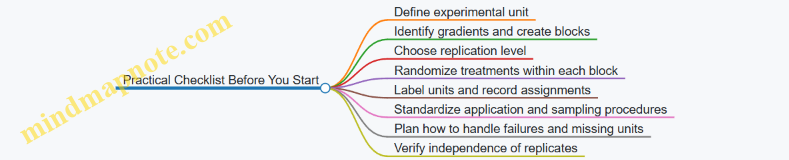
A well-built randomization and blocking plan reduces bias by construction. It doesn’t require perfect conditions; it requires that any unavoidable variation is measured, contained, and not systematically aligned with treatment identity.
2.5 Writing a Benchmark Protocol With Acceptance Criteria for Data Quality
A benchmark protocol is a promise to your future self: if someone repeats the work, they should reach the same conclusions for the same reasons. The protocol should therefore specify what you will measure, how you will measure it, how you will decide the data is usable, and what you will do when it is not.
Start with Benchmark Questions and Measurable Outcomes
Begin by converting the study goal into testable statements. For example: “Inoculant A improves early root biomass compared with control under loamy soil conditions.” Then list the primary outcomes (e.g., root dry mass at day 21) and secondary outcomes (e.g., soil mineral N at day 21, leaf chlorophyll at week 4). Keep the outcome list short enough that every measurement has a defined method and acceptance rule.
A practical tip: write the protocol so that each outcome has exactly one “primary” timepoint. If you need multiple timepoints, treat them as separate outcomes with their own acceptance criteria.
Define Treatments, Controls, and Randomization Logic
Specify treatments with enough detail to reproduce them: strain or consortium ID, lot number, carrier type, target dose, application method, and application timing. Controls should include at least an untreated control and a conventional nutrient control when benchmarking microbial inputs against agronomic baselines.
Randomization reduces bias, but only if it is implemented consistently. Describe the unit of randomization (plot, pot, tray) and the blocking factor (field zone, greenhouse bench, irrigation line). Include a simple mapping rule: “Within each block, assign treatments using a random number generator; record the assignment before any sampling.”
Lock Down Sampling, Handling, and Measurement Procedures
Data quality depends more on handling than on fancy instruments. For each measurement, document:
- Sampling unit and number of subsamples
- Collection depth or plant part definition
- Container type and labeling scheme
- Storage conditions and maximum holding time
- Laboratory assay method and calibration approach
- Replicate structure and how technical replicates are summarized
Example: For soil mineral N, specify whether you use fresh extraction, how you prevent nitrification changes during transport, and the exact extraction-to-analysis timeline. If the timeline is exceeded, the protocol should state whether the sample is rejected or flagged.
Create Acceptance Criteria That Are Specific and Actionable
Acceptance criteria should be written as “If X happens, then Y happens.” Use three layers: sample-level, run-level, and dataset-level.
Sample-level examples
- Viability counts below the assay’s lower quantification limit are flagged as “non-quantifiable,” not treated as zero.
- Soil samples with mislabeled IDs are excluded from analysis because they cannot be reliably assigned.
Run-level examples
- Calibration curve must meet a minimum R² threshold and pass control samples within defined recovery ranges.
- Duplicate assay results must fall within a pre-set relative difference; otherwise, rerun the sample.
Dataset-level examples
- If a treatment has fewer than a minimum number of accepted replicates per block, the treatment is excluded from primary analysis.
- If baseline soil nutrient variability exceeds a defined threshold, include baseline covariates or restrict analysis to comparable blocks.
To keep the rules fair, define them before you see results. That way, “acceptance” means “quality,” not “agreement with expectations.”
Document Traceability and Metadata with a Consistent Schema
Every record should connect back to a physical unit: lot, plot, pot, sample tube, and assay plate. Use a consistent identifier format such as SITE-BLOCK-PLOT-TREATMENT-REPLICATE-SAMPLINGTIME.
Include metadata fields that explain variability without forcing interpretation: soil texture class, irrigation regime, ambient temperature range, and any deviations from protocol. If deviations occur, record them immediately and classify them by severity (minor handling delay vs. missed application timing).
Use a Quality Workflow That Prevents Late Surprises
A simple workflow keeps quality checks from becoming an end-of-project scavenger hunt.
Mind Map: Benchmark Protocol Quality Workflow
Provide a Worked Example of Acceptance Criteria
Suppose you measure soil available phosphorus using a specific extractant.
- Sample-level rule: If sample mass is outside the target range by more than 5%, reject the sample.
- Run-level rule: If the lab control recovery is outside 90–110%, rerun the entire batch.
- Dataset-level rule: If fewer than 3 accepted replicates per treatment per block remain, exclude that treatment-block combination from the primary analysis and report it in the deviations log.
This example matters because it turns “quality” into decisions you can execute consistently.
Final Protocol Checklist Before Any Sampling
Before field or greenhouse work begins, verify that every outcome has: a method, a timepoint, a labeling rule, and acceptance criteria. Also confirm that the team knows who can reject data and what documentation is required for each rejection. If you can’t answer “what happens when a rule fails,” the protocol is not ready.
3. Microbial Strain Characterization and Input Specification
3.1 Documenting Strain Identity and Provenance for Reproducible Benchmarks
Reproducible biofertilizer benchmarking starts with one unglamorous task: proving that the microbe you tested is the microbe you think you tested. Strain identity is not just a label on a vial; it is a chain of evidence that connects the original isolate to the exact inoculant lot applied in a trial.
Strain Identity Foundations
A strain is defined by more than species name. Two isolates can share a species and still behave differently in fermentation, survival, and soil performance. For benchmarking, you need a stable identity record that includes:
- Taxonomic assignment at the level you can support (species, subspecies, or strain-level where available).
- Strain designation exactly as used by the culture collection or internal repository.
- Genetic or phenotypic markers that help distinguish the strain from close relatives.
- A provenance chain describing how the strain moved from source to your bench and then to your production lot.
A practical rule: if two labs cannot independently reconstruct the same strain from your documentation, your benchmark will be hard to defend.
Provenance Chain of Custody
Provenance answers “where did this culture come from, and what changed along the way?” Build it as a timeline with dates, locations, and handling steps. A complete chain includes:
- Source: culture collection ID, collaborator isolate ID, or internal master stock.
- Transfer events: when the culture was received, subcultured, or reformulated.
- Passage history: number of subculture steps and approximate time in storage.
- Storage conditions: medium type, cryoprotectant if used, temperature range, and storage duration.
- Lot linkage: which master stock produced which inoculant lot.
Use a consistent date format and record the date of the last verified identity check. If you need an example date, use something like 2026-03-15.
Identity Verification That Actually Helps
Identity verification should match the risk level of your benchmark. For routine comparisons, a basic check may be enough; for high-stakes claims, you need stronger evidence.
- Repository ID verification: confirm the strain designation matches the receiving paperwork.
- Morphology and growth characteristics: record colony morphology, growth rate on a defined medium, and basic staining results.
- Molecular confirmation: use a method that can distinguish the strain from near neighbors (for example, targeted sequencing or a marker panel).
- Functional sanity checks: verify that key traits expected for the strain are present under your assay conditions.
The key is to document the method, not just the result. “Positive” without the assay definition is like reporting a yield without the plot size.
Master Stock, Working Stock, and Inoculant Lot Mapping
To keep identity stable, separate stocks by purpose:
- Master stock: created once from the verified source and stored under controlled conditions.
- Working stock: used for routine fermentation or lab-scale preparation.
- Inoculant lot: the final product batch used in trials.
Your documentation should map these layers clearly. If a working stock is refreshed, record the refresh date and the master stock it came from. If a lot is produced from a working stock, record the working stock ID and passage count.
Mind Map: Strain Identity and Provenance Record
Example: A Minimal Yet Defensible Identity Record
Below is a compact template you can adapt for each strain and each inoculant lot.
Example: What Goes Wrong When Provenance Is Missing
Imagine two fermentation runs that both claim “ABC-17.” If you cannot show passage history and lot linkage, you cannot tell whether the difference in viability is due to fermentation conditions or due to strain drift from repeated subculturing. In benchmarking, that uncertainty becomes a confounder, and your soil response metrics inherit the ambiguity.
Acceptance Criteria for Identity Documentation
Set clear pass/fail rules so identity documentation is not a subjective judgment call. For example:
- The strain designation must match the source ID exactly.
- The last identity verification date must be within your defined window.
- The working stock passage count must not exceed your maximum.
- The inoculant lot must reference the working stock ID used to produce it.
When these criteria are met, your benchmark comparisons can focus on the variables you intended to test—fermentation platform, formulation, application method, and soil response—rather than on whether the microbe changed between steps.
3.2 Measuring Viability and Colony Forming Units for Inoculant Lot Traceability
Viability and colony forming units (CFU) are the two anchors of inoculant lot traceability. Viability tells you whether cells are alive at the moment of testing, while CFU translates living cells into countable units that can be compared across lots, carriers, and application windows. Together, they let you connect what was produced to what was applied—without relying on faith, vibes, or “it should be fine.”
Foundational Concepts for Interpreting Viability and CFU
Viability is measured as a fraction of cells that remain metabolically active or capable of growth under defined conditions. CFU is measured by plating a known volume (or mass equivalent) onto a suitable medium and counting colonies after incubation. One practical nuance: not every viable cell forms a colony on the first attempt, and not every colony represents a single original cell if clumping occurs. That’s why good traceability depends on consistent sample handling, dilution strategy, and plating conditions.
A simple mental model helps: if Lot A has higher CFU than Lot B, it usually means more cells capable of growth were present in the tested sample. If viability is high but CFU is low, the cells may be alive but stressed, injured, or unable to grow on the chosen medium. If CFU is high but viability is low, the viability assay may be overly strict or mismatched to the organism’s physiology.
Sampling and Handling for Traceability
Lot traceability starts before the lab. Use a defined sampling plan that captures heterogeneity within the lot—especially for carriers that settle or for liquids that stratify. Label samples with lot ID, sampling time, operator initials, and storage conditions. Keep a chain-of-custody record so the lab can explain any mismatch between production logs and test results.
When preparing dilutions, mix thoroughly and consistently. For carriers, use a standardized extraction step so the same fraction of cells is released into the diluent each time. For liquids, invert or gently agitate to avoid sampling only the top layer.
Viability Assays That Match the Organism
Choose a viability method that aligns with the organism’s growth requirements. Common approaches include metabolic staining or membrane integrity tests. The key is to validate that the assay responds correctly to known live and dead controls.
Run controls every time: a positive control representing expected live cells, and a negative control representing non-viable cells. If the controls fail, the sample results are not interpretable, even if the numbers look tidy.
Report viability as a percentage with the assay’s detection logic. For traceability, also record assay conditions such as incubation time, reagent lot, and microscopy or instrument settings.
CFU Enumeration with Dilution and Plating Logic
CFU measurement is a dilution-and-count exercise. The goal is to plate dilutions that yield countable colonies, typically within a predefined counting range. If plates are too crowded, colonies merge and counts become unreliable. If plates are too sparse, random variation dominates.
Use a consistent dilution series and plating volume. Calculate CFU per gram (for solids) or per milliliter (for liquids) using the plated dilution factor and the number of colonies counted. Always plate replicates so you can quantify variability within the lot.
A practical example: if you plate 0.1 mL of the 10^-5 dilution and count 85 colonies, then CFU/mL in the original sample is 85 ÷ 0.1 × 10^5 = 8.5 × 10^7 CFU/mL. If replicate plates differ widely, revisit mixing, dilution accuracy, and plating technique.
Quality Controls and Acceptance Criteria
Traceability requires rules, not just measurements. Define acceptance criteria for both viability and CFU based on product intent and historical performance. Include sterility or contamination checks appropriate to the medium and organism.
Track anomalies: unusual colony morphology, unexpected colony counts in controls, or consistent under-recovery from certain carriers. When anomalies appear, document corrective actions such as repeating extraction, re-preparing dilutions, or reviewing incubation conditions.
Mind Map: Viability and CFU Traceability Workflow
Example: Lot Traceability Using Paired Viability and CFU
Suppose Lot 24-03 is tested after storage. Viability is 92% by a membrane integrity assay, but CFU is 2.0 × 10^6 CFU/mL. Another lot, 24-02, shows 88% viability and 8.0 × 10^6 CFU/mL. The paired pattern suggests Lot 24-03 cells are still largely intact, but fewer are capable of colony formation under the chosen medium and incubation conditions.
In the traceability record, you would log the assay method, medium composition, incubation time, and any colony morphology notes. If the production log shows a change in carrier moisture or extraction pH for Lot 24-03, the lab can connect the measurement pattern to a plausible handling difference—without guessing.
Practical Reporting for Traceability Records
A traceability record should include: lot ID, sampling date, sample mass or volume, extraction method, dilution scheme, plating volume, incubation conditions, replicate counts, calculated CFU with units, viability method and readout, and control outcomes. This is the minimum set that allows someone else to reproduce the logic of your numbers, even if they weren’t in the room when the plates were counted.
3.3 Quantifying Functional Traits Such as Nitrogen Fixation and Phosphate Solubilization
Functional traits are measurable behaviors that connect a microbial input to nutrient transformations in soil. For benchmarking, you want trait measurements that are (1) comparable across lots and fermentation platforms, (2) interpretable with clear controls, and (3) tied to practical outcomes like plant nutrient uptake. Two common traits are nitrogen fixation and phosphate solubilization, because they map cleanly to N and P availability.
Foundational Concepts for Trait Measurement
Nitrogen fixation refers to converting atmospheric N₂ into forms usable by plants, typically via the enzyme nitrogenase. Phosphate solubilization refers to releasing phosphate from insoluble mineral forms into solution, often through organic acids and proton release.
A key benchmarking habit is to measure traits in conditions that separate “microbe activity” from “starting nutrient availability.” If the medium already contains abundant soluble nitrogen or phosphate, you may observe growth without meaningful functional contribution. So you design assays that are nutrient-limited in the target nutrient while still supporting microbial survival long enough to express the trait.
Nitrogen Fixation Quantification
You can quantify nitrogen fixation using either direct nitrogen incorporation or proxy indicators. Direct methods are more specific but require more infrastructure. Proxies are easier to run in batches but need careful interpretation.
Direct approach: ¹⁵N incorporation
In a controlled incubation, you supply a known amount of ¹⁵N-labeled nitrogen source or, for fixation-focused setups, you provide N-free conditions with a labeled tracer strategy. After incubation, you measure ¹⁵N enrichment in biomass or plant tissue. The functional output is expressed as fixed nitrogen (e.g., mg N per g biomass) based on enrichment and mass balance.
Proxy approach: acetylene reduction assay
Nitrogenase reduces acetylene (C₂H₂) to ethylene (C₂H₄). You measure ethylene production over time using gas chromatography. Results are reported as activity rates (e.g., nmol C₂H₄ per hour per sample). A practical control set includes a non-fixing strain or a nitrogenase-inhibited treatment to confirm the signal is enzyme-driven.
Controls that prevent false confidence
- No-inoculation control to capture background ethylene production or non-biological nitrogen transformations.
- Nitrogen-replete control to show that fixation decreases when nitrogen is abundant.
- Viability control to distinguish “no activity” from “no living cells.”
Easy-to-understand example
Suppose you compare two inoculant lots of a nitrogen-fixing consortium. Lot A shows 30% higher ethylene production than Lot B under N-free conditions, but both lots show similar ethylene production under nitrogen-replete conditions. That pattern suggests Lot A has better nitrogenase expression rather than simply higher biomass.
Phosphate Solubilization Quantification
Phosphate solubilization is often measured by changes in soluble phosphate concentration, pH, and sometimes by halo formation on agar. Halo size is visually useful but not a substitute for solution-based quantification.
Solution-based approach: soluble phosphate release
You incubate microbes with an insoluble phosphate source under controlled pH and agitation. At defined timepoints, you centrifuge and measure soluble phosphate in the supernatant using a colorimetric assay. Report results as mg P released per unit biomass or per unit inoculum.
Agar-based screening: halo formation
On plates containing insoluble phosphate, solubilizers create clear zones around colonies. For benchmarking, you record halo diameter and colony diameter, then compute a ratio to reduce the effect of faster growth. This is best used for ranking, not for final quantitative claims.
Interpreting pH and organic acid signals
Solubilization frequently correlates with acidification and organic acid production. Measuring supernatant pH helps interpret whether solubilization is driven by proton release. Measuring a small set of organic acids (e.g., acetate, citrate, gluconate) can clarify mechanism, especially when comparing fermentation platforms.
Easy-to-understand example
If Lot C releases more soluble phosphate than Lot D but also causes a much larger pH drop, you can treat pH as a mechanistic contributor. If Lot C releases phosphate with only a modest pH change, it may rely more on specific organic acids or enzyme activity.
Mind Map: Trait Quantification Workflow
Practical Benchmarking Tips That Keep Results Comparable
Normalize trait outputs to either biomass or inoculum dose so you compare activity, not just growth. Use consistent incubation timepoints across lots, because nitrogenase and solubilization can change rapidly after inoculation. Finally, record assay conditions like initial pH, agitation, and phosphate form, since these variables can shift the balance between “microbe does the work” and “chemistry does the work.”
3.4 Characterizing Consortium Compatibility and Inoculation Ratios
Consortium compatibility answers a practical question: if you mix several microbial partners, do they cooperate, ignore each other, or actively interfere? Inoculation ratios then translate that compatibility into a dosing plan that is consistent across lots, carriers, and application methods.
Foundational Concepts for Compatibility
Start by separating three layers that often get mixed up in bench notes.
- Compatibility at the strain level: whether strain A affects strain B’s growth, survival, or functional output.
- Compatibility at the consortium level: whether the full set behaves acceptably as a group, not just pairwise.
- Compatibility under your real formulation conditions: compatibility can change when oxygen, pH, moisture, and carrier nutrients shift.
A simple way to keep this straight is to test compatibility in the same “environment” you will later use for inoculation. If your fermentation platform produces a particular metabolite profile, and your carrier buffers pH, those conditions should appear in the compatibility assay.
Designing Compatibility Tests Without Guesswork
Use a structured matrix that includes single strains, pairwise mixes, and the full consortium. Include at least one negative control (no inoculation) and one positive reference (a known good single strain or a previously validated consortium lot).
Example: A three-member consortium (A, B, C) is tested in a 2×2×2 style plan:
- Singles: A, B, C
- Pairs: A+B, A+C, B+C
- Full: A+B+C
- Control: none
Measure two outcomes that match your intended function. For nitrogen-related products, track growth plus a functional proxy such as ammonium consumption or nitrogen fixation activity. For phosphorus-related products, track phosphate solubilization or a relevant enzyme activity. Viability matters too; a consortium that looks productive but collapses during storage is a compatibility failure in disguise.
Interpreting Compatibility Results Systematically
Compatibility outcomes usually fall into four buckets.
- Additive: the consortium’s functional output is roughly the sum of the parts.
- Synergistic: the consortium outperforms the expected additive baseline.
- Antagonistic: one partner suppresses another’s growth or function.
- Neutral with tradeoffs: total function is similar, but survival or stability differs.
To avoid subjective calls, define acceptance criteria before testing. For instance, require that each member in the full consortium retains at least a minimum viability fraction relative to its single-strain baseline, and that the consortium functional proxy meets a minimum threshold relative to the additive expectation.
Mind Map: Compatibility Logic and Evidence
From Compatibility to Inoculation Ratios
Inoculation ratios should reflect two constraints: ecological balance and functional coverage.
- Ecological balance means partners should not outcompete each other immediately after application. If one strain dominates early, the consortium may become a single-strain product.
- Functional coverage means each partner contributes to the target nutrient pathway. A ratio that maximizes one function but leaves another pathway underpowered can reduce overall soil response.
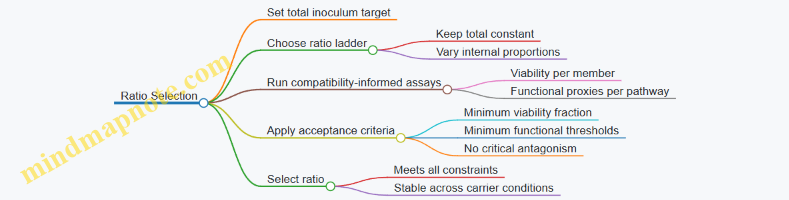
A practical approach is to start with a ratio ladder around the compatibility-tested baseline. For each ratio, keep the total inoculum constant and vary the internal proportions.
Example: For a three-member consortium, test total inoculum at 1×10^8 CFU per application unit, then vary internal ratios:
- 70:20:10 (A:B:C)
- 40:40:20
- 20:40:40
Evaluate viability of each member and the functional proxies tied to A, B, and C. The “best” ratio is the one that meets acceptance criteria for all required functions, not just the highest single proxy.
Mind Map: Ratio Selection Workflow
Practical Ratio Rules That Prevent Common Failures
- Avoid “one partner dominates” ratios unless you have evidence it remains stable under carrier and soil moisture conditions.
- Do not infer ratios from fermentation output alone. Fermentation can bias relative abundance; application and early soil establishment can shift it.
- Track member-specific viability, not only total CFU. A consortium can keep total CFU while losing the member that drives the key function.
Example: Turning Pairwise Antagonism Into a Usable Consortium
Suppose pairwise tests show A antagonizes B, but A+B+C together performs acceptably because C reduces the antagonistic effect (for example, by changing local pH or consuming inhibitory metabolites). In that case:
- Keep A and B in the consortium only at ratios that preserve B viability above your threshold.
- Use C as a required partner, not an optional add-on.
- Validate the selected ratio in the same carrier environment used for application.
This is how compatibility becomes an operational decision: you are not just proving that strains can coexist, you are selecting a ratio that keeps the consortium’s intended functions intact under realistic conditions.
3.5 Defining Input Specifications for Carriers Formulation and Storage Conditions
Carrier and storage specifications are where good microbes meet real-world physics. If you define inputs clearly, you can compare lots, reproduce results, and avoid the classic mystery of “it worked once.” This section turns carrier formulation and storage conditions into measurable, auditable requirements.
Start with What Must Be Preserved
Begin by listing the microbial attributes that your benchmark cares about. For many biofertilizers, the practical targets are viability at application time and functional capacity after rehydration or mixing.
- Viability target: minimum CFU per gram (or per mL) at the end of shelf life.
- Functional target: measurable activity such as phosphate solubilization rate or nitrogen fixation proxy under standardized conditions.
- Compatibility target: tolerance to carrier pH, osmotic stress, and any formulation additives.
A simple way to connect this to specifications is to write a “must-hold” statement: “The carrier must maintain viability above X and functional activity above Y through storage at Z conditions.”
Define Carrier Inputs with Clear Roles
Carriers are not all the same. Separate them by function so you can specify what matters.
- Bulk carrier: provides volume and handling (e.g., peat, composted organic matter, biochar, lignocellulosic powders).
- Moisture management: controls water activity so microbes do not die slowly.
- Protective matrix: reduces stress during drying, mixing, and transport.
- Dispersibility aid: helps uniform application and reduces clumping.
For each carrier input, specify: source type, particle size range, target moisture content, and acceptable pH range. If you use multiple carrier components, specify their ratios by mass.
Set Formulation Specifications That Link to Application
Formulation is the recipe plus the process constraints that keep the recipe meaningful.
Key formulation parameters to define:
- Target moisture content at packaging.
- Final pH of the carrier blend.
- Inoculant loading expressed as CFU per gram at packaging.
- Additives with maximum allowable levels (for example, buffering agents, protective polymers, or anti-caking materials).
- Homogeneity criteria: acceptance checks that confirm the inoculant is evenly distributed.
Easy-to-understand example: if your target is 1×10^9 CFU/g at packaging, then your formulation spec should also state the allowed deviation per lot, such as ±0.3 log CFU/g, and the sampling plan used to verify it.
Specify Storage Conditions as a Testable Contract
Storage specs should be written as conditions plus the time window they apply to.
Define:
- Temperature range (e.g., 5–25°C for routine storage).
- Relative humidity exposure or packaging moisture barrier class.
- Light exposure rules if relevant.
- Shelf-life test schedule with sampling at defined intervals.
Example: “Store packaged product at 20°C ±2°C, protected from direct light, and test viability at 0, 3, and 6 months.” If you need a date for documentation, use a fixed reference such as 2026-03-15 for lot labeling and recordkeeping.
Build Acceptance Criteria and Sampling Logic
Specifications without acceptance criteria are just wishful thinking.
- Viability acceptance: minimum CFU at packaging and at end-of-shelf-life.
- Functional acceptance: activity threshold measured using the same assay method every time.
- Physical acceptance: moisture content range, flowability, and absence of unacceptable clumps.
Sampling should be consistent. For instance, if a lot contains 10,000 units, define how many units are tested and how they are selected (random from multiple pallet positions).
Mind Map: Carrier Formulation and Storage Specifications
Worked Example for a Seed-Applied Powder
Assume a seed-applied powder intended for direct mixing with a carrier slurry.
- Carrier: peat-based powder, particle size 0.2–1.0 mm, target moisture 20–28% at mixing.
- Formulation: inoculant loading set to 1×10^9 CFU/g at packaging, final blend pH 6.0–7.0, and moisture at packaging 18–24%.
- Storage: 20°C ±2°C, sealed bags with low water vapor transmission.
- Acceptance: viability must be ≥5×10^8 CFU/g at 6 months, and homogeneity must pass a predefined variance limit across sampled subsamples.
This example shows the logic chain: carrier moisture and pH protect viability, packaging controls water exposure, and acceptance criteria ensure the lot is truly comparable.
Common Specification Gaps to Avoid
- Defining inoculant loading but not specifying final blend moisture.
- Stating storage temperature without a test schedule.
- Using “acceptable pH” without a measurement method and sampling approach.
- Verifying viability at packaging only, not at the time customers actually apply it.
When these gaps are closed, carrier formulation and storage become benchmark-ready inputs rather than uncontrolled variables.
4. Fermentation Platform Benchmarking for Consistent Microbial Outputs
4.1 Comparing Fermentation Modes Including Batch Fed Batch and Continuous Systems
Fermentation mode is not a cosmetic choice; it controls how microbes experience nutrients, oxygen, and time. Those experiences then shape viability, functional traits, and the consistency of downstream formulations. This section compares batch, fed-batch, and continuous systems using the same benchmarking lens: inputs, process control, output quality, and operational risk.
Core Concepts That Drive Differences
All three modes aim to produce a target microbial state—often high viability plus stable functional performance (for example, phosphate solubilization or nitrogen fixation). The main variables are nutrient availability over time, oxygen transfer capacity, and residence time.
- Batch: everything starts at once. Nutrients and dissolved oxygen change quickly as cells grow.
- Fed-batch: start with a base, then add nutrients gradually to steer growth and reduce stress.
- Continuous: feed and harvest run simultaneously, keeping the culture near a steady state.
A practical way to remember it: batch is a sprint, fed-batch is paced, and continuous is a conveyor belt.
Batch Systems
In a batch run, you charge the reactor with medium, inoculate, and let it run until you harvest. Benchmarking should capture how quickly the culture transitions from growth to nutrient limitation.
What to measure
- Growth curve proxies: optical density or biomass, plus viable counts.
- Oxygen stress: dissolved oxygen trends and agitation/airflow settings.
- Viability at harvest: CFU per mL and percentage loss versus early timepoints.
Easy example
A lab produces a starter inoculant for a carrier formulation. They run a 24-hour batch and harvest at the point where viable counts peak. If the medium is too rich, cells may reach high biomass but lose viability by the end due to oxygen limitation. If the medium is too lean, they may harvest earlier with lower biomass but better viability.
Best practice for benchmarking
Define a harvest rule before the first run. For example: harvest when viable CFU reaches 95% of the maximum observed value, not when someone “feels like it’s ready.”
Fed-Batch Systems
Fed-batch adds nutrients during the run, which lets you manage the balance between rapid growth and maintaining a healthier physiological state. The benchmarking focus shifts from “how much medium” to “how the feed schedule behaves.”
What to measure
- Feed rate profile and cumulative feed added.
- Dissolved oxygen control behavior during feed events.
- Viability and functional trait stability at harvest.
Easy example
A phosphate-solubilizing consortium performs inconsistently in batch. In fed-batch, the team uses a controlled carbon feed to prevent sudden oxygen demand spikes. They observe that dissolved oxygen stays within a target band, and the harvested product shows more consistent solubilization in a standardized soil microcosm.
Best practice for benchmarking
Use the same feed strategy across replicates and document it as a table of timepoints and feed rates. Even small differences in feed timing can change the physiological state.
Continuous Systems
Continuous systems maintain steady conditions by continuously feeding fresh medium and removing culture. This can improve throughput, but it demands tight control to avoid drift.
What to measure
- Dilution rate and its effect on viable counts.
- Steady-state stability: whether key metrics fluctuate within a narrow range.
- Contamination resistance and washout risk.
Easy example
A facility runs a continuous culture for a microbial input used in fermentation-to-formulation workflows. When the dilution rate is set too high, cells cannot maintain biomass and viability drops—classic washout behavior. When set appropriately, viable counts stabilize, and lot-to-lot variability decreases.
Best practice for benchmarking
Benchmark steady-state quality using a “window” approach. For example, only accept data from the final N hours after parameters stabilize, and treat earlier hours as warm-up.
Mind Map: Fermentation Mode Benchmarking
Benchmarking Comparison Checklist
Use the same checklist for all modes so results are comparable.
- Define the target microbial state: viability threshold and functional trait expectation.
- Standardize inoculum and starting conditions: same inoculum age and starting CFU.
- Record process control variables: agitation, aeration, temperature, pH, and dissolved oxygen strategy.
- Apply consistent harvest logic: fixed time is acceptable only if it correlates with quality.
- Quantify output quality: viable counts plus at least one functional assay relevant to the intended soil role.
Example Benchmark Outcome Interpretation
Suppose batch and fed-batch both reach similar biomass, but fed-batch shows higher viable CFU and more consistent functional performance in a standardized assay. The interpretation is straightforward: the fed-batch strategy likely reduced physiological stress near harvest. If continuous shows stable viability but occasional drops, the likely culprit is parameter drift or insufficient steady-state equilibration time.
The key is to connect process behavior to quality outcomes using the recorded control variables, not just end-point measurements. That’s how fermentation mode becomes an evidence-based choice rather than a preference.
4.2 Standardizing Media Components and Nutrient Ratios for Benchmarking
Benchmarking fermentation platforms is only as fair as the recipe. If one platform gets a richer medium, it may look “better” for reasons unrelated to its engineering. Standardizing media components and nutrient ratios creates a controlled baseline so differences in microbial output reflect the platform, not the pantry.
Foundational Principle: Fix the Medium, Vary the Platform
Start by defining a single medium formulation that stays constant across all platforms and runs. Treat it like a calibration standard: same salts, same carbon source, same nitrogen form, same trace element package, and the same target concentrations. Then vary only the platform parameters you intend to compare (for example aeration strategy, agitation profile, or feeding schedule).
A practical rule: if you cannot write the medium as a list of measured inputs with target concentrations and tolerances, you do not yet have a benchmarkable medium.
Component Categories and What They Control
A standard medium typically includes:
- Carbon and Energy Source: Drives biomass formation and affects acid production. Example: using glucose at 20 g/L gives a predictable growth curve; switching to glycerol changes uptake rates and can shift pH dynamics.
- Nitrogen Source: Determines growth efficiency and downstream functional traits. Example: ammonium sulfate often supports rapid growth, while yeast extract can introduce variable organics that complicate comparisons.
- Phosphorus Source: Supports ATP and nucleic acids; too low can limit growth even if carbon is abundant.
- Mineral Salts: Provide ions for enzyme function and osmotic balance. Example: magnesium and potassium can influence stress tolerance during aeration.
- Trace Elements and Vitamins: Needed in small amounts but can strongly affect performance. Example: iron availability can limit growth if chelation and pH are not consistent.
- Buffers and pH Control Strategy: Determines whether pH drift is a platform effect or a medium effect. If you use a buffer, keep it identical across runs.
Nutrient Ratio Targets and Tolerances
Standardize ratios rather than only absolute amounts, because small measurement differences can matter. A useful approach is to set target ratios such as:
- C:N Ratio: Controls growth rate and nitrogen assimilation. Example: if you target C:N of 10:1 (molar basis), keep it the same even if you adjust total carbon slightly.
- C:P Ratio: Helps avoid phosphorus limitation. Example: if phosphorus is too low, you may see high early growth but reduced viability later.
- N Form Ratio: If you use mixed nitrogen (for example ammonium plus amino acids), lock the proportions.
Define tolerances for each component. For benchmarking, tolerances should be tight enough that they do not explain observed differences. A common starting point is ±5% for major components and tighter for trace elements where analytical variability is manageable.
Example: Two Media Recipes That Are Not Comparable
Consider two platforms tested with “similar” media:
- Run A: glucose 20 g/L, ammonium sulfate 3 g/L, phosphate 1 g/L, trace mix 1×.
- Run B: glucose 20 g/L, yeast extract 5 g/L, phosphate 1 g/L, trace mix 1×.
Even though carbon and phosphate match, nitrogen chemistry differs. Yeast extract adds peptides and growth factors, which can boost biomass and viability independent of platform performance. Benchmark results would be hard to interpret because the medium itself changes the biology.
Standardization Workflow for Benchmark Runs
Use a repeatable workflow so every batch of medium is traceable.
- Write the Medium Spec: List each component, target concentration, and tolerance.
- Prepare a Master Batch: Mix a larger volume once, then aliquot to reduce weighing variability.
- Validate pH and Sterility: Measure initial pH and confirm sterilization method is identical.
- Record Lot Numbers: Track supplier and lot for trace elements and carbon sources.
- Run a Medium Check: Include a small “medium-only” verification step such as confirming pH after sterilization and before inoculation.
Mind Map: Media Standardization for Benchmarking
Advanced Details That Prevent Hidden Medium Drift
Medium standardization fails most often in the “small” places:
- Water Quality: Mineral content in water can change ionic strength. Use the same water source and document it.
- Trace Element Handling: Trace mixes can precipitate if added at the wrong pH or temperature. Keep addition timing and temperature consistent.
- Carbon Source Purity: Different suppliers may have different impurities that act like extra nutrients. Standardize supplier or test impurity-relevant parameters when possible.
- pH Control Method: If one platform uses automatic base addition and another uses a buffer only, the medium’s effective chemistry changes during growth. Keep the pH control strategy aligned.
Quick Example: A Benchmark-Ready Medium Spec
A benchmark-ready spec includes both targets and tolerances, for example:
- Glucose: 20.0 g/L (±5%)
- Ammonium sulfate: 3.0 g/L (±5%)
- Phosphate: 1.0 g/L (±5%)
- Trace mix: 1× (±10% where analytical control is limited)
- Initial pH: 6.8 (±0.1)
- Sterilization: same method and hold time
With this structure, you can compare platforms without guessing whether the medium quietly changed the outcome.
4.3 Monitoring Process Parameters Such As pH Temperature Aeration and Agitation
Monitoring fermentation parameters is less about collecting numbers and more about keeping the culture in the zone where the target functions stay stable. In practice, you treat pH, temperature, aeration, and agitation as a coupled system: changing one often forces the others to compensate.
Foundational Logic for Parameter Control
Start by defining what “good” looks like for your platform. For many microbial inputs, viability and functional performance depend on avoiding stress (too hot, too acidic, too oxygen-limited) while also preventing overgrowth that can shift metabolism. A simple workflow is: set target ranges → measure continuously or at defined intervals → log every adjustment → verify with downstream viability and functional assays.
PH Monitoring and Control
pH affects enzyme activity, membrane stability, and nutrient availability. Most fermentations use either automatic titration (acid/base addition) or manual adjustments at scheduled checkpoints.
Best practice: calibrate the pH probe before each run using fresh buffers, and record the calibration slope and offset in the batch record. During the run, watch not only the pH value but the pH drift rate. A fast drift often signals rapid acid or base production, which can precede a viability drop.
Easy example: if pH falls steadily during the first half of the run, you might be seeing higher-than-expected organic acid formation. Instead of repeatedly “chasing” the pH with large base additions, check whether your feed composition or feed rate is pushing metabolism toward acid production.
Temperature Monitoring and Control
Temperature governs growth rate and stress response. Even small deviations can change oxygen demand and the timing of nutrient uptake.
Best practice: verify temperature probe placement and ensure good mixing around the probe. If the vessel has temperature gradients, the probe may read “on target” while parts of the broth experience different conditions.
Easy example: suppose the jacket control holds 30.0°C, but agitation is low. The probe near the bottom reads stable, while the top warms differently, leading to uneven growth and inconsistent viability across samples.
Aeration Monitoring and Control
Aeration supplies oxygen and strips volatile byproducts. Oxygen transfer is commonly managed through airflow rate, oxygen enrichment, and sparger design, but the operational reality is that oxygen transfer depends on mixing and broth properties.
Best practice: track airflow and, when available, dissolved oxygen (DO). DO is especially useful because it reflects oxygen availability after mixing and mass transfer, not just what you set.
Easy example: if you increase airflow but DO still drops, the limitation may be mixing (oxygen can’t reach cells efficiently) or broth viscosity/carrier effects. In that case, you adjust agitation or feed solids rather than continuing to raise airflow.
Agitation Monitoring and Control
Agitation affects oxygen transfer, heat distribution, and suspension of cells and carriers. Too little agitation risks oxygen limitation and gradients; too much can increase shear stress depending on organism and broth composition.
Best practice: monitor agitation speed (RPM) and, if your system supports it, use power draw or torque trends as a proxy for changes in broth rheology. A sudden torque increase can indicate foaming, viscosity changes, or carrier swelling.
Easy example: during a run with a carrier-rich medium, agitation torque rises over time. If DO also declines, the broth may be becoming harder to mix, so you may need to adjust agitation strategy or feed concentration.
Integrated Monitoring Strategy
Use a control loop mindset: each parameter has a role, and the system response tells you where the bottleneck is.
- If pH drifts quickly: check feed composition, buffering capacity, and base/acid addition performance.
- If temperature is stable but DO falls: check mixing and oxygen transfer settings.
- If DO is stable but viability declines: look for non-oxygen stressors such as osmotic pressure, nutrient imbalance, or excessive byproduct accumulation.
Mind Map: Process Parameter Monitoring
Example: Interpreting a Real-Time Pattern
Imagine a run where pH drops from 6.8 to 6.2 over two hours, DO trends downward, and agitation torque increases.
A coherent interpretation is: the culture is producing more acids (pH drift), the broth is becoming harder to mix (torque increase), and oxygen transfer is worsening (DO decline). A practical response is to first stabilize mixing (agitation strategy) and verify oxygen transfer, then review feed composition and buffering capacity to address the acid production driver. Finally, confirm the outcome with a viability check from samples taken before and after the adjustments.
Practical Logging That Prevents Confusion Later
Record measurements with timestamps, include setpoints and actual values, and note any interventions (probe calibration, base/acid additions, airflow changes, agitation changes). When sampling for viability and functional assays, align sample times to the parameter log so you can connect cause and effect without guesswork.
4.4 Measuring Fermentation Performance Metrics Including Biomass Yield and Viability Loss
Fermentation performance metrics answer two practical questions: “How much useful biomass did we produce?” and “How much of it survived the process?” Measuring both keeps benchmarking honest, because a process can look productive while quietly killing the inoculant.
Core Concepts for Benchmarking Fermentation Outputs
Start by separating three layers of measurement.
- Process output: what the fermenter produced over time, such as biomass concentration and growth rate.
- Product quality: what portion of that biomass remains viable and functional, such as CFU or viability staining results.
- Loss mechanisms: why viability drops, such as oxygen limitation, pH drift, osmotic stress, or nutrient depletion.
A good benchmark records all three layers, even if some are measured indirectly.
Biomass Yield Metrics That Are Comparable
Biomass yield should be expressed in units that match your organism and downstream formulation.
- Biomass concentration: common choices include dry cell weight (g/L) or optical density converted to biomass using a calibration curve.
- Total biomass produced: biomass concentration multiplied by working volume, useful when comparing batches with different fill volumes.
- Specific growth rate: derived from the slope of log biomass versus time during the exponential phase.
Easy example: If Batch A reaches 3.0 g/L dry cell weight and Batch B reaches 2.5 g/L, Batch A has higher biomass concentration. If both used the same working volume, Batch A also has higher total biomass. If volumes differ, compare total biomass to avoid rewarding larger tanks.
To make biomass metrics comparable across runs, standardize sampling timing. For instance, collect samples at the same relative points: start of exponential growth, mid-exponential, and end-of-fermentation.
Viability Loss Metrics That Explain Quality
Viability loss quantifies how many cells remain alive after exposure to fermentation conditions.
- Viable count at timepoints: CFU/mL or CFU/g for each sampling time.
- Viability fraction: viable count divided by a total biomass proxy measured at the same timepoint.
- Viability loss percentage:
- Viability loss = (Viable at start − Viable at end) / Viable at start × 100.
Easy example: If viable count is 1×10^9 CFU/mL at start and 2×10^8 CFU/mL at end, viability loss is 80%. Two processes might both end with similar biomass concentration, but the one with lower viability loss is the better inoculant producer.
Viability measurement should be paired with a consistent plating or counting method. Changing dilution schemes or incubation conditions between runs can masquerade as process effects.
Linking Biomass and Viability Without Confusing Them
Biomass yield and viability loss often move in different directions. A process can increase biomass while decreasing viability if cells grow under stress that later reduces survival.
Use a simple interpretation matrix.
| Observation | Likely meaning | Benchmark action |
|---|---|---|
| High biomass, low viability loss | Efficient growth with tolerable stress | Confirm reproducibility and scale readiness |
| High biomass, high viability loss | Growth under damaging conditions | Investigate pH, oxygen transfer, and nutrient regime |
| Low biomass, low viability loss | Limited growth but gentle conditions | Check inoculum quality and media adequacy |
| Low biomass, high viability loss | Both growth and survival are impaired | Review multiple process parameters and sampling integrity |
Sampling Plan and Data Hygiene
A systematic sampling plan prevents “measurement drift,” where the lab method changes over time.
- Timepoints: include at least one early point and one late point, plus one around the transition from exponential to stationary phase.
- Replicates: measure viability and biomass from the same sample aliquot to reduce mismatch.
- Chain of custody: label samples with run ID, timepoint, and dilution factors.
Easy example: If you only sample at the end, you cannot tell whether viability loss happened early (stress during growth) or late (end-of-run conditions). Adding an early timepoint makes the benchmark diagnostic.
Mind Map: Fermentation Performance Metrics
Practical Measurement Workflow
- Define the benchmark window: choose the sampling schedule tied to growth phases, not just clock time.
- Measure biomass proxy at each timepoint using a calibrated method.
- Measure viable counts at the same timepoints using a fixed dilution and plating protocol.
- Compute metrics: biomass concentration, total biomass, specific growth rate, viability fraction, and viability loss.
- Interpret with the matrix to decide whether the process is failing at growth, survival, or both.
Example workflow: For a batch run, sample at 0 h (inoculation), 6 h (mid-exponential), and 12 h (end). If biomass rises from 0.2 to 3.0 g/L but CFU drops from 1×10^9 to 1×10^7 CFU/mL, you have strong growth with severe survival loss. That pattern points to stress conditions during later growth or end-of-run handling, guiding what to tighten in the next benchmark iteration.
4.5 Linking Fermentation Outputs to Downstream Formulation and Application Readiness
Fermentation is only half the story. The other half is making sure the microbial output survives handling, stays active in the target environment, and delivers measurable performance when applied. This section connects upstream fermentation outputs to downstream formulation choices and application readiness using a practical chain of evidence: output quality → formulation stability → application compatibility → field-relevant activity.
From Fermentation Outputs to What Must Be Preserved
Start by listing what fermentation produces and what must remain true after processing.
- Viable cell concentration: If viability drops during concentration, drying, or storage, the dose delivered to soil or seed will be lower than planned.
- Physiological state: Cells grown under certain conditions may be viable but less prepared for stress (desiccation, osmotic shock, UV exposure, or low oxygen).
- Metabolite carryover: Organic acids, residual sugars, or salts can shift pH and osmolarity in the final product, affecting shelf stability and compatibility with tank mixes.
- Cell surface traits and aggregation: Some strains clump easily; others disperse well. Aggregation changes dosing uniformity and can clog application equipment.
A simple rule of thumb: treat fermentation outputs as inputs to a stress test that begins at harvest.
Harvest and Concentration Decisions That Protect Output Quality
Harvest is where many “good fermentations” become mediocre products.
- Harvest timing: Choose the harvest window that balances biomass and physiological readiness. For example, harvesting too late can increase stress markers and reduce survival during drying.
- Separation method: Centrifugation, filtration, or settling each changes shear exposure and residual medium composition. Track how each method affects viability and dispersion.
- Washing and buffer selection: Washing reduces unwanted medium components, but excessive washing can remove protective compounds. Use a buffer that supports viability during the next step.
Example: Two lots of the same strain reach similar CFU/mL in fermentation. Lot A is harvested earlier and concentrated gently; Lot B is harvested later and concentrated with harsher shear. Even if both start with equal CFU/mL, Lot A typically retains higher viability after formulation because its cells were less stressed before processing.
Formulation Readiness Criteria That Translate to Real Use
Formulation is not just “making it stable.” It must also be workable.
Define acceptance criteria in four categories:
- Potency: Viable count at release and after a defined storage period.
- Stability: Minimal drift in pH, viscosity, and dispersion over time.
- Compatibility: Behavior in the intended application system, including mixing water quality and any co-applied products.
- Deliverability: Ability to dose uniformly through the target equipment without clogging.
Example: A wettable powder formulation may meet potency at release, but if it disperses poorly in hard water, the effective dose drops. Bench mixing tests with representative water hardness and agitation settings prevent surprises.
Application Compatibility Checks That Prevent Dose Drift
Application readiness means the product performs under the messy realities of field operations.
Key checks:
- Mixing and suspension behavior: Measure settling rate and resuspendability after a standardized rest period.
- pH and osmolarity tolerance: Confirm that the final product’s pH range supports viability during the mixing window.
- Equipment fit: Validate nozzle or injector compatibility using viscosity and particle size or aggregation metrics.
- Application timing alignment: Ensure the product’s activity window matches crop and soil conditions. For instance, if the product is sensitive to UV, seed treatment or soil incorporation may be required.
Example: If a formulation forms stable clumps, a sprayer may deliver uneven coverage. A practical fix is adjusting carrier particle size or adding a dispersant that improves suspension without harming viability.
A Systematic Workflow from Fermentation to Field-Ready Product
Use a staged workflow so each decision has a measurable output.
- Define target dose and route: Seed, soil drench, furrow, or foliar.
- Set potency targets: CFU per gram or per mL at release, plus expected losses during storage and application.
- Map fermentation outputs to formulation inputs: Viability, physiological state proxies, residual medium profile, and aggregation tendencies.
- Run formulation stress tests: Storage, mixing water, temperature, and agitation.
- Run application simulation tests: Equipment mixing, settling, and delivery uniformity.
- Release testing: Potency, stability indicators, and deliverability metrics.
This workflow prevents “passing fermentation” from becoming a false sense of completion.
Mind Map: Output-to-Readiness Linkages
Example: Translating Fermentation Metrics into a Formulation Plan
Suppose fermentation monitoring shows high biomass but moderate viability after harvest. The formulation plan should address the likely failure mode.
- If viability loss correlates with harvest timing: shift harvest earlier and standardize the harvest window.
- If viability loss correlates with residual medium: increase washing stringency or adjust buffer composition.
- If viability is stable but dispersion fails: modify carrier properties or add a dispersant compatible with the strain.
Then verify readiness with a small matrix of tests: storage at the intended temperature, mixing in representative water, and equipment simulation for the chosen application route.
Practical Summary
Treat fermentation outputs as specifications that must survive processing and handling. By defining potency, stability, compatibility, and deliverability criteria—and validating them with staged bench tests—you ensure that what was produced in the fermenter is what actually reaches the crop in the field.
5. Formulation and Application Method Benchmarks
5.1 Selecting Carriers and Additives for Survival and Field Performance
Carriers are the “home” for your microbes between fermentation and soil contact. Additives are the “weatherproofing” that helps cells tolerate storage, mixing, and the first hours in soil. Good selection starts with a simple question: what stresses your product will actually face in your workflow? If you can list those stresses, you can match carrier and additive choices to them.
Step 1: Identify the Real Stress Timeline
Think in phases, not ingredients.
- Storage stress: temperature swings, moisture migration, oxygen exposure, and time-in-warehouse.
- Mixing stress: shear from pumps, wetting difficulty, and clumping that prevents even distribution.
- Application stress: sunlight and drying on seed or leaf surfaces, plus dilution in tank water.
- Soil contact stress: pH and salinity, oxygen availability, and competition with native microbes.
Example: If your product is applied as a seed treatment and stored in a warm facility, the carrier must protect against heat and desiccation, and the formulation must re-disperse quickly during coating.
Step 2: Choose Carriers by Physical Fit and Microbial Compatibility
Carriers usually fall into three practical categories.
-
Solid carriers (powders, granules, pellets)
- Strengths: easier handling, stable dosing, less tank mixing variability.
- Watch-outs: moisture uptake can reduce viability; some powders disperse poorly.
- Best use: when you need consistent per-plant or per-hectare dosing.
-
Liquid carriers (suspensions, emulsions)
- Strengths: easier application uniformity, less dust, faster wetting.
- Watch-outs: microbial growth or die-off during storage; oxygen and contamination control matter.
- Best use: when application timing is tight and mixing is controlled.
-
Encapsulated or coated carriers
- Strengths: improved protection during storage and early soil contact.
- Watch-outs: coating thickness and release rate must match your application method.
- Best use: when you need stronger survival through harsh mixing or surface exposure.
Example: A powder carrier that absorbs water from humid air may look fine on day one but show a steep viability drop after two months. A simple packaging and moisture-control check often explains the difference.
Step 3: Select Additives That Address Specific Failure Modes
Additives should be chosen to solve a named problem, not to “add protection” in general.
- Moisture management: humectants or desiccant-compatible systems to reduce water activity swings.
- Wetting and dispersibility: surfactants or dispersants that prevent clumps and ensure uniform coverage.
- pH buffering: stabilizers that keep microenvironments near the cells’ preferred range.
- Osmotic and salt tolerance: compatible solutes that reduce shock when tank water or soil is saline.
- Thermal protection: protectants that reduce heat-related membrane damage.
Example: If tank water pH varies widely, viability may track with water source. A buffering additive can reduce that variability, making field results less dependent on the day’s water.
Step 4: Match Formulation to Application Method
Different application methods impose different constraints.
- Seed treatment: prioritize adhesion, re-wetting, and minimal clumping during coating.
- Soil drench or furrow application: prioritize suspension stability and settling control.
- Foliar application: prioritize survival through drying and good coverage without excessive phytotoxicity.
Example: A formulation that settles quickly in a drench tank will under-dose the first part of the field. The “best” carrier is the one that stays evenly suspended for the duration of mixing and application.
Step 5: Use Bench Tests That Mirror Field Handling
Run small, practical tests that mimic your real workflow.
- Re-dispersion test: measure how quickly the product returns to a uniform suspension after mixing.
- Clumping score: visually and quantitatively track agglomerates after a defined agitation period.
- Viability after handling: compare viability before and after simulated mixing, pumping, and application time.
- Moisture uptake check: track mass change under controlled humidity to predict shelf behavior.
Example: If viability drops after pumping, the issue may be shear sensitivity. Adjusting pump type, flow rate, or adding a dispersibility aid can fix the problem without changing the microbial strain.
Mind Map: Carrier and Additive Selection Logic
Example: A Systematic Carrier Choice in Practice
A team compares two solid carriers for a phosphate-solubilizing consortium.
- Carrier A: fine powder with good initial viability.
- Carrier B: granulated carrier with slightly lower initial viability.
They run moisture uptake and re-dispersion tests at the same humidity conditions expected in storage. Carrier A shows rapid moisture gain and forms hard clumps; viability after simulated mixing drops sharply. Carrier B maintains dispersion and shows steadier viability after handling. The final choice is not the one with the highest starting viability, but the one that survives the full workflow.
Step 6: Document the “Why” So Benchmarks Stay Comparable
Record carrier and additive details in a way that supports benchmarking later: particle size range, moisture target, packaging conditions, mixing water pH range, and agitation time. When you later compare fermentation platforms or application rates, you’ll know whether differences came from biology or from how the product behaved in the real world.
5.2 Evaluating Formulation Stability During Storage and Transport
Formulation stability is the ability of a biofertilizer to keep its intended properties from the moment it leaves the production line until it reaches the field. For benchmarking, treat stability as a measurable chain: viability and activity, physical integrity, and performance after application. If any link breaks, the “same product” can behave like a different one.
What Stability Means in Practice
Start with three stability categories.
-
Biological stability: microbial viability (e.g., CFU or equivalent counts) and functional activity (e.g., nitrogen fixation potential) over time.
-
Physical stability: suspension behavior, clumping, phase separation, and particle size distribution for liquid or wettable forms.
-
Chemical and environmental stability: pH drift, moisture uptake, oxidation, and carrier degradation that indirectly harms microbes.
A simple example: a liquid inoculant that looks uniform at packing may form a sediment layer after a week at warm temperatures. Even if CFU counts remain acceptable, poor resuspension can cause uneven application and patchy crop response.
Designing a Stability Evaluation Plan
A stability plan should mirror real handling conditions rather than ideal lab storage.
- Define time points: choose early, mid, and late checks (for example, day 0, week 2, week 6, and end of shelf window). This captures both fast and slow failure modes.
- Define temperature regimes: include at least one “cool” condition, one “ambient,” and one “stress” condition that reflects transport heat. If you use a stress condition, keep it within realistic bounds for the supply chain.
- Define packaging and transport simulation: test the actual container type (bottle, jerrycan, bag) and closure. Transport simulation can include vibration and short-term temperature cycling.
Example: if your product is shipped in 20 kg bags, do not evaluate only in lab beakers. Bag headspace, moisture exchange, and compression during stacking can change stability.
Sampling and Handling Without Creating Artifacts
Stability testing fails when sampling itself changes the product.
- Mix or agitate using a standardized method before sampling so comparisons are fair.
- Use consistent sample volumes and avoid repeated opening of the same container when possible.
- Record every handling step: time out of storage, agitation duration, and whether samples were filtered or centrifuged.
A practical rule: if you must open containers multiple times, treat “open time” as a variable and keep it identical across treatments.
Metrics That Actually Predict Field Performance
Use a small set of metrics that connect to application outcomes.
Biological metrics
- Viability counts at each time point.
- Functional proxy assays when available (for example, enzyme activity or substrate utilization).
Physical metrics
- Sedimentation rate or re-dispersibility after a fixed rest period.
- Viscosity or flow behavior for liquids.
- Moisture content for powders and granules.
Chemical metrics
- pH and conductivity drift.
- Moisture uptake and carrier integrity.
Example: a powder may retain CFU counts but absorb moisture and cake. Caking can prevent proper dosing, so include a “dose deliverability” check such as sieve integrity or flow time.
Acceptance Criteria for Benchmarking
Acceptance criteria should be explicit and tied to product claims.
- Viability threshold: require a minimum percent retention versus day 0.
- Physical usability threshold: require no irreversible separation and a defined re-dispersion performance.
- Performance threshold: if you run application tests, require that treated plots meet a minimum response relative to controls.
Example: set a criterion like “re-disperses to a uniform suspension within 60 seconds using the standard agitation method” and “viability retains at least X%.” This turns stability from a vague expectation into a pass/fail benchmark.
Mind Map of Stability Evaluation
Mind Map: Evaluating Formulation Stability During Storage and Transport
Worked Example with Clear Decisions
A liquid inoculant is packed in 1 L bottles. You test day 0, week 2, week 6 under ambient and a heat-stress condition.
- At week 6 ambient: viability retains 90%, pH shifts slightly, and re-dispersion is uniform after 30 seconds.
- At week 6 heat-stress: viability retains 70%, pH shifts more, and sediment forms that does not fully re-disperse within 60 seconds.
Decision: the product passes ambient stability but fails heat-stress usability. For benchmarking, you record both outcomes separately. That prevents a common mistake: calling it “stable” because CFU remains acceptable while dosing would still be inconsistent in real transport.
Common Failure Modes to Measure, Not Guess
- Hidden separation: microbes remain viable but settle into an unusable sediment.
- Moisture-driven loss: powders cake or lose viability after moisture uptake.
- pH drift: carrier buffering fails and microbial function declines.
- Container effects: closure permeability changes moisture or oxygen exposure.
The point of stability evaluation is to catch these with measurements that connect to how the product is actually used, not just how it looks in a jar.
5.3 Benchmarking Application Timing Including Seed Soil and Foliar Pathways
Application timing is where good biofertilizer intentions meet real-world biology. Benchmarking timing means you treat “when” as a controlled variable, not a footnote. The goal is to compare microbial inputs fairly across pathways—seed, soil, and foliar—while keeping plant growth stage and environmental conditions aligned.
Foundational Logic for Timing Benchmarks
Start by separating three layers of timing:
- Microbe arrival time: when the inoculant contacts the target zone (seed surface, rhizosphere, or leaf surface).
- Plant developmental stage: when the crop is most receptive to nutrient cycling and root colonization.
- Environmental window: temperature, moisture, and light conditions that affect survival and activity.
A practical rule for benchmarks: define timing using both calendar days after planting and growth stage (for example, “V3 to V4” or “4–6 leaf”). Calendar-only timing drifts when emergence is uneven.
Seed Pathway Timing
Seed application targets early root establishment. Benchmark timing by specifying:
- Seed treatment window: time between coating and sowing.
- Sowing conditions: soil moisture at planting and expected emergence speed.
- Seed handling constraints: mixing, drying, and storage duration before planting.
Example: Compare two inoculant lots applied to seed. Treat both lots identically, then sow into two moisture conditions: “moist furrow” and “dry furrow.” Measure emergence rate and early root biomass at a fixed growth stage (not a fixed day). If the dry furrow delays emergence, you’ll see whether the inoculant’s advantage depends on early contact.
Best practice for fair comparisons: include a vehicle-only seed control (carrier without microbes) so any coating effects are accounted for.
Soil Pathway Timing
Soil application aims at rhizosphere colonization and nutrient availability. Benchmark timing by controlling:
- Application depth and placement: broadcast vs band vs drench near the root zone.
- Time relative to root growth: early pre-emergence vs at first root branching.
- Moisture management: irrigation or rainfall timing after application.
Example: For a legume crop, test soil application at “two weeks before expected nodulation” versus “at first visible nodulation.” Keep application rate and placement identical. Then measure nodulation counts and nitrogen-related soil indicators at the same growth stage. If the early timing improves soil indicators but not nodulation, you’ve learned that early nutrient cycling alone doesn’t guarantee biological uptake.
Best practice: record the days to first measurable soil response using a predefined sampling schedule. That prevents cherry-picking the “best” timepoint.
Foliar Pathway Timing
Foliar application targets leaf-associated nutrient processes and can influence plant performance indirectly through improved nutrient status or stress tolerance. Benchmark timing by specifying:
- Growth stage: vegetative vs early reproductive.
- Spray conditions: time of day, leaf wetness duration, and water pH.
- Interval logic: single application vs split doses.
Example: Compare a single foliar application at early vegetative stage with a split schedule (half dose at early vegetative, half at pre-flowering). Use the same total dose across treatments. Measure leaf nutrient content and yield components at harvest. If the split schedule improves leaf nutrient concentration but not yield, you’ll know the bottleneck is downstream (partitioning, root uptake, or environmental constraints).
Best practice: include a water-only foliar control and a carrier-only foliar control to separate microbial effects from formulation effects.
Integrated Timing Mind Map
Mind Map: Benchmarking Application Timing by Pathway
Benchmarking Execution Checklist
To keep timing comparisons clean, predefine these items before the first plot is treated:
- Timing definitions: growth stage targets and calendar windows.
- Sampling timepoints: baseline, early response, and harvest-linked measurements.
- Environmental logging: soil moisture proxy and temperature range during the post-application window.
- Controls: vehicle/carrier-only for each pathway.
- Randomization: assign treatments to plots before any application so timing effects don’t correlate with location.
Worked Timing Example Across Pathways
Use one crop and one soil type to compare three pathways at aligned growth stages:
- Seed: apply at coating, sow immediately; sample at early root stage.
- Soil: apply at the same growth stage when roots are actively expanding; sample at the same early response stage.
- Foliar: apply at vegetative stage; sample at the same leaf development stage.
Then analyze outcomes using pathway-specific controls and shared growth-stage sampling. This structure ensures you’re not accidentally comparing “seed applied early” against “foliar applied late,” which is a common way benchmarks end up telling a story you didn’t intend.
5.4 Calibrating Application Rates and Coverage for Comparable Treatments
Comparable treatments only stay comparable when the crop actually receives comparable microbial input and the application is measured the same way. Calibration is the bridge between “we planned X” and “the field received Y.”
Foundational Concepts for Calibration
Start with three quantities: (1) rate (product mass or volume per area), (2) delivery (how much product reaches the target zone), and (3) coverage (how uniformly it is distributed). Rate alone is not enough because two sprayers can apply the same liters per hectare while producing very different droplet patterns.
A practical rule: calibrate for the delivery mechanism you use—seed coating, soil drench, band application, or foliar spray—because each one has different losses.
Step 1: Define the Target Dose in Microbial Terms
Convert your planned treatment into a dose that matches the biology you benchmark. For example, if your label or protocol specifies CFU per gram of carrier and you apply kg of product per hectare, compute the implied CFU per hectare. Then decide whether you will treat “dose” as:
- Nominal dose based on formulation specs, or
- Verified dose based on measured viability in the applied product lot.
If viability drops during storage, nominal dose can mislead. A simple mitigation is to sample the product lot and measure viability before calibration.
Step 2: Calibrate Rate for the Delivery Mechanism
Soil or Band Application
Use a catch-and-measure approach. Place collection trays or use a known area catch method to measure actual product delivered at a fixed travel speed and implement setting. Adjust until the measured application matches the target rate within your acceptance range.
Example: If your target is 5 kg product/ha and your measured delivery is 4.6 kg/ha, increase the gate opening or auger speed by the factor 5/4.6, then re-check.
Foliar Spray
Calibrate using water first, then confirm with a tracer. Measure output per area (L/ha) and distribution uniformity using water-sensitive cards or equivalent. Keep nozzle type, pressure, and walking speed fixed during calibration and during the trial.
Example: If you target 200 L/ha and your calibration shows 230 L/ha, you can reduce pressure or adjust speed. If you correct only L/ha but droplet distribution remains patchy, coverage will still differ.
Seed Coating
Seed coating calibration is about mass per seed and uniformity. Weigh coated seed lots, compute coating mass per kg seed, and verify uniformity by sampling multiple subsamples from the coated batch.
Example: If you aim for 20 g coating/kg seed but your coated batch averages 24 g/kg, you may increase microbial load but also change seed handling and emergence. Adjust mixer settings and re-run the coating mass check.
Step 3: Calibrate Coverage and Uniformity
Coverage is about spatial consistency. For sprays, distribution uniformity is often more important than average volume. For soil application, uniformity depends on implement geometry and soil flow.
Use a simple acceptance logic:
- Spray: require similar card coverage across the swath, and avoid “edge effects” by using buffer strips.
- Band/soil: require consistent band width and depth, and verify with a physical check or soil excavation in a calibration strip.
Step 4: Make Treatments Comparable Through Standardization
Standardize these variables across all treatments in the same block:
- Travel speed and pass count
- Mixing water volume and mixing time
- Carrier moisture or suspension viscosity handling
- Application timing relative to planting or irrigation
If treatments differ in formulation viscosity, calibrate each formulation separately but keep the target delivery zone consistent.
Step 5: Document Calibration as Trial Metadata
Record calibration date, equipment settings, measured rate, and uniformity results. Use a consistent format so later analysis can attribute differences correctly. For example, record a calibration performed on 2026-03-31 for traceability.
Mind Map: Calibration Inputs to Comparable Delivery
Example: Two Inoculants Applied as Foliar Spray
You compare Inoculant A and B at the same CFU per hectare. First, calibrate each product to the same L/ha using water output checks. Next, apply both treatments to separate plots using the same nozzle and pressure. Finally, verify coverage with cards: if Inoculant A shows more “dry spots,” you may have a suspension behavior issue, not a biology issue. In that case, adjust mixing or application technique and re-calibrate before running the full trial.
Example: Band Application with Different Carrier Bulk Density
Two formulations may have the same CFU per gram but different bulk density. If you apply by volume (e.g., liters of product), you can accidentally deliver different grams per hectare. Calibrate using mass-based rate for each formulation so the CFU per hectare stays aligned.
Quick Checklist for Comparable Treatments
- Dose computed from product specs and viability notes
- Rate calibrated by catch-and-measure or output per area
- Coverage verified for the delivery mechanism
- Equipment and mixing standardized across treatments
- Calibration settings and results recorded as trial metadata
5.5 Documenting Operational Variables Such As Mixing Water pH and Equipment Settings
Operational variables are the quiet drivers of biofertilizer performance. Two inoculants can be identical on paper, yet behave differently because the mixing water chemistry, tank agitation, and application equipment settings change how microbes survive and how evenly the product reaches soil or foliage. This section turns those variables into a record you can actually use when comparing lots, sites, and seasons.
Start with a Practical Variable Inventory
Create a checklist that matches your workflow from receiving to application. Keep it specific enough to reproduce, but small enough to complete in the field.
Core categories
- Mixing water: pH, temperature, hardness or conductivity, and any pre-treatment (e.g., filtration).
- Tank and mixing: container type, working volume, agitation method, mixing time, and order of addition.
- Formulation handling: resuspension steps, dilution water volume, and whether the product is pre-mixed off-site.
- Application equipment: nozzle type, pressure, flow rate, travel speed, boom height, and spray pattern.
- Environmental conditions at application: wind, air temperature, and sunlight exposure time before contact.
Easy example: If you apply a foliar inoculant, record the mixing water pH and the nozzle pressure. A higher pH and higher pressure can both reduce viable counts and change droplet size, which affects coverage.
Mixing Water pH Temperature and Chemistry
Microbes are sensitive to pH and temperature, and water chemistry can also affect carrier behavior and microbial stress.
Best-practice recording
- Measure pH at the time of mixing, not later.
- Record water temperature and mixing time from first contact to application.
- Note water source (well, municipal, pond) and any treatment.
Concrete example
- Water pH 6.0, temperature 18°C, mixed for 10 minutes, applied within 2 hours.
- Water pH 8.2, temperature 28°C, mixed for 10 minutes, applied within 2 hours. If the second batch shows lower plant response, the operational record helps you separate water effects from product effects.
Equipment Settings That Change Coverage and Survival
Equipment settings influence both distribution and residence time in the tank and lines.
What to document
- Sprayer: nozzle model, orifice size, spray angle, and calibrated pressure.
- Boom: height above canopy, spacing, and whether any nozzles were shut off.
- Agitation: continuous or intermittent, and approximate rpm or setting.
- Pumps and lines: hose length, internal diameter if known, and whether recirculation is used.
Easy example: Two operators apply the same rate using different nozzle pressures. Higher pressure often increases droplet breakup, which can improve coverage but also increases drift risk and can stress microbes through shear and faster drying.
Order of Addition and Mixing Time Logic
The sequence of adding components affects how long microbes spend in potentially stressful conditions.
Recommended documentation fields
- Start time and end time of mixing.
- Order of addition (e.g., water → inoculant → carrier additive).
- Whether the product is added as a slurry, poured directly, or pre-diluted.
Concrete example
- Operator A adds inoculant first, then adjusts pH.
- Operator B adjusts pH first, then adds inoculant. If viability differs, the record clarifies whether pH adjustment exposed microbes directly.
Tank Cleanliness and Cross-Contamination Control
Residual chemicals from previous loads can be a silent confounder.
Record
- Last product used in the tank and whether it was rinsed.
- Rinse volume and number of rinses.
- Any disinfecting or cleaning agents used.
Easy example: A tank previously used for a disinfectant-based treatment may leave residues that reduce microbial survival even if the tank looks clean.
Mind Map of Operational Variables and Their Effects
Mind Map: Operational Variables for Biofertilizer Application
Example Log Entry That Supports Benchmarking
Use a consistent template so operational variables can be compared across treatments.
Example entry
- Date: 2026-03-31
- Product lot: BF-24-17
- Application type: foliar
- Mixing water: pH 6.3, temperature 19°C, municipal source
- Mixing: 500 L tank, continuous agitation, 12 minutes total mixing
- Order: water → inoculant → sticker additive
- Equipment: 110° flat-fan nozzles, 2.5 bar pressure, boom 50 cm, travel speed 6 km/h
- Tank recirculation: yes
- Environmental: wind 2 m/s, air temp 22°C, applied within 90 minutes of mixing
- Tank cleaning: triple rinse after previous fertilizer-only load
This kind of entry makes it possible to explain differences without guessing, because it captures the operational “inputs” that sit between lab characterization and field outcomes.
6. Soil Sampling Framework and Baseline Nutrient Characterization
6.1 Designing Soil Sampling Plans by Depth Pattern and Spatial Variability
A soil sampling plan is a promise to your future self: “If we do this the same way next time, we can compare results without guessing.” Depth pattern and spatial variability are the two biggest reasons people end up guessing.
Foundational Concepts for Depth Pattern
Depth pattern answers one question: “Where in the soil profile should we measure, and why?” Most nutrient and microbial processes are depth-dependent because water movement, root distribution, and oxygen availability change with depth.
Start with the crop’s rooting depth and the management layer. For many annual crops, roots concentrate in the top 0–20 cm, with meaningful activity extending to 30–40 cm depending on soil structure and irrigation. If you apply biofertilizer as a seed treatment or shallow incorporation, the top layer often shows the strongest immediate response. If you incorporate deeper, you should sample deeper too.
A practical baseline depth set for benchmarking is often:
- 0–10 cm: surface residue influence, early nutrient transformations
- 10–20 cm: main root zone for many crops
- 20–40 cm: deeper moisture and nutrient buffering
Keep the number of depths manageable. More depths can mean better resolution, but it also increases cost and variability. If you cannot afford enough replicates per depth, fewer depths with stronger replication usually produce clearer conclusions.
Spatial Variability and Why It Matters
Spatial variability is the natural “patchiness” of soil properties. Even within one field, texture, organic matter, compaction, and moisture can vary over short distances. Biofertilizer effects can be subtle, so sampling must separate treatment differences from background noise.
Think in terms of two scales:
- Within-field variability: changes over meters to tens of meters
- Within-plot variability: changes inside a single treatment plot
Your sampling plan should reduce within-plot variability so the treatment mean is meaningful.
Choosing a Depth Pattern Strategy
Use one of these depth strategies based on your goal and application method.
Layered fixed-depth sampling is best for comparing treatments across sites because it standardizes depths. Example: you always sample 0–10, 10–20, and 20–40 cm.
Root-zone targeted sampling is best when you expect the response to be concentrated where roots are active. Example: for a crop with shallow roots, you focus on 0–10 and 10–20 cm and skip deeper layers.
Process-oriented sampling is best when you measure multiple processes that differ by depth. Example: if you measure mineral N and enzyme activity, you might sample 0–10 cm for faster cycling and 10–20 cm for more stable pools.
Designing the Spatial Layout
Start by defining plot boundaries and then decide how many sampling points represent each plot.
A common approach is a composite sample per plot per depth, built from multiple cores. For example, take 5–10 cores spread across the plot and mix them into one composite for that depth. This reduces the chance that one odd patch drives the plot result.
If your field is highly variable (visible texture differences, known drainage patterns, or strong yield variability), increase the number of cores or use a stratified layout.
Stratified layout means you divide the plot area into zones that likely differ (e.g., near a slope break vs. flatter areas) and sample each zone proportionally. This is more work, but it prevents systematic bias.
Mind Map: Depth Pattern and Spatial Variability
Example: A Benchmarking Plan for a 1-Hectare Field
Assume you have 4 treatments in replicated plots, and each plot is 0.25 ha. You expect the main response in the top 20 cm.
Depth pattern:
- Sample 0–10 cm and 10–20 cm only.
Spatial layout per plot per depth:
- Take 8 soil cores per depth using a consistent corer.
- Place cores in a grid-like spread across the plot, avoiding the outer 1–2 m border to reduce edge effects.
- Combine the 8 cores into one composite per depth.
If you also measure deeper nutrient buffering (e.g., available P), add 20–40 cm for the same plots but keep replication equal by using fewer depths elsewhere. The key is to avoid increasing depth count without increasing the number of independent plot replicates.
Example: Stratified Sampling for a Field with Drainage Differences
If the field has a wet-to-dry gradient, random sampling can average out the gradient in a way that hides treatment effects. Instead:
- Divide each plot into two zones based on drainage cues (e.g., darker soil vs. lighter soil).
- Take 4 cores from each zone per depth.
- Mix zone cores separately if you need zone-level insight, or combine them proportionally if your goal is a single plot mean.
Quality Checks That Keep Data Comparable
Before you start, standardize the boring details: core diameter, sampling depth measurement method, and how composites are mixed. During sampling, label depth and plot clearly, and keep the time between sampling and processing consistent. These steps reduce “measurement noise,” which is the unglamorous enemy of benchmarking.
6.2 Establishing Baseline Soil Properties Including Texture pH and Organic Matter
Baseline soil properties set the “starting line” for every later comparison. If you measure texture, pH, and organic matter consistently, you can interpret why a microbial input worked in one field but looked unimpressive in another—without blaming the inoculant for differences that were already present.
Texture: What You Measure and Why It Matters
Soil texture describes the proportions of sand silt and clay. It controls water holding capacity, aeration, and how strongly nutrients and microbes interact with mineral surfaces.
A practical way to think about texture is through two linked behaviors:
- Water movement and retention: Sandy soils drain quickly; clayey soils hold water longer but can restrict oxygen.
- Surface area and binding: Clay and silt provide more surface for nutrient adsorption, which can slow nutrient availability even when total nutrient levels are high.
Best practice: Use a consistent texture method across sites and timepoints. If you already have historical texture data for a field, confirm it with at least a small set of checks so your baseline reflects the same measurement approach.
Example: Two plots receive the same inoculant. The sandy plot shows faster early plant growth because water and nutrients move readily. The clay plot shows slower early response, not necessarily because the microbes failed, but because nutrients may be more strongly held and oxygen diffusion can be slower.
pH: The Control Knob for Chemistry and Biology
Soil pH influences nutrient solubility and microbial activity. Many nutrient forms become less available as pH shifts away from the crop’s preferred range.
Key pH-linked mechanisms:
- N availability: N transformations depend on microbial processes that respond to pH.
- Phosphorus availability: pH affects how strongly phosphorus binds to calcium, iron, and aluminum compounds.
- Micronutrient behavior: Some micronutrients become more soluble at lower pH, which can help or harm depending on the element and concentration.
Best practice: Measure pH using a defined soil-to-water or soil-to-salt ratio and report it explicitly. Mixing ratios change readings, so “pH 6.5” without method details is like reporting a temperature without units.
Example: A field with pH 5.2 may show stronger phosphorus solubilization effects from certain microbial inputs than a field at pH 7.6, where phosphorus chemistry differs and solubilization may be less effective.
Organic Matter: The Engine for Microbial Activity
Organic matter (often measured as soil organic carbon or related proxies) affects nutrient supply, aggregation, and microbial habitat. It also buffers pH changes and improves water retention.
Organic matter connects to baseline interpretation in three ways:
- N supply and mineralization: More organic matter often means more potential for mineralization, which can reduce the visible incremental benefit of an inoculant.
- Soil structure: Better aggregation can improve aeration and root growth, indirectly supporting nutrient uptake.
- Microbial survival: Organic matter can protect microbes from desiccation and temperature swings.
Best practice: Use the same lab method and reporting basis across all samples. If you switch from one organic matter assay to another, treat it as a new measurement system and avoid mixing results without conversion.
Example: If one site has high organic matter, plants may already have strong nutrient cycling. A microbial product might still work, but the baseline advantage makes the incremental yield difference smaller.
Integrating Texture, pH, and Organic Matter into a Baseline Profile
Treat these properties as a combined profile rather than three independent numbers. Texture shapes water and oxygen; pH shapes chemical availability; organic matter shapes biological activity and buffering.
Mind Map: Baseline Soil Properties Integration
Sampling Logic for Baseline Measurements
To avoid “baseline noise,” sample in a way that matches how the field varies.
- Spatial pattern: Use a grid or zone approach based on known variability (topography, management history, or irrigation patterns).
- Depth consistency: Keep depth the same across all baseline samples so texture and organic matter reflect comparable horizons.
- Replicate handling: Combine subsamples within a location to reduce micro-variability, then keep location-level replicates for analysis.
Example: In a field with a low spot, sample that zone separately. The low spot often has different moisture and organic matter, and pH can shift due to drainage patterns. If you average everything together, you lose the ability to interpret treatment effects.
Quality Checks That Prevent Misleading Baselines
Baseline measurements should include simple checks that catch errors early.
- Instrument calibration for pH and consistent soil-to-solution ratios.
- Duplicate or reference samples for organic matter and texture where feasible.
- Chain-of-custody records so sample IDs match lab results.
Example: If pH duplicates differ by more than your lab’s typical repeatability, re-check the mixing ratio and electrode condition before trusting the value.
Baseline Summary Output for Later Analytics
End the baseline step with a compact, analysis-ready summary per site and zone.
A useful baseline record includes:
- Texture class or particle distribution method and result
- pH method and soil-to-solution ratio
- Organic matter method and reporting basis
- Sampling depth and location identifiers
This baseline profile becomes the reference layer for interpreting soil response metrics and plant outcomes later in the benchmarking workflow.
6.3 Measuring Baseline Nutrients Including N P K and Available Forms
Baseline nutrients set the starting line for every biofertilizer benchmark. If you measure them well, you can tell whether a treatment “worked” or simply benefited from already-rich soil. The goal here is practical: quantify total nutrient pools (what’s there) and available fractions (what plants can access soon), using consistent sampling, extraction, and reporting rules.
What to Measure First
Start with three categories, measured in the same baseline sampling campaign:
- Total N, P, and K: These represent the bulk nutrient reservoir. Total values don’t directly predict short-term plant uptake, but they help interpret why available fractions may be low or high.
- Available N forms: For most crops, the relevant baseline is mineral N, typically nitrate (NO3−) and ammonium (NH4+). Together they approximate the “ready-to-use” nitrogen pool.
- Available P and K: These are operationally defined by the extraction method. “Available” means “extractable under a specified chemistry,” not “guaranteed plant-available.”
A simple example: two fields can both show low total phosphorus, but one may still have moderate extractable P due to recent mineralization or fertilizer history. Baseline extraction catches that difference.
Nitrogen Baseline: Mineral N and Its Meaning
Measure NO3−-N and NH4+-N (often reported as mg/kg soil). Mineral N is sensitive to moisture, temperature, and recent management, so baseline timing matters.
Best-practice example: If you sample after a heavy irrigation or rainfall, mineral N may spike from mineralization and movement. Record soil moisture conditions and sampling date so you can interpret unusually high baseline mineral N without assuming it came from the biofertilizer.
When reporting, keep units consistent (mg/kg or kg/ha). If you convert to kg/ha, document the soil bulk density and sampling depth assumptions.
Phosphorus Baseline: Extractable P and Soil Chemistry
Available phosphorus is commonly measured using an extractant suited to the soil type. The key is consistency: use the same method across sites and campaigns.
Reasoning example: In calcareous soils, phosphorus can be present but chemically tied up, so total P may look fine while extractable P is low. In acidic soils, the opposite can happen: total P can be modest, yet extractable P may be higher because the soil chemistry keeps P in more extractable forms.
Report the extractant and the unit (for example, mg/kg). This prevents “apples-to-oranges” comparisons later.
Potassium Baseline: Exchangeable K and Crop Relevance
Potassium availability is often approximated by exchangeable K. Like phosphorus, the extraction method defines the operational meaning of “available.”
Practical example: Sandy soils can show low exchangeable K even when total K is high, because the plant-accessible pool is small. Baseline exchangeable K helps explain why a crop responds strongly to K-containing amendments even if total K looks abundant.
Total Nutrients: Useful Context, Not Direct Availability
Total N, P, and K are typically measured by digestion and lab analysis. Total values help interpret baseline availability patterns and can flag unusual soils.
Example: If total P is high but extractable P is low, you likely have strong fixation. That doesn’t automatically mean biofertilizer will fail, but it tells you to expect a bigger gap between “pool size” and “extractable fraction.”
Sampling and Handling Rules That Protect Data Quality
Baseline nutrient measurements are only as good as the sample integrity.
- Depth consistency: Use the same depth interval across all plots. If you sample 0–15 cm in one site and 0–20 cm in another, your “baseline” is no longer comparable.
- Composite sampling: Combine multiple subsamples from a plot to reduce small-scale variability.
- Moisture-sensitive handling for mineral N: Keep samples cool and process promptly. Mineral N can change quickly after sampling.
- Homogenization: Mix thoroughly before subsampling for lab analysis.
Mind Map: Baseline Nutrients Measurement Logic
Example Reporting Template for Baseline Nutrients
Use a table-like structure in your field notebook or dataset. The point is to capture method and units so the numbers remain interpretable.
- Site and date
- Soil depth interval
- Bulk density used for kg/ha conversions
- Total N (method, unit)
- Total P (method, unit)
- Total K (method, unit)
- NO3−-N (method, unit)
- NH4+-N (method, unit)
- Extractable P (extractant, unit)
- Exchangeable K (extractant, unit)
A small but important habit: include the extraction method name or extractant in the dataset. Later, when you compare treatments across sites, you’ll thank your past self for not making the lab method a mystery.
6.4 Handling Sample Logistics Including Preservation Drying and Homogenization
Good soil and plant nutrition data usually fail for boring reasons: samples sit too long, moisture changes extraction behavior, or subsamples aren’t truly representative. This section turns logistics into a controlled process so your measurements reflect the field, not the journey from field to lab.
Define What Must Stay Stable
Start by listing the measurements you will run and the sample properties they depend on. For example, mineral nitrogen is sensitive to microbial activity, while total nutrients are less time-sensitive but still affected by moisture and contamination. If you plan both mineral N and biological activity assays, treat the sample like it has two different “deadlines”: one for preserving chemical forms and another for preserving biological activity.
A practical rule: if a measurement depends on “what microbes are doing right now,” preserve quickly and keep conditions cool. If it depends mainly on “what nutrients are present,” you still standardize moisture and mixing so extraction sees the same matrix.
Field Collection to Lab Receipt
Use a sampling workflow that minimizes time in warm conditions and prevents cross-contamination.
- Label before you collect. Include site, plot, depth, timepoint, and replicate ID.
- Use clean tools or dedicated liners between plots. A small amount of carryover can look like a treatment effect.
- Keep samples in insulated containers with cold packs when mineral N or biological assays are involved.
- Record timestamps for collection start and lab receipt. Even if you don’t model time statistically, you can explain outliers later.
Example: For a mineral N baseline, collect soil into airtight bags, keep them cool, and start processing the same day. For a total P analysis, you can allow a longer window if you dry and homogenize consistently.
Preservation Choices for Soil Samples
Preservation is not one decision; it’s a set of choices tied to the assay.
- Fresh refrigerated storage: Use when you will measure mineral N soon. This slows microbial conversion of ammonium and nitrate.
- Chemical stabilization: Apply when your lab schedule is tight and you must hold samples longer. Follow a validated protocol for the specific assay.
- Drying: Use when assays are based on total nutrients or when you need stable material for extraction. Drying changes microbial activity and some chemical forms, so it’s not appropriate for time-sensitive biological indicators.
Drying method matters. Air-drying is common for many nutrient analyses, but oven drying can alter certain fractions if temperatures are too high. Choose a temperature and drying duration that match your lab’s validated method and keep it consistent across all treatments.
Drying Protocols That Preserve Comparability
Drying is where “same sample, different lab” often happens.
- Spread samples thinly to avoid uneven drying.
- Avoid direct sunlight and heat sources that vary by day.
- Break up clods gently and remove visible roots or stones that skew mass-based calculations.
- After drying, allow samples to equilibrate to room conditions before weighing.
Example: If one batch is dried overnight and another for two days, the second may be more thoroughly dried and yield different extraction efficiency. Consistency beats perfection.
Homogenization Without Smearing the Truth
Homogenization ensures each subsample represents the whole. The goal is uniformity, not grinding everything into dust.
- Remove large debris first. Roots and stones can dominate mass and dilute nutrient concentrations.
- Use a consistent mixing approach: manual mixing in a clean container or mechanical mixing if your lab validates it.
- Subsample using a repeatable method such as quartering or a riffle splitter.
- If you use sieving, document the mesh size and keep it constant.
A good check: weigh multiple subsamples from the same homogenized batch. If they vary wildly beyond expected lab precision, your mixing or subsampling method needs adjustment.
Preventing Cross-Contamination and Sample Mix-Ups
Logistics errors are often labeling errors in disguise.
- Use separate work areas for different timepoints.
- Clean tools between samples using a method compatible with your analytes.
- Keep a chain-of-custody sheet that records who handled the sample and when.
- Store dried and fresh samples separately to avoid accidental swaps.
Example: If you process dried samples first, then fresh refrigerated ones, you can accidentally reuse a container or spatula. A simple color-coded labeling system for containers reduces this risk.
Mind Map: Sample Logistics for Soil Handling
Example Workflow for a Two-Timepoint Trial
Assume you measure mineral N at day 0 and day 30, plus total P at day 30.
- Day 0 mineral N: collect, label, refrigerate, process same day.
- Day 30 mineral N: repeat the same preservation route.
- Day 30 total P: after mineral N subsampling, dry the remaining portion using the same drying temperature and duration as other day-30 samples, then homogenize and subsample for extraction.
This approach keeps each measurement aligned with the sample state it requires, while still using the same field collection effort efficiently.
6.5 Creating Soil Metadata Records for Benchmark Comparability Across Sites
Benchmarking only works when the “same” treatment is truly comparable across sites, seasons, and labs. Soil metadata is the bridge between a microbial input’s lab performance and its field behavior. The goal is not to write a novel for every plot; it is to capture the minimum set of facts that explain why two results should be treated as comparable—or not.
Start with a Comparability Checklist
Create a metadata checklist before sampling begins. Use it to prevent late-stage surprises like missing depth ranges or inconsistent extraction methods.
Core metadata categories
- Site context: farm identifier, GPS or grid reference, elevation, climate zone, and irrigation or rainfall regime.
- Field management: prior crop, residue handling, tillage intensity, planting date, and any recent amendments.
- Soil sampling plan: sampling date, depth interval(s), number of cores per composite, and whether samples were taken from the same micro-position across treatments.
- Soil handling: storage temperature, time to processing, drying method, sieving size, and extraction timing.
- Analytical method identifiers: lab name, instrument type, extraction reagent, soil-to-solution ratio, and calibration or reference standards.
Easy example: Two sites both report “available phosphorus.” If one lab uses Bray-1 and the other uses Olsen, the numbers can’t be compared directly. The metadata record should make that mismatch obvious.
Use a Consistent Record Schema
A consistent schema means every site contributes the same fields, even if some values are unknown. Prefer controlled vocabularies for categorical fields.
Recommended fields
site_id,trial_id,plot_idsampling_datetime(use local time)depth_cm_start,depth_cm_endcomposite_cores_countsample_storage_condition(e.g., chilled, air-dried)processing_delay_hourssieve_mesh(e.g., 2 mm)extraction_method_code(e.g., BRAY1_1M)lab_protocol_versionanalyst_idorlab_team
Easy example: If one site records depth as “0–20 cm” and another as “0 to 20,” your schema should store both as numeric start and end so downstream analyses don’t break.
Capture Baseline Conditions with Time Discipline
Soil metadata should include baseline timing relative to treatment application. Record whether samples were taken before inoculation, immediately after, or at a later growth stage.
Practical rule: For each plot, store a baseline_flag and a timepoint_label such as pre_application, post_application_early, or mid_season. If you must use a date, use a consistent reference like 2026-03-15 for internal templates.
Easy example: If one site samples pre-application and another samples mid-season, differences in soil respiration or mineral N may reflect crop uptake timing rather than microbial performance.
Link Metadata to the Experimental Unit
Metadata should be attached to the experimental unit that generated the sample. Avoid “floating” soil records that only reference the site.
Linking logic
- Soil samples → plot or treatment replicate
- Analytical results → the specific sample batch
- Batch identifiers → extraction method and lab protocol version
Easy example: If a lab re-runs extractions due to instrument drift, create a new analysis_batch_id rather than overwriting the original results. Your record then preserves traceability.
Define Quality Checks as Part of the Record
Include fields that indicate whether the sample or analysis passed quality checks.
Quality fields
field_sampling_qc(e.g., composite completeness)lab_qc(e.g., blanks within tolerance)replicate_agreement(e.g., percent difference threshold)outlier_flag_reason(e.g., contamination suspected)
Easy example: If pH readings show a systematic offset for one batch, the record should flag it so analysts can decide whether to exclude or correct.
Mind Map for Soil Metadata Components
Example Record for One Plot
A single plot record should read like a map for someone who was not there.
Example (conceptual fields)
site_id: S-014trial_id: T-2026-01plot_id: P-07sampling_datetime: 2026-03-15 08:30depth_cm_start: 0depth_cm_end: 20composite_cores_count: 12sample_storage_condition: chilledprocessing_delay_hours: 6sieve_mesh: 2mmextraction_method_code: BRAY1_1Mlab_protocol_version: v3.2analysis_batch_id: AB-0449baseline_flag: pre_applicationtimepoint_label: pre_applicationlab_qc: pass
This level of detail makes it possible to compare across sites without guessing, and it keeps the benchmarking honest—like a good soil test should.
7. Soil Response Metrics for Nutrient Cycling and Availability
7.1 Selecting Soil Indicators for Nitrogen Dynamics Including Mineral N and Nitrification Potential
Nitrogen dynamics in soil are easiest to reason about when you separate “how much nitrogen is present” from “how fast it is converted.” Mineral N indicators answer the first question; nitrification potential answers the second. Together, they help you distinguish a field that has nitrogen available from one that can generate it quickly enough to match crop demand.
Foundational Concepts for Indicator Selection
Start with the nitrogen forms that matter most for crop uptake. Most plant-available nitrogen typically comes from nitrate (NO3−) and ammonium (NH4+). Mineral N is a practical composite measure of these pools. However, mineral N alone can mislead: a soil may show modest mineral N at sampling time but still have strong nitrifying capacity, meaning it can increase nitrate soon after conditions become favorable.
Nitrification potential is designed to capture that capacity. It reflects the ability of soil microbial communities to convert NH4+ to NO3− under a defined test environment. Think of it as “conversion horsepower” rather than “current fuel.”
Mineral N Indicators and What They Mean
Mineral N is commonly measured as either:
- NH4+-N plus NO3−-N (most direct for plant-available pools)
- Sometimes reported as total mineral N (NH4+ + NO3−)
A good practice is to record both components, not just the sum. If NH4+ is high but NO3− is low, you may be seeing recent inputs, slower nitrification, or conditions that suppress nitrifiers. If NO3− dominates, nitrification has been active and nitrogen is already in a form that can move with water.
Easy example: Two plots receive the same inoculant and fertilizer rate. At sampling, Plot A has 25 mg/kg mineral N mostly as NH4+, while Plot B has 25 mg/kg mostly as NO3−. If rainfall follows, Plot B is more likely to lose nitrate through leaching, while Plot A may still be “in the queue” for conversion.
Nitrification Potential Indicators and How They Are Used
Nitrification potential is typically assessed by incubating a soil sample under controlled conditions and tracking the increase in NO3− (or the decrease in NH4+). The key is that the test conditions must be consistent across samples so comparisons are meaningful.
When selecting nitrification potential as an indicator, define what you need it to explain:
- If your goal is to compare microbial inputs, nitrification potential helps show whether the soil’s conversion capacity changes.
- If your goal is to interpret yield differences, it helps explain why mineral N at one timepoint may not predict outcomes.
Easy example: A treatment shows lower mineral N at early sampling but higher nitrification potential. That pattern can indicate slower initial accumulation with faster later conversion, which may align better with crop uptake timing.
Systematic Indicator Workflow
Use a simple decision path so you don’t collect data that can’t answer your question.
- Measure Mineral N at baseline to establish starting pools.
- Measure Mineral N again at a relevant timepoint tied to crop demand or after application events.
- Add Nitrification Potential to explain whether changes in mineral N are driven by conversion capacity.
- Interpret together using component logic (NH4+ vs NO3−) and conversion logic (potential vs observed pools).
Mind Map: Nitrogen Indicator Logic
Practical Example Set for Integrated Interpretation
Consider three soils sampled at the same time:
- Soil 1: Mineral N is low; nitrification potential is high.
- Soil 2: Mineral N is high; nitrification potential is low.
- Soil 3: Mineral N is moderate; nitrification potential is moderate, but NH4+ dominates.
A coherent interpretation is:
- Soil 1 likely has limited current pools but strong microbial capacity to generate nitrate when conditions support activity.
- Soil 2 likely has nitrogen already accumulated or added, but microbial conversion is constrained, so additional inputs may not translate into faster nitrate formation.
- Soil 3 suggests conversion is not fully progressed; nitrate may increase later if moisture and temperature support nitrifiers.
Quality Checks That Keep Indicators Comparable
Indicator selection is only useful if measurements are comparable. For mineral N, ensure consistent extraction and timing relative to sampling. For nitrification potential, keep incubation conditions uniform and report the basis for comparison (for example, how results are normalized to soil mass). When these details are controlled, mineral N and nitrification potential become a reliable pair: one describes the nitrogen you can see, the other describes the nitrogen you can generate.
7.2 Measuring Phosphorus Availability Using Common Extractants and Interpretation Rules
Phosphorus (P) availability is less about “how much P is present” and more about “how much P can move into soil solution and then into roots.” Extractants are the bridge between those two ideas: they pull a fraction of soil P into a liquid, and the measured concentration becomes a proxy for what plants might access.
Foundational Concepts for Extractant-Based P Tests
Start with three realities.
-
Soil P is partitioned. Some P is in labile forms (more readily available), while other pools are adsorbed to minerals or locked in organic matter and minerals.
-
Extractants target different pools. A test that is strong at dissolving calcium-bound P may not reflect the same pool as one that targets aluminum and iron-bound P.
-
“Available” depends on the crop and the soil. Root growth, mycorrhizae, and soil moisture change how much of the extracted P actually ends up in plant tissue.
A practical way to think about interpretation rules is: extractant strength + soil chemistry + timing = the proxy you get.
Common Extractants and What They Typically Measure
Bray-1 and Bray-2 for Acid to Near-Neutral Soils
Bray-1 is widely used in many regions for soils that are acidic to slightly alkaline. It uses a weak acid plus fluoride to reduce phosphate adsorption, so it tends to estimate P that can be released into soil solution.
Interpretation rule: if soil pH is within the method’s intended range, Bray results often correlate reasonably with crop response. If pH is far from that range, adsorption behavior changes and the proxy can drift.
Example: A field with pH 5.2 shows Bray-1 P of 18 mg/kg. After applying a moderate P rate, Bray-1 rises to 28 mg/kg and the crop’s early vigor improves. That pattern suggests the added P increased a pool the extractant can access.
Olsen for Calcareous and Alkaline Soils
Olsen uses sodium bicarbonate. It is designed for neutral to alkaline soils where calcium-bound P dominates and where acidic extractants can behave inconsistently.
Interpretation rule: Olsen P is most meaningful when the soil is calcareous or alkaline. In strongly acidic soils, bicarbonate can underrepresent the labile pool.
Example: In a soil with pH 8.1, Olsen P is 10 mg/kg. A P application increases Olsen P to 14 mg/kg, but yield barely changes. That can happen when the limiting factor is not P uptake capacity (for example, root constraints or nitrogen limitation), even though the extractable pool increased.
Mehlich-3 for Mixed Soil Conditions and Fertility Programs
Mehlich-3 is a multi-nutrient extractant often used for routine soil testing because it extracts several nutrients at once. For P, it can provide a useful index across a range of soils.
Interpretation rule: because it is a mixed extractant, Mehlich-3 P is best interpreted using local calibration or established thresholds for that exact method. Comparing Mehlich-3 values to Bray or Olsen thresholds without conversion is a common mistake.
Example: Two labs report P for the same soil: one uses Bray-1 (20 mg/kg) and another uses Mehlich-3 (55 mg/kg). Those numbers are not directly interchangeable; the extractants are pulling different fractions.
Resin and Water-Extractable P for Short-Range Availability
Ion-exchange resins and water extraction focus on P that can move to the soil surface and into solution over short distances and times.
Interpretation rule: these methods often respond quickly to changes in P placement and moisture, making them useful when you want to capture “near-root” availability rather than total extractable pools.
Example: A banded P treatment shows little change in Bray-1 but a clear increase in resin P near the band. That suggests the band increased short-range diffusion into the root zone.
Interpretation Rules That Keep You Honest
Rule 1: Use the Extractant’s Intended Soil Range
If the soil pH and texture are outside the method’s typical use, the extractant may pull a different pool than the one your calibration assumes.
Rule 2: Match Thresholds to the Exact Method
Thresholds are method-specific. A “low” category for one extractant can be “adequate” for another.
Rule 3: Interpret with Soil Texture and Phosphorus Fixation
Sandy soils often show faster changes in extractable P after fertilization, while clayey soils may show slower movement and stronger adsorption. Two soils with the same extractable P can behave differently under the same P rate.
Example: Clay soil with high iron oxides may show moderate Bray-1 P but still limit plant uptake because adsorption re-forms quickly after extraction.
Rule 4: Consider Timing and Sampling Depth
Extractants measure what is present at sampling time. Sampling after a P application too soon or too late can misrepresent the pool that plants actually accessed.
Mind Map: Extractants and Interpretation Logic
A Simple Field Workflow Example
- Identify soil pH and carbonate status.
- Select the extractant aligned to that chemistry.
- Sample consistently by depth and timing.
- Interpret using thresholds calibrated for that exact method.
- Cross-check with plant indicators such as early growth or tissue P, because a rise in extractable P does not guarantee uptake.
This approach keeps the measurement tied to the question you actually care about: how much phosphorus the crop can access under real soil conditions.
7.3 Assessing Potassium and Micronutrient Availability Where Relevant to Nutrition Analytics
Potassium (K) and micronutrients (like Zn, Fe, Mn, Cu, and B) often decide whether a crop can use the nitrogen and phosphorus you already provided. In nutrition analytics, the goal is not just to measure “how much is in the soil,” but to estimate how much is available to plants under the field’s actual conditions.
Foundational Concepts for Availability
Availability is a moving target because it depends on soil chemistry, water movement, root activity, and competing ions. For K, availability is strongly tied to exchangeable pools and the soil’s ability to replenish solution K. For micronutrients, availability is shaped by pH, redox conditions, organic matter complexation, and adsorption to oxides or carbonates.
A practical way to think about it: soil tests are proxies for the concentration and accessibility of nutrients at the root surface. That proxy only works when sampling depth, timing, and interpretation rules match the crop and soil type.
Potassium Availability Assessment
What to measure. The most common soil test for K is exchangeable K, often extracted with neutral ammonium acetate or similar reagents. Some programs also report K in different fractions, but exchangeable K is usually the workhorse for benchmarking.
How to interpret. Low exchangeable K suggests limited replenishment to the soil solution, especially under high uptake or sandy soils. Medium values can still fail if the crop’s demand is high and rainfall is low, because solution K can drop between wetting events.
Easy example. Suppose two fields have similar exchangeable K, but Field A is irrigated weekly and Field B receives rain only after long dry spells. Field B may show stronger K deficiency symptoms because K diffusion and mass flow to roots are less reliable during dry periods.
Micronutrient Availability Assessment
What to measure. Micronutrient soil tests typically use chelating or acidic extractants (for example, DTPA for Zn, Fe, Mn, and Cu in many systems). For boron, hot-water or similar methods are common because B behaves differently in soil.
Why pH matters. Micronutrient availability often decreases as pH rises due to stronger adsorption and precipitation. That means a micronutrient test without pH context is like measuring engine temperature without knowing whether the car is moving.
Easy example. Two soils both test “adequate” for Zn by a single extractant method, but one soil has higher pH. If that higher-pH soil also has low organic matter and a crop with high Zn demand, you may still see Zn limitation in plant tissue.
Integrating Soil Tests into Nutrition Analytics
Nutrition analytics works best when soil tests are treated as structured inputs, not standalone verdicts.
- Create a baseline table per site: exchangeable K, extractable Zn/Fe/Mn/Cu, and relevant soil properties like pH and organic matter.
- Add crop context: crop species, growth stage at sampling, and whether K or micronutrient deficiency symptoms have been observed.
- Link to plant measurements: tissue K and micronutrients, plus yield components. If soil tests and tissue results disagree, the mismatch becomes a diagnostic clue.
Diagnostic pattern example. If exchangeable K is low and tissue K is also low, the soil test likely reflects real limitation. If exchangeable K is low but tissue K is normal, the crop may be accessing K from deeper layers, or the sampling timing missed the peak uptake window.
Mind Map: Availability Measurements and Analytics
Advanced Details That Prevent Common Mistakes
Sampling depth and timing. K and micronutrients can vary sharply with depth and season. Sampling at a single depth without matching root distribution can misrepresent availability. For analytics, keep sampling time consistent across treatments so differences reflect treatment effects rather than sampling artifacts.
Moisture and extraction assumptions. Soil tests are performed on dried or standardized samples, so they approximate availability under a defined extraction chemistry. In the field, moisture controls mass flow and diffusion, so analytics should consider irrigation or rainfall patterns when comparing treatments.
Treatment comparability. When benchmarking microbial inputs, ensure that soil tests are not confounded by changes in liming, fertilization, or residue management. If a microbial treatment also alters pH or organic matter, that’s not “noise”—it’s part of the mechanism, but it must be recorded so interpretation stays honest.
Example: Turning Soil Tests into a Benchmark Metric
Imagine a benchmark comparing two microbial formulations across three soils. You measure exchangeable K and DTPA-extractable Zn at baseline and again after the crop establishes.
- Soil A: low K, low Zn
- Soil B: medium K, high Zn
- Soil C: high K, low Zn
You then compute a simple availability score per plot:
- K score from exchangeable K category
- Zn score from extractable Zn category
- Combine into a plot-level “K-Zn availability index”
When you compare plot yield and tissue K/Zn, the index helps separate two scenarios: (1) treatments that improve plant uptake where soil availability is limiting, and (2) treatments that perform similarly where soil availability is already sufficient.
This approach keeps the analytics grounded: soil tests inform expectations, plant data confirm what actually happened, and the gap between them becomes actionable evidence rather than a mystery.
7.4 Evaluating Soil Biological Activity Indicators Including Respiration and Enzyme Assays
Soil biology is the bridge between “inputs added” and “nutrients becoming available.” Biological activity indicators help you check whether microbial communities are actually doing work, not just surviving on paper. Two practical families of measurements are soil respiration and enzyme assays. Used together, they give a more complete picture: respiration reflects overall metabolic activity, while enzymes point to specific nutrient-cycling functions.
Foundational Concepts for Interpreting Biological Indicators
Soil respiration measures CO₂ release from microbial and root respiration. In a biofertilizer trial, you want to separate treatment-driven microbial CO₂ from background respiration driven by temperature, moisture, and plant growth. Enzyme assays measure the rate at which enzymes catalyze a substrate under controlled lab conditions. They are not direct “in-field nutrient release,” but they are strong indicators of potential activity for processes like carbon breakdown, nitrogen transformations, and phosphorus mobilization.
A useful mental model is “activity now” versus “capacity to act.” Respiration is activity now; enzymes are capacity to act, measured as a proxy under standardized conditions.
Mind Map: Biological Activity Indicators and What They Mean
Soil Respiration: Measurement Logic and Practical Controls
Start by deciding whether you are measuring bulk soil respiration or rhizosphere respiration. Bulk soil respiration is simpler because roots are excluded or minimized. Rhizosphere respiration is more relevant in planted trials but requires careful matching of plant stage and watering.
A straightforward workflow for a planted trial is to include: (1) an untreated control, (2) a conventional nutrient control if relevant, and (3) your biofertilizer treatments. Collect soil at consistent growth stages and measure respiration under the same incubation temperature and moisture target. If you incubate soil in sealed vessels, record headspace CO₂ at defined intervals and convert to CO₂ per gram dry soil per hour.
Example: Suppose Treatment A increases CO₂ release by 25% at day 7 compared with the control, but both treatments show similar soil moisture during sampling. If enzyme assays later show higher carbon- and nitrogen-related activity, you can reasonably attribute the respiration increase to microbial metabolism rather than just changing physical conditions.
Enzyme Assays: Choosing Enzymes and Making Results Comparable
Enzymes are usually selected based on the nutrient pathway you care about. For nitrogen cycling, common targets include enzymes linked to organic nitrogen breakdown and nitrification-related steps. For phosphorus, assays often focus on phosphatase activity, which helps release phosphate from organic compounds.
To keep comparisons fair across treatments, standardize three things: (1) extraction or suspension method, (2) assay pH and temperature, and (3) substrate concentration and incubation time. Include blanks (no substrate or no soil, depending on the protocol) and standards to convert colorimetric or fluorometric signals into activity units.
Example: If two treatments show different soil organic matter content, the same enzyme activity unit may reflect both “more enzyme per gram” and “more substrate availability.” Reporting activity per gram dry soil and also considering baseline soil properties helps you avoid over-interpreting a single metric.
Integrating Respiration and Enzymes Without Overclaiming
When you combine indicators, look for patterns rather than single-number wins.
- High respiration and high enzyme activity: consistent with active microbial metabolism and functional engagement.
- High respiration but low enzyme activity: could indicate that microbes are using readily available carbon without investing in specific nutrient-cycling enzymes, or that enzyme assays are not capturing the relevant fraction of activity.
- Low respiration but high enzyme activity: suggests potential capacity exists, but immediate substrate or moisture conditions limit metabolism.
- Low in both: often points to stress, poor establishment, or unfavorable conditions for microbial activity.
Mind Map: Interpretation Rules for Common Patterns

Quality Assurance That Prevents “Good Data, Wrong Story”
Biological assays are sensitive to handling. Keep soil processing consistent: same time from sampling to measurement, similar storage conditions, and consistent sieving. For respiration, ensure incubation conditions match across treatments and that vessel sealing and sampling intervals are identical. For enzymes, verify that blanks behave as expected and that replicate variability is within your lab’s typical range.
Example: If one treatment’s respiration replicates vary widely while enzyme replicates are tight, the issue may be incubation mixing, headspace sampling inconsistency, or uneven soil moisture rather than a true biological effect.
Practical Example Workflow for a Benchmark Trial
- Sample soil at day 0 and day 7 from each treatment.
- Measure respiration under matched incubation temperature and moisture.
- Run enzyme assays for carbon-related and nutrient-cycling targets relevant to your trial.
- Compare treatment effects relative to the untreated control.
- Interpret patterns using the integration rules, while checking confounders like moisture and plant stage.
This approach turns biological indicators into a coherent evidence chain: respiration tells you whether microbes are metabolically active, enzymes tell you what functions are being expressed, and together they help you judge whether the biofertilizer input is translating into soil biological work.
7.5 Standardizing Sampling Timepoints to Capture Short and Medium Term Responses
Standardizing sampling timepoints means every site, crop, and treatment follows the same “clock,” so differences you see are about the biofertilizer and not about when you happened to look. The trick is to define time relative to a biological anchor (what the crop is doing) and then map that anchor to calendar days for field logistics.
Foundational Concepts for a Shared Clock
Start with two time scales:
- Application-relative time: hours or days after inoculant application. This is easy for lab work and controlled environments.
- Crop-stage-relative time: tied to phenology (for example, emergence, tillering, flowering). This is more robust when weather delays growth.
A practical approach uses both: define a crop-stage anchor for the “why,” then record application-relative time for the “how.” For example, you might sample at early vegetative stage and record it as X days after application for every plot.
Choosing Short and Medium Term Windows
Short-term sampling captures immediate soil and plant responses that can shift nutrient availability and early uptake. Medium-term sampling captures whether those early shifts translate into sustained nutrient cycling and measurable growth.
A common structure is:
- Short term: one early timepoint plus one follow-up timepoint.
- Medium term: one timepoint aligned with a key growth stage and one later timepoint aligned with yield formation.
You do not need the same exact day count everywhere; you need the same biological meaning. If a crop reaches the anchor stage earlier due to warmer conditions, you sample when the stage occurs.
Timepoint Definitions That Survive Real Fields
Use a naming convention so teams can’t misread the plan:
- T0: baseline soil and plant measurements before application.
- T1: first post-application sampling for early microbial activity and nutrient changes.
- T2: second short-term sampling to see whether changes persist.
- T3: medium-term sampling at a defined crop stage.
- T4: later medium-term sampling at a later stage or near yield-relevant development.
Example for a cereal crop:
- T0: before application.
- T1: early vegetative stage, typically around 3–7 days after application.
- T2: tillering stage, typically around 10–20 days after application.
- T3: stem elongation stage.
- T4: early grain filling.
If your field team can’t reliably identify stages, you can still standardize by using application-relative days, but you must add a stage check. For instance, record crop height and leaf count at each timepoint so the “stage” is operationally verified.
Sampling Plan Logic and Execution Rules
To avoid accidental drift, define rules that remove ambiguity:
- Same plot, same method, same depth: depth and extraction method must match across timepoints.
- Consistent sampling order: sample control plots first if you worry about cross-contamination from tools.
- Weather and irrigation logging: record rainfall and irrigation between timepoints; it explains outliers without rewriting the protocol.
- Replicate handling: keep replicates independent; never pool samples unless the protocol explicitly states pooling.
A small but important operational detail: if you sample soil for microbial assays and then for chemical assays, decide whether you split the sample or take separate cores. Splitting can reduce variability, but only if the split is consistent and validated.
Mind Map: Timepoint Standardization
Concrete Example Workflow
Imagine a trial comparing two inoculant formulations and a conventional nutrient control. You set:
- T0: day 0, before application.
- T1: early vegetative stage, recorded as days after application.
- T2: tillering stage.
- T3: stem elongation.
- T4: early grain filling.
At each timepoint, you collect soil for mineral N and available phosphorus, and you collect plant tissue for total N and P. If one plot reaches tillering earlier due to a rain event, you still sample at tillering for that plot, but you record the actual days after application so the dataset remains analyzable.
Common Failure Modes and Fixes
- Failure mode: sampling by calendar day only → Fix: add stage verification and record growth measurements.
- Failure mode: inconsistent depth → Fix: mark depth on tools and train on a single reference soil profile.
- Failure mode: missing a timepoint → Fix: predefine how to handle missingness (for example, exclude that replicate from time-series summaries) so the analysis doesn’t silently bias results.
A clean timepoint system is less about perfect timing and more about consistent meaning. When T1 and T3 represent the same biological moments across treatments, your soil and plant response metrics can be compared without guesswork.
8. Plant Nutrition Measurements and Crop Performance Outcomes
8.1 Measuring Plant Tissue Nutrients Including Total N P K and Micronutrients
Measuring plant tissue nutrients turns “we applied something” into “the crop actually took up and incorporated nutrients.” The goal is not just to report numbers, but to make those numbers comparable across plots, sampling dates, and labs.
Foundational Concepts for Tissue Nutrient Measurement
Plant tissue nutrient analysis typically targets two layers of information:
- Total nutrient content in a defined tissue sample (e.g., total N, total P, total K, and micronutrients like Fe, Zn, Mn, Cu).
- Tissue concentration and mass together, so you can interpret both dilution and true uptake.
A practical way to think about it: concentration tells you “how strong the tissue is,” while concentration multiplied by biomass tells you “how much nutrient the plant actually carried.” If you only measure concentration, a fast-growing crop can look “low” simply because it diluted nutrients.
Sampling Strategy That Keeps Data Honest
Choose the Right Tissue and Growth Stage
Pick a tissue that matches your nutrition question and stays consistent across treatments. For many crops, common choices include:
- Leaves for diagnosing nutrient status during vegetative growth.
- Whole aboveground biomass at harvest for total nutrient accounting.
- Grain or seed for nutrient partitioning and quality.
Consistency matters more than perfection. If one plot is sampled at flowering and another at early vegetative stage, the results are not comparable.
Define a Sampling Unit and Composite Plan
A sampling unit might be one plant, a fixed number of plants, or a measured area. To reduce random variation, create a composite sample by combining subsamples from the same plot.
Example: If you sample 10 leaves per plot, combine them into one composite per plot, then split that composite for lab analysis and retention.
Avoid Contamination
Micronutrients are easy to contaminate because they are present at low concentrations.
- Use clean gloves and tools.
- Rinse only if your lab method allows it; otherwise, avoid washing that could remove surface-bound nutrients.
- Keep samples in labeled bags and prevent cross-plot mixing.
Sample Preparation for Total N P K and Micronutrients
Drying and Grinding
Most total nutrient methods require dried, ground tissue.
- Dry to a consistent endpoint (commonly oven-dry) to stop biological changes.
- Grind thoroughly so subsamples represent the whole sample.
If grinding is uneven, you can get “mystery variability” where replicates disagree without a real biological reason.
Digestion for Total Nutrient Release
To measure total nutrients, the tissue must be chemically broken down so nutrients become detectable in solution.
- Total N often uses digestion followed by colorimetric or instrumental quantification.
- Total P and total K are typically measured after digestion using appropriate instrumentation.
- Micronutrients (Fe, Zn, Mn, Cu, and others) require digestion and then measurement with methods such as ICP-based approaches.
The digestion step is where method differences can create systematic bias, so use the same lab method and document it.
Analytical Measurement and Quality Control
Calibration and Blanks
Every lab method relies on calibration standards and blanks.
- Blanks check contamination from reagents and vessels.
- Standards ensure the instrument response matches known concentrations.
Replicates and Reference Materials
Include:
- Lab duplicates for each sample split.
- Reference or control materials if your lab uses them.
A simple acceptance rule: if duplicates differ beyond the lab’s stated precision, re-run or investigate the sample prep.
Converting Results Into Interpretable Metrics
Concentration Units
Report nutrient concentrations consistently, commonly as:
- g/kg dry matter for N, P, K.
- mg/kg dry matter for micronutrients.
Nutrient Uptake Accounting
To connect tissue chemistry to crop performance, compute nutrient mass per plant or per area:
- Nutrient mass = concentration × dry biomass
Example: If a treatment has slightly lower N concentration but much higher biomass, it may still have higher total N uptake.
Mind Map: Tissue Nutrient Measurement Workflow
Example: Interpreting N P K and Micronutrients Together
Suppose two treatments show:
- Treatment A: higher leaf biomass but lower leaf N concentration.
- Treatment B: lower biomass but higher N concentration.
If you compute nutrient mass, Treatment A may still have higher total N uptake because biomass drives the total. Then check P and K concentrations to see whether the nutrient pattern is balanced or skewed. Finally, micronutrients like Zn can explain why a crop with adequate N still underperforms—especially if Zn is low enough to limit growth even when N looks “fine.”
Common Pitfalls and How to Avoid Them
- Mixing tissues across plots: define tissue type and stage.
- Skipping biomass: concentration alone can mislead.
- Ignoring units and dry matter basis: always standardize.
- Contamination for micronutrients: use clean handling and consistent lab protocols.
Measured well, tissue nutrient data becomes a reliable bridge between microbial inputs and crop nutrition outcomes—without requiring guesswork or storytelling.
8.2 Using Growth and Development Metrics Such as Biomass and Phenology Stages
Growth and development metrics translate “something happened” into measurable plant responses that can be compared across treatments. Biomass captures how much plant material was produced, while phenology stages capture when key developmental transitions occurred. Together, they help separate treatments that speed early establishment from treatments that mainly increase later productivity.
Foundational Concepts for Biomass and Phenology
Biomass is usually measured as fresh mass or dry mass. Dry mass is more comparable across days and weather because it removes water variability. Phenology stages describe the plant’s position in its life cycle, such as vegetative growth, flowering, and grain filling. The key idea is that phenology is time-relative to the crop, not just calendar days.
A practical example: if Treatment A produces taller plants at day 25 but Treatment B catches up by day 45, biomass at day 25 alone would mislead you. Phenology helps explain whether Treatment A advanced development or simply increased early growth.
Biomass Metrics That Actually Help Benchmarking
Use biomass metrics that match your crop and your sampling constraints.
- Aboveground biomass at defined stages: Harvest a consistent plant section (e.g., whole aboveground) at the same phenology stage across plots.
- Root biomass when feasible: If you can’t excavate roots reliably, focus on aboveground biomass and document the limitation.
- Partitioning ratios: If you measure shoots and roots separately, compute ratios like shoot-to-root to distinguish “more total growth” from “different allocation.”
Best practice: sample the same number of plants per plot and record plant density at harvest. If density differs due to emergence issues, biomass comparisons become unfair.
Example workflow: At flowering, clip plants from a fixed area (e.g., 0.5 m²), dry to constant weight, and compute dry mass per square meter. Then compare treatments using the same stage definition, not just “day after sowing.”
Phenology Stages That Reduce Confusion
Phenology scoring should be consistent and operational. Define stages using observable criteria.
For cereals, common stage anchors include:
- Tillering: presence of a minimum number of tillers per plant
- Stem elongation: visible internode extension
- Heading/booting: emergence of the head or boot swelling
- Flowering: visible anthers or open florets
- Grain filling: kernel development visible
For legumes or oilseeds, stage anchors might include branching, bud formation, flowering onset, and pod filling.
Best practice: train scorers with a small set of “reference plants” and use the same scoring rubric each time. Phenology is easy to measure wrong, especially when plants are near a boundary.
Example: If one scorer calls “flowering” when 10% of plants show open flowers and another waits for 50%, the treatment effect can vanish or appear depending on who scored.
Linking Biomass and Phenology Into Interpretable Outcomes
Biomass and phenology can be combined into two useful interpretations.
- Development-accelerating effects: earlier phenology with modest biomass changes. Plants may reach flowering sooner but not necessarily produce more total dry matter.
- Productivity effects: similar phenology timing with higher biomass at the same stages. This suggests improved growth rate or resource capture rather than just faster development.
A concrete example: Suppose both treatments reach flowering on the same date, but Treatment B has 15% higher dry biomass at flowering and also higher yield. That pattern supports a productivity interpretation.
Mind Map: Growth and Development Metrics
Example Measurement Plan for a Benchmark Trial
- Choose stage anchors: flowering and grain filling (or pod filling for legumes).
- Score phenology daily or every other day: record the date when 50% of plants reach each stage.
- Harvest biomass at those stages: dry to constant weight and compute dry mass per square meter.
- Record density and management: note emergence gaps, irrigation differences, and any clipping or pest events.
If you follow this plan, you can compare treatments without pretending that “day 30” means the same developmental state for every plot. That’s the difference between data that looks precise and data that actually explains what happened.
8.3 Quantifying Yield Components and Quality Attributes for Benchmarking
Yield benchmarking gets messy fast if you treat “yield” as one number. The fix is to break yield into components you can measure consistently, then pair those components with quality attributes that matter for the crop’s end use. Think of it as two scorecards: one for how much you harvested, and one for what you harvested.
Yield Components That Explain Differences
Start with the yield structure that matches the crop. For cereals, yield often follows grain number per area and grain weight. For legumes, it may follow pod number and seed size. For vegetables, it may follow marketable count and average fruit mass. The key best practice is to choose components that are (1) measurable with the same method across sites and (2) causally plausible given the crop’s biology.
A practical workflow is:
- Define the target yield metric (e.g., kg/ha, t/ha).
- Select 2–4 yield components that multiply or sum into that metric.
- Decide sampling units and timing so components reflect the same developmental window.
- Record any “loss” pathways separately (e.g., non-marketable fraction, lodging, disease lesions).
Example: In a wheat trial, you might measure spikes per square meter, grains per spike, and thousand-kernel weight. If a treatment increases yield but only through heavier kernels, you’ll see it in thousand-kernel weight rather than spike density.
Quality Attributes That Match Market Use
Quality attributes should be chosen based on the crop’s grading logic. For grain crops, common attributes include protein content, test weight, and moisture at harvest. For oilseeds, oil percentage and fatty acid profile may matter. For fruit and vegetables, quality often includes size distribution, firmness, soluble solids, color uniformity, and defect rates.
A useful rule: quality attributes should be measurable on the same harvested material used for yield. If you measure quality on a different subsample than the yield subsample, you must document the sampling link.
Example: If you record protein on a subsample, also record the subsample mass and the grain moisture used for protein calculation so the quality number can be compared fairly.
Sampling and Measurement Logic
Yield components and quality attributes are only comparable when sampling is consistent. Define:
- Sampling unit: plant, row segment, plot area, or harvest basket.
- Sample size: enough to stabilize estimates without wasting labor.
- Timing: at maturity for yield components; at harvest for quality.
- Handling: drying, storage duration, and temperature conditions.
Best practice example: For thousand-kernel weight, use a fixed number of kernels per replicate (commonly 1000 kernels or a scaled count) and dry to a consistent moisture basis before weighing. Otherwise, differences in residual moisture can masquerade as treatment effects.
Converting Measurements Into Benchmark Metrics
Once you have components and quality, convert them into benchmark-friendly metrics.
- Component-to-yield reconstruction: compute expected yield from components to check internal consistency.
- Normalized quality indices: express quality on a standard basis (e.g., protein on dry matter, soluble solids at a defined temperature).
- Marketable yield: multiply total yield by marketable fraction when defects matter.
Example: For tomatoes, you might measure total fruit mass per plot and the fraction meeting size and defect thresholds. Marketable yield then becomes a direct benchmark metric rather than a post-hoc interpretation.
Mind Map: Yield Components and Quality Attributes
Example Benchmark Table Structure
Use a table that keeps components and quality in the same row for each treatment and replicate. Include units, basis, and any normalization.
| Treatment | Replicate | Spikes m² | Grains spike⁻¹ | 1000 Kernel Wt (g) | Protein (% DM) | Test Weight (kg/hl) | Yield (t/ha) |
|---|
Common Pitfalls and How to Avoid Them
- Mixing bases: quality on wet basis with yield on dry basis creates silent inconsistency.
- Unequal subsamples: measuring quality on a different harvest fraction than yield.
- Component mismatch: choosing components that don’t mathematically or biologically explain the yield metric.
- Timing drift: sampling components at different developmental stages across plots.
A simple check is to compute whether the component pattern aligns with the yield change. If yield rises but all components remain flat, either the components were not the right ones, or the measurement system introduced noise.
8.4 Interpreting Nutrient Uptake Efficiency and Partitioning Metrics
Nutrient uptake efficiency and partitioning metrics answer two different questions. Uptake efficiency asks how effectively the crop converts available nutrients into plant biomass. Partitioning asks where those nutrients end up inside the plant—roots, stems, leaves, or grain—at the time you sampled. When you interpret both together, you can separate “the crop took up nutrients” from “the crop used them in the right place.”
Core Definitions That Keep Metrics Honest
Nutrient uptake efficiency (NUE-style metrics) typically relate nutrient captured by the plant to nutrient supplied (from soil, fertilizer, and inoculant-driven mineralization). A common example is nutrient uptake per unit of available nutrient, or nutrient uptake normalized by biomass.
Partitioning metrics describe the fraction of total plant nutrient located in each organ. A simple partitioning ratio is nutrient in grain divided by total plant nutrient, measured at harvest or at a defined growth stage.
A best-practice interpretation rule: treat uptake efficiency as a “conversion” story and partitioning as a “routing” story. If both improve, you usually have a strong agronomic signal. If only one improves, you need to look for the missing link.
Mind Map: How to Read Uptake Efficiency and Partitioning Together
Stepwise Interpretation Workflow
-
Confirm comparability of supply. If treatments differ in fertilizer rate or soil baseline, normalize uptake to a comparable supply basis. For example, if one plot received extra mineral N, raw plant N uptake will naturally be higher even if the inoculant did nothing.
-
Check timing. Uptake efficiency measured at vegetative stages reflects early capture. Partitioning at harvest reflects remobilization and sink strength. If you only sample at one time, you may misattribute cause.
-
Compute two ratios, not one. Use an uptake efficiency metric (nutrient captured per unit biomass or per unit available nutrient) and a partitioning metric (fraction of total nutrient in grain or other target organ). This prevents the common mistake of treating “more nutrient in the plant” as “better nutrient use.”
-
Interpret with a matrix. Place each treatment into one of four outcomes: uptake high/low and partitioning high/low. Then connect the pattern to likely mechanisms you can test with your own measurements (root biomass, leaf area, or remobilization indicators).
Concrete Example with Numbers
Assume a wheat trial with two treatments at harvest. Total plant N is measured and separated into grain and straw.
- Treatment A: Total plant N = 120 kg/ha; grain N = 72 kg/ha; straw N = 48 kg/ha. Available N basis (soil + applied) = 150 kg/ha.
- Treatment B: Total plant N = 110 kg/ha; grain N = 66 kg/ha; straw N = 44 kg/ha. Available N basis = 150 kg/ha.
Uptake efficiency comparison:
- A: 120/150 = 0.80
- B: 110/150 = 0.73
Partitioning comparison:
- A: grain fraction = 72/120 = 0.60
- B: grain fraction = 66/110 = 0.60
Interpretation: Treatment A captures more N from the same available pool, but routing to grain is the same. If yield differs, the difference likely comes from total nutrient capture and its effect on biomass or grain set, not from altered remobilization.
Now change only partitioning:
- Treatment C: Total plant N = 120 kg/ha; grain N = 60 kg/ha; straw N = 60 kg/ha.
- Available N basis = 150 kg/ha.
Uptake efficiency matches A (0.80), but grain fraction is 60/120 = 0.50. Interpretation: nutrients are present in the plant, yet a larger share remains in vegetative tissues. That pattern often aligns with weaker sink development or slower nutrient transfer during grain filling—something you can corroborate by checking grain development stage at sampling and biomass partitioning.
Practical Checks That Prevent Misreads
- Always report both numerator and denominator. A partitioning ratio without total plant nutrient can hide whether the crop actually captured more or less.
- Use consistent organ definitions. “Grain” must mean the same structure across treatments and sampling dates.
- Pair with biomass or yield components. Uptake efficiency that rises while harvestable yield stays flat suggests nutrients are not translating into the measured output.
When you interpret uptake efficiency and partitioning as a two-part story—capture and routing—you get a clearer explanation for why a microbial input worked, didn’t work, or worked in a way that your yield measurements don’t fully reflect.
8.5 Recording Crop Management Variables That Affect Nutrition Analytics
Crop nutrition analytics only looks “smart” when the inputs are recorded with the same care as the lab results. Management variables shape plant demand, nutrient availability, and microbial survival, so they must be captured in a way that can be linked to each soil and plant measurement.
Management Variables to Record
Start with a simple rule: record anything that changes the crop’s nutrient environment between the moment you apply the biofertilizer and the moment you sample.
1) Crop and phenology context
- Crop variety or hybrid, planting date, and target growth stage at each sampling.
- Plant density, row spacing, and any stand losses.
- Example: If two plots are sampled at “early vegetative” but one crop reached that stage 10 days earlier, tissue nutrient concentrations can differ even with identical treatments.
2) Irrigation and water management
- Irrigation method (drip, sprinkler, flood), schedule, and total water applied.
- Soil moisture observations or tensiometer readings if available.
- Example: A plot that stays wetter can show faster mineralization and different nitrogen uptake patterns than a plot that dries between irrigations.
3) Fertilizer and amendment history
- Any mineral N, P, K, and micronutrients applied before and during the trial, including rates, dates, and placement.
- Lime, gypsum, compost, manure, and crop residues incorporated or left on the surface.
- Example: If a conventional starter fertilizer is applied uniformly, record it as a baseline covariate; otherwise, you may attribute early growth differences to the inoculant.
4) Application logistics for the biofertilizer
- Application date and time window, method (seed treatment, soil drench, foliar spray), and equipment settings.
- Mixing water pH, carrier volume, and any holding time before application.
- Example: Two batches with the same lab viability can behave differently if one was mixed with higher pH water that reduces survival.
5) Weed, pest, and disease control
- Herbicides, insecticides, fungicides, and adjuvants with application dates and rates.
- Example: A fungicide applied shortly after foliar inoculation can reduce microbial persistence on leaf surfaces, affecting both soil and plant response metrics.
6) Soil disturbance and tillage
- Tillage type, depth, and timing relative to application.
- Example: Deep tillage can change oxygen and microbial habitat, altering nutrient cycling signals you later measure.
7) Environmental and operational notes
- Weather events that matter: heavy rain shortly after application, heat waves, or prolonged cloudy periods.
- Any deviations from protocol such as missed irrigation or equipment calibration issues.
- Example: A single storm can cause runoff that redistributes nutrients and inoculant, creating spatial patterns that look like treatment effects.
How to Record So Analytics Can Use It
Use a consistent structure so each measurement can be traced back to management.
- Create a “management timeline” per plot with dated entries for every action that could affect nutrient dynamics.
- Use controlled vocabularies for method names (e.g., “drip fertigation” vs “drip”).
- Record units and placement (broadcast vs banded; incorporated vs surface).
- Capture deviations explicitly rather than burying them in notes.
- Link sampling to management by recording the crop stage and the days since last irrigation and last fertilizer event.
Mind Map: Crop Management Variables for Nutrition Analytics
Example: Turning Notes Into Usable Analytics Inputs
Imagine two plots receiving the same inoculant dose.
- Plot A: Drip irrigation every 3 days, no mineral N after planting, and no foliar fungicide.
- Plot B: Sprinkler irrigation every 2 days, a foliar fungicide applied 5 days after inoculation, and a small topdress of mineral N at day 20.
If you only record “biofertilizer applied” and “yield measured,” your model may incorrectly treat differences in tissue N and yield as microbial performance. If you record the irrigation method, fungicide timing, and topdress date, the analytics can separate microbial effects from management-driven nutrient supply.
Practical Recording Checklist
For each plot, ensure you have: crop stage at sampling, irrigation method and timing, full fertilizer/amendment history, biofertilizer application method and mixing details, pest and disease control dates, tillage timing, and any major weather or protocol deviations.
9. Data Engineering for Biofertilizer Benchmark Datasets
9.1 Building a Benchmark Data Model for Treatments Sites and Measurements
A benchmark data model is the quiet structure that makes later analysis honest. If you model it well, you can compare treatments across sites without accidentally comparing apples to “apples that were measured with a different ruler.” The goal is to represent three things clearly: what was applied (treatments), where it was applied (sites), and what was measured (measurements), plus the rules that connect them.
Core Entities and Their Roles
Treatments describe the microbial input and how it was delivered. A treatment should include identifiers for product lot, strain or consortium ID, carrier or formulation type, target dose, and application method (seed, soil, foliar). Keep these as attributes rather than burying them in free text.
Sites describe the context that can change outcomes. At minimum, store site ID, location label, soil type or texture class, baseline management (e.g., fertilization regime), and trial season. If you have irrigation or rainfall records, store them as site-level covariates rather than repeating them for every measurement.
Plots or Experimental Units are where treatments meet reality. Each plot has a treatment assignment and a physical identifier. This is where blocking and randomization live, because they affect how you interpret differences.
Measurements are the observations you analyze. Each measurement must reference: the plot, the measurement type (e.g., soil mineral N, plant tissue P), the timepoint, the unit, and the method or instrument notes that explain how the number was produced.
Data Model Structure That Prevents Confusion
A practical model uses a “long” measurement table for analysis and a set of “lookup” tables for consistency.
- Lookup tables: treatments, sites, measurement types, units, methods.
- Assignment tables: plot assignments linking plots to treatments.
- Observation tables: measurements linking plots to measurement types and timepoints.
This separation prevents the classic failure mode: changing a unit label in one place but not another, then wondering why your averages look haunted.
Mind Map: Benchmark Data Model
Example: Minimal Tables and Key Fields
Below is a compact schema sketch. It’s not meant to be copied into a database verbatim; it shows the relationships you need.
Treatments(treatment_id, product_lot, consortium_id, carrier, dose_rate, method, timing)
Sites(site_id, season_label, soil_texture, baseline_fertilization, irrigation_label)
Plots(plot_id, site_id, block_id, plot_position)
PlotAssignments(plot_id, treatment_id, assignment_role)
MeasurementTypes(type_id, metric_name, expected_unit)
Measurements(measurement_id, plot_id, type_id, timepoint_days, timepoint_label, value, unit_code, method_id, qc_flag)
Methods(method_id, assay_name, protocol_version, lab_id)
Timepoints and Units: The Two Places People Trip
Timepoints should be stored in a consistent format. If you use days-after-application, store both the numeric value and a human label (e.g., “V6 stage”) so you can reconcile field notes with lab sampling.
Units should be standardized through unit codes. For example, mineral N might be stored as mg/kg soil, while tissue N might be stored as % dry weight. If you allow free-form units, you will spend your analysis time cleaning data instead of interpreting it.
Data Quality Rules That Make Benchmarks Comparable
Define rules up front and encode them in the model.
- Replicate mapping: measurements must link to the correct plot replicate; don’t infer replicates from row order.
- Missing values: distinguish “not sampled” from “sample failed QC.” Use a qc_flag and a missing_reason field.
- Outlier flags: store flags separately from values so you can exclude or down-weight without losing the original record.
- Audit trail: record protocol versions and method IDs so two labs measuring the same metric can be compared with context.
Worked Example: One Treatment Across Two Sites
Suppose you compare two inoculant lots, A and B, applied to plots in Site S1 and Site S2. Treatments A and B each get a treatment_id with their lot and formulation details. Each plot in S1 and S2 receives either treatment A or B via PlotAssignments. Soil mineral N is then measured at timepoints 7 and 28 days after application. Each measurement row references the plot_id, the measurement type (mineral N), the timepoint_days, and the unit_code. When you later compute effects, you’re comparing like-for-like: same metric, same timepoint definition, and consistent units, while allowing site-level differences to be modeled rather than accidentally mixed.
Practical Implementation Steps
- Create lookup tables first: treatments, sites, measurement types, units, methods.
- Add plot and assignment tables to lock in the experimental design.
- Build the measurements table in long format with explicit timepoints and unit codes.
- Add QC flags and missing value rules so analysis can be reproducible.
- Validate by running simple checks: counts per treatment per site, unit consistency per metric, and timepoint completeness per plot.
A good data model doesn’t just store numbers. It stores the logic of how those numbers earned their place.
9.2 Standardizing Units and Conversions for Soil and Plant Assays
Standardizing units is the quiet work that makes later statistics behave. If one lab reports nitrate as mg/L and another reports it as mg NO3−-N/kg soil, you can’t compare treatments without a conversion plan. This section gives a practical approach: define measurement targets, lock units early, convert with explicit formulas, and document every step so the dataset can be audited.
Foundational Unit Choices for Soil Assays
Start by deciding what each soil measurement represents: concentration in an extract, mass per soil mass, or amount per area. Common soil reporting targets include:
- Extract concentration: e.g., mg/L in a soil-water or soil-extract solution.
- Soil mass basis: e.g., mg/kg dry soil.
- Area basis: e.g., kg N/ha in the top 0–20 cm.
A simple rule prevents many mistakes: convert everything to the same basis before comparing across sites. For example, if one site uses a 1:2 soil:water extraction and another uses 1:5, mg/L values are not directly comparable.
Foundational Unit Choices for Plant Assays
Plant measurements usually fall into:
- Tissue concentration: e.g., % dry matter for N or mg/kg dry matter for micronutrients.
- Uptake or accumulation: e.g., g N/plant or kg N/ha.
- Yield-linked outcomes: e.g., grain yield in t/ha and protein in %.
A key nuance: tissue concentration depends on dry matter. If one dataset uses fresh weight and another uses dry weight, you must convert using dry matter fraction (DM).
Conversion Workflow That Stays Consistent
Use a four-step workflow.
-
Record the original measurement context
- Soil: extraction ratio, soil dry mass, extract volume, depth.
- Plant: fresh mass, dry mass, sampling area, plant density.
-
Convert to a canonical unit per variable
- Example canonical choices: soil nutrients as mg/kg dry soil, plant nutrients as mg/kg dry matter, yields as t/ha.
-
Apply stoichiometric conversions when species differ
- Example: converting nitrate mass to nitrate-N.
-
Validate with sanity checks
- Concentrations should fall within plausible ranges for the crop and soil type.
- Conversions should preserve order: if treatment A is higher than B in the raw data, it should remain higher after conversion unless the conversion is wrong.
Core Conversion Examples
Example 1: Convert nitrate from mg/L to mg/kg dry soil
Suppose a lab reports nitrate in the extract as 12 mg/L. The extraction used 10 g dry soil + 50 mL extract (0.05 L). Then:
- Total nitrate in extract = 12 mg/L × 0.05 L = 0.6 mg
- Soil basis = 0.6 mg / 10 g = 0.06 mg/g = 60 mg/kg dry soil
If you skip the extraction volume, you’ll accidentally compare extract concentration rather than soil content.
Example 2: Convert NO3− to NO3−-N
Molar masses: NO3− is 62.0 g/mol; N is 14.0 g/mol. The factor is 14/62 = 0.2258.
- If you have 100 mg/kg as NO3−, then NO3−-N = 100 × 0.2258 = 22.6 mg/kg as N.
This is especially important when one dataset reports “nitrate-N” and another reports “nitrate.”
Example 3: Convert plant nutrient from fresh basis to dry basis
If tissue nutrient is measured as 30 mg/kg on a fresh basis and dry matter fraction is 0.20 (20% DM):
- Dry-basis concentration = 30 / 0.20 = 150 mg/kg dry matter
Mind Map: Unit Standardization for Soil and Plant Assays
Practical Data Model Checks
Before analysis, verify that each record includes the fields required for conversion. For soil nutrient variables, ensure you have extraction ratio or extract volume, soil dry mass, and units of the reported value. For plant nutrient variables, ensure you have dry matter fraction or a clear statement that values are already on a dry basis. If any of these are missing, you can’t “guess” a conversion without risking silent errors.
Mini Checklist for Consistent Conversions
- Every variable has a canonical unit.
- Every conversion uses an explicit formula and factor.
- Every conversion step is tied to metadata (extraction volume, DM, depth, density).
- Every converted value passes at least one sanity check.
When these conditions are met, downstream analytics stop fighting the data and start reflecting the biology.
9.3 Managing Replicate Structures and Handling Missing Values with Defined Rules
Replicate structure and missing data rules are the quiet backbone of benchmarking. If you treat them casually, your statistics will still run—but they may be answering a different question than the one you intended.
Replicate Structures That Stay Comparable
Start by deciding what “replicate” means in your study. In benchmarking, you usually have at least two layers:
- Technical replicates: repeated measurements on the same experimental unit (e.g., two enzyme assays from the same soil subsample).
- Biological replicates: repeated experimental units that represent real variation (e.g., different plots, pots, or plants).
A common best practice is to average technical replicates first, then analyze biological replicates. For example, if each plot has three soil cores mixed into one composite, that composite is your biological unit; repeated lab readings from that composite are technical.
A Practical Replicate Map
Use consistent identifiers so every measurement can be traced back to its unit.
Mind Map: Replicate Hierarchy and Identifiers
Defining Missing Values Without Guessing
Missing values come from different causes, and your rules should reflect that. Use a small set of missing codes so you can distinguish “not measured” from “measured but failed QC.”
A clean approach:
- NA_QC_FAIL: measurement attempted but rejected (e.g., out-of-range control, instrument error).
- NA_NOT_MEASURED: planned measurement skipped (e.g., sample lost).
- NA_BELOW_DETECTION: value not observed because it is under the assay’s detection limit.
Example: If a soil respiration reading fails because the chamber temperature drifted, mark it as NA_QC_FAIL. If a plot was harvested early and tissue samples were not collected, mark it as NA_NOT_MEASURED.
Rules for Handling Missingness
Rule 1: Never Silently Drop Biological Units
If a biological unit is missing most outcomes, you should decide whether the treatment comparison still makes sense. Dropping entire units changes the effective design. Instead, document the reason and keep the decision explicit.
Example: If one plot in a block is missing yield data but soil data exists, you can still use soil metrics for soil-response modeling, but you should not mix them into a yield model without acknowledging the missingness.
Rule 2: Average Only When the Remaining Technical Replicates Are Sufficient
Define a threshold such as “at least two technical replicates required.” If only one technical replicate remains, either keep it with a QC flag or exclude it from technical aggregation—just don’t treat it as fully reliable.
Example: For three enzyme readings per composite, if one fails QC and two remain, average the two and mark the composite as “technical_reduced.” If only one remains, set the aggregated value to NA_QC_FAIL or NA_INSUFFICIENT_REPS.
Rule 3: Use Consistent Imputation Boundaries
Imputation can be helpful, but only when it does not blur the experimental question. For benchmarking, a safe default is:
- Do not impute missing biological outcomes.
- Do not impute missing baseline covariates used for adjustment.
- If you must impute, do it only for derived variables where the missingness is rare and clearly defined, and record the method.
Example: If baseline soil pH is missing for a few composites, avoid imputing it for models that adjust by pH. Instead, exclude those units from the adjusted analysis and keep an unadjusted analysis as a comparison.
Rule 4: Keep Missingness Indicators for Modeling
When missingness is not uniform across treatments, include a missingness indicator (or run sensitivity checks) so the model doesn’t treat missingness as random noise.
Example: If NA_NOT_MEASURED occurs mostly in one application method due to harvest timing, a missingness indicator helps prevent the model from interpreting that pattern as treatment effect.
Building the Analysis-Ready Dataset
A systematic workflow prevents accidental rule drift.
Mind Map: From Raw Replicates to Modeling Dataset
Mini Example: Replicates and Missing Values in One Table
Suppose each plot has two technical assays for soil phosphorus at day 30.
- Plot A: both assays pass QC → average and keep.
- Plot B: one assay fails QC, one passes → average the remaining two? Not possible; only one remains → mark aggregated value as NA_INSUFFICIENT_REPS.
- Plot C: both assays missing because the sample tube cracked → NA_NOT_MEASURED.
This yields a modeling dataset where Plot A contributes a phosphorus value, Plot B and Plot C contribute missingness in a traceable way. Your model can then be explicit about which outcomes are analyzed and which are not.
9.4 Creating Audit Trails for Laboratory Results and Field Observations
An audit trail is the record that answers one question: “If someone re-checks this number, can they reach the same conclusion?” In benchmarking work, that means linking each soil assay, plant measurement, and field observation back to who did what, when, with which materials, and under which conditions.
Core Principles for Audit Trails
Start with three rules. First, every data value must have a provenance path from raw capture to final analysis table. Second, every transformation must be explainable and repeatable, including unit conversions, dilution factors, and outlier handling. Third, the trail must be readable by a different person than the one who created it—because future-you will not remember the “obvious” details.
A practical way to enforce these rules is to treat audit trails as a chain of custody. For each sample or plot, you record identifiers early, then attach measurements later. If you wait until the end, you’ll discover that the identifiers are missing, and the trail becomes a scavenger hunt.
Audit Trail Data Model
Use a consistent set of entities.
- Study: project identifier, protocol version, and site list.
- Site and Plot: site ID, plot ID, layout block, and management notes.
- Sample: sample ID, collection date, depth, container type, and preservation method.
- Lab Run: run ID, instrument ID, method ID, calibration status, and batch reagents.
- Observation: field notes, timestamps, observer ID, and measurement device.
- Result: measured value, unit, detection limits, and any flags.
- Transformation: calculation steps, formulas, and parameters.
- Approval: reviewer ID, review date, and sign-off status.
Each entity should have stable keys. Avoid “pretty” names that change when someone renames a spreadsheet tab.
Mind Map: Audit Trail Components
Field Observation Audit Trail
Field observations often look informal, but they still need structure. Record at least: plot ID, observation type, observer ID, time, and the exact measurement tool. For example, if you score disease severity on a 0–5 scale, note the scoring guide version and whether the observer used a reference photo set.
A simple example: on 2026-03-20, an observer records “leaf chlorosis score 3” for Plot B-12. The audit trail should capture that the observer used the same scoring rubric as the rest of the study, and that the rubric version is stored in the study protocol record.
Laboratory Result Audit Trail
Laboratory results require more than “the number.” For each lab run, capture instrument ID, method ID, calibration status, reagent lot numbers, and any deviations. If a calibration curve fails acceptance criteria, record the action taken and whether the run was repeated.
Example: a phosphate extract result is reported as 18.4 mg/kg. The audit trail should link 18.4 to the sample ID, the extraction method ID, the dilution factor, the calibration curve used, and the instrument run ID. If the lab uses a conversion from absorbance to concentration, store the equation version and the parameters used.
Transformation Logging and Validation
Transformation logs prevent “mystery math.” Every derived column should reference its inputs and the rule used. For unit conversions, store the conversion factor and confirm the original unit. For dilution factors, store the factor as a parameter rather than embedding it in a formula.
Validation checks are part of the audit trail too. Examples include:
- Range checks for soil nutrients and plant tissue concentrations.
- Consistency checks between sample mass and reported concentration.
- Duplicate handling rules when replicate subsamples are averaged.
Minimal Template for Audit Trail Entries
Use a consistent format so entries can be compared across labs and sites.
Entity: Sample
Sample ID: S-0142
Collection Date: 2026-03-20
Depth: 0-15 cm
Preservation: Air-dried
Collected By: A. Rivera
Field Notes Link: FN-2026-03-20-B

Entity: Lab Run
Run ID: LR-7781
Instrument ID: ICP-01
Method ID: P-EXTR-PO4-v3
Calibration Status: Pass
Reagent Lot: RPO4-551
Analyst: M. Chen

Entity: Result
Sample ID: S-0142
Analyte: PO4
Value: 18.4
Unit: mg/kg
Detection Limit: 0.5
Flags: None
Review, Corrections, and Sign-Off
Audit trails must record corrections without erasing history. When a value changes, keep the original value, record the reason, and link to the reviewer sign-off. A good sign-off entry includes what was checked (e.g., calibration pass, dilution factor, unit) rather than only “reviewed.”
Finally, ensure the audit trail is complete at the time analysis tables are produced. If the trail is assembled later, it often misses the exact context needed to justify decisions like excluding a run or re-scaling a unit.
9.5 Preparing Analysis Ready Tables with Consistent Identifiers and Metadata
Analysis-ready tables are what you get after you stop arguing with your dataset and start asking it questions. The goal is simple: every row must have a clear meaning, every column must have a stable definition, and every value must be interpretable without needing the original notebook.
Core Principles for Analysis-Ready Tables
- Stable identifiers: Use consistent keys so you can join tables without guessing. A typical set includes
site_id,trial_id,block_id,plot_id,treatment_id,replicate_id,timepoint_id, andsample_id. - One row equals one unit: Decide whether a row represents a plot observation, a soil sample result, or a plant tissue measurement. Don’t mix units in the same table.
- Metadata is data: Store context columns (crop, variety, application method, soil depth, extraction method, lab instrument, units, and detection limits). If you omit it, you’ll later “reconstruct” it from memory, which is not a data pipeline.
- Units and transformations are explicit: Keep raw values and derived values separate. For example, store
soil_no3_mgkg_rawandsoil_no3_mgkgonly if they are identical; otherwise keep both raw and processed. - Controlled vocabularies: Treatment names, application methods, and assay types should come from a fixed list. Free-text entries create silent duplicates.
Mind Map: Table Structure and Metadata Flow
Example: Consistent Identifiers Across Tables
Imagine you have three tables: treatments, soil_results, and plant_results. The join keys must match exactly.
treatmentscontains one row per treatment:treatment_id,product_name,dose_rate,application_method,carrier_type.soil_resultscontains one row per soil sample result:sample_id,plot_id,timepoint_id,soil_depth_cm,assay_type,soil_no3_mgkg.plant_resultscontains one row per tissue measurement:sample_id,plot_id,timepoint_id,tissue_type,tissue_total_n_gkg.
If plot_id is missing from a soil row, you can’t reliably compute treatment means by plot. That’s not a statistical issue; it’s a key issue.
Metadata Checklist That Prevents Rework
Use a checklist column set that you can reuse across projects:
- Context:
crop,variety,season,soil_texture_class,irrigation_regime. - Sampling:
soil_depth_cm,tissue_type,growth_stage,timepoint_label. - Assay details:
assay_type,protocol_version,extractant,units,lod(limit of detection). - Traceability:
lab_id,operator_id,run_id,instrument_id. - Provenance:
data_source(field, greenhouse, lab),entry_method(manual, import),entry_date.
If you need a date field, use a fixed reference like 2026-03-15 for example documentation in templates.
Long vs Wide Tables for Analysis
- Long format is usually safer for heterogeneous assays: one column for
assay_type, one forvalue, one forunits. - Wide format is convenient for modeling when each plot has the same set of outcomes at each timepoint.
A practical approach is to keep a canonical long table and generate wide tables for specific analyses.
Example: Canonical Long Table Schema
Data Quality Rules That Should Be Explicit
- Missing values: Use a single missing marker (e.g.,
NA) and never mix it with sentinel numbers like-999unless you document it and convert it consistently. - Unit validation: Reject rows where
unitsdon’t match the expected units for theassay_type. - Replicate consistency: Ensure each
plot_idhas the expected number of replicates pertimepoint_id. - QC flags: Store flags as categorical values (
OK,REPEAT_REQUIRED,BELOW_LOD) so they can be filtered without reinterpreting raw text.
Final Output: Analysis-Ready Tables and Metadata Package
Produce two deliverables:
- A canonical measurement table (long format) with strict keys and explicit units.
- A metadata package with lookup tables for treatments, sites, and assays.
When someone else opens the dataset, they should be able to compute treatment effects and nutrient response metrics without asking, “Which extraction method was used here?” The dataset should answer that question by itself.
10. Statistical Methods for Benchmarking and Effect Attribution
10.1 Choosing Summary Metrics Including Absolute Relative and Normalized Effects
Summary metrics turn messy measurements into decisions you can defend. In biofertilizer benchmarking, the goal is not just “did it work,” but “how much did it change, compared to what, and under which baseline conditions.” A good metric set answers three questions: (1) magnitude, (2) direction, and (3) comparability across sites, soils, and trial designs.
Absolute Effects
Absolute effects quantify the raw change from a control. For a response variable \(Y\) (e.g., yield, plant N, available P), the simplest form is:
- Absolute difference: \(\Delta_{abs} = \bar{Y}*{treat} - \bar{Y}*{control}\)
Use absolute effects when units are meaningful and comparable, such as yield in kg/ha within the same crop and season. Example: if control yield is 3,200 kg/ha and inoculated treatment averages 3,520 kg/ha, the absolute effect is +320 kg/ha. This is easy to communicate to agronomists and farm managers.
Absolute effects can mislead when baseline levels vary widely across sites. A +320 kg/ha gain on a low-yield site may represent a different agronomic story than the same gain on a high-yield site.
Relative Effects
Relative effects express change as a fraction of the control, making magnitude comparable when baselines differ.
- Relative ratio: \(R = \nfrac{\bar{Y}*{treat}}{\bar{Y}*{control}}\)
- Relative percent change: \(%\Delta = 100\times \nfrac{\bar{Y}*{treat}-\bar{Y}*{control}}{\bar{Y}_{control}}\)
Example: control yield 2,000 kg/ha and treated yield 2,300 kg/ha gives \(%\Delta = 15\%\). If another site has control 4,000 kg/ha and treated 4,400 kg/ha, the absolute gain is +400 kg/ha, but the relative gain is also +10%. Relative metrics help you compare “efficiency of response” across different starting points.
Relative effects can be unstable when control values are near zero, such as some enzyme activities or mineral N pools at certain sampling times. In those cases, you need either a normalization strategy or a different metric.
Normalized Effects
Normalized effects scale the response change by a baseline spread or by a meaningful reference scale, improving comparability and interpretability.
Common normalization choices include:
- Standardized mean difference: \(d = \nfrac{\bar{Y}*{treat}-\bar{Y}*{control}}{s_{control}}\) where \(s_{control}\) is a control variability estimate.
- Percent of baseline for biological pools: \(\nfrac{\bar{Y}*{treat}-\bar{Y}*{control}}{\bar{Y}_{control}}\) (this overlaps with relative effects but is often used consistently across timepoints).
- Dose-normalized effect: when comparing different inoculant doses, scale by dose, such as \(\nfrac{\Delta_{abs}}{\text{dose}}\) to estimate “per unit dose” response.
Example: suppose available P (mg/kg) in control is 8 with a control standard deviation of 2, and treated is 10. The absolute effect is +2 mg/kg, but the standardized effect is \(d = 1.0\), signaling a change large relative to typical control variability. That helps when two sites have different measurement noise.
Metric Selection Logic
Pick metrics based on what varies and what you need to compare.
- If you compare treatments within one site and one unit system, absolute effects are usually primary.
- If you compare across sites with different baselines, relative effects are usually primary.
- If you compare across sites with different variability or want cross-metric comparability, normalized effects are usually primary.
A practical approach is to report a small set: one absolute, one relative, and one normalized (or dose-normalized) metric. Too many metrics create confusion; three well-chosen ones usually cover the decision space.
Mind Map: Metric Roles in Benchmarking
Example: Choosing Metrics for Soil and Plant Outcomes
Imagine a trial with two sites. Site A has control mineral N at 25 kg/ha; Site B has control mineral N at 8 kg/ha. After treatment, mineral N is 35 at Site A and 12 at Site B.
- Absolute effects: +10 kg/ha at both sites.
- Relative effects: +40% at Site A and +50% at Site B.
- If control variability differs, a standardized effect may show whether the larger percent at Site B is also large relative to typical fluctuations.
Now consider yield. If yield units and crop are consistent, absolute yield gain is often the most actionable metric. If you must compare across sites with different yield potential, relative yield percent helps you avoid treating “high baseline” sites as automatically better.
Practical Reporting Rules
- Always state the control definition used for the metric (untreated, conventional fertilizer, or both).
- Use the same timepoint logic for soil metrics; mixing early and late sampling in one summary metric creates false comparisons.
- For relative metrics, check control values for near-zero behavior and choose normalization when needed.
- When dose varies, include at least one dose-normalized metric so “more product” doesn’t masquerade as “better performance.”
With these rules, summary metrics stop being arithmetic decoration and become a consistent language for comparing microbial inputs, fermentation outputs, and soil response signals.
10.2 Applying Analysis of Variance and Mixed Models for Multi Site Trials
Multi site trials ask a simple question: does the treatment work consistently, or does it only look good in one kind of place? Analysis of variance (ANOVA) and mixed models help you answer that question without pretending every field behaves the same.
Foundational Setup for Multi Site Comparisons
Start by naming the sources of variation you expect.
- Treatment: inoculant type dose or application method.
- Site: location or field block with its own soil and management history.
- Replicate or Block: grouping within a site to control local variability.
- Error: the leftover variation after accounting for the above.
A practical rule: if you can list where the plots are and how they’re grouped, you can usually write a defensible model.
When ANOVA Is Enough
Use a fixed-effects ANOVA when your sites are not meant to represent a broader population. In that case, you treat site as a factor and estimate treatment differences while adjusting for site means.
Example: You run the same trial protocol at 6 farms and you only care about those exact farms. A two-way ANOVA with factors Treatment and Site (plus blocks if available) can be appropriate.
Key outputs to check:
- Treatment main effect: average treatment difference across sites.
- Treatment by Site interaction: whether treatment ranking changes by site.
If the interaction is small and non-significant, the treatment effect is fairly consistent. If it’s large, you need a model that respects how site differences affect treatment performance.
Why Mixed Models Often Fit Better
Mixed models treat some factors as random effects. This is useful when sites are sampled from a larger set and you want conclusions that generalize beyond the specific farms.
Common random effects in multi site trials:
- Site as a random intercept.
- Block nested within Site as a random effect.
- Site by Treatment interaction as random slopes when you expect variability in treatment response across sites.
This structure prevents a classic mistake: treating site-to-site differences as if they were fixed and equally important for every inference.
A Systematic Modeling Workflow
- Start with a baseline model that includes Treatment and Site, plus block structure.
- Add interaction terms only if the design and question require them.
- Choose random effects based on whether you want generalization.
- Check residual behavior by plotting residuals versus fitted values and by inspecting variance patterns across sites.
- Compare models using likelihood-based criteria when models are nested.
Concrete Model Forms
Below are common structures. Replace variable names with your dataset columns.
Fixed-effects ANOVA style
Response ~ Treatment + Site + Treatment:Site + Block(Site)

Mixed model with random intercept
Response ~ Treatment + (1|Site) + Treatment:(1|Site) + Block(Site)

Mixed model with random slopes
Response ~ Treatment + (1 + Treatment|Site) + Block(Site)
The random-slope version allows the treatment effect to vary by site, which is exactly what the interaction term is trying to capture, but with a variance-based interpretation.
Interpreting Results Without Getting Lost
- Fixed Treatment effect: the average treatment impact across sites.
- Random Site variance: how much baseline response differs by site.
- Random slope variance: how much the treatment effect differs by site.
- Interaction significance: in fixed-effects terms, it tests whether treatment effects change by site; in mixed terms, it’s often reflected in the estimated random-slope variability.
Example: Suppose Treatment A beats Treatment B on average, but the random slope variance is large. That means the “winner” can change depending on site conditions. You can still report the average effect, but you should also summarize variability in a way that matches the question.
Practical Reporting for Benchmarking
When you report benchmarking results across sites, include:
- The model type (fixed ANOVA vs mixed model).
- The random structure (what varies by site and how).
- The estimated treatment contrasts with uncertainty.
- A short statement about consistency: whether treatment effects are stable or vary materially across sites.
Mind Map: Model Choice and Interpretation
Example Walkthrough with a Soil Response Metric
Imagine your response is a soil respiration increase measured 30 days after application. You test three inoculant treatments across multiple farms with blocks.
- If ANOVA shows a strong Treatment by Site interaction, you expect inconsistent performance.
- A mixed model with random slopes quantifies how much the treatment effect varies by farm.
- You then report the average treatment contrast and the degree of site-to-site variability, so readers can see whether the effect is robust or conditional.
That’s the core benefit: ANOVA tells you whether differences exist; mixed models help you describe how those differences behave across the real-world patchwork of sites.
10.3 Using Regression and Covariate Adjustment for Baseline Differences
Baseline differences are the quiet saboteurs of benchmarking. If one plot starts with higher available phosphorus, a treatment that merely “does less harm” can look like it “works better.” Regression and covariate adjustment help you compare treatments while accounting for measurable starting conditions.
Core Idea
Regression models the outcome (for example, yield or soil mineral N) as a function of treatment plus baseline covariates (for example, pre-trial soil nutrients). Covariate adjustment estimates what the treatment effect would be if all plots had the same baseline.
A practical rule: adjust only for covariates measured before treatment application, or at least before the outcome is determined. If you adjust using variables that are consequences of the treatment, you can accidentally remove real treatment effects.
Mind Map: Baseline Adjustment Workflow
Choosing Covariates That Actually Help
Start with covariates that are (1) measured before treatment and (2) plausibly related to the outcome.
Common choices in crop nutrition analytics:
- Pre-trial soil mineral N (NH4+ + NO3−) for later N availability and early growth.
- Pre-trial available P for yield response where P limits growth.
- Soil pH and texture for nutrient availability and microbial activity context.
- Baseline plant size or stand count for growth outcomes.
Example: Suppose you compare two inoculant platforms across fields. Field A has higher baseline mineral N. Without adjustment, inoculant B might appear superior simply because it was applied to Field A. With adjustment, you estimate the treatment effect at a common baseline mineral N level.
A Simple Regression Setup
Let y be the outcome (for example, grain yield). Let T be treatment (0 for control, 1 for inoculant). Let x be a baseline covariate (for example, pre-trial mineral N).
A baseline-adjusted model can be written conceptually as:
- y = intercept + treatment effect + slope × baseline + error
In practice, you also include blocking terms if you used randomized blocks, because blocks capture systematic differences like field position or irrigation pattern.
Covariate Adjustment with Multiple Treatments
When you have more than two treatments, represent each treatment with indicator variables (dummy variables). One treatment becomes the reference category.
Example: Treatments are control, Platform A, and Platform B. The model estimates two adjusted effects: Platform A vs control and Platform B vs control, each at the same baseline covariate values.
When Interactions Matter
If the treatment effect plausibly depends on baseline conditions, include an interaction.
Example: A microbial inoculant may perform better when baseline P is low. You can model this by adding an interaction between treatment and baseline P.
Interpretation becomes conditional: you report treatment effects at specific baseline P values (for example, the 25th and 75th percentiles) rather than one single number.
Checking Modeling Assumptions Without Overcomplicating
Regression is not magic; it’s a structured way to test whether a linear adjustment is reasonable.
- Linearity: Plot residuals versus fitted values or baseline covariates. If the relationship is clearly curved, consider transforming the covariate (for example, log) or using a spline.
- Multicollinearity: If baseline P, Olsen P, and another correlated P metric are both included, coefficients can become unstable. Keep covariates that are informative and not redundant.
- Error structure: If you have repeated measures over time, use a model that respects the repeated nature. If you only have one timepoint per plot, standard regression with block terms is usually sufficient.
Interpreting Adjusted Effects in Benchmarking Terms
Adjusted effects answer: “What is the expected difference in outcome between treatments for plots with the same baseline covariates?”
Report:
- The adjusted mean difference (or ratio for multiplicative outcomes)
- A confidence interval or standard error
- The covariates used, so readers can judge whether adjustment was appropriate
Example interpretation: “After adjusting for pre-trial mineral N and soil pH, Platform B increases yield by 0.35 t/ha relative to control (95% CI: 0.10 to 0.60).” That statement is baseline-aware, not just statistically significant.
Mind Map: Regression Decisions and Outputs
A Concrete Mini-Example
You run a two-block trial with three treatments: control, inoculant, and inoculant plus nutrient carrier. Baseline mineral N varies widely.
- Outcome: grain yield.
- Covariate: pre-trial mineral N.
- Model includes block.
Result: Raw means show inoculant plus carrier highest, but control is also high in one block. After adjustment, inoculant plus carrier remains higher than control, while inoculant alone is not significantly different at the same baseline mineral N. That outcome is more actionable because it separates “starting advantage” from “treatment contribution.”
Practical Guidance for Covariate Choice
- Keep covariates limited to those measured before treatment and clearly connected to the outcome.
- Avoid adjusting for post-treatment measurements like microbial counts taken after inoculation, unless your goal is explicitly to model mediation.
- Use the same covariate set across sites within a benchmarking program so comparisons remain coherent.
Baseline adjustment is how you make benchmarking fair. Regression helps you do that with explicit assumptions and interpretable adjusted differences, rather than relying on luck, randomization alone, or overly optimistic comparisons.
10.4 Evaluating Treatment Interactions Including Dose and Application Method
When you test biofertilizers, you rarely change only one thing. Dose, application timing, placement, and even how the product contacts soil or seed can change the effect size. An interaction exists when the effect of one factor depends on the level of another. In practice, that means the “best” dose might not be the best dose for every application method.
Core Interaction Concepts
Start with two factors: Dose (e.g., low vs high) and Application Method (e.g., seed treatment vs soil drench). If the dose effect is identical across methods, there is no interaction. If the low dose helps seed treatment but not soil drench, while the high dose helps both, then the dose effect depends on method—an interaction.
A useful mental model is to compare treatment response surfaces. Imagine plotting yield (or a soil response metric) against dose for each method. Parallel lines suggest no interaction; crossing or diverging lines suggest interaction.
Designing Experiments So Interactions Are Detectable
Interactions are easiest to detect when the design includes all combinations of factors. For two doses and two methods, you need four treatment groups plus controls. If you only test low dose with one method and high dose with the other, you can’t separate interaction from simple main effects.
Use balanced replication and blocking. Blocking handles spatial or temporal variation that could masquerade as interaction. For example, if one method is applied to a lower-fertility block by accident, you might “discover” an interaction that is really a site artifact.
Statistical Framing for Dose and Method
In a two-factor factorial model, you estimate:
- Main effect of Dose: average change from low to high across methods.
- Main effect of Method: average change from one method to another across doses.
- Interaction Dose × Method: whether the dose effect differs by method.
A practical reporting rule: interpret interaction first when it is statistically supported and large enough to matter. Then describe which method levels show the dose effect and which do not.
Interpreting Interaction Patterns with Concrete Examples
Example 1: Seed Treatment vs Soil Drench
- Low dose: seed treatment increases early vigor; soil drench shows little change.
- High dose: both methods improve yield, but seed treatment gains more.
This pattern indicates a positive interaction where dose effectiveness is stronger for seed treatment.
Example 2: Dose Response That Flattens
- Low dose: soil drench improves nutrient availability.
- High dose: no further improvement for soil drench, while seed treatment still increases.
Here, the interaction is driven by a diminishing return in one method. Even if both methods show positive main effects, the interaction clarifies that “more” is not uniformly better.
Visual Checks That Prevent Misinterpretation
Plot estimated means with uncertainty for each dose-method combination. Look for:
- Non-parallel trends across dose levels.
- Overlap of confidence intervals that might indicate weak interaction.
- Consistent directionality across replicates rather than one outlier block.
A common mistake is to rely on p-values alone. A statistically significant interaction can still be operationally irrelevant if the difference is small compared to measurement noise.
Practical Decision Rules for Agricultural Use
Once you confirm an interaction, translate it into a recommendation logic:
- Identify which method benefits from increasing dose.
- Check whether the interaction changes the ranking of methods.
- Verify that the interaction aligns with plausible biology and measurement timing (e.g., early soil contact should matter more for seed treatment).
If the interaction only appears in one soil metric but not yield, treat it as a lead indicator rather than a full performance driver.
Mind Map: Dose and Application Method Interactions
Worked Mini-Example for Reporting
Suppose yield estimates (means) are:
- Seed treatment: low dose +5%, high dose +12%
- Soil drench: low dose +3%, high dose +7%
The dose effect is +7 percentage points for seed treatment and +4 percentage points for soil drench. Because the dose effect differs, the interaction is present. The operational takeaway is method-specific dosing: increasing dose helps both methods, but seed treatment benefits more from the higher dose.
Common Pitfalls to Avoid
- Testing only one dose per method: interaction becomes unidentifiable.
- Ignoring blocking: spatial gradients can create false interactions.
- Overfitting with too many covariates: you may “explain” interaction noise.
- Interpreting interaction without uncertainty: always pair effect direction with variability.
A good interaction analysis ends with a clear statement of where the dose effect changes by method, supported by plots and uncertainty, and tied back to the measurement timing used in the trial.
10.5 Reporting Uncertainty Confidence Intervals and Significance Criteria
Uncertainty reporting answers a simple question: “How sure are we that the observed difference is real, given the noise in soil, plants, and lab measurements?” Significance criteria answer a different question: “How small a difference do we still treat as evidence, under a defined error rate?” Good reporting keeps these ideas separate and makes both usable.
Core Concepts That Keep Results Honest
Start with the uncertainty type you’re actually estimating.
- Sampling uncertainty comes from limited replicates and spatial variability. If you sampled only a few plots, the mean effect can shift just by chance.
- Measurement uncertainty comes from assay variability, extraction differences, and instrument noise. Two labs can measure the same sample differently.
- Model uncertainty comes from how you fit the statistical model, especially with covariates and mixed effects.
A confidence interval (CI) gives a range of plausible effect sizes for a defined method and confidence level. A p-value measures how compatible the data are with a null hypothesis, not the probability that the null is true.
Choosing Confidence Interval Types
For benchmarking across sites and blocks, mixed models are common. In that setting, report CIs for the estimated treatment effect on a clearly defined scale.
- Wald-type CIs use standard errors from the fitted model. They’re fast and often adequate when sample sizes are reasonable.
- Profile or bootstrap CIs can be more reliable when distributions are skewed or sample sizes are small. They cost more computation but reduce “surprise” intervals.
A practical rule: if your CI width changes dramatically when you refit the model or alter assumptions, your uncertainty reporting needs to match that instability.
Defining Significance Criteria Without Confusing Readers
Significance criteria should be stated as error control rules.
- Alpha level: commonly 0.05, meaning you accept a 5% chance of false positives under the null, for the specific testing plan.
- Multiple comparisons: if you test many treatments, doses, or timepoints, you must adjust. Otherwise, “significant” becomes a coin flip with extra steps.
- One-sided vs two-sided tests: two-sided tests are usually safer for benchmarking because you rarely know in advance whether a microbial input will help or hurt.
When multiple outcomes are reported (e.g., soil mineral N, available P, yield), you can either control the family-wise error rate or control the false discovery rate. The key is to name the approach and apply it consistently.
Mind Map: Uncertainty and Significance Reporting
What to Report in a Benchmark Table
A benchmark results table should include, for each contrast:
- Effect estimate (e.g., Δ yield in kg/ha, or log-scale ratio if modeled that way).
- 95% CI for that estimate.
- Uncertainty-aware sample size context (number of plots, number of sites, and whether replicates are nested).
- Significance decision using the defined criteria, ideally as adjusted p-values when multiple tests exist.
Avoid mixing scales. If you model yield on a log scale, report back-transformed effects with a clear statement of the transformation.
Example: Interpreting CI Width and Significance Together
Suppose you compare a microbial inoculant vs a conventional nutrient program for grain yield across 6 sites.
- Estimated effect: +180 kg/ha
- 95% CI: [-40, +400]
- Adjusted p-value: 0.12
This combination says: the data do not provide strong evidence of a consistent positive effect across sites, and the CI includes zero. The CI width also tells you the uncertainty is substantial, likely reflecting site-to-site variability and/or limited replication.
Now compare with another metric:
- Estimated effect: +0.8 mg/kg available P
- 95% CI: [+0.2, +1.4]
- Adjusted p-value: 0.03
Here, the CI excludes zero and the adjusted p-value meets the criterion. The effect is not just “significant”; it’s also estimated with a range that is practically interpretable.
Example: Multiple Comparisons with Dose Levels
If you test three doses (low, medium, high) against a control, you’re doing multiple comparisons. A clean approach is to adjust p-values across those dose contrasts using a false discovery rate method, then report adjusted p-values alongside CIs for each dose.
For instance:
- Low dose: CI crosses zero, adjusted p = 0.20
- Medium dose: CI excludes zero, adjusted p = 0.04
- High dose: CI excludes zero, adjusted p = 0.01
This pattern supports a dose-related improvement without pretending the low dose “almost worked” in a statistically meaningful way.
Reporting Checklist That Prevents Common Mistakes
- State the contrast (what exactly is being compared).
- State the CI level and CI method.
- State the alpha level and whether p-values are adjusted.
- Use consistent units and transformations.
- Ensure the reported sample size matches the model structure (e.g., sites vs plots).
When these items are present, readers can judge both the evidence and the uncertainty without guessing what you did behind the scenes.
11. Crop Nutrition Analytics for Decision Support
11.1 Defining Nutrition Analytics Objectives Including Efficiency and Risk Reduction
Nutrition analytics turns measurements into decisions. The first step is to define what “good” means for your specific crop, soil, and microbial input. If you skip this, you end up with dashboards that look busy but don’t answer the question on the field ticket.
Foundational Objective Categories
Start by separating objectives into three layers: (1) performance, (2) efficiency, and (3) risk. Each layer uses different metrics and different decision rules.
Performance objectives describe what you want to happen: higher yield, better quality, or improved stand uniformity. Example: “Increase marketable tomato fruit weight without reducing firmness.”
Efficiency objectives describe how effectively the system uses inputs. For microbial products, efficiency often means nutrient use efficiency and reduced reliance on conventional nutrient additions. Example: “Maintain yield while reducing supplemental nitrogen by 15%.”
Risk reduction objectives describe what you want to avoid: nutrient imbalance, inconsistent responses across fields, or conditions that suppress microbial activity. Example: “Avoid treatments that increase variability in leaf nitrogen across blocks.”
A practical rule: every objective must map to (a) a measurable outcome, (b) a time window, and (c) a decision threshold.
Mind Map: Objective Design Logic
Efficiency Objectives That Actually Compute
Efficiency objectives should specify the numerator and denominator you will use. For crop nutrition, common denominators include applied nutrient, available soil nutrient, or total nitrogen uptake.
Example: Nitrogen Use Efficiency Objective
- Objective: “Improve nitrogen use efficiency compared with a conventional reference.”
- Measured outcomes: grain or biomass yield, total plant nitrogen uptake.
- Efficiency metric: yield per unit of nitrogen uptake or yield per unit of applied nitrogen.
- Decision threshold: “Select treatments that improve the efficiency metric by at least 5% while keeping yield within 2% of the best-performing treatment.”
This avoids a common mistake: using only yield. A treatment can raise yield but do so by increasing nutrient demand, which defeats the efficiency goal.
Risk Reduction Objectives with Clear Failure Modes
Risk reduction is not just “lower variability.” Variability can be acceptable if it’s predictable and manageable. Better risk objectives define failure modes.
Example: Soil-Condition Risk Objective
- Objective: “Avoid treatments that underperform in low-organic-matter soils.”
- Risk metric: interaction between treatment and baseline soil organic matter, measured as a drop in yield or plant nitrogen content.
- Decision rule: “If the treatment’s performance slope versus organic matter is negative beyond a set limit, flag it as high risk.”
Example: Nutrient Imbalance Risk Objective
- Objective: “Prevent excessive phosphorus accumulation that correlates with reduced micronutrient uptake.”
- Risk metric: tissue nutrient ratios (e.g., P to Zn or P to Fe) and their association with growth or quality.
- Decision rule: “Reject treatments where the ratio exceeds a defined band and quality declines.”
These objectives require you to predefine which measurements represent failure. Otherwise, risk becomes a vague feeling.
Time Windows and Sampling Alignment
Objectives must include timing. Microbial inputs can show early soil effects that don’t translate into yield, or late plant effects that reflect nutrient availability rather than microbial activity.
A systematic approach:
- Baseline window: before treatment, capture soil properties that explain response.
- Response window: early and mid-season soil indicators that reflect nutrient cycling.
- Integration window: plant tissue sampling that links soil processes to crop uptake.
- Outcome window: harvest metrics for performance and quality.
Example: Linking Efficiency to Timing
- Objective: “Improve nitrogen efficiency without increasing late-season leaf chlorosis.”
- Measurements: early tissue nitrogen to track uptake, late tissue chlorophyll proxy or tissue nitrogen stability, and final yield.
- Decision rule: “Accept only treatments that raise early uptake and keep late-season nitrogen within a target range.”
Mind Map: Objective to Metric Mapping
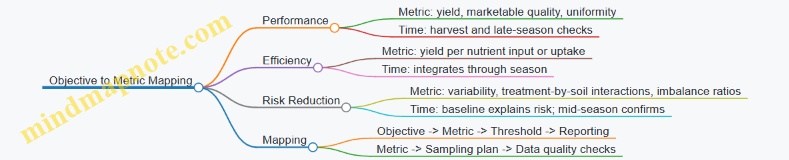
Practical Objective Checklist
Before analysis, confirm these items are written down:
- Each objective has a measurable metric.
- Each metric has a threshold or ranking rule.
- Each objective specifies the time window.
- Each objective states what “failure” looks like.
- Each objective lists the minimum data needed to trust the result.
If you can’t answer those five points, the analytics plan will be forced to guess later. Guessing is fine for weather; it’s not great for crop nutrition decisions.
11.2 Constructing Nutrient Balance and Uptake Based Indices from Measurements
Nutrient balance and uptake indices turn raw soil and plant measurements into comparable numbers. The key idea is simple: you can’t judge a microbial input by yield alone, but you also can’t judge it by soil chemistry alone. Indices connect the two using mass accounting and uptake efficiency logic.
Foundational Inputs and What They Mean
Start with three measurement categories.
- Soil nutrient pools: baseline and post-season values (e.g., mineral N, available P, exchangeable K). These describe what is “in the soil system” at sampling times.
- Plant nutrient content: nutrient concentration in tissues (e.g., %N in dry matter) and biomass or yield. These describe what the crop removed.
- Management and inputs: fertilizer rates, irrigation, residue additions, and application timing. These determine what else entered or left the system.
A practical rule: if you can’t trace where nutrients came from and where they went, you can still compute uptake efficiency, but nutrient balance becomes less defensible.
Nutrient Balance Indices from Measurements
A nutrient balance index estimates how much of a nutrient is retained in the soil-plant system versus removed or transformed. The most usable version for benchmarking is a relative balance that compares treatments under the same site and management.
Core balance components
- Plant removal:
- Plant N removed = (plant dry biomass or yield) × (tissue nutrient concentration)
- Soil change:
- Soil pool change = post-season pool − baseline pool
- External additions:
- Fertilizer or other nutrient inputs that must be included for interpretability
Relative nutrient balance index
- Balance index = (Soil change + Plant removal − External additions) normalized by baseline or by plot area.
Why this works: if a treatment increases plant removal without a matching soil pool decline, it may indicate improved availability or uptake efficiency rather than just more nutrient being present.
Uptake Based Indices from Measurements
Uptake indices focus on how effectively the crop converts available nutrients into biomass and yield.
1. Nutrient uptake efficiency
- Uptake efficiency = Plant nutrient removed / Total available nutrient proxy
Because “total available nutrient” is rarely measured directly, you use a proxy such as:
- baseline soil pool + fertilizer added − soil pool change (depending on your sampling schedule)
2. Nutrient use efficiency
- Use efficiency = Yield (or biomass) / Plant nutrient removed
This separates two mechanisms:
- A treatment may increase uptake (more nutrient removed) but not improve use efficiency.
- Another treatment may keep uptake similar but improve use efficiency by improving partitioning or growth.
3. Uptake-to-yield coupling
- Coupling index = Yield / (Plant nutrient removed)
In practice, coupling and use efficiency often overlap; the distinction is whether you treat nutrient removal as the denominator for “how much yield per nutrient” or as part of a broader efficiency story.
Systematic Workflow for Building Indices
- Choose the nutrient and timepoints
- Example: For N, use baseline mineral N and a post-harvest mineral N sample; for P, use an available P extract method consistently.
- Compute plant nutrient removed
- Example: If dry grain yield is 4.0 t/ha and grain N concentration is 2.2% (0.022), then N removed ≈ 4.0 × 1000 kg/ha × 0.022 = 88 kg N/ha.
- Compute soil pool change
- Example: mineral N baseline 30 kg/ha, post-harvest 18 kg/ha → soil change = −12 kg/ha.
- Include external additions
- Example: if fertilizer N added is 60 kg/ha, then external additions = 60.
- Calculate balance index and uptake/use indices
- Keep units consistent (kg/ha for pools and removals).
- Benchmark across treatments using relative comparisons
- Report indices as treatment minus control or as a ratio to control to reduce site-specific bias.
Mind Map: Nutrient Balance and Uptake Indices
Example: Comparing Two Treatments with One Nutrient
Assume N is the focus. Control and Treatment A share the same fertilizer rate of 60 kg N/ha.
- Control: baseline mineral N 30, post mineral N 18 → soil change −12. Plant N removed 88.
- Balance index component = (−12 + 88 − 60) = 16 kg/ha
- Treatment A: baseline mineral N 30, post mineral N 10 → soil change −20. Plant N removed 96.
- Balance index component = (−20 + 96 − 60) = 16 kg/ha
The balance index component is the same, but the mechanism differs. Treatment A depleted more mineral N from soil while removing more N into plant biomass. That pattern supports “better uptake” rather than “more nutrient left in soil.”
Now add use efficiency. If yield is 4.0 t/ha for control and 4.3 t/ha for Treatment A:
- Control use efficiency = 4.0 t/ha / 88 kg/ha
- Treatment A use efficiency = 4.3 t/ha / 96 kg/ha
If Treatment A’s use efficiency is higher, it indicates the crop converted the absorbed N into yield more effectively, not just that it absorbed more.
Practical Integrity Checks
- Unit sanity: concentrations in % must be converted to kg/ha using biomass or yield.
- Mass accounting consistency: if fertilizer is included in balance, it must be included for every treatment.
- Sampling alignment: soil pool changes are only meaningful if baseline and post samples use the same extraction method and depth.
These checks prevent the most common benchmarking failure: producing indices that are mathematically correct but biologically uninterpretable.
11.3 Linking Soil Response Metrics to Plant Outcomes Using Structured Workflows
A good workflow connects what you measure in soil to what you observe in plants, without pretending the relationship is one-to-one. Soil response metrics describe the environment and biological activity around roots; plant outcomes summarize how the crop actually used that environment. The structured approach below keeps the logic tight: define the question, align measurements to mechanisms, build a mapping from soil signals to plant variables, then validate the mapping with checks that catch common mistakes.
Step 1: Define the Mechanism You Are Testing
Start by choosing a mechanism class, because it determines which soil metrics matter and which plant outcomes should move.
- Nitrogen availability and transformation: soil mineral N, nitrification potential, and related biological indicators should align with plant N uptake and tissue N.
- Phosphorus availability: soil available P and biological activity linked to P cycling should align with plant P uptake and early root/leaf growth.
- General root-zone biological activity: respiration or enzyme activity indicators should align with growth rate and nutrient uptake efficiency.
Example: If your treatment is a nitrogen-fixing inoculant, you expect soil mineral N to rise relative to controls, and plant tissue N to follow. If soil mineral N stays flat but tissue N rises, you likely have a measurement timing mismatch or a different nutrient pathway at play.
Step 2: Create a Soil-to-Plant Variable Map
Build a mapping table in your notes before running any statistics. Each soil metric should have a plausible target plant variable and a time window.
- Time window rule: soil changes often appear before plant tissue changes, but the lag depends on crop stage and sampling depth.
- Depth rule: root-zone depth should match the soil sampling depth; otherwise you measure the wrong neighborhood.
Example mapping
- Soil mineral N at 0–15 cm → plant tissue N at vegetative stage
- Soil available P at 0–15 cm → plant P concentration at early growth
- Enzyme activity or respiration at root-zone sampling → biomass accumulation rate
Step 3: Standardize Measurement Units and Sampling Logic
Before linking variables, ensure comparability.
- Units and extraction methods: keep extractants consistent for available P and mineral N. If methods differ, treat them as different variables.
- Sampling timepoints: record days after application and crop stage. Use the same time logic across treatments.
- Normalization: when appropriate, normalize plant outcomes by baseline plant size or initial tissue status to reduce confounding.
Example: Two sites both report “available P,” but one uses Bray extraction and the other uses Olsen. Even if the numbers look similar, the link to plant P uptake is not comparable without method harmonization.
Step 4: Build a Structured Analysis Workflow
Use a two-layer workflow: (a) soil response verification, then (b) soil-to-plant linkage.
- Soil response verification
- Compare each treatment to controls for each soil metric.
- Require that the soil metric shows a meaningful change before claiming a plant effect mechanism.
- Linkage modeling
- Relate soil metrics to plant outcomes using models that include site and baseline covariates.
- Prefer models that reflect your mapping: soil metric at time t predicts plant outcome at time t+lag.
Example: For a phosphorus-focused treatment, you model plant P concentration using available P measured at the closest earlier timepoint, not using a later soil sample that already reflects plant uptake feedback.
Step 5: Validate the Link with Practical Checks
These checks prevent the most common “it statistically correlates, therefore it explains” errors.
- Direction check: if soil metric increases but plant outcome decreases, confirm whether the metric is the right one or whether another constraint dominates.
- Consistency check: the same treatment should show coherent movement across related variables (e.g., soil available P and plant P should both shift).
- Residual pattern check: inspect whether errors cluster by site, soil texture class, or application method. If they do, your mapping may need stratification.
Mind Map: Soil to Plant Workflow
Example: End-to-End Linking for a Nitrogen-Focused Trial
- Soil metrics: mineral N at 0–15 cm measured at 7 and 21 days after application.
- Plant outcomes: leaf tissue N at vegetative stage and aboveground biomass at the same stage.
Workflow
1. Verify that mineral N increases at day 7 for the inoculated treatment versus controls.
2. Use the day 7 mineral N as the predictor for leaf tissue N at vegetative stage.
3. Check that biomass follows tissue N directionally, not necessarily with identical magnitude.
4. If mineral N rises only at day 21, shift the linkage to the day 21 soil metric and re-check the time alignment.
This approach keeps the story grounded: soil signals must show up first, plant outcomes must respond in a plausible time order, and the analysis must respect the structure of your measurements.
11.4 Benchmarking Microbial Inputs by Performance Profiles Across Soil Conditions
Microbial inputs rarely behave the same way in every field. A performance profile is a structured way to describe how a microbial product changes soil indicators and crop outcomes under different soil conditions, so you can compare treatments without pretending the soil is a passive background.
Foundational Concepts for Performance Profiles
Start by separating three layers:
- Microbial input layer: strain identity, consortium composition, dose, carrier, and application timing.
- Soil condition layer: baseline pH, organic matter, texture, available nutrients, and biological activity indicators.
- Response layer: soil metrics (e.g., mineral N, available P) and plant metrics (e.g., tissue N, yield components).
A performance profile links these layers using consistent measurement rules. If you measure soil at different times across sites, you’ll end up comparing “different experiments” while calling them “different soils.”
Building the Soil Condition Map
Define soil conditions using a small set of measurable axes. A practical approach is to group soils into bins that reflect likely microbial constraints.
- pH axis: acidic vs neutral vs alkaline bins based on your assay range.
- N availability axis: low vs moderate vs high baseline mineral N.
- P availability axis: low vs moderate vs high available P.
- Biological activity axis: low vs moderate vs high using one activity indicator you can repeat reliably.
Example: If you test a phosphate-solubilizing inoculant, you’ll often see clearer separation between low-P and high-P soils because the “need” for solubilization differs.
Defining Performance Profile Metrics
Choose metrics that reflect mechanisms and outcomes, but keep the list tight.
- Soil response metrics
- Mineral N change from baseline to a fixed timepoint.
- Available P change using the same extractant and interpretation rules.
- Biological activity change using a consistent assay.
- Plant response metrics
- Tissue nutrient concentration at a defined growth stage.
- Yield component response (for example, grains per area or fruit set).
- Nutrient uptake efficiency proxy using tissue nutrient and biomass.
A good profile includes both “direction” (increase/decrease) and “strength” (how much). Direction alone can mislead when a treatment shifts nutrients but doesn’t translate to yield.
Mind Map: Performance Profile Workflow
Benchmarking Logic That Prevents False Comparisons
Use controls that match the nutrient context. If a product is compared against a conventional fertilizer regime, normalize microbial effects relative to the closest nutrient baseline. Otherwise, you may attribute fertilizer-driven changes to microbes.
A simple rule: within each soil bin, compute a treatment effect relative to the untreated control (or the nearest conventional control). Then compare effect patterns across bins.
Example: Suppose Treatment A increases available P in low-P soils but shows little change in high-P soils. Treatment B might increase tissue P in both bins but only boosts yield in low-P soils. The profile helps you decide whether the product is mainly “mobilizing P” or “supporting uptake,” and whether that matters for your target soils.
Example: Interpreting Profiles Across Soil Bins
Consider three soil bins for a legume inoculant: low pH, moderate pH, and neutral pH. You measure mineral N change and nodule-related plant metrics at the same growth stage.
- In low pH, you observe a strong mineral N increase but modest yield improvement.
- In moderate pH, mineral N increases moderately and yield improves clearly.
- In neutral pH, mineral N change is small but yield is stable.
This pattern suggests the inoculant may help nitrogen availability under stress, but yield response depends on additional constraints like water or micronutrient balance. The profile doesn’t “fail” the product; it clarifies where the product’s contribution is most useful.
Mind Map: Turning Data Into a Profile
Advanced Details Without Making It Complicated
- Profile shape matters: two treatments can have the same average effect but different bin-specific patterns. Prefer bin-specific ranking for practical recommendations.
- Mechanism-to-outcome linkage: check whether soil changes align with plant uptake. If soil P rises but tissue P doesn’t, the bottleneck may be root access, timing, or other limiting factors.
- Timepoint discipline: keep soil sampling windows consistent. If one product is applied earlier, you can still compare by using the same relative timepoint after application.
Example: A Minimal Reporting Template
For each microbial input, report:
- Soil bin definitions (pH, baseline mineral N, available P, biological activity).
- Soil metric effects at the fixed timepoint.
- Plant metric effects at the fixed growth stage.
- A short statement of where performance is strongest and where it plateaus.
This keeps benchmarking honest: you’re not just ranking products, you’re describing how they behave across the conditions that actually exist in the field.
11.5 Creating Practical Dashboards for Treatment Comparison and Traceability
A practical dashboard does two jobs at once: it helps you compare treatments without getting lost, and it keeps the “why” attached to the “what.” If you can’t explain a chart in one minute using the dashboard itself, the dashboard is doing too much work for the reader.
Dashboard Foundations That Prevent Confusion
Start with a clear unit of analysis. For biofertilizer benchmarking, that unit is usually a treatment-by-site-by-timepoint record that links microbial input details to soil and plant measurements. Every visual should be traceable back to that record.
Define three layers of information:
- Treatment layer: inoculant identity, fermentation platform, formulation type, dose, application method, and application timing.
- Context layer: soil baseline properties, crop variety, management practices, and trial design factors.
- Response layer: soil response metrics (e.g., mineral N, available P, enzyme activity) and plant outcomes (e.g., tissue nutrients, yield components).
A good dashboard makes these layers navigable. When a user clicks a treatment, they should see the exact input specification and the trial context that produced the results.
Treatment Comparison Views That Stay Honest
Use a small set of comparison patterns so users don’t have to guess what the chart means.
- Side-by-side effect summaries: show each treatment’s effect relative to a defined control (often untreated, or conventional nutrient input). Include the direction and magnitude, not only significance.
- Timepoint trajectories: plot response metrics across sampling dates so you can see whether a treatment acts early (e.g., soil mineral N) or later (e.g., yield formation).
- Stratified comparisons: filter by soil baseline bins (for example, low vs. medium available P) to avoid averaging away meaningful differences.
A simple rule keeps comparisons fair: the dashboard should always display the control definition and the filtering logic used for the current view.
Traceability That Survives Real-World Messiness
Traceability is not a single field; it’s a chain. Build the chain so each link can be audited.
Capture these identifiers:
- Input lot ID for each inoculant batch.
- Fermentation run ID for the platform that produced the lot.
- Formulation ID for carrier and additive recipe.
- Application event ID for timing, equipment settings, and mixing water notes.
- Sample ID for each soil and plant sample, with collection timepoint and handling notes.
Then connect them to outcomes through a consistent key. If your dataset uses different keys across labs and field teams, the dashboard should show a “trace completeness” indicator so missing links are visible rather than silently ignored.
Mind Map: Dashboard Components
Example Dashboard Layout and What Each Panel Shows
Panel 1: Treatment Selector and Control Definition
- Dropdown for treatment(s).
- A visible control label (e.g., “Untreated” or “Conventional nutrient at X kg/ha”).
- A toggle for whether effects are absolute or normalized.
Panel 2: Effect Summary Cards
- Cards for key metrics: soil mineral N at first sampling, available P at mid-season, and yield at harvest.
- Each card shows: effect value, confidence interval, and the number of contributing site-time records.
Panel 3: Timepoint Trajectories
- Line chart per metric with separate lines for selected treatments.
- Shaded bands or markers for sampling dates.
- A small note listing the exact timepoints included after filtering.
Panel 4: Stratified Comparison Table
- Rows are soil baseline bins (e.g., low/medium/high available P).
- Columns are treatments.
- Cells show effect relative to control and a data completeness flag.
Panel 5: Trace Completeness and Audit Trail
- A checklist showing whether each identifier link exists for the selected view.
- A compact log of transformations applied to the displayed metrics (e.g., unit conversions, outlier handling rules).
Minimal Data Quality Rules That Make Dashboards Trustworthy
Add explicit flags for:
- Missing lot-to-run links.
- Inconsistent units across sites.
- Out-of-range assay values based on lab-specific reference limits.
- Sampling timepoint mismatches (e.g., a “mid-season” label that doesn’t map to the expected date window).
For example, if a treatment’s fermentation run ID is missing for one site, the dashboard should still show the effect but label it as “partial trace,” so the reader knows what’s solid and what’s incomplete.
Example Traceability Chain in Practice
Suppose Treatment A uses Lot L-1042 produced by Run R-778. The dashboard should let a user click from a yield effect card to the exact Lot ID, then to the fermentation run parameters recorded for that run, and finally to the application event that used that lot. If the soil sample for the first timepoint lacks a Sample ID, the trace completeness panel should highlight that gap immediately, rather than letting the chart look fully supported.
A dashboard that behaves this way turns benchmarking from a pile of results into a set of accountable comparisons—useful for both day-to-day decisions and careful reporting.
12. Worked Benchmarking Workflows and Case Study Templates
12.1 Case Study Template for Comparing Two Inoculant Lots With Viability Controls
Purpose and Scope
This case study template compares two inoculant lots, Lot A and Lot B, using viability controls to separate “microbes that survived manufacturing” from “microbes that survived your handling.” The goal is to decide whether Lot B performs differently from Lot A under the same application workflow, without letting storage, mixing, or sampling artifacts masquerade as biological differences.
Study Setup and Roles
Define the roles before any measurements:
- Lot Owner: provides lot IDs, production dates, and certificates of analysis.
- Bench Lead: runs viability and formulation stability checks.
- Field or Pot Lead: applies treatments and records application variables.
- Data Steward: standardizes units, merges metadata, and tracks audit trails.
Minimum Treatment Set
Use a small set that still answers the question:
- T1 Lot A applied
- T2 Lot B applied
- T3 Viability Control for Lot A (Lot A sampled and tested immediately after mixing)
- T4 Viability Control for Lot B (Lot B sampled and tested immediately after mixing)
- T5 Negative Control (no inoculant, same carrier and mixing steps)
A negative control prevents “carrier-only effects” from being mistaken as microbial effects.
Mind Map: Case Study Logic
Materials and Metadata Checklist
Record these fields for each lot and each application batch:
- Lot ID, strain or consortium label, target dose per hectare (or per pot)
- Production date and storage duration at each temperature range
- Carrier formulation details (e.g., peat, compost, liquid, polymer coating)
- Mixing water pH and temperature, mixing time, and equipment type
- Application timing relative to mixing (minutes elapsed)
- Sampling plan for viability controls (what volume, when, and how)
Example: If Lot B is stored 30 days longer at a warmer site, you must capture that in metadata; otherwise, a viability drop will look like a “lot quality” problem even if it’s a storage effect.
Viability Control Workflow
Viability controls must reflect the microbes that actually entered the soil or substrate.
- Prepare mixing exactly as planned for treatments.
- Mix inoculant into carrier using the same water and agitation.
- Sample immediately after mixing for T3 and T4.
- Perform viable counts using your standard method (CFU, most probable number, or plate counts).
- Record dilution scheme and plating parameters so results are reproducible.
Example: If Lot B shows lower viable counts right after mixing, you should not expect equal soil response even if the fermentation process was strong.
Experimental Design and Replication
Use at least 4 replicates per treatment. If field variability is high, block by location gradient (e.g., row or irrigation zone).
- Randomize treatment assignment within each block.
- Keep application variables fixed across lots: same mixing time, same water source, same application equipment settings.
Example: If you apply Lot A in the morning and Lot B in the afternoon with different wind or sprayer calibration, you’ve introduced confounding that viability controls can’t fully correct.
Measurements Beyond Viability
To connect viability to outcomes, measure at least one soil metric and one plant metric.
- Soil: baseline nutrient status (e.g., available P or mineral N) and a post-application timepoint relevant to your crop cycle.
- Plant: a growth metric (e.g., biomass or height) and a nutrition metric (e.g., tissue N or P) at a consistent growth stage.
Example: If viability is similar but plant tissue P differs, the difference may reflect functional activity not captured by CFU alone, or differences in how the carrier releases microbes.
Data Handling Rules
- Convert all counts to a consistent unit (e.g., viable units per gram of product or per mL of suspension).
- Track missingness: if a viability plate fails, document the reason and replacement rule.
- Use the same time window for sampling across lots.
Analysis Plan with Decision Criteria
- First compare viability controls (T3 vs T4). If Lot B is significantly lower, treat outcome differences as expected.
- Then compare applied treatments (T1 vs T2) for soil and plant metrics.
- Check negative control (T5) to confirm the carrier alone is not driving the response.
Decision statement template:
- “Lot B is considered comparable to Lot A for viability if T3 vs T4 shows no meaningful difference under the pre-set threshold, and T2 vs T1 shows no meaningful difference in the primary response metric.”
Reporting Template
Include these sections in your case write-up:
- Methods: lot metadata, mixing workflow, sampling timing, viability method summary
- Results: viability control outcomes first, then soil and plant outcomes
- Interpretation: link differences to viability vs functional response
- Conclusion: pass/fail against the decision criteria
Example: If Lot B viability is lower but plant response is unchanged, you should report that the functional effect may be maintained despite reduced viable counts, and you should not claim “equivalent performance” without stating the specific metrics that matched.
12.2 Case Study Template for Benchmarking Fermentation Platforms with Process Metrics
Purpose and Scope
This case study template compares fermentation platforms using process metrics that are measurable, comparable, and tied to downstream product performance. The goal is not to crown a winner, but to identify which platform reliably produces the microbial output that your formulation and field application need.
Use a single crop-agnostic microbial target (for example, a consortium intended for phosphate solubilization) and keep strain identity constant across platforms. If you must change strains, treat that as a separate study factor, not a platform effect.
Mind Map: Study Skeleton
Study Setup
Start with a one-page “platform card” for each fermentation system. Include vessel volume, working volume, aeration method (sparger or agitation-driven), agitation range, temperature control approach, and any constraints on sampling frequency.
Define the common operating envelope. For example, set a target temperature of 30°C ± 1°C, a pH setpoint of 6.8 ± 0.2, and a maximum allowable deviation for dissolved oxygen. If a platform cannot meet a constraint, record that limitation explicitly and keep it consistent across runs.
Experimental Design
Run at least three independent fermentation runs per platform. Within each run, collect time-series samples at consistent timepoints relative to inoculation (for example, 0, 6, 12, 18, and end-of-run). If timepoints differ due to platform-specific kinetics, align by physiological stage using a predefined trigger (for example, when pH stabilizes for 2 hours).
Controls matter. Include a “process blank” (media through the full process without inoculation) to detect contamination and a “viability baseline” sample from the inoculum lot to quantify starting CFU.
Process Metrics That Actually Help
Track metrics that explain why outputs differ.
- Growth kinetics: OD or biomass proxy over time, plus viable counts at end-of-run. OD alone can mislead when cells are stressed, so pair it with viability.
- Oxygen and mixing indicators: dissolved oxygen trend, off-gas oxygen uptake rate if available, and mixing proxy such as time-to-homogenize after a feed addition.
- pH and metabolite trends: pH trajectory and any measurable organic acid or ammonium proxy your lab already runs. The point is to connect stress to viability loss.
- Viability loss and stress: viable counts at each sampling timepoint, not just the final one. A platform that preserves viability early but collapses late is different from one that steadily declines.
Example: If Platform A shows stable pH but a sharp viability drop between 12 and 18 hours, while Platform B shows gradual pH drift but steadier viability, your formulation team can decide whether to adjust harvest timing or change feed strategy.
Data Table Template
Use one tidy table per run, with columns for time, pH, dissolved oxygen, biomass proxy, viable count, and notes on events (feed additions, sampling anomalies, equipment alarms). Keep units consistent across platforms.
Mind Map: Process-to-Output Logic
Analysis Plan
Compute end-of-run viable counts and biomass proxy, then compare platforms using effect sizes (difference in means) and uncertainty (confidence intervals). Also compare variability: a platform with slightly lower mean but much tighter run-to-run spread can be more useful for benchmarking.
Add a simple process-to-output mapping: correlate viability at each timepoint with final viable count. This often reveals whether the platform’s key failure mode is early stress or late harvest mismatch.
Practical Acceptance Criteria
Define harvest acceptance before running the study. For example:
- Viable count at harvest must exceed a minimum threshold.
- Viability decline rate must not exceed a set slope between two timepoints.
- pH must remain within the envelope for at least a defined fraction of the run.
Example: If Platform A meets the final viable threshold but violates the pH envelope for 40% of the run, you may still accept it for screening but not for production-like runs.
Reporting Structure
Report methods and results in three layers: platform cards, time-series plots, and a summary table of process metrics versus output metrics. End with a short “what changed and why it matters” section that ties the observed process behavior to the microbial output, using only the metrics you measured.
12.3 Case Study Template for Soil Response Measurement with Sampling Timepoint Logic
Purpose and Scope
This template helps you measure soil response in a way that can actually be compared across treatments, sites, and sampling dates. The core idea is simple: microbial inputs change soil processes on different time scales, so your sampling schedule must match those time scales. If you sample only once, you’ll mostly measure “what happened by then,” not “how it happened.”
Use this case study when you compare inoculant lots, fermentation platforms, or application methods. It works whether you’re tracking nutrient availability, biological activity, or both.
Foundational Concepts Before You Touch a Soil Core
- Define response windows: short-term (hours to days), mid-term (weeks), and longer-term (crop cycle). Microbial activity often shows up early; nutrient availability and plant uptake may lag.
- Separate baseline from treatment effects: baseline samples should represent the starting condition, not the first day you applied product.
- Control for soil heterogeneity: soil varies within a field. Replication and blocking matter as much as the lab methods.
- Keep sampling consistent: same depth, same handling, same timing relative to application.
Mind Map: Soil Response Measurement Logic
Case Study Setup Template
Treatments and Controls
- Treatment list: inoculant lot(s), fermentation platform(s), dose, carrier, and application method.
- Controls:
- Untreated control (no microbial input).
- Conventional nutrient control if your goal includes nutrient benchmarking.
Site and Soil Metadata to Record
- Soil texture class, baseline pH, organic matter, and baseline mineral N.
- Field management history for at least the prior season.
- Moisture conditions at each sampling timepoint (even a simple gravimetric check helps interpret results).
Sampling Timepoint Logic with Concrete Example
Assume application occurs on 2026-03-20. Your schedule should be anchored to that date, not to calendar weeks.
Example Schedule
- T0 Baseline: 3–7 days before application.
- T1 Early Response: 1–3 days after application.
- T2 Mid Response: 14–21 days after application.
- T3 Later Response: 35–45 days after application or at a defined growth stage.
Why These Windows
- T1 often captures microbial activity signals such as respiration or enzyme activity, and it can show early shifts in mineral N.
- T2 is where nutrient availability changes become more stable, especially for processes like mineralization and phosphorus solubilization.
- T3 helps you see whether early effects translate into sustained soil conditions during crop demand.
Sampling Procedure Template
- Depth: choose a depth that matches your expected process zone (commonly 0–10 cm for surface activity; add deeper increments if your application targets subsurface zones).
- Composite strategy: collect multiple cores per plot and combine into one composite per depth per timepoint.
- Replicate structure: at minimum, 3 plots per treatment per site, grouped into blocks if the field has a slope or fertility gradient.
- Handling:
- Keep biological assays consistent by using the same storage and processing timeline.
- Record sample mass, moisture, and any deviations.
Measurements and Interpretation Rules
Nutrient Indicators
- Mineral N: report both forms you measure (e.g., nitrate and ammonium) and compute totals if appropriate.
- Available P: use the same extractant across all timepoints.
Biological Indicators
- Respiration or CO₂ evolution: interpret alongside soil moisture because dry soil can look “inactive” even when microbes are fine.
- Enzyme activity: treat it as a process indicator, not a direct nutrient pool.
Interpretation Rules That Prevent Confusion
- If T1 changes but T2 does not, you likely measured transient activity without sustained nutrient availability.
- If T2 changes but plant uptake does not, consider whether application distribution or crop access limited the effect.
Data Table Template for Timepoint Effects
Use one row per plot per timepoint.
- Columns: site, block, treatment, timepoint, depth, moisture, mineral N forms, available P, biological indicator(s), and notes on deviations.
Minimal Analysis Plan
- Compute baseline-adjusted values: (timepoint value − T0 value) per plot.
- Compare treatments at each timepoint using a model that respects blocking.
- Report effect sizes per timepoint, not just a single pooled number.
Example Reporting Paragraph
“At T1 (1–3 days after application), treatment A showed higher enzyme activity than the untreated control, while mineral N totals changed modestly. By T2 (14–21 days), mineral N totals increased in treatment A and treatment B, with the largest difference occurring in nitrate. At T3, the biological indicator converged across treatments, but mineral N remained higher in treatment A, suggesting that early activity translated into a longer-lasting nutrient availability shift rather than a purely short-lived effect.”
12.4 Case Study Template for Plant Nutrition and Yield Component Integration
This case study template connects what you measured in plants to what you conclude about the biofertilizer’s nutritional effect. The goal is simple: show a traceable path from treatment → plant nutrient status → yield components → interpretation that matches the soil and input context.
Case Study Setup
Start with a one-paragraph summary that includes crop, growth stage at first sampling, and the treatment list. Include at least two controls: an untreated control and a conventional nutrient control (even if the conventional control is only a partial nutrient program). If you used multiple application methods, list them explicitly because they often change nutrient uptake timing.
Minimum treatment record fields
- Inoculant identity and lot
- Fermentation platform identifier
- Formulation type and carrier
- Dose and application method
- Application timing relative to planting
- Any mixing water conditions used in the field
Plant Sampling Plan
Define sampling timepoints so nutrient status and yield components can be linked without guesswork. A practical pattern is:
- Vegetative sampling: captures early uptake and early physiological response.
- Pre-flowering or early reproductive sampling: captures nutrient availability during the stage that sets yield potential.
- Harvest sampling: captures final nutrient partitioning and relates to yield components.
For each timepoint, specify plant part (flag leaf, whole shoot, grain, etc.), number of plants per replicate, and how samples are handled before analysis.
Nutrient Measurements That Actually Support Yield Interpretation
Measure nutrients in a way that supports interpretation rather than producing a spreadsheet of numbers. For most crops, a core set is total N, P, and K in the relevant plant tissue, plus micronutrients only when they are plausibly limiting or part of the microbial function.
Add two derived metrics to connect nutrients to performance:
- Nutrient uptake efficiency proxy: nutrient concentration × biomass (or nutrient content per plant). This helps distinguish “high concentration in small plants” from “high uptake in vigorous plants.”
- Partitioning ratio: nutrient content in harvestable organs divided by total plant nutrient content at harvest. This helps explain why yield changes sometimes occur without large shifts in total nutrient uptake.
Yield Component Integration
Choose yield components that match your crop’s biology. Examples:
- Cereals: grains per panicle/ear, thousand-kernel weight, harvest index.
- Legumes: pods per plant, seeds per pod, seed weight.
- Root crops: root number, root diameter distribution, marketable yield.
Record yield components from the same experimental units as plant sampling whenever possible. If that is not feasible, document the mapping rule (for example, “one yield subsample per replicate plot, sampled from the same border rows used for plant sampling”).
Mind Map: Plant Nutrition to Yield Components
Example: Wheat with Two Inoculant Lots
Scenario: Two inoculant lots (Lot A and Lot B) from the same fermentation platform are tested against untreated and conventional nutrient controls.
Observed plant nutrition pattern
- At reproductive onset, Lot A shows higher N uptake proxy than both controls, while Lot B shows only a modest increase.
- At harvest, Lot A increases partitioning ratio toward grain, while total shoot nutrient content is only slightly higher than the conventional control.
Yield component pattern
- Lot A increases grains per ear and thousand-kernel weight.
- Lot B increases thousand-kernel weight slightly but does not move grains per ear.
Integrated interpretation
- Lot A’s higher uptake proxy at reproductive onset supports improved yield potential formation, consistent with the grains per ear increase.
- Lot A’s higher partitioning ratio supports better nutrient allocation to grain, consistent with the thousand-kernel weight increase.
- Lot B’s limited uptake proxy suggests a narrower window of nutritional benefit, aligning with the smaller yield component shifts.
Example: Legume with Foliar Application
Scenario: A foliar application is compared to a soil application. Both use the same inoculant identity and dose.
Observed plant nutrition pattern
- Foliar treatment increases leaf P concentration at vegetative sampling but does not increase whole-plant uptake proxy at that timepoint.
- At harvest, foliar treatment increases seed nutrient content and partitioning ratio.
Yield component pattern
- Pods per plant increases, while seed size changes are minimal.
Integrated interpretation
- Early leaf P concentration without uptake proxy improvement suggests a localized effect rather than whole-plant nutrient acquisition.
- The later shift in partitioning ratio aligns with improved reproductive allocation, supporting pods per plant rather than seed size.
Reporting Template for This Section
Include a single table that lists, for each treatment, the mean and variability for:
- Uptake proxy at reproductive onset
- Partitioning ratio at harvest
- Key yield components
Then add a short interpretation paragraph that uses the integration logic: uptake proxy changes explain biomass-related components, partitioning ratio changes explain allocation-related components, and concentration-only changes are treated cautiously unless uptake proxy supports them.
12.5 Case Study Template For End-To-End Reporting Including Methods Data And Results
A good end-to-end report makes it possible for someone else to reproduce your logic, not just your numbers. Use the structure below as a fill-in template, then replace each placeholder with your actual trial details.
Case Study Header and Trial Context
Start with a compact header so readers can orient themselves quickly.
- Case study ID: [unique code]
- Crop and variety: [e.g., maize hybrid X]
- Location: [site name, region]
- Soil type and baseline: [texture, pH, organic matter, key baseline nutrients]
- Trial window: [e.g., 2026-03-15 to 2026-04-30]
- Experimental goal: [e.g., compare two fermentation platforms at equal CFU and dose]
- Primary outcomes: [yield, tissue nutrient uptake, soil response metrics]
Methods Summary That Matches the Trial Design
This section should mirror your design choices. If your design changes, your methods summary must change too.
Treatments
- Control: [untreated and/or conventional nutrient control]
- Biofertilizer treatments:
- T1 [platform A, strain set, dose]
- T2 [platform B, strain set, dose]
- T3 [optional dose or application method]
Input specification
- Strain identity and lot: [strain IDs, lot numbers]
- Viability at application: [CFU/g or CFU/mL, measurement method]
- Carrier and formulation: [carrier type, storage conditions]
- Application method: [seed, soil, foliar], application timing: [growth stage]
Fermentation platform reporting
- Platform type: [batch/fed-batch/continuous]
- Key process parameters: [temperature range, aeration/agitation approach, fermentation duration]
- Output metrics: [biomass yield, viability loss, contamination checks]
Field layout and sampling
- Design: [RCBD, split-plot, randomized blocks]
- Replicates and plot size: [n, dimensions]
- Soil sampling: [depths, timepoints, number of cores per plot]
- Plant sampling: [tissue type, growth stage, number of plants]
Quality controls
- Randomization procedure: [how plots were randomized]
- Blinding: [if used for lab assays]
- Outlier handling rule: [predefined threshold or exclusion criteria]
Results Section with a Clear Evidence Chain
Report results in the same order as your methods. Each subsection should answer a specific question.
A. Input verification
- Viability at application: [T1 vs T2 vs control]
- Formulation stability during storage: [if measured]
B. Soil response metrics
- Nitrogen indicators: [mineral N, nitrification proxy]
- Phosphorus availability: [extractant and result]
- Biological activity: [respiration/enzyme metric]
- Include baseline-adjusted comparisons when baseline differs.
C. Plant nutrition and crop performance
- Tissue nutrient concentrations: [N, P, K, micronutrients if relevant]
- Yield components: [ear number, kernel weight, etc.]
- Final yield: [units and moisture correction method]
D. Effect attribution and uncertainty
- Statistical model used: [ANOVA/mixed model]
- Report effect sizes: [absolute and/or relative]
- Uncertainty: [confidence intervals or standard errors]
E. Consistency checks
- Do soil changes align with tissue uptake changes?
- Do the treatments with better input viability show stronger outcomes?
- If not, state the mismatch and point to the most likely measurement or design constraint.
Mind Map for End-to-End Reporting
End-to-End Reporting Mind Map
Example Fill-In for a Single Page Report
Header: Maize hybrid X at Site North; baseline pH 6.4, organic matter 2.1%; trial window 2026-03-15 to 2026-04-30. Goal: compare fermentation platform A vs B at equal viable dose. Primary outcomes: soil mineral N at day 30 and grain yield.
Treatments: Control untreated; T1 platform A at 1.0×10^8 CFU/ha applied at V4; T2 platform B at 1.0×10^8 CFU/ha applied at V4.
Input verification: Viability at application measured as 9.6×10^7 CFU/ha-equivalent for T1 and 1.1×10^8 for T2; storage stability checked at 4 weeks with no significant decline.
Soil results: Mineral N at day 30 increased by 18% in T1 and 26% in T2 versus control after baseline adjustment; phosphorus extractable P showed no significant change in either treatment.
Plant and yield results: Tissue N at V10 increased in T2 more than T1; grain yield increased 0.42 t/ha for T1 and 0.58 t/ha for T2 versus control. Mixed-model analysis reported T2 as the stronger effect with confidence intervals excluding zero.
Consistency check: The stronger soil mineral N in T2 aligns with higher tissue N and yield response, supporting the interpretation that platform differences affected functional performance rather than only measurement noise.
Reporting Hygiene Checklist
Before finalizing, verify these items are present and internally consistent.
- Every claim in results has a matching table or figure reference.
- Units are stated once and used consistently (CFU, kg/ha, mg/kg, t/ha).
- Baseline adjustment rules are explicitly stated if used.
- Exclusion criteria are predefined and applied uniformly.
- Methods details are sufficient to repeat the trial logic, including sampling timepoints and assay methods.