Counter Drone Laser Defense Systems
1. Introduction to Counter Drone Laser Defense Systems
1.1 Overview of Drone Threats and Defense Needs
Drones, also known as unmanned aerial vehicles (UAVs), have become widely accessible and versatile tools. Their uses range from photography and delivery to industrial inspections. However, this accessibility has also introduced new security challenges. Understanding the nature of drone threats is essential to designing effective defense systems.
Types of Drone Threats
Drones can pose threats in several ways, depending on their capabilities and intent. Here’s a structured overview in the form of a mind map:
Each category represents a distinct challenge. For example, surveillance drones may be small and quiet, making detection difficult, while drones carrying payloads require rapid interception to prevent damage.
Why Defense Systems Are Needed
The increasing number of drones and their diverse uses mean that traditional security measures are often insufficient. Physical barriers or human patrols cannot reliably detect or stop drones. This gap creates a need for specialized defense systems that can detect, track, and neutralize drones effectively.
Key defense needs include:
- Detection: Identifying drones quickly and accurately, even in cluttered environments.
- Classification: Distinguishing between harmless and threatening drones to avoid false alarms.
- Tracking: Continuously monitoring drone movement to predict paths and plan interception.
- Interception: Disabling or diverting drones without causing collateral damage.
Defense Needs Mind Map
Example: Airport Drone Incursion
Consider an airport where unauthorized drones fly near runways. These drones can disrupt air traffic, causing delays or accidents. A defense system here must detect drones at a distance, classify them as threats, and neutralize them quickly. Laser-based interception offers a precise way to disable drones without risking debris on the runway.
Example: Critical Infrastructure Protection
A power plant may face drone threats aimed at surveillance or sabotage. The defense system needs to operate continuously, distinguishing between authorized drones (such as inspection UAVs) and unauthorized ones. Tracking algorithms help maintain situational awareness, while high-power lasers provide a controlled method to disable hostile drones.
In summary, drone threats are varied and evolving, requiring defense systems that combine detection, classification, tracking, and interception. Understanding these elements sets the foundation for exploring laser-based countermeasures in the following chapters.
1.2 Fundamentals of Laser Technology in Defense Applications
Laser technology in defense is centered on producing a focused beam of coherent light that can deliver energy precisely and efficiently. The core principle behind lasers is stimulated emission, where photons stimulate excited atoms to emit identical photons, resulting in a highly directional and monochromatic beam.
Key Concepts of Laser Technology
- Coherence: Laser light waves are in phase both spatially and temporally, allowing the beam to stay narrow over long distances.
- Monochromaticity: Lasers emit light at a single wavelength, which is critical for targeting and minimizing atmospheric scattering.
- Directionality: Unlike conventional light sources, laser beams maintain a tight, focused path.
- Power Density: The energy delivered per unit area is high, enabling effects like heating or damaging targets.
Mind Map: Core Laser Properties
Types of Lasers Used in Defense
- Solid-State Lasers: Use a solid gain medium like crystals doped with rare-earth ions. Example: Nd:YAG lasers emitting at 1064 nm.
- Fiber Lasers: Use optical fibers doped with rare-earth elements. Known for excellent beam quality and efficient cooling.
- Chemical Lasers: Generate laser light through chemical reactions, capable of very high power but complex to operate.
- Semiconductor Lasers: Compact and efficient but generally lower power, often used in targeting or range-finding.
Example: Why Fiber Lasers Are Popular in Counter-Drone Systems
Fiber lasers combine good beam quality with efficient heat dissipation, making them suitable for continuous or pulsed high-power operation. For instance, a 10 kW fiber laser can maintain a stable beam on a small drone at several hundred meters, heating critical components rapidly.
Laser Beam Interaction with Targets
The laser beam delivers energy that can cause:
- Thermal Effects: Heating the drone’s structure or electronics until failure.
- Mechanical Effects: Rapid heating can cause material stress and structural damage.
- Optical Effects: Blinding or damaging sensors on the drone.
The effectiveness depends on the laser’s wavelength, power, beam quality, and the target’s material properties.
Mind Map: Laser-Target Interaction
Beam Control and Modulation
Defense lasers often modulate power or pulse duration to optimize energy delivery. Continuous wave (CW) lasers provide steady energy, while pulsed lasers can deliver high peak power to overcome target defenses or atmospheric interference.
Example: Pulsed vs Continuous Wave in Practice
A CW laser might steadily heat a drone’s motor casing until it fails, while a pulsed laser could deliver short bursts of intense energy to disrupt sensitive electronics without wasting power.
Atmospheric Effects on Laser Propagation
Laser beams can be affected by atmospheric conditions such as:
- Absorption: Certain wavelengths are absorbed by gases, reducing power.
- Scattering: Particles and aerosols scatter light, degrading beam quality.
- Turbulence: Causes beam wander and distortion.
Selecting the laser wavelength and employing adaptive optics can mitigate these effects.
Mind Map: Atmospheric Challenges
Practical Example: Choosing a Wavelength
A laser operating near 1.5 microns benefits from reduced atmospheric absorption and eye safety advantages, making it a common choice for defense applications.
Safety and Operational Considerations
Operating high-power lasers requires strict safety protocols to protect operators and unintended targets. Beam containment, interlocks, and controlled engagement zones are standard practices.
Summary
Understanding laser fundamentals—coherence, power, wavelength, and interaction with targets and atmosphere—is essential for designing effective counter-drone laser systems. Each choice, from laser type to beam modulation, impacts system performance and operational success.
1.3 Key Components of Counter Drone Laser Systems
Counter drone laser defense systems rely on several key components working together to detect, track, and neutralize unauthorized drones. Understanding these components helps clarify how the system functions as a whole.
Key Components Mind Map
Detection Subsystem
The detection subsystem is the system’s eyes and ears. It typically includes radar, lidar, and electro-optical sensors. Radar provides broad area surveillance and initial detection by bouncing radio waves off objects. Lidar uses laser pulses to create detailed 3D maps, which helps distinguish drones from birds or other objects. Electro-optical sensors, including cameras in visible and infrared spectra, offer visual confirmation and classification.
Example: A radar detects an object entering restricted airspace. The lidar then scans the object to confirm its shape and size, while an infrared camera checks for heat signatures. This layered detection reduces false alarms.
Tracking and Targeting
Once a drone is detected, the tracking subsystem takes over to follow its position and predict its trajectory. This involves data fusion, where inputs from multiple sensors combine to create a reliable target picture. Tracking algorithms, such as Kalman filters, smooth noisy data and estimate future positions.
Example: The system uses a Kalman filter to predict where a fast-moving drone will be in the next second, allowing the laser to aim ahead of the target rather than directly at its current location.
Laser Weapon Unit
This is the heart of the interception capability. The laser source generates the high-power beam needed to disable or destroy the drone. Common laser types include fiber lasers and solid-state lasers, each with trade-offs in power, size, and cooling needs.
Beam steering mechanisms, such as fast steering mirrors or gimbals, direct the laser beam quickly and accurately to track moving targets. Beam delivery optics ensure the laser maintains focus and power density over distance.
Example: A fiber laser produces a beam that is directed by a fast steering mirror system. The mirror adjusts dozens of times per second to keep the laser locked on a drone performing evasive maneuvers.
Control and Command Interface
Operators interact with the system through a control interface that displays sensor data, tracks targets, and manages engagement decisions. This interface also enforces engagement protocols, ensuring the system acts within safety and legal guidelines.
Example: The operator sees a live video feed with overlaid tracking data and can choose to engage or hold fire based on rules of engagement.
Power Supply and Cooling
High power lasers require substantial electrical power and generate significant heat. The power supply must be stable and capable of supporting peak loads. Cooling systems—often liquid or air-based—prevent overheating that could damage components or reduce performance.
Example: A mobile unit uses a diesel generator paired with a liquid cooling loop to maintain laser operation during extended field deployments.
Safety and Compliance
Safety features include interlocks that disable the laser if unauthorized access is detected or if the beam path is obstructed. Sensors monitor environmental conditions and system status to prevent accidental exposure to harmful laser radiation.
Example: If a person enters the laser’s line of sight unexpectedly, safety sensors immediately shut down the beam to prevent injury.
Summary
Each component plays a distinct role but must work seamlessly with the others. Detection identifies threats, tracking keeps them in focus, the laser weapon neutralizes them, and control systems manage the entire process safely and efficiently. Power and cooling support continuous operation, while safety features protect operators and bystanders.
This modular structure allows for flexibility in system design and deployment, adapting to different operational needs and environments.
1.4 Best Practices: Integrating Laser Systems with Existing Security Infrastructure
Integrating laser counter-drone systems with existing security infrastructure requires careful planning and practical alignment of technologies. The goal is to create a seamless defense layer where the laser system complements and enhances the current setup rather than complicating it. This section outlines best practices for achieving that integration, supported by clear examples and mind maps to visualize the process.
Understanding the Existing Security Landscape
Before integration, map out the current security components: radar, cameras, access control, communication networks, and command centers. Knowing what’s already in place helps identify points where the laser system can plug in effectively.
Existing Security Infrastructure Mind Map
Key Integration Points
- Sensor Fusion: The laser system benefits from data provided by existing sensors. Combining radar or lidar detection with laser targeting improves accuracy and reduces false alarms.
- Communication Protocols: Ensure the laser system supports or can be adapted to the communication standards used by the existing network, whether IP-based or proprietary.
- Command Interface: The laser system should feed status and alerts into the central command system, ideally through a standardized interface or API.
- Power and Environmental Considerations: Confirm that the laser system’s power requirements and environmental tolerances align with the deployment site.
Integration Points Mind Map
Best Practices
- Early Collaboration: Involve security, IT, and operations teams early to identify constraints and opportunities.
- Modularity: Choose laser systems designed for modular integration, allowing selective connection to existing components.
- Standard Protocols: Favor systems supporting common protocols (e.g., TCP/IP, MQTT) to ease communication.
- Redundancy: Use the laser system as a complementary layer, not the sole defense, ensuring fallback options.
- Testing in Stages: Start with isolated tests of sensor fusion and communication before full operational deployment.
Example: Integrating a Laser System in a University Campus Security Network
A university had an existing security system with radar perimeter sensors and CCTV cameras feeding into a central security office. The goal was to add a laser counter-drone system without disrupting current operations.
- Step 1: Mapped existing sensors and communication links.
- Step 2: Configured the laser system to receive radar alerts via the campus IP network.
- Step 3: Developed an interface to display laser system status on the central security dashboard.
- Step 4: Conducted joint drills to verify coordination between radar detection and laser engagement.
- Outcome: The laser system enhanced detection and interception capabilities while operators used familiar interfaces, minimizing training needs.
University Campus Integration Mind Map
Example: Military Base with Layered Security
A military base employed multiple sensor types and a command center with strict cybersecurity protocols. Integrating a laser system required:
- Ensuring the laser control software met cybersecurity standards.
- Using encrypted communication channels to connect the laser system with the command center.
- Synchronizing the laser targeting system with existing radar and electro-optical sensors to avoid redundant engagements.
This approach kept the laser system as part of a layered defense, improving response times without increasing operator workload.
Summary
Integrating laser counter-drone systems into existing security infrastructure is a matter of clear mapping, communication compatibility, and staged testing. The laser system should enhance, not complicate, the security environment. Using modular designs, standard protocols, and involving all stakeholders early helps ensure a smooth and effective integration.
1.5 Example: Case Study of a Basic Counter Drone Laser Setup
This case study walks through the design and implementation of a straightforward counter drone laser system intended for a small secured facility. The goal is to demonstrate how key components come together and how practical decisions shape the system.
System Overview
The setup includes:
- A continuous wave fiber laser with 10W output power
- A compact beam steering mechanism
- A basic electro-optical sensor for detection
- A simple tracking algorithm based on centroid calculation
- Manual operator interface for engagement
This setup is intentionally minimal to highlight core principles without complexity.
Step 1: Selecting the Laser
The choice of a 10W continuous wave fiber laser balances power, size, and cost. It provides enough energy to disrupt or disable small commercial drones at short ranges (up to 200 meters) without requiring heavy cooling systems.
Best Practice: Match laser power to expected threat size and engagement distance to avoid overengineering.
Step 2: Detection and Tracking
A single electro-optical camera with infrared capability detects drones visually. The tracking algorithm calculates the centroid of the detected drone image frame to estimate position.
Mind Map: Detection and Tracking
Example: When the drone enters the camera’s field of view, the software identifies the drone’s shape against the background, calculates the centroid, and sends coordinates to the beam steering unit.
Step 3: Beam Steering
A two-axis galvanometer mirror system directs the laser beam. It receives coordinates from the tracking algorithm and adjusts mirrors accordingly.
Mind Map: Beam Steering
Best Practice: Use fast-response mirrors to minimize lag between detection and laser targeting.
Step 4: Engagement Protocol
The operator monitors the system via a simple GUI. Upon confirming the target, the operator activates the laser. The laser remains on until the drone is disabled or leaves the engagement zone.
Example: The operator sees the drone on screen, verifies it is unauthorized, and presses the ‘Engage’ button. The laser beam moves to the drone’s position and stays locked.
Step 5: Safety and Fail-safes
The system includes an emergency stop and interlocks to prevent accidental firing. The laser power is capped to avoid unintended damage beyond the target.
Summary Mind Map
Mind Map: Basic Counter Drone Laser Setup
Practical Notes
- The system’s simplicity means it requires manual confirmation, reducing false engagements.
- Limited power restricts range but enhances portability.
- The centroid tracking works well for isolated drones but may struggle with swarms.
This example shows how a basic counter drone laser defense can be constructed with off-the-shelf components and straightforward algorithms. It highlights the balance between capability, complexity, and cost.
2. High Power Laser Technologies for Drone Interception
2.1 Types of High Power Lasers Used in Defense
High power lasers form the backbone of counter drone laser defense systems. Their ability to deliver concentrated energy at a distance makes them suitable for neutralizing small aerial threats. Understanding the types of lasers commonly used helps in selecting the right tool for specific operational needs.
Main Categories of High Power Lasers
- Solid-State Lasers (SSLs)
- Fiber Lasers
- Chemical Lasers
- Gas Lasers
- Diode Lasers
Below is a mind map summarizing these categories and their key characteristics:
Solid-State Lasers (SSLs)
Solid-state lasers use a solid gain medium, typically a crystal doped with rare-earth ions like neodymium (Nd). The Nd:YAG (neodymium-doped yttrium aluminum garnet) laser is a common example. These lasers can produce high peak powers and deliver pulses suitable for disrupting drone electronics or damaging structural components.
Example: A defense unit uses a pulsed Nd:YAG laser operating at 1064 nm wavelength to disable small quadcopters. The laser’s pulse energy is sufficient to cause localized heating on drone propellers, leading to mechanical failure.
Best Practice: Ensure adequate cooling for SSLs, as thermal lensing can degrade beam quality during sustained operation.
Fiber Lasers
Fiber lasers employ optical fibers doped with rare-earth elements such as ytterbium. The fiber geometry allows excellent heat dissipation and beam quality. They are compact and efficient, making them popular in modern counter drone systems.
Example: A fiber laser system with output power around 10 kW is deployed on a mobile platform. Its compact size and high electrical-to-optical efficiency reduce logistical burden while maintaining effective range.
Best Practice: Use coherent beam combining techniques to scale power while preserving beam quality.
Chemical Lasers
Chemical lasers generate laser light through chemical reactions, often producing very high continuous wave (CW) power. Examples include hydrogen fluoride (HF) and deuterium fluoride (DF) lasers. Their complexity and handling of hazardous chemicals limit their use mostly to specialized military applications.
Example: In a fixed-site defense installation, a DF laser provides continuous high power to counter multiple drone threats simultaneously. The system requires trained personnel for chemical handling and maintenance.
Best Practice: Implement rigorous safety protocols and containment systems due to the toxic and corrosive nature of the chemicals involved.
Gas Lasers
Gas lasers like CO2 lasers operate by exciting a gas mixture to produce laser emission, typically at 10.6 micrometers wavelength. They offer high power and mature technology but tend to be bulky and less efficient than fiber lasers.
Example: A CO2 laser system is used in a perimeter defense role where size and power consumption are less constrained. Its infrared wavelength is absorbed well by drone materials, causing rapid heating.
Best Practice: Regularly maintain gas purity and pressure to ensure stable output power.
Diode Lasers
High power diode lasers consist of arrays of semiconductor laser diodes. They are compact, efficient, and can be modulated quickly, but their beam quality is generally lower than fiber or solid-state lasers.
Example: A diode laser array is integrated as a pointer or illuminator to assist targeting systems rather than as a primary destructive source.
Best Practice: Use diode lasers in combination with other laser types to leverage their fast response and compactness.
Summary Table
| Laser Type | Typical Wavelength | Power Range | Advantages | Limitations |
|---|---|---|---|---|
| Solid-State | 1 µm (e.g., 1064 nm) | Up to tens of kW | Good beam quality, high peak power | Cooling needs, size |
| Fiber | ~1 µm | Up to tens of kW | Compact, efficient, excellent beam quality | Power scaling complexity |
| Chemical | Mid-IR (2.7-3.8 µm) | Hundreds of kW | Very high continuous power | Complex logistics, hazardous chemicals |
| Gas (CO2) | 10.6 µm | Tens of kW | Mature tech, high power | Bulky, less efficient |
| Diode | 0.8-1 µm | Up to kW | Compact, efficient, fast modulation | Lower beam quality |
Each laser type brings trade-offs in size, power, efficiency, and operational complexity. The choice depends on mission parameters such as engagement range, mobility, and maintenance capabilities.
2.2 Power Scaling and Beam Quality Considerations
Power scaling and beam quality are two fundamental aspects that determine the effectiveness of a laser in counter drone defense systems. Understanding their interplay is essential for designing a system that can reliably intercept and neutralize drones at various distances and under different environmental conditions.
Power Scaling
Power scaling refers to increasing the output power of a laser while maintaining or improving its operational stability and efficiency. Higher power generally translates to a greater ability to damage or disable a drone quickly, but scaling power is not as simple as turning a dial.
- Thermal Effects: As power increases, so does heat generation within the laser medium. Excess heat can degrade performance or damage components.
- Nonlinear Optical Effects: At high power densities, nonlinear phenomena like self-focusing or stimulated scattering can distort the beam.
- Electrical Efficiency: Power scaling must consider the efficiency of converting electrical input into laser output to manage power consumption and heat.
Mind Map: Power Scaling Factors
Example: A fiber laser designed to output 1 kW of power must incorporate advanced cooling techniques such as water-cooled heat sinks and optimized fiber doping to prevent thermal lensing, which would otherwise degrade beam quality.
Beam Quality
Beam quality describes how close the laser beam is to an ideal Gaussian profile, often quantified by the M² factor. A beam with M² close to 1 is tightly focused and maintains intensity over distance, which is crucial for effective drone interception.
- Focusability: A high-quality beam can be focused to a smaller spot size, increasing the energy density on the target.
- Propagation: Good beam quality reduces divergence, allowing the beam to maintain power density over longer ranges.
- System Complexity: Achieving high beam quality often requires precise optical components and alignment.
Mind Map: Beam Quality Considerations
Example: A multimode laser with an M² of 5 will spread its energy over a larger area at 500 meters, reducing effectiveness. Switching to a single-mode laser with M² near 1.2 improves focus and energy delivery, allowing the system to disable drones at greater distances.
Balancing Power and Beam Quality
Increasing power often challenges beam quality. For instance, scaling a laser to higher power may require multimode operation, which degrades beam quality. Conversely, maintaining single-mode operation limits maximum power output.
Mind Map: Trade-offs in Power Scaling and Beam Quality
Example: A defense system designed for urban environments might prioritize beam quality over maximum power to avoid collateral damage, using a single-mode laser with moderate power. In contrast, a system for open terrain may accept lower beam quality for higher power to reach longer distances.
Practical Considerations
- Cooling Solutions: Efficient thermal management allows higher power without sacrificing beam quality.
- Optical Components: High-quality lenses and mirrors reduce aberrations that degrade beam quality.
- Alignment Procedures: Regular calibration ensures the beam remains well-focused.
- Laser Medium Choice: Fiber lasers often offer better beam quality at moderate power, while solid-state lasers can scale to higher power but may require complex optics.
Example: A counter drone laser system using a fiber laser with active cooling and adaptive optics can maintain an M² of 1.3 at 500 W output, providing a good balance for mid-range drone interception.
In summary, power scaling and beam quality are intertwined challenges. Effective counter drone laser systems find a balance that suits their operational context, using appropriate cooling, optical design, and laser medium selection to deliver sufficient power with a beam profile that maximizes energy concentration on the target.
2.3 Thermal Management and Cooling Systems
High power laser systems generate significant heat during operation. Managing this heat is critical to maintain performance, prevent damage, and ensure system longevity. Without effective thermal management, laser components can degrade, beam quality can suffer, and system downtime can increase.
Why Thermal Management Matters
Laser diodes, fiber amplifiers, and solid-state crystals convert electrical energy into light, but a substantial portion of input energy becomes heat. This heat raises component temperatures, causing shifts in wavelength, reducing efficiency, and risking permanent damage. Proper cooling keeps components within safe operating temperatures and stabilizes output.
Key Thermal Management Techniques
- Passive Cooling: Uses heat sinks, thermal interface materials, and natural convection. Suitable for low to moderate power lasers but limited by ambient conditions.
- Active Cooling: Employs fans, liquid cooling loops, or thermoelectric coolers (TECs). Necessary for high power lasers where passive methods fall short.
- Hybrid Systems: Combine passive and active methods to balance complexity, cost, and efficiency.
Components of Cooling Systems
- Heat Sinks: Metal blocks (usually aluminum or copper) attached to laser modules to spread heat.
- Thermal Interface Materials (TIMs): Fill microscopic gaps between components and heat sinks to improve conduction.
- Fans and Blowers: Enhance air movement over heat sinks, increasing convective heat transfer.
- Liquid Cooling Loops: Circulate coolant through cold plates attached to laser components, transferring heat to radiators.
- Thermoelectric Coolers: Solid-state devices that pump heat away using the Peltier effect, useful for precise temperature control.
Mind Map: Thermal Management Techniques
Heat Transfer Considerations
Heat moves from the laser source through conduction, convection, and sometimes radiation. The design must minimize thermal resistance at interfaces and maximize heat removal rate. For example, a poorly applied TIM can increase thermal resistance, causing hotspots.
Example: Cooling a Fiber Laser Amplifier
A fiber laser amplifier operating at 1 kW generates roughly 30-40% of input power as heat. To manage this:
- A copper cold plate is mounted directly on the fiber coil spool.
- A liquid cooling loop circulates chilled water through the cold plate.
- The coolant passes through a radiator with fans to dissipate heat into the air.
- Temperature sensors monitor the fiber spool and coolant to adjust flow rate.
This setup maintains the fiber temperature within safe limits, preserving beam quality and preventing damage.
Mind Map: Cooling System Components for Fiber Laser
Thermal Management Challenges
- Space Constraints: Compact laser systems limit heat sink size and airflow.
- Environmental Conditions: Dust, humidity, and temperature extremes affect cooling efficiency.
- Power Fluctuations: Variable laser power output requires adaptable cooling.
Best Practices
- Design cooling systems with a safety margin beyond expected heat loads.
- Use high-quality TIMs and ensure proper application to avoid air gaps.
- Incorporate sensors and feedback loops for real-time temperature control.
- Plan for easy maintenance access to cooling components.
- Test thermal performance under worst-case operating conditions.
Example: Troubleshooting Overheating in a Solid-State Laser
A deployed solid-state laser system experienced frequent shutdowns due to overheating. Investigation revealed:
- Dust accumulation on heat sinks reduced airflow.
- A failing fan decreased convective cooling.
- TIM between the laser crystal and heat sink was improperly applied.
Corrective actions included cleaning, replacing the fan, and reapplying TIM, which restored stable operation.
Mind Map: Troubleshooting Thermal Issues
Effective thermal management is essential for reliable counter drone laser defense systems. It requires careful design, quality components, and ongoing monitoring to keep lasers operating safely and efficiently.
2.4 Best Practices: Selecting the Appropriate Laser Type for Specific Drone Threats
Selecting the right laser type for counter drone applications is a balance of understanding the drone threat, operational environment, and system constraints. Different lasers bring distinct strengths and weaknesses, so matching these to the specific drone threat is key to effective interception.
Key Factors to Consider
- Drone Size and Material: Smaller drones with plastic or composite bodies require less power to disable than larger, metal-framed drones.
- Engagement Range: Longer ranges demand lasers with better beam quality and power output.
- Atmospheric Conditions: Fog, dust, and humidity affect laser propagation differently depending on wavelength.
- Power Availability and Cooling: High power lasers often need substantial power and cooling infrastructure.
- Mobility and Deployment: Portable systems may favor compact, efficient lasers.
Common Laser Types and Their Characteristics
| Laser Type | Wavelength (nm) | Power Efficiency | Beam Quality | Cooling Needs | Typical Use Case |
|---|---|---|---|---|---|
| Fiber Laser | 1060-1100 | High | Excellent | Moderate | Mobile, tactical deployments |
| Solid-State Laser | 532, 1064 | Moderate | Good | High | Fixed installations, high power |
| CO2 Laser | 10,600 | Moderate | Moderate | High | Industrial scale, limited mobility |
| Diode Laser | 800-980 | High | Moderate | Low | Short range, low power applications |
Mind Map: Factors Influencing Laser Selection
Matching Laser Types to Drone Threats
-
Small Consumer Drones: These typically have plastic frames and fly at low altitudes and short ranges. A fiber laser with moderate power (10-30 kW) is effective here, balancing power and portability. The wavelength around 1060 nm offers good atmospheric transmission.
-
Medium Tactical Drones: Larger drones with metal parts require higher power, often solid-state lasers with power above 30 kW. These systems are usually fixed or vehicle-mounted due to cooling and power needs.
-
Swarm Attacks: Rapid engagement and beam steering are critical. Fiber lasers with fast modulation and high beam quality work well, allowing quick target switching.
-
Long-Range Interception: CO2 lasers can deliver high power but suffer from atmospheric absorption. Solid-state lasers with adaptive optics are preferred for maintaining beam quality over distance.
Example 1: Selecting a Laser for a Small Urban Drone Threat
A city security team needs to protect a stadium from small quadcopters used for unauthorized filming. The drones are lightweight, mostly plastic, and operate within 500 meters. The team opts for a fiber laser system:
- Power: 15 kW, sufficient to disable plastic frames quickly.
- Wavelength: 1070 nm, good atmospheric transmission in urban air.
- Cooling: Air-cooled system for ease of deployment.
- Mobility: Mounted on a rooftop for coverage.
This choice balances effectiveness with operational ease.
Example 2: Countering a Medium-Altitude Surveillance Drone
A military base faces medium-sized drones with metal bodies flying at 2 km altitude. The system requires a solid-state laser:
- Power: 50 kW to penetrate metal surfaces.
- Wavelength: 1064 nm for efficient energy delivery.
- Cooling: Water-cooled to handle heat dissipation.
- Deployment: Fixed installation with power grid access.
The system includes adaptive optics to maintain beam focus over distance.
Mind Map: Decision Process for Laser Selection
Summary
Choosing the appropriate laser type depends on a clear understanding of the drone threat and operational context. Fiber lasers excel in mobility and efficiency for small to medium drones. Solid-state lasers provide high power for tougher targets but require more infrastructure. CO2 lasers are less common due to atmospheric limitations but can be useful in specific scenarios. Always weigh power, wavelength, cooling, and deployment factors together to find the best fit.
This approach ensures the laser defense system is both effective and practical for the intended mission.
2.5 Example: Implementing a Fiber Laser for Effective Drone Neutralization
Fiber lasers have become a popular choice for counter drone applications due to their efficiency, beam quality, and compactness. This example walks through the practical steps of implementing a fiber laser system aimed at neutralizing small to medium-sized drones.
Understanding the Fiber Laser Setup
A fiber laser system typically includes the laser source, beam delivery optics, cooling systems, and control electronics. The laser source generates a high-power beam, which is then directed at the drone through a series of optical components.
Mind Map: Fiber Laser System Components
Step 1: Selecting the Appropriate Fiber Laser
The choice of laser power depends on the drone size, distance, and engagement time. For example, a 1 kW continuous-wave fiber laser is often sufficient to disable commercial quadcopters within 500 meters. Higher power lasers increase range but require more complex cooling and safety measures.
Step 2: Integrating Beam Delivery Optics
Beam quality is critical for effective energy concentration on the target. Using collimators and beam expanders helps maintain a tight beam spot over distance. Fast steering mirrors enable rapid targeting adjustments to track moving drones.
Mind Map: Beam Delivery Considerations
Step 3: Cooling and Thermal Management
Fiber lasers generate heat that must be managed to maintain performance and prevent damage. Liquid cooling loops paired with heat sinks stabilize the laser source. Monitoring temperature sensors allows automated shutdown if thresholds are exceeded.
Step 4: Control System and Safety
The control electronics manage laser power modulation, beam steering, and safety interlocks. Integration with detection and tracking systems ensures the laser only fires when a confirmed hostile drone is locked. Emergency stop features prevent accidental exposure.
Step 5: Field Deployment and Testing
Before operational use, conduct calibration by aligning the beam path and verifying power output at the target distance. Test engagement on drone surrogates to measure neutralization time and accuracy.
Mind Map: Deployment Workflow
Concrete Example
Imagine a security team tasked with protecting a small facility. They select a 1 kW fiber laser system with integrated beam steering. After site survey, they install the laser on a stabilized mount with a liquid cooling unit. The control system is linked to radar and optical sensors for drone detection.
During testing, a drone surrogate is flown at 300 meters. The system locks on, steers the beam, and applies laser power for approximately 3 seconds until the drone’s propulsion system is visibly disabled. Temperature sensors confirm the laser remains within safe operating limits.
This example highlights the balance between laser power, beam control, and thermal management necessary for effective drone neutralization using fiber lasers.
3. Optical Systems and Beam Delivery
3.1 Laser Beam Propagation and Atmospheric Effects
Laser beam propagation refers to how a laser beam travels through the atmosphere from the source to the target. Understanding this process is crucial for counter drone laser defense systems because the atmosphere can significantly alter the beam’s characteristics, affecting accuracy and effectiveness.
Key Factors Affecting Laser Beam Propagation
- Absorption: Certain gases and particles in the air absorb laser energy, reducing beam intensity.
- Scattering: Particles like dust, fog, or smoke scatter the beam, causing energy loss and beam spreading.
- Turbulence: Variations in air temperature and pressure cause fluctuations in the refractive index, distorting the beam.
- Refraction: Changes in air density bend the beam path, potentially shifting the target location.
Mind Map: Laser Beam Propagation Factors
Absorption
Absorption reduces the laser beam’s power as it travels. For example, water vapor in humid conditions absorbs certain infrared wavelengths more than dry air. This means a laser tuned to a wavelength heavily absorbed by water vapor will lose more energy on a humid day compared to a dry one.
Example: A 1550 nm laser beam used in a coastal environment may experience higher absorption losses due to moisture, requiring power adjustments or wavelength selection to maintain effectiveness.
Scattering
Scattering causes the beam to spread and lose focus. Rayleigh scattering affects shorter wavelengths and is why the sky appears blue. Mie scattering affects larger particles like dust or fog droplets and can be more problematic for laser beams.
Example: In a dusty battlefield, Mie scattering can cause the laser beam to spread, reducing the energy density on the drone’s surface and potentially requiring closer engagement distances.
Turbulence
Turbulence causes rapid, random changes in the air’s refractive index. This leads to beam wander, spreading, and intensity fluctuations. Turbulence is stronger near the ground and during hot days.
Example: On a hot afternoon, a laser beam aimed at a drone flying 100 meters away may experience beam jitter due to turbulence, requiring adaptive optics or beam steering to maintain lock.
Refraction
Refraction bends the laser beam path when it passes through layers of air with different densities. This can cause the beam to miss the intended target if not compensated.
Example: Temperature inversion layers, where a warm air layer sits above cooler air, can bend the beam upward or downward, shifting the point of impact.
Mind Map: Atmospheric Effects on Laser Beam
Practical Considerations
- Wavelength selection: Choose laser wavelengths that minimize absorption and scattering for the operational environment.
- Power margin: Account for expected atmospheric losses by increasing laser power or reducing engagement range.
- Adaptive optics: Use real-time correction systems to counteract turbulence-induced distortions.
- Environmental monitoring: Continuously measure atmospheric conditions to adjust system parameters dynamically.
Example Scenario
Imagine deploying a counter drone laser system in a humid, foggy environment. The system uses a 1064 nm laser. Due to high water vapor absorption and Mie scattering from fog droplets, the beam loses intensity and spreads. To maintain effectiveness, the system switches to a 1550 nm laser, which experiences less scattering and absorption in these conditions. Additionally, adaptive optics correct beam distortions caused by turbulence near the ground. This combination ensures the laser maintains sufficient energy density on the drone to disable it.
Understanding laser beam propagation and atmospheric effects allows system designers and operators to optimize performance, ensuring reliable drone interception under varying environmental conditions.
3.2 Beam Steering Mechanisms and Optical Components
Beam steering is a critical function in counter drone laser defense systems. It allows the laser beam to be directed precisely at a moving target, often at high speed and with fine angular resolution. Without effective beam steering, even the most powerful laser would struggle to maintain focus on a small, fast drone.
Core Concepts of Beam Steering
Beam steering involves changing the direction of the laser beam without physically moving the entire laser source. This is usually achieved through optical components that redirect or shape the beam path. The main goals are speed, accuracy, and reliability.
Common Beam Steering Mechanisms
-
Mechanical Gimbals: These are motorized platforms that rotate mirrors or entire optical assemblies. They offer wide angular range and high precision but can be limited by inertia and slower response times.
-
Fast Steering Mirrors (FSMs): Small mirrors mounted on piezoelectric or voice coil actuators that can tilt rapidly to adjust the beam direction. FSMs excel at fine, fast adjustments over small angular ranges.
-
Galvanometer Mirrors: Mirrors mounted on galvanometers that rotate the mirror shaft. They provide a good balance between speed and angular range.
-
Liquid Crystal Beam Steering: Uses electrically controlled liquid crystal elements to change the refractive index and steer the beam. These are slower and less common in high-power laser defense but useful in some optical setups.
-
Optical Phased Arrays: Arrays of tiny optical emitters with individually controlled phase shifts. By adjusting the phase, the beam direction can be steered electronically without moving parts. These are complex and still emerging in practical defense systems.
Key Optical Components in Beam Steering
-
Mirrors: High-reflectivity mirrors are the primary elements for redirecting laser beams. Their surface quality and coating must withstand high power without damage.
-
Lenses: Used to focus or collimate the beam before or after steering. They can also be part of zoom or beam shaping assemblies.
-
Beam Splitters: Sometimes used to direct a portion of the beam to sensors for feedback control.
-
Prisms: Can redirect beams with minimal loss and are sometimes used in compact steering assemblies.
-
Waveplates and Polarizers: Control beam polarization, which can affect steering efficiency and interaction with optical components.
Mind Map: Beam Steering Mechanisms
Mind Map: Optical Components
Example: Fast Steering Mirror in Action
Imagine a counter drone laser system tasked with intercepting a small quadcopter moving unpredictably at 30 meters per second. The laser beam must remain locked on the drone’s body to deliver sufficient energy for neutralization.
A fast steering mirror (FSM) is placed in the beam path after the laser source. The system’s sensors detect the drone’s position and velocity, sending real-time commands to the FSM actuators. The FSM tilts by fractions of a degree within milliseconds, adjusting the beam direction to track the drone’s movements.
Because the FSM can respond faster than mechanical gimbals, it maintains beam focus even during sudden drone maneuvers. The mirror’s surface is coated to handle the laser’s power without distortion or damage.
This setup allows the laser to engage the drone continuously, increasing the chance of successful interception.
Example: Mechanical Gimbal Use Case
In a scenario requiring a wide field of regard, such as protecting a large perimeter, a mechanical gimbal may be preferred. The gimbal rotates the entire optical assembly, including mirrors and lenses, to cover angles up to ±90 degrees.
Though slower than FSMs, the gimbal can reposition the laser beam over large distances and angles. It is paired with slower tracking algorithms suited for predictable drone flight paths or when engaging multiple targets sequentially.
The gimbal’s motors are controlled by feedback from radar and optical sensors, ensuring the beam points accurately before laser firing.
Best Practices
- Match the steering mechanism to the operational need: use FSMs for rapid, fine tracking and gimbals for wide-angle coverage.
- Ensure optical components have coatings rated for the laser power and wavelength to prevent damage.
- Incorporate feedback loops with sensors to correct beam pointing errors in real time.
- Design the optical path to minimize beam distortion and losses through careful alignment and high-quality components.
- Regularly calibrate steering mechanisms to maintain precision.
Beam steering is a blend of mechanical engineering, optics, and control systems. Getting it right is essential for effective laser defense against agile drone threats.
3.3 Adaptive Optics for Atmospheric Distortion Correction
When a high-power laser beam travels through the atmosphere, it encounters turbulence caused by temperature gradients, wind, and varying air densities. These factors distort the beam’s wavefront, causing it to spread, wander, or lose focus. Adaptive optics (AO) systems correct these distortions in real time, improving beam quality and increasing the effective range and precision of counter drone laser defense systems.
What is Adaptive Optics?
Adaptive optics is a technology that measures the distortions in a laser beam caused by atmospheric turbulence and compensates for them by adjusting optical components dynamically. The goal is to restore the beam’s wavefront to as close to its original shape as possible before it exits the system.
Core Components of an Adaptive Optics System
- Wavefront Sensor (WFS): Detects the distortions in the incoming or outgoing laser beam.
- Deformable Mirror (DM): A mirror with adjustable surface shape that can correct wavefront errors.
- Control System: Processes sensor data and computes the necessary mirror adjustments.
How Adaptive Optics Works
- The wavefront sensor measures the phase distortions in the laser beam caused by atmospheric turbulence.
- The control system calculates the corrective shape needed for the deformable mirror.
- The deformable mirror changes shape in real time to counteract the distortions.
- The corrected beam exits the system with improved focus and reduced spread.
Mind Map: Adaptive Optics System Components
Types of Wavefront Sensors
- Shack-Hartmann Sensor: Uses an array of lenslets to sample the incoming wavefront and measure local slopes.
- Curvature Sensor: Measures the curvature of the wavefront by comparing intensity at different focal planes.
- Pyramid Sensor: Splits the beam into multiple parts to analyze phase variations with high sensitivity.
Mind Map: Wavefront Sensor Types and Characteristics
Deformable Mirrors Explained
Deformable mirrors have many small actuators that can push or pull the mirror surface to create a shape that cancels out wavefront distortions. Common types include:
- Piezoelectric Mirrors: Actuators expand or contract with voltage.
- MEMS Mirrors: Micro-electromechanical systems with tiny actuators, compact and fast.
- Magnetic Actuators: Use magnetic fields to deform the mirror surface.
Example: Correcting Beam Distortion in a Field Scenario
Imagine a counter drone laser system deployed in a desert environment where daytime heat causes strong atmospheric turbulence. Without adaptive optics, the laser beam spreads and loses intensity on the target drone, reducing effectiveness.
By integrating a Shack-Hartmann wavefront sensor and a MEMS deformable mirror, the system continuously measures distortions and adjusts the mirror shape hundreds of times per second. This correction tightens the beam focus, increasing the energy delivered to the drone’s surface and improving interception success.
Mind Map: Adaptive Optics Process Flow
Best Practices for Implementing Adaptive Optics
- Sensor Placement: Position wavefront sensors to sample the beam after it passes through the atmosphere but before final beam delivery.
- Real-Time Processing: Use fast processors and optimized algorithms to minimize latency between measurement and correction.
- Calibration: Regularly calibrate the deformable mirror and sensors to maintain accuracy.
- Environmental Considerations: Account for temperature changes and vibrations that can affect sensor and mirror performance.
Example: Calibration Routine
A technician performs a calibration by sending a known flat wavefront through the system and measuring the sensor output. The control system adjusts the deformable mirror until the wavefront sensor reads minimal distortion. This baseline ensures that subsequent corrections target only atmospheric effects.
Adaptive optics is a key technology to maintain laser beam quality over long distances in variable atmospheric conditions. Its integration into counter drone laser defense systems significantly boosts performance by ensuring the laser energy is concentrated on the target, not scattered by the air.
3.4 Best Practices: Optimizing Beam Delivery for Maximum Interception Range
Optimizing beam delivery is a key factor in maximizing the interception range of counter drone laser systems. The goal is to ensure that the laser energy reaches the target with sufficient intensity to disable or destroy it, despite atmospheric and mechanical challenges. This section covers practical approaches, common pitfalls, and examples to help achieve efficient beam delivery.
Understanding Beam Delivery Challenges
Laser beams traveling through the atmosphere face attenuation, scattering, and distortion. These effects reduce beam quality and power density at the target, limiting effective range. Mechanical factors such as alignment, vibration, and steering speed also influence beam delivery precision.
Best Practices for Beam Delivery Optimization
Minimize Atmospheric Losses
- Use wavelengths that experience lower atmospheric absorption and scattering for the operational environment.
- Employ adaptive optics to correct wavefront distortions caused by turbulence.
- Schedule operations during favorable weather conditions when possible.
Maintain Precise Beam Alignment
- Regularly calibrate optical components to ensure the beam path is centered and stable.
- Use vibration isolation mounts to reduce mechanical jitter.
- Implement real-time feedback systems to adjust beam pointing dynamically.
Optimize Beam Quality
- Select laser sources with high beam quality (low M² factor) to maintain focus over long distances.
- Use beam expanders to reduce divergence, increasing the spot size at the target and maintaining intensity.
Efficient Beam Steering
- Utilize fast steering mirrors or galvanometers with high angular resolution and speed.
- Coordinate steering with tracking algorithms to minimize lag and overshoot.
Thermal Management
- Prevent thermal lensing in optics by managing heat dissipation.
- Use materials with low thermal expansion for optical mounts.
Mind Map: Beam Delivery Optimization
Example: Deploying Adaptive Optics to Improve Range
A counter drone system operating in a coastal area faced significant beam distortion due to humidity and heat-induced turbulence. By integrating an adaptive optics module with a deformable mirror and wavefront sensor, the system corrected distortions in real time. This adjustment improved beam focus on targets 30% farther away, reducing power loss and increasing interception reliability.
Example: Beam Expander Use to Reduce Divergence
In a test scenario, a laser with a 1 mrad divergence was fitted with a 5x beam expander. The divergence effectively dropped to 0.2 mrad, allowing the beam to maintain a tighter spot over longer distances. This change increased the effective engagement range by nearly 4 times, demonstrating how optical components can extend system reach without increasing laser power.
Mind Map: Practical Steps for Field Deployment
Summary
Optimizing beam delivery involves balancing optical, mechanical, and environmental factors. Regular calibration, adaptive optics, and careful component selection reduce losses and maintain beam integrity. Practical examples show that improvements in beam steering and quality can significantly extend interception range without simply increasing laser power. These practices ensure the laser energy arrives at the drone target with enough intensity to be effective.
3.5 Example: Deploying a Fast Steering Mirror System in a Field Environment
Fast Steering Mirrors (FSMs) are critical components in counter drone laser defense systems. They provide rapid, precise beam steering to track and engage moving targets. This example walks through the deployment of an FSM system in a typical field setting, highlighting key steps, challenges, and practical considerations.
Understanding the FSM Role
FSMs adjust the laser beam direction by tilting a small mirror at high speeds. This allows the system to compensate for target movement and environmental disturbances without moving the entire laser assembly.
Deployment Workflow Mind Map
Step 1: Site Preparation
Choose a location with minimal vibration and a clear line of sight. A stable mounting platform is essential; even small vibrations can degrade beam pointing accuracy. Use vibration-damping mounts if necessary.
Step 2: Hardware Setup
Mount the FSM securely on the platform. Connect it to the laser source so the beam reflects off the mirror surface. Ensure the mirror’s reflective coating matches the laser wavelength to minimize losses.
Connect the FSM to its control electronics, typically a driver board that converts control signals into mirror tilt angles. Verify all electrical connections are secure and shielded to prevent interference.
Step 3: Calibration
Align the mirror so that the laser beam is centered on the target area when the FSM is at its neutral position. Use a beam profiler or a calibrated sensor array to verify alignment.
Characterize the FSM response by applying known control signals and measuring the resulting beam deflection. This step creates a mapping between control inputs and mirror angles, which is crucial for precise tracking.
Step 4: Software Configuration
Load the control algorithms that will drive the FSM based on target tracking data. This often involves PID controllers or more advanced feedback systems.
Tune the feedback loop parameters to balance responsiveness and stability. Overly aggressive tuning can cause oscillations, while too conservative tuning slows response.
Step 5: Testing
Begin with static target tests to confirm the FSM can hold the beam steady on a fixed point. Then simulate dynamic targets using moving reflectors or software-generated signals.
Measure tracking accuracy, response time, and jitter. Adjust control parameters as needed.
Step 6: Operational Deployment
Once calibrated and tested, the FSM system can be integrated into the full counter drone setup. It will receive real-time target position updates and adjust the beam accordingly.
Monitor system performance continuously, watching for drift or mechanical issues.
Practical Example: Tracking a Moving Drone Model
- Setup: A small drone model moves along a predefined path at speeds up to 10 m/s.
- FSM Role: The mirror adjusts beam direction to keep the laser spot on the drone.
- Control Loop: Target position data from radar feeds into the FSM controller.
- Performance Metrics: Beam pointing error remains under 0.1 milliradians; response latency is below 10 ms.
This example demonstrates how the FSM compensates for rapid target movement, maintaining laser focus without moving bulky components.
Mind Map: Key Challenges and Solutions
Summary
Deploying an FSM system in the field requires careful attention to mechanical setup, precise calibration, and robust control software. Each step builds on the previous one to ensure the laser beam can be steered quickly and accurately to intercept drones. The practical example of tracking a moving drone model illustrates the FSM’s role in maintaining beam alignment under dynamic conditions. Regular testing and monitoring help maintain system performance over time.
4. Detection and Tracking Algorithms
4.1 Sensor Technologies for Drone Detection
Detecting drones effectively requires a combination of sensor technologies, each with strengths and weaknesses depending on the environment, drone type, and operational needs. This section covers the primary sensor types used in counter-drone laser defense systems, explaining how they work and providing examples to clarify their roles.
Radar Sensors
Radar (Radio Detection and Ranging) uses radio waves to detect objects by sending out pulses and measuring the reflected signals. It excels at detecting drones at longer ranges and in various weather conditions.
- Advantages: Long detection range, works day and night, less affected by lighting conditions.
- Limitations: Difficulty detecting small, low-RCS (Radar Cross Section) drones, clutter from birds or other objects.
Example: A ground-based radar system detects a small quadcopter approaching a restricted zone. The radar identifies the drone’s speed and trajectory, enabling early warning and tracking.
Lidar Sensors
Lidar (Light Detection and Ranging) uses laser pulses to create precise 3D maps of the environment. It can detect small drones with high resolution but is more sensitive to weather conditions.
- Advantages: High spatial resolution, accurate range and shape detection.
- Limitations: Reduced performance in fog, rain, or dust; shorter effective range than radar.
Example: A lidar system mounted on a rooftop scans the airspace and identifies a drone by its shape and size, distinguishing it from birds or debris.
Electro-Optical (EO) Cameras
EO cameras capture images in the visible spectrum, providing visual identification and classification of drones.
- Advantages: High detail for identification, useful for operator verification.
- Limitations: Dependent on lighting conditions, limited range, affected by weather.
Example: An EO camera zooms in on a detected drone to confirm its model and payload, helping decide if engagement is necessary.
Infrared (IR) Cameras
IR cameras detect heat signatures emitted by drones, useful for night-time or low-visibility detection.
- Advantages: Works in darkness, can detect engine or battery heat.
- Limitations: Limited range, heat signature can be weak or masked.
Example: An IR camera spots a drone flying at dusk by detecting its warm motors against a cooler background.
Acoustic Sensors
Acoustic sensors listen for the unique sound signatures of drone motors and propellers.
- Advantages: Passive detection, can detect drones hidden from visual or radar sensors.
- Limitations: Limited range, susceptible to ambient noise, difficult in urban environments.
Example: An array of microphones detects the characteristic buzzing of a drone approaching a secure facility.
Radio Frequency (RF) Detectors
RF detectors monitor the radio signals used for drone control and telemetry.
- Advantages: Can detect and sometimes locate drones by their communication signals.
- Limitations: Ineffective against autonomous drones or those using encrypted or frequency-hopping signals.
Example: An RF detector picks up the control signal of a drone operating near a no-fly zone, alerting security personnel.
Mind Map: Sensor Technologies for Drone Detection
Mind Map: Strengths and Limitations
Integration Example
A counter-drone laser defense system might use radar for initial detection and tracking, lidar to refine the drone’s position and shape, EO and IR cameras for visual confirmation, and RF detectors to identify control signals. Acoustic sensors can provide additional confirmation in noisy environments. Combining these sensors reduces false alarms and improves target classification.
This layered approach balances the strengths and weaknesses of each sensor type, ensuring reliable detection across various scenarios.
4.2 Data Fusion from Radar, Lidar, and Electro-Optical Sensors
Data fusion in counter drone laser defense systems is the process of combining information from multiple sensor types—radar, lidar, and electro-optical (EO) sensors—to create a more accurate and reliable picture of the airspace. Each sensor has strengths and weaknesses, and fusion helps compensate for individual limitations, improving detection, tracking, and classification of drones.
Understanding Sensor Contributions
- Radar: Provides long-range detection and velocity data. It works well in various weather conditions but has limited resolution for small, slow-moving targets like drones.
- Lidar: Offers high-resolution 3D spatial data by measuring laser light reflections. It excels at precise range and shape detection but is sensitive to weather conditions like fog or rain.
- Electro-Optical Sensors: Include cameras operating in visible and infrared spectra. They provide detailed imagery useful for classification but rely on good lighting and clear line-of-sight.
Why Fuse Data?
Relying on a single sensor type risks missing or misclassifying targets. For example, radar might detect a drone’s presence but not its exact shape, while EO sensors can identify the drone visually but might lose track in poor lighting. Fusion merges these data streams to improve confidence and reduce false alarms.
Mind Map: Data Fusion Components
Fusion Levels Explained
- Low-level fusion combines raw data streams, such as radar returns and lidar point clouds, before any processing. This can be computationally heavy and requires precise alignment.
- Mid-level fusion merges extracted features like detected object positions or velocities from each sensor. This balances complexity and information richness.
- High-level fusion combines decisions or tracks generated independently by each sensor system, such as confirming a drone detection only if multiple sensors agree.
Example: Mid-Level Fusion in Practice
Imagine a radar detects an object at 500 meters moving at 15 m/s. Simultaneously, lidar provides a 3D point cloud showing a small object at the same location, and the EO camera captures an image matching a drone’s shape. Mid-level fusion algorithms combine these features to confirm the target’s presence and estimate its trajectory more accurately than any sensor alone.
Mind Map: Fusion Workflow
Practical Considerations
- Time Synchronization: Sensors operate at different update rates. Fusion requires aligning data timestamps to avoid mismatches.
- Coordinate Systems: Radar, lidar, and EO sensors often use different reference frames. Transforming data into a common coordinate system is essential.
- Data Quality: Each sensor’s data quality varies with environment and hardware. Fusion algorithms must weigh inputs accordingly.
Example: Handling Sensor Discrepancies
Suppose radar detects a fast-moving object, but lidar data is temporarily unavailable due to fog. The fusion system can rely more heavily on radar and EO sensors until lidar data resumes. This adaptive weighting prevents loss of tracking continuity.
Example Scenario: Tracking a Drone in Urban Environment
- Radar detects multiple moving objects at varying distances.
- Lidar scans the area, providing detailed 3D shapes of nearby objects.
- EO cameras capture images to distinguish drones from birds or other flying objects.
- Fusion algorithms associate radar velocity data with lidar shape data and EO classification.
- The system confirms a drone’s presence, predicts its path, and prioritizes it for laser engagement.
This layered approach reduces false alarms and improves response time.
Data fusion is a cornerstone of effective counter drone laser defense. By intelligently combining radar, lidar, and EO sensor data, systems gain a clearer, more reliable understanding of the airspace, enabling precise and timely laser interception.
4.3 Real-Time Tracking Algorithms and Target Prediction
Real-time tracking algorithms form the backbone of counter drone laser defense systems. Their role is to continuously estimate the position, velocity, and trajectory of drones as they move through the defense perimeter. Accurate tracking enables timely and precise laser engagement, minimizing collateral effects and maximizing interception success.
Core Concepts of Real-Time Tracking
Tracking algorithms rely on sensor inputs—radar, lidar, or electro-optical devices—to detect drone positions at discrete time intervals. The challenge lies in filtering noisy data, predicting future positions, and maintaining track continuity despite occlusions or sensor limitations.
The process typically involves three steps:
- Detection: Identifying potential drone targets from sensor data.
- State Estimation: Calculating the drone’s current position and velocity.
- Prediction: Estimating the drone’s future location to guide laser targeting.
Common Tracking Algorithms
-
Kalman Filter: A recursive algorithm optimal for linear systems with Gaussian noise. It estimates the state of a moving drone by combining prior predictions with new measurements.
-
Extended Kalman Filter (EKF): An adaptation of the Kalman filter for nonlinear systems, which approximates nonlinearities through linearization.
-
Particle Filter: Uses a set of random samples (particles) to represent the probability distribution of the drone’s state, suitable for highly nonlinear and non-Gaussian problems.
-
Multiple Hypothesis Tracking (MHT): Maintains several possible track hypotheses to handle ambiguous data association, useful in cluttered environments.
Mind Map: Tracking Algorithm Workflow
Motion Models for Prediction
Tracking algorithms rely on motion models to predict where a drone will be next. Common models include:
- Constant Velocity Model: Assumes the drone maintains its current velocity.
- Constant Acceleration Model: Accounts for acceleration changes.
- Coordinated Turn Model: Useful when drones are executing turns.
Choosing the right model depends on the drone’s expected behavior and the operational environment.
Example: Kalman Filter for Drone Trajectory Prediction
Consider a drone moving in 2D space with position and velocity states. The Kalman filter operates in two steps:
- Prediction: Estimate the next state based on the current state and motion model.
- Update: Correct the prediction using the latest sensor measurement.
Step 1: Define the state vector:
\[ X = [x_{position}, y_{position}, x_{velocity}, y_{velocity}]^T \]
Step 2: Use a constant velocity model:
\[ X_k = F * X_{k-1} + w \]
where F is the state transition matrix and \( w \) is process noise.
Step 3: Update with measurement \(Z_k\):
\[ Z_k = H * X_k + v \]
where H maps the state to measurement space and \( v \) is measurement noise.
This recursive process refines the drone’s estimated position and velocity, allowing the system to predict where to aim the laser next.
Mind Map: Kalman Filter Steps
Handling Multiple Targets and Clutter
In real-world scenarios, multiple drones and environmental clutter complicate tracking. Algorithms must associate measurements to the correct targets and reject false detections.
- Nearest Neighbor: Assigns measurements to the closest predicted track.
- Probabilistic Data Association: Weighs multiple possible associations.
- Multiple Hypothesis Tracking: Maintains multiple track possibilities until ambiguity resolves.
Example: Tracking a Drone Swarm
Imagine tracking a swarm of drones entering a protected zone. The system receives overlapping sensor returns. Using Multiple Hypothesis Tracking, the algorithm keeps several potential track assignments active. As more data arrives, unlikely hypotheses are discarded, isolating individual drone trajectories for targeted laser engagement.
Practical Considerations
- Latency: Algorithms must operate within tight time constraints to keep up with fast-moving drones.
- Computational Load: More complex filters (e.g., particle filters) require more processing power.
- Sensor Fusion: Combining data from multiple sensors improves accuracy but adds complexity.
Summary
Real-time tracking algorithms are essential for predicting drone movements and guiding laser defense systems. Selecting the appropriate algorithm and motion model depends on the operational environment and drone behavior. Incorporating data association techniques ensures reliable tracking in cluttered or multi-target scenarios. Clear understanding and implementation of these algorithms improve interception accuracy and system responsiveness.
4.4 Best Practices: Algorithm Selection Based on Operational Environment
Selecting the right tracking algorithm for counter drone laser defense systems depends heavily on the environment where the system will operate. The operational environment shapes the challenges the algorithm must handle, such as clutter, target speed, sensor noise, and computational constraints. This section breaks down key considerations and offers practical examples to help choose the best algorithm.
Key Environmental Factors Influencing Algorithm Choice
- Clutter and Background Complexity: Urban areas typically have more clutter (buildings, vehicles, people) than open fields, which can confuse sensors and tracking algorithms.
- Target Dynamics: Drones vary in speed, maneuverability, and flight patterns. Some environments may see fast, agile drones; others may face slower, predictable ones.
- Sensor Types and Quality: Radar, lidar, and electro-optical sensors each have different noise profiles and update rates.
- Computational Resources: Field deployments may have limited processing power compared to fixed installations.
Mind Map: Environmental Factors and Algorithm Selection
Algorithm Options and Their Strengths
-
Kalman Filter (KF): Best for linear, Gaussian noise environments with predictable target motion. Efficient and low computational cost.
-
Extended Kalman Filter (EKF): Handles nonlinear target dynamics better than KF but still assumes Gaussian noise.
-
Particle Filter (PF): Suitable for highly nonlinear, non-Gaussian problems. Handles multiple hypotheses but is computationally heavier.
-
Multiple Hypothesis Tracking (MHT): Manages multiple targets and ambiguous data association well but requires significant processing power.
-
Deep Learning-Based Trackers: Can learn complex patterns but need extensive training data and computational resources.
Matching Algorithms to Environments
| Environment Type | Recommended Algorithm(s) | Reasoning |
|---|---|---|
| Open Terrain, Low Clutter, Slow Targets | Kalman Filter | Simplicity and efficiency suffice due to predictable motion and minimal clutter. |
| Urban, High Clutter, Agile Targets | Particle Filter or MHT | Handles nonlinearities and ambiguous data association better. |
| Mixed Environments with Moderate Clutter | Extended Kalman Filter | Balances complexity and performance. |
| Resource-Constrained Deployments | Kalman Filter or simplified EKF | Lower computational demand. |
| High-Performance Fixed Installations | MHT or Deep Learning-Based Trackers | Can afford computational cost for improved accuracy. |
Mind Map: Algorithm Selection Decision Tree
Practical Examples
Example 1: Rural Border Surveillance
- Environment: Open terrain, low clutter.
- Target: Slow-moving drones.
- Sensor: Radar with moderate noise.
- Computational Resources: Limited (mobile unit).
Algorithm Choice: Kalman Filter.
Reasoning: The environment is simple, targets are predictable, and resources are limited. KF provides reliable tracking with minimal processing.
Example 2: Urban Critical Infrastructure Protection
- Environment: High clutter, many potential false positives.
- Target: Agile drones with erratic flight paths.
- Sensor: Combination of lidar and electro-optical.
- Computational Resources: High (fixed installation).
Algorithm Choice: Particle Filter combined with MHT.
Reasoning: Particle Filter manages nonlinear motion and sensor noise; MHT handles multiple targets and data association in clutter.
Example 3: Airport Perimeter Defense
- Environment: Moderate clutter, multiple targets.
- Target: Mixed speeds, some fast drones.
- Sensor: Radar and EO sensors.
- Computational Resources: Moderate.
Algorithm Choice: Extended Kalman Filter.
Reasoning: EKF balances nonlinear target motion handling with manageable computational load.
Summary
Choosing the right tracking algorithm is a balance between environmental complexity, target behavior, sensor characteristics, and available computational power. Simple environments with predictable targets favor Kalman Filters. Complex, cluttered environments with multiple agile drones require more sophisticated approaches like Particle Filters or MHT. Always consider the trade-offs between accuracy and computational cost, and test algorithms in conditions that closely simulate the operational environment.
4.5 Example: Implementing a Kalman Filter for Drone Trajectory Prediction
The Kalman filter is a powerful tool for estimating the state of a dynamic system from noisy measurements. In the context of counter drone laser defense systems, it helps predict a drone’s future position based on its observed trajectory, enabling timely and accurate laser targeting.
What is a Kalman Filter?
At its core, the Kalman filter is an algorithm that combines prior knowledge (a model of drone motion) with new sensor data (position measurements) to produce an improved estimate of the drone’s current state (position, velocity).
Mind Map: Kalman Filter Components
Step-by-Step Implementation Example
Let’s consider a simplified 2D drone tracking scenario where the drone moves with nearly constant velocity. Our goal is to estimate its position and velocity over time using noisy position measurements.
1. Define the State Vector:
\[ \mathbf{x} = \begin{bmatrix} x \ y \ v_x \ v_y \end{bmatrix} \]
Here, \(x, y\) are positions, and \(v_x, v_y\) are velocities.
2. State Transition Model:
Assuming a constant velocity model with time step \(\Delta t\):
\[ \mathbf{x}_{k} = \mathbf{F} \mathbf{x}_{k-1} + \mathbf{w}_{k-1} \]
where
\[ \mathbf{F} = \begin{bmatrix} 1 & 0 & \Delta t & 0 \ 0 & 1 & 0 & \Delta t \ 0 & 0 & 1 & 0 \ 0 & 0 & 0 & 1 \end{bmatrix} \]
and \(\mathbf{w}_{k-1}\) is process noise.
3. Measurement Model:
We only measure position:
\[ \mathbf{z}_k = \mathbf{H} \mathbf{x}_k + \mathbf{v}_k \]
where
\[ \mathbf{H} = \begin{bmatrix} 1 & 0 & 0 & 0 \ 0 & 1 & 0 & 0 \end{bmatrix} \]
and \(\mathbf{v}_k\) is measurement noise.
4. Initialize Variables:
- Initial state estimate \(\hat{\mathbf{x}}_0\)
- Initial covariance \(\mathbf{P}_0\)
- Process noise covariance \(\mathbf{Q}\)
- Measurement noise covariance \(\mathbf{R}\)
5. Prediction Step:
\[ \hat{\mathbf{x}}_{k|k-1} = \mathbf{F} \hat{\mathbf{x}}_{k-1|k-1} \]
\[ \mathbf{P}_{k|k-1} = \mathbf{F} \mathbf{P}_{k-1|k-1} \mathbf{F}^T + \mathbf{Q} \]
6. Update Step:
Calculate Kalman gain:
\[ \mathbf{K}_k = \mathbf{P}_{k|k-1} \mathbf{H}^T (\mathbf{H} \mathbf{P}_{k|k-1} \mathbf{H}^T + \mathbf{R})^{-1} \]
Update estimate:
\[ \hat{\mathbf{x}}_{k|k} = \hat{\mathbf{x}}_{k|k-1} + \mathbf{K}_k (\mathbf{z}_k - \mathbf{H} \hat{\mathbf{x}}_{k|k-1}) \]
Update covariance:
\[ \mathbf{P}_{k|k} = (\mathbf{I} - \mathbf{K}_k \mathbf{H}) \mathbf{P}_{k|k-1} \]
Mind Map: Kalman Filter Workflow
Concrete Example: Tracking a Drone
Suppose a drone moves in a straight line at approximately 5 m/s along the x-axis, starting at position (0,0). Position measurements arrive every second but have noise with standard deviation 2 meters.
- \(\Delta t = 1\) second
- Initial state \(\hat{\mathbf{x}}_0 = [0, 0, 5, 0]^T\)
- Initial covariance \(\mathbf{P}_0 = \text{diag}(10, 10, 1, 1)\)
- Process noise covariance \(\mathbf{Q} = \text{diag}(0.1, 0.1, 0.1, 0.1)\)
- Measurement noise covariance \(\mathbf{R} = \text{diag}(4, 4)\)
At each time step, the Kalman filter predicts the drone’s next position and velocity, then updates these estimates based on the noisy measurement.
Sample iteration:
- Prediction estimates the drone at (5, 0) with velocity (5, 0).
- Measurement reports (4.5, 1.2) due to noise.
- Update step adjusts the estimate closer to the measurement but weighted by confidence in the model and measurement noise.
This process repeats, smoothing out the noise and providing a reliable estimate of the drone’s trajectory.
Practical Tips and Best Practices
- Tune noise covariances carefully: Overestimating process noise makes the filter rely more on measurements; underestimating it makes it trust the model too much.
- Use realistic motion models: For drones that maneuver, consider models with acceleration or turn rates.
- Handle missing or delayed measurements: Implement logic to skip updates or adjust prediction accordingly.
- Visualize results: Plot estimated vs. measured positions to verify filter performance.
Mind Map: Best Practices for Kalman Filter in Drone Tracking
Using the Kalman filter in a counter drone laser defense system improves tracking accuracy, enabling the laser to anticipate the drone’s path and engage effectively. This example shows how a straightforward implementation can yield significant benefits in real-world scenarios.
5. Target Identification and Classification
5.1 Machine Learning Techniques for Drone Recognition
Machine learning (ML) plays a central role in identifying drones within counter drone laser defense systems. The goal is to distinguish drones from other flying objects quickly and accurately, minimizing false alarms and ensuring timely responses. This section covers the main ML techniques used for drone recognition, their practical applications, and examples to clarify concepts.
Core Machine Learning Approaches
Machine learning methods for drone recognition generally fall into three categories: supervised learning, unsupervised learning, and deep learning. Each has strengths and fits different parts of the recognition pipeline.
- Supervised Learning: Uses labeled data to train models that classify objects based on features extracted from sensor inputs such as images or radar signatures.
- Unsupervised Learning: Finds patterns or clusters in unlabeled data, useful for anomaly detection or grouping unknown flying objects.
- Deep Learning: Employs neural networks, especially convolutional neural networks (CNNs), to automatically extract features and classify drones from raw data like images or video.
Mind Map: Machine Learning Techniques for Drone Recognition
Feature Extraction and Data Types
Recognition starts with data from sensors: optical cameras, infrared, radar, or lidar. Features might include shape, size, speed, flight pattern, or spectral signatures. Traditional ML methods rely on handcrafted features, while deep learning models learn features directly.
Example: Using radar data, a Random Forest classifier can be trained on features like Doppler shift and signal strength to distinguish drones from birds.
Supervised Learning Techniques
-
Support Vector Machines (SVM): Effective for small to medium datasets. SVM finds the optimal boundary between classes. For drone recognition, SVM can separate drone signatures from other aerial objects using features like wingbeat frequency or radar cross-section.
-
Random Forests: Ensemble of decision trees, robust to noise and overfitting. Useful when features are diverse, such as combining visual and radar data.
-
k-Nearest Neighbors (k-NN): Simple and intuitive, classifies based on closest examples in feature space. Less efficient for large datasets but useful for quick prototyping.
Example: Training an SVM on labeled drone images with features like contour shape and texture can yield high accuracy in distinguishing drones from birds.
Unsupervised Learning Techniques
-
Clustering: Groups data points without labels. Helps identify unknown drone types or new flying objects.
-
Anomaly Detection: Flags unusual patterns that differ from normal background activity, useful for spotting drones in cluttered environments.
Example: Applying K-means clustering on flight path data can separate typical aircraft from erratic drone movements.
Deep Learning Techniques
-
Convolutional Neural Networks (CNNs): Excel at image recognition. CNNs automatically learn hierarchical features, from edges to complex shapes.
-
Recurrent Neural Networks (RNNs): Useful for sequential data, such as time-series sensor readings or flight trajectories.
-
Transfer Learning: Adapting pre-trained networks to drone recognition reduces training time and data needs.
Example: A CNN trained on drone images can classify drone models and differentiate them from birds or planes with high precision.
Mind Map: Deep Learning Workflow for Drone Recognition
Practical Example: CNN for Drone Image Classification
- Data Preparation: Collect thousands of labeled images of drones, birds, and planes.
- Preprocessing: Resize images, normalize pixel values, augment data by flipping or rotating.
- Model: Use a pre-trained CNN like ResNet50, fine-tune it on the drone dataset.
- Training: Optimize with cross-entropy loss, monitor validation accuracy.
- Evaluation: Achieve high precision and recall, minimizing false positives.
- Deployment: Run the model on edge devices for real-time drone detection.
Challenges and Considerations
- Data Quality: High-quality labeled data is crucial. Poor labels degrade model performance.
- Environmental Variability: Lighting, weather, and background clutter affect sensor data.
- Computational Resources: Deep learning models require significant processing power, especially for real-time applications.
- False Positives/Negatives: Balancing sensitivity and specificity is key to avoid unnecessary engagements or missed threats.
Summary
Machine learning techniques for drone recognition range from classical classifiers to advanced neural networks. Choosing the right method depends on data availability, sensor types, and operational requirements. Combining multiple approaches and integrating domain knowledge improves reliability. Examples throughout this section illustrate how these techniques work in practice, helping to build robust counter drone laser defense systems.
5.2 Differentiating Between Friendly and Hostile Drones
Differentiating between friendly and hostile drones is a critical step in counter drone laser defense systems. Misidentification can lead to unintended consequences, including damage to allied assets or failure to neutralize a real threat. This section breaks down the key factors, methods, and practical examples involved in making this distinction.
Key Factors in Differentiation
- Drone Identification Signals: Many friendly drones emit identification signals such as transponder codes or encrypted beacons. These signals can be detected and decoded to confirm friendly status.
- Flight Patterns and Behavior: Friendly drones often follow predictable or pre-programmed flight paths, while hostile drones may exhibit erratic or aggressive maneuvers.
- Visual and Infrared Signatures: Differences in shape, size, and thermal profiles can help distinguish drones. Friendly drones might have standardized markings or heat signatures.
- Communication Protocols: Friendly drones typically communicate on known frequencies or use secure channels, whereas hostile drones may use unknown or jammed frequencies.
Mind Map: Differentiation Criteria
Methods for Differentiation
-
Signal-Based Identification: Systems scan for known transponder signals. For example, a friendly drone might broadcast a unique ID every second. If the system detects this, it flags the drone as friendly.
-
Behavioral Analysis: Algorithms analyze flight data. A drone hovering near a restricted area without authorization might be flagged as hostile, while one following a designated corridor is considered friendly.
-
Visual Recognition: Cameras combined with machine learning models classify drones based on shape and markings. For instance, a quadcopter with a specific paint scheme used by the security team is recognized as friendly.
-
Communication Monitoring: Monitoring radio frequencies helps identify drones communicating on approved channels. Unexpected communication patterns raise suspicion.
Mind Map: Methods of Differentiation
Example 1: Identifying a Friendly Drone Using Transponder Signals
A security team deploys drones equipped with encrypted transponders broadcasting a unique ID. The laser defense system’s sensors pick up a drone approaching the perimeter. The system decodes the transponder signal, matches it against the friendly database, and classifies the drone as friendly. The system holds fire, allowing the drone to complete its patrol.
Example 2: Behavioral Analysis to Flag a Hostile Drone
An unknown drone enters restricted airspace and begins rapid, unpredictable maneuvers near sensitive equipment. The tracking algorithm compares its flight pattern against known friendly routes and flags it as hostile. The system initiates interception protocols.
Mind Map: Example Scenario Flow
Practical Considerations
- False Positives and Negatives: Overreliance on a single method can cause misclassification. Combining multiple criteria reduces errors.
- Environmental Factors: Weather and terrain can affect sensor accuracy, especially visual and infrared recognition.
- System Updates: Friendly drone signatures and protocols may change, requiring regular updates to identification databases.
Summary
Differentiating friendly from hostile drones relies on a combination of signal detection, behavioral analysis, visual recognition, and communication monitoring. Using multiple methods in concert improves accuracy and reduces the risk of mistakes. Real-world examples show how these methods work together to maintain security without disrupting authorized drone operations.
5.3 False Positive Reduction Strategies
False positives occur when a system incorrectly identifies a non-threat as a drone or hostile object. In counter drone laser defense systems, reducing false positives is crucial to avoid unnecessary engagements, conserve resources, and maintain operator trust. This section outlines practical strategies to minimize false alarms, supported by clear examples and mind maps to organize the concepts.
Understanding False Positives
False positives can stem from environmental factors, sensor limitations, or algorithmic errors. Common sources include birds, balloons, weather phenomena, and reflections. Recognizing these sources helps tailor reduction strategies.
Mind Map: Sources of False Positives
Strategy 1: Multi-Sensor Data Fusion
Using multiple sensor types—radar, lidar, electro-optical (EO), infrared (IR)—helps cross-verify detections. A single sensor may misinterpret a bird’s wingbeat as a drone’s rotor, but combining radar’s velocity data with EO imagery can clarify the target’s nature.
Example: A radar detects an object moving at 10 m/s, consistent with a drone. However, the EO camera shows a flapping wing pattern. The system flags this as a bird and suppresses the alert.
Mind Map: Multi-Sensor Fusion Approach
Strategy 2: Behavioral Analysis and Pattern Recognition
Drones and non-threats exhibit different movement patterns. Birds have erratic flight paths and wing flapping, while drones often move in steady, controlled trajectories. Algorithms that analyze velocity, acceleration, and flight path smoothness can distinguish these.
Example: An object detected with sudden altitude changes and irregular speed is classified as a bird, while a steady, linear path triggers a drone alert.
Mind Map: Behavioral Analysis
Strategy 3: Machine Learning with Balanced Training Data
Training classification models on diverse datasets that include common false positives improves accuracy. Including examples of birds, balloons, and weather effects teaches the model to recognize and reject these.
Example: A convolutional neural network trained on images of drones and birds reduces false alarms by correctly identifying a balloon as a non-threat.
Strategy 4: Threshold Tuning and Confidence Scoring
Adjusting detection thresholds and requiring a minimum confidence level before triggering alerts reduces noise. This involves balancing sensitivity and specificity to avoid missing real threats while cutting false alarms.
Example: Setting a confidence threshold at 85% means only detections with high certainty prompt engagement, filtering out uncertain signals.
Strategy 5: Temporal Filtering and Confirmation
Requiring consistent detection over multiple frames or time intervals before classifying an object as a threat helps filter transient false positives caused by momentary sensor glitches or environmental noise.
Example: A detection must persist for at least 3 seconds before the system flags it as a drone, preventing brief reflections from triggering alarms.
Strategy 6: Operator-in-the-Loop Verification
Incorporating human review for ambiguous detections adds a layer of judgment, especially in complex environments. Operators can quickly dismiss false positives or confirm threats.
Example: The system highlights a suspicious object, and an operator reviews EO camera footage before authorizing laser engagement.
Summary Mind Map: False Positive Reduction Strategies
Reducing false positives is a multi-faceted challenge requiring a combination of hardware, software, and human factors. Each strategy contributes to a more reliable system that can confidently differentiate threats from harmless objects, ensuring laser defenses activate only when truly necessary.
5.4 Best Practices: Training Data Preparation and Algorithm Validation
Training data preparation and algorithm validation are critical steps in developing reliable drone identification systems. The quality of your data directly impacts the accuracy and robustness of your classification models. Here, we focus on practical approaches to preparing data and validating algorithms, with examples and mind maps to clarify the process.
Training Data Preparation
Good training data starts with diversity and cleanliness. Your dataset should represent the range of drone types, environmental conditions, and sensor modalities expected in real operations.
- Data Collection: Gather images, radar signatures, or other sensor outputs from multiple drone models, angles, and lighting conditions. Include both hostile and non-hostile drones, as well as common false positives like birds or balloons.
- Data Labeling: Accurate labels are essential. Use consistent naming conventions and verify labels through cross-checking or consensus among experts.
- Data Augmentation: To increase dataset size and variability, apply transformations such as rotation, scaling, brightness adjustment, or noise injection. This helps the model generalize better.
- Data Splitting: Divide data into training, validation, and test sets. A common split is 70% training, 15% validation, and 15% testing. Ensure that similar instances (e.g., images of the same drone from the same flight) do not appear in multiple sets to avoid data leakage.
Mind Map: Training Data Preparation
Example: Preparing a Dataset for Drone Image Classification
Suppose you have 10,000 images collected from electro-optical cameras. You label images as ‘hostile drone,’ ‘friendly drone,’ and ‘bird.’ To augment, you rotate images by 15°, 30°, and 45°, and adjust brightness by ±20%. After augmentation, your dataset grows to 50,000 images. You then split the dataset, ensuring that images from the same drone flight only appear in one of the training, validation, or test sets.
Algorithm Validation
Validation ensures your model performs well not just on training data but on unseen data. It also helps detect overfitting or underfitting.
- Cross-Validation: Use k-fold cross-validation to rotate through different subsets of data for training and validation. This provides a more reliable estimate of model performance.
- Performance Metrics: Choose metrics that reflect operational needs. Accuracy is common, but precision, recall, F1-score, and confusion matrices provide deeper insight, especially when class imbalance exists.
- Test on Real-World Data: Whenever possible, validate algorithms on data collected from operational environments to check for unexpected behavior.
- Error Analysis: Examine misclassifications to identify patterns or biases. This may highlight the need for more data in certain categories or adjustments in preprocessing.
Mind Map: Algorithm Validation
Example: Validating a Drone Classification Model
After training a convolutional neural network, you perform 5-fold cross-validation. The average accuracy is 92%, but recall for ‘hostile drone’ is only 75%. The confusion matrix shows many hostile drones misclassified as birds. Error analysis reveals that images of small drones against cluttered backgrounds are problematic. You decide to collect more such images and adjust preprocessing to enhance contrast.
Summary
Preparing training data with attention to diversity, labeling accuracy, and proper splitting sets a solid foundation. Validating algorithms through cross-validation, appropriate metrics, and error analysis ensures your model is reliable in the field. Both steps require iteration and adjustment based on observed performance.
This approach minimizes surprises during deployment and helps maintain trust in your counter drone laser defense system’s identification capabilities.
5.5 Example: Using Convolutional Neural Networks for Drone Image Classification
Convolutional Neural Networks (CNNs) are a popular choice for image classification tasks due to their ability to automatically learn spatial hierarchies of features. In the context of counter drone laser defense systems, CNNs help identify and classify drones from images captured by electro-optical sensors, distinguishing hostile drones from benign objects or friendly units.
Understanding the Problem
The goal is to classify images into categories such as “hostile drone,” “friendly drone,” “bird,” or “background.” This classification supports decision-making in the laser defense system by ensuring only valid threats are engaged.
Mind Map: CNN-Based Drone Image Classification Workflow
Step-by-Step Example
-
Data Collection:
- Gather a dataset with thousands of labeled images representing various drone types and non-drone objects.
- Example: 3000 images of hostile drones, 2000 of friendly drones, 1500 birds, and 2500 background scenes.
-
Data Preprocessing:
- Resize images to 128x128 pixels to standardize input.
- Normalize pixel values to a 0-1 range.
- Apply augmentation such as random rotations (±15 degrees) and horizontal flips to increase robustness.
-
Model Architecture:
- Input layer accepts 128x128 RGB images.
- First convolutional layer: 32 filters, 3x3 kernel, ReLU activation.
- Max pooling layer: 2x2.
- Second convolutional layer: 64 filters, 3x3 kernel, ReLU activation.
- Max pooling layer: 2x2.
- Flatten layer.
- Fully connected layer: 128 neurons, ReLU activation.
- Output layer: 4 neurons (one per class), softmax activation.
-
Training:
- Use categorical cross-entropy as loss function.
- Optimizer: Adam with learning rate 0.001.
- Train for 20 epochs with batch size 64.
-
Evaluation:
- After training, achieve an accuracy of 92% on a validation set.
- Precision and recall for the “hostile drone” class are 90% and 88%, respectively.
-
Deployment:
- Integrate the trained model into the laser defense system’s processing pipeline.
- Run inference on live video frames to classify detected objects.
- Use classification results to trigger laser engagement only on confirmed hostile drones.
Mind Map: CNN Architecture Breakdown
Practical Tips and Best Practices
- Balanced Dataset: Ensure the dataset has a balanced number of images per class to avoid bias.
- Augmentation: Use data augmentation to simulate real-world variations and improve generalization.
- Regularization: Consider dropout or batch normalization to reduce overfitting.
- Model Complexity: Start with a simple architecture and increase complexity only if necessary.
- Evaluation Metrics: Use precision and recall alongside accuracy to understand performance on minority classes.
- Real-Time Constraints: Optimize the model for inference speed to meet real-time system requirements.
Example: Simple Python Pseudocode for Model Definition (using Keras)
from tensorflow.keras.models import Sequential
from tensorflow.keras.layers import Conv2D, MaxPooling2D, Flatten, Dense

model = Sequential([
    Conv2D(32, (3,3), activation='relu', input_shape=(128,128,3)),
    MaxPooling2D(2,2),
    Conv2D(64, (3,3), activation='relu'),
    MaxPooling2D(2,2),
    Flatten(),
    Dense(128, activation='relu'),
    Dense(4, activation='softmax')
])

model.compile(optimizer='adam', loss='categorical_crossentropy', metrics=['accuracy'])
This example illustrates the core of a CNN for drone image classification. In practice, the model would be trained on labeled images, validated, and then deployed within the defense system.
Using CNNs for drone classification helps reduce false positives and ensures that laser engagement is reserved for genuine threats. The approach balances accuracy and computational efficiency, making it suitable for real-time defense applications.
6. Engagement Strategies and Interception Protocols
6.1 Rules of Engagement and Safety Considerations
When operating counter drone laser defense systems, rules of engagement (ROE) and safety considerations form the backbone of responsible and effective use. These rules ensure that the system is employed legally, ethically, and with minimal risk to people, property, and the environment.
Understanding Rules of Engagement (ROE)
ROE define when, how, and under what circumstances the laser system can be activated against a drone. They are shaped by legal frameworks, operational policies, and safety protocols. Clear ROE prevent misuse and reduce liability.
Key elements of ROE include:
- Authorization: Who can approve laser activation?
- Target Identification: Confirming the drone is hostile or unauthorized.
- Engagement Thresholds: Conditions under which engagement is justified.
- Escalation Procedures: Steps to follow if initial warnings or non-lethal measures fail.
- Documentation: Recording engagements for accountability.
Safety Considerations
Laser systems pose risks beyond the intended target. Safety measures must address hazards to operators, bystanders, and unintended targets.
Primary safety concerns:
- Eye Safety: High-power lasers can cause permanent eye damage. Operators and nearby personnel must use appropriate protective eyewear and ensure beam paths avoid populated areas.
- Collateral Damage: Reflections or beam scatter can affect unintended objects or people.
- Environmental Factors: Weather conditions like fog or rain can alter beam behavior.
- System Failures: Malfunctions may cause uncontrolled laser emission.
Mind Map: Rules of Engagement and Safety Considerations
Example 1: Authorization and Target Identification
In a military base, only the base commander and designated officers can authorize laser engagement. Before firing, the system’s sensors confirm the drone’s identity through radar signature and visual confirmation. This dual verification reduces false engagements.
Example 2: Eye Safety Protocol
During field deployment, operators wear ANSI Z136.1-compliant laser safety glasses. The system is set to automatically disable the laser if the beam path intersects with predefined exclusion zones, such as nearby roads or public spaces.
Example 3: Escalation Procedure in Urban Environment
A drone enters restricted airspace near a critical facility. Initial response includes audible warnings and radio jamming. If the drone persists, the laser system is authorized to engage, but only after confirming no civilians are in the beam path. The engagement is logged with time stamps and sensor data.
Example 4: Handling Environmental Factors
On a foggy day, the system’s atmospheric sensors detect reduced visibility and increased beam scatter risk. The laser power is automatically reduced, and operators are alerted to reassess engagement decisions.
Summary
Rules of engagement and safety considerations are not just formalities; they are practical frameworks that ensure counter drone laser systems operate effectively without causing unintended harm. Clear authorization, precise target identification, strict safety protocols, and thorough documentation form the pillars of responsible system use.
6.2 Prioritization of Targets and Threat Assessment
In counter drone laser defense systems, not all detected drones pose the same level of threat. Prioritizing targets ensures that limited resources—such as laser power, tracking bandwidth, and engagement time—are allocated efficiently. The goal is to neutralize the most dangerous drones first, minimizing risk to protected assets.
Key Factors in Target Prioritization
- Proximity to Protected Asset: Drones closer to critical infrastructure or personnel generally require higher priority.
- Drone Behavior: Aggressive or erratic flight patterns may indicate hostile intent.
- Drone Type and Payload: Larger drones or those carrying suspicious payloads represent a greater threat.
- Speed and Trajectory: Fast-moving drones on a collision course or entering restricted airspace are more urgent.
- Number of Drones: Swarm attacks require different prioritization strategies than single intruders.
Mind Map: Target Prioritization Factors
Threat Assessment Process
- Detection and Initial Classification: Sensors identify and classify drones based on size, shape, and movement.
- Behavioral Analysis: Algorithms analyze flight patterns to detect suspicious activity.
- Contextual Evaluation: The system considers environmental and situational factors.
- Risk Scoring: Each drone is assigned a threat score based on weighted factors.
- Priority Queueing: Targets are ranked and queued for engagement accordingly.
Mind Map: Threat Assessment Workflow
Example: Prioritizing Targets in a Mixed Drone Scenario
Imagine a scenario where a defense system detects three drones:
- Drone A: Small quadcopter hovering 200 meters from a power substation.
- Drone B: Medium-sized fixed-wing drone flying rapidly toward the substation.
- Drone C: Large hexacopter carrying a suspicious payload, loitering 500 meters away.
Step 1: Assign threat factors.
| Drone | Proximity | Behavior | Payload | Speed | Threat Score |
|---|---|---|---|---|---|
| A | Medium | Hovering | None | Low | Moderate |
| B | High | Direct approach | Unknown | High | High |
| C | Low | Loitering | Suspicious | Low | Moderate |
Step 2: Prioritize engagement.
- Drone B is highest priority due to direct approach and speed.
- Drone A is next, due to proximity and hovering behavior.
- Drone C is monitored closely but engaged last.
This prioritization ensures the system focuses on the most immediate threat first.
Best Practices
- Use dynamic weighting for threat factors to reflect mission priorities.
- Continuously update threat scores as new data arrives.
- Incorporate operator input for ambiguous cases.
- Design algorithms to handle multiple simultaneous threats efficiently.
Mind Map: Best Practices for Prioritization
In summary, prioritizing targets in counter drone laser defense involves assessing multiple factors, scoring threats, and managing engagement order. Clear criteria and adaptable algorithms help maintain system effectiveness under varying conditions.
6.3 Laser Engagement Timing and Power Modulation
Laser engagement timing and power modulation are critical factors in effectively neutralizing drones while managing energy consumption and safety. The goal is to deliver sufficient laser energy to the target at the right moment and with the right intensity to disable or destroy it without unnecessary waste or collateral risk.
Understanding Engagement Timing
Engagement timing refers to when and for how long the laser is fired at the drone. Timing depends on multiple factors:
- Distance to target: The further the drone, the longer the laser must maintain focus to deliver damaging energy.
- Target speed and trajectory: Fast or maneuvering drones require precise timing to ensure the laser remains on target.
- Environmental conditions: Atmospheric effects like fog or dust can affect laser energy delivery, influencing timing.
Mind Map: Engagement Timing Factors
Power Modulation Basics
Power modulation controls the laser’s output intensity during engagement. Instead of firing at full power continuously, modulating power can optimize energy use and reduce thermal load on the system.
Key considerations include:
- Pulse vs. continuous wave (CW): Pulsed lasers emit energy in bursts, allowing cooling periods; CW lasers emit a steady beam.
- Power ramp-up and ramp-down: Gradually increasing or decreasing power can prevent overshoot and reduce system stress.
- Adaptive power control: Adjusting power based on real-time feedback from sensors to maintain effective engagement.
Mind Map: Power Modulation Components
Combining Timing and Power Modulation
Effective drone neutralization requires synchronizing timing and power. For example, a drone detected at long range might initially receive low-power pulses to track and confirm the target, then ramp up power as it closes in.
Mind Map: Integrated Engagement Strategy
Example 1: Intercepting a Slow Moving Drone
A drone is detected at 800 meters moving at 10 m/s. The system begins with low-power pulsed laser bursts to confirm the target and track its path. As the drone approaches 400 meters, power ramps up to continuous wave mode at moderate power to begin heating critical components. Once within 200 meters, power is increased to maximum safe output until the drone is disabled. Power is then ramped down to conserve energy.
Example 2: Engaging a Fast Maneuvering Drone
A drone moving at 30 m/s with erratic flight requires rapid response. The laser fires short, high-intensity pulses timed to predicted drone positions based on tracking algorithms. Power modulation adjusts dynamically to compensate for atmospheric interference and target evasive maneuvers. Engagement duration is kept minimal to avoid missing the target during rapid course changes.
Practical Tips
- Always calibrate timing parameters based on real-world testing to account for system latency.
- Use sensor feedback loops to adjust power in real time, preventing overexposure or underpowering.
- Consider environmental factors such as humidity and dust when setting engagement timing and power levels.
- Implement safety cutoffs to prevent accidental firing at non-targets or during system faults.
In summary, laser engagement timing and power modulation work hand-in-hand to maximize effectiveness and efficiency. Properly timed pulses and carefully controlled power levels ensure the laser disables drones reliably while managing system resources and safety.
6.4 Best Practices: Coordinating Multi-Laser Systems for Complex Threats
Coordinating multiple laser systems to counter complex drone threats requires a clear strategy that balances coverage, timing, and resource management. When facing swarms or simultaneous incursions, a single laser may not suffice, and multiple units must work in concert to maximize effectiveness without overlap or interference.
Key Coordination Principles
- Spatial Distribution: Position lasers to cover overlapping fields of view but avoid blind spots. This ensures that if one system is blocked or busy, another can engage the target.
- Engagement Sequencing: Assign priority and timing to each laser to prevent redundant targeting and conserve power.
- Communication Protocols: Establish a real-time data link between systems to share target information, status, and engagement results.
- Load Balancing: Distribute targets among lasers based on their current availability, power capacity, and environmental conditions.
Mind Map: Multi-Laser Coordination Overview
Managing Overlapping Fields
When lasers cover intersecting airspace, coordination prevents multiple lasers from firing on the same target unnecessarily. For example, if two lasers can engage a drone, the system should assign the target to the laser with the clearest line of sight or higher remaining power.
Mind Map: Overlapping Field Management
Engagement Timing and Power Modulation
Lasers consume significant power and generate heat. Coordinating firing sequences allows cooling periods and power recovery. For instance, staggering engagements between lasers reduces the risk of overheating and extends operational endurance.
Mind Map: Engagement Timing
Example: Coordinated Interception of a Drone Swarm
Imagine a scenario where a swarm of 15 drones approaches a protected site from multiple directions. Three laser units are deployed with overlapping coverage zones.
- Detection and Assignment: The tracking system identifies drone clusters and assigns targets to lasers based on proximity and laser readiness.
- Engagement Sequencing: Laser A engages the closest cluster from the north, Laser B targets the eastern group, and Laser C handles the southern approach.
- Load Balancing: As Laser A’s power drops, some northern targets are reassigned to Laser B, which has spare capacity.
- Communication: All lasers share real-time updates on target status to avoid duplicate engagements.
- Power Management: Lasers fire in short bursts, allowing cooling intervals, coordinated so that at least two lasers are always ready to engage.
This approach ensures continuous coverage, efficient power use, and rapid neutralization of threats.
Mind Map: Swarm Engagement Example
Communication and Control Architecture
A central command system or a distributed network can manage coordination. Centralized control simplifies decision-making but may introduce a single point of failure. Distributed control increases resilience but requires robust synchronization protocols.
Mind Map: Control Architectures
Practical Tips
- Use low-latency communication links to minimize delays in target handoff.
- Implement clear priority rules to handle simultaneous threats effectively.
- Regularly test coordination protocols under simulated swarm conditions.
- Monitor laser health metrics continuously to inform engagement decisions.
Coordinating multiple laser systems is a balancing act between coverage, timing, and resource management. Clear communication and dynamic assignment of targets ensure that complex threats are met with a unified, efficient response.
6.5 Example: Step-by-Step Interception of a Swarm Attack
Intercepting a drone swarm with a counter drone laser system requires careful coordination between detection, tracking, target prioritization, and laser engagement. This example walks through a typical sequence, illustrating how each step works in practice.
Step 1: Detection and Initial Assessment
The system’s radar and electro-optical sensors detect multiple fast-moving objects entering the protected airspace. The detection algorithm flags a swarm due to the density and clustering of targets.
- Sensors report 12 drones approaching from the northeast at varying altitudes.
- The system classifies them as potential threats based on speed and formation.
Step 2: Tracking and Trajectory Prediction
Each drone is assigned a tracking ID. The system uses a multi-target tracking algorithm, such as a Kalman filter, to predict future positions and velocities.
- Trajectories are updated every 100 milliseconds.
- The system identifies potential collision courses with critical infrastructure.
Step 3: Target Prioritization
Not all drones pose equal risk. The system prioritizes targets based on proximity, speed, and threat level.
- Closest drones to the protected asset get higher priority.
- Drones moving erratically or splitting from the swarm are flagged as higher risk.
Step 4: Engagement Planning
The control software calculates optimal engagement sequences.
- Laser dwell time per target is estimated based on drone size and material.
- Power modulation is planned to conserve energy while ensuring neutralization.
- The system plans to engage targets sequentially, focusing on the highest priority first.
Step 5: Laser Engagement
The laser is directed at the first target. Beam steering systems track the drone’s movement in real time.
- The laser maintains focus until the drone is disabled or leaves the engagement zone.
- Upon neutralization, the system immediately switches to the next target.
Example:
- Target #3 is engaged first due to proximity.
- After 3 seconds of laser exposure, the drone loses control and descends.
Step 6: Continuous Monitoring and Reassessment
As the engagement progresses, the system updates target statuses.
- New drones entering the area are added to the tracking list.
- If a drone escapes or is not neutralized, it is reprioritized.
Example:
- Two drones break formation and attempt to flank.
- The system reallocates laser resources to intercept the new threat.
Summary Table: Swarm Interception Workflow
| Step | Key Action | Example Detail |
|---|---|---|
| Detection | Identify swarm presence | 12 drones detected from NE |
| Tracking | Assign IDs, predict paths | Kalman filter updates every 100 ms |
| Prioritization | Rank targets by threat level | Closest and erratic drones prioritized |
| Engagement Planning | Sequence and power planning | 3-second dwell time per drone |
| Laser Engagement | Target lock and neutralize | Target #3 neutralized after 3 seconds |
| Monitoring | Update and reassign as needed | Flanking drones reprioritized |
This step-by-step approach ensures that the laser defense system handles complex swarm attacks methodically, balancing speed, accuracy, and resource management. Each stage builds on the previous one, creating a coherent flow from detection to neutralization.
7. System Integration and Control Architectures
7.1 Hardware and Software Integration Challenges
Integrating hardware and software in counter drone laser defense systems is a complex task that requires careful coordination between multiple components. The system must combine high-power laser hardware, sensors, control units, and software algorithms to work seamlessly. Each element has its own specifications, communication protocols, and operational constraints.
Key Hardware Integration Challenges
- Compatibility of Components: Different manufacturers supply lasers, sensors, and control boards. Ensuring that these parts communicate effectively often requires custom interfaces or middleware.
- Latency and Synchronization: Real-time response is critical. Delays between sensor detection, algorithm processing, and laser activation can reduce interception success.
- Power and Thermal Management: Hardware integration must consider power supply stability and heat dissipation, as lasers and processing units generate significant heat.
- Physical Layout and Connectivity: The placement of sensors, laser emitters, and control units affects signal integrity and system responsiveness.
Software Integration Challenges
- Heterogeneous Software Environments: Software modules for tracking, targeting, and laser control may be developed in different languages or platforms, requiring integration layers.
- Real-Time Operating Requirements: The software must handle sensor data streams, run tracking algorithms, and issue commands with minimal delay.
- Error Handling and Fault Tolerance: The system must detect hardware failures or communication errors and respond appropriately without compromising safety.
- Security Considerations: Software must be protected against unauthorized access or tampering, especially in defense applications.
Mind Map: Hardware and Software Integration Challenges
Example: Synchronizing Sensor Input with Laser Activation
Consider a system where radar detects an incoming drone, and an electro-optical sensor confirms the target. The software must fuse these inputs, track the drone’s trajectory, and command the laser to engage. If the radar data arrives with a 50 ms delay and the laser control unit responds in 20 ms, the total latency might be too high for fast-moving targets.
To address this, engineers implemented a dedicated real-time communication bus between sensors and the laser controller, reducing latency to under 10 ms. They also synchronized clocks across devices to ensure timestamp alignment. This hardware-software coordination improved interception accuracy.
Mind Map: Example of Synchronization Solution
Example: Middleware for Cross-Platform Software Integration
A counter drone system uses a tracking algorithm written in Python, a laser control module in C++, and sensor drivers in embedded C. Direct communication between these modules is complicated due to different data formats and execution environments.
The team developed a middleware layer using a message broker that standardizes data exchange. This layer converts sensor data into a common format, queues tracking updates, and sends commands to the laser control module. This approach isolates each software component, allowing independent updates and easier debugging.
Mind Map: Middleware Integration
Summary
Hardware and software integration in counter drone laser defense systems demands attention to compatibility, timing, and communication. Addressing latency, ensuring secure and fault-tolerant software, and designing middleware for diverse components are essential steps. Practical solutions often involve custom communication protocols, synchronization techniques, and modular software design to create a system that responds quickly and reliably to drone threats.
7.2 Command and Control Interfaces
Command and control (C2) interfaces are the operational heart of counter drone laser defense systems. They provide the human operators and automated systems with the tools to monitor, assess, and engage drone threats effectively. A well-designed C2 interface balances complexity and usability, ensuring that operators can respond quickly without being overwhelmed by data.
Core Functions of C2 Interfaces
- Real-Time Monitoring: Display live sensor feeds, system status, and environmental conditions.
- Threat Assessment: Prioritize detected drones based on threat level, speed, trajectory, and identification.
- Engagement Control: Allow manual or automated activation of laser systems with adjustable parameters.
- System Health Management: Provide diagnostics, error reporting, and maintenance alerts.
- Communication: Enable coordination with other defense units or command centers.
Key Design Considerations
- User-Centered Design: Interfaces should be intuitive, with clear visual hierarchies and minimal clutter.
- Modularity: Components can be added or removed depending on mission needs.
- Redundancy: Backup controls and fail-safes to maintain operation if primary systems fail.
- Latency Minimization: Fast response times are critical; interfaces must process and display data with minimal delay.
Mind Map: Command and Control Interface Components
Interface Types and Examples
-
Graphical User Interfaces (GUIs)
- Typically run on ruggedized tablets or control consoles.
- Present layered information: maps with drone positions, sensor overlays, and system status bars.
- Example: An operator sees a map with drone icons color-coded by threat level; clicking an icon reveals detailed telemetry and engagement options.
-
Touchscreen Panels
- Provide direct interaction with system controls.
- Support gestures for zooming, panning, and selecting targets.
- Example: Swiping across the screen to switch between sensor views or adjusting laser power with a slider.
-
Command Line Interfaces (CLIs)
- Used primarily for diagnostics or advanced configuration.
- Allow scripting of engagement protocols or system checks.
- Example: Entering commands to run a system health report or to manually calibrate beam alignment.
-
Voice Command Systems
- Supplement manual controls, especially when operators need hands-free operation.
- Require robust noise filtering and confirmation protocols.
- Example: Saying “Engage target alpha” to initiate laser activation after visual confirmation.
Mind Map: Interaction Modes
Example: Manual Engagement Workflow
- Detection: Sensors identify an incoming drone and display it on the GUI map.
- Assessment: Operator reviews drone classification and threat level.
- Target Selection: Operator clicks the drone icon to select it.
- Engagement Parameters: Operator adjusts laser power and beam focus settings.
- Activation: Operator presses the engage button; system confirms safety checks.
- Monitoring: Operator watches live feedback and can abort if necessary.
- Post-Engagement: System logs the event and updates threat database.
This workflow emphasizes clarity and control, reducing the chance of accidental engagements.
Example: Automated Targeting Integration
In some deployments, the C2 interface integrates automated tracking and engagement algorithms. The system flags high-priority targets and can initiate laser activation based on preset rules. Operators receive alerts and can override or confirm actions.
- The interface highlights targets with flashing icons.
- Engagement countdown timers are displayed.
- Operators can pause automation to intervene.
This setup reduces operator workload during high-intensity scenarios, such as drone swarms.
Communication and Network Integration
C2 interfaces must support secure and reliable communication channels. This includes:
- Internal Networks: Linking sensors, lasers, and control units.
- External Links: Connecting to higher command centers or allied units.
- Data Encryption: Protecting sensitive information from interception.
A typical interface includes status indicators for network health and options to switch communication modes if primary links fail.
Summary
Command and control interfaces are the bridge between complex counter drone laser technology and the human operators who manage it. Their design must prioritize clarity, responsiveness, and safety. By combining real-time monitoring, flexible engagement controls, and robust communication, these interfaces enable effective and reliable drone defense operations.
7.3 Cybersecurity Measures for Laser Defense Systems
Counter drone laser defense systems rely heavily on integrated hardware and software components. This makes cybersecurity a critical aspect to ensure system integrity, availability, and confidentiality. A breach or compromise could disable the system or allow unauthorized control, which could have serious consequences.
Key Cybersecurity Areas
- Access Control: Limit who can interact with the system and what they can do.
- Network Security: Protect communication channels from interception or tampering.
- Software Integrity: Ensure that software and firmware are authentic and unaltered.
- Incident Detection and Response: Monitor for suspicious activity and respond promptly.
Mind Map: Cybersecurity Components for Laser Defense Systems
Access Control
Access control starts with ensuring only authorized personnel can operate or modify the system. Multi-factor authentication (MFA) is recommended, combining something you know (password), something you have (security token), or something you are (biometrics).
Role-Based Access Control (RBAC) assigns permissions based on job functions. For example, a technician might have access to diagnostics but not to engagement controls.
Physical security complements digital access. Laser defense systems should be housed in locked, monitored enclosures. Tamper detection sensors can alert if someone tries to open or move critical components.
Example: A military base deploys MFA for all operators and restricts engagement commands to senior officers only. The laser control room is secured with biometric access and tamper alarms.
Network Security
Communication between sensors, control units, and command centers must be encrypted to prevent interception or manipulation. Transport Layer Security (TLS) is standard for encrypting data in transit.
Virtual Private Networks (VPNs) can secure remote access for authorized personnel performing diagnostics or updates.
Firewalls filter incoming and outgoing traffic, blocking unauthorized connections. Intrusion Detection Systems (IDS) monitor network traffic for suspicious patterns.
Example: A deployed system uses TLS-encrypted channels for sensor data and a VPN for remote maintenance. The network firewall blocks all non-essential ports, and an IDS alerts the security team on unusual traffic spikes.
Software Integrity
Ensuring the software running on the system is authentic and unmodified is vital. Code signing uses cryptographic signatures to verify software authenticity before installation.
Secure boot processes verify the integrity of firmware and software during system startup, preventing unauthorized code from running.
Regular patching addresses vulnerabilities discovered after deployment. However, patches must be tested to avoid disrupting critical operations.
Example: The laser defense system enforces secure boot and only accepts signed firmware updates. Updates are scheduled during low-threat periods with rollback options in case of issues.
Incident Detection and Response
Continuous log monitoring helps detect unusual activities such as repeated failed login attempts or unexpected configuration changes.
Anomaly detection tools can flag behavior deviating from normal operational patterns, like unexpected command sequences or network traffic.
A predefined incident response plan ensures quick, coordinated action to isolate affected components, analyze the breach, and restore normal function.
Example: Operators receive automatic alerts when multiple failed logins occur. The system temporarily locks accounts and notifies the cybersecurity team, who follow a checklist to investigate and mitigate.
Mind Map: Incident Response Workflow
Summary
Cybersecurity for counter drone laser defense systems is a multi-layered effort. It combines strict access controls, encrypted and monitored networks, verified and updated software, and vigilant incident detection and response. Each layer reduces risk and ensures the system remains reliable and secure under operational conditions.
The examples provided show practical implementations of these measures in real-world scenarios, emphasizing that cybersecurity is not just a technical requirement but an operational necessity.
7.4 Best Practices: Modular Design for Scalability and Maintenance
Modular design is a cornerstone for building counter drone laser defense systems that can grow, adapt, and be maintained efficiently. It means breaking down the system into discrete, manageable units or modules, each with a specific function. This approach simplifies troubleshooting, upgrades, and scalability without overhauling the entire system.
Why Modular Design Matters
- Scalability: Adding new capabilities or increasing capacity becomes a matter of plugging in additional modules rather than redesigning the whole system.
- Maintenance: Faulty modules can be isolated and replaced quickly, minimizing downtime.
- Flexibility: Modules can be swapped or upgraded independently, allowing customization for different operational needs.
Key Principles of Modular Design
- Clear Interfaces: Each module must have well-defined input and output interfaces to communicate seamlessly with others.
- Standardization: Using standard connectors, protocols, and form factors reduces complexity.
- Encapsulation: Modules should hide internal complexity, exposing only what is necessary.
- Interoperability: Modules should work together regardless of manufacturer or version, where possible.
Mind Map: Core Aspects of Modular Design
Example: Modular Laser and Sensor Integration
Imagine a counter drone system where the laser emitter, beam steering, and sensor units are separate modules. If a new sensor technology becomes available, the sensor module can be swapped without touching the laser or control software, provided the interface remains consistent. This reduces integration time and cost.
Mind Map: Maintenance Workflow in Modular Systems
Practical Tips for Implementing Modular Design
- Design with Replaceability in Mind: Use connectors and mounts that allow quick removal and installation.
- Document Interfaces Thoroughly: Clear documentation avoids confusion during upgrades or repairs.
- Implement Health Monitoring: Modules should report status to the central controller to detect issues early.
- Use Layered Software Architecture: Separate hardware drivers, control logic, and user interface to isolate changes.
- Plan for Redundancy: Critical functions can have backup modules that activate if the primary fails.
Example: Software Modularity in Tracking Algorithms
Tracking software can be divided into modules such as data acquisition, filtering, target classification, and engagement decision. If a better classification algorithm is developed, it can replace the existing module without affecting data acquisition or control modules, reducing risk and development time.
Mind Map: Software Modularity Components
Summary
Modular design in counter drone laser defense systems is not just a technical preference but a practical necessity. It enables systems to evolve, simplifies maintenance, and ensures operational readiness. By focusing on clear interfaces, standardization, and encapsulation, teams can build systems that are easier to manage and adapt. Concrete examples in hardware and software show how modularity translates into real-world benefits.
7.5 Example: Integrating a Laser Defense System into a Military Base Network
Integrating a laser defense system into a military base network involves careful planning, coordination, and technical execution. The goal is to ensure the laser system operates seamlessly with existing command and control (C2) infrastructure, sensor arrays, and communication protocols. This example outlines the key steps and considerations, supported by mind maps to clarify the process.
Step 1: Assess Existing Network and Infrastructure
Before integration, understand the current network architecture, including:
- Network topology (wired, wireless, hybrid)
- Communication protocols in use (e.g., TCP/IP, MIL-STD-1553, CAN bus)
- Security measures (firewalls, encryption, access controls)
- Sensor and C2 system interfaces
Step 2: Define Integration Points
Identify where the laser defense system will connect:
- Sensor data input (for target acquisition and tracking)
- Command and control commands (for engagement authorization)
- Status and health monitoring outputs
Step 3: Establish Communication Protocols
Ensure compatibility between the laser system and base network:
- Use middleware or protocol converters if needed
- Implement secure communication channels
- Define message formats and timing requirements
Step 4: Implement Control Interfaces
Develop or configure software interfaces:
- Dashboard for operators showing system status and alerts
- Manual override controls
- Automated engagement triggers based on sensor data
Step 5: Security Integration
Integrate cybersecurity measures:
- Authentication and authorization for system access
- Encryption of data streams
- Intrusion detection systems
Step 6: Testing and Validation
Perform thorough testing:
- Network connectivity and latency checks
- Simulated target engagements
- Failover and redundancy tests
Example Scenario
A military base uses a fiber optic network with TCP/IP protocol and a centralized C2 system. The laser defense system has its own control software and sensor suite. Integration proceeds as follows:
- The laser system’s sensor data output is adapted to the base’s data format using a middleware gateway.
- The C2 system sends engagement commands via a secure VPN tunnel.
- Operators access a unified dashboard combining laser system status with other base defenses.
- Cybersecurity protocols are enforced by integrating the laser system into the base’s existing firewall and authentication servers.
- Testing includes simulated drone incursions to verify detection, tracking, and engagement workflows.
Summary Mind Map
This example highlights the importance of understanding existing infrastructure, defining clear integration points, ensuring secure and compatible communication, and validating the system thoroughly before operational deployment. Each step involves collaboration between laser system engineers, network specialists, cybersecurity teams, and operators to achieve a reliable and effective defense capability.
8. Field Deployment and Operational Considerations
8.1 Site Survey and Environmental Assessment
A thorough site survey and environmental assessment form the foundation for a successful counter drone laser defense deployment. This step ensures that the system operates effectively within the physical and environmental constraints of the location. It also helps anticipate challenges that could affect detection, tracking, and laser engagement.
Key Objectives of a Site Survey
- Identify optimal placement for laser emitters and sensors
- Understand terrain and structural features that influence line-of-sight
- Assess environmental factors that impact laser propagation
- Evaluate power availability and infrastructure support
- Determine potential safety hazards and exclusion zones
Components of the Site Survey
-
Physical Terrain and Topography
- Map elevation changes, hills, buildings, and vegetation.
- Identify obstructions that could block laser beams or sensor views.
- Consider reflective surfaces that might cause unintended beam reflections.
-
Line-of-Sight Analysis
- Confirm clear paths for laser beams to intended engagement zones.
- Use tools like laser rangefinders or 3D modeling software.
- Account for drone flight corridors and typical approach vectors.
-
Environmental Conditions
- Measure typical weather patterns: fog, rain, dust, and humidity.
- Assess atmospheric turbulence and its effect on beam quality.
- Note seasonal changes that might affect foliage density or temperature.
-
Infrastructure and Power Availability
- Locate power sources and backup options.
- Check for mounting points or structures suitable for system components.
- Plan cable routing and protection against environmental damage.
-
Safety and Regulatory Constraints
- Identify public access areas near the deployment site.
- Define exclusion zones to prevent accidental exposure to laser beams.
- Review local regulations regarding laser use and drone interdiction.
Mind Map: Site Survey Focus Areas
Example: Urban Rooftop Deployment
Imagine deploying a counter drone laser system on a city rooftop. The site survey reveals several challenges:
- Nearby taller buildings partially block line-of-sight to common drone approach paths.
- Reflective glass facades create potential for unintended beam reflections.
- Power is available but limited; backup power needs consideration.
- Frequent fog and humidity reduce effective laser range during mornings.
- Public terraces on adjacent rooftops require strict exclusion zones.
Based on this survey, the team decides to:
- Position the laser emitter on the highest accessible rooftop corner to maximize coverage.
- Install beam stops and shields to prevent reflections.
- Add an uninterruptible power supply (UPS) for power stability.
- Schedule system operation to prioritize afternoon and evening hours when fog is less prevalent.
- Mark exclusion zones clearly and coordinate with building management to restrict access during operations.
Mind Map: Urban Rooftop Deployment Considerations
Practical Tips
- Use handheld laser rangefinders during the survey to quickly verify distances and sightlines.
- Take photos and GPS coordinates of key points to build an accurate site map.
- Collaborate with local authorities early to understand any regulatory limits.
- Consider drone flight patterns specific to the area; for example, near airports or event venues.
- Document all findings systematically to support deployment planning and future maintenance.
A well-executed site survey reduces surprises during deployment and operation. It ensures the counter drone laser system has the best chance to detect, track, and neutralize threats efficiently and safely.
8.2 Power Supply and Logistics for Remote Deployments
Power supply and logistics are critical factors when deploying counter drone laser defense systems in remote locations. These systems demand a stable, high-capacity power source to operate high-power lasers, cooling units, sensors, and control electronics continuously. Without reliable power, system performance degrades quickly, potentially leaving critical areas unprotected.
Power Supply Considerations
-
Power Demand Assessment
- Calculate total system power consumption, including peak and average loads.
- Include auxiliary systems such as cooling, data processing, and communication.
- Factor in power surges during laser firing and system startup.
-
Power Source Options
- Grid Connection: Ideal when available; offers stable power but may be unreliable in remote or hostile environments.
- Diesel Generators: Common fallback; provide high power but require fuel logistics and maintenance.
- Battery Banks: Useful for short-term or backup power; limited by capacity and recharge cycles.
- Renewable Sources: Solar panels or wind turbines can supplement power but depend on weather and require storage solutions.
-
Power Conditioning and Backup
- Use Uninterruptible Power Supplies (UPS) to handle transient power interruptions.
- Employ voltage regulators and surge protectors to safeguard sensitive electronics.
-
Energy Efficiency
- Optimize laser duty cycles and cooling systems to reduce power consumption.
- Implement power management software to monitor and adjust loads dynamically.
Logistics Challenges
-
Fuel and Resource Supply
- Establish secure supply chains for fuel if using generators.
- Plan for storage capacity and safe handling of fuel on-site.
-
Transport and Setup
- Consider weight and volume of power equipment during transport.
- Design modular power units for easier assembly and maintenance.
-
Environmental Factors
- Account for temperature extremes affecting battery performance and generator efficiency.
- Protect power equipment from dust, moisture, and physical damage.
-
Maintenance and Monitoring
- Schedule regular inspections and servicing of generators and batteries.
- Use remote monitoring to detect power anomalies early.
Mind Map: Power Supply Components
Mind Map: Logistics Considerations
Example: Deploying a Mobile Laser Defense Unit in a Mountainous Region
A military team needed to deploy a counter drone laser system in a mountainous area without grid access. The system required a continuous 15 kW power supply. They chose a hybrid solution combining a diesel generator with a battery bank for backup.
- Power Demand: The laser itself consumed 10 kW during operation, cooling systems added 3 kW, and electronics required 2 kW.
- Fuel Logistics: Fuel was transported via off-road vehicles to a secure storage site near the deployment area. The team calculated fuel consumption to last 72 hours between resupply missions.
- Battery Backup: A 20 kWh lithium-ion battery bank provided power during generator maintenance and startup delays.
- Environmental Measures: The generator and batteries were housed in insulated, weatherproof containers to maintain optimal operating temperatures and protect from snow and dust.
- Monitoring: Remote sensors tracked fuel levels, battery charge, and generator status, sending alerts to the command center.
This setup ensured continuous operation despite the challenging terrain and lack of infrastructure.
In summary, powering counter drone laser systems remotely requires careful balancing of power needs, source reliability, and logistical support. Planning for redundancy, environmental protection, and efficient resource management reduces downtime and maintains system readiness.
8.3 Calibration and System Testing Procedures
Calibration and system testing are crucial steps to ensure that a counter drone laser defense system performs reliably and accurately in the field. Proper calibration aligns the laser beam, sensors, and tracking modules so that the system can detect, track, and engage targets effectively. Testing verifies that all components work together under expected operational conditions.
Calibration Procedures
Calibration involves adjusting system components to meet precise operational parameters. The main focus areas include laser alignment, sensor calibration, and synchronization of tracking algorithms.
Laser Alignment
- Ensure the laser beam path is correctly aligned with the targeting optics.
- Use alignment targets placed at known distances to verify beam direction.
- Adjust mirrors and beam steering mechanisms to center the beam on the target.
Sensor Calibration
- Calibrate radar, lidar, and electro-optical sensors individually to ensure accurate detection.
- Perform sensor fusion calibration to align data from multiple sources.
- Use calibration targets with known signatures to verify sensor accuracy.
Tracking Synchronization
- Verify that tracking algorithms receive accurate and timely sensor data.
- Adjust timing parameters to minimize latency between detection and laser engagement.
- Test predictive tracking models against controlled drone movements.
System Testing Procedures
Testing confirms that the system operates as intended after calibration.
Functional Testing
- Run system diagnostics to check hardware and software status.
- Simulate drone targets using drones or drones simulators to test detection and tracking.
- Verify laser firing sequences and power modulation.
Environmental Testing
- Test system performance under varying weather conditions such as fog, rain, and wind.
- Assess thermal management effectiveness during extended operation.
Safety Checks
- Confirm that safety interlocks and emergency shutdowns function correctly.
- Verify operator alert systems and fail-safe protocols.
Mind Map: Calibration and Testing Workflow
Example: Calibrating a Counter Drone Laser System
- Setup: Place a reflective calibration target at 500 meters. Ensure the system is powered and sensors are active.
- Laser Alignment: Fire a low-power laser pulse and observe the beam spot on the target. Adjust steering mirrors until the spot is centered within a 5 cm radius.
- Sensor Calibration: Use the target’s known position to calibrate radar and lidar range readings. Adjust sensor parameters until readings match the target distance within 1 meter.
- Tracking Synchronization: Move a small drone along a predefined path near the target area. Compare tracking algorithm predictions with actual drone positions and adjust algorithm parameters to reduce error.
- Functional Testing: Simulate an incoming drone using a test drone. Verify detection, tracking, and laser engagement sequences operate smoothly.
- Safety Check: Test emergency stop by triggering the system’s shutdown switch and confirm the laser ceases firing immediately.
Mind Map: Example Calibration Steps
Calibration and testing are iterative processes. Returning to earlier steps after testing can uncover subtle misalignments or timing issues. Keeping detailed logs during calibration helps track adjustments and supports troubleshooting later. Regular calibration and testing maintain system readiness and reduce the risk of failure during actual drone interception.
8.4 Best Practices: Maintaining System Reliability Under Field Conditions
Maintaining system reliability under field conditions is a key factor for the effective operation of counter drone laser defense systems. Field environments are rarely controlled; they expose equipment to dust, temperature fluctuations, humidity, vibrations, and electromagnetic interference. Addressing these challenges requires a combination of proactive maintenance, environmental adaptation, and real-time monitoring.
Key Areas for Maintaining Reliability
Environmental Factors
Dust and Debris: Dust accumulation on optical components can degrade beam quality and reduce system effectiveness. Regular cleaning with appropriate solvents and lint-free materials is essential. For example, a field team might schedule weekly optical surface inspections during dusty conditions and use compressed air carefully to avoid scratching.
Temperature Variations: Lasers and electronics can be sensitive to temperature swings. Systems should be housed in enclosures with thermal insulation or active temperature control. For instance, a deployed unit in a desert environment might use phase change materials inside the enclosure to moderate temperature spikes during the day.
Humidity and Moisture: Moisture can cause corrosion and short circuits. Using sealed enclosures with desiccants and humidity sensors helps detect and prevent moisture buildup. A practical example is placing silica gel packs inside the laser housing and replacing them during routine maintenance.
Vibration and Shock: Transport and field conditions can cause mechanical stress. Shock absorbers and vibration isolators protect sensitive components. For example, mounting the laser assembly on vibration-damping mounts reduced alignment drift during a mobile deployment.
Electromagnetic Interference (EMI): EMI can disrupt control electronics and sensors. Shielded cables and grounding protocols reduce interference. In one case, rerouting sensor cables away from power lines eliminated intermittent tracking errors.
Preventive Maintenance
Scheduled Inspections: Establish a calendar for inspecting critical components such as optics, cooling systems, and electronic boards. A checklist might include verifying laser alignment, checking for corrosion, and inspecting cable integrity.
Cleaning Protocols: Define cleaning methods and intervals based on environmental conditions. For example, after a sandstorm, immediate cleaning of optical windows prevents abrasion damage.
Calibration: Regular calibration of sensors and beam steering mechanisms ensures accuracy. A field example includes using a reference target to verify tracking precision every 48 hours.
Component Replacement: Track component lifetimes and replace parts before failure. For instance, fans in cooling units might be swapped every 1000 operational hours to avoid overheating risks.
Real-Time Monitoring
Sensor Health Checks: Automated diagnostics can alert operators to sensor degradation or failure. For example, a system might flag a drop in radar signal strength, prompting inspection.
Laser Output Stability: Monitoring laser power and beam profile helps detect misalignment or component wear. A sudden drop in output could indicate contamination or damage.
Cooling System Performance: Temperature sensors and flow meters verify cooling efficiency. Alerts on rising temperatures enable preemptive shutdowns to protect hardware.
Operational Procedures
Operator Training: Well-trained operators recognize early signs of system issues and perform routine maintenance correctly. Training includes familiarization with diagnostic tools and emergency shutdown procedures.
Emergency Protocols: Clear steps for system shutdown, safe handling, and rapid troubleshooting minimize downtime and prevent damage.
Documentation: Maintaining detailed logs of maintenance, incidents, and environmental conditions supports troubleshooting and continuous improvement.
Example: Maintaining Reliability in a Coastal Deployment
A counter drone laser system deployed near a coastal port faced high humidity, salt spray, and frequent fog. The maintenance team implemented the following:
- Installed sealed enclosures with corrosion-resistant coatings.
- Used desiccant packs replaced weekly.
- Scheduled daily optical window cleaning with approved solvents.
- Monitored laser output and temperature remotely, receiving alerts for deviations.
- Trained operators to perform quick visual inspections before and after shifts.
This approach minimized downtime and maintained consistent interception performance despite harsh conditions.
Summary
Maintaining reliability in the field is a continuous process that balances environmental management, preventive care, and real-time system awareness. By combining these elements with trained personnel and clear procedures, counter drone laser systems can operate effectively and safely in varied and challenging environments.
8.5 Example: Deploying a Mobile Counter Drone Laser Unit in Urban Terrain
Deploying a mobile counter drone laser unit in an urban environment requires careful planning and execution to address the unique challenges posed by dense infrastructure, variable line-of-sight, and civilian safety. This example walks through the key steps and considerations, supported by mind maps to clarify the process.
Step 1: Site Assessment and Selection
Before deployment, conduct a thorough site survey to identify optimal locations for the unit. Urban terrain often includes tall buildings, narrow streets, and reflective surfaces that can affect laser propagation and sensor performance.
- Identify high-threat zones such as government buildings, event venues, or critical infrastructure.
- Evaluate line-of-sight corridors for laser beam paths.
- Assess potential interference from ambient light and weather conditions.
Step 2: Unit Positioning and Mobility
The mobile unit should be positioned to maximize coverage while maintaining flexibility to relocate as threats or conditions change.
- Use elevated platforms or vehicle-mounted systems to improve sensor and laser range.
- Plan routes for rapid redeployment avoiding congested or restricted areas.
- Consider power supply logistics, including onboard generators or battery packs.
Step 3: Sensor Calibration and Integration
Urban environments can cause sensor clutter and false positives. Calibration is critical.
- Adjust radar and optical sensors to filter out static objects like lampposts and signs.
- Integrate sensor data to improve target discrimination.
- Test tracking algorithms under typical urban conditions.
Step 4: Laser Engagement Protocols
Safety is paramount in urban areas where bystanders and property are nearby.
- Define strict rules of engagement to prevent accidental exposure.
- Use beam shaping and power modulation to minimize collateral effects.
- Employ real-time monitoring to abort engagement if unintended targets enter the beam path.
Step 5: Communication and Command
Maintain clear communication channels between the mobile unit, command center, and local authorities.
- Use encrypted radio or cellular links.
- Provide real-time status updates and alerts.
- Coordinate with law enforcement for incident response.
Concrete Example
Imagine deploying a mobile laser unit on a rooftop near a busy urban plaza during a large public event. The unit is mounted on a vehicle with a telescoping mast to gain elevation. Initial site survey reveals several tall buildings that block some angles but create natural corridors for drone approach.
Sensors are calibrated to ignore reflections from glass facades and moving vehicles. The tracking algorithm is tuned to prioritize small, low-flying objects with erratic movement patterns typical of drones.
Engagement protocols restrict laser activation to confirmed hostile targets within a defined safety perimeter. The operator monitors the system via a tablet interface, receiving alerts from integrated radar and optical sensors.
When a drone swarm is detected approaching from a narrow street, the system automatically tracks and engages the lead drone with a modulated laser beam, disrupting its flight. The unit then quickly relocates to a secondary position to cover a different approach vector, maintaining continuous protection.
This example highlights the importance of combining site knowledge, sensor tuning, safety protocols, and mobility to effectively deploy counter drone laser systems in complex urban environments.
9. Maintenance, Troubleshooting, and System Upkeep
9.1 Routine Maintenance Schedules and Checklists
Maintaining a counter drone laser defense system is essential to ensure consistent performance and safety. Routine maintenance is not just about fixing problems after they appear; it’s about preventing them before they disrupt operations. A well-structured schedule combined with detailed checklists helps technicians keep the system in optimal condition.
Why Routine Maintenance Matters
Laser systems involve sensitive optical components, high-power electronics, and precision mechanical parts. Dust, misalignment, thermal stress, and software glitches can degrade performance or cause failures. Regular checks catch these issues early.
Maintenance Frequency Overview
| Interval | Tasks Focused On |
|---|---|
| Daily | Basic system health checks, power status, error logs |
| Weekly | Optical alignment verification, cleaning external components |
| Monthly | Detailed inspection of cooling systems, beam quality tests |
| Quarterly | Software updates, sensor calibration, mechanical wear assessment |
| Annually | Full system overhaul, replacement of consumables, safety audit |
Mind Map: Routine Maintenance Workflow
Daily Maintenance Checklist
- Verify system power status and voltage stability.
- Review system logs for any errors or warnings.
- Check environmental controls (temperature, humidity) in the equipment area.
- Confirm that cooling fans and pumps are operational.
Example: On a typical day, a technician notices a slight temperature rise in the laser housing. Early detection allows adjustment of cooling parameters before overheating occurs.
Weekly Maintenance Checklist
- Inspect and clean optical windows and lenses with approved wipes and solvents.
- Verify beam alignment using built-in alignment tools or test targets.
- Check for dust accumulation on external surfaces and remove as necessary.
- Visually inspect cooling system tubing and connections for leaks or wear.
Example: During weekly cleaning, a technician finds minor dust buildup on the beam steering mirror. Cleaning restores beam quality and prevents scattering losses.
Monthly Maintenance Checklist
- Perform thermal imaging to detect hotspots in the laser and power electronics.
- Measure beam power output and compare against baseline specifications.
- Calibrate sensors involved in target tracking and system feedback.
- Inspect mechanical mounts and fasteners for looseness or corrosion.
Example: A monthly power test reveals a slight drop in output. Investigation shows a partially clogged cooling channel, which is cleared to restore performance.
Quarterly Maintenance Checklist
- Update system software and firmware to the latest stable versions.
- Test safety interlocks and emergency shutdown procedures.
- Conduct detailed mechanical inspections, including bearings and actuators.
- Review system logs and performance data for trends indicating wear or degradation.
Example: After a quarterly update, the system’s tracking algorithm runs more efficiently, reducing false alarms during operation.
Annual Maintenance Checklist
- Complete system diagnostics covering all subsystems.
- Replace consumables such as filters, seals, and cooling fluids.
- Conduct a full safety audit, including operator training refreshers.
- Document all maintenance activities and update maintenance records.
Example: An annual audit uncovers a minor miscalibration in the power supply, which is corrected to prevent future instability.
Mind Map: Maintenance Checklist Example for Weekly Tasks
Summary
Routine maintenance is a layered process, with daily to annual tasks designed to keep the counter drone laser defense system operating safely and effectively. Checklists help standardize these tasks, making it easier for technicians to spot issues early and maintain system readiness. Clear documentation and adherence to schedules reduce downtime and extend system life.
9.2 Common System Failures and Diagnostic Techniques
Counter drone laser defense systems are complex assemblies of optical, electronic, and software components. Failures can arise from any of these areas, and identifying the root cause quickly is crucial to maintaining operational readiness. This section breaks down typical failure modes and practical diagnostic steps.
Common System Failures
-
Laser Output Power Drop
- Causes: Laser diode degradation, power supply issues, thermal overload.
- Symptoms: Reduced beam intensity, failure to neutralize targets at expected range.
-
Beam Misalignment
- Causes: Mechanical shocks, thermal expansion, optical component shifts.
- Symptoms: Target not hit despite correct tracking, uneven beam profile.
-
Tracking Sensor Malfunction
- Causes: Sensor dirt or damage, calibration drift, software errors.
- Symptoms: Loss of target lock, erratic target position data.
-
Cooling System Failure
- Causes: Pump failure, coolant leaks, blocked heat exchangers.
- Symptoms: Overheating warnings, automatic power down, reduced laser performance.
-
Control Software Errors
- Causes: Firmware bugs, corrupted data, communication failures.
- Symptoms: Unexpected system resets, incorrect command execution.
-
Power Supply Instability
- Causes: Voltage fluctuations, battery degradation, connector faults.
- Symptoms: System shutdowns, intermittent operation, error logs.
Diagnostic Techniques
Visual and Physical Inspection
- Check for obvious damage to optical components, cables, and connectors.
- Inspect cooling system for leaks or blockages.
- Verify mechanical mounts and alignment fixtures for looseness.
Laser Output Measurement
- Use a calibrated power meter to measure laser output at the aperture.
- Compare readings against baseline values to detect degradation.
Beam Profile Analysis
- Employ beam profilers or cameras to assess beam shape and focus.
- Identify distortions indicating misalignment or optical contamination.
Sensor Data Validation
- Cross-check tracking sensor outputs against known test targets.
- Run sensor self-tests and recalibrate if necessary.
Thermal Monitoring
- Review temperature sensor logs for overheating patterns.
- Inspect cooling system components and verify flow rates.
Software Diagnostics
- Analyze system logs for error codes and abnormal events.
- Perform firmware integrity checks and update if needed.
- Run simulation modes to isolate software from hardware issues.
Power Supply Testing
- Measure voltage and current stability under load.
- Test backup power systems and battery health.
Mind Map: Diagnosing Laser Output Power Drop
Mind Map: Tracking Sensor Malfunction

Examples
Example 1: Diagnosing a Sudden Laser Power Drop
A deployed system suddenly fails to disable drones at expected distances. The operator measures output power and finds it below specification. Inspection reveals the cooling pump has stopped working, causing the laser diode to throttle power to prevent damage. Replacing the pump restores normal operation.
Example 2: Tracking Failure Due to Sensor Contamination
During a field test, the system loses track of fast-moving drones intermittently. Visual inspection shows dust accumulation on the sensor lens. Cleaning the lens and recalibrating the sensor restores stable tracking.
Example 3: Beam Misalignment After Transport
After relocating the system, operators notice the beam misses the target center. A beam profile measurement shows asymmetry. Mechanical mounts are tightened, and fine alignment adjustments with steering mirrors realign the beam.
In summary, systematic inspection combined with targeted measurements helps identify failures efficiently. Maintaining detailed logs and baseline performance data accelerates troubleshooting. Regular preventive maintenance reduces the likelihood of unexpected failures.
9.3 Spare Parts Management and Component Replacement
Effective spare parts management is a cornerstone of maintaining counter drone laser defense systems. These systems rely on precise optical, electronic, and mechanical components that can wear out or fail under operational stress. Having the right parts on hand and knowing when and how to replace them minimizes downtime and keeps the system ready.
Understanding Critical Components
Before managing spares, it’s essential to identify which components are critical and prone to failure. Common parts include:
- Laser diodes or fiber laser modules
- Cooling system elements (pumps, heat exchangers, fans)
- Optical lenses and mirrors
- Beam steering motors and actuators
- Sensors (radar, lidar, electro-optical)
- Power supply units and control boards
Each part has a different lifespan and failure mode. For example, laser diodes degrade with use and heat, while mechanical actuators may fail due to wear or dust.
Spare Parts Inventory Mind Map
Stock Levels and Replenishment
Maintaining minimum stock levels depends on the failure rate and lead time for ordering replacements. For example, if a laser diode typically lasts 2000 operational hours and takes 4 weeks to procure, you should keep at least one spare diode per system plus an additional buffer for unexpected failures.
Tracking usage rates helps avoid overstocking, which ties up budget and storage space, or understocking, which risks operational gaps.
Storage and Handling
Spare parts, especially optical and electronic components, require proper storage:
- Optical lenses and mirrors should be kept in dust-free, low-humidity containers to prevent contamination and degradation.
- Electronic boards and laser modules need anti-static packaging.
- Mechanical parts should be lubricated or sealed to prevent corrosion.
Proper labeling and organization speed up retrieval during urgent replacements.
Replacement Procedures
Replacing components in a counter drone laser system demands precision and care. Steps typically include:
- Power down the system and ensure it is safe to work on.
- Follow electrostatic discharge (ESD) precautions.
- Remove the faulty component carefully, noting alignment or calibration settings.
- Install the new part, restoring any mechanical or optical alignments.
- Perform system tests to verify proper operation.
Documenting each replacement helps track component lifespan and identify recurring issues.
Component Replacement Mind Map
Example: Replacing a Beam Steering Motor
A beam steering motor controls the direction of the laser beam. Suppose the motor shows signs of erratic movement, causing targeting errors. The replacement process would be:
- Confirm the motor fault through diagnostics.
- Power down the system and discharge any stored energy.
- Remove the protective housing around the motor.
- Disconnect electrical connectors and mechanical linkages.
- Extract the motor, noting the orientation and calibration marks.
- Install the new motor, reconnecting all linkages and connectors.
- Power up the system and run calibration routines to ensure accurate beam steering.
- Test the system by tracking a known target and verifying precision.
This example highlights the importance of careful documentation and calibration during replacement.
Example: Managing Spare Laser Modules
Laser modules are expensive and sensitive. A best practice is to maintain a rotation schedule where spare modules are periodically powered on and tested to avoid unexpected failures due to long storage. When a module fails:
- Remove the defective module following ESD precautions.
- Install the tested spare module.
- Run a full system check, including power output and beam quality.
- Send the faulty module for repair or disposal.
This approach ensures spares remain functional and ready.
Summary
Spare parts management in counter drone laser defense systems requires identifying critical components, maintaining appropriate stock levels, storing parts properly, and following precise replacement procedures. Clear documentation and routine testing of spares reduce downtime and improve system reliability. The combination of planning and methodical execution keeps the defense system operational when it matters most.
9.4 Best Practices: Training Personnel for Effective System Support
Training personnel for effective system support in counter drone laser defense systems is a critical factor in ensuring operational reliability and safety. The complexity of these systems demands a structured approach to training that covers technical knowledge, practical skills, and situational awareness.
Core Training Areas
- System Familiarization: Understanding the hardware components, software interfaces, and their interactions.
- Operational Procedures: Step-by-step processes for startup, engagement, shutdown, and emergency protocols.
- Maintenance Skills: Routine checks, troubleshooting, and minor repairs.
- Safety Protocols: Laser safety, electrical safety, and environmental considerations.
- Communication and Reporting: Clear documentation and incident reporting.
Mind Map: Training Structure
Best Practices
-
Hands-On Learning: Theory alone is insufficient. Operators should spend significant time with the actual system or realistic simulators. For example, practicing beam alignment adjustments on a mock setup helps build muscle memory and confidence.
-
Scenario-Based Drills: Simulate common faults and emergency situations. For instance, a sudden power failure drill teaches personnel to safely shut down the system without damage.
-
Cross-Training: Encourage team members to learn multiple roles, such as both operation and maintenance tasks. This flexibility reduces downtime when specialists are unavailable.
-
Clear Documentation: Training materials should be concise and include checklists. A checklist for pre-operation system checks ensures no step is missed under pressure.
-
Regular Refresher Sessions: Skills can degrade without practice. Scheduling quarterly refreshers keeps knowledge current and reinforces safety habits.
-
Feedback Loops: After training exercises, gather feedback to identify gaps or confusion. Adjust training content accordingly.
-
Safety Emphasis: Repeatedly stress laser safety rules, such as never bypassing interlocks or pointing the beam at reflective surfaces.
Mind Map: Safety Training Focus
Example: Training Session Outline for New Operators
- Introduction (30 min): Overview of system components and purpose.
- Safety Briefing (45 min): Laser hazards, PPE requirements, emergency stops.
- Hands-On Hardware Walkthrough (1 hour): Identify parts, connectors, and controls.
- Software Interface Training (1 hour): Navigating control panels, monitoring status.
- Practical Exercise (2 hours): Startup, target tracking simulation, and shutdown.
- Troubleshooting Drill (1 hour): Simulate common faults like sensor failure or beam misalignment.
- Q&A and Feedback (30 min): Address questions and collect trainee impressions.
Example: Troubleshooting Practice
A trainee encounters a scenario where the laser fails to engage despite correct target tracking. The stepwise approach taught includes:
- Checking power supply and circuit breakers.
- Verifying software status messages for error codes.
- Inspecting beam path for obstructions or misalignment.
- Consulting the maintenance checklist for corrective actions.
This exercise builds systematic problem-solving skills and reduces reliance on external support.
Summary
Effective training for counter drone laser defense system support balances technical detail with practical application. Structured programs that include hands-on practice, safety emphasis, and clear documentation prepare personnel to maintain system readiness and respond confidently to operational challenges.
9.5 Example: Troubleshooting Beam Alignment Issues in the Field
Beam alignment is a critical factor in the effectiveness of counter drone laser defense systems. Misalignment can reduce the laser’s power on target, cause damage to system components, or even pose safety risks. This section walks through a practical approach to diagnosing and fixing beam alignment problems encountered during field operations.
Understanding Beam Alignment
Beam alignment refers to the precise positioning of the laser beam path through the optical system to ensure it exits the system correctly aimed at the intended target. Even small deviations can cause significant performance degradation.
Common Symptoms of Beam Misalignment
- Reduced laser power at the target
- Uneven or distorted beam shape
- Unexpected reflections or stray beams inside the system
- Warning indicators from system diagnostics
Step-by-Step Troubleshooting Process
-
Visual Inspection
- Check all optical components (mirrors, lenses, beam splitters) for physical damage or contamination.
- Look for loose mounts or screws.
-
Check Beam Path Using Alignment Tools
- Use alignment lasers or low-power visible beams to trace the optical path.
- Confirm that the beam hits the center of each optical element.
-
Verify Optical Component Positions
- Confirm that mirrors and lenses are positioned according to system schematics.
- Use mechanical gauges or rulers to measure distances and angles.
-
Use Beam Profilers or Cameras
- Capture the beam shape and position at various points along the path.
- Identify distortions or shifts indicating misalignment.
-
Adjust Components Methodically
- Start from the laser source and move downstream.
- Make small, incremental adjustments to mounts.
- After each adjustment, re-check beam position and profile.
-
Confirm System Calibration
- Run system self-tests and diagnostics.
- Verify that the beam hits designated calibration targets.
-
Document Adjustments
- Record all changes for future reference.
- Note any recurring issues.
Mind Map: Troubleshooting Beam Alignment
Example Scenario: Field Correction of Beam Misalignment
Situation: During a routine patrol, the laser system reports a drop in effective power on target. Operators notice the beam spot on the calibration screen is off-center and irregularly shaped.
Action:
- The team begins with a visual inspection and finds a slight dust buildup on one of the steering mirrors.
- After cleaning the mirror, they use a low-power alignment laser to check the beam path.
- The beam is found to be hitting the mirror slightly off-center, likely due to a loosened mount.
- Using a torque wrench, they tighten the mount screws to manufacturer specifications.
- They then use a beam profiler camera to confirm the beam shape has returned to a clean Gaussian profile.
- Running the system diagnostics confirms the beam now hits the calibration target precisely.
Outcome: The system regains full operational power and accuracy without needing component replacement or extended downtime.
Tips for Efficient Troubleshooting
- Always start with the simplest checks: cleanliness and mechanical stability.
- Use alignment aids like visible lasers or beam cards to reduce guesswork.
- Make one adjustment at a time to isolate effects.
- Keep a checklist to ensure no step is missed.
- Train field operators on basic optical alignment principles to speed up resolution.
Beam alignment issues are often straightforward to fix when approached systematically. Clear documentation and methodical adjustments prevent repeated problems and maintain system readiness in demanding field conditions.
10. Legal, Regulatory, and Safety Compliance
10.1 International and National Regulations Governing Laser Use
Laser systems, especially those designed for defense purposes such as counter drone applications, operate under strict regulatory frameworks. These rules exist to prevent harm to people, property, and other aircraft, and to ensure responsible use. Understanding these regulations is essential for lawful deployment and operation.
International Regulations
At the international level, the primary concern is aviation safety. The International Civil Aviation Organization (ICAO) provides guidelines to member states on laser usage near airports and airspace. The main points include:
- Laser-Free Zones: Areas around airports where laser use is heavily restricted or prohibited to avoid blinding pilots.
- Notification Requirements: Operators must notify aviation authorities before using high-powered lasers near controlled airspace.
- Power Limits: Maximum permissible exposure levels to avoid interference with aircraft.
These rules are designed to prevent accidents caused by temporary or permanent visual impairment of pilots.
National Regulations
Each country enforces its own set of rules, often aligned with international standards but tailored to local conditions. Examples include:
-
United States: The Food and Drug Administration (FDA) regulates laser products under the Center for Devices and Radiological Health (CDRH). The Federal Aviation Administration (FAA) enforces restrictions on laser use near airports. The Department of Defense (DoD) has additional guidelines for military laser systems.
-
European Union: The European Aviation Safety Agency (EASA) coordinates regulations, while member states implement national laws. Laser use is controlled under directives related to electromagnetic compatibility and product safety.
-
China: The Civil Aviation Administration of China (CAAC) imposes strict controls on laser emissions near airports and urban areas.
Key Regulatory Themes Mind Map
Safety and Classification
Lasers are classified by their potential hazard, from Class 1 (safe under normal use) to Class 4 (high power, can cause injury or fire). Counter drone lasers typically fall into Class 4, requiring strict safety measures:
- Controlled access to laser areas
- Use of protective eyewear
- Warning signs and interlocks
Example: U.S. Counter Drone Laser Compliance
A U.S. military base deploying a counter drone laser system must:
- Register the laser device with the FDA/CDRH.
- Coordinate with the FAA to ensure no interference with nearby air traffic.
- Implement safety protocols including restricted zones and operator training.
- Maintain documentation of laser emissions and incident reports.
Failure to comply can result in fines, operational shutdowns, or legal liability.
Example: European Civilian Infrastructure
A critical infrastructure site in Germany using a laser defense system must comply with EASA guidelines and German national laws. This involves:
- Conducting risk assessments for laser exposure to workers and the public.
- Installing beam containment and fail-safe mechanisms.
- Reporting laser usage to local aviation authorities.
Summary Mind Map
Understanding and following these regulations is not just a legal formality but a critical part of safe and effective counter drone laser system operation.
10.2 Safety Protocols for Operators and Bystanders
Safety Protocols for Operators and Bystanders
Operating high-power laser systems for counter drone defense requires strict safety protocols to protect both the operators and anyone nearby. Lasers used in these systems can cause serious eye injuries, skin burns, and unintended damage if not carefully controlled. This section outlines the key safety measures, supported by clear examples and mind maps to help visualize the procedures.
Laser Classification and Hazard Awareness
Understanding the laser classification is the first step in safety. Counter drone lasers typically fall into Class 3B or Class 4, which can cause immediate eye damage and skin burns.
- Class 3B: Direct exposure to the beam is hazardous; diffuse reflections are generally safe.
- Class 4: Both direct and diffuse reflections can be harmful; fire hazard possible.
Operators must be trained to recognize these hazards and treat all laser emissions as potentially dangerous.
Laser Safety Mind Map

Protective Eyewear
Operators must wear laser safety goggles rated for the specific wavelength and power of the laser in use. These goggles reduce the intensity of the laser light to safe levels.
Example: If the system uses a 1,064 nm fiber laser, eyewear must be rated to block or attenuate this wavelength effectively. Using goggles rated for a different wavelength offers no protection.
Bystanders should be kept out of the laser hazard zone, but if access is necessary, they must also wear appropriate eyewear.
Controlled Access and Safety Zones
Establishing controlled access areas around the laser system is critical. This includes:
- Laser Controlled Area: Clearly marked with warning signs and physical barriers.
- No-Entry Zones: Areas where the beam or reflections might travel.
- Emergency Shutoff Access: Operators and safety personnel must have quick access to shut down the laser.
Controlled Access Mind Map
Example: In a field deployment, a 100-meter radius around the laser system might be designated as a controlled area, with fencing and signage to prevent accidental entry.
Beam Path Management
The laser beam path must be carefully managed to avoid unintended exposure. This includes:
- Aligning the beam to avoid reflective surfaces.
- Using beam dumps or absorbers at the end of the path.
- Monitoring for unexpected reflections caused by environmental changes.
Example: During system setup, operators should scan the surrounding area for reflective objects such as windows, metal surfaces, or water bodies that could redirect the beam toward personnel.
Operational Procedures and Communication
Clear procedures ensure everyone involved understands their roles and the risks.
- Pre-Operation Checks: Verify all safety equipment and barriers are in place.
- Communication: Use radios or intercoms to coordinate during laser activation.
- Signaling: Use visible and audible signals to indicate laser operation status.
Operational Procedures Mind Map
Example: Before firing the laser, the operator announces “Laser active in 10 seconds” over radio, allowing all personnel to clear the area or don protective gear.
Emergency Response and Incident Handling
Despite precautions, incidents can occur. Protocols must be in place for:
- Immediate laser shutdown.
- Medical response for eye or skin exposure.
- Incident reporting and investigation.
Example: If a bystander accidentally enters the beam path and reports eye discomfort, the laser is immediately shut down, and medical personnel are called to assess and treat the injury.
Training and Regular Drills
Operators and support staff must undergo regular training on safety protocols and emergency procedures. Drills help reinforce correct responses.
Example: Quarterly drills simulate a laser malfunction and require operators to execute emergency shutdown and area evacuation.
Summary Mind Map
By following these safety protocols, operators can minimize risks to themselves and bystanders while maintaining effective counter drone laser operations.
10.3 Documentation and Reporting Requirements
Effective documentation and reporting are essential for the safe, legal, and efficient operation of counter drone laser defense systems. They provide a clear record of system performance, incidents, maintenance, and compliance with regulations. This section outlines the key documentation types, their purposes, and best practices for maintaining them.
Key Documentation Types
- Operational Logs: Record daily system activity, including activation times, target engagements, and system status.
- Incident Reports: Detail any engagements with drones, including target identification, engagement outcomes, and any anomalies.
- Maintenance Records: Track routine checks, repairs, component replacements, and calibration activities.
- Compliance Documentation: Include safety audits, operator certifications, and regulatory filings.
- Training Records: Document operator training sessions, certifications, and refresher courses.
Why Documentation Matters
- Supports accountability and traceability for each engagement.
- Helps identify patterns or recurring issues for system improvement.
- Provides evidence for regulatory compliance and legal protection.
- Facilitates communication between operators, maintenance teams, and management.
Mind Map: Documentation Categories and Their Contents
Best Practices for Documentation
- Consistency: Use standardized forms and templates to ensure all relevant information is captured uniformly.
- Timeliness: Record data as soon as possible after events to avoid loss of detail or memory errors.
- Accuracy: Double-check entries for correctness, especially in incident reports where legal implications may arise.
- Accessibility: Store documents in a secure but accessible location, preferably digital with backups.
- Confidentiality: Protect sensitive information through access controls and encryption where necessary.
Example: Incident Report Template
| Field | Description |
|---|---|
| Date and Time | When the incident occurred |
| Location | Physical location of the system during event |
| Operator Name | Person responsible for system operation |
| Drone Description | Make, model, size, and behavior of the drone |
| Detection Method | Sensors or algorithms that identified the drone |
| Engagement Details | Laser power, duration, and engagement outcome |
| Anomalies Observed | Any unexpected system behavior or failures |
| Follow-up Actions | Maintenance or investigation steps taken |
Mind Map: Incident Report Workflow
Example: Operational Log Entry
- Date: 2024-05-15
- Time: 14:32 - 15:10
- System Status: Normal operation
- Targets Detected: 3 drones
- Engagements: 2 successful neutralizations, 1 lost track
- Notes: Weather conditions clear, no system faults
This log entry provides a snapshot of system performance and environmental conditions, useful for trend analysis.
Reporting to Authorities
Depending on jurisdiction, certain engagements may require formal reporting to regulatory bodies or law enforcement. Reports should include:
- Incident details as per the incident report template.
- Evidence such as sensor data, video recordings, or system logs.
- Operator statements if applicable.
Maintaining a clear chain of custody for all evidence is critical.
Summary
Documentation and reporting are not just bureaucratic requirements; they are tools that keep counter drone laser defense systems accountable, safe, and effective. Clear, accurate, and timely records help operators understand system behavior, comply with laws, and improve future operations.
10.4 Best Practices: Ensuring Compliance While Maintaining Operational Effectiveness
Ensuring compliance with legal and safety regulations while maintaining operational effectiveness in counter drone laser defense systems requires a careful balance. Operators must understand the regulatory framework and embed compliance into everyday procedures without compromising system performance.
Understanding the Compliance Landscape
Compliance involves adhering to laws governing laser use, airspace restrictions, privacy concerns, and safety protocols. These rules vary by country and sometimes by region, so a thorough legal review is essential before deployment. Compliance is not a one-time checklist but an ongoing process integrated into system design, operation, and maintenance.
Best Practices for Compliance and Effectiveness
-
Embed Compliance in System Design: Design laser systems with built-in safety features such as automatic shutoff if the beam deviates from the target zone or if unauthorized personnel enter the area. This reduces risk without manual intervention.
-
Develop Clear Operational Protocols: Create standard operating procedures (SOPs) that specify when and how lasers can be engaged, including escalation steps and emergency shutdown procedures. This ensures consistent, lawful use.
-
Train Personnel Thoroughly: Operators must understand both technical and legal aspects. Training should cover system operation, safety measures, and legal boundaries to prevent accidental violations.
-
Maintain Detailed Logs: Record all laser engagements, including time, target data, and system status. Logs support accountability and help in audits or investigations.
-
Conduct Regular Safety Audits: Periodic reviews ensure ongoing compliance and identify potential gaps or risks before they cause problems.
-
Coordinate with Authorities: Maintain communication with aviation and law enforcement agencies to align operations with airspace regulations and incident reporting requirements.
Mind Map: Compliance and Operational Effectiveness
Example: Automatic Safety Interlock Implementation
A counter drone laser system deployed near a populated area included an automatic safety interlock that disables the laser if the beam path is obstructed or if a non-target object enters the engagement zone. This feature was mandated by local regulations to minimize risk to bystanders. The system continuously monitors the beam path using secondary sensors. When a bird unexpectedly flew through the beam, the laser shut off immediately, preventing unintended harm. This safety measure allowed the system to operate at full power when conditions were safe, maintaining effectiveness without violating safety rules.
Example: SOP for Engagement Authorization
An operational base developed an SOP requiring dual-operator authorization before laser activation. This procedure ensures that at least two trained personnel verify target legitimacy and compliance with engagement rules. The SOP also mandates a pre-engagement checklist covering weather conditions, airspace clearance, and system diagnostics. This process reduces the risk of accidental or unlawful laser use while maintaining readiness to respond swiftly to drone threats.
Mind Map: Training and Documentation
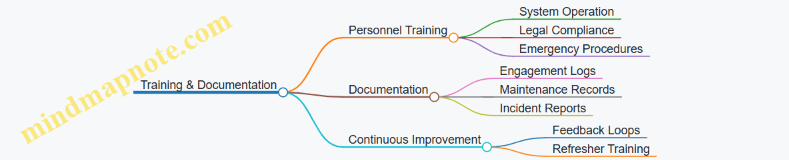
Example: Compliance-Focused Training Session
During training, operators were presented with scenarios involving drones near restricted airspace. They practiced identifying compliant engagement conditions and steps to abort if rules were not met. This hands-on approach reinforced understanding of legal boundaries and operational limits, reducing the chance of errors during real incidents.
Summary
Balancing compliance and operational effectiveness is a matter of integrating legal requirements into system design, operation, and personnel practices. Automated safety features, clear protocols, thorough training, and meticulous documentation form the backbone of this balance. Regular audits and coordination with authorities keep the system aligned with evolving regulations, ensuring that laser defense systems protect without overstepping legal or safety boundaries.
10.5 Example: Conducting a Safety Audit for a Counter Drone Laser System
Conducting a safety audit for a counter drone laser system is a structured process aimed at verifying that all safety protocols are in place and functioning as intended. The goal is to minimize risks to operators, bystanders, and equipment while ensuring compliance with relevant regulations. This example walks through a practical safety audit, highlighting key checkpoints and considerations.
Step 1: Preparation and Documentation Review
Start by gathering all relevant documentation: system manuals, safety protocols, regulatory requirements, maintenance logs, and operator training records. Confirm that these documents are current and accessible.
Mind Map: Preparation Phase
Example: The audit team reviews the latest operator training records and finds that refresher courses are overdue. This flags a potential risk area.
Step 2: Physical Inspection of the System
Inspect the laser hardware, optical components, cooling systems, and mounting structures. Check for signs of wear, damage, or misalignment.
Mind Map: Physical Inspection
Example: During inspection, a cooling fan is found clogged with dust, which could lead to overheating and system failure.
Step 3: Verification of Safety Interlocks and Emergency Procedures
Test all safety interlocks, such as beam shutters, emergency stop buttons, and access controls. Confirm that emergency shutdown procedures are clearly posted and understood.
Mind Map: Safety Interlocks and Emergency Procedures
Example: The audit team activates the emergency stop and verifies that the laser beam immediately ceases. However, signage near the control panel is faded and hard to read, which is noted for correction.
Step 4: Operator and Personnel Assessment
Interview operators to assess their understanding of safety protocols, system operation, and emergency responses. Observe a live system operation if possible.
Mind Map: Operator Assessment
Example: An operator correctly demonstrates the shutdown sequence but hesitates when asked about laser hazard zones, indicating a need for targeted training.
Step 5: Environmental and Site Safety Evaluation
Evaluate the deployment site for hazards such as reflective surfaces, public access points, and environmental factors that could affect laser safety.
Mind Map: Environmental Safety
Example: The audit identifies a nearby glass window that could reflect the laser beam outside the controlled area, prompting a recommendation for protective screening.
Step 6: Review of Compliance with Legal and Regulatory Standards
Cross-check system operation and safety measures against applicable laws and regulations, including laser classification, permissible exposure limits, and reporting requirements.
Mind Map: Compliance Review
Example: The system is classified as Class 4, but the audit finds that some warning signs do not meet size and placement standards mandated by regulations.
Step 7: Reporting and Recommendations
Compile findings into a clear report, categorizing issues by severity and suggesting corrective actions. Include timelines and responsible parties for follow-up.
Mind Map: Reporting
Example: The report highlights the need for immediate cleaning of cooling components, replacement of faded signage, and a refresher training session within 30 days.
This structured approach ensures that the counter drone laser system operates safely and effectively. Each step is designed to catch potential hazards before they cause harm or regulatory issues. The examples illustrate common pitfalls and practical solutions, making the audit both thorough and actionable.
11. Case Studies of Operational Counter Drone Laser Systems
11.1 Military Deployments and Lessons Learned
Military applications of counter drone laser defense systems have provided valuable insights into both the capabilities and limitations of these technologies in operational environments. This section reviews key deployments, the practical challenges encountered, and the lessons drawn from real-world use.
Deployment Contexts
Counter drone laser systems have been deployed in various military settings, including forward operating bases, critical infrastructure protection, and mobile units accompanying troops. Each context presents unique operational demands:
- Fixed Base Defense: Systems are often integrated into perimeter security to neutralize reconnaissance or attack drones.
- Mobile Units: Mounted on vehicles, these systems provide on-the-move protection but face constraints in power and stabilization.
- Critical Infrastructure: Protecting command centers, airfields, and supply depots requires continuous readiness and minimal collateral risk.
Key Lessons Learned
-
Environmental Impact on Laser Performance
- Dust, fog, rain, and heat haze significantly reduce laser effectiveness by scattering or absorbing the beam.
- Adaptive optics and real-time atmospheric compensation improve reliability but add complexity.
-
Target Identification and Engagement Speed
- Rapid identification and classification are crucial to avoid engaging friendly or neutral drones.
- Integration of multi-sensor data (radar, EO/IR) enhances target discrimination.
-
Power Management and Cooling
- High power lasers require robust cooling systems, which can be bulky and limit mobility.
- Energy consumption impacts deployment duration, especially in remote or mobile scenarios.
-
System Integration and Operator Training
- Seamless integration with command and control networks improves situational awareness.
- Operators need specialized training to interpret sensor data and manage engagement protocols effectively.
-
Rules of Engagement and Safety Protocols
- Clear protocols are necessary to avoid unintended damage or injury.
- Laser safety zones must be established, especially in populated or allied areas.
Example: Forward Operating Base Deployment
At a forward operating base in a semi-arid region, a counter drone laser system was installed to protect against low-flying reconnaissance drones. The system combined radar detection with a fiber laser for interception. Initial deployment revealed that dust storms frequently degraded beam quality, reducing effective range by up to 30%. Operators adapted by scheduling system use during lower dust activity and employing adaptive optics to partially compensate. Training emphasized rapid target verification to prevent engagement of allied UAVs conducting supply runs.
Example: Mobile Vehicle-Mounted System
A vehicle-mounted laser system was deployed with a mechanized infantry unit. The system’s cooling requirements limited continuous operation to short bursts. The team developed engagement protocols prioritizing high-threat targets to conserve power. Stabilization of the beam while on the move was challenging; engineers incorporated gyro-stabilized mounts, improving accuracy by 40%. Operator feedback highlighted the importance of intuitive interfaces for quick decision-making under fire.
Mind Map: Military Deployment Factors
Mind Map: Lessons Learned
Summary
Military deployments have demonstrated that counter drone laser defense systems are effective tools when carefully matched to their environment and mission. Success depends on managing environmental factors, ensuring rapid and accurate target identification, and balancing system power demands with operational needs. Training and integration into broader defense networks are equally important to maximize system utility and safety.
11.2 Civilian and Critical Infrastructure Protection
Counter drone laser defense systems have found a clear role in protecting civilian spaces and critical infrastructure. Unlike military environments, these settings demand a careful balance between effective drone neutralization and minimizing risks to people and property nearby.
Key Considerations for Civilian and Infrastructure Protection
- Safety First: Laser systems must be calibrated to avoid unintended harm to humans, animals, or sensitive equipment. This often means limiting power output or using beam control techniques.
- Detection Accuracy: False alarms can disrupt operations and cause unnecessary interventions. Reliable identification and classification algorithms reduce these incidents.
- Regulatory Compliance: Urban and populated areas have strict rules on laser emissions and drone engagement protocols.
- Integration with Existing Security: Laser systems often complement radar, cameras, and physical barriers.
Mind Map: Civilian and Infrastructure Protection Factors
Example: Protecting a Power Substation
A power substation located near a suburban area faced repeated drone incursions, raising concerns about sabotage or espionage. The deployed laser defense system was configured with a low-power fiber laser combined with a multi-sensor detection array (radar and electro-optical cameras).
The system’s tracking algorithm prioritized drones entering a predefined no-fly zone. When a drone was detected, the laser engaged only after confirming the target through visual classification to prevent false positives. The laser power was modulated to disable the drone’s motors without causing collateral damage.
Operators underwent rigorous safety training, and the system included automatic shutdown protocols if a human or animal entered the beam path. This setup allowed continuous protection without disrupting nearby residents or infrastructure.
Mind Map: Example Deployment at Power Substation
Urban Environment Challenges
Urban settings introduce complexities such as reflections from glass buildings, interference from other light sources, and a high density of legitimate aerial objects (e.g., delivery drones, hobbyists). Laser systems must adapt by incorporating advanced filtering algorithms and adjustable beam steering to avoid unintended targets.
Example: Airport Perimeter Defense
Airports require strict drone control to prevent disruptions. A laser defense system was integrated with the airport’s radar and camera network. The system used a layered approach: initial detection by radar, followed by optical confirmation. The laser was only activated when a drone breached the outer perimeter.
The system’s control software included a whitelist of authorized drones (e.g., airport service drones) to prevent accidental engagements. Beam steering was automated to track fast-moving targets while avoiding reflections from runway lights.
This approach minimized false alarms and ensured that laser use complied with aviation safety regulations.
Mind Map: Airport Laser Defense System
Best Practices Summary
- Use multi-sensor detection to improve accuracy.
- Employ power modulation and beam control to enhance safety.
- Integrate with existing security and operational protocols.
- Train operators thoroughly on system capabilities and safety.
- Customize engagement rules to the specific environment and regulatory framework.
By carefully tailoring counter drone laser systems to civilian and critical infrastructure contexts, operators can maintain security without compromising safety or operational continuity.
11.3 Integration with Other Counter-Drone Technologies
Counter drone laser defense systems rarely operate in isolation. Combining them with other counter-drone technologies enhances detection accuracy, engagement efficiency, and overall system resilience. This section covers how laser systems fit into a broader counter-drone ecosystem, highlighting practical integration methods and illustrating them with examples and mind maps.
Why Integrate?
Laser systems excel at neutralizing drones quickly and with precision. However, their effectiveness depends on accurate detection, classification, and tracking. Other technologies like radar, radio frequency (RF) jamming, and kinetic interceptors complement lasers by covering gaps in detection or providing alternative engagement options.
Key Technologies for Integration
- Radar Systems: Provide wide-area detection and initial tracking, especially useful for long-range and high-speed drones.
- Electro-Optical/Infrared (EO/IR) Sensors: Offer visual confirmation and classification, aiding in target identification.
- Radio Frequency (RF) Jammers: Disrupt drone communication and control links, potentially forcing drones to land or return home.
- Kinetic Interceptors: Physical projectiles or nets to capture or destroy drones when laser engagement is not feasible.
Integration Architecture Mind Map
Data Fusion and Command Coordination
Integrating multiple sensors and effectors requires a command and control (C2) system capable of fusing data streams. For example, radar might detect a drone at 3 km, EO/IR sensors confirm its identity at 2 km, and the laser system engages at 1 km. The C2 system prioritizes targets, assigns engagement methods, and manages timing to avoid redundant or conflicting actions.
Example: Multi-Layered Defense Setup
A military base uses a radar network for early drone detection. Once radar flags a target, EO/IR cameras zoom in for classification. If the drone is hostile, the C2 system activates RF jamming to disrupt control signals. If jamming fails or is unsuitable, the laser system is engaged to disable the drone physically. In case of multiple simultaneous threats, kinetic interceptors provide backup for drones that evade laser engagement.
Integration Challenges
- Latency: Real-time data processing is critical. Delays can cause missed engagements.
- Interference: RF jamming may affect communication within the defense system itself.
- Resource Management: Coordinating power and operational limits across systems prevents overload.
Engagement Decision Mind Map
Example: Urban Environment Deployment
In a crowded urban setting, laser engagement might be limited by line-of-sight or safety concerns. Here, RF jamming can temporarily neutralize drones without physical destruction. The system uses radar and EO/IR sensors to track drones, while the C2 system decides when to switch from jamming to laser engagement based on proximity and risk assessment.
Best Practices for Integration
- Design the C2 system to handle multiple sensor inputs and engagement outputs seamlessly.
- Test for electromagnetic compatibility to avoid interference between RF jammers and other electronics.
- Implement fallback protocols so if one system fails, others can compensate.
- Use layered detection to reduce false positives and improve target confidence before laser engagement.
In summary, integrating laser defense with other counter-drone technologies creates a more robust and adaptable defense posture. Each technology contributes strengths that compensate for others’ limitations, and a well-designed command and control system ensures smooth coordination and effective threat neutralization.
11.4 Best Practices: Adapting Systems Based on Real-World Feedback
Adapting counter drone laser systems based on real-world feedback is essential for maintaining effectiveness and reliability. Field conditions rarely match controlled environments, so continuous refinement is necessary. This section outlines best practices for incorporating operational feedback into system improvements, supported by clear examples and mind maps to organize key concepts.
Understanding Feedback Sources
Feedback comes from multiple channels: operator reports, system logs, environmental sensors, and post-engagement analyses. Each source offers unique insights:
- Operator Reports: Provide qualitative data on usability, response times, and unexpected behaviors.
- System Logs: Quantitative data on laser performance, tracking accuracy, and engagement success rates.
- Environmental Sensors: Highlight conditions like weather or electromagnetic interference affecting system function.
- Post-Engagement Analysis: Reveals how the system performed against real threats, including any failures or delays.
Mind Map: Feedback Integration Process
Prioritizing Issues
Not all feedback carries equal weight. Prioritize based on impact on mission success and safety. For example, a minor UI inconvenience is less urgent than a tracking algorithm that misses fast-moving drones. Use a scoring system to rank issues by frequency, severity, and ease of fix.
Example: Tracking Algorithm Adjustment
During a deployment, operators noticed the system struggled with small, fast drones in cluttered urban environments. System logs confirmed increased tracking errors during these scenarios. The team analyzed the algorithm’s parameters and identified that the prediction model underestimated sudden directional changes.
Action: They adjusted the prediction window and incorporated a more responsive Kalman filter variant. After updating the software, field tests showed a 30% improvement in tracking accuracy for fast drones.
Mind Map: Algorithm Adaptation Workflow
Hardware Calibration Based on Environmental Feedback
Environmental factors like dust, humidity, or temperature can degrade laser performance. In one case, a deployed system in a desert environment experienced beam divergence due to heat-induced lens distortion. Operators reported reduced effective range during midday.
Best Practice: Schedule regular calibration checks aligned with environmental cycles. Implement sensors to monitor ambient conditions and trigger automatic recalibration or alerts.
Example: Cooling System Upgrade
Feedback indicated that the original cooling system was insufficient during prolonged high-power operation, causing thermal throttling. After reviewing system logs and operator notes, engineers installed a more robust liquid cooling system. This upgrade stabilized laser output and extended continuous operation time.
Mind Map: Environmental Adaptation
Training and Operational Feedback
Operators are the frontline users and their feedback is invaluable. If they find controls unintuitive or response times slow, system effectiveness suffers. Regular debriefs and training sessions help capture this feedback.
Example: Operators reported difficulty switching targets quickly during swarm attacks. The control interface was redesigned to allow faster target cycling and integrated visual cues. Post-update, operators reported smoother engagement and less cognitive load.
Documentation and Continuous Improvement
Document all feedback, changes, and outcomes systematically. This creates a knowledge base for future deployments and helps avoid repeating mistakes. Establish a feedback loop where improvements are regularly reviewed and new feedback is welcomed.
Summary
Adapting counter drone laser systems using real-world feedback requires a structured approach: collect diverse data, prioritize issues, implement targeted changes, and validate improvements. Concrete examples from tracking algorithms, hardware calibration, and operator interface adjustments illustrate how iterative refinement enhances system performance in varied conditions.
11.5 Example: Analysis of a Successful Interception in a High-Density Airspace
In this example, we analyze a real-world scenario where a counter drone laser defense system successfully intercepted an unauthorized drone in a crowded urban airspace. The environment posed multiple challenges: numerous legitimate aerial vehicles, variable atmospheric conditions, and limited engagement windows.
Scenario Overview
- Location: Urban downtown area with multiple commercial drones and manned aircraft.
- Threat: A small, fast-moving quadcopter entering restricted airspace.
- System: Ground-based counter drone laser with integrated radar, lidar, and electro-optical sensors.
Detection and Tracking
The system first detected the drone using radar, which provided initial range and velocity data. Lidar and electro-optical sensors then refined the target’s position and classification.
The tracking algorithm employed a Kalman filter to predict the drone’s trajectory, compensating for erratic movements common in small drones.
Target Identification
Machine learning models analyzed the electro-optical data to distinguish the drone from other flying objects. The system correctly identified the drone as unauthorized based on flight path and lack of transponder signals.
Engagement Decision
The system prioritized the target due to its proximity to sensitive infrastructure. Safety protocols ensured no manned aircraft were within the laser’s path.
Laser Interception
The laser system engaged with a power level calibrated to disable the drone’s electronics without causing collateral damage. Beam steering compensated for atmospheric turbulence.
Outcome
The drone was neutralized within 12 seconds of detection. Post-engagement analysis showed the laser caused critical failure in the drone’s flight controller.
Lessons and Best Practices
- Multi-sensor fusion improves detection accuracy in cluttered airspace.
- Predictive tracking algorithms like Kalman filters handle erratic drone movements effectively.
- Machine learning classification reduces false positives by distinguishing drones from birds or balloons.
- Power modulation and beam steering are essential to safely engage targets without affecting nearby objects.
- Strict safety protocols prevent unintended exposure to manned aircraft or civilians.
This example demonstrates how integrating detection, identification, and engagement components with clear operational procedures leads to effective counter drone laser defense in complex environments.
12. Appendices and Reference Materials
12.1 Glossary of Terms and Acronyms
Glossary of Terms and Acronyms
This glossary covers key terms and acronyms used throughout the book on Counter Drone Laser Defense Systems. Each entry includes a concise definition and, where helpful, a simple example or a mind map in format to clarify relationships.
Adaptive Optics (AO)
A technology used to correct distortions in a laser beam caused by atmospheric turbulence. By adjusting optical elements in real time, AO improves beam focus and accuracy.
Example: A fast steering mirror adjusts the beam path to compensate for wind-induced jitter.
Beam Steering
The process of directing a laser beam toward a moving target using mechanical or electronic means.
Mind Map:
Convolutional Neural Network (CNN)
A type of machine learning model particularly effective for image recognition tasks, such as identifying drones from camera feeds.
Example: A CNN trained to distinguish between a quadcopter and a bird in surveillance footage.
Electro-Optical (EO) Sensors
Sensors that detect light in the visible or infrared spectrum, commonly used for visual tracking and identification.
Example: An EO camera providing real-time video to the tracking system.
Fiber Laser
A laser where the active gain medium is an optical fiber doped with rare-earth elements. Known for high beam quality and efficiency.
Example: Using a fiber laser to deliver a concentrated beam capable of disabling a drone’s electronics.
Kalman Filter
An algorithm that estimates the state of a moving object by combining noisy sensor data over time, improving tracking accuracy.
Mind Map:
Lidar (Light Detection and Ranging)
A remote sensing method that uses laser pulses to measure distances and create 3D maps of the environment.
Example: Detecting drone position and velocity by measuring reflected laser pulses.
Machine Learning (ML)
A set of algorithms that enable systems to learn patterns from data and improve performance without explicit programming.
Example: Training a model to classify drone types based on flight patterns.
Phased Array
An array of lasers or antennas where the relative phase of each element is controlled to steer the beam electronically without moving parts.
Example: Electronically steering a laser beam to track a fast-moving drone.
Radar (Radio Detection and Ranging)
A sensor that uses radio waves to detect objects, determine their range, speed, and direction.
Example: Early detection of drones entering a protected airspace.
Rules of Engagement (ROE)
Predefined guidelines that dictate when and how a defense system can engage a target.
Example: Only activating the laser when a drone is confirmed hostile and within a certain range.
Swarm Attack
An attack involving multiple drones operating in coordination to overwhelm defense systems.
Mind Map:
Thermal Management
Techniques used to dissipate heat generated by high-power lasers to maintain performance and prevent damage.
Example: Using liquid cooling systems to keep laser diodes within safe operating temperatures.
Tracking Algorithm
A computational method that processes sensor data to follow the position and movement of a target over time.
Example: Using a particle filter to track erratic drone flight paths.
Target Classification
The process of identifying the type or intent of a detected object, distinguishing drones from birds or other objects.
Example: Classifying a detected object as a commercial drone versus a hobbyist drone.
Electro-Optical/Infrared (EO/IR)
Combined sensor systems that use both visible light and infrared detection to improve target detection and identification.
Example: Detecting drones at night using infrared sensors alongside daytime EO cameras.
Beam Quality
A measure of how close a laser beam is to an ideal Gaussian shape, affecting focus and energy delivery.
Example: A high beam quality laser can focus energy on a small drone component more effectively.
False Positive
An incorrect identification of a non-threat as a threat, leading to unnecessary engagement or alerts.
Example: Mistaking a bird for a drone in radar data.
Command and Control (C2)
The system and processes used to direct and manage defense assets, including laser systems.
Example: An operator interface that allows selection of targets and monitoring of laser status.
Modulation
Adjusting the power or pulse characteristics of a laser beam to optimize engagement effectiveness.
Example: Increasing laser power briefly to disable a drone’s sensors without damaging surrounding objects.
Mobile Counter Drone Unit
A transportable laser defense system designed for rapid deployment and operation in various environments.
Example: A truck-mounted laser system used to protect a temporary event.
Sensor Fusion
Combining data from multiple sensors (radar, lidar, EO) to improve detection accuracy and reduce uncertainty.
Mind Map:
High Power Laser
A laser capable of delivering sufficient energy to damage or disable drones at operational ranges.
Example: A laser outputting tens of kilowatts to burn through drone propellers.
Calibration
The process of adjusting system parameters to ensure accurate targeting and sensor readings.
Example: Aligning laser optics to ensure the beam hits the predicted drone position.
Cybersecurity
Measures taken to protect the laser defense system from unauthorized access or interference.
Example: Encrypting communication between sensors and control units.
Interception Range
The maximum distance at which a laser system can effectively engage and neutralize a drone.
Example: A system with a 2-kilometer interception range can protect a wide perimeter.
Engagement Timing
Determining the optimal moment to activate the laser to maximize effect while minimizing resource use.
Example: Waiting until a drone is within a critical distance before firing.
False Negative
Failing to detect or classify a real threat, potentially allowing a drone to bypass defenses.
Example: A stealth drone not detected by radar but visible on EO sensors.
Modularity
Design approach where system components can be independently replaced or upgraded.
Example: Swapping out a sensor module without redesigning the entire system.
Field Deployment
The process of installing and operating a laser defense system in a real-world environment.
Example: Setting up a laser system on a rooftop to protect a critical facility.
Summary Mind Map
This glossary should serve as a quick reference to clarify technical terms and acronyms encountered in the book. Understanding these concepts will help you navigate the complexities of counter drone laser defense systems with greater confidence.
12.2 Technical Specifications of Common Laser Components
Understanding the technical specifications of laser components is essential for designing, deploying, and maintaining counter drone laser defense systems. Each component contributes to the overall performance, reliability, and safety of the system. Below, we break down the key components, their specifications, and provide mind maps to visualize their relationships.
Laser Source
The laser source is the heart of the system. It generates the coherent light beam used to intercept drones.
- Wavelength (nm): Determines atmospheric absorption and eye safety. Common wavelengths include 1064 nm (Nd:YAG), 1550 nm (fiber lasers), and 532 nm (frequency-doubled lasers).
- Output Power (Watts): Defines the energy delivered to the target. High power (kW range) is needed for effective neutralization.
- Beam Quality (M²): Measures how close the beam is to an ideal Gaussian beam. Lower M² means better focus and longer effective range.
- Pulse Duration: Continuous wave (CW) or pulsed operation affects thermal load and engagement strategy.
- Efficiency (%): Electrical-to-optical conversion efficiency impacts power consumption and cooling requirements.
Example: A 2 kW fiber laser at 1550 nm with M² = 1.2 offers good atmospheric transmission and eye safety margins.
Beam Delivery Optics
These components shape, steer, and focus the laser beam onto the target.
- Mirrors: Reflective surfaces with coatings optimized for the laser wavelength; reflectivity >99.5% is typical.
- Lenses: Focus or collimate the beam; made from materials like fused silica or BK7 glass.
- Beam Expanders: Increase beam diameter to reduce divergence.
- Steering Mechanisms: Galvanometer mirrors or fast steering mirrors with response times in milliseconds.
- Adaptive Optics: Correct wavefront distortions caused by atmospheric turbulence.
Example: A fast steering mirror with a 1 kHz bandwidth can track a drone moving at 20 m/s within a 500 m engagement zone.
Power Supply and Cooling
High power lasers require stable power and effective thermal management.
- Power Supply Voltage and Current: Must match laser specifications; often 48 V DC or higher.
- Ripple and Noise: Low ripple (<1%) ensures stable laser output.
- Cooling Type: Air-cooled for low power or water-cooled for high power lasers.
- Cooling Capacity: Measured in kW; must exceed laser heat dissipation.
Example: A 5 kW laser system may require a water chiller capable of 6 kW heat removal to maintain stable operation.
Sensors and Detectors
Sensors feed data into tracking algorithms.
- Photodiodes: Detect laser power and beam alignment.
- Cameras: Electro-optical or infrared cameras with resolution and frame rate suited for drone detection.
- Rangefinders: Lidar or laser rangefinders with accuracy in centimeters.
Example: A near-infrared camera with 640x480 resolution at 60 fps provides real-time tracking data.
Mind Map: Laser System Components
Control Electronics
These components manage laser operation and safety interlocks.
- Modulation Bandwidth: Determines how fast the laser output can be turned on/off or modulated.
- Safety Interlocks: Hardware and software to prevent accidental exposure.
- Interface Protocols: Communication standards such as Ethernet, CAN bus, or RS-485.
Example: A control board with 10 MHz modulation bandwidth allows precise pulsing for energy control.
Mechanical Housing
Protects components and ensures alignment.
- Material: Aluminum or stainless steel for durability and thermal conduction.
- Sealing: IP ratings (e.g., IP65) for dust and water resistance.
- Vibration Damping: Important for maintaining beam alignment in mobile deployments.
Example: A sealed aluminum enclosure with vibration isolators maintains system integrity in a moving vehicle.
Mind Map: Supporting Components
Summary Table of Key Specifications
| Component | Specification | Typical Values | Notes |
|---|---|---|---|
| Laser Source | Wavelength | 1064 nm, 1550 nm | Affects atmospheric absorption |
| Output Power | 500 W – 10 kW | Higher power increases effective range | |
| Beam Quality (M²) | 1.0 – 1.5 | Closer to 1 is better | |
| Beam Delivery Optics | Mirror Reflectivity | >99.5% | Coating optimized for wavelength |
| Steering Bandwidth | 1 kHz – 10 kHz | Faster tracking of moving targets | |
| Power Supply | Voltage | 48 V DC or higher | Stable supply critical |
| Cooling Capacity | 1 kW – 10 kW | Depends on laser power | |
| Sensors | Camera Resolution | 640x480 to 1920x1080 | Higher resolution improves tracking |
| Control Electronics | Modulation Bandwidth | Up to 10 MHz | Enables pulsed laser operation |
| Mechanical Housing | IP Rating | IP54 – IP65 | Protection against dust and moisture |
Example: Component Selection for a Mid-Range System
- Laser Source: 1 kW fiber laser at 1550 nm, M² = 1.3
- Beam Delivery: Fast steering mirror with 2 kHz bandwidth, fused silica lenses
- Power Supply: 48 V DC, low ripple, water-cooled system with 1.5 kW capacity
- Sensors: Near-infrared camera 1280x720 at 30 fps, lidar rangefinder with 10 cm accuracy
- Control Electronics: Modulation bandwidth 5 MHz, Ethernet interface
- Housing: Aluminum enclosure, IP54, vibration dampers
This configuration balances performance, reliability, and operational flexibility for typical counter drone tasks.
This section provides a foundation for understanding the hardware that makes counter drone laser defense systems function effectively. Each specification impacts system behavior and must be chosen with the operational environment and mission goals in mind.
12.3 Sample Code Snippets for Tracking Algorithms
Tracking algorithms form the backbone of counter drone laser defense systems. They process sensor data to estimate the position and predict the future trajectory of drones, enabling timely and accurate laser engagement. This section presents practical code snippets and mind maps to clarify common tracking approaches.
Mind Map: Core Components of a Tracking Algorithm
Simple Kalman Filter for 2D Drone Tracking
Kalman filters are popular for tracking because they efficiently estimate the state of a moving object in noisy environments. Here is a basic Python example tracking a drone’s 2D position and velocity.
import numpy as np

class KalmanFilter2D:
    def __init__(self, dt, process_var, measurement_var):
        # State vector: [x, y, vx, vy]
        self.dt = dt
        self.A = np.array([[1, 0, dt, 0],
                           [0, 1, 0, dt],
                           [0, 0, 1, 0],
                           [0, 0, 0, 1]])  # State transition matrix

        self.H = np.array([[1, 0, 0, 0],
                           [0, 1, 0, 0]])  # Measurement matrix

        self.Q = process_var * np.eye(4)  # Process noise covariance
        self.R = measurement_var * np.eye(2)  # Measurement noise covariance

        self.P = np.eye(4)  # Initial estimate error covariance
        self.x = np.zeros((4, 1))  # Initial state

    def predict(self):
        self.x = self.A @ self.x
        self.P = self.A @ self.P @ self.A.T + self.Q

    def update(self, z):
        z = z.reshape((2, 1))
        y = z - self.H @ self.x  # Innovation
        S = self.H @ self.P @ self.H.T + self.R  # Innovation covariance
        K = self.P @ self.H.T @ np.linalg.inv(S)  # Kalman gain

        self.x = self.x + K @ y
        I = np.eye(self.P.shape[0])
        self.P = (I - K @ self.H) @ self.P

    def current_state(self):
        return self.x.flatten()

# Example usage
kf = KalmanFilter2D(dt=0.1, process_var=1e-4, measurement_var=1e-1)
measurements = [np.array([0, 0]), np.array([0.1, 0.05]), np.array([0.2, 0.1]), np.array([0.3, 0.15])]

for z in measurements:
    kf.predict()
    kf.update(z)
    print(f"Estimated State: {kf.current_state()}")
This snippet tracks position and velocity in two dimensions. The predict step advances the state estimate, while the update step corrects it using new measurements. The process and measurement noise covariances control the filter’s sensitivity.
Mind Map: Kalman Filter Workflow
Extended Kalman Filter (EKF) for Nonlinear Motion
Drones often move in nonlinear patterns. The EKF linearizes nonlinear models around the current estimate. Here’s a simplified EKF example tracking a drone moving in 2D with nonlinear dynamics.
import numpy as np

def f(x, dt):
    # State transition function: x = [px, py, vx, vy]
    px, py, vx, vy = x
    px_new = px + vx * dt
    py_new = py + vy * dt
    return np.array([px_new, py_new, vx, vy])

def jacobian_F(dt):
    # Jacobian of f with respect to state
    return np.array([[1, 0, dt, 0],
                     [0, 1, 0, dt],
                     [0, 0, 1, 0],
                     [0, 0, 0, 1]])

class ExtendedKalmanFilter2D:
    def __init__(self, dt, process_var, measurement_var):
        self.dt = dt
        self.x = np.zeros(4)  # Initial state
        self.P = np.eye(4)  # Covariance
        self.Q = process_var * np.eye(4)  # Process noise
        self.R = measurement_var * np.eye(2)  # Measurement noise
    def predict(self):
        self.x = f(self.x, self.dt)
        F = jacobian_F(self.dt)
        self.P = F @ self.P @ F.T + self.Q
    def update(self, z):
        z = np.array(z)
        H = np.array([[1, 0, 0, 0],
                      [0, 1, 0, 0]])
        y = z - H @ self.x
        S = H @ self.P @ H.T + self.R
        K = self.P @ H.T @ np.linalg.inv(S)
        self.x = self.x + K @ y
        I = np.eye(len(self.x))
        self.P = (I - K @ H) @ self.P
    def current_state(self):
        return self.x

# Example usage
ekf = ExtendedKalmanFilter2D(dt=0.1, process_var=1e-4, measurement_var=1e-1)
measurements = [[0, 0], [0.1, 0.05], [0.21, 0.11], [0.32, 0.16]]

for z in measurements:
    ekf.predict()
    ekf.update(z)
    print(f"EKF Estimated State: {ekf.current_state()}")
This EKF example uses a simple constant velocity model with nonlinear state transition functions. The Jacobian matrix approximates the system dynamics for the update step.
Mind Map: Extended Kalman Filter Steps
Simple Particle Filter for Drone Tracking
Particle filters handle non-Gaussian noise and nonlinear models by representing the state distribution with particles. Here’s a minimal example tracking a drone’s 1D position.
import numpy as np

class ParticleFilter1D:
    def __init__(self, num_particles, process_std, measurement_std):
        self.num_particles = num_particles
        self.particles = np.random.uniform(0, 10, size=num_particles)  # Initial positions
        self.weights = np.ones(num_particles) / num_particles
        self.process_std = process_std
        self.measurement_std = measurement_std

    def predict(self, velocity, dt):
        noise = np.random.normal(0, self.process_std, self.num_particles)
        self.particles += velocity * dt + noise

    def update(self, measurement):
        distances = np.abs(self.particles - measurement)
        self.weights = np.exp(- (distances ** 2) / (2 * self.measurement_std ** 2))
        self.weights += 1e-300  # Avoid zeros
        self.weights /= np.sum(self.weights)

    def resample(self):
        cumulative_sum = np.cumsum(self.weights)
        cumulative_sum[-1] = 1.0  # Avoid round-off error
        indexes = np.searchsorted(cumulative_sum, np.random.rand(self.num_particles))
        self.particles = self.particles[indexes]
        self.weights.fill(1.0 / self.num_particles)

    def estimate(self):
        return np.average(self.particles, weights=self.weights)

# Example usage
pf = ParticleFilter1D(num_particles=1000, process_std=0.1, measurement_std=0.5)
measurements = [0, 0.9, 2.1, 3.0, 3.9]
velocity = 1.0

dt = 1.0
for z in measurements:
    pf.predict(velocity, dt)
    pf.update(z)
    pf.resample()
    print(f"Particle Filter Estimate: {pf.estimate():.2f}")
Particle filters are computationally heavier but flexible. This example tracks a drone moving along a line with noisy measurements.
Mind Map: Particle Filter Process

Summary
These code snippets cover three common tracking algorithms: Kalman filter, Extended Kalman filter, and Particle filter. Each has strengths and trade-offs. Kalman filters excel with linear Gaussian models, EKF handles mild nonlinearities, and particle filters manage complex, nonlinear, and non-Gaussian scenarios. Understanding these basics helps tailor tracking solutions to specific counter drone laser defense needs.
12.4 Checklists for Deployment and Maintenance
Effective deployment and maintenance of counter drone laser defense systems require systematic, repeatable procedures. Checklists help ensure no critical step is missed, improving reliability and safety. Below are detailed checklists accompanied by mind maps to visualize key tasks and their relationships.
Deployment Checklist
Objective: Prepare and install the laser defense system in a new location, ensuring operational readiness.
-
Site Survey and Preparation
- Confirm site accessibility and security
- Assess environmental conditions (weather, terrain, line-of-sight)
- Identify power sources and backup options
- Verify communication infrastructure availability
-
System Assembly
- Unpack and inspect all components
- Assemble laser unit, optics, and beam steering mechanisms
- Install sensors (radar, lidar, EO/IR cameras)
- Connect power and data cables
-
Calibration and Alignment
- Perform initial laser beam alignment
- Calibrate sensors for the local environment
- Test beam steering accuracy
- Verify synchronization between detection and laser control
-
Software Setup
- Load operational software and tracking algorithms
- Configure system parameters for local conditions
- Test sensor data fusion and target tracking
- Set engagement rules and safety limits
-
Safety Checks
- Confirm safety interlocks and emergency shutdowns
- Establish exclusion zones and warning signage
- Train operators on safety protocols
-
Operational Testing
- Conduct dry runs without laser firing
- Simulate target detection and tracking
- Perform controlled laser firing tests on dummy targets
- Record system performance metrics
-
Documentation and Reporting
- Log deployment details and calibration data
- Report any anomalies or issues
- Confirm readiness with command authority
Maintenance Checklist
Objective: Keep the system functioning reliably through routine inspections and repairs.
-
Daily Checks
- Inspect physical condition of laser and optics
- Verify power supply stability
- Check sensor functionality and cleanliness
- Review system logs for errors or warnings
-
Weekly Tasks
- Perform beam alignment verification
- Test cooling system performance
- Clean optical surfaces with approved materials
- Validate software updates and patches
-
Monthly Procedures
- Conduct full system diagnostics
- Inspect mechanical components for wear
- Test emergency shutdown and safety interlocks
- Review and update operator training as needed
-
Quarterly Activities
- Replace consumables (filters, cooling fluids)
- Recalibrate sensors and laser output
- Perform cybersecurity audits on control systems
- Evaluate system logs for long-term trends
-
Troubleshooting Protocols
- Identify symptoms and isolate subsystem
- Consult diagnostic codes and manuals
- Replace or repair faulty components
- Document all interventions and outcomes
Mind Maps
Deployment Process Mind Map
Maintenance Routine Mind Map
Examples
Example 1: Deployment in a Remote Facility
During deployment at a remote communications tower, the team first confirmed power availability and established a satellite link for command control. They assembled the laser and sensor units on a pre-installed platform. Calibration involved adjusting for high humidity, which affected beam propagation. Safety zones were marked with portable barriers. A dry run successfully tracked a drone simulation, and laser firing tests on a tethered target confirmed system readiness.
Example 2: Routine Maintenance in an Urban Environment
Operators performed daily inspections noting minor dust accumulation on optical lenses. Weekly cleaning improved sensor accuracy. Monthly diagnostics revealed slight misalignment due to vibrations from nearby construction. Realignment restored performance. Quarterly cybersecurity checks ensured no unauthorized access. Logs documented all activities, supporting continuous reliability.
Following these checklists and visual guides helps maintain consistent performance and safety in counter drone laser defense systems. Regular attention to detail prevents failures and ensures the system responds effectively when needed.
12.5 Bibliography and Further Reading
This section gathers foundational and specialized references that support the technical and practical aspects covered throughout this book. The goal is to provide a structured overview of key literature and resources that inform the design, implementation, and operation of counter drone laser defense systems.
Core Technical References
- Texts on laser physics and high-power laser engineering, detailing beam generation, amplification, and thermal management.
- Publications on optical systems design, including adaptive optics and beam steering technologies.
- Research papers and manuals on sensor fusion, tracking algorithms, and real-time target prediction.
- Standards and guidelines related to laser safety, regulatory compliance, and operational protocols.
Practical Guides and Case Studies
- Documentation of field deployments, highlighting environmental challenges and system integration.
- Maintenance manuals emphasizing troubleshooting techniques and reliability practices.
- Case studies illustrating multi-laser coordination and engagement strategies against various drone threats.
Mind Maps for Conceptual Clarity
To help organize the complex topics, here are several mind maps in format. These can be used as quick-reference guides or teaching aids.
Mind Map 1: Components of Counter Drone Laser Systems
Mind Map 2: Tracking Algorithm Workflow
Mind Map 3: Field Deployment Considerations
Examples to Illustrate Key Concepts
Example 1: Applying a Kalman Filter for Drone Tracking
A Kalman filter estimates a drone’s position and velocity by combining noisy sensor measurements over time. Starting with an initial guess, the filter updates predictions as new radar and electro-optical data arrive, smoothing out random fluctuations. This method helps maintain a stable track even when the drone performs sudden maneuvers.
Example 2: Thermal Management in High Power Lasers
A fiber laser operating at several kilowatts generates significant heat. Using water-cooled heat sinks and temperature sensors, the system maintains optimal operating temperature. If the temperature rises beyond a threshold, power is automatically reduced to prevent damage, demonstrating a balance between performance and safety.
Example 3: Coordinating Multi-Laser Engagements
In a swarm attack scenario, two lasers are assigned to different sectors. The control system prioritizes targets based on threat level and proximity. By staggering laser firing times and adjusting power levels, the system efficiently neutralizes multiple drones without overheating or wasting energy.
This bibliography and further reading section serves as a roadmap for deeper understanding and practical application. The included mind maps and examples are intended to clarify complex topics and support hands-on learning.