European Medieval Herbal Remedies
1. Sources and Methods for Medieval Herbal Medicine
1.1 Manuscript Traditions and How Remedies Were Recorded
Medieval remedies were not stored as neat “recipes” in a single place. They lived across monasteries, households, and scribal workshops, moving from oral instruction to written notes and back again. A remedy could appear as a short line in one manuscript, a fuller procedure in another, and a slightly different variant in a third—often because the same practice was taught and retaught with local adjustments.
What Counts as a Remedy Record
A remedy record usually includes three kinds of information: the plant or material, the intended effect, and the method of preparation or application. Many entries also include timing cues (when to take it), preparation cues (how to process the herb), and administration cues (how often, and by whom). When one of these elements is missing, later scribes sometimes compensate by copying from a different source or by adding a clarifying note in the margin.
Manuscript Types and Their Typical Remedy Styles
Different manuscript genres shaped how remedies were written.
- Medical compendia often organize remedies by body part or symptom. They tend to use standardized phrasing, which makes them easier to compare across copies.
- Herbals and plant lists focus on identification and uses. They may describe preparation in brief terms, assuming the reader already knows common techniques.
- Monastic manuals and practical notes lean toward usability. They may include short instructions that fit daily work in a infirmary or apothecary.
- Glosses and marginalia preserve local knowledge. A scribe might add “this is best when…” or correct a plant name that was misunderstood in an earlier copy.
A useful way to read these differences is to treat each manuscript as a “workflow snapshot.” The genre tells you what the writer expected the reader to already know.
Copying, Variation, and Why Remedies Drift
Manuscripts were copied by hand, and that process introduced variation. Some changes were accidental: a line skipped, a word misread, or an abbreviation expanded incorrectly. Others were deliberate: a plant name replaced with a local equivalent, or a method adjusted to match available ingredients.
To keep drift from turning into confusion, scribes sometimes used cross-references like “as above” or reused a familiar preparation formula. When you see repeated phrasing across unrelated entries, it often signals a shared template rather than independent invention.
How Remedies Were Recorded in Practice
A remedy entry might be written as a compact instruction, but it often implies a preparation sequence. For example, a text may say “take the herb and make a decoction,” without specifying the exact duration. In that case, the manuscript’s surrounding entries can supply the missing steps because scribes frequently used consistent technique patterns.
Here is a practical example of how to interpret a short entry without inventing details:
Example: A manuscript notes a bitter herb “for stomach weakness” and adds “boil with water.” Even if it omits timing, you can infer that the writer expected a water-based extraction rather than an oil-based one. You then look for other entries in the same manuscript that use the same wording for “boil with water” and compare how they describe frequency or serving size.
Mind Map: Remedy Recording Components
Mind Map: How Manuscripts Create Meaning
A Systematic Reading Workflow
To turn manuscript text into a coherent remedy workflow, use a three-pass approach.
- Extract the skeleton: material, intended effect, and the stated method.
- Fill technique gaps from internal patterns: compare other entries that use the same method phrasing.
- Resolve ambiguity with local notes: margins and glosses often clarify plant identity, preparation strength, or practical constraints.
This approach respects what the manuscript actually says while still producing a usable understanding of how remedies were recorded and transmitted.
Example: From Fragment to Workflow
Example: Suppose an entry lists “plant X” and says “apply externally,” but gives no preparation type. If the manuscript elsewhere uses the same “apply externally” phrasing alongside “pounded” or “with wax,” you can treat those as the likely preparation family for plant X in that text. If a margin note adds “use the fresh leaf,” then the record is not merely incomplete—it is incomplete in a specific way that the manuscript itself helps correct.
1.2 Monastic Medical Roles and Practical Care Settings
Monastic medicine was organized around people, spaces, and routines. The goal was not to “cure everything,” but to keep patients clean, fed, warm or cooled appropriately, and treated with consistent plant-based preparations when the texts allowed it.
Core Roles in Monastic Care
Most communities assigned medical work to a small set of roles rather than expecting every monk to improvise. A typical pattern looked like this: one person coordinated remedies and supplies, others handled observation and daily care, and a separate group supported hygiene and food preparation.
The Infirmarian and Remedy Coordinator
The infirmarian (or infirmary keeper) managed the practical side: which herbs were available, how preparations were stored, and how instructions from medical manuscripts were translated into daily steps. They also decided when a remedy was “enough for today” versus when a patient needed rest, broth, or a change in approach.
Example: A patient with a persistent cough might receive an aromatic drink in the morning and a soothing external application at night. If the patient worsened after the first day, the infirmarian would pause the stronger preparation and focus on hydration and warmth.
Assistants and Daily Observers
Care assistants supported the infirmary by tracking symptoms in plain terms: appetite, sleep, bowel movements, pain location, and whether skin changes spread. This mattered because many remedies in herbals were described by effect, not by a modern diagnosis.
Example: If a skin remedy was intended for itch, assistants would note whether itching decreased after the first application and whether redness increased. That observation guided whether the next dose used the same strength or a gentler base.
The Cook and Food as Medicine
Food preparation was not separate from medical practice. Broths, gruels, and spiced drinks were often the safest way to administer herbs indirectly, especially for patients who could not tolerate bitter preparations.
Example: A bitter digestive herb might be used in a small infusion mixed into a thin porridge so the patient still received the intended effect without refusing the dose.
Practical Care Settings
Monastic medical spaces were designed for routine and control. The infirmary needed light, ventilation, and a workflow that reduced cross-contamination between patients.
Infirmary Layout and Workflow
A practical infirmary usually separated tasks: one area for preparation and storage, another for patient beds, and a washing zone for linens and utensils. Even when space was limited, the workflow mattered more than the architecture.
Example: If the same basin was used for washing wounds and preparing herbal washes, the infirmarian would require thorough cleaning and a clear sequence. Otherwise, plant preparations could become contaminated.
Storage and Labeling Practices
Herbs were vulnerable to moisture, pests, and confusion. Communities used dry storage, covered containers, and consistent naming. When names varied by region, the infirmarian relied on the remedy’s described use and preparation method, not just the label.
Example: If two plants had similar local names, the coordinator would store them separately and note the preparation style—such as “decoction bark” versus “infusion leaf”—to prevent mix-ups.
Hygiene and Patient Comfort Routines
Care routines included bathing or washing when appropriate, changing linens, and maintaining warmth or coolness. These were not “extras”; they reduced complications and made herbal treatments more effective.
Example: For feverish patients, cooling measures paired with careful hydration. If a patient was kept too warm, an herbal cooling drink might be less helpful because the body remained overheated.
Decision-Making Without Modern Diagnostics
Monastic practice used a structured approach: observe, choose a remedy consistent with the text, apply it in a controlled preparation, and reassess after a short interval.
A Simple Daily Cycle
- Observe symptoms and basic needs.
- Select a remedy type that matches the complaint and patient tolerance.
- Prepare using the described method and appropriate strength.
- Apply or administer with a clear schedule.
- Reassess and adjust the next step.
Example: For digestive upset, the infirmary might start with a gentle aromatic infusion before moving to a stronger bitter preparation. If appetite improved, the stronger step could be delayed.
Mind Map: Monastic Medical Roles and Care Settings
Example Workflow for a Typical Infirmary Day
A morning start could begin with assistants reporting who slept poorly, who refused food, and who showed new symptoms. The infirmarian then selected remedies that matched those reports, often starting with gentler options. Preparations were made in a controlled sequence, stored safely, and administered according to a schedule. By evening, the team compared the day’s notes to the expected effects described in the texts, then decided whether to repeat, reduce strength, or shift to supportive care.
This system worked because it treated care as a repeatable process: people with defined responsibilities, spaces designed for hygiene and workflow, and decisions grounded in observation rather than guesswork.
1.3 Reading Herb Names Across Languages and Regions
Medieval herbals rarely give a single, universal name. A plant might appear under a Latin term, a vernacular nickname, a regional synonym, or a description that points to the same species without using the same label. Reading herb names across languages and regions is therefore less about finding one “correct” word and more about building a reliable match between name, description, and use.
Foundational Idea: Names Are Clues, Not Proof
A name in a manuscript is a clue with a confidence level. The same herb can be called different things in different places, and the same name can drift to a related plant. Your job is to treat each entry as a bundle of signals: the name, the plant part, the preparation method, the claimed effect, and any sensory notes like smell, bitterness, or color.
Example: A text might call a remedy “wormwood” in one region and use a different vernacular term elsewhere. If both entries describe a bitter, aromatic leaf infusion used for stomach complaints, you can treat them as likely matches even when the words differ.
Step 1: Map the Language Layers in the Manuscript
Most medieval medical writing mixes layers: scholarly Latin, local vernacular terms, and sometimes transliterations of older authorities. Start by identifying which layer you are reading.
- If the entry uses consistent Latin grammar and standard botanical phrasing, treat the Latin as a primary anchor.
- If the entry includes local spelling patterns or non-Latin word forms, treat the vernacular as a regional anchor.
- If the entry is a hybrid, prioritize the part that repeats across multiple manuscripts or multiple entries.
Example: One manuscript might list a Latin name and then add a vernacular gloss. When later entries omit the Latin but keep the gloss, you can still track the herb by the vernacular signal.
Step 2: Use Variant Spellings as Evidence
Spelling variation is not noise; it is part of how names traveled. Medieval scribes wrote what they heard, and they often preserved older pronunciations. When you see multiple spellings, record them as a cluster rather than forcing a single spelling.
Example: A herb name might appear with different letter patterns that still keep the same recognizable root. If the preparation and use remain consistent, the spelling cluster supports identification.
Step 3: Cross-check with Plant Part and Preparation
Names alone can mislead. A stronger match comes from the combination of plant part and preparation.
- Leaf remedies often appear as infusions, syrups, or decoctions.
- Roots and barks more often appear as decoctions, powders, or macerations.
- Resins and gums show up as dissolving agents in oils, vinegars, or salves.
Example: If two entries share a similar name but one repeatedly uses leaves as an infusion for digestion while the other uses bark as a bitter decoction for “tightening,” you may be looking at different plants that share a folk label.
Step 4: Interpret Descriptive Adjectives Carefully
Descriptive words like bitter, hot, astringent, fragrant, or milky are not modern taxonomy, but they are consistent functional markers.
- “Bitter” often aligns with digestive or cleansing claims.
- “Astringent” aligns with bleeding, discharge, or tissue tightening claims.
- “Fragrant” often aligns with comfort, inhalation, or odor control.
Example: If a manuscript describes a plant as “bitter and warming” and recommends it for stomach heaviness, you can test whether candidate herbs in your region match that sensory profile.
Step 5: Build a Regional Name Index from Repeated Patterns
Instead of treating each manuscript entry as isolated, build a small index of name clusters tied to consistent remedy patterns.
- For each herb cluster, store: name variants, plant part, preparation type, and typical use.
- When a new entry appears, compare its bundle to existing clusters.
- If it matches on at least two strong signals (part + preparation, or use + sensory descriptor), treat it as a probable continuation.
Example: Suppose “X” appears in three manuscripts with different spellings. Two entries use leaf infusion for digestion; the third uses the same name for a leaf-based mouth remedy. The shared plant part and repeated digestive-adjacent use strengthen the match.
Mind Map: Signals Used to Identify Herb Names
Mind Map: A Practical Workflow for a Single Entry
Example: Turning a Name into a Confident Match
An entry lists a herb name variant, calls for a leaf infusion, and describes the taste as bitter. The remedy targets stomach heaviness and “wind.” In your regional index, you already have a cluster where the same plant part and preparation recur with digestive use and a bitter descriptor. Even if the name spelling differs, the bundle matches on plant part, preparation, and sensory profile, so you treat the entry as the same herb cluster.
The key habit is simple: when names disagree, you do not panic or guess wildly. You check which signals travel together, and you let the remedy’s structure do the heavy lifting.
1.4 Identifying Plants from Descriptions, Uses, and Preparation Notes
Medieval herbals rarely give modern-style botanical IDs. Instead, they combine three clues: what the plant is said to look like, what it is said to do, and what the maker did to it. Your job is to treat each clue as evidence, not as a verdict.
Start with a Three-Column Evidence Habit
Create a simple mental checklist for every candidate plant:
- Description clues: shape, color, smell, leaf arrangement, seed form, bark texture.
- Use clues: the complaint it targets, whether it is internal or external, and whether it is described as warming, cooling, drying, or moistening.
- Preparation clues: which part is used, whether it is decocted, infused, dried, pounded, or pressed, and whether it is combined with oils, honey, wine, vinegar, or fat.
A plant that matches only one column is a weak match. A plant that matches two columns is a strong candidate. A plant that matches all three is usually the best fit—unless scribal copying errors or regional name shifts are involved.
Mind Map: Identification Logic
Translate Temperament Language into Practical Expectations
Many remedies describe effects using temperament terms. Treat these as preparation-and-use constraints.
- Warming remedies often pair with decoctions or infusions taken by mouth, or with oils and salves applied to areas needing comfort.
- Cooling remedies often align with washes, poultices, or watery infusions.
- Drying remedies frequently use astringent plant parts like bark, seeds, or galls, and are commonly applied externally to reduce weeping or looseness.
Example: If a text says a plant is “drying” and recommends it for a weeping skin condition, prioritize candidates whose bark, seed, or resin forms can plausibly create an astringent preparation.
Use Preparation Notes to Confirm the Plant Part
Preparation notes are often more reliable than appearance. Medieval writers tend to specify the part because it determines extraction.
- Roots and bark: frequently suited to decoction because tougher tissues yield their properties with heat.
- Leaves and flowers: often suited to infusion or maceration, especially when the text emphasizes fragrance or gentleness.
- Seeds: may be bruised or pressed; if the remedy depends on a thick, oily, or mucilaginous quality, seed-based candidates become more likely.
- Resins and gums: usually appear in preparations that involve warming with oil or melting into salves.
Example: A remedy that repeatedly calls for “the root boiled in water” narrows the field more than a remedy that only says “a bitter herb.” Bitter herbs are everywhere; roots that tolerate boiling are a more specific category.
Reconcile Description with Method and Vehicle
Descriptions often mention smell and taste, which should fit the extraction method.
- A plant described as strongly aromatic may be used in vinegar or wine preparations, or as an ingredient in inhaled or rubbed mixtures.
- A plant described as mucilaginous or “slippery” should align with infusions that become thick or soothing.
- A plant described as resinous should align with oil-based or fat-based applications.
Example: If a candidate is said to be “sharp” and the preparation is a vinegar wash for irritated skin, the sharpness should plausibly come through in an acidic vehicle.
Mind the Name Problem Without Guessing Blindly
Regional names shift, and scribes can copy errors. Instead of treating names as absolute, treat them as labels attached to evidence.
- If the same remedy appears under different names in different manuscripts, compare the description + preparation first.
- If two plants share a name, compare the plant part and method; those details usually reveal which plant the writer meant.
Example: Suppose one manuscript says “leaf” and another says “bark” for the same named remedy. That mismatch suggests either a naming drift or a scribal confusion, so you should not force a single identity without additional supporting details.
A Worked Mini-Example Using All Three Clues
You encounter a remedy entry:
- Description: “small leaves, bitter taste, strong smell.”
- Use: “for stomach looseness, taken by mouth.”
- Preparation: “decocted in water, then sweetened.”
A strong candidate should plausibly be a plant whose leaves can be boiled, whose bitterness supports digestion-related use, and whose smell suggests active compounds that survive decoction. If a candidate plant is known mainly as a resin used in salves, it fails the preparation clue. If a candidate is only a flower infusion plant, it fails the decoction clue. The best match is the one that fits the full workflow: leaf → decoction → internal use → sweetening.
Practical Summary for Reliable Identification
When identifying medieval plants, prioritize a workflow match: part + method + vehicle first, then confirm with description and use. This approach keeps you from being fooled by names, and it turns old text into something you can actually work with—without pretending it was written for a modern field guide.
1.5 Safety, Ethics, and Limits of What the Texts Support
Medieval herbals and monastic manuals are practical, but they are not modern clinical documents. Treat them as instructions for a specific setting: a monastery with trained staff, limited diagnostics, and remedies chosen from what was available locally. Safety starts with reading the text as a workflow, not as a guarantee.
Foundational Safety Principles
First, separate “what the text says” from “what the text can prove.” A recipe may list ingredients and a method, yet omit key details like exact strength, patient age, or whether the remedy was tested on the same condition. Second, recognize that many entries describe outcomes in general terms. If a remedy promises “comfort” or “drying,” the text rarely defines what counts as success or how long it should take.
Third, treat preparation as part of the safety system. A decoction made too long can concentrate bitter resins; an ointment made with the wrong fat can change how a plant irritates skin. A good practice is to standardize your own process: same vessel, same drying state, same measured quantity, and the same number of repetitions.
Ethical Boundaries for Use
Ethics in this context means respecting the limits of authority. Monastic writers often speak with confidence because they were compiling experience, not because they had controlled trials. If a remedy is used outside its described context, the ethical response is caution: start with the least aggressive preparation that matches the text’s intent.
Another ethical boundary is honesty about uncertainty. If a plant identification is uncertain, do not “fill the gap” with a guess. Many herb names shift across regions and languages, and a single word can refer to different species. When the text provides a clue like leaf shape, scent, or habitat, use it; when it does not, pause.
Finally, remember that “household use” in the manuscripts does not mean “risk-free.” A remedy may be intended for common ailments, but common ailments still include dehydration, infection, and allergic reactions. The ethical approach is to monitor and stop when harm is plausible.
Limits of What the Texts Support
The texts are strongest for external, localized care where the method is visible: washes, poultices, and ointments applied to a defined area. They are weaker for internal dosing because the manuscripts often use vague measures like handfuls or “enough.” They are also weaker for conditions that require diagnosis beyond observation, such as distinguishing simple cough from severe lung disease.
A further limitation is the absence of modern safety knowledge about toxicity. Some plants described as medicinal can be harmful in concentrated forms or in pregnancy. The manuscripts may not warn you because the writers assumed controlled preparation and familiar handling.
Practical Safety Checks and Decision Rules
Use a simple decision ladder before making or applying anything.
- Identify the plant with the best available clues in the text. If the identification is uncertain, do not proceed.
- Match the route to the text. If the remedy is described as an external wash, do not convert it into an internal drink.
- Use the mildest preparation that fits the stated purpose. If the text offers both decoction and ointment options, choose the one with less extraction.
- Start with a small test application when appropriate. For skin remedies, apply to a small area and observe for irritation.
- Stop if new symptoms appear. Burning, swelling, rash, worsening pain, or persistent vomiting are reasons to discontinue.
Mind Map: Safety and Ethics Workflow
Example: Turning a Remedy Entry into a Safe Plan
Suppose a manuscript describes a plant as a “drying wash” for irritated skin. A safe plan follows the text’s route and purpose: prepare a mild infusion or wash as described, apply only to the affected area, and observe for redness or burning. If the skin becomes more inflamed after the first application, stop and reassess the plant choice and preparation strength.
Example: When the Text Is Not Enough
If a remedy calls for an internal drink made from a strongly bitter root, but the text provides only “a handful” and no guidance for age or pregnancy status, the limits matter. In that case, the safest interpretation is that the manuscript assumes a trained apothecary and a controlled setting. Without that context, you should not treat the entry as a precise dosing instruction.
Summary of the Safety Mindset
Medieval remedies can be studied and practiced responsibly when you treat the manuscripts as partial records of experience. Safety comes from careful identification, faithful route matching, controlled preparation, and honest monitoring. Ethics comes from not overclaiming what the text can guarantee, and from stopping when evidence of harm appears.
2. The Monastic Apothecary and the Making of Remedies
2.1 The Apothecary Space, Tools, and Storage Practices
A monastic apothecary was less a “room of magic” and more a controlled workflow: clean surfaces, predictable tools, and storage that kept ingredients usable. The space had to support three tasks at once—preparing materials, keeping them safe, and recording what was made—so the layout mattered as much as the recipe.
Core Layout Principles
Start with separation. A preparation zone handled dirty work like washing roots or breaking dried bark. A clean zone handled mixing, straining, and filling containers. A storage zone stayed closed and dry, because most failures came from moisture, pests, or accidental mixing of similar herbs.
A practical rule: keep the “wet” tasks near water access and the “dry” tasks near airflow. If you cannot separate rooms, separate by time and by surfaces. For example, finish all washing before grinding, and use a dedicated board for each plant family when possible.
Tools and What They Were For
Tools were chosen for repeatability. A tool that gives the same result each time reduces guesswork when a remedy must be repeated.
- Mortar and pestle: for grinding dried leaves, seeds, and roots. A rough grind suits bitter powders; a finer grind suits salves where texture matters.
- Sieve or cloth strainer: for separating plant solids from infusions and decoctions. The finer the straining, the smoother the final preparation.
- Measuring vessels: cups, spoons, or marked containers. Medieval measures varied by region, so consistency within the apothecary mattered more than matching a modern unit.
- Lidded jars and bottles: for storing powders, syrups, oils, and tincture-like preparations. Lids prevent evaporation and reduce contamination.
- Spatulas and stirring sticks: for transferring thick mixtures without introducing grit.
- Scales or weight stones: for accurate dosing when recipes specify weight rather than volume.
- Labeling materials: wax tablets, parchment tags, or inked strips. Labels prevent “same-looking herb” mistakes.
Storage Practices That Prevent Common Errors
Storage was the quiet hero of monastic medicine. Three problems dominated: dampness, insects, and confusion.
Dryness: Store dried herbs in sealed containers and keep them away from steam. If a jar fogs or smells sour, the ingredient is compromised.
Pest control: Use tight lids and keep containers off the floor. A simple habit—inspecting jars weekly—catches early damage.
Clarity: Label by plant name as written in the manuscript, plus a practical descriptor like “leaf,” “root,” or “seed.” This helps when translations or local names differ.
Workflow Example for a Single Remedy Batch
Imagine preparing a bitter digestive infusion.
- Set up: Place the dried herb, a strainer, a measured vessel, and clean jars in the clean zone.
- Prepare: Grind only what you will use immediately, then cover the rest of the herb to reduce airborne moisture.
- Extract: Heat water to a steady simmer, then pour over or decoct according to the recipe’s method.
- Strain: Strain while warm so the liquid flows and the solids do not clump.
- Store: Transfer to a labeled jar. Record the preparation date in the apothecary’s own system, such as “the feast week of Saint Luke,” rather than relying on memory.
Mind Map: Apothecary Space, Tools, and Storage
Example: Tool Handling Rules That Reduce Contamination
Use one mortar for bitter powders and another for aromatic resins, or clean thoroughly between batches. If you must reuse the same mortar, scrape residue, rinse, and dry it fully before the next herb. “Dry fully” is not a poetic instruction; moisture carries flavors and can spoil powders.
Example: Labeling a Jar for Later Use
Write the plant name as it appears in the manuscript, then add the plant part: “wormwood leaf,” “plantain seed,” or “bark of alder.” Add the preparation type: “infusion,” “decoction,” or “ointment.” This three-part label makes the jar usable even if the apothecary is busy or the batch is stored for weeks.
Advanced Detail Without the Guesswork
When a remedy requires both a powder and an oil, store them separately until the moment of mixing. Mixing early creates a single container that is harder to troubleshoot if the oil turns cloudy or the powder clumps. Keeping components separate preserves each ingredient’s condition and makes the final step predictable.
Finally, keep a small inventory list in the apothecary’s own order. When you remove an ingredient, update the list immediately. That habit prevents the most common storage failure: discovering too late that the “available” herb is actually gone or damaged.
2.2 Measuring, Infusing, Decoction, and Maceration Techniques
Medieval remedies often fail in modern retellings because the “recipe” is treated like a modern measurement system. In monastic practice, the goal was repeatable strength using practical cues: consistent portions, predictable temperatures, and careful timing. The techniques below are the core ways plant matter became medicine.
Measuring for Consistent Strength
Start with the unit you can actually control. Texts commonly imply measures by weight, volume, or count of plant parts, but the workshop reality was usually “enough to cover,” “a handful,” or “a portion for one batch.” To make this systematic, choose one method and stick to it for a whole preparation.
- Weighing: Best when you have scales. Measure dried herb by weight, then record the solvent amount by volume.
- Volume measuring: Use a cup or spoon for both herb and liquid so the ratio stays consistent.
- Portion by plant form: Roots and barks are denser; leaves and flowers are lighter. If you switch forms, keep the ratio by weight when possible.
A practical example: if a remedy calls for “bitter herb” in a drink, measure the dried herb at a fixed weight per batch, then keep the liquid volume constant. If you later substitute fresh herb, adjust by weight because fresh plant material contains more water.
Infusing for Gentle Extraction
Infusion means steeping plant material in a liquid without boiling. It extracts water-soluble constituents and milder aromatics while reducing the risk of scorching or breaking down delicate components.
Foundational workflow
- Warm the liquid slightly so it steeps efficiently.
- Add the prepared herb.
- Cover to reduce evaporation and keep heat steady.
- Steep for a set time, then strain.
Example: aromatic infusion for stomach comfort
- Use dried leaves or flowers.
- Steep in hot water for a measured interval.
- Strain through cloth.
- Sweeten only if the remedy’s purpose is palatability rather than medicinal action.
Best-practice cues: If the text emphasizes fragrance or “pleasantness,” infusion is usually the intended method. If it emphasizes bitterness or toughness, infusion may be too mild.
Decoction for Tough Plant Parts
Decoction is simmering plant material in liquid to extract from harder tissues like roots, bark, and some seeds. Heat and time do the work.
Foundational workflow
- Combine plant material with cold or room-temperature liquid.
- Bring to a simmer, not a rolling boil.
- Maintain a steady simmer for the specified duration.
- Strain while hot, then top up if evaporation reduced the volume.
Example: root decoction for digestive support
- Use chopped or ground root.
- Simmer until the liquid darkens and smells more strongly of the plant.
- Strain thoroughly to avoid gritty residue.
Best-practice cues: If the remedy targets “strength” from a woody part or mentions bark, decoction is the logical choice. If the remedy is meant to be light and fragrant, decoction is usually too harsh.
Maceration for Controlled, Slow Extraction
Maceration is soaking plant material in a liquid for an extended period, often at cool or room temperature. It can be especially useful when heat would degrade the plant or when the remedy calls for a slower, steadier extraction.
Foundational workflow
- Place prepared plant material in a clean vessel.
- Add the solvent and ensure full contact.
- Keep covered and undisturbed for the set time.
- Strain and, if needed, press gently to recover liquid.
Example: vinegar or wine maceration for external preparations
- Use dried leaves or chopped roots depending on the intended strength.
- Soak for a measured period.
- Strain and use the liquid for washes or as a base for further mixing.
Best-practice cues: If the remedy’s language suggests “soaked,” “kept,” or “left to work,” maceration is often the method. If the plant is delicate, maceration avoids heat damage.
Choosing the Right Method by Plant and Goal
The method follows the plant part and the desired extraction.
- Leaves and flowers: often infusion or short maceration.
- Roots and bark: often decoction, sometimes maceration when heat is undesirable.
- Resins and gums: may require special handling, but the principle remains—match extraction to the material’s behavior.
Mind Map: Techniques and Decision Points
A Single Batch Example That Uses All Three
Suppose you have a remedy plan that uses the same herb in three ways: a mild drink, a stronger internal preparation, and an external wash.
- Infusion: steep dried leaves in hot water for a short, measured time; strain for the drink.
- Decoction: simmer chopped root or bark portion in fresh water longer; strain for the stronger internal use.
- Maceration: soak a portion of the herb in vinegar or wine for an extended interval; strain for the wash.
This approach keeps the plant identity consistent while changing the extraction method to match the job. It also makes recordkeeping easier: you can compare outcomes because the only major variable is the technique, not the ingredient.
2.3 Ointments, Salves, Plasters, and Liniments from Plant Materials
Ointments, salves, plasters, and liniments are the “hands-on” side of monastic herbal practice: they put plant materials directly where the body needs help. The core idea is simple—choose a plant, choose a vehicle, and match the preparation to the problem. The details matter, because the same herb can behave differently depending on whether it is infused into oil, stirred into a thick base, or pressed into a cloth.
Foundational Concepts for Plant Based Topicals
A plant remedy for the skin usually has three parts: the plant material, the carrier, and the application method. The carrier controls how the plant’s active compounds reach the surface. Oils tend to spread and soften; waxes and resins thicken and seal; powders and clays dry and absorb; alcohol and vinegar can carry pungent constituents and feel “warming” on application.
A practical best practice is to keep a small “match list” in mind:
- Dry, weepy, or irritated surfaces often need absorbent or protective bases.
- Dry, scaly, or tight surfaces often do better with fatty, occlusive ointments.
- Swelling or localized pain often uses compresses or plasters that stay in place.
- Deep aches often use liniments that can be rubbed in and re-applied.
Ointments and Salves from Plant Infusions
An ointment or salve typically uses an oil or fat infused with plant matter, then thickened if needed. The infusion step is where most of the “work” happens: heat gently coaxes plant constituents into the carrier without scorching the base.
Example workflow for an oil based salve
- Select the plant for its documented use, such as calendula for skin support or plantain for irritated surfaces.
- Prepare the plant by drying and chopping, or using fresh material if the method calls for it.
- Infuse in a carrier fat or oil using gentle warmth until the mixture smells like the plant and looks evenly colored.
- Strain thoroughly to prevent gritty particles from rubbing the skin.
- Thicken and finish with wax or resin if a firmer salve is desired.
A useful rule of thumb is to strain well and test texture on a cool surface. If it stays too soft, add a small amount of thickener; if it feels waxy and hard, reduce thickener next time.
Liniments for Rubbing and Local Comfort
Liniments are usually thinner than ointments, designed for rubbing. They often use alcohol, vinegar, or oil as a base, sometimes with warming herbs. The goal is contact and distribution rather than long-term sealing.
Example liniment approach
- Choose a plant known for soothing or warming effects, such as rosemary or sage in oil.
- Infuse the plant into a carrier, then strain.
- Apply a small amount and rub gently until absorbed.
Because liniments can sting on broken skin, a best practice is to avoid them on open wounds and to start with a small area when the skin is sensitive.
Plasters for Staying Power
Plasters are plant preparations spread onto a support or formed into a paste that can be applied and kept in place. They are especially useful when you want the remedy to remain at the site and not migrate.
A plaster can be made from:
- Powdered herbs mixed with a thickening base.
- Ground fresh plants mixed into a paste.
- Resins or gums combined with plant matter for a tacky layer.
Example plaster for a localized sore
- Grind the plant material finely so it distributes evenly.
- Mix with a thick base until it forms a spreadable paste.
- Apply to cloth or directly to the skin if the method allows.
- Cover and secure so it stays put for the intended duration.
The “stays put” part is not cosmetic—it prevents uneven dosing and reduces friction. If the plaster dries too quickly, it may pull on the skin; if it stays too wet, it can irritate.
Mind Map: Choosing the Right Topical Form
Integrated Examples with Reasoning
Example 1: Ointment for dry irritation A thick oil based salve helps because it reduces water loss and forms a protective layer. Infusing a skin supportive herb into oil, then thickening with wax, creates a stable texture that can be spread without running.
Example 2: Liniment for a rubbed sore A thin infused oil or vinegar based preparation works for comfort because rubbing spreads the remedy and warms the area. Keeping it off broken skin prevents the sting that can come from acidic or alcohol carrying bases.
Example 3: Plaster for a swelling spot A plaster stays where you put it, which matters when swelling is localized. Finely ground plant material mixed into a paste or resin layer can be covered so the remedy remains in contact long enough to do its job.
Practical Limits and Careful Use
Topicals are not automatically “gentle” just because they are plant based. The same plant that helps intact skin can irritate if the preparation is too harsh, too gritty, or applied to broken tissue. A careful approach—strain well, match the base to the skin condition, and start with small applications—keeps the practice consistent and the results more predictable.
2.4 Alcoholic and Vinegar Preparations Used in Monastic Care
Monastic medicine often treated liquids as tools: they carried plant material, extracted certain compounds, and made dosing more consistent than chewing herbs or swallowing raw powders. Two common liquid bases were alcohol and vinegar. Alcohol excelled at pulling out aromatic and resinous components; vinegar excelled at extracting sharper, sour, and mineral-like qualities and at creating a preparation that could be used externally with less sweetness and less spoilage risk.
Foundational Concepts for Liquid Bases
Alcohol preparations were typically made by steeping herbs in wine or spirits, then straining. Vinegar preparations were made by steeping herbs in vinegar, then straining, sometimes repeating the process with fresh plant material to strengthen the result. In both cases, the key workflow was the same: choose a plant, prepare it (chopped, bruised, or lightly crushed), steep it in the chosen solvent, then strain and store.
A practical best practice was to match the solvent to the plant’s “behavior.” Aromatic leaves and bitter barks often behaved well in alcohol because their fragrant oils and bitter principles dissolve more readily. Sour, astringent, or strongly flavored plants often made sense in vinegar because the acid helps draw out sharp constituents and keeps the preparation from turning into a sweet, unstable drink.
Alcoholic Preparations in Monastic Practice
Alcoholic preparations were usually intended for internal use, though some were also used externally when the text or the apothecary’s practice allowed. The monastic logic was straightforward: alcohol extracts more than water, so smaller amounts of plant could yield a stronger effect.
A systematic method looked like this:
- Select the plant and decide whether it should be bruised or chopped.
- Pack the plant loosely into a vessel so liquid can circulate.
- Add wine or alcohol to cover the plant.
- Steep for a set period, then strain through cloth.
- Label the strained liquid with plant name and base.
Example: A bitter aromatic herb used for digestion could be bruised, steeped in wine, and strained. The resulting liquid would be taken in small measured portions rather than as a large drink, because alcohol carries potency quickly.
Advanced detail that mattered in practice was strength management. If the preparation tasted harshly hot or burned the throat, it was usually a sign the herb-to-solvent ratio was too high or the steeping time was excessive. A common corrective approach was dilution with the original base or making a second batch with less plant.
Vinegar Preparations in Monastic Practice
Vinegar preparations were often used both internally and externally, depending on the remedy. Externally, vinegar preparations were valued for their sharpness and for their ability to carry plant character without turning oily or sticky.
A systematic method looked like this:
- Choose vinegar that is not overly sweet.
- Prepare the plant by chopping or bruising.
- Steep until the vinegar takes on the plant’s color and scent.
- Strain and store in a clean, sealed container.
- If a stronger preparation was needed, repeat with fresh plant material rather than simply leaving the same batch longer.
Example: A plant used for cleansing or cooling could be steeped in vinegar, strained, and used as a wash for irritated skin. The vinegar base helped keep the wash from becoming a thick paste that trapped dirt.
Advanced detail was the difference between “vinegar that tastes sour” and “vinegar that behaves like a solvent.” If the vinegar was too weak, it extracted less and the remedy felt flat. If it was too strong, it could irritate tissue. Monastic practice therefore treated vinegar strength as part of the formulation, not an afterthought.
Mind Map: Choosing and Using Alcohol and Vinegar
Storage, Labeling, and Practical Handling
Even the best solvent could fail if storage was sloppy. Monastic apothecaries emphasized clean vessels, sealed containers, and clear labeling so the right preparation reached the right patient. A label typically included the plant name and the base, because “same herb” could mean different outcomes depending on whether the solvent was wine, stronger alcohol, or vinegar.
A useful practice was to keep a small batch log in plain terms: what plant, what base, and when it was prepared. For example, a batch made on 2026-02-15 could be tracked by month and used within a reasonable window, with the apothecary checking smell and clarity before use.
Example Workflow for a Monastic Apothecary
Example: A plant known for a sharp, cleansing character was prepared in vinegar for external washing. The apothecary bruised the plant, steeped it until the vinegar took on a noticeable plant scent, strained it, and stored it sealed. When the wash was used, it was applied with clean cloth rather than poured directly onto contaminated surfaces, reducing the chance of reintroducing debris into the remedy.
Example: The same plant, if also used internally in a different remedy, could be prepared in alcohol for a more aromatic extraction. The apothecary would then adjust dosing to account for alcohol’s stronger carrying power, using smaller measured portions than a vinegar-based preparation.
Summary of the Integrated Logic
Alcohol and vinegar were not interchangeable; they were matched to plant behavior and intended use. Alcohol favored aromatic and resinous extraction and supported measured internal dosing. Vinegar favored sharp extraction and practical external washing. In both cases, consistent preparation, careful strength management, and disciplined storage turned “a liquid with herbs” into a reliable monastic remedy.
2.5 Binding, Coloring, and Stabilizing Ingredients in Formulations
Medieval remedies often look simple on the page, but the “body” of a preparation mattered as much as the plant itself. Binding keeps ingredients together on skin or cloth; coloring helps the maker judge uniformity and sometimes signals the intended strength; stabilizing slows separation, spoilage, or rapid breakdown. In practice, these roles overlap: a single ingredient can bind, thicken, and protect.
Foundational Roles in a Finished Preparation
A formulation usually has three parts: plant material (active), liquid or base (carrier), and a helper system (binding, coloring, stabilizing). If the helper system is missing, you get predictable failures: watery salves slide off, powders clump, and mixtures separate into layers. A practical way to think is to match the helper to the job.
- Binding: holds solids in place, especially in plasters, poultices, and ointments.
- Coloring: provides visible cues and can come from plant pigments, resins, or added minerals.
- Stabilizing: improves shelf life and consistency by reducing separation and protecting against spoilage.
Binding Ingredients and How They Work
Binders are chosen based on whether the remedy is meant to be spread, pressed onto cloth, or mixed into a paste. Common binder families include:
- Waxes and fats for ointments. They create a semi-solid matrix. Example: if you grind dried herb and mix it into rendered fat, the fat slows settling and helps the mixture stay spreadable.
- Gums and resins for tackiness and adhesion. Example: a resin mixed into a warm base can help a plaster cling to skin or cloth rather than crumble.
- Starches and flours for poultices. Example: a warm paste made from grain flour thickens as it cools, giving the poultice body so it can be shaped and held.
A simple best practice is to test texture before committing to a full batch. Take a small portion, mix it to the intended consistency, and observe whether it spreads, holds shape, or separates after cooling.
Coloring Ingredients and Practical Judgment
Color in medieval preparations often comes from what’s already present: plant extracts, bruised roots, or resins. Makers also used mineral pigments when a specific appearance was desired, but color was not only aesthetic. It served as a quality check.
- Plant pigments: provide natural tint and can correlate with certain plant types. Example: a preparation dominated by dark bark or berry material tends to look deeper and may indicate higher extraction of tannins.
- Resins and charred materials: can darken mixtures and sometimes increase thickness. Example: adding a small amount of resin to a base can both darken and improve cohesion.
- Mineral powders: can lighten or standardize color, but they also change feel. Example: a fine mineral powder can make an ointment look uniform while also increasing drag when applied.
A practical rule: if color changes drastically after storage, the binder or stabilizer is likely failing rather than the plant “losing power.”
Stabilizing Ingredients for Consistency and Longevity
Stabilizers reduce separation and slow degradation. The main problems are water separating from fat, solids sinking, and mixtures going rancid or moldy.
- Emulsion control: If a remedy includes both water-like and fat-like components, it needs a stabilizing strategy. Example: mixing a watery infusion with a fatty base without a binder can lead to quick separation; adding a thickening agent helps keep droplets suspended.
- Antimicrobial and antioxidant support: Some ingredients naturally resist spoilage. Example: vinegar-based preparations can stay usable longer than plain water mixtures, and certain resins can slow breakdown.
- Particle size management: Finely ground plant material stabilizes by reducing settling. Example: grinding dried leaves more thoroughly makes an ointment feel smoother and less likely to form a gritty layer.
When a text says to “make it thick” or “keep it from breaking,” it is usually pointing to one of these stabilizing needs.
Integrated Workflow for Choosing Helpers
A systematic approach keeps the maker from treating binding, coloring, and stabilizing as separate chores.
- Decide the form: ointment, plaster, or poultice.
- Choose the carrier: fat, water-based infusion, vinegar, or resinous base.
- Select binder strength: enough to hold solids and resist sliding.
- Add color intentionally: use plant-derived tint first; use minerals only when uniformity is required.
- Stabilize against failure modes: separation, settling, rancidity, or mold.
Mind Map: Helper Ingredients in Medieval Formulations
Example: A Simple Ointment That Doesn’t Separate
Suppose you have a dried herb and a fatty base. First, grind the herb finely so particles stay suspended. Warm the fat gently, mix in the herb, and stir until the mixture looks uniform. For binding and stabilization, keep the mixture thick enough that it holds a spoon mark when cooled. For coloring, rely on the herb’s natural tint; if you need a more even shade, add a small amount of a fine mineral powder and mix thoroughly.
If, after cooling, you see a clear oil layer on top, the binder system is too weak or the herb was too coarse. Fixing it is usually straightforward: grind finer, increase binder proportion slightly, or reduce added watery content.
Example: A Plaster That Stays Put
A plaster needs adhesion and cohesion. Start with a resinous or waxy base, then incorporate the plant material so it is evenly distributed. Coloring can come from the plant and resin, but keep it consistent by mixing while warm. Stabilization is mainly about preventing crumbling and keeping the mixture from becoming brittle: if it cracks when pressed, the binder fraction is too low or the plant particles are too large.
Example: A Poultice with Predictable Thickness
For a poultice, the binder is often a starch or flour paste. Mix plant infusion into a thickening powder, heat briefly to cook the starch, then cool to a spreadable temperature. Coloring is naturally driven by the infusion and plant solids. Stabilization comes from correct thickness: too thin invites runoff; too thick traps heat and dries out quickly.
A maker’s best practice is to aim for a texture that can be spread without tearing and can be removed without leaving a hard, flaky residue.
3. Plant Preparation Practices from Harvest to Shelf
3.1 Harvest Timing and Seasonal Collection Notes
Medieval herb makers treated timing as a practical ingredient, not a romantic detail. The same plant could yield different strengths depending on whether it was gathered at bud, bloom, or full maturity. Monastic instructions often pair a plant with a purpose, and the purpose quietly implies the best harvest moment.
Foundational Timing Principles
First, match the plant part to its season. Leaves are usually most usable when fully expanded, roots when the plant has stored energy, and flowers when their scent and color are strongest. Second, harvest in conditions that protect the material from spoilage. Wet plants clump, ferment, and mold faster during drying, so collectors preferred dry mornings after dew had lifted.
A third principle is consistency. If a recipe says “of the herb,” the maker expects a predictable starting material. That means using the same part, the same maturity stage, and similar drying time each batch. When a text is vague, the safest interpretation is to harvest at the stage that best supports the remedy’s described effect.
Seasonal Logic for Common Plant Parts
Leaves: Leaf remedies in monastic practice often aim for gentle internal support or external soothing. Leaves are typically gathered when they are firm and green, not pale and newly sprouting. If leaves are harvested too early, they can be watery and less concentrated; too late, they may be tough and harder to dry evenly.
Flowers: Flower-based preparations frequently rely on aroma and lightness. Collecting at peak bloom helps preserve volatile qualities that contribute to scent and perceived comfort. If flowers are gathered after heavy rain or when petals are already browning, drying becomes uneven and the final material can smell “flat.”
Roots and Rhizomes: Root harvesting is usually tied to storage. Many root materials are collected when the plant is not actively growing, because energy has moved into the underground parts. A practical rule is to harvest when above-ground growth is fading, then clean promptly to reduce decay.
Bark: Bark is best when it can be separated cleanly. That usually means the plant is in a phase where sap movement makes the bark less stubborn. Collecting bark at the wrong time can lead to brittle strips that dry poorly and crumble during preparation.
Seeds: Seeds are gathered when they are firm and dry enough to avoid mold. If seeds are collected too early, they may still be moist and can spoil in storage. If collected too late, they may scatter and be lost, which also reduces the batch’s reliability.
Practical Collection Workflow
A simple workflow keeps timing from turning into guesswork.
- Choose the plant part and maturity stage based on the remedy’s goal.
- Check weather and timing by aiming for dry conditions, ideally after morning dew.
- Harvest selectively so the batch is uniform. Mixing young and mature leaves can create inconsistent strength.
- Process quickly by cleaning and spreading for drying soon after collection.
- Label by batch with plant part, location, and approximate stage.
Even without modern instruments, a collector can be systematic. “Firm leaf,” “just-open flower,” “above-ground fading,” and “seed hard to the touch” are workable maturity cues.
Mind Map: Harvest Timing and Collection Notes
Example: Turning a Remedy Goal into a Harvest Choice
Suppose a remedy text describes a leaf infusion used for “warming” comfort and gentle digestion support. The maker should harvest leaves when they are fully expanded and not yet leathery. If the leaves are gathered from the newest shoots, the infusion may taste thin and may not dry well. If gathered from older, tougher leaves, the material can be harder to steep and may leave more bitterness than intended.
Example: Root Preparation Timing in Practice
A root remedy intended for internal strength is more consistent when the root is harvested after above-ground growth begins to fade. In that stage, the underground part tends to be denser and less watery. If the root is dug while the plant is still actively growing, it can be more fibrous and prone to spoilage before drying finishes.
Example: A Batch Note That Helps Later
A useful batch note might read: “Collected just-open flowers, dry morning, spread within the hour, dried until crisp.” That single sentence records the maturity stage, the weather condition, and the processing speed—three factors that strongly affect the final preparation.
Date Reference for Scheduling
For planning purposes, a collector might schedule a first harvest window around 2026-02-10, then adjust based on plant readiness rather than the calendar alone. The date is a reminder for checking conditions, not a substitute for observing maturity.
3.2 Drying, Grinding, Sifting, and Keeping Herbs Usable
Medieval herb work treated preservation as part of medicine, not an afterthought. A plant that dries poorly turns into mold, loses strength, or becomes hard to dose. The goal is simple: remove enough moisture to stop spoilage, reduce particle size for even mixing, and store in a way that protects both aroma and potency.
Drying Fundamentals and Practical Targets
Drying starts with choosing the right material state. Fresh leaves and flowers dry faster than roots and barks, and they also bruise more easily. Spread herbs in thin layers so air can move around them; thick piles dry unevenly, leaving damp pockets that later spoil.
A useful rule of thumb is to dry until the plant no longer feels cool and wet to the touch and breaks or crumbles with minimal bending. For leafy herbs, aim for a crisp snap. For tougher pieces like stems, they should snap rather than flex. If you can still fold them without resistance, they are not done.
Temperature matters less than steadiness. Gentle warmth helps moisture leave without cooking the plant. Too much heat can drive off fragrant oils and darken delicate leaves. If you dry indoors, keep the area airy and shaded; direct sun can fade color and weaken the very compounds people sought.
Grinding for Consistent Mixing
Grinding turns “plant matter” into a predictable ingredient. Smaller particles expose more surface area, which improves extraction during infusions and decoctions. It also makes powders mix more evenly with honey, oils, or fats.
Use a mortar and pestle for small batches. For roots and bark, grind after drying fully, because damp material smears and clumps. Grind in stages: break into smaller pieces first, then grind to the desired fineness. If the powder becomes warm from friction, pause and let it cool; heat can change odor and quality.
Powder fineness should match the preparation. Coarse powder works well for decoctions where simmering does the heavy lifting. Fine powder suits syrups, electuaries, and mixtures meant to dissolve or disperse quickly.
Sifting for Texture Control and Better Dosing
Sifting separates powder into fractions. This matters because different particle sizes extract at different rates. A mixture that includes too many coarse bits can taste uneven and yield inconsistent strength.
Use a sieve or cloth strainer. Sift once to remove large fragments, then decide whether to re-grind the leftovers. Keep the fine fraction separate if you want consistent dosing across batches. Labeling helps here: “fine” and “coarse” are not interchangeable, even if they come from the same plant.
A practical workflow is to grind, sift, re-grind the retained pieces, and sift again until the texture matches the intended use. This is slower than dumping everything together, but it reduces the “why does this batch taste different?” problem.
Keeping Herbs Usable Through Storage Choices
Dry herbs are only stable if they stay dry. Store in containers that limit moisture exchange and protect from light. Ceramic jars with tight lids work well for many dried leaves and flowers. For powders, choose containers that seal firmly because fine particles absorb moisture faster.
A good storage practice is to keep herbs away from strong odors. Many plants carry aroma, and powders can pick up smells from nearby materials. If your apothecary space smells like everything at once, your remedies will too.
Labeling is part of preservation. Write the plant name and the preparation date on the container. If you do not have a formal system, at least record the month and year so you can rotate stock. For example, a batch dried in early spring should be used before the next harvest cycle.
Check stored herbs periodically. If you notice clumping, a musty smell, or discoloration, the batch likely absorbed moisture or was not fully dried. Remove affected material promptly to prevent contamination of the rest.
Mind Map: Drying, Grinding, Sifting, and Keeping Herbs Usable
Example: Turning Dried Leaves into a Reliable Powder
- Dry the leaves until crisp and breakable.
- Break into small pieces, then grind in short bursts.
- Sift through a fine sieve to remove stem fragments.
- Re-grind the retained bits and sift again.
- Store the fine powder in a sealed jar, labeled with plant name and drying month.
Example: Drying Roots for Decoctions
- Slice roots thin enough to dry evenly.
- Dry in shaded, airy conditions until pieces snap.
- Grind to coarse powder for decoctions.
- Sift lightly to remove large chunks, but keep some texture for simmering.
- Store in a lidded ceramic container away from strong-smelling herbs.
Example: Spotting a Storage Problem Early
If a powder begins to clump after a week or two, it usually means moisture entered the container. The fix is not to “stir harder,” but to re-dry the material gently, then reseal it in a drier container. A small correction now prevents a batch from becoming unreliable later.
3.3 Fresh Versus Dried Plant Use and How Texts Indicate Choice
Medieval herbal practice often treats “fresh” and “dried” as different tools, not just different storage states. Fresh plants tend to be used when the remedy aims at immediate, gentle action—especially for juices, poultices, and quick external comfort. Dried plants are favored for stable storage, predictable strength, and preparations that require extraction over time, such as infusions, decoctions, and syrups.
A practical way to read the texts is to watch for three signals: the plant’s physical form, the preparation method, and the implied shelf life. If a remedy describes pressing, squeezing, or using a “juice,” it usually points toward fresh material. If it describes simmering, boiling, or long steeping, it often assumes dried herbs, because dried material releases compounds more reliably during extraction. If the wording emphasizes keeping, grinding, or storing, dried is the default.
Mind Map: Fresh Versus Dried Signals
How Texts Point Toward Fresh
Look for remedies that rely on immediate plant moisture or soft tissue. For example, a text may instruct that a leaf be “bruised” and applied to a sore area. That instruction makes sense only if the leaf still has enough water and pliability to form a paste. Another common pattern is using expressed juice for throat or mouth discomfort, where the goal is direct contact with mucous membranes.
A simple workflow matches this logic. If you have fresh plant material, you can crush it in a clean bowl, strain if the text implies a liquid, and apply promptly. The “best practice” here is not fancy equipment; it is timing. Fresh preparations are most useful when made close to harvest, because the plant’s water content and volatile components decline quickly.
How Texts Point Toward Dried
Dried herbs show up naturally in remedies that require extraction. Consider a decoction for digestive complaints: simmering dried roots or leaves allows the remedy to be prepared in batches and kept for later use. Dried material also behaves more consistently. When you grind dried leaves into a powder, you can measure and repeat the same amount, which matters when a remedy calls for repeated doses.
A second clue is the presence of storage language. If a remedy assumes you can keep the herb “ready,” it is usually describing dried plant matter. Even when the text does not explicitly say “dried,” instructions like grinding, sifting, or storing in a container typically imply it.
Strength, Texture, and Why It Matters
Fresh and dried do not just differ in convenience; they differ in what the preparation can carry. Fresh plant matter is often more watery and can feel cooling or soothing in external use. Dried plant matter is more concentrated and tends to support stronger extraction during simmering or steeping.
Here is a concrete comparison you can use when translating a remedy into practice:
- External paste: If the text emphasizes bruising and immediate application, use fresh leaves when possible. If only dried material is available, rehydrate it first by soaking briefly, then crush.
- Internal infusion or decoction: If the text describes boiling or long steeping, dried herbs are usually the intended input. Using fresh may work, but you should expect a different strength and a shorter shelf life.
Example: Translating Instructions Without Guessing
Example 1: Bruised leaves for a skin irritation
- Text pattern: bruising, rubbing, direct application.
- Likely choice: fresh leaves.
- Practical example: crush fresh leaves into a thick mash, spread on clean cloth, and apply for a short period, then replace with a fresh batch.
Example 2: Simmered roots for a stomach complaint
- Text pattern: decoction, simmering, repeated dosing.
- Likely choice: dried roots.
- Practical example: simmer dried root pieces in water, strain, and measure the dose consistently across days.
Example: A Simple Decision Checklist
Use this checklist when you encounter a remedy entry:
- Does it mention juice, pressing, or bruising? Prefer fresh.
- Does it mention boiling, decoction, or long steeping? Prefer dried.
- Does it mention grinding, powder, or storage? Prefer dried.
- Does it describe quick external comfort with tender plant parts? Prefer fresh.
When the text is ambiguous, the preparation method usually resolves it. The plant’s job is to be extracted or to be applied as living tissue. Medieval writers may not always say “fresh” or “dried,” but they rarely leave the method without a clue.
Mind Map: Workflow from Harvest to Use

A final practical note: “fresh” is not automatically “stronger,” and “dried” is not automatically “weaker.” The texts treat each as a different route to the same goal—either direct contact with plant material or controlled extraction from stored herbs.
3.4 Extracting Resins, Gums, and Bitter Principles
Medieval texts often group plant materials by what they do in the body and on the skin: some “stick,” some “weep,” some “bite.” Resins and gums are sticky or glassy substances that tend to come from trees and shrubs, while “bitter principles” are the sharp-tasting compounds that support digestion and cleansing. Extracting them is less about fancy chemistry and more about controlling heat, water, alcohol, and time so the right fraction dissolves or softens.
Foundational Concepts for Extraction
Resins behave like semi-solid mixtures. They soften with warmth and dissolve more readily in alcohol than in plain water. Gums are water-loving compared with resins; they swell and disperse, forming thick solutions or soothing coatings. Bitter principles are often associated with aromatic and bitter plant parts; they extract well into water or alcohol depending on the plant and the preparation style described.
A practical way to think like a monastic apothecary is to ask three questions before starting: What form is the plant material in (tears, blocks, powder)? What solvent is available (water, wine, vinegar, alcohol-like preparations)? What outcome is desired (a wash, a syrup-like liquid, a sticky salve, or a measured bitter drink)?
Tools, Materials, and Safety Habits
Use a clean mortar and pestle for grinding dry plant matter. For resins, keep a small cutting tool or spatula to portion sticky pieces. A covered pot helps prevent loss of volatile components. Strain through cloth to remove plant fibers; for thicker extracts, allow settling and decant the clearer portion.
Because these preparations can be irritating, start with small test batches. Medieval practice often implies this through “try it” language and through the repeated use of measured amounts rather than free pouring.
Extracting Resins from Tree Tears and Blocks
Resins are easiest when they are warmed and softened. A common workflow is gentle heat plus a solvent that can carry resin.
Example: Resin Wash for External Use
- Warm a small amount of resin until it softens.
- Stir it into warm water only if the text suggests a water-based wash; otherwise choose wine or vinegar preparations.
- Simmer very gently, then strain.
- Use as a wash or as an ingredient in a thicker ointment.
If the preparation must be stable and not separate, combine resin with a binding base like wax or oils for salves. If the goal is a clear liquid, choose a solvent that keeps resin in suspension and avoid overheating.
Extracting Gums for Soothing and Binding
Gums swell in water and can become mucilaginous. The key is hydration time and gentle stirring.
Example: Gum Coating for Throat Comfort
- Soak gum in cool water first to prevent clumping.
- Stir until it disperses, then warm slightly if needed.
- Strain for smoothness.
- Sweeten only if the preparation calls for it; otherwise keep it plain and bitter.
Gums also help bind powders into pastes. If a gum paste feels gritty, it usually needs more soaking time or finer grinding of the added plant powder.
Extracting Bitter Principles for Internal Support
Bitter principles are extracted by water or alcohol-like liquids, depending on the plant. Water tends to pull out many bitter compounds, while alcohol can extract additional fractions and produce a stronger taste.
Example: Bitter Tonic from a Dry Bitter Herb
- Grind the dried herb to increase surface area.
- Steep in warm water for a measured time, then strain.
- If the text indicates a stronger preparation, steep in a wine-like liquid instead.
- Reduce gently if the recipe calls for concentration.
To keep dosing consistent, use the same herb-to-liquid ratio each time. Medieval remedies often rely on repeatable measures like handfuls, spoonfuls, or fixed volumes rather than vague “enough.”
Advanced Control of Strength and Texture
Extraction strength changes with three variables: temperature, time, and particle size. Higher heat can speed extraction but may darken or degrade delicate components. Longer time increases yield but can also pull unwanted tannins, making a preparation harsh.
Texture is controlled by solvent choice and concentration. Resin-heavy preparations tend to be sticky and slow to disperse; gum-based preparations thicken quickly once hydrated. Bitter drinks should remain drinkable, so avoid over-reduction unless the recipe explicitly calls for it.
Mind Map: Extraction Logic for Resins, Gums, and Bitters
Mind Map: Common Failure Modes and Fixes
Integrated Practice: One Workflow, Three Outcomes
A single workflow can serve all three categories if you change only the solvent and finishing step. Start with portioning and cleaning, then soften or hydrate as appropriate, then strain. For resins, finish by binding into an ointment or keeping it suspended in a suitable solvent. For gums, finish by hydrating fully and straining for smoothness. For bitter principles, finish by steeping to the right strength and keeping the liquid drinkable. The “secret” is not a secret at all: it’s consistent ratios, controlled heat, and finishing steps that match the material’s behavior.
3.5 Preparing Seeds, Roots, Bark, and Flower Materials
Medieval remedies often treat different plant parts as different tools. Seeds tend to be concentrated and stable; roots and bark are usually tougher and more “structural” in their effects; flowers are often used for aroma and gentler preparations. The practical goal is the same each time: make the plant part yield its useful substances without turning the remedy into a muddy mess.
Foundational Principles for Plant Parts
Start by matching preparation to plant-part texture. Seeds are dry and hard, so they need crushing or soaking to expose their contents. Roots and bark are fibrous and sometimes resinous, so they benefit from cutting into small pieces and using heat or long steeping. Flowers are delicate, so they are usually used fresh or dried quickly, then steeped or infused with care.
Next, match preparation to the intended form. If the remedy is meant to be taken internally, you generally want a liquid extraction (infusion, decoction, or maceration) or a controlled paste. If it is meant for external use, you can often use thicker preparations like poultices, plasters, or ointment bases.
Finally, keep a simple “strength check.” Medieval texts rarely give modern measurements, so you infer strength from the plant part’s density and how long it is processed. A small amount of a potent bark can be stronger than a larger amount of a leafy herb.
Seeds Preparing Practices
Seeds are commonly prepared by grinding, bruising, or soaking. Grinding works best when seeds are dry and hard; bruising is gentler and can be enough for softer seeds. Soaking is useful when you want the seed’s character to leach into a liquid without overcooking it.
Example: To prepare a seed-based infusion for a stomach complaint, crush the seeds with a stone or mortar, then steep them in warm water or wine for a set period. Strain through cloth. If the remedy is described as “thick” or “sticky,” extend the steeping or lightly reduce the liquid.
A practical best practice is to toast lightly only when the text suggests a warming, bitter, or aromatic effect. Toasting can make seeds more fragrant, but it also risks making the remedy harsher.
Roots and Rhizomes Preparing Practices
Roots and rhizomes are tough, so size matters. Cut into small slices or thin strips so heat and liquid can reach the interior. Decoction is common when the plant part is woody or fibrous; infusion can work for softer roots.
Example: For a root decoction, simmer gently rather than boiling hard. A steady simmer helps extract without scorching. Strain while warm, then press the remaining solids to recover more liquid.
If the root contains sticky resins, you may need longer maceration in wine, vinegar, or oil before combining it into a final preparation. The goal is to let the resin soften and disperse.
Bark Preparing Practices
Bark is often used for its astringent or “tightening” qualities. Because bark can be woody, it usually requires either prolonged soaking or boiling. Dry bark should be cut or shaved into smaller pieces before extraction.
Example: For an astringent bark wash, simmer the bark in water until the liquid darkens and smells strongly of the plant. Cool slightly, strain, and use as a wash or compress liquid. If the remedy is intended as a paste, reduce the decoction further and mix with a thickening base.
A best practice is to avoid over-reduction when the remedy is meant for sensitive skin. Strongly concentrated bark decoctions can be too drying.
Flower Preparing Practices
Flowers are typically chosen for their scent, mildness, and the way they release aromatic compounds. Fresh flowers can be infused quickly; dried flowers are usually steeped rather than boiled.
Example: For a soothing aromatic preparation, steep dried flowers in warm oil or wine, then strain. If the text suggests a “sweet” or gentle effect, keep the heat low and the steeping time moderate.
Flowers can also be used in external applications as part of a poultice. In that case, you can bruise the dried flowers and combine them with a moist base, then apply for a limited time and reassess.
Mind Map: Preparing Plant Parts by Texture and Goal
Integrated Workflow for Any Plant Part
- Inspect the plant part for hardness, fibrousness, and resininess. Hard and woody parts need smaller cuts and longer extraction.
- Choose the extraction method: seeds often lean toward crushing and steeping; roots and bark often lean toward decoction; flowers lean toward infusion and gentle steeping.
- Control heat and time: gentle simmering extracts more reliably than aggressive boiling, especially for delicate materials.
- Strain and press when the remedy is liquid. Pressing recovers more, but strain carefully to avoid gritty residue.
- Adjust thickness only after extraction. If the remedy needs to be thicker, reduce the strained liquid rather than adding random thickeners.
This approach keeps the preparation systematic: you are not guessing blindly, you are translating the plant part’s physical behavior into a method that medieval practice already suggests.
4. Common Medieval Ailments and Herbal Approaches
4.1 Fever, Chills, and Household Cooling and Warming Remedies
Medieval household care often treated fever as a pattern rather than a single event. The goal was to support the body’s balance: cool when heat dominated, warm when cold shivering dominated, and always keep the person comfortable enough to rest and drink. Monastic practice typically paired simple measures with plant preparations, using the same logic across different ailments.
Foundational Concepts for Choosing Cooling or Warming
Start by observing the “temperature behavior” of the patient. If the skin feels hot, the person is flushed, and thirst is strong, cooling measures make sense. If the person is shivering, the extremities feel cold, and the body seems “stuck” in chills, warming measures are more appropriate. If the patient alternates between hot and cold, treat it as a shifting pattern: warm the shivering phase, then cool once the heat rises.
A practical rule for household caregivers is to match the remedy to the dominant symptom, not to the label “fever.” For example, a person with fever but strong chills may need warmth first, even though the overall condition is still feverish.
Cooling Measures for Heat Dominance
Cooling was usually gentle and external. The simplest approach was a cool cloth or wash applied to the forehead and wrists, then replaced as it warmed. This reduces discomfort without forcing sudden changes.
Plant-based cooling often leaned on mild, watery preparations. A common method was an infusion: steep leaves or flowers in warm water, strain, and use the liquid for washes or compresses. The infusion’s purpose was comfort and mild cooling, not aggressive “draining.”
Example: A caregiver makes a light infusion of mint or similar cooling herbs, lets it cool to comfortably cool, then applies it to the forehead for short intervals. The caregiver watches for relief and stops if the patient becomes uncomfortable.
Warming Measures for Chills Dominance
Chills were treated with warmth that encouraged circulation and eased muscle tension. External warmth could include a warm compress on the chest or back, combined with warm drinks when the patient can swallow comfortably.
Plant-based warming preparations often used decoction or infusion with aromatic herbs. Decoction means simmering tougher plant parts like roots or bark to extract their stronger qualities. Infusion suits softer leaves and flowers.
Example: For persistent shivering, a caregiver prepares a warm infusion of aromatic herbs, sweetens lightly if needed for swallowing, and offers small sips. The patient is kept covered, but not overheated.
Household Support Practices That Make Remedies Work
Plant remedies were rarely “standalone.” Rest, hydration, and careful observation were part of the treatment.
- Hydration in small amounts: Fever increases fluid loss, so frequent small sips often work better than large drinks.
- Light food choices: If appetite is low, focus on easily swallowed foods and broths rather than heavy meals.
- Room temperature management: Drafts worsen chills; stuffy air can worsen discomfort. Adjust clothing and bedding instead of forcing extreme room changes.
- Monitoring changes: Caregivers tracked whether heat or chills dominated over time, then adjusted cooling or warming accordingly.
Mind Map: Fever Care Decision Flow
Integrated Practice: A Simple Household Workflow
Begin with a short assessment: note skin warmth, shivering, thirst, and comfort level. Then choose one primary approach—cooling or warming—while keeping the other as a backup only if the dominant symptom changes.
Example Workflow:
- If the patient is hot and restless, start with a cool cloth wash and a light infusion used for compresses.
- If the patient then begins shivering, shift to a warm compress and a warm aromatic infusion in small sips.
- Throughout, offer small amounts of water or broth, and keep bedding adjusted so the patient can rest.
Advanced Details for Better Outcomes
Strength and timing mattered. Overly strong preparations could irritate the stomach or worsen discomfort. Short intervals were safer than long, continuous applications of compresses. If a plant preparation causes nausea or worsens thirst, reduce the strength or switch to external use.
Caregivers also paid attention to swallowing ability. Warm drinks were offered only when the patient could manage them without coughing or choking. If swallowing was difficult, external measures and careful hydration by small sips of thin liquid were preferred.
Finally, the household approach was iterative. Remedies were adjusted as the patient’s heat or chills pattern changed, rather than treated as a one-time fix. That practical flexibility is one reason these methods could fit many different fevers without requiring a perfect diagnosis.
4.2 Cough, Chest Discomfort, and Respiratory Soothing Preparations
Medieval cough remedies often aim at two things at once: easing irritation in the throat and calming the “chest heat” described in monastic texts. A practical way to organize the work is to start with symptoms, then choose a preparation style that matches how the remedy is meant to act—soothing, loosening, or protecting.
Foundational Concepts for Choosing a Remedy
First, sort the complaint by what you can observe. A dry, scratchy cough suggests irritation; a cough with thick phlegm suggests the need for loosening; chest discomfort that worsens with breathing suggests careful external support. Monastic practice also distinguishes between internal drinks and external applications, because different plant parts behave differently when prepared.
Second, match the preparation to the plant’s role. Soothing preparations often use demulcents—plants that form a slippery coating in water. Loosening preparations lean on aromatic or bitter herbs that encourage expectoration. Protective preparations may use astringent or resinous materials externally to reduce surface irritation.
Third, keep the “dose language” consistent with the text. Many entries describe measures by household terms (spoonfuls, handfuls) and by preparation strength (lightly boiled versus well boiled). If you cannot reproduce the exact strength, aim for a consistent method: same herb amount, same simmer time, same straining.
Mind Map: Symptom to Preparation Path
Internal Preparations for Soothing the Throat
A classic soothing approach uses mucilage. Flaxseed is a good example because it thickens water into a gentle coating. To prepare: simmer ground flaxseed briefly in water, then stir and strain through cloth. Serve warm, not scalding, and offer it in small cups so the throat stays comfortable. If the cough is dry, this “coating” method often feels more immediately helpful than a strongly bitter drink.
Marshmallow root works similarly but tends to be more “slippery” when prepared with careful soaking and warming. The key practice is straining well. If you leave too many solids, the drink can irritate rather than soothe.
For added comfort, monastic-style recipes sometimes combine a demulcent base with a mild aromatic. For example, a warm flax mucilage can be lightly flavored with thyme infusion. The aromatic should be subtle; the demulcent is the main actor.
Internal Preparations for Loosening Phlegm
When the cough brings thick material, the goal shifts from coating to helping movement. A decoction is often used because it extracts more from tougher plant parts. A practical example: simmer thyme or hyssop with a bitter herb in water until the liquid tastes clearly herbal but not harsh. Strain and administer warm.
A useful best practice is to keep the drink consistent across doses. If you change the simmer time, the strength changes, and the cough response becomes harder to interpret. Start with a moderate strength, then adjust only one variable at a time—usually the amount of herb, not the method.
External Preparations for Chest Discomfort
External care is where monastic medicine often shows its practical side. A chest rub with warming oils can reduce the sense of tightness and make breathing feel easier. A simple example: infuse an oil with thyme or sage, then mix with a small amount of beeswax to make a salve. Apply a thin layer to the upper chest and back, then cover with a cloth.
Steam inhalation is another external-adjacent method. Use a bowl of hot water with a small handful of aromatic herbs, then inhale the steam gently. The best practice is to keep the face at a safe distance and avoid boiling heat. The aim is comfort and loosening, not a “hot blast.”
Integrated Example Workflow
Example: A patient has a dry cough with chest irritation.
- Start with a warm flax mucilage drink to soothe the throat.
- If the chest feels tight, add an aromatic chest rub using thyme-infused oil.
- Offer the drink in small portions, spaced so the throat stays coated.
- If the cough becomes productive and thick, shift to a thyme-and-bitter decoction for loosening while keeping external support.
This workflow keeps the remedy aligned with the changing nature of the cough, rather than forcing one preparation to do every job.
Practical Mindset for Monitoring and Adjustment
Observe how the cough changes after each preparation style. Soothing drinks should reduce scratchiness; loosening drinks should make expulsion easier rather than simply increasing coughing. External rubs should feel warming and comfortable, not burning. If symptoms worsen quickly or breathing becomes difficult, stop experimenting with new combinations and return to the simplest soothing measures.
4.3 Digestive Disturbances and Herbal Support for Digestion
Medieval digestive complaints were often described in terms of imbalance: too much heat, too much dampness, too much looseness, or too much blockage. Monastic practice typically started with observation—what the person ate, how long symptoms lasted, and whether there was fever, pain, or weakness. Herbal support then aimed at one of three practical goals: settle irritation, restore flow, or firm what has gone loose.
Foundations for Choosing the Right Herbal Approach
Begin with symptom mapping. If the complaint is cramping with loose stools, the priority is soothing and gently binding. If the complaint is heaviness after meals with poor appetite, the priority is warming and stimulating digestion. If the complaint is burning or sour regurgitation, the priority is cooling and reducing sharpness. A simple example: a traveler who feels “stuck” after rich bread and cheese may benefit from a warming, aromatic preparation, while a child with watery stools needs gentler, more binding measures.
Next, match the plant character to the job. Aromatics help when digestion feels sluggish; bitters help when the stomach needs a nudge; astringents help when tissues need tightening; demulcents help when irritation needs a protective layer. Monastic texts often mix these roles in one remedy, but the logic is usually consistent: one part comforts, another part corrects.
Finally, consider preparation strength. Decoctions are typically stronger than simple infusions, and powders are often stronger than teas. A practical best practice is to start with a milder preparation when symptoms are new or when the patient is weak, then increase only if the response is inadequate.
Mind Map: Digestive Disturbances and Herbal Support
Common Digestive Patterns and Integrated Herbal Examples
Loose Stools and Cramping
Loose stools were treated with astringent and soothing herbs, often combined with measures to reduce irritation. A practical example is a binding decoction: simmer astringent plant material in water until reduced slightly, then strain and give small portions. If cramping is prominent, add a gentle carminative aromatic so the remedy does not just “hold” but also eases spasms.
Best practice: watch for red flags such as fever, severe weakness, or blood in stool. In those cases, herbal measures should not be the only response; the monastic approach would prioritize careful monitoring and supportive care.
Heaviness, Poor Appetite, and “Stuck” Digestion
When digestion feels slow, aromatics and bitters are common choices. A typical workflow is an infusion or light decoction taken after meals. Example: a person who feels heavy after a rich meal can take a small cup of a warming aromatic infusion, then rest. The goal is not to force immediate relief but to improve the stomach’s ability to process what is already inside.
Best practice: avoid over-strengthening. If the remedy causes more burning or nausea, reduce the dose or switch to a milder infusion.
Burning, Sourness, and Irritation
Burning sensations and sour regurgitation were treated by cooling and soothing. Demulcent preparations—often made from mucilaginous seeds or plant parts—were used to coat irritated tissue. Example: prepare a gentle mucilage drink by soaking or simmering the appropriate plant material lightly, then strain and give in small sips.
Best practice: keep the preparation gentle. Overly strong decoctions can worsen irritation, especially when the complaint is already “hot.”
Advanced Details That Make the Remedies Work in Practice
Timing and Portioning
Timing matters because digestion is a process, not a single moment. For heaviness, take the remedy after meals. For loose stools, take it consistently through the day rather than only at night. Portioning prevents the remedy from overwhelming the stomach. A practical rule: small, repeated doses are often better than one large dose.
Combining Herbs Without Losing the Plot
Mixing herbs is common, but each addition should have a reason. If you add an astringent to firm stools, also include a soothing component to reduce irritation. If you add an aromatic to restore flow, ensure it does not become too harsh. Example: a “binding plus soothing” mixture is more coherent than a “binding plus random strong bitter” mixture.
Monitoring Response and Adjusting
A monastic caregiver would track whether symptoms improve in the expected direction. If stools become firmer and cramps ease, continue the same preparation. If symptoms worsen—more burning, more cramping, or increased looseness—reduce strength, change the plant character, or pause and reassess.
Quick Example Workflows for Caregivers
- After Rich Food: warming aromatic infusion after the meal → rest → reassess appetite next meal.
- Watery Stools with Cramps: binding decoction in small portions → add a gentle carminative if cramps persist.
- Sour Burning: gentle mucilage drink in sips → avoid strong decoctions until irritation settles.
These patterns keep the herbal response systematic: identify the digestive pattern, choose the plant character that matches the job, prepare at the right strength, and adjust based on observed results.
4.4 Wounds, Inflammation, and Plant Based External Treatments
External plant remedies in medieval practice were built around a simple logic: protect damaged tissue, reduce harmful heat or swelling, and keep the area clean enough for healing to proceed. Monastic apothecaries often treated the skin as a working surface—something you could wash, cover, and reapply to—rather than a mystery you waited on.
Foundational Concepts for External Care
Start with three observations: the wound’s openness, the surrounding redness, and the presence of discharge. A cut that gapes needs different handling than a scrape that’s already closing. Redness that spreads suggests irritation or infection risk, so the goal shifts toward calming and cleansing. Discharge changes what you choose: watery seepage calls for different absorbent or astringent actions than thick, sticky material.
A practical best practice is to separate “cleaning” from “treating.” Cleaning removes debris; treating supports the tissue. In many medieval preparations, the same plant might appear in both roles, but the method differs: a wash is often thinner and more frequent, while an ointment or plaster is thicker and slower to change.
Mind Map: External Wound Workflow
Cleaning Treatments That Prepare the Way
Washes were commonly made from plant infusions or decoctions, chosen for their cleansing and soothing qualities. For example, a mild wash could be prepared by steeping astringent leaves in warm water, then using it to rinse the wound before applying anything thicker. The key is temperature and gentleness: too hot increases irritation, and rough scrubbing can reopen edges.
Example: A scraped knee with grit. First rinse with a warm plant wash to lift dirt. Pat the area dry with clean cloth. Then apply a protective ointment or a thin plaster layer, and cover with a cloth that can be changed without tearing new tissue.
Managing Inflammation with Cooling and Astringent Actions
Inflammation often shows up as heat, swelling, and redness. Medieval external treatments frequently used plants that were described as cooling, drying, or tightening. Cooling actions help reduce the “angry” feeling of tissue; drying and astringent actions can reduce excessive seepage.
A systematic approach is to match the plant’s role to the symptom. If the wound is wet and angry, prioritize cleansing and astringent support. If it is dry and irritated, prioritize gentler soothing and protection.
Example: A swollen cut around a knuckle. Use a wash to calm and clean, then apply a plaster that is not overly thick. Reapply after the dressing loosens or after discharge increases.
Supporting Healing with Protective Ointments and Plasters
Once the wound is clean and the immediate heat is reduced, the focus becomes protection. Ointments and plasters create a barrier against friction and contamination while keeping the surface from drying too fast.
A best practice is to avoid sealing in grime. If discharge is heavy, start with more frequent washing and lighter coverings. As the wound shifts toward closure, thicker protective layers can be used.
Example: A shallow wound that is closing. After cleansing, apply a thin ointment layer and cover. Change the dressing less often than during the early, wet stage, but still check daily for new redness.
Plant Choices and How They Fit the Problem
Instead of memorizing lists, use categories tied to function.
- Astringent plants: useful when seepage is excessive or tissue looks swollen and raw.
- Aromatic or gently cleansing plants: useful for washing and reducing irritation from surface contamination.
- Resins and gums: useful for protective sealing and keeping a plaster in place.
Example: If a dressing keeps slipping, a resin-based component can help it adhere. The same idea must be balanced with comfort; if the area becomes more red after application, reduce thickness and increase washing frequency.
Mind Map: Choosing a Treatment by Wound Stage
Case Example: Stepwise External Treatment
Consider a small laceration from a kitchen accident. Day 1: rinse with a warm plant wash, remove visible debris, and cover with a light plaster. Day 2: if redness is still present, repeat cleansing and use a slightly more astringent support to reduce seepage. Day 3 to 4: once discharge decreases, shift toward a protective ointment layer and less frequent dressing changes. Throughout, the “rule of thumb” is to adjust based on what the wound is doing, not what the remedy is supposed to do.
Practical Monitoring Without Guesswork
Healing is not only about applying a remedy; it’s also about noticing changes. If redness spreads outward, swelling increases, or discharge becomes persistently thick, the treatment plan should be simplified: clean more gently and more often, reduce sealing thickness, and reassess the balance between soothing and drying.
A slightly playful but useful reminder: plants can be helpful, but they can’t fix a dressing that’s too tight, too thick, or changed too rarely. The best external care is consistent, measured, and responsive to the wound’s current behavior.
4.5 Skin Conditions and Itch Relief with Herbal Applications
Skin complaints in medieval practice were usually treated as a mix of irritation, dryness, heat, and “humor” imbalance. The practical takeaway is simple: before choosing an herb, decide whether the skin needs cooling, drying, soothing, or protection. Then match the preparation to the skin’s behavior—whether it weeps, flakes, cracks, or stays dry and tight.
Foundational Concepts for Itch and Skin Irritation
Itch is rarely just “itch.” It often follows a chain: barrier damage (dryness or friction) leads to inflammation, which increases sensitivity, which then worsens scratching. Herbal applications worked best when they reduced one or more links in that chain.
A useful starting framework:
- Dry, tight, flaky skin: prioritize emollients and gentle soothing.
- Red, hot, angry skin: prioritize cooling and calming.
- Weeping or sticky lesions: prioritize drying and protective.
- Rough, thickened patches: prioritize softening and gradual smoothing.
How Medieval Texts Guided Practical Choices
Many remedies specify the plant’s character indirectly through terms like bitter, astringent, aromatic, or “cooling.” When you translate that into action, you get a workable rule: astringent plants tend to reduce wetness and looseness, while aromatic plants tend to comfort and discourage odor, and soothing plants tend to reduce the urge to scratch.
Preparation Principles That Make Herbal Use Work
- Use the right form: washes for surface irritation, poultices for localized heat or swelling, ointments for dryness and friction.
- Control strength: stronger is not always better. If a preparation stings, it’s likely too concentrated for the skin state.
- Keep it clean and consistent: repeated applications matter more than dramatic one-time treatments.
Example: Choosing a Base for Ointments
If the skin is dry, a waxy or fatty base helps seal moisture. If the skin is weeping, a heavy fatty base can trap moisture and worsen the problem. A practical approach is to start with a lighter wash or gel-like infusion for the first day, then move to an ointment only if the surface is no longer wet.
Core Herbal Applications for Itch Relief
Cooling and Soothing for Hot Irritation
Plant character: cooling, calming, and gentle.
Example routine: make a cool infusion (steep plant material in cool or lukewarm water, then strain) and apply as a compress for short intervals. This reduces heat and makes the skin feel less urgent to scratch.
Best fit: red, warm patches; irritation after friction; mild inflammatory itch.
Drying and Tightening for Weeping Lesions
Plant character: astringent and protective.
Example routine: prepare a stronger decoction and use it as a wash, then pat dry. If the skin is still wet, avoid oily salves until the surface calms.
Best fit: weeping spots, minor oozing, skin that feels damp rather than merely itchy.
Softening and Barrier Support for Dry Itch
Plant character: emollient and protective.
Example routine: use a plant-based ointment where the plant material is infused into a fatty base, then applied thinly. The goal is to reduce friction and restore comfort.
Best fit: flaking, tightness, itch that worsens after washing.
Mind Map: Matching Skin State to Herbal Action
Systematic Example Workflows
Example: Itchy, Dry Forearm
- Wash with a mild infusion and pat dry.
- Apply a thin emollient ointment.
- Reapply after bathing and once more later in the day.
Reasoning: dryness increases sensitivity; sealing the surface reduces itch triggers.
Example: Itchy Patch That Looks Red and Feels Warm
- Use a cooling compress for short intervals.
- After the skin cools, apply a light soothing layer.
- Avoid strong astringent washes on the first day.
Reasoning: cooling interrupts the heat-itch loop; heavy drying can aggravate inflamed skin.
Example: Itchy Spot with Dampness
- Wash with an astringent decoction.
- Pat dry carefully.
- Apply a protective layer only if the surface is no longer wet.
Reasoning: trapped moisture can keep irritation going; drying and protection come before sealing.
Practical Cautions for Safe Herbal Use
- Do not intensify if a remedy increases burning or swelling.
- Avoid mixing too many strong plants at once; it becomes impossible to tell what helps.
- Treat the surface, not just the symptom: if the skin is cracked, focus on barrier support; if it’s wet, focus on drying and protection.
Summary of the Integrated Approach
Medieval herbal itch relief works best when you treat skin conditions as a set of observable states. Identify whether the skin is dry, hot, damp, or thick, then select the matching preparation form—wash, compress, poultice, or ointment. Consistent, appropriately gentle applications usually outperform aggressive ones, and the skin’s response tells you whether to continue, adjust, or stop.
5. Bitter, Aromatic, and Astringent Plants in Practice
5.1 How Bitterness Was Used for Digestion and Cleansing
Bitterness in medieval herb practice was not treated as a flavor trick; it was treated as a functional signal. Texts often group bitter plants with digestive “stirring” and with cleansing work, meaning they were used to help the body move what was stuck and to reduce heaviness after meals. The logic is simple: bitter taste tends to encourage the stomach to act, and it can also support the body in expelling excess through normal routes.
Foundational Concepts of Bitter Action
Bitter remedies were typically chosen for three practical outcomes.
First, they were used to improve appetite and digestion when food felt “heavy.” A common example is a small bitter drink taken before or between meals. The goal was not to flood the system, but to nudge digestion into a steady rhythm.
Second, bitterness was used to “cleanse” in the sense of clearing the digestive tract. Medieval writers did not always separate “detox” from digestion; they often treated the gut as the main sorting room. Bitter preparations were therefore paired with routines that included fasting periods or lighter eating.
Third, bitterness was used to balance excesses described in humoral terms. Even when the language is humoral, the practical method often looks like this: choose a bitter herb, prepare it in a controlled strength, and use it briefly rather than continuously.
Mind Map: Bitter Plants and Their Practical Jobs
Preparation Methods That Match the Goal
Bitterness could be delivered gently or strongly depending on preparation.
An infusion—steeping dried bitter herbs in hot water—was a common “start here” method. It was easier to keep strength moderate, which matters because bitter herbs can irritate if overdone.
A decoction—simmering to extract more—was used when the remedy needed more force for cleansing work. The medieval approach was still measured: stronger extraction did not mean longer use.
Concentrated preparations such as vinegar-based or alcohol-based extracts were typically reserved for small doses. The practical reason is straightforward: concentrated bitter can be effective, but it is also easier to overshoot.
Example: A Pre-Meal Bitter Drink for Heavy Digestion
A simple workflow could look like this.
- Choose one bitter herb that is known in the household tradition for digestion, such as wormwood or gentian-like bitter roots.
- Prepare an infusion: pour hot water over the dried herb and steep until the water tastes clearly bitter.
- Take a small cup before a meal, not after. The timing helps the stomach prepare.
- Keep the course short. If digestion improves, stop rather than continuing indefinitely.
Why this works in practical terms: the remedy is used as a cue for the stomach, and the “stop when better” rule prevents irritation from building.
Example: Bitter Cleansing with a Lighter Eating Routine
For cleansing work, bitterness was often paired with a temporary change in diet.
A typical pattern was to use a bitter infusion in the morning and to eat lighter meals for a few days. Light meals might mean simpler foods and smaller portions, reducing the amount of material the gut has to process while the bitter remedy is doing its job.
The key best practice is restraint. Cleansing was not treated as a contest. If the person became nauseated, had burning, or felt worse rather than clearer, the remedy was reduced or stopped.
Advanced Details Without the Guesswork
Strength control: The same herb can be mild or harsh depending on how long it is steeped or simmered. Medieval practice often implies this by describing “enough” bitterness rather than a precise modern measurement.
Single-herb first: When the goal is digestion and cleansing, using one bitter plant at a time makes it easier to judge effect. Combining multiple harsh bitters can turn a helpful stimulation into irritation.
Stop rules: If bitterness causes persistent nausea, stomach pain, or a burning sensation, the remedy is too strong or too frequent. The practical response is to reduce strength, reduce frequency, or switch to a gentler infusion.
Mind Map: A Practical Decision Path
Bitterness, then, was a tool with boundaries: it was chosen for its digestive and clearing effects, prepared to match the needed strength, timed to support normal stomach work, and used in short, sensible courses. The medieval method is less about “purging everything” and more about getting digestion back to doing its job—reliably, one meal at a time.
5.2 Aromatic Herbs for Comfort, Odor Control, and Internal Use
Aromatic herbs in medieval practice were valued for two practical reasons: they make unpleasant experiences less noticeable, and they can be prepared so the body receives their effects in a controlled way. “Aromatic” here means more than smell. It points to herbs whose volatile components carry through infusions, decoctions, and vinegars, and whose taste often signals how they are meant to be used.
Foundational Concepts for Aromatic Use
Start with three basics: purpose, preparation, and timing.
-
Purpose: Comfort and odor control often overlap, but they are not identical. Odor control is usually about external air and surfaces—breath, linens, wounds, or chamber pots—while internal use aims at digestion, warmth, and “stirring” sluggish processes.
-
Preparation: Aromatics behave differently depending on heat and liquid. Gentle extraction in wine or vinegar tends to preserve a sharper, fragrant character. Boiling can soften harshness but may reduce the most delicate notes.
-
Timing: Many aromatic remedies are used after meals or during the day when digestion is expected to be active. If a remedy is described as “for the stomach” or “after eating,” that is a clue about when to administer it.
Mind Map: Aromatic Herbs in Practice
Comfort and Odor Control Through External Use
External aromatic care works best when you treat it like a system rather than a single step. First, reduce the source of odor. Second, apply an aromatic medium that clings to surfaces or gently perfumes the air.
Example: Aromatic wash for mouth and breath comfort
- Prepare a mild infusion of a fragrant herb (commonly mint-like leaves or sweet-smelling seeds) in warm water.
- Strain well so no gritty particles remain.
- Use as a rinse after meals, not as a harsh scrub. The goal is comfort and temporary odor reduction.
Example: Aromatic vinegar for linens and rooms
- Mix vinegar with aromatic plant material and let it sit until the scent is noticeable.
- Lightly dampen cloths or wipe surfaces rather than soaking everything. Over-wetting can spread dampness, which creates its own odor.
A small but important best practice: keep external aromatic preparations separate from those intended for internal drinking. The same herb can be used in both contexts, but the strength and handling differ.
Internal Use: How Aromatics Support Digestion
Internal aromatic remedies often target digestion by combining warmth, bitterness, and fragrant oils. Medieval writers frequently connect “stomach heaviness,” gas, and poor appetite with herbs that smell strong and taste sharp.
Example: After-meal aromatic drink
- Choose a warming aromatic such as ginger-like root or a fragrant seed.
- Prepare as a gentle infusion in wine or water, depending on the remedy tradition.
- Take a small measured amount after eating.
Why small and measured? Aromatics can be effective at low strength and irritating at high strength. If the remedy instructions emphasize “a little,” treat that as a safety and tolerability guideline.
Preparation Choices That Match the Goal
Aromatic herbs can be prepared in several ways, each suited to a different outcome.
- Infusion: Best for comfort and odor control where a lighter extraction is desired.
- Decoction: Best when the text emphasizes extracting from tougher plant parts like roots or bark.
- Honey or syrup mixtures: Useful when the remedy needs to be taken internally with a smoother mouthfeel.
- Ointments and washes: Best for external comfort where lingering contact matters.
Example: Syrup-like aromatic mixture for stomach comfort
- Infuse aromatic plant material into a liquid.
- Strain, then sweeten with honey or a similar thickener if the remedy tradition calls for it.
- Use in small spoonfuls after meals.
Advanced Details Without Guesswork
When a remedy lists multiple aromatics, it usually signals a division of labor. One herb may be chosen for warmth, another for sharper taste, and a third for a gentler fragrance that makes the mixture tolerable.
Example: Multi-herb aromatic stomach mixture
- Herb A: warming and sharp-tasting for heaviness.
- Herb B: fragrant and slightly sweet for tolerability.
- Herb C: astringent or bitter note to support digestion.
- Combine in a preparation method that matches the toughest ingredient.
A practical rule: if the mixture includes a tough root or bark, favor decoction for that component, then combine with the more delicate aromatics after straining.
Practical Safety Boundaries
Aromatics are not automatically safe just because they smell pleasant. Use dilution for external washes, and keep internal preparations measured. If a remedy causes burning, worsening pain, or persistent nausea, stop and reassess the strength and plant choice.
Finally, record what was used and how it was prepared. Medieval remedies were often repeatable because the preparation method was treated as part of the medicine, not just the ingredient list.
5.3 Astringent Plants for Bleeding and Tissue Tightening
Astringent plants were used when medieval writers wanted tissues to “draw together” and calm outward flow. The core idea is simple: many astringents contain compounds that make surfaces contract and feel drier, which can reduce oozing and help wounds stay cleaner. In practice, the monastic approach was usually external first—wash, apply, repeat—because the visible result is easier to judge than an internal change.
Foundational Concepts of Astringency
Astringency is not the same as bitterness. Bitterness often supports digestion; astringency is about texture and control. When applied to skin or mucous surfaces, astringent preparations can:
- Reduce weeping from minor cuts and grazes
- Help irritated tissue feel less swollen
- Support healing by encouraging a tighter surface
A practical rule for reading remedy notes is to look for language tied to drying, tightening, or “stopping” rather than for words tied to warming or purging.
Choosing the Right Plant and the Right Form
Medieval herbalists tended to match plant type to the job. Bark, galls, and certain leaves often show up for bleeding control because they are naturally rich in tannin-like substances. The preparation form matters because it changes how strongly the plant compounds act on tissue.
- Decoction or strong infusion: best for washes and compresses
- Powder or finely ground material: best for dusting or thickening a paste
- Ointment base: best when you need contact time, but it may slow drying compared with a wash
Example: If a remedy calls for a “wash,” treat it like a repeated rinse. If it calls for a “plaster,” treat it like a timed contact layer.
Mind Map: Astringent Use Workflow
Stepwise Practice for Bleeding Control
-
Clean the area first. Astringents work best on a surface that is not clogged with debris. Use a gentle rinse (water or a mild plant wash) before the astringent step.
-
Apply a strong wash or compress. A decoction made from a tannin-rich plant is typically used to wet cloth and press it to the area. The cloth should be kept in contact long enough to let the surface respond, then replaced.
-
Repeat with observation. The goal is reduced weeping, not a permanent crust. If the flow slows, continue at intervals. If it worsens, reassess the wound and the plant strength.
-
Finish with a protective layer if needed. If the tissue is still tender but no longer actively bleeding, a light ointment can protect against friction. Choose a base that does not trap too much moisture.
Example: For a small cut that keeps “weeping,” start with a wash made from a bark or gall decoction, then switch to a compress for a few rounds. Once the surface looks calmer, use a thin protective layer to prevent rubbing.
Tissue Tightening Beyond Fresh Bleeding
Astringents were also used when tissue felt swollen or loose, such as after minor irritation. The same mechanism—surface contraction—can reduce the sense of looseness and help tissue regain a more stable texture.
Example: For a chafed area from repeated rubbing, a gentle infusion wash can calm the surface. If the area is still wet and irritated, a stronger decoction compress may be more effective than an ointment, because it encourages drying.
Practical Strength and Safety Notes
Strength is the difference between “helpful tightening” and “over-drying.” If a preparation is too concentrated, it can make tissue crack, which can restart bleeding or irritation. A practical approach is to start with a moderate infusion, then increase strength only if the first rounds do not reduce outward flow.
Also, avoid forcing thick powders into deep wounds. Powders can trap material and complicate cleaning. For deeper injuries, the safer pattern is wash and compress, then protective coverage once the surface is stable.
Example: A Simple Monastic-Style Remedy Sequence
- Step A: Rinse the wound with clean water.
- Step B: Prepare a decoction from a tannin-rich plant source.
- Step C: Soak cloth, press to the wound, and hold until the cloth cools.
- Step D: Replace cloth and repeat until weeping decreases.
- Step E: If the surface is calmer, apply a thin protective layer to reduce friction.
This sequence keeps the logic consistent: clean first, apply astringency second, and protect last. It also makes outcomes easier to judge, which is the real advantage of a systematic method.
5.4 Text Examples of Multi Herb Preparations and Their Purposes
Medieval herbals often list remedies as short recipe-like entries, but the “multi-herb” part is where the logic becomes visible. A single preparation might combine a bitter herb for digestion, an aromatic herb for comfort, and an astringent herb to steady discharge. The trick is to read the entry as a sequence of jobs: what the mixture is meant to do first, what it should do alongside that, and what it should prevent.
Foundational Pattern for Multi Herb Purposes
Most multi-herb preparations follow one of these practical patterns:
- Lead, Support, and Finish: one herb does the main work, a second makes it tolerable or more effective, and a third “finishes” by tightening, drying, or calming.
- Opposing Effects in Balance: one herb warms or moves, another cools or settles, so the overall effect fits the complaint’s behavior.
- Internal and External Roles: a drink or decoction handles the inside, while an ointment or wash handles the outside, even when the text lists them together.
A good way to make this concrete is to translate the recipe into a checklist before you imagine the taste or the strength.
Mind Map: How Multi Herb Recipes Work
Example 1: Digestive Mixture with Bitter Lead and Aromatic Support
A typical multi-herb digestive entry might combine bitter roots with aromatic leaves and a small amount of mild astringent material. The purpose is usually threefold: stimulate appetite, reduce “stomach heat” or sourness, and prevent loose stools from continuing.
How to read the text logic:
- The bitter herb is the lead because it targets sluggish digestion.
- The aromatic herb is the support because it improves tolerability and helps the mixture feel less punishing.
- The astringent herb is the finish because it steadies discharge after the stomach begins to settle.
Easy-to-understand practice example:
- If the entry says the remedy is taken after meals and repeated for several days, treat it as a course: the lead herb helps digestion start working, while the finish herb keeps the improvement from flipping into constipation or continued looseness.
Example 2: Respiratory Comfort with Warming Movement and Settling Finish
Respiratory remedies in herbals often pair warming aromatic seeds with soothing leaves, then add an ingredient described as drying or binding. The purpose is to address both the cause-like behavior (thick mucus, chest heaviness) and the symptom-like result (cough that won’t settle).
How to read the text logic:
- The warming aromatic is the lead because it helps move and loosen.
- The soothing leaf is the support because it reduces irritation.
- The drying or binding ingredient is the finish because it helps calm ongoing discharge.
Easy-to-understand practice example:
- If the recipe is a decoction taken warm, assume the text expects the remedy to be felt in the chest and throat. Reheating or keeping it warm is consistent with that aim.
Example 3: Wound and Inflammation Pairing with Protective and Tightening Roles
External multi-herb preparations frequently combine cleansing plant washes with resin or oil-based ointments, plus an ingredient that “binds” or tightens. The purpose is not just to “heal,” but to manage the wound’s stages: cleaning, reducing swelling, and forming a protective layer.
How to read the text logic:
- The cleansing component is the lead because it addresses contamination.
- The soothing or anti-swelling component is the support because it reduces discomfort and swelling.
- The tightening or protective component is the finish because it helps the surface recover without staying wet and irritated.
Easy-to-understand practice example:
- If the entry describes washing first and then applying an ointment, follow that order. The sequence matters because the finish layer works best on a surface that has already been cleaned.
Example 4: Multi Herb “One Remedy, Several Jobs” Entry
Some entries list several herbs without explicitly stating roles, but the roles still show up through preparation and administration language. When a recipe uses both decoction and infusion ingredients, it often means the text is combining tough and delicate materials, which usually corresponds to a main action plus a support action.
Easy-to-understand practice example:
- If the entry instructs steeping delicate herbs briefly and boiling tougher parts longer, treat the mixture as a two-stage extraction: the tough parts provide the backbone, and the delicate parts provide comfort or aroma.
Practical Checklist for Interpreting Multi Herb Entries
Before you choose a preparation method, map each herb to a job:
- What is the main action?
- What makes the remedy more tolerable or more effective?
- What prevents the symptom from continuing or worsening?
- Does the preparation type match the plant part described?
- Does the dosing language suggest a course or a single response?
When you do this, the “multi-herb” part stops being a list and becomes a plan—one that the text itself quietly supports through its wording and preparation choices.
5.5 Practical Notes on Dosage Language and Preparation Strength
Medieval dosage language often sounds imprecise to modern ears, but it usually points to a consistent preparation strength. The key is to treat the text as a recipe system: it tells you what plant part to use, how it is prepared, what vehicle carries it, and how often it is taken. When you keep those four elements aligned, “small” or “moderate” doses become workable.
Foundational Concepts for Interpreting Dose
First, separate dose from preparation strength. A “small cup” of a weak infusion is not the same as a “small cup” of a concentrated decoction. Second, watch for dose units that imply volume or timing: cups, draughts, spoonfuls, and “morning and evening.” Third, note dose direction words such as “take,” “drink,” “eat,” or “apply,” because internal and external instructions often use different concentration norms.
A practical rule: if the text specifies a long simmer or repeated boiling, assume higher extraction and reduce the internal volume accordingly. If it specifies a short steep or “infuse,” assume lower extraction and allow a larger draught.
Dose Language Patterns You Will See
Many entries use relative terms that map to preparation style:
- “A little” or “small” often pairs with bitter or strong plants, or with preparations that are boiled down.
- “Moderate” commonly appears with aromatic or milder herbs, especially when the vehicle is wine or honeyed water.
- “Much” is rarer for internal use and, when present, often refers to external washing or to a larger amount of material used in the pot rather than a larger patient dose.
Also look for frequency. A remedy taken three times daily is usually not as concentrated as one taken once daily. If the text gives both frequency and preparation method, you can balance them.
Preparation Strength: How to Estimate It
Preparation strength depends on three practical choices: plant form, extraction method, and vehicle.
- Plant form: roots and barks generally extract more slowly than leaves and flowers, so decoctions from woody parts tend to be stronger for the same time.
- Extraction method: infusion extracts more quickly and gently; decoction extracts more thoroughly; maceration in alcohol or vinegar can pull different compounds and may feel “strong” even without boiling.
- Vehicle: wine, vinegar, and honeyed water change how compounds dissolve and how the remedy is tolerated.
A simple strength scale helps you stay consistent:
- Low strength: short infusion, light steeping, minimal simmer.
- Medium strength: longer infusion or brief decoction.
- High strength: sustained decoction, repeated boiling, or preparations described as thickened.
Mind Map: Dosage and Strength Workflow
Example: Translating a “Cup” Instruction
Suppose a text says: “Take a cup in the morning and at evening after preparing the herb by boiling.” Boiling suggests medium to high strength, especially if the herb is root or bark. A practical approach is to treat “cup” as a measured draught, not a full mug. If you cannot measure historically, use a consistent household measure (for example, a small cup) and keep it the same across days. If the remedy is taken twice daily, keep the draught modest rather than increasing volume.
If the same text instead says “steep” rather than “boil,” then the same “cup” instruction likely assumes lower extraction. In that case, you can keep the frequency but allow the draught to be the full stated cup size.
Example: When Relative Terms Meet Strong Plants
Consider a remedy described as “a little” for a bitter herb, prepared as a decoction in wine. Bitter plants often carry stronger effects, and wine can enhance extraction. Here, “a little” should be treated as reduced volume, not reduced frequency. If the text also says “once daily,” do not try to compensate by taking more at that time; keep the volume small and observe the body’s response to the preparation strength.
Example: External Use and Repetition
External instructions often use different logic. A plaster or ointment may be described as “spread” or “laid” without a dose volume. Strength is controlled by thickness and coverage. If the text says to renew the application, treat renewal as the functional equivalent of dosing frequency. A thin layer renewed often is not the same as a thick layer left in place for days.
Practical Consistency Checks
Before you follow any remedy, confirm that the text’s implied strength matches the dose language:
- High extraction method + “small” dose: consistent.
- High extraction method + “much” internal dose: suspicious; re-check whether “much” refers to plant quantity rather than patient volume.
- Low extraction method + “small” dose: may indicate a cautious starting point or a strong-tasting herb used gently.
If you keep these checks in mind, medieval dosage language becomes less mysterious and more like a set of constraints—like a recipe that refuses to be vague once you pay attention to how it was made.
6. Monastic Remedies for the Eyes and the Head
6.1 Eye Irritation and External Plant Preparations
Eye irritation in medieval practice was treated as a local problem with local remedies: clean the surface, calm the tissues, and reduce the triggers that made the eye feel hot, gritty, or watery. The texts often describe preparations as washes, drops, or salves, and they repeatedly emphasize cleanliness and careful handling—because the eye is not a forgiving place for sloppy work.
Foundational Concepts for Safe External Care
Start with a simple triage. If the eye is merely irritated—red, watery, or mildly uncomfortable—external plant preparations can be reasonable. If there is severe pain, heavy swelling, thick discharge, or the eyelids are stuck shut, the medieval approach still leans toward caution: stop experimenting, keep the area clean, and avoid strong irritants. Even when the remedy is “herbal,” the method matters more than the plant name.
A practical workflow begins with three rules:
- Clean hands and clean tools. Use boiled water to rinse utensils when possible, then let them cool.
- Use gentle liquids first. Washes and thin infusions are less likely to cause harm than thick salves.
- Apply small amounts. The eye needs contact, not drowning.
Plant Categories Used for Eye Irritation
Medieval external eye preparations tend to cluster into three functional groups.
- Cooling and soothing plants for heat and redness.
- Astringent plants for watery irritation and mild swelling.
- Demulcent and mucilage plants for gritty discomfort by coating the surface.
A useful way to think about it is “temperature, tightness, and coating.” If the eye feels hot, lean cooling. If it feels loose and weepy, lean astringent. If it feels scratchy, lean coating.
Mind Map: External Eye Preparation Logic
Example: A Gentle Cooling Wash
A cooling wash is the “first contact” remedy. Choose a plant known in herbals for cooling qualities, then prepare it as a thin infusion.
Example workflow
- Make a weak infusion: steep the plant in clean water, then strain through fine cloth so no particles remain.
- Cool it to lukewarm: the eye tolerates warmth better than heat.
- Wash the eye surface: moisten a clean cloth and gently wipe from inner corner toward outer corner.
- Repeat once daily at first: if comfort improves, continue; if burning increases, stop.
Why this works: a wash removes irritants and delivers a mild calming effect without forcing thick material onto the eye.
Example: Astringent Compress for Watery Irritation
When the eye is watery and mildly swollen, an astringent compress can help. The key is strength control.
Example workflow
- Prepare a weak strained infusion from an astringent-leaning plant.
- Soak a clean cloth in the cooled liquid.
- Press gently, don’t rub: hold the compress against the closed eyelid for a short interval.
- Use limited frequency: one or two applications, then reassess.
Why this works: astringents can reduce the “wet and loose” feeling, but strong preparations risk stinging.
Example: Demulcent Coating for Gritty Discomfort
For scratchy, gritty irritation, demulcents are useful because they coat. Medieval practice often uses mucilage-like preparations that become slippery when strained.
Example workflow
- Create a mucilage infusion by steeping a mucilage-forming plant in water.
- Strain extremely well to remove any fragments.
- Apply as a light coating to the eyelid margin or use as a gentle wash.
- Avoid thick salves at first: coating should feel soothing, not sticky and heavy.
Why this works: coating reduces friction between the eyelid and the eye surface.
Advanced Details for Better Outcomes
Straining and Temperature
Straining is non-negotiable. Even tiny particles can worsen irritation. Temperature should be lukewarm; heat increases redness, and cold can cause reflex tearing.
Timing and Observation
Apply once, then observe. If the eye feels more comfortable after the first application, you can repeat. If burning increases, stop immediately. Medieval remedies were not “set and forget”; they were adjusted to the body’s response.
Salves and Ointments on Eyelids
When salves are used, they are applied sparingly, often along the eyelid margin rather than pushed into the eye. A thick salve can trap heat and irritants, so it is best reserved for situations where the eyelids themselves are the main problem.
Mind Map: What to Do When It Gets Worse
Practical Summary
Begin with a gentle wash, choose the plant function that matches the sensation—cooling for heat, astringent for watery looseness, demulcent for grit—and strain carefully. Apply small amounts, reassess after the first use, and stop if irritation escalates. That disciplined approach is the real “secret ingredient,” and it keeps the remedy from becoming the problem.
6.2 Headache, Migraine Like Complaints, and Herbal Comfort Measures
Headaches in medieval practice were often treated as problems with balance: too much heat, too much dampness, blocked passages, or a “troubled” humoral state. Monastic remedies tended to focus on comfort first—cooling or warming as appropriate—then on restoring normal function with bitter, aromatic, or astringent plants. The key practical idea is simple: match the preparation to the symptom pattern you can observe.
Foundational Concepts for Choosing a Remedy
Start with three observations you can make without fancy tools.
- Temperature and sensation: Is the head hot, throbbing, and restless, or cool, heavy, and dull?
- Trigger pattern: Does it follow poor digestion, fasting, strong drink, or long exposure to smoke and dust?
- Associated signs: Are there nausea, eye strain, watery eyes, or a tight neck?
A monastic workflow often looked like this: choose a plant category, prepare it in a form that fits the body part, then apply it repeatedly but not endlessly. If symptoms worsen after a few applications, the remedy is reconsidered rather than forced.
Remedy Categories and How They Work
Cooling and Comfort for Hot, Throbbing Pain
Cooling measures commonly used aromatic or gently astringent plants in external forms. The goal was to reduce local heat and calm irritation.
Example: A cloth infusion. Steep dried herb material in cool water, wring it out, and apply to the forehead for short intervals. Re-wet when it warms. This is easy to manage because you can stop immediately if it feels wrong.
Warming and Support for Dull, Heavy, Stiff Pain
When pain felt cold, stiff, or associated with a tight neck, preparations leaned toward warming aromatics and oils for external use.
Example: A simple oil rub. Warm a small amount of base oil gently, then steep a warming herb briefly off-heat. Strain and rub lightly at the temples and behind the neck. Use small amounts; the goal is comfort, not a strong burn.
Digestive-Linked Headaches and Bitter Aromatics
Many headache complaints were treated as downstream from digestion. Bitter and aromatic plants were used to support the stomach and “clear” heaviness.
Example: A bitter draught. Prepare a mild bitter infusion and take it in small portions. If nausea increases, reduce strength or switch to a gentler aromatic infusion.
Eye and Sinus-Like Symptoms with External Application
If the pain came with watery eyes or a sense of pressure, external measures were favored. The practical aim was to soothe irritation and reduce strain.
Example: A targeted compress. Use a cloth soaked in a mild infusion, applied around the brow and above the eyes, avoiding direct contact with the eye surface.
Practical Preparation and Administration
Medieval texts often describe strength indirectly. A modern best practice is to standardize by time and amount rather than guessing.
- Infusion: steep herbs in hot water briefly, then cool to a comfortable temperature.
- Decoction: simmer tougher roots or barks longer, then strain.
- Ointment or oil: steep herbs in warmed oil, strain, and apply thinly.
Example routine for a first attempt:
- Choose one category based on temperature and associated signs.
- Start with a mild preparation.
- Apply externally for 15–20 minutes, then reassess.
- If using internally, use a small dose and observe nausea and stomach comfort.
Mind Map: Headache Remedy Decision Flow
Integrated Example: A Monastic-Style Session
Suppose a person reports a throbbing headache after a heavy meal, with a sense of heaviness and mild nausea. The practical choice is to support digestion while calming the head.
- Internal step: take a mild bitter aromatic infusion in a small dose.
- External step: apply a cool aromatic compress to the forehead for short intervals.
- Reassessment: if nausea improves and the throbbing eases, continue the same approach with reduced strength the next time.
- If it worsens: stop the internal bitter and keep only the external cooling, since the head is already receiving comfort.
This approach keeps the logic consistent: digestion support addresses one likely cause, while the compress handles immediate discomfort. It also prevents the common mistake of changing multiple variables at once.
Advanced Details Without Guesswork
Strength Control
If a remedy is too strong, it can irritate the stomach or skin. Use smaller doses first, and increase only if there is clear benefit.
Application Placement
External treatments work best when they match the complaint location: temples and brow for head pain, behind the neck for stiffness, and around the eyes for pressure sensations without direct eye contact.
Repetition with Limits
Repeat applications at reasonable intervals, but treat “no improvement after a few attempts” as information, not failure. Adjust category or preparation form rather than escalating intensity.
6.3 Ear Discomfort and Plant Based External Treatments
Ear discomfort in medieval practice was usually treated as a local problem with a local plan: clean the area, reduce irritation, and support comfort without flooding the ear canal. Monastic manuals often describe external preparations first, because they are easier to apply consistently and less likely to worsen a sensitive inner space.
Foundational Concepts for Safe External Care
Start with three observations: where the discomfort sits, what it feels like, and what else is happening. If pain is mainly at the outer ear, plant-based external treatments make sense. If there is heavy discharge, strong fever, or rapidly worsening symptoms, the safest approach is to stop home-style preparations and focus on careful monitoring rather than repeated applications.
Next, choose the preparation type based on texture and contact. Ointments and salves stay in place and are useful for dry irritation. Infused oils and gentle washes are better when the skin feels hot or rough. Poultices can calm localized swelling, but they should not be packed tightly against the ear.
Finally, use a “small test” mindset. Apply a thin layer to the skin near the ear first. If burning increases, discontinue. This is practical even when you are following an old recipe, because plant strength varies with harvest and storage.
Mind Map: External Ear Treatment Logic
Plant Based External Treatments That Fit Common Patterns
Dry Itch and Rough Skin at the Ear Rim
A simple salve approach works well when the skin feels dry or flaky. Choose an ointment base such as rendered fat or oil-wax mixtures, then add a soothing herb infusion. In medieval terms, the goal is to soften the surface and reduce friction from rubbing.
Example: Warm a small amount of oil infusion, strain it, and mix into a thick base until it spreads smoothly. Apply a pea-sized amount to the outer ear skin once daily. If the itch eases within a day, continue for two more days; if it worsens, stop.
Heat, Redness, and Mild Tenderness
When the area feels hot or looks reddened, a wash or lightly infused oil is often more appropriate than a heavy ointment. The wash removes residue and cools the skin surface, while the oil provides a thin protective layer.
Example: Prepare a gentle infusion in oil using a mild aromatic herb, strain, and let it cool to comfortably warm. Dab around the outer ear with clean cloth, then apply a very thin film of the oil. Repeat once daily for up to three days, watching for increased redness.
Local Swelling Near the Ear Opening
For localized swelling, poultices can reduce discomfort by drawing attention to the surface and keeping the area from drying out. Keep contact limited and avoid pressing material into the ear opening.
Example: Make a soft herb mash with a binder such as bread crumb or flour paste, then cool it until it is comfortably warm. Place it on the skin just outside the ear opening for short sessions, then remove and wipe gently. Use once per day and stop if the skin becomes more tender.
Practical Application Rules That Keep Treatments Consistent
Use clean cloth and avoid repeated finger contact. Apply from the outside toward the rim, not inward. If you use a wash, dry the surrounding skin carefully with a soft cloth so the next layer adheres rather than sliding around.
Timing matters. Apply once daily at first, then reassess. Medieval practice often favored steady repetition over constant reapplication, because too-frequent treatments can irritate the skin even when the plant choice is reasonable.
Advanced Details for Better Outcomes
Strength control is the difference between “soothing” and “too much.” If you are using an oil infusion, strain thoroughly and avoid leaving coarse plant bits that can scratch. If you are using a salve, keep the layer thin; thick layers trap moisture and can worsen irritation.
Also consider the base. Greasier bases can feel comforting but may increase itch in some people. If itch increases after switching to a richer base, switch back to a lighter oil-based preparation for the next application.
Case Style Example for a Full External Routine
Example: A person reports outer ear rim discomfort and mild redness but no discharge. Day 1: clean gently with a cooled herbal wash, then apply a thin salve. Day 2: if redness is reduced, continue once daily. Day 3: if improved, stop and keep the area dry and uncoated. If burning increases at any step, discontinue immediately and switch to gentle washing only.
Mind Map: Quick Decision Checklist
6.4 Nasal Congestion and Aromatic Inhalation Practices
Nasal congestion in medieval practice was treated as both a local problem and a whole-body imbalance. The nose was viewed as a gateway for breath, warmth, and humors, so remedies often aimed to clear passages while also making the patient feel steadier. Aromatic inhalation was a practical choice because it delivers plant qualities directly to the nose without requiring swallowing a strong preparation.
Foundational Concepts for Inhalation
Aromatic inhalation works best when the patient can breathe through the nose and when the vapors are not so hot that they irritate. Monastic instructions typically emphasize preparation cleanliness, controlled heat, and short sessions. A simple rule of thumb: if the steam feels harsh, it is too strong; if it feels pleasant and the nose begins to loosen, it is about right.
In texts, aromas are often described as warming, drying, or cleansing. In practice, this translates into choosing plants that smell pungent or resinous for “opening” and plants that are gently aromatic for “comfort.” The goal is not to mask discomfort but to encourage drainage and easier airflow.
Safety and Comfort Practices
Before any inhalation, check whether the patient has fever, severe weakness, or breathing difficulty beyond simple blockage. If breathing is already strained, keep sessions brief and avoid strong heat. Use a covered bowl or a small vessel with a lid that can be lifted safely. Keep the face at a comfortable distance so the steam is felt, not scalding.
A practical comfort step is to prepare a second cloth: one for covering the head during inhalation and another for wiping away moisture. This prevents the patient from shivering or rubbing the face with dirty hands.
Plant Selection and Preparation
Choose one “opening” aromatic and one “support” aromatic. Opening aromatics are often resinous or strongly scented; support aromatics are milder and help the nose feel less raw.
Example Aromatic Pairing
- Opening: pine resin or similar resinous aromatic (used sparingly)
- Support: dried herb with a clean, gentle scent such as thyme or sage
Preparation matters. Dried herbs should be lightly crushed to release scent. Resins should be shaved or broken into small pieces so they warm evenly. Too much material can create thick fumes that irritate rather than soothe.
Stepwise Inhalation Method
- Warm the vessel with water until it steams steadily.
- Add herbs off the heat or at the edge of the heat source, then return to steam briefly.
- Position the patient so steam reaches the nose and upper throat without direct contact with boiling water.
- Cover and breathe for a short session, then pause to let breathing settle.
- Repeat if needed after a rest, not continuously.
A typical session is short enough that the patient can speak comfortably afterward. If the nose runs heavily, that is often a sign the remedy is doing its job.
Mind Map: Aromatic Inhalation Workflow
Examples of Practical Sessions
Example 1: Mild Blockage After Cold Exposure
- Use a small bowl of steaming water.
- Add a pinch of crushed thyme and a tiny shaving of pine resin.
- Cover the head with a cloth and inhale gently for a brief session.
- Pause, then repeat once if the nose still feels tight.
Example 2: Thick Mucus with a “Stuck” Feeling
- Use a stronger opening aromatic but keep the session short.
- Add crushed sage or similar supportive herb plus a small amount of resin.
- Breathe slowly through the nose and allow the steam to soften the sensation.
- Wipe moisture and rest afterward.
Example 3: Sensitive Patient or Easily Irritated Nose
- Skip resin and rely on milder aromatics.
- Use only crushed dried herbs with a clean scent.
- Keep the steam gentler and shorten the session.
Advanced Details for Consistency
To make results predictable, keep the same vessel size, the same amount of plant material, and the same session length. If a remedy works, record the plant amounts and how the patient responded. Medieval practice often relied on repetition and observation rather than exact measurements, so consistency is what turns “it seemed to help” into “it helps reliably.”
Finally, pair inhalation with supportive care. After the session, keep the patient warm and avoid immediate drafts. If the nose begins to run, encourage gentle wiping rather than vigorous rubbing, which can worsen irritation.
Mind Map: Choosing Strength and Timing
Quick Practice Checklist
- Clean vessel and cloth
- Steady steam, not scalding heat
- One opening aromatic plus one support aromatic
- Short inhalation with a pause
- Wipe moisture gently and keep the patient warm
6.5 Scalp Care and Plant Treatments for Lice and Itch
Foundations of Scalp Care in Monastic Practice
A medieval scalp routine started with observation: where the itch lived, whether there was redness, and whether the problem looked dry or inflamed. Monastic writers often paired two goals—comfort and cleanliness—because itch usually worsens when the skin stays irritated and sticky with residue.
A practical approach begins with three basics. First, separate “dry itch” from “angry itch” by checking whether the scalp looks flaky or swollen. Second, treat the scalp as skin, not hair: the plant preparation should contact the skin surface, not just coat strands. Third, use repetition. Many remedies were described as repeated applications over several days, which matches how lice and irritation cycles behave.
Understanding Lice and Itch Mechanisms
Lice cause itch through bites and skin reaction. That means the remedy must do more than “smell strong.” It should either discourage lice directly or make the scalp environment less hospitable, while also calming the skin so scratching stops.
Plant choices in medieval sources often fall into three functional groups:
- Astringent and drying plants to reduce damp irritation and help the scalp feel less raw.
- Aromatic plants to make the environment less comfortable for insects and to mask unpleasant odors.
- Oily or resinous plants to help smother or trap insects and to coat the scalp for gentle protection.
Mind Map: Plant-Based Scalp Treatment
Plant Preparation Methods That Fit the Problem
1) Wash and rinse for itch control. A mild infusion or decoction was used to remove residue before any heavier treatment. For example, a warm infusion of an astringent herb in water can be used as a scalp rinse. The goal is to reduce surface irritation so later applications don’t sting as much.
2) Ointment or oil for coating. For lice, medieval practice often leaned toward preparations that stay on the scalp. An ointment base (often fat or oil) mixed with aromatic or resinous plant material can be applied along the part lines. The coating helps keep the remedy in contact with the skin and hair roots.
3) Vinegar or wine base for extraction. Some preparations used vinegar or wine to draw out plant qualities and to create a tangy, less hospitable environment. A vinegar-based wash should be diluted and used carefully, because strong acidity can worsen already inflamed skin.
Stepwise Routine with Easy Examples
Step 1: Clean the scalp gently. Use a warm water wash first. If the scalp is oily or sticky, follow with a mild herbal rinse. Example: an infusion of a drying herb (used as a rinse) can help reduce the “wet itch” feeling.
Step 2: Apply a targeted coating. Part the hair in small sections and apply ointment or oil mixture to the scalp line. Example: mix an aromatic herb into an oil base, then apply a thin layer at the roots. The key is contact at the skin, not heavy coverage of the hair shafts.
Step 3: Leave time and then rinse. Leave the coating long enough to work, then rinse with warm water. Example: if the scalp feels comfortable after the first application, repeat the same method the next day or two, rather than changing everything at once.
Step 4: Repeat to break the cycle. Lice treatments were rarely one-and-done. Example: repeat the coating every few days while continuing gentle rinses on off days.
Advanced Details for Better Results
Astringent vs aromatic balance. If the scalp is dry and tight, lean more on gentle rinses and less on harsh vinegar. If the scalp is irritated but not wet, aromatic oils can help without over-drying.
Avoiding skin damage. If the scalp shows broken skin, burning, or increasing redness, stop the stronger preparations and return to gentle washing. A remedy that increases heat often increases scratching, which keeps the problem going.
Practical combing logic. Even when plant preparations are used, mechanical removal helps. After rinsing, combing through the hair roots can reduce live lice and loosen debris, making the next application more effective.
Safety and Comfort Checks
Keep preparations away from eyes and mucous membranes. Test a small patch on the scalp first when possible, especially with vinegar-based mixes. If itch spikes sharply after application, reduce strength or switch to a gentler rinse.
Example Remedy Workflow from Start to Finish
- Day 1: Gentle wash, then apply an aromatic oil ointment to scalp lines.
- Day 2: Warm herbal rinse only, focusing on comfort.
- Day 3: Repeat the oil coating if itch persists.
- Day 4: Rinse and comb thoroughly, then reassess redness and dryness.
This routine treats lice and itch as a paired problem: plants calm the skin and make the scalp less comfortable for insects, while repetition and cleaning reduce reinfestation.
7. Herbal Treatments for Women and Pregnancy Care
7.1 Menstrual Irregularities and Herbal Support Descriptions
Medieval writers often grouped menstrual problems under broad ideas like “stoppage,” “excess,” or “weakness.” Modern readers can translate those categories into practical patterns: delayed bleeding, unusually heavy flow, irregular timing, or discomfort that changes month to month. Herbal support in monastic contexts typically aimed to (1) support circulation and warmth, (2) gently regulate digestion, and (3) soothe cramps through external and internal preparations.
A useful way to read the remedies is to start with the body’s “inputs.” If digestion is sluggish, many texts recommend bitter or aromatic herbs first, because the gut and uterus were treated as linked systems. If the person feels cold, heavy, or stiff, warming preparations were favored. If there is burning, sharp pain, or signs of heat, cooling or astringent approaches were more common. This is not a perfect medical map, but it is a consistent decision tree.
Core Concepts for Choosing Remedies
- Pattern of change: delayed, heavy, scant, or irregular.
- Temperature feel: cold and tight versus hot and restless.
- Digestive state: bloating, poor appetite, or constipation often accompany cycle changes.
- Pain character: cramping that improves with warmth versus pain that worsens with warmth.
- External versus internal need: cramps often respond to external heat and gentle massage; “stoppage” language often points to internal drinks.
A monastic best practice was to match the preparation style to the goal. Teas and infusions were used for internal support; poultices and washes were used for localized discomfort. Strength mattered too: a remedy described as “light” or “for daily use” was treated differently than one reserved for short courses.
Mind Map: Herbal Support Decision Tree
Example: Delayed Period with Cold Tightness
Suppose bleeding is late and the person feels chilly, with lower abdominal tightness and slow digestion. A monastic-style approach would start with a warming aromatic infusion and pair it with a digestive bitter. For a simple example, steep ginger and fennel seed in hot water, then add a small amount of wormwood only if the stomach tolerates bitterness. The goal is not to “force” bleeding, but to support warmth and digestive flow. External support can be a warm cloth placed over the lower belly for comfort, followed by gentle rest.
Practical best practice: begin with a smaller dose than the strongest recipe implies, because “delayed” can sometimes mean the body is already stressed. If cramps worsen or burning appears, switch away from warming herbs and focus on soothing and gentle digestion.
Example: Heavy Flow with Heat and Restlessness
If bleeding is heavy and accompanied by a sense of heat, the texts often lean toward astringent or cooling strategies. A practical example is an infusion centered on rasp leaf or plantain leaf, sometimes combined with red clover in later herbal practice traditions. Keep the preparation moderate and avoid overly strong bitter tonics if the person feels drained. External care can include a cool wash to the lower abdomen for short periods, then warmth for comfort if chills follow.
Best practice here is careful observation. Heavy flow can lead to weakness, so the remedy plan should include rest and hydration, and the herbal portion should not be intensified just because the problem feels urgent.
Example: Irregular Timing with Bloating
When the cycle is irregular and digestion is clearly off—bloating after meals, constipation, or frequent gas—many monastic remedies treat the gut first. A simple integrated example is a daily infusion of fennel plus a mild aromatic like anise. If constipation is present, add a gentle herb such as senna only in short, controlled use, because strong laxatives can overshoot and worsen cramping.
A systematic routine helps: take the infusion at a consistent time, keep meals steady, and avoid stacking multiple strong herbs at once. If the digestive symptoms improve, menstrual timing often becomes more predictable.
Advanced Details for Better Results
- Preparation strength: infusions are typically lighter than decoctions; decoctions were used when tougher plant parts were involved.
- Course length: many monastic recipes imply short courses around symptoms rather than year-round dosing.
- Combination logic: pair herbs by role—warming with digestive support, or astringent with soothing—rather than combining many unrelated plants.
- External timing: heat for cramps is most useful early in discomfort; if pain shifts to burning, reduce heat and choose gentler soothing.
Practical Integration Summary
Start by classifying the irregularity pattern, then choose internal versus external preparations that match the body’s temperature and digestive state. Use simple herb roles—warming, astringent, soothing, and digestive support—so each remedy has a clear job. Keep doses moderate, observe the response over the next cycle or two, and adjust only one variable at a time.
7.2 Pregnancy Related Comfort Measures in Monastic Texts
Monastic pregnancy care in medieval herbals is usually practical rather than grand: it aims to reduce discomfort, support digestion, and keep the body steady enough for daily tasks. The texts often pair internal drinks with external applications, because many complaints show up in the same places—stomach, back, skin, and sleep. A good workflow starts with observation, then chooses the simplest preparation that matches the symptom.
Foundational Concepts for Choosing Remedies
First, match the remedy to the complaint’s location and timing. Stomach heaviness calls for bitter or warming preparations taken in small amounts, while back ache and swelling often lead to external rubs or poultices. Second, follow the text’s preparation language: “decoction” suggests boiling for extraction, “infusion” suggests steeping for gentler transfer, and “ointment” implies a fat base for contact with skin. Third, keep administration modest. Medieval instructions frequently assume a household setting, so they favor small, repeatable doses over large single servings.
Comfort Targets and How Remedies Are Paired
Nausea and food aversion. Many monastic remedies use aromatic herbs to make the stomach feel less guarded. A common approach is a light infusion taken after a small meal, rather than on an empty stomach. The logic is simple: aroma can improve appetite and reduce the sense of “stuck” digestion.
Heartburn and sour stomach. Texts often recommend astringent or cooling preparations, sometimes combined with gentle stomach herbs. The practical pairing is: something that calms irritation plus something that helps the stomach move food along.
Constipation and sluggish bowels. Instead of harsh purges, monastic care tends toward mild laxative support. Seeds and softening agents are favored because they work gradually and are easier to tolerate.
Back discomfort and pelvic heaviness. External care is central here. Warm compresses and oil-based liniments are used to ease stiffness. The texts treat heat as a tool: it relaxes muscles and makes movement less painful.
Swelling and skin tightness. When swelling is mentioned, preparations often aim to reduce stagnation and protect the skin barrier. Ointments and poultices are chosen for direct contact, especially when the discomfort is localized.
Mind Map: Monastic Pregnancy Comfort Workflow
Example: A Stomach-Comfort Routine
A household remedy for nausea might be written as an aromatic infusion. In practice, you would steep the herb in warm water, strain it, and offer a small cup after a light meal. If the stomach feels sour instead of simply empty, the text’s logic suggests shifting toward an astringent-leaning preparation and taking it more slowly, because rapid drinking can worsen irritation.
Example: Back Comfort with External Care
For back discomfort, a monastic-style plan often uses a warming liniment. The method is straightforward: warm the oil slightly, apply it to the painful area, and cover with a cloth for a short period. Repetition matters more than intensity; the goal is steady comfort that supports gentle movement rather than a one-time “fix.”
Advanced Details Without the Guesswork
Strength control. Medieval texts frequently imply concentration by describing how long to boil or how many times to repeat extraction. If a remedy is meant to be gentle, it is typically an infusion or a weaker decoction. If it is meant to act more directly, it is more concentrated or used externally.
Order of operations. When multiple complaints appear, the texts tend to prioritize digestion first. A calmer stomach reduces nausea, improves sleep, and makes external care easier to tolerate.
Skin tolerance. External preparations are tested by how the skin responds. If irritation appears, the next application is reduced in frequency or switched to a gentler base, because the body’s comfort is the point, not the punishment.
Household pacing. Monastic care assumes daily routines: meals, washing, rest, and prayer. Remedies are scheduled around these rhythms, which helps the caregiver remember doses and helps the patient notice what actually helps.
7.3 Postpartum Care and Plant Based External Applications
Postpartum care in medieval monastic contexts often focused on two practical goals: restoring the body’s balance after birth and preventing complications through careful external treatment. External applications were especially useful because they could be prepared in small batches, adjusted to the patient’s comfort, and applied without relying on precise internal dosing.
Foundational Principles for External Care
Begin with observation. A caregiver would note warmth, tenderness, unusual odor, discharge character, and whether the skin around the application site is intact. If the skin is broken, the approach shifts from soothing to protective, because plant preparations can sting when they meet raw tissue.
Next comes the “clean and cover” rhythm. Many remedies combine a wash or gentle infusion with an ointment or plaster layer. The wash reduces residue and supports comfort; the covering limits friction and helps keep the area from drying out.
Finally, match the plant’s character to the body’s needs. Texts often describe plants as warming, cooling, drying, softening, or binding. A simple example helps: if the area feels hot and swollen, a cooling wash and a lighter, less sticky application are preferred; if it feels dry and irritated, a more emollient ointment is used.
Mind Map: Postpartum External Applications
Cleansing Washes for Comfort and Hygiene
A wash is the first step when the goal is comfort and cleanliness. A practical example is a warm infusion used as a gentle rinse: steep a mild herb in hot water, let it cool to body-warm, and use clean cloth to wipe rather than scrub. The caregiver watches for stinging; if stinging occurs, the infusion is too strong or the skin is too sensitive.
A typical workflow looks like this: prepare the infusion, strain, test temperature on the inner wrist, then apply with soft cloth. Repeat once daily at first, then adjust based on comfort and skin condition.
Emollient Ointments for Dryness and Friction
After cleansing, emollient ointments help reduce dryness and protect against rubbing from clothing and movement. A simple example uses a base fat or oil with a soothing plant. The caregiver warms the base slightly, mixes in the plant material, and strains to create a smooth application.
Best practice is to apply a thin layer. Thick layers can trap moisture and increase irritation. If the area is weepy or overly moist, reduce the thickness and prioritize gentle cleansing.
Astringent Applications for Binding and Mild Swelling
Some postpartum situations call for binding and drying. In medieval herbal logic, astringent plants help “tighten” tissues and can reduce the feeling of looseness or excess moisture. A practical example is an astringent wash followed by a light protective ointment.
Use caution: if the skin is already raw or very tender, astringent strength should be reduced. The caregiver can dilute the infusion and shorten contact time, then reassess.
Breast Comfort with Plant Based External Care
Breast care was often approached as comfort plus protection. External applications could be used to soothe tenderness and support gentle handling. A practical example is an emollient ointment applied after washing the skin with clean water. The caregiver avoids vigorous rubbing and instead uses light pressure to spread the ointment.
If the skin becomes irritated, switch to a simpler preparation with fewer plant components. Medieval practice often favored fewer ingredients when the goal was skin comfort rather than strong medicinal action.
Example: A Stepwise Postpartum External Routine
1) Observe skin warmth and tenderness; check for broken skin.
2) Prepare a gentle infusion; cool to body-warm.
3) Clean with soft cloth using light wiping, not scrubbing.
4) Pat dry with clean cloth.
5) Apply a thin emollient ointment to protect from friction.
6) If mild swelling or excess moisture is present, add an astringent wash once daily.
7) Reassess after each application; reduce strength if stinging occurs.
Example: Choosing Between Cooling and Warming
If the area feels hot and swollen, start with a cooling wash and a light emollient layer. If the area feels cold, stiff, or overly dry, use a warming or softening ointment after cleansing. The key is not to mix everything at once; change one variable at a time so the caregiver can tell what helps.
Mind Map: Decision Points for Application

Practical Frequency and Monitoring
A reasonable medieval-style rhythm is once daily for cleansing and once or twice daily for ointment, depending on comfort and skin response. Monitoring is simple: if the skin becomes more red, more painful, or develops a burning sensation, the preparation is too harsh or too concentrated.
The overall logic is consistent: cleanse gently, apply the right plant character for the skin’s current state, keep layers thin, and adjust based on direct feedback from the body. That approach turns “herbal care” into something measurable, not mysterious.
7.4 Breast Discomfort and Herbal Ointments and Poultices
Foundational Ideas for External Breast Care
Medieval monastic care often treated breast discomfort as a local problem: something irritating the skin, congesting the tissue, or causing pain that could be soothed externally. External preparations were favored because they could be applied directly, adjusted in strength, and stopped quickly if the skin reacted.
A practical starting point is to separate discomfort into three working categories:
- Skin irritation (redness, tenderness on the surface),
- Localized swelling or heaviness (pain that feels deeper than the skin),
- Inflammation-like heat (warmth, throbbing, worsening with touch).
Even when the texts do not use modern diagnostic language, the preparation choice usually follows this logic: cooling and soothing for heat, gentle cleansing for surface problems, and protective covering for exposed or rubbed areas.
Choosing Ingredients by Function
Herbal ointments and poultices were built from roles rather than single “magic” plants. A useful way to read the recipes is to identify the function of each ingredient:
- Soothing and cooling: herbs that calm irritation and reduce the sense of heat.
- Astringing and tightening: plants that help with weeping or loosened tissue.
- Protective base: fats, oils, or waxes that keep the application in place and reduce friction.
- Cleansing and drying: materials that help manage moisture on the skin.
A simple example workflow: if the skin looks irritated and feels hot, you choose a soothing base and a cooling herb; if the area is damp or weepy, you add an astringent component; if the skin is rubbed and needs protection, you emphasize the base and a gentle drying element.
Mind Map: External Breast Remedy Planning
Ointments for Tenderness and Chafing
Ointments were typically thicker and longer-lasting than poultices. They work best when discomfort is linked to rubbing, dryness, or a tender surface that benefits from a protective layer.
Example ointment approach
- Base: a simple fat or oil to form a barrier.
- Soothing herb: an herb prepared as an infusion or maceration into the base.
- Optional astringent: a small amount of a plant known for tightening effects to reduce lingering moisture.
How to apply: spread a thin layer on clean skin, then cover with soft cloth if friction is likely. If the skin stings more after application than before, remove it and switch to a gentler base-only preparation for the next attempt.
Poultices for Heat and Local Swelling
Poultices were used when discomfort felt warmer or more swollen. They were usually applied for a limited time because wet, warm contact can help some problems but aggravate others.
Example poultice approach
- Herb paste: crushed or steeped herb material thickened enough to stay where placed.
- Cooling strategy: use a preparation that is not scalding; let it cool to comfortable warmth.
- Moisture control: avoid overly watery mixtures that run and irritate surrounding skin.
How to apply: place the poultice on clean cloth or directly on the skin if the recipe is gentle. Check after a short interval. If the area becomes more red or painful, stop and switch to a protective ointment rather than repeating the poultice.
Stepwise Application Routine for Monastic-Style Care
A systematic routine helps prevent the common mistake of “more is better.”
- Clean the area with a mild wash to remove sweat and residue.
- Choose the remedy type based on the working category: ointment for chafing and poultice for heat.
- Test first on a small patch if the skin is very sensitive.
- Apply with restraint: thin layers for ointments, short contact for poultices.
- Observe skin response: improvement should be noticeable in comfort and appearance; worsening means the preparation is too harsh or mismatched.
Mind Map: Troubleshooting Common Reactions
Practical Example: Two-Day Plan for Mild Discomfort
Day 1: If the skin is tender and slightly irritated, use a thin soothing ointment layer after cleaning. Keep cloth contact gentle.
Day 2: If the area feels warmer or more swollen, switch to a short-contact poultice at comfortable warmth, then return to an ointment afterward to protect the skin.
This plan respects the logic of matching remedy type to the sensation, and it avoids the trap of repeating the same method even when the body is clearly signaling “not this.”
7.5 Herbal Care for Common Gynecologic Complaints as Described
Medieval monastic care often treated women’s complaints through a practical sequence: observe the pattern of symptoms, choose a preparation that matches the body’s “temper” as described in the texts, and apply it in a way that fits the anatomy. The goal was not mystery; it was repeatable comfort with careful boundaries—especially when bleeding, severe pain, or fever appeared.
Foundational Principles for Choosing Remedies
A monastic herbalist typically started with three questions. First, what is the dominant symptom—pain, heaviness, itching, discharge, or irregular bleeding? Second, is the complaint described as hot, cold, dry, or moist? Third, is the remedy meant to act internally, externally, or both?
A simple rule of thumb from many remedy styles: internal preparations were often used for complaints described as coming from “within,” while external applications were used for irritation, odor, or localized discomfort. When a text gives both, the workflow usually pairs them: wash or soothe externally, then support from within.
Mind Map: Symptom to Preparation Path
Practical Examples by Complaint
Pain and Cramping
For cramping described as cold or constricting, a common approach was warming and gently bitter. An easy example workflow: prepare a small infusion of a warming herb (often something like ginger or similar warming spices as texts commonly use) and take it in measured sips. Then apply a warm compress externally using a cloth soaked in a stronger infusion. The compress should be warm, not scalding; the comfort should increase within a short time, and the skin should not redden excessively.
If the text frames the pain as hot—burning or aggravated by heat—then the external step often shifts toward cooling washes and lighter external soothing. The internal remedy may still be supportive, but the preparation strength is typically reduced so it does not intensify irritation.
Itching and Irritation
Itching is where external care shines. A monastic method often begins with cleansing: a mild infusion used as a wash, followed by patting dry. Then a thin layer of ointment is applied to reduce friction and calm irritation.
Example: use a gentle astringent herb infusion for washing, then apply a simple salve with a soothing base (like rendered fat or oil) and a small amount of the astringent herb. Keep the layer thin; thick coatings can trap moisture and make itching worse.
Unusual Discharge and Odor
Many medieval remedies treat discharge as a matter of imbalance—too moist, too hot, or too “corrupt.” The practical sequence is consistent: wash first to reduce odor and surface irritation, then support internally with herbs described as drying or strengthening.
Example workflow: prepare an astringent wash, use it once or twice daily, and observe whether odor decreases and irritation settles. If the text’s remedy includes an internal component, it is taken separately from the wash day schedule, often in the morning and evening. The key practice is observation: if burning increases after the wash, the infusion may be too strong or too hot.
Irregular Bleeding
Texts often distinguish between delayed flow and heavy bleeding, and the herbal choices reflect that. Astringent herbs appear frequently when bleeding is described as excessive or persistent. For delayed flow, some remedies lean toward warming and “opening” rather than tightening.
Example: for heavy bleeding described as ongoing, an astringent internal infusion may be paired with a gentle external application. The practical best practice is restraint: if the person becomes weak, dizzy, or the bleeding is severe, the remedy approach is limited and the caregiver focuses on supportive care rather than repeated dosing.
Swelling and Heaviness
Swelling is treated with compresses that match the described temperature. Cooling compresses are used when swelling is described as hot; warming compresses are used when heaviness is described as cold or stagnant.
Example: prepare two strengths of infusion—one lighter for washing or gentle compressing, one stronger for a shorter compress session. Apply the compress for a limited time, then reassess. If the swelling softens and pain eases, the method is continued; if it worsens, the temperature direction is reconsidered.
Mind Map: Safety Checks and Care Boundaries
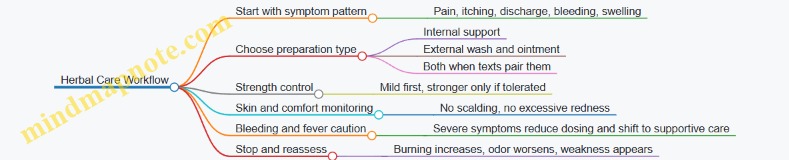
Integrated Routine Example for a Typical Week
A caregiver might run a simple three-part routine: cleansing wash in the morning, thin ointment after drying, and a measured internal infusion in the evening if the text supports internal balancing for that symptom set. Each day includes one observation point: does irritation lessen, does odor reduce, and does pain change in intensity?
This is the monastic logic in practice—small, repeatable steps with attention to response. The remedy is not just the plant; it is the method, the timing, and the caregiver’s willingness to adjust when the body gives feedback.
8. Herbal Remedies for Children and Household Use
8.1 Age Considerations and How Texts Indicate Gentler Preparations
Medieval herbals rarely say “this is for children” in modern terms. Instead, they signal gentler preparations through wording, form, and dosing style. A monastic writer might not list an age bracket, but the remedy’s texture, strength, and administration method often give the game away.
Foundational Clues in the Manuscript Voice
First, look for preparation language that implies lower intensity. Texts that specify a mild infusion rather than a strong decoction, or that recommend fewer plant parts, usually aim for gentler effect. Second, watch for the carrier: honeyed syrups, warmed drinks, and soft external applications tend to be used when the target is less tolerant of harsh medicines. Third, notice the emphasis on timing and repetition. Remedies that suggest small, spaced doses often fit younger or weaker patients.
A practical way to read this is to treat the remedy like a recipe with “strength knobs.” The knobs include plant part (leaf vs. root), extraction method (infusion vs. boiling), and concentration cues (how much plant material is used, or whether it is strained and clarified). When multiple knobs point toward mildness, the text is likely steering toward gentler use.
How Age Affects Choice of Plant Parts
Younger patients are more likely to be given preparations that avoid the most aggressive plant fractions. Roots, barks, and resins often carry stronger, more concentrated constituents. When a text uses leaves or flowers for internal use, it may be aiming for a softer onset and fewer side effects.
Example: If a remedy for “stomach looseness” uses a bitter leaf infusion but avoids resinous ingredients, the writer is likely balancing comfort with control. The bitterness can still help digestion, but the leaf-based preparation is less likely to feel like a punch.
Form Matters More Than People Expect
Gentleness is often about how the medicine meets the body.
- Liquids: Infusions and syrups are easier to administer and can be warmed to reduce irritation.
- Soft solids: Pottages, thickened drinks, and honeyed preparations can coat the throat and stomach.
- External applications: Ointments and poultices can localize effect, which is useful when internal dosing would be too risky.
Example: A throat complaint might be treated with a honey-based preparation applied or taken in small amounts, rather than a sharp, undiluted bitter draught.
Dosing Signals That Point Toward Smaller Bodies
Medieval dosing often uses household measures and repetition patterns rather than precise milligrams. Gentler preparations tend to show:
- Smaller initial amounts with gradual adjustment
- More frequent, shorter courses instead of one heavy dose
- Clear instructions to dilute or to mix with a soothing base
Example: A remedy described as “take a little” and “repeat after some hours” is more consistent with cautious dosing than with aggressive purging.
Mind Map: Reading Gentleness in Age Related Remedies
Systematic Workflow for a Single Remedy Entry
- Classify the remedy form: Is it a drink, syrup, poultice, or ointment?
- Identify the extraction method: Infusion, decoction, maceration, or resin preparation.
- Check the plant part: Leaf/flower suggests gentler internal use; bark/root/resin suggests caution.
- Read the dosing pattern: “Little” and spaced repetition suggest age-related gentleness.
- Infer the carrier role: Honey, broth, or warming can reduce irritation.
Example: Suppose a text gives a digestive remedy as a strained infusion of a leaf, sweetened lightly, and taken in small repeated portions. Following the workflow, each step points toward gentler preparation: mild extraction, less intense plant part, and cautious dosing.
Advanced Detail Without Guesswork
When a text is ambiguous, gentleness is not a matter of “hope.” It is a matter of minimizing harm through method. If the remedy uses a strong extraction or a concentrated plant part, the safest interpretation is that the text expects a more tolerant patient or an external-only approach. Conversely, if the remedy repeatedly emphasizes dilution, straining, and small doses, the text is doing the work of age consideration for you.
Example: A remedy that instructs dilution with warm water and recommends external application for the same plant is effectively telling you where internal gentleness ends.
Quick Reference for Common Gentleness Patterns
- Leaf infusion + honey + small repeated doses: likely gentler internal use.
- External ointment or poultice: likely safer when internal dosing would be harsh.
- Strong decoction + concentrated resin: likely not intended for cautious age use unless the text clearly dilutes or limits exposure.
A good reading habit is to let the remedy’s structure speak. Age consideration in medieval herbals is often encoded in how the medicine is made, not just who it is for.
8.2 Teething, Mouth Sores, and Plant Based Comfort Measures
Teething and mouth sores overlap in practice because both involve tender gums, extra saliva, and a child who wants to chew on anything that fits. Medieval monastic remedies often aimed at three practical outcomes: reduce local irritation, keep the mouth clean, and soothe discomfort long enough for sleep. The plant-based methods below follow that same order, moving from safe preparation to clear application.
Foundational Principles for Plant Based Comfort
What You Can Control
Start with what matters most: the remedy’s cleanliness, the child’s age, and the strength of the preparation. A strong infusion can sting; a weak one may do little. For mouth use, aim for gentle, well-strained liquids and soft external applications.
What You Should Avoid
Avoid anything that is strongly caustic, sharply astringent, or likely to burn tissue. Many medieval texts use “astringent” plants for bleeding and tightening, but mouth tissue is thin and easily irritated. If a plant is described as harsh for internal use, treat it as unsuitable for direct mouth contact.
A Simple Strength Rule
If you are making a liquid for the mouth, use a lighter extraction than you would for a bitter digestive drink. Think “comfort wash,” not “medicine shot.” Strain thoroughly and cool to a safe, lukewarm temperature.
Mind Map: Teething and Mouth Care Workflow
Plant Based Comfort Measures That Fit the Problem
Teething Gum Soothing
A common approach is a mild herbal wash used as a wipe rather than a “drink.” Use a soft cloth or clean gauze wrapped around a finger.
Example: Warm Chamomile Style Wash
- Make a weak infusion: steep dried chamomile-like flowers in hot water, then cool.
- Strain so no particles remain.
- Wipe the gums gently, especially where the child seems most tender.
- Repeat after meals and before bed.
Reasoning: gentle warmth increases comfort, and a mild infusion reduces the sense of irritation without introducing sharp flavors that provoke more chewing.
Mouth Sores and Irritated Patches
For sores, the priority is cleanliness and comfort, not aggressive “drying.” Medieval practice often favored plants described as soothing, mild, or cleansing.
Example: Honeyed Herbal Wipe
- Prepare a mild infusion of a soothing herb.
- Mix a small amount of honey into the cooled liquid only if the child is old enough for honey use.
- Wipe sores gently with a clean cloth.
Reasoning: honey can help coat irritated tissue and reduce friction from saliva and feeding. Keep the mixture light; thick mixtures can be sticky and hard to rinse.
Lip Cracking from Saliva
Teething increases drool, and drool can irritate the skin around the mouth. Treat the skin, not the inside.
Example: Plant Ointment for the Lips
- Use a simple base ointment made from a plant oil or rendered fat.
- Add a small amount of a soothing plant preparation (infused oil works well).
- Apply a thin layer to the outer lip line.
Reasoning: a barrier reduces repeated wetting and friction. Thin layers matter because thick layers can smear into the mouth and irritate sores.
Stepwise Application Plan
After Meals Routine
- Prepare a lukewarm, strained infusion.
- Wipe gums or sore areas gently.
- Let the mouth air-dry briefly.
Before Bed Routine
- Use the same mild wash.
- Wipe once, then apply only a thin protective layer to the lips if drool is heavy.
- Avoid strong flavors right before sleep.
Monitoring and When to Stop
If redness spreads, the child refuses feeding, or the child seems to burn during application, stop the remedy and switch to plain, cool water wiping. Mouth tissue can react quickly, and “more medicine” is not the answer when irritation is already present.
Mind Map: Choosing the Right Measure
Mini Case Example: A Typical Teething Week
A child wakes cranky, chews constantly, and has mild gum redness. Day one uses a weak warm chamomile-style wash after meals and before bed. By day three, drool has increased and the lips look chapped, so the routine keeps the gum wipe but adds a thin plant-oil barrier to the lip line. If a sore patch appears, the wipe becomes more focused on the patch and less on general gum rubbing, keeping the preparation gentle and well strained.
8.3 Diarrhea and Stomach Upset Remedies Used in Households
Medieval household care treated diarrhea as a stomach problem with consequences: loss of moisture, weakness, and irritation of the gut. Monastic and domestic remedies often aimed at three goals—settle the belly, reduce irritation, and restore balance. A practical approach starts with observation: note whether the person is thirsty, how often they pass stool, whether there is fever, and whether there is blood or severe pain. If blood appears, or if the person is very faint, household measures are not enough; the safest next step is to seek trained help.
Foundational Household Practices
Start with gentle fluids. Small sips matter more than big drinks. A simple example is warm water with a pinch of salt and a little honey, offered slowly. The idea is to replace what has been lost and avoid shocking the stomach.
Use bland foods when appetite returns. Texts and household habits commonly favored thin gruels and soft bread. For example, barley or oat porridge made without heavy spices can be easier to tolerate than meat broth.
Choose remedies that match the “type” of upset. Many herb lists separate remedies by effect: some “bind” and tighten; others “cool” irritation; others act as mild stomach tonics. Even without modern categories, the household logic is consistent: if the belly feels hot and restless, choose cooling; if it feels loose and draining, choose astringent.
Mind Map: Household Logic for Diarrhea Care
Astringent Remedies for Loose Stools
Astringent plants were used to “hold” the gut and reduce watery flow. A household example is an oak bark infusion. The preparation logic is straightforward: bark is tough, so it needs a decoction—simmer gently, then strain. Offer a small cup warm, not scalding. Pairing matters: if the person is already very dry and weak, avoid overly strong preparations and keep the fluid intake steady.
Another common household binder is plantain. Leaves were often used as a soothing astringent. An easy example is plantain leaf infusion: steep chopped leaves in warm water, strain, and give in small sips. This is less harsh than bark and fits well when the upset is mild.
Cooling and Soothing for Irritated Digestion
When the stomach feels hot, household care leaned toward cooling herbs and gentle liquids. Plantain leaf again fits here, but the key is how it’s used: smaller, more frequent sips rather than one large dose. If the person complains of burning or cramping, the household method is to keep the remedy warm and the food bland, because spicy or fatty foods tend to worsen irritation.
Mild Stomach Support for Weak Digestion
Some remedies were not meant to stop diarrhea instantly but to help the stomach regain steadiness. Ginger appears in many medieval contexts as a warming stomach herb, but household practice would use it carefully. Example: a very small amount of ginger steeped briefly, then strained, offered only if the person is not running a fever. Overuse could increase irritation, so the “less is more” rule is practical.
Preparation Practices That Make Remedies Work
Match the plant part to the method. Leaves and soft parts suit infusion; roots, bark, and tougher materials suit decoction. This prevents under-extraction, which is a common reason remedies “seem weak.”
Strain well. Household use should avoid gritty plant bits that can irritate the gut. A simple cloth strainer works.
Use modest doses. Medieval dose language often implies repeated small amounts. For example, give a small cup, wait, and reassess rather than giving a full bowl at once.
Example Household Workflow
Step 1: Assess. If the person is thirsty and passing frequent watery stools but alert, proceed with household care.
Step 2: Start fluids. Offer warm salted honey water in small sips.
Step 3: Choose a binder. Use oak bark decoction if stools are very loose; use plantain infusion if irritation seems prominent.
Step 4: Add bland food. When the stomach settles, offer thin gruel or soft bread.
Step 5: Recheck. If diarrhea continues without improvement, or if blood or faintness appears, escalate to trained care.
Case Example: A Simple Remedy Plan
A household might use plantain infusion for the first day because it is gentle and easy to prepare. If stools remain watery after repeated small sips and bland food, the household could switch to oak bark decoction for stronger binding, still keeping doses small and warm. This stepwise change respects the logic of matching remedy strength to the person’s response.
8.4 Fever Care and Cooling or Warming Herbal Practices
Medieval fever care often balanced two goals: reduce heat and support recovery. Monastic writers rarely treat “fever” as a single thing; they describe patterns such as burning, chills, dryness, thirst, and restlessness. A practical approach starts with observing which pattern dominates, then choosing cooling or warming preparations that match the body’s current behavior.
Foundational Triage for Choosing Cooling or Warming
Begin with three quick checks, because the same herb can be used differently depending on symptoms.
- Chills with shivering suggest the body is “gathering heat” rather than already overflowing. Warming preparations are usually preferred.
- Burning heat with flushed skin suggests excess heat. Cooling preparations are usually preferred.
- Thirst and dryness guide the texture of the remedy: watery infusions and gentle syrups for cooling; warming drinks that are not overly drying for warming.
A simple example: if a patient complains of coldness, wraps tightly, and trembles, start with a warming drink and keep the room comfortably warm. If the patient is hot, red, and wants cool cloths, start with cooling washes and a light cooling infusion.
Cooling Practices for Burning Heat
Cooling care focuses on lowering surface heat and easing dryness.
Cooling drink example: a light infusion made by steeping cooling herbs in warm water rather than boiling hard. The goal is a drink that is easy to swallow and not harsh on the throat.
Cooling external example: cloths soaked in a mild cooling infusion, wrung out, then applied to the forehead and wrists. Replace when the cloth warms up. This is less about “curing” and more about comfort and observation: you can see whether the patient feels better after each change.
Cooling food example: thin gruels or broths that are not heavily spiced. Spices can be useful in other contexts, but for burning heat they may add irritation.
A practical best practice is to keep the cooling measures consistent for a short window, such as several applications across the day, and then reassess. If the patient becomes colder or more shivery, shift toward warming.
Warming Practices for Chills and Stiffness
Warming care focuses on easing shivering, supporting circulation, and helping the patient rest.
Warming drink example: a decoction or infusion of warming herbs taken in small sips. Small sips matter because a large amount at once can provoke nausea, especially when the stomach is unsettled.
Warming external example: a gentle warming plaster or liniment applied to the back or chest, used sparingly and removed if the skin becomes too hot. The aim is comfort, not blistering.
Warming steam example: aromatic steam inhalation can be used when fever comes with chest tightness, but it should be brief and controlled to avoid overwhelming the patient.
A best practice is to pair warming remedies with rest and light coverings. Over-bundling can worsen discomfort even when the remedy is correct.
How Monastic Preparation Logic Guides Modern Use
Medieval preparations often follow a logic of strength and delivery.
- Infusions tend to be gentler and better for cooling or for patients who cannot tolerate heavy decoctions.
- Decoctions are stronger and often used for warming when a more substantial effect is desired.
- External applications are used to target the surface symptoms—heat, dryness, or stiffness—while internal drinks support the whole body.
Example workflow: for a patient with burning heat and thirst, choose an infusion for drinking and cooling cloths for the forehead. For a patient with chills and stiff shoulders, choose a warming decoction in small sips and a light warming plaster on the upper back.
Mind Map: Fever Pattern to Remedy Choice
Integrated Example Plans
Example Plan A Cooling Dominant
- Patient is hot, restless, and thirsty.
- Give a light cooling infusion in small cups.
- Apply cooling cloths to forehead and wrists, replacing when warm.
- Offer thin gruel or broth without heavy spices.
- Reassess after several applications; if shivering begins, reduce cooling and move toward warming.
Example Plan B Warming Dominant
- Patient has chills, stiff shoulders, and wants to be covered.
- Give a warming drink in small sips.
- Use a gentle warming plaster on the upper back.
- Keep the room steady in temperature and encourage rest.
- Reassess after the patient warms; if the skin becomes flushed, stop warming externals and switch to cooling cloths.
Practical Boundaries for Safe Use
Even in medieval practice, the remedy choice is constrained by the patient’s tolerance. If swallowing is difficult, prioritize external comfort measures and small sips rather than forcing stronger drinks. If the skin reacts strongly to a plaster, stop the application and switch to gentler external care. The “right” herb is the one that matches the pattern and can be used consistently without causing new problems.
8.5 Practical Administration Methods for Small Patients
Small patients—whether toddlers, frail children, or very small adults—require the same remedy logic as everyone else, just with gentler delivery and tighter observation. Medieval texts often describe dosing by age, strength, and the patient’s ability to tolerate taste, swallowing, and repeated applications. In practice, the goal is simple: get the medicine to the right place, in a tolerable form, with a schedule that can be followed.
Foundational Rules Before Any Dose
Start with three checks that prevent most avoidable problems.
- Match the remedy form to the complaint. If the remedy is meant to soothe the stomach, it should be taken by mouth; if it is meant to protect skin or draw out irritation, it should be applied externally.
- Use the text’s strength cues. Many entries imply “light” or “strong” preparations through wording like “thin” infusions, “thick” decoctions, or repeated boiling. For small patients, prefer the lighter preparation unless the text clearly indicates otherwise.
- Plan for observation. Choose one or two measurable signs: fewer cough fits, improved appetite, reduced itching, or calmer sleep. If those signs worsen after a dose, stop and reassess.
A practical example: if a child has a mild stomach upset, a thin bitter infusion is easier to tolerate than a heavy syrup. If the child is already refusing food and drink, forcing a thick preparation often backfires.
Choosing a Delivery Method
Medieval administration methods cluster into four practical routes: oral liquids, oral solids or pastes, external applications, and rectal or internal wash methods when appropriate.
Oral Liquids for Easy Swallowing
Liquids are the most forgiving route for children because they can be measured and adjusted.
- Infusions and decoctions: Use a smaller serving size and a lighter concentration. A common approach is to offer a spoonful, wait briefly, and then continue if tolerated.
- Syrups and honeyed preparations: These help with bitter herbs, but they can be too heavy for very young stomachs. If the child is prone to diarrhea, keep the amount small and watch stool changes.
Example: For a bitter digestive remedy, prepare a mild infusion, then sweeten only slightly with honey if the child accepts it. If the child gags at the taste, reduce the herb strength next time rather than increasing sweetness.
Oral Solids and Pastes for Controlled Dosing
Some remedies are described as powders, lozenges, or thick pastes. These can work for older children who chew or can swallow small portions.
- Powders: Mix with a small amount of honey, bread crumb, or softened fruit to form a manageable bite.
- Pastes: Use a small pea-sized portion and ensure it is swallowed, not chewed into a bitter mess.
Example: A powdered astringent herb can be mixed into honey and offered in a tiny portion. If the child chews and spits, the remedy is not being delivered reliably.
External Applications for Skin, Itch, and Local Pain
External remedies are often the safest starting point for small patients because they avoid swallowing issues.
- Washes: Use for irritated skin or mild inflammation. Keep the liquid cool to lukewarm to avoid additional irritation.
- Poultices and plasters: Use when the text suggests drawing out heat or soothing swelling. Keep the material warm, not hot.
- Ointments and salves: Best for dryness, itch, and protective barriers.
Example: For itch from dry skin, a simple ointment applied thinly can be more effective than a strong medicated paste that causes burning.
A Systematic Administration Workflow
Use a repeatable routine so caregivers can follow it without improvising under stress.
- Prepare the remedy in the intended form. If the remedy is “thin,” do not thicken it.
- Choose a small serving size. Start at the lower end of what the text implies for strength.
- Administer slowly. Offer by spoon in small amounts, allowing swallowing between spoonfuls.
- Watch for immediate reactions. Look for coughing during swallowing, vomiting, rash, or unusual sleepiness.
- Record one observation. Write down what happened after the dose and whether the child accepted it.
- Adjust the next dose. If tolerated, continue; if not, reduce strength or switch to an external route if the remedy’s purpose allows.
Mind Map: Practical Administration for Small Patients
Example: A Full Day Plan for a Child’s Cough
Suppose a child has cough and chest discomfort described as needing soothing and gentle expectoration. A practical plan keeps the remedy schedule simple.
- Morning: Offer a mild infusion in small spoonfuls, then observe for coughing during swallowing.
- Midday: If the child tolerates the infusion, continue the same strength; if not, reduce herb strength rather than increasing sweetness.
- Evening: Use an external soothing application if the text supports it, such as a thin salve on the chest area, avoiding heavy layers.
- Night: Keep the room comfortable and watch sleep quality. If cough worsens after oral dosing, stop the oral remedy and rely on external soothing until the child can be reassessed.
The key is consistency: one remedy form at a time, one observation at a time, and adjustments based on tolerance rather than guesswork.
9. Plant Based Treatments for Wounds, Burns, and Infections
9.1 Cleaning Wounds with Plant Infusions and Washes
Medieval wound care often began with a simple goal: remove dirt and loosened debris so the body can do the rest. Plant infusions and washes were practical because they could be prepared in batches, warmed to a comfortable temperature, and used repeatedly without complicated equipment.
Foundational Principles for Plant Washes
Start with three basics: cleanliness, gentleness, and consistency. Cleanliness means using a strained liquid rather than muddy plant pulp. Gentleness means avoiding harsh scrubbing; most washes were applied with cloth or soft swabs. Consistency means preparing enough infusion for the whole cleaning session so the liquid stays at a steady warmth.
A useful workflow is: rinse → soften debris → remove loosened material → dry carefully → apply the next step (often an ointment or poultice). If you skip the rinse, later applications can trap grit under a salve, which is the sort of problem no one wants to explain to a patient.
Choosing Plants for Infusion Strength
Medieval texts commonly pair plants with either cleansing, astringent, or soothing roles. For cleaning, you generally want plants that are not overly oily or resinous, because those can leave a film. Infusions made from leaves, flowers, or mild roots are easier to strain and apply.
A practical rule of thumb: if the plant is strongly bitter or strongly astringent, use it as a wash rather than as a long soak. If the plant is aromatic and mild, it can be used more comfortably for repeated rinsing.
Preparing an Infusion for Washing
Use a simple ratio and a clear method so the wash is predictable.
- Measure: choose a small handful of dried herb or a larger handful of fresh herb.
- Simmer gently: steep in clean water over low heat, then allow it to rest so the liquid carries the plant’s qualities.
- Strain thoroughly: use cloth to remove solids.
- Warm to body comfort: aim for lukewarm, not hot.
If you want a concrete example, consider a “single-session” wash: make a small pot of infusion, strain it, and keep it covered while you prepare cloths. The goal is not to create a concentrated medicine; it is to create a clean, usable rinse.
Stepwise Cleaning Method for External Wounds
Use a repeatable sequence so you don’t improvise mid-procedure.
- Assess the surface: note visible dirt, dried blood, or plant fragments.
- Initial rinse: pour or spoon the infusion over the wound to lift loose debris.
- Soften adherent material: place a damp cloth on the area for a short interval, then lift it away.
- Remove loosened debris: wipe gently from the cleanest edge toward the dirtier center.
- Repeat as needed: continue rinsing until the cloth shows less discoloration.
- Dry carefully: pat around the wound; avoid rubbing the wound bed.
A helpful example is a scraped knee with dried blood. The first rinse loosens surface crust. A second cloth application softens what remains. Wiping only after softening prevents tearing and reduces pain.
Cloth, Swabs, and Hygiene Practices
The cloth matters as much as the liquid. Use clean cloth pieces for each wipe direction, and avoid dragging the same cloth back across the wound. If you only have one cloth, fold it so you have a fresh surface for each pass.
A practical “best practice” is to keep a small stack: one cloth for rinsing, one for wiping, and one for drying. This prevents the wash liquid from being re-contaminated with debris.
Mind Map: Cleaning Wounds with Plant Infusions and Washes
Example: Small Cut with Visible Grit
Imagine a small cut from a garden task where grit is visible. Begin with an initial rinse to float particles away. If grit clings, apply a damp cloth soaked in the infusion for a short interval, then wipe from the cleaner edge inward. Stop when the cloth shows minimal grit; further wiping can irritate tissue without improving cleanliness.
Example: Wound with Loosened Tissue
If tissue looks loose or partially detached, cleaning should focus on lifting debris rather than removing tissue. Use repeated rinses and gentle cloth contact to encourage separation of what is already ready to come away. After cleaning, drying should be careful and brief so the next step can be applied promptly.
Common Mistakes and How to Avoid Them
Over-concentrating an infusion can make a wash too harsh and irritating. Skipping straining leaves plant solids that can stick to the wound. Scrubbing is another classic mistake: it may remove debris, but it also damages tissue that you want to keep. The fix is simple—soften first, wipe gently, and repeat.
Transition to the Next Wound Step
Cleaning is only the first phase. Once the surface is clear and dried by gentle patting, the wound is ready for whatever comes next in the monastic sequence, often an ointment or a protective application. The wash should leave the wound clean, not coated in residue, so the next remedy can work where it is needed.
9.2 Poultices and Plasters for Swelling and Pain
Poultices and plasters were the medieval “apply and wait” tools: they put plant material in direct contact with the painful area, aiming to reduce swelling, ease discomfort, and protect irritated skin. The key idea is simple—heat, moisture, and the right plant constituents work together—while the practical success depends on preparation quality and safe layering.
Foundations: What These Treatments Do
A poultice is a soft, spreadable mixture placed on cloth or directly on skin, then covered. A plaster is firmer and often more adhesive, intended to stay in place longer. Both can be used for swelling from bruises, mild inflammatory complaints, and localized pain where warmth and gentle pressure help.
A good workflow starts with three checks: (1) the skin condition, (2) the goal, and (3) the time you can monitor. If the skin is broken, blistered, or oozing, you avoid direct plant contact and instead use a protective layer and a gentler formulation.
Mind Map: Core Logic for Swelling and Pain
Choosing Plants by Effect
Medieval remedies often grouped plants by the sensations they were expected to produce. For swelling and pain, practitioners commonly favored combinations that were cooling, astringent, or gently warming depending on the complaint and the patient’s tolerance.
- Cooling-leaning choices: leafy herbs and preparations that feel less harsh on the skin. Example: a chopped herb paste mixed with a little cool liquid and thickened with meal.
- Astringent-leaning choices: plants associated with tightening or drying. Example: an herb infusion reduced slightly, then mixed into a thick paste for a firmer plaster.
- Gentle warming choices: when stiffness is prominent and the skin tolerates heat. Example: a poultice warmed in a water bath, not heated directly over flame.
If you are unsure, start with a milder mixture and shorter contact time. Skin is the truth serum.
Step-by-Step Practice: Making a Poultice
- Prepare the base. Use meal, ground seeds, or bread crumbs to give body. The goal is a texture that spreads without dripping.
- Add liquid for binding. Use water, vinegar, or a strained infusion. Vinegar can help keep a paste cohesive, but it can also irritate sensitive skin—use less if the area is delicate.
- Incorporate the plant. Chop fresh material finely or grind dried material. Finer particles distribute the plant more evenly.
- Warm safely. Warm the mixture to comfortably warm, like a hot bath towel. Never apply scalding heat.
- Layer correctly. Place a cloth barrier if the skin is fragile. Spread the poultice to an even thickness.
- Secure without strangling. Tie a bandage snug enough to hold, loose enough to allow circulation.
Example: For a bruised forearm, mix finely chopped cooling herb with meal and a small amount of water until it becomes a spreadable paste. Warm it gently, apply on a cloth barrier, and cover with a light bandage.
Step-by-Step Practice: Making a Plaster
Plasters aim for longer contact and better staying power.
- Choose a firmer binder. Linseed paste, fats, or resinous components can create a stable layer.
- Thicken to spreadable firmness. The mixture should hold shape when lifted with a spoon.
- Apply in a controlled thickness. Too thick traps heat and moisture; too thin loses effect.
- Cover and protect. Use cloth over the plaster if it is tacky or resinous.
Example: For persistent swelling around a joint, create a thicker paste using a reduced infusion and a binding agent. Spread it on cloth, then place it over the affected area and secure it with a wrap.
Monitoring and Adjustment
A practical rule: check the skin after the first short interval. If burning, increasing redness, or rash appears, remove the poultice and switch to a gentler base with less concentrated plant material.
Reapplication depends on response. If swelling is easing, you can extend contact time gradually. If pain is unchanged or worse, stop and reassess the formulation and the underlying cause.
Advanced Details: Texture, Heat, and Moisture
- Texture matters. A watery mixture runs and irritates; a too-stiff mixture presses unevenly.
- Heat should be steady. Warmth supports comfort and circulation, but overheating can worsen inflammation.
- Moisture balance. Moist poultices can soften and soothe; firmer plasters can provide sustained contact. Choose based on how the skin behaves.
Case-Style Example: One Remedy, Two Applications
For the same patient with a swollen ankle, you might use a poultice first to calm discomfort, then switch to a plaster for steadier support once the skin tolerates contact.
- First application: cooling herb paste on cloth barrier for a short interval.
- Second application: thicker plaster with astringent-leaning components for longer contact.
This approach keeps the method consistent while adjusting the “delivery system” to the body’s feedback.
9.3 Ointments for Healing and Protection of Exposed Tissue
When tissue is exposed—scraped skin, a shallow cut, or irritated areas rubbed raw by cloth—the goal of an ointment is twofold: keep the surface from drying out and reduce friction while the body does the main work. Medieval practice often treated “protection” as a physical barrier and “healing” as a matter of cleanliness, soothing, and gradual strengthening.
Foundational Concepts for Healing Ointments
What Ointments Do
An ointment forms a thin, continuous layer. That layer can:
- Reduce moisture loss from the wound surface.
- Limit rubbing from bandages and clothing.
- Carry plant-derived substances that soothe, cool, or gently tighten.
A practical rule: if the area is wet and weepy, the ointment should be lighter and less occlusive. If the area is dry, raw, or cracking, a richer, more sealing preparation is more appropriate.
What Ointments Should Not Do
Ointments should not replace cleaning. If debris or clotted fluid remains, sealing it under grease is like putting a lid on a mess. The surface should be washed first, then dried carefully, then covered.
Choosing Ingredients by Tissue Condition
Moist Versus Dry Wounds
- Moist, weeping areas: favor ingredients that are less greasy and more astringent or drying in effect.
- Dry, exposed areas: favor fats and waxes that create a protective film.
Soothing, Astringent, and Protective Roles
Many medieval ointments mix ingredients with different jobs. A simple way to think about it is to assign roles:
- Soothing: herbs known for calming irritation.
- Astringent: herbs that help “draw together” tissue.
- Protective base: fats, oils, and sometimes waxes.
Preparation Practices That Make Ointments Work
Clean Surface, Then Dry
A typical workflow is:
- Wash with a mild infusion or clean water.
- Pat dry with clean cloth.
- Apply ointment in a thin layer.
- Cover with a breathable wrap.
This sequence matters because ointment adheres better to a dry surface and the wrap prevents friction.
Infusion and Heating Without Burning
Plant materials are often steeped in a fat base. Gentle heat prevents scorching and preserves the plant’s useful qualities. If the base smells burnt, the batch is unreliable.
Straining and Consistency
Straining removes plant particles that can scratch or trap moisture. For exposed tissue, aim for a smooth texture. Too gritty means more irritation.
Application Technique for Protection
Layering and Coverage
Apply enough to coat the surface, not so much that it pools. Pooled ointment can soften surrounding skin and increase maceration.
Bandaging Choices
A wrap should reduce rubbing while allowing excess moisture to escape when needed. If the wrap becomes soaked through, it should be changed.
Frequency and Monitoring
Change the dressing regularly, especially early on. Look for signs that the surface is becoming less raw and less tender. If redness spreads or the area worsens after repeated applications, stop and reassess the approach.
Mind Map: Ointment Healing and Protection
Example Ointment Workflow for a Scraped Area
Scenario
A scraped patch is tender and slightly wet from clear fluid, with surrounding skin irritated by rubbing.
Integrated Practice
- Clean: rinse with a mild infusion or clean water.
- Dry: pat until the surface is not shiny.
- Apply: a thin layer of a soothing-and-astringent ointment.
- Cover: wrap to reduce friction.
- Change: replace the wrap when it becomes damp.
The key is balancing protection with breathability. A heavy, waxy ointment can trap moisture on a weepy surface.
Example Ointment Workflow for a Dry, Raw Patch
Scenario
A raw area is dry, cracked, and stings when touched, with no active weeping.
Integrated Practice
- Clean: rinse and pat dry.
- Apply: a richer ointment with a more sealing base.
- Cover: wrap to prevent rubbing.
- Repeat: reapply after dressing changes, keeping the layer thin.
Here the protective film is the main help. The ointment should reduce drying and allow the surface to rebuild.
Troubleshooting Common Problems
Ointment Feels Too Greasy
If the dressing slides or the ointment pools, reduce the amount and consider a slightly firmer base next time.
Skin Around the Wound Gets Softer and Soggy
That often means too much occlusion or infrequent dressing changes. Use a lighter layer and change the wrap sooner.
Itching or Burning After Application
This can happen if the surface was not fully cleaned and dried, or if the ointment is too harsh for the tissue condition. Re-clean, dry, and adjust the ingredient balance toward soothing and gentler protection.
9.4 Plant Resins and Gums Used for Covering and Sealing
Resins and gums were the medieval “sticky layer” that helped remedies stay where they were put. In monastic practice, they often served three jobs: (1) form a protective film over exposed tissue, (2) slow loss of moisture from a wound or poultice, and (3) help bind other ingredients into a coherent paste or salve. The key is choosing the right material for the surface you are sealing and the texture you need.
Foundational Concepts for Sealing Materials
Resins are typically sticky, aromatic substances that soften with warmth and can form a tougher coating. Gums are usually more water-attracting and can create a tackier, more adhesive layer. Both can be used externally, but their behavior differs: resins tend to “set” into a film, while gums tend to remain tacky longer.
A practical rule of thumb: if the goal is a firm barrier, lean toward resin-like materials; if the goal is adhesion to a moist surface, lean toward gum-like materials. Either way, the sealing layer should be thin enough to flex with movement and thick enough to cover gaps.
Mind Map: Resin and Gum Roles in External Care
Preparation Practices for Stable Coatings
Before sealing, the surface should be cleaned and dried enough to prevent the dressing from sliding. If the area is wet, a resin layer can trap moisture and make removal harder. If the area is too dry and cracked, a gum-heavy layer may cling unevenly.
To prepare a workable sealing mixture, medieval apothecaries commonly softened resin with a carrier such as oil, fat, or waxy substances. This reduces brittleness and spreads the material more evenly. Filtering matters: plant exudates can contain grit, bark fragments, or dark particles. Filtering produces a smoother film and reduces scratchy points that can irritate tissue.
A simple example workflow: warm the resin gently until it loosens, stir it into a small amount of fat or oil, then test a pea-sized smear on a cool surface. If it stays too runny, add more solid carrier; if it feels brittle, add more softening carrier.
Choosing Thickness and Coverage
Thickness is not “more is better.” A thick resin coat can crack as the body moves, creating channels where fluid can seep. A thin coat can fail to protect. Aim for a continuous layer that you can see as a uniform sheen rather than a lump.
For sealing over a poultice, the resin or gum layer should sit on top of the dressing material, not replace it. The poultice does the therapeutic work; the resin or gum helps keep the poultice in place and reduces drying too quickly.
Application Method for Real-World Use
- Clean the area with a gentle wash and remove loose debris.
- Pat dry until the surface is not actively wet.
- Apply a thin, even layer of the resin/gum mixture.
- Cover with a cloth strip or bandage to prevent rubbing and to keep the film from catching on clothing.
- Recheck after a day or sooner if the layer loosens.
Example: sealing a minor abrasion. After cleaning, apply a small amount of resin-based salve to the edges and the center. Cover with cloth. When you remove the dressing, the film should lift with the cloth rather than tearing the surface.
Common Sealing Combinations and Their Logic
Resin plus fat creates a smoother, less brittle coating that tolerates movement. Gum plus a carrier can increase tackiness so the dressing adheres to moist skin. If you need both protection and adhesion, you can blend resin-like and gum-like behavior by adjusting the ratio: more resin for film strength, more gum for sticking.
Example: sealing a dressing that tends to slip. If the cloth keeps sliding, increase the gum portion slightly so the layer grips the dressing. If the area becomes overly sticky and collects lint, reduce gum and increase resin or add more carrier to soften the tack.
Mind Map: Troubleshooting Seals
Monitoring and Reapplication Without Guesswork
A good seal should be stable but not suffocating. If it becomes hard and cracked, remove and reapply with a thinner layer. If it stays overly tacky and collects debris, adjust the ratio toward resin-like film or increase the softening carrier. Reapplication should be based on the seal’s condition, not on a fixed schedule.
Example: after two dressing changes, note whether the film lifts cleanly. If it consistently tears tissue on removal, the mixture is likely too concentrated or too thick. Reduce thickness and ensure the surface is properly prepared before applying the next layer.
9.5 Case Style Examples of Stepwise External Care
Stepwise external care in medieval practice usually follows a simple logic: clean first, then apply the right plant preparation for the tissue problem, then protect and reassess. The “case style” approach helps you see how the same workflow adapts to different skin and wound situations.
Foundational Workflow
- Assess the surface: Is it open tissue, closed swelling, or irritated skin? If the surface is broken, you treat it as “open” and avoid heavy occlusion.
- Clean gently: Use an infusion or warm wash to remove grit and reduce surface contamination.
- Choose the plant action: Cooling for heat and swelling, astringent for weeping or loosened tissue, warming for stiffness or pain, and protective for exposed areas.
- Apply with correct thickness: Too thin does nothing; too thick can trap moisture and slow drying.
- Cover appropriately: Use breathable cloth for weeping wounds; use a protective layer for friction and minor abrasions.
- Repeat with observation: Change the dressing on a schedule and watch for increased redness, foul odor, or worsening pain.
Mind Map: Stepwise External Care
Case Study: A Simple Wound Wash and Cover
Scenario: A scraped leg with visible raw tissue after outdoor work.
- Clean: Prepare a warm infusion (not scalding) from a cleansing herb and rinse the area. Use clean cloth to blot, not rub.
- Apply: Spread a thin layer of a protective ointment made from plant oils and resin or gum. The goal is to form a barrier while keeping the surface from drying too hard.
- Cover: Place a clean cloth over the ointment. Secure lightly so circulation stays comfortable.
- Repeat: Change the dressing daily. If the wound becomes more weepy, switch to a more absorbent cloth and reduce the thickness of the ointment layer.
Why this works: Cleaning reduces surface debris, the ointment layer protects exposed tissue, and daily changes prevent trapped moisture from turning into a problem.
Case Study: Astringent Care for Weeping Skin Irritation
Scenario: Red, damp irritation where cloth rubs, with small areas that look wet rather than deeply open.
- Clean: Wash with a mild infusion and blot dry.
- Apply: Use an astringent plant preparation as a compress. The compress should be damp enough to contact the skin but not dripping.
- Cover: Use a dry outer cloth to wick moisture away.
- Repeat: Reapply the compress several times across the day at first, then taper as the surface dries and steadies.
Why this works: Astringent preparations help tighten loosened tissue and reduce surface dampness, while wicking cloth prevents the “wet and stuck” cycle.
Case Study: Cooling Poultice for Swelling and Heat
Scenario: A bruised ankle that feels hot and swollen after a fall.
- Clean: Rinse with cool-to-warm water and blot.
- Apply: Make a cooling poultice by mashing a cooling herb and binding it with a simple base. Apply a medium thickness so it stays in contact without sliding.
- Cover: Wrap with cloth to hold the poultice in place.
- Repeat: Replace when it warms toward body temperature.
Why this works: Cooling contact reduces the sense of heat and helps swelling settle. Replacing the poultice matters because once it warms, it stops doing the cooling job.
Case Study: Warming Liniment for Stiffness and Pain
Scenario: A sore shoulder that feels tight rather than broken, with discomfort that worsens with movement.
- Clean: Wipe with a warm cloth to remove sweat and loosen surface grime.
- Apply: Massage a warming liniment into the skin with gentle pressure. Use a small amount and work it in rather than piling it on.
- Cover: Cover with a light cloth to reduce drafts and friction.
- Repeat: Apply once or twice daily, stopping if the skin becomes overly red or itchy.
Why this works: Warming preparations are for comfort and stiffness, not for open tissue. Gentle massage improves contact and reduces the chance of irritation.
Integrated Decision Guide
- If the surface is open, prioritize gentle cleaning and protective, thin layers.
- If the surface is weeping, prioritize astringent compresses and wicking covers.
- If the area is hot and swollen, prioritize cooling poultices and timely replacement.
- If the area is stiff and painful without open tissue, prioritize warming liniments and skin tolerance.
This stepwise method keeps each action tied to a specific tissue need, so the care plan stays coherent even when the plant ingredients change.
10. Herbal Remedies for Pain, Inflammation, and Mobility
10.1 Joint Pain and Herbal Liniments for Movement Support
Joint pain in medieval practice was often treated as a mix of local irritation, stiffness, and “heat” or “cold” in the tissues. Liniments fit this logic because they work where the problem shows up: on the skin and just beneath it, where massage and warmth can help movement. The goal is practical support—reduce discomfort, encourage gentle motion, and avoid making the joint angrier.
Foundational Concepts for Liniment Use
Start with three basics: skin condition, joint behavior, and application method.
- Skin condition: Liniments should go on intact skin. If there is an open wound, weeping rash, or suspected infection, skip the liniment and use a gentler external approach.
- Joint behavior: If the joint is hot, very swollen, and painful to touch, prioritize cooling and rest rather than vigorous rubbing. If stiffness is the main issue and swelling is minimal, warming massage can be appropriate.
- Application method: Medieval instructions frequently emphasize repeated application. Consistency matters more than strength. A thin layer, warmed in the hands, applied with steady pressure, is usually more useful than a thick smear.
Example: A stiff knee after a long day of walking. Choose a warming liniment, apply a small amount, massage for a minute, then encourage gentle bending and straightening without forcing pain.
Selecting Herbs and Building a Liniment Logic
A liniment typically combines an oily base with plant materials that contribute either warming aromatics, soothing bitterness, or anti-irritant qualities.
- Warming aromatics: herbs with strong scent and “heat” in the old humoral sense. These support massage comfort.
- Soothing bitter or astringent plants: used to calm local irritation and help the skin tolerate repeated rubbing.
- Resins and gums: sometimes used to add tackiness and help the preparation cling to the area.
Example: For a shoulder that feels tight rather than inflamed, a base infused with aromatic herbs plus a small amount of resinous material can create a liniment that stays put during movement.
Preparation Workflow for Movement Support
A practical workflow keeps the preparation predictable.
- Infuse the base: Warm oil with dried or chopped herbs until the oil takes on the herb’s character. Strain well.
- Adjust thickness: If you want better staying power, add a small amount of resin or thickening gum. Mix until uniform.
- Test on a small area: Apply a small amount to the inner forearm and wait for irritation.
- Label and portion: Keep a simple record of herbs used and the date prepared (for example, use a date like 2026-02-15).
Example: Make a small batch for one joint. If the skin tolerates it, scale up later.
Mind Map: Liniment Plan for Joint Pain
Application Routine That Matches the Remedy
A liniment works best when paired with movement that doesn’t sabotage it.
- Frequency: once daily at first, then adjust based on skin tolerance and symptom response.
- Timing: apply before gentle activity, not after a hard workout.
- Massage style: use slow, firm strokes around the joint, then light circular motion over the most uncomfortable area.
Example: For ankle stiffness, apply in the evening. Massage around the joint for about a minute, then do five slow ankle circles in each direction. Stop if sharp pain appears.
Advanced Details for Different Joint Patterns
- Stiffness without heat: warming aromatics plus massage are usually appropriate.
- Tenderness with mild swelling: use a gentler base and reduce massage intensity.
- Recurring flare-ups: keep a consistent routine during calm periods rather than waiting for severe pain.
Example: If the wrist flares after repetitive work, apply a small amount after the workday for several days in a row. If the skin becomes red or itchy, reduce frequency or switch to a milder base.
Practical Liniment Example for a Stiff Knee
- Base: oil infused with warming aromatic herbs.
- Cling agent: a small amount of resin or gum.
- Use: thin layer, warmed in hands, massage for about 60 seconds.
- Aftercare: gentle knee bends and straightening, five repetitions.
If discomfort increases during the first few applications, treat it as a sign to scale back—less rubbing, less frequency, and a milder formulation.
Mind Map: Troubleshooting and Adjustment
10.2 Back Pain and Muscle Discomfort Preparations
Back pain in medieval practice was treated as a practical problem: something had tightened, inflamed, or simply refused to move comfortably. Monastic remedies often start with the same logic—observe the pattern, choose a preparation that matches the complaint, then apply it consistently for long enough to matter.
Foundational Concepts for Choosing a Remedy
First, sort the discomfort by behavior. A stiff back that worsens after rest often calls for warming and loosening. A back that feels hot, swollen, or acutely tender suggests cooling and calming. If the pain is more “stuck” than hot, you can lean toward gentle warmth plus lubrication.
Second, match the preparation type to the body part. External preparations work best for localized muscle discomfort because they can be applied directly and adjusted without changing the whole day’s routine.
Third, use the text’s language as a guide to strength. Terms implying “strong,” “hot,” or “bitter” usually correspond to more assertive herbs or longer extraction. When a recipe is vague, you can still follow a safe workflow: start with a moderate application time, then increase only if the skin tolerates it.
Mind Map: Back Pain Preparation Logic
Warming Liniment for Stiff Muscles
A warming liniment is a practical choice when the back feels tight after sitting or sleeping. The carrier matters: oils or infused fats help the herbs contact the skin evenly.
Example workflow
- Prepare an oil infusion using a warming aromatic root or spice (for example, ginger-like warmth or peppery herbs) steeped in oil until the oil smells noticeably stronger than before.
- Strain and store in a small, clean container.
- Apply a thin layer to the sore area and massage with slow, steady pressure for a few minutes.
- Repeat once daily, ideally at a consistent time, and increase only if the skin stays comfortable.
Best practice: keep the massage gentle. Medieval texts often assume the body can be encouraged to move, not forced. If the pain spikes during massage, reduce pressure and shorten the session.
Ointment for Night Relief and Lubrication
For discomfort that returns overnight, an ointment offers longer contact. A thicker base reduces evaporation and helps the herbs remain in place.
Example workflow
- Choose a base such as rendered fat or a stable oil-finished salve.
- Add a small amount of warming aromatic herb and mix until evenly distributed.
- Apply before bed, then cover with a clean cloth to reduce rubbing.
- In the morning, wipe off excess if the skin feels greasy or irritated.
Best practice: use a “less is more” approach at first. Ointments can feel effective quickly, but too much herb can irritate sensitive skin, especially along the spine where friction is common.
Cooling Poultice for Hot, Tender Spots
When the back feels hot or acutely tender, a cooling poultice can be more appropriate than a warming liniment. Poultices also let you concentrate the treatment on the exact area.
Example workflow
- Make a soft mash by crushing cooling leaves or soaking them in a mild liquid until pliable.
- Spread the mash on a cloth and apply directly to the tender area.
- Replace when it warms up or dries out.
- Continue for a short window, then reassess.
Best practice: avoid leaving a poultice on until it becomes uncomfortable. The goal is relief, not a test of endurance.
Advanced Details for Better Results
1. Layering strategy: If the back is both stiff and tender, you can alternate approaches—cool the hottest spot briefly, then use a warming liniment on the surrounding tight muscles once the skin calms.
2. Timing and consistency: Muscle discomfort often responds to repetition. A remedy used once and then abandoned rarely teaches the body anything. Use a consistent schedule for several days, then adjust based on skin response and symptom change.
3. Skin monitoring: Any preparation that stings, reddens, or causes itching beyond mild warmth should be reduced or stopped. Medieval practice assumed the skin is part of the treatment system, not an afterthought.
Case-Style Example for a Stiff Back After Rest
A person wakes with a tight lower back that eases slightly with walking but returns after sitting.
- Morning: apply a warming liniment and massage gently for a few minutes.
- Midday: keep movement light and regular; avoid long still periods.
- Night: apply an ointment and cover with a clean cloth.
- Recheck after two days: if stiffness improves without irritation, continue. If the skin becomes uncomfortable, reduce herb strength by using less of the preparation or switching to a simpler base.
This approach stays faithful to the core medieval logic: treat the pattern, apply externally with care, and let the body’s feedback guide the next step.
10.3 Bruising, Sprains, and Plant Based Compresses
Bruises and sprains were common enough that medieval households treated them as a practical category: something happened, tissue got irritated, and the goal was to calm swelling while supporting recovery. Plant based compresses fit that goal because they combine a liquid phase for contact with a plant phase that brings bitterness, astringency, or soothing aromatics. The key is matching the plant preparation to the stage and the body part.
Foundational Concepts for Compress Care
A compress is not just “wet cloth.” It is a controlled contact method: you prepare a liquid (infusion, decoction, or vinegar based wash), soak cloth, apply it to the affected area, and repeat with fresh cloth to keep the temperature and strength consistent. For bruising and sprains, the practical targets are:
- Reduce swelling by using preparations that feel tightening or “drying” rather than oily.
- Ease pain through gentle warmth or coolness, depending on how hot the area feels.
- Support cleansing if skin is broken or if the area is weepy.
A simple rule of thumb helps: if the area feels hot and puffy, lean cooler and more astringent; if it feels stiff and sore without much heat, lean warmer and more soothing.
Mind Map: Compress Workflow and Plant Choices
Plant Based Compresses by Preparation Type
Infusion compresses are best when you want a mild, steady contact. Use them for sore areas that are not aggressively hot. Example: steep dried leaves of astringent or aromatic herbs in hot water, then cool to a comfortable temperature before soaking cloth.
Decoction compresses pull more from tougher plant parts. Use them when you need a stronger tightening effect, such as for swelling that lingers after the initial injury. Example: simmer a root or bark preparation briefly, strain, then cool to the target temperature.
Vinegar washes were common in practice because vinegar’s sharpness can feel tightening and can help with cleanliness. Example: mix vinegar with water to avoid harshness, soak cloth, and apply briefly, especially if the skin is intact but irritated.
Example: Bruise After a Knock
- Check temperature and skin: if the bruise is hot and swollen, plan a cooler compress.
- Prepare an infusion: steep astringent leaves in hot water, then cool until it feels cool but not numbing.
- Apply in cycles: soak cloth, wring to damp, place on the bruise for a short period, then replace with a fresh cloth once it warms.
- Repeat: do several cycles in a day rather than one long session, because repeated cool contact is easier to control than one extended soak.
Why this works: cool contact reduces the “busy” feeling of swelling, while the plant infusion adds a gentle tightening effect without the sting of vinegar.
Example: Sprain with Swelling and Tenderness
- Choose a stronger preparation: use a decoction if swelling is prominent.
- Target the area, not the whole limb: place cloth directly over the most tender swelling, keeping edges clean.
- Use a warm-to-comfortable temperature: if the area is not hot, a warm compress can help stiffness; if it is hot, keep it cooler.
- Keep cloth fresh: replace when it cools too much or when it becomes messy with plant residue.
Why this works: decoction strength supports the compress’s tightening goal, and temperature control prevents the compress from turning into a heat source that worsens swelling.
Advanced Details for Better Results
Wringing matters. Cloth should be damp, not dripping. Too much liquid runs, spreads plant residue, and irritates skin.
Cycle length should be practical. Short cycles let you reassess and adjust temperature without losing control.
Watch for skin response. If the area becomes more red or stings, reduce strength, shorten contact time, or switch from vinegar wash to infusion.
Pair compresses with rest. A compress can calm tissue, but movement that keeps re-injuring the area will undo the benefit. Rest is the quiet partner of the plant.
Mind Map: Troubleshooting and Adjustments
Example: Vinegar Wash for Cleaning and Tightening Feel
If the skin is intact but the area is dirty with residue from the injury, use a diluted vinegar wash briefly. Mix vinegar with water, soak cloth, wring to damp, apply for a short cycle, then follow with a gentler infusion compress if the skin tolerates it. This sequence keeps the contact controlled: clean first, then comfort.
Practical Summary for Bruises and Sprains
Start with a stage check, choose infusion for gentle contact or decoction for stronger tightening, and use vinegar wash only when cleanliness or a sharper tightening feel is needed. Apply in short, repeatable cycles with fresh cloth, and adjust temperature and strength based on how the skin and swelling behave.
10.4 Inflammation and Swelling Treatments in External Formulations
Inflammation and swelling show up in medieval practice as heat, redness, pain, and tightness—often after blows, overuse, or infected wounds. External formulations were favored because they could be applied directly, adjusted in strength, and repeated without needing precise internal dosing. The key is to match the preparation to the “stage” implied by the symptoms: early heat and tightness call for cooling and soothing; persistent swelling may need gentle drawing and support for drainage; later irritation requires protection of the skin.
Foundational Principles for External Care
Start with observation. If the area feels hot and looks red, prioritize cooling, astringent, and soothing ingredients. If it is swollen but not especially hot, lean toward mild astringency and supportive compresses. If the skin is broken, keep the formulation focused on cleansing and protection rather than heavy “drawing.” A practical rule: the more tender and warm the tissue, the gentler the preparation should be.
Next, control contact time. Medieval instructions often imply repeated applications rather than one long soak. Short, consistent sessions reduce skin irritation and let you reassess whether the swelling is calming.
Finally, manage the “skin interface.” Many external remedies fail because they stick, rub, or macerate the surface. Using a cloth layer, a light ointment base, or a barrier paste helps the remedy stay where it belongs.
Ingredient Roles in External Formulations
Think in functions, not just plant names.
- Cooling and soothing: herbs and preparations that calm heat and discomfort.
- Astringent tightening: substances that reduce weeping and help tissues feel less loose.
- Anti-irritant protection: bases that prevent rubbing and keep the skin from drying or cracking.
- Drawing and drainage support: stronger preparations used when swelling seems to “sit” and needs encouragement to move.
A simple example workflow: for a hot, swollen ankle after a stumble, you would choose a cooling compress first, then reassess after a day. If the swelling persists without increasing heat, you can shift toward a more astringent or supportive blend.
Mind Map: External Inflammation and Swelling
Systematic Formulation Pathway
Step 1: Choose the preparation type. For early heat, a wash or infusion applied to a cloth is often easiest to control. For firm swelling, a poultice can conform to the area. For intact skin that needs protection, an ointment base with astringent or soothing components works well.
Step 2: Build the base and the active layer. Many remedies behave like two-part systems: a base that manages texture and contact, plus an active plant component that provides the intended effect. For instance, a paste-like poultice can be placed on a cloth, then wrapped—reducing direct friction.
Step 3: Adjust strength by symptom severity. If the area is very hot, keep the active component modest and rely more on cooling and soothing. If the area is swollen but not hot, increase astringent support slightly. If the skin is broken, avoid strong drawing agents and focus on cleansing and protection.
Step 4: Schedule and reassess. Apply, then check after a few hours for increased burning or worsening redness. Continue daily sessions until heat decreases and the swelling loosens.
Example: Hot Swollen Area After a Blow
A person receives a knock to the shin. The area becomes warm, tender, and slightly red.
- First session: prepare a cooling infusion from a soothing herb and use it as a wash. Soak a clean cloth, wring it to avoid dripping, and lay it on the area.
- Repeat: replace the cloth every few hours, keeping the cloth cool but not icy.
- Next day: if heat has dropped but swelling remains, shift to a more astringent compress using the same method, aiming for less weeping and a calmer surface.
This approach prevents the common mistake of using a “strong” poultice too early, which can irritate already inflamed tissue.
Example: Swelling with Intact Skin and Persistent Tightness
A sprained wrist stays puffy and tight after the first day, with less redness but still noticeable swelling.
- Compress phase: use an infusion-based compress to maintain comfort.
- Support phase: move to a mild plaster or poultice that includes astringent tightening and a protective base.
- Skin care: if the skin becomes dry or itchy, reduce the active strength and increase the protective base so the remedy stops fighting the skin.
Example: Swelling Near a Small Break in the Skin
If there is a small cut or abrasion, treat the surface as a priority.
- Clean first: use a gentle wash to remove debris and reduce surface irritation.
- Protect second: apply a protective ointment layer around and over the area, avoiding harsh drawing.
- Monitor: if redness spreads or pain increases, stop the stronger components and return to gentle cleansing and protection.
This keeps the formulation aligned with the tissue state: broken skin needs care that respects the boundary between “treating” and “damaging.”
Practical Checklist for External Inflammation Care
- Match preparation to heat level and skin integrity.
- Use cloth barriers to prevent sticking and rubbing.
- Prefer repeated short applications over long continuous contact.
- Reassess daily and adjust strength rather than stubbornly repeating the same mix.
- Stop or soften if burning increases or redness spreads.
10.5 Practical Guidance for Repeated Applications and Monitoring
Repeated applications were not just “more of the same.” Medieval practitioners aimed for a rhythm that matched the remedy’s purpose: some preparations were meant to act quickly and be refreshed often, while others were intended to build a protective layer over time. The practical challenge was knowing when to continue, when to stop, and when to switch methods.
Foundational Rhythm
Start by separating the remedy into two parts: the delivery method and the target tissue. A wash or infusion targets surface irritation and is typically renewed frequently. An ointment or plaster targets contact and protection, so it can be reapplied less often, but consistently. A simple rule of thumb is to refresh when the preparation has visibly changed—cooling, drying, thinning, or becoming gritty—because those changes usually mean the active portion is no longer being delivered as intended.
Example: For a plant infusion used as a wound wash, prepare enough for one session, keep it covered, and discard leftovers. Rewash at the next scheduled care time rather than trying to “stretch” the same liquid across multiple days.
Monitoring What Matters
Monitoring should focus on observable signs that indicate whether the remedy is doing its job. Track three categories: comfort, appearance, and function.
- Comfort: warmth, tenderness, itching, burning, or relief after application.
- Appearance: redness spreading or shrinking, swelling level, discharge thickness, and whether the surface looks cleaner.
- Function: ability to move the area, keep it covered, and tolerate touch.
Write these down in plain terms. Medieval texts often use qualitative language, so your notes should mirror that: “less sore,” “redness stayed within the border,” or “discharge turned from watery to thicker.”
Example: After applying a soothing external preparation to an inflamed patch, note whether the heat reduces within the same day. If the area becomes more painful and the redness expands, stop and reassess the method.
A Stepwise Reapplication Workflow
Use a repeatable sequence each time you apply the remedy.
- Inspect first: check skin or tissue condition before touching it with the preparation.
- Clean or reset: if the surface is dirty or sticky, remove residue with a gentle wash so the next layer can adhere.
- Apply with the right thickness: too thin won’t protect; too thick can trap moisture and worsen irritation.
- Cover when appropriate: bandaging or covering helps keep the preparation in contact.
- Record after: note comfort and appearance changes compared to the previous session.
Example: For a plaster, remove the old layer once it loosens or dries unevenly. Clean the area, apply a fresh layer of similar thickness, and re-cover. If the plaster repeatedly slips, adjust the covering method rather than increasing thickness.
When to Continue, Pause, or Switch
A good monitoring plan includes decision points.
- Continue when comfort improves, redness stabilizes or shrinks, and the surface looks cleaner.
- Pause when the area becomes more irritated after each application, or when discharge increases suddenly without signs of cleansing.
- Switch when the remedy’s target doesn’t match the tissue behavior. For instance, if a preparation meant for dryness is applied to a surface that is clearly wet and weeping, the mismatch can prolong irritation.
Example: If a remedy intended to “tighten” tissue is used on a wound that is actively weeping, the surface may crack or sting more. Pause that approach and choose a method that supports cleaning and moisture balance.
Mind Map: Reapplication and Monitoring
Example: Three-Day External Care Plan
Day 1: Inspect and clean. Apply the chosen external preparation with a consistent thickness. Cover if contact is needed. Record comfort and appearance before the next care time.
Day 2: If comfort improved and redness stayed within the same boundary, repeat the workflow. If the surface looks dirtier or residue-heavy, reset with a gentle wash before reapplying.
Day 3: Reassess the pattern. If the wound or inflamed area is clearly cleaner and less sore, continue with the same method but reduce reapplication frequency if the preparation is lasting longer than expected. If irritation increases or the area worsens, pause and switch the approach rather than repeating the same steps.
This kind of structured repetition turns “care” into a controlled process: you’re not just applying a remedy, you’re checking whether it’s behaving as intended on that specific tissue.
11. Case Studies from Medieval Herbals and Monastic Manuals
11.1 Translating a Remedy Entry into a Practical Workflow
Medieval herbals often read like a recipe book written by someone who assumed you already knew the kitchen. Your job is to convert a remedy entry into a sequence of decisions, actions, and checks that a monastic apothecary could actually carry out.
Step 1: Capture the Entry as Meaning, Not Just Words
Start by copying the remedy entry into plain language. Keep four fields separate: purpose, ingredients, method, and administration. If the text says “for the flux” or “for the cough,” treat that as purpose. If it lists plants, resins, or animal products, treat that as ingredients. If it says “boil,” “infuse,” “pound,” or “apply,” treat that as method. If it says “drink,” “smell,” “wash,” or “rub,” treat that as administration.
Example: A remedy might instruct a bitter infusion “for the stomach” and specify drinking in small portions. Your translation becomes: purpose = digestive support; ingredients = bitter herb(s) plus water; method = infusion; administration = oral, divided doses.
Step 2: Resolve Ambiguities with a Consistent Rule Set
Medieval plant names can be broad, regional, or metaphorical. Use a rule set so you do not “guess until it feels right.”
- If the entry describes a plant by part (root, leaf, seed), prioritize that part.
- If the entry emphasizes taste or effect (bitter, astringent, hot), match the described property.
- If the entry gives a preparation cue (resin, gum, distilled spirit), treat that as a strong identifier.
- If multiple candidates fit, choose the one that best matches both plant part and preparation cue.
Example: If the text calls for “bitter root” boiled in water, you prioritize bitter roots that tolerate boiling rather than aromatic leaves that would lose character.
Step 3: Convert Medieval Measures into Practical Quantities
Texts may use vague measures like “enough” or “a handful.” Translate them into workable ranges while keeping the entry’s intent.
- Handful becomes a measured volume or weight equivalent in your workflow.
- Pinch becomes a small, repeatable amount.
- Long boiling becomes a time window until the liquid reduces.
The key is consistency: if you translate “a handful” once, reuse the same translation for every similar entry.
Example: If a remedy says to boil until “reduced,” define a reduction target such as “down by about one third,” then record whether the result tastes too strong or too weak.
Step 4: Build the Workflow as a Sequence of Actions
Now turn the method into steps that can be checked.
- Prepare the plant material: wash, dry, chop, grind, or separate parts.
- Choose extraction style: infusion for gentle extraction, decoction for tougher parts, maceration for resins or delicate materials.
- Perform the extraction: heat control matters; avoid scorching for bitter herbs.
- Strain and clarify: remove solids so the patient receives the intended preparation.
- Add carriers or binders if the entry requires them: honey, vinegar, wine, or oil.
- Package and label: record date, batch, purpose, and administration instructions.
Example: For a decoction, you simmer chopped roots, strain through cloth, then sweeten only if the entry indicates palatability is part of the method.
Step 5: Translate Administration into a Safe Delivery Plan
Administration is where many translations fail. Convert “drink” or “apply” into a delivery plan with frequency and stopping logic.
- Oral remedies: split doses to reduce stomach shock.
- External remedies: specify contact time and whether the area should be cleaned first.
- Eye or ear uses: treat as high-risk and follow the entry’s exact direction for preparation strength.
Example: If the entry says “take morning and evening,” your workflow includes two dosing times and a note to stop if symptoms worsen.
Step 6: Add Quality Checks That Match the Text’s Intent
Quality checks should be simple and tied to the remedy’s stated properties.
- Taste check for bitter or astringent preparations.
- Color and clarity for infusions and decoctions.
- Texture check for ointments and plasters.
Example: If the entry expects an astringent effect, the preparation should feel noticeably tightening rather than watery.
Mind Map: From Remedy Entry to Workflow
Example: A Complete Translation in Miniature
Entry summary (translated): “For the flux,” use a bitter herb prepared as a decoction, taken in divided doses.
Workflow:
- Identify the herb as a bitter root suitable for boiling.
- Chop and simmer until reduced by about one third.
- Strain to remove solids.
- Divide into two portions for morning and evening.
- Record batch details and stop if symptoms worsen.
- Taste and clarity check to confirm bitterness and proper strength.
This approach keeps the remedy faithful to the entry while making it usable in a real workflow—no mysticism required, just careful translation and repeatable steps.
11.2 A Digestive Remedy Case With Preparation and Administration Notes
A monastic digestive remedy usually starts with a simple question: what kind of “stuck” is it—too much heat, too much sourness, too much sluggishness, or too little strength? The remedy below follows that logic step by step, using a classic pattern found across medieval herbals: a bitter or aromatic base for the stomach, a soothing adjunct for irritation, and a measured method for preparation.
Foundational Goal and Patient Notes
Goal: support digestion and ease heaviness after meals, especially when the stomach feels “full” and the person reports poor appetite.
Patient notes to record before mixing:
- When symptoms began: after heavy food, after fasting, or after travel.
- Stool character: loose, normal, or bound.
- Any burning or sour taste: suggests irritation.
- Any fever or severe weakness: indicates you should not treat as a routine digestive case.
Best-practice example: if the person says, “I ate rich food and now my belly feels tight, and I can’t taste hunger,” the case fits a “heaviness after meals” pattern.
Remedy Selection and Reasoning
Choose three roles:
- Bitter stomach helper to encourage proper digestion.
- Aromatic comfort to reduce nausea and improve appetite.
- Soothing adjunct to calm irritation.
A practical medieval-style combination could be:
- Gentian root (bitter)
- Fennel seed (aromatic)
- Chamomile flowers (soothing)
Why this works in plain terms: bitterness can stimulate digestive flow; fennel helps with gas and nausea; chamomile is gentle on irritated tissue.
Mind Map: Case Workflow
Preparation Method with Clear Steps
Method: warm infusion, because the goal is comfort and gentle extraction rather than harsh strength.
Example preparation (single dose batch):
- Gentian root, finely chopped: 1 part
- Fennel seed: 1 part
- Chamomile flowers: 1 part
Steps:
- Measure the herbs by weight or consistent volume.
- Warm water to a steady hot-but-not-boiling state.
- Infuse the mixture for about 15–20 minutes, covered.
- Strain through cloth, pressing lightly.
- Cool to a drinkable temperature.
Best-practice example: if the infusion tastes extremely sharp and drying, reduce the gentian next time or shorten the infusion. If it tastes weak and watery, increase the gentian slightly or extend infusion by a few minutes.
Administration Notes with Timing and Observation
Dose pattern:
- Give a small cup after the person has had a light meal or in the late morning when the stomach is not fully empty.
- For heaviness after rich food, administer once, then reassess.
How to decide whether to repeat:
- If appetite improves and heaviness eases within a few hours, repeat the same dose the next day.
- If burning increases or nausea worsens, stop and reassess the underlying cause.
Best-practice example: a person who reports “less pressure” and a clearer appetite after the first cup is a good candidate for a second dose the following day.
Documentation Template for the Apothecary
Record the remedy like a recipe and a report, not a guess.
Case Record
- Date: 2026-02-15
- Patient notes: heaviness after rich food, no fever
- Herbs used: gentian root, fennel seed, chamomile flowers
- Preparation: warm infusion, 15–20 minutes, strained
- Dose timing: late morning after light food
- Response: appetite improved, less tightness
- Next step: repeat next day or adjust gentian strength
Advanced Details Without Confusion
Strength control: medieval texts often imply “more or less” rather than exact modern measurements. Use taste and effect as your guide.
- Too bitter and drying: reduce gentian proportion.
- Too mild: increase infusion time slightly or increase gentian by a small fraction.
Interaction with stool character:
- If stool is loose, lean more on chamomile and reduce gentian.
- If stool is bound, consider that the issue may not be purely digestive weakness; external measures and careful reassessment become more important.
Case Study Summary in One Page
This digestive remedy case moves from patient screening to herb roles, then to a controlled infusion method, then to dose timing and observation. The key practice is not memorizing a formula, but matching the remedy’s roles to the symptom pattern and adjusting strength based on response.
11.3 A Respiratory Remedy Case With Inhalation and Decoction Steps
This case turns a typical medieval respiratory entry into a usable workflow: first you prepare a hot decoction for drinking, then you use the same plant material for inhalation steam. The logic is simple—internal support for the “heat and thickness,” plus external comfort for irritated airways. The practical trick is to keep the two preparations consistent in strength while using different handling.
Step 1: Translate the Remedy Entry into Actions
Start by extracting four details from the text: the plant(s), the form (leaf, root, seed), the vehicle (water, wine, honeyed water), and the intended timing (morning, after meals, during fever). If the entry mentions “steam” or “vapor,” treat it as a separate step with its own safety margin. If it mentions “thick humors,” plan for a decoction that is simmered rather than merely steeped.
Example: A remedy lists “thyme-like” aromatic herb for chest discomfort and says to “make a decoction” and “let the patient take the vapor.” You choose a gentle simmer for the decoction and a shorter, hotter infusion for steam.
Step 2: Prepare the Decoction for Internal Use
Use a small batch so you can control strength. Chop or grind dried material to increase extraction. Simmer in clean water until the liquid reduces slightly, then strain through cloth. Sweeten only if the text allows it; honey can make bitter herbs easier to take, but it also changes how the remedy feels in the throat.
Best practice example: If the entry suggests a “strong” decoction, reduce more; if it suggests “light,” reduce less. Keep notes on how much plant you used and how long you simmered so the next batch matches.
Step 3: Prepare the Inhalation Steam for External Comfort
For inhalation, you want aromatic vapor without prolonged overheating. Use the strained decoction liquid or fresh water with a smaller amount of the same herb. Heat until steaming, then position the patient at a safe distance so the steam is felt, not scalding. Cover the head and vessel with a cloth to concentrate vapor, but keep airflow around the face.
Example: If the decoction simmered for 20 minutes, steam preparation might use 5–10 minutes of gentle heating before serving. The goal is comfort and consistent vapor, not boiling the herb into oblivion.
Step 4: Coordinate Timing and Repetition
Medieval remedies often imply repetition, but not chaos. A workable pattern is: decoction first, then steam after the patient has settled, then a final small dose later if the entry suggests ongoing care. If the patient is feverish, prioritize steam comfort and avoid very hot drinks.
Best practice example: Morning decoction, midday steam, evening decoction. If symptoms worsen after a session, reduce heat intensity or shorten steam exposure.
Step 5: Monitor Response and Adjust Strength
Watch for two signals: improved ease of breathing and reduced throat irritation. If the patient coughs more violently right after steam, the vapor may be too hot or too concentrated. If the decoction causes nausea, the herb may be too strong or too bitter for that person.
Example: Too much steam heat leads to immediate discomfort—switch to slightly cooler vapor and use less herb. Too much bitterness leads to refusal—strain more carefully and allow a small amount of honey only if consistent with the entry.
Mind Map: Respiratory Remedy Workflow
Case Study: One Day of Care with Clear Steps
Morning: Prepare the decoction, strain, and offer a warm (not hot) dose. Record acceptance and any immediate throat reaction.
Midday: Reheat water with a smaller portion of the same herb for steam. Keep the patient at a safe distance and cover with cloth to guide vapor toward the face.
Evening: Offer the decoction again if the patient tolerated the morning dose. If coughing increased after steam, shorten the next steam session and reduce heat.
Example: Strength Matching Between Decoction and Steam
If the decoction used a larger amount of herb to reduce strongly, steam should not be “the same strength in the same way.” Steam concentrates aroma quickly, so use less herb or shorter heating time. The aim is parallel effects—comfort and support—without turning the steam into an irritant.
11.4 A Wound Care Case With Wash Poultice And Ointment Sequence
A monastic wound entry often reads like a recipe plus a checklist. The practical goal is simple: clean the wound, calm the surrounding tissue, and protect exposed surfaces so healing can proceed without constant re-injury.
Case Setup and Assumptions
Assume a small cut or superficial abrasion from daily work, with mild swelling and redness but no obvious deep puncture. The sequence below fits that middle ground where you want firm care without turning every scratch into a major project.
Step 1: Wash with a Plant Infusion
Start with a warm wash made from astringent or gently cleansing herbs. Texts frequently pair plant material with water and heat, then strain. The key practice is temperature and gentleness: warm enough to encourage blood flow, not so hot that it worsens inflammation.
Example workflow
- Prepare a strong infusion by steeping dried herb in hot water, then strain through cloth.
- Let the liquid cool to comfortably warm.
- Clean the wound by pouring or gently swabbing, removing visible grit.
- Pat the area dry with clean cloth, avoiding rubbing.
Why this step matters A wash is not just “making it clean.” It also reduces irritants that can keep the wound angry, and it prepares the surface to receive the next layer.
Step 2: Poultice for Swelling and Comfort
After washing, apply a poultice to manage swelling and pain. Medieval preparations commonly use crushed or soaked plant matter mixed with a binder such as meal, bran, or a thickening base. The binder helps the poultice stay in place and prevents plant fragments from snagging the wound.
Example poultice
- Crush or chop the chosen herb.
- Mix with warm water and a thickening base until it forms a spreadable paste.
- Apply a layer about the thickness of a coin.
- Cover with clean cloth to hold it against the skin.
Timing practice Replace the poultice when it cools or when it becomes messy with wound fluid. If the cloth sticks, moisten it with the wash infusion before removal.
Step 3: Ointment to Seal and Protect
Once the poultice is removed and the area is re-washed, apply an ointment. Ointments in monastic practice often combine a fatty base with medicinal plant components. The protective layer reduces friction, limits further contamination, and keeps the wound surface from drying too hard.
Example ointment sequence
- Re-wash lightly with the infusion.
- Pat dry.
- Apply a thin ointment layer, enough to coat without creating a thick, trapped mound.
- Cover with clean cloth.
Common-sense rule If the ointment smells strongly of rancid fat or looks separated, do not use it. Healing hates surprises.
Step 4: Monitoring and Adjustment
A good remedy sequence includes observation. Watch for increasing heat, spreading redness, worsening pain, or foul discharge. If these appear, the care plan should shift toward more cautious, supervised treatment rather than repeating the same steps blindly.
Example adjustment logic
- If swelling increases, shorten the poultice interval and ensure the wash stays comfortably warm.
- If the wound looks dry and tight, use a slightly more moisturizing ointment layer and avoid over-drying with repeated harsh wiping.
Mind Map: Wound Care Sequence
Mind Map: Practical Materials and Roles

Integrated Example Schedule
Use the sequence consistently for the first few days, then taper based on appearance.
Example day plan
- Morning: wash → poultice → re-wash → ointment and cover.
- Midday: check cloth; if stuck, loosen with wash infusion.
- Evening: repeat full sequence if the wound is still weeping or swollen.
Case Summary
This wound care case works because each layer has a job. The wash removes irritants and sets a safe temperature. The poultice manages swelling and pain while staying put. The ointment protects the surface and reduces friction. Observation then guides whether you repeat, adjust, or change approach.
Case Study: Turning a Remedy Entry into Steps
A typical herbal instruction can be converted into a repeatable routine by mapping each phrase to an action: “wash” becomes infusion and gentle cleaning, “apply” becomes poultice placement with a binder, and “anoint” becomes a thin protective coating with cloth coverage. When the routine is clear, the care becomes consistent, and consistency is half the medicine.
11.5 A Skin Remedy Case with External Application and Repetition
A skin remedy in medieval practice usually follows a simple logic: calm the surface, protect it from further irritation, and repeat the application long enough for the skin to respond. The “repeat” part matters because many plant preparations act slowly; they also lose strength as they dry, wash off, or get diluted by sweat.
Foundational Setup for External Use
Start by treating the skin as a living boundary. If the area is dirty, the first step is gentle cleansing with a warm infusion or plain water, then patting dry. Medieval texts often imply this indirectly: remedies are described as washes, lotions, or ointments, which only work if the surface is clean enough to receive the plant material.
Next, choose the preparation type based on how the skin behaves:
- Dry, rough, or tight skin favors ointments or salves.
- Weeping, irritated, or hot skin favors washes or cooling poultices.
- Localized itch or mild inflammation favors light external applications that can be repeated without overloading the skin.
Finally, decide on repetition frequency. A practical rule is to apply often enough to keep a thin protective layer present, but not so often that the area stays constantly wet and macerated.
Mind Map: Skin Remedy Workflow
Example Remedy Entry Turned into a Workflow
Assume the source describes a plant-based external remedy for a common complaint: itchy, reddened skin with small inflamed patches. The text gives three clues: it names a soothing herb, suggests an ointment base, and repeats the instruction “apply again” or “use daily.”
Step 1: Prepare a soothing wash. Make a warm infusion from the named herb, strain it, and let it cool to comfortably warm. Use it to cleanse the area once, then pat dry.
Step 2: Prepare a protective ointment. Combine the strained herb material or its prepared extract with a fat base (such as rendered animal fat or another ointment base described in the manual). The goal is not to “paint on” a thick layer; it is to leave a thin film that reduces friction and shields the skin from air and rubbing.
Step 3: Apply the ointment thinly. Use a clean cloth or fingertip to spread a small amount over the reddened patches. If the skin is very irritated, apply after the wash has fully dried.
Step 4: Repeat with a sensible schedule. For mild irritation, apply twice daily. If the skin is weeping or feels hot, switch to wash in the morning and ointment at night, rather than ointment twice daily.
Mind Map: Repetition and Skin Behavior
Monitoring and Adjustment Without Guesswork
Repetition is not automatic; it is guided by visible change. After two to three applications, look for:
- Less redness rather than spreading redness.
- Reduced itch rather than increased burning.
- Stable texture rather than new weeping.
If redness increases or the area becomes more painful, reduce the frequency and switch from ointment to wash until the surface calms. If the skin becomes dry and tight, increase protection by using ointment at the same time each day, but keep the layer thin.
Example Schedule with Concrete Timing
On a typical day, you might cleanse in the morning, apply the chosen preparation, and then repeat in the evening. If the manual implies daily use, treat “daily” as a minimum, not a maximum: morning and evening is often more consistent than once per day, because the protective layer wears off between meals, work, and washing.
If you need a date for recordkeeping, write it as March 1 and note the skin’s appearance before the first application and after the second day. This keeps the practice grounded in observation rather than memory.
Case Summary in One Pass
Clean the skin, choose the preparation that matches the skin’s moisture and heat, apply a thin protective layer, repeat on a schedule that maintains coverage without constant wetness, and adjust based on visible response. That is the medieval remedy method in miniature: practical, iterative, and surprisingly careful.
12. Herb Profiles with Uses and Preparation Notes
12.1 Commonly Used Herbs and Their Documented Purposes
Medieval herbals often group plants by what they do to the body: warm or cool, dry or moisten, tighten or loosen, and whether they act mainly inside the stomach or on the skin. A useful way to read these entries is to treat each herb as a tool with a predictable “behavior,” then match that behavior to a symptom pattern described in the same remedy.
Foundational Categories for Reading Herb Entries
Many remedies rely on a few recurring functional categories. “Bitter” herbs are commonly used to support digestion and clear the stomach; “aromatic” herbs are used to comfort breath and ease heaviness; “astringent” herbs are used where tissues need tightening, especially for weeping or bleeding. Monastic practice also favors preparation clarity: the same herb may appear as a tea, a decoction, an ointment, or a wash, depending on whether the target is internal or external.
A practical example: if a remedy describes a plant as “warming” and “good for the stomach,” it is more likely to be prepared as a drink or infusion. If it describes “binding” or “stopping,” it is more likely to be used as a wash, poultice, or ointment.
Mind Map: Core Herb Purposes
Digestive Support Herbs
Bitter herbs appear frequently because they are described as helping the stomach “set right.” A simple example is a bitter seed or leaf steeped as a small cup of tea after a heavy meal. The goal is not to “purge” everything, but to encourage steady digestion and reduce the feeling of fullness.
Aromatic seeds are often used for gas and stomach heaviness. For example, fennel- or anise-like seeds can be crushed and steeped in hot water, then strained. The preparation matters: crushing increases extraction, and straining prevents gritty particles from irritating the mouth.
Respiratory Comfort Herbs
For cough and chest discomfort, aromatic herbs show up in two main formats: drinks and steam-like inhalations. A thyme- or sage-like infusion can be sipped slowly, while a hot-water inhalation can be used to ease throat irritation. The best practice is to keep the inhalation brief and controlled, then follow with a warm drink to avoid sudden cooling.
Hyssop-like preparations are often described as helpful for chest “looseness.” An easy example is a decoction made by simmering the herb gently, then taking small sips rather than large amounts at once.
Skin and Wound Care Herbs
Plantain-like leaves are commonly linked to external soothing and tightening. A practical approach is to bruise fresh leaves slightly to release plant juices, then apply them as a clean covering over a minor cut or irritation. If only dried material is available, a strong wash can be made by steeping longer and using a cloth to apply.
Calendula-like flowers are frequently used in ointments for protection and comfort. The integrated logic is straightforward: flowers are infused into a fat or oil, then applied where the skin needs a barrier. Comfrey-like roots appear in similar contexts, especially where tissue repair is desired, but the preparation should be consistent and clean to avoid contamination.
Pain and Inflammation Herbs
Chamomile-like flowers are often described as calming and suitable for external use. A typical example is a warm compress made from a strong infusion, applied to sore areas for a limited time, then removed to prevent skin over-drying.
Rosemary-like leaves are commonly treated as warming. A simple liniment example is an infused oil used for gentle rubbing around stiff joints. The key is moderation: warming preparations can feel helpful, but they should not be applied so intensely that the skin becomes irritated.
Cleansing and Odor Control Herbs
Aromatic washes are used to manage odor and cleanliness, especially in household care. Lavender-like flowers or juniper-like berries can be steeped and used as a gentle wash, with the cloth changed frequently to keep the surface clean.
Bitter tonics also appear as “cleansing” in the sense of supporting regular bodily functions. A small, consistent dose in tea form is more aligned with the documented pattern than large, irregular dosing.
Example Workflow for Choosing an Herb
- Identify where the symptom lives: stomach, throat, skin, or joints.
- Match the functional category: bitter for digestive support, aromatic for breath and heaviness, astringent for weeping or bleeding, warming or cooling for pain patterns.
- Choose the preparation that fits the target: drink for internal comfort, wash or poultice for external issues, ointment for barrier and protection.
This method keeps the herb entry from becoming a list of names and turns it into a repeatable decision process—very much the monastic way of doing things, minus the monks and plus the measuring cup.
12.2 Root and Bark Remedies With Preparation Details
Roots and barks show up often in medieval herbals because they store concentrated compounds and keep well when dried. The practical challenge is that “root” and “bark” are not one thing: thickness, toughness, and moisture content change how well a remedy extracts into water, wine, vinegar, or oil. The preparation details below keep the logic consistent: first match the plant part to the extraction method, then choose a strength you can repeat, then record what you did so the next batch behaves similarly.
Foundational Preparation Logic
Start by sorting the material into three physical behaviors.
- Tough and woody (thick roots, inner bark): needs cutting and longer extraction.
- Fibrous and stringy (some roots): benefits from grinding and repeated simmering.
- Brittle and dry (thin bark strips): often works well with shorter infusions.
A simple rule of thumb from monastic practice is that harder material requires more time and more mechanical work. If you cannot grind it, you compensate with smaller pieces and longer extraction.
Root Preparations
Cutting and drying. Use dried roots when the text implies storage or long keeping. If the remedy calls for “fresh,” keep the pieces small so the inside dries evenly and does not spoil before extraction.
Grinding and sizing. Grind to a coarse meal for decoctions and macerations. For very tough roots, slice thin first, then grind only what you can manage without turning it into dust.
Decoction for water extraction. When the goal is a water-soluble effect, simmer the root in clean water until the liquid reduces modestly. Reduction matters because it increases strength without requiring extreme boiling.
Maceration for gentler extraction. If the plant part is delicate or the remedy entry emphasizes “steeping,” soak in wine or vinegar for a measured time, then strain. This approach is especially useful when the root is fibrous and would cloud a long simmer.
Example. A bitter root remedy intended for digestion is prepared as a decoction: cut, simmer, strain, and administer in small portions. The bitterness is a clue that the active principles likely extract into water, but the small portions prevent the “too strong, too fast” problem.
Bark Preparations
Bark is trickier because it can contain both surface-active and deeper compounds. Preparation aims to expose more surface area without burning off what you want.
Inner vs outer bark. Many medieval descriptions distinguish bark layers. Inner bark is often treated as more “usable” for internal preparations, while outer bark may be used more for external applications where astringency and protective qualities are valued.
Soaking and swelling. Before extraction, soak bark strips in the chosen liquid briefly. This softens fibers and helps the next step release compounds more evenly.
Extraction choice.
- Astringent, tightening effects often align with vinegar or wine extraction, then careful dilution.
- General medicinal use may be decocted in water when the entry suggests a “boiled” preparation.
Example. For a bark-based astringent wash, soak thin bark strips, then simmer lightly or steep longer depending on toughness. Strain well, because bark particles irritate skin and make the wash feel harsher than intended.
Strength, Repetition, and Practical Recording
Medieval preparation notes often imply repeatable routines rather than exact modern measurements. You can still be systematic.
- Keep piece size consistent. If one batch uses thick chunks and another uses thin slices, strength will vary.
- Use the same extraction vessel and heat level. A vigorous boil extracts differently than a steady simmer.
- Record the liquid and the time. “Wine” and “vinegar” are not interchangeable, and time changes extraction.
A helpful practice is to create a “batch log” in plain language: plant part, cut size, liquid type, extraction method, strain method, and how the final liquid looks and tastes. Taste is not for everyone, but when texts mention bitterness or sourness, it can guide whether the extraction likely matched the intended profile.
Mind Map: Root and Bark Preparation Workflow
Example: Turning a Remedy Entry into Steps
Scenario. A remedy calls for a root preparation for internal use and specifies a boiled liquid.
- Cut dried root into small pieces.
- Simmer in clean water at a steady heat until the liquid reduces slightly.
- Strain through cloth to remove grit.
- Use the strained liquid in small portions, then repeat on the schedule implied by the entry.
Why this works. Boiling matches the “water extraction” goal, cutting increases surface area, and straining prevents irritation from fibrous residue.
Example: Bark Wash Preparation for External Use
- Soak thin bark strips briefly in vinegar or wine.
- Steep longer or simmer lightly depending on toughness.
- Strain thoroughly.
- Dilute if the liquid is sharply sour or harsh, then apply as a wash.
Why this works. Soaking softens fibers, and dilution keeps the astringent effect from becoming skin-stinging.
12.3 Leaf And Flower Remedies With Preparation Details
Leaf and flower remedies sit in a sweet spot of medieval practice: they often carry strong aroma and color, yet they can be prepared in straightforward ways. The key is matching the plant part to the extraction method. Leaves and flowers tend to yield their useful qualities through infusion, decoction (sometimes), and oil or vinegar preparations, depending on whether the plant is meant to soothe, dry, scent, or draw.
Foundational Concepts for Leaf and Flower Preparation
What Changes When You Use Leaves Instead of Roots
Leaves are usually softer and more watery than roots, so they release compounds quickly. That means shorter extraction times and gentler heat are often enough. A practical rule: if a remedy is described as “fresh” or “green,” expect an infusion or quick maceration rather than a long boil.
What Changes When You Use Flowers
Flowers often contribute fragrance and surface-active qualities, which is why they appear in washes, eyewashes, and scented oils. They can also be used for their color, which medieval writers sometimes treated as a sign of strength. A practical check is sensory: a properly prepared flower infusion smells like the plant rather than like overheated water.
Extraction Goals
Before you start, decide the goal:
- Soothing and cooling: prefer cool or lukewarm infusion, sometimes with honey or mild syrups.
- Drying and tightening: prefer vinegar or astringent infusions, applied externally.
- Aromatic comfort: prefer oil infusions or steam-like inhalation using hot water.
Preparation Methods That Fit Leaves and Flowers
Infusion for Leaves and Flowers
Infusion is the default method when the remedy aims for gentle extraction.
- Example: A leaf infusion for mild stomach comfort. Use dried leaves, pour hot (not boiling) water over them, cover, and steep until the water takes on a light color.
- Best practice: strain through cloth while the liquid is still warm to avoid bitterness from fine particles.
Vinegar Maceration for Drying and Cleansing
Vinegar draws out many plant qualities and supports external use.
- Example: A flower vinegar wash for skin irritation. Place crushed petals in vinegar, let stand for several days, then strain and apply with clean cloth.
- Best practice: label the jar with plant part and date of preparation so you can track strength and avoid mixing batches.
Oil Infusion for Aromatic and Protective Applications
Oil is useful when the remedy is meant to coat skin or carry scent.
- Example: A leaf-and-flower oil for chapped hands. Warm oil gently, add chopped leaves or petals, keep heat low, then strain.
- Best practice: avoid high heat; overheated oil turns harsh and can irritate.
Decoction When the Texts Imply Heat
Some leaf and flower remedies are boiled, but the texts usually signal this clearly. Decoction is more common for tougher plant parts than for delicate petals.
- Example: A thicker leaf decoction used as a wash for swelling. Simmer briefly, then strain.
- Best practice: keep simmer time short and consistent so the remedy doesn’t drift from “wash” to “concentrate.”
Mind Map: Leaf and Flower Remedy Workflow
Systematic Examples with Preparation Details
Example: Flower Infusion for Gentle Eye Comfort
- Use clean, dried petals or fresh petals if the text implies “new.”
- Heat water until hot but not vigorously boiling.
- Steep petals under cover until the water is lightly colored.
- Strain through fine cloth.
- Apply as a gentle wash with clean cloth, repeating only as described in the remedy.
Reasoning: eye-area preparations need clarity and low irritation, so infusion and careful straining matter more than concentration.
Example: Leaf Vinegar Wash for Itch and Redness
- Crush leaves to increase surface contact.
- Submerge in vinegar in a clean jar.
- Let stand until the vinegar smells strongly of the plant.
- Strain and store in a closed container.
- Apply with cloth, avoiding heavy rubbing.
Reasoning: vinegar supports a drying effect, while gentle application reduces friction.
Example: Leaf and Flower Oil for Chapped Skin
- Chop leaves and petals.
- Warm oil gently and combine with plant material.
- Keep heat low until the oil takes on color and scent.
- Strain thoroughly.
- Apply a thin layer to clean, dry skin.
Reasoning: oil infusion aims for coating and protection, so the goal is a smooth, scented oil rather than a gritty concentrate.
Advanced Details That Keep Remedies Consistent
Fresh Versus Dried Signals
If a remedy specifies fresh plant use, expect a lighter extraction and shorter steeping. Dried material often needs longer infusion to reach the same strength.
Strength Control Without Modern Measuring
Medieval writers often used language like “enough” or “until colored.” You can translate that into practice by tracking color intensity and scent strength across batches. Consistency beats guesswork.
Straining and Filtering
Leaves and petals shed fine particles that can irritate skin. Cloth straining is not just convenience; it prevents “scratching” effects from plant debris.
Storage and Batch Tracking
Store preparations away from strong light and label them with plant part and method. Leaf and flower preparations can lose aroma faster than root-based ones, so tracking helps you know when a batch is past its best.
12.4 Seeds, Resins, and Gums with Preparation Details
Foundations for Seed, Resin, and Gum Work
Seeds, resins, and gums behave differently in water, heat, and time, so medieval preparation notes often focus on the “how” rather than the “why.” Seeds usually contribute oils and mild bitter principles; resins and gums contribute sticky, protective, and sometimes strongly aromatic substances. A practical workflow starts by sorting materials into three buckets: (1) oily seeds, (2) resinous exudates, and (3) water-dispersible or water-swelling gums. Then you choose a preparation method that matches the material’s physical behavior.
A simple rule of thumb: if the material is hard and dry, expect grinding or soaking; if it is sticky and exudes slowly, expect warming and straining; if it swells or turns cloudy in water, expect dissolving or emulsifying. This matters because the same plant name can appear with different parts, and the preparation determines the final texture.
Mind Map: Material Behavior to Preparation Choices
Seeds with Preparation Details
Seeds are often prepared to extract what the text cares about: oil for softness and slow release, or bitter principles for digestion and cleansing. The most consistent approach is to crush seeds shortly before use. Crushing increases surface area, so the same amount yields a stronger infusion.
Example: Seed infusion for digestive support
- Lightly crush a small portion of seeds.
- Warm water or wine to a gentle heat.
- Steep with stirring, then strain through cloth.
- Use the liquid while it is still clear and aromatic.
If the infusion turns cloudy quickly, that can be normal for oily seeds; however, repeated straining helps keep the preparation usable. For thicker preparations, seeds can be steeped longer, but the taste may become more bitter, which is useful when the goal is “cleansing” rather than comfort.
Resins with Preparation Details
Resins are sticky and can trap plant debris. Medieval preparation notes often imply a two-step process: soften the resin, then combine it with a carrier, then strain. Gentle warmth is key. Too much heat can darken the resin and make it harder to filter.
Example: Resin ointment for external protection
- Warm the resin until it softens.
- Mix into a prepared fat or oil base.
- Stir until uniform.
- Strain through fine cloth while warm.
- Let it cool into a spreadable ointment.
A practical best practice is to strain while the mixture is still fluid. Once cooled, resin can hold onto particles like it’s determined to keep its secrets.
Gums with Preparation Details
Gums are valued for their thickening and soothing qualities. Many gums form mucilage, which means they become slippery and cloudy as they hydrate. Preparation aims for smoothness and consistent thickness.
Example: Gum wash for gentle soothing
- Soak gum in water and stir until it swells.
- Warm briefly to help dissolve, not to boil.
- Filter to remove grit.
- Use the mucilage as a wash or base for a thicker application.
If the wash separates, it usually means the gum was under-hydrated or the mixture cooled too quickly. Stirring during cooling improves stability.
Integrated Techniques for Mixed Preparations
Some remedies combine seeds for extraction, resins for binding, and gums for thickness. When combining, prepare each component separately first, then merge. This avoids the common problem of uneven texture where resin clumps and gum forms lumps.
Example: Multi-part external preparation workflow
- Prepare a strained seed infusion.
- Soften and strain the resin into an oil base.
- Dissolve and filter the gum into water.
- Combine only at the final stage, adjusting thickness with small additions.
Mind Map: Quality Checks During Preparation
Practical Notes on Strength and Consistency
Medieval preparation language often implies “enough” rather than exact measurements. A modern way to keep consistency is to track ratios by weight or volume and to record the physical outcome: thin, syrupy, or ointment-like. Seeds tend to strengthen with time; resins strengthen with thorough mixing; gums strengthen with full hydration. When you match the method to the material behavior, the remedy becomes predictable—like a well-made tool rather than a lucky accident.
12.5 Cross Referencing Herb Names and Variant Descriptions
Medieval herbals rarely agree on a single name for a plant. A remedy might list a Latin term, a vernacular nickname, and a description based on leaf shape or taste. Cross referencing is the practice of reconciling these differences so you can treat the same plant as the same ingredient across entries.
Foundational Concepts for Name Matching
Start with three anchors: (1) form, (2) sensory traits, and (3) preparation behavior. Form includes whether the plant is a root, herb, shrub, or tree, and whether it is described as climbing or tufted. Sensory traits include bitterness, astringency, warmth, or smell. Preparation behavior includes whether the text expects decoction, infusion, maceration, or burning to ash.
A practical example: if one entry calls for a bitter root boiled in water and another calls for a bitter root steeped in wine, you do not assume they are different plants just because the liquid changes. You treat the preparation method as a variable, and you check whether the root’s described bitterness and the plant’s growth form match.
Stepwise Workflow for Reconciling Variants
- Normalize the name: write down the exact spelling from the manuscript, then list likely variants (for example, letter swaps common in copying). Keep the original spelling visible in your notes.
- Extract the description tokens: leaf count, leaf edge, flower color, seed shape, bark thickness, and whether the plant is said to grow in gardens or wild.
- Map the remedy context: note the ailment category and whether the remedy is internal or external. A plant used for eye washes is often described with caution about strength.
- Compare preparation language: “boil,” “infuse,” “macerate,” “pound,” “dry,” and “powder” are not decorative; they hint at which plant parts are being used.
- Resolve conflicts: if two entries disagree on a single trait, prioritize traits that are harder to fake in copying, such as whether the plant is a root versus a leaf, or whether it is used as an astringent versus an aromatic.
Mind Map: Cross Referencing Logic
Example: One Plant, Multiple Names
Suppose three entries refer to a plant used for “binding” and “stopping flow.” One entry uses a Latin name, another uses a vernacular term meaning “tightening,” and the third describes a plant with thick, firm leaves and a strongly astringent taste. Even if the names differ, the shared sensory trait (astringency) and the shared remedy purpose (binding) are strong alignment signals.
To keep the reasoning honest, you still check preparation behavior. If one entry repeatedly instructs decoction of leaves for internal use and another instructs powdered dried material for external application, you treat those as compatible variations: the same plant can be prepared differently depending on where it is applied.
Example: Different Plants, Similar Descriptions
Now consider two plants described as “warming” and “good for the chest.” If one is consistently prepared as a resin rubbed into ointment and the other is consistently prepared as a seed infusion, the preparation behavior suggests different plant parts and likely different plants. Sensory language like “warming” can be broad, so you do not let it override form and preparation.
A good rule of thumb: when names and sensory traits are ambiguous, form plus preparation usually carries more weight than a single adjective.
Practical Output: Building a Variant Ledger
When you finish cross referencing, record a compact “variant ledger” for each herb. Include: the normalized name, the manuscript spellings you encountered, the key description tokens, the common preparation methods, and the main remedy contexts. This ledger becomes your internal reference so later chapters can reuse the same plant identity without redoing the detective work.
Mind Map: Variant Ledger Fields
Cross referencing is not about forcing every entry to match perfectly. It is about building a consistent identity for each plant so that preparation instructions and remedy intentions remain coherent across the many ways medieval writers described the natural world.