Korean for Travel and Daily Life
1. Introduction to Korean Language and Culture
1.1 Overview of the Korean Language: Alphabet, Pronunciation, and Basic Grammar
Korean is the official language of both South and North Korea, spoken by about 80 million people worldwide. Its writing system, Hangul, is unique and was created in the 15th century to be easy to learn and use. Understanding Hangul is the first step to reading and speaking Korean effectively.
The Korean Alphabet: Hangul
Hangul consists of 14 basic consonants and 10 basic vowels. These letters combine into blocks, each representing one syllable. Each block contains at least one consonant and one vowel.
- Consonants: ㄱ (g/k), ㄴ (n), ㄷ (d/t), ㄹ (r/l), ㅁ (m), ㅂ (b/p), ㅅ (s), ㅇ (silent/ng), ㅈ (j), ㅊ (ch), ㅋ (k), ㅌ (t), ㅍ (p), ㅎ (h)
- Vowels: ㅏ (a), ㅑ (ya), ㅓ (eo), ㅕ (yeo), ㅗ (o), ㅛ (yo), ㅜ (u), ㅠ (yu), ㅡ (eu), ㅣ (i)
Each syllable block is formed by combining these letters in a specific order: initial consonant + vowel + optional final consonant.
Mind Map: Hangul Structure
Example:
- 한 (han): ㅎ (h) + ㅏ (a) + ㄴ (n)
- 글 (geul): ㄱ (g) + ㅡ (eu) + ㄹ (l)
Pronunciation Basics
Korean pronunciation is generally consistent, but some sounds change depending on their position in a word or the surrounding sounds.
- The consonant ㄱ sounds like ‘g’ at the start of a word but can sound closer to ‘k’ at the end.
- The vowel ㅓ is pronounced like the ‘u’ in “sun,” not like the ‘o’ in “so.”
- The consonant ㅇ is silent when it appears at the start of a syllable but sounds like ‘ng’ at the end.
Example:
- 아이 (a-i) means “child”; the initial ㅇ is silent.
- 방 (bang) means “room”; the final ㅇ sounds like ‘ng.’
Mind Map: Pronunciation Rules
Basic Grammar Structure
Korean sentence structure typically follows Subject-Object-Verb (SOV) order. The verb always comes at the end.
- Subject: The person or thing doing the action.
- Object: The person or thing receiving the action.
- Verb: The action or state.
Particles are attached to nouns to indicate their role in the sentence.
- 이/가 marks the subject.
- 을/를 marks the object.
- 은/는 marks the topic or contrast.
Example:
- 저는 사과를 먹어요. (Jeoneun sagwareul meogeoyo.)
- 저 (I) + 는 (topic particle)
- 사과 (apple) + 를 (object particle)
- 먹어요 (eat)
- Translation: “I eat an apple.”
Mind Map: Basic Sentence Structure
Examples of Simple Sentences
- 나는 책을 읽어요. (Naneun chaekeul ilgeo-yo.) — I read a book.
- 그는 물을 마셔요. (Geuneun mureul masyeo-yo.) — He drinks water.
- 고양이가 자요. (Goyangiga jayo.) — The cat sleeps.
Each sentence follows the SOV pattern and uses particles to clarify the roles of nouns.
Summary
- Hangul is a logical, block-based alphabet combining consonants and vowels.
- Pronunciation is mostly consistent with some position-based changes.
- Korean grammar places the verb at the end, with particles marking grammatical roles.
Understanding these basics sets a solid foundation for building vocabulary and forming sentences in Korean.
1.2 Understanding Korean Honorifics and Politeness Levels with Examples
Korean language uses honorifics and politeness levels extensively to show respect, indicate social relationships, and maintain harmony. These features are built into verbs, nouns, and sentence endings, making them essential for effective communication.
What Are Honorifics?
Honorifics are linguistic forms that elevate the status of the person you are talking about or to. They reflect social hierarchy, age differences, and formality.
Politeness Levels
Politeness in Korean is expressed mainly through verb endings and vocabulary choices. The three broad categories are:
- Formal Polite (존댓말, jondaetmal): Used in official situations, with strangers, or elders.
- Informal Polite (해요체, haeyoche): Common in everyday polite conversation.
- Informal Casual (반말, banmal): Used with close friends, younger people, or children.
Mind Map: Korean Honorifics and Politeness Levels
Subject Honorific Marker (-시-)
The suffix -시- is inserted into the verb stem to show respect to the subject of the sentence.
Example:
| Politeness Level | Sentence (to eat) | Explanation |
|---|---|---|
| Informal Polite | 할아버지가 밥을 먹어요. (Grandfather eats rice.) | No honorific marker, neutral polite |
| Formal Polite | 할아버지께서 밥을 드세요. | Using honorific verb 드시다 (to eat, honorific) and subject honorific marker -시- |
Notice how the verb changes from 먹다 (to eat) to 드시다 (honorific form). The subject marker -께서 replaces -가 to show respect.
Verb Endings and Politeness
Verb endings change depending on the politeness level.
| Level | Ending Example | Sentence Example (to go) | Usage Example |
|---|---|---|---|
| Formal Polite | -습니다/-ㅂ니다 | 갑니다 (I go) | Formal speeches, announcements |
| Informal Polite | -아요/-어요 | 가요 (I go) | Everyday polite conversation |
| Informal Casual | verb stem only | 가 (I go) | Talking to close friends or younger |
Example:
- Formal Polite: 지금 갑니다. (I am going now.)
- Informal Polite: 지금 가요.
- Informal Casual: 지금 가.
Politeness in Nouns and Titles
Certain nouns and titles have honorific forms.
| Regular Noun | Honorific Form | Usage Example |
|---|---|---|
| 집 (house) | 댁 | 선생님 댁에 가요. (I’m going to the teacher’s house.) |
| 사람 (person) | 분 | 어르신 한 분이 계세요. (There is an elder person.) |
Titles often include 님 to show respect.
Example:
- 선생님 (teacher)
- 사장님 (company president)
Switching Speech Levels
Koreans often switch speech levels depending on the situation.
Example:
- Meeting a stranger: “안녕하세요?” (Hello - informal polite)
- Talking to a close friend: “잘 지내?” (How are you? - informal casual)
- Speaking to a boss: “안녕하십니까?” (Hello - formal polite)
Practice Examples
- Formal Polite:
- 할아버지께서 지금 집에 계십니다. (Grandfather is at home now.)
- 선생님께서 말씀하십니다. (The teacher is speaking.)
- Informal Polite:
- 친구가 학교에 가요. (My friend is going to school.)
- 엄마가 밥을 만드세요. (Mom is making food.)
- Informal Casual:
- 너 어디 가? (Where are you going?)
- 밥 먹었어? (Did you eat?)
Summary
Understanding Korean honorifics and politeness levels is crucial for respectful and natural communication. The key points are:
- Use -시- to honor the subject.
- Choose verb endings based on the relationship and context.
- Use honorific nouns and titles appropriately.
- Adjust speech levels to match social situations.
Mastering these elements will help you navigate Korean social interactions smoothly and avoid unintended rudeness.
1.3 Essential Cultural Etiquette for Travelers: Do’s and Don’ts
When visiting Korea, understanding cultural etiquette helps avoid awkward moments and shows respect to locals. Korean society values harmony, respect, and subtlety, so small gestures can carry significant meaning. Here’s a clear guide to some key do’s and don’ts, with examples and mind maps to organize the information.
Do’s
-
Use both hands when giving or receiving items. This applies to money, gifts, or even business cards. It shows respect and attentiveness.
- Example: When handing over your credit card at a restaurant, use both hands.
-
Bow slightly when greeting or thanking someone. The depth of the bow varies by context, but a small nod or bow is always appreciated.
- Example: When meeting someone for the first time, a slight bow combined with a polite greeting like “안녕하세요 (Annyeonghaseyo)” is appropriate.
-
Remove shoes before entering someone’s home or certain traditional places. This is a widespread custom.
- Example: At a Korean friend’s house, you’ll often see slippers near the entrance; use them after removing your shoes.
-
Address people with appropriate titles and honorifics. Using correct forms shows politeness.
- Example: Instead of just a name, say “선생님 (Seonsaengnim)” for teacher or “아저씨 (Ajusshi)” for a middle-aged man.
-
Wait for elders to start eating before you begin. This respects hierarchy and tradition.
- Example: At a meal, don’t pick up your chopsticks until the oldest person at the table starts.
-
Keep your voice moderate in public places. Loud conversations can be seen as rude.
-
Use polite language in most interactions. Even simple phrases like “please” and “thank you” matter.
Don’ts
-
Don’t point with your finger. Instead, gesture with your whole hand or nod toward the object.
- Example: When asking for directions, avoid pointing directly at someone or something.
-
Avoid touching someone’s head. The head is considered the most sacred part of the body.
-
Don’t blow your nose in public or at the dining table. It’s considered impolite.
-
Avoid showing the soles of your feet. This is seen as disrespectful.
-
Don’t write someone’s name in red ink. It’s associated with death or bad luck.
-
Avoid excessive physical contact in public. Handshakes are common, but hugging or back-slapping is less usual.
-
Don’t tip in restaurants or taxis. Tipping is not customary and can sometimes cause confusion.
Mind Map: Korean Etiquette Overview
Mind Map: Do’s and Don’ts Summary
Practical Example: Meeting a Korean Host
Imagine you are invited to a Korean friend’s home. When you arrive, you remove your shoes at the door and put on slippers provided. You greet your host with a slight bow and say, “안녕하세요” using polite language. When your host offers you a gift or a drink, you accept it with both hands. At the dining table, you wait until the eldest person picks up their chopsticks before you start eating. Throughout the visit, you keep your voice calm and avoid pointing or touching anyone’s head.
This simple awareness creates a positive impression and helps you blend in smoothly.
Understanding these cultural nuances is not about memorizing rules but about showing respect and openness. Koreans appreciate when visitors make an effort, even if imperfect, to honor their customs. This approach makes travel more rewarding and interactions more genuine.
1.4 Best Practices for Learning and Using Korean Phrases Effectively
Learning Korean phrases for travel and daily life is about more than memorizing words. It’s about understanding context, pronunciation, and cultural nuances. Here are practical strategies to help you learn and use Korean phrases effectively.
Mind Map: Approaching Korean Phrase Learning
Understand Context
Korean language changes depending on who you’re talking to and where you are. For example, the phrase “thank you” can be 고맙습니다 (gomapseumnida) in formal situations and 고마워 (gomawo) among close friends. Using the wrong level can sound rude or awkward.
Example:
- At a hotel reception: 감사합니다 (gamsahamnida) – a polite thank you.
- To a new friend: 고마워 (gomawo) – casual and friendly.
Knowing when to use formal or informal phrases helps you fit in and shows respect.
Practice Pronunciation
Korean pronunciation can be tricky, especially with sounds not found in English. Learning Hangul, the Korean alphabet, is the first step. It’s phonetic, so once you know the letters, you can read most words.
Example:
- The phrase 안녕하세요 (annyeonghaseyo) means “hello” politely. Break it down: 안 (an) 녕 (nyeong) 하 (ha) 세 (se) 요 (yo).
Listening to native speakers and repeating aloud helps your mouth get used to new sounds. Recording yourself and comparing can reveal subtle mistakes.
Use Real-Life Examples
Memorizing isolated phrases is less effective than practicing them in context. Dialogues and role-playing simulate real conversations and improve recall.
Example Dialogue:
- Tourist: 이 버스는 서울역에 가나요? (I beoseuneun Seoul-yeoge ganayo?) – “Does this bus go to Seoul Station?”
- Local: 네, 갑니다. (Ne, gamnida.) – “Yes, it does.”
Practicing such exchanges prepares you for actual encounters.
Cultural Awareness
Language and culture are linked. Korean uses different speech levels to show respect. Bowing slightly when greeting or thanking someone adds politeness.
Example:
- When asking for help, start with 죄송합니다 (joesonghamnida) meaning “excuse me” or “sorry” to soften the request.
Understanding these small cultural signals makes your communication smoother and more appreciated.
Consistent Practice
Regular use is key. Short daily sessions beat long, infrequent ones. Flashcards with phrases and their meanings help reinforce memory.
Example:
- Review 5 new phrases each day and try to use them in sentences or conversations.
Repetition builds confidence and reduces hesitation when speaking.
Mind Map: Using Korean Phrases in Daily Life
Start Simple
Begin with greetings and common questions. These are the building blocks of conversation.
Example:
- 안녕하세요? (Annyeonghaseyo?) – “Hello, how are you?”
- 어디에 있어요? (Eodie isseoyo?) – “Where is it?”
Simple phrases open doors to longer interactions.
Listen Actively
Pay close attention to how native speakers respond. This helps you learn natural intonation and phrasing.
Example:
- If someone answers with 네 (ne) or 아니요 (aniyo), you know they’re saying “yes” or “no.” Recognizing these helps you follow conversations.
Respond Appropriately
Match the politeness level and use set phrases to keep conversations smooth.
Example:
- When someone thanks you, respond with 천만에요 (cheonmaneyo) meaning “you’re welcome” in a polite way.
Adapt to Feedback
If someone looks confused, don’t hesitate to rephrase or ask 다시 말씀해 주세요 (dasi malsseumhae juseyo) – “Please say that again.”
This shows you’re engaged and willing to improve.
Build on Basics
Once comfortable, combine phrases to express more complex ideas.
Example:
- Instead of just asking 어디에 있어요? (Where is it?), say 서울역은 어디에 있어요? (Seoul-yeogeun eodie isseoyo?) – “Where is Seoul Station?”
This gradual expansion makes your Korean more useful and natural.
By focusing on context, pronunciation, cultural awareness, and consistent practice, you’ll use Korean phrases more confidently and effectively during your travels and daily interactions.
1.5 Sample Dialogue: Introducing Yourself in Korean with Politeness
Introducing yourself is one of the first and most important steps in any conversation. In Korean, politeness is built into the language, so knowing how to introduce yourself properly helps set the right tone. This section provides a clear example dialogue, explanations of key phrases, and mind maps to organize the structure.
Sample Dialogue
A: 안녕하세요? 저는 마크입니다. 만나서 반갑습니다.
(Annyeonghaseyo? Jeoneun Mark-imnida. Mannaseo bangapseumnida.)
Hello. I am Mark. Nice to meet you.
B: 안녕하세요, 마크 씨. 저는 지은이에요. 반가워요.
(Annyeonghaseyo, Mark-ssi. Jeoneun Ji-eun-ieyo. Bangawoyo.)
Hello, Mr. Mark. I am Ji-eun. Nice to meet you.
A: 지은 씨, 한국어를 잘 하시네요.
(Ji-eun-ssi, Hanguk-eoreul jal hasineyo.)
Ms. Ji-eun, you speak Korean well.
B: 감사합니다. 여행 오셨어요?
(Gamsahamnida. Yeohaeng osyeosseoyo?)
Thank you. Are you here on a trip?
A: 네, 여행 왔어요. 한국 문화가 정말 좋아요.
(Ne, yeohaeng wasseoyo. Hanguk munhwaga jeongmal joayo.)
Yes, I came for travel. I really like Korean culture.
Breakdown of Key Phrases
- 안녕하세요? (Annyeonghaseyo?) – A polite way to say “Hello.” Used in most formal or semi-formal situations.
- 저는 [Name]입니다. (Jeoneun [Name]-imnida.) – “I am [Name].” The subject particle 는 marks the topic, and 입니다 is a formal copula meaning “am/is/are.”
- 만나서 반갑습니다. (Mannaseo bangapseumnida.) – “Nice to meet you.” A polite phrase used after introductions.
- [Name] 씨 ([Name]-ssi) – Adding 씨 after a name is a polite way to address someone, similar to “Mr./Ms.” but less formal.
- 저는 [Name]이에요/예요. (Jeoneun [Name]-ieyo/yeyo.) – A slightly less formal way to say “I am [Name].” Use 이에요 if the name ends with a consonant, 예요 if it ends with a vowel.
- 반가워요. (Bangawoyo.) – A polite but less formal way to say “Nice to meet you.”
- 한국어를 잘 하시네요. (Hanguk-eoreul jal hasineyo.) – “You speak Korean well.” The verb 하다 (to do) is conjugated politely with honorific -시-.
- 감사합니다. (Gamsahamnida.) – “Thank you.” Formal and polite.
- 여행 오셨어요? (Yeohaeng osyeosseoyo?) – “Did you come for travel?” The verb 오다 (to come) is conjugated politely with honorific -시- and past tense.
Mind Map: Structure of a Polite Self-Introduction
Mind Map: Politeness Levels in Introductions
Examples of Introducing Yourself in Different Politeness Levels
| Politeness Level | Korean Phrase | English Translation |
|---|---|---|
| Formal | 안녕하세요? 저는 김민수입니다. 만나서 반갑습니다. | Hello, I am Kim Min-su. Nice to meet you. |
| Standard | 안녕하세요? 저는 김민수예요. 반가워요. | Hello, I am Kim Min-su. Nice to meet you. |
| Informal | 안녕? 나는 민수야. 반가워. | Hi, I’m Min-su. Nice to meet you. |
Tips for Using Polite Introductions
- When meeting someone for the first time, especially older or unfamiliar people, use formal politeness.
- Use 씨 after a person’s first name or full name to show respect without being overly formal.
- When in doubt, default to more polite forms; Koreans appreciate the effort.
- Practice pronunciation of 안녕하세요 and 만나서 반갑습니다 to sound natural.
- Smile gently when introducing yourself; non-verbal cues matter.
This section equips you with a practical, polite introduction you can use immediately. The mind maps help visualize the components and politeness levels, while examples show how to adjust your language depending on context. Introducing yourself well opens doors to positive interactions throughout your Korean travel and daily life experience.
2. Getting Started: Basic Korean Phrases for Travelers
2.1 Greetings and Farewells: Formal and Informal Examples
In Korean, greetings and farewells vary depending on the level of formality and the relationship between speakers. Understanding when to use formal or informal expressions is essential for respectful and natural communication.
Formal vs. Informal Speech
Korean language distinguishes between formal and informal speech primarily through verb endings and vocabulary. Formal speech is used with strangers, elders, or in professional settings. Informal speech is reserved for close friends, younger people, or family members.
Mind Map: Greetings in Korean
Mind Map: Farewells in Korean
Formal Greetings
-
안녕하세요 (Annyeonghaseyo) is the most common polite greeting. It literally means “Are you at peace?” and is appropriate in most everyday situations with people you don’t know well.
-
안녕하십니까 (Annyeonghasimnikka) is a more formal and respectful version, often used in official settings, speeches, or when addressing someone of significantly higher status.
-
When meeting someone for the first time, 처음 뵙겠습니다 (Cheoeum boepgetseumnida) is a polite way to say “Nice to meet you.” It literally means “I see you for the first time.”
Example:
- At a business meeting:
- A: 안녕하십니까? (Annyeonghasimnikka?)
- B: 네, 안녕하세요. 처음 뵙겠습니다. (Ne, annyeonghaseyo. Cheoeum boepgetseumnida.)
Informal Greetings
-
안녕 (Annyeong) is a casual greeting used among friends, family, or younger people. It can mean both “hi” and “bye.”
-
잘 지냈어? (Jal jinaesseo?) means “Have you been well?” and is a common informal way to ask how someone has been.
Example:
- Between friends:
- A: 안녕! 잘 지냈어? (Annyeong! Jal jinaesseo?)
- B: 응, 잘 지냈어. 너는? (Eung, jal jinaesseo. Neoneun?)
Formal Farewells
Korean distinguishes farewells based on who is leaving and who is staying.
-
안녕히 가세요 (Annyeonghi gaseyo) is said to someone who is leaving.
-
안녕히 계세요 (Annyeonghi gyeseyo) is said to someone who is staying.
-
To express “See you next time” politely, use 다음에 뵙겠습니다 (Daeume boepgetseumnida).
Example:
- At the end of a formal meeting:
- A: 안녕히 가세요. (Annyeonghi gaseyo.)
- B: 안녕히 계세요. (Annyeonghi gyeseyo.)
Informal Farewells
-
잘 가 (Jal ga) means “Go well” and is used when the other person is leaving.
-
잘 있어 (Jal isseo) means “Stay well” and is used when you are leaving.
-
또 봐 (Tto bwa) means “See you again” and is a casual way to say goodbye.
Example:
- Between close friends:
- A: 잘 가! (Jal ga!)
- B: 응, 잘 있어! 또 봐! (Eung, jal isseo! Tto bwa!)
Tips for Using Greetings and Farewells
-
When in doubt, use the polite form 안녕하세요 and 안녕히 가세요/계세요. Koreans appreciate the effort to be respectful.
-
Pay attention to who is leaving and who is staying when saying goodbye.
-
Informal greetings are best reserved for people you know well or those younger than you.
-
Body language matters: a slight bow often accompanies formal greetings and farewells.
-
Tone of voice should match the level of formality; overly casual tone in formal settings can seem rude.
This section provides a foundation for greeting and parting in Korean, essential for daily interactions and travel. Practice these phrases with attention to context, and you’ll navigate Korean social situations more smoothly.
2.2 Common Courtesy Expressions: Thank You, Sorry, Excuse Me
In Korean, common courtesy expressions are essential for smooth social interactions. They reflect respect and awareness of others, which are deeply rooted in Korean culture. This section covers three fundamental expressions: thank you, sorry, and excuse me. Each phrase has variations depending on formality and context.
Thank You (감사합니다 / 고마워요 / 고마워)
The most common way to say “thank you” is 감사합니다 (gamsahamnida). This is polite and suitable for most situations, including strangers, service staff, or anyone you want to show respect to.
- 감사합니다 (gamsahamnida) – Formal, polite
- 고마워요 (gomawoyo) – Polite but less formal
- 고마워 (gomawo) – Casual, used with close friends or younger people
Example:
- After receiving directions from a stranger: “감사합니다!”
- When a friend helps you: “고마워!”
Mind Map: Thank You Expressions
Sorry (죄송합니다 / 미안합니다 / 미안해)
Apologizing in Korean also varies by formality. Use 죄송합니다 (joesonghamnida) for formal apologies, such as in customer service or when addressing elders. 미안합니다 (mianhamnida) is polite but slightly less formal, while 미안해 (mianhae) is casual.
- 죄송합니다 (joesonghamnida) – Formal apology
- 미안합니다 (mianhamnida) – Polite apology
- 미안해 (mianhae) – Casual apology
Example:
- Accidentally bumping into someone on the street: “죄송합니다.”
- Forgetting to meet a friend on time: “미안해!”
Mind Map: Sorry Expressions
Excuse Me (실례합니다 / 잠시만요 / 저기요)
“Excuse me” in Korean can mean getting someone’s attention, asking to pass by, or apologizing for interrupting. The choice depends on the situation.
- 실례합니다 (sillyehamnida) – Formal, used when interrupting or entering a room
- 잠시만요 (jamsimanyo) – Polite, used when asking someone to wait or move briefly
- 저기요 (jeogiyo) – Casual/polite, used to get someone’s attention, like calling a waiter
Example:
- Entering a room politely: “실례합니다.”
- Asking someone to let you pass in a crowded place: “잠시만요.”
- Calling a waiter in a restaurant: “저기요!”
Mind Map: Excuse Me Expressions
Integrating Courtesy Expressions in Conversation
Using these expressions appropriately helps build rapport and shows cultural respect. Here are some short dialogues illustrating their use:
Example 1: Thank You and Sorry in a Store
- Customer: “이거 얼마예요?” (How much is this?)
- Shopkeeper: “오천 원입니다.” (It’s 5,000 won.)
- Customer: “감사합니다.” (Thank you.)
- Customer accidentally knocks over a small item.
- Customer: “죄송합니다.” (Sorry.)
Example 2: Excuse Me to Get Attention
- You want to ask for directions.
- You: “저기요, 실례합니다. 지하철역이 어디에 있어요?” (Excuse me, where is the subway station?)
Example 3: Passing Through a Crowded Area
- You: “잠시만요.” (Excuse me / Just a moment.)
- Person moves aside politely.
Tips for Using Courtesy Expressions
- When in doubt, use the more formal expressions. Koreans appreciate politeness, especially from visitors.
- Tone matters: a sincere tone makes even simple phrases feel respectful.
- Combine expressions with a slight bow or nod to enhance politeness.
- Avoid overusing casual forms unless you are sure of the relationship.
Mastering these basic courtesy expressions will make daily interactions smoother and more pleasant during your time in Korea.
2.3 Asking for Help and Directions: Practical Phrases with Usage Tips
When traveling in Korea, knowing how to ask for help or directions is essential. Korean cities can be busy and signs may not always be in English, so being able to communicate your needs clearly will save time and reduce stress. This section provides practical phrases, usage tips, and mind maps to help you navigate these situations confidently.
Key Concepts for Asking Directions and Help
- Politeness Levels: Use polite forms (존댓말) when speaking to strangers.
- Basic Question Words: 어디 (where), 어떻게 (how), 얼마 (how much), 몇 (how many).
- Directional Words: 왼쪽 (left), 오른쪽 (right), 직진 (straight), 뒤 (behind), 앞 (in front).
- Common Verbs: 가다 (to go), 찾다 (to find), 있다 (to be/exist), 모르다 (to not know).
Mind Map: Asking for Directions
Polite Openings
Start with a polite phrase to get attention:
- 실례합니다 (shillyehamnida) – “Excuse me.”
- 죄송하지만 (joesonghajiman) – “Sorry, but…”
These phrases soften your request and show respect.
Asking Where Something Is
- [Place] 어디에 있어요?
- Example: 화장실 어디에 있어요? (Where is the bathroom?)
- [Place] 어떻게 가요?
- Example: 서울역 어떻게 가요? (How do I get to Seoul Station?)
The verb 있어요 (to be/exist) is used to ask about location, while 가요 (to go) asks for directions.
Asking If Something is Far or Near
- 멀어요? (Is it far?)
- 가까워요? (Is it close?)
These simple yes/no questions help you gauge the distance.
Directional Words
- 왼쪽 (oenjjok) – left
- 오른쪽 (oreunjjok) – right
- 직진 (jikjin) – straight
- 뒤 (dwi) – behind
- 앞 (ap) – in front
Example:
- 왼쪽으로 가세요. (Go to the left.)
- 직진하세요. (Go straight.)
Asking for Clarification
If you don’t understand the directions, it’s polite to ask for repetition or slower speech:
- 다시 한 번 말씀해 주세요. (Please say it again.)
- 천천히 말씀해 주세요. (Please speak slowly.)
Asking for Help
When you need assistance beyond directions, use:
- 도와주세요. (Please help me.)
- 길을 잃었어요. (I’m lost.)
- 영어 하세요? (Do you speak English?)
These phrases can open the conversation and clarify your needs.
Example Dialogues
Example 1: Asking for the bathroom
- A: 실례합니다, 화장실 어디에 있어요? (Excuse me, where is the bathroom?)
- B: 저쪽 오른쪽에 있어요. (It’s over there on the right.)
Example 2: Asking how to get to a subway station
- A: 서울역 어떻게 가요? (How do I get to Seoul Station?)
- B: 직진하시고, 첫 번째 사거리에서 왼쪽으로 가세요. (Go straight and turn left at the first intersection.)
Example 3: Asking for help when lost
- A: 죄송하지만, 길을 잃었어요. 도와주세요. (Sorry, but I’m lost. Please help me.)
- B: 어디로 가시려고요? (Where are you trying to go?)
Usage Tips
- Always use polite forms with strangers.
- Pointing while speaking can help clarify your question.
- Listen for directional words in replies and repeat them to confirm.
- If you don’t understand, don’t hesitate to ask for slower speech or repetition.
- Smile and maintain a respectful tone; Koreans appreciate politeness.
Mastering these phrases and strategies will make asking for help and directions in Korea less intimidating and more effective. Practice the example dialogues aloud to build confidence before your trip.
2.4 Numbers, Time, and Dates: How to Ask and Understand
Understanding numbers, time, and dates in Korean is essential for everyday communication, especially when traveling. This section breaks down the basics, common questions, and examples to help you navigate these topics confidently.
Korean Number Systems
Korean uses two number systems: Sino-Korean (based on Chinese) and Native Korean. Each has specific uses.
- Sino-Korean Numbers: Used for dates, money, phone numbers, addresses, minutes, and seconds.
- Native Korean Numbers: Used for counting items, age (informally), hours, and sometimes people.
Mind Map: Korean Number Systems
Counting Examples
| Number | Sino-Korean | Native Korean | Usage Example |
|---|---|---|---|
| 1 | 일 (il) | 하나 (hana) | 일월 (January), 한 시간 (one hour) |
| 2 | 이 (i) | 둘 (dul) | 이십 (20), 두 명 (two people) |
| 3 | 삼 (sam) | 셋 (set) | 삼일 (three days), 세 개 (three items) |
Asking About Numbers
- 몇 (myeot) means “how many” or “which number” and is used with counters.
- 몇 시예요? (myeot siyeyo?) — What time is it?
- 몇 살이에요? (myeot sar-ieyo?) — How old are you?
Time Expressions
- Hours use Native Korean numbers + 시 (si).
- Minutes use Sino-Korean numbers + 분 (bun).
- Seconds use Sino-Korean numbers + 초 (cho).
Examples:
- 3:15 — 세 시 십오 분 (se si sip-o bun)
- 7:45 — 일곱 시 사십오 분 (ilgop si sasip-o bun)
Mind Map: Telling Time in Korean
Asking for the Time
- 지금 몇 시예요? (jigeum myeot siyeyo?) — What time is it now?
- 몇 시에 만나요? (myeot sie mannayo?) — What time shall we meet?
Dates and Days
- Dates use Sino-Korean numbers.
- Year: 년 (nyeon), Month: 월 (wol), Day: 일 (il)
Example:
- 2024년 6월 15일 (2024 nyeon 6 wol 15 il) — June 15, 2024
Days of the week:
- 월요일 (Monday), 화요일 (Tuesday), 수요일 (Wednesday), 목요일 (Thursday), 금요일 (Friday), 토요일 (Saturday), 일요일 (Sunday)
Mind Map: Dates and Days
Asking About Dates
- 오늘 며칠이에요? (oneul myeochil-ieyo?) — What is the date today?
- 생일이 언제예요? (saeng-il-i eonjeyeyo?) — When is your birthday?
Practical Examples
- Asking the time:
- A: 지금 몇 시예요? (What time is it now?)
- B: 세 시 십오 분이에요. (It’s 3:15.)
- Making plans:
- A: 몇 시에 만날까요? (What time shall we meet?)
- B: 일곱 시에 만나요. (Let’s meet at 7 o’clock.)
- Asking the date:
- A: 오늘 며칠이에요? (What’s the date today?)
- B: 6월 15일이에요. (It’s June 15.)
- Talking about birthdays:
- A: 생일이 언제예요? (When is your birthday?)
- B: 12월 3일이에요. (It’s December 3.)
Tips for Practice
- When using Native Korean numbers for hours, remember to switch to Sino-Korean for minutes and seconds.
- Use the correct counter after numbers: 시 for hours, 분 for minutes, 일 for days.
- Practice asking and answering questions aloud to get comfortable with pronunciation and sentence structure.
This section equips you with the tools to understand and ask about numbers, time, and dates in Korean, which are frequent topics in daily conversations and travel situations.
2.5 Practice Dialogue: Meeting Someone for the First Time
Meeting someone new in Korea involves a mix of polite language, cultural awareness, and simple phrases. This section presents a practical dialogue with explanations and examples to help you navigate first encounters smoothly.
Key Components of a First Meeting
Example Dialogue
Context: Two people meeting for the first time at a social event.
| Korean | Romanization | English |
|---|---|---|
| 안녕하세요? | Annyeonghaseyo? | Hello (formal) |
| 안녕하세요. 처음 뵙겠습니다. | Annyeonghaseyo. Cheoeum boepgesseumnida. | Hello. Nice to meet you. |
| 저는 마크입니다. 만나서 반갑습니다. | Jeoneun Mark-imnida. Mannaseo bangapseumnida. | I am Mark. Nice to meet you. |
| 저는 지현이에요. 반가워요. | Jeoneun Jihyeon-ieyo. Bangawoyo. | I am Jihyeon. Nice to meet you. |
| 어디서 오셨어요? | Eodiseo osyeosseoyo? | Where are you from? |
| 미국에서 왔어요. | Miguk-eseo wasseoyo. | I came from the USA. |
| 아, 반가워요! 한국은 처음이에요? | A, bangawoyo! Hanguk-eun cheoeum-ieyo? | Ah, nice to meet you! Is this your first time in Korea? |
| 네, 처음이에요. | Ne, cheoeum-ieyo. | Yes, it is. |
| 한국 음식 좋아하세요? | Hanguk eumsik joahaseyo? | Do you like Korean food? |
| 네, 정말 좋아해요. | Ne, jeongmal joahaeyo. | Yes, I really like it. |
| 그럼, 좋은 시간 보내세요. | Geureom, joeun sigan bonaeseyo. | Then, have a good time. |
| 감사합니다. 안녕히 계세요. | Gamsahamnida. Annyeonghi gyeseyo. | Thank you. Goodbye. |
Phrase Breakdown and Best Practices
-
안녕하세요? (Annyeonghaseyo?)
- A standard formal greeting suitable for most situations.
- Use with people you don’t know well or older individuals.
-
처음 뵙겠습니다 (Cheoeum boepgesseumnida)
- A polite way to say “Nice to meet you”.
- Literally means “I meet you for the first time”.
-
저는 [Name]입니다 (Jeoneun [Name]-imnida)
- Formal self-introduction.
- “저는” means “I am”, followed by your name and the formal copula “입니다”.
-
만나서 반갑습니다 (Mannaseo bangapseumnida)
- “Nice to meet you” in a formal tone.
- Use this after introducing yourself.
-
Polite endings:
- “-요” and “-습니다” endings indicate politeness.
- Adjust based on the formality of the situation.
-
Small talk:
- Asking about origin (어디서 오셨어요?) is common.
- Showing interest in Korean culture or food helps build rapport.
-
Closing:
- “좋은 시간 보내세요” (Have a good time) is a polite way to end.
- “안녕히 계세요” is a formal goodbye when you are leaving.
Mind Map: Politeness Levels in Introductions
Additional Examples
| Situation | Korean Phrase | Romanization | English |
|---|---|---|---|
| Informal greeting among peers | 안녕? | Annyeong? | Hi/Hello |
| Introducing yourself informally | 나는 마크야. | Naneun Mark-ya. | I am Mark. |
| Asking “Where are you from?” informally | 어디서 왔어? | Eodiseo wasseo? | Where are you from? |
| Responding informally | 미국에서 왔어. | Miguk-eseo wasseo. | I came from the USA. |
Tips for Practice
- Practice saying your name clearly with the formal “입니다” ending.
- Use “처음 뵙겠습니다” when meeting someone older or in a formal setting.
- Try to include a simple question about the other person to keep the conversation flowing.
- Remember to use polite endings unless you are sure informal speech is appropriate.
- Pay attention to body language: a slight bow or nod is common when greeting.
This dialogue and breakdown provide a foundation for first meetings in Korean, blending essential phrases with cultural context and polite language use.
3. Navigating Transportation in Korea
3.1 Using Public Transport: Subway, Bus, and Taxi Phrases
Navigating Korea’s public transportation system is straightforward once you know the right phrases. This section covers essential expressions for using the subway, buses, and taxis, along with practical examples and mind maps to organize the key concepts.
Subway
The subway is one of the most efficient ways to get around Korean cities. Key phrases focus on buying tickets, asking for directions, and confirming stops.
Mind Map: Subway Phrases
Examples:
-
Buying a ticket:
- Passenger: “서울역까지 표 한 장 주세요.” (One ticket to Seoul Station, please.)
- Clerk: “현금이세요, 카드세요?” (Cash or card?)
-
Asking for transfer:
- Traveler: “이 역에서 2호선으로 갈아타나요?” (Do I transfer to line 2 at this station?)
- Local: “네, 맞아요. 저쪽으로 가세요.” (Yes, that’s right. Go that way.)
Bus
Buses cover areas the subway might not reach. Knowing how to ask about routes, stops, and fares is helpful.
Mind Map: Bus Phrases
Examples:
-
Asking the route:
- Passenger: “이 버스는 홍대입구역에 가나요?” (Does this bus go to Hongdae Entrance Station?)
- Driver: “네, 갑니다.” (Yes, it does.)
-
Requesting stop:
- Passenger: “다음 정류장에서 내려 주세요.” (Please stop at the next bus stop.)
- Driver: “네, 알겠습니다.” (Okay, understood.)
Taxi
Taxis are convenient but require clear communication about destinations and fares.
Mind Map: Taxi Phrases
Examples:
-
Hailing a taxi:
- Passenger: “택시 잡아 주세요.” (Please get me a taxi.)
- Assistant: “네, 금방 잡아 드릴게요.” (Yes, I’ll get one for you right away.)
-
Giving destination:
- Passenger: “인사동까지 가 주세요.” (Please go to Insadong.)
- Driver: “네, 알겠습니다.” (Okay, got it.)
-
Asking about payment:
- Passenger: “카드로 결제할 수 있나요?” (Can I pay by card?)
- Driver: “네, 카드 됩니다.” (Yes, card is accepted.)
Summary
Using public transport in Korea involves straightforward phrases that cover buying tickets, asking directions, and communicating clearly with drivers or staff. Practicing these phrases will make travel smoother and interactions more comfortable. Remember to adjust politeness based on the situation, usually using 존댓말 (formal polite speech) when speaking to strangers or service workers.
Keep this section’s mind maps handy as a quick reference to organize your thoughts and recall phrases easily while on the move.
3.2 Buying Tickets and Asking Schedules: Step-by-Step Examples
When traveling in Korea, buying tickets and asking about schedules is a common task. Whether you’re taking the subway, bus, or train, knowing the right phrases and how to structure your questions will make the process smoother. This section breaks down the key phrases and provides examples to help you communicate clearly.
Key Vocabulary and Phrases
- 표 (pyo) – ticket
- 시간표 (sigantpyo) – timetable/schedule
- 몇 시에 (myeot sie) – at what time
- 가는 곳 (ganeun got) – destination
- 얼마예요? (eolmayeyo?) – How much is it?
- 몇 번 (myeot beon) – which number (bus, train, subway line)
- 출발 (chulbal) – departure
- 도착 (dochag) – arrival
- 예약하다 (yeyakhada) – to reserve
Step 1: Asking for the Schedule
When you want to know the departure or arrival times, you can ask:
-
“[Destination] 가는 버스/기차/지하철 몇 시에 있어요?” (“[Destination] ganeun beoseu/gicha/jihacheol myeot sie isseoyo?”)
Translation: “What time is the bus/train/subway to [destination]?”
-
Example:
- “서울 가는 기차 몇 시에 있어요?” – “What time is the train to Seoul?”
-
To ask for a timetable in general:
-
“시간표 좀 보여 주세요.” (“Sigantpyo jom boyeo juseyo.”)
Translation: “Please show me the timetable.”
-
Step 2: Asking About Ticket Prices
Once you know the schedule, you’ll want to ask about the price:
-
“표 얼마예요?” (“Pyo eolmayeyo?”)
Translation: “How much is the ticket?”
-
If you want a round-trip ticket:
-
“왕복 표 있어요?” (“Wangbok pyo isseoyo?”)
Translation: “Do you have round-trip tickets?”
-
Step 3: Buying the Ticket
When you’re ready to buy:
-
“[Destination] 가는 표 한 장 주세요.” (“[Destination] ganeun pyo han jang juseyo.”)
Translation: “One ticket to [destination], please.”
-
To specify the time:
-
“[Time] 출발하는 표 주세요.” (“[Time] chulbalhaneun pyo juseyo.”)
Translation: “A ticket for the [time] departure, please.”
-
-
If you want to reserve a seat:
-
“좌석 예약할 수 있어요?” (“Jwaseok yeyakhal su isseoyo?”)
Translation: “Can I reserve a seat?”
-
Step 4: Confirming Details
Before completing the purchase, confirm:
-
“이 표는 [Destination] 가는 거 맞아요?” (“I pyoneun [Destination] ganeun geo majayo?”)
Translation: “Is this ticket for [destination]?”
-
“출발 시간은 몇 시예요?” (“Chulbal siganeun myeot siyeyo?”)
Translation: “What time is the departure?”
Mind Map: Buying Tickets and Asking Schedules
Example Dialogues
Example 1: Buying a Subway Ticket
- Traveler: “안녕하세요. 서울역 가는 지하철 몇 시에 있어요?”
- Staff: “지하철은 5분마다 있어요.”
- Traveler: “표 얼마예요?”
- Staff: “1,350원입니다.”
- Traveler: “표 한 장 주세요.”
Example 2: Buying a Train Ticket
- Traveler: “부산 가는 기차 시간표 좀 보여 주세요.”
- Staff: “네, 여기 있습니다. 오전 9시, 11시, 1시 출발이 있습니다.”
- Traveler: “9시 출발하는 표 얼마예요?”
- Staff: “35,000원입니다.”
- Traveler: “좌석 예약할 수 있어요?”
- Staff: “네, 가능합니다.”
- Traveler: “9시 기차 표 한 장 예약해 주세요.”
Tips for Smooth Communication
- Use polite endings like -요 to keep conversations respectful.
- If you don’t understand, say “다시 말씀해 주세요” (Please say it again).
- Carry a written note with your destination and time in Korean to show if needed.
- When asking about schedules, specifying the mode of transport helps avoid confusion.
This step-by-step approach and the phrases provided will help you confidently buy tickets and ask about schedules while traveling in Korea.
3.3 Asking for Directions and Confirming Routes with Locals
When navigating a new city, asking for directions is often unavoidable. In Korea, clear communication and polite phrasing go a long way in getting accurate help. This section covers essential phrases, strategies, and cultural tips to ask for directions and confirm routes effectively.
Key Concepts Mind Map
Polite Openers and Basic Questions
Start with a polite phrase to get attention without sounding abrupt. For example:
- 실례합니다 (shillyehamnida) – “Excuse me”
- 죄송한데요 (joesonghande-yo) – “Sorry to bother you”
Follow with a direct but polite question:
- [Place] 어디에 있어요? (eodie isseoyo?) – “Where is [place]?”
- [Place] 어떻게 가요? (eotteoke gayo?) – “How do I get to [place]?”
Examples:
- 지하철역 어디에 있어요? – “Where is the subway station?”
- 명동까지 어떻게 가요? – “How do I get to Myeongdong?”
Using Landmarks and Directions
Koreans often give directions based on landmarks or turns rather than street names. Listen for words like:
- 왼쪽 (oenjjok) – left
- 오른쪽 (oreunjjok) – right
- 직진 (jikjin) – straight
- 모퉁이 (motungi) – corner
- 교차로 (gyocharo) – intersection
Example dialogue:
- A: 명동까지 어떻게 가요? (How do I get to Myeongdong?)
- B: 여기서 직진해서 두 번째 신호등에서 오른쪽으로 가세요. (Go straight from here and turn right at the second traffic light.)
Confirming Directions
To avoid misunderstandings, repeat or clarify the instructions:
- 다시 한번 말씀해 주세요. (Please say it again.)
- 오른쪽 맞아요? (Is it right?)
- 직진하면 돼요? (Should I go straight?)
Example:
- A: 두 번째 신호등에서 오른쪽으로 가세요. (Turn right at the second traffic light.)
- B: 두 번째 신호등에서 오른쪽, 맞아요? (Second traffic light, then right, correct?)
This shows you are listening carefully and helps the local confirm or correct.
Practice Example Dialogue
You: 실례합니다, 서울역 어떻게 가요? (Excuse me, how do I get to Seoul Station?)
Local: 여기서 직진해서 첫 번째 사거리에서 왼쪽으로 가세요. (Go straight from here and turn left at the first intersection.)
You: 첫 번째 사거리에서 왼쪽, 맞아요? (First intersection, then left, right?)
Local: 네, 맞아요. 그리고 쭉 가면 역이 보여요. (Yes, that’s right. Then go straight and you will see the station.)
You: 감사합니다! (Thank you!)
Cultural Tips
- Koreans appreciate polite language and a respectful tone.
- Use 존댓말 (formal speech) when speaking to strangers.
- A smile and slight bow or nod can make interactions smoother.
- If unsure, it’s okay to ask locals to repeat or speak slowly.
Mastering these phrases and strategies will help you navigate Korean cities with confidence and ease. Clear communication and polite manners open doors to helpful directions and friendly exchanges.
3.4 Handling Transportation Emergencies: Useful Expressions
Traveling in a foreign country means being prepared for unexpected situations, especially when using transportation. Knowing how to communicate clearly during emergencies can make a significant difference. This section provides practical Korean phrases and expressions to handle common transportation emergencies, along with explanations and examples.
Common Transportation Emergencies
- Vehicle breakdowns
- Lost belongings
- Accidents or injuries
- Missing stops or wrong routes
- Delays and cancellations
Mind Map: Transportation Emergencies and Key Expressions
Useful Phrases and Examples
- Reporting a Vehicle Problem
-
Korean: “버스가 고장났어요. 다음 버스를 기다려야 하나요?”
-
English: “The bus broke down. Should I wait for the next one?”
-
Korean: “택시가 멈췄어요. 어떻게 해야 하나요?”
-
English: “The taxi stopped. What should I do?”
- Lost Belongings
-
Korean: “지하철에서 가방을 잃어버렸어요. 분실물 센터가 어디에 있나요?”
-
English: “I lost my bag on the subway. Where is the lost and found?”
-
Korean: “지갑을 잃어버렸는데, 어떻게 찾을 수 있나요?”
-
English: “I lost my wallet. How can I find it?”
- Accidents and Injuries
-
Korean: “사고가 났어요. 도와주세요!”
-
English: “There was an accident. Please help!”
-
Korean: “저 다쳤어요. 병원에 가야 해요.”
-
English: “I’m hurt. I need to go to the hospital.”
- Missing a Stop or Wrong Route
-
Korean: “내릴 곳을 놓쳤어요. 다음 역에서 내려야 하나요?”
-
English: “I missed my stop. Should I get off at the next station?”
-
Korean: “길을 잘못 들었어요. 이 버스가 시청에 가나요?”
-
English: “I took the wrong way. Does this bus go to City Hall?”
- Delays and Cancellations
-
Korean: “지하철이 지연되고 있어요. 얼마나 기다려야 하나요?”
-
English: “The subway is delayed. How long do I have to wait?”
-
Korean: “운행이 취소되었어요. 대체 교통편이 있나요?”
-
English: “The service is canceled. Is there alternative transportation?”
Tips for Effective Communication in Emergencies
- Speak slowly and clearly; Korean speakers will appreciate the effort.
- Use simple sentences and repeat key words if necessary.
- Pointing or showing written notes can help if words fail.
- Always start with a polite phrase like “실례합니다” (Excuse me) or “도와주세요” (Please help).
- Carry a small phrasebook or note with emergency phrases written in Korean.
Practice Dialogue Example
Situation: You are on a bus that suddenly stops and the driver announces a delay.
- Passenger: “실례합니다, 버스가 왜 멈췄나요?”
- Driver: “차량에 문제가 생겨서 잠시 기다려야 합니다.”
- Passenger: “얼마나 기다려야 하나요? 다음 버스를 탈 수 있나요?”
- Driver: “약 20분 정도 걸릴 것 같고, 다음 버스도 곧 도착할 예정입니다.”
Translation:
- Passenger: “Excuse me, why did the bus stop?”
- Driver: “There is a problem with the vehicle, so we need to wait a moment.”
- Passenger: “How long do we have to wait? Can I take the next bus?”
- Driver: “It will take about 20 minutes, and the next bus will arrive soon.”
Handling transportation emergencies requires clear communication and calmness. Using these phrases and understanding the context will help you navigate unexpected situations more confidently during your travels in Korea.
3.5 Practice Dialogue: Taking a Taxi and Communicating Your Destination
When taking a taxi in Korea, clear communication is essential. Taxi drivers may not always speak English fluently, so knowing key phrases and how to structure your sentences helps avoid confusion and delays.
Key Vocabulary and Phrases
- 택시 (taeksi) – Taxi
- 기사님 (gisa-nim) – Taxi driver (polite form)
- 여기까지 가 주세요 (yeogikkaji ga juseyo) – Please go here
- 어디로 가세요? (eodiro gaseyo?) – Where are you going?
- 주소 (juso) – Address
- 근처 (geuncheo) – Nearby
- 얼마예요? (eolmayeyo?) – How much is it?
- 천천히 가 주세요 (cheoncheonhi ga juseyo) – Please go slowly
- 빨리 가 주세요 (ppalli ga juseyo) – Please go quickly
Mind Map: Communicating Your Destination in a Taxi
Example Dialogue
Passenger: 안녕하세요, 기사님. 서울역으로 가 주세요.
(Hello, driver. Please go to Seoul Station.)
Driver: 네, 알겠습니다. 서울역 맞으시죠?
(Yes, understood. Seoul Station, right?)
Passenger: 네, 맞아요. 그리고 근처에 있는 롯데마트도 들러 주세요.
(Yes, that’s right. Also, please stop by Lotte Mart nearby.)
Driver: 알겠습니다. 천천히 가 드릴까요?
(Understood. Should I go slowly?)
Passenger: 네, 천천히 가 주세요.
(Yes, please go slowly.)
Driver: 네, 출발하겠습니다.
(Okay, I will start now.)
Tips for Clear Communication
- Use landmarks: If the address is complicated, mention well-known landmarks.
- Speak politely: Use polite endings like ~주세요 (~juseyo) to be respectful.
- Confirm the destination: Repeat or ask to confirm to avoid misunderstandings.
- Use simple sentences: Avoid complex grammar or long explanations.
- Point or show address: If possible, show the address written in Korean on your phone.
Additional Useful Phrases
- 이쪽으로 가 주세요 (Please go this way)
- 여기서 내려 주세요 (Please let me off here)
- 카드 돼요? (Do you accept card?)
- 현금만 돼요 (Cash only)
Mind Map: Handling Payment and Arrival
This practice dialogue and the accompanying vocabulary and tips provide a solid foundation for taking taxis in Korea. Clear, polite communication combined with simple phrases will make your taxi rides smoother and more comfortable.
4. Accommodation and Hotel Interactions
4.1 Booking a Room: Essential Questions and Responses
When booking a room in Korea, clear communication is key. This section covers the typical questions you’ll encounter and the responses you can use. The goal is to help you navigate the conversation smoothly, whether you’re calling ahead or speaking in person.
Common Questions When Booking a Room
Here’s a mind map outlining the main topics and questions you might face:
Example Dialogue: Booking a Room by Phone
Guest: 안녕하세요, 싱글룸 예약하고 싶습니다. (Hello, I’d like to book a single room.)
Receptionist: 안녕하세요, 언제부터 언제까지 머무르실 예정이세요? (Hello, from when to when will you stay?)
Guest: 5월 10일부터 12일까지입니다. (From May 10th to 12th.)
Receptionist: 네, 그 기간에 싱글룸 한 개 있습니다. 가격은 1박에 70,000원입니다. (Yes, there is one single room available for that period. The price is 70,000 won per night.)
Guest: 조식 포함인가요? (Is breakfast included?)
Receptionist: 아니요, 조식은 별도입니다. (No, breakfast is separate.)
Guest: 와이파이 되나요? (Is Wi-Fi available?)
Receptionist: 네, 무료 와이파이 제공됩니다. (Yes, free Wi-Fi is provided.)
Guest: 카드 결제 가능한가요? (Can I pay by card?)
Receptionist: 네, 카드 결제 가능합니다. (Yes, card payment is possible.)
Guest: 예약하겠습니다. 감사합니다. (I will make a reservation. Thank you.)
Receptionist: 감사합니다. 예약 완료되었습니다. (Thank you. Your reservation is confirmed.)
Key Phrases and Their Usage
-
예약하고 싶습니다. (I want to make a reservation.)
- Use this to start the booking process.
-
몇 박 예약할까요? (How many nights will you stay?)
- The receptionist asks this to confirm your stay length.
-
가격이 얼마인가요? (How much is the price?)
- Useful to confirm costs before booking.
-
조식 포함인가요? (Is breakfast included?)
- Important to know what’s included.
-
와이파이 되나요? (Is Wi-Fi available?)
- A common amenity question.
-
카드 결제 되나요? (Can I pay by card?)
- Clarifies payment options.
-
예약 완료되었습니다. (Your reservation is confirmed.)
- The final confirmation phrase.
Cultural Tips
- Politeness matters: Use polite endings like ~습니다 or ~요 when speaking to hotel staff.
- Confirm details clearly: Repeat dates and room types to avoid misunderstandings.
- Deposit requests are common: Some places may ask for a deposit (보증금), so be prepared.
- Early booking is advised: Popular hotels fill up quickly, especially during holidays.
Practice Mind Map: Booking Flow
This structured approach helps you anticipate questions and prepare responses, making booking a room in Korea straightforward and less stressful.
4.2 Checking In and Out: Common Procedures and Phrases
Checking in and out of a hotel in Korea follows a straightforward process, but knowing the right phrases and cultural nuances can make the experience smoother and more pleasant. This section breaks down typical interactions, useful vocabulary, and practical examples.
Mind Map: Checking In Process
Mind Map: Checking Out Process
Common Phrases and Their Usage
-
안녕하세요 (Annyeonghaseyo) – The standard polite greeting used when entering the hotel lobby or speaking to staff.
-
예약했습니다 (Yeyakhaetseumnida) – Use this phrase to confirm you have a reservation. It’s polite and clear.
-
신분증 보여 주세요 (Sinbunjeung boyeo juseyo) – Hotels often ask for identification. This phrase politely requests your ID.
-
몇 박 묵으세요? (Myeot bak mukeuseyo?) – Staff will ask how many nights you plan to stay. Respond with the number plus 박 (bak), meaning “nights.” For example, “이박 삼일 묵을게요” means “I will stay for 2 nights and 3 days.”
-
결제는 어떻게 하시겠어요? (Gyeoljeneun eotteoke hasigesseoyo?) – This asks how you want to pay. Common responses include:
- 현금으로 할게요 (Hyeongeumeuro halgeyo) – I will pay in cash.
- 카드로 할게요 (Kadeuro halgeyo) – I will pay by card.
-
키 반납해 주세요 (Ki bannaphae juseyo) – When checking out, you’ll be asked to return your key. This phrase is a polite request for that.
-
추가 요금 있으세요? (Chuga yogeum isseuseyo?) – Staff may ask if there are any additional charges. If you have used extra services, be prepared to answer.
Example Dialogue: Checking In
Receptionist: 안녕하세요, 예약하셨나요?
(Annyeonghaseyo, yeyakhasyeonnayo?) – Hello, do you have a reservation?
Guest: 네, 예약했습니다. 김민수입니다.
(Ne, yeyakhaetseumnida. Kim Minsu imnida.) – Yes, I have a reservation. My name is Kim Minsu.
Receptionist: 신분증 보여 주세요.
(Sinbunjeung boyeo juseyo.) – Please show your ID.
Guest: 여기 있습니다.
(Yeogi itseumnida.) – Here it is.
Receptionist: 몇 박 묵으세요?
(Myeot bak mukeuseyo?) – How many nights will you stay?
Guest: 이박 삼일 묵을게요.
(Ibak samil mukeulgeyo.) – I will stay for 2 nights and 3 days.
Receptionist: 결제는 어떻게 하시겠어요?
(Gyeoljeneun eotteoke hasigesseoyo?) – How would you like to pay?
Guest: 카드로 할게요.
(Kadeuro halgeyo.) – I will pay by card.
Receptionist: 여기 키입니다. 엘리베이터는 저쪽입니다.
(Yeogi kiimnida. Elevatoreun jeojjokimnida.) – Here is your key. The elevator is that way.
Guest: 감사합니다.
(Gamsahamnida.) – Thank you.
Example Dialogue: Checking Out
Receptionist: 안녕하세요, 체크아웃 하시겠어요?
(Annyeonghaseyo, check-out hasigesseoyo?) – Hello, are you checking out?
Guest: 네, 체크아웃 하겠습니다.
(Ne, check-out hagetseumnida.) – Yes, I am checking out.
Receptionist: 방 번호 알려 주세요.
(Bang beonho allyeo juseyo.) – Please tell me your room number.
Guest: 502호입니다.
(O-ba-i-ho imnida.) – It’s room 502.
Receptionist: 추가 요금 있으세요?
(Chuga yogeum isseuseyo?) – Are there any extra charges?
Guest: 아니요, 없습니다.
(Aniyo, eopseumnida.) – No, there aren’t.
Receptionist: 카드로 결제할게요?
(Kadeuro gyeoljehalgeyo?) – Will you pay by card?
Guest: 네, 카드로 할게요.
(Ne, kadeuro halgeyo.) – Yes, I will pay by card.
Receptionist: 키 반납해 주세요.
(Ki bannaphae juseyo.) – Please return your key.
Guest: 여기 있습니다. 감사합니다.
(Yeogi itseumnida. Gamsahamnida.) – Here it is. Thank you.
Receptionist: 좋은 하루 되세요!
(Joeun haru doeseyo!) – Have a nice day!
Tips for Smooth Check-In and Check-Out
- Always greet politely with 안녕하세요 when approaching the front desk.
- Have your reservation details and ID ready to speed up the process.
- Use polite endings like -세요 and -습니다 to show respect.
- If unsure about payment methods, ask clearly: 결제는 어떻게 하시겠어요?
- When returning keys, hand them directly to the staff with 키 반납해 주세요.
- Smile and thank the staff; a little politeness goes a long way.
Understanding these phrases and procedures will help you navigate hotel stays in Korea confidently and respectfully.
4.3 Requesting Services and Amenities: How to Communicate Clearly
When staying at a hotel in Korea, requesting services or amenities politely and clearly is essential for a smooth experience. Korean hotel staff are generally helpful, but using the right phrases and understanding cultural nuances can make your requests more effective.
Key Concepts for Requests
- Politeness level: Use polite speech (존댓말) when speaking to hotel staff.
- Clarity: Be specific about what you need.
- Gratitude: Always thank the staff after your request.
Mind Map: Requesting Services and Amenities
Common Phrases and Examples
| English Request | Korean Phrase | Literal Translation | Notes |
|---|---|---|---|
| Could I have extra towels? | 수건을 추가로 주시겠어요? | Could you give me extra towels? | Polite and clear request |
| Is there Wi-Fi available? | 와이파이 있나요? | Is there Wi-Fi? | Casual but polite; use polite form in hotels |
| Please clean my room. | 방 청소 부탁드립니다. | I kindly ask for room cleaning. | Formal and respectful |
| Can I have a wake-up call? | 모닝콜 부탁드려도 될까요? | May I kindly ask for a wake-up call? | Very polite and indirect |
| I’d like a late checkout. | 늦은 체크아웃 가능할까요? | Is late checkout possible? | Asking permission politely |
Example Dialogue
Guest: 안녕하세요. 수건을 추가로 받을 수 있을까요?
(Hello. Could I get extra towels?)
Staff: 네, 몇 개 필요하세요?
(Yes, how many do you need?)
Guest: 두 개 주세요. 감사합니다.
(Two, please. Thank you.)
Staff: 알겠습니다. 곧 가져다 드리겠습니다.
(Understood. I will bring them shortly.)
Tips for Clear Communication
- Start with a greeting: A simple 안녕하세요 (Hello) sets a polite tone.
- Use polite endings: Phrases ending with -요 or -습니다 show respect.
- Be specific: Mention exactly what you need and how many.
- Confirm details: If time or place matters, specify it clearly.
- Express thanks: Saying 감사합니다 (Thank you) is customary.
Mind Map: Polite Korean Sentence Endings for Requests
Additional Examples of Requests
- Requesting extra pillows: 베개를 하나 더 주시겠어요? (Could you give me one more pillow?)
- Asking for a room key: 방 열쇠를 잃어버렸어요. 새 열쇠를 받을 수 있을까요? (I lost my room key. Can I get a new one?)
- Inquiring about breakfast times: 조식 시간은 몇 시부터 몇 시까지인가요? (What time is breakfast served?)
- Asking for a taxi: 택시를 불러 주시겠어요? (Could you call a taxi for me?)
Cultural Notes
- Korean service staff appreciate when guests use polite language and a calm tone.
- Direct commands are considered rude; phrasing requests as questions or using 부탁드립니다 softens the request.
- Small gestures like a slight bow or smile enhance positive communication.
By combining clear, polite language with specific details, you ensure your requests are understood and fulfilled efficiently. This approach also shows respect for Korean customs, making your stay more pleasant.
4.4 Handling Complaints and Special Requests Politely
When staying at a hotel or interacting with service staff in Korea, knowing how to express complaints or special requests politely is essential. Korean culture values harmony and respect, so direct confrontation is often avoided. Instead, subtlety and politeness help maintain good relationships while addressing issues.
Key Principles
- Use polite speech levels (존댓말) to show respect.
- Start with a positive or neutral statement before mentioning the issue.
- Use softening expressions to avoid sounding demanding.
- Express gratitude or understanding to balance the complaint.
Mind Map: Structure of a Polite Complaint or Request
Common Phrases and Their Usage
| Korean Phrase | English Translation | Usage Example |
|---|---|---|
| 죄송하지만 (joesonghamnida) | Excuse me / Sorry | 죄송하지만, 방에 에어컨이 작동하지 않아요. (Excuse me, the air conditioner in the room is not working.) |
| 혹시 (hoksi) | Perhaps / By any chance | 혹시 담요를 더 받을 수 있을까요? (Could I possibly get an extra blanket?) |
| 불편을 드려서 죄송합니다 | Sorry for the inconvenience | 불편을 드려서 죄송합니다만, 방이 너무 시끄러워요. (Sorry for the inconvenience, but the room is very noisy.) |
| 부탁드려도 될까요? | May I ask a favor? | 부탁드려도 될까요? 수건을 더 받을 수 있을까요? (May I ask a favor? Could I get more towels?) |
| 가능한지 여쭤봐도 될까요? | May I ask if it is possible? | 가능한지 여쭤봐도 될까요? 체크아웃 시간을 연장할 수 있나요? (May I ask if it is possible to extend the checkout time?) |
Example 1: Reporting a Problem with the Room
- Polite Opening: 안녕하세요, 죄송하지만 (Hello, excuse me)
- Issue: 방에 에어컨이 작동하지 않아요 (The air conditioner in the room is not working)
- Request: 혹시 점검해 주실 수 있을까요? (Could you please check it?)
- Closing: 불편을 드려서 죄송합니다 (Sorry for the inconvenience)
Full sentence:
“안녕하세요, 죄송하지만 방에 에어컨이 작동하지 않아요. 혹시 점검해 주실 수 있을까요? 불편을 드려서 죄송합니다.”
Example 2: Asking for an Extra Item
- Polite Opening: 안녕하세요 (Hello)
- Request: 혹시 담요를 더 받을 수 있을까요? (Could I get an extra blanket?)
- Closing: 부탁드려서 죄송합니다 (Sorry to trouble you)
Full sentence:
“안녕하세요, 혹시 담요를 더 받을 수 있을까요? 부탁드려서 죄송합니다.”
Mind Map: Useful Softening Expressions
Tips for Effective Communication
- Avoid blunt or demanding language; use questions rather than commands.
- Smile and maintain a calm tone to ease tension.
- If you don’t understand the response, politely ask for repetition: “다시 한 번 말씀해 주시겠어요?” (Could you please say that again?).
- When making special requests, acknowledge the effort: “바쁘신데 죄송합니다만…” (I’m sorry to bother you when you’re busy, but…).
Practice Dialogue
Guest: 안녕하세요, 죄송하지만 방에 인터넷 연결이 잘 안 돼요.
Staff: 아, 불편을 드려서 죄송합니다. 바로 확인해 드리겠습니다.
Guest: 감사합니다. 혹시 와이파이 비밀번호도 다시 알려주실 수 있나요?
Staff: 네, 물론입니다. 비밀번호는 12345678입니다.
Guest: 정말 감사합니다.
Mastering polite complaints and requests in Korean will improve your interactions and help resolve issues smoothly. Using respectful language and softening expressions keeps communication effective and pleasant for both you and the service staff.
4.5 Practice Dialogue: Hotel Reception Conversation with Cultural Tips
When checking into a hotel in Korea, clear communication and understanding of cultural nuances can make the process smoother. Below is a practical dialogue between a guest and a hotel receptionist, followed by explanations and cultural tips.
Mind Map: Key Components of Hotel Reception Interaction
Dialogue Example:
| Korean (Hangul) | Romanization | English Translation |
|---|---|---|
| 안녕하세요, 예약하신 분이세요? | Annyeonghaseyo, yeyakhasin bun-iseyo? | Hello, are you the person who made the reservation? |
| 네, 김민수입니다. 예약 확인 부탁드립니다. | Ne, Kim Minsu-imnida. Yeyak hwagin butakdeurimnida. | Yes, I’m Min-su Kim. Please check my reservation. |
| 네, 김민수 님 예약 확인되었습니다. 신분증 보여주시겠어요? | Ne, Kim Minsu-nim yeyak hwagin doeeotseumnida. Sinbunjeung boyeojusigesseoyo? | Yes, Mr. Kim, your reservation is confirmed. May I see your ID? |
| 여기 있습니다. | Yeogi itseumnida. | Here it is. |
| 감사합니다. 금연실로 준비해드렸습니다. 체크인 시간은 오후 3시입니다. | Gamsahamnida. Geumnyeonsillo junbihaedeuryeotseumnida. Chekeuin siganeun ohu 3si-imnida. | Thank you. We have prepared a non-smoking room for you. Check-in time is 3 PM. |
| 아, 혹시 조식 포함인가요? | A, hoksi josik poham-ingayo? | Ah, does this include breakfast? |
| 네, 조식은 7시부터 10시까지입니다. 와이파이 비밀번호는 방 키에 적혀 있습니다. | Ne, josik-eun 7si-buteo 10si-kkajimnida. Waipai bimilbeonhoneun bang ki-e jeokhyeo itseumnida. | Yes, breakfast is from 7 to 10 AM. The Wi-Fi password is on your room key. |
| 감사합니다. 체크아웃 시간도 알려주세요. | Gamsahamnida. Chekeu-aut sigando allyeojuseyo. | Thank you. Please also tell me the check-out time. |
| 체크아웃은 정오 12시까지입니다. 추가 도움이 필요하시면 언제든지 프런트에 말씀해 주세요. | Chekeu-aut-eun jeongo 12si-kkajimnida. Chuga doumi piryohasimyeon eonjedunji peuronteu-e malsseumhae juseyo. | Check-out is by noon, 12 PM. If you need any extra help, please tell the front desk anytime. |
| 네, 고맙습니다. | Ne, gomapseumnida. | Yes, thank you. |
Cultural Tips and Best Practices:
-
Use Polite Language: Korean hotel staff typically use 존댓말 (formal polite speech). Responding politely with 감사합니다 (thank you) or 네 (yes) is expected.
-
Addressing Guests: Staff often add 님 (nim) after your name as a sign of respect, e.g., 김민수 님.
-
ID Presentation: It’s common to show your passport or ID at check-in. Have it ready to avoid delays.
-
Room Preferences: Smoking rooms are rare in Korea; non-smoking is the default. If you have a preference, state it clearly during booking or check-in.
-
Check-in/Check-out Times: These are usually fixed (e.g., 3 PM check-in, 12 PM check-out). Confirm these times to plan your schedule.
-
Breakfast and Amenities: Ask about included services like breakfast and Wi-Fi. Passwords are often printed on the room key or provided at reception.
-
Deposits and Payment: Some hotels require a deposit or prepayment. Clarify payment methods and policies politely.
-
Asking for Help: If you need assistance, use phrases like 추가 도움이 필요해요 (I need extra help) or 프런트에 말씀해 주세요 (please tell the front desk).
-
Body Language: A slight bow or nod when greeting or thanking staff is appreciated but not mandatory.
Additional Example Phrases:
- 예약을 변경하고 싶습니다. (Yeyak-eul byeongyeonghago sipseumnida.) — I would like to change my reservation.
- 방에 에어컨이 있나요? (Bang-e eokeoni innayo?) — Is there air conditioning in the room?
- 짐을 맡길 수 있나요? (Jim-eul matgil su innayo?) — Can I leave my luggage here?
- 늦게 체크인해도 되나요? (Neutge chekeuinhaedo doenayo?) — Is late check-in possible?
This dialogue and tips section aims to prepare travelers for typical hotel interactions in Korea, emphasizing clarity, politeness, and cultural awareness.
5. Dining Out: Korean Food and Restaurant Etiquette
5.1 Understanding Korean Menu Terms and Ordering Food
When you sit down at a Korean restaurant, the menu can look like a puzzle if you’re not familiar with the language or food culture. This section breaks down common Korean menu terms and offers practical examples to help you order with confidence.
Basic Korean Food Categories
Here’s a simple mind map to organize the main types of dishes you’ll encounter:
Key Menu Terms to Know
- 메뉴 (Menu): The list of dishes.
- 가격 (Gagyeok): Price.
- 추천 (Chucheon): Recommendation.
- 매운맛 (Maeunmat): Spicy level.
- 순한맛 (Sunhanmat): Mild flavor.
- 포장 (Pojang): Takeout/packaging.
Ordering Phrases
When you’re ready to order, these phrases will come in handy:
- 이거 주세요. (Igeo juseyo.) – Please give me this.
- 추천 메뉴가 뭐예요? (Chucheon menyuga mwoyeyo?) – What do you recommend?
- 맵지 않게 해 주세요. (Maepji anke hae juseyo.) – Please make it not spicy.
- 포장해 주세요. (Pojanghae juseyo.) – Please pack it to go.
Example Dialogue
At a restaurant:
- 손님: 추천 메뉴가 뭐예요? (Customer: What do you recommend?)
- 직원: 불고기랑 비빔밥이 인기 있어요. (Staff: Bulgogi and bibimbap are popular.)
- 손님: 불고기 하나랑 비빔밥 하나 주세요. (Customer: One bulgogi and one bibimbap, please.)
- 직원: 매운맛은 괜찮으세요? (Staff: Is spicy okay?)
- 손님: 아니요, 순한맛으로 해 주세요. (Customer: No, please make it mild.)
Mind Map: Ordering Process
Tips for Reading Menus
- Many menus include pictures; use them to confirm your choice.
- Prices are usually listed in Korean won (₩).
- If you see words ending in -찌개 (jjigae), expect a stew.
- Words ending in -볶음밥 (bokkeumbap) mean fried rice.
- -국 (guk) indicates soup.
Cultural Note
Korean meals often come with multiple side dishes (반찬). These are usually included and shared, so you don’t need to order them separately. It’s polite to try a bit of everything.
By understanding these terms and phrases, you’ll navigate Korean menus more easily and enjoy your meals without confusion.
5.2 Asking about Ingredients and Dietary Restrictions
When dining in Korea, understanding what’s in your food is important, especially if you have dietary restrictions or allergies. Korean cuisine often includes ingredients that might be unfamiliar or unexpected, such as fermented sauces, seafood-based broths, or various types of meat. Asking about ingredients politely and clearly helps avoid misunderstandings and ensures a pleasant meal.
Key Vocabulary and Phrases
- 재료 (jaeryo) – ingredient
- 알레르기 (allergy) – allergy
- 채식주의자 (chaesikjuuija) – vegetarian
- 고기 (gogi) – meat
- 해산물 (haesanmul) – seafood
- 맵다 (maepda) – spicy
- 간장 (ganjang) – soy sauce
- 된장 (doenjang) – fermented soybean paste
- 닭고기 (dalgogi) – chicken
- 돼지고기 (dwaejigogi) – pork
Basic Questions to Ask
-
이 음식에 어떤 재료가 들어가나요?
(I eumshige eotteon jaeryoga deureoganayo?) – What ingredients are in this dish? -
이 음식에 고기가 들어있나요?
(I eumshige gogiga deureoitnayo?) – Does this dish contain meat? -
해산물이 들어가나요?
(Haesanmuri deureoganayo?) – Does it contain seafood? -
저는 알레르기가 있어요.
(Jeoneun allergiga isseoyo.) – I have an allergy. -
이 음식에 간장이 들어가나요?
(I eumshige ganjangi deureoganayo?) – Does this dish have soy sauce? -
매운 음식을 못 먹어요.
(Maeun eumsigeul mot meogeoyo.) – I can’t eat spicy food. -
채식주의자용 메뉴가 있나요?
(Chaesikjuuijayong menyuga innayo?) – Do you have vegetarian options?
Mind Map: Asking About Ingredients
Cultural Note
Korean food often uses soy sauce (간장), fermented soybean paste (된장), and chili paste (고추장) as base seasonings. These can contain allergens or animal products. Even dishes that appear vegetarian might include fish sauce or broth made from anchovies. It’s common and acceptable to ask about these details.
Example Dialogue
Customer: 이 김치찌개에 돼지고기가 들어가나요?
(I kimchijjigaee dwaejigogiga deureoganayo?)
Does this kimchi stew contain pork?
Waiter: 네, 돼지고기가 들어갑니다.
(Ne, dwaejigogiga deureogamnida.)
Yes, it contains pork.
Customer: 그럼, 해산물은 들어있나요?
(Geureom, haesanmureun deureoitnayo?)
Then, does it have seafood?
Waiter: 아니요, 해산물은 들어있지 않습니다.
(Aniyo, haesanmureun deureoitji anseumnida.)
No, it does not contain seafood.
Customer: 저는 알레르기가 있어서 고기가 없는 메뉴를 추천해 주세요.
(Jeoneun allergiga isseoseo gogiga eomneun menyureul chucheonhae juseyo.)
I have allergies, so please recommend a menu without meat.
Waiter: 채식 비빔밥을 추천합니다.
(Chaesik bibimbapeul chucheonhamnida.)
I recommend the vegetarian bibimbap.
Tips for Clear Communication
- Use simple, direct questions.
- Mention allergies or dietary restrictions early.
- If unsure about pronunciation, showing the written phrase can help.
- Politeness is appreciated but don’t hesitate to clarify.
Mind Map: Dietary Restrictions
By combining these phrases and questions, travelers can navigate Korean menus with confidence, ensuring their meals meet their dietary needs while respecting local culinary traditions.
5.3 Table Manners and Cultural Tips for Eating in Korea
Eating in Korea is not just about the food; it’s also about respecting the customs that come with it. Understanding Korean table manners will help you avoid awkward moments and show respect to your hosts or dining companions.
Key Table Manners in Korea
-
Wait for the Elders: It’s customary to wait until the oldest person at the table starts eating before you begin. This shows respect and acknowledges hierarchy.
-
Use Both Hands When Appropriate: When receiving or giving something, such as a dish or a drink, use both hands or support your right arm with your left hand. This is a sign of politeness.
-
Don’t Stick Chopsticks Upright: Placing chopsticks vertically into a bowl of rice resembles a ritual for the deceased and is considered bad luck.
-
Avoid Pointing with Chopsticks: Pointing or waving chopsticks around is impolite.
-
Don’t Lift the Rice Bowl: Unlike some other Asian cultures, Koreans usually leave the rice bowl on the table while eating.
-
Sharing Side Dishes: Korean meals often come with many side dishes (banchan). Use the communal utensils provided rather than your own chopsticks to take food from shared plates.
-
No Blowing Your Nose at the Table: This is considered rude and should be done away from the dining area.
-
Finish Your Plate: Leaving a clean plate shows appreciation for the meal.
Cultural Tips
-
Pouring Drinks for Others: When drinking alcohol, it’s polite to pour drinks for others rather than yourself. Hold the bottle with two hands and pour into your companion’s glass.
-
Receiving Drinks: When someone pours you a drink, hold your glass with both hands as a sign of respect.
-
Toasting: The most common toast is “건배” (geonbae), meaning “cheers”. When clinking glasses with someone older or of higher status, slightly lower your glass.
-
Eating Noisily: Slurping noodles or soup is acceptable and sometimes shows enjoyment, but loud chewing is discouraged.
-
Talking During Meals: Conversation is normal but avoid controversial or negative topics during the meal.
Mind Map: Korean Table Manners
Examples
-
Waiting to Eat: At a family dinner, you notice everyone is waiting. The grandfather picks up his spoon first, signaling you can start.
-
Pouring Drinks: Your Korean friend pours you soju with both hands. You hold your glass with two hands and say “감사합니다” (thank you) before drinking.
-
Using Chopsticks: When taking kimchi from a shared plate, you use the serving spoon instead of your chopsticks.
-
Avoiding Chopstick Mistakes: You remember not to stick your chopsticks upright in your rice bowl, avoiding an unintended cultural faux pas.
-
Finishing Food: After a meal at a restaurant, you finish all your side dishes and rice, showing appreciation for the meal.
Understanding these simple but important manners will make your dining experience in Korea smoother and more enjoyable. It also shows your respect for Korean culture, which locals will appreciate.
5.4 Paying the Bill and Tipping Practices Explained
When dining out in Korea, understanding how to pay the bill and the local tipping customs can make your experience smoother and more comfortable. This section covers the typical procedures, useful phrases, and cultural expectations.
Paying the Bill: What to Expect
In most Korean restaurants, the bill is not automatically brought to your table. Instead, you usually request it when you are ready to leave. This is a key difference from many Western countries where the server often brings the check without prompting.
Common phrases to ask for the bill:
- 계산서 주세요 (Gyesanseo juseyo) – “Please give me the bill.”
- 계산할게요 (Gyesanhalgeyo) – “I would like to pay.”
When you say this, the server will bring the bill, often on a small tray or a folder.
Payment methods commonly accepted include cash and credit/debit cards. It’s helpful to know the Korean words for these:
- 현금 (Hyeongeum) – Cash
- 카드 (Kadeu) – Card
If paying by card, you may be asked to insert or tap your card at a small terminal brought to your table.
Mind Map: Paying the Bill in Korea
Splitting the Bill
Koreans often split the bill evenly when dining in groups, but it’s perfectly acceptable to clarify your preference.
Useful phrases:
- 각자 계산할게요 (Gakja gyesanhalgeyo) – “We will pay separately.”
- 같이 계산할게요 (Gachi gyesanhalgeyo) – “We will pay together.”
If you want to pay for the entire group, you can say:
- 제가 낼게요 (Jega naelgeyo) – “I will pay.”
Tipping Practices in Korea
Tipping is not a common practice in Korea and is generally not expected in restaurants. Service charges are often included in the bill. Leaving extra money on the table can sometimes confuse staff or even be politely refused.
However, in some high-end hotels or international restaurants, a small tip might be accepted, but it is never obligatory.
If you want to express appreciation, a simple verbal thank you (감사합니다, gamsahamnida) is sufficient.
Mind Map: Tipping in Korea
Example Dialogues
At a casual restaurant:
Customer: 계산서 주세요. (Please give me the bill.)
Server: 네, 잠시만요. (Yes, just a moment.)
Customer: 카드로 계산할게요. (I will pay by card.)
Server: 네, 카드 여기 있습니다. (Yes, here is the card terminal.)
Splitting the bill:
Customer 1: 각자 계산할게요. (We will pay separately.)
Server: 네, 알겠습니다. (Okay, understood.)
At a high-end restaurant:
Customer: 계산서 주세요. (Please give me the bill.)
Server: 네, 여기 있습니다. (Yes, here it is.)
Customer: 감사합니다. (Thank you.)
Understanding these simple but important details about paying and tipping will help you navigate Korean dining experiences with confidence and respect for local customs.
5.5 Practice Dialogue: Ordering at a Korean Restaurant with Politeness
When ordering food in Korea, politeness is key. Koreans often use honorifics and polite sentence endings to show respect, especially to service staff. This section provides a practical dialogue with explanations and mind maps to help you understand the flow and language used.
Key Concepts Mind Map
Politeness Levels Mind Map
Example Dialogue
Customer: 안녕하세요. 메뉴 좀 보여 주세요.
Hello. Please show me the menu.
Waiter: 네, 여기 있습니다.
Yes, here it is.
Customer: 이거 추천해 주세요.
Please recommend this.
Waiter: 네, 이 비빔밥이 인기가 많아요. 매워요?
Yes, this bibimbap is very popular. Is spicy okay?
Customer: 매운 음식 잘 먹어요. 그리고, 이 음식에 뭐가 들어 있어요?
I can eat spicy food well. Also, what is in this dish?
Waiter: 고추장, 야채, 고기, 그리고 계란이 들어 있어요.
It contains gochujang (red chili paste), vegetables, meat, and egg.
Customer: 좋아요. 그럼, 비빔밥 하나 주세요.
Good. Then, one bibimbap, please.
Waiter: 네, 알겠습니다.
Yes, understood.
Customer: 감사합니다.
Thank you.
Waiter: 감사합니다. 곧 가져다 드리겠습니다.
Thank you. I will bring it soon.
Breakdown and Tips
- 안녕하세요 (Annyeonghaseyo): A polite and common greeting used when entering a restaurant.
- ~주세요 (~juseyo): A polite way to say “please give me” or “please do” something.
- 추천해 주세요 (Chucheon hae juseyo): Asking for a recommendation is common and appreciated.
- 매워요? (Maewoyo?): Asking if the dish is spicy helps avoid surprises.
- ~에 뭐가 들어 있어요? (~e mwoga deureo isseoyo?): Asking about ingredients is useful for dietary concerns.
- ~하나 주세요 (~hana juseyo): Ordering one of something politely.
- 감사합니다 (Gamsahamnida): Always thank the staff to show appreciation.
Practice Mind Map for Polite Ordering
Using this structure and polite expressions will help you navigate Korean restaurants smoothly. Remember, tone and body language also matter. A smile and slight bow when greeting or thanking will be noticed and appreciated. Politeness in Korean dining is not just about words but the attitude behind them.
6. Shopping and Bargaining in Korea
6.1 Common Shopping Phrases for Markets and Stores
When shopping in Korea, whether at a bustling market or a quiet store, knowing the right phrases can make the experience smoother and more enjoyable. Korean sellers often appreciate polite and clear communication, and using simple phrases can help you navigate prices, sizes, and product details effectively.
Basic Greetings and Starting a Conversation
Starting with a greeting sets a friendly tone. Here are some common phrases:
- 안녕하세요? (Annyeonghaseyo?) – Hello (polite)
- 이거 얼마예요? (Igeo eolmayeyo?) – How much is this?
- 이거 뭐예요? (Igeo mwoyeyo?) – What is this?
These phrases open the door to further questions and show respect.
Asking About Price and Quantity
Price is often the first concern. Use these phrases:
- 얼마에요? (Eolmaeyo?) – How much is it?
- 좀 깎아 주세요. (Jom kkakka juseyo.) – Please give me a discount.
- 몇 개 있어요? (Myeot gae isseoyo?) – How many are there?
When bargaining, a polite tone is important. Koreans generally expect some negotiation in markets but less so in department stores.
Inquiring About Size, Color, and Quality
To find the right product, ask:
- 이거 사이즈 있어요? (Igeo saijeu isseoyo?) – Do you have this in a different size?
- 다른 색 있어요? (Dareun saek isseoyo?) – Do you have another color?
- 품질 좋아요? (Pumjil joayo?) – Is the quality good?
These questions help you get exactly what you want.
Confirming Payment and Packaging
Before paying, clarify:
- 카드 돼요? (Kadeu dwaeyo?) – Do you accept cards?
- 봉투 주세요. (Bongtu juseyo.) – Please give me a bag.
- 영수증 주세요. (Yeongsujeung juseyo.) – Please give me a receipt.
Knowing these phrases ensures a smooth checkout.
Mind Map: Common Shopping Phrases
Example Dialogue
Customer: 안녕하세요? 이거 얼마예요?
Seller: 안녕하세요! 이거는 10,000원이에요.
Customer: 좀 깎아 주세요.
Seller: 음, 9,000원에 드릴게요.
Customer: 좋아요. 카드 돼요?
Seller: 네, 카드 가능합니다.
Customer: 봉투도 주세요.
Seller: 네, 여기 있습니다.
This exchange shows polite negotiation and practical phrases.
Tips for Using These Phrases
- Always start with a greeting to show respect.
- Use -세요 endings for politeness.
- Smile and maintain a friendly tone.
- If you don’t understand, say 다시 말씀해 주세요. (Please say it again.)
- Practice numbers beforehand to understand prices better.
Mastering these phrases will help you shop confidently and enjoy your time exploring Korean markets and stores.
6.2 Asking Prices and Negotiating Discounts Respectfully
When shopping in Korea, especially in traditional markets or small shops, asking about prices and negotiating discounts is common. However, the approach differs from other countries. Respect and politeness are key, and understanding the right phrases and tone can make the experience smoother and more enjoyable.
Asking Prices
Start with a polite question to inquire about the price. The most straightforward way is:
- 얼마에요? (Eolmaeyo?) — “How much is it?”
This phrase is neutral and polite, suitable for most situations. If you want to be a bit more formal, you can say:
- 가격이 어떻게 되나요? (Gagyeogi eotteoke doenayo?) — “What is the price?”
When pointing to an item, you can combine the question with a gesture:
- 이거 얼마에요? (Igeo eolmaeyo?) — “How much is this?”
If the seller responds with a price, listen carefully and confirm if needed:
- 만 원이에요? (Man won-ieyo?) — “Is it 10,000 won?”
This confirms you heard correctly and shows attentiveness.
Negotiating Discounts
Bargaining is more common in markets and street stalls than in department stores or large retail chains. When negotiating, keep your tone friendly and respectful. Start by expressing interest:
- 이거 마음에 들어요. (Igeo maeume deureoyo.) — “I like this.”
Then, politely ask if a discount is possible:
- 좀 깎아 주세요. (Jom kkakka juseyo.) — “Please give me a little discount.”
The word 좀 (jom) softens the request, making it less demanding.
If the seller hesitates or offers a smaller discount, you can respond with:
- 조금 더 깎아 주실 수 있나요? (Jogeum deo kkakka jusil su innayo?) — “Could you give a little more discount?”
If the price is still too high, you can express your budget:
- 제 예산은 만 원 정도예요. (Je yesaneun man won jeongdoyeyo.) — “My budget is about 10,000 won.”
This helps the seller understand your limit.
If the seller agrees, always thank them:
- 감사합니다! (Gamsahamnida!) — “Thank you!”
If the price is firm, politely accept or decline:
- 알겠습니다. 감사합니다. (Algesseumnida. Gamsahamnida.) — “I understand. Thank you.”
Cultural Tips
- Avoid aggressive bargaining; it can be seen as rude.
- Smile and maintain a friendly demeanor.
- Sometimes, buying multiple items can help you get a better price.
- If you don’t want to buy, it’s okay to say no politely and walk away.
Mind Map: Asking Prices and Negotiating Discounts
Examples
Example 1: Asking Price
You see a scarf you like at a market stall.
- You: 이 스카프 얼마에요? (I seukapeu eolmaeyo?)
- Seller: 만 오천 원이에요. (Man ocheon won-ieyo.) — “15,000 won.”
- You: 만 오천 원요? 감사합니다. (Man ocheon won-yo? Gamsahamnida.)
Example 2: Negotiating Discount
You want to buy two souvenirs.
- You: 이거 두 개 주세요. 그리고 좀 깎아 주세요. (Igeo du gae juseyo. Geurigo jom kkakka juseyo.) — “Please give me two of these. And please give me a little discount.”
- Seller: 음, 만 원에 드릴게요. (Eum, man won-e deurilgeyo.) — “Hmm, I’ll give them to you for 10,000 won.”
- You: 좋아요, 감사합니다! (Joayo, gamsahamnida!) — “Great, thank you!”
Example 3: Stating Budget
You find a jacket but it’s a bit expensive.
- You: 이 재킷 너무 비싸요. 제 예산은 만 원 정도예요. (I jaeket neomu bissayo. Je yesaneun man won jeongdoyeyo.) — “This jacket is too expensive. My budget is about 10,000 won.”
- Seller: 음, 12,000원에 드릴게요. (Eum, 12,000 won-e deurilgeyo.) — “Hmm, I’ll give it to you for 12,000 won.”
- You: 알겠습니다. 감사합니다. (Algesseumnida. Gamsahamnida.) — “I understand. Thank you.”
By using these phrases and approaches, you can navigate price inquiries and discounts in Korea with respect and ease, making your shopping experience more pleasant and culturally appropriate.
6.3 Understanding Korean Currency and Payment Methods
When traveling in Korea, understanding the currency and how payments work is essential for smooth transactions. The official currency is the South Korean Won, abbreviated as KRW or simply 원 (won). Banknotes and coins are used in daily life, but digital payments are also very common.
Korean Currency Basics
The Korean Won comes in both coins and banknotes:
- Coins: 1원, 5원, 10원, 50원, 100원, 500원
- Banknotes: 1,000원, 5,000원, 10,000원, 50,000원
The 1원 coin is rarely used in everyday transactions due to its low value. Prices are typically rounded to the nearest 10원 or 100원.
Mind Map: Korean Currency Overview
Common Payment Methods
-
Cash: Still widely accepted, especially in markets, small shops, and street vendors. It’s good to carry some cash for places that do not accept cards.
-
Credit and Debit Cards: Visa, MasterCard, and local cards like BC Card are accepted in most stores, restaurants, and hotels. However, some smaller businesses may only accept cash.
-
Mobile Payments: Apps like KakaoPay and Naver Pay are popular among locals. Tourists can use some mobile payment options if linked to international cards, but this is less common.
-
T-Money Card: A rechargeable transportation card used for buses, subways, taxis, and even convenience stores. It offers convenience and small discounts on fares.
Mind Map: Payment Methods in Korea
Practical Examples
-
Paying with Cash:
- When buying street food: “이거 얼마에요?” (How much is this?)
- Hand over cash and say: “여기요.” (Here you go.)
-
Using a Credit Card:
- At a restaurant: “카드 돼요?” (Do you accept cards?)
- When paying: “카드로 할게요.” (I’ll pay by card.)
-
Using T-Money Card:
- At subway turnstile: Tap your card and say “감사합니다” (Thank you) if you want to be polite.
- At convenience stores: “티머니로 계산할게요.” (I’ll pay with T-Money.)
Tips for Handling Money in Korea
- Prices are usually displayed in 원 without commas, so 15000 means 15,000원.
- When paying cash, it’s polite to hand money with both hands or place it on the counter.
- Tipping is not customary in Korea; instead, excellent service is expected as standard.
- Always check your change carefully; Korean shopkeepers are honest but mistakes can happen.
Mind Map: Money Handling Tips
Understanding these basics will help you navigate payments confidently and avoid common misunderstandings. Whether you’re paying for a meal, buying souvenirs, or using public transport, knowing how Korean currency and payment methods work will make your experience smoother and more enjoyable.
6.4 Returning or Exchanging Items: Useful Expressions
Returning or exchanging items in Korea follows a straightforward process, but knowing the right phrases can make the interaction smoother and less stressful. Whether you bought the wrong size, found a defect, or simply changed your mind, clear communication is key.
Key Concepts to Understand
- Return (환불, hwanbul): Getting your money back.
- Exchange (교환, gyohwan): Swapping the item for another.
- Receipt (영수증, yeongsujeung): Proof of purchase, usually required.
- Condition (상태, sangtae): The state of the item; often must be unused or unopened.
Mind Map: Returning or Exchanging Items
Useful Expressions and Examples
-
Asking if you can return or exchange an item:
- 이거 환불할 수 있나요? (Igeo hwanbulhal su innayo?)
- Can I return this?
- 이거 교환하고 싶어요. (Igeo gyohwanhago sipeoyo.)
- I want to exchange this.
- 영수증이 꼭 필요해요? (Yeongsujeungi kkok piryohaeyo?)
- Is the receipt absolutely necessary?
- 이거 환불할 수 있나요? (Igeo hwanbulhal su innayo?)
-
Explaining the reason for return or exchange:
- 사이즈가 맞지 않아요. (Saijeuga matji anayo.)
- The size doesn’t fit.
- 제품에 문제가 있어요. (Jepume munjega isseoyo.)
- There is a problem with the product.
- 마음이 바뀌었어요. (Maeumi bakkwieosseoyo.)
- I changed my mind.
- 사이즈가 맞지 않아요. (Saijeuga matji anayo.)
-
Asking about store policy:
- 환불 기간이 어떻게 되나요? (Hwanbul gigani eotteoke doenayo?)
- What is the return period?
- 교환은 어디에서 하나요? (Gyohwaneun eodieseo hanayo?)
- Where can I exchange this?
- 사용한 물건도 환불이 가능한가요? (Sayonghan mulgeondo hwanburi ganeunghangayo?)
- Can I return used items?
- 환불 기간이 어떻게 되나요? (Hwanbul gigani eotteoke doenayo?)
-
Confirming the condition of the item:
- 포장을 뜯지 않았어요. (Pojangeul tteutji anasseoyo.)
- I haven’t opened the packaging.
- 제품이 손상되지 않았어요. (Jepumi sonsangdoeji anasseoyo.)
- The product is not damaged.
- 포장을 뜯지 않았어요. (Pojangeul tteutji anasseoyo.)
-
Requesting refund or exchange politely:
- 환불 부탁드립니다. (Hwanbul butakdeurimnida.)
- I kindly request a refund.
- 교환해 주실 수 있나요? (Gyohwanhae jusil su innayo?)
- Could you please exchange this for me?
- 환불 부탁드립니다. (Hwanbul butakdeurimnida.)
Example Dialogue
Customer: 이거 환불할 수 있나요? (Can I return this?)
Staff: 네, 영수증 있으세요? (Yes, do you have the receipt?)
Customer: 네, 여기 있습니다. 사이즈가 맞지 않아요. (Yes, here it is. The size doesn’t fit.)
Staff: 제품이 사용되지 않았나요? (Is the product unused?)
Customer: 네, 포장도 뜯지 않았어요. (Yes, I haven’t opened the packaging.)
Staff: 그렇다면 환불 가능합니다. 잠시만 기다려 주세요. (In that case, a refund is possible. Please wait a moment.)
Tips for a Smooth Return or Exchange
- Always keep your receipt until you are sure you won’t return the item.
- Check the store’s return policy, as some items like cosmetics or electronics may have restrictions.
- Be polite and patient; Korean customer service values respectful communication.
- If you don’t understand something, ask for clarification: 이해가 안 돼요. 다시 말씀해 주세요. (Ihaega an dwaeyo. Dasi malsseumhae juseyo.) – I don’t understand. Please say it again.
Using these phrases and understanding the process will help you handle returns and exchanges confidently during your stay in Korea.
6.5 Practice Dialogue: Buying Souvenirs at a Traditional Market
When shopping at a traditional Korean market, knowing the right phrases and cultural cues can make your experience smoother and more enjoyable. This section provides a practical dialogue, vocabulary, and mind maps to guide you through buying souvenirs.
Key Vocabulary and Phrases
- 가격 (gagyeok) – Price
- 얼마예요? (eolmayeyo?) – How much is it?
- 좀 깎아 주세요. (jom kkakka juseyo.) – Please give me a discount.
- 이거 주세요. (igeo juseyo.) – Please give me this.
- 더 싸게 해 주세요. (deo ssage hae juseyo.) – Please make it cheaper.
- 현금만 돼요? (hyeongeumman dwaeyo?) – Is it cash only?
- 카드 돼요? (kadeu dwaeyo?) – Do you accept card?
- 포장해 주세요. (pojanghae juseyo.) – Please wrap it.
- 감사합니다. (gamsahamnida.) – Thank you.
Mind Map: Buying Souvenirs at a Market
Practice Dialogue
Buyer: 안녕하세요. 이 부채 얼마예요?
(Hello. How much is this fan?)
Seller: 안녕하세요! 이 부채는 10,000원이에요.
(Hello! This fan is 10,000 won.)
Buyer: 좀 깎아 주세요.
(Can you give me a discount?)
Seller: 음, 9,000원에 드릴게요.
(Hmm, I’ll give it to you for 9,000 won.)
Buyer: 좋아요. 카드 돼요?
(Good. Do you accept card?)
Seller: 네, 카드 돼요.
(Yes, card is accepted.)
Buyer: 이거 하나 주세요. 포장해 주세요.
(I’ll take one. Please wrap it.)
Seller: 네, 감사합니다.
(Yes, thank you.)
Buyer: 감사합니다.
(Thank you.)
Explanation and Best Practices
- Starting with a greeting sets a polite tone and is customary in Korean markets.
- Asking the price with 얼마예요? is straightforward and commonly understood.
- Negotiating politely using phrases like 좀 깎아 주세요 is expected in traditional markets. Sellers often expect some bargaining.
- Confirming payment methods avoids surprises at checkout.
- Requesting wrapping is common when buying gifts or souvenirs.
- Expressing gratitude with 감사합니다 leaves a positive impression.
Additional Examples
-
Asking about colors or sizes:
- 다른 색 있어요? (Do you have other colors?)
- 더 큰 사이즈 있어요? (Do you have a bigger size?)
-
Asking if an item is handmade:
- 이거 손으로 만든 거예요? (Is this handmade?)
-
Clarifying if the price is per item or for a set:
- 이거 한 개 가격이에요? (Is this the price for one?)
-
Politely declining an offer:
- 너무 비싸요. 생각해 볼게요. (It’s too expensive. I’ll think about it.)
Using these phrases and understanding the flow of conversation will help you navigate traditional Korean markets confidently. Remember, a smile and polite tone go a long way in any language.
7. Health, Emergencies, and Safety
7.1 Expressing Health Issues and Symptoms Clearly
When you need to describe health problems in Korean, clarity is key. Medical staff and pharmacists will appreciate precise descriptions, which help them provide the right care or medication. This section breaks down common symptoms and useful phrases, supported by mind maps to organize the vocabulary.
Mind Map: Common Symptoms
Mind Map: Describing Symptoms
Useful Phrases and Examples
-
저는 두통이 있어요. (Jeoneun dutongi isseoyo.)
- “I have a headache.”
- Simple and direct. Use when you want to state your main symptom.
-
복통이 심해요. (Boktongi simhaeyo.)
- “My stomachache is severe.”
- Adding 심해요 (severe) helps communicate intensity.
-
기침이 자주 나와요. (Gichimi jaju nawayo.)
- “I cough often.”
- 자주 (often) indicates frequency.
-
열이 있어요. 아침부터 계속 있어요. (Yeoli isseoyo. Achimbuteo gyesok isseoyo.)
- “I have a fever. It’s been continuous since morning.”
- Combining duration and continuity gives a clearer picture.
-
목이 아파요. 음식을 삼키기 힘들어요. (Moki apayo. Eumsigeul samkigi himdeureoyo.)
- “My throat hurts. It’s hard to swallow food.”
- Describing related difficulties helps medical staff understand severity.
-
어지러워요. 일어서면 더 심해져요. (Eojireowoyo. Ireoseumyeon deo simhaejyeoyo.)
- “I feel dizzy. It gets worse when I stand up.”
- Explaining triggers or worsening conditions is useful.
-
메스꺼워서 토할 것 같아요. (Meseukkeowoseo tohal geot gatayo.)
- “I feel nauseous and like I might vomit.”
- Expressing both symptom and consequence.
Sentence Structure Tips
- Start with 저는 (I) or omit it if context is clear.
- Use 있어요 (have) to indicate presence of symptoms.
- Use -이/가 심해요 to describe severity.
- Use time expressions like 아침부터 (since morning), 이틀 동안 (for two days).
- Add frequency adverbs like 가끔 (occasionally), 자주 (often).
Mind Map: Asking Questions About Symptoms
Sample Dialogue
Patient: 저기요, 두통이 심해요. 어제부터 계속 아파요.
(Excuse me, I have a severe headache. It’s been hurting continuously since yesterday.)
Doctor: 어디가 아파요? 머리 전체인가요, 아니면 한쪽인가요?
(Where does it hurt? Is it the whole head or just one side?)
Patient: 왼쪽 머리가 아파요. 가끔 어지럽기도 해요.
(My left side of the head hurts. Sometimes I also feel dizzy.)
Doctor: 알겠습니다. 다른 증상은 없나요?
(Understood. Do you have any other symptoms?)
Patient: 아니요, 열은 없어요.
(No, I don’t have a fever.)
Clear communication about health issues in Korean relies on knowing the right vocabulary and how to combine it with time, intensity, and frequency expressions. Using these structures will help you get the care you need without confusion.
7.2 Visiting a Pharmacy or Clinic: Key Phrases and Cultural Norms
When you need medical help in Korea, knowing how to communicate at a pharmacy or clinic is essential. Korean healthcare facilities are generally efficient, but language barriers can make visits challenging. This section provides practical phrases and explains cultural norms to help you navigate these situations smoothly.
Key Vocabulary and Phrases for Pharmacies
- 약국 (yak-guk) – Pharmacy
- 처방전 (cheo-bang-jeon) – Prescription
- 약 (yak) – Medicine
- 감기약 (gam-gi-yak) – Cold medicine
- 두통약 (du-tong-yak) – Headache medicine
- 알레르기약 (al-le-reu-gi-yak) – Allergy medicine
- 복용법 (bok-yong-beop) – Dosage instructions
- 부작용 (bu-jak-yong) – Side effects
Common Phrases at the Pharmacy
| Korean Phrase | Pronunciation | English Translation |
|---|---|---|
| 감기약 주세요. | Gam-gi-yak ju-se-yo | Please give me cold medicine. |
| 이 약 어떻게 먹어요? | I yak eo-tteo-ke meo-geo-yo? | How do I take this medicine? |
| 부작용이 있나요? | Bu-jak-yong-i it-na-yo? | Are there any side effects? |
| 처방전이 필요해요. | Cheo-bang-jeon-i pil-yo-hae-yo | I need a prescription. |
| 약국 어디에 있나요? | Yak-guk eo-di-e it-na-yo? | Where is the pharmacy? |
Mind Map: Communicating at the Pharmacy
At the Clinic: Key Phrases
When visiting a clinic, you may need to describe symptoms, ask about treatment, or understand doctor’s instructions.
| Korean Phrase | Pronunciation | English Translation |
|---|---|---|
| 어디가 아프세요? | Eo-di-ga a-peu-se-yo? | Where does it hurt? |
| 열이 있어요. | Yeol-i i-sseo-yo | I have a fever. |
| 기침이 나요. | Gi-chim-i na-yo | I have a cough. |
| 얼마나 아팠어요? | Eol-ma-na a-pat-seo-yo? | How long have you been in pain? |
| 약을 처방해 주세요. | Yak-eul cheo-bang-hae ju-se-yo | Please prescribe medicine. |
| 주사를 맞아야 하나요? | Ju-sa-reul ma-ta-ya ha-na-yo? | Do I need an injection? |
| 검사해야 하나요? | Geom-sa-hae-ya ha-na-yo? | Do I need a test? |
Mind Map: Communicating at the Clinic
Cultural Norms and Tips
- Politeness is important. Use polite endings like -요 (-yo) and honorifics when speaking to medical staff.
- Bring your passport or ID. Clinics and pharmacies often require identification.
- Insurance card. If you have Korean health insurance, present your card to reduce costs.
- Be specific but concise. Describe symptoms clearly but avoid overly detailed stories.
- Pharmacies often have staff who speak some English, but simple Korean phrases help. Showing printed symptoms or medicine names can assist communication.
- Over-the-counter medicine is available, but some drugs require prescriptions. Don’t hesitate to ask if you need one.
- Follow dosage instructions carefully. Korean medicine labels may use Hangul and numbers; ask for clarification if needed.
Examples in Context
Example 1: At the Pharmacy
- Customer: 감기약 주세요. (Gam-gi-yak ju-se-yo.)
- Pharmacist: 열이 있나요? (Yeol-i it-na-yo?) – Do you have a fever?
- Customer: 네, 열이 있어요. (Ne, yeol-i i-sseo-yo.)
- Pharmacist: 하루에 세 번, 식사 후에 드세요. (Ha-ru-e se beon, sik-sa hu-e deu-se-yo.) – Take three times a day after meals.
Example 2: At the Clinic
- Doctor: 어디가 아프세요? (Eo-di-ga a-peu-se-yo?)
- Patient: 목이 아파요. (Mok-i a-pa-yo.) – My throat hurts.
- Doctor: 열이 있나요? (Yeol-i it-na-yo?)
- Patient: 네, 열이 있어요. (Ne, yeol-i i-sseo-yo.)
- Doctor: 감기인 것 같아요. 약을 처방해 드릴게요. (Gam-gi-in geot gat-a-yo. Yak-eul cheo-bang-hae deu-ril-ge-yo.) – It seems like a cold. I will prescribe medicine.
Mastering these phrases and understanding cultural expectations will make your visits to pharmacies and clinics in Korea less stressful and more efficient. Clear communication is key, and a little preparation goes a long way.
7.3 Emergency Situations: How to Call for Help and Explain Problems
When traveling in Korea, emergencies can happen unexpectedly. Knowing how to call for help and clearly explain your situation is essential. This section provides practical phrases, vocabulary, and a structured approach to communicating effectively during emergencies.
Key Emergency Numbers in Korea
- 112: Police
- 119: Fire and Ambulance
- 1339: Medical Information and Emergency Medical Services
Mind Map: Emergency Communication Structure
Step 1: Identifying the Emergency
Start by stating the type of emergency clearly. Use simple, direct phrases:
- 화재예요! (Hwajae-yeyo!) – There is a fire!
- 도둑이 들어왔어요! (Dodugi deureowasseoyo!) – A thief has broken in!
- 사람이 다쳤어요! (Saram-i dachyeosseoyo!) – Someone is injured!
Example:
경찰서에 전화할 때: “도둑이 들어왔어요. 도와주세요!” (When calling the police: “A thief has broken in. Please help!”)
Step 2: Providing Your Location
Giving an exact location is crucial. If you don’t know the exact address, mention nearby landmarks or street names.
Useful phrases:
- 주소는 서울시 강남구 역삼동 123-45번지예요. (Jusoneun Seoul-si Gangnam-gu Yeoksam-dong 123-45 beonjiyeyo.) – The address is 123-45 Yeoksam-dong, Gangnam-gu, Seoul.
- 근처에 스타벅스가 있어요. (Geuncheoe Starbucks-ga isseoyo.) – There is a Starbucks nearby.
- 건물 3층 302호입니다. (Geonmul samcheung sambaekihosimnida.) – It’s on the 3rd floor, room 302.
Example:
“119에 전화할 때: 서울시 종로구 인사동 10번지, 인사동 문화센터 앞입니다.” (When calling 119: “It’s in front of Insadong Cultural Center, 10 Insadong, Jongno-gu, Seoul.”)
Step 3: Describing the Situation
Be concise but specific about what is happening.
- 사람이 의식을 잃었어요. (Saram-i uisig-eul ilh-eosseoyo.) – The person lost consciousness.
- 피가 많이 나요. (Piga mani nayo.) – There is a lot of bleeding.
- 불이 빠르게 번지고 있어요. (Buri bbaleuge beonjigo isseoyo.) – The fire is spreading quickly.
Example:
“119에: 환자가 호흡 곤란을 겪고 있어요.” (To 119: “The patient is having difficulty breathing.”)
Step 4: Requesting Assistance
Make clear what kind of help you need.
- 구급차를 보내 주세요. (Gugeupchareul bonae juseyo.) – Please send an ambulance.
- 경찰이 필요해요. (Gyeongchari piryohaeyo.) – I need the police.
- 소방차가 필요해요. (Sobangchaga piryohaeyo.) – I need a fire truck.
Example:
“도와주세요! 구급차를 빨리 보내 주세요.” (Help! Please send an ambulance quickly.)
Step 5: Following Instructions
Emergency operators may ask questions or give instructions. Listen carefully and respond clearly.
Common questions:
- 몇 명이 다쳤나요? (Myeot myeong-i dachyeonnayo?) – How many people are injured?
- 어디에 있나요? (Eodie innayo?) – Where are you?
- 지금 불이 있나요? (Jigeum buli innayo?) – Is there a fire now?
Helpful responses:
- 한 명이에요. (Han myeong-ieyo.) – One person.
- 건물 안에 있어요. (Geonmul ane isseoyo.) – Inside the building.
- 네, 불이 있어요. (Ne, buli isseoyo.) – Yes, there is a fire.
Example Dialogue: Calling 119 for a Medical Emergency
Caller: 여보세요, 119죠? 사람이 다쳤어요.
(Hello, this is 119, right? Someone is injured.)
Operator: 네, 어디에 계세요?
(Yes, where are you?)
Caller: 서울시 마포구 합정동 123-4, 2층입니다.
(123-4 Hapjeong-dong, Mapo-gu, Seoul, 2nd floor.)
Operator: 다친 사람 상태가 어떻습니까?
(What is the condition of the injured person?)
Caller: 의식을 잃었고, 피가 많이 나요.
(They lost consciousness and are bleeding a lot.)
Operator: 구급차를 보내겠습니다. 그 사람을 움직이지 마세요.
(I will send an ambulance. Please do not move the person.)
Caller: 네, 알겠습니다.
(Yes, understood.)
Vocabulary List for Emergencies
| Korean | English | Notes |
|---|---|---|
| 화재 (hwajae) | Fire | |
| 도둑 (doduk) | Thief | |
| 다치다 (dachida) | To be injured | |
| 의식 (uisik) | Consciousness | |
| 피 (pi) | Blood | |
| 구급차 (gugeupcha) | Ambulance | |
| 경찰 (gyeongchal) | Police | |
| 소방차 (sobangcha) | Fire truck | |
| 주소 (juso) | Address | |
| 근처 (geuncheo) | Nearby |
By practicing these phrases and understanding the structure of emergency communication, you will be better prepared to handle urgent situations calmly and clearly while in Korea.
7.4 Safety Tips and How to Ask for Assistance
When traveling in Korea, knowing how to stay safe and ask for help is essential. This section provides clear guidance on practical safety measures and the Korean phrases to use when you need assistance.
Safety Tips
- Stay aware of your surroundings. Korean cities are generally safe, but like anywhere, keep an eye on your belongings, especially in crowded places like markets or public transport.
- Keep emergency numbers handy. The general emergency number in Korea is 112 for police and 119 for fire and medical emergencies.
- Use well-lit and populated areas at night. Avoid isolated streets or parks after dark.
- Carry identification and a contact card. Have a card with your hotel address and phone number written in Korean.
- Be cautious with strangers offering unsolicited help. Politely decline if unsure, and seek assistance from official personnel.
Asking for Assistance: Key Korean Phrases
| Situation | Korean Phrase (Hangul) | Romanization | English Translation |
|---|---|---|---|
| Asking for help | 도와주세요 | Dowajuseyo | Please help me |
| Calling emergency services | 경찰에 전화해 주세요 | Gyeongchare jeonhwahae juseyo | Please call the police |
| Reporting a lost item | 물건을 잃어버렸어요 | Mulgeoneul ilheobeoryeosseoyo | I lost something |
| Asking for directions | 어디에요? | Eodieyo? | Where is it? |
| Explaining an emergency | 긴급 상황이에요 | Gingeup sanghwang-ieyo | It’s an emergency |
Mind Map: Safety Tips and Asking for Help
Example Dialogues
Scenario 1: Asking for Help After Losing Your Wallet
- Traveler: 지갑을 잃어버렸어요. 도와주세요.
- Local: 어디서 잃어버렸어요?
- Traveler: 지하철역에서요.
Translation:
- Traveler: I lost my wallet. Please help me.
- Local: Where did you lose it?
- Traveler: At the subway station.
Scenario 2: Calling Emergency Services
- Traveler: 119에 전화해 주세요. 사고가 났어요.
- Bystander: 알겠습니다.
Translation:
- Traveler: Please call 119. There has been an accident.
- Bystander: Understood.
Additional Tips for Clear Communication
- Speak slowly and clearly. Korean speakers will appreciate your effort.
- Use simple sentences and repeat if necessary.
- Pointing or showing written text (like your hotel card) can help bridge language gaps.
- Stay calm; clear communication helps responders assist you better.
This section equips you with practical safety advice and the Korean phrases to use when you need help. Keeping these in mind will make your travel experience safer and more comfortable.
7.5 Practice Dialogue: Reporting an Emergency to Authorities
When you find yourself in an emergency situation in Korea, clear and concise communication is crucial. This section provides practical phrases, vocabulary, and a mind map to help you report emergencies effectively.
Key Vocabulary for Emergency Reporting
- 응급 상황 (eung-geup sanghwang) – Emergency situation
- 도와주세요 (dowajuseyo) – Please help
- 경찰 (gyeongchal) – Police
- 소방서 (sobangseo) – Fire station
- 병원 (byeongwon) – Hospital
- 사고 (sago) – Accident
- 화재 (hwajae) – Fire
- 부상자 (busangja) – Injured person
- 위치 (wichi) – Location
- 전화번호 (jeonhwabeonho) – Phone number
- 긴급 (gingeup) – Urgent
Mind Map: Reporting an Emergency
Example Phrases and Their Usage
| Korean Phrase | Pronunciation | English Translation | Usage Tip |
|---|---|---|---|
| 119에 전화해 주세요. | il-il-gu-e jeonhwahae juseyo | Please call 119 (emergency number). | Use 119 for fire and medical emergencies. |
| 경찰을 불러 주세요. | gyeongchareul bulleo juseyo | Please call the police. | Use when police assistance is needed. |
| 화재가 났어요! | hwajaega naseoyo | There is a fire! | Say this clearly to alert responders. |
| 사고가 났어요. | sagoga naseoyo | There has been an accident. | Useful for traffic or other accidents. |
| 부상자가 몇 명 있어요? | busangjaga myeot myeong isseoyo? | How many people are injured? | Helps responders prepare adequately. |
| 위치는 서울역 근처입니다. | wichineun Seoul-yeok geuncheoimnida | The location is near Seoul Station. | Always give a clear location. |
| 도와주세요, 긴급 상황입니다. | dowajuseyo, gingeup sanghwangimnida | Please help, this is an emergency. | Use to emphasize urgency politely. |
Sample Dialogue: Reporting a Fire
Caller: 여보세요, 화재가 났어요! 도와주세요.
(Hello, there is a fire! Please help.)
Operator: 어디에서 화재가 났습니까?
(Where is the fire?)
Caller: 서울역 근처 빌딩에서 화재가 났습니다.
(The fire is in a building near Seoul Station.)
Operator: 부상자가 있습니까?
(Are there any injured people?)
Caller: 네, 몇 명이 다쳤습니다.
(Yes, several people are injured.)
Operator: 소방차와 구급차를 즉시 보내겠습니다. 안전한 곳으로 대피하세요.
(We will send fire trucks and ambulances immediately. Please evacuate to a safe place.)
Caller: 알겠습니다. 감사합니다.
(Understood. Thank you.)
Tips for Effective Emergency Communication
- Speak slowly and clearly.
- Use simple sentences.
- Repeat important information if necessary.
- Stay calm to help responders understand you better.
- Know the emergency numbers: 119 for fire and medical emergencies, 112 for police.
This section equips you with the language tools and structure to communicate effectively during emergencies, helping you stay safe and get the assistance you need promptly.
8. Social Interactions and Making Friends
8.1 Introducing Yourself and Asking Personal Questions Politely
When meeting someone new in Korea, the way you introduce yourself and ask questions matters. Korean culture values respect and politeness, so your choice of words and tone should reflect this. This section covers essential phrases and strategies for polite self-introduction and asking personal questions without overstepping boundaries.
Key Components of a Polite Introduction
- Greeting: Start with a respectful greeting appropriate to the time of day or situation.
- Name Introduction: State your name clearly, often with a humble expression.
- Origin or Background: Mention where you are from if relevant.
- Purpose or Context: Briefly explain why you are meeting or your role.
- Closing Politeness: End with a polite phrase inviting further conversation.
Mind Map: Structure of a Polite Self-Introduction
Examples of Polite Self-Introductions
-
Basic Introduction
“안녕하세요. 제 이름은 마이크입니다. 만나서 반갑습니다.”
(Hello. My name is Mike. Nice to meet you.)
-
Including Origin and Purpose
“안녕하세요. 저는 미국에서 왔습니다. 한국어를 배우고 있습니다. 잘 부탁드립니다.”
(Hello. I am from the United States. I am learning Korean. Please take care of me.)
Asking Personal Questions Politely
In Korean culture, personal questions should be asked carefully and politely, especially when you don’t know someone well. Use honorifics and indirect phrasing to soften your questions.
Mind Map: Polite Question Structures
Examples of Polite Questions
-
Asking Name
“실례지만, 이름이 어떻게 되세요?”
(Excuse me, but what is your name?)
-
Asking Origin
“괜찮으시다면, 어디에서 오셨어요?”
(If you don’t mind, where are you from?)
-
Asking Job
“직업이 어떻게 되세요?”
(What is your job?)
-
Asking Hobby
“취미가 뭐세요?”
(What is your hobby?)
Tips for Smooth Conversations
- Start with a greeting and self-introduction before asking questions.
- Use polite verb endings (-요) and honorifics to show respect.
- Avoid overly personal or sensitive questions early on (e.g., age, salary).
- If unsure, preface questions with phrases like 실례지만 (Excuse me) or 괜찮으시다면 (If you don’t mind).
- Listen carefully and respond with appropriate politeness.
Practice Dialogue
A: 안녕하세요. 저는 제임스입니다. 만나서 반갑습니다.
(Hello. I am James. Nice to meet you.)
B: 안녕하세요, 제임스 씨. 저는 수진입니다. 반갑습니다.
(Hello, James. I am Sujin. Nice to meet you.)
A: 실례지만, 수진 씨는 어디에서 오셨어요?
(Excuse me, Sujin, where are you from?)
B: 저는 서울에서 왔습니다. 제임스 씨는요?
(I’m from Seoul. How about you, James?)
A: 저는 캐나다에서 왔습니다. 한국어를 배우고 있습니다.
(I’m from Canada. I am learning Korean.)
B: 아, 그렇군요. 한국어 잘 하시네요!
(Ah, I see. You speak Korean well!)
This section equips you with the language and cultural awareness needed to start conversations politely and comfortably. Using these phrases and approaches will help you make good impressions and build connections during your time in Korea.
8.2 Talking about Hobbies, Work, and Daily Life
When engaging in conversation with Korean speakers, discussing hobbies, work, and daily routines is a common way to build rapport. These topics are straightforward but require some vocabulary and sentence structures to express your thoughts clearly. This section provides practical phrases, vocabulary, and mind maps to help you navigate these conversations naturally.
Mind Map: Talking about Hobbies
Useful Phrases for Hobbies
- 저는 축구를 좋아해요. (I like soccer.)
- 주말에는 등산을 해요. (I go hiking on weekends.)
- 그림 그리기가 취미예요. (My hobby is painting.)
- 음악 듣는 것을 즐겨요. (I enjoy listening to music.)
Mind Map: Talking about Work
Useful Phrases for Work
- 저는 회사원이에요. (I am an office worker.)
- 매일 아침 회의가 있어요. (I have a meeting every morning.)
- 학교에서 학생들을 가르쳐요. (I teach students at school.)
- 일이 조금 바빠요. (Work is a bit busy.)
Mind Map: Talking about Daily Life
Useful Phrases for Daily Life
- 저는 보통 아침 7시에 일어나요. (I usually wake up at 7 a.m.)
- 출근 전에 커피를 마셔요. (I drink coffee before going to work.)
- 저녁에는 TV를 봐요. (I watch TV in the evening.)
- 주말에는 친구들과 쇼핑하러 가요. (I go shopping with friends on weekends.)
Sample Dialogue: Talking about Hobbies, Work, and Daily Life
A: 취미가 뭐예요? (What is your hobby?)
B: 저는 요리하는 것을 좋아해요. 그리고 주말마다 등산을 해요. (I like cooking. Also, I go hiking every weekend.)
A: 아, 그렇군요. 무슨 일을 하세요? (Oh, I see. What do you do for work?)
B: 저는 회사에서 마케팅 일을 해요. 일이 바쁘지만 재미있어요. (I work in marketing at a company. It’s busy but fun.)
A: 일과 후에는 보통 뭐 하세요? (What do you usually do after work?)
B: 집에 가서 TV를 보고, 가끔 친구들을 만나러 나가요. (I go home and watch TV, sometimes I go out to meet friends.)
Tips for Conversation
- When talking about hobbies, use the verb 좋아하다 (to like) or 취미예요 (it is a hobby) to express interest.
- For work, simple present tense with -아요/-어요 endings works well.
- Daily routines often use adverbs like 보통 (usually), 매일 (every day), and time expressions.
- Politeness matters: use polite endings like -요 to keep the tone friendly and respectful.
This section equips you with the vocabulary and sentence patterns to comfortably discuss everyday topics. Practice these phrases aloud and try to personalize them with your own hobbies and routines.
8.3 Inviting Someone and Accepting or Declining Invitations
Invitations in Korean culture often carry a layer of politeness and subtlety that reflects respect and consideration. Whether you are inviting someone or responding to an invitation, understanding the nuances in phrasing and tone is essential for smooth social interactions.
Inviting Someone
When inviting someone, it’s common to use polite expressions that soften the request, making it less direct and more courteous. Here are some typical ways to invite:
- ~할래요? (~hal-lae-yo?) — “Would you like to…?” (casual polite)
- ~실래요? (~shil-lae-yo?) — more formal, used to ask if someone would like to do something
- ~ 같이 갈래요? (~gat-i gal-lae-yo?) — “Would you like to go together?”
- ~에 초대하고 싶어요 (~e cho-dae-ha-go si-peo-yo) — “I want to invite you to…”
Example:
-
영화 보러 같이 갈래요? (Yeonghwa boreo gati gal-laeyo?) “Would you like to go watch a movie together?”
-
이번 주말에 저희 집에 초대하고 싶어요. (Ibeon jumare jeohui jibe chodaehago sipeoyo.) “I want to invite you to my house this weekend.”
Accepting Invitations
Accepting an invitation politely often involves expressing gratitude and confirming the plan. Koreans tend to be modest and may initially hesitate, so a warm and clear acceptance is appreciated.
Common phrases:
- 네, 좋아요! (Ne, joayo!) — “Yes, sounds good!”
- 감사합니다. 꼭 갈게요. (Gamsahamnida. Kkok galgeyo.) — “Thank you. I will definitely come.”
- 초대해 주셔서 감사합니다. (Chodaehae jusyeoseo gamsahamnida.) — “Thank you for the invitation.”
Example:
-
네, 시간 괜찮아요. 같이 가요! (Ne, sigan gwaenchanayo. Gati gayo!) “Yes, I’m free. Let’s go together!”
-
초대해 주셔서 감사합니다. 기대돼요. (Chodaehae jusyeoseo gamsahamnida. Gidae dwaeyo.) “Thank you for inviting me. I’m looking forward to it.”
Declining Invitations
Declining an invitation politely in Korean often requires a softening phrase or an excuse to avoid direct refusal, which can feel harsh. It’s common to express regret and appreciation before declining.
Common phrases:
- 죄송하지만 그날은 어려울 것 같아요. (Joesonghajiman geunal-eun eoryeoul geot gatayo.) — “Sorry, but that day might be difficult.”
- 이번에는 못 갈 것 같아요. (Ibeoneneun mot gal geot gatayo.) — “I don’t think I can go this time.”
- 다음에 꼭 함께해요. (Daeume kkok hamkkehaeyo.) — “Let’s definitely do it next time.”
Example:
-
초대해 주셔서 감사합니다. 죄송하지만 이번 주말에는 시간이 안 돼요. (Chodaehae jusyeoseo gamsahamnida. Joesonghajiman ibeon jumaleneun sigani an dwaeyo.) “Thank you for the invitation. Sorry, but I’m not available this weekend.”
-
정말 가고 싶지만 일이 있어서 못 갈 것 같아요. 다음에 꼭 만나요! (Jeongmal gago sipjiman iri isseoseo mot gal geot gatayo. Daeume kkok mannayo!) “I really want to go, but I have work, so I probably can’t. Let’s definitely meet next time!”
Mind Maps
Mind Map 1: Inviting Someone
Mind Map 2: Accepting Invitations
Mind Map 3: Declining Invitations
Cultural Tips
- Koreans often use indirect language to avoid confrontation or discomfort. When declining, it’s common to give a vague reason rather than a blunt refusal.
- Invitations can be extended multiple times; initial refusals might be politely repeated before acceptance.
- Using honorifics and polite endings shows respect, especially when inviting someone older or less familiar.
- Responding promptly to invitations is appreciated and considered good manners.
This section equips you with practical phrases and cultural understanding to navigate invitations smoothly in Korean social settings. The examples and mind maps provide a clear framework to practice inviting, accepting, and declining with appropriate politeness and nuance.
8.4 Understanding Korean Social Norms and Non-Verbal Communication
Korean social interactions are shaped by a set of unspoken rules and gestures that carry meaning beyond words. Knowing these norms helps avoid misunderstandings and shows respect for local customs.
Hierarchy and Respect
Korean culture places strong emphasis on hierarchy based on age, social status, and relationship closeness. This hierarchy influences language choice, body language, and behavior.
- Bowing: The depth and duration of a bow reflect respect. A slight nod is casual; a deep bow is formal and shows greater respect.
- Addressing others: Use titles or honorifics rather than first names, especially with elders or superiors.
Personal Space and Physical Contact
Koreans generally prefer moderate personal space. Physical contact varies by context:
- Handshakes are common in business but often combined with a slight bow.
- Avoid hugging or back-slapping unless with close friends.
- Touching someone’s head is considered rude.
Eye Contact
Maintaining eye contact shows attentiveness but staring can be seen as confrontational or disrespectful, especially toward elders or authority figures. A soft gaze with occasional breaks is preferred.
Silence and Pauses
Silence is not necessarily awkward. It can signal thoughtfulness or respect. Interrupting is discouraged; wait for a natural pause before speaking.
Gestures and Facial Expressions
- Thumbs up: Positive meaning, similar to Western use.
- V-sign (peace sign): Common in photos, friendly gesture.
- Pointing: Use the whole hand instead of a single finger to point.
- Nodding: Indicates understanding or agreement.
Eating Etiquette Non-Verbal Cues
- Wait for the eldest to start eating before you begin.
- Do not stick chopsticks upright in rice; it resembles a funeral ritual.
- Passing food directly from chopsticks to chopsticks is avoided.
Examples in Context
- When meeting an older person, a slight bow combined with a polite greeting phrase shows respect.
- If someone offers you something, a gentle nod and both hands accepting the item is polite.
- If you disagree in conversation, a subtle shake of the head rather than a direct “no” softens the refusal.
Understanding these social norms and non-verbal cues will help you navigate daily interactions smoothly and show cultural sensitivity. Paying attention to these details often speaks louder than words.
8.5 Practice Dialogue: Casual Conversation with a Korean Friend
Casual conversations in Korean often blend polite forms with informal speech, depending on the relationship and context. When speaking with a Korean friend, the language tends to be relaxed but still respectful, especially if you are not very close yet. This section provides a sample dialogue, explanations, and mind maps to help you grasp common expressions and flow.
Sample Dialogue
A: 안녕! 잘 지냈어?
(Annyeong! Jal jinaesseo?)
Hi! How have you been?
B: 응, 잘 지냈어. 너는?
(Eung, jal jinaesseo. Neoneun?)
Yeah, I’ve been good. How about you?
A: 나도 좋아. 요즘 뭐 해?
(Nado joha. Yojeum mwo hae?)
I’m good too. What are you up to these days?
B: 그냥 일하고 있어. 너는?
(Geunyang ilhago isseo. Neoneun?)
Just working. And you?
A: 나도 일하고, 주말에는 친구들이랑 만났어.
(Nado ilhago, jumaleneun chingudeurirang mannasseo.)
I’m working too, and on weekends I met up with friends.
B: 좋겠다! 다음에 같이 만나자.
(Joketta! Daeume gachi mannaja.)
Sounds nice! Let’s meet up together next time.
A: 그래, 꼭 만나자!
(Geurae, kkok mannaja!)
Sure, definitely!
Explanation of Key Phrases and Usage
- 안녕! (Annyeong!): A casual way to say “Hi” or “Hello”. Used among friends or younger people.
- 잘 지냈어? (Jal jinaesseo?): Literally “Did you live well?” meaning “How have you been?” Informal past tense.
- 응 (Eung): Casual “yes” or “yeah”.
- 요즘 뭐 해? (Yojeum mwo hae?): “What are you doing these days?” A common way to ask about current activities.
- 그냥 (Geunyang): Means “just” or “simply”; often used to downplay or keep things casual.
- 일하고 있어 (Ilhago isseo): “I’m working.” Present progressive form.
- 친구들이랑 만났어 (Chingudeurirang mannasseo): “Met with friends.” The suffix -들이 makes “friend” plural, and -랑 means “with.”
- 좋겠다! (Joketta!): “Sounds good!” or “I’m jealous!” Expresses positive feelings.
- 다음에 같이 만나자 (Daeume gachi mannaja): “Let’s meet together next time.” The ending -자 is a casual suggestion.
- 꼭 (Kkok): Means “definitely” or “for sure,” adding emphasis.
Mind Map: Casual Conversation Flow
Mind Map: Politeness and Speech Levels
Additional Examples of Casual Expressions
| Korean Phrase | Romanization | English Translation | Notes |
|---|---|---|---|
| 뭐 해? | Mwo hae? | What are you doing? | Very casual, used among close friends |
| 밥 먹었어? | Bap meogeosseo? | Have you eaten? | Common casual greeting in Korea |
| 오늘 날씨 어때? | Oneul nalssi eottae? | How’s the weather today? | Casual small talk |
| 나중에 연락해! | Najunge yeollakhae! | Contact me later! | Casual way to say “keep in touch” |
| 진짜? | Jinjja? | Really? | Casual expression of surprise or interest |
Tips for Engaging in Casual Korean Conversations
- Start with simple greetings and questions about well-being.
- Use informal speech only if the relationship allows; otherwise, stick to polite forms.
- Listen carefully to the verb endings to understand the level of politeness.
- Incorporate common fillers like 그냥 (just) or 진짜 (really) to sound natural.
- Practice common phrases aloud to get comfortable with pronunciation and rhythm.
This practice dialogue and the accompanying mind maps provide a clear framework for casual conversations with Korean friends. By understanding the flow, key phrases, and politeness levels, you can engage more confidently and naturally in everyday interactions.
9. Exploring Korean Culture and Traditions
9.1 Key Korean Festivals and How to Talk About Them
Korean festivals are an important part of the culture and provide great opportunities to practice language skills in context. Knowing the names, dates, and basic customs of major festivals helps you join conversations and understand local events.
Major Korean Festivals Mind Map
Seollal (설날) – Lunar New Year
Seollal is one of the most important holidays, usually in late January or early February. Families gather to perform ancestral rites (차례), eat traditional foods like 떡국 (rice cake soup), and play folk games.
How to talk about Seollal:
- “설날에 가족들과 함께 차례를 지내요.” (During Seollal, I perform ancestral rites with my family.)
- “떡국을 먹으면 한 살 더 먹는다고 해요.” (They say eating rice cake soup means you get a year older.)
Practice phrase:
- “설날에 뭐 해요?” (What do you do during Seollal?)
- “가족과 시간을 보내고 전통 놀이를 해요.” (I spend time with family and play traditional games.)
Chuseok (추석) – Harvest Festival
Chuseok, often called Korean Thanksgiving, happens in September or October. People visit ancestral hometowns, share food like 송편 (rice cakes), and perform memorial rituals.
How to talk about Chuseok:
- “추석에는 고향에 가요.” (I go to my hometown during Chuseok.)
- “송편을 만들어 먹어요.” (We make and eat songpyeon.)
Practice phrase:
- “추석에 어떤 음식을 먹어요?” (What food do you eat during Chuseok?)
- “송편과 한과를 먹어요.” (We eat songpyeon and traditional sweets.)
Dano (단오) – Spring Festival
Dano is celebrated on the 5th day of the 5th lunar month. It includes traditional activities like swinging, washing hair in water boiled with sweet flags (창포), and folk dances.
How to talk about Dano:
- “단오에는 그네를 타요.” (During Dano, people ride swings.)
- “창포물로 머리를 감으면 건강해진대요.” (They say washing hair with sweet flag water brings health.)
Practice phrase:
- “단오 축제에 가 본 적 있어요?” (Have you ever been to a Dano festival?)
- “네, 전통 춤을 봤어요.” (Yes, I saw traditional dances.)
Lantern Festival (연등회) – Buddha’s Birthday
Held in spring, this festival features colorful lanterns and temple events. It’s a peaceful celebration with parades and prayers.
How to talk about the Lantern Festival:
- “연등회에서 등불을 봤어요.” (I saw lanterns at the Lantern Festival.)
- “사찰에 가서 기도를 했어요.” (I went to a temple and prayed.)
Practice phrase:
- “부처님 오신 날에 뭐 해요?” (What do you do on Buddha’s Birthday?)
- “등을 만들고 절에 가요.” (We make lanterns and visit temples.)
Boryeong Mud Festival (보령머드축제) – Summer Event
This is a modern festival held in July at Daecheon Beach. It involves mud wrestling, mud sliding, and other fun activities.
How to talk about the Mud Festival:
- “보령머드축제에 가서 진흙놀이를 했어요.” (I went to the Boryeong Mud Festival and played in the mud.)
- “해변에서 파티도 열려요.” (There are also parties on the beach.)
Practice phrase:
- “보령머드축제에 가 본 적 있어요?” (Have you ever been to the Boryeong Mud Festival?)
- “아니요, 하지만 가 보고 싶어요.” (No, but I want to go.)
Tips for Talking About Festivals
- Use the phrase “~에 가요” (I go to ~) to describe attending a festival.
- Describe activities with verbs like “하다” (to do), “먹다” (to eat), and “보다” (to see).
- Mention traditional foods and customs to show cultural understanding.
- Ask questions like “~에 뭐 해요?” (What do you do at ~?) to engage locals.
By learning these festival names, key vocabulary, and sample phrases, you can comfortably discuss Korean celebrations and show respect for local traditions.
9.2 Visiting temples, palaces, and museums in Korea offers a chance to appreciate history and culture firsthand. Knowing specific vocabulary helps you navigate these sites, ask questions, and understand signage.
Key Vocabulary Categories
Types of Places
- Types of Places
- Temple (사원, 사찰 - sa-won, sa-chal)
- Palace (궁궐 - gung-gweol)
- Museum (박물관 - bak-mul-gwan)
- Shrine (신사 - sin-sa)
- Heritage Site (유적지 - yu-jeok-ji)
Common Features
Visitor Actions
Directions and Signs
Mind Map: Vocabulary for Temples, Palaces, and Museums
Example Phrases
- Where is the entrance?
- 입구가 어디에 있나요? (Ip-gu-ga eo-di-e it-na-yo?)
- Is photography allowed here?
- 여기서 사진 찍어도 되나요? (Yeo-gi-seo sa-jin jjik-eo-do doe-na-yo?)
- Please do not touch the artifacts.
- 유물을 만지지 마세요. (Yu-mul-eul man-ji-ji ma-se-yo.)
- Can you tell me about this statue?
- 이 동상에 대해 설명해 주시겠어요? (I dong-sang-e dae-hae seol-myeong-hae ju-si-ge-se-yo?)
- Where is the information desk?
- 안내 데스크가 어디에 있나요? (An-nae de-seu-keu-ga eo-di-e it-na-yo?)
Cultural Tips
When visiting temples, it’s respectful to speak quietly and remove your shoes if required. Palaces often have large grounds, so wearing comfortable shoes is practical. Museums may have specific rules about photography or touching exhibits, so watch for signs or ask staff politely.
Practice Dialogue
Visitor: 입구가 어디에 있나요? (Where is the entrance?)
Staff: 입구는 오른쪽에 있습니다. (The entrance is on the right.)
Visitor: 사진 찍어도 되나요? (Is photography allowed?)
Staff: 일부 전시관에서는 금지되어 있습니다. (It is prohibited in some exhibition halls.)
Visitor: 감사합니다. (Thank you.)
Staff: 천만에요. 즐거운 관람 되세요. (You’re welcome. Enjoy your visit.)
9.3 Participating in cultural activities while in Korea offers a unique chance to experience the country’s traditions firsthand. However, understanding the appropriate behavior during these activities is essential to show respect and avoid misunderstandings. This section outlines key do’s and don’ts, supported by examples and mind maps to clarify the points.
Do’s and Don’ts Mind Map
Dress Appropriately
Many cultural activities, such as temple visits or traditional ceremonies, require modest clothing. Avoid shorts, sleeveless tops, or revealing outfits. For example, when visiting a Buddhist temple, long pants or skirts and covered shoulders are expected. Shoes must be removed before entering certain places, like traditional houses (hanok) or temples. This practice is not just about cleanliness but also respect.
Follow Instructions Carefully
When joining a cultural workshop, such as making hanji (traditional paper) or learning a folk dance, pay close attention to the instructor’s guidance. For example, if the instructor demonstrates a bow before starting, follow suit. Observing how locals behave provides cues on appropriate conduct.
Show Respect
Using polite language and gestures is important. When greeting a cultural leader or elder, a slight bow combined with “안녕하세요” (Hello) is appropriate. Avoid interrupting or speaking over others during ceremonies. For instance, during a tea ceremony, silence and attentiveness are valued.
Participate Actively but Respectfully
Engagement is encouraged but within respectful limits. If invited to try on a hanbok (traditional clothing), handle it carefully and follow the helper’s instructions. When joining traditional games, play with enthusiasm but avoid overly competitive behavior that might disrupt the atmosphere.
Ask Questions Politely
Curiosity is welcome if expressed respectfully. Start with “실례지만” (Excuse me) before asking questions. For example, “실례지만, 이 의복은 어떤 의미인가요?” (Excuse me, what does this clothing mean?). Wait for the answer without interrupting.
What to Avoid
Touching sacred objects without permission can offend hosts. For example, do not handle ritual items in a shrine unless invited. Speaking loudly or making noise during quiet ceremonies is disruptive. Pointing feet at people or religious artifacts is considered rude, as feet are viewed as unclean. Taking photos is often restricted in certain areas; always look for signs or ask first. Eating or drinking in places like temples or museums is generally prohibited.
Example Scenario
Imagine attending a traditional Korean tea ceremony:
- Do remove your shoes before entering the tea room.
- Do bow slightly to the host and greet politely.
- Do wait patiently for instructions before touching any utensils.
- Don’t speak loudly or interrupt the host.
- Don’t point your feet toward the tea set.
- Do express gratitude with “감사합니다” (Thank you) at the end.
By following these guidelines, visitors can enjoy cultural activities in Korea with respect and understanding, making the experience rewarding for both guests and hosts.
9.4 Talking About Korean Food, Music, and Entertainment
When visiting Korea, discussing food, music, and entertainment is a great way to connect with locals and show interest in their culture. Each topic has its own vocabulary and common expressions that help you engage in conversations naturally.
Korean Food
Korean cuisine is known for its bold flavors, variety, and communal dining style. Here are some key terms and phrases:
- 음식 (eumsik) – Food
- 맛있다 (masitda) – Delicious
- 매운 음식 (maeun eumsik) – Spicy food
- 김치 (kimchi) – Fermented vegetables, usually spicy cabbage
- 불고기 (bulgogi) – Marinated grilled beef
- 비빔밥 (bibimbap) – Mixed rice with vegetables and meat
Example phrases:
- 이 음식 정말 맛있어요. (I eumsik jeongmal masisseoyo.) – This food is really delicious.
- 매운 음식을 좋아하세요? (Maeun eumsigeul joahaseyo?) – Do you like spicy food?
- 김치를 먹어 봤어요? (Kimchireul meogeo bwasseoyo?) – Have you tried kimchi?
Mind map for Korean Food:
Korean Music
Korean music spans traditional genres and modern styles like K-pop. Knowing some terms helps when discussing preferences or asking for recommendations.
- 음악 (eumak) – Music
- 가수 (gasu) – Singer
- 노래 (norae) – Song
- 아이돌 (aidol) – Idol (usually refers to K-pop stars)
- 발라드 (balladeu) – Ballad
- 랩 (raep) – Rap
Example phrases:
- 어떤 음악을 좋아하세요? (Eotteon eumageul joahaseyo?) – What kind of music do you like?
- 요즘 인기 있는 가수가 누구예요? (Yojeum ingi inneun gasuga nuguyeyo?) – Who is a popular singer these days?
- 이 노래 제목이 뭐예요? (I norae jemogi mwoyeyo?) – What is the title of this song?
Mind map for Korean Music:
Korean Entertainment
Entertainment includes TV shows, movies, and cultural performances. Discussing these can open up conversations about popular culture and personal interests.
- 드라마 (deurama) – Drama (TV series)
- 영화 (yeonghwa) – Movie
- 예능 (yeneung) – Variety show
- 배우 (baeu) – Actor/Actress
- 콘서트 (konseoteu) – Concert
Example phrases:
- 어떤 드라마를 좋아하세요? (Eotteon deuramareul joahaseyo?) – What dramas do you like?
- 최근에 본 영화가 뭐예요? (Choegune bon yeonghwaga mwoyeyo?) – What movie did you watch recently?
- 콘서트에 가 본 적 있어요? (Konseoteue ga bon jeok isseoyo?) – Have you ever been to a concert?
Mind map for Korean Entertainment:

Tips for Conversation
- When asking about preferences, use -을/를 좋아하세요? (do you like ___?).
- To show enthusiasm, say 정말 좋아해요! (I really like it!).
- If you want to ask for recommendations, say 추천해 주세요. (Please recommend).
- Use polite speech endings like -요 to sound respectful.
Sample Dialogue
A: 한국 음식 좋아하세요? (Do you like Korean food?)
B: 네, 특히 불고기를 좋아해요. 매운 음식도 잘 먹어요. (Yes, especially bulgogi. I can also eat spicy food well.)
A: 저는 김치를 잘 못 먹어요. (I’m not good with kimchi.)
B: 그럼 다른 반찬을 드셔 보세요. (Then try other side dishes.)
A: 요즘 인기 있는 가수가 누구예요? (Who is a popular singer these days?)
B: BTS가 아주 유명해요. (BTS is very famous.)
A: 아, 저도 BTS 노래를 좋아해요! (Ah, I also like BTS songs!)
This section equips you with vocabulary and phrases to talk about Korean food, music, and entertainment comfortably. Using these will help you engage in everyday conversations and show genuine interest in Korean culture.
9.5 Practice Dialogue: Asking Questions During a Cultural Tour
When visiting cultural sites in Korea, asking questions is a great way to engage with the experience and show respect for the local culture. This section provides practical examples and mind maps to help you form questions naturally and confidently.
Key Question Types for Cultural Tours
Mind Map: Forming Questions on a Cultural Tour
Example Dialogue
Visitor: 이곳의 역사가 궁금한데요. 언제 지어졌나요?
(I’m curious about the history of this place. When was it built?)
Guide: 이 궁전은 1395년에 지어졌습니다. 조선 왕조의 첫 번째 왕이 건설했죠.
(This palace was built in 1395. It was constructed by the first king of the Joseon dynasty.)
Visitor: 아, 그렇군요. 이 건물의 양식은 무엇인가요?
(Oh, I see. What style is this building?)
Guide: 전통 한옥 양식으로, 나무와 기와를 사용해 지었습니다.
(It is built in traditional hanok style, using wood and roof tiles.)
Visitor: 사진 찍어도 되나요?
(Is it okay to take photos?)
Guide: 네, 내부를 제외하고는 사진 촬영이 가능합니다.
(Yes, photography is allowed except inside the buildings.)
Visitor: 감사합니다. 특별한 행사나 축제가 있나요?
(Thank you. Are there any special events or festivals?)
Guide: 네, 매년 가을에 전통 음악 축제가 열립니다.
(Yes, a traditional music festival is held every autumn.)
Tips for Asking Questions
- Use polite endings like ~나요, ~세요, or ~겠어요 to show respect.
- Start with simple question words: 언제 (when), 어디 (where), 무엇 (what), 왜 (why), 어떻게 (how).
- If you don’t understand, politely ask the guide to repeat or slow down.
- Combine questions with cultural phrases like 감사합니다 (thank you) to maintain politeness.
By practicing these question types and phrases, you can engage more deeply during cultural tours and show genuine interest, which is appreciated in Korean culture.
10. Practical Korean for Daily Life
10.1 Grocery Shopping and Using Korean Labels
Grocery shopping in Korea can be straightforward once you understand the basics of Korean labels and common phrases. Korean packaging often includes both Hangul (Korean alphabet) and sometimes English, but relying on Hangul will make your shopping smoother and more confident.
Understanding Korean Labels
Korean product labels typically contain the following information:
- 제품명 (je-pum-myeong): Product name
- 원산지 (won-san-ji): Place of origin
- 유통기한 (yu-tong-gi-han): Expiration date
- 성분 (seong-bun): Ingredients
- 중량 (jung-ryang): Weight or volume
- 가격 (ga-gyeok): Price
Here is a simple mind map to visualize the key label components:
Common Grocery Vocabulary
| Korean | Pronunciation | English |
|---|---|---|
| 과일 | gwa-il | Fruit |
| 채소 | chae-so | Vegetables |
| 고기 | go-gi | Meat |
| 생선 | saeng-seon | Fish |
| 우유 | u-yu | Milk |
| 빵 | bbang | Bread |
| 쌀 | ssal | Rice |
| 계란 | gye-ran | Eggs |
Reading Expiration Dates
Expiration dates are usually written as YYYY.MM.DD or YY.MM.DD. For example, 23.08.15 means August 15, 2023. The term 유통기한 indicates the last date the product should be consumed.
Asking About Products
When you want to ask about a product, these phrases help:
- 이거 뭐예요? (I-geo mwo-ye-yo?) — What is this?
- 이거 신선해요? (I-geo sin-seon-hae-yo?) — Is this fresh?
- 유통기한이 언제까지예요? (Yu-tong-gi-han-i eon-je-kka-ji-ye-yo?) — Until when is the expiration date?
Practical Examples
Example 1: Asking for fresh vegetables
- Customer: “이 채소 신선해요?” (Is this vegetable fresh?)
- Vendor: “네, 오늘 아침에 들어왔어요.” (Yes, it arrived this morning.)
Example 2: Checking the price and weight
- Customer: “이 사과 얼마예요?” (How much are these apples?)
- Vendor: “1킬로에 3,000원입니다.” (3,000 won per kilogram.)
Mind Map: Shopping Interaction
Tips for Efficient Shopping
- Look for the word 할인 (hal-in) meaning discount or sale.
- Fresh produce often has signs with 신선 (sin-seon) or 오늘 (oneul) indicating freshness or arrival date.
- If unsure about a product, pointing and asking “이거 뭐예요?” is a simple way to get information.
- Korean stores may have self-checkout; knowing 계산 (gye-san) means payment helps.
Example Dialogue
At a Korean supermarket:
- Customer: “이 바나나 얼마예요?” (How much are these bananas?)
- Staff: “1킬로에 2,500원입니다.” (2,500 won per kilogram.)
- Customer: “유통기한 언제까지예요?” (What is the expiration date?)
- Staff: “내일입니다.” (Until tomorrow.)
- Customer: “그럼 이거 주세요.” (Then, I’ll take these.)
Understanding Korean labels and using simple phrases will make grocery shopping less intimidating and more enjoyable. With practice, you’ll recognize key words and navigate stores like a local.
10.2 Using Korean ATMs and Banking Phrases
When traveling or living in Korea, handling money through ATMs is a common task. Korean ATMs often have English options, but knowing the right vocabulary and phrases can make the process smoother and less intimidating. This section covers essential phrases, typical ATM functions, and practical examples.
Understanding Korean ATM Interface
Most Korean ATMs offer menus in Korean and English. The main options usually include:
- 출금 (Withdrawal)
- 입금 (Deposit)
- 잔액조회 (Balance Inquiry)
- 이체 (Transfer)
- 카드비밀번호 변경 (Change PIN)
Here is a mind map to visualize the main ATM functions:
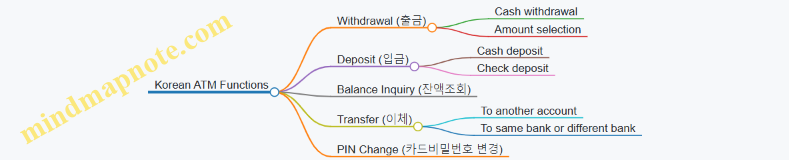
Common Banking Phrases at ATMs
| Korean Phrase | Pronunciation | English Meaning | Usage Example |
|---|---|---|---|
| 카드 넣어 주세요 | Kadeu neoh-eo juseyo | Please insert your card | When starting the ATM transaction |
| 비밀번호를 입력하세요 | Bimilbeonhoreul ipryeokhaseyo | Please enter your PIN | Prompt to enter your PIN |
| 출금 금액을 선택하세요 | Chulgeum geumaegeul seontaekhaseyo | Please select withdrawal amount | Choosing how much money to withdraw |
| 잔액을 확인하시겠습니까? | Janaegeul hwaginhashigetseumnikka? | Would you like to check your balance? | Optional balance inquiry |
| 현금 인출을 완료했습니다 | Hyeongeum inchureul wallyohaetseumnida | Cash withdrawal completed | Confirmation message after withdrawal |
| 이체할 계좌번호를 입력하세요 | Ichaehal gyejwanumbeoreul ipryeokhaseyo | Please enter the transfer account number | When transferring money |
| 거래를 취소하시겠습니까? | Georaereul chwisohashigetseumnikka? | Do you want to cancel the transaction? | Cancel option prompt |
Step-by-Step Example: Withdrawing Cash
- Insert your card: 카드 넣어 주세요.
- Select language: 영어 (English) or 한국어 (Korean).
- Enter your PIN: 비밀번호를 입력하세요.
- Choose transaction type: 출금 (Withdrawal).
- Select amount: 10,000원, 20,000원, or 직접 입력 (Enter amount).
- Confirm transaction: 예 (Yes).
- Collect cash and receipt: 현금과 영수증을 받으세요.
Mind Map: ATM Withdrawal Process
Useful Tips for Using ATMs in Korea
- Most ATMs accept international cards, but some only work with Korean-issued cards.
- Look for ATMs at banks like KEB Hana, Shinhan, or Woori for better international compatibility.
- The PIN is usually a 4-digit number; make sure to enter it carefully.
- If you make a mistake, use 거래 취소 (Cancel Transaction) to start over.
- Keep your receipt until you confirm the transaction is complete.
Practice Dialogue: At the ATM
Traveler: 카드 넣어 주세요. (Please insert your card.)
ATM: 비밀번호를 입력하세요. (Please enter your PIN.)
Traveler: [Enters PIN]
ATM: 출금을 선택하세요. (Please select withdrawal.)
Traveler: 50,000원 출금할게요. (I want to withdraw 50,000 won.)
ATM: 거래를 확인하시겠습니까? (Do you want to confirm the transaction?)
Traveler: 네, 확인합니다. (Yes, I confirm.)
ATM: 현금과 영수증을 받으세요. (Please take your cash and receipt.)
Traveler: 감사합니다. (Thank you.)
Mastering these phrases and understanding the ATM workflow will help you manage your money confidently while in Korea. The key is to stay calm, follow the prompts, and use polite expressions when interacting with any bank staff if needed.
10.3 Communicating at Post Offices and Sending Parcels
When visiting a Korean post office, knowing the right phrases and understanding the process can make sending parcels or letters smoother. Post offices in Korea handle a variety of services, including domestic and international mail, parcel delivery, registered mail, and even banking services. This section focuses on the language and cultural tips relevant to sending parcels and communicating effectively with postal staff.
Key Vocabulary and Phrases
- 우체국 (ucheguk) – Post office
- 소포 (sopo) – Parcel/package
- 등기 (deunggi) – Registered mail
- 국제 소포 (gukje sopo) – International parcel
- 배송 (baesong) – Delivery
- 주소 (juso) – Address
- 받는 사람 (batneun saram) – Recipient
- 보내는 사람 (bonaeneun saram) – Sender
- 무게 (muge) – Weight
- 요금 (yogeum) – Fee/cost
- 포장 (pojang) – Packaging
- 추적 번호 (chujeok beonho) – Tracking number
Typical Questions You May Hear or Need to Ask
- 무엇을 보내시겠습니까? (Mueoseul bonaesigessseumnikka?) – What would you like to send?
- 국내 소포입니까, 국제 소포입니까? (Guknae sopoimnikka, gukje sopoimnikka?) – Is it a domestic or international parcel?
- 무게가 얼마나 됩니까? (Mugega eolmana doemnikkka?) – How much does it weigh?
- 주소를 알려주시겠습니까? (Jusoreul allyeojusigessseumnikka?) – Could you please provide the address?
- 등기 하시겠습니까? (Deunggi hasigessseumnikka?) – Would you like to send it registered?
- 포장 도와드릴까요? (Pojang dowadeurilkkayo?) – Would you like help with packaging?
Mind Map: Sending a Parcel at the Post Office
Step-by-Step Example Dialogue
At the counter:
- Staff: 안녕하세요, 무엇을 보내시겠습니까? (Hello, what would you like to send?)
- You: 안녕하세요, 이 소포를 국제 배송으로 보내고 싶습니다. (Hello, I want to send this parcel internationally.)
- Staff: 네, 무게가 얼마나 됩니까? (Okay, how much does it weigh?)
- You: 약 2킬로그램입니다. (About 2 kilograms.)
- Staff: 주소를 알려주시겠습니까? (Could you please provide the address?)
- You: 네, 받는 사람은 김민수이고, 서울시 강남구 테헤란로 123입니다. (Yes, the recipient is Kim Min-su, 123 Teheran-ro, Gangnam-gu, Seoul.)
- Staff: 등기 하시겠습니까? (Would you like to send it registered?)
- You: 네, 등기로 보내주세요. (Yes, please send it registered.)
- Staff: 요금은 15,000원입니다. 카드로 결제하시겠습니까? (The fee is 15,000 won. Would you like to pay by card?)
- You: 네, 카드로 결제할게요. (Yes, I will pay by card.)
- Staff: 감사합니다. 추적 번호는 1234 5678 9012입니다. (Thank you. Your tracking number is 1234 5678 9012.)
- You: 감사합니다. (Thank you.)
Cultural Tips
- Politeness is important. Use 존댓말 (formal speech) when speaking to postal workers.
- It’s common for staff to offer packaging assistance. Accepting help is polite and practical.
- Writing the recipient’s address clearly in Korean helps avoid delivery issues.
- When sending international parcels, customs forms may be required. Staff will guide you.
- Keep the receipt and tracking number until the parcel is delivered.
Mind Map: Common Parcel Types and Services
Additional Example Phrases
- 이 소포를 빨리 보내고 싶습니다. (I want to send this parcel quickly.)
- 포장 재료가 필요합니다. (I need packaging materials.)
- 이 주소가 맞는지 확인해 주세요. (Please check if this address is correct.)
- 추적 번호로 배송 상태를 확인할 수 있나요? (Can I check the delivery status with the tracking number?)
- 이 소포는 언제 도착할까요? (When will this parcel arrive?)
By mastering these phrases and understanding the process, sending parcels in Korea becomes straightforward. The key is clear communication and polite interaction with postal staff. This will ensure your items reach their destination without unnecessary delays or confusion.
10.4 Handling Utilities and Accommodation Issues
When staying in Korea, whether in a hotel, guesthouse, or rented apartment, you might need to address issues related to utilities or accommodation services. Knowing the right phrases and how to communicate clearly can save time and reduce frustration.
Common Utility and Accommodation Issues
- Electricity or heating not working
- Water supply problems
- Internet or Wi-Fi connectivity issues
- Noise complaints
- Requesting extra amenities (towels, blankets, etc.)
- Reporting damage or maintenance needs
Mind Map: Communicating Utility Problems
Mind Map: Requesting Accommodation Services
Useful Phrases and Examples
-
Reporting a problem:
- “죄송한데, 방에 문제가 있어요.” (Excuse me, there is a problem in the room.)
- “전기가 갑자기 나갔어요.” (The electricity suddenly went out.)
-
Requesting assistance:
- “직원분을 불러 주시겠어요?” (Could you call a staff member?)
- “수리하러 올 수 있나요?” (Can someone come to fix it?)
-
Asking for extra items:
- “수건을 더 받을 수 있을까요?” (Can I get more towels?)
- “추가 베개가 필요해요.” (I need an extra pillow.)
-
Expressing dissatisfaction politely:
- “방이 너무 춥습니다. 난방을 켜 주실 수 있나요?” (The room is too cold. Could you turn on the heating?)
- “인터넷 연결이 자주 끊겨서 불편해요.” (The internet connection keeps dropping, which is inconvenient.)
Sample Dialogue: Reporting a Water Issue in an Apartment
-
Guest: “안녕하세요, 죄송한데 물이 안 나와요. 확인해 주실 수 있나요?”
(Hello, excuse me, there is no water. Could you check it?) -
Staff: “불편을 드려 죄송합니다. 바로 확인해 보겠습니다.”
(Sorry for the inconvenience. I will check it right away.) -
Guest: “감사합니다. 그리고 수압도 너무 약해요.”
(Thank you. Also, the water pressure is very low.) -
Staff: “네, 함께 점검하겠습니다.”
(Okay, we will inspect it together.)
Tips for Effective Communication
- Use polite language when addressing staff or landlords; adding “-세요” or “-습니다” endings shows respect.
- Be specific about the problem to avoid misunderstandings.
- If unsure about vocabulary, use simple words and gestures.
- Confirm that your request or complaint is understood by asking “알겠어요?” (Do you understand?) or “확인해 주실 수 있나요?” (Can you confirm?).
Handling utilities and accommodation issues in Korea is straightforward when you have the right phrases and approach. Clear, polite communication helps resolve problems quickly and keeps your stay comfortable.
10.5 Practice Dialogue: Managing Daily Errands in Korean
When living or traveling in Korea, running daily errands is a common necessity. This section provides practical dialogues and mind maps to help you handle typical situations such as grocery shopping, going to the post office, visiting the bank, and paying bills. Each example includes useful phrases and cultural tips to make communication smoother.
Mind Map: Common Daily Errands Vocabulary
Scenario 1: Grocery Shopping
Context: You want to buy some fruits and vegetables at a local market.
Dialogue:
- 고객 (Customer): 사과 얼마예요? (How much are the apples?)
- 상인 (Vendor): 한 개에 천 원입니다. (1,000 won each.)
- 고객: 세 개 주세요. 할인 있어요? (Three, please. Is there a discount?)
- 상인: 네, 세 개에 2,500원 드릴게요. (Yes, I’ll give you three for 2,500 won.)
- 고객: 감사합니다. 여기 계산할게요. (Thank you. I’ll pay here.)
Cultural Tip: Bargaining is common in traditional markets but less so in supermarkets. Always be polite and smile when asking for discounts.
Scenario 2: Sending a Parcel at the Post Office
Context: You want to send a package to your home country.
Dialogue:
- 고객: 이 소포를 해외로 보내고 싶어요. (I want to send this parcel overseas.)
- 직원 (Clerk): 어느 나라로 보내시나요? (Which country is it going to?)
- 고객: 미국이에요. (To the United States.)
- 직원: 등기 우편으로 보내시겠어요? (Would you like to send it by registered mail?)
- 고객: 네, 안전하게 보내 주세요. (Yes, please send it safely.)
- 직원: 무게를 재겠습니다. 잠시만 기다려 주세요. (I will weigh it. Please wait a moment.)
Cultural Tip: Korean post offices are efficient and staff are helpful. Using registered mail is recommended for valuable items.
Scenario 3: Using an ATM at the Bank
Context: You need to withdraw cash from an ATM.
Dialogue:
- 고객: 영어로 안내 받을 수 있어요? (Can I get instructions in English?)
- 직원: 네, ATM 화면에서 영어를 선택하세요. (Yes, please select English on the ATM screen.)
- 고객: 출금하려고 합니다. (I want to withdraw money.)
- 직원: 카드 넣고 비밀번호 입력하세요. (Insert your card and enter your PIN.)
Cultural Tip: Many ATMs in Korea offer English language options. Keep your PIN confidential and be aware of your surroundings.
Scenario 4: Paying a Utility Bill
Context: You want to pay your electricity bill at a convenience store.
Dialogue:
- 고객: 전기 요금 납부할게요. (I want to pay my electricity bill.)
- 직원: 고지서 보여 주세요. (Please show me the bill.)
- 고객: 여기 있습니다. (Here it is.)
- 직원: 총 금액은 45,000원입니다. 현금으로 내시겠어요? (The total is 45,000 won. Will you pay in cash?)
- 고객: 네, 현금으로요. (Yes, in cash.)
Cultural Tip: Convenience stores in Korea accept utility bill payments. Always keep your payment receipt.
Summary Table of Useful Phrases
| Situation | Korean Phrase | English Translation |
|---|---|---|
| Asking price | 얼마예요? | How much is it? |
| Requesting discount | 할인 있어요? | Is there a discount? |
| Sending parcel | 해외로 보내고 싶어요. | I want to send this overseas. |
| Choosing service | 등기 우편으로 보내시겠어요? | Would you like registered mail? |
| ATM instructions | 영어로 안내 받을 수 있어요? | Can I get instructions in English? |
| Paying bill | 전기 요금 납부할게요. | I want to pay my electricity bill. |
Final Notes
When managing daily errands in Korea, clear and polite communication is key. Use simple phrases, confirm details, and don’t hesitate to ask for repetition or clarification if needed. These dialogues and vocabulary will help you navigate everyday tasks confidently and respectfully.
11. Korean Language Tips for Effective Communication
11.1 Pronunciation Tips to Sound More Natural
Mastering Korean pronunciation can feel like learning a new rhythm. The sounds don’t always match English expectations, but with focused practice, you can sound clearer and more natural. Below are key areas to focus on, organized as a mind map for clarity.
Vowels
Korean has 10 basic vowels, some of which don’t have direct English equivalents. Pay attention to mouth shape and tongue position.
-
Short vs. Long vowels: Korean vowels are generally short and crisp. Avoid dragging sounds as in English.
-
Diphthongs: Combinations like ㅘ (wa), ㅢ (ui), and ㅚ (oe) blend two vowel sounds smoothly. Practice moving your mouth fluidly between the two parts.
Example:
- ㅘ (wa) in 화 (hwa, “fire”)
- ㅢ (ui) in 의사 (uisa, “doctor”)
Try saying these slowly, then at natural speed.
Consonants
Korean consonants are divided into three categories: plain, tense, and aspirated. The difference affects meaning, so pronunciation matters.
- Plain consonants: ㄱ (g/k), ㄷ (d/t), ㅂ (b/p)
- Tense consonants: ㄲ (kk), ㄸ (tt), ㅃ (pp) – pronounced with more tension in the throat
- Aspirated consonants: ㅋ (kʰ), ㅌ (tʰ), ㅍ (pʰ) – pronounced with a strong burst of air
Example:
- 가 (ga), 까 (kka), 카 (kha)
Practice minimal pairs to hear the difference.
- Final consonants (Batchim): Korean syllables often end with consonants that are pronounced differently than when they appear at the start.
Example:
-
밥 (bap) sounds like [bap]
-
밖 (bakk) sounds like [bak]
-
Linking sounds: When a batchim is followed by a vowel in the next syllable, the consonant often links to the next syllable.
Example:
- 먹어요 (meog-eoyo) sounds like [meo-geo-yo]
Intonation and Rhythm
Korean intonation is generally flatter than English but still uses pitch to convey meaning.
-
Sentence stress: Korean tends to stress the last content word in a sentence rather than varying stress throughout.
-
Rising and falling tones: Questions often end with a rising tone, statements with a falling tone.
Example:
- 뭐 해요? (mwo haeyo?) – rising tone for “What are you doing?”
Common Pronunciation Challenges
- ㄹ (R/L sound): This consonant is somewhere between an English r and l. At the start of a syllable, it sounds like an r; at the end, it’s closer to l.
Example:
-
라면 (ramyeon) sounds like “rah-myun”
-
달 (dal) sounds like “dahl”
-
ㅅ (S sound variations): Before the vowel ㅣ (i), ㅅ sounds like ‘sh’.
Example:
-
시 (si) sounds like “shi”
-
ㅎ (H sound and its influence): The ㅎ sound can soften or change the following consonant.
Example:
- 좋아 (joha) sounds like “jo-ha”
Practice Examples
| Korean | Romanization | Notes |
|---|---|---|
| 가방 | gabang | Plain ㄱ at start |
| 까만 | kkamang | Tense ㄲ, more forceful |
| 학교 | hakgyo | Linking batchim ㄱ + ㄱ |
| 밥 먹어요 | bap meogeoyo | Linking batchim ㄱ + ㅁ |
| 시계 | sigye | ㅅ before ㅣ sounds like “sh” |
Focusing on these areas will help your Korean sound more natural and easier to understand. The key is consistent practice and listening carefully to native speakers. Pronunciation isn’t about perfection but clarity and confidence.
11.2 Common Mistakes and How to Avoid Them
Learning Korean involves navigating a few common pitfalls that can trip up even the most diligent learners. Understanding these mistakes and how to sidestep them will help you communicate more clearly and confidently.
Mistake 1: Misusing Honorifics and Politeness Levels
Korean language has multiple speech levels, and using the wrong one can sound rude or awkward. For example, speaking casually (반말) to strangers or elders is generally inappropriate.
How to avoid:
- Default to polite speech (존댓말) when in doubt.
- Use endings like -요 to keep it polite.
Example:
- Incorrect: “밥 먹어?” (casual, to a stranger)
- Correct: “밥 먹어요?” (polite)
Mind Map: Honorifics and Politeness Levels
Mistake 2: Incorrect Word Order
Korean sentence structure is Subject-Object-Verb (SOV), unlike English’s Subject-Verb-Object (SVO). Placing verbs or objects incorrectly can confuse listeners.
How to avoid:
- Remember verbs come at the end.
- Objects precede verbs.
Example:
- Incorrect: “나는 먹어요 밥.” (I eat rice)
- Correct: “나는 밥을 먹어요.”
Mind Map: Korean Sentence Structure
Mistake 3: Overusing Direct Translations
Translating phrases word-for-word from English to Korean often results in unnatural or incorrect expressions.
How to avoid:
- Learn common Korean expressions rather than literal translations.
- Pay attention to idiomatic usage.
Example:
- Incorrect: “나는 배고프다.” (literal, but sounds blunt)
- More natural: “배고파요.” (polite and conversational)
Mind Map: Avoiding Direct Translation Pitfalls
Mistake 4: Confusing Similar-Sounding Words
Korean has many homophones and words with subtle pronunciation differences that change meaning.
How to avoid:
- Practice pronunciation carefully.
- Learn context clues to distinguish meanings.
Example:
- “배” can mean:
- “stomach” (배)
- “pear” (배)
- “boat” (배)
Context is key to understanding.
Mind Map: Handling Homophones
Mistake 5: Neglecting Particles
Particles like 은/는, 이/가, 을/를 mark grammatical roles. Omitting or misusing them can make sentences unclear.
How to avoid:
- Learn the function of each particle.
- Practice using them in sentences.
Example:
- Incorrect: “나는 밥 먹어요.” (missing object particle)
- Correct: “나는 밥을 먹어요.”
Mind Map: Korean Particles
Mistake 6: Using the Wrong Verb Forms for Questions
Korean questions often end with specific verb endings. Using statements instead of questions can confuse listeners.
How to avoid:
- Use question endings like -나요?, -어요?, or rising intonation.
Example:
- Statement: “가요.” (I go)
- Question: “가요?” or “가나요?” (Do you go?)
Mind Map: Forming Questions in Korean
Mistake 7: Overusing Formal Speech in Casual Settings
While politeness is important, using overly formal speech among peers can sound stiff or distant.
How to avoid:
- Match speech level to context and relationship.
- Use casual speech with close friends.
Example:
- Formal: “안녕하세요? 잘 지내십니까?”
- Casual: “안녕! 잘 지내?”
Mind Map: Matching Speech Level to Context
By paying attention to these common mistakes and practicing the suggested corrections, your Korean will sound more natural and your communication more effective. Remember, clarity and respect go hand in hand in Korean conversation.
11.3 Using Body Language and Gestures Appropriately
In Korean communication, body language and gestures play a significant role alongside spoken words. Understanding and using these non-verbal cues correctly can help you avoid misunderstandings and show respect, which is highly valued in Korean culture.
Common Korean Gestures and Their Meanings
-
Bowing: The most important gesture in Korea. Bowing shows respect, gratitude, or apology. The depth and duration of the bow depend on the situation and the relationship between people.
- A slight nod or small bow is common in casual greetings.
- A deeper, longer bow is used for formal occasions or to show greater respect.
-
Handshakes: Often combined with a bow, especially in business or formal settings. Use your right hand to shake and support your right forearm with your left hand to show politeness.
-
Pointing: Pointing with a single finger is considered rude. Instead, Koreans use an open hand or gesture with the whole hand to indicate direction or objects.
-
Beckoning: To call someone over, Koreans curl their fingers with the palm facing down, unlike the Western palm-up gesture.
-
Thumbs Up: Generally positive, meaning “good” or “okay,” but not used excessively.
-
Crossed Arms: Can indicate defensiveness or disagreement; avoid this during conversations.
-
Nodding: A subtle nod shows attentiveness and understanding.
-
Eye Contact: Koreans tend to avoid prolonged direct eye contact with elders or superiors as a sign of respect, but maintain enough eye contact to show engagement.
Mind Map: Korean Non-Verbal Communication
Examples of Appropriate Use
-
Greeting an Elder: When meeting an older person, a slight bow combined with a soft smile is appropriate. Avoid direct eye contact for too long. For example, say “안녕하세요” (Annyeonghaseyo) while bowing your head slightly.
-
Calling a Waiter: Instead of waving or pointing, use a subtle hand gesture with your palm down, curling your fingers inward to beckon politely.
-
Expressing Thanks: After receiving help, a small bow and a sincere “감사합니다” (Gamsahamnida) reinforce your gratitude.
-
In a Business Meeting: Shake hands with your right hand while supporting your right forearm with your left hand, then bow slightly.
-
Asking for Directions: Use your whole hand to point toward the direction rather than a single finger. For example, say “저기요, 이 길이 맞나요?” (Jeogiyo, i giri matnayo?) meaning “Excuse me, is this the right way?” while gesturing with an open hand.
Tips for Using Body Language Effectively
- Mirror the gestures of your Korean conversation partner moderately to build rapport.
- Keep your gestures calm and controlled; exaggerated movements can be seen as impolite or distracting.
- Pay attention to context: what is acceptable among friends might not be appropriate in formal or elder interactions.
- When in doubt, opt for more reserved gestures and polite verbal expressions.
Mind Map: Dos and Don’ts of Korean Gestures
Mastering these subtle aspects of Korean body language will enhance your communication and show your respect for Korean customs. It’s a small effort that goes a long way in making your interactions smoother and more pleasant.
11.4 How to Ask for Clarification and Repeat Information
When communicating in Korean, especially as a learner or traveler, it’s common to miss or misunderstand parts of a conversation. Knowing how to ask for clarification or request repetition politely and clearly is essential. This section covers practical phrases, cultural context, and examples to help you navigate these moments smoothly.
Why Ask for Clarification?
- To ensure you understand instructions or information correctly.
- To avoid miscommunication, which can lead to mistakes.
- To show engagement and willingness to learn.
In Korean culture, politely asking for repetition or clarification is appreciated, as it shows respect and effort.
Key Phrases for Asking Clarification and Repetition
| Korean Phrase | Romanization | English Meaning | Notes |
|---|---|---|---|
| 다시 한 번 말씀해 주세요 | Dasi han beon malsseumhae juseyo | Please say it one more time | Polite and common request |
| 뭐라고요? | Mworagoyo? | What did you say? | Informal, use with friends or younger |
| 잘 못 들었어요 | Jal mot deureosseoyo | I didn’t hear well | Polite, good for unclear audio |
| 천천히 말씀해 주세요 | Cheoncheonhi malsseumhae juseyo | Please speak slowly | Useful when speech is too fast |
| 다시 한 번 말해 주세요 | Dasi han beon malhae juseyo | Please say it again | Slightly less formal than 말씀해 주세요 |
| 이해가 잘 안 돼요 | Ihaega jal an dwaeyo | I don’t understand well | Polite, indicates confusion |
Mind Map: Asking for Clarification
How to Use These Phrases in Context
-
When you didn’t catch what someone said:
- Situation: A shop clerk speaks quickly.
- You say: “죄송한데, 다시 한 번 말씀해 주세요.” (Excuse me, please say it one more time.)
-
When the speaker talks too fast:
- You say: “천천히 말씀해 주세요.” (Please speak slowly.)
-
When you want to confirm what you heard:
- You say: “다시 한 번 말해 주세요.” (Please say it again.)
-
When you simply didn’t hear clearly:
- You say: “잘 못 들었어요.” (I didn’t hear well.)
-
When you don’t understand the meaning:
- You say: “이해가 잘 안 돼요.” (I don’t understand well.)
Mind Map: Responding to Clarification Requests
Examples of Clarification Dialogues
Example 1: Asking for repetition in a restaurant
- 손님: “죄송한데, 다시 한 번 말씀해 주세요.”
- 직원: “네, 이 요리는 매운 닭볶음탕입니다.”
(Guest: Excuse me, please say it one more time.
Staff: Yes, this dish is spicy braised chicken stew.)
Example 2: Requesting slower speech on the street
- 여행자: “천천히 말씀해 주세요.”
- 현지인: “네, 지하철역은 저쪽에 있어요.”
(Traveler: Please speak slowly.
Local: Yes, the subway station is over there.)
Example 3: Expressing lack of understanding in a store
- 고객: “이해가 잘 안 돼요. 다시 설명해 주세요.”
- 점원: “네, 이 제품은 휴대폰 충전기입니다.”
(Customer: I don’t understand well. Please explain again.
Clerk: Yes, this product is a phone charger.)
Tips for Effective Clarification
- Use polite forms unless with close friends.
- Smile or use gentle body language to show you’re engaged.
- Repeat the phrase if needed, but avoid interrupting abruptly.
- When repeating, try to speak slower and clearer.
- Confirm understanding by paraphrasing or asking “이해하셨나요?” (Did you understand?).
Mastering these phrases and knowing when to use them will help you communicate more confidently and avoid misunderstandings. Asking for clarification is a normal part of language learning and daily interaction, so don’t hesitate to use these tools whenever needed.
11.5 Practice Exercises: Role-Playing Common Travel Scenarios
Role-playing is a practical way to prepare for real-life interactions in Korea. It helps you practice vocabulary, sentence structures, and cultural nuances simultaneously. Below are several common travel scenarios with mind maps and example dialogues to guide your practice.
Scenario 1: Asking for Directions
Mind Map: Asking for Directions
Example Dialogue:
- Traveler: 안녕하세요. 지하철역 어디에 있어요? (Hello. Where is the subway station?)
- Local: 저쪽으로 가서 오른쪽으로 도세요. (Go that way and turn right.)
- Traveler: 이쪽으로 가면 돼요? (Do I go this way?)
- Local: 네, 맞아요. (Yes, that’s right.)
- Traveler: 감사합니다! (Thank you!)
Scenario 2: Ordering Food at a Restaurant
Mind Map: Ordering Food
Example Dialogue:
- Customer: 안녕하세요. 메뉴판 주세요. (Hello. Please give me the menu.)
- Waiter: 네, 여기 있습니다. (Yes, here it is.)
- Customer: 이거 주세요. 맵지 않게 해 주세요. (I’ll have this. Please make it not spicy.)
- Waiter: 알겠습니다. (Understood.)
- Customer: 계산서 주세요. (Please give me the bill.)
- Waiter: 네, 여기 있습니다. (Yes, here it is.)
Scenario 3: Checking Into a Hotel
Mind Map: Hotel Check-In
Example Dialogue:
- Guest: 안녕하세요. 예약했어요. (Hello. I have a reservation.)
- Receptionist: 성함이 어떻게 되세요? (What is your name?)
- Guest: 김민수입니다. (I am Kim Min-su.)
- Receptionist: 여권 보여 주세요. (Please show your passport.)
- Guest: 여기 있습니다. (Here it is.)
- Receptionist: 와이파이 비밀번호는 12345678입니다. (The Wi-Fi password is 12345678.)
- Guest: 감사합니다. 짐 좀 도와주세요. (Thank you. Please help with my luggage.)
Scenario 4: Shopping at a Market
Mind Map: Shopping
Example Dialogue:
- Shopper: 안녕하세요. 이거 얼마예요? (Hello. How much is this?)
- Vendor: 만 원이에요. (It’s 10,000 won.)
- Shopper: 좀 깎아 주세요. (Please give me a discount.)
- Vendor: 9,000원에 드릴게요. (I’ll give it to you for 9,000 won.)
- Shopper: 카드 돼요? (Do you accept cards?)
- Vendor: 네, 됩니다. (Yes, we do.)
- Shopper: 감사합니다. (Thank you.)
Scenario 5: Visiting a Clinic
Mind Map: Clinic Visit
Example Dialogue:
- Patient: 안녕하세요. 머리가 아파요. (Hello. I have a headache.)
- Doctor: 언제부터 아팠어요? (Since when have you had the pain?)
- Patient: 어제부터요. (Since yesterday.)
- Doctor: 약을 드릴게요. 하루에 세 번 드세요. (I will give you medicine. Take it three times a day.)
- Patient: 감사합니다. (Thank you.)
Tips for Role-Playing Practice
- Use the mind maps to build your own sentences before trying the dialogues.
- Practice both roles: traveler and local. This helps understand both sides of the conversation.
- Focus on pronunciation and intonation to sound natural.
- Repeat dialogues until you feel comfortable with the flow.
- Try to add variations by changing details like locations, items, or symptoms.
Role-playing these scenarios will build confidence and improve your ability to handle everyday situations in Korea. Regular practice makes the language feel less foreign and more like a tool you can use naturally.
12. Appendices and Resources
12.1 Essential Korean Vocabulary Lists for Travelers
When traveling in Korea, having a solid set of vocabulary at your fingertips can make everyday interactions smoother and more enjoyable. This section organizes key words into practical categories, supported by mind maps in format to visualize connections. Each category includes examples to show how these words fit into real conversations.
Greetings and Basic Expressions
Start with the essentials: greetings and polite expressions. These set the tone for respectful communication.
- 안녕하세요 (annyeonghaseyo) – Hello (formal)
- 감사합니다 (gamsahamnida) – Thank you
- 죄송합니다 (joesonghamnida) – Sorry / Excuse me
- 실례합니다 (sillyehamnida) – Excuse me (to get attention)
- 네 (ne) – Yes
- 아니요 (aniyo) – No
Example:
- 안녕하세요! 이 버스는 서울역에 가나요? (Hello! Does this bus go to Seoul Station?)
Numbers and Counting
Numbers are vital for shopping, transportation, and time.
- 하나 (hana) – One
- 둘 (dul) – Two
- 셋 (set) – Three
- 넷 (net) – Four
- 다섯 (daseot) – Five
- 열 (yeol) – Ten
Example:
- 티켓 두 장 주세요. (Please give me two tickets.)
Note: Korean uses two number systems: native Korean (above) and Sino-Korean (일, 이, 삼, etc.). For counting objects, native Korean numbers are common; for dates, money, and phone numbers, Sino-Korean is used.
Transportation Terms
Navigating transport requires specific vocabulary.
- 버스 (beoseu) – Bus
- 지하철 (jihacheol) – Subway
- 택시 (taeksi) – Taxi
- 역 (yeok) – Station
- 표 (pyo) – Ticket
Example:
- 서울역까지 지하철 표 한 장 주세요. (One subway ticket to Seoul Station, please.)
Food and Dining
Ordering food and understanding menus is easier with these words.
- 메뉴 (menyu) – Menu
- 물 (mul) – Water
- 밥 (bap) – Rice or meal
- 고기 (gogi) – Meat
- 김치 (kimchi) – Kimchi
- 계산서 (gyesanseo) – Bill/check
Example:
- 물 한 잔 주세요. (Please give me a glass of water.)
- 계산서 부탁합니다. (The bill, please.)
Accommodation and Services
Useful when checking into hotels or guesthouses.
- 예약 (yeyak) – Reservation
- 방 (bang) – Room
- 체크인 (chekeu-in) – Check-in
- 체크아웃 (chekeu-aut) – Check-out
- 열쇠 (yeolsoe) – Key
Example:
- 예약했는데, 체크인 하러 왔어요. (I have a reservation and came to check in.)
Shopping and Money
Words for buying, paying, and asking prices.
- 얼마예요? (eolmayeyo?) – How much is it?
- 깎아 주세요 (kkakka juseyo) – Please give me a discount
- 카드 (kadeu) – Card
- 현금 (hyeongeum) – Cash
- 영수증 (yeongsujeung) – Receipt
Example:
- 이거 얼마예요? (How much is this?)
- 카드로 계산할게요. (I will pay by card.)
Health and Emergencies
Important for unexpected situations.
- 병원 (byeongwon) – Hospital
- 약 (yak) – Medicine
- 아파요 (apayo) – It hurts
- 도와주세요 (dowajuseyo) – Please help
- 경찰 (gyeongchal) – Police
Example:
- 머리가 아파요. (I have a headache.)
- 경찰을 불러 주세요. (Please call the police.)
Time and Dates
Talking about schedules and appointments.
- 오늘 (oneul) – Today
- 내일 (naeil) – Tomorrow
- 몇 시예요? (myeot siyeyo?) – What time is it?
- 오전 (ojeon) – AM
- 오후 (ohu) – PM
Example:
- 회의가 오후 3시에 있어요. (The meeting is at 3 PM.)
Summary
This vocabulary list covers the most common situations travelers face. Using the mind maps can help you visualize and remember related words together. Practice these words in simple sentences and dialogues to build confidence. The examples show how these words appear naturally, making it easier to apply them when you travel.
Keep this list handy, and refer to it whenever you need a quick reminder. With these words, you’ll handle daily life and travel in Korea with more ease and clarity.
12.2 Quick Reference Grammar Guide
This section provides a concise overview of essential Korean grammar points for travelers and daily life. Each point includes clear explanations, examples, and mind maps to visualize the structure.
Sentence Structure: Subject-Object-Verb (SOV)
Korean sentences typically follow the Subject-Object-Verb order, unlike English’s Subject-Verb-Object.
Mind Map: Sentence Structure
Example:
- 저는 사과를 먹어요. (I apple eat.)
- Literal: I apple eat.
- Natural: I eat an apple.
Note: Particles like ‘는/은’ (topic), ‘가/이’ (subject), and ‘를/을’ (object) mark the roles.
Particles: Marking Roles in Sentences
Particles attach to nouns to indicate their grammatical function.
Mind Map: Particles
Examples:
- 저는 학생이에요. (As for me, I am a student.)
- 고양이가 있어요. (There is a cat.)
- 책을 읽어요. (I read a book.)
Particles change depending on whether the noun ends with a vowel or consonant.
Politeness Levels: Formality in Speech
Korean has multiple speech levels. For travel and daily life, polite speech (해요체) is most common.
Mind Map: Politeness Levels
Example (Verb ‘to eat’ 먹다):
- Formal Polite: 먹습니다.
- Polite: 먹어요.
- Casual: 먹어.
Use polite forms with strangers or in service situations.
Verb Conjugation Basics
Verbs change endings to express tense, politeness, and mood.
Mind Map: Verb Conjugation
Examples:
-
가다 (to go)
- Present: 가요 (go)
- Past: 갔어요 (went)
- Future: 갈 거예요 (will go)
-
먹다 (to eat)
- Present: 먹어요
- Past: 먹었어요
- Future: 먹을 거예요
Verb stems ending with vowels use -아요; consonants use -어요.
Negative Sentences
Two common ways to negate verbs:
- Adding 안 before the verb
- Using verb ending 지 않다
Examples:
- 안 가요. (I do not go.)
- 가지 않아요. (I do not go.)
Both are polite and interchangeable, though 안 is more casual.
Questions
Questions are formed by changing intonation or adding question endings.
Mind Map: Question Formation
Examples:
- 가요? (Are you going?)
- 먹어요? (Are you eating?)
- 갑니까? (Are you going? formal)
Yes/no questions keep the verb but raise intonation or add question markers.
Descriptive Verbs (Adjectives)
In Korean, adjectives behave like verbs and conjugate similarly.
Example:
- 예쁘다 (to be pretty)
- Present: 예뻐요
- Past: 예뻤어요
Usage:
- 그 꽃이 예뻐요. (That flower is pretty.)
Connectors: Linking Sentences
Common connectors help combine ideas.
Mind Map: Connectors
Examples:
- 저는 학생이에요 그리고 한국어를 공부해요. (I am a student and I study Korean.)
- 비가 와요 그래서 우산을 가져가요. (It’s raining, so I take an umbrella.)
Counters: Counting Objects
Korean uses specific counters depending on the object.
Mind Map: Counters
Examples:
- 사과 세 개 (three apples)
- 사람 두 명 (two people)
Use native Korean numbers with counters for counting objects.
Time Expressions
Time expressions often use particles like 에 (at) and 부터 (from).
Examples:
- 오전 9시에 만나요. (Let’s meet at 9 AM.)
- 3시부터 시작해요. (It starts from 3 o’clock.)
Summary Mind Map
Mind Map: Quick Grammar Overview
This guide covers the grammar essentials you’ll need to navigate conversations and understand Korean sentence patterns during your travels and daily interactions.
12.3 Korean Phrasebook for Emergencies
Emergencies require clear, concise communication. This section provides essential Korean phrases organized by common emergency situations, supported by mind maps to visualize connections between phrases and contexts. Each phrase includes pronunciation guides and example scenarios.
Emergency Categories Mind Map
Medical Emergencies
Key phrases:
- 아파요 (apa-yo) – It hurts.
- 어디가 아파요? (eodi-ga apa-yo?) – Where does it hurt?
- 배가 아파요 (bae-ga apa-yo) – My stomach hurts.
- 숨쉬기 어려워요 (sum-swigi eoryeowo-yo) – I have difficulty breathing.
- 응급실이 어디에 있나요? (eung-geup-sil-i eodie innayo?) – Where is the emergency room?
Example dialogue:
- Patient: 배가 너무 아파요. (My stomach hurts a lot.)
- Nurse: 언제부터 아팠어요? (Since when has it hurt?)
Practice tip: When describing symptoms, keep sentences short and use gestures if needed. For example, point to the area of pain.
Mind map:
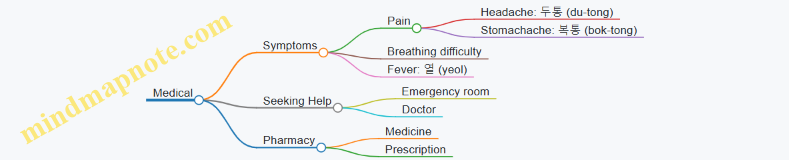
Contacting Police and Reporting Incidents
Key phrases:
- 경찰을 불러 주세요. (gyeong-chal-eul bul-leo ju-se-yo) – Please call the police.
- 도둑맞았어요. (do-duk-maj-ass-eo-yo) – I was robbed.
- 길을 잃었어요. (gil-eul ilh-eoss-eo-yo) – I’m lost.
- 사고가 났어요. (sa-go-ga nass-eo-yo) – There was an accident.
Example dialogue:
- Visitor: 경찰을 불러 주세요. (Please call the police.)
- Officer: 무슨 일이에요? (What happened?)
Practice tip: When reporting, state the location clearly. Use landmarks if you don’t know the exact address.
Mind map:
Fire and Natural Disasters
Key phrases:
- 불이 났어요! (bul-i nass-eo-yo) – There is a fire!
- 대피해야 해요. (dae-pi-hae-ya hae-yo) – We need to evacuate.
- 지진이에요! (ji-jin-i-e-yo) – It’s an earthquake!
Example dialogue:
- Person A: 불이 났어요! (There’s a fire!)
- Person B: 어디에요? (Where?)
Practice tip: In emergencies, short commands and clear words work best. Repeat if necessary.
Mind map:
- Fire
- Alert others
- Evacuate
- Natural Disasters
- Earthquake
- Flood
- Shelter
Pharmacy and Medicine
Key phrases:
- 약국이 어디에 있나요? (yak-gug-i eodie innayo?) – Where is the pharmacy?
- 두통약 주세요. (du-tong-yak ju-se-yo) – Please give me headache medicine.
- 처방전이 있어요. (cheo-bang-jeon-i iss-eo-yo) – I have a prescription.
Example dialogue:
- Customer: 감기약 있어요? (Do you have cold medicine?)
- Pharmacist: 네, 여기 있습니다. (Yes, here it is.)
Practice tip: Show written symptoms or prescriptions if pronunciation is difficult.
Mind map:
Urgent Communication and Directions
Key phrases:
- 도와 주세요! (do-wa ju-se-yo) – Help!
- 전화기를 빌릴 수 있나요? (jeon-hwa-gi-reul bil-lil su innayo?) – Can I borrow a phone?
- 경찰서가 어디에 있나요? (gyeong-chal-seo-ga eodie innayo?) – Where is the police station?
Example dialogue:
- Visitor: 도와 주세요! (Help!)
- Local: 무슨 일이에요? (What’s wrong?)
Practice tip: Keep emergency numbers handy. In Korea, 112 is police, 119 is fire and ambulance.
Mind map:
This phrasebook section is designed to help travelers communicate effectively during emergencies. Practice these phrases aloud, and remember that gestures and calm tone can aid understanding when words fall short.
12.4 When learning Korean, having the right digital tools can make a significant difference. This section covers some of the most practical apps and websites that help with vocabulary, grammar, pronunciation, and cultural understanding. Each tool has unique features suited for different learning styles and goals.
Language Learning Apps
Vocabulary Builders
-
Anki: A flashcard app that uses spaced repetition to help memorize Korean words and phrases efficiently. You can customize decks or download pre-made ones focused on travel and daily life.
-
Memrise: Offers user-generated courses with audio and video clips from native speakers. It’s useful for hearing natural pronunciation and practicing common expressions.
Grammar and Sentence Structure
-
LingoDeer: Designed specifically for Asian languages, it provides clear grammar explanations alongside exercises. The app breaks down sentence components, making it easier to understand Korean syntax.
-
Talk To Me In Korean (TTMIK): This app complements its website by offering structured lessons from beginner to advanced levels, with a focus on practical grammar and usage.
Pronunciation and Speaking
-
HelloTalk: A language exchange app where you can chat with native Korean speakers. It includes voice messaging and correction features, helping you practice real conversations.
-
Forvo: A pronunciation dictionary where you can hear native speakers pronounce words and phrases, useful for checking your accent.
Websites for Structured Learning and Reference
-
How to Study Korean: A comprehensive site with detailed grammar lessons and exercises. It’s organized in a way that builds knowledge progressively.
-
Naver Dictionary: More than just a dictionary, it provides example sentences, audio pronunciations, and related expressions. It’s handy for quick look-ups during study or travel.
Mind Map: Choosing the Right Tool
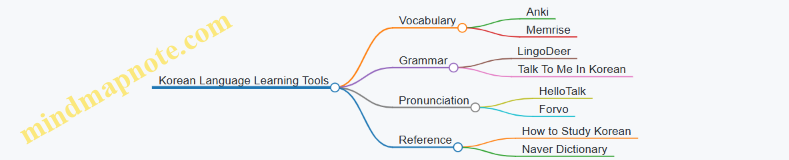
Examples of Use
-
When preparing for a trip, use Anki to memorize essential phrases like “화장실 어디에요?” (Where is the restroom?). The spaced repetition ensures you remember it when needed.
-
To understand sentence structure, LingoDeer breaks down “저는 한국어를 공부해요” (I study Korean) into subject, object, and verb, clarifying particle use.
-
If unsure about pronunciation, check Forvo for the word “감사합니다” (Thank you) to hear multiple native speakers.
-
Practice real conversations on HelloTalk by sending voice messages and receiving corrections, which helps build confidence in speaking.
Tips for Effective Use
-
Combine tools: Use a vocabulary app alongside a grammar-focused app to balance memorization and understanding.
-
Set realistic goals: Focus on phrases and words relevant to travel and daily life to avoid overwhelm.
-
Practice regularly: Short daily sessions with apps like Memrise or Anki are more effective than occasional long ones.
-
Engage with natives: Use HelloTalk or similar platforms to apply what you’ve learned in real conversations.
Using these apps and websites thoughtfully can streamline your Korean learning process, making travel and daily interactions smoother and more enjoyable.
12.5 Index of Cultural Tips and Etiquette Reminders
This section organizes key cultural tips and etiquette reminders into clear categories. Each category includes a mind map in format and practical examples to help you navigate social situations in Korea smoothly.
Greetings and Addressing People
- Greetings and Addressing People
- Greetings
- Formal
- Bowing
- Using honorific titles (e.g., -ssi, -nim)
- Informal
- Handshakes (less common)
- Casual greetings among friends
- Formal
- Addressing
- Use of family names before given names
- Avoid using first names unless invited
- Titles and honorific suffixes
Example: When meeting someone older or in a professional setting, bow slightly and say “안녕하세요 (Annyeonghaseyo)”. Use their family name plus “-ssi” (e.g., Kim-ssi) rather than their first name.
Dining Etiquette
Example: When sharing a meal, hold your glass with two hands when pouring a drink for a senior, and wait for them to take the first sip before you drink.
Gift Giving
Example: Bringing a box of nicely wrapped fruit when invited to a Korean home is appreciated. Present it with both hands and a slight bow.
Public Behavior and Social Norms
Example: When riding the subway, speaking quietly and refraining from phone calls shows respect for others.
Communication Style
Example: Instead of saying “No” directly, use “생각해 볼게요 (I will think about it)” to soften refusal.
Visiting Homes and Temples
Example: Before entering a Korean home, take off your shoes and place them neatly. If unsure, wait for the host’s guidance.
Business and Professional Settings
Example: When meeting Korean business partners, present your business card with both hands and take a moment to read the card you receive before putting it away respectfully.
Language and Politeness Levels
Example: Start conversations with “안녕하세요” and polite verb endings like “-요”. Only switch to informal speech if the other person suggests it.
These cultural tips and etiquette reminders are designed to help you avoid common misunderstandings and show respect in everyday interactions. Keeping these points in mind will make your experience in Korea more comfortable and enjoyable.