Korean Conversation Practice for Beginners
Chapter 1: Introduction to Korean Conversation
1.1 Understanding Basic Korean Sentence Structure
Korean sentence structure differs from English in several key ways, but it follows consistent patterns that make it predictable once you get the hang of it. The most fundamental rule is that Korean sentences typically follow a Subject-Object-Verb (SOV) order. In other words, the verb almost always comes at the end of the sentence.
Basic Sentence Order
| English (SVO) | Korean (SOV) |
|---|---|
| I eat an apple. | I an apple eat. |
This means that while in English you say “I eat an apple,” in Korean you say “저는 사과를 먹어요” (jeoneun sagwareul meogeoyo), which literally translates to “I apple eat.”
Mind Map: Basic Korean Sentence Structure
Subject and Topic Markers
Korean distinguishes between the subject and the topic of a sentence. The topic is what the sentence is about, marked by 은 (after consonants) or 는 (after vowels). The subject is marked by 이 (after consonants) or 가 (after vowels). For beginners, 은/는 is often used to introduce or emphasize the topic, while 이/가 marks the subject performing the action.
Example:
- 저는 학생이에요. (jeoneun haksaeng-ieyo) — “As for me, I am a student.”
- 학생이 학교에 있어요. (haksaeng-i hakgyoe isseoyo) — “The student is at school.”
Object Markers
Objects are marked by 을 (after consonants) or 를 (after vowels). This marker shows what the verb is acting upon.
Example:
- 사과를 먹어요. (sagwareul meogeoyo) — “(I) eat an apple.”
- 책을 읽어요. (chaekeul ilgeo-yo) — “(I) read a book.”
Verb Placement
Verbs always come at the end of the sentence. The verb consists of a stem plus an ending that indicates tense, politeness, and mood.
Example:
- 가다 (gada) — to go
- 가요 (gayo) — go (present polite)
- 갔어요 (gasseoyo) — went (past polite)
Sentence:
- 저는 학교에 가요. (jeoneun hakgyoe gayo) — “I go to school.”
Adding Time and Place
Time and place usually appear before the verb but after the subject or topic.
Example:
- 저는 오늘 학교에 가요. (jeoneun oneul hakgyoe gayo) — “I go to school today.”
- 그는 집에서 공부해요. (geuneun jibeseo gongbuhaeyo) — “He studies at home.”
Mind Map: Sentence Components with Examples
Sentence Components with Examples
- Subject (저는 / 그는)
- Time (오늘 / 어제)
- Place (학교에 / 집에서)
- Object (사과를 / 책을)
- Verb (먹어요 / 읽어요 / 가요)
Example Sentence Structure:
- 저는 (subject/topic)
- 오늘 (time)
- 학교에 (place)
- 사과를 (object)
- 먹어요 (verb)
Meaning: “I eat an apple at school today.”
Practice Examples
- 저는 커피를 마셔요. (jeoneun keopireul masyeoyo) — I drink coffee.
- 그는 책을 읽어요. (geuneun chaekeul ilgeo-yo) — He reads a book.
- 우리는 내일 영화를 봐요. (urineun naeil yeonghwareul bwayo) — We watch a movie tomorrow.
Each sentence follows the SOV order, with clear markers showing the role of each noun.
Summary
- Korean sentences usually end with the verb.
- Subject/topic markers (은/는, 이/가) clarify who or what the sentence is about.
- Object markers (을/를) identify what the verb acts upon.
- Time and place typically come before the verb.
- Verb endings convey tense and politeness.
Understanding these basics sets a solid foundation for building more complex sentences. The consistent placement of verbs and markers helps you predict sentence flow, making Korean easier to follow and practice.
1.2 Essential Korean Pronunciation Tips for Beginners
Mastering Korean pronunciation early on helps you be understood and builds confidence. Korean sounds can seem unfamiliar, but with clear guidelines and practice, you can make steady progress. This section breaks down key pronunciation points with examples and mind maps to organize the information.
Korean Consonants: Basic Sounds and Pronunciation
Korean has 14 basic consonants, each with a distinct sound. Some resemble English sounds, others do not. Pay attention to how they are produced in the mouth.
Example:
- 가 (ga), 나 (na), 다 (da), 라 (ra), 마 (ma)
Aspirated vs. Tense vs. Plain Consonants
Korean distinguishes between three types of consonants: plain, aspirated, and tense. This affects meaning.
Example pairs:
- 가 (ga) vs. 까 (kka)
- 다 (da) vs. 따 (tta)
- 바 (ba) vs. 빠 (ppa)
- 자 (ja) vs. 짜 (jja)
Try saying these pairs aloud to notice the difference in air and tension.
Vowels: Simple and Compound
Korean vowels are simpler than English but include some unfamiliar sounds. There are 10 basic vowels and several compound vowels.
Compound vowels combine two basic vowels, e.g., ㅑ (ya), ㅕ (yeo), ㅛ (yo), ㅠ (yu).
Example:
- 아 (a), 어 (eo), 오 (o), 우 (u), 이 (i)
Pronunciation Mind Map
Special Pronunciation Notes
-
Flap ㄹ: This consonant is tricky because it sounds like a quick ‘r’ or ‘l’. When it appears between vowels, it’s a flap similar to the American English ‘tt’ in “butter”. At the start of a syllable, it sounds closer to ‘l’.
-
Silent ㅇ: When ㅇ is at the beginning of a syllable, it is silent and just acts as a placeholder for the vowel. At the end of a syllable, it sounds like ‘ng’ as in “song”.
-
Batchim (Final Consonants): The final consonant in a syllable often changes sound depending on the following syllable. For example, ㄱ, ㅋ, and ㄲ all sound like a hard ‘k’ at the end.
Example:
- 먹다 (meok-da) pronounced as [먹따] with a tense ‘tt’ sound.
Practice Examples
- 가방 (ga-bang) – “bag”
- 학교 (hak-gyo) – “school”
- 친구 (chin-gu) – “friend”
- 사랑 (sa-rang) – “love”
Practice pronouncing these words slowly, focusing on consonant and vowel sounds.
Summary Tips
- Listen carefully to native speakers and mimic their mouth movements.
- Practice aspirated vs. plain consonants by exaggerating the puff of air.
- Use the flap ㄹ sound in words like 사랑 (sa-rang) and 바람 (ba-ram).
- Remember that ㅇ is silent at the start but ‘ng’ at the end.
- Break down words into syllables and pronounce each clearly.
Consistent practice with these pronunciation basics will make your Korean sound more natural and easier to understand.
1.3 Greetings and Introductions: First Contact
When meeting someone for the first time in Korean, greetings and introductions set the tone for the conversation. Korean culture places importance on respect and politeness, which is reflected in the language used. This section covers common greetings, how to introduce yourself, and polite expressions to use during first contact.
Basic Greetings
The most common greeting is 안녕하세요 (annyeonghaseyo), which means “Hello” or “Hi” in a polite form. It is suitable for most social situations.
- 안녕하세요? (Annyeonghaseyo?) — Hello (polite)
- 안녕? (Annyeong?) — Hi (casual, used with friends or younger people)
- 안녕하십니까? (Annyeong hashimnikka?) — Hello (formal, often used in official or very respectful contexts)
Mind map of greetings:
Introducing Yourself
When introducing yourself, the basic structure is:
[Name] + 입니다 (imnida) — “I am [Name].” (formal)
Example:
- 저는 마크입니다. (Jeoneun Mark-imnida.) — I am Mark.
Here, 저는 (jeoneun) means “I” with the topic particle, and 입니다 (imnida) is the formal copula meaning “am/is/are.”
For a more casual introduction, you can say:
- 나는 마크야. (Naneun Mark-ya.) — I’m Mark.
This is informal and used among close friends or younger people.
Mind map for self-introduction:
Asking Someone’s Name
To ask someone’s name politely:
- 성함이 어떻게 되세요? (Seonghami eotteoke doeseyo?) — What is your name? (honorific)
A more casual way:
- 이름이 뭐예요? (Ireumi mwoyeyo?) — What is your name?
Mind map for asking names:
Polite Expressions During Introductions
- 처음 뵙겠습니다 (Cheoeum boepgetseumnida) — Nice to meet you (formal)
- 반갑습니다 (Bangapseumnida) — Glad to meet you (formal)
- 만나서 반가워요 (Mannaseo bangawoyo) — Nice to meet you (polite)
These phrases are often used after stating your name.
Example dialogue:
- A: 안녕하세요? 저는 수진입니다. 처음 뵙겠습니다.
- B: 안녕하세요, 수진 씨. 저는 민수입니다. 만나서 반가워요.
Translation:
- A: Hello, I am Sujin. Nice to meet you.
- B: Hello, Sujin. I am Minsu. Nice to meet you.
Cultural Note: Bowing and Handshakes
In Korea, a slight bow often accompanies greetings and introductions, especially in formal situations. Handshakes are common but usually combined with a bow or a nod. When shaking hands, it is polite to support your right forearm with your left hand.
Practice Examples
- Formal Introduction:
- 안녕하세요? 저는 제임스입니다. 처음 뵙겠습니다.
- 안녕하세요, 제임스 씨. 저는 지현입니다. 만나서 반가워요.
- Casual Introduction Among Peers:
- 안녕? 나는 민호야.
- 안녕, 민호야. 나는 수아야.
- Asking Someone’s Name Politely:
- 성함이 어떻게 되세요?
- 저는 영수입니다.
- Asking Someone’s Name Casually:
- 이름이 뭐야?
- 나는 지훈이야.
Summary Mind Map
This section provides the foundation for starting conversations in Korean. Using the correct level of politeness and appropriate phrases helps build positive first impressions and smooth communication.
1.4 Politeness Levels and When to Use Them
Korean language has several politeness levels that affect verb endings and vocabulary. These levels reflect social hierarchy, relationship closeness, and context. Using the right politeness level is essential for respectful and natural communication.
Why Politeness Levels Matter
Korean culture places importance on respect, especially toward elders, strangers, or people in higher social positions. Politeness levels help speakers navigate these social nuances. Using the wrong level can sound rude, overly formal, or awkward.
Main Politeness Levels Overview
Politeness Levels Mind Map
Formal Polite (존댓말)
- Purpose: Shows respect and distance.
- When to use: Talking to strangers, elders, superiors, or in professional settings.
- Example:
- Greeting: 안녕하세요? (Hello)
- Statement: 저는 학생입니다. (I am a student.)
Informal Polite (해요체)
- Purpose: Polite but less formal.
- When to use: Everyday conversations with people you know but want to be respectful.
- Example:
- Greeting: 안녕하세요? (Hello)
- Statement: 저는 학생이에요. (I am a student.)
Casual (반말)
- Purpose: Friendly, informal.
- When to use: Close friends, younger people, or family.
- Example:
- Greeting: 안녕? (Hi)
- Statement: 나는 학생이야. (I am a student.)
Politeness Levels in Practice
Choosing Politeness Level Mind Map
Examples with the verb ‘to eat’ (먹다)
| Politeness Level | Korean Example | English Translation |
|---|---|---|
| Formal Polite | 먹습니다 (meok-seum-ni-da) | I eat (very formal) |
| Informal Polite | 먹어요 (meok-eo-yo) | I eat (polite, common) |
| Casual | 먹어 (meok-eo) | Eat (casual, to a friend) |
Tips for Beginners
- When unsure, use Informal Polite (-아요/-어요). It’s safe and respectful.
- Avoid casual speech with strangers or elders.
- Listen and observe how native speakers adjust politeness.
- Practice switching between levels with simple sentences.
Practice Dialogue
Scenario: Meeting a new colleague
- A: 안녕하세요? 저는 김민수입니다. (Hello, I am Kim Min-su.) [Formal Polite]
- B: 안녕하세요, 민수 씨. 저는 이지은이에요. (Hello, Min-su. I am Lee Ji-eun.) [Informal Polite]
Scenario: Talking with a close friend
- A: 오늘 뭐 먹어? (What are you eating today?) [Casual]
- B: 라면 먹어. 너도 먹을래? (I’m eating ramen. Do you want some?) [Casual]
Understanding and using politeness levels correctly will help you sound natural and respectful in Korean conversations. Start with polite forms and gradually practice casual speech as you build confidence and relationships.
1.5 Simple Self-Introduction Practice with Examples
Introducing yourself in Korean is one of the first and most practical skills to master. It involves basic sentence structures, polite expressions, and some key vocabulary. This section breaks down the essentials and provides clear examples and mind maps to help you organize your thoughts and practice effectively.
Key Components of a Korean Self-Introduction
A typical self-introduction in Korean includes:
- Greeting
- Name
- Where you are from
- Occupation or status
- A simple closing phrase
Here’s a mind map to visualize these components:
Basic Sentence Patterns
-
Greeting:
- 안녕하세요? (Annyeonghaseyo?) - Hello (polite)
-
Name:
- 제 이름은 [Name] 입니다. (Je ireumeun [Name] imnida.)
- Literal: My name is [Name].
-
Origin:
- 저는 [Country/City] 에서 왔어요. (Jeoneun [Country/City] eseo wasseoyo.)
- Literal: I came from [Country/City].
-
Occupation:
- 저는 [Occupation] 입니다. (Jeoneun [Occupation] imnida.)
-
Closing:
- 만나서 반갑습니다. (Mannaseo bangapseumnida.)
- Literal: Nice to meet you.
Example 1: Student from Seoul
- 안녕하세요?
- 제 이름은 민수입니다.
- 저는 서울에서 왔어요.
- 저는 학생입니다.
- 만나서 반갑습니다.
Translation:
- Hello?
- My name is Minsu.
- I am from Seoul.
- I am a student.
- Nice to meet you.
Example 2: Office Worker from Busan
- 안녕하세요?
- 제 이름은 지은입니다.
- 저는 부산에서 왔어요.
- 저는 회사원입니다.
- 만나서 반갑습니다.
Translation:
- Hello?
- My name is Jieun.
- I am from Busan.
- I am an office worker.
- Nice to meet you.
Practice Drill: Fill in the blanks
Try to introduce yourself by filling in the blanks:
- 안녕하세요?
- 제 이름은 _______ 입니다.
- 저는 _______ 에서 왔어요.
- 저는 _______ 입니다.
- 만나서 반갑습니다.
Mind Map: Vocabulary for Occupations and Status
Tips for Natural Self-Introductions
- Use polite speech (존댓말) when meeting someone for the first time.
- Keep sentences short and clear.
- Practice pronunciation of your name and key phrases.
- Smile and maintain eye contact to appear friendly.
Extended Example: Adding a Hobby
You can add a simple sentence about your hobby to make your introduction more engaging.
- 안녕하세요?
- 제 이름은 수진입니다.
- 저는 대구에서 왔어요.
- 저는 학생입니다.
- 취미는 독서입니다.
- 만나서 반갑습니다.
Translation:
- Hello?
- My name is Sujin.
- I am from Daegu.
- I am a student.
- My hobby is reading.
- Nice to meet you.
Mind Map: Hobby Vocabulary
By practicing these simple structures and vocabulary, you can confidently introduce yourself in Korean in various everyday situations. Repetition and variation of these phrases will help you gain fluency and comfort in speaking.
Chapter 2: Daily Greetings and Small Talk
2.1 Common Greetings Throughout the Day
In Korean, greetings vary depending on the time of day and the level of formality. Using the right greeting helps set the tone for the conversation and shows respect to the person you are speaking with. This section covers the most common greetings used in daily life, with examples and explanations to help you practice.
Basic Greetings by Time of Day
Here is a simple mind map to organize common greetings according to morning, afternoon, and evening:
Explanation of Key Greetings
-
안녕하세요 (Annyeonghaseyo): This is the most common and versatile greeting. It literally means “Are you at peace?” but is used as “Hello” in most situations. It is polite and appropriate for most encounters.
-
안녕 (Annyeong): This is the casual form of hello or goodbye, used with close friends or younger people.
-
좋은 아침입니다 (Joeun achimimnida): A formal way to say “Good morning.” It is less common in casual conversation but useful in formal settings.
-
잘 잤어요? (Jal jasseoyo?): Translates to “Did you sleep well?” It is a friendly, casual morning greeting often used among close acquaintances.
-
안녕히 주무세요 (Annyeonghi jumuseyo): A polite way to say “Good night,” often said when parting for the evening.
Mind Map: Formal vs. Informal Greetings
Examples in Context
-
Formal morning greeting:
- A: 안녕하세요? 좋은 아침입니다.
- B: 안녕하세요. 잘 주무셨어요?
(A: Hello, good morning.
B: Hello. Did you sleep well?) -
Casual morning greeting between friends:
- A: 안녕! 잘 잤어?
- B: 응, 잘 잤어. 너는?
(A: Hi! Did you sleep well?
B: Yeah, I did. How about you?) -
Evening formal greeting:
- A: 안녕하세요. 좋은 저녁입니다.
- B: 안녕하세요. 오늘 하루 어땠어요?
(A: Hello. Good evening.
B: Hello. How was your day today?) -
Saying good night politely:
- A: 이제 자야겠어요. 안녕히 주무세요.
- B: 네, 안녕히 주무세요.
(A: I should go to sleep now. Good night.
B: Yes, good night.)
Practice Tips
- Start by memorizing 안녕하세요 as your default greeting for most situations.
- Use 안녕 with close friends or younger people to sound natural and friendly.
- Try to match greetings to the time of day when possible, especially in formal settings.
- Practice the question 잘 잤어요? with friends or language partners to create a more natural morning exchange.
Mastering these greetings will help you start conversations smoothly and show cultural awareness. Remember, tone and politeness matter in Korean, so choose your greeting based on who you are speaking to and the context.
2.2 Asking and Answering ‘How Are You?’
In Korean, asking “How are you?” is a common way to start a conversation or check in on someone’s well-being. The phrase varies depending on the level of politeness and the context. Understanding these variations helps you communicate naturally and appropriately.
Common Phrases for “How Are You?”
- 잘 지내세요? (jal jinaeseyo?) — “Are you doing well?” (polite)
- 어떻게 지내세요? (eotteoke jinaeseyo?) — “How have you been?” (polite)
- 잘 지내? (jal jinae?) — “Are you doing well?” (casual)
- 어떻게 지내? (eotteoke jinae?) — “How have you been?” (casual)
The verb 지내다 (jinaeda) means “to spend time” or “to get along,” so these questions literally ask how someone has been spending their time.
Mind Map: Asking “How Are You?” in Korean
How to Respond
Responses also depend on politeness and how much detail you want to share.
- 잘 지내요. (jal jinaeyo.) — “I’m doing well.” (polite)
- 네, 잘 지내요. (ne, jal jinaeyo.) — “Yes, I’m doing well.” (polite)
- 그저 그래요. (geujeo geuraeyo.) — “So-so.” (polite)
- 별로예요. (byeolloyeyo.) — “Not so good.” (polite)
- 잘 지내. (jal jinae.) — “I’m doing well.” (casual)
You can also add more detail if you want to share how you feel or what you’ve been up to.
- 요즘 바빠서 좀 힘들어요. (yojeum bappaseo jom himdeureoyo.) — “I’ve been a bit tired because I’ve been busy lately.”
- 좋아요. 감사합니다. (joayo. gamsahamnida.) — “Good, thank you.”
Mind Map: Responding to “How Are You?”
Example Dialogues
Polite Conversation:
A: 안녕하세요? 잘 지내세요?
B: 네, 잘 지내요. 감사합니다.
A: 요즘 어떻게 지내세요?
B: 요즘 일이 많아서 조금 바빠요.
Translation:
A: Hello, are you doing well?
B: Yes, I’m doing well. Thank you.
A: How have you been lately?
B: I’ve been a bit busy with work lately.
Casual Conversation:
A: 잘 지내?
B: 응, 잘 지내. 너는?
A: 나도 좋아.
Translation:
A: Are you doing well?
B: Yeah, I’m doing well. How about you?
A: I’m good too.
Practice Tips
- When speaking with strangers or elders, use polite forms ending with -세요 or -요.
- With friends or younger people, casual forms without these endings are common.
- Adding a short explanation after “잘 지내요” makes your answer more natural.
- Listen for the other person’s tone to decide how formal your response should be.
Mastering these simple phrases and responses will make your everyday Korean conversations smoother and more comfortable.
2.3 Talking About the Weather: Simple Expressions
Talking about the weather is a common and easy way to start a conversation in Korean. It helps break the ice and connects people through shared daily experiences. This section covers basic vocabulary, common phrases, and simple sentence structures to discuss the weather naturally.
Key Vocabulary for Weather
- 날씨 (nalssi) — weather
- 맑다 (makda) — clear, sunny
- 흐리다 (heurida) — cloudy
- 비 (bi) — rain
- 눈 (nun) — snow
- 덥다 (deopda) — hot
- 춥다 (chupda) — cold
- 따뜻하다 (ttatteuthada) — warm
- 시원하다 (siwonhada) — cool
- 바람 (baram) — wind
Basic Sentence Patterns
- 오늘 날씨가 어때요? (Oneul nalssiga eottaeyo?) — How is the weather today?
- 날씨가 좋아요. (Nalssiga joayo.) — The weather is good.
- 날씨가 나빠요. (Nalssiga nappayo.) — The weather is bad.
- 비가 와요. (Biga wayo.) — It is raining.
- 눈이 와요. (Nuni wayo.) — It is snowing.
Mind Map: Talking About Weather
Examples of Simple Weather Conversations
Example 1:
- A: 오늘 날씨가 어때요? (How is the weather today?)
- B: 오늘은 맑고 따뜻해요. (Today it’s clear and warm.)
Example 2:
- A: 밖에 비가 와요? (Is it raining outside?)
- B: 네, 지금 비가 와요. 우산 가져가세요. (Yes, it’s raining now. Take an umbrella.)
Example 3:
- A: 겨울에는 날씨가 어때요? (How is the weather in winter?)
- B: 보통 춥고 눈이 와요. (Usually cold and snowy.)
Example 4:
- A: 오늘 바람이 많이 불어요? (Is it very windy today?)
- B: 아니요, 바람이 조금 불어요. (No, it’s a little windy.)
Practice Speaking Drills
- Ask a partner about today’s weather and respond using at least two adjectives.
- Describe the weather you like and explain why.
- Role-play a situation where you give advice based on the weather (e.g., “It’s cold, wear a jacket.”).
- Use weather vocabulary to talk about your favorite season.
Mastering these simple expressions will help you start conversations easily and sound natural when discussing everyday topics. Weather talk is a practical way to practice Korean sentence structure and vocabulary while engaging in real-life communication.
2.4 Introducing Yourself and Others in Casual Settings
Introducing yourself and others is a fundamental skill in Korean conversation. In casual settings, the language is relaxed but still polite enough to show respect. This section covers common phrases, sentence structures, and cultural nuances to help you confidently introduce yourself and others.
Key Components of Self-Introduction
- Greeting: A simple “안녕하세요” (Hello) or “안녕” (Hi) depending on the level of formality.
- Name: Stating your name with “저는 [Name]입니다” (I am [Name]).
- Origin or Affiliation: Mentioning where you’re from or your job/school.
- Closing: A polite phrase like “잘 부탁드립니다” (Please take care of me) or “반갑습니다” (Nice to meet you).
Mind Map: Self-Introduction Structure
Examples of Self-Introduction
-
Formal Casual:
안녕하세요. 저는 민수입니다. 한국에서 왔어요. 잘 부탁드립니다.
(Hello. I am Minsu. I’m from Korea. Please take care of me.)
-
Informal Casual:
안녕! 나는 지은이야. 학생이야. 반가워!
(Hi! I’m Jieun. I’m a student. Nice to meet you!)
Introducing Others
When introducing someone else, you typically state their name and relationship or role, followed by a polite phrase. The structure is:
- Greeting or Attention Grabber (optional)
- Name and Relationship: “이 사람은 [Name]이에요/예요” (This person is [Name]) or “제 친구 [Name]이에요” (This is my friend [Name])
- Additional Info (optional): e.g., job or hobby
- Closing: “잘 부탁해요” (Please take care of them)
Mind Map: Introducing Others
Examples of Introducing Others
-
Formal Casual:
이 사람은 제 동료 지훈이에요. 개발자예요. 잘 부탁드립니다.
(This person is my colleague Jihoon. He is a developer. Please take care of him.)
-
Informal Casual:
얘는 내 친구 수진이야. 같이 운동해.
(This is my friend Sujin. We work out together.)
Cultural Notes
- Koreans often use titles or relationships when introducing others, such as “선생님” (teacher), “친구” (friend), or “동료” (colleague).
- Using polite endings like “-요” or “-니다” helps maintain respect even in casual settings.
- When introducing yourself, it’s common to add a phrase like “잘 부탁드립니다” to express goodwill.
Practice Drill: Introducing Yourself
Try introducing yourself using the following template:
“안녕하세요. 저는 [Name]입니다. [Country/City]에서 왔어요. [Job/School]이에요. 잘 부탁드립니다.”
Example:
“안녕하세요. 저는 수민입니다. 미국에서 왔어요. 학생이에요. 잘 부탁드립니다.”
Practice Drill: Introducing a Friend
Use this structure:
“이 사람은 제 친구 [Name]이에요. [Job/Hobby]이에요. 잘 부탁해요.”
Example:
“이 사람은 제 친구 현우예요. 음악을 좋아해요. 잘 부탁해요.”
Mastering these basic introductions will help you start conversations smoothly and build connections in everyday Korean settings.
2.5 Practicing Small Talk with Sample Dialogues
Small talk is the social glue that helps conversations flow smoothly in everyday situations. In Korean, small talk often revolves around simple topics like the weather, recent activities, or general well-being. Mastering these short exchanges builds confidence and opens doors to longer conversations.
Key Elements of Small Talk
- Greetings: Starting politely with appropriate phrases.
- Questions: Asking open or closed questions to keep the conversation going.
- Responses: Giving brief but natural answers.
- Follow-ups: Adding comments or questions to show interest.
Mind Map: Components of Small Talk
Example 1: Greeting and Asking About Well-being
A: 안녕하세요? 잘 지내셨어요?
(Hello? Have you been well?)
B: 안녕하세요! 네, 잘 지냈어요. 감사합니다.
(Hello! Yes, I’ve been well. Thank you.)
A: 요즘 날씨가 많이 추워졌죠?
(The weather has gotten quite cold these days, hasn’t it?)
B: 네, 정말 그래요. 감기 조심하세요.
(Yes, that’s true. Be careful not to catch a cold.)
Practice Tip: Notice how the conversation flows naturally from greeting to a simple topic (weather) and ends with a polite expression.
Example 2: Talking About the Weather
A: 오늘 날씨 어때요?
(How’s the weather today?)
B: 오늘은 맑고 따뜻해요. 산책하기 좋아요.
(Today is clear and warm. It’s good for a walk.)
A: 정말요? 저도 밖에 나가고 싶네요.
(Really? I want to go outside too.)
B: 같이 가요!
(Let’s go together!)
Practice Tip: Use simple adjectives like 맑다 (clear), 따뜻하다 (warm), and 춥다 (cold) to describe the weather. Adding an invitation can make the talk more engaging.
Example 3: Asking About Recent Activities
A: 주말에 뭐 하셨어요?
(What did you do on the weekend?)
B: 친구랑 영화 봤어요. 재미있었어요.
(I watched a movie with a friend. It was fun.)
A: 어떤 영화였어요?
(What kind of movie was it?)
B: 코미디 영화였어요. 많이 웃었어요.
(It was a comedy. I laughed a lot.)
Practice Tip: Sharing simple past activities invites the other person to ask questions, keeping the conversation alive.
Mind Map: Sample Small Talk Topics and Phrases
Practice Drill: Create Your Own Small Talk
- Start with a greeting: 안녕하세요? or 좋은 아침이에요.
- Ask about the other person’s day or health: 어떻게 지내세요? or 요즘 건강하세요?
- Comment on the weather or recent events: 오늘 날씨가 좋네요 or 주말에 뭐 하셨어요?
- Respond naturally and add a follow-up question or comment.
Example:
A: 안녕하세요? 요즘 어떻게 지내세요?
B: 잘 지내요. 감사합니다. 오늘 날씨가 참 좋네요.
A: 네, 맞아요. 주말에 뭐 하실 계획이에요?
Small talk in Korean is about being polite, showing interest, and keeping the exchange light. Practicing these dialogues helps you get comfortable with common phrases and the rhythm of everyday conversation.
Chapter 3: Numbers, Time, and Dates in Conversation
3.1 Counting and Using Numbers in Daily Speech
Korean uses two distinct number systems: the Sino-Korean numbers, derived from Chinese, and the Native Korean numbers. Both systems are essential, but they serve different purposes. Understanding when and how to use each will make your conversations smoother and more natural.
The Two Number Systems
Sino-Korean Numbers (일, 이, 삼…)
These numbers are used for most counting beyond 99, and in formal contexts. They are the go-to for things like telling dates, phone numbers, money, and minutes.
| Number | Korean | Pronunciation |
|---|---|---|
| 1 | 일 | il |
| 2 | 이 | ee |
| 3 | 삼 | sam |
| 4 | 사 | sa |
| 5 | 오 | o |
| 6 | 육 | yuk |
| 7 | 칠 | chil |
| 8 | 팔 | pal |
| 9 | 구 | gu |
| 10 | 십 | ship |
Example:
- 전화번호가 뭐예요? (What is your phone number?)
- 제 전화번호는 010-1234-5678이에요. (My phone number is 010-1234-5678.)
Native Korean Numbers (하나, 둘, 셋…)
These numbers are mainly used for counting objects, people, and hours on the clock.
| Number | Korean | Pronunciation |
|---|---|---|
| 1 | 하나 | hana |
| 2 | 둘 | dul |
| 3 | 셋 | set |
| 4 | 넷 | net |
| 5 | 다섯 | daseot |
| 6 | 여섯 | yeoseot |
| 7 | 일곱 | ilgop |
| 8 | 여덟 | yeodeol |
| 9 | 아홉 | ahop |
| 10 | 열 | yeol |
Example:
- 사과 세 개 주세요. (Please give me three apples.)
- 친구 두 명이 왔어요. (Two friends came.)
When to Use Which?
| Context | Number System |
|---|---|
| Counting people | Native Korean |
| Telling time (hours) | Native Korean |
| Telling time (minutes) | Sino-Korean |
| Dates | Sino-Korean |
| Money | Sino-Korean |
| Phone numbers | Sino-Korean |
| Counting objects | Native Korean |
Example:
-
지금 몇 시예요? (What time is it now?)
-
세 시예요. (It’s 3 o’clock.)
-
몇 분이에요? (What minute is it?)
-
십오 분이에요. (It’s 15 minutes.)
Counting Objects with Counters
In Korean, numbers are often combined with counters (measure words) that depend on the object type. For example, “개” is a general counter for items.
Example:
- 사과 세 개 (three apples)
- 책 두 권 (two books)
Practice combining Native Korean numbers with counters for everyday items.
Mind Map: Using Numbers in Context
Practice Examples
- Counting People:
- 몇 명이에요? (How many people are there?)
- 다섯 명이에요. (There are five people.)
- Telling Time:
- 지금 몇 시예요? (What time is it now?)
- 두 시 삼십 분이에요. (It’s 2:30.)
- Dates:
- 오늘은 며칠이에요? (What is the date today?)
- 3월 15일이에요. (It’s March 15th.)
- Shopping:
- 사과 몇 개 주세요? (How many apples do you want?)
- 네 개 주세요. (Four, please.)
- Phone Number:
- 전화번호가 뭐예요? (What is your phone number?)
- 010-5555-1234예요.
Mastering these two number systems and their contexts will help you navigate everyday conversations in Korean with confidence. The key is to practice using numbers in real-life situations, paying attention to which system fits best.
3.2 Telling Time: Asking and Saying the Time
Understanding how to ask and tell the time in Korean is essential for everyday communication. Korean uses two number systems for telling time: the native Korean numbers for hours and the Sino-Korean numbers for minutes. This distinction is important and will be explained with examples.
Basic Vocabulary for Time
- 시 (si): hour
- 분 (bun): minute
- 몇 시예요? (myeot siyeyo?): What time is it?
- 지금 (jigeum): now
- 오전 (ojeon): AM / morning
- 오후 (ohu): PM / afternoon
Mind Map: Components of Telling Time in Korean
Asking the Time
The most common way to ask the time is:
- 지금 몇 시예요? (Jigeum myeot siyeyo?) — What time is it now?
Breaking it down:
- 지금 (now)
- 몇 (what/how many)
- 시 (hour)
- 예요 (polite ending)
You can also ask more simply:
- 몇 시예요? (Myeot siyeyo?) — What time is it?
If you want to specify AM or PM, you can ask:
- 오전 몇 시예요? (Ojeon myeot siyeyo?) — What time is it in the morning?
- 오후 몇 시예요? (Ohu myeot siyeyo?) — What time is it in the afternoon?
Saying the Time
Hours
Hours are expressed using native Korean numbers combined with 시 (hour). Native Korean numbers from 1 to 12 are:
| Number | Korean | Pronunciation |
|---|---|---|
| 1 | 한 | han |
| 2 | 두 | du |
| 3 | 세 | se |
| 4 | 네 | ne |
| 5 | 다섯 | daseot |
| 6 | 여섯 | yeoseot |
| 7 | 일곱 | ilgop |
| 8 | 여덟 | yeodeol |
| 9 | 아홉 | ahop |
| 10 | 열 | yeol |
| 11 | 열한 | yeolhan |
| 12 | 열두 | yeoldu |
Example:
- 3시 (se si) — 3 o’clock
- 7시 (ilgop si) — 7 o’clock
Minutes
Minutes use Sino-Korean numbers combined with 분 (minute). Sino-Korean numbers are:
| Number | Korean | Pronunciation |
|---|---|---|
| 1 | 일 | il |
| 2 | 이 | i |
| 3 | 삼 | sam |
| 4 | 사 | sa |
| 5 | 오 | o |
| 6 | 육 | yuk |
| 7 | 칠 | chil |
| 8 | 팔 | pal |
| 9 | 구 | gu |
| 10 | 십 | sip |
| … | … | … |
| 59 | 오십구 | osipgu |
Example:
- 15분 (sip-o bun) — 15 minutes
- 45분 (sa-sip-o bun) — 45 minutes
Combining Hours and Minutes
The format is:
[Hour in native Korean] + 시 + [Minutes in Sino-Korean] + 분
Examples:
- 2시 10분 (du si sip bun) — 2:10
- 5시 30분 (daseot si samsip bun) — 5:30
- 11시 45분 (yeolhan si sasip-o bun) — 11:45
If the minutes are zero, you can just say the hour:
- 4시 (ne si) — 4 o’clock
Mind Map: Asking and Saying Time Structure
Expressing AM and PM
To clarify whether the time is in the morning or afternoon, use:
- 오전 (ojeon) for AM
- 오후 (ohu) for PM
Example:
- 오전 9시 20분 (ojeon ahop si isip bun) — 9:20 AM
- 오후 3시 5분 (ohu se si o bun) — 3:05 PM
In casual conversation, Koreans often omit 오전/오후 if the context is clear.
Practice Examples
- Asking for the time:
- A: 지금 몇 시예요?
- B: 2시 30분이에요.
(What time is it now? It’s 2:30.)
- Telling the time with AM/PM:
- A: 오전 7시예요.
- B: 아, 일찍 일어나네요.
(It’s 7 AM. Ah, you wake up early.)
- Asking about afternoon time:
- A: 오후 4시 몇 분이에요?
- B: 4시 15분이에요.
(What time is it at 4 PM? It’s 4:15.)
- Simple time statement:
- 지금 9시예요.
(It’s 9 o’clock now.)
Tips for Practice
- Remember to use native Korean numbers for hours and Sino-Korean for minutes.
- Practice saying times aloud to get comfortable with pronunciation.
- Use the polite ending -예요/-이에요 when speaking to strangers or in formal settings.
- Try asking the time in different contexts: at home, on the street, or at work.
Mastering these basics will help you navigate daily schedules, appointments, and casual conversations about time in Korean.
3.3 Talking About Dates and Days of the Week
Understanding how to talk about dates and days of the week is essential for scheduling, making plans, and general conversation in Korean. This section covers the vocabulary, sentence structures, and practical examples to help you confidently discuss dates and days.
Key Vocabulary
- 날짜 (naljja) – Date
- 요일 (yoil) – Day of the week
- 오늘 (oneul) – Today
- 어제 (eoje) – Yesterday
- 내일 (naeil) – Tomorrow
- 이번 주 (ibeon ju) – This week
- 다음 주 (daeum ju) – Next week
- 지난 주 (jinan ju) – Last week
Days of the week:
- 월요일 (woryoil) – Monday
- 화요일 (hwayoil) – Tuesday
- 수요일 (suyoil) – Wednesday
- 목요일 (mogyoil) – Thursday
- 금요일 (geumyoil) – Friday
- 토요일 (toyoil) – Saturday
- 일요일 (iryoil) – Sunday
Mind Map: Days of the Week
Talking About Specific Dates
Dates in Korean are usually expressed as year + month + day. For example, 2024년 6월 15일 (2024nyeon 6wol 15il) means June 15, 2024.
- 년 (nyeon) means year
- 월 (wol) means month
- 일 (il) means day
Example sentences:
-
오늘은 2024년 6월 15일이에요. (Oneureun 2024nyeon 6wol 15irieyo.)
- Today is June 15, 2024.
-
내일은 7월 1일이에요. (Naeireun 7wol iririeyo.)
- Tomorrow is July 1st.
-
생일이 몇 월 며칠이에요? (Saengiri myeot wol myeochirieyo?)
- What month and day is your birthday?
Mind Map: Date Components
Asking and Saying Days of the Week
To ask what day of the week it is:
- 오늘 무슨 요일이에요? (Oneul museun yoirieyo?)
- What day of the week is today?
To answer:
- 오늘은 금요일이에요. (Oneureun geumyoirieyo.)
- Today is Friday.
To say what day something will happen:
- 회의는 다음 주 화요일이에요. (Hoeuineun daeum ju hwayoirieyo.)
- The meeting is next Tuesday.
Combining Dates and Days
It’s common to combine the date and day of the week for clarity:
-
6월 15일 토요일에 만나요. (6wol 15il toyoire mannayo.)
- Let’s meet on Saturday, June 15.
-
3월 3일은 일요일이에요. (3wol 3ireun iryoirieyo.)
- March 3rd is Sunday.
Useful Expressions
- 며칠이에요? (Myeochirieyo?) – What day of the month is it?
- 몇 월이에요? (Myeot worieyo?) – What month is it?
- 이번 주에 뭐 해요? (Ibeon jue mwo haeyo?) – What are you doing this week?
- 다음 주에 시간 있어요? (Daeum jue sigan isseoyo?) – Do you have time next week?
Practice Examples
-
Asking about the day:
- A: 오늘 무슨 요일이에요? (What day is today?)
- B: 오늘은 수요일이에요. (Today is Wednesday.)
-
Talking about a birthday:
- A: 생일이 언제예요? (When is your birthday?)
- B: 9월 10일이에요. (It’s September 10th.)
-
Making plans:
- A: 다음 주 금요일에 만날까요? (Shall we meet next Friday?)
- B: 네, 좋아요. (Yes, sounds good.)
-
Confirming a date and day:
- A: 회의가 7월 5일 목요일에 있어요. (The meeting is on Thursday, July 5th.)
- B: 알겠어요. (Got it.)
Summary
Talking about dates and days in Korean involves knowing the vocabulary for days of the week, how to say dates with year, month, and day, and combining these elements naturally. Practice using these structures in simple sentences to build confidence for everyday conversations.
3.4 Scheduling Plans: Making and Confirming Appointments
Scheduling plans in Korean involves clear communication about time, place, and agreement confirmation. This section covers essential phrases, sentence structures, and polite expressions to arrange meetings or appointments smoothly.
Key Concepts Mind Map
Common Phrases and Examples
- Asking about availability
- 언제 시간이 있어요? (When do you have time?)
- 이번 주말에 만날 수 있어요? (Can we meet this weekend?)
Example:
A: 이번 주 토요일에 시간 있어요?
B: 네, 오후에 괜찮아요.
(Translation: A: Do you have time this Saturday?
B: Yes, the afternoon is fine.)
- Proposing a specific time
- 오후 2시는 어때요? (How about 2 PM?)
- 내일 저녁 7시에 만날까요? (Shall we meet tomorrow at 7 PM?)
Example:
A: 내일 오후 3시는 어때요?
B: 좋아요, 그때 만나요.
(Translation: A: How about 3 PM tomorrow?
B: Sounds good, let’s meet then.)
- Confirming the place and time
- 어디에서 만날까요? (Where shall we meet?)
- 카페에서 만나는 게 어때요? (How about meeting at a cafe?)
Example:
A: 장소는 어디가 좋아요?
B: 역 근처 카페가 좋아요.
(Translation: A: Where do you prefer to meet?
B: A cafe near the station is good.)
- Polite checks and agreement
- 괜찮으세요? (Is that okay?)
- 가능하세요? (Are you available?)
Example:
A: 금요일 오후 4시에 만나는 거 괜찮으세요?
B: 네, 괜찮아요.
(Translation: A: Is meeting at 4 PM on Friday okay?
B: Yes, that’s fine.)
- Changing or cancelling plans
- 시간이 바뀌었어요. (The time has changed.)
- 약속을 취소해야 해요. (I have to cancel the appointment.)
Example:
A: 죄송한데, 내일 약속을 취소해야 해요.
B: 알겠어요. 다음에 봐요.
(Translation: A: Sorry, I have to cancel tomorrow’s appointment.
B: Understood. See you next time.)
Sentence Structure Breakdown
-
[Subject] + [Time Expression] + [Verb]
- Example: 우리 내일 만나요. (Let’s meet tomorrow.)
-
[Question Word] + [Verb] + [Politeness Ending]
- Example: 언제 시간이 있어요? (When do you have time?)
-
[Suggestion] + ~는 게 어때요?
- Example: 카페에서 만나는 게 어때요? (How about meeting at a cafe?)
-
[Confirmation] + 괜찮으세요?
- Example: 오후 3시 괜찮으세요? (Is 3 PM okay?)
Practice Dialogue
A: 안녕하세요! 이번 주말에 시간 있어요?
B: 안녕하세요! 네, 토요일 오후는 괜찮아요.
A: 그럼 토요일 오후 2시에 역 근처 카페에서 만날까요?
B: 좋아요. 2시에 만나요.
A: 장소가 바뀌었는데, 이번에는 시내 백화점 앞에서 만나는 게 어때요?
B: 네, 괜찮아요. 그럼 토요일 2시에 백화점 앞에서 만나요.
A: 네, 약속 확인했어요. 감사합니다!
B: 저도 감사합니다. 토요일에 봐요!
Scheduling conversations in Korean rely on clear time expressions, polite requests, and confirmations. Using the structures and phrases above will help you arrange plans naturally and respectfully. Practicing these dialogues will build confidence in real-life situations.
3.5 Practice Drills: Time and Date Related Dialogues
Understanding how to talk about time and dates is essential for everyday communication in Korean. This section offers practical dialogues and mind maps to help you grasp common expressions and practice speaking naturally.
Mind Map 1: Talking About Time
Example Dialogue 1: Asking and Telling Time
- A: 지금 몇 시예요? (What time is it now?)
- B: 지금 3시 반이에요. (It’s 3:30 now.)
- A: 4시에 만날까요? (Shall we meet at 4?)
- B: 네, 좋아요. (Yes, sounds good.)
Mind Map 2: Talking About Dates
Example Dialogue 2: Asking and Talking About Dates
- A: 오늘 며칠이에요? (What is the date today?)
- B: 오늘은 6월 15일이에요. (Today is June 15th.)
- A: 생일이 언제예요? (When is your birthday?)
- B: 9월 3일이에요. (It’s September 3rd.)
Mind Map 3: Scheduling and Confirming Plans
Example Dialogue 3: Scheduling a Meeting
- A: 이번 주 금요일에 만날까요? (Shall we meet this Friday?)
- B: 몇 시에 만날까요? (What time shall we meet?)
- A: 오후 2시는 어때요? (How about 2 PM?)
- B: 네, 괜찮아요. (Yes, that works.)
Practice Drill 1: Fill in the Blanks
- 지금 ______ 시예요? (What time is it now?)
- 내일은 ______ 월 ______ 일이에요. (Tomorrow is __ month __ day.)
- 몇 시에 ______? (At what time __?)
Try to answer these with your own times and dates.
Practice Drill 2: Role-Play
Partner A asks about the time and date; Partner B responds and suggests a meeting time. Switch roles after a few rounds.
Example:
- A: 지금 몇 시예요?
- B: 5시 10분이에요.
- A: 내일 몇 시에 만날까요?
- B: 3시는 어때요?
Practice Drill 3: Creating Your Own Dialogue
Write a short dialogue where two people:
- Ask about today’s date
- Talk about their plans for the weekend
- Decide on a time to meet
Use the vocabulary and sentence structures from this chapter.
These exercises combine listening, speaking, and writing practice to build confidence with time and date expressions. Repeating these dialogues aloud will help you get comfortable with natural Korean conversation rhythms.
Chapter 4: Shopping and Ordering Food
4.1 Basic Vocabulary for Shopping and Markets
When you step into a Korean market or shop, having a solid grasp of essential vocabulary makes the experience smoother and more enjoyable. This section introduces key words and phrases commonly used in shopping contexts, organized by categories to help you remember and apply them effectively.
Core Shopping Vocabulary
| Korean | Romanization | English Meaning |
|---|---|---|
| 가게 | gage | store/shop |
| 시장 | sijang | market |
| 물건 | mulgeon | item/thing |
| 가격 | gagyeok | price |
| 얼마 | eolma | how much |
| 싸다 | ssada | cheap |
| 비싸다 | bissada | expensive |
| 할인 | halin | discount |
| 계산하다 | gyesanhada | to pay/calculate |
| 영수증 | yeongsujeung | receipt |
Product Categories Mind Map
Useful Expressions for Shopping
- 이거 얼마예요? (Igeo eolmayeyo?) — How much is this?
- 좀 깎아 주세요. (Jom kkakka juseyo.) — Please give me a discount.
- 카드 돼요? (Kadeu dwaeyo?) — Do you accept cards?
- 영수증 주세요. (Yeongsujeung juseyo.) — Please give me a receipt.
- 포장해 주세요. (Pojanghae juseyo.) — Please wrap it (for takeout).
Price and Quantity Terms Mind Map
Example Dialogue
Customer: 이 사과 얼마예요?
(I sagwa eolmayeyo?)
How much is this apple?
Vendor: 하나에 천 원이에요.
(Hana-e cheon won-ieyo.)
It’s 1,000 won each.
Customer: 두 개 주세요.
(Du gae juseyo.)
Please give me two.
Vendor: 네, 총 이천 원입니다.
(Ne, chong icheon won-imnida.)
Okay, that’s 2,000 won in total.
Customer: 카드 돼요?
(Kadeu dwaeyo?)
Do you accept cards?
Vendor: 네, 카드 가능합니다.
(Ne, kadeu ganeunghamnida.)
Yes, cards are accepted.
This vocabulary and these expressions form the foundation for everyday shopping conversations. Practice them in context, and you’ll find it easier to navigate Korean markets and stores with confidence.
4.2 Asking Prices and Bargaining Politely
When shopping in Korea, especially in markets or smaller shops, asking about prices and bargaining can be part of the experience. This section focuses on how to inquire about prices politely and how to negotiate without causing offense.
Key Vocabulary and Phrases
- 가격 (gagyeok) — price
- 얼마예요? (eolmayeyo?) — How much is it?
- 좀 깎아 주세요 (jom kkakka juseyo) — Please give me a discount
- 너무 비싸요 (neomu bissayo) — It’s too expensive
- 이거 얼마에요? (igeo eolmaeyo?) — How much is this?
- 깎아 주실 수 있어요? (kkakka jusil su isseoyo?) — Can you give me a discount?
- 조금만 깎아 주세요 (jogeumman kkakka juseyo) — Please reduce the price a little
- 너무 싸요! (neomu ssayo!) — It’s very cheap! (can be used to express surprise or to compliment the price)
Mind Map: Asking Prices and Bargaining
Asking About Prices: Examples
- Basic inquiry
- Customer: 이거 얼마예요?
- Seller: 만 원이에요. (It’s 10,000 won.)
- Asking if there is a cheaper option
- Customer: 더 싼 거 있어요?
- Seller: 네, 저쪽에 있어요. (Yes, it’s over there.)
- Clarifying price for multiple items
- Customer: 이 두 개 얼마예요?
- Seller: 만 오천 원이에요. (It’s 15,000 won.)
Polite Bargaining: Examples
- Requesting a discount
- Customer: 너무 비싸요. 좀 깎아 주세요.
- Seller: 음, 5% 깎아 드릴게요. (Hmm, I’ll give you 5% off.)
- Asking if a discount is possible
- Customer: 깎아 주실 수 있어요?
- Seller: 네, 조금만요. (Yes, just a little.)
- Negotiating price
- Customer: 조금만 깎아 주세요.
- Seller: 알겠습니다. 9,000원에 드릴게요. (Alright. I’ll give it to you for 9,000 won.)
Tips for Polite Bargaining
- Always use polite endings like ~요 to keep the tone respectful.
- Use “주세요” (please) when asking for discounts.
- Smile and keep your tone friendly; bargaining is a social interaction.
- Avoid insisting too hard; if the seller says no, accept it gracefully.
- Sometimes showing interest without immediately bargaining can lead to better offers.
Practice Dialogue
Customer: 안녕하세요. 이 가방 얼마예요?
Seller: 안녕하세요. 3만 원이에요.
Customer: 음, 좀 비싸네요. 깎아 주실 수 있어요?
Seller: 네, 2만 7천 원에 드릴게요.
Customer: 감사합니다. 그럼 그걸로 할게요.
This section equips you with the language and approach to ask prices and bargain politely in Korean. The examples and mind map provide a clear structure to practice and apply these phrases naturally in everyday shopping situations.
4.3 Ordering Food at Restaurants and Cafes
Ordering food in Korean restaurants or cafes involves a mix of polite expressions, vocabulary for dishes and drinks, and understanding how to interact with staff. This section breaks down the essential phrases, common vocabulary, and practical examples to help you order confidently.
Mind Map: Key Components of Ordering Food
Common Vocabulary for Ordering
| Korean | English | Notes |
|---|---|---|
| 메뉴 (menyu) | Menu | Often written in English too |
| 물 (mul) | Water | Usually free in restaurants |
| 김치찌개 (kimchi jjigae) | Kimchi stew | Popular spicy dish |
| 불고기 (bulgogi) | Marinated beef | Common Korean BBQ dish |
| 비빔밥 (bibimbap) | Mixed rice with veggies | Famous Korean dish |
| 커피 (keopi) | Coffee | Common in cafes |
| 차 (cha) | Tea | Green tea or other types |
| 계산서 (gyesanseo) | Bill/check | Used when asking for the bill |
Polite Phrases for Ordering
- 저기요! (Jeogiyo!) — Excuse me! (to get attention)
- 메뉴 좀 주세요. (Menyu jom juseyo.) — Please give me the menu.
- 이거 주세요. (Igeo juseyo.) — Please give me this.
- 불고기 할게요. (Bulgogi halgeyo.) — I’ll have bulgogi.
- 추천해 주세요. (Chucheon hae juseyo.) — Please recommend.
- 맵지 않게 해 주세요. (Maepji anke hae juseyo.) — Please make it not spicy.
- 계산서 주세요. (Gyesanseo juseyo.) — Please give me the bill.
Example Dialogues
Example 1: Ordering at a Korean Restaurant
- 손님: 저기요!
- 직원: 네, 무엇을 도와드릴까요?
- 손님: 메뉴 좀 주세요.
- 직원: 여기 있습니다.
- 손님: 비빔밥 하나 주세요.
- 직원: 매운 거 괜찮으세요?
- 손님: 네, 괜찮아요.
- 직원: 알겠습니다.
Translation:
- Customer: Excuse me!
- Staff: Yes, how can I help you?
- Customer: Please give me the menu.
- Staff: Here it is.
- Customer: One bibimbap, please.
- Staff: Is spicy okay?
- Customer: Yes, it’s fine.
- Staff: Got it.
Example 2: Ordering at a Cafe
- 손님: 여기요!
- 직원: 네, 주문하시겠어요?
- 손님: 아메리카노 한 잔 주세요.
- 직원: 사이즈는 어떻게 하시겠어요?
- 손님: 톨 사이즈로 주세요.
- 직원: 네, 잠시만 기다려 주세요.
Translation:
- Customer: Over here!
- Staff: Yes, would you like to order?
- Customer: One Americano, please.
- Staff: What size would you like?
- Customer: Tall size, please.
- Staff: Okay, please wait a moment.
Tips for Smooth Ordering
- Use polite endings like ~주세요 or ~할게요 to sound courteous.
- If unsure about a dish, ask “이거 뭐예요?” (What is this?) or request a recommendation.
- Modify dishes politely if you have preferences, such as less spicy or no onions.
- When ready to pay, say “계산서 주세요” to ask for the bill.
- If paying by card, ask “카드 돼요?” to confirm.
Practice Drill
Imagine you are at a Korean restaurant. Practice this simple script:
- Get the server’s attention: “저기요!”
- Ask for the menu: “메뉴 좀 주세요.”
- Order your meal: “불고기 하나 주세요.”
- Ask about spice level if needed: “맵지 않게 해 주세요.”
- When finished, ask for the bill: “계산서 주세요.”
Repeating these steps with different dishes and polite variations will build confidence.
This section equips you with the language needed to order food clearly and politely, making your dining experience in Korea more comfortable and enjoyable.
4.4 Expressing Likes, Dislikes, and Preferences
When learning Korean, expressing your likes, dislikes, and preferences is essential for everyday conversations, especially in settings like restaurants, markets, or casual chats. This section covers the key grammar patterns and vocabulary to communicate these ideas clearly and politely.
Key Grammar Patterns
-
좋아하다 (to like)
- Used to express liking something or someone.
- Structure: [Noun/Verb stem + 는 것] + 좋아해요.
- Example: 저는 김치를 좋아해요. (I like kimchi.)
-
싫어하다 (to dislike)
- Used to express dislike.
- Structure: [Noun/Verb stem + 는 것] + 싫어해요.
- Example: 저는 매운 음식을 싫어해요. (I dislike spicy food.)
-
더 좋아하다 (to prefer)
- Used to express preference between two or more options.
- Structure: A보다 B를 더 좋아해요. (I like B more than A.)
- Example: 저는 커피보다 차를 더 좋아해요. (I prefer tea to coffee.)
-
좋다 / 싫다 (adjectives for like/dislike)
- Can be used with nouns directly.
- Example: 이 영화가 좋아요. (This movie is good/I like this movie.)
- Example: 그 음식은 싫어요. (That food is bad/I dislike that food.)
-
~고 싶다 (to want to do something)
- Expresses desire or preference to perform an action.
- Example: 저는 한국 음식을 먹고 싶어요. (I want to eat Korean food.)
Mind Map: Expressing Likes and Dislikes
Examples with Explanation
-
Simple Like Statement
- 저는 음악을 좋아해요.
- (I like music.)
- “저는” indicates the subject “I,” “음악을” is the object “music” with the object particle “을,” and “좋아해요” is the polite form of “to like.”
-
Expressing Dislike
- 그는 매운 음식을 싫어해요.
- (He dislikes spicy food.)
- “그는” means “he,” “매운 음식을” is “spicy food” as the object, and “싫어해요” is the polite form of “to dislike.”
-
Preference Between Two Items
- 저는 사과보다 바나나를 더 좋아해요.
- (I like bananas more than apples.)
- “사과보다” means “than apples,” “바나나를” is the object “bananas,” and “더 좋아해요” means “like more.”
-
Wanting to Do Something
- 친구와 영화를 보고 싶어요.
- (I want to watch a movie with a friend.)
- “보고 싶어요” expresses desire to watch.
-
Using Adjectives to Express Likes
- 이 커피가 좋아요.
- (This coffee is good/I like this coffee.)
Practice Dialogue
A: 어떤 음식을 좋아해요? (What kind of food do you like?)
B: 저는 불고기를 좋아해요. 매운 음식은 좀 싫어요. (I like bulgogi. I don’t really like spicy food.)
A: 아, 저도 불고기를 좋아해요. 그런데 저는 김치를 더 좋아해요. (Ah, I like bulgogi too. But I prefer kimchi.)
B: 김치도 맛있어요! 다음에 같이 먹고 싶어요. (Kimchi is delicious too! I want to eat it together next time.)
Additional Notes
-
When using verbs as objects of 좋아하다 or 싫어하다, convert the verb to its noun form by adding ~는 것 or ~기.
- Example: 저는 운동하는 것을 좋아해요. (I like exercising.)
-
To soften statements, especially dislikes, you can use expressions like 별로 안 좋아해요 (don’t like it very much) instead of outright 싫어해요.
-
Politeness matters. Use polite forms (좋아해요, 싫어해요) in most social settings.
This section equips you with the tools to clearly state what you enjoy or avoid, helping you navigate conversations about food, hobbies, and preferences with ease.
4.5 Practice Conversations: Shopping and Dining Scenarios
This section focuses on practical dialogues you might encounter while shopping or dining in Korea. The goal is to build confidence in using common phrases and understanding typical exchanges. Each example is followed by a mind map to help visualize the conversation flow and key vocabulary.
Scenario 1: Buying Fruit at a Market
Dialogue:
- 손님: 이 사과 얼마예요? (How much are these apples?)
- 상인: 한 개에 2,000원입니다. (2,000 won each.)
- 손님: 세 개 주세요. (Please give me three.)
- 상인: 네, 6,000원입니다. 봉투 필요하세요? (Okay, that’s 6,000 won. Do you need a bag?)
- 손님: 네, 주세요. (Yes, please.)
Mind Map:
Scenario 2: Ordering at a Café
Dialogue:
- 손님: 아메리카노 하나 주세요. (One Americano, please.)
- 직원: 사이즈는 어떻게 하시겠어요? (What size would you like?)
- 손님: 톨 사이즈로 주세요. (Tall size, please.)
- 직원: 포장할까요, 여기서 드실까요? (For here or to go?)
- 손님: 여기서 마실게요. (I’ll drink here.)
Mind Map:
Scenario 3: Shopping for Clothes
Dialogue:
- 손님: 이 셔츠 다른 색 있어요? (Do you have this shirt in a different color?)
- 직원: 네, 파랑색과 검정색 있어요. (Yes, we have blue and black.)
- 손님: 검정색으로 한 벌 주세요. (One black, please.)
- 직원: 사이즈는 어떻게 하시겠어요? (What size do you want?)
- 손님: M 사이즈로 주세요. (M size, please.)
Mind Map:
Scenario 4: At a Restaurant
Dialogue:
- 손님: 메뉴 좀 보여 주세요. (Please show me the menu.)
- 직원: 여기 있습니다. (Here you go.)
- 손님: 불고기 하나랑 김치찌개 하나 주세요. (One bulgogi and one kimchi stew, please.)
- 직원: 매운 음식 괜찮으세요? (Are you okay with spicy food?)
- 손님: 네, 괜찮아요. (Yes, it’s fine.)
Mind Map:
Scenario 5: Paying the Bill
Dialogue:
- 손님: 계산서 주세요. (Please give me the bill.)
- 직원: 네, 여기 있습니다. (Here it is.)
- 손님: 카드로 계산할게요. (I will pay by card.)
- 직원: 네, 카드 여기 넣어 주세요. (Okay, please insert your card here.)
Mind Map:
Tips for Practice
- Repeat each dialogue aloud, focusing on pronunciation and intonation.
- Practice substituting items or numbers to create new sentences.
- Use the mind maps to recall key phrases and vocabulary.
- Try role-playing with a partner to simulate real conversations.
This approach helps embed useful expressions naturally and prepares you for common situations in Korean shopping and dining contexts.
Chapter 5: Traveling and Directions
5.1 Asking for and Giving Directions
When you’re in a new place, knowing how to ask for and give directions in Korean is essential. This section covers common phrases, vocabulary, and practical examples to help you navigate conversations about location and movement.
Key Vocabulary for Directions
- 어디 (eodi) – where
- 길 (gil) – road, street
- 왼쪽 (oenjjok) – left
- 오른쪽 (oreunjjok) – right
- 직진하다 (jikjin-hada) – to go straight
- 돌다 (dolda) – to turn
- 앞 (ap) – front
- 뒤 (dwi) – back
- 근처 (geuncheo) – nearby
- 건너다 (geonneoda) – to cross
- 모퉁이 (motungi) – corner
- 신호등 (sinho-deung) – traffic light
- 버스 정류장 (beoseu jeongryujang) – bus stop
- 지하철역 (jihacheol-yeok) – subway station
Basic Sentence Patterns for Asking Directions
-
[Place] 어디에요? – Where is [place]?
- Example: 화장실 어디에요? (Where is the bathroom?)
-
[Place] 어떻게 가요? – How do I get to [place]?
- Example: 역 어떻게 가요? (How do I get to the station?)
-
[Place] 가려면 어떻게 해요? – What should I do to go to [place]?
- Example: 시장 가려면 어떻게 해요? (What should I do to go to the market?)
Basic Sentence Patterns for Giving Directions
-
[Direction] 으로 가세요. – Go [direction].
- Example: 왼쪽으로 가세요. (Go to the left.)
-
직진하세요. – Go straight.
-
[Place] 앞에서 오른쪽으로 도세요. – Turn right in front of [place].
- Example: 은행 앞에서 오른쪽으로 도세요. (Turn right in front of the bank.)
-
신호등에서 건너세요. – Cross at the traffic light.
-
모퉁이에서 왼쪽으로 도세요. – Turn left at the corner.
-
[Place] 근처에 있어요. – It is near [place].
- Example: 학교 근처에 있어요. (It is near the school.)
Mind Map: Asking for Directions
Mind Map: Giving Directions
Example Dialogues
Example 1: Asking for the bathroom
- A: 실례합니다, 화장실 어디에요? (Excuse me, where is the bathroom?)
- B: 저쪽 복도 끝에서 오른쪽으로 도세요. (Turn right at the end of that hallway.)
Example 2: Asking how to get to the subway station
- A: 지하철역 어떻게 가요? (How do I get to the subway station?)
- B: 직진해서 두 번째 신호등에서 왼쪽으로 가세요. (Go straight and turn left at the second traffic light.)
Example 3: Giving directions to a friend
- A: 시장 가려면 어떻게 해? (How do I get to the market?)
- B: 여기서 직진하고 모퉁이에서 오른쪽으로 도세요. 시장은 은행 근처에 있어요. (Go straight from here, turn right at the corner. The market is near the bank.)
Practice Drills
-
Translate and practice saying these questions:
- Where is the bus stop?
- How do I get to the school?
- What should I do to go to the library?
-
Practice giving directions using landmarks around you:
- Use phrases like “Turn left at the bookstore,” or “Cross at the traffic light.”
-
Role-play with a partner:
- One person asks for directions to a place.
- The other gives clear, polite directions using the vocabulary and sentence patterns.
Mastering these phrases and patterns will make it easier to ask for help and guide others in Korean-speaking environments. Practice with real or imaginary locations to build confidence and fluency.
5.2 Using Public Transportation: Key Phrases
Navigating public transportation in Korea involves a set of practical phrases that help you ask questions, buy tickets, and understand directions. This section covers essential expressions and vocabulary to make your travel smoother.
Mind Map: Key Phrases for Public Transportation
Common Phrases and Their Usage
1. Asking for Directions
- “서울역에 어떻게 가요?” (How do I get to Seoul Station?)
- “이 버스는 강남에 가나요?” (Does this bus go to Gangnam?)
These phrases help you confirm if you are on the right bus or subway line.
2. Buying Tickets and Using Cards
- “티켓 한 장 주세요.” (One ticket, please.)
- “교통카드로 결제할게요.” (I will pay with a transportation card.)
- “얼마예요?” (How much is it?)
In Korea, transportation cards like T-money are widely used. Asking about payment options is common.
3. Boarding and Exiting
- “다음 역에서 내려요.” (I get off at the next station.)
- “여기서 내려요.” (I get off here.)
Useful when you want to inform the driver or fellow passengers.
4. Confirming Stops
- “다음 역이 어디예요?” (What is the next station?)
- “몇 정거장 남았어요?” (How many stops are left?)
These questions help you keep track of your journey.
5. Asking for Help
- “도와 주세요.” (Please help me.)
- “길을 잃었어요.” (I’m lost.)
If you feel uncertain, these phrases are straightforward ways to ask for assistance.
Example Dialogues
Dialogue 1: Asking for Directions at a Bus Stop
- A: “저기요, 이 버스는 명동에 가나요?”
- B: “네, 5정거장 후에 명동이에요.”
- A: “감사합니다.”
(Translation:
- A: Excuse me, does this bus go to Myeongdong?
- B: Yes, Myeongdong is 5 stops from here.
- A: Thank you.)
Dialogue 2: Buying a Subway Ticket
- A: “안녕하세요, 티켓 한 장 주세요.”
- B: “어디까지 가세요?”
- A: “홍대입구역까지요.”
- B: “2,000원입니다.”
- A: “감사합니다.”
(Translation:
- A: Hello, one ticket please.
- B: Where are you going?
- A: To Hongdae Entrance Station.
- B: That will be 2,000 won.
- A: Thank you.)
Dialogue 3: Confirming the Next Stop on the Subway
- A: “다음 역이 어디예요?”
- B: “이대역이에요.”
- A: “감사합니다.”
(Translation:
- A: What is the next station?
- B: It’s Ewha Womans University Station.
- A: Thank you.)
Tips for Practice
- Repeat key phrases aloud to get comfortable with pronunciation.
- Practice asking and answering questions about destinations and stops.
- Use role-play to simulate buying tickets or asking for directions.
- Listen for these phrases in real-life settings or recordings to recognize them naturally.
Mastering these phrases will help you move confidently through Korean cities using buses and subways.
5.3 Booking Tickets and Making Reservations
Booking tickets and making reservations are common tasks when traveling or planning activities in Korea. Mastering the phrases and vocabulary related to these situations will help you communicate clearly and efficiently.
Key Vocabulary and Phrases
- 예약하다 (yeyak-hada) – to make a reservation
- 표 (pyo) – ticket
- 좌석 (jwaseok) – seat
- 몇 시 (myeot si) – what time
- 몇 명 (myeot myeong) – how many people
- 날짜 (naljja) – date
- 확인하다 (hwagin-hada) – to confirm
- 변경하다 (byeongyeong-hada) – to change
- 취소하다 (chwiso-hada) – to cancel
- 가능하다 (ganeunghada) – to be possible
- 예약이 되어 있나요? (yeyagi doeeo innayo?) – Is there a reservation?
Mind Map: Booking Tickets and Reservations
Example Dialogues
Example 1: Booking a Bus Ticket
- 손님: 안녕하세요. 부산행 버스 표 있나요?
- 직원: 네, 있습니다. 언제 출발하시나요?
- 손님: 내일 오후 3시 표로 주세요.
- 직원: 몇 명이세요?
- 손님: 한 명입니다.
- 직원: 예약 완료되었습니다. 표는 여기 있습니다.
Translation:
- Customer: Hello. Are there tickets for the bus to Busan?
- Staff: Yes, there are. When would you like to depart?
- Customer: For tomorrow at 3 PM, please.
- Staff: How many people?
- Customer: One person.
- Staff: Your reservation is complete. Here is your ticket.
Example 2: Making a Restaurant Reservation
- 손님: 안녕하세요. 오늘 저녁 7시에 4명 예약하고 싶어요.
- 직원: 네, 7시 4명 예약 가능합니다. 성함이 어떻게 되세요?
- 손님: 김민수입니다.
- 직원: 김민수 씨, 예약 완료되었습니다. 감사합니다.
Translation:
- Customer: Hello. I want to make a reservation for 4 people at 7 PM today.
- Staff: Yes, 7 PM for 4 people is available. What is your name?
- Customer: Kim Min-su.
- Staff: Reservation is complete, Mr. Kim Min-su. Thank you.
Example 3: Changing a Flight Reservation
- 손님: 안녕하세요. 예약을 변경하고 싶어요.
- 직원: 예약 번호를 알려 주세요.
- 손님: 123456입니다.
- 직원: 변경 가능한 날짜를 알려 드릴게요. 언제로 바꾸시겠어요?
- 손님: 다음 주 월요일로 바꿔 주세요.
- 직원: 네, 변경 완료되었습니다.
Translation:
- Customer: Hello. I want to change my reservation.
- Staff: Please provide your reservation number.
- Customer: It’s 123456.
- Staff: I will check available dates. When would you like to change it to?
- Customer: Please change it to next Monday.
- Staff: Yes, the change is complete.
Practice Tips
- When making reservations, always state the date, time, and number of people clearly.
- Use polite forms such as ~세요 or ~습니다 to show respect.
- Confirm the details by repeating them or asking for confirmation.
- Practice both sides of the conversation: the person making the reservation and the staff.
- Learn common questions and responses to reduce hesitation.
Mastering these phrases and patterns will make booking tickets and making reservations smoother and less stressful. The examples show typical exchanges you can expect, and the vocabulary list helps you build your own sentences. Practicing these will prepare you for real-life situations where clear communication is essential.
5.4 Talking About Destinations and Travel Plans
When discussing travel plans or destinations in Korean, it’s important to use clear vocabulary and sentence structures that convey where you want to go, when, and what you plan to do. This section focuses on practical phrases and expressions to help you talk about travel destinations and plans confidently.
Key Vocabulary
- 여행 (yeohaeng) – travel, trip
- 목적지 (mokjeokji) – destination
- 가다 (gada) – to go
- 방문하다 (bangmunhada) – to visit
- 계획 (gyehoeg) – plan
- 일정 (iljeong) – schedule, itinerary
- 출발하다 (chulbalhada) – to depart
- 도착하다 (dochakhada) – to arrive
- 예약하다 (yeyakada) – to reserve, book
- 관광하다 (gwangwanghada) – to sightsee, tour
Basic Sentence Patterns
- 저는 [destination]에 가요. (I am going to [destination].)
- 여행 계획이 있어요. (I have travel plans.)
- 언제 출발해요? (When do you depart?)
- 어디를 방문할 거예요? (Where will you visit?)
- 일정이 어떻게 돼요? (What is your itinerary?)
Mind Map: Talking About Travel Destinations
Mind Map: Discussing Travel Plans
Example Dialogues
Example 1: Asking About Travel Plans
- A: 이번 주말에 어디에 가요? (Where are you going this weekend?)
- B: 부산에 가요. 해운대 해변을 방문할 거예요. (I’m going to Busan. I will visit Haeundae Beach.)
- A: 멋지네요! 언제 출발해요? (That sounds great! When do you leave?)
- B: 금요일 아침에 출발해요. (I leave Friday morning.)
Example 2: Talking About Itinerary
- A: 여행 일정이 어떻게 돼요? (What’s your travel itinerary?)
- B: 첫날에는 경복궁을 관광하고, 둘째 날에는 인사동에 갈 거예요. (On the first day, I will tour Gyeongbokgung Palace, and on the second day, I will go to Insadong.)
- A: 좋은 계획이에요! (That’s a good plan!)
Example 3: Making Plans Together
- A: 다음 달에 제주도에 가고 싶은데 같이 갈래요? (I want to go to Jeju Island next month. Would you like to come?)
- B: 좋아요! 언제 출발할까요? (Sounds good! When shall we leave?)
- A: 5월 10일 출발하고, 5일 동안 있을 거예요. (We’ll leave on May 10th and stay for 5 days.)
Practice Tips
- Use the sentence patterns to describe your own travel plans aloud.
- Try to include details such as destination, departure time, and activities.
- Practice asking questions about others’ travel plans to build conversational flow.
This section equips you with the vocabulary and structures to discuss travel destinations and plans clearly. The mind maps help organize the key phrases, while the examples show how to use them naturally in conversation.
5.5 Role-Play Exercises: Navigating a Korean City
Navigating a city in Korea involves asking for directions, understanding responses, and using common transportation phrases. This section provides practical role-play exercises to practice these skills, supported by mind maps that organize key vocabulary and expressions.
Mind Map 1: Asking for Directions
Mind Map 2: Using Public Transportation
Role-Play Exercise 1: Asking for Directions to a Landmark
Scenario: You want to visit a popular landmark, such as Namsan Tower.
You: 실례합니다, 남산타워에 어떻게 가요? (Excuse me, how do I get to Namsan Tower?)
Local: 지하철 4호선을 타고 명동역에서 내려서 3번 출구로 나오세요. 그다음 버스 02번을 타면 돼요. (Take subway line 4, get off at Myeongdong Station, exit 3. Then take bus number 02.)
You: 명동역에서 3번 출구는 어디에 있어요? (Where is exit 3 at Myeongdong Station?)
Local: 역 안에서 직진하다가 오른쪽에 있어요. (Go straight inside the station, then it’s on the right.)
Practice Tips: Repeat the dialogue, switching roles. Focus on pronunciation of station names and numbers. Try to add questions about estimated travel time or fare.
Role-Play Exercise 2: Taking a Taxi
Scenario: You want to take a taxi to the airport.
You: 인천공항까지 가 주세요. (Please take me to Incheon Airport.)
Taxi Driver: 네, 바로 출발할게요. 교통 체증이 심할 수 있어요. (Okay, I’ll start right away. There might be heavy traffic.)
You: 요금은 얼마나 나올까요? (How much will the fare be?)
Taxi Driver: 보통 50,000원 정도 나와요. (Usually about 50,000 won.)
Practice Tips: Practice polite requests and asking about prices. Try changing the destination to other places you know.
Role-Play Exercise 3: Using the Bus
Scenario: You want to take the bus to a shopping district.
You: 실례합니다, 명동에 가는 버스가 어디서 타요? (Excuse me, where can I catch the bus to Myeongdong?)
Local: 저기 버스 정류장에서 401번 버스를 타세요. (Take bus number 401 at that bus stop.)
You: 다음 정류장에서 내려야 하나요? (Should I get off at the next stop?)
Local: 아니요, 5번째 정류장에서 내리세요. (No, get off at the fifth stop.)
Practice Tips: Practice counting stops in Korean and asking about bus numbers. Try to describe your destination and confirm stops.
Additional Practice: Combining Directions and Transportation
Scenario: You want to walk to a nearby café after getting off the subway.
You: 이 근처에 카페가 어디에 있어요? (Where is a café near here?)
Local: 역에서 나와서 직진하고 첫 번째 모퉁이에서 왼쪽으로 가면 있어요. (Go straight after exiting the station, then turn left at the first corner.)
You: 얼마나 걸려요? (How long does it take?)
Local: 걸어서 5분 정도 걸려요. (About 5 minutes on foot.)
Practice Tips: Practice giving and following walking directions. Use landmarks and time estimates.
Summary
These role-play exercises cover common situations when navigating a Korean city. Focus on mastering key phrases, numbers, and directional words. Practicing both asking and understanding responses will build confidence for real-life encounters. Repeat the dialogues aloud, switch roles, and try to improvise variations to deepen your command of everyday Korean navigation conversations.
Chapter 6: Family and Friends
6.1 Introducing Family Members and Relationships
When learning Korean, talking about family is a common and practical topic. Korean family terms are specific and reflect relationships clearly, often more precisely than in English. This section covers essential vocabulary and sentence structures to introduce family members and explain relationships.
Key Vocabulary: Family Members
- 가족 (gajok) – family
- 아버지 (abeoji) – father
- 어머니 (eomeoni) – mother
- 부모님 (bumonim) – parents (honorific)
- 형 (hyeong) – older brother (used by males)
- 오빠 (oppa) – older brother (used by females)
- 누나 (nuna) – older sister (used by males)
- 언니 (eonni) – older sister (used by females)
- 남동생 (namdongsaeng) – younger brother
- 여동생 (yeodongsaeng) – younger sister
- 할아버지 (harabeoji) – grandfather
- 할머니 (halmeoni) – grandmother
- 아들 (adeul) – son
- 딸 (ttal) – daughter
- 삼촌 (samchon) – uncle
- 이모 (imo) – aunt (mother’s side)
- 고모 (gomo) – aunt (father’s side)
Mind Map: Korean Family Terms
This map helps visualize the family hierarchy and the specific terms used.
Sentence Patterns for Introducing Family Members
-
[Name]은/는 제 [family member]입니다.
- Translation: “[Name] is my [family member].”
- Example: 김민수는 제 형입니다. (Kim Min-su is my older brother.)
-
제 가족은 [number]명입니다.
- Translation: “My family has [number] members.”
- Example: 제 가족은 네 명입니다. (My family has four members.)
-
[Family member]은/는 [occupation/age/etc.]입니다.
- Translation: “My [family member] is a [occupation/age/etc.].”
- Example: 아버지는 선생님입니다. (My father is a teacher.)
-
[Family member]이/가 [place]에 살아요.
- Translation: “My [family member] lives in [place].”
- Example: 할머니가 부산에 살아요. (My grandmother lives in Busan.)
Examples with Practice Dialogues
Example 1:
- A: 가족이 어떻게 되세요? (How many people are in your family?)
- B: 제 가족은 다섯 명이에요. 아버지, 어머니, 형, 그리고 저예요. (My family has five members: father, mother, older brother, and me.)
Example 2:
- A: 오빠가 뭐 하세요? (What does your older brother do?)
- B: 오빠는 대학생이에요. (My older brother is a college student.)
Example 3:
- A: 할아버지께서는 어디에 계세요? (Where is your grandfather?)
- B: 할아버지는 시골에 계세요. (My grandfather is in the countryside.)
Tips for Practice
- Pay attention to the gender and age of the speaker when choosing sibling terms: males use 형 and 누나; females use 오빠 and 언니.
- Use honorifics like 부모님 when speaking politely about parents.
- Practice introducing your family members aloud using the sentence patterns above.
- Try to include simple details like occupation or location to make the introduction more natural.
Practice Drill
Write or say about your family using this template:
“제 가족은 [number]명입니다. 아버지는 [occupation]이고, 어머니는 [occupation]입니다. [Sibling]은/는 [age]살입니다. 할머니와 할아버지는 [place]에 살아요.”
Example:
“제 가족은 네 명입니다. 아버지는 회사원이고, 어머니는 간호사입니다. 여동생은 열여덟 살입니다. 할머니와 할아버지는 서울에 살아요.”
This exercise helps combine vocabulary and sentence structures to describe family clearly and naturally.
6.2 Talking About Friends and Social Activities
When speaking about friends and social activities in Korean, the focus is often on relationships, shared experiences, and preferences. This section covers useful vocabulary, common sentence structures, and practical examples to help beginners express themselves clearly and naturally.
Key Vocabulary
- 친구 (chingu) – friend
- 친구들 (chingudeul) – friends (plural)
- 만나다 (mannada) – to meet
- 함께 (hamkke) – together
- 놀다 (nolda) – to hang out, play
- 영화 (yeonghwa) – movie
- 식사하다 (siksahada) – to have a meal
- 이야기하다 (iyagihada) – to talk, chat
- 취미 (chwimi) – hobby
- 운동하다 (undonghada) – to exercise
- 파티 (pati) – party
Basic Sentence Patterns
- 친구와 ___ 하다 (chinguwa ___ hada) – to do ___ with a friend
- 친구를 만나다 (chingureul mannada) – to meet a friend
- ___ 하는 것을 좋아하다 (___ haneun geoseul johahada) – to like doing ___
- ___에 가다 (___e gada) – to go to ___
Mind Map: Talking About Friends and Social Activities
Example Dialogues
Example 1: Talking about meeting friends
- A: 친구를 자주 만나요? (Chingureul jaju mannayo?)
- B: 네, 주말마다 친구들과 공원에서 놀아요. (Ne, jumalmada chingudeulgwa gongwoneseo norayo.)
Translation:
- A: Do you often meet your friends?
- B: Yes, I hang out with my friends at the park every weekend.
Example 2: Discussing hobbies with friends
- A: 친구들과 어떤 취미를 같이 해요? (Chingudeulgwa eotteon chwimireul gachi haeyo?)
- B: 우리는 보통 영화를 보고 카페에 가요. (Urineun botong yeonghwareul bogo kapee gayo.)
Translation:
- A: What hobbies do you do with your friends?
- B: We usually watch movies and go to cafes.
Example 3: Inviting a friend to an activity
- A: 이번 주말에 같이 운동할래요? (Ibeon jumare gachi undonghallaeyo?)
- B: 좋아요! 어디에서 만날까요? (Joayo! Eodieseo mannalkkayo?)
Translation:
- A: Do you want to exercise together this weekend?
- B: Sounds good! Where shall we meet?
Practice Sentences
- 친구와 함께 영화를 봐요. (I watch a movie with my friend.)
- 주말에 친구들을 만나서 식사해요. (I meet my friends on the weekend and have a meal.)
- 친구와 카페에서 이야기해요. (I chat with my friend at a cafe.)
- 친구들과 공원에서 운동해요. (I exercise with my friends at the park.)
- 친구를 집에 초대했어요. (I invited a friend to my house.)
Tips for Practice
- Use the verb ‘만나다’ (to meet) with 친구 (friend) to talk about meeting friends.
- Combine 취미 (hobby) with 친구와 함께 (with friends) to describe shared activities.
- Practice switching between formal and informal speech depending on the context.
- Try role-playing invitations and responses to strengthen conversational skills.
This section provides a foundation for discussing friends and social activities in Korean. By practicing these phrases and structures, learners can comfortably talk about their social life and engage in everyday conversations.
6.3 Describing People: Appearance and Personality
When describing people in Korean, it’s useful to separate physical appearance from personality traits. This helps keep your sentences clear and focused. Below are key vocabulary and sentence structures, supported by mind maps and examples.
Mind Map: Describing Appearance
Mind Map: Describing Personality
Useful Sentence Patterns
-
Physical Description:
- (Name)은/는 (height)이고, (build)입니다.
- 예: 민수는 키가 크고, 날씬합니다. (Minsu is tall and slim.)
-
Hair Description:
- (Name)은/는 (hair length) (hair type) 머리를 가지고 있습니다.
- 예: 지영은 긴 곱슬머리를 가지고 있어요. (Jiyoung has long curly hair.)
-
Face and Features:
- (Name)은/는 (face shape) 얼굴에 (eye size) 눈을 가지고 있습니다.
- 예: 수진은 둥근 얼굴에 큰 눈을 가지고 있어요. (Sujin has a round face and big eyes.)
-
Personality Description:
- (Name)은/는 (personality trait) 사람입니다.
- 예: 철수는 친절한 사람입니다. (Chulsoo is a friendly person.)
-
Combining Appearance and Personality:
- (Name)은/는 (appearance)고, (personality) 사람입니다.
- 예: 영희는 키가 작고, 조용한 사람입니다. (Younghee is short and quiet.)
Examples
-
Describing a Friend:
- 지민은 키가 크고, 짧은 생머리를 가지고 있어요. 그리고 명랑한 사람이에요.
- (Jimin is tall, has short straight hair, and is a cheerful person.)
-
Talking about a Family Member:
- 우리 아빠는 통통하고, 각진 얼굴에 작은 눈을 가지고 계세요. 성실한 분이에요.
- (My dad is chubby, has a square face with small eyes, and is a hardworking person.)
-
Describing a Classmate:
- 수아는 키가 작고, 긴 곱슬머리를 가지고 있어요. 좀 수줍음이 많은 편이에요.
- (Sua is short, has long curly hair, and is somewhat shy.)
Practice Drill
Try describing someone you know using the following template:
- (Name)은/는 (height)이고, (build)입니다.
- (Name)은/는 (hair length) (hair type) 머리를 가지고 있습니다.
- (Name)은/는 (face shape) 얼굴에 (eye size) 눈을 가지고 있습니다.
- (Name)은/는 (personality trait) 사람입니다.
Example:
- 민호는 키가 크고, 날씬합니다.
- 민호는 짧은 생머리를 가지고 있어요.
- 민호는 타원형 얼굴에 큰 눈을 가지고 있습니다.
- 민호는 친절한 사람입니다.
This structure helps you build clear, simple descriptions that are easy to remember and use in conversation.
6.4 Expressing Feelings and Emotions Simply
Expressing feelings in Korean can be straightforward once you know the basic vocabulary and sentence patterns. This section focuses on simple, clear ways to talk about emotions, useful for everyday conversations.
Basic Emotion Words
Start with common adjectives that describe feelings:
- 행복하다 (haengbokhada) – to be happy
- 슬프다 (seulpeuda) – to be sad
- 화나다 (hwanada) – to be angry
- 피곤하다 (pigonhada) – to be tired
- 걱정하다 (geokjeonghada) – to worry
- 신나다 (sinnada) – to be excited
- 무섭다 (museopda) – to be scared
These words usually end with -하다 or are descriptive adjectives. When used in sentences, they often appear with the verb ‘to be’ implied or explicitly stated.
Simple Sentence Patterns
- Subject + Emotion + 요 (polite ending)
Example:
- 저는 행복해요. (Jeoneun haengbokhaeyo.) – I am happy.
- 그는 피곤해요. (Geuneun pigonhaeyo.) – He is tired.
- Subject + Emotion + 게 느껴요 (to feel)
Example:
- 오늘은 슬프게 느껴요. (Oneureun seulpeuge neukkyeoyo.) – I feel sad today.
- Emotion + (으)ㄴ 것 같아요 (I think/I feel)
Example:
- 조금 걱정된 것 같아요. (Jogeum geokjeongdoen geot gatayo.) – I think I’m a little worried.
Mind Map: Basic Emotions and Expressions
Expressing Degree of Feelings
To add nuance, use adverbs or modifiers:
- 아주 (very)
- 조금 (a little)
- 너무 (too/very)
- 별로 (not really)
Examples:
- 저는 아주 행복해요. (I am very happy.)
- 조금 슬퍼요. (I’m a little sad.)
- 너무 피곤해요. (I’m very tired.)
- 별로 걱정하지 않아요. (I don’t worry much.)
Asking About Feelings
Simple questions to ask how someone feels:
- 기분이 어때요? (How do you feel?)
- 오늘 기분이 좋아요? (Are you feeling good today?)
- 무슨 생각해요? (What are you thinking?)
Example dialogue:
A: 오늘 기분이 어때요? (How do you feel today?)
B: 조금 피곤해요. (I’m a little tired.)
A: 왜요? (Why?)
B: 어제 늦게 잤어요. (I slept late yesterday.)
Mind Map: Asking and Responding About Feelings
Practice Examples
- Expressing happiness:
- 오늘 날씨가 좋아서 행복해요. (I’m happy because the weather is nice today.)
- Expressing tiredness:
- 요즘 너무 피곤해요. (I’m very tired these days.)
- Expressing worry:
- 시험 때문에 걱정돼요. (I’m worried because of the exam.)
- Asking about feelings:
- 친구가 아파서 걱정돼요. 기분이 어때요? (My friend is sick, so I’m worried. How do you feel?)
- Responding:
- 조금 슬퍼요. (I’m a little sad.)
Tips for Practice
- Use simple sentences first, then add modifiers.
- Practice with real-life situations, like talking about your day.
- Try to ask others how they feel to get used to question forms.
- Remember to adjust politeness based on who you speak to.
This approach helps beginners build confidence in expressing emotions clearly and naturally in Korean.
6.5 Practice Dialogues: Family and Social Life
This section offers practical dialogues and mind maps to help you practice common conversations about family and social life in Korean. The examples are simple and designed to build confidence in everyday situations.
Mind Map: Talking About Family
Mind Map: Social Life and Friends
Dialogue 1: Introducing Family Members
A: 안녕하세요. 가족이 어떻게 되세요?
(Hello. How is your family?)
B: 안녕하세요. 가족은 네 명이에요. 아버지, 어머니, 그리고 남동생이 있어요.
(Hello. I have four family members: my father, mother, and younger brother.)
A: 남동생은 몇 살이에요?
(How old is your younger brother?)
B: 열여섯 살이에요. 고등학생이에요.
(He is sixteen years old. He is a high school student.)
Practice Tip: Focus on the vocabulary for family members and practice the question pattern “가족이 어떻게 되세요?” (How is your family?). This is a common way to ask about someone’s family.
Dialogue 2: Talking About Weekend Plans with Friends
A: 이번 주말에 뭐 할 거예요?
(What are you going to do this weekend?)
B: 친구들이랑 영화 보러 갈 거예요. 같이 갈래요?
(I’m going to watch a movie with friends. Would you like to come?)
A: 좋아요! 몇 시에 만날까요?
(Sounds good! What time shall we meet?)
B: 오후 두 시에 영화관 앞에서 만나요.
(Let’s meet in front of the cinema at 2 p.m.)
Practice Tip: Use this dialogue to practice invitations and making plans. Notice the polite ending ~세요 and the use of 같이 (together) and 갈래요? (Would you like to go?).
Dialogue 3: Describing a Family Gathering
A: 지난 주말에 가족 모임이 있었어요?
(Did you have a family gathering last weekend?)
B: 네, 할머니 생신이라서 가족들이 다 모였어요. 맛있는 음식도 많이 먹었어요.
(Yes, because it was grandmother’s birthday, all the family gathered. We ate a lot of delicious food.)
A: 정말 좋았겠네요. 할머니께 선물도 드렸어요?
(That sounds nice. Did you give a gift to grandmother?)
B: 네, 꽃다발을 드렸어요. 할머니가 아주 좋아하셨어요.
(Yes, I gave a bouquet. Grandmother liked it very much.)
Practice Tip: This dialogue helps you practice past tense verbs and vocabulary related to family events. Pay attention to the polite past tense endings ~았어요/었어요.
Dialogue 4: Asking About a Friend’s Family
A: 친구 가족은 어떻게 지내세요?
(How is your friend’s family doing?)
B: 다 잘 지내요. 부모님은 건강하시고, 동생은 대학에 다니고 있어요.
(They are all doing well. The parents are healthy, and the younger sibling is attending university.)
A: 좋은 소식이네요. 다음에 가족들 만나고 싶어요.
(That’s good news. I want to meet your family next time.)
B: 네, 꼭 오세요. 환영할 거예요.
(Yes, please come. They will welcome you.)
Practice Tip: Use this dialogue to practice talking about others’ families and expressing wishes politely.
Dialogue 5: Talking About Social Activities
A: 주말에 친구들이랑 뭐 했어요?
(What did you do with your friends on the weekend?)
B: 카페에 가서 커피 마시고, 공원에서 산책했어요.
(We went to a cafe, drank coffee, and took a walk in the park.)
A: 재미있었겠네요. 다음에 저도 같이 가요.
(It must have been fun. Next time, let’s go together.)
B: 좋아요! 연락할게요.
(Sounds good! I will contact you.)
Practice Tip: This dialogue is useful for practicing past tense and making casual social invitations.
Summary
These dialogues cover common topics about family and social life, including introductions, plans, events, and casual conversations. Repeating these examples aloud will help you get comfortable with sentence structure, vocabulary, and polite speech patterns. Use the mind maps to organize your thoughts and expand your vocabulary naturally.
Practice regularly, and try to create your own dialogues based on these models. This will improve your ability to communicate about family and social situations in Korean with ease.
Chapter 7: Work and School Conversations
7.1 Talking About Jobs and Occupations
When discussing jobs and occupations in Korean, it’s important to know the vocabulary and sentence structures that make these conversations clear and natural. This section covers common job titles, how to say what you or someone else does, and how to ask about occupations politely.
Key Vocabulary: Common Occupations
- 회사원 (hoesa-won): office worker
- 학생 (haksaeng): student
- 선생님 (seonsaengnim): teacher
- 의사 (uisa): doctor
- 간호사 (ganhosa): nurse
- 경찰관 (gyeongchalgwan): police officer
- 요리사 (yorisa): chef
- 엔지니어 (enjinieo): engineer
- 가수 (gasu): singer
- 배우 (baeu): actor/actress
- 자영업자 (jayeong-eobja): self-employed
Basic Sentence Structures
To say your job:
- 저는 [occupation]입니다.
- Example: 저는 학생입니다. (I am a student.)
- Example: 저는 회사원입니다. (I am an office worker.)
To ask someone’s job politely:
- 직업이 뭐예요? (What is your job?)
- 무슨 일을 하세요? (What kind of work do you do?)
To answer about your work:
- 저는 [occupation]으로 일해요. (I work as a [occupation].)
- Example: 저는 선생님으로 일해요. (I work as a teacher.)
Mind Map: Talking About Jobs
Examples of Conversations
Example 1: Simple Introduction
A: 안녕하세요? 직업이 뭐예요?
B: 안녕하세요. 저는 간호사입니다.
A: 아, 그렇군요. 어디에서 일하세요?
B: 서울 병원에서 일해요.
Example 2: Asking About Work
A: 무슨 일을 하세요?
B: 저는 엔지니어로 일해요.
A: 어떤 엔지니어예요?
B: 소프트웨어 엔지니어입니다.
Example 3: Talking About Occupation and Workplace
A: 직업이 뭐예요?
B: 저는 선생님입니다.
A: 어디에서 가르치세요?
B: 중학교에서 수학을 가르쳐요.
Practice Speaking Drills
-
Introduce yourself and say your occupation.
- Example: 저는 요리사입니다.
-
Ask a partner what their job is.
- Example: 직업이 뭐예요?
-
Respond with your job and where you work.
- Example: 저는 경찰관으로 일해요. 서울 경찰서에서 일해요.
-
Describe what you do in your job.
- Example: 저는 학생입니다. 학교에서 공부해요.
Additional Notes
- The word ‘직업’ means ‘job’ or ‘occupation’ and is commonly used when asking about someone’s work.
- Using ‘-입니다’ is the formal polite ending, suitable for most conversations.
- The verb ‘일하다’ means ‘to work’ and is often paired with the occupation plus the particle ‘으로’ to indicate the role.
- When specifying workplace, use ‘에서’ after the place.
By practicing these structures and vocabulary, beginners can confidently discuss jobs and occupations in everyday Korean conversations.
7.2 Discussing Daily Routines at Work or School
Understanding how to talk about daily routines is essential for practical communication in Korean. Whether you are describing your own schedule or asking someone about theirs, this topic comes up frequently in conversations at work or school.
Key Vocabulary and Phrases
- 출근하다 (chul-geun-ha-da): to go to work
- 퇴근하다 (toe-geun-ha-da): to leave work
- 수업 (su-eop): class, lesson
- 공부하다 (gong-bu-ha-da): to study
- 회의하다 (hoe-ui-ha-da): to have a meeting
- 점심시간 (jeom-sim-si-gan): lunchtime
- 쉬다 (swi-da): to rest
- 일하다 (il-ha-da): to work
- 숙제하다 (suk-je-ha-da): to do homework
Basic Sentence Patterns
- 저는 아침 9시에 출근해요. (I go to work at 9 a.m.)
- 수업은 오전 10시에 시작해요. (Class starts at 10 a.m.)
- 점심시간에는 보통 친구들과 식사해요. (During lunchtime, I usually eat with friends.)
- 오후에는 회의가 있어요. (There is a meeting in the afternoon.)
- 퇴근 후에 집에서 쉬어요. (I rest at home after leaving work.)
Mind Map: Daily Routine Vocabulary
Sample Dialogue 1: Talking About Work Routine
- A: 매일 몇 시에 출근해요? (What time do you go to work every day?)
- B: 아침 8시에 출근해요. 그리고 점심시간은 12시부터 1시까지예요. (I go to work at 8 a.m. and lunchtime is from 12 to 1.)
- A: 오후에는 뭐 해요? (What do you do in the afternoon?)
- B: 보통 회의하고, 보고서를 작성해요. (Usually, I have meetings and write reports.)
Sample Dialogue 2: Discussing School Schedule
- A: 오늘 수업은 몇 시에 시작해요? (What time does class start today?)
- B: 오전 9시에 시작해요. 그리고 오후 3시에 끝나요. (It starts at 9 a.m. and ends at 3 p.m.)
- A: 숙제는 많아요? (Is there a lot of homework?)
- B: 네, 숙제가 많아서 저녁까지 공부해야 해요. (Yes, there is a lot, so I have to study until evening.)
Practice Drill: Describe Your Daily Routine
Try to answer these questions in Korean:
- 몇 시에 일어나요? (What time do you wake up?)
- 학교/회사에 어떻게 가요? (How do you get to school/work?)
- 점심시간에 뭐 해요? (What do you do at lunchtime?)
- 퇴근 후에는 뭐 해요? (What do you do after work?)
Mind Map: Sentence Structures for Routines
Tips for Practice
- Use simple verbs and time expressions to build sentences.
- Practice asking and answering questions about routines to get comfortable with common patterns.
- Mix work and school vocabulary depending on your context.
- Pay attention to verb endings to match politeness levels.
By practicing these phrases and structures, you will be able to describe your daily activities clearly and understand others when they talk about their routines.
7.3 Asking and Answering Simple Work-Related Questions
In a work environment, clear and straightforward communication is key. This section focuses on common questions and answers you might encounter or need to use when talking about your job, tasks, or workplace. The goal is to build confidence in asking and responding to basic work-related inquiries.
Mind Map: Key Topics for Work-Related Questions
Common Questions and Example Answers
-
무슨 일을 하세요? (What do you do?)
- 저는 마케팅 부서에서 일해요. (I work in the marketing department.)
- 저는 선생님이에요. (I am a teacher.)
-
직업이 뭐예요? (What is your occupation?)
- 저는 엔지니어입니다. (I am an engineer.)
- 저는 은행원이에요. (I am a bank employee.)
-
몇 시에 출근해요? (What time do you start work?)
- 보통 아침 9시에 출근해요. (I usually start work at 9 a.m.)
- 저는 8시 반에 출근해요. (I start work at 8:30.)
-
퇴근은 몇 시예요? (What time do you finish work?)
- 오후 6시에 퇴근해요. (I finish work at 6 p.m.)
- 퇴근 시간은 보통 5시 반이에요. (The usual finishing time is 5:30.)
-
오늘 무슨 일을 했어요? (What did you do today?)
- 오늘 회의에 참석했어요. (I attended a meeting today.)
- 고객과 전화 통화를 했어요. (I had a phone call with a client.)
-
주로 어떤 업무를 맡고 있어요? (What tasks do you mainly handle?)
- 저는 문서 작성과 보고서를 준비해요. (I prepare documents and reports.)
- 주로 프로젝트 관리를 담당해요. (I mainly manage projects.)
-
회사 분위기는 어때요? (How is the company atmosphere?)
- 분위기가 아주 좋아요. (The atmosphere is very good.)
- 조금 바쁘지만 동료들이 친절해요. (It’s a bit busy, but coworkers are kind.)
-
동료들과 잘 지내요? (Do you get along with your coworkers?)
- 네, 모두와 잘 지내요. (Yes, I get along well with everyone.)
- 가끔 의견 차이가 있지만 괜찮아요. (Sometimes we have differences, but it’s okay.)
-
얼마 동안 일했어요? (How long have you worked?)
- 3년 동안 일했어요. (I have worked for three years.)
- 올해부터 일하기 시작했어요. (I started working this year.)
-
이전에 어떤 일을 했어요? (What did you do before?)
- 이전에는 판매원으로 일했어요. (Before, I worked as a salesperson.)
- 대학에서 공부했어요. (I studied at university.)
Practice Drill: Matching Questions and Answers
Match the question with the appropriate answer:
| Question | Answer |
|---|---|
| 무슨 일을 하세요? | 저는 9시에 출근해요. |
| 몇 시에 출근해요? | 저는 엔지니어입니다. |
| 오늘 무슨 일을 했어요? | 오늘 보고서를 작성했어요. |
| 동료들과 잘 지내요? | 네, 모두와 잘 지내요. |
Tips for Practice
- When asking questions, use polite endings like “-세요” or “-요” to keep the tone respectful.
- Try to answer with complete sentences to practice sentence structure.
- Use vocabulary related to your own job to make practice more relevant.
- Repeat questions and answers aloud to improve pronunciation and fluency.
This section helps you build a foundation for everyday work conversations. By practicing these questions and answers, you can engage in simple dialogues about your job, schedule, and workplace, which are common topics in Korean professional settings.
7.4 Expressing Opinions and Preferences in a Professional Context
In professional conversations, expressing opinions and preferences clearly and politely is essential. Korean offers various ways to do this, often balancing directness with respect. This section covers common expressions, sentence structures, and practical examples to help you communicate your thoughts effectively at work or school.
Key Expressions for Opinions and Preferences
- 제 생각에는… (In my opinion…)
- **저는 … 라고 생각해요 (I think that…)
- **제 의견으로는… (From my perspective…)
- **저는 … 가 더 좋아요 (I prefer…)
- **저는 … 하는 게 낫다고 봐요 (I think it’s better to…)
- 저는 … 보다 … 가 더 좋다고 생각해요 (I think … is better than …)
- **제 개인적인 취향으로는… (Personally, I prefer…)
Mind Map: Expressing Opinions
Sentence Patterns
-
Opinion Introduction + Statement
- 제 생각에는 이 방법이 더 효과적이에요.
- (In my opinion, this method is more effective.)
-
Preference Expression
- 저는 이메일보다 전화가 더 좋아요.
- (I prefer phone calls to emails.)
-
Comparative Opinion
- 저는 이 디자인이 저 디자인보다 낫다고 봐요.
- (I think this design is better than that one.)
-
Softening Statements
- 제 개인적인 취향으로는 이 방식을 추천해요.
- (Personally, I recommend this approach.)
Examples in Context
Example 1: Team Meeting
- A: 이번 프로젝트에서 어떤 전략을 쓰는 게 좋을까요?
- B: 제 생각에는 고객 피드백을 먼저 분석하는 게 효과적일 것 같아요.
Example 2: Discussing Tools
- A: 어떤 소프트웨어를 사용하는 게 더 편할까요?
- B: 저는 기존에 쓰던 프로그램보다 새 프로그램이 더 좋아요.
Example 3: Scheduling Preferences
- A: 회의 시간을 언제로 정할까요?
- B: 저는 오전 10시가 오후 2시보다 낫다고 생각해요.
Example 4: Giving Feedback
- A: 이 보고서에 대해 어떻게 생각하세요?
- B: 제 개인적인 취향으로는 좀 더 간결하게 작성하는 게 좋을 것 같아요.
Practice Drill
Fill in the blanks with your own opinions:
- 제 생각에는 ____________.
- 저는 ____________ 가 더 좋아요.
- 저는 ____________ 보다 ____________ 가 낫다고 봐요.
- 제 개인적인 취향으로는 ____________.
Try to use these structures in your next professional conversation. They help you sound polite and confident without being too direct or vague.
Mastering these expressions will make your Korean conversations at work or school smoother and more natural. Remember, clarity and respect go hand in hand in Korean communication.
7.5 Sample Dialogues: Workplace and Classroom Scenarios
This section provides practical dialogues commonly encountered in Korean workplaces and classrooms. Each dialogue is followed by a mind map to visualize key vocabulary and expressions, helping you understand and remember the context better.
Dialogue 1: Introducing Yourself at Work
A: 안녕하세요, 저는 김민수입니다. 이번에 새로 입사했어요.
(Hello, I’m Kim Min-su. I just joined the company.)
B: 반갑습니다, 민수 씨. 저는 이지영이고, 마케팅 부서에서 일해요.
(Nice to meet you, Min-su. I’m Lee Ji-young, and I work in the marketing department.)
A: 만나서 반갑습니다. 앞으로 잘 부탁드립니다.
(Nice to meet you. I look forward to working with you.)
B: 네, 저도 잘 부탁드립니다.
(Sure, I look forward to working with you too.)
Mind Map: Workplace Introductions
Dialogue 2: Asking About Work Tasks
A: 오늘 회의 준비는 다 했어요?
(Have you finished preparing for today’s meeting?)
B: 네, 자료도 다 정리했고, 발표 연습도 했어요.
(Yes, I’ve organized all the materials and practiced the presentation.)
A: 좋아요. 회의에서 잘 부탁해요.
(Good. Please do well in the meeting.)
B: 감사합니다. 긴장되지만 열심히 할게요.
(Thank you. I’m nervous but I’ll do my best.)
Mind Map: Discussing Work Tasks
Dialogue 3: Classroom Question and Answer
Teacher: 이번 숙제 이해했어요?
(Did you understand this homework?)
Student: 네, 그런데 3번 문제가 조금 어려워요.
(Yes, but question 3 is a bit difficult.)
Teacher: 그 부분 다시 설명해 줄게요.
(I’ll explain that part again.)
Student: 감사합니다. 부탁드려요.
(Thank you. Please.)
Mind Map: Classroom Interaction
Dialogue 4: Asking for Clarification at Work
A: 이 보고서에서 이 부분이 무슨 뜻인지 설명해 주세요.
(Could you explain what this part of the report means?)
B: 네, 여기서는 지난달 매출 증가를 나타내고 있어요.
(Sure, this part shows last month’s sales increase.)
A: 아, 그렇군요. 감사합니다.
(Oh, I see. Thank you.)
Mind Map: Clarification and Explanation
Dialogue 5: Making a Request in Class
Student: 선생님, 질문 있어요.
(Teacher, I have a question.)
Teacher: 네, 무슨 질문인가요?
(Yes, what is your question?)
Student: 숙제 제출 기한을 연장할 수 있을까요?
(Can we extend the homework deadline?)
Teacher: 이번 한 번만 연장해 드릴게요.
(I’ll extend it just this once.)
Student: 감사합니다!
(Thank you!)
Mind Map: Requests and Permissions
These dialogues reflect typical exchanges in Korean workplaces and classrooms. Practicing these will help you gain confidence in handling everyday conversations related to work and study. Focus on the key phrases and polite expressions, as they are essential for smooth communication in Korean professional and academic settings.
Chapter 8: Health and Emergencies
8.1 Describing Symptoms and Health Conditions
When talking about health in Korean, clear and simple descriptions help convey your condition effectively. This section focuses on common symptoms and how to express them naturally.
Key Vocabulary for Symptoms
- 아프다 (apeuda) — to hurt, to be in pain
- 아파요 (apayo) — it hurts (polite)
- 아팠어요 (appasseoyo) — it hurt (past tense)
- 아플 것 같아요 (apeul geot gatayo) — I think it will hurt
- 열 (yeol) — fever
- 기침 (gichim) — cough
- 콧물 (konmul) — runny nose
- 두통 (dutong) — headache
- 배탈 (baetal) — stomachache or upset stomach
- 구토 (guto) — vomiting
- 어지럽다 (eojireopda) — dizzy
- 피곤하다 (pigonhada) — tired
Basic Sentence Structures
- [Body part] + 이/가 + 아파요
- Example: 머리가 아파요. (My head hurts.)
- [Symptom] + 있어요?
- Example: 열 있어요? (Do you have a fever?)
- [Symptom] + 있어요
- Example: 기침 있어요. (I have a cough.)
- [Symptom] + 나요
- Example: 구토가 나요. (I am vomiting.)
Mind Map: Common Symptoms
Describing Pain and Discomfort
When describing pain, Koreans often specify the location and intensity. You can add words like 많이 (a lot), 조금 (a little), 심하게 (severely) to express how bad it is.
- 머리가 많이 아파요. (My head hurts a lot.)
- 배가 조금 아파요. (My stomach hurts a little.)
- 목이 심하게 아파요. (My throat hurts severely.)
You can also say:
- 어디가 아파요? (Where does it hurt?)
- 목이 아파요. (My throat hurts.)
Expressing Duration and Onset
To say how long a symptom has lasted, use:
- [Time] 동안 (for [time])
- [Time] 전에 (before [time])
Examples:
- 이틀 동안 열이 있었어요. (I had a fever for two days.)
- 어제부터 기침이 나요. (I’ve had a cough since yesterday.)
Mind Map: Time Expressions for Symptoms
Asking and Answering Simple Health Questions
-
질문 (Questions):
- 어디가 아파요? (Where does it hurt?)
- 얼마나 아파요? (How bad is the pain?)
- 언제부터 아팠어요? (Since when have you been sick?)
- 다른 증상 있어요? (Do you have other symptoms?)
-
대답 (Answers):
- 머리가 아파요. (My head hurts.)
- 조금 아파요. (It hurts a little.)
- 어제부터 아팠어요. (I’ve been sick since yesterday.)
- 네, 열도 있어요. (Yes, I also have a fever.)
Practice Examples
- Dialogue 1: Describing a Headache
- A: 어디가 아파요? (Where does it hurt?)
- B: 머리가 아파요. 많이 아파요. (My head hurts. It hurts a lot.)
- A: 언제부터 아팠어요? (Since when has it hurt?)
- B: 어제부터 아팠어요. (Since yesterday.)
- Dialogue 2: Talking About Cold Symptoms
- A: 감기 증상 있어요? (Do you have cold symptoms?)
- B: 네, 기침하고 콧물이 나요. (Yes, I have a cough and runny nose.)
- A: 열도 있어요? (Do you have a fever too?)
- B: 아니요, 열은 없어요. (No, I don’t have a fever.)
- Dialogue 3: Expressing Fatigue
- A: 요즘 피곤해 보여요. (You look tired these days.)
- B: 네, 많이 피곤해요. 잠을 잘 못 잤어요. (Yes, I’m very tired. I haven’t slept well.)
Tips for Clear Communication
- Use simple sentences and repeat key words if needed.
- Point to the body part if unsure about vocabulary.
- When unsure about a symptom, describe how you feel rather than guessing.
- Politeness matters: use polite endings like -아요/어요 when speaking with strangers or medical staff.
This section equips you with the basic tools to describe how you feel and understand questions about health. Practice these phrases and mind maps to build confidence in real conversations.
8.2 Visiting the Doctor: Basic Questions and Answers
When visiting a doctor in Korea, clear communication is essential. This section focuses on common questions and answers you might encounter or need to use during a medical visit. The goal is to help you express symptoms, understand the doctor’s questions, and respond appropriately.
Key Vocabulary and Phrases
- 아프다 (apeuda): to hurt, to be sick
- 증상 (jeungsang): symptom
- 어디가 아파요? (Eodiga apayo?): Where does it hurt?
- 얼마나 아팠어요? (Eolmana apasseoyo?): How long have you been in pain?
- 열 (yeol): fever
- 기침 (gichim): cough
- 두통 (dutong): headache
- 복통 (boktong): stomachache
- 약 (yak): medicine
- 알레르기 (allereugi): allergy
Mind Map: Basic Doctor Visit Conversation
Example Dialogue 1: Describing Symptoms
Doctor: 어디가 아파요?
Patient: 머리가 아파요.
Doctor: 언제부터 아팠어요?
Patient: 어제부터 아팠어요.
Doctor: 열이 있나요?
Patient: 네, 열이 있어요.
Doctor: 기침은 해요?
Patient: 아니요, 기침은 안 해요.
Translation:
Doctor: Where does it hurt?
Patient: My head hurts.
Doctor: Since when?
Patient: Since yesterday.
Doctor: Do you have a fever?
Patient: Yes, I do.
Doctor: Are you coughing?
Patient: No, I am not.
Mind Map: Asking About Symptoms
Example Dialogue 2: Asking About Allergies and Medication
Doctor: 알레르기 있으세요?
Patient: 아니요, 없어요.
Doctor: 약을 드릴게요. 하루에 세 번 식사 후에 드세요.
Patient: 네, 알겠습니다. 감사합니다.
Translation:
Doctor: Do you have any allergies?
Patient: No, I don’t.
Doctor: I will give you medicine. Take it three times a day after meals.
Patient: Okay, understood. Thank you.
Practice Tips
- When describing pain, use simple sentences like “머리가 아파요” (My head hurts) or “배가 아파요” (My stomach hurts).
- Use time expressions to specify duration: “이틀 동안” (for two days), “어제부터” (since yesterday).
- Confirm understanding by repeating instructions, e.g., “하루에 세 번 식사 후에 드세요” (Take it three times a day after meals).
- Politeness is important; use polite endings like ~요 and ~세요.
Summary
This section equips you with the basic questions and answers needed for a doctor’s visit. It covers symptom description, duration, allergies, and medication instructions. Practicing these dialogues will help you communicate clearly and confidently in medical situations.
8.3 Asking for Help in Emergency Situations
When you find yourself in an emergency while speaking Korean, clear and direct communication is crucial. This section focuses on practical phrases and expressions to ask for help effectively, whether you need medical assistance, police support, or help in other urgent situations.
Key Concepts to Remember
- Use polite but urgent language.
- State your problem clearly.
- Know essential emergency vocabulary.
- Be ready to answer simple questions about your location or condition.
Mind Map: Asking for Help in Emergencies
Basic Phrases for Asking Help
-
도와주세요! (Dowajuseyo!) — “Please help!”
- Simple and direct, this phrase is your go-to for immediate attention.
-
긴급 상황입니다. (Gingeup sanghwangimnida.) — “It’s an emergency.”
- Use this to emphasize urgency.
-
경찰을 불러 주세요. (Gyeongchareul bulleo juseyo.) — “Please call the police.”
- Useful when you need law enforcement.
-
병원에 가야 해요. (Byeongwone gaya haeyo.) — “I need to go to the hospital.”
- Indicates a medical emergency.
-
응급실 어디에 있어요? (Eunggeupsil eodie isseoyo?) — “Where is the emergency room?”
- Helpful if you are at a hospital but unsure where to go.
Example Dialogues
Example 1: Asking for Medical Help
- A: 도와주세요! 아파요.
- B: 어디가 아파요?
- A: 머리가 너무 아파요. 병원에 가야 해요.
Translation:
- A: Please help! I’m sick.
- B: Where does it hurt?
- A: My head hurts a lot. I need to go to the hospital.
Example 2: Reporting an Accident
- A: 사고가 났어요! 경찰을 불러 주세요.
- B: 어디에요?
- A: 서울역 근처에 있어요.
Translation:
- A: There was an accident! Please call the police.
- B: Where is it?
- A: Near Seoul Station.
Example 3: Lost and Asking for Directions
- A: 도와주세요. 길을 잃었어요.
- B: 어디에 가려고 해요?
- A: 호텔에 가고 싶어요.
Translation:
- A: Please help. I’m lost.
- B: Where are you trying to go?
- A: I want to go to the hotel.
Tips for Effective Communication in Emergencies
- Speak slowly and clearly.
- Use simple sentences.
- Repeat important information if needed.
- Point to body parts or use gestures if vocabulary is limited.
- Stay calm; clear communication helps responders understand your situation faster.
Practice Drill
Try to create your own emergency dialogue using the following prompts:
- You have a stomachache and need a doctor.
- You witness a theft and want to call the police.
- You are lost in a city and need directions to the nearest subway station.
Use the phrases and vocabulary introduced here to build your sentences.
This practice will help you respond confidently if an emergency arises while speaking Korean.
8.4 Talking About Medication and Treatment
When discussing medication and treatment in Korean, clear communication is essential, especially in medical or pharmacy settings. This section covers common vocabulary, sentence structures, and practical examples to help you talk about medicines, dosages, side effects, and treatment instructions.
Key Vocabulary
- 약 (yak) – medicine
- 처방전 (cheobangjeon) – prescription
- 복용하다 (bokyonghada) – to take (medicine)
- 하루에 (harue) – per day
- 알 (al) – pill/tablet
- 주사 (jusa) – injection
- 부작용 (bujakyong) – side effect
- 증상 (jeungsang) – symptom
- 치료 (chilyo) – treatment
- 병원 (byeongwon) – hospital/clinic
- 약국 (yakguk) – pharmacy
- 의사 (uisa) – doctor
- 간호사 (ganhosa) – nurse
Mind Map: Talking About Medication
Common Sentence Patterns
-
약을 어떻게 복용해야 하나요?
- How should I take the medicine?
-
하루에 몇 번 복용해야 합니까?
- How many times a day should I take it?
-
이 약은 식전이나 식후에 먹어야 하나요?
- Should I take this medicine before or after meals?
-
부작용이 있나요?
- Are there any side effects?
-
어떤 부작용이 있을 수 있나요?
- What side effects might occur?
-
이 약을 복용하면 졸릴 수 있습니다.
- Taking this medicine may cause drowsiness.
-
약을 복용하는 동안 술을 마시지 마세요.
- Do not drink alcohol while taking this medicine.
-
약은 냉장 보관해야 합니다.
- The medicine should be stored in the refrigerator.
Example Dialogues
Example 1: At the Pharmacy
- 손님: 이 약은 하루에 몇 번 먹어야 하나요?
- 약사: 하루에 세 번, 식후 30분에 복용하세요.
- 손님: 부작용이 있나요?
- 약사: 가끔 속이 불편할 수 있으니, 심하면 의사와 상담하세요.
Example 2: Talking to a Doctor
- 환자: 이 약을 복용하면 졸릴까요?
- 의사: 네, 일부 환자에게 졸음이 올 수 있으니 운전은 피하세요.
- 환자: 알겠습니다. 감사합니다.
Example 3: Asking About Treatment
- 환자: 치료 기간은 얼마나 되나요?
- 의사: 보통 2주 정도이며, 증상이 나아지면 중단할 수 있습니다.
Practice Drill: Fill in the Blanks
- 이 약은 하루에 _____ 번 복용하세요.
- 식사 _____ 에 이 약을 드세요.
- 부작용으로 _____ 가 있을 수 있습니다.
- 약을 복용하는 동안 _____ 하지 마세요.
- 약은 _____ 에 보관해야 합니다.
(Answers: 1. 세, 2. 후, 3. 두통, 4. 음주, 5. 냉장고)
Tips for Clear Communication
- Speak slowly and clearly when describing symptoms or asking questions.
- Use simple sentences and repeat key words if necessary.
- Confirm instructions by repeating them back to the doctor or pharmacist.
- When unsure, ask for clarification: 다시 한 번 말씀해 주세요. (Please say that again.)
This section equips you with the language tools to discuss medication and treatment confidently. Practice these phrases and dialogues regularly to build familiarity and ease in real-life situations.
8.5 Practice Conversations: Health and Safety
This section focuses on practical dialogues you might encounter when dealing with health issues or emergencies in Korean. The goal is to build confidence in describing symptoms, asking for help, and understanding basic medical instructions.
Mind Map: Key Topics in Health and Safety Conversations
Example 1: Describing Symptoms at a Clinic
Patient: 안녕하세요. 어제부터 머리가 아파요.
(Hello. I’ve had a headache since yesterday.)
Doctor: 얼마나 아파요? 열도 있나요?
(How bad is the pain? Do you have a fever?)
Patient: 머리가 많이 아프고, 열도 조금 있어요.
(My head hurts a lot, and I have a slight fever.)
Doctor: 다른 증상은 있나요? 기침이나 목 아픔은요?
(Any other symptoms? Cough or sore throat?)
Patient: 아니요, 기침은 없어요.
(No, I don’t have a cough.)
Practice Tip: Notice the use of simple verbs like 아프다 (to hurt) and 있어요 (to have). Questions often start with 얼마나 (how much/how long) or 다른 증상은 있나요? (Any other symptoms?).
Example 2: Asking for Help in an Emergency
Person A: 도와주세요! 친구가 넘어졌어요.
(Help! My friend fell down.)
Person B: 어디 아파요? 많이 다쳤어요?
(Where does it hurt? Is it serious?)
Person A: 다리가 아프고 움직일 수 없어요.
(His leg hurts and he can’t move.)
Person B: 119에 전화할게요.
(I’ll call 119.)
Practice Tip: In emergencies, simple clear phrases are best. 도와주세요 (Help) and 119에 전화할게요 (I’ll call 119) are essential. Use descriptive phrases like 다리가 아프고 (leg hurts and) 움직일 수 없어요 (can’t move).
Example 3: Asking About Medication
Patient: 이 약은 어떻게 먹어요?
(How do I take this medicine?)
Pharmacist: 하루에 세 번, 식사 후에 드세요.
(Take it three times a day after meals.)
Patient: 부작용이 있나요?
(Are there any side effects?)
Pharmacist: 가끔 졸릴 수 있으니 운전하지 마세요.
(Sometimes it can cause drowsiness, so don’t drive.)
Practice Tip: Pay attention to frequency expressions like 하루에 세 번 (three times a day) and timing like 식사 후에 (after meals). Asking about 부작용 (side effects) is common.
Practice Drill: Role-Play
Imagine you are at a pharmacy and need to explain your symptoms and ask for medicine.
- Start by greeting: 안녕하세요.
- Describe symptoms: 배가 아파요. (My stomach hurts.)
- Ask for medicine: 어떤 약이 좋나요? (What medicine is good?)
- Ask about dosage: 어떻게 먹어요? (How do I take it?)
Switch roles and practice both patient and pharmacist.
Summary
Health and safety conversations rely on clear, simple expressions. Focus on key vocabulary for symptoms, polite question forms, and basic responses. Practicing these dialogues will help you communicate effectively in real situations without confusion or hesitation.
Chapter 9: Hobbies and Leisure Activities
9.1 Talking About Hobbies and Interests
When discussing hobbies and interests in Korean, the key is to use simple verbs and nouns that describe activities you enjoy. This section focuses on vocabulary, sentence structures, and examples that help beginners express what they like to do in their free time.
Basic Vocabulary for Hobbies
- 취미 (chimi) — hobby
- 관심사 (gwansimsa) — interest
- 운동 (undong) — exercise/sports
- 독서 (dokseo) — reading
- 음악 (eumak) — music
- 영화 (yeonghwa) — movie
- 여행 (yeohaeng) — travel
- 요리 (yori) — cooking
- 사진 찍기 (sajin jjikgi) — photography
- 게임 (geim) — games
Common Verbs to Describe Hobbies
- 하다 (hada) — to do
- 좋아하다 (joahada) — to like
- 싫어하다 (silheohada) — to dislike
- 배우다 (baeuda) — to learn
- 연습하다 (yeonseuphada) — to practice
- 시작하다 (sijakhada) — to start
Sentence Patterns
- 저는 [취미]를 좋아해요.
- I like [hobby].
- 저는 [취미]를 해요.
- I do [hobby].
- 제 취미는 [취미]예요.
- My hobby is [hobby].
- 저는 [취미]를 배우고 있어요.
- I am learning [hobby].
- [취미]에 관심이 있어요.
- I am interested in [hobby].
Mind Map: Talking About Hobbies
Example Dialogues
Example 1:
- A: 취미가 뭐예요? (What is your hobby?)
- B: 저는 독서를 좋아해요. 그리고 음악 듣기도 좋아해요. (I like reading. And I also like listening to music.)
Example 2:
- A: 주말에 뭐 해요? (What do you do on weekends?)
- B: 주로 사진 찍기를 해요. 그리고 친구들과 농구를 해요. (I usually take photos. And I play basketball with friends.)
Example 3:
- A: 새로운 취미를 배우고 싶어요. 추천해 주세요. (I want to learn a new hobby. Please recommend one.)
- B: 요리는 어때요? 배우기 쉽고 재미있어요. (How about cooking? It’s easy to learn and fun.)
Practice Sentences
- 저는 운동을 자주 해요. (I exercise often.)
- 친구가 게임을 좋아해요. (My friend likes games.)
- 여행하는 것을 좋아해요. (I like traveling.)
- 그림 그리기를 배우고 있어요. (I am learning to draw.)
- 음악 듣는 것을 즐겨요. (I enjoy listening to music.)
Tips for Practice
- Use the question “취미가 뭐예요?” to ask about hobbies.
- When answering, use simple sentences with 좋아하다 (to like) or 하다 (to do).
- Try to add details like frequency (자주, 가끔) or reasons (재미있어서, 스트레스 해소 때문에).
- Practice by describing your own hobbies and asking others about theirs.
This approach helps build confidence in talking about everyday topics while reinforcing basic grammar and vocabulary.
9.2 Inviting Someone to Join an Activity
Inviting someone to join an activity in Korean involves straightforward phrases but also requires attention to politeness and context. This section covers common expressions, sentence structures, and cultural nuances to help you invite others naturally.
Key Expressions for Invitations
| Korean Phrase | Romanization | English Equivalent | Notes |
|---|---|---|---|
| 같이 가자! | Gachi gaja! | Let’s go together! | Casual, used with close friends |
| 같이 갈래요? | Gachi gallaeyo? | Would you like to go together? | Polite, common in everyday invites |
| ~할래요? | ~hal-laeyo? | Would you like to ~? | Add verb stem before ‘-할래요?’ |
| ~할까요? | ~hal-kka-yo? | Shall we ~? | Suggestive, polite |
| 시간 있어요? 같이 ~할래요? | Sigan isseoyo? Gachi ~hal-laeyo? | Do you have time? Shall we ~ together? | More detailed, polite |
Basic Sentence Structure for Invitations
-
Verb stem + -(으)ㄹ래요?: Used to ask if someone wants to do something.
- Example: 영화 볼래요? (Yeonghwa bollae-yo?) – Would you like to watch a movie?
-
Verb stem + -(으)ㄹ까요?: Used to suggest doing something together.
- Example: 커피 마실까요? (Keopi masilkka-yo?) – Shall we drink coffee?
-
Verb stem + 자: Casual way to say “let’s do ~”.
- Example: 산책하자! (Sanchaek haja!) – Let’s take a walk!
Mind Map: Invitation Phrases
Examples of Invitations
- Casual Invitation to a Friend
- A: 주말에 뭐 해? (Jumare mwo hae?) – What are you doing this weekend?
- B: 아직 계획 없어. (Ajik gyehwek eopseo.) – No plans yet.
- A: 같이 영화 보러 갈래? (Gachi yeonghwa boreo gallae?) – Want to go watch a movie together?
- Polite Invitation to a Colleague
- A: 점심시간에 시간 있으세요? (Jeomsimsigan-e sigan isseuseyo?) – Do you have time during lunch?
- B: 네, 있어요. (Ne, isseoyo.) – Yes, I do.
- A: 같이 점심 먹을까요? (Gachi jeomsim meogeulkkayo?) – Shall we eat lunch together?
- Inviting Someone to an Activity Using Verb Stem
- A: 주말에 등산할래요? (Jumare deungsanhal-laeyo?) – Would you like to go hiking this weekend?
- B: 좋아요! (Joayo!) – Sounds good!
Cultural Notes
- Using the correct politeness level is important. Use casual forms with close friends and family, polite forms with acquaintances or elders.
- Koreans often soften invitations to avoid pressure, so phrases like ~할래요? or ~할까요? are common.
- It is polite to ask about the other person’s availability before suggesting an activity.
Practice Drill
Fill in the blanks with the correct invitation phrase:
- 영화 보___? (Would you like to watch a movie?)
- 같이 점심 먹___? (Shall we eat lunch together?)
- 주말에 산책하___! (Let’s take a walk this weekend!)
Answers:
- 영화 볼래요?
- 같이 점심 먹을까요?
- 주말에 산책하자!
Mastering these invitation phrases will help you engage in everyday Korean conversations with ease and confidence.
9.3 Describing Weekend and Holiday Plans
When talking about your weekend or holiday plans in Korean, it’s useful to know how to express time frames, activities, and intentions clearly. This section provides vocabulary, sentence structures, and examples to help you communicate your plans naturally.
Key Vocabulary
- 주말 (jumal) – weekend
- 휴일 (hyuil) – holiday
- 계획 (gyehoek) – plan
- 가다 (gada) – to go
- 보다 (boda) – to see/watch
- 만나다 (mannada) – to meet
- 쉬다 (swida) – to rest
- 여행하다 (yeohaenghada) – to travel
- 쇼핑하다 (syopinghada) – to shop
- 운동하다 (undonghada) – to exercise
- 친구 (chingu) – friend
- 가족 (gajok) – family
Basic Sentence Structures
- 저는 주말에 [activity] 할 거예요. (I will [activity] on the weekend.)
- 이번 휴일에는 [place]에 갈 거예요. (I will go to [place] this holiday.)
- 주말 계획이 뭐예요? (What are your weekend plans?)
- 친구를 만날 거예요. (I will meet a friend.)
- 집에서 쉴 거예요. (I will rest at home.)
Mind Map: Talking About Weekend and Holiday Plans
Examples with Translations
-
이번 주말에 가족과 함께 산에 갈 거예요.
- I will go to the mountain with my family this weekend.
-
휴일에는 집에서 책을 읽으면서 쉴 거예요.
- On the holiday, I will rest at home while reading a book.
-
다음 주말에 친구들과 영화를 볼 계획이에요.
- I plan to watch a movie with friends next weekend.
-
주말에 쇼핑하고 운동도 할 거예요.
- I will go shopping and also exercise on the weekend.
-
이번 휴일에 바다에 가고 싶어요.
- I want to go to the beach this holiday.
Practice Dialogue
- A: 주말에 뭐 할 거예요?
- B: 친구를 만나서 카페에 갈 거예요. A씨는요?
- A: 저는 집에서 쉬면서 영화를 볼 거예요.
Translation:
- A: What will you do on the weekend?
- B: I will meet a friend and go to a cafe. How about you, A?
- A: I will rest at home and watch a movie.
Tips for Practice
- Use the phrase “-할 거예요” to express future plans.
- Combine activities with places to make your sentences more detailed.
- Practice asking about others’ plans using “주말에 뭐 할 거예요?”
- Vary your verbs to describe different activities.
By focusing on these structures and vocabulary, you can describe your weekend and holiday plans clearly and naturally in Korean.
9.4 Expressing Likes, Dislikes, and Suggestions
When speaking Korean, expressing your preferences clearly helps conversations flow naturally. Whether you’re sharing what you enjoy, what you don’t, or offering ideas, there are simple patterns and phrases that make this easy to do.
Mind Map: Expressing Likes and Dislikes
Expressing Likes
The verb 좋아하다 means “to like.” It’s a regular verb and easy to conjugate.
- 저는 김치를 좋아해요. (I like kimchi.)
- 친구들과 노래 부르는 것을 좋아합니다. (I like singing with friends.)
You can also use 좋아하다 with verbs by turning the verb into a noun phrase using ~는 것:
- 운동하는 것을 좋아해요. (I like exercising.)
This structure lets you express liking actions clearly.
Expressing Dislikes
싫어하다 means “to dislike.” It works similarly to 좋아하다.
- 저는 매운 음식을 싫어해요. (I dislike spicy food.)
- 늦게 일어나는 것을 싫어합니다. (I dislike waking up late.)
Alternatively, you can negate 좋아하다 with 안 좋아하다, which is a softer way to say you don’t like something.
- 저는 비 오는 날을 안 좋아해요. (I don’t like rainy days.)
Making Suggestions
When suggesting something, Korean offers several polite and casual forms.
- ~까요? — Used to propose an idea or ask “Shall we…?”
- 같이 영화 볼까요? (Shall we watch a movie together?)
- ~는 게 어때요? — Means “How about doing…?”
- 저녁에 산책하는 게 어때요? (How about taking a walk in the evening?)
- ~자 — Casual “let’s…” form, used among friends.
- 커피 마시자. (Let’s drink coffee.)
- ~면 좋겠어요 — Expresses a wish or suggestion, “It would be good if…”
- 내일 날씨가 좋으면 좋겠어요. (I hope the weather is good tomorrow.)
Example Dialogues
Example 1: Expressing Likes and Dislikes
- A: 무슨 음식을 좋아해요? (What kind of food do you like?)
- B: 저는 불고기를 좋아해요. 매운 음식은 별로 안 좋아해요. (I like bulgogi. I don’t really like spicy food.)
Example 2: Making Suggestions
- A: 주말에 뭐 할까요? (What shall we do on the weekend?)
- B: 등산하는 게 어때요? (How about hiking?)
- A: 좋아요! 같이 가요. (Sounds good! Let’s go together.)
Practice Tips
- Try swapping 좋아하다 and 싫어하다 with different nouns and verb phrases.
- Use suggestions in real conversations or role-plays to get comfortable with the forms.
- Pay attention to politeness levels; use ~해요 for casual polite and ~합니다 for formal situations.
Mastering these expressions will help you share your preferences clearly and engage others by offering ideas naturally.
9.5 Practice Dialogues: Leisure and Free Time
This section focuses on practical conversations about hobbies, interests, and plans for free time. The dialogues are designed to help you express what you like, invite others to join activities, and describe your leisure time clearly and naturally.
Mind Map: Talking About Leisure Activities
Example Dialogue 1: Talking About Hobbies
A: 요즘 취미가 뭐예요?
B: 저는 요리하는 걸 좋아해요. 주로 한국 음식을 만들어요.
A: 아, 저도 요리하는 걸 좋아해요! 어떤 음식을 자주 만드세요?
B: 김치찌개랑 불고기를 자주 만들어요.
A: 맛있겠네요! 다음에 같이 요리해요.
Key points:
- 취미가 뭐예요? (What is your hobby?)
- Verb + 는 걸 좋아해요 (I like doing …)
- Suggesting to do something together (같이 요리해요)
Example Dialogue 2: Inviting Someone to an Activity
A: 이번 주말에 영화 보러 갈래요?
B: 좋아요! 무슨 영화 볼까요?
A: 새로 나온 코미디 영화가 재밌대요.
B: 그럼 그걸로 할게요. 몇 시에 만날까요?
A: 오후 3시에 영화관 앞에서 만나요.
Key points:
- ~ㄹ래요? (Would you like to …?)
- Asking preferences (무슨 영화 볼까요?)
- Making plans with time and place
Example Dialogue 3: Describing Weekend Plans
A: 주말에 뭐 할 거예요?
B: 친구랑 등산하러 갈 거예요.
A: 등산 좋아해요?
B: 네, 자연 속에서 걷는 걸 좋아해요.
A: 저도 다음에 같이 가고 싶어요.
Key points:
- ~할 거예요 (Future tense: will do …)
- Expressing likes (좋아해요)
- Expressing desire to join (같이 가고 싶어요)
Practice Drill: Fill in the blanks
-
A: 주말에 뭐 ___?
B: 저는 친구랑 ___ 갈 거예요. -
A: 어떤 운동을 ___?
B: 저는 축구를 ___ 좋아해요. -
A: 같이 음악 ___?
B: 네, 좋아요! 언제 ___?
Answers:
- 할 거예요, 등산
- 좋아해요, 정말
- 들을래요, 들을까요
Mind Map: Useful Expressions for Leisure Conversations
These dialogues and practice drills provide a foundation for discussing leisure activities in Korean. Using the mind maps, you can expand your vocabulary and create your own conversations. Practice these examples aloud, paying attention to pronunciation and natural intonation. The goal is to feel comfortable talking about your free time and making plans with others in everyday situations.
Chapter 10: Making Requests and Offers
10.1 Polite Ways to Make Requests
Making requests politely in Korean involves using specific sentence endings and expressions that soften the demand and show respect. Korean language has various levels of politeness, and beginners should focus on the polite formal and polite informal forms to communicate effectively in everyday situations.
Key Sentence Endings for Polite Requests
- -세요 (-seyo): This is the most common polite request ending used in everyday conversation. It attaches to the verb stem and is appropriate in most social contexts.
- -주시겠어요? (-jusigesseoyo?): A more formal and very polite way to ask someone to do something, often used with strangers or in customer service.
- -아/어 줄래요? (-a/eo jullae-yo?): A polite informal way to ask a favor, suitable among friends or people of similar age.
- -아/어 주시겠어요? (-a/eo jusigesseoyo?): Polite and formal, combining the request with a respectful verb form.
Basic Structure of Polite Requests
- Start with the verb stem.
- Add the appropriate polite request ending.
- Optionally, add “제발” (jebal) meaning “please” for emphasis, but use sparingly.
Mind Map: Polite Request Endings
Examples of Polite Requests
- Using -세요
-
도와주세요.
- Translation: Please help me.
- Explanation: The verb 돕다 (to help) stem is 돕-, but it changes to 도와- before adding -주세요.
-
문을 닫아 주세요.
- Translation: Please close the door.
- Explanation: 닫다 (to close) stem is 닫-, becomes 닫아 before adding 주세요.
- Using -주시겠어요?
-
잠깐만 기다려주시겠어요?
- Translation: Could you please wait a moment?
- Explanation: 기다리다 (to wait) stem 기다려- plus 주시겠어요 for polite request.
-
사진을 찍어주시겠어요?
- Translation: Could you please take a picture?
- Using -아/어 줄래요?
-
책을 빌려 줄래요?
- Translation: Could you lend me the book?
- Explanation: 빌리다 (to borrow/lend) stem 빌려- plus 줄래요.
-
도와 줄래요?
- Translation: Will you help me?
- Using -아/어 주시겠어요?
-
창문을 열어 주시겠어요?
- Translation: Would you open the window?
-
음악을 좀 줄여 주시겠어요?
- Translation: Could you turn down the music a bit?
Additional Expressions to Soften Requests
-
~해 주실 수 있나요? (Can you do ~ for me?)
- Example: 도와주실 수 있나요? (Can you help me?)
-
~해 주시면 감사하겠습니다. (I would appreciate it if you could do ~)
- Example: 알려주시면 감사하겠습니다. (I would appreciate it if you could let me know.)
These expressions are more formal and often used in written or very polite spoken Korean.
Mind Map: Request Softening Expressions
Practice Sentences
- 전화 좀 빌려 주세요. (Please let me use your phone.)
- 조용히 해 주시겠어요? (Could you please be quiet?)
- 이거 설명해 줄래요? (Could you explain this?)
- 문 좀 닫아 주실 수 있나요? (Can you close the door for me?)
Tips for Making Polite Requests
- Use polite endings appropriate to the situation and your relationship with the listener.
- Avoid overly direct commands; soften with -세요 or -주시겠어요.
- Adding “제발” (please) can sound urgent or desperate, so use it sparingly.
- Body language and tone also affect politeness; a gentle tone helps.
- When in doubt, choose the more polite form.
This section provides a solid foundation for making polite requests in Korean. Practicing these forms with real examples will help build confidence and ensure respectful communication.
10.2 Offering Help and Assistance
Offering help in Korean involves polite expressions and a clear understanding of social context. Korean culture values respect and humility, so the way you offer assistance often reflects this.
Key Phrases for Offering Help
- 도와드릴까요? (Dowadeurilkkayo?) – “Shall I help you?” (very polite)
- 도와줄까요? (Dowajulkka yo?) – “Shall I help you?” (polite, less formal)
- 무엇을 도와드릴까요? (Mueoseul dowadeurilkkayo?) – “What can I help you with?”
- 필요하시면 말씀하세요. (Pilyohasimyeon malsseumhaseyo.) – “If you need help, please tell me.”
- 제가 도와드릴게요. (Jega dowadeurilgeyo.) – “I will help you.”
These phrases use different levels of politeness, with -드리다 (deulida) being an honorific form that shows respect to the person being helped.
Mind Map: Offering Help Expressions
How to Use These Phrases
-
Approach politely: When you see someone struggling or in need, start with a question like 도와드릴까요? This shows willingness without assuming they need help.
-
Specify the help: If you want to be more precise, ask 무엇을 도와드릴까요? This invites the other person to specify their needs.
-
Offer assurance: Saying 필요하시면 말씀하세요. lets the person know you are available without pressure.
-
Confirm your help: Once accepted, 제가 도와드릴게요. clearly states your intention to assist.
Example Dialogues
Example 1: Helping with carrying bags
- A: 무거워 보여요. 도와드릴까요?
- B: 네, 감사합니다. 부탁드려도 될까요?
- A: 네, 제가 들어드릴게요.
(Translation)
- A: You look heavy. Shall I help you?
- B: Yes, thank you. Could I ask you to help?
- A: Sure, I will carry it for you.
Example 2: Offering help with directions
- A: 길을 잃으신 것 같아요. 도와드릴까요?
- B: 아, 네. 이 근처에 은행이 어디 있나요?
- A: 저쪽으로 가시면 오른쪽에 있어요. 제가 안내해 드릴까요?
- B: 정말 고마워요.
(Translation)
- A: You seem lost. Shall I help you?
- B: Ah, yes. Where is the bank nearby?
- A: If you go that way, it’s on the right. Shall I guide you?
- B: Thank you very much.
Cultural Notes
- Using honorifics like -드리다 when offering help is common in formal or unfamiliar situations.
- In casual settings, you might simply say 도와줄까? with friends or younger people.
- Koreans often decline help politely even if they need it; be patient and offer help again if appropriate.
Practice Drill
Try role-playing these situations:
- Offer help to someone carrying heavy luggage.
- Offer to explain directions to a lost tourist.
- Offer assistance in a store when a customer looks confused.
Use the phrases above and adjust politeness based on the scenario.
This section equips you with practical expressions and cultural understanding to offer help naturally and politely in Korean. Practice these phrases until they feel comfortable, so your offers of assistance come across as sincere and respectful.
10.3 Accepting and Declining Requests Politely
When someone asks you for a favor or help in Korean, responding politely is key to maintaining good manners and smooth communication. This section covers common expressions and strategies for accepting and declining requests in a respectful and natural way.
Accepting Requests Politely
Accepting a request is often straightforward but still requires polite phrasing to show willingness and respect. Here are some common expressions:
- 네, 괜찮아요. (Ne, gwaenchana-yo.) — Yes, it’s okay.
- 물론이죠. (Mullonijyo.) — Of course.
- 도와드릴게요. (Dowadeuril-geyo.) — I will help you.
- 알겠습니다. (Algesseumnida.) — Understood.
- 그렇게 할게요. (Geureoke halgeyo.) — I will do that.
These phrases can be combined with a soft tone or a slight bow to enhance politeness.
Example Dialogue: Accepting a Request
A: 이 서류 좀 도와줄 수 있어요? (I seoryu jom dowajul su isseoyo?) — Can you help me with these documents?
B: 네, 괜찮아요. 지금 도와드릴게요. (Ne, gwaenchana-yo. Jigeum dowadeuril-geyo.) — Yes, no problem. I’ll help you now.
Declining Requests Politely
Saying no can be tricky, especially in Korean culture where direct refusals may seem rude. The goal is to decline without offending or closing the door completely.
Common polite refusal strategies include:
- Expressing regret or apology before declining.
- Giving a brief, honest reason.
- Offering an alternative if possible.
- Using softening phrases to reduce bluntness.
Useful Phrases for Declining:
- 죄송하지만, 지금은 어려워요. (Joesonghajiman, jigeumeun eoryeowoyo.) — Sorry, but it’s difficult right now.
- 미안하지만, 도와드리기 힘들어요. (Mianhajiman, dowadeurigi himdeureoyo.) — Sorry, but it’s hard to help.
- 다음에 꼭 도와드릴게요. (Daeume kkok dowadeuril-geyo.) — I’ll definitely help next time.
- 지금은 시간이 없어요. (Jigeumeun sigani eopseoyo.) — I don’t have time right now.
- 다른 방법을 찾아볼게요. (Dareun bangbeobeul chajabolgeyo.) — I’ll try to find another way.
Example Dialogue: Declining a Request
A: 내일 파티에 같이 갈 수 있어요? (Nael 파티에 gachi gal su isseoyo?) — Can you come to the party tomorrow?
B: 죄송하지만, 내일은 일이 있어서 못 가요. 다음에 꼭 갈게요. (Joesonghajiman, nael-eun iri isseoseo mot gayo. Daeume kkok galgeyo.) — Sorry, I have work tomorrow so I can’t go. I’ll definitely come next time.
Mind Map: Accepting and Declining Requests Politely
Tips for Polite Responses
- Use honorifics and polite endings (-요, -습니다) to maintain formality.
- When declining, avoid blunt or absolute refusals; soften your language.
- Express gratitude when accepting to show appreciation for the opportunity to help.
- Match your tone and phrasing to the relationship: more formal with strangers or elders, more casual with friends.
Practice Drill
Try responding to these requests both by accepting and declining politely:
- 친구가 숙제를 도와달라고 했어요. (A friend asks for help with homework.)
- 동료가 회의 자료를 준비해 달라고 부탁했어요. (A colleague asks you to prepare meeting materials.)
- 가족이 주말에 집 청소를 도와달라고 했어요. (Family asks for help cleaning the house on the weekend.)
Example acceptance: 네, 도와줄게요. 언제 할까요? (Yes, I’ll help. When shall we do it?)
Example polite decline: 죄송하지만 이번 주말은 시간이 없어서 못 도와드려요. (Sorry, I don’t have time this weekend, so I can’t help.)
10.4 Practice Drills: Requests and Offers in Daily Life
When learning Korean, mastering how to make requests and offers politely is essential for smooth communication. This section provides clear examples and mind maps to help you practice common expressions used in everyday situations.
Mind Map: Making Requests
Mind Map: Making Offers
Key Expressions for Requests
-
-세요: Add to verb stem to make polite requests.
- Example: 도와주세요. (Please help me.)
-
-주시겠어요?: More formal and polite.
- Example: 이거 좀 보여주시겠어요? (Could you show me this?)
-
-해 주세요: Asking someone to do something for you.
- Example: 문 좀 닫아 주세요. (Please close the door.)
-
-아/어 줘: Casual, used among friends or younger people.
- Example: 사진 찍어 줘. (Take a picture for me.)
-
-해 줄래?: Casual and slightly softer request.
- Example: 나 좀 도와줄래? (Will you help me?)
Key Expressions for Offers
-
-드릴까요?: Polite way to offer help.
- Example: 짐을 들어드릴까요? (Shall I carry your luggage?)
-
-해 드릴게요: Polite promise to do something.
- Example: 설명해 드릴게요. (I will explain it for you.)
-
-줄까?: Casual offer.
- Example: 물 줄까? (Shall I give you water?)
-
-해 줄게: Casual promise.
- Example: 내가 대신 말해 줄게. (I will speak for you.)
Practice Drill 1: Polite Requests
Situation: Asking a colleague to help with a task.
- A: 이 보고서 좀 검토해 주세요. (Please review this report.)
- B: 네, 알겠습니다. (Yes, understood.)
Practice: Replace ‘보고서’ with other objects like ‘이메일’ (email), ‘자료’ (materials), or ‘파일’ (file).
Practice Drill 2: Casual Requests
Situation: Asking a friend to lend a pen.
- A: 펜 좀 빌려 줄래? (Can you lend me a pen?)
- B: 여기 있어. (Here you go.)
Practice: Try changing the verb to ‘빌리다’ (borrow), ‘가져오다’ (bring), or ‘도와주다’ (help).
Practice Drill 3: Polite Offers
Situation: Offering to carry someone’s bag.
- A: 가방 들어 드릴까요? (Shall I carry your bag?)
- B: 감사합니다, 부탁드릴게요. (Thank you, please.)
Practice: Use other verbs like ‘설명하다’ (explain), ‘가져다주다’ (bring), or ‘도와주다’ (help).
Practice Drill 4: Casual Offers
Situation: Offering water to a friend.
- A: 물 줄까? (Shall I give you water?)
- B: 고마워! (Thanks!)
Practice: Change the object to ‘음식’ (food), ‘책’ (book), or ‘휴대폰’ (phone).
Tips for Practice
- Always consider the relationship and context when choosing between polite and casual forms.
- Practice switching between making requests and offers to build flexibility.
- Use the mind maps to visualize the structure and common verbs.
- Repeat dialogues aloud to improve pronunciation and natural flow.
By practicing these drills regularly, you will gain confidence in making polite requests and offers in Korean, which are key to everyday conversations.
10.5 Sample Dialogues: Asking for and Giving Help
When learning Korean, knowing how to ask for help and offer assistance politely is essential. These interactions often happen in daily life, from simple favors to urgent situations. Below, you will find practical dialogues illustrating common ways to ask for and give help, accompanied by mind maps to organize key phrases and concepts.
Mind Map: Asking for Help
Mind Map: Giving Help
Example Dialogues
Dialogue 1: Asking for Directions (Polite Request)
A: 실례합니다, 이 근처에 은행이 어디에 있나요? 도와 주실 수 있어요?
(Excuse me, where is the bank nearby? Can you help me?)
B: 네, 은행은 저기 오른쪽으로 가시면 있어요. 제가 같이 가 드릴까요?
(Yes, the bank is down that way on the right. Shall I go with you?)
A: 정말 감사합니다! 같이 가 주시면 큰 도움이 될 거예요.
(Thank you very much! It would be a great help if you come with me.)
Dialogue 2: Offering Help at Work
A: 이 보고서 작성하는 데 어려움이 있어요.
(I’m having trouble writing this report.)
B: 도와 드릴까요? 어떤 부분이 어려우세요?
(Shall I help you? Which part is difficult?)
A: 데이터 분석 부분이 좀 복잡해서요.
(The data analysis part is a bit complicated.)
B: 알겠습니다. 제가 설명해 드릴게요.
(Understood. I will explain it to you.)
Dialogue 3: Emergency Situation
A: 죄송한데, 도와 주세요! 길에서 넘어져서 다쳤어요.
(Excuse me, please help! I fell on the street and got hurt.)
B: 괜찮으세요? 병원에 가야 하나요? 제가 구급차를 부를게요.
(Are you okay? Do you need to go to the hospital? I will call an ambulance.)
A: 네, 부탁드려요.
(Yes, please.)
Dialogue 4: Asking for a Favor Informally
A: 내일 시간 있어? 내 숙제 좀 도와 줄래?
(Do you have time tomorrow? Could you help me with my homework?)
B: 응, 괜찮아. 몇 시에 만날까?
(Sure, no problem. What time shall we meet?)
A: 오후 3시 어때?
(How about 3 PM?)
B: 좋아, 그때 봐.
(Good, see you then.)
Dialogue 5: Declining Help Politely
A: 무거운 가방을 들어 드릴까요?
(Shall I carry your heavy bag for you?)
B: 감사합니다만, 괜찮아요. 제가 할 수 있어요.
(Thank you, but I’m okay. I can do it myself.)
A: 알겠습니다. 필요하면 말씀해 주세요.
(Understood. Let me know if you need help.)
Tips for Practice
- When asking for help, use polite endings like ~세요 or ~주세요 to show respect.
- Offering help often includes phrases ending with ~까요? to suggest willingness.
- Adjust your language level depending on your relationship with the person (formal vs. informal).
- Practice these dialogues aloud, focusing on natural intonation and polite expressions.
- Role-play both sides to understand how to respond appropriately.
This section equips you with practical phrases and examples to navigate everyday situations involving help. The mind maps organize the language patterns, making it easier to recall and apply them in real conversations.
Chapter 11: Expressing Opinions and Preferences
11.1 Simple Phrases to Share Your Opinion
Expressing your opinion in Korean can be straightforward once you know the basic phrases. This section introduces common sentence patterns and vocabulary that help you clearly state what you think or feel about a topic. The goal is to build confidence in sharing opinions politely and naturally.
Key Sentence Patterns
- ~라고 생각해요 (I think that ~)
- ~다고 봐요 (I see it as ~)
- ~인 것 같아요 (It seems like ~)
- ~다고 느껴요 (I feel that ~)
- ~하는 편이에요 (I tend to ~)
These patterns are versatile and can be used in casual or polite conversations depending on the context.
Mind Map: Basic Opinion Expressions
Example Sentences
-
저는 이 영화가 재미있다고 생각해요.
- I think this movie is interesting.
-
그 사람은 친절하다고 봐요.
- I see that person as kind.
-
오늘 날씨가 좋지 않은 것 같아요.
- It seems like the weather isn’t good today.
-
이 음식은 좀 짜다고 느껴요.
- I feel that this food is a bit salty.
-
저는 보통 아침에 운동하는 편이에요.
- I tend to exercise in the morning.
How to Use These Phrases
- Start with 저는 (I) to clearly indicate you are sharing your opinion.
- Use the verb or adjective describing your opinion, then attach the appropriate ending.
- Adjust politeness by using -요 endings for polite speech or dropping them for casual.
Mind Map: Politeness Levels in Opinion Sharing
Additional Examples with Politeness Variations
- Formal Polite: 저는 이 책이 유익하다고 생각합니다. (I think this book is useful.)
- Informal Polite: 저는 이 책이 유익하다고 생각해요.
- Casual: 이 책 유익하다고 생각해.
Practice Drill
Try expressing your opinion about the following topics using the patterns above:
- Your favorite food
- A recent movie or TV show
- The weather today
- A hobby you enjoy
Example: 저는 축구가 재미있다고 생각해요. (I think soccer is fun.)
Mastering these simple phrases will help you participate in conversations more actively and express your thoughts clearly. Practice them regularly to build natural fluency in sharing opinions.
11.2 Agreeing and Disagreeing Politely
In Korean conversation, agreeing and disagreeing politely is essential for maintaining harmony and respect. Korean culture values indirectness and subtlety, especially when opinions differ. This section covers useful expressions, sentence structures, and cultural nuances to help you express agreement or disagreement without sounding blunt or confrontational.
Mind Map: Polite Agreement and Disagreement in Korean
Examples of Agreeing Politely
-
네, 맞아요.
- Translation: Yes, that’s right.
- Usage: Simple and direct agreement, suitable for casual or formal contexts.
-
저도 그렇게 생각해요.
- Translation: I think so too.
- Usage: Shows shared opinion, useful in conversations to build rapport.
-
그 부분은 맞지만, 다른 점도 있어요.
- Translation: That part is right, but there are other points too.
- Usage: Indicates partial agreement while introducing nuance.
-
동의해요.
- Translation: I agree.
- Usage: Formal and clear agreement, often used in professional or polite settings.
Examples of Disagreeing Politely
-
저는 좀 다르게 생각해요.
- Translation: I think a little differently.
- Usage: Soft way to express a differing opinion.
-
그건 아닌 것 같아요.
- Translation: I don’t think that’s the case.
- Usage: Polite disagreement without direct negation.
-
죄송하지만, 그렇게 생각하지 않아요.
- Translation: I’m sorry, but I don’t think so.
- Usage: Adds an apology to soften the disagreement.
-
이렇게 생각해 보면 어떨까요?
- Translation: How about thinking like this?
- Usage: Suggests an alternative viewpoint gently.
Practice Dialogue: Agreeing and Disagreeing
A: 오늘 날씨가 정말 좋네요. (Oneul nalssiga jeongmal johneyo.)
- The weather is really nice today.
B: 네, 맞아요. 산책하기 딱 좋은 날씨예요. (Ne, majayo. Sanchaekhagi ttak joheun nalssiyeyo.)
- Yes, that’s right. It’s perfect weather for a walk.
A: 그런데 저는 조금 더 시원했으면 좋겠어요. (Geureonde jeoneun jogeum deo siwonhaesseumyeon jokesseoyo.)
- But I wish it were a little cooler.
B: 아, 네. 그 부분은 동의해요. (A, ne. Geu bubeuneun dong-uihaeyo.)
- Ah, yes. I agree with that part.
A: 그리고 내일은 비가 올 것 같아요. (Geurigo naeil-eun biga ol geot gatayo.)
- Also, I think it will rain tomorrow.
B: 저는 좀 다르게 생각해요. 내일은 맑을 거예요. (Jeoneun jom dareuge saenggakhaeyo. Naeil-eun malgeul geoyeyo.)
- I think a little differently. It will be clear tomorrow.
Tips for Polite Agreement and Disagreement
- Use -요 endings to keep the tone polite.
- When disagreeing, start with a phrase like 죄송하지만 (I’m sorry, but) or 저는 좀 다르게 생각해요 (I think differently) to soften the statement.
- Avoid blunt negations like 아니에요 (It’s not) without softening language.
- Balance your responses by acknowledging the other person’s opinion before offering your own.
- Practice these expressions in context to get comfortable with their natural flow.
This approach will help you navigate conversations smoothly, showing respect while expressing your true thoughts.
11.3 Talking About Preferences and Choices
When expressing preferences and choices in Korean, the language offers straightforward structures that make it easy to communicate likes, dislikes, and decisions. This section covers common sentence patterns, useful vocabulary, and practical examples to help you talk about what you prefer or choose in everyday situations.
Key Vocabulary for Preferences and Choices
- 좋아하다 (joahada) – to like
- 싫어하다 (silheohada) – to dislike
- 더 좋아하다 (deo joahada) – to prefer
- 선택하다 (seontaekhata) – to choose
- 원하다 (wonhada) – to want
- 좋아요 (joayo) – it’s good / I like it
- 별로예요 (byeolloyeyo) – not really / I don’t like it much
Basic Sentence Patterns
- Expressing likes and dislikes
- 저는 [noun/verb]을/를 좋아해요. (I like [noun/verb].)
- 저는 [noun/verb]을/를 싫어해요. (I dislike [noun/verb].)
Example:
- 저는 커피를 좋아해요. (I like coffee.)
- 저는 운동하는 것을 싫어해요. (I dislike exercising.)
- Expressing preferences between two or more options
- 저는 [option A]보다 [option B]를 더 좋아해요. (I prefer [option B] to [option A].)
Example:
- 저는 고양이보다 개를 더 좋아해요. (I prefer dogs to cats.)
- Making choices
- 저는 [option]을/를 선택했어요. (I chose [option].)
- [option]으로 할게요. (I will go with [option].)
Example:
- 저는 빨간색을 선택했어요. (I chose the red one.)
- 치킨으로 할게요. (I will go with chicken.)
- Expressing wants or desires
- 저는 [noun/verb]을/를 원해요. (I want [noun/verb].)
Example:
- 저는 새로운 책을 원해요. (I want a new book.)
Mind Map 1: Expressing Likes and Dislikes
Mind Map 2: Comparing Preferences
Mind Map 3: Making Choices
Examples in Context
Example 1: Talking about food preferences
- A: 어떤 음식을 좋아해요? (What kind of food do you like?)
- B: 저는 매운 음식을 싫어해요. 그래서 순한 음식을 더 좋아해요. (I dislike spicy food. So I prefer mild food.)
Example 2: Choosing between two activities
- A: 주말에 뭐 할 거예요? (What will you do on the weekend?)
- B: 저는 영화 보는 것보다 책 읽는 것을 더 좋아해요. (I prefer reading books to watching movies.)
Example 3: Making a decision at a restaurant
- A: 뭐 드시겠어요? (What will you have?)
- B: 불고기로 할게요. (I will go with bulgogi.)
Practice Drill
Try to complete these sentences with your own preferences:
- 저는 _______을/를 좋아해요.
- 저는 _______보다 _______를 더 좋아해요.
- 저는 _______을/를 선택했어요.
- 저는 _______을/를 원해요.
By mastering these patterns and vocabulary, you can clearly express your likes, dislikes, and choices in Korean. This ability is essential for everyday conversations, whether you’re ordering food, talking about hobbies, or making plans with friends.
11.4 Practice Conversations: Expressing Thoughts Clearly
Expressing your thoughts clearly in Korean requires a balance of vocabulary, sentence structure, and appropriate expressions. This section provides practical dialogues and mind maps to help you organize your ideas and communicate them effectively.
Mind Map: Key Components for Expressing Opinions
Example 1: Sharing an Opinion about a Movie
A: 이 영화 어땠어요? (How was this movie?)
B: 제 생각에는 재미있었어요. 왜냐하면 스토리가 독특했거든요. (In my opinion, it was fun because the story was unique.)
A: 맞아요, 저도 그렇게 생각해요. 배우들도 정말 잘했어요. (That’s right, I think so too. The actors did really well.)
B: 네, 특히 주인공 연기가 인상적이었어요. (Yes, especially the lead actor’s performance was impressive.)
Mind Map: Structuring Your Opinion in Conversation
Example 2: Discussing Food Preferences
A: 김치찌개 좋아하세요? (Do you like kimchi stew?)
B: 저는 별로 안 좋아해요. 너무 맵기 때문에요. (I don’t really like it because it’s too spicy.)
A: 아, 그렇군요. 저는 매운 음식을 좋아해서 좋아해요. (Ah, I see. I like spicy food, so I like it.)
B: 네, 사람마다 취향이 다르니까요. (Yes, everyone has different tastes.)
Mind Map: Expressing Agreement and Disagreement Politely
Example 3: Talking About Weekend Plans
A: 이번 주말에 뭐 할 거예요? (What are you doing this weekend?)
B: 저는 집에서 쉴 거예요. 밖에 나가는 것보다 쉬는 게 더 좋아요. (I will rest at home. I prefer resting to going out.)
A: 아, 저는 밖에 나가는 걸 좋아해요. 하지만 집에서 쉬는 것도 좋죠. (Ah, I like going out. But resting at home is good too.)
B: 네, 맞아요. 사람마다 다르니까요. (Yes, that’s right. It depends on the person.)
Practice Drill: Fill in the Blanks
Complete the following dialogue by choosing the appropriate phrase from the mind maps above.
A: 이 음악 어때요? (How do you like this music?)
B: _________. (In my opinion, it’s relaxing.)
A: 그렇죠? 저도 그렇게 생각해요. (Right? I think so too.)
B: 네, _________. (because the melody is soft.)
A: 맞아요. 다음에 같이 콘서트 갈래요? (That’s right. Shall we go to a concert together next time?)
B: 좋아요! _________. (Sounds good!)
Clear communication in Korean is about combining simple expressions with logical connections. Using phrases like “왜냐하면” (because) or “그래서” (so) helps you explain your thoughts. Politeness and softening disagreement make conversations smoother. Practice these dialogues aloud to build confidence and fluency.
11.5 Role-Play Exercises: Opinion Sharing
Sharing opinions in Korean requires both vocabulary and an understanding of how to express agreement, disagreement, and preferences politely. This section offers structured role-play exercises designed to build confidence and fluency.
Mind Map: Key Components of Opinion Sharing
Exercise 1: Expressing Your Opinion
Scenario: You and a friend are discussing favorite seasons.
- A: 저는 봄이 제일 좋아요. 날씨가 따뜻하고 꽃도 예뻐서요. (I like spring the most. The weather is warm and the flowers are pretty.)
- B: 저는 가을이 좋아요. 시원하고 단풍이 아름다워서요. (I like autumn. It’s cool and the foliage is beautiful.)
- A: 아, 저는 가을도 좋아하지만 봄이 더 좋아요. (Ah, I like autumn too, but I prefer spring.)
Practice Tip: Use “~이/가 더 좋아요” to compare preferences.
Exercise 2: Agreeing and Disagreeing Politely
Scenario: Talking about Korean food.
- A: 김치찌개가 정말 맛있어요. (Kimchi stew is really delicious.)
- B: 맞아요, 저도 김치찌개를 좋아해요. (That’s right, I like kimchi stew too.)
- A: 그런데 저는 된장찌개가 더 맛있다고 생각해요. (But I think soybean paste stew is tastier.)
- B: 아, 저는 좀 다르게 생각해요. 된장찌개도 좋지만 김치찌개가 더 좋아요. (Oh, I think differently. Soybean paste stew is good, but I prefer kimchi stew.)
Practice Tip: Use “그런데”, “하지만”, and polite disagreement phrases to keep the conversation smooth.
Exercise 3: Asking for Opinions
Scenario: Choosing a movie to watch.
- A: 이번 주말에 영화 보러 갈까요? (Shall we go watch a movie this weekend?)
- B: 좋아요! 어떤 영화가 좋을까요? (Sounds good! What kind of movie do you prefer?)
- A: 저는 액션 영화를 좋아해요. 어떻게 생각해요? (I like action movies. What do you think?)
- B: 저는 코미디가 더 좋아요. 액션 영화도 좋지만 이번에는 코미디가 보고 싶어요. (I prefer comedy. Action movies are good, but this time I want to watch a comedy.)
Practice Tip: Use “어떻게 생각해요?” to invite opinions.
Exercise 4: Role-Play Dialogue Combining Elements
Scenario: Two coworkers discussing lunch options.
- A: 오늘 점심 뭐 먹을까요? 저는 비빔밥이 좋아요. (What should we eat for lunch today? I like bibimbap.)
- B: 저는 김밥이 더 좋아요. 간단하고 빨라서요. (I prefer kimbap. It’s simple and fast.)
- A: 아, 김밥도 좋지만 오늘은 비빔밥이 먹고 싶어요. (Ah, kimbap is good, but I want to eat bibimbap today.)
- B: 그럼 비빔밥 먹으러 가요. 저는 괜찮아요. (Then let’s go eat bibimbap. I’m okay with that.)
Practice Tip: Notice how preferences and polite agreement are balanced.
Additional Practice Suggestions
- Swap roles and repeat dialogues to practice both sides.
- Record yourself to check pronunciation and fluency.
- Try adding reasons after opinions using “~기 때문에” (because).
These role-play exercises focus on everyday situations where expressing opinions is natural and necessary. Practicing these will help you communicate your thoughts clearly and politely in Korean.
Chapter 12: Review and Integrated Practice
12.1 Combining Greetings, Introductions, and Small Talk
When starting a conversation in Korean, three elements often come together naturally: greetings, introductions, and small talk. Mastering how to combine these smoothly is essential for real-life communication. This section breaks down how to connect these parts, supported by mind maps and practical examples.
Mind Map: Conversation Flow
Step 1: Greetings
Start with a greeting appropriate to the situation. Use formal greetings with strangers or elders, and casual ones with peers or younger people.
Examples:
- Formal: 안녕하세요? (Hello)
- Casual: 안녕? (Hi)
Step 2: Introductions
After greeting, introduce yourself. Use the polite form to state your name and where you are from.
Examples:
- 저는 마이클입니다. (I am Michael.)
- 저는 미국에서 왔어요. (I came from the United States.)
Step 3: Small Talk
Once introductions are done, small talk helps keep the conversation flowing. Common topics include asking how someone is or commenting on the weather.
Examples:
- 잘 지내세요? (Are you doing well?)
- 오늘 날씨가 좋네요. (The weather is nice today.)
Mind Map: Sample Dialogue Structure
Example Dialogue 1 (Formal)
- A: 안녕하세요? (Hello)
- B: 안녕하세요. (Hello)
- A: 저는 지민입니다. 한국에서 왔어요. (I am Jimin. I came from Korea.)
- B: 반갑습니다, 지민 씨. 저는 마이클입니다. 미국에서 왔어요. (Nice to meet you, Jimin. I am Michael. I came from the USA.)
- A: 잘 지내세요? (Are you doing well?)
- B: 네, 잘 지내요. 감사합니다. (Yes, I am well. Thank you.)
- A: 오늘 날씨가 좋네요. (The weather is nice today.)
- B: 네, 정말 좋아요. (Yes, it’s really nice.)
Example Dialogue 2 (Casual)
- A: 안녕! (Hi!)
- B: 안녕! (Hi!)
- A: 나는 수진이야. 서울에서 왔어. (I’m Sujin. I’m from Seoul.)
- B: 나는 마이클이야. 미국에서 왔어. (I’m Michael. I’m from the USA.)
- A: 잘 지내? (How are you?)
- B: 응, 잘 지내. 너는? (Yeah, I’m good. And you?)
- A: 나도 좋아. 오늘 날씨 어때? (I’m good too. How’s the weather today?)
- B: 좀 추워. (It’s a bit cold.)
Practice Tips
- Use the formal greeting and introduction when meeting someone for the first time or in professional settings.
- Casual forms are fine with friends or people younger than you.
- Small talk topics can be adjusted depending on context; weather and well-being are safe starters.
- Practice combining these elements aloud to build natural flow.
By linking greetings, introductions, and small talk, you create a natural conversation rhythm. This structure helps you engage politely and comfortably in everyday Korean conversations.
12.2 Integrated Practice: Shopping, Dining, and Directions
This section combines key phrases and conversational patterns from shopping, dining, and asking for directions. These are common real-life situations where clear communication matters. We’ll use mind maps to organize vocabulary and sentence structures, followed by practical examples.
Mind Map 1: Shopping Conversation Essentials
Mind Map 2: Dining Out Conversation Essentials
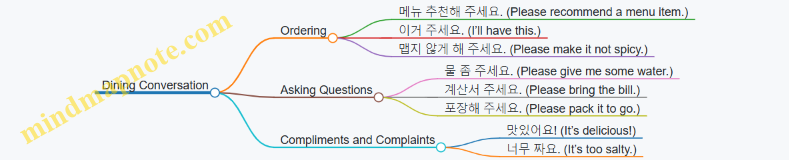
Mind Map 3: Asking for and Giving Directions
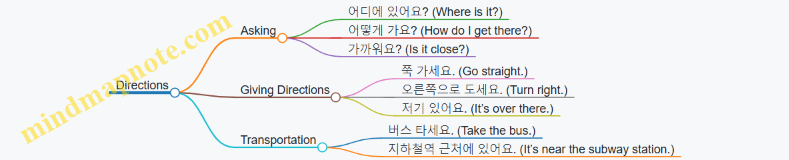
Example 1: Shopping Dialogue
Customer: 안녕하세요? 이 셔츠 얼마에요?
Shopkeeper: 안녕하세요! 이 셔츠는 25,000원이에요.
Customer: 좀 깎아 주세요.
Shopkeeper: 음, 23,000원에 드릴게요.
Customer: 좋아요. 카드 돼요?
Shopkeeper: 네, 카드 가능합니다.
Explanation: This dialogue shows polite greetings, asking price, bargaining, and payment method. Notice the polite ending ~요 used throughout.
Example 2: Dining Out Dialogue
Customer: 메뉴 추천해 주세요.
Waiter: 불고기 덮밥이 인기가 많아요.
Customer: 그럼, 불고기 덮밥 주세요. 맵지 않게 해 주세요.
Waiter: 네, 알겠습니다. 물도 드릴까요?
Customer: 네, 물 주세요.
(After eating)
Customer: 계산서 주세요.
Waiter: 여기 있습니다. 감사합니다!
Explanation: This conversation covers ordering, requesting modifications, asking for water, and paying the bill. The polite and clear phrasing helps avoid misunderstandings.
Example 3: Asking for Directions
Traveler: 실례합니다, 지하철역 어디에 있어요?
Local: 쭉 가세요, 그리고 오른쪽으로 도세요.
Traveler: 가까워요?
Local: 네, 5분 정도 걸려요.
Explanation: The traveler politely asks for directions, and the local gives clear instructions with approximate distance.
Integrated Practice Drill
Imagine you are in a Korean city. You want to buy a souvenir, eat lunch, and then find the subway station.
Step 1: Shopping
- Greet the shopkeeper.
- Ask the price of the item.
- Try to negotiate a discount.
- Confirm payment method.
Step 2: Dining
- Ask for menu recommendations.
- Order a dish with a specific request (e.g., less spicy).
- Request water.
- Ask for the bill.
Step 3: Directions
- Ask where the subway station is.
- Listen to directions and repeat them to confirm.
Try practicing these steps aloud or with a partner. Use the mind maps to recall useful phrases. The goal is to build confidence in moving smoothly between different everyday situations.
This integrated approach helps you see how vocabulary and sentence patterns connect across contexts. Practicing this way prepares you for real conversations that rarely stick to just one topic.
12.3 Role-Play: Family, Friends, and Social Situations
Role-playing conversations about family, friends, and social situations helps build confidence in everyday Korean communication. These scenarios focus on common interactions, such as introducing family members, talking about relationships, making plans with friends, and expressing feelings. Below are structured mind maps and example dialogues to guide your practice.
Mind Map 1: Introducing Family Members
Example Dialogue:
- A: 가족 소개 좀 해 주세요. (Please introduce your family.)
- B: 네, 부모님과 형, 그리고 저 이렇게 네 명이에요. (Sure, there are four of us: my parents, my older brother, and me.)
Mind Map 2: Talking About Friends and Social Activities
Example Dialogue:
- A: 이번 주말에 친구들이랑 뭐 할 거예요? (What are you going to do with your friends this weekend?)
- B: 같이 등산하러 갈 거예요. 같이 갈래요? (We’re going hiking together. Would you like to join?)
Mind Map 3: Expressing Feelings and Opinions in Social Contexts
Example Dialogue:
- A: 그 영화 어땠어요? (How was the movie?)
- B: 저는 재미있었어요. 특히 배우 연기가 좋았어요. (I found it interesting. Especially the acting was good.)
- A: 저도요. 다음에 또 같이 봐요. (Me too. Let’s watch another one together next time.)
Practice Role-Play Scenarios
Scenario 1: Introducing Your Family to a New Friend
- A: 가족이 어떻게 되세요? (Who is in your family?)
- B: 부모님과 두 동생이 있어요. (I have parents and two younger siblings.)
- A: 동생들은 몇 살이에요? (How old are your siblings?)
- B: 형은 18살이고, 여동생은 14살이에요. (My older brother is 18, and my younger sister is 14.)
Scenario 2: Making Plans with Friends
- A: 이번 주 토요일에 뭐 해요? (What are you doing this Saturday?)
- B: 아직 계획 없어요. 같이 영화 볼래요? (No plans yet. Do you want to watch a movie together?)
- A: 좋아요! 몇 시에 만날까요? (Sounds good! What time shall we meet?)
- B: 오후 3시에 영화관 앞에서 만나요. (Let’s meet in front of the cinema at 3 PM.)
Scenario 3: Talking About a Friend’s Personality
- A: 친구가 어때요? (How is your friend?)
- B: 아주 친절하고 재미있어요. 항상 웃어요. (Very kind and funny. Always smiling.)
- A: 좋은 친구네요. (Sounds like a good friend.)
These role-play exercises encourage you to use common vocabulary and sentence structures naturally. Try switching roles and varying the details to deepen your familiarity. Practicing these conversations will help you navigate social situations with ease and clarity.
12.4 Practice Drills: Work, School, and Health Scenarios
This section focuses on practical speaking drills tailored to common situations in work, school, and health contexts. Each drill includes a mind map to organize key vocabulary and phrases, followed by example dialogues to illustrate natural usage.
Mind Map: Work-Related Conversations
Example Dialogue 1: Asking About a Meeting
- A: 오늘 회의는 몇 시에 시작해요? (What time does the meeting start today?)
- B: 오전 10시에 시작해요. (It starts at 10 a.m.)
- A: 알겠습니다. 감사합니다. (Got it. Thank you.)
Mind Map: School-Related Conversations
Example Dialogue 2: Asking for Homework Help
- A: 숙제가 어려워요. 도와줄 수 있어요? (The homework is difficult. Can you help me?)
- B: 네, 같이 해 봐요. (Yes, let’s do it together.)
Mind Map: Health-Related Conversations
Example Dialogue 3: Describing Symptoms to a Doctor
- A: 배가 아파요. (My stomach hurts.)
- B: 언제부터 아팠어요? (Since when has it hurt?)
- A: 어제부터요. (Since yesterday.)
- B: 식사는 잘 하셨어요? (Have you been eating well?)
Practice Drill Instructions
-
Role-Play: Pair up and take turns playing the roles of employee and manager, student and teacher, or patient and doctor using the example dialogues as a base. Try to expand the conversation by adding your own questions or comments.
-
Fill-in-the-Blanks: Use the mind maps to create your own sentences by filling in missing words. For example, “오늘 ___는 몇 시에 시작해요?” (What time does today’s ___ start?)
-
Create Your Own Dialogue: Write a short conversation involving at least three phrases from the mind maps in each category. Practice speaking it aloud.
-
Switch Politeness Levels: Practice the same dialogue in both polite and casual forms to understand context-appropriate speech.
This section encourages active use of vocabulary and sentence structures in realistic settings. The mind maps help organize thoughts, while examples demonstrate natural flow. Repetition through varied drills builds confidence and fluency in everyday Korean conversations related to work, school, and health.
12.5 Final Speaking Exercises: Everyday Korean Conversations
This section offers practical speaking exercises designed to combine the vocabulary, grammar, and conversational patterns covered throughout the book. The goal is to simulate real-life situations where you can practice natural Korean dialogue. Each exercise includes a mind map to organize key phrases and concepts, followed by example dialogues and tips.
Exercise 1: Meeting Someone New
Mind Map: Meeting Someone New
Example Dialogue:
A: 안녕하세요? 처음 뵙겠습니다.
B: 안녕하세요! 저는 민수예요. 만나서 반가워요.
A: 저는 제인입니다. 직업이 뭐예요?
B: 저는 학생이에요. 제인은요?
A: 저는 회사원입니다. 취미가 뭐예요?
B: 저는 음악 듣는 것을 좋아해요. 제인은요?
A: 저는 등산을 좋아해요.
B: 다음에 같이 등산 가요!
A: 좋아요. 잘 부탁드립니다.
Tips:
- Use polite forms when meeting someone for the first time.
- Keep questions simple and related to personal information.
- Respond with short, clear answers.
Exercise 2: Ordering Food at a Restaurant
Mind Map: Ordering Food
Example Dialogue:
손님: 안녕하세요. 메뉴 좀 보여 주세요.
직원: 네, 여기 있습니다.
손님: 이 김치찌개 주세요. 매운 음식 좋아해요.
직원: 알겠습니다. 혹시 밥도 드릴까요?
손님: 네, 주세요.
(식사 후)
손님: 계산서 주세요.
직원: 네, 여기 있습니다.
Tips:
- Use polite requests with ~주세요.
- When unsure about ingredients, ask to avoid allergies.
- Express preferences to get suitable recommendations.
Exercise 3: Asking for Directions
Mind Map: Asking for Directions
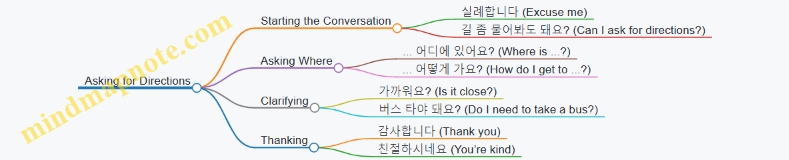
Example Dialogue:
A: 실례합니다. 지하철역이 어디에 있어요?
B: 저기 큰 길 따라 쭉 가면 오른쪽에 있어요.
A: 가까워요?
B: 네, 걸어서 5분 정도 걸려요.
A: 감사합니다.
B: 천만에요.
Tips:
- Start politely with 실례합니다.
- Use simple directional words like 왼쪽 (left), 오른쪽 (right), 쭉 (straight).
- Confirm if the destination is nearby.
Exercise 4: Making Plans with Friends
Mind Map: Making Plans
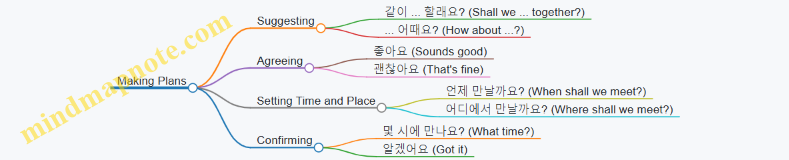
Example Dialogue:
A: 이번 주말에 같이 영화 볼래요?
B: 좋아요! 언제 만날까요?
A: 토요일 오후 3시에 영화관 앞에서 만나요.
B: 알겠어요. 그때 봐요.
Tips:
- Use casual polite forms with friends.
- Be clear about time and place.
- Confirm details to avoid confusion.
Exercise 5: Talking About Your Day
Mind Map: Talking About Your Day
Example Dialogue:
A: 오늘 어땠어요?
B: 학교에 갔어요. 수업이 재미있었어요.
A: 좋네요. 저는 일하느라 피곤했어요.
B: 내일은 좀 쉬세요.
A: 네, 고마워요.
Tips:
- Use past tense verbs to describe completed actions.
- Share simple feelings to keep conversation engaging.
- Ask the other person about their day to maintain flow.
These exercises encourage you to combine vocabulary and grammar naturally. Repeating these dialogues aloud, switching roles, and adapting phrases to your own experiences will build confidence. Remember, the goal is clear communication, not perfection. Keep practicing, and everyday Korean conversation will become easier and more enjoyable.