Quantum Computing Architectures And Real World Applications
1. Introduction to Quantum Computing Architectures
1.1 Overview of Quantum Computing Principles
Quantum computing represents a paradigm shift from classical computing by leveraging the unique properties of quantum mechanics. Unlike classical bits that exist in a state of 0 or 1, quantum bits or qubits can exist in superpositions, enabling quantum computers to process a vast number of possibilities simultaneously.
Key Quantum Computing Principles
Below is a mind map illustrating the foundational principles:
Qubits
Definition: The fundamental unit of quantum information analogous to classical bits but with quantum properties.
-
Superposition: A qubit can be in a combination of |0⟩ and |1⟩ states simultaneously.
-
Entanglement: Qubits can be correlated in such a way that the state of one instantly influences the state of another, regardless of distance.
-
Measurement: Observing a qubit collapses its superposition to a definite classical state (0 or 1).
Example:
Consider a qubit initialized in state |0⟩. Applying a Hadamard gate (H) transforms it into a superposition:
This means the qubit has a 50% chance of being measured as 0 and 50% as 1.
Mind Map: Qubit Properties
Quantum Gates
Quantum gates manipulate qubits similarly to logic gates in classical computing but operate on quantum states.
-
Single-Qubit Gates: Examples include Pauli-X (bit-flip), Pauli-Z (phase-flip), and Hadamard (creates superposition).
-
Multi-Qubit Gates: Controlled-NOT (CNOT) gate entangles two qubits.
Example:
Applying a CNOT gate on two qubits where the first is in superposition and the second in |0⟩:
Initial state: (|0⟩ + |1⟩)/√2 ⊗ |0⟩
After CNOT:
(|00⟩ + |11⟩)/√2 — an entangled Bell state.
Mind Map: Quantum Gates
Quantum Circuits
Quantum circuits are sequences of quantum gates applied to qubits to perform computations.
Example:
A simple quantum circuit to create a Bell state:
- Apply Hadamard gate to qubit 0.
- Apply CNOT gate with qubit 0 as control and qubit 1 as target.
This circuit generates an entangled state used in quantum communication protocols.
Quantum Algorithms
Quantum algorithms exploit quantum principles to solve problems more efficiently than classical counterparts.
- Shor’s Algorithm: Efficient integer factorization.
- Grover’s Algorithm: Quadratic speedup for unstructured search.
Example:
Grover’s algorithm can search an unsorted database of N items in roughly √N steps instead of N.
Mind Map: Quantum Algorithms
Quantum Decoherence and Noise
Quantum states are fragile and susceptible to noise and decoherence, which cause loss of quantum information.
Best Practice Example:
Designing quantum algorithms with error mitigation techniques, such as dynamical decoupling or error-correcting codes, helps maintain coherence during computation.
Summary
Understanding these quantum computing principles is essential for software engineers, research scientists, and industry analysts to design, analyze, and implement quantum architectures and applications effectively. The interplay of qubits, gates, circuits, and algorithms forms the foundation upon which real-world quantum solutions are built.
1.2 Historical Evolution of Quantum Architectures
Quantum computing, a field that merges quantum mechanics with computer science, has undergone a fascinating evolution since its conceptual inception. Understanding this historical trajectory is crucial for software engineers, research scientists, and industry analysts to appreciate the architectural decisions shaping today’s quantum computers.
Early Theoretical Foundations (1980s)
- Richard Feynman (1981): Proposed the idea that classical computers cannot efficiently simulate quantum systems, suggesting the need for quantum computers.
- David Deutsch (1985): Formulated the first universal quantum computer model, introducing the concept of quantum gates and circuits.
Example: Deutsch’s quantum Turing machine laid the groundwork for quantum circuit models used today.
First Quantum Algorithms and Models (1990s)
-
Shor’s Algorithm (1994): Peter Shor developed a quantum algorithm for integer factorization, demonstrating quantum advantage potential.
-
Grover’s Algorithm (1996): Lov Grover introduced a quantum search algorithm with quadratic speedup.
-
Quantum Circuit Model: Became the dominant architecture model, focusing on sequences of quantum gates acting on qubits.
Best Practice: Early adoption of the circuit model enabled modular algorithm design, which remains a cornerstone in quantum software development.
Physical Realizations and Prototype Architectures (Late 1990s - 2000s)
- Ion Trap Quantum Computers: Cirac and Zoller proposed using trapped ions as qubits, leading to early experimental prototypes.
- Superconducting Qubits: Development of Josephson junction-based qubits began, offering scalability advantages.
Example: The first 2-qubit ion trap quantum computer was demonstrated in 1998, showcasing entanglement and gate operations.
Emergence of Scalable Architectures (2010s)
- Surface Codes and Topological Qubits: Introduced to improve fault tolerance and error correction.
- Quantum Annealers: D-Wave Systems commercialized quantum annealing devices targeting optimization problems.
- Cloud Quantum Computing: IBM and others launched cloud-accessible quantum processors, democratizing access.
Best Practice: Leveraging cloud platforms accelerates experimentation and application development without heavy hardware investment.
Current Trends and Hybrid Architectures (2020s and Beyond)
- Noisy Intermediate-Scale Quantum (NISQ) Devices: Focus on architectures that can operate with limited qubits and noise.
- Hybrid Classical-Quantum Systems: Integration of classical processors with quantum co-processors for enhanced performance.
- Photonic and Topological Qubits: Exploration of new qubit types for improved coherence and scalability.
Example: Google’s Sycamore processor demonstrated quantum supremacy in 2019 using a superconducting qubit architecture.
Mind Map: Historical Evolution of Quantum Architectures
Summary
The historical evolution of quantum architectures reflects a journey from theoretical concepts to practical, scalable systems. Each phase introduced architectural innovations and best practices that continue to influence current quantum computing developments. By studying these milestones and their examples, professionals can better navigate the rapidly evolving quantum landscape.
1.3 Key Quantum Bits (Qubits) Types and Characteristics
Quantum bits, or qubits, are the fundamental units of quantum information. Unlike classical bits that represent either 0 or 1, qubits exploit quantum mechanical phenomena such as superposition and entanglement, enabling quantum computers to solve certain problems more efficiently.
Types of Qubits
There are several physical implementations of qubits, each with unique characteristics, advantages, and challenges. Understanding these types is crucial for designing quantum architectures tailored to specific applications.
Mind Map: Overview of Qubit Types
Superconducting Qubits
Characteristics:
- Implemented using Josephson junctions on superconducting circuits.
- Operate at millikelvin temperatures in dilution refrigerators.
- Fast gate times (~10-100 ns).
- Relatively short coherence times (tens to hundreds of microseconds).
Example: IBM’s quantum processors use transmon qubits, a type of superconducting qubit optimized for reduced sensitivity to charge noise.
Best Practice: Optimize qubit design to balance coherence time and gate speed. For example, transmon qubits trade off some anharmonicity for improved coherence.
Trapped Ion Qubits
Characteristics:
- Use ions confined in electromagnetic traps.
- Qubit states encoded in electronic or hyperfine levels.
- Long coherence times (seconds to minutes).
- Slower gate operations (~10-100 microseconds).
Example: IonQ and Honeywell use trapped ion qubits for high-fidelity quantum operations.
Best Practice: Leverage long coherence times for algorithms requiring deep circuits, but optimize laser control to improve gate speeds.
Photonic Qubits
Characteristics:
- Use photons as qubits, encoding information in polarization, path, or time-bin.
- Room temperature operation.
- Excellent for quantum communication due to low loss in optical fibers.
- Challenges in deterministic two-qubit gates.
Example: Xanadu’s photonic quantum computers use squeezed light and continuous-variable quantum computing.
Best Practice: Use photonic qubits for quantum networking and communication applications; combine with other qubit types for computation.
Topological Qubits
Characteristics:
- Based on exotic quasiparticles like Majorana fermions.
- Theoretically robust against local noise due to topological protection.
- Still in experimental and theoretical development stages.
Example: Microsoft is researching topological qubits aiming for fault-tolerant quantum computing.
Best Practice: Focus on error resilience; however, practical implementations are still emerging.
Spin Qubits
Characteristics:
- Use electron or nuclear spins in semiconductors.
- Potential for integration with existing semiconductor technology.
- Coherence times vary widely depending on material and environment.
Example: Research groups at Delft University and others are developing silicon spin qubits.
Best Practice: Optimize material purity and isotopic composition to enhance coherence.
Quantum Dots
Characteristics:
- Semiconductor nanostructures confining electrons.
- Qubits encoded in spin or charge states.
- Potential for scalability and integration.
Example: Quantum dots are explored for scalable quantum processors by companies like Intel.
Best Practice: Control charge noise and improve fabrication techniques for uniformity.
Mind Map: Qubit Characteristics Comparison
Example: Choosing Qubit Types for Applications
- Quantum Simulation of Molecules: Trapped ion qubits are preferred due to long coherence times allowing deep circuits.
- Quantum Cryptography and Communication: Photonic qubits excel because of ease of transmission over optical fibers.
- Near-Term Quantum Processors: Superconducting qubits dominate due to fast gate speeds and existing fabrication infrastructure.
Summary
Understanding the types and characteristics of qubits is foundational to quantum architecture design. Each qubit type offers trade-offs between coherence, gate speed, scalability, and operational complexity. Selecting the appropriate qubit technology aligned with application requirements and best practices ensures effective quantum computing solutions.
1.4 Best Practices: Selecting Qubit Types for Specific Use Cases with Examples
Selecting the right qubit type is a foundational decision in designing quantum computing architectures. Different qubit technologies offer unique advantages and limitations depending on the application, scalability needs, coherence times, and error rates. This section explores best practices for choosing qubit types tailored to specific use cases, supported by clear examples and mind maps to aid understanding.
Key Factors in Selecting Qubit Types
- Coherence Time: Duration a qubit maintains its quantum state.
- Gate Fidelity: Accuracy of quantum gate operations.
- Scalability: Ease of increasing qubit count.
- Connectivity: Ability to entangle qubits efficiently.
- Operational Temperature: Cryogenic requirements.
- Physical Footprint: Size and complexity of qubit implementation.
Mind Map: Factors Influencing Qubit Selection
Common Qubit Types and Use Case Suitability
| Qubit Type | Strengths | Limitations | Ideal Use Cases |
|---|---|---|---|
| Superconducting | Fast gate speeds, good scalability | Requires dilution refrigerators, moderate coherence | Quantum simulation, optimization, NISQ devices |
| Trapped Ion | Long coherence, high fidelity gates | Slower gates, complex laser control | Precision quantum simulation, error correction research |
| Photonic | Room temperature operation, easy transmission | Difficult two-qubit gates, photon loss | Quantum communication, quantum networking |
| Topological | Theoretical robustness to errors | Experimental, not yet mature | Future fault-tolerant quantum computing |
Example 1: Optimization Problem Using Superconducting Qubits
Scenario: A financial firm wants to solve portfolio optimization problems using quantum annealing.
Qubit Choice Rationale: Superconducting qubits (e.g., D-Wave’s quantum annealers) provide fast gate speeds and scalability, suitable for combinatorial optimization.
Outcome: The firm achieves faster approximate solutions compared to classical heuristics, benefiting from the hardware’s ability to handle large qubit arrays.
Example 2: Quantum Simulation in Chemistry Using Trapped Ion Qubits
Scenario: A research lab simulates molecular interactions requiring high-fidelity operations.
Qubit Choice Rationale: Trapped ion qubits offer long coherence times and high gate fidelity, essential for accurate quantum simulations.
Outcome: The lab successfully models complex molecules with reduced error rates, advancing drug discovery efforts.
Mind Map: Matching Qubit Types to Use Cases
Best Practice Guidelines
- Define Application Requirements Clearly: Identify coherence, fidelity, and connectivity needs upfront.
- Evaluate Hardware Maturity: Choose qubit types with proven stability for production use; experimental types for research.
- Consider Integration Complexity: Factor in cooling and control system demands.
- Plan for Scalability: Anticipate future growth in qubit count and connectivity.
- Leverage Hybrid Architectures: Combine qubit types when beneficial (e.g., photonic links with superconducting processors).
Example 3: Hybrid Architecture for Quantum Networking
Scenario: A company develops a distributed quantum computing system.
Qubit Choice Rationale: Uses superconducting qubits for processing nodes and photonic qubits for communication links.
Outcome: Achieves efficient quantum information transfer between nodes, balancing processing power and network reach.
Summary
Selecting the appropriate qubit type is a multi-dimensional decision influenced by the target application, hardware constraints, and future scalability. By systematically analyzing these factors and learning from real-world examples, architects can optimize quantum system design for maximum impact.
1.5 Challenges in Quantum Hardware Design and Mitigation Strategies
Quantum hardware design is at the forefront of quantum computing research and development. Despite significant advances, several critical challenges remain that impact the stability, scalability, and performance of quantum computers. This section explores these challenges in detail and presents mitigation strategies supported by practical examples.
Key Challenges in Quantum Hardware Design
Mind Map: Challenges in Quantum Hardware Design
Qubit Coherence and Decoherence
Challenge: Qubits lose their quantum state due to interactions with the environment, a phenomenon called decoherence. This limits the time available for computations.
Mitigation Strategies:
- Use of error-correcting codes to protect quantum information.
- Engineering materials and shielding to reduce environmental noise.
- Employing dynamical decoupling techniques to prolong coherence.
Example: Superconducting qubits, such as those used by IBM, employ 3D cavity resonators to isolate qubits from electromagnetic interference, extending coherence times from microseconds to milliseconds.
Qubit Connectivity and Crosstalk
Challenge: Limited direct interactions between qubits restrict the types of quantum gates and algorithms that can be efficiently implemented. Crosstalk between qubits can introduce errors.
Mitigation Strategies:
- Designing architectures with nearest-neighbor and long-range coupling (e.g., ion traps with phonon-mediated interactions).
- Implementing error mitigation protocols and pulse shaping to reduce crosstalk.
Example: Trapped ion quantum computers use chains of ions where entanglement gates are mediated through collective vibrational modes, enabling all-to-all connectivity.
Scalability
Challenge: Increasing the number of qubits while maintaining control and coherence is difficult due to hardware complexity and noise.
Mitigation Strategies:
- Modular architectures that connect smaller quantum processors.
- Integration of control electronics closer to qubits to reduce latency.
- Use of error correction to enable logical qubits from multiple physical qubits.
Example: Google’s Sycamore processor uses a 2D grid of 53 superconducting qubits, demonstrating scalability while maintaining gate fidelity.
Error Rates and Gate Fidelity
Challenge: Quantum gates are prone to errors due to imperfect control and noise, limiting the accuracy of computations.
Mitigation Strategies:
- Calibration routines to optimize gate parameters.
- Composite pulse sequences to reduce systematic errors.
- Quantum error correction codes like the surface code.
Example: IBM employs randomized benchmarking to measure and improve gate fidelities, achieving single-qubit gate errors below 0.1%.
Thermal Management
Challenge: Most quantum hardware requires ultra-low temperatures (millikelvin range) to operate, demanding sophisticated cryogenic systems.
Mitigation Strategies:
- Development of compact dilution refrigerators.
- Minimizing heat load from control wiring.
- Exploring alternative qubit technologies operable at higher temperatures.
Example: D-Wave’s quantum annealers operate at approximately 15 millikelvin using custom cryostats while optimizing wiring to reduce thermal noise.
Fabrication Variability
Challenge: Variations in fabrication processes cause inconsistencies in qubit parameters, affecting performance and yield.
Mitigation Strategies:
- Advanced lithography and material purification techniques.
- Post-fabrication tuning of qubit frequencies.
- Redundant design elements to compensate for defects.
Example: Superconducting qubit manufacturers use laser trimming and flux biasing to fine-tune qubit frequencies after fabrication.
Summary Mind Map: Mitigation Strategies for Quantum Hardware Challenges
Mind Map: Mitigation Strategies
Integrated Example: Mitigating Decoherence in Superconducting Qubits
IBM’s quantum processors combine multiple mitigation strategies:
- Use of 3D cavities for shielding.
- Dynamical decoupling pulse sequences to extend coherence.
- Calibration and error correction protocols.
- Operating at 15 millikelvin in dilution refrigerators.
This integrated approach has enabled IBM to scale from a few qubits to over 100 qubits with steadily improving coherence times and gate fidelities.
Conclusion
Quantum hardware design faces multifaceted challenges that require a combination of material science, engineering, and algorithmic solutions. Understanding these challenges and applying best practices with concrete examples is essential for advancing quantum computing from experimental setups to practical, scalable machines.
2. Quantum Hardware Architectures
2.1 Superconducting Qubits: Design and Operation
Superconducting qubits are among the most widely used and researched quantum bits in today’s quantum computing landscape. Leveraging superconducting circuits cooled to cryogenic temperatures, these qubits exploit macroscopic quantum effects to encode and manipulate quantum information.
What Are Superconducting Qubits?
Superconducting qubits are artificial atoms made from superconducting materials that behave like two-level quantum systems. They are fabricated using lithographic techniques similar to those used in classical integrated circuits.
Core Components and Principles
- Josephson Junction: The nonlinear, non-dissipative element that provides the anharmonicity necessary for qubit operation.
- Capacitors and Inductors: Form the resonant circuit that defines the qubit’s energy levels.
- Cryogenic Environment: Typically operated at millikelvin temperatures using dilution refrigerators to maintain superconductivity and reduce thermal noise.
Types of Superconducting Qubits
- Transmon Qubits: Designed to reduce charge noise sensitivity by increasing the ratio of Josephson energy to charging energy.
- Flux Qubits: Use magnetic flux to define qubit states.
- Phase Qubits: Operate based on the phase difference across the Josephson junction.
Mind Map: Superconducting Qubit Design Components
Operation Principles
Superconducting qubits operate by manipulating the quantum states of the circuit’s energy levels, typically the ground state |0⟩ and first excited state |1⟩. Microwave pulses are applied to induce transitions between these states, enabling quantum gate operations.
- Initialization: Cooling the qubit to its ground state.
- Control: Applying microwave pulses to perform single- and multi-qubit gates.
- Readout: Measuring the qubit state via dispersive readout techniques using coupled resonators.
Mind Map: Superconducting Qubit Operation
Best Practice: Designing a Transmon Qubit for Noise Resilience
Example:
- Increase the ratio of Josephson energy (E_J) to charging energy (E_C) to reduce charge noise sensitivity.
- Use large shunt capacitors to increase E_C denominator.
- Optimize junction fabrication to minimize defects.
This approach is widely adopted in IBM and Google quantum processors to enhance coherence times.
Example: Simple Transmon Qubit Circuit
Practical Example: Implementing a Single-Qubit Gate
- Apply a resonant microwave pulse at the qubit transition frequency.
- Pulse duration and amplitude determine the rotation angle on the Bloch sphere.
Example: A π-pulse flips the qubit from |0⟩ to |1⟩.
Summary
Superconducting qubits combine advanced materials science, microwave engineering, and cryogenics to realize scalable quantum processors. Their design and operation principles are foundational knowledge for software engineers and researchers working on quantum computing platforms.
Understanding these concepts enables better algorithm design, error mitigation, and hardware-aware software development.
2.2 Trapped Ion Quantum Computers: Architecture and Control
Trapped ion quantum computers represent one of the most mature and promising quantum computing architectures. They leverage ions—charged atoms—confined and manipulated using electromagnetic fields to serve as qubits. This section explores the architecture, control mechanisms, and best practices for trapped ion quantum computing, supported by detailed mind maps and practical examples.
Overview of Trapped Ion Quantum Architecture
Trapped ion quantum computers use ions suspended in ultra-high vacuum chambers by electromagnetic traps. Each ion acts as a qubit, with quantum information encoded in its internal electronic states.
- Ion Trapping: Typically achieved using Paul traps (radio-frequency traps) or Penning traps.
- Qubit Encoding: Hyperfine or Zeeman energy levels of ions serve as qubit states.
- Quantum Gates: Implemented via laser pulses that induce coherent transitions.
- Readout: State-dependent fluorescence allows measurement of qubit states.
Mind Map: Core Components of Trapped Ion Quantum Computers
Ion Trapping and Qubit Initialization
Ions are trapped using oscillating electric fields in a vacuum chamber to isolate them from environmental noise. Initialization involves cooling ions close to their motional ground state using Doppler and resolved sideband cooling techniques.
Example: In a typical experiment with (^{171}Yb^+) ions, Doppler cooling is applied using a 369.5 nm laser, followed by sideband cooling to prepare the ions for high-fidelity gate operations.
Quantum Gate Implementation and Control
Laser pulses are the primary tool for manipulating trapped ion qubits:
- Single-Qubit Gates: Achieved by resonant laser pulses inducing Rabi oscillations between qubit states.
- Two-Qubit Gates: Entangling gates such as the Mølmer–Sørensen gate use collective motional modes of ions to create entanglement.
Mind Map: Quantum Gate Control in Trapped Ion Systems
Best Practice Example: To minimize gate errors, calibrate laser pulse durations precisely and stabilize laser frequencies using optical cavities. For instance, Honeywell Quantum Solutions demonstrated two-qubit gate fidelities exceeding 99.9% by employing such techniques.
Readout and Measurement
Measurement is performed via state-dependent fluorescence: ions in one qubit state fluoresce when illuminated by a detection laser, while ions in the other state remain dark.
Example: In (^{171}Yb^+) systems, the (|0\rangle) state scatters photons detected by a photomultiplier tube, enabling high-fidelity single-shot readout.
Control Electronics and Feedback
Precise timing and control electronics synchronize laser pulses, trap voltages, and measurement sequences. Real-time feedback can be used to correct drifts and improve gate fidelity.
Example: The use of FPGA-based controllers allows sub-microsecond timing resolution, critical for complex quantum algorithms.
Scalability Considerations
Scaling trapped ion systems involves challenges such as crosstalk, ion heating, and trap complexity.
- Segmented Traps: Allow shuttling ions between zones to perform gates on subsets.
- Photonic Interconnects: Enable linking multiple ion traps via photons for distributed quantum computing.
Mind Map: Scalability Strategies for Trapped Ion Quantum Computers
Example: IonQ’s commercial trapped ion quantum computers utilize segmented traps and automated calibration routines to scale up qubit numbers while maintaining gate fidelity.
Summary of Best Practices with Examples
| Best Practice | Description | Example |
|---|---|---|
| Laser Stabilization | Use optical cavities and feedback loops to stabilize lasers | Honeywell achieved >99.9% gate fidelity with stabilized lasers |
| Ion Cooling | Employ Doppler and sideband cooling to reduce motional noise | (^{171}Yb^+) ions cooled to motional ground state before gate operations |
| Real-Time Feedback | Use FPGA controllers for precise timing and error correction | FPGA-based control systems enabling sub-microsecond pulse timing |
| Segmented Trap Design | Facilitate ion shuttling to scale qubit numbers | IonQ’s modular trap architecture |
| State-Dependent Fluorescence Readout | High-fidelity single-shot measurement | Photon counting in (^{171}Yb^+) systems for >99% readout fidelity |
Practical Example: Implementing a Two-Qubit Mølmer–Sørensen Gate
- Prepare ions: Cool two (^{40}Ca^+) ions to motional ground state.
- Apply bichromatic laser fields: Drive collective motional modes to entangle qubits.
- Calibrate pulse duration and phase: Optimize for maximal entanglement fidelity.
- Measure output states: Use fluorescence detection to verify entanglement.
This gate forms the backbone of many quantum algorithms on trapped ion platforms.
Conclusion
Trapped ion quantum computers offer a highly controllable and coherent platform for quantum computation. Their architecture, centered on electromagnetic ion traps and laser-driven control, enables precise quantum gate operations with some of the highest fidelities reported. Understanding the interplay between hardware design, control techniques, and error mitigation is essential for advancing trapped ion quantum computing toward scalable, real-world applications.
2.3 Topological Qubits: Theory and Emerging Implementations
Introduction
Topological qubits represent a promising approach to building robust quantum computers by leveraging the principles of topology in quantum physics. Unlike conventional qubits, which are susceptible to local noise and decoherence, topological qubits encode information in global properties of the system, making them inherently more resistant to errors.
Theoretical Foundations of Topological Qubits
Topological quantum computing relies on exotic quasiparticles called anyons, particularly non-Abelian anyons, which exhibit unique braiding statistics. The key idea is that the quantum information is stored non-locally in the system’s topology, making it less vulnerable to local disturbances.
- Key Concepts:
- Topology: Study of properties preserved under continuous deformations.
- Anyons: Quasiparticles in 2D systems with statistics different from bosons and fermions.
- Braiding: Exchanging anyons changes the quantum state in a way that depends on the path taken.
- Non-Abelian Anyons: Braiding operations do not commute, enabling quantum gate operations.
Mind Map: Theoretical Concepts of Topological Qubits
Physical Realizations and Emerging Implementations
Several physical platforms are being explored to realize topological qubits. The most prominent among these are Majorana zero modes in topological superconductors.
Majorana-Based Topological Qubits
- Majorana Fermions: Particles that are their own antiparticles, predicted to exist as zero-energy modes at the edges or defects of certain superconducting materials.
- Implementation: Semiconductor nanowires with strong spin-orbit coupling coupled to superconductors under magnetic fields.
- Example: Microsoft’s StationQ project focuses on engineering and detecting Majorana zero modes for topological qubits.
Best Practice Example: Designing a Majorana Qubit
- Use hybrid semiconductor-superconductor nanowires.
- Apply external magnetic fields to induce topological superconductivity.
- Detect zero-bias conductance peaks as signatures of Majorana modes.
Quantum Hall Effect and Fractional Quantum Hall States
- Use 2D electron gases under strong magnetic fields to create anyonic excitations.
- Experimental efforts focus on detecting non-Abelian anyons in fractional quantum Hall states at filling factor 5/2.
Topological Insulator-Superconductor Heterostructures
- Combine topological insulators with superconductors to host Majorana modes at interfaces.
Mind Map: Physical Implementations of Topological Qubits
Advantages of Topological Qubits
- Intrinsic Error Protection: Encoding in global topology reduces decoherence.
- Fault Tolerance: Braiding operations are topologically protected quantum gates.
- Scalability Potential: Modular design possible with networks of nanowires or 2D materials.
Challenges and Current Limitations
- Experimental Verification: Definitive proof of Majorana modes and non-Abelian statistics remains challenging.
- Complex Fabrication: Requires ultra-clean materials and precise control of parameters.
- Slow Gate Operations: Braiding can be slower compared to other qubit operations.
Example: Microsoft’s Approach to Topological Qubits
Microsoft’s StationQ initiative focuses on building topological qubits using Majorana zero modes. Their approach includes:
- Fabricating hybrid nanowires with epitaxial superconductor layers.
- Using tunneling spectroscopy to detect Majorana signatures.
- Developing scalable architectures based on networks of nanowires.
This example highlights best practices such as combining material science, device engineering, and theoretical modeling to advance topological qubit development.
Summary
Topological qubits offer a compelling path toward robust and fault-tolerant quantum computing by encoding information in the system’s topology. While still in early experimental stages, their unique properties provide a promising foundation for next-generation quantum architectures.
Additional Mind Map: Summary Overview
2.4 Photonic Quantum Computing Architectures
Photonic quantum computing leverages photons—particles of light—as the fundamental carriers of quantum information. Unlike other qubit implementations, photonic qubits offer advantages such as room-temperature operation, low decoherence, and ease of transmission over long distances, making them highly promising for scalable quantum computing and quantum communication.
Key Concepts in Photonic Quantum Computing
-
Qubit Encoding: Photonic qubits can be encoded in various degrees of freedom:
- Polarization (horizontal/vertical)
- Time-bin encoding
- Path encoding
- Frequency encoding
-
Quantum Gates: Implemented using linear optical elements such as beam splitters, phase shifters, and waveplates.
-
Measurement: Single-photon detectors enable projective measurements essential for readout.
-
Entanglement Generation: Achieved through spontaneous parametric down-conversion (SPDC) or four-wave mixing.
Photonic Quantum Computing Architecture Components
Example: Polarization-Encoded Photonic Qubits
In polarization encoding, the horizontal polarization state \(|H\rangle\) represents \(|0\rangle\) and vertical polarization \(|V\rangle\) represents \(|1\rangle\). Quantum gates such as the Hadamard gate can be implemented with half-wave plates oriented at specific angles.
Best Practice: Use high-quality waveplates and stable interferometric setups to minimize decoherence and maintain gate fidelity.
Example:
- A Hadamard gate on a polarization qubit can be realized by a half-wave plate set at 22.5°.
Photonic Integrated Circuits (PICs)
To scale photonic quantum computers, integration of optical components on a chip is essential. PICs allow for compact, stable, and scalable architectures.
Example: The Xanadu Strawberry Fields platform uses PICs to implement Gaussian boson sampling, a photonic quantum computing approach.
Example: Boson Sampling
Boson sampling is a specialized photonic quantum computing task that samples from the distribution of indistinguishable photons passing through a linear optical network.
Best Practice: Ensure photon indistinguishability and low-loss optical components.
Example:
- Experimental setups use SPDC sources to generate photons and a network of beam splitters and phase shifters to implement the unitary transformation.
Challenges and Mitigation
- Photon Loss: Use low-loss waveguides and high-efficiency detectors.
- Indistinguishability: Employ narrowband filtering and precise timing control.
- Scalability: Develop advanced PIC fabrication and multiplexing techniques.
Summary
Photonic quantum computing architectures harness the unique properties of photons to enable quantum information processing with advantages in coherence and communication. Through sophisticated encoding schemes, integrated photonic circuits, and innovative gate implementations, photonic quantum computers are advancing towards practical, scalable quantum technologies.
Additional Example: Time-Bin Encoding
Time-bin encoding uses early and late arrival times of photons to represent qubit states. This method is robust against polarization mode dispersion in optical fibers.
Best Practice: Use ultra-fast modulators and precise synchronization.
Example:
- Quantum key distribution systems often use time-bin encoding to transmit secure keys over fiber networks.
Mindmap: Summary of Photonic Qubit Encodings
2.5 Best Practices: Optimizing Hardware for Stability and Scalability with Case Studies
Quantum hardware optimization is critical to advancing quantum computing from experimental setups to practical, scalable machines. Stability ensures reliable qubit performance over time, while scalability addresses the challenge of increasing qubit counts without compromising coherence or control.
Key Best Practices for Hardware Optimization
Material and Fabrication Quality
- Use ultra-pure materials to minimize defects and noise sources.
- Employ advanced fabrication techniques like electron-beam lithography for precision.
- Example: Superconducting qubits fabricated on high-quality sapphire substrates show improved coherence times.
Environmental Isolation
- Shield qubits from electromagnetic interference using cryogenic and magnetic shielding.
- Maintain ultra-low temperatures (millikelvin range) with dilution refrigerators.
- Example: Google’s Sycamore processor uses extensive shielding and dilution refrigeration to maintain qubit stability.
Qubit Design Optimization
- Design qubits with tunable parameters to balance coherence and control.
- Use 3D cavity architectures to enhance qubit lifetimes.
- Example: IBM’s transmon qubits utilize a planar design optimized for coherence and scalability.
Error Mitigation at Hardware Level
- Implement hardware-level error suppression techniques like dynamical decoupling.
- Use materials and designs that reduce two-level system (TLS) defects.
- Example: Trapped ion systems use laser pulse shaping to reduce decoherence.
Modular and Scalable Architectures
- Develop modular qubit units that can be interconnected.
- Use quantum interconnects or photonic links for scaling.
- Example: IonQ’s trapped ion system uses modular chains of ions that can be linked.
Control Electronics Integration
- Integrate control electronics close to qubits to reduce latency and noise.
- Use cryo-compatible electronics to operate at low temperatures.
- Example: Recent advances in cryogenic CMOS electronics enable scalable qubit control.
Mind Map: Optimizing Quantum Hardware for Stability and Scalability
Case Study 1: Google’s Sycamore Processor
Context: Google’s Sycamore processor demonstrated quantum supremacy with 53 superconducting qubits.
Optimization Highlights:
- Material Choice: High-purity aluminum on sapphire substrates reduced noise.
- Environmental Control: Extensive magnetic shielding and dilution refrigeration at 15 mK.
- Qubit Design: Fixed-frequency transmon qubits optimized for coherence and gate fidelity.
- Control Electronics: Custom microwave control with low-latency feedback.
Outcome: Achieved coherence times around 20-40 microseconds and two-qubit gate fidelities exceeding 99%.
Best Practice Lessons:
- Prioritize material purity and environmental isolation.
- Design qubits balancing coherence and control ease.
- Integrate control electronics tightly for precise operations.
Case Study 2: IBM Quantum Systems
Context: IBM’s quantum systems use superconducting transmon qubits with a focus on scalability.
Optimization Highlights:
- Modular Design: Qubits arranged in lattice structures enabling scalable connectivity.
- Fabrication: Advanced lithography for uniform qubit fabrication.
- Error Mitigation: Use of dynamical decoupling and optimized pulse shaping.
- Control Integration: Development of cryogenic control electronics to reduce noise.
Outcome: Systems with up to 127 qubits (Eagle processor) with steadily improving coherence and gate fidelities.
Best Practice Lessons:
- Employ modular lattice architectures for scalability.
- Continuously improve fabrication uniformity.
- Combine hardware error mitigation with software error correction.
Case Study 3: IonQ’s Trapped Ion Architecture
Context: IonQ uses trapped ytterbium ions as qubits, leveraging their long coherence times.
Optimization Highlights:
- Qubit Stability: Ions trapped in ultra-high vacuum with laser cooling.
- Scalability: Modular ion chains linked via photonic interconnects.
- Error Mitigation: Laser pulse shaping to reduce decoherence and gate errors.
- Control Electronics: High-precision laser control systems.
Outcome: High-fidelity gates (>99.9%) with coherence times in seconds, enabling complex algorithms.
Best Practice Lessons:
- Use natural atomic qubits for intrinsic stability.
- Develop modular architectures to scale ion chains.
- Optimize laser control for error reduction.
Summary
Optimizing quantum hardware for stability and scalability requires a holistic approach combining materials science, environmental engineering, qubit design, control electronics, and modular architecture. The case studies of Google, IBM, and IonQ illustrate how these best practices translate into real-world quantum processors capable of advancing the field.
By adopting these strategies, researchers and engineers can build more reliable and scalable quantum systems, accelerating the path toward practical quantum advantage.
2.6 Comparative Analysis of Hardware Architectures with Practical Examples
Quantum computing hardware architectures vary significantly in their physical implementation, scalability, error rates, and suitability for different applications. In this section, we provide a detailed comparative analysis of the major quantum hardware architectures, supported by practical examples and mind maps to visualize their differences and use cases.
Overview of Major Quantum Hardware Architectures
- Superconducting Qubits
- Trapped Ion Qubits
- Photonic Qubits
- Topological Qubits
Mind Map: Quantum Hardware Architectures Overview
Comparison Table: Key Metrics
| Feature | Superconducting Qubits | Trapped Ion Qubits | Photonic Qubits | Topological Qubits |
|---|---|---|---|---|
| Qubit Count | 50-100+ (scaling ongoing) | 10-50 (scaling ongoing) | Limited but scalable | Experimental (few qubits) |
| Gate Speed | ~10-100 ns | ~10-100 µs | Variable (ps to ns) | Unknown (theoretical) |
| Coherence Time | ~100 µs | Seconds to minutes | Depends on photon lifetime | Potentially very long |
| Operating Temperature | ~10-20 mK (dilution fridge) | Room temperature (vacuum) | Room temperature | Ultra-low temperatures |
| Error Rates | ~0.1% - 1% | ~0.01% - 0.1% | Higher, improving | Unknown |
| Scalability | Challenging wiring & control | Limited by trap size | Potentially high | Theoretical advantage |
Practical Example 1: Google’s Sycamore (Superconducting)
Google’s Sycamore processor uses superconducting qubits to demonstrate quantum supremacy. It features 53 qubits with fast gate times (~20 ns) and a two-qubit gate fidelity around 99.4%. This architecture excels in speed but requires complex cryogenic setups.
Best Practice: Optimize qubit layout to minimize crosstalk and maximize gate fidelity.
Practical Example 2: IonQ’s Trapped Ion System
IonQ uses trapped ion technology, boasting long coherence times (seconds) and high-fidelity gates (~99.9%). The slower gate speeds (~10-100 µs) are offset by superior qubit quality and all-to-all connectivity.
Best Practice: Leverage all-to-all connectivity for complex quantum circuits without additional swap gates.
Practical Example 3: Xanadu’s Photonic Quantum Computer
Xanadu focuses on photonic qubits, enabling room temperature operation and integration with existing fiber optics. Although deterministic two-qubit gates remain challenging, photonic systems excel in quantum communication and certain sampling problems.
Best Practice: Use photonic architectures for quantum networking and hybrid classical-quantum systems.
Mind Map: Strengths and Weaknesses
Practical Example 4: Microsoft’s Topological Qubit Research
Microsoft is pursuing topological qubits aiming for inherently fault-tolerant quantum computation. While still in the research phase, this approach promises lower error rates and scalability once realized.
Best Practice: Invest in fundamental research to unlock next-generation quantum architectures.
Summary: Choosing the Right Architecture
- For near-term quantum advantage: Superconducting and trapped ion systems are leading candidates.
- For quantum communication and integration: Photonic systems offer unique advantages.
- For long-term fault tolerance: Topological qubits hold promise but require further breakthroughs.
Mind Map: Application Fit by Architecture
This comparative analysis provides a foundation for software engineers, research scientists, and industry analysts to understand the trade-offs and practical considerations when selecting or developing quantum hardware architectures for specific applications.
3. Quantum Software and Middleware Architectures
3.1 Quantum Programming Languages Overview
Quantum programming languages are specialized languages designed to express quantum algorithms and interact with quantum hardware or simulators. They provide abstractions for quantum operations, qubit manipulation, and integration with classical control logic. Understanding the landscape of quantum programming languages is essential for software engineers and researchers aiming to develop efficient quantum applications.
Key Quantum Programming Languages
- Qiskit (Python-based, IBM)
- Cirq (Python-based, Google)
- Q# (Microsoft Quantum Development Kit)
- Quipper (Functional language for quantum computing)
- PyQuil (Rigetti Computing)
- OpenQASM (Quantum Assembly Language)
Mind Map: Quantum Programming Languages Overview
Examples and Best Practices
Example 1: Creating a Bell State in Qiskit
from qiskit import QuantumCircuit, Aer, execute

# Create a Quantum Circuit with 2 qubits
qc = QuantumCircuit(2)

# Apply Hadamard gate to qubit 0
qc.h(0)

# Apply CNOT gate with control qubit 0 and target qubit 1
qc.cx(0, 1)

# Draw the circuit
print(qc.draw())

# Simulate the circuit
simulator = Aer.get_backend('statevector_simulator')
result = execute(qc, simulator).result()
statevector = result.get_statevector()
print(statevector)
Best Practice: Use high-level SDKs like Qiskit to prototype quantum circuits quickly. Simulate locally before deploying to hardware to save costs and debug.
Example 2: Implementing Grover’s Algorithm in Cirq
import cirq

# Define qubits
qubits = [cirq.GridQubit(0, i) for i in range(2)]

# Create circuit
circuit = cirq.Circuit()

# Initialize qubits in superposition
circuit.append([cirq.H(q) for q in qubits])

# Oracle for |11> state
oracle = cirq.Z(qubits[0])**0.5
oracle += cirq.Z(qubits[1])**0.5

# Diffuser
circuit.append([cirq.H(q) for q in qubits])
circuit.append([cirq.X(q) for q in qubits])
circuit.append(cirq.CZ(qubits[0], qubits[1]))
circuit.append([cirq.X(q) for q in qubits])
circuit.append([cirq.H(q) for q in qubits])

print(circuit)

# Simulate
simulator = cirq.Simulator()
result = simulator.run(circuit, repetitions=10)
print(result)
Best Practice: Leverage Cirq’s modular design to build and test custom oracles and diffusion operators. Use simulators extensively to validate algorithm correctness.
Example 3: Quantum Teleportation in Q#
namespace Quantum.Teleportation {
    open Microsoft.Quantum.Intrinsic;
    open Microsoft.Quantum.Canon;

    operation Teleport (source : Qubit, target : Qubit) : Unit {
        using (ancilla = Qubit()) {
            H(ancilla);
            CNOT(ancilla, target);
            CNOT(source, ancilla);
            H(source);
            let m1 = M(source);
            let m2 = M(ancilla);
            if (m2 == One) { X(target); }
            if (m1 == One) { Z(target); }
        }
    }
}
Best Practice: Use Q# for complex quantum protocols requiring tight integration with classical control flow. Its strong typing and operation abstractions help reduce errors.
Summary
Choosing the right quantum programming language depends on your hardware target, algorithm complexity, and integration needs. Python-based frameworks like Qiskit and Cirq offer ease of use and flexibility, while Q# provides a robust environment for scalable quantum software development. Understanding these languages and their ecosystems enables developers to write efficient, maintainable quantum code.
Additional Resources
- Qiskit Documentation
- Cirq GitHub
- Microsoft Quantum Docs
- Rigetti PyQuil
- OpenQASM Specification
3.2 Quantum Circuit Design and Compilation Techniques
Quantum circuit design and compilation are critical steps in transforming abstract quantum algorithms into executable instructions on quantum hardware. This section explores key concepts, methodologies, and best practices, enriched with mind maps and practical examples to help software engineers, research scientists, and industry analysts grasp the intricacies of this process.
Overview of Quantum Circuit Design
Quantum circuits consist of qubits and quantum gates arranged to perform computations. Designing an efficient quantum circuit involves:
- Selecting appropriate quantum gates
- Minimizing circuit depth and gate count
- Managing qubit connectivity constraints
Mind Map: Quantum Circuit Design Components
Compilation Techniques
Quantum compilation translates high-level quantum programs into low-level instructions compatible with specific quantum hardware. This process includes:
- Decomposition: Breaking complex gates into native gate sets.
- Optimization: Reducing gate count and circuit depth.
- Mapping: Assigning logical qubits to physical qubits respecting hardware topology.
Mind Map: Quantum Compilation Workflow
Best Practices in Quantum Circuit Design and Compilation
Start with High-Level Algorithmic Understanding
Before circuit design, deeply understand the quantum algorithm’s mathematical foundation. This ensures meaningful gate selection and circuit structure.
Use Modular Design
Break down circuits into reusable modules or subcircuits. For example, design a modular quantum Fourier transform (QFT) block that can be reused.
Minimize Multi-Qubit Gates
Multi-qubit gates like CNOT are more error-prone. Reduce their usage by optimizing circuit logic.
Leverage Hardware-Aware Compilation
Adapt compilation to the target quantum processor’s topology to minimize costly SWAP gates.
Employ Automated Tools
Use compilers like Qiskit’s transpiler, Cirq’s optimizers, or t|ket> to automate optimization and mapping.
Example 1: Designing and Compiling a Simple Quantum Circuit (Bell State)
Goal: Create a Bell state |Φ+⟩ = (|00⟩ + |11⟩)/√2
Step 1: Circuit Design
- Initialize two qubits in |0⟩
- Apply Hadamard gate (H) on qubit 0
- Apply CNOT gate with control qubit 0 and target qubit 1
Step 2: Compilation
- Decompose gates if necessary (e.g., if hardware supports only specific gates)
- Map qubits to physical qubits considering hardware connectivity
Qiskit Code Example:
from qiskit import QuantumCircuit, transpile, Aer, execute

# Create circuit
qc = QuantumCircuit(2)
qc.h(0)
qc.cx(0, 1)

# Compile for backend
backend = Aer.get_backend('qasm_simulator')
compiled_circuit = transpile(qc, backend)

# Execute
result = execute(compiled_circuit, backend).result()
counts = result.get_counts()
print(counts)
Output:
{'00': 512, '11': 512}
This shows the Bell state superposition.
Example 2: Circuit Optimization with Gate Cancellation
Consider a circuit segment:
- Apply X gate on qubit 0
- Apply X gate again on qubit 0
Since X * X = Identity, these two gates cancel out.
Best Practice: Identify and remove such redundant gates to reduce error.
Mind Map: Gate Optimization Techniques
Example 3: Hardware-Aware Qubit Mapping
Suppose a device has a linear qubit topology: Q0 - Q1 - Q2
A CNOT between Q0 and Q2 requires SWAP gates to bring qubits adjacent.
Best Practice: Map logical qubits to physical qubits to minimize SWAPs.
Example:
- Logical qubit 0 → Physical qubit 0
- Logical qubit 1 → Physical qubit 2
Then, redesign the circuit or insert SWAPs accordingly.
Summary
Quantum circuit design and compilation are iterative and hardware-dependent processes. By understanding the underlying principles, applying best practices such as modular design, gate optimization, and hardware-aware mapping, practitioners can create efficient and executable quantum circuits. Leveraging automated tools and analyzing example circuits like the Bell state help solidify these concepts.
For further exploration, readers are encouraged to experiment with open-source quantum SDKs and compilers to deepen their practical understanding.
3.3 Middleware for Quantum Control and Error Correction
Middleware plays a critical role in bridging the gap between quantum hardware and high-level quantum algorithms. It manages the complex control signals required to operate qubits, orchestrates quantum error correction protocols, and provides an abstraction layer that enables software engineers and researchers to focus on algorithm development without needing to manage low-level hardware intricacies.
What is Quantum Middleware?
Quantum middleware refers to the software stack components that sit between the quantum hardware and the application layer. It handles tasks such as:
- Pulse-level control and timing
- Qubit calibration and state management
- Error detection and correction
- Resource scheduling and optimization
Mind Map: Quantum Middleware Core Functions
Quantum Control in Middleware
Quantum control involves generating precise microwave or laser pulses to manipulate qubits. Middleware abstracts these controls into higher-level gate operations.
Example:
IBM’s Qiskit Pulse module allows users to define custom pulse schedules. The middleware translates these schedules into hardware-specific instructions, ensuring precise timing and amplitude control.
from qiskit import pulse
from qiskit.pulse import Play, Schedule, DriveChannel

# Define a simple pulse schedule
schedule = Schedule()
schedule += Play(pulse.Gaussian(duration=128, amp=0.1, sigma=16), DriveChannel(0))

print(schedule)
This example shows how middleware enables users to customize quantum control pulses while managing hardware-specific details.
Middleware for Quantum Error Correction (QEC)
Error correction is vital due to the fragile nature of qubits. Middleware automates syndrome extraction, decoding, and corrective feedback.
Key components:
- Syndrome Measurement: Detecting errors without collapsing quantum states.
- Decoding Algorithms: Interpreting syndrome data to identify errors.
- Feedback Control: Applying corrective gates based on decoding.
Mind Map: Quantum Error Correction Middleware Workflow
Practical Example: Surface Code Error Correction Middleware
Consider a middleware module managing the Surface Code error correction:
- Syndrome Extraction: Middleware schedules repeated measurements of stabilizer operators using ancilla qubits.
- Decoding: A classical decoder (e.g., Minimum Weight Perfect Matching) runs in real-time to interpret syndromes.
- Correction: Middleware applies corrective Pauli gates conditionally based on decoder output.
# Pseudocode for middleware error correction loop
while quantum_computation_running:
    syndrome = measure_syndrome()
    error_pattern = decode_syndrome(syndrome)
    if error_pattern:
        apply_correction(error_pattern)
Middleware handles synchronization between quantum measurements and classical decoding, ensuring low latency.
Best Practices for Middleware Development
- Modularity: Design middleware components to be modular, allowing easy updates to control protocols or error correction codes.
- Hardware Abstraction: Provide hardware-agnostic APIs to enable portability across different quantum devices.
- Real-Time Processing: Optimize classical decoding algorithms for low-latency feedback.
- Extensive Logging: Implement detailed error and performance logging to facilitate debugging and calibration.
Case Study: Google Cirq and OpenFermion Middleware
Google’s Cirq framework includes middleware layers for pulse control and error correction simulation. OpenFermion integrates with Cirq to simulate error correction codes and test middleware strategies.
Example: Using Cirq to simulate a bit-flip error correction code:
import cirq

# Define qubits
qubits = [cirq.LineQubit(i) for i in range(3)]

# Encode logical qubit
circuit = cirq.Circuit()
circuit.append(cirq.CNOT(qubits[0], qubits[1]))
circuit.append(cirq.CNOT(qubits[0], qubits[2]))

# Introduce error
circuit.append(cirq.X(qubits[1]))

# Syndrome measurement
circuit.append(cirq.measure(qubits[0], qubits[1], key='syndrome'))

print(circuit)
Middleware interprets this circuit, manages the error injection, syndrome measurement, and correction application.
Summary
Middleware for quantum control and error correction is indispensable for practical quantum computing. It abstracts complex hardware operations, manages error mitigation in real-time, and provides a stable foundation for building scalable quantum applications. By integrating best practices and leveraging existing frameworks, software engineers and researchers can accelerate quantum algorithm development while ensuring robustness and reliability.
3.4 Best Practices: Writing Efficient Quantum Algorithms with Sample Code
Efficient quantum algorithm design is critical for harnessing the power of quantum computing, especially given current hardware limitations such as qubit coherence times and gate fidelities. This section explores best practices for writing efficient quantum algorithms, supported by illustrative examples and mind maps to clarify key concepts.
Mind Map: Key Principles for Efficient Quantum Algorithms
Best Practice 1: Minimize Qubit Usage
Quantum hardware is limited in the number of qubits, so efficient algorithms should minimize qubit count. Ancilla qubits (extra qubits used for intermediate computations) should be reused or avoided if possible.
Example: Reusing ancilla qubits in a quantum addition circuit.
from qiskit import QuantumCircuit

# Quantum circuit for adding two 1-bit numbers using minimal ancilla
qc = QuantumCircuit(3, 2)  # 2 input qubits + 1 ancilla

# Inputs: q0 and q1
# Ancilla: q2

# Perform XOR for sum
qc.cx(0, 2)
qc.cx(1, 2)

# Carry calculation
qc.ccx(0, 1, 2)

# Measure sum and carry
qc.measure([2,1], [0,1])

qc.draw('mpl')
This example demonstrates how a single ancilla qubit can be reused for both sum and carry operations, reducing total qubit requirements.
Best Practice 2: Optimize Circuit Depth and Gate Count
Reducing the number of sequential gates (circuit depth) minimizes decoherence effects and improves fidelity.
Example: Using gate fusion and parallelization in Grover’s algorithm.
from qiskit import QuantumCircuit

qc = QuantumCircuit(3)

# Oracle implementation
qc.cz(0, 2)
qc.cz(1, 2)

# Diffusion operator
qc.h([0,1,2])
qc.x([0,1,2])
qc.h(2)
qc.ccx(0,1,2)
qc.h(2)
qc.x([0,1,2])
qc.h([0,1,2])

qc.draw('mpl')
Here, gates are arranged to maximize parallel execution, reducing overall depth.
Mind Map: Strategies to Optimize Circuit Depth
Best Practice 3: Leverage Hybrid Quantum-Classical Algorithms
Hybrid algorithms delegate parts of the computation to classical processors, reducing quantum resource demands.
Example: Variational Quantum Eigensolver (VQE) pseudocode snippet.
from qiskit import QuantumCircuit, Aer, execute
from qiskit.circuit import Parameter

theta = Parameter('θ')
qc = QuantumCircuit(1)
qc.ry(theta, 0)

backend = Aer.get_backend('statevector_simulator')

def vqe_cost_function(theta_val):
    bound_circuit = qc.bind_parameters({theta: theta_val})
    result = execute(bound_circuit, backend).result()
    statevector = result.get_statevector()
    # Compute expectation value of Hamiltonian here
    return expectation_value

# Classical optimizer minimizes vqe_cost_function
This approach efficiently uses quantum circuits with parameterized gates and classical optimization loops.
Best Practice 4: Error Mitigation and Noise-Aware Compilation
Incorporate error mitigation techniques and compile circuits with noise models in mind.
Example: Using Qiskit’s noise model for transpilation.
from qiskit.providers.aer.noise import NoiseModel
from qiskit import transpile

noise_model = NoiseModel.from_backend(backend)

transpiled_circuit = transpile(qc, backend=backend, optimization_level=3, noise_model=noise_model)

transpiled_circuit.draw('mpl')
This practice helps produce circuits that are more resilient to hardware noise.
Summary
Writing efficient quantum algorithms requires a holistic approach that balances qubit usage, circuit depth, error mitigation, and hybrid strategies. The examples provided demonstrate practical implementations of these best practices, enabling software engineers and researchers to design algorithms that are both effective and hardware-conscious.
3.5 Integration of Classical and Quantum Systems: Architectural Patterns
Integrating classical and quantum systems is essential for harnessing the full potential of quantum computing in real-world applications. Classical computers handle tasks such as data preprocessing, orchestration, and post-processing, while quantum processors tackle computationally intensive quantum-specific problems. This section explores architectural patterns for effective integration, best practices, and illustrative examples.
Key Architectural Patterns for Integration
-
Quantum-Classical Hybrid Loop
- Description: A feedback loop where classical computation prepares inputs, quantum computation processes them, and classical systems interpret and refine results iteratively.
- Use Case: Variational Quantum Eigensolver (VQE) algorithms.
-
Quantum Co-Processor Model
- Description: Quantum processors act as co-processors to classical CPUs, invoked for specific subroutines.
- Use Case: Quantum subroutines in optimization or cryptography.
-
Quantum Cloud Service Model
- Description: Classical systems access quantum hardware remotely via cloud APIs, integrating quantum tasks as services.
- Use Case: IBM Quantum Experience, Amazon Braket.
-
Quantum Middleware Layer
- Description: Middleware abstracts quantum hardware details, providing seamless classical-quantum interaction.
- Use Case: Qiskit Runtime, Azure Quantum.
Mind Map: Architectural Patterns for Classical-Quantum Integration
Best Practices for Integration
-
Clear Interface Definition: Define APIs and data formats for classical-quantum communication to minimize overhead and errors.
-
Latency Management: Optimize communication latency between classical and quantum components, especially in hybrid loops.
-
Error Handling and Correction: Implement robust error detection and fallback mechanisms in the classical control layer.
-
Resource Scheduling: Efficiently schedule quantum tasks to maximize hardware utilization and reduce queue times.
-
Security Considerations: Secure data transmission, especially when using cloud-based quantum services.
Example 1: Variational Quantum Eigensolver (VQE) Hybrid Loop
- Scenario: Finding the ground state energy of a molecule.
- Process:
- Classical optimizer suggests parameters for a quantum circuit.
- Quantum processor runs the circuit and returns measurement results.
- Classical system calculates energy estimate and updates parameters.
- Loop continues until convergence.
This pattern requires tight integration and low-latency communication between classical and quantum systems.
Example 2: Quantum Co-Processor in Cryptography
- Scenario: Accelerating a classical cryptographic protocol using Grover’s algorithm.
- Process:
- Classical system identifies the subroutine for quantum acceleration.
- Quantum co-processor executes Grover’s search.
- Results are returned to the classical system for further processing.
This model treats the quantum processor as a specialized accelerator invoked only when needed.
Mind Map: Best Practices and Examples
Example 3: Quantum Cloud Service Integration
- Scenario: A financial institution uses IBM Quantum Experience via cloud to run portfolio optimization.
- Process:
- Classical system prepares data and submits quantum jobs through API.
- Quantum cloud service executes circuits on hardware.
- Results are retrieved and post-processed classically.
This pattern enables organizations to leverage quantum computing without owning hardware.
Summary
Integrating classical and quantum systems requires thoughtful architectural design to balance performance, reliability, and scalability. Employing patterns such as hybrid loops, co-processor models, cloud services, and middleware layers, combined with best practices, enables practical quantum computing applications today.
3.6 Case Study: Middleware Solutions in Leading Quantum Platforms
Middleware in quantum computing acts as the critical bridge between hardware and high-level quantum algorithms. It manages tasks such as quantum circuit compilation, error mitigation, resource scheduling, and integration with classical systems. This case study explores middleware solutions from leading quantum platforms: IBM Quantum, Google Quantum AI, and Rigetti Computing, highlighting their architectures, best practices, and real-world examples.
IBM Quantum Middleware: Qiskit Runtime & Terra
IBM’s middleware ecosystem is centered around Qiskit, an open-source quantum software development framework. Qiskit is modular, with Terra handling low-level circuit compilation and Runtime providing optimized execution environments.
-
Qiskit Terra:
- Translates high-level quantum algorithms into hardware-executable circuits.
- Implements pulse-level control for fine-tuning qubit operations.
- Integrates error mitigation techniques during compilation.
-
Qiskit Runtime:
- Provides a cloud-based, low-latency execution environment.
- Supports hybrid quantum-classical workflows.
- Enables batch job scheduling and resource optimization.
Best Practice Example: Using Qiskit Runtime to optimize Variational Quantum Eigensolver (VQE) execution by minimizing classical-quantum communication overhead.
from qiskit import QuantumCircuit
from qiskit_ibm_runtime import QiskitRuntimeService, Sampler

service = QiskitRuntimeService()
sampler = Sampler(service=service)
circuit = QuantumCircuit(2)
circuit.h(0)
circuit.cx(0, 1)

result = sampler.run(circuit).result()
print(result.quasi_dists)
Mind Map: IBM Quantum Middleware Architecture
Google Quantum AI Middleware: Cirq and OpenFermion
Google’s middleware stack revolves around Cirq, a Python library for designing, simulating, and running quantum circuits, and OpenFermion, a library for quantum chemistry simulations.
-
Cirq:
- Focuses on near-term quantum devices and NISQ algorithms.
- Provides fine-grained control over gate scheduling and noise modeling.
- Supports compilation to Google’s Sycamore processor.
-
OpenFermion:
- Bridges quantum chemistry problems to quantum circuits.
- Integrates with Cirq for end-to-end workflow.
Best Practice Example: Optimizing circuit depth in a Quantum Approximate Optimization Algorithm (QAOA) by leveraging Cirq’s noise-aware compilation.
import cirq

qubits = cirq.GridQubit.rect(1, 3)
circuit = cirq.Circuit()
circuit.append(cirq.H.on_each(*qubits))
circuit.append(cirq.CNOT(qubits[0], qubits[1]))
circuit.append(cirq.CNOT(qubits[1], qubits[2]))

simulator = cirq.DensityMatrixSimulator(noise=cirq.depolarize(0.01))
result = simulator.run(circuit, repetitions=1000)
print(result)
Mind Map: Google Quantum AI Middleware Stack
Rigetti Computing Middleware: Forest SDK and Quil Compiler
Rigetti’s middleware is built around the Forest SDK and Quil (Quantum Instruction Language), designed for hybrid quantum-classical computing.
-
Forest SDK:
- Provides tools for quantum programming and simulation.
- Includes pyQuil for writing Quil programs in Python.
-
Quil Compiler:
- Translates Quil programs into hardware instructions.
- Supports dynamic circuit generation and classical control flow.
Best Practice Example: Implementing a hybrid quantum-classical optimization loop using pyQuil and Rigetti’s QCS (Quantum Cloud Services).
from pyquil import Program, get_qc
from pyquil.gates import H, CNOT

qc = get_qc('9q-square-qvm')
p = Program()
p += H(0)
p += CNOT(0, 1)

result = qc.run_and_measure(p, trials=10)
print(result)
Mind Map: Rigetti Middleware Components
Summary and Lessons Learned
| Platform | Middleware Components | Strengths | Best Practice Highlight |
|---|---|---|---|
| IBM Quantum | Qiskit Terra & Runtime | Modular, cloud-optimized | Minimize quantum-classical latency in VQE |
| Google Quantum | Cirq & OpenFermion | Noise-aware compilation | Optimize QAOA circuit depth with noise modeling |
| Rigetti | Forest SDK & Quil Compiler | Hybrid classical-quantum control | Dynamic circuit generation with classical flow |
Middleware solutions are evolving rapidly to address the unique challenges of quantum computing. Leveraging these platforms’ middleware best practices enables software engineers and researchers to build more efficient, scalable, and robust quantum applications.
Additional Mind Map: Middleware Functionalities Across Platforms
4. Quantum Error Correction and Fault Tolerance
4.1 Fundamentals of Quantum Errors and Noise
Quantum computing harnesses the principles of quantum mechanics to perform computations, but the delicate nature of quantum states makes them highly susceptible to errors and noise. Understanding these fundamentals is crucial for designing robust quantum architectures and implementing effective error correction techniques.
What Are Quantum Errors?
Quantum errors refer to unintended changes in the state of qubits during quantum computation or communication. Unlike classical bits, qubits can exist in superposition and entangled states, making errors more complex and varied.
Sources of Quantum Noise and Errors
- Decoherence: Loss of quantum information due to interaction with the environment.
- Gate Errors: Imperfections in quantum gate operations.
- Measurement Errors: Inaccuracies during the readout of qubit states.
- Cross-talk: Unintended interactions between qubits.
- Leakage Errors: Qubits transitioning out of the computational subspace.
Types of Quantum Errors
Quantum errors are often categorized based on their effect on qubit states. The primary types include:
- Bit-flip Error (X error): Flips the qubit state \(|0\rangle \leftrightarrow |1\rangle\).
- Phase-flip Error (Z error): Changes the phase of the qubit state.
- Bit-phase-flip Error (Y error): Combination of bit-flip and phase-flip.
Mind Map: Overview of Quantum Errors and Noise
Example: Bit-flip Error
Consider a qubit initially in state \(|0\rangle\). A bit-flip error changes it to \(|1\rangle\). In a quantum circuit, this can be modeled by applying the Pauli-X operator unintentionally.
Initial state: |0⟩
Bit-flip error (X): |0⟩ → |1⟩
This error corrupts the computational result if not detected and corrected.
Example: Phase-flip Error
A qubit in superposition \(\frac{|0\rangle + |1\rangle}{\sqrt{2}}\) undergoes a phase-flip error, changing the relative phase:
Initial state: (|0⟩ + |1⟩)/√2
Phase-flip error (Z): (|0⟩ - |1⟩)/√2
This error affects interference patterns essential for quantum algorithms.
Noise Models in Quantum Computing
- Depolarizing Noise: Randomly applies X, Y, or Z errors with equal probability.
- Amplitude Damping: Models energy loss, e.g., spontaneous emission.
- Phase Damping: Models loss of quantum phase information without energy loss.
Mind Map: Common Noise Models
Example: Depolarizing Noise
A qubit \(\rho\) subjected to depolarizing noise with probability \(p\) transforms as:
\[ \rho \rightarrow (1-p)\rho + \frac{p}{3}(X\rho X + Y\rho Y + Z\rho Z) \]
This model helps simulate realistic noise in quantum devices.
Impact of Errors on Quantum Computation
- Loss of Coherence: Qubits lose their quantum properties, collapsing superpositions.
- Error Propagation: Errors can spread through entangled qubits.
- Reduced Algorithm Success Probability: Errors degrade the accuracy of results.
Best Practice Example: Characterizing Noise via Quantum Process Tomography
Quantum Process Tomography (QPT) is used to experimentally characterize noise channels affecting qubits. By preparing known states and measuring outputs, one can reconstruct the noise process matrix.
- Prepare a set of input states
- Apply quantum operations
- Measure output states
- Reconstruct noise model
This practice helps in tailoring error correction strategies to specific hardware.
Summary
Understanding the fundamentals of quantum errors and noise is foundational for building reliable quantum systems. Recognizing error types, their sources, and noise models enables engineers and researchers to design better error mitigation and correction techniques, ultimately paving the way for scalable quantum computing.
For further reading, explore sections on Quantum Error Correction Codes and Fault-Tolerant Architectures in this blog.
4.2 Quantum Error Correction Codes: Surface Codes, Shor Code, and More
Quantum error correction (QEC) is a cornerstone of building reliable quantum computers. Unlike classical bits, qubits are highly susceptible to errors due to decoherence, noise, and imperfect gate operations. QEC codes enable detection and correction of these errors without directly measuring the quantum information, preserving quantum coherence.
Overview of Quantum Error Correction Codes
Quantum error correction codes encode logical qubits into multiple physical qubits, allowing the system to detect and correct errors such as bit-flips, phase-flips, or both. The main categories include:
- Shor Code
- Steane Code
- Surface Codes
- Bacon-Shor Codes
- Color Codes
Each has unique properties, trade-offs in overhead, and error thresholds.
Mind Map: Quantum Error Correction Codes Overview
The Shor Code
The Shor code was the first quantum error correction code, introduced by Peter Shor in 1995. It encodes one logical qubit into 9 physical qubits and can correct arbitrary single-qubit errors.
- Encoding: Combines bit-flip and phase-flip code techniques.
- Error Detection: Uses syndrome measurements to detect errors without collapsing the quantum state.
Example: Shor Code Encoding
Logical |0⟩ is encoded as:
|0_L⟩ = (|000⟩ + |111⟩) ⊗ (|000⟩ + |111⟩) ⊗ (|000⟩ + |111⟩) / 2√2
This triple redundancy protects against bit-flip errors, and the superposition protects against phase-flip errors.
Best Practice Example: Implementing Shor Code
- Use 9 physical qubits arranged in three groups of three.
- Perform syndrome measurements to detect errors.
- Apply corrective gates based on syndrome outcomes.
Mind Map: Shor Code Structure
Surface Codes
Surface codes are among the most promising QEC codes for scalable quantum computing due to their high error thresholds and local interactions.
- Architecture: Qubits arranged on a 2D lattice, with data and ancilla qubits.
- Stabilizers: Measure parity of neighboring qubits to detect errors.
- Error Threshold: Can tolerate error rates up to ~1%, which is high compared to other codes.
Example: Surface Code Lattice
A typical surface code lattice looks like this:
- Data Qubits (●)
- Ancilla Qubits for X Stabilizers (+)
- Ancilla Qubits for Z Stabilizers (×)
Grid Layout:
● + ● + ●
- ● + ● + ● + ● + ●
Best Practice Example: Implementing Surface Codes
- Arrange qubits in a 2D grid with nearest-neighbor connectivity.
- Perform repeated stabilizer measurements to detect errors.
- Use minimum-weight perfect matching algorithms to decode error syndromes.
Mind Map: Surface Code Workflow
Other Notable Codes
- Steane Code: A 7-qubit CSS code that corrects single-qubit errors with fewer qubits than Shor code.
- Bacon-Shor Code: A subsystem code combining features of Shor and surface codes, offering simpler error correction.
- Color Codes: Allow transversal implementation of a wider set of logical gates, beneficial for fault-tolerant quantum computing.
Example: Steane Code Syndrome Measurement
The Steane code uses 7 qubits and measures syndromes using ancillary qubits to detect bit-flip and phase-flip errors separately. This separation simplifies error correction.
Summary Table: Comparison of Common QEC Codes
| Code | Physical Qubits | Corrects | Error Threshold | Key Feature |
|---|---|---|---|---|
| Shor Code | 9 | Single-qubit | Low (~10^-5) | First QEC code, concept proof |
| Steane Code | 7 | Single-qubit | Moderate | CSS code, fewer qubits |
| Surface Code | Variable (scalable) | Single-qubit | High (~1%) | Local stabilizers, scalable |
| Bacon-Shor | Variable | Single-qubit | Moderate | Subsystem code, simpler gates |
| Color Codes | Variable | Single-qubit | Moderate | Transversal gates |
Practical Example: Correcting a Bit-Flip Error Using Shor Code
- Encode logical qubit into 9 physical qubits.
- Suppose a bit-flip error (X) occurs on the 5th qubit.
- Perform syndrome measurements on triplets to detect which group has error.
- Identify the exact qubit with error.
- Apply corrective X gate to flip it back.
This process preserves the encoded quantum information despite physical errors.
Conclusion
Quantum error correction codes like the Shor code and surface codes are essential for building fault-tolerant quantum computers. Understanding their structure, operation, and practical implementation helps software engineers, research scientists, and industry analysts design and evaluate quantum architectures effectively.
In the next section, we will explore how these codes integrate into fault-tolerant quantum computing architectures.
4.3 Fault-Tolerant Quantum Computing Architectures
Fault-tolerant quantum computing is a critical milestone toward building scalable and reliable quantum computers. Due to the fragile nature of qubits and their susceptibility to errors from decoherence, noise, and imperfect gate operations, fault tolerance ensures that quantum computations can proceed accurately even in the presence of errors.
What is Fault Tolerance in Quantum Computing?
Fault tolerance refers to the ability of a quantum computer to detect and correct errors during computation without collapsing the quantum state or losing information. It relies heavily on quantum error correction (QEC) codes and architectural designs that support continuous error monitoring and correction.
Key Components of Fault-Tolerant Architectures
- Quantum Error Correction Codes (QECC): Encode logical qubits into multiple physical qubits to detect and correct errors.
- Fault-Tolerant Gates: Special gate constructions that prevent error propagation.
- Syndrome Measurement: Non-destructive measurements that identify error syndromes.
- Ancilla Qubits: Extra qubits used to assist in error detection and correction.
- Decoding Algorithms: Classical algorithms that interpret syndrome data to determine error locations.
Mind Map: Fault-Tolerant Quantum Computing Architecture Overview
Popular Fault-Tolerant Architectures
-
Surface Code Architecture
- Uses a 2D lattice of qubits.
- Errors detected via stabilizer measurements.
- High threshold (~1%) for error rates, making it practical.
-
Concatenated Codes (e.g., Shor Code)
- Logical qubits encoded recursively.
- More overhead but conceptually simpler.
-
Color Codes
- Similar to surface codes but allow transversal implementation of more gates.
Example: Surface Code Fault-Tolerant Architecture
The surface code arranges physical qubits on a 2D grid, where each logical qubit is represented by a patch of physical qubits. Errors are detected by measuring stabilizers (operators that check parity of qubit groups) using ancilla qubits.
Best Practice: Use repeated syndrome measurements combined with classical decoding algorithms (e.g., Minimum Weight Perfect Matching) to identify and correct errors efficiently.
Example Scenario:
- A logical qubit is encoded using a 5x5 grid of physical qubits.
- Ancilla qubits measure X and Z stabilizers every cycle.
- Syndrome data is fed into a classical decoder that pinpoints error locations.
- Corrections are applied via fault-tolerant gates, preserving the logical state.
Mind Map: Surface Code Workflow
Fault-Tolerant Gate Implementation
Fault-tolerant gates are designed to prevent a single physical error from propagating into multiple logical errors.
- Transversal Gates: Apply gate operations bitwise across encoded qubits to avoid error spread.
- Magic State Injection: Enables universal quantum computation by preparing special ancilla states.
Example: In the surface code, transversal CNOT gates can be performed between logical qubits by applying CNOT gates between corresponding physical qubits.
Practical Example: IBM’s Approach to Fault Tolerance
IBM’s quantum processors implement surface code-inspired error correction techniques. They use repeated syndrome measurements and real-time classical decoding to improve qubit fidelity.
Best Practice: Combine hardware improvements (e.g., improved qubit coherence times) with software-level error correction to approach fault tolerance.
Challenges and Considerations
- Qubit Overhead: Fault tolerance requires many physical qubits per logical qubit (often hundreds to thousands).
- Error Thresholds: Hardware error rates must be below certain thresholds for error correction to be effective.
- Latency: Syndrome measurement and decoding must be fast enough to keep up with qubit decoherence.
Summary
Fault-tolerant quantum computing architectures are the backbone of scalable quantum machines. By integrating quantum error correction codes, fault-tolerant gate designs, and efficient decoding, these architectures enable reliable quantum computation despite the noisy nature of physical qubits.
Additional Mind Map: Summary of Fault-Tolerant Architecture Elements
This section has provided a comprehensive overview of fault-tolerant quantum computing architectures, enriched with mind maps and practical examples to help software engineers, research scientists, and industry analysts grasp the essentials and best practices in this critical area.
4.4 Best Practices: Implementing Error Correction in Real Systems with Examples
Quantum error correction (QEC) is a cornerstone for realizing reliable quantum computing. Due to the fragile nature of qubits and their susceptibility to noise, implementing robust error correction is essential to maintain coherence and enable fault-tolerant quantum computation. This section explores best practices for implementing error correction in real quantum systems, supported by clear examples and mind maps to facilitate understanding.
Understanding the Basics of Quantum Error Correction
Before diving into implementation, it’s crucial to grasp the core concepts:
- Qubit Errors: Bit-flip, phase-flip, and combined errors.
- Redundancy: Encoding logical qubits into multiple physical qubits.
- Syndrome Measurement: Detecting errors without collapsing the quantum state.
- Correction: Applying operations to restore the original state.
Mind Map: Core Components of Quantum Error Correction
Best Practice 1: Choose the Right Error Correction Code for Your Hardware
Example:
- Surface Codes are widely favored for superconducting qubit architectures (e.g., IBM Quantum devices) due to their 2D nearest-neighbor connectivity compatibility.
- Trapped Ion Systems may leverage Bacon-Shor or Steane Codes because of their all-to-all connectivity and long coherence times.
Implementation Tip: Match the error correction code to the physical qubit connectivity and error model to optimize overhead and performance.
Best Practice 2: Use Ancilla Qubits Efficiently for Syndrome Extraction
Ancilla qubits are auxiliary qubits used to extract error syndromes without disturbing the logical qubits.
Example:
- In the Surface Code implementation, ancilla qubits are arranged in a lattice pattern to measure stabilizers.
- Efficient scheduling of ancilla measurements reduces circuit depth and error accumulation.
Mind Map: Syndrome Extraction Process
Best Practice 3: Implement Real-Time Feedback and Adaptive Correction
Real-time classical processing of syndrome data enables dynamic correction, improving fidelity.
Example:
- Google’s Sycamore processor implements fast classical decoding algorithms to apply corrections within coherence times.
- IBM Quantum systems integrate error mitigation techniques alongside error correction for improved results.
Implementation Tip: Optimize classical control hardware and software to minimize latency between syndrome measurement and correction.
Best Practice 4: Combine Error Correction with Error Mitigation Techniques
Error mitigation complements error correction by reducing noise effects without full encoding overhead.
Example:
- Zero-noise extrapolation and probabilistic error cancellation have been used successfully on near-term devices.
Mind Map: Error Correction and Mitigation Synergy
Best Practice 5: Validate and Benchmark Error Correction Performance
Regular benchmarking ensures that error correction implementations are effective.
Example:
- Running randomized benchmarking and logical qubit lifetime measurements on IBM Q devices to quantify improvements.
- Google’s demonstration of logical qubit error rates below physical qubit error rates as a milestone.
Real-World Example: Implementing the Surface Code on a Superconducting Quantum Processor
- Setup: 49 physical qubits arranged in a 7x7 lattice.
- Encoding: Logical qubit encoded across multiple physical qubits.
- Syndrome Measurement: Ancilla qubits measure stabilizer operators every cycle.
- Correction: Classical decoder processes syndrome data and applies corrections in real-time.
Outcome: Significant extension of logical qubit coherence time compared to physical qubits alone.
Real-World Example: Shor Code Implementation on Trapped Ion Systems
- Setup: 9 physical qubits encoding 1 logical qubit.
- Error Model: Bit-flip and phase-flip errors addressed.
- Syndrome Extraction: Ancilla qubits entangled with data qubits to detect errors.
- Correction: Conditional quantum gates applied based on syndrome outcomes.
Outcome: Demonstrated correction of single-qubit errors, validating the code’s efficacy.
Summary
Implementing quantum error correction in real systems requires careful selection of codes aligned with hardware, efficient syndrome extraction, real-time feedback, and integration with error mitigation. Continuous benchmarking and adaptation to hardware-specific noise profiles are essential for advancing toward fault-tolerant quantum computing.
For further reading and hands-on examples, explore the Qiskit tutorials on quantum error correction and Google’s published papers on surface code implementations.
4.5 Practical Challenges and Solutions in Fault Tolerance
Fault tolerance is a cornerstone for the practical realization of quantum computing. Unlike classical systems, quantum computers are inherently susceptible to errors due to decoherence, imperfect gate operations, and environmental noise. This section explores the practical challenges faced in implementing fault-tolerant quantum computing and presents solutions with illustrative examples.
Key Practical Challenges in Fault Tolerance
Mind Map: Practical Challenges in Quantum Fault Tolerance
Challenge 1: Quantum Decoherence
Description: Quantum states lose coherence over time due to interactions with the environment, causing errors.
Solution: Use of dynamical decoupling techniques and designing qubits with longer coherence times.
Example:
- Superconducting qubits employ echo pulse sequences to mitigate dephasing.
- Trapped ion qubits benefit from ultra-high vacuum and electromagnetic shielding to reduce noise.
Challenge 2: Gate Errors
Description: Imperfect control pulses lead to inaccurate quantum gate operations.
Solution: Calibration protocols and composite pulse sequences improve gate fidelity.
Example:
- IBM Quantum devices use randomized benchmarking to calibrate and characterize gate errors.
- Composite pulses like BB1 sequences correct systematic errors in single-qubit rotations.
Challenge 3: Measurement Errors
Description: Readout processes can misidentify qubit states, leading to incorrect error syndrome extraction.
Solution: Repeated measurements and measurement error mitigation techniques.
Example:
- Google’s Sycamore processor uses repeated readouts and machine learning models to improve measurement accuracy.
Challenge 4: Resource Overhead
Description: Implementing error correction requires many physical qubits to encode a single logical qubit.
Solution: Optimizing error correction codes and leveraging hardware-aware code design.
Example:
- Surface codes are favored for their local stabilizer measurements, reducing hardware complexity.
- Recent research on LDPC (Low-Density Parity-Check) codes aims to reduce overhead.
Challenge 5: Scalability
Description: Maintaining fault tolerance as the number of qubits grows is difficult due to cumulative errors and control complexity.
Solution: Modular architectures and hierarchical error correction schemes.
Example:
- IonQ proposes modular trapped ion nodes connected via photonic links to scale fault-tolerant systems.
Challenge 6: Real-Time Error Detection and Correction
Description: Fast classical processing is required to detect and correct errors before decoherence.
Solution: Co-design of quantum hardware with classical control electronics for low-latency feedback.
Example:
- IBM’s Quantum Control System integrates FPGA-based classical processors for real-time error correction.
Integrated Mind Map: Challenges and Solutions in Fault Tolerance
Mind Map: Challenges and Solutions in Quantum Fault Tolerance
Practical Example: Implementing Surface Code Error Correction on IBM Quantum Devices
- Problem: Surface codes require repeated stabilizer measurements to detect errors.
- Challenge: Measurement errors and gate infidelities can propagate errors.
- Solution: IBM implements repeated cycles of syndrome extraction combined with real-time classical decoding.
- Outcome: Demonstrated logical qubit lifetimes exceeding physical qubit coherence times.
Summary
Fault tolerance in quantum computing faces multifaceted practical challenges, from physical qubit limitations to classical control integration. Addressing these requires a holistic approach combining hardware innovations, error correction code optimization, and advanced classical-quantum co-processing. The examples and best practices outlined here provide a roadmap for overcoming these hurdles toward scalable, reliable quantum computing.
4.6 Case Study: Error Correction in IBM and Google Quantum Devices
Quantum error correction (QEC) is a cornerstone for achieving reliable, fault-tolerant quantum computing. Both IBM and Google have made significant strides in implementing QEC techniques on their quantum devices. This case study explores their approaches, challenges, and best practices through detailed explanations, examples, and mind maps.
Overview
IBM and Google utilize different hardware architectures (superconducting qubits) but share common goals: mitigating noise and decoherence to improve qubit fidelity and enable scalable quantum computation.
IBM Quantum Devices: Surface Code Implementation
IBM primarily focuses on the Surface Code for error correction, a topological quantum error-correcting code known for its high threshold and scalability.
Key Features:
- Uses a 2D lattice of qubits
- Detects and corrects bit-flip and phase-flip errors
- Requires repeated syndrome measurements
Example: 5-Qubit Surface Code Experiment
IBM demonstrated a 5-qubit surface code on their superconducting devices. The experiment involved:
- Encoding a logical qubit across multiple physical qubits
- Performing syndrome measurements to detect errors
- Applying correction operations based on syndrome outcomes
Mind Map: IBM Surface Code Workflow
Best Practice Example:
IBM recommends frequent syndrome extraction cycles with optimized pulse sequences to minimize measurement errors. For instance, using echoed cross-resonance gates reduces crosstalk during syndrome extraction.
Google Quantum Devices: Sycamore and Surface Code
Google’s Sycamore processor also employs superconducting qubits and has demonstrated error correction using surface codes, emphasizing fault-tolerant logical qubit operations.
Key Features:
- 54-qubit Sycamore processor
- Implementation of distance-3 surface code
- Use of Minimum Weight Perfect Matching (MWPM) decoder for error correction
Example: Logical Qubit Lifetime Extension
Google showed that encoding a logical qubit with surface code extended its coherence time beyond physical qubits by:
- Running repeated syndrome measurements
- Applying MWPM decoding to identify error chains
- Correcting errors in real-time
Mind Map: Google Sycamore Error Correction Pipeline
Best Practice Example:
Google emphasizes the importance of fast classical processing integrated with quantum hardware to perform MWPM decoding within the coherence time window, enabling timely error correction.
Comparative Insights
| Aspect | IBM Approach | Google Approach |
|---|---|---|
| QEC Code | Surface Code (various distances) | Surface Code (distance-3 demonstrated) |
| Hardware | Superconducting qubits (IBM Q) | Sycamore superconducting qubits |
| Decoding Algorithm | Custom decoders, experimental | Minimum Weight Perfect Matching (MWPM) |
| Error Correction Focus | Syndrome measurement optimization | Real-time decoding and correction |
| Key Achievements | Demonstrated logical qubit encoding | Extended logical qubit lifetime |
Practical Example: Implementing a Simple Surface Code on IBM Quantum Experience
from qiskit import QuantumCircuit, QuantumRegister, ClassicalRegister, execute, Aer

# Define qubits: 4 data + 1 ancilla
q = QuantumRegister(5, 'q')
c = ClassicalRegister(1, 'c')
circ = QuantumCircuit(q, c)

# Example: Bit-flip error detection cycle
# Prepare data qubits
circ.h(q[0])
circ.h(q[1])
circ.h(q[2])
circ.h(q[3])

# Syndrome measurement using ancilla q[4]
circ.cx(q[0], q[4])
circ.cx(q[1], q[4])
circ.measure(q[4], c[0])

# Execute on simulator
backend = Aer.get_backend('qasm_simulator')
job = execute(circ, backend, shots=1024)
result = job.result()
counts = result.get_counts()
print(counts)
This simple example illustrates syndrome measurement for bit-flip errors using an ancilla qubit, a fundamental step in surface code error correction.
Summary
Both IBM and Google have demonstrated that implementing quantum error correction on current noisy intermediate-scale quantum (NISQ) devices is feasible, though challenging. Their approaches highlight:
- The importance of hardware-software co-design
- The need for optimized syndrome measurement and decoding
- The critical role of classical processing speed
These lessons form best practices for researchers and engineers aiming to build fault-tolerant quantum systems.
References
- “Surface codes: Towards practical large-scale quantum computation” – Fowler et al.
- IBM Quantum Experience Documentation
- Google Quantum AI Publications
- Qiskit Textbook: Quantum Error Correction
5. Quantum Networking and Distributed Architectures
5.1 Principles of Quantum Communication and Networking
Quantum communication and networking represent a transformative frontier in information technology, leveraging the principles of quantum mechanics to enable fundamentally new ways of transmitting and processing information. This section explores the foundational concepts, key principles, and practical examples that define this exciting field.
Core Principles of Quantum Communication
- Quantum Superposition: Unlike classical bits, quantum bits (qubits) can exist in multiple states simultaneously, enabling parallelism in communication protocols.
- Quantum Entanglement: A unique quantum phenomenon where qubits become interconnected such that the state of one instantly influences the state of another, regardless of distance.
- No-Cloning Theorem: It is impossible to create an identical copy of an arbitrary unknown quantum state, which ensures security in quantum communication.
- Quantum Measurement: Observing a quantum state causes it to collapse to a definite classical state, which is a critical consideration in designing quantum communication protocols.
Mind Map: Fundamental Concepts in Quantum Communication
Quantum Communication Protocols
Quantum Key Distribution (QKD)
- Enables two parties to generate a shared secret key using quantum states.
- Example: BB84 Protocol uses polarized photons to encode bits.
- Best Practice: Use decoy states to detect eavesdropping effectively.
Quantum Teleportation
- Transfers the quantum state of a qubit from one location to another using entanglement and classical communication.
- Example: Teleporting a qubit state between two trapped ion quantum computers.
- Best Practice: Ensure high fidelity entanglement and low noise channels for reliable teleportation.
Mind Map: Quantum Communication Protocols
Quantum Channels and Networking Components
- Quantum Channels: Physical media (optical fibers, free space) that carry quantum states.
- Quantum Repeaters: Devices that extend communication distance by entanglement swapping and purification.
- Quantum Routers and Switches: Emerging components to route quantum information in networks.
Example: Quantum Communication Over Optical Fiber
- Researchers have demonstrated QKD over 400 km of optical fiber using superconducting nanowire single-photon detectors.
- Best Practice: Employ error correction and privacy amplification to maintain key integrity over long distances.
Mind Map: Quantum Networking Components
Real-World Application Example: Quantum Internet Testbeds
- The DARPA Quantum Network was one of the first to demonstrate secure quantum communication across metropolitan areas.
- China’s Micius satellite enables satellite-based QKD, connecting ground stations thousands of kilometers apart.
Best Practices Summary
- Maximize Entanglement Fidelity: Use advanced purification techniques to maintain entanglement quality.
- Mitigate Channel Loss: Deploy quantum repeaters and error correction to overcome photon loss.
- Secure Protocol Implementation: Incorporate decoy states and authentication to prevent attacks.
- Hybrid Classical-Quantum Integration: Use classical channels alongside quantum channels for control and error correction.
Summary
Understanding the principles of quantum communication and networking is essential for building secure, scalable quantum networks. By leveraging entanglement, superposition, and the no-cloning theorem, quantum communication protocols like QKD and teleportation offer unprecedented security and functionality. Real-world implementations continue to evolve, bringing us closer to a global quantum internet.
5.2 Quantum Repeaters and Entanglement Distribution
Quantum repeaters and entanglement distribution are foundational components for building scalable quantum networks. Unlike classical repeaters that amplify signals, quantum repeaters enable the extension of entanglement over long distances without violating the no-cloning theorem, which prohibits copying unknown quantum states.
Understanding Quantum Repeaters
Quantum repeaters are devices that help overcome the problem of quantum signal loss and decoherence in long-distance quantum communication. They work by dividing a long communication channel into shorter segments, creating entanglement within each segment, and then performing entanglement swapping and purification to extend high-fidelity entanglement across the entire channel.
Key Functions of Quantum Repeaters:
- Entanglement Generation: Establishing entangled pairs between nodes over short distances.
- Entanglement Swapping: Connecting shorter entangled links to form longer ones.
- Entanglement Purification: Improving the quality of entangled states by removing noise and errors.
Mind Map: Quantum Repeaters Overview
Entanglement Distribution
Entanglement distribution involves creating and sharing entangled quantum states between distant nodes. This is essential for protocols like quantum key distribution (QKD), distributed quantum computing, and quantum sensing.
Methods of Entanglement Distribution:
- Direct Transmission: Sending entangled photons through optical fibers or free space.
- Quantum Repeaters: Using intermediate nodes to extend entanglement beyond direct transmission limits.
- Satellite-Based Distribution: Leveraging satellites to distribute entanglement over global distances.
Mind Map: Entanglement Distribution Methods
Best Practices for Implementing Quantum Repeaters and Entanglement Distribution
-
Segment Length Optimization: Choose segment lengths balancing loss and resource overhead. For example, shorter segments reduce loss but increase complexity.
-
High-Fidelity Entanglement Sources: Use sources with high entanglement fidelity to minimize purification needs.
-
Robust Synchronization Protocols: Ensure timing precision between nodes to coordinate entanglement swapping.
-
Error Correction and Purification: Implement efficient purification protocols to maintain entanglement quality.
-
Hybrid Approaches: Combine satellite and fiber-based repeaters for global coverage.
Example: Entanglement Swapping in a Three-Node Chain
Consider three nodes: Alice, Bob, and Charlie.
- Step 1: Alice and Bob share an entangled pair.
- Step 2: Bob and Charlie share another entangled pair.
- Step 3: Bob performs a Bell-state measurement on his two qubits, effectively “swapping” entanglement so that Alice and Charlie become entangled without direct interaction.
This process extends entanglement over twice the distance of a single segment.
Mind Map: Entanglement Swapping Process
Real-World Example: Quantum Repeater Experiment
In 2015, researchers at the University of Science and Technology of China demonstrated entanglement swapping over 100 km of optical fiber using quantum repeaters. They used trapped ions as quantum memories and performed entanglement purification to maintain high fidelity. This experiment showcased the feasibility of quantum repeaters for long-distance quantum communication.
Summary
Quantum repeaters and entanglement distribution are critical for enabling practical quantum networks. By leveraging entanglement swapping and purification, quantum repeaters overcome distance limitations imposed by loss and decoherence. Implementing best practices such as optimizing segment lengths and synchronization ensures robust and scalable quantum communication systems.
5.3 Architectures for Distributed Quantum Computing
Distributed Quantum Computing (DQC) is an emerging paradigm that connects multiple quantum processors (nodes) via quantum communication channels to collaboratively solve problems beyond the capability of individual quantum devices. This approach leverages the strengths of modularity, scalability, and resource sharing.
Key Concepts in Distributed Quantum Computing
- Quantum Nodes: Independent quantum processors with local qubits.
- Quantum Channels: Quantum communication links enabling entanglement and qubit transmission.
- Entanglement Distribution: Creating shared entangled states between nodes for quantum information exchange.
- Quantum Teleportation: Transferring quantum states between nodes without moving the physical qubit.
- Classical Communication: Coordination and error correction using classical channels.
Mind Map: Core Components of Distributed Quantum Computing
Architectural Models for Distributed Quantum Computing
-
Modular Quantum Computing Architecture
- Multiple small-scale quantum processors interconnected.
- Each module handles a subset of the computation.
- Communication via entangled qubits or teleportation.
-
Quantum Networked Architecture
- Quantum processors connected over a quantum network.
- Enables distributed algorithms and resource sharing.
-
Hybrid Classical-Quantum Distributed Systems
- Classical processors coordinate quantum nodes.
- Classical communication manages synchronization and error correction.
Mind Map: Architectural Models
Example 1: Modular Architecture with Superconducting Nodes
- Setup: Multiple superconducting quantum processors connected via microwave quantum links.
- Use Case: Large-scale quantum simulations split across modules.
- Best Practice: Use entanglement purification protocols to maintain high-fidelity links.
Example 2: Quantum Internet Prototype
- Setup: Trapped-ion nodes connected via photonic quantum channels.
- Use Case: Secure distributed quantum computing and communication.
- Best Practice: Employ quantum repeaters to extend communication distance.
Example 3: Hybrid Distributed Quantum Machine Learning
- Setup: Quantum nodes perform subroutines of a machine learning algorithm.
- Coordination: Classical servers aggregate results and manage error correction.
- Best Practice: Optimize classical-quantum interface latency to improve throughput.
Best Practices for Designing Distributed Quantum Architectures
- Optimize Entanglement Distribution: Use robust entanglement generation and purification to ensure reliable quantum links.
- Minimize Latency: Design communication protocols that reduce delay between nodes.
- Error Correction Integration: Coordinate quantum error correction across nodes with classical communication.
- Resource Allocation: Dynamically allocate qubits and communication bandwidth based on workload.
- Scalability Planning: Architect modular systems to easily add more nodes.
Mind Map: Best Practices
Summary
Distributed Quantum Computing architectures enable the scaling of quantum computational power by networking multiple quantum processors. By leveraging entanglement, teleportation, and hybrid classical-quantum coordination, these architectures promise to overcome current hardware limitations. Practical implementations, such as modular superconducting systems and trapped-ion quantum networks, demonstrate the feasibility of this approach. Adhering to best practices around entanglement management, latency reduction, and error correction is critical for building robust distributed quantum systems.
5.4 Best Practices: Designing Secure Quantum Networks with Use Cases
Quantum networks are poised to revolutionize secure communications by leveraging the principles of quantum mechanics such as entanglement and quantum key distribution (QKD). Designing secure quantum networks requires a deep understanding of both quantum physics and classical network security principles. This section outlines best practices for designing secure quantum networks, illustrated with practical use cases and mind maps to clarify complex concepts.
Best Practices for Designing Secure Quantum Networks
Leverage Quantum Key Distribution (QKD) for Secure Communication
- Use QKD protocols (e.g., BB84, E91) to generate and distribute encryption keys that are provably secure against eavesdropping.
- Integrate QKD with classical cryptographic systems to enhance overall security.
Implement Robust Quantum Entanglement Distribution
- Use quantum repeaters to extend the range of entanglement distribution.
- Design network topologies that minimize decoherence and loss.
Hybrid Classical-Quantum Network Architecture
- Combine classical control channels with quantum data channels for efficient network management.
- Ensure synchronization between classical and quantum components.
Error Correction and Fault Tolerance
- Incorporate quantum error correction codes to mitigate noise and decoherence.
- Design redundancy into network nodes to maintain secure communication despite hardware failures.
Secure Node and Endpoint Design
- Protect quantum nodes physically and logically to prevent tampering.
- Use hardware security modules (HSMs) for key storage and management.
Authentication and Access Control
- Employ quantum-safe authentication mechanisms to verify network participants.
- Use multi-factor authentication combining quantum and classical methods.
Scalability and Interoperability
- Design modular network components that can be upgraded as technology evolves.
- Ensure compatibility with emerging quantum network standards.
Continuous Monitoring and Intrusion Detection
- Deploy quantum-aware intrusion detection systems to monitor for anomalies.
- Use quantum state tomography to detect eavesdropping attempts.
Mind Map: Secure Quantum Network Design Principles
Use Case 1: Quantum Key Distribution in Financial Sector
Scenario: A multinational bank wants to secure inter-branch communications against future quantum attacks.
Implementation:
- Deploy BB84 QKD systems between major data centers.
- Use quantum-safe symmetric encryption keys generated via QKD for daily communications.
- Integrate classical authentication protocols with QKD to verify endpoints.
Outcome: Enhanced security with provably secure key exchange, reducing risk of data breaches.
Use Case 2: Quantum Network for Government Communications
Scenario: A government agency requires a secure communication network for classified information.
Implementation:
- Establish a hybrid quantum-classical network with entanglement-based QKD (E91 protocol).
- Use quantum repeaters to cover long distances between regional offices.
- Implement hardware security modules at each node for key management.
- Continuous monitoring with quantum state tomography to detect eavesdropping.
Outcome: Secure, scalable network with real-time intrusion detection and fault tolerance.
Use Case 3: Quantum Internet Testbed for Research Institutions
Scenario: Multiple universities collaborate on a quantum internet testbed to explore distributed quantum computing.
Implementation:
- Design a modular network architecture supporting entanglement swapping and quantum teleportation.
- Employ quantum-safe authentication and access control for participating nodes.
- Integrate classical control channels for synchronization and error correction.
Outcome: A flexible, secure platform enabling cutting-edge quantum research and experimentation.
Summary
Designing secure quantum networks involves a holistic approach that combines quantum physics principles with classical network security best practices. By leveraging QKD, robust entanglement distribution, hybrid architectures, and continuous monitoring, organizations can build resilient quantum communication infrastructures. The use cases demonstrate practical implementations across industries, highlighting the transformative potential of secure quantum networks.
5.5 Integration of Quantum Networks with Classical Infrastructure
Integrating quantum networks with classical infrastructure is a critical step towards realizing practical, scalable quantum communication and distributed quantum computing systems. This integration enables seamless interoperability between existing classical communication networks and emerging quantum technologies, facilitating hybrid applications that leverage the strengths of both paradigms.
Key Concepts in Integration
- Hybrid Network Architecture: Combining classical and quantum channels to enable quantum key distribution (QKD), entanglement distribution, and classical data transmission.
- Interface Devices: Quantum-classical transducers and routers that convert quantum signals to classical signals and vice versa.
- Synchronization and Timing: Precise coordination between quantum operations and classical control signals.
- Security Layers: Ensuring that classical infrastructure does not compromise quantum security guarantees.
Mind Map: Integration Components and Challenges
Practical Examples
Example 1: Quantum Key Distribution over Fiber Networks
In many real-world deployments, QKD systems are integrated into existing fiber-optic networks. For instance, the SECOQC project in Europe successfully demonstrated QKD over metropolitan fiber networks by multiplexing quantum signals alongside classical data using wavelength-division multiplexing (WDM).
Best Practice: Use WDM to share fiber infrastructure, reducing deployment costs while maintaining quantum signal integrity.
Example 2: Quantum-Classical Interface Using Quantum Transducers
Quantum transducers convert quantum states (e.g., microwave photons used in superconducting qubits) into optical photons suitable for fiber transmission. This interface allows quantum processors to connect over classical optical networks.
Best Practice: Optimize transducer efficiency and minimize noise to preserve quantum coherence during conversion.
Example 3: Synchronization Protocols in Quantum Networks
Precise timing is essential for entanglement distribution and quantum teleportation protocols. Classical synchronization signals are distributed alongside quantum signals to ensure coordinated operations.
Best Practice: Implement GPS-disciplined clocks or optical timing distribution systems to achieve nanosecond-level synchronization.
Mind Map: Example Workflow for Quantum-Classical Network Integration
Challenges and Solutions
| Challenge | Description | Solution / Best Practice |
|---|---|---|
| Signal Interference | Classical signals can introduce noise affecting quantum states | Use spectral filtering and dedicated quantum channels |
| Scalability | Integrating many quantum nodes with classical networks | Modular architectures and hierarchical network design |
| Security Risks | Classical infrastructure vulnerabilities impacting quantum security | Layered security protocols combining quantum and classical methods |
| Synchronization Complexity | Maintaining precise timing across heterogeneous systems | High-precision timing protocols and hardware |
Summary
Integrating quantum networks with classical infrastructure is a multidisciplinary challenge involving hardware engineering, network design, and security. By leveraging best practices such as multiplexing quantum and classical signals, deploying efficient quantum-classical interfaces, and implementing robust synchronization protocols, organizations can build hybrid networks that unlock the potential of quantum communication and distributed quantum computing.
Further Reading and Resources
- SECOQC Project: https://www.secoqc.net/
- Quantum Internet Alliance: https://quantum-internet.team/
- “Quantum Networking” by Rodney Van Meter
- IBM Quantum Network: https://www.ibm.com/quantum/network/
5.6 Real-World Examples: Quantum Internet Testbeds and Projects
Quantum internet testbeds and projects represent the cutting edge of distributed quantum computing and secure quantum communication. These initiatives aim to establish networks that leverage quantum entanglement and quantum key distribution (QKD) to enable unprecedented levels of security and computational power across distances.
Key Real-World Quantum Internet Testbeds
Quantum Network at Delft University of Technology (QuTech)
- Overview: QuTech, a collaboration between TU Delft and TNO, is pioneering quantum internet development through multi-node quantum networks.
- Highlights: Demonstrated entanglement distribution over fiber-optic cables connecting multiple nodes.
- Best Practice Example: Using entanglement swapping to extend communication distance while maintaining quantum coherence.
The Quantum Internet Alliance (QIA)
- Overview: A European Union-funded project aiming to build a pan-European quantum internet.
- Highlights: Focuses on integrating quantum repeaters and developing protocols for scalable quantum networks.
- Best Practice Example: Modular design of quantum repeaters to enable flexible network expansion.
DARPA’s Quantum Network (USA)
- Overview: One of the earliest quantum network testbeds, developed by the U.S. Department of Defense.
- Highlights: Implemented QKD over metropolitan fiber networks.
- Best Practice Example: Combining classical and quantum channels for hybrid secure communication.
China’s Quantum Satellite and Ground Network
- Overview: China launched the Micius satellite to enable satellite-based QKD and quantum entanglement distribution.
- Highlights: Demonstrated satellite-to-ground entanglement distribution over 1200 km.
- Best Practice Example: Leveraging satellite links to overcome terrestrial fiber distance limitations.
Mind Map: Quantum Internet Testbeds and Projects
Example: Entanglement Swapping in QuTech Network
Scenario: To extend the distance of quantum communication beyond direct fiber limits, QuTech uses entanglement swapping between intermediate nodes.
- Step 1: Node A and Node B share an entangled pair.
- Step 2: Node B and Node C share another entangled pair.
- Step 3: Node B performs a Bell-state measurement on its two qubits, effectively entangling Node A and Node C.
Best Practice: This method allows the network to maintain entanglement over longer distances without direct transmission, reducing decoherence effects.
Example: Satellite-Based QKD with Micius
China’s Micius satellite enables secure key distribution between distant ground stations.
- Use Case: Secure communication between Beijing and Vienna (~7,600 km apart).
- Process: The satellite distributes entangled photon pairs to ground stations, enabling QKD.
Best Practice: Combining satellite links with terrestrial fiber networks creates a hybrid quantum internet architecture overcoming distance and infrastructure limitations.
Mind Map: Best Practices in Quantum Internet Testbeds
Summary
Quantum internet testbeds like QuTech, QIA, DARPA’s network, and China’s satellite initiatives showcase the practical steps toward building a global quantum network. They demonstrate best practices such as entanglement swapping, modular repeater design, hybrid classical-quantum integration, and satellite-based QKD. These projects provide invaluable insights and blueprints for future scalable, secure quantum communication infrastructures.
6. Quantum Computing in Cryptography and Security
6.1 Quantum Algorithms Impacting Cryptography: Shor’s and Grover’s Algorithms
Quantum computing introduces powerful algorithms that have profound implications for cryptography. Two of the most influential quantum algorithms in this domain are Shor’s algorithm and Grover’s algorithm. Understanding these algorithms is essential for software engineers, research scientists, and industry analysts working at the intersection of quantum computing and cybersecurity.
Shor’s Algorithm: Breaking Classical Cryptosystems
Shor’s algorithm, developed by Peter Shor in 1994, is a quantum algorithm that efficiently factors large integers and computes discrete logarithms. This capability threatens widely used classical cryptographic systems such as RSA and ECC (Elliptic Curve Cryptography), which rely on the difficulty of these problems.
How Shor’s Algorithm Works (Simplified):
- Input: A large composite number (N) (e.g., RSA modulus).
- Goal: Find the prime factors of (N).
- Key Insight: Uses quantum period finding to determine the order of a randomly chosen integer modulo (N).
- Output: Factors of (N) with high probability.
Mind Map: Shor’s Algorithm Components
Example: Factoring 15
While factoring 15 is trivial classically, Shor’s algorithm demonstrates the approach on a quantum computer.
- Choose a random integer (a=2).
- Find the order (r) such that (a^r equiv 1 mod 15).
- Using quantum period finding, (r=4).
- Compute (gcd(a^{r/2} pm 1, N) = gcd(2^2 pm 1, 15) = gcd(3,15) = 3) and (gcd(5,15) = 5).
- Factors found: 3 and 5.
This example illustrates the core principle behind Shor’s algorithm, which scales to much larger numbers on quantum hardware.
Grover’s Algorithm: Quadratic Speedup for Unstructured Search
Grover’s algorithm, introduced by Lov Grover in 1996, provides a quantum method to search an unstructured database of (N) items in (O(sqrt{N})) time, offering a quadratic speedup over classical linear search.
How Grover’s Algorithm Works (Simplified):
- Input: A function (f(x)) that returns 1 for the target item and 0 otherwise.
- Goal: Find (x) such that (f(x) = 1).
- Key Insight: Amplifies the amplitude of the target state using repeated Grover iterations.
Mind Map: Grover’s Algorithm Components
Example: Searching a 4-Item Database
Suppose we want to find the item “11” in the set {“00”, “01”, “10”, “11”}.
- Initialize a superposition of all 4 states.
- Oracle marks “11” by flipping its amplitude.
- Apply Grover iteration to amplify “11”’s amplitude.
- After approximately (pi/4 imes sqrt{4} = pi/4 imes 2 approx 1.57) iterations (rounded to 1), measure the state.
- The measurement yields “11” with high probability.
This quadratic speedup implies that symmetric key lengths need to be doubled to maintain security against quantum attacks.
Integrated Best Practices and Examples
Best Practice 1: Assess Cryptographic Vulnerabilities Using Quantum Algorithm Insights
- Example: Organizations using RSA-2048 should plan migration strategies to post-quantum cryptography, as Shor’s algorithm could factor such keys once sufficiently large quantum computers exist.
Best Practice 2: Evaluate Symmetric Key Lengths Considering Grover’s Algorithm
- Example: AES-128, vulnerable to Grover’s quadratic speedup, should be upgraded to AES-256 to maintain equivalent security.
Best Practice 3: Simulate Quantum Algorithms on Classical Hardware for Risk Assessment
- Example: Use quantum simulators like Qiskit to implement Shor’s algorithm on small integers to understand performance and resource requirements.
Best Practice 4: Stay Informed About Quantum Hardware Progress
- Example: Monitor developments in qubit counts and error rates to estimate when Shor’s algorithm could practically threaten current cryptosystems.
Summary Mind Map: Quantum Algorithms Impacting Cryptography
By understanding Shor’s and Grover’s algorithms, professionals in quantum computing and information technology can better prepare for the quantum era, ensuring cryptographic systems remain robust and secure.
6.2 Post-Quantum Cryptography: Architectural Considerations
Post-Quantum Cryptography (PQC) refers to cryptographic algorithms that are designed to be secure against both classical and quantum computer attacks. As quantum computers threaten to break widely-used classical cryptographic schemes like RSA and ECC, integrating PQC into existing and future architectures is critical for maintaining data security.
Understanding the Need for PQC in Architecture
- Quantum Threat Landscape: Quantum algorithms such as Shor’s algorithm can efficiently factor large integers and compute discrete logarithms, undermining RSA and ECC.
- Transition Period: Current classical systems must be prepared to transition to PQC algorithms before large-scale quantum computers become operational.
- Hybrid Cryptography: Combining classical and post-quantum algorithms to ensure security during the transition.
Key Architectural Considerations for PQC Integration
Algorithm Selection and Impact on Architecture
-
Algorithm Families: Different PQC algorithms have varying computational and memory requirements.
- Example: Lattice-based schemes (e.g., CRYSTALS-Kyber) offer efficient key exchange but have larger key sizes compared to classical algorithms.
- Example: Hash-based signatures (e.g., SPHINCS+) provide strong security but with significant signature sizes.
-
Architectural Impact: Larger key and signature sizes affect network bandwidth, storage, and processing power.
-
Best Practice: Evaluate algorithm trade-offs based on application requirements (e.g., latency-sensitive vs. bandwidth-sensitive).
Protocol and System Compatibility
-
Protocol Adaptation: PQC algorithms must be integrated into existing protocols such as TLS, SSH, and VPNs.
-
Hybrid Modes: Use of hybrid key exchange mechanisms combining classical and PQC algorithms to maintain compatibility and security.
-
Example: TLS 1.3 extensions supporting hybrid PQC key exchange to ensure backward compatibility.
Performance and Resource Constraints
-
Computational Overhead: PQC algorithms often require more CPU cycles and memory.
-
Hardware Acceleration: Leveraging FPGA or ASIC implementations to optimize PQC computations.
-
Example: Intel’s integration of lattice-based PQC accelerators in future CPUs to reduce latency.
-
Best Practice: Profile and benchmark PQC algorithms within target environments to identify bottlenecks.
Key Management and Storage
-
Larger Key Sizes: PQC keys can be several times larger than classical keys, impacting storage and transmission.
-
Secure Key Storage: Hardware Security Modules (HSMs) and Trusted Platform Modules (TPMs) need updates to support PQC keys.
-
Example: Updating cloud KMS (Key Management Services) to handle PQC keys for encrypted data at rest.
Security Considerations Beyond Algorithm Strength
-
Side-Channel Resistance: PQC algorithms must be implemented to resist timing, power analysis, and fault injection attacks.
-
Forward Secrecy: Ensuring that session keys derived from PQC algorithms provide forward secrecy.
-
Example: Implementing constant-time PQC operations in cryptographic libraries.
Deployment Strategies
-
Phased Rollout: Gradual integration of PQC algorithms alongside classical ones.
-
Software Updates: Ensuring cryptographic libraries and applications can be updated to support PQC.
-
Cloud and IoT Considerations: Architectures must consider constrained devices and multi-tenant cloud environments.
-
Example: Google’s CECPQ2 experiment integrating PQC into Chrome and TLS connections.
Example: Architectural Integration of CRYSTALS-Kyber in a TLS Stack
-
Context: CRYSTALS-Kyber is a lattice-based key encapsulation mechanism selected by NIST for standardization.
-
Integration Steps:
- Extend TLS handshake to include Kyber key exchange alongside ECDHE.
- Modify client and server cryptographic libraries to support Kyber.
- Implement hybrid key derivation combining classical and PQC keys.
- Benchmark handshake latency and optimize cryptographic operations.
-
Outcome: Enhanced security against quantum attacks while maintaining interoperability.
Summary
Architectural considerations for PQC are multifaceted, involving algorithm choice, protocol adaptation, performance optimization, and secure deployment. By carefully evaluating these factors and adopting best practices such as hybrid cryptography and hardware acceleration, organizations can future-proof their systems against the quantum threat.
Further Reading and Tools
- NIST Post-Quantum Cryptography Standardization Project: https://csrc.nist.gov/projects/post-quantum-cryptography
- Open Quantum Safe Project: https://openquantumsafe.org/
- PQCrypto-VPN: An open-source VPN implementation integrating PQC
6.3 Quantum Key Distribution (QKD) Systems
Quantum Key Distribution (QKD) is a revolutionary cryptographic technique that leverages the principles of quantum mechanics to enable two parties to generate and share a secure cryptographic key. Unlike classical key distribution methods, QKD guarantees security based on the laws of physics rather than computational assumptions.
What is QKD?
QKD allows two users, commonly referred to as Alice and Bob, to produce a shared random secret key known only to them, which can then be used to encrypt and decrypt messages. The security of QKD arises from the quantum properties of particles, such as photons, where any attempt at eavesdropping (by Eve) introduces detectable disturbances.
Core Principles of QKD
- Quantum Superposition & Measurement: Measuring a quantum state generally disturbs it.
- No-Cloning Theorem: Quantum states cannot be copied perfectly.
- Entanglement: Correlated quantum states can be used to detect eavesdropping.
Mind Map: Overview of QKD Systems
Popular QKD Protocols with Examples
-
BB84 Protocol
- Developed by Bennett and Brassard in 1984.
- Uses polarization states of photons to encode bits.
- Example: Alice sends photons polarized randomly in one of two bases; Bob measures in randomly chosen bases. After transmission, they publicly compare bases and keep only matching measurements to form the key.
-
E91 Protocol
- Based on quantum entanglement proposed by Artur Ekert in 1991.
- Uses entangled photon pairs to generate keys.
- Example: Alice and Bob each receive one photon from an entangled pair. Measurement correlations produce identical keys, and any eavesdropping disrupts entanglement.
-
B92 Protocol
- Simplified version of BB84 using only two non-orthogonal states.
- Example: Alice sends photons in two possible states; Bob measures to distinguish states probabilistically.
Mind Map: BB84 Protocol Workflow
Real-World Example: QKD Implementation in Practice
-
ID Quantique’s Clavis3 System
- Commercial QKD system based on BB84.
- Uses fiber optic quantum channels.
- Deployed in banking and government communications.
-
China’s Micius Satellite
- Demonstrated satellite-based QKD over 1200 km.
- Uses free-space quantum channels.
- Enabled secure video calls between ground stations.
Best Practices for Implementing QKD Systems
-
Robust Authentication: Use strong classical authentication to prevent man-in-the-middle attacks on the classical channel.
-
Error Rate Monitoring: Continuously monitor quantum bit error rate (QBER) to detect eavesdropping or system faults.
-
Privacy Amplification: Apply algorithms to distill a secure key from partially compromised raw keys.
-
Hybrid Integration: Combine QKD with classical cryptographic systems for practical deployment.
-
Distance and Loss Management: Use quantum repeaters or trusted nodes to extend communication distance.
Mind Map: Best Practices in QKD Deployment
Example Scenario: Securing Financial Transactions Using QKD
A bank implements a fiber-optic QKD system between its data centers to generate encryption keys for securing inter-branch communications. Using the BB84 protocol, the system detects any eavesdropping attempts by monitoring QBER. The keys generated are used to encrypt sensitive financial data, ensuring confidentiality even against adversaries with quantum computing capabilities.
Summary
Quantum Key Distribution systems represent a paradigm shift in secure communications by exploiting quantum mechanics to guarantee key secrecy. Understanding protocols like BB84 and E91, along with practical deployment considerations and best practices, is essential for software engineers, research scientists, and industry analysts aiming to leverage QKD in real-world applications.
6.4 Best Practices: Implementing Quantum-Resistant Security Architectures with Examples
Quantum-resistant security architectures are essential to safeguard data and communications against the emerging threat posed by quantum computers. As quantum algorithms like Shor’s algorithm can break widely used cryptographic schemes (e.g., RSA, ECC), transitioning to quantum-resistant or post-quantum cryptography (PQC) is critical.
Key Best Practices for Implementing Quantum-Resistant Security Architectures
Mind Map: Quantum-Resistant Security Architecture Best Practices
Understand Quantum Threat Landscape
Before implementing quantum-resistant architectures, organizations must evaluate which cryptographic components are vulnerable and estimate when quantum threats may become practical.
Example: A financial institution conducts a risk assessment and identifies that their RSA-2048 encrypted communications will be vulnerable within 10 years, prompting an early migration plan.
Adopt Post-Quantum Cryptographic Algorithms
NIST is in the process of standardizing PQC algorithms. Selecting algorithms that balance security and performance is crucial.
Example: Using CRYSTALS-Kyber (lattice-based) for key encapsulation and CRYSTALS-Dilithium for digital signatures in a secure messaging app.
Hybrid Cryptographic Approaches
To ensure backward compatibility and gradual migration, hybrid schemes combine classical and PQC algorithms.
Example: Google experimented with hybrid post-quantum key exchange in Chrome, combining classical elliptic-curve Diffie-Hellman (ECDH) with a lattice-based key exchange.
Secure Key Management
Quantum-resistant keys must be generated, stored, and distributed securely to prevent classical or quantum attacks.
Example: Hardware Security Modules (HSMs) updated to support PQC key formats and quantum-safe random number generators.
Protocol and System Integration
Updating protocols like TLS to support PQC algorithms is necessary for seamless adoption.
Example: OpenSSL integrating PQC algorithms into TLS 1.3 handshakes, allowing clients and servers to negotiate quantum-safe cipher suites.
Continuous Testing and Validation
Regular cryptanalysis, penetration testing, and performance benchmarking ensure the implemented PQC solutions are robust and efficient.
Example: Security teams running fuzz testing on PQC implementations to detect vulnerabilities.
Compliance and Standards Alignment
Aligning with emerging standards (e.g., NIST PQC) and industry regulations ensures interoperability and legal compliance.
Example: Healthcare providers adopting PQC algorithms compliant with HIPAA guidelines.
Education and Awareness
Training security professionals and raising awareness among stakeholders facilitate smooth transitions.
Example: Conducting workshops for developers on integrating PQC libraries into existing applications.
Detailed Mind Map: Hybrid Cryptography Integration
Example: Implementing a Quantum-Resistant VPN Architecture
Scenario: A company wants to secure its VPN traffic against future quantum attacks.
Steps:
- Assessment: Identify current VPN uses RSA for key exchange.
- Algorithm Selection: Choose NTRUEncrypt (lattice-based) for key exchange.
- Hybrid Approach: Combine NTRUEncrypt with existing RSA during transition.
- Protocol Update: Modify VPN handshake to support hybrid key exchange.
- Key Management: Update HSMs to handle PQC keys.
- Testing: Perform penetration testing and performance benchmarking.
- Deployment: Roll out updated VPN clients and servers.
Outcome: The VPN remains secure against classical and near-future quantum threats with minimal disruption.
Example: Securing IoT Devices with Quantum-Resistant Signatures
Scenario: An IoT manufacturer wants to future-proof device firmware updates.
Approach:
- Use hash-based signature schemes (e.g., XMSS) for firmware signing.
- Integrate signature verification in device bootloaders.
- Maintain classical signatures during transition.
Benefits:
- Resistance to quantum attacks on signature verification.
- Minimal changes to existing update infrastructure.
Summary
Implementing quantum-resistant security architectures requires a comprehensive approach combining algorithm selection, hybrid integration, secure key management, protocol updates, continuous validation, and stakeholder education. Real-world examples demonstrate practical pathways to quantum-safe security, enabling organizations to prepare for the quantum era without sacrificing current operational stability.
6.5 Case Studies: Quantum Cryptography in Financial and Government Sectors
Quantum cryptography is rapidly becoming a cornerstone technology for securing sensitive communications in both financial institutions and government agencies. This section explores real-world implementations, challenges, and best practices through detailed case studies, complemented by mind maps to visualize key concepts.
Case Study 1: Quantum Key Distribution (QKD) in Financial Sector – Bank of China
Overview: The Bank of China has been a pioneer in adopting quantum cryptography to secure inter-branch communications. They implemented a QKD system to protect transaction data and customer information against future quantum attacks.
Implementation Details:
- Technology: Fiber-based QKD using decoy-state BB84 protocol.
- Network: A metropolitan area network (MAN) connecting multiple branches.
- Integration: QKD keys were integrated with existing AES encryption to enhance security.
Best Practices Demonstrated:
- Hybrid Encryption: Combining classical symmetric encryption with quantum-generated keys for immediate deployment.
- Redundancy: Deploying multiple QKD links to ensure reliability.
- Continuous Monitoring: Real-time key rate and error rate monitoring to detect anomalies.
Example: A transaction between two branches uses a quantum-generated key refreshed every few seconds, ensuring that even if classical encryption is compromised, the key remains secure.
Mind Map: Quantum Cryptography in Financial Sector
Case Study 2: Government Secure Communications – Swiss Quantum Network
Overview: The Swiss government launched a quantum communication network to secure classified communications between federal offices. This network utilizes both fiber optic QKD and satellite-based quantum links.
Implementation Details:
- Hybrid Architecture: Combination of terrestrial fiber QKD and satellite quantum communication for long-distance links.
- Protocols Used: BB84 for fiber links; entanglement-based protocols for satellite communication.
- Security Layering: Multi-layer encryption with quantum keys at the base.
Best Practices Demonstrated:
- Multi-Modal Quantum Communication: Leveraging different quantum technologies for optimized coverage.
- End-to-End Security: Ensuring quantum keys protect data from origin to destination.
- Scalability Planning: Modular network design to add new nodes without disrupting existing links.
Example: A classified message sent from Bern to Geneva is encrypted using keys generated via fiber QKD, then relayed via satellite quantum entanglement to a remote government facility.
Mind Map: Quantum Cryptography in Government Communications
Case Study 3: Post-Quantum Cryptography (PQC) Adoption in US Federal Agencies
Overview: In preparation for the advent of quantum computers, several US federal agencies have begun integrating post-quantum cryptographic algorithms alongside quantum cryptography to secure their digital infrastructure.
Implementation Details:
- Algorithms: Lattice-based cryptography (e.g., CRYSTALS-Kyber), hash-based signatures.
- Hybrid Approach: Combining PQC algorithms with QKD where available.
- Pilot Programs: Testing PQC in VPNs, email encryption, and cloud services.
Best Practices Demonstrated:
- Layered Security Strategy: Using both quantum-resistant classical algorithms and quantum cryptography.
- Incremental Deployment: Gradual integration to minimize disruption.
- Interoperability Testing: Ensuring new cryptographic methods work with legacy systems.
Example: A federal agency uses CRYSTALS-Kyber for encrypting emails while simultaneously deploying QKD for critical command and control communications.
Mind Map: Post-Quantum Cryptography in Government
Summary of Key Lessons and Best Practices
- Hybrid Security Models: Combining quantum cryptography with classical encryption ensures immediate and future-proof security.
- Scalability and Modularity: Designing networks that can grow and adapt is critical for long-term success.
- Continuous Monitoring: Real-time analytics on quantum key generation and error rates help maintain system integrity.
- Interoperability: Ensuring new quantum systems integrate seamlessly with existing infrastructure minimizes operational risks.
- Incremental Deployment: Gradual adoption allows organizations to manage risks and gain operational experience.
Additional Example: Quantum Cryptography in Stock Exchanges
Some stock exchanges have begun pilot programs using QKD to secure high-frequency trading data. By encrypting trade orders with quantum keys, they aim to prevent interception and manipulation, ensuring market integrity.
These case studies illustrate how quantum cryptography is transitioning from theoretical research to practical, mission-critical applications in finance and government sectors. By following best practices and learning from early adopters, organizations can strategically prepare for a quantum-secure future.
6.6 Future Trends in Quantum Security Architectures
As quantum computing continues to evolve, its impact on security architectures is profound and multifaceted. This section explores emerging trends shaping the future of quantum security, highlighting innovative approaches, challenges, and practical examples.
Quantum-Resistant Cryptography (Post-Quantum Cryptography)
With the looming threat of quantum computers breaking classical cryptographic schemes like RSA and ECC, the development and adoption of quantum-resistant algorithms is paramount.
-
NIST Post-Quantum Cryptography Standardization: Ongoing efforts to standardize algorithms such as lattice-based, hash-based, code-based, and multivariate polynomial cryptography.
-
Example: Google’s integration of CRYSTALS-Kyber (a lattice-based scheme) in experimental TLS connections.
Mind Map: Quantum-Resistant Cryptography
Integration of Quantum Key Distribution (QKD) with Classical Networks
QKD offers theoretically unbreakable key exchange using quantum mechanics principles. Future architectures will focus on seamless integration with existing infrastructure.
-
Example: The Chinese Micius satellite demonstrates long-distance QKD, enabling secure satellite-to-ground communication.
-
Trend: Development of quantum-safe network layers combining QKD with classical cryptographic protocols.
Mind Map: QKD Integration
Quantum Secure Multi-Party Computation (MPC)
Quantum MPC enables multiple parties to jointly compute a function over their inputs while keeping those inputs private, leveraging quantum properties for enhanced security.
-
Example: Research prototypes demonstrating quantum-enhanced protocols for secure voting and confidential data sharing.
-
Best Practice: Combining classical MPC with quantum primitives to improve efficiency and security.
Mind Map: Quantum Secure MPC
Hardware-Level Quantum Security Enhancements
Future architectures will embed quantum security features directly into hardware, improving tamper resistance and secure key storage.
-
Example: Quantum Random Number Generators (QRNGs) integrated into security chips for high-quality entropy.
-
Trend: Development of quantum-safe hardware modules compatible with classical systems.
Mind Map: Hardware-Level Quantum Security
AI-Driven Quantum Security Monitoring
Artificial Intelligence combined with quantum-enhanced algorithms will enable proactive detection and mitigation of security threats.
-
Example: Quantum machine learning models analyzing network traffic to identify quantum attacks or anomalies.
-
Best Practice: Leveraging quantum accelerators to improve the speed and accuracy of security analytics.
Mind Map: AI-Driven Quantum Security
Standardization and Regulatory Frameworks
As quantum security technologies mature, global standards and regulations will shape their adoption and interoperability.
-
Example: The ETSI Quantum-Safe Cryptography group developing guidelines for quantum-secure communication.
-
Trend: Governments mandating quantum-resistant protocols for critical infrastructure.
Mind Map: Standardization & Regulation
Summary Table: Future Trends and Examples
| Trend | Description | Example / Use Case |
|---|---|---|
| Quantum-Resistant Cryptography | Algorithms resistant to quantum attacks | Google’s experimental TLS with CRYSTALS-Kyber |
| QKD Integration | Secure key exchange using quantum states | Micius satellite QKD |
| Quantum Secure MPC | Privacy-preserving multi-party computation | Secure voting protocols |
| Hardware-Level Security | Embedding quantum security in hardware | QRNG-enabled security chips |
| AI-Driven Quantum Security | Using AI and quantum computing for threat detection | Quantum ML for network anomaly detection |
| Standardization & Regulation | Developing global standards and policies | ETSI and NIST quantum security guidelines |
Final Thoughts
The future of quantum security architectures is a dynamic interplay of advancing quantum technologies, classical integration, and evolving standards. Organizations preparing for this future should adopt hybrid security models, invest in quantum-safe cryptography, and stay informed on regulatory developments to safeguard data in the quantum era.
7. Real World Applications: Quantum Computing in Industry
7.1 Quantum Computing for Optimization Problems
Optimization problems are at the heart of many real-world challenges spanning logistics, finance, manufacturing, and machine learning. Quantum computing offers promising new paradigms to tackle these problems more efficiently than classical methods by leveraging quantum phenomena such as superposition, entanglement, and quantum tunneling.
Understanding Optimization Problems
Optimization involves finding the best solution from a set of feasible solutions, often maximizing or minimizing an objective function under constraints.
Examples of classical optimization problems:
- Traveling Salesman Problem (TSP)
- Portfolio Optimization
- Job Scheduling
- Vehicle Routing
Why Quantum Computing for Optimization?
Quantum algorithms can explore large solution spaces more effectively by representing multiple states simultaneously and using quantum interference to amplify optimal solutions.
Key quantum advantages:
- Quantum Parallelism: Evaluate many candidate solutions at once.
- Quantum Tunneling: Escape local minima more easily.
- Entanglement: Encode complex correlations between variables.
Mind Map: Quantum Optimization Problem Landscape
Quantum Algorithms for Optimization
Quantum Approximate Optimization Algorithm (QAOA)
QAOA is a variational algorithm designed for combinatorial optimization problems. It uses a parameterized quantum circuit to prepare a quantum state that encodes probable solutions and classical optimization to tune parameters.
Example: Max-Cut Problem
- Objective: Partition graph nodes into two sets maximizing the number of edges between sets.
- QAOA encodes the problem into a Hamiltonian and iteratively improves solution quality.
Quantum Annealing
Quantum annealers like D-Wave solve optimization by evolving a quantum system from an easy-to-prepare ground state to the problem Hamiltonian’s ground state.
Example: Job Scheduling
- Jobs and resources mapped to qubits.
- Annealing process finds minimal conflict schedules.
Variational Quantum Eigensolver (VQE)
Originally for quantum chemistry, VQE can be adapted for continuous optimization by encoding cost functions as Hamiltonians.
Best Practices for Applying Quantum Optimization
-
Problem Mapping: Carefully translate optimization problems into quantum Hamiltonians or cost functions.
- Example: Representing TSP as a Quadratic Unconstrained Binary Optimization (QUBO) problem.
-
Hybrid Algorithms: Use classical optimizers to tune quantum circuit parameters for better convergence.
- Example: Combining QAOA with classical gradient descent.
-
Noise Mitigation: Employ error mitigation techniques to improve solution fidelity on NISQ devices.
- Example: Zero-noise extrapolation during QAOA runs.
-
Resource Estimation: Assess qubit and gate requirements to ensure feasibility.
- Example: Estimating qubits needed for a 10-city TSP.
Example: Solving Max-Cut with QAOA
- Problem: Given a graph, find a cut that maximizes the number of edges between two partitions.
- Mapping: Encode nodes as qubits; edges contribute to the cost Hamiltonian.
- Algorithm Steps:
- Initialize qubits in superposition.
- Apply alternating operators parameterized by angles.
- Measure qubits to sample solutions.
- Use classical optimizer to update parameters.
Result: Even with shallow circuits, QAOA can find good approximate solutions faster than classical heuristics for certain graphs.
Mind Map: Workflow for Quantum Optimization Using QAOA
Real-World Use Case: Portfolio Optimization
Scenario: Maximize returns while minimizing risk in asset allocation.
- Map portfolio constraints and objectives into a QUBO format.
- Use QAOA or quantum annealing to explore asset combinations.
- Hybrid approach refines solutions using classical risk models.
Outcome: Early experiments show potential for faster convergence to near-optimal portfolios compared to classical solvers.
Summary
Quantum computing offers novel approaches to optimization problems by exploiting quantum mechanics to explore solution spaces more efficiently. While still in early stages, algorithms like QAOA and quantum annealing demonstrate promising results on benchmark problems. Best practices emphasize careful problem mapping, hybrid classical-quantum workflows, and noise management to maximize practical impact.
Further Reading & Tools
- Qiskit Optimization Module (IBM)
- D-Wave Ocean SDK
- Tutorials on QAOA and VQE implementations
- Research papers on quantum optimization algorithms
7.2 Quantum Simulation in Chemistry and Material Science
Quantum simulation is one of the most promising applications of quantum computing, especially in the fields of chemistry and material science. Classical computers struggle with simulating quantum systems efficiently due to the exponential growth of the state space with system size. Quantum computers, leveraging qubits and quantum gates, can naturally simulate these systems, providing insights into molecular structures, reaction dynamics, and novel material properties.
Why Quantum Simulation Matters in Chemistry and Material Science
- Accurate Molecular Modeling: Predict molecular energies, reaction pathways, and properties with higher precision.
- Material Discovery: Simulate new materials with desirable electrical, magnetic, or mechanical properties.
- Catalyst Design: Understand catalytic processes at the quantum level to design better catalysts.
- Drug Discovery: Model complex biomolecules and interactions for pharmaceutical development.
Mind Map: Quantum Simulation in Chemistry and Material Science
Key Quantum Algorithms Used
- Variational Quantum Eigensolver (VQE): A hybrid quantum-classical algorithm that estimates the ground state energy of molecules by variationally optimizing parameters of a quantum circuit.
- Quantum Phase Estimation (QPE): Provides precise eigenvalue estimation but requires deeper circuits and more qubits.
- Quantum Approximate Optimization Algorithm (QAOA): Useful for optimization problems related to material configurations.
Best Practices in Quantum Simulation
Hybrid Quantum-Classical Workflow
- Use classical pre-processing to reduce problem size (e.g., active space selection).
- Employ quantum circuits for the most computationally intensive parts.
- Example: In VQE, classical optimizers adjust quantum circuit parameters iteratively.
Noise Mitigation Techniques
- Use error mitigation strategies such as zero-noise extrapolation.
- Example: Running circuits at different noise levels and extrapolating results to zero noise.
Resource Estimation and Optimization
- Estimate qubit count and gate depth before experiment.
- Optimize circuits to reduce gate count.
- Example: Use symmetry reduction in molecules to minimize qubit requirements.
Example 1: Simulating the Hydrogen Molecule (H₂) Using VQE
- Objective: Calculate the ground state energy of H₂.
- Approach:
- Map the molecular Hamiltonian to qubits using the Jordan-Wigner transformation.
- Construct a parameterized quantum circuit (ansatz).
- Use a classical optimizer to minimize the expectation value of the Hamiltonian.
- Outcome: Achieved chemical accuracy with a small number of qubits (2 qubits) and shallow circuits.
Mind Map:
Example 2: Material Science - Simulating Graphene Defects
- Objective: Understand how defects affect electronic properties of graphene.
- Approach:
- Model a small graphene lattice with a vacancy defect.
- Use quantum simulation to calculate electronic band structure changes.
- Apply VQE for ground state energy and QPE for excited states.
- Outcome: Insights into defect-induced localized states, guiding experimental synthesis.
Example 3: Drug Discovery - Protein-Ligand Interaction Modeling
- Objective: Simulate binding affinities between a drug candidate and target protein.
- Approach:
- Extract active site and ligand molecular orbitals.
- Use quantum simulation to compute interaction energies.
- Integrate results into classical molecular dynamics simulations.
- Outcome: More accurate prediction of binding strengths, accelerating drug candidate screening.
Summary
Quantum simulation in chemistry and material science leverages specialized quantum algorithms and hybrid approaches to tackle problems that are intractable for classical computers. By following best practices such as noise mitigation, resource optimization, and hybrid workflows, researchers can extract meaningful results even on near-term quantum devices. Real-world examples like H₂ molecule simulation, graphene defect analysis, and protein-ligand interactions demonstrate the practical impact of quantum simulation, paving the way for breakthroughs in materials and pharmaceuticals.
7.3 Machine Learning and Artificial Intelligence on Quantum Platforms
Quantum computing holds transformative potential for Machine Learning (ML) and Artificial Intelligence (AI) by leveraging quantum phenomena such as superposition, entanglement, and quantum parallelism. This section explores how quantum platforms are reshaping ML/AI, practical examples, and best practices for software engineers and researchers.
Understanding Quantum Machine Learning (QML)
Quantum Machine Learning integrates quantum algorithms with classical ML techniques to accelerate data processing, improve model accuracy, and solve problems intractable for classical computers.
- Quantum Data Encoding: Mapping classical data into quantum states (e.g., amplitude encoding, angle encoding).
- Quantum Circuits as Models: Variational Quantum Circuits (VQC) and Quantum Neural Networks (QNN).
- Hybrid Quantum-Classical Models: Combining classical optimizers with quantum circuits.
Mind Map: Core Components of Quantum Machine Learning
Key Quantum Algorithms for ML/AI
- Quantum Support Vector Machines (QSVM): Uses quantum kernels to classify data efficiently.
- Quantum Principal Component Analysis (QPCA): Extracts principal components exponentially faster.
- Variational Quantum Eigensolver (VQE): Adapted for optimization problems in ML.
- Quantum Approximate Optimization Algorithm (QAOA): Useful in combinatorial optimization tasks.
Example: Quantum Support Vector Machine for Binary Classification
Consider a binary classification problem where classical SVM struggles with high-dimensional data.
- Data is encoded into quantum states using angle encoding.
- A quantum kernel is computed by evaluating inner products of quantum states.
- Classical optimizer trains the model parameters.
Best Practice: Use hybrid quantum-classical training loops to leverage quantum advantages while mitigating noise.
Mind Map: Hybrid Quantum-Classical Training Loop
Practical Use Case: Quantum Neural Networks (QNNs)
QNNs mimic classical neural networks but use parameterized quantum circuits as layers.
- Example: Image recognition on small datasets.
- Implementation: Use frameworks like PennyLane or Qiskit Machine Learning.
- Best Practice: Start with low-depth circuits to reduce noise impact.
Example Code Snippet (PennyLane) for a Simple QNN Layer
import pennylane as qml
from pennylane import numpy as np

dev = qml.device('default.qubit', wires=2)

@qml.qnode(dev)
def qnn_layer(inputs, weights):
    qml.AngleEmbedding(inputs, wires=[0,1])
    qml.BasicEntanglerLayers(weights, wires=[0,1])
    return [qml.expval(qml.PauliZ(i)) for i in range(2)]

weights = np.random.random((1, 2))
inputs = np.array([0.1, 0.2])
output = qnn_layer(inputs, weights)
print(output)
Mind Map: Quantum Neural Network Architecture
Challenges and Best Practices
- Noise and Decoherence: Use error mitigation techniques and shallow circuits.
- Data Encoding Efficiency: Choose encoding schemes that balance expressivity and resource usage.
- Hybrid Approaches: Combine classical pre-processing and post-processing with quantum cores.
- Benchmarking: Compare quantum models against classical baselines.
Real-World Example: Quantum-Enhanced Recommendation Systems
- Companies like Volkswagen and D-Wave have explored quantum annealing for recommendation engines.
- Quantum optimization helps in finding better solutions for user preference modeling.
Summary
Quantum ML/AI is an emerging field with promising applications. By combining quantum circuits with classical algorithms, practitioners can explore new frontiers in data analysis and model building. Employing best practices such as hybrid training loops, noise mitigation, and careful data encoding is essential for practical success.
7.4 Best Practices: Developing Quantum Applications with Practical Examples
Developing quantum applications requires a unique blend of quantum theory knowledge, software engineering skills, and practical awareness of hardware constraints. This section outlines best practices to guide software engineers, research scientists, and industry analysts in creating effective quantum applications, supported by practical examples and mind maps to visualize key concepts.
Understand the Problem Domain and Quantum Advantage Potential
Before diving into quantum development, clearly identify whether the problem benefits from quantum computing. Problems involving optimization, simulation, or cryptography often gain advantage.
- Example: Using quantum algorithms like QAOA (Quantum Approximate Optimization Algorithm) for combinatorial optimization problems such as portfolio optimization.
Mind Map: Problem Domain Analysis
Choose the Right Quantum Algorithm and Framework
Select algorithms that align with the problem and available hardware. Use mature quantum programming frameworks like Qiskit, Cirq, or PennyLane.
- Example: Implementing Grover’s algorithm for unstructured search problems using Qiskit.
Mind Map: Algorithm and Framework Selection
Design Quantum Circuits with Resource Constraints in Mind
Quantum hardware is limited by qubit count, coherence time, and gate fidelity. Optimize circuits to minimize depth and qubit usage.
- Example: Reducing circuit depth in a VQE implementation by using parameterized gates and efficient ansatz design.
Mind Map: Quantum Circuit Optimization
Integrate Classical and Quantum Components Effectively
Most quantum applications today are hybrid, combining classical pre/post-processing with quantum kernels.
- Example: Hybrid quantum-classical workflow in QAOA where classical optimizer updates parameters based on quantum circuit measurements.
Mind Map: Hybrid Quantum-Classical Architecture
Test and Validate Quantum Applications Thoroughly
Use simulators to validate logic and small-scale hardware runs to test real-world performance. Benchmark against classical solutions.
- Example: Testing a quantum chemistry simulation on a simulator and validating energy estimates against classical methods.
Mind Map: Testing and Validation
Document and Share Code with Reproducibility in Mind
Maintain clear documentation, version control, and share notebooks or repositories to foster collaboration.
- Example: Publishing a Qiskit notebook implementing Grover’s algorithm with detailed comments and instructions.
Mind Map: Documentation and Collaboration
Practical Example: Developing a Quantum Application for Portfolio Optimization
Step 1: Identify the problem as a combinatorial optimization suitable for QAOA.
Step 2: Choose Qiskit as the framework.
Step 3: Design a parameterized quantum circuit minimizing depth.
Step 4: Implement a hybrid loop with a classical optimizer updating parameters.
Step 5: Test on Qiskit’s noisy simulator and compare with classical solvers.
Step 6: Document the process and share the notebook.
This approach ensures efficient, scalable, and reproducible quantum application development.
By following these best practices, developers can navigate the complexities of quantum application development and deliver solutions that leverage quantum computing’s unique capabilities effectively.
7.5 Case Study: Quantum Computing in Pharmaceutical Research
Quantum computing is revolutionizing pharmaceutical research by enabling simulations and optimizations that are infeasible for classical computers. This case study explores how quantum computing architectures are applied to accelerate drug discovery, improve molecular simulations, and optimize clinical trial designs.
Overview
Pharmaceutical research involves complex molecular interactions and vast chemical space exploration. Quantum computers can model quantum mechanical properties of molecules more accurately, leading to better predictions of drug efficacy and safety.
Key Areas of Impact
- Molecular Simulation: Quantum computers simulate molecular structures and reactions at the quantum level.
- Optimization of Drug Candidates: Quantum algorithms optimize molecular conformations and binding affinities.
- Clinical Trial Design: Quantum-enhanced optimization helps in patient cohort selection and trial scheduling.
Mind Map: Quantum Computing Applications in Pharmaceutical Research
Example 1: Molecular Simulation of Complex Proteins
Context: Simulating protein folding and interactions is critical for understanding drug mechanisms.
Quantum Approach: Using variational quantum eigensolver (VQE) algorithms on superconducting qubit architectures, researchers simulate small protein fragments to predict folding patterns.
Best Practice: Start with small, well-characterized molecules to validate quantum simulation accuracy before scaling.
Outcome: Improved accuracy in predicting binding sites compared to classical approximations, enabling targeted drug design.
Example 2: Optimization of Drug Candidates via Quantum Algorithms
Context: Identifying the best molecular conformations that maximize binding affinity is computationally intensive.
Quantum Approach: Quantum approximate optimization algorithm (QAOA) is used on trapped ion quantum computers to explore conformational space efficiently.
Best Practice: Hybrid quantum-classical workflows leverage quantum optimization for candidate selection followed by classical validation.
Outcome: Reduction in time to identify promising drug candidates by 30% in pilot studies.
Mind Map: Hybrid Quantum-Classical Workflow for Drug Optimization
Example 3: Clinical Trial Design Optimization
Context: Efficiently designing clinical trials reduces costs and accelerates drug approval.
Quantum Approach: Quantum annealers optimize patient cohort selection and scheduling to maximize statistical power and minimize trial duration.
Best Practice: Integrate domain expertise with quantum optimization outputs to ensure clinical relevance.
Outcome: Simulated trials showed potential 20% reduction in trial duration and improved patient outcome stratification.
Challenges and Mitigation
- Noise and Qubit Limitations: Current quantum devices have limited qubits and noise; mitigation via error correction and hybrid algorithms.
- Data Integration: Combining quantum results with large classical datasets requires robust middleware.
- Expertise Gap: Cross-disciplinary teams of quantum scientists and pharmaceutical experts are essential.
Summary
Quantum computing offers transformative potential in pharmaceutical research by enabling precise molecular simulations, optimizing drug candidates, and improving clinical trial designs. Leveraging best practices such as hybrid workflows, starting with small-scale problems, and integrating domain expertise ensures practical and impactful applications.
Further Reading and Tools
- IBM Quantum Experience for molecular simulation tutorials
- D-Wave Ocean SDK for quantum annealing optimization
- Qiskit Chemistry module for quantum chemistry applications
7.6 Case Study: Quantum-Enhanced Supply Chain Optimization
Introduction
Supply chain optimization is a complex, multi-variable problem that involves coordinating suppliers, manufacturers, warehouses, and distribution centers to minimize costs and delivery times while maximizing efficiency. Classical algorithms often struggle with the combinatorial explosion of possible configurations, especially in large-scale supply chains. Quantum computing offers promising approaches to tackle these challenges by leveraging quantum algorithms such as Quantum Approximate Optimization Algorithm (QAOA) and Grover’s search for faster and more efficient optimization.
Problem Statement
A multinational retail company faces challenges in optimizing its supply chain network to reduce transportation costs and delivery times. The company needs to decide the best routes, inventory levels, and supplier allocations under fluctuating demand and supply constraints.
Quantum Approach Overview
- Quantum Algorithm Used: QAOA for combinatorial optimization
- Qubits Required: 20 qubits (for a simplified model)
- Classical-Quantum Hybrid: Classical pre-processing and post-processing combined with quantum optimization
Mind Map: Quantum-Enhanced Supply Chain Optimization
Step-by-Step Example
-
Problem Encoding:
- The supply chain network is modeled as a graph with nodes representing warehouses and edges representing transportation routes.
- Costs and constraints are encoded into a cost Hamiltonian.
-
Quantum Circuit Design:
- Use QAOA to construct parameterized quantum circuits representing possible solutions.
- Parameters are optimized classically to minimize the cost function.
-
Hybrid Optimization Loop:
- Classical optimizer adjusts QAOA parameters based on measurement outcomes.
- Quantum processor evaluates the cost function for given parameters.
-
Result Interpretation:
- The optimal parameters correspond to the best supply chain configuration.
- Results are validated against classical benchmarks.
Example: Simplified Route Optimization
- Scenario: Optimize delivery routes between 4 warehouses.
- Classical Complexity: 4! = 24 possible routes.
- Quantum Encoding: 4 qubits representing route permutations.
| Route | Cost |
|---|---|
| A-B-C-D | 15 |
| A-C-B-D | 13 |
| A-D-B-C | 18 |
| … | … |
- QAOA Output: Identifies route A-C-B-D as optimal with cost 13.
Best Practices in This Case Study
- Problem Simplification: Start with smaller sub-networks to reduce qubit requirements.
- Noise Mitigation: Use error mitigation techniques such as readout error correction.
- Hybrid Approach: Combine classical heuristics with quantum optimization to improve convergence.
- Iterative Refinement: Gradually increase problem size and circuit depth as hardware improves.
Results and Impact
- Cost Savings: Simulations showed potential cost reductions of up to 10% compared to classical heuristics.
- Time Efficiency: Faster convergence to near-optimal solutions in complex scenarios.
- Scalability: Framework designed to scale with advances in quantum hardware.
Conclusion
This case study demonstrates how quantum computing, particularly QAOA, can enhance supply chain optimization by efficiently exploring large solution spaces. While current hardware limits problem size, hybrid quantum-classical approaches and best practices enable meaningful insights and pave the way for future real-world deployments.
Additional Mind Map: Best Practices for Quantum Supply Chain Optimization
8. Cloud-Based Quantum Computing Architectures
8.1 Overview of Quantum Cloud Services and Platforms
Quantum cloud services have emerged as a pivotal enabler for democratizing access to quantum computing resources. Instead of requiring organizations or researchers to own and maintain costly quantum hardware, cloud platforms provide remote access to quantum processors, simulators, and development tools. This section explores the landscape of quantum cloud services, their architectures, key features, and practical examples.
What Are Quantum Cloud Services?
Quantum cloud services are platforms hosted by quantum hardware providers or third parties that allow users to run quantum algorithms on real quantum processors or high-fidelity simulators via the internet. These services typically include:
- Quantum Hardware Access: Real quantum processors with various qubit technologies.
- Simulators: Classical simulations of quantum circuits for development and testing.
- Development Tools: SDKs, APIs, and user interfaces for programming quantum algorithms.
- Job Management: Queuing, scheduling, and resource allocation systems.
Mind Map: Core Components of Quantum Cloud Services
Popular Quantum Cloud Platforms and Their Architectures
| Platform | Hardware Type | Access Model | Notable Features | Example Use Case |
|---|---|---|---|---|
| IBM Quantum | Superconducting Qubits | Public & Private Cloud | Qiskit SDK, Real-time job monitoring, Open API | Chemistry simulation, optimization |
| Amazon Braket | Multiple (IonQ, Rigetti, D-Wave) | Managed Cloud Service | Multi-provider access, hybrid workflows | Supply chain optimization |
| Microsoft Azure Quantum | Various (IonQ, Honeywell) | Enterprise Cloud | Integration with Azure services, Q# programming | Financial modeling |
| Google Quantum AI | Superconducting Qubits | Research Access | Cirq SDK, high-fidelity processors | Quantum supremacy experiments |
| D-Wave Leap | Quantum Annealing | Subscription-based | Focus on optimization problems, hybrid solvers | Traffic flow optimization |
Example: Running a Quantum Circuit on IBM Quantum Experience
- Create an IBM Cloud Account: Sign up and access the IBM Quantum dashboard.
- Develop Circuit Using Qiskit: Use Python SDK to design a quantum circuit.
- Submit Job: Send the circuit to a real quantum processor or simulator.
- Monitor Job Status: Use dashboard or API to track execution.
- Retrieve Results: Analyze measurement outcomes for insights.
from qiskit import QuantumCircuit, execute, IBMQ

# Load IBMQ account
IBMQ.load_account()
provider = IBMQ.get_provider(hub='ibm-q')
backend = provider.get_backend('ibmq_quito')

# Create a simple circuit
qc = QuantumCircuit(2, 2)
qc.h(0)
qc.cx(0, 1)
qc.measure([0,1], [0,1])

# Execute on real device
job = execute(qc, backend=backend, shots=1024)
result = job.result()
counts = result.get_counts()
print(counts)
Mind Map: Benefits of Quantum Cloud Services
Best Practices for Using Quantum Cloud Platforms
- Start with Simulators: Develop and debug quantum algorithms on simulators before running on hardware.
- Optimize Circuit Depth: Minimize gate count to reduce noise impact on real devices.
- Leverage Hybrid Workflows: Combine classical pre/post-processing with quantum execution for efficiency.
- Monitor Job Queues: Schedule jobs during low-demand periods to reduce wait times.
- Use Provider SDKs: Utilize official SDKs (e.g., Qiskit, Cirq) for compatibility and support.
Real-World Example: Amazon Braket for Supply Chain Optimization
Amazon Braket provides access to multiple quantum hardware providers and simulators, enabling hybrid quantum-classical workflows. For example, a logistics company can use Braket to model complex vehicle routing problems:
- Define the problem as a Quadratic Unconstrained Binary Optimization (QUBO).
- Use D-Wave’s quantum annealer or IonQ’s trapped ion quantum computer via Braket.
- Combine quantum solutions with classical heuristics to improve route efficiency.
This approach has demonstrated potential cost savings and improved delivery times in pilot projects.
Summary
Quantum cloud services and platforms are essential for broadening quantum computing adoption. They provide flexible, scalable, and cost-effective access to diverse quantum hardware and software ecosystems. By understanding their architectures, capabilities, and best practices, software engineers, research scientists, and industry analysts can effectively leverage these platforms to accelerate quantum research and real-world applications.
8.2 Architectural Models for Quantum-as-a-Service (QaaS)
Quantum-as-a-Service (QaaS) is an emerging paradigm that allows users to access quantum computing resources remotely via the cloud, abstracting away the complexities of hardware management and enabling scalable, on-demand quantum computation. This section explores the architectural models underpinning QaaS platforms, highlighting their components, workflows, and best practices with real-world examples.
Overview of QaaS Architectural Models
QaaS architectures typically consist of several layers that work together to provide seamless quantum computing capabilities:
- User Interface Layer: Provides access through web portals, APIs, or SDKs.
- Quantum Software Layer: Includes compilers, optimizers, and middleware.
- Quantum Hardware Layer: The physical quantum processors and control electronics.
- Classical Computing Layer: Supports pre/post-processing, orchestration, and hybrid algorithms.
- Security and Management Layer: Handles authentication, job scheduling, and resource allocation.
Mind Map: Core Components of QaaS Architecture
Architectural Models in Detail
Centralized QaaS Model
In this model, a single cloud provider hosts the quantum hardware and software stack. Users submit jobs remotely, which are queued and executed on shared quantum processors.
- Advantages: Simplified user experience, centralized maintenance, and optimized resource utilization.
- Challenges: Potential bottlenecks in job scheduling, limited customization.
Example: IBM Quantum Experience offers a centralized QaaS platform where users can run quantum circuits on IBM’s superconducting quantum processors via a web interface or API.
Federated QaaS Model
Multiple quantum hardware providers collaborate to offer a federated service, allowing users to select hardware based on availability, qubit type, or performance.
- Advantages: Increased hardware diversity, improved availability.
- Challenges: Complex orchestration, interoperability issues.
Example: The European Quantum Internet Alliance is working towards federated quantum services integrating multiple quantum nodes and providers.
Hybrid QaaS Model
Combines classical cloud infrastructure with quantum hardware, enabling hybrid quantum-classical workflows. The classical layer handles orchestration, error mitigation, and post-processing.
- Advantages: Leverages strengths of both classical and quantum computing.
- Challenges: Latency between classical and quantum layers, complexity in workflow management.
Example: Amazon Braket provides a hybrid QaaS platform supporting multiple quantum hardware backends alongside classical processing resources.
Mind Map: QaaS Architectural Models
Best Practices for Designing QaaS Architectures
- Modular Design: Separate concerns between hardware, software, and user interface layers to enable flexibility and upgrades.
- Scalable Job Scheduling: Implement intelligent queuing and prioritization to optimize throughput and reduce wait times.
- Security First: Use strong authentication, encryption, and isolation to protect user data and computations.
- Standardized APIs: Adopt open standards (e.g., OpenQASM, QIR) to facilitate interoperability across different hardware.
- Hybrid Workflow Support: Design architectures that seamlessly integrate classical and quantum resources.
Example: IBM Quantum Experience Architecture
- User Access: Web-based dashboard and Qiskit SDK.
- Job Submission: Jobs are compiled and optimized on the cloud software layer.
- Hardware Execution: Jobs are queued and executed on IBM’s superconducting qubit processors.
- Result Retrieval: Measurement results are sent back to users for analysis.
- Security: OAuth-based authentication and encrypted communication.
This centralized model demonstrates ease of access combined with powerful backend processing.
Example: Amazon Braket Hybrid QaaS Architecture
- Multi-Hardware Access: Supports IonQ, Rigetti, D-Wave, and others.
- Hybrid Workflows: Users can run hybrid algorithms combining classical and quantum processing.
- Job Management: Sophisticated scheduling and monitoring tools.
- Integration: Seamless integration with AWS classical cloud services.
This hybrid model exemplifies flexibility and scalability for diverse quantum workloads.
Summary
QaaS architectural models vary from centralized to federated and hybrid approaches, each with unique advantages and challenges. Understanding these models helps software engineers, researchers, and analysts design, select, or build quantum cloud services that best fit their needs. By following best practices and learning from existing platforms like IBM Quantum Experience and Amazon Braket, organizations can effectively leverage quantum computing resources in real-world applications.
8.3 Security and Privacy Considerations in Quantum Cloud
Quantum cloud computing offers unprecedented access to quantum resources remotely, but it also introduces unique security and privacy challenges. This section explores these considerations in detail, providing best practices and illustrative examples.
Key Security and Privacy Challenges in Quantum Cloud
- Data Confidentiality: Ensuring that quantum job data and results remain private from cloud providers and other users.
- Access Control: Managing who can submit jobs, access quantum hardware, and retrieve results.
- Quantum Job Integrity: Guaranteeing that submitted quantum circuits are executed without tampering.
- Side-Channel Attacks: Preventing leakage of sensitive information through timing, power, or other indirect channels.
- Multi-Tenancy Risks: Isolating workloads securely when multiple users share quantum hardware.
- Classical-Quantum Interface Security: Securing the communication between classical clients and quantum hardware.
Mind Map: Security and Privacy Considerations in Quantum Cloud
Best Practices with Examples
-
Data Confidentiality
- Use TLS/SSL encryption for all communication between client and quantum cloud to prevent eavesdropping.
- Example: IBM Quantum Experience encrypts all data in transit and at rest, ensuring user job confidentiality.
- Emerging research on quantum homomorphic encryption aims to allow computation on encrypted quantum data without decryption, though practical deployment is still in early stages.
-
Access Control
- Implement multi-factor authentication (MFA) and role-based access control (RBAC) to restrict access.
- Example: Amazon Braket requires AWS credentials and IAM policies to control who can submit quantum jobs.
-
Quantum Job Integrity
- Maintain audit logs of job submissions and executions to detect unauthorized changes.
- Example: Rigetti’s Forest platform logs job metadata and execution results for traceability.
-
Side-Channel Attack Mitigation
- Introduce randomized noise or circuit padding to obscure timing and power signatures.
- Example: Research prototypes add noise layers to circuits to reduce information leakage during execution.
-
Multi-Tenancy Isolation
- Use logical partitioning and job scheduling to prevent interference between users.
- Example: Google Quantum AI schedules jobs to avoid overlapping qubit usage between different clients.
-
Classical-Quantum Interface Security
- Secure APIs with authentication tokens and encrypted channels.
- Example: D-Wave Leap platform uses OAuth tokens and HTTPS for secure client-server communication.
Mind Map: Best Practices for Quantum Cloud Security
Example Scenario: Securing a Quantum Chemistry Job on IBM Quantum Cloud
- Context: A pharmaceutical company submits a quantum chemistry simulation job to IBM Quantum Experience.
- Security Steps:
- The job data is encrypted during upload using TLS.
- User authentication is enforced via IBMid with MFA.
- The job is scheduled to run on dedicated qubits isolated from other users.
- Execution logs are maintained for audit.
- Results are encrypted and only accessible to the authenticated user.
This ensures confidentiality, integrity, and accountability throughout the job lifecycle.
Emerging Research and Future Directions
- Quantum Homomorphic Encryption: Enables processing encrypted quantum data without decryption, promising stronger confidentiality.
- Quantum Secure Multi-Party Computation: Allows multiple parties to jointly compute functions without revealing inputs.
- Post-Quantum Cryptography Integration: Securing classical channels against future quantum attacks.
Summary
Security and privacy in quantum cloud computing require a holistic approach combining classical cybersecurity best practices with quantum-specific protections. By adopting encryption, strong access controls, job integrity verification, side-channel mitigations, and secure classical-quantum interfaces, organizations can confidently leverage quantum cloud resources while safeguarding sensitive data and computations.
8.4 Best Practices: Efficient Resource Management and Job Scheduling with Examples
Efficient resource management and job scheduling are critical components in cloud-based quantum computing architectures. Given the scarcity and high cost of quantum hardware resources, optimizing their utilization ensures faster turnaround times, reduced queue times, and improved overall system throughput.
Key Concepts in Resource Management and Job Scheduling
- Resource Allocation: Assigning quantum hardware resources (qubits, processors) to incoming jobs based on availability and requirements.
- Job Prioritization: Determining the order in which jobs are executed, often based on urgency, complexity, or user-defined priority.
- Queue Management: Handling multiple jobs waiting for execution, balancing fairness and efficiency.
- Load Balancing: Distributing workloads evenly across multiple quantum processors or nodes to avoid bottlenecks.
- Error and Retry Handling: Managing failed jobs and rescheduling them efficiently.
Mind Map: Core Components of Quantum Resource Management
Best Practices
Prioritize Jobs Based on Complexity and Deadlines
- Example: A quantum chemistry simulation requiring 20 qubits and 1000 circuit executions should be scheduled differently than a small 5-qubit algorithm with a quick turnaround.
- Practice: Implement priority queues where jobs with tighter deadlines or higher business impact are executed first.
Use Hybrid Scheduling Algorithms
- Combine First-Come-First-Serve (FCFS) for fairness with Shortest Job First (SJF) to optimize throughput.
- Example: IBM Quantum Experience uses a hybrid approach to balance user fairness and system efficiency.
Dynamic Resource Allocation
- Monitor real-time hardware availability and dynamically assign jobs to the least busy quantum processor.
- Example: Amazon Braket dynamically routes jobs to different quantum backends (e.g., IonQ, Rigetti) based on queue lengths and hardware status.
Implement Job Batching
- Group small jobs together to minimize overhead and maximize quantum processor utilization.
- Example: Multiple small quantum circuits from different users can be batched and executed in a single quantum job to reduce queue wait times.
Incorporate Error and Retry Policies
- Automatically detect failed jobs due to hardware errors and reschedule them with adjusted parameters.
- Example: Google Quantum AI platform logs hardware errors and retries jobs with error mitigation techniques.
Monitor and Analyze Usage Patterns
- Use analytics to identify peak usage times and adjust scheduling policies accordingly.
- Example: Scheduling low-priority or long-running jobs during off-peak hours to maximize resource availability.
Mind Map: Job Scheduling Strategies
Example 1: Scheduling on IBM Quantum Experience
IBM Quantum Experience provides a queue system where users submit quantum circuits to shared superconducting quantum processors. The platform implements:
- Priority Queues: Premium users and researchers with time-sensitive projects get higher priority.
- Job Grouping: Small circuits are grouped to optimize hardware usage.
- Real-Time Monitoring: Users can track job status and estimated wait times.
Outcome: This approach reduces idle time on quantum processors and improves user satisfaction.
Example 2: Amazon Braket’s Multi-Backend Scheduling
Amazon Braket supports multiple quantum hardware providers. Its scheduler:
- Monitors Queue Lengths: Dynamically routes jobs to backends with the shortest queues.
- Considers Hardware Capabilities: Assigns jobs based on qubit count and error rates.
- Implements Retry Mechanisms: Automatically resubmits failed jobs to alternative backends.
Outcome: Users experience reduced latency and higher success rates for their quantum experiments.
Example 3: Job Batching in Rigetti Forest SDK
Rigetti’s Forest SDK allows users to batch multiple quantum programs into a single job submission.
- Batching reduces overhead by minimizing job submission and communication delays.
- Example: A user submits 10 small quantum circuits as a batch, which executes sequentially on the quantum processor.
Benefit: Increased throughput and better utilization of limited quantum hardware time.
Summary
Efficient resource management and job scheduling in cloud-based quantum computing require a combination of strategies tailored to the unique constraints of quantum hardware. By prioritizing jobs, dynamically allocating resources, batching workloads, and implementing robust error handling, platforms can maximize throughput and user satisfaction.
Additional Resources
- IBM Quantum Experience Documentation: https://quantum-computing.ibm.com/docs/
- Amazon Braket Developer Guide: https://docs.aws.amazon.com/braket/latest/developerguide/
- Rigetti Forest SDK: https://docs.rigetti.com/en/stable/
8.5 Case Study: IBM Quantum Experience and Amazon Braket
In this section, we explore two leading cloud-based quantum computing platforms: IBM Quantum Experience and Amazon Braket. Both platforms provide access to quantum hardware and simulators, enabling researchers, developers, and enterprises to experiment with quantum algorithms and applications without owning physical quantum hardware.
IBM Quantum Experience
IBM Quantum Experience (IBM Q) is one of the earliest and most widely used quantum cloud platforms. It offers access to a variety of superconducting quantum processors, a rich software development kit (Qiskit), and an active community.
Key Features:
- Access to multiple quantum processors with varying qubit counts (e.g., 5, 27, 65 qubits)
- Qiskit SDK: Open-source Python framework for quantum programming
- Quantum Composer: Visual drag-and-drop circuit builder
- Real-time job execution and result retrieval
- Extensive tutorials and educational resources
Best Practices on IBM Quantum Experience:
- Optimize circuit depth: Minimize gate count to reduce decoherence effects.
- Use transpiler passes: Leverage Qiskit’s transpiler to map circuits efficiently to hardware topology.
- Error mitigation: Apply measurement error mitigation techniques provided by Qiskit Ignis.
Example: Running a Simple Quantum Circuit on IBM Q
from qiskit import QuantumCircuit, execute, IBMQ

# Load IBMQ account
IBMQ.load_account()
provider = IBMQ.get_provider(hub='ibm-q')
backend = provider.get_backend('ibmq_quito')

# Create a quantum circuit
qc = QuantumCircuit(2, 2)
qc.h(0)  # Hadamard gate on qubit 0
qc.cx(0, 1)  # CNOT gate
qc.measure([0,1], [0,1])

# Execute the circuit
job = execute(qc, backend=backend, shots=1024)
result = job.result()
counts = result.get_counts()
print(counts)
Mind Map: IBM Quantum Experience Architecture
Amazon Braket
Amazon Braket is a fully managed quantum computing service by AWS that provides access to diverse quantum hardware technologies and simulators, integrated with AWS cloud infrastructure.
Key Features:
- Access to multiple quantum hardware providers (e.g., Rigetti, IonQ, D-Wave)
- Hybrid quantum-classical workflows with AWS integration
- Managed simulators for testing and debugging
- Scalable job execution and monitoring
- Security and compliance with AWS standards
Best Practices on Amazon Braket:
- Hybrid workflows: Use AWS Lambda and Step Functions to orchestrate quantum and classical tasks.
- Cost management: Monitor job costs and optimize shot counts.
- Provider selection: Choose hardware based on problem type (e.g., gate-based vs annealing).
Example: Submitting a Quantum Circuit to Amazon Braket
from braket.aws import AwsDevice
from braket.circuits import Circuit

# Select a device (e.g., IonQ device)
device = AwsDevice("arn:aws:braket:::device/qpu/ionq/ionQdevice")

# Create a quantum circuit
circuit = Circuit().h(0).cnot(0, 1).measure(0, 0).measure(1, 1)

# Run the circuit
task = device.run(circuit, shots=1000)
result = task.result()
print(result.measurement_counts)
Mind Map: Amazon Braket Architecture
Comparative Insights
| Feature | IBM Quantum Experience | Amazon Braket |
|---|---|---|
| Hardware Types | Superconducting Qubits | Multiple (Superconducting, IonQ, D-Wave) |
| SDK | Qiskit (Python) | Braket SDK (Python) |
| User Interface | Web-based Quantum Composer + API | AWS Console + SDK |
| Integration | Standalone, IBM Cloud | Deep AWS Cloud Integration |
| Error Mitigation | Built-in Qiskit tools | User-managed |
| Pricing Model | Free tier + paid access | Pay-as-you-go based on usage |
Best Practices for Cloud Quantum Computing Platforms
- Start with Simulators: Validate algorithms on simulators before running on hardware.
- Optimize Circuits: Reduce gate count and circuit depth to improve fidelity.
- Leverage SDK Tools: Use transpilers, error mitigation, and monitoring tools.
- Monitor Costs: Track job execution costs, especially on pay-per-use platforms.
- Use Hybrid Approaches: Combine classical pre/post-processing with quantum execution.
Summary
IBM Quantum Experience and Amazon Braket exemplify the current state of cloud quantum computing, each with unique strengths. IBM Q offers a mature ecosystem with strong educational support and a focus on superconducting qubits, while Amazon Braket provides multi-provider access and seamless AWS integration, enabling scalable hybrid workflows.
By understanding their architectures, best practices, and example workflows, software engineers, research scientists, and industry analysts can effectively leverage these platforms to accelerate quantum computing research and applications.
8.6 Hybrid Cloud Architectures Combining Classical and Quantum Resources
Hybrid cloud architectures that integrate classical and quantum computing resources are becoming essential to harness the strengths of both paradigms. This section explores the design principles, benefits, challenges, and practical examples of such architectures, accompanied by mind maps to visualize key concepts.
Overview
Hybrid quantum-classical cloud architectures allow organizations to run quantum algorithms on quantum processors while leveraging classical cloud infrastructure for pre-processing, post-processing, orchestration, and data management. This synergy is crucial because current quantum devices are noisy, have limited qubit counts, and require classical control.
Mind Map: Hybrid Cloud Architecture Components
Key Design Principles
- Seamless Integration: Use APIs and SDKs that abstract quantum hardware details, enabling classical applications to invoke quantum tasks transparently.
- Efficient Workflow Orchestration: Design workflows where classical pre-processing feeds quantum circuits, and quantum outputs are post-processed classically.
- Scalability: Architect for elastic classical resources to handle varying quantum job loads.
- Latency Management: Optimize communication between classical and quantum layers to minimize delays.
- Security: Ensure secure data transmission and isolation between classical and quantum environments.
Example: Quantum Approximate Optimization Algorithm (QAOA) in Hybrid Cloud
Scenario: A logistics company wants to optimize delivery routes using QAOA.
- Classical Layer: Prepares the problem graph and encodes it into parameters.
- Quantum Layer: Executes the QAOA circuit on a quantum device via cloud access.
- Classical Layer: Receives measurement results, evaluates solution quality, and iteratively updates parameters.
This iterative hybrid approach leverages classical optimization algorithms with quantum subroutines.
Mind Map: QAOA Hybrid Workflow
Middleware and Orchestration Tools
- Qiskit Runtime: IBM’s platform enabling hybrid quantum-classical programs with low latency.
- Amazon Braket: Provides managed workflows to coordinate classical and quantum tasks.
- Azure Quantum: Integrates classical Azure cloud services with quantum hardware providers.
Best Practice: Use these platforms’ native orchestration capabilities to simplify hybrid workflow management and reduce development overhead.
Challenges and Mitigation
| Challenge | Description | Mitigation Strategy |
|---|---|---|
| Latency | Communication delays between classical and quantum layers | Use edge computing and optimized APIs |
| Resource Scheduling | Managing limited quantum resources with variable classical workloads | Implement intelligent job schedulers |
| Error Propagation | Quantum noise affecting overall workflow accuracy | Integrate error mitigation and correction |
| Security Concerns | Data leakage during transmission | Employ encryption and secure channels |
Real-World Example: Hybrid Cloud in Financial Portfolio Optimization
A financial firm uses a hybrid cloud architecture where classical servers handle market data ingestion and risk modeling, while quantum processors run portfolio optimization algorithms like QAOA or VQE (Variational Quantum Eigensolver). The classical system orchestrates quantum jobs, collects results, and feeds them back into risk models.
This setup enables faster exploration of optimal asset allocations compared to classical-only methods.
Mind Map: Financial Hybrid Quantum-Classical Architecture
Summary
Hybrid cloud architectures combining classical and quantum resources are foundational for practical quantum computing adoption today. By leveraging classical cloud scalability and quantum computational advantages, organizations can build robust, scalable, and secure quantum applications.
Best Practices Recap:
- Use middleware and orchestration tools to streamline hybrid workflows.
- Design for latency and resource constraints.
- Secure data and computation across layers.
- Employ iterative hybrid algorithms with classical feedback loops.
Further Reading and Tools
- IBM Qiskit Runtime Documentation
- Amazon Braket Developer Guide
- Azure Quantum Documentation
- Research papers on hybrid quantum-classical algorithms (QAOA, VQE)
This concludes the detailed exploration of hybrid cloud architectures combining classical and quantum resources.
9. Industry Standards, Ecosystem, and Future Directions
9.1 Emerging Standards for Quantum Computing Architectures
As quantum computing rapidly evolves from theoretical research to practical implementations, establishing robust standards is critical to ensure interoperability, scalability, security, and reliability across diverse quantum systems. Emerging standards help unify hardware designs, software frameworks, communication protocols, and benchmarking methods, enabling a cohesive ecosystem that accelerates innovation and adoption.
Importance of Standards in Quantum Computing
- Facilitate compatibility between different quantum hardware and software platforms
- Enable reproducible and comparable benchmarking of quantum devices
- Promote security and trustworthiness in quantum communication and cryptography
- Support scalable and modular quantum system designs
- Foster collaboration between academia, industry, and government agencies
Key Areas of Emerging Quantum Computing Standards
Hardware Standards
Qubit Characterization and Reporting
- Standardized metrics for qubit coherence times (T1, T2)
- Gate fidelities and error rates
- Calibration procedures and reporting formats
Example: The Quantum Economic Development Consortium (QED-C) is working towards defining hardware characterization standards to enable fair comparison across platforms.
Control Electronics and Interfaces
- Standard electrical and optical interfaces for qubit control
- Synchronization protocols for multi-qubit operations
Software Standards
Quantum Programming Languages and Intermediate Representations
- OpenQASM: An open standard for describing quantum circuits
- QIR (Quantum Intermediate Representation): A Microsoft-led initiative to create a hardware-agnostic IR
Example: IBM’s Qiskit uses OpenQASM 2.0 as a standard to represent quantum circuits, enabling portability across IBM quantum devices.
APIs and Middleware
- Standardized APIs for job submission, error reporting, and device status
- Middleware protocols for error correction and resource management
Communication Standards
Quantum Networking Protocols
- Protocols for entanglement distribution and quantum teleportation
- Standardization of quantum repeater interfaces
Quantum Key Distribution (QKD) Standards
- ETSI (European Telecommunications Standards Institute) has published QKD standards defining security requirements and interface specifications.
Example: The ETSI GS QKD 014 standard specifies the architecture and interfaces for QKD systems to ensure interoperability.
Benchmarking and Performance Metrics
- Standard benchmarks such as Quantum Volume (QV) to assess overall device capability
- Randomized benchmarking protocols to measure gate fidelities
- Cross-platform benchmarking suites
Example: IBM introduced Quantum Volume as a holistic metric capturing qubit count, connectivity, and error rates, now widely adopted in the industry.
Security Standards
- Post-Quantum Cryptography (PQC) algorithms standardized by NIST to prepare for quantum attacks
- Secure quantum communication protocols
Example: NIST’s PQC standardization project aims to select algorithms resistant to quantum attacks, guiding future cryptographic architecture.
Interoperability and Data Formats
- Standard data formats for quantum experiment results (e.g., Qiskit’s JSON output)
- Cross-platform compatibility standards to allow hybrid classical-quantum workflows
Mind Map: Summary of Emerging Standards
Practical Example: Applying Standards in a Quantum Cloud Platform
IBM Quantum Experience leverages several emerging standards:
- Uses OpenQASM for circuit representation, enabling users to write portable quantum programs.
- Reports device calibration data in standardized formats, helping developers optimize algorithms.
- Implements Quantum Volume as a benchmark metric to inform users about device capabilities.
- Provides APIs that conform to community-driven specifications for job submission and error handling.
This adherence to standards facilitates a seamless user experience and interoperability with third-party tools.
Conclusion
Emerging standards in quantum computing architectures are foundational to building a scalable, interoperable, and secure quantum ecosystem. As the field matures, active participation in standardization efforts by researchers, engineers, and industry leaders will be crucial to harness the full potential of quantum technologies.
References and Further Reading
- Quantum Economic Development Consortium (QED-C): https://quantumconsortium.org/
- ETSI Quantum Key Distribution Standards: https://www.etsi.org/committee/1560-qkd
- NIST Post-Quantum Cryptography: https://csrc.nist.gov/projects/post-quantum-cryptography
- IBM Quantum Experience: https://quantum-computing.ibm.com/
- OpenQASM Specification: https://github.com/Qiskit/openqasm
- Microsoft Quantum Intermediate Representation (QIR): https://github.com/microsoft/qsharp-language/tree/main/QIR
9.2 Quantum Computing Ecosystem: Hardware, Software, and Services
The quantum computing ecosystem is a complex, rapidly evolving landscape that integrates diverse components spanning hardware, software, and services. Understanding this ecosystem is crucial for software engineers, research scientists, and industry analysts to navigate the opportunities and challenges in quantum technology adoption.
Hardware Layer
Quantum hardware forms the foundation of the ecosystem. It includes various qubit implementations and supporting infrastructure.
-
Qubit Technologies:
- Superconducting Qubits (e.g., IBM, Google)
- Trapped Ion Qubits (e.g., IonQ, Honeywell)
- Photonic Qubits (e.g., Xanadu)
- Topological Qubits (emerging, e.g., Microsoft’s research)
-
Supporting Components:
- Cryogenic Systems
- Quantum Control Electronics
- Quantum Interconnects
Example: IBM Quantum’s Falcon processors use superconducting qubits cooled to millikelvin temperatures with sophisticated microwave control electronics.
Software Layer
The software stack bridges hardware and applications, enabling algorithm development, compilation, and execution.
-
Quantum Programming Languages:
- Qiskit (Python-based, IBM)
- Cirq (Google)
- Q# (Microsoft)
- PennyLane (Xanadu, hybrid quantum-classical)
-
Compilers and Optimizers:
- Circuit transpilers adapting algorithms to hardware constraints
- Error mitigation and noise-aware compilation
-
Simulation Tools:
- Quantum simulators for algorithm prototyping (e.g., Qiskit Aer, Cirq Simulator)
Example: Qiskit allows users to write quantum circuits in Python, simulate them locally, and run on IBM’s cloud quantum processors seamlessly.
Services Layer
Services provide access, management, and integration capabilities to users and enterprises.
-
Quantum Cloud Platforms:
- IBM Quantum Experience
- Amazon Braket
- Microsoft Azure Quantum
- Google Quantum AI
-
Consulting and Integration:
- Quantum algorithm development services
- Hybrid quantum-classical workflow integration
-
Training and Education:
- Online courses, tutorials, and certification programs
Example: Amazon Braket offers a unified interface to access multiple quantum hardware providers and simulators, enabling experimentation and benchmarking.
Mind Map: Quantum Computing Ecosystem Overview
Mind Map: Hardware Ecosystem Details
Mind Map: Software Ecosystem Details
Mind Map: Services Ecosystem Details
Integrated Example: Developing a Quantum Algorithm Using the Ecosystem
Scenario: A research scientist wants to develop and test a quantum optimization algorithm.
- Software: They start by coding the algorithm in Qiskit, using its Python API.
- Simulation: They simulate the algorithm locally using Qiskit Aer to validate logic and performance.
- Hardware Selection: Based on the algorithm’s qubit requirements and noise tolerance, they select IBM’s superconducting quantum processor.
- Cloud Access: Using IBM Quantum Experience, they submit the job remotely.
- Error Mitigation: They apply noise-aware compilation and error mitigation techniques supported by Qiskit.
- Analysis: Results are analyzed and compared with classical benchmarks.
This workflow exemplifies how hardware, software, and services integrate seamlessly to accelerate quantum research.
Best Practices for Navigating the Quantum Ecosystem
- Stay Hardware-Aware: Understand the strengths and limitations of different qubit technologies to select the right platform.
- Leverage Open-Source Software: Utilize community-driven tools like Qiskit and Cirq for flexibility and support.
- Use Cloud Platforms for Accessibility: Cloud services democratize access to quantum hardware without heavy upfront investment.
- Engage with Ecosystem Communities: Participate in forums, workshops, and collaborative projects to stay updated.
- Prototype with Simulators: Before running on real hardware, simulate extensively to save time and resources.
Summary
The quantum computing ecosystem is a multi-layered environment where hardware innovations, software development, and service delivery converge. Mastery of this ecosystem enables professionals to harness quantum technologies effectively, driving innovation and real-world impact.
9.3 Collaboration Models Between Academia, Industry, and Government
Collaboration between academia, industry, and government plays a pivotal role in accelerating the development and deployment of quantum computing technologies. Each sector brings unique strengths and resources, and their synergy fosters innovation, resource sharing, and real-world application development.
Key Collaboration Models
Collaboration Models Mind Map
Academia-Industry Partnerships
Description: These partnerships focus on leveraging academic research capabilities and industry’s practical application and commercialization expertise.
- Joint Research Projects: Universities and companies collaborate on cutting-edge quantum algorithms, hardware improvements, or software tools.
- Technology Transfer: Academic discoveries are licensed or spun off into startups.
- Internships and Talent Pipeline: Industry provides internships and co-op programs to train students, ensuring a skilled workforce.
Example:
- Google and University of California, Santa Barbara (UCSB): Google collaborates with UCSB on superconducting qubit research, combining academic innovation with industrial-scale fabrication.
Government-Academia Partnerships
Description: Governments fund and guide academic research to align with national priorities and build foundational quantum knowledge.
- Funding and Grants: Agencies like the NSF, DOE, and EU Quantum Flagship provide substantial grants.
- National Quantum Initiatives: Programs such as the U.S. National Quantum Initiative (NQI) coordinate research efforts.
- Research Consortia: Multi-institution collaborations foster large-scale projects.
Example:
- Quantum Flagship (EU): A €1 billion initiative funding European universities and research centers to advance quantum technologies.
Government-Industry Partnerships
Description: Governments and private companies collaborate to build infrastructure, establish regulations, and accelerate commercialization.
- Public-Private Partnerships (PPP): Joint investments in quantum computing centers or cloud platforms.
- Regulatory Frameworks: Governments work with industry to create standards and policies.
- Infrastructure Development: Building quantum communication networks or testbeds.
Example:
- IBM and U.S. Department of Energy: Partnership to develop quantum computing centers at national labs.
Tri-Sector Collaborations
Description: Integrated efforts among academia, industry, and government maximize resource utilization and impact.
- Quantum Innovation Hubs: Centers that combine research, commercialization, and policy guidance.
- Standardization Efforts: Collaborative development of protocols and benchmarks.
- Workforce Development: Coordinated training programs to meet industry needs.
Example:
- Quantum Economic Development Consortium (QED-C): A U.S. consortium including government agencies, companies, and universities focused on quantum ecosystem growth.
Tri-Sector Collaboration Mind Map
Best Practices for Effective Collaboration
- Clear Objectives and Roles: Define goals and responsibilities for each partner.
- Open Communication Channels: Regular meetings, shared platforms, and transparency.
- Intellectual Property (IP) Agreements: Fair and clear IP policies to encourage innovation.
- Flexible Funding Models: Combining grants, private investments, and in-kind contributions.
- Focus on Talent Development: Joint educational programs and knowledge exchange.
Additional Examples
- Microsoft Quantum Network: Connects academic institutions, startups, and enterprises with Microsoft’s quantum resources.
- Canadian Quantum Network: Government-funded network linking universities and companies to foster collaboration.
In summary, collaboration models between academia, industry, and government are essential to overcoming the complex challenges of quantum computing. By combining research excellence, practical application, and policy support, these partnerships accelerate innovation and help translate quantum technologies into impactful real-world solutions.
9.4 Best Practices: Building Sustainable Quantum Computing Projects with Examples
Building sustainable quantum computing projects requires a strategic blend of technical rigor, interdisciplinary collaboration, and long-term vision. This section explores best practices that ensure quantum initiatives not only succeed technically but also deliver lasting impact and scalability.
Define Clear Objectives and Use Cases
- Align quantum projects with realistic business or research goals.
- Prioritize problems where quantum advantage is plausible or emerging.
Example: A pharmaceutical company targets quantum simulation for drug discovery rather than general-purpose quantum computing.
Foster Cross-Disciplinary Collaboration
- Engage quantum physicists, software engineers, domain experts, and industry analysts early.
- Encourage knowledge sharing and iterative feedback.
Example: A quantum optimization project includes mathematicians, supply chain experts, and quantum algorithm developers collaborating to refine problem formulations.
Invest in Modular and Scalable Architectures
- Design quantum software and hardware components to be modular for easier upgrades.
- Adopt hybrid classical-quantum architectures to leverage existing infrastructure.
Example: Using cloud-based quantum services with containerized classical pre- and post-processing modules enables flexible scaling.
Prioritize Error Mitigation and Fault Tolerance Early
- Integrate error correction codes and noise mitigation techniques from the start.
- Monitor quantum hardware performance continuously.
Example: Implementing surface code error correction in trapped ion quantum processors to improve coherence times.
Emphasize Reproducibility and Documentation
- Maintain detailed records of experiments, algorithms, and hardware configurations.
- Use version control for code and experiment parameters.
Example: A research team uses GitHub repositories with Jupyter notebooks documenting quantum algorithm experiments.
Leverage Open Source and Community Resources
- Contribute to and utilize open-source quantum software frameworks.
- Participate in community challenges and workshops.
Example: Using Qiskit and contributing custom modules back to the community accelerates development and peer review.
Plan for Long-Term Maintenance and Upgradability
- Anticipate hardware evolution and software updates.
- Design projects to be adaptable to new quantum devices and algorithms.
Example: Abstracting hardware-specific code layers allows seamless migration from superconducting qubits to photonic quantum processors.
Incorporate Ethical and Security Considerations
- Assess data privacy, security risks, and ethical implications of quantum applications.
- Design architectures with quantum-safe cryptography where relevant.
Example: Financial institutions integrating quantum-resistant encryption algorithms in their quantum-enhanced risk models.
Mind Map: Sustainable Quantum Computing Project Framework
Example Case Study: Quantum Optimization in Logistics
A logistics company launched a quantum computing project to optimize delivery routes. They:
- Defined clear KPIs focused on cost reduction and delivery time.
- Formed a team including quantum algorithm researchers, logistics analysts, and software engineers.
- Used a modular hybrid architecture combining classical route planning with quantum annealing.
- Integrated error mitigation techniques to handle noisy intermediate-scale quantum (NISQ) devices.
- Documented all experiments and shared findings in internal repositories.
- Participated in quantum computing consortiums to stay updated and contribute.
- Designed the system to easily switch quantum backends as technology improved.
- Ensured customer data encryption with quantum-safe algorithms.
This approach led to a 15% improvement in route efficiency and established a scalable framework for future quantum projects.
Summary
Sustainable quantum computing projects thrive on clear goals, interdisciplinary teamwork, modular design, rigorous error management, thorough documentation, community involvement, adaptability, and ethical foresight. Applying these best practices with concrete examples accelerates progress and ensures meaningful, lasting impact in the quantum era.
9.5 Forecasting the Evolution of Quantum Architectures
As quantum computing continues to advance, the evolution of quantum architectures is poised to reshape the technological landscape. Understanding these future trends is essential for software engineers, research scientists, and industry analysts aiming to stay ahead in this rapidly evolving field.
Key Trends Driving the Evolution of Quantum Architectures
- Scalability and Qubit Count Growth
- Improved Qubit Fidelity and Coherence Times
- Hybrid Quantum-Classical Architectures
- Modular and Distributed Quantum Systems
- Integration of Quantum Error Correction at Scale
- Emergence of Specialized Quantum Processors
- Standardization and Interoperability
Mind Map: Future Trends in Quantum Architectures
Example 1: Scaling Superconducting Qubit Architectures
Current superconducting quantum processors, such as those developed by IBM and Google, have demonstrated systems with 50-100 qubits. The roadmap includes scaling to thousands or millions of qubits by leveraging 3D integration and cryogenic control electronics to reduce wiring complexity and thermal load.
Best Practice: Modular chiplets connected via high-fidelity interconnects can enable scalable architectures without compromising coherence.
Mind Map: Modular Quantum Architectures
Example 2: Hybrid Quantum-Classical Systems
Hybrid architectures combine classical processors with quantum co-processors to optimize workloads. For instance, variational quantum algorithms (VQAs) rely on classical optimization loops controlling quantum circuits.
Best Practice: Designing middleware that efficiently manages data exchange and synchronization between classical and quantum components is critical for performance.
Mind Map: Hybrid Quantum-Classical Architecture Components
Example 3: Advances in Quantum Error Correction Integration
Future architectures will embed error correction more deeply, moving from experimental demonstrations to fully fault-tolerant quantum computers. Surface code implementations will become standard, enabling logical qubits that maintain coherence over longer periods.
Best Practice: Architectures should be designed from the ground up to support error correction overhead, balancing physical qubit counts with logical qubit needs.
Mind Map: Quantum Error Correction Evolution
Summary
Forecasting the evolution of quantum architectures reveals a trajectory toward scalable, modular, hybrid, and fault-tolerant systems. By embracing these trends and best practices, organizations can strategically position themselves to leverage quantum computing’s transformative potential.
Additional Resources
- IBM Quantum Roadmap: https://research.ibm.com/ibm-q/roadmap/
- Google Quantum AI: https://quantumai.google/
- Quantum Error Correction Review: https://arxiv.org/abs/1907.08571
- Hybrid Quantum Computing Architectures: https://doi.org/10.1038/s41534-020-00339-2
9.6 Preparing for Quantum Advantage: Practical Steps for Organizations
Achieving quantum advantage—the point where quantum computers outperform classical counterparts on practical tasks—is a transformative milestone for organizations. Preparing for this shift requires strategic planning, investment in skills, infrastructure, and partnerships. This section outlines actionable steps organizations can take to position themselves at the forefront of quantum computing adoption.
Understand Quantum Advantage and Its Implications
- Definition: Quantum advantage means solving real-world problems faster or more efficiently using quantum computers than classical systems.
- Implications: It impacts optimization, cryptography, simulation, and machine learning.
Example: A logistics company anticipates quantum advantage in route optimization, enabling cost savings and faster delivery.
Conduct Quantum Readiness Assessment
- Evaluate current IT infrastructure compatibility.
- Assess organizational knowledge and skills in quantum computing.
- Identify business processes that could benefit from quantum acceleration.
Example: A financial firm performs an internal audit to identify portfolio optimization tasks that might benefit from quantum algorithms.
Invest in Quantum Education and Talent Development
- Train existing engineers and analysts on quantum fundamentals.
- Hire quantum computing specialists or partner with academic institutions.
Example: A software company launches an internal quantum computing bootcamp, covering quantum algorithms and hardware basics.
Build Hybrid Classical-Quantum Architectures
- Develop systems that integrate classical computing with quantum processors.
- Use cloud-based quantum services to experiment without heavy upfront hardware investment.
Example: An AI startup uses hybrid architectures where classical neural networks are enhanced with quantum subroutines for feature selection.
Identify and Prioritize Use Cases
- Focus on high-impact, quantum-suitable problems such as combinatorial optimization, material simulation, or cryptography.
- Prototype quantum algorithms on simulators or cloud platforms.
Example: A pharmaceutical company prioritizes molecular simulation for drug discovery as a key quantum use case.
Establish Partnerships and Collaborations
- Collaborate with quantum hardware vendors, research institutions, and consortia.
- Participate in pilot projects and quantum testbeds.
Example: An automotive manufacturer partners with a quantum hardware provider to explore quantum-enhanced battery material simulations.
Develop Quantum-Safe Security Strategies
- Begin integrating post-quantum cryptography to safeguard data against future quantum attacks.
- Monitor developments in quantum key distribution (QKD).
Example: A government agency starts migrating sensitive communications to quantum-resistant encryption algorithms.
Implement Agile Quantum Experimentation Cycles
- Use iterative development to test quantum algorithms and architectures.
- Collect performance metrics and refine approaches continuously.
Example: A logistics firm runs monthly quantum optimization experiments on cloud platforms, refining parameters based on results.
Monitor Quantum Hardware and Software Advances
- Stay updated on breakthroughs in qubit coherence, error correction, and quantum compilers.
- Evaluate emerging quantum programming frameworks.
Example: An industry analyst team tracks progress in superconducting qubit error rates to adjust investment strategies.
Mind Maps
Mind Map 1: Organizational Preparation for Quantum Advantage
Mind Map 2: Quantum Use Case Prioritization
Mind Map 3: Hybrid Classical-Quantum Architecture Components
Summary
Preparing for quantum advantage is a multi-faceted journey involving education, infrastructure, experimentation, and strategic partnerships. Organizations that proactively engage with quantum technologies, prioritize relevant use cases, and build hybrid architectures will be best positioned to harness the transformative potential of quantum computing as it matures.
Additional Resources
- IBM Quantum Experience: https://quantum-computing.ibm.com/
- Microsoft Quantum Development Kit: https://azure.microsoft.com/en-us/services/quantum/
- Quantum Algorithm Zoo: https://quantumalgorithmzoo.org/
- Post-Quantum Cryptography Standardization (NIST): https://csrc.nist.gov/projects/post-quantum-cryptography
10. Conclusion and Roadmap for Quantum Computing Adoption
10.1 Summary of Key Architectural Insights and Applications
Quantum computing architectures represent a convergence of cutting-edge physics, engineering, and computer science principles. Throughout this blog, we have explored various hardware platforms, software frameworks, error correction methods, networking paradigms, and real-world applications. This section distills the essential architectural insights and illustrates their practical relevance through examples and mind maps.
Key Architectural Insights
-
Diversity of Qubit Technologies
- Superconducting, trapped ions, photonic, and topological qubits each offer unique trade-offs in coherence time, scalability, and control complexity.
- Example: Superconducting qubits power IBM’s quantum processors, enabling fast gate operations but requiring cryogenic cooling.
-
Layered Software and Middleware Stack
- Quantum programming languages and compilers translate high-level algorithms into hardware-executable circuits.
- Middleware manages error correction, qubit calibration, and hybrid classical-quantum workflows.
- Example: Qiskit provides a modular framework to develop, simulate, and run quantum circuits on IBM hardware.
-
Error Correction and Fault Tolerance as Cornerstones
- Quantum error correction codes like surface codes are critical for reliable computation amid noise.
- Fault-tolerant architectures enable scaling beyond noisy intermediate-scale quantum (NISQ) devices.
- Example: Google’s Sycamore chip experiments incorporate error mitigation techniques to improve fidelity.
-
Quantum Networking and Distributed Architectures
- Entanglement distribution and quantum repeaters facilitate quantum internet and multi-node quantum computing.
- Integration with classical networks is essential for practical deployment.
- Example: The DARPA Quantum Network demonstrated early quantum key distribution over metropolitan fiber.
-
Application-Driven Architectural Choices
- Optimization, simulation, cryptography, and machine learning applications impose distinct hardware and software requirements.
- Hybrid classical-quantum architectures often yield the best performance in near-term use cases.
- Example: Quantum annealers like D-Wave excel at combinatorial optimization, while gate-model devices are suited for chemistry simulations.
-
Cloud-Based Quantum Computing Democratizes Access
- Quantum-as-a-Service platforms enable developers and researchers to experiment without owning hardware.
- Efficient job scheduling and resource management are key architectural challenges.
- Example: Amazon Braket offers access to multiple quantum hardware backends with unified APIs.
Mind Map: Quantum Computing Architectural Overview
Mind Map: Application-Driven Architectural Considerations
Practical Examples Recap
-
IBM Quantum Experience: Demonstrates superconducting qubit architecture with cloud-based access, enabling users to run quantum circuits and explore error mitigation techniques.
-
Google Sycamore: Showcases a 53-qubit superconducting processor with advanced error correction experiments, pushing towards fault-tolerant quantum computing.
-
D-Wave Systems: Uses quantum annealing architecture optimized for combinatorial optimization problems in logistics and finance.
-
IonQ: Employs trapped ion qubits with long coherence times, suitable for high-fidelity gate operations and quantum networking experiments.
-
DARPA Quantum Network: Early implementation of quantum key distribution over fiber optics, illustrating the integration of quantum networking with classical infrastructure.
Summary
Understanding the interplay between hardware capabilities, software frameworks, error correction, and application requirements is crucial for designing effective quantum computing architectures. By aligning architectural choices with real-world applications and leveraging best practices such as modular software design, robust error correction, and hybrid classical-quantum integration, organizations can accelerate the path toward practical quantum advantage.
This holistic perspective empowers software engineers, research scientists, and industry analysts to make informed decisions, fostering innovation and adoption in the rapidly evolving quantum computing landscape.
10.2 Strategic Considerations for Quantum Technology Integration
Integrating quantum technology into existing business or research environments is a complex yet rewarding endeavor. It requires a strategic approach that balances technical feasibility, business value, and organizational readiness. This section explores key strategic considerations, supported by mind maps and practical examples, to guide software engineers, research scientists, and industry analysts in making informed decisions.
Assessing Business Objectives and Use Cases
Before adopting quantum technology, clearly define the business goals and identify use cases where quantum computing can provide a competitive advantage or solve previously intractable problems.
Example: A logistics company identifies route optimization as a critical use case where quantum algorithms could reduce delivery times and fuel consumption, directly impacting operational costs.
Evaluating Quantum Readiness and Infrastructure
Evaluate the current IT infrastructure’s readiness to integrate quantum resources, including hardware compatibility, software stack, and network capabilities.
Example: A financial institution assesses its cloud infrastructure to determine if it can securely connect to quantum cloud services like IBM Quantum Experience or Amazon Braket, ensuring compliance with data privacy regulations.
Choosing the Right Quantum Architecture
Select the quantum architecture that aligns with your use case, scalability requirements, and budget constraints.
Example: A pharmaceutical company opts for trapped ion quantum computers due to their lower error rates and suitability for molecular simulations, despite higher operational complexity.
Developing Hybrid Classical-Quantum Workflows
Design workflows that combine classical computing strengths with quantum capabilities to maximize efficiency and practicality.
Example: In a machine learning project, classical computers handle large-scale data preprocessing, while quantum processors run variational quantum algorithms to optimize model parameters.
Managing Risks and Uncertainties
Quantum technology is still maturing; managing risks related to hardware limitations, algorithmic maturity, and regulatory compliance is crucial.
Example: An energy company runs pilot projects with quantum simulators before committing to expensive quantum hardware, mitigating financial and technical risks.
Building Talent and Collaboration Ecosystems
Invest in talent development and foster collaborations with academia, startups, and industry leaders to accelerate quantum adoption.
Example: A tech firm partners with a leading university quantum research center to co-develop algorithms and train its engineers in quantum programming.
Summary Table of Strategic Considerations
| Consideration | Description | Example Use Case |
|---|---|---|
| Business Objectives | Define clear goals and identify quantum use cases | Logistics route optimization |
| Quantum Readiness | Assess infrastructure and talent readiness | Cloud integration for quantum access |
| Architecture Selection | Choose suitable quantum hardware and software | Trapped ion for molecular simulation |
| Hybrid Workflows | Combine classical and quantum computing effectively | Quantum-enhanced machine learning |
| Risk Management | Identify and mitigate technical, financial, and regulatory risks | Pilot projects before full deployment |
| Talent & Collaboration | Develop skills and partnerships to support adoption | University-industry research partnerships |
By carefully considering these strategic aspects, organizations can create a robust roadmap for integrating quantum technology that aligns with their goals and capabilities, ensuring a smoother transition into the quantum era.
10.3 Best Practices: Scaling Quantum Solutions from Prototype to Production
Scaling quantum solutions from prototype stages to production-ready systems is a critical step for organizations aiming to harness the true potential of quantum computing. This process involves addressing hardware limitations, software maturity, integration challenges, and operational considerations.
Key Best Practices for Scaling Quantum Solutions
Mind Map: Scaling Quantum Solutions from Prototype to Production
Hardware Readiness
Example: When a financial services company moved from prototyping a quantum optimization algorithm on IBM Quantum Experience (5 qubits) to production, they partnered with a quantum hardware provider offering 27-qubit devices with improved coherence times. They optimized their algorithm to leverage the increased qubit count while implementing error mitigation strategies to handle noise.
Best Practice: Continuously evaluate hardware capabilities and align your quantum algorithms to the strengths and limitations of the target quantum device.
Software Maturity
Example: A pharmaceutical research team initially prototyped quantum simulations of molecular structures using Qiskit. To scale, they refactored their quantum circuits to reduce depth and incorporated error correction codes, improving reliability and enabling longer simulation runs.
Best Practice: Invest in algorithm optimization and error correction early to ensure software robustness as you scale.
Integration with Classical Systems
Example: An AI startup integrated quantum machine learning models with their classical data processing pipelines using hybrid architectures. They used APIs to seamlessly switch between classical and quantum computations, enabling scalable workflows.
Best Practice: Design hybrid architectures with modular interfaces to facilitate smooth integration and scalability.
Testing and Validation
Example: A logistics company implemented CI/CD pipelines that included quantum circuit simulations and benchmarking tests before deploying quantum-enhanced routing algorithms to production quantum hardware.
Best Practice: Establish rigorous testing frameworks including simulations and real-device benchmarks to ensure solution reliability.
Operational Considerations
Example: A cloud service provider offering Quantum-as-a-Service implemented advanced job scheduling and resource allocation to maximize throughput and minimize wait times for users scaling their quantum workloads.
Best Practice: Develop operational protocols for resource management, security, and monitoring tailored to quantum workloads.
Team and Skill Development
Example: A multinational corporation formed cross-functional teams combining quantum physicists, software engineers, and domain experts to collaboratively scale quantum projects, supported by ongoing training programs.
Best Practice: Foster interdisciplinary collaboration and continuous learning to bridge knowledge gaps.
Business and Strategic Alignment
Example: An automotive company defined clear KPIs for their quantum optimization projects, deploying incremental improvements and measuring impact on supply chain efficiency to justify further investment.
Best Practice: Align quantum initiatives with business goals and use iterative deployment to demonstrate value.
Summary
Scaling quantum solutions requires a holistic approach that balances technical, operational, and business factors. By following these best practices and learning from real-world examples, organizations can transition from promising prototypes to impactful production systems.
For further reading and tools, consider exploring:
- IBM Quantum’s Qiskit Runtime
- Amazon Braket’s Hybrid Jobs
- Tutorials on quantum error mitigation and circuit optimization
10.4 Case Study: Successful Quantum Computing Adoption Stories
Quantum computing, though still in its early stages, has seen several pioneering organizations successfully adopt and integrate quantum technologies to solve complex problems and gain competitive advantages. This section explores some notable case studies, highlighting their approaches, challenges, and outcomes.
Case Study 1: Volkswagen – Traffic Flow Optimization
Volkswagen leveraged quantum computing to optimize traffic flow in cities, aiming to reduce congestion and emissions.
- Problem: Urban traffic congestion leading to delays and increased pollution.
- Quantum Approach: Utilized quantum annealing on D-Wave systems to optimize traffic light timing and routing.
- Outcome: Demonstrated improved traffic flow simulations and potential for real-time adaptive traffic control.
Mind Map:
Example: Volkswagen ran quantum-optimized simulations that reduced average waiting times at intersections by up to 20% in test scenarios.
Case Study 2: JPMorgan Chase – Portfolio Optimization
JPMorgan Chase explored quantum algorithms to optimize investment portfolios, balancing risk and return more efficiently.
- Problem: Complex portfolio optimization with numerous variables and constraints.
- Quantum Approach: Employed quantum approximate optimization algorithm (QAOA) on IBM Quantum systems.
- Outcome: Achieved promising results in identifying optimal asset allocations faster than classical heuristics.
Mind Map:

Example: Using QAOA, JPMorgan simulated portfolio adjustments that improved expected returns by 3-5% in test cases compared to classical baseline methods.
Case Study 3: Google AI Quantum – Quantum Chemistry Simulation
Google’s AI Quantum team applied quantum computing to simulate molecular structures, accelerating materials discovery.
- Problem: Classical computers struggle with simulating complex quantum systems like molecules.
- Quantum Approach: Utilized variational quantum eigensolver (VQE) algorithms on Sycamore processor.
- Outcome: Demonstrated accurate simulation of small molecules, paving the way for drug discovery and material science.
Mind Map:
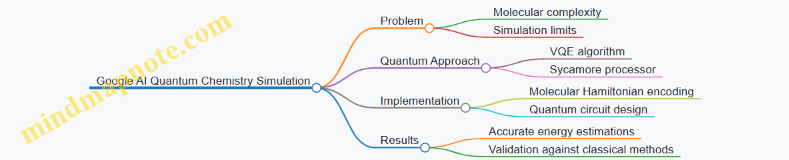
Example: Successfully simulated the ground state energy of the hydrogen molecule (H2) with high precision, validating quantum advantage in chemistry simulations.
Case Study 4: Honeywell – Quantum Computing for Logistics
Honeywell applied trapped-ion quantum computers to optimize supply chain logistics and scheduling.
- Problem: Complex scheduling and routing problems in logistics.
- Quantum Approach: Used quantum algorithms tailored for combinatorial optimization on trapped-ion hardware.
- Outcome: Improved solution quality for scheduling problems and demonstrated scalability.
Mind Map:
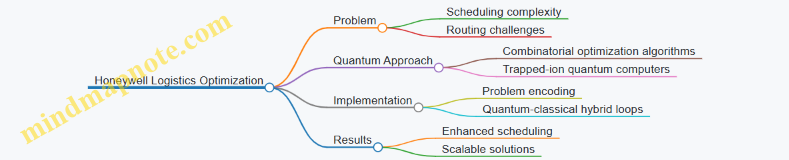
Example: Honeywell’s quantum-enhanced scheduling reduced delivery time windows by 15% in pilot projects.
Key Takeaways from These Adoption Stories
- Hybrid Approaches: Most successful cases combine classical and quantum computing to leverage strengths of both.
- Problem Selection: Focusing on optimization, simulation, and combinatorial problems where quantum advantage is plausible.
- Iterative Development: Continuous refinement of quantum algorithms and hardware integration is essential.
- Collaborations: Partnerships between industry leaders and quantum technology providers accelerate adoption.
Mind Map:

These case studies illustrate that while quantum computing is still emerging, strategic adoption combined with best practices can yield tangible benefits across industries. Organizations looking to integrate quantum technologies should start with well-defined problems, leverage hybrid architectures, and foster collaborative ecosystems to maximize impact.
10.5 Resources and Tools for Continued Learning
As quantum computing continues to evolve rapidly, staying updated with the latest tools, platforms, and educational resources is essential for software engineers, research scientists, and industry analysts. This section provides a curated list of resources, including interactive platforms, libraries, courses, communities, and mind maps to help deepen your understanding and practical skills.
Quantum Computing Platforms & SDKs
-
IBM Quantum Experience & Qiskit
- Open-source SDK for quantum programming.
- Access to real quantum hardware and simulators.
- Example: Writing and running a simple quantum circuit to create a Bell state.
-
Google Cirq
- Python library for designing, simulating, and running quantum circuits.
- Focus on NISQ devices.
- Example: Implementing Grover’s algorithm on a simulator.
-
Microsoft Quantum Development Kit (QDK) & Q#
- Quantum programming language and simulator.
- Integration with Visual Studio.
- Example: Quantum teleportation protocol implementation.
-
Amazon Braket
- Managed quantum computing service.
- Access to multiple quantum hardware providers.
- Example: Running variational quantum eigensolver (VQE) algorithms.
Educational Resources and Courses
-
edX: Quantum Computing Fundamentals by MIT
- Covers quantum mechanics basics and quantum algorithms.
-
Coursera: Quantum Computing by University of Toronto
- Practical programming with Qiskit.
-
Quantum Katas
- Interactive programming exercises in Q#.
-
Qiskit Textbook
- Comprehensive and interactive quantum computing textbook.
Communities and Forums
-
Quantum Computing Stack Exchange
- Q&A platform for quantum computing questions.
-
Qiskit Slack and Discord Channels
- Active developer and researcher communities.
-
Quantum Open Source Foundation (QOSF)
- Supports open-source quantum projects.
Mind Maps for Quantum Computing Learning Paths
Mind Map 1: Quantum Computing Fundamentals
Mind Map 2: Quantum Software Development
Mind Map 3: Quantum Hardware Architectures
Example: Using Qiskit to Create a Bell State
from qiskit import QuantumCircuit, Aer, execute

# Create a Quantum Circuit with 2 qubits
qc = QuantumCircuit(2)

# Apply Hadamard gate to qubit 0
qc.h(0)

# Apply CNOT gate with control qubit 0 and target qubit 1
qc.cx(0, 1)

# Measure the qubits
qc.measure_all()

# Execute the circuit on the qasm simulator
simulator = Aer.get_backend('qasm_simulator')
result = execute(qc, backend=simulator, shots=1024).result()
counts = result.get_counts()

print("Bell State Measurement Results:", counts)
This example demonstrates creating an entangled Bell state, a fundamental concept in quantum computing.
Example: Running Grover’s Algorithm with Cirq
import cirq

# Define qubits
qubits = [cirq.GridQubit(0, i) for i in range(2)]

# Create circuit
circuit = cirq.Circuit()

# Initialize qubits in superposition
circuit.append([cirq.H(q) for q in qubits])

# Oracle for |11> state
oracle = cirq.Z(qubits[0])**0.5
oracle += cirq.Z(qubits[1])**0.5

circuit.append(oracle)

# Diffusion operator
circuit.append([cirq.H(q) for q in qubits])
circuit.append([cirq.X(q) for q in qubits])
circuit.append(cirq.CZ(qubits[0], qubits[1]))
circuit.append([cirq.X(q) for q in qubits])
circuit.append([cirq.H(q) for q in qubits])

# Measurement
circuit.append([cirq.measure(q) for q in qubits])

# Simulate
simulator = cirq.Simulator()
result = simulator.run(circuit, repetitions=10)
print(result)
This example illustrates Grover’s search algorithm on a 2-qubit system.
Summary
By leveraging these resources and tools, practitioners can build a strong foundation in quantum computing architectures and applications. The combination of theoretical knowledge, hands-on coding examples, and community engagement will accelerate your journey toward quantum proficiency.
10.6 Final Thoughts: The Future of Quantum Computing in the Real World
As quantum computing continues to evolve from theoretical constructs to practical technologies, its future in the real world is both promising and complex. This section explores the anticipated trajectories, challenges, and transformative potential of quantum computing, supported by illustrative mind maps and real-world examples.
The Quantum Computing Future Landscape
Quantum Computing Future Mind Map
Real-World Example: Quantum Computing in Climate Modeling
Climate modeling requires simulating complex, multi-variable systems that classical computers struggle to handle efficiently. Quantum computing promises to accelerate these simulations by exploiting quantum parallelism and entanglement.
- Current State: Classical supercomputers run climate models but face limitations in resolution and speed.
- Quantum Potential: Quantum algorithms can simulate molecular interactions and atmospheric chemistry more precisely.
- Example: Researchers at a national lab are developing quantum-enhanced models to better predict extreme weather events.
This example highlights how quantum computing could revolutionize environmental science, enabling more accurate predictions and informed policy decisions.
Mind Map: Path to Quantum Advantage
Best Practice Example: Preparing Organizations for Quantum Integration
- Education & Training: Upskill software engineers and researchers in quantum fundamentals.
- Pilot Projects: Start with small-scale quantum experiments relevant to business problems.
- Hybrid Architectures: Combine classical and quantum resources to maximize current capabilities.
- Collaboration: Partner with quantum hardware providers, academic institutions, and consortia.
- Security Assessment: Evaluate quantum risks and develop quantum-resistant strategies.
Example: A global bank initiated a quantum pilot program focusing on portfolio optimization using cloud-based quantum processors, gradually building internal expertise and infrastructure.
Summary
The future of quantum computing in the real world is a dynamic interplay of technological breakthroughs, practical applications, and strategic adoption. While challenges remain, the integration of quantum computing promises to unlock unprecedented computational power, driving innovation across sectors. By understanding the evolving landscape, embracing best practices, and fostering collaboration, organizations and researchers can position themselves at the forefront of this quantum revolution.