Self Assembling Materials and Programmable Matter Engineering
1. Introduction to Self Assembling Materials and Programmable Matter
1.1 Fundamentals of Molecular Self Assembly
Molecular self assembly is the process by which molecules autonomously organize into structured, functional arrangements without external guidance. This phenomenon relies on the intrinsic properties of the molecules and their interactions, allowing complex architectures to form from simple components.
At its core, self assembly balances two main forces: the tendency of molecules to minimize free energy and the constraints imposed by their shape and chemical compatibility. When conditions such as temperature, concentration, and solvent environment are suitable, molecules spontaneously arrange into stable or metastable structures.
Key Concepts in Molecular Self Assembly
- Building Blocks: The individual molecules or molecular units that come together. These can be small molecules, polymers, peptides, or nucleic acids.
- Driving Forces: Non-covalent interactions such as hydrogen bonding, van der Waals forces, electrostatic interactions, hydrophobic effects, and π-π stacking.
- Order and Hierarchy: Self assembly often occurs in stages, where simple units form intermediate structures that further organize into larger, more complex architectures.
- Reversibility: The non-covalent nature of interactions allows assemblies to form and disassemble dynamically, enabling adaptability.
Mind Map: Components of Molecular Self Assembly
Example: Formation of Micelles
Consider surfactant molecules in water. Each surfactant has a hydrophilic (water-attracting) head and a hydrophobic (water-repelling) tail. When the concentration of surfactants reaches a critical micelle concentration (CMC), the molecules spontaneously arrange so that the hydrophobic tails cluster inward, away from water, while the hydrophilic heads face outward. This arrangement minimizes the system’s free energy.
This example highlights how molecular shape and interaction with the environment drive self assembly. The resulting micelles can encapsulate hydrophobic substances, a property exploited in drug delivery.
Mind Map: Micelle Formation
Example: DNA Double Helix Assembly
DNA strands self assemble through complementary base pairing: adenine pairs with thymine, and cytosine pairs with guanine. Hydrogen bonds between these bases stabilize the double helix structure. This assembly is highly specific and programmable, making DNA a powerful building block in molecular self assembly.
The specificity arises from the molecular recognition encoded in the base sequences. This principle is foundational in creating programmable matter.
Mind Map: DNA Self Assembly
Environmental Influence
Self assembly is sensitive to conditions such as temperature, pH, ionic strength, and solvent polarity. For example, increasing temperature can disrupt hydrogen bonds, causing assemblies to disassemble. Adjusting pH can change the charge state of molecules, affecting electrostatic interactions.
Understanding these dependencies is crucial for designing systems that assemble reliably under desired conditions.
Summary
Molecular self assembly is a spontaneous, reversible process driven by non-covalent interactions and molecular properties. It enables the formation of ordered structures from simple components, with examples ranging from micelles to DNA helices. Recognizing the roles of building blocks, driving forces, and environmental factors forms the foundation for engineering programmable and adaptive materials.
1.2 Historical Development and Key Milestones
Self-assembling materials and programmable matter have roots stretching back several decades, with milestones that reflect advances in chemistry, physics, biology, and materials science. Understanding this history helps clarify how the field evolved from simple observations of molecular behavior to sophisticated engineering of adaptive materials.
Early Observations and Foundations
The concept of self assembly began with the recognition that molecules can spontaneously organize into ordered structures without external guidance. In the early 20th century, scientists noted phenomena such as crystallization and micelle formation. These processes showed that molecules could arrange themselves based on intermolecular forces.
- 1900s: Study of crystallography laid groundwork by revealing how atoms arrange in solids.
- 1940s: Discovery of micelles demonstrated amphiphilic molecules self-organizing in water.
Example: Soap molecules forming spherical micelles in water is a straightforward example of self assembly driven by hydrophobic and hydrophilic interactions.
Development of Supramolecular Chemistry
In the 1960s and 1970s, the field of supramolecular chemistry emerged, focusing on non-covalent interactions such as hydrogen bonding, van der Waals forces, and electrostatic interactions. This shift allowed chemists to design molecules that could assemble into larger structures predictably.
- 1967: Jean-Marie Lehn introduced the term “supramolecular chemistry,” emphasizing molecular recognition and self assembly.
- 1970s: Development of host-guest chemistry demonstrated selective binding and assembly.
Example: Crown ethers selectively binding metal ions illustrated how molecular shape and interaction specificity guide assembly.
Advances in DNA Nanotechnology
The 1980s and 1990s saw the rise of DNA as a programmable building block. Its predictable base pairing enabled precise control over molecular assembly.
- 1982: Nadrian Seeman proposed using DNA to create nanoscale structures.
- 1990s: DNA tiles and lattices were experimentally realized, showing that DNA strands could be programmed to assemble into complex patterns.
Example: DNA double crossover tiles assembling into two-dimensional lattices demonstrated control over nanoscale architecture.
Emergence of Programmable Matter Concept
In the late 1990s and early 2000s, the idea of programmable matter expanded beyond molecular chemistry to include materials that could change properties or shape in response to stimuli.
- 1991: The term “programmable matter” was coined to describe matter whose physical properties could be controlled by external programming.
- 2000s: Research into responsive polymers and shape-memory materials grew, linking molecular design with macroscopic function.
Example: Shape-memory alloys that return to a preset shape when heated illustrate programmable responses at the material level.
Integration of Computational Design
Computational tools began playing a significant role in designing self assembling systems, allowing prediction and optimization before synthesis.
- 2000s: Molecular dynamics and coarse-grained simulations became standard for modeling assembly pathways.
- 2010s: Algorithmic design of DNA origami and other nanostructures enabled complex, programmable architectures.
Example: DNA origami folding simulations help predict correct assembly and minimize errors.
Mind Map: Historical Development of Self Assembling Materials
Mind Map: Key Milestones and Examples
This timeline highlights how the field progressed from observing natural phenomena to intentionally designing molecules and materials that assemble themselves into functional structures. Each milestone built on the previous understanding, adding layers of control and complexity. The examples provided clarify how these concepts translate into tangible systems, from soap bubbles to nanoscale DNA devices.
1.3 Classification of Self Assembling Materials
Self assembling materials organize themselves into ordered structures without external guidance, relying on local interactions among their components. Classifying these materials helps us understand their behavior, design principles, and potential applications. The classification can be approached from multiple angles: the nature of building blocks, the driving forces behind assembly, the dimensionality of the assembled structures, and the reversibility or permanence of the assembly.
Classification by Building Block Type
- Molecular Self Assembly: Involves small molecules or polymers that spontaneously organize through non-covalent interactions.
- Example: Surfactants forming micelles in water.
- Colloidal Self Assembly: Uses particles typically in the 1 nm to 1 µm range.
- Example: Polystyrene beads arranging into colloidal crystals.
- Biological Self Assembly: Relies on biomolecules such as proteins, DNA, and lipids.
- Example: Viral capsid formation from protein subunits.
Classification by Interaction Type
- Hydrophobic/Hydrophilic Interactions: Amphiphilic molecules arrange to minimize exposure of hydrophobic parts to water.
- Example: Lipid bilayers in cell membranes.
- Electrostatic Interactions: Charged species attract or repel to form ordered structures.
- Example: Layer-by-layer assembly of polyelectrolytes.
- Hydrogen Bonding: Directional and specific, often used in DNA base pairing.
- Example: DNA double helix formation.
- Van der Waals Forces: Weak, non-specific attractions important in close packing.
- Example: Assembly of aromatic molecules into stacks.
Classification by Dimensionality of Assembly
- Zero-Dimensional (0D): Discrete, nanoscale objects like micelles or vesicles.
- Example: Micelles formed by surfactants in solution.
- One-Dimensional (1D): Linear or fibrous structures.
- Example: Peptide nanofibers.
- Two-Dimensional (2D): Sheets or monolayers.
- Example: Graphene oxide sheets assembled on substrates.
- Three-Dimensional (3D): Bulk structures like crystals or gels.
- Example: Block copolymer phases forming 3D morphologies.
Classification by Reversibility
- Reversible Self Assembly: Structures can form and disassemble under changing conditions.
- Example: Thermoresponsive polymer micelles that dissociate upon cooling.
- Irreversible Self Assembly: Covalent bonds or strong interactions lock the structure in place.
- Example: Crosslinked polymer networks.
Mind Map: Classification of Self Assembling Materials
Examples to Illustrate Classification
Example 1: Surfactant Micelles
- Building Block: Molecular (amphiphilic molecules)
- Interaction: Hydrophobic effect
- Dimensionality: 0D (spherical micelles)
- Reversibility: Reversible; micelles form above critical micelle concentration and dissociate below it.
Example 2: DNA Origami Structures
- Building Block: Biological (DNA strands)
- Interaction: Hydrogen bonding (base pairing)
- Dimensionality: 2D or 3D depending on design
- Reversibility: Reversible under certain conditions (e.g., temperature changes)
Example 3: Block Copolymer Phases
- Building Block: Molecular (block copolymers)
- Interaction: Combination of hydrophobic/hydrophilic and van der Waals
- Dimensionality: 3D (lamellae, cylinders, spheres)
- Reversibility: Typically reversible with temperature or solvent changes
Example 4: Viral Capsid Assembly
- Building Block: Biological (protein subunits)
- Interaction: Electrostatic and hydrophobic
- Dimensionality: 3D (icosahedral shells)
- Reversibility: Generally reversible under physiological conditions
Understanding these classifications helps in selecting appropriate materials and conditions for engineering programmable matter. It also guides the choice of characterization techniques and informs potential applications based on the stability and responsiveness of the assembled structures.
1.4 Overview of Programmable Matter Concepts
Programmable matter refers to materials that can change their physical properties, shape, or functionality in a controlled and reversible manner, often in response to external stimuli or internal programming. Unlike traditional materials with fixed properties, programmable matter can adapt its structure or behavior based on a set of instructions encoded at the molecular or mesoscale level.
At its core, programmable matter integrates principles from self-assembly, molecular recognition, and responsive materials engineering. The goal is to create systems where the material itself acts as a form of computation, executing a ‘program’ embedded in its design to achieve desired configurations or functions.
Key Components of Programmable Matter
- Building Blocks: These are the fundamental units—molecules, nanoparticles, or micro-scale modules—that interact to form larger structures.
- Programming Language: This is the set of rules or instructions that govern how building blocks interact and assemble.
- Control Mechanisms: These include environmental triggers (pH, temperature, light), chemical signals, or external fields that influence assembly or disassembly.
- Output Behavior: The resulting structure, shape, or functional property that emerges from the programmed interactions.
Mind Map: Core Concepts of Programmable Matter
Types of Programmable Matter
-
Molecular Programmable Matter: Uses molecules like DNA, peptides, or synthetic polymers that self-assemble based on sequence-specific interactions.
-
Modular Robotic Matter: Composed of micro- or millimeter-scale robotic units that physically rearrange.
-
Colloidal Programmable Matter: Uses colloidal particles with designed surface chemistry to assemble into larger structures.
This book focuses primarily on molecular programmable matter, where the programming is encoded at the molecular level.
Example: DNA Origami as Programmable Matter
DNA origami uses the specificity of base pairing to fold a long single-stranded DNA scaffold into a predefined shape with the help of short staple strands. The sequence of these staples acts as a program dictating the final structure.
- Building Blocks: DNA strands
- Programming Language: Base pairing rules and sequence design
- Control Mechanism: Hybridization conditions (temperature, ionic strength)
- Output Behavior: Precise 2D or 3D nanostructures
This approach illustrates how molecular information can be translated into physical form.
Mind Map: DNA Origami Programming
Example: Peptide-Based Programmable Materials
Peptides can be designed to self-assemble into fibers, sheets, or hydrogels. By altering amino acid sequences, one programs the intermolecular interactions.
- Building Blocks: Peptide monomers
- Programming Language: Amino acid sequence
- Control Mechanism: pH, ionic strength, enzymatic triggers
- Output Behavior: Nanofibers, hydrogels, or responsive materials
This example highlights how biological building blocks can be programmed for material functions.
Mind Map: Peptide Programmable Materials
Challenges in Programmable Matter
Programming molecular self-assembly requires precise control over interactions to avoid undesired aggregation or kinetic traps. Designing robust systems involves balancing specificity with flexibility, and often requires iterative optimization.
Summary
Programmable matter is a class of materials whose properties and structures can be directed by encoded instructions at the molecular or modular level. By combining building blocks, programming languages (interaction rules), and control mechanisms, one can create materials that adapt, reconfigure, or perform functions on demand. Concrete examples like DNA origami and peptide assemblies demonstrate how molecular programming translates into tangible material outcomes.
1.5 Practical Example: Simple DNA Tile Assembly Demonstration
DNA tile assembly is a foundational example of programmable molecular self-assembly. It uses short DNA strands designed to form rigid, tile-like structures that can further assemble into larger, ordered arrays. This example illustrates basic principles of molecular recognition, specificity, and hierarchical assembly.
Overview of DNA Tiles
DNA tiles are constructed from multiple single-stranded DNA (ssDNA) oligonucleotides that hybridize to form a stable, multi-stranded structure. Each tile has “sticky ends,” short single-stranded overhangs designed to selectively bind complementary sticky ends on other tiles. This selective binding drives the assembly of tiles into larger two-dimensional lattices or other shapes.
Step-by-Step Assembly Process
-
Designing the Tile Sequences:
- Each tile consists of 4 to 6 ssDNA strands.
- Strands are designed to form a rigid core via complementary base pairing.
- Sticky ends are designed with unique sequences to control tile-to-tile binding.
-
Synthesis and Preparation:
- Order the designed oligonucleotides.
- Mix strands in stoichiometric ratios.
- Anneal by heating and slow cooling to promote correct hybridization.
-
Assembly of Tiles into Arrays:
- Tiles with complementary sticky ends are mixed.
- Under appropriate buffer and temperature conditions, tiles bind to form larger arrays.
-
Characterization:
- Atomic Force Microscopy (AFM) or Transmission Electron Microscopy (TEM) can visualize the arrays.
Mind Map: DNA Tile Assembly Components
Example: Four-Strand DNA Tile
Consider a simple tile composed of four ssDNA strands labeled A, B, C, and D.
- Strands A and B hybridize to form one half of the tile.
- Strands C and D hybridize to form the other half.
- Sticky ends on strands A and D are designed to bind complementary sticky ends on adjacent tiles.
Sequence design ensures that only the intended sticky ends bind, preventing mismatches.
Best Practices Illustrated
- Sequence Specificity: Use unique sticky end sequences to avoid unintended binding.
- Stoichiometry Control: Mix strands in precise ratios to ensure complete tile formation.
- Annealing Protocol: Employ slow cooling from 95°C to room temperature over several hours to promote correct hybridization.
- Buffer Conditions: Use magnesium-containing buffers to stabilize DNA duplexes.
Mind Map: Best Practices in DNA Tile Assembly
Troubleshooting Common Issues
- Incomplete Tile Formation: Check strand purity and concentration.
- Aggregation Instead of Ordered Arrays: Adjust annealing rate or buffer ionic strength.
- Non-Specific Binding: Redesign sticky ends to reduce sequence similarity.
Practical Example Summary
By carefully designing DNA sequences and controlling assembly conditions, simple DNA tiles can be programmed to self-assemble into predictable structures. This example highlights how molecular recognition and environmental control combine to create ordered materials from basic building blocks.
2. Molecular Building Blocks and Interactions
2.1 Types of Molecular Building Blocks: Polymers, Peptides, and DNA
Self-assembling materials rely fundamentally on the choice of molecular building blocks. These units determine the structure, function, and adaptability of the resulting material. Among the most commonly used building blocks are polymers, peptides, and DNA. Each offers distinct chemical properties, modes of interaction, and assembly behaviors. Understanding these differences is key to designing effective self-assembling systems.
Polymers
Polymers are large molecules composed of repeating subunits called monomers. Their versatility arises from the wide variety of monomers and polymerization methods available. In self assembly, polymers can form micelles, vesicles, gels, and other structures depending on their composition and environment.
-
Types of polymers:
- Synthetic polymers: e.g., polystyrene, polyethylene glycol (PEG), poly(N-isopropylacrylamide) (PNIPAM)
- Biopolymers: e.g., polysaccharides, nucleic acids, proteins
-
Key features:
- Chain length and polydispersity affect assembly size and uniformity.
- Block copolymers (polymers with distinct segments) can self-assemble into ordered nanostructures due to microphase separation.
- Responsive polymers change conformation or solubility with stimuli like temperature or pH.
-
Example: Poly(ethylene oxide)-block-poly(propylene oxide)-block-poly(ethylene oxide) (Pluronic) forms micelles in water above a critical temperature, useful for drug delivery.
Mind Map: Polymers
Peptides
Peptides are short chains of amino acids linked by peptide bonds. Their sequence encodes specific folding and interaction patterns, enabling precise control over assembly.
-
Characteristics:
- Amphiphilic peptides contain both hydrophobic and hydrophilic residues, promoting self-assembly into nanofibers, sheets, or tubes.
- Secondary structures like alpha-helices and beta-sheets guide the shape of assemblies.
- Functional groups on side chains allow for chemical modification or cross-linking.
-
Design considerations:
- Sequence determines assembly morphology and stability.
- Length affects solubility and kinetics.
- Incorporation of non-natural amino acids can tune properties.
-
Example: Peptide amphiphiles designed with a hydrophobic tail and a charged head group self-assemble into nanofibers that mimic extracellular matrix components.
Mind Map: Peptides
DNA
DNA is a polymer of nucleotides with a well-understood base-pairing code. Its programmability and predictable interactions make it a powerful building block for nanoscale self assembly.
-
Features:
- Watson-Crick base pairing enables specific and reversible hybridization.
- DNA strands can be designed to form complex 2D and 3D structures (e.g., DNA origami).
- Dynamic assemblies can respond to strand displacement or environmental changes.
-
Design principles:
- Sequence design controls binding specificity and assembly pathways.
- Sticky ends and toeholds facilitate hierarchical assembly and reconfiguration.
- Length and flexibility influence mechanical properties.
-
Example: DNA tiles with complementary sticky ends assemble into periodic lattices, demonstrating programmable pattern formation.
Mind Map: DNA
Summary Table of Building Blocks
| Building Block | Key Features | Typical Assembly Forms | Example Application |
|---|---|---|---|
| Polymers | Versatile chemistry, block copolymers, responsive | Micelles, vesicles, gels | Pluronic micelles for drug delivery |
| Peptides | Sequence-specific folding, amphiphilicity | Nanofibers, sheets, tubes | Peptide amphiphile nanofibers |
| DNA | Base pairing specificity, programmability | Origami, lattices, dynamic structures | DNA tile lattices for nanoscale patterning |
Each building block type offers unique advantages and challenges. Polymers provide bulk and responsiveness, peptides offer biological compatibility and structural precision, and DNA enables programmable, highly specific assemblies. Selecting the right building block depends on the target material properties and functional goals.
2.2 Non-Covalent Interactions Driving Self Assembly
Self assembly relies heavily on non-covalent interactions—forces that hold molecules together without forming permanent chemical bonds. These interactions are generally weaker than covalent bonds but collectively strong enough to organize molecules into stable structures. Understanding these forces is essential for designing materials that assemble predictably and reversibly.
Main Types of Non-Covalent Interactions
- Hydrogen Bonding
- Van der Waals Forces
- Electrostatic (Ionic) Interactions
- Hydrophobic Effects
- π-π Stacking
Each interaction contributes differently depending on the molecular context and environment. Below is a mind map summarizing these interactions:
Hydrogen Bonding
Hydrogen bonds occur when a hydrogen atom covalently attached to an electronegative atom (like oxygen or nitrogen) interacts with another electronegative atom. They are directional, meaning the geometry matters, which helps create specific and predictable assemblies. For instance, DNA strands pair through hydrogen bonds between complementary bases, forming the iconic double helix.
Example: In peptide self assembly, hydrogen bonds stabilize β-sheet structures, allowing peptides to stack into fibrils. Designing peptides with specific sequences can promote or disrupt these interactions, controlling assembly.
Van der Waals Forces
These are weak, non-directional attractions arising from temporary fluctuations in electron density that induce transient dipoles. While individually weak, when many molecules are close together, these forces collectively stabilize assemblies.
Example: Alkyl chains in lipid tails pack tightly due to van der Waals forces, driving the formation of lipid bilayers. Adjusting chain length or saturation changes packing and material properties.
Electrostatic Interactions
Charged groups attract or repel each other, influencing assembly over longer distances than hydrogen bonds or van der Waals forces. In aqueous environments, ions in solution can screen these interactions, reducing their effective range.
Example: Polyelectrolyte complexes form when oppositely charged polymers assemble through electrostatic attraction. This principle is used to create layer-by-layer films with tunable thickness and composition.
Hydrophobic Effects
Nonpolar molecules or groups tend to cluster together in water to minimize disruption of the hydrogen-bonded water network. This effect is entropically driven: water molecules become more ordered around hydrophobic surfaces, so clustering reduces this ordering.
Example: Surfactants self assemble into micelles with hydrophobic tails inside and hydrophilic heads outside. This principle is widely used in drug delivery and emulsification.
π-π Stacking
Aromatic rings can stack due to interactions between their delocalized π-electrons. This stacking is moderately strong and directional, contributing to the stability of many biological and synthetic assemblies.
Example: In DNA, π-π stacking between bases stabilizes the double helix beyond hydrogen bonding. Similarly, organic semiconductors rely on π-π stacking for charge transport.
Integrated Mind Map: How Non-Covalent Interactions Combine in Self Assembly
Combined Non-Covalent Interactions
- Hydrogen Bonding
- Provides specificity and directionality
- Van der Waals Forces
- Stabilizes close packing
- Electrostatic Interactions
- Controls long-range attraction/repulsion
- Hydrophobic Effects
- Drives aggregation in aqueous environments
- π-π Stacking
- Adds stability in aromatic systems
Interactions often act together:
- DNA assembly: hydrogen bonding + π-π stacking
- Lipid bilayers: hydrophobic effect + van der Waals
- Peptide fibrils: hydrogen bonding + electrostatics + van der Waals
Practical Example: Designing a Peptide Amphiphile
A peptide amphiphile molecule has a hydrophobic tail and a peptide head that can form hydrogen bonds. The hydrophobic tail drives aggregation via hydrophobic effects and van der Waals forces. The peptide head forms β-sheets stabilized by hydrogen bonds, directing the assembly into nanofibers. Electrostatic interactions between charged residues on the peptide can further tune assembly by promoting or inhibiting aggregation depending on pH or ionic strength.
This example shows how combining multiple non-covalent interactions allows precise control over the shape, size, and responsiveness of the assembled material.
Understanding these non-covalent forces and their interplay is fundamental to programming molecular self assembly. Each interaction offers a design handle, and their combination enables the creation of complex, adaptive materials.
2.3 Design Principles for Molecular Recognition
Molecular recognition is the cornerstone of self-assembling systems. It refers to the specific and selective interaction between molecules, often driven by complementary shapes, charges, or chemical functionalities. Designing molecular recognition elements requires understanding how molecules identify and bind to each other with precision.
Key Principles of Molecular Recognition
-
Complementarity: Molecules fit together like puzzle pieces. This includes shape complementarity (steric fit) and chemical complementarity (matching functional groups). For example, the way a lock fits a key depends on the shape and the presence of matching ridges.
-
Non-Covalent Interactions: These include hydrogen bonding, electrostatic interactions, van der Waals forces, and hydrophobic effects. Each interaction type contributes differently to the strength and specificity of binding.
-
Multivalency: Multiple weak interactions combined can create strong and selective binding. This principle is common in biological systems, such as antibodies binding to antigens.
-
Dynamic Reversibility: Molecular recognition should allow for reversible binding to enable error correction and adaptability during assembly.
-
Environmental Sensitivity: The recognition process can be influenced by pH, temperature, ionic strength, or solvent polarity, which can be exploited to control assembly.
Mind Map: Core Elements of Molecular Recognition
Designing for Shape Complementarity
Shape complementarity ensures that molecules physically fit together, minimizing steric clashes and maximizing contact area. For example, DNA base pairing relies on the precise geometry of nucleobases. Designing synthetic molecules with complementary shapes often involves rigid scaffolds or templates to maintain structural integrity.
Example: In DNA origami, staple strands are designed to hybridize with specific regions of a scaffold strand, relying on the exact shape and sequence complementarity to fold the scaffold into a desired shape.
Chemical Complementarity and Functional Group Matching
Chemical complementarity involves matching functional groups that can form specific interactions. For instance, a carboxyl group (-COOH) can hydrogen bond with an amine group (-NH2). Designing molecules with complementary functional groups enhances selectivity.
Example: Peptide sequences can be engineered to include charged residues that attract or repel each other, guiding assembly into fibers or sheets.
Utilizing Non-Covalent Interactions
Each non-covalent interaction has characteristic strength and directionality:
- Hydrogen bonds offer directionality and moderate strength, useful for precise recognition.
- Electrostatic interactions provide longer-range attraction or repulsion, influenced by ionic strength.
- van der Waals forces are weak but numerous, contributing to overall stability.
- Hydrophobic effects drive nonpolar groups to cluster away from water, often a major driving force in aqueous environments.
Balancing these interactions is critical. Overemphasizing one can lead to nonspecific aggregation or weak binding.
Mind Map: Non-Covalent Interactions in Molecular Recognition
Multivalency: Strength in Numbers
Multivalency refers to multiple simultaneous interactions between molecules. Individually weak bonds combine to create strong overall binding. This principle allows for reversible yet stable assemblies.
Example: Synthetic dendrimers with multiple binding sites can attach to a target surface more strongly than a single ligand.
Dynamic Reversibility and Error Correction
Reversible binding allows assemblies to correct mistakes by disassembling incorrect contacts and reforming correct ones. This dynamic nature is essential for high-fidelity self-assembly.
Example: DNA strand displacement reactions exploit reversible hybridization to rearrange structures dynamically.
Environmental Control of Recognition
Environmental factors can modulate molecular recognition:
- pH: Alters protonation states, changing charge and hydrogen bonding.
- Temperature: Affects kinetic energy and binding equilibria.
- Ionic Strength: Screens electrostatic interactions.
- Solvent: Influences hydrophobic interactions and solubility.
Designing systems responsive to these parameters allows external control over assembly.
Practical Example: Designing a pH-Sensitive Molecular Recognition System
Consider a peptide designed with histidine residues. At neutral pH, histidine is uncharged, but at acidic pH, it becomes positively charged. This change can switch the peptide from non-binding to binding state by altering electrostatic interactions.
Mind Map: Environmental Factors Affecting Molecular Recognition
In summary, designing molecular recognition involves integrating shape and chemical complementarity, leveraging non-covalent interactions, employing multivalency, and considering environmental responsiveness. These principles guide the creation of self-assembling materials that are both specific and adaptable.
2.4 Best Practices in Selecting Building Blocks for Targeted Assembly
Selecting the right molecular building blocks is a critical step in designing self assembling materials that meet specific functional and structural goals. The choice influences not only the final architecture but also the assembly pathway, stability, and responsiveness of the material. This section outlines best practices for selecting building blocks, supported by practical examples and mind maps to clarify decision-making.
Understanding the Role of Building Blocks
Building blocks serve as the fundamental units that come together through specific interactions to form larger structures. Their chemical nature, shape, size, and interaction capabilities determine the assembly process and the properties of the resulting material.
Key Criteria for Selection
-
Chemical Compatibility: Building blocks must be chemically compatible with each other and the intended environment to avoid unwanted side reactions or degradation.
-
Interaction Specificity: The ability to form selective and reversible interactions (hydrogen bonds, π-π stacking, electrostatic forces) is essential for controlled assembly.
-
Structural Features: Shape and rigidity influence packing and hierarchical organization.
-
Functional Groups: Presence of reactive or responsive groups enables post-assembly modifications or stimuli-responsiveness.
-
Solubility and Processability: Solubility in chosen solvents and ease of handling affect experimental feasibility.
Mind Map: Factors Influencing Building Block Selection
Balancing Rigidity and Flexibility
Rigid building blocks tend to form well-defined, predictable structures but may limit adaptability. Flexible units allow dynamic rearrangements but can introduce disorder. For example, peptide amphiphiles with flexible linkers and rigid aromatic cores can form nanofibers with tunable mechanical properties.
Example: Designing Peptide Amphiphiles for Nanofiber Formation
Peptide amphiphiles combine hydrophobic tails with peptide sequences that promote β-sheet formation. Selecting amino acids with strong hydrogen bonding potential (like valine or alanine) encourages fiber formation. Incorporating charged residues can improve solubility and enable pH-responsive behavior. The balance between hydrophobic and hydrophilic segments controls assembly morphology.
Mind Map: Example of Peptide Amphiphile Design
Considering Environmental Conditions
Building blocks should be chosen with the intended assembly environment in mind. For aqueous systems, hydrophilicity and ionic strength tolerance matter. For organic solvents, solubility and stability under those conditions are key. For example, DNA-based blocks require buffers that maintain duplex stability.
Example: Selecting DNA Tiles for Assembly
DNA tiles rely on complementary base pairing. Choosing sequences with minimal secondary structure and balanced GC content improves yield. Incorporating sticky ends with defined length and sequence specificity guides assembly into desired lattices.
Mind Map: DNA Tile Selection
Practical Tips
- Start with well-characterized building blocks when possible to reduce uncertainty.
- Use modular components that can be easily modified or swapped.
- Consider synthetic accessibility and cost early in the design.
- Perform small-scale tests to validate interactions before scaling up.
- Document all parameters to ensure reproducibility.
Summary
Selecting building blocks is a balancing act between chemical, structural, and practical factors. Using clear criteria and iterative testing helps ensure the assembly behaves as intended. Mind maps can organize complex considerations and guide systematic design choices.
2.5 Practical Example: Designing Peptide Amphiphiles for Nanofiber Formation
Peptide amphiphiles (PAs) are molecules that combine a peptide sequence with a hydrophobic tail, enabling them to self-assemble into nanofibers. These nanofibers have applications in tissue engineering, drug delivery, and biomaterials. This example walks through the design considerations and steps to create PAs that form stable nanofibers.
Understanding Peptide Amphiphile Structure
A typical peptide amphiphile consists of four main components:
- Hydrophobic Tail: Usually a long alkyl chain that drives assembly through hydrophobic interactions.
- Peptide Sequence: Provides biofunctionality and controls intermolecular interactions.
- Beta-sheet Forming Region: Promotes fiber formation via hydrogen bonding.
- Charged Residues: Enhance solubility and control assembly via electrostatic repulsion.
Mind Map: Peptide Amphiphile Components
Step 1: Selecting the Hydrophobic Tail
The tail length influences the critical micelle concentration (CMC) and fiber stability. Longer tails generally lower the CMC and promote more stable fibers but may reduce solubility.
Example: Using a palmitic acid (C16) tail balances hydrophobic driving force and aqueous solubility.
Step 2: Designing the Peptide Sequence
Choose amino acids that encourage beta-sheet formation, such as valine (V), alanine (A), and isoleucine (I). These residues stack via backbone hydrogen bonds, stabilizing the nanofiber.
Include charged residues like glutamic acid (E) or lysine (K) to modulate solubility and prevent uncontrolled aggregation.
Example Sequence: C16–VVAAEE
- C16: Palmitic acid tail
- VVAA: Beta-sheet forming region
- EE: Negatively charged residues for solubility
Step 3: Synthesis and Purification
Synthesize the peptide amphiphile via solid-phase peptide synthesis (SPPS), attaching the hydrophobic tail at the N-terminus.
Purify using high-performance liquid chromatography (HPLC) to remove truncated sequences or impurities.
Step 4: Inducing Self Assembly
Dissolve the purified PA in aqueous buffer at a concentration above the CMC.
Adjust pH and ionic strength to control electrostatic interactions. For example, neutral pH with moderate salt concentration often promotes fiber formation.
Step 5: Characterization
Use transmission electron microscopy (TEM) or atomic force microscopy (AFM) to visualize nanofibers.
Circular dichroism (CD) spectroscopy confirms beta-sheet secondary structure.
Mind Map: Design Workflow for Peptide Amphiphiles
Additional Example: Modulating Fiber Properties
To increase fiber stiffness, increase the beta-sheet forming residues or use amino acids with bulkier side chains, such as phenylalanine (F).
Example: C16–VVFFEE forms stiffer fibers than C16–VVAAEE due to stronger hydrophobic packing.
To create stimuli-responsive fibers, incorporate residues sensitive to pH or enzymes. For instance, histidine (H) can confer pH responsiveness.
Summary
Designing peptide amphiphiles for nanofiber formation involves balancing hydrophobic interactions, peptide sequence composition, and solution conditions. Each component affects assembly behavior and final material properties. By adjusting these parameters, one can tailor nanofibers for specific applications.
This example highlights the importance of systematic design and characterization to achieve predictable self-assembly outcomes.
3. Thermodynamics and Kinetics of Self Assembly
3.1 Thermodynamic Principles Underlying Self Assembly
Self assembly is fundamentally a thermodynamic process. It occurs because molecular components spontaneously organize into ordered structures that minimize the system’s free energy. Understanding these thermodynamic principles helps explain why and how molecules come together without external guidance.
Free Energy and Spontaneity
The key thermodynamic quantity is the Gibbs free energy (G), defined as:
\[ G = H - TS \]
where H is enthalpy, T is temperature, and S is entropy. A process is spontaneous if the change in Gibbs free energy (\( \Delta G \)) is negative:
\[ \Delta G = \Delta H - T\Delta S < 0 \]
In self assembly, molecules rearrange to lower \( G \). This can happen by:
- Decreasing enthalpy (\( \Delta H < 0 \)): Favorable interactions like hydrogen bonding, van der Waals forces, or electrostatic attractions form.
- Increasing entropy (\( \Delta S > 0 \)): Often counterintuitive, because assembling molecules reduces their positional entropy. However, the system’s total entropy can increase if, for example, solvent molecules are released from ordered shells around monomers.
Mind Map: Thermodynamics of Self Assembly
Enthalpic Contributions
When molecules come together, they form non-covalent bonds that release energy, lowering the enthalpy. For example, DNA strands hybridize through hydrogen bonds between complementary bases, stabilizing the duplex. Similarly, amphiphilic molecules form micelles because hydrophobic tails cluster to minimize unfavorable interactions with water, releasing enthalpic strain.
Entropic Contributions
Although assembling molecules lose some freedom, the overall entropy can increase. This often happens because solvent molecules trapped around individual monomers are freed when the monomers aggregate. This increase in solvent entropy can outweigh the loss of configurational entropy of the assembling molecules.
Example: Micelle Formation
Consider surfactant molecules in water. Individually, their hydrophobic tails disrupt water’s hydrogen bonding network, ordering water molecules around them (low entropy). When surfactants aggregate into micelles, the hydrophobic tails are sequestered inside, releasing many water molecules back to bulk solvent, increasing entropy. The enthalpic gain from tail-tail interactions and the entropic gain from solvent release together make micelle formation spontaneous above a critical concentration.
Temperature Dependence
Because \( \Delta G = \Delta H - T\Delta S \), temperature influences assembly. For example, if \( \Delta H < 0 \) and \( \Delta S < 0 \), assembly is favored at low temperatures. Conversely, if \( \Delta H > 0 \) and \( \Delta S > 0 \), assembly is favored at high temperatures.
Mind Map: Temperature Effects
Example: DNA Duplex Melting
DNA duplex formation is exothermic (\( \Delta H < 0 \)) but decreases entropy (\( \Delta S < 0 \)) because two strands become one ordered structure. At low temperatures, duplexes form; at high temperatures, strands separate. The melting temperature (\( T_m \)) is where \( \Delta G = 0 \).
Concentration Effects
Assembly also depends on component concentration. Higher concentrations increase the likelihood of molecular encounters, shifting equilibrium toward assembled states. This is critical in systems like DNA tile assembly, where below a threshold concentration, assembly is negligible.
Summary
Self assembly is governed by a balance of enthalpic and entropic factors that determine the free energy change. Favorable interactions and solvent effects drive molecules to organize spontaneously. Temperature and concentration modulate these forces, controlling when and how assembly occurs.
Practical Example: Designing a Peptide Nanofiber
When designing peptides to self assemble into nanofibers, consider:
- Incorporating amino acids that promote hydrogen bonding (enthalpic gain).
- Including hydrophobic residues to drive aggregation and solvent release (entropic gain).
- Adjusting solution temperature and concentration to favor assembly.
This thermodynamic framework guides the rational design of self assembling materials.
3.2 Kinetic Pathways and Energy Landscapes
Self assembly is not just about the final structure but also about how the system gets there. Kinetics describes the sequence and rates of steps leading from individual components to the assembled material. Energy landscapes provide a way to visualize all possible states and the transitions between them, helping to explain why some assemblies form quickly while others stall or misfold.
Understanding Kinetic Pathways
Kinetic pathways are the routes taken through a series of intermediate states during assembly. Unlike thermodynamics, which tells us about the stability of the final structure, kinetics governs the speed and likelihood of reaching that structure.
- Fast pathways: Direct routes with low energy barriers, leading quickly to the target assembly.
- Slow pathways: Routes with high or multiple energy barriers, causing delays or trapping in intermediate states.
- Off-pathway intermediates: Structures that do not lead to the final assembly but can trap components, reducing yield.
Mind Map: Kinetic Pathways Overview
Energy Landscapes: The Terrain of Assembly
Imagine the assembly process as a landscape of hills and valleys. Each valley represents a stable or metastable state, and hills correspond to energy barriers that must be overcome to move between states. The system tends to move downhill toward lower energy states but may get stuck in local minima.
Key features of energy landscapes:
- Global minimum: The most stable, lowest energy state, usually the desired final assembly.
- Local minima: Intermediate states where the system can get trapped.
- Energy barriers: The hills that separate states, determining the rate of transitions.
Mind Map: Energy Landscape Components
Example: DNA Tile Assembly
In DNA tile self assembly, short strands of DNA form tiles that bind to each other to create larger structures. The energy landscape includes:
- Correctly paired tiles forming the global minimum.
- Mismatched or partially paired tiles as local minima.
- Energy barriers from strand displacement or conformational changes.
If the system assembles too quickly, it may get stuck in local minima (incorrect pairings). Slowing the process or adjusting temperature can help the system overcome barriers and reach the global minimum.
Mind Map: DNA Tile Assembly Energy Landscape
Example: Micelle Formation
Micelles form when amphiphilic molecules spontaneously organize in water. The kinetic pathway involves:
- Monomers freely diffusing.
- Formation of small clusters (nuclei).
- Growth into stable micelles.
Energy barriers include the initial nucleation step. If the barrier is too high, micelle formation is slow. If too low, many small aggregates form, which may not be stable.
Mind Map: Micelle Formation Kinetics
Best Practices for Managing Kinetic Pathways
- Control environmental conditions: Temperature, concentration, and solvent can tune energy barriers.
- Design building blocks thoughtfully: Shape and binding specificity influence pathway smoothness.
- Monitor intermediates: Use spectroscopy or microscopy to identify kinetic traps.
- Adjust assembly rates: Slow assembly can allow error correction; fast assembly may lock in mistakes.
Understanding kinetic pathways and energy landscapes helps engineers design self assembling systems that reliably reach desired structures without getting stuck or forming unwanted aggregates.
3.3 Controlling Assembly via Environmental Parameters
Self assembly is not just about the molecules themselves; the environment where assembly happens plays a crucial role. By adjusting environmental parameters, we can steer the process toward desired structures or functions. Here, we focus on key factors such as temperature, pH, ionic strength, solvent composition, and external fields.
Temperature
Temperature influences both the kinetics and thermodynamics of self assembly. Raising temperature generally increases molecular motion, which can disrupt weak interactions but also help overcome energy barriers to rearrangement.
- Effect on assembly: Higher temperatures may destabilize assemblies held by hydrogen bonds or van der Waals forces, causing disassembly or preventing formation.
- Control strategy: Use temperature ramps or cycles to promote error correction or trigger reversible assembly.
Example: Block copolymer micelles often form at specific temperatures called critical micelle temperatures (CMT). Heating above CMT can dissolve micelles, while cooling below allows reassembly.
pH
pH affects the ionization state of functional groups, altering electrostatic interactions and solubility.
- Effect on assembly: Changes in pH can switch charges on molecules, leading to attraction or repulsion that controls aggregation.
- Control strategy: Adjust pH to tune the balance between hydrophobic and electrostatic forces.
Example: Peptide amphiphiles with acidic or basic side chains can assemble into nanofibers at neutral pH but disassemble at acidic or basic extremes.
Ionic Strength
The concentration of ions in solution screens electrostatic interactions.
- Effect on assembly: Increasing ionic strength reduces repulsion between like-charged groups, facilitating closer packing.
- Control strategy: Modulate salt concentration to stabilize or destabilize charged assemblies.
Example: DNA duplex formation is sensitive to ionic strength; higher salt concentrations shield phosphate backbone charges, promoting hybridization.
Solvent Composition
Solvent polarity and composition influence solubility and intermolecular forces.
- Effect on assembly: Changing solvent mixtures can induce phase separation or alter hydrophobic interactions.
- Control strategy: Use solvent gradients or mixtures to trigger assembly or disassembly.
Example: Amphiphilic molecules may form micelles in water but remain dispersed in organic solvents.
External Fields (Electric, Magnetic, Light)
Applying external fields can orient or activate components.
- Effect on assembly: Fields can induce alignment, trigger conformational changes, or cause localized heating.
- Control strategy: Use fields to control spatial arrangement or initiate assembly remotely.
Example: Magnetic nanoparticles can be directed into chains under magnetic fields, forming anisotropic structures.
Mind Map: Environmental Parameters Influencing Self Assembly
Practical Example: Temperature-Driven Micelle Formation
Consider a block copolymer with hydrophilic and hydrophobic segments. At low temperature, the polymer chains are well solvated and dispersed. As temperature rises past the critical micelle temperature (CMT), hydrophobic segments aggregate to minimize exposure to water, forming micelles.
By cycling temperature above and below CMT, micelles can be reversibly assembled and disassembled. This control allows tuning of size and morphology by adjusting heating rate and hold times.
Mind Map: Strategies for Controlling Self Assembly via Environment
In summary, environmental parameters offer a toolkit for guiding molecular self assembly. Understanding how each factor influences molecular interactions helps design protocols that yield consistent, functional materials. Experimentation combined with careful control over temperature, pH, ionic strength, solvent, and external fields can transform a random mix of molecules into ordered, adaptive structures.
3.4 Best Practices in Balancing Thermodynamics and Kinetics
Balancing thermodynamics and kinetics is a central challenge in molecular self assembly. Thermodynamics dictates the final equilibrium state—the most stable arrangement of molecules—while kinetics governs the pathway and speed by which that state is reached. Ignoring either aspect can lead to incomplete or faulty assemblies.
Understanding the Balance
Thermodynamics ensures that the assembled structure is energetically favorable. If the free energy of the assembled state is lower than that of the disassembled components, the system tends to settle there. Kinetics, however, controls how fast and through which routes the system moves toward that state. Sometimes, the system can get trapped in metastable states—local energy minima that are not the most stable overall.
Key Best Practices
- Design for a Clear Energy Landscape: Aim for a well-defined global minimum with minimal competing local minima. This reduces kinetic traps.
- Control Environmental Conditions: Temperature, pH, ionic strength, and solvent can shift both thermodynamic stability and kinetic barriers.
- Use Stepwise Assembly: Breaking down assembly into stages can help avoid kinetic traps by allowing intermediate structures to form and rearrange.
- Incorporate Reversible Interactions: Non-covalent bonds that can break and reform allow the system to correct errors and escape kinetic traps.
- Monitor Assembly in Real Time: Techniques like spectroscopy or microscopy help identify kinetic bottlenecks and guide adjustments.
Mind Map: Balancing Thermodynamics and Kinetics
Example 1: DNA Tile Assembly
DNA tiles self assemble through base pairing, which is thermodynamically favorable. However, if the temperature is too low, tiles may bind incorrectly and get stuck in wrong configurations (kinetic traps). By carefully controlling temperature ramps—starting higher to allow bonds to break and then cooling slowly—the system can rearrange and reach the correct final lattice. This practice balances kinetics (by allowing bond dynamics) and thermodynamics (favoring correct base pairing).
Example 2: Micelle Formation
Surfactant molecules form micelles above a critical micelle concentration (CMC). Thermodynamics favors micelle formation because it reduces the system’s free energy by hiding hydrophobic tails. Kinetics affects how quickly micelles form. Rapid mixing can cause transient aggregates that are not stable. Gentle mixing and controlled concentration changes allow micelles to form steadily and avoid kinetic traps.
Mind Map: Practical Controls in Assembly
Example 3: Peptide Nanofiber Growth
Peptides self assemble into nanofibers via hydrogen bonding and hydrophobic interactions. If assembly is too fast, fibers can form irregular aggregates. Slowing down assembly by diluting peptide concentration or adjusting pH allows fibers to grow uniformly. This approach balances thermodynamic driving forces with kinetic control to produce well-defined structures.
Summary
Balancing thermodynamics and kinetics means designing systems where the desired structure is both the most stable and accessible. It requires tuning molecular interactions and assembly conditions to avoid kinetic traps and promote error correction. Using reversible bonds, stepwise assembly, and environmental controls are effective ways to achieve this balance. Monitoring the assembly process helps identify issues early and refine protocols accordingly.
3.5 Practical Example: Temperature-Driven Micelle Formation
Micelles are aggregates of amphiphilic molecules that spontaneously organize in aqueous solutions, typically forming spherical structures with hydrophobic cores and hydrophilic shells. Temperature can play a critical role in micelle formation by influencing the balance between entropic and enthalpic forces driving self assembly.
Understanding Temperature Effects on Micelle Formation
At lower temperatures, amphiphilic molecules may remain dispersed as monomers due to insufficient thermal energy to overcome repulsive forces or to drive hydrophobic interactions strongly enough. As temperature increases, hydrophobic interactions strengthen, encouraging aggregation into micelles. However, beyond a certain temperature, micelles may disassemble or change morphology due to altered solubility or molecular conformations.
Mind Map: Temperature-Driven Micelle Formation
Step-by-Step Example: Temperature-Driven Micelle Formation of a Common Surfactant
System: Sodium dodecyl sulfate (SDS) in water
-
Preparation: Prepare an aqueous SDS solution at a concentration slightly above its critical micelle concentration (CMC) at room temperature.
-
Initial State (Low Temperature): At 15°C, SDS molecules mostly exist as monomers. The hydrophobic tails are less driven to aggregate due to weaker hydrophobic interactions.
-
Heating Phase: Gradually increase temperature in 5°C increments, allowing equilibration at each step.
-
Observation of Micelle Formation: Around 25-30°C (close to the CMT for SDS), micelles begin to form. This is detected by techniques such as surface tension measurements or dynamic light scattering (DLS), which show a decrease in surface tension and an increase in particle size, respectively.
-
Further Heating: As temperature rises to about 50°C, micelle size and aggregation number may increase due to enhanced hydrophobic interactions.
-
High Temperature Effects: Above 60-70°C, micelle stability may decrease. Changes in water structure and surfactant solubility can lead to micelle disassembly or transition to other aggregate forms like vesicles.
Mind Map: Experimental Observations and Techniques
Key Points and Best Practices
-
Control Concentration: Ensure surfactant concentration is above CMC but not excessively high to avoid complicating aggregation behavior.
-
Temperature Equilibration: Allow sufficient time at each temperature step for the system to reach equilibrium before measurements.
-
Use Multiple Characterization Methods: Combining surface tension, DLS, and spectroscopy provides a clearer picture of micelle formation and stability.
-
Monitor Morphology Changes: Be aware that micelles can transition to other structures with temperature changes; morphology characterization (e.g., cryo-TEM) can be informative.
-
Consider Solvent Effects: Ionic strength and pH can influence micelle behavior and should be controlled or noted.
Summary
Temperature-driven micelle formation illustrates how environmental parameters can program molecular self assembly. By adjusting temperature, one can modulate the balance of forces that govern aggregation, enabling control over material structure and properties. This example highlights the importance of systematic experimentation and multi-technique characterization in understanding and harnessing self assembling systems.
4. Computational Modeling and Simulation Techniques
4.1 Molecular Dynamics Simulations for Self Assembling Systems
Molecular dynamics (MD) simulations are a computational method used to study the physical movements of atoms and molecules over time. In the context of self assembling systems, MD simulations provide a way to observe how individual molecular components interact, move, and organize into larger structures under defined conditions.
At its core, MD simulates Newtonian mechanics for particles, calculating forces and updating positions step-by-step. This approach helps researchers understand the pathways and kinetics of self assembly, as well as the stability and properties of the resulting structures.
Why Use MD for Self Assembly?
- Atomic-level insight: MD reveals interactions that are difficult to capture experimentally.
- Dynamic behavior: It tracks how assemblies form and evolve, not just static end states.
- Parameter testing: Researchers can vary temperature, concentration, or molecular design to see effects on assembly.
Key Components of MD Simulations
- Force Fields: Mathematical descriptions of interatomic forces. Choosing an appropriate force field is critical. For example, CHARMM and AMBER are popular for biomolecules, while coarse-grained models like MARTINI simplify groups of atoms.
- Initial Configuration: The starting arrangement of molecules affects simulation outcomes. Random distributions can mimic solution conditions.
- Boundary Conditions: Periodic boundaries simulate bulk environments by wrapping molecules exiting one side back into the simulation box.
- Time Step: Typically on the order of femtoseconds, balancing accuracy and computational cost.
Mind Map: Core Elements of MD Simulations
Modeling Self Assembly Pathways
MD simulations can capture the nucleation and growth phases of self assembly. For example, simulating amphiphilic molecules in water can show how micelles form as hydrophobic tails cluster and hydrophilic heads face the solvent.
Example: Micelle Formation Simulation
Consider a system of surfactant molecules randomly dispersed in water. Running an MD simulation with a coarse-grained force field over several nanoseconds can reveal the spontaneous aggregation into micelles. Key observations include:
- Time scale for nucleation
- Size distribution of micelles
- Shape fluctuations
This example demonstrates how MD helps connect molecular properties to emergent structures.
Mind Map: MD Simulation Workflow for Self Assembly
Challenges in MD Simulations of Self Assembly
- Time Scale Limitations: Many self assembly processes occur over microseconds to milliseconds, which can be computationally expensive to simulate directly.
- System Size: Larger assemblies require more atoms and computational resources.
- Force Field Accuracy: Simplifications may overlook subtle interactions important for assembly.
To address these, researchers often use enhanced sampling techniques or coarse-grained models to extend accessible time and length scales.
Practical Tips and Best Practices
- Start with smaller systems to validate force fields and parameters.
- Use visualization tools to monitor assembly progression.
- Combine MD with experimental data for validation.
- Document simulation conditions meticulously for reproducibility.
Example: DNA Origami Folding
MD simulations can model the folding of DNA strands into desired shapes. By representing nucleotides with coarse-grained beads and applying sequence-specific interactions, simulations reveal folding pathways and identify potential misfolds.
Mind Map: Applications of MD in Self Assembly
In summary, molecular dynamics simulations serve as a powerful tool to explore and understand self assembling materials at the molecular level. They complement experimental methods by providing detailed temporal and spatial information on assembly mechanisms, enabling more informed design of programmable matter.
4.2 Coarse-Grained Modeling Approaches
Coarse-grained (CG) modeling simplifies complex molecular systems by grouping atoms into larger units or beads. This reduction decreases computational cost and allows simulations of larger systems or longer timescales than all-atom models. The trade-off is a loss of atomic detail, but the gain is a clearer view of overall assembly behavior and dynamics.
Why Use Coarse-Grained Models?
- Scale: Many self-assembling materials involve thousands to millions of atoms. CG models make these systems manageable.
- Speed: Reduced degrees of freedom mean faster simulations.
- Insight: CG models highlight collective phenomena and emergent properties that may be obscured in atomistic noise.
Key Concepts in Coarse-Graining
- Beads: Groups of atoms treated as single interaction sites.
- Force Fields: Simplified potentials governing bead interactions.
- Mapping: The process of deciding which atoms form each bead.
Common Coarse-Grained Models
- Martini Model: Widely used for biomolecules, groups ~4 heavy atoms per bead.
- Dissipative Particle Dynamics (DPD): Focuses on hydrodynamics and soft interactions.
- Go Models: Emphasize native contacts in protein folding.
Mind Map: Coarse-Grained Modeling Overview
Mapping Strategies
Mapping defines how atoms are grouped into beads. The choice affects accuracy and computational efficiency.
- Structure-Based Mapping: Groups atoms based on chemical structure, e.g., a benzene ring as one bead.
- Function-Based Mapping: Groups atoms that act together functionally, e.g., hydrophobic tail of a lipid.
- Hybrid Approaches: Combine structural and functional criteria.
The mapping should preserve key interaction sites relevant to assembly.
Mind Map: Mapping Strategies
Force Fields in Coarse-Grained Models
Force fields describe how beads interact. They include:
- Bonded Interactions: Bonds, angles, dihedrals between beads.
- Non-Bonded Interactions: Van der Waals, electrostatics, and sometimes implicit solvent effects.
Parameters are often derived from all-atom simulations or experimental data.
Practical Example: Martini Model for Lipid Bilayers
The Martini force field groups about four heavy atoms into one bead. It classifies beads by polarity and charge, enabling realistic lipid membrane simulations.
- Step 1: Map lipid molecules into beads representing headgroups and tails.
- Step 2: Assign interaction parameters based on bead types.
- Step 3: Run molecular dynamics to observe bilayer formation and dynamics.
This approach has successfully reproduced membrane thickness, phase behavior, and protein-lipid interactions.
Mind Map: Martini Model Workflow
Example: Coarse-Grained Model for Peptide Self Assembly
Peptides can be modeled by grouping amino acid side chains and backbone atoms into beads. This reduces complexity while preserving key interactions like hydrogen bonding and hydrophobic effects.
- Design: Define beads for backbone and side chains.
- Interactions: Include directional potentials to mimic hydrogen bonds.
- Simulation: Observe fiber or sheet formation.
This method helps explore how sequence variations affect assembly morphology.
Best Practices in Coarse-Grained Modeling
- Validate: Compare CG results with all-atom simulations or experiments.
- Iterate: Adjust mapping and parameters to improve accuracy.
- Focus: Tailor the model to the specific assembly process or material property of interest.
- Document: Keep clear records of mapping rules and parameters.
Mind Map: Best Practices
In summary, coarse-grained modeling offers a practical balance between detail and scale. It enables exploration of self assembly phenomena that are otherwise inaccessible, provided the model is carefully designed and validated. The examples above illustrate how CG approaches can be tailored to different molecular systems, from lipids to peptides, helping engineers program and understand smart materials.
4.3 Algorithmic Design of Programmable Matter
Algorithmic design in programmable matter refers to the systematic use of computational methods to dictate how individual components self-organize into desired structures or perform specific functions. This approach treats the assembly process as a form of computation, where the rules encoded in the building blocks and their interactions determine the final outcome.
Key Concepts in Algorithmic Design
- Local Rules and Global Behavior: Programmable matter relies on local interactions between components to produce global structures. The challenge is to design simple rules that lead to complex, predictable outcomes.
- Modularity: Breaking down the target structure into smaller, manageable units or modules that can assemble independently and then combine.
- Error Correction: Since molecular self-assembly is stochastic, algorithms often include mechanisms to detect and correct errors during assembly.
- Scalability: The design should work efficiently as the system size grows.
Mind Map: Core Elements of Algorithmic Design
Designing Local Interaction Rules
Local rules define how components recognize and bind to each other. For example, DNA strands can be programmed with complementary sequences that only bind to specific partners. The specificity of these interactions is crucial to avoid incorrect assemblies.
Example: In DNA tile self-assembly, each tile has ‘sticky ends’—short single-stranded overhangs—that only bind to complementary sticky ends on other tiles. By designing the sequences of these sticky ends, one can control the pattern in which tiles assemble.
Modularity and Hierarchical Assembly
Breaking down a complex structure into modules simplifies design and increases reliability. Modules can self-assemble independently and then combine to form the final structure.
Example: Consider a programmable colloidal crystal. Individual nanoparticles first assemble into small clusters. These clusters then act as building blocks for larger, ordered arrays. This hierarchical approach reduces errors and speeds up assembly.
Error Correction Mechanisms
Errors such as mismatched bindings or incomplete assemblies are common. Algorithmic design incorporates proofreading steps or redundancy to minimize these errors.
Example: DNA strand displacement reactions can be used to correct misassembled structures by selectively removing incorrect strands and replacing them with correct ones.
Scalability Considerations
As the number of components increases, the algorithm must ensure that assembly remains efficient and manageable.
Example: Parallel assembly pathways allow multiple parts of a structure to form simultaneously, reducing overall assembly time.
Computational Models Used
- Tile Assembly Model (TAM): Abstracts components as tiles with edges that encode binding rules. It is widely used to simulate DNA self-assembly.
- Cellular Automata: Grid-based models where each cell follows simple rules based on neighbors, useful for modeling programmable matter dynamics.
Mind Map: Example Workflow for Algorithmic Design
Concrete Example: Programming a 2D DNA Lattice
- Target: A 2D square lattice with specific patterns.
- Modules: DNA tiles with four sticky ends, each designed to bind only to complementary sticky ends.
- Local Rules: Each sticky end sequence is unique to enforce correct tile placement.
- Simulation: Use the Tile Assembly Model to predict lattice growth and identify potential mismatches.
- Error Correction: Incorporate strand displacement to remove incorrectly bound tiles.
- Optimization: Adjust temperature and ion concentration to favor correct assembly.
- Experiment: Synthesize tiles and observe lattice formation via atomic force microscopy.
This example illustrates how algorithmic design translates into practical steps, combining computational planning with experimental execution.
Mind Map: Example of Error Correction Strategies
In summary, algorithmic design in programmable matter engineering is about encoding assembly instructions into the components themselves. By carefully crafting local interaction rules, modular structures, and error correction mechanisms, one can guide molecular self-assembly toward complex, functional materials. Simulations and iterative optimization play key roles in refining these designs before experimental realization.
4.4 Best Practices in Integrating Simulation with Experimental Design
Integrating simulation with experimental design is a cornerstone of efficient research in self-assembling materials. Simulations can guide experiments by predicting outcomes and narrowing down parameter spaces, while experiments provide real-world data to refine models. Achieving a productive feedback loop between these two approaches requires careful planning and adherence to best practices.
Establish Clear Objectives
Start by defining what you want to learn or optimize. Are you testing a hypothesis about assembly pathways, or are you aiming to improve yield or stability? Clear goals help determine which simulation methods and experimental techniques to use.
Choose Appropriate Simulation Models
Select models that balance accuracy and computational cost. For example, molecular dynamics (MD) simulations offer detailed atomistic insights but can be slow for large systems. Coarse-grained models speed up simulations but may miss subtle interactions. Align model complexity with experimental resolution.
Design Experiments to Validate Key Predictions
Focus experimental efforts on validating critical simulation predictions. For instance, if a simulation suggests a temperature threshold for assembly, design experiments that vary temperature around that point. This targeted approach saves resources and sharpens understanding.
Use Iterative Refinement
Treat simulation and experiment as iterative partners. Use experimental data to calibrate and improve simulation parameters. Then, apply updated simulations to propose new experiments. This cycle enhances model reliability and experimental focus.
Document Assumptions and Limitations
Both simulations and experiments have limitations. Document assumptions such as force field choices, boundary conditions, or sample purity. Transparency helps interpret discrepancies and guides improvements.
Mind Map: Integrating Simulation with Experimental Design
Example 1: DNA Origami Folding
A research team used coarse-grained simulations to predict folding pathways of a DNA origami structure. The model suggested that certain staple strands bind out of order, potentially causing misfolding. Experiments then focused on varying staple concentrations and annealing rates to test this prediction. Results confirmed the simulation’s insight, leading to optimized folding protocols. The team updated their model with experimental data, improving accuracy for future designs.
Example 2: Peptide Nanofiber Assembly
Simulations predicted that increasing ionic strength would stabilize peptide nanofibers by screening electrostatic repulsion. Experiments tested this by assembling peptides in buffers with different salt concentrations. The observed increase in fiber length and stability matched simulation trends. This validation allowed the researchers to confidently explore other environmental parameters computationally before experimental trials.
Mind Map: Iterative Refinement Cycle
Best Practice: Communication and Collaboration
Maintain close communication between simulation and experimental teams. Sharing data, challenges, and insights promptly prevents duplicated efforts and accelerates problem-solving. Regular meetings and shared documentation platforms support this collaboration.
Best Practice: Sensitivity Analysis
Perform sensitivity analyses in simulations to identify which parameters most influence outcomes. Prioritize experiments that explore these parameters. This approach maximizes the impact of experimental work.
Example 3: Temperature-Dependent Micelle Formation
Simulations indicated a narrow temperature window where micelle formation is favorable. Experimentalists designed temperature ramp experiments focusing on this window, confirming the predicted behavior. Sensitivity analysis showed that slight changes in hydrophobic interaction strength affected assembly, guiding further experimental tuning.
Mind Map: Sensitivity-Driven Experimental Design
In summary, integrating simulation with experimental design is a dynamic process that benefits from clear goals, appropriate model selection, targeted experiments, iterative refinement, and open communication. Mindful application of these practices leads to more efficient research and deeper understanding of self-assembling systems.
4.5 Practical Example: Simulating DNA Origami Folding Pathways
DNA origami is a method of folding a long single-stranded DNA scaffold into a desired shape using hundreds of short staple strands. Simulating the folding pathways helps researchers understand the kinetics and thermodynamics of the assembly process, identify potential misfolding events, and optimize design parameters.
Overview of DNA Origami Folding Simulation
The goal of simulating DNA origami folding is to model how staple strands hybridize with the scaffold over time, how intermediate structures form, and how the final shape emerges. This involves tracking base-pairing events, strand displacement, and conformational changes.
Key Components of the Simulation
- Scaffold Strand: The long single-stranded DNA that forms the backbone.
- Staple Strands: Short oligonucleotides designed to bind specific scaffold regions.
- Hybridization Kinetics: Rates at which staples bind and unbind.
- Thermodynamics: Stability of formed duplexes and secondary structures.
Step-by-Step Simulation Approach
- Initialization: Define scaffold sequence and staple sequences. Assign initial positions and states (unbound).
- Hybridization Events: Model probabilistic binding of staples to complementary scaffold regions.
- Strand Displacement: Account for staples competing for overlapping binding sites.
- Conformational Constraints: Incorporate geometric constraints to reflect physical folding.
- Time Evolution: Iterate over discrete time steps to simulate folding progression.
Mind Map: DNA Origami Folding Simulation Components
Example: Simulating a Simple DNA Origami Tile
Consider a rectangular DNA origami tile consisting of a 7249-base scaffold and 200 staple strands. The simulation tracks staple binding events over time.
- Input: Scaffold and staple sequences.
- Parameters: Hybridization on-rate = 10^6 M^-1s^-1, off-rate calculated from melting temperature.
- Output: Time-dependent map of bound staples.
The simulation reveals that staples binding near the tile edges fold earlier due to fewer steric constraints, while staples in the center fold later. Misfolded staples occasionally bind non-specifically but are displaced over time.
Mind Map: Example Simulation Workflow
Best Practices in Simulating DNA Origami Folding
- Use realistic kinetic parameters: Base rates on experimental data or literature values.
- Incorporate temperature effects: Folding is temperature-dependent; simulate annealing protocols.
- Model strand displacement explicitly: This is critical for accurate pathway prediction.
- Validate simulations with experiments: Compare predicted folding intermediates with AFM or TEM images.
- Optimize computational efficiency: Use coarse-grained models or parallel computing for large systems.
Practical Tips
- Start with small, well-characterized origami designs to test simulation accuracy.
- Visualize folding pathways using time-lapse plots or contact maps.
- Monitor staple binding order to identify bottlenecks.
- Adjust staple concentrations in the model to reflect experimental conditions.
Summary
Simulating DNA origami folding pathways involves combining sequence information, kinetic models, and geometric constraints to predict how the scaffold and staples assemble over time. Mindful parameter selection and validation against experiments improve the reliability of simulations. This approach helps refine design strategies and troubleshoot assembly issues before laboratory work.
5. Experimental Techniques for Characterizing Self Assembled Materials
5.1 Spectroscopic Methods: NMR, FTIR, and UV-Vis
Spectroscopic techniques provide essential tools for characterizing self-assembled materials. They reveal molecular structure, bonding, and environmental changes without destroying the sample. This section covers Nuclear Magnetic Resonance (NMR), Fourier Transform Infrared Spectroscopy (FTIR), and Ultraviolet-Visible Spectroscopy (UV-Vis), each with distinct strengths and typical uses.
Nuclear Magnetic Resonance (NMR) Spectroscopy
NMR exploits the magnetic properties of certain atomic nuclei, primarily hydrogen (^1H) and carbon (^13C), to provide detailed information about molecular structure and dynamics. When placed in a magnetic field, these nuclei resonate at characteristic frequencies depending on their chemical environment.
Key points:
- NMR can identify molecular conformations and interactions in solution or solid state.
- Chemical shifts indicate the electronic environment around nuclei.
- Coupling patterns reveal connectivity between atoms.
- Relaxation times inform on molecular motion and assembly dynamics.
Best practice: Use deuterated solvents to minimize background signals and optimize resolution.
Example: Consider a peptide amphiphile designed to form nanofibers. ^1H NMR spectra can show peak broadening as fibers form, indicating restricted molecular motion. Comparing spectra before and after assembly helps confirm the structural transition.
Mind map:
Fourier Transform Infrared Spectroscopy (FTIR)
FTIR measures absorption of infrared light, which causes molecular vibrations. Different chemical bonds absorb at characteristic frequencies, producing a spectrum that acts as a molecular fingerprint.
Key points:
- Sensitive to functional groups like amides, hydroxyls, and carbonyls.
- Can detect changes in bonding during self assembly, such as hydrogen bonding or secondary structure formation.
- Useful for both qualitative and quantitative analysis.
Best practice: Prepare thin, uniform samples (e.g., films or KBr pellets) to avoid scattering and baseline distortions.
Example: In block copolymer micelles, FTIR can monitor the shift of carbonyl stretching bands indicating micelle core formation and changes in polymer chain environment.
Mind map:
Ultraviolet-Visible (UV-Vis) Spectroscopy
UV-Vis measures absorption of ultraviolet and visible light by electronic transitions in molecules, especially conjugated systems and chromophores.
Key points:
- Provides information on electronic structure and environment.
- Can track assembly processes that alter chromophore interactions, such as aggregation-induced shifts.
- Useful for kinetic studies by monitoring absorbance changes over time.
Best practice: Use matched cuvettes and control concentration to avoid inner filter effects and scattering.
Example: For a photoresponsive polymer, UV-Vis spectra reveal changes in absorbance peaks when the polymer assembles or disassembles under light exposure, confirming reversible structural changes.
Mind map:
Summary Table of Spectroscopic Methods
| Technique | Probed Property | Typical Use in Self Assembly | Sample State | Example Application |
|---|---|---|---|---|
| NMR | Nuclear environment | Molecular structure, dynamics | Solution or solid | Peptide nanofiber formation |
| FTIR | Molecular vibrations | Functional groups, bonding changes | Solid or film | Block copolymer micelle core formation |
| UV-Vis | Electronic transitions | Chromophore environment, aggregation | Solution | Photoresponsive polymer assembly |
Each technique complements the others by providing different molecular insights. Combining NMR, FTIR, and UV-Vis data leads to a more complete understanding of self-assembled materials and their functional states.
5.2 Microscopy Techniques: AFM, TEM, and SEM
Microscopy is essential for understanding the structure and morphology of self-assembled materials at the nanoscale. Among the most widely used techniques are Atomic Force Microscopy (AFM), Transmission Electron Microscopy (TEM), and Scanning Electron Microscopy (SEM). Each offers distinct advantages and limitations, making them complementary tools in characterizing molecular assemblies.
Atomic Force Microscopy (AFM)
AFM uses a sharp tip attached to a cantilever that scans the sample surface. As the tip moves over the surface, forces between the tip and the sample cause deflections in the cantilever. These deflections are measured to generate a topographical map with nanometer resolution.
-
Key Features:
- Operates in air, liquid, or vacuum.
- Provides 3D surface profiles.
- Can measure mechanical properties like stiffness and adhesion.
-
Best Practices:
- Use tapping mode to reduce damage to soft self-assembled materials.
- Calibrate the cantilever sensitivity and spring constant before measurements.
- Prepare samples on flat substrates like mica or silicon wafers for optimal imaging.
-
Example: Imaging peptide nanofibers assembled on mica reveals fiber width, length, and bundling behavior. AFM can detect height differences as small as a fraction of a nanometer, distinguishing single fibers from aggregates.
Mind Map: AFM
Transmission Electron Microscopy (TEM)
TEM passes a beam of electrons through an ultra-thin sample. Electrons interact with the sample, and the transmitted electrons form an image on a detector. TEM achieves atomic to nanometer resolution, revealing internal structure and morphology.
-
Key Features:
- Requires thin samples, typically less than 100 nm thick.
- Provides high-resolution images of internal features.
- Can be combined with electron diffraction for crystallographic information.
-
Best Practices:
- Use negative staining or cryo-TEM for soft, hydrated self-assembled materials to enhance contrast.
- Prepare samples carefully to avoid artifacts like aggregation or drying effects.
- Minimize electron dose to prevent beam damage.
-
Example: Visualizing DNA origami structures with TEM shows the precise folding patterns and overall shape. Negative staining with uranyl acetate improves contrast by surrounding the DNA with electron-dense material.
Mind Map: TEM
Scanning Electron Microscopy (SEM)
SEM scans a focused electron beam across the sample surface and detects secondary or backscattered electrons emitted from the surface. This generates detailed images of surface topography and composition.
-
Key Features:
- Provides high depth-of-field images.
- Suitable for bulkier samples compared to TEM.
- Can be combined with energy-dispersive X-ray spectroscopy (EDS) for elemental analysis.
-
Best Practices:
- Coat non-conductive samples with a thin conductive layer (e.g., gold or carbon) to prevent charging.
- Use low accelerating voltages to reduce sample damage and improve surface sensitivity.
- Mount samples securely to avoid movement during scanning.
-
Example: Imaging block copolymer films with SEM reveals surface morphology and phase separation patterns. The contrast differences correspond to domains of different polymer blocks.
Mind Map: SEM
Summary Comparison
| Technique | Resolution | Sample Type | Information Provided | Typical Limitations |
|---|---|---|---|---|
| AFM | ~1 nm (vertical) | Surfaces, soft materials | 3D topography, mechanical properties | Slow, tip artifacts |
| TEM | Sub-nanometer | Thin samples, stained or cryo | Internal structure, crystallography | Complex prep, beam damage |
| SEM | ~1-10 nm | Bulkier, conductive or coated samples | Surface morphology, elemental composition | Surface only, charging |
Each technique complements the others. AFM excels at surface topography and mechanical mapping in ambient or liquid environments. TEM reveals internal nanoscale structure but needs thin samples. SEM provides detailed surface morphology and elemental contrast for larger samples.
Practical Example: Characterizing Block Copolymer Micelles
- AFM: Measures height and shape of micelles deposited on mica, revealing size distribution and aggregation.
- TEM: Visualizes internal core-shell structure of micelles after negative staining.
- SEM: Shows surface texture and overall morphology of dried micelle films.
Using all three techniques together provides a comprehensive picture of micelle architecture and assembly quality.
This section equips you with an understanding of how AFM, TEM, and SEM can be applied to study self-assembled materials. The choice of technique depends on the sample nature and the information sought. Combining these methods often yields the clearest insight into nanoscale structures.
5.3 Scattering Techniques: X-ray and Neutron Scattering
Scattering techniques are essential tools for characterizing self-assembled materials at the nanoscale and mesoscale. X-ray and neutron scattering provide complementary insights into the structure, size, and arrangement of molecular assemblies without destroying the sample. These methods rely on the interaction of radiation with matter, producing patterns that reflect the internal organization of the material.
Basics of Scattering
When a beam of X-rays or neutrons hits a sample, part of the radiation is scattered by the electrons (X-rays) or nuclei (neutrons). The scattered waves interfere constructively or destructively depending on the spatial arrangement of scatterers, resulting in a diffraction pattern. By analyzing these patterns, one can infer structural details such as distances between repeating units, particle shapes, and overall morphology.
X-ray Scattering
X-ray scattering is sensitive to electron density differences. It is widely used to study crystalline and semi-crystalline materials, as well as amorphous assemblies.
- Small-Angle X-ray Scattering (SAXS): Probes structures from roughly 1 to 100 nm. SAXS is ideal for investigating size, shape, and aggregation of nanoparticles, micelles, and polymers in solution.
- Wide-Angle X-ray Scattering (WAXS): Provides information on atomic or molecular packing at smaller length scales (0.1 to 1 nm).
Neutron Scattering
Neutron scattering interacts with atomic nuclei, making it sensitive to isotopic composition and magnetic properties. It is particularly useful for soft matter and biological systems.
- Small-Angle Neutron Scattering (SANS): Similar to SAXS but offers contrast variation through isotopic substitution (e.g., hydrogen/deuterium exchange), allowing selective highlighting of components within complex assemblies.
- Neutron Reflectometry: Used to study thin films and interfaces, revealing layer thickness and density profiles.
Mind Map: Key Concepts in X-ray and Neutron Scattering
Data Interpretation
The scattering intensity (I(q)) is measured as a function of the scattering vector (q), which relates to the scattering angle and wavelength. Two main components influence (I(q)): the form factor (P(q)), describing the shape and size of individual particles, and the structure factor (S(q)), describing inter-particle correlations.
- Form Factor (P(q)): For example, spherical micelles have a characteristic decay in intensity that can be modeled mathematically to extract radius and polydispersity.
- Structure Factor (S(q)): Peaks in (S(q)) indicate ordered arrangements, such as crystalline lattices or periodic assemblies.
Practical Example: Characterizing Block Copolymer Micelles with SAXS
Consider a block copolymer that self-assembles into spherical micelles in solution. SAXS can be used to determine the core radius and corona thickness.
- Prepare a dilute solution of the copolymer to minimize inter-particle interactions.
- Collect SAXS data and plot intensity vs (q).
- Fit the data using a core-shell sphere model to extract dimensions.
This approach allows optimization of polymer composition to tune micelle size for drug delivery applications.
Practical Example: Using SANS to Study Protein Assemblies
Proteins often contain hydrogen atoms that scatter neutrons strongly. By replacing hydrogen with deuterium in solvent or protein components, contrast can be adjusted.
- Prepare samples with varying D2O/H2O ratios.
- Collect SANS data to selectively highlight protein domains or solvent regions.
- Analyze data to determine assembly shape and internal structure.
This method helps in understanding protein aggregation mechanisms relevant to biomaterials.
Best Practices
- Sample Preparation: Ensure homogeneity and avoid aggregation unless aggregation is the subject of study.
- Concentration Control: Use concentrations that balance signal strength and minimize inter-particle effects.
- Complementary Techniques: Combine scattering with microscopy or spectroscopy for a fuller picture.
- Data Modeling: Use appropriate models and validate fits with physical reasoning.
Mind Map: Best Practices for Scattering Experiments
In summary, X-ray and neutron scattering are powerful, non-destructive techniques for probing the internal structure of self-assembled materials. Understanding their principles and limitations enables effective design and characterization of smart materials.
5.4 Best Practices in Multi-Technique Characterization
Characterizing self-assembled materials often requires a combination of techniques to capture different aspects of structure, composition, and function. No single method provides a complete picture, so integrating data from multiple sources is essential. Here are some best practices to ensure effective multi-technique characterization.
Define Clear Objectives
Start by outlining what you want to learn about your material. Are you interested in morphology, chemical composition, mechanical properties, or dynamic behavior? This focus guides which techniques to combine.
Understand Complementarity of Techniques
Choose methods that provide complementary information rather than overlapping data. For example, microscopy reveals morphology and size, spectroscopy identifies chemical groups, and scattering techniques provide statistical structural information over larger volumes.
Plan Sample Preparation Carefully
Sample preparation requirements vary widely. For instance, TEM needs thin samples, while NMR requires homogeneous solutions. Preparing multiple samples or adapting protocols to suit each technique is often necessary.
Maintain Consistency Across Measurements
Use samples from the same batch and keep environmental conditions consistent to ensure comparability. Variations in temperature, humidity, or sample age can affect results.
Cross-Validate Findings
Use data from one technique to confirm or explain observations from another. For example, AFM surface roughness measurements can be correlated with scattering data on particle size distribution.
Document Protocols and Parameters Thoroughly
Record instrument settings, sample conditions, and preparation steps. This documentation helps reproduce results and troubleshoot discrepancies.
Use Data Integration Tools
Where possible, employ software or statistical methods to combine datasets quantitatively. Multivariate analysis or machine learning can reveal correlations not obvious from single techniques.
Interpret Data in Context
Consider the limitations and resolution of each technique. For example, SEM provides surface images but no direct chemical information; FTIR identifies bonds but lacks spatial resolution.
Mind Map: Multi-Technique Characterization Workflow
Example 1: Characterizing Block Copolymer Micelles
- Objective: Determine size, morphology, and chemical composition.
- Techniques: Dynamic Light Scattering (DLS) for size distribution, TEM for morphology, FTIR for chemical groups.
- Practice: Prepare micelle solutions under identical conditions for all techniques. Use DLS to get hydrodynamic radius, then image dried samples with TEM to observe shape and aggregation. FTIR confirms presence of characteristic polymer bonds.
- Cross-validation: If DLS shows a broad size distribution but TEM images reveal uniform spherical micelles, consider sample aggregation or measurement artifacts. Adjust sample concentration or preparation.
Example 2: Studying Peptide Nanofibers
- Objective: Analyze fiber structure and secondary structure.
- Techniques: AFM for surface morphology, Circular Dichroism (CD) spectroscopy for secondary structure, X-ray scattering for fiber packing.
- Practice: Deposit peptide fibers on mica for AFM imaging. Collect CD spectra in solution to assess folding. Use small-angle X-ray scattering (SAXS) to probe internal packing.
- Cross-validation: Correlate AFM fiber dimensions with SAXS-derived spacing. CD confirms beta-sheet formation consistent with fiber assembly.
Mind Map: Technique Complementarity Example
Summary
Effective multi-technique characterization relies on thoughtful technique selection, consistent sample handling, and integrated data interpretation. Combining microscopy, spectroscopy, and scattering methods can reveal a detailed and reliable picture of self-assembled materials. Documenting procedures and cross-validating results reduce errors and improve reproducibility. This approach ensures that the complexity of programmable matter is captured accurately and efficiently.
5.5 Practical Example: Characterizing Block Copolymer Micelles
Block copolymer micelles are nanoscale aggregates formed when amphiphilic block copolymers self-assemble in selective solvents. Characterizing these micelles involves understanding their size, shape, internal structure, and stability. This example walks through common techniques and illustrates how to interpret data effectively.
Step 1: Sample Preparation
Prepare a solution of block copolymer in a selective solvent where one block is soluble and the other is insoluble, prompting micelle formation. Concentration and temperature should be controlled, as both influence micelle size and morphology.
Step 2: Dynamic Light Scattering (DLS) for Size Distribution
DLS measures fluctuations in scattered light intensity caused by Brownian motion of particles. It provides hydrodynamic diameter and polydispersity index (PDI).
-
Example: A block copolymer micelle solution shows a hydrodynamic diameter of 80 nm with a PDI of 0.12, indicating relatively uniform size.
-
Interpretation: Low PDI (<0.2) suggests monodisperse micelles. Larger sizes or high PDI may indicate aggregation or multiple populations.
Step 3: Transmission Electron Microscopy (TEM) for Morphology
TEM offers direct visualization of micelle shape and size.
-
Example: TEM images reveal spherical micelles consistent with DLS size but also show occasional elongated structures.
-
Interpretation: TEM confirms morphology and can detect shape heterogeneity not resolved by DLS.
Step 4: Small-Angle X-ray Scattering (SAXS) for Internal Structure
SAXS provides information on core-shell structure and overall dimensions.
-
Example: SAXS data fitted with a core-shell sphere model yields core radius of 25 nm and shell thickness of 10 nm.
-
Interpretation: This confirms the micelle architecture and complements size data from DLS and TEM.
Step 5: Nuclear Magnetic Resonance (NMR) for Dynamics and Composition
NMR can distinguish between core and corona block mobility.
-
Example: Proton NMR spectra show broadened signals for the core block, indicating restricted mobility, while corona block signals remain sharp.
-
Interpretation: Confirms micelle formation by demonstrating differential mobility between blocks.
Step 6: Critical Micelle Concentration (CMC) Determination
CMC is the concentration at which micelles start to form.
-
Example: Using fluorescence spectroscopy with pyrene as a probe, the intensity ratio of pyrene peaks changes sharply at 0.01 wt% polymer concentration.
-
Interpretation: The inflection point marks the CMC, useful for understanding micelle stability.
Mind Map: Characterization Workflow for Block Copolymer Micelles
Mind Map: Data Interpretation Considerations
Additional Example: Comparing Micelle Stability with Temperature
- Prepare two samples of the same block copolymer micelles.
- Measure DLS size at 25°C and 50°C.
- Observe size increase or aggregation at higher temperature.
Interpretation: Temperature affects micelle stability; increased size or PDI at elevated temperature suggests destabilization or fusion.
Summary
Characterizing block copolymer micelles requires combining complementary techniques. DLS provides quick size and distribution data, TEM offers direct imaging, SAXS reveals internal structure, NMR informs on molecular mobility, and CMC measurements indicate stability. Together, these methods build a comprehensive picture of micelle properties, guiding design and application of self-assembling materials.
6. Programming Molecular Self Assembly: Design Strategies
6.1 Modular Design and Hierarchical Assembly
Modular design in molecular self-assembly refers to the strategy of constructing complex structures by combining smaller, well-defined units or modules. These modules are designed to interact predictably, allowing the formation of larger architectures through a stepwise or hierarchical process. Hierarchical assembly means building structures in stages, where simple modules first form intermediate assemblies, which then organize into more complex final structures.
This approach simplifies design challenges by breaking down a complicated target structure into manageable parts. It also increases robustness, as errors in one module can be isolated without compromising the entire assembly.
Key Concepts
- Modules: Distinct molecular units with specific binding sites or interaction motifs.
- Interfaces: The surfaces or regions where modules connect.
- Hierarchy Levels: Stages of assembly, from primary modules to secondary and tertiary structures.
- Orthogonality: Ensuring modules interact only with intended partners to avoid unwanted aggregation.
Mind Map: Modular Design and Hierarchical Assembly
Designing Modules
Modules should be stable on their own but capable of specific interactions to form larger assemblies. For example, in DNA nanotechnology, short DNA strands with complementary sequences serve as modules. Their base-pairing rules provide predictable and programmable interfaces.
In peptide-based systems, modules may be designed with specific amino acid sequences that promote beta-sheet formation or coiled-coil interactions, guiding assembly into fibers or sheets.
Hierarchical Assembly Pathways
A common strategy is to first form small, stable clusters (dimers, trimers, or tiles) that then assemble into larger arrays or 3D structures. This reduces the complexity of the final assembly step and can improve yield and fidelity.
For instance, DNA tiles can first form discrete units with sticky ends, which then hybridize to build extended lattices. The intermediate step ensures that only correctly formed tiles participate in lattice formation.
Mind Map: Hierarchical Assembly Pathway Example
Practical Example: DNA Tile Assembly
Consider a system where four DNA strands form a single tile with four sticky ends. Each sticky end is designed to bind only to a complementary sticky end on another tile. First, the strands assemble into tiles (modules). Then, these tiles self-assemble into a two-dimensional lattice (hierarchical assembly).
This modular approach allows easy modification: changing one sticky end sequence can alter lattice geometry or connectivity without redesigning the entire tile.
Practical Example: Peptide Amphiphile Nanofibers
Peptide amphiphiles consist of a hydrophobic tail and a peptide sequence that promotes beta-sheet formation. The hydrophobic tails drive initial aggregation (module formation), while the beta-sheet interactions organize these aggregates into nanofibers (hierarchical assembly).
By altering peptide sequences, one can program the fiber’s mechanical properties or functionality, demonstrating modularity and hierarchical control.
Best Practices
- Design modules with clear, specific interaction sites. Avoid nonspecific binding to reduce defects.
- Use orthogonal interactions to enable multiple assembly pathways without cross-talk. For example, combining DNA and peptide modules with distinct binding rules.
- Plan assembly steps to minimize kinetic traps. Allow intermediate structures to form and stabilize before progressing.
- Test modules independently before combining. Confirm stability and binding specificity.
- Consider environmental factors (pH, temperature, ionic strength) that affect each assembly stage. Adjust conditions to favor desired interactions.
Summary
Modular design and hierarchical assembly provide a structured framework for creating complex self-assembled materials. By focusing on well-defined modules and controlled assembly pathways, engineers can build adaptive and functional smart materials with higher precision and reliability.
6.2 Encoding Information in Molecular Sequences
Encoding information in molecular sequences is a foundational technique in programmable self-assembly. It involves designing sequences of molecules—often nucleic acids or peptides—so that their specific order and composition direct the formation of desired structures or functions. The sequence acts as a code that determines how individual units recognize and bind to each other, guiding the assembly process with precision.
Principles of Molecular Sequence Encoding
At its core, encoding information in molecular sequences relies on selective interactions. For DNA, this is primarily Watson-Crick base pairing, where adenine pairs with thymine and cytosine pairs with guanine. For peptides, it involves side-chain interactions like hydrogen bonding, hydrophobic effects, and electrostatics. The sequence dictates which parts of a molecule will interact, and in what order.
Designing sequences requires balancing specificity and flexibility. Too much specificity can lead to kinetic traps or slow assembly, while too little can cause nonspecific aggregation. Effective encoding ensures that the correct partners find each other and assemble in the intended geometry.
Mind Map: Key Concepts in Encoding Molecular Sequences
Encoding Strategies
-
Direct Complementarity: The simplest approach uses complementary sequences that bind exclusively to their partners. For example, in DNA tile assembly, each tile has sticky ends with unique sequences that only bind to matching sticky ends on other tiles. This ensures correct tile placement.
-
Modular Domains: Sequences can be divided into modules, each responsible for a specific interaction or function. This modularity allows complex structures to be built from simpler parts, much like using LEGO blocks.
-
Redundancy and Error Correction: Incorporating redundant sequences or mismatches can help prevent incorrect bindings. For instance, designing sequences with mismatches that destabilize unwanted interactions while maintaining desired ones improves assembly fidelity.
-
Hierarchical Encoding: Sequences can encode multi-level assembly instructions. Initial interactions form subunits, which then assemble into larger structures. This stepwise approach reduces errors and improves yield.
Practical Example: DNA Tile Assembly
Consider a DNA tile composed of four strands forming a square with four sticky ends. Each sticky end has a unique sequence designed to pair only with a complementary sticky end on another tile. By programming these sequences, tiles self-assemble into a two-dimensional lattice.
- Each sticky end sequence is carefully chosen to avoid unintended cross-binding.
- The sequence length balances binding strength and reversibility.
- The design includes error-correcting features, such as mismatches in non-target sequences, to reduce spurious assembly.
This example shows how encoding information in sequences directly controls the final material’s architecture.
Mind Map: DNA Tile Assembly Sequence Design
Encoding in Peptide-Based Systems
Peptides use amino acid sequences to encode assembly instructions. The sequence determines folding and intermolecular interactions. For example, alternating hydrophobic and hydrophilic residues can drive the formation of beta-sheet fibrils.
Design considerations include:
- Positioning charged residues to promote or prevent aggregation.
- Using specific motifs that bind metal ions or other cofactors.
- Incorporating cleavage sites for dynamic control.
Practical Example: Peptide Amphiphile Nanofibers
A peptide amphiphile consists of a hydrophobic tail attached to a peptide sequence. The peptide sequence is designed to promote beta-sheet formation, driving nanofiber assembly. By encoding charged residues at specific positions, the fibers can respond to pH changes, altering assembly behavior.
This example illustrates how sequence encoding controls both structure and responsiveness.
Mind Map: Peptide Sequence Encoding
Best Practices in Sequence Encoding
- Start Simple: Begin with well-characterized motifs and sequences before increasing complexity.
- Use Computational Tools: Predict secondary structures and binding affinities to guide design.
- Incorporate Redundancy: Design sequences that tolerate minor errors without losing function.
- Test Iteratively: Experimentally validate sequence designs and refine based on results.
- Consider Environment: Account for ionic strength, temperature, and pH, as these affect interactions.
Encoding information in molecular sequences is a powerful way to program self-assembly. By carefully designing sequences, researchers can create materials with precise structures and functions, opening pathways to adaptive and functional smart materials.
6.3 Stimuli-Responsive Assembly Programming
Stimuli-responsive assembly programming involves designing molecular systems that change their structure or function in response to external triggers. These triggers can be physical, chemical, or biological signals that cause the self-assembled material to adapt dynamically. The goal is to create materials that can switch states, reconfigure, or perform specific tasks when exposed to defined stimuli.
Types of Stimuli
Stimuli can be broadly categorized as follows:
- Temperature: Changes in temperature can alter molecular interactions, causing assemblies to form or disassemble.
- pH: Variations in acidity or alkalinity can protonate or deprotonate functional groups, affecting assembly.
- Light: Specific wavelengths can induce conformational changes or cleavage in photoresponsive units.
- Ionic Strength: Salt concentration can screen electrostatic interactions, influencing assembly stability.
- Redox Conditions: Oxidation or reduction can modify molecular states, triggering assembly changes.
- Mechanical Force: Physical stress can rearrange or break assemblies.
Each stimulus offers a unique handle to control molecular behavior.
Mind Map: Stimuli-Responsive Assembly Programming
Molecular Mechanisms Behind Responsiveness
-
Conformational Change: Some molecules change shape when exposed to stimuli, altering their ability to interact and assemble. For example, azobenzene units undergo cis-trans isomerization under UV and visible light, switching assembly states.
-
Protonation/Deprotonation: pH changes can add or remove protons on functional groups, changing charge and hydrogen bonding patterns. This can cause assemblies to swell, shrink, or disassemble.
-
Photoisomerization: Light can induce reversible structural changes in molecules, enabling spatial and temporal control over assembly.
-
Electrostatic Screening: Increasing ionic strength reduces repulsion between charged groups, promoting assembly.
-
Redox Switching: Oxidation or reduction alters molecular electronic states, which can change binding affinities or solubility.
Design Strategies
-
Incorporation of Responsive Units: Embed molecular motifs that respond predictably to stimuli. For example, integrating spiropyran groups that switch between hydrophobic and hydrophilic states under light.
-
Modular Assembly: Build systems from discrete units that can independently respond, allowing complex behavior through simple rules.
-
Hierarchical Control: Combine multiple stimuli-responsive elements to achieve multi-level control over assembly.
Practical Example: Light-Triggered Assembly of Photoresponsive Polymers
Consider a polymer functionalized with azobenzene groups. Under UV light, azobenzene switches from trans to cis form, disrupting π-π stacking and causing the polymer chains to disassemble from micelles. Visible light reverses the isomerization, allowing reassembly.
- Step 1: Synthesize polymer with azobenzene side chains.
- Step 2: Prepare micelles in aqueous solution.
- Step 3: Irradiate with UV light to trigger disassembly.
- Step 4: Expose to visible light to restore assembly.
This system demonstrates reversible control over material structure with spatial and temporal precision.
Practical Example: pH-Responsive Hydrogel Assembly
Hydrogels made from polymers containing carboxylic acid groups swell or shrink depending on pH. At high pH, carboxyl groups deprotonate, increasing charge repulsion and swelling the gel. At low pH, protonation reduces charge, causing contraction.
- Step 1: Synthesize polymer network with pendant carboxyl groups.
- Step 2: Immerse hydrogel in buffer solutions of varying pH.
- Step 3: Observe volume changes corresponding to pH shifts.
This responsiveness can be programmed to release drugs or change mechanical properties on demand.
Best Practices
-
Precise Stimulus Control: Use calibrated equipment to apply stimuli consistently. For example, control UV intensity and exposure time to avoid photodamage.
-
Reversibility Testing: Confirm that assembly and disassembly cycles can be repeated multiple times without degradation.
-
Minimizing Side Reactions: Choose stimuli and responsive units that do not cause irreversible chemical changes unless intended.
-
Characterization: Combine spectroscopic and microscopic techniques to monitor structural changes during stimulus application.
-
Environmental Considerations: Account for buffer composition, temperature, and ionic strength as they can influence responsiveness.
Summary
Programming molecular self-assembly to respond to stimuli involves selecting appropriate molecular motifs and understanding how external signals modulate interactions. By integrating responsive units and controlling environmental factors, materials can be engineered to adapt their structure and function dynamically. Practical examples like light-triggered polymer assembly and pH-responsive hydrogels illustrate how these principles translate into functional smart materials.
6.4 Best Practices in Error Correction and Yield Optimization
In molecular self assembly, errors are inevitable. Misfolded structures, incomplete assemblies, or unwanted aggregates can reduce yield and functionality. Addressing these issues requires a combination of design strategies, process controls, and analytical feedback. This section outlines practical approaches to minimize errors and maximize yield, supported by clear examples and mind maps to organize the concepts.
Understanding Error Sources
Errors in self assembly typically arise from:
- Kinetic traps: Intermediate states that stall assembly.
- Non-specific interactions: Unintended binding between components.
- Environmental fluctuations: Changes in temperature, pH, or ionic strength.
- Component heterogeneity: Variations in building block quality or concentration.
Recognizing these sources helps target corrective measures.
Mind Map: Error Sources and Mitigation Strategies
Design-Level Error Correction
-
Redundancy in Binding Sites: Incorporate multiple complementary binding domains to reduce the impact of a single mismatch.
-
Hierarchical Assembly: Build complex structures through smaller, well-defined intermediates to reduce complexity at each step.
-
Error-Correcting Codes in DNA Sequences: Use sequence designs that discourage mismatches and promote correct pairing.
-
Use of Toehold-Mediated Strand Displacement: Enables correction by allowing misbound strands to be replaced dynamically.
Process-Level Yield Optimization
-
Annealing Protocols: Gradual temperature changes help avoid kinetic traps by allowing components to explore configurations.
-
Concentration Tuning: Optimal stoichiometry prevents excess free components that can cause aggregation.
-
Buffer Composition: Ionic strength and pH adjustments stabilize desired interactions and suppress nonspecific binding.
-
Mixing Techniques: Gentle but thorough mixing ensures homogeneous conditions without damaging fragile assemblies.
Analytical Feedback and Iteration
Regular monitoring using techniques like gel electrophoresis, atomic force microscopy (AFM), or fluorescence assays informs about assembly quality. Iterative adjustments based on data improve protocols.
Mind Map: Workflow for Error Correction and Yield Optimization
Practical Example: DNA Tile Assembly
Problem: DNA tiles often misassemble due to partial hybridization or kinetic traps.
Solution:
- Design tiles with redundant sticky ends to ensure multiple correct binding opportunities.
- Employ slow cooling from 65°C to room temperature over several hours to allow error correction.
- Use toehold-mediated strand displacement to remove incorrectly bound strands.
- Optimize Mg2+ concentration in buffer to balance stability and flexibility.
Outcome: These steps improve yield from 40% to over 80%, with fewer malformed structures.
Practical Example: Peptide Amphiphile Nanofibers
Problem: Aggregation leads to heterogeneous fiber lengths and poor reproducibility.
Solution:
- Purify peptide monomers to remove truncated sequences.
- Adjust pH to maintain charge repulsion preventing premature aggregation.
- Use slow injection of peptide solution into buffer to control nucleation.
Outcome: Achieved uniform nanofiber lengths and consistent mechanical properties.
Summary
Error correction and yield optimization in programmable self assembly rely on thoughtful design, controlled assembly conditions, and continuous feedback. Combining these elements reduces defects and improves the reliability of smart materials fabrication.
6.5 Practical Example: Light-Triggered Assembly of Photoresponsive Polymers
Photoresponsive polymers change their behavior or structure when exposed to specific wavelengths of light. This property can be harnessed to control self assembly processes with spatial and temporal precision. Here, we explore a detailed example of designing and implementing a light-triggered assembly system using azobenzene-containing polymers.
Overview of Light-Triggered Assembly
Light-triggered assembly relies on photochromic groups embedded in polymer chains. Azobenzene is a common choice due to its reversible cis-trans isomerization under UV and visible light. This molecular switch alters polymer conformation and intermolecular interactions, enabling controlled assembly and disassembly.
Step 1: Selecting the Polymer and Photoresponsive Unit
- Polymer Backbone: Choose a flexible, water-soluble polymer such as poly(ethylene glycol) (PEG) or polyacrylamide.
- Photoresponsive Moiety: Attach azobenzene groups as side chains or end groups.
The azobenzene units switch from a linear trans form to a bent cis form under UV light, disrupting or promoting interactions depending on design.
Step 2: Designing the Assembly Mechanism
The assembly mechanism depends on how the azobenzene isomerization affects polymer interactions:
- Hydrophobic Interaction Modulation: Trans-azobenzene is more hydrophobic, promoting aggregation; cis is more polar, favoring dispersion.
- Conformational Change: Isomerization can induce polymer chain folding or unfolding, altering assembly.
Step 3: Experimental Setup
- Prepare a dilute aqueous solution of the azobenzene-functionalized polymer.
- Illuminate with UV light (typically ~365 nm) to induce trans-to-cis isomerization.
- Observe changes in assembly via techniques such as dynamic light scattering (DLS) or atomic force microscopy (AFM).
- Reverse the process by illuminating with visible light (~450–500 nm) to restore trans form.
Mind Map: Light-Triggered Assembly Workflow
Step 4: Example Protocol
- Synthesis: Attach azobenzene moieties to PEG via esterification.
- Preparation: Dissolve polymer at 1 mg/mL in phosphate-buffered saline (PBS).
- Initial Characterization: Measure hydrodynamic radius by DLS under ambient light.
- UV Irradiation: Expose solution to 365 nm light for 10 minutes.
- Observation: Record DLS size increase indicating aggregation.
- Visible Light Exposure: Illuminate with 450 nm light for 10 minutes.
- Observation: DLS shows size decrease, indicating disassembly.
Mind Map: Photoresponsive Polymer Behavior
Step 5: Interpreting Results
- Size Changes: DLS data showing reversible size changes confirms light-controlled assembly.
- Morphology: AFM images reveal formation and dissolution of polymer aggregates.
- Reversibility: Multiple cycles demonstrate system robustness.
Best Practices
- Control Light Intensity and Duration: Excessive UV exposure can cause photodegradation.
- Optimize Polymer Concentration: Too high concentration may lead to irreversible aggregation.
- Use Appropriate Solvent Conditions: pH and ionic strength affect assembly behavior.
- Characterize Both Assembly and Disassembly: Confirm reversibility to ensure programmability.
Additional Example: Multi-Component Systems
Combining azobenzene polymers with complementary charged polymers allows light-controlled co-assembly:
- Under trans form, hydrophobic interactions dominate, promoting complex formation.
- UV light switches azobenzene to cis, weakening interactions and causing disassembly.
This approach enables more complex, tunable materials.
Summary
Light-triggered assembly using photoresponsive polymers like azobenzene-functionalized PEG offers a clear example of programmable molecular self assembly. By controlling light exposure, one can reversibly switch between assembled and disassembled states. This system illustrates key design principles: choice of photoresponsive unit, understanding interaction changes upon isomerization, and careful experimental control. The example combines molecular design, photochemistry, and materials characterization to create adaptive smart materials.
7. Fabrication of Adaptive and Functional Smart Materials
7.1 Responsive Hydrogels and Shape-Memory Materials
Responsive hydrogels and shape-memory materials represent a class of smart materials that change their physical properties in response to external stimuli. These materials are particularly interesting because they combine molecular self-assembly with functional adaptability, making them useful in applications ranging from soft robotics to biomedical devices.
Responsive Hydrogels
Hydrogels are three-dimensional polymer networks capable of absorbing large amounts of water. Their responsiveness comes from incorporating functional groups or crosslinkers that react to environmental changes such as temperature, pH, light, or ionic strength.
Key Mechanisms:
- Swelling and Deswelling: Hydrogels expand or contract by absorbing or releasing water.
- Phase Transitions: Some hydrogels undergo reversible changes between hydrophilic and hydrophobic states.
- Chemical Bond Rearrangement: Dynamic covalent or supramolecular bonds allow structural reconfiguration.
Mind Map: Responsive Hydrogel Components and Stimuli
Example: Poly(N-isopropylacrylamide) (PNIPAM) Hydrogel PNIPAM hydrogels exhibit a lower critical solution temperature (LCST) around 32°C. Below this temperature, the hydrogel is hydrated and swollen; above it, the polymer chains collapse, expelling water and shrinking the gel. This reversible behavior is useful for drug delivery systems where temperature triggers release.
Shape-Memory Materials
Shape-memory materials can recover a predefined shape after deformation when exposed to an external stimulus. In hydrogels, this effect arises from the interplay between a temporary shape fixed by physical or chemical crosslinks and a permanent shape encoded in the polymer network.
Mechanism Overview:
- Programming: The material is deformed into a temporary shape under specific conditions.
- Fixing: The temporary shape is fixed by stabilizing interactions.
- Recovery: Upon stimulus application, the material returns to its permanent shape.
Mind Map: Shape-Memory Hydrogel Process
Example: Dual Crosslinked Alginate/Polyacrylamide Hydrogel This hydrogel combines ionic crosslinks (temporary) and covalent crosslinks (permanent). When stretched, the ionic bonds break and reform, allowing shape fixing. Heating or changing ionic conditions triggers recovery to the original shape. This system demonstrates toughness and shape-memory behavior simultaneously.
Best Practices in Designing Responsive Hydrogels and Shape-Memory Materials
- Select Polymers with Complementary Properties: Combining natural and synthetic polymers can balance biocompatibility and mechanical strength.
- Control Crosslink Density: Higher crosslink density increases mechanical strength but may reduce responsiveness.
- Incorporate Dynamic Bonds: Reversible bonds enable self-healing and shape-memory effects.
- Optimize Stimulus Sensitivity: Tailor functional groups to respond within desired environmental ranges.
- Test Reversibility and Fatigue: Ensure the material can undergo multiple cycles without degradation.
Practical Example: pH-Responsive Hydrogel Actuator
A hydrogel actuator made from polyacrylic acid (PAA) swells in basic conditions due to ionization of carboxyl groups, causing expansion. In acidic conditions, the hydrogel contracts as carboxyl groups protonate. By embedding this hydrogel in a flexible frame, controlled bending motions can be achieved by cycling pH, illustrating a simple yet effective responsive system.
Mind Map: pH-Responsive Hydrogel Actuator
In summary, responsive hydrogels and shape-memory materials rely on carefully designed molecular architectures and dynamic interactions. Their ability to change shape or properties reversibly under specific stimuli makes them valuable for creating adaptive, functional smart materials.
7.2 Self Healing and Reconfigurable Materials
Self healing and reconfigurable materials are designed to recover from damage or change their structure and properties in response to external stimuli. These capabilities are often achieved through molecular self assembly, where reversible interactions and dynamic bonds allow the material to adapt or repair itself without external intervention.
Mechanisms of Self Healing
Self healing in materials typically relies on reversible chemical bonds or physical interactions that can break and reform. Common mechanisms include:
- Hydrogen bonding: Weak, directional bonds that can break under stress and reform when conditions normalize.
- Metal-ligand coordination: Bonds between metal ions and ligands that can reversibly dissociate and reassemble.
- Dynamic covalent bonds: Covalent bonds capable of reversible formation, such as imine or disulfide bonds.
- Supramolecular interactions: Non-covalent interactions like π-π stacking, host-guest chemistry, or van der Waals forces.
These interactions allow the material to autonomously repair cracks or fractures by re-establishing the original network.
Reconfigurability Principles
Reconfigurable materials can change shape, mechanical properties, or functionality by altering their internal structure. This is often programmed through:
- Stimuli-responsive components: Molecules or polymers that respond to pH, temperature, light, or electric fields.
- Modular assembly: Building blocks designed to rearrange or swap positions.
- Dynamic crosslinking: Networks that can break and reform bonds to change topology.
The capacity to reversibly switch between states enables applications in soft robotics, adaptive coatings, and sensors.
Mind Map: Self Healing and Reconfigurable Materials
Examples
Example 1: Hydrogen-Bonded Polymer Networks
A polymer network formed from poly(vinyl alcohol) (PVA) crosslinked by borate ions exhibits self healing through reversible hydrogen bonds. When the material is cut, the exposed surfaces can rejoin by reforming hydrogen bonds at room temperature. This process requires no external stimulus and can restore mechanical integrity within hours. The simplicity of this system makes it a useful model for understanding self healing in soft materials.
Example 2: Disulfide Bond-Based Elastomers
Elastomers containing disulfide bonds in their backbone can undergo bond exchange reactions under mild heating. When damaged, heating the material to around 60°C allows the disulfide bonds to break and reform, effectively healing cracks. This reversible covalent chemistry provides a balance between mechanical strength and dynamic repair capability.
Example 3: Light-Responsive Reconfigurable Polymers
Polymers incorporating azobenzene groups can change their configuration upon exposure to UV or visible light. The trans-cis isomerization of azobenzene units induces changes in polymer packing, enabling reversible shape changes. This property has been used to create surfaces that switch between hydrophobic and hydrophilic states or to drive bending motions in thin films.
Mind Map: Example Systems
Best Practices in Designing Self Healing and Reconfigurable Materials
- Balance bond strength and reversibility: Strong bonds provide mechanical stability, but overly stable bonds hinder healing or reconfiguration.
- Optimize environmental conditions: Healing efficiency often depends on temperature, humidity, or pH; design materials compatible with intended operating environments.
- Incorporate modularity: Using building blocks that can rearrange or exchange enhances reconfigurability.
- Characterize kinetics: Understanding the timescale of bond breaking and reforming helps tailor response speed.
- Test cyclic durability: Repeated healing or reconfiguration cycles should not degrade performance significantly.
These principles guide the creation of materials that maintain function while adapting or repairing themselves.
Self healing and reconfigurable materials represent a practical application of molecular self assembly, where dynamic interactions enable materials to respond to damage or stimuli. The examples above illustrate how different chemical strategies translate into tangible material behaviors, emphasizing the importance of molecular design and environmental control.
7.3 Integration of Electronic and Optical Functionalities
Integrating electronic and optical functionalities into self-assembling materials expands their utility beyond static structures, enabling dynamic responses and new applications. This integration requires careful consideration of material compatibility, assembly conditions, and the intended function.
Key Concepts
- Electronic functionality involves incorporating conductive or semiconductive elements that allow charge transport or modulation.
- Optical functionality includes materials that interact with light through absorption, emission, or modulation.
- Hybrid systems combine both to create multifunctional smart materials.
Mind Map: Integration Components
Conductive Polymers in Self Assembly
Conductive polymers such as polyaniline or PEDOT:PSS can be incorporated into self-assembled structures to provide pathways for electron transport. For example, block copolymers with conductive segments can self-assemble into nanostructures where the conductive domains form continuous networks. This approach allows the creation of flexible electronic materials without complex lithography.
Example: A block copolymer with a polythiophene segment can self-assemble into lamellar structures where the conductive polythiophene layers alternate with insulating blocks. Adjusting the block lengths tunes the domain size and conductivity.
Metal Nanoparticles and Quantum Dots
Metal nanoparticles (e.g., gold, silver) and semiconductor quantum dots can be programmed to assemble into ordered arrays that exhibit unique optical properties such as plasmonic resonance or fluorescence.
Example: Gold nanoparticles functionalized with DNA strands can self-assemble into 2D lattices. These lattices exhibit collective plasmonic modes that can be tuned by controlling interparticle spacing through DNA length.
Carbon Nanotubes and Graphene
Carbon-based nanomaterials offer excellent electrical conductivity and mechanical strength. Their integration into self-assembled materials often involves dispersing or aligning them within polymer matrices.
Example: Peptide amphiphiles can self-assemble into nanofibers that template the alignment of carbon nanotubes, resulting in composite fibers with enhanced conductivity and mechanical properties.
Optical Functionalities: Dyes and Photonic Crystals
Dye molecules can be incorporated into self-assembled structures to provide fluorescence or light absorption. Photonic crystals formed by periodic arrangements of colloidal particles can manipulate light propagation.
Example: Silica colloids self-assemble into photonic crystals that reflect specific wavelengths. Incorporating fluorescent dyes into the interstitial spaces allows modulation of emission properties.
Assembly Strategies
- Co-Assembly: Mixing different building blocks that assemble simultaneously into hybrid structures.
- Layer-by-Layer Assembly: Sequential deposition of layers with distinct functionalities.
- Directed Self Assembly: Using external fields or templates to guide the organization.
Mind Map: Assembly Strategies
Interface Engineering
Interfaces between electronic and optical components and the host matrix are critical. Poor interfaces can cause charge trapping or quenching of optical signals. Surface functionalization and linker molecules help improve compatibility.
Example: Thiol-functionalized gold nanoparticles bind strongly to polymer matrices, improving electron transfer and stability.
Stability Considerations
Electronic and optical components can be sensitive to environmental factors such as oxygen, moisture, or light exposure. Encapsulation within self-assembled matrices can enhance stability.
Example: Encapsulating quantum dots within a silica shell formed by self assembly reduces photobleaching.
Practical Example: Light-Emitting Self Assembled Nanofibers
Peptide amphiphiles co-assembled with fluorescent dye molecules form nanofibers that emit light upon excitation. The peptide scaffold organizes the dyes to prevent aggregation-induced quenching, resulting in bright, stable emission suitable for sensing applications.
This section emphasizes the importance of choosing compatible components and assembly methods to integrate electronic and optical functionalities effectively. The examples illustrate how molecular design and assembly control lead to materials with combined properties, expanding the scope of programmable matter.
7.4 Best Practices in Scaling Up Fabrication Processes
Scaling up fabrication processes for self-assembling materials involves moving from small-scale laboratory experiments to larger, more practical production volumes without losing control over material quality or functionality. This step is crucial for real-world applications where consistency, cost-effectiveness, and reproducibility matter.
Key Considerations in Scaling Up Fabrication
- Maintaining Assembly Precision: Molecular self-assembly relies on precise interactions. Scaling up can introduce variability in concentration, temperature, and mixing, which affect assembly fidelity.
- Process Reproducibility: Larger batches increase the chance of uneven conditions. Ensuring uniformity across the entire volume is essential.
- Material Purity and Quality Control: Impurities or batch-to-batch variations can disrupt self-assembly pathways.
- Equipment and Environment: Laboratory equipment may not translate directly to industrial-scale reactors or mixers. Environmental factors like humidity and contamination become more significant.
- Cost and Time Efficiency: Larger scale processes must be economically viable and time-efficient without compromising material properties.
Best Practices Mind Map
Process Optimization
Start by mapping critical parameters such as temperature, concentration, pH, and mixing speed. Small changes can have outsized effects on self-assembly outcomes. Conduct pilot runs at intermediate scales to identify bottlenecks or deviations from expected behavior. Use feedback loops where data from pilot batches inform adjustments before full-scale production.
Example: When scaling up peptide amphiphile nanofiber fabrication, researchers found that stirring speed affected fiber length distribution. By systematically varying stirring rates in pilot batches, they identified an optimal mixing speed that preserved nanostructure uniformity.
Quality Control
Implement in-line monitoring tools such as UV-Vis spectroscopy or dynamic light scattering to track assembly progress in real time. Establish sampling protocols to check batch consistency at multiple points. Define standardized metrics for material properties like size distribution, mechanical strength, or responsiveness.
Example: In the production of block copolymer micelles, real-time scattering measurements allowed operators to detect aggregation early and adjust solvent ratios promptly, preventing batch failure.
Equipment Adaptation
Laboratory glassware often cannot handle larger volumes or maintain uniform conditions. Use scalable reactors with precise temperature control and efficient mixing. Consider environmental controls like clean rooms or inert atmosphere chambers to minimize contamination.
Example: Transitioning from bench-scale to pilot-scale DNA origami folding required switching from small thermocyclers to large programmable reactors with uniform temperature zones to ensure consistent folding across all molecules.
Material Handling
Purification steps such as dialysis or chromatography may need redesigning for larger volumes. Proper storage conditions, including temperature and humidity control, help maintain material stability. Batch tracking systems ensure traceability and facilitate troubleshooting.
Example: Scaling up pH-responsive hydrogel synthesis involved implementing large-scale dialysis tanks with controlled flow rates to remove unreacted monomers efficiently without damaging the gel network.
Documentation & Protocols
Develop detailed standard operating procedures (SOPs) that cover every step from raw material preparation to final product packaging. Train personnel thoroughly to reduce human error. Maintain comprehensive data logs to analyze trends and improve processes.
Example: A lab scaling up magnetic microbot assembly introduced digital logs for each batch, capturing environmental conditions and operator notes, which helped identify subtle causes of variability.
Mind Map: Troubleshooting Scale-Up Issues
Summary
Scaling up self-assembling material fabrication is a careful balance of maintaining molecular precision while adapting to larger volumes and new equipment. Systematic optimization, rigorous quality control, and thorough documentation are the pillars of successful scale-up. Concrete examples from peptide nanofibers to DNA origami illustrate how small adjustments in process parameters and equipment can preserve the desired material properties at scale.
7.5 Practical Example: pH-Responsive Hydrogel Actuators
pH-responsive hydrogel actuators are materials that change shape, volume, or mechanical properties in response to variations in pH. These changes arise from the ionization or protonation of functional groups within the hydrogel network, which alters the polymer’s swelling behavior. This example walks through the design, synthesis, and operation of a pH-responsive hydrogel actuator, highlighting key considerations and best practices.
Overview of pH-Responsive Hydrogel Actuators
- Hydrogels: Crosslinked polymer networks capable of absorbing large amounts of water.
- pH Responsiveness: Functional groups (e.g., carboxyl, amine) gain or lose protons depending on pH, changing polymer charge.
- Actuation Mechanism: Swelling or shrinking leads to mechanical deformation usable for actuation.
Mind Map: Key Components and Mechanisms
Step 1: Selecting Polymers and Functional Groups
Choose polymers with ionizable groups that respond predictably to pH changes. For acidic response, polyacrylic acid (PAA) is common due to its carboxyl groups that deprotonate above pH ~4.5, causing swelling. For basic response, polymers with amine groups like poly(2-(dimethylamino)ethyl methacrylate) (PDMAEMA) protonate below pH ~7, also inducing swelling.
Best practice: Match the polymer’s pKa to the target pH range for actuation. This ensures a significant and reversible response.
Example: Using PAA for an actuator designed to swell in neutral to basic conditions and shrink in acidic environments.
Step 2: Crosslinking and Network Formation
Crosslinking stabilizes the hydrogel structure. Chemical crosslinking (e.g., using N,N’-methylenebisacrylamide) creates covalent bonds, providing mechanical robustness but potentially slowing response time. Physical crosslinking (e.g., ionic interactions, hydrogen bonding) can offer faster response but less mechanical strength.
Best practice: Optimize crosslink density to balance mechanical integrity and swelling capacity. Higher crosslink density reduces swelling but improves strength.
Example: Preparing a PAA hydrogel with 1% crosslinker to allow significant swelling while maintaining shape.
Step 3: Fabrication of the Actuator
Hydrogel actuators often take the form of thin films, bilayers, or patterned structures. Bilayer actuators combine a pH-responsive hydrogel layer with a non-responsive elastic layer. Differential swelling causes bending or curling.
Best practice: Ensure strong adhesion between layers to prevent delamination during actuation.
Example: Fabricating a bilayer actuator with a PAA hydrogel layer bonded to a silicone elastomer. Upon increasing pH, the hydrogel swells, bending the bilayer.
Step 4: Testing and Characterization
Measure swelling ratio, bending angle, response time, and mechanical properties at different pH values. Use optical microscopy or laser displacement sensors to quantify deformation.
Best practice: Perform cyclic pH tests to assess reversibility and durability.
Example: Observing a bilayer actuator bending 45 degrees within 5 minutes when pH changes from 3 to 8, and returning to original shape when pH returns to 3.
Mind Map: Design and Testing Workflow
Additional Examples
-
Multi-Responsive Hydrogels: Incorporate temperature-sensitive polymers like poly(N-isopropylacrylamide) (PNIPAM) alongside pH-responsive groups to create actuators responding to both stimuli.
-
Microstructured Hydrogels: Patterning hydrogels at the microscale to control directional swelling and complex shape changes.
-
Composite Actuators: Embedding conductive particles to enable electrical control in addition to pH responsiveness.
Summary
pH-responsive hydrogel actuators rely on the reversible swelling behavior of ionizable polymer networks. Key factors include polymer choice, crosslinking strategy, actuator design, and thorough characterization. Practical implementation involves balancing mechanical strength with responsiveness and ensuring reliable, repeatable actuation under target pH conditions.
8. Case Studies in Programmable Matter Engineering
8.1 DNA-Based Nanorobots for Targeted Drug Delivery
DNA nanorobots are nanoscale devices constructed from DNA strands that fold into precise shapes and perform specific tasks. In targeted drug delivery, these nanorobots carry therapeutic agents and release them at designated sites within the body, improving treatment efficiency and reducing side effects.
Structure and Design Principles
DNA nanorobots rely on the predictable base-pairing rules of DNA to self-assemble into complex three-dimensional shapes. The design often uses DNA origami techniques, where a long scaffold strand is folded by short staple strands into the desired structure. This method allows precise control over size, shape, and functionalization sites.
Key design elements include:
- Cargo encapsulation: The nanorobot must securely hold the drug molecules until delivery.
- Targeting moieties: Aptamers or antibodies can be attached to recognize specific cell markers.
- Trigger mechanisms: The nanorobot should respond to environmental cues (pH, enzymes, or molecular signals) to release the cargo.
Mind Map: Components of DNA Nanorobots
Example: DNA Nanorobot for Cancer Therapy
A DNA nanorobot designed to target tumor cells can be constructed as a hollow barrel that opens upon recognizing a specific protein marker on cancer cells. The barrel is locked with DNA strands that act as molecular locks, which open only when encountering the target molecule.
In practice, the nanorobot carries thrombin, a clotting enzyme, inside. Upon binding to the tumor marker, the locks open, releasing thrombin locally. This causes blood clotting inside tumor vessels, cutting off nutrient supply and leading to tumor regression.
Best Practices in Design
- Modularity: Designing nanorobots with interchangeable parts allows easy adaptation for different targets or cargos.
- Stability: Incorporate chemical modifications (e.g., 2’-O-methyl RNA) to improve resistance to nucleases.
- Specificity: Use high-affinity aptamers or antibodies to minimize off-target effects.
- Trigger Precision: Design triggers that respond only to unique molecular signatures of the target environment.
Mind Map: Design Best Practices
Practical Example: pH-Responsive DNA Nanorobot
Consider a nanorobot designed to release drugs in acidic tumor microenvironments. The device includes DNA locks that dissociate at lower pH values (~6.5), common in tumors but not in healthy tissue (~7.4). This pH sensitivity ensures drug release only at the tumor site.
The nanorobot encapsulates doxorubicin, a chemotherapy drug, inside its cavity. Upon entering the acidic environment, the locks open, releasing doxorubicin directly to cancer cells, reducing systemic toxicity.
Challenges and Solutions
- Immune System Recognition: DNA nanorobots can be recognized and cleared by the immune system. Surface modifications with polyethylene glycol (PEG) reduce immunogenicity.
- Manufacturing Yield: Large-scale production requires optimized folding protocols and purification methods to ensure uniformity.
- Cargo Loading Efficiency: Strategies such as covalent attachment or intercalation improve drug loading and retention.
Mind Map: Challenges and Mitigations
In summary, DNA-based nanorobots offer a programmable platform for targeted drug delivery by combining precise molecular design with responsive triggers. Their modularity and specificity make them a versatile tool, though practical challenges remain in stability, immune evasion, and scalable production. Concrete examples like pH-responsive nanorobots illustrate how molecular programming translates into functional smart materials.
8.2 Peptide-Based Nanostructures for Tissue Engineering
Peptide-based nanostructures are an important class of self-assembling materials used in tissue engineering. Their appeal lies in the ability to design sequences that fold or assemble predictably, forming nanofibers, nanotubes, or hydrogels that mimic the extracellular matrix (ECM). This mimicry supports cell adhesion, proliferation, and differentiation, which are critical for tissue regeneration.
Basic Principles of Peptide Self-Assembly
Peptides assemble through non-covalent interactions such as hydrogen bonding, hydrophobic interactions, electrostatic forces, and π-π stacking. The amino acid sequence determines the assembly pathway and final morphology. For example, alternating hydrophobic and hydrophilic residues often promote β-sheet formation, leading to nanofiber structures.
Mind Map: Peptide Self-Assembly Components
Design Strategies for Tissue Engineering
Designing peptides for tissue engineering involves tailoring mechanical properties, biocompatibility, and bioactivity. Incorporating cell adhesion motifs like RGD (Arg-Gly-Asp) enhances cell attachment. Adjusting peptide length and sequence affects gel stiffness, which influences stem cell fate.
Example: Self-Assembling Peptide Hydrogel for Neural Tissue
A peptide sequence such as RAD16-I (AcN-RADARADARADARADA-CONH2) forms β-sheet nanofibers that assemble into a hydrogel. This hydrogel provides a scaffold with nanofibrous architecture similar to neural ECM. When neural stem cells are cultured within this hydrogel, they show improved survival and differentiation.
Mind Map: RAD16-I Hydrogel Features
Controlling Mechanical Properties
Mechanical stiffness of peptide hydrogels can be tuned by concentration and ionic strength. Higher peptide concentrations increase fiber density and stiffness. For example, increasing RAD16-I from 0.5% to 1% (w/v) raises the storage modulus, affecting cell behavior.
Example: Peptide Amphiphiles for Bone Tissue Engineering
Peptide amphiphiles (PAs) combine a hydrophobic tail with a peptide sequence. They self-assemble into nanofibers presenting bioactive epitopes. A PA presenting the phosphoserine residue can nucleate hydroxyapatite, aiding mineralization for bone regeneration.
Mind Map: Peptide Amphiphile Design
Bioactivity and Functionalization
Functional motifs can be integrated into peptide sequences to promote specific cellular responses. For instance, adding IKVAV (Ile-Lys-Val-Ala-Val) promotes neuronal differentiation. This modularity allows customization for different tissue types.
Practical Example: Engineering a Peptide Scaffold for Cartilage Repair
A peptide hydrogel incorporating RGD and a matrix metalloproteinase (MMP)-sensitive sequence allows cells to adhere and remodel the scaffold. This dynamic interaction supports chondrocyte proliferation and matrix deposition, essential for cartilage repair.
Summary of Best Practices
- Choose sequences balancing hydrophobic and hydrophilic residues to control assembly.
- Incorporate bioactive motifs for cell-specific interactions.
- Tune mechanical properties through concentration and ionic conditions.
- Use modular design to combine multiple functionalities.
- Characterize assembly morphology and mechanical properties thoroughly.
Practical Example: Step-by-Step Assembly of a Peptide Hydrogel
- Dissolve peptide powder in sterile water at desired concentration.
- Adjust ionic strength with buffer (e.g., PBS) to trigger assembly.
- Incubate to allow nanofiber network formation.
- Characterize gel stiffness using rheology.
- Seed cells onto or within the hydrogel.
- Monitor cell viability and differentiation over time.
This approach illustrates the integration of design, assembly, and application in tissue engineering contexts.
8.3 Programmable Colloidal Crystals for Photonic Applications
Programmable colloidal crystals are ordered arrays of colloidal particles whose arrangement and properties can be controlled through molecular or particle-level design. These materials are particularly useful in photonics because their periodic structures can manipulate light, creating photonic band gaps or guiding optical signals.
Fundamentals of Colloidal Crystals
Colloidal crystals form when colloidal particles—typically in the range of tens of nanometers to a few micrometers—self-assemble into periodic lattices. The periodicity and symmetry of these lattices determine their interaction with electromagnetic waves, especially visible and near-infrared light.
Key parameters include:
- Particle size and shape
- Interparticle spacing
- Refractive index contrast
- Lattice symmetry
Controlling these parameters allows tuning of photonic properties such as reflection, transmission, and diffraction.
Programming Assembly Through Surface Functionalization
The programmability arises from modifying particle surfaces with specific ligands or DNA strands that direct selective binding. For example, DNA-functionalized colloids can be designed to bind only to complementary strands on other particles, enabling precise control over the crystal structure.
Example: Using DNA-coated polystyrene spheres with complementary sequences, researchers can assemble face-centered cubic (FCC) or body-centered cubic (BCC) lattices by adjusting the DNA length and sequence specificity.
Mind Map: Factors Influencing Programmable Colloidal Crystal Assembly
Controlling Lattice Symmetry and Defects
By programming the interaction specificity and strength, it is possible to favor certain lattice symmetries. For instance, binary colloidal mixtures with two particle sizes and complementary DNA sequences can form complex lattices like CsCl or NaCl structures.
Defect control is critical because defects can scatter light and degrade photonic performance. Best practices include slow assembly kinetics and careful control of particle concentration to minimize defects.
Practical Example: Binary DNA-Functionalized Colloidal Crystal
Consider a system with two types of silica particles, A and B, each functionalized with complementary DNA sequences. By tuning the DNA length and salt concentration, the particles selectively bind to form an ordered lattice. Adjusting the ratio of A to B controls the stoichiometry and resulting crystal structure.
This approach enables the creation of photonic crystals with tunable band gaps in the visible spectrum.
Mind Map: Photonic Applications of Programmable Colloidal Crystals
Stimuli-Responsive Behavior
Some programmable colloidal crystals respond to external stimuli such as temperature, pH, or light. For example, incorporating thermoresponsive polymers on particle surfaces can cause reversible swelling or shrinking, altering lattice spacing and shifting photonic band gaps.
Example: Poly(N-isopropylacrylamide) (PNIPAM)-coated colloids change size with temperature, enabling dynamic tuning of optical properties.
Best Practices Summary
- Use well-characterized, monodisperse particles to ensure uniform assembly.
- Employ complementary and specific surface functionalization to direct assembly pathways.
- Control environmental parameters carefully to balance kinetics and thermodynamics.
- Monitor assembly progress with microscopy and scattering techniques to detect defects early.
- Design for stimuli responsiveness when adaptive photonic behavior is desired.
Practical Example: Assembly of Thermoresponsive Colloidal Photonic Crystal
Silica particles coated with PNIPAM and DNA strands are mixed under controlled salt and temperature conditions. At low temperature, PNIPAM is swollen, spacing particles further apart, resulting in a photonic band gap at longer wavelengths. Increasing temperature collapses PNIPAM, reducing spacing and shifting the band gap to shorter wavelengths. This reversible process allows dynamic optical filtering.
This section has outlined how programmable colloidal crystals are engineered through surface chemistry and environmental control to create photonic materials with tunable properties. The integration of molecular programming with colloidal assembly offers a versatile platform for developing functional photonic devices.
8.4 Best Practices in Translating Laboratory Prototypes to Applications
Translating laboratory prototypes of programmable matter and self-assembling materials into practical applications requires a careful balance of scientific rigor, engineering discipline, and practical considerations. This section outlines best practices to guide this process, supported by clear examples and mind maps to organize key factors.
Understanding the Scale-Up Challenge
Lab prototypes often work under tightly controlled conditions with small quantities. Scaling up involves maintaining performance and reliability while increasing volume or complexity. This requires identifying which parameters are critical and which can be relaxed.
Mind Map: Key Considerations for Translation
Material Consistency and Quality Control
In the lab, materials are often synthesized in small batches with close monitoring. For applications, consistent quality is essential. Implementing standardized protocols and analytical checkpoints helps ensure reproducibility. For example, DNA origami structures require precise strand purity and concentration; deviations can lead to malformed assemblies.
Example: A research group developing peptide-based hydrogels for wound dressings found that minor variations in peptide synthesis led to inconsistent gel strength. Introducing HPLC quality checks and standardized synthesis batches improved reproducibility.
Process Scalability
Processes that work on a microliter scale may not translate directly to liters or kilograms. Reaction kinetics, mixing efficiency, and heat transfer can change. It’s important to identify rate-limiting steps and optimize conditions accordingly.
Example: In assembling colloidal crystals, slow sedimentation in small samples was replaced by controlled centrifugation in larger batches to maintain uniformity.
Functional Stability
Materials must retain their properties under real-world conditions. This includes temperature fluctuations, humidity, mechanical stress, and exposure to chemicals.
Example: A self-healing polymer designed in the lab showed excellent repair at room temperature but failed in colder environments. Adjusting the polymer composition to include flexible side chains improved low-temperature performance.
Integration with Devices and Systems
Self-assembling materials rarely function alone. They must interface with electronics, sensors, or mechanical parts. Ensuring chemical and mechanical compatibility is crucial.
Example: Conductive nanowire networks assembled via molecular programming were integrated into flexible substrates. Surface treatments were optimized to enhance adhesion without disrupting conductivity.
Regulatory and Safety Considerations
Materials intended for medical or consumer use must meet safety standards. Early engagement with regulatory guidelines can prevent costly redesigns.
Example: Nanoparticle-based drug delivery systems incorporated biocompatible coatings early in development to meet FDA safety requirements.
Cost and Manufacturing Efficiency
Economic viability depends on raw material costs, process complexity, and throughput. Simplifying synthesis steps and using readily available precursors can reduce costs.
Example: A DNA-based sensor was redesigned to use shorter oligonucleotides, reducing synthesis costs without sacrificing function.
Mind Map: Steps for Successful Translation
Practical Example: From DNA Nanorobot Prototype to Drug Delivery Platform
- Prototype Validation: The DNA nanorobot was tested for cargo release efficiency at different pH levels.
- Parameter Optimization: Strand concentrations and annealing protocols were adjusted to improve yield.
- Quality Assurance: Gel electrophoresis and AFM imaging were standardized to confirm structure formation.
- Pilot Production: Larger batches were synthesized using automated oligonucleotide synthesizers.
- Integration Testing: Nanorobots were combined with lipid carriers to enhance cellular uptake.
- Regulatory Review: Biocompatibility assays were conducted to meet safety standards.
- Full-Scale Manufacturing: Protocols were adapted for GMP-compliant facilities, and cost models were developed.
Summary
Translating programmable matter prototypes into applications is a multi-faceted process. It requires attention to material consistency, scalable processes, functional stability, integration, safety, and cost. Using structured approaches and iterative testing helps bridge the gap between lab success and real-world utility.
8.5 Practical Example: Assembly of Programmable Magnetic Microbots
Programmable magnetic microbots are small-scale devices that can be directed to assemble, move, and perform tasks under external magnetic fields. This example outlines the step-by-step process of assembling such microbots using self-assembling magnetic components, highlighting design considerations, assembly methods, and control strategies.
Overview of Components and Assembly Goals
The microbots consist of magnetic building blocks—typically micro- or nanoscale particles with magnetic coatings—combined with non-magnetic linkers or connectors that enable programmable attachment. The goal is to create modular units that self-assemble into functional shapes and can be reconfigured by changing the magnetic field.
Step 1: Selection of Magnetic Building Blocks
- Material Choice: Common materials include iron oxide (Fe3O4) nanoparticles or nickel-coated microparticles due to their strong magnetic response and biocompatibility.
- Shape and Size: Spherical particles simplify modeling and assembly; rods or cubes introduce anisotropy useful for directional control.
- Surface Functionalization: Coating particles with polymers or DNA strands can provide selective binding sites, enabling programmable assembly.
Step 2: Designing the Programmable Assembly
The assembly design involves encoding specific binding rules into the particles. For example, magnetic polarity patterns or complementary DNA strands guide selective attachment.
Mind Map: Design Considerations for Programmable Magnetic Microbots
Step 3: Preparation of Building Blocks
- Synthesis: Magnetic particles are synthesized or purchased with desired size and shape.
- Functionalization: Surface chemistry is applied to add selective binding sites.
- Dispersion: Particles are suspended in a suitable solvent to prevent aggregation before assembly.
Step 4: Initiating Self Assembly
- Magnetic Field Application: A controlled external magnetic field is applied using electromagnets or Helmholtz coils.
- Field Parameters: Adjusting field strength and orientation influences particle alignment and bonding.
- Assembly Environment: Temperature and solvent conditions are maintained to optimize binding kinetics.
Step 5: Monitoring and Characterization
- Microscopy: Optical or electron microscopy tracks assembly progress.
- Magnetic Measurements: Magnetometry confirms magnetic properties and alignment.
- Functional Testing: Movement and reconfiguration under dynamic fields are tested.
Step 6: Programming Reconfigurability
By changing the magnetic field direction or strength, assembled microbots can disassemble and reassemble into new configurations. This allows adaptive behavior.
Mind Map: Control and Reconfiguration of Magnetic Microbots
Concrete Example: Chain Assembly of Magnetic Spheres
- Particles: 5 µm diameter iron oxide spheres coated with complementary DNA strands.
- Binding: DNA strands hybridize selectively, enabling linear chain formation.
- Field Application: A uniform magnetic field aligns magnetic moments, promoting end-to-end attachment.
- Result: Chains of spheres form, which can bend or straighten by adjusting the field angle.
- Reconfiguration: Reversing the field disrupts DNA hybridization, causing chains to break apart.
Troubleshooting Tips
- Aggregation Issues: Excessive magnetic attraction can cause uncontrolled clumping; reduce particle concentration or field strength.
- Incomplete Assembly: Check surface functionalization efficiency; insufficient binding sites reduce yield.
- Slow Kinetics: Increase temperature or use agitation to improve assembly speed.
This example demonstrates how programmable magnetic microbots can be assembled through a combination of magnetic interactions and molecular recognition. The process requires careful design of building blocks, control of environmental conditions, and precise manipulation of magnetic fields to achieve desired structures and functions.
9. Integration of Self Assembling Materials into Devices
9.1 Strategies for Material-Device Interface Engineering
Creating a reliable interface between self-assembling materials and devices is a critical step in programmable matter engineering. This interface must ensure effective communication, mechanical stability, and functional integration without compromising the properties of either the material or the device. The challenge lies in bridging the molecular or nanoscale features of self-assembled materials with the often larger, rigid, and heterogeneous surfaces of devices.
Key Considerations
- Compatibility: The chemical and physical properties of the material and device surfaces must be compatible to promote adhesion or interaction without degradation.
- Signal Transduction: Interfaces should facilitate the transfer of electrical, optical, or mechanical signals as required by the device function.
- Mechanical Stability: The interface must withstand operational stresses, including bending, stretching, or thermal cycling.
- Scalability: Methods should be adaptable to different device sizes and manufacturing processes.
Common Strategies
-
Surface Functionalization
- Modifying device surfaces with chemical groups that specifically bind to molecular building blocks.
- Example: Silanization of glass surfaces to introduce amine or thiol groups that bind to peptide-based self-assembled monolayers.
-
Use of Linker Molecules
- Employing bifunctional molecules that connect the device surface and the self-assembled material.
- Example: Using biotin-streptavidin systems to attach DNA origami structures onto gold electrodes.
-
Physical Anchoring
- Designing topographical features on device surfaces to mechanically trap or guide self-assembled structures.
- Example: Nanopatterned substrates that direct block copolymer assembly into desired orientations.
-
Layer-by-Layer Assembly
- Alternating deposition of oppositely charged polyelectrolytes to build up functional interfaces.
- Example: Creating multilayer films that incorporate self-assembled nanoparticles and conductive polymers.
-
In Situ Assembly
- Initiating self-assembly directly on the device surface to improve integration and reduce handling.
- Example: Polymerizing monomers on flexible electrodes to form conductive networks.
Mind Map: Strategies for Material-Device Interface Engineering
Practical Example: Attaching DNA Origami to Electrodes
In one approach, gold electrodes are first cleaned and functionalized with a self-assembled monolayer of thiolated polyethylene glycol (PEG) terminated with biotin. DNA origami structures, designed with complementary streptavidin binding sites, are then introduced. The strong biotin-streptavidin interaction anchors the DNA structures firmly to the electrode surface. This method ensures precise positioning and electrical connectivity while preserving the origami’s structural integrity.
Mind Map: Example - DNA Origami Attachment
Practical Example: Nanopatterned Substrates for Block Copolymer Alignment
Block copolymers can self-assemble into nanoscale domains, but controlling their orientation on device surfaces is challenging. Creating nanopatterned substrates with grooves or posts guides the assembly by physical confinement. This approach improves order and alignment, which is crucial for applications like photonic devices or sensors. The physical anchoring reduces defects and enhances reproducibility.
Mind Map: Example - Nanopatterned Substrates
Best Practices
- Match the chemical functionality of the device surface with the molecular groups on the self-assembling material.
- Use linker molecules with high specificity and strong binding affinity to minimize nonspecific adsorption.
- Consider mechanical stresses during device operation and design interfaces to accommodate them.
- Employ characterization techniques such as AFM, SEM, or surface plasmon resonance to verify interface quality.
- Optimize assembly conditions (pH, ionic strength, temperature) to promote stable and uniform interface formation.
In summary, engineering the interface between self-assembling materials and devices requires a combination of chemical, physical, and mechanical strategies. Selecting the right approach depends on the materials involved, the device function, and the operational environment. Clear understanding and careful design at this interface are essential for the successful integration of programmable matter into functional devices.
9.2 Embedding Programmable Matter in Soft Robotics
Embedding programmable matter in soft robotics involves integrating materials that can change shape, stiffness, or function in response to external stimuli, enabling robots to adapt their form or behavior dynamically. This section covers the key concepts, design considerations, and practical examples illustrating how programmable matter enhances soft robotic systems.
Key Concepts in Embedding Programmable Matter
- Material-Structure Interaction: The programmable matter must interact seamlessly with the robot’s soft body, allowing deformation without damage.
- Stimuli Responsiveness: Materials respond to triggers such as temperature, light, pH, or electric fields to alter properties.
- Control and Feedback: Integration requires mechanisms to control the material’s state and receive feedback for precise actuation.
- Scalability and Integration: Materials should be compatible with existing fabrication methods and scalable for practical use.
Mind Map: Core Components of Embedding Programmable Matter in Soft Robotics
Material Selection
Soft robotics benefits from materials that can reversibly change shape or mechanical properties. Hydrogels swell or shrink with environmental changes, shape memory polymers return to a programmed shape when heated, and liquid crystal elastomers alter alignment under stimuli. Each material offers distinct advantages and challenges in terms of response time, durability, and integration complexity.
Actuation Mechanisms
The choice of actuation depends on the application and environment. Thermal actuation uses heat to trigger shape changes but may be slow or energy-intensive. Electrical actuation provides rapid responses and precise control but requires conductive pathways. Chemical stimuli can induce swelling or contraction but may be difficult to control spatially. Optical actuation offers remote triggering but needs transparent or light-sensitive materials.
Integration Techniques
Embedding programmable matter requires methods that maintain the softness and flexibility of the robot. Layer-by-layer assembly allows precise placement of functional materials. 3D printing can fabricate complex geometries combining soft substrates and active materials. Microfluidic channels embedded within soft matrices can deliver stimuli or fluids to trigger localized responses.
Control Systems
Sensors embedded alongside programmable matter provide real-time data on deformation, stress, or environmental conditions. Feedback loops adjust stimuli to achieve desired shapes or motions. Signal processing algorithms translate sensor inputs into control commands, enabling adaptive behavior.
Practical Example: Soft Robotic Gripper with Thermoresponsive Hydrogel
A soft robotic gripper incorporates a thermoresponsive hydrogel layer on its fingers. When heated above a threshold, the hydrogel contracts, causing the fingers to curl and grasp objects. Cooling reverses the process, releasing the grip. The hydrogel is integrated via layer-by-layer deposition onto silicone fingers. Temperature sensors embedded near the hydrogel provide feedback to a microcontroller that regulates heating elements.
Mind Map: Example Workflow for Embedding Thermoresponsive Hydrogel
Practical Example: Liquid Crystal Elastomer Actuated Soft Robot
Liquid crystal elastomers (LCEs) embedded in a soft robotic limb enable bending motions when exposed to light. The LCE strips are patterned onto an elastomeric substrate. Upon illumination, the LCE contracts along its alignment axis, causing the limb to bend. This approach allows wireless, localized actuation without bulky wiring.
Mind Map: Integration of LCE in Soft Robotics
Design Considerations
- Mechanical Compatibility: Programmable matter must match the mechanical properties of the soft robot to avoid delamination or failure.
- Response Time: Actuation speed should align with the robot’s intended function.
- Energy Efficiency: Minimizing power consumption is critical for autonomous operation.
- Durability: Materials should withstand repeated cycles without degradation.
- Fabrication Complexity: Integration methods should be feasible within existing manufacturing capabilities.
Summary
Embedding programmable matter in soft robotics requires careful selection of materials and actuation methods, compatible integration techniques, and robust control systems. Practical examples like thermoresponsive hydrogels in grippers and light-responsive LCEs in limbs illustrate how these elements come together. Mind maps help visualize the components and workflows involved, providing a structured approach to design and implementation.
9.3 Sensor Technologies Based on Self Assembled Materials
Sensor Technologies Based on Self Assembled Materials
Self assembled materials offer unique advantages for sensor technologies due to their ability to form ordered structures at the nanoscale, tunable responsiveness, and potential for integration into flexible or miniaturized devices. This section covers the principles behind these sensors, common material systems, design considerations, and examples illustrating their practical use.
Principles of Sensors Using Self Assembled Materials
Sensors convert physical, chemical, or biological stimuli into measurable signals. Self assembled materials can be engineered to respond selectively to specific stimuli by changing their structure, optical properties, electrical conductivity, or mechanical characteristics. The key is that the molecular or nanoscale organization changes in a detectable way when exposed to the target analyte or condition.
Common Material Systems
- Polymeric Assemblies: Responsive hydrogels or block copolymers that swell or contract in response to pH, temperature, or ions.
- Peptide and Protein Assemblies: Structures that alter conformation or aggregation state upon binding specific molecules.
- DNA Nanostructures: Programmable assemblies that change shape or fluorescence upon hybridization or enzymatic action.
- Colloidal Crystals: Ordered nanoparticle arrays whose optical properties shift with environmental changes.
- Conductive Nanomaterials: Networks of self assembled nanowires or nanotubes that modulate electrical resistance.
Design Considerations
- Selectivity: The assembly should respond primarily to the target stimulus to avoid false signals.
- Sensitivity: Small changes in stimulus should produce measurable changes in the sensor output.
- Reversibility: Many sensors benefit from reversible assembly-disassembly cycles for repeated use.
- Integration: Compatibility with device substrates and readout methods is essential.
Mind Map: Key Features of Self Assembled Material Sensors
Detection Mechanisms
- Optical Changes: Changes in color, fluorescence, or refractive index due to structural rearrangements.
- Electrical Changes: Variations in conductivity or capacitance as assemblies form or break.
- Mechanical Changes: Swelling or contraction altering sensor dimensions or stiffness.
Example 1: pH Sensor Using Self Assembled Block Copolymers
Block copolymers can form micelles or vesicles that swell or shrink depending on the pH of the surrounding solution. By incorporating fluorescent dyes sensitive to the local environment, the sensor changes its emission intensity or wavelength in response to pH shifts. This system demonstrates selectivity by tuning the polymer composition and sensitivity by controlling the degree of swelling.
Example 2: DNA-Based Fluorescent Sensor for Metal Ions
DNA strands can be designed to fold into specific shapes only in the presence of certain metal ions, such as mercury or lead. The folding brings fluorophores and quenchers into proximity, altering fluorescence. This approach leverages the programmability of DNA self assembly to create highly selective sensors with reversible binding.
Mind Map: Example - DNA-Based Metal Ion Sensor
Example 3: Conductive Nanowire Networks for Gas Sensing
Self assembled networks of silver or gold nanowires can form conductive films whose resistance changes when exposed to gases like ammonia or nitrogen dioxide. Gas molecules adsorb onto the nanowire surfaces, altering charge carrier density and thus electrical conductivity. The assembly process controls the network density and connectivity, which influences sensitivity and response time.
Practical Tips and Best Practices
- Optimize Assembly Conditions: Control temperature, concentration, and solvent to achieve uniform structures.
- Functionalize Surfaces: Attach recognition elements (e.g., aptamers, antibodies) to improve selectivity.
- Combine Multiple Detection Modes: Use optical and electrical signals together to enhance reliability.
- Test Reversibility: Ensure the sensor can recover baseline after stimulus removal for repeated use.
- Calibrate Carefully: Establish response curves under controlled conditions to quantify sensor output.
Summary
Sensors based on self assembled materials exploit the inherent ability of molecules and nanoparticles to organize into responsive structures. By carefully selecting building blocks and tuning assembly parameters, it is possible to create sensors that detect chemical, biological, or physical stimuli with high specificity and sensitivity. Practical examples from polymeric assemblies, DNA nanostructures, and conductive nanowire networks illustrate the diversity and potential of this approach.
9.4 Best Practices in Ensuring Stability and Reliability
Ensuring stability and reliability in self-assembled materials integrated into devices is crucial for consistent performance and longevity. Stability refers to the material’s ability to maintain its structure and function under operational conditions, while reliability relates to predictable behavior over repeated cycles or extended use.
Key Factors Affecting Stability and Reliability
- Environmental Conditions: Temperature, humidity, pH, and exposure to light or chemicals can alter molecular interactions.
- Material Composition: Purity, molecular weight distribution, and presence of defects influence assembly integrity.
- Assembly Protocol: Concentrations, incubation times, and mixing methods affect the uniformity and robustness of the assembled structure.
- Mechanical Stress: Shear forces, bending, or compression during device operation can disrupt assemblies.
Best Practices to Enhance Stability and Reliability
Optimize Environmental Controls
Maintain consistent temperature and humidity during assembly and operation. For example, DNA-based assemblies often require precise ionic strength and temperature to avoid denaturation or aggregation.
Use High-Purity Building Blocks
Impurities can introduce defects or unintended interactions. For instance, peptide assemblies with truncated sequences may form irregular structures, reducing reliability.
Standardize Assembly Protocols
Reproducibility improves when protocols specify exact concentrations, mixing speeds, and incubation times. Documenting these parameters helps identify sources of variability.
Incorporate Crosslinking or Secondary Stabilization
Chemical crosslinking or non-covalent secondary interactions can lock assemblies in place. For example, UV-induced crosslinking in polymer networks enhances mechanical stability.
Test Under Simulated Operational Conditions
Subject materials to cycles of temperature changes, mechanical stress, or chemical exposure to evaluate durability before device integration.
Employ Redundancy and Error Correction
Design assemblies with multiple binding sites or self-healing capabilities to recover from partial disruptions.
Monitor Assembly Quality with Characterization Tools
Regularly use microscopy or spectroscopy to detect defects or degradation over time.
Mind Map: Stability and Reliability Factors
Mind Map: Best Practices
Practical Examples
Example 1: Enhancing Stability of Conductive Polymer Networks A conductive polymer integrated into a flexible sensor showed rapid degradation under repeated bending. Introducing a mild UV-induced crosslinking step after assembly improved mechanical stability without compromising conductivity. Testing involved 1000 bending cycles at a 90-degree angle, with conductivity retention above 90%.
Example 2: Maintaining Reliability in DNA Origami-Based Sensors DNA origami structures used as molecular scaffolds were sensitive to ionic strength fluctuations. By standardizing buffer composition and adding magnesium ions at optimized concentrations, the assemblies maintained shape and function over multiple sensing cycles. Quality control via atomic force microscopy confirmed consistent morphology.
Example 3: Preventing Aggregation in Peptide Self Assemblies Peptide nanofibers intended for tissue scaffolds aggregated unpredictably during scale-up. Implementing a slow, controlled mixing protocol and filtering peptide solutions before assembly reduced aggregation. Rheological measurements showed improved gel uniformity and mechanical properties.
Summary
Stability and reliability in self-assembled materials depend on controlling environmental factors, material quality, and assembly protocols. Incorporating stabilization strategies and thorough testing ensures materials perform consistently within devices. Regular monitoring and design redundancy further safeguard against failure. Applying these practices leads to more robust, predictable smart materials.
9.5 Practical Example: Self Assembled Conductive Networks for Flexible Electronics
Flexible electronics require materials that can maintain electrical conductivity while bending, stretching, or twisting. Self assembled conductive networks offer a route to achieve this by organizing conductive nanomaterials into percolating pathways on flexible substrates. This example walks through the design, assembly, and characterization of such networks using silver nanowires (AgNWs) on a polymer film.
Overview of the System
- Materials: Silver nanowires (AgNWs), flexible polymer substrate (e.g., PDMS or PET)
- Goal: Create a conductive network that retains conductivity under mechanical deformation
- Approach: Use self assembly driven by capillary forces and solvent evaporation to form interconnected nanowire networks
Step 1: Preparation of Nanowire Dispersion
- Disperse AgNWs in an appropriate solvent (e.g., ethanol or isopropanol) at a controlled concentration.
- Sonicate gently to prevent aggregation but ensure uniform dispersion.
Step 2: Substrate Preparation
- Clean the flexible polymer substrate to remove contaminants.
- Optionally treat the surface with oxygen plasma to improve wettability.
Step 3: Deposition and Self Assembly
- Drop-cast or spin-coat the AgNW dispersion onto the substrate.
- Allow solvent evaporation under controlled humidity and temperature.
- During drying, capillary forces pull nanowires together, promoting network formation.
Step 4: Post-Processing
- Mild thermal annealing (e.g., 80–100°C) can improve contact between nanowires.
- Mechanical pressing or rolling may enhance network connectivity.
Step 5: Characterization
- Measure sheet resistance using a four-point probe.
- Test mechanical flexibility by bending or stretching cycles while monitoring resistance changes.
Mind Map: Key Factors in Self Assembled Conductive Networks
Mind Map: Stepwise Assembly Process
Example: Effect of Nanowire Concentration on Network Conductivity
- At low concentrations, nanowires are too sparse to form continuous pathways, resulting in high resistance.
- Increasing concentration leads to percolation threshold where conductivity sharply increases.
- Beyond optimal concentration, excessive nanowires can cause aggregation, reducing transparency and flexibility.
| Concentration (mg/mL) | Sheet Resistance (Ω/sq) | Transparency (%) | Flexibility (Resistance Change after 1000 Bends) |
|---|---|---|---|
| 0.1 | >10^6 | 95 | N/A |
| 0.5 | 200 | 85 | <10% increase |
| 1.0 | 50 | 75 | <15% increase |
| 2.0 | 40 | 60 | >30% increase |
This data illustrates the trade-off between conductivity, transparency, and mechanical stability.
Practical Tips and Best Practices
- Use freshly prepared nanowire dispersions to avoid aggregation.
- Control drying environment to ensure uniform evaporation and consistent network formation.
- Surface treatment of substrates can improve adhesion and network stability.
- Thermal annealing temperature should be optimized to avoid damaging flexible substrates.
- Mechanical testing should simulate real use cases to assess durability.
Summary
Self assembled conductive networks on flexible substrates rely on careful control of material properties, processing conditions, and post-treatment steps. Silver nanowires offer a straightforward system to demonstrate these principles. By tuning concentration and assembly parameters, one can balance conductivity, flexibility, and transparency to meet application needs. This example provides a concrete framework for designing and fabricating flexible conductive materials through molecular and nanoscale self assembly.
10. Troubleshooting and Optimization in Self Assembly Processes
10.1 Common Challenges in Molecular Self Assembly
Molecular self assembly is a process where molecules autonomously organize into structured arrangements. While the concept sounds straightforward, several practical challenges often arise during implementation. Understanding these challenges helps in designing better experiments and materials.
Challenge 1: Controlling Specificity and Selectivity
Molecules must recognize and bind to their intended partners without unwanted interactions. Poor specificity leads to heterogeneous assemblies or aggregates.
-
Example: In DNA tile assembly, mismatched base pairing can cause incorrect tile binding, disrupting the intended pattern.
-
Mind Map:
Challenge 2: Balancing Thermodynamics and Kinetics
Self assembly depends on both the stability of the final structure (thermodynamics) and the pathway to reach it (kinetics). Sometimes the system gets trapped in metastable states.
-
Example: Block copolymers may form kinetically trapped micelles rather than the thermodynamically favored structures if cooling rates are too fast.
-
Mind Map:
Challenge 3: Environmental Sensitivity
Self assembly is highly sensitive to conditions such as temperature, pH, ionic strength, and solvent.
-
Example: Peptide amphiphiles may assemble into fibers only within a narrow pH range; outside this range, they remain unassembled or aggregate nonspecifically.
-
Mind Map:
Challenge 4: Yield and Reproducibility
Achieving high yield of correctly assembled structures consistently can be difficult due to sensitivity to small variations.
-
Example: In DNA origami, slight differences in strand concentration or purity can cause incomplete folding or malformed structures.
-
Mind Map:
Challenge 5: Scale-Up and Integration
Moving from small-scale lab experiments to larger quantities or device integration introduces new problems like uniformity and stability.
-
Example: Scaling up nanoparticle self assembly for coatings may lead to uneven film thickness or aggregation.
-
Mind Map:
Challenge 6: Error Correction and Defect Minimization
Errors in assembly can propagate and cause defects that compromise material function.
-
Example: In programmable colloidal crystals, a single misplaced particle can disrupt the entire lattice.
-
Mind Map:
Summary
These challenges are interconnected. For instance, environmental sensitivity affects kinetics and yield, while error correction relates to specificity and reproducibility. Addressing them requires a combination of careful molecular design, controlled experimental conditions, and iterative optimization.
Understanding these common pitfalls and their practical examples helps researchers anticipate issues and apply best practices effectively.
10.2 Analytical Techniques for Diagnosing Assembly Failures
Self assembly processes can fail in various ways: incomplete assembly, incorrect structures, aggregation, or instability. Diagnosing these issues requires a toolbox of analytical techniques, each providing different insights into the molecular and supramolecular organization.
Mind Map: Analytical Techniques Overview
Spectroscopic Methods
UV-Vis Spectroscopy can reveal changes in absorbance related to molecular aggregation or conformational changes. For example, a shift in peak wavelength or intensity might indicate incomplete assembly or unexpected interactions.
Fluorescence Spectroscopy is useful when fluorescent tags or intrinsic fluorophores are present. Quenching or enhancement of fluorescence can signal misfolding or aggregation.
Circular Dichroism (CD) provides information about chiral secondary structures, especially in peptide or protein-based assemblies. Loss or alteration of characteristic CD signals often points to improper folding or assembly.
Example: If a peptide nanofiber assembly shows a reduced beta-sheet CD signal, it suggests incomplete or incorrect fiber formation.
Microscopy Techniques
Atomic Force Microscopy (AFM) offers surface topology at the nanoscale, allowing direct visualization of assembly morphology. Irregular shapes, incomplete fibers, or unexpected aggregates become visible.
Transmission Electron Microscopy (TEM) provides high-resolution images of internal structure and morphology. It can distinguish between well-ordered lattices and disordered aggregates.
Scanning Electron Microscopy (SEM) is useful for larger scale morphology and surface features, especially for dried or solid-state samples.
Example: AFM imaging of block copolymer micelles can reveal whether spherical micelles formed as expected or if irregular aggregates dominate.
Scattering Techniques
Dynamic Light Scattering (DLS) measures particle size distribution in solution. A broad or multimodal size distribution often indicates aggregation or polydispersity.
Small Angle X-ray Scattering (SAXS) provides information on size, shape, and internal structure of assemblies in solution. Deviations from expected scattering profiles suggest structural defects or incomplete assembly.
Example: A DLS measurement showing unexpectedly large hydrodynamic radii may indicate uncontrolled aggregation rather than uniform assembly.
Chromatographic and Separation Methods
Size Exclusion Chromatography (SEC) separates components by size, allowing detection of monomers, oligomers, and aggregates. Unexpected peaks or broad elution profiles can highlight assembly issues.
Gel Electrophoresis is particularly useful for DNA or peptide assemblies, showing whether components have assembled into higher-order structures or remain unassembled.
Example: In DNA tile assembly, gel electrophoresis can reveal incomplete assembly by the presence of lower molecular weight bands.
Thermal Analysis
Differential Scanning Calorimetry (DSC) detects thermal transitions related to assembly, such as melting or glass transitions. Shifts or absence of expected peaks can indicate structural problems.
Thermogravimetric Analysis (TGA) measures weight changes upon heating, useful for assessing stability and composition.
Example: A polymer hydrogel failing to show a characteristic melting peak in DSC might have incomplete crosslinking.
Other Techniques
Rheology assesses mechanical properties. Unexpectedly low modulus or lack of gelation points to assembly failure.
Zeta Potential Measurement evaluates surface charge and colloidal stability. Low absolute zeta potential values often correlate with aggregation.
Example: A self-assembled nanoparticle system with near-zero zeta potential may aggregate rapidly, indicating poor colloidal stability.
Mind Map: Diagnosing Common Assembly Failures
Summary
Diagnosing assembly failures is a process of matching observed data with expected signatures of proper assembly. Combining multiple techniques provides a more complete picture. For example, if DLS shows aggregation, microscopy can confirm morphology, and spectroscopy can reveal molecular-level changes. This integrated approach helps pinpoint the root cause and guides adjustments in synthesis or processing conditions.
10.3 Optimization of Assembly Conditions and Protocols
Optimizing self assembly conditions is a practical exercise in balancing multiple variables to achieve the desired structure with high yield and reproducibility. The process involves systematic adjustments to environmental factors, component concentrations, and timing, among others. This section breaks down key parameters and provides a structured approach to refining protocols.
Key Parameters to Optimize
- Concentration of Building Blocks: Too low, and assembly may be incomplete or slow; too high, and unwanted aggregation or precipitation can occur.
- Temperature: Influences kinetic energy and equilibrium states; some assemblies require precise thermal cycling.
- pH and Ionic Strength: Affect electrostatic interactions and solubility.
- Solvent Composition: Polarity and additives can stabilize or destabilize intermediates.
- Assembly Time: Sufficient time is needed for equilibrium but prolonged incubation can lead to degradation or secondary aggregation.
- Mixing and Order of Addition: Can influence nucleation and growth pathways.
Mind Map: Factors Influencing Self Assembly Optimization
Stepwise Approach to Optimization
- Start with Literature or Established Protocols: Use known conditions as a baseline.
- Vary One Parameter at a Time: Change concentration, temperature, or pH individually to observe effects.
- Use Small-Scale Screening: Employ microplate assays or small reaction volumes to test multiple conditions.
- Monitor Assembly Progress: Use spectroscopic or microscopic techniques to assess structure formation.
- Analyze Yield and Purity: Quantify assembled product and check for byproducts or aggregates.
- Iterate with Combined Parameter Changes: Once single-parameter effects are understood, test combinations.
Mind Map: Optimization Workflow
Practical Example: Optimizing DNA Tile Assembly
- Baseline: DNA tiles assembled at 1 µM concentration, 25°C, in 1× TAE/Mg2+ buffer.
- Step 1: Vary DNA concentration from 0.1 µM to 5 µM. Observation: Below 0.5 µM, incomplete lattices; above 3 µM, aggregation.
- Step 2: Adjust Mg2+ concentration from 5 mM to 20 mM. Observation: Optimal assembly at 12 mM; higher salt caused precipitation.
- Step 3: Test incubation temperatures between 20°C and 37°C. Observation: 30°C gave best lattice uniformity.
- Step 4: Combine optimal concentration (1.5 µM), Mg2+ (12 mM), and temperature (30°C). Result: High yield of uniform lattices with minimal defects.
Mind Map: DNA Tile Assembly Optimization Example
Tips for Effective Optimization
- Keep Detailed Records: Document every condition and outcome to identify trends.
- Control Experiments: Include negative and positive controls to validate observations.
- Gradual Changes: Avoid large jumps in parameters to better understand system sensitivity.
- Consider Kinetics and Thermodynamics: Some assemblies benefit from slow annealing; others from rapid mixing.
- Use Statistical Design of Experiments (DoE): When feasible, to efficiently explore multiple variables.
Practical Example: Optimizing Peptide Nanofiber Assembly
- Initial Protocol: Peptide at 0.2 mM in water, pH 7.4, room temperature.
- Optimization Steps:
- Adjust pH from 6.5 to 8.0: pH 7.0 favored fiber length and uniformity.
- Add 5–20% ethanol to solvent: 10% ethanol enhanced fiber stability.
- Vary incubation time from 1 hour to 24 hours: 12 hours optimal for mature fibers.
This systematic approach improved reproducibility and material performance.
Summary
Optimizing self assembly is iterative and data-driven. By isolating variables, carefully monitoring outcomes, and combining favorable conditions, you can refine protocols to produce consistent, functional materials. Mind maps help visualize complex interdependencies and guide experimental design. Practical examples illustrate how small adjustments lead to significant improvements.
10.4 Best Practices in Reproducibility and Standardization
Reproducibility and standardization form the backbone of reliable research and development in molecular self assembly. Without them, results become difficult to verify, compare, or build upon. This section outlines practical approaches to ensure your experiments and processes can be consistently repeated and standardized across different labs or production runs.
Clear and Detailed Protocol Documentation
Start by writing protocols that leave no ambiguity. Include exact quantities, concentrations, temperatures, times, and equipment used. Avoid vague instructions like “mix thoroughly”; specify mixing speed, duration, and method.
Example: Instead of “incubate the solution,” write “incubate at 37°C for 2 hours with gentle shaking at 100 rpm.”
Consistent Material Sourcing and Characterization
Use the same suppliers and lot numbers when possible. Characterize raw materials before use to confirm purity and properties, such as molecular weight or polydispersity.
Example: When working with block copolymers, verify molecular weight via gel permeation chromatography (GPC) for each batch.
Environmental and Equipment Control
Environmental factors like humidity, temperature, and even lab air quality can influence assembly. Maintain controlled conditions and calibrate equipment regularly.
Example: Use a temperature-controlled glove box if humidity affects your self-assembly process.
Standardized Data Collection and Reporting
Define data formats, units, and measurement methods upfront. Use templates for recording observations and results to minimize variability.
Example: Always report particle size distributions using the same technique (e.g., dynamic light scattering) and present data as mean ± standard deviation.
Replication and Statistical Validation
Perform multiple independent replicates and analyze variability. Statistical tests help distinguish real effects from noise.
Example: Conduct at least three independent self-assembly reactions and report average yields with confidence intervals.
Version Control for Protocols and Data
Track changes in protocols and data analysis scripts using version control systems. This practice helps identify when and why results changed.
Example: Use Git to manage protocol documents and analysis code, tagging stable versions linked to published results.
Cross-Lab Validation
Whenever possible, have independent labs repeat key experiments to confirm reproducibility.
Example: Share your peptide assembly protocol with a collaborator and compare their results with yours.
Mind Map: Key Elements of Reproducibility and Standardization
Mind Map: Workflow for Ensuring Reproducibility
Practical Example: Standardizing a DNA Tile Assembly Protocol
-
Material Specification: Use DNA oligonucleotides from the same manufacturer and lot. Verify concentration by UV absorbance.
-
Buffer Preparation: Prepare buffer with exact ionic strength and pH, measured with calibrated instruments.
-
Annealing Process: Use a programmable thermocycler with a defined temperature ramp (e.g., cool from 95°C to 25°C at 1°C/min).
-
Mixing: Combine DNA strands in specified molar ratios, mix by gentle pipetting 10 times.
-
Incubation: Incubate assembled tiles at room temperature for 1 hour before characterization.
-
Characterization: Use atomic force microscopy (AFM) with fixed imaging parameters. Capture multiple images per sample.
-
Data Reporting: Report assembly yield as percentage of correctly formed tiles with standard deviation from three independent runs.
By adhering to these steps, different researchers can reproduce the assembly with minimal variability.
Reproducibility and standardization require attention to detail and discipline but pay off by making your work trustworthy and useful to the community. Keep protocols transparent, materials consistent, environments controlled, and data standardized. These practices transform molecular self assembly from an art into a reliable engineering discipline.
10.5 Practical Example: Overcoming Aggregation in Protein-Based Assemblies
Protein-based self-assembled materials often face a common challenge: unwanted aggregation. Aggregation can disrupt the intended nanostructure, reduce functionality, and complicate reproducibility. This section outlines practical strategies to mitigate aggregation, supported by clear examples and conceptual mind maps.
Understanding Aggregation in Protein Assemblies
Aggregation typically occurs when protein monomers or oligomers stick together non-specifically, forming large, often insoluble clusters. This can happen due to exposed hydrophobic patches, improper folding, or environmental stress (e.g., pH, ionic strength, temperature).
Mind Map: Causes of Protein Aggregation
Strategy 1: Optimize Buffer Conditions
Buffers influence protein charge, solubility, and conformation. Adjusting pH near the protein’s isoelectric point (pI) often increases aggregation. Operating away from the pI enhances electrostatic repulsion, reducing aggregation.
Example: A protein with a pI of 6.5 tends to aggregate near pH 6.5. Shifting the buffer pH to 7.5 or 5.5 increases net charge, promoting repulsion and better dispersion.
Mind Map: Buffer Optimization
Strategy 2: Control Protein Concentration
High protein concentrations increase collision frequency, raising aggregation risk. Diluting samples or controlling assembly kinetics by slow addition can help.
Example: During assembly of a protein nanofiber, starting at 0.5 mg/mL instead of 5 mg/mL reduced visible aggregates and improved uniformity.
Mind Map: Concentration Control
Strategy 3: Use of Molecular Chaperones or Surfactants
Chaperones or surfactants can shield hydrophobic patches or stabilize folding intermediates, preventing nonspecific aggregation.
Example: Adding 0.01% Tween-20 during assembly of a peptide-based hydrogel reduced aggregation without interfering with gel formation.
Mind Map: Additives to Prevent Aggregation
Strategy 4: Temperature and Mixing Control
Rapid temperature changes or vigorous mixing can induce aggregation by destabilizing proteins or promoting collisions.
Example: Slowly warming a protein solution from 4°C to 25°C over an hour, instead of rapid heating, led to more consistent self-assembly and fewer aggregates.
Mind Map: Physical Parameter Control
Strategy 5: Protein Engineering and Sequence Design
Modifying amino acid sequences to reduce hydrophobic surface exposure or introducing charged residues can improve solubility and reduce aggregation propensity.
Example: Replacing a hydrophobic leucine patch with a charged glutamate cluster in a self-assembling peptide reduced aggregation and improved nanofiber uniformity.
Mind Map: Protein Engineering Approaches
Summary Table: Strategies to Overcome Protein Aggregation
| Strategy | Key Action | Example Outcome |
|---|---|---|
| Buffer Optimization | Adjust pH away from pI | Reduced aggregation near neutral pH |
| Concentration Control | Lower protein concentration | Uniform nanofiber formation |
| Additives | Use surfactants or chaperones | Prevented nonspecific clumping |
| Temperature & Mixing Control | Slow temperature ramp, gentle mixing | Consistent assembly without aggregates |
| Protein Engineering | Modify sequence to reduce hydrophobicity | Improved solubility and assembly quality |
By combining these strategies thoughtfully, researchers can significantly reduce unwanted aggregation in protein-based self-assembled materials. The key is to understand the specific protein system and tailor conditions accordingly. This practical approach ensures functional, reproducible assemblies suitable for downstream applications.
11. Safety, Ethics, and Regulatory Considerations
11.1 Safety Protocols in Handling Nanomaterials and Molecular Assemblies
Handling nanomaterials and molecular assemblies requires careful attention to safety due to their unique physical and chemical properties. Their small size can lead to unexpected interactions with biological systems and the environment. This section outlines essential safety protocols to minimize risks during synthesis, manipulation, and disposal.
Understanding the Risks
Nanomaterials can penetrate skin, enter cells, or become airborne, increasing exposure risks. Molecular assemblies, depending on their composition, may be toxic, reactive, or bioactive. Recognizing these hazards is the first step in establishing safe practices.
Key Safety Protocols
-
Personal Protective Equipment (PPE): Always wear lab coats, gloves (nitrile preferred), and safety goggles. For airborne particles, use N95 or higher-rated respirators.
-
Engineering Controls: Work inside certified chemical fume hoods or biosafety cabinets to contain aerosols and vapors. Use glove boxes for highly sensitive or reactive materials.
-
Handling Procedures: Minimize dust generation by working with wet methods or suspensions when possible. Avoid using compressed air for cleaning surfaces.
-
Labeling and Storage: Clearly label containers with contents, hazards, and date. Store nanomaterials separately from incompatible substances, in well-ventilated, secure areas.
-
Waste Management: Collect nanomaterial waste in designated containers. Do not dispose of them down drains. Follow institutional hazardous waste protocols.
-
Spill Response: Have spill kits ready, including absorbent materials and HEPA-filtered vacuum cleaners. Avoid dry sweeping.
-
Training and Documentation: Ensure all personnel receive training on nanomaterial hazards and safety procedures. Maintain up-to-date safety data sheets (SDS) and records.
Practical Example: Handling Gold Nanoparticles
When synthesizing gold nanoparticles, use a fume hood to avoid inhalation of aerosols. Wear gloves to prevent skin contact, as surface ligands may cause irritation. Store solutions in tightly sealed containers labeled with concentration and synthesis date. Dispose of waste solutions in designated chemical waste containers.
Mind Map: Safety Protocols Overview
Mind Map: Personal Protective Equipment (PPE) Details
Mind Map: Waste Management Workflow
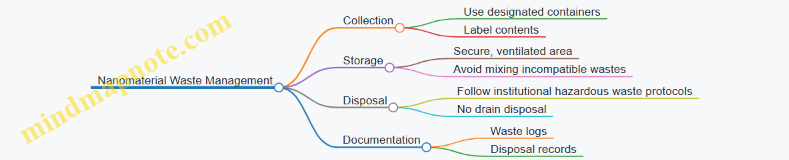
Practical Example: Spill Response for Carbon Nanotubes
If a spill occurs, avoid dry sweeping to prevent airborne dispersion. Use damp cloths or absorbent pads to collect material. Employ a HEPA-filter vacuum for residual particles. Dispose of collected waste in labeled hazardous waste containers. Report the spill according to lab safety guidelines.
Summary
Safety in handling nanomaterials and molecular assemblies hinges on understanding their unique risks and applying consistent protocols. Proper PPE, engineering controls, careful handling, clear labeling, responsible waste management, and thorough training form the foundation of a safe working environment. Regular review and adherence to these protocols protect personnel and the environment alike.
11.2 Ethical Considerations in Programmable Matter Applications
Programmable matter, by its nature, raises several ethical questions that intersect with privacy, safety, environmental impact, and social responsibility. These considerations are essential to address early in research and development to avoid unintended consequences.
Privacy and Surveillance
Programmable matter can be designed to change shape, function, or appearance in response to stimuli, potentially enabling covert sensing or data collection. This raises concerns about unauthorized surveillance and data privacy.
-
Example: Smart materials embedded in clothing could monitor physiological data without explicit consent.
-
Mind Map:
Safety and Health Risks
Materials that self-assemble or reconfigure dynamically may pose risks if they malfunction or interact unpredictably with biological systems.
-
Example: Nanoparticles designed for drug delivery could accumulate in unintended tissues, causing toxicity.
-
Mind Map:
Environmental Impact
The production, use, and disposal of programmable matter may affect ecosystems, especially if materials persist or bioaccumulate.
-
Example: Self-assembling polymers released into waterways might disrupt aquatic life.
-
Mind Map:
Social and Economic Equity
Access to programmable matter technologies and their benefits may be uneven, potentially widening social gaps.
-
Example: Advanced medical materials might be affordable only to wealthy populations.
-
Mind Map:
Intellectual Property and Ownership
The programmable nature of these materials complicates questions about who owns the design, the assembled product, or the data generated.
-
Example: If a material reconfigures autonomously, determining patent rights can be challenging.
-
Mind Map:
Responsible Development and Use
Ethical programming of self-assembling materials requires transparency, accountability, and stakeholder involvement.
-
Example: Developers should document assembly protocols and potential risks clearly.
-
Mind Map:
Summary
Ethical considerations in programmable matter are multifaceted and interconnected. Addressing privacy, safety, environmental, social, and legal issues early helps guide responsible innovation. Concrete examples and structured thinking, such as mind maps, assist in navigating these complex topics.
11.3 Regulatory Frameworks Relevant to Smart Materials
Smart materials and programmable matter occupy a unique space in regulation because they blend chemistry, biology, and engineering. Understanding the applicable regulatory frameworks is essential for researchers and developers to ensure compliance and facilitate safe, responsible innovation.
Key Regulatory Domains
Smart materials may fall under several regulatory categories depending on their composition, use, and potential impact. These include:
- Chemical Safety Regulations
- Nanomaterial-Specific Guidelines
- Biological Material Controls
- Medical Device and Pharmaceutical Regulations
- Environmental Protection Laws
Each domain has its own set of rules, agencies, and documentation requirements.
Mind Map: Regulatory Domains for Smart Materials
Chemical Safety Regulations
Smart materials often involve novel chemicals or polymers. In the United States, the Toxic Substances Control Act (TSCA) governs the manufacture and use of chemical substances. Under TSCA, new chemicals must be reported and assessed for risk before commercial use. The European Union’s REACH regulation requires manufacturers to register substances and provide safety data.
Example: A company developing a self-healing polymer must submit a pre-manufacture notice under TSCA, including toxicity data and environmental impact assessments.
Nanomaterial-Specific Guidelines
Because many smart materials operate at the nanoscale, specific nanomaterial regulations apply. The U.S. Food and Drug Administration (FDA) provides guidance on nanotechnology in products, emphasizing characterization, safety testing, and labeling.
The Organisation for Economic Co-operation and Development (OECD) offers testing guidelines tailored to nanomaterials, focusing on their unique behaviors compared to bulk materials.
Example: A research team creating programmable nanoparticles for drug delivery must characterize particle size, surface chemistry, and potential toxicity following FDA and OECD standards.
Biological Material Controls
When smart materials incorporate biological components such as peptides, DNA, or living cells, biosafety regulations come into play. Laboratories must adhere to biosafety level protocols to prevent contamination or unintended release.
Genetically modified organisms (GMOs) used in programmable matter are subject to additional oversight, including containment and environmental release permits.
Example: Developing DNA-based nanorobots requires compliance with institutional biosafety committees and possibly federal GMO regulations.
Medical Device and Pharmaceutical Regulations
Smart materials intended for medical applications may be regulated as medical devices or combination products. The FDA’s 510(k) clearance process evaluates safety and efficacy before market approval.
In the EU, CE marking indicates conformity with health, safety, and environmental protection standards.
Example: A hydrogel that responds to physiological stimuli for drug release must undergo rigorous testing and regulatory review as a medical device.
Environmental Protection Laws
Disposal and environmental impact of smart materials are regulated to prevent pollution and ecological harm. The Environmental Protection Agency (EPA) enforces rules on waste handling, emissions, and chemical releases.
Example: Manufacturing programmable matter with metal nanoparticles requires adherence to hazardous waste disposal protocols to avoid soil and water contamination.
Mind Map: Compliance Workflow for Smart Materials
Summary
Navigating regulatory frameworks for smart materials requires a clear understanding of the material’s nature and intended use. Early identification of applicable regulations streamlines development and reduces risks of non-compliance. Integrating regulatory considerations into design and testing phases ensures smoother transitions from lab to application.
By approaching regulation as part of the engineering process, developers can create smart materials that are not only innovative but also safe and legally sound.
11.4 Best Practices in Responsible Research and Development
Responsible research and development (R&D) in self assembling materials and programmable matter requires a structured approach to ensure safety, reproducibility, transparency, and ethical integrity. This section outlines best practices that help maintain high standards throughout the research lifecycle.
Prioritize Safety and Risk Assessment
Before beginning any experimental work, conduct a thorough risk assessment. Identify potential hazards related to chemical reagents, nanomaterials, and equipment. Document safety protocols clearly and ensure all team members are trained.
- Use personal protective equipment appropriate for the materials handled.
- Maintain proper waste disposal procedures for nanomaterials and solvents.
- Regularly review and update safety data sheets.
Maintain Clear and Accurate Documentation
Good documentation is the backbone of responsible R&D. Record experimental conditions, materials used, and observations meticulously.
- Use electronic lab notebooks with time stamps to reduce errors.
- Include details such as batch numbers, concentrations, and environmental conditions.
- Document failed experiments as thoroughly as successful ones to avoid repetition.
Ensure Reproducibility and Transparency
Reproducibility is essential for scientific credibility. Share protocols and data openly within your team and collaborators.
- Standardize protocols where possible.
- Use control experiments to benchmark results.
- Report all variables that might influence outcomes.
Address Ethical Considerations
Ethics in programmable matter research involves responsible use of materials and consideration of societal impact.
- Avoid dual-use research that could be misapplied.
- Respect intellectual property rights and give credit appropriately.
- Consider environmental impact when designing materials and processes.
Foster Collaborative and Inclusive Research Culture
Encourage open communication, diverse perspectives, and constructive critique.
- Hold regular meetings to discuss progress and challenges.
- Promote diversity in research teams to enhance creativity and problem-solving.
- Address conflicts of interest transparently.
Mind Map: Core Components of Responsible R&D
Example 1: Implementing Safety Protocols in Nanomaterial Synthesis
A research group working with self assembling peptide nanofibers established a checklist for handling solvents and peptides. They mandated glove use, fume hood operation, and proper labeling of waste containers. This reduced accidental exposure and improved lab safety compliance.
Example 2: Enhancing Reproducibility Through Protocol Standardization
In a project developing DNA origami structures, the team created a detailed step-by-step protocol with exact temperature ramps and reagent concentrations. Sharing this protocol with collaborators led to consistent assembly yields across different labs.
Mind Map: Documentation Workflow

Example 3: Ethical Decision-Making in Material Design
A team designing programmable hydrogels chose biodegradable polymers over persistent synthetic materials to minimize environmental footprint. They also ensured that their designs did not enable unauthorized surveillance applications, reflecting ethical foresight.
Summary
Responsible R&D in programmable matter hinges on clear safety practices, thorough documentation, reproducibility, ethical mindfulness, and collaborative culture. Integrating these elements into daily research routines helps build reliable and trustworthy outcomes.
11.5 Practical Example: Compliance Checklist for Laboratory Synthesis
When working with self-assembling materials and programmable matter, laboratory synthesis involves handling chemicals, nanomaterials, and sometimes biological components. Ensuring compliance with safety and regulatory standards is crucial to protect personnel, the environment, and the integrity of your research. Below is a detailed compliance checklist designed to guide you through the essential steps of laboratory synthesis.
Compliance Checklist Mind Map
Detailed Checklist Items
1. Preparation
- Review the Material Safety Data Sheets (MSDS) for all chemicals and nanomaterials involved. This ensures awareness of hazards such as toxicity, flammability, or reactivity.
- Select appropriate Personal Protective Equipment (PPE), including gloves, lab coats, eye protection, and respiratory protection if needed.
- Conduct a hazard assessment considering the specific synthesis steps, potential exposure routes, and emergency scenarios.
2. Chemical Handling
- Verify that all reagents and materials are clearly labeled with identity, concentration, and hazard warnings.
- Store chemicals according to their compatibility groups to prevent dangerous reactions (e.g., acids separate from bases).
- Use fume hoods or glove boxes when working with volatile, toxic, or reactive substances to minimize inhalation risks.
3. Equipment
- Ensure all instruments and apparatus are calibrated and maintained regularly to avoid malfunctions that could cause accidents.
- Provide appropriate waste disposal containers, clearly marked for chemical, biological, or nanomaterial waste.
- Confirm that emergency equipment such as eyewash stations and safety showers are accessible and functional.
4. Documentation
- Obtain approval for the experimental protocol from the relevant safety committee or supervisor.
- Familiarize yourself with incident reporting procedures to promptly address any accidents or near misses.
- Keep training records up to date, demonstrating that all personnel are competent in handling materials and equipment.
5. Environmental Controls
- Check that laboratory ventilation meets standards to prevent accumulation of hazardous vapors.
- Implement spill containment measures, such as absorbent materials and secondary containment trays.
- Segregate waste streams properly and follow institutional or governmental disposal regulations.
6. Post-Synthesis
- Follow decontamination procedures for work surfaces, equipment, and PPE to prevent cross-contamination.
- Label all synthesized samples with detailed information including composition, date, and responsible personnel.
- Record all experimental data meticulously to ensure traceability and reproducibility.
Example: Applying the Checklist to a Peptide-Based Nanofiber Synthesis
- Preparation: Reviewed MSDS for peptide monomers and solvents; selected nitrile gloves and lab coat; assessed hazards related to solvent volatility.
- Chemical Handling: Confirmed all solvents labeled; stored peptides in a dedicated refrigerator; used fume hood during solvent evaporation.
- Equipment: Verified pH meter calibration; placed chemical waste container nearby; ensured eyewash station was unobstructed.
- Documentation: Submitted synthesis protocol for safety review; reviewed emergency spill procedures; confirmed all team members completed training.
- Environmental Controls: Verified ventilation system functionality; prepared spill kit with absorbent pads; segregated organic solvent waste.
- Post-Synthesis: Cleaned glassware with appropriate solvents; labeled nanofiber samples with batch number and date; logged synthesis parameters in lab notebook.
This checklist helps maintain a safe and compliant laboratory environment while supporting the quality and reliability of your self-assembling materials research.
12. Appendices and Reference Materials
12.1 Glossary of Key Terms and Concepts
This glossary gathers essential terms used in the field of self assembling materials and programmable matter engineering. Each entry includes a concise definition and, where helpful, a simple example or a mind map to clarify relationships.
Self Assembly The process by which molecules or components autonomously organize into structured arrangements without external direction. This organization results from local interactions such as hydrogen bonding, hydrophobic effects, or electrostatic forces.
Example: Lipid molecules forming bilayer membranes in water.
Programmable Matter Materials engineered so their properties or configurations can be changed on demand by programming the interactions of their building blocks.
Mind map:
Molecular Building Blocks Fundamental units such as DNA strands, peptides, or polymers that serve as the components for self assembly.
Example: Single-stranded DNA sequences designed to hybridize selectively.
Non-Covalent Interactions Forces that hold self assembled structures together without forming covalent bonds. These include hydrogen bonds, van der Waals forces, ionic interactions, and hydrophobic effects.
Mind map:
Thermodynamics of Self Assembly Describes the energy changes and equilibrium states that govern whether self assembly is favorable. Key concepts include Gibbs free energy, enthalpy, and entropy.
Example: Micelle formation occurs when the decrease in free energy from hydrophobic interactions outweighs the entropy loss.
Kinetics of Self Assembly The study of the rates and pathways by which self assembly occurs. Kinetics determines how quickly and through which intermediates structures form.
Example: DNA origami folding speed depends on temperature and strand concentration.
Hierarchical Assembly A multi-step process where simple building blocks first form intermediate structures, which then assemble into more complex architectures.
Example: Peptides forming beta-sheet fibrils that bundle into fibers.
Stimuli-Responsive Materials Materials that change their structure or properties in response to external triggers such as pH, temperature, light, or magnetic fields.
Example: A hydrogel that swells when exposed to acidic conditions.
Error Correction in Assembly Mechanisms or design strategies that reduce defects during self assembly, improving yield and uniformity.
Example: DNA strand displacement techniques that remove mismatched strands.
Nanofibers Fibrous structures with diameters in the nanometer range, often formed by self assembling peptides or polymers.
Example: Peptide amphiphiles that form nanofibers used in tissue scaffolds.
DNA Origami A method of folding a long single-stranded DNA scaffold into desired shapes using short staple strands that bind specific regions.
Mind map:
Hydrogels Three-dimensional polymer networks that can absorb large amounts of water while maintaining structure. Often used as adaptive materials.
Example: pH-responsive hydrogels that expand or contract.
Micelles Spherical aggregates of amphiphilic molecules in solution, with hydrophobic cores and hydrophilic shells.
Example: Detergent molecules forming micelles to trap oils.
Colloidal Crystals Ordered arrays of colloidal particles formed through self assembly, often used in photonics.
Shape Memory Materials Materials that can return to a predefined shape after deformation when triggered by stimuli like heat.
Example: Polymers that straighten after heating.
Peptide Amphiphiles Molecules combining hydrophobic tails and peptide sequences that self assemble into nanostructures.
Surface Functionalization Modification of material surfaces with specific chemical groups to control interactions and assembly.
Molecular Recognition Selective interaction between molecules through complementary shapes or chemical groups.
Example: DNA base pairing.
Energy Landscape A conceptual model representing all possible states of a system and their energies, illustrating pathways and barriers in self assembly.
Scattering Techniques Methods like X-ray or neutron scattering used to probe the structure of self assembled materials at different length scales.
Atomic Force Microscopy (AFM) A microscopy technique that maps surface topography at the nanoscale by scanning a sharp tip over the sample.
Error Yield The proportion of correctly assembled structures relative to total products.
Reconfigurable Materials Materials capable of changing their structure or function repeatedly under controlled conditions.
This glossary aims to provide clear definitions and connections among key concepts. Understanding these terms builds a foundation for exploring the design, characterization, and application of self assembling materials and programmable matter.
12.2 Summary of Common Molecular Building Blocks
Self-assembling materials rely on a variety of molecular building blocks, each with distinct properties and interaction modes. Understanding these building blocks is essential for designing programmable matter with predictable behaviors. Below is a structured overview of the most common types, organized by their chemical nature and typical roles in self-assembly.
Nucleic Acids (DNA and RNA)
Nucleic acids are popular building blocks due to their precise base-pairing rules, enabling programmable and predictable assembly.
- Structure: Linear polymers of nucleotides, each containing a sugar, phosphate group, and nitrogenous base (A, T/U, G, C).
- Interactions: Watson-Crick base pairing, stacking interactions, and electrostatic repulsion.
- Applications: DNA origami, nanorobots, logic gates.
Example: DNA tiles that self-assemble into 2D lattices by complementary sticky ends.
Mind Map: Nucleic Acids
Peptides and Proteins
Peptides are short chains of amino acids, while proteins are longer, folded chains. Their diversity in sequence and structure allows for a wide range of assembly behaviors.
- Structure: Linear chains of 20 standard amino acids with varying side chains.
- Interactions: Hydrogen bonding, hydrophobic effects, electrostatic interactions, disulfide bonds.
- Applications: Nanofibers, hydrogels, enzyme mimics.
Example: Peptide amphiphiles that form nanofibers through hydrophobic tail aggregation and beta-sheet formation.
Mind Map: Peptides and Proteins
Polymers
Synthetic and natural polymers provide versatile scaffolds for self-assembly due to their tunable length, composition, and architecture.
- Structure: Repeating monomer units linked covalently.
- Interactions: Van der Waals forces, hydrogen bonding, ionic interactions.
- Applications: Block copolymer micelles, responsive gels, membranes.
Example: Block copolymers that microphase separate into ordered domains such as spheres, cylinders, or lamellae.
Mind Map: Polymers

Lipids and Surfactants
Lipids are amphiphilic molecules that spontaneously form bilayers, micelles, or vesicles in aqueous environments.
- Structure: Hydrophilic head and hydrophobic tail(s).
- Interactions: Hydrophobic effect, van der Waals forces.
- Applications: Model membranes, drug delivery vehicles.
Example: Phospholipids forming liposomes that encapsulate drugs for targeted delivery.
Mind Map: Lipids and Surfactants
Inorganic Nanoparticles
Nanoparticles such as gold, silica, or quantum dots can serve as building blocks when functionalized with organic ligands.
- Structure: Core inorganic particle with surface ligands.
- Interactions: Ligand-ligand interactions, electrostatic forces, van der Waals forces.
- Applications: Photonic crystals, sensors, catalysts.
Example: Gold nanoparticles functionalized with DNA strands that assemble into ordered arrays.
Mind Map: Inorganic Nanoparticles
Small Molecules and Supramolecular Units
Small molecules designed with complementary binding sites can self-assemble into larger architectures.
- Structure: Typically organic molecules with hydrogen bond donors/acceptors, pi systems.
- Interactions: Hydrogen bonding, pi-pi stacking, metal coordination.
- Applications: Molecular gels, liquid crystals.
Example: Ureidopyrimidinone (UPy) motifs forming quadruple hydrogen bonds to create reversible supramolecular polymers.
Mind Map: Small Molecules
Summary Table of Building Blocks
| Building Block Type | Key Interaction(s) | Typical Structures Formed | Example Use Case |
|---|---|---|---|
| Nucleic Acids | Base pairing, stacking | DNA origami, lattices | DNA tile assembly |
| Peptides and Proteins | Hydrogen bonds, hydrophobic | Nanofibers, hydrogels | Peptide amphiphile nanofibers |
| Polymers | Van der Waals, hydrogen bonds | Micelles, vesicles, films | Block copolymer microphase separation |
| Lipids and Surfactants | Hydrophobic effect | Bilayers, micelles, vesicles | Liposome drug delivery |
| Inorganic Nanoparticles | Ligand interactions, electrostatic | Superlattices, hybrid materials | DNA-functionalized gold nanoparticle arrays |
| Small Molecules | Hydrogen bonding, pi stacking | Supramolecular polymers, gels | UPy-based reversible polymers |
Each building block offers unique advantages and constraints. Selecting the right one depends on the target material properties, assembly environment, and desired functionality. The mind maps above provide a quick visual guide to their core features and applications.
12.3 Protocol Templates for Self Assembly Experiments
Self assembly experiments require clear, repeatable protocols to ensure consistent results. Below are detailed templates for common types of self assembly, accompanied by mind maps to organize key steps and considerations. Each protocol includes an example to illustrate practical application.
Protocol 1: DNA Tile Assembly
Objective: Assemble DNA tiles into a predefined lattice structure.
Materials:
- Synthetic DNA oligonucleotides
- Buffer solution (e.g., Tris-EDTA with Mg2+)
- Thermal cycler or programmable temperature control
- Microcentrifuge tubes
Steps:
- Prepare equimolar solutions of each DNA strand.
- Mix strands in buffer to final desired concentration.
- Anneal mixture by heating to 95°C for 5 minutes.
- Slowly cool to room temperature over several hours (e.g., 1°C per minute).
- Store assembled tiles at 4°C until use.
- Characterize assembly via gel electrophoresis or AFM imaging.
Mind Map:
Example: In a typical experiment, four DNA strands each at 10 µM were mixed in 1x TAE/Mg2+ buffer. The mixture was heated to 95°C for 5 minutes and cooled at 0.5°C per minute to 20°C. AFM images confirmed formation of square lattice tiles.
Protocol 2: Peptide Amphiphile Nanofiber Formation
Objective: Induce self assembly of designed peptide amphiphiles into nanofibers.
Materials:
- Peptide amphiphile powder
- Deionized water
- pH adjustment reagents (e.g., NaOH, HCl)
- Vortex mixer
- Incubator or temperature-controlled shaker
Steps:
- Dissolve peptide amphiphile in water at desired concentration (e.g., 1 wt%).
- Adjust pH to target value (commonly near physiological pH).
- Vortex solution to ensure homogeneity.
- Incubate at room temperature or 37°C for 24 hours.
- Analyze fiber formation using TEM or circular dichroism spectroscopy.
Mind Map:
Example: A 1 wt% solution of a peptide amphiphile was prepared and adjusted to pH 7.4. After vortexing and 24-hour incubation at 37°C, TEM images showed uniform nanofibers approximately 10 nm in diameter.
Protocol 3: Block Copolymer Micelle Formation
Objective: Form micelles from amphiphilic block copolymers via solvent exchange.
Materials:
- Block copolymer (e.g., polystyrene-b-polyethylene oxide)
- Good solvent (e.g., tetrahydrofuran, THF)
- Poor solvent (e.g., water)
- Syringe pump or dropwise addition setup
- Dynamic light scattering (DLS) instrument
Steps:
- Dissolve block copolymer in good solvent at known concentration.
- Slowly add poor solvent to the polymer solution under stirring.
- Continue addition until desired solvent ratio is reached.
- Dialyze or evaporate good solvent if necessary.
- Measure micelle size and distribution by DLS.
Mind Map:
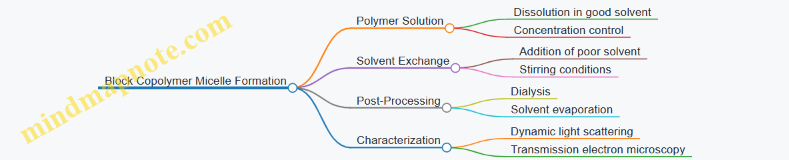
Example: Polystyrene-b-polyethylene oxide was dissolved at 5 mg/mL in THF. Water was added dropwise at 1 mL/min under stirring until 50% water content was reached. DLS showed micelles with an average diameter of 80 nm.
Protocol 4: Stimuli-Responsive Hydrogel Assembly
Objective: Prepare a hydrogel that assembles or disassembles in response to pH changes.
Materials:
- Polymer precursor with pH-sensitive groups
- Buffer solutions at different pH values
- Vials or molds
- Rheometer or swelling measurement setup
Steps:
- Dissolve polymer precursor in buffer at initial pH.
- Adjust pH to trigger gelation (e.g., lower pH to induce crosslinking).
- Allow gelation to proceed for specified time (e.g., 1 hour).
- Test mechanical properties or swelling behavior.
- Reverse pH to observe disassembly if applicable.
Mind Map:
Example: A 2 wt% solution of a poly(acrylic acid)-based polymer was prepared at pH 7. Upon lowering pH to 4, gelation occurred within 30 minutes. Rheological measurements showed a storage modulus increase from 10 Pa to 500 Pa.
General Tips for Protocol Success
- Always prepare fresh solutions when possible to avoid degradation.
- Use precise temperature control during annealing or incubation steps.
- Maintain consistent mixing speeds to ensure homogeneity.
- Document all concentrations, times, and environmental conditions.
- Include controls to verify assembly specificity.
These templates provide a starting point. Adjust parameters based on material properties and experimental goals. Clear documentation and systematic variation of conditions help identify optimal assembly protocols.
12.4 Data Analysis and Visualization Tools
Data analysis and visualization are essential steps in understanding the behavior and properties of self assembling materials. Proper analysis helps identify patterns, quantify assembly efficiency, and validate theoretical models. Visualization, on the other hand, provides intuitive insight into complex molecular arrangements and dynamic processes. This section covers common tools and approaches, illustrated with practical examples and mind maps to organize concepts.
Key Objectives in Data Analysis for Self Assembling Materials
- Quantify assembly yield and purity
- Track kinetics of assembly and disassembly
- Characterize structural features (size, shape, morphology)
- Correlate environmental parameters with assembly outcomes
- Validate computational models against experimental data
Common Data Types
- Spectroscopic data (absorbance, fluorescence, NMR peaks)
- Microscopy images (AFM, TEM, SEM)
- Scattering profiles (X-ray, neutron)
- Time series measurements (kinetics, stimuli response)
- Simulation outputs (coordinates, energy landscapes)
Data Analysis Workflow Mind Map
Visualization Techniques
-
Graphs and Plots
- Line plots for kinetic data (e.g., assembly over time)
- Histograms for size distributions
- Scatter plots to correlate variables (e.g., temperature vs yield)
-
Molecular Renderings
- 3D visualizations of assembled structures
- Color coding by property (charge, hydrophobicity)
-
Heatmaps and Contour Maps
- Display parameter spaces (e.g., pH vs ionic strength effects)
- Show intensity distributions in microscopy images
-
Network Diagrams
- Represent interaction networks among building blocks
Example 1: Analyzing Kinetics of Micelle Formation
- Data: Time-dependent fluorescence intensity indicating micelle assembly
- Analysis: Plot fluorescence vs time to identify lag phase, growth phase, and plateau
- Visualization: Line plot with fitted kinetic model overlay
Example 2: Particle Size Distribution from TEM Images
- Data: Diameter measurements of nanoparticles from image analysis
- Analysis: Calculate mean, standard deviation, and distribution shape
- Visualization: Histogram with fitted normal distribution curve
Example 3: Correlating Environmental Parameters with Assembly Yield
- Data: Assembly yield measured at different pH and temperature values
- Analysis: Use correlation coefficients and regression models
- Visualization: Heatmap showing yield intensity across pH and temperature grid
Software Tools and Programming Languages
- Python: Widely used for data analysis with libraries such as NumPy, pandas, Matplotlib, Seaborn, and SciPy.
- R: Strong in statistical analysis and visualization.
- ImageJ/Fiji: Specialized for microscopy image processing.
- MATLAB: Useful for numerical modeling and custom visualization.
Best Practices
- Always preprocess raw data to remove artifacts.
- Use multiple visualization types to cross-validate interpretations.
- Document analysis steps for reproducibility.
- Combine quantitative metrics with visual inspection.
- Validate computational models with experimental data.
By systematically applying these tools and approaches, researchers can extract meaningful insights from complex datasets related to self assembling materials and programmable matter. Visualization not only aids understanding but also communicates results effectively to collaborators and stakeholders.
12.5 Practical Example: Step-by-Step Guide to DNA Tile Assembly
DNA tile assembly is a foundational technique in programmable matter, where short DNA strands are designed to self-assemble into larger, predictable structures. This example walks through the process of assembling a simple two-dimensional DNA tile lattice using four distinct DNA strands.
Step 1: Understanding the DNA Tile Concept
DNA tiles are typically composed of multiple DNA strands that hybridize to form a rigid, multi-armed structure. Each arm has single-stranded overhangs (sticky ends) that selectively bind to complementary overhangs on other tiles, allowing controlled assembly.
Mind Map: Components of a DNA Tile
Step 2: Designing the DNA Sequences
Design four DNA strands (A, B, C, D) that assemble into a square tile. Each strand has regions complementary to parts of the other strands and specific sticky ends for inter-tile binding.
- Core regions: Ensure stable tile formation.
- Sticky ends: Short sequences (typically 4-6 nucleotides) that direct tile assembly.
Example:
| Strand | Sequence (5’ to 3’) | Role |
|---|---|---|
| A | AGTCGATC… sticky end 1 | Core + sticky end |
| B | TCAGCTAG… sticky end 2 | Core + sticky end |
| C | GATCGTAC… sticky end 3 | Core + sticky end |
| D | CTAGCTGA… sticky end 4 | Core + sticky end |
Note: Sequences are simplified here; actual design requires avoiding unintended complementarity.
Mind Map: Sequence Design Considerations
Step 3: Preparing the DNA Strands
Order synthetic DNA oligonucleotides with the designed sequences. Purify if necessary to remove truncated products.
Best Practice: Use PAGE purification for higher purity, especially for sticky ends.
Step 4: Annealing Protocol
Mix equimolar amounts of strands A, B, C, and D in an appropriate buffer (e.g., 1x TAE/Mg2+). Heat the mixture to 95°C for 5 minutes, then slowly cool to room temperature over several hours to promote correct hybridization.
Mind Map: Annealing Process
Example:
- Mix 1 µM each strand in 1x TAE buffer with 12.5 mM MgCl2.
- Heat to 95°C for 5 minutes.
- Cool down to 25°C at 1°C per minute.
Step 5: Verification of Tile Formation
Use native polyacrylamide gel electrophoresis (PAGE) to verify tile assembly. Correctly assembled tiles migrate differently from single strands or partial assemblies.
Best Practice: Include controls of individual strands and partial mixtures.
Step 6: Assembly of DNA Tiles into Lattices
The sticky ends on each tile are designed to be complementary to sticky ends on neighboring tiles. When mixed under suitable conditions, tiles self-assemble into larger lattices.
Example:
- Prepare tile solution at 100 nM concentration.
- Incubate at room temperature for several hours.
Mind Map: Lattice Assembly Factors
Step 7: Characterization of the Assembled Lattice
Use atomic force microscopy (AFM) or transmission electron microscopy (TEM) to image the assembled lattices. Look for periodic patterns consistent with the designed tile arrangement.
Best Practice: Prepare samples on mica or carbon-coated grids with minimal drying artifacts.
Step 8: Troubleshooting Common Issues
- Incomplete assembly: Check strand purity and annealing protocol.
- Aggregation: Reduce Mg2+ concentration or lower tile concentration.
- Non-specific binding: Redesign sticky ends to increase specificity.
Mind Map: Troubleshooting
Summary
This step-by-step guide outlines the key stages of DNA tile assembly: from sequence design and strand preparation to annealing, lattice formation, and characterization. Each step involves careful control of molecular interactions and environmental conditions to achieve predictable self-assembly. The included mind maps help organize the critical factors at each stage, while the examples provide concrete starting points for experimental work.