Spanish Conversation Practice Workbook for Beginners
Chapter 1: Greetings and Introductions
1.1 Basic Greetings and Farewells
When starting to speak Spanish, mastering basic greetings and farewells is essential. These expressions form the foundation of polite conversation and help establish a friendly tone.
Common Greetings
- Hola – Hello
- Buenos días – Good morning
- Buenas tardes – Good afternoon
- Buenas noches – Good evening / Good night
These greetings vary depending on the time of day. “Buenos días” is typically used from morning until noon, “Buenas tardes” from noon until sunset, and “Buenas noches” after dark or when saying goodbye at night.
Common Farewells
- Adiós – Goodbye
- Hasta luego – See you later
- Hasta mañana – See you tomorrow
- Nos vemos – See you
- Chao – Bye (informal)
Farewells can be formal or informal. “Adiós” is more formal and final, while “Hasta luego” and “Nos vemos” are casual and imply you will meet again.
Polite Additions
Adding ¿Cómo está? (formal) or ¿Cómo estás? (informal) after a greeting asks “How are you?” This invites a response and shows interest.
Example:
- Hola, ¿cómo estás? – Hello, how are you?
- Buenos días, ¿cómo está usted? – Good morning, how are you? (formal)
Mind Map: Basic Greetings and Farewells
Examples of Simple Dialogues
Example 1: Informal Greeting
- A: Hola, ¿cómo estás?
- B: Bien, gracias. ¿Y tú?
- A: Muy bien.
Example 2: Formal Greeting and Farewell
- A: Buenos días, ¿cómo está usted?
- B: Muy bien, gracias. ¿Y usted?
- A: Bien, gracias. Adiós.
- B: Hasta luego.
Tips for Practice
- Use greetings appropriate to the time of day.
- Match the level of formality to the situation and the person.
- Practice saying greetings aloud to get comfortable with pronunciation.
- Try to respond to greetings naturally, even with simple answers like “bien” (good) or “muy bien” (very good).
By regularly practicing these basic greetings and farewells, you’ll build confidence in starting and ending conversations politely and naturally.
1.2 Introducing Yourself and Others
Introducing yourself and others is one of the first practical skills you’ll use in Spanish conversation. It involves sharing basic personal information and making connections between people. This section covers common phrases, sentence structures, and vocabulary to help you confidently introduce yourself and others in everyday situations.
Key Concepts Mind Map
Introducing Yourself
When introducing yourself, the most common and straightforward phrase is:
- Me llamo [Name]. (My name is [Name].)
Alternatively:
- Soy [Name]. (I am [Name].)
Both are widely used, but “Me llamo” literally means “I call myself,” which is a typical Spanish way to say your name.
You can add more details to make your introduction more complete:
- Tengo [age] años. (I am [age] years old.)
- Soy de [place]. (I am from [place].)
- Trabajo como [profession]. (I work as a [profession].)
Example:
Me llamo Ana. Tengo 25 años. Soy de México y trabajo como profesora.
This gives your listener a clear picture of who you are.
Introducing Others
When introducing someone else, you can use:
- Te presento a [Name]. (I introduce you to [Name].)
- Quiero presentarte a [Name]. (I want to introduce you to [Name].)
If you want to specify the relationship:
- Él es mi amigo, [Name]. (He is my friend, [Name].)
- Ella es mi hermana, [Name]. (She is my sister, [Name].)
Example:
Te presento a Carlos. Él es mi compañero de trabajo.
This helps clarify who the person is and your connection to them.
Polite Expressions
Adding polite expressions makes introductions smoother:
- Mucho gusto. (Nice to meet you.)
- Encantado / Encantada. (Delighted to meet you. Use “Encantado” if you are male, “Encantada” if female.)
- Por favor. (Please.)
- Gracias. (Thank you.)
Example:
Me llamo Luis. Mucho gusto.
Encantada de conocerte.
Mind Map: Basic Introduction Phrases
Sample Dialogues
Dialogue 1: Simple Self-Introduction
- A: Hola, ¿cómo te llamas?
- B: Me llamo Marta. ¿Y tú?
- A: Soy Juan. Mucho gusto.
- B: Igualmente.
Dialogue 2: Introducing a Friend
- A: ¿Quién es ella?
- B: Te presento a mi amiga, Laura.
- A: Mucho gusto, Laura.
- Laura: Encantada.
Dialogue 3: Adding More Details
- A: Hola, me llamo Pedro.
- B: Hola Pedro, soy Ana. ¿De dónde eres?
- A: Soy de Argentina. ¿Y tú?
- B: Soy de España. ¿A qué te dedicas?
- A: Trabajo como ingeniero.
Practice Tips
- Use simple sentences first, then gradually add details.
- Pay attention to gender agreement, especially with “encantado/encantada”.
- Practice both introducing yourself and others to build confidence.
- Repeat polite expressions to sound natural and courteous.
This section builds a foundation for everyday conversation by focusing on clear, practical phrases and polite social norms. The examples and mind maps help organize the information visually and contextually, making it easier to remember and apply.
1.3 Asking and Answering Simple Personal Questions
When starting a conversation in Spanish, asking and answering personal questions is essential. These questions help you learn about the other person and share information about yourself. The key is to keep questions simple and clear, using common question words and straightforward sentence structures.
Common Question Words
Here is a mind map of basic question words used in personal questions:
Most personal questions start with one of these words, followed by a verb and the subject.
Basic Personal Questions
Here are some common personal questions you can ask or answer:
- ¿Cómo te llamas? (What is your name?)
- ¿De dónde eres? (Where are you from?)
- ¿Cuántos años tienes? (How old are you?)
- ¿Dónde vives? (Where do you live?)
- ¿Qué haces? (What do you do? / What is your job?)
- ¿Tienes hermanos? (Do you have siblings?)
- ¿Cuál es tu número de teléfono? (What is your phone number?)
Mind Map: Structure of Simple Personal Questions
Answering Personal Questions
Answers usually follow the question’s structure and provide clear, concise information.
Examples:
- ¿Cómo te llamas?
- Me llamo Ana. (My name is Ana.)
- ¿De dónde eres?
- Soy de México. (I am from Mexico.)
- ¿Cuántos años tienes?
- Tengo 25 años. (I am 25 years old.)
- ¿Dónde vives?
- Vivo en Barcelona. (I live in Barcelona.)
- ¿Qué haces?
- Soy estudiante. (I am a student.)
- ¿Tienes hermanos?
- Sí, tengo dos hermanos. (Yes, I have two brothers.)
Mind Map: Typical Answers
Practice Examples
-
Question: ¿Cómo te llamas?
Answer: Me llamo Carlos.
-
Question: ¿De dónde eres?
Answer: Soy de Argentina.
-
Question: ¿Cuántos años tienes?
Answer: Tengo 30 años.
-
Question: ¿Dónde vives?
Answer: Vivo en Sevilla.
-
Question: ¿Qué haces?
Answer: Soy profesor.
-
Question: ¿Tienes hermanos?
Answer: No, soy hijo único.
Tips for Practice
- Use the question words to create your own questions.
- Practice both asking and answering aloud to improve fluency.
- Remember that the verb “tener” (to have) is often used for age and family questions.
- Pay attention to the difference between “ser” and “estar” for describing identity and location.
By mastering these simple personal questions and answers, you can start conversations smoothly and learn more about people you meet. The examples here are designed to be clear and easy to remember, making your practice effective and enjoyable.
1.4 Polite Expressions and Common Courtesies
Politeness is a key part of any language, and Spanish is no exception. Using polite expressions helps you sound respectful and friendly, making conversations smoother and more pleasant. This section covers common courteous phrases and how to use them naturally.
Mind Map: Polite Expressions in Spanish
Using “Por favor” (Please)
Adding “por favor” softens requests and shows respect. It can be placed at the beginning or end of a sentence.
Examples:
- ¿Me pasas la sal, por favor? (Can you pass me the salt, please?)
- Por favor, ¿puede ayudarme? (Please, can you help me?)
Expressing Thanks
“Gracias” is the basic way to say thank you. To express greater gratitude, use “muchas gracias” (thank you very much).
Examples:
- Gracias por tu ayuda. (Thank you for your help.)
- Muchas gracias por todo. (Thank you very much for everything.)
When someone thanks you, common responses include:
- De nada (You’re welcome)
- No hay de qué (It’s nothing)
Apologizing and Excusing Yourself
Use “perdón” or “disculpa” to get someone’s attention or to apologize for minor mistakes.
Examples:
- Perdón, ¿dónde está el baño? (Excuse me, where is the bathroom?)
- Disculpa, no te escuché. (Sorry, I didn’t hear you.)
For more sincere apologies, “lo siento” is appropriate.
Example:
- Lo siento por llegar tarde. (I’m sorry for arriving late.)
Making Polite Requests
Spanish often uses conditional forms to make requests sound more polite.
Examples:
- ¿Podría abrir la ventana? (Could you open the window?)
- ¿Me puede ayudar con esto? (Can you help me with this?)
Note the use of “podría” (conditional of poder) and “me puede” (formal “you can”) to soften commands.
Formal vs Informal Politeness
Spanish distinguishes between formal (usted) and informal (tú) forms of address. Use “usted” with strangers, elders, or in professional settings.
Examples:
- ¿Cómo está usted? (How are you? - formal)
- ¿Cómo estás? (How are you? - informal)
Polite expressions adapt accordingly:
- Formal: ¿Podría ayudarme? (Could you help me?)
- Informal: ¿Puedes ayudarme? (Can you help me?)
Practice Dialogues
Dialogue 1: Asking for Directions Politely
- Persona A: Disculpe, ¿podría decirme dónde está la estación de tren? (Excuse me, could you tell me where the train station is?)
- Persona B: Claro, está a dos cuadras de aquí. (Sure, it’s two blocks from here.)
- Persona A: Muchas gracias. (Thank you very much.)
- Persona B: De nada. (You’re welcome.)
Dialogue 2: Ordering at a Café
- Cliente: Buenas tardes, ¿me puede traer un café, por favor? (Good afternoon, can you bring me a coffee, please?)
- Camarero: Por supuesto. ¿Algo más? (Of course. Anything else?)
- Cliente: No, gracias. (No, thank you.)
Using polite expressions consistently shows respect and helps build positive interactions. Practice these phrases in different contexts to become comfortable with their natural use.
1.5 Practice Dialogues: Meeting Someone for the First Time
When you meet someone for the first time in Spanish, the conversation usually follows a simple pattern: greetings, introductions, exchanging basic personal information, and polite small talk. This section provides practical dialogues and mind maps to help you grasp these essential interactions.
Mind Map: Basic Structure of a First Meeting Conversation
Example Dialogue 1: Simple Introduction
Ana: Hola, ¿cómo te llamas?
Luis: Me llamo Luis. ¿Y tú?
Ana: Soy Ana. Mucho gusto.
Luis: Igualmente. ¿De dónde eres?
Ana: Soy de México. ¿Y tú?
Luis: Soy de España.
Ana: ¿A qué te dedicas?
Luis: Soy estudiante de ingeniería. ¿Y tú?
Ana: Trabajo en una oficina.
Luis: Qué bien. Bueno, tengo que irme. ¡Hasta luego!
Ana: ¡Adiós!
Mind Map: Common Questions and Responses
Example Dialogue 2: Adding More Detail
Carlos: Buenas tardes, ¿cómo te llamas?
María: Buenas tardes, me llamo María. ¿Y tú?
Carlos: Soy Carlos. Mucho gusto.
María: Igualmente. ¿De dónde eres, Carlos?
Carlos: Soy de Argentina. ¿Y tú?
María: Soy de Colombia. ¿Qué haces aquí?
Carlos: Estoy aquí de vacaciones. ¿Y tú?
María: Trabajo en una empresa de tecnología.
Carlos: Interesante. ¿Hablas español todos los días?
María: Sí, es mi lengua materna.
Carlos: Perfecto. Bueno, fue un placer conocerte.
María: Igualmente. ¡Hasta luego!
Tips for Practice
- Repeat dialogues aloud to get comfortable with pronunciation and rhythm.
- Swap roles when practicing with a partner to experience both sides of the conversation.
- Focus on the natural flow rather than memorizing word-for-word.
- Use polite expressions like “mucho gusto” to sound friendly and respectful.
- Practice common questions and answers until they feel automatic.
This section’s dialogues and mind maps provide a foundation for meeting people in Spanish. The examples use simple vocabulary and structures, making them easy to understand and replicate. Regular practice will help you gain confidence in real-life situations.
Chapter 2: Numbers, Time, and Dates
2.1 Counting from 1 to 100
Counting is one of the first skills you need when learning Spanish. Numbers are everywhere—in prices, dates, phone numbers, addresses, and more. This section covers how to count from 1 to 100, with clear patterns and examples to help you remember.
Basic Numbers 1 to 15
Spanish numbers from 1 to 15 mostly have unique names that you need to memorize:
- 1 - uno
- 2 - dos
- 3 - tres
- 4 - cuatro
- 5 - cinco
- 6 - seis
- 7 - siete
- 8 - ocho
- 9 - nueve
- 10 - diez
- 11 - once
- 12 - doce
- 13 - trece
- 14 - catorce
- 15 - quince
These form the foundation for the rest of the numbers.
Mind Map: Numbers 1 to 15
Numbers 16 to 29: Compound Forms
From 16 to 19, Spanish uses a combination of “diez” (ten) plus the unit number, but written as one word:
- 16 - dieciséis (diez + seis)
- 17 - diecisiete
- 18 - dieciocho
- 19 - diecinueve
From 20 to 29, the base is “veinte” (twenty). Numbers 21 to 29 are formed by joining “veinti” with the unit number:
- 20 - veinte
- 21 - veintiuno
- 22 - veintidós
- 23 - veintitrés
- 24 - veinticuatro
- 25 - veinticinco
- 26 - veintiséis
- 27 - veintisiete
- 28 - veintiocho
- 29 - veintinueve
Note the accent marks on 22, 23, and 26.
Mind Map: Numbers 16 to 29
Numbers 30 to 100: Tens and Units
From 30 upwards, Spanish numbers follow a clear pattern:
- 30 - treinta
- 40 - cuarenta
- 50 - cincuenta
- 60 - sesenta
- 70 - setenta
- 80 - ochenta
- 90 - noventa
- 100 - cien
For numbers between these tens, use “y” (and) to connect the tens and units:
- 31 - treinta y uno
- 42 - cuarenta y dos
- 57 - cincuenta y siete
- 68 - sesenta y ocho
- 79 - setenta y nueve
- 84 - ochenta y cuatro
- 96 - noventa y seis
Note that “y” is always used between tens and units except for exact tens.
Mind Map: Numbers 30 to 100
Special Note on 100
- “Cien” is used when 100 stands alone.
- For numbers above 100, use “ciento” plus the rest (e.g., 101 is “ciento uno”).
Since this section focuses on up to 100, “cien” is the form to remember here.
Examples in Context
-
¿Cuántos años tienes? (How old are you?)
- Tengo veintitrés años. (I am 23 years old.)
-
La clase empieza a las ocho y media. (The class starts at 8:30.)
-
Compré treinta y cinco manzanas. (I bought 35 apples.)
-
El número de teléfono es cinco, cinco, dos, uno, nueve. (The phone number is 5, 5, 2, 1, 9.)
-
Hoy es el veinte de abril. (Today is April 20th.)
Practice Exercise
Try saying these numbers aloud and writing them:
- 14
- 18
- 22
- 37
- 49
- 58
- 73
- 85
- 99
- 100
Check your answers by breaking down the components: tens, units, and the use of “y”.
Mastering these numbers will make it easier to handle dates, prices, phone numbers, and basic math in Spanish. The patterns are consistent and logical once you get used to them.
2.2 Telling Time: Hours and Minutes
Telling time in Spanish is straightforward once you understand the basic structure. The key elements are the hour (la hora) and the minutes (los minutos). Spanish uses a 12-hour clock in everyday conversation, often accompanied by “de la mañana” (in the morning), “de la tarde” (in the afternoon), or “de la noche” (at night) to clarify the time of day.
Basic Structure for Telling Time
The general formula is:
Es la / Son las + [hour] + y + [minutes]
- Use Es la for 1 o’clock (singular hour).
- Use Son las for all other hours (plural).
Mind Map: Basic Time Expressions
Hours
- For 1 o’clock, say Es la una.
- For other hours, say Son las dos, Son las tres, etc.
Minutes
-
For minutes from 1 to 30, use y (and):
- 3:10 → Son las tres y diez
- 7:25 → Son las siete y veinticinco
-
For minutes past 30, Spanish often uses menos (minus) to express how many minutes remain until the next hour:
- 4:40 → Son las cinco menos veinte (It’s five minus twenty)
- 9:50 → Son las diez menos diez
Examples
| Spanish | English |
|---|---|
| Es la una. | It’s 1:00. |
| Son las dos y cinco. | It’s 2:05. |
| Son las cuatro y media. | It’s 4:30. |
| Son las siete menos cuarto. | It’s 6:45 (quarter to 7). |
| Son las ocho menos diez. | It’s 7:50. |
Special Expressions
-
Media means half past (30 minutes):
- 2:30 → Son las dos y media
-
Cuarto means quarter (15 minutes):
- 3:15 → Son las tres y cuarto
- 5:45 → Son las seis menos cuarto
Mind Map: Minutes and Special Terms
Time of Day Clarification
To avoid confusion between AM and PM, add:
- de la mañana (morning, roughly 6 AM to noon)
- de la tarde (afternoon, noon to around 8 PM)
- de la noche (night, after 8 PM)
Example:
- 7:00 AM → Son las siete de la mañana.
- 7:00 PM → Son las siete de la noche.
Practice Dialogues
Dialogue 1:
- A: ¿Qué hora es?
- B: Son las tres y cuarto de la tarde.
Dialogue 2:
- A: ¿A qué hora empieza la clase?
- B: Empieza a las nueve menos diez de la mañana.
Dialogue 3:
- A: ¿Cuándo nos vemos?
- B: A las seis y media de la noche.
Tips for Practice
- When practicing, say the time aloud using both y and menos constructions.
- Try converting digital clock times into spoken Spanish.
- Use the time of day expressions to add clarity.
Summary
- Use Es la for 1 o’clock, Son las for all other hours.
- Use y for minutes 1–30, menos for minutes 31–59.
- Use cuarto for 15 minutes and media for 30 minutes.
- Add de la mañana/tarde/noche to specify time of day.
Mastering these basics will help you confidently tell and understand time in everyday Spanish conversations.
2.3 Days of the Week and Months of the Year
Understanding how to talk about days and months is essential for managing schedules, making plans, and discussing events in Spanish. This section covers the vocabulary, pronunciation tips, and common expressions related to days of the week and months of the year.
Days of the Week (Los días de la semana)
| Spanish | English | Pronunciation Guide |
|---|---|---|
| lunes | Monday | LOO-nes |
| martes | Tuesday | MAR-tes |
| miércoles | Wednesday | mee-ER-co-les |
| jueves | Thursday | HWEH-ves |
| viernes | Friday | VEE-air-nes |
| sábado | Saturday | SAH-bah-doh |
| domingo | Sunday | doh-MEEN-goh |
Note: In Spanish, days of the week are not capitalized unless they start a sentence.
Mind Map: Days of the Week
Usage Examples:
- ¿Qué día es hoy? — What day is today?
- Hoy es miércoles. — Today is Wednesday.
- El lunes tengo una reunión. — I have a meeting on Monday.
- El sábado vamos al cine. — We are going to the movies on Saturday.
Common Expressions:
- entre semana — during the week (Monday to Friday)
- fin de semana — weekend (Saturday and Sunday)
Months of the Year (Los meses del año)
| Spanish | English | Pronunciation Guide |
|---|---|---|
| enero | January | eh-NEH-roh |
| febrero | February | feh-BREH-roh |
| marzo | March | MAR-tho (Spain) / MAR-so (Latin America) |
| abril | April | ah-BREEL |
| mayo | May | MY-oh |
| junio | June | HOO-nee-oh |
| julio | July | HOO-lee-oh |
| agosto | August | ah-GO-stoh |
| septiembre | September | sep-tee-EM-breh |
| octubre | October | ok-TOO-breh |
| noviembre | November | no-bee-EM-breh |
| diciembre | December | dee-see-EM-breh |
Note: Like days, months are written in lowercase unless starting a sentence.
Mind Map: Months of the Year
Usage Examples:
- Mi cumpleaños es en mayo. — My birthday is in May.
- Vamos a viajar en agosto. — We are going to travel in August.
- El invierno empieza en diciembre. — Winter starts in December.
Talking About Dates
In Spanish, dates are usually expressed with the day first, followed by the month, then the year.
- El 15 de abril de 2024 — April 15, 2024
The preposition de (of) connects the day, month, and year.
Example Sentences:
- La reunión es el 3 de marzo. — The meeting is on March 3rd.
- La fiesta es el 21 de junio de 2023. — The party is on June 21, 2023.
When saying the date, the article el is used before the day number.
Asking and Answering About Days and Months
- ¿Qué día es hoy? — What day is today?
- Hoy es viernes. — Today is Friday.
- ¿En qué mes estamos? — What month are we in?
- Estamos en septiembre. — We are in September.
- ¿Cuándo es tu cumpleaños? — When is your birthday?
- Es el 10 de octubre. — It’s October 10th.
Practice Dialogue Example
Ana: ¿Qué día es hoy?
Luis: Hoy es martes.
Ana: ¿Y en qué mes estamos?
Luis: Estamos en abril.
Ana: Perfecto, mi cumpleaños es el 25 de abril.
Luis: ¡Feliz cumpleaños adelantado! ¿Qué planes tienes?
This section combines vocabulary, pronunciation, and practical examples to help you comfortably discuss days and months in Spanish. Practice these words and phrases aloud to get used to their sounds and rhythm.
2.4 Talking About Dates and Birthdays
When discussing dates and birthdays in Spanish, it’s important to understand how to express days, months, and years clearly. Dates are typically given in the format: day + de + month + de + year. For example, “el 5 de mayo de 1990” means “May 5th, 1990.”
Key Vocabulary
- Fecha – date
- Cumpleaños – birthday
- Día – day
- Mes – month
- Año – year
- Hoy – today
- Mañana – tomorrow
- Ayer – yesterday
Expressing Dates
Spanish dates use the definite article “el” before the day number. Months are not capitalized.
Example:
- ¿Cuál es la fecha de hoy? – What is today’s date?
- Hoy es el 12 de junio. – Today is June 12th.
Mind Map: Components of a Date
Talking About Birthdays
To say when someone’s birthday is, use the phrase “Mi cumpleaños es el…” or “Su cumpleaños es el…” (My/His/Her birthday is on…).
Example:
- Mi cumpleaños es el 23 de septiembre. – My birthday is September 23rd.
- ¿Cuándo es tu cumpleaños? – When is your birthday?
- Su cumpleaños es el 1 de enero. – His/Her birthday is January 1st.
Mind Map: Talking About Birthdays
Useful Phrases
- ¿Qué fecha es hoy? – What date is it today?
- Hoy es el primero de marzo. – Today is March 1st.
- Nací el 15 de abril de 1985. – I was born on April 15, 1985.
- ¿Cuándo cumple años tu hermano? – When is your brother’s birthday?
- Cumple años el 10 de octubre. – His/her birthday is October 10th.
Practice Examples
-
Question: ¿Cuál es la fecha de hoy? Answer: Hoy es el 7 de julio.
-
Question: ¿Cuándo es tu cumpleaños? Answer: Mi cumpleaños es el 30 de noviembre.
-
Question: ¿En qué año naciste? Answer: Nací en 1992.
-
Question: ¿Cuándo cumple años tu amiga? Answer: Ella cumple años el 22 de agosto.
Notes on Pronunciation and Usage
- The day number is pronounced as a cardinal number, but when writing or speaking about the date, the article “el” is used before the number.
- Months are always lowercase in Spanish.
- Years are stated with “de” before and after the year number, e.g., “el 5 de mayo de 2000”.
- To say “first” of the month, use “primero” instead of “uno”: “el primero de mayo”.
Mini Dialogue Example
- A: ¿Qué fecha es hoy?
- B: Hoy es el 14 de febrero.
- A: ¡Ah, es el día de San Valentín!
- B: Sí, y mañana es el cumpleaños de mi hermana.
- A: ¿Cuándo cumple años?
- B: Cumple años el 15 de febrero.
This section equips you with the basics to talk about dates and birthdays clearly and naturally in Spanish. Practice these structures and vocabulary to gain confidence in everyday conversations.
2.5 Practice Dialogues: Scheduling and Making Appointments
When learning to schedule and make appointments in Spanish, it’s important to master key vocabulary and phrases related to dates, times, and polite requests. This section provides practical dialogues and mind maps to help you organize your thoughts and communicate clearly.
Key Vocabulary and Phrases
- Agendar / Programar – to schedule
- Cita – appointment
- Horario – schedule, timetable
- Disponible – available
- ¿A qué hora…? – At what time…?
- ¿Cuándo…? – When…?
- ¿Le/te queda bien…? – Does… work for you?
- Confirmar – to confirm
- Cambiar – to change
- Cancelar – to cancel
Mind Map: Scheduling an Appointment
Example Dialogue 1: Scheduling a Doctor’s Appointment
Paciente: Buenos días, ¿podría agendar una cita con el doctor Martínez?
Recepcionista: Claro, ¿para qué día le gustaría?
Paciente: ¿Tiene disponibilidad el miércoles por la tarde?
Recepcionista: Sí, hay una hora libre a las 4:30. ¿Le queda bien?
Paciente: Perfecto, a las 4:30 entonces.
Recepcionista: Muy bien, su cita es el miércoles a las 4:30 con el doctor Martínez. ¿Desea que le enviemos un recordatorio?
Paciente: Sí, por favor. Muchas gracias.
Recepcionista: De nada, que tenga buen día.
Example Dialogue 2: Making a Meeting Appointment
Empleado 1: Hola, ¿podemos programar una reunión para revisar el proyecto?
Empleado 2: Claro, ¿qué día te viene bien?
Empleado 1: ¿Te parece el jueves por la mañana?
Empleado 2: El jueves a las 10 está bien.
Empleado 1: Perfecto, entonces nos vemos el jueves a las 10.
Empleado 2: Confirmado. Nos vemos entonces.
Example Dialogue 3: Changing an Appointment
Cliente: Buenas tardes, tengo una cita con el señor Gómez a las 3, pero necesito cambiarla.
Recepcionista: Claro, ¿qué horario le conviene?
Cliente: ¿Hay disponibilidad el viernes por la mañana?
Recepcionista: Sí, tenemos a las 9 o a las 11.
Cliente: Prefiero a las 11, por favor.
Recepcionista: Perfecto, su cita queda para el viernes a las 11.
Cliente: Muchas gracias.
Practice Tips
- When proposing times, use “¿Le queda bien…?” or “¿Te viene bien…?” to politely check availability.
- Confirm the appointment by repeating the date and time to avoid misunderstandings.
- Use polite expressions such as “por favor” and “gracias” to maintain courtesy.
- Practice both formal (usted) and informal (tú) forms depending on the context.
Mind Map: Useful Time Expressions
This section equips you with practical phrases and dialogues to schedule appointments confidently. Repeating these exercises will help you respond naturally when arranging meetings, doctor visits, or social plans in Spanish.
Chapter 3: Family and Relationships
3.1 Vocabulary for Family Members
Understanding family vocabulary is essential for everyday Spanish conversation. Family terms often come up in introductions, storytelling, and social interactions. Spanish family words are generally straightforward but include some gender and number variations worth noting.
Basic Family Member Terms
Here is a core list of common family members with their Spanish equivalents:
- Father: padre
- Mother: madre
- Son: hijo
- Daughter: hija
- Brother: hermano
- Sister: hermana
- Grandfather: abuelo
- Grandmother: abuela
- Uncle: tío
- Aunt: tía
- Cousin (male): primo
- Cousin (female): prima
- Nephew: sobrino
- Niece: sobrina
- Husband: esposo or marido
- Wife: esposa or mujer
- Child/Children: niño/niña (child), niños/niñas (children)
Mind Map: Immediate Family
Mind Map: Extended Family
Gender and Number Notes
Spanish nouns for family members change depending on gender and number. For example, hermano is brother, and hermana is sister. To make them plural, add an -s or -es: hermanos (brothers or mixed siblings), hermanas (sisters).
When referring to a group of mixed gender, the masculine plural form is used by default (e.g., primos for cousins of mixed gender).
Examples in Sentences
- Mi madre es profesora. (My mother is a teacher.)
- Tengo dos hermanos y una hermana. (I have two brothers and one sister.)
- Mis abuelos viven cerca de aquí. (My grandparents live nearby.)
- El tío de Juan es muy simpático. (Juan’s uncle is very nice.)
- ¿Dónde están tus primos? (Where are your cousins?)
Practice Dialogue Example
Ana: ¿Tienes hermanos?
Luis: Sí, tengo una hermana y un hermano mayor.
Ana: ¿Cómo se llaman?
Luis: Mi hermana se llama Marta y mi hermano se llama Carlos.
Ana: ¿Y tus padres?
Luis: Mis padres se llaman José y Elena.
This dialogue shows how to ask and answer questions about family members using the vocabulary covered.
Additional Vocabulary
- Padres (parents) can refer to both father and mother collectively.
- Hijo único / hija única means an only child.
- Suegro / suegra means father-in-law / mother-in-law.
- Cuñado / cuñada means brother-in-law / sister-in-law.
Including these terms will help expand conversations about family relationships beyond the immediate family.
Summary
Mastering family vocabulary helps you describe your own family and ask about others’. Pay attention to gender and number forms, and practice using these words in simple sentences and dialogues to build confidence.
3.2 Describing People: Physical and Personality Traits
When describing people in Spanish, it’s useful to separate physical traits from personality traits. This helps organize your thoughts and choose the right vocabulary. Below are mind maps and examples to guide you.
Mind Map: Physical Traits
Mind Map: Personality Traits
Examples of Describing Physical Traits
- Él es alto y delgado. (He is tall and thin.)
- Tiene el pelo corto y rizado. (He has short, curly hair.)
- Sus ojos son verdes y grandes. (Her eyes are green and big.)
- Ella es joven y tiene la piel clara. (She is young and has fair skin.)
Examples of Describing Personality Traits
- Mi amiga es muy amable y paciente. (My friend is very kind and patient.)
- Él es un poco tímido pero muy trabajador. (He is a bit shy but very hardworking.)
- No me gusta porque es grosero y egoísta. (I don’t like him because he is rude and selfish.)
Combining Physical and Personality Descriptions
- María es baja, con pelo largo y liso, y es muy simpática y divertida. (María is short, with long straight hair, and is very friendly and funny.)
- Juan es un hombre mayor, con ojos marrones, y es serio pero amable. (Juan is an older man, with brown eyes, and is serious but kind.)
Practice Dialogue Example
Ana: ¿Cómo es tu hermano?
Luis: Es alto y musculoso. Tiene el pelo corto y negro. Es muy trabajador y un poco serio.
Ana: ¿Y tu hermana?
Luis: Ella es baja, con ojos azules y pelo rubio. Es muy simpática y divertida.
Tips for Describing People
- Use ser for permanent traits (e.g., Ella es alta).
- Use tener for physical features like hair and eyes (e.g., Tiene ojos verdes).
- Adjectives must agree in gender and number with the noun (e.g., alto/alta, simpático/simpática).
- When combining multiple adjectives, keep the order natural: size, color, then personality.
This section provides a solid foundation for talking about people in everyday conversations. The vocabulary and structures introduced here will appear repeatedly in dialogues and exercises throughout the workbook.
3.3 Talking About Relationships and Marital Status
Understanding how to talk about relationships and marital status in Spanish is essential for everyday conversations. This section covers common vocabulary, sentence structures, and examples to help you describe your own situation or ask about others’.
Key Vocabulary
- Estado civil – Marital status
- Soltero / Soltera – Single
- Casado / Casada – Married
- Divorciado / Divorciada – Divorced
- Viudo / Viuda – Widowed
- Separado / Separada – Separated
- Novio / Novia – Boyfriend / Girlfriend
- Pareja – Partner (can mean boyfriend/girlfriend or spouse)
- Esposo / Esposa – Husband / Wife
- Comprometido / Comprometida – Engaged
Basic Phrases to Describe Marital Status
- Estoy soltero / soltera. (I am single.)
- Estoy casado / casada. (I am married.)
- Estoy divorciado / divorciada. (I am divorced.)
- Estoy viudo / viuda. (I am widowed.)
- Estoy separado / separada. (I am separated.)
- Tengo novio / novia. (I have a boyfriend / girlfriend.)
- Estoy comprometido / comprometida. (I am engaged.)
Asking About Relationships
- ¿Cuál es tu estado civil? (What is your marital status?)
- ¿Tienes pareja? (Do you have a partner?)
- ¿Estás casado / casada? (Are you married?)
- ¿Tienes novio / novia? (Do you have a boyfriend / girlfriend?)
Mind Map: Marital Status Vocabulary
Mind Map: Relationship Terms
Examples of Dialogue
Example 1: Asking about marital status
- A: ¿Estás casado?
- B: No, estoy soltero.
- A: ¿Tienes novia?
- B: Sí, tengo novia desde hace dos años.
Example 2: Talking about your partner
- A: ¿Cómo se llama tu esposa?
- B: Se llama Ana. Estamos casados desde 2015.
Example 3: Describing relationship status
- A: ¿Cuál es tu estado civil?
- B: Estoy divorciada, pero tengo una pareja ahora.
Practice Sentences
- Estoy comprometido con mi novia desde hace seis meses.
- Mi esposo trabaja en una empresa internacional.
- Ella está separada y vive con sus hijos.
- ¿Tienes pareja o estás soltero?
- Mi amiga está viuda desde hace un año.
Tips for Practice
- Use the correct gender form for adjectives and past participles (e.g., casado/casada).
- Practice switching between asking and answering questions about relationships.
- Try to form sentences about people you know or fictional characters to make practice more engaging.
- Remember that “pareja” is a neutral term and useful when you want to avoid specifying gender.
By mastering this vocabulary and these structures, you can comfortably discuss relationships and marital status in everyday conversations.
3.4 Asking About and Describing Family Traditions
Family traditions are a common topic in everyday conversation and a great way to practice speaking about familiar subjects. When discussing family traditions in Spanish, it’s important to know key vocabulary, useful question forms, and common expressions to describe customs clearly.
Key Vocabulary for Family Traditions
- Tradición (tradition)
- Costumbre (custom)
- Celebración (celebration)
- Fiesta (party/festival)
- Reunión familiar (family gathering)
- Regalo (gift)
- Comida típica (typical food)
- Ritual (ritual)
- Anual (annual)
- Religioso/a (religious)
- Secular (secular)
Useful Question Structures
- ¿Qué tradiciones tienen en tu familia? (What traditions does your family have?)
- ¿Cómo celebran [evento]? (How do you celebrate [event]?)
- ¿Cuándo es la tradición? (When is the tradition?)
- ¿Quién participa en la tradición? (Who participates in the tradition?)
- ¿Qué comida se prepara para la celebración? (What food is prepared for the celebration?)
- ¿Hay algún ritual especial? (Is there a special ritual?)
Mind Map: Asking About Family Traditions
Describing Family Traditions
When describing traditions, it helps to organize your thoughts around these points:
- What the tradition is
- When it happens
- Who is involved
- How it is celebrated
- Why it is important
Example sentence starters:
- En mi familia, tenemos la tradición de…
- Cada año, celebramos…
- Todos los miembros de la familia participan en…
- La tradición consiste en…
- Esta costumbre es importante porque…
Mind Map: Describing Family Traditions
Examples of Asking and Describing Family Traditions
Example 1: Asking
- ¿Qué tradiciones tiene tu familia para Navidad?
- ¿Cómo celebran el cumpleaños de tus abuelos?
- ¿Quién prepara la comida en las reuniones familiares?
Example 2: Describing
- En mi familia, celebramos la Navidad con una gran cena el 24 de diciembre.
- Todos los años, mis padres y mis tíos se reúnen para hacer tamales.
- La tradición más importante es decorar la casa juntos y cantar villancicos.
Example 3: Mixed Dialogue
- A: ¿Qué tradiciones tienen en tu familia durante el Día de los Muertos?
- B: Celebramos visitando el cementerio y preparando altares con fotos y comida favorita de nuestros seres queridos.
- A: ¿Quién participa en esta tradición?
- B: Toda la familia, desde los niños hasta los abuelos.
Practice Exercise
Try to answer these questions about your own family traditions in Spanish:
- ¿Qué tradiciones familiares tienes?
- ¿Cuándo y cómo las celebras?
- ¿Quiénes participan?
- ¿Qué comida o actividades son típicas?
- ¿Por qué son importantes para ti?
Writing or speaking your answers will help you practice vocabulary and sentence structure related to family traditions.
This section integrates vocabulary, question formation, and descriptive language to build confidence in discussing family traditions. The mind maps help visualize the structure of conversations, while examples provide clear models to imitate.
3.5 Practice Dialogues: Introducing Your Family
Introducing your family in Spanish involves using vocabulary related to family members, simple sentence structures, and common verbs like “tener” (to have) and “ser” (to be). This section provides practical examples and mind maps to help you organize your thoughts and speak naturally.
Mind Map: Family Vocabulary
This map helps you visualize the basic family members you might mention.
Mind Map: Useful Verbs and Phrases
These verbs and phrases form the backbone of family introductions.
Example Dialogue 1: Simple Introduction
A: ¿Tienes hermanos?
B: Sí, tengo una hermana y un hermano.
A: ¿Cómo se llaman?
B: Mi hermana se llama Ana y mi hermano, Carlos.
A: ¿Qué hacen?
B: Ana es estudiante y Carlos trabaja en una tienda.
This dialogue shows how to state the number of siblings, their names, and occupations.
Example Dialogue 2: Describing Your Family
A: Cuéntame sobre tu familia.
B: Mi familia es pequeña. Tengo un padre, una madre y un hermano menor.
A: ¿Dónde viven?
B: Vivimos en Madrid.
A: ¿Qué hace tu padre?
B: Mi padre es ingeniero y mi madre es enfermera.
This example includes location and professions, expanding the basic introduction.
Example Dialogue 3: Talking About Extended Family
A: ¿Tienes abuelos?
B: Sí, tengo dos abuelos y una abuela.
A: ¿Viven cerca?
B: Sí, viven en la misma ciudad.
A: ¿Los visitas a menudo?
B: Sí, los visito los fines de semana.
This dialogue introduces extended family and frequency of visits.
Practice Exercise
Try to create your own short dialogue introducing your family. Use the mind maps to include at least three family members, their names, and one detail about each (job, age, or where they live).
Tips for Practice
- Use simple sentences and repeat key vocabulary.
- Practice pronunciation of family member names.
- Focus on clarity rather than speed.
- Try to personalize your sentences to make them easier to remember.
By combining vocabulary, verbs, and phrases with these examples, you can confidently introduce your family in everyday conversations.
Chapter 4: Daily Routines and Activities
4.1 Common Verbs for Daily Actions
In Spanish, verbs are the backbone of conversation, especially when describing daily routines. This section introduces key verbs that you will use frequently to talk about everyday actions. Understanding these verbs and seeing them in context will help you build simple sentences and improve your speaking confidence.
Core Verbs for Daily Activities
Here is a mind map summarizing common verbs related to daily actions:
Examples in Context
-
Levantarse (to get up)
- Me levanto a las siete de la mañana. (I get up at seven in the morning.)
- ¿A qué hora te levantas los fines de semana? (What time do you get up on weekends?)
-
Comer (to eat)
- Siempre como desayuno antes de salir. (I always eat breakfast before leaving.)
- ¿Quieres comer conmigo hoy? (Do you want to eat with me today?)
-
Trabajar (to work)
- Trabajo en una oficina cerca de mi casa. (I work in an office near my house.)
- Ella trabaja de lunes a viernes. (She works Monday through Friday.)
-
Hablar (to speak)
- Hablamos por teléfono todas las noches. (We speak on the phone every night.)
- ¿Puedes hablar más despacio, por favor? (Can you speak more slowly, please?)
Mind Map: Verbs with Reflexive Forms
Reflexive verbs indicate that the subject performs the action on themselves. For example, “Me ducho” means “I shower myself” or simply “I shower.” These verbs are essential when talking about personal care.
Practice Sentences
- Me ducho después de correr. (I shower after running.)
- Ella se viste rápidamente por la mañana. (She gets dressed quickly in the morning.)
- Nos acostamos temprano durante la semana. (We go to bed early during the week.)
Tips for Using Daily Action Verbs
- Many daily action verbs are regular in the present tense, making them easier to conjugate.
- Reflexive verbs require reflexive pronouns (me, te, se, nos, os, se) that match the subject.
- Pair verbs with time expressions (por la mañana, a las ocho, todos los días) to make sentences more precise.
By practicing these verbs in simple sentences and dialogues, you will be able to describe your daily routine clearly and naturally.
4.2 Describing Your Daily Schedule
When talking about your daily schedule in Spanish, you’ll often use verbs in the present tense to describe habitual actions. The key is to combine time expressions with common verbs to clearly communicate what you do throughout the day.
Key Vocabulary and Expressions
-
Time expressions:
- por la mañana (in the morning)
- por la tarde (in the afternoon)
- por la noche (in the evening/night)
- a las [hora] (at [time])
- temprano (early)
- tarde (late)
- después (after)
- antes (before)
-
Common verbs:
- levantarse (to get up)
- desayunar (to have breakfast)
- trabajar (to work)
- estudiar (to study)
- almorzar (to have lunch)
- descansar (to rest)
- hacer ejercicio (to exercise)
- cenar (to have dinner)
- acostarse (to go to bed)
Mind Map: Daily Schedule Components
Constructing Sentences
To describe your schedule, start with a time expression, then the verb and any additional details.
- Example 1:
- “Me levanto a las siete de la mañana.” (I get up at seven in the morning.)
- Example 2:
- “Trabajo de nueve a cinco.” (I work from nine to five.)
- Example 3:
- “Después de almorzar, descanso un poco.” (After lunch, I rest a little.)
Practice Dialogue
Persona A: ¿A qué hora te levantas normalmente?
Persona B: Me levanto a las seis y media. Luego desayuno y salgo para el trabajo a las siete y cuarto.
Persona A: ¿Y qué haces por la tarde?
Persona B: Trabajo hasta las cinco, luego hago ejercicio y ceno a las ocho.
Tips for Speaking Practice
- Use time expressions to anchor your actions.
- Include verbs that describe your habits.
- Practice switching between reflexive verbs (levantarse, acostarse) and regular verbs.
- Try to add details like where or with whom you do activities.
Additional Mind Map: Verbs and Time Expressions
More Examples
- “Estudio español por la tarde, después del trabajo.” (I study Spanish in the afternoon, after work.)
- “Ceno con mi familia a las siete y media.” (I have dinner with my family at 7:30.)
- “Me acuesto temprano porque trabajo al día siguiente.” (I go to bed early because I work the next day.)
This section encourages you to build simple, clear sentences about your daily routine. The combination of time phrases and verbs helps you communicate your schedule naturally and confidently.
4.3 Talking About Hobbies and Free Time
When discussing hobbies and free time in Spanish, the goal is to express what you enjoy doing, ask others about their interests, and describe how often you engage in these activities. This section provides vocabulary, sentence structures, and examples to help you communicate naturally about leisure activities.
Key Vocabulary
-
Hobbies and Activities:
- leer (to read)
- escuchar música (to listen to music)
- ver películas (to watch movies)
- hacer deporte (to play sports)
- cocinar (to cook)
- bailar (to dance)
- viajar (to travel)
- pintar (to paint)
- jugar videojuegos (to play video games)
- salir con amigos (to go out with friends)
-
Frequency Expressions:
- siempre (always)
- a menudo (often)
- a veces (sometimes)
- rara vez (rarely)
- nunca (never)
-
Common Verbs for Talking About Hobbies:
- gustar (to like)
- encantar (to love)
- preferir (to prefer)
- interesar (to interest)
- disfrutar (to enjoy)
Useful Sentence Structures
-
Expressing Likes and Preferences:
- Me gusta + infinitive/noun. (I like…)
- Me encanta + infinitive/noun. (I love…)
- Prefiero + infinitive. (I prefer…)
-
Asking About Hobbies:
- ¿Qué te gusta hacer en tu tiempo libre? (What do you like to do in your free time?)
- ¿Tienes algún pasatiempo? (Do you have any hobbies?)
-
Describing Frequency:
- Juego al fútbol los fines de semana. (I play soccer on weekends.)
- A veces leo libros por la noche. (Sometimes I read books at night.)
Mind Map: Talking About Hobbies
Examples
- Talking About Your Own Hobbies:
- Me gusta escuchar música y bailar los fines de semana. (I like to listen to music and dance on weekends.)
- Prefiero leer libros de historia en mi tiempo libre. (I prefer to read history books in my free time.)
- Asking Someone About Their Hobbies:
- ¿Qué te gusta hacer cuando no trabajas? (What do you like to do when you’re not working?)
- ¿Tienes algún pasatiempo favorito? (Do you have a favorite hobby?)
- Describing Frequency and Details:
- A menudo juego al tenis con mis amigos después del trabajo. (I often play tennis with my friends after work.)
- Rara vez veo películas, pero cuando lo hago, prefiero las comedias. (I rarely watch movies, but when I do, I prefer comedies.)
- Expressing Enjoyment:
- Me encanta cocinar platos nuevos los fines de semana. (I love cooking new dishes on weekends.)
- Disfruto mucho pintar y dibujar en mi tiempo libre. (I really enjoy painting and drawing in my free time.)
Practice Dialogue Example
Ana: ¿Qué te gusta hacer en tu tiempo libre?
Carlos: Me gusta mucho jugar al fútbol y escuchar música. ¿Y a ti?
Ana: A mí me encanta leer y viajar cuando puedo.
Carlos: ¿Con qué frecuencia viajas?
Ana: Viajo a menudo, especialmente en verano.
This dialogue shows how to ask about hobbies, express preferences, and talk about frequency naturally.
By practicing these structures and vocabulary, you will be able to talk about hobbies and free time clearly and confidently in everyday conversations.
4.4 Expressing Frequency and Habits
When talking about daily routines or habits in Spanish, expressing how often something happens is essential. Frequency adverbs and phrases help you communicate clearly and naturally. This section covers common expressions, their placement in sentences, and examples to practice.
Key Frequency Adverbs and Phrases
- Siempre (always)
- Casi siempre (almost always)
- Frecuentemente / Con frecuencia (frequently)
- A menudo (often)
- A veces (sometimes)
- De vez en cuando (from time to time)
- Rara vez (rarely)
- Casi nunca (almost never)
- Nunca (never)
Mind Map: Frequency Adverbs
Placement of Frequency Adverbs
In Spanish, frequency adverbs usually go before the main verb or after the verb ‘ser’. When there’s an auxiliary verb, the adverb is placed between the auxiliary and the main verb.
Examples:
- Siempre estudio español. (I always study Spanish.)
- Estudio español siempre. (I study Spanish always.) – less common but still correct.
- Él es siempre puntual. (He is always punctual.)
- Estoy frecuentemente cansado. (I am frequently tired.)
With compound tenses:
- He visitado a mis abuelos a menudo. (I have often visited my grandparents.)
Expressing Habits with “Sol(er)”
The verb soler means “to usually do something” and is commonly used to express habits.
- Structure: soler + infinitive
Examples:
- Suelo correr por la mañana. (I usually run in the morning.)
- Ella suele leer antes de dormir. (She usually reads before sleeping.)
Note: Soler is conjugated in the present or imperfect to indicate habitual actions.
Mind Map: Expressing Frequency
Time Expressions for Frequency
Besides adverbs, specific time expressions also indicate frequency:
- Todos los días (every day)
- Cada semana (each week)
- Una vez al día / a la semana / al mes / al año (once a day/week/month/year)
- Dos veces al día / a la semana / al mes / al año (twice a day/week/month/year)
Examples:
- Voy al gimnasio tres veces por semana. (I go to the gym three times a week.)
- Ella llama a su madre todos los días. (She calls her mother every day.)
Sample Sentences Using Frequency and Habits
- Siempre desayuno a las ocho. (I always have breakfast at eight.)
- A veces veo películas en español. (Sometimes I watch movies in Spanish.)
- De vez en cuando salgo a caminar. (From time to time I go for a walk.)
- Rara vez como comida rápida. (I rarely eat fast food.)
- Nunca fumo. (I never smoke.)
- Suelo estudiar por la tarde. (I usually study in the afternoon.)
- Vamos al cine una vez al mes. (We go to the movies once a month.)
Practice Dialogue Example
María: ¿Con qué frecuencia vas al parque?
Juan: Suelo ir los fines de semana, pero a veces voy entre semana si hace buen tiempo.
María: ¡Qué bien! Yo casi nunca voy porque trabajo mucho.
Juan: De vez en cuando podemos ir juntos.
Understanding how to express frequency and habits helps you describe routines clearly and makes your conversations sound more natural. Practice placing these adverbs and phrases in different sentences to get comfortable with their flow.
4.5 Practice Dialogues: Discussing Your Day
When talking about your day in Spanish, the goal is to describe routine activities clearly and simply. This section provides practical dialogues, vocabulary, and mind maps to help you practice discussing daily routines.
Key Vocabulary and Phrases
- Verbs commonly used: levantarse (to get up), desayunar (to have breakfast), trabajar (to work), estudiar (to study), descansar (to rest), cenar (to have dinner), acostarse (to go to bed)
- Time expressions: por la mañana (in the morning), por la tarde (in the afternoon), por la noche (at night), a las (at [time])
- Frequency adverbs: siempre (always), a menudo (often), a veces (sometimes), nunca (never)
Mind Map: Daily Routine Vocabulary
Example Dialogue 1: Simple Daily Routine
María: ¿Qué haces por la mañana?
Juan: Me levanto a las siete, me ducho y desayuno café con pan. ¿Y tú?
María: Yo me levanto un poco más tarde, a las ocho, y desayuno fruta y yogur.
Juan: Después, ¿vas a trabajar o a estudiar?
María: Trabajo en una oficina. Trabajo de nueve a cinco.
Juan: Yo estudio por la tarde, de tres a seis.
Mind Map: Talking About Time and Frequency
Example Dialogue 2: Discussing Frequency
Ana: ¿Con qué frecuencia haces ejercicio?
Luis: Normalmente, hago ejercicio tres veces por semana, por la tarde.
Ana: Yo nunca hago ejercicio, pero camino mucho por la mañana.
Luis: Caminar también es bueno para la salud.
Practice Dialogue 3: Describing a Busy Day
Sofía: ¿Cómo fue tu día?
Carlos: Fue muy ocupado. Me levanté temprano, trabajé hasta el mediodía, luego almorcé rápido y volví a trabajar.
Sofía: ¿Y por la tarde?
Carlos: Estudié un poco y después cené con mi familia.
Sofía: Suena agotador.
Carlos: Sí, pero mañana será más tranquilo.
Tips for Practicing These Dialogues
- Use the verbs reflexively when appropriate (e.g., levantarse, acostarse).
- Pay attention to verb conjugations in the present tense.
- Practice using time expressions to specify when activities happen.
- Incorporate frequency adverbs to describe how often you do something.
Additional Mini-Exercises
- Write a short paragraph describing your typical day using at least five verbs from the vocabulary list.
- Create a dialogue with a partner where you ask and answer questions about daily routines.
- Replace time expressions in the example dialogues with different times or parts of the day to practice flexibility.
This section equips you to talk about your day clearly and naturally, using everyday vocabulary and expressions. Regular practice with these dialogues will build confidence in describing your routines in Spanish.
Chapter 5: Food and Dining
5.1 Food and Drink Vocabulary
Understanding food and drink vocabulary is essential for everyday conversations in Spanish, especially when ordering at restaurants, shopping for groceries, or discussing meals with friends. This section introduces key terms organized by categories, supported by mind maps to visualize connections, and includes simple examples to clarify usage.
Basic Food Categories
Example: “Me gusta comer manzana y queso para el desayuno.” (I like to eat apple and cheese for breakfast.)
Drinks
Example: “¿Quieres un café o un té?” (Do you want a coffee or a tea?)
Common Meal Types
Example: “Para la cena, prefiero algo ligero.” (For dinner, I prefer something light.)
Cooking and Preparation Terms
Example: “Voy a hornear un pastel.” (I am going to bake a cake.)
Taste and Texture Descriptions
Example: “Este queso es muy cremoso y un poco salado.” (This cheese is very creamy and a little salty.)
Mind Map: Food and Drink Vocabulary Overview
Practical Examples in Context
- Ordering at a café:
- “Quisiera un café con leche y un croissant, por favor.” (I would like a coffee with milk and a croissant, please.)
- “¿Tienen jugo de naranja natural?” (Do you have natural orange juice?)
- Shopping at a market:
- “Necesito dos kilos de manzanas y medio kilo de zanahorias.” (I need two kilos of apples and half a kilo of carrots.)
- “¿Cuánto cuesta el queso?” (How much does the cheese cost?)
- Describing a meal:
- “La sopa está un poco salada, pero el pollo está delicioso.” (The soup is a bit salty, but the chicken is delicious.)
- “Prefiero la ensalada porque es fresca y crujiente.” (I prefer the salad because it is fresh and crispy.)
This vocabulary foundation supports everyday conversations about food and drink. Practice using these words in simple sentences to build confidence and fluency in real-life situations.
5.2 Ordering at a Restaurant or Café
Ordering food and drinks in Spanish involves a mix of vocabulary, polite expressions, and understanding how to ask questions or make requests clearly. This section provides practical phrases, vocabulary, and examples to help you navigate common restaurant and café scenarios.
Key Vocabulary
-
Menu-related terms:
- el menú (menu)
- la carta (menu, often for drinks or more formal menus)
- el plato (dish)
- la bebida (drink)
- el postre (dessert)
- la especialidad (specialty)
-
Common food items:
- la sopa (soup)
- la ensalada (salad)
- el pollo (chicken)
- el pescado (fish)
- la carne (meat)
- las verduras (vegetables)
- el arroz (rice)
- los frijoles (beans)
-
Drinks:
- el agua (water)
- el café (coffee)
- el té (tea)
- el jugo (juice)
- la cerveza (beer)
- el vino (wine)
-
Polite expressions:
- Quisiera… (I would like…)
- Me gustaría… (I would like…)
- Para mí… (For me…)
- ¿Me puede traer…? (Can you bring me…?)
- ¿Qué recomienda? (What do you recommend?)
- La cuenta, por favor. (The bill, please.)
Mind Map: Ordering at a Restaurant or Café
Common Phrases and Examples
-
Greeting and asking for a table:
- “Buenas tardes, ¿tienen una mesa para tres?”
- “Hola, ¿nos puede traer el menú, por favor?”
-
Inquiring about recommendations:
- “¿Qué plato me recomienda?”
- “¿Cuál es la especialidad de la casa?”
-
Ordering food:
- “Quisiera la sopa del día y una ensalada.”
- “Para mí, el pescado a la plancha, por favor.”
-
Ordering drinks:
- “Me gustaría un agua sin gas.”
- “¿Tienen café descafeinado?”
-
Asking about ingredients or dietary needs:
- “¿Este plato contiene nueces?”
- “Soy alérgico a los mariscos.”
-
Requesting the bill:
- “La cuenta, por favor.”
- “¿Me puede traer la cuenta cuando pueda?”
Practice Dialogue Example
Camarero: Buenas noches, ¿en qué puedo ayudarles?
Cliente: Buenas noches. ¿Nos puede traer el menú, por favor?
Camarero: Claro, aquí lo tiene. ¿Quieren empezar con algo de beber?
Cliente: Sí, para mí un jugo de naranja y para ella un café con leche.
Camarero: Perfecto. ¿Ya saben qué van a pedir?
Cliente: Sí, yo quisiera la paella y ella la ensalada mixta.
Camarero: Muy bien. ¿Algo más?
Cliente: No, gracias.
Camarero: Enseguida les traigo sus bebidas.
Tips for Ordering
- Use “quisiera” or “me gustaría” to sound polite and natural when ordering.
- If unsure about a dish, ask “¿Qué lleva este plato?” (What does this dish have?).
- When you want to clarify if a dish suits your dietary needs, ask about ingredients.
- Always say “por favor” and “gracias” to be polite.
- When asking for the bill, a simple “La cuenta, por favor” is enough.
This section equips you with the vocabulary and phrases to confidently order food and drinks in Spanish. Practice these examples aloud to build fluency and comfort in real-life dining situations.
5.3 Expressing Preferences and Dietary Restrictions
When speaking about food in Spanish, expressing your likes, dislikes, and dietary needs is essential for clear communication, especially in restaurants or social settings. This section covers useful vocabulary, sentence structures, and examples to help you talk about your preferences and restrictions naturally.
Key Vocabulary
- Gustar (to like)
- Preferir (to prefer)
- Encantar (to love)
- No gustar / No me gusta (to dislike / I don’t like)
- Ser alérgico/a a (to be allergic to)
- Ser intolerante a (to be intolerant to)
- Dieta vegetariana / vegana (vegetarian / vegan diet)
- Sin gluten (gluten-free)
- Sin lactosa (lactose-free)
- Evitar (to avoid)
Mind Map: Expressing Preferences
Mind Map: Dietary Restrictions
Common Sentence Structures
-
Expressing likes and dislikes:
- Me gusta el pollo. (I like chicken.)
- No me gusta el pescado. (I don’t like fish.)
- Me encanta la comida mexicana. (I love Mexican food.)
-
Expressing preferences:
- Prefiero la ensalada. (I prefer the salad.)
- Me gustaría probar la sopa. (I would like to try the soup.)
-
Expressing allergies or intolerances:
- Soy alérgico/a a los mariscos. (I am allergic to shellfish.)
- Soy intolerante a la lactosa. (I am lactose intolerant.)
-
Requesting special options:
- ¿Tiene opciones sin gluten? (Do you have gluten-free options?)
- Necesito evitar el azúcar. (I need to avoid sugar.)
Examples in Context
-
At a restaurant:
- Cliente: “Me gustaría una ensalada, pero soy alérgico a los frutos secos.”
- Camarero: “Claro, podemos preparar la ensalada sin nueces.”
-
Talking about preferences:
- Persona A: “¿Te gusta la comida picante?”
- Persona B: “No mucho, prefiero comida suave.”
-
Explaining dietary restrictions to a host:
- Invitado: “Gracias por la invitación. Quería decir que soy vegano y no como productos animales.”
- Anfitrión: “Perfecto, prepararé algo especial para ti.”
-
Ordering with specific needs:
- Cliente: “¿Esta sopa es sin gluten?”
- Camarero: “Sí, es completamente libre de gluten.”
Practice Dialogues
Dialogue 1: Expressing Likes and Dislikes
- A: ¿Te gusta la pizza?
- B: Sí, me encanta, pero no me gusta con piña.
Dialogue 2: Discussing Allergies
- A: ¿Eres alérgico a algo?
- B: Sí, soy alérgico al maní, así que no puedo comer productos que lo contengan.
Dialogue 3: Asking for Special Options
- A: ¿Tienen opciones vegetarianas?
- B: Sí, tenemos varias ensaladas y platos sin carne.
Mastering these expressions will help you communicate your food preferences and restrictions clearly and politely. Practice these examples aloud, and try creating your own sentences based on your tastes or dietary needs.
5.4 Talking About Meals and Recipes
When discussing meals and recipes in Spanish, the focus is on vocabulary for common foods, cooking verbs, and expressions to describe preparation and taste. This section provides practical phrases and examples to help you talk about what you eat, how you cook, and share recipes.
Key Vocabulary Categories Mind Map
Talking About Meals
When describing meals, use the following sentence structures:
- ¿Qué comes para el desayuno/almuerzo/cena? (What do you eat for breakfast/lunch/dinner?)
- Para el desayuno, como… (For breakfast, I eat…)
- Mi comida favorita es… (My favorite meal is…)
- Me gusta comer… porque… (I like to eat… because…)
Example:
-
¿Qué comes para la cena?
-
Normalmente, como arroz con pollo y una ensalada.
-
¿Te gusta la comida picante?
-
Sí, me gusta mucho, especialmente los tacos con salsa picante.
Describing Recipes
To explain how to prepare a dish, combine cooking verbs with sequence words:
- Primero (First)
- Luego (Then)
- Después (After)
- Finalmente (Finally)
Example recipe description:
- Primero, corta las verduras en trozos pequeños.
- Luego, fríe la cebolla y el ajo en una sartén.
- Después, añade el pollo y cocina por 10 minutos.
- Finalmente, mezcla todo y sirve caliente.
Mind Map: Steps in a Recipe
Expressing Preferences and Opinions About Food
Use these phrases to share your likes and dislikes:
- Me encanta (I love)
- Prefiero (I prefer)
- No me gusta (I don’t like)
- Odio (I hate)
- Me parece (It seems to me)
Example:
- Me encanta la paella porque tiene muchos sabores.
- Prefiero la comida casera a la comida rápida.
- No me gusta la sopa fría.
Practice Dialogue Example
Persona A: ¿Qué vas a cocinar hoy?
Persona B: Voy a hacer una tortilla de patatas.
Persona A: ¿Cómo se prepara?
Persona B: Primero, corto las patatas y las frío. Luego, bato los huevos y los mezclo con las patatas. Después, cocino la mezcla en la sartén hasta que esté dorada.
Persona A: Suena delicioso. ¿Quieres que te ayude?
Persona B: Sí, por favor. Puedes cortar la cebolla mientras yo frío las patatas.
This section equips you with the vocabulary and phrases to confidently talk about meals and recipes in everyday conversation. Practice describing your favorite dishes, explaining how to cook them, and sharing your food preferences with others.
5.5 Practice Dialogues: Going Out to Eat
When going out to eat in a Spanish-speaking environment, conversations often follow predictable patterns. This section provides practical dialogues and mind maps to help you navigate ordering food, asking questions, expressing preferences, and handling common restaurant situations.
Mind Map: Key Topics for Dining Out Conversations
Dialogue 1: Making a Reservation
Customer: Buenos días, ¿tienen mesa para dos esta noche?
Host: Buenos días, sí, tenemos disponibilidad a las 8 o a las 9. ¿Cuál prefiere?
Customer: A las 8, por favor.
Host: Perfecto, su reserva es para las 8 de la noche. ¿A nombre de quién?
Customer: A nombre de Martínez.
Host: Muy bien, señor Martínez. Lo esperamos a las 8.
Key points:
- Use “¿tienen mesa para… ?” to ask about availability.
- Confirm time and number of people.
- Provide your name for the reservation.
Dialogue 2: Arriving and Ordering
Waiter: Buenas noches, ¿tienen reserva?
Customer: Sí, a nombre de Martínez.
Waiter: Sígame, por favor. Aquí está el menú.
Customer: Gracias. ¿Qué me recomienda?
Waiter: El pollo a la plancha es muy popular.
Customer: Perfecto, lo tomaré. ¿Incluye guarnición?
Waiter: Sí, viene con arroz y ensalada.
Customer: Excelente. Y para beber, ¿qué tienen?
Waiter: Tenemos refrescos, jugos naturales y una selección de vinos.
Customer: Un jugo de naranja, por favor.
Key points:
- Confirm reservation upon arrival.
- Ask for recommendations with “¿Qué me recomienda?”
- Clarify what dishes include.
- Order drinks clearly.
Dialogue 3: Asking About Allergies or Preferences
Customer: Disculpe, ¿este plato tiene nueces?
Waiter: No, no contiene nueces.
Customer: Perfecto, soy alérgico.
Waiter: Lo entiendo, gracias por avisar.
Customer: ¿Podría cambiar la ensalada por verduras al vapor?
Waiter: Por supuesto, no hay problema.
Key points:
- Use “¿este plato tiene…?” to ask about ingredients.
- Inform politely about allergies.
- Request substitutions politely.
Dialogue 4: Paying the Bill
Customer: La cuenta, por favor.
Waiter: Aquí tiene.
Customer: ¿Aceptan tarjeta de crédito?
Waiter: Sí, aceptamos.
Customer: Perfecto, gracias.
Key points:
- Ask for the bill with “La cuenta, por favor.”
- Confirm payment methods.
Dialogue 5: Complimenting or Reporting an Issue
Customer: La comida estuvo deliciosa, gracias.
Waiter: Muchas gracias, nos alegra que le haya gustado.
Customer: Disculpe, este plato está frío.
Waiter: Lo siento mucho, se lo cambio enseguida.
Key points:
- Compliment with “La comida estuvo deliciosa.”
- Report issues politely with “Disculpe…”
Additional Vocabulary and Phrases
- Para llevar – To take away
- ¿Está incluido el servicio? – Is the service included?
- ¿Puede traerme…? – Can you bring me…?
- ¿Cuál es la especialidad de la casa? – What is the house specialty?
- Estoy listo para ordenar. – I am ready to order.
Summary
Practice these dialogues aloud, focusing on pronunciation and natural intonation. Use the mind map as a guide to anticipate what you might need to say or ask in different dining situations. Being comfortable with these phrases will make eating out in Spanish more enjoyable and less stressful.
Chapter 6: Shopping and Money
6.1 Vocabulary for Clothing, Groceries, and Household Items
This section introduces essential vocabulary related to clothing, groceries, and household items. These words are useful for everyday conversations, especially when shopping or discussing daily life. To help organize the vocabulary, mind maps in format are provided, grouping related words for easier memorization.
Clothing Vocabulary
Clothing terms often come up when shopping, describing what you or others wear, or asking about sizes and colors.
Example sentences:
- “¿Tienes esta camiseta en talla mediana?” (Do you have this t-shirt in medium size?)
- “Me gusta la chaqueta azul que llevas.” (I like the blue jacket you’re wearing.)
Groceries Vocabulary
Knowing grocery-related words helps when shopping for food or talking about meals.
Example sentences:
- “Necesito comprar leche y pan para el desayuno.” (I need to buy milk and bread for breakfast.)
- “¿Dónde están las zanahorias?” (Where are the carrots?)
Household Items Vocabulary
These words cover common objects found around the home, useful for describing your living space or asking about items.
Example sentences:
- “La mesa del comedor es muy grande.” (The dining table is very big.)
- “Voy a limpiar el piso con la fregona.” (I’m going to clean the floor with the mop.)
Tips for Using This Vocabulary
- When shopping, it’s common to ask for sizes, colors, or quantities. For example, “¿Tiene esta camisa en azul?” (Do you have this shirt in blue?) or “Quiero medio kilo de manzanas.” (I want half a kilo of apples.)
- Practice combining these words in simple sentences to describe what you want or see.
- Pay attention to gender and number agreement in Spanish nouns and adjectives (e.g., “zapatos negros” for black shoes, plural masculine).
This vocabulary foundation will make everyday conversations about shopping and home life smoother and more confident.
6.2 Asking for Prices and Bargaining
When shopping in Spanish-speaking countries, knowing how to ask for prices and engage in simple bargaining can be very useful. This section covers key phrases, vocabulary, and strategies to help you communicate clearly and politely.
Key Vocabulary
- ¿Cuánto cuesta…? — How much does … cost?
- ¿Cuánto vale…? — How much is … worth?
- ¿Cuánto es? — How much is it?
- ¿Me puede decir el precio? — Can you tell me the price?
- ¿Hay descuento? — Is there a discount?
- ¿Puede bajar el precio? — Can you lower the price?
- ¿Acepta tarjeta? — Do you accept card?
- ¿Puedo pagar en efectivo? — Can I pay in cash?
- Demasiado caro — Too expensive
- Barato — Cheap
- Precio fijo — Fixed price
Mind Map: Asking for Prices
Mind Map: Bargaining Phrases
Examples and Practice Dialogues
Example 1: Asking the price in a market
- Cliente: ¿Cuánto cuesta esta camisa?
- Vendedor: Cuesta veinte euros.
- Cliente: ¿Me puede hacer un descuento?
- Vendedor: Para usted, quince euros.
- Cliente: Perfecto, la llevo.
Example 2: Bargaining for fruit
- Cliente: ¿Cuánto vale un kilo de manzanas?
- Vendedor: Cinco euros el kilo.
- Cliente: ¿Puede bajar el precio a cuatro euros?
- Vendedor: Puedo dejárselo en cuatro con cincuenta.
- Cliente: Está bien, gracias.
Example 3: Confirming payment method
- Cliente: ¿Acepta tarjeta?
- Vendedor: No, solo efectivo.
- Cliente: Está bien, aquí tiene.
Tips for Effective Bargaining
- Be polite but clear: Use “por favor” and “gracias” to keep the tone friendly.
- Start lower: Offer a price lower than what you are willing to pay to leave room for negotiation.
- Show interest but not desperation: If you seem too eager, the seller may not lower the price.
- Ask about discounts for bulk: Buying more can often get you a better deal.
- Know when to stop: If the seller says the price is fixed, respect it and decide if you want to buy.
Practice Exercise
Translate and practice these dialogues aloud:
- “How much does this cost?”
- “Can you lower the price?”
- “Is there a discount if I buy two?”
- “Do you accept credit cards?”
- “This is too expensive for me.”
Practicing these phrases will help you feel more confident when shopping and negotiating prices in Spanish.
6.3 Talking About Payment Methods
When shopping or conducting transactions in Spanish-speaking environments, knowing how to talk about payment methods is essential. This section covers common vocabulary, useful phrases, and practical examples to help you navigate conversations about paying for goods and services.
Key Vocabulary
- Efectivo – cash
- Tarjeta de crédito – credit card
- Tarjeta de débito – debit card
- Cheque – check
- Transferencia bancaria – bank transfer
- Pago móvil – mobile payment
- Monedero electrónico – e-wallet
- Factura – invoice/bill
- Recibo – receipt
Mind Map: Payment Methods Vocabulary
Common Phrases
- ¿Cómo desea pagar? – How would you like to pay?
- ¿Aceptan tarjetas de crédito? – Do you accept credit cards?
- ¿Puedo pagar en efectivo? – Can I pay in cash?
- ¿Tiene cambio para un billete de 50? – Do you have change for a 50 bill?
- ¿Puedo pagar con tarjeta de débito? – Can I pay with a debit card?
- ¿Hay algún cargo adicional por pagar con tarjeta? – Is there an extra charge for paying by card?
- ¿Puede darme el recibo, por favor? – Can you give me the receipt, please?
Mind Map: Useful Phrases for Payment
Examples in Context
Example 1: Paying at a store
- Cliente: “¿Aceptan tarjetas de crédito?”
- Cajero: “Sí, aceptamos Visa y Mastercard.”
- Cliente: “Perfecto, pagaré con tarjeta de crédito.”
- Cajero: “¿Desea la factura?”
- Cliente: “Sí, por favor.”
Example 2: Paying in cash and asking for change
- Cliente: “Quisiera pagar en efectivo.”
- Cajero: “Claro, son 23 euros.”
- Cliente: “Aquí tiene un billete de 50. ¿Tiene cambio?”
- Cajero: “Sí, aquí está su cambio y el recibo.”
Example 3: Using mobile payment
- Cliente: “¿Puedo pagar con pago móvil?”
- Cajero: “Sí, aceptamos pagos con Apple Pay y Google Pay.”
- Cliente: “Perfecto, aquí está mi teléfono.”
Tips for Practice
- Practice asking and answering questions about payment methods aloud.
- Role-play scenarios where you pay with different methods.
- Pay attention to polite forms like “¿Puede…?” and “¿Desea…?” which are common in customer service.
- Remember that in some places, cash is preferred, so always confirm the accepted methods.
Mind Map: Practice Activities
By mastering these phrases and vocabulary, you will feel more confident handling payments in Spanish, whether you are shopping, dining, or managing everyday transactions.
6.4 Describing Quantities and Sizes
When shopping or describing items in Spanish, knowing how to talk about quantities and sizes is essential. This section covers key vocabulary, expressions, and sentence structures to help you communicate clearly and accurately.
Key Vocabulary
- Quantities: mucho/a(s) (a lot/many), poco/a(s) (few/little), suficiente (enough), demasiado/a(s) (too much/many), varios/as (several), un poco de (a little bit of), un montón de (a ton of/a lot of)
- Numbers: uno, dos, tres, … cien (one, two, three, … one hundred)
- Sizes: pequeño/a (small), mediano/a (medium), grande (large), enorme (huge), alto/a (tall), bajo/a (short/low), ancho/a (wide), estrecho/a (narrow), largo/a (long), corto/a (short)
Mind Map: Quantities
Mind Map: Sizes
Using Quantities in Sentences
-
Mucho/a(s):
- “Hay mucha fruta en el mercado.” (There is a lot of fruit at the market.)
- “Compré muchos tomates.” (I bought many tomatoes.)
-
Poco/a(s):
- “Queda poca leche.” (There is little milk left.)
- “Hay pocas manzanas.” (There are few apples.)
-
Suficiente:
- “¿Tienes suficiente pan?” (Do you have enough bread?)
- “No, necesito más.” (No, I need more.)
-
Demasiado/a(s):
- “Hay demasiados clientes en la tienda.” (There are too many customers in the store.)
- “Compraste demasiada azúcar.” (You bought too much sugar.)
-
Varios/as:
- “Vi varias ofertas interesantes.” (I saw several interesting offers.)
-
Un poco de:
- “Quiero un poco de queso.” (I want a little bit of cheese.)
-
Un montón de:
- “Hay un montón de gente en la plaza.” (There are a ton of people in the square.)
Describing Sizes in Context
-
Small, Medium, Large:
- “Necesito una camisa pequeña.” (I need a small shirt.)
- “¿Tienes pantalones medianos?” (Do you have medium pants?)
- “Prefiero una pizza grande.” (I prefer a large pizza.)
-
Height and Length:
- “La mesa es muy alta.” (The table is very tall.)
- “El vestido es corto.” (The dress is short.)
- “El camino es largo.” (The road is long.)
-
Width and Narrowness:
- “Este pasillo es estrecho.” (This hallway is narrow.)
- “La caja es ancha.” (The box is wide.)
Examples Combining Quantities and Sizes
- “Quiero comprar tres manzanas grandes.” (I want to buy three large apples.)
- “Hay poca leche en la botella pequeña.” (There is little milk in the small bottle.)
- “Necesitamos varios paquetes medianos de arroz.” (We need several medium packages of rice.)
- “Compré demasiadas camisetas pequeñas.” (I bought too many small t-shirts.)
Practice Dialogue Example
Cliente: “¿Tiene tomates grandes?”
Vendedor: “Sí, tenemos tomates grandes y medianos. ¿Cuántos quiere?”
Cliente: “Quiero cinco tomates grandes, por favor.”
Vendedor: “Perfecto. También tenemos un poco de pimientos pequeños si le interesa.”
Cliente: “No, gracias. Solo los tomates grandes.”
Tips for Practice
- Pay attention to gender and number agreement: mucho/mucha/muchos/muchas, pequeño/pequeña/pequeños/pequeñas.
- Use numbers with nouns directly to specify exact quantities.
- Combine size adjectives with quantity words for clearer descriptions.
- Practice switching between singular and plural forms.
This section equips you with the vocabulary and sentence structures to describe how much or how big something is, a skill that will come in handy in markets, stores, or any situation where you need to specify amounts or sizes.
6.5 Practice Dialogues: Shopping at a Market or Store
Shopping in Spanish-speaking environments often involves direct interaction, clear vocabulary, and polite exchanges. This section provides practical dialogues and mind maps to help you navigate common shopping scenarios.
Key Vocabulary Mind Map: Shopping Essentials
Dialogue 1: Asking for Prices and Sizes
Customer: Disculpe, ¿cuánto cuesta esta camisa?
Seller: Cuesta veinte euros.
Customer: ¿Tiene una talla más grande?
Seller: Sí, aquí tiene la talla L.
Customer: Perfecto, me la llevo. ¿Acepta tarjeta?
Seller: Sí, aceptamos tarjeta y efectivo.
Explanation: This dialogue covers asking for price, requesting a different size, and payment options. Notice the polite use of “disculpe” to get attention.
Dialogue 2: Bargaining at a Market
Customer: ¿Cuánto cuesta este bolso?
Seller: Cincuenta euros.
Customer: ¿Me lo deja en cuarenta?
Seller: Bueno, por cuarenta y cinco euros está bien.
Customer: Trato hecho. Aquí tiene.
Explanation: Bargaining is common in markets. The customer proposes a lower price, and the seller counters. The phrase “trato hecho” means “deal done.”
Dialogue 3: Asking for Recommendations
Customer: ¿Qué fruta me recomienda?
Seller: Las manzanas están muy frescas hoy.
Customer: Entonces, me llevo un kilo de manzanas, por favor.
Seller: Claro, ¿algo más?
Customer: No, gracias.
Explanation: Asking for recommendations helps engage with sellers and can lead to better choices. The seller’s suggestion is followed by a polite response.
Dialogue 4: Returning an Item
Customer: Buenas tardes. Compré estos zapatos ayer y me quedan pequeños.
Seller: Lo siento. ¿Quiere cambiarlos por otra talla?
Customer: Sí, por favor. Necesito la talla 42.
Seller: Aquí tiene. ¿Quiere probarlos?
Customer: Sí, gracias.
Explanation: Returning or exchanging items requires clear communication about the issue and the desired solution.
Dialogue 5: Paying and Asking for Change
Customer: ¿Cuánto es en total?
Seller: Son treinta euros.
Customer: Aquí tiene cincuenta.
Seller: Aquí tiene veinte de cambio.
Customer: Gracias.
Explanation: This simple exchange covers total cost, payment, and receiving change.
Mind Map: Useful Phrases for Shopping
Tips for Practice
- Repeat dialogues aloud, focusing on pronunciation and intonation.
- Swap roles: practice as both customer and seller to understand both perspectives.
- Try substituting vocabulary items to create new dialogues (e.g., different products or prices).
- Pay attention to polite expressions; they smooth interactions.
This section equips you with practical language and examples to confidently handle shopping conversations in Spanish. The dialogues reflect everyday situations, making them easy to remember and apply.
Chapter 7: Directions and Transportation
7.1 Asking for and Giving Directions
When you find yourself in a new place, knowing how to ask for and give directions in Spanish is essential. This section covers common phrases, vocabulary, and structures to help you navigate streets, landmarks, and public spaces confidently.
Key Vocabulary for Directions
- Derecha – right
- Izquierda – left
- Recto / Derecho – straight
- Calle – street
- Avenida – avenue
- Esquina – corner
- Semáforo – traffic light
- Cruzar – to cross
- Parada – stop (bus stop, taxi stand)
- Plaza – square
- Edificio – building
- Cuadra / Manzana – block
Common Phrases to Ask for Directions
- ¿Dónde está…? – Where is…?
- ¿Cómo llego a…? – How do I get to…?
- ¿Puede decirme cómo llegar a…? – Can you tell me how to get to…?
- ¿Está lejos/cerca…? – Is it far/close…?
- ¿Hay un/una … cerca de aquí? – Is there a … near here?
Common Phrases to Give Directions
- Siga recto/derecho. – Go straight.
- Gire a la derecha/izquierda. – Turn right/left.
- Cruce la calle. – Cross the street.
- Está en la esquina. – It’s on the corner.
- Está a dos cuadras de aquí. – It’s two blocks from here.
- Al llegar al semáforo, gire a la izquierda. – When you reach the traffic light, turn left.
- Está frente a… – It’s in front of…
- Está detrás de… – It’s behind…
Mind Map: Asking for Directions
Mind Map: Giving Directions
Examples of Asking for Directions
-
¿Dónde está la estación de tren?
- Where is the train station?
-
¿Cómo llego al museo?
- How do I get to the museum?
-
¿Hay un banco cerca de aquí?
- Is there a bank near here?
-
¿Está lejos el supermercado?
- Is the supermarket far?
-
¿Puede decirme cómo llegar a la plaza principal?
- Can you tell me how to get to the main square?
Examples of Giving Directions
-
Siga recto dos cuadras y luego gire a la izquierda.
- Go straight for two blocks and then turn left.
-
Está en la esquina, frente a la iglesia.
- It’s on the corner, in front of the church.
-
Cruce la calle y verá el edificio a su derecha.
- Cross the street and you will see the building on your right.
-
Pase el semáforo y la parada de autobús está a la derecha.
- Pass the traffic light and the bus stop is on the right.
-
Está a tres cuadras de aquí, no puede perderse.
- It’s three blocks from here, you can’t miss it.
Practice Exercise
Imagine you are lost in a Spanish-speaking city. Write a short dialogue where you ask a stranger for directions to a nearby café and they explain how to get there using at least three directional phrases.
Mastering these phrases and vocabulary will make your interactions smoother and reduce confusion when navigating unfamiliar places. Practice both asking and giving directions aloud to build confidence and improve pronunciation.
7.2 Vocabulary for Transportation Modes
Understanding transportation vocabulary is essential for navigating Spanish-speaking environments. This section introduces common modes of transportation, grouped by category, with examples and simple explanations.
Mind Map: Modes of Transportation
Public Transportation Vocabulary
- Autobús: A common and affordable way to travel within cities and towns.
- Metro / Subterráneo: Underground trains found in larger cities.
- Tren: Trains used for longer distances, between cities or regions.
- Tranvía: Street-level rail vehicles, often in historic or tourist areas.
- Taxi: A hired car with a driver.
Example:
“¿Dónde está la parada de autobús más cercana?” (Where is the nearest bus stop?)
“El metro llega hasta el centro en 15 minutos.” (The metro gets to downtown in 15 minutes.)
Private Transportation Vocabulary
- Coche / Carro / Auto: Different words for car, depending on the region.
- Moto / Motocicleta: Motorcycles, popular for quick travel.
- Bicicleta: Bicycles, often used for short trips or exercise.
Example:
“Voy al trabajo en coche todos los días.” (I go to work by car every day.)
“Prefiero ir en bicicleta cuando hace buen tiempo.” (I prefer to go by bike when the weather is nice.)
Other Modes
- Avión: Airplane, used for long-distance travel.
- Barco / Lancha: Boats or small motorboats, common in coastal or river areas.
- Camión: Truck, mainly for transporting goods but sometimes used informally for rides.
- Caminando: Walking, the simplest mode.
Example:
“El avión sale a las ocho de la mañana.” (The plane leaves at eight in the morning.)
“Vamos caminando al parque.” (We are going to the park on foot.)
Additional Useful Terms
- Parada: Stop (bus stop, taxi stand)
- Estación: Station (train station, bus station)
- Billete / Boleto: Ticket
- Conductor / Chofer: Driver
- Horario: Schedule
Example:
“¿Cuánto cuesta un billete de autobús?” (How much does a bus ticket cost?)
“El conductor nos ayudó con las maletas.” (The driver helped us with the luggage.)
Practice Dialogue Example
Persona A: “¿Cómo prefieres viajar por la ciudad?”
Persona B: “Normalmente tomo el metro porque es rápido, pero a veces voy en autobús si el metro está lleno.”
Persona A: “¿Y para viajes largos?”
Persona B: “Para viajes largos, prefiero el tren. Es cómodo y puedo ver el paisaje.”
This vocabulary foundation will help you identify and discuss transportation options clearly. Practice using these words in context to build confidence when asking for directions, buying tickets, or describing your travel plans.
7.3 Buying Tickets and Using Public Transport
When using public transport in Spanish-speaking countries, knowing how to buy tickets and communicate effectively is essential. This section covers common vocabulary, phrases, and examples to help you navigate bus, metro, and train systems.
Key Vocabulary
Mind Map: Buying Tickets
Common Phrases for Buying Tickets
- ¿Cuánto cuesta un billete para [destino]? — How much is a ticket to [destination]?
- Quisiera un billete de ida, por favor. — I would like a one-way ticket, please.
- ¿Hay billetes de ida y vuelta? — Are there round-trip tickets?
- ¿Dónde está la máquina expendedora? — Where is the ticket machine?
- ¿Aceptan tarjeta de crédito? — Do you accept credit cards?
- ¿A qué hora sale el próximo autobús? — What time does the next bus leave?
- ¿Este tren para en [estación]? — Does this train stop at [station]?
Mind Map: Using Public Transport
Example Dialogues
Dialogue 1: Buying a Ticket at the Counter
- Cliente: “Buenos días. Quisiera un billete sencillo para la estación Central, por favor.”
- Taquillero: “Claro, son dos euros con cincuenta. ¿Va a ser ida o ida y vuelta?”
- Cliente: “Solo ida.”
- Taquillero: “Perfecto. Aquí tiene su billete.”
- Cliente: “Gracias. ¿A qué hora sale el próximo tren?”
- Taquillero: “Sale a las 10:15.”
Dialogue 2: Using a Ticket Machine
- Usuario: (Selecciona destino y tipo de billete)
- Máquina: “Inserte el dinero o pase su tarjeta.”
- Usuario: (Pasa tarjeta recargable)
- Máquina: “Billete emitido. Gracias.”
Dialogue 3: Asking the Bus Driver
- Pasajero: “¿Este autobús va a la Plaza Mayor?”
- Conductor: “Sí, pasa por allí en cinco minutos.”
- Pasajero: “Perfecto, gracias.”
Tips for Smooth Transactions
- When buying tickets, specify clearly if you want a single or round-trip ticket.
- If unsure about the destination name, ask politely: “¿Cómo se llama la estación para [lugar]?”
- Carry small change if paying cash, as machines and drivers may not give change.
- Validate your ticket or card before boarding to avoid fines.
- Listen for announcements or watch signs to know when your stop is approaching.
Mastering these phrases and understanding the process will make your public transport experience in Spanish-speaking areas more comfortable and efficient.
7.4 Describing Locations and Landmarks
When you want to describe a location or landmark in Spanish, clarity and simplicity are key. You’ll often need to combine vocabulary for places, directions, and descriptive adjectives to paint a clear picture. This section focuses on common phrases, vocabulary, and sentence structures that help you talk about where something is and what it looks like.
Key Vocabulary
- Lugar (place)
- Edificio (building)
- Parque (park)
- Plaza (square)
- Calle (street)
- Avenida (avenue)
- Esquina (corner)
- Cerca de (near)
- Lejos de (far from)
- Al lado de (next to)
- En frente de (in front of)
- Detrás de (behind)
- Entre (between)
- A la derecha de (to the right of)
- A la izquierda de (to the left of)
Basic Sentence Structures
-
Está + preposition + lugar
- Example: El museo está cerca del parque. (The museum is near the park.)
-
Se encuentra + preposition + lugar (more formal)
- Example: La biblioteca se encuentra en la avenida principal. (The library is located on the main avenue.)
-
Hay + noun + en + lugar (There is/are)
- Example: Hay una plaza grande en el centro de la ciudad. (There is a large square in the city center.)
-
El/La + noun + está + adjective
- Example: La iglesia está antigua y hermosa. (The church is old and beautiful.)
Mind Map: Describing Locations
Mind Map: Describing Landmarks
Examples
- Describing a landmark’s location:
La catedral está en el centro de la ciudad, justo al lado de la plaza principal.
(The cathedral is in the city center, right next to the main square.)
- Using prepositions to give directions:
El castillo se encuentra detrás del parque y a la izquierda del río.
(The castle is located behind the park and to the left of the river.)
- Describing a place with adjectives:
El museo es un edificio antiguo y muy famoso.
(The museum is an old and very famous building.)
- Talking about what is in a location:
En la avenida principal hay muchas tiendas y cafés.
(On the main avenue, there are many shops and cafés.)
- Combining location and description:
La fuente está en la esquina de la calle, y es muy bonita y popular entre los turistas.
(The fountain is on the corner of the street, and it is very pretty and popular among tourists.)
Practice Tips
- When describing a location, start with the landmark or place, then add where it is relative to something else.
- Use simple prepositions first, then add adjectives to give more detail.
- Practice combining verbs like estar, encontrarse, and haber to vary your descriptions.
- Visualize the place in your mind or on a map to help organize your description logically.
By mastering these phrases and structures, you’ll be able to describe places and landmarks clearly and naturally in everyday conversations.
7.5 Practice Dialogues: Navigating a New City
When you arrive in a new city, knowing how to ask for directions, understand answers, and navigate public transport is essential. This section provides practical dialogues and mind maps to help you practice these skills with simple, clear examples.
Mind Map: Asking for Directions
Example Dialogue 1: Asking for a Museum
Tourist: Disculpe, ¿dónde está el museo de arte?
Local: Está en la calle Mayor, a dos cuadras de aquí. Camine derecho y luego gire a la izquierda.
Tourist: ¿Está lejos?
Local: No, está cerca. Son unos cinco minutos a pie.
Tourist: Muchas gracias.
Local: De nada.
Mind Map: Using Public Transportation
Example Dialogue 2: Buying a Bus Ticket
Passenger: Buenas tardes, ¿dónde puedo comprar un billete para el autobús?
Ticket Seller: Aquí mismo, ¿a dónde quiere ir?
Passenger: Al centro, por favor.
Ticket Seller: Son dos euros.
Passenger: Gracias. ¿Cuánto tarda el autobús?
Ticket Seller: Unos veinte minutos, depende del tráfico.
Passenger: Perfecto.
Mind Map: Describing Locations and Landmarks
Example Dialogue 3: Clarifying a Location
Visitor: ¿Dónde está la estación de tren?
Resident: Está al lado del parque central, enfrente de la iglesia.
Visitor: ¿Tengo que cruzar la calle?
Resident: Sí, cruce la calle y siga derecho dos cuadras.
Visitor: Entendido, gracias.
Resident: De nada.
Practice Exercise
Try to create your own dialogue using these prompts:
- Ask a stranger how to get to a popular restaurant.
- Buy a metro ticket and ask about the next train.
- Describe your hotel’s location using landmarks and prepositions.
Use the vocabulary and structures from the mind maps to guide your sentences.
These dialogues and mind maps aim to build your confidence in everyday situations when navigating a new city. Practice speaking them aloud, paying attention to pronunciation and intonation. The goal is to make these exchanges feel natural and straightforward, so you can rely on them when you need to find your way.
Chapter 8: At Home and Around the House
8.1 Rooms and Furniture Vocabulary
When learning Spanish, knowing the names of rooms and common furniture items is essential for everyday conversations about your living space. This section introduces key vocabulary with clear examples and mind maps to help organize the information.
Rooms in a House
Understanding the basic rooms helps you describe where things happen or where people are. Here’s a simple mind map to visualize common rooms:
Example sentences:
- “La cocina está al lado del comedor.” (The kitchen is next to the dining room.)
- “Mi dormitorio es pequeño pero cómodo.” (My bedroom is small but comfortable.)
Common Furniture Items
Furniture vocabulary helps you describe your home environment and talk about what you have or need.
Example sentences:
- “El sofá está en la sala junto a la ventana.” (The sofa is in the living room next to the window.)
- “Necesito una lámpara para mi escritorio.” (I need a lamp for my desk.)
Mind Map: Rooms and Furniture Combined
This structure helps you connect rooms with the furniture typically found in them.
Additional Vocabulary Notes
- El armario can mean wardrobe or closet depending on context.
- La mesa is a general word for table; specify with adjectives if needed (e.g., “mesa de comedor” for dining table).
- La silla is chair; plural is “sillas”.
- Some furniture words are masculine (el sofá), others feminine (la lámpara).
Practice Examples
-
Describe your living room:
- “En la sala hay un sofá grande, una mesa pequeña y una lámpara moderna.” (In the living room, there is a big sofa, a small table, and a modern lamp.)
-
Ask about furniture in a bedroom:
- “¿Tienes un armario en tu dormitorio?” (Do you have a wardrobe in your bedroom?)
-
Talk about moving furniture:
- “Voy a poner la cama cerca de la ventana.” (I am going to put the bed near the window.)
This vocabulary forms a foundation for discussing homes and living spaces in Spanish. Practice by naming rooms and furniture in your own home or imagining different layouts. The mind maps can guide you in grouping words logically, which aids memorization and practical use.
8.2 Describing Household Chores
Household chores are common topics in everyday conversation, especially when discussing routines or sharing responsibilities. Knowing how to describe these tasks in Spanish helps you communicate clearly about daily life.
Key Vocabulary for Household Chores
Here is a mind map organizing common chores by category:
Common Verbs and Phrases
- Hacer las tareas de la casa — to do the household chores
- Ayudar en casa — to help at home
- Tengo que… — I have to…
- ¿Puedes…? — Can you…?
- Después de… — After…
Examples of Describing Chores
-
Tengo que limpiar la casa hoy.
- I have to clean the house today.
-
Ella barre el piso todas las mañanas.
- She sweeps the floor every morning.
-
¿Puedes sacar la basura esta noche?
- Can you take out the trash tonight?
-
Después de lavar los platos, plancho la ropa.
- After washing the dishes, I iron the clothes.
-
Nosotros ayudamos a cuidar el jardín los fines de semana.
- We help take care of the garden on weekends.
Practice Dialogue Example
María: ¿Qué tareas de la casa haces tú?
Juan: Normalmente, barro y limpio la cocina. ¿Y tú?
María: Yo lavo la ropa y plancho las camisas.
Juan: Perfecto, así compartimos las tareas.
Tips for Practice
- Use the verb hacer with las tareas de la casa to talk about chores in general.
- Combine chores with time expressions like todos los días (every day), a veces (sometimes), or nunca (never) to describe frequency.
- Practice asking and answering questions about chores to build conversational skills.
By focusing on these verbs and phrases, you can easily describe who does what around the house and discuss your daily routine in Spanish.
8.3 Talking About Daily Home Activities
When discussing daily home activities in Spanish, the key is to focus on common verbs and vocabulary that describe routine tasks. These conversations often involve simple present tense verbs and frequently used nouns related to household chores and daily habits.
Mind Map: Daily Home Activities Vocabulary
Basic Sentence Structures
-
Yo + [verb] + [object]
- Yo limpio la casa. (I clean the house.)
- Yo preparo la cena. (I prepare dinner.)
-
¿Tú + [verb] + [object]?
- ¿Tú lavas los platos? (Do you wash the dishes?)
-
Nosotros + [verb] + [object] + [frequency]?
- Nosotros sacamos la basura todos los días. (We take out the trash every day.)
Examples of Simple Dialogues
Example 1: Talking about cleaning
- A: ¿Quién limpia la casa los fines de semana? (Who cleans the house on weekends?)
- B: Yo limpio los sábados y mi hermano limpia los domingos. (I clean on Saturdays and my brother cleans on Sundays.)
Example 2: Discussing cooking habits
- A: ¿Qué cocinas normalmente para la cena? (What do you usually cook for dinner?)
- B: Normalmente preparo pasta o ensalada. (I usually prepare pasta or salad.)
Example 3: Asking about chores
- A: ¿Quién saca la basura en tu casa? (Who takes out the trash at your house?)
- B: Mi mamá la saca por la mañana. (My mom takes it out in the morning.)
Mind Map: Common Verbs and Expressions for Daily Home Activities
Tips for Practice
- Use the verbs in simple present tense to describe your own routine.
- Practice asking and answering questions about who does what at home.
- Include frequency adverbs like “siempre” (always), “a menudo” (often), and “raramente” (rarely) to add detail.
Example Practice Sentences
- Yo hago la cama todas las mañanas. (I make the bed every morning.)
- Mi hermano lava los platos después de la cena. (My brother washes the dishes after dinner.)
- Nosotros regamos las plantas los sábados. (We water the plants on Saturdays.)
- ¿Tú planchas la ropa? (Do you iron the clothes?)
- Ella nunca saca la basura. (She never takes out the trash.)
By focusing on these verbs and expressions, you can confidently talk about daily home activities in Spanish. Regular practice with these examples will help you build fluency in describing everyday routines.
8.4 Inviting Someone Over and Making Plans
Inviting someone to your home or making plans in Spanish involves a set of common phrases and polite expressions. This section covers vocabulary, sentence structures, and practical examples to help you confidently extend invitations and arrange meetings.
Key Vocabulary and Phrases
- Invitar – to invite
- ¿Quieres venir…? – Do you want to come…?
- ¿Te gustaría…? – Would you like…?
- ¿Puedes venir…? – Can you come…?
- ¿Estás libre…? – Are you free…?
- ¿A qué hora…? – At what time…?
- ¿Dónde nos encontramos…? – Where do we meet…?
- Confirmar – to confirm
- Cancelar – to cancel
- Cambiar los planes – to change plans
- Traer – to bring
- Esperar – to expect
Common Sentence Structures
-
Inviting someone:
- “¿Quieres venir a mi casa el sábado?” (Do you want to come to my house on Saturday?)
- “¿Te gustaría cenar conmigo esta noche?” (Would you like to have dinner with me tonight?)
-
Checking availability:
- “¿Estás libre el viernes por la tarde?” (Are you free Friday afternoon?)
- “¿Puedes venir a las siete?” (Can you come at seven?)
-
Making arrangements:
- “¿A qué hora quieres que llegue?” (What time do you want me to arrive?)
- “¿Dónde nos encontramos?” (Where do we meet?)
-
Confirming or changing plans:
- “¿Sigues libre para mañana?” (Are you still free for tomorrow?)
- “Tengo que cambiar los planes, ¿te va bien el domingo?” (I have to change the plans, is Sunday okay for you?)
Mind Map: Inviting Someone Over
Mind Map: Making Plans
Examples with Context
- Inviting a Friend for Dinner
- “Hola, ¿quieres venir a cenar a mi casa este sábado?”
- “¡Claro! ¿A qué hora?”
- “A las ocho está bien. ¿Puedes traer algo para beber?”
- “Sí, traeré vino.”
- Making Plans to Meet at a Café
- “¿Estás libre mañana por la tarde?”
- “Sí, ¿qué tienes en mente?”
- “Podemos encontrarnos en el café de la plaza a las cinco.”
- “Perfecto, nos vemos allí.”
- Changing Plans Politely
- “Hola, tengo que cambiar los planes. ¿Te va bien el domingo en lugar del sábado?”
- “Sí, el domingo me funciona mejor.”
- “Genial, entonces quedamos para el domingo a las siete.”
- Confirming an Invitation
- “¿Sigues libre para venir a mi casa esta noche?”
- “Sí, estaré allí a las siete.”
- “Perfecto, te espero.”
Tips for Smooth Invitations
- Use polite forms such as “¿Te gustaría…?” or “¿Quieres…?” to sound friendly but respectful.
- Confirm details clearly: time, place, and any items to bring.
- Be flexible and ready to suggest alternatives if your first proposal doesn’t work.
- Use simple phrases to cancel or reschedule, and always apologize politely.
- Practice common responses to invitations, both accepting and declining.
This section equips you with practical language tools to invite others and make plans in everyday situations. The mind maps organize the steps logically, while the examples show how to apply phrases naturally. Repetition and variation in practice will help you gain confidence in these common social interactions.
8.5 Practice Dialogues: Discussing Your Home Life
When talking about your home life in Spanish, it’s useful to know vocabulary related to rooms, furniture, daily activities, and common household interactions. This section offers practical dialogues and mind maps to organize your thoughts and practice speaking naturally.
Mind Map: Talking About Your Home
Dialogue 1: Describing Your Home
Ana: ¿Cómo es tu casa?
Luis: Mi casa es pequeña pero cómoda. Tiene dos dormitorios, una cocina grande y un jardín pequeño.
Ana: ¿Tienes muebles nuevos?
Luis: Sí, compré un sofá nuevo para la sala y una mesa para el comedor.
Ana: Suena muy acogedor.
Luis: Gracias. Me gusta pasar tiempo en el jardín cuando hace buen tiempo.
Dialogue 2: Talking About Household Chores
María: ¿Qué haces en casa los fines de semana?
Carlos: Normalmente limpio la casa y lavo la ropa. También cocino para mi familia.
María: ¿Te gusta cocinar?
Carlos: Sí, me gusta preparar platos sencillos como pasta o ensaladas.
María: ¡Qué bien! Yo prefiero descansar y leer un libro.
Dialogue 3: Inviting Someone Over
Sofía: ¿Quieres venir a mi casa esta tarde?
Javier: ¡Claro! ¿Qué vamos a hacer?
Sofía: Podemos cocinar juntos y luego ver una película en la sala.
Javier: Perfecto. ¿A qué hora?
Sofía: A las seis está bien.
Javier: Genial, nos vemos entonces.
Useful Expressions and Phrases
- Mi casa tiene… (My house has…)
- En mi dormitorio hay… (In my bedroom there is…)
- Me gusta pasar tiempo en… (I like spending time in…)
- Los fines de semana suelo… (On weekends I usually…)
- ¿Quieres venir a…? (Do you want to come to…?)
- ¿Qué haces en casa? (What do you do at home?)
Tips for Practice
- Use the mind map to build your own sentences about your home.
- Practice dialogues aloud, switching roles to get comfortable with both questions and answers.
- Try to add details about your own home or daily routine to personalize the conversation.
- Focus on pronunciation of household vocabulary to improve clarity.
This section encourages you to talk about familiar topics, making it easier to practice speaking and listening in real-life contexts related to home life.
Chapter 9: Health and Emergencies
9.1 Basic Health and Body Vocabulary
Understanding basic health and body vocabulary is essential for everyday conversations, especially when describing how you feel or explaining symptoms. This section introduces common Spanish words related to the human body and health, accompanied by simple examples and mind maps to organize the information clearly.
Body Parts Vocabulary
Here is a mind map to organize common body parts vocabulary:
Example sentences:
- Me duele la cabeza. (My head hurts.)
- Tengo dolor en la espalda. (I have pain in my back.)
- Ella se cortó el dedo. (She cut her finger.)
Common Health-Related Terms
This mind map groups basic health-related terms:
Example sentences:
- Tengo fiebre y tos. (I have a fever and cough.)
- Necesito ir a la farmacia. (I need to go to the pharmacy.)
- ¿Dónde está el hospital más cercano? (Where is the nearest hospital?)
Describing Pain and Discomfort
Expressing pain clearly is important. Here are useful phrases:
- Me duele + [body part] (My [body part] hurts)
- Tengo dolor en + [body part] (I have pain in [body part])
- Siento molestias en + [body part] (I feel discomfort in [body part])
- Me siento mareado/a (I feel dizzy)
- Estoy cansado/a (I am tired)
Example dialogues:
-
A: ¿Qué te pasa? (What’s wrong?)
-
B: Me duele el estómago desde esta mañana. (My stomach has hurt since this morning.)
-
A: ¿Cómo te sientes? (How do you feel?)
-
B: Tengo dolor de cabeza y estoy muy cansado. (I have a headache and I am very tired.)
Simple Practice Exercise
Try to describe how you feel using the vocabulary above. For example:
- Write a sentence about a body part that hurts.
- Use a symptom word to explain how you feel.
- Combine both to form a short dialogue.
Example:
- Me duele la garganta y tengo tos. (My throat hurts and I have a cough.)
- ¿Desde cuándo? (Since when?)
- Desde ayer por la noche. (Since last night.)
This foundational vocabulary and these simple structures will help you communicate basic health concerns and describe your body in everyday situations. Practice these words and phrases regularly to build confidence in speaking about health topics in Spanish.
9.2 Describing Symptoms and Illnesses
When you need to explain how you feel or describe someone else’s health condition in Spanish, clarity and simplicity are key. This section offers practical vocabulary, sentence structures, and examples to help you communicate symptoms and illnesses effectively.
Key Vocabulary for Symptoms and Illnesses
- Síntomas (Symptoms): fiebre (fever), tos (cough), dolor (pain), náuseas (nausea), mareo (dizziness), fatiga (fatigue), congestión (congestion), escalofríos (chills), dificultad para respirar (difficulty breathing), inflamación (inflammation).
- Partes del cuerpo (Body parts): cabeza (head), garganta (throat), estómago (stomach), pecho (chest), espalda (back), ojos (eyes), oídos (ears).
- Estados (States): enfermo/a (sick), mareado/a (dizzy), cansado/a (tired), débil (weak).
Mind Map: Common Symptoms and How to Describe Them
Useful Verbs and Phrases
- Tener + symptom: Tengo fiebre. (I have a fever.)
- Sentir + symptom: Siento dolor en el pecho. (I feel pain in my chest.)
- Estar + adjective: Estoy mareado. (I am dizzy.)
- Me duele(n) + body part: Me duele la cabeza. (My head hurts.)
- Me siento + adjective: Me siento cansado. (I feel tired.)
Mind Map: Sentence Structures for Describing Symptoms
Examples of Describing Symptoms
- Tengo fiebre y escalofríos desde esta mañana.
- Me duele la garganta cuando hablo.
- Siento náuseas después de comer.
- Estoy muy cansado y me siento débil.
- Tengo tos seca y congestión nasal.
- Me duele el estómago desde anoche.
- Siento mareo cuando me levanto rápido.
Practice Dialogue Example
Paciente: Buenos días, doctor. Me siento mal.
Doctor: ¿Qué síntomas tiene?
Paciente: Tengo fiebre, tos y me duele la cabeza.
Doctor: ¿Desde cuándo tiene esos síntomas?
Paciente: Desde hace dos días.
Doctor: ¿Tiene dificultad para respirar o dolor en el pecho?
Paciente: No, solo un poco de fatiga.
Doctor: Bien, vamos a revisar.
Tips for Clear Communication
- Use simple sentences and repeat key symptoms if necessary.
- Mention when symptoms started and if they have changed.
- Describe the intensity if possible: leve (mild), moderado (moderate), fuerte (strong).
- Specify location clearly when talking about pain or discomfort.
This section equips you with the language tools to describe how you or others feel in everyday health situations. Practicing these phrases will help you express symptoms accurately and understand medical conversations better.
9.3 Making Appointments with Doctors
When you need to see a doctor in Spanish-speaking contexts, knowing how to make an appointment is essential. This section covers common phrases, vocabulary, and conversational structures to help you arrange medical visits smoothly.
Key Vocabulary
- Cita médica – medical appointment
- Consulta – consultation
- Doctor / Doctora – doctor
- Enfermero / Enfermera – nurse
- Horario – schedule
- Disponible – available
- Urgente – urgent
- Síntomas – symptoms
- Seguro médico – health insurance
- Número de teléfono – phone number
Mind Map: Making a Doctor’s Appointment
Common Phrases and Examples
1. Starting the Call or Visit
- “Buenos días, quisiera pedir una cita con el doctor Martínez, por favor.”
- “Hola, ¿tienen disponibilidad para una consulta esta semana?”
2. Explaining the Reason
- “Tengo dolor de garganta y fiebre desde hace dos días.”
- “Necesito un chequeo general.”
3. Asking About Available Times
- “¿Cuándo está disponible el doctor?”
- “¿Tienen citas para la tarde?”
4. Confirming Appointment Details
- “Entonces, la cita es el miércoles a las 10 de la mañana.”
- “¿Dónde queda la clínica?”
5. Providing Personal Information
- “Mi nombre es Ana López y mi número de teléfono es 555-1234.”
- “Tengo seguro médico con la compañía SaludPlus.”
6. Closing the Conversation
- “Muchas gracias por su ayuda.”
- “Nos vemos el jueves. Hasta luego.”
Example Dialogue 1: Phone Appointment Request
Receptionist: Buenos días, Clínica Salud, ¿en qué puedo ayudarle?
Patient: Hola, quisiera pedir una cita con el doctor Gómez.
Receptionist: Claro, ¿podría decirme el motivo de la consulta?
Patient: Tengo un dolor fuerte en el estómago desde ayer.
Receptionist: Entiendo. El doctor tiene disponibilidad mañana a las 3 de la tarde o el viernes a las 10 de la mañana.
Patient: Prefiero el viernes a las 10.
Receptionist: Perfecto. ¿Me puede dar su nombre y número de teléfono?
Patient: Ana Martínez, 555-6789.
Receptionist: Cita confirmada para el viernes a las 10 con el doctor Gómez. Por favor, traiga su tarjeta de seguro.
Patient: Gracias, hasta luego.
Receptionist: Hasta luego.
Example Dialogue 2: In-Person Appointment Scheduling
Patient: Buenas tardes, ¿puedo pedir una cita con la doctora Ruiz?
Receptionist: Buenas tardes. ¿Cuál es el motivo de la consulta?
Patient: Es para un chequeo general.
Receptionist: La doctora tiene espacio el lunes a las 9 o el miércoles a las 11.
Patient: El miércoles a las 11 está bien.
Receptionist: ¿Me da su nombre y si tiene seguro médico?
Patient: Carlos Pérez, sí, con la compañía VidaSalud.
Receptionist: Perfecto, señor Pérez. Su cita es el miércoles a las 11. Por favor, llegue 10 minutos antes.
Patient: Gracias.
Tips for Making Appointments
- Always start politely with a greeting.
- Be clear about the reason for your visit; it helps prioritize urgent cases.
- Have your personal information and insurance details ready.
- Confirm the date, time, and location before ending the conversation.
- If you don’t understand something, ask politely for repetition or clarification: “¿Puede repetir, por favor?”
This section equips you with practical language to handle medical appointment requests confidently. Practice the dialogues aloud to get comfortable with pronunciation and flow.
9.4 Emergency Situations and Asking for Help
In any language, knowing how to communicate clearly during emergencies is essential. In Spanish, this means mastering specific vocabulary, phrases, and sentence structures to describe problems and request assistance efficiently.
Key Vocabulary for Emergencies
- Emergencia (Emergency)
- Ayuda (Help)
- Policía (Police)
- Ambulancia (Ambulance)
- Médico / Doctora (Doctor)
- Incendio (Fire)
- Accidente (Accident)
- Herida (Injury)
- Dolor (Pain)
- Enfermo/a (Sick)
- Peligro (Danger)
- Perdido/a (Lost)
Mind Map: Emergency Vocabulary and Phrases
Common Phrases and Their Use
-
Asking for Help
- “¡Ayuda!” (Help!) – Simple and direct.
- “¿Puede ayudarme, por favor?” (Can you help me, please?) – Polite and clear.
-
Calling Emergency Services
- “Llame a una ambulancia.” (Call an ambulance.)
- “Necesito a la policía.” (I need the police.)
-
Describing an Accident or Injury
- “Hay un accidente de coche.” (There is a car accident.)
- “Estoy sangrando.” (I am bleeding.)
- “Me duele la cabeza.” (My head hurts.)
-
Giving Location Details
- “Estoy en la calle Mayor, número 10.” (I am at 10 Mayor Street.)
- “Estamos cerca del parque.” (We are near the park.)
-
Answering Questions from Responders
- “Sí, estoy consciente.” (Yes, I am conscious.)
- “No puedo mover la pierna.” (I cannot move my leg.)
Practice Dialogue 1: Calling an Ambulance
- Caller: “¡Hola! Necesito una ambulancia.”
- Operator: “¿Cuál es la emergencia?”
- Caller: “Mi amigo está inconsciente y no respira.”
- Operator: “¿Dónde están?”
- Caller: “En la avenida Central, número 45.”
- Operator: “La ambulancia está en camino. Mantenga la calma.”
Practice Dialogue 2: Reporting a Fire
- Caller: “¡Hay un incendio en mi edificio!”
- Operator: “¿Está usted seguro? ¿Hay personas dentro?”
- Caller: “Sí, hay gente atrapada en el tercer piso.”
- Operator: “Envío a los bomberos inmediatamente.”
Practice Dialogue 3: Asking for Police Assistance
- Person A: “Disculpe, ¿puede ayudarme? Me robaron la cartera.”
- Person B: “¿Dónde ocurrió?”
- Person A: “En el metro, hace cinco minutos.”
- Person B: “Voy a llamar a la policía ahora.”
Tips for Effective Communication in Emergencies
- Speak slowly and clearly.
- Use simple sentences.
- Provide exact location details.
- Describe the situation briefly but precisely.
- Stay calm to help responders understand you better.
Mind Map: Steps to Take When Asking for Help
This section equips you with the essential language tools to handle emergencies in Spanish-speaking environments. Practicing these dialogues and vocabulary will build confidence to communicate clearly when it matters most.
9.5 Practice Dialogues: Visiting the Doctor or Pharmacy
When visiting a doctor or pharmacy in a Spanish-speaking country, clear communication is essential. This section provides practical dialogues and mind maps to help you navigate common situations. Each example includes useful vocabulary and phrases.
Mind Map: Key Vocabulary for Doctor and Pharmacy Visits
Dialogue 1: At the Doctor’s Office
Paciente: Buenos días, doctor. Me siento mal.
Doctor: Buenos días. ¿Qué síntomas tiene?
Paciente: Tengo dolor de cabeza y fiebre desde ayer.
Doctor: ¿Dónde le duele exactamente la cabeza?
Paciente: Aquí, en la frente.
Doctor: ¿Ha tomado algún medicamento?
Paciente: No, todavía no.
Doctor: Le voy a recetar un analgésico. Tome una pastilla cada ocho horas y descanse.
Paciente: Muchas gracias, doctor.
Doctor: De nada. Si empeora, vuelva a verme.
Dialogue 2: At the Pharmacy
Cliente: Buenas tardes. ¿Tiene jarabe para la tos?
Farmacéutico: Sí, tenemos varios. ¿Para un adulto o un niño?
Cliente: Para un adulto, por favor.
Farmacéutico: Le recomiendo este jarabe. Tome dos cucharadas al día.
Cliente: ¿Hay efectos secundarios?
Farmacéutico: Puede causar somnolencia. No conduzca después de tomarlo.
Cliente: Entendido. ¿Cuánto cuesta?
Farmacéutico: Son diez euros.
Cliente: Aquí tiene. Muchas gracias.
Farmacéutico: Gracias a usted. Que se mejore.
Dialogue 3: Asking About Allergies
Doctor: ¿Tiene alergias a algún medicamento?
Paciente: Sí, soy alérgico a la penicilina.
Doctor: Perfecto, no le recetaré nada que contenga penicilina.
Paciente: Gracias por preguntar.
Dialogue 4: Describing Symptoms in Detail
Paciente: Doctor, tengo náuseas y mareo desde esta mañana.
Doctor: ¿Ha vomitado?
Paciente: Sí, dos veces.
Doctor: ¿Ha comido algo diferente?
Paciente: No, todo normal.
Doctor: Vamos a hacer algunos análisis para descartar infecciones.
Tips for Practice
- Repeat dialogues aloud, focusing on pronunciation.
- Substitute symptoms or medicines to create new dialogues.
- Practice asking and answering questions about symptoms.
- Use the mind map vocabulary to expand your expressions.
This section equips you with straightforward conversations and vocabulary to handle doctor and pharmacy visits confidently. Practicing these dialogues will help you communicate your needs clearly and understand medical advice in Spanish.
Chapter 10: School and Work
10.1 Vocabulary for School Subjects and Workplaces
Understanding vocabulary related to school subjects and workplaces is essential for everyday conversations about education and jobs. This section provides clear categories and examples to help you recognize and use these terms confidently.
School Subjects Vocabulary
Here’s a mind map to organize common school subjects:
Example sentences:
- “Mi materia favorita es biología porque me gusta estudiar los animales.” (My favorite subject is biology because I like studying animals.)
- “Tengo clase de matemáticas a las diez de la mañana.” (I have math class at 10 a.m.)
- “En la escuela, aprendemos inglés y español.” (At school, we learn English and Spanish.)
Workplace Vocabulary
Workplaces vary widely, but some common terms describe places and roles. Here’s a mind map to help visualize:
Example sentences:
- “Trabajo en una oficina en el centro de la ciudad.” (I work in an office downtown.)
- “El jefe tiene una reunión con los empleados esta tarde.” (The boss has a meeting with the employees this afternoon.)
- “La secretaria organiza las llamadas y las citas.” (The secretary organizes calls and appointments.)
Integrated Examples
- “En la escuela, la profesora de historia explicó el proyecto que debemos entregar.” (At school, the history teacher explained the project we must submit.)
- “Mi hermano trabaja en una fábrica y es gerente de producción.” (My brother works in a factory and is the production manager.)
Tips for Practice
- Try naming your own school subjects or workplace roles in Spanish.
- Use the vocabulary to describe your daily schedule or job responsibilities.
- Practice simple dialogues where you ask about someone’s job or school subjects.
This vocabulary forms the foundation for conversations about education and work. Regular practice with these words will make your speaking more natural and precise.
10.2 Talking About Jobs and Professions
When discussing jobs and professions in Spanish, it’s important to know the vocabulary related to occupations, common verbs, and expressions used to describe work. This section provides clear examples and mind maps to help you build confidence in speaking about your job or asking others about theirs.
Key Vocabulary: Jobs and Professions
Here is a basic mind map to organize common professions:
Note: Many professions have gendered forms, usually ending in -o for masculine and -a for feminine.
Common Verbs Related to Work
These verbs help describe what someone does in their job.
Asking About Jobs
When you want to ask someone about their profession or job, you can use these questions:
- ¿En qué trabajas? (What do you do for work?)
- ¿Cuál es tu profesión? (What is your profession?)
- ¿Dónde trabajas? (Where do you work?)
- ¿Qué haces? (What do you do?)
Example dialogue:
A: ¿En qué trabajas?
B: Soy enfermera en un hospital.
A: ¡Qué bien! ¿Te gusta tu trabajo?
B: Sí, me gusta mucho ayudar a las personas.
Describing Your Job
To describe your job, you can use simple sentences combining the vocabulary and verbs:
- Trabajo como [profesión]. (I work as a [profession].)
- Soy [profesión]. (I am a [profession].)
- Me dedico a [verbo en infinitivo]. (I dedicate myself to [verb].)
- Mi trabajo es [verbo en infinitivo]. (My job is to [verb].)
Examples:
- Trabajo como profesor de español.
- Soy ingeniera en una empresa de tecnología.
- Me dedico a diseñar páginas web.
- Mi trabajo es ayudar a los clientes.
Talking About Workplaces
Knowing how to describe where you work adds detail to your conversation.
Common places:
- oficina (office)
- hospital (hospital)
- escuela (school)
- tienda (store)
- restaurante (restaurant)
- fábrica (factory)
- empresa (company)
- casa (home)
Example sentences:
- Trabajo en una oficina en el centro de la ciudad.
- Mi hermana trabaja en un restaurante italiano.
- Soy autónomo y trabajo desde casa.
Mind Map: Talking About Jobs
Practice Dialogues
Dialogue 1: Simple Introduction
A: Hola, ¿a qué te dedicas?
B: Soy programador. Trabajo en una empresa de software.
A: ¿Te gusta?
B: Sí, me gusta crear aplicaciones.
Dialogue 2: Asking About Workplaces
A: ¿Dónde trabajas?
B: Trabajo en un hospital como enfermera.
A: ¿Qué haces allí?
B: Ayudo a los pacientes y cuido de ellos.
Dialogue 3: Talking About Preferences
A: ¿Te gusta tu trabajo?
B: No mucho. Trabajo muchas horas y es cansado.
A: ¿Qué te gustaría hacer?
B: Me gustaría ser profesor y enseñar a niños.
Tips for Speaking About Jobs
- Use simple sentences first, then add details.
- Practice gender agreement in professions.
- Use verbs in the present tense to describe current work.
- When unsure of a profession, describe the tasks instead.
Example:
No sé cómo se dice “plumber” en español, pero puedo decir: “Reparo tuberías y problemas de agua.”
This section equips you with the vocabulary and structures to talk about jobs clearly and naturally. Practice these dialogues and mind maps to build your confidence in everyday conversations about work.
10.3 Describing Daily Tasks and Responsibilities
When talking about your daily tasks and responsibilities in Spanish, you focus on verbs that describe actions, time expressions to indicate frequency, and vocabulary related to work or school activities. This section will guide you through common phrases and structures to communicate what you do regularly.
Key Verbs for Daily Tasks
Here is a mind map to organize common verbs used to describe daily tasks:
Time Expressions for Frequency
To describe how often you perform tasks, use these expressions:
- siempre (always)
- normalmente (usually)
- a menudo (often)
- a veces (sometimes)
- rara vez (rarely)
- nunca (never)
Example:
- “Normalmente trabajo de 9 a 5.” (I usually work from 9 to 5.)
Sentence Structures
-
Subject + verb + object + time expression
- “Yo estudio español todos los días.” (I study Spanish every day.)
-
Subject + verb + frequency adverb + object
- “Ella siempre ayuda a sus compañeros.” (She always helps her classmates.)
-
Using reflexive verbs for personal routines
- “Me levanto temprano para ir al trabajo.” (I get up early to go to work.)
Examples of Describing Daily Tasks
- “Trabajo en una oficina y respondo correos electrónicos por la mañana.” (I work in an office and answer emails in the morning.)
- “Después de clases, hago la tarea y estudio para los exámenes.” (After classes, I do homework and study for exams.)
- “En casa, limpio la cocina y preparo la cena.” (At home, I clean the kitchen and prepare dinner.)
- “A menudo ayudo a organizar reuniones en el trabajo.” (I often help organize meetings at work.)
Mind Map: Describing Daily Responsibilities
Practice Dialogue Example
María: ¿Qué haces normalmente en el trabajo?
Juan: Trabajo en un banco. Por la mañana, atiendo a los clientes y luego preparo informes. ¿Y tú?
María: Soy estudiante. Asisto a clases, hago la tarea y estudio por las tardes.
Juan: Suena bien. ¿También ayudas en casa?
María: Sí, a veces limpio y cocino.
Using these verbs, time expressions, and sentence structures will help you describe your daily tasks clearly and naturally. Practice by talking about your own routines and responsibilities, adjusting vocabulary to fit your context.
10.4 Making Plans and Arrangements at Work or School
When you need to organize meetings, study sessions, or coordinate tasks at work or school, clear communication is essential. This section focuses on common phrases, vocabulary, and dialogue structures to help you make plans and arrangements effectively in Spanish.
Key Vocabulary and Phrases
- Agendar / Programar – to schedule
- Reunión – meeting
- Cita – appointment
- Horario – schedule, timetable
- Disponible – available
- Confirmar – to confirm
- Cancelar – to cancel
- Posponer / aplazar – to postpone
- Lugar – place
- Hora / tiempo – time
- Fecha – date
- Participantes – participants
- Preparar – to prepare
- Asistir – to attend
Mind Map: Steps to Making Plans
Example Dialogues
Example 1: Scheduling a Meeting
Ana: ¿Podemos reunirnos mañana a las 10 de la mañana?
Juan: Mañana a las 10 no puedo. ¿Qué tal a las 3 de la tarde?
Ana: A las 3 está bien. ¿Dónde nos encontramos?
Juan: En la sala de conferencias 2.
Ana: Perfecto, nos vemos allí a las 3.
Example 2: Arranging a Study Group
Carlos: ¿Quieres estudiar para el examen de matemáticas el viernes?
Laura: Sí, ¿a qué hora?
Carlos: ¿Te parece bien a las 5 pm en la biblioteca?
Laura: Me va bien. Confirmemos el lugar el jueves.
Carlos: De acuerdo, te mando un mensaje para confirmar.
Useful Expressions for Making Plans
- ¿Cuándo te viene bien…? – When is good for you?
- ¿A qué hora nos vemos? – What time shall we meet?
- ¿Dónde nos encontramos? – Where shall we meet?
- ¿Puedes asistir a…? – Can you attend…?
- Tengo una reunión a esa hora. – I have a meeting at that time.
- ¿Podemos cambiar la hora? – Can we change the time?
- Confirmo mi asistencia. – I confirm my attendance.
- Lamento cancelar, pero… – I’m sorry to cancel, but…
Mind Map: Common Responses and Adjustments
Practice Exercise
Create a short dialogue where you:
- Propose a time and place for a meeting or study session.
- Respond to a scheduling conflict.
- Suggest an alternative.
- Confirm the final plan.
Example:
- ¿Nos reunimos el miércoles a las 2 pm en la cafetería?
- Lo siento, ese día no puedo.
- ¿Qué tal el jueves a la misma hora?
- Perfecto, nos vemos el jueves a las 2.
This section equips you with practical phrases and structures to manage everyday scheduling conversations at work or school. Practicing these dialogues will help you feel more confident when coordinating plans in Spanish.
10.5 Practice Dialogues: Conversations with Colleagues and Classmates
In this section, you will find practical dialogues designed to help you navigate common conversations at work or school. These examples focus on clarity and simplicity, using everyday vocabulary and expressions. Each dialogue is followed by a brief explanation and a mind map to organize the key phrases and vocabulary.
Dialogue 1: Introducing Yourself to a New Colleague
Carlos: Hola, soy Carlos. Acabo de empezar en el departamento de marketing. ¿Y tú?
Ana: Mucho gusto, Carlos. Yo soy Ana, trabajo aquí desde hace dos años en ventas.
Carlos: ¡Qué bien! ¿Cómo es trabajar en ventas?
Ana: Es interesante, pero a veces un poco estresante. ¿Y en marketing?
Carlos: También es dinámico. Me gusta porque hay mucha creatividad.
Explanation: This dialogue covers basic introductions and exchanging information about job roles. Notice the use of simple questions and answers to keep the conversation flowing.
Mind Map:
- Introductions
- Name
- Department/Role
- Questions
- ¿Y tú? (And you?)
- ¿Cómo es trabajar en…? (How is working in…?)
- Responses
- Positive adjectives (interesante, dinámico)
- Brief explanations
Dialogue 2: Asking a Classmate About Homework
María: Hola, Juan. ¿Terminaste la tarea de matemáticas?
Juan: Hola, María. Sí, la terminé anoche. ¿Quieres que te ayude?
María: ¡Gracias! Tengo problemas con el ejercicio cinco.
Juan: Claro, vamos a verlo juntos.
Explanation: This dialogue shows how to offer and ask for help politely. The phrases are straightforward and useful in academic settings.
Mind Map:
- Greetings
- Hola
- Asking about tasks
- ¿Terminaste…? (Did you finish…?)
- Offering help
- ¿Quieres que te ayude? (Do you want me to help you?)
- Expressing difficulty
- Tengo problemas con… (I have problems with…)
- Agreeing to help
- Claro, vamos a verlo juntos. (Sure, let’s look at it together.)
Dialogue 3: Making Plans with a Colleague
Luis: ¿Quieres almorzar juntos hoy?
Sofía: Me encantaría, pero tengo una reunión a las 12.
Luis: ¿Entonces a la una?
Sofía: Perfecto. ¿Dónde nos encontramos?
Luis: En la cafetería de la esquina.
Explanation: This dialogue demonstrates how to make and adjust plans. It includes polite suggestions and confirmations.
Mind Map:
- Invitations
- ¿Quieres…? (Do you want…?)
- Declining politely
- Me encantaría, pero… (I would love to, but…)
- Suggesting alternatives
- ¿Entonces…? (Then…?)
- Confirming details
- Perfecto
- ¿Dónde nos encontramos? (Where do we meet?)
Dialogue 4: Discussing a Group Project
Elena: ¿Has empezado a trabajar en el proyecto de historia?
Pedro: Sí, ya investigué sobre la Revolución Industrial.
Elena: Genial. Yo puedo encargarme de la presentación.
Pedro: Perfecto, así dividimos el trabajo.
Explanation: This dialogue focuses on collaboration and dividing tasks. It uses simple past and future intentions.
Mind Map:
- Asking about progress
- ¿Has empezado…? (Have you started…?)
- Reporting actions
- Ya investigué… (I already researched…)
- Offering to take responsibility
- Yo puedo encargarme de… (I can take care of…)
- Agreeing on division
- Así dividimos el trabajo. (This way we divide the work.)
Dialogue 5: Small Talk About the Weekend
Miguel: ¿Qué hiciste el fin de semana?
Laura: Fui al cine con unos amigos. ¿Y tú?
Miguel: Descansé en casa y leí un libro.
Laura: Suena bien. ¿Qué libro leíste?
Miguel: Un libro de aventuras, muy entretenido.
Explanation: This dialogue practices past tense and sharing personal experiences. It also encourages follow-up questions.
Mind Map:
- Asking about past activities
- ¿Qué hiciste…? (What did you do…?)
- Responding
- Fui al cine
- Descansé en casa
- Asking for details
- ¿Qué libro leíste? (What book did you read?)
- Describing experiences
- Muy entretenido (Very entertaining)
Tips for Using These Dialogues
- Practice both roles to get comfortable with questions and answers.
- Pay attention to common connectors like “y” (and), “pero” (but), and “entonces” (then).
- Notice how politeness is expressed with phrases like “¿Quieres…?” and “Me encantaría, pero…”.
- Use the mind maps to visualize vocabulary clusters and sentence structures.
By working through these dialogues, you will build confidence in everyday conversations with colleagues and classmates. The goal is to communicate clearly and naturally, using simple language that fits real situations.
Chapter 11: Weather and Seasons
11.1 Vocabulary for Weather Conditions
Understanding weather vocabulary is essential for everyday conversations in Spanish, especially when discussing plans or describing your environment. This section introduces common weather terms, grouped by categories, with examples to clarify their use.
Basic Weather Conditions
- Hace sol (It’s sunny)
- Está nublado (It’s cloudy)
- Llueve (It’s raining)
- Nieva (It’s snowing)
- Hace viento (It’s windy)
- Hace frío (It’s cold)
- Hace calor (It’s hot)
- Está despejado (It’s clear)
Mind Map: Basic Weather Conditions
Describing Intensity and Changes
- Está lloviendo mucho (It’s raining a lot)
- Hay tormenta (There is a storm)
- Hay niebla (There is fog)
- Está granizando (It’s hailing)
- Hace fresco (It’s cool)
Mind Map: Weather Intensity and Phenomena
Examples in Context
- ¿Cómo está el tiempo hoy? — Está nublado y hace frío.
- ¿Va a llover esta tarde? — Sí, hay tormenta prevista.
- Me gusta cuando hace sol y no hace mucho calor.
- En invierno, suele nevar en las montañas.
- Cuando hay niebla, es difícil conducir.
Useful Expressions
- ¿Qué tiempo hace? — What is the weather like?
- El clima está cambiando. — The weather is changing.
- Hace buen/mal tiempo. — The weather is good/bad.
These phrases and vocabulary provide a solid foundation for discussing weather in Spanish. Practice using them in simple sentences to describe your surroundings or ask about the forecast. Weather talk is a common conversation starter and a practical topic for daily interaction.
11.2 Talking About the Seasons
When discussing the seasons in Spanish, it helps to start with the basic vocabulary and then move on to common expressions and examples. Seasons are a frequent topic in everyday conversation, especially when talking about the weather, activities, or holidays.
Vocabulary for the Seasons
- Primavera – Spring
- Verano – Summer
- Otoño – Autumn / Fall
- Invierno – Winter
Basic Phrases to Describe Seasons
- ¿Cuál es tu estación favorita? – What is your favorite season?
- Me gusta el verano porque hace calor. – I like summer because it’s hot.
- En invierno, nieva mucho aquí. – In winter, it snows a lot here.
- La primavera es la estación de las flores. – Spring is the season of flowers.
Mind Map: Seasons and Related Vocabulary
Talking About the Weather in Each Season
- En primavera, el clima es agradable y a veces llueve. – In spring, the weather is pleasant and sometimes it rains.
- Durante el verano, hace mucho calor y el sol brilla todo el día. – During summer, it’s very hot and the sun shines all day.
- En otoño, las hojas cambian de color y caen de los árboles. – In autumn, the leaves change color and fall from the trees.
- El invierno es frío y a menudo nieva en las montañas. – Winter is cold and it often snows in the mountains.
Mind Map: Activities by Season
Example Dialogues
Example 1: Talking about favorite seasons
- A: ¿Cuál es tu estación favorita?
- B: Me gusta el otoño porque me encanta ver las hojas de colores.
- A: A mí me gusta el verano por las vacaciones y el sol.
Example 2: Discussing seasonal weather
- A: ¿Cómo es el invierno en tu ciudad?
- B: Hace mucho frío y a veces nieva. ¿Y en la tuya?
- A: Aquí el invierno es suave, casi no nieva.
Example 3: Planning activities by season
- A: ¿Qué haces en primavera?
- B: Me gusta salir a caminar y disfrutar de las flores.
- A: En verano prefiero ir a la playa y nadar.
Tips for Practice
- Use the season names to describe the weather each day.
- Practice asking and answering questions about favorite seasons and why.
- Combine vocabulary about activities with seasons to create simple sentences.
- Try to include adjectives like caluroso (hot), frío (cold), lluvioso (rainy), or soleado (sunny) to add detail.
By focusing on these elements, you can comfortably discuss seasons in Spanish and connect them to everyday experiences.
11.3 Describing the Weather and Its Effects
Understanding how to describe the weather and its impact on daily life is essential for practical conversation in Spanish. Weather influences what people wear, how they travel, and even their mood. This section provides vocabulary, sentence structures, and examples to help you talk about weather conditions and their effects clearly.
Key Vocabulary for Weather Descriptions
- El tiempo – the weather
- Hace calor – it is hot
- Hace frío – it is cold
- Está soleado – it is sunny
- Está nublado – it is cloudy
- Llueve / Está lloviendo – it rains / it is raining
- Nieva / Está nevando – it snows / it is snowing
- Hace viento – it is windy
- La tormenta – the storm
- El granizo – hail
- La humedad – humidity
Mind Map: Weather Conditions and Effects
Common Sentence Structures
-
Para describir el clima:
- “Hoy hace mucho calor.” (Today it is very hot.)
- “Está lloviendo desde la mañana.” (It has been raining since morning.)
- “El cielo está nublado, pero no va a llover.” (The sky is cloudy, but it won’t rain.)
-
Para hablar de los efectos:
- “Con este frío, necesito llevar un abrigo grueso.” (With this cold, I need to wear a thick coat.)
- “La tormenta causó retrasos en el transporte.” (The storm caused delays in transportation.)
- “Cuando hace sol, me gusta salir a caminar.” (When it’s sunny, I like to go for a walk.)
-
Para expresar opiniones o sensaciones:
- “Prefiero el clima templado porque me siento más cómodo.” (I prefer mild weather because I feel more comfortable.)
- “La humedad me hace sentir cansado.” (Humidity makes me feel tired.)
Examples in Context
-
Describing a rainy day and its effects:
- “Hoy está lloviendo mucho, por eso llevo un paraguas y botas de lluvia.”
- “Debido a la lluvia, el tráfico está lento y hay muchos retrasos en el autobús.”
-
Talking about a hot, sunny day:
- “Hace mucho sol y calor, así que voy a usar protector solar y beber mucha agua.”
- “Con este clima, la gente suele ir a la playa o al parque.”
-
Discussing cold weather:
- “Hace frío esta mañana, por eso me puse un abrigo y una bufanda.”
- “Cuando nieva, las calles pueden estar resbaladizas, así que hay que conducir con cuidado.”
Practice Exercise
Try to describe today’s weather in Spanish and mention how it affects your plans or mood. Use at least three different weather-related words and explain one effect.
Example:
“Hoy está nublado y hace viento. Por eso, no voy a salir a correr porque hace frío y me siento un poco cansado.”
This section equips you with the vocabulary and structures to talk about weather naturally and to relate it to everyday experiences. Practicing these examples will help you communicate clearly about the weather and its impact on life.
11.4 Making Plans Based on Weather
When discussing plans influenced by weather in Spanish, it’s important to know how to express conditions, preferences, and contingencies clearly. This section covers useful vocabulary, sentence structures, and examples to help you talk about making plans depending on the weather.
Key Vocabulary
- El clima – the weather
- Hace sol – it’s sunny
- Está nublado – it’s cloudy
- Llueve – it’s raining
- Nieva – it’s snowing
- Hace viento – it’s windy
- Hace frío – it’s cold
- Hace calor – it’s hot
- El pronóstico del tiempo – the weather forecast
- Planear – to plan
- Cambiar de planes – to change plans
- Salir – to go out
- Quedarse en casa – to stay home
Useful Phrases and Sentence Structures
- Si hace buen tiempo, podemos… (If the weather is good, we can…)
- Si llueve, mejor quedamos en casa. (If it rains, it’s better to stay home.)
- ¿Qué hacemos si hace frío? (What do we do if it’s cold?)
- El pronóstico dice que va a… (The forecast says it’s going to…)
- ¿Quieres salir si está soleado? (Do you want to go out if it’s sunny?)
- Prefiero no salir cuando hace viento. (I prefer not to go out when it’s windy.)
Mind Map: Making Plans Based on Weather
Example Dialogues
Example 1: Planning a Weekend Outing
- Ana: ¿Qué hacemos este fin de semana?
- Luis: El pronóstico dice que va a hacer sol el sábado. ¿Quieres ir al parque?
- Ana: Sí, si hace buen tiempo, podemos hacer un picnic.
- Luis: Perfecto. Pero si llueve, mejor quedamos en casa y vemos una película.
Example 2: Deciding on an Evening Plan
- Carlos: Hace mucho viento hoy. ¿Quieres salir a caminar?
- Marta: Prefiero no salir cuando hace viento. ¿Qué tal si vamos a un café?
- Carlos: Buena idea. Así estamos adentro y cómodos.
Example 3: Talking About a Trip
- Sofía: ¿Qué hacemos si nieva durante nuestro viaje?
- Jorge: Si nieva, podemos quedarnos en el hotel y descansar.
- Sofía: Y si hace sol, saldremos a explorar la ciudad.
Tips for Practice
- Practice forming conditional sentences using “si” to express plans depending on weather.
- Use real or imagined weather forecasts to create dialogues.
- Include preferences and polite suggestions to make conversations natural.
- Try switching between indoor and outdoor plans based on different weather conditions.
This approach ensures you can comfortably discuss how weather affects your plans, a common topic in everyday Spanish conversations.
11.5 Practice Dialogues: Discussing the Weather
Discussing the weather is one of the most common and practical conversation topics in Spanish. It helps learners practice vocabulary, adjectives, verbs, and expressions used in everyday life. Below are detailed examples and mind maps to guide your practice.
Mind Map: Weather Vocabulary and Expressions
Example Dialogue 1: Basic Weather Chat
Ana: Hola, Carlos. ¿Qué tiempo hace hoy?
Carlos: Hola, Ana. Hoy está soleado y hace calor.
Ana: ¡Qué bien! ¿Y mañana?
Carlos: Mañana va a estar nublado y puede que llueva un poco.
Ana: Perfecto, llevaré un paraguas.
Example Dialogue 2: Talking About Seasonal Weather
María: ¿Te gusta el invierno aquí?
Javier: No mucho. Hace mucho frío y a veces nieva.
María: Sí, pero me gusta cuando está templado y no hace viento.
Javier: A mí también. La primavera es mi estación favorita.
Mind Map: Weather-Related Questions and Responses
Example Dialogue 3: Planning Based on Weather
Luis: ¿Quieres ir al parque hoy?
Sofía: No sé, ¿qué tiempo hace?
Luis: Está un poco nublado, pero no hace frío.
Sofía: Entonces, sí. Podemos ir, pero llevemos algo por si llueve.
Luis: Buena idea. Llevaré una chaqueta impermeable.
Practice Tips
- Use simple present tense verbs like “hacer”, “estar”, “llover”, and “nevar” to describe current weather.
- Practice common questions to ask about the weather.
- Combine weather vocabulary with expressions of preference or plans.
- Try role-playing different scenarios: chatting with a neighbor, planning an outing, or commenting on the day.
These dialogues and mind maps provide a solid foundation for discussing the weather in Spanish. Repeating and adapting these examples will help you gain confidence in real conversations.
Chapter 12: Travel and Vacation
12.1 Booking Accommodation and Transportation
When traveling, one of the first tasks is to arrange where you’ll stay and how you’ll get around. This section focuses on practical Spanish phrases and vocabulary for booking accommodation and transportation. Clear communication is essential, especially when dealing with reservations, availability, prices, and preferences.
Mind Map: Booking Accommodation
Mind Map: Booking Transportation
Vocabulary and Phrases for Accommodation
- Reservar – to book/reserve
- Habitación individual/doble – single/double room
- Con baño privado – with private bathroom
- Con vista al mar – with sea view
- Estancia – stay
- Cancelación – cancellation
- Tarifa – rate
Example dialogue:
Cliente: “Hola, quisiera reservar una habitación doble para tres noches, por favor.”
Recepcionista: “Claro, ¿para qué fechas?”
Cliente: “Del 10 al 13 de julio.”
Recepcionista: “Tenemos disponibilidad. La tarifa es 50 euros por noche, con desayuno incluido.”
Cliente: “Perfecto, la reservaré.”
Vocabulary and Phrases for Transportation
- Billete / boleto – ticket
- Ida y vuelta – round trip
- Solo ida – one way
- Salida – departure
- Llegada – arrival
- Horario – schedule
- Retraso – delay
Example dialogue:
Cliente: “Buenos días, ¿a qué hora sale el tren a Barcelona?”
Agente: “El próximo tren sale a las 15:30.”
Cliente: “¿Cuánto cuesta un billete de ida?”
Agente: “El precio es 30 euros.”
Cliente: “Quisiera comprar un billete, por favor.”
Agente: “Por supuesto, aquí tiene.”
Tips for Booking Conversations
- Always confirm dates and times clearly.
- Repeat key information to avoid misunderstandings.
- Ask about cancellation policies and additional fees.
- Use polite expressions like “por favor” and “gracias”.
- When unsure, ask for clarification: “¿Puede repetir, por favor?”
Practice Dialogue: Booking a Hotel Room
Recepcionista: “Buenas tardes, ¿en qué puedo ayudarle?”
Cliente: “Hola, quisiera reservar una habitación individual para dos noches, del 5 al 7 de agosto.”
Recepcionista: “Déjeme verificar… Sí, tenemos disponibilidad. ¿Prefiere una habitación con baño privado?”
Cliente: “Sí, por favor. ¿Cuál es el precio?”
Recepcionista: “Son 60 euros por noche, con desayuno incluido.”
Cliente: “Perfecto, la reservaré.”
Recepcionista: “Muy bien, ¿podría darme su nombre y número de teléfono?”
Cliente: “Claro, me llamo Ana López y mi teléfono es 555-123-456.”
Recepcionista: “Gracias, señora López. Su reserva está confirmada.”
Practice Dialogue: Booking a Bus Ticket
Agente: “Buenos días, ¿en qué puedo ayudarle?”
Cliente: “Quisiera un billete de ida a Sevilla para mañana por la mañana.”
Agente: “El primer autobús sale a las 8:00 y el siguiente a las 10:30.”
Cliente: “¿Cuánto cuesta el billete?”
Agente: “Son 25 euros.”
Cliente: “Reservaré para el autobús de las 8:00, por favor.”
Agente: “Perfecto, aquí tiene su billete.”
Cliente: “Muchas gracias.”
Agente: “De nada, buen viaje.”
This section equips you with the essential vocabulary and phrases to handle booking accommodation and transportation in Spanish. Practicing these dialogues will help you navigate real-life travel situations with more confidence and ease.
12.2 Asking About Tourist Attractions
When traveling in Spanish-speaking countries, asking about tourist attractions is a common and useful skill. This section focuses on practical vocabulary, question structures, and typical responses you might encounter. The goal is to help you navigate conversations when seeking information about places to visit.
Key Vocabulary
- atracción turística (tourist attraction)
- museo (museum)
- monumento (monument)
- parque (park)
- sitio histórico (historical site)
- zona peatonal (pedestrian area)
- plaza (square)
- iglesia (church)
- castillo (castle)
- mirador (viewpoint)
- entrada (entrance/ticket)
- horario (schedule/hours)
- guía turístico (tour guide)
Common Question Structures
- ¿Dónde está…? (Where is…?)
- ¿Qué lugares turísticos hay cerca? (What tourist places are nearby?)
- ¿Cuáles son las atracciones más populares? (What are the most popular attractions?)
- ¿A qué hora abre/cierra…? (What time does … open/close?)
- ¿Cuánto cuesta la entrada? (How much is the entrance fee?)
- ¿Hay visitas guiadas? (Are there guided tours?)
- ¿Cómo puedo llegar a…? (How can I get to…?)
Mind Map: Asking About Tourist Attractions
Example Dialogues
Example 1: Asking for the location of a museum
- Turista: Disculpe, ¿dónde está el museo de arte?
- Local: Está a dos cuadras de aquí, al lado de la plaza principal.
- Turista: ¿Está abierto hoy?
- Local: Sí, abre de 9 a 6.
Example 2: Inquiring about popular attractions nearby
- Turista: ¿Qué lugares turísticos hay cerca?
- Recepcionista: Puede visitar el castillo, el parque central y la iglesia antigua.
- Turista: ¿Cuánto cuesta la entrada al castillo?
- Recepcionista: La entrada cuesta cinco euros.
Example 3: Asking about guided tours
- Turista: ¿Hay visitas guiadas en el sitio histórico?
- Guía: Sí, ofrecemos tours en español e inglés a las 10 y a las 3.
- Turista: Perfecto, ¿dónde compro los boletos?
- Guía: En la taquilla, justo a la entrada.
Tips for Practice
- Practice forming questions using “¿Dónde está…?” and “¿Cómo llego a…?” with different attractions.
- Use the vocabulary list to describe attractions you know or want to visit.
- Role-play asking about opening hours and ticket prices.
- Try combining questions, for example: “¿Dónde está el parque y a qué hora cierra?”
This section equips you with the language tools to confidently ask about tourist attractions, understand common responses, and engage in simple conversations that help you explore new places.
12.3 Talking About Travel Plans and Experiences
When discussing travel plans and experiences in Spanish, it is important to use clear, simple language that conveys your intentions, preferences, and past activities. This section focuses on common phrases, vocabulary, and sentence structures useful for talking about trips, destinations, and travel stories.
Key Vocabulary and Phrases
- Viajar (to travel)
- Destino (destination)
- Planificar (to plan)
- Reservar (to book/reserve)
- Maleta (suitcase)
- Itinerario (itinerary)
- Alojamiento (accommodation)
- Excursión (excursion)
- Experiencia (experience)
- Vacaciones (vacation/holidays)
- Pasaporte (passport)
- Vuelo (flight)
- Turista (tourist)
- Guía turístico (tour guide)
Mind Map: Talking About Travel Plans
Mind Map: Sharing Travel Experiences
Common Sentence Structures
-
Talking about future plans:
- “Voy a viajar a [destino] en [fecha].” (I am going to travel to [destination] on [date].)
- “Planeo visitar [lugar] durante mis vacaciones.” (I plan to visit [place] during my vacation.)
- “He reservado un vuelo para [fecha].” (I have booked a flight for [date].)
-
Describing past experiences:
- “El año pasado visité [lugar].” (Last year I visited [place].)
- “Durante mi viaje, hice una excursión a [sitio].” (During my trip, I took an excursion to [site].)
- “Me gustó mucho la comida local.” (I really liked the local food.)
-
Expressing preferences:
- “Prefiero viajar en tren porque es más cómodo.” (I prefer to travel by train because it is more comfortable.)
- “Me encanta conocer nuevas culturas.” (I love getting to know new cultures.)
-
Asking questions about travel:
- “¿Has estado alguna vez en [país/city]?” (Have you ever been to [country/city]?)
- “¿Qué lugares me recomiendas visitar?” (What places do you recommend I visit?)
- “¿Cómo fue tu experiencia en [destino]?” (How was your experience in [destination]?)
Examples of Dialogues
Example 1: Discussing Future Travel Plans
- Ana: “¿Qué planes tienes para las vacaciones?”
- Luis: “Voy a viajar a México el próximo mes.”
- Ana: “¡Qué bien! ¿Ya reservaste el vuelo?”
- Luis: “Sí, lo reservé hace una semana. También planeo visitar Cancún y Ciudad de México.”
Example 2: Sharing Past Travel Experiences
- María: “¿Has visitado España alguna vez?”
- Carlos: “Sí, el verano pasado fui a Barcelona y Madrid. Me encantaron los museos y la comida.”
- María: “¿Hiciste alguna excursión?”
- Carlos: “Sí, fui a Montserrat y también hice una ruta por la costa.”
Example 3: Asking for Travel Recommendations
- Sofía: “Estoy planeando un viaje a Perú. ¿Qué lugares me recomiendas?”
- Javier: “No te pierdas Machu Picchu y el Valle Sagrado. También vale la pena visitar Cusco.”
Practice Exercise
Try to create a short dialogue where you:
- Talk about a trip you are planning.
- Mention the destination, dates, and activities.
- Ask a friend for advice or recommendations.
Example:
- “Estoy pensando en viajar a Argentina en julio.”
- “¿Qué lugares quieres visitar?”
- “Quiero conocer Buenos Aires y hacer una excursión a la Patagonia. ¿Me recomiendas algún lugar especial?”
This section equips you with the vocabulary and structures to confidently discuss travel plans and share experiences. Practicing these dialogues will help you communicate clearly and naturally about your trips.
12.4 Handling Problems While Traveling
Traveling can bring unexpected challenges. Knowing how to handle common problems in Spanish will help you stay calm and solve issues efficiently. This section covers typical travel troubles and useful phrases, supported by mind maps to organize vocabulary and expressions.
Common Travel Problems Mind Map
Lost Items
Losing something important like your passport or wallet is stressful. Use clear, simple phrases to explain the situation.
Example:
- Traveler: “Disculpe, he perdido mi pasaporte.”
- Official: “¿Dónde fue la última vez que lo vio?”
- Traveler: “En la estación de tren.”
Practice this dialogue by substituting other items like “mi teléfono” (my phone) or “mi equipaje” (my luggage).
Delayed or Cancelled Transport
Delays happen often. Ask for updated information politely.
Example:
- Traveler: “¿Sabe si el tren a Madrid está retrasado?”
- Employee: “Sí, sale con una demora de 30 minutos.”
- Traveler: “Gracias, ¿dónde puedo esperar?”
Use phrases like “¿Cuándo sale…?” (When does … leave?) and “¿Dónde está la sala de espera?” (Where is the waiting room?).
Accommodation Issues
If your hotel room has problems, describe them clearly.
Example:
- Guest: “La habitación no tiene aire acondicionado.”
- Receptionist: “Lo siento, ¿quiere cambiar de habitación?”
- Guest: “Sí, por favor.”
Other useful phrases: “El baño está sucio.” (The bathroom is dirty.) or “No funciona la llave.” (The key doesn’t work.)
Health Emergencies
If you feel unwell, communicate symptoms simply.
Example:
- Traveler: “Me duele la cabeza y tengo fiebre.”
- Pharmacist: “¿Quiere algo para el dolor?”
- Traveler: “Sí, por favor.”
Know basic body parts and symptoms: “dolor” (pain), “fiebre” (fever), “mareo” (dizziness).
Theft or Safety Concerns
In case of theft, report it calmly.
Example:
- Traveler: “Me han robado la cartera.”
- Police Officer: “¿Dónde ocurrió?”
- Traveler: “En el mercado.”
Ask for help: “¿Puede ayudarme?” (Can you help me?) and “¿Dónde está la comisaría?” (Where is the police station?).
Problem-Solving Strategies
- Stay calm and speak clearly.
- Use simple sentences.
- Repeat or ask to repeat if you don’t understand.
- Use gestures if needed.
- Write down important information.
Practice Dialogue: Handling a Lost Passport
Traveler: “Hola, he perdido mi pasaporte.”
Official: “¿Dónde lo perdió?”
Traveler: “Creo que en el aeropuerto.”
Official: “Por favor, complete este formulario.”
Traveler: “Gracias. ¿Cuánto tiempo tarda el trámite?”
Official: “Unos tres días.”
Using these phrases and structures will help you manage travel problems more confidently. Practice the dialogues and mind maps to internalize the vocabulary and responses.
12.5 Practice Dialogues: Planning and Enjoying a Trip
This section focuses on practical conversations you might have when organizing or enjoying a trip. The dialogues cover booking accommodation, asking about local attractions, discussing travel plans, and handling common travel situations. Each dialogue is followed by a mind map to help visualize the key vocabulary and phrases.
Dialogue 1: Booking a Hotel Room
Guest: Hola, ¿tienen habitaciones disponibles para la próxima semana?
Receptionist: Sí, tenemos habitaciones dobles y sencillas. ¿Cuántas noches se va a quedar?
Guest: Tres noches, por favor. ¿Incluye el desayuno?
Receptionist: Sí, el desayuno está incluido en el precio.
Guest: Perfecto. ¿Cuál es el precio por noche?
Receptionist: Son 60 euros por noche para una habitación sencilla.
Guest: Muy bien, me gustaría reservar una habitación sencilla.
Receptionist: Claro, ¿puede darme su nombre y número de teléfono?
Guest: Sí, me llamo Ana López y mi número es 555-1234.
Receptionist: Gracias, Ana. Su reserva está confirmada.
Mind Map: Booking a Hotel Room
Dialogue 2: Asking About Tourist Attractions
Tourist: Buenos días, ¿qué lugares me recomienda visitar en esta ciudad?
Local: Buenos días. Le recomiendo el museo de arte, la plaza central y el parque natural.
Tourist: ¿Hay visitas guiadas disponibles?
Local: Sí, hay tours en español y en inglés todos los días a las 10 de la mañana.
Tourist: Perfecto, ¿dónde puedo comprar los boletos?
Local: En la entrada del museo o en la oficina de turismo.
Mind Map: Asking About Tourist Attractions
Dialogue 3: Discussing Travel Plans
Friend 1: ¿Cuándo sales de viaje?
Friend 2: El sábado por la mañana. ¿Y tú?
Friend 1: El domingo en la tarde. ¿Dónde te vas a quedar?
Friend 2: En un hostal cerca del centro. ¿Y tú?
Friend 1: En un hotel que tiene piscina.
Friend 2: Suena bien. ¿Qué lugares quieres visitar?
Friend 1: Quiero ir a la playa y al mercado local.
Friend 2: Yo también. Podemos ir juntos.
Mind Map: Discussing Travel Plans
Dialogue 4: Handling a Travel Problem
Traveler: Disculpe, perdí mi pasaporte. ¿Qué debo hacer?
Officer: Primero, debe ir a la comisaría para hacer una denuncia.
Traveler: ¿Dónde está la comisaría más cercana?
Officer: Está a dos cuadras de aquí, en la calle Mayor.
Traveler: Gracias. ¿Necesito algún documento para la denuncia?
Officer: Solo una identificación si tiene, y una descripción del pasaporte.
Mind Map: Handling a Travel Problem
Dialogue 5: Enjoying Local Cuisine
Traveler: ¿Qué plato típico me recomienda probar aquí?
Local: Le recomiendo la paella y las tapas.
Traveler: ¿Dónde puedo encontrar un buen restaurante?
Local: En la calle San Juan hay varios restaurantes tradicionales.
Traveler: ¿Aceptan tarjetas de crédito?
Local: Sí, la mayoría acepta tarjetas y efectivo.
Mind Map: Enjoying Local Cuisine
Each dialogue uses straightforward vocabulary and common phrases to help you practice real conversations. The mind maps organize key words and expressions, making it easier to recall and apply them in your own speaking practice. Try role-playing these dialogues aloud, switching roles to build confidence and fluency.
Chapter 13: Socializing and Making Friends
13.1 Starting and maintaining conversations in Spanish involves a combination of simple phrases, questions, and responses that keep the interaction flowing naturally. This section focuses on practical tools and examples to help beginners feel comfortable initiating and continuing dialogues.
Key Components of Starting a Conversation
- Greeting
- Introducing yourself or others
- Asking open-ended questions
- Showing interest and responding
Mind Map: Starting a Conversation
Mind Map: Maintaining a Conversation
Basic Greetings and Introductions
Start with a simple greeting:
- Hola (Hello)
- Buenos días (Good morning)
- Buenas tardes (Good afternoon)
Follow with an introduction:
- Me llamo Ana. ¿Y tú? (My name is Ana. And you?)
- ¿Cómo te llamas? (What’s your name?)
Example:
A: Hola, me llamo Carlos. ¿Cómo te llamas?
B: Hola Carlos, me llamo Marta.
Asking Open-Ended Questions
Open-ended questions encourage longer answers and keep the conversation going.
Examples:
- ¿De dónde eres? (Where are you from?)
- ¿Qué te gusta hacer en tu tiempo libre? (What do you like to do in your free time?)
- ¿Cómo es tu ciudad? (What is your city like?)
Example:
A: ¿De dónde eres?
B: Soy de México. ¿Y tú?
A: Soy de España.
Showing Interest and Responding
Use short phrases to show you are listening and interested:
- ¡Qué interesante! (How interesting!)
- Ah, sí? (Oh, really?)
- A mí también me gusta… (I also like…)
Example:
A: Me gusta mucho la música.
B: ¡Qué interesante! A mí también me gusta la música.
Practice Dialogue 1: Meeting Someone New
A: Hola, me llamo Luis. ¿Cómo te llamas?
B: Hola Luis, soy Elena.
A: ¿De dónde eres, Elena?
B: Soy de Argentina. ¿Y tú?
A: Soy de Colombia. ¿Qué te gusta hacer en tu tiempo libre?
B: Me gusta leer y caminar. ¿Y a ti?
A: Me gusta el fútbol y escuchar música.
Practice Dialogue 2: At a Social Event
A: Buenas tardes, ¿vienes a menudo a esta fiesta?
B: No, es la primera vez. ¿Y tú?
A: Yo vengo a menudo. ¿Qué te parece la música?
B: Me gusta mucho. ¿Sabes quién está tocando?
A: Sí, es una banda local.
Tips for Smooth Conversations
- Use simple sentences.
- Repeat or rephrase if you don’t understand.
- Smile and use body language to show engagement.
- Don’t rush; pauses are natural.
- Prepare a few questions in advance.
Common Phrases to Keep the Conversation Going
- ¿Puedes contarme más? (Can you tell me more?)
- ¿Por qué te gusta eso? (Why do you like that?)
- ¿Has estado en…? (Have you been to…?)
- ¿Qué opinas de…? (What do you think about…?)
Example: Extending a Conversation
A: ¿Has visitado Madrid alguna vez?
B: Sí, el año pasado. Me encantó la ciudad.
A: ¿Qué lugares te gustaron más?
B: El parque del Retiro y el museo del Prado. ¿Y a ti?
A: También me gusta mucho el Retiro, es muy bonito para pasear.
This approach to starting and maintaining conversations helps beginners build confidence by using straightforward language and practical examples. The mind maps provide a visual structure to organize thoughts and responses, making it easier to remember useful phrases and strategies.
13.2 Inviting and Accepting or Declining Invitations
Invitations are a common part of everyday conversation. Knowing how to invite someone politely, accept an invitation graciously, or decline it respectfully is essential for smooth social interactions in Spanish. This section provides clear phrases, examples, and mind maps to help you master these skills.
Key Vocabulary and Phrases
-
Inviting someone:
- ¿Quieres venir a…? (Do you want to come to…?)
- ¿Te gustaría…? (Would you like to…?)
- ¿Quieres acompañarme a…? (Do you want to accompany me to…?)
- ¿Te apetece…? (Do you feel like…?)
- ¿Puedes venir a…? (Can you come to…?)
-
Accepting an invitation:
- Sí, me encantaría. (Yes, I would love to.)
- Claro, gracias por invitarme. (Sure, thanks for inviting me.)
- ¡Por supuesto! (Of course!)
- Me parece una buena idea. (Sounds like a good idea.)
-
Declining an invitation politely:
- Lo siento, no puedo. (Sorry, I can’t.)
- Gracias, pero ya tengo planes. (Thanks, but I already have plans.)
- Me gustaría, pero estoy ocupado/a. (I would like to, but I am busy.)
- Otra vez será. (Maybe another time.)
Mind Map: Invitation Conversation Flow
Examples of Invitations
- Informal invitation among friends:
- Ana: ¿Quieres venir a mi casa este sábado?
- Luis: ¡Claro! ¿A qué hora?
- Ana: A las siete.
- Luis: Perfecto, nos vemos entonces.
- Formal invitation:
- Señor Gómez: ¿Le gustaría acompañarme a la conferencia mañana?
- Señora Pérez: Muchas gracias, pero tengo otro compromiso.
- Señor Gómez: Entiendo, otra vez será.
- Declining politely with reason:
- Marta: ¿Quieres ir al cine conmigo?
- Carlos: Gracias, pero estoy trabajando esa noche.
- Marta: No hay problema, quizás otro día.
Mind Map: Polite Declining Strategies
Practice Dialogues
Dialogue 1: Accepting an Invitation
- Carlos: ¿Quieres ir a la playa este fin de semana?
- Elena: Sí, me encantaría. ¿A qué hora salimos?
- Carlos: A las nueve de la mañana.
- Elena: Perfecto, nos vemos entonces.
Dialogue 2: Declining an Invitation
- Marta: ¿Vienes a la fiesta de cumpleaños de Juan?
- Pedro: Gracias, pero no puedo. Tengo que trabajar.
- Marta: Entiendo, que te vaya bien.
Dialogue 3: Suggesting an Alternative
- Laura: ¿Quieres cenar conmigo esta noche?
- Miguel: Me gustaría, pero estoy cansado. ¿Qué tal mañana?
- Laura: Perfecto, mañana entonces.
Tips for Natural Conversations
- Use “por supuesto” or “claro” to sound friendly and enthusiastic when accepting.
- When declining, always start with a polite phrase like “Lo siento” or “Gracias” to soften the refusal.
- Offering an alternative time or reason shows respect and keeps the relationship positive.
- Pay attention to formality: use “usted” forms with people you don’t know well or in formal settings.
- Confirm details after acceptance to avoid misunderstandings.
Mastering invitations and responses will help you navigate social situations with ease. Practice these phrases and dialogues aloud to build confidence and sound natural.
13.3 Talking About Interests and Hobbies
When discussing interests and hobbies in Spanish, the goal is to express what you enjoy doing, ask others about their preferences, and share simple details about frequency or reasons. This section provides vocabulary, sentence structures, and examples to help you communicate clearly and naturally.
Key Vocabulary
- Intereses (Interests)
- Pasatiempos / Aficiones (Hobbies)
- Gustar (to like)
- Encantar (to love)
- Preferir (to prefer)
- Practicar (to practice)
- Leer (to read)
- Escuchar música (to listen to music)
- Hacer deporte (to play sports)
- Cocinar (to cook)
- Viajar (to travel)
- Pintar (to paint)
- Bailar (to dance)
Mind Map: Expressing Hobbies and Interests
Common Sentence Structures
-
Me gusta + infinitive/noun
- Me gusta leer libros.
- Me gusta la música clásica.
-
Me encanta + infinitive/noun
- Me encanta bailar salsa.
- Me encanta viajar.
-
Prefiero + infinitive
- Prefiero practicar deportes al aire libre.
-
Practico + noun
- Practico natación los fines de semana.
-
¿Qué te gusta hacer en tu tiempo libre?
-
¿Tienes algún pasatiempo?
Examples
- Expressing your hobbies
- Me gusta mucho cocinar, especialmente platos italianos.
- En mi tiempo libre, practico yoga para relajarme.
- No me gusta ver la televisión, prefiero leer novelas.
- Asking about others’ interests
- ¿Qué te gusta hacer después del trabajo?
- ¿Tienes algún pasatiempo favorito?
- ¿Con qué frecuencia juegas al fútbol?
- Talking about frequency
- A veces escucho música mientras estudio.
- Siempre salgo a correr por las mañanas.
- Nunca bailo, no es lo mío.
- Sharing reasons or feelings
- Me gusta pintar porque me ayuda a concentrarme.
- Prefiero viajar en verano porque hace buen tiempo.
Practice Dialogue Example
Persona A: ¿Qué te gusta hacer en tu tiempo libre?
Persona B: Me gusta mucho leer y escuchar música. ¿Y a ti?
Persona A: A mí me encanta hacer deporte, especialmente correr.
Persona B: ¿Con qué frecuencia corres?
Persona A: Normalmente corro tres veces a la semana.
Persona B: ¡Qué bien! Yo prefiero actividades más tranquilas.
This section encourages using simple verbs and expressions to talk about interests naturally. It also includes ways to ask others about their hobbies, which helps keep conversations engaging and interactive.
13.4 Expressing Opinions and Feelings
Expressing opinions and feelings is a key part of everyday conversation. It helps you share your thoughts, preferences, and emotions clearly and politely. In Spanish, there are several common structures and phrases to do this effectively.
Basic Structures for Opinions
- Creo que… (I think that…)
- Pienso que… (I think that…)
- Me parece que… (It seems to me that…)
- En mi opinión… (In my opinion…)
- Estoy de acuerdo / No estoy de acuerdo (I agree / I don’t agree)
Expressing Feelings
- Me gusta / No me gusta (I like / I don’t like)
- Me encanta / Me fascina (I love / I’m fascinated by)
- Me interesa (I’m interested in)
- Me molesta / Me irrita (It annoys me)
- Estoy feliz / triste / cansado/a (I am happy / sad / tired)
Mind Map: Expressing Opinions
Mind Map: Expressing Feelings
Examples of Expressing Opinions
- Creo que esta película es muy interesante.
- (I think this movie is very interesting.)
- En mi opinión, la comida aquí es deliciosa.
- (In my opinion, the food here is delicious.)
- No estoy de acuerdo con esa idea porque es demasiado cara.
- (I don’t agree with that idea because it’s too expensive.)
- Me parece que deberíamos salir temprano para evitar el tráfico.
- (It seems to me that we should leave early to avoid traffic.)
Examples of Expressing Feelings
- Me gusta mucho la música latina.
- (I really like Latin music.)
- No me gusta levantarme temprano los fines de semana.
- (I don’t like getting up early on weekends.)
- Me encanta viajar y conocer nuevas culturas.
- (I love traveling and learning about new cultures.)
- Estoy un poco cansado después del trabajo.
- (I’m a bit tired after work.)
Practice Dialogue
Ana: ¿Qué piensas de la nueva cafetería en la esquina?
Luis: Creo que es buena, pero un poco cara. ¿Y tú?
Ana: Me gusta el café, pero no me encanta el ambiente. Prefiero un lugar más tranquilo.
Luis: Sí, entiendo. A mí me interesa más la calidad del café que el lugar.
Ana: Estoy de acuerdo. ¿Quieres ir mañana y probar algo nuevo?
Luis: ¡Claro! Me parece una buena idea.
This section encourages you to practice these phrases and structures in real conversations. Try to express your thoughts clearly and listen to others’ opinions with respect. Use softening expressions when disagreeing to keep the conversation friendly. Remember, expressing feelings is not just about words but also tone and body language, which you can practice alongside these dialogues.
13.5 Practice Dialogues: Social Gatherings and Friendships
Social gatherings and friendships are central to everyday conversation in Spanish. This section focuses on dialogues you might encounter when meeting friends, attending parties, or making new acquaintances. The goal is to build confidence in initiating, maintaining, and ending conversations naturally.
Mind Map: Key Topics in Social Gatherings and Friendships
Example 1: Accepting an Invitation
Context: Your friend invites you to a weekend barbecue.
- Amigo: ¿Quieres venir a una barbacoa este sábado? Será en mi casa.
- Tú: ¡Claro! Me encantaría. ¿A qué hora empieza?
- Amigo: A las cuatro de la tarde.
- Tú: Perfecto, allí estaré.
Explanation: This dialogue shows a simple invitation and acceptance. Notice the use of “¿Quieres venir…?” (Do you want to come?) and the enthusiastic but natural response “¡Claro! Me encantaría.” (Sure! I’d love to.)
Example 2: Declining an Invitation Politely
Context: You cannot attend a friend’s party.
- Amiga: ¿Vas a venir a la fiesta el viernes?
- Tú: Lo siento, pero no puedo. Tengo que trabajar.
- Amiga: ¡Qué pena! Otro día entonces.
- Tú: Sí, me encantaría la próxima vez.
Explanation: Polite refusal includes an apology and a reason. Offering to meet another time keeps the relationship positive.
Example 3: Small Talk at a Social Event
Context: Meeting someone new at a party.
- Persona A: Hola, soy Carlos. ¿Y tú?
- Persona B: Hola, Carlos. Me llamo Ana.
- Carlos: ¿Conoces a mucha gente aquí?
- Ana: No, es la primera vez que vengo. ¿Y tú?
- Carlos: Sí, conozco a varios. ¿Te gusta la música que están poniendo?
- Ana: Sí, me gusta mucho.
Explanation: This dialogue covers introductions and light conversation starters, such as asking about acquaintances and opinions on the music.
Example 4: Making Plans with Friends
Context: Deciding what to do next weekend.
- Amigo 1: ¿Qué planes tienes para el fin de semana?
- Amigo 2: No mucho. ¿Y tú?
- Amigo 1: Pensaba ir al cine. ¿Quieres venir?
- Amigo 2: Sí, suena bien. ¿Qué película quieres ver?
- Amigo 1: Hay una comedia nueva que parece divertida.
- Amigo 2: Perfecto, quedamos el sábado entonces.
Explanation: This shows how to suggest activities and confirm plans. The exchange is casual and cooperative.
Example 5: Expressing Enjoyment and Gratitude
Context: After attending a friend’s gathering.
- Tú: Muchas gracias por invitarme. Me lo pasé muy bien.
- Amigo: Me alegro. Fue un placer tenerte.
- Tú: La comida estaba deliciosa, ¡felicidades!
- Amigo: Gracias, me alegra que te gustara.
Explanation: Expressing thanks and compliments strengthens friendships. The phrases are straightforward and sincere.
Practice Tips
- Use simple, clear sentences to start conversations.
- Listen for cues to ask follow-up questions.
- Practice polite refusals to maintain good relationships.
- Pay attention to common expressions of gratitude and enjoyment.
- Role-play different scenarios to build confidence.
This section equips you with practical language tools for social settings. By practicing these dialogues and understanding their structure, you can navigate social gatherings and friendships with ease and naturalness.
Chapter 14: Technology and Communication
14.1 Vocabulary for Devices and Internet
Understanding the vocabulary related to devices and the internet is essential for everyday conversations in Spanish, especially as technology becomes part of daily life. This section introduces common terms and expressions, organized to help you remember and use them naturally.
Core Device Vocabulary
Start with the basic devices you might encounter or use regularly:
- el teléfono (phone)
- el móvil / celular (mobile phone / cell phone)
- la computadora / el ordenador (computer)
- la tableta (tablet)
- el portátil / laptop (laptop)
- el televisor (television)
- la cámara (camera)
- el altavoz (speaker)
- los auriculares / los audífonos (headphones)
- el cargador (charger)
Internet and Connectivity Terms
Next, the words related to internet and connectivity:
- la red / internet (network / internet)
- la conexión (connection)
- el Wi-Fi (Wi-Fi)
- el navegador (browser)
- la página web / el sitio web (webpage / website)
- el enlace / link (link)
- el correo electrónico / email (email)
- la contraseña (password)
- el usuario (user)
- la cuenta (account)
Common Actions and Verbs
Knowing verbs related to devices and internet use is just as important:
- conectar (to connect)
- descargar (to download)
- subir (to upload)
- navegar (to browse)
- enviar (to send)
- recibir (to receive)
- guardar (to save)
- borrar / eliminar (to delete)
- actualizar (to update)
- imprimir (to print)
Mind Map: Devices
Mind Map: Internet and Connectivity
Examples in Context
-
¿Puedes conectar el portátil al Wi-Fi?
- Can you connect the laptop to the Wi-Fi?
-
Necesito descargar un archivo de la página web.
- I need to download a file from the website.
-
¿Cuál es tu contraseña para el correo electrónico?
- What is your password for the email?
-
Voy a enviar un enlace por correo electrónico.
- I am going to send a link by email.
-
¿Dónde está el cargador del teléfono?
- Where is the phone charger?
-
Estoy navegando por internet en mi tableta.
- I am browsing the internet on my tablet.
-
¿Puedes actualizar el software de la computadora?
- Can you update the computer software?
-
Ella usa auriculares para escuchar música.
- She uses headphones to listen to music.
Tips for Practice
- When practicing, try to name the devices around you in Spanish.
- Use verbs like “conectar,” “descargar,” and “enviar” in simple sentences.
- Practice asking and answering questions about internet access and device use.
This vocabulary forms the foundation for discussing technology in everyday situations. Familiarity with these terms will help you navigate conversations about devices and internet use with confidence.
14.2 Talking About Using Phones and Computers
When discussing phones and computers in Spanish, it helps to know the key vocabulary, common verbs, and typical phrases people use. This section focuses on practical language for everyday conversations about technology use.
Key Vocabulary
- Teléfono móvil / celular – mobile phone / cell phone
- Ordenador / computadora – computer
- Pantalla – screen
- Teclado – keyboard
- Ratón / mouse – mouse
- Aplicación (app) – application
- Mensaje de texto / SMS – text message
- Llamada – call
- Correo electrónico – email
- Conexión a internet – internet connection
- Contraseña – password
- Descargar – to download
- Subir (archivos) – to upload (files)
- Encender / apagar – to turn on / off
- Navegar por internet – to browse the internet
Common Verbs and Expressions
- Llamar a alguien – to call someone
- Enviar un mensaje – to send a message
- Recibir una llamada – to receive a call
- Colgar – to hang up
- Marcar un número – to dial a number
- Conectarse a Wi-Fi – to connect to Wi-Fi
- Actualizar el software – to update the software
- Guardar un archivo – to save a file
- Borrar / eliminar – to delete
Mind Map: Talking About Phones
Mind Map: Talking About Computers
Example Dialogues
Example 1: Talking about making a phone call
- Ana: ¿Puedes llamar a Carlos? Necesito hablar con él.
- Luis: Claro, ¿me das su número?
- Ana: Sí, es el 555-1234.
- Luis: Perfecto, ya estoy marcando.
Example 2: Asking for help with a computer problem
- María: Mi computadora no se conecta a internet.
- Jorge: ¿Has revisado si estás conectado al Wi-Fi?
- María: Sí, pero sigue sin funcionar.
- Jorge: Intenta reiniciar el router y la computadora.
Example 3: Describing phone usage habits
- Pedro: Uso mi teléfono para enviar mensajes y escuchar música.
- Sofía: Yo prefiero usar aplicaciones para leer noticias.
Example 4: Explaining how to save a file
- Profesor: Para guardar un archivo, haz clic en “Archivo” y luego en “Guardar”.
- Estudiante: ¿Y dónde se guarda?
- Profesor: Puedes elegir la carpeta donde quieres guardarlo.
Tips for Conversation
- When describing actions, use simple present tense for habitual activities (e.g., “Uso mi teléfono para…” – I use my phone for…).
- To talk about ongoing actions, use the present progressive (e.g., “Estoy descargando una aplicación” – I am downloading an app).
- Use polite requests when asking for help (e.g., “¿Puedes ayudarme con mi computadora?” – Can you help me with my computer?).
- Practice common phrases like “¿Me puedes llamar más tarde?” (Can you call me later?) or “No puedo conectarme a internet” (I can’t connect to the internet).
This section equips you with the vocabulary and expressions needed to talk clearly about phones and computers in everyday situations. The mind maps organize the main ideas, and the examples show how to use the language naturally.
14.3 Writing and Understanding Simple Messages
Writing and understanding simple messages in Spanish is a practical skill that helps you communicate clearly in everyday situations. These messages can be texts, emails, notes, or even social media posts. The key is to keep them straightforward, polite, and context-appropriate.
Key Elements of Simple Messages
- Greeting: A short, friendly opening.
- Purpose: The reason for writing.
- Details: Important information or questions.
- Closing: A polite ending.
Mind Map: Structure of a Simple Message
Common Greetings and Closings
| Spanish Greeting | English Equivalent |
|---|---|
| Hola | Hello |
| Buenos días | Good morning |
| Buenas tardes | Good afternoon |
| Saludos | Regards |
| Gracias | Thank you |
| Hasta luego | See you later |
Example 1: Confirming an Appointment
Spanish:
Hola Ana,
Solo quería confirmar nuestra cita para el martes a las 3 pm en la cafetería.
Gracias, nos vemos pronto.
Juan
English:
Hi Ana,
I just wanted to confirm our appointment for Tuesday at 3 pm at the café.
Thanks, see you soon.
Juan
Mind Map: Writing a Confirmation Message
Example 2: Asking for Information
Spanish:
Buenos días,
¿Podría decirme a qué hora abre la biblioteca los sábados?
Gracias por su ayuda.
English:
Good morning,
Could you tell me what time the library opens on Saturdays?
Thank you for your help.
Mind Map: Writing an Information Request
Tips for Writing Simple Messages
- Be concise: Use short sentences and avoid unnecessary words.
- Use polite language: Words like “por favor” (please) and “gracias” (thank you) make messages friendlier.
- Check verb tenses: Use present or future tenses for clarity.
- Include all necessary details: Dates, times, and places avoid confusion.
- Use common phrases: Familiar expressions make your message sound natural.
Example 3: Sending a Reminder
Spanish:
Hola Carlos,
Te recuerdo que la reunión es mañana a las 10 am en la sala 3.
Saludos,
Marta
English:
Hi Carlos,
Just a reminder that the meeting is tomorrow at 10 am in room 3.
Regards,
Marta
Mind Map: Writing a Reminder
Understanding Messages
When reading simple messages, focus on:
- Context: Who is writing and why?
- Keywords: Dates, times, places, and names.
- Tone: Formal or informal language.
Practice by reading short messages and identifying these parts. This will help you respond appropriately.
Practice Exercise
Write a short message in Spanish to invite a friend to a movie night. Include:
- A greeting
- The day and time
- The movie title
- A polite closing
Example:
Hola Laura,
¿Quieres venir al cine conmigo el viernes a las 7 pm para ver “Coco”?
Espero que puedas.
Saludos,
[Your Name]
14.4 Asking for and Giving Technical Help
When you encounter problems with technology, knowing how to ask for help and offer assistance in Spanish can make a big difference. This section covers common phrases, vocabulary, and practical examples to navigate these situations smoothly.
Key Vocabulary and Phrases
- Problema (problem)
- Funcionar (to work/function)
- No funciona (it doesn’t work)
- Error (error)
- Pantalla (screen)
- Conexión (connection)
- Descargar (to download)
- Instalar (to install)
- Actualizar (to update)
- Reiniciar (to restart)
- Apagar/Encender (to turn off/on)
- Configuración (settings)
- Contraseña (password)
- Olvidar (to forget)
- Ayuda técnica (technical help)
Mind Map: Asking for Technical Help
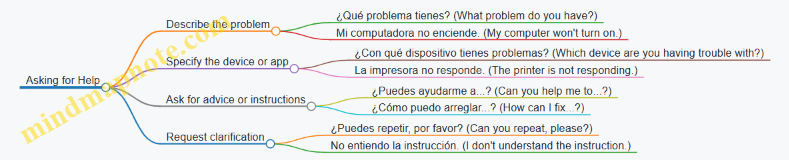
Mind Map: Giving Technical Help
Example Dialogues
Example 1: Asking for Help with a Smartphone
- Usuario: Hola, mi teléfono no se conecta a Wi-Fi. ¿Puedes ayudarme?
- Ayudante: Claro. ¿Has comprobado si la contraseña es correcta?
- Usuario: Sí, la contraseña está bien, pero sigue sin funcionar.
- Ayudante: Intenta apagar y encender el Wi-Fi. Si no funciona, reinicia el teléfono.
- Usuario: De acuerdo, lo haré. Gracias.
Example 2: Giving Help with a Computer Issue
- Usuario: Mi computadora está muy lenta.
- Ayudante: ¿Has cerrado los programas que no usas?
- Usuario: No, ¿cómo lo hago?
- Ayudante: Presiona Ctrl + Alt + Supr y selecciona “Administrador de tareas” para cerrar programas.
- Usuario: Perfecto, gracias por la ayuda.
Example 3: Asking for Help with Software Installation
- Usuario: No sé cómo instalar esta aplicación.
- Ayudante: Primero, descarga el archivo desde la página oficial.
- Usuario: Ya lo descargué.
- Ayudante: Ahora, haz doble clic en el archivo y sigue las instrucciones.
- Usuario: Entendido, gracias.
Tips for Clear Communication
- Use simple, direct sentences.
- Repeat important instructions.
- Confirm understanding by asking the other person to repeat or summarize.
- Use gestures or show the screen when possible.
- Stay patient and encourage questions.
This section equips you with the language tools to handle everyday technical issues, making your Spanish conversations more practical and confident.
14.5 Practice Dialogues: Everyday Tech Conversations
This section focuses on practical dialogues involving common technology-related situations. The goal is to build confidence in discussing devices, troubleshooting, and communicating about digital tasks in Spanish.
Mind Map: Everyday Tech Conversations
Dialogue 1: Asking for Help with a Slow Computer
Carlos: Hola, Ana, ¿puedes ayudarme? Mi computadora está muy lenta.
Ana: Claro, Carlos. ¿Has cerrado los programas que no usas?
Carlos: Creo que sí, pero sigue lenta.
Ana: ¿Has intentado reiniciarla?
Carlos: No, no lo he hecho.
Ana: Prueba a reiniciar y dime si mejora.
Carlos: Perfecto, gracias.
Dialogue 2: Troubleshooting a Printer
Luis: Hola, la impresora no funciona. ¿Sabes qué puede pasar?
María: ¿Está conectada a la computadora?
Luis: Sí, pero no imprime.
María: Revisa si tiene papel y tinta.
Luis: Está sin tinta.
María: Entonces necesitas cambiar el cartucho.
Luis: Gracias, lo haré ahora.
Dialogue 3: Explaining How to Download an App
Sofía: ¿Cómo descargo esta aplicación en mi teléfono?
Javier: Abre la tienda de aplicaciones, busca el nombre y toca “Instalar”.
Sofía: ¿Y después?
Javier: Espera a que termine la descarga y luego abre la app.
Sofía: ¿Necesito conexión a internet?
Javier: Sí, para descargar y usar la mayoría de las aplicaciones.
Dialogue 4: Making a Phone Call
Marta: ¿Puedes ayudarme a hacer una llamada?
Pedro: Claro, abre la aplicación de teléfono y marca el número.
Marta: ¿Y para llamar a un contacto?
Pedro: Busca el nombre en la lista y toca para llamar.
Marta: ¡Listo! Gracias.
Dialogue 5: Sending a Text Message
Elena: ¿Cómo envío un mensaje de texto?
Ricardo: Abre la aplicación de mensajes, toca el ícono para nuevo mensaje, escribe el número o nombre, y escribe el texto.
Elena: ¿Y para enviar?
Ricardo: Toca el botón de enviar, que suele ser un avión de papel.
Elena: Perfecto, ya lo hice.
Tips Embedded in Dialogues
- Use simple verbs like “abrir”, “cerrar”, “buscar”, and “tocar” to describe actions.
- When explaining problems, use phrases like “no funciona”, “está lento”, or “tengo un error”.
- Asking for help often starts with “¿Puedes ayudarme?” or “¿Sabes cómo…?”.
- Giving instructions uses the imperative form, e.g., “prueba”, “revisa”, “abre”.
- Clarify steps by sequencing: “Primero…”, “Después…”, “Finalmente…”.
These dialogues and mind maps provide a foundation for discussing everyday technology in Spanish. Practicing them will help learners navigate common tech conversations with ease and clarity.
Chapter 15: Review and Integrated Practice
15.1 Mixed Dialogues Covering Multiple Topics
This section presents dialogues that combine several everyday topics, reflecting how real conversations often flow naturally across different subjects. Each dialogue is followed by a mind map in format to visually organize the key vocabulary and themes. These examples will help you practice switching between topics smoothly and using varied vocabulary.
Dialogue 1: At the Market and Planning a Dinner
María: ¡Hola, Juan! ¿Cómo estás?
Juan: Hola, María. Bien, gracias. ¿Y tú?
María: Muy bien. Estoy en el mercado comprando verduras para la cena. ¿Quieres venir a mi casa esta noche?
Juan: ¡Claro! ¿Qué vas a cocinar?
María: Una paella. Necesito arroz, tomates, y mariscos. ¿Puedes traer vino?
Juan: Sí, traeré una botella de vino tinto. ¿A qué hora?
María: A las ocho está bien. ¿Cómo llegas?
Juan: Tomaré el autobús que pasa a las siete y media.
María: Perfecto. Nos vemos luego.
Juan: Hasta luego.
Dialogue 2: Discussing Weather and Weekend Plans
Ana: ¿Has visto el pronóstico del tiempo para el fin de semana?
Carlos: Sí, dicen que va a llover el sábado, pero el domingo estará soleado.
Ana: Entonces, ¿qué hacemos? ¿Vamos al cine o al parque?
Carlos: Prefiero ir al cine el sábado y salir al parque el domingo.
Ana: Buena idea. ¿A qué hora empieza la película?
Carlos: A las siete de la noche. Podemos cenar antes.
Ana: Perfecto. ¿Quieres que reserve las entradas?
Carlos: Sí, por favor. También necesito comprar un regalo para el cumpleaños de mi hermana.
Ana: ¿Quieres que vayamos al centro comercial después del cine?
Carlos: Me parece bien.
Dialogue 3: At the Doctor and Talking About Work
Paciente: Buenas tardes, doctor. No me siento bien.
Doctor: Buenas tardes. ¿Qué síntomas tiene?
Paciente: Tengo dolor de cabeza y fiebre desde ayer.
Doctor: ¿Trabaja usted?
Paciente: Sí, soy profesor en una escuela primaria.
Doctor: ¿Ha estado bajo mucho estrés últimamente?
Paciente: Sí, con los exámenes finales y las reuniones.
Doctor: Le recomiendo descansar y tomar este medicamento. Si no mejora en tres días, vuelva.
Paciente: Gracias, doctor.
Dialogue 4: Talking About Family and Making Plans
Lucía: ¿Cómo está tu familia?
Pedro: Todos bien, gracias. Mi hermana acaba de tener un bebé.
Lucía: ¡Qué alegría! ¿Cuándo puedo conocer al bebé?
Pedro: Este fin de semana vamos a hacer una reunión en casa de mis padres.
Lucía: Me encantaría ir. ¿A qué hora?
Pedro: A las cinco de la tarde. Habrá comida y música.
Lucía: Perfecto, llevaré un postre.
Pedro: Gracias, Lucía. Nos vemos el sábado.
Dialogue 5: Technology and Making Appointments
Sofía: Hola, ¿puedo ayudarte?
Javier: Sí, necesito hacer una cita con el técnico de internet.
Sofía: Claro, ¿qué día le viene bien?
Javier: ¿Mañana por la tarde?
Sofía: Está disponible a las tres. ¿Confirmo?
Javier: Sí, por favor.
Sofía: Perfecto. ¿Tiene algún problema con el equipo?
Javier: Sí, la conexión es muy lenta y el router se reinicia solo.
Sofía: El técnico lo revisará. ¿Algo más?
Javier: No, eso es todo. Gracias.
These dialogues demonstrate how topics overlap in daily conversations. Practicing them helps you respond naturally and keep the conversation flowing. The mind maps organize vocabulary and concepts for easier recall. Try repeating the dialogues aloud, then practice creating your own versions using similar topic combinations.
15.2 Role-Playing Real-Life Situations
Role-playing is a practical way to practice Spanish conversation by simulating everyday interactions. It helps build confidence, improve fluency, and prepare you for real-life encounters. Below, you will find structured role-playing scenarios, mind maps to organize your thoughts, and example dialogues to guide your practice.
Mind Map: Preparing for Role-Playing
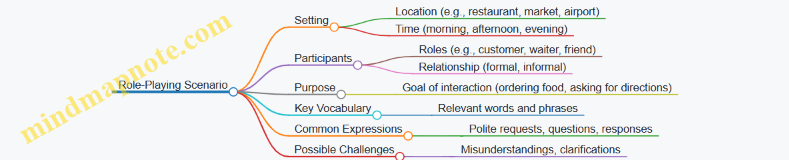
Example 1: Ordering Food at a Café
Setting: Small café, lunchtime
Roles: Customer and waiter
Purpose: Order a meal and ask about ingredients
Key Vocabulary:
- “Quisiera” (I would like)
- “¿Qué recomienda?” (What do you recommend?)
- “¿Tiene… ?” (Do you have…?)
- “Sin…” (Without…)
Dialogue:
- Cliente: Buenas tardes. ¿Me puede traer el menú, por favor?
- Camarero: Claro, aquí tiene. ¿Desea algo para beber?
- Cliente: Sí, un café con leche, por favor.
- Camarero: Perfecto. ¿Y para comer?
- Cliente: ¿Qué recomienda hoy?
- Camarero: La tortilla española está muy buena.
- Cliente: Quisiera la tortilla, pero sin cebolla. ¿Es posible?
- Camarero: Sí, no hay problema.
- Cliente: Muchas gracias.
Mind Map: Handling Questions and Clarifications
Example 2: Asking for Directions
Setting: City street
Roles: Tourist and local resident
Purpose: Find the nearest metro station
Key Vocabulary:
- “¿Dónde está…?” (Where is…?)
- “A la derecha/izquierda” (To the right/left)
- “Siga recto” (Go straight)
- “Cerca/lejos” (Near/far)
Dialogue:
- Turista: Disculpe, ¿dónde está la estación de metro más cercana?
- Local: Está a dos cuadras de aquí. Siga recto y luego gire a la izquierda.
- Turista: ¿Está lejos?
- Local: No, está bastante cerca.
- Turista: Muchas gracias por su ayuda.
- Local: De nada, que tenga buen día.
Mind Map: Role-Playing Social Interactions
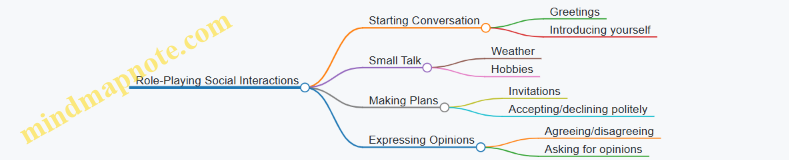
Example 3: Making Plans with a Friend
Setting: Phone call
Roles: Two friends
Purpose: Arrange a meeting
Key Vocabulary:
- “¿Quieres…?” (Do you want to…?)
- “¿A qué hora…?” (At what time…?)
- “Me gustaría” (I would like)
- “Lo siento, no puedo” (Sorry, I can’t)
Dialogue:
- Ana: Hola, Carlos. ¿Quieres ir al cine este sábado?
- Carlos: Hola, Ana. Me gustaría, pero tengo que trabajar.
- Ana: ¿Y el domingo?
- Carlos: El domingo sí puedo. ¿A qué hora quedamos?
- Ana: ¿A las cinco está bien?
- Carlos: Perfecto. Nos vemos entonces.
Tips for Effective Role-Playing
- Use the mind maps to prepare vocabulary and expressions before starting.
- Switch roles to practice different perspectives.
- Focus on natural phrasing rather than perfect grammar.
- Pause to think if needed, then continue.
- Record yourself to notice areas for improvement.
Role-playing is most effective when you immerse yourself in the situation and try to respond as naturally as possible. Use these examples and mind maps as templates, then create your own scenarios based on your interests and daily life. The goal is to make speaking Spanish a comfortable and enjoyable habit.
15.3 Common Mistakes and How to Avoid Them
Learning Spanish conversation involves more than memorizing vocabulary and grammar rules. It requires awareness of common pitfalls that beginners often encounter. Addressing these mistakes early helps build confidence and clarity in speaking. Below are some frequent errors with explanations, examples, and mind maps to visualize the concepts.
Gender Confusion with Nouns and Articles
Spanish nouns are gendered (masculine or feminine), and articles and adjectives must agree accordingly. Beginners often mismatch these, leading to awkward or incorrect phrases.
Example:
- Incorrect: el casa (the house, masculine article with feminine noun)
- Correct: la casa
Mind Map:
Tip: Memorize nouns with their articles (e.g., la mesa, el libro) to internalize gender.
Incorrect Verb Conjugations
Verb conjugations change with person, number, and tense. Beginners often use infinitives or mix tenses incorrectly.
Example:
- Incorrect: Yo comer manzanas.
- Correct: Yo como manzanas.
Mind Map:
Tip: Practice conjugating regular verbs first before tackling irregular verbs.
Misuse of Ser and Estar
Both verbs mean “to be,” but they serve different purposes. Confusing them is a classic error.
Ser is used for permanent or defining characteristics.
Estar is used for temporary states or locations.
Examples:
-
Incorrect: Estoy profesor.
-
Correct: Soy profesor. (I am a teacher - permanent)
-
Incorrect: Él es en la casa.
-
Correct: Él está en la casa. (He is at home - location)
Mind Map:

Tip: Ask yourself if the condition is permanent or temporary before choosing the verb.
Literal Translation from English
Translating phrases word-for-word often leads to unnatural or incorrect Spanish.
Example:
- Incorrect: Estoy caliente. (Literal: I am hot, but in Spanish it implies sexual arousal)
- Correct: Tengo calor. (I am feeling hot)
Mind Map:
Tip: Learn common idiomatic expressions and phrases rather than translating literally.
Overusing Subject Pronouns
Spanish often omits subject pronouns because verb conjugations indicate the subject. Beginners tend to include them unnecessarily.
Example:
- Less natural: Yo hablo español. (I speak Spanish)
- More natural: Hablo español.
Mind Map:
Tip: Listen to native speakers and notice when pronouns are dropped.
Incorrect Use of Question Words
Question words like qué, cuál, dónde, cuándo, por qué, and cómo have specific uses that differ from English.
Examples:
-
Incorrect: Cuál es tu nombre? (Which is your name?)
-
Correct: Cómo te llamas? or Cuál es tu nombre? (Both acceptable, but cómo is more common for “What’s your name?”)
-
Incorrect: Dónde está el tiempo? (Where is the weather?)
-
Correct: Qué tiempo hace? (What is the weather like?)
Mind Map:
Tip: Match the question word to the type of information you want.
Confusing Formal and Informal Speech
Spanish distinguishes between formal (usted) and informal (tú) forms of “you.” Using the wrong form can cause awkwardness.
Example:
- Using tú with strangers or elders may be disrespectful.
- Using usted with close friends can sound distant.
Mind Map:
Tip: When in doubt, use usted until invited to use tú.
Misplacing Adjectives
Adjectives usually come after the noun in Spanish, unlike English.
Example:
- Incorrect: La roja casa
- Correct: La casa roja
Exceptions exist, but the default is noun first, adjective second.
Mind Map:
Tip: Learn adjective placement rules and practice with common adjectives.
Summary
Avoiding these common mistakes requires attention to patterns and practice. Use the mind maps as quick references to visualize relationships. Regularly speaking and listening will reinforce correct usage and reduce errors over time.
15.4 Improving fluency and confidence in Spanish conversation is a gradual process that benefits from consistent practice and thoughtful strategies. Here are practical tips organized into key areas, each supported by examples and mind maps to help you visualize and apply them.
Practice Regularly and Actively
Consistency is more effective than occasional long sessions. Short daily conversations or exercises help build muscle memory for speaking.
- Example: Spend 10 minutes each day practicing a dialogue from this workbook aloud.
- Mind Map:
Focus on Meaning, Not Perfection
Aim to communicate your ideas rather than speaking perfectly. Mistakes are part of learning and help you improve.
- Example: If you forget a verb tense, try to express the idea with simpler words instead of stopping.
- Mind Map:
Use Common Phrases and Sentence Patterns
Memorize and practice frequently used phrases and sentence structures. This builds a toolkit for quick responses.
- Example: Learn phrases like “¿Cómo estás?”, “Me gusta…”, “¿Dónde está…?” and practice inserting different vocabulary.
- Mind Map:
Listen Actively and Imitate
Listening to native speakers helps you internalize rhythm, intonation, and pronunciation. Imitate what you hear.
- Example: Listen to a short dialogue and repeat it aloud, trying to match the speaker’s tone and speed.
- Mind Map:
Expand Your Vocabulary Gradually
Focus on learning words relevant to your daily life and the workbook’s dialogues. Use new words in sentences immediately.
- Example: After learning food vocabulary, describe your favorite meal in Spanish.
- Mind Map:
Practice Speaking with a Partner or Group
Speaking with others provides real-time feedback and simulates real-life conversations.
- Example: Pair up with a fellow learner to practice dialogues, taking turns playing different roles.
- Mind Map:
Use Self-Correction and Reflection
After speaking, review what you said. Identify errors and think about how to improve next time.
- Example: Record yourself reading a dialogue, listen back, and note pronunciation or grammar points to work on.
- Mind Map:
Build Confidence Through Familiar Topics
Start conversations on subjects you know well. This reduces anxiety and helps you focus on speaking.
- Example: Talk about your family, hobbies, or daily routine before moving to unfamiliar topics.
- Mind Map:
Use Gestures and Contextual Clues
Non-verbal communication supports your message and helps compensate for vocabulary gaps.
- Example: When asking for directions, use hand gestures to indicate left or right.
- Mind Map:
Set Realistic Goals and Track Progress
Define achievable milestones, such as mastering a set number of dialogues or holding a 5-minute conversation.
- Example: Aim to complete five dialogues per week and review your ability to perform them smoothly.
- Mind Map:
Summary Mind Map
By integrating these tips into your study routine, you will develop a stronger, more natural command of Spanish conversation. Remember, fluency grows from steady effort and a willingness to communicate, not from perfection on the first try.
15.5 Final Practice Exercises: Comprehensive Speaking Drills
This section brings together the key conversational skills from previous chapters into practical speaking drills. Each exercise is designed to simulate real-life situations, encouraging you to use vocabulary, sentence structures, and expressions naturally. Mind maps accompany the exercises to help organize your thoughts and guide your responses.
Exercise 1: Meeting Someone New at a Social Event
Scenario: You attend a casual gathering and meet a new person. Practice greeting, introducing yourself, asking about their background, and sharing simple personal details.
Mind Map:
- Greeting
- Hola
- ¿Cómo estás?
- Introductions
- Me llamo…
- ¿Y tú?
- Personal Information
- De dónde eres?
- A qué te dedicas?
- Qué te gusta hacer?
- Polite Responses
- Mucho gusto
- Encantado/a
Example Dialogue:
- A: Hola, ¿cómo estás?
- B: Bien, gracias. ¿Y tú?
- A: Muy bien. Me llamo Ana. ¿Y tú?
- B: Soy Carlos. Mucho gusto.
- A: Igualmente. ¿De dónde eres, Carlos?
- B: Soy de México. ¿Y tú?
- A: Soy de España. ¿A qué te dedicas?
- B: Soy estudiante. Me gusta mucho leer y viajar.
Exercise 2: Making Plans for the Weekend
Scenario: You want to invite a friend to do something during the weekend. Practice suggesting activities, asking about availability, and confirming plans.
Mind Map:
- Initiating Conversation
- ¿Qué haces el fin de semana?
- ¿Quieres…
- Suggesting Activities
- Ir al cine
- Salir a cenar
- Visitar un museo
- Asking Availability
- ¿Estás libre el sábado?
- ¿A qué hora?
- Confirming Plans
- Perfecto
- Nos vemos entonces
- ¡Qué bien!
Example Dialogue:
- A: Hola, ¿qué haces el fin de semana?
- B: Nada especial. ¿Y tú?
- A: ¿Quieres ir al cine el sábado?
- B: Me parece bien. ¿A qué hora?
- A: A las siete de la tarde.
- B: Perfecto, nos vemos entonces.
Exercise 3: At the Restaurant
Scenario: You are ordering food and drinks at a restaurant. Practice asking for the menu, ordering, expressing preferences, and asking for the bill.
Mind Map:
- Greeting and Requesting Menu
- Buenas tardes
- ¿Me puede traer el menú?
- Ordering Food
- Quisiera…
- Para mí…
- ¿Qué recomienda?
- Expressing Preferences
- Soy alérgico/a a…
- Prefiero comida sin…
- Asking for the Bill
- La cuenta, por favor
- ¿Aceptan tarjeta?
Example Dialogue:
- A: Buenas tardes, ¿me puede traer el menú?
- Camarero: Claro, aquí lo tiene.
- A: Quisiera la ensalada y un agua sin gas.
- Camarero: Perfecto. ¿Algo más?
- A: No, gracias. Soy alérgico a los frutos secos.
- Camarero: Lo tendré en cuenta.
- Al final:
- A: La cuenta, por favor.
- Camarero: Aquí está. ¿Aceptan tarjeta?
- A: Sí, gracias.
Exercise 4: Asking for Directions
Scenario: You are lost in a new city and need to ask for directions to a landmark.
Mind Map:
- Starting the Conversation
- Disculpe
- ¿Puede ayudarme?
- Asking for Directions
- ¿Dónde está…?
- ¿Cómo llego a…?
- Clarifying
- ¿Está lejos?
- ¿Tengo que tomar un autobús?
- Thanking
- Muchas gracias
- Muy amable
Example Dialogue:
- A: Disculpe, ¿puede ayudarme?
- B: Claro, ¿qué necesita?
- A: ¿Dónde está la estación de tren?
- B: Está a dos cuadras, siga derecho y luego gire a la izquierda.
- A: ¿Está lejos?
- B: No, está cerca.
- A: Muchas gracias.
- B: De nada.
Exercise 5: Talking About Your Daily Routine
Scenario: Describe your typical day to a new acquaintance.
Mind Map:
- Starting
- Normalmente
- Todos los días
- Morning Activities
- Me levanto
- Desayuno
- Work or School
- Voy al trabajo
- Estudio
- Free Time
- Hago ejercicio
- Veo televisión
- Evening
- Ceno
- Me acuesto
Example Dialogue:
- A: ¿Cómo es un día típico para ti?
- B: Normalmente me levanto a las siete, desayuno y voy al trabajo.
- A: ¿Qué haces después del trabajo?
- B: Hago ejercicio y luego ceno con mi familia.
- A: ¿A qué hora te acuestas?
- B: Me acuesto alrededor de las diez.
These exercises encourage you to combine vocabulary and expressions from multiple topics. Use the mind maps to organize your thoughts before speaking. Try to vary your responses and practice both asking and answering questions. This approach helps build confidence and prepares you for spontaneous conversations in Spanish.