German Conversation Practice for Everyday Situations
Chapter 1: Foundations of German Conversation
1.1 Introduction to Basic German Greetings and Farewells
German greetings and farewells form the backbone of everyday communication. They set the tone for interactions and help establish politeness and friendliness. This section covers the most common greetings and farewells you will encounter or use in daily life, along with appropriate contexts and variations.
Core Greetings
- Hallo — A simple, informal “Hello.” Used widely among friends, family, and acquaintances.
- Guten Tag — Literally “Good day.” A polite, neutral greeting suitable for most situations.
- Guten Morgen — “Good morning.” Used until around noon.
- Guten Abend — “Good evening.” Used from late afternoon or early evening onward.
- Servus — Informal greeting common in southern Germany and Austria, meaning both “hello” and “goodbye.”
- Moin — A casual greeting used mainly in northern Germany, at any time of day.
Core Farewells
- Tschüss — Informal “Bye.” Common among friends and younger speakers.
- Auf Wiedersehen — Formal “Goodbye,” literally “until we see each other again.”
- Bis später — “See you later.”
- Bis bald — “See you soon.”
- Gute Nacht — “Good night,” used when parting in the evening or before going to bed.
Mind Map: Basic German Greetings
Mind Map: Basic German Farewells
Usage Notes and Examples
-
Hallo is versatile but informal. You would say “Hallo” to a friend or colleague but not usually to a stranger in a formal setting.
Example:
- Person A: “Hallo, wie geht’s?” (Hello, how are you?)
- Person B: “Hallo! Gut, danke.” (Hello! Good, thanks.)
-
Guten Tag is safe for most situations, including formal and semi-formal.
Example:
- At a store: “Guten Tag, ich hätte gern ein Brot.” (Good day, I would like a bread.)
-
Guten Morgen and Guten Abend depend on the time of day. Using the wrong one can sound odd but is usually understood.
Example:
- Morning: “Guten Morgen! Haben Sie gut geschlafen?” (Good morning! Did you sleep well?)
- Evening: “Guten Abend, wie war Ihr Tag?” (Good evening, how was your day?)
-
Servus and Moin are regional and informal. Using them outside their regions might confuse some listeners.
-
Tschüss is informal and common among younger people or in casual contexts.
Example:
- “Ich muss jetzt gehen. Tschüss!” (I have to go now. Bye!)
-
Auf Wiedersehen is the formal way to say goodbye and is appropriate in professional or unfamiliar contexts.
Example:
- “Vielen Dank für Ihre Hilfe. Auf Wiedersehen!” (Thank you very much for your help. Goodbye!)
-
Bis später and Bis bald imply you expect to see the person again soon. They are friendly but can be used in both informal and semi-formal settings.
-
Gute Nacht is reserved for farewells at night or before sleep.
Example:
- “Ich gehe jetzt ins Bett. Gute Nacht!” (I’m going to bed now. Good night!)
Practice Exercise
Try greeting and saying goodbye in different scenarios:
- Meeting a friend in the morning.
- Entering a shop during the day.
- Leaving a formal meeting.
- Saying good night to a family member.
Use the greetings and farewells from this section and pay attention to the level of formality.
Mastering these basic greetings and farewells will help you start and end conversations smoothly. They also show respect for German social norms and make your interactions more natural.
1.2 Introducing Yourself: Name, Origin, and Occupation
Introducing yourself is one of the first steps in any conversation. In German, this involves stating your name, where you come from, and what you do. These basic details help establish a connection and provide a foundation for further dialogue.
Key Phrases for Introducing Yourself
-
Name:
- “Ich heiße…” (My name is…)
- “Mein Name ist…” (My name is…)
- “Ich bin…” (I am…)
-
Origin:
- “Ich komme aus…” (I come from…)
- “Ich bin aus…” (I am from…)
-
Occupation:
- “Ich arbeite als…” (I work as…)
- “Ich bin… von Beruf.” (I am a … by profession.)
- “Ich studiere…” (I study…)
Mind Map: Introducing Yourself
Example Dialogues
Example 1:
- A: “Hallo! Ich heiße Anna. Und du?”
- B: “Hallo Anna, ich bin Markus.”
- A: “Woher kommst du, Markus?”
- B: “Ich komme aus Berlin. Und du?”
- A: “Ich komme aus München. Was machst du beruflich?”
- B: “Ich arbeite als Lehrer.”
Example 2:
- A: “Guten Tag! Mein Name ist Sabine.”
- B: “Freut mich, Sabine. Ich bin Thomas.”
- A: “Woher sind Sie, Thomas?”
- B: “Ich bin aus Hamburg. Und Sie?”
- A: “Ich studiere Medizin in Frankfurt.”
Pronunciation and Usage Notes
- “Ich heiße” literally means “I am called” and is the most common way to say your name.
- When stating your origin, use “aus” followed by the city or country in the dative case, but since place names are usually not declined, it stays the same.
- For occupations, “Ich arbeite als…” is used to say “I work as…” while “Ich bin… von Beruf” emphasizes your profession.
- When addressing someone formally, use “Sie” and their last name if known; informally, use “du” and first names.
Practice Exercise
Try to introduce yourself using these prompts:
- Say your name using two different phrases.
- State where you come from.
- Describe your occupation or what you study.
Example:
“Ich heiße Julia. Ich komme aus Köln. Ich arbeite als Ingenieurin.”
This section equips you with simple, clear phrases to start conversations confidently. Practicing these will make initial interactions smoother and more natural.
1.3 Asking and Answering Simple Personal Questions
When starting a conversation in German, asking and answering personal questions is one of the most common and useful skills. These questions help you learn about the other person and share basic information about yourself. The key is to keep questions simple and clear, using familiar vocabulary and sentence structures.
Core Question Types
Here is a mind map outlining common categories of personal questions:
Asking About Names
The simplest way to ask someone’s name informally is “Wie heißt du?”. For formal situations, use “Wie heißen Sie?”. The verb “heißen” means “to be called”.
Example:
- A: Wie heißt du?
- B: Ich heiße Anna.
To answer, use “Ich heiße…” or “Mein Name ist…” (My name is…).
Asking About Origin
To ask where someone comes from, use “Woher kommst du?” (informal) or “Woher kommen Sie?” (formal). The verb “kommen” means “to come”.
Example:
- A: Woher kommst du?
- B: Ich komme aus Berlin.
You can also answer with “Ich bin aus…” (I am from…).
Asking About Age
Age questions use the verb “sein” (to be) and the adjective “alt” (old).
- Informal: “Wie alt bist du?”
- Formal: “Wie alt sind Sie?”
Example:
- A: Wie alt bist du?
- B: Ich bin 25 Jahre alt.
Note: In German, it’s common to say “Ich bin 25 Jahre alt” rather than just “Ich bin 25.”
Asking About Occupation
To inquire about someone’s job, use “Was machst du beruflich?” or the formal “Was machen Sie beruflich?”. “Beruflich” means “professionally”.
Example:
- A: Was machst du beruflich?
- B: Ich bin Lehrer.
You can also say “Ich arbeite als…” (I work as…).
Asking About Hobbies
Hobbies are a common topic. Ask “Was sind deine Hobbys?” (informal) or “Was sind Ihre Hobbys?” (formal).
Example:
- A: Was sind deine Hobbys?
- B: Ich spiele gern Fußball und lese Bücher.
The verb “gern” expresses liking to do something.
Asking About Family
To ask about siblings, use “Hast du Geschwister?” (informal) or “Haben Sie Geschwister?” (formal).
Example:
- A: Hast du Geschwister?
- B: Ja, ich habe einen Bruder und eine Schwester.
Mind Map of Answer Structures
Practice Examples
- Informal Conversation
- A: Hallo! Wie heißt du?
- B: Hallo! Ich heiße Max. Und du?
- A: Ich heiße Lisa. Woher kommst du?
- B: Ich komme aus München. Und du?
- A: Ich bin aus Hamburg.
- Formal Conversation
- A: Guten Tag. Wie heißen Sie?
- B: Guten Tag. Ich heiße Frau Schmidt.
- A: Woher kommen Sie, Frau Schmidt?
- B: Ich komme aus Frankfurt.
- Talking About Occupation and Hobbies
- A: Was machst du beruflich?
- B: Ich bin Student. Und du?
- A: Ich arbeite als Ingenieur. Was sind deine Hobbys?
- B: Ich spiele gern Tennis und höre Musik.
Tips for Practice
- Use both formal and informal forms to get comfortable switching based on context.
- Practice answering with full sentences rather than one-word answers to build fluency.
- Try to add small details, like your city or specific hobbies, to make conversations more natural.
- Remember that question words like “wie” (how), “woher” (from where), and “was” (what) are essential in forming questions.
Mastering these simple personal questions and answers will give you a solid foundation for everyday German conversations. The next step is to practice these dialogues aloud, focusing on pronunciation and natural rhythm.
1.4 Pronunciation Tips and Common Mistakes to Avoid
German pronunciation can seem straightforward at first glance, but certain sounds and patterns often trip up beginners. This section focuses on key pronunciation points and common errors, supported by clear examples and mind maps to organize the information.
Key Pronunciation Features in German
- Vowel Sounds: German vowels can be short or long, and this length changes meaning.
- Consonant Sounds: Some consonants differ from English, especially “ch,” “r,” and “z.”
- Stress and Intonation: Stress usually falls on the first syllable of a word.
Mind Map: German Vowels
Example:
- “Stadt” (city) with short “a” vs. “Staat” (state) with long “a:”
Mind Map: Challenging Consonants
Examples:
- “ich” [ɪç] vs. “ach” [ax]
- “rot” (red) with uvular “r” vs. “Bier” (beer) where “r” is vocalized
- “Zimmer” (room) with “z” pronounced [ts]
Mind Map: Common Pronunciation Mistakes
Pronunciation Tips
- Listen and Repeat: Mimic native speakers focusing on vowel length and consonant sounds.
- Practice Minimal Pairs: Words differing only by vowel length or consonant sound help train your ear.
- Use Mouth Positioning: For “ch,” note the difference between the soft [ç] (tongue near the palate) and the harsh [x] (back of throat).
- Relax on the “r”: The German “r” is softer than many expect; avoid rolling it unless you want a regional accent.
- Stress the First Syllable: This rule applies to most German words and helps with natural rhythm.
Examples for Practice
| Word Pair | Meaning | Notes |
|---|---|---|
| Stadt vs. Staat | city vs. state | Short vs. long “a” |
| ich vs. ach | I vs. oh | Soft [ç] vs. harsh [x] |
| rot vs. Bier | red vs. beer | Pronunciation of “r” |
| Zeit vs. sein | time vs. to be | “z” as [ts] |
Practice Exercise
Try reading the following sentences aloud, paying attention to vowel length, “ch” sounds, and stress:
- “Ich habe einen roten Stuhl.” (I have a red chair.)
- “Der Bach fließt schnell.” (The stream flows fast.)
- “Das Zimmer ist groß.” (The room is big.)
Record yourself and compare with native pronunciation to identify areas for improvement.
By focusing on these pronunciation points and avoiding common pitfalls, your spoken German will sound clearer and more natural. Consistent practice with these examples will build confidence and accuracy.
1.5 Practice Exercise: Role-Playing Basic Introductions
This exercise focuses on practicing simple introductions in German, a fundamental skill for everyday conversation. You will find structured mind maps to organize key phrases and vocabulary, followed by example dialogues and suggested role-play scenarios.
Mind Map 1: Basic Introduction Components
This mind map outlines the essential elements you need to cover when introducing yourself. Each branch represents a phrase category to practice.
Mind Map 2: Common Questions in Introductions
These questions are typical in casual introductions and help keep the conversation flowing.
Example Dialogue 1: Two People Meeting for the First Time
Anna: Hallo! Ich heiße Anna. Und du?
Ben: Hallo Anna, ich bin Ben. Nett, dich kennenzulernen.
Anna: Woher kommst du, Ben?
Ben: Ich komme aus Berlin. Und du?
Anna: Ich komme aus München. Was machst du beruflich?
Ben: Ich bin Student. Und du?
Anna: Ich arbeite als Lehrerin.
Ben: Schön! Wie geht es dir heute?
Anna: Gut, danke. Und dir?
Ben: Auch gut.
Example Dialogue 2: Formal Introduction
Herr Müller: Guten Tag, mein Name ist Müller. Wie heißen Sie?
Frau Schmidt: Guten Tag, Herr Müller. Ich heiße Schmidt. Freut mich.
Herr Müller: Woher kommen Sie?
Frau Schmidt: Ich komme aus Hamburg. Und Sie?
Herr Müller: Aus Frankfurt. Was machen Sie beruflich?
Frau Schmidt: Ich bin Ärztin.
Herr Müller: Sehr interessant.
Role-Playing Scenarios
-
Scenario: Meeting a new classmate at university
- Practice greeting, exchanging names, and talking about studies.
-
Scenario: Introducing yourself at a community event
- Include origin, occupation, and a polite closing.
-
Scenario: Formal introduction at a business meeting
- Use formal greetings and titles.
Tips for Practice
- Speak slowly and clearly to focus on pronunciation.
- Use the mind maps to create your own dialogues.
- Swap roles to practice both asking and answering questions.
- Record yourself to notice areas for improvement.
This exercise encourages active use of simple phrases, helping you build confidence in basic German conversations.
Chapter 2: Navigating Daily Life
2.1 Ordering Food and Drinks at a Café or Restaurant
When you find yourself at a German café or restaurant, the ability to order food and drinks clearly and politely is essential. This section provides practical phrases, vocabulary, and examples to help you navigate these situations smoothly.
Key Vocabulary and Phrases
- Die Speisekarte – the menu
- Die Bestellung – the order
- Ich hätte gern… – I would like…
- Kann ich bitte… haben? – Can I please have…?
- Was empfehlen Sie? – What do you recommend?
- Die Rechnung, bitte. – The bill, please.
- Ohne/mit… – without/with…
- Zum Mitnehmen – to take away
- Hier essen – to eat here
Mind Map: Ordering Food and Drinks
Example Dialogue 1: Ordering Coffee and Cake
Kellner: Guten Tag! Möchten Sie die Speisekarte?
Gast: Ja, bitte. Danke.
Kellner: Was möchten Sie bestellen?
Gast: Ich hätte gern einen Kaffee mit Milch und ein Stück Apfelkuchen.
Kellner: Möchten Sie sonst noch etwas?
Gast: Nein, danke. Das ist alles.
Kellner: Kommt sofort.
This dialogue shows a simple exchange. Note the polite use of “Ich hätte gern” and the waiter’s offer to add more items.
Example Dialogue 2: Asking for Recommendations and Making Special Requests
Gast: Guten Abend! Was empfehlen Sie heute?
Kellner: Unser Tagesgericht ist Schnitzel mit Kartoffelsalat.
Gast: Das klingt gut. Ich nehme das, aber ohne Kartoffelsalat, bitte.
Kellner: Kein Problem. Möchten Sie etwas zu trinken?
Gast: Ja, ein Mineralwasser, bitte.
Here, the guest asks for a recommendation and politely requests a modification. Using “ohne” (without) is common for special requests.
Practice Exercise
Try creating your own short dialogue using these steps:
- Greet the waiter.
- Ask for the menu.
- Choose a dish and a drink.
- Make a special request (e.g., no onions, extra sugar).
- Ask for the bill.
Use phrases like “Ich hätte gern…”, “Kann ich bitte… haben?”, and “Die Rechnung, bitte.” Practice speaking aloud to get comfortable with pronunciation and rhythm.
Tips for Ordering
- Use polite forms such as “bitte” (please) and “danke” (thank you).
- When unsure about a dish, ask “Was ist das?” (What is that?) or “Was empfehlen Sie?”
- If you want to eat on-site or take away, specify “Hier essen” or “Zum Mitnehmen.”
- Pay attention to the waiter’s questions and respond clearly.
Mastering these basics will make your dining experiences in German-speaking countries more enjoyable and less stressful.
2.2 Shopping for Groceries: Asking for Prices and Quantities
When shopping for groceries in German-speaking countries, knowing how to ask about prices and quantities is essential. This section focuses on practical phrases and vocabulary to help you communicate clearly and confidently.
Key Vocabulary and Phrases
- Wie viel kostet…? – How much does … cost?
- Was kostet…? – What does … cost?
- Wie teuer ist…? – How expensive is …?
- Ich hätte gern… – I would like …
- Kann ich … haben? – Can I have …?
- Wie viel davon möchten Sie? – How much of that would you like?
- Ein Kilo / ein Pfund / eine Packung – a kilo / a pound / a package
- Die Dose / die Flasche / das Stück – the can / the bottle / the piece
- Gibt es einen Rabatt? – Is there a discount?
Mind Map: Asking About Prices and Quantities
Example Dialogues
Example 1: Asking for the Price of Apples
- Kunde: “Entschuldigung, wie viel kostet ein Kilo Äpfel?”
- Verkäufer: “Ein Kilo Äpfel kostet 2,50 Euro.”
- Kunde: “Ich nehme zwei Kilo, bitte.”
Example 2: Requesting a Specific Quantity
- Kunde: “Kann ich bitte eine Packung Butter haben?”
- Verkäufer: “Natürlich, hier bitte.”
- Kunde: “Was kostet die Packung?”
- Verkäufer: “Die Butter kostet 1,80 Euro.”
Example 3: Asking for Price and Quantity of Bottled Water
- Kunde: “Wie teuer ist die Flasche Mineralwasser?”
- Verkäufer: “Die Flasche kostet 0,90 Euro.”
- Kunde: “Ich hätte gern drei Flaschen.”
Tips for Practice
- When asking about prices, use ‘Wie viel kostet…’ for singular items and ‘Was kosten…’ for plural items.
- Quantities are often expressed in weight (Kilo, Pfund), volume (Liter), or count (Stück, Packung).
- Politeness matters: adding ‘bitte’ (please) softens requests.
- Listen carefully to numbers; German prices often use a comma instead of a decimal point (e.g., 2,50 means 2.50).
Mind Map: Quantities and Units
Practice Exercise
Try to create your own dialogues using these phrases. For example, imagine you want to buy bread and cheese. Ask about the price per piece or per kilo, specify how much you want, and respond to the seller’s answers. This will help you get comfortable with the structure and vocabulary.
Summary
Understanding how to ask for prices and quantities in German grocery shopping situations helps you interact smoothly and avoid confusion. Focus on mastering the key question forms, units of measurement, and polite expressions. Practice with simple dialogues to build confidence and fluency.
2.3 Using Public Transportation: Buying Tickets and Asking for Directions
Navigating public transportation in Germany involves two key conversational skills: purchasing tickets and asking for directions. Both require specific vocabulary and common phrases that make the interaction smooth and efficient.
Mind Map: Buying Tickets
Example Dialogue: Buying a Ticket at a Machine
You: “Entschuldigung, wie kaufe ich ein Einzelticket für die U-Bahn?”
Ticket Machine (display): “Bitte wählen Sie die gewünschte Zone.”
You: (select zone)
Ticket Machine: “Bitte bezahlen Sie bar oder mit Karte.”
You: (pay)
Ticket Machine: “Hier ist Ihr Ticket.”
Mind Map: Asking for Directions
Example Dialogue: Asking for Directions
You: “Entschuldigung, wo ist die nächste U-Bahn-Station?”
Local: “Gehen Sie geradeaus bis zur Ampel, dann links. Die Station ist neben dem Supermarkt.”
You: “Danke! Wie lange dauert es zu Fuß?”
Local: “Ungefähr fünf Minuten.”
You: “Vielen Dank!”
Practical Tips
- When buying tickets, always check the zones. German cities often have zone-based pricing.
- Use polite forms like “Entschuldigung” and “bitte” to make conversations smoother.
- If you don’t understand directions, ask for repetition or clarification.
- Ticket machines often have multiple language options, but practicing German phrases helps in case the machine is out of order.
- Carry small change or a card, as some machines do not accept large bills.
Practice Exercise
Imagine you are at a train station and want to buy a ticket to the city center. Write a short dialogue where you ask about ticket prices, select the type of ticket, and confirm the zone. Then, ask a passerby for directions to the nearest tram stop.
Mastering these conversations will make your daily travel in German-speaking areas more comfortable and less stressful. The key is to familiarize yourself with the vocabulary and practice the common phrases until they feel natural.
2.4 Making Appointments: At the Doctor’s Office and Other Services
Making appointments in German-speaking environments follows a straightforward pattern but requires attention to certain vocabulary and polite phrasing. This section covers common phrases, vocabulary, and example dialogues for booking appointments at the doctor’s office and other service providers like hairdressers, repair shops, or government offices.
Key Vocabulary and Phrases
- Termin vereinbaren – to make an appointment
- einen Termin haben – to have an appointment
- einen Termin absagen – to cancel an appointment
- einen Termin verschieben / verlegen – to reschedule an appointment
- Wann passt es Ihnen? – When is it convenient for you?
- Haben Sie am … Zeit? – Do you have time on …?
- Ich möchte einen Termin vereinbaren. – I would like to make an appointment.
- Ist der Termin noch frei? – Is the appointment still available?
- Um wie viel Uhr? – At what time?
- Ich kann leider nicht. – Unfortunately, I can’t.
- Könnten Sie den Termin bestätigen? – Could you confirm the appointment?
Mind Map: Making an Appointment
Example 1: Booking a Doctor’s Appointment (Phone Call)
Patient: Guten Tag, hier spricht Anna Müller. Ich möchte einen Termin bei Dr. Schmidt vereinbaren.
Rezeption: Guten Tag, Frau Müller. Wann würde es Ihnen passen?
Patient: Haben Sie am Mittwoch Vormittag Zeit?
Rezeption: Ja, am Mittwoch um 10:30 Uhr ist noch ein Termin frei.
Patient: Das passt gut. Können Sie den Termin bitte bestätigen?
Rezeption: Gerne, Frau Müller. Ihr Termin ist am Mittwoch, den 12. April, um 10:30 Uhr.
Patient: Vielen Dank. Auf Wiederhören.
Rezeption: Auf Wiederhören.
Example 2: Rescheduling a Hairdresser Appointment (In Person)
Kunde: Hallo, ich habe morgen einen Termin um 15 Uhr, aber ich muss ihn verschieben.
Empfang: Kein Problem. Wann würde es Ihnen denn passen?
Kunde: Geht es am Freitag um 11 Uhr?
Empfang: Ja, das ist möglich. Ich habe Sie umgebucht.
Kunde: Super, danke schön!
Empfang: Gern geschehen.
Practice Exercise
Try to create your own dialogue for making an appointment at a government office (e.g., for a passport renewal). Use the vocabulary and structure above. Focus on:
- Politely requesting an appointment
- Suggesting a date and time
- Confirming the appointment
Tips for Smooth Appointment Conversations
- Always use the formal “Sie” form unless you know the person well.
- Be clear about the reason for your appointment.
- When suggesting dates, offer a couple of options if possible.
- Confirm the date, time, and location before ending the conversation.
- Use polite expressions like “bitte” and “danke” to sound courteous.
This section equips you with practical phrases and examples to confidently arrange appointments in German. The next step is to practice these dialogues aloud, focusing on pronunciation and natural intonation.
2.5 Practice Exercise: Simulated Conversations in Daily Situations
This section offers practical exercises designed to help you apply the vocabulary and phrases from previous sections in realistic daily contexts. The goal is to build confidence through repetition and variation, focusing on common scenarios such as ordering food, shopping, using public transport, and making appointments.
Mind Map: Key Daily Situations for Conversation Practice
Example 1: Ordering Food at a Café
Scenario: You enter a café and want to order a coffee and a pastry.
- Customer: Guten Tag! Haben Sie eine Speisekarte?
- Waiter: Guten Tag! Ja, hier ist die Speisekarte.
- Customer: Ich hätte gern einen Kaffee und ein Stück Apfelkuchen, bitte.
- Waiter: Möchten Sie Milch und Zucker zum Kaffee?
- Customer: Ja, bitte. Ohne Zucker.
- Waiter: Kommt sofort.
Practice Tip: Try switching roles and varying the order items. Practice asking about ingredients or making special requests.
Example 2: Shopping for Groceries
Scenario: You want to buy apples and bread at a supermarket.
- Customer: Entschuldigung, wie viel kosten die Äpfel?
- Clerk: Die Äpfel kosten zwei Euro pro Kilo.
- Customer: Ich nehme ein Kilo, bitte.
- Clerk: Möchten Sie noch etwas?
- Customer: Ja, bitte ein Brot.
- Clerk: Das Brot kostet drei Euro.
- Customer: Hier, bitte.
Practice Tip: Change quantities and items. Practice asking about payment methods or discounts.
Example 3: Using Public Transportation
Scenario: You want to buy a ticket and ask for directions.
- Passenger: Guten Tag! Ich möchte eine Fahrkarte nach Berlin, bitte.
- Ticket Agent: Einfach oder hin und zurück?
- Passenger: Einfach, bitte.
- Ticket Agent: Das kostet 25 Euro.
- Passenger: Danke. Können Sie mir sagen, wo der Zug abfährt?
- Ticket Agent: Gleis 5, der Zug fährt in 10 Minuten ab.
Practice Tip: Practice asking about schedules, delays, or ticket types.
Example 4: Making an Appointment
Scenario: You call a doctor’s office to schedule a check-up.
- Patient: Guten Tag, ich möchte einen Termin für eine Untersuchung vereinbaren.
- Receptionist: Wann passt es Ihnen am besten?
- Patient: Am Donnerstag Vormittag, wenn möglich.
- Receptionist: Donnerstag um 10 Uhr ist frei.
- Patient: Das passt gut. Vielen Dank.
Practice Tip: Practice rescheduling or cancelling appointments politely.
Integrated Practice Exercise
Create a dialogue combining two or more situations. For example, after buying groceries, you ask a passerby for directions to the nearest bus stop. Write or role-play this dialogue, focusing on smooth transitions and natural phrasing.
Additional Practice Suggestions
- Record yourself performing these dialogues to check pronunciation and fluency.
- Swap roles with a partner to experience both sides of the conversation.
- Introduce small variations, such as different times, items, or polite expressions.
This approach helps reinforce vocabulary and sentence structures while encouraging active use of German in everyday contexts.
Chapter 3: Social Interactions and Small Talk
3.1 Talking About the Weather and Seasons
Weather and seasons are common, safe topics in everyday conversation. They help break the ice and connect people through shared experiences. In German, discussing the weather involves specific vocabulary, simple sentence structures, and common expressions.
Key Vocabulary
- Das Wetter – the weather
- Die Jahreszeit – the season
- Der Frühling – spring
- Der Sommer – summer
- Der Herbst – autumn/fall
- Der Winter – winter
- Die Sonne – the sun
- Der Regen – the rain
- Der Schnee – the snow
- Der Wind – the wind
- Die Wolke – the cloud
- Es ist… – It is…
- Es gibt… – There is/are…
Common Weather Expressions
- Es ist sonnig. (It is sunny.)
- Es regnet. (It is raining.)
- Es schneit. (It is snowing.)
- Es ist bewölkt. (It is cloudy.)
- Es ist windig. (It is windy.)
- Es ist kalt/warm/heiß. (It is cold/warm/hot.)
Talking About Seasons
- Im Frühling blühen die Blumen. (In spring, the flowers bloom.)
- Im Sommer ist es oft heiß. (In summer, it is often hot.)
- Im Herbst fallen die Blätter. (In autumn, the leaves fall.)
- Im Winter liegt Schnee. (In winter, there is snow.)
Mind Map: Weather Vocabulary
Mind Map: Common Weather Expressions
Example Dialogues
Dialogue 1: Casual Weather Chat
- A: “Wie ist das Wetter heute?”
- B: “Es ist sonnig und warm. Perfekt für einen Spaziergang.”
- A: “Ja, das stimmt. Im Frühling ist das Wetter meistens so schön.”
Dialogue 2: Talking About Seasonal Preferences
- A: “Welche Jahreszeit magst du am liebsten?”
- B: “Ich mag den Sommer, weil ich gerne schwimme. Und du?”
- A: “Ich bevorzuge den Herbst. Die Farben der Blätter sind wunderschön.”
Practice Tips
- Use simple sentences to describe the current weather.
- Practice asking and answering questions about the weather.
- Incorporate seasonal vocabulary when talking about activities or preferences.
- Try to use both “Es ist…” and “Es gibt…” structures.
Practice Exercise
Imagine you meet a German-speaking friend on the street. Start a conversation about today’s weather and your favorite season. Use at least three weather-related words and one seasonal expression.
Example:
- “Hallo! Heute ist es ziemlich windig, findest du nicht?”
- “Ja, der Herbst bringt oft viel Wind mit sich. Ich mag den Herbst wegen der bunten Blätter.”
This section builds confidence in using everyday vocabulary and structures to talk about weather and seasons naturally.
3.2 Discussing Hobbies and Free-Time Activities
Talking about hobbies and free-time activities is a common way to connect with others and practice conversational German. This section focuses on vocabulary, typical phrases, and example dialogues that help beginners express what they enjoy doing outside work or school.
Key Vocabulary for Hobbies and Activities
- Hobby (das Hobby) – hobby
- Freizeit (die Freizeit) – free time
- Sport treiben – to do sports
- lesen – to read
- Musik hören – to listen to music
- wandern – to hike
- kochen – to cook
- tanzen – to dance
- Fotografieren – to take photos
- spielen – to play (games, instruments)
Mind Map: Common Hobbies in German
Useful Phrases to Discuss Hobbies
- Was machst du gern in deiner Freizeit? – What do you like to do in your free time?
- Ich spiele gern Fußball. – I like playing soccer.
- Mein Lieblingshobby ist Lesen. – My favorite hobby is reading.
- Ich interessiere mich für Musik. – I am interested in music.
- In meiner Freizeit gehe ich oft wandern. – In my free time, I often go hiking.
- Machst du Sport? – Do you do sports?
- Ja, ich schwimme zweimal pro Woche. – Yes, I swim twice a week.
Example Dialogue 1: Talking About Hobbies
Anna: Was machst du gern in deiner Freizeit?
Ben: Ich spiele gern Gitarre und höre Musik. Und du?
Anna: Ich lese viel und gehe oft spazieren. Manchmal male ich auch.
Ben: Das klingt schön. Spielst du auch in einer Band?
Anna: Nein, nur zum Spaß zu Hause.
Mind Map: Expressing Frequency and Preferences
Example Dialogue 2: Asking About Frequency
Lukas: Treibst du Sport?
Mia: Ja, ich gehe dreimal pro Woche joggen.
Lukas: Wow, das ist viel! Ich spiele manchmal Tennis.
Mia: Tennis macht auch Spaß. Spielst du in einem Verein?
Lukas: Nein, nur mit Freunden.
Tips for Practice
- Use the question „Was machst du gern?“ to start conversations about hobbies.
- Practice answering with „Ich … gern“ plus the verb in the infinitive.
- Add frequency words like „oft“, „manchmal“, or „selten“ to give more detail.
- Try to include reasons or feelings, for example: „Ich lese gern, weil es entspannend ist.“ (I like reading because it is relaxing.)
Practice Exercise
Create a short dialogue with a partner or by yourself where you ask about hobbies and describe your own. Use at least three different hobbies and include how often you do them. For example:
- Was machst du gern?
- Ich spiele gern Basketball. Ich spiele zweimal pro Woche.
- Ich höre gern Musik, besonders Jazz.
- Manchmal koche ich neue Rezepte.
This exercise helps you combine vocabulary, question forms, and frequency expressions naturally.
By focusing on hobbies and free-time activities, you build a solid base for casual conversations that are common in everyday German. The vocabulary and phrases here are practical and easy to adapt to your own interests.
3.3 Expressing Likes, Dislikes, and Preferences
When learning German, being able to express what you like, dislike, or prefer is essential for everyday conversations. This section covers common verbs, sentence structures, and vocabulary that help you communicate your tastes clearly and naturally.
Key Verbs and Expressions
- mögen (to like)
- lieben (to love)
- nicht mögen (to dislike)
- hassen (to hate)
- bevorzugen (to prefer)
- gern haben (to like, enjoy)
These verbs often appear with nouns or infinitive verbs to describe preferences.
Basic Sentence Patterns
- Ich mag [etwas]. (I like [something].)
- Ich mag keine [etwas]. (I don’t like [something].)
- Ich liebe [etwas]. (I love [something].)
- Ich hasse [etwas]. (I hate [something].)
- Ich bevorzuge [etwas]. (I prefer [something].)
- Ich spiele gern Fußball. (I like playing soccer.)
Note: When using verbs like mögen or lieben with nouns, the noun is in the accusative case. When expressing activities, use the verb with gern.
Mind Map: Expressing Likes and Dislikes
Expressing Preferences with Activities
When talking about activities, German uses gern (gladly) to express liking an action.
- Ich lese gern Bücher. (I like reading books.)
- Er schwimmt nicht gern. (He doesn’t like swimming.)
To form questions about preferences:
- Magst du Kaffee? (Do you like coffee?)
- Spielst du gern Fußball? (Do you like playing soccer?)
Mind Map: Preferences with Activities
Examples in Context
- Expressing Likes:
- Ich mag Pizza. (I like pizza.)
- Wir lieben klassische Musik. (We love classical music.)
- Expressing Dislikes:
- Ich mag keinen Kaffee. (I don’t like coffee.)
- Sie hasst laute Musik. (She hates loud music.)
- Expressing Preferences:
- Ich bevorzuge Tee statt Kaffee. (I prefer tea instead of coffee.)
- Er spielt lieber Basketball als Fußball. (He prefers playing basketball over soccer.)
- Talking about Activities:
- Ich tanze gern am Wochenende. (I like dancing on weekends.)
- Sie schwimmt nicht gern im kalten Wasser. (She doesn’t like swimming in cold water.)
Nuances and Tips
-
Mögen vs. lieben: Use lieben for strong liking or love, often for people or things you feel passionate about. Mögen is more casual and common for everyday likes.
-
Negation with nicht and kein(e): Use kein to negate nouns without articles (e.g., Ich mag keinen Fisch.). Use nicht to negate verbs or specific parts of sentences.
-
When comparing preferences, use lieber (rather) and am liebsten (most preferably):
- Ich trinke lieber Wasser als Saft. (I prefer drinking water over juice.)
- Am liebsten esse ich Schokolade. (I like chocolate the most.)
-
To soften dislikes, you can say nicht so gern (not so much):
- Ich esse nicht so gern Spinat. (I don’t like spinach that much.)
Practice Exercise
Try creating sentences using the following prompts:
- Say what you like to eat.
- Express a dislike for a certain activity.
- State your preference between two hobbies.
- Ask a friend if they like a particular sport.
Example answers:
- Ich mag Eis.
- Ich schwimme nicht gern.
- Ich lese lieber Bücher als Filme schauen.
- Magst du Fußball?
This practice helps you get comfortable with the verbs and sentence structures needed to talk about your preferences in German.
3.4 Giving and Responding to Compliments
Compliments are a common and friendly way to connect in everyday conversation. In German, giving and responding to compliments involves specific phrases and cultural nuances that help keep the exchange polite and natural.
Giving Compliments: Key Phrases and Structure
Compliments usually focus on appearance, skills, possessions, or behavior. The structure often includes an adjective or descriptive phrase followed by the subject.
- Basic compliment structure:
- Das ist (sehr) + adjective + noun.
- Du bist (wirklich) + adjective.
- Ich finde + noun + adjective.
Examples:
- „Dein Kleid ist sehr schön.“ (Your dress is very beautiful.)
- „Du bist wirklich talentiert.“ (You are really talented.)
- „Ich finde deine Idee sehr gut.“ (I find your idea very good.)
Mind Map: Giving Compliments
Responding to Compliments: Common Phrases
Responding politely is important. Typical responses include:
- Danke! (Thank you!)
- Das ist nett von dir/Ihnen. (That’s kind of you.)
- Danke, das freut mich. (Thank you, that makes me happy.)
- Ach, das ist nichts Besonderes. (Oh, it’s nothing special.) – a modest response
Avoiding over-modesty or dismissiveness is key; a simple thank you is often best.
Mind Map: Responding to Compliments
Examples of Dialogues
Example 1: Complimenting Appearance
- A: „Deine neue Frisur steht dir sehr gut.“
- B: „Danke! Ich habe lange überlegt, ob ich sie schneiden lasse."
Example 2: Complimenting Work
- A: „Die Präsentation war wirklich überzeugend.“
- B: „Danke, das freut mich zu hören. Ich habe viel Zeit investiert."
Example 3: Modest Response
- A: „Du spielst Gitarre sehr gut!“
- B: „Ach, danke. Ich übe noch viel."
Example 4: Returning a Compliment
- A: „Dein Deutsch ist beeindruckend.“
- B: „Danke, das Kompliment kann ich nur zurückgeben."
Best Practices
- Use compliments sincerely and specifically; vague compliments feel less genuine.
- Match the formality of the situation: use “du” with friends and “Sie” in formal contexts.
- When responding, a simple “Danke” is usually enough; avoid downplaying too much.
- Returning a compliment can be a nice way to keep the conversation balanced.
Practice Exercise
Try these prompts aloud:
- Compliment a friend’s outfit.
- Respond politely to a compliment about your cooking.
- Give a compliment about someone’s helpfulness at work.
- Respond modestly to praise about a hobby.
This section equips you with practical phrases and cultural insight to make compliments a natural part of your German conversations.
3.5 Practice Exercise: Engaging in Casual Conversations
Casual conversations are the backbone of everyday communication. They help build rapport, ease social interactions, and provide opportunities to practice vocabulary and sentence structures naturally. This exercise focuses on common topics like weather, hobbies, and preferences, encouraging you to respond and ask questions in a relaxed manner.
Mind Map: Key Elements of Casual Conversations
Example Dialogue 1: Talking About the Weather
Anna: Hallo! Wie ist das Wetter heute bei dir?
Ben: Hallo Anna! Es ist ziemlich kalt und windig. Und bei dir?
Anna: Hier scheint die Sonne, aber es ist auch etwas kühl.
Practice Tip: Try changing the weather conditions and respond accordingly. For example, say it is raining or snowing.
Example Dialogue 2: Discussing Hobbies
Lena: Was machst du gern in deiner Freizeit?
Mark: Ich lese gern Bücher und gehe joggen. Und du?
Lena: Ich spiele gern Gitarre und treffe Freunde.
Practice Tip: Replace hobbies with your own interests. Practice asking follow-up questions like “Seit wann machst du das?” (Since when have you been doing that?)
Example Dialogue 3: Expressing Preferences
Paul: Magst du lieber Kaffee oder Tee?
Sophie: Ich mag lieber Tee, besonders grünen Tee. Und du?
Paul: Ich trinke meistens Kaffee am Morgen.
Practice Tip: Experiment with other preferences, such as food or music. Use phrases like “Ich bevorzuge…” (I prefer…) or “Ich mag nicht so gern…” (I don’t like so much…)
Practice Activity
-
Role-Play: Pair up with a partner or practice aloud. Take turns initiating conversations using the topics above.
-
Question Chain: Start with a simple question (e.g., “Wie war dein Tag?”) and respond naturally. Then ask a related question to keep the conversation going.
-
Vocabulary Swap: Choose a word or phrase from the dialogue and substitute it with a synonym or related term. For example, replace “kalt” (cold) with “frisch” (fresh/chilly).
-
Record and Review: Record your practice conversations. Listen for pronunciation, intonation, and natural pauses. Adjust as needed.
Additional Tips
- Use fillers like “also”, “na ja”, or “eigentlich” to sound more natural.
- Don’t worry about perfect grammar; focus on communication.
- Pay attention to question intonation in German, which often rises at the end.
- Practice common phrases for agreement or disagreement, such as “Das stimmt.” (That’s true.) or “Ich glaube nicht.” (I don’t think so.)
Engaging regularly in these simple dialogues will build confidence and improve your ability to handle everyday conversations in German.
Chapter 4: At Home and with Family
4.1 Describing Your Family Members and Relationships
When talking about family in German, it’s important to know the basic vocabulary for family members and how to describe relationships clearly. This section provides practical examples and mind maps to help you organize and express family information naturally.
Key Family Vocabulary
| German | English | Notes |
|---|---|---|
| die Mutter | mother | |
| der Vater | father | |
| die Eltern | parents | plural of Mutter + Vater |
| die Schwester | sister | |
| der Bruder | brother | |
| die Großmutter | grandmother | |
| der Großvater | grandfather | |
| die Tante | aunt | |
| der Onkel | uncle | |
| die Cousine | female cousin | |
| der Cousin | male cousin | |
| der Sohn | son | |
| die Tochter | daughter | |
| die Familie | family |
Mind Map: Basic Family Structure
This mind map helps visualize how family members relate to each other. “Eltern” is plural for parents, and “Geschwister” means siblings.
Describing Relationships
To describe relationships, you can use simple sentences with verbs like haben (to have) and sein (to be), or possessive pronouns.
Examples:
- Ich habe eine Schwester. (I have a sister.)
- Mein Vater ist Lehrer. (My father is a teacher.)
- Sie ist meine Tante. (She is my aunt.)
- Wir sind eine große Familie. (We are a big family.)
Mind Map: Describing Family Relationships
Using possessive pronouns helps specify whose family member you are talking about. For example, mein Bruder means “my brother,” and deine Schwester means “your sister.”
Sample Dialogues
Dialogue 1: Introducing Family Members
- A: Hast du Geschwister? (Do you have siblings?)
- B: Ja, ich habe einen Bruder und eine Schwester. (Yes, I have a brother and a sister.)
- A: Wie alt sind sie? (How old are they?)
- B: Mein Bruder ist 20 und meine Schwester ist 16. (My brother is 20 and my sister is 16.)
Dialogue 2: Talking About Parents
- A: Was machen deine Eltern beruflich? (What do your parents do for work?)
- B: Mein Vater ist Arzt und meine Mutter ist Lehrerin. (My father is a doctor and my mother is a teacher.)
Practice Sentences
Try describing your own family using these sentence starters:
- Ich habe … (I have …)
- Mein(e) … ist … (My … is …)
- Sie/Er ist … (She/He is …)
- Wir sind … (We are …)
Example:
- Ich habe zwei Schwestern. Meine Mutter ist Krankenschwester und mein Vater ist Ingenieur. Wir sind eine kleine Familie.
Tips for Natural Conversation
- Use simple sentences and repeat key vocabulary to build confidence.
- When unsure about gender, remember that most female family members end with -in (e.g., Cousine) and male without (e.g., Cousin).
- Practice possessive pronouns carefully; they change depending on the gender and case of the noun.
- Don’t hesitate to ask for clarification if you don’t understand someone’s family description.
This section equips you with the vocabulary and sentence patterns to describe your family clearly and naturally in German. Practice with the mind maps and dialogues to build your conversational skills step by step.
4.2 Talking About Daily Routines and Household Chores
Understanding how to talk about daily routines and household chores in German is essential for everyday conversation. These topics often come up when discussing your day, sharing responsibilities, or simply making small talk. This section provides vocabulary, example sentences, and mind maps to help you organize your thoughts and speak naturally.
Key Vocabulary for Daily Routines and Household Chores
| German Word/Phrase | English Translation | Notes |
|---|---|---|
| aufstehen | to get up | Reflexive verb: ich stehe auf |
| frühstücken | to have breakfast | |
| zur Arbeit gehen | to go to work | |
| nach Hause kommen | to come home | |
| kochen | to cook | |
| putzen | to clean | |
| abwaschen | to wash dishes | |
| Wäsche waschen | to do laundry | |
| Staubsaugen | to vacuum | |
| den Müll rausbringen | to take out the trash | |
| schlafen gehen | to go to sleep | Reflexive verb: ich gehe schlafen |
Mind Map: Daily Routine
Mind Map: Household Chores
Example Dialogues
Example 1: Talking about your daily routine
- Anna: Wann stehst du normalerweise auf?
- Ben: Ich stehe um 7 Uhr auf. Dann frühstücke ich und gehe zur Arbeit.
- Anna: Und was machst du nach der Arbeit?
- Ben: Nach der Arbeit komme ich nach Hause, koche etwas und putze manchmal die Wohnung.
Example 2: Discussing household chores
- Clara: Wer macht bei dir zu Hause den Abwasch?
- David: Meistens ich. Clara wäscht die Wäsche und bringt den Müll raus.
- Clara: Gut, dann teilen wir die Arbeit fair auf.
Practice Sentences
Try to translate and say these sentences aloud:
- Ich stehe jeden Tag um 6 Uhr auf.
- Am Wochenende koche ich oft für meine Familie.
- Nach dem Essen spüle ich das Geschirr ab.
- Jeden Samstag sauge ich die Wohnung.
- Meine Schwester bringt den Müll raus.
Tips for Speaking about Routines and Chores
- Use the present tense to describe habitual actions.
- Reflexive verbs like “aufstehen” and “sich waschen” are common; remember their pronouns.
- When listing chores, use verbs in their infinitive form or conjugate according to the subject.
- Practice combining time expressions (e.g., morgens, abends) with activities to sound natural.
This section equips you with the vocabulary and structure to describe your day and household tasks clearly. Regular practice with these examples will make talking about everyday routines feel more natural.
4.3 Inviting Someone Over and Making Plans
Inviting someone to your home or arranging to meet is a common social interaction. In German, this involves specific phrases and polite expressions that help set the tone and clarify details. This section covers vocabulary, sentence structures, and practical examples to help you confidently invite others and make plans.
Key Vocabulary and Phrases
- einladen – to invite
- vorbeikommen – to come by/stop by
- Besuch – visit
- Termin – appointment, date
- Zeit – time
- Ort – place
- möchten – would like
- können – can
- passen – to suit (time)
- zusammen – together
- etwas unternehmen – to do something (together)
Mind Map: Core Concepts for Inviting and Planning
Common Sentence Structures
-
Einladung aussprechen (Making an invitation):
- “Möchtest du am Samstag zu mir kommen?” (Would you like to come to my place on Saturday?)
- “Ich lade dich zum Abendessen ein.” (I invite you for dinner.)
- “Hast du Lust, am Wochenende etwas zusammen zu unternehmen?” (Do you feel like doing something together this weekend?)
-
Nach Zeit und Ort fragen (Asking about time and place):
- “Wann passt es dir am besten?” (When suits you best?)
- “Wo wollen wir uns treffen?” (Where shall we meet?)
- “Passt dir 18 Uhr bei mir zu Hause?” (Does 6 pm at my place suit you?)
-
Zustimmung und Ablehnung (Accepting and declining):
- “Ja, das klingt gut.” (Yes, that sounds good.)
- “Leider habe ich an dem Tag keine Zeit.” (Unfortunately, I don’t have time that day.)
- “Vielleicht ein anderes Mal.” (Maybe another time.)
Example Dialogues
Example 1: Informal Invitation Between Friends
- Anna: “Hallo Max, hast du Lust, am Freitagabend zu mir zu kommen?”
- Max: “Ja, gerne! Um wie viel Uhr?”
- Anna: “Wie wäre es mit 19 Uhr? Wir können zusammen kochen.”
- Max: “Perfekt, ich freue mich!”
Example 2: Formal Invitation
- Herr Müller: “Guten Tag Frau Schmidt, ich möchte Sie zu einem kleinen Treffen bei mir zu Hause einladen. Haben Sie nächste Woche Zeit?”
- Frau Schmidt: “Vielen Dank für die Einladung, Herr Müller. Nächste Woche am Mittwoch würde mir gut passen.”
- Herr Müller: “Sehr schön, dann sehen wir uns am Mittwoch um 18 Uhr.”
Practice Exercise
Try to create your own invitation using the following prompts:
- Choose a person to invite (friend, colleague, neighbor).
- Decide on an activity (coffee, dinner, movie).
- Propose a date and time.
- Ask if the time suits.
- Respond to an acceptance or polite refusal.
Example:
“Hallo [Name], möchtest du am Samstagabend zu mir kommen? Wir könnten zusammen einen Film schauen. Passt dir 20 Uhr?”
Tips for Smooth Invitations and Planning
- Use möchten or hast du Lust for polite, friendly invitations.
- When unsure about the other person’s availability, ask “Wann passt es dir?” instead of assuming.
- Confirm plans clearly to avoid misunderstandings.
- If declining, a polite phrase like “Vielleicht ein anderes Mal” keeps the door open.
This section equips you with practical language and structures to invite others and arrange meetings naturally in German. Regular practice with these examples will help you feel more comfortable initiating social plans.
4.4 Expressing Emotions and Reactions in Family Contexts
When speaking about family, expressing emotions clearly is important for genuine communication. German offers a range of phrases and expressions to convey feelings such as happiness, concern, frustration, or affection. This section focuses on common emotional expressions and reactions within family conversations, supported by practical examples and mind maps to organize vocabulary and sentence structures.
Key Emotional Expressions in Family Contexts
- Freude (Joy)
- Sorge (Concern)
- Ärger (Anger/Frustration)
- Liebe (Love/Affection)
- Überraschung (Surprise)
- Traurigkeit (Sadness)
Mind Map: Expressing Emotions in German Family Conversations
Common Phrases and Their Usage
-
Expressing Happiness or Joy
- “Ich freue mich, dass du heute hier bist.” (I’m happy that you are here today.)
- “Das ist eine tolle Nachricht!” (That is great news!)
-
Showing Concern or Worry
- “Mach dir keine Sorgen, alles wird gut.” (Don’t worry, everything will be fine.)
- “Ich mache mir Sorgen um deine Gesundheit.” (I’m worried about your health.)
-
Communicating Frustration or Displeasure
- “Ich bin enttäuscht, dass du das vergessen hast.” (I’m disappointed that you forgot that.)
- “Das nervt mich wirklich.” (That really annoys me.)
-
Expressing Affection and Love
- “Ich hab dich lieb.” (I love you / I care about you.)
- “Du bist mir sehr wichtig.” (You are very important to me.)
-
Reacting with Surprise
- “Wirklich? Das wusste ich nicht.” (Really? I didn’t know that.)
- “Oh, das ist eine Überraschung!” (Oh, that’s a surprise!)
-
Sharing Sadness or Sympathy
- “Es tut mir leid, dass du traurig bist.” (I’m sorry that you are sad.)
- “Ich vermisse dich sehr.” (I miss you a lot.)
Mind Map: Sentence Structures for Emotional Reactions
Example Dialogues
Example 1: Expressing Concern
- Mutter: “Du siehst müde aus. Machst du dir Sorgen wegen der Schule?”
- Kind: “Ja, ich habe Angst vor der Prüfung.”
- Mutter: “Keine Sorge, du hast gut gelernt. Ich glaube an dich.”
Example 2: Sharing Happiness
- Vater: “Wir haben gute Nachrichten! Du hast die Prüfung bestanden.”
- Tochter: “Wirklich? Das freut mich sehr! Danke!”
Example 3: Showing Frustration and Resolution
- Bruder: “Warum hast du mein Buch nicht zurückgegeben?”
- Schwester: “Es tut mir leid, ich habe es vergessen.”
- Bruder: “Das nervt mich, aber danke, dass du es mir jetzt gibst.”
Example 4: Expressing Affection
- Großmutter: “Ich hab dich lieb, mein Schatz.”
- Enkel: “Ich hab dich auch lieb, Oma.”
Practice Exercise
Try creating your own short dialogues using the mind maps above. Focus on mixing emotional expressions with family-related topics such as daily routines, plans, or recent events. For example, express concern about a family member’s health or share happiness about a family celebration.
Clear, simple expressions help maintain warm and honest communication in family settings. Using these phrases and structures will make your conversations feel more natural and connected.
4.5 Practice Exercise: Family-Related Dialogue Simulations
This section offers practical dialogue exercises centered on family interactions. The goal is to build confidence in speaking about family members, relationships, routines, and emotions. Each dialogue is followed by a mind map to visualize vocabulary and sentence structures, helping you organize your thoughts and responses.
Dialogue 1: Introducing Your Family
Example Dialogue:
- A: “Erzähl mir von deiner Familie.”
- B: “Ich habe eine kleine Familie. Meine Mutter heißt Anna und mein Vater heißt Peter. Ich habe auch eine Schwester, sie heißt Lisa.”
- A: “Wie alt ist deine Schwester?”
- B: “Sie ist zwanzig Jahre alt und studiert Medizin.”
Key Vocabulary:
- Familie (family)
- Mutter (mother)
- Vater (father)
- Schwester (sister)
- Bruder (brother)
- alt (old/age)
- studieren (to study)
Mind Map:
Practice Tip: Try replacing family members and details with your own. Practice asking and answering questions about ages and occupations.
Dialogue 2: Talking About Daily Family Routines
Example Dialogue:
- A: “Was macht deine Familie normalerweise am Wochenende?”
- B: “Am Samstag frühstücken wir zusammen. Danach geht mein Vater oft spazieren, und meine Mutter liest ein Buch.”
- A: “Und was machst du?”
- B: “Ich treffe mich mit Freunden oder helfe im Haushalt.”
Key Vocabulary:
- Wochenende (weekend)
- frühstücken (to have breakfast)
- spazieren gehen (to go for a walk)
- lesen (to read)
- helfen (to help)
- Haushalt (household)
Mind Map:
Practice Tip: Describe your own family’s weekend routines. Use verbs in the present tense and practice forming questions.
Dialogue 3: Making Plans with Family Members
Example Dialogue:
- A: “Möchtest du am Sonntag mit deiner Familie ins Kino gehen?”
- B: “Ja, das klingt gut. Um wie viel Uhr treffen wir uns?”
- A: “Um 15 Uhr vor dem Kino.”
- B: “Perfekt, ich freue mich darauf!”
Key Vocabulary:
- planen (to plan)
- Kino (cinema)
- Uhr (o’clock/time)
- treffen (to meet)
- sich freuen (to look forward to)
Mind Map:
Practice Tip: Practice inviting family members to activities and confirming details like time and place.
Dialogue 4: Expressing Emotions in Family Contexts
Example Dialogue:
- A: “Wie fühlst du dich, wenn du Zeit mit deiner Familie verbringst?”
- B: “Ich fühle mich glücklich und entspannt. Manchmal bin ich auch müde, aber meistens ist es schön.”
- A: “Das kann ich verstehen.”
Key Vocabulary:
- fühlen (to feel)
- glücklich (happy)
- entspannt (relaxed)
- müde (tired)
- meistens (mostly)
Mind Map:
Practice Tip: Use these adjectives to describe your feelings about family events or routines. Practice forming sentences with “Ich fühle mich…” or “Ich bin…”.
Dialogue 5: Resolving a Simple Family Disagreement
Example Dialogue:
- A: “Warum bist du heute so spät nach Hause gekommen?”
- B: “Es tut mir leid, ich hatte viel Arbeit. Ich wollte dich nicht warten lassen.”
- A: “Okay, ich verstehe. Lass uns morgen zusammen essen.”
Key Vocabulary:
- spät (late)
- Arbeit (work)
- warten (to wait)
- entschuldigen (to apologize)
- verstehen (to understand)
Mind Map:
Practice Tip: Practice polite ways to ask about problems and respond with apologies or explanations.
Summary
These dialogue simulations cover common family-related topics and include vocabulary and sentence structures to practice. Use the mind maps to organize your learning and try creating your own variations of each dialogue. Speaking regularly about familiar topics like family helps build fluency and comfort in everyday German conversation.
Chapter 5: Work and Study Environments
5.1 Introducing Your Job or Field of Study
When introducing your job or field of study in German, clarity and simplicity are key. You want to communicate your role or area of expertise in a way that is easy to understand and invites further questions or conversation. This section provides practical phrases, vocabulary, and mind maps to help you confidently talk about your professional or academic life.
Key Vocabulary
- der Beruf – profession/job
- die Arbeit – work
- studieren – to study (at university)
- arbeiten – to work
- der Student / die Studentin – student
- der Lehrer / die Lehrerin – teacher
- der Ingenieur / die Ingenieurin – engineer
- die Firma – company
- die Universität – university
- das Fach – subject/field of study
- die Branche – industry
Basic Sentence Structures
- Ich arbeite als [Berufsbezeichnung].
- I work as a [job title].
- Ich bin [Berufsbezeichnung] von Beruf.
- I am a [job title] by profession.
- Ich studiere [Fach].
- I study [subject].
- Ich arbeite bei [Firma].
- I work at [company].
- Mein Fach ist [Fach].
- My field of study is [subject].
Mind Map: Introducing Your Job
Mind Map: Introducing Your Field of Study
Example Dialogues
Example 1: Job Introduction
- A: Was machen Sie beruflich?
- B: Ich arbeite als Architektin bei einem Bauunternehmen.
- A: Interessant! Was genau machen Sie dort?
- B: Ich entwerfe Gebäude und koordiniere Bauprojekte.
Example 2: Field of Study Introduction
- A: Was studierst du?
- B: Ich studiere Psychologie an der Universität Hamburg.
- A: In welchem Semester bist du?
- B: Ich bin im zweiten Semester.
Practice Phrases
- Ich arbeite als [Berufsbezeichnung].
- Ich bin Student/Studentin an der [Universität].
- Mein Fach ist [Fach].
- Ich arbeite bei [Firma].
- Ich studiere im [Semester] Semester.
- Ich interessiere mich für [Spezialisierung].
Tips for Practice
- Start with your job title or field of study, then add details like company, university, or specialization.
- Use simple sentences first, then gradually add more information.
- Practice with a partner or record yourself to improve pronunciation and fluency.
- Ask follow-up questions to keep the conversation going, such as “Was machen Sie genau?” or “Wie lange studieren Sie schon?”
By using these structures and vocabulary, you can introduce your professional or academic background naturally and clearly in everyday German conversations.
5.2 Talking About Work Tasks and Responsibilities
When discussing your work tasks and responsibilities in German, clarity and simplicity are key. This section provides practical vocabulary, sentence structures, and examples to help you describe what you do at work or study. We’ll also use mind maps to organize ideas and support your learning.
Key Vocabulary
- die Aufgabe (task)
- die Verantwortung (responsibility)
- arbeiten (to work)
- leiten (to lead/manage)
- organisieren (to organize)
- planen (to plan)
- berichten (to report)
- kooperieren (to cooperate)
- unterstützen (to support)
- erledigen (to complete/handle)
Basic Sentence Structures
- Ich arbeite als [Berufsbezeichnung]. (I work as [job title].)
- Meine Hauptaufgaben sind [Aufgabe 1], [Aufgabe 2] und [Aufgabe 3]. (My main tasks are [task 1], [task 2], and [task 3].)
- Ich bin verantwortlich für [etwas]. (I am responsible for [something].)
- Ich organisiere [etwas]. (I organize [something].)
- Ich berichte an [Person/Abteilung]. (I report to [person/department].)
Mind Map: Describing Work Tasks
This mind map shows categories to help you think about your work tasks: planning, organizing, completing tasks, managing responsibilities, cooperating with colleagues, and communicating.
Example Dialogues
Example 1: Describing Daily Tasks
- A: Was sind deine Hauptaufgaben bei der Arbeit?
- B: Ich plane die wöchentlichen Meetings, organisiere die Dokumente und unterstütze das Team bei der Projektarbeit.
Example 2: Talking About Responsibility
- A: Für welche Bereiche bist du verantwortlich?
- B: Ich bin verantwortlich für die Kundenkommunikation und die Koordination mit der Marketingabteilung.
Example 3: Reporting Structure
- A: An wen berichtest du?
- B: Ich berichte direkt an den Abteilungsleiter und arbeite eng mit dem Projektmanager zusammen.
Mind Map: Expressing Responsibilities and Reporting
This map helps you organize how to talk about what you are responsible for and to whom you report.
Practice Sentences
Try to fill in the blanks with your own information:
- Ich arbeite als ________.
- Meine Aufgaben umfassen ________, ________ und ________.
- Ich bin verantwortlich für ________.
- Ich organisiere ________.
- Ich berichte an ________.
Tips for Practice
- Use simple verbs like arbeiten, organisieren, and planen to start.
- Combine tasks with responsibilities to give a fuller picture.
- Practice with a partner or record yourself to improve fluency.
- Use the mind maps as a checklist to cover different aspects of your job.
By practicing these phrases and structures, you will gain confidence in describing your work tasks and responsibilities in everyday German conversations.
5.3 Scheduling Meetings and Discussing Deadlines
When working or studying in a German-speaking environment, scheduling meetings and discussing deadlines are common tasks. Mastering the relevant vocabulary and phrases helps you communicate clearly and professionally.
Key Vocabulary and Phrases
- Termin vereinbaren – to schedule an appointment/meeting
- Besprechung – meeting
- Frist – deadline
- verschieben – to postpone
- bestätigen – to confirm
- absagen – to cancel
- vorschlagen – to suggest
- Zeitplan – timetable/schedule
- pünktlich – punctual/on time
- erledigen – to complete/handle
Mind Map: Scheduling a Meeting
Mind Map: Discussing Deadlines
Example Dialogues
Example 1: Scheduling a Meeting
- Anna: “Hallo Markus, können wir uns nächste Woche für die Projektbesprechung treffen?”
- Markus: “Ja, gerne. Wie wäre es mit Dienstag um 14 Uhr?”
- Anna: “Dienstag passt mir gut. Ich bestätige den Termin.”
- Markus: “Perfekt. Ich freue mich darauf.”
Example 2: Discussing a Deadline
- Lena: “Bis wann müssen wir den Bericht abgeben?”
- Paul: “Die Frist ist der 30. April.”
- Lena: “Können wir die Frist eventuell um eine Woche verlängern?”
- Paul: “Ich frage beim Chef nach und gebe dir Bescheid.”
Practice Exercise
Try to create your own dialogue where you:
- Propose a meeting time.
- Confirm or suggest an alternative.
- Discuss a deadline for a task.
- Ask about the possibility of extending the deadline.
Use the vocabulary and phrases above to keep it natural and clear.
Clear communication about meetings and deadlines prevents misunderstandings and helps maintain professionalism. Practicing these dialogues will build your confidence in everyday work or study situations.
5.4 Asking for Clarification and Giving Instructions
In everyday conversations, especially at work or study, clear communication is essential. When you don’t understand something, asking for clarification helps avoid mistakes. Similarly, giving clear instructions ensures tasks are done correctly. This section focuses on common phrases and structures in German for these purposes, supported by examples and mind maps to organize the ideas.
Asking for Clarification
When you need someone to repeat, explain, or slow down, these phrases come in handy:
- Könnten Sie das bitte wiederholen? (Could you please repeat that?)
- Wie meinen Sie das genau? (What exactly do you mean?)
- Ich habe das nicht ganz verstanden. (I didn’t quite understand that.)
- Könnten Sie das bitte noch einmal erklären? (Could you please explain that again?)
- Könnten Sie bitte langsamer sprechen? (Could you please speak more slowly?)
- Was bedeutet das Wort „…“? (What does the word “…” mean?)
Mind Map: Asking for Clarification
Example Dialogue
Person A: Die Deadline für das Projekt ist nächsten Freitag.
Person B: Entschuldigung, könnten Sie das bitte wiederholen? Ich habe das nicht ganz verstanden.
Person A: Ja, die Deadline ist nächsten Freitag, also in einer Woche.
Giving Instructions
Clear instructions often follow a simple structure: an imperative verb or modal verb plus the task. Politeness is common, especially in professional settings.
Common phrases:
- Bitte machen Sie Folgendes: (Please do the following:)
- Zuerst…, dann… (First…, then…)
- Vergessen Sie nicht, … (Don’t forget to …)
- Achten Sie darauf, dass… (Make sure that …)
- Könnten Sie bitte …? (Could you please …?)
- Es ist wichtig, dass… (It is important that …)
Mind Map: Giving Instructions
Example Dialogue
Person A: Könnten Sie bitte den Bericht bis morgen fertigstellen?
Person B: Ja, ich werde zuerst die Daten überprüfen und dann die Zusammenfassung schreiben.
Person A: Gut, vergessen Sie nicht, die Quellenangaben zu überprüfen.
Combining Clarification and Instruction
Sometimes you need to clarify instructions or confirm understanding. Here are useful phrases:
- Meinen Sie, dass ich zuerst das Formular ausfüllen soll? (Do you mean I should fill out the form first?)
- Soll ich das Dokument per E-Mail senden? (Should I send the document by email?)
- Könnten Sie bitte genauer erklären, wie ich vorgehen soll? (Could you please explain more precisely how I should proceed?)
Mind Map: Clarifying Instructions
Example Dialogue
Person A: Bitte senden Sie mir den ausgefüllten Antrag bis Freitag.
Person B: Meinen Sie, dass ich den Antrag per E-Mail senden soll oder persönlich vorbeibringen?
Person A: Per E-Mail ist in Ordnung.
Tips for Practice
- When practicing, try role-playing both roles: the one asking for clarification and the one giving instructions.
- Focus on intonation; polite requests often have a softer tone.
- Use the mind maps to create your own dialogues.
- Remember that repeating or rephrasing is normal and helpful in conversations.
This section equips you with practical phrases and structures to handle common communication challenges. Clear questions and instructions reduce confusion and improve collaboration.
5.5 Practice Exercise: Workplace and Classroom Conversations
This section focuses on practical speaking exercises designed to help you navigate common situations in work and study settings. The goal is to build confidence in using German for everyday professional and academic interactions.
Mind Map: Key Topics in Workplace and Classroom Conversations
Example 1: Introducing Yourself at Work
Dialogue:
- Anna: “Guten Morgen, ich heiße Anna Müller. Ich arbeite im Marketing-Team.”
- Jens: “Hallo Anna, ich bin Jens Becker, der neue Projektleiter. Schön, dich kennenzulernen.”
- Anna: “Freut mich, Jens. Wenn du Fragen hast, helfe ich gern weiter.”
Practice Tip: Practice introducing yourself with your name, role, and offer to help. This builds rapport and opens communication.
Example 2: Asking About Task Progress
Dialogue:
- Lehrer: “Wie weit bist du mit der Hausaufgabe?”
- Schüler: “Ich habe den ersten Teil fertig, aber ich brauche noch etwas Zeit für die Analyse.”
- Lehrer: “Gut, bitte bring die Aufgabe bis Freitag mit.”
Practice Tip: Use simple phrases to describe your progress and ask for deadlines. This helps manage expectations clearly.
Example 3: Scheduling a Meeting
Dialogue:
- Kollege A: “Können wir uns morgen um 10 Uhr treffen, um das Projekt zu besprechen?”
- Kollege B: “Morgen passt gut. Wo wollen wir uns treffen?”
- Kollege A: “Im Besprechungsraum 3.”
Practice Tip: Practice proposing times and places, and confirming details. This is essential for organizing work effectively.
Example 4: Asking for Clarification
Dialogue:
- Student: “Entschuldigung, können Sie bitte die letzte Aufgabe noch einmal erklären?”
- Lehrer: “Natürlich. Es geht darum, den Text zu analysieren und die Hauptpunkte zusammenzufassen.”
Practice Tip: Use polite phrases like “Entschuldigung” and “können Sie bitte” to ask for help or clarification.
Example 5: Giving Feedback
Dialogue:
- Mitarbeiter: “Ich denke, der Bericht könnte noch mehr Details enthalten.”
- Chef: “Danke für das Feedback. Können Sie bitte konkretisieren, welche Details fehlen?”
Practice Tip: Practice expressing opinions politely and asking for specifics to keep conversations constructive.
Speaking Exercise
- Pair up with a study partner or practice alone by reading both roles aloud.
- Choose one of the dialogues above and substitute the names, roles, and details with your own or imagined scenarios.
- Record yourself to check pronunciation and fluency.
- Try to extend the dialogues by adding follow-up questions or responses.
Summary
This exercise encourages you to use simple, clear sentences to handle common workplace and classroom situations. Focus on key phrases for introductions, task discussions, scheduling, clarifications, and feedback. Practicing these dialogues will help you communicate effectively and confidently in German-speaking professional and academic environments.
Chapter 6: Health and Emergencies
6.1 Describing Symptoms and Health Problems
When you need to describe symptoms or health problems in German, clarity and simplicity are key. Medical conversations often require straightforward language to ensure understanding. This section provides common vocabulary, useful phrases, and example dialogues to help you communicate effectively.
Key Vocabulary: Symptoms and Body Parts
Mind Map: Describing Symptoms
Useful Phrases
- Ich habe Schmerzen in… (I have pain in…)
- Mir ist übel. (I feel nauseous.)
- Ich habe seit gestern Fieber. (I’ve had a fever since yesterday.)
- Der Schmerz ist stark / leicht / stechend / dumpf. (The pain is strong / mild / stabbing / dull.)
- Ich fühle mich müde und schwach. (I feel tired and weak.)
- Ich kann nicht richtig atmen. (I can’t breathe properly.)
- Ich habe Husten und Halsschmerzen. (I have a cough and sore throat.)
Example Dialogue 1: At the Doctor’s Office
Arzt: Guten Tag. Was kann ich für Sie tun?
Patient: Guten Tag, Herr Doktor. Ich habe seit zwei Tagen starke Kopfschmerzen und Fieber.
Arzt: Haben Sie noch andere Beschwerden?
Patient: Ja, mir ist auch übel, und ich fühle mich sehr müde.
Arzt: Haben Sie Husten oder Halsschmerzen?
Patient: Nein, das nicht.
Arzt: Gut, ich werde Ihre Temperatur messen und Sie untersuchen.
Example Dialogue 2: Describing an Injury
Sanitäter: Wo tut es weh?
Patient: Mein Bein tut sehr weh, besonders im Knie.
Sanitäter: Wann ist das passiert?
Patient: Ich bin gestern gefallen und habe seitdem Schmerzen.
Sanitäter: Können Sie das Bein bewegen?
Patient: Nur ein bisschen, aber es ist sehr schmerzhaft.
Mind Map: Expressing Pain and Intensity
Tips for Practice
- Start by naming the symptom and its location.
- Use simple adjectives to describe the pain or discomfort.
- Mention how long the symptom has lasted.
- Include any other related symptoms to give a complete picture.
- Practice with a partner using role-play to get comfortable with these phrases.
Describing symptoms in German is about combining clear vocabulary with simple sentence structures. The examples and mind maps here provide a solid foundation to express common health issues effectively.
6.2 Communicating with Medical Professionals
When speaking with doctors, nurses, or other medical staff in German, clarity and simplicity are your best tools. Medical conversations often involve specific vocabulary, but the key is to express your symptoms, concerns, and questions clearly. This section provides practical phrases, vocabulary, and mind maps to help you navigate these interactions.
Key Vocabulary Categories
Medical Communication Mind Map
Describing Symptoms
When describing symptoms, use simple sentences and point to the affected body part if possible. Here are some examples:
- “Ich habe seit zwei Tagen Kopfschmerzen.” (I have had a headache for two days.)
- “Mir ist übel und ich muss mich übergeben.” (I feel nauseous and I have to vomit.)
- “Mein Rücken tut weh, besonders wenn ich mich bewege.” (My back hurts, especially when I move.)
Use the verb “haben” (to have) for symptoms and “tun weh” (to hurt) for pain.
Asking Questions
It’s important to ask questions if you don’t understand or want more information. Here are some useful phrases:
- “Können Sie das bitte wiederholen?” (Can you please repeat that?)
- “Was bedeutet das?” (What does that mean?)
- “Wie soll ich die Medizin einnehmen?” (How should I take the medicine?)
- “Gibt es etwas, das ich vermeiden sollte?” (Is there something I should avoid?)
Example Dialogue
Patient: Guten Tag, ich habe seit gestern Fieber und starken Husten.
Arzt: Haben Sie auch Schmerzen oder andere Beschwerden?
Patient: Ja, mein Hals tut weh und ich fühle mich sehr müde.
Arzt: Haben Sie Allergien oder nehmen Sie Medikamente?
Patient: Nein, keine Allergien und ich nehme keine Medikamente.
Arzt: Ich werde Ihre Temperatur messen und Ihre Lunge abhören.
Patient: Danke. Wie lange dauert die Behandlung ungefähr?
Arzt: Normalerweise etwa eine Woche. Ich verschreibe Ihnen ein Medikament gegen den Husten.
Mind Map: Structuring a Medical Visit Conversation
Tips for Effective Communication
- Speak slowly and clearly. Medical staff are used to non-native speakers.
- Use simple sentences rather than complex structures.
- Repeat important information to confirm understanding.
- Don’t hesitate to ask for clarification.
- Carry a small notebook with key phrases or symptoms if possible.
Practice Exercise
Try describing your symptoms and asking questions based on the vocabulary and examples above. For instance:
- “Ich habe seit gestern Bauchschmerzen. Was kann ich tun?”
- “Gibt es Nebenwirkungen bei diesem Medikament?”
Practicing these phrases will build confidence for real medical visits.
This section equips you with the language tools to communicate effectively with medical professionals in German, focusing on clarity, relevant vocabulary, and practical dialogue structures.
6.3 Asking for Help in Emergency Situations
Emergencies demand clear, concise communication. In German, knowing the right phrases and vocabulary can make a significant difference. This section focuses on practical expressions and structures to ask for help effectively.
Key Vocabulary and Phrases
- Hilfe! – Help!
- Ich brauche Hilfe. – I need help.
- Rufen Sie die Polizei! – Call the police!
- Rufen Sie einen Krankenwagen! – Call an ambulance!
- Es ist ein Notfall. – It is an emergency.
- Ich habe einen Unfall gehabt. – I had an accident.
- Jemand ist verletzt. – Someone is injured.
- Wo ist die nächste Apotheke? – Where is the nearest pharmacy?
- Ich kann nicht atmen. – I can’t breathe.
- Ich habe Schmerzen. – I have pain.
Mind Map: Asking for Help in Emergencies
Example Dialogues
Example 1: Calling an Ambulance
- Person A: “Hallo, ich brauche einen Krankenwagen.”
- Operator: “Was ist passiert?”
- Person A: “Mein Freund hat sich verletzt und kann nicht aufstehen.”
- Operator: “Wo sind Sie?”
- Person A: “Wir sind in der Lindenstraße 5, neben dem Park.”
Example 2: Reporting a Fire
- Person B: “Feuer! Rufen Sie die Feuerwehr!”
- Passerby: “Ich rufe sie sofort an.”
- Person B: “Es brennt im dritten Stock des Gebäudes.”
Example 3: Asking for Help on the Street
- Tourist: “Entschuldigung, können Sie mir helfen? Ich habe meinen Pass verloren.”
- Local: “Natürlich, haben Sie schon die Polizei informiert?”
- Tourist: “Nein, nicht yet.”
Best Practices for Emergency Communication
- Stay Calm and Speak Clearly: Even if the situation is stressful, clear speech helps responders understand you.
- Use Simple Sentences: Avoid complicated grammar; short, direct sentences work best.
- Provide Key Information: Who is involved, what happened, where you are, and what help you need.
- Repeat Important Details: If the listener seems unsure, repeat the address or nature of the emergency.
- Learn Emergency Numbers: In Germany, 112 is the general emergency number for ambulance and fire, 110 for police.
Practice Exercise
Imagine you witness a minor accident. Practice the following dialogue aloud:
- “Hilfe! Jemand braucht einen Krankenwagen.”
- “Wo ist der Unfall?”
- “An der Kreuzung Hauptstraße und Marktstraße.”
- “Was ist passiert?”
- “Ein Fahrradfahrer ist gestürzt und hat sich am Arm verletzt.”
This exercise helps build confidence in describing emergencies and asking for help.
Mastering these phrases and structures prepares you to act effectively in urgent situations, making your German practical and functional when it matters most.
6.4 Understanding and using health-related vocabulary is essential when communicating about medical issues in German. This section focuses on common words and phrases that help describe symptoms, body parts, and medical situations clearly and effectively.
Core Vocabulary Categories
Below are mind maps in format to organize key vocabulary.
Body Parts
Common Symptoms
Medical Actions and Conditions
Examples of Usage
-
Describing pain:
- “Ich habe starke Kopfschmerzen.” (I have a strong headache.)
- “Mein Bauch tut weh.” (My stomach hurts.)
-
Reporting symptoms:
- “Ich fühle mich müde und habe Fieber.” (I feel tired and have a fever.)
- “Ich huste seit drei Tagen.” (I have been coughing for three days.)
-
Asking for help:
- “Können Sie mir bitte helfen? Ich habe Atemnot.” (Can you please help me? I have shortness of breath.)
- “Ich brauche ein Rezept für meine Allergie.” (I need a prescription for my allergy.)
-
At the pharmacy or doctor’s office:
- “Welche Medikamente empfehlen Sie gegen Husten?” (Which medications do you recommend for cough?)
- “Ich habe eine Verletzung am Arm.” (I have an injury on my arm.)
Tips for Practice
- Pair body parts with symptoms to create simple sentences: “Mein Rücken tut weh.” (My back hurts.)
- Use time expressions to describe duration: “Ich habe seit gestern Fieber.” (I have had a fever since yesterday.)
- Practice common question forms: “Wo genau tut es weh?” (Where exactly does it hurt?)
Summary
Mastering this vocabulary helps you communicate clearly in medical contexts. Knowing the right words for body parts, symptoms, and medical terms allows you to describe your condition accurately and understand others. Practice combining these words into sentences to build confidence for real conversations.
6.5 Practice Exercise: Role-Playing Medical and Emergency Scenarios
This section focuses on practical speaking exercises designed to prepare you for common medical and emergency conversations in German. The goal is to build confidence in describing symptoms, asking for help, and understanding instructions from medical personnel.
Mind Map: Key Vocabulary and Phrases for Medical and Emergency Situations
Example Dialogue 1: At the Doctor’s Office
Patient: Guten Tag, ich habe seit gestern starke Kopfschmerzen.
Arzt: Guten Tag. Haben Sie auch Fieber oder Übelkeit?
Patient: Nein, nur die Kopfschmerzen und ein bisschen Schwindel.
Arzt: Seit wann genau haben Sie die Schmerzen?
Patient: Seit ungefähr 24 Stunden.
Arzt: Haben Sie Allergien oder nehmen Sie Medikamente?
Patient: Nein, keine Allergien und keine Medikamente.
Arzt: Ich werde Ihren Blutdruck messen und dann entscheiden wir, was zu tun ist.
Example Dialogue 2: Emergency Call
Anrufer: Hallo, ich brauche einen Krankenwagen. Mein Freund hat sich am Bein verletzt.
Notruf: Wo sind Sie gerade?
Anrufer: Wir sind im Park, neben dem großen Spielplatz.
Notruf: Was genau ist passiert?
Anrufer: Er ist gefallen und hat starke Schmerzen im Bein.
Notruf: Bleiben Sie bei ihm. Der Krankenwagen ist unterwegs.
Practice Instructions
- Pair Work: Take turns playing the patient and the doctor or emergency operator. Use the vocabulary and phrases from the mind map.
- Focus on Clarity: Speak slowly and clearly. Emphasize key words like symptoms and locations.
- Use Follow-Up Questions: Practice asking and answering questions to gather more information.
- Simulate Different Scenarios: Try situations like a stomach ache, allergic reaction, or broken arm.
- Feedback: After each role-play, discuss what phrases worked well and what could be clearer.
Additional Practice: Symptom Description Mind Map
By practicing these dialogues and using the mind maps as reference, you will become more comfortable handling medical conversations in German. The key is to focus on clear communication, using simple phrases, and confirming understanding. These exercises build a foundation that will help you respond effectively in real-life situations.
Chapter 7: Traveling and Exploring
7.1 Booking Accommodation and Checking In
When traveling in German-speaking countries, booking accommodation and checking in are essential interactions. This section covers common vocabulary, phrases, and practical examples to help you navigate these situations confidently.
Key Vocabulary and Phrases
- die Unterkunft – accommodation
- das Hotel – hotel
- das Hostel – hostel
- das Einzelzimmer – single room
- das Doppelzimmer – double room
- die Reservierung – reservation
- verfügbar – available
- der Preis – price
- die Rechnung – bill
- einchecken – to check in
- auschecken – to check out
- der Schlüssel – key
- die Rezeption – reception
Mind Map: Booking Accommodation
Mind Map: Checking In
Example Dialogue 1: Booking a Room by Phone
Receptionist: Guten Tag, Hotel Sonnenschein, wie kann ich Ihnen helfen?
Gast: Hallo, ich möchte ein Zimmer für nächste Woche reservieren.
Receptionist: Für wie viele Nächte und für wie viele Personen?
Gast: Für drei Nächte, eine Person, bitte ein Einzelzimmer.
Receptionist: Wir haben ein Einzelzimmer verfügbar. Der Preis beträgt 60 Euro pro Nacht. Möchten Sie buchen?
Gast: Ja, bitte. Können Sie das Zimmer auf den Namen Müller reservieren?
Receptionist: Natürlich, Herr Müller. Ihre Reservierung ist bestätigt.
Example Dialogue 2: Checking In at the Hotel
Rezeptionist: Guten Tag, willkommen im Hotel Sonnenschein. Haben Sie eine Reservierung?
Gast: Ja, auf den Namen Müller.
Rezeptionist: Einen Moment bitte… Ja, Herr Müller, hier ist Ihre Reservierung. Darf ich bitte Ihren Ausweis sehen?
Gast: Hier, bitte.
Rezeptionist: Danke. Ihr Zimmer ist im dritten Stock, Nummer 305. Hier ist Ihr Schlüssel. Das Frühstück wird täglich von 7 bis 10 Uhr serviert.
Gast: Vielen Dank.
Rezeptionist: Wenn Sie Fragen haben, können Sie jederzeit an der Rezeption anrufen.
Practice Exercise
Try to create your own dialogue for booking a room in a hostel. Include asking about availability, price, and any special requests like late check-in or breakfast options. Then, write a short check-in conversation based on your booking.
This approach helps you build practical skills by combining vocabulary, common phrases, and realistic interactions. Repeating these exercises will make booking accommodation and checking in feel natural and straightforward.
7.2 Asking for Tourist Information and Recommendations
When traveling in German-speaking countries, knowing how to ask for tourist information and recommendations is essential. This section covers useful phrases, vocabulary, and practical examples to help you communicate clearly and politely.
Key Vocabulary and Phrases
- Tourist information – die Touristeninformation
- Recommendation – die Empfehlung
- Attraction – die Sehenswürdigkeit
- Museum – das Museum
- Opening hours – die Öffnungszeiten
- Ticket – das Ticket / die Eintrittskarte
- Guided tour – die Führung
- How do I get to…? – Wie komme ich zu…?
- Is it far? – Ist es weit?
- Can you recommend…? – Können Sie … empfehlen?
- Where is…? – Wo ist…?
- What is interesting here? – Was ist hier interessant?
Mind Map: Asking for Tourist Information
Mind Map: Asking for Recommendations
Example Dialogues
Example 1: Asking for Directions and Recommendations at the Tourist Office
- Tourist: „Entschuldigung, wo ist die Touristeninformation?“
- Mitarbeiter: „Die ist gleich um die Ecke, neben dem Rathaus.“
- Tourist: „Danke. Können Sie mir eine Sehenswürdigkeit empfehlen?“
- Mitarbeiter: „Ja, das Schloss ist sehr schön und nicht weit von hier.“
- Tourist: „Wie komme ich dorthin?“
- Mitarbeiter: „Sie können zu Fuß gehen, es dauert etwa zehn Minuten.“
Example 2: Inquiring About Opening Hours and Tickets
- Tourist: „Hallo, wann sind die Öffnungszeiten des Museums?“
- Mitarbeiter: „Das Museum ist von 9 bis 18 Uhr geöffnet.“
- Tourist: „Brauche ich eine Eintrittskarte?“
- Mitarbeiter: „Ja, die Tickets können Sie hier kaufen oder online reservieren.“
Example 3: Asking for Food Recommendations
- Tourist: „Können Sie ein gutes Restaurant in der Nähe empfehlen?“
- Einheimischer: „Ja, das ‚Zum Grünen Baum‘ ist sehr beliebt und hat regionale Küche.“
- Tourist: „Gibt es dort auch vegetarische Gerichte?“
- Einheimischer: „Ja, die Speisekarte bietet einige vegetarische Optionen.“
Practice Tips
- When asking questions, use polite forms such as „Können Sie…?“ or „Entschuldigung, wissen Sie…?“
- Listen carefully to directions; often, prepositions like „neben“ (next to), „gegenüber“ (opposite), and „in der Nähe“ (nearby) are used.
- Repeat or paraphrase directions to confirm understanding.
- Use simple sentences when describing what you want, e.g., „Ich suche ein Museum.“
Practice Exercise
Role-play a conversation where you ask for:
- The location of the nearest tourist information center
- Recommendations for two attractions
- Information about opening hours and ticket prices
Try to include polite phrases and confirm directions given.
This approach helps build confidence and prepares you for real-life interactions while traveling.
7.3 Talking About Transportation Options and Schedules
When discussing transportation in German, clarity and the right vocabulary are key. Whether you’re asking about train times, bus routes, or taxi fares, knowing how to express these ideas simply will help you navigate conversations smoothly.
Key Vocabulary
- der Zug – train
- der Bus – bus
- die Straßenbahn – tram
- das Taxi – taxi
- die U-Bahn – subway/metro
- der Fahrplan – timetable/schedule
- die Abfahrt – departure
- die Ankunft – arrival
- die Haltestelle – stop/station
- umsteigen – to change (trains, buses)
- verspätet – delayed
- pünktlich – punctual/on time
Common Questions and Phrases
- Wann fährt der nächste Zug nach Berlin ab? (When does the next train to Berlin depart?)
- Wie komme ich zum Hauptbahnhof? (How do I get to the main train station?)
- Muss ich umsteigen? (Do I have to change trains/buses?)
- Ist der Bus pünktlich? (Is the bus on time?)
- Wie lange dauert die Fahrt? (How long does the trip take?)
- Wo ist die nächste Haltestelle? (Where is the nearest stop?)
Sample Dialogue
Person A: Entschuldigung, wissen Sie, wann der nächste Bus nach München fährt?
Person B: Ja, der nächste Bus fährt um 15:30 Uhr von Haltestelle 5 ab.
Person A: Muss ich umsteigen?
Person B: Nein, das ist eine Direktverbindung.
Person A: Super, und wie lange dauert die Fahrt ungefähr?
Person B: Etwa zwei Stunden.
Person A: Danke schön!
Person B: Gern geschehen.
Mind Map: Transportation Vocabulary
Mind Map: Asking About Schedules
Practice Examples
-
Asking for a train schedule:
“Entschuldigung, können Sie mir sagen, wann der nächste Zug nach Hamburg abfährt?”
-
Confirming if a connection requires a transfer:
“Muss ich in Frankfurt umsteigen?”
-
Inquiring about delays:
“Ist der Zug heute pünktlich?”
-
Requesting directions to a stop:
“Wo ist die nächste U-Bahn-Station?”
-
Talking about duration:
“Wie lange dauert die Fahrt mit dem Bus zum Flughafen?”
Tips for Conversation
- Use bitte to keep questions polite.
- When unsure about the schedule, ask “Können Sie mir den Fahrplan zeigen?” (Can you show me the timetable?).
- To express delays, use “Der Zug hat Verspätung.” (The train is delayed).
- For clarity, repeat key information, e.g., “Also, der Bus fährt um 18 Uhr ab, richtig?” (So, the bus leaves at 6 p.m., right?).
This section equips you with practical phrases and vocabulary to confidently discuss transportation options and schedules in German. Regular practice with these examples will make your conversations more natural and effective.
7.4 Handling Problems While Traveling
Traveling can be unpredictable, and knowing how to handle common problems in German will make your experience smoother. This section covers typical issues you might face, practical vocabulary, and example dialogues to practice.
Common Travel Problems Mind Map
Lost Passport or Important Documents
When you lose your passport or documents, you need to explain the situation clearly and ask for assistance.
Key phrases:
- “Ich habe meinen Pass verloren.” (I have lost my passport.)
- “Wo ist die nächste Botschaft?” (Where is the nearest embassy?)
- “Können Sie mir helfen?” (Can you help me?)
Example dialogue:
Traveler: Entschuldigung, ich habe meinen Pass verloren. Was soll ich tun?
Officer: Haben Sie eine Kopie oder andere Ausweispapiere?
Traveler: Nein, leider nicht. Können Sie mir sagen, wo die Botschaft ist?
Officer: Ja, sie ist in der Hauptstraße, Nummer 45.
Practice tip: Try replacing “Pass” with other items like “Geldbörse” (wallet) or “Handy” (phone) to practice similar scenarios.
Missed Train or Bus
Missing your connection can be frustrating. You’ll want to ask about the next available option and possibly request a ticket change.
Key phrases:
- “Ich habe den Zug verpasst.” (I missed the train.)
- “Wann fährt der nächste Bus ab?” (When does the next bus leave?)
- “Kann ich mein Ticket umbuchen?” (Can I change my ticket?)
Example dialogue:
Traveler: Guten Tag, ich habe den Zug nach München verpasst. Wann fährt der nächste?
Ticket Agent: Der nächste Zug fährt in 30 Minuten.
Traveler: Kann ich mein Ticket für diesen Zug benutzen?
Ticket Agent: Ja, das ist möglich.
Practice tip: Practice asking about different destinations and transportation modes like “Flugzeug” (plane) or “Straßenbahn” (tram).
Accommodation Problems
Sometimes your room isn’t what you expected or there’s a reservation issue. Being polite but clear helps.
Key phrases:
- “Ich habe eine Reservierung auf den Namen …” (I have a reservation under the name …)
- “Das Zimmer ist nicht sauber.” (The room is not clean.)
- “Gibt es ein anderes Zimmer?” (Is there another room?)
Example dialogue:
Traveler: Hallo, ich habe eine Reservierung auf den Namen Schmidt.
Receptionist: Willkommen, Herr Schmidt. Hier ist Ihr Schlüssel.
Traveler: Das Zimmer ist sehr laut. Gibt es ein ruhigeres Zimmer?
Receptionist: Ich schaue nach. Ja, wir haben ein anderes Zimmer im dritten Stock.
Practice tip: Try describing other issues like “Die Heizung funktioniert nicht.” (The heating doesn’t work.)
Health Emergencies
If you feel unwell or have a minor injury, you need to communicate symptoms and ask for help.
Key phrases:
- “Mir ist schlecht.” (I feel sick.)
- “Ich habe Schmerzen hier.” (I have pain here.)
- “Wo ist die nächste Apotheke?” (Where is the nearest pharmacy?)
Example dialogue:
Traveler: Entschuldigung, mir ist schlecht und ich habe Kopfschmerzen.
Pharmacist: Haben Sie Fieber?
Traveler: Ja, ein bisschen.
Pharmacist: Ich empfehle Ihnen dieses Medikament.
Practice tip: Practice naming body parts and symptoms to describe your condition more precisely.
Asking for Help
Knowing how to ask for help politely is essential.
Key phrases:
- “Können Sie mir bitte helfen?” (Can you please help me?)
- “Ich brauche Hilfe.” (I need help.)
- “Wo ist die Polizei?” (Where is the police?)
Example dialogue:
Traveler: Entschuldigen Sie, können Sie mir bitte helfen? Ich habe mich verlaufen.
Local: Natürlich. Wo möchten Sie hin?
Traveler: Zum Hauptbahnhof.
Local: Gehen Sie geradeaus und dann links.
Practice tip: Practice different polite requests and directions.
Summary
Handling problems while traveling requires clear communication and the right vocabulary. Practice these dialogues and phrases regularly. Try substituting words and situations to build confidence. Remember, a calm and polite approach goes a long way in any language.
7.5 Practice Exercise: Travel-Related Conversations
This section focuses on practical dialogues and speaking exercises that you might encounter while traveling in German-speaking countries. The goal is to build confidence in handling common situations such as booking accommodation, asking for directions, or dealing with transportation. Each example is followed by a mind map to help visualize key vocabulary and phrases.
Example 1: Booking a Hotel Room
Dialogue:
- Gast: “Guten Tag, ich möchte ein Zimmer für zwei Nächte reservieren. Haben Sie noch Verfügbarkeit?”
- Rezeptionist: “Ja, wir haben noch Zimmer frei. Möchten Sie ein Einzel- oder Doppelzimmer?”
- Gast: “Ein Doppelzimmer, bitte. Wie viel kostet das pro Nacht?”
- Rezeptionist: “Das Doppelzimmer kostet 80 Euro pro Nacht, inklusive Frühstück.”
- Gast: “Das klingt gut. Ich nehme das Zimmer.”
Mind Map:
Example 2: Asking for Directions
Dialogue:
- Tourist: “Entschuldigung, können Sie mir sagen, wie ich zum Bahnhof komme?”
- Passant: “Ja, gehen Sie geradeaus bis zur Ampel, dann links. Der Bahnhof ist etwa 500 Meter entfernt.”
- Tourist: “Vielen Dank!”
- Passant: “Gern geschehen.”
Mind Map:
Example 3: Buying a Train Ticket
Dialogue:
- Kunde: “Hallo, ich brauche eine Fahrkarte nach München, bitte.”
- Verkäufer: “Möchten Sie eine einfache Fahrt oder Hin- und Rückfahrt?”
- Kunde: “Hin- und Rückfahrt, bitte. Gibt es Ermäßigungen für Studenten?”
- Verkäufer: “Ja, mit einem gültigen Studentenausweis erhalten Sie 25% Rabatt.”
- Kunde: “Super, hier ist mein Ausweis.”
Mind Map:
Example 4: Handling a Travel Problem
Dialogue:
- Reisender: “Entschuldigung, mein Zug hat Verspätung. Können Sie mir sagen, wann der nächste Zug nach Berlin fährt?”
- Mitarbeiter: “Der nächste Zug fährt in 30 Minuten.”
- Reisender: “Danke für die Information.”
Mind Map:
Speaking Exercises
-
Role Play: Hotel Reservation
- Partner A is a guest; Partner B is a receptionist.
- Use phrases from Example 1 to practice booking a room.
-
Direction Giving
- Partner A asks for directions to a local landmark.
- Partner B gives clear directions using vocabulary from Example 2.
-
Ticket Purchase Simulation
- Practice buying different types of tickets and asking about discounts.
- Switch roles to practice both customer and seller dialogues.
-
Problem Solving at the Station
- Simulate a delayed train scenario.
- Practice asking for information and responding politely.
Tips for Practice
- Focus on pronunciation of key travel terms such as “Bahnhof” (train station), “Fahrkarte” (ticket), and “Zimmer” (room).
- Use polite forms like “können Sie” and “möchten Sie” to sound natural.
- Repeat dialogues aloud to build muscle memory.
- Try to vary your responses to similar questions to increase flexibility.
This exercise aims to prepare you for real-life travel conversations by combining useful phrases with interactive practice. The mind maps help organize vocabulary logically, making it easier to recall during actual conversations.
Chapter 8: Cultural Etiquette and Politeness
8.1 Using Formal and Informal Address Correctly
In German, choosing between formal and informal address is crucial for respectful and appropriate communication. The distinction affects pronouns, verb conjugations, and sometimes vocabulary. Using the wrong form can lead to awkwardness or unintended disrespect.
The Two Main Forms of Address
- Informal (Du): Used with friends, family, children, and people of the same age or younger when a casual relationship exists.
- Formal (Sie): Used with strangers, in professional settings, with elders, or anyone you want to show respect toward.
Pronouns and Verb Forms
| Address Type | Pronoun | Verb Conjugation Example (to be - sein) |
|---|---|---|
| Informal | du | du bist |
| Formal | Sie | Sie sind |
The formal “Sie” always uses the third-person plural verb form, even when addressing one person.
When to Use Informal vs. Formal
- Use formal when meeting someone for the first time in a professional or public context.
- Use informal with close acquaintances, family, and children.
- Often, the other person will offer to switch to informal by saying “Wir können uns gerne duzen” (We can use ‘du’ if you like).
Mind Map: Choosing Between Formal and Informal
Examples
-
Formal:
- Guten Tag, Frau Müller. Wie geht es Ihnen? (Good day, Mrs. Müller. How are you?)
- Note the use of “Ihnen” (formal you, dative case) and “Frau” with last name.
-
Informal:
- Hallo Anna, wie geht’s dir? (Hi Anna, how are you?)
- “dir” is the informal dative form.
Addressing Groups
- Formal plural: Sie (same as singular formal)
- Informal plural: ihr
Example:
- Formal plural: Können Sie bitte hier unterschreiben? (Can you please sign here?)
- Informal plural: Könnt ihr bitte hier unterschreiben? (Can you [all] please sign here?)
Mind Map: Pronouns and Verb Conjugations
Politeness and Titles
Using titles (Herr, Frau, Doktor) with the last name is common in formal address. Omitting titles can be seen as disrespectful in formal contexts.
Example:
- Herr Schmidt, könnten Sie mir helfen? (Mr. Schmidt, could you help me?)
Switching from Formal to Informal
The switch is called “das Du anbieten” (offering the ‘du’). Usually, the older or higher-status person offers it. Until then, stick to formal.
Example:
- Sollen wir uns duzen? (Shall we use ‘du’ with each other?)
Practice Exercise Example
Imagine meeting a colleague for the first time:
- Formal: Guten Morgen, Herr Becker. Ich freue mich, Sie kennenzulernen.
- Informal (after invitation): Hallo Thomas, schön, dich kennenzulernen.
Summary
- Use Sie for respect and formality.
- Use du for casual, personal relationships.
- Verb forms and pronouns change accordingly.
- Titles and last names accompany formal address.
- Wait for an invitation before switching to informal.
Mastering this distinction helps avoid social pitfalls and makes your German sound natural and polite.
8.2 Expressing Gratitude, Apologies, and Requests Politely
Politeness is a cornerstone of effective communication in German, as in many languages. Mastering how to express gratitude, apologies, and requests politely will help you navigate social and professional situations smoothly. This section breaks down key phrases, structures, and cultural nuances with clear examples and mind maps to guide your practice.
Expressing Gratitude
Showing thanks in German ranges from casual to formal. The most common phrase is „Danke“ (Thank you). To sound more polite or formal, you can say „Danke schön“ or „Vielen Dank“ (Many thanks).
Mind Map: Expressing Gratitude
Examples:
- Danke für Ihre Hilfe. (Thank you for your help.)
- Vielen Dank, das weiß ich sehr zu schätzen. (Many thanks, I really appreciate that.)
- Ich danke Ihnen für die schnelle Antwort. (I thank you for the quick response.)
When responding to thanks, „Bitte“ is the most common and versatile reply. It literally means “please,” but in this context, it means “you’re welcome.”
Apologizing Politely
Apologies in German can be brief or more elaborate depending on the situation. The simplest form is „Entschuldigung“ (Excuse me / Sorry). For a stronger apology, use „Es tut mir leid“ (I am sorry).
Mind Map: Apologizing Politely
Examples:
- Entschuldigung, können Sie mir helfen? (Excuse me, can you help me?)
- Es tut mir leid, dass ich zu spät bin. (I am sorry that I am late.)
- Ich entschuldige mich für das Missverständnis. (I apologize for the misunderstanding.)
When accepting apologies, phrases like „Kein Problem“, „Schon gut“, or „Macht nichts“ are common and reassuring.
Making Polite Requests
Requests in German often use modal verbs and polite phrases to soften the tone. The word „bitte“ (please) is essential and can be placed at the beginning or end of a sentence.
Mind Map: Making Polite Requests
Examples:
- Können Sie mir bitte den Weg zum Bahnhof zeigen? (Can you please show me the way to the train station?)
- Würden Sie so freundlich sein, mir zu helfen? (Would you be so kind as to help me?)
- Bitte geben Sie mir das Formular. (Please give me the form.)
In informal contexts, you might say:
- Kannst du mir bitte das Salz reichen? (Can you please pass me the salt?)
Using modal verbs like „könnten“ (could) or „würden“ (would) makes requests sound more polite and less direct.
Summary Table of Key Phrases
| Function | Phrase (German) | Translation / Use Case |
|---|---|---|
| Gratitude | Danke | Thank you (basic) |
| Vielen Dank | Many thanks (polite) | |
| Ich danke Ihnen | I thank you (formal) | |
| Apology | Entschuldigung | Excuse me / Sorry (simple) |
| Es tut mir leid | I am sorry (stronger) | |
| Ich entschuldige mich | I apologize (formal) | |
| Request | Können Sie bitte…? | Can you please…? (formal) |
| Würden Sie so freundlich sein…? | Would you be so kind…? (very polite) | |
| Bitte | Please (used to soften requests) |
Practice Exercise
Try creating your own dialogues using these phrases. For example:
Scenario: Asking a colleague for help politely.
- You: Entschuldigung, könnten Sie mir bitte mit diesem Bericht helfen?
- Colleague: Natürlich, gern.
- You: Vielen Dank! Ich weiß das sehr zu schätzen.
Or apologizing for being late:
- You: Es tut mir leid, dass ich zu spät bin.
- Friend: Kein Problem, wir haben gerade erst angefangen.
Mastering these polite expressions will make your German sound natural and respectful. Remember that tone and context matter as much as the words themselves. Using these phrases appropriately helps build positive interactions and shows cultural awareness.
8.3 Understanding and Using Common German Idioms in Conversation
Idioms are fixed expressions whose meanings cannot be deduced simply by understanding the individual words. In German, idioms add color and naturalness to everyday speech. They often reflect cultural habits, humor, or historical references. Learning some common idioms helps you sound more fluent and understand native speakers better.
Why Use Idioms?
- They make conversations more engaging.
- They convey ideas succinctly.
- They show cultural awareness.
How to Approach Idioms
- Learn idioms in context, not isolation.
- Understand the literal and figurative meanings.
- Practice using them in simple dialogues.
Common German Idioms and Their Usage
“Da liegt der Hund begraben.”
- Literal: “That’s where the dog is buried.”
- Meaning: That’s the heart of the problem.
- Example: Warum funktioniert das nicht? – Da liegt der Hund begraben.
“Ich verstehe nur Bahnhof.”
- Literal: “I only understand train station.”
- Meaning: I don’t understand anything.
- Example: Kannst du das nochmal erklären? Ich verstehe nur Bahnhof.
“Tomaten auf den Augen haben.”
- Literal: “To have tomatoes on one’s eyes.”
- Meaning: To overlook something obvious.
- Example: Hast du die Antwort nicht gesehen? Du hast Tomaten auf den Augen.
“Jemandem die Daumen drücken.”
- Literal: “To press one’s thumbs for someone.”
- Meaning: To wish someone good luck.
- Example: Ich habe morgen die Prüfung. Drückst du mir die Daumen?
“Den Nagel auf den Kopf treffen.”
- Literal: “To hit the nail on the head.”
- Meaning: To describe something exactly right.
- Example: Mit deiner Erklärung hast du den Nagel auf den Kopf getroffen.
Mind Map: Common German Idioms
Using Idioms in Conversation
Idioms often appear in casual conversations. Here are some sample dialogues illustrating their use:
Dialogue 1: Discussing a Problem
- A: Warum klappt das Projekt nicht?
- B: Da liegt der Hund begraben. Wir haben nicht genug Zeit eingeplant.
Dialogue 2: Expressing Confusion
- A: Hast du die Anleitung verstanden?
- B: Nein, ich verstehe nur Bahnhof.
Dialogue 3: Wishing Luck
- A: Ich habe morgen ein Vorstellungsgespräch.
- B: Ich drücke dir die Daumen!
Tips for Practicing Idioms
- Repeat idioms aloud to get comfortable with pronunciation.
- Try replacing literal phrases with idioms in your own sentences.
- Use idioms sparingly at first to avoid sounding unnatural.
Summary
German idioms enrich everyday conversations by adding expressiveness and cultural nuance. Understanding their literal and figurative meanings is key to using them correctly. Practice them in context and watch your conversational skills become more natural and engaging.
8.4 Navigating social norms in German-speaking environments means understanding when to use formal or informal language, recognizing customary behaviors, and adapting to context-specific expectations. These norms influence how conversations unfold and how politeness is expressed.
Formal vs. Informal Address
In German, the choice between “Sie” (formal you) and “du” (informal you) is fundamental. Using “Sie” shows respect and distance, typically reserved for strangers, elders, or professional settings. “Du” is for friends, family, and close acquaintances.
- When meeting someone for the first time in a formal context, default to “Sie”.
- Wait for an invitation to switch to “du”; this is called “das Du anbieten”.
Mind Map: Formal vs. Informal Address
Example:
- Formal: “Könnten Sie mir bitte helfen?” (Could you please help me?)
- Informal: “Kannst du mir helfen?” (Can you help me?)
Greetings and Titles
Using titles (Herr, Frau, Doktor) with last names is common in formal situations. Omitting titles can be seen as disrespectful.
- Always use “Herr” or “Frau” plus surname in business or official contexts.
- In informal settings, first names suffice.
Mind Map: Greetings and Titles
Example:
- Formal: “Guten Tag, Herr Müller.”
- Informal: “Hallo, Anna!”
Punctuality
Punctuality is valued. Being late without notice is considered rude.
- Arrive a few minutes early for appointments.
- If delayed, inform the other party.
Mind Map: Punctuality
Conversation Topics
Certain topics are appropriate depending on the relationship and setting.
- Safe topics: weather, hobbies, work (in general terms).
- Avoid: personal finances, politics, religion, unless you know the person well.
Mind Map: Conversation Topics
Example:
- Safe: “Wie war dein Wochenende?” (How was your weekend?)
- Sensitive: Avoid asking “Wie viel verdienst du?” (How much do you earn?)
Gift Giving and Invitations
When invited to a German home, bringing a small gift like flowers, wine, or chocolates is customary.
- Avoid chrysanthemums (associated with funerals).
- Invitations often come with clear details; RSVP promptly.
Mind Map: Gift Giving and Invitations
Politeness Formulas
Common polite phrases include:
- “Bitte” (please/you’re welcome)
- “Danke” (thank you)
- “Entschuldigung” (excuse me/sorry)
Using these appropriately smooths interactions.
Practice Example Dialogue
Situation: Meeting a colleague for the first time at work.
- A: “Guten Tag, Herr Schmidt. Ich bin Anna Müller, Ihre neue Kollegin.”
- B: “Guten Tag, Frau Müller. Schön, Sie kennenzulernen.”
- A: “Ebenso. Darf ich Sie duzen?”
- B: “Ja, gerne.”
This exchange shows formal greetings, use of titles, and the polite offer to switch to informal address.
Understanding these social norms helps learners communicate respectfully and naturally in German-speaking contexts.
8.5 Practice Exercise: Polite and Respectful Dialogue Practice
Politeness in German conversation is essential for smooth social interactions. This exercise focuses on practicing polite expressions, formal and informal address, and respectful responses. We will explore common phrases, their usage, and how to adapt them depending on the situation.
Mind Map: Key Elements of Polite Conversation in German
Polite Greetings and Address
- Use “Sie” for formal situations (strangers, elders, work).
- Use “du” for friends, family, or when invited.
Examples:
-
Formal:
- “Guten Tag, Herr Müller. Wie geht es Ihnen?” (Good day, Mr. Müller. How are you?)
- “Könnten Sie mir bitte helfen?” (Could you please help me?)
-
Informal:
- “Hallo Anna, wie geht’s dir?” (Hi Anna, how are you?)
- “Kannst du mir mal kurz zuhören?” (Can you listen to me for a moment?)
Polite Requests and Offers
- Use “bitte” to soften requests.
- Modal particles like “mal” add casual politeness.
Examples:
- “Könnten Sie mir bitte das Salz reichen?” (Could you please pass me the salt?)
- “Kannst du mir mal helfen?” (Can you help me for a moment?)
- “Darf ich Ihnen etwas anbieten?” (May I offer you something?)
Apologizing Politely
- Common phrases:
- “Entschuldigen Sie bitte.” (Excuse me, please.)
- “Es tut mir leid.” (I’m sorry.)
- “Verzeihen Sie mir.” (Forgive me.)
Example dialogue:
- A: “Entschuldigen Sie bitte, wissen Sie, wo die Post ist?”
- B: “Ja, die ist gleich um die Ecke.”
Expressing Thanks Respectfully
- Use:
- “Danke schön.”
- “Vielen Dank.”
- “Ich danke Ihnen sehr.”
Example:
- “Vielen Dank für Ihre Hilfe!”
Practice Dialogue 1: Formal Request at a Store
A: Guten Tag, könnten Sie mir bitte sagen, wo ich die Milch finde?
B: Natürlich, die Milch ist im Kühlregal links neben den Eiern.
A: Danke schön!
B: Gern geschehen.
Practice Dialogue 2: Informal Invitation Among Friends
A: Hey, hast du am Samstag Zeit? Möchtest du mal zu mir kommen?
B: Ja, gerne! Danke für die Einladung.
A: Super, ich freue mich.
Mind Map: Politeness Strategies in Dialogue
Tips for Practicing Polite Conversation
- Always consider your relationship with the person.
- When in doubt, use formal address.
- Listen to intonation; polite requests often have a softer, rising tone.
- Practice switching between formal and informal forms.
- Use role-play to simulate real-life situations.
Practice Exercise
Create two short dialogues: one formal and one informal. Include at least three polite expressions in each. For example, a formal dialogue could be a conversation with a bank employee; an informal one could be chatting with a neighbor.
Example formal dialogue snippet:
- “Guten Morgen, könnten Sie mir bitte bei meinem Konto helfen?”
- “Selbstverständlich, was genau möchten Sie wissen?”
Example informal dialogue snippet:
- “Hi Lisa, hast du mal Zeit, mir bei den Hausaufgaben zu helfen?”
- “Klar, kein Problem!”
This exercise helps internalize polite forms and prepares you for respectful communication in various everyday situations.
Chapter 9: Practical Grammar and Vocabulary in Conversation
9.1 Essential Verb Conjugations for Everyday Speech
In German, verbs change their form depending on who is performing the action and when it takes place. This process is called conjugation. Mastering essential verb conjugations helps you form clear, correct sentences and communicate effectively in everyday situations.
Present Tense Conjugation of Regular Verbs
Most everyday conversations use the present tense (Präsens). Regular verbs follow a predictable pattern. Let’s take the verb spielen (to play) as an example.
- ich spiele – I play
- du spielst – you (informal singular) play
- er/sie/es spielt – he/she/it plays
- wir spielen – we play
- ihr spielt – you (informal plural) play
- sie/Sie spielen – they/you (formal) play
Notice the endings: -e, -st, -t, -en, -t, -en. These endings apply to most regular verbs.
Practice Example:
- Ich spiele Fußball. (I play soccer.)
- Spielst du Gitarre? (Do you play guitar?)
- Wir spielen Karten. (We play cards.)
Present Tense Conjugation of Irregular (Strong) Verbs
Some verbs change their stem vowel in the second and third person singular forms. For example, fahren (to drive/go):
Notice the stem vowel changes from a to ä in du fährst and er fährt.
Practice Example:
- Fährst du morgen nach Berlin? (Are you driving to Berlin tomorrow?)
- Er fährt mit dem Bus. (He goes by bus.)
Modal Verbs
Modal verbs express ability, necessity, permission, or desire. They are essential in everyday speech. Common modal verbs include können (can), müssen (must), wollen (want), dürfen (may), sollen (should), and mögen (like).
Example with können (to be able to):
Practice:
- Ich kann Deutsch sprechen. (I can speak German.)
- Kannst du mir helfen? (Can you help me?)
Separable Prefix Verbs
Some verbs have prefixes that separate in the present tense. For example, aufstehen (to get up):
The prefix auf moves to the end of the sentence.
Example:
- Ich stehe um 7 Uhr auf. (I get up at 7 o’clock.)
- Stehst du früh auf? (Do you get up early?)
Common Irregular Verb: Sein (to be)
The verb sein is irregular and very common.
Examples:
- Ich bin müde. (I am tired.)
- Bist du bereit? (Are you ready?)
Common Irregular Verb: Haben (to have)
Another essential verb is haben.
Examples:
- Wir haben Zeit. (We have time.)
- Habt ihr Hunger? (Are you hungry?)
Summary Table of Endings for Regular Verbs in Present Tense
| Person | Ending |
|---|---|
| ich (I) | -e |
| du (you sg.) | -st |
| er/sie/es | -t |
| wir (we) | -en |
| ihr (you pl.) | -t |
| sie/Sie | -en |
Tips for Practice
- Start by memorizing the endings for regular verbs.
- Learn the most common irregular verbs separately.
- Practice conjugating verbs aloud with different subjects.
- Use simple sentences to apply conjugations in context.
Practice Exercise
Conjugate the verb machen (to do/make) and use it in sentences:
- ich _______
- du _______
- er/sie/es _______
- wir _______
- ihr _______
- sie/Sie _______
Example answers:
- ich mache
- du machst
- er macht
- wir machen
- ihr macht
- sie machen
Sentence: Wir machen eine Pause. (We are taking a break.)
9.2 Using Question Words and Forming Questions
In German, forming questions is a fundamental skill for everyday conversation. Questions help you gather information, clarify details, and keep conversations flowing. This section focuses on the most common question words (W-Fragen) and how to structure questions clearly and correctly.
Common German Question Words (W-Fragen)
| German | English | Usage Example |
|---|---|---|
| Wer | Who | Wer bist du? (Who are you?) |
| Was | What | Was machst du? (What are you doing?) |
| Wo | Where | Wo wohnst du? (Where do you live?) |
| Wann | When | Wann kommst du? (When are you coming?) |
| Warum | Why | Warum lernst du Deutsch? (Why are you learning German?) |
| Wie | How | Wie geht es dir? (How are you?) |
| Welcher/Welche/Welches | Which | Welches Buch liest du? (Which book are you reading?) |
Mind Map: German Question Words
Forming Questions in German
There are two main types of questions in German:
- Yes/No Questions: These questions expect a yes or no answer.
- W-Questions: These questions start with a question word and require more detailed answers.
Yes/No Questions
The verb comes first, followed by the subject.
Structure:
Verb + Subject + (Rest of the sentence)?
Examples:
- Kommst du morgen? (Are you coming tomorrow?)
- Hast du Hunger? (Are you hungry?)
W-Questions
The question word comes first, then the verb, then the subject.
Structure:
Question Word + Verb + Subject + (Rest of the sentence)?
Examples:
- Wo wohnst du? (Where do you live?)
- Warum lernst du Deutsch? (Why are you learning German?)
Mind Map: Question Formation
Examples with Explanation
-
Wer bist du?
- “Wer” asks “Who”.
- Verb “bist” (are) follows immediately.
- Subject “du” (you) comes after the verb.
-
Was machst du heute?
- “Was” means “What”.
- Verb “machst” (do/make) follows.
- Subject “du” (you) comes next.
- “heute” (today) adds detail.
-
Wann beginnt der Film?
- “Wann” means “When”.
- Verb “beginnt” (begins) follows.
- Subject “der Film” (the film) comes after the verb.
-
Warum lernst du Deutsch?
- “Warum” means “Why”.
- Verb “lernst” (learn) follows.
- Subject “du” (you) comes next.
-
Wie geht es dir?
- “Wie” means “How”.
- Verb “geht” (goes) follows.
- Subject “es” (it) comes next.
- “dir” (to you) completes the phrase.
Practice Tips
- When practicing, start by memorizing the question words and their meanings.
- Form simple yes/no questions by inverting the verb and subject.
- Practice W-questions by placing the question word first, then the verb, then the subject.
- Use everyday topics to create your own questions, such as asking about someone’s day, preferences, or plans.
Additional Notes
- The verb always stays in the second position in statements but moves to the first position in yes/no questions and immediately after the question word in W-questions.
- The subject usually follows the verb in questions.
- Some question words require specific prepositions (e.g., “Worauf wartest du?” – “What are you waiting for?”). These can be added after mastering basic question formation.
Summary Mind Map
By mastering these question words and structures, you will be able to ask clear and natural questions in everyday German conversations.
9.3 Common Sentence Structures for Clear Communication
Clear communication in German relies heavily on understanding and using common sentence structures correctly. German sentence order can seem tricky at first, but once you grasp the basic patterns, forming sentences becomes much easier. Below, we explore key sentence structures with examples and mind maps to visualize the components.
Simple Main Clauses (Hauptsätze)
The basic word order in a German main clause is:
Subject – Verb – (Other Elements)
The verb always occupies the second position.
Mind map:
Examples:
- Ich lerne Deutsch. (I learn German.)
- Er trinkt Kaffee. (He drinks coffee.)
- Wir gehen heute ins Kino. (We are going to the cinema today.)
Note: The subject can be a noun or pronoun. The “other elements” can be objects, adverbs, or prepositional phrases.
Yes/No Questions
Yes/No questions invert the subject and the verb:
Verb – Subject – (Other Elements)
Mind map:
Examples:
- Lernst du Deutsch? (Are you learning German?)
- Trinkt er Kaffee? (Is he drinking coffee?)
W-Questions (Questions with Question Words)
Question words (wer, was, wo, wann, warum, wie, etc.) always come first, followed by the verb in second position:
Question Word – Verb – Subject – (Other Elements)
Mind map:
Examples:
- Wo wohnst du? (Where do you live?)
- Warum lernst du Deutsch? (Why are you learning German?)
Sentences with Modal Verbs
Modal verbs (können, müssen, wollen, sollen, dürfen, mögen) appear as the conjugated verb in second position, while the main verb goes to the end in its infinitive form.
Subject – Modal Verb – (Other Elements) – Main Verb (Infinitive at the end)
Mind map:
Examples:
- Ich muss heute arbeiten. (I have to work today.)
- Kannst du mir helfen? (Can you help me?)
Separable Prefix Verbs
In main clauses, the prefix separates and moves to the end of the sentence.
Subject – Verb Stem – (Other Elements) – Prefix (at the end)
Mind map:
Examples:
- Ich stehe um 7 Uhr auf. (I get up at 7 o’clock.)
- Er ruft seine Mutter an. (He calls his mother.)
Subordinate Clauses (Nebensätze)
In subordinate clauses introduced by conjunctions like weil (because), dass (that), wenn (if/when), the conjugated verb goes to the end.
Subordinating Conjunction – Subject – Other Elements – Verb (at the end)
Mind map:
Examples:
- Ich bleibe zu Hause, weil ich krank bin. (I stay at home because I am sick.)
- Er sagt, dass er morgen kommt. (He says that he is coming tomorrow.)
Position of Time, Manner, Place (TMP)
When multiple adverbials appear, the usual order is Time – Manner – Place.
Example:
- Ich gehe heute (time) mit Freunden (manner) ins Kino (place). (I am going to the cinema with friends today.)
Mind map:
Imperative Sentences
Commands usually start with the verb in the first position, followed by the subject if needed.
Verb – (Subject) – Other Elements
Examples:
- Komm hier! (Come here!)
- Mach das Fenster zu! (Close the window!)
Summary Table of Sentence Structures
| Sentence Type | Word Order Example | Example Sentence |
|---|---|---|
| Main Clause | S – V – O | Ich lerne Deutsch. |
| Yes/No Question | V – S – O | Lernst du Deutsch? |
| W-Question | Q – V – S – O | Wo wohnst du? |
| Modal Verb Sentence | S – MV – O – Main Verb (end) | Ich muss heute arbeiten. |
| Separable Prefix Verb | S – V Stem – O – Prefix (end) | Ich stehe um 7 Uhr auf. |
| Subordinate Clause | SC – S – O – V (end) | Ich bleibe zu Hause, weil ich krank bin. |
| Adverbial Order (TMP) | Time – Manner – Place | Ich gehe heute mit Freunden ins Kino. |
| Imperative | V – (S) – O | Komm hier! |
Using these structures consistently will help you form clear and natural sentences. Practice by building simple sentences first, then gradually add complexity by combining clauses or using modal verbs. Pay special attention to verb placement, as it often differs from English.
Try creating your own sentences following these patterns to reinforce your understanding.
9.4 Expanding Vocabulary Through Contextual Dialogues
Building vocabulary in German is more effective when words are learned within meaningful contexts rather than in isolation. Contextual dialogues provide natural settings where vocabulary is connected to situations, emotions, and actions, making retention easier and usage more intuitive.
Why Context Matters
Words gain clarity and nuance when paired with related terms and used in realistic exchanges. For example, learning the word “essen” (to eat) alongside food items, expressions of preference, and ordering phrases helps you understand how it functions in conversation.
Mind Map: Food and Dining Vocabulary
Example Dialogue: Ordering at a Café
Kellner: Guten Tag! Was möchten Sie bestellen?
Gast: Guten Tag! Ich hätte gern einen Kaffee und ein Stück Apfelkuchen, bitte.
Kellner: Möchten Sie Milch oder Zucker zum Kaffee?
Gast: Ja, bitte Milch, aber keinen Zucker.
Kellner: Kommt sofort.
This dialogue introduces vocabulary for drinks, food, polite requests, and simple questions. The words appear naturally, showing how to combine them.
Mind Map: Travel and Transportation Vocabulary
Example Dialogue: Asking for Directions
Reisender: Entschuldigung, wie komme ich zum Bahnhof?
Passant: Gehen Sie geradeaus bis zur Ampel, dann links. Der Bahnhof ist neben dem Supermarkt.
Reisender: Vielen Dank!
Passant: Gern geschehen.
This short exchange shows direction vocabulary and polite expressions.
Mind Map: Daily Routine Vocabulary
Example Dialogue: Talking About a Typical Day
Anna: Wann stehst du normalerweise auf?
Ben: Ich stehe um 7 Uhr auf. Morgens frühstücke ich und dann fahre ich zur Arbeit.
Anna: Arbeitest du oft spät?
Ben: Nein, meistens gehe ich um 18 Uhr nach Hause.
This dialogue incorporates verbs, time expressions, and frequency adverbs, showing how vocabulary fits together.
Tips for Using Contextual Dialogues to Expand Vocabulary
- Focus on Themes: Group vocabulary by topics such as shopping, travel, or family to create mental connections.
- Repeat and Modify: Practice dialogues by changing details (e.g., different foods, times, or places) to reinforce vocabulary.
- Use Mind Maps: Visualize related words to see how they connect and recall them more easily.
- Practice Speaking: Say dialogues aloud to internalize pronunciation and flow.
- Note New Words: Keep a vocabulary journal organized by context for review.
By learning vocabulary through dialogues tied to everyday situations, you build a practical word bank that supports real communication rather than abstract memorization.
9.5 Practice Exercise: Grammar-Focused Speaking Drills
This section focuses on practicing key grammar points through speaking exercises. Each drill is designed to reinforce sentence structure, verb conjugation, question formation, and word order in a conversational context. Mind maps accompany the exercises to visualize connections and help organize thoughts.
Mind Map: Verb Conjugation Basics
Exercise 1: Conjugate and Speak
Instructions: Take the following verbs and conjugate them in the present tense for each pronoun. Then, form simple sentences aloud.
- machen (to do/make)
- gehen (to go)
- haben (to have)
Example:
- ich mache Hausaufgaben. (I do homework.)
- du gehst zur Schule. (You go to school.)
- er hat ein Buch. (He has a book.)
Mind Map: Question Formation
Exercise 2: Form and Ask Questions
Instructions: Using the question words, create questions based on the prompts below. Practice asking and answering with a partner or aloud.
- (Wer) isst das Brot? (Who is eating the bread?)
- (Wo) wohnst du? (Where do you live?)
- (Wann) beginnt der Film? (When does the movie start?)
Tip: Remember that in German, the verb typically comes second in statements but first in yes/no questions.
Mind Map: Sentence Structure and Word Order
Exercise 3: Rearrange and Speak
Instructions: Rearrange the words to form correct sentences. Then say them aloud.
- heute / ich / ins Kino / gehe
- mit dem Bus / du / fährst / zur Arbeit
- warum / sie / nicht / kommt
Answers:
- Ich gehe heute ins Kino.
- Du fährst mit dem Bus zur Arbeit.
- Warum kommt sie nicht?
Mind Map: Modal Verbs in Conversation
Exercise 4: Modal Verb Dialogues
Instructions: Practice these short dialogues, focusing on correct modal verb usage and word order.
-
A: Kannst du heute kommen? (Can you come today?)
-
B: Ja, ich kann um 18 Uhr kommen. (Yes, I can come at 6 pm.)
-
A: Musst du morgen arbeiten? (Do you have to work tomorrow?)
-
B: Nein, ich muss nicht arbeiten. (No, I don’t have to work.)
-
A: Willst du Kaffee trinken? (Do you want to drink coffee?)
-
B: Ja, ich will einen Kaffee. (Yes, I want a coffee.)
Exercise 5: Create Your Own Sentences
Instructions: Using the mind maps and examples, create five sentences aloud that include:
- One regular verb conjugation
- One question using a question word
- One sentence with time, manner, and place
- One sentence with a modal verb
- One yes/no question
Example:
- Ich spiele jeden Tag Fußball. (regular verb)
- Wo wohnst du? (question word)
- Ich fahre morgen mit dem Zug nach Berlin. (time, manner, place)
- Du musst das Buch lesen. (modal verb)
- Kommst du heute? (yes/no question)
These exercises encourage active use of grammar in speaking. Repetition and variation help internalize patterns, making everyday conversations smoother and more natural.
Chapter 10: Review and Integrated Practice
10.1 Comprehensive Dialogue Review Across Everyday Topics
This section revisits key dialogues from earlier chapters, integrating vocabulary, grammar, and conversational strategies to reinforce your speaking skills. The goal is to see how everyday topics connect and how you can adapt simple phrases to different contexts.
Mind Map: Everyday Conversation Topics
Example Dialogue 1: Greeting and Introducing Yourself
Context: Meeting someone new at a social event.
- Anna: Hallo! Ich heiße Anna. Und du?
- Markus: Hallo Anna, ich bin Markus. Freut mich.
- Anna: Woher kommst du, Markus?
- Markus: Ich komme aus Berlin. Und du?
- Anna: Ich komme aus München.
Practice notes: This dialogue uses simple present tense verbs and common question words (Wie, Woher). The phrase “Freut mich” is a polite way to say “Nice to meet you.” Notice the informal “du” form, which is common in casual settings.
Example Dialogue 2: Ordering at a Café
Context: Ordering coffee and cake.
- Kunde: Guten Tag! Ich hätte gern einen Kaffee und ein Stück Apfelkuchen, bitte.
- Kellnerin: Möchten Sie Milch und Zucker?
- Kunde: Ja, bitte. Und ein Glas Wasser dazu.
- Kellnerin: Kommt sofort.
Practice notes: The modal verb “möchten” expresses polite requests. The phrase “Ich hätte gern” is another polite way to order. Pay attention to word order in questions: “Möchten Sie…” places the verb first.
Example Dialogue 3: Asking for Directions
Context: Asking how to get to the train station.
- Tourist: Entschuldigung, können Sie mir sagen, wie ich zum Bahnhof komme?
- Passant: Ja, gehen Sie geradeaus und dann die zweite Straße rechts.
- Tourist: Danke schön!
- Passant: Gern geschehen.
Practice notes: The modal verb “können” is used for ability or permission. The phrase “Entschuldigung” is a polite way to get attention. Directions often use imperative forms or simple present tense verbs.
Example Dialogue 4: Talking About Hobbies
Context: Discussing weekend plans.
- Lisa: Was machst du gern in deiner Freizeit?
- Tom: Ich spiele gern Fußball und lese Bücher. Und du?
- Lisa: Ich gehe oft wandern und höre Musik.
Practice notes: The verb “mögen” (to like) appears here as “gern” after the verb. This structure is common in German to express preferences.
Example Dialogue 5: At the Doctor’s Office
Context: Describing symptoms.
- Patient: Guten Tag, ich habe seit drei Tagen Kopfschmerzen und Fieber.
- Arzt: Haben Sie noch andere Beschwerden?
- Patient: Ja, ich fühle mich sehr müde.
Practice notes: Time expressions like “seit drei Tagen” help specify duration. The formal address “Sie” is used here, appropriate for professional settings.
Summary
Reviewing these dialogues shows how basic structures and vocabulary fit together in real conversations. Practicing these examples aloud helps build confidence and fluency. Try substituting words or changing details to create your own versions. This flexibility is key to navigating everyday German conversations smoothly.
10.2 Combining vocabulary and grammar in realistic conversations is essential for effective communication in German. When you speak, you don’t just list words; you arrange them according to grammatical rules to convey meaning clearly. This section focuses on how to integrate vocabulary and grammar naturally, using examples and mind maps to clarify the connections.
Understanding Sentence Structure
German sentence structure can be flexible but follows consistent patterns. The basic order in a main clause is Subject – Verb – Object (SVO), but the verb often occupies the second position, and other elements can shift.
Mind Map: Basic German Sentence Structure
Example:
- Ich (Subject) trinke (Verb) einen Kaffee (Object).
- Heute (Time) trinke ich (Verb-Subject inversion) einen Kaffee (Object) im Café (Place).
Vocabulary Choice and Verb Conjugation
Choosing the right verb and conjugating it correctly is key. For example, the verb “gehen” (to go) changes depending on the subject:
- Ich gehe
- Du gehst
- Er/Sie/Es geht
Using the correct form ensures your sentence makes sense.
Example dialogue:
- A: “Wann gehst du zur Arbeit?”
- B: “Ich gehe um acht Uhr.”
Using Question Words in Context
Question words like “wo” (where), “wann” (when), “wie” (how), and “was” (what) help form meaningful questions.
Mind Map: Common German Question Words
Example:
- “Wo wohnst du?” (Where do you live?)
- “Ich wohne in Berlin.” (I live in Berlin.)
Combining Vocabulary with Modal Verbs
Modal verbs like “können” (can), “müssen” (must), and “wollen” (want) modify the main verb and add nuance.
Structure:
- Subject + modal verb (conjugated) + main verb (infinitive at the end)
Example:
- “Ich kann Deutsch sprechen.” (I can speak German.)
- “Wir müssen heute arbeiten.” (We must work today.)
Mind Map: Modal Verb Sentence Structure
Practice Example: Ordering Food
Vocabulary:
- Ich möchte (I would like)
- ein Glas Wasser (a glass of water)
- bitte (please)
Grammar:
- Modal verb “möchten” (would like) conjugated for “ich”
- Object placed after the verb
Dialogue:
- Kunde: “Ich möchte ein Glas Wasser, bitte.”
- Kellner: “Kommt sofort.”
Combining Negation and Time Expressions
Negation words like “nicht” (not) and “kein” (no/none) change the meaning of sentences.
Example:
- “Ich habe heute keine Zeit.” (I have no time today.)
- “Er spricht nicht Deutsch.” (He does not speak German.)
Mind Map: Negation in Sentences
Using Connectors for Flow
Words like “und” (and), “aber” (but), and “oder” (or) link ideas smoothly.
Example:
- “Ich möchte Kaffee und Kuchen.” (I want coffee and cake.)
- “Ich mag Tee, aber keinen Kaffee.” (I like tea but no coffee.)
Practice Dialogue: Asking for Directions
- A: “Entschuldigung, wo ist die nächste U-Bahn-Station?”
- B: “Die ist geradeaus und dann links.”
Breakdown:
- Polite opening “Entschuldigung” (Excuse me)
- Question word “wo” (where)
- Directional vocabulary “geradeaus” (straight ahead), “links” (left)
- Simple imperative form in response
Summary
Combining vocabulary and grammar means paying attention to word order, verb forms, question words, modal verbs, negation, and connectors. Practicing these elements together in realistic dialogues helps you speak more naturally and understand others better. Each example here shows how grammar supports vocabulary to form clear, meaningful sentences.
10.3 Strategies for Improving Fluency and Confidence
Improving fluency and confidence in German conversation is a process that involves consistent practice, thoughtful reflection, and practical techniques. Here are several strategies, supported by examples and mind maps, to help you speak more naturally and with greater assurance.
Practice Speaking Regularly
Fluency grows with use. Set aside time daily or several times a week to speak German aloud, even if only to yourself. This helps build muscle memory for pronunciation and sentence structure.
Example: Describe your day out loud in German, using simple sentences like: “Heute bin ich zum Supermarkt gegangen. Ich habe Brot und Milch gekauft.”
Use Simple Sentences and Expand Gradually
Start with short, clear sentences. Avoid complex grammar until you feel comfortable. Gradually add details and new vocabulary.
Example: Begin with “Ich mag Kaffee.” Then expand: “Ich mag Kaffee, weil er lecker ist und mich wach macht.”
Focus on Key Phrases and Patterns
Learn and practice common conversational phrases and sentence patterns. This reduces hesitation and helps you respond quickly.
Example: Practice phrases like “Wie geht es Ihnen?”, “Können Sie das bitte wiederholen?”, or “Ich verstehe nicht.”
Think in German
Try to form thoughts in German rather than translating from your native language. This reduces pauses and improves flow.
Example: When you see a cat, think “Die Katze ist schwarz” instead of translating “The cat is black.”
Record Yourself and Listen Back
Recording your speech helps identify pronunciation issues and awkward phrasing. Listening critically allows targeted improvement.
Example: Record a short self-introduction and note any words you stumble over or mispronounce.
Use Mind Maps to Organize Vocabulary and Ideas
Mind maps visually connect related words and phrases, making it easier to recall vocabulary during conversation.
Mind Map: Talking About Hobbies

Practice Question and Answer Drills
Prepare common questions and practice answering them aloud. This builds confidence in responding spontaneously.
Example:
- Q: “Was machst du gern in deiner Freizeit?”
- A: “Ich spiele gern Fußball und lese Bücher.”
Embrace Mistakes as Part of Learning
Accept that errors are natural. Each mistake is an opportunity to improve. Speaking despite errors builds confidence.
Use Fillers and Pauses Strategically
Short fillers like “ähm”, “also”, or “mal sehen” give you time to think without silence, making your speech sound more natural.
Example: “Ich möchte, ähm, gern ins Kino gehen, aber mal sehen, ob ich Zeit habe.”
Engage in Role-Playing and Simulations
Simulate real-life situations to practice vocabulary and phrases in context. This prepares you for actual conversations.
Example: Practice ordering food:
- Waiter: “Was möchten Sie bestellen?”
- You: “Ich hätte gern eine Suppe und ein Glas Wasser, bitte.”
Mind Map: Strategies for Fluency and Confidence
By combining these strategies, you create a solid foundation for speaking German with greater ease. Regular, focused practice coupled with a relaxed attitude toward errors will steadily improve both your fluency and confidence.
10.4 Self-assessment and progress tracking are essential tools for any language learner. They help you identify what you have mastered and what needs more work, making your study time more efficient and focused. This section offers practical exercises and mind maps designed to guide you through evaluating your German conversation skills in everyday situations.
Why Self-Assessment Matters
Self-assessment encourages reflection on your learning process. It highlights strengths and weaknesses, allowing you to adjust your practice accordingly. Tracking progress also provides motivation by showing tangible improvements over time.
Key Areas to Assess
When practicing German conversation, focus on these core areas:
- Vocabulary: How many words and phrases can you recall and use correctly?
- Grammar: Are your sentences structurally sound?
- Pronunciation: Can you be understood clearly?
- Fluency: How smoothly do you speak?
- Comprehension: Can you understand others in conversation?
Mind Map: Components of German Speaking Skills
Self-Assessment Exercise 1: Vocabulary Check
Write down 10 common words or phrases you have learned in each chapter. Then, try to use each in a simple sentence aloud. Record yourself if possible and listen back. Ask yourself:
- Did I remember the word without hesitation?
- Did I use it correctly in context?
- Was my pronunciation clear?
Self-Assessment Exercise 2: Grammar Review
Choose five sentences from your practice dialogues. Rewrite them in a different tense or form (e.g., from present to past). Speak the new sentences aloud. This tests your grasp of verb conjugations and sentence structure.
Mind Map: Grammar Focus Areas

Self-Assessment Exercise 3: Pronunciation and Fluency
Practice a short dialogue from the book. Time yourself speaking it naturally. Then, record and listen for:
- Clear pronunciation of challenging sounds (e.g., “ch”, “r”)
- Smooth transitions between sentences
- Appropriate pauses and intonation
Repeat the dialogue multiple times, aiming to reduce hesitation and improve clarity.
Self-Assessment Exercise 4: Listening and Comprehension
Listen to a recorded dialogue or a native speaker if available. Try to write down key points or answer questions about the conversation. Reflect on:
- Which words or phrases were difficult to understand?
- Did context help you guess meaning?
- How confident were you in your answers?
Mind Map: Comprehension Strategies
Progress Tracking Template
Create a simple chart to log your practice sessions:
| Date | Activity Type | Duration | Strengths Noted | Areas to Improve |
|---|---|---|---|---|
| 2024-06-01 | Vocabulary Practice | 20 min | Remembered 15 new words | Pronunciation of “ü” |
| 2024-06-02 | Dialogue Role-Play | 30 min | Smooth sentence flow | Verb tense accuracy |
Tips for Effective Self-Assessment
- Be honest but kind to yourself.
- Focus on progress, not perfection.
- Use recordings to track changes over time.
- Set small, achievable goals based on your assessments.
By regularly assessing your skills and tracking your progress, you create a clear path for improvement. This approach turns practice into a purposeful activity, helping you build confidence and competence in German conversation.
10.5 Practice Exercise: Extended Role-Plays and Simulations
This section focuses on extended role-plays and simulations designed to integrate vocabulary, grammar, and cultural nuances from previous chapters. These exercises encourage sustained conversation practice, helping learners build confidence in managing real-life German dialogues.
Role-Play 1: At the Doctor’s Office
Scenario: You have an appointment with a doctor to discuss a persistent cough and mild fever.
Key Objectives:
- Describe symptoms clearly
- Answer the doctor’s questions
- Understand simple medical advice
Mind Map:
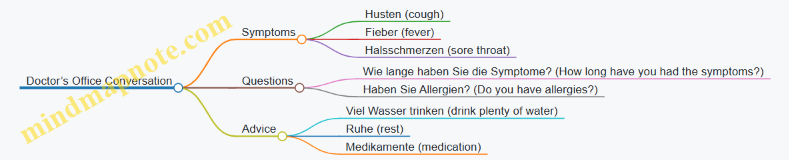
Example Dialogue:
- Patient: “Guten Tag, ich habe seit drei Tagen Husten und leichtes Fieber.”
- Arzt: “Haben Sie auch Halsschmerzen oder Kopfschmerzen?”
- Patient: “Ja, ein bisschen Halsschmerzen.”
- Arzt: “Ich empfehle Ihnen, viel Wasser zu trinken und sich auszuruhen. Wenn es schlimmer wird, kommen Sie bitte wieder.”
Role-Play 2: Booking a Hotel Room
Scenario: You call a hotel to reserve a room for two nights.
Key Objectives:
- Use polite formal address
- Specify dates and room preferences
- Ask about amenities and prices
Mind Map:
Example Dialogue:
- Gast: “Guten Tag, ich möchte ein Doppelzimmer für den 12. bis 14. Mai reservieren.”
- Rezeptionist: “Natürlich, möchten Sie mit Frühstück?”
- Gast: “Ja, bitte. Wie viel kostet das Zimmer pro Nacht?”
- Rezeptionist: “Es kostet 80 Euro pro Nacht inklusive Frühstück.”
- Gast: “Das klingt gut. Ich nehme das Zimmer.”
Role-Play 3: At the Supermarket
Scenario: You ask a store assistant where to find certain items and inquire about prices.
Key Objectives:
- Use question words effectively
- Understand and give directions within the store
- Discuss quantities and prices
Mind Map:
Example Dialogue:
- Kunde: “Entschuldigung, wo finde ich die Tomaten?”
- Verkäufer: “Die Tomaten sind im Gang fünf, neben den Gurken.”
- Kunde: “Und wie viel kostet ein Kilo?”
- Verkäufer: “Zwei Euro fünfzig pro Kilo.”
Role-Play 4: Making Plans with Friends
Scenario: You arrange a meeting with a friend to go to the cinema.
Key Objectives:
- Suggest times and places
- Accept or decline invitations politely
- Use future tense to talk about plans
Mind Map:
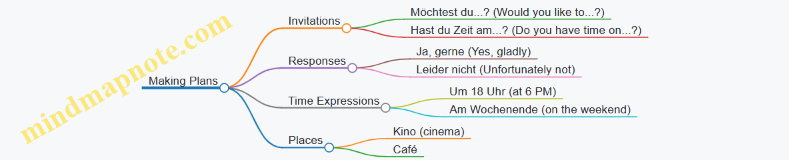
Example Dialogue:
- Person A: “Möchtest du am Samstag ins Kino gehen?”
- Person B: “Ja, gerne! Um wie viel Uhr?”
- Person A: “Um 18 Uhr. Treffen wir uns vor dem Kino?”
- Person B: “Perfekt, bis dann!”
Role-Play 5: Asking for Directions
Scenario: You are lost in a German city and ask a passerby for directions to the train station.
Key Objectives:
- Use polite forms
- Understand and give clear directions
- Use prepositions of place
Mind Map:
Example Dialogue:
- Tourist: “Entschuldigung, können Sie mir sagen, wo der Bahnhof ist?”
- Passant: “Ja, gehen Sie geradeaus bis zur Ampel, dann rechts. Der Bahnhof ist neben dem Supermarkt.”
- Tourist: “Vielen Dank!”
- Passant: “Gern geschehen.”
Tips for Effective Role-Play Practice
- Switch Roles: Practicing both parts helps understand different perspectives and vocabulary.
- Use Realistic Timing: Allow pauses and natural hesitations to mimic real conversations.
- Incorporate Feedback: After each role-play, discuss what went well and what could improve.
- Record Yourself: Listening back can reveal pronunciation or grammar issues.
- Build on Previous Dialogues: Extend conversations by adding new topics or complications.
These extended role-plays aim to simulate real-world conversations, combining vocabulary, grammar, and cultural context in a practical, manageable way. Repeating and adapting these exercises will enhance fluency and comfort in everyday German speaking situations.