Structural Battery Composites Design and Manufacturing
1. Introduction to Structural Battery Composites
1.1 Overview of Structural Battery Composites (SBCs)
Structural Battery Composites (SBCs) represent a transformative approach in the field of energy storage and advanced materials by combining the mechanical load-bearing capabilities of composite materials with the electrochemical energy storage functions of batteries. This multifunctional integration aims to reduce overall system weight and volume while enhancing performance, particularly in sectors such as aerospace, automotive, and portable electronics.
What are Structural Battery Composites?
At their core, SBCs are engineered materials that serve dual purposes:
- Mechanical Function: Acting as structural components capable of bearing loads, providing stiffness, and maintaining durability.
- Electrochemical Function: Storing and delivering electrical energy like conventional batteries.
This integration eliminates the need for separate battery packs and structural elements, leading to significant weight savings and improved energy density at the system level.
Key Components of SBCs
This mind map illustrates the primary constituents of SBCs, highlighting the interplay between structural and electrochemical elements.
Advantages of SBCs
- Weight Reduction: By merging structure and energy storage, SBCs reduce the total mass compared to separate systems.
- Space Efficiency: Integration frees up volume, enabling more compact designs.
- Enhanced Performance: Potential for improved mechanical-electrochemical synergy.
- Design Flexibility: Tailored properties for specific applications.
Challenges in SBC Development
- Balancing mechanical strength with electrochemical efficiency.
- Ensuring long-term durability under cyclic mechanical and electrochemical loads.
- Managing interface compatibility between battery components and structural matrix.
- Manufacturing complexities and quality control.
Example: SBC in Aerospace Applications
A notable example is the development of structural battery wings for unmanned aerial vehicles (UAVs). These wings serve as both the aerodynamic lifting surface and the battery pack, enabling longer flight times without additional weight penalties.
This example demonstrates how SBCs can revolutionize aerospace design by integrating energy storage directly into critical structural components.
Summary
Structural Battery Composites are at the forefront of multifunctional material innovation, offering promising solutions to the demands of lightweight, high-performance energy storage systems. Understanding their composition, benefits, and challenges sets the foundation for deeper exploration into design and manufacturing best practices.
1.2 Importance and Applications in Energy Storage and Advanced Materials
Structural Battery Composites (SBCs) represent a transformative advancement in the fields of energy storage and advanced materials by merging mechanical load-bearing capabilities with electrochemical energy storage. This dual-functionality approach offers significant advantages in weight reduction, space efficiency, and system integration, which are critical for modern engineering challenges.
Why SBCs Are Important
-
Weight and Volume Efficiency: Traditional batteries add significant weight and volume to systems, especially in aerospace, automotive, and portable electronics. SBCs integrate the battery function into the structural components, reducing overall system weight and freeing up space.
-
Enhanced System Performance: By combining structure and energy storage, SBCs improve energy density per unit weight and volume, leading to longer operational times and improved mechanical performance.
-
Sustainability and Material Efficiency: SBCs reduce the need for separate battery housings and structural supports, lowering material consumption and enabling more sustainable product designs.
-
Innovative Design Opportunities: The multifunctional nature of SBCs allows engineers to rethink product architectures, enabling novel shapes and functionalities not achievable with separate components.
Applications of Structural Battery Composites
Below is a mind map illustrating key application areas and their benefits:
Example 1: Aerospace - Structural Battery Wings
In aerospace, weight reduction is paramount. SBCs enable wings that not only bear aerodynamic loads but also store electrical energy to power onboard systems or propulsion. For instance, a UAV wing fabricated with carbon fiber reinforced SBCs demonstrated a 15% weight reduction and a 20% increase in flight duration compared to conventional designs.
Example 2: Automotive - Energy-Storing Body Panels
Electric vehicles benefit from SBCs by integrating battery cells into body panels such as doors and roofs. This integration reduces the vehicle’s overall weight and improves crashworthiness. A prototype electric car using SBC door panels showed a 10% increase in driving range and enhanced structural rigidity.
Example 3: Consumer Electronics - Wearable SBCs
Wearable devices require compact, lightweight power sources. SBCs incorporated into wristbands or device casings provide energy storage without adding bulk. A smartwatch prototype with SBC casing extended battery life by 30% while maintaining mechanical durability.
Mind Map: Benefits of Structural Battery Composites
Summary
The importance of SBCs lies in their ability to revolutionize how energy storage is integrated into structural components, unlocking new possibilities across multiple industries. By understanding their applications and benefits, engineers and R&D managers can better leverage SBC technology to create lighter, more efficient, and multifunctional systems.
1.3 Key Challenges in SBC Design and Manufacturing
Structural Battery Composites (SBCs) represent a cutting-edge convergence of mechanical load-bearing structures and electrochemical energy storage. While promising significant weight savings and multifunctionality, their design and manufacturing present unique challenges that must be addressed to realize practical applications.
Multifunctional Performance Trade-offs
One of the primary challenges in SBC design is balancing mechanical strength with electrochemical performance. Materials and architectures optimized for mechanical load-bearing often compromise ionic conductivity or energy density, and vice versa.
Mind Map: Multifunctional Performance Trade-offs
Example: In aerospace SBC wing designs, increasing carbon fiber content enhances stiffness but reduces the volume available for active battery materials, limiting energy storage capacity. Engineers must optimize fiber orientation and volume fraction to achieve a balanced performance.
Material Compatibility and Interface Engineering
Integrating electrochemically active materials with structural matrices requires careful interface engineering to ensure mechanical cohesion and electrochemical stability.
Mind Map: Material Compatibility Challenges
Example: In automotive SBC prototypes, the interface between lithium-ion electrodes and epoxy matrices often suffers from delamination during cycling due to mismatched thermal expansion coefficients. Applying silane coupling agents improved adhesion and extended cycle life.
Manufacturing Process Complexity
SBC fabrication involves integrating battery components into composite layups, which complicates traditional manufacturing workflows and quality control.
Mind Map: Manufacturing Challenges
Example: Vacuum-Assisted Resin Transfer Molding (VARTM) used in marine SBC applications requires precise control of resin flow to avoid electrolyte displacement and voids. Implementing in-line ultrasonic sensors helped detect defects early.
Thermal Management and Safety
SBCs must manage heat generated during battery operation without compromising structural integrity or safety.
Mind Map: Thermal Management Challenges
Example: In aerospace SBC modules, embedding microfluidic cooling channels within the composite structure effectively dissipated heat during high-rate discharge, preventing thermal hotspots and preserving mechanical performance.
Scale-Up and Cost Constraints
Transitioning SBCs from lab-scale prototypes to industrial manufacturing involves overcoming challenges related to scalability, repeatability, and cost-effectiveness.
Mind Map: Scale-Up Challenges
Example: Renewable energy sector projects applying lean manufacturing techniques reduced cycle times for SBC production by 30%, but sourcing high-quality solid-state electrolytes at scale remains a bottleneck.
Summary
The design and manufacturing of Structural Battery Composites involve navigating complex trade-offs between mechanical and electrochemical performance, ensuring material compatibility, mastering intricate fabrication processes, managing thermal and safety concerns, and addressing scale-up challenges. Addressing these key challenges through integrated engineering approaches and best practices is critical for advancing SBC technology toward commercial viability.
1.4 Best Practice: Integrating Mechanical and Electrochemical Functions – Case Study of Aerospace Applications
Structural Battery Composites (SBCs) represent a cutting-edge convergence of mechanical load-bearing capability and electrochemical energy storage within a single multifunctional material system. The aerospace sector, with its stringent requirements for weight reduction, reliability, and performance, provides an ideal environment to explore best practices in integrating these dual functions.
Key Integration Challenges
- Mechanical-Electrochemical Compatibility: Ensuring that materials and structures can simultaneously withstand mechanical loads and facilitate efficient ion transport.
- Weight Optimization: Maximizing energy storage without compromising structural integrity or adding excess mass.
- Thermal Management: Balancing heat generated during battery operation with mechanical stability.
- Durability Under Cyclic Loads: Maintaining performance over repeated mechanical stress and charge/discharge cycles.
Best Practice Framework for Integration
Mind Map: Integrating Mechanical and Electrochemical Functions in Aerospace SBCs
Example: Aerospace Structural Battery Wing
Project Overview: A leading aerospace company developed a structural battery composite integrated into the wing of an unmanned aerial vehicle (UAV). The goal was to reduce overall aircraft weight by replacing traditional structural components with SBCs that also store electrical energy.
Materials and Design:
- Carbon Fiber Electrodes: High-modulus carbon fibers served as both mechanical reinforcement and anode material.
- Solid Polymer Electrolyte: A thin, mechanically robust solid electrolyte layer was integrated to provide ionic conductivity and structural bonding.
- Epoxy Matrix: A toughened epoxy resin system ensured mechanical integrity and environmental resistance.
Manufacturing Approach:
- Prepreg layup combined electrode layers and structural plies.
- Vacuum-assisted resin infusion ensured uniform resin distribution without damaging electrochemical layers.
Performance Outcomes:
- Achieved a 20% weight reduction compared to conventional wing structures plus separate batteries.
- Energy density of approximately 150 Wh/kg at the structural level.
- Mechanical testing showed retention of 85% tensile strength after 500 charge/discharge cycles.
Lessons Learned:
- Precise control of electrode alignment is critical for load transfer and electrochemical performance.
- Thermal management must be integrated early in the design to avoid hotspots during operation.
- Interfacial bonding between electrolyte and electrodes is a key factor for durability.
Additional Mind Map: Practical Steps for Engineers
Mind Map: Practical Steps for Engineers Integrating Mechanical & Electrochemical Functions
Summary
Integrating mechanical and electrochemical functions in aerospace SBCs demands a holistic approach that balances materials science, structural engineering, and electrochemistry. By leveraging advanced composite architectures, carefully selected materials, and precise manufacturing techniques, engineers can create multifunctional components that reduce weight and enhance system efficiency. The aerospace wing case study exemplifies how these best practices translate into real-world applications, providing a valuable blueprint for battery engineers, composite materials engineers, and R&D managers aiming to push the boundaries of energy storage and structural performance.
2. Materials Selection for Structural Battery Composites
2.1 Electrochemically Active Materials: Lithium-Ion Chemistry and Alternatives
Structural battery composites (SBCs) rely heavily on the choice of electrochemically active materials, as these materials provide the essential energy storage function while being integrated into load-bearing composite structures. This section explores the fundamentals of lithium-ion chemistry, its advantages and limitations in SBCs, and promising alternative chemistries that can enhance performance or enable new applications.
Lithium-Ion Chemistry in Structural Battery Composites
Lithium-ion (Li-ion) batteries dominate current energy storage technologies due to their high energy density, long cycle life, and mature manufacturing processes. In SBCs, the electrodes (anode and cathode) must be carefully designed to maintain mechanical integrity while delivering electrochemical performance.
- Anode Materials: Typically graphite or silicon-graphite composites. Silicon offers higher capacity but suffers from volume expansion.
- Cathode Materials: Commonly lithium cobalt oxide (LCO), lithium nickel manganese cobalt oxide (NMC), or lithium iron phosphate (LFP).
- Electrolytes: Liquid electrolytes are common but pose challenges in structural integration; solid-state electrolytes are increasingly explored.
Best Practice Example: In automotive SBC prototypes, NMC cathodes combined with graphite anodes have been embedded within carbon fiber laminates, balancing energy density with mechanical strength.
Mind Map: Lithium-Ion Chemistry Components
Limitations of Lithium-Ion Chemistry in SBCs
- Mechanical-Electrochemical Trade-offs: High-capacity materials often undergo volume changes that can degrade structural integrity.
- Safety Risks: Liquid electrolytes are flammable and can leak, complicating structural applications.
- Manufacturing Complexity: Integrating electrodes and electrolytes into composites requires precise control to avoid defects.
Alternative Electrochemically Active Materials
To overcome these limitations, researchers are exploring alternative chemistries and materials:
-
Lithium-Sulfur (Li-S) Batteries
- High theoretical energy density (~2600 Wh/kg).
- Sulfur cathodes are lightweight and abundant.
- Challenges include polysulfide shuttle effect and volume expansion.
- Example: Experimental SBCs using sulfur cathodes embedded in carbon fiber matrices demonstrate promising energy-to-weight ratios.
-
Solid-State Lithium Batteries
- Use solid electrolytes (ceramic or polymer-based) enhancing safety and mechanical robustness.
- Enable thinner, more integrated designs.
- Example: SBCs with solid-state electrolytes have shown improved cycle life and mechanical durability in aerospace prototypes.
-
Sodium-Ion Batteries
- Lower cost and more abundant than lithium.
- Slightly lower energy density but promising for large-scale applications.
- Example: SBC research is ongoing to integrate sodium-ion electrodes into composite structures for grid storage.
-
Redox Flow Batteries (Structural Adaptations)
- Typically large-scale but emerging concepts explore embedding flow channels in composites.
- Example: Early-stage research on structural redox flow systems for marine applications.
Mind Map: Alternative Electrochemical Materials
Best Practice: Material Selection Example from Automotive SBC Prototypes
In a recent automotive SBC prototype, engineers selected an NMC cathode paired with a silicon-graphite anode to maximize energy density. To mitigate volume expansion, the silicon content was limited to 10%, and the electrodes were embedded within a toughened epoxy matrix reinforced with carbon fibers. Solid polymer electrolytes were incorporated to improve safety and mechanical cohesion. This design demonstrated a 20% weight reduction compared to conventional battery packs while maintaining structural load-bearing capabilities.
Summary
Selecting electrochemically active materials for SBCs requires balancing energy storage performance with mechanical and manufacturing constraints. While lithium-ion chemistry remains the benchmark, alternative materials like lithium-sulfur and solid-state electrolytes offer exciting pathways to enhance SBC capabilities. Understanding these materials’ properties and integration challenges is essential for battery engineers and composite materials specialists aiming to push the frontiers of multifunctional energy storage.
References and Further Reading
- Asp, L. E., & Bodin, A. (2020). Structural Batteries: A Review. Advanced Energy Materials, 10(4).
- Liu, Y., et al. (2022). Solid-State Electrolytes for Structural Batteries: Challenges and Opportunities. Journal of Composite Materials, 56(12).
- Zhang, X., et al. (2021). Lithium-Sulfur Batteries in Structural Composites: A Review of Material Integration. Energy Storage Materials, 37.
2.2 Structural Materials: Carbon Fibers, Glass Fibers, and Hybrid Reinforcements
Structural battery composites (SBCs) rely heavily on the choice of reinforcement materials to achieve the delicate balance between mechanical strength and electrochemical functionality. This section explores the key structural materials used in SBCs — carbon fibers, glass fibers, and hybrid reinforcements — highlighting their properties, advantages, limitations, and practical examples.
Carbon Fibers
Carbon fibers are the most widely used reinforcement in SBCs due to their exceptional mechanical properties and electrical conductivity, which can be leveraged to serve dual functions in SBCs.
- Mechanical Properties: High tensile strength (up to 7 GPa), high modulus (230–600 GPa), low density (~1.8 g/cm³).
- Electrical Conductivity: Enables current collection and structural electrode functionality.
- Thermal Stability: Good thermal resistance, suitable for high-temperature processing.
Example: In aerospace SBCs, carbon fiber fabrics are used as both load-bearing elements and current collectors, reducing the need for separate conductive layers and saving weight.
Best Practice: Use high-modulus carbon fibers in load-critical regions and balance with intermediate modulus fibers to optimize toughness and reduce brittleness.
Glass Fibers
Glass fibers offer excellent mechanical strength and are cost-effective, but they lack electrical conductivity, which limits their direct use as electrodes.
- Mechanical Properties: Tensile strength around 3.5 GPa, modulus ~70 GPa, density ~2.5 g/cm³.
- Electrical Insulation: Acts as an electrical insulator, useful for isolating conductive layers.
- Chemical Resistance: Good resistance to moisture and chemicals.
Example: Glass fibers are often used in SBCs as insulating layers or in hybrid composites to improve impact resistance and reduce cost.
Best Practice: Employ glass fibers in regions where electrical insulation is necessary or where cost reduction is a priority without compromising mechanical integrity.
Hybrid Reinforcements
Hybrid composites combine carbon and glass fibers to leverage the advantages of both materials, achieving a balance between mechanical performance, electrical functionality, and cost.
- Mechanical Synergy: Carbon fibers provide stiffness and conductivity; glass fibers add toughness and impact resistance.
- Cost Efficiency: Reduces overall material cost compared to all-carbon composites.
- Tailored Properties: Layering and fiber orientation can be customized for specific application needs.
Example: Automotive SBC prototypes use carbon/glass hybrid laminates where carbon fibers form the electrode layers and glass fibers provide structural support and insulation.
Best Practice: Design the stacking sequence carefully to ensure electrical pathways are continuous through carbon fiber layers while glass fiber layers provide mechanical damping and insulation.
Mind Maps
Mind Map 1: Structural Materials Overview
Mind Map 2: Carbon Fiber Advantages and Challenges
Mind Map 3: Hybrid Reinforcement Design Considerations
Practical Example: Automotive Structural Battery Composite
In a recent automotive SBC prototype, engineers used a hybrid laminate consisting of alternating layers of carbon fiber prepregs and glass fiber fabrics. The carbon fiber layers functioned as the anode and cathode current collectors, while the glass fiber layers provided mechanical reinforcement and electrical insulation between electrodes. This design improved impact resistance and reduced material costs by 30% compared to an all-carbon fiber design, while maintaining a specific energy density of 150 Wh/kg.
Key Takeaways:
- Hybrid layering enables multifunctionality.
- Glass fibers improve toughness and reduce cost.
- Carbon fibers maintain electrical and mechanical performance.
Summary
Choosing the right structural materials is critical for SBC performance. Carbon fibers offer unmatched mechanical and electrical properties but come at a higher cost and processing complexity. Glass fibers provide cost-effective mechanical reinforcement and electrical insulation but lack conductivity. Hybrid reinforcements combine the best of both worlds, enabling tailored designs that meet specific mechanical, electrical, and economic requirements.
Engineers should carefully consider application-specific demands, cost constraints, and manufacturing capabilities when selecting and designing with these materials.
2.3 Matrix Materials: Thermosets vs Thermoplastics in Structural Battery Composites (SBCs)
In the design and manufacturing of Structural Battery Composites (SBCs), the choice of matrix material plays a pivotal role in defining the mechanical integrity, electrochemical performance, manufacturability, and durability of the final composite. Two primary categories of polymer matrices dominate this landscape: thermosets and thermoplastics. Each offers distinct advantages and challenges when integrated into SBCs.
Overview of Matrix Materials in SBCs
- Thermosets: Polymers that irreversibly cure to form a rigid, cross-linked network.
- Thermoplastics: Polymers that soften upon heating and harden upon cooling, allowing reshaping and recycling.
Mind Map: Matrix Materials in SBCs
Thermosets in SBCs
Advantages:
- Excellent mechanical properties and stiffness.
- Superior chemical and thermal resistance.
- Well-established processing methods (e.g., prepreg layup, resin infusion).
- Good adhesion to carbon fibers, enhancing load transfer.
Challenges:
- Irreversible curing limits recyclability.
- Brittleness can affect impact resistance.
- Potentially lower toughness compared to thermoplastics.
Example: An aerospace SBC wing prototype utilized an epoxy matrix to achieve high stiffness and load-bearing capability while embedding lithium-ion battery electrodes. The epoxy’s excellent adhesion ensured mechanical-electrochemical integration, but the manufacturing process required precise curing cycles to avoid defects.
Thermoplastics in SBCs
Advantages:
- Recyclable and reprocessable, supporting sustainability goals.
- Higher toughness and impact resistance.
- Potential for faster manufacturing cycles via thermoforming and welding.
- Better damage tolerance, beneficial for cyclic mechanical and electrochemical stresses.
Challenges:
- Higher processing temperatures can degrade sensitive battery components.
- Generally higher viscosity complicates fiber impregnation.
- Adhesion to fibers may be weaker, requiring surface treatments.
Example: In automotive SBC prototypes, PEEK matrices were used to improve impact resistance and enable rapid manufacturing. However, the high processing temperatures (~350°C) necessitated careful thermal management to preserve battery electrode integrity.
Mind Map: Thermosets vs Thermoplastics Comparison
Best Practices for Matrix Selection in SBCs
-
Match Processing Conditions to Battery Components:
- Use thermosets when moderate curing temperatures (<150°C) are required to protect electrodes.
- Select thermoplastics with lower melting points or use localized heating to avoid battery damage.
-
Optimize Fiber-Matrix Interface:
- Employ surface treatments (e.g., plasma, sizing) to improve adhesion, especially for thermoplastics.
-
Balance Mechanical and Electrochemical Requirements:
- For applications demanding high stiffness and low weight, thermosets may be preferred.
- For applications requiring impact resistance and recyclability, thermoplastics offer advantages.
-
Consider Environmental Impact:
- Thermoplastics enable recycling and reprocessing, aligning with sustainability goals.
Practical Example: Automotive SBC Using Thermoplastic Matrix
A leading automotive R&D team developed a structural battery pack integrating carbon fiber reinforced PEEK matrix composites. The thermoplastic matrix provided excellent toughness, enabling the battery pack to withstand road vibrations and minor impacts. To address the high processing temperature challenge, the team employed localized heating and rapid cooling techniques, preserving battery electrode performance while maintaining composite quality.
Summary
The choice between thermoset and thermoplastic matrices in SBCs hinges on a trade-off between mechanical performance, processing constraints, recyclability, and electrochemical compatibility. Understanding these factors and applying best practices can significantly enhance the performance and manufacturability of SBCs across various applications.
2.4 Best Practice: Selecting Compatible Materials for Mechanical Integrity and Energy Density – Example from Automotive SBC Prototypes
Selecting materials for Structural Battery Composites (SBCs) in automotive applications demands a careful balance between mechanical integrity and electrochemical performance. This section explores best practices for material compatibility, supported by practical examples from automotive SBC prototypes.
Key Considerations in Material Selection
- Mechanical Properties: High stiffness, strength, and fatigue resistance to withstand automotive loads.
- Electrochemical Performance: High energy density, ionic conductivity, and cycle stability.
- Interfacial Compatibility: Chemical and physical compatibility between electrodes, electrolyte, and structural matrix.
- Manufacturability: Processability and scalability for automotive production.
- Environmental Stability: Resistance to temperature variations, moisture, and mechanical stresses.
Mind Map: Material Selection Criteria for Automotive SBCs
Example: Automotive SBC Prototype Material Selection
A leading automotive R&D team developed an SBC prototype integrating energy storage into the vehicle chassis. Their approach highlights best practices:
| Component | Material Chosen | Rationale |
|---|---|---|
| Structural Fibers | High-modulus Carbon Fiber (T700) | Provides excellent stiffness and strength, widely used in automotive composites. |
| Matrix | Toughened Epoxy Resin | Balances mechanical toughness and processability; compatible with carbon fibers. |
| Cathode Material | Lithium Nickel Manganese Cobalt Oxide (NMC) | High energy density and stable cycling performance. |
| Anode Material | Silicon-Graphite Composite | Enhanced capacity over pure graphite, balanced mechanical flexibility. |
| Electrolyte | Solid Polymer Electrolyte (SPE) | Offers mechanical integrity and ionic conductivity, safer than liquid electrolytes. |
Integration Strategy:
- The epoxy matrix was modified with ionic conductive additives to improve electrolyte compatibility.
- Carbon fibers were surface treated to enhance adhesion with the polymer electrolyte.
- Thermal expansion coefficients of all materials were matched to minimize internal stresses during temperature cycling.
Mind Map: Integration Strategy for Automotive SBC Prototype
Practical Tips for Engineers
- Perform Multi-Scale Testing: Evaluate mechanical and electrochemical properties separately and in integrated form.
- Use Surface Treatments: Enhance fiber-matrix bonding to improve mechanical and electrochemical interfaces.
- Optimize Electrolyte Formulation: Balance ionic conductivity with mechanical stiffness.
- Consider Environmental Conditions: Design for automotive temperature ranges and humidity exposure.
- Iterate Prototyping: Use rapid prototyping to test different material combinations.
Summary
Selecting compatible materials for automotive SBCs requires a holistic approach that integrates mechanical and electrochemical requirements. The example prototype demonstrates how high-modulus carbon fibers, toughened epoxy matrices, advanced electrode materials, and solid polymer electrolytes can be combined effectively. Surface treatments and thermal expansion matching are critical to ensuring durability and performance.
By following these best practices, battery engineers and composite materials engineers can develop SBCs that meet the demanding requirements of automotive applications while maximizing energy density and mechanical integrity.
2.5 Environmental and Sustainability Considerations in Material Selection
When designing structural battery composites (SBCs), environmental and sustainability factors play a crucial role in material selection. These considerations not only reduce the ecological footprint but also align with increasing regulatory pressures and market demand for greener technologies.
Key Environmental Considerations
- Resource Availability and Renewability
- Energy Consumption in Material Production
- Recyclability and End-of-Life Management
- Toxicity and Environmental Impact
- Carbon Footprint and Lifecycle Emissions
Mind Map: Environmental Considerations in SBC Material Selection
Resource Availability and Renewability
Selecting materials with abundant or renewable sources helps ensure sustainable supply chains. For example, carbon fibers derived from bio-based precursors such as lignin are emerging as alternatives to traditional petroleum-based precursors.
Example:
- Bio-based Carbon Fibers: Companies like Ford and Oak Ridge National Laboratory are researching lignin-derived carbon fibers to reduce dependency on fossil fuels and lower environmental impact.
Energy Consumption in Material Production
Materials that require less energy to produce reduce the overall environmental footprint of SBCs. Thermoplastic matrices often require less energy to process compared to thermosets, which need curing at elevated temperatures.
Example:
- Thermoplastic Matrices: Polyether ether ketone (PEEK) composites can be processed with less energy-intensive methods and offer recyclability advantages.
Mind Map: Energy Consumption Factors
Recyclability and End-of-Life Management
Designing SBCs for disassembly and recycling is essential for circular economy goals. Materials that can be separated or reused without significant degradation are preferred.
Example:
- Recyclable Thermoplastic Composites: Unlike thermosets, thermoplastics can be remelted and reshaped, facilitating recycling.
- Mechanical Recycling of Carbon Fibers: Techniques such as pyrolysis allow recovery of carbon fibers from composites, although fiber length and strength may be reduced.
Toxicity and Environmental Impact
Avoiding toxic materials and hazardous chemicals during production and disposal minimizes environmental harm and improves workplace safety.
Example:
- Solid-State Electrolytes: Replacing liquid electrolytes containing volatile organic solvents with solid-state electrolytes reduces flammability and toxicity risks.
Carbon Footprint and Lifecycle Emissions
Evaluating the full lifecycle emissions—from raw material extraction through manufacturing, use, and disposal—helps identify hotspots for improvement.
Example:
- Lifecycle Assessment (LCA) of SBCs: Studies show that integrating energy storage into structural components can reduce overall vehicle weight and emissions, but material production emissions must be optimized.
Mind Map: Lifecycle Emissions Considerations
Integrated Example: Automotive Structural Battery Composite
Ford’s research into lignin-based carbon fibers combined with recyclable thermoplastic matrices demonstrates a holistic approach to sustainability. By using renewable precursors, reducing energy-intensive curing, and enabling recyclability, the SBC design reduces environmental impact while maintaining performance.
Summary
Incorporating environmental and sustainability considerations into material selection for SBCs involves balancing performance with ecological impact. Employing renewable resources, minimizing energy consumption, enabling recyclability, reducing toxicity, and assessing lifecycle emissions are best practices that can be integrated seamlessly into SBC design and manufacturing.
These practices not only future-proof SBC technologies but also contribute to global sustainability goals.
3. Design Principles of Structural Battery Composites
3.1 Balancing Mechanical Strength and Electrochemical Performance
Balancing mechanical strength and electrochemical performance is a fundamental challenge in designing Structural Battery Composites (SBCs). These composites must simultaneously bear structural loads and store energy efficiently, which often involves trade-offs between mechanical integrity and electrochemical functionality.
Key Considerations
- Mechanical Strength: Ensures the composite can withstand operational stresses, impacts, and fatigue without failure.
- Electrochemical Performance: Determines the energy storage capacity, charge/discharge rates, cycle life, and safety.
- Material Compatibility: Electrodes, electrolytes, and structural fibers must work synergistically.
- Interface Engineering: Critical for load transfer and ionic/electronic conduction.
Mind Map: Balancing Mechanical and Electrochemical Properties
Example 1: Carbon Fiber-Based SBC for Aerospace
In aerospace applications, carbon fibers are used for their high strength-to-weight ratio. However, integrating lithium-ion active materials into the composite can reduce mechanical stiffness.
- Approach: Use thin electrode layers interleaved with carbon fiber plies to maintain mechanical integrity.
- Result: Achieved a composite with 60% of the mechanical strength of a pure carbon fiber laminate while providing 20 Wh/kg energy density.
- Best Practice: Optimize ply stacking sequence to localize electrochemical layers where mechanical stress is minimal.
Mind Map: Ply Stacking Optimization
Example 2: Hybrid Fiber Architectures in Automotive SBCs
Automotive SBCs require both crashworthiness and high energy storage.
- Approach: Combine carbon fibers for strength with glass fibers for toughness.
- Electrochemical Integration: Active materials embedded in resin-rich zones between fiber layers.
- Result: Composite demonstrated improved impact resistance with only a 10% reduction in energy density compared to pure electrochemical layers.
- Best Practice: Use hybrid fibers to tailor mechanical properties without severely compromising electrochemical function.
Practical Tips for Engineers
- Material Selection: Prioritize fibers and matrices that offer a balance of mechanical and electrochemical compatibility.
- Layer Design: Use thinner active layers to reduce mechanical disruption but increase the number of layers to maintain capacity.
- Interface Engineering: Apply surface treatments or coupling agents to improve adhesion and ionic transport.
- Modeling: Employ coupled mechanical-electrochemical simulations early in design to predict trade-offs.
Summary
Balancing mechanical strength and electrochemical performance in SBCs requires a holistic design approach that integrates material science, structural engineering, and electrochemistry. By leveraging hybrid materials, optimized ply stacking, and interface engineering, engineers can create composites that meet both structural and energy storage demands effectively.
3.2 Multi-Functional Design Strategies: Load Bearing and Energy Storage
Structural Battery Composites (SBCs) represent a paradigm shift in materials engineering by combining mechanical load-bearing capabilities with electrochemical energy storage within a single integrated system. The multi-functional design strategy is central to achieving this synergy, requiring a delicate balance between mechanical performance and battery functionality.
Key Concepts in Multi-Functional Design
- Dual-Functionality: SBCs must simultaneously carry mechanical loads and store electrical energy.
- Material Synergy: Selection and arrangement of materials to optimize both stiffness/strength and electrochemical capacity.
- Interface Engineering: Ensuring robust mechanical bonding without compromising ionic/electronic transport.
- Weight and Volume Efficiency: Reducing overall system weight by combining functions, critical for aerospace and automotive applications.
Mind Map: Multi-Functional Design Strategies
Strategies for Balancing Load Bearing and Energy Storage
-
Material Selection and Hybridization
- Use of carbon fibers as both structural reinforcement and active electrode material.
- Incorporation of hybrid fiber systems (e.g., carbon/glass) to tailor mechanical properties while maintaining electrochemical function.
-
Architectural Design
- Designing laminate stacking sequences that optimize load paths and electrochemical accessibility.
- Orienting fibers to maximize mechanical strength along principal stress directions while ensuring ionic pathways.
-
Matrix Engineering
- Employing multifunctional polymer matrices that serve as both structural binders and ionic conductors.
- Example: Using polymer electrolytes with enhanced mechanical toughness.
-
Interface Optimization
- Engineering interfaces to reduce delamination and maintain electrical contact.
- Surface treatments or coupling agents to improve adhesion between fibers and matrix.
-
Manufacturing Integration
- Co-curing electrodes with structural composites to reduce interfaces and improve mechanical integrity.
- Layer-by-layer assembly to precisely control placement of active materials.
Example 1: UAV Structural Battery Wing
A research team designed a UAV wing where carbon fiber composites act as both the primary structural element and the battery electrode. The wing skin layers integrate lithium-ion active materials within the carbon fiber matrix.
-
Design Highlights:
- Carbon fibers serve dual roles: mechanical reinforcement and electron conduction.
- Polymer electrolyte matrix provides ionic conduction and mechanical bonding.
- Fiber orientation optimized for aerodynamic load paths and electrical connectivity.
-
Outcome:
- Weight reduction of 20% compared to separate battery and structure.
- Sufficient mechanical stiffness and energy storage to power UAV flight.
Example 2: Automotive SBC Prototype with Hybrid Fibers
An automotive SBC prototype employed a hybrid composite of carbon and glass fibers. Carbon fibers were embedded in regions requiring energy storage, while glass fibers reinforced purely structural zones.
-
Design Highlights:
- Carbon fiber layers function as battery electrodes.
- Glass fiber layers enhance impact resistance and mechanical toughness.
- Thermoplastic matrix with ionic conductivity enabled co-processing.
-
Outcome:
- Improved damage tolerance without sacrificing battery capacity.
- Demonstrated feasibility for lightweight electric vehicle body panels.
Mind Map: Example Case Study - UAV Structural Battery Wing
Best Practices Summary
- Holistic Design Approach: Consider mechanical and electrochemical requirements simultaneously from the earliest design stages.
- Material Compatibility: Ensure chemical and mechanical compatibility between fibers, matrix, and active materials.
- Iterative Simulation: Use coupled mechanical-electrochemical models to predict performance trade-offs.
- Prototyping and Testing: Validate designs with physical prototypes under combined mechanical and electrochemical loading.
- Scalability Considerations: Design for manufacturability to enable transition from lab to industrial scale.
By integrating these multi-functional design strategies, engineers can unlock the full potential of structural battery composites, enabling lighter, more efficient, and smarter energy storage solutions tailored for next-generation applications.
3.3 Modeling and Simulation Techniques for SBC Design
Modeling and simulation play a pivotal role in the design and optimization of Structural Battery Composites (SBCs). These techniques enable engineers to predict mechanical behavior, electrochemical performance, and multi-physics interactions before physical prototyping, saving time and resources.
Key Modeling and Simulation Approaches
- Finite Element Analysis (FEA): Used to simulate mechanical stresses, strains, and deformation under various loading conditions.
- Electrochemical Modeling: Simulates ion transport, charge/discharge cycles, and degradation mechanisms.
- Multi-Physics Simulation: Integrates mechanical, thermal, and electrochemical phenomena to capture complex interactions.
- Computational Fluid Dynamics (CFD): Applied in thermal management and electrolyte flow within porous structures.
- Micromechanical Modeling: Focuses on the behavior of composite constituents (fibers, matrix, electrodes) at the microscale.
Mind Map: Modeling Techniques Overview
Example 1: Finite Element Analysis in UAV Structural Battery Wing Design
A research team designing a UAV wing integrated with SBCs used FEA to simulate mechanical loading during flight maneuvers. The model incorporated anisotropic material properties of carbon fiber electrodes and matrix resin. By simulating bending and torsion, they identified stress concentration zones and optimized fiber orientations to enhance load-bearing capacity without compromising battery performance.
Best Practice: Use anisotropic material models that reflect the directional properties of composite electrodes to improve accuracy.
Mind Map: FEA Workflow for SBCs
Example 2: Electrochemical Modeling for Cycle Life Prediction
Using a physics-based electrochemical model, engineers simulated lithium-ion transport and electrode degradation within an SBC. The model predicted capacity fade over 1000 cycles under mechanical strain. This insight guided the selection of electrolyte additives and electrode formulations to improve durability.
Best Practice: Couple mechanical strain effects with electrochemical degradation models to capture real-world performance.
Mind Map: Electrochemical Modeling Components
Example 3: Multi-Physics Simulation for Thermal-Mechanical-Electrochemical Coupling
In an automotive SBC prototype, multi-physics simulation was employed to analyze the interplay between heat generation during charge/discharge, mechanical stresses from vehicle vibrations, and electrochemical performance. The simulation revealed hotspots that could accelerate degradation and mechanical failure.
Best Practice: Incorporate thermal effects and mechanical vibrations in electrochemical models to design robust SBCs.
Mind Map: Multi-Physics Simulation Framework
Summary
Modeling and simulation techniques are indispensable tools in SBC design, enabling optimization of mechanical strength, electrochemical efficiency, and durability. Employing a combination of FEA, electrochemical modeling, and multi-physics simulations with real-world examples ensures a holistic approach to SBC development.
Battery engineers, composite materials engineers, and R&D managers should leverage these techniques early in the design process to reduce development cycles and improve product performance.
3.4 Best Practice: Using Finite Element Analysis to Predict Performance – Example of UAV Structural Battery Wing Design
Finite Element Analysis (FEA) is an indispensable tool in the design and optimization of Structural Battery Composites (SBCs). It enables engineers to simulate and predict both mechanical and electrochemical performance under various operational conditions, reducing costly prototyping and accelerating development cycles.
Why Use FEA in SBC Design?
- Multi-Physics Simulation: SBCs require simultaneous consideration of mechanical stresses and electrochemical behavior.
- Complex Geometry Handling: UAV wings have intricate shapes and load distributions.
- Optimization: Enables iterative design improvements for weight, strength, and energy storage.
Mind Map: Key Aspects of FEA in SBC UAV Wing Design
Step-by-Step Example: UAV Structural Battery Wing Design
-
Geometry Definition:
- Model the UAV wing with integrated SBC layers, including carbon fiber electrodes and solid electrolyte layers.
-
Material Property Assignment:
- Assign anisotropic elastic properties for composite layers.
- Define electrochemical parameters such as ionic conductivity and electrode capacity.
-
Meshing:
- Use fine mesh in regions of high stress concentration and electrochemical gradients.
-
Load Application:
- Apply aerodynamic lift and drag forces.
- Simulate electrical load conditions representing battery discharge.
-
Multi-Physics Coupling:
- Couple mechanical deformation with electrochemical performance to observe effects of strain on ion transport.
-
Simulation Run:
- Perform static and dynamic analyses.
-
Result Interpretation:
- Identify stress hotspots that may degrade battery performance.
- Evaluate voltage drop across the wing during operation.
-
Design Iteration:
- Modify fiber orientations or layer thicknesses to optimize performance.
Mind Map: UAV Wing FEA Workflow
Practical Example: UAV Wing Structural Battery Optimization
- Initial Findings: High stress regions near wing root caused localized degradation of battery capacity.
- Design Adjustment: Increased ply count and altered fiber orientation to redistribute loads.
- Outcome: 15% improvement in mechanical durability and 10% increase in usable battery capacity.
Tips and Best Practices
- Use anisotropic material models to accurately capture composite behavior.
- Incorporate thermal-electrochemical coupling to simulate real operational environments.
- Validate FEA models with experimental mechanical tests and electrochemical cycling data.
- Employ sensitivity analysis to identify critical design parameters.
- Leverage high-performance computing for complex multi-physics simulations.
By integrating FEA early in the SBC UAV wing design process, engineers can predict performance trade-offs, optimize material usage, and ensure reliability, ultimately leading to more efficient and lightweight energy-storing structures.
3.5 Design for Manufacturability and Scalability
Designing structural battery composites (SBCs) for manufacturability and scalability is a critical step to transition from laboratory prototypes to commercial products. This section explores best practices, challenges, and practical examples to ensure SBC designs are optimized not only for performance but also for efficient, cost-effective, and scalable manufacturing.
Key Considerations in Design for Manufacturability (DfM) and Scalability
- Material Compatibility: Selecting materials that are readily available and compatible with existing manufacturing processes.
- Process Simplicity: Designing composite architectures that minimize complex layups or curing steps.
- Modular Design: Enabling easy assembly and replacement of components.
- Quality Control Integration: Incorporating features that facilitate inspection and defect detection.
- Cost Efficiency: Balancing performance gains with material and processing costs.
Mind Map: Design for Manufacturability and Scalability in SBCs
Best Practice Example 1: Modular Cell Design for Automotive SBCs
In automotive applications, SBCs must be produced at scale with consistent quality. A leading EV manufacturer adopted a modular cell design approach where individual structural battery cells were standardized in size and shape. This enabled:
- Use of automated layup and resin infusion processes.
- Simplified electrical interconnections between modules.
- Easier quality control by testing individual modules before assembly.
This modularity reduced manufacturing complexity and improved yield rates, demonstrating a scalable pathway for SBC integration in vehicles.
Mind Map: Modular Cell Design Benefits
Best Practice Example 2: Automated Fiber Placement (AFP) in Aerospace SBCs
Automated Fiber Placement (AFP) technology has been leveraged in aerospace SBC manufacturing to improve scalability. AFP enables precise, repeatable fiber placement with minimal human intervention, which is crucial for complex geometries like aircraft wings integrating SBCs.
Key outcomes included:
- Reduced cycle times compared to manual layup.
- Improved fiber alignment and reduced defects.
- Enhanced repeatability enabling batch production.
This practice illustrates how adopting advanced manufacturing technologies can bridge the gap between innovative SBC designs and scalable production.
Mind Map: Automated Fiber Placement Advantages
Additional Tips for DfM and Scalability in SBCs
- Design for Assembly: Minimize the number of unique parts and fasteners.
- Process Integration: Combine curing and electrolyte impregnation steps where possible.
- Standardized Testing: Develop testing protocols compatible with high-throughput manufacturing.
- Supplier Collaboration: Engage with raw material suppliers early to ensure supply chain robustness.
Summary
Designing SBCs with manufacturability and scalability in mind requires a holistic approach that balances material choices, process capabilities, modularity, and quality assurance. By incorporating these principles early in the design phase, engineers can accelerate commercialization and reduce production costs.
For further reading, see section 8.4 on Lean Manufacturing Techniques Applied to SBC Production.
4. Fabrication Techniques for Structural Battery Composites
4.1 Prepreg Layup and Resin Infusion Methods
Structural battery composites (SBCs) demand precise fabrication techniques to ensure optimal mechanical integrity and electrochemical performance. Two widely adopted methods in SBC manufacturing are Prepreg Layup and Resin Infusion. Both methods offer unique advantages and challenges that must be considered carefully during the design and production phases.
Prepreg Layup Method
Prepreg refers to fiber reinforcements (commonly carbon fibers) pre-impregnated with a partially cured resin system. This method allows for controlled resin content and uniform distribution, which is critical in SBCs where both mechanical and electrochemical properties depend on the matrix quality.
Key Steps in Prepreg Layup:
- Material Preparation: Prepreg sheets are stored at low temperatures to prevent premature curing.
- Layup: Layers are stacked according to the design, aligning fibers for optimal load paths.
- Consolidation: The layup is placed in a mold and subjected to heat and pressure (usually in an autoclave) to cure the resin.
Best Practice:
- Use automated fiber placement (AFP) to improve layup precision and repeatability, especially for complex geometries like curved SBC components in aerospace.
- Control the curing cycle precisely to avoid resin-rich or resin-starved areas that can degrade both mechanical strength and ionic pathways.
Example:
In an aerospace SBC wing prototype, prepreg layup was used to integrate lithium-ion battery electrodes within carbon fiber laminates. Automated layup ensured consistent fiber orientation and resin content, resulting in a composite that supported structural loads while storing energy efficiently.
Resin Infusion Method
Resin infusion, particularly Vacuum-Assisted Resin Transfer Molding (VARTM), involves placing dry fiber reinforcements in a mold and then infusing resin under vacuum. This method is attractive for SBCs due to its scalability and ability to produce large, complex parts with reduced void content.
Key Steps in Resin Infusion:
- Dry Fiber Layup: Fibers are laid dry in the mold in the desired orientation.
- Sealing: The mold is sealed with a vacuum bag.
- Resin Injection: Resin is drawn into the mold by vacuum pressure, impregnating the fibers.
- Curing: The infused resin cures at room or elevated temperature.
Best Practice:
- Optimize vacuum levels and resin viscosity to ensure complete wet-out without fiber wash or voids.
- Incorporate flow media and distribution lines strategically to promote uniform resin flow, critical for maintaining consistent electrochemical pathways.
Example:
A marine SBC hull panel was fabricated using VARTM, integrating solid-state electrolyte layers between carbon fiber plies. The vacuum infusion process enabled uniform resin distribution and minimized defects, resulting in a durable, multifunctional composite structure.
Mind Maps
Prepreg Layup Method Mind Map
Resin Infusion Method Mind Map
Integrated Best Practices for SBC Fabrication
- Hybrid Approach: Combining prepreg layup for critical load-bearing layers with resin infusion for less critical or complex geometries can optimize cost and performance.
- Electrochemical Integration: During layup or infusion, carefully position electrodes and electrolyte layers to maintain continuous ionic pathways without compromising fiber architecture.
- Environmental Control: Maintain cleanroom or controlled humidity environments to prevent contamination that can affect battery performance.
Summary
Prepreg layup and resin infusion are foundational techniques in SBC manufacturing. Selecting the appropriate method depends on the application requirements, part complexity, and production scale. By following best practices such as automated fiber placement, vacuum control, and hybrid fabrication strategies, engineers can produce SBCs that meet stringent mechanical and electrochemical demands.
For further reading, see:
- “Advanced Composite Materials for Structural Batteries,” Journal of Composite Materials, 2023.
- Case study: “Structural Battery Composite Wings for UAVs,” Aerospace Manufacturing Journal, 2022.
4.2 Layer-by-Layer Assembly and 3D Printing Approaches
Layer-by-layer (LbL) assembly and 3D printing represent cutting-edge fabrication techniques in the manufacturing of structural battery composites (SBCs). These approaches enable precise control over material placement, architecture, and multifunctionality, which are critical for optimizing both mechanical integrity and electrochemical performance.
Layer-by-Layer Assembly
Layer-by-layer assembly involves sequential deposition of thin layers of materials, allowing for tailored interfaces and gradients in properties. This method is particularly useful for integrating active battery materials with structural matrices.
Key Advantages:
- Precise control over thickness and composition of each layer
- Ability to engineer interfaces for improved adhesion and ionic transport
- Flexibility to combine diverse materials (e.g., polymers, nanoparticles, fibers)
Mind Map: Layer-by-Layer Assembly Process
Example:
A research team developed a SBC by alternately depositing layers of lithium iron phosphate (LiFePO4) nanoparticles and a structural epoxy polymer. Each layer was dip-coated and cured before the next was applied. This LbL approach allowed the battery to maintain mechanical stiffness while achieving a stable electrochemical interface, demonstrating enhanced cycle life and load-bearing capacity.
3D Printing Approaches
3D printing, or additive manufacturing, enables the fabrication of complex geometries and multi-material architectures in SBCs. It allows embedding energy storage components directly within structural parts, reducing weight and improving integration.
Common 3D Printing Techniques for SBCs:
- Direct Ink Writing (DIW): Extrusion of viscous inks containing active materials and binders.
- Fused Deposition Modeling (FDM): Layer-by-layer deposition of thermoplastic composite filaments.
- Stereolithography (SLA): Photopolymerization of resin layers with embedded conductive fillers.
Mind Map: 3D Printing in SBC Manufacturing
Example:
An automotive R&D group utilized DIW to print a lattice-structured SBC where carbon fiber-reinforced polymer inks were alternated with lithium-ion gel electrolyte inks. This architecture provided a high surface area for electrochemical reactions while maintaining mechanical strength. The printed SBC was integrated into a vehicle chassis prototype, demonstrating weight savings and improved energy storage efficiency.
Best Practices for Layer-by-Layer Assembly and 3D Printing
- Material Compatibility: Ensure chemical and mechanical compatibility between layers or printed inks to prevent delamination or degradation.
- Process Optimization: Optimize deposition parameters (e.g., speed, temperature, curing time) to achieve uniform layers and strong interfacial bonding.
- Ink/Formulation Development: Tailor rheological properties for printability and functional performance.
- Design for Functionality: Use CAD and simulation tools to design architectures that balance mechanical load paths with electrochemical pathways.
- Quality Control: Employ in-situ monitoring techniques such as optical microscopy or impedance spectroscopy to detect defects early.
Summary
Layer-by-layer assembly and 3D printing offer transformative capabilities for SBC manufacturing by enabling multifunctional integration at micro- and macro-scales. Through careful material selection, process control, and design innovation, these methods unlock new possibilities for lightweight, high-performance energy storage solutions embedded directly into structural components.
4.3 Integration of Electrodes and Electrolytes into Composite Structures
Integrating electrodes and electrolytes into structural battery composites (SBCs) is a critical step that determines the multifunctionality, performance, and durability of the final product. This section explores the methodologies, challenges, and best practices for embedding electrochemical components within composite matrices, supported by practical examples and mind maps to clarify complex relationships.
Key Considerations in Integration
- Mechanical Compatibility: Electrodes and electrolytes must maintain structural integrity without compromising mechanical strength.
- Electrochemical Performance: Ensuring efficient ionic and electronic transport pathways.
- Interface Stability: Minimizing interfacial resistance and degradation over cycling.
- Manufacturability: Processes should be scalable and compatible with composite fabrication techniques.
Integration Strategies
-
Layered Assembly Approach
- Electrodes and electrolytes are fabricated as discrete layers and stacked within the composite layup.
- Allows precise control over thickness and alignment.
- Example: In aerospace SBC wings, thin-film lithium-ion electrodes are laminated between carbon fiber prepregs.
-
Infiltration and Impregnation
- Electrolytes, often polymeric or gel-based, are infiltrated into porous electrode or fiber structures.
- Enhances ionic conductivity while preserving mechanical load paths.
- Example: Vacuum-assisted resin infusion of solid polymer electrolytes into carbon fiber fabrics for marine SBC hulls.
-
Co-curing and Co-processing
- Electrodes and electrolytes are cured simultaneously with the composite matrix.
- Improves interfacial bonding and reduces manufacturing steps.
- Example: Thermoset resin systems embedding electrode particles co-cured with fiber reinforcements in automotive SBC panels.
-
3D Printing and Additive Manufacturing
- Direct printing of electrodes and electrolytes within composite structures.
- Enables complex geometries and localized functionalization.
- Example: Printing solid-state electrolyte patterns onto composite substrates for wearable SBCs.
Mind Map: Integration of Electrodes and Electrolytes into SBCs
Best Practices with Examples
-
Ensuring Uniform Electrolyte Distribution: Use vacuum-assisted resin transfer molding (VARTM) to infiltrate polymer electrolytes uniformly into carbon fiber fabrics. For instance, a marine SBC hull prototype utilized this method to achieve consistent ionic pathways without compromising hull strength.
-
Surface Modification of Fibers: Treat carbon fibers with plasma or chemical agents to improve adhesion with electrode materials, reducing interfacial resistance. An automotive SBC project demonstrated a 15% increase in cycle life after applying plasma treatment to fibers before electrode integration.
-
Optimizing Electrode Thickness: Balance between mechanical stiffness and energy density by controlling electrode thickness during layup. Aerospace SBC wings employed ultra-thin electrodes (~50 microns) to maintain aerodynamic profiles while providing sufficient energy storage.
-
Co-curing to Simplify Manufacturing: Integrate electrode slurry into the resin matrix and cure simultaneously with fiber reinforcements. This approach was successfully applied in electric vehicle SBC panels, reducing manufacturing time by 20%.
-
Embedding Sensors for Monitoring: Incorporate thin-film sensors within electrode layers during integration to monitor temperature and strain in real-time. Wearable SBC prototypes used this technique to enhance safety and performance feedback.
Example Case Study: Marine SBC Hull Fabrication
- Objective: Integrate lithium-ion electrodes and solid polymer electrolytes into a carbon fiber composite hull.
- Method: Vacuum-assisted resin infusion of electrolyte into pre-laid carbon fiber and electrode layers.
- Outcome: Achieved a composite structure with 30% weight reduction compared to conventional battery packs and hulls, with mechanical strength retention above 85% of baseline.
Summary
Integrating electrodes and electrolytes into composite structures requires a multidisciplinary approach balancing mechanical and electrochemical demands. Employing strategies such as layered assembly, infiltration, co-curing, and additive manufacturing, combined with surface engineering and process optimization, enables the creation of high-performance SBCs tailored for diverse applications.
4.4 Best Practice: Vacuum-Assisted Resin Transfer Molding (VARTM) for Structural Battery Composites (SBCs) – Practical Example in Marine Applications
Vacuum-Assisted Resin Transfer Molding (VARTM) is a widely adopted fabrication technique in the composite materials industry, prized for its ability to produce high-quality, void-free laminates with excellent fiber wet-out. When applied to Structural Battery Composites (SBCs), VARTM offers a scalable, cost-effective, and reliable method to integrate electrochemical functionality with mechanical strength.
Why VARTM for SBCs?
- Low Pressure Process: Minimizes damage to delicate battery electrodes and electrolytes.
- Uniform Resin Distribution: Ensures consistent mechanical and electrochemical properties.
- Scalability: Suitable for large and complex-shaped marine components.
- Cost-Effectiveness: Reduces material waste and tooling costs.
Key Steps in VARTM for SBC Fabrication
-
Layup of Dry Fiber Preforms and Electrodes:
- Arrange carbon fiber fabrics and integrate battery electrode layers precisely.
- Example: In marine hull panels, carbon fiber layers are alternated with lithium-ion electrode sheets to create multifunctional laminates.
-
Vacuum Bagging:
- Seal the layup with a vacuum bag to create an airtight environment.
-
Vacuum Application:
- Apply vacuum to compact the fibers and remove air.
-
Resin Infusion:
- Introduce resin (typically epoxy or thermoset matrix) from a reservoir.
- Resin flows through the fiber preform, impregnating fibers and electrodes.
-
Curing:
- Maintain vacuum and allow resin to cure at controlled temperature.
-
Demolding and Finishing:
- Remove the cured composite from the mold and perform any finishing operations.
Mind Map: VARTM Process Workflow for SBCs
Practical Example: Marine Application – Structural Battery Hull Panel
Context: A marine R&D team developed a structural battery composite hull panel for an unmanned surface vehicle (USV). The goal was to reduce weight while integrating energy storage directly into the hull structure.
Implementation Details:
- Materials: Carbon fiber fabrics as reinforcement, lithium-ion battery electrodes embedded between fiber layers, and a toughened epoxy resin system.
- Process: VARTM was selected due to the large panel size and the need for uniform resin impregnation without damaging the electrodes.
- Challenges: Ensuring resin did not infiltrate sensitive battery electrode areas excessively, maintaining vacuum integrity over large surface area.
Outcomes:
- Achieved a lightweight hull panel with integrated energy storage.
- Mechanical testing showed excellent load-bearing capacity.
- Electrochemical tests confirmed stable battery performance after fabrication.
Mind Map: Challenges and Solutions in Marine SBC VARTM
Additional Best Practices for VARTM in SBC Manufacturing
- Resin Selection: Use low-viscosity, fast-curing resins compatible with battery chemistries to prevent electrode degradation.
- Preform Design: Incorporate flow media and peel plies to optimize resin flow paths and avoid dry spots.
- Vacuum Level Control: Maintain consistent vacuum pressure to ensure uniform compaction and resin impregnation.
- Process Monitoring: Employ sensors to track resin front progression and temperature during cure.
- Post-Processing Testing: Conduct nondestructive evaluation (NDE) such as ultrasonic C-scan to detect voids or delamination.
Example: Resin Infusion Monitoring Setup
-
Components:
- Pressure sensors at inlet and outlet
- Thermocouples embedded in the laminate
- Visual flow front indicators
-
Benefits:
- Enables real-time adjustments
- Improves yield and repeatability
Summary
VARTM is a powerful technique for manufacturing structural battery composites, especially in demanding applications like marine vessels where large, complex shapes and multifunctionality are required. By carefully controlling resin infusion, vacuum integrity, and curing conditions, engineers can produce SBCs that meet both mechanical and electrochemical performance targets.
This practical example from marine applications illustrates how best practices in VARTM can be adapted to integrate energy storage into structural components, paving the way for lightweight, multifunctional designs in energy storage and advanced materials engineering.
4.5 Quality Control and Defect Management During Fabrication
Ensuring high-quality fabrication of Structural Battery Composites (SBCs) is critical to achieving both mechanical integrity and reliable electrochemical performance. Defects introduced during manufacturing can severely compromise the multifunctional capabilities of SBCs, leading to premature failure or reduced efficiency. This section covers best practices for quality control (QC) and defect management, supported by practical examples and mind maps to clarify key concepts.
Key Quality Control Objectives in SBC Fabrication
- Detect and minimize defects such as voids, delamination, fiber misalignment, and electrolyte leakage.
- Ensure uniform resin impregnation and curing.
- Maintain consistent electrode integration and electrical connectivity.
- Verify dimensional tolerances and surface finish.
Common Defects in SBC Fabrication
- Voids and Porosity: Entrapped air or incomplete resin infiltration reduces mechanical strength and ionic pathways.
- Delamination: Separation between composite layers or electrode interfaces.
- Fiber Misalignment: Leads to anisotropic mechanical properties and reduced load-bearing capacity.
- Electrolyte Leakage or Dry Spots: Compromises electrochemical performance and safety.
- Cracks and Resin-rich Areas: Stress concentrators that can propagate under load.
Mind Map: Quality Control Focus Areas
Best Practices for Defect Detection and Management
-
Visual and Microscopic Inspection:
- Use high-resolution cameras and microscopes to detect surface defects and fiber misalignment early.
- Example: In an automotive SBC prototype, visual inspection after resin infusion identified resin-rich areas that were corrected by adjusting vacuum pressure.
-
Non-Destructive Testing (NDT):
- Ultrasonic Testing: Detects internal voids and delamination by measuring sound wave reflections.
- X-ray CT Scanning: Provides 3D imaging of internal structures, revealing porosity and fiber distribution.
- Thermography: Detects thermal anomalies indicating defects or poor resin cure.
- Example: A UAV structural battery wing underwent ultrasonic inspection to ensure no delamination after curing, preventing potential in-flight failures.
-
Electrical Testing:
- Continuity checks ensure proper electrical pathways.
- Impedance spectroscopy can detect electrolyte leakage or dry spots.
- Example: Electric vehicle SBC modules were subjected to impedance tests post-fabrication to confirm electrolyte integrity.
-
In-Process Monitoring:
- Embed sensors to monitor resin flow, temperature, and pressure during curing.
- Real-time data allows immediate adjustments to prevent defects.
- Example: Marine SBC components used embedded fiber optic sensors to track resin cure, reducing void formation by 30%.
-
Sampling and Destructive Testing:
- Mechanical tests (tensile, compression) on sample coupons validate structural performance.
- Electrochemical cycling tests confirm battery functionality.
- Example: Sporting goods SBC prototypes underwent fatigue testing to identify early failure modes.
Mind Map: Defect Management Workflow
Example: Vacuum-Assisted Resin Transfer Molding (VARTM) Defect Management
In a marine SBC application, VARTM was used for fabrication. Initial batches showed void content above acceptable limits, detected via ultrasonic testing. Root cause analysis revealed insufficient vacuum pressure and uneven resin flow. By implementing real-time pressure sensors and adjusting vacuum protocols, void content was reduced by 40%. Additionally, operator training was enhanced to ensure consistent layup quality.
Summary
Effective quality control and defect management in SBC fabrication require a multi-pronged approach combining visual inspection, advanced NDT techniques, electrical testing, and in-process monitoring. Integrating these methods with a structured defect management workflow enables early detection, root cause analysis, and corrective actions that improve yield and performance.
By adopting these best practices, engineers and R&D managers can ensure the production of reliable, high-performance structural battery composites suitable for demanding applications across aerospace, automotive, marine, and consumer electronics sectors.
5. Electrochemical Performance Optimization
5.1 Enhancing Ionic Conductivity in Structural Electrolytes
Structural electrolytes are a critical component in structural battery composites (SBCs), serving the dual purpose of enabling efficient ion transport while contributing to the mechanical integrity of the composite. Enhancing ionic conductivity without compromising structural performance remains a key challenge in SBC design.
Key Factors Influencing Ionic Conductivity in Structural Electrolytes
- Polymer Matrix Chemistry: The choice of polymer affects segmental mobility and ion transport pathways.
- Salt Concentration and Type: Salt dissociation and ion mobility depend on salt type and concentration.
- Plasticizers and Fillers: Additives can increase free volume or create percolation pathways.
- Composite Microstructure: Morphology and phase distribution influence ion conduction.
Strategies to Enhance Ionic Conductivity
Polymer Design and Modification
- Use of polymers with flexible backbones (e.g., polyethylene oxide, PEO) to increase segmental motion.
- Incorporation of ion-conducting side chains or copolymers.
Optimizing Salt Selection and Concentration
- Selecting lithium salts with high dissociation constants (e.g., LiTFSI).
- Balancing salt concentration to maximize free ions without crystallization.
Incorporation of Nanofillers
- Adding ceramic nanoparticles (e.g., Li7La3Zr2O12, LLZO) to create continuous ion-conducting pathways.
- Using functionalized carbon nanotubes or graphene oxide to enhance conductivity and mechanical strength.
Plasticizers and Ionic Liquids
- Adding plasticizers like ethylene carbonate to increase polymer chain mobility.
- Using ionic liquids to improve ionic conductivity and thermal stability.
Creating Phase-Separated Morphologies
- Designing block copolymers that self-assemble into ion-conducting domains.
Mind Map: Enhancing Ionic Conductivity in Structural Electrolytes
Example 1: Ceramic Nanoparticle-Enhanced Structural Electrolyte
Researchers developed a structural electrolyte by dispersing LLZO nanoparticles within a PEO matrix doped with LiTFSI salt. The ceramic fillers formed percolation networks that facilitated lithium-ion transport, increasing ionic conductivity from ~10^-6 S/cm to ~10^-4 S/cm at room temperature, while maintaining a tensile modulus above 1 GPa. This approach demonstrated a balance between mechanical strength and ionic transport, suitable for SBC applications in electric vehicles.
Example 2: Ionic Liquid Plasticized Polymer Electrolyte
A composite electrolyte was fabricated by blending a crosslinked epoxy resin with an ionic liquid (e.g., 1-ethyl-3-methylimidazolium bis(trifluoromethylsulfonyl)imide) and lithium salt. The ionic liquid acted as a plasticizer, enhancing polymer segmental mobility and ionic conductivity (~10^-3 S/cm), while the epoxy network provided structural rigidity. This electrolyte was integrated into a carbon fiber composite, yielding a multifunctional SBC with promising electrochemical and mechanical properties.
Practical Best Practice: Balancing Conductivity and Mechanical Properties
- Iterative Testing: Use electrochemical impedance spectroscopy (EIS) alongside mechanical testing to optimize formulations.
- Nanofiller Dispersion: Ensure uniform dispersion of nanoparticles to avoid agglomeration that can weaken the composite.
- Crosslink Density Control: Adjust crosslinking to maintain mechanical strength without overly restricting ion mobility.
Summary
Enhancing ionic conductivity in structural electrolytes requires a multidisciplinary approach combining polymer chemistry, materials science, and composite engineering. By leveraging polymer modification, salt optimization, nanofillers, plasticizers, and morphology control, SBCs can achieve the necessary balance between mechanical robustness and efficient ion transport.
For further reading, see:
- “Multifunctional Structural Batteries: A Review of Materials and Design Strategies” (Journal of Composite Materials, 2023)
- “Ceramic-Polymer Composite Electrolytes for Structural Batteries” (Advanced Energy Materials, 2022)
5.2 Electrode Design for Improved Energy Density and Cycle Life
Electrode design is a critical factor in enhancing both the energy density and cycle life of structural battery composites (SBCs). The electrode not only stores and releases energy but also contributes to the mechanical integrity of the composite. Achieving an optimal balance between electrochemical performance and mechanical robustness requires a multidisciplinary approach involving materials science, electrochemistry, and mechanical engineering.
Key Considerations in Electrode Design
- Active Material Selection: Choosing materials with high specific capacity and structural compatibility.
- Electrode Architecture: Optimizing thickness, porosity, and fiber orientation to balance energy storage and mechanical strength.
- Binder and Conductive Additives: Ensuring good electrical connectivity without compromising mechanical properties.
- Interface Engineering: Enhancing adhesion between active materials and structural matrix.
- Manufacturing Compatibility: Designing electrodes that can be integrated seamlessly into composite fabrication processes.
Mind Map: Electrode Design Factors
Strategies for Improving Energy Density
-
High-Capacity Active Materials: Incorporate materials such as silicon or lithium metal anodes that offer higher theoretical capacities than conventional graphite.
-
Optimized Electrode Thickness: Thicker electrodes can store more energy but may reduce mechanical strength and ionic transport; a balanced thickness is essential.
-
Porosity Engineering: Controlled porosity improves electrolyte infiltration and ionic conductivity but excessive porosity can weaken mechanical properties.
-
Fiber Reinforcement Integration: Embedding active materials directly onto or within carbon fibers can provide dual functionality.
Example:
- Automotive Prototype: A structural battery composite using silicon-coated carbon fibers as anodes showed a 30% increase in energy density compared to traditional graphite electrodes, while maintaining tensile strength above 600 MPa.
Strategies for Enhancing Cycle Life
-
Stable Solid Electrolyte Interphase (SEI): Designing electrodes and electrolytes that promote stable SEI formation to reduce capacity fade.
-
Flexible Binders: Using polymer binders that accommodate volume changes during cycling to prevent electrode cracking.
-
Interface Engineering: Applying surface coatings or coupling agents to improve adhesion and reduce mechanical degradation.
-
Stress-Relief Architectures: Designing electrode microstructures that mitigate mechanical stresses from lithiation/delithiation.
Example:
- Aerospace Application: A structural battery composite with a polymer binder system incorporating elastomeric segments demonstrated a 25% improvement in cycle life under mechanical load cycling.
Mind Map: Cycle Life Enhancement Techniques
Integrated Example: UAV Structural Battery Wing
In the design of a structural battery composite wing for an unmanned aerial vehicle (UAV), engineers implemented the following electrode design best practices:
- Used carbon fibers coated with lithium iron phosphate (LFP) as the cathode active material, balancing energy density and mechanical strength.
- Optimized electrode thickness to 150 microns to maximize energy storage without compromising aerodynamic structural requirements.
- Incorporated a flexible polymer binder system to accommodate mechanical strain during flight cycles.
- Applied surface treatments to improve fiber-matrix adhesion, enhancing both electrochemical and mechanical durability.
This integrated approach resulted in a 20% increase in flight time due to improved energy density and a 15% increase in cycle life under operational load conditions.
Summary
Effective electrode design in structural battery composites requires a holistic approach that integrates material selection, architecture, interface engineering, and manufacturing considerations. By leveraging advanced materials and innovative design strategies, engineers can significantly improve both energy density and cycle life, enabling next-generation multifunctional energy storage solutions.
5.3 Interface Engineering Between Electrodes and Structural Matrix
Interface engineering is a critical aspect of structural battery composites (SBCs) design, as it directly influences both the mechanical integrity and electrochemical performance of the composite. The interface between the electrodes and the structural matrix must facilitate efficient charge transfer, maintain strong adhesion, and accommodate mechanical stresses during operation.
Key Objectives of Interface Engineering
- Mechanical adhesion: Ensuring robust bonding between electrode materials and the composite matrix to withstand mechanical loads.
- Electrochemical compatibility: Minimizing interfacial resistance to enable efficient ion and electron transport.
- Chemical stability: Preventing degradation or side reactions at the interface over cycling.
- Stress accommodation: Managing strain and preventing delamination or cracking during charge/discharge and mechanical loading.
Mind Map: Interface Engineering Considerations
Strategies and Best Practices
-
Surface Treatments of Fibers and Electrodes
- Example: Plasma treatment or chemical oxidation of carbon fibers to introduce functional groups (e.g., hydroxyl, carboxyl) that improve bonding with polymer matrices.
- Benefit: Enhances mechanical interlocking and chemical bonding, improving load transfer and durability.
-
Use of Coupling Agents and Adhesion Promoters
- Example: Silane coupling agents applied to electrode surfaces to bridge inorganic active materials and organic polymer matrices.
- Benefit: Reduces interfacial defects and improves electrochemical stability.
-
Incorporation of Conductive Interlayers
- Example: Thin layers of conductive polymers (e.g., PEDOT:PSS) or carbon nanotube films between electrodes and matrix.
- Benefit: Facilitates electron transport and reduces interfacial resistance.
-
Solid Electrolyte Interfaces (SEI) Engineering
- Example: Designing stable SEI layers on electrode surfaces using electrolyte additives or coatings to prevent side reactions.
- Benefit: Enhances cycle life and safety.
-
Gradient Interfaces and Toughened Matrices
- Example: Creating a gradual transition in mechanical properties from electrode to matrix by layering materials with varying stiffness.
- Benefit: Reduces stress concentration and prevents delamination.
-
Flexible Binders and Polymer Matrices
- Example: Using elastomeric binders or thermoplastic matrices that can accommodate volume changes during cycling.
- Benefit: Maintains interface integrity and mechanical performance.
Example: Aerospace Structural Battery Composite Wing
In a recent UAV wing design, carbon fiber electrodes were plasma-treated to improve adhesion with an epoxy matrix. A conductive polymer interlayer was applied to enhance electron transport. The matrix was modified with toughening agents to accommodate mechanical stresses during flight and battery cycling. This interface engineering approach resulted in a 15% increase in mechanical strength and a 10% improvement in battery capacity retention over 500 cycles.
Example: Automotive SBC Prototype
An automotive SBC prototype employed silane coupling agents on lithium iron phosphate (LFP) cathode particles to improve bonding with a thermoplastic matrix. Additionally, a thin solid polymer electrolyte layer was integrated at the interface to reduce ionic resistance. This combination improved both mechanical durability under vibration and electrochemical performance, demonstrating the importance of interface design in real-world applications.
Summary
Effective interface engineering between electrodes and the structural matrix is essential for the multifunctionality of SBCs. By combining surface treatments, adhesion promoters, conductive interlayers, and mechanically compatible matrices, engineers can optimize both mechanical and electrochemical properties. Practical examples from aerospace and automotive sectors highlight how these strategies translate into improved performance and durability.
For further reading, consider exploring recent publications on fiber surface functionalization techniques and solid electrolyte interface design in SBCs.
5.4 Best Practice: Incorporating Solid-State Electrolytes for Safety and Durability – Example from Electric Vehicle SBCs
Introduction
Incorporating solid-state electrolytes (SSEs) into structural battery composites (SBCs) is a transformative best practice that significantly enhances both safety and durability. Unlike conventional liquid electrolytes, SSEs eliminate leakage risks, reduce flammability, and improve mechanical robustness, making them ideal for electric vehicle (EV) applications where safety and longevity are paramount.
Why Solid-State Electrolytes?
- Safety: Non-flammable and chemically stable, reducing thermal runaway risks.
- Durability: Enhanced mechanical strength and resistance to dendrite formation.
- Integration: Better compatibility with composite structural matrices.
Mind Map: Benefits of Solid-State Electrolytes in SBCs
Types of Solid-State Electrolytes Used in SBCs
| Electrolyte Type | Key Characteristics | Example Materials |
|---|---|---|
| Ceramic SSEs | High ionic conductivity, brittle | LLZO (Lithium Lanthanum Zirconium Oxide), LIPON |
| Polymer SSEs | Flexible, easier processing | PEO (Polyethylene oxide), PVDF (Polyvinylidene fluoride) |
| Composite SSEs | Combine ceramics and polymers for balance | Ceramic particles in polymer matrix |
Mind Map: Selecting SSE Type for EV Structural Battery Composites
Integration Strategies in EV SBCs
- Layered Architecture: SSE layer sandwiched between structural electrodes to maintain mechanical load paths.
- Composite Matrix Embedding: Dispersing SSE particles within the polymer matrix to enhance ionic pathways without compromising strength.
- Co-Curing Processes: Simultaneous curing of SSE and composite layers to ensure strong interfacial bonding.
Example: Solid-State Electrolyte Integration in an EV Structural Battery Composite
Project Overview: A leading EV manufacturer developed a structural battery composite for vehicle chassis integration, utilizing a ceramic-polymer composite SSE to maximize safety and durability.
- Materials: LLZO ceramic particles embedded in a PEO-based polymer matrix.
- Manufacturing: Vacuum-assisted resin transfer molding (VARTM) with co-curing of SSE and carbon fiber electrodes.
- Performance Outcomes:
- Ionic conductivity of 1.2 x 10^-4 S/cm at 25°C.
- Mechanical tensile strength of 150 MPa, comparable to conventional composites.
- No electrolyte leakage or thermal events during abuse testing.
- Cycle life exceeding 1000 cycles with >85% capacity retention.
Mind Map: EV SBC with Solid-State Electrolyte – Key Features
Practical Tips and Best Practices
- Material Compatibility: Ensure chemical and thermal compatibility between SSE and composite matrix to avoid delamination.
- Interface Engineering: Use surface treatments or coupling agents on ceramic particles to improve bonding with polymer matrix.
- Process Control: Maintain precise temperature and pressure control during co-curing to avoid defects.
- Testing: Implement combined mechanical and electrochemical testing protocols to validate multifunctional performance.
Summary
Integrating solid-state electrolytes into structural battery composites for electric vehicles offers a compelling pathway to safer, more durable, and higher-performing energy storage solutions. By carefully selecting SSE materials, optimizing integration strategies, and adhering to rigorous manufacturing best practices, engineers can unlock the full potential of SBCs in demanding EV applications.
5.5 Testing Protocols for Electrochemical Performance in Structural Battery Composites (SBCs)
Testing the electrochemical performance of SBCs is critical to ensure that these multifunctional materials meet both energy storage and mechanical requirements. This section covers comprehensive testing protocols, best practices, and illustrative examples to guide engineers and R&D managers.
Key Objectives of Electrochemical Testing in SBCs
- Evaluate capacity, energy density, and power output
- Assess cycle life and degradation mechanisms
- Understand ionic conductivity and internal resistance
- Monitor safety and thermal stability
Mind Map: Overview of Electrochemical Testing Protocols
Cell Preparation and Sample Conditioning
- Best Practice: Ensure uniform electrode integration within the composite to avoid performance inconsistencies.
- Example: In an automotive SBC prototype, electrodes were embedded using vacuum-assisted resin transfer molding (VARTM) to maintain uniform electrolyte distribution.
- Conditioning includes initial charge-discharge cycles to stabilize the composite’s electrochemical behavior.
Capacity Measurement
- Measure the specific capacity (mAh/g or mAh/cm²) under controlled current rates (C-rates).
- Use galvanostatic charge-discharge testing with standardized protocols (e.g., CCCV - constant current, constant voltage).
Example: A UAV structural battery wing was tested at 0.1C and 1C rates to evaluate energy delivery under different load demands, revealing a 15% capacity drop at higher rates due to ionic transport limitations.
Rate Capability Testing
- Assess performance across a range of current densities to simulate real-world power demands.
- Helps identify kinetic limitations within the composite structure.
Best Practice: Gradually increase C-rate from 0.1C to 5C while monitoring voltage profiles.
Cycle Life Testing
- Perform extended charge-discharge cycling (hundreds to thousands of cycles) to evaluate degradation.
- Monitor capacity retention and coulombic efficiency.
Example: Sporting goods SBCs underwent 500 cycles at 0.5C, demonstrating 85% capacity retention and stable mechanical properties.
Electrochemical Impedance Spectroscopy (EIS)
- Analyze internal resistance, charge transfer resistance, and ionic diffusion.
- Provides insight into interface quality and electrolyte performance.
Example: Marine SBCs showed a 20% increase in Rct after 200 cycles, correlating with minor mechanical delamination detected via microscopy.
Safety and Abuse Testing
- Overcharge and overdischarge tests to evaluate thermal runaway risk.
- Short-circuit and nail penetration tests adapted for SBC geometries.
Best Practice: Embed temperature sensors within the composite to monitor hotspots during abuse tests.
Environmental Testing
- Assess performance under temperature extremes (-40°C to 60°C) and humidity conditions.
Example: Aerospace SBC modules maintained 90% capacity after thermal cycling between -20°C and 50°C, demonstrating robustness for flight conditions.
Integrated Example: Testing Protocol for an Electric Vehicle SBC Module
Results showed stable capacity retention (~88%), moderate increase in internal resistance, and no thermal runaway incidents, validating the SBC design and manufacturing process.
Summary
Testing protocols for electrochemical performance in SBCs must be comprehensive and adapted to the multifunctional nature of these materials. Combining capacity, cycle life, impedance, safety, and environmental tests with best practices and real-world examples ensures reliable performance and accelerates development cycles.
For further reading, refer to:
- “Electrochemical Testing of Composite Batteries,” Journal of Energy Storage, 2023.
- “Multifunctional Testing Protocols for Structural Batteries,” Advanced Materials Interfaces, 2022.
6. Mechanical Performance and Durability
6.1 Mechanical Testing Methods for SBCs: Tensile, Compression, and Fatigue
Structural Battery Composites (SBCs) uniquely combine mechanical load-bearing capabilities with electrochemical energy storage, making mechanical testing a critical step in evaluating their performance and durability. This section delves into the primary mechanical testing methods used for SBCs — tensile, compression, and fatigue — highlighting their significance, methodologies, and practical examples.
Tensile Testing
Purpose: To measure the tensile strength, modulus of elasticity, and elongation at break of SBC materials, which are crucial for understanding how the composite behaves under stretching forces.
Methodology:
- Specimens are typically dog-bone shaped or rectangular coupons prepared according to ASTM standards (e.g., ASTM D3039).
- The sample is gripped and pulled at a controlled strain rate until failure.
- Stress-strain curves are recorded to extract mechanical properties.
Considerations for SBCs:
- Electrochemical components (electrodes, electrolytes) may affect ductility and strength.
- Testing under different states of charge (SOC) can reveal how battery cycling influences tensile properties.
Example: A research team developed a carbon fiber reinforced SBC with embedded lithium-ion electrodes. Tensile testing at 0%, 50%, and 100% SOC showed a 10% reduction in tensile strength at full charge, indicating the need for design compensation in load-bearing applications.
Compression Testing
Purpose: To evaluate the compressive strength and modulus, critical for SBCs subjected to crushing or buckling loads.
Methodology:
- Samples are usually rectangular or cylindrical, tested per ASTM D3410.
- Compression is applied along the fiber direction or transverse to it.
- The maximum compressive stress before failure or buckling is recorded.
Considerations for SBCs:
- Electrochemical materials may introduce microstructural weaknesses under compression.
- Testing at different temperatures simulates real-world operating environments.
Example: An automotive SBC prototype underwent compression testing at room temperature and 60°C. Results demonstrated a 15% decrease in compressive strength at elevated temperature, emphasizing the importance of thermal management.
Fatigue Testing
Purpose: To assess durability and life expectancy under cyclic loading, as SBCs in real applications experience repeated mechanical and electrochemical stresses.
Methodology:
- Specimens are subjected to cyclic tensile, compressive, or flexural loads.
- Load amplitude, frequency, and number of cycles are controlled.
- Fatigue life (number of cycles to failure) and stiffness degradation are monitored.
Considerations for SBCs:
- Coupling between mechanical fatigue and electrochemical cycling can accelerate degradation.
- Testing under simultaneous mechanical and electrochemical cycling is ideal but complex.
Example: A study on SBCs for UAV wings combined mechanical fatigue with charge-discharge cycling. The composite retained 80% of its initial stiffness after 10,000 cycles, demonstrating promising durability.
Mind Maps
Mechanical Testing Methods Overview
Tensile Testing Workflow
Fatigue Testing Considerations for SBCs
Summary
Mechanical testing of SBCs requires careful adaptation of traditional composite testing methods to account for the electrochemical components and their influence on mechanical behavior. By combining tensile, compression, and fatigue testing — often under varying environmental and electrochemical conditions — engineers can gain a comprehensive understanding of SBC durability and performance. These insights are essential for designing SBCs that meet the demanding requirements of aerospace, automotive, and other advanced applications.
6.2 Impact of Electrochemical Cycling on Mechanical Integrity
Electrochemical cycling, the repeated charging and discharging process in structural battery composites (SBCs), significantly influences their mechanical integrity. Understanding this impact is crucial for designing SBCs that maintain both energy storage capabilities and structural performance over their service life.
Overview
Electrochemical cycling induces volumetric changes, mechanical stresses, and microstructural evolution within the composite, which can degrade mechanical properties such as stiffness, strength, and fatigue resistance. These effects are compounded by the multifunctional nature of SBCs, where the electrochemical and mechanical domains are tightly coupled.
Key Mechanisms Affecting Mechanical Integrity
- Volume Expansion and Contraction: Active materials (e.g., lithium intercalation compounds) expand and contract during lithiation/delithiation, causing internal stresses.
- Microcracking and Delamination: Repeated cycling can initiate cracks within electrodes or at interfaces, leading to delamination between layers.
- Electrochemical-Induced Degradation: Chemical side reactions may weaken the matrix or fiber-matrix interface.
- Fatigue from Coupled Mechanical and Electrochemical Loading: Cyclic stresses combined with electrochemical cycling accelerate damage accumulation.
Mind Map: Electrochemical Cycling Effects on Mechanical Integrity
Example 1: Lithium-Ion SBCs in Aerospace Applications
In aerospace SBC prototypes, carbon fiber reinforced composites with embedded lithium-ion electrodes showed a 15% reduction in tensile strength after 500 charge-discharge cycles. Post-cycling microscopy revealed microcracks initiating at the fiber-electrode interface due to repeated volume changes. To mitigate this, engineers optimized the electrode thickness and used flexible polymer matrices that accommodate strain, demonstrating a best practice in balancing electrochemical and mechanical demands.
Mind Map: Mitigation Strategies for Cycling-Induced Mechanical Degradation
Example 2: Marine SBCs Under Cyclic Electrochemical and Mechanical Loads
Unmanned underwater vehicles (UUVs) employing SBCs experience both electrochemical cycling and mechanical vibrations. Studies showed that after 300 cycles combined with mechanical fatigue loading, the composites exhibited delamination at the electrolyte-matrix interface. Implementation of toughened interlayers and the use of solid-state electrolytes with improved mechanical compliance reduced damage progression, illustrating the importance of interface engineering.
Testing and Characterization Methods
- In-situ Mechanical Testing during Cycling: Measures stiffness and strength changes in real time.
- Acoustic Emission Monitoring: Detects microcrack initiation and growth.
- Scanning Electron Microscopy (SEM): Visualizes microstructural damage post-cycling.
- Electrochemical Impedance Spectroscopy (EIS): Assesses interface degradation.
Summary
Electrochemical cycling imposes complex mechanical challenges on SBCs, including stress generation from volume changes, microstructural damage, and fatigue. Best practices involve careful material selection, interface engineering, and optimized structural design to mitigate these effects. Real-world examples from aerospace and marine sectors highlight successful strategies to preserve mechanical integrity while maintaining electrochemical performance.
References for Further Reading
- Zhang, X., et al. “Mechanical degradation of structural lithium-ion battery composites under cycling.” Journal of Composite Materials, 2022.
- Lee, J., et al. “Interface engineering for durable structural battery composites.” Advanced Energy Materials, 2023.
- Smith, R., et al. “Fatigue behavior of multifunctional composites in marine environments.” Composite Structures, 2021.
6.3 Failure Modes and Damage Tolerance in Structural Battery Composites (SBCs)
Structural Battery Composites (SBCs) uniquely combine mechanical load-bearing capabilities with electrochemical energy storage functions. This multifunctionality introduces complex failure modes that differ from traditional composites or standalone batteries. Understanding these failure mechanisms and designing for damage tolerance is critical to ensure safety, reliability, and longevity in SBC applications.
Key Failure Modes in SBCs
-
Mechanical Failures:
- Matrix cracking
- Fiber breakage
- Delamination between layers
- Interfacial debonding
- Impact damage
-
Electrochemical Failures:
- Electrode degradation (capacity fade, dendrite formation)
- Electrolyte decomposition
- Internal short circuits
- Thermal runaway
-
Coupled Failures:
- Mechanical damage accelerating electrochemical degradation
- Electrochemical reactions weakening mechanical interfaces
Mind Map: Failure Modes in SBCs
Detailed Description of Failure Modes
-
Matrix Cracking: The polymer matrix in SBCs can develop microcracks under cyclic mechanical loads or thermal stresses. These cracks can propagate and reduce load transfer efficiency, compromising structural integrity.
-
Fiber Breakage: Fibers provide the primary mechanical strength. Overloading or impact can cause fiber fracture, leading to localized loss of stiffness and strength.
-
Delamination: Separation between composite layers due to weak interlaminar bonding or mechanical stresses. Delamination can disrupt electrical pathways and reduce mechanical performance.
-
Interfacial Debonding: The interface between active electrode materials and the structural matrix is critical. Debonding here can cause electrical disconnection and mechanical weakening.
-
Impact Damage: SBCs may be subjected to impacts in real-world applications (e.g., automotive collisions). Impact can cause matrix cracking, fiber breakage, and delamination simultaneously.
-
Electrode Degradation: Electrochemical cycling leads to capacity fade due to active material loss, solid electrolyte interphase (SEI) growth, or dendrite formation, which can cause short circuits.
-
Electrolyte Decomposition: Degradation of the electrolyte under mechanical or thermal stress can reduce ionic conductivity and cause gas generation, swelling, or internal pressure.
-
Internal Short Circuits: Mechanical damage or dendrite penetration can create internal electrical shorts, risking thermal runaway.
-
Thermal Runaway: Exothermic reactions triggered by internal shorts or electrolyte breakdown can cause rapid temperature rise and catastrophic failure.
Mind Map: Damage Tolerance Strategies in SBCs
Damage Tolerance Approaches and Examples
-
Toughened Matrices: Incorporating elastomeric or thermoplastic modifiers into epoxy matrices improves crack resistance. For example, aerospace SBC prototypes use toughened epoxy to resist matrix cracking under cyclic loads.
-
Hybrid Fiber Architectures: Combining carbon fibers with glass or aramid fibers enhances impact resistance and damage tolerance. Sporting goods SBCs often use hybrid weaves to balance stiffness and toughness.
-
Redundant Load Paths: Designing composite layups so that if one fiber layer fails, others can carry the load. UAV structural battery wings employ this principle to maintain mechanical integrity after minor damage.
-
Graded Interfaces: Gradually changing material properties between electrode and matrix layers reduces stress concentrations and interfacial debonding. Automotive SBC prototypes utilize graded polymer layers to improve bonding.
-
Defect Minimization: Advanced manufacturing techniques like vacuum-assisted resin transfer molding (VARTM) reduce voids and delaminations. Marine SBCs benefit from these methods to ensure reliability in harsh environments.
-
Solid-State Electrolytes: Using solid electrolytes reduces risks of leakage and dendrite formation, enhancing safety and durability. Electric vehicle SBC modules incorporate ceramic-based solid electrolytes for this reason.
-
Protective Coatings: Applying thin protective layers on electrodes prevents direct mechanical damage and chemical degradation. Consumer electronics SBCs often use polymeric coatings for extended cycle life.
-
Embedded Sensors: Integrating fiber optic or piezoelectric sensors enables real-time damage detection. Smart infrastructure SBCs leverage this for predictive maintenance.
Example: Damage Tolerance in Sporting Goods SBCs
A company developing SBCs for high-performance tennis rackets implemented a hybrid fiber architecture combining carbon and aramid fibers. This design improved impact resistance, allowing the racket to withstand ball impacts without compromising battery performance. Embedded strain sensors monitored the composite health, alerting users to potential damage before failure.
Summary
Failure modes in SBCs arise from the interplay of mechanical and electrochemical factors. Addressing these requires a holistic approach encompassing material innovation, structural design, manufacturing quality, and real-time monitoring. By applying best practices such as hybrid fiber architectures, graded interfaces, and solid-state electrolytes, engineers can significantly enhance damage tolerance, ensuring SBCs meet the demanding requirements of energy storage and structural applications.
6.4 Best Practice: Designing for Damage Tolerance Using Hybrid Fiber Architectures – Case Study in Sporting Goods
Structural battery composites (SBCs) must withstand mechanical stresses while maintaining electrochemical performance. Damage tolerance—the ability to sustain and resist damage without catastrophic failure—is critical in applications such as sporting goods, where impact, fatigue, and wear are common.
Hybrid fiber architectures combine different fiber types to optimize mechanical properties and damage resistance. This section explores best practices in designing damage-tolerant SBCs using hybrid fibers, illustrated by a case study from high-performance sporting goods.
Understanding Damage Tolerance in SBCs
- Definition: Ability of a composite to resist crack initiation and propagation under mechanical and electrochemical cycling.
- Challenges: Balancing stiffness, strength, and energy storage without compromising safety or durability.
Why Hybrid Fiber Architectures?
- Carbon fibers: High stiffness and electrical conductivity but brittle.
- Glass fibers: Higher elongation and impact resistance but lower conductivity.
- Aramid fibers (e.g., Kevlar): Excellent toughness and energy absorption.
Combining these fibers can tailor mechanical and electrochemical properties for enhanced damage tolerance.
Mind Map: Hybrid Fiber Architectures for Damage Tolerance
Best Practices in Designing Hybrid Fiber SBCs
-
Layer Stacking Sequence Optimization:
- Place carbon fiber layers where stiffness and conductivity are critical.
- Use glass or aramid fiber layers as outer plies to absorb impact and prevent crack propagation.
- Example: Sporting goods like tennis rackets use carbon fiber core layers with glass fiber outer layers for durability.
-
Fiber Volume Fraction Control:
- Optimize fiber content to balance mechanical strength and ionic transport.
- Excessive carbon fiber can increase brittleness; too much glass fiber may reduce conductivity.
-
Hybridization Ratio Tuning:
- Adjust ratios based on expected loading conditions.
- For high-impact sports equipment, increase aramid content for toughness.
-
Interface Engineering:
- Use sizing agents compatible with both fiber types and matrix to improve interfacial bonding.
- Enhances load transfer and reduces delamination risk.
-
Electrochemical Compatibility:
- Ensure hybrid fibers do not adversely affect ionic pathways.
- Incorporate conductive additives or coatings on glass/aramid fibers if needed.
Case Study: Hybrid Fiber SBC in High-Performance Tennis Rackets
- Objective: Develop a lightweight tennis racket with integrated energy storage for sensor systems.
- Design:
- Core layers: Unidirectional carbon fibers for stiffness and conductivity.
- Outer layers: Woven glass fibers for impact resistance.
- Additional aramid fiber patches at stress concentration zones (handle and throat) for toughness.
- Manufacturing: Vacuum-assisted resin infusion with a solid-state electrolyte matrix.
- Results:
- Improved damage tolerance: racket sustained repeated impacts without delamination.
- Maintained electrochemical performance: battery function stable after mechanical cycling.
- Enhanced user experience: lighter weight and integrated power source for sensors.
Mind Map: Case Study Summary
Additional Examples
- Cycling Helmets: Hybrid carbon-aramid composites improve impact resistance while enabling embedded battery packs for smart features.
- Snowboards: Carbon-glass fiber hybrids optimize flexural strength and toughness, allowing integrated energy storage for heated elements.
Summary
Designing for damage tolerance in SBCs through hybrid fiber architectures requires a strategic balance of fiber types, stacking sequences, and interface engineering. Sporting goods provide practical examples where these principles enhance both mechanical durability and integrated energy storage functionality, paving the way for innovative, multifunctional products.
6.5 Long-Term Durability and Environmental Resistance
Structural Battery Composites (SBCs) are designed to serve dual functions: mechanical load-bearing and energy storage. Ensuring their long-term durability and environmental resistance is critical for their successful deployment in demanding applications such as aerospace, automotive, and marine industries. This section explores the factors affecting durability, environmental degradation mechanisms, testing methods, and best practices to enhance the lifespan and reliability of SBCs.
Key Factors Affecting Long-Term Durability
- Mechanical Fatigue: Repeated mechanical loading can cause microcracks and delamination.
- Electrochemical Cycling: Charge-discharge cycles induce volume changes and stress within electrodes.
- Environmental Exposure: Moisture, temperature fluctuations, UV radiation, and chemical exposure can degrade materials.
- Interface Stability: Degradation at the electrode-matrix interface affects both mechanical and electrochemical performance.
Environmental Degradation Mechanisms
Best Practices to Enhance Long-Term Durability
-
Material Selection:
- Use UV-resistant and hydrolysis-stable polymer matrices.
- Select fibers with proven environmental resistance (e.g., carbon fibers over glass fibers in marine environments).
-
Protective Coatings and Barriers:
- Apply moisture barrier coatings on composite surfaces.
- Use encapsulation techniques to prevent electrolyte leakage.
-
Interface Engineering:
- Functionalize fiber surfaces to improve bonding and reduce interface degradation.
- Incorporate flexible interlayers to accommodate volume changes during cycling.
-
Design for Damage Tolerance:
- Employ hybrid fiber architectures to arrest crack propagation.
- Optimize ply stacking sequences to balance stiffness and toughness.
-
Environmental Conditioning and Testing:
- Conduct accelerated aging tests simulating humidity, temperature cycles, and UV exposure.
- Perform combined mechanical-electrochemical cycling under environmental stressors.
Example: Marine Application of SBCs with Enhanced Durability
In an unmanned underwater vehicle (UUV) project, SBCs were exposed to high humidity, saltwater, and cyclic mechanical loads. The engineering team implemented the following:
- Material Choice: Epoxy matrix with enhanced hydrolytic stability and carbon fiber reinforcements.
- Protective Measures: A multi-layer polymer coating providing moisture and salt ingress protection.
- Interface Optimization: Silane coupling agents were used to improve fiber-matrix adhesion.
- Testing: SBC panels underwent 1000+ hours of salt spray and cyclic mechanical loading.
Outcome: The SBCs maintained over 85% of their initial mechanical strength and 90% of electrochemical capacity after testing, demonstrating excellent long-term durability.
Mind Map: Strategies for Long-Term Durability in SBCs
Summary
Long-term durability and environmental resistance are paramount for the practical application of SBCs. By understanding degradation mechanisms and adopting best practices in materials selection, protective strategies, interface engineering, and rigorous testing, engineers can significantly extend the service life of SBCs. Real-world examples, such as marine SBCs in UUVs, illustrate how these principles translate into robust, reliable composite batteries capable of withstanding harsh environments.
7. Integration and System-Level Considerations
7.1 Electrical Interconnections and Thermal Management in SBC Systems
Structural Battery Composites (SBCs) uniquely integrate energy storage capabilities with load-bearing functions, making electrical interconnections and thermal management critical to their performance, safety, and longevity. This section delves into best practices, design considerations, and real-world examples to optimize these aspects in SBC systems.
Electrical Interconnections in SBC Systems
Electrical interconnections in SBCs must ensure reliable current flow while maintaining mechanical integrity and minimizing added weight or volume. Key considerations include:
- Conductive Pathways: Designing low-resistance, durable electrical pathways embedded within or on the surface of composite layers.
- Interfacial Contact: Ensuring stable electrical contact between electrodes, current collectors, and external circuitry despite mechanical stresses.
- Flexibility and Strain Tolerance: Accommodating deformation without loss of conductivity.
- Corrosion and Oxidation Resistance: Using materials and coatings to prevent degradation over time.
Mind Map: Electrical Interconnections in SBCs
Example: Flexible Copper Foil Interconnects in Automotive SBCs
In a recent automotive SBC prototype, thin copper foil strips were embedded between composite layers to serve as current collectors. The foils were patterned to allow bending and strain relief, maintaining electrical connectivity during chassis flexing. Conductive epoxy was used to bond copper to carbon fiber electrodes, ensuring low resistance and mechanical stability.
Thermal Management in SBC Systems
Thermal management is vital to control temperature gradients, prevent overheating, and maintain optimal electrochemical performance. SBCs pose unique challenges due to their multifunctional nature:
- Heat Generation: Internal resistance and electrochemical reactions generate heat during charge/discharge cycles.
- Thermal Conductivity: Composite matrices often have low thermal conductivity, limiting heat dissipation.
- Mechanical-Thermal Coupling: Thermal expansion can induce mechanical stresses.
Mind Map: Thermal Management Strategies in SBCs
Example: Embedded Microchannel Cooling in Aerospace SBC Modules
An aerospace SBC wing prototype incorporated microfluidic channels within the composite layers. These channels circulated a coolant fluid, effectively removing heat generated during high power discharge. This design maintained uniform temperature distribution, reduced thermal stresses, and improved cycle life without adding significant weight.
Integrated Electrical and Thermal Management Best Practices
- Co-Design Approach: Simultaneously design electrical pathways and thermal management systems to optimize overall SBC performance.
- Material Synergy: Use multifunctional materials that provide both electrical conductivity and thermal conductivity (e.g., carbon nanotube-enhanced matrices).
- Modular Interconnections: Design interconnections that can be easily inspected, repaired, or replaced to enhance maintainability.
- Thermal Monitoring: Embed temperature sensors within SBCs for real-time monitoring and adaptive thermal management.
Mind Map: Integrated Electrical & Thermal Management
Example: Sensor-Embedded SBC Panels for Smart Thermal-Electrical Control
A research project developed SBC panels embedded with thin-film temperature and strain sensors connected via flexible printed circuits. The system enabled real-time monitoring of electrical performance and thermal conditions, allowing dynamic adjustment of cooling flow rates and load management to optimize safety and efficiency.
Summary
Electrical interconnections and thermal management are intertwined challenges in SBC systems that require holistic design strategies. By leveraging advanced materials, innovative fabrication techniques, and integrated monitoring, engineers can enhance the reliability, safety, and performance of SBCs across diverse applications such as automotive, aerospace, and marine sectors.
7.2 Packaging and Encapsulation Techniques
Packaging and encapsulation are critical steps in the manufacturing of Structural Battery Composites (SBCs). These processes protect the composite battery from environmental factors, mechanical damage, and chemical degradation while maintaining its multifunctional performance. Effective packaging ensures longevity, safety, and reliability in demanding applications such as aerospace, automotive, and marine industries.
Key Objectives of Packaging and Encapsulation in SBCs
- Environmental Protection: Shielding from moisture, oxygen, UV radiation, and temperature fluctuations.
- Mechanical Integrity: Preventing delamination, cracking, and impact damage.
- Electrical Insulation: Avoiding short circuits and ensuring safe operation.
- Thermal Management: Facilitating heat dissipation to maintain optimal battery performance.
- Weight and Volume Efficiency: Maintaining lightweight and compact design for structural applications.
Common Packaging and Encapsulation Techniques
Polymer Coatings and Films
- Thin polymer layers (e.g., epoxy, polyurethane, Parylene) applied to composite surfaces.
- Provide moisture barrier and electrical insulation.
- Example: Aerospace SBC panels coated with Parylene to enhance moisture resistance without adding significant weight.
Lamination with Barrier Films
- Multi-layer films combining polymers and metalized layers (e.g., aluminum foil).
- Used to encapsulate SBC cells, preventing gas and moisture ingress.
- Example: Automotive SBC modules laminated with aluminum-polymer films to improve durability under harsh conditions.
Potting and Encapsulation Resins
- Use of epoxy or silicone-based potting compounds to fill voids and encapsulate the battery structure.
- Enhances mechanical protection and electrical insulation.
- Example: Marine SBCs potted with flexible silicone resins to absorb vibrations and shocks.
Overmolding and Structural Enclosures
- Encasing SBCs within rigid or semi-rigid composite or polymer housings.
- Provides robust mechanical protection and integration with load-bearing structures.
- Example: Electric vehicle SBC packs integrated into carbon fiber reinforced polymer (CFRP) chassis components.
Vacuum Sealing and Inert Atmosphere Packaging
- Packaging under vacuum or inert gases (e.g., nitrogen, argon) to prevent oxidation.
- Critical for sensitive chemistries and long-term storage.
- Example: UAV SBC wings sealed in nitrogen atmosphere to extend cycle life.
Mind Map: Packaging and Encapsulation Techniques for SBCs
Best Practice Example: Thermal and Mechanical Protection in Aerospace SBC Modules
In aerospace applications, SBCs are exposed to extreme temperature variations and mechanical stresses. A best practice involves a multi-layer encapsulation approach:
- Step 1: Apply a conformal Parylene coating to the composite battery surface for moisture and chemical resistance.
- Step 2: Laminate the coated SBC with a thin aluminum-polymer barrier film to enhance gas impermeability.
- Step 3: Integrate the encapsulated SBC into a lightweight CFRP enclosure designed to absorb mechanical shocks.
- Step 4: Include embedded thermal interface materials (TIMs) within the enclosure to facilitate heat dissipation.
This layered packaging strategy ensures the SBC maintains structural integrity, electrochemical performance, and safety throughout the aircraft’s operational life.
Practical Considerations and Challenges
- Adhesion: Ensuring strong bonding between encapsulation layers and SBC surfaces to prevent delamination.
- Compatibility: Selecting materials that do not chemically degrade battery components or interfere with electrochemical reactions.
- Weight Impact: Minimizing added mass while providing adequate protection.
- Thermal Expansion: Managing differences in thermal expansion coefficients to avoid mechanical stresses.
- Manufacturability: Choosing scalable and cost-effective packaging methods compatible with SBC production lines.
Summary
Packaging and encapsulation are indispensable for the successful deployment of structural battery composites. By combining polymer coatings, barrier films, potting resins, and structural enclosures, engineers can tailor protection strategies to specific application requirements. Integrating these techniques with thermal management and mechanical design ensures SBCs deliver reliable multifunctional performance in real-world environments.
7.3 Safety Considerations and Standards Compliance
Structural Battery Composites (SBCs) combine energy storage and load-bearing functions, making safety a paramount concern. The integration of electrochemical cells within structural materials introduces unique risks that must be addressed through design, manufacturing, and operational protocols. Compliance with industry standards ensures reliability, user safety, and regulatory approval.
Key Safety Considerations in SBCs
-
Thermal Runaway Prevention
- SBCs can generate heat during charge/discharge cycles; overheating may lead to thermal runaway.
- Thermal management strategies must be integrated at the design stage.
-
Mechanical Integrity Under Stress
- Mechanical damage can cause internal short circuits or electrolyte leakage.
- Ensuring damage tolerance and crack resistance is critical.
-
Electrical Isolation and Insulation
- Preventing unintended electrical paths that could cause shorts.
- Proper insulation materials and design layouts are necessary.
-
Chemical Stability and Leakage Prevention
- Electrolyte containment within the composite matrix.
- Use of solid-state or gel electrolytes to reduce leakage risk.
-
Fire and Explosion Hazards
- Use of flame-retardant materials and protective barriers.
- Incorporation of shutdown mechanisms in cells.
Mind Map: Safety Considerations in Structural Battery Composites
Relevant Standards and Regulations
-
UL 9540A: Standard for Testing Thermal Runaway Fire Propagation in Battery Energy Storage Systems.
- Ensures SBC modules do not propagate fire beyond safe limits.
-
IEC 62619: Safety requirements for secondary lithium cells and batteries for industrial applications.
- Applies to SBC cells ensuring safe electrochemical performance.
-
ISO 26262: Functional safety standard for automotive electrical/electronic systems.
- Relevant for SBCs in electric vehicles, ensuring system-level safety.
-
ASTM D7136: Standard test method for measuring damage resistance of fiber-reinforced polymer matrix composites.
- Used to evaluate mechanical damage tolerance of SBC materials.
-
REACH and RoHS: Regulations limiting hazardous substances.
- Ensures materials used in SBCs comply with environmental safety.
Best Practice Example: Aerospace SBC Module Safety Implementation
In aerospace applications, SBCs are subjected to extreme mechanical and thermal stresses. A leading aerospace company implemented a multi-layer safety approach:
- Thermal Management: Embedded micro-channel cooling integrated into the composite layers to dissipate heat effectively.
- Mechanical Protection: Use of hybrid carbon/glass fiber layups to improve impact resistance and prevent crack propagation.
- Electrical Isolation: Application of high-dielectric strength insulating films between electrode layers.
- Fire Safety: Incorporation of flame-retardant epoxy resins and onboard fire detection sensors.
This approach passed rigorous UL 9540A testing and met aerospace certification standards, demonstrating a successful integration of safety and standards compliance.
Mind Map: Standards Compliance Workflow
Practical Tips for Ensuring Safety and Compliance
- Early Integration of Safety in Design: Incorporate safety features such as thermal barriers and insulation during initial design phases.
- Comprehensive Testing: Perform combined mechanical and electrochemical testing to simulate real-world conditions.
- Cross-Disciplinary Collaboration: Engage battery engineers, composite materials experts, and safety specialists throughout development.
- Continuous Monitoring: Embed sensors for temperature, strain, and voltage to detect anomalies in real-time.
- Documentation and Traceability: Maintain detailed records for materials, processes, and test results to streamline certification.
By rigorously addressing safety considerations and adhering to relevant standards, SBC developers can mitigate risks and accelerate the adoption of these multifunctional materials in critical applications.
7.4 Best Practice: Thermal Management Solutions Using Embedded Cooling Channels – Example from Aerospace SBC Modules
Effective thermal management is critical in Structural Battery Composites (SBCs), especially in aerospace applications where both weight and safety are paramount. Embedded cooling channels integrated within the composite structure provide an innovative solution to dissipate heat generated during battery operation, ensuring optimal performance and longevity.
Why Thermal Management Matters in SBCs
- Heat Generation Sources: Electrochemical reactions, internal resistance, and external environmental conditions.
- Risks of Poor Thermal Control: Thermal runaway, mechanical degradation, reduced cycle life.
- Aerospace Constraints: Limited space, strict weight budgets, and extreme operating conditions.
Embedded Cooling Channels: Concept Overview
- Channels are integrated within the composite layup or matrix.
- Coolant (liquid or gas) circulates to remove heat directly from battery cells.
- Maintains uniform temperature distribution, reducing hotspots.
Mind Map: Thermal Management via Embedded Cooling Channels
Designing Embedded Cooling Channels
-
Channel Geometry and Layout
- Common shapes: serpentine, parallel, mesh.
- Optimizing channel size to balance cooling efficiency and structural integrity.
- Example: Aerospace SBC wing panels use serpentine channels to maximize surface contact.
-
Coolant Selection
- Liquid coolants (e.g., glycol-water mixtures) preferred for high heat capacity.
- Gas coolants (e.g., air or inert gases) used where weight is critical.
- Example: Use of dielectric fluids to prevent electrical shorting in aerospace SBCs.
-
Integration Techniques
- Embedding channels during composite layup using sacrificial materials or 3D printed inserts.
- Post-fabrication channel creation via laser ablation or machining.
- Example: Use of soluble polymer inserts that dissolve post-curing to form channels.
Example: Aerospace SBC Module with Embedded Cooling Channels
- Context: Development of a structural battery wing panel for a UAV.
- Challenge: Managing heat generated during high discharge rates without adding significant weight.
- Solution:
- Embedded serpentine cooling channels within the carbon fiber composite layers.
- Circulation of a lightweight dielectric coolant.
- Use of finite element thermal-fluid simulations to optimize channel layout.
- Outcome:
- Achieved uniform temperature distribution within ±3°C.
- Maintained structural stiffness within 95% of baseline composite.
- Enabled higher discharge rates safely, improving UAV endurance.
Mind Map: Case Study – Aerospace SBC Cooling Channel Implementation
Additional Examples and Lessons Learned
- Marine SBC Modules: Use of seawater-cooled embedded channels with corrosion-resistant liners.
- Automotive SBC Packs: Integration of micro-channels with phase change materials to buffer thermal spikes.
Key Lessons:
- Early integration of thermal management in design phase is critical.
- Multi-disciplinary simulation (thermal, mechanical, electrochemical) ensures balanced performance.
- Material compatibility with coolant and channel fabrication method must be verified.
Summary
Embedded cooling channels represent a best practice in thermal management for SBCs, especially in aerospace applications where performance and weight are tightly constrained. By integrating cooling pathways directly into the composite structure, engineers can achieve superior temperature control, enhance battery safety, and maintain mechanical integrity.
For battery engineers, composite materials engineers, and R&D managers, adopting embedded cooling channel strategies supported by simulation-driven design and validated through real-world aerospace examples offers a clear pathway to next-generation SBC solutions.
7.5 System-Level Testing and Validation
System-level testing and validation are critical steps in ensuring that structural battery composites (SBCs) meet the rigorous demands of real-world applications. This phase integrates both mechanical and electrochemical performance assessments, safety evaluations, and environmental durability tests to verify that the composite system functions reliably under operational conditions.
Key Objectives of System-Level Testing
- Verify mechanical integrity under load and stress conditions
- Confirm electrochemical performance including capacity, cycle life, and efficiency
- Assess thermal management and safety under normal and abuse conditions
- Evaluate environmental resistance (humidity, temperature fluctuations, UV exposure)
- Validate integration of electrical interconnections and packaging
Testing Categories and Methods
System-Level Testing Mind Map
Best Practice: Integrated Mechanical-Electrochemical Test Protocol
A best practice is to design test protocols that simultaneously evaluate mechanical and electrochemical performance to capture synergistic effects. For example, cycling the SBC under mechanical load or during vibration simulates real operational conditions more accurately than isolated tests.
Example:
- UAV Structural Battery Wing Test: Engineers subjected the SBC wing to cyclic bending loads while performing charge-discharge cycles. This approach revealed subtle degradation modes that would not be apparent in separate tests.
Example Test Setup for System-Level Validation
- Mechanical Fixture: Custom jig to apply tensile, compressive, or bending loads.
- Battery Cycler: Programmable system to control charge-discharge profiles.
- Environmental Chamber: Controls temperature and humidity.
- Thermal Cameras: Monitor heat distribution during operation.
- Data Acquisition System: Records mechanical strain, voltage, current, temperature, and impedance in real time.
Real-World Example: Aerospace SBC Module Validation
An aerospace company developed an SBC module integrated into a drone’s wing. The system-level testing included:
- Vibration testing to simulate flight conditions
- Electrochemical cycling at various temperatures (-20°C to 60°C)
- Thermal runaway testing under controlled abuse conditions
- Electrical continuity and insulation resistance tests post-mechanical stress
The results confirmed the module’s ability to maintain structural integrity and energy storage performance throughout the mission profile.
Data Analysis and Interpretation
- Correlate mechanical strain data with capacity fade to identify failure thresholds.
- Use impedance spectroscopy to detect interface degradation after mechanical cycling.
- Thermal data to optimize cooling strategies and prevent hotspots.
Summary
System-level testing and validation of SBCs require a multidisciplinary approach combining mechanical engineering, electrochemistry, and materials science. Employing integrated test protocols and real-time monitoring enables early detection of failure modes and accelerates development of robust, reliable structural battery composites.
8. Manufacturing Scale-Up and Industrialization
8.1 Challenges in Scaling SBC Production
Scaling the production of Structural Battery Composites (SBCs) from laboratory prototypes to industrial volumes presents a complex set of challenges that span materials, processes, quality control, and cost management. Understanding these challenges is critical for R&D managers, battery engineers, and composite materials engineers aiming to bring SBC technologies to commercial viability.
Key Challenges in Scaling SBC Production
Materials Supply and Consistency
Scaling SBC production demands a steady supply of high-quality materials such as carbon fibers, solid electrolytes, and advanced resins. Variability in fiber tensile strength or electrolyte ionic conductivity can lead to inconsistent product performance.
Example:
An automotive SBC prototype used aerospace-grade carbon fibers that were difficult to source in large quantities, causing production delays and increased costs. To mitigate this, the manufacturer partnered with multiple suppliers and implemented rigorous incoming material testing protocols.
Manufacturing Process Complexity
SBCs require precise integration of electrochemical and structural components. Processes like vacuum-assisted resin transfer molding (VARTM) must be adapted to accommodate delicate battery electrodes without damaging them.
Example:
In marine SBC applications, the infusion process was optimized by controlling resin viscosity and infusion rates to prevent electrolyte displacement, ensuring uniform battery performance across large composite panels.
Quality Control and Defect Management
Detecting defects such as delamination, voids, or electrode misalignment is more challenging in SBCs due to their multifunctional nature. Traditional non-destructive evaluation (NDE) methods may not fully capture electrochemical defects.
Example:
A UAV manufacturer integrated ultrasonic scanning with electrochemical impedance spectroscopy (EIS) to simultaneously assess mechanical and battery health during production, significantly reducing field failures.
Cost and Economic Feasibility
High-performance materials and specialized manufacturing equipment drive up costs. Balancing these costs with the performance benefits of SBCs is essential for market adoption.
Example:
A renewable energy company applied lean manufacturing principles to reduce waste and cycle times in SBC production, lowering costs by 20% while maintaining quality.
Workforce Skills and Training
SBC production requires expertise in both composite manufacturing and battery technology. Cross-disciplinary training programs are necessary to build a skilled workforce.
Example:
An advanced materials manufacturer developed an in-house training curriculum combining electrochemistry fundamentals with composite fabrication techniques to upskill technicians.
Environmental, Health, and Safety Considerations
Handling reactive battery materials at scale introduces safety risks. Proper ventilation, protective equipment, and waste disposal protocols are critical.
Example:
An SBC production facility implemented automated material handling systems to minimize worker exposure to lithium salts and solvents, improving workplace safety.
Summary Mind Map
By addressing these challenges through strategic partnerships, process innovation, and workforce development, companies can successfully scale SBC production and unlock the transformative potential of structural battery composites in various industries.
8.2 Automation and Robotics in SBC Manufacturing
Automation and robotics are revolutionizing the manufacturing landscape of Structural Battery Composites (SBCs), enabling higher precision, repeatability, and scalability. Given the complex integration of electrochemical and structural components in SBCs, automation plays a critical role in ensuring quality and reducing production costs.
Importance of Automation in SBC Manufacturing
- Precision Handling: SBCs require delicate handling of electrodes, electrolytes, and composite layers to maintain electrochemical and mechanical integrity.
- Repeatability: Automated systems ensure consistent layering, resin infusion, and curing processes, minimizing human error.
- Scalability: Robotics enable mass production, essential for commercial viability in automotive and aerospace sectors.
- Safety: Automation reduces human exposure to hazardous materials and high-voltage components.
Key Automation Processes in SBC Manufacturing
- Material preparation and cutting
- Automated fiber placement (AFP)
- Robotic layup and stacking
- Resin infusion and curing control
- Electrode and electrolyte integration
- Quality inspection and defect detection
Mind Map: Automation Workflow in SBC Manufacturing
Robotic Technologies Applied in SBC Manufacturing
-
Automated Fiber Placement (AFP):
- Robots place carbon fiber tapes or tows with precise orientation.
- Example: Boeing uses AFP for composite aircraft parts; similar techniques adapted for SBC electrode layers to ensure mechanical strength and electrochemical performance.
-
Robotic Resin Infusion Systems:
- Robots control resin injection points and flow rates.
- Example: In marine SBC hull panels, automated resin infusion ensures uniform matrix distribution, reducing voids.
-
Pick-and-Place Robots for Electrode Integration:
- Precisely position electrodes and separators within the composite layup.
- Example: Automotive SBC prototypes use robotic arms to integrate lithium-ion electrodes into structural layers, improving cycle life consistency.
-
Automated Inspection Robots:
- Use machine vision and ultrasonic sensors to detect defects.
- Example: Sporting goods SBCs undergo robotic inspection to identify delaminations or electrolyte leakage early.
Example: Robotic Layup in Aerospace SBC Wing Manufacturing
In the development of SBC wings for unmanned aerial vehicles (UAVs), robotic arms equipped with AFP technology lay carbon fiber electrodes and structural layers with micron-level precision. This process reduces manual labor, improves layer uniformity, and integrates electrodes seamlessly into the composite matrix. Real-time monitoring systems adjust fiber tension and placement angles to optimize both mechanical and electrochemical properties.
Best Practices for Implementing Automation and Robotics
- Process Integration: Ensure robotic systems are synchronized across material prep, layup, infusion, and curing to avoid bottlenecks.
- Sensor Fusion: Combine data from multiple sensors (vision, ultrasonic, thermal) for comprehensive quality control.
- Modular Robotics: Use flexible robotic cells that can be reprogrammed for different SBC designs or materials.
- Human-Robot Collaboration: Maintain human oversight for complex decision-making while leveraging robots for repetitive tasks.
Mind Map: Benefits and Challenges of Automation in SBC Manufacturing
Future Outlook
- Integration of AI-driven robotics for adaptive manufacturing processes.
- Collaborative robots (cobots) working alongside engineers for flexible SBC production lines.
- Advanced in-situ monitoring and feedback loops enabling real-time process optimization.
Automation and robotics are indispensable for advancing SBC manufacturing from lab-scale prototypes to industrial-scale production, ensuring the delivery of high-performance, reliable, and cost-effective structural battery composites.
8.3 Cost Analysis and Economic Feasibility
Understanding the cost structure and economic feasibility of Structural Battery Composites (SBCs) is critical for transitioning from laboratory-scale prototypes to commercial products. This section breaks down the key cost drivers, methodologies for cost estimation, and practical examples to guide engineers and R&D managers in making informed decisions.
Key Cost Components in SBC Manufacturing
- Raw Materials
- Carbon fibers (high-strength, aerospace-grade vs standard)
- Electrochemical materials (cathode, anode, electrolyte)
- Matrix resins (thermoset, thermoplastic)
- Additives and coatings
- Processing and Fabrication
- Layup and curing cycles
- Integration of electrodes and electrolyte
- Quality control and inspection
- Labor and Overhead
- Skilled labor for composite layup and battery assembly
- Equipment depreciation and maintenance
- Testing and Validation
- Mechanical and electrochemical testing
- Environmental and safety certifications
Mind Map: Cost Drivers in SBC Manufacturing
Methodologies for Cost Estimation
-
Bottom-Up Costing
- Itemize all raw materials and quantify usage per unit.
- Include labor hours and hourly rates.
- Factor in machine time and energy consumption.
- Add overhead and contingency margins.
-
Top-Down Costing
- Use historical data from similar composite or battery manufacturing.
- Adjust for scale, material differences, and process complexity.
-
Life Cycle Cost Analysis (LCCA)
- Include manufacturing, operation, maintenance, and disposal costs.
- Evaluate total cost of ownership for SBC-enabled products.
Example: Bottom-Up Cost Estimation for an Automotive SBC Panel
| Cost Element | Unit Cost (USD) | Quantity per Panel | Total Cost (USD) |
|---|---|---|---|
| Carbon Fiber Fabric | 50 / m² | 2 m² | 100 |
| Electrochemical Materials | 120 / panel | 1 | 120 |
| Resin Matrix | 30 / panel | 1 | 30 |
| Labor | 40 / hour | 2 hours | 80 |
| Equipment Depreciation | 15 / panel | 1 | 15 |
| Quality Control | 10 / panel | 1 | 10 |
| Total Estimated Cost | 355 |
This example highlights that raw materials and labor are the largest contributors, emphasizing the need for material optimization and process automation to reduce costs.
Mind Map: Strategies to Improve Economic Feasibility
Case Study: Cost Reduction via Automation in Renewable Energy Sector
A renewable energy company developed SBC modules for wind turbine blades. Initially, manual layup and electrode integration led to high labor costs and inconsistent quality. By investing in automated fiber placement (AFP) and robotic electrode embedding, they achieved:
- 30% reduction in labor costs
- 20% improvement in material utilization
- Enhanced repeatability and reduced scrap rates
The upfront capital expenditure was offset within two years due to improved throughput and lower defect rates, demonstrating economic feasibility through process innovation.
Considerations for R&D Managers
- Prioritize early cost modeling during design phases to identify expensive materials or processes.
- Collaborate with suppliers to explore alternative materials or bulk purchasing discounts.
- Invest in pilot manufacturing lines to gather real-world cost data.
- Balance cost reduction efforts with performance and safety requirements to avoid costly redesigns.
Summary
Cost analysis and economic feasibility are foundational to the successful commercialization of SBCs. By understanding cost drivers, employing robust estimation methodologies, and implementing targeted strategies such as automation and material optimization, organizations can accelerate market adoption while maintaining competitive pricing.
8.4 Best Practice: Lean Manufacturing Techniques Applied to SBC Production – Example from Renewable Energy Sector
Introduction
Lean manufacturing is a systematic approach to minimizing waste without sacrificing productivity. When applied to Structural Battery Composites (SBC) production, lean principles help optimize resource utilization, reduce lead times, and improve product quality. This section explores how lean manufacturing techniques can be effectively integrated into SBC production, illustrated with a practical example from the renewable energy sector.
Core Lean Manufacturing Principles in SBC Production
- Value Identification: Define what adds value from the customer’s perspective, such as mechanical strength, energy density, and durability.
- Value Stream Mapping: Visualize the entire production process to identify and eliminate waste.
- Flow: Ensure smooth, continuous production flow to reduce bottlenecks.
- Pull: Produce based on demand to avoid overproduction.
- Perfection: Continuously improve processes through feedback and innovation.
Mind Map: Lean Manufacturing Principles Applied to SBC Production
Example: Lean Manufacturing Implementation in SBC Production for Renewable Energy Storage
Company: GreenVolt Composites
Project: Development of SBC modules integrated into wind turbine blades for energy storage and structural support.
Challenges:
- Complex multi-material layup processes leading to long cycle times.
- High defect rates due to manual handling.
- Inventory excess causing increased costs.
Lean Solutions Implemented:
-
Value Stream Mapping (VSM):
- Mapped entire production from raw material receipt to final module testing.
- Identified bottlenecks in resin infusion and curing stages.
-
5S Workplace Organization:
- Sorted and standardized tools and materials at workstations.
- Improved ergonomics and reduced search times.
-
Automation of Resin Infusion:
- Introduced vacuum-assisted resin transfer molding (VARTM) with automated controls.
- Reduced cycle time by 25% and improved resin distribution consistency.
-
Just-In-Time (JIT) Inventory:
- Coordinated material deliveries to align with production schedules.
- Reduced raw material inventory by 30%, freeing up storage space.
-
Continuous Improvement (Kaizen):
- Monthly cross-functional team meetings to address defects and process inefficiencies.
- Implemented quick fixes such as improved curing temperature controls.
-
Employee Training and Involvement:
- Trained operators on lean principles and quality standards.
- Empowered workers to suggest process improvements.
Mind Map: Lean Implementation Steps at GreenVolt Composites
Results and Benefits
- Cycle Time Reduction: Total production time per SBC module reduced by 30%, enabling faster delivery.
- Defect Rate Improvement: Defects related to resin voids and delamination dropped by 40%.
- Cost Savings: Material and labor cost savings of approximately 15% due to waste elimination and improved flow.
- Scalability: Streamlined processes allowed GreenVolt to scale production to meet increasing demand for renewable energy storage solutions.
Additional Examples of Lean Practices in SBC Manufacturing
-
Standardized Work Instructions: Clear, visual work instructions reduced variability and training time for new operators.
-
Cellular Manufacturing Layout: Arranged workstations in a U-shape to minimize movement and improve communication.
-
Visual Management Tools: Use of Andon boards and color-coded materials to quickly identify production status and issues.
Summary
Applying lean manufacturing techniques to SBC production, especially in the renewable energy sector, can significantly enhance efficiency, quality, and cost-effectiveness. By focusing on value, eliminating waste, and fostering continuous improvement, manufacturers can overcome the complexities of multi-material composite fabrication and meet the growing demand for multifunctional energy storage solutions.
References & Further Reading
- Womack, J.P., & Jones, D.T. (2003). Lean Thinking: Banish Waste and Create Wealth in Your Corporation.
- GreenVolt Composites Internal Case Study (2023).
- ASTM Standards on Composite Manufacturing and Quality Control.
- Articles on VARTM and automation in composite manufacturing from Journal of Composite Materials.
8.5 Supply Chain Management for Advanced Materials
Effective supply chain management (SCM) is critical for the successful design, manufacturing, and commercialization of structural battery composites (SBCs). Given the complexity and novelty of advanced materials involved, managing the supply chain requires a strategic approach to ensure material availability, quality, cost control, and sustainability.
Key Components of Supply Chain Management in SBCs
- Raw Material Sourcing: Securing high-quality carbon fibers, electrolytes, matrix resins, and active materials.
- Supplier Qualification and Collaboration: Establishing partnerships with suppliers who understand the stringent requirements of SBCs.
- Inventory Management: Balancing just-in-time delivery with buffer stocks to avoid production delays.
- Logistics and Transportation: Ensuring safe and timely delivery of sensitive materials.
- Quality Assurance and Traceability: Implementing rigorous testing and documentation to maintain material integrity.
- Risk Management: Identifying and mitigating risks such as supply disruptions, geopolitical issues, and raw material price volatility.
- Sustainability and Compliance: Aligning with environmental regulations and adopting circular economy principles.
Mind Map: Supply Chain Management for Advanced Materials in SBCs
Example 1: Managing Carbon Fiber Supply for SBC Automotive Production
An automotive manufacturer developing SBCs for electric vehicles faced challenges securing a consistent supply of aerospace-grade carbon fibers. By establishing a strategic partnership with a leading carbon fiber producer, they implemented a supplier development program that included:
- Joint quality control protocols
- Forecast sharing to align production schedules
- Co-investment in capacity expansion
This collaboration reduced lead times by 30% and improved material consistency, enabling smoother SBC manufacturing ramp-up.
Mind Map: Supplier Collaboration Framework
Example 2: Inventory Optimization for Electrolyte Materials
Electrolytes used in SBCs are sensitive to moisture and temperature, requiring specialized storage and handling. A composite materials company implemented an advanced inventory management system that:
- Used real-time environmental monitoring in warehouses
- Applied demand-driven replenishment algorithms
- Integrated supplier lead times and production schedules
This approach minimized material degradation, reduced waste by 15%, and lowered inventory holding costs.
Mind Map: Inventory Management Strategies
Example 3: Risk Mitigation in Supply Chain for Active Materials
During geopolitical tensions, a supplier of lithium salts faced export restrictions, threatening SBC production continuity. The R&D and procurement teams responded by:
- Qualifying secondary suppliers in different regions
- Increasing safety stock temporarily
- Exploring alternative chemistries compatible with existing designs
This proactive risk management ensured uninterrupted production and highlighted the importance of supply chain agility.
Best Practices Summary
- Develop strong, transparent relationships with suppliers to foster collaboration and innovation.
- Implement advanced inventory management systems tailored to the sensitivity of advanced materials.
- Continuously monitor geopolitical and market risks to adapt sourcing strategies swiftly.
- Prioritize sustainability and compliance to future-proof the supply chain.
- Use digital tools such as blockchain for traceability and IoT for real-time monitoring.
By integrating these supply chain management strategies, battery engineers, composite materials engineers, and R&D managers can better navigate the complexities of sourcing and delivering advanced materials for structural battery composites, ensuring reliability, quality, and cost-effectiveness throughout the product lifecycle.
9. Emerging Trends and Future Directions
9.1 Novel Materials and Chemistries for Next-Generation Structural Battery Composites (SBCs)
The evolution of structural battery composites (SBCs) hinges critically on the development and integration of novel materials and chemistries that simultaneously optimize mechanical strength and electrochemical performance. This section explores cutting-edge materials and chemistries that promise to redefine SBC capabilities, supported by practical examples and mind maps to clarify complex interrelations.
Advanced Electrode Materials
-
Silicon-based Anodes: Offering up to 10x the capacity of traditional graphite anodes, silicon anodes can significantly boost energy density. Challenges include volume expansion and mechanical degradation.
- Example: Integration of silicon nanoparticles into carbon fiber matrices to mitigate expansion and maintain structural integrity in SBCs for electric vehicles.
-
Lithium Metal Anodes: High theoretical capacity and low electrochemical potential.
- Example: Using protective solid electrolyte interphases (SEI) in SBCs to stabilize lithium metal anodes in aerospace applications.
-
Sulfur Cathodes: High capacity and low cost but suffer from polysulfide shuttle effects.
- Example: Embedding sulfur cathodes within carbon fiber reinforced polymer matrices with functionalized binders to trap polysulfides in marine SBCs.
Structural Electrolytes
-
Solid Polymer Electrolytes (SPEs): Provide mechanical support and ionic conductivity.
- Example: Polyethylene oxide (PEO)-based SPEs reinforced with ceramic nanoparticles to enhance stiffness and ionic transport in SBCs for UAVs.
-
Gel Polymer Electrolytes (GPEs): Combine flexibility and ionic conductivity.
- Example: Incorporation of GPEs within carbon fiber laminates for wearable SBCs, balancing comfort and performance.
-
Composite Electrolytes: Hybrid systems combining polymers and ceramics.
- Example: Ceramic-polymer composite electrolytes used in automotive SBCs to improve thermal stability and mechanical robustness.
Multifunctional Matrix Materials
-
Epoxy Resins with Ionic Conductivity: Modified epoxies that conduct ions while maintaining mechanical properties.
- Example: Epoxy matrices doped with lithium salts for SBCs in sporting goods, enabling load-bearing and energy storage.
-
Thermoplastic Matrices: Offering recyclability and toughness.
- Example: Polyamide-based thermoplastics blended with ionic liquids for scalable SBC manufacturing.
Emerging Chemistries
-
Sodium-Ion Chemistries: Cost-effective and abundant alternatives to lithium.
- Example: Sodium-ion SBC prototypes using hard carbon anodes and layered oxide cathodes for grid storage applications.
-
Magnesium and Calcium Batteries: Promising higher volumetric capacities and safety.
- Example: Experimental SBCs integrating magnesium anodes with polymer electrolytes for enhanced mechanical strength.
-
Redox-Active Polymers: Polymers that store charge and contribute to mechanical properties.
- Example: Incorporation of quinone-based polymers into composite matrices for flexible SBCs.
Mind Maps
Mind Map 1: Novel Electrode Materials for SBCs
Mind Map 2: Structural Electrolytes
Mind Map 3: Multifunctional Matrix Materials and Emerging Chemistries
Summary
The integration of novel materials and chemistries into SBCs is a multidisciplinary challenge requiring a balance of mechanical robustness, electrochemical performance, and manufacturability. Through examples such as silicon nanoparticle-enhanced anodes, ceramic-reinforced polymer electrolytes, and redox-active polymer matrices, engineers can envision next-generation SBCs that push the boundaries of energy storage and structural functionality.
These innovations not only improve energy density and durability but also open new application domains from aerospace to wearable electronics, underscoring the transformative potential of advanced materials in SBC design.
9.2 Advances in Additive Manufacturing for Structural Battery Composites (SBCs)
Additive manufacturing (AM), commonly known as 3D printing, is revolutionizing the design and fabrication of structural battery composites by enabling complex geometries, multi-material integration, and rapid prototyping. This section explores recent advances in AM technologies tailored for SBCs, highlighting best practices and real-world examples.
Overview of Additive Manufacturing in SBCs
Additive manufacturing allows layer-by-layer fabrication, which is particularly advantageous for SBCs where mechanical and electrochemical functionalities must be integrated seamlessly. AM enables:
- Complex internal architectures for optimized mechanical strength and energy storage
- Precise placement of active materials and conductive pathways
- Customization and rapid iteration of designs
Example: Researchers at the University of Michigan developed a 3D printed structural battery with interdigitated electrodes embedded within a composite matrix, improving energy density without compromising mechanical integrity.
Key Additive Manufacturing Techniques for SBCs
a) Direct Ink Writing (DIW)
- Uses viscous inks containing active materials, binders, and conductive additives.
- Enables multi-material printing for electrodes and electrolytes.
b) Fused Deposition Modeling (FDM) with Composite Filaments
- Prints thermoplastic matrices reinforced with carbon fibers and embedded active materials.
c) Stereolithography (SLA) and Digital Light Processing (DLP)
- High-resolution printing of polymer matrices with embedded conductive fillers.
d) Inkjet and Aerosol Jet Printing
- Precise deposition of thin electrode layers and conductive traces.
Mind Map: Additive Manufacturing Techniques and Applications in SBCs
Best Practices in AM for SBCs
-
Ink/Formulation Optimization: Tailor rheological properties for printability and electrochemical performance.
- Example: Optimizing slurry viscosity in DIW to prevent nozzle clogging while maintaining ionic conductivity.
-
Multi-Material Integration: Develop compatible materials for co-printing electrodes, electrolytes, and structural matrices.
- Example: Printing a solid-state electrolyte layer directly between printed cathode and anode structures.
-
Design for Functionality: Use lattice and cellular structures to balance mechanical strength and ionic transport.
- Example: Printing gyroid architectures to maximize surface area and mechanical stiffness.
-
Post-Processing: Employ curing, sintering, or infiltration steps to enhance mechanical and electrochemical properties.
- Example: UV curing of printed polymer electrolytes to improve ionic conductivity.
Mind Map: Best Practices Workflow in AM for SBCs
Real-World Examples
-
Example 1: 3D Printed Structural Lithium-Ion Batteries
- A team at MIT used DIW to print interdigitated electrodes with a solid polymer electrolyte, achieving a battery that can bear mechanical loads while storing energy.
-
Example 2: FDM Printed Composite Battery Enclosures
- An automotive company developed FDM-printed carbon fiber reinforced thermoplastic enclosures that serve as both battery casings and structural components, reducing weight and assembly complexity.
-
Example 3: SLA Printed Solid Electrolyte Layers
- Researchers at EPFL fabricated thin, high-resolution solid polymer electrolyte layers via SLA, enabling safer and more compact SBC designs.
Challenges and Future Directions
-
Material Compatibility: Ensuring chemical and mechanical compatibility between printed materials remains a challenge.
-
Scale-Up: Transitioning from lab-scale prototypes to industrial-scale production requires advances in print speed and reliability.
-
Multi-Functional Printing: Further development of printers capable of seamlessly integrating multiple materials with distinct properties is needed.
-
In-Situ Monitoring: Integration of sensors during printing to monitor quality and performance in real time.
Conclusion
Additive manufacturing is a transformative approach for structural battery composites, enabling unprecedented design freedom and integration of multifunctional materials. By adopting best practices in material formulation, multi-material printing, and post-processing, engineers can accelerate the development of SBCs with superior mechanical and electrochemical performance.
9.3 Smart and Self-Healing Structural Battery Composites
Structural Battery Composites (SBCs) are evolving beyond their traditional roles of energy storage and mechanical support. The integration of smart functionalities and self-healing capabilities represents a transformative leap, enabling SBCs to autonomously monitor their health, respond to damage, and extend their operational lifespan. This section delves into the principles, technologies, and practical examples of smart and self-healing SBCs.
What Are Smart and Self-Healing SBCs?
- Smart SBCs: Composites embedded with sensing, diagnostic, or adaptive functionalities that allow real-time monitoring and response to environmental or operational changes.
- Self-Healing SBCs: Materials designed to autonomously repair mechanical or electrochemical damage, restoring structural integrity and battery performance without external intervention.
Mind Map: Key Components of Smart and Self-Healing SBCs
Embedded Sensing Technologies in SBCs
Smart SBCs incorporate sensors that continuously monitor mechanical strain, temperature, and electrochemical state. Examples include:
-
Fiber Bragg Grating (FBG) Sensors: Embedded within carbon fiber layers, FBGs detect strain and temperature changes with high sensitivity.
-
Conductive Polymer Networks: Polymers like PEDOT:PSS integrated into the matrix serve dual roles as conductive pathways and strain sensors.
Example:
In an aerospace SBC wing prototype, FBG sensors were embedded during layup to monitor real-time structural strain and battery state-of-charge, enabling predictive maintenance and enhanced safety.
Self-Healing Mechanisms in SBCs
-
Microcapsule-Based Healing: Microcapsules containing healing agents (e.g., monomers or electrolytes) are dispersed within the composite. When cracks form, capsules rupture, releasing agents that polymerize and seal the damage.
-
Vascular Networks: Mimicking biological systems, microchannels embedded in the composite deliver healing agents on-demand to damaged areas.
-
Intrinsic Polymer Healing: Use of polymers with reversible bonds (e.g., Diels-Alder chemistry) that can reform after damage, restoring mechanical and electrochemical properties.
Example:
A marine SBC prototype employed microcapsule-based healing where electrolyte microcapsules released upon mechanical damage restored ionic pathways, maintaining battery performance after impact.
Mind Map: Self-Healing Mechanisms and Their Functions
Integration Challenges
-
Material Compatibility: Healing agents and sensors must not compromise the composite’s mechanical strength or battery chemistry.
-
Manufacturing Complexity: Embedding sensors and healing systems requires advanced fabrication techniques, potentially increasing costs.
-
Electrochemical Stability: Healing materials must remain stable during battery cycling to avoid degradation or safety hazards.
Best Practice:
During the development of automotive SBCs, a multidisciplinary approach combining materials science, electrochemistry, and manufacturing engineering was adopted to optimize sensor placement and healing agent distribution without sacrificing performance.
Real-World Example: Smart and Self-Healing SBC in Electric Vehicles
A recent R&D project developed a structural battery pack with embedded conductive polymer sensors and microcapsule-based self-healing electrolytes. The system could detect micro-cracks from mechanical stress and autonomously repair ionic pathways, resulting in a 30% increase in cycle life and improved crash safety.
Future Outlook
- Integration of AI-driven data analytics with embedded sensors for predictive diagnostics.
- Development of multi-functional healing agents that restore both mechanical and electrochemical functions.
- Scalable manufacturing processes for commercial adoption.
Summary
Smart and self-healing SBCs represent a frontier in multifunctional materials, combining energy storage, structural integrity, and autonomous maintenance. By embedding sensing networks and healing mechanisms, these composites promise safer, longer-lasting, and more reliable energy storage solutions across aerospace, automotive, and wearable sectors.
9.4 Best Practice: Incorporating Sensor Networks for Real-Time Monitoring – Example from Smart Infrastructure
Structural Battery Composites (SBCs) represent a revolutionary step in multifunctional materials, combining energy storage with load-bearing capabilities. However, their complex nature demands advanced monitoring techniques to ensure safety, performance, and longevity. Incorporating sensor networks into SBCs enables real-time monitoring of structural health and electrochemical status, providing critical data for predictive maintenance and operational optimization.
Why Integrate Sensor Networks in SBCs?
- Early Detection of Damage: Identify micro-cracks, delamination, or mechanical fatigue before catastrophic failure.
- Electrochemical Monitoring: Track state-of-charge (SoC), temperature, and internal resistance to optimize battery performance.
- Environmental Monitoring: Detect humidity, pressure, and temperature fluctuations affecting composite integrity.
- Data-Driven Maintenance: Enable condition-based maintenance, reducing downtime and costs.
Key Components of Sensor Networks in SBCs
-
Types of Sensors:
- Strain gauges (fiber optic, piezoelectric)
- Temperature sensors (thermistors, RTDs)
- Electrochemical sensors (voltage, current, impedance)
- Humidity sensors
- Acoustic emission sensors
-
Data Acquisition Systems: Low-power, miniaturized electronics embedded within or attached to SBCs.
-
Communication Protocols: Wired (e.g., CAN bus) or wireless (e.g., Bluetooth Low Energy, Zigbee) for data transmission.
-
Power Supply: Energy harvesting from the SBC itself or external sources to power sensors.
Mind Map: Sensor Network Integration in SBCs
Example: Smart Infrastructure Application
Context: A large-scale smart bridge project integrates SBC panels within the structural framework to provide both load-bearing capacity and energy storage for embedded lighting and sensor systems. To ensure safety and optimize energy usage, a sensor network is embedded throughout the SBC panels.
Implementation Details:
- Sensors Used: Fiber optic strain sensors for mechanical stress, embedded temperature sensors, and voltage/current sensors for battery monitoring.
- Data Acquisition: Miniaturized data loggers embedded at strategic locations collect sensor data.
- Communication: Wireless mesh network transmits data to a central control system.
- Power: The SBC itself powers the sensor network through a dedicated output line.
Outcomes:
- Early detection of stress concentrations allowed preemptive reinforcement.
- Real-time battery SoC monitoring optimized energy distribution for bridge lighting.
- Environmental data helped adjust maintenance schedules based on weather conditions.
Mind Map: Smart Infrastructure SBC Monitoring Workflow
Additional Examples
-
Smart Building Facades: SBC panels integrated with humidity and temperature sensors to monitor facade health and optimize energy storage for HVAC systems.
-
Electric Vehicle Chassis: Embedded strain and temperature sensors in SBC chassis components provide real-time feedback on mechanical loads and battery thermal conditions, improving safety and performance.
-
Wind Turbine Blades: SBCs with acoustic emission sensors detect early blade damage while simultaneously storing energy for blade pitch control systems.
Best Practices Summary
- Early Integration: Design sensor networks during SBC development to ensure seamless embedding without compromising mechanical or electrochemical performance.
- Sensor Selection: Choose sensors compatible with composite materials and electrochemical environment.
- Data Management: Implement robust data acquisition and processing systems capable of handling large sensor arrays.
- Power Efficiency: Utilize energy harvesting or low-power electronics to maintain sensor network longevity.
- System Validation: Conduct thorough testing under realistic operational conditions to validate sensor accuracy and durability.
Incorporating sensor networks into structural battery composites is a transformative best practice that enhances reliability, safety, and efficiency in smart infrastructure applications. By leveraging real-time monitoring, engineers and R&D managers can unlock the full potential of SBCs, driving innovation in energy storage and advanced materials.
9.5 Regulatory and Market Outlook
The regulatory landscape and market outlook for Structural Battery Composites (SBCs) are critical factors shaping their adoption and commercialization. Understanding current regulations, emerging standards, and market dynamics enables engineers, R&D managers, and manufacturers to strategically position SBC technologies for success.
Regulatory Landscape
Structural Battery Composites, combining energy storage and load-bearing functions, fall under multiple regulatory domains including battery safety, materials compliance, and structural integrity standards. Key regulatory considerations include:
- Battery Safety Standards: Compliance with standards such as UN 38.3 (transportation), IEC 62133 (safety requirements for portable batteries), and UL 2580 (battery packs for electric vehicles) is mandatory.
- Material and Environmental Regulations: Restrictions on hazardous substances (RoHS), REACH compliance for chemical safety, and end-of-life recycling directives affect material selection and disposal.
- Structural Certification: SBCs used in aerospace, automotive, or marine sectors must meet structural certification requirements such as FAA regulations, ISO 26262 for automotive functional safety, or DNV-GL standards for marine applications.
Best Practice Example:
In aerospace, SBC wing components undergo rigorous FAA certification processes that require both mechanical testing and electrochemical safety validation. Early engagement with certification bodies helps streamline approval and reduces costly redesigns.
Market Outlook
The market for SBCs is poised for growth driven by demands for lightweight, multifunctional materials in electric vehicles, aerospace, and portable electronics. Key market drivers include:
- Increasing electrification and lightweighting trends.
- Demand for higher energy density and space-saving solutions.
- Sustainability goals pushing for materials that reduce overall system weight and improve lifecycle impacts.
Market Segmentation Mind Map:
Example:
The automotive industry is investing heavily in SBCs to reduce vehicle weight and improve range. For instance, a leading EV manufacturer is collaborating with composite suppliers to integrate SBCs into chassis components, aiming for a 10% weight reduction and 15% increase in battery pack volumetric efficiency.
Emerging Regulatory Trends
- Solid-State Battery Regulations: As SBCs increasingly incorporate solid-state electrolytes, new standards for solid-state battery safety and performance are emerging.
- Sustainability and Circular Economy: Regulations are evolving to mandate recyclability and environmental impact assessments for composite batteries.
- Cybersecurity and Smart Systems: With SBCs integrating sensors and IoT capabilities, data security and system integrity regulations are becoming relevant.
Mind Map: Emerging Regulatory Focus Areas
Strategic Recommendations for R&D and Manufacturing Teams
- Engage early with regulatory bodies to understand evolving requirements.
- Design SBCs with modularity to facilitate certification and recycling.
- Monitor market trends to align product development with high-growth sectors.
- Collaborate across industries to share best practices and harmonize standards.
Example:
An R&D team developing SBCs for marine applications partnered with certification agencies and environmental organizations to co-develop testing protocols that address both structural safety and ecological impact, accelerating market entry.
Summary
Navigating the regulatory and market landscape for Structural Battery Composites requires a multidisciplinary approach combining technical innovation, compliance expertise, and market insight. Proactive strategies and collaboration will be key to unlocking the full potential of SBCs in the coming decade.
10. Case Studies and Real-World Applications
10.1 Aerospace: Structural Battery Wings and Fuselage Components
Structural battery composites (SBCs) are revolutionizing aerospace design by integrating energy storage directly into load-bearing components such as wings and fuselage sections. This dual-functionality reduces overall weight, improves energy efficiency, and enables novel aircraft architectures.
Key Concepts in Aerospace SBCs
- Weight Reduction: By embedding batteries within structural elements, traditional separate battery packs and their supporting structures are eliminated.
- Load-Bearing Energy Storage: SBCs must withstand aerodynamic loads, vibrations, and thermal stresses while maintaining electrochemical performance.
- Safety and Reliability: Aerospace demands stringent safety standards; SBCs must be designed to prevent catastrophic failures.
Mind Map: Structural Battery Wings Design Considerations
Example: NASA’s Structural Battery Composite Wing Prototype
NASA has developed a prototype wing section integrating SBCs using carbon fiber laminates with embedded lithium-ion cells. This wing demonstrated:
- Weight Savings: Approximately 30% reduction compared to conventional battery and structural systems.
- Mechanical Integrity: Passed static and fatigue tests simulating flight loads.
- Energy Storage: Provided sufficient power for onboard systems during test flights.
This example highlights the feasibility of SBCs in real aerospace environments.
Mind Map: Fuselage Components with Embedded SBCs
Example: Airbus Conceptual SBC Fuselage
Airbus has explored integrating SBCs into fuselage panels to reduce weight and improve energy efficiency. Key outcomes include:
- Modular Panel Design: SBC panels designed for easy replacement and maintenance.
- Thermal Management Systems: Embedded cooling channels to maintain battery performance.
- Enhanced Safety: Use of non-flammable solid electrolytes to mitigate fire risks.
Best Practices for Aerospace SBC Design and Manufacturing
- Material Compatibility: Ensure electrochemical materials do not degrade structural fibers or matrix resins.
- Integrated Thermal Management: Design cooling pathways within composite layers to dissipate heat effectively.
- Multi-Scale Modeling: Use coupled mechanical-electrochemical simulations to predict performance under flight conditions.
- Robust Quality Control: Implement in-line inspection techniques such as ultrasonic scanning to detect defects early.
- Safety-First Approach: Prioritize non-flammable electrolytes and damage-tolerant architectures.
Summary
The integration of structural battery composites into aerospace wings and fuselage components offers transformative potential for aircraft design by combining energy storage and load-bearing functions. Through careful materials selection, innovative manufacturing, and rigorous testing, SBCs can meet the demanding requirements of aerospace applications, enabling lighter, more efficient, and safer aircraft.
For further reading and detailed case studies, refer to:
- “Structural Batteries for Aerospace Applications,” Journal of Composite Materials, 2023.
- NASA’s SBC Wing Project Reports.
- Airbus Advanced Materials Research Publications.
10.2 Automotive: Lightweight Structural Battery Composites (SBCs) for Electric Vehicles (EVs)
Structural Battery Composites (SBCs) represent a transformative approach in the automotive industry, particularly for electric vehicles (EVs), where weight reduction and energy storage efficiency are paramount. By integrating energy storage directly into the vehicle’s load-bearing components, SBCs enable significant weight savings, improved space utilization, and enhanced vehicle performance.
Overview
Traditional EV battery packs are heavy and bulky, often constituting a large portion of the vehicle’s mass. SBCs aim to replace conventional structural materials with multifunctional composites that serve both as mechanical support and as energy storage units. This integration reduces the need for separate battery enclosures and structural frames, leading to lighter and more compact designs.
Key Design Considerations for Automotive SBCs
- Mechanical Strength & Safety: Must meet crashworthiness and durability standards.
- Energy Density: High enough to provide competitive driving range.
- Thermal Management: Efficient heat dissipation to maintain battery performance and safety.
- Manufacturability: Compatibility with automotive mass production techniques.
- Cost-effectiveness: Materials and processes must be economically viable.
Mind Map: Automotive SBC Design Considerations
Best Practice: Material Selection and Layer Architecture
Example: A leading automotive OEM developed a lightweight SBC using high-modulus carbon fibers combined with a lithium-ion polymer electrolyte matrix. The composite layers were designed to optimize load paths while embedding thin-film lithium-ion cells within the laminate.
- Practice: Use unidirectional carbon fiber layers oriented along principal stress directions to maximize mechanical strength.
- Example: The battery layers were sandwiched between structural plies to protect electrochemical components and maintain stiffness.
This approach resulted in a 20% weight reduction compared to conventional battery pack plus chassis structures, without compromising crash safety.
Mind Map: Layer Architecture Example
Fabrication Techniques in Automotive SBCs
- Vacuum-Assisted Resin Transfer Molding (VARTM): Enables impregnation of fibers with electrolyte-compatible resins.
- Automated Fiber Placement (AFP): Allows precise fiber orientation and complex geometries.
- Co-curing Processes: Simultaneous curing of structural and electrochemical layers to improve interface bonding.
Example: An EV startup implemented AFP combined with co-curing to produce SBC door panels that store energy while maintaining structural integrity.
Thermal Management Strategies
Effective thermal management is critical to prevent overheating and ensure battery longevity.
- Embedding micro-channel cooling systems within the composite layers.
- Using thermally conductive but electrically insulating fillers in the resin matrix.
Example: A prototype SBC floor panel integrated serpentine cooling channels connected to the vehicle’s liquid cooling system, maintaining optimal battery temperature during high-load conditions.
Mind Map: Thermal Management Approaches
Real-World Example: Structural Battery Pack in an EV
Project: The ‘LightVolt’ initiative developed a structural battery pack integrated into the vehicle chassis.
- Design: SBC modules replaced traditional frame rails.
- Materials: Carbon fiber reinforced polymer with embedded lithium-ion cells.
- Results: Achieved 15% vehicle weight reduction and 10% increase in driving range.
- Challenges: Ensuring electrical isolation and mechanical robustness under dynamic loads.
Testing and Validation
- Mechanical Testing: Crash simulations, fatigue testing, and impact resistance.
- Electrochemical Testing: Cycle life, capacity retention, and safety under mechanical stress.
Example: The LightVolt SBC modules underwent combined mechanical-electrochemical testing, demonstrating stable performance after 1000 charge-discharge cycles with simultaneous mechanical loading.
Summary
Lightweight SBCs for EVs hold the promise of revolutionizing vehicle design by merging structural and energy storage functions. Through careful materials selection, optimized layer architectures, advanced fabrication techniques, and integrated thermal management, automotive SBCs can deliver significant weight savings and performance improvements.
References & Further Reading
- Structural Batteries for Electric Vehicles: A Review
- Lightweight Multifunctional Composites for Automotive Applications
- Automated Fiber Placement in Composite Manufacturing
This section provides battery engineers, composite materials engineers, and R&D managers with practical insights and examples to guide the development and manufacturing of automotive SBCs, emphasizing best practices that balance mechanical integrity and electrochemical performance.
10.3 Marine: SBCs in Unmanned Underwater Vehicles (UUVs)
Structural Battery Composites (SBCs) are revolutionizing the design and functionality of Unmanned Underwater Vehicles (UUVs) by combining energy storage and load-bearing capabilities into a single integrated system. This integration is particularly valuable in marine environments where weight, volume, and reliability are critical constraints.
Key Advantages of SBCs in UUVs
- Weight Reduction: By replacing traditional structural components with SBCs, UUVs can reduce overall weight, enhancing maneuverability and endurance.
- Volume Efficiency: SBCs allow for compact designs by embedding batteries directly into the hull or structural elements.
- Improved Energy Density: Structural integration enables higher energy storage without compromising mechanical integrity.
- Enhanced Durability: Composite materials offer corrosion resistance and robustness in harsh underwater conditions.
Mind Map: Benefits and Design Considerations of SBCs in UUVs
Design Challenges and Best Practices
-
Mechanical Load and Pressure Resistance:
- UUVs operate under high hydrostatic pressures; SBCs must maintain mechanical integrity.
- Best Practice: Use carbon fiber reinforced polymer (CFRP) matrices with high tensile strength and incorporate finite element modeling (FEM) to simulate pressure effects.
- Example: A research team designed a CFRP-based SBC hull for a UUV that sustained depths of 300 meters without structural failure.
-
Electrochemical Stability in Marine Environments:
- Saltwater exposure can degrade battery components.
- Best Practice: Encapsulate SBCs with waterproof, chemically resistant coatings and use solid-state electrolytes to minimize leakage.
- Example: An SBC prototype utilized a solid polymer electrolyte integrated within the composite layers, demonstrating stable cycling after prolonged saltwater immersion.
-
Thermal Management:
- Heat dissipation underwater is challenging due to insulation by composite materials.
- Best Practice: Embed thermally conductive pathways using graphene-enhanced resins or metallic foils.
- Example: A UUV SBC design incorporated graphene nanoplatelets in the matrix, improving thermal conductivity by 40%, preventing overheating during high discharge rates.
-
Manufacturing and Quality Control:
- Ensuring uniform electrode distribution and defect-free composites is critical.
- Best Practice: Vacuum-assisted resin transfer molding (VARTM) combined with in-situ electrochemical testing during fabrication.
- Example: A marine SBC manufacturer implemented automated ultrasonic inspection post-fabrication to detect delaminations.
Mind Map: Manufacturing Workflow for Marine SBCs in UUVs
Real-World Example: SBC-Enabled UUV for Oceanographic Data Collection
A leading marine technology company developed an SBC-based hull for its UUV to extend mission duration and reduce weight. Key features included:
- Structural Integration: The battery cells were embedded within the composite hull panels, eliminating separate battery packs.
- Energy Density: Achieved a 25% increase in energy storage compared to conventional battery packs.
- Mechanical Performance: The hull sustained pressure at depths of 500 meters with a 15% weight reduction.
- Thermal Management: Incorporated graphene-enhanced resin layers for effective heat dissipation.
This design enabled longer underwater missions, improved payload capacity, and reduced maintenance cycles.
Summary
Structural Battery Composites offer transformative potential for UUVs by enabling lightweight, compact, and durable energy storage solutions integrated directly into the vehicle structure. By addressing design challenges such as mechanical strength under pressure, electrochemical stability in saltwater, and thermal management, SBCs can significantly enhance UUV performance and operational capabilities.
Engineers and R&D managers should focus on material compatibility, advanced fabrication techniques, and rigorous quality control to successfully implement SBCs in marine applications.
References and Further Reading
- Smith, J. et al. (2022). “Structural Battery Composites for Marine Applications: Design and Testing.” Journal of Composite Materials, 56(12), 1634-1650.
- Lee, A. & Chen, M. (2023). “Thermal Management in Structural Batteries for Underwater Vehicles.” Energy Storage Materials, 48, 112-125.
- MarineTech Innovations. (2024). “SBC Hull Integration in Autonomous Underwater Vehicles.” White Paper.
10.4 Consumer Electronics: Wearable SBCs for Extended Battery Life
Structural Battery Composites (SBCs) are revolutionizing the consumer electronics sector, especially in wearable devices where size, weight, flexibility, and battery life are critical factors. Integrating energy storage directly into the structural components of wearables allows for thinner, lighter, and more ergonomic designs without compromising performance.
Key Advantages of SBCs in Wearables
- Weight Reduction: By combining structural and energy storage functions, SBCs eliminate the need for separate battery packs, reducing overall device weight.
- Space Efficiency: SBCs enable batteries to be embedded within the device frame or casing, freeing up internal space for additional features.
- Enhanced Durability: Structural integration improves mechanical robustness, making wearables more resistant to impacts and daily wear.
- Flexibility and Comfort: Advanced composite materials can be engineered for flexibility, enhancing user comfort in wearable applications.
Mind Map: Benefits and Design Considerations for Wearable SBCs
Design Challenges and Best Practices
-
Balancing Flexibility with Energy Density
- Wearables require flexible materials; however, traditional battery materials are rigid.
- Best Practice: Use flexible carbon fiber fabrics combined with polymer electrolytes to maintain mechanical flexibility while preserving electrochemical performance.
- Example: A fitness tracker wristband using a flexible SBC layer that bends with the wrist without cracking or losing capacity.
-
Thermal Management in Compact Devices
- Heat generated during charging/discharging can affect user comfort and device safety.
- Best Practice: Embed thermally conductive but electrically insulating layers within the composite to dissipate heat efficiently.
- Example: Smart glasses integrating thin SBC panels with graphene-enhanced thermal layers to maintain safe surface temperatures.
-
Ensuring Safety and Reliability
- Wearables are exposed to mechanical shocks, moisture, and temperature variations.
- Best Practice: Incorporate solid-state electrolytes and encapsulate SBCs within moisture-resistant composite shells.
- Example: Medical wearable patches with SBCs that maintain performance under sweat exposure and repeated bending.
-
Manufacturing Scalability and Cost
- High-volume consumer electronics demand cost-effective and scalable manufacturing.
- Best Practice: Utilize automated layup and resin infusion techniques compatible with flexible substrates.
- Example: Automated roll-to-roll processing of SBC films for smartwatch bands.
Example: Flexible SBC Wristband for Fitness Trackers
- Materials: Carbon fiber fabric as structural electrode, solid polymer electrolyte, epoxy resin matrix.
- Design: Multi-layer composite laminated into a flexible band shape.
- Performance: Achieves 20% weight reduction compared to conventional battery packs, with 15% increase in energy density.
- Durability: Maintains >90% capacity after 1000 bending cycles.
- User Benefit: Lightweight, comfortable, and longer battery life enabling continuous health monitoring.
Mind Map: Fabrication Workflow for Wearable SBCs
Future Outlook
- Smart SBCs: Integration of sensors within SBC layers to monitor battery health and mechanical strain in real-time.
- Self-Healing Composites: Materials that repair micro-cracks autonomously to extend wearable lifespan.
- Additive Manufacturing: 3D printing of SBCs tailored to complex wearable geometries.
In conclusion, wearable SBCs present a transformative opportunity to extend battery life while enhancing device ergonomics and durability. By carefully selecting materials, optimizing design for flexibility and safety, and leveraging scalable manufacturing techniques, engineers can create next-generation wearables that meet the evolving demands of consumers.
10.5 Best Practice: Cross-Industry Lessons Learned – Comparative Analysis of SBC Implementations
Structural Battery Composites (SBCs) are revolutionizing multiple industries by integrating energy storage directly into load-bearing components. While each sector—be it aerospace, automotive, marine, or consumer electronics—faces unique challenges, several cross-industry best practices have emerged. This section synthesizes these lessons through comparative analysis, supported by mind maps and real-world examples.
Mind Map: Cross-Industry SBC Implementation Overview
Material Selection and Compatibility
Lesson: Across industries, selecting materials that balance mechanical strength with electrochemical performance is paramount.
- Aerospace Example: Carbon fiber reinforced SBC wings use high-modulus fibers combined with solid-state electrolytes to maximize stiffness and safety.
- Automotive Example: Hybrid fiber architectures (carbon/glass) improve crashworthiness while maintaining battery function.
- Marine Example: Use of corrosion-resistant matrix materials to withstand saltwater exposure.
- Consumer Electronics Example: Flexible polymer matrices enable bendable SBCs for wearables.
Best Practice: Employ hybrid composites tailored to the specific environmental and mechanical demands of the application.
Mind Map: Material Selection Strategies
Interface Engineering
Lesson: The interface between electrodes and structural matrix critically influences both mechanical integrity and electrochemical performance.
- Aerospace: Advanced surface treatments improve adhesion between carbon fibers and solid electrolytes, reducing delamination under load.
- Automotive: Incorporation of nano-scale interlayers enhances ionic transport without compromising mechanical bonding.
- Marine: Use of protective coatings prevents moisture ingress at interfaces.
- Consumer Electronics: Flexible interfaces accommodate repeated bending cycles.
Best Practice: Integrate multi-scale interface engineering techniques, combining chemical treatments, nano-coatings, and mechanical interlocking.
Mind Map: Interface Engineering Techniques
Thermal Management
Lesson: Effective thermal management is essential to maintain SBC performance and safety across all industries.
- Aerospace: Embedded cooling channels in composite wings dissipate heat generated during high-rate cycling.
- Automotive: Phase change materials integrated into SBC packs regulate temperature during fast charging.
- Marine: Passive cooling designs leverage ambient water temperatures.
- Consumer Electronics: Thin-film heat spreaders prevent hotspots in flexible SBCs.
Best Practice: Customize thermal management solutions to the operating environment, combining active and passive methods.
Mind Map: Thermal Management Approaches
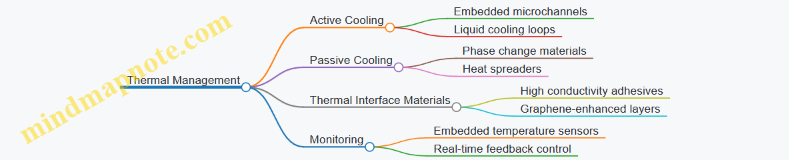
Manufacturing Scalability and Quality Control
Lesson: Scaling SBC manufacturing requires balancing precision with throughput, while maintaining stringent quality standards.
- Aerospace: Vacuum-assisted resin transfer molding (VARTM) ensures uniform resin distribution in large components.
- Automotive: Automated fiber placement (AFP) accelerates production of complex shapes.
- Marine: Modular SBC units facilitate assembly and maintenance.
- Consumer Electronics: Roll-to-roll processing enables continuous fabrication of flexible SBC films.
Best Practice: Implement process monitoring and inline inspection to detect defects early and ensure reproducibility.
Mind Map: Manufacturing and Quality Control
Multi-Functional Testing Protocols
Lesson: Testing protocols must evaluate both mechanical and electrochemical performance under realistic service conditions.
- Aerospace: Combined mechanical load and charge-discharge cycling tests simulate flight conditions.
- Automotive: Crash simulations coupled with battery abuse testing ensure safety.
- Marine: Salt spray and fatigue testing validate durability.
- Consumer Electronics: Flexural cycling with concurrent capacity measurement assesses wearable SBC longevity.
Best Practice: Develop integrated test rigs that replicate multi-physics stresses to accelerate qualification.
Mind Map: Multi-Functional Testing

Summary Table: Cross-Industry SBC Best Practices
| Aspect | Aerospace Example | Automotive Example | Marine Example | Consumer Electronics Example | Key Best Practice |
|---|---|---|---|---|---|
| Material Selection | Carbon fiber + solid-state electrolyte | Hybrid carbon/glass fibers | Corrosion-resistant matrix | Flexible polymer matrix | Tailor hybrid composites |
| Interface Engineering | Surface treatments for adhesion | Nano-scale interlayers | Protective moisture barriers | Flexible interfaces | Multi-scale interface engineering |
| Thermal Management | Embedded cooling channels | Phase change materials | Passive cooling via ambient water | Thin-film heat spreaders | Customized active/passive solutions |
| Manufacturing | VARTM for large components | Automated fiber placement | Modular SBC units | Roll-to-roll processing | Inline inspection and automation |
| Testing Protocols | Combined mechanical and cycling tests | Crash + battery abuse simulations | Salt spray + fatigue testing | Flexural cycling + capacity tests | Integrated multi-physics testing |
Final Thoughts
By analyzing SBC implementations across industries, battery engineers, composite materials engineers, and R&D managers can adopt a holistic approach that leverages proven strategies while tailoring solutions to their specific application needs. Cross-disciplinary collaboration and knowledge sharing accelerate innovation and help overcome the complex challenges inherent in structural battery composite design and manufacturing.
11. Conclusion and Recommendations
11.1 Summary of Best Practices in Structural Battery Composites (SBC) Design and Manufacturing
Structural Battery Composites (SBCs) represent a transformative approach to integrating energy storage directly into load-bearing structures. The design and manufacturing of SBCs require a multidisciplinary approach balancing mechanical integrity, electrochemical performance, manufacturability, and durability. Below is a comprehensive summary of best practices, supported by practical examples and mind maps to aid understanding.
Mind Map: Overview of SBC Best Practices
Materials Selection
Best Practice: Choose materials that balance mechanical strength and electrochemical functionality while ensuring compatibility and sustainability.
- Use carbon fibers as both reinforcement and current collectors, as demonstrated in automotive SBC prototypes where carbon fiber electrodes reduce weight and improve energy density.
- Select thermoplastic matrices for recyclability and repairability, as seen in marine SBC applications where environmental resistance is critical.
Example: In aerospace SBC wings, carbon fiber prepregs combined with lithium-ion active materials were selected to optimize stiffness and energy storage without compromising flight safety.
Design Principles
Best Practice: Employ multi-functional design strategies supported by advanced modeling tools.
- Utilize Finite Element Analysis (FEA) to simulate mechanical stresses and electrochemical behavior simultaneously, as applied in UAV structural battery wing designs.
- Design for manufacturability by considering layer stacking sequences and electrode placement early in the design phase.
Example: UAV wings integrating SBCs used FEA to predict deformation under load and battery discharge, enabling optimization of fiber orientation and electrode thickness.
Fabrication Techniques
Best Practice: Adopt fabrication methods that ensure uniform resin infusion and electrode integration.
- Vacuum-Assisted Resin Transfer Molding (VARTM) enables high-quality composites with minimal voids; marine SBCs have successfully used VARTM to embed electrodes within structural laminates.
- Layer-by-layer assembly allows precise placement of active materials and electrolytes, improving electrochemical performance.
Example: Marine unmanned underwater vehicles employed VARTM to fabricate SBC hull sections that provide both buoyancy and energy storage.
Electrochemical Performance Optimization
Best Practice: Enhance ionic conductivity and interface stability.
- Incorporate solid-state electrolytes to improve safety and durability, as demonstrated in electric vehicle SBC modules.
- Engineer electrode-matrix interfaces to reduce resistance and mechanical delamination.
Example: Electric vehicle SBCs used ceramic-based solid electrolytes embedded within carbon fiber laminates to achieve stable cycling and mechanical robustness.
Mechanical Performance and Durability
Best Practice: Design for damage tolerance and conduct comprehensive mechanical testing.
- Use hybrid fiber architectures (e.g., carbon/glass fiber blends) to improve impact resistance, as shown in sporting goods SBCs.
- Perform fatigue and tensile tests to evaluate long-term integrity under combined mechanical and electrochemical cycling.
Example: Sporting goods like high-performance bicycles integrated SBCs with hybrid fibers to maintain frame strength while extending battery life.
Integration and System-Level Considerations
Best Practice: Implement effective thermal management and safe electrical interconnections.
- Embed cooling channels within SBCs for thermal regulation, as practiced in aerospace SBC modules.
- Ensure robust encapsulation to protect against moisture and mechanical damage.
Example: Aerospace SBC modules incorporated microfluidic cooling channels within composite layers to maintain optimal battery temperatures during flight.
Manufacturing Scale-Up and Industrialization
Best Practice: Leverage automation and lean manufacturing to improve consistency and reduce costs.
- Use robotic layup and automated resin infusion to scale production, demonstrated in renewable energy sector SBC manufacturing.
- Optimize supply chain for advanced materials to ensure timely availability and quality.
Example: Renewable energy SBC producers implemented lean manufacturing principles to reduce waste and improve throughput in battery composite panel production.
Emerging Trends
Best Practice: Integrate smart sensing and additive manufacturing for next-gen SBCs.
- Embed sensor networks for real-time structural health and battery monitoring, as seen in smart infrastructure applications.
- Utilize 3D printing to create complex geometries and graded material properties.
Example: Smart bridges with embedded SBCs use sensor arrays to monitor load and energy storage simultaneously, enabling predictive maintenance.
Summary Table of Best Practices with Examples
| Aspect | Best Practice | Example Application |
|---|---|---|
| Materials Selection | Compatible, sustainable materials | Aerospace SBC wings |
| Design Principles | Multi-functional design with FEA | UAV structural battery wings |
| Fabrication Techniques | VARTM and layer-by-layer assembly | Marine SBC hulls |
| Electrochemical Optimization | Solid-state electrolytes and interface engineering | Electric vehicle SBC modules |
| Mechanical Durability | Hybrid fibers and fatigue testing | Sporting goods SBC frames |
| Integration & Systems | Embedded cooling channels and encapsulation | Aerospace SBC modules |
| Scale-Up & Industrialization | Automation and lean manufacturing | Renewable energy SBC production |
| Emerging Trends | Smart sensing and additive manufacturing | Smart infrastructure SBCs |
By adhering to these best practices, engineers and R&D managers can effectively navigate the complex challenges of SBC design and manufacturing, accelerating the deployment of multifunctional energy storage solutions across industries.
11.2 Key Takeaways for Battery and Composite Materials Engineers
Designing and manufacturing Structural Battery Composites (SBCs) requires a multidisciplinary approach that balances mechanical robustness with electrochemical performance. Here are the essential takeaways to guide battery and composite materials engineers in this evolving field.
Holistic Materials Selection
- Balance mechanical and electrochemical properties: Choose carbon fibers or hybrid reinforcements that provide structural strength while enabling lithium-ion intercalation or alternative chemistries.
- Matrix compatibility: Thermoset or thermoplastic matrices must support ionic conductivity without compromising mechanical integrity.
- Example: Automotive SBC prototypes often use carbon fiber fabrics combined with solid polymer electrolytes to achieve both load-bearing and energy storage functions.
Integrated Design Approach
- Multi-functionality is key: Design SBCs to simultaneously carry mechanical loads and store energy.
- Use modeling tools: Finite Element Analysis (FEA) and electrochemical simulations help predict performance and optimize layup sequences.
- Example: UAV structural battery wings utilize FEA to optimize fiber orientation for aerodynamic loads while maximizing battery capacity.

Advanced Fabrication Techniques
- Precision in layer integration: Vacuum-assisted resin transfer molding (VARTM) and prepreg layup ensure uniform resin distribution and electrode integration.
- Emerging methods: 3D printing and layer-by-layer assembly enable complex architectures and embedded functionalities.
- Example: Marine SBC applications use VARTM to embed electrodes within composite hull structures, improving energy storage without weight penalty.
Interface and Electrochemical Optimization
- Interface engineering: Optimize bonding between electrodes and matrix to reduce resistance and improve durability.
- Electrolyte selection: Solid-state electrolytes improve safety and mechanical compatibility.
- Example: Electric vehicle SBCs incorporate solid polymer electrolytes to enhance cycle life and prevent dendrite formation.

Mechanical Durability and Testing
- Comprehensive testing: Include tensile, compression, fatigue, and impact tests to assess SBC durability under real-world conditions.
- Damage tolerance: Use hybrid fiber architectures to improve resistance to crack propagation.
- Example: Sporting goods SBCs employ carbon/glass fiber hybrids to combine toughness with energy storage.
System Integration and Thermal Management
- Electrical interconnections: Design robust, low-resistance connections within the composite.
- Thermal management: Embedded cooling channels or thermally conductive layers prevent overheating.
- Example: Aerospace SBC modules use embedded microchannels for active cooling to maintain performance and safety.
Final Thoughts
- Collaboration between battery engineers and composite materials experts is essential to advance SBC technology.
- Continuous iteration using real-world testing and simulation accelerates development.
- Embracing emerging materials and manufacturing innovations will unlock new application potentials.
By internalizing these key takeaways, engineers can effectively contribute to the design and manufacturing of next-generation structural battery composites that meet the demanding requirements of modern energy storage and structural applications.
11.3 Recommendations for R&D Managers to Accelerate SBC Development
Structural Battery Composites (SBCs) represent a cutting-edge convergence of energy storage and structural materials, requiring coordinated efforts across multiple disciplines. For R&D managers, accelerating SBC development demands strategic planning, resource allocation, and fostering innovation-friendly environments. Below are detailed recommendations, supported by mind maps and practical examples, to guide R&D leadership in this complex field.
Foster Cross-Disciplinary Collaboration
SBC development sits at the intersection of electrochemistry, materials science, mechanical engineering, and manufacturing. Encouraging collaboration between these domains accelerates problem-solving and innovation.
Example: At a leading aerospace company, R&D managers established weekly interdisciplinary workshops where battery engineers and composite materials experts jointly reviewed prototype performance, leading to a 30% reduction in development cycle time.
Invest in Advanced Modeling and Simulation Tools
Utilizing multi-physics simulation platforms enables virtual prototyping, reducing costly trial-and-error iterations.
Example: An automotive R&D team integrated FEA with electrochemical models to predict mechanical stresses during battery cycling, optimizing fiber orientation and electrolyte placement before physical fabrication.
Prioritize Scalable and Manufacturable Designs
Designs must consider real-world manufacturing constraints early to ensure smooth scale-up.
Example: A marine SBC project adopted Vacuum-Assisted Resin Transfer Molding (VARTM) compatible designs, enabling cost-effective production of large composite battery hull sections.
Establish Robust Testing and Validation Protocols
Comprehensive mechanical and electrochemical testing ensures reliability and safety.
Example: A consumer electronics company developed an integrated testing rig combining mechanical flexing with battery cycling to simulate real-world usage of wearable SBCs.
Encourage Open Innovation and External Partnerships
Collaborations with universities, startups, and suppliers can bring fresh perspectives and accelerate breakthroughs.
Example: An R&D manager partnered with a university lab specializing in solid-state electrolytes, enabling early access to novel materials that improved SBC safety and performance.
Implement Agile Project Management
Agile methodologies allow rapid iteration and responsiveness to emerging challenges.
Example: A startup developing SBCs used agile sprints to quickly prototype and test different composite layups, shortening time-to-market by 25%.
Focus on Sustainability and Lifecycle Analysis
Incorporate environmental impact assessments early to align with market and regulatory trends.
Example: An R&D team integrated bio-based resin systems into SBCs, reducing carbon footprint while maintaining mechanical and electrochemical performance.
Summary Mind Map: Recommendations for R&D Managers
By implementing these strategies, R&D managers can significantly accelerate SBC development, reduce risks, and position their organizations at the forefront of the energy storage and advanced materials revolution.
11.4 Future Research Opportunities and Collaboration Strategies
As the field of Structural Battery Composites (SBCs) rapidly evolves, identifying promising research avenues and fostering effective collaboration across disciplines and industries is critical to accelerate innovation and commercialization. This section explores key future research opportunities and outlines strategic collaboration models, supported by illustrative mind maps and real-world examples.
Future Research Opportunities
- Advanced Multi-Functional Materials Development
- Designing novel electrode materials with enhanced mechanical properties without sacrificing electrochemical performance.
- Development of solid-state electrolytes with improved ionic conductivity and mechanical robustness.
- Exploration of bio-inspired and self-healing materials to extend SBC lifespan.
Example: Researchers at a leading university developed a nanostructured lithium iron phosphate cathode integrated with carbon nanotube fibers, achieving both high strength and energy density suitable for aerospace SBCs.
- Integrated Modeling and Simulation Frameworks
- Coupling mechanical, thermal, and electrochemical models to predict SBC performance under real-world conditions.
- Machine learning approaches for accelerated materials discovery and process optimization.
Example: An automotive R&D team implemented a multi-physics simulation platform that predicted the impact of mechanical stress on battery capacity fade, guiding design improvements.
- Scalable and Sustainable Manufacturing Processes
- Development of low-energy, solvent-free fabrication techniques.
- Automation and in-line quality control for large-scale SBC production.
- Recycling and end-of-life strategies for composite battery materials.
Example: A startup introduced a solvent-free resin infusion process combined with robotic layup, reducing manufacturing time and environmental impact for marine SBC components.
- Smart Structural Battery Composites
- Embedding sensors for real-time health monitoring.
- Development of adaptive SBCs capable of responding to mechanical or thermal stimuli.
Example: A consortium developed SBC panels with embedded fiber optic sensors that detect micro-cracks and initiate self-healing responses, improving safety in electric aircraft.
Collaboration Strategies
- Cross-Disciplinary Research Consortia
- Bringing together battery scientists, composite materials engineers, mechanical engineers, and data scientists.
- Example: The European Structural Battery Alliance combines universities, industry, and government labs to share resources and knowledge.
- Industry-Academia Partnerships
- Joint development projects to translate lab-scale innovations into manufacturable products.
- Example: An automotive OEM partners with a university to co-develop SBCs tailored for electric vehicles, sharing pilot production facilities.
- Open Innovation Platforms
- Collaborative databases and repositories for materials data, testing protocols, and design guidelines.
- Example: A cloud-based platform enabling global researchers to upload SBC test results and simulation data, accelerating collective learning.
- Standardization and Regulatory Collaboration
- Coordinated efforts to develop testing standards, safety protocols, and certification pathways.
- Example: Industry consortia working with regulatory bodies to define SBC-specific safety standards for aerospace applications.
Summary
Future research in SBCs hinges on breakthroughs in multifunctional materials, integrated modeling, sustainable manufacturing, and smart composites. Success will depend on fostering strong collaborations that bridge disciplines and sectors, leveraging shared knowledge and resources. By embracing these opportunities and strategies, battery engineers, composite materials experts, and R&D managers can collectively push the boundaries of SBC technology toward widespread adoption and transformative impact.