Supply Chain Management Principles with Global Logistics and Cost Control Methods
1. Introduction to Supply Chain Management
1.1 Definition and Importance of Supply Chain Management
Definition: Supply Chain Management (SCM) is the coordination and management of a complex network of activities involved in delivering a product or service from raw material sourcing to the end customer. It encompasses planning, sourcing, production, logistics, and returns, aiming to optimize efficiency, reduce costs, and enhance customer satisfaction.
Why is SCM Important?
- Cost Efficiency: Streamlining processes reduces waste and lowers operational costs.
- Customer Satisfaction: Timely delivery and quality products improve customer loyalty.
- Competitive Advantage: Agile and responsive supply chains adapt quickly to market changes.
- Risk Mitigation: Proactive management minimizes disruptions.
- Sustainability: Efficient SCM supports environmental and social responsibility.
Mind Map: Core Components of Supply Chain Management
Mind Map: Benefits of Effective SCM
Practical Example: How a Global Electronics Company Improved SCM
Scenario: A multinational electronics manufacturer faced frequent delays and high inventory costs.
Actions Taken:
- Implemented integrated demand forecasting tools to better predict customer needs.
- Established closer relationships with key suppliers to improve lead times.
- Adopted just-in-time inventory practices to reduce holding costs.
- Optimized transportation routes to speed up delivery.
Results:
- Reduced inventory carrying costs by 25%.
- Improved on-time delivery performance by 30%.
- Enhanced customer satisfaction scores.
Summary
Supply Chain Management is the backbone of any product or service delivery system. Understanding its definition and appreciating its importance lays the foundation for mastering the principles and practices that follow. Effective SCM drives cost savings, operational excellence, and customer loyalty, making it a critical focus area for supply chain and operations managers.
1.2 Key Components of a Supply Chain
A supply chain is a complex network of interconnected components that work together to deliver products or services from raw material suppliers to the end customer. Understanding these key components is essential for Supply Chain Managers and Operations Managers to optimize operations, reduce costs, and improve customer satisfaction.
Core Components of a Supply Chain
Below is a mind map illustrating the primary components:
Detailed Explanation of Each Component with Examples
Suppliers
Suppliers provide the raw materials or components needed for manufacturing. Effective supplier management ensures quality, timely delivery, and cost control.
Example: A smartphone manufacturer sources microchips from multiple global suppliers to mitigate risks of supply disruption.
Manufacturers
Manufacturers convert raw materials into finished goods. This involves production planning, quality control, and efficient use of resources.
Example: An automotive company uses just-in-time production to reduce inventory costs and respond quickly to market demand.
Warehousing
Warehouses store inventory at various stages of the supply chain. Proper warehousing strategies balance holding costs with service levels.
Example: A fast-moving consumer goods (FMCG) company uses automated warehouses with RFID tracking to improve inventory accuracy and reduce picking time.
Transportation
Transportation moves goods between suppliers, manufacturers, warehouses, and customers. Choosing the right mode and optimizing routes are critical for cost control.
Example: A global apparel brand consolidates shipments via sea freight to reduce transportation costs but uses air freight for urgent orders.
Distribution
Distribution centers act as hubs to break bulk shipments and deliver products to retailers or customers efficiently.
Example: An e-commerce giant operates regional fulfillment centers to enable same-day or next-day delivery.
Customers
Customers are the end recipients of products or services. Understanding customer demand and preferences drives supply chain responsiveness.
Example: A B2B supplier customizes order quantities and delivery schedules based on client production cycles.
Information Flow
Information flow connects all supply chain components through order processing, demand forecasting, and inventory visibility.
Example: A grocery chain uses real-time sales data to adjust replenishment orders automatically.
Financial Flow
Financial transactions such as payments, credit terms, and invoicing support the physical flow of goods.
Example: A manufacturer negotiates payment terms with suppliers to improve cash flow without disrupting supply.
Mind Map: Interactions Between Components
Integrated Example: Electronics Supply Chain
Consider a global electronics company producing laptops:
- Suppliers provide processors and memory chips from Asia.
- Manufacturers assemble laptops in factories located in different countries.
- Warehousing involves regional distribution centers in North America and Europe.
- Transportation includes ocean freight for bulk shipments and air freight for urgent replenishments.
- Distribution centers break bulk shipments and fulfill retailer and online orders.
- Customers include retail stores and direct consumers.
- Information Flow is managed via an ERP system that tracks inventory and sales in real-time.
- Financial Flow includes multi-currency payments and credit management across countries.
This integrated approach ensures the company meets global demand efficiently while controlling costs and maintaining quality.
Summary
Understanding the key components of a supply chain and how they interact is foundational for effective supply chain management. Each component plays a vital role, and best practices involve optimizing each while ensuring seamless integration across the entire chain.
1.3 The Role of Supply Chain Managers and Operations Managers
Supply Chain Managers and Operations Managers play pivotal roles in ensuring the smooth and efficient functioning of an organization’s supply chain and operational processes. While their responsibilities often overlap, each role has distinct focus areas that contribute to overall business success.
Supply Chain Managers: Key Responsibilities
- Strategic Planning: Develop and implement supply chain strategies aligned with business goals.
- Supplier Management: Identify, evaluate, and maintain relationships with suppliers to ensure quality and cost-effectiveness.
- Logistics Coordination: Oversee transportation, warehousing, and distribution to optimize delivery times and costs.
- Inventory Control: Manage inventory levels to balance demand fulfillment and cost minimization.
- Risk Management: Identify potential supply chain risks and develop mitigation plans.
- Technology Integration: Leverage SCM software and analytics tools for enhanced visibility and decision-making.
Example: A Supply Chain Manager at a multinational electronics company negotiated long-term contracts with component suppliers in Asia, reducing procurement costs by 12% while ensuring timely delivery to manufacturing plants.
Operations Managers: Key Responsibilities
- Process Optimization: Streamline manufacturing or service processes to improve efficiency and reduce waste.
- Resource Management: Allocate labor, equipment, and materials effectively to meet production targets.
- Quality Control: Implement quality assurance protocols to maintain product/service standards.
- Scheduling: Plan production schedules to meet customer demand and deadlines.
- Cost Management: Monitor operational expenses and identify opportunities for cost savings.
- Team Leadership: Manage and motivate operational staff to achieve performance goals.
Example: An Operations Manager at a food processing plant introduced lean manufacturing techniques that cut production cycle time by 18%, resulting in faster order fulfillment and reduced operational costs.
Mind Map: Roles and Responsibilities Comparison
How They Collaborate
- Demand Forecasting: Supply Chain Managers provide demand forecasts to Operations Managers to align production schedules.
- Inventory Management: Operations Managers report inventory usage and production output to Supply Chain Managers for replenishment planning.
- Problem Solving: Both roles work together to resolve supply disruptions or production bottlenecks.
Example: During a sudden surge in demand for winter apparel, the Supply Chain Manager coordinated expedited shipments of raw materials, while the Operations Manager adjusted production shifts to increase output, ensuring timely delivery to retailers.
Mind Map: Collaboration Workflow
Real-World Example: Automotive Industry
At a global automotive manufacturer, the Supply Chain Manager oversees the procurement of parts from multiple countries, managing supplier risks and logistics. Meanwhile, the Operations Manager focuses on the assembly line efficiency and quality control. When a supplier delay occurs, both managers collaborate to adjust production schedules and find alternative suppliers, minimizing downtime and cost impact.
Summary
| Role | Primary Focus | Key Activities | Example Outcome |
|---|---|---|---|
| Supply Chain Manager | End-to-end supply chain efficiency | Supplier negotiation, logistics, risk | 12% cost reduction in procurement |
| Operations Manager | Operational process excellence | Production scheduling, quality control | 18% reduction in production cycle time |
Understanding the distinct yet complementary roles of Supply Chain Managers and Operations Managers enables organizations to optimize their supply chain and operational performance effectively.
1.4 Overview of Global Logistics and Cost Control in SCM
Global logistics and cost control are critical pillars of effective Supply Chain Management (SCM). They ensure that products move efficiently across international borders while maintaining profitability and competitiveness. This section provides a comprehensive overview of how global logistics integrates with cost control methods, supported by practical examples and mind maps to clarify complex concepts.
What is Global Logistics?
Global logistics refers to the planning, implementation, and control of the movement and storage of goods, services, and related information across international boundaries. It involves coordination between multiple stakeholders, including suppliers, manufacturers, freight forwarders, customs authorities, and distributors.
Key Objectives of Global Logistics:
- Ensure timely delivery of goods worldwide
- Optimize transportation and warehousing costs
- Comply with international trade regulations
- Manage risks associated with cross-border shipments
What is Cost Control in SCM?
Cost control in SCM involves monitoring and managing expenses related to procurement, production, transportation, warehousing, and distribution to maximize profitability without compromising service quality.
Key Areas of Cost Control:
- Transportation and freight costs
- Inventory holding costs
- Customs and duties
- Packaging and handling
- Administrative and compliance costs
Mind Map: Global Logistics and Cost Control Overview
Integration of Global Logistics with Cost Control
Global logistics and cost control are deeply intertwined. Efficient logistics reduce delays and damage, which lowers costs, while cost control strategies ensure logistics activities are financially sustainable.
Example 1: Freight Consolidation to Reduce Costs
A multinational electronics company consolidated shipments from multiple suppliers into fewer, larger shipments. This reduced the number of shipments by 40%, leading to a 25% reduction in freight costs and fewer customs clearance fees.
Example 2: Route Optimization in Global Shipping
A global apparel brand used advanced route optimization software to select the most cost-effective and time-efficient shipping routes. This approach cut transit times by 15% and saved 18% on fuel and freight expenses.
Mind Map: Cost Control Strategies in Global Logistics
Practical Tips for Supply Chain Managers
- Leverage Technology: Use TMS and WMS to gain visibility and control over logistics and inventory costs.
- Negotiate Contracts: Build strong relationships with carriers and suppliers to negotiate better rates and service terms.
- Optimize Inventory: Balance inventory levels to avoid excess holding costs while preventing stockouts.
- Understand Trade Regulations: Stay updated on tariffs, trade agreements, and customs procedures to avoid unexpected costs.
- Implement Continuous Improvement: Regularly review logistics processes and cost structures to identify savings opportunities.
Summary
Global logistics is the backbone of international supply chains, and cost control ensures these operations remain profitable. By understanding the components of global logistics and applying cost control methods such as freight consolidation, route optimization, and technology adoption, supply chain managers can significantly enhance efficiency and reduce expenses.
1.5 Case Study: How a Leading Retailer Optimized Their Supply Chain
In this case study, we explore how a leading global retailer successfully optimized their supply chain to improve efficiency, reduce costs, and enhance customer satisfaction. This retailer operates thousands of stores worldwide and manages a complex supply chain involving multiple suppliers, distribution centers, and transportation modes.
Background
The retailer faced several challenges:
- High inventory holding costs due to overstocking
- Frequent stockouts in popular stores leading to lost sales
- Inefficient transportation routes increasing freight costs
- Lack of real-time visibility into inventory and shipments
To address these issues, the retailer embarked on a comprehensive supply chain optimization initiative.
Step 1: Demand Forecasting Improvement
Approach:
- Implemented advanced demand forecasting tools using historical sales data and market trends.
- Integrated point-of-sale (POS) data from stores for real-time demand signals.
Example:
- By analyzing seasonal trends and promotional impacts, the retailer adjusted inventory levels proactively, reducing stockouts by 25%.
Mind Map:
Step 2: Inventory Management Optimization
Approach:
- Adopted a Just-In-Time (JIT) inventory system to reduce excess stock.
- Segmented products based on demand variability and lead times.
- Established safety stock levels tailored to each product category.
Example:
- For fast-moving electronics, safety stock was minimized, while for seasonal apparel, higher safety stock was maintained to buffer demand spikes.
Mind Map:
Step 3: Supplier Collaboration and Relationship Management
Approach:
- Developed closer relationships with key suppliers through regular communication and joint planning.
- Shared demand forecasts and inventory data to synchronize production schedules.
Example:
- A supplier of home goods adjusted their manufacturing schedule based on the retailer’s updated forecasts, reducing lead times by 15%.
Mind Map:
Step 4: Transportation and Distribution Network Redesign
Approach:
- Analyzed current transportation routes using route optimization software.
- Consolidated shipments to reduce partial loads.
- Introduced cross-docking at distribution centers to speed up flow.
Example:
- By consolidating shipments from multiple suppliers, the retailer reduced transportation costs by 18%.
Mind Map:
Step 5: Technology Integration for Visibility
Approach:
- Implemented an integrated supply chain management platform with real-time tracking.
- Used RFID tags and IoT sensors in warehouses and trucks.
Example:
- Real-time alerts enabled proactive issue resolution, such as rerouting shipments during delays.
Mind Map:
Results and Benefits
- Inventory Costs: Reduced by 22% through better forecasting and JIT inventory.
- Stockouts: Decreased by 25%, improving customer satisfaction.
- Transportation Costs: Lowered by 18% via route optimization and shipment consolidation.
- Lead Times: Cut by 15% through supplier collaboration.
- Overall Supply Chain Efficiency: Significantly improved, enabling faster response to market changes.
Summary Mind Map
This case study exemplifies how integrating best practices across forecasting, inventory, supplier management, logistics, and technology can transform a complex global supply chain into a competitive advantage. Supply chain and operations managers can draw valuable lessons from this retailer’s approach to drive similar improvements in their organizations.
2. Core Principles of Supply Chain Management
2.1 Demand Forecasting and Planning: Best Practices and Examples
Demand forecasting and planning are foundational to effective supply chain management. Accurate demand forecasts enable organizations to optimize inventory levels, reduce costs, improve customer satisfaction, and streamline production schedules.
What is Demand Forecasting?
Demand forecasting is the process of estimating future customer demand for a product or service using historical data, market analysis, and statistical tools.
Why is Demand Forecasting Important?
- Minimizes stockouts and overstock situations
- Improves production planning and scheduling
- Enhances supplier coordination
- Reduces holding and operational costs
Best Practices in Demand Forecasting and Planning
Use Multiple Forecasting Methods
Relying on a single forecasting technique can lead to inaccuracies. Combining qualitative and quantitative methods improves reliability.
- Qualitative Methods: Expert opinion, market research, Delphi method
- Quantitative Methods: Time series analysis, causal models, machine learning
Segment Your Products
Different products have different demand patterns. Segment products based on demand variability, lifecycle stage, and sales volume to apply appropriate forecasting models.
Incorporate External Factors
Include macroeconomic indicators, seasonality, promotions, and market trends to refine forecasts.
Collaborate Across Departments
Engage sales, marketing, finance, and operations teams to gather insights and align forecasts.
Continuously Monitor and Update Forecasts
Regularly compare forecasts with actual sales and adjust models accordingly.
Leverage Technology
Use forecasting software and data analytics platforms to automate and enhance accuracy.
Mind Map: Demand Forecasting Best Practices
Examples of Demand Forecasting in Practice
Example 1: Retail Apparel Company Using Time Series Analysis
A global apparel retailer uses historical sales data to forecast demand for seasonal clothing lines. By applying moving averages and exponential smoothing, they predict peak demand periods and adjust inventory accordingly. This practice helped reduce stockouts by 25% during holiday seasons.
Example 2: Electronics Manufacturer Incorporating Market Trends
An electronics manufacturer integrates market trend analysis and competitor launches into their forecasting model. By combining causal models with expert input, they anticipate demand spikes for new smartphone releases, enabling timely production ramp-up.
Example 3: FMCG Company Leveraging Collaborative Forecasting
A fast-moving consumer goods company implements Sales and Operations Planning (S&OP) meetings involving sales, marketing, and supply chain teams. This collaboration improves forecast accuracy by 15%, reducing excess inventory and s.
Mind Map: Example - Collaborative Forecasting Process
Tips for Supply Chain and Operations Managers
- Start with clean, reliable data to build forecasts.
- Balance short-term tactical forecasts with long-term strategic planning.
- Use scenario planning to prepare for demand uncertainties.
- Educate teams on the importance of accurate forecasting.
Summary
Demand forecasting and planning are critical to aligning supply chain activities with market demand. By applying best practices such as using multiple forecasting methods, segmenting products, collaborating across functions, and leveraging technology, organizations can improve forecast accuracy and operational efficiency.
Incorporating real-world examples demonstrates how these practices translate into measurable benefits like reduced stockouts, optimized inventory, and cost savings.
2.2 Inventory Management Techniques with Real-World Applications
Inventory management is a critical component of supply chain management that ensures the right quantity of stock is available at the right time, minimizing costs while meeting customer demand. Effective inventory management techniques help organizations reduce holding costs, avoid stockouts, and improve overall operational efficiency.
Key Inventory Management Techniques
ABC Analysis
ABC Analysis segments inventory into three categories based on value and importance:
- A items: High-value, low-quantity items requiring tight control.
- B items: Moderate value and quantity.
- C items: Low-value, high-quantity items with simpler controls.
Example: A consumer electronics company classifies its components so that expensive microchips (A items) are closely monitored, while cables (C items) are ordered in bulk with less frequent checks.
Just-In-Time (JIT)
JIT aims to reduce inventory carrying costs by receiving goods only when needed in the production process.
Example: Toyota revolutionized manufacturing with JIT, reducing waste and inventory costs by synchronizing production schedules with supplier deliveries.
Economic Order Quantity (EOQ)
EOQ calculates the ideal order quantity that minimizes the sum of ordering and holding costs.
Formula:
\[ EOQ = \sqrt{\frac{2DS}{H}} \]
Where:
- D = Demand in units
- S = Ordering cost per order
- H = Holding cost per unit per year
Example: A retail chain uses EOQ to determine the optimal number of winter jackets to order, balancing storage costs and ordering frequency.
Safety Stock
Safety stock acts as a buffer against demand variability and supply delays.
Example: Pharmaceutical companies maintain safety stock of essential medicines to avoid shortages during supply chain disruptions.
FIFO and LIFO
- FIFO (First-In, First-Out): Oldest inventory is sold first, reducing spoilage.
- LIFO (Last-In, First-Out): Newest inventory is sold first, sometimes used for tax advantages.
Example: Grocery stores use FIFO to ensure fresh products reach customers first.
Cycle Counting
Cycle counting involves regularly counting a subset of inventory to maintain accuracy without full physical inventory shutdowns.
Example: Walmart employs cycle counting to continuously verify inventory accuracy, reducing errors and improving replenishment.
Vendor-Managed Inventory (VMI)
In VMI, suppliers monitor and replenish inventory for their customers, improving stock availability and reducing management burden.
Example: Procter & Gamble manages inventory levels at retail stores, ensuring shelves are stocked without overstocking.
Integrated Real-World Application Example
Company: Global Apparel Manufacturer
Challenge: High inventory holding costs and frequent stockouts in multiple warehouses worldwide.
Solution:
- Implemented ABC Analysis to prioritize management focus on high-value fashion items.
- Adopted JIT principles with key suppliers to reduce excess inventory.
- Calculated EOQ for staple products to optimize order sizes.
- Maintained Safety Stock for bestsellers to prevent stockouts during peak seasons.
- Used Cycle Counting to improve inventory accuracy across warehouses.
Outcome: Reduced inventory holding costs by 18%, improved order fulfillment rates by 12%, and enhanced cash flow.
Summary Mind Map
Effective inventory management combines multiple techniques tailored to the organization’s product types, demand patterns, and supply chain complexity. By integrating these methods with real-world best practices, supply chain and operations managers can significantly enhance efficiency, reduce costs, and improve customer satisfaction.
2.3 Supplier Relationship Management: Strategies and Case Examples
Supplier Relationship Management (SRM) is a critical component of effective supply chain management. It involves the systematic approach to developing and managing partnerships with suppliers to maximize value, reduce risks, and foster collaboration. Strong supplier relationships can lead to improved quality, innovation, and cost savings.
Key Strategies in Supplier Relationship Management
Supplier Segmentation
Segment suppliers based on their strategic importance and spend volume to tailor management approaches accordingly.
Example: A global electronics manufacturer segments its suppliers to focus intensive collaboration on chip manufacturers (strategic) while using automated ordering for office supplies (non-critical).
Collaborative Communication
Establish open, transparent, and frequent communication channels to build trust and align goals.
Example: A leading automotive company holds monthly virtual meetings with key suppliers to discuss production forecasts and quality issues, reducing lead times by 15%.
Performance Management and Metrics
Use KPIs to monitor supplier performance and drive improvements.
Example: A pharmaceutical company tracks supplier quality metrics rigorously, resulting in a 25% reduction in batch rejections.
Risk Management
Identify and mitigate risks related to supplier reliability, geopolitical factors, and financial stability.
Example: A consumer electronics firm diversified its supplier base after a natural disaster disrupted a key supplier, ensuring continuity of supply.
Incentives and Relationship Development
Encourage supplier innovation and loyalty through incentives and joint development programs.
Example: A global apparel brand runs an annual supplier innovation challenge, rewarding ideas that reduce waste and improve sustainability.
Case Examples
Case Example 1: Toyota’s Supplier Partnership Model
Toyota is renowned for its close supplier relationships, emphasizing long-term partnerships, mutual trust, and continuous improvement (Kaizen). Toyota involves suppliers early in the design process and shares production forecasts transparently. This collaboration has helped Toyota maintain high quality and reduce costs.
Case Example 2: Unilever’s Supplier Engagement for Sustainability
Unilever works closely with suppliers to improve sustainability practices, including reducing carbon emissions and water usage. They provide training and resources to suppliers, fostering a shared commitment to environmental goals. This approach has enhanced supplier loyalty and brand reputation.
Case Example 3: Cisco’s Risk Mitigation through Supplier Diversification
Cisco identified risks in its supply chain related to single-source suppliers. By segmenting suppliers and developing alternative sources, Cisco minimized disruption risks. They also implemented rigorous supplier audits to ensure compliance and reliability.
Summary
Effective Supplier Relationship Management requires a strategic approach combining segmentation, communication, performance measurement, risk management, and incentives. By applying these strategies, supply chain and operations managers can build resilient, cost-effective, and innovative supplier networks.
Actionable Tips
- Map and segment your suppliers to prioritize management efforts.
- Establish regular communication routines and leverage technology for transparency.
- Define clear KPIs and review supplier performance frequently.
- Develop risk mitigation plans including supplier diversification.
- Foster innovation and loyalty through incentives and joint initiatives.
2.4 Lean Supply Chain Principles and Waste Reduction
Lean Supply Chain Management focuses on maximizing value for the customer while minimizing waste throughout the supply chain. It is derived from Lean Manufacturing principles pioneered by Toyota, emphasizing efficiency, continuous improvement, and elimination of non-value-added activities.
Key Lean Principles in Supply Chain Management
- Value: Define what adds value from the customer’s perspective.
- Value Stream Mapping: Visualize all steps in the supply chain to identify waste.
- Flow: Ensure smooth, uninterrupted movement of products and information.
- Pull: Produce based on actual demand rather than forecasts.
- Perfection: Continuously improve processes to eliminate waste.
Types of Waste (TIMWOOD) in Supply Chains
- T - Transportation: Unnecessary movement of goods.
- I - Inventory: Excess stock that ties up capital.
- M - Motion: Unnecessary movement of people or equipment.
- W - Waiting: Idle time waiting for materials or information.
- O - Overproduction: Producing more than demand.
- O - Overprocessing: More work or higher quality than needed.
- D - Defects: Errors requiring rework or scrap.
Mind Map: Lean Supply Chain Principles
Mind Map: Types of Waste in Supply Chain (TIMWOOD)
Practical Examples of Lean Supply Chain and Waste Reduction
Example 1: Reducing Inventory Waste through Just-in-Time (JIT)
A global electronics manufacturer implemented JIT inventory management to reduce excess stock. By closely collaborating with suppliers and using real-time demand data, they reduced inventory holding costs by 25%, freeing up working capital and reducing storage space.
Example 2: Minimizing Transportation Waste via Route Optimization
A consumer goods company used advanced route optimization software to plan delivery routes, cutting unnecessary transportation miles by 15%. This not only reduced fuel costs but also decreased carbon emissions, aligning with sustainability goals.
Example 3: Eliminating Waiting Time with Cross-Functional Teams
An automotive supplier formed cross-functional teams between procurement, production, and logistics to synchronize workflows. This reduced waiting times between stages, improving lead times by 20% and enhancing customer satisfaction.
Example 4: Preventing Defects through Supplier Quality Management
A pharmaceutical company implemented stringent quality checks and supplier audits to minimize defects in raw materials. This led to a 30% reduction in rework and improved overall product quality.
Integrating Lean with Technology
- Value Stream Mapping Tools: Software like Lucidchart or Microsoft Visio to visualize processes.
- ERP Systems: Real-time inventory and order management to support pull systems.
- Transportation Management Systems (TMS): Optimize routes and reduce transportation waste.
- IoT Sensors: Monitor equipment and inventory to reduce motion and waiting wastes.
Summary
Lean Supply Chain principles help organizations streamline operations by focusing on customer value and systematically eliminating waste. By applying these principles with practical tools and cross-functional collaboration, companies can reduce costs, improve efficiency, and enhance customer satisfaction.
Actionable Tip: Start by mapping your supply chain processes to identify the biggest sources of waste. Engage your team in continuous improvement initiatives and leverage technology to sustain lean practices.
2.5 Integration of Technology in SCM: ERP and SCM Software Examples
In today’s fast-paced and complex supply chain environment, integrating technology is no longer optional—it’s essential. Enterprise Resource Planning (ERP) and Supply Chain Management (SCM) software solutions help organizations streamline operations, improve visibility, and enhance decision-making.
What is ERP and SCM Software?
- ERP (Enterprise Resource Planning): A comprehensive system that integrates core business processes such as finance, HR, procurement, manufacturing, and supply chain into a unified platform.
- SCM Software: Specialized tools focused on managing supply chain activities including demand planning, inventory management, logistics, supplier collaboration, and order fulfillment.
Benefits of Integrating ERP and SCM Systems
- Centralized data for real-time visibility
- Improved demand forecasting and inventory accuracy
- Enhanced supplier collaboration and procurement efficiency
- Automated workflows reducing manual errors
- Cost savings through optimized resource allocation
Mind Map: Key Features of ERP and SCM Integration
Popular ERP and SCM Software Examples with Use Cases
-
SAP S/4HANA
- Overview: A leading ERP platform with embedded SCM capabilities.
- Example: A multinational electronics manufacturer used SAP S/4HANA to integrate procurement, production, and logistics, resulting in a 25% reduction in order-to-delivery time.
-
Oracle SCM Cloud
- Overview: Cloud-based SCM suite offering modules for supply chain planning, logistics, and procurement.
- Example: A global apparel brand leveraged Oracle SCM Cloud to improve supplier collaboration and reduce inventory holding costs by 18%.
-
Microsoft Dynamics 365 Supply Chain Management
- Overview: Combines ERP and SCM functionalities with AI-driven insights.
- Example: A food and beverage company implemented Dynamics 365 to automate warehouse operations, increasing throughput by 30%.
-
Infor Supply Chain Management
- Overview: Industry-specific SCM solutions with strong analytics and visibility tools.
- Example: A healthcare products distributor used Infor SCM to optimize transportation routes, cutting freight costs by 12%.
-
JDA (Blue Yonder) SCM
- Overview: Focused on demand planning, inventory optimization, and logistics.
- Example: A consumer electronics retailer improved forecast accuracy by 20% using Blue Yonder’s AI-powered demand planning.
Mind Map: Steps to Implement ERP and SCM Integration
Best Practices for Successful Integration
- Start with Clear Objectives: Define what you want to achieve with ERP and SCM integration (e.g., reduce lead times, improve inventory turnover).
- Ensure Data Quality: Clean and standardize data before migration to avoid errors.
- Engage Stakeholders Early: Include users from procurement, logistics, IT, and finance to ensure system meets all needs.
- Leverage Cloud Solutions: Cloud-based platforms offer scalability, flexibility, and easier updates.
- Focus on User Training: Empower staff with hands-on training to maximize adoption.
- Use Analytics for Continuous Improvement: Monitor KPIs and adjust processes based on insights.
Example Scenario: Mid-Sized Manufacturer Integrating ERP and SCM
Challenge: The company faced frequent stockouts and delayed shipments due to disconnected systems.
Solution: Implemented an integrated ERP and SCM platform (Microsoft Dynamics 365) to unify inventory, procurement, and logistics data.
Outcome:
- Real-time inventory visibility reduced stockouts by 40%
- Automated purchase orders improved supplier lead times
- Enhanced reporting enabled faster decision-making
In conclusion, integrating ERP and SCM software is a transformative step for supply chain and operations managers aiming to boost efficiency, reduce costs, and enhance responsiveness in a global marketplace. By selecting the right technology and following best practices, organizations can unlock significant competitive advantages.
3. Global Logistics Fundamentals
3.1 Understanding International Trade and Regulations
International trade is the exchange of goods, services, and capital across international borders or territories. For supply chain and operations managers, understanding the complexities of international trade and regulations is crucial to ensure smooth global logistics operations and cost control.
Key Concepts in International Trade
- Trade Agreements: Bilateral or multilateral agreements between countries to facilitate trade by reducing tariffs, import quotas, and other barriers.
- Tariffs and Duties: Taxes imposed on imported goods, affecting pricing and cost structures.
- Import/Export Licenses: Legal permissions required to move certain goods across borders.
- Customs Regulations: Rules governing the declaration, inspection, and clearance of goods.
- Incoterms (International Commercial Terms): Standardized trade terms defining responsibilities of buyers and sellers in international transactions.
Mind Map: Components of International Trade
Understanding Trade Agreements
Trade agreements reduce barriers and create predictable trading environments. For example, the North American Free Trade Agreement (NAFTA), now replaced by USMCA, eliminated most tariffs between the US, Canada, and Mexico, enabling companies to optimize supply chains across borders.
Example: A US-based electronics manufacturer sources components from Mexico under USMCA, benefiting from tariff-free imports which reduce overall production costs.
Tariffs and Duties Impact
Tariffs can significantly affect product pricing and supply chain costs. Understanding tariff classifications (HS codes) is essential for accurate cost forecasting.
Example: A fashion retailer importing apparel from Asia must classify products correctly to avoid unexpected tariffs, which could increase landed costs and reduce profit margins.
Customs Documentation and Compliance
Proper documentation ensures timely customs clearance and avoids delays or fines. Common documents include:
- Commercial Invoice
- Bill of Lading
- Packing List
- Certificate of Origin
- Import/Export Licenses
Example: A food distributor exporting perishable goods must comply with sanitary and phytosanitary certificates to meet importing country regulations, ensuring products clear customs without delay.
Incoterms: Defining Responsibilities
Incoterms clarify who is responsible for transportation, insurance, and customs clearance at each stage.
Example: Using FOB terms, the seller is responsible for delivering goods onto the ship at the port of origin, while the buyer assumes responsibility from that point onward. This affects cost allocation and risk management.
Mind Map: Regulatory Bodies and Compliance
Practical Example: Navigating Regulations in Global SCM
A multinational automotive parts supplier sources raw materials from multiple countries. They leverage trade agreements to minimize tariffs, use a centralized customs brokerage service to manage documentation, and apply Incoterms strategically to balance risk and cost. When a new environmental regulation is introduced in the EU, they adjust sourcing and logistics plans to ensure compliance without disrupting supply.
Summary
Understanding international trade and regulations enables supply chain managers to:
- Optimize costs by leveraging trade agreements and minimizing tariffs.
- Ensure compliance to avoid delays and penalties.
- Manage risks related to customs and regulatory changes.
- Allocate responsibilities clearly using Incoterms.
Mastering these elements is foundational for effective global logistics and cost control.
3.2 Modes of Global Transportation: Air, Sea, Rail, and Road
Global transportation is the backbone of supply chain management, enabling the movement of goods across countries and continents. Understanding the characteristics, advantages, and challenges of each transportation mode is crucial for supply chain and operations managers to optimize cost, speed, and reliability.
Overview of Transportation Modes
Air Freight
Best Practices:
- Use air freight for urgent deliveries like medical supplies or electronics.
- Consolidate shipments to reduce cost per unit.
- Partner with reliable carriers to ensure timely customs clearance.
Example: A pharmaceutical company needs to ship temperature-sensitive vaccines globally. They use air freight with specialized cold chain packaging to ensure product integrity and fast delivery, despite higher costs.
Sea Freight
Best Practices:
- Plan shipments well in advance to accommodate longer transit times.
- Use full container loads (FCL) or less-than-container loads (LCL) depending on volume.
- Monitor port schedules and customs to avoid delays.
Example: A furniture manufacturer exports large volumes of products from Asia to Europe using sea freight. By optimizing container loading and choosing reliable shipping lines, they reduce transportation costs by 40% compared to air freight.
Rail Freight
Best Practices:
- Utilize rail for inland long-distance shipments where rail infrastructure exists.
- Combine rail with road transport for first/last mile delivery.
- Leverage rail’s environmental benefits in sustainability programs.
Example: An automotive parts supplier in Germany uses rail freight to transport components to factories across Europe. This reduces carbon emissions by 70% compared to road-only transport and lowers costs.
Road Freight
Best Practices:
- Optimize route planning using GPS and transportation management systems.
- Use road freight for flexible, door-to-door delivery.
- Manage driver schedules and compliance to avoid delays.
Example: A consumer goods company uses road freight to distribute products from regional warehouses to retail stores. By consolidating shipments and optimizing delivery routes, they reduce fuel costs and improve delivery times.
Integrated Multimodal Transportation
Often, supply chains combine multiple transportation modes to balance cost, speed, and reliability. For example, goods may be shipped by sea to a port, transported by rail inland, and delivered by road to the final destination.
Summary Table
| Mode | Speed | Cost | Capacity | Best Use Cases |
|---|---|---|---|---|
| Air | Fastest | Highest | Limited | High-value, urgent shipments |
| Sea | Slow | Lowest | Very large | Bulk, heavy, non-urgent goods |
| Rail | Moderate | Moderate | Large | Long-distance land shipments |
| Road | Moderate | Moderate | Moderate | Flexible, last-mile deliveries |
By understanding these modes and their trade-offs, supply chain managers can design transportation strategies that optimize global logistics performance while controlling costs effectively.
3.3 Customs Clearance and Documentation: Practical Guidelines
Customs clearance is a critical step in global logistics that ensures goods legally enter or exit a country. Proper documentation and adherence to customs regulations prevent delays, fines, and shipment rejections.
Key Concepts in Customs Clearance
- Customs Declaration: Formal statement of goods being imported or exported.
- Tariffs and Duties: Taxes imposed on imported goods.
- Import/Export Licenses: Permits required for certain products.
- Compliance: Adhering to laws and regulations of the country.
Essential Documentation for Customs Clearance
| Document Name | Purpose | Example Use Case |
|---|---|---|
| Commercial Invoice | Lists goods, value, and terms of sale | Electronics shipment from China to US |
| Bill of Lading (BOL) | Contract between shipper and carrier | Sea freight shipment of textiles |
| Packing List | Details contents of each package | Multiple cartons of pharmaceuticals |
| Certificate of Origin | Verifies country where goods were produced | Apparel exported from Bangladesh |
| Import/Export License | Authorization to trade restricted goods | Chemical products requiring permits |
| Customs Declaration Form | Declares goods and value to customs authorities | All international shipments |
Practical Guidelines for Smooth Customs Clearance
-
Accurate and Complete Documentation
- Ensure all documents are filled out correctly.
- Use consistent product descriptions and HS codes.
-
Understand Tariff Classifications
- Use the Harmonized System (HS) codes for classification.
- Example: HS code 8517.12 for smartphones.
-
Pre-Check Regulatory Requirements
- Verify if goods require special permits or licenses.
- Example: Pharmaceuticals often need health certificates.
-
Work with Reliable Customs Brokers
- Brokers help navigate complex regulations and expedite clearance.
-
Maintain Communication with Carriers and Authorities
- Track shipment status and respond promptly to queries.
-
Prepare for Inspections
- Keep samples and documentation ready.
- Example: Random inspections on food imports.
Mind Map: Customs Clearance Process
Mind Map: Common Challenges in Customs Clearance
Example Scenario: Electronics Import from China to USA
Situation: A supply chain manager is importing 1,000 smartphones.
- Step 1: Prepare Commercial Invoice listing product details, unit price, total value.
- Step 2: Assign correct HS code (8517.12) to classify smartphones.
- Step 3: Obtain Bill of Lading from the shipping carrier.
- Step 4: Submit Importer Security Filing (ISF) 24 hours before loading.
- Step 5: Work with customs broker to file Customs Declaration.
- Step 6: Pay applicable tariffs (e.g., 15% duty).
- Step 7: Clear customs and arrange last-mile delivery.
Best Practice: Double-check all documents for consistency and ensure early submission to avoid delays.
Example Scenario: Textile Export from India to Europe
Situation: Exporting garments requiring Certificate of Origin.
- Step 1: Obtain Certificate of Origin from Chamber of Commerce.
- Step 2: Prepare Commercial Invoice and Packing List.
- Step 3: Verify compliance with EU import regulations.
- Step 4: Submit Export Declaration to Indian customs.
- Step 5: Coordinate with freight forwarder for Bill of Lading.
- Step 6: Ensure timely customs clearance on arrival in Europe.
Best Practice: Early coordination with export authorities and freight forwarders reduces clearance time.
Summary
Effective customs clearance hinges on meticulous documentation, understanding of regulations, and proactive communication. Leveraging customs brokers and technology tools can streamline the process, reduce costs, and avoid shipment delays.
For supply chain and operations managers, mastering customs clearance is essential to maintaining a competitive and reliable global supply chain.
3.4 Managing Cross-Border Supply Chains: Challenges and Solutions
Managing cross-border supply chains involves coordinating and optimizing the flow of goods, information, and finances across multiple countries and regions. This complexity introduces unique challenges but also opportunities for businesses to expand their reach and improve efficiency. In this section, we explore the key challenges faced in cross-border supply chain management and practical solutions, supported by real-world examples and mind maps to visualize the concepts.
Key Challenges in Managing Cross-Border Supply Chains
- Regulatory Compliance and Customs Procedures
- Cultural and Language Differences
- Currency Fluctuations and Payment Terms
- Longer Lead Times and Transportation Delays
- Risk of Political Instability and Trade Barriers
- Complex Documentation and Legal Requirements
- Visibility and Coordination Across Multiple Partners
Mind Map: Challenges in Cross-Border Supply Chains
Solutions and Best Practices
-
Streamline Customs and Regulatory Compliance
- Invest in customs brokerage services or partner with experienced third-party logistics (3PL) providers.
- Use technology platforms that automate customs documentation and track regulatory changes.
Example: A global electronics manufacturer implemented an automated customs compliance system that reduced clearance time by 30%, enabling faster delivery to international customers.
-
Enhance Communication and Cultural Awareness
- Provide cross-cultural training for supply chain teams.
- Use multilingual communication tools and hire local experts to bridge language gaps.
Example: A multinational apparel company established regional teams fluent in local languages, improving supplier relationships and reducing misunderstandings.
-
Mitigate Currency and Payment Risks
- Use hedging strategies to protect against currency fluctuations.
- Negotiate clear payment terms and use secure international payment platforms.
Example: An automotive parts supplier used forward contracts to lock in exchange rates, stabilizing costs despite volatile currency markets.
-
Optimize Transportation and Lead Time Management
- Employ multimodal transportation strategies to balance cost and speed.
- Build buffer times into schedules and maintain safety stock for critical items.
Example: A pharmaceutical company combined air and sea freight for different product lines, reducing costs without compromising delivery timelines.
-
Build Resilient and Flexible Networks
- Diversify suppliers and logistics partners across regions to avoid single points of failure.
- Develop contingency plans for political or natural disruptions.
Example: After experiencing delays due to political unrest, a consumer electronics firm diversified its supplier base from one country to three, improving supply chain resilience.
-
Leverage Technology for Visibility and Coordination
- Implement supply chain visibility platforms that provide real-time tracking.
- Use collaborative tools to share data and coordinate activities across partners.
Example: A food and beverage company adopted a cloud-based SCM platform that enabled end-to-end visibility, reducing lost shipments by 25%.
Mind Map: Solutions for Cross-Border Supply Chain Challenges
Integrated Example: Cross-Border Supply Chain Management in Action
Company: GlobalTech Components
Scenario: GlobalTech sources electronic components from Asia, assembles products in Europe, and distributes globally. They faced delays due to customs clearance issues, currency volatility, and communication gaps with suppliers.
Actions Taken:
- Implemented an automated customs compliance system to streamline documentation.
- Established regional liaison teams fluent in local languages to improve supplier communication.
- Used currency hedging instruments to stabilize procurement costs.
- Adopted a multimodal transport strategy combining sea freight for bulk shipments and air freight for urgent orders.
- Diversified suppliers across three countries to mitigate geopolitical risks.
- Deployed a cloud-based SCM platform for real-time tracking and coordination.
Results:
- Customs clearance times reduced by 35%.
- Communication errors decreased by 40%, improving supplier responsiveness.
- Procurement cost volatility reduced by 20%.
- Overall lead times shortened by 15%, enhancing customer satisfaction.
Summary
Managing cross-border supply chains requires a strategic approach to overcome regulatory, cultural, financial, and logistical challenges. By leveraging technology, enhancing communication, optimizing transportation, and building resilient networks, supply chain and operations managers can effectively control costs and improve global supply chain performance.
3.5 Example: How a Global Electronics Company Streamlined Logistics
In this section, we explore how a leading global electronics company successfully streamlined its logistics operations to improve efficiency, reduce costs, and enhance customer satisfaction. This example illustrates practical applications of global logistics principles and cost control methods.
Background
The company operates in over 50 countries, sourcing components globally and distributing finished products worldwide. Their logistics network was complex, involving multiple transportation modes, numerous warehouses, and diverse customs regulations.
Challenges Faced
- Fragmented Transportation Routes: Inefficient routing led to delays and higher freight costs.
- Customs Delays: Lack of standardized documentation caused frequent customs clearance issues.
- Inventory Imbalances: Overstocking in some regions and stockouts in others.
- Limited Visibility: Poor tracking of shipments and inventory across the supply chain.
Solutions Implemented
-
Route Optimization and Freight Consolidation
- Used advanced route planning software to consolidate shipments and select optimal transport modes.
- Example: Combining multiple small shipments from Asia to Europe into a single consolidated sea freight reduced costs by 25%.
-
Standardized Customs Documentation and Compliance
- Developed a centralized customs compliance team to ensure all shipments had accurate and consistent documentation.
- Example: Implemented automated document generation reducing customs clearance time by 30%.
-
Inventory Rebalancing and Regional Warehousing
- Analyzed sales data to redistribute inventory more effectively across regional warehouses.
- Example: Moved excess inventory from low-demand regions to high-demand areas, reducing stockouts by 40%.
-
Supply Chain Visibility Platform
- Deployed a cloud-based platform integrating GPS tracking, RFID, and IoT sensors.
- Example: Real-time shipment tracking enabled proactive issue resolution, improving on-time delivery rate by 15%.
Mind Maps
Mind Map 1: Logistics Challenges and Solutions
Mind Map 2: Benefits Achieved
Practical Example: Freight Consolidation
Before optimization, the company shipped multiple small batches from different suppliers in Asia to Europe separately via air freight, incurring high costs.
- Action: Consolidated shipments into larger sea freight containers.
- Result: Reduced freight costs by 25%, improved carbon footprint, and maintained acceptable delivery times.
Practical Example: Automated Customs Documentation
Manual preparation of customs documents led to errors and delays.
- Action: Implemented an automated system that pulls product and shipment data directly from ERP to generate compliant documents.
- Result: Customs clearance time dropped by 30%, reducing demurrage charges.
Key Takeaways
- Leveraging technology for route optimization and visibility is critical for global logistics efficiency.
- Standardizing customs processes reduces delays and unexpected costs.
- Data-driven inventory management balances stock levels and improves service.
- Collaboration across departments (logistics, procurement, compliance) ensures smooth operations.
This example highlights how integrating best practices with technology and process improvements can significantly streamline global logistics for a complex electronics supply chain.
4. Strategic Sourcing and Procurement in a Global Context
4.1 Identifying and Evaluating Global Suppliers
Identifying and evaluating global suppliers is a critical step in building a resilient and cost-effective supply chain. The process involves sourcing suppliers from different regions, assessing their capabilities, reliability, and alignment with your company’s strategic goals. This section will guide you through best practices, frameworks, and examples to help you make informed decisions.
Key Steps in Identifying Global Suppliers
- Market Research: Understand the global landscape for your required materials or products.
- Supplier Discovery: Use trade shows, online platforms, industry networks, and government export databases.
- Preliminary Screening: Evaluate suppliers based on certifications, financial stability, and production capacity.
- Request for Information (RFI) / Request for Proposal (RFP): Gather detailed data on capabilities, pricing, and terms.
- On-site Audits and Visits: Verify facilities, quality control processes, and working conditions.
- Trial Orders: Test product quality and delivery reliability.
Mind Map: Identifying Global Suppliers
Evaluating Global Suppliers: Criteria and Best Practices
-
Quality Assurance
- Check for international quality certifications (e.g., ISO 9001).
- Review quality control processes and defect rates.
-
Cost Competitiveness
- Analyze total landed cost, including tariffs, shipping, and duties.
- Negotiate pricing but consider value over lowest cost.
-
Reliability and Lead Time
- Assess historical on-time delivery performance.
- Evaluate supplier’s capacity to scale with demand.
-
Financial Stability
- Review credit ratings and financial statements.
- Avoid suppliers with unstable financial backgrounds.
-
Compliance and Ethical Standards
- Confirm adherence to labor laws and environmental regulations.
- Consider supplier’s sustainability initiatives.
-
Communication and Cultural Fit
- Evaluate responsiveness and language proficiency.
- Understand cultural differences that may impact collaboration.
Mind Map: Evaluating Global Suppliers
Example: Evaluating a Supplier for Electronics Components
Scenario: A global electronics manufacturer is sourcing printed circuit boards (PCBs) from Asia.
- Market Research: Identified top PCB manufacturers in China, Taiwan, and South Korea.
- Supplier Discovery: Attended the Canton Fair and used Alibaba to shortlist 10 suppliers.
- Preliminary Screening: Checked ISO 9001 certification and financial reports.
- RFP: Sent detailed specifications and requested pricing and lead times.
- On-site Audit: Visited two factories in Shenzhen to inspect production lines and quality control labs.
- Trial Order: Placed a small batch order to test product quality and delivery.
Outcome: Selected a supplier in Taiwan offering competitive pricing, strong quality assurance, and reliable delivery times, resulting in a 15% cost saving and improved product quality.
Tips for Supply Chain and Operations Managers
- Use digital supplier management platforms to centralize data and track evaluations.
- Engage cross-functional teams (quality, finance, legal) in supplier evaluation.
- Continuously monitor supplier performance post-selection to ensure ongoing compliance and improvement.
By following these structured steps and evaluation criteria, supply chain and operations managers can effectively identify and select global suppliers that align with their organizational goals, mitigate risks, and optimize costs.
4.2 Negotiation Techniques for Cost Savings
Negotiation is a critical skill for supply chain and operations managers aiming to reduce procurement costs while maintaining quality and supplier relationships. Effective negotiation techniques not only help in securing better prices but also improve contract terms, delivery schedules, and service levels.
Key Negotiation Techniques
- Preparation and Research: Understand supplier market conditions, cost structures, and alternatives.
- Building Relationships: Establish trust and long-term partnerships to encourage collaboration.
- BATNA (Best Alternative to a Negotiated Agreement): Know your alternatives to strengthen your negotiation position.
- Win-Win Approach: Aim for mutually beneficial agreements rather than zero-sum outcomes.
- Anchoring: Set the initial offer strategically to influence negotiation direction.
- Concessions Planning: Decide in advance what you can concede and what is non-negotiable.
- Effective Communication: Listen actively and ask open-ended questions to uncover supplier needs.
- Leveraging Volume and Commitment: Use purchase volume or contract length as negotiation tools.
Mind Map: Core Negotiation Techniques
Practical Example 1: Negotiating Price with a Raw Material Supplier
Scenario: A manufacturing company needs to reduce costs on steel procurement.
Approach:
- Conducted market research to identify alternative suppliers and current steel prices.
- Calculated BATNA by assessing the cost and reliability of alternative suppliers.
- Initiated negotiation with an anchoring offer 10% below the current price.
- Emphasized a long-term partnership and potential for increased volume.
- Offered a 2-year contract commitment in exchange for a price reduction.
- Used active listening to understand supplier constraints and proposed flexible delivery schedules to reduce their logistics costs.
Result: Achieved a 12% cost reduction and improved delivery terms, benefiting both parties.
Mind Map: Example 1 Negotiation Flow
Practical Example 2: Negotiating Freight Costs with a Logistics Provider
Scenario: A global apparel company wants to reduce international freight expenses.
Approach:
- Analyzed freight cost components and competitor pricing.
- Identified BATNA by obtaining quotes from multiple carriers.
- Proposed a volume-based discount structure to the preferred carrier.
- Negotiated inclusion of fuel surcharge caps to control variable costs.
- Suggested collaboration on route optimization to reduce transit times and costs.
- Maintained a win-win mindset, highlighting potential for increased business.
Result: Secured a 15% reduction in freight costs and a fixed fuel surcharge cap, improving budget predictability.
Mind Map: Example 2 Negotiation Flow
Tips for Successful Negotiations
- Always enter negotiations with clear objectives and fallback positions.
- Use data and analytics to support your proposals.
- Be patient and allow time for supplier responses.
- Document agreements clearly to avoid misunderstandings.
- Follow up post-negotiation to reinforce relationships and monitor compliance.
By mastering these negotiation techniques and applying them thoughtfully, supply chain managers can achieve significant cost savings while fostering strong supplier partnerships that support long-term business success.
4.3 Risk Management in Global Sourcing
Global sourcing offers significant advantages such as cost savings, access to specialized suppliers, and expanded market reach. However, it also introduces a variety of risks that can disrupt supply chains, increase costs, and damage reputations. Effective risk management in global sourcing is essential for supply chain and operations managers to maintain resilience and ensure continuity.
Key Risks in Global Sourcing
- Supplier Risk: Financial instability, poor quality, capacity issues.
- Geopolitical Risk: Political instability, trade wars, tariffs.
- Logistics Risk: Transportation delays, customs clearance issues.
- Compliance Risk: Violations of local laws, labor standards, environmental regulations.
- Currency Risk: Exchange rate fluctuations impacting costs.
- Natural Disasters: Earthquakes, floods, pandemics affecting supplier operations.
Mind Map: Risk Categories in Global Sourcing
Best Practices for Managing Risks in Global Sourcing
-
Supplier Due Diligence and Audits
- Conduct thorough financial and operational assessments before onboarding suppliers.
- Example: A multinational electronics company performs annual on-site audits to verify supplier compliance with quality and labor standards, reducing defects by 15%.
-
Diversification of Supplier Base
- Avoid dependence on a single supplier or region.
- Example: An automotive manufacturer sources key components from suppliers in Asia, Europe, and North America to mitigate geopolitical risks.
-
Contractual Safeguards and SLAs
- Include clear terms on quality, delivery, penalties, and compliance requirements.
- Example: A fashion retailer’s contracts specify penalties for late deliveries, incentivizing timely shipments.
-
Use of Technology for Visibility and Monitoring
- Implement supply chain visibility platforms to track shipments and supplier performance in real-time.
- Example: A global FMCG company uses IoT sensors to monitor temperature-sensitive goods, preventing spoilage.
-
Currency Hedging Strategies
- Use financial instruments such as forward contracts to manage currency risk.
- Example: A chemical manufacturer hedges currency exposure to stabilize procurement costs from international suppliers.
-
Contingency and Business Continuity Planning
- Develop alternative sourcing plans and inventory buffers.
- Example: During the COVID-19 pandemic, a medical device company activated secondary suppliers to maintain production.
-
Compliance and Ethical Sourcing Programs
- Enforce supplier adherence to labor laws, environmental standards, and anti-corruption policies.
- Example: A global apparel brand requires suppliers to participate in third-party social compliance audits.
Mind Map: Risk Management Strategies
Example Scenario: Managing Risk in a Global Sourcing Project
Company: GlobalTech, a consumer electronics manufacturer
Challenge: GlobalTech sources microchips from a single supplier in Southeast Asia. Political unrest and a sudden factory shutdown threaten supply continuity.
Risk Management Actions:
- Activated secondary suppliers in Europe and North America identified during prior diversification efforts.
- Leveraged real-time shipment tracking to reroute incoming shipments.
- Engaged in currency hedging to manage cost fluctuations due to emergency sourcing.
- Executed contingency contracts with logistics providers for expedited shipping.
Outcome: Despite the disruption, GlobalTech maintained 90% of its production schedule and avoided major customer delays.
Summary
Risk management in global sourcing is a multi-faceted process that requires proactive identification, assessment, and mitigation of diverse risks. By combining supplier evaluation, diversification, contractual protections, technology, financial instruments, and contingency planning, supply chain managers can build resilient sourcing strategies that withstand global uncertainties.
Next Section: 4.4 Ethical and Sustainable Procurement Practices
4.4 Ethical and Sustainable Procurement Practices
Ethical and sustainable procurement practices are essential for modern supply chains aiming to balance profitability with social responsibility and environmental stewardship. These practices ensure that procurement decisions support fair labor conditions, environmental protection, and long-term supplier relationships, while also mitigating risks related to reputation and regulatory compliance.
What is Ethical and Sustainable Procurement?
Ethical procurement focuses on sourcing goods and services in a manner that respects human rights, labor laws, and fair trade principles. Sustainable procurement emphasizes minimizing environmental impact by choosing suppliers and products that promote resource efficiency, waste reduction, and low carbon footprints.
Why It Matters
- Reputation Management: Consumers and stakeholders increasingly demand transparency and responsibility.
- Regulatory Compliance: Governments enforce stricter environmental and labor regulations.
- Risk Reduction: Avoiding suppliers involved in unethical practices reduces legal and financial risks.
- Long-Term Value: Sustainable suppliers often provide more stable and innovative partnerships.
Mind Map: Components of Ethical and Sustainable Procurement
Best Practices with Examples
Establish a Supplier Code of Conduct
Create a clear, enforceable code that outlines expectations for labor standards, environmental practices, and ethical behavior.
Example: A multinational apparel company requires all suppliers to comply with its Supplier Code of Conduct, which prohibits child labor and mandates safe working conditions. Suppliers undergo annual audits, and non-compliance results in corrective action plans or termination.
Conduct Regular Supplier Audits and Assessments
Use third-party auditors or internal teams to verify supplier adherence to ethical and sustainability standards.
Example: An electronics manufacturer partners with an independent auditor to assess suppliers’ environmental management systems, ensuring compliance with ISO 14001 standards. This helps identify risks and opportunities for improvement.
Prioritize Local and Diverse Suppliers
Sourcing locally reduces transportation emissions and supports community economies; promoting supplier diversity fosters inclusivity.
Example: A food retailer implements a program to source from local farmers who practice sustainable agriculture, reducing carbon footprint and supporting rural development.
Integrate Sustainability Criteria into Procurement Decisions
Include environmental and social metrics alongside cost and quality when evaluating suppliers.
Example: A global automotive company scores suppliers on carbon emissions and waste management during the bidding process, favoring those with better sustainability performance even if their prices are slightly higher.
Promote Transparency and Traceability
Map the supply chain to understand sourcing origins and risks, and communicate sustainability efforts to stakeholders.
Example: A cosmetics brand uses blockchain technology to trace ingredients from farm to shelf, ensuring ethical sourcing and enabling consumers to verify product origins.
Mind Map: Steps to Implement Ethical and Sustainable Procurement
Challenges and Solutions
| Challenge | Solution | Example |
|---|---|---|
| Lack of Supplier Transparency | Use technology like blockchain for traceability | Cosmetics brand tracing ingredient origins with blockchain |
| Higher Costs of Sustainable Goods | Consider total cost of ownership and long-term benefits | Automotive company accepting slightly higher bids for low-carbon suppliers |
| Supplier Resistance | Provide training and incentives for compliance | Apparel company offering workshops to suppliers on labor standards |
| Complexity of Global Supply Chains | Prioritize high-risk suppliers for audits and engagement | Electronics manufacturer focusing audits on high-risk regions |
Summary
Ethical and sustainable procurement is no longer optional but a strategic imperative. By embedding social and environmental criteria into procurement processes, organizations can build resilient supply chains that deliver value beyond cost savings. Practical steps such as developing codes of conduct, conducting audits, and leveraging technology enable supply chain and operations managers to drive meaningful change.
Final Example: How a Global Furniture Company Transformed Procurement
Facing increasing scrutiny over deforestation and labor practices, a global furniture company revamped its procurement strategy by:
- Mandating FSC-certified wood suppliers to ensure sustainable forestry.
- Implementing supplier audits focused on labor rights.
- Using supplier scorecards including sustainability KPIs.
- Engaging suppliers in capacity-building workshops.
Result: Within two years, the company reduced its environmental impact by 25%, improved supplier compliance rates by 40%, and enhanced brand reputation among eco-conscious consumers.
4.5 Case Study: Cost Reduction through Strategic Sourcing in Automotive Industry
Introduction
Strategic sourcing is a critical lever for cost control in the automotive industry, where margins can be tight and supply chains complex. This case study explores how a leading automotive manufacturer successfully implemented strategic sourcing to reduce costs by 18% while maintaining quality and supplier relationships.
Background
The automotive company faced escalating raw material and component costs amid increasing global competition. Their traditional procurement approach was transactional and reactive, leading to missed opportunities for cost savings and supplier innovation.
Strategic Sourcing Approach
The company adopted a comprehensive strategic sourcing framework focusing on supplier segmentation, total cost of ownership (TCO) analysis, and collaborative supplier partnerships.
Mind Map: Strategic Sourcing Framework
Step 1: Supplier Segmentation and Evaluation
The procurement team categorized suppliers based on spend, criticality, and performance. Core suppliers received focused relationship management, while transactional suppliers were reviewed for potential consolidation.
Example:
- Core supplier: Engine component manufacturer with high spend and quality impact.
- Transactional supplier: Office supplies vendor with low spend.
Step 2: Total Cost of Ownership (TCO) Analysis
Beyond price negotiation, the team analyzed all cost elements associated with each supplier.
Example:
- A supplier offering a lower unit price but with longer lead times increased inventory holding costs.
- Another supplier with higher price but faster delivery reduced overall costs.
Step 3: Collaborative Supplier Partnerships
The company engaged suppliers in joint cost reduction workshops focusing on process improvements, material substitutions, and logistics optimization.
Example:
- Collaborated with a steel supplier to switch to a more cost-effective alloy without compromising safety standards.
- Worked with logistics providers to consolidate shipments, reducing freight costs by 12%.
Outcomes
- Cost Reduction: Achieved an 18% reduction in procurement costs over 18 months.
- Improved Supplier Relationships: Enhanced communication and trust led to faster issue resolution.
- Risk Mitigation: Diversified supplier base reduced dependency risks.
Mind Map: Outcomes and Benefits
Key Takeaways
- Strategic sourcing requires a holistic view beyond price.
- Supplier segmentation enables focused resource allocation.
- Collaboration drives innovation and cost savings.
- TCO analysis uncovers hidden costs impacting profitability.
Final Thought
This case exemplifies how automotive companies can leverage strategic sourcing to gain competitive advantage by reducing costs while fostering strong supplier partnerships and ensuring quality standards.
5. Inventory Optimization and Warehousing Strategies
5.1 Just-In-Time (JIT) vs. Safety Stock: Balancing Risks and Costs
In supply chain management, inventory optimization is critical to maintaining operational efficiency and controlling costs. Two fundamental inventory strategies are Just-In-Time (JIT) and Safety Stock. Understanding their differences, benefits, risks, and how to balance them is essential for supply chain and operations managers.
What is Just-In-Time (JIT)?
JIT is an inventory strategy where materials and products are received or produced only as they are needed in the production process. The goal is to minimize inventory holding costs by reducing excess stock.
Key Characteristics of JIT:
- Inventory arrives exactly when needed
- Reduces storage and holding costs
- Requires highly reliable suppliers and transportation
- Emphasizes continuous flow and waste reduction
Example: A car manufacturer receives parts from suppliers daily, timed precisely to the assembly line’s needs, minimizing warehouse space and reducing inventory costs.
What is Safety Stock?
Safety stock is an additional quantity of inventory held to mitigate the risk of stockouts caused by uncertainties in demand or supply delays.
Key Characteristics of Safety Stock:
- Acts as a buffer against variability
- Increases inventory holding costs
- Improves service levels and customer satisfaction
Example: An electronics retailer keeps extra units of popular smartphones as safety stock to avoid losing sales during unexpected demand spikes or supplier delays.
Mind Map: JIT vs. Safety Stock Overview
Balancing Risks and Costs
| Aspect | Just-In-Time (JIT) | Safety Stock |
|---|---|---|
| Inventory Level | Minimal | Extra buffer |
| Cost Impact | Lower holding costs | Higher holding costs |
| Risk Exposure | High risk if supply chain disrupted | Lower risk of stockouts |
| Supplier Dependence | Very high | Moderate |
| Customer Service | Can be compromised if delays occur | Generally higher due to buffer |
Mind Map: Balancing JIT and Safety Stock
Best Practices for Balancing JIT and Safety Stock
-
Assess Supplier Reliability: Use JIT when suppliers have proven on-time delivery. If not, increase safety stock.
-
Analyze Demand Variability: High variability calls for higher safety stock; stable demand favors JIT.
-
Calculate Optimal Safety Stock: Use statistical models considering lead time and demand variability.
-
Implement Real-Time Inventory Tracking: Enables quick response to changes, supporting JIT.
-
Develop Contingency Plans: Prepare for supply disruptions to minimize JIT risks.
Example: Hybrid Inventory Strategy in a Consumer Electronics Company
A global consumer electronics company implemented a hybrid approach:
- For fast-moving, stable-demand products (e.g., phone chargers), they adopted JIT, relying on trusted suppliers and frequent deliveries.
- For new product launches with uncertain demand, they maintained higher safety stock to avoid stockouts.
Outcome:
- Reduced overall inventory holding costs by 18%
- Improved customer satisfaction by maintaining product availability
- Minimized risk of production stoppages
Mind Map: Hybrid Inventory Strategy Example
Summary
Balancing JIT and safety stock is a strategic decision that depends on supplier reliability, demand variability, lead times, and cost considerations. Employing a hybrid approach often yields the best results, combining the cost-efficiency of JIT with the risk mitigation of safety stock. Supply chain managers should continuously monitor and adjust inventory policies to align with changing market conditions and operational capabilities.
5.2 Warehouse Layout and Automation Best Practices
Efficient warehouse layout and automation are critical components in optimizing supply chain operations. A well-designed warehouse layout minimizes travel time, reduces handling costs, and improves overall productivity. Automation further enhances these benefits by increasing accuracy, speed, and scalability.
Key Principles of Warehouse Layout Design
- Flow Optimization: Arrange storage and processing areas to support a smooth flow of goods from receiving to shipping.
- Space Utilization: Maximize vertical and horizontal space without compromising accessibility.
- Flexibility: Design adaptable layouts that can accommodate changing inventory and operational needs.
- Safety: Ensure clear aisles, proper lighting, and ergonomic considerations.
Common Warehouse Layout Types
Example: A global electronics distributor adopted a U-shaped layout to enable faster cross-docking, reducing order fulfillment time by 15%.
Automation Technologies in Warehousing
- Automated Storage and Retrieval Systems (AS/RS): Robotic systems that automatically store and retrieve inventory.
- Conveyor Systems: Mechanized belts and rollers to move goods efficiently.
- Warehouse Management Systems (WMS): Software that optimizes inventory placement and picking routes.
- Automated Guided Vehicles (AGVs): Mobile robots that transport goods within the warehouse.
- Pick-to-Light and Voice Picking: Technologies that guide workers to the correct items, improving accuracy.
Example: A fast-moving consumer goods (FMCG) company implemented AS/RS and pick-to-light systems, resulting in a 25% increase in picking speed and a 30% reduction in errors.
Best Practices for Warehouse Layout and Automation
-
Conduct a Thorough Needs Assessment: Analyze SKU profiles, order patterns, and throughput requirements.
-
Design for Scalability: Plan layouts and automation systems that can grow with business needs.
-
Integrate Automation with WMS: Ensure seamless communication between hardware and software for optimal performance.
-
Prioritize Ergonomics and Safety: Automation should complement human workers, reducing strain and accidents.
-
Continuous Improvement: Regularly review layout efficiency and automation ROI, adjusting as necessary.
Practical Example: Warehouse Automation Success Story
Company: Global Apparel Manufacturer
Challenge: High labor costs and frequent picking errors in a 100,000 sq. ft. warehouse.
Solution: Implemented a combination of conveyor systems, AGVs, and a robust WMS.
Outcome:
- 40% reduction in labor costs
- 35% improvement in order accuracy
- 20% faster order fulfillment
This example illustrates how integrating layout redesign with automation technologies can drive significant operational improvements.
Summary
Optimizing warehouse layout and leveraging automation technologies are essential for modern supply chains. By focusing on flow, space utilization, and integrating advanced systems, supply chain and operations managers can achieve higher productivity, lower costs, and improved service levels.
5.3 Inventory Tracking Technologies: RFID and IoT Applications
Inventory tracking technologies have revolutionized how supply chain and operations managers maintain visibility and control over their stock. Two of the most impactful technologies in this domain are RFID (Radio Frequency Identification) and IoT (Internet of Things) applications. These technologies enable real-time tracking, reduce errors, improve accuracy, and enhance overall inventory management efficiency.
Understanding RFID Technology
RFID uses electromagnetic fields to automatically identify and track tags attached to objects. Unlike barcodes, RFID does not require line-of-sight scanning, enabling faster and more flexible inventory tracking.
Key Components of RFID:
- RFID Tags: Passive or active tags attached to inventory items.
- RFID Readers: Devices that emit radio waves to communicate with tags.
- Antenna: Facilitates the transmission and reception of radio signals.
- Middleware: Software that processes and integrates RFID data into inventory management systems.
Example: A large electronics warehouse implemented RFID tags on all incoming products. Instead of manually scanning barcodes, workers use handheld RFID readers to instantly capture data on hundreds of items, reducing inventory counting time by 70% and improving accuracy.
IoT Applications in Inventory Tracking
IoT refers to interconnected devices that collect and exchange data over the internet. In inventory management, IoT devices include smart sensors, GPS trackers, and connected scales, which provide continuous, real-time data.
Common IoT Devices in Inventory:
- Smart Shelves: Equipped with weight sensors to detect stock levels.
- Environmental Sensors: Monitor temperature and humidity for sensitive goods.
- GPS Trackers: Track shipments and inventory movement globally.
- Automated Guided Vehicles (AGVs): Move inventory within warehouses autonomously.
Example: A pharmaceutical company uses IoT-enabled smart shelves that alert managers when stock is low or when temperature-sensitive drugs are exposed to unfavorable conditions. This proactive monitoring reduced spoilage by 25%.
Mind Map: RFID Inventory Tracking
Mind Map: IoT Applications in Inventory Management
Integrating RFID and IoT for Enhanced Inventory Control
Combining RFID with IoT technologies creates a powerful ecosystem for inventory management. For example, RFID tags can identify items, while IoT sensors monitor environmental conditions and location data, all feeding into a centralized platform for comprehensive analytics.
Example: A global apparel brand integrated RFID tagging with IoT-enabled warehouse sensors. This integration allowed them to track inventory movement in real-time, monitor storage conditions, and automate replenishment alerts. As a result, stockouts decreased by 30%, and inventory holding costs dropped by 15%.
Best Practices for Implementing RFID and IoT in Inventory Tracking
- Start with a Pilot Program: Test technologies on a small scale before full deployment.
- Ensure Data Integration: Seamlessly connect RFID and IoT data with existing ERP or WMS systems.
- Focus on Training: Equip staff with knowledge to use and maintain new technologies.
- Prioritize Data Security: Implement cybersecurity measures to protect IoT devices and data.
- Monitor and Optimize: Continuously analyze data to identify inefficiencies and improve processes.
Summary
RFID and IoT technologies are transforming inventory tracking by providing real-time, accurate, and automated data collection. These technologies reduce manual errors, enhance visibility across the supply chain, and enable proactive decision-making. By understanding their components, applications, and best practices, supply chain and operations managers can leverage these tools to optimize inventory management and reduce costs.
5.4 Cross-Docking and Consolidation Techniques
Cross-docking and consolidation are pivotal strategies in modern supply chain management aimed at reducing inventory holding costs, improving delivery speed, and optimizing warehouse space. This section explores these techniques in detail, supported by practical examples and mind maps to enhance understanding.
What is Cross-Docking?
Cross-docking is a logistics practice where incoming goods are directly transferred from inbound to outbound transportation with minimal or no storage time in between. This reduces inventory holding and accelerates the flow of goods.
Key Benefits:
- Reduced warehouse storage costs
- Faster order fulfillment
- Lower inventory levels
- Improved supply chain efficiency
Example: A large grocery retailer receives daily shipments of fresh produce from multiple suppliers. Instead of storing these items, the goods are immediately sorted and loaded onto outbound trucks destined for individual stores. This minimizes spoilage and ensures freshness.
What is Consolidation?
Consolidation involves combining multiple smaller shipments into a single larger shipment to optimize transportation costs and improve efficiency.
Key Benefits:
- Reduced freight costs
- Better utilization of transportation assets
- Lower carbon footprint
Example: An electronics manufacturer consolidates small shipments from various component suppliers into a single container before shipping to the assembly plant, reducing the number of shipments and transportation expenses.
Mind Map: Cross-Docking Overview
Mind Map: Consolidation Techniques
Types of Cross-Docking
- Manufacturing Cross-Docking: Components arrive and are immediately sent to the production line.
- Distributor Cross-Docking: Products from multiple suppliers are sorted and shipped to various customers.
- Retail Cross-Docking: Products are received and sorted for direct delivery to retail stores.
Example: A furniture manufacturer uses manufacturing cross-docking to send parts directly to assembly lines, reducing inventory and speeding production.
Consolidation Methods Explained
-
Hub-and-Spoke Model: Shipments from multiple origins are sent to a central hub, consolidated, and then dispatched to destinations.
-
Milk Run Logistics: A vehicle follows a planned route to pick up shipments from multiple suppliers and consolidate them for delivery.
Example: An automotive company employs milk run logistics to collect parts from various suppliers in a region, consolidating them into one shipment to the assembly plant, reducing transportation costs and emissions.
Best Practices for Implementing Cross-Docking and Consolidation
- Accurate Demand Forecasting: Ensures inbound shipments match outbound requirements.
- Strong Supplier Collaboration: Enables synchronized deliveries.
- Advanced IT Systems: Real-time tracking and warehouse management systems enhance coordination.
- Flexible Transportation Planning: Allows quick adjustments to schedules.
Real-World Example: FMCG Company Reduces Holding Costs by 20%
A fast-moving consumer goods company implemented cross-docking at its regional distribution centers. By receiving products from multiple suppliers and immediately sorting them for outbound trucks, the company reduced storage time and inventory holding costs by 20%. Additionally, consolidation of shipments to retail outlets optimized truck loads, further cutting transportation expenses.
Summary
Cross-docking and consolidation techniques are essential for supply chain managers aiming to optimize logistics operations. By minimizing storage time and maximizing transportation efficiency, these methods contribute significantly to cost control and improved customer satisfaction.
5.5 Example: How a FMCG Company Reduced Holding Costs by 20%
In the fast-moving consumer goods (FMCG) sector, inventory holding costs can significantly impact profitability due to the high volume and rapid turnover of products. This example illustrates how a leading FMCG company successfully reduced its inventory holding costs by 20% through a combination of strategic inventory optimization, warehouse improvements, and technology adoption.
Background
The company faced escalating holding costs driven by excess safety stock, inefficient warehouse layouts, and lack of real-time inventory visibility. Their goal was to streamline inventory levels without compromising service levels.
Key Strategies Implemented
-
Inventory Segmentation and ABC Analysis
- Categorized inventory based on value and turnover rate.
- Focused tighter control on ‘A’ items (high value, high turnover).
-
Adoption of Just-In-Time (JIT) Principles
- Reduced safety stock levels by improving supplier lead time reliability.
- Coordinated closely with suppliers for frequent, smaller deliveries.
-
Warehouse Layout Optimization
- Redesigned warehouse zones to prioritize fast-moving SKUs near dispatch areas.
- Implemented cross-docking to minimize storage time.
-
Technology Integration
- Deployed RFID tagging and IoT sensors for real-time inventory tracking.
- Used data analytics to forecast demand more accurately.
-
Collaborative Planning with Suppliers
- Shared demand forecasts and inventory data with suppliers.
- Enabled synchronized replenishment cycles.
Mind Map: Inventory Optimization Approach
Mind Map: Warehouse and Technology Enhancements
Detailed Example: Applying JIT and Supplier Collaboration
The company worked closely with a key packaging supplier to reduce lead times from 10 days to 4 days. By sharing weekly demand forecasts and inventory levels, the supplier adjusted production schedules to deliver smaller batches more frequently. This allowed the FMCG company to reduce its packaging material safety stock by 40%, directly lowering holding costs.
Results Achieved
- 20% Reduction in Holding Costs: Achieved through lower inventory levels and improved warehouse efficiency.
- Improved Inventory Turnover: Increased from 6 to 8 turns per year.
- Higher Service Levels: Maintained 98% order fulfillment rate despite lower stock.
- Enhanced Supplier Relationships: Enabled more agile and responsive supply chain.
Summary Table: Before and After Implementation
| Metric | Before Implementation | After Implementation | Improvement |
|---|---|---|---|
| Inventory Holding Costs | $5 million | $4 million | 20% reduction |
| Inventory Turnover (per year) | 6 | 8 | +33% |
| Safety Stock Levels | High | Reduced by 40% | Significant |
| Order Fulfillment Rate | 97% | 98% | +1% |
Takeaways for Supply Chain and Operations Managers
- Segment inventory to focus efforts where they matter most.
- Collaborate closely with suppliers to enable JIT and reduce safety stock.
- Optimize warehouse layout to support faster picking and dispatch.
- Leverage technology for real-time visibility and better forecasting.
- Continuous monitoring and adjustment are key to sustaining cost reductions.
This example demonstrates that a holistic approach combining process improvements, supplier collaboration, and technology can drive substantial cost savings in inventory holding without sacrificing customer service.
6. Transportation Management and Cost Control
6.1 Route Optimization and Freight Consolidation
Route optimization and freight consolidation are critical strategies in transportation management that help reduce costs, improve delivery times, and enhance overall supply chain efficiency. This section explores these concepts in detail, providing best practices, practical examples, and mind maps to illustrate their application.
What is Route Optimization?
Route optimization is the process of determining the most efficient routes for transportation vehicles to minimize travel time, distance, and costs while meeting delivery requirements.
Key Objectives:
- Reduce fuel consumption
- Minimize delivery time
- Maximize vehicle utilization
- Improve customer satisfaction
What is Freight Consolidation?
Freight consolidation involves combining multiple smaller shipments into a single larger shipment to optimize transportation costs and improve efficiency.
Key Benefits:
- Lower transportation costs per unit
- Reduced number of trips
- Improved load utilization
- Decreased environmental impact
Mind Map: Route Optimization
Mind Map: Freight Consolidation
Best Practices for Route Optimization
-
Use Advanced Routing Software: Leverage tools like Route4Me, OptimoRoute, or specialized TMS modules that incorporate real-time traffic data and constraints.
-
Incorporate Constraints: Account for vehicle capacity, delivery time windows, driver hours, and road restrictions.
-
Continuous Monitoring: Use GPS tracking to monitor routes and dynamically adjust for delays or disruptions.
-
Driver Training: Educate drivers on efficient driving practices and route adherence.
Best Practices for Freight Consolidation
-
Centralize Shipments: Use regional warehouses or consolidation centers to pool shipments.
-
Collaborate with Partners: Share freight space with other companies to maximize load efficiency.
-
Schedule Regular Pickups: Establish fixed schedules to accumulate shipments and avoid rush shipments.
-
Leverage Cross-Docking: Minimize storage time by transferring goods directly from inbound to outbound transportation.
Practical Example 1: Route Optimization in a Food Distribution Company
A regional food distributor serving 50 retail stores used manual route planning, resulting in inefficient routes and high fuel costs. By implementing a route optimization software that considered delivery windows and vehicle capacities, the company reduced total mileage by 18%, cut fuel costs by 15%, and improved on-time deliveries by 12% within six months.
Practical Example 2: Freight Consolidation in an Electronics Manufacturer
An electronics manufacturer shipping components from multiple suppliers to assembly plants consolidated shipments at a central hub. Instead of sending multiple partial loads, the company combined shipments into full truckloads, reducing transportation costs by 22% and decreasing carbon emissions significantly.
Integrated Approach: Combining Route Optimization and Freight Consolidation
Optimizing routes without consolidating freight can lead to suboptimal results. Combining both strategies yields better cost control and efficiency.
Mind Map: Integrated Transportation Strategy
Summary
Route optimization and freight consolidation are powerful levers for supply chain managers and operations managers to control transportation costs and improve service quality. By applying advanced tools, collaborating with partners, and continuously monitoring performance, organizations can achieve significant savings and operational excellence.
6.2 Carrier Selection and Contract Management
Selecting the right carrier and managing contracts effectively are critical components of transportation management that directly impact cost control, service quality, and supply chain reliability. This section explores best practices, decision criteria, and contract management strategies, supported by practical examples and mind maps to clarify the process.
Key Considerations in Carrier Selection
When choosing a carrier, supply chain and operations managers must evaluate multiple factors to ensure alignment with business goals and customer expectations. These include:
- Cost Efficiency: Freight rates, fuel surcharges, accessorial fees
- Service Reliability: On-time delivery rates, damage rates, transit times
- Capacity and Coverage: Ability to handle volume, geographic reach
- Technology and Visibility: Tracking capabilities, EDI integration
- Compliance and Safety: Regulatory adherence, safety records
- Flexibility and Responsiveness: Ability to handle urgent shipments or changes
Mind Map: Carrier Selection Criteria
Best Practices for Carrier Selection
-
Conduct a Comprehensive Carrier Evaluation: Use scorecards that quantify each carrier’s performance across key metrics.
-
Leverage Multiple Carriers: Avoid dependency on a single carrier to mitigate risk and improve negotiation leverage.
-
Pilot Testing: Run trial shipments to assess real-world performance before full-scale engagement.
-
Engage in Collaborative Relationships: Build partnerships with carriers for continuous improvement rather than transactional interactions.
-
Incorporate Technology: Use transportation management systems (TMS) to analyze carrier performance data and optimize selection.
Contract Management Essentials
Contracts formalize the relationship between shippers and carriers, defining terms that protect both parties and set expectations.
Key elements to include:
- Scope of Services: Types of shipments, routes, volumes
- Pricing and Payment Terms: Freight rates, fuel adjustments, payment schedules
- Performance Metrics and Penalties: On-time delivery targets, damage claims, penalties for non-compliance
- Liability and Insurance: Coverage limits, claims procedures
- Termination Clauses: Conditions for contract termination or renewal
- Confidentiality and Compliance: Data protection, regulatory adherence
Mind Map: Contract Management Components
Contract Management Best Practices
-
Negotiate Clear and Measurable KPIs: Define realistic service levels and penalties to incentivize performance.
-
Regular Review and Auditing: Periodically assess contract adherence and update terms to reflect market changes.
-
Automate Contract Management: Use contract lifecycle management (CLM) software to track renewals, obligations, and compliance.
-
Maintain Open Communication: Foster transparency with carriers to resolve issues proactively.
-
Include Flexibility Clauses: Allow adjustments for volume fluctuations or unforeseen events.
Practical Example: Carrier Selection and Contract Management in Action
Company: Global Apparel Inc.
Challenge: The company faced frequent delays and high freight costs due to reliance on a single ocean carrier for shipments from Asia to North America.
Approach:
- Conducted a carrier evaluation using a scorecard assessing cost, transit time, and damage rates.
- Selected three carriers with complementary strengths to diversify risk.
- Negotiated contracts with clear KPIs, including a 95% on-time delivery target and damage claim procedures.
- Implemented a TMS to monitor carrier performance and automate freight payments.
Outcome:
- Reduced average transit time by 12%.
- Achieved a 15% reduction in freight costs through competitive bidding and volume discounts.
- Improved shipment visibility and proactive issue resolution.
Summary
Effective carrier selection and contract management are foundational to controlling transportation costs while maintaining service quality. By systematically evaluating carriers, negotiating clear contracts, and leveraging technology, supply chain managers can build resilient and cost-efficient transportation networks.
Next Section: 6.3 Freight Cost Auditing and Payment Processes
6.3 Freight Cost Auditing and Payment Processes
Freight cost auditing and payment processes are critical components in transportation management that help organizations control expenses, ensure billing accuracy, and maintain strong relationships with carriers. Effective auditing prevents overpayments, identifies billing errors, and provides transparency in freight spend.
What is Freight Cost Auditing?
Freight cost auditing is the systematic review and verification of freight bills against contracted rates, shipment details, and agreed terms before payment is made. It ensures that invoices are accurate, compliant, and reflect the actual services rendered.
Why is Freight Cost Auditing Important?
- Cost Control: Avoids overpayment and identifies billing discrepancies.
- Improved Cash Flow: Ensures payments are made only for legitimate charges.
- Carrier Relationship Management: Builds trust by resolving disputes quickly.
- Data Accuracy: Provides reliable data for budgeting and forecasting.
Key Steps in Freight Cost Auditing
Common Freight Billing Errors
- Duplicate invoices
- Incorrect weight or dimensions
- Misapplied rates or tariffs
- Unauthorized accessorial charges (e.g., detention fees)
- Incorrect fuel surcharges
Best Practices for Freight Cost Auditing
- Automate Auditing with Software: Use freight audit and payment (FAP) systems to automate invoice validation and flag discrepancies.
- Maintain Accurate Shipment Records: Ensure shipment data (weight, dimensions, routing) is precise and accessible.
- Standardize Contracts and Rates: Have clear contracts with carriers outlining rates, surcharges, and billing terms.
- Regularly Train Staff: Keep the team updated on auditing procedures and common billing issues.
- Implement a Dispute Resolution Process: Establish clear communication channels and timelines for resolving billing disputes.
Example: Freight Audit Process in a Global Apparel Company
A global apparel company noticed frequent overcharges on their ocean freight invoices. They implemented a freight audit software that automatically matched bills with shipment data from their ERP. The system flagged discrepancies such as incorrect container sizes and unauthorized surcharges. By disputing these errors, the company saved 8% on their annual freight spend and improved payment accuracy.
Payment Processes in Freight Management
Once freight bills are audited and approved, payment processes ensure timely and accurate settlement with carriers.
Example: Streamlining Payment with Electronic Funds Transfer (EFT)
An electronics manufacturer transitioned from manual check payments to EFT for carrier invoices. This reduced payment processing time from 7 days to 2 days, improved cash flow management, and strengthened carrier relationships by ensuring on-time payments.
Integrating Freight Cost Auditing and Payment
Combining auditing and payment processes into an integrated workflow enhances efficiency and control.
Final Tips for Supply Chain and Operations Managers
- Regularly review carrier contracts to ensure competitive rates.
- Use data analytics from auditing to negotiate better terms.
- Foster collaboration between procurement, finance, and logistics teams.
- Continuously monitor freight spend trends to identify cost-saving opportunities.
By implementing robust freight cost auditing and payment processes, supply chain and operations managers can significantly reduce transportation costs, improve financial accuracy, and enhance overall supply chain performance.
6.4 Impact of Fuel Costs and Surcharges on Transportation Budgets
Transportation is one of the most significant cost components in supply chain management, often accounting for a large portion of the overall logistics budget. Among the various factors influencing transportation costs, fuel prices and related surcharges play a critical role. Understanding how fluctuations in fuel costs impact transportation budgets and learning how to manage these surcharges effectively is essential for supply chain and operations managers.
Understanding Fuel Costs and Surcharges
Fuel costs refer to the direct expenses incurred for the consumption of fuel by transportation vehicles (trucks, ships, planes, trains). These costs are highly volatile and influenced by global oil prices, geopolitical events, and seasonal demand.
Fuel surcharges are additional fees carriers impose to offset the fluctuating fuel prices. These surcharges are typically calculated as a percentage of the base freight rate or as a fixed amount per mile or shipment.
Mind Map: Components Influencing Transportation Budgets
How Fuel Cost Volatility Affects Budgets
- Budget Uncertainty: Sudden spikes in fuel prices can cause unexpected increases in transportation expenses, making budgeting difficult.
- Price Pass-Through: Many carriers pass fuel cost increases directly to shippers via surcharges, which can vary monthly or even weekly.
- Impact on Freight Rates: When fuel prices are high, carriers may increase base freight rates in addition to surcharges.
Example: Fuel Surcharge Impact on a Retailer’s Transportation Budget
A global retailer shipping goods via truck experiences the following:
- Base freight cost per shipment: $500
- Fuel surcharge rate: 15% (when fuel prices are high)
Calculation:
Fuel surcharge = 15% × $500 = $75
Total transportation cost per shipment = $500 + $75 = $575
If the retailer ships 1,000 shipments monthly, the additional cost due to fuel surcharges is $75,000, significantly impacting the transportation budget.
Strategies to Manage Fuel Costs and Surcharges
Contract Negotiation with Carriers
Negotiate contracts that include fuel surcharge caps or fixed fuel rates to reduce exposure to fuel price volatility.
Mode and Route Optimization
Select more fuel-efficient transportation modes (e.g., rail over truck) or optimize routes to reduce mileage and fuel consumption.
Use of Fuel-Efficient Vehicles
Encourage carriers to use vehicles with better fuel economy or invest in your own fleet with fuel-saving technologies.
Fuel Hedging
Some large organizations use financial instruments to hedge against fuel price fluctuations, stabilizing costs.
Collaborative Shipping
Consolidate shipments with other companies to maximize load efficiency and reduce fuel consumption per unit.
Mind Map: Cost Control Strategies for Fuel Expenses
Real-World Example: Apparel Company Reduces Fuel Surcharge Impact
An international apparel company faced rising fuel surcharges from their trucking partners. They implemented the following:
- Shifted 30% of shipments from truck to rail for long-haul routes, reducing fuel consumption.
- Negotiated contracts with carriers to cap fuel surcharges at 10%.
- Used route optimization software to reduce empty miles by 15%.
Result: The company reduced its fuel surcharge expenses by 25% within one year, saving hundreds of thousands of dollars annually.
Summary
Fuel costs and surcharges are dynamic and can significantly affect transportation budgets. By understanding their components and impacts, supply chain managers can implement strategies such as contract negotiation, mode optimization, and technology adoption to control these costs effectively.
Key Takeaways:
- Monitor fuel price trends regularly to anticipate surcharge changes.
- Negotiate contracts that provide cost predictability.
- Optimize transportation modes and routes to improve fuel efficiency.
- Consider financial tools like fuel hedging for large-scale operations.
- Collaborate with carriers and partners to share best practices and reduce costs.
6.5 Practical Example: Reducing Transportation Costs in a Global Apparel Supply Chain
In the highly competitive global apparel industry, transportation costs can significantly impact overall profitability. This section explores a real-world example of how a global apparel company successfully reduced transportation costs by implementing strategic transportation management practices.
Background
The company sources raw materials from Asia, manufactures garments in multiple countries, and distributes finished products to retail stores worldwide. Transportation costs accounted for nearly 15% of their total supply chain expenses.
Challenges Faced
- Fragmented shipments leading to underutilized container space.
- Inefficient routing and lack of consolidated freight.
- High fuel surcharges due to non-optimized routes.
- Multiple carriers with inconsistent contract terms.
Strategy Implemented
The company adopted a multi-pronged approach focusing on route optimization, freight consolidation, carrier management, and technology adoption.
Mind Map: Transportation Cost Reduction Strategy
Step 1: Freight Consolidation
The company coordinated shipments from several manufacturing plants in Southeast Asia to consolidate cargo into full container loads. This reduced the number of shipments and improved container utilization from 65% to 90%, significantly lowering per-unit transportation costs.
Example:
- Previously, Plant A shipped 10 containers monthly at 60% capacity.
- After consolidation with Plants B and C, the company shipped 15 containers monthly at 90% capacity.
Step 2: Route Optimization
Using advanced route planning software, the company redesigned shipping routes to minimize transit time and fuel consumption. This included selecting ports with better connectivity and fewer delays.
Example:
- Shifted shipments from a congested port in Singapore to a less busy port in Malaysia, reducing average transit time by 2 days and fuel surcharges by 8%.
Mind Map: Route Optimization Details
Step 3: Carrier Selection and Contract Management
The company consolidated its carrier base, selecting a few strategic partners to negotiate better rates and service levels. They standardized contracts to include penalties for delays and incentives for on-time delivery.
Example:
- Reduced carrier count from 12 to 5.
- Negotiated a 10% discount on freight rates due to higher volume commitments.
Step 4: Technology Adoption
A Transportation Management System (TMS) was implemented to provide end-to-end visibility, automate freight auditing, and analyze transportation data for continuous improvement.
Example:
- Automated freight invoice auditing saved 15 hours per week.
- Real-time tracking enabled proactive issue resolution, reducing demurrage charges by 12%.
Results Achieved
- Overall transportation costs reduced by 18% within the first year.
- Improved delivery reliability and customer satisfaction.
- Enhanced sustainability by reducing empty miles and optimizing routes.
Summary Table: Cost Reduction Impact
| Initiative | Cost Impact | Additional Benefits |
|---|---|---|
| Freight Consolidation | 7% reduction | Improved container utilization |
| Route Optimization | 5% reduction | Reduced transit time and fuel use |
| Carrier Management | 4% reduction | Better service and contract terms |
| Technology Adoption | 2% reduction | Increased visibility and efficiency |
Final Thoughts
This example highlights the importance of an integrated approach combining operational changes, strategic partnerships, and technology to reduce transportation costs effectively. Supply chain and operations managers in the apparel industry can replicate these practices to gain a competitive edge in global logistics.
Additional Mind Map: Key Takeaways for Supply Chain Managers
By embedding these best practices and examples into your supply chain operations, you can drive significant cost savings while maintaining service quality and agility.
7. Technology and Data Analytics in Supply Chain Optimization
7.1 Role of Big Data and Predictive Analytics in Supply Chain Management (SCM)
In today’s fast-paced and complex supply chain environment, Big Data and Predictive Analytics have become indispensable tools for supply chain managers and operations managers. These technologies enable organizations to harness vast amounts of data, uncover hidden patterns, forecast future trends, and make data-driven decisions that optimize efficiency, reduce costs, and improve customer satisfaction.
What is Big Data in SCM?
Big Data refers to extremely large datasets generated from various sources within the supply chain, including suppliers, manufacturing, logistics, sales, and customer feedback. These datasets are characterized by the 5 Vs: Volume, Velocity, Variety, Veracity, and Value.
- Volume: Massive amounts of data generated daily.
- Velocity: Speed at which data is generated and processed.
- Variety: Different types of data (structured, unstructured).
- Veracity: Trustworthiness and quality of data.
- Value: Insights derived from data.
What is Predictive Analytics?
Predictive Analytics uses statistical algorithms, machine learning models, and data mining techniques to analyze historical data and predict future outcomes. In SCM, it helps anticipate demand, identify risks, optimize inventory, and improve delivery performance.
Mind Map: Big Data and Predictive Analytics in SCM
Key Applications with Examples
-
Demand Forecasting
- Best Practice: Use historical sales data combined with external factors like seasonality, promotions, and market trends to predict future demand.
- Example: A global electronics company uses predictive analytics to forecast demand spikes during holiday seasons, enabling them to adjust production and inventory levels proactively, reducing stockouts by 25%.
-
Inventory Optimization
- Best Practice: Analyze real-time inventory levels, lead times, and demand variability to maintain optimal stock levels.
- Example: A fast-moving consumer goods (FMCG) firm implemented predictive models to optimize safety stock, resulting in a 15% reduction in holding costs while maintaining service levels.
-
Risk Management
- Best Practice: Use predictive analytics to identify potential supply chain disruptions by analyzing supplier performance, geopolitical events, and weather data.
- Example: A pharmaceutical company monitors supplier risk scores and uses predictive alerts to switch sourcing before disruptions occur, ensuring uninterrupted supply.
-
Supplier Performance Monitoring
- Best Practice: Aggregate supplier data to predict delivery delays or quality issues.
- Example: An automotive manufacturer uses machine learning models to predict supplier delays based on historical delivery data and external factors, improving on-time delivery by 18%.
-
Route Optimization in Logistics
- Best Practice: Analyze traffic patterns, weather conditions, and delivery schedules to optimize transportation routes.
- Example: A global apparel brand employs predictive analytics to reroute shipments dynamically, reducing transportation costs by 12% and improving delivery times.
Mind Map: Demand Forecasting Using Predictive Analytics
Benefits of Big Data and Predictive Analytics in SCM
- Enhanced Decision Making: Data-driven insights reduce guesswork.
- Cost Savings: Optimized inventory and transportation reduce waste and expenses.
- Improved Customer Satisfaction: Better demand fulfillment and faster delivery.
- Proactive Risk Management: Early identification and mitigation of disruptions.
Challenges and Considerations
- Data Quality and Integration: Ensuring accurate, clean, and integrated data from multiple sources.
- Technology Investment: Need for advanced analytics platforms and skilled personnel.
- Data Privacy and Security: Protecting sensitive supply chain and customer data.
Final Thought
Integrating Big Data and Predictive Analytics into your supply chain operations empowers supply chain and operations managers to anticipate challenges, optimize resources, and maintain a competitive edge in the global market. Starting with pilot projects focusing on high-impact areas such as demand forecasting or inventory optimization can demonstrate value and build momentum for broader adoption.
7.2 Implementing Supply Chain Visibility Platforms
Supply chain visibility platforms are critical tools that enable organizations to track, monitor, and manage their supply chain activities in real-time. These platforms provide end-to-end transparency, allowing supply chain and operations managers to make informed decisions, reduce risks, and improve overall efficiency.
What is Supply Chain Visibility?
Supply chain visibility refers to the ability to access timely, accurate, and comprehensive data about products, inventory, shipments, and processes across the entire supply chain network—from suppliers to customers.
Benefits of Implementing Supply Chain Visibility Platforms
- Real-time Tracking: Monitor shipments and inventory status instantly.
- Improved Collaboration: Share data seamlessly with suppliers, carriers, and customers.
- Risk Mitigation: Quickly identify and respond to disruptions.
- Cost Reduction: Optimize inventory levels and transportation routes.
- Enhanced Customer Service: Provide accurate delivery estimates and updates.
Mind Map: Key Features of Supply Chain Visibility Platforms
Steps to Implement a Supply Chain Visibility Platform
-
Assess Current Visibility Gaps
- Identify blind spots in your supply chain.
- Example: A global electronics firm found delays in customs clearance were not visible until after shipment arrival.
-
Define Objectives and KPIs
- Determine what you want to achieve (e.g., reduce lead times, improve on-time delivery).
- Example KPI: Percentage of shipments tracked in real-time.
-
Select the Right Platform
- Evaluate platforms based on integration capabilities, scalability, and user-friendliness.
- Example: Choosing a cloud-based platform that integrates with existing ERP and TMS.
-
Integrate Data Sources
- Connect ERP, WMS, TMS, GPS devices, and supplier systems.
- Example: A FMCG company integrated IoT sensors on pallets to track temperature-sensitive goods.
-
Train Stakeholders
- Educate internal teams and external partners on platform usage.
- Example: Conduct workshops for suppliers to update shipment statuses in real-time.
-
Monitor and Optimize
- Use analytics to identify bottlenecks and continuously improve.
- Example: Using dashboards to spot recurring delays at a particular port and rerouting shipments.
Example: How a Global Apparel Company Improved Supply Chain Visibility
Challenge: The company faced frequent delays and lacked real-time shipment data, resulting in stockouts and excess safety stock.
Solution: Implemented a cloud-based visibility platform integrated with GPS tracking and supplier portals.
Outcome:
- Real-time updates reduced stockouts by 25%.
- Improved collaboration with suppliers enabled faster issue resolution.
- Reduced inventory holding costs by 15% through better demand planning.
Mind Map: Benefits Realized from Visibility Platform Implementation
Best Practices for Successful Implementation
- Start Small, Scale Gradually: Pilot the platform in one region or product line before full rollout.
- Ensure Data Accuracy: Regularly audit data inputs to maintain reliability.
- Foster Collaboration: Encourage suppliers and logistics partners to actively use the platform.
- Leverage Automation: Use automated alerts to reduce manual monitoring.
- Continuously Review KPIs: Adapt metrics as business needs evolve.
Summary
Implementing supply chain visibility platforms empowers supply chain and operations managers with actionable insights, enabling proactive management of global logistics complexities. By integrating data sources, fostering collaboration, and leveraging real-time analytics, organizations can reduce costs, mitigate risks, and enhance customer satisfaction.
For further reading, explore how AI-powered visibility platforms are transforming predictive supply chain management in section 7.4.
7.3 Blockchain for Transparency and Traceability
Blockchain technology is revolutionizing supply chain management by providing unparalleled transparency and traceability. It acts as a decentralized, immutable ledger that records every transaction or movement of goods in the supply chain, accessible to all authorized participants. This ensures data integrity, reduces fraud, and enhances trust among stakeholders.
What is Blockchain in Supply Chain?
- A distributed ledger technology that records transactions in a secure, transparent, and tamper-proof manner.
- Enables real-time sharing of information among supply chain partners.
- Provides an auditable trail from raw materials to finished products.
Key Benefits of Blockchain for SCM
- Transparency: Every participant can view the transaction history.
- Traceability: Track products from origin to end consumer.
- Security: Cryptographic validation prevents data tampering.
- Efficiency: Reduces paperwork and manual reconciliation.
- Trust: Builds confidence among partners and consumers.
Mind Map: Blockchain Benefits in Supply Chain
How Blockchain Enhances Traceability
- Each product batch is assigned a unique digital identity (token).
- Every transaction (manufacturing, shipping, receiving) is recorded on the blockchain.
- Smart contracts automate compliance checks and trigger alerts for anomalies.
- Consumers can scan QR codes to verify product authenticity and origin.
Example: Food Industry - Tracking Organic Produce
- A farm grows organic tomatoes and records harvest details on blockchain.
- Transporters log shipping times and conditions (temperature, humidity).
- Warehouses update storage information.
- Retailers verify the entire journey before selling.
- End consumers scan QR codes to confirm the produce is organic and fresh.
This reduces fraud (e.g., falsely labeled organic products) and improves recall efficiency.
Mind Map: Blockchain Traceability Process
Example: Pharmaceutical Supply Chain
- Counterfeit drugs are a major issue.
- Blockchain records each step from raw material sourcing to manufacturing to distribution.
- Pharmacies verify authenticity before dispensing.
- Regulators audit supply chain data easily.
This improves patient safety and regulatory compliance.
Challenges and Considerations
- Integration with existing systems can be complex.
- Data privacy concerns require permissioned blockchains.
- Initial setup costs and stakeholder buy-in are necessary.
- Scalability and transaction speed need to be addressed.
Best Practices for Implementing Blockchain in SCM
- Start with a pilot project focusing on a specific product line.
- Engage all supply chain partners early to ensure data sharing.
- Use permissioned blockchain networks to control access.
- Combine blockchain with IoT sensors for automated data capture.
- Train teams on blockchain benefits and usage.
Summary
Blockchain technology offers a powerful tool for enhancing transparency and traceability in global supply chains. By creating an immutable, shared ledger, it fosters trust, reduces fraud, and improves operational efficiency. Real-world examples from food and pharmaceutical industries demonstrate its transformative potential when combined with best practices and complementary technologies.
7.4 AI and Machine Learning Applications in Demand and Inventory Management
Artificial Intelligence (AI) and Machine Learning (ML) have revolutionized demand forecasting and inventory management by enabling more accurate predictions, dynamic adjustments, and efficient resource allocation. These technologies analyze vast amounts of historical and real-time data, uncover patterns, and generate actionable insights that help supply chain managers reduce costs, improve service levels, and minimize stockouts or overstock situations.
Key AI and ML Applications in Demand and Inventory Management
Example 1: AI-Powered Demand Forecasting in Retail
A global retail chain implemented an AI-driven demand forecasting system that integrated POS data, weather forecasts, local events, and social media trends. The ML model used time series analysis combined with causal factors to predict demand at SKU-store level with 25% higher accuracy than traditional methods.
Impact:
- Reduced stockouts by 30%
- Lowered excess inventory by 15%
- Improved customer satisfaction due to better product availability
Example 2: Dynamic Inventory Replenishment in FMCG
A fast-moving consumer goods company used ML algorithms to dynamically calculate safety stock levels based on demand variability and lead time fluctuations. The system automatically adjusted reorder points and quantities in real-time.
Impact:
- Reduced inventory holding costs by 20%
- Increased inventory turnover rate
- Enhanced responsiveness to market changes
Mind Map: AI-Driven Demand Forecasting Process
Mind Map: Inventory Optimization Using Machine Learning
Practical Tips for Implementation
- Start with clean, high-quality data from multiple sources.
- Choose ML models that suit your data size and complexity (e.g., LSTM for sequential data).
- Integrate AI systems with existing ERP or inventory management platforms.
- Continuously monitor model performance and retrain with new data.
- Collaborate with cross-functional teams including IT, procurement, and sales for holistic adoption.
Summary
AI and ML applications in demand and inventory management empower supply chain professionals to make data-driven decisions, reduce uncertainty, and optimize inventory levels. By leveraging advanced algorithms and real-time data, organizations can achieve significant cost savings and service improvements, gaining a competitive edge in global markets.
7.5 Case Example: How Data Analytics Improved Forecast Accuracy by 30%
In today’s fast-paced supply chain environment, accurate demand forecasting is critical for minimizing inventory costs, avoiding stockouts, and improving customer satisfaction. This case example explores how a multinational consumer electronics company leveraged data analytics to enhance their forecast accuracy by 30%, resulting in significant operational improvements.
Background
The company faced challenges with frequent forecast errors leading to excess inventory and missed sales opportunities. Traditional forecasting methods relied heavily on historical sales data and manual adjustments, which were insufficient to capture market volatility and emerging trends.
Approach: Leveraging Data Analytics
The company implemented an advanced data analytics platform integrating multiple data sources and applying machine learning algorithms to improve demand forecasting.
Key Steps:
- Data Integration: Combined historical sales, market trends, promotional calendars, social media sentiment, and economic indicators.
- Feature Engineering: Created predictive variables such as seasonality indexes, competitor activity scores, and weather impact factors.
- Machine Learning Models: Applied algorithms like Random Forest, Gradient Boosting, and Neural Networks to identify complex patterns.
- Continuous Learning: Models were retrained regularly with new data to adapt to changing market conditions.
Mind Map: Data Analytics-Driven Forecasting Process
Example: Feature Engineering Impact
| Feature | Description | Impact on Forecast Accuracy |
|---|---|---|
| Seasonality Index | Captures recurring demand patterns by month | Improved capturing peak sales periods |
| Competitor Activity | Tracks competitor promotions and launches | Adjusted forecast for market shifts |
| Social Media Sentiment | Analyzes customer sentiment trends | Early detection of demand changes |
Results
- Forecast accuracy improved from 65% to 85% (measured by Mean Absolute Percentage Error - MAPE).
- Inventory holding costs reduced by 18% due to better stock alignment.
- Stockouts decreased by 25%, enhancing customer satisfaction.
- Planning cycles shortened by 20% with automated forecasting processes.
Practical Takeaways for Supply Chain and Operations Managers
- Integrate Diverse Data Sources: Don’t rely solely on historical sales; include external factors that influence demand.
- Invest in Advanced Analytics Tools: Machine learning models can uncover nonlinear relationships traditional methods miss.
- Focus on Feature Engineering: The quality of input variables significantly impacts model performance.
- Implement Continuous Learning: Regularly update models with fresh data to maintain accuracy.
- Collaborate Across Functions: Coordinate with marketing, sales, and finance to enrich forecasting inputs.
Mind Map: Benefits of Enhanced Forecast Accuracy
This case clearly demonstrates how embedding data analytics into supply chain forecasting can drive measurable improvements. By adopting similar approaches, supply chain and operations managers can enhance decision-making, reduce costs, and gain a competitive edge in global logistics.
8. Risk Management and Resilience in Global Supply Chains
8.1 Identifying and Assessing Supply Chain Risks
Supply chain risks are potential events or conditions that can disrupt the smooth flow of goods, information, or finances across the supply chain network. Identifying and assessing these risks proactively is crucial for supply chain managers and operations managers to build resilience and maintain operational continuity.
What is Supply Chain Risk?
Supply chain risk refers to any threat that can negatively impact the supply chain’s ability to deliver products or services on time, within budget, and at the desired quality.
Categories of Supply Chain Risks
Supply Chain Risks Mind Map
Step 1: Identifying Risks
-
Supplier Risk Identification: Evaluate supplier financial health, reliability, geopolitical location, and compliance with standards.
-
Operational Risk Identification: Analyze production processes for bottlenecks, equipment vulnerabilities, and workforce issues.
-
Logistics Risk Identification: Assess transportation routes, customs processes, and infrastructure reliability.
-
Environmental and External Risk Identification: Monitor weather patterns, political developments, and market trends.
Example: A global electronics company identified that a key supplier was located in a region prone to earthquakes. This risk was flagged early to develop alternative sourcing strategies.
Step 2: Assessing Risks
Risk assessment involves evaluating the likelihood and impact of each identified risk.
Risk Assessment Mind Map
-
Qualitative Assessment: Use expert judgment, historical data, and scenario analysis.
-
Quantitative Assessment: Use statistical models, probability distributions, and financial impact analysis.
Example: A fashion retailer used a risk matrix to assess the impact of transportation delays during peak seasons, rating the likelihood as “Likely” and impact as “Major,” leading to contingency planning.
Tools and Techniques for Risk Identification and Assessment
-
SWOT Analysis: Identifies internal strengths and weaknesses, external opportunities and threats.
-
Failure Mode and Effects Analysis (FMEA): Systematically evaluates potential failure points and their effects.
-
Risk Heat Maps: Visual representation of risk levels across the supply chain.
-
Supplier Audits and Scorecards: Regular evaluation of supplier performance and risk factors.
-
Scenario Planning: Simulating different risk scenarios to understand potential impacts.
Practical Example: Identifying and Assessing Risks in a Food Supply Chain
A multinational food company mapped its supply chain and identified risks such as:
- Supplier risks: Crop failures due to drought.
- Logistics risks: Port strikes causing shipment delays.
- Environmental risks: Flooding in distribution centers.
Using a risk matrix, the company assessed drought as “Possible” and “Major” impact, port strikes as “Unlikely” but “Major,” and flooding as “Rare” but “Catastrophic.” This assessment helped prioritize mitigation strategies like diversifying suppliers and developing alternative transport routes.
Summary
Identifying and assessing supply chain risks is a foundational step in risk management. By categorizing risks, using structured tools, and applying both qualitative and quantitative assessments, supply chain managers can anticipate disruptions and prepare effective mitigation strategies.
Key Takeaways:
- Risk identification should cover internal and external factors.
- Use mind maps and risk matrices to visualize and prioritize risks.
- Real-world examples help contextualize risk assessment.
- Continuous monitoring and reassessment are essential as supply chains evolve.
8.2 Building Resilient Supply Networks
Building resilient supply networks is essential for supply chain and operations managers to ensure business continuity amid disruptions, whether caused by natural disasters, geopolitical tensions, pandemics, or supplier failures. A resilient supply network can absorb shocks, adapt quickly, and recover efficiently.
Key Elements of Building Resilient Supply Networks
- Diversification of Suppliers: Avoid reliance on a single supplier or geographic region.
- Visibility and Transparency: Real-time tracking of inventory, shipments, and supplier status.
- Flexibility and Agility: Ability to quickly switch suppliers, transportation modes, or production sites.
- Collaboration and Communication: Strong relationships and information sharing with partners.
- Risk Assessment and Contingency Planning: Identifying vulnerabilities and preparing mitigation plans.
Mind Map: Components of a Resilient Supply Network
Practical Example 1: Diversification to Mitigate Risk
A global electronics manufacturer traditionally sourced a critical semiconductor component from a single supplier in Southeast Asia. When a typhoon disrupted production, the company faced severe delays. Learning from this, they diversified their supplier base by onboarding an additional supplier in Europe and one in North America. This diversification allowed them to shift orders quickly during disruptions, reducing downtime by 40% in subsequent incidents.
Mind Map: Supplier Diversification Strategy
Practical Example 2: Visibility and Real-Time Monitoring
A multinational FMCG company implemented an advanced supply chain visibility platform that integrated data from suppliers, warehouses, and logistics providers. This platform provided real-time alerts on shipment delays, inventory shortages, and customs hold-ups. During the COVID-19 pandemic, this visibility enabled the company to proactively reroute shipments and adjust production schedules, maintaining 95% service levels despite global disruptions.
Mind Map: Enhancing Visibility in Supply Networks
Practical Example 3: Flexibility through Multi-Modal Transportation
An apparel company faced port congestion in a major Asian hub, delaying shipments. By having contracts with multiple carriers and access to air, sea, and rail transport, they quickly shifted some shipments to rail and air freight. Although air freight was costlier, the flexibility prevented stockouts during peak season, preserving customer satisfaction and sales.
Mind Map: Building Flexibility and Agility
Best Practices Summary for Building Resilient Supply Networks
- Map your entire supply chain to understand dependencies and vulnerabilities.
- Develop multiple sourcing options for critical materials.
- Invest in technology for end-to-end visibility.
- Establish strong communication channels with suppliers and logistics partners.
- Create and regularly update contingency plans for different disruption scenarios.
- Train teams on rapid response protocols and empower decision-making.
Final Thought
Building resilient supply networks is not a one-time project but an ongoing strategic effort. By integrating diversification, visibility, flexibility, collaboration, and risk management, supply chain and operations managers can safeguard their organizations against uncertainties and maintain competitive advantage.
8.3 Contingency Planning and Crisis Management
Contingency planning and crisis management are critical components of a resilient supply chain. These processes prepare organizations to respond effectively to unexpected disruptions, minimizing operational, financial, and reputational damage.
What is Contingency Planning?
Contingency planning involves developing predefined strategies and actions to address potential risks or disruptions before they occur. It ensures that the supply chain can continue operating or quickly recover when faced with crises such as natural disasters, supplier failures, geopolitical events, or pandemics.
What is Crisis Management?
Crisis management is the execution phase where organizations respond to an actual disruption. It involves coordination, communication, and decision-making to mitigate the impact and restore normal operations.
Key Steps in Contingency Planning and Crisis Management
Preparation Phase
- Risk Assessment: Identify vulnerabilities in your supply chain such as single-source suppliers, geopolitical risks, or transportation bottlenecks.
- Scenario Analysis: Develop “what-if” scenarios to understand potential impacts and response strategies.
- Resource Allocation: Ensure availability of emergency funds, backup inventory, and alternative suppliers.
Example: A global electronics manufacturer identified a key semiconductor supplier located in a region prone to earthquakes. They created a contingency plan that included secondary suppliers and increased safety stock to mitigate potential supply disruptions.
Response Phase
- Crisis Team Activation: Assemble a cross-functional team responsible for managing the crisis.
- Communication Plan: Maintain transparent communication with internal teams, suppliers, customers, and stakeholders.
- Incident Management: Implement predefined actions such as rerouting shipments, adjusting production schedules, or invoking force majeure clauses.
Example: During the COVID-19 pandemic, a global apparel company quickly activated its crisis team to manage factory shutdowns. They communicated transparently with customers about delays and shifted production to alternative facilities, minimizing revenue loss.
Recovery Phase
- Business Continuity: Resume normal operations while managing backlog and customer expectations.
- Supplier Alternatives: Evaluate supplier performance during the crisis and diversify sourcing if necessary.
- Post-Crisis Review: Analyze what worked and what didn’t to improve future contingency plans.
Example: After a major port strike disrupted shipments, a consumer goods company reviewed its contingency plan and invested in inland distribution centers to reduce dependency on a single port.
Mind Map: Comprehensive Contingency Planning Framework
Best Practices for Effective Contingency Planning and Crisis Management
- Regular Risk Assessments: Continuously monitor and update risk profiles.
- Cross-Functional Collaboration: Engage procurement, logistics, operations, and finance teams.
- Supplier Engagement: Work closely with suppliers to understand their risks and contingency capabilities.
- Technology Utilization: Use supply chain visibility tools and real-time data analytics to detect and respond to disruptions quickly.
- Documentation and Training: Maintain clear documentation and conduct regular crisis simulations.
Summary
Contingency planning and crisis management are essential for maintaining supply chain resilience in a volatile global environment. By preparing thoroughly, responding swiftly, and recovering effectively, supply chain and operations managers can safeguard their organizations against disruptions and maintain competitive advantage.
Additional Example: Automotive Industry Supply Chain Crisis
In 2011, the Tohoku earthquake and tsunami in Japan severely disrupted the automotive supply chain worldwide. Companies with robust contingency plans, such as Toyota, were able to quickly switch to alternative suppliers and adjust production schedules, minimizing downtime. This event highlighted the importance of diversified sourcing and crisis readiness.
By integrating these principles and examples, supply chain managers can build stronger, more adaptable supply chains capable of weathering global challenges.
8.4 Insurance and Financial Instruments for Risk Mitigation
In global supply chains, risk is inevitable due to factors such as geopolitical instability, natural disasters, transportation delays, and financial uncertainties. To safeguard operations and minimize financial losses, supply chain managers must leverage insurance and financial instruments effectively. This section explores key insurance types and financial tools designed to mitigate risks, supported by practical examples and mind maps to clarify concepts.
Key Insurance Types in Supply Chain Risk Management
- Cargo Insurance: Protects goods in transit against loss or damage.
- Liability Insurance: Covers legal liabilities arising from product defects or accidents.
- Business Interruption Insurance: Compensates for lost income due to supply chain disruptions.
- Political Risk Insurance: Shields against losses from political events like expropriation or embargoes.
Mind Map: Types of Insurance in Supply Chain
Financial Instruments for Risk Mitigation
- Letters of Credit (LCs): Guarantees payment to suppliers upon fulfillment of contract terms, reducing payment default risk.
- Forward Contracts and Hedging: Lock in currency exchange rates or commodity prices to avoid market volatility.
- Trade Credit Insurance: Protects against customer non-payment.
- Supply Chain Finance (SCF): Improves liquidity by allowing suppliers early payment at reduced risk.
Mind Map: Financial Instruments in SCM Risk Mitigation
Practical Examples
-
Cargo Insurance Example: A multinational electronics company ships high-value components from China to the US via sea freight. To mitigate risks of damage or loss, they purchase comprehensive cargo insurance covering theft, weather damage, and port handling risks. When a storm damages part of the shipment, the insurance claim covers the replacement cost, avoiding significant financial loss.
-
Letter of Credit Example: An apparel retailer sources garments from a new supplier in Bangladesh. To mitigate payment risk, the retailer issues a letter of credit through their bank, ensuring the supplier receives payment only after shipping documents are verified. This builds trust and secures the transaction.
-
Forward Contract Example: A food manufacturer imports coffee beans priced in USD but operates in EUR. To avoid currency fluctuation risks, they enter a forward contract locking the exchange rate for six months, stabilizing costs and budgeting.
-
Trade Credit Insurance Example: A supplier selling to multiple international buyers faces risk of non-payment due to economic downturns. By purchasing trade credit insurance, they protect receivables and maintain cash flow even if a buyer defaults.
Integrating Insurance and Financial Instruments into Risk Management Strategy
To build a resilient supply chain, managers should:
- Conduct thorough risk assessments to identify exposures.
- Select appropriate insurance policies tailored to specific risks.
- Use financial instruments to hedge against market and credit risks.
- Collaborate with finance, legal, and insurance experts.
- Regularly review and update risk mitigation tools as market conditions evolve.
Mind Map: Risk Mitigation Strategy Integration
By proactively applying insurance and financial instruments, supply chain and operations managers can significantly reduce the impact of disruptions, safeguard assets, and maintain operational continuity in complex global environments.
8.5 Example: Lessons from Supply Chain Disruptions During a Global Pandemic
The global pandemic exposed vulnerabilities in supply chains worldwide, emphasizing the critical need for resilience, agility, and proactive risk management. This section explores key lessons learned from these disruptions, supported by practical examples and mind maps to visualize the concepts.
Key Lessons Learned
-
Importance of Supply Chain Visibility
- Real-time tracking of inventory, shipments, and supplier status became crucial.
- Example: A multinational pharmaceutical company implemented IoT sensors and cloud-based dashboards to monitor raw material shipments, enabling quick rerouting when delays occurred.
-
Diversification of Suppliers and Manufacturing Locations
- Relying on a single region or supplier increased risk.
- Example: An electronics manufacturer diversified its supplier base from solely East Asia to include suppliers in Eastern Europe and Latin America, reducing dependency and mitigating regional lockdown impacts.
-
Inventory Strategy Reassessment
- Shift from lean, just-in-time models to safety stock buffers for critical items.
- Example: A grocery retailer increased safety stock for essential goods like canned foods and sanitizers, preventing stockouts during panic buying.
-
Agile and Flexible Logistics Networks
- Ability to switch transportation modes and routes rapidly.
- Example: A fashion brand shifted from sea freight to air freight temporarily to meet sudden demand spikes, despite higher costs.
-
Digital Transformation Acceleration
- Adoption of AI, analytics, and automation to predict and respond to disruptions.
- Example: A global automotive supplier used AI-driven demand forecasting to adjust production schedules dynamically.
-
Collaboration and Communication
- Enhanced coordination with suppliers, logistics partners, and customers.
- Example: A food distributor established daily virtual coordination meetings with suppliers and warehouses to manage fluctuating demand.
-
Risk Management and Scenario Planning
- Proactive identification of potential disruption scenarios and contingency plans.
- Example: A medical equipment manufacturer developed multiple contingency plans including alternative suppliers and emergency logistics providers.
Mind Map: Pandemic Supply Chain Disruption Lessons
Practical Example: Medical Supplies Manufacturer
Situation: During the early months of the pandemic, a medical supplies manufacturer faced severe shortages of raw materials sourced primarily from a single supplier in a lockdown-affected region.
Actions Taken:
- Quickly onboarded alternative suppliers in different countries.
- Increased safety stock levels for critical components.
- Implemented a supply chain visibility platform to monitor shipments in real-time.
- Collaborated closely with logistics providers to prioritize air freight for urgent shipments.
Outcome:
- Reduced lead times by 30% despite global transportation challenges.
- Avoided production stoppages and met increased demand for medical supplies.
Mind Map: Medical Supplies Manufacturer Response
Summary
The pandemic underscored that supply chain resilience is not just about cost efficiency but also about flexibility, visibility, and proactive risk management. By learning from these disruptions, supply chain and operations managers can build more robust systems prepared for future uncertainties.
Actionable Takeaways:
- Invest in digital tools for end-to-end supply chain visibility.
- Diversify suppliers and manufacturing locations to reduce risk.
- Reevaluate inventory policies balancing lean principles with necessary buffers.
- Foster strong collaboration across the supply chain ecosystem.
- Develop and regularly update risk management and contingency plans.
These lessons and examples serve as a blueprint for strengthening global supply chains against future disruptions.
9. Sustainability and Green Logistics
9.1 Principles of Sustainable Supply Chain Management
Sustainable Supply Chain Management (SSCM) integrates environmental, social, and economic considerations into supply chain operations to create long-term value for businesses and society. It aims to minimize negative impacts while maximizing positive outcomes across the entire supply chain.
Key Principles of Sustainable Supply Chain Management
-
Environmental Responsibility
- Reduce carbon footprint and greenhouse gas emissions.
- Minimize waste generation and promote recycling.
- Use renewable energy sources and sustainable materials.
-
Social Responsibility
- Ensure fair labor practices and safe working conditions.
- Promote diversity, equity, and inclusion.
- Engage with local communities and respect human rights.
-
Economic Viability
- Optimize costs without compromising sustainability.
- Foster long-term supplier partnerships.
- Encourage innovation for sustainable products and processes.
-
Transparency and Traceability
- Implement systems to track product origins and supply chain activities.
- Communicate sustainability efforts openly with stakeholders.
-
Collaboration and Continuous Improvement
- Work with suppliers, customers, and partners to enhance sustainability.
- Regularly assess and improve sustainability performance.
Mind Map: Principles of Sustainable Supply Chain Management
Example 1: Patagonia’s Commitment to Environmental Responsibility
Patagonia, an outdoor apparel company, integrates sustainability deeply into its supply chain. They use recycled materials, promote fair labor practices, and invest in renewable energy. Patagonia’s “Worn Wear” program encourages customers to repair and reuse products, reducing waste and extending product life cycles.
Example 2: Unilever’s Sustainable Living Plan
Unilever works closely with suppliers to ensure sustainable sourcing of raw materials like palm oil and tea. They emphasize transparency by publishing supplier lists and sustainability reports. Through partnerships and innovation, Unilever has reduced greenhouse gas emissions and improved livelihoods in their supply chain communities.
Mind Map: Example - Unilever’s Sustainable Supply Chain
Implementing SSCM: Practical Steps
- Conduct a sustainability audit of your supply chain.
- Set measurable sustainability goals aligned with business objectives.
- Engage suppliers through training and collaboration.
- Invest in technologies for traceability and data analytics.
- Monitor, report, and continuously improve sustainability performance.
By embedding these principles, supply chain and operations managers can drive impactful change that benefits the environment, society, and their organizations’ bottom line.
9.2 Reducing Carbon Footprint in Transportation and Warehousing
Reducing the carbon footprint in transportation and warehousing is a critical component of sustainable supply chain management. As global logistics contribute significantly to greenhouse gas emissions, supply chain and operations managers must adopt strategies that minimize environmental impact while maintaining efficiency and cost-effectiveness.
Key Strategies to Reduce Carbon Footprint
Detailed Explanation and Examples
1. Transportation Mode Optimization
Switching from high-emission transport modes like air freight to lower-emission alternatives such as sea or rail can drastically reduce carbon emissions. For example, a global apparel company shifted 40% of its shipments from air to sea freight, cutting transportation emissions by 60% while only increasing transit time by two days.
2. Route Optimization and Shipment Consolidation
Using advanced route planning software, companies can identify the most fuel-efficient routes and consolidate shipments to reduce the number of trips. A logistics provider implemented route optimization and consolidated deliveries, reducing fuel consumption by 15% and lowering CO2 emissions accordingly.
3. Adoption of Alternative Fuel Vehicles
Electric and hybrid trucks are becoming more viable for last-mile deliveries. For instance, a major e-commerce company deployed electric delivery vans in urban centers, reducing local emissions and noise pollution.
4. Energy Efficiency in Warehousing
Warehouses consume significant energy for lighting, heating, and cooling. Installing LED lighting with motion sensors can reduce electricity usage by up to 50%. A food distribution center retrofitted its warehouse lighting and HVAC systems, achieving a 35% reduction in energy consumption.
5. Renewable Energy Integration
Installing solar panels on warehouse rooftops can supply a substantial portion of energy needs. A global electronics manufacturer installed solar arrays on multiple warehouses, covering 40% of their electricity consumption and reducing reliance on fossil fuels.
6. Green Building Design
Incorporating insulation, green roofs, and natural lighting reduces the energy needed for temperature control and lighting. For example, a logistics park was designed with extensive natural light and green roofing, cutting energy costs and emissions.
7. Automation and Robotics
Energy-efficient automated systems can optimize warehouse operations, reducing waste and the need for rework. A third-party logistics provider implemented automated sorting systems that reduced operational energy use by 20%.
8. Monitoring and Continuous Improvement
Using IoT sensors and analytics platforms, companies can monitor energy use and emissions in real time. Setting carbon reduction targets and conducting regular audits ensures ongoing progress. A multinational FMCG company uses a dashboard to track transportation emissions monthly, enabling proactive adjustments.
Mind Map: Transportation Carbon Footprint Reduction
Mind Map: Warehousing Carbon Footprint Reduction
Summary
Reducing the carbon footprint in transportation and warehousing requires a multi-faceted approach combining technology, process optimization, and sustainable practices. By adopting mode shifts, route and load optimization, alternative fuels, energy-efficient warehouse design, and continuous monitoring, supply chain managers can significantly reduce emissions while maintaining operational excellence.
These efforts not only contribute to environmental sustainability but often lead to cost savings and improved brand reputation, creating a win-win scenario for businesses and the planet.
9.3 Circular Supply Chains and Reverse Logistics
Introduction
Circular supply chains and reverse logistics are critical components of sustainable supply chain management. Unlike traditional linear supply chains that follow a ‘take-make-dispose’ model, circular supply chains emphasize resource efficiency by designing out waste and keeping products and materials in use for as long as possible. Reverse logistics supports this by managing the flow of goods back from the customer to the manufacturer for reuse, remanufacturing, recycling, or proper disposal.
What is a Circular Supply Chain?
A circular supply chain integrates closed-loop processes that enable the recovery and regeneration of products and materials. This approach reduces environmental impact, lowers costs, and creates new value streams.
Mind Map: Circular Supply Chain Components
Understanding Reverse Logistics
Reverse logistics refers to all operations related to the reuse of products and materials. It includes activities such as returns management, remanufacturing, refurbishment, recycling, and disposal.
Mind Map: Reverse Logistics Process
Best Practices in Circular Supply Chains and Reverse Logistics
-
Design for Circularity: Develop products with modular components that are easy to disassemble and recycle. For example, a smartphone manufacturer designs phones with replaceable batteries and screens to extend product life.
-
Implement Efficient Returns Management: Establish clear policies and streamlined processes for product returns to reduce processing time and costs. For instance, an apparel company uses a centralized returns center to handle all customer returns efficiently.
-
Leverage Technology: Use RFID tags and IoT sensors to track products throughout their lifecycle and facilitate reverse logistics operations. A global electronics firm uses IoT-enabled bins to monitor returned product volumes in real-time.
-
Collaborate with Partners: Work closely with suppliers, logistics providers, and recyclers to create a seamless circular supply chain. An automotive company partners with certified recyclers to ensure end-of-life vehicles are properly dismantled and materials recovered.
-
Educate Customers: Encourage customers to return used products through incentives or take-back programs. A consumer electronics brand offers discounts on new purchases when customers return old devices.
Examples of Circular Supply Chain and Reverse Logistics in Action
-
Example 1: Patagonia’s Worn Wear Program Patagonia encourages customers to return used clothing through its Worn Wear program. Returned items are inspected, repaired, and resold, extending product life and reducing waste.
-
Example 2: Dell’s Closed-Loop Recycling Dell collects used electronics from customers and recycles materials to manufacture new products. This reduces dependency on virgin raw materials and lowers environmental impact.
-
Example 3: IKEA’s Furniture Take-Back Initiative IKEA offers customers the option to return used furniture, which is then refurbished or recycled. This initiative supports circularity and reduces landfill waste.
Benefits of Circular Supply Chains and Reverse Logistics
- Cost Savings: Reduced raw material procurement and waste disposal costs.
- Environmental Impact: Lower carbon footprint and reduced landfill use.
- Customer Loyalty: Enhanced brand reputation and customer engagement through sustainability initiatives.
- Regulatory Compliance: Meeting increasingly stringent environmental regulations.
Challenges and Solutions
| Challenge | Solution |
|---|---|
| High initial investment | Start with pilot projects and scale gradually |
| Complex logistics coordination | Use technology platforms for real-time tracking |
| Quality control of returns | Implement strict inspection and sorting protocols |
| Customer participation | Provide incentives and clear communication |
Summary
Circular supply chains and reverse logistics are essential for building sustainable, cost-effective, and resilient supply chains. By integrating design, technology, collaboration, and customer engagement, organizations can close the loop on product lifecycles and unlock new value.
For Supply Chain and Operations Managers, adopting circular supply chain principles and robust reverse logistics processes is not just an environmental imperative but a strategic business advantage.
9.4 Regulatory Compliance and Reporting Standards
Regulatory compliance and reporting standards are critical pillars in sustainable supply chain management and green logistics. Adhering to these regulations not only ensures legal conformity but also enhances a company’s reputation, reduces risks, and promotes environmental stewardship.
Understanding Regulatory Compliance in Green Logistics
Regulatory compliance involves following laws, regulations, guidelines, and specifications relevant to business processes. In the context of green logistics, this typically includes environmental laws, transportation regulations, waste management directives, and emissions standards.
Key Areas of Compliance:
- Emissions and air quality standards
- Waste disposal and recycling regulations
- Packaging and material usage restrictions
- Energy consumption and efficiency mandates
- Reporting and disclosure requirements
Important Reporting Standards and Frameworks
-
Global Reporting Initiative (GRI):
- Provides a comprehensive sustainability reporting framework.
- Enables companies to disclose environmental impacts, including emissions, waste, and resource use.
-
Carbon Disclosure Project (CDP):
- Focuses on environmental impact disclosures, especially greenhouse gas emissions.
- Many global companies report their carbon footprint through CDP.
-
Sustainability Accounting Standards Board (SASB):
- Offers industry-specific standards for sustainability disclosures.
-
ISO 14001 Environmental Management System:
- International standard for effective environmental management.
-
EU Emissions Trading System (EU ETS):
- A cap-and-trade system regulating carbon emissions in Europe.
Mind Map: Regulatory Compliance in Green Logistics
Practical Examples
Example 1: A Global Consumer Goods Company and GRI Reporting
A multinational consumer goods company adopted the GRI framework to report its environmental impact annually. By systematically tracking energy use, waste generation, and carbon emissions, the company identified hotspots in its logistics network. For instance, they discovered that packaging waste was disproportionately high in one region. This insight led to redesigning packaging materials, reducing waste by 15% and improving compliance with local regulations.
Example 2: Automotive Manufacturer and ISO 14001 Certification
An automotive manufacturer implemented ISO 14001 to formalize its environmental management system. This certification required rigorous documentation and continuous improvement of environmental performance. The company optimized its transportation routes and switched to electric vehicles for local deliveries, reducing emissions and meeting increasingly strict regional regulations.
Mind Map: Reporting Standards and Their Benefits
Steps to Ensure Compliance and Effective Reporting
-
Identify Applicable Regulations:
- Map out all environmental and logistics-related regulations per country and region.
-
Implement Monitoring Systems:
- Use IoT sensors and software to track emissions, energy use, and waste in real-time.
-
Train Employees:
- Educate teams on compliance requirements and reporting protocols.
-
Engage with Stakeholders:
- Collaborate with suppliers and carriers to ensure end-to-end compliance.
-
Regular Audits and Reviews:
- Conduct internal and external audits to verify compliance and identify improvement areas.
-
Transparent Reporting:
- Publish sustainability reports aligned with frameworks like GRI or CDP.
Example: Compliance in Action - Apparel Industry
An apparel company operating globally faced challenges with varying packaging and waste regulations. By adopting a centralized compliance management platform, they automated tracking of regulatory changes and reporting deadlines. This system alerted the operations team to new restrictions on plastic packaging in Europe, enabling timely adjustments. As a result, the company avoided fines, improved sustainability ratings, and enhanced supply chain transparency.
Summary
Regulatory compliance and reporting standards are essential for managing environmental impact in global logistics. By understanding relevant laws, adopting recognized reporting frameworks, and integrating compliance into daily operations, supply chain and operations managers can drive sustainability, reduce risks, and create long-term value.
9.5 Case Study: Implementing Green Logistics in a Global Consumer Goods Company
Introduction
In this case study, we explore how a leading global consumer goods company successfully implemented green logistics practices to reduce its environmental footprint while maintaining operational efficiency and cost-effectiveness. The company, with a vast supply chain spanning multiple continents, faced challenges related to carbon emissions, waste management, and regulatory compliance.
Objectives
- Reduce carbon emissions in transportation and warehousing
- Optimize packaging to minimize waste
- Enhance supply chain transparency for sustainability reporting
- Achieve cost savings through energy-efficient operations
Step 1: Assessment and Baseline Measurement
The company began by conducting a comprehensive audit of its logistics operations:
- Carbon Footprint Analysis: Measured emissions from transportation modes (air, sea, road) and warehousing energy use.
- Waste Audit: Evaluated packaging materials and disposal methods.
- Supplier Sustainability Assessment: Reviewed suppliers’ environmental practices.
Example: The audit revealed that 60% of the logistics carbon footprint came from road transportation and warehousing energy consumption.
Step 2: Strategy Development
Based on the assessment, the company developed a multi-pronged green logistics strategy:
- Transition to low-emission vehicles and optimize routes.
- Implement energy-efficient warehouse technologies.
- Redesign packaging to use recyclable and less material.
- Collaborate with suppliers to adopt sustainable practices.
Step 3: Implementation
Transportation Optimization
- Route Optimization Software: Deployed advanced algorithms to reduce travel distances and idle times.
- Fleet Upgrade: Introduced electric and hybrid trucks for last-mile delivery.
Warehouse Improvements
- LED Lighting and Solar Panels: Installed energy-saving lighting and renewable energy sources.
- Automation: Used automated storage and retrieval systems to reduce energy consumption.
Packaging Redesign
- Material Reduction: Reduced packaging weight by 15% using innovative materials.
- Recyclability: Switched to 100% recyclable cardboard and biodegradable plastics.
Supplier Engagement
- Sustainability Scorecards: Developed metrics to evaluate and incentivize suppliers.
- Training Programs: Conducted workshops on sustainable sourcing and waste reduction.
Step 4: Monitoring and Reporting
- Implemented IoT sensors to monitor warehouse energy usage in real-time.
- Used blockchain technology to track product lifecycle and verify sustainability claims.
- Published annual sustainability reports with transparent KPIs.
Results and Benefits
- Carbon Emissions: Reduced by 25% within two years.
- Cost Savings: Achieved 12% reduction in logistics costs due to energy savings and waste reduction.
- Customer Perception: Improved brand reputation and increased customer loyalty.
- Regulatory Compliance: Met and exceeded environmental regulations in key markets.
Mind Maps
Mind Map 1: Green Logistics Strategy Components
Mind Map 2: Implementation Workflow
Mind Map 3: Benefits of Green Logistics
Practical Example
Route Optimization: By implementing a route optimization software, the company reduced the average delivery distance by 10%. For instance, instead of multiple trucks making partially full deliveries, the software consolidated shipments, resulting in fewer trips and lower fuel consumption.
Packaging Innovation: The company replaced traditional plastic wraps with biodegradable films made from plant-based materials. This change not only reduced plastic waste but also resonated well with environmentally conscious consumers, boosting sales in green product lines.
Supplier Collaboration: One key supplier adopted solar-powered manufacturing processes after participating in the company’s sustainability training, leading to a 30% reduction in the supplier’s energy consumption.
Conclusion
This case study demonstrates that integrating green logistics into global supply chains is both feasible and beneficial. By combining technology, process improvements, and stakeholder engagement, the company achieved significant environmental and economic gains. Supply chain and operations managers can draw valuable lessons from this example to drive sustainability initiatives in their own organizations.
10. Performance Measurement and Continuous Improvement
10.1 Key Performance Indicators (KPIs) for SCM and Logistics
Key Performance Indicators (KPIs) are essential metrics that help Supply Chain Managers and Operations Managers measure the efficiency, effectiveness, and overall performance of their supply chain and logistics operations. Selecting the right KPIs enables organizations to identify bottlenecks, reduce costs, improve service levels, and drive continuous improvement.
What are KPIs in Supply Chain Management?
KPIs are quantifiable measures that reflect critical success factors of supply chain and logistics activities. They provide actionable insights to monitor progress against strategic goals.
Mind Map: Categories of SCM & Logistics KPIs
Detailed Explanation of Key KPIs with Examples
Inventory Turnover
- Definition: Measures how many times inventory is sold and replaced over a period.
- Formula: Cost of Goods Sold (COGS) / Average Inventory
- Best Practice: High turnover indicates efficient inventory management.
- Example: A FMCG company with a COGS of $5 million and average inventory of $1 million has an inventory turnover of 5, meaning the inventory turns over 5 times a year.
On-Time Delivery (OTD)
- Definition: Percentage of orders delivered on or before the promised date.
- Formula: (Number of On-Time Deliveries / Total Deliveries) × 100
- Best Practice: Target OTD > 95% to maintain customer satisfaction.
- Example: A global electronics firm improved OTD from 88% to 96% by optimizing transportation routes and improving supplier coordination.
Perfect Order Rate
- Definition: Percentage of orders delivered without any errors, including correct product, quantity, documentation, and on-time delivery.
- Formula: (Number of Perfect Orders / Total Orders) × 100
- Best Practice: Strive for continuous improvement by analyzing root causes of errors.
- Example: An automotive parts supplier achieved a perfect order rate of 98% by implementing barcode scanning and automated quality checks.
Freight Cost per Unit
- Definition: Average transportation cost incurred per unit shipped.
- Formula: Total Freight Cost / Number of Units Shipped
- Best Practice: Use freight consolidation and mode optimization to reduce this KPI.
- Example: A global apparel company reduced freight cost per unit by 12% through better carrier negotiations and load optimization.
Supplier Lead Time
- Definition: Average time taken by suppliers to deliver goods after order placement.
- Formula: Sum of Lead Times / Number of Orders
- Best Practice: Monitor and collaborate with suppliers to reduce lead times.
- Example: A consumer electronics company reduced supplier lead time from 15 days to 10 days by establishing vendor-managed inventory.
Total Supply Chain Cost
- Definition: Sum of all costs related to supply chain activities including procurement, production, warehousing, and transportation.
- Best Practice: Track as a percentage of sales to benchmark against industry standards.
- Example: A multinational food company reduced total supply chain cost by 8% year-over-year through process automation and route optimization.
Mind Map: Example KPI Dashboard for SCM Manager
Best Practices for Using KPIs Effectively
- Align KPIs with Business Goals: Ensure KPIs reflect strategic objectives such as cost reduction, service improvement, or sustainability.
- Use Balanced Metrics: Combine cost, quality, speed, and flexibility KPIs for a holistic view.
- Regular Monitoring and Reporting: Use dashboards and automated reports for real-time tracking.
- Benchmarking: Compare KPIs against industry standards and competitors.
- Continuous Improvement: Use KPI trends to identify improvement opportunities and measure impact.
Real-World Example: Improving KPIs through Continuous Improvement
A global consumer goods company noticed their On-Time Delivery KPI was stagnating at 85%, impacting customer satisfaction. By analyzing root causes, they identified delays in supplier lead times and inefficient warehouse processes. Implementing vendor-managed inventory and warehouse automation improved supplier lead times by 20% and reduced order processing time by 30%. Within six months, On-Time Delivery improved to 95%, and Perfect Order Rate increased by 7%, demonstrating the power of targeted KPI management.
Summary
KPIs are vital tools for Supply Chain and Operations Managers to measure performance, identify issues, and drive improvements. By focusing on relevant KPIs such as Inventory Turnover, On-Time Delivery, Perfect Order Rate, and Total Supply Chain Cost, organizations can optimize their supply chain operations, enhance customer satisfaction, and control costs effectively.
10.2 Benchmarking and Best Practice Sharing
Benchmarking and best practice sharing are critical components for continuous improvement in supply chain management (SCM) and logistics. They enable organizations to measure their performance against industry leaders, identify gaps, and adopt proven strategies to enhance efficiency, reduce costs, and improve service levels.
What is Benchmarking?
Benchmarking is the systematic process of comparing an organization’s processes, performance metrics, and practices against those of leading companies or industry standards. It helps uncover areas for improvement and inspires innovation by learning from the best.
Types of Benchmarking in SCM
- Internal Benchmarking: Comparing processes within different departments or divisions of the same organization.
- Competitive Benchmarking: Comparing against direct competitors.
- Functional Benchmarking: Comparing similar functions or processes regardless of industry.
- Generic Benchmarking: Comparing general business processes that are common across industries.
Benefits of Benchmarking and Best Practice Sharing
- Identifies performance gaps and improvement opportunities.
- Accelerates learning by adopting proven methods.
- Encourages innovation and creativity.
- Enhances competitive advantage.
- Fosters a culture of continuous improvement.
Mind Map: Benchmarking Process in Supply Chain Management
Key Performance Indicators (KPIs) Commonly Benchmarked
- Order fulfillment cycle time
- Inventory turnover ratio
- Perfect order rate
- Freight cost per unit
- Supplier lead time
- Warehouse picking accuracy
Best Practice Sharing: How It Works
Best practice sharing involves exchanging knowledge, strategies, and operational techniques that have proven successful. This can happen through:
- Cross-functional team meetings
- Industry forums and conferences
- Collaborative platforms and communities
- Internal knowledge management systems
Example 1: Benchmarking to Improve Warehouse Efficiency
A multinational consumer electronics company benchmarked its warehouse picking accuracy and order fulfillment cycle time against industry leaders. They discovered their picking accuracy was 95%, while top performers achieved 99%. By adopting barcode scanning and voice-picking technologies used by the leaders, they improved accuracy to 98.5% within six months, reducing returns and increasing customer satisfaction.
Mind Map: Best Practice Sharing Channels
Example 2: Collaborative Benchmarking in the Automotive Industry
Several automotive manufacturers formed a benchmarking consortium to share best practices related to supplier risk management and logistics cost control. Through quarterly meetings and shared dashboards, they identified common bottlenecks and jointly developed a supplier scorecard system. This initiative led to a 12% reduction in supply delays and a 7% decrease in logistics costs across all members.
Steps to Implement Benchmarking and Best Practice Sharing in Your Organization
- Set Clear Objectives: Define what you want to improve (e.g., reduce transportation costs, improve inventory turnover).
- Identify Benchmarking Partners: Look for companies or departments that excel in these areas.
- Select Relevant Metrics: Choose KPIs that accurately reflect performance.
- Collect and Analyze Data: Use surveys, interviews, and performance reports.
- Identify Gaps and Root Causes: Understand why performance differs.
- Develop Action Plans: Tailor best practices to your context.
- Implement Changes: Train teams and update processes.
- Monitor and Review: Track improvements and refine strategies.
Final Thoughts
Benchmarking and best practice sharing are not one-time activities but ongoing processes that fuel continuous improvement. By embracing these approaches, supply chain and operations managers can drive operational excellence, reduce costs, and build resilient, agile supply chains.
For further reading, consider exploring tools such as APQC’s benchmarking databases or participating in supply chain professional networks like CSCMP (Council of Supply Chain Management Professionals).
10.3 Lean Six Sigma in Supply Chain Processes
Lean Six Sigma is a powerful methodology that combines Lean’s focus on waste reduction with Six Sigma’s emphasis on reducing process variation and improving quality. When applied to supply chain processes, it drives efficiency, reduces costs, and enhances customer satisfaction.
Understanding Lean Six Sigma in Supply Chain
- Lean Principles: Eliminate non-value-added activities (waste) such as excess inventory, waiting times, and unnecessary transportation.
- Six Sigma Principles: Use data-driven approaches to identify and reduce defects and variability in processes.
Together, Lean Six Sigma helps supply chain managers streamline operations and improve process reliability.
Mind Map: Core Concepts of Lean Six Sigma in Supply Chain
DMAIC Cycle Applied to Supply Chain Example
Example: A global electronics manufacturer faced frequent delays in order fulfillment due to inconsistent inventory replenishment.
- Define: Identify the problem as delayed shipments causing customer dissatisfaction.
- Measure: Collect data on lead times, stockouts, and order processing times.
- Analyze: Use root cause analysis to find that inaccurate demand forecasting and slow supplier response times were key issues.
- Improve: Implement a demand-driven replenishment system and negotiate better supplier SLAs.
- Control: Monitor KPIs regularly and use dashboards to track inventory levels and supplier performance.
This approach reduced order delays by 25% and improved on-time delivery rates.
Mind Map: DMAIC in Supply Chain Context
Lean Tools in Supply Chain with Examples
-
Value Stream Mapping (VSM): Visualize the entire supply chain process to identify bottlenecks.
- Example: A food distributor mapped their order-to-delivery process and found excessive waiting times at the packaging stage, leading to targeted improvements.
-
5S Methodology: Organize warehouse space to improve efficiency and reduce errors.
- Example: An automotive parts supplier implemented 5S in their warehouse, reducing picking errors by 30%.
-
Kaizen (Continuous Improvement): Small, incremental changes to improve processes.
- Example: A logistics company held weekly Kaizen events to optimize route planning, resulting in fuel savings.
-
Kanban: Visual signals to manage inventory levels and workflow.
- Example: An electronics manufacturer used Kanban cards to trigger timely replenishment, reducing stockouts.
Six Sigma Tools for Supply Chain
- Statistical Process Control (SPC): Monitor process performance and detect variations.
- Cause and Effect (Fishbone) Diagram: Identify root causes of supply chain issues.
- Failure Mode and Effects Analysis (FMEA): Assess risks in supply chain processes.
Example: A pharmaceutical company used FMEA to evaluate risks in cold chain logistics, leading to improved temperature monitoring and reduced spoilage.
Integrated Example: Lean Six Sigma Project in Warehousing
Scenario: A retail chain experiences high order picking errors and slow throughput in its distribution center.
- Define: Project goal to reduce picking errors by 50% and increase throughput by 20%.
- Measure: Collect data on error rates, picking times, and process flow.
- Analyze: Identify causes such as poor warehouse layout and lack of standardized picking procedures.
- Improve: Reorganize warehouse layout using 5S, implement barcode scanning, and train staff on standardized processes.
- Control: Establish KPIs and conduct regular audits.
Result: Picking errors dropped by 60%, throughput increased by 25%, and customer satisfaction improved.
Benefits of Lean Six Sigma in Supply Chain
- Reduced operational costs through waste elimination.
- Improved process reliability and quality.
- Enhanced customer satisfaction via timely deliveries.
- Data-driven decision making.
- Increased agility and responsiveness to market changes.
Summary
Lean Six Sigma offers supply chain and operations managers a structured, data-driven approach to optimize processes, reduce costs, and improve quality. By applying tools like DMAIC, VSM, 5S, and FMEA, organizations can uncover inefficiencies and implement sustainable improvements.
For supply chain managers aiming to elevate their operations, embedding Lean Six Sigma principles is a proven path to achieving excellence and competitive advantage.
10.4 Continuous Improvement Frameworks: PDCA and Kaizen
Continuous improvement is a cornerstone of effective supply chain management and operations. Two of the most widely adopted frameworks for fostering ongoing enhancements are PDCA (Plan-Do-Check-Act) and Kaizen. Both methodologies emphasize iterative progress, employee involvement, and data-driven decision-making, helping organizations reduce waste, improve quality, and control costs.
PDCA (Plan-Do-Check-Act) Framework
The PDCA cycle is a four-step iterative process used to achieve continuous improvement in processes and products. It is highly applicable in supply chain management for identifying inefficiencies and implementing corrective actions.
Mind Map: PDCA Cycle
Example: Improving Warehouse Picking Accuracy
- Plan: The warehouse team identifies a high error rate in order picking. They set a goal to reduce errors by 30% within 3 months by redesigning picking routes and retraining staff.
- Do: Implement new picking routes and conduct training sessions with a pilot team.
- Check: After 4 weeks, error rates are measured and compared to the baseline. Errors dropped by 25%, but some bottlenecks remain.
- Act: Adjust routes further based on feedback, standardize the new process, and roll out training to all warehouse staff.
Kaizen: The Philosophy of Continuous Improvement
Kaizen, a Japanese term meaning “change for better,” is a philosophy that encourages every employee to contribute small, incremental improvements regularly. It focuses on eliminating waste (muda), improving quality, and enhancing efficiency.
Mind Map: Kaizen Principles
Example: Reducing Lead Time in Procurement Process
- Employees in the procurement department notice delays due to manual approval steps.
- Through Kaizen events, they suggest automating approval workflows and creating checklists.
- Small changes are implemented weekly, gradually reducing lead time from 10 days to 6 days.
- The process is standardized and documented to sustain improvements.
Integrating PDCA and Kaizen in Supply Chain Operations
Both PDCA and Kaizen complement each other well. PDCA provides a structured cycle for testing and validating improvements, while Kaizen fosters a culture where employees continuously seek small enhancements.
Mind Map: Integration of PDCA and Kaizen
Example: Cost Control through Continuous Improvement in Transportation
- A logistics company applies Kaizen by encouraging drivers and dispatchers to suggest route improvements.
- Using PDCA, they pilot new routes, measure fuel consumption and delivery times.
- Successful routes are standardized, resulting in a 12% reduction in transportation costs over six months.
Tools to Support PDCA and Kaizen
- 5 Whys Analysis: To identify root causes of problems.
- Fishbone (Ishikawa) Diagram: To visualize cause-effect relationships.
- Value Stream Mapping: To identify waste in processes.
- Gemba Walks: Managers observe processes firsthand to identify improvement opportunities.
Summary
Implementing PDCA and Kaizen frameworks empowers supply chain and operations managers to systematically identify inefficiencies and engage their teams in continuous improvement. By combining structured problem-solving cycles with a culture of incremental change, organizations can achieve sustainable cost control, enhanced quality, and greater operational agility.
10.5 Example: Achieving 15% Cost Reduction through Continuous Improvement Initiatives
Continuous improvement is a cornerstone of operational excellence in supply chain management. This example illustrates how a mid-sized manufacturing company successfully implemented continuous improvement initiatives to achieve a 15% cost reduction in their supply chain operations over 12 months.
Background
The company faced rising logistics and inventory holding costs, impacting overall profitability. Leadership committed to adopting Lean Six Sigma methodologies and continuous improvement frameworks such as PDCA (Plan-Do-Check-Act) and Kaizen to identify inefficiencies and optimize processes.
Step 1: Identifying Cost Drivers
Using data analytics and cross-functional workshops, the team mapped the supply chain processes and identified the main cost drivers:
- Excess inventory leading to high holding costs
- Inefficient warehouse layout causing longer picking times
- Suboptimal transportation routes increasing freight expenses
- Manual processes prone to errors and delays
Mind Map: Identifying Cost Drivers

Step 2: Applying Continuous Improvement Tools
The team applied the following continuous improvement tools:
- Value Stream Mapping (VSM): To visualize the entire supply chain flow and pinpoint waste.
- Root Cause Analysis (5 Whys): To uncover underlying causes of inefficiencies.
- Kaizen Events: Focused workshops to rapidly implement improvements.
Example: Root Cause Analysis on High Inventory Levels
| Problem | Why 1 | Why 2 | Why 3 | Why 4 | Why 5 |
|---|---|---|---|---|---|
| Excess inventory | Demand forecast inaccuracies | Lack of real-time sales data | Manual data consolidation | Delayed reporting from stores | No automated alerts for stock |
Step 3: Implementing Solutions
- Demand Forecasting Improvement: Integrated real-time sales data using an automated dashboard, reducing forecast errors by 20%.
- Warehouse Optimization: Redesigned layout to minimize travel distance, reducing picking time by 25%.
- Transportation Route Optimization: Used route planning software to consolidate shipments and select cost-effective carriers.
- Process Automation: Implemented barcode scanning and RFID to reduce manual errors.
Mind Map: Implemented Solutions

Step 4: Measuring Results
After 12 months, the company measured the impact:
| Metric | Before Improvement | After Improvement | % Improvement |
|---|---|---|---|
| Inventory Holding Costs | $2,000,000 | $1,700,000 | 15% |
| Average Picking Time | 8 minutes/order | 6 minutes/order | 25% |
| Transportation Costs | $1,500,000 | $1,275,000 | 15% |
| Forecast Accuracy | 70% | 84% | 20% |
The combined effect of these initiatives led to an overall supply chain cost reduction of approximately 15%, exceeding initial targets.
Key Takeaways
- Continuous improvement requires cross-functional collaboration and data-driven decision-making.
- Small incremental changes, when combined, can lead to significant cost savings.
- Leveraging technology (automation, analytics, route optimization) is essential for sustainable improvements.
- Regular measurement and feedback loops ensure initiatives stay on track and deliver value.
Summary Mind Map: Continuous Improvement for Cost Reduction
This example demonstrates how supply chain and operations managers can systematically apply continuous improvement principles to achieve measurable cost savings while enhancing operational efficiency.
11. Future Trends in Supply Chain Management and Global Logistics
11.1 Impact of E-commerce and Omnichannel Fulfillment
The rapid growth of e-commerce has fundamentally transformed supply chain management and global logistics. Coupled with the rise of omnichannel fulfillment strategies, companies must adapt to new customer expectations, complex inventory management, and faster delivery demands. This section explores how e-commerce and omnichannel fulfillment impact supply chains, highlighting best practices and real-world examples.
Understanding E-commerce and Omnichannel Fulfillment
- E-commerce refers to buying and selling goods or services online, requiring robust digital platforms and efficient logistics to meet customer demands.
- Omnichannel fulfillment integrates multiple sales channels (online, brick-and-mortar, mobile apps) to provide a seamless customer experience, allowing orders to be fulfilled from stores, warehouses, or third-party locations.
Mind Map: Key Impacts of E-commerce on Supply Chain Management
Mind Map: Omnichannel Fulfillment Components
Best Practices in Managing E-commerce and Omnichannel Supply Chains
-
Implement Real-Time Inventory Visibility:
- Use integrated inventory management systems to track stock across all channels.
- Example: A global fashion retailer uses RFID tagging and cloud-based inventory platforms to synchronize stock between online and physical stores, reducing stockouts by 25%.
-
Optimize Last-Mile Delivery:
- Leverage local fulfillment centers and partner with last-mile delivery providers.
- Example: Amazon’s use of localized warehouses and delivery partners enables same-day delivery in many urban areas, enhancing customer satisfaction.
-
Flexible Fulfillment Strategies:
- Adopt BOPIS, ship-from-store, and drop-shipping models to increase fulfillment speed and reduce costs.
- Example: Walmart’s ship-from-store model utilizes store inventory to fulfill online orders, cutting delivery times and lowering transportation expenses.
-
Advanced Demand Forecasting:
- Utilize AI and machine learning to predict demand spikes and adjust inventory accordingly.
- Example: An electronics e-commerce platform uses predictive analytics to prepare for product launches, minimizing stockouts and excess inventory.
-
Efficient Returns Management:
- Develop streamlined reverse logistics processes to handle high return volumes.
- Example: Zappos offers free return shipping and uses centralized return centers to quickly process and restock returned items.
Example Scenario: Omnichannel Fulfillment in Action
Company: Global Home Goods Retailer
Challenge: The company faced challenges fulfilling online orders quickly while managing inventory across 500 stores and 3 central warehouses.
Solution:
- Implemented a unified inventory management system providing real-time visibility.
- Enabled ship-from-store and BOPIS options.
- Partnered with local courier services for last-mile delivery.
Results:
- 30% reduction in delivery times.
- 20% decrease in shipping costs.
- Improved customer satisfaction scores by 15%.
Summary
E-commerce and omnichannel fulfillment have reshaped supply chain dynamics by increasing complexity but also offering opportunities for enhanced customer service and cost efficiencies. Supply chain and operations managers must embrace technology, flexible fulfillment models, and data-driven decision-making to thrive in this evolving landscape.
11.2 Autonomous Vehicles and Drones in Logistics
The logistics industry is undergoing a transformative shift with the integration of autonomous vehicles and drones. These technologies promise to enhance efficiency, reduce costs, and improve delivery speed, especially in complex global supply chains.
Overview of Autonomous Vehicles in Logistics
Autonomous vehicles (AVs) refer to self-driving trucks, vans, and delivery robots equipped with sensors, cameras, and AI algorithms to navigate without human intervention. In logistics, AVs are primarily used for long-haul freight transport, last-mile delivery, and intra-warehouse movement.
Overview of Drones in Logistics
Drones, or unmanned aerial vehicles (UAVs), are increasingly utilized for rapid parcel delivery, inventory management in warehouses, and surveillance of logistics infrastructure. Their ability to bypass road traffic and access remote areas makes them invaluable in global logistics.
Mind Map: Autonomous Vehicles in Logistics
Mind Map: Drones in Logistics
Best Practices and Examples
Autonomous Long-Haul Freight
Example: TuSimple, a leading autonomous trucking company, operates self-driving trucks on major US freight routes. By leveraging AI and advanced sensors, TuSimple’s trucks can drive up to 24/7 with minimal human intervention, reducing driver fatigue and increasing asset utilization.
Best Practice: Integrate autonomous trucks with human drivers for handoff zones to ensure safety and compliance with regulations. Use telematics to monitor vehicle health and optimize routes dynamically.
Last-Mile Delivery with Autonomous Robots
Example: Starship Technologies deploys small autonomous delivery robots in urban areas to handle last-mile deliveries. These robots navigate sidewalks and crosswalks, delivering groceries and parcels directly to customers’ doorsteps.
Best Practice: Combine autonomous delivery robots with centralized hubs for efficient package sorting and dispatch. Engage with local authorities to ensure safe operation in public spaces.
Drone Parcel Delivery
Example: Amazon Prime Air has conducted successful drone delivery trials, delivering packages within 30 minutes of ordering in select locations. Drones reduce delivery times and bypass traffic congestion.
Best Practice: Use geofencing and real-time air traffic monitoring to ensure safe drone flights. Prioritize lightweight, high-value, or urgent deliveries to maximize drone utility.
Warehouse Inventory Management with Drones
Example: DHL uses drones equipped with barcode scanners to perform inventory checks in large warehouses, significantly reducing manual labor and errors.
Best Practice: Integrate drone data with warehouse management systems (WMS) for real-time inventory visibility. Schedule drone flights during low-activity periods to avoid interference.
Challenges and Solutions
| Challenge | Description | Solution |
|---|---|---|
| Regulatory Compliance | Strict airspace and road regulations limit deployment | Collaborate with regulators; pilot programs to demonstrate safety |
| Technology Reliability | Sensor failures or software bugs can cause accidents | Rigorous testing; redundant systems; continuous updates |
| Infrastructure Limitations | Lack of dedicated lanes or drone landing zones | Invest in smart infrastructure; develop dedicated corridors |
| Payload and Range Limits | Drones have limited carrying capacity and battery life | Optimize delivery loads; develop battery swap stations |
Future Outlook
The adoption of autonomous vehicles and drones in logistics is expected to grow exponentially. As technology matures and regulations evolve, these innovations will become integral to global supply chains, enabling faster, safer, and more cost-effective logistics operations.
Supply chain and operations managers should start pilot projects, invest in workforce training, and collaborate with technology providers to harness these advancements effectively.
Summary
- Autonomous vehicles and drones are revolutionizing logistics by improving efficiency and reducing costs.
- Real-world examples like TuSimple, Starship Technologies, and Amazon Prime Air illustrate successful applications.
- Best practices include integrating human oversight, regulatory collaboration, and technology integration.
- Challenges remain but can be mitigated through strategic planning and innovation.
By embracing autonomous vehicles and drones, supply chain managers can future-proof their operations and gain a competitive edge in the global marketplace.
11.3 The Rise of Digital Twins and Simulation Models
In the evolving landscape of supply chain management and global logistics, Digital Twins and Simulation Models have emerged as transformative technologies. These tools enable supply chain and operations managers to visualize, analyze, and optimize complex systems in a virtual environment before implementing changes in the real world.
What is a Digital Twin?
A Digital Twin is a dynamic, virtual representation of a physical asset, process, or system that continuously receives data from its real-world counterpart. This real-time connection allows managers to monitor performance, predict outcomes, and test scenarios without disrupting actual operations.
Example: A global electronics manufacturer creates a digital twin of its entire supply chain network, including suppliers, warehouses, transportation routes, and retail outlets. By simulating demand surges or supplier delays, the company can proactively adjust inventory levels or reroute shipments to avoid stockouts.
What are Simulation Models?
Simulation models use mathematical and computational techniques to imitate the behavior of supply chain processes under various conditions. Unlike digital twins, which are often real-time and data-driven, simulation models can be static or dynamic and are typically used for scenario planning and risk assessment.
Example: An automotive company uses discrete-event simulation to model its assembly line and warehouse operations, identifying bottlenecks and testing the impact of adding new equipment or changing shift patterns.
Benefits of Digital Twins and Simulation Models in Supply Chain Management
- Enhanced Visibility: Real-time monitoring of assets and processes.
- Risk Mitigation: Testing disruptions and contingency plans virtually.
- Cost Optimization: Identifying inefficiencies and optimizing resource allocation.
- Improved Decision Making: Data-driven insights for strategic planning.
- Faster Innovation: Rapid prototyping of new supply chain configurations.
Mind Map: Digital Twins in Supply Chain Management
Mind Map: Simulation Models in Supply Chain
Integrated Example: Using Digital Twins and Simulation Models Together
A multinational FMCG company integrates a digital twin of its supply chain with simulation models to optimize new product launches globally. The digital twin provides real-time data on inventory and transportation, while simulation models test different launch scenarios, such as varying demand levels or supplier lead times. This combined approach helps the company reduce stockouts by 25% and cut logistics costs by 15% during product rollouts.
Best Practices for Implementing Digital Twins and Simulation Models
- Start Small: Pilot with a single process or facility before scaling.
- Ensure Data Quality: Accurate, timely data is critical for reliable models.
- Cross-Functional Collaboration: Involve IT, operations, and supply chain teams.
- Leverage Cloud and IoT Technologies: For scalable and real-time data integration.
- Continuous Improvement: Regularly update models with new data and feedback.
Final Thoughts
Digital Twins and Simulation Models represent the future of proactive, data-driven supply chain management. By embracing these technologies, supply chain and operations managers can anticipate challenges, optimize performance, and maintain a competitive edge in an increasingly complex global market.
11.4 Collaborative Supply Chains and Shared Economy Models
Collaborative supply chains and shared economy models represent a transformative approach in supply chain management, emphasizing cooperation, resource sharing, and mutual benefit among multiple stakeholders. This paradigm shift enables companies to optimize resources, reduce costs, and enhance responsiveness in an increasingly complex global market.
What Are Collaborative Supply Chains?
Collaborative supply chains involve multiple organizations working closely together to plan, source, produce, and deliver products or services. Unlike traditional siloed operations, collaboration fosters transparency, information sharing, and joint decision-making.
Key Benefits:
- Improved demand forecasting accuracy
- Reduced inventory and waste
- Enhanced flexibility and agility
- Shared risks and rewards
Example: Walmart and Procter & Gamble (P&G) have a long-standing collaboration where P&G shares real-time sales data with Walmart, allowing synchronized inventory replenishment and reducing stockouts.
Shared Economy Models in Supply Chains
Shared economy models leverage underutilized assets by enabling multiple users to access them on-demand. In supply chains, this can mean sharing warehouses, transportation fleets, or even labor resources.
Key Benefits:
- Cost savings through asset utilization
- Reduced capital expenditure
- Environmental benefits via resource optimization
Example: Flexe is a platform that allows companies to rent warehouse space on-demand, enabling businesses to scale storage capacity without investing in fixed infrastructure.
Mind Map: Collaborative Supply Chains
Mind Map: Shared Economy Models in Supply Chains
Best Practices for Implementing Collaborative Supply Chains and Shared Economy Models
-
Establish Clear Communication Channels: Use integrated IT systems to facilitate seamless data sharing among partners.
-
Define Roles and Responsibilities: Clearly outline each partner’s contributions, expectations, and accountability.
-
Leverage Technology Platforms: Adopt cloud-based SCM platforms and blockchain to ensure transparency and traceability.
-
Build Trust and Transparency: Foster open relationships through regular meetings and shared KPIs.
-
Pilot Small and Scale Gradually: Start with limited scope projects to validate benefits before full-scale implementation.
-
Address Legal and Compliance Issues: Ensure contracts and data sharing comply with regulations and protect intellectual property.
Real-World Examples
-
Maersk and IBM Blockchain Initiative: Maersk partnered with IBM to create TradeLens, a blockchain-based platform enabling multiple stakeholders in global shipping to share information securely and transparently, reducing paperwork and delays.
-
Uber Freight: This digital freight brokerage platform connects shippers with truck drivers, optimizing load matching and reducing empty miles, exemplifying shared economy principles in transportation.
-
Amazon’s Multi-Party Fulfillment Network: Amazon collaborates with third-party sellers and logistics providers, sharing warehousing and delivery resources to enhance efficiency and customer reach.
Summary
Collaborative supply chains and shared economy models are reshaping how organizations approach logistics and operations. By embracing cooperation, leveraging technology, and sharing resources, supply chain and operations managers can unlock significant cost savings, improve service levels, and build more resilient and sustainable supply networks.
Actionable Tip: Start by identifying non-core assets or processes in your supply chain that could benefit from shared economy models or collaborative partnerships. Pilot a partnership with a trusted provider or customer to test the concept and measure impact.
11.5 Preparing for the Future: Skills and Technologies Supply Chain Managers Need
As supply chains become increasingly complex and technology-driven, supply chain managers must continuously evolve their skill sets and embrace emerging technologies to stay competitive and effective. This section explores the critical skills and technologies that will define the future of supply chain management, supported by practical examples and mind maps to visualize key concepts.
Key Skills for Future Supply Chain Managers
Supply chain managers will need a blend of technical, analytical, and interpersonal skills to navigate the evolving landscape.
Example:
A supply chain manager at a multinational electronics firm enhanced their predictive forecasting skills by completing a data analytics certification. This enabled them to reduce forecast errors by 25%, improving inventory turnover and reducing stockouts.
Emerging Technologies Shaping the Future
Understanding and leveraging new technologies is vital for supply chain innovation and efficiency.
Example:
A global apparel company implemented IoT sensors in their shipping containers to monitor temperature and humidity in real-time, preventing spoilage and reducing losses by 15%.
Mind Map: Integrating Skills and Technologies for Future-Ready SCM
Preparing Your Team and Organization
- Continuous Learning Culture: Encourage ongoing training and certifications in emerging technologies and methodologies.
- Cross-Functional Collaboration: Break down silos between IT, operations, procurement, and logistics teams.
- Pilot Programs: Test new technologies like AI forecasting tools or blockchain in controlled environments before full-scale deployment.
- Partner with Tech Providers: Collaborate with technology vendors to customize solutions that fit your supply chain needs.
Example:
A pharmaceutical company launched a pilot program using blockchain to track drug shipments globally. The pilot improved traceability and reduced counterfeit risks, leading to a company-wide rollout.
Actionable Steps for Supply Chain Managers
- Assess Current Skill Gaps: Use self-assessments and team evaluations to identify areas for development.
- Invest in Training: Enroll in courses on AI, data analytics, blockchain, and sustainability.
- Adopt Agile Mindset: Be open to change and iterative improvements.
- Leverage Technology: Start with technologies that offer quick wins, such as cloud-based SCM platforms.
- Monitor Industry Trends: Stay updated on innovations through webinars, conferences, and professional networks.
Final Thought
The future of supply chain management is dynamic and technology-driven. By proactively developing the right skills and embracing innovative technologies, supply chain managers can transform challenges into opportunities, driving efficiency, resilience, and sustainability across global supply networks.
12. Conclusion and Actionable Takeaways
12.1 Recap of Key Supply Chain Management Principles
Supply Chain Management (SCM) is a complex, multifaceted discipline that integrates planning, sourcing, production, logistics, and coordination to deliver value efficiently from suppliers to customers. To ensure success, supply chain managers and operations managers must consistently apply core principles that optimize performance, reduce costs, and enhance responsiveness.
Mind Map: Core SCM Principles
Detailed Recap with Examples
-
Demand Forecasting & Planning
- Accurate forecasting aligns supply with customer demand, minimizing stockouts and excess inventory.
- Example: A global retailer integrates POS data and weather forecasts to anticipate demand surges during holidays, improving stock availability by 25%.
-
Inventory Management
- Balancing inventory levels through JIT and safety stock ensures responsiveness without excessive holding costs.
- Example: An automotive manufacturer adopted JIT, reducing inventory carrying costs by 30% while maintaining production flow.
-
Supplier Relationship Management
- Building strategic partnerships enhances quality, reliability, and innovation.
- Example: An electronics firm works closely with key suppliers to co-develop components, reducing defects and lead times.
-
Lean Supply Chain
- Identifying and eliminating waste in processes leads to cost savings and faster throughput.
- Example: A FMCG company streamlined packaging lines, cutting lead times by 15% and reducing material waste.
-
Technology Integration
- Leveraging ERP systems and real-time tracking tools improves visibility and coordination.
- Example: A global logistics provider uses GPS and IoT sensors to monitor shipments, reducing delays by 20%.
-
Global Logistics
- Efficient management of international transportation, customs, and regulations is critical for global supply chains.
- Example: An apparel brand optimized its freight mix by combining sea and air transport, balancing cost and delivery speed effectively.
-
Cost Control Methods
- Techniques like freight consolidation and route optimization reduce transportation expenses.
- Example: A food distributor implemented route optimization software, saving 15% annually on fuel and labor costs.
-
Risk Management
- Proactive identification and mitigation of risks ensure supply chain resilience.
- Example: A pharmaceutical company diversified suppliers and created contingency plans, maintaining supply during a regional disruption.
-
Sustainability
- Incorporating green logistics and circular supply chains supports environmental goals and regulatory compliance.
- Example: A consumer goods company launched a reverse logistics program to collect and reuse packaging, reducing waste by 40%.
-
Continuous Improvement
- Using KPIs, benchmarking, and methodologies like Lean Six Sigma drives ongoing performance enhancement.
- Example: An electronics manufacturer applied Six Sigma to reduce defects by 20%, improving customer satisfaction.
By consistently applying these principles, supply chain and operations managers can build efficient, resilient, and cost-effective supply chains that deliver competitive advantage in today’s global marketplace.
12.2 Integrating Global Logistics with Cost Control Methods
Integrating global logistics with cost control methods is essential for supply chain and operations managers aiming to optimize efficiency while minimizing expenses. This integration ensures that logistics activities—such as transportation, warehousing, customs clearance, and inventory management—are aligned with cost-saving strategies without compromising service levels.
Key Areas of Integration
Mind Map: Integrating Global Logistics with Cost Control
Transportation Management Aligned with Cost Control
Best Practice: Select transportation modes based on cost, speed, and reliability. Use freight consolidation to reduce per-unit shipping costs.
Example: A global apparel company reduced shipping costs by 18% by consolidating shipments from multiple suppliers into full container loads (FCL) instead of multiple less-than-container loads (LCL), optimizing ocean freight expenses.
Mind Map: Transportation Cost Control
Warehousing Strategies to Control Costs
Best Practice: Optimize warehouse locations near key markets to reduce transportation costs and use automation to lower labor expenses.
Example: A fast-moving consumer goods (FMCG) company implemented automated picking systems in their regional warehouses, cutting labor costs by 25% and improving order accuracy.
Mind Map: Warehousing Cost Control

Customs and Compliance Efficiency
Best Practice: Streamline customs documentation and leverage trade agreements to reduce tariffs and avoid delays.
Example: An electronics manufacturer used a centralized customs brokerage service and automated documentation workflows, reducing customs clearance time by 40%, which lowered demurrage charges.
Mind Map: Customs and Compliance Cost Control
Leveraging Technology and Data Analytics
Best Practice: Implement supply chain visibility platforms and predictive analytics to monitor costs and identify savings opportunities.
Example: A multinational food distributor used real-time tracking and analytics to identify inefficient routes and reduce fuel consumption by 12%, directly impacting transportation costs.
Mind Map: Technology in Cost Control
Cross-Functional Collaboration and Continuous Improvement
Best Practice: Encourage collaboration between procurement, logistics, and finance teams to align goals and implement cost-saving initiatives.
Example: A global automotive supplier established a cross-functional task force that identified redundant processes in logistics and procurement, resulting in a 10% reduction in overall supply chain costs within one year.
Mind Map: Collaboration & Continuous Improvement
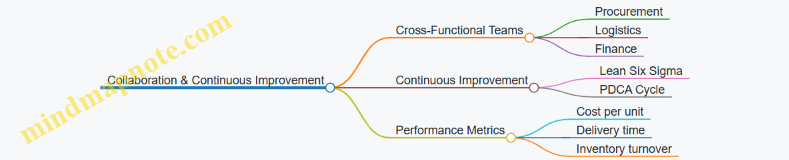
Summary
Integrating global logistics with cost control methods requires a holistic approach that combines transportation optimization, warehousing efficiency, customs compliance, technology adoption, and collaborative continuous improvement. By applying these principles with practical examples and tools such as mind maps, supply chain and operations managers can drive significant cost savings while maintaining or improving service levels.
Actionable Tips:
- Regularly review transportation modes and consolidate shipments where possible.
- Invest in warehouse automation to reduce labor costs.
- Automate customs documentation to avoid delays and penalties.
- Use data analytics to uncover hidden cost drivers.
- Foster collaboration across departments to align cost control initiatives.
This integrated approach not only controls costs but also builds a resilient, agile, and competitive global supply chain.
12.3 Best Practices Summary with Practical Examples
To effectively manage supply chains on a global scale while controlling costs, it is essential to integrate proven best practices. Below is a comprehensive summary of these practices, supported by practical examples and mind maps to visualize key concepts.
Mind Map: Core Best Practices in Supply Chain Management
Demand Forecasting and Planning
Best Practice: Use a combination of historical sales data, market intelligence, and predictive analytics to anticipate demand accurately.
Example: A major retail chain uses AI-driven forecasting tools to analyze past holiday season sales and current market trends, enabling them to stock the right quantities and reduce stockouts by 25%.
Inventory Management
Best Practice: Balance Just-In-Time (JIT) inventory to reduce holding costs with maintaining safety stock to mitigate supply disruptions.
Example: An automotive manufacturer implemented JIT with a safety stock buffer, reducing inventory costs by 18% while avoiding production delays.
Supplier Relationship Management
Best Practice: Develop strategic partnerships through regular communication, performance reviews, and joint innovation initiatives.
Example: An electronics company worked closely with key suppliers to co-develop components, resulting in a 10% reduction in lead times and improved product quality.
Global Logistics Optimization
Best Practice: Utilize multi-modal transportation and ensure compliance with international trade regulations to optimize cost and delivery times.
Example: A global apparel brand balanced sea freight for cost efficiency and air freight for urgent shipments, cutting logistics costs by 12% while maintaining customer satisfaction.
Cost Control Methods
Best Practice: Consolidate freight shipments and optimize delivery routes using transportation management systems (TMS).
Example: A fast-moving consumer goods (FMCG) company consolidated shipments across regions and used route optimization software, reducing freight expenses by 15% annually.
Technology and Data Analytics
Best Practice: Implement ERP and SCM platforms integrated with data analytics and AI to enhance visibility and decision-making.
Example: A multinational distributor used predictive analytics to improve demand forecast accuracy by 30%, enabling better inventory allocation and reducing waste.
Risk Management and Resilience
Best Practice: Diversify suppliers geographically and develop contingency plans to handle disruptions.
Example: A food distributor diversified sourcing across multiple countries and created emergency stockpiles, successfully mitigating supply chain disruptions during the COVID-19 pandemic.
Sustainability and Green Logistics
Best Practice: Adopt green logistics practices such as optimizing routes for fuel efficiency and implementing reverse logistics for product returns.
Example: A consumer goods company reduced its carbon footprint by 20% through route optimization and recycling packaging materials in its reverse logistics process.
Continuous Improvement
Best Practice: Use Lean Six Sigma methodologies and monitor KPIs to drive ongoing process enhancements.
Example: A manufacturing firm applied PDCA (Plan-Do-Check-Act) cycles to its supply chain processes, achieving a 15% cost reduction over two years.
Mind Map: Cost Control Methods in Global Supply Chains
By integrating these best practices with real-world examples, supply chain and operations managers can build resilient, efficient, and cost-effective global supply chains that drive competitive advantage.
12.4 Steps to Implement Effective SCM Strategies in Your Organization
Implementing effective Supply Chain Management (SCM) strategies is crucial for organizations aiming to optimize operations, reduce costs, and enhance customer satisfaction. Below is a detailed step-by-step guide, enriched with mind maps and real-world examples, to help supply chain and operations managers successfully deploy SCM strategies.
Step 1: Conduct a Comprehensive Supply Chain Assessment
- Objective: Understand current supply chain performance, identify bottlenecks, and areas for improvement.
- Actions:
- Map existing supply chain processes.
- Analyze key performance indicators (KPIs).
- Gather stakeholder feedback.
Mind Map: Supply Chain Assessment
Example: A mid-sized electronics manufacturer mapped their entire supply chain and discovered excessive lead times in supplier deliveries, which delayed production schedules. This insight led to renegotiating supplier contracts and introducing buffer stocks.
Step 2: Define Clear SCM Objectives Aligned with Business Goals
- Objective: Establish measurable goals that support overall business strategy.
- Actions:
- Set SMART (Specific, Measurable, Achievable, Relevant, Time-bound) goals.
- Prioritize objectives such as cost reduction, service improvement, or sustainability.
Mind Map: Defining SCM Objectives
Example: A global apparel company set a goal to reduce transportation costs by 12% within 12 months by optimizing routes and consolidating shipments.
Step 3: Develop and Select SCM Strategies
- Objective: Choose strategies that address identified gaps and meet objectives.
- Actions:
- Evaluate sourcing options (single vs. multiple suppliers).
- Decide on inventory policies (JIT, safety stock levels).
- Plan logistics and distribution models.
- Incorporate technology solutions.
Mind Map: SCM Strategy Development
Example: An automotive parts supplier adopted a multi-sourcing strategy combined with JIT inventory to reduce stock holding costs while ensuring supply continuity.
Step 4: Engage Stakeholders and Build Cross-Functional Teams
- Objective: Ensure collaboration and buy-in across departments and partners.
- Actions:
- Form cross-functional teams including procurement, operations, logistics, and finance.
- Communicate strategy objectives and benefits.
- Establish regular review meetings.
Mind Map: Stakeholder Engagement
Example: A consumer goods company created a cross-functional SCM task force that met weekly to monitor implementation progress and quickly resolve issues.
Step 5: Implement SCM Technologies and Tools
- Objective: Leverage technology to enhance visibility, automation, and decision-making.
- Actions:
- Deploy ERP and SCM software tailored to organizational needs.
- Integrate real-time tracking and analytics tools.
- Train staff on new systems.
Mind Map: Technology Implementation
Example: A pharmaceutical distributor implemented a Transportation Management System (TMS) that improved shipment tracking and reduced delivery delays by 15%.
Step 6: Monitor Performance and Adjust Strategies
- Objective: Continuously measure outcomes and refine strategies for improvement.
- Actions:
- Track KPIs regularly.
- Conduct periodic audits and reviews.
- Use feedback loops to adapt processes.
Mind Map: Performance Monitoring
Example: A food and beverage company used monthly KPI dashboards to identify rising inventory costs and implemented lean inventory practices that cut costs by 18% over six months.
Step 7: Foster a Culture of Continuous Improvement
- Objective: Embed SCM excellence into organizational culture.
- Actions:
- Encourage employee suggestions and innovation.
- Implement Lean and Six Sigma methodologies.
- Recognize and reward SCM achievements.
Mind Map: Continuous Improvement Culture
Example: A logistics company launched a Kaizen program where employees proposed process improvements, resulting in a 10% increase in warehouse productivity.
Summary Mind Map: Steps to Implement Effective SCM Strategies
By following these structured steps, organizations can systematically implement SCM strategies that align with their goals, adapt to global logistics challenges, and maintain cost control, ultimately driving competitive advantage and operational excellence.
12.5 Final Thoughts: Driving Competitive Advantage through Supply Chain Excellence
Achieving supply chain excellence is no longer just an operational necessity; it is a strategic imperative that can differentiate your organization in a highly competitive global marketplace. By mastering the principles of supply chain management, integrating global logistics effectively, and implementing robust cost control methods, companies can unlock significant value, improve customer satisfaction, and build resilience against market uncertainties.
Why Supply Chain Excellence Drives Competitive Advantage
- Cost Efficiency: Streamlined operations reduce waste and lower costs, enabling competitive pricing.
- Customer Satisfaction: Reliable and fast delivery enhances customer loyalty and brand reputation.
- Agility and Responsiveness: Ability to adapt quickly to market changes and disruptions.
- Innovation Enablement: Efficient supply chains support new product launches and market expansion.
- Sustainability: Meeting environmental and social governance criteria attracts conscious consumers and partners.
Mind Map: Components of Supply Chain Excellence
Practical Example: How a Global Electronics Manufacturer Gained Competitive Advantage
A global electronics manufacturer faced rising costs and delivery delays due to fragmented supplier networks and inefficient logistics. By adopting an integrated supply chain management approach, they:
- Implemented advanced demand forecasting tools to reduce excess inventory by 25%.
- Consolidated shipments and optimized transportation routes, cutting freight costs by 18%.
- Developed strong partnerships with key suppliers, improving lead times by 30%.
- Invested in warehouse automation, increasing order fulfillment speed by 40%.
- Introduced sustainability initiatives, reducing carbon emissions and appealing to eco-conscious customers.
These initiatives collectively improved their market responsiveness, lowered operational costs, and enhanced brand reputation, resulting in a measurable competitive edge.
Mind Map: Steps to Drive Competitive Advantage through SCM Excellence
Key Takeaways for Supply Chain and Operations Managers
- Holistic View: Understand your supply chain end-to-end to identify value creation opportunities.
- Data-Driven Decisions: Leverage analytics and real-time data for forecasting and operational adjustments.
- Collaboration: Build strong relationships with suppliers, logistics partners, and internal teams.
- Technology Adoption: Invest in automation, AI, and digital platforms to enhance efficiency and visibility.
- Cost Control: Continuously evaluate sourcing, transportation, and inventory strategies to minimize costs without compromising quality.
- Resilience & Sustainability: Prepare for disruptions and integrate sustainable practices to future-proof your supply chain.
By embedding these principles and practices into your supply chain strategy, you not only optimize operations but also create a powerful competitive advantage that supports long-term business success.