Understanding Personal and Business Finance from Zero to One
1. Introduction to Finance: Foundations for Personal and Business Success
1.1 What is Finance? Understanding the Basics
Finance is the art and science of managing money. It involves the processes of acquiring, spending, saving, investing, and protecting financial resources to achieve personal or business goals. At its core, finance helps individuals and organizations make informed decisions about how to allocate resources efficiently.
Key Components of Finance
Finance can be broadly divided into three main categories:
- Personal Finance: Managing your own money, including budgeting, saving, investing, and planning for retirement.
- Business Finance: Handling the financial activities of a company, such as funding operations, managing cash flow, and planning for growth.
- Public Finance: Government-related financial management, including taxation and public expenditures (less relevant here but good to know).
Mind Map: Core Concepts of Finance
Why is Finance Important?
Finance is crucial because it enables:
- Goal Achievement: Whether buying a home, starting a business, or saving for education, finance provides the roadmap.
- Resource Optimization: Ensures money is used wisely and not wasted.
- Risk Management: Helps prepare for uncertainties like emergencies or market downturns.
Example 1: Personal Finance in Action
Scenario: Sarah earns $3,000 per month. She wants to save for a vacation costing $1,200 in 6 months.
- Sarah creates a budget allocating $200/month to a vacation fund.
- She tracks her expenses to ensure she doesn’t overspend.
- By month 6, she has saved $1,200 and can afford her trip without debt.
This simple example shows how understanding finance basics helps Sarah plan and achieve her goal.
Example 2: Business Finance in Action
Scenario: A small bakery wants to expand by buying new ovens costing $10,000.
- The owner reviews current cash flow and sees $2,000 surplus monthly.
- She decides to save $2,000/month for 5 months or take a small loan.
- She evaluates loan interest rates and repayment terms to choose the best option.
This example highlights how business finance involves planning, cash flow management, and decision-making.
Mind Map: Finance Decision Process
Summary
Understanding finance means grasping how money flows in and out, how to plan for future needs, and how to make smart decisions to improve financial well-being. Whether for personal life or business, finance provides the tools and knowledge to move from zero (no financial knowledge) to one (financial confidence and control).
1.2 Differences and Similarities Between Personal and Business Finance
Understanding the distinctions and overlaps between personal and business finance is crucial for managing money effectively in both spheres. While they share foundational principles, the objectives, complexity, and regulations often differ.
Similarities Between Personal and Business Finance
- Budgeting: Both require planning income and expenses to avoid overspending.
- Cash Flow Management: Monitoring inflows and outflows to maintain liquidity.
- Goal Setting: Defining short-term and long-term financial objectives.
- Record Keeping: Maintaining accurate financial records for tracking and decision-making.
- Debt Management: Using borrowing strategically and responsibly.
- Investment: Allocating surplus funds to grow wealth.
Mind Map: Similarities
Example:
Sarah manages her household budget by tracking monthly expenses and saving for a vacation. Similarly, her small bakery business tracks daily sales and expenses to ensure profitability and save for new equipment.
Differences Between Personal and Business Finance
| Aspect | Personal Finance | Business Finance |
|---|---|---|
| Purpose | Manage individual/family needs and goals | Support business operations and growth |
| Complexity | Generally simpler, fewer transactions | More complex, multiple revenue streams, expenses |
| Regulations | Subject to personal tax laws | Subject to business laws, taxes, and compliance |
| Financial Statements | Personal budget and net worth statements | Income statement, balance sheet, cash flow statement |
| Risk Tolerance | Often more conservative | Can be more aggressive to pursue growth |
| Funding Sources | Savings, personal loans, credit cards | Investors, business loans, revenue reinvestment |
| Tax Treatment | Income taxed as personal income | Business income taxed differently; deductions vary |
Mind Map: Differences
Example:
John uses a personal credit card for household expenses and repays it monthly to avoid interest. Meanwhile, his startup secures a business loan to purchase inventory, understanding the loan interest as a business expense deductible on taxes.
Integrated Best Practice: Keeping Personal and Business Finances Separate
Why?
- Simplifies accounting and tax filing.
- Protects personal assets from business liabilities.
- Provides clearer insight into business performance.
Example:
Emma, a freelance graphic designer, maintains separate bank accounts and credit cards for her personal and business expenses. This separation helps her track business profitability and simplifies tax deductions.
Summary Table: Key Points
| Feature | Personal Finance Example | Business Finance Example |
|---|---|---|
| Budgeting | Monthly household budget | Quarterly sales and expense forecast |
| Cash Flow Management | Managing paycheck and bills | Managing customer payments and supplier invoices |
| Debt Management | Paying off credit card debt | Using a line of credit for inventory purchase |
| Investment | Contributing to a retirement fund | Reinvesting profits into marketing campaigns |
| Record Keeping | Tracking expenses via a personal finance app | Using accounting software like QuickBooks |
By understanding these similarities and differences, individuals and small business owners can apply tailored strategies to improve their financial health in both personal and business contexts.
1.3 Why Financial Literacy Matters: Real-Life Impact Examples
Financial literacy is the foundation for making informed and effective decisions with all of your financial resources. Without it, individuals and business owners alike can face serious challenges that affect their economic stability and growth potential.
What is Financial Literacy?
Financial literacy means having the knowledge and skills to manage financial resources efficiently for a lifetime of financial well-being.
Mind Map: Core Benefits of Financial Literacy
Real-Life Example 1: Personal Finance - Avoiding Debt Spiral
Scenario: Sarah, a recent college graduate, lacked financial literacy and used multiple credit cards without understanding interest rates. She accumulated $10,000 in credit card debt with high interest, making minimum payments only.
Impact: Sarah’s debt grew due to compounding interest, affecting her credit score and ability to rent an apartment.
Best Practice: After attending a financial literacy workshop, Sarah learned to create a budget, prioritize debt repayment using the “debt avalanche” method (paying off highest interest debt first), and avoid unnecessary expenses.
Outcome: Within 18 months, Sarah paid off her credit cards and improved her credit score, enabling her to secure a better apartment lease and start saving for retirement.
Real-Life Example 2: Small Business Finance - Cash Flow Management
Scenario: John owns a small bakery. Without financial literacy, he failed to track cash flow properly and extended credit to customers without clear terms.
Impact: John faced cash shortages, struggled to pay suppliers on time, and missed opportunities to invest in new equipment.
Best Practice: John learned to implement a cash flow forecast, set clear payment terms, and use accounting software to monitor daily transactions.
Outcome: Improved cash flow visibility helped John negotiate better supplier terms, avoid late fees, and invest in marketing, growing his business by 25% in a year.
Mind Map: Consequences of Poor Financial Literacy
Real-Life Example 3: Investing and Retirement Planning
Scenario: Maria, a small business owner, did not understand the importance of retirement planning and invested all profits back into the business without personal savings.
Impact: When Maria faced unexpected health issues, she had no personal financial cushion and had to take out a high-interest loan.
Best Practice: After consulting a financial advisor, Maria diversified her investments, set up a retirement account, and allocated a portion of profits to personal savings.
Outcome: Maria secured her financial future, reduced stress, and maintained business stability during personal challenges.
Summary
Financial literacy empowers individuals and business owners to:
- Make informed decisions
- Avoid costly mistakes
- Build wealth sustainably
- Prepare for emergencies
- Achieve financial independence
By integrating financial literacy into daily life and business operations, you create a resilient financial foundation that supports long-term success.
Quick Tips to Improve Financial Literacy Today
- Start tracking your income and expenses monthly.
- Learn basic budgeting and debt repayment strategies.
- Use free online resources or workshops.
- Consult with financial professionals when needed.
- Regularly review and adjust your financial plans.
1.4 Setting Financial Goals: Personal and Business Perspectives
Setting clear financial goals is a foundational step in achieving financial success, whether for personal life or business operations. Goals provide direction, motivation, and a benchmark to measure progress. In this section, we’ll explore how to set effective financial goals, differentiate between personal and business perspectives, and provide practical examples and mind maps to clarify the process.
Why Set Financial Goals?
- Clarity: Knowing exactly what you want to achieve financially.
- Motivation: Goals inspire consistent effort and discipline.
- Measurement: Enables tracking progress and adjusting plans.
- Prioritization: Helps allocate resources wisely.
Characteristics of Effective Financial Goals (SMART Framework)
- Specific: Clearly define what you want.
- Measurable: Quantify the goal.
- Achievable: Realistic and attainable.
- Relevant: Aligns with your broader objectives.
- Time-bound: Set a deadline.
Mind Map: Setting Financial Goals Overview
Personal Financial Goals: Examples and Best Practices
Example 1: Building an Emergency Fund
- Specific: Save $6,000 for emergencies.
- Measurable: $500 monthly savings.
- Achievable: Adjust monthly budget to cut discretionary spending.
- Relevant: Provides financial security.
- Time-bound: Reach goal in 12 months.
Best Practice: Automate transfers to a separate savings account to ensure consistency.
Example 2: Paying Off Credit Card Debt
- Specific: Pay off $3,000 credit card balance.
- Measurable: $250 monthly payments.
- Achievable: Use snowball or avalanche method.
- Relevant: Improves credit score and reduces interest payments.
- Time-bound: Complete payoff in 12 months.
Best Practice: Prioritize high-interest debt first to save money.
Business Financial Goals: Examples and Best Practices
Example 1: Increasing Monthly Revenue
- Specific: Increase revenue from $10,000 to $12,000.
- Measurable: $2,000 increase.
- Achievable: Launch targeted marketing campaign.
- Relevant: Supports business growth.
- Time-bound: Achieve within 6 months.
Best Practice: Track sales data weekly to monitor progress and adjust strategies.
Example 2: Reducing Operating Expenses
- Specific: Cut monthly expenses by $1,000.
- Measurable: $1,000 reduction.
- Achievable: Negotiate supplier contracts and reduce utility costs.
- Relevant: Improves profitability.
- Time-bound: Achieve within 3 months.
Best Practice: Conduct monthly expense audits to identify savings opportunities.
Mind Map: Steps to Set Financial Goals
Integrating Personal and Business Financial Goals
For small business owners, personal and business finances often intertwine. It’s important to:
- Separate personal and business accounts to maintain clarity.
- Align business profits with personal financial needs (e.g., salary, dividends).
- Set goals that support both personal security and business growth.
Example: A freelancer sets a personal goal to save $5,000 emergency fund while simultaneously setting a business goal to increase client base by 15% to ensure steady cash flow.
Summary
Setting financial goals is a dynamic process that requires clarity, planning, and regular review. By applying the SMART framework and using practical examples, both individuals and business owners can create actionable financial plans that lead to sustained success.
1.5 Overview of Financial Statements: Income, Cash Flow, and Balance Sheets
Understanding financial statements is crucial for both personal and business finance because they provide a clear picture of financial health, performance, and position. This section breaks down the three primary financial statements: the Income Statement, the Cash Flow Statement, and the Balance Sheet, with easy-to-understand examples and mind maps to visualize their components.
What Are Financial Statements?
Financial statements are formal records of financial activities and position. They help individuals and business owners make informed decisions by showing how money flows in and out and what resources are owned or owed.
Mind Map: Overview of Financial Statements
Income Statement (Profit & Loss Statement)
Purpose: Shows profitability over a specific period (e.g., monthly, quarterly, yearly).
Key Components:
- Revenue: Money earned from sales or services.
- Expenses: Costs incurred to generate revenue (rent, salaries, utilities).
- Net Income: Revenue minus expenses; the profit or loss.
Example:
| Item | Amount ($) |
|---|---|
| Revenue | 10,000 |
| Expenses | 7,000 |
| Net Income | 3,000 |
Personal Finance Example:
- Income: Salary $4,000
- Expenses: Rent $1,200, Food $600, Utilities $200, Entertainment $300
- Net Income: $4,000 - $2,300 = $1,700 (savings or investment potential)
Mind Map: Income Statement Breakdown
Cash Flow Statement
Purpose: Tracks the actual inflow and outflow of cash during a period, showing liquidity.
Key Sections:
- Operating Activities: Cash from core business operations (e.g., customer payments, supplier payments).
- Investing Activities: Cash used for or generated from investments (buying equipment, selling assets).
- Financing Activities: Cash from borrowing or repaying loans, issuing stock.
Example:
| Activity | Cash In ($) | Cash Out ($) |
|---|---|---|
| Operating Activities | 12,000 | 8,000 |
| Investing Activities | 0 | 2,000 |
| Financing Activities | 5,000 | 1,000 |
| Net Cash Flow | 6,000 |
Personal Finance Example:
- Operating: Salary received $4,000, bills paid $2,500
- Investing: Sold old laptop $300
- Financing: Paid credit card $500
- Net Cash Flow: $4,000 + $300 - $2,500 - $500 = $1,300
Mind Map: Cash Flow Statement Components
Balance Sheet
Purpose: Snapshot of financial position at a specific point in time.
Key Elements:
- Assets: What you own (cash, property, equipment).
- Liabilities: What you owe (loans, credit card debt).
- Equity: Net worth; Assets minus Liabilities.
Example:
| Assets | Amount ($) | Liabilities | Amount ($) |
|---|---|---|---|
| Cash | 5,000 | Credit Card Debt | 1,500 |
| Equipment | 10,000 | Loan Payable | 3,500 |
| Total Assets | 15,000 | Total Liabilities | 5,000 |
| Equity | 10,000 |
Personal Finance Example:
- Assets: Savings $8,000, Car $7,000
- Liabilities: Student Loan $5,000
- Equity (Net Worth): $15,000 - $5,000 = $10,000
Mind Map: Balance Sheet Structure
How These Statements Work Together
- The Income Statement shows profitability over time.
- The Cash Flow Statement explains changes in cash position from operations, investing, and financing.
- The Balance Sheet shows the financial position at a point in time.
Example Scenario:
A small business earns $10,000 in revenue (Income Statement), collects $8,000 in cash from customers (Cash Flow Statement), and owns $15,000 in assets with $5,000 liabilities (Balance Sheet). This integrated view helps the owner understand profitability, liquidity, and financial stability.
Summary Table
| Statement | Purpose | Key Components | Example Focus |
|---|---|---|---|
| Income Statement | Measures profitability | Revenue, Expenses, Net Income | Monthly salary and expenses |
| Cash Flow | Tracks cash inflows/outflows | Operating, Investing, Financing | Salary received, bills paid |
| Balance Sheet | Snapshot of financial status | Assets, Liabilities, Equity | Savings, debts, net worth |
By mastering these financial statements, you gain the tools to make smarter financial decisions, whether managing your household budget or running a small business.
2. Budgeting Fundamentals: Building a Financial Roadmap
2.1 Creating a Personal Budget: Step-by-Step with Sample Templates
Creating a personal budget is the cornerstone of effective money management. It helps you understand where your money comes from, where it goes, and how to allocate it to meet your financial goals. This section will guide you through a clear, step-by-step process to create a personal budget, complemented by easy-to-understand examples and mind maps to visualize the process.
Step 1: Determine Your Income
Start by calculating your total monthly income. This includes your salary, freelance earnings, rental income, dividends, or any other sources of money.
Example:
- Salary (after tax): $3,000
- Freelance work: $500
- Rental income: $300
Total Monthly Income: $3,800
Step 2: List Your Expenses
Break down your expenses into fixed and variable categories.
- Fixed Expenses: Rent, loan payments, insurance, subscriptions.
- Variable Expenses: Groceries, utilities, entertainment, dining out.
Example:
- Rent: $1,000
- Utilities: $150
- Groceries: $400
- Transportation: $100
- Entertainment: $150
- Insurance: $200
- Subscriptions: $50
Step 3: Categorize and Prioritize
Group expenses into essential and non-essential. Essential expenses cover needs, while non-essential cover wants.
Mind Map: Expense Categories
Step 4: Set Spending Limits
Based on your income and priorities, assign spending limits to each category. Aim to save at least 20% of your income if possible.
Example:
- Income: $3,800
- Savings goal (20%): $760
- Remaining for expenses: $3,040
Allocate accordingly:
- Rent: $1,000
- Utilities: $150
- Groceries: $400
- Transportation: $100
- Insurance: $200
- Entertainment: $100
- Dining Out: $90
- Subscriptions: $50
- Miscellaneous: $50
Step 5: Track and Adjust
Use budgeting tools or spreadsheets to track your actual spending against your budget. Adjust categories as needed to stay on track.
Example:
- If you spent $120 on entertainment instead of $100, consider reducing dining out expenses next month.
Sample Budget Template (Monthly)
| Category | Budgeted Amount | Actual Amount | Difference |
|---|---|---|---|
| Income | $3,800 | $3,800 | $0 |
| Rent | $1,000 | $1,000 | $0 |
| Utilities | $150 | $140 | +$10 |
| Groceries | $400 | $420 | -$20 |
| Transportation | $100 | $90 | +$10 |
| Insurance | $200 | $200 | $0 |
| Entertainment | $100 | $120 | -$20 |
| Dining Out | $90 | $80 | +$10 |
| Subscriptions | $50 | $50 | $0 |
| Miscellaneous | $50 | $40 | +$10 |
| Savings | $760 | $760 | $0 |
Mind Map: Personal Budgeting Process
Practical Example: Sarah’s Budget
Sarah earns $3,500 monthly after taxes. She wants to save for a vacation while managing her expenses.
- Income: $3,500
- Savings goal: $700 (20%)
- Fixed expenses: $1,200 (rent, insurance, subscriptions)
- Variable expenses: $1,600 (groceries, utilities, entertainment, dining out)
Sarah uses a budgeting app to track expenses daily. After two months, she notices dining out is higher than planned, so she reduces it from $200 to $100 and reallocates $100 to savings.
Tips for Success
- Be realistic: Don’t underestimate expenses.
- Review monthly: Budgets should evolve with your life.
- Use technology: Apps like Mint, YNAB, or simple spreadsheets help.
- Include irregular expenses: Set aside money monthly for annual bills like insurance or car maintenance.
By following these steps and using the provided templates and mind maps, anyone can create a personal budget that fosters financial awareness and control.
2.2 Business Budgeting Basics: Forecasting Revenue and Expenses
Budgeting is a cornerstone of effective business management. Forecasting revenue and expenses allows small business owners to plan ahead, allocate resources wisely, and avoid cash flow problems. This section breaks down the essentials of business budgeting with clear explanations, mind maps, and practical examples.
What is Business Budgeting?
Business budgeting is the process of estimating future income (revenue) and expenditures (expenses) over a specific period, typically monthly, quarterly, or annually. It helps businesses set financial goals, monitor performance, and make informed decisions.
Mind Map: Key Components of Business Budgeting
Forecasting Revenue
Revenue forecasting involves predicting how much money your business will bring in over a future period. Accurate revenue forecasts are crucial for planning expenses and investments.
Steps to Forecast Revenue:
- Analyze Historical Sales Data: Look at past sales to identify trends.
- Consider Market Conditions: Account for economic factors, competition, and customer demand.
- Incorporate Seasonal Trends: Some businesses have peak seasons; factor these in.
- Set Realistic Sales Goals: Avoid overestimating to prevent cash flow issues.
Example:
Imagine a small bakery that sold 1,000 cupcakes last month at $3 each. They expect a 10% increase next month due to a local festival.
- Last month revenue = 1,000 cupcakes * $3 = $3,000
- Forecasted sales = 1,000 * 1.10 = 1,100 cupcakes
- Forecasted revenue = 1,100 * $3 = $3,300
Forecasting Expenses
Expenses are the costs incurred to operate the business. Forecasting expenses involves estimating both fixed and variable costs.
Types of Expenses:
- Fixed Costs: Costs that remain constant regardless of sales volume (e.g., rent, salaries).
- Variable Costs: Costs that fluctuate with production or sales (e.g., raw materials, shipping).
- One-time Expenses: Non-recurring costs like equipment purchases.
Example:
For the bakery:
- Rent: $1,000/month (fixed)
- Salaries: $2,000/month (fixed)
- Ingredients: $0.50 per cupcake (variable)
- Utilities: $300/month (variable/fixed mix)
If they forecast selling 1,100 cupcakes:
- Ingredients cost = 1,100 * $0.50 = $550
- Total expenses = Rent ($1,000) + Salaries ($2,000) + Ingredients ($550) + Utilities ($300) = $3,850
Mind Map: Expense Categories
Calculating Profit Forecast
Profit = Forecasted Revenue - Forecasted Expenses
Using the bakery example:
- Revenue: $3,300
- Expenses: $3,850
- Profit: $3,300 - $3,850 = -$550 (a loss)
This indicates the bakery may need to adjust pricing, reduce costs, or increase sales volume.
Best Practices for Business Budgeting
- Use Conservative Estimates: Avoid overly optimistic revenue forecasts.
- Update Budgets Regularly: Adjust forecasts based on actual performance.
- Separate Personal and Business Finances: Maintain clarity and accuracy.
- Use Budgeting Tools: Spreadsheets or software like QuickBooks can simplify the process.
- Plan for Contingencies: Include a buffer for unexpected expenses.
Example: Small Retail Store Budget Forecast
Scenario: A small retail store expects monthly sales of $20,000. Fixed costs include rent ($2,500), salaries ($5,000), and insurance ($500). Variable costs average 40% of sales.
- Revenue forecast: $20,000
- Variable costs: 40% of $20,000 = $8,000
- Fixed costs: $2,500 + $5,000 + $500 = $8,000
- Total expenses: $8,000 + $8,000 = $16,000
- Forecasted profit: $20,000 - $16,000 = $4,000
The store can use this forecast to plan inventory purchases, marketing, and savings.
Summary
Forecasting revenue and expenses is essential for creating a realistic business budget. By understanding your income streams and cost structure, you can make informed decisions that support growth and sustainability. Using mind maps helps visualize the budgeting components, and real-world examples demonstrate how to apply these concepts practically.
2.3 Tracking Income and Expenses: Tools and Techniques
Tracking income and expenses is a fundamental practice for both personal and business finance management. It helps you understand where your money is coming from and where it is going, enabling informed decisions, budgeting accuracy, and financial health monitoring.
Why Track Income and Expenses?
- Gain clarity on financial inflows and outflows
- Identify spending patterns and areas to cut costs
- Ensure bills and obligations are met on time
- Prepare accurate budgets and forecasts
- Improve tax preparation and compliance
Tools for Tracking Income and Expenses
| Tool Type | Description | Example Tools | Best For |
|---|---|---|---|
| Manual Spreadsheets | Customizable, hands-on tracking | Microsoft Excel, Google Sheets | Those who prefer control and customization |
| Personal Finance Apps | Automated tracking, bank syncing, alerts | Mint, YNAB (You Need A Budget), PocketGuard | Individuals seeking ease and automation |
| Accounting Software | Comprehensive business finance management | QuickBooks, Xero, FreshBooks | Small business owners and freelancers |
| Paper Ledger | Physical record keeping | Notebooks, printed templates | Those who prefer analog methods |
Techniques for Effective Tracking
Categorize Transactions
Create clear categories for income and expenses to see patterns easily.
Example Categories:
- Income: Salary, Freelance, Investments
- Expenses: Rent, Utilities, Groceries, Marketing, Supplies
Record Transactions Promptly
Enter income and expenses as soon as they occur to avoid missing data.
Reconcile Regularly
Compare your tracked data with bank statements or receipts monthly to ensure accuracy.
Use Automation Where Possible
Link bank accounts or credit cards to apps to automatically import transactions.
Review and Analyze
Set aside time weekly or monthly to review your income and expenses, identify trends, and adjust budgets.
Mind Map: Tracking Income and Expenses
Example 1: Personal Finance Tracking Using a Spreadsheet
Scenario: Sarah wants to track her monthly income and expenses manually.
Steps:
- She creates columns for Date, Description, Category, Income, Expense.
- She categorizes transactions like Salary, Rent, Groceries, Entertainment.
- Each day, she inputs transactions from receipts and bank alerts.
- At month-end, she sums income and expenses by category.
- She reviews her spending and adjusts her budget accordingly.
Outcome: Sarah identifies she spends more on dining out than planned and decides to cook more at home to save.
Example 2: Small Business Expense Tracking with Accounting Software
Scenario: Tom owns a small graphic design business and uses QuickBooks.
Steps:
- He connects his business bank account and credit card to QuickBooks.
- Transactions automatically import and are categorized (e.g., Client Payments under Income, Software Subscriptions under Expenses).
- Tom reviews transactions weekly, correcting any miscategorized entries.
- He generates monthly reports to assess profitability and cash flow.
- Before tax season, Tom exports reports for his accountant.
Outcome: Tom saves time on bookkeeping, maintains accurate records, and makes informed decisions about business expenses.
Mind Map: Example Workflow for Tracking
Tips for Success
- Choose tools that fit your comfort level and financial complexity.
- Be consistent and disciplined in recording transactions.
- Regularly back up digital records.
- Use visual aids like charts and graphs to better understand data.
- Don’t hesitate to seek help from financial advisors or accountants if needed.
By integrating these tools and techniques into your routine, tracking income and expenses becomes a manageable and insightful process that empowers both personal financial well-being and business success.
2.4 Adjusting Budgets: Responding to Financial Changes
Introduction
Budgeting is a dynamic process, not a one-time task. Life and business environments are constantly changing — income fluctuates, expenses arise unexpectedly, and priorities shift. Being able to adjust your budget effectively ensures financial stability and helps you stay on track toward your goals.
Why Adjust Budgets?
- Income Changes: Salary raises, job loss, seasonal business fluctuations.
- Unexpected Expenses: Medical bills, equipment repairs, emergency travel.
- Goal Shifts: New savings goals, investment plans, business expansion.
- Economic Factors: Inflation, market downturns, tax changes.
Step-by-Step Guide to Adjusting Your Budget
-
Review Your Current Budget and Financial Situation
- Compare actual income and expenses against your budgeted amounts.
- Identify categories with significant variances.
-
Identify the Cause of Change
- Is the change temporary or permanent?
- Is it due to external factors or personal/business decisions?
-
Prioritize Your Financial Goals
- Decide which goals remain critical and which can be postponed.
-
Adjust Income and Expense Estimates
- Update your income projections.
- Reallocate funds from less critical areas to cover new expenses.
-
Implement Changes and Monitor
- Track the impact of adjustments.
- Be ready to tweak further as needed.
Mind Map: Adjusting Budgets Process
Example 1: Personal Budget Adjustment After Job Loss
Scenario: Sarah was earning $4,000/month but lost her job. She receives $1,200/month unemployment benefits.
Original Budget:
- Rent: $1,200
- Groceries: $400
- Utilities: $200
- Transportation: $150
- Entertainment: $300
- Savings: $500
- Miscellaneous: $250
Adjustment Steps:
- Review income drop from $4,000 to $1,200.
- Prioritize essential expenses: rent, groceries, utilities, transportation.
- Cut or reduce discretionary spending: entertainment eliminated, miscellaneous reduced to $50.
- Suspend savings temporarily.
Adjusted Budget:
- Rent: $1,200
- Groceries: $350
- Utilities: $180
- Transportation: $100
- Entertainment: $0
- Savings: $0
- Miscellaneous: $50
Sarah monitors her expenses weekly and looks for part-time work to increase income.
Mind Map: Personal Budget Adjustment Example
Example 2: Small Business Budget Adjustment for Seasonal Sales Dip
Scenario: A small retail shop, “GreenLeaf,” experiences a 30% sales drop during winter months.
Original Monthly Budget:
- Revenue: $20,000
- Inventory Purchase: $8,000
- Rent: $3,000
- Salaries: $5,000
- Marketing: $1,000
- Utilities & Misc: $1,000
Adjustment Steps:
- Forecast revenue drop to $14,000.
- Negotiate with suppliers to reduce inventory purchase to $5,000.
- Temporarily reduce marketing spend to $500.
- Implement energy-saving measures to cut utilities by 20%.
- Consider temporary reduced hours or part-time shifts to lower salary expenses.
Adjusted Budget:
- Revenue: $14,000
- Inventory Purchase: $5,000
- Rent: $3,000
- Salaries: $4,000 (reduced via part-time shifts)
- Marketing: $500
- Utilities & Misc: $800
GreenLeaf tracks actual sales weekly and adjusts inventory orders accordingly.
Mind Map: Business Budget Adjustment Example
Best Practices for Budget Adjustments
- Be Proactive: Regularly review your budget monthly or quarterly.
- Stay Flexible: Accept that budgets are living documents.
- Communicate: For businesses, involve your team in budgeting changes.
- Use Technology: Employ budgeting apps or software for real-time tracking.
- Build Buffers: Maintain contingency funds for unexpected changes.
Summary
Adjusting budgets is essential to maintaining financial health amid changing circumstances. By systematically reviewing, prioritizing, and reallocating resources, both individuals and businesses can navigate financial fluctuations with confidence and resilience.
2.5 Case Study: How a Freelancer Balanced Personal and Business Budgets
Balancing personal and business budgets is a common challenge for freelancers who often operate as sole proprietors. This case study explores how Sarah, a freelance graphic designer, successfully managed her finances by creating clear boundaries and practical budgeting strategies.
Background
Sarah started freelancing after leaving her corporate job. She earns income from multiple clients and occasionally takes on project-based work. Initially, Sarah mixed her personal and business expenses, leading to confusion and stress during tax season.
Step 1: Separating Personal and Business Finances
Sarah opened a dedicated business checking account and a personal checking account. All client payments go into the business account, and she pays herself a fixed monthly “salary” transferred to her personal account.
Mind Map: Separating Finances
Step 2: Creating the Business Budget
Sarah listed all her expected business income and expenses for the month.
Business Income:
- Client A: $2,000
- Client B: $1,500
- Project C: $1,000
Business Expenses:
- Software subscriptions: $150
- Marketing: $200
- Office supplies: $50
- Taxes (estimated): $500
Example:
| Category | Amount ($) |
|---|---|
| Total Income | 4,500 |
| Total Expenses | 900 |
| Net Profit | 3,600 |
Sarah decides to pay herself $2,500 monthly from the net profit, leaving $1,100 in the business account as a buffer.
Mind Map: Business Budget
Step 3: Creating the Personal Budget
Sarah tracks her personal expenses and income (salary from business).
Personal Income:
- Salary from Business: $2,500
- Other Income: $0
Personal Expenses:
- Rent: $1,000
- Utilities: $150
- Groceries: $300
- Transportation: $100
- Entertainment: $200
- Savings: $300
Example:
| Category | Amount ($) |
|---|---|
| Total Income | 2,500 |
| Total Expenses | 2,050 |
| Surplus | 450 |
Sarah allocates the $450 surplus to an emergency fund.
Mind Map: Personal Budget
Step 4: Tracking and Adjusting
Sarah uses budgeting apps to track both budgets separately and reviews them weekly. When a client delays payment, she adjusts her business buffer and reduces her personal entertainment budget temporarily.
Lessons Learned and Best Practices
- Maintain Separate Accounts: Prevents mixing funds and simplifies tax preparation.
- Pay Yourself a Fixed Salary: Creates predictability for personal budgeting.
- Build a Business Buffer: Helps manage irregular income and unexpected expenses.
- Track Expenses Regularly: Enables timely adjustments.
- Save Surplus: Builds financial security.
Summary Mind Map: Freelancer Budgeting Workflow
By implementing these steps, Sarah gained control over her finances, reduced stress, and positioned her freelance business for sustainable growth.
3. Managing Cash Flow: The Lifeblood of Financial Health
3.1 Understanding Cash Flow: Personal vs. Business Contexts
Cash flow is the movement of money into and out of an individual’s or business’s accounts over a period of time. It represents liquidity — the ability to cover expenses and invest in opportunities. Understanding cash flow is critical because even profitable businesses or individuals can face financial trouble if cash flow is mismanaged.
What is Cash Flow?
- Cash Inflows: Money received (income, sales, loans, investments)
- Cash Outflows: Money spent (expenses, purchases, loan repayments)
Net Cash Flow = Cash Inflows - Cash Outflows
Positive net cash flow means more money is coming in than going out; negative means the opposite.
Mind Map: Components of Cash Flow
Personal Cash Flow
Example: Jane earns $4,000 monthly salary.
- Inflows:
- Salary: $4,000
- Freelance income: $500
- Outflows:
- Rent: $1,200
- Utilities: $300
- Groceries: $400
- Loan payment: $500
- Entertainment: $200
Net Cash Flow: $4,500 - $2,600 = $1,900 (positive)
Jane has $1,900 left to save or invest after expenses.
Best Practice: Track all inflows and outflows monthly using budgeting apps or spreadsheets to avoid surprises and identify saving opportunities.
Business Cash Flow
Example: ABC Retail Store monthly cash flow.
- Inflows:
- Sales revenue: $50,000
- Loan received: $10,000
- Outflows:
- Rent: $5,000
- Payroll: $15,000
- Inventory purchase: $20,000
- Utilities and other expenses: $3,000
- Loan repayment: $2,000
Net Cash Flow: $60,000 - $45,000 = $15,000 (positive)
ABC Retail has $15,000 cash surplus to reinvest or save.
Best Practice: Maintain a cash flow forecast to anticipate periods of low liquidity, especially for businesses with seasonal sales.
Mind Map: Differences Between Personal and Business Cash Flow
Why Understanding Cash Flow Matters
- For Individuals: Helps avoid overdrafts, manage debt, and build savings.
- For Businesses: Ensures ability to pay suppliers, employees, and invest in growth.
Example: A freelancer with irregular income uses cash flow tracking to smooth out expenses by saving during high-income months to cover lean periods.
Summary
Understanding cash flow involves recognizing all sources of money coming in and going out, whether personal or business. While personal cash flow tends to be more stable and predictable, business cash flow can be more volatile and requires proactive management. Tracking, forecasting, and adjusting cash flow are essential best practices to maintain financial health and achieve goals.
3.2 Techniques to Improve Personal Cash Flow: Saving and Spending Wisely
Improving personal cash flow is essential for financial stability and growth. It means ensuring that more money flows into your wallet than out, allowing you to save, invest, and prepare for unexpected expenses. Here, we explore practical techniques to save money and spend wisely, supported by clear examples and mind maps to visualize the concepts.
Understanding Personal Cash Flow
Personal cash flow is the net amount of money you have after subtracting your expenses from your income within a given period (usually monthly).
Formula:
Personal Cash Flow = Total Income - Total Expenses
Positive cash flow means you have surplus money; negative means you are spending more than you earn.
Mind Map 1: Techniques to Improve Personal Cash Flow
Increase Income
While managing expenses is crucial, increasing income can significantly improve cash flow.
Example: Sarah, a graphic designer, started freelancing on weekends, earning an extra $500 monthly. This additional income helped her cover unexpected medical bills without dipping into savings.
Practical Tips:
- Explore freelance opportunities related to your skills.
- Sell items you no longer need on online marketplaces.
- Consider part-time work or consulting.
Reduce Expenses
Tracking and controlling expenses is the most direct way to improve cash flow.
Mind Map 2: Expense Reduction Strategies
Example: John realized he was spending $200 monthly on unused streaming services. By canceling two subscriptions, he saved $100 monthly, improving his cash flow.
Save Strategically
Saving isn’t just about putting money aside; it’s about doing so consistently and smartly.
Techniques:
- Emergency Fund: Aim for 3-6 months of expenses.
- Automatic Transfers: Set your bank to move a fixed amount to savings each payday.
- High-Yield Savings Accounts: Earn more interest on your savings.
Example: Maria set up an automatic transfer of $150 every payday to a high-yield savings account. Over a year, this built a $1,800 emergency fund without impacting her daily spending.
Smart Spending
Being mindful about how you spend helps avoid unnecessary outflows.
Mind Map 3: Smart Spending Habits
Example: When tempted to buy a new gadget, Alex waits 24 hours. This pause often helps him decide the purchase isn’t necessary, saving him hundreds annually.
Summary Table: Techniques and Examples
| Technique | Description | Example |
|---|---|---|
| Increase Income | Add side gigs or freelance work | Sarah’s weekend freelancing |
| Reduce Expenses | Track and cut unnecessary spending | John canceled unused subscriptions |
| Save Strategically | Automate savings and build emergency fund | Maria’s automatic transfers |
| Smart Spending | Prioritize needs, use discounts, avoid impulse buys | Alex’s 24-hour wait rule |
Final Thoughts
Improving personal cash flow is a combination of increasing income, controlling expenses, saving wisely, and spending smartly. By applying these techniques with discipline and awareness, anyone can build a stronger financial foundation.
Remember, small consistent changes lead to big results over time.
3.3 Business Cash Flow Management: Invoicing, Collections, and Payments
Managing cash flow effectively is crucial for any business, especially small businesses and startups. Cash flow management involves monitoring, analyzing, and optimizing the net amount of cash receipts minus cash expenses. This section focuses on three core components: invoicing, collections, and payments.
Invoicing: The Starting Point of Cash Flow
Invoicing is the process of billing your customers for products or services provided. Timely and accurate invoicing ensures steady cash inflow.
Best Practices:
- Issue invoices promptly after delivery or service completion.
- Use clear, professional invoice templates.
- Include all necessary details: invoice number, date, payment terms, due date, itemized list, total amount, and payment methods.
- Set clear payment terms (e.g., Net 30, Net 15).
Example: A graphic design freelancer completes a project on March 1st and sends an invoice the same day with Net 15 terms. The invoice includes a unique number, detailed services, and payment options like bank transfer and PayPal.
Mind Map: Invoicing Process
Collections: Ensuring Timely Payments
Collections refer to the process of following up on unpaid invoices to ensure cash inflow.
Best Practices:
- Send polite payment reminders before and after the due date.
- Establish a systematic follow-up schedule (e.g., reminder 5 days before due date, on due date, 5 days after, and 15 days after).
- Offer multiple payment options to ease the process.
- Consider early payment discounts or late payment penalties.
- Maintain good customer relationships to facilitate smooth collections.
Example: A small retail store sends automated reminders via their invoicing software. When a payment is overdue by 10 days, the owner personally calls the client to discuss and arrange payment.
Mind Map: Collections Process
Payments: Managing Outflows Efficiently
Payments are the cash outflows your business makes to suppliers, employees, and other expenses.
Best Practices:
- Schedule payments to optimize cash availability (e.g., pay on due dates rather than early).
- Use digital payment methods for speed and record-keeping.
- Prioritize payments based on importance and due dates.
- Keep track of all payments to maintain accurate cash flow records.
Example: A bakery schedules supplier payments on the due date to maintain liquidity, uses online banking for quick transfers, and keeps a spreadsheet to track payment status.
Mind Map: Payments Management
Integrated Example: Seasonal Cash Flow Management for a Small Retailer
Scenario: A small clothing retailer experiences high sales during the holiday season but slower months afterward.
- Invoicing: The retailer promptly invoices wholesale clients after each shipment.
- Collections: Automated reminders are sent to clients with payment terms of Net 30. For late payments, the store manager follows up personally.
- Payments: Supplier payments are scheduled right before peak sales months to ensure inventory availability but delayed slightly in slower months to conserve cash.
This integrated approach helps the retailer maintain positive cash flow throughout the year, avoiding shortages during slow periods.
Summary
Effective business cash flow management requires:
- Prompt and clear invoicing to initiate cash inflow.
- Consistent and courteous collections to ensure payments are received on time.
- Strategic payment scheduling to optimize cash outflows.
By mastering these areas with practical tools and communication, businesses can maintain healthy cash flow, supporting growth and stability.
3.4 Using Cash Flow Forecasts to Avoid Financial Shortfalls
Cash flow forecasting is a critical tool for both individuals and business owners to anticipate and manage their financial health. By projecting future cash inflows and outflows, you can identify potential shortfalls before they happen and take proactive steps to avoid them.
What is a Cash Flow Forecast?
A cash flow forecast is an estimate of the money you expect to receive and pay out over a specific period, usually weekly, monthly, or quarterly. It helps you visualize when cash shortages or surpluses might occur.
Why Use Cash Flow Forecasts?
- Prevent financial surprises: Spot periods where expenses exceed income.
- Plan for expenses: Schedule payments or savings accordingly.
- Make informed decisions: Decide when to invest, borrow, or cut costs.
How to Create a Cash Flow Forecast
- List all expected cash inflows: Salary, sales revenue, loans, investments.
- List all expected cash outflows: Rent, utilities, loan repayments, inventory purchases.
- Estimate timing: When will these transactions occur?
- Calculate net cash flow: Inflows minus outflows for each period.
- Adjust and update regularly: Reflect actual results and revise forecasts.
Mind Map: Components of a Cash Flow Forecast
Example 1: Personal Cash Flow Forecast
Scenario: Jane, a freelancer, expects irregular income but has fixed monthly expenses.
| Month | Expected Income | Expected Expenses | Net Cash Flow |
|---|---|---|---|
| January | $3,000 | $2,500 | +$500 |
| February | $2,000 | $2,700 | -$700 |
| March | $3,500 | $2,600 | +$900 |
Insight: February shows a shortfall of $700.
Action: Jane decides to save part of her January surplus to cover February’s gap and looks for additional gigs.
Example 2: Business Cash Flow Forecast
Scenario: A small retail store expects seasonal fluctuations.
| Month | Sales Revenue | Expenses | Net Cash Flow |
|---|---|---|---|
| November | $15,000 | $12,000 | +$3,000 |
| December | $25,000 | $20,000 | +$5,000 |
| January | $8,000 | $13,000 | -$5,000 |
Insight: January shows a significant shortfall.
Action: The owner arranges a short-term loan in December to cover January’s expenses and plans promotions to boost January sales.
Mind Map: Steps to Avoid Financial Shortfalls Using Forecasts
Best Practices
- Be realistic: Use conservative estimates for income and include all known expenses.
- Update frequently: Cash flow forecasts should be living documents.
- Use software tools: Spreadsheets or apps can automate calculations and visualizations.
- Communicate: Share forecasts with stakeholders or family members to align plans.
Final Thought
Using cash flow forecasts empowers you to anticipate challenges and make strategic decisions to maintain financial stability. Whether managing household finances or running a business, this proactive approach can prevent crises and support growth.
3.5 Example: A Small Retailer’s Approach to Managing Seasonal Cash Flow
Managing cash flow is critical for any business, but it becomes especially challenging for small retailers who experience seasonal fluctuations in sales. Let’s explore a detailed example of how a small retailer, “Sunny Boutique,” successfully manages their seasonal cash flow.
Understanding Seasonal Cash Flow Challenges
Sunny Boutique experiences peak sales during the holiday season (November-December) and a significant slowdown in the summer months (June-August). This creates cash flow gaps that can affect their ability to pay suppliers, staff, and other expenses during off-peak periods.
Step 1: Mapping Seasonal Cash Flow Patterns
Sunny Boutique uses past sales data to forecast cash inflows and outflows month-by-month, identifying periods where cash might be tight.
Step 2: Creating a Cash Flow Forecast
Sunny Boutique prepares a 12-month cash flow forecast:
| Month | Expected Sales | Expected Expenses | Net Cash Flow |
|---|---|---|---|
| January | $8,000 | $7,500 | $500 |
| February | $7,500 | $7,200 | $300 |
| March | $7,000 | $7,000 | $0 |
| April | $6,500 | $6,800 | -$300 |
| May | $6,000 | $6,500 | -$500 |
| June | $5,500 | $6,200 | -$700 |
| July | $5,000 | $6,000 | -$1,000 |
| August | $5,500 | $6,100 | -$600 |
| September | $6,500 | $6,300 | $200 |
| October | $7,500 | $7,000 | $500 |
| November | $12,000 | $9,000 | $3,000 |
| December | $15,000 | $10,000 | $5,000 |
This forecast highlights the cash deficits during summer and surpluses during the holiday season.
Step 3: Best Practices to Manage Seasonal Cash Flow
Step 4: Applying the Strategies - Sunny Boutique’s Approach
-
Building Cash Reserves: During November and December, Sunny Boutique sets aside 50% of net cash flow surplus into a dedicated reserve account. For example, from a $5,000 surplus in December, $2,500 is saved.
-
Negotiating with Suppliers: Sunny negotiates extended payment terms with suppliers, shifting some payments from summer months to after the holiday season when cash inflows are higher.
-
Controlling Expenses: In summer, Sunny reduces staff hours and limits inventory purchases to essentials only, cutting down expenses by 15% compared to peak months.
-
Access to Credit: Sunny secures a business line of credit with a $10,000 limit, used only if cash flow dips below a critical threshold.
-
Diversifying Revenue: Sunny launches summer promotions and introduces seasonal products (e.g., summer accessories) to boost off-peak sales by 10%.
Step 5: Monitoring and Adjusting
Sunny Boutique reviews cash flow weekly and updates forecasts monthly. When unexpected expenses arise, they adjust spending or tap into reserves/credit as needed.
Summary Mind Map
Key Takeaways
- Seasonal businesses must plan ahead using detailed cash flow forecasts.
- Building cash reserves during peak times cushions off-peak shortfalls.
- Negotiating supplier terms and controlling expenses helps maintain liquidity.
- Access to credit provides a safety net but should be used judiciously.
- Diversifying revenue streams can smooth income fluctuations.
By following these integrated best practices, Sunny Boutique maintains financial stability year-round, ensuring they can pay bills on time, invest in growth, and avoid cash flow crises.
4. Debt Management: Navigating Borrowing Responsibly
4.1 Types of Debt: Personal Loans, Credit Cards, Business Loans
Understanding the different types of debt is crucial for managing your finances wisely, whether for personal use or business growth. Each type of debt serves different purposes, has unique characteristics, and impacts your financial health in distinct ways. Below, we explore the main types of debt with clear explanations, mind maps, and practical examples.
Personal Loans
Personal loans are unsecured loans borrowed from banks, credit unions, or online lenders. They are typically used for consolidating debt, financing large purchases, or covering unexpected expenses.
- Key Features:
- Fixed interest rates or variable rates
- Fixed repayment terms (usually 1 to 7 years)
- No collateral required
Example: Sarah wants to renovate her kitchen but doesn’t have enough savings. She takes a personal loan of $15,000 with a 6% interest rate to be repaid over 3 years. This allows her to manage the cost upfront and pay back in affordable monthly installments.
Mind Map: Personal Loans
Credit Cards
Credit cards provide a revolving line of credit that you can use repeatedly up to a set limit. They are convenient for everyday purchases and emergencies but often come with higher interest rates.
- Key Features:
- Revolving credit with a credit limit
- Minimum monthly payments
- Interest charged on unpaid balances
- Rewards and cashback options (varies)
Example: John uses his credit card to pay for groceries and gas. He pays his full balance every month to avoid interest charges. However, when he had an unexpected car repair, he paid $2,000 on his card and decided to pay it off over 6 months, incurring interest.
Mind Map: Credit Cards
Business Loans
Business loans are funds borrowed specifically to start, operate, or expand a business. They can be secured or unsecured and come in various forms such as term loans, lines of credit, or equipment financing.
- Key Features:
- Can be secured (backed by collateral) or unsecured
- Terms vary widely (short-term to long-term)
- Interest rates depend on creditworthiness and loan type
Example: Maria owns a small bakery and wants to buy a new oven to increase production. She applies for a $30,000 equipment loan with a 5-year term and a 7% interest rate. The loan is secured by the oven itself.
Mind Map: Business Loans
Summary Table of Debt Types
| Debt Type | Purpose | Interest Rate | Repayment Terms | Collateral Required | Example Use Case |
|---|---|---|---|---|---|
| Personal Loan | Debt consolidation, expenses | Fixed or variable | Fixed term (1-7 years) | No | Home renovation |
| Credit Card | Everyday purchases, emergencies | High, variable | Revolving, minimum monthly | No | Grocery shopping, car repair |
| Business Loan | Business startup, expansion | Varies (often lower) | Varies (short to long term) | Often yes | Equipment purchase |
Practical Tips for Managing Debt Types
- Personal Loans: Use for planned expenses and avoid borrowing more than you can repay monthly.
- Credit Cards: Pay full balance monthly if possible; otherwise, prioritize paying down high-interest balances.
- Business Loans: Prepare a solid business plan and understand loan terms before borrowing; ensure the loan supports growth and cash flow.
By understanding these debt types and their appropriate uses, you can make informed decisions that support both your personal financial health and your business’s success.
4.2 Understanding Interest Rates and Terms with Practical Examples
Understanding interest rates and loan terms is crucial for managing both personal and business debt effectively. This section breaks down the concepts into digestible parts, supported by mind maps and relatable examples.
What is an Interest Rate?
An interest rate is the percentage charged on the principal amount of a loan or credit, representing the cost of borrowing money.
Mind Map: Interest Rate Basics
Types of Interest Rates
- Fixed Interest Rate: Remains the same throughout the loan term.
- Variable Interest Rate: Can change over time based on market conditions.
Example:
- Personal Loan with 5% fixed interest for 3 years.
- Business loan with 4% variable interest, which may fluctuate annually.
Understanding Loan Terms
Loan terms define the duration and conditions of repayment.
Mind Map: Loan Terms
How Interest is Calculated
-
Simple Interest: Calculated only on the principal.
\[ \text{Simple Interest} = \text{Principal} \times \text{Rate} \times \text{Time} \]
-
Compound Interest: Calculated on principal plus accumulated interest.
\[ A = P \left(1 + \frac{r}{n}\right)^{nt} \]
Where:
- \(A\) = amount after time
- \(P\) = principal
- \(r\) = annual interest rate (decimal)
- \(n\) = number of times interest applied per year
- \(t\) = number of years
Example: Simple Interest
- Borrow $1,000 at 5% simple interest for 2 years.
- Interest = 1000 × 0.05 × 2 = $100
- Total repayment = $1,100
Example: Compound Interest
- Borrow $1,000 at 5% compounded annually for 2 years.
- Amount = 1000 × (1 + 0.05)^2 = 1000 × 1.1025 = $1,102.50
Practical Example: Comparing Loan Offers
| Loan Type | Principal | Interest Rate | Term Length | Interest Type | Total Interest | Total Repayment |
|---|---|---|---|---|---|---|
| Personal Loan A | $5,000 | 6% | 3 years | Fixed | $900 | $5,900 |
| Business Loan B | $5,000 | 5% | 3 years | Variable | $850* | $5,850* |
*Assuming interest rate stays constant for simplicity.
Understanding APR (Annual Percentage Rate)
- APR includes interest rate plus fees, giving a more complete cost of borrowing.
Mind Map: APR Components
Example: Calculating Monthly Payments
Using a fixed-rate loan of $10,000 at 6% interest for 5 years.
Formula for monthly payment (PMT):
\[ PMT = P \times \frac{r(1+r)^n}{(1+r)^n - 1} \]
Where:
- \(P = 10,000\)
- Monthly interest rate \(r = 6\% / 12 = 0.005\)
- Number of payments \(n = 5 \times 12 = 60\)
Calculation:
\[ PMT = 10,000 \times \frac{0.005(1+0.005)^{60}}{(1+0.005)^{60} - 1} \approx 193.33 \]
So, monthly payment is approximately $193.33.
Tips for Borrowers
- Always check if interest is simple or compound.
- Understand if the rate is fixed or variable.
- Look for hidden fees affecting APR.
- Use online calculators to estimate payments.
- Read loan terms carefully before signing.
Summary Mind Map: Interest Rates and Terms Overview
By understanding these concepts and applying the examples, both individuals and small business owners can make informed decisions about borrowing, ensuring they manage debt responsibly and optimize financial outcomes.
4.3 Strategies for Paying Down Debt Efficiently
Managing and paying down debt efficiently is crucial for both personal financial health and business sustainability. This section explores practical strategies, supported by easy-to-understand examples and mind maps to help visualize the process.
Understanding Your Debt
Before implementing any strategy, it’s essential to have a clear picture of your debts:
- Types of debt (credit cards, personal loans, business loans, mortgages)
- Interest rates and terms
- Minimum monthly payments
Example: Sarah has three debts:
| Debt Type | Balance | Interest Rate | Minimum Payment |
|---|---|---|---|
| Credit Card A | $5,000 | 18% | $150 |
| Personal Loan | $10,000 | 8% | $250 |
| Business Loan | $15,000 | 6% | $300 |
Strategy 1: Debt Snowball Method
Pay off debts starting from the smallest balance to the largest, regardless of interest rate. This method builds momentum and motivation.
- Pay minimum on all debts except the smallest
- Put extra funds toward the smallest debt
- Once paid off, roll that payment into the next smallest debt
Mind Map:
Example: Sarah pays minimums on her personal and business loans but puts an extra $200 toward Credit Card A. Once Credit Card A is paid off, she applies the $350 (150 + 200) toward the personal loan.
Strategy 2: Debt Avalanche Method
Focus on paying off debts with the highest interest rate first to minimize total interest paid.
- Pay minimum on all debts except the one with the highest interest
- Put extra funds toward the highest interest debt
- After payoff, move to the next highest interest debt
Mind Map:
Example: Sarah targets Credit Card A first (18% interest), paying minimums on the personal and business loans. After paying off the credit card, she focuses on the personal loan (8%), then the business loan (6%).
Strategy 3: Debt Consolidation
Combine multiple debts into a single loan with a lower interest rate or better terms.
- Can reduce monthly payments and simplify management
- Requires good credit and careful evaluation of fees
Example: Sarah takes a consolidation loan at 7% interest to pay off her credit card and personal loan, leaving only the business loan separate. This reduces her monthly payments and interest costs.
Strategy 4: Increase Income or Reduce Expenses
Freeing up more money to put toward debt payments accelerates payoff.
- Side gigs, freelance work, or business sales growth
- Cutting discretionary spending
Example: Sarah starts freelancing on weekends, earning an extra $300 monthly, which she dedicates entirely to her debt payments.
Strategy 5: Negotiate with Creditors
Sometimes creditors may offer:
- Lower interest rates
- Payment plans
- Debt settlement options
Example: Sarah contacts her credit card company and negotiates a temporary interest rate reduction, saving money and paying down principal faster.
Strategy 6: Automate Payments
Set up automatic payments to avoid late fees and ensure consistent progress.
- Helps maintain discipline
- Avoids missed payments that hurt credit scores
Example: Sarah automates minimum payments on all debts and schedules extra payments manually each month.
Summary Mind Map
By choosing and combining these strategies based on your unique financial situation, you can efficiently reduce debt, improve credit scores, and free up resources for savings and investments.
4.4 When and How to Use Debt for Business Growth
Using debt strategically can be a powerful tool for expanding your business, but it requires careful consideration and planning. This section explores when it makes sense to take on debt and how to do it responsibly to fuel growth.
When to Use Debt for Business Growth
- Expansion Opportunities: When there is a clear opportunity to increase production, enter new markets, or launch new products that are expected to generate additional revenue.
- Cash Flow Management: To cover short-term cash flow gaps without sacrificing long-term growth plans.
- Capital Investments: For purchasing equipment, technology, or real estate that will improve operational efficiency or capacity.
- Hiring and Talent Acquisition: When investing in skilled employees can accelerate business development.
- Marketing and Sales Initiatives: To fund campaigns or sales efforts that have a measurable return on investment.
How to Use Debt Responsibly
- Assess Your Business Financial Health: Ensure your business generates enough cash flow to cover debt repayments without jeopardizing operations.
- Choose the Right Type of Debt: Options include term loans, lines of credit, equipment financing, or invoice factoring. Match the debt type to the purpose.
- Understand Interest Rates and Terms: Compare offers carefully to avoid unfavorable conditions.
- Create a Repayment Plan: Outline how and when you will repay the debt, including contingencies for slower growth.
- Monitor and Adjust: Regularly review your debt levels and financial performance to avoid overleveraging.
Mind Map: When to Use Debt for Business Growth
Mind Map: How to Use Debt Responsibly
Practical Examples
Example 1: Expanding Production Capacity
A small bakery experiences growing demand and needs to buy a larger oven and additional mixers. The owner takes a term loan with a fixed interest rate to purchase the equipment. The expected increase in production allows the bakery to fulfill larger orders, increasing monthly revenue by 30%. The owner planned repayments based on conservative sales forecasts to ensure affordability.
Example 2: Managing Seasonal Cash Flow
A landscaping business faces seasonal income fluctuations, with most revenue in spring and summer. To cover winter expenses and prepare for the busy season, the owner uses a line of credit. This flexible debt allows borrowing only what is needed and repaying it quickly when cash flow improves.
Example 3: Funding Marketing for New Market Entry
A boutique clothing brand wants to enter a new city. The owner secures a short-term loan to fund a targeted marketing campaign and pop-up store events. The campaign results in a 25% increase in sales within three months, enabling the owner to repay the loan early and establish a customer base.
Key Takeaways
- Debt can accelerate growth if used for clear, revenue-generating purposes.
- Always evaluate your ability to repay before borrowing.
- Match the debt type and terms to your specific business needs.
- Plan and monitor debt carefully to avoid financial strain.
Using debt wisely is about balancing opportunity with risk. When done right, it can transform your business from a small operation into a thriving enterprise.
4.5 Real-Life Example: Consolidating Personal Debt to Improve Credit Score
Introduction
Consolidating personal debt is a powerful strategy to simplify your finances, reduce interest payments, and ultimately improve your credit score. This section walks through a detailed example of how Jane, a young professional, used debt consolidation to regain control over her finances.
Jane’s Financial Situation Before Consolidation
- Credit card debt: $8,000 spread across 3 cards
- Personal loan: $5,000 at 12% interest
- Monthly minimum payments: $600
- Credit score: 620 (fair)
Jane was juggling multiple payments with high interest rates, which made it difficult to reduce her principal balances. Her credit utilization ratio was high, negatively impacting her credit score.
Step 1: Assessing Debt and Options
Jane listed all debts, interest rates, and minimum payments:
Mind Map: Debt Assessment
Step 2: Choosing a Debt Consolidation Method
Jane explored options:
- Balance Transfer Credit Card with 0% APR for 12 months
- Personal Debt Consolidation Loan at 8% APR
- Home Equity Line of Credit (HELOC) at 6% APR (not applicable as Jane did not own a home)
She chose a personal debt consolidation loan for $10,000 at 8% APR with a fixed 3-year term.
Step 3: Executing the Consolidation
Jane took the loan and paid off all credit cards and the personal loan. Now, she had:
- One monthly payment: approximately $313
- Lower interest rate: 8% vs. average 18%
- Reduced monthly payments from $600 to $313
Mind Map: Post-Consolidation Benefits
Step 4: Monitoring Credit Score Improvement
Within 3 months:
- Credit utilization ratio dropped significantly (credit cards paid off)
- On-time payments on consolidation loan reported
- Credit score improved from 620 to 670
By 12 months:
- Credit score reached 700 (good range)
- Debt-to-income ratio improved
Step 5: Best Practices and Lessons Learned
- Always compare interest rates and terms before consolidating
- Avoid accumulating new debt on paid-off credit cards
- Automate payments to ensure on-time repayment
- Use consolidation as a tool, not a way to extend debt indefinitely
Additional Example: Mike’s Balance Transfer Strategy
Mike had $6,000 credit card debt at 20% APR. He transferred the balance to a 0% APR card with a 15-month promotional period. By paying $400 monthly, he cleared the debt before interest kicked in, saving hundreds in interest and improving his credit score.
Mind Map: Balance Transfer Strategy
Summary
Debt consolidation can be a highly effective method to improve your credit score by lowering interest rates, simplifying payments, and reducing credit utilization. Whether through personal loans or balance transfers, the key is disciplined repayment and avoiding new debt accumulation.
Quick Reference Checklist
- List all debts with balances and interest rates
- Research consolidation options and compare costs
- Calculate new monthly payment affordability
- Pay off existing debts with consolidation funds
- Monitor credit reports regularly
- Maintain on-time payments
- Avoid new debt during consolidation period
By following Jane’s example and best practices, you can take control of your personal debt and set yourself on a path toward a stronger credit profile and financial freedom.
5. Saving and Investing: Growing Wealth Over Time
5.1 The Importance of Emergency Funds: How Much and Why
An emergency fund is a financial safety net designed to cover unexpected expenses or financial emergencies, such as medical bills, car repairs, or sudden loss of income. Building and maintaining an emergency fund is a fundamental best practice in both personal and business finance because it provides stability and peace of mind.
Why Emergency Funds Matter
- Financial Security: Helps avoid debt when unexpected costs arise.
- Stress Reduction: Reduces anxiety related to financial uncertainty.
- Opportunity to Make Better Decisions: Avoids rushed financial decisions under pressure.
- Business Continuity: For businesses, it ensures operations can continue during downturns or emergencies.
How Much Should You Save?
The amount depends on individual circumstances, income stability, and risk tolerance.
- Personal Finance: Typically 3 to 6 months of essential living expenses.
- Small Business: 3 to 12 months of fixed operating expenses.
Mind Map: Components of Emergency Fund Calculation
Example 1: Personal Emergency Fund Calculation
Scenario: Sarah earns $4,000/month. Her essential expenses total $2,500/month.
- Minimum emergency fund: 3 months x $2,500 = $7,500
- Ideal emergency fund: 6 months x $2,500 = $15,000
Sarah decides to save $10,000 as a balanced approach.
Example 2: Small Business Emergency Fund
Scenario: A local bakery has fixed monthly expenses (rent, utilities, salaries) of $8,000.
- Minimum emergency fund: 3 months x $8,000 = $24,000
- Ideal emergency fund: 6 months x $8,000 = $48,000
The bakery owner sets a goal to build $30,000 over the next year to cover unexpected slow seasons or equipment repairs.
Best Practices for Building an Emergency Fund
- Start Small and Be Consistent: Even $50/month adds up.
- Separate Account: Keep funds in a separate, easily accessible savings account.
- Automate Savings: Set up automatic transfers.
- Replenish After Use: Treat it like insurance; rebuild after withdrawals.
Mind Map: Steps to Build an Emergency Fund
Real-Life Example: Freelance Graphic Designer
Emma, a freelance graphic designer, has variable income. She calculates her average monthly essential expenses at $3,000. To protect against slow months, she aims for a 6-month emergency fund of $18,000. She starts by saving $300/month and uses a high-yield savings account to grow her fund faster. When her laptop unexpectedly breaks, she uses part of her emergency fund to replace it without disrupting her business or personal finances.
Summary
An emergency fund is a cornerstone of financial resilience. By understanding how much to save and why it matters, individuals and small business owners can protect themselves from financial shocks, reduce stress, and maintain stability. Starting early, saving consistently, and treating the fund as sacred money ensures long-term financial health.
5.2 Basics of Investing: Stocks, Bonds, Mutual Funds Explained Simply
Investing is a powerful way to grow your wealth over time, whether for personal goals like retirement or for expanding your business resources. Understanding the basics of common investment vehicles—stocks, bonds, and mutual funds—can help you make informed decisions.
What is Investing?
Investing means putting your money to work to generate returns, typically by purchasing assets that have the potential to increase in value or generate income.
Mind Map: Overview of Basic Investment Types
Stocks: Ownership and Growth Potential
Definition: Stocks represent shares of ownership in a company. When you buy a stock, you become a partial owner.
How it works:
- If the company grows and becomes more valuable, the stock price usually rises.
- You may receive dividends, which are portions of the company’s profits paid to shareholders.
Example: Imagine you buy 10 shares of a company at $20 each (total $200). If the stock price rises to $30, your investment is now worth $300. If the company pays a $1 dividend per share annually, you earn $10 in dividends.
Best Practice: Start with well-established companies or index funds to reduce risk.
Mind Map: Stocks
Bonds: Lending Money for Fixed Returns
Definition: Bonds are loans you give to governments or companies. In return, they pay you interest over a fixed period and return the principal at maturity.
How it works:
- You buy a bond for $1,000 with a 5% annual interest rate.
- Each year, you receive $50 in interest.
- At the end of the bond term (say 10 years), you get your $1,000 back.
Example: Sarah buys a 10-year government bond for $1,000 at 4% interest. She receives $40 every year and gets her $1,000 back after 10 years.
Best Practice: Bonds are generally safer than stocks but offer lower returns. Use them to balance risk in your portfolio.
Mind Map: Bonds
Mutual Funds: Diversified Investment Pools
Definition: Mutual funds pool money from many investors to buy a diversified portfolio of stocks, bonds, or other assets.
How it works:
- You invest $500 in a mutual fund.
- The fund manager invests your money along with others into a variety of assets.
- You own a share of the overall fund.
Example: John invests $500 in a mutual fund that holds 60% stocks and 40% bonds. This diversification reduces risk compared to buying individual stocks.
Best Practice: Choose mutual funds with low fees and a track record that matches your investment goals.
Mind Map: Mutual Funds
Comparing the Three Investment Types
| Investment Type | Risk Level | Potential Return | Liquidity | Example Use Case |
|---|---|---|---|---|
| Stocks | High | High | High | Long-term growth, retirement funds |
| Bonds | Low to Medium | Moderate | Medium | Income generation, risk reduction |
| Mutual Funds | Varies | Varies | High | Diversification for beginners |
Integrated Example: Building a Simple Investment Portfolio
Scenario: Maria wants to start investing with $5,000.
- She puts $2,500 into a diversified stock mutual fund.
- She invests $1,500 in government bonds.
- She buys $1,000 worth of individual stocks in companies she believes in.
This mix balances growth potential with risk management.
Summary
- Stocks offer ownership and high growth potential but come with higher risk.
- Bonds provide steady income with lower risk.
- Mutual funds offer diversification and professional management, suitable for beginners.
By understanding these basics and using examples, you can confidently start your investing journey and tailor your portfolio to your financial goals.
5.3 Retirement Planning: Personal and Business Owner Considerations
Retirement planning is a crucial aspect of financial literacy that applies both to individuals and business owners. Proper planning ensures financial security and peace of mind when you decide to stop working or reduce your workload.
Understanding Retirement Planning
Retirement planning involves setting aside funds during your working years to support your lifestyle after you stop earning a regular income. It includes estimating future expenses, understanding income sources, and choosing the right investment vehicles.
Key Components of Retirement Planning
Personal Retirement Planning
-
Start Early and Save Consistently
- Example: Sarah, a 30-year-old graphic designer, contributes $300 monthly to her Roth IRA. By age 65, assuming an average 7% annual return, she could accumulate around $500,000.
-
Utilize Employer-Sponsored Plans
- If your employer offers a 401(k) with matching contributions, contribute at least enough to get the full match.
- Example: John’s employer matches 50% of his contributions up to 6% of his salary. By contributing 6%, John effectively increases his retirement savings by 3% of his salary.
-
Diversify Investments
- Spread investments across stocks, bonds, and mutual funds to balance risk and growth.
-
Estimate Retirement Expenses
- Consider housing, healthcare, daily living, and leisure activities.
-
Plan for Healthcare Costs
- Include Medicare premiums, long-term care, and unexpected medical expenses.
Business Owner Retirement Planning
-
Choose the Right Retirement Plan
- SEP IRA: Simplified Employee Pension, easy to set up, allows contributions up to 25% of compensation.
- SIMPLE IRA: Savings Incentive Match Plan for Employees, suitable for businesses with fewer than 100 employees.
- Solo 401(k): For self-employed individuals with no employees, allows higher contribution limits.
-
Profit Reinvestment vs. Retirement Savings
- Balancing reinvesting profits into business growth and setting aside funds for retirement.
- Example: Maria owns a bakery. She allocates 15% of profits to a Solo 401(k) while reinvesting 40% back into expanding her business.
-
Business Succession Planning
- Planning how the business will be transferred or sold upon retirement.
- Example: Tom plans to sell his consulting firm to a partner in 10 years and uses the sale proceeds to fund his retirement.
-
Creating Passive Income Streams
- Rental properties, dividends, or royalties can supplement retirement income.
Example Scenario: Combining Personal and Business Retirement Planning
- Alex, a freelance web developer, manages both personal and business finances.
- He contributes to a Solo 401(k) through his business, maximizing tax advantages.
- Simultaneously, he invests in a Roth IRA for personal retirement savings.
- Alex also maintains an emergency fund covering six months of expenses.
- By age 50, Alex plans to reduce client work and rely on his retirement savings and passive income from a rental property.
Practical Tips
- Automate Contributions: Set up automatic transfers to retirement accounts to ensure consistency.
- Review Annually: Adjust contributions and investment allocations based on changes in income, expenses, and goals.
- Consult Professionals: Work with financial advisors or accountants specializing in retirement planning.
Summary Mind Map
Retirement planning is an ongoing process that requires attention and adjustment. By understanding the unique considerations for personal and business finances, you can build a robust plan that supports your future goals and lifestyle.
5.4 Reinvesting Business Profits for Sustainable Growth
Reinvesting business profits is a critical strategy for ensuring long-term sustainability and growth. Instead of distributing all profits as owner income or dividends, allocating a portion back into the business can fuel expansion, improve operations, and increase competitive advantage.
Why Reinvest Profits?
- Fuel Expansion: Open new locations, increase production capacity, or enter new markets.
- Upgrade Technology: Invest in software, hardware, or automation to improve efficiency.
- Enhance Marketing: Boost brand awareness and customer acquisition.
- Build Reserves: Strengthen financial stability and prepare for downturns.
Mind Map: Benefits of Reinvesting Profits
How to Decide How Much to Reinvest
- Assess Current Financial Health
- Ensure operating expenses and debts are manageable.
- Set Growth Goals
- Define short-term and long-term objectives.
- Calculate Available Profits
- Net profit after taxes and necessary distributions.
- Determine Reinvestment Percentage
- Commonly 20%-50%, depending on business needs.
- Prioritize Investments
- Focus on areas with highest ROI or strategic importance.
Example: A Local Bakery’s Reinvestment Strategy
- Background: The bakery earns $100,000 net profit annually.
- Goal: Expand to a second location within 2 years.
- Plan: Reinvest 40% ($40,000) each year into:
- Upgrading baking equipment ($15,000)
- Marketing campaigns to build brand awareness ($10,000)
- Saving for lease deposit on new location ($15,000)
This approach balances immediate operational improvements with long-term growth funding.
Mind Map: Steps to Reinvest Profits Effectively
Best Practices for Reinvesting Profits
- Maintain a Balance: Don’t reinvest all profits; keep some for owner income and reserves.
- Focus on ROI: Prioritize investments that generate measurable returns.
- Document Decisions: Keep clear records of reinvestment plans and outcomes.
- Review Regularly: Adjust reinvestment strategies based on business performance.
Example: Tech Startup Reinvesting for Innovation
A tech startup generates $500,000 in profits. It chooses to reinvest 50% ($250,000) into:
- Research & Development ($150,000) to create new features.
- Hiring skilled developers ($70,000).
- Marketing to acquire new customers ($30,000).
This reinvestment helped the startup double its user base within a year and increase revenues by 80%.
Summary
Reinvesting profits is not just about putting money back into the business; it’s a strategic decision that requires careful planning, prioritization, and monitoring. By doing so thoughtfully, small businesses can achieve sustainable growth, improve resilience, and create long-term value.
5.5 Example: A Young Entrepreneur’s Journey to Building an Investment Portfolio
Meet Sarah, a 28-year-old graphic designer who recently started her own freelance business. Sarah understands the importance of not only managing her business finances but also growing her personal wealth through investing. Here’s how she built her investment portfolio step-by-step, with practical examples and a clear mind map to guide her journey.
Step 1: Setting Clear Financial Goals
Sarah’s first step was to define what she wanted to achieve with her investments.
- Short-term goal: Save for a vacation in 1 year ($5,000)
- Medium-term goal: Build an emergency fund covering 6 months of expenses ($15,000)
- Long-term goal: Save for retirement starting at age 65
Mind Map: Financial Goals
Step 2: Understanding Investment Options
Sarah researched basic investment vehicles suitable for beginners:
- Savings Account: Safe but low returns
- Stocks: Higher risk and potential returns
- Bonds: Moderate risk and steady income
- Mutual Funds/ETFs: Diversified portfolios managed by professionals
Mind Map: Investment Options
Step 3: Assessing Risk Tolerance
Sarah evaluated how much risk she was comfortable taking.
- Since she is young and has a steady freelance income, she decided she could tolerate moderate risk.
- She planned to allocate 70% of her investment funds to stocks and ETFs, and 30% to bonds and savings.
Example Allocation:
| Investment Type | Percentage | Amount (Assuming $10,000 Investment) |
|---|---|---|
| Stocks & ETFs | 70% | $7,000 |
| Bonds & Savings | 30% | $3,000 |
Step 4: Starting Small and Consistent Contributions
Sarah started by investing $500 monthly:
- $350 into a diversified ETF fund
- $100 into government bonds
- $50 into a high-yield savings account
Mind Map: Monthly Investment Plan
Step 5: Monitoring and Rebalancing
Every 6 months, Sarah reviews her portfolio:
- If stocks have grown disproportionately, she sells some to maintain the 70/30 balance.
- She tracks performance using simple apps like Personal Capital.
Example:
- After 6 months, stocks grew to 80% of portfolio value.
- Sarah sells some stocks and buys bonds to rebalance.
Step 6: Leveraging Tax-Advantaged Accounts
Sarah opens an Individual Retirement Account (IRA) to benefit from tax advantages.
- She contributes $6,000 annually to the IRA.
- Invests primarily in low-cost index funds.
Step 7: Continuous Learning and Adjusting
Sarah reads books like “The Simple Path to Wealth” and follows financial blogs.
She adjusts her portfolio as her income grows and financial goals evolve.
Summary Mind Map: Sarah’s Investment Journey
Key Takeaways from Sarah’s Example:
- Start early: Even small monthly investments add up over time.
- Diversify: Spread investments across asset classes to reduce risk.
- Set clear goals: Helps guide investment choices.
- Monitor regularly: Keeps portfolio aligned with goals and risk tolerance.
- Leverage tax benefits: Use retirement accounts to maximize growth.
- Keep learning: Financial literacy is an ongoing journey.
This example illustrates how a young entrepreneur can systematically build an investment portfolio from scratch, balancing risk and reward while aligning with personal financial goals.
6. Tax Essentials: Compliance and Optimization
6.1 Understanding Personal Income Taxes: Deductions and Credits
Personal income taxes can seem complex, but understanding the basics of deductions and credits can help you reduce your tax liability and keep more of your hard-earned money. This section breaks down these concepts with clear explanations, mind maps, and practical examples.
What Are Personal Income Taxes?
Personal income tax is a tax imposed by the government on the income you earn from various sources such as wages, salaries, interest, dividends, and self-employment income.
Key Concepts: Deductions vs. Credits
- Tax Deductions reduce your taxable income.
- Tax Credits reduce your tax bill directly.
Mind Map: Overview of Personal Income Taxes
Understanding Tax Deductions
Tax deductions lower your taxable income, which means you pay taxes on a smaller amount.
- Standard Deduction: A fixed dollar amount the IRS allows you to deduct without itemizing expenses.
- Itemized Deductions: Specific expenses you can deduct, such as mortgage interest, medical expenses, and charitable donations.
Mind Map: Tax Deductions
Example: Choosing Between Standard and Itemized Deductions
Scenario:
- Jane is single and earned $50,000 in 2023.
- Standard deduction for single filers is $13,850.
- Jane’s itemized deductions total $12,000.
What should Jane choose?
- Since $13,850 (standard) > $12,000 (itemized), Jane should take the standard deduction.
Impact:
- Taxable income = $50,000 - $13,850 = $36,150
Understanding Tax Credits
Tax credits reduce your actual tax bill dollar-for-dollar. Some credits are refundable (you can get money back if the credit exceeds your tax), others are nonrefundable (can reduce tax to zero but no refund).
Common Tax Credits
- Earned Income Tax Credit (EITC): For low to moderate-income workers.
- Child Tax Credit: For taxpayers with qualifying children.
- Education Credits: American Opportunity Credit, Lifetime Learning Credit.
Mind Map: Tax Credits
Example: How Tax Credits Affect Tax Liability
Scenario:
- Mike owes $2,000 in taxes.
- He qualifies for a $1,500 nonrefundable Child Tax Credit.
- He also qualifies for a $600 refundable Earned Income Tax Credit.
Calculation:
- Apply nonrefundable credit first: $2,000 - $1,500 = $500 tax owed.
- Apply refundable credit: $500 - $600 = -$100 (refund of $100).
Result: Mike pays no tax and receives a $100 refund.
Summary Table: Deductions vs. Credits
| Feature | Tax Deduction | Tax Credit |
|---|---|---|
| Effect | Reduces taxable income | Reduces tax liability directly |
| Impact on Taxes | Depends on tax bracket (e.g., 22%) | Dollar-for-dollar reduction |
| Examples | Mortgage interest, charitable gifts | Child Tax Credit, EITC |
| Refundable? | No | Some refundable, some not |
Practical Tips for Maximizing Deductions and Credits
- Keep organized records of expenses (receipts, statements).
- Review eligibility for credits annually as rules may change.
- Consider tax-advantaged accounts (e.g., IRA, HSA) that provide deductions or credits.
- Use tax software or consult a tax professional to identify all applicable deductions and credits.
Real-Life Example: Sarah’s Tax Filing
Sarah is a small business owner and single filer. In 2023, she earned $70,000 from her business and $5,000 from investments.
- She chooses to itemize deductions because her mortgage interest ($8,000), charitable donations ($3,000), and state taxes paid ($4,000) total $15,000, which is more than the standard deduction ($13,850).
- She qualifies for a $2,000 nonrefundable education credit for courses she took to improve her business skills.
Taxable Income Calculation:
- Gross income = $75,000
- Minus itemized deductions = $15,000
- Taxable income = $60,000
Tax Liability (simplified):
- Assume tax on $60,000 is $8,000
- Subtract education credit $2,000
- Final tax owed = $6,000
Sarah’s understanding of deductions and credits saved her $4,000 compared to no deductions or credits.
By mastering deductions and credits, you can effectively reduce your tax burden and improve your overall financial health. Remember, tax laws evolve, so staying informed is key!
6.2 Business Taxes 101: Types, Filing, and Record-Keeping
Understanding business taxes is crucial for small business owners to remain compliant and optimize their tax liabilities. This section breaks down the essential types of business taxes, the filing process, and best practices for record-keeping, illustrated with clear examples and mind maps.
Types of Business Taxes
Businesses may be subject to various taxes depending on their structure, location, and activities. Here are the most common types:
Business Taxes Mind Map
Example:
- A sole proprietor pays federal and state income taxes on business profits and self-employment tax for Social Security and Medicare.
- A retail store collects sales tax from customers and remits it to the state.
Filing Business Taxes
The filing process depends on the business entity type and tax obligations.
Filing Business Taxes Mind Map
Example:
- A small LLC files Form 1065 to report income and issues K-1s to partners.
- A business with employees files Form 941 quarterly to report payroll taxes.
Record-Keeping Best Practices
Maintaining accurate records simplifies tax filing and supports audits.
Record-Keeping Mind Map
Example:
- A small business uses accounting software to track all invoices and expenses, categorizing them for easy tax deductions.
- Retaining digital copies of receipts organized by month helps during tax season.
Integrated Example: Filing Taxes for a Freelance Graphic Designer
Scenario:
- Jane operates as a sole proprietor.
- She earns income from clients and occasionally hires subcontractors.
Tax Types Applicable:
- Federal and state income tax on net profit.
- Self-employment tax for Social Security and Medicare.
- No sales tax because services are not taxable in her state.
Filing Process:
- Jane tracks all income and expenses using a spreadsheet.
- She files Schedule C with her personal tax return (Form 1040).
- Calculates and pays quarterly estimated taxes.
Record-Keeping:
- Maintains digital copies of invoices and receipts.
- Keeps bank statements and payment confirmations.
Summary
Understanding the types of business taxes, knowing how and when to file, and maintaining organized records are foundational to successful business finance management. Using tools like mind maps and real-world examples helps demystify these processes and empowers business owners to stay compliant and financially healthy.
6.3 Tax Planning Strategies for Small Business Owners
Effective tax planning is essential for small business owners to minimize tax liabilities, maximize deductions, and ensure compliance with tax laws. This section explores practical strategies, supported by clear examples and mind maps, to help small business owners optimize their tax situation.
Understanding Tax Planning
Tax planning involves organizing your financial affairs to reduce tax liability within the legal framework. It is not about evading taxes but about making smart decisions on income, expenses, and investments.
Key Tax Planning Strategies
Choose the Right Business Structure
The type of business entity (sole proprietorship, partnership, LLC, S-Corp, C-Corp) affects your tax obligations.
- Example: An LLC owner might elect S-Corp status to reduce self-employment taxes.
Maximize Business Deductions
Track all deductible expenses such as office supplies, utilities, travel, and marketing.
- Example: A graphic designer deducts home office expenses and software subscriptions, lowering taxable income.
Take Advantage of Tax Credits
Tax credits directly reduce tax owed and can be more valuable than deductions.
- Example: Hiring employees from targeted groups may qualify for Work Opportunity Tax Credit (WOTC).
Defer Income and Accelerate Expenses
Timing income and expenses strategically can reduce taxable income in a given year.
- Example: A retailer delays invoicing until January to defer income to the next tax year.
Utilize Retirement Plans
Contributions to retirement plans reduce taxable income and help save for the future.
- Example: A small business owner sets up a SEP IRA, deducting contributions up to 25% of compensation.
Keep Accurate Records
Good record-keeping ensures you can substantiate deductions and credits.
- Example: Using accounting software to track receipts and categorize expenses.
Example Scenario: Tax Planning for a Freelance Consultant
Background: Sarah runs a freelance consulting business as a sole proprietor. She earned $80,000 last year.
Strategies Applied:
- She deducts home office expenses ($1,500), business travel ($2,000), and software subscriptions ($600).
- She contributes $10,000 to a SEP IRA.
- She defers $5,000 of income to the next tax year by delaying invoicing.
Outcome:
- Taxable income is reduced from $80,000 to $61,900 ($80,000 - $1,500 - $2,000 - $600 - $10,000 - $5,000).
- This lowers her tax liability significantly.
Summary Mind Map: Tax Planning Strategies Overview
Final Tips
- Consult a tax professional to tailor strategies to your business.
- Stay updated on tax law changes.
- Use technology to simplify tracking and filing.
By integrating these tax planning strategies, small business owners can keep more of their hard-earned money and invest in their business growth.
6.4 Common Tax Mistakes and How to Avoid Them
Navigating taxes can be complex for both individuals and small business owners. Making mistakes on your tax returns can lead to penalties, audits, or missed opportunities for savings. This section highlights common tax mistakes and provides practical tips and examples to help you avoid them.
Common Tax Mistakes
Detailed Explanation and How to Avoid Each Mistake
Filing Errors
- Example: Jane accidentally entered her Social Security Number incorrectly, causing IRS delays.
- How to Avoid: Double-check all personal information before submitting. Use tax software with validation features.
Missing Deadlines
- Example: A small business owner missed the April 15 deadline and incurred penalties.
- How to Avoid: Mark tax deadlines on your calendar and set reminders. Consider filing for extensions if needed.
Overlooking Deductions and Credits
- Example: Mark didn’t claim the Earned Income Tax Credit, missing out on a significant refund.
- How to Avoid: Research or consult a tax professional to identify all eligible deductions and credits.
Poor Record Keeping
- Example: Sarah lost receipts for business expenses and couldn’t substantiate deductions during an audit.
- How to Avoid: Use apps or folders to organize receipts and financial documents throughout the year.
Misclassifying Income
- Example: Tom reported some freelance income as gifts, which is incorrect and can trigger audits.
- How to Avoid: Report all income accurately and understand the difference between income types.
Incorrect Business Expense Claims
- Example: A business owner claimed personal travel as a business expense, leading to IRS scrutiny.
- How to Avoid: Separate personal and business expenses clearly. Keep detailed records and receipts.
Ignoring Estimated Taxes
- Example: Lisa, a freelancer, didn’t pay quarterly estimated taxes and faced a large tax bill plus penalties.
- How to Avoid: Calculate and pay estimated taxes quarterly if you have income not subject to withholding.
Failing to Seek Professional Help When Needed
- Example: A startup owner tried to file complex taxes alone and missed important credits.
- How to Avoid: Hire a CPA or tax advisor for complex tax situations or when in doubt.
Mind Map: Strategies to Avoid Tax Mistakes
Real-Life Example: Avoiding Tax Mistakes
Scenario: Emma runs a small graphic design business from home. Last year, she tried to file taxes herself but missed claiming home office deductions and didn’t pay estimated taxes quarterly. This resulted in a higher tax bill and penalties.
Solution: This year, Emma started using accounting software to track expenses, set quarterly reminders for estimated tax payments, and consulted a tax professional to ensure she claimed all eligible deductions. As a result, she reduced her tax liability and avoided penalties.
Summary Tips
- Always keep thorough and organized records.
- Use reliable tax software or professional help.
- Stay informed about deadlines and tax law changes.
- Separate personal and business finances.
- Regularly review your financial situation to plan estimated tax payments.
By understanding these common pitfalls and applying best practices, you can confidently manage your taxes and optimize your financial outcomes.
6.5 Case Study: How a Consultant Optimized Taxes Using Business Expenses
Introduction
Tax optimization is a crucial aspect of financial management for small business owners and independent consultants. By understanding which business expenses are deductible and how to document them properly, consultants can significantly reduce their taxable income, thereby increasing their net profit.
This case study explores how Sarah, an independent marketing consultant, optimized her taxes by leveraging legitimate business expenses. We will walk through her approach, examples of deductible expenses, and the impact on her tax liability.
Sarah’s Background
- Profession: Independent Marketing Consultant
- Annual Revenue: $120,000
- Business Structure: Sole Proprietor
- Tax Filing Status: Individual with Schedule C
Sarah was paying a high amount in taxes each year and wanted to learn how to reduce her taxable income legally through business expense deductions.
Step 1: Understanding Deductible Business Expenses
Sarah began by categorizing common deductible expenses for consultants:
Step 2: Tracking and Documenting Expenses
Sarah implemented a system to track all her expenses meticulously:
- Used accounting software (e.g., QuickBooks) to record expenses.
- Saved all receipts and invoices.
- Categorized expenses monthly.
Example:
| Date | Expense Type | Description | Amount |
|---|---|---|---|
| 2023-03-10 | Office Supplies | Printer ink cartridges | $75.00 |
| 2023-04-15 | Travel | Taxi to client meeting | $30.00 |
| 2023-05-05 | Education | Online marketing course | $200.00 |
Step 3: Applying Tax Rules and Limits
Sarah learned important tax rules:
- Home Office Deduction: Deducted a portion of her rent and utilities proportional to the office space used exclusively for business.
- Meals: Only 50% of business meal expenses were deductible.
- Depreciation: For expensive equipment over $500, she applied depreciation instead of full immediate deduction.
Step 4: Calculating Tax Savings
By deducting $25,000 in legitimate business expenses, Sarah reduced her taxable income from $120,000 to $95,000.
Assuming a 24% federal tax bracket:
- Before deductions: $120,000 x 24% = $28,800 tax liability
- After deductions: $95,000 x 24% = $22,800 tax liability
Tax Savings: $6,000
Step 5: Example Expense Breakdown
| Expense Category | Amount Spent | Deductible Amount |
|---|---|---|
| Home Office | $6,000 | $6,000 |
| Travel | $4,000 | $4,000 |
| Meals | $2,000 | $1,000 (50%) |
| Equipment | $5,000 | $1,000 (depreciated first year) |
| Education | $3,000 | $3,000 |
| Professional Fees | $5,000 | $5,000 |
| Marketing | $4,000 | $4,000 |
| Communication | $1,000 | $1,000 |
| Total | $30,000 | $25,000 |
Key Takeaways
- Keep detailed records: Proper documentation is essential for claiming deductions.
- Understand tax rules: Knowing limits and rules prevents mistakes and audits.
- Use technology: Accounting software simplifies tracking and reporting.
- Plan expenses: Timing purchases and expenses can optimize tax benefits.
Summary Mind Map
By following these best practices, Sarah successfully optimized her tax situation, demonstrating how consultants and small business owners can leverage business expenses to improve their financial outcomes.
7. Credit Scores and Reports: Building and Maintaining Financial Trust
7.1 What is a Credit Score and Why It Matters
A credit score is a numerical representation of an individual’s or business’s creditworthiness, based on their credit history. It is used by lenders, landlords, insurers, and even employers to assess the risk of lending money, renting property, or offering services.
What Makes Up a Credit Score?
Here is a mind map summarizing the main components that influence a credit score:
Why Does a Credit Score Matter?
A good credit score can unlock many financial opportunities, while a poor score can limit them. Here are key reasons why it matters:
Example 1: Personal Credit Score Impact
Scenario: Sarah wants to buy her first home.
- Sarah has a credit score of 780 (considered excellent).
- She applies for a mortgage and is offered a 3.5% interest rate.
Contrast: John has a credit score of 620 (considered fair).
- John applies for the same mortgage but is offered a 5.5% interest rate.
Impact: Over a 30-year loan of $300,000:
- Sarah pays approximately $154,000 in interest.
- John pays approximately $295,000 in interest.
This example shows how even a moderate difference in credit score can lead to significant financial savings.
Example 2: Business Credit Score Importance
Scenario: A small business owner, Lisa, wants to expand her café.
- Lisa has established a strong business credit score by paying suppliers on time and managing her business credit cards responsibly.
- She applies for a $50,000 business loan and is approved quickly with favorable terms.
Contrast: Another business owner without a credit history faces higher interest rates or loan denial.
How Credit Scores Are Calculated
Credit bureaus like Experian, Equifax, and TransUnion collect data and use scoring models such as FICO or VantageScore.
- Scores typically range from 300 to 850.
- Higher scores indicate lower risk.
Tips to Maintain a Good Credit Score
Understanding your credit score and its importance is a foundational step in managing both personal and business finances effectively. It empowers you to make informed decisions, save money, and access opportunities that can accelerate your financial growth.
7.2 How to Check and Interpret Your Credit Report
Understanding your credit report is a crucial step in managing both personal and business finances. It provides a detailed record of your credit history and is used by lenders, landlords, and even employers to assess your financial trustworthiness.
What is a Credit Report?
A credit report is a detailed statement that shows your credit activity and current credit situation, including loan paying history and the status of your credit accounts.
Why Check Your Credit Report?
- To ensure all information is accurate
- To detect identity theft or fraud early
- To understand factors affecting your credit score
- To prepare for loan applications or business financing
How to Obtain Your Credit Report
In many countries, you can get a free credit report annually from major credit bureaus. For example, in the U.S., you can visit AnnualCreditReport.com to request reports from Experian, Equifax, and TransUnion.
Example:
- John, a small business owner, requested his credit report before applying for a business loan to ensure there were no errors that could affect his approval.
Mind Map: Steps to Check Your Credit Report
Key Sections of a Credit Report and How to Interpret Them
| Section | Description | What to Look For / Example |
|---|---|---|
| Personal Information | Name, address, SSN, employment history | Ensure all details are current and correct |
| Credit Accounts | Details of credit cards, loans, mortgages | Check for accounts you recognize; note balances and payment status |
| Credit Inquiries | List of entities that have requested your credit report | Too many inquiries in short time may lower your score |
| Public Records | Bankruptcies, liens, judgments | Should be accurate; these negatively impact credit |
| Collections | Accounts sent to collections agencies | Verify legitimacy and status |
Example:
- Sarah noticed a credit card account she never opened listed under her accounts. She immediately disputed this with the credit bureau, preventing potential fraud.
Mind Map: Interpreting Credit Report Sections
Common Errors to Watch Out For
- Incorrect personal details (name, address)
- Accounts that don’t belong to you
- Wrong account status (e.g., reported as late when paid on time)
- Duplicate accounts
- Outdated information
Example:
- Mike found a paid-off loan still marked as open, which was dragging down his credit score. After contacting the lender and credit bureau, the error was corrected.
How to Dispute Errors
- Identify the error clearly.
- Gather supporting documents (statements, letters).
- Contact the credit bureau online, by mail, or phone.
- Explain the error and provide evidence.
- Credit bureau investigates and responds within 30 days.
Example:
- Emma disputed a wrongly reported late payment by submitting her bank statements. The bureau corrected the report, improving her credit score.
Tips for Regular Credit Report Monitoring
- Check at least once a year.
- Use free monitoring services if available.
- Set reminders to review reports before major financial decisions.
Summary
Checking and interpreting your credit report empowers you to maintain a healthy credit profile, avoid surprises when applying for credit, and detect fraud early. For small business owners, a good personal credit report can influence business financing opportunities.
Additional Resources
- AnnualCreditReport.com
- Consumer Financial Protection Bureau (CFPB) guides on credit reports
7.3 Improving Your Credit Score: Practical Steps
Improving your credit score is a crucial step toward gaining better financial opportunities, such as lower interest rates on loans, higher credit limits, and even improved chances for rental applications or job prospects. Here, we break down practical, actionable steps to boost your credit score, accompanied by clear examples and mind maps to visualize the process.
What Influences Your Credit Score?
Before diving into improvement strategies, it’s important to understand the main factors that affect your credit score:
Step 1: Check Your Credit Report Regularly
Why: Errors or fraudulent activity can drag your score down.
How: Obtain a free credit report annually from major bureaus (Equifax, Experian, TransUnion).
Example: Sarah found a credit card account she never opened listed on her report. After disputing it, her score improved by 30 points.
Step 2: Make All Payments On Time
Why: Payment history is the largest factor in your credit score.
Tips:
- Set up automatic payments or reminders.
- Prioritize paying at least the minimum on all debts.
Example: John used calendar alerts and automated bill pay to avoid late payments, raising his score from 620 to 700 in 6 months.
Step 3: Reduce Credit Utilization Ratio
What: The percentage of your available credit you’re using.
Goal: Keep utilization below 30%, ideally under 10%.
How:
- Pay down balances promptly.
- Request credit limit increases (without opening new accounts).
Example: Maria had a $5,000 credit limit and a $2,000 balance (40% utilization). By paying $1,500, she lowered utilization to 10%, boosting her score by 25 points.
Step 4: Avoid Opening Too Many New Accounts at Once
Why: Multiple hard inquiries can lower your score temporarily.
Best Practice: Space out credit applications by several months.
Example: David applied for three credit cards in one month, causing a 50-point drop. Waiting six months before applying again helped his score recover.
Step 5: Keep Old Accounts Open
Why: Longer credit history improves your score.
Tip: Even if you don’t use old cards, keep them open unless they have high fees.
Example: Emily closed a 10-year-old credit card, which shortened her average account age and dropped her score by 15 points. Reopening it helped regain points.
Step 6: Diversify Your Credit Mix
Why: Having a mix of credit types can positively impact your score.
How: Consider adding an installment loan or a secured credit card if you only have revolving credit.
Example: Tom had only credit cards. After taking a small personal loan and repaying it on time, his score improved by 20 points.
Step 7: Dispute Inaccuracies Promptly
Why: Incorrect negative information can unfairly lower your score.
How: File disputes with credit bureaus with supporting documentation.
Example: Lisa found a late payment error on her report. After disputing, it was removed, and her score increased by 40 points.
Summary Mind Map: Practical Steps to Improve Credit Score
Final Example: Step-by-Step Improvement Journey
Background: Alex had a credit score of 580 with late payments, high credit utilization, and multiple recent inquiries.
Actions Taken:
- Reviewed credit report and disputed two incorrect late payments.
- Set up automatic payments to avoid future late payments.
- Paid down credit card balances from 80% utilization to 20%.
- Avoided applying for new credit for 6 months.
- Kept old credit cards open.
- Added a small personal loan and repaid on schedule.
Result: Within 9 months, Alex’s credit score rose to 720, unlocking better loan options and lower interest rates.
Improving your credit score is a marathon, not a sprint. Consistency, awareness, and smart financial habits will steadily build your creditworthiness and open doors to better financial opportunities.
7.4 Business Credit: Establishing and Building Your Company’s Credit Profile
Building a strong business credit profile is essential for small business owners who want to access financing, negotiate better terms with suppliers, and establish credibility in the market. Unlike personal credit, business credit reflects the financial behavior and reliability of your company as a separate legal entity.
What is Business Credit?
Business credit is a record of your company’s financial history and creditworthiness. It is tracked by business credit bureaus such as Dun & Bradstreet, Experian Business, and Equifax Business.
Key components of business credit:
- Payment history to vendors and lenders
- Credit utilization ratio
- Length of credit history
- Public records (e.g., liens, judgments)
Why is Business Credit Important?
- Access to capital: Easier to obtain loans, lines of credit, or credit cards
- Better terms: Lower interest rates and higher credit limits
- Separation from personal credit: Protects your personal credit score and assets
- Supplier relationships: Ability to negotiate favorable payment terms
Steps to Establish and Build Your Business Credit Profile
Detailed Explanation with Examples
Legal Structure and EIN
Your business must be a separate legal entity to build business credit. For example, registering as an LLC or corporation provides this separation. Obtain an EIN from the IRS, which acts like a Social Security number for your business.
Example: Sarah started “Sarah’s Crafts LLC” and obtained an EIN. This allowed her to open a business bank account and apply for credit in her company’s name.
Open a Business Bank Account
Keep your business finances separate from personal accounts. This builds credibility and simplifies accounting.
Example: John opened a business checking account for “John’s Landscaping” to receive payments and pay expenses.
Get a D-U-N-S Number
Dun & Bradstreet issues a unique identifier called a D-U-N-S Number, which many lenders and suppliers use to check your business credit.
Example: A startup tech company applied for a D-U-N-S Number to start building its credit profile.
Establish Trade Lines with Vendors
Work with suppliers who report payment history to credit bureaus. Pay invoices on time or early to build positive credit history.
Example: A bakery orders ingredients on net-30 terms from a supplier that reports to business credit bureaus. By paying promptly, the bakery builds its credit.
Use Business Credit Cards Responsibly
Apply for a business credit card and use it for regular expenses. Pay off balances monthly to avoid interest and improve credit scores.
Example: A graphic design firm uses a business credit card to pay for software subscriptions and office supplies, paying the full balance each month.
Monitor Your Business Credit
Regularly check your business credit reports for accuracy and dispute any errors.
Example: A consulting company discovered an incorrect late payment on its report and successfully disputed it, improving its credit score.
Common Pitfalls to Avoid
- Mixing personal and business finances
- Not paying vendors on time
- Applying for too much credit too quickly
- Ignoring credit reports and errors
Summary Mind Map
Final Example: How a Startup Improved Credit to Secure a Loan
“GreenTech Solutions,” a small environmental consulting startup, registered as an LLC and obtained an EIN. They opened a business bank account and applied for a D-U-N-S Number. They established trade credit with office suppliers who reported to credit bureaus and used a business credit card for recurring expenses, always paying on time.
After 12 months of consistent credit activity, GreenTech’s business credit score improved significantly. When they applied for a small business loan to expand operations, the lender reviewed their strong credit profile and approved the loan with favorable terms.
Building your business credit profile is a gradual process that requires discipline and strategic financial management. By following these best practices and learning from real-world examples, you can position your business for long-term financial success.
7.5 Example: How a Startup Improved Credit to Secure a Loan
Securing a loan is often a critical step for startups aiming to scale operations, invest in equipment, or expand their team. However, lenders typically evaluate the creditworthiness of the business before approving loans. This example illustrates how a fictional startup, “GreenTech Solutions,” improved its business credit profile to successfully secure a loan.
Background
GreenTech Solutions is a two-year-old startup specializing in eco-friendly home products. Initially, the founders relied on personal savings and small personal loans to fund the business. When they decided to apply for a $50,000 business loan to expand their product line, they faced challenges due to a weak business credit profile.
Step 1: Understanding Business Credit
- Business Credit Score: Similar to personal credit scores, but focused on the company’s financial behavior.
- Credit Report: Contains payment history, credit utilization, public records, and inquiries.
Mind Map: Understanding Business Credit
Step 2: Assessing the Current Credit Situation
GreenTech Solutions obtained their business credit reports from major bureaus and discovered:
- No established trade lines (credit accounts).
- Limited credit history.
- Some late payments on vendor invoices.
Step 3: Best Practices to Improve Business Credit
- Establish Trade Lines: Open business credit accounts with vendors and suppliers who report to credit bureaus.
- Timely Payments: Ensure all bills and invoices are paid on or before due dates.
- Separate Business and Personal Finances: Use dedicated business bank accounts and credit cards.
- Monitor Credit Reports Regularly: Identify and dispute inaccuracies.
- Maintain Low Credit Utilization: Keep balances well below credit limits.
Mind Map: Improving Business Credit
Step 4: Actions Taken by GreenTech Solutions
- Opened a Business Credit Card: They applied for and received a business credit card with a $10,000 limit.
- Established Vendor Accounts: Negotiated net-30 payment terms with suppliers who reported payments to credit bureaus.
- Implemented Payment Automation: Set up automatic payments to avoid late fees.
- Separated Finances: Opened a dedicated business checking account and stopped using personal accounts for business expenses.
- Monitored Credit Reports Monthly: Used online tools to track their credit scores and report.
Step 5: Results After Six Months
- Business credit score improved from 520 to 680.
- Payment history showed 100% on-time payments.
- Credit utilization averaged 25%, well below the recommended 30%.
- Established three trade lines with vendors and one credit card.
Step 6: Securing the Loan
With the improved credit profile, GreenTech Solutions applied for the $50,000 loan. The lender:
- Reviewed updated credit reports.
- Verified consistent payment history.
- Noted the separation of personal and business finances.
The loan was approved with favorable interest rates, enabling the startup to expand successfully.
Summary Table: Timeline of Credit Improvement
| Month | Action Taken | Credit Score Impact | Notes |
|---|---|---|---|
| 0 | Initial credit check | 520 | Weak credit profile |
| 1 | Opened business credit card | +20 | New trade line established |
| 2 | Established vendor accounts | +30 | Payment history begins |
| 3 | Automated payments | +10 | No late payments |
| 4 | Separated business finances | +20 | Clear financial separation |
| 6 | Regular monitoring and dispute errors | +80 | Improved overall score |
Key Takeaways
- Building business credit takes time and consistent effort.
- Separating personal and business finances is crucial.
- Establishing trade lines and paying on time directly impact credit scores.
- Monitoring credit reports helps catch errors early.
By following these best practices, startups like GreenTech Solutions can improve their creditworthiness and access the financing needed to grow their business.
Additional Example: Quick Tips for Startups
- Example 1: A tech startup negotiated payment terms with suppliers to build positive trade lines.
- Example 2: A food delivery service used a business credit card for all expenses and paid balances in full monthly to build credit.
- Example 3: A consulting firm regularly reviewed their credit report and quickly disputed a mistaken late payment, preserving their score.
This comprehensive approach to improving business credit can empower startups to secure loans and build a strong financial foundation.
8. Risk Management and Insurance: Protecting Your Financial Future
8.1 Identifying Personal Financial Risks
Understanding and identifying personal financial risks is the first step to protecting your financial well-being. These risks are events or circumstances that can negatively impact your financial stability, income, or assets. By recognizing these risks early, you can take proactive measures to mitigate or manage them effectively.
What Are Personal Financial Risks?
Personal financial risks refer to potential threats that can cause financial loss or hardship. These risks can be categorized into several types:
- Income Risks: Loss or reduction of income due to job loss, illness, or disability.
- Expense Risks: Unexpected expenses such as medical bills, home repairs, or emergencies.
- Investment Risks: Losses from investments due to market fluctuations or poor decisions.
- Liability Risks: Legal liabilities arising from accidents or lawsuits.
- Inflation Risk: The risk that inflation will erode purchasing power over time.
- Longevity Risk: The risk of outliving your savings.
Mind Map: Types of Personal Financial Risks
Examples of Personal Financial Risks
-
Income Risk Example:
- Scenario: Sarah works as a graphic designer and suddenly loses her job due to company downsizing.
- Impact: Loss of steady income, difficulty paying monthly bills.
- Mitigation: Having an emergency fund that covers 3-6 months of expenses.
-
Expense Risk Example:
- Scenario: John’s car breaks down unexpectedly, requiring a $2,000 repair.
- Impact: Unplanned expense strains his monthly budget.
- Mitigation: Maintaining a sinking fund specifically for vehicle repairs.
-
Investment Risk Example:
- Scenario: Maria invests heavily in a single stock that suddenly drops 40% in value.
- Impact: Significant loss in her investment portfolio.
- Mitigation: Diversifying investments across asset classes.
-
Liability Risk Example:
- Scenario: David accidentally causes a minor car accident resulting in a lawsuit.
- Impact: Potential legal fees and compensation costs.
- Mitigation: Carrying adequate personal liability insurance.
-
Inflation Risk Example:
- Scenario: Over 10 years, inflation rises 3% annually, reducing the purchasing power of Emily’s savings.
- Impact: Savings buy less than originally planned.
- Mitigation: Investing in assets that historically outpace inflation, like stocks or real estate.
-
Longevity Risk Example:
- Scenario: Michael retires at 60 but lives until 90, outliving his retirement savings.
- Impact: Financial insecurity in later years.
- Mitigation: Planning for longer retirement periods and considering annuities or other income streams.
Mind Map: Mitigation Strategies for Personal Financial Risks
Summary
Identifying personal financial risks is crucial for building a resilient financial plan. By understanding the types of risks and their potential impact, you can implement strategies such as emergency savings, insurance coverage, diversification, and careful planning to safeguard your financial future.
Next Step: In section 8.2, we will explore the types of insurance available to protect against many of these risks and how to choose the right policies for your needs.
8.2 Types of Insurance for Individuals: Health, Life, Property
Insurance is a critical component of personal financial planning. It helps protect individuals and their families from unexpected financial burdens caused by illness, death, or damage to property. Understanding the main types of insurance available can empower you to make informed decisions tailored to your needs.
Mind Map: Types of Insurance for Individuals
Health Insurance
Health insurance covers medical expenses and is essential to protect against high healthcare costs.
Coverage Types:
- Hospitalization: Covers inpatient stays, surgeries, and related costs.
- Outpatient Care: Doctor visits, specialist consultations, and diagnostic tests.
- Prescription Drugs: Partial or full coverage for medications.
- Preventive Services: Vaccinations, screenings, and wellness visits.
Example:
- Sarah works full-time and receives health insurance through her employer. When she needed surgery, her insurance covered 80% of the hospital bills, significantly reducing her out-of-pocket expenses.
Best Practice: Always review the network of providers and covered services before choosing a plan to avoid unexpected costs.
Life Insurance
Life insurance provides financial security to your dependents in the event of your death.
Types:
- Term Life Insurance: Provides coverage for a specific period (e.g., 10, 20, 30 years). It is generally more affordable.
- Whole Life Insurance: Offers lifelong coverage with a savings component.
- Universal Life Insurance: Flexible premiums and death benefits with a cash value element.
Example:
- John, a father of two, purchased a 20-year term life insurance policy to ensure his children’s education expenses would be covered if anything happened to him.
Best Practice: Calculate coverage based on your financial obligations like mortgage, debts, and future expenses to select an appropriate policy.
Property Insurance
Property insurance protects your physical assets from damage or loss.
Types:
- Homeowners Insurance: Covers damage to your home and possessions from risks like fire, storms, or theft.
- Renters Insurance: Protects personal belongings in a rented property and liability coverage.
- Auto Insurance: Covers vehicle damage, liability for accidents, and medical expenses.
Example:
- Emily’s house was damaged by a storm. Her homeowners insurance covered the repair costs, preventing a major financial setback.
Best Practice: Regularly update your coverage to reflect changes in property value and possessions.
Summary Table of Insurance Types and Examples
| Insurance Type | Purpose | Example Scenario | Best Practice |
|---|---|---|---|
| Health Insurance | Covers medical expenses | Surgery covered by employer plan | Check provider network and coverage details |
| Life Insurance | Provides for dependents after death | Term policy for children’s education funding | Calculate coverage based on financial needs |
| Property Insurance | Protects physical assets | Home repair after storm damage | Update coverage with property value changes |
Final Thought
Choosing the right insurance policies is a foundational step in safeguarding your financial future. By understanding the types of insurance available and how they apply to your personal situation, you can build a protective financial shield against life’s uncertainties.
8.3 Business Insurance Essentials: Liability, Property, Workers’ Compensation
Understanding business insurance is crucial for protecting your company from unexpected financial losses. This section covers three fundamental types of insurance every small business owner should consider: Liability Insurance, Property Insurance, and Workers’ Compensation.
Liability Insurance
Liability insurance protects your business against claims resulting from injuries, accidents, or negligence that occur on your business premises or as a result of your business operations.
Types of Liability Insurance:
- General Liability Insurance: Covers bodily injury, property damage, and personal injury claims.
- Professional Liability Insurance (Errors & Omissions): Protects against claims of negligence or mistakes in professional services.
- Product Liability Insurance: Covers damages caused by products your business sells.
Example:
Imagine you run a small café. A customer slips on a wet floor and breaks their arm. General liability insurance would cover medical expenses and legal fees if the customer sues.
Property Insurance
Property insurance safeguards your business assets, including buildings, equipment, inventory, and furniture, against risks like fire, theft, vandalism, or natural disasters.
Key Points:
- Covers physical assets owned or leased by the business.
- May include business interruption coverage to compensate for lost income during repairs.
Example:
A boutique clothing store experiences a fire that damages inventory and the storefront. Property insurance helps cover repair costs and inventory replacement.
Workers’ Compensation Insurance
Workers’ compensation provides coverage for employees who get injured or become ill due to their job. It typically covers medical expenses, rehabilitation costs, and lost wages.
Why It Matters:
- Required by law in most states for businesses with employees.
- Protects both employees and employers from costly lawsuits.
Example:
An employee in a small manufacturing business injures their hand operating machinery. Workers’ compensation covers their medical bills and a portion of their salary while they recover.
Mind Maps
Mind Map 1: Types of Business Insurance
Mind Map 2: Liability Insurance Coverage
Mind Map 3: Workers’ Compensation Benefits
Integrated Example: Small Business Owner’s Insurance Strategy
Sarah owns a small bakery. To protect her business, she purchases:
- General Liability Insurance to cover accidents like a customer slipping on spilled flour.
- Property Insurance to protect her ovens, refrigerators, and storefront from fire or theft.
- Workers’ Compensation Insurance because she employs three bakers and wants to ensure they are covered if injured.
One day, a delivery driver accidentally crashes into Sarah’s storefront. Thanks to her property insurance, repair costs are covered. Later, an employee burns their hand while baking; workers’ compensation covers their medical bills and wage replacement.
Best Practices
- Assess Your Risks: Identify specific risks your business faces to choose appropriate coverage.
- Shop Around: Compare policies and premiums from multiple insurers.
- Understand Policy Limits and Exclusions: Know what is and isn’t covered.
- Keep Records Updated: Regularly update your insurance to reflect changes in business size or assets.
- Consult a Professional: Work with an insurance broker or agent familiar with your industry.
By securing these essential insurance policies, small business owners can safeguard their operations, employees, and assets against unforeseen events, ensuring long-term stability and peace of mind.
8.4 Cost-Benefit Analysis of Insurance Policies
When deciding on insurance policies—whether personal or business—it’s crucial to perform a cost-benefit analysis. This helps you understand if the premiums you pay are justified by the protection and peace of mind you receive.
What is Cost-Benefit Analysis in Insurance?
Cost-benefit analysis (CBA) is a systematic approach to estimate the strengths and weaknesses of alternatives. In insurance, it means comparing the costs (premiums, deductibles, opportunity costs) against the benefits (coverage, risk mitigation, financial security).
Key Components to Consider
- Premiums: Regular payments made to maintain the policy.
- Deductibles: Amount you pay out-of-pocket before insurance kicks in.
- Coverage Limits: Maximum amount the insurer will pay.
- Exclusions: What is not covered by the policy.
- Risk Exposure: Likelihood and potential impact of the insured event.
- Financial Impact: Potential loss without insurance.
Mind Map: Cost-Benefit Analysis of Insurance Policies
Step-by-Step Approach to Conducting CBA for Insurance
- Identify Risks: List possible risks you want to insure against.
- Estimate Probability: Assess how likely each risk is to occur.
- Estimate Potential Loss: Calculate the financial impact if the risk occurs.
- Calculate Total Cost of Insurance: Sum premiums and expected out-of-pocket costs.
- Compare Costs and Benefits: Weigh the cost of insurance against the expected loss without insurance.
- Consider Intangible Benefits: Peace of mind, legal compliance, and business continuity.
Example 1: Personal Health Insurance
- Scenario: Sarah is considering a health insurance plan costing $300/month with a $1,000 deductible.
- Risk: She estimates a 10% chance of a medical emergency costing $15,000 annually.
Cost Calculation:
- Annual premiums = $300 x 12 = $3,600
- Expected out-of-pocket = 10% x $1,000 = $100
- Total expected cost = $3,700
Benefit Calculation:
- Expected loss without insurance = 10% x $15,000 = $1,500
Analysis:
- The insurance cost ($3,700) is higher than the expected loss ($1,500), but it protects Sarah from a potentially catastrophic $15,000 expense.
- Intangible benefit: peace of mind and access to healthcare.
Decision: Sarah opts for insurance because the worst-case scenario would be financially devastating.
Example 2: Small Business Property Insurance
- Scenario: A small bakery pays $1,200/year for property insurance with a $500 deductible.
- Risk: The bakery estimates a 5% chance of a fire causing $50,000 in damages.
Cost Calculation:
- Annual premiums = $1,200
- Expected out-of-pocket = 5% x $500 = $25
- Total expected cost = $1,225
Benefit Calculation:
- Expected loss without insurance = 5% x $50,000 = $2,500
Analysis:
- Insurance cost ($1,225) is less than expected loss ($2,500).
- Protects business continuity and assets.
Decision: The bakery maintains the insurance policy as it is financially prudent.
Mind Map: Example Decision Factors
Tips for Effective Cost-Benefit Analysis
- Use Realistic Estimates: Avoid underestimating risks or losses.
- Review Regularly: Risks and costs change over time.
- Compare Multiple Policies: Look for best coverage-to-cost ratio.
- Factor in Tax Implications: Some premiums may be deductible.
- Consult Professionals: Insurance agents or financial advisors can provide insights.
Summary
Performing a cost-benefit analysis for insurance policies helps balance affordability with adequate protection. By understanding your risks, potential losses, and insurance costs, you can make informed decisions that safeguard your financial future without overspending.
8.5 Example: A Small Business Owner’s Approach to Risk Mitigation
Risk mitigation is a critical aspect of managing a small business. It involves identifying potential risks and implementing strategies to minimize their impact. Let’s explore how a small business owner, Sarah, who runs a local bakery, approaches risk mitigation effectively.
Step 1: Identifying Risks
Sarah begins by listing the possible risks her bakery might face:
- Fire or property damage
- Equipment breakdown
- Supply chain disruptions
- Employee injuries
- Cybersecurity threats (e.g., customer data breaches)
- Legal liabilities (e.g., food safety issues)
- Economic downturn affecting customer spending
Mind Map: Identifying Risks
Step 2: Assessing and Prioritizing Risks
Sarah evaluates the likelihood and impact of each risk:
| Risk | Likelihood | Impact | Priority |
|---|---|---|---|
| Fire | Low | High | High |
| Equipment Breakdown | Medium | Medium | Medium |
| Supply Chain Issues | Medium | High | High |
| Employee Injuries | Low | Medium | Medium |
| Cybersecurity Threats | Low | High | Medium |
| Legal Liabilities | Low | High | High |
| Economic Downturn | Medium | High | High |
Step 3: Implementing Risk Mitigation Strategies
Sarah applies best practices to mitigate these risks:
-
Fire and Property Damage
- Purchased comprehensive property insurance.
- Installed smoke detectors and fire extinguishers.
- Conducted fire safety training for staff.
-
Equipment Breakdown
- Scheduled regular maintenance for ovens and mixers.
- Kept backup equipment for critical machines.
-
Supply Chain Disruptions
- Developed relationships with multiple suppliers.
- Maintained a small inventory buffer of essential ingredients.
-
Employee Injuries
- Provided safety training and proper equipment.
- Secured workers’ compensation insurance.
-
Cybersecurity Threats
- Used secure payment processing systems.
- Regularly updated software and used strong passwords.
-
Legal Liabilities
- Followed strict food safety protocols.
- Consulted with a legal advisor to ensure compliance.
-
Economic Downturn
- Diversified product offerings to attract different customer segments.
- Controlled costs and avoided unnecessary expenses.
Mind Map: Risk Mitigation Strategies
Step 4: Monitoring and Reviewing
Sarah schedules quarterly reviews to:
- Reassess risks and update mitigation plans.
- Review insurance coverage and supplier performance.
- Train new employees on safety and compliance.
Real-World Example
When a nearby bakery experienced a fire, Sarah’s bakery was prepared with fire extinguishers and an evacuation plan, ensuring staff safety and minimal damage. Additionally, her insurance claim process was smooth due to proper documentation.
During a sudden flour shortage, Sarah’s multiple supplier relationships allowed her to quickly source ingredients, avoiding production halts.
Summary
Sarah’s proactive approach to risk mitigation illustrates how small business owners can protect their operations by:
- Identifying and prioritizing risks
- Implementing tailored mitigation strategies
- Continuously monitoring and updating plans
This approach not only safeguards the business but also builds resilience and customer trust.
For small business owners, adopting a structured risk mitigation plan like Sarah’s is a best practice that combines practical steps with real-world readiness.
9. Financial Tools and Technology: Leveraging Digital Solutions
9.1 Personal Finance Apps: Budgeting and Expense Tracking
Managing personal finances can often feel overwhelming, especially when juggling multiple income sources, expenses, and financial goals. Fortunately, personal finance apps have made budgeting and expense tracking more accessible, organized, and even enjoyable. In this section, we’ll explore how these apps work, their key features, and practical examples to help you choose and use the right tools effectively.
What Are Personal Finance Apps?
Personal finance apps are digital tools designed to help individuals monitor, manage, and optimize their money. They typically offer features such as budgeting, expense tracking, bill reminders, goal setting, and sometimes investment tracking.
Why Use Personal Finance Apps?
- Convenience: Track expenses on the go via smartphone.
- Automation: Automatic categorization of transactions.
- Insight: Visual reports and charts to understand spending habits.
- Goal Setting: Set and monitor savings or debt payoff goals.
- Alerts: Notifications for bill due dates or overspending.
Mind Map: Key Features of Personal Finance Apps
Popular Personal Finance Apps and Their Strengths
| App Name | Key Features | Best For | Example Use Case |
|---|---|---|---|
| Mint | Automatic bank syncing, budgeting, bill reminders | Beginners wanting all-in-one free app | Sarah uses Mint to automatically track her daily coffee and grocery expenses, helping her stick to a $300 monthly food budget. |
| YNAB (You Need A Budget) | Zero-based budgeting, goal tracking, educational resources | Users focused on proactive budgeting | John uses YNAB to allocate every dollar of his paycheck, ensuring he saves for a vacation while paying off credit card debt. |
| PocketGuard | Simplified budgeting, “In My Pocket” feature showing spendable amount | Users wanting quick overspending alerts | Maria checks PocketGuard daily to see how much she can safely spend after bills and savings. |
| Goodbudget | Envelope budgeting system, manual entry | Those who prefer envelope budgeting method | Alex uses Goodbudget to divide his paycheck into envelopes for rent, utilities, and entertainment. |
Example: How to Use a Personal Finance App for Budgeting and Expense Tracking
Scenario: Emma is a freelance graphic designer with irregular income. She wants to manage her money better to cover monthly expenses and save for taxes.
- Choose an App: Emma selects YNAB for its proactive budgeting approach.
- Set Up Categories: She creates categories such as Rent, Utilities, Groceries, Taxes, Business Expenses, and Savings.
- Enter Income: Whenever Emma receives a payment, she inputs it into the app.
- Allocate Funds: She assigns every dollar to a category, prioritizing taxes and essentials.
- Track Expenses: Emma logs her spending daily, either manually or by syncing her bank account.
- Review Reports: At the end of each week, Emma reviews spending trends and adjusts her budget as needed.
This approach helps Emma avoid surprises during tax season and maintain a steady savings habit despite fluctuating income.
Mind Map: Steps to Effectively Use a Personal Finance App
Best Practices When Using Personal Finance Apps
- Regularly Update Transactions: Even if automatic syncing is available, review and categorize transactions to maintain accuracy.
- Set Realistic Budgets: Base budgets on historical spending and adjust as life changes.
- Use Alerts Wisely: Enable notifications for bill payments and overspending but avoid alert fatigue.
- Secure Your Data: Use strong passwords and enable two-factor authentication.
- Combine with Manual Tracking: For cash expenses, manual entry ensures completeness.
Summary
Personal finance apps are powerful allies in managing your money effectively. By choosing the right app and using it consistently, you can gain clarity over your finances, make informed decisions, and work steadily toward your financial goals. Whether you’re managing personal expenses or balancing freelance income, these tools simplify complex financial tasks into manageable daily habits.
9.2 Accounting Software for Small Businesses: Features and Benefits
Managing finances effectively is crucial for small businesses, and accounting software can be a game-changer by simplifying complex tasks, reducing errors, and saving time. This section explores the key features of accounting software tailored for small businesses, their benefits, and practical examples to help you choose and use the right tool.
Key Features of Accounting Software for Small Businesses
Benefits of Using Accounting Software
- Time Savings: Automates repetitive tasks such as invoicing and bank reconciliation.
- Accuracy: Reduces human errors in calculations and data entry.
- Financial Insights: Generates real-time reports to help understand cash flow, profits, and expenses.
- Tax Compliance: Simplifies tax calculations and helps prepare for filing deadlines.
- Improved Organization: Centralizes financial data in one place, accessible anytime.
- Scalability: Grows with your business, adding features as needed.
- Collaboration: Enables accountants and team members to access financial data securely.
Example: Choosing the Right Accounting Software
Scenario: Sarah runs a small online boutique selling handmade jewelry. She needs software that helps her track sales, manage expenses, and prepare taxes easily.
- Sarah chooses software with invoicing and payment gateway integration to send professional invoices and accept online payments.
- She benefits from automatic bank feeds that sync her sales revenue and expenses daily.
- The software’s tax management feature calculates sales tax for her state, simplifying quarterly filings.
- With mobile access, Sarah can check her financial status on the go during craft fairs.
Popular Accounting Software Options for Small Businesses
| Software | Key Features | Pricing Model | Best For |
|---|---|---|---|
| QuickBooks | Invoicing, payroll, bank reconciliation | Subscription-based | Broad small business needs |
| Xero | Multi-currency, inventory, integrations | Subscription-based | Businesses with international sales |
| FreshBooks | Time tracking, invoicing, expense management | Subscription-based | Freelancers and service providers |
| Wave | Free invoicing, receipt scanning | Free with paid add-ons | Startups and very small businesses |
Practical Tips for Implementing Accounting Software
- Start with a trial: Most software offers free trials; test features before committing.
- Customize settings: Tailor tax rates, invoice templates, and user permissions.
- Regularly update records: Sync bank accounts and upload receipts frequently to keep data current.
- Train your team: Ensure everyone understands how to use the software effectively.
- Backup data: Even with cloud software, maintain backups for extra security.
Mind Map: Benefits and Implementation Steps
By leveraging accounting software tailored to your small business needs, you can streamline financial management, gain clearer insights into your business performance, and focus more on growth and customer satisfaction.
9.3 Online Banking and Payment Systems: Enhancing Efficiency
In today’s fast-paced financial environment, online banking and payment systems have become essential tools for both individuals and small business owners. These digital platforms streamline financial transactions, improve cash flow management, and provide real-time access to financial data, ultimately enhancing overall efficiency.
What is Online Banking?
Online banking refers to the use of internet-based platforms provided by banks and financial institutions that allow users to perform financial transactions remotely without visiting a physical branch.
What are Payment Systems?
Payment systems are technologies or services that facilitate the transfer of money electronically, including credit/debit card processing, mobile wallets, and peer-to-peer payment apps.
Mind Map: Components of Online Banking and Payment Systems
Benefits of Online Banking and Payment Systems
- Convenience: Access accounts anytime, anywhere.
- Speed: Instant transfers and payments reduce processing time.
- Cost-Effectiveness: Lower fees compared to traditional methods.
- Improved Cash Flow Management: Real-time updates help monitor finances.
- Automation: Scheduled payments and recurring billing reduce manual work.
Practical Examples
Example 1: Personal Use - Managing Monthly Bills
Sarah uses her bank’s online platform to set up automatic bill payments for utilities and credit cards. This ensures she never misses a due date, avoids late fees, and saves time each month.
Example 2: Small Business Use - Streamlining Customer Payments
A local bakery integrates a payment gateway on its website, allowing customers to pay via credit card or mobile wallets instantly. This reduces cash handling, speeds up order processing, and improves customer satisfaction.
Mind Map: Steps to Set Up Online Banking and Payment Systems for Small Businesses
Security Best Practices
- Always use strong, unique passwords.
- Enable two-factor authentication (2FA).
- Regularly monitor account activity for unauthorized transactions.
- Use secure networks when accessing financial platforms.
- Keep software and apps updated to protect against vulnerabilities.
Example: How a Freelancer Uses Online Banking and Payment Systems
John, a freelance graphic designer, uses online banking to receive client payments via PayPal and direct bank transfers. He links his bank account to PayPal for easy fund withdrawals. Using scheduled transfers, John moves money to a savings account monthly to manage taxes and emergency funds. This setup saves him hours each week and provides clear financial visibility.
Summary
Online banking and payment systems are powerful tools that enhance financial efficiency by simplifying transactions, improving cash flow management, and providing secure, real-time access to financial data. Whether for personal finance or managing a small business, adopting these technologies can lead to significant time and cost savings.
For further reading, consider exploring your bank’s online tutorials or trusted financial blogs that regularly review payment system providers and security tips.
9.4 Cybersecurity Best Practices for Financial Data
Protecting financial data is critical for both individuals and small business owners. Cyber threats such as hacking, phishing, ransomware, and data breaches can lead to significant financial loss and damage to reputation. This section outlines essential cybersecurity best practices tailored to safeguard your personal and business financial information.
Key Cybersecurity Best Practices
Detailed Explanations and Examples
Password Management
Strong passwords are the first line of defense. For example, instead of “password123”, use a complex password like “G7!mP#9zQ2@x”. Use a password manager such as LastPass or Bitwarden to generate and store unique passwords securely.
Example: Sarah, a small business owner, switched from reusing passwords to using a password manager with MFA enabled. This prevented unauthorized access when a phishing attempt targeted her email.
Secure Networks
Avoid conducting financial transactions on public Wi-Fi. If you must, use a Virtual Private Network (VPN) like NordVPN or ExpressVPN to encrypt your connection.
Example: John, a freelancer, always uses a VPN when accessing his business bank account from coffee shops, preventing hackers on the same network from intercepting his data.
Software Updates
Cybercriminals exploit software vulnerabilities. Keeping your operating system and financial software updated patches these weaknesses.
Example: A local retailer avoided a ransomware attack because their accounting software was updated with the latest security patches.
Data Backup
Regular backups ensure you can recover data after an attack or accidental loss.
Example: Emma backs up her personal and business financial records weekly to an encrypted external hard drive stored offsite.
Email and Phishing Awareness
Phishing emails often mimic trusted institutions to steal credentials.
Example: Mike received an email claiming to be from his bank asking for login details. He verified by calling the bank directly and avoided a scam.
Access Control
Limit who can see or edit financial data.
Example: A small accounting firm uses role-based access so only accountants can view sensitive client financials, while receptionists have limited access.
Device Security
Use antivirus software like Malwarebytes and enable full-disk encryption.
Example: Lisa’s laptop was stolen, but because it was encrypted and password protected, her financial data remained secure.
Secure Payment Methods
Use trusted payment processors such as PayPal or Stripe and regularly review transaction histories for unauthorized activity.
Example: A boutique owner noticed an unfamiliar charge and quickly disputed it, thanks to regular monitoring.
Incident Response Plan
Have clear steps to follow if a breach occurs.
Example: After a phishing attack, a startup immediately changed passwords, notified customers, and engaged cybersecurity experts to mitigate damage.
Mind Map: Cybersecurity Best Practices for Financial Data
Summary
By integrating these cybersecurity best practices into your personal and business financial routines, you significantly reduce the risk of data breaches and financial loss. Simple steps like strong passwords, cautious email behavior, and regular backups can protect your hard-earned money and business reputation.
Additional Resources
- StaySafeOnline: Cybersecurity for Small Business
- FTC: Protecting Personal Information
- NIST Cybersecurity Framework
9.5 Example: How a Freelancer Uses Technology to Streamline Finances
Freelancers often juggle multiple clients, projects, and deadlines while managing their finances independently. Leveraging technology can simplify this complexity, improve accuracy, and save time. Let’s explore how a freelancer named Sarah uses various digital tools to streamline her personal and business finances.
Sarah’s Financial Challenges:
- Tracking multiple income streams from different clients
- Managing expenses related to business and personal life
- Invoicing clients and following up on payments
- Budgeting for irregular income
- Preparing for tax season without stress
Technology Tools Sarah Uses:
Step 1: Budgeting with YNAB
Sarah uses YNAB to create a flexible budget that adapts to her fluctuating freelance income.
- Example: She allocates income as it comes in to categories like “Rent,” “Groceries,” “Business Supplies,” and “Taxes.”
- YNAB’s rule of “Give Every Dollar a Job” helps her prioritize essential expenses and save for irregular bills.
Step 2: Invoicing Clients with FreshBooks
Sarah sends professional invoices using FreshBooks, which automates reminders and tracks payment status.
- Example: After completing a project, she generates an invoice with itemized services and sends it directly via email.
- FreshBooks automatically sends a reminder if the invoice is unpaid after 7 days.
Step 3: Tracking Expenses with Expensify
Sarah captures receipts and categorizes expenses using Expensify’s mobile app.
- Example: She snaps photos of business lunch receipts, which Expensify scans and logs automatically.
- This reduces manual data entry and ensures accurate expense records.
Step 4: Accounting and Tax Preparation with QuickBooks Self-Employed and TurboTax
Sarah syncs her bank accounts with QuickBooks Self-Employed to categorize income and expenses throughout the year.
- Example: QuickBooks calculates quarterly estimated taxes and tracks mileage for business use.
- When tax season arrives, Sarah exports her financial data to TurboTax, which guides her through filing.
Step 5: Payment Processing with PayPal and Stripe
Sarah offers clients multiple payment options using PayPal and Stripe integrations within her invoicing software.
- Example: Clients can pay via credit card or PayPal, ensuring convenience and faster payment turnaround.
Summary
By integrating these technologies, Sarah streamlines her financial management in the following ways:
- Efficiency: Automation reduces time spent on manual tasks.
- Accuracy: Digital records minimize errors.
- Cash Flow: Faster invoicing and payment processing improve liquidity.
- Tax Readiness: Organized records simplify tax filing.
- Financial Control: Real-time budgeting and expense tracking enhance decision-making.
This example demonstrates how freelancers can leverage technology to manage both personal and business finances seamlessly, enabling them to focus more on their craft and less on administrative burdens.
10. Financial Decision-Making: Analytical and Behavioral Insights
10.1 Understanding Financial Ratios and Metrics
Financial ratios and metrics are essential tools that help individuals and business owners analyze their financial health, make informed decisions, and plan for the future. These ratios simplify complex financial data into understandable indicators.
What Are Financial Ratios?
Financial ratios are numerical comparisons derived from financial statements such as the balance sheet, income statement, and cash flow statement. They help evaluate profitability, liquidity, efficiency, and solvency.
Key Categories of Financial Ratios
Financial Ratios Mind Map
Liquidity Ratios
These ratios measure the ability to meet short-term obligations.
Current Ratio
- Formula: Current Assets / Current Liabilities
- Example: If a business has $50,000 in current assets and $25,000 in current liabilities, the current ratio is 2.0. This means it has twice the assets needed to cover short-term debts.
Quick Ratio (Acid-Test Ratio)
- Formula: (Current Assets - Inventory) / Current Liabilities
- Example: Using the above, if inventory is $10,000, quick ratio = (50,000 - 10,000) / 25,000 = 1.6
Profitability Ratios
These ratios assess how well a business or individual’s investments generate profit.
Net Profit Margin
- Formula: Net Income / Revenue
- Example: If a business earns $10,000 net income from $100,000 revenue, net profit margin = 10%
Return on Assets (ROA)
- Formula: Net Income / Total Assets
- Example: Net income $10,000, total assets $200,000, ROA = 5%
Return on Equity (ROE)
- Formula: Net Income / Shareholder’s Equity
- Example: Net income $10,000, equity $100,000, ROE = 10%
Efficiency Ratios
These ratios evaluate how effectively assets are used.
Inventory Turnover
- Formula: Cost of Goods Sold / Average Inventory
- Example: COGS $60,000, average inventory $15,000, turnover = 4 times per year
Accounts Receivable Turnover
- Formula: Net Credit Sales / Average Accounts Receivable
- Example: Credit sales $80,000, average receivables $20,000, turnover = 4 times
Solvency Ratios
These indicate long-term financial stability and debt management.
Debt to Equity Ratio
- Formula: Total Liabilities / Shareholder’s Equity
- Example: Liabilities $150,000, equity $100,000, ratio = 1.5
Interest Coverage Ratio
- Formula: Earnings Before Interest and Taxes (EBIT) / Interest Expense
- Example: EBIT $30,000, interest $5,000, ratio = 6
Example Scenario: Small Business Owner “Anna’s Bakery”
Anna wants to understand her bakery’s financial health. Here are some simplified figures:
- Current Assets: $40,000
- Current Liabilities: $20,000
- Inventory: $8,000
- Net Income: $12,000
- Revenue: $120,000
- Total Assets: $150,000
- Shareholder’s Equity: $90,000
- Cost of Goods Sold: $70,000
- Average Inventory: $10,000
- Total Liabilities: $60,000
- EBIT: $25,000
- Interest Expense: $4,000
Calculations:
- Current Ratio = 40,000 / 20,000 = 2.0 (Good liquidity)
- Quick Ratio = (40,000 - 8,000) / 20,000 = 1.6 (Strong short-term liquidity)
- Net Profit Margin = 12,000 / 120,000 = 10%
- ROA = 12,000 / 150,000 = 8%
- Debt to Equity = 60,000 / 90,000 = 0.67 (Moderate debt level)
- Interest Coverage = 25,000 / 4,000 = 6.25 (Comfortable ability to pay interest)
- Inventory Turnover = 70,000 / 10,000 = 7 (Efficient inventory management)
This analysis helps Anna identify strengths (good liquidity and profitability) and areas to monitor (debt levels).
Why Use Financial Ratios?
- Simplify complex financial data
- Benchmark against industry standards
- Identify trends over time
- Support decision-making for investments, loans, and growth
Tips for Beginners
- Always compare ratios with industry averages
- Use multiple ratios for a complete picture
- Update calculations regularly (monthly or quarterly)
- Combine ratio analysis with qualitative factors like market conditions
Understanding financial ratios empowers both individuals and small business owners to take control of their finances with confidence and clarity.
10.2 Behavioral Finance: Overcoming Biases in Money Management
Behavioral finance explores how psychological influences and cognitive biases affect the financial decisions individuals and business owners make. Understanding these biases is crucial to improving money management, avoiding costly mistakes, and making rational financial choices.
Common Behavioral Biases in Finance
Examples of Behavioral Biases in Money Management
-
Anchoring Example: Sarah bought shares of a company at $50 each. When the price dropped to $40, she refused to sell, anchored to her purchase price, even though the company’s fundamentals had deteriorated.
-
Overconfidence Example: John, a small business owner, believed he could predict market trends perfectly and invested heavily in a new product without market research, leading to losses.
-
Loss Aversion Example: Maria held onto a losing investment for years, hoping it would rebound, instead of reallocating funds to better opportunities.
Strategies to Overcome Behavioral Biases
Practical Example: Overcoming Bias in a Small Business Owner’s Investment Decision
Scenario:
David runs a small café. He was overconfident about launching a new menu item based on his personal taste, ignoring customer feedback (confirmation bias). Sales were poor, and he faced losses.
Solution:
- David sought customer surveys and market research before product launches.
- He set a rule to pilot new items for one month before full rollout.
- He diversified his offerings to appeal to broader tastes.
Outcome:
David reduced losses and improved customer satisfaction by making data-driven decisions and overcoming biases.
Summary
Understanding behavioral finance helps individuals and small business owners identify and mitigate biases that impair financial judgment. By increasing awareness, setting objective rules, and leveraging external advice and tools, one can make more rational, effective money management decisions.
10.3 Scenario Planning: Making Informed Financial Choices
Scenario planning is a strategic method used to make flexible long-term financial decisions by considering various possible future events and their impacts. It helps both individuals and small business owners anticipate risks, seize opportunities, and prepare for uncertainties.
What is Scenario Planning?
Scenario planning involves creating detailed and plausible views of different future financial situations based on varying assumptions. Instead of predicting one outcome, it explores multiple “what-if” scenarios to guide better decision-making.
Why Use Scenario Planning?
- Reduces uncertainty: By imagining different futures, you prepare for surprises.
- Improves decision quality: Helps weigh options against possible outcomes.
- Enhances flexibility: Enables quick adaptation when circumstances change.
Key Steps in Scenario Planning
- Identify the decision or goal: What financial choice are you evaluating?
- Determine key variables: What factors influence the outcome? (e.g., income, expenses, market demand)
- Develop scenarios: Construct different plausible futures (best case, worst case, most likely case).
- Analyze impacts: Assess how each scenario affects your finances.
- Plan responses: Decide on actions or contingencies for each scenario.
Mind Map: Scenario Planning Process
Example 1: Personal Finance Scenario Planning
Situation: Sarah is considering quitting her job to start freelancing full-time.
- Goal: Decide whether to quit her job now or wait.
- Key Variables: Monthly income, client acquisition rate, monthly expenses, emergency savings.
Scenarios:
- Best Case: Sarah quickly gains clients, earning equal or more than her current salary within 3 months.
- Worst Case: Client acquisition is slow; income drops to 30% of current salary for 6 months.
- Most Likely Case: Moderate client growth; income reaches 70% of current salary after 4 months.
Analysis:
- Sarah calculates how long her emergency savings will last under each scenario.
- Plans to reduce discretionary spending if income falls below 50%.
- Considers keeping part-time work if worst case occurs.
Mind Map: Sarah’s Scenario Planning
Example 2: Small Business Scenario Planning
Situation: A local bakery plans to launch a new product line.
- Goal: Decide on investment level for new product launch.
- Key Variables: Product development cost, expected sales volume, ingredient costs, marketing expenses.
Scenarios:
- Best Case: High demand; sales exceed projections by 30%.
- Worst Case: Low demand; sales only 50% of projections.
- Most Likely Case: Sales meet projections.
Analysis:
- Calculate profit margins and break-even points for each scenario.
- Assess cash flow impact and financing needs.
- Prepare contingency plans such as promotional discounts or scaling back production.
Mind Map: Bakery’s New Product Launch
Tips for Effective Scenario Planning
- Use realistic and data-driven assumptions.
- Involve stakeholders for diverse perspectives.
- Update scenarios regularly as conditions change.
- Combine scenario planning with budgeting and forecasting.
Summary
Scenario planning empowers you to make informed financial choices by preparing for multiple futures. Whether managing personal finances or running a small business, this approach reduces surprises and builds confidence in your decisions.
10.4 Negotiation Skills for Better Financial Outcomes
Negotiation is a critical skill that can significantly impact both personal and business financial health. Whether you’re negotiating a salary, a contract with a supplier, or the terms of a loan, mastering negotiation techniques can help you secure better deals, save money, and build stronger relationships.
Why Negotiation Matters
- Improves financial terms and conditions
- Builds long-term partnerships
- Resolves conflicts effectively
- Enhances confidence in financial decision-making
Key Principles of Effective Negotiation
- Preparation: Understand your goals, alternatives, and the other party’s needs.
- Active Listening: Pay attention to the other party’s concerns and priorities.
- Clear Communication: Express your needs and constraints clearly.
- Win-Win Mindset: Aim for solutions that benefit both sides.
- Patience and Flexibility: Be willing to adapt and give concessions strategically.
Mind Map: Core Elements of Negotiation
Step-by-Step Negotiation Process
- Research and Preparation
- Example: A small business owner researching supplier prices and competitor offers before negotiating a contract.
- Opening Discussion
- Establish rapport and set a positive tone.
- Information Exchange
- Share your needs and listen to theirs.
- Bargaining
- Propose terms, make concessions, and seek compromises.
- Closing and Agreement
- Confirm terms in writing and plan follow-up.
Example 1: Negotiating a Salary Raise (Personal Finance)
- Scenario: Maria has been working at her company for 2 years and wants a raise.
- Preparation: She researches average salaries for her role, documents her achievements, and considers her BATNA (looking for a new job).
- Negotiation: She schedules a meeting, presents her case clearly, listens to feedback, and negotiates for a 10% raise.
- Outcome: Maria secures an 8% raise and additional vacation days.
Mind Map: Salary Negotiation
Example 2: Negotiating with a Supplier (Business Finance)
- Scenario: John owns a café and wants to reduce the cost of coffee beans.
- Preparation: John compares prices from multiple suppliers and calculates his budget.
- Negotiation: He approaches his current supplier, shares competitor pricing, and requests a discount for bulk purchases.
- Outcome: The supplier agrees to a 12% discount if John commits to a 6-month contract.
Mind Map: Supplier Negotiation

Tips for Successful Negotiations
- Know Your BATNA (Best Alternative to a Negotiated Agreement): Always have a fallback plan.
- Build Relationships: Trust can lead to better deals over time.
- Stay Calm and Professional: Avoid emotional reactions.
- Use Silence Effectively: Pausing can encourage the other party to offer more.
- Document Agreements: Prevent misunderstandings by putting terms in writing.
Practice Exercise
Try negotiating a simple purchase, like a service contract or a subscription fee. Prepare your points, listen carefully, and aim for a mutually beneficial outcome.
Mastering negotiation skills empowers you to improve your financial outcomes by securing better terms and building valuable relationships in both personal and business finance.
10.5 Case Study: A Small Business Pivot Based on Financial Analysis
Introduction
In this case study, we explore how a small bakery, “Sweet Crumbs,” successfully pivoted its business model based on detailed financial analysis. This example demonstrates the power of financial literacy and data-driven decision-making for small business owners.
Background
Sweet Crumbs had been operating as a traditional storefront bakery for three years. Despite a loyal customer base, profits were stagnating, and cash flow was tight. The owner, Maria, decided to conduct a thorough financial analysis to identify opportunities for growth and sustainability.
Step 1: Gathering Financial Data
Maria collected the following key financial data:
- Monthly sales revenue
- Cost of goods sold (COGS)
- Operating expenses (rent, utilities, salaries)
- Cash flow statements
- Customer purchase patterns
Step 2: Financial Analysis Mind Map
Financial Analysis Mind Map for Sweet Crumbs
Step 3: Key Findings
- Revenue Concentration: 85% of revenue came from in-store sales, with catering and online orders contributing 10% and 5%, respectively.
- High Fixed Costs: Rent and salaries made up 60% of operating expenses.
- Cash Flow Challenges: Cash inflows were inconsistent, especially during weekdays.
- Customer Preferences: High demand for customized cakes and gluten-free options.
Step 4: Identifying the Pivot Opportunity
Maria realized that expanding the online and catering segments could diversify revenue and improve cash flow stability. She also noted that offering more specialized products could attract new customers.
Step 5: Pivot Strategy Mind Map
Pivot Strategy Mind Map
Step 6: Implementation and Results
- Online Platform Launch: Within 3 months, online orders grew to 20% of total sales.
- Catering Growth: Secured contracts with 5 local businesses, increasing catering revenue to 25%.
- Product Expansion: New gluten-free line boosted sales by 15%.
- Cash Flow Improvement: More consistent inflows reduced cash shortages.
- Profitability: Net profit margin increased from 5% to 12% over 6 months.
Step 7: Lessons Learned and Best Practices
- Regular Financial Review: Continuous analysis helped identify trends and opportunities.
- Data-Driven Decisions: Pivot was based on concrete financial and customer data, reducing risk.
- Diversification: Multiple revenue streams improved financial resilience.
- Customer-Centric Approach: Aligning products with customer preferences drove growth.
Example: Simplified Financial Snapshot Before and After Pivot
| Metric | Before Pivot | After Pivot |
|---|---|---|
| Monthly Revenue | $15,000 | $22,000 |
| Gross Profit Margin | 55% | 60% |
| Net Profit Margin | 5% | 12% |
| Cash Flow Variability | High | Low |
Conclusion
This case study highlights how small business owners can leverage financial analysis to make informed pivots that enhance profitability and sustainability. By understanding their financial data deeply, Maria transformed Sweet Crumbs into a more diversified and financially healthy business.
Additional Mind Map: Financial Analysis Process
By following this structured approach, small business owners can confidently pivot their operations to achieve better financial outcomes.
11. Scaling and Growth: From Financial Stability to Expansion
11.1 Indicators You’re Ready to Grow Financially
Growing financially, whether personally or in business, is a pivotal step that requires careful assessment. Recognizing the right indicators helps ensure that growth is sustainable and beneficial.
Key Indicators You’re Ready to Grow Financially
Financial Growth Readiness Mind Map
Detailed Explanation of Each Indicator with Examples
Financial Stability
What it means: You have a reliable income stream, your expenses are under control, and you have a safety net.
Example: Sarah, a freelance graphic designer, has maintained a positive cash flow for 12 months and saved three months’ worth of living expenses. This financial cushion gives her confidence to invest in marketing to attract bigger clients.
Profitability
What it means: Your personal finances or business operations generate more income than costs over a sustained period.
Example: John’s bakery has been profitable for the last 6 months, with revenues consistently exceeding costs. This profitability signals readiness to open a second location.
Market Opportunity
What it means: There is growing demand or untapped markets that your personal skills or business can serve.
Example: A local fitness coach notices an increasing trend in online workouts and decides to launch virtual classes, expanding beyond in-person sessions.
Operational Efficiency
What it means: Your current systems can handle increased volume without sacrificing quality.
Example: A small e-commerce store has automated order processing and customer service chatbots, enabling it to scale sales during holiday seasons.
Access to Capital
What it means: You have funds saved or can obtain financing to support growth initiatives.
Example: Maria, a consultant, has saved $20,000 and secured a line of credit, which she plans to use to hire an assistant and expand her client base.
Clear Financial Goals
What it means: You have specific, measurable, achievable, relevant, and time-bound (SMART) goals.
Example: A boutique owner sets a goal to increase monthly revenue by 25% within 12 months by launching a new product line.
Risk Management
What it means: You have identified potential risks and prepared mitigation strategies.
Example: A freelance photographer has liability insurance and backup equipment, reducing the risk of financial loss if something goes wrong.
Team and Resources
What it means: You have or can acquire the necessary human and technical resources to support growth.
Example: A small software startup hires additional developers and invests in cloud infrastructure to support a growing user base.
Integrated Example: Ready to Grow Scenario
Case: Mike owns a small landscaping business. Over the past year, he has consistently generated profits, built an emergency fund covering 4 months of expenses, and automated scheduling and billing processes. He notices increased demand for eco-friendly landscaping in his area and has saved enough to buy new equipment. Mike also has insurance coverage and a small team ready to take on more clients.
Conclusion: Mike’s financial stability, profitability, operational readiness, market opportunity, and access to capital indicate he is ready to grow his business by expanding service offerings and hiring additional staff.
Summary
Recognizing these indicators helps you make informed decisions about when to pursue financial growth. Growth without readiness can lead to cash flow problems, operational strain, or increased risk. Use this checklist and examples as a guide to assess your personal or business financial health before taking the next step.
11.2 Financing Growth: Loans, Investors, and Grants
Growing a business requires capital, and understanding the different financing options available is crucial for making informed decisions that align with your business goals and financial health. This section explores three primary sources of growth financing: loans, investors, and grants, with practical examples and mind maps to clarify each option.
Loans: Borrowing to Fuel Expansion
Loans are a common way to finance growth by borrowing money that must be repaid with interest over time. They can come from banks, credit unions, online lenders, or government programs.
Key Features of Loans:
- Fixed or variable interest rates
- Defined repayment schedules
- Collateral may be required
Types of Loans:
- Term Loans: Lump sum with fixed repayment terms.
- Lines of Credit: Flexible borrowing up to a limit.
- SBA Loans: Government-backed loans with favorable terms.
Mind Map: Loans
Example:
Sarah owns a small bakery and wants to open a second location. She applies for a term loan from her local bank for $100,000 with a 5-year repayment plan at 6% interest. The loan covers renovation costs and equipment purchases, allowing her to expand without diluting ownership.
Investors: Partnering for Capital and Expertise
Investors provide capital in exchange for equity (ownership) or convertible debt. This option often brings additional benefits like mentorship, industry connections, and shared risk.
Types of Investors:
- Angel Investors: High-net-worth individuals investing early.
- Venture Capitalists (VCs): Firms investing larger sums in high-growth startups.
- Crowdfunding: Raising small amounts from many individuals online.
Mind Map: Investors
Example:
John runs a tech startup developing a mobile app. To scale development and marketing, he pitches to angel investors and secures $250,000 in exchange for 15% equity. This funding accelerates growth and brings valuable industry advice.
Grants: Non-Repayable Funding Opportunities
Grants are funds provided by governments, nonprofits, or corporations that do not require repayment. They are often competitive and targeted toward specific industries, innovations, or community benefits.
Characteristics of Grants:
- No repayment required
- Strict eligibility and reporting requirements
- Often used for research, innovation, or social impact
Mind Map: Grants
Example:
Maria runs a sustainable fashion business and applies for a government grant aimed at eco-friendly startups. She receives $50,000 to develop a new line using recycled materials, helping her reduce costs and increase brand credibility.
Comparing Financing Options
| Financing Type | Repayment | Ownership Impact | Typical Use Case | Example |
|---|---|---|---|---|
| Loans | Yes | None | Equipment, expansion | Sarah’s bakery loan |
| Investors | No (equity given) | Dilution of ownership | High-growth startups | John’s tech startup angel investment |
| Grants | No | None | Innovation, social impact | Maria’s sustainable fashion grant |
Best Practices When Financing Growth
- Assess Your Needs: Determine how much capital you need and for what purpose.
- Understand Terms: Carefully review interest rates, repayment schedules, and equity terms.
- Prepare Documentation: Have a solid business plan, financial statements, and projections ready.
- Diversify Funding Sources: Consider combining loans, investors, and grants to balance risk and control.
- Maintain Financial Discipline: Use funds wisely and monitor cash flow closely.
Summary
Financing growth is a pivotal step for any business. Loans offer structured borrowing, investors bring capital plus expertise but require ownership sharing, and grants provide non-repayable funds often tied to specific goals. By understanding these options and applying best practices, small business owners can strategically fuel expansion while managing risks.
For further reading, see section 11.3 on managing increased complexity in finances during growth.
11.3 Managing Increased Complexity in Personal and Business Finances
As your personal wealth grows and your business expands, financial management inevitably becomes more complex. This complexity arises from multiple income streams, diversified investments, more intricate tax situations, and the need to balance personal and business financial goals effectively. Successfully managing this complexity requires organization, strategic planning, and the right tools.
Key Challenges of Increased Financial Complexity
- Multiple bank accounts and credit lines
- Diverse income sources (salary, business revenue, investments)
- Varied expense categories (personal, business, taxes, reinvestment)
- More complex tax filings and compliance
- Cash flow management across personal and business spheres
- Risk management and insurance needs
Mind Map: Managing Increased Financial Complexity
Organization: Centralizing and Tracking Finances
Maintaining clear, centralized financial records is crucial. Use cloud-based accounting software like QuickBooks, Xero, or personal finance apps such as Mint or YNAB (You Need A Budget) to consolidate data.
Example: Sarah runs a growing graphic design business while managing rental properties. She uses QuickBooks to track business income and expenses, and Mint to monitor personal finances and rental income. This separation with centralized tracking helps her avoid confusion and maintain clarity.
Segregation: Keep Personal and Business Finances Separate
Mixing personal and business finances can lead to errors, tax complications, and difficulty in assessing profitability.
Best Practice: Open dedicated bank accounts and credit cards for your business. Use accounting software to categorize expenses accurately.
Example: John, a freelance consultant, initially used his personal credit card for business expenses. After realizing the complexity during tax season, he opened a business credit card and linked it to his accounting software, simplifying expense tracking and tax deductions.
Planning: Forecasting and Tax Strategy
As complexity grows, forecasting cash flow becomes essential to avoid surprises.
- Create monthly cash flow forecasts for both personal and business finances.
- Plan for taxes by estimating liabilities and setting aside funds.
- Align investment strategies with your overall financial goals.
Example: A small bakery owner, Maria, uses cash flow forecasting to plan inventory purchases and payroll. She also consults her accountant quarterly to adjust tax withholdings and optimize deductions.
Risk Management: Insurance and Emergency Funds
Review insurance policies regularly to ensure adequate coverage for new risks.
Maintain emergency funds for both personal and business needs to cover unexpected expenses.
Example: After expanding her business, Lisa increased her liability insurance and set aside a business emergency fund equivalent to three months of operating expenses.
Professional Support: Leveraging Expertise
Hiring financial advisors, accountants, or tax professionals can help navigate complexity efficiently.
Example: David, who owns a tech startup, works with a CPA to manage payroll taxes and a financial advisor to plan his personal retirement savings alongside business growth.
Automation: Streamlining Routine Tasks
Automate bill payments, invoicing, and expense tracking to reduce errors and save time.
Example: Emma uses automated invoicing software that sends reminders to clients and integrates payments directly into her accounting system, improving cash flow and reducing administrative burden.
Mind Map: Tools and Strategies for Managing Complexity
Summary
Managing increased complexity in personal and business finances is a natural part of growth. By organizing your finances, segregating accounts, planning proactively, managing risks, leveraging professional help, and automating routine tasks, you can maintain control and make informed decisions. The examples provided illustrate practical ways to implement these best practices, helping you move confidently from financial complexity to clarity.
11.4 Reinvesting Profits vs. Distributing Dividends
When a business earns profits, owners and stakeholders face a critical decision: should the profits be reinvested back into the business to fuel growth, or should they be distributed as dividends to shareholders? Understanding the implications of each choice is essential for sustainable financial management.
What is Reinvesting Profits?
Reinvesting profits means using the earnings generated by the business to fund operations, expand capacity, develop new products, or improve infrastructure instead of paying them out to owners or shareholders.
Benefits of Reinvesting:
- Supports business growth and scalability
- Improves competitive advantage
- Builds long-term value
- Can increase future profitability
Example: A small bakery earns $50,000 in profit this year. Instead of distributing this money as dividends, the owner decides to purchase new ovens and renovate the storefront to attract more customers, expecting higher sales in the coming years.
What is Distributing Dividends?
Distributing dividends means paying a portion of the business profits directly to shareholders or owners as a return on their investment.
Benefits of Distributing Dividends:
- Provides immediate income to owners/investors
- Signals financial health and profitability
- Can attract investors seeking regular income
Example: A small tech startup earns $100,000 in profit. The owners decide to distribute $40,000 as dividends to shareholders, rewarding them for their investment, while keeping the rest for operational costs.
Mind Map: Reinvesting Profits vs. Distributing Dividends
Factors to Consider When Deciding
| Factor | Reinvesting Profits | Distributing Dividends |
|---|---|---|
| Business Growth Stage | Early-stage businesses often reinvest to grow | Mature businesses may distribute dividends regularly |
| Cash Flow Needs | Need cash for expansion or operations | Owners require income or returns |
| Tax Implications | May defer taxes by reinvesting | Dividends may be taxed at shareholder level |
| Investor Expectations | Growth-focused investors prefer reinvestment | Income-focused investors prefer dividends |
| Market Conditions | Uncertain markets may favor reinvestment | Stable markets may support dividends |
Example Scenario: Small Business Owner Decision
Background: Sarah owns a boutique clothing store. This year, her business made a $75,000 profit.
-
Option 1: Reinvest
- Sarah uses $50,000 to open a new store location and upgrade inventory.
- She keeps $25,000 as cash reserve.
- Expected outcome: Increased revenue and market presence in 1-2 years.
-
Option 2: Distribute Dividends
- Sarah pays herself $50,000 as dividend income.
- Retains $25,000 in the business for daily operations.
- Expected outcome: Immediate personal income but slower business growth.
Sarah chooses to reinvest because she wants to expand her brand and increase long-term profitability.
Mind Map: Decision-Making Process for Profit Use
Hybrid Approach: Combining Both Strategies
Some businesses choose to split profits, reinvesting a portion while distributing the rest as dividends.
Example: A consulting firm earns $120,000 profit. The owners decide to reinvest $70,000 to hire additional consultants and distribute $50,000 as dividends to shareholders.
This approach balances growth and rewarding investors.
Key Takeaways
- Reinvesting profits fuels growth but delays immediate returns.
- Distributing dividends provides income but may limit expansion.
- The right choice depends on business stage, financial health, owner needs, and market conditions.
- A hybrid approach can offer a balanced solution.
By thoughtfully evaluating these factors and using real-world examples, small business owners can make informed decisions that align with their financial goals and business vision.
11.5 Example: A Family Business Transitioning to a Larger Market
Expanding a family business from a local or regional market to a larger, possibly national or international market is a significant financial and operational milestone. This example will walk through the financial considerations, challenges, and best practices involved in such a transition, using a fictional family-owned bakery called “Sweet Traditions.”
Background:
“Sweet Traditions” is a family-owned bakery established 20 years ago in a small town. Known for its traditional recipes and loyal customer base, the bakery now wants to expand into a larger metropolitan market to increase revenue and brand presence.
Key Financial Considerations for Expansion
Mind Map: Financial Planning for Market Expansion
Step 1: Conducting Market Research
Before committing financially, “Sweet Traditions” conducts thorough market research to understand customer preferences, competition, and pricing in the metropolitan area.
Example: They discover that while traditional baked goods are appreciated, there is a growing demand for gluten-free and vegan options. This insight informs product development and inventory planning.
Step 2: Budgeting for Expansion
Using the insights, the family creates a detailed budget:
| Expense Category | Estimated Cost (USD) |
|---|---|
| Market Research | 5,000 |
| Equipment Purchase | 20,000 |
| Storefront Lease & Renovation | 35,000 |
| Marketing Campaign | 10,000 |
| Staffing (3 months) | 25,000 |
| Inventory Increase | 15,000 |
| Contingency Fund | 10,000 |
| Total | 120,000 |
Mind Map: Budget Allocation
Step 3: Financing the Expansion
The family evaluates financing options:
- Retained Earnings: They allocate $50,000 from savings accumulated over years.
- Small Business Loan: They apply for a $70,000 loan with a 5% interest rate over 5 years.
Example: Monthly loan repayment is approximately $1,320, which is factored into the new cash flow projections.
Step 4: Cash Flow Management
They prepare a cash flow forecast for the first 12 months post-expansion.
| Month | Projected Revenue | Projected Expenses | Net Cash Flow |
|---|---|---|---|
| 1 | 10,000 | 20,000 | -10,000 |
| 2 | 15,000 | 18,000 | -3,000 |
| 3 | 25,000 | 17,000 | 8,000 |
| … | … | … | … |
| 12 | 50,000 | 30,000 | 20,000 |
Best Practice: Maintain a contingency fund to cover at least 3 months of negative cash flow.
Step 5: Operational Adjustments
- Hiring additional staff with experience in high-volume retail.
- Implementing inventory management software to handle increased demand.
Example: Using an app to track sales trends helps adjust production schedules, reducing waste and improving profitability.
Step 6: Marketing and Customer Engagement
- Launching a social media campaign targeting metropolitan customers.
- Offering grand opening discounts and loyalty programs.
Example: A “Buy One, Get One Free” offer during the first month increased foot traffic by 40%.
Summary Mind Map: Family Business Expansion Process
Key Takeaways:
- Thorough Planning: Detailed budgeting and forecasting reduce financial surprises.
- Diversified Financing: Combining savings and loans balances risk.
- Cash Flow Vigilance: Monitoring cash flow ensures sustainability during growth.
- Adaptability: Adjusting products and operations based on new market demands is crucial.
- Marketing Focus: Targeted campaigns drive customer acquisition in new markets.
This example illustrates how a family business can strategically and financially prepare for successful expansion, blending practical financial management with operational and marketing best practices.
12. Financial Ethics and Responsibility: Building Trust and Sustainability
12.1 Ethical Considerations in Personal Finance
Managing personal finances ethically is fundamental not only for individual well-being but also for fostering trust and integrity in financial relationships. Ethical personal finance involves making decisions that are honest, responsible, and considerate of long-term consequences for oneself and others.
Key Ethical Principles in Personal Finance
Honesty in Financial Reporting
Being truthful about your income, expenses, and financial obligations is the cornerstone of ethical finance. For example, when applying for a loan, providing accurate income information ensures fair evaluation and prevents future legal or financial troubles.
Example:
- Sarah applied for a mortgage and honestly reported her freelance income, even though it was variable. This transparency helped the lender tailor a suitable loan product, avoiding future repayment issues.
Responsibility: Living Within Your Means
Ethical finance means not spending beyond your capacity. This prevents debt accumulation and financial stress.
Example:
- John wanted a new car but chose a reliable used vehicle within his budget rather than stretching his finances for a luxury model, ensuring he could meet all his monthly obligations without strain.
Transparency with Family and Partners
Open communication about money builds trust and prevents conflicts.
Example:
- Maria and her spouse maintain a shared budget and regularly discuss financial goals and challenges, ensuring both are aligned and accountable.
Fairness: Paying Your Fair Share
Ethical personal finance includes fulfilling tax obligations honestly and avoiding schemes to evade taxes.
Example:
- Tom, a small business owner, chooses to report all income accurately and consults a tax professional to ensure he pays the correct taxes, supporting community services.
Sustainability: Planning for the Future
Avoiding impulsive financial decisions and focusing on long-term stability is an ethical approach.
Example:
- Lisa prioritizes building an emergency fund and contributes regularly to her retirement account, ensuring she won’t become a financial burden later.
Mind Map: Ethical Decision-Making Process in Personal Finance
Practical Tips to Uphold Ethics in Personal Finance
- Keep accurate records: Track all income and expenses diligently.
- Avoid shortcuts: Resist the temptation to hide income or inflate deductions.
- Communicate openly: Share financial plans and challenges with those affected.
- Plan ahead: Prepare for unexpected expenses to avoid unethical borrowing.
- Seek advice: Consult financial advisors or trusted mentors when in doubt.
Summary
Ethical considerations in personal finance are about more than just legality—they are about integrity, trust, and responsibility. By practicing honesty, transparency, fairness, responsibility, and sustainability, individuals can build a solid financial foundation that benefits themselves and their communities.
12.2 Corporate Social Responsibility for Small Businesses
Corporate Social Responsibility (CSR) refers to the ethical obligation businesses have to contribute positively to society while operating sustainably and responsibly. For small businesses, CSR is not only about philanthropy but also about embedding responsible practices into daily operations that benefit the community, environment, and economy.
Why CSR Matters for Small Businesses
- Builds trust and loyalty among customers.
- Enhances brand reputation and differentiates from competitors.
- Attracts and retains motivated employees.
- Encourages sustainable growth and long-term profitability.
Key Areas of CSR for Small Businesses
Practical CSR Initiatives with Examples
Community Engagement
- Example: A local bakery partners with a food bank to donate unsold bread daily, reducing waste and supporting food-insecure families.
- Best Practice: Encourage employee volunteer days to support local causes, fostering team spirit and community connection.
Environmental Responsibility
- Example: A small printing company switches to soy-based inks and recycles paper waste, reducing environmental impact.
- Best Practice: Conduct an energy audit and implement simple changes like LED lighting and programmable thermostats to lower energy consumption.
Employee Welfare
- Example: A family-owned retail store offers flexible schedules and invests in staff training programs, improving job satisfaction and retention.
- Best Practice: Regularly survey employees to understand their needs and create a supportive workplace culture.
Ethical Business Practices
- Example: A handmade crafts business sources materials from fair-trade suppliers and openly shares their sourcing story with customers.
- Best Practice: Maintain transparent pricing and communicate openly about product origins and business policies.
Mind Map: Steps to Implement CSR in a Small Business
Real-World Example: GreenLeaf Café
GreenLeaf Café, a small coffee shop, integrated CSR by:
- Sourcing coffee beans from certified fair-trade farms.
- Using compostable cups and encouraging customers to bring reusable mugs.
- Donating 5% of monthly profits to local environmental clean-up projects.
- Hosting monthly community events focused on sustainability education.
Outcome: Customer loyalty increased by 20%, and the café gained local media attention, boosting foot traffic.
Tips for Small Businesses Starting CSR
- Start small: Even minor changes can have meaningful impact.
- Align CSR with your business values and customer interests.
- Engage employees in brainstorming and implementing CSR initiatives.
- Measure and share your progress to build credibility.
Incorporating CSR into your small business is not just a moral choice but a strategic one that fosters goodwill, sustainability, and long-term success.
12.3 Transparency and Accountability in Financial Reporting
Financial reporting is a cornerstone of trust between a business and its stakeholders, including investors, customers, employees, and regulatory bodies. Transparency and accountability in financial reporting ensure that the information presented is accurate, complete, and timely, fostering confidence and enabling informed decision-making.
What is Transparency in Financial Reporting?
Transparency means openly sharing financial information without hiding or distorting facts. It involves clear disclosure of financial data, methodologies, assumptions, and risks.
- Enables stakeholders to understand the true financial position.
- Prevents misinformation and fraud.
- Builds credibility and trust.
What is Accountability in Financial Reporting?
Accountability means that those responsible for preparing and presenting financial reports are answerable for their accuracy and integrity.
- Ensures adherence to laws and standards.
- Promotes ethical behavior.
- Encourages corrective actions when errors or misstatements occur.
Mind Map: Key Elements of Transparency and Accountability
Best Practices for Transparency and Accountability
-
Maintain Detailed and Organized Records
- Example: A small business owner keeps digital copies of all invoices, receipts, and bank statements organized by month and category.
-
Use Standardized Accounting Principles
- Example: Applying Generally Accepted Accounting Principles (GAAP) or International Financial Reporting Standards (IFRS) ensures consistency.
-
Disclose Accounting Policies and Estimates Clearly
- Example: In the notes to financial statements, a retailer explains how inventory is valued (FIFO or LIFO) and the impact on profits.
-
Implement Internal Controls
- Example: Segregation of duties where one employee handles cash receipts and another records transactions reduces fraud risk.
-
Conduct Regular Internal and External Audits
- Example: A small manufacturing company hires an external auditor annually to review its financial statements and provide assurance.
-
Provide Timely Financial Reports
- Example: Monthly financial summaries sent to business partners help monitor performance and address issues promptly.
-
Train Staff on Ethical Reporting Practices
- Example: A consulting firm holds quarterly workshops emphasizing the importance of honesty and accuracy in financial documentation.
Example Scenario: Transparency and Accountability in Action
Background: Sarah owns a small café and recently expanded to a second location. To attract investors and secure a loan, she needs to present clear financial reports.
Actions Taken:
- Sarah implements accounting software that tracks sales, expenses, and payroll in real-time.
- She documents all accounting policies, such as how she depreciates equipment.
- Monthly financial statements are prepared and reviewed by an external accountant.
- Sarah discloses all outstanding debts and contingent liabilities in the reports.
- She holds quarterly meetings with investors to discuss financial performance openly.
Outcome:
- Investors feel confident in the café’s management.
- The bank approves the loan based on transparent financial data.
- Sarah’s business reputation strengthens, leading to increased customer trust.
Mind Map: Benefits of Transparency and Accountability
Summary
Transparency and accountability in financial reporting are essential for sustainable business success. By adopting clear reporting practices, maintaining ethical standards, and engaging stakeholders openly, businesses of all sizes can build trust, comply with regulations, and make informed financial decisions.
For small business owners and individuals alike, embracing these principles is not just about compliance but about cultivating a culture of integrity and long-term financial health.
12.4 Sustainable Financial Practices for Long-Term Success
Sustainable financial practices are essential for ensuring that both individuals and businesses maintain financial health over the long term. These practices focus on balancing growth, risk management, ethical considerations, and resource efficiency to create a resilient financial foundation.
What Are Sustainable Financial Practices?
Sustainable financial practices involve strategies and habits that promote steady financial growth without compromising future stability or ethical standards. They emphasize responsible spending, saving, investing, and managing resources to withstand economic fluctuations and support ongoing success.
Key Components of Sustainable Financial Practices
Responsible Spending
- Budgeting: Create and stick to budgets that reflect realistic income and expenses.
- Avoiding Impulse Purchases: Implement a “24-hour rule” before making non-essential purchases.
- Prioritizing Needs Over Wants: Focus on spending that supports long-term goals.
Example: Sarah, a small business owner, uses a monthly budget to limit discretionary spending, ensuring she can cover operational costs and save for future expansion.
Strategic Saving
- Emergency Funds: Maintain 3-6 months of living or operating expenses in a liquid account.
- Retirement Planning: Contribute regularly to retirement accounts, even when business cash flow varies.
- Reinvestment: Allocate a portion of profits back into the business to fuel growth sustainably.
Example: John, a freelancer, sets aside 10% of his income monthly into a high-yield savings account for emergencies and invests 5% into a retirement fund.
Ethical Investing
- Focus on investments that consider environmental, social, and governance (ESG) factors.
- Support companies that align with personal or business values.
Example: A local café owner chooses to invest surplus funds in ESG mutual funds, aligning financial growth with social responsibility.
Risk Management
- Insurance: Protect assets with appropriate insurance policies.
- Diversification: Avoid putting all financial resources into one investment or revenue stream.
- Debt Control: Use debt judiciously and avoid over-leveraging.
Example: A boutique retailer maintains business interruption insurance and diversifies suppliers to reduce risks.
Financial Education
- Stay informed about financial trends, tools, and regulations.
- Consult financial advisors or accountants regularly.
Example: Maria attends quarterly workshops on tax planning and financial management to optimize her business finances.
Environmental & Social Responsibility
- Implement cost-saving measures that also reduce environmental impact (e.g., energy efficiency).
- Support local suppliers and community initiatives.
Example: A landscaping company invests in electric equipment, reducing fuel costs and carbon footprint.
Integrated Example: Sustainable Financial Practices in Action
Alex’s approach ensures his business remains financially stable, ethically aligned, and prepared for future challenges.
Summary
Sustainable financial practices are not just about saving money—they are about creating a balanced, ethical, and resilient financial ecosystem for both personal and business finances. By adopting these practices, individuals and small business owners can build a foundation that supports long-term success and positive impact.
12.5 Example: How Ethical Finance Practices Enhanced a Local Business’s Reputation
Introduction
Ethical finance practices are more than just compliance; they build trust, foster long-term relationships, and enhance a business’s reputation in the community. This example explores how “GreenLeaf Café,” a local coffee shop, integrated ethical finance into its operations and reaped significant benefits.
Background of GreenLeaf Café
- Small family-owned business established 5 years ago
- Located in a community-focused neighborhood
- Faced increasing competition from larger chains
Ethical Finance Practices Implemented
- Transparent Pricing: Clearly displayed prices with explanations for premium costs due to sustainable sourcing.
- Fair Supplier Payments: Ensured all coffee bean suppliers, many small farmers, were paid promptly and fairly.
- Accurate Financial Reporting: Maintained open books for stakeholders, including employees and community investors.
- Responsible Borrowing: Avoided high-interest loans, opting for community-based microfinance with fair terms.
- Community Investment: Allocated a portion of profits to local environmental initiatives.
Mind Map: Ethical Finance Practices at GreenLeaf Café
Examples and Outcomes
-
Transparent Pricing Example:
- GreenLeaf posted signs explaining that their coffee costs 10% more because they source beans from certified fair-trade farms.
- Customers appreciated the honesty and were willing to pay a premium, increasing sales by 15%.
-
Fair Supplier Payments Example:
- Unlike competitors who delayed payments, GreenLeaf paid suppliers within 15 days.
- This strengthened supplier relationships, ensuring consistent quality and priority during harvest seasons.
-
Accurate Financial Reporting Example:
- Quarterly financial summaries were shared with employees and community investors.
- This transparency built trust and encouraged employee engagement and community support.
-
Responsible Borrowing Example:
- Instead of a high-interest bank loan, GreenLeaf secured a microloan from a local credit union with a 5% interest rate.
- This reduced financial strain and allowed for steady growth without excessive debt.
-
Community Investment Example:
- Donated 5% of monthly profits to a local tree-planting initiative.
- This enhanced the café’s image as a community partner and attracted environmentally conscious customers.
Mind Map: Positive Impacts on GreenLeaf Café
Key Takeaways
- Ethical finance practices can differentiate small businesses in competitive markets.
- Transparency and fairness build trust with customers, suppliers, employees, and the community.
- Responsible financial decisions contribute to both reputation and long-term sustainability.
Conclusion
GreenLeaf Café’s commitment to ethical finance practices not only improved its financial health but also strengthened its reputation as a trusted, community-oriented business. This example demonstrates that integrating ethics into finance is a strategic advantage for small businesses aiming for sustainable success.
13. Resources and Continuing Education: Staying Financially Informed
13.1 Recommended Books, Courses, and Websites for Financial Literacy
Financial literacy is a lifelong journey, and having access to quality resources can make all the difference. Below, we explore some of the best books, courses, and websites tailored for both personal and business finance learners. Each resource is paired with examples and mind maps to help you visualize and retain key concepts.
Recommended Books
-
“The Total Money Makeover” by Dave Ramsey
- Focus: Personal budgeting, debt elimination, and wealth building.
- Example: Ramsey’s “Debt Snowball” method helps individuals pay off debts starting from the smallest balance, gaining momentum as they clear each debt.
-
“Rich Dad Poor Dad” by Robert Kiyosaki
- Focus: Mindset shift from employee to investor and entrepreneur.
- Example: Differentiates between assets and liabilities with simple everyday examples like owning a rental property vs. buying a new car.
-
“Financial Intelligence for Entrepreneurs” by Karen Berman and Joe Knight
- Focus: Understanding financial statements and metrics for business owners.
- Example: Explains how to read a balance sheet and profit & loss statement through a fictional startup’s financials.
-
“Your Money or Your Life” by Vicki Robin and Joe Dominguez
- Focus: Aligning spending with values and achieving financial independence.
- Example: Uses a nine-step program to track every dollar and evaluate life energy spent.
-
“Accounting Made Simple” by Mike Piper
- Focus: Basics of accounting principles for beginners.
- Example: Walks through journal entries and the accounting equation with a small business example.
Recommended Online Courses
-
Coursera: “Financial Markets” by Yale University (Robert Shiller)
- Overview of how financial markets operate, including stocks, bonds, and behavioral finance.
- Example: Case studies on market bubbles and crashes.
-
edX: “Personal Finance Essentials” by Purdue University
- Covers budgeting, saving, investing, and credit management.
- Example: Interactive budgeting exercises.
-
Udemy: “Small Business Finance Basics”
- Focuses on bookkeeping, cash flow management, and financial planning for entrepreneurs.
- Example: Real-world scenarios like managing payroll and taxes.
-
Khan Academy: Personal Finance Section
- Free, beginner-friendly lessons on credit, debt, investing, and retirement.
- Example: Visual explanations of compound interest.
-
LinkedIn Learning: “Finance Foundations”
- Comprehensive introduction to financial statements, ratios, and budgeting.
- Example: Exercises on analyzing company financial health.
Recommended Websites and Tools
-
Investopedia (www.investopedia.com)
- Extensive financial dictionary, tutorials, and simulator tools.
- Example: Step-by-step guides on how to read stock charts.
-
NerdWallet (www.nerdwallet.com)
- Personal finance advice, credit card comparisons, and loan calculators.
- Example: Tools to find the best credit card for your spending habits.
-
Mint (www.mint.com)
- Free budgeting app that aggregates accounts and tracks spending.
- Example: Visual charts showing monthly spending categories.
-
Small Business Administration (www.sba.gov)
- Resources on business financing, planning, and tax guidance.
- Example: Templates for business plans and financial projections.
-
The Balance (www.thebalance.com)
- Articles on personal and business finance topics.
- Example: Guides on managing business cash flow.
Mind Maps
Mind Map 1: Personal Finance Learning Resources
Mind Map 2: Business Finance Learning Resources
Mind Map 3: Key Topics Covered by Resources

Example: Using Resources to Build a Financial Learning Plan
Scenario: Sarah is a small business owner with limited financial knowledge. She wants to improve her understanding of business finances and personal money management.
Step 1: Sarah starts with the book Financial Intelligence for Entrepreneurs to grasp financial statements.
Step 2: She enrolls in Udemy’s Small Business Finance Basics course to learn practical bookkeeping and cash flow management.
Step 3: For personal finance, she reads The Total Money Makeover and uses Mint to track her spending.
Step 4: Sarah regularly visits Investopedia to clarify financial terms and uses SBA.gov for business planning templates.
Outcome: Within six months, Sarah confidently manages her business finances, improves budgeting, and reduces unnecessary expenses.
By leveraging these books, courses, and websites, anyone—from beginners to small business owners—can build a strong foundation in financial literacy and money management.
13.2 Joining Financial Communities and Networks
Building a strong financial foundation is not only about understanding concepts but also about connecting with others who share similar goals and challenges. Joining financial communities and networks can provide invaluable support, knowledge sharing, and opportunities for collaboration. This section explores how and why to join these groups, the types available, and practical examples to get you started.
Why Join Financial Communities?
- Knowledge Sharing: Learn from experienced individuals and experts.
- Accountability: Stay motivated by sharing goals and progress.
- Networking: Connect with potential partners, mentors, or clients.
- Access to Resources: Gain insights into tools, workshops, and events.
- Emotional Support: Overcome financial stress with peer encouragement.
Types of Financial Communities and Networks
How to Find and Join These Communities
- Identify Your Goals: Are you looking to improve personal budgeting, grow a business, or invest wisely?
- Research Local and Online Options: Use Google, social media, and local event listings.
- Attend Introductory Meetings or Webinars: Many groups offer free sessions.
- Engage Actively: Ask questions, share experiences, and volunteer for roles.
- Evaluate Fit: Join multiple groups if needed, but focus on those that add value.
Example 1: Joining a Local Small Business Network
Maria owns a small bakery and wants to expand her customer base. She joins her local Chamber of Commerce, attends monthly networking events, and participates in workshops on financial management. Through this network, she meets a fellow entrepreneur who introduces her to a cost-effective accounting software, helping her streamline business finances.
Example 2: Participating in an Online Personal Finance Forum
John is struggling with credit card debt. He joins the Reddit community r/personalfinance, where members share budgeting tips and debt payoff strategies. By following the advice and engaging in discussions, John creates a debt repayment plan and stays motivated through community support.
Mind Map: Steps to Engage Effectively in Financial Communities
Tips for Maximizing Benefits
- Be Consistent: Regular participation builds trust and knowledge.
- Be Open-Minded: Learn from diverse perspectives.
- Give Back: Share your own experiences and resources.
- Stay Updated: Financial landscapes change; communities help you keep pace.
By immersing yourself in financial communities and networks, you not only gain knowledge but also create a support system that can propel your personal and business finances forward. Whether through local meetups or vibrant online forums, the connections you build are invaluable assets on your financial journey.
13.3 Working with Financial Advisors and Accountants
Understanding when and how to collaborate with financial professionals can significantly enhance both your personal and business financial health. This section explores the roles, benefits, and best practices for working with financial advisors and accountants.
What Do Financial Advisors and Accountants Do?
- Financial Advisors: Help you plan investments, retirement, insurance, and overall financial goals.
- Accountants: Manage bookkeeping, tax preparation, financial reporting, and compliance.
Mind Map: Roles and Benefits of Financial Advisors and Accountants
When to Engage a Financial Advisor or Accountant
- Starting a business or launching new financial goals
- Preparing for tax season or complex tax situations
- Managing investments or retirement planning
- Scaling your business or dealing with payroll and compliance
How to Choose the Right Professional
- Credentials: Look for CFP (Certified Financial Planner) for advisors, CPA (Certified Public Accountant) for accountants.
- Experience: Relevant experience in your industry or financial situation.
- Fee Structure: Understand if they charge hourly, flat fees, or commissions.
- Communication: Clear, transparent, and responsive communication style.
Mind Map: Choosing a Financial Professional
Best Practices for Working with Financial Advisors and Accountants
- Prepare Your Financial Information: Organize documents like bank statements, tax returns, business financials.
- Set Clear Goals: Define what you want to achieve — debt reduction, investment growth, tax savings.
- Ask Questions: Understand their recommendations and the reasoning behind them.
- Regular Reviews: Schedule periodic meetings to review progress and adjust plans.
- Maintain Open Communication: Share changes in your financial situation promptly.
Example 1: Personal Finance - Working with a Financial Advisor
Jane, a 35-year-old marketing professional, wanted to start investing for retirement but felt overwhelmed.
- She hired a CFP who helped her assess risk tolerance and set a retirement goal.
- The advisor created a diversified investment portfolio aligned with her timeline.
- Quarterly reviews ensured Jane stayed on track and adjusted contributions when her income changed.
Example 2: Small Business - Collaborating with an Accountant
Mike owns a small bakery and struggled with tax filings and payroll.
- He engaged a CPA who streamlined bookkeeping using accounting software.
- The accountant prepared quarterly tax estimates, helping Mike avoid surprises.
- Payroll management was automated, ensuring employees were paid accurately and on time.
Mind Map: Workflow for Collaborating with Financial Professionals
Tips for Maximizing the Relationship
- Be honest about your financial situation and goals.
- Keep track of advice and action items.
- Don’t hesitate to seek a second opinion if unsure.
- Use technology (secure portals, apps) to share documents efficiently.
By thoughtfully engaging financial advisors and accountants, you gain expert guidance that can save time, reduce stress, and improve financial outcomes both personally and for your business.
13.4 Keeping Up with Financial Trends and Regulations
Staying current with financial trends and regulations is crucial for both individuals and small business owners to make informed decisions, remain compliant, and seize new opportunities. The financial landscape is dynamic, influenced by economic shifts, technological advances, and legislative changes. This section explores practical ways to stay updated, illustrated with mind maps and real-world examples.
Why Keeping Up Matters
- Compliance: Avoid penalties by adhering to tax laws and financial regulations.
- Opportunity: Leverage new financial products, technologies, or incentives.
- Risk Management: Anticipate and mitigate risks from market or regulatory changes.
Mind Map: Sources to Stay Updated
Practical Methods to Keep Up
-
Subscribe to Reputable Financial Newsletters and Websites
- Example: The Wall Street Journal, Bloomberg, Investopedia newsletters.
- Benefit: Daily or weekly summaries of important financial news.
-
Follow Government and Regulatory Websites
- Example: IRS.gov for tax updates, SEC.gov for business regulations.
- Benefit: Direct source for official changes in laws and compliance requirements.
-
Join Professional Associations and Networks
- Example: Local Chamber of Commerce, Small Business Administration (SBA) events.
- Benefit: Access to seminars, peer advice, and regulatory briefings.
-
Leverage Technology and Apps
- Example: Use apps like Mint or QuickBooks that integrate news and alerts.
- Benefit: Real-time notifications about financial changes impacting your accounts.
-
Attend Webinars and Online Courses
- Example: Coursera’s “Financial Markets” course or IRS webinars for tax season.
- Benefit: Deep dive into specific topics with expert guidance.
Mind Map: Responding to Financial Regulatory Changes
Example 1: Adapting to New Tax Regulations
Scenario: A small business owner learns through the IRS website and a local SBA webinar that new tax credits for energy-efficient equipment purchases are available.
Action: The owner consults with their accountant, updates their purchasing plan to include qualifying equipment, and adjusts their tax filings to claim the credits.
Outcome: The business reduces tax liability and improves operational efficiency.
Example 2: Keeping Up with Financial Technology Trends
Scenario: An individual uses a budgeting app that integrates AI-driven financial advice and real-time alerts about changes in interest rates.
Action: Upon receiving an alert about rising interest rates, the individual decides to refinance their mortgage before rates climb higher.
Outcome: The individual saves thousands in interest payments over the loan term.
Tips for Effective Monitoring
- Set aside regular time weekly or monthly to review financial news.
- Use RSS feeds or news aggregators to consolidate sources.
- Network with peers to share insights and experiences.
- Keep a log of regulatory changes and your responses.
By proactively staying informed and responsive, both individuals and small business owners can navigate the complexities of finance with confidence and agility.
13.5 Example: A Small Business Owner’s Path to Ongoing Financial Mastery
Meet Sarah, a small business owner who runs a boutique bakery. When Sarah first started, she had limited financial knowledge but understood the importance of mastering her business finances to ensure long-term success. Here’s how Sarah’s journey to ongoing financial mastery unfolded, with practical steps and tools she used along the way.
Step 1: Assessing Current Financial Knowledge and Needs
Sarah began by evaluating what she already knew and identifying gaps in her financial understanding.
- Mind Map: Assessing Financial Knowledge
Example: Sarah realized she was comfortable with personal budgeting but struggled with business cash flow forecasting and tax planning.
Step 2: Seeking Educational Resources
Sarah committed to continuous learning by exploring various resources.
-
Books: “Small Business Finance for Dummies”, “The Barefoot Investor”
-
Online Courses: Coursera’s “Financial Management for Small Businesses”, Khan Academy’s personal finance modules
-
Websites: IRS Small Business and Self-Employed Tax Center, SCORE.org
-
Mind Map: Educational Resources
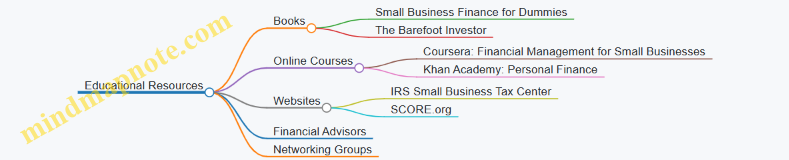
Example: Sarah completed a free online course on cash flow management and joined a local small business networking group to exchange financial tips.
Step 3: Implementing Financial Tools
To streamline her finances, Sarah adopted digital tools:
-
Accounting Software: QuickBooks Online for invoicing and expense tracking
-
Budgeting App: YNAB (You Need A Budget) for personal and business budgeting
-
Tax Software: TurboTax Self-Employed for tax filing
-
Mind Map: Financial Tools Implementation
Example: Using QuickBooks, Sarah automated monthly expense categorization, which saved her hours of manual work and improved accuracy.
Step 4: Regular Financial Review and Goal Setting
Sarah scheduled monthly financial reviews to track progress and adjust plans.
-
Reviewed profit & loss statements
-
Monitored cash flow forecasts
-
Set quarterly revenue and savings goals
-
Mind Map: Financial Review Process

Example: After noticing a dip in cash flow during winter months, Sarah planned a seasonal promotion to boost sales and adjusted her budget accordingly.
Step 5: Engaging Professional Help When Needed
Recognizing the limits of self-education, Sarah consulted professionals:
-
Accountant for tax optimization
-
Financial advisor for investment planning
-
Example: Sarah’s accountant helped her identify deductible business expenses she had overlooked, reducing her tax liability by 15%.
Step 6: Networking and Community Learning
Sarah joined local business groups and online forums to stay updated and share experiences.
-
Participated in monthly small business meetups
-
Joined online communities like Reddit’s r/smallbusiness and LinkedIn groups
-
Mind Map: Community Engagement
Example: Through a LinkedIn group, Sarah learned about a new government grant for small businesses, which she successfully applied for.
Step 7: Adapting and Growing Financial Knowledge Over Time
Sarah’s financial mastery is ongoing. She adapts to changes in tax laws, market conditions, and business growth.
-
Keeps up with financial news
-
Attends annual workshops
-
Revisits and revises financial goals
-
Example: When new tax incentives for small businesses were introduced, Sarah adjusted her investment strategy to take advantage.
Summary Mind Map: Sarah’s Path to Financial Mastery
Sarah’s example shows that financial mastery is a continuous process involving education, practical application, professional support, and community involvement. By following these steps, any small business owner can build confidence and competence in managing their finances effectively.