Agritech Systems Engineering For Sustainable And High Yield Farming
1. Introduction to Agritech Systems Engineering
1.1 Overview of Agritech and Its Role in Modern Farming
Agricultural Technology, commonly known as Agritech, refers to the use of technology innovations designed to improve the efficiency, output, and sustainability of agricultural practices. It encompasses a wide range of tools and systems including IoT devices, robotics, data analytics, biotechnology, and software platforms that collectively transform traditional farming into a data-driven, automated, and environmentally conscious industry.
Why Agritech Matters in Modern Farming
- Increasing Food Demand: With the global population projected to reach nearly 10 billion by 2050, Agritech plays a critical role in meeting the rising food demand through higher yields and efficient resource use.
- Resource Optimization: Modern farming faces challenges like water scarcity, soil degradation, and climate change. Agritech enables precise resource management to minimize waste and environmental impact.
- Labor Shortages: Automation and robotics help address labor shortages by performing repetitive or labor-intensive tasks.
- Data-Driven Decisions: Real-time data collection and analytics empower farmers to make informed decisions, improving crop health and yield.
Mind Map: Core Components of Agritech
Example: IoT-Enabled Smart Farm
Consider a mid-sized vegetable farm that integrates IoT sensors across its fields to monitor soil moisture, temperature, and nutrient levels. These sensors transmit data to a centralized platform where AI algorithms analyze the information and recommend precise irrigation schedules and fertilizer application rates. This approach reduces water usage by 30% and increases crop yield by 15%, demonstrating how Agritech can optimize resource use while boosting productivity.
Mind Map: Benefits of Agritech in Modern Farming
Example: Drone-Assisted Crop Monitoring
A large grain farm employs drones equipped with multispectral cameras to survey vast fields quickly. The drones capture images that reveal crop stress areas invisible to the naked eye. Farm engineers use this data to apply targeted treatments only where necessary, reducing herbicide and pesticide use by 25%. This practice exemplifies how Agritech supports sustainable farming by minimizing chemical inputs while maintaining high yields.
Summary
Agritech is revolutionizing modern farming by integrating advanced technologies that enhance productivity, sustainability, and operational efficiency. By leveraging precision agriculture, automation, data analytics, and sustainable practices, farmers can meet the challenges of a growing population and environmental constraints. This foundational understanding sets the stage for exploring systems engineering approaches that holistically design and implement these technologies for maximum impact.
1.2 Principles of Systems Engineering in Agriculture
Systems engineering is a holistic, interdisciplinary approach to designing, integrating, and managing complex systems throughout their life cycles. In agriculture, applying systems engineering principles enables the development of efficient, sustainable, and high-yield farming solutions by considering the farm as an interconnected system of components — crops, soil, water, machinery, data, and human resources.
Core Principles of Systems Engineering in Agriculture
- Holistic Thinking: Viewing the farm as an integrated system rather than isolated parts.
- Interdisciplinary Collaboration: Combining expertise from agronomy, engineering, data science, ecology, and economics.
- Lifecycle Approach: Considering all stages from design, implementation, operation, to decommissioning.
- Requirements Management: Defining clear objectives such as yield targets, sustainability goals, and resource constraints.
- Modeling and Simulation: Using digital models to predict system behavior and optimize performance.
- Feedback and Adaptation: Continuously monitoring and adjusting systems based on real-time data.
- Trade-off Analysis: Balancing competing objectives like cost, yield, and environmental impact.
Mind Map: Systems Engineering Principles in Agriculture
Example 1: Designing an Integrated Irrigation System
Scenario: A farm aims to optimize water use while maximizing crop yield.
Systems Engineering Application:
- Define requirements: reduce water consumption by 30%, maintain or increase yield.
- Model soil moisture dynamics and crop water needs.
- Integrate sensors (soil moisture, weather stations) with automated irrigation controllers.
- Use feedback loops to adjust irrigation schedules dynamically.
- Analyze trade-offs between water savings and potential yield changes.
Outcome: The system reduces water use by 35% and increases yield by 5% due to optimized watering schedules.
Example 2: Lifecycle Management of Farm Machinery
Scenario: Managing a fleet of tractors and harvesters to minimize downtime and costs.
Systems Engineering Application:
- Define lifecycle stages: procurement, operation, maintenance, decommissioning.
- Implement predictive maintenance using IoT sensors monitoring engine health.
- Schedule maintenance to minimize disruption during peak farming periods.
- Track total cost of ownership and performance metrics.
Outcome: Reduced unexpected breakdowns by 40%, improved machinery availability, and optimized maintenance costs.
Mind Map: Lifecycle Approach in Agricultural Systems
Summary
Applying systems engineering principles in agriculture fosters the design of resilient, efficient, and sustainable farming systems. By embracing holistic thinking, interdisciplinary collaboration, and continuous feedback, agritech developers and farm systems engineers can create solutions that meet both productivity and environmental goals.
1.3 Importance of Sustainability and High Yield Objectives
Sustainability and high yield objectives form the cornerstone of modern agritech systems engineering. Balancing these two goals ensures that agricultural production meets the growing global food demand while preserving natural resources and ecosystem health for future generations.
Why Sustainability Matters in Agriculture
- Environmental Preservation: Sustainable farming practices reduce soil degradation, conserve water, and minimize chemical runoff, protecting biodiversity and ecosystems.
- Resource Efficiency: Optimizing inputs like water, energy, and fertilizers reduces waste and operational costs.
- Climate Resilience: Sustainable systems improve farm resilience against climate variability and extreme weather events.
- Social Responsibility: Supporting rural communities and promoting fair labor practices enhances social sustainability.
Why High Yield is Critical
- Feeding a Growing Population: The UN projects the global population to reach nearly 10 billion by 2050, requiring increased food production.
- Economic Viability: Higher yields improve profitability for farmers and agribusinesses.
- Reducing Land Pressure: Increasing yield per hectare reduces the need to convert natural habitats into farmland.
Mind Map: Balancing Sustainability and High Yield Objectives
Integrating Sustainability with High Yield: Best Practices and Examples
-
Precision Nutrient Management
- Practice: Applying fertilizers based on real-time soil nutrient data.
- Example: A farm using IoT soil sensors adjusts nitrogen application dynamically, reducing excess fertilizer use by 30% while increasing crop yield by 15%.
-
Water-Smart Irrigation Systems
- Practice: Using drip irrigation combined with soil moisture sensors to optimize water use.
- Example: A vineyard implements sensor-driven drip irrigation, cutting water consumption by 40% and improving grape quality and yield.
-
Cover Cropping and Crop Rotation
- Practice: Planting cover crops and rotating crops to improve soil fertility and reduce pests.
- Example: A corn-soybean rotation with winter rye cover crops enhances soil organic matter, leading to a 10% yield increase and reduced need for chemical inputs.
-
Integrated Pest Management (IPM)
- Practice: Combining biological controls, monitoring, and targeted pesticide use.
- Example: A vegetable farm uses AI-powered pest detection to apply treatments only when necessary, reducing pesticide use by 50% without yield loss.
Mind Map: Example of Sustainable High Yield Farming System
Summary
Achieving sustainability alongside high yield is not only feasible but essential for the future of agriculture. Agritech systems engineering enables this balance by integrating technology, data, and best practices to optimize resource use, protect the environment, and maximize productivity. Embracing these objectives helps ensure food security while fostering resilient and responsible farming systems.
1.4 Case Study: Integrating Systems Engineering in a Mid-Sized Farm
In this case study, we explore how a mid-sized farm successfully integrated systems engineering principles to enhance sustainability and increase crop yield. The farm, “Green Valley Farms,” spans 150 hectares and cultivates a mix of grains, vegetables, and fruits. Prior to integration, the farm faced challenges such as inefficient resource use, inconsistent yields, and high operational costs.
Step 1: Defining Objectives and System Boundaries
The first step involved clearly defining the objectives: maximize yield, minimize environmental impact, and optimize resource use. The system boundaries were set to include soil management, irrigation, pest control, and harvesting processes.
Mind Map: Defining System Boundaries and Objectives
Step 2: Mapping Existing Processes
A detailed process map was created to understand current workflows and identify inefficiencies.
Mind Map: Existing Farm Processes
Step 3: Identifying Key Challenges
- Overwatering leading to water waste and soil erosion
- Inconsistent fertilizer application causing nutrient imbalances
- Pest outbreaks due to lack of early detection
- Labor-intensive harvesting causing delays
Step 4: Systems Engineering Solutions Implemented
-
IoT-Based Soil and Environmental Monitoring:
- Deployed soil moisture and nutrient sensors across fields.
- Real-time data allowed precise irrigation and fertilization.
-
Automated Irrigation System:
- Integrated sensor data with automated drip irrigation.
- Reduced water use by 30% while maintaining crop health.
-
Predictive Pest Management:
- Installed pest detection cameras and used AI algorithms.
- Early warnings enabled targeted pesticide application, reducing chemical use by 40%.
-
Harvest Scheduling Software:
- Implemented a farm management platform to optimize labor and harvesting times.
- Improved harvest efficiency and reduced crop loss.
Mind Map: Systems Engineering Solutions
Step 5: Results and Benefits
- Yield increased by 18% due to optimized resource application.
- Water consumption dropped by 30%, contributing to sustainability goals.
- Chemical pesticide use reduced by 40%, improving environmental health.
- Labor costs decreased by 15% with efficient scheduling.
Step 6: Lessons Learned and Best Practices
- Holistic Approach: Viewing the farm as an interconnected system enabled better decision-making.
- Data-Driven Decisions: Real-time monitoring provided actionable insights.
- Incremental Implementation: Phased deployment allowed adaptation and minimized disruptions.
- Stakeholder Engagement: Training farm workers on new technologies ensured smooth adoption.
Additional Example: Soil Moisture Sensor Deployment
A cluster of soil moisture sensors was installed in the tomato fields. Each sensor transmitted data every 30 minutes to a central hub. When moisture levels dropped below a threshold, the automated irrigation system activated only in that zone, preventing overwatering.
Mind Map: Soil Moisture Sensor Deployment Example
This targeted irrigation led to healthier plants, reduced water bills, and minimized runoff.
Summary
The integration of systems engineering at Green Valley Farms demonstrates how a structured, data-driven approach can transform traditional farming into a sustainable, high-yield operation. By combining technology with best practices, mid-sized farms can achieve significant improvements in productivity and environmental stewardship.
2. Designing Sustainable Agritech Systems
2.1 Defining Sustainability Metrics for Agritech Solutions
Sustainability metrics are essential indicators that help agritech developers, farm systems engineers, and agribusiness managers evaluate the environmental, economic, and social impacts of agricultural technologies. Defining clear, actionable sustainability metrics ensures that agritech solutions not only boost productivity but also preserve natural resources and promote long-term farm viability.
Why Sustainability Metrics Matter
- Measure Impact: Quantify how technologies affect resource use, emissions, and biodiversity.
- Guide Decision-Making: Inform design choices and operational adjustments.
- Benchmark Progress: Track improvements over time toward sustainability goals.
- Support Certification & Compliance: Align with standards like USDA Organic, GlobalGAP, or carbon footprint certifications.
Key Dimensions of Sustainability Metrics in Agritech
Environmental Metrics
-
Water Use Efficiency (WUE)
- Definition: Crop yield per unit of water used.
- Example: A drip irrigation system that delivers 20% less water but maintains yield improves WUE.
-
Energy Consumption
- Measures total energy used by agritech systems (kWh/ha).
- Example: Comparing solar-powered pumps vs. diesel-powered pumps.
-
Soil Health Indicators
- Metrics: Organic matter content, pH, nutrient levels.
- Example: Sensors tracking soil moisture and nutrient depletion to optimize fertilization.
-
Greenhouse Gas (GHG) Emissions
- CO2-equivalent emissions from farm operations.
- Example: Reduced emissions by adopting no-till farming supported by precision planting robots.
-
Biodiversity Impact
- Measures effects on pollinators, beneficial insects, and native flora.
- Example: Using AI-driven pest control robots to minimize pesticide use, protecting beneficial species.
Economic Metrics
-
Cost-Benefit Ratio
- Ratio of total costs to benefits gained from agritech adoption.
- Example: Investment in automated irrigation vs. water savings and yield increase.
-
Return on Investment (ROI)
- Percentage return relative to initial investment.
- Example: ROI calculation for deploying drone-based crop monitoring.
-
Yield Stability
- Variance in crop yield over multiple seasons.
- Example: Using predictive analytics to reduce yield variability.
-
Resource Use Efficiency
- Output per unit of input (fertilizer, water, energy).
- Example: Variable rate fertilization systems improving nutrient use efficiency.
Social Metrics
-
Labor Conditions
- Measures worker safety, hours, and satisfaction.
- Example: Robotics reducing hazardous manual tasks.
-
Community Impact
- Effects on local economy and social well-being.
- Example: Agritech solutions creating new skilled jobs locally.
-
Food Safety
- Incidence of contamination or pesticide residues.
- Example: Traceability platforms ensuring product safety.
-
Knowledge Transfer
- Rate of adoption and training effectiveness.
- Example: Mobile apps providing real-time guidance to farmers.
Integrated Example: Defining Metrics for a Smart Irrigation System
| Metric Category | Specific Metric | Measurement Method | Example Value/Goal |
|---|---|---|---|
| Environmental | Water Use Efficiency (WUE) | Crop yield / water volume used | Increase WUE by 15% over baseline |
| Environmental | Energy Consumption | kWh per hectare | Reduce energy use by 20% |
| Economic | ROI | (Gain from investment - Cost) / Cost | Achieve ROI > 25% within 2 years |
| Social | Labor Conditions | Worker hours saved | Reduce manual irrigation labor by 40% |
Best Practice: Establishing SMART Sustainability Metrics
- Specific: Clearly define what is measured (e.g., “reduce water use by 10%” rather than “use less water”).
- Measurable: Use quantifiable indicators and reliable data collection.
- Achievable: Set realistic targets based on baseline data.
- Relevant: Align metrics with farm goals and stakeholder priorities.
- Time-bound: Define deadlines for achieving targets.
Summary
Defining sustainability metrics is a foundational step in agritech systems engineering. By carefully selecting and monitoring environmental, economic, and social indicators, agritech solutions can be optimized to deliver high yields while preserving resources and supporting communities. Using mind maps and examples helps clarify complex relationships and guides practical implementation.
For further reading, explore how these metrics integrate with precision agriculture and automation in upcoming sections.
2.2 Selecting Renewable Energy Sources for Farm Operations
Sustainable farming increasingly depends on integrating renewable energy sources to reduce carbon footprints, lower operational costs, and improve energy resilience. Selecting the right renewable energy source for farm operations requires understanding the farm’s energy needs, local environmental conditions, and economic considerations.
Key Considerations When Selecting Renewable Energy Sources
- Energy Demand Profile: Assess daily and seasonal energy consumption patterns.
- Resource Availability: Evaluate local availability of solar, wind, biomass, or geothermal resources.
- Infrastructure and Space: Consider available land or rooftop space for installations.
- Budget and ROI: Analyze upfront costs, maintenance, and payback periods.
- Regulatory Environment: Understand incentives, subsidies, and permits.
Common Renewable Energy Sources for Farms
Solar Energy
- Description: Conversion of sunlight into electricity using photovoltaic (PV) panels.
- Best Practices:
- Install solar panels on rooftops or unused land.
- Use solar-powered water pumps for irrigation.
- Integrate battery storage for energy reliability.
- Example: A mid-sized dairy farm installed a 50 kW solar array on barn roofs, reducing electricity bills by 40% and powering automated milking systems.
Wind Energy
- Description: Harnessing wind via turbines to generate electricity.
- Best Practices:
- Conduct wind resource assessment before installation.
- Use small to medium-sized turbines suitable for farm scale.
- Combine with solar for hybrid systems.
- Example: A grain farm in the Midwest installed a 10 kW wind turbine, supplementing solar panels to power grain dryers and storage facilities.
Biomass Energy
- Description: Using organic farm waste (crop residues, manure) to produce biogas or biofuels.
- Best Practices:
- Implement anaerobic digesters to convert manure into biogas.
- Use biogas for heating greenhouses or generating electricity.
- Example: A pig farm uses an anaerobic digester to convert manure into biogas, which powers heating systems and reduces methane emissions.
Geothermal Energy
- Description: Utilizing earth’s stable underground temperatures for heating and cooling.
- Best Practices:
- Install geothermal heat pumps for greenhouse climate control.
- Assess geological suitability.
- Example: A hydroponic vegetable farm uses geothermal heat pumps to maintain optimal temperatures year-round, improving crop yields.
Mind Map: Factors Influencing Renewable Energy Selection
Mind Map: Solar Energy Implementation on Farms
Integrated Example: Hybrid Solar-Wind System for Crop Farm
A 100-acre crop farm in a region with moderate wind and high solar irradiance implemented a hybrid renewable energy system:
- Solar PV: 75 kW rooftop and ground-mounted panels powering irrigation pumps and lighting.
- Wind Turbine: 15 kW turbine supplementing energy during cloudy or low-sun periods.
- Energy Storage: Lithium-ion batteries storing excess energy for nighttime use.
- Outcome: 60% reduction in grid electricity consumption, improved energy reliability, and a 5-year ROI.
Best Practice Tips
- Conduct thorough site assessments including solar insolation and wind speed data collection.
- Start with pilot projects to validate system performance.
- Leverage government incentives and grants to reduce upfront costs.
- Combine multiple renewable sources to improve energy reliability.
- Incorporate energy-efficient equipment to reduce overall demand.
By carefully selecting and integrating renewable energy sources tailored to the farm’s unique conditions, agritech developers and farm systems engineers can drive sustainability while enhancing operational efficiency and yield.
2.3 Water Conservation Technologies and Practices
Water is a critical resource in agriculture, and efficient water management is essential for sustainable and high-yield farming. This section explores various water conservation technologies and best practices that agritech developers, farm systems engineers, and agribusiness managers can implement to optimize water use, reduce waste, and maintain crop health.
Key Water Conservation Technologies
-
Drip Irrigation Systems
- Deliver water directly to plant roots
- Minimize evaporation and runoff
- Example: A vineyard using drip irrigation reduced water use by 40% while increasing grape yield.
-
Soil Moisture Sensors
- Measure real-time soil moisture levels
- Enable precision irrigation scheduling
- Example: A vegetable farm integrated soil moisture sensors with automated irrigation, saving 30% water.
-
Rainwater Harvesting Systems
- Collect and store rainwater for irrigation
- Reduce dependence on groundwater and municipal water
- Example: A community farm installed rainwater tanks, supplying 50% of irrigation needs during dry seasons.
-
Smart Irrigation Controllers
- Use weather data and soil moisture to adjust watering
- Prevent over-irrigation
- Example: A greenhouse implemented smart controllers, reducing water consumption by 25%.
-
Mulching and Ground Cover Technologies
- Reduce soil evaporation
- Maintain soil moisture
- Example: Using biodegradable mulch films in strawberry fields improved water retention and crop quality.
Mind Map: Water Conservation Technologies
Best Practices for Implementing Water Conservation
-
Assess Water Needs Accurately
- Use soil and crop type data
- Monitor weather forecasts
- Example: A corn farm used evapotranspiration models to schedule irrigation, improving water use efficiency.
-
Integrate Multiple Technologies
- Combine sensors, smart controllers, and drip irrigation
- Create automated, responsive systems
- Example: A tomato farm integrated soil moisture sensors with drip irrigation and smart controllers, achieving 35% water savings.
-
Regular Maintenance and Calibration
- Check for leaks and blockages
- Calibrate sensors and controllers
- Example: A citrus orchard implemented quarterly system checks, preventing water loss and ensuring consistent irrigation.
-
Educate Farm Staff and Stakeholders
- Training on technology use
- Promote water-saving culture
- Example: An agribusiness manager organized workshops on water conservation, leading to improved adoption of best practices.
Mind Map: Best Practices in Water Conservation
Example Implementation: Smart Drip Irrigation System
Scenario: A mid-sized vegetable farm in a semi-arid region aimed to reduce water consumption without compromising yield.
Solution:
- Installed drip irrigation lines delivering water directly to roots.
- Deployed soil moisture sensors at different depths and locations.
- Connected sensors to a smart irrigation controller that adjusted watering schedules based on real-time data and weather forecasts.
- Applied mulch around plants to reduce evaporation.
Outcome:
- Water use reduced by 30% compared to previous seasons.
- Crop yields increased by 10% due to optimized watering.
- Labor costs decreased as irrigation was automated.
Summary
Water conservation in agritech systems engineering is a multi-faceted challenge that requires combining technology, data-driven decision making, and best practices. By leveraging drip irrigation, sensors, smart controllers, and sustainable farming practices, farms can achieve significant water savings while maintaining or improving crop yields. Continuous monitoring, maintenance, and education are key to sustaining these benefits over time.
2.4 Soil Health Monitoring and Management Systems
Maintaining healthy soil is fundamental to sustainable and high-yield farming. Soil health monitoring and management systems enable farmers and agritech professionals to assess, track, and improve soil conditions, ensuring optimal crop growth and environmental stewardship.
Importance of Soil Health Monitoring
- Ensures nutrient availability for crops
- Detects soil degradation early (e.g., erosion, compaction)
- Helps maintain soil biodiversity
- Supports water retention and reduces runoff
Key Soil Health Parameters to Monitor
- Soil pH
- Nutrient levels (N, P, K, micronutrients)
- Organic matter content
- Soil moisture
- Soil temperature
- Microbial activity
- Soil texture and structure
Mind Map: Soil Health Monitoring Components
Technologies and Practices for Soil Health Monitoring
Soil Sensors
- Example: Soil moisture and nutrient sensors like Teralytic probe or Sentek sensors provide real-time data on moisture, nitrogen, phosphorus, and potassium levels.
- Best Practice: Deploying a network of soil sensors across different field zones to capture spatial variability.
Remote Sensing and Imaging
- Satellite or drone-based multispectral imaging helps infer soil organic matter and moisture indirectly.
- Example: Using NDVI (Normalized Difference Vegetation Index) maps to identify areas with poor soil health affecting crop vigor.
Soil Sampling and Laboratory Analysis
- Traditional but essential for detailed chemical and biological soil profiles.
- Best Practice: Combining lab results with sensor data for comprehensive soil health assessment.
Data Integration Platforms
- Platforms like CropX or AgriWebb aggregate sensor, remote sensing, and lab data to provide actionable insights.
Mind Map: Soil Health Management Strategies
Examples of Soil Health Management Systems
Example 1: Precision Nutrient Management
- Using sensor data to apply variable rate fertilization only where nutrients are deficient.
- Outcome: Reduced fertilizer use by 20%, improved nutrient uptake efficiency, and minimized runoff.
Example 2: Integrating Cover Crops with Sensor Feedback
- Sensors detect declining organic matter and soil moisture.
- Cover crops like clover are planted to improve soil structure and nitrogen fixation.
- Result: Enhanced soil organic content and moisture retention, leading to better yields.
Example 3: Automated Soil Monitoring System in a Vineyard
- Soil probes measure moisture and temperature continuously.
- Data triggers irrigation only when moisture drops below threshold.
- Benefit: Water savings of 30% and healthier root systems.
Best Practices for Implementing Soil Health Monitoring Systems
- Start with Baseline Soil Testing: Establish initial soil conditions before deploying sensors.
- Use Multi-Source Data: Combine sensor, remote sensing, and lab data for accuracy.
- Spatially Distributed Sensors: Capture variability within fields for targeted management.
- Regular Calibration and Maintenance: Ensure sensors provide reliable data.
- Integrate with Farm Management Systems: Use software platforms for visualization and decision support.
- Train Farm Staff: Ensure proper interpretation and response to soil health data.
Summary
Soil health monitoring and management systems are critical tools in agritech systems engineering for sustainable and high-yield farming. By leveraging a combination of sensors, remote sensing, and traditional sampling, farmers can gain detailed insights into soil conditions. Coupled with adaptive management strategies such as precision fertilization, cover cropping, and smart irrigation, these systems help maintain soil vitality, optimize resource use, and improve crop productivity.
For agritech developers and farm systems engineers, designing integrated soil health monitoring solutions that are user-friendly, cost-effective, and scalable will be key to driving adoption and maximizing impact in sustainable agriculture.
2.5 Example: Solar-Powered Irrigation System with Soil Moisture Sensors
Overview
A solar-powered irrigation system integrated with soil moisture sensors exemplifies sustainable agritech design by optimizing water use, reducing energy costs, and enhancing crop yield. This system automatically irrigates crops based on real-time soil moisture data, powered entirely by renewable solar energy.
System Components
- Solar Panels: Capture sunlight and convert it into electrical energy.
- Battery Storage: Stores excess solar energy for nighttime or cloudy periods.
- Soil Moisture Sensors: Measure volumetric water content in the soil.
- Microcontroller/Controller Unit: Processes sensor data and controls irrigation valves.
- Water Pump and Irrigation Valves: Deliver water to crops when needed.
- Communication Module (optional): Enables remote monitoring and control via mobile or web app.
How It Works
- Data Collection: Soil moisture sensors continuously monitor moisture levels at various depths and locations.
- Data Processing: The microcontroller analyzes sensor data against predefined moisture thresholds.
- Decision Making: If moisture falls below the threshold, the controller activates the water pump and opens irrigation valves.
- Energy Supply: Solar panels provide power to the system; batteries ensure continuous operation.
- Feedback Loop: Once soil moisture reaches optimal levels, irrigation stops automatically.
Mind Map: Solar-Powered Irrigation System
Best Practices
- Sensor Placement: Distribute soil moisture sensors across different zones and depths to capture accurate moisture variability.
- Threshold Calibration: Set moisture thresholds based on crop type, soil texture, and growth stage.
- Energy Management: Size solar panels and battery capacity to meet peak irrigation demands and ensure reliability.
- Maintenance: Regularly clean solar panels and check sensor calibration for optimal performance.
- Data Logging: Implement data logging for trend analysis and system optimization.
Example Scenario
Farm: A 10-hectare vegetable farm in a semi-arid region.
Implementation:
- Installed 20 soil moisture sensors at 0-15 cm and 15-30 cm depths across the farm.
- Solar array sized at 5 kW with a 10 kWh battery bank.
- Microcontroller programmed with crop-specific moisture thresholds.
- Irrigation system connected to drip lines for precise water delivery.
Results:
- Water usage reduced by 35% compared to timer-based irrigation.
- Energy costs dropped by 80% due to solar power.
- Crop yield increased by 12% attributed to optimized watering.
Mind Map: Implementation Workflow
Additional Examples
-
Smallholder Farm: A 1-hectare farm uses a portable solar pump with two soil moisture sensors to irrigate high-value crops like tomatoes, reducing manual labor and water waste.
-
Greenhouse Integration: Solar-powered irrigation combined with humidity and temperature sensors to maintain optimal growing conditions inside a greenhouse.
-
Community Irrigation Project: Shared solar-powered irrigation system with multiple sensor nodes managed via a mobile app, enabling cooperative water management among farmers.
Summary
Integrating solar power with soil moisture sensing creates an efficient, sustainable irrigation system that conserves water, reduces energy costs, and supports high crop yields. By following best practices in design, installation, and maintenance, agritech developers and farm systems engineers can implement scalable solutions adaptable to various farm sizes and environments.
3. Precision Agriculture and Data-Driven Farming
3.1 Introduction to Precision Agriculture Technologies
Precision agriculture (PA) represents a transformative approach to farming that leverages advanced technologies to optimize crop production and resource management. By collecting and analyzing detailed data about soil, crops, weather, and equipment, PA enables farmers to make informed decisions that increase yield, reduce waste, and promote sustainability.
What is Precision Agriculture?
Precision agriculture is the practice of using technology to observe, measure, and respond to variability in crops and fields. It moves away from the traditional “one-size-fits-all” approach, tailoring inputs like water, fertilizers, and pesticides to specific zones within a farm.
Key Goals of Precision Agriculture:
- Maximize crop yield and quality
- Minimize input costs and environmental impact
- Enhance sustainability and resource efficiency
Mind Map: Core Components of Precision Agriculture
Technologies Enabling Precision Agriculture
-
Global Positioning System (GPS)
- Enables precise location tracking for equipment and field mapping.
- Example: A tractor equipped with GPS can follow exact paths to avoid overlapping fertilizer application.
-
Remote Sensing (Drones and Satellites)
- Captures high-resolution images to monitor crop health, detect pest infestations, or assess water stress.
- Example: A drone flying over a cornfield captures NDVI (Normalized Difference Vegetation Index) images to identify areas needing attention.
-
Soil and Crop Sensors
- Measure moisture, nutrient levels, pH, and temperature in real time.
- Example: Soil moisture sensors trigger automated irrigation only when necessary, conserving water.
-
Variable Rate Technology (VRT)
- Equipment that adjusts input application rates on-the-go based on data.
- Example: Fertilizer spreaders that apply more nutrients to nutrient-poor zones and less to fertile areas.
-
Farm Management Information Systems (FMIS)
- Software platforms that integrate data streams and provide actionable insights.
- Example: A mobile app that alerts the farmer about pest outbreaks detected via sensor data.
Example Use Case: Implementing Precision Agriculture in a Wheat Farm
- Problem: Uneven crop growth and excessive fertilizer use leading to high costs and environmental runoff.
- Solution: Deploy soil nutrient sensors and GPS-guided fertilizer spreaders.
- Process:
- Map the field’s nutrient variability using soil sensors.
- Use GIS software to create a nutrient application map.
- Equip fertilizer spreaders with VRT to apply nutrients variably.
- Outcome: 15% reduction in fertilizer use, 10% increase in yield, and improved soil health.
Benefits of Precision Agriculture
- Increased productivity through targeted interventions.
- Reduced environmental footprint by minimizing chemical runoff and water waste.
- Cost savings from optimized input usage.
- Enhanced ability to monitor and respond to crop health in near real-time.
Challenges to Consider
- Initial investment costs for technology acquisition.
- Need for training and technical expertise.
- Data management and integration complexities.
In summary, precision agriculture technologies form the backbone of modern sustainable farming practices. By embracing these tools, agritech developers, farm systems engineers, and agribusiness managers can collaboratively drive higher yields while preserving natural resources.
3.2 Implementing IoT Sensors for Real-Time Crop Monitoring
Real-time crop monitoring using IoT (Internet of Things) sensors is a transformative approach in modern agriculture. It enables precise, data-driven decisions that optimize resource use, improve crop health, and increase yields sustainably. This section explores the implementation of IoT sensors, their types, deployment strategies, data integration, and practical examples.
What Are IoT Sensors in Agriculture?
IoT sensors are interconnected devices that collect and transmit data from the farm environment to a central system for analysis. They monitor various parameters such as soil moisture, temperature, humidity, nutrient levels, and crop health indicators.
Key Components of IoT Sensor Systems for Crop Monitoring
- Sensors: Devices measuring environmental and crop-specific parameters.
- Connectivity: Wireless technologies like LoRaWAN, Zigbee, NB-IoT, or Wi-Fi.
- Data Platform: Cloud or edge computing systems for data aggregation and analysis.
- User Interface: Dashboards or mobile apps for real-time monitoring and alerts.
Mind Map: IoT Sensor Implementation Workflow
Best Practices for Sensor Deployment
-
Strategic Placement: Sensors should be placed in representative locations considering soil variability, crop type, and microclimates to ensure accurate data.
-
Calibration and Validation: Regular calibration against manual measurements ensures sensor accuracy.
-
Power Management: Use solar panels or low-power sensors to extend operational life.
-
Data Redundancy: Deploy multiple sensors to avoid data gaps and improve reliability.
-
Integration with Farm Management Systems: Ensure seamless data flow into existing farm software for holistic decision-making.
Example: Soil Moisture Sensor Network for Irrigation Optimization
A mid-sized vegetable farm installed a network of soil moisture sensors across different field zones. Using LoRaWAN connectivity, data was transmitted to a cloud platform where thresholds were set to trigger irrigation only when soil moisture dropped below optimal levels. This system reduced water usage by 30% while maintaining crop health.
Mind Map: Data Flow in IoT Crop Monitoring
Example: Multi-Parameter Sensor System for Vineyard Management
A vineyard implemented sensors measuring temperature, humidity, leaf wetness, and solar radiation. The data fed into a predictive model for disease risk assessment, enabling targeted fungicide application. This reduced chemical use by 25% and improved grape quality.
Challenges and Solutions
- Connectivity in Remote Areas: Use long-range low-power networks like LoRaWAN or satellite IoT.
- Data Overload: Implement edge computing to preprocess data and send only relevant information.
- Sensor Durability: Choose ruggedized sensors designed for harsh agricultural environments.
Summary
Implementing IoT sensors for real-time crop monitoring empowers farmers and agritech developers to make informed, timely decisions that enhance sustainability and yield. By carefully selecting sensors, ensuring robust connectivity, and integrating data into actionable insights, farms can optimize inputs, reduce waste, and improve crop health effectively.
3.3 Using Drones and Satellite Imaging for Field Analysis
Agricultural drones and satellite imaging have revolutionized field analysis by providing high-resolution, real-time data that enable precision farming and sustainable resource management. These technologies allow farmers and agritech engineers to monitor crop health, assess soil conditions, detect pest infestations, and optimize irrigation and fertilization strategies.
Key Benefits of Drones and Satellite Imaging in Field Analysis
- High-resolution imagery: Captures detailed views of crop fields beyond what is visible to the naked eye.
- Frequent monitoring: Enables regular data collection to track crop development and detect issues early.
- Cost-effective: Reduces the need for manual scouting and sampling.
- Scalable: Suitable for small farms to large agricultural enterprises.
Mind Map: Components of Drone and Satellite Field Analysis
Drone Imaging: Practical Applications and Examples
-
Crop Health Monitoring with NDVI
- Drones equipped with multispectral cameras capture images in near-infrared and visible light.
- NDVI (Normalized Difference Vegetation Index) maps highlight areas of crop stress.
- Example: A corn farm uses drone NDVI maps weekly to identify nutrient deficiencies early, enabling targeted fertilization that improved yield by 12%.
-
Pest and Disease Detection
- Thermal and multispectral imaging detect abnormal temperature and reflectance patterns.
- Early detection of fungal infections or pest infestations allows for precise pesticide application.
- Example: Vineyards use drones to detect powdery mildew outbreaks early, reducing fungicide use by 30%.
-
Irrigation Management
- Thermal sensors identify water-stressed zones by detecting canopy temperature variations.
- Enables variable rate irrigation, conserving water.
- Example: A vegetable farm implemented drone-based thermal imaging to optimize irrigation schedules, cutting water use by 25%.
Satellite Imaging: Practical Applications and Examples
-
Large-Scale Crop Monitoring
- Satellites provide regular, wide-area coverage ideal for regional crop assessment.
- Example: Agribusiness managers use Sentinel-2 satellite data to monitor wheat growth stages across thousands of hectares, facilitating logistics and market planning.
-
Soil Moisture and Weather Integration
- Satellites like SMAP provide soil moisture data integrated with weather forecasts.
- Example: A farm system engineer integrates satellite soil moisture data with IoT sensor data to refine irrigation automation.
-
Yield Prediction and Risk Assessment
- Historical satellite imagery combined with machine learning predicts yield and identifies risk zones.
- Example: An agritech developer builds a predictive model using satellite data to forecast soybean yields, improving supply chain decisions.
Mind Map: Workflow for Drone and Satellite Field Analysis
Best Practices
- Combine drone and satellite data: Use drones for high-resolution, localized insights and satellites for broader temporal and spatial coverage.
- Regular monitoring: Schedule frequent data collection to capture dynamic changes.
- Integrate with farm management systems: Streamline data flow for real-time decision-making.
- Train staff: Ensure operators understand sensor capabilities and data interpretation.
By leveraging drones and satellite imaging, agritech developers, farm systems engineers, and agribusiness managers can implement precise, data-driven interventions that enhance sustainability and maximize yields across diverse farming contexts.
3.4 Data Analytics and Machine Learning for Yield Prediction
Data analytics and machine learning (ML) have become indispensable tools in modern agritech, enabling farmers and agribusiness managers to predict crop yields with greater accuracy and optimize farming practices accordingly. Yield prediction helps in resource allocation, risk management, and improving overall farm profitability while supporting sustainability goals.
Understanding Yield Prediction
Yield prediction involves analyzing historical and real-time data to estimate the expected crop output for a given season or field. This process leverages various data sources such as weather patterns, soil conditions, crop health, irrigation levels, and farming practices.
Key Components of Data Analytics and ML in Yield Prediction
Mind Map: Components of Yield Prediction Using Data Analytics & ML
Example: Using Random Forest Regression for Corn Yield Prediction
A farm systems engineer collects multi-season data including soil nutrient levels, rainfall, temperature, and NDVI (Normalized Difference Vegetation Index) from drone imagery. After preprocessing the data, a Random Forest regression model is trained to predict corn yield per plot.
-
Data Inputs:
- Soil nitrogen content
- Cumulative rainfall during growing season
- Average temperature
- NDVI values at key growth stages
-
Process:
- Data cleaning and normalization
- Feature selection to identify most impactful variables
- Model training and validation using cross-validation
- Yield prediction for upcoming season
-
Outcome:
- Model achieves 85% accuracy in predicting yield
- Identifies that soil nitrogen and NDVI are the strongest predictors
- Provides actionable insights to optimize fertilization and irrigation
Workflow for Implementing Yield Prediction Models
Mind Map: Workflow for Yield Prediction Model Implementation
Best Practice: Combining Remote Sensing with Ground Data
Integrating satellite or drone imagery with ground sensor data enhances the accuracy of yield predictions. For example, NDVI and other vegetation indices derived from remote sensing provide spatial variability insights, while soil sensors offer localized nutrient and moisture data.
Example:
- A vineyard uses multispectral drone imagery weekly to monitor vine health.
- Soil moisture sensors provide real-time irrigation data.
- ML models combine these datasets to predict grape yield and optimize water use.
Challenges and Solutions
-
Challenge: Data heterogeneity and missing values
- Solution: Use robust data imputation techniques and feature engineering.
-
Challenge: Overfitting due to limited data
- Solution: Employ cross-validation and regularization methods.
-
Challenge: Model interpretability
- Solution: Use explainable ML models like decision trees or SHAP values to understand feature importance.
Summary
Data analytics and machine learning empower agritech developers and farm systems engineers to make informed decisions by accurately predicting crop yields. By combining diverse data sources, selecting appropriate models, and continuously refining predictions, farms can achieve higher productivity and sustainability.
For further reading, explore open-source ML libraries such as TensorFlow, Scikit-learn, and agricultural datasets from platforms like FAO and NASA Earthdata.
3.5 Best Practice: Automated Variable Rate Fertilization Based on Sensor Data
Automated Variable Rate Fertilization (VRF) is a cutting-edge agritech practice that optimizes fertilizer application by adjusting the amount and type of nutrients delivered to different parts of a field based on real-time sensor data. This approach enhances crop yield, reduces input costs, and minimizes environmental impact by preventing over-fertilization and nutrient runoff.
What is Variable Rate Fertilization?
Variable Rate Fertilization involves applying fertilizers at different rates across a field rather than a uniform application. This is guided by spatial variability in soil nutrient levels, crop health, moisture, and other factors.
How Automation Enhances VRF
Automation integrates sensor data, GPS mapping, and machinery control systems to dynamically adjust fertilizer application rates during field operations without manual intervention.
Mind Map: Components of Automated Variable Rate Fertilization
Step-by-Step Workflow
-
Data Collection: Deploy soil and crop sensors across the field to gather nutrient levels, moisture content, and crop vigor data.
-
Data Analysis: Use software platforms to analyze sensor inputs, often employing machine learning to predict nutrient requirements.
-
Prescription Map Creation: Generate a variable rate fertilization map that specifies fertilizer types and quantities for different zones.
-
Automated Application: Fertilizer spreaders equipped with GPS and variable rate controllers apply nutrients precisely according to the prescription map.
-
Monitoring & Feedback: Sensors and yield monitors collect data post-application to assess effectiveness and refine future prescriptions.
Example: Implementing Automated VRF on a Corn Farm
Scenario: A 200-acre corn farm experiences variable soil nitrogen levels due to past crop rotations and irrigation patterns.
- Sensors Used: Soil nitrate sensors placed in a grid pattern, drone-based NDVI imaging for crop health.
- Data Platform: Cloud-based analytics platform integrates sensor and drone data.
- Machinery: GPS-enabled fertilizer spreader with variable rate control.
Process:
- Soil sensors detect nitrogen deficiencies in the northwest section.
- NDVI images confirm stressed crops in the same area.
- The system generates a prescription map applying 30% more nitrogen fertilizer in deficient zones and 20% less in areas with sufficient nitrogen.
- The fertilizer spreader automatically adjusts application rates in real-time as it moves across the field.
Outcome:
- Increased yield by 12% compared to uniform fertilization.
- Reduced fertilizer use by 15%, lowering costs and environmental impact.
Mind Map: Benefits of Automated VRF
Best Practices for Successful Implementation
- Accurate Sensor Calibration: Regularly calibrate sensors to ensure reliable data.
- Comprehensive Field Mapping: Use high-resolution spatial data to capture variability.
- Integration of Multiple Data Sources: Combine soil, crop, and weather data for holistic analysis.
- Operator Training: Ensure farm operators understand system capabilities and limitations.
- Iterative Feedback Loops: Use post-application data to refine fertilization strategies continuously.
Additional Example: Smallholder Farm Adaptation
In regions with limited access to advanced machinery, farmers can use handheld soil nutrient sensors paired with mobile apps to create simple variable rate prescriptions. Fertilizer application can then be manually adjusted based on these maps, gradually moving towards automation as resources allow.
Automated Variable Rate Fertilization exemplifies how agritech systems engineering can harmonize sustainability and high yield goals by leveraging sensor data and automation to optimize nutrient management precisely and efficiently.
4. Automation and Robotics in Agritech Systems
4.1 Types of Agricultural Robots and Their Applications
Agricultural robots, often referred to as agribots, are transforming modern farming by automating labor-intensive tasks, improving precision, and enhancing sustainability. These robots come in various types, each designed for specific applications that contribute to increased efficiency and higher yields.
Mind Map: Types of Agricultural Robots
Autonomous Tractors
Application: These driverless tractors perform tasks such as plowing, tilling, and planting with high precision.
Example: The John Deere Autonomous Tractor uses GPS and sensor data to prepare fields without human intervention, reducing fuel consumption and soil compaction.
Best Practice: Integrate autonomous tractors with farm management software to schedule operations based on weather and soil conditions, optimizing resource use.
Harvesting Robots
Application: Robots designed to pick fruits and vegetables, often equipped with computer vision to identify ripe produce.
Example: The Agrobot E-Series strawberry harvester uses robotic arms and AI to pick strawberries gently, minimizing damage and labor costs.
Best Practice: Deploy harvesting robots during peak ripeness windows identified through data analytics to maximize yield quality.
Weeding Robots
Application: These robots remove weeds mechanically or apply herbicides precisely, reducing chemical use.
Example: The Ecorobotix weed control robot uses AI to detect weeds and apply micro-doses of herbicide only where needed.
Best Practice: Combine weeding robots with soil sensors to monitor weed growth patterns and schedule interventions efficiently.
Monitoring Robots
Application: Ground or aerial robots equipped with sensors to monitor crop health, soil moisture, and environmental conditions.
Example: The Tertill garden weeding robot also monitors soil moisture and can alert farmers to irrigation needs.
Best Practice: Use data from monitoring robots to create variable rate application maps for fertilizers and water.
Drone Systems
Application: Unmanned aerial vehicles (UAVs) for aerial imaging, crop spraying, and field mapping.
Example: DJI Agras drones perform targeted pesticide spraying, reducing chemical use and operator exposure.
Best Practice: Integrate drone data with GIS platforms to enable precise field management and early pest detection.
Sorting and Packing Robots
Application: Robots that automate post-harvest processes such as sorting fruits by size and quality, and packing.
Example: TOMRA’s optical sorting machines use advanced sensors to sort apples by color and size, ensuring consistent product quality.
Best Practice: Implement sorting robots to reduce manual labor and improve throughput while maintaining quality standards.
Summary
Agricultural robots span a wide range of applications, from field preparation to post-harvest processing. By adopting these technologies, farms can achieve higher efficiency, reduce environmental impact, and improve crop quality. Integrating these robots into a cohesive farm management system ensures that each robotic application complements others, driving sustainable and high-yield farming outcomes.
4.2 Designing Autonomous Systems for Planting and Harvesting
Designing autonomous systems for planting and harvesting is a critical component of modern agritech systems engineering. These systems aim to increase efficiency, reduce labor costs, and improve precision in farming operations, all while supporting sustainability and high yield goals.
Key Considerations in Designing Autonomous Planting and Harvesting Systems
-
System Requirements & Objectives
- Define crop types and planting/harvesting needs
- Determine field size and terrain complexity
- Establish sustainability goals (e.g., reduced fuel consumption, minimal soil compaction)
-
Hardware Components
- Autonomous vehicles (tractors, harvesters, drones)
- Sensors (GPS, LiDAR, cameras, soil moisture sensors)
- Actuators (seed dispensers, cutting tools, robotic arms)
-
Software & Control Systems
- Navigation and path planning algorithms
- Real-time obstacle detection and avoidance
- Task scheduling and coordination
- Data integration with farm management systems
-
Energy and Power Management
- Battery or hybrid power systems
- Solar or renewable energy integration
-
Safety and Compliance
- Emergency stop systems
- Compliance with agricultural machinery regulations
Mind Map: Designing Autonomous Systems for Planting and Harvesting
Example 1: Autonomous Tractor for Precision Planting
Scenario: A mid-sized farm growing corn and soybeans wants to automate planting to improve accuracy and reduce labor.
Solution:
- Equip a tractor with GPS-guided autonomous navigation.
- Install seed dispensers controlled by software that adjusts seeding rate based on soil data.
- Use LiDAR and cameras to detect obstacles and ensure safe operation.
- Integrate with farm management software to schedule planting based on weather forecasts.
Benefits:
- Precise seed placement improves germination rates.
- Reduced overlap and missed areas save seeds and increase yield.
- Labor costs decrease, and operator fatigue is eliminated.
Mind Map: Autonomous Tractor Planting System
Example 2: Robotic Harvester for Fruit Picking
Scenario: An orchard growing apples wants to reduce manual labor and improve picking efficiency.
Solution:
- Deploy a robotic harvester equipped with computer vision to identify ripe fruit.
- Use robotic arms with soft grippers to gently pick apples without damage.
- Autonomous navigation allows the robot to move between rows and avoid obstacles.
- Data collected on fruit yield and quality is fed back to the farm system for analysis.
Benefits:
- Continuous harvesting capability increases throughput.
- Reduced fruit damage improves market value.
- Labor shortages are mitigated.
Mind Map: Robotic Harvester System
Best Practices for Designing Autonomous Planting and Harvesting Systems
- Modular Design: Build systems with modular hardware and software components to allow easy upgrades and maintenance.
- Robust Sensor Fusion: Combine data from multiple sensors (GPS, LiDAR, cameras) for reliable environment perception.
- Adaptive Algorithms: Use machine learning to adapt to changing field conditions and crop variability.
- Energy Efficiency: Optimize power consumption and explore renewable energy sources to reduce carbon footprint.
- User-Friendly Interfaces: Design intuitive control and monitoring interfaces for farm operators.
- Safety First: Implement multiple fail-safes and emergency protocols.
Summary
Designing autonomous systems for planting and harvesting involves a holistic approach combining hardware, software, energy management, and safety considerations. By leveraging advanced sensors, robotics, and AI, these systems can significantly enhance farming productivity and sustainability. Real-world examples like autonomous tractors and robotic harvesters demonstrate how these technologies translate into tangible benefits for farmers.
4.3 Integration of Robotics with Farm Management Software
The integration of robotics with farm management software (FMS) is a transformative approach that enables seamless coordination between automated machinery and digital farm operations. This integration enhances decision-making, optimizes resource use, and improves overall farm productivity and sustainability.
Why Integrate Robotics with Farm Management Software?
- Centralized Control: Manage robotic operations alongside other farm activities from a single platform.
- Data Synchronization: Real-time data exchange between robots and software enables adaptive responses.
- Improved Efficiency: Automation combined with intelligent management reduces manual labor and errors.
- Scalability: Easily scale robotic deployments as farm size or complexity grows.
Key Components of Integration
Integration Architecture Example
- Robotic Units: Autonomous tractors equipped with GPS, cameras, and soil sensors.
- Farm Management Software: Cloud-based platform that schedules tasks, monitors field conditions, and analyzes yield data.
- Communication Layer: Secure wireless network enabling bidirectional data flow.
- Data Processing: Edge computing on robots for immediate decisions; cloud computing for long-term analytics.
Practical Example: Autonomous Tractor Integration
- Scenario: A farm uses autonomous tractors for planting and fertilizing.
- Integration: The FMS schedules planting based on weather forecasts and soil data.
- Operation: The tractor receives task instructions wirelessly, navigates fields autonomously, and collects sensor data.
- Feedback: Sensor data is sent back to the FMS to update field maps and adjust future operations.
Best Practices for Integration
- Standardized APIs: Use open standards to ensure compatibility between robots and FMS.
- Modular Software Design: Facilitate easy updates and addition of new robotic devices.
- Robust Communication Networks: Ensure reliable connectivity even in remote farm locations.
- Security Measures: Protect data integrity and prevent unauthorized access.
- User-Friendly Interfaces: Provide intuitive dashboards for operators to monitor and control robotic systems.
Additional Example: Drone Fleet Management
- Use Case: Drones perform crop scouting and spraying.
- Integration: Farm management software schedules drone flights, analyzes imagery, and directs targeted spraying.
- Outcome: Reduced chemical use and early pest detection.
Conclusion
Integrating robotics with farm management software creates a cohesive ecosystem where automated machinery and digital tools work in harmony. This synergy drives sustainable farming by optimizing inputs, reducing waste, and enabling data-driven decisions that lead to higher yields and environmental stewardship.
4.4 Energy Efficiency and Maintenance in Automated Systems
Energy efficiency and proactive maintenance are critical components in the design and operation of automated agritech systems. Optimizing energy consumption not only reduces operational costs but also supports sustainability goals by minimizing the carbon footprint of farming operations. Meanwhile, effective maintenance ensures system reliability, reduces downtime, and extends the lifespan of automated equipment.
Key Strategies for Energy Efficiency in Automated Agritech Systems
- Energy-Efficient Hardware Selection: Choosing motors, sensors, and controllers with low power consumption.
- Smart Power Management: Implementing sleep modes, variable speed drives, and power scaling based on workload.
- Renewable Energy Integration: Utilizing solar panels, wind turbines, or bioenergy to power automated systems.
- Energy Monitoring and Analytics: Using IoT sensors and software to track energy usage and identify inefficiencies.
- System Design Optimization: Designing workflows and automation sequences to minimize unnecessary movements and idle times.
Mind Map: Energy Efficiency Strategies
Maintenance Best Practices for Automated Systems
- Preventive Maintenance Scheduling: Regular inspections and servicing based on manufacturer guidelines and usage data.
- Condition-Based Maintenance: Using sensor data (vibration, temperature, performance metrics) to predict failures before they occur.
- Remote Monitoring and Diagnostics: Leveraging IoT connectivity to monitor system health in real-time and perform remote troubleshooting.
- Spare Parts Management: Maintaining an inventory of critical components to reduce repair time.
- Training and Documentation: Ensuring operators and technicians are well-trained and have access to clear maintenance manuals.
Mind Map: Maintenance Practices
Integrated Approach: Energy Efficiency & Maintenance
Combining energy efficiency with maintenance practices creates a feedback loop that enhances system performance:
- Energy monitoring data can indicate abnormal consumption, signaling potential maintenance needs.
- Well-maintained equipment operates more efficiently, reducing energy waste.
- Predictive maintenance can schedule servicing during low-demand periods, optimizing energy use.
Mind Map: Integrated Energy & Maintenance
Practical Examples
-
Solar-Powered Autonomous Irrigation System with Predictive Maintenance:
- Uses solar panels to power pumps and sensors.
- Energy sensors track consumption and identify inefficiencies.
- Vibration sensors on pumps detect wear and predict failures.
- Remote alerts notify technicians before breakdowns occur.
-
Robotic Weed Control with Variable Speed Drives:
- Implements variable speed motors to adjust movement speed based on terrain.
- Sleep mode activates when robots are idle, conserving battery.
- Maintenance logs are automatically updated through onboard diagnostics.
-
Greenhouse Climate Control Automation:
- Integrates energy-efficient HVAC systems powered partially by renewable energy.
- Sensors monitor system performance and energy use.
- Predictive maintenance schedules filter replacements based on usage patterns.
Summary
Focusing on energy efficiency and maintenance in automated agritech systems is essential for sustainable, cost-effective farming. By selecting efficient hardware, integrating renewable energy, and employing smart monitoring, farms can significantly reduce energy consumption. Coupled with preventive and predictive maintenance, these practices ensure high system reliability and longevity, ultimately supporting the goal of sustainable and high-yield farming.
4.5 Practical Example: Robotic Weed Control to Reduce Herbicide Use
Robotic weed control represents a transformative approach in sustainable farming by minimizing herbicide application, reducing environmental impact, and improving crop yields. This section explores the design, implementation, and benefits of robotic weed control systems, supported by practical examples and mind maps to clarify the concepts.
Overview of Robotic Weed Control
Robotic weed control systems use autonomous or semi-autonomous machines equipped with sensors, cameras, and AI algorithms to identify and remove weeds mechanically or with targeted herbicide application. This precision reduces chemical use and labor costs.
Key Components and Workflow
Mind Map: Robotic Weed Control System Components
Example Workflow: Autonomous Robotic Weed Control in a Cornfield
- Field Scanning: The robot traverses the field using GPS-guided navigation while continuously scanning crops with multispectral cameras.
- Weed Detection: AI models analyze images in real-time to differentiate weeds from crops based on shape, color, and spectral signatures.
- Targeted Action: Upon detection, the robot either mechanically removes the weed using a robotic arm or applies a micro-dose of herbicide precisely on the weed.
- Data Logging: All actions and field conditions are logged and uploaded to a farm management platform for monitoring and optimization.
Benefits of Robotic Weed Control
- Reduced Herbicide Use: Targeted application lowers chemical input by up to 90%, reducing environmental contamination.
- Labor Efficiency: Robots can operate continuously, reducing manual labor requirements.
- Improved Crop Health: Minimizing herbicide exposure protects beneficial insects and soil microbiota.
- Cost Savings: Lower chemical and labor costs improve overall farm profitability.
Case Study: Blue River Technology’s “See & Spray” System
- Technology: Uses computer vision and machine learning to identify and spray weeds individually.
- Impact: Farmers reported up to 90% reduction in herbicide use without yield loss.
- Integration: Compatible with existing farm equipment, enabling easy adoption.
Mind Map: Benefits and Challenges of Robotic Weed Control
Practical Tips for Implementation
- Start Small: Pilot robotic weed control on a section of the farm to evaluate performance.
- Data Collection: Use collected data to refine AI models for local weed species.
- Maintenance: Establish routine checks for sensors and actuators to ensure reliability.
- Integration: Combine robotic weed control with other precision agriculture tools for holistic farm management.
Future Directions
- Enhanced AI for multi-species weed identification.
- Swarm robotics for large-scale coordinated weed control.
- Integration with autonomous tractors and drones for multi-modal weed management.
Robotic weed control exemplifies how agritech systems engineering can drive sustainability and high yields by combining advanced technology with ecological stewardship. By adopting such systems, agribusiness managers and farm systems engineers can significantly reduce chemical inputs while maintaining or improving productivity.
5. Farm Systems Engineering for Resource Optimization
5.1 Systems Approach to Resource Allocation and Scheduling
Efficient resource allocation and scheduling are critical components in achieving sustainable and high-yield farming. A systems approach considers the farm as an interconnected network of resources, processes, and constraints, enabling optimized decision-making that balances productivity with sustainability.
Understanding the Systems Approach
The systems approach involves viewing the farm holistically, integrating inputs such as water, energy, labor, machinery, and nutrients, and managing their allocation dynamically based on real-time data and predictive analytics.
Key Benefits:
- Maximizes resource utilization
- Minimizes waste and environmental impact
- Improves operational efficiency
- Enhances adaptability to changing conditions
Mind Map: Systems Approach to Resource Allocation and Scheduling
Practical Example: Dynamic Irrigation Scheduling
A farm uses soil moisture sensors and weather forecasts integrated into a farm management system. Instead of fixed irrigation schedules, the system dynamically allocates water resources based on real-time soil moisture data and predicted rainfall.
- Before systems approach: Water applied uniformly every 3 days, leading to overwatering in some zones and underwatering in others.
- After systems approach: Irrigation is scheduled only when soil moisture falls below threshold, conserving water and improving crop health.
This approach reduces water consumption by 30% while maintaining or improving crop yield.
Mind Map: Dynamic Resource Scheduling Example
Best Practices for Resource Allocation and Scheduling
- Data Integration: Combine multiple data sources (soil, weather, equipment status) for informed decisions.
- Prioritization: Allocate resources based on crop growth stages and critical needs.
- Automation: Use automated scheduling tools to reduce human error and improve responsiveness.
- Feedback Loops: Continuously monitor outcomes and adjust schedules dynamically.
- Scenario Planning: Use simulation tools to test different allocation strategies before implementation.
Example: Labor and Machinery Scheduling Optimization
A large-scale farm integrates GPS tracking of machinery and labor availability into a centralized scheduling system. The system optimizes task assignments to minimize idle time and fuel consumption.
- Challenge: Overlapping tasks causing machinery conflicts and labor bottlenecks.
- Solution: The system creates optimized daily schedules, assigning machinery and labor to fields based on proximity, task urgency, and equipment maintenance schedules.
Result: 15% reduction in fuel use, 20% increase in labor productivity, and smoother operations.
Mind Map: Labor and Machinery Scheduling
Summary
Applying a systems approach to resource allocation and scheduling in agritech enables farms to operate more efficiently and sustainably. By leveraging data, automation, and integrated planning, farms can optimize the use of water, energy, labor, and machinery, leading to higher yields and reduced environmental impact.
5.2 Optimizing Water Use Through Smart Irrigation Networks
Efficient water management is critical for sustainable and high-yield farming, especially in regions facing water scarcity. Smart irrigation networks leverage technology and systems engineering principles to optimize water use, reduce waste, and improve crop health. This section explores best practices, technologies, and real-world examples to help agritech developers, farm systems engineers, and agribusiness managers implement effective smart irrigation solutions.
Key Components of Smart Irrigation Networks
- Sensors: Soil moisture, temperature, humidity, and weather sensors collect real-time data.
- Controllers: Automated systems that adjust irrigation schedules based on sensor inputs.
- Communication Networks: Wireless or wired systems to transmit data between sensors, controllers, and central management platforms.
- Data Analytics: Algorithms and machine learning models to optimize irrigation timing and volume.
- User Interfaces: Dashboards and mobile apps for monitoring and manual override.
Mind Map: Smart Irrigation Network Architecture
Best Practices for Optimizing Water Use
- Deploy Multi-Parameter Sensors: Combining soil moisture with weather data improves irrigation accuracy.
- Use Variable Rate Irrigation (VRI): Adjust water application rates based on spatial variability within fields.
- Implement Feedback Loops: Continuously monitor soil moisture post-irrigation to avoid overwatering.
- Leverage Weather Forecasting: Integrate local weather predictions to delay or advance irrigation schedules.
- Energy-Efficient Pumping: Coordinate irrigation timing with off-peak energy hours to reduce costs.
Example: Solar-Powered Smart Irrigation System with Soil Moisture Sensors
A mid-sized vegetable farm in California implemented a solar-powered irrigation system equipped with soil moisture sensors distributed across different zones. The system uses LoRaWAN communication to send sensor data to a cloud platform. Machine learning algorithms analyze moisture trends and forecast evapotranspiration, automatically adjusting irrigation valves via controllers. This approach reduced water use by 30% while increasing crop yield by 12% over two growing seasons.
Mind Map: Water Use Optimization Workflow
Integrating Smart Irrigation with Farm Management Systems
Smart irrigation networks should not operate in isolation. Integration with broader farm management information systems (FMIS) enables holistic resource management:
- Synchronize irrigation with fertilization schedules (fertigation).
- Coordinate irrigation with crop growth stages and phenology.
- Aggregate water use data for sustainability reporting and compliance.
Example: Variable Rate Irrigation in a Vineyard
A vineyard in Spain implemented a variable rate irrigation system using GPS-mapped soil moisture sensors. The system divided the vineyard into management zones, each receiving customized irrigation volumes. This precision approach conserved 25% water compared to uniform irrigation and improved grape quality by optimizing water stress levels.
Challenges and Solutions
| Challenge | Solution |
|---|---|
| Sensor Calibration Drift | Regular calibration and use of redundant sensors |
| Network Connectivity Issues | Use of low-power wide-area networks (LPWAN) |
| High Initial Investment | Phased implementation and ROI analysis |
| Data Overload and Complexity | Employ user-friendly dashboards and alerts |
Summary
Optimizing water use through smart irrigation networks is a cornerstone of sustainable farming. By combining sensor data, automated controls, and intelligent analytics, farms can significantly reduce water waste, lower operational costs, and boost crop yields. Implementing these systems requires thoughtful design, integration, and continuous monitoring to adapt to changing environmental conditions and farm needs.
5.3 Nutrient Management Systems for Balanced Fertilization
Effective nutrient management is a cornerstone of sustainable and high-yield farming. Balanced fertilization ensures crops receive the right nutrients in the right amounts at the right time, minimizing waste, reducing environmental impact, and maximizing productivity.
Understanding Nutrient Management Systems (NMS)
Nutrient Management Systems integrate data, technology, and agronomic principles to optimize fertilizer application. These systems consider soil nutrient status, crop nutrient requirements, environmental conditions, and fertilizer types.
Mind Map: Components of Nutrient Management Systems
Best Practice Example: Sensor-Based Variable Rate Fertilization
A mid-sized corn farm implemented a nutrient management system using soil nitrate sensors combined with GPS-guided variable rate fertilizer application equipment. The process included:
- Conducting initial soil tests to map nutrient variability across fields.
- Installing in-field nitrate sensors that provide real-time nitrogen levels.
- Using a decision support system that integrates sensor data with crop growth models.
- Applying nitrogen fertilizer variably across the field, targeting deficient zones.
Outcome: The farm reduced nitrogen fertilizer use by 25%, improved nitrogen use efficiency, and increased yield by 8% compared to uniform fertilization.
Mind Map: Workflow of Sensor-Based Nutrient Management
Example: Integrating Organic and Inorganic Fertilizers Using NMS
In a mixed vegetable farm, the agritech system was designed to balance organic compost application with inorganic fertilizers:
- Soil tests indicated phosphorus deficiency but adequate nitrogen.
- Organic compost was applied to improve soil structure and provide slow-release nutrients.
- Inorganic phosphorus-rich fertilizer was applied in targeted bands near root zones.
- A mobile app tracked fertilizer applications and crop responses.
This integrated approach improved soil health, reduced chemical fertilizer dependency by 30%, and maintained high yields.
Mind Map: Balanced Fertilization Strategy
Key Technologies Supporting Nutrient Management Systems
- Soil Nutrient Sensors: Measure nutrient levels in real-time to inform precise fertilization.
- Remote Sensing & Drones: Detect nutrient deficiencies via multispectral imaging.
- Decision Support Software: Use algorithms and crop models to recommend fertilizer rates.
- Variable Rate Technology (VRT): Machinery that applies fertilizers variably based on data inputs.
Summary
Nutrient Management Systems for balanced fertilization combine agronomic knowledge with cutting-edge technology to optimize nutrient use efficiency. By leveraging soil testing, sensor data, decision support tools, and precision application methods, farms can enhance sustainability and yield while reducing environmental impact.
5.4 Energy Management and Reduction Strategies
Effective energy management is a cornerstone of sustainable agritech systems engineering. By optimizing energy consumption, farms can reduce operational costs, minimize environmental impact, and improve overall system efficiency. This section explores key strategies for energy management and reduction, supported by practical examples and mind maps to aid understanding.
Key Concepts in Energy Management
- Energy Audit: Systematic analysis of energy use across farm operations.
- Energy Efficiency: Using technology and processes that consume less energy for the same output.
- Renewable Energy Integration: Incorporating solar, wind, or bioenergy to reduce reliance on fossil fuels.
- Demand Management: Shifting or reducing energy use during peak demand periods.
- Energy Storage: Using batteries or other systems to store energy for optimal use.
Mind Map: Core Components of Energy Management in Agritech
Strategy 1: Conducting Comprehensive Energy Audits
Best Practice: Begin with a detailed energy audit to identify where energy is consumed and where inefficiencies exist.
Example: A mid-sized vegetable farm installed smart meters on irrigation pumps, lighting, and processing equipment. The audit revealed that pumps were running longer than necessary due to manual scheduling. By automating irrigation based on soil moisture sensors, the farm reduced pump energy use by 30%.
Strategy 2: Implementing Energy-Efficient Equipment
Best Practice: Replace or retrofit equipment with energy-efficient alternatives.
Example: Switching from traditional incandescent lighting in greenhouses to LED grow lights not only reduced energy consumption by 50% but also improved plant growth due to optimized light spectra.
Mind Map: Energy-Efficient Technologies
Strategy 3: Integrating Renewable Energy Sources
Best Practice: Utilize on-site renewable energy generation to offset grid electricity use.
Example: A dairy farm installed a 50 kW solar photovoltaic (PV) system to power milking machines and refrigeration units. This reduced grid dependency by 40%, and excess energy was stored in batteries for nighttime use.
Strategy 4: Demand Management and Load Shifting
Best Practice: Schedule energy-intensive operations during off-peak hours to reduce costs and grid strain.
Example: A large-scale greenhouse shifted its heating and ventilation system operation to nighttime when electricity rates were lower, enabled by thermal storage systems that retained heat for daytime use.
Mind Map: Demand Management Techniques
Strategy 5: Energy Storage Solutions
Best Practice: Employ energy storage to balance supply and demand, especially when using intermittent renewables.
Example: A vertical farm integrated lithium-ion battery storage with its solar array, enabling continuous operation of LED lighting and climate control systems during cloudy days and nighttime.
Holistic Example: Integrated Energy Management on a Smart Farm
A precision agriculture farm combined multiple strategies:
- Conducted an energy audit identifying irrigation pumps and lighting as major consumers.
- Replaced pumps with VFD-equipped high-efficiency models.
- Installed a 100 kW solar PV system with battery storage.
- Automated irrigation scheduling based on sensor data to minimize pump runtime.
- Shifted greenhouse heating operations to off-peak hours using thermal storage.
Result: Achieved a 45% reduction in grid electricity consumption and a 35% drop in overall energy costs, while maintaining high crop yields.
Summary
Energy management and reduction in agritech systems require a multi-faceted approach combining audits, efficient technology, renewable integration, demand management, and storage. By applying these strategies, farms can enhance sustainability and profitability simultaneously.
5.5 Case Example: Integrated Resource Management in a Vertical Farm
Vertical farming represents a cutting-edge approach to sustainable agriculture, especially in urban environments where space is limited. Integrated resource management (IRM) in vertical farms ensures optimal use of water, energy, nutrients, and space to maximize yield while minimizing environmental impact.
Overview of Integrated Resource Management (IRM) in Vertical Farming
IRM is a holistic approach that coordinates multiple resource inputs and outputs to create a closed-loop, efficient system. In vertical farms, this involves managing:
- Water recycling and precision irrigation
- Energy-efficient lighting and climate control
- Nutrient delivery through hydroponic or aeroponic systems
- Waste reduction and reuse
Mind Map: Key Components of IRM in Vertical Farming
Example: Water Management System
In a vertical farm located in a metropolitan area, water scarcity is a concern. The farm implements a recirculating hydroponic system where water is continuously filtered and reused. Moisture sensors placed at plant root zones provide real-time data to an automated irrigation controller, ensuring plants receive precise amounts of water.
- Best Practice: Using moisture sensor data to trigger irrigation reduces water waste by up to 40% compared to timer-based systems.
Mind Map: Water Management Workflow
Example: Energy Optimization
The farm uses energy-efficient LED grow lights optimized for specific crop spectra, reducing electricity consumption. Solar panels installed on the rooftop provide renewable energy, supplemented by battery storage to maintain operations during peak demand or outages.
- Best Practice: Scheduling lighting cycles based on plant growth stages and natural daylight availability lowers energy costs while maintaining optimal photosynthesis.
Mind Map: Energy Management Strategy
Example: Nutrient Delivery and Monitoring
Nutrient solutions are prepared and delivered via automated dosing systems. Real-time sensors measure pH and electrical conductivity (EC) of the nutrient solution, allowing dynamic adjustments to maintain optimal nutrient balance.
- Best Practice: Automated nutrient adjustments based on sensor feedback improve crop growth rates and reduce fertilizer waste.
Mind Map: Nutrient Management Cycle
Waste Management and Environmental Control
Organic waste from plant trimmings is composted or processed into biochar to be reused as a soil amendment in other agricultural settings. Water runoff is filtered and treated for reuse. Environmental controls maintain optimal temperature, humidity, and CO2 levels using sensor-driven HVAC systems.
- Best Practice: Integrating environmental sensors with control systems enables adaptive responses to changing conditions, improving plant health and resource efficiency.
Summary
This case example illustrates how integrated resource management in vertical farming combines multiple technologies and best practices to create a sustainable, high-yield system. By leveraging sensor networks, automation, and renewable energy, vertical farms can optimize resource use, reduce waste, and increase productivity.
For agritech developers and farm systems engineers, designing such integrated systems requires a multidisciplinary approach, combining expertise in hardware, software, agronomy, and sustainability principles.
6. Sustainable Crop Management Practices Enabled by Technology
6.1 Crop Rotation and Intercropping Supported by Data Insights
Crop rotation and intercropping are time-tested agricultural practices that enhance soil health, reduce pest and disease cycles, and improve overall farm productivity. When combined with modern data insights and agritech systems engineering, these practices become more precise, efficient, and adaptive to changing environmental conditions.
Understanding Crop Rotation and Intercropping
- Crop Rotation: The practice of growing different types of crops sequentially on the same plot of land to improve soil fertility and break pest/disease cycles.
- Intercropping: The simultaneous cultivation of two or more crops in proximity, optimizing space and resource use while enhancing biodiversity.
Role of Data Insights in Enhancing These Practices
Data-driven agritech solutions enable farmers and engineers to design optimized crop rotation schedules and intercropping patterns by analyzing soil conditions, climate data, pest pressure, and crop compatibility.
Mind Map: Crop Rotation Supported by Data Insights
Mind Map: Intercropping Supported by Data Insights
Practical Examples
Example 1: Data-Driven Crop Rotation Plan on a Corn-Soybean Farm
A farm uses soil sensors and historical pest data to design a 3-year rotation:
- Year 1: Corn (heavy nitrogen user)
- Year 2: Soybean (nitrogen-fixing legume)
- Year 3: Wheat (deep-rooted cereal)
Using satellite imagery and weather forecasts, the farm management software adjusts planting dates and fertilizer application rates to optimize yield and soil health.
Example 2: Intercropping Maize and Beans with Sensor Feedback
An agritech developer implements an intercropping system where maize and climbing beans grow together. Soil moisture sensors and drone imagery monitor water use and plant health. AI algorithms suggest adjusting irrigation schedules and planting density to maximize resource use efficiency and reduce pest incidence.
Best Practices
- Leverage Multi-Source Data: Combine soil sensors, weather data, and remote sensing for comprehensive insights.
- Customize Crop Combinations: Use data analytics to identify crop pairs or sequences that complement each other nutritionally and ecologically.
- Implement Adaptive Management: Continuously monitor crop performance and environmental conditions to fine-tune rotation and intercropping strategies.
- Integrate Farmer Knowledge: Combine data insights with local farmer experience for practical and culturally appropriate solutions.
By integrating data insights into crop rotation and intercropping, agritech systems engineering empowers sustainable farming practices that boost yields, conserve resources, and promote long-term soil vitality.
6.2 Pest and Disease Management Using Predictive Models
Effective pest and disease management is critical for sustainable and high-yield farming. Predictive models leverage data analytics, machine learning, and environmental monitoring to forecast pest outbreaks and disease occurrences, enabling timely and precise interventions. This section explores how predictive models are designed, implemented, and integrated into agritech systems, with practical examples and mind maps to illustrate key concepts.
Understanding Predictive Models in Pest and Disease Management
Predictive models use historical data, real-time sensor inputs, weather patterns, and crop health indicators to estimate the likelihood of pest infestations or disease outbreaks. These models help farmers anticipate problems before they become severe, reducing crop losses and minimizing pesticide use.
Key Components of Predictive Pest and Disease Models
Mind Map: Components of Predictive Models
Example: Predictive Model for Late Blight in Potatoes
- Data Inputs: Historical late blight incidence, temperature, humidity, rainfall
- Model: Logistic regression combined with weather forecast data
- Output: Probability of late blight outbreak in next 7 days
- Action: Automated alerts sent to farmers recommending fungicide application only when risk exceeds threshold
This approach reduces unnecessary chemical use and improves timing for disease control.
Developing a Predictive Model Workflow
Mind Map: Workflow for Pest and Disease Predictive Modeling
Best Practice: AI-Based Pest Detection and Targeted Treatment
A farm system engineer designed a machine learning model using convolutional neural networks (CNN) to analyze leaf images captured by drones. The model identifies early signs of aphid infestation on soybean crops with 92% accuracy.
- Integration: The system sends geotagged alerts to farm managers.
- Action: Autonomous sprayers apply insecticide only to affected zones.
- Outcome: Reduced pesticide use by 40%, increased yield by 15%.
Challenges and Considerations
- Data Quality: Reliable and high-resolution data is essential.
- Model Generalization: Models trained in one region may not perform well elsewhere.
- Cost: Sensor deployment and data processing require investment.
- User Training: Farmers and agribusiness managers need training to interpret model outputs.
Summary
Predictive models for pest and disease management empower farmers with actionable insights, enabling proactive and sustainable crop protection. By combining environmental data, advanced analytics, and automation, agritech systems can significantly reduce losses and chemical inputs, supporting both sustainability and high yields.
6.3 Enhancing Biodiversity Through Technology-Assisted Planning
Biodiversity is a cornerstone of sustainable agriculture, supporting ecosystem resilience, pest control, pollination, and soil health. Technology-assisted planning empowers agribusiness managers, agritech developers, and farm systems engineers to design farming systems that actively promote biodiversity while maintaining high yields.
The Role of Technology in Enhancing Biodiversity
- Data-Driven Habitat Mapping: Using GIS (Geographic Information Systems) and remote sensing to identify and map natural habitats, wildlife corridors, and biodiversity hotspots within and around farm landscapes.
- Precision Zoning: Defining zones for conservation, buffer strips, and crop production based on ecological data.
- Monitoring Biodiversity Indicators: Deploying IoT sensors, camera traps, and acoustic sensors to monitor species presence and activity.
- Decision Support Systems (DSS): Integrating biodiversity data with farm management software to optimize land use planning.
Mind Map: Technology-Assisted Biodiversity Planning
Example 1: GIS-Guided Wildflower Buffer Strips
A farm system engineer uses GIS to analyze field boundaries and identifies areas with low crop productivity but high potential for supporting pollinators. By planting wildflower strips in these zones, the farm enhances pollinator biodiversity, which in turn improves crop yields through better pollination. The system continuously monitors these strips with IoT sensors measuring soil moisture and plant health to ensure sustainability.
Example 2: Creating Pollinator Pathways Using Sensor Networks
Agritech developers deploy a network of acoustic sensors and camera traps to monitor native bee populations and other pollinators across a large farm. Data analytics identify key corridors where pollinator activity is highest. Farm managers then design planting schedules and crop layouts to maintain continuous flowering plants along these corridors, supporting pollinator movement and diversity.
Example 3: AI-Driven Pest-Predator Balance
Using machine learning models trained on sensor data and field observations, a farm management system predicts pest outbreaks and identifies natural predator populations. This enables targeted interventions that conserve beneficial insects, reducing pesticide use and promoting a balanced ecosystem.
Best Practices for Technology-Assisted Biodiversity Planning
- Integrate Multisource Data: Combine satellite imagery, sensor data, and field surveys for comprehensive biodiversity assessments.
- Engage Stakeholders: Collaborate with ecologists, local communities, and agronomists to validate technology outputs.
- Adopt Adaptive Management: Use feedback loops from monitoring data to adjust biodiversity enhancement strategies dynamically.
- Promote Landscape Connectivity: Design farm layouts that connect natural habitats to support wildlife movement.
By leveraging technology-assisted planning, farms can create multifunctional landscapes that support biodiversity, improve ecosystem services, and sustain high agricultural productivity.
6.4 Example: AI-Based Pest Detection and Targeted Treatment
Artificial Intelligence (AI) has revolutionized pest management by enabling early detection and precise treatment, minimizing crop damage and reducing chemical usage. This section explores how AI-based systems work, their components, and practical examples demonstrating their impact on sustainable and high-yield farming.
How AI-Based Pest Detection Works
AI pest detection systems typically combine image recognition, sensor data, and machine learning algorithms to identify pest presence and severity in real-time.
- Data Collection: Cameras, drones, and IoT sensors capture images and environmental data.
- Image Processing: AI models analyze images to detect pests or pest damage.
- Decision Making: Algorithms assess infestation levels and recommend targeted treatments.
- Action: Automated sprayers or farm managers apply precise pesticide doses only where needed.
Mind Map: Components of AI-Based Pest Detection System
Example 1: Tomato Crop Pest Detection Using Drone Imagery
A tomato farm integrates drone-based imaging with AI to detect early signs of whitefly infestation:
- Implementation: Drones fly over fields capturing high-resolution images.
- AI Analysis: A convolutional neural network (CNN) model identifies whitefly clusters on leaves.
- Outcome: The system alerts farm managers to affected zones.
- Treatment: Targeted spraying is applied only to infested areas, reducing pesticide use by 40%.
This approach not only improves yield by preventing widespread infestation but also supports sustainability by minimizing chemical runoff.
Mind Map: Drone-Based Pest Detection Workflow
Example 2: AI-Powered Mobile App for Smallholder Farmers
Smallholder farmers often lack access to advanced machinery. An AI-powered mobile app offers an accessible solution:
- Functionality: Farmers take photos of suspicious pests or damaged crops.
- AI Model: The app uses a trained model to identify pests such as aphids, caterpillars, or fungal infections.
- Recommendations: Provides treatment advice, including organic options.
- Community Feature: Aggregates data to identify regional pest outbreaks.
This democratizes pest management knowledge, enabling timely and precise interventions even in resource-limited settings.
Mind Map: AI Mobile App for Pest Detection
Best Practices for Implementing AI-Based Pest Detection and Treatment
- High-Quality Data Collection: Ensure images and sensor data are clear and representative.
- Model Training and Validation: Use diverse datasets to improve accuracy across pest species and crop types.
- Integration with Farm Management Systems: Connect AI insights with existing software for seamless decision-making.
- User Training: Educate farm staff on interpreting AI alerts and executing targeted treatments.
- Continuous Monitoring and Model Updates: Regularly update AI models with new data to adapt to evolving pest patterns.
Summary
AI-based pest detection and targeted treatment exemplify how agritech systems engineering can enhance sustainability and yield. By leveraging advanced technologies such as drones, IoT, and machine learning, farms can reduce chemical inputs, lower costs, and protect crop health more effectively. These systems empower both large-scale operations and smallholder farmers, fostering resilient agricultural ecosystems.
7. Software Systems and Platforms for Agritech Integration
7.1 Farm Management Information Systems (FMIS) Overview
Farm Management Information Systems (FMIS) are comprehensive software platforms designed to support farmers, agribusiness managers, and farm systems engineers in planning, monitoring, and analyzing all aspects of farm operations. FMIS integrates data from various sources—such as sensors, machinery, weather stations, and market prices—to enable informed decision-making that enhances productivity, sustainability, and profitability.
What is FMIS?
FMIS acts as the digital backbone of modern farming enterprises, providing tools to manage resources, track activities, and analyze outcomes in a centralized platform. These systems help streamline workflows, reduce manual errors, and optimize inputs like water, fertilizers, and labor.
Key Components of FMIS
Benefits of Using FMIS
- Improved Resource Efficiency: By monitoring inputs and outputs, FMIS helps reduce waste and optimize resource use.
- Enhanced Traceability: Detailed records support compliance with regulations and certification schemes.
- Data-Driven Decisions: Real-time insights enable proactive management of crops and livestock.
- Financial Management: Track expenses, revenues, and profitability to improve business sustainability.
Example: Implementing FMIS on a Mixed Crop Farm
A mid-sized farm growing corn, soybeans, and vegetables implemented an FMIS platform integrating soil moisture sensors, drone imagery, and weather forecasts. The system automatically generated irrigation schedules based on soil data and predicted rainfall, reducing water use by 20%. Additionally, the farm used FMIS to track fertilizer application rates, adjusting inputs to avoid over-fertilization and improve crop health.
Mind Map: FMIS Functionalities
Best Practice: Modular and Scalable FMIS Deployment
Start with core modules such as crop and resource management, then gradually integrate advanced features like predictive analytics and automated machinery control. This approach allows farms to adapt the system to their specific needs and scale as their operations grow.
Example: Mobile FMIS Application for Smallholder Farmers
A cooperative of smallholder farmers adopted a mobile FMIS app that enabled them to record planting dates, input usage, and harvest yields directly from their smartphones. The app provided localized weather alerts and pest outbreak warnings, empowering farmers to make timely decisions and improve yields collectively.
In summary, FMIS is a critical tool in agritech systems engineering, enabling sustainable and high-yield farming through integrated data management and decision support. By leveraging FMIS, agribusiness managers and farm systems engineers can optimize farm operations, improve sustainability metrics, and enhance overall productivity.
7.2 Cloud-Based Data Platforms and Their Benefits
Cloud-based data platforms have revolutionized the way agricultural data is collected, stored, processed, and analyzed. By leveraging cloud infrastructure, agritech systems can achieve scalability, accessibility, and real-time insights that are critical for sustainable and high yield farming.
What Are Cloud-Based Data Platforms?
Cloud-based data platforms are centralized systems hosted on remote servers that provide storage, computing power, and analytics capabilities accessible via the internet. They enable farmers, agritech developers, and farm systems engineers to manage vast amounts of data from IoT sensors, drones, weather stations, and other sources without the need for on-premises hardware.
Key Benefits of Cloud-Based Data Platforms in Agritech
- Scalability: Easily scale storage and computing resources up or down based on farm size and data volume.
- Accessibility: Access data and analytics from anywhere, anytime, on multiple devices.
- Cost Efficiency: Reduce capital expenditure on physical infrastructure; pay-as-you-go pricing models.
- Data Integration: Combine data from multiple sources (soil sensors, weather data, machinery telemetry) into a unified platform.
- Real-Time Analytics: Process and analyze data in near real-time to enable timely decision-making.
- Collaboration: Share data and insights across teams, agribusiness managers, and external consultants.
- Security and Backup: Benefit from enterprise-grade security protocols and automated backups.
Mind Map: Benefits of Cloud-Based Data Platforms
Example: Cloud-Based Platform for Smart Irrigation Management
A mid-sized farm integrates soil moisture sensors, weather forecast data, and irrigation controllers connected to a cloud platform. The platform collects sensor data continuously and analyzes it alongside weather predictions to optimize irrigation schedules.
-
How it works:
- Soil moisture sensors send data every 15 minutes to the cloud.
- The platform processes data to detect dry zones.
- Weather forecast API integration predicts upcoming rainfall.
- The system automatically adjusts irrigation timing and volume.
- Farm managers access dashboards remotely to monitor system status.
-
Benefits realized:
- Water usage reduced by 30%.
- Crop yield improved due to optimal watering.
- Reduced labor costs with automated control.
Mind Map: Smart Irrigation Cloud Platform Workflow
Example: Cloud Platform Supporting Crop Health Monitoring
An agribusiness manager uses a cloud platform that integrates drone imagery, satellite data, and IoT sensor inputs to monitor crop health across multiple fields.
-
Features:
- High-resolution NDVI (Normalized Difference Vegetation Index) maps generated from drone and satellite images.
- Soil nutrient data uploaded from field sensors.
- AI-powered anomaly detection flags areas with potential pest infestations or nutrient deficiencies.
- Historical data stored for trend analysis and forecasting.
-
Benefits:
- Early detection of crop stress reduces losses.
- Data-driven fertilization plans improve sustainability.
- Remote monitoring reduces the need for frequent field visits.
Mind Map: Crop Health Monitoring Cloud Platform
Best Practices for Implementing Cloud-Based Data Platforms
- Choose Scalable and Flexible Providers: Select cloud services that can grow with your farm’s data needs (e.g., AWS, Azure, Google Cloud).
- Ensure Data Interoperability: Use platforms supporting open standards and APIs to integrate diverse data sources.
- Prioritize Data Security: Implement encryption, role-based access controls, and regular audits.
- Enable User-Friendly Interfaces: Design dashboards and mobile apps that are intuitive for agribusiness managers and field workers.
- Leverage Edge Computing: For latency-sensitive operations, combine cloud with edge devices to preprocess data locally.
- Train Staff: Provide training to ensure effective use of cloud tools and data interpretation.
Cloud-based data platforms are foundational to modern agritech systems engineering, enabling farms to harness the power of data for sustainable and high yield outcomes. By integrating diverse data streams and providing actionable insights, these platforms empower agritech developers, farm systems engineers, and agribusiness managers to make smarter, more efficient decisions.
7.3 Interoperability Standards and API Integration
Interoperability and seamless integration are fundamental to building effective agritech systems that can communicate, share data, and work cohesively across diverse platforms and devices. This section explores key interoperability standards, API integration strategies, and practical examples to help agritech developers, farm systems engineers, and agribusiness managers design scalable, flexible, and future-proof solutions.
Understanding Interoperability in Agritech
Interoperability refers to the ability of different systems, devices, and applications to exchange, interpret, and use data cohesively. In agritech, this means sensors, drones, farm management software, weather stations, and other components can work together without manual intervention or data silos.
Key Benefits:
- Enhanced data accuracy and timeliness
- Reduced operational complexity
- Improved decision-making through integrated insights
- Scalability and flexibility for future technology adoption
Common Interoperability Standards in Agriculture
| Standard Name | Description | Use Case Example |
|---|---|---|
| AgGateway ADAPT | A data exchange framework enabling seamless communication between ag systems | Exchange of planting and harvesting data between machinery and FMIS |
| ISOXML | Standard for agricultural machinery data exchange | Transfer of machine operation data from tractors to cloud platforms |
| OGC SensorThings API | Open standard for IoT sensor data interoperability | Real-time soil moisture sensor data integration with irrigation control systems |
| Crop Ontology | Standardized vocabulary for crop traits and phenotypes | Harmonizing crop trait data across research and farm management tools |
| APIs based on REST/GraphQL | Widely used web standards for data access and manipulation | Integration of weather forecast APIs with farm management apps |
Mind Map: Interoperability Standards Overview
API Integration Strategies
-
RESTful APIs
- Most common approach using HTTP methods (GET, POST, PUT, DELETE).
- Easy to implement and widely supported.
- Example: A soil sensor exposes a REST API to provide moisture data which a farm management app queries every hour.
-
GraphQL APIs
- Allows clients to request exactly the data they need.
- Reduces over-fetching and under-fetching of data.
- Example: An agribusiness dashboard queries specific crop health metrics from multiple data sources in a single request.
-
Message Brokers and Event-Driven APIs
- Use of MQTT, Kafka, or AMQP for real-time data streaming.
- Suitable for IoT devices and time-sensitive operations.
- Example: Drones publish pest detection events to a message broker that triggers automated pesticide application.
-
Middleware and API Gateways
- Centralized platform to manage, secure, and orchestrate APIs.
- Handles protocol translation, authentication, and rate limiting.
- Example: An API gateway aggregates data from weather services, soil sensors, and machinery APIs for unified access.
Mind Map: API Integration Approaches
Practical Examples
Example 1: Integrating Soil Moisture Sensors with Irrigation Systems
- Sensors use OGC SensorThings API to publish moisture levels.
- Farm management software queries sensor data via REST API.
- Irrigation controllers receive commands through an API gateway to adjust water flow.
Example 2: Combining Weather Data with Crop Management Platforms
- Weather service provides REST API access to forecasts.
- Crop management platform integrates this data using GraphQL to fetch only relevant parameters.
- Alerts are generated for frost risk, triggering protective measures.
Example 3: Machinery Data Exchange Using ISOXML
- Tractors export operational data in ISOXML format.
- Data ingested into cloud-based analytics platform.
- Insights used to optimize machine scheduling and maintenance.
Best Practices for Interoperability and API Integration
- Adopt Open Standards: Prefer widely accepted standards like OGC SensorThings and ISOXML to ensure compatibility.
- Design for Scalability: Use API gateways and middleware to manage increasing data volume and device diversity.
- Ensure Security: Implement authentication, encryption, and access control to protect sensitive farm data.
- Document APIs Thoroughly: Clear documentation accelerates integration and reduces errors.
- Test for Compatibility: Regularly validate data exchange between different systems and update integration layers as needed.
By leveraging interoperability standards and robust API integration, agritech systems can unlock their full potential—enabling smarter, more sustainable, and higher-yield farming operations.
7.4 User Interface Design for Agritech Applications
Designing effective user interfaces (UI) for agritech applications is crucial to ensure that farm systems engineers, agritech developers, and agribusiness managers can easily interact with complex data and control systems. A well-crafted UI enhances usability, reduces errors, and accelerates decision-making, ultimately contributing to sustainable and high-yield farming.
Key Principles of Agritech UI Design
- Simplicity: Interfaces should be intuitive and avoid overwhelming users with excessive information.
- Responsiveness: The UI must work seamlessly across devices, including smartphones, tablets, and desktops.
- Contextual Information: Display relevant data based on user roles and current tasks.
- Accessibility: Consider color-blind friendly palettes, readable fonts, and easy navigation.
- Real-Time Feedback: Provide instant updates from sensors, alerts, and system status.
Mind Map: Core Elements of Agritech UI Design
Designing Role-Based Dashboards
Agritech applications serve diverse users with different needs:
- Agritech Developers: Require access to system diagnostics, API integrations, and data logs.
- Farm Systems Engineers: Need real-time sensor data, control panels for irrigation, fertilization, and machinery.
- Agribusiness Managers: Focus on high-level KPIs, yield forecasts, and financial analytics.
Example:
A farm management app might offer three dashboard modes:
- Developer Mode: Detailed system health and error logs.
- Engineer Mode: Interactive maps showing sensor locations, irrigation schedules.
- Manager Mode: Summary charts of crop health, market prices, and sustainability metrics.
Mind Map: Dashboard Customization Features
Data Visualization Techniques
Visualizing complex agricultural data helps users quickly interpret information:
- Graphs and Charts: Line charts for growth trends, bar charts for yield comparisons.
- Heatmaps: Soil moisture or nutrient levels across fields.
- Geospatial Maps: GPS-tagged data for crop monitoring.
- Alerts: Color-coded warnings for pest outbreaks or equipment failures.
Example:
An IoT-based soil monitoring system uses a heatmap overlay on a field map, showing moisture gradients in real-time. Clicking on a hotspot opens sensor details and irrigation recommendations.
Mind Map: Data Visualization Components
Interaction Design
Agritech UIs must support diverse interaction methods:
- Touch & Gesture: For field workers using tablets or smartphones.
- Voice Commands: Hands-free operation during manual tasks.
- Drag-and-Drop: For configuring dashboards or scheduling tasks.
Example:
A mobile app allows farm engineers to swipe between sensor data screens and tap to activate irrigation zones. Voice commands enable starting or stopping machinery remotely.
Accessibility Considerations
- Use high-contrast color schemes for outdoor visibility.
- Provide adjustable font sizes for readability.
- Ensure UI elements are large enough for easy touch interaction.
- Support multiple languages for diverse user bases.
Example:
An agribusiness management platform includes a “High Contrast Mode” and supports English, Spanish, and French to accommodate international teams.
Example: Mobile App UI for Real-Time Farm Monitoring
- Home Screen: Overview of key metrics (soil moisture, temperature, crop health index).
- Map View: Interactive field map with sensor locations and status indicators.
- Alerts Panel: List of active warnings with severity levels.
- Control Panel: Buttons to start/stop irrigation, adjust fertilizer application.
- Settings: User preferences, notification rules, and data export options.
This app uses a clean layout with color-coded icons and simple navigation tabs, enabling quick access to critical information even under field conditions.
Summary
User interface design in agritech applications is a multidisciplinary challenge that combines systems engineering, human factors, and domain expertise. By focusing on simplicity, role-based customization, effective data visualization, and accessibility, developers can create tools that empower users to achieve sustainable and high-yield farming outcomes.
7.5 Example: Implementing a Mobile App for Real-Time Farm Monitoring
In today’s agritech landscape, mobile applications play a pivotal role in providing farmers and agribusiness managers with real-time insights to optimize farm operations, enhance sustainability, and increase yields. This section explores a comprehensive example of designing and implementing a mobile app tailored for real-time farm monitoring.
Key Features of a Real-Time Farm Monitoring Mobile App
- Sensor Data Integration: Collects real-time data from IoT devices such as soil moisture sensors, weather stations, and nutrient monitors.
- Field Mapping and Visualization: Interactive maps displaying crop health, moisture levels, and other critical parameters.
- Alerts and Notifications: Push notifications for irrigation needs, pest outbreaks, or equipment malfunctions.
- Data Analytics Dashboard: Summarizes trends, historical data, and predictive insights.
- User Management: Role-based access for farm managers, agronomists, and workers.
- Offline Mode: Enables data access and entry in areas with limited connectivity.
Mind Map: Core Components of the Mobile App
Step-by-Step Implementation Example
-
Requirement Gathering:
- Engage with stakeholders (farmers, engineers, managers) to identify critical monitoring needs.
- Example: Farmer needs alerts when soil moisture drops below 20%.
-
Sensor Network Setup:
- Deploy IoT sensors across fields to monitor soil moisture, temperature, and nutrient levels.
- Example: Use LoRaWAN-enabled soil sensors for long-range, low-power communication.
-
Backend Development:
- Build a cloud-based platform to collect, store, and process sensor data.
- Example: Use AWS IoT Core and DynamoDB for scalable data ingestion and storage.
-
Mobile App Development:
- Develop cross-platform app (iOS and Android) using frameworks like React Native or Flutter.
- Implement real-time data visualization and alert features.
-
Integration and Testing:
- Connect mobile app with backend APIs.
- Test real-time updates, offline functionality, and notification delivery.
-
Deployment and Training:
- Deploy app to farm staff devices.
- Conduct training sessions on app usage and interpreting data.
-
Continuous Improvement:
- Collect user feedback.
- Integrate additional features like drone imagery or AI-based pest detection.
Example Scenario: Real-Time Irrigation Management
- Problem: Overwatering wastes water and reduces crop yield.
- Solution: Mobile app receives soil moisture data and sends alerts when irrigation is needed.
- Implementation:
- Soil moisture sensors send data every 30 minutes.
- App dashboard shows moisture levels per field zone.
- Push notification: “Zone 3 soil moisture below threshold. Initiate irrigation.”
- Farmer remotely activates irrigation system via app integration.
Mind Map: User Interaction Flow for Irrigation Alert
Best Practices for Mobile App Implementation
- Data Accuracy: Ensure sensors are calibrated and data is validated to avoid false alerts.
- User-Centric Design: Simplify UI/UX for diverse users, including those with limited technical skills.
- Connectivity Considerations: Implement offline mode and data caching for remote farm locations.
- Security: Employ encryption and secure authentication to protect sensitive farm data.
- Scalability: Design backend to handle increasing data volume as farm operations grow.
Conclusion
Implementing a mobile app for real-time farm monitoring exemplifies how agritech systems engineering can drive sustainable and high-yield farming. By integrating sensor networks, cloud computing, and user-friendly interfaces, such apps empower stakeholders to make informed decisions, optimize resource use, and respond proactively to changing farm conditions.
8. Sustainability Assessment and Continuous Improvement
8.1 Metrics and KPIs for Measuring Sustainability and Yield
Measuring sustainability and yield effectively is crucial for agritech systems engineering to ensure that farming practices are both productive and environmentally responsible. Key Performance Indicators (KPIs) and metrics provide actionable insights that help agribusiness managers, farm systems engineers, and agritech developers optimize operations and track progress toward sustainability goals.
Key Categories of Metrics and KPIs
Yield Metrics
-
Crop Yield (tons/hectare): Measures the total harvested crop weight per unit area. This is the primary indicator of productivity.
- Example: A corn farm using precision fertilization increased yield from 8 to 10 tons/hectare.
-
Harvest Index: Ratio of economic yield (grain, fruit) to total above-ground biomass.
- Example: A wheat farm improved harvest index by optimizing irrigation schedules, increasing grain proportion.
-
Quality Metrics: Includes parameters like grain protein content, fruit sugar levels, or size grading.
- Example: Using sensor data, a vineyard adjusted nutrient supply to enhance grape sugar content by 5%.
Environmental Sustainability Metrics
-
Water Use Efficiency (WUE): Crop yield per unit of water used (kg/m³).
- Example: Smart irrigation systems reduced water use by 30% while maintaining yields.
-
Energy Consumption: Total energy input per hectare or per unit yield (kWh/ha or kWh/ton).
- Example: Integration of solar-powered pumps lowered energy consumption by 40%.
-
Soil Health Indicators: Metrics such as organic matter content, pH, nutrient levels, and microbial activity.
- Example: Soil sensors tracked organic matter increase after cover cropping, improving soil fertility.
-
Carbon Footprint: Total greenhouse gas emissions associated with farm operations (CO2-equivalent/ton).
- Example: Adoption of no-till farming reduced carbon emissions by 25%.
Economic Sustainability Metrics
-
Cost per Unit Yield: Total production cost divided by total yield.
- Example: Automation reduced labor costs, decreasing cost per ton of tomatoes by 15%.
-
Return on Investment (ROI): Profitability of agritech investments.
- Example: Investment in drone monitoring paid off within two seasons through reduced input costs.
-
Labor Efficiency: Output per labor hour.
- Example: Robotics increased harvesting efficiency by 50%, reducing labor hours.
Social Sustainability Metrics
-
Worker Safety: Incident rates and compliance with safety standards.
- Example: Automated machinery reduced workplace injuries by minimizing manual handling.
-
Community Impact: Engagement levels, local employment, and social benefits.
- Example: Training programs increased local employment in technology management.
-
Training & Education: Number of workers trained on new agritech systems.
- Example: Regular workshops improved adoption rates and operational efficiency.
Integrating Metrics into Agritech Systems
Agritech developers and farm systems engineers should embed sensors, data analytics, and dashboards to continuously monitor these KPIs. For example, a farm management platform can visualize water use efficiency alongside yield data to optimize irrigation schedules dynamically.
Example: Measuring Sustainability and Yield on a Smart Vegetable Farm
-
Scenario: A vegetable farm implements soil moisture sensors, solar-powered irrigation, and drone-based crop health monitoring.
-
Metrics tracked:
- Crop yield increased by 12%.
- Water use efficiency improved by 35% due to precise irrigation.
- Energy consumption dropped by 25% with solar integration.
- Soil organic matter increased by 8% after cover cropping.
- Labor efficiency improved by 20% through automation.
-
Outcome: The farm achieved higher yields with reduced environmental impact and better economic returns.
Summary
Effectively measuring sustainability and yield requires a balanced set of KPIs across productivity, environmental impact, economics, and social factors. By leveraging agritech systems engineering, these metrics can be continuously monitored and optimized, driving sustainable and high-yield farming practices.
8.2 Feedback Loops and Adaptive System Design
In agritech systems engineering, feedback loops and adaptive system design are critical for creating resilient, efficient, and sustainable farming operations. These concepts enable systems to dynamically respond to changing environmental conditions, crop health, resource availability, and operational goals, thereby optimizing yield and sustainability.
What Are Feedback Loops?
A feedback loop is a process where the output or result of a system is fed back into the system as input, influencing subsequent actions. In agriculture, this means continuously monitoring variables such as soil moisture, nutrient levels, weather conditions, and crop growth, then adjusting management practices accordingly.
Types of Feedback Loops in Agritech
- Negative Feedback Loops: Aim to maintain system stability by counteracting deviations. For example, if soil moisture is too low, irrigation systems activate to restore optimal moisture.
- Positive Feedback Loops: Amplify changes to achieve a goal, such as accelerating nutrient application when rapid crop growth is detected.
Adaptive System Design
Adaptive systems are designed to learn from feedback and adjust their behavior over time. This involves integrating sensors, data analytics, and control mechanisms to enable real-time decision-making and continuous improvement.
Key Components of Adaptive Agritech Systems:
- Sensors & Data Collection: Soil sensors, weather stations, drones, and satellite imagery.
- Data Processing & Analytics: Algorithms and AI models to interpret data.
- Actuators & Control Systems: Automated irrigation valves, fertilizer dispensers, robotic equipment.
- User Interfaces: Dashboards and mobile apps for human oversight.
Mind Map: Feedback Loops in Agritech Systems
Mind Map: Adaptive System Design Workflow
Practical Example 1: Smart Irrigation with Feedback Loop
Scenario: A farm uses soil moisture sensors distributed across fields to monitor water levels in real-time.
Process:
- Sensors detect soil moisture dropping below a threshold.
- Data is sent to a central control system.
- The system activates irrigation valves only in dry zones.
- After irrigation, sensors confirm moisture levels have normalized.
- If moisture remains low, the system repeats irrigation or alerts farm managers.
Benefit: Water use is optimized, preventing over-irrigation and conserving resources.
Practical Example 2: Adaptive Nutrient Management
Scenario: A vertical farm integrates nutrient sensors and AI analytics to optimize fertilizer delivery.
Process:
- Nutrient sensors measure levels in hydroponic solutions.
- AI models analyze crop growth rates and nutrient uptake.
- System adjusts nutrient mix concentrations dynamically.
- Feedback from sensors post-adjustment informs further refinements.
Benefit: Maximizes crop yield while minimizing fertilizer waste and environmental impact.
Best Practices for Implementing Feedback Loops and Adaptive Design
- Start Small: Pilot feedback systems on limited zones before scaling.
- Ensure Data Quality: Use calibrated sensors and validate data regularly.
- Integrate Human Oversight: Allow farm managers to override automated decisions.
- Use Modular Systems: Facilitate upgrades and integration of new technologies.
- Continuously Monitor Performance: Track KPIs like water use efficiency, yield improvements, and system responsiveness.
Summary
Feedback loops and adaptive system design form the backbone of modern sustainable agritech systems. By continuously sensing, analyzing, and responding to environmental and operational data, farms can optimize resource use, improve crop health, and increase yields sustainably. Incorporating these principles enables agritech developers, farm systems engineers, and agribusiness managers to build resilient and intelligent farming ecosystems.
8.3 Lifecycle Analysis of Agritech Systems
Lifecycle Analysis (LCA) is a systematic approach to assessing the environmental impacts associated with all stages of a product or system’s life—from raw material extraction through manufacturing, use, and disposal or recycling. In the context of agritech systems engineering, LCA helps developers, engineers, and managers understand the sustainability footprint of their technologies and identify opportunities for improvement.
What is Lifecycle Analysis in Agritech?
LCA evaluates the inputs, outputs, and potential environmental impacts of agritech systems such as sensors, automated irrigation, drones, robotics, and software platforms. It considers factors like energy consumption, water use, greenhouse gas emissions, material sourcing, and waste generation throughout the system’s lifespan.
Why Perform LCA on Agritech Systems?
- Identify Environmental Hotspots: Pinpoint stages with the highest environmental impact.
- Optimize Design: Improve system efficiency and sustainability.
- Support Decision-Making: Guide technology adoption and investments.
- Enhance Transparency: Provide data for certifications and sustainability reporting.
Key Stages in Agritech System Lifecycle
Detailed Breakdown with Examples
-
Raw Materials
- Extraction of metals and plastics for sensors and robotic parts.
- Example: Mining of rare earth elements for drone motors.
-
Manufacturing
- Assembly of electronic components, circuit boards, and mechanical parts.
- Example: Factory production of soil moisture sensors.
-
Distribution
- Packaging materials and transportation emissions.
- Example: Shipping automated irrigation controllers from factory to farm.
-
Usage
- Energy consumption during operation.
- Maintenance activities and spare parts replacement.
- Example: Power usage of solar-powered irrigation pumps and periodic sensor calibration.
-
End-of-Life
- Disposal methods: landfill, incineration.
- Recycling or repurposing components.
- Example: Recycling lithium-ion batteries from farm drones.
Mind Map: Environmental Impact Categories in Agritech LCA
Example: LCA of a Smart Irrigation System
- Raw Materials: Plastic casing, copper wiring, silicon chips.
- Manufacturing: Assembly in a factory with energy sourced partially from renewables.
- Distribution: Transported 500 km by truck to farm.
- Usage: Operates on solar power, reducing grid electricity use.
- Maintenance: Battery replacement every 3 years.
- End-of-Life: Components recycled where facilities exist.
Findings:
- Majority of emissions occur during manufacturing and transportation.
- Solar power reduces operational carbon footprint significantly.
- Recycling reduces waste but depends on local infrastructure.
Best Practices for Conducting LCA in Agritech
- Use standardized LCA frameworks such as ISO 14040/44.
- Collect accurate data for each lifecycle stage.
- Engage multidisciplinary teams including engineers, environmental scientists, and agronomists.
- Incorporate regional factors like energy mix and recycling capabilities.
- Use LCA results to inform design iterations and sustainability goals.
Summary
Lifecycle Analysis is a powerful tool for agritech systems engineering, enabling stakeholders to quantify environmental impacts and make informed decisions that balance high yield farming with sustainability. By integrating LCA early in the design and deployment phases, agritech solutions can minimize their ecological footprint while maximizing benefits to farmers and the environment.
8.4 Community and Environmental Impact Considerations
Sustainable agritech systems must extend beyond farm boundaries to positively influence both local communities and the environment. This section explores how agritech engineers and agribusiness managers can design and implement systems that foster social well-being, environmental stewardship, and economic resilience.
Key Areas of Impact
Social Impact
Agritech systems can empower communities by creating jobs, improving food security, and fostering inclusive growth.
-
Employment Opportunities: Automation may reduce manual labor but creates demand for skilled technicians and data analysts. Example: A community farm using drone monitoring trained local youth as drone operators and data interpreters, boosting employment.
-
Knowledge Sharing & Training: Platforms that provide farmers with real-time advice and training on sustainable practices increase adoption rates. Example: Mobile apps delivering localized pest management tips.
-
Food Security & Nutrition: Precision agriculture can increase yields and crop diversity, improving local food availability.
-
Equity and Inclusion: Systems should be designed to be accessible to smallholders and marginalized groups, ensuring technology benefits are widespread.
Environmental Impact
Agritech systems must minimize negative environmental effects and enhance ecosystem health.
-
Biodiversity Conservation: Integrating habitat-friendly practices, such as buffer zones and pollinator-friendly crops, supported by monitoring technologies.
-
Soil and Water Quality: Sensors and data analytics help optimize fertilizer and water use, reducing runoff and contamination.
-
Carbon Footprint Reduction: Renewable energy integration and optimized machinery use lower greenhouse gas emissions.
-
Waste Management: Systems for composting organic waste and recycling plastics reduce environmental pollution.
Example: A farm using IoT soil sensors to apply fertilizers only where needed, reducing nitrogen runoff into nearby water bodies.
Economic Impact
Sustainable agritech systems can strengthen local economies and improve farm profitability.
-
Local Economy Support: Sourcing technology components locally and training local service providers stimulates economic activity.
-
Cost Savings & Efficiency: Precision resource use reduces input costs.
-
Market Access: Digital platforms connect farmers to new markets, improving income.
-
Long-term Viability: Sustainable practices ensure soil fertility and resource availability for future generations.
Example: A cooperative using a shared cloud-based farm management system to coordinate planting schedules and aggregate produce for better market prices.
Mind Map: Designing Agritech Systems with Community & Environmental Impact in Mind
Integrated Example: Community-Centric Smart Irrigation Project
A regional farm network implemented a solar-powered smart irrigation system with soil moisture sensors and weather forecasting. The project included:
- Training local technicians to maintain the system, creating jobs.
- Using data to optimize water use, preserving local water tables.
- Sharing yield data via a mobile app to help farmers plan crop sales collectively.
- Incorporating buffer strips with native plants to support biodiversity.
This holistic approach improved water efficiency by 30%, increased yields by 15%, and strengthened community ties through shared knowledge and economic benefits.
Best Practices Summary
- Engage local communities early in system design to align technology with their needs.
- Incorporate environmental monitoring tools to track and mitigate impacts.
- Promote equitable access to technology and training.
- Use data transparency to build trust and encourage collaborative decision-making.
- Prioritize renewable energy and waste reduction to minimize ecological footprint.
By embedding community and environmental considerations into agritech systems engineering, developers and managers can ensure sustainable, high-yield farming that benefits people and the planet alike.
8.5 Best Practice: Using Digital Twins for Scenario Testing and Optimization
Digital twins are virtual replicas of physical systems that allow agritech developers, farm systems engineers, and agribusiness managers to simulate, analyze, and optimize farming operations without disrupting real-world activities. In sustainable and high-yield farming, digital twins enable scenario testing, risk assessment, and continuous improvement by providing a dynamic, data-driven model of the farm ecosystem.
What is a Digital Twin in Agritech?
A digital twin in agriculture is a real-time, digital representation of a farm or specific components such as soil, crops, irrigation systems, or machinery. It integrates data from IoT sensors, drones, weather forecasts, and historical records to create a comprehensive model that evolves alongside the physical system.
Benefits of Using Digital Twins for Scenario Testing and Optimization
- Risk-Free Experimentation: Test different farming strategies (e.g., irrigation schedules, fertilizer application) without risking crop health.
- Resource Optimization: Identify optimal use of water, nutrients, and energy to maximize yield while minimizing waste.
- Predictive Analytics: Forecast crop growth, pest outbreaks, or equipment failures.
- Sustainability Assessment: Evaluate environmental impacts such as carbon footprint or water usage.
Mind Map: Core Components of a Digital Twin in Agritech
Example 1: Optimizing Irrigation Scheduling Using a Digital Twin
Scenario: A farm uses a digital twin to simulate different irrigation schedules under varying weather conditions.
Process:
- Real-time soil moisture and weather data feed into the digital twin.
- The twin simulates crop water uptake and soil moisture retention.
- Multiple irrigation scenarios are tested virtually (e.g., daily light watering vs. weekly deep watering).
- The simulation identifies the schedule that maintains optimal soil moisture with minimal water use.
Outcome: The farm reduces water consumption by 25% while maintaining crop health and yield.
Mind Map: Irrigation Optimization Workflow
Example 2: Testing Fertilizer Application Strategies
Scenario: Using a digital twin to evaluate the impact of variable rate fertilization on crop yield and environmental sustainability.
Process:
- Digital twin integrates soil nutrient maps and crop growth models.
- Simulates different fertilizer application rates across field zones.
- Assesses yield outcomes and nutrient runoff risks.
- Identifies a variable rate plan that maximizes yield and reduces fertilizer waste.
Outcome: Increased yield by 10% and decreased nitrogen runoff by 30%, supporting sustainability goals.
Mind Map: Fertilizer Application Scenario Testing
Best Practices for Implementing Digital Twins in Agritech
- Start Small: Begin with a specific subsystem (e.g., irrigation) before scaling to full farm models.
- Ensure Data Quality: Reliable sensor data and accurate models are critical for meaningful simulations.
- Iterative Validation: Regularly compare digital twin outputs with real-world observations to refine accuracy.
- User-Centric Design: Develop intuitive dashboards and decision support tools for farm operators.
- Integrate with Existing Systems: Connect digital twins with farm management software and IoT platforms.
Final Thoughts
Digital twins represent a transformative approach in agritech systems engineering, enabling sustainable and high-yield farming through informed decision-making and continuous optimization. By leveraging virtual simulations, farms can proactively manage resources, reduce environmental impact, and adapt to changing conditions with confidence.
9. Challenges and Solutions in Agritech Systems Engineering
9.1 Addressing Data Privacy and Security in Agritech
In the rapidly evolving field of agritech, data privacy and security have become paramount concerns. Farms and agribusinesses increasingly rely on vast amounts of data collected from IoT devices, drones, sensors, and software platforms to optimize operations and increase yields. However, this data often contains sensitive information about farm operations, proprietary techniques, and even personal data of workers and stakeholders. Protecting this data is essential to maintain trust, comply with regulations, and safeguard competitive advantages.
Key Challenges in Agritech Data Privacy and Security
- Data Ownership and Control: Who owns the data generated on farms? Farmers, technology providers, or third parties?
- Data Transmission Security: Ensuring data sent from remote sensors and devices is encrypted and protected from interception.
- Data Storage and Access: Secure cloud or on-premises storage with strict access controls.
- Compliance with Regulations: Adhering to GDPR, CCPA, and other regional data privacy laws.
- Cybersecurity Threats: Protecting systems from hacking, ransomware, and other cyber attacks.
Mind Map: Core Components of Agritech Data Privacy and Security
Best Practices for Data Privacy and Security in Agritech
Establish Clear Data Ownership and Usage Agreements
Farmers and agribusiness managers should negotiate clear contracts with technology providers that define who owns the data, how it can be used, and under what conditions it may be shared. For example, a farm using a drone imaging service should ensure that the images and derived data remain the farm’s property and are not sold or shared without consent.
Use End-to-End Encryption for Data Transmission
Data collected by field sensors or drones should be encrypted during transmission. Protocols such as TLS (Transport Layer Security) or SSL (Secure Sockets Layer) can secure communications between devices and cloud platforms.
Example: A smart irrigation system uses MQTT protocol with TLS encryption to send soil moisture data securely to the farm’s cloud dashboard.
Implement Role-Based Access Control (RBAC)
Limit data access based on user roles within the organization. For instance, agribusiness managers might have full access to operational data, while field workers have limited access only to the data necessary for their tasks.
Regularly Update and Patch Systems
Keep all software, firmware, and hardware updated to protect against known vulnerabilities. Automated update mechanisms can help maintain security without disrupting farm operations.
Conduct Cybersecurity Training for Staff
Educate farm workers and managers on recognizing phishing attempts, managing passwords securely, and following protocols to prevent accidental data breaches.
Backup Data and Prepare Disaster Recovery Plans
Maintain regular backups of critical data in secure locations. Develop and test disaster recovery plans to ensure business continuity in case of cyber incidents.
Mind Map: Example Implementation of Agritech Data Security
Real-World Example: Protecting Data in a Precision Agriculture Platform
A precision agriculture startup developed a platform that collects data from thousands of sensors deployed across multiple farms. To address data privacy and security:
- They implemented strict data ownership clauses in contracts, ensuring farmers retained full rights.
- All sensor data was encrypted using TLS during transmission.
- The platform used cloud storage with role-based access controls and multi-factor authentication.
- Regular penetration testing and security audits were conducted.
- Farmers and staff received ongoing cybersecurity training.
As a result, the platform built strong trust with its users and avoided any major data breaches, enabling wider adoption and collaboration.
Summary
Addressing data privacy and security in agritech requires a comprehensive approach combining technical measures, clear policies, and user education. By implementing best practices such as encryption, access control, and regular training, agritech developers and farm systems engineers can protect sensitive data, comply with regulations, and foster trust among stakeholders. This foundation is critical for sustainable, high-yield farming powered by technology.
9.2 Overcoming Infrastructure Limitations in Rural Areas
Infrastructure limitations in rural areas pose significant challenges to the deployment and effectiveness of agritech systems. These limitations include unreliable internet connectivity, limited power supply, poor transportation networks, and lack of technical support. Overcoming these barriers is critical to ensure that sustainable and high-yield farming technologies reach and benefit rural farmers.
Key Infrastructure Challenges
Strategies to Overcome Connectivity Issues
-
Use of Low-Bandwidth and Offline-Capable Technologies
- Develop agritech applications that function offline and sync data when connectivity is available.
- Example: A soil moisture sensor system that stores data locally and uploads it during periodic network availability.
-
Leveraging Alternative Connectivity Solutions
- Deploy long-range Wi-Fi, LoRaWAN, or satellite internet to cover remote areas.
- Example: A cooperative of farmers using LoRaWAN sensors for crop monitoring, connected to a central gateway with satellite uplink.
-
Community Network Initiatives
- Establish community-owned cellular or mesh networks to improve local connectivity.
- Example: A village-based mesh network enabling farmers to share data and access agritech platforms.
Addressing Power Supply Constraints
-
Solar-Powered Agritech Devices
- Equip sensors, IoT devices, and small machinery with solar panels and battery storage.
- Example: Solar-powered drip irrigation controllers that operate independently of the grid.
-
Energy-Efficient Hardware and Systems
- Design low-power devices optimized for long battery life.
- Example: Ultra-low-power soil nutrient sensors that transmit data intermittently to conserve energy.
-
Microgrid and Hybrid Power Solutions
- Implement localized microgrids combining solar, wind, and battery storage to power farm operations.
- Example: A rural farm using a solar-wind hybrid microgrid to run automated greenhouse systems.
Improving Transportation and Logistics
-
Use of Drones and Autonomous Vehicles
- Employ drones for crop monitoring and autonomous vehicles for transporting goods within farms.
- Example: Drones delivering small quantities of seeds or fertilizers to hard-to-reach plots.
-
Local Agritech Hubs and Supply Chains
- Establish local centers for equipment rental, repair, and supply distribution to reduce travel needs.
- Example: A community agritech hub providing access to precision farming tools and technical support.
-
Mobile Agritech Services
- Deploy mobile units that bring technology and training directly to farmers.
- Example: A mobile soil testing lab that visits villages on scheduled days.
Enhancing Technical Support and Training
-
Remote Support via Mobile and Messaging Platforms
- Use WhatsApp, SMS, or dedicated apps for real-time farmer support and troubleshooting.
- Example: Agritech developers providing remote diagnostics and advice through chatbots.
-
Train-the-Trainer Models
- Educate local community leaders or extension workers who can then train farmers.
- Example: A program training local youth as agritech ambassadors.
-
Interactive Voice Response (IVR) Systems
- Provide voice-based guidance for farmers with low literacy or limited smartphone access.
- Example: IVR system delivering pest management advice in local languages.
Integrated Example: A Rural Smart Farm Pilot
- Context: A pilot project in a remote village with limited grid power and no broadband internet.
- Solutions Implemented:
- Solar-powered IoT sensors for soil and weather monitoring.
- LoRaWAN network connecting sensors to a local gateway.
- Data stored locally and synced weekly via satellite internet.
- Mobile app with offline functionality for farmers.
- Local agritech hub providing equipment rental and training.
- Remote support via WhatsApp and IVR in local language.
- Outcome: Improved crop yields by 20%, reduced water usage by 30%, and increased farmer engagement with technology.
Summary Mind Map
By combining these strategies, agritech developers, farm systems engineers, and agribusiness managers can collaboratively design and deploy resilient agritech systems that thrive despite rural infrastructure challenges, ultimately driving sustainable and high-yield farming outcomes.
9.3 Managing Costs and ROI for Technology Adoption
Adopting new technologies in agritech systems engineering can significantly enhance farm productivity and sustainability. However, managing costs and ensuring a positive return on investment (ROI) are critical challenges that agribusiness managers, agritech developers, and farm systems engineers must address to make technology adoption viable and sustainable.
Understanding Cost Components in Agritech Adoption
Before investing in any technology, it is essential to break down the costs involved. These typically include:
- Initial Capital Expenditure (CapEx): Purchase price of hardware, software licenses, installation fees.
- Operational Expenditure (OpEx): Maintenance, energy consumption, consumables, training, and labor.
- Integration Costs: Customization, compatibility adjustments, and system integration.
- Upgrade and Scalability Costs: Future-proofing and expansion expenses.
Mind Map: Cost Components in Agritech Adoption
Calculating ROI: Key Metrics and Approaches
ROI helps quantify the financial benefits relative to the costs of technology adoption. Key metrics include:
- Payback Period: Time taken to recover the initial investment.
- Net Present Value (NPV): Present value of net cash flows over time.
- Internal Rate of Return (IRR): The discount rate that makes NPV zero.
- Cost-Benefit Ratio: Ratio of benefits to costs.
Example:
A farm installs a precision irrigation system costing $50,000. Annual savings on water and labor amount to $15,000, and additional yield improvements generate $10,000 in revenue per year.
- Total annual benefit = $25,000
- Payback period = $50,000 / $25,000 = 2 years
This simple calculation helps justify the investment.
Mind Map: ROI Calculation Framework
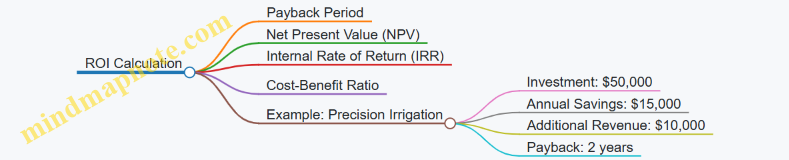
Best Practices for Managing Costs and Maximizing ROI
-
Conduct a Thorough Needs Assessment: Identify specific pain points and prioritize technologies that address them.
-
Pilot Testing: Implement small-scale pilots to evaluate performance and costs before full deployment.
-
Leverage Modular and Scalable Solutions: Start with essential components and expand as ROI is realized.
-
Utilize Open-Source and Cloud-Based Platforms: Reduce upfront software costs and maintenance overhead.
-
Train Staff Effectively: Proper training minimizes operational errors and maximizes technology utilization.
-
Monitor and Measure Continuously: Use KPIs to track performance and adjust strategies.
Example:
A vertical farm adopts IoT sensors for climate control. Initially, only a few zones are instrumented. After demonstrating energy savings and yield improvement, the system is scaled farm-wide, optimizing costs and ROI.
Mind Map: Best Practices for Cost Management and ROI
Financing Options and Incentives
To ease the financial burden, farms can explore:
- Government Grants and Subsidies: Many governments support sustainable agritech adoption.
- Leasing and Pay-Per-Use Models: Reduce upfront costs.
- Partnerships with Agritech Providers: Shared risk and cost.
- Crowdfunding and Impact Investing: Engage community and investors focused on sustainability.
Example:
A mid-sized farm leverages a government grant covering 30% of the cost for a robotic harvesting system, reducing its effective investment and improving ROI.
Mind Map: Financing Strategies
Overcoming Hidden Costs and Risks
- Data Security and Privacy: Potential costs related to breaches or compliance.
- Technology Obsolescence: Risk of rapid depreciation.
- Operational Disruptions: Downtime during installation or learning curve.
Mitigation strategies include robust cybersecurity measures, choosing technologies with upgrade paths, and phased implementation.
Example:
A farm experienced downtime during sensor network installation but mitigated impact by scheduling during off-peak periods and training staff in advance.
Mind Map: Hidden Costs and Risk Management
Summary
Managing costs and maximizing ROI in agritech adoption requires a holistic approach that includes detailed cost analysis, ROI calculation, strategic implementation, financing, and risk management. By following best practices and learning from real-world examples, agritech developers and farm systems engineers can ensure that technology investments drive sustainable and profitable farming outcomes.
9.4 Training and Skill Development for Agritech Workforce
In the rapidly evolving field of agritech, continuous training and skill development are essential to ensure that the workforce can effectively design, implement, and maintain advanced agricultural technologies. This section explores best practices for training agritech professionals, highlights key skill areas, and provides practical examples to facilitate knowledge transfer and capacity building.
Key Skill Areas for Agritech Workforce
- Systems Engineering Fundamentals: Understanding the integration of hardware, software, and biological systems.
- Data Analytics and Interpretation: Ability to analyze sensor data, satellite imagery, and predictive models.
- IoT and Sensor Technologies: Knowledge of deployment, calibration, and troubleshooting of agricultural sensors.
- Automation and Robotics Operation: Skills to operate and maintain autonomous machinery and robotic systems.
- Sustainability Principles: Training on environmental impact, resource optimization, and sustainable farming practices.
- Software Proficiency: Familiarity with farm management software, cloud platforms, and mobile applications.
- Cybersecurity Awareness: Protecting data privacy and system integrity.
Mind Map: Core Competencies for Agritech Workforce Training
Best Practices for Effective Training
-
Blended Learning Approaches: Combine online courses, hands-on workshops, and field demonstrations to cater to diverse learning styles.
-
Modular Training Programs: Develop skill-specific modules that allow learners to progress at their own pace and focus on relevant areas.
-
Use of Simulations and Digital Twins: Employ virtual environments to practice system design, troubleshooting, and scenario testing without risking real assets.
-
Mentorship and Peer Learning: Encourage knowledge sharing between experienced engineers and new entrants to accelerate skill acquisition.
-
Certification and Continuous Education: Implement certification programs to validate skills and promote lifelong learning.
-
Localization of Content: Adapt training materials to regional crops, climate conditions, and technology availability.
Mind Map: Training Delivery Methods
Practical Example 1: Implementing a Sensor Calibration Workshop
A regional agritech company organized a two-day workshop focused on soil moisture sensor calibration. Participants included farm systems engineers and agribusiness managers. The workshop combined theoretical sessions on sensor principles with hands-on calibration exercises using different sensor models. Post-workshop assessments showed a 30% improvement in sensor data accuracy on participating farms, leading to optimized irrigation schedules and water savings.
Practical Example 2: Digital Twin Simulation for Pest Management Training
An agritech startup developed a digital twin of a commercial farm to simulate pest infestation scenarios. Trainees used the simulation to test various intervention strategies, such as targeted pesticide application and biological controls. This immersive training helped agritech developers and farm managers understand the impact of timely decisions, reducing pesticide use by 20% in pilot farms.
Addressing Challenges in Workforce Training
- Limited Access to Technology: Deploy mobile training units and offline resources to reach remote areas.
- Skill Gaps in Traditional Farming Communities: Start with foundational digital literacy before advanced agritech topics.
- Rapid Technological Change: Establish update cycles for training content and encourage adaptive learning.
Summary
Training and skill development in agritech systems engineering require a strategic, multi-faceted approach that blends theoretical knowledge with practical experience. By leveraging modern educational tools such as simulations, modular courses, and mentorship, agritech professionals can be empowered to drive sustainable and high-yield farming innovations effectively.
9.5 Case Study: Successful Technology Adoption in a Resource-Limited Setting
Introduction
In many developing regions, resource limitations such as lack of infrastructure, limited capital, and insufficient technical expertise pose significant challenges to adopting advanced agritech solutions. However, with strategic planning, community involvement, and tailored technology choices, successful adoption is achievable and can lead to sustainable, high-yield farming.
This case study explores how a small cooperative farm in rural Kenya transformed its operations by adopting affordable, scalable agritech systems despite resource constraints.
Background
- Location: Rural Kenya, semi-arid region
- Farm Size: 50 hectares managed by a cooperative of 20 smallholder farmers
- Challenges: Limited electricity, unreliable internet, scarce water resources, low capital
Objectives
- Improve water use efficiency
- Increase crop yields sustainably
- Reduce labor intensity
- Enable data-driven decision-making
Technology Adoption Strategy
Key Principles:
- Use low-cost, robust technologies
- Prioritize renewable energy sources
- Build local capacity through training
- Leverage mobile connectivity for data access
Implemented Solutions
-
Solar-Powered Drip Irrigation System
- Utilized affordable solar panels to power water pumps.
- Drip irrigation reduced water use by 40% compared to traditional flood irrigation.
- Soil moisture sensors (low-cost capacitive sensors) provided real-time data.
-
Mobile-Based Farm Management App
- Customized simple SMS and smartphone app for cooperative members.
- Enabled input scheduling, pest alerts, and weather updates.
- Data aggregated centrally for cooperative-level decisions.
-
Community Training and Support
- Workshops on system maintenance and agronomic best practices.
- Peer-to-peer knowledge sharing encouraged.
-
Low-Cost Weather Station
- Installed a locally-built weather station to monitor rainfall and temperature.
- Data integrated into irrigation scheduling.
Mind Map: Technology Adoption Framework
Outcomes and Impact
- Water Efficiency: 40% reduction in water use, critical in semi-arid environment.
- Yield Increase: Maize and beans yields increased by 25% due to optimized irrigation and timely interventions.
- Labor Savings: Automated irrigation reduced manual labor by 30%.
- Empowerment: Farmers gained confidence in using technology and interpreting data.
Lessons Learned
- Appropriate Technology: Selecting technologies that match local conditions and resource availability is crucial.
- Capacity Building: Continuous training ensures sustainability and local ownership.
- Community Engagement: Cooperative model enabled cost-sharing and knowledge dissemination.
- Incremental Implementation: Phased rollout allowed adaptation and troubleshooting.
Example: SMS Alert for Pest Outbreak
- A farmer notices unusual leaf spots.
- Sends SMS to cooperative’s agronomist via app.
- Agronomist replies with diagnosis and treatment advice.
- Early intervention prevents spread, reducing crop loss.
Mind Map: Benefits Realized by the Cooperative
Conclusion
This case study demonstrates that even in resource-limited settings, thoughtful agritech systems engineering can drive sustainable and high-yield farming. By leveraging affordable technologies, renewable energy, and community collaboration, farms can overcome infrastructural and financial barriers to modernize operations effectively.
Such models provide valuable blueprints for agritech developers, farm systems engineers, and agribusiness managers aiming to scale sustainable farming solutions in similar contexts.
10. Future Trends and Innovations in Sustainable Agritech Systems
10.1 Emerging Technologies: AI, Blockchain, and Beyond
In the rapidly evolving landscape of agritech, emerging technologies such as Artificial Intelligence (AI), Blockchain, and other cutting-edge innovations are transforming how farms operate, optimize resources, and achieve sustainability alongside high yields. This section explores these technologies, their applications, and practical examples demonstrating their impact.
Artificial Intelligence (AI) in Agritech
AI leverages machine learning algorithms, computer vision, and data analytics to automate decision-making, predict outcomes, and optimize farm operations.
Key AI Applications:
Example:
A vineyard uses AI-powered drones equipped with multispectral cameras to scan grapevines. The AI analyzes images to detect early signs of fungal infections, enabling targeted fungicide application only where needed, reducing chemical use and preserving soil health.
Blockchain for Transparency and Traceability
Blockchain technology provides a decentralized, immutable ledger that enhances transparency, traceability, and trust across the agricultural supply chain.
Blockchain Use Cases in Agritech:

Example:
A coffee cooperative implements blockchain to record every step from bean harvest to retail sale. Consumers scan QR codes on packaging to verify ethical sourcing and organic certification, increasing market value and farmer income.
Beyond AI and Blockchain: Other Emerging Technologies
-
Internet of Things (IoT): Networked sensors provide real-time environmental data (soil moisture, temperature, humidity) to optimize irrigation and fertilization.
-
Edge Computing: Processes data locally on devices to reduce latency and bandwidth use, critical for remote farms with limited connectivity.
-
5G Connectivity: Enables faster, more reliable communication between devices, supporting real-time control of autonomous machinery.
-
Augmented Reality (AR): Assists farm workers with overlayed information for equipment maintenance or crop inspection.
-
Synthetic Biology: Advances in gene editing and bioengineering to develop resilient, high-yield crops.
Example:
A smart greenhouse integrates IoT sensors with edge computing devices to monitor microclimate conditions. When temperature or humidity deviates from optimal ranges, the system autonomously adjusts ventilation and watering, maximizing plant growth efficiency.
Integrated Example: AI + Blockchain + IoT in a Smart Farm
A large-scale smart farm uses IoT sensors to collect soil and weather data, feeding AI models that optimize planting schedules and irrigation. Blockchain records all farm data and transactions, ensuring transparency for buyers and regulators. This integrated approach leads to higher yields, reduced resource waste, and enhanced market reputation.
Summary
Emerging technologies like AI, Blockchain, IoT, and others are revolutionizing agritech by enabling smarter, more transparent, and sustainable farming systems. By understanding and integrating these tools, agritech developers, farm systems engineers, and agribusiness managers can drive innovation that meets the dual goals of sustainability and high productivity.
10.2 Integration of Vertical Farming and Controlled Environment Agriculture (CEA)
Vertical Farming and Controlled Environment Agriculture (CEA) represent transformative approaches in agritech systems engineering, enabling sustainable, high-yield crop production in urban and resource-constrained environments. Integrating these two methodologies leverages the strengths of both to optimize space, resource use, and crop productivity.
What is Vertical Farming?
Vertical farming involves growing crops in vertically stacked layers, often incorporating controlled-environment agriculture techniques to optimize plant growth.
What is Controlled Environment Agriculture (CEA)?
CEA refers to technology-based systems that provide precise control over environmental factors such as temperature, humidity, light, and CO2 levels to optimize plant growth.
Mind Map: Key Components of Vertical Farming Integrated with CEA
Benefits of Integration
- Maximized Space Utilization: Vertical stacking combined with precise environmental control allows for year-round production in limited spaces.
- Resource Efficiency: Controlled water and nutrient delivery systems reduce waste and optimize inputs.
- Consistent Crop Quality and Yield: Environmental parameters are optimized for each crop, improving uniformity and productivity.
- Reduced Environmental Impact: Lower water usage, minimal pesticide application, and potential for renewable energy integration.
Example 1: AeroFarms – A Vertical Farming Pioneer
AeroFarms uses aeroponic systems within vertical farms combined with advanced sensors and AI-driven environmental controls. Their farms operate indoors with no sunlight, relying solely on LED lighting and precise nutrient misting, resulting in 95% less water use and up to 390 times more productivity per square foot compared to traditional farming.
Mind Map: AeroFarms System Overview
Example 2: Plenty – Combining Vertical Farming with CEA
Plenty integrates vertical farming with controlled environments using machine learning to optimize plant growth. Their farms use stacked towers with hydroponic systems and LED lighting, with automated monitoring of environmental parameters. This integration enables them to grow leafy greens with 99% less land and 95% less water than traditional farming.
Best Practices for Integration
- Design for Scalability: Modular vertical farming units allow easy expansion.
- Implement Robust Sensor Networks: Continuous monitoring of environmental variables ensures optimal conditions.
- Leverage Automation: Automated nutrient delivery and lighting adjustments reduce labor and improve consistency.
- Optimize Crop Selection: Focus on crops suited for vertical and controlled environments, such as leafy greens and herbs.
- Energy Efficiency: Use LED lighting with tailored spectra and consider renewable energy sources to reduce operational costs.
Mind Map: Best Practices for Vertical Farming + CEA Integration
Challenges and Solutions
| Challenge | Solution | Example |
|---|---|---|
| High Initial Capital Cost | Phased Implementation and Financing Models | AeroFarms scaled gradually with investors |
| Energy Consumption | Use of Energy-efficient LEDs and Renewables | Plenty incorporates solar power |
| Technical Complexity | Skilled Workforce and Training Programs | Partnerships with universities for training |
| Crop Disease Management | Closed-loop Systems and Sterile Environments | Regular sanitation protocols in vertical farms |
Summary
Integrating vertical farming with controlled environment agriculture is a powerful approach to sustainable, high-yield farming. By combining structural innovation with precise environmental controls, farms can maximize productivity while minimizing resource use and environmental impact. Real-world examples like AeroFarms and Plenty demonstrate the viability and benefits of this integration.
This integration is a key pillar for future agritech systems engineering, especially in urban and resource-limited contexts, aligning perfectly with sustainability goals and the demand for fresh, local produce year-round.
10.3 Advances in Genetic Engineering and Crop Improvement
Genetic engineering and crop improvement represent some of the most transformative advances in agritech, enabling farmers to achieve higher yields, improved resilience, and enhanced nutritional profiles while supporting sustainability goals. This section explores recent breakthroughs, practical applications, and best practices for integrating genetic technologies into sustainable farming systems.
Key Areas of Genetic Engineering in Agriculture
Genome Editing Technologies
CRISPR-Cas9 has revolutionized crop improvement by allowing precise, efficient, and cost-effective editing of plant genomes. Unlike traditional genetic modification, CRISPR can target specific genes without introducing foreign DNA, which can ease regulatory hurdles and improve public acceptance.
Example:
- Drought-tolerant maize: Researchers used CRISPR to knock out genes that negatively regulate drought response, resulting in maize varieties that maintain yield under water stress.
Best Practice:
- Combine genome editing with phenotypic screening in field trials to validate trait performance under realistic conditions.
Trait Development
Developing traits that improve crop resilience and nutritional value is central to sustainable high yield farming.
Examples:
- Pest resistance: Bt cotton expresses a bacterial toxin gene to reduce reliance on chemical pesticides.
- Nutritional enhancement: Golden Rice engineered to produce beta-carotene addresses vitamin A deficiency.
Best Practice:
- Use stacked traits (combining multiple beneficial genes) to build multi-faceted resistance and reduce pest adaptation.
Speed Breeding and Marker-Assisted Selection
Speed breeding accelerates generation turnover using controlled environment conditions, enabling faster development of improved varieties.
Example:
- Wheat varieties developed in 6 months instead of 3 years using extended photoperiods and optimized growth conditions.
Marker-assisted selection uses DNA markers linked to desirable traits to select plants early in the breeding cycle, increasing efficiency.
Best Practice:
- Integrate genomic selection models with field data for robust trait prediction.
Synthetic Biology
Synthetic biology enables the design of novel metabolic pathways and biofortification strategies.
Example:
- Engineering rice to produce higher levels of iron and zinc to combat micronutrient deficiencies.
Best Practice:
- Collaborate with multidisciplinary teams including molecular biologists, agronomists, and nutritionists to ensure trait relevance and safety.
Regulatory and Ethical Considerations
Navigating biosafety regulations and public perception is critical for successful deployment.
Example:
- Transparent communication and participatory breeding programs have improved acceptance of genetically engineered papaya in Hawaii.
Best Practice:
- Engage stakeholders early and provide clear information on benefits and risks.
Mind Map: Integrating Genetic Engineering into Sustainable Farming
Summary
Genetic engineering and crop improvement are pivotal for advancing sustainable and high-yield farming. By leveraging cutting-edge genome editing tools, accelerated breeding techniques, and synthetic biology, agritech developers and farm systems engineers can create resilient, nutritious, and environmentally friendly crops. Integrating these advances with precision agriculture and robust regulatory strategies ensures that innovations translate into real-world benefits for farmers and communities.
10.4 Collaborative Platforms and Open-Source Agritech Solutions
In the rapidly evolving field of agritech, collaboration and open-source initiatives have become pivotal in accelerating innovation, reducing costs, and fostering sustainable farming practices. Collaborative platforms enable diverse stakeholders—developers, farmers, researchers, and agribusiness managers—to share data, tools, and knowledge, creating ecosystems that drive high-yield and environmentally responsible agriculture.
Why Collaborative Platforms Matter in Agritech
- Pooling Resources and Expertise: Combining knowledge from agronomists, engineers, and software developers leads to more robust solutions.
- Accelerated Innovation: Open access to tools and data encourages rapid prototyping and iterative improvements.
- Cost Reduction: Shared platforms reduce duplication of effort and lower barriers to entry for small-scale farmers and startups.
- Enhanced Data Sharing: Collective data improves machine learning models and decision-support systems.
Key Features of Effective Collaborative Agritech Platforms
- Open APIs for interoperability
- Modular and extensible architecture
- Community-driven development and governance
- Real-time data sharing and visualization
- Support for multiple languages and regional customization
Mind Map: Components of Collaborative Agritech Platforms
Examples of Collaborative Platforms and Open-Source Agritech Solutions
OpenAg Toolkit
- Description: An open-source platform developed by the MIT Media Lab that provides hardware and software designs for controlled environment agriculture.
- Features: Modular sensor arrays, climate control algorithms, and a community forum.
- Example Use Case: Small urban farms use OpenAg to build affordable, automated growth chambers that optimize plant growth while minimizing resource use.
FarmOS
- Description: A web-based open-source farm management system designed for record-keeping, planning, and data analysis.
- Features: GIS integration, sensor data logging, crop rotation planning.
- Example Use Case: Organic farms utilize FarmOS to track soil amendments and crop cycles, improving sustainability and yield.
AgOpenGPS
- Description: Open-source precision agriculture software for GPS guidance and mapping.
- Features: Real-time vehicle tracking, automated steering support, field boundary mapping.
- Example Use Case: Smallholder farmers in developing countries adopt AgOpenGPS to implement precision planting, reducing seed waste and improving yields.
OpenATK (Open Agricultural Toolkit)
- Description: A collaborative project offering open-source hardware and software tools for farm automation.
- Features: Robotics control modules, sensor integration, cloud data storage.
- Example Use Case: Research groups use OpenATK to prototype autonomous weeding robots that reduce herbicide use.
Mind Map: Benefits of Open-Source Agritech Solutions
Best Practices for Engaging with Collaborative Agritech Platforms
- Contribute Actively: Share your code, data, or experiences to enrich the community.
- Adopt Open Standards: Ensure your solutions can integrate smoothly with other tools.
- Prioritize Data Privacy: Respect farmer data rights and implement secure sharing protocols.
- Foster Inclusivity: Support multilingual interfaces and adapt tools for diverse farming contexts.
- Leverage Community Support: Use forums and documentation to troubleshoot and improve your systems.
Real-World Example: Collaborative Development of a Pest Monitoring Network
A consortium of agritech developers, local farmers, and researchers collaborated on an open-source pest monitoring platform. Using low-cost IoT sensors and a shared data portal, the network tracks pest populations in real time across multiple farms. The platform’s open API allows integration with existing farm management systems, enabling targeted pesticide application only when necessary. This collaboration has led to a 30% reduction in chemical use and improved crop health across participating farms.
Conclusion
Collaborative platforms and open-source agritech solutions represent a transformative approach to building sustainable, high-yield farming systems. By embracing openness and community-driven innovation, agritech developers and farm systems engineers can create adaptable, cost-effective tools that empower farmers worldwide while preserving environmental resources.
10.5 Visionary Example: Fully Automated, Carbon-Neutral Smart Farms
The future of sustainable agriculture lies in the development of fully automated, carbon-neutral smart farms. These farms leverage cutting-edge technologies and systems engineering principles to maximize yield while minimizing environmental impact. This visionary model integrates renewable energy, advanced robotics, AI-driven decision-making, and closed-loop resource management to create a self-sustaining agricultural ecosystem.
Key Components of a Carbon-Neutral Smart Farm
Carbon-Neutral Smart Farm Mind Map
Example Scenario: The GreenFuture Smart Farm
Overview: GreenFuture is a 500-acre smart farm designed to operate fully autonomously with zero net carbon emissions. It combines renewable energy generation, AI-driven crop management, and robotic labor.
-
Energy: The farm’s solar array and wind turbines generate 120% of its energy needs. Excess energy is stored in advanced battery systems and used to power electric vehicles and machinery.
-
Automation: Autonomous tractors equipped with GPS and AI perform soil preparation, planting, and harvesting. Drones conduct daily aerial surveys to monitor crop health and apply precise treatments only where necessary.
-
AI Analytics: A centralized AI platform analyzes data from soil sensors, weather stations, and drones to optimize irrigation schedules, fertilizer application, and pest control, reducing inputs by 30% compared to conventional farms.
-
Resource Recycling: Water is recycled through closed-loop irrigation systems. Organic waste is converted into biogas, powering backup generators and heating greenhouses.
-
Carbon Sequestration: Agroforestry belts and biochar-enriched soils capture and store carbon, offsetting emissions from unavoidable activities.
Mind Map: AI-Driven Decision Making in Smart Farms
Best Practice: Integrating Carbon-Neutral Goals into Systems Engineering
- Holistic Energy Planning: Design farms to generate and store renewable energy exceeding consumption.
- Automation for Precision: Use robotics to reduce waste and increase efficiency.
- Closed-Loop Resource Management: Recycle water and nutrients to minimize external inputs.
- Data-Driven Optimization: Employ AI to continuously improve operational decisions.
- Carbon Capture Integration: Incorporate agroforestry and soil amendments to sequester carbon.
Final Thoughts
Fully automated, carbon-neutral smart farms represent a transformative leap in agritech systems engineering. By combining sustainability with high productivity, these farms can meet the growing global food demand while preserving the planet. For agritech developers, farm systems engineers, and agribusiness managers, embracing this visionary model means pioneering a future where technology and ecology thrive together.
11. Conclusion and Strategic Recommendations
11.1 Summarizing Key Best Practices for Sustainable High Yield Farming
Sustainable high yield farming is the result of integrating advanced agritech systems engineering with environmentally responsible practices. Below is a comprehensive summary of key best practices, supported by illustrative examples and mind maps to help visualize their interconnections.
Mind Map: Core Pillars of Sustainable High Yield Farming
Resource Optimization
Best Practice: Employ smart irrigation systems combined with nutrient management to maximize input efficiency.
Example: A mid-sized farm implemented solar-powered drip irrigation controlled by soil moisture sensors. This reduced water usage by 30% while maintaining crop yield.
Mind Map:
Precision Agriculture
Best Practice: Utilize IoT sensors and data analytics for real-time monitoring and decision-making.
Example: A farm used drone imagery combined with machine learning algorithms to detect early signs of crop stress, enabling targeted interventions that increased yield by 15%.
Mind Map:
Automation and Robotics
Best Practice: Integrate autonomous robots for labor-intensive tasks to improve efficiency and reduce chemical use.
Example: Deployment of robotic weeders that identify and remove weeds mechanically, cutting herbicide use by 40%.
Mind Map:
Soil and Crop Health Management
Best Practice: Combine soil health monitoring with sustainable crop management practices such as crop rotation and AI-driven pest detection.
Example: An AI system analyzed pest patterns and recommended targeted biological treatments, reducing pesticide application and improving biodiversity.
Mind Map:
Software Systems Integration
Best Practice: Use integrated farm management platforms to unify data streams and streamline decision-making.
Example: A cloud-based FMIS with mobile app access allowed farm managers to monitor irrigation, fertilization, and labor schedules remotely, improving responsiveness and reducing waste.
Mind Map:
Continuous Improvement and Sustainability Assessment
Best Practice: Implement KPIs, digital twins, and lifecycle analysis to monitor performance and adapt strategies.
Example: Using a digital twin, a vertical farm simulated different lighting and nutrient scenarios to optimize yield while minimizing energy consumption.
Mind Map:
Summary Table of Best Practices with Examples
| Best Practice | Example | Impact |
|---|---|---|
| Smart Irrigation & Nutrient Management | Solar-powered drip irrigation with soil moisture sensors | 30% water savings, sustained yield |
| Precision Agriculture & Data Analytics | Drone imagery + ML for crop stress detection | 15% yield increase |
| Robotics for Weed Control | Autonomous mechanical weeders | 40% reduction in herbicide use |
| AI-driven Pest Management | AI-based pest detection with targeted biological treatments | Reduced pesticide use, enhanced biodiversity |
| Integrated Farm Management Software | Cloud FMIS with mobile app for real-time monitoring | Improved responsiveness, reduced waste |
| Digital Twins for Optimization | Simulation of lighting/nutrient scenarios in vertical farming | Optimized yield, minimized energy use |
By weaving these best practices into a cohesive agritech systems engineering approach, developers, engineers, and managers can drive sustainable farming that achieves high yields while preserving environmental integrity.
11.2 Roadmap for Agritech Developers and Farm Systems Engineers
Creating a successful and sustainable agritech solution requires a clear, structured roadmap that guides developers and engineers through the complex landscape of agricultural technology and systems engineering. This roadmap integrates best practices, innovation, and sustainability principles to maximize both yield and environmental stewardship.
Understand the Agricultural Context and Stakeholder Needs
- Engage with farmers, agribusiness managers, and local communities to gather requirements.
- Identify key challenges such as water scarcity, soil degradation, or labor shortages.
- Define sustainability goals alongside productivity targets.
Example: Conducting field interviews and workshops with a cooperative of smallholder farmers to understand irrigation challenges and energy constraints.
Define System Requirements and Sustainability Metrics
- Establish clear functional and non-functional requirements.
- Incorporate sustainability metrics like water use efficiency, carbon footprint, and soil health impact.
Example: Setting a target to reduce water consumption by 30% through precision irrigation technologies.
Design Modular, Scalable, and Interoperable Systems
- Use modular design to allow easy upgrades and customization.
- Ensure interoperability with existing farm equipment and software platforms.
Example: Developing sensor modules that can be integrated with multiple irrigation controllers and data platforms.
Leverage Data-Driven Approaches and IoT Integration
- Deploy IoT sensors for real-time monitoring of soil moisture, weather, and crop health.
- Use cloud platforms and edge computing for data processing and decision support.
Example: Implementing a soil moisture sensor network combined with a cloud-based analytics dashboard for farmers.
Incorporate Automation and Robotics Thoughtfully
- Identify repetitive or labor-intensive tasks suitable for automation.
- Design energy-efficient robotic systems that minimize environmental impact.
Example: Creating an autonomous weeding robot that uses computer vision to target weeds precisely, reducing herbicide use.
Develop User-Centric Software and Interfaces
- Design intuitive user interfaces tailored to farmers’ technical literacy.
- Provide actionable insights rather than raw data.
Example: Mobile app that sends simple alerts like “Irrigation needed in Field A” based on sensor data.
Test, Validate, and Iterate Using Real-World Pilots
- Conduct pilot projects on partner farms to validate system performance.
- Collect feedback and refine both hardware and software components.
Example: Pilot deployment of a variable rate fertilizer system on a 50-acre farm with iterative tuning based on yield outcomes.
Plan for Maintenance, Support, and Training
- Develop maintenance schedules and remote diagnostics.
- Provide training programs for farmers and technicians.
Example: Online training modules combined with local workshops on system troubleshooting and best practices.
Monitor Sustainability Impact and Continuously Improve
- Use KPIs to track environmental and economic outcomes.
- Employ digital twins or simulation models to test improvements before deployment.
Example: Using a digital twin of a greenhouse system to simulate energy savings from different ventilation strategies.
Mind Maps
Roadmap Overview
Example: Precision Irrigation System Development
Final Thoughts
This roadmap is a dynamic guide that should evolve with technological advances and changing agricultural conditions. By following these structured steps and embedding sustainability at every stage, agritech developers and farm systems engineers can deliver impactful solutions that drive both high yields and environmental resilience.
11.3 Building Partnerships Across Agribusiness and Technology Sectors
In the rapidly evolving landscape of agritech, building strong partnerships between agribusiness stakeholders and technology providers is crucial for driving innovation, scaling sustainable practices, and achieving high yield farming goals. These collaborations enable the sharing of expertise, resources, and data, fostering integrated solutions that address complex agricultural challenges.
Why Partnerships Matter
- Combining Domain Expertise: Agribusiness managers bring deep knowledge of farming operations, market demands, and supply chains, while technology developers contribute cutting-edge tools and systems engineering expertise.
- Resource Sharing: Partnerships allow pooling of financial, technical, and human resources, reducing risks and accelerating development.
- Enhanced Innovation: Cross-sector collaboration sparks creative solutions that neither party might develop independently.
- Market Access and Adoption: Agribusinesses provide real-world testing grounds and customer bases, facilitating technology adoption and feedback loops.
Key Partnership Models

Best Practices for Building Effective Partnerships
- Align Goals and Values: Ensure both agribusiness and technology partners share a commitment to sustainability, innovation, and mutual benefit.
- Define Clear Roles and Responsibilities: Establish who leads which aspects, from R&D to deployment and support.
- Establish Open Communication Channels: Regular meetings, shared platforms, and transparent reporting build trust and agility.
- Leverage Data Sharing Agreements: Secure and ethical data exchange enhances system integration and continuous improvement.
- Pilot and Iterate Together: Start with small-scale projects to validate concepts before scaling.
Example Mind Map: Partnership Workflow
Real-World Examples
-
Case Study 1: Precision Irrigation Collaboration
- Partners: Agritech startup specializing in IoT sensors + Large agribusiness cooperative
- Approach: Jointly developed a solar-powered smart irrigation system that adjusts water delivery based on real-time soil moisture data.
- Outcome: 30% water savings and 15% yield increase over two growing seasons.
-
Case Study 2: AI-Powered Pest Management
- Partners: University research lab + Agribusiness pest control division + Software developer
- Approach: Created an AI model trained on local pest data to predict outbreaks and recommend targeted treatments.
- Outcome: Reduced pesticide use by 25%, lowering costs and environmental impact.
-
Case Study 3: Blockchain for Supply Chain Transparency
- Partners: Agribusiness exporters + Blockchain technology firm
- Approach: Implemented a blockchain platform to track produce from farm to market, ensuring quality and fair trade.
- Outcome: Increased buyer trust and opened new premium markets.
Mind Map: Partnership Benefits

Tips for Agritech Developers and Agribusiness Managers
- Agritech Developers: Engage agribusiness partners early to understand practical challenges and tailor solutions accordingly.
- Agribusiness Managers: Stay open to technology pilots and provide constructive feedback to refine systems.
- Both: Invest in joint training sessions and workshops to build mutual understanding and foster innovation culture.
Building partnerships across agribusiness and technology sectors is not just a strategic advantage but a necessity for sustainable, high-yield farming. By combining strengths, sharing knowledge, and co-creating solutions, stakeholders can unlock the full potential of agritech systems engineering to meet the pressing demands of global agriculture.
11.4 Final Thoughts: Balancing Innovation with Environmental Stewardship
In the rapidly evolving landscape of agritech, innovation drives the potential for higher yields and improved efficiency. However, this progress must be carefully balanced with environmental stewardship to ensure that farming practices remain sustainable for future generations. This section explores how agritech professionals can harmonize cutting-edge technology with ecological responsibility.
The Dual Mandate: Innovation & Sustainability
Innovation and environmental stewardship are not mutually exclusive; rather, they complement each other when thoughtfully integrated. The goal is to leverage technology to optimize resource use, reduce waste, and minimize ecological footprints while maintaining or enhancing productivity.
Mind Map: Balancing Innovation with Environmental Stewardship
Sustainable Technology Adoption
-
Renewable Energy Integration: Incorporating solar or wind power into farm operations reduces carbon emissions. For example, solar-powered irrigation systems not only cut energy costs but also lower the farm’s environmental footprint.
-
Precision Resource Management: Using IoT sensors and data analytics to apply water, fertilizers, and pesticides only where needed minimizes overuse and pollution. An example is variable rate technology (VRT) that adjusts fertilizer application based on soil nutrient maps.
-
Low-Impact Automation: Employing robotics designed to reduce soil compaction and chemical use, such as autonomous weeding robots, helps maintain soil structure and biodiversity.
Environmental Impact Mitigation
-
Soil Health Preservation: Technologies like soil moisture sensors and organic matter monitoring help maintain soil vitality. Practices such as no-till farming supported by GPS-guided machinery reduce erosion.
-
Biodiversity Enhancement: Agritech can support biodiversity by enabling intercropping patterns and habitat mapping. For instance, drones can monitor pollinator activity and guide planting decisions to foster beneficial insect populations.
-
Water Conservation: Smart irrigation systems that use evapotranspiration data optimize water use, preventing waste and protecting local water sources.
Continuous Monitoring & Feedback
Implementing real-time data analytics and adaptive management systems allows farms to respond dynamically to environmental conditions. Digital twins — virtual replicas of farm systems — enable scenario testing to predict environmental impacts before implementing changes.
Example: A farm uses a digital twin to simulate the impact of introducing cover crops on soil carbon sequestration and yield, enabling informed decision-making.
Stakeholder Engagement
-
Farmer Training & Education: Empowering farmers with knowledge about sustainable agritech practices ensures technology is used effectively and responsibly.
-
Community Collaboration: Engaging local communities in sustainability goals fosters shared responsibility and support.
-
Policy & Regulatory Compliance: Aligning agritech innovations with environmental regulations ensures long-term viability and social license.
Integrated Example: Smart Sustainable Farm
A mid-sized farm integrates solar-powered sensors, autonomous weeding robots, and precision irrigation. Soil health is monitored continuously, and data analytics optimize input use. The farm collaborates with local environmental groups to maintain pollinator habitats. Through farmer workshops, the team ensures all staff understand sustainability goals. This integrated approach demonstrates how innovation and stewardship coexist to produce high yields with minimal environmental impact.
Summary
Balancing innovation with environmental stewardship requires a systems-thinking approach, continuous learning, and collaboration. Agritech professionals play a pivotal role in designing and implementing solutions that not only push the boundaries of productivity but also safeguard the natural resources that farming depends on. By embedding sustainability into every stage of agritech development and deployment, we can cultivate a resilient and thriving agricultural future.