Sustainable Home Electrification: A Practical Guide
1. Introduction to Sustainable Home Electrification
1.1 Understanding Sustainable Electrification: Concepts and Benefits
Sustainable electrification refers to the process of transitioning from conventional energy sources, primarily fossil fuels, to clean, renewable electricity for powering homes and daily activities. This shift not only reduces greenhouse gas emissions but also enhances energy efficiency, lowers long-term costs, and promotes energy independence.
Core Concepts of Sustainable Electrification
- Renewable Energy Integration: Utilizing solar, wind, hydro, or other renewable sources to generate electricity.
- Energy Efficiency: Employing appliances and systems that consume less electricity while maintaining performance.
- Electrification of End Uses: Replacing fossil-fuel-based systems (like gas heating or combustion engines) with electric alternatives.
- Energy Storage: Incorporating batteries or other storage solutions to manage supply and demand effectively.
- Smart Energy Management: Using technology to monitor, control, and optimize energy consumption.
Mind Map: Core Concepts of Sustainable Electrification
Benefits of Sustainable Electrification
-
Environmental Benefits:
- Significant reduction in carbon emissions.
- Decreased air and noise pollution.
- Conservation of natural resources.
-
Economic Benefits:
- Lower energy bills over time due to efficiency and renewable generation.
- Increased property value.
- Access to government incentives and rebates.
-
Energy Security and Independence:
- Reduced reliance on imported fuels.
- Enhanced resilience against power outages through local generation and storage.
-
Health and Comfort:
- Improved indoor air quality by eliminating combustion appliances.
- More consistent and controllable heating and cooling.
Mind Map: Benefits of Sustainable Electrification
Practical Example: Transitioning a Home to Sustainable Electrification
Scenario: The Smith family currently uses a gas furnace, gas stove, and grid electricity for lighting and appliances. They want to reduce their carbon footprint and save on energy costs.
Steps Taken:
- Installed rooftop solar panels to generate clean electricity.
- Replaced the gas furnace with an electric heat pump for heating and cooling.
- Switched from a gas stove to an induction cooktop.
- Upgraded lighting to LED bulbs and installed smart thermostats.
- Added a home battery system to store excess solar energy for nighttime use.
Outcome:
- Their home’s carbon emissions dropped by over 60%.
- Monthly energy bills decreased by 40%.
- Improved indoor air quality and comfort.
- Increased home value and qualified for local renewable energy incentives.
Understanding these foundational concepts and benefits sets the stage for making informed decisions throughout your sustainable home electrification journey.
1.2 Overview of Home Energy Systems: From Traditional to Renewable
Understanding the evolution of home energy systems is essential for homeowners and renewable energy enthusiasts aiming to transition towards sustainable electrification. This section explores the types of home energy systems, their components, and how renewable technologies are reshaping energy consumption patterns.
Traditional Home Energy Systems
Traditional home energy systems primarily rely on grid electricity generated from fossil fuels (coal, natural gas, oil) and sometimes supplemented by on-site combustion appliances.
- Grid Electricity: Delivered via centralized power plants, often fossil-fuel based.
- Heating Systems: Natural gas furnaces, oil boilers, propane heaters.
- Water Heating: Gas or electric resistance water heaters.
- Cooking Appliances: Gas stoves and ovens.
Example: A typical suburban home in the U.S. uses natural gas for heating and cooking, with electricity supplied by the utility grid largely generated from coal and natural gas.
Renewable Home Energy Systems
Renewable systems integrate clean, sustainable energy sources to reduce carbon footprint and increase energy independence.
- Solar Photovoltaic (PV) Panels: Convert sunlight directly into electricity.
- Wind Turbines: Generate electricity from wind energy.
- Battery Storage: Store excess renewable energy for use during low generation periods.
- Heat Pumps: Electrically powered heating and cooling systems with high efficiency.
- Induction Cooking: Electric cooking technology that is more efficient and cleaner than gas.
Example: A homeowner installs rooftop solar panels combined with a lithium-ion battery system to power their home, including an electric heat pump for heating and cooling.
Mind Map: Traditional vs Renewable Home Energy Systems
Hybrid Systems: Bridging Traditional and Renewable
Many homes adopt hybrid systems that combine grid electricity with renewable sources and storage to optimize reliability and sustainability.
- Grid-tied Solar Systems: Solar panels feed electricity to the grid; excess power can be sold back.
- Backup Generators: Often fossil-fuel based but can be replaced with renewable-powered alternatives.
- Smart Energy Management: Systems that balance energy use between grid, renewables, and storage.
Example: A home uses solar panels during the day, draws from the grid at night, and has a battery backup to cover outages.
Mind Map: Components of a Modern Sustainable Home Energy System
Practical Example: Transitioning a Home from Traditional to Renewable
Scenario: The Smith family currently uses grid electricity and natural gas for heating and cooking. They want to reduce their carbon footprint and energy bills.
Steps:
- Energy Audit: Identify major energy uses and inefficiencies.
- Install Solar PV: Rooftop solar panels sized to cover daytime electricity needs.
- Add Battery Storage: To store excess solar energy for nighttime use.
- Replace Gas Furnace with Heat Pump: For efficient electric heating and cooling.
- Switch to Induction Cooktop: For cleaner, efficient cooking.
- Implement Smart Energy Management: To optimize energy use and costs.
Outcome: The Smith family reduces their reliance on fossil fuels, lowers utility bills, and increases energy resilience.
This overview provides a foundational understanding of how home energy systems have evolved and how renewable technologies can be integrated practically. The following sections will delve deeper into assessing energy needs and designing efficient, sustainable electrical systems tailored to your home.
1.3 Key Drivers for Electrifying Your Home Sustainably
Electrifying your home sustainably is more than just a trend—it’s a strategic move toward a cleaner, more efficient, and cost-effective lifestyle. Understanding the key drivers behind this shift can help homeowners and renewable energy enthusiasts make informed decisions that align with their values and goals.
Environmental Responsibility
One of the strongest motivations for sustainable home electrification is reducing your environmental impact. Traditional energy sources like coal and natural gas emit significant greenhouse gases, contributing to climate change.
- Example: Switching to solar-powered electricity reduces your home’s carbon footprint dramatically. A typical 5 kW solar system can offset approximately 3 to 4 tons of CO2 annually, equivalent to planting over 100 trees.
Economic Savings
Sustainable electrification often leads to long-term financial benefits through energy savings, incentives, and increased property value.
- Example: Installing energy-efficient heat pumps and LED lighting can reduce electricity bills by up to 30%. Coupled with solar panels, some homeowners achieve net-zero energy costs.
Energy Independence and Resilience
Generating and managing your own electricity reduces reliance on the grid, providing security against outages and price fluctuations.
- Example: A home equipped with solar panels and battery storage can maintain power during grid failures, ensuring critical appliances continue running.
Technological Advancements
Modern technologies make sustainable electrification more accessible, efficient, and user-friendly.
- Example: Smart home energy management systems allow homeowners to monitor and optimize energy use in real-time, reducing waste.
Health and Comfort
Electric systems powered by clean energy improve indoor air quality and overall comfort.
- Example: Heat pumps provide consistent heating and cooling without combustion, eliminating indoor pollutants associated with gas furnaces.
Social and Community Impact
Adopting sustainable electrification can inspire neighbors, support local green jobs, and contribute to community resilience.
- Example: A neighborhood that collectively installs solar panels can create a microgrid, enhancing energy security for all residents.
Summary
Electrifying your home sustainably is driven by a blend of environmental, economic, technological, health, and social factors. Each driver offers tangible benefits and opportunities for homeowners to contribute to a cleaner, smarter, and more resilient future.
By understanding these key drivers, you can tailor your home electrification journey to maximize impact and satisfaction.
Quick Example: The Smith Family’s Journey
The Smith family decided to electrify their home sustainably motivated by rising electricity bills and concerns about climate change. They installed a 6 kW solar array, upgraded to a heat pump for heating and cooling, and integrated smart thermostats. Within a year, they reduced their carbon footprint by 50%, cut energy costs by 40%, and gained peace of mind during a local power outage thanks to their battery backup system.
This example illustrates how multiple drivers—economic savings, environmental responsibility, and energy resilience—can converge to create a successful sustainable electrification project.
1.4 Common Challenges and How to Overcome Them
Electrifying your home sustainably is a rewarding journey, but it comes with its own set of challenges. Understanding these obstacles and learning practical ways to address them can make the transition smoother and more effective.
Common Challenges in Sustainable Home Electrification
Technical Challenges
Electrical Panel Capacity: Many older homes have electrical panels that cannot handle the increased load from new electric appliances or renewable energy systems.
Example: A homeowner trying to install a heat pump and EV charger finds their 60-amp panel insufficient.
How to Overcome:
- Consult a licensed electrician to assess panel capacity.
- Upgrade to a modern 100-amp or 200-amp panel if necessary.
- Use load management systems to balance electricity use.
Integration with Existing Systems: Combining new renewable energy sources with legacy electrical systems can be complex.
Example: Integrating solar panels with an existing gas furnace and traditional wiring.
How to Overcome:
- Use hybrid inverters that can manage multiple energy inputs.
- Gradually phase out fossil fuel appliances.
- Employ smart home energy management systems.
Battery Storage Limitations: Battery capacity and lifespan can limit how much energy you can store.
Example: A homeowner’s battery runs out during a cloudy day, requiring grid electricity.
How to Overcome:
- Size batteries appropriately based on energy needs.
- Combine battery storage with grid-tied systems.
- Consider second-life batteries or newer technologies.
Financial Challenges
Upfront Costs: The initial investment for electrification and renewable systems can be high.
Example: Solar panel installation costs can range from $10,000 to $25,000.
How to Overcome:
- Research and apply for government rebates and tax credits.
- Explore financing options like solar loans or leases.
- Start with smaller projects (e.g., LED lighting upgrades) to spread costs.
Return on Investment Uncertainty: Calculating savings and payback periods can be confusing.
Example: Uncertainty about how long it takes to recoup solar panel costs.
How to Overcome:
- Use online calculators tailored to your region.
- Consult with energy professionals for accurate estimates.
- Monitor energy usage before and after installation.
Access to Incentives: Incentives vary widely by location and can be difficult to navigate.
Example: Missing out on a state rebate due to late application.
How to Overcome:
- Stay informed through government and utility websites.
- Work with certified installers familiar with incentives.
- Join local renewable energy groups for shared knowledge.
Practical Challenges
Space Constraints: Limited roof or yard space can restrict solar panel or battery installation.
Example: A townhouse with a shaded roof struggles to find space for solar panels.
How to Overcome:
- Use high-efficiency solar panels that produce more power per square foot.
- Consider community solar programs.
- Install solar carports or wall-mounted panels.
Permitting and Regulatory Hurdles: Navigating local codes and permits can delay projects.
Example: Delays due to HOA restrictions or unclear municipal rules.
How to Overcome:
- Engage with local authorities early in the planning process.
- Hire installers who handle permitting.
- Advocate for streamlined permitting in your community.
Maintenance and System Longevity: Ensuring systems operate efficiently over time requires upkeep.
Example: Dust accumulation reduces solar panel output.
How to Overcome:
- Schedule regular cleaning and inspections.
- Use monitoring systems to detect issues early.
- Follow manufacturer maintenance guidelines.
Behavioral Challenges
Changing Energy Consumption Habits: Sustainable electrification often requires adapting daily routines.
Example: Running the dishwasher during peak solar production hours.
How to Overcome:
- Use smart appliances with scheduling features.
- Educate household members on energy-saving practices.
- Track energy use with apps to encourage mindful consumption.
Understanding New Technologies: Complexity can intimidate homeowners.
Example: Confusion over how to operate a home energy management system.
How to Overcome:
- Attend workshops or webinars.
- Use user-friendly interfaces and apps.
- Seek support from installers or community groups.
Resistance to Change: Emotional attachment to old systems or skepticism can slow adoption.
Example: Reluctance to replace a gas stove with an induction cooktop.
How to Overcome:
- Highlight benefits such as cost savings and health improvements.
- Share success stories from neighbors or online communities.
- Start with small changes to build confidence.
Summary Mind Map
By anticipating these common challenges and applying practical solutions, homeowners can confidently move toward a fully sustainable and electrified home. Remember, every small step contributes to a larger impact on energy conservation and environmental stewardship.
1.5 Case Study: A Typical Home Transitioning to Sustainable Electrification
In this case study, we explore how a typical suburban family home successfully transitioned from a conventional fossil-fuel-based electrical system to a fully sustainable electrification setup. This example highlights practical steps, challenges, and best practices, providing a clear roadmap for homeowners and renewable energy enthusiasts.
Home Profile:
- Location: Suburban neighborhood in the U.S.
- Size: 2,000 sq ft, 4 bedrooms, 2 bathrooms
- Current Energy Source: Grid electricity primarily from fossil fuels
- Household Members: 4 (two adults, two children)
Initial Assessment and Goals:
- Reduce carbon footprint by at least 50% within 1 year
- Lower monthly electricity bills by 30%
- Integrate renewable energy sources
- Electrify heating, cooling, and cooking appliances
Step 1: Conducting an Energy Audit
Mind Map: Energy Audit Process
Example: The family reviewed their utility bills and found peak electricity use during mornings and evenings, mainly due to electric water heating and cooking.
Step 2: Upgrading Electrical Infrastructure
- Replaced old electrical panel with a modern 200-amp panel to support new loads
- Installed smart breakers for better load management
- Upgraded wiring in kitchen and HVAC systems for safety and efficiency
Example: The electrician recommended upgrading the panel to accommodate a future solar PV system and electric vehicle charger.
Step 3: Installing Renewable Energy Systems
Mind Map: Renewable Energy Integration
Example: The family installed a 6 kW solar array on their south-facing roof, paired with a 10 kWh battery system to store excess energy for nighttime use.
Step 4: Electrifying Heating and Cooling
- Removed natural gas furnace
- Installed an air-source heat pump for heating and cooling
- Added a smart thermostat with zoning capability
Example: The heat pump reduced heating costs by 40% compared to the old gas furnace, and the smart thermostat allowed temperature control room-by-room.
Step 5: Switching to Electric Cooking
- Replaced gas stove with an induction cooktop
- Installed an energy-efficient electric oven
Example: The induction cooktop heats faster and uses less energy, making cooking more efficient and safer for the family.
Step 6: Integrating Electric Vehicle Charging
- Installed a Level 2 EV charger in the garage
- Connected EV charging to solar system for clean energy use
Example: The family purchased an electric vehicle and charges it at home using solar power, reducing transportation emissions.
Step 7: Smart Energy Management
- Deployed a home energy management system (HEMS)
- Installed smart meters and real-time monitoring apps
- Automated load shifting to off-peak hours
Mind Map: Smart Energy Management
Example: The family uses the HEMS app to monitor energy use and schedules laundry and dishwasher cycles during midday solar peak hours.
Results After 12 Months:
- 55% reduction in carbon footprint
- 35% decrease in electricity bills
- Increased home comfort and convenience
- Positive community feedback and inspiration
Key Takeaways:
- Start with a thorough energy audit to identify priorities
- Upgrade electrical infrastructure early to support new technologies
- Combine solar PV with battery storage for energy independence
- Electrify heating, cooling, and cooking for maximum impact
- Use smart energy management to optimize consumption and savings
This case study demonstrates that sustainable home electrification is achievable, practical, and rewarding for typical homeowners. By following these integrated steps, you can create a cleaner, more efficient, and future-ready home.
2. Assessing Your Home’s Energy Needs
2.1 Conducting an Energy Audit: Tools and Techniques
Conducting an energy audit is the foundational step in understanding how your home consumes electricity and identifying opportunities for sustainable electrification. An energy audit helps homeowners and renewable energy enthusiasts pinpoint inefficiencies, prioritize upgrades, and ultimately reduce energy consumption and costs.
What is an Energy Audit?
An energy audit is a systematic evaluation of your home’s energy use. It involves collecting data on energy consumption, inspecting appliances and systems, and analyzing patterns to recommend improvements.
Why Conduct an Energy Audit?
- Identify energy waste and inefficiencies
- Understand your baseline energy consumption
- Prioritize upgrades and investments
- Maximize savings and sustainability impact
Tools for Conducting an Energy Audit
| Tool | Purpose | Example Use Case |
|---|---|---|
| Utility Bills | Analyze historical energy consumption | Reviewing last 12 months of electricity bills to find seasonal peaks |
| Plug Load Meter | Measure appliance-specific energy use | Testing how much energy your refrigerator or TV consumes daily |
| Infrared Thermometer | Detect heat loss from windows, doors, walls | Spotting poorly insulated windows or drafts |
| Blower Door Test | Identify air leaks in the building envelope | Professional test to find leaks around doors and vents |
| Thermal Camera | Visualize heat loss and insulation gaps | Detecting cold spots in walls or ceilings |
| Smart Energy Monitor | Real-time whole-home energy monitoring | Tracking energy use patterns throughout the day |
Techniques for Conducting an Energy Audit
Step 1: Collect and Analyze Utility Data
- Gather electricity bills for at least 12 months
- Calculate average monthly and seasonal consumption
- Identify unusual spikes or trends
Step 2: Inspect the Home
- Walk through each room
- Use infrared thermometer or thermal camera to check insulation
- Check seals on windows and doors
- Inspect lighting and appliances
Step 3: Measure Appliance Energy Use
- Use a plug load meter to test major appliances
- Note standby power consumption (phantom loads)
Step 4: Identify Behavioral Patterns
- Observe when and how energy is used
- Interview household members about habits
Step 5: Summarize Findings and Prioritize Actions
- List inefficiencies and potential upgrades
- Estimate energy and cost savings
- Plan for sustainable electrification steps
Mind Map: Energy Audit Process
Example: Energy Audit Walkthrough for a Family Home
Scenario: The Smith family wants to electrify their home sustainably but first needs to understand their current energy use.
-
Utility Bill Review: They collect their last 12 months of electricity bills and notice higher consumption during winter months due to electric heating.
-
Home Inspection: Using an infrared thermometer, they find cold drafts near windows and poor insulation in the attic.
-
Appliance Testing: With a plug load meter, they discover their old refrigerator consumes 30% more energy than newer models.
-
Behavioral Patterns: The family notes that lights are often left on in unoccupied rooms.
-
Summary: They decide to upgrade insulation, replace the refrigerator with an energy-efficient model, install smart lighting controls, and plan for a heat pump installation.
Mind Map: Example Audit Findings and Actions
Tips for Homeowners
- Start simple: Use your utility bills and a plug load meter before investing in professional tools.
- Document everything: Take notes and photos during your inspection.
- Engage the whole household: Energy-saving habits are a team effort.
- Consider professional audits for complex homes or if you want detailed blower door or thermal imaging tests.
By conducting a thorough energy audit using these tools and techniques, you lay the groundwork for effective and sustainable home electrification tailored to your unique needs.
2.2 Calculating Baseline Electricity Consumption
Understanding your home’s baseline electricity consumption is a critical first step in sustainable home electrification. It helps you identify how much energy you currently use, which appliances or systems consume the most, and where you can focus your efforts to reduce consumption or switch to renewable sources.
What is Baseline Electricity Consumption?
Baseline electricity consumption refers to the total amount of electrical energy your home uses over a specific period, typically measured in kilowatt-hours (kWh). This baseline acts as a reference point to measure improvements and plan your electrification strategy.
Step-by-Step Guide to Calculating Baseline Consumption
Gather Your Electricity Bills
- Collect your electricity bills for the past 12 months.
- Look for the total kWh used each month.
- Note seasonal variations (e.g., higher in summer due to AC).
Calculate Average Monthly and Annual Consumption
- Add all monthly kWh values and divide by 12 for the average monthly consumption.
- Sum all monthly values for the annual consumption.
Identify Peak Usage Periods
- Look for months with unusually high consumption.
- Consider weather, holidays, or special events.
Break Down Consumption by Appliance (Optional but Recommended)
- Use plug-in energy meters or smart plugs to measure individual appliance consumption.
- Alternatively, estimate based on appliance wattage and usage hours.
Mind Map: Calculating Baseline Electricity Consumption
Example 1: Calculating Baseline from Electricity Bills
Scenario: The Smith family collected their last 12 electricity bills and recorded the following monthly kWh usage:
| Month | kWh Used |
|---|---|
| January | 900 |
| February | 850 |
| March | 800 |
| April | 700 |
| May | 650 |
| June | 750 |
| July | 1100 |
| August | 1150 |
| September | 900 |
| October | 800 |
| November | 850 |
| December | 950 |
- Annual Consumption: 9450 kWh
- Average Monthly Consumption: 9450 ÷ 12 = 787.5 kWh
Insight: Higher consumption in July and August likely due to air conditioning.
Example 2: Estimating Appliance-Level Consumption
Suppose the Smith family wants to estimate the consumption of their refrigerator:
- Refrigerator power rating: 150 watts (0.15 kW)
- Runs approximately 24 hours a day
Calculation:
Energy used per day = Power (kW) × Hours used = 0.15 kW × 24 h = 3.6 kWh
Energy used per month = 3.6 kWh × 30 days = 108 kWh
This means the refrigerator accounts for roughly 108 kWh per month, about 13.7% of their average monthly consumption.
Mind Map: Appliance-Level Consumption Estimation
Tools and Tips
- Smart Meters: Many utilities provide smart meters that offer real-time consumption data.
- Plug-in Energy Monitors: Devices like Kill A Watt or smart plugs can measure appliance-specific energy use.
- Apps and Software: Use home energy management apps to track and analyze consumption.
- Keep a Log: Record appliance usage habits to improve estimation accuracy.
Summary
Calculating your baseline electricity consumption involves collecting data, analyzing monthly and annual usage, and optionally breaking down consumption by appliance. This foundational knowledge empowers you to make informed decisions about which systems to electrify, upgrade, or optimize for sustainability.
By combining bill analysis with appliance-level monitoring, homeowners can pinpoint energy hogs and set realistic goals for reducing consumption and integrating renewable energy sources.
2.3 Identifying High-Energy Appliances and Usage Patterns
Understanding which appliances consume the most energy in your home is a critical step toward effective sustainable electrification. By identifying high-energy appliances and analyzing your usage patterns, you can prioritize upgrades, reduce unnecessary consumption, and optimize your home’s energy efficiency.
What Are High-Energy Appliances?
High-energy appliances are devices or systems in your home that use a significant amount of electricity, often contributing disproportionately to your overall energy consumption. Common examples include HVAC systems, water heaters, refrigerators, clothes dryers, and electric ovens.
Why Identify Them?
- Targeted Electrification: Focus on upgrading or replacing appliances that will yield the greatest energy savings.
- Load Management: Understand peak usage times to better integrate renewable energy and storage.
- Cost Savings: Reduce electricity bills by managing or replacing inefficient devices.
Step 1: List Your Home Appliances
Create a comprehensive list of all electrical appliances and systems in your home. Include major and minor devices, such as:
- Heating and cooling systems (furnace, AC, heat pumps)
- Kitchen appliances (refrigerator, stove, microwave)
- Laundry (washer, dryer)
- Water heating
- Lighting
- Electronics (TVs, computers, chargers)
- Miscellaneous (pumps, fans, security systems)
Step 2: Estimate or Measure Energy Consumption
You can estimate energy use by checking appliance labels (usually in watts or amps) or use a plug-in energy monitor to measure actual consumption over time.
Example:
- Refrigerator: ~150-300 kWh/year
- Electric dryer: ~2,000-4,000 kWh/year
- Central AC: ~1,000-3,500 kWh/year
Step 3: Analyze Usage Patterns
Understanding when and how long appliances run helps identify peak loads and opportunities for shifting usage.
Common Usage Patterns:
- HVAC systems peak during mornings and evenings
- Water heaters spike during mornings and evenings
- Laundry and cooking often happen during daytime or early evening
Mind Map: Identifying High-Energy Appliances and Usage Patterns
Example: Identifying High-Energy Appliances in a Family Home
Scenario: The Smith family wants to electrify their home sustainably. They start by listing their appliances and measuring energy use with a plug-in monitor.
| Appliance | Estimated Annual kWh | Usage Pattern | Notes |
|---|---|---|---|
| Refrigerator | 600 | 24/7 continuous | Old model, inefficient |
| Central AC | 2,500 | Summer months, daytime & evening | High seasonal load |
| Electric Water Heater | 1,200 | Morning & evening spikes | Conventional tank system |
| Clothes Dryer | 1,000 | 3 times/week, 1 hour each | High power draw |
| Lighting | 800 | Evening hours | Mix of incandescent and LED |
| TV & Electronics | 400 | Evening hours | Multiple devices |
Insights:
- Central AC and water heating are the largest energy consumers.
- Refrigerator runs continuously but is inefficient.
- Dryer usage is moderate but energy-intensive.
- Lighting can be improved by switching to LED.
Action: Prioritize upgrading the refrigerator and HVAC system, replace incandescent bulbs with LEDs, and consider a heat pump water heater.
Tips for Homeowners
- Use smart plugs or energy monitors to track appliance consumption over a week.
- Review your electricity bills to identify seasonal spikes.
- Observe daily routines to spot when appliances are used most.
- Consider behavioral changes like running laundry during daylight to maximize solar use.
By thoroughly identifying high-energy appliances and understanding your home’s usage patterns, you lay a strong foundation for effective sustainable electrification that maximizes energy savings and environmental benefits.
2.4 Prioritizing Electrification Opportunities Based on Usage
When planning to electrify your home sustainably, it’s essential to prioritize which appliances and systems to convert first. This ensures efficient use of resources, maximizes energy savings, and aligns with your budget and lifestyle. Prioritization is based on understanding your current energy consumption patterns, the potential impact of electrification, and ease of implementation.
Why Prioritize?
- Maximize Impact: Focus on high-energy-consuming devices for the greatest reduction in fossil fuel use.
- Budget Management: Spread costs over time by tackling projects in order of importance.
- Ease of Transition: Some systems are easier to electrify and can provide quick wins.
Step 1: Analyze Your Energy Usage
Use your energy audit results to identify:
- Appliances with the highest electricity or fuel consumption.
- Systems that rely on fossil fuels (e.g., gas heating, propane cooking).
- Devices nearing end-of-life, which are good candidates for replacement.
Step 2: Categorize Electrification Opportunities
Step 3: Prioritize by Usage and Impact
| Priority Level | Appliance/System | Reason for Priority | Example Scenario |
|---|---|---|---|
| High | Heating & Cooling | Largest energy consumers, major fossil fuel users | Replacing gas furnace with an air-source heat pump |
| High | Water Heating | Significant energy use, often fossil fuel based | Switching from propane water heater to electric heat pump water heater |
| Medium | Cooking Appliances | Moderate energy use, health and safety benefits | Upgrading from gas stove to induction cooktop |
| Medium | Electric Vehicle Charging | Growing demand, can leverage solar generation | Installing Level 2 EV charger with solar integration |
| Low | Lighting | Lower energy use but easy and cost-effective to upgrade | Replacing incandescent bulbs with LEDs |
| Low | Small Appliances | Typically low energy but cumulative effect | Switching to Energy Star rated appliances |
Step 4: Consider Practical Examples
Example 1: Prioritizing Heating Electrification
- Your home uses a gas furnace and electric baseboard heaters.
- Heating accounts for 50% of your energy use.
- Prioritize replacing the gas furnace with an efficient heat pump.
- Secondary priority: upgrade insulation to reduce heating demand.
Example 2: Kitchen Electrification
- Gas stove and electric oven in use.
- Cooking accounts for 15% of energy consumption.
- Prioritize switching to an induction cooktop for efficiency and safety.
- Consider electric oven upgrade next.
Step 5: Create Your Personalized Prioritization Mind Map
Tips for Effective Prioritization
- Start with the biggest energy users: This yields the largest savings.
- Factor in appliance lifespan: Replace items nearing end-of-life first.
- Leverage incentives: Prioritize upgrades with available rebates.
- Balance comfort and savings: Ensure electrification improves home comfort.
- Plan for scalability: Some upgrades (like solar) can support future electrification.
By following these steps and using mind maps to visualize your priorities, you can create a clear, actionable plan to electrify your home sustainably and efficiently.
2.5 Example: Energy Audit Walkthrough for a Family Home
Conducting an energy audit is a foundational step toward sustainable home electrification. It helps homeowners understand where and how energy is being used, identify inefficiencies, and prioritize improvements. In this example, we’ll walk through an energy audit for a typical family home, illustrating best practices and providing clear, actionable insights.
Step 1: Preparation and Data Collection
Before starting, gather your recent electricity bills (ideally 12 months) to understand consumption patterns and seasonal variations.
Example: The Smith family home has an average monthly electricity consumption of 900 kWh, with peaks in summer due to air conditioning.
Step 2: Visual Inspection and Walkthrough
Walk through the home room by room to identify energy-consuming devices and potential inefficiencies.
Mind Map: Walkthrough Focus Areas
Example: The Smith family noticed several incandescent bulbs in the living room and an old refrigerator from 2005.
Step 3: Measuring and Recording Energy Use
Use simple tools like plug load meters or smart plugs to measure appliance energy consumption.
Example: Using a plug load meter, the Smiths found their old refrigerator consumes about 150 kWh/month, whereas a modern Energy Star model would use approximately 350 kWh/year.
Step 4: Identifying High-Energy Usage and Inefficiencies
Analyze the data collected to pinpoint major energy users and inefficiencies.
Mind Map: Energy Usage Breakdown Example
Example: HVAC is the largest energy consumer, followed by the refrigerator and water heating.
Step 5: Prioritizing Electrification and Efficiency Opportunities
Focus on changes that offer the best return on investment and energy savings.
Mind Map: Prioritization Criteria
Example: The Smith family prioritized replacing the refrigerator and upgrading to a heat pump for heating and cooling.
Step 6: Creating an Action Plan
Develop a step-by-step plan to implement improvements.
Example Action Plan for the Smith Family:
- Replace incandescent bulbs with LED lighting.
- Upgrade refrigerator to Energy Star certified model.
- Install a ductless mini-split heat pump for HVAC.
- Add insulation to attic and seal window leaks.
- Install a smart thermostat for better HVAC control.
- Consider solar PV installation to offset electricity use.
Step 7: Monitoring and Follow-Up
After implementing changes, monitor energy consumption to verify savings.
Example: After upgrades, the Smith family reduced their monthly electricity use from 900 kWh to 600 kWh, cutting their energy bills by 33%.
Summary Mind Map: Energy Audit Walkthrough
This example illustrates how a systematic energy audit can empower homeowners to make informed decisions, reduce energy consumption, and move toward sustainable home electrification with confidence.
3. Designing an Efficient Electrical System for Your Home
3.1 Basics of Home Electrical Systems and Wiring
Understanding the fundamentals of your home’s electrical system is essential for anyone looking to electrify their home sustainably. This section breaks down the core components, wiring types, and safety considerations, providing easy-to-understand examples and visual mind maps to help you grasp the concepts.
What is a Home Electrical System?
A home electrical system is the network that delivers electricity from the utility or renewable energy source to your appliances, lighting, and outlets. It includes wiring, circuit breakers, panels, outlets, switches, and grounding systems.
Key Components of a Home Electrical System
Types of Wiring in Homes
Basic Electrical Terms
- Voltage (V): Electrical potential difference (commonly 120V or 240V in homes)
- Current (A): Flow of electric charge, measured in amperes
- Circuit Breaker: Safety device that interrupts power if current is too high
- Ground: A safety path for electricity to prevent shocks
How Electricity Flows in Your Home
Example: Understanding a Simple Lighting Circuit
Imagine a living room light controlled by a wall switch:
- Power from the panel runs through a circuit breaker to the switch.
- The switch controls the flow of electricity to the light fixture.
- When the switch is ON, electricity flows to the light, illuminating it.
- When OFF, the circuit is open, and the light is off.
This simple circuit uses hot (live), neutral, and ground wires.
Mind Map: Home Electrical System Overview
Best Practices for Wiring in Sustainable Home Electrification
- Use energy-efficient wiring methods that minimize losses.
- Plan circuits to accommodate renewable energy inputs like solar.
- Install dedicated circuits for high-load appliances (heat pumps, EV chargers).
- Use GFCI (Ground Fault Circuit Interrupters) in wet areas for safety.
- Label your electrical panel clearly for easy maintenance.
Example: Upgrading Wiring for Solar Integration
When adding solar panels, your home’s electrical system must safely integrate the new power source:
- A solar inverter converts DC from panels to AC.
- The inverter connects to the home’s electrical panel via a dedicated circuit.
- A net meter tracks electricity sent back to the grid.
Proper wiring ensures seamless switching between grid and solar power.
Safety Considerations
- Always turn off power at the main breaker before working on wiring.
- Use insulated tools and wear protective gear.
- Follow local electrical codes and standards.
- When in doubt, hire a licensed electrician.
Summary
Understanding the basics of home electrical systems and wiring empowers you to make informed decisions about electrifying your home sustainably. From knowing your circuit breakers to wiring types and safety, this foundational knowledge supports successful upgrades and integration of renewable energy technologies.
3.2 Integrating Energy-Efficient Appliances and Lighting
Integrating energy-efficient appliances and lighting into your home electrical system is a cornerstone of sustainable home electrification. This approach not only reduces electricity consumption but also lowers your carbon footprint and utility bills. In this section, we will explore best practices, practical examples, and mind maps to help you make informed decisions.
Why Choose Energy-Efficient Appliances and Lighting?
- Reduced Energy Consumption: Energy-efficient devices use advanced technology to perform the same tasks using less electricity.
- Cost Savings: Lower energy use translates to reduced monthly utility bills.
- Environmental Impact: Decreased demand on power plants means fewer greenhouse gas emissions.
- Enhanced Durability: Many energy-efficient appliances have longer lifespans.
Key Categories of Energy-Efficient Appliances
- Refrigerators and Freezers
- Washing Machines and Dryers
- Dishwashers
- HVAC Systems (Heating, Ventilation, and Air Conditioning)
- Water Heaters
- Cooking Appliances
Best Practices for Selecting Energy-Efficient Appliances
- Look for ENERGY STAR® Certification: This label guarantees the appliance meets strict energy efficiency guidelines.
- Check Energy Use Labels: Compare kilowatt-hour (kWh) usage to understand operating costs.
- Right-Size Appliances: Choose appliances that fit your household size and needs to avoid wasted energy.
- Consider Smart Features: Appliances with programmable settings and sensors can optimize energy use.
- Evaluate Lifecycle Costs: Consider purchase price, energy consumption, maintenance, and lifespan.
Mind Map: Selecting Energy-Efficient Appliances
Practical Example: Choosing a Refrigerator
- Scenario: A family of four wants to replace an old refrigerator.
- Step 1: Look for ENERGY STAR® certified models.
- Step 2: Compare energy labels; Model A uses 400 kWh/year, Model B uses 300 kWh/year.
- Step 3: Consider size; a 20 cubic feet refrigerator suits their needs.
- Step 4: Choose Model B for lower energy use despite slightly higher upfront cost.
- Result: Estimated savings of $15-$20 annually on electricity bills.
Energy-Efficient Lighting: Best Practices
- Switch to LED Bulbs: LEDs use up to 75% less energy than incandescent bulbs and last 25 times longer.
- Use Smart Lighting Controls: Motion sensors, dimmers, and timers reduce unnecessary usage.
- Maximize Natural Light: Design your space to utilize daylight, reducing the need for artificial lighting.
- Choose the Right Color Temperature: Warmer light for living spaces, cooler for work areas to optimize comfort and productivity.
Mind Map: Energy-Efficient Lighting Integration
Practical Example: Upgrading Lighting in a Living Room
- Current Setup: 6 incandescent bulbs, 60 watts each, used 5 hours daily.
- Upgrade: Replace all bulbs with 10-watt LED equivalents.
- Additional: Install a motion sensor to turn off lights when the room is unoccupied.
- Outcome: Energy use drops from 1.8 kWh/day to 0.3 kWh/day, saving approximately $20/month.
Integrating Appliances and Lighting into Your Electrical System
- Circuit Planning: Group energy-efficient appliances and lighting on dedicated circuits for easier management and future upgrades.
- Load Calculation: Account for reduced loads from efficient devices to avoid oversizing electrical panels.
- Smart Home Integration: Use centralized control hubs or apps to monitor and optimize appliance and lighting energy consumption.
Final Example: Whole-Home Energy Efficiency Upgrade
- A homeowner replaces all major appliances with ENERGY STAR® models.
- Switches all lighting to LEDs with smart dimmers.
- Installs a smart home energy management system to schedule appliance use during off-peak hours.
- Result: 35% reduction in total home electricity consumption within the first year.
By thoughtfully integrating energy-efficient appliances and lighting, homeowners can make significant strides toward sustainable electrification that is cost-effective, environmentally responsible, and comfortable.
3.3 Best Practices for Electrical Panel Upgrades
Upgrading your home’s electrical panel is a critical step in sustainable home electrification. It ensures your electrical system can safely handle increased loads from renewable energy sources, electric vehicles, heat pumps, and other modern appliances. Here, we explore best practices to guide you through a safe, efficient, and future-proof panel upgrade.
Why Upgrade Your Electrical Panel?
- Capacity: Older panels often have limited amperage (e.g., 60-100 amps), insufficient for today’s energy demands.
- Safety: Modern panels include improved circuit breakers and safety features reducing fire risks.
- Compatibility: New panels better support integration with solar inverters, battery storage, and smart home systems.
Best Practices for Electrical Panel Upgrades
-
Assess Your Current Panel and Energy Needs
- Conduct a professional inspection to determine panel capacity and condition.
- Calculate your home’s total electrical load, including planned additions like EV chargers or heat pumps.
-
Choose the Right Panel Size
- Common upgrade sizes are 150A or 200A panels, but larger may be needed for high-demand homes.
- Oversizing slightly can future-proof your system.
-
Hire a Licensed Electrician
- Electrical panel upgrades involve complex wiring and safety codes.
- Ensure the electrician is familiar with local regulations and renewable energy integration.
-
Plan for Renewable Energy Integration
- Select panels compatible with solar PV systems and battery storage.
- Consider panels with built-in surge protection and space for additional breakers.
-
Label Circuits Clearly
- Proper labeling improves safety and ease of maintenance.
- Use durable labels and maintain an updated circuit directory.
-
Upgrade Wiring and Grounding if Needed
- Old wiring may not support higher amperage; upgrade to appropriate gauge wire.
- Ensure grounding systems meet current electrical codes.
-
Consider Smart Panel Options
- Smart panels offer real-time energy monitoring and remote control.
- They facilitate load management and integration with home energy management systems.
-
Schedule Regular Maintenance
- Inspect panels annually for signs of wear or corrosion.
- Tighten connections and replace faulty breakers promptly.
Mind Map: Electrical Panel Upgrade Process
Example: Upgrading a 60A Panel to a 200A Panel for Solar and EV Charging
Scenario: The Smith family has a 60-amp panel installed in the 1980s. They plan to install a 6 kW solar PV system and an electric vehicle charger.
Steps Taken:
- Energy Audit: Determined total load including solar inverter and EV charger.
- Panel Selection: Chose a 200-amp panel with space for 24 breakers.
- Hiring a Professional: Engaged a licensed electrician experienced in solar integration.
- Installation: Removed old panel, upgraded wiring to 2 AWG copper, installed new grounding rod.
- Labeling: Clearly labeled circuits including new solar and EV circuits.
- Smart Features: Added a smart sub-panel for real-time monitoring.
Outcome: The Smiths now have a safe, code-compliant panel that supports their renewable energy systems and future expansions.
Mind Map: Benefits of Upgrading Electrical Panel
Upgrading your electrical panel is a foundational step in making your home sustainably electrified. By following these best practices, you ensure safety, reliability, and readiness for a clean energy future.
3.4 Incorporating Smart Home Technologies for Energy Management
Smart home technologies have revolutionized the way homeowners manage their energy consumption, making sustainable home electrification more efficient and user-friendly. By integrating smart devices and systems, you can monitor, control, and optimize your home’s electricity use in real-time, reducing waste and lowering utility bills.
Key Benefits of Smart Home Energy Management
- Real-time monitoring: Track energy consumption by appliance or system.
- Automated control: Schedule or automate devices to run during off-peak hours.
- Energy savings: Reduce unnecessary energy use through intelligent adjustments.
- Convenience: Control systems remotely via smartphone or voice assistants.
- Integration: Combine with renewable energy and storage systems for optimized use.
Core Components of Smart Energy Management Systems
Practical Examples of Smart Technologies
-
Smart Thermostats (e.g., Nest, Ecobee):
- Automatically adjust heating and cooling based on occupancy and preferences.
- Example: A homeowner programs the thermostat to lower heating during work hours and raise it just before arriving home, saving energy without sacrificing comfort.
-
Smart Plugs and Outlets:
- Monitor and control individual appliances remotely.
- Example: Turning off a forgotten coffee maker or scheduling the washing machine to run at night when electricity rates are lower.
-
Smart Lighting Systems (e.g., Philips Hue):
- Use motion sensors and daylight detection to reduce unnecessary lighting.
- Example: Lights automatically dim or turn off when rooms are unoccupied.
-
Home Energy Management Systems (HEMS):
- Centralized platforms that integrate data from solar panels, batteries, smart devices, and EV chargers.
- Example: A HEMS optimizes when to draw power from solar panels or batteries based on time-of-use rates and weather forecasts.
-
Smart EV Chargers:
- Schedule charging during off-peak hours or when solar production is high.
- Example: An EV charger delays charging until midday when rooftop solar is generating maximum power.
Mind Map: Automation Strategies for Energy Management
Step-by-Step Example: Setting Up a Smart Energy Management System
- Install a Smart Meter: Enables detailed tracking of overall energy consumption.
- Add Smart Plugs to High-Use Appliances: Monitor and control devices like refrigerators, washers, and entertainment systems.
- Integrate a Smart Thermostat: Automate HVAC system for optimized heating/cooling.
- Connect Renewable Energy Sources: Link solar PV and battery storage to the system.
- Use a Centralized App or Dashboard: Monitor energy use, set schedules, and receive alerts.
Example: Jane, a homeowner, installs a smart thermostat and smart plugs on her major appliances. She links her rooftop solar system and battery storage to a home energy management app. The system automatically shifts heavy appliance use to sunny hours when solar production is high, reducing grid dependence and lowering her electricity bill by 25% within the first three months.
Tips for Successful Integration
- Start small: Begin with a few smart devices and expand gradually.
- Ensure compatibility: Choose devices that work well together or use a common platform.
- Leverage voice control: Integrate with Alexa, Google Assistant, or Apple HomeKit for hands-free management.
- Regularly review data: Use insights to adjust habits and settings.
- Stay updated: Keep firmware and apps current for security and new features.
Incorporating smart home technologies is a practical and impactful way to enhance sustainable home electrification. By combining monitoring, control, and automation, homeowners can achieve significant energy savings while enjoying greater convenience and comfort.
3.5 Example: Designing a Smart Electrical Layout for a Sustainable Home
Designing a smart electrical layout is a crucial step in creating a sustainable home that maximizes energy efficiency, integrates renewable energy sources, and provides convenience through automation. This example will walk you through the key components and best practices, supported by mind maps and practical examples.
Step 1: Understand Your Home Zones and Energy Needs
A sustainable electrical layout starts with zoning your home based on usage patterns and energy needs. Typical zones include:
- Living areas (living room, dining room)
- Kitchen
- Bedrooms
- Bathrooms
- Garage and outdoor spaces
- Utility rooms (laundry, HVAC)
Each zone will have different electrical loads and smart device requirements.
Mind Map: Home Zones and Energy Needs
Step 2: Plan the Electrical Panel and Circuit Distribution
A modern smart electrical layout includes a well-organized electrical panel that supports:
- Dedicated circuits for high-energy appliances (e.g., heat pumps, EV chargers)
- Circuits for smart lighting and outlets
- Integration points for renewable energy inputs (solar inverter, battery storage)
Example:
- Circuit 1: Kitchen appliances (oven, fridge, dishwasher)
- Circuit 2: HVAC system including heat pump
- Circuit 3: EV charging station
- Circuit 4-6: Lighting circuits for different zones
- Circuit 7-8: Smart plugs and home office equipment
Step 3: Integrate Smart Devices and Automation
Smart devices help monitor and control energy use efficiently. Key components include:
- Smart thermostats (e.g., Nest, Ecobee)
- Smart lighting (dimmable LED bulbs, motion sensors)
- Smart plugs and outlets
- Energy monitoring hubs
- Voice assistants for control (Amazon Alexa, Google Home)
Mind Map: Smart Devices Integration
Example:
In the living room, install smart dimmable LED bulbs connected to motion sensors that turn lights off when no one is present. Use a smart thermostat to control the HVAC system based on occupancy and time of day.
Step 4: Connect Renewable Energy and Storage Systems
The electrical layout must accommodate renewable energy sources and battery storage:
- Solar inverter connection to the main panel
- Battery storage integration with seamless switching
- Load prioritization to maximize self-consumption
Example:
A solar PV system feeds into the main electrical panel via a dedicated breaker. The battery storage system is connected through an energy management system that prioritizes powering critical loads (refrigerator, HVAC) during outages or peak pricing.
Mind Map: Renewable Energy Integration
Step 5: Safety and Future-Proofing
Ensure the layout includes:
- Ground fault circuit interrupters (GFCIs) in wet areas
- Arc fault circuit interrupters (AFCIs) for fire prevention
- Space for future expansion (additional circuits, EV chargers)
- Clear labeling and documentation
Example:
The electrical panel includes AFCI breakers for all bedroom circuits and GFCI outlets in bathrooms and kitchen. Extra breaker slots are reserved for future electric vehicle chargers or additional battery storage.
Summary Table: Example Smart Electrical Layout Components
| Component | Description | Example Device/Feature |
|---|---|---|
| Electrical Panel | Central hub with dedicated circuits | 200A panel with 12 slots |
| Lighting | Smart LED bulbs, motion sensors | Philips Hue, Lutron Caseta |
| HVAC Control | Smart thermostats with zoning | Nest Learning Thermostat |
| Smart Plugs | Remote control and energy monitoring | TP-Link Kasa Smart Plug |
| Renewable Energy Input | Solar inverter and battery integration | Enphase IQ7 inverter, Tesla Powerwall |
| EV Charging | Dedicated circuit and smart charger | ChargePoint Home Flex |
| Energy Management System | Real-time monitoring and automation | Sense Energy Monitor |
Final Practical Example:
Scenario: A 3-bedroom suburban home with solar PV, battery storage, and an EV charger.
- The electrical panel is upgraded to 200A with dedicated breakers for the EV charger and heat pump.
- Smart thermostats control HVAC zones in bedrooms and living areas.
- LED lighting throughout the home is connected to motion sensors and schedules.
- Smart plugs monitor energy use of home office and entertainment devices.
- Solar inverter and battery system are integrated with the panel, managed by an energy management hub.
- The homeowner uses a mobile app to monitor energy consumption, control devices remotely, and optimize solar self-consumption.
This integrated design ensures energy efficiency, convenience, and readiness for future upgrades, embodying best practices in sustainable home electrification.
4. Renewable Energy Sources for Home Electrification
4.1 Solar Photovoltaic (PV) Systems: Selection and Installation
Solar photovoltaic (PV) systems are one of the most accessible and effective ways to electrify your home sustainably. This section will guide you through selecting the right solar PV system for your home and best practices for installation, illustrated with clear examples and mind maps.
Understanding Solar PV Systems
Solar PV systems convert sunlight directly into electricity using solar panels composed of photovoltaic cells. The generated electricity can power your home, charge batteries for storage, or even feed excess energy back to the grid.
Key Components:
- Solar Panels
- Inverter
- Mounting System
- Battery Storage (optional)
- Electrical Wiring and Safety Equipment
Mind Map: Components of a Solar PV System
Step 1: Assess Your Solar Potential
Before selecting a system, evaluate your home’s solar potential:
- Roof Orientation and Tilt: South-facing roofs with a tilt between 15-40 degrees are ideal.
- Shade Analysis: Use tools like Solar Pathfinder or smartphone apps to identify shading from trees or buildings.
- Available Space: Measure the usable roof or ground area.
Example: The Smith family’s home has a south-facing roof with minimal shading and 500 sq ft of usable space, ideal for a 5 kW system.
Step 2: Determine Your Energy Needs
Calculate your average daily electricity consumption (kWh) from your utility bills. This helps size your system appropriately.
Example: The Smith family uses about 30 kWh per day. A 5 kW system typically produces around 20 kWh/day, so they plan to combine solar with energy efficiency measures.
Step 3: Choose the Right Solar Panels
Types of Panels:
- Monocrystalline: High efficiency (~20%), more expensive, sleek black appearance.
- Polycrystalline: Moderate efficiency (~15-17%), less expensive, blueish hue.
- Thin-Film: Lower efficiency (~10-12%), flexible and lightweight.
Best Practice: For limited roof space, prioritize high-efficiency monocrystalline panels.
Example: The Smiths select monocrystalline panels to maximize energy production on their limited roof area.
Step 4: Select an Inverter
Inverters convert DC electricity from panels to AC electricity for home use.
Types:
- String Inverters: Centralized, cost-effective, but shading on one panel affects the whole string.
- Microinverters: Installed on each panel, optimize individual panel output, better for shaded or complex roofs.
- Hybrid Inverters: Combine inverter and battery management.
Example: The Smiths choose microinverters because their roof has partial shading from a nearby tree.
Step 5: Decide on Mounting System
- Roof Mount: Most common, less expensive, uses existing roof space.
- Ground Mount: Flexible placement, easier maintenance, requires yard space.
Example: The Smiths opt for roof-mounted panels due to limited yard space.
Step 6: Consider Battery Storage
Batteries store excess solar energy for use at night or during outages.
Common Types: Lithium-ion (long life, higher cost), Lead-acid (cheaper, shorter lifespan).
Example: The Smiths install a 10 kWh lithium-ion battery to increase self-consumption and provide backup power.
Step 7: Installation Best Practices
- Hire certified solar installers to ensure safety and code compliance.
- Obtain necessary permits and inspections.
- Optimize panel placement to avoid shading and maximize sunlight.
- Use quality mounting hardware to withstand local weather conditions.
- Ensure proper wiring and grounding to prevent electrical hazards.
Example: The Smiths’ installer conducted a site assessment, secured permits, and completed the installation in 3 days with all safety checks passed.
Mind Map: Solar PV System Selection and Installation Process
Example Summary: Smith Family Solar PV Installation
| Step | Action Taken |
|---|---|
| Solar Potential | South-facing roof, minimal shading |
| Energy Needs | 30 kWh/day consumption |
| Panel Type | Monocrystalline for high efficiency |
| Inverter | Microinverters due to partial shading |
| Mounting | Roof-mounted panels |
| Battery Storage | 10 kWh lithium-ion battery |
| Installation | Certified installer, permits obtained, 3-day install |
By following these steps and best practices, homeowners can confidently select and install a solar PV system tailored to their needs, maximizing sustainability and energy independence.
4.2 Wind Energy Options for Residential Use
Harnessing wind energy at home is a powerful way to complement solar power and reduce reliance on fossil fuels. Residential wind turbines can generate clean electricity, especially in areas with consistent wind speeds. This section explores the types of wind turbines suitable for homes, installation considerations, benefits, challenges, and practical examples.
Types of Residential Wind Turbines
Residential wind turbines generally come in two main types:
- Horizontal Axis Wind Turbines (HAWTs)
- Vertical Axis Wind Turbines (VAWTs)
Mind Map: Types of Residential Wind Turbines
Example: A suburban homeowner installs a 5 kW HAWT on a 30-foot tower to capture steady winds above nearby trees.
Key Considerations for Residential Wind Energy
-
Wind Resource Assessment
- Average wind speed of at least 9 mph (4 m/s) is recommended.
- Use local wind maps or anemometers for measurement.
-
Site Selection
- Open areas away from tall buildings and trees.
- Minimum tower height to access higher wind speeds.
-
Permitting and Zoning
- Check local regulations and homeowner association rules.
-
System Size and Energy Needs
- Match turbine capacity to household consumption.
-
Grid-Tied vs Off-Grid Systems
- Grid-tied systems can sell excess power back.
- Off-grid requires battery storage.
Mind Map: Residential Wind Energy Considerations
Example: A rural homeowner measures wind speeds for 3 months using an anemometer before deciding to install a 10 kW VAWT system.
Benefits of Residential Wind Energy
- Renewable and Clean: No emissions during operation.
- Energy Independence: Reduces electricity bills.
- Complementary to Solar: Wind often blows at night or during cloudy days.
- Potential Incentives: Tax credits and rebates may apply.
Challenges and Mitigation
- Noise: VAWTs tend to be quieter; proper siting reduces disturbance.
- Visual Impact: Smaller turbines and careful placement can minimize.
- Intermittency: Combine with solar and battery storage for reliability.
- Maintenance: Regular checks ensure longevity.
Installation Example: A Small-Scale Residential Wind System
Scenario: Jane lives in a semi-rural area with average wind speeds of 10 mph. She wants to reduce her electricity bill and carbon footprint.
Steps Taken:
- Conducted a wind site assessment using a rented anemometer.
- Chose a 3 kW HAWT with a 25-foot tower.
- Obtained necessary permits from the local municipality.
- Installed a grid-tied inverter system to feed excess power back to the grid.
- Integrated a monitoring system to track energy production.
Outcome: Jane now generates approximately 30% of her home’s electricity from wind, reducing her annual energy costs and emissions.
Combining Wind with Other Renewables
Wind energy works well alongside solar PV to create a more balanced renewable energy system.
Mind Map: Hybrid Renewable Energy Systems
Example: The Smith family installs both a 6 kW solar array and a 4 kW wind turbine, coupled with a 10 kWh battery bank. This setup provides consistent power throughout the year, even during winter months with less sun.
Summary
Residential wind energy offers a viable, sustainable option for homeowners with suitable wind resources. By understanding turbine types, site requirements, and integration strategies, homeowners can effectively harness wind power to electrify their homes sustainably.
Further Reading & Resources:
- National Renewable Energy Laboratory (NREL) Wind Energy Basics
- Local wind maps and anemometer rental services
- Incentive programs for residential wind installations
4.3 Small-Scale Hydropower and Other Emerging Technologies
Small-scale hydropower and emerging renewable energy technologies offer exciting opportunities for homeowners looking to electrify their homes sustainably. While solar and wind dominate the residential renewable energy landscape, these alternatives can complement or even replace traditional systems in the right settings.
Small-Scale Hydropower
Small-scale hydropower, often called micro-hydro, harnesses the energy of flowing water—such as a stream or river on your property—to generate electricity. These systems typically produce between 5 kW to 100 kW, enough to power a home or small community.
Key Benefits:
- Consistent and reliable energy supply, especially in areas with year-round water flow.
- High efficiency compared to other renewable sources.
- Long lifespan with relatively low maintenance.
Types of Small-Scale Hydropower Systems:
- Run-of-River: Uses the natural flow of water without large reservoirs.
- Pumped Storage: Stores energy by pumping water uphill during low demand.
Example: A homeowner with a creek running through their property installs a run-of-river micro-hydro system. The system uses a small turbine placed in the stream to generate 7 kW of continuous power, enough to cover most of the household electricity needs year-round.
Best Practices:
- Conduct a thorough site assessment including water flow rate and head height.
- Consult local regulations and obtain necessary permits.
- Use fish-friendly turbines to minimize ecological impact.
Mind Map: Small-Scale Hydropower Overview
Emerging Technologies in Home Electrification
Beyond micro-hydro, several innovative technologies are gaining traction that can enhance sustainable home electrification.
-
Piezoelectric Energy Harvesting
- Converts mechanical stress (like footsteps or vibrations) into electricity.
- Example: Embedding piezoelectric tiles in a home’s entryway to capture energy from foot traffic.
-
Building-Integrated Photovoltaics (BIPV)
- Solar panels integrated directly into building materials like windows, roofs, or facades.
- Example: Solar glass windows that generate electricity while allowing light inside.
-
Thermoelectric Generators (TEGs)
- Convert heat differentials into electrical energy.
- Example: Using waste heat from a wood stove to generate electricity for small devices.
-
Kinetic Energy Storage Systems
- Store energy mechanically using flywheels.
- Example: A home flywheel system that stores excess renewable energy for later use.
-
Algae Bioenergy Systems
- Use algae cultivation for biofuel production, potentially powering generators.
- Example: Small-scale algae tanks integrated into home greenhouses.
Mind Map: Emerging Technologies for Home Electrification
Practical Example: Combining Micro-Hydro with Emerging Tech
Imagine a rural home with a flowing stream and a sunny roof. The homeowner installs a micro-hydro turbine in the creek to provide steady base load power. On the roof, BIPV solar glass windows generate additional electricity during the day. Inside, piezoelectric floor tiles capture energy from daily movement, powering low-energy LED lighting in hallways.
This hybrid approach maximizes energy generation from diverse sources, increases resilience, and reduces reliance on the grid.
Tips for Homeowners Interested in These Technologies
- Evaluate Site Suitability: Not all technologies fit every home; assess natural resources and space.
- Start Small: Pilot small installations like piezoelectric tiles or TEGs before scaling up.
- Integrate Systems: Combine multiple technologies for balanced and reliable power.
- Stay Informed: Emerging tech evolves rapidly; keep up with latest developments.
- Engage Experts: Work with renewable energy professionals for design and installation.
By exploring small-scale hydropower and emerging technologies, homeowners can unlock new pathways toward fully sustainable home electrification tailored to their unique environment and lifestyle.
4.4 Combining Multiple Renewable Sources: Hybrid Systems
Hybrid renewable energy systems combine two or more renewable energy sources to provide a more reliable, efficient, and consistent power supply for your home. By leveraging the complementary strengths of different technologies, hybrid systems can overcome the limitations of individual sources, such as intermittency or seasonal variability.
Why Choose a Hybrid System?
- Increased reliability: When one source is unavailable (e.g., no sun at night), another can compensate (e.g., wind or battery storage).
- Optimized energy production: Different sources peak at different times, smoothing overall energy output.
- Better utilization of space: Combining solar panels on the roof with a small wind turbine in the yard maximizes renewable capture.
- Cost-effectiveness: Reduces dependency on grid electricity and can lower energy bills.
Common Hybrid System Combinations
Practical Example: Solar-Wind Hybrid System in a Suburban Home
Scenario: A homeowner in a moderately windy suburban area wants to reduce grid reliance and increase renewable energy usage.
System Components:
- 5 kW rooftop solar PV system
- 2 kW small wind turbine mounted on a 30-foot pole
- 8 kWh battery storage system
- Hybrid inverter capable of managing multiple inputs
How it works:
- During sunny, calm days, solar panels provide most of the energy.
- On windy or cloudy days, the wind turbine generates power.
- Excess energy from either source charges the battery.
- The battery supplies power during night or low generation periods.
Benefits:
- Energy availability is more consistent throughout the day and seasons.
- Reduced electricity bills and carbon footprint.
- Increased resilience to grid outages.
Best Practices for Designing Hybrid Systems
- Assess local renewable resources: Use wind maps, solar irradiance data, and site assessments.
- Balance system size: Avoid oversizing one source; design to complement each other.
- Choose compatible components: Ensure inverters and controllers can handle multiple inputs.
- Plan for energy storage: Batteries smooth supply and improve system reliability.
- Consider maintenance needs: Different technologies have different upkeep requirements.
Mind Map: Designing a Hybrid Renewable System
Additional Example: Off-Grid Cabin with Solar, Wind, and Battery Storage
Context: Remote cabin with no grid access, located in a mountainous area with variable weather.
Setup:
- 3 kW solar array on south-facing roof
- 1.5 kW vertical-axis wind turbine
- 12 kWh deep-cycle battery bank
- Charge controller and hybrid inverter
Outcome:
- Reliable power supply year-round
- Ability to run essential appliances, lighting, and communication devices
- Independence from fossil fuels and noisy generators
By combining multiple renewable sources, homeowners can create a resilient, efficient, and sustainable energy system tailored to their unique location and lifestyle. Hybrid systems represent a practical step forward in sustainable home electrification.
4.5 Example: A Solar-Wind Hybrid System in a Suburban Home
In this section, we explore a practical example of integrating a solar-wind hybrid renewable energy system in a typical suburban home. This approach leverages the complementary strengths of solar and wind power to maximize energy generation, improve reliability, and reduce dependence on the grid.
Overview of the Hybrid System Setup
- Location: Suburban neighborhood with moderate wind speeds (average 12 mph) and good solar irradiance (4.5 kWh/m²/day).
- Home Size: 2,000 square feet, family of four.
- Energy Consumption: Approximately 900 kWh/month.
Components of the Solar-Wind Hybrid System
- Solar Photovoltaic (PV) Panels: 6 kW system mounted on the roof.
- Small Wind Turbine: 2 kW horizontal-axis turbine installed on a 30-foot tower in the backyard.
- Hybrid Inverter: Manages inputs from both solar and wind, converting DC to AC.
- Battery Storage: 10 kWh lithium-ion battery bank for energy storage and backup.
- Energy Management System: Smart controller to optimize energy flow and usage.
Mind Map: Solar-Wind Hybrid System Components
How the System Works Together
- Daytime: Solar panels generate electricity during sunlight hours, powering the home and charging batteries.
- Wind Contribution: The wind turbine generates power when wind speeds are sufficient, often complementing solar output during cloudy or early morning/evening hours.
- Energy Storage: Excess energy from both sources charges the battery bank, ensuring power availability during low generation periods.
- Grid Interaction: The system is grid-tied, allowing surplus energy to be fed back to the grid and drawing power when renewable generation is insufficient.
Practical Example: Monthly Energy Generation and Usage
| Source | Average Monthly Generation (kWh) | Percentage of Total Consumption |
|---|---|---|
| Solar PV | 600 | 67% |
| Wind Turbine | 250 | 28% |
| Grid Import | 50 | 5% |
This combination covers 95% of the home’s electricity needs sustainably.
Benefits of the Hybrid System
- Increased Reliability: Wind can generate power when solar cannot (nighttime, cloudy days).
- Maximized Renewable Output: Combining two sources reduces variability.
- Reduced Grid Dependence: Minimizes electricity bills and carbon footprint.
- Scalability: System can be expanded based on future energy needs.
Mind Map: Benefits of Solar-Wind Hybrid System
Installation and Best Practices
- Site Assessment: Evaluate solar exposure and wind patterns before installation.
- Permitting: Obtain necessary local permits for wind turbine installation.
- Professional Installation: Engage certified installers for electrical and mechanical components.
- Safety: Ensure proper grounding and lightning protection.
- Maintenance: Regular inspection of turbine blades, solar panels, and batteries.
Example Scenario: Daily Energy Flow
Final Thoughts
Integrating a solar-wind hybrid system in a suburban home is a practical and effective way to achieve sustainable electrification. By combining these renewable sources, homeowners can enjoy more consistent energy production, reduce reliance on fossil fuels, and contribute positively to environmental conservation.
This example demonstrates that with proper planning, site evaluation, and system design, even suburban homes with moderate wind resources can benefit significantly from hybrid renewable energy systems.
5. Energy Storage Solutions
5.1 Understanding Battery Technologies: Lithium-ion, Lead-Acid, and More
Electrifying your home sustainably often requires reliable energy storage solutions. Batteries store excess energy generated from renewable sources like solar panels or wind turbines, making it available when the sun isn’t shining or the wind isn’t blowing. Understanding the different battery technologies helps homeowners make informed decisions that balance cost, performance, lifespan, and environmental impact.
Overview of Common Battery Technologies
| Battery Type | Chemistry | Typical Use Cases | Pros | Cons |
|---|---|---|---|---|
| Lithium-ion | Lithium Cobalt Oxide, Lithium Iron Phosphate (LiFePO4) | Home energy storage, EVs | High energy density, long lifespan, lightweight | Higher upfront cost, requires battery management system |
| Lead-Acid | Lead dioxide and lead plates in sulfuric acid | Off-grid systems, backup power | Low cost, mature technology | Heavy, shorter lifespan, lower depth of discharge |
| Nickel-based | Nickel-Cadmium (NiCd), Nickel-Metal Hydride (NiMH) | Specialty applications | Good cycle life, tolerant to abuse | Toxic materials (NiCd), memory effect (NiCd) |
| Flow Batteries | Vanadium redox, Zinc-bromine | Large-scale storage | Easily scalable, long cycle life | Complex system, higher initial cost |
| Saltwater | Sodium-ion or aqueous electrolytes | Emerging residential use | Non-toxic, environmentally friendly | Lower energy density, less mature technology |
Mind Map: Battery Technologies Overview
Detailed Descriptions and Examples
Lithium-ion Batteries
Lithium-ion batteries dominate the residential energy storage market due to their high energy density and long cycle life. They can typically deliver 80-90% depth of discharge (DoD), meaning you can use most of their stored energy without damaging the battery.
Example: The Tesla Powerwall is a popular lithium-ion battery system designed for home use. It stores solar energy during the day and powers your home at night, providing backup power during outages.
Best Practice: When installing lithium-ion batteries, ensure a proper Battery Management System (BMS) is in place to monitor temperature, voltage, and current to prevent overheating and extend battery life.
Lead-Acid Batteries
Lead-acid batteries are one of the oldest rechargeable battery types. They are commonly used in off-grid solar systems due to their low upfront cost. However, they are heavy, have a lower usable capacity (typically 50% DoD), and require regular maintenance like checking electrolyte levels.
Example: Trojan T-105 is a widely used deep-cycle lead-acid battery in off-grid solar setups.
Best Practice: To maximize lifespan, avoid deep discharges and perform regular maintenance checks.
Nickel-based Batteries
Nickel-Cadmium (NiCd) batteries were once popular but have largely been replaced due to toxicity concerns and the memory effect, which reduces capacity if not fully discharged regularly. Nickel-Metal Hydride (NiMH) batteries offer improvements but are less common in home energy storage.
Flow Batteries
Flow batteries store energy in liquid electrolytes contained in external tanks. They offer long cycle life and can be scaled up easily by increasing tank size, making them suitable for larger residential or community energy storage.
Example: Vanadium redox flow batteries are used in some community solar projects.
Best Practice: Consider flow batteries if you need large capacity and long lifespan, but be prepared for higher upfront costs and more complex installation.
Saltwater Batteries
Saltwater batteries use aqueous electrolytes and are considered environmentally friendly and non-toxic. They are emerging in the residential market but currently have lower energy densities compared to lithium-ion.
Example: Aquion Energy produced saltwater batteries aimed at home storage, focusing on sustainability.
Mind Map: Choosing the Right Battery for Your Home
Practical Example: Comparing Battery Options for a 10 kWh Storage Need
| Battery Type | Usable Capacity (kWh) | Approximate Cost | Footprint (sq ft) | Maintenance | Lifespan (years) |
|---|---|---|---|---|---|
| Lithium-ion | 10 | $7,000 | 3 | Low | 10-15 |
| Lead-Acid | 20 (due to 50% DoD) | $3,000 | 10 | High | 5-7 |
| Flow Battery | 10 | $10,000+ | 15 | Medium | 15+ |
Interpretation: Although lead-acid batteries have a lower upfront cost, their larger size, maintenance needs, and shorter lifespan may make lithium-ion batteries more cost-effective and convenient over time.
Summary
Understanding battery technologies is crucial for sustainable home electrification. Lithium-ion batteries are currently the leading choice for most homeowners due to their efficiency and lifespan, but lead-acid and emerging technologies like flow and saltwater batteries offer alternatives depending on specific needs and budgets. Always consider your energy requirements, space, maintenance capacity, and environmental priorities when selecting a battery system.
For further reading, check out guides on battery installation safety, recycling options, and integrating batteries with your renewable energy system.
5.2 Sizing Your Battery Storage for Maximum Efficiency
Properly sizing your battery storage system is crucial to maximize the benefits of your renewable energy setup, ensuring you have enough stored energy to meet your needs without overspending on unnecessary capacity. This section will guide you through the key considerations, calculations, and practical examples to help you size your battery storage effectively.
Key Factors to Consider When Sizing Battery Storage
- Daily Energy Consumption: How much electricity your household uses on average per day.
- Backup Duration: How long you want your battery to power your home during outages or low renewable generation.
- Depth of Discharge (DoD): The percentage of battery capacity you can safely use without damaging the battery.
- Battery Efficiency: Energy lost during charging and discharging.
- Future Load Growth: Anticipated increase in energy consumption.
- Renewable Energy Generation: How much energy your solar panels or other sources produce daily.
Mind Map: Battery Sizing Considerations
Step 1: Calculate Your Daily Energy Usage
Start by reviewing your electricity bills or using an energy monitor to find your average daily energy consumption in kilowatt-hours (kWh). For example:
Example:
- Average daily consumption: 30 kWh
Step 2: Decide on Backup Duration or Autonomy
Determine how many hours or days you want your battery to provide power without renewable input or grid supply. For instance, if you want 24 hours of backup:
Backup energy needed = Average daily consumption × Days of autonomy
For 1 day autonomy: 30 kWh × 1 = 30 kWh
Step 3: Adjust for Depth of Discharge (DoD)
Batteries should not be fully discharged to prolong lifespan. For example, lithium-ion batteries typically have a DoD of 80-90%. To size correctly:
Usable Capacity = Total Battery Capacity × DoD
Rearranged:
Total Battery Capacity = Backup Energy Needed / DoD
Using 80% DoD:
Total Battery Capacity = 30 kWh / 0.8 = 37.5 kWh
Step 4: Account for Battery Efficiency
Battery round-trip efficiency accounts for energy lost during charging/discharging, usually around 85-95%. Adjust your capacity accordingly:
Adjusted Capacity = Total Battery Capacity / Battery Efficiency
Using 90% efficiency:
Adjusted Capacity = 37.5 kWh / 0.9 ≈ 41.7 kWh
Step 5: Consider Future Load Growth
If you plan to add electric vehicles or new appliances, increase your battery size accordingly. For example, if you expect a 20% increase:
Final Battery Size = Adjusted Capacity × (1 + Growth Rate)
Final Battery Size = 41.7 kWh × 1.2 = 50 kWh
Mind Map: Battery Sizing Calculation Flow
Practical Example: Sizing a Battery for a Family Home
Scenario:
- Average daily consumption: 25 kWh
- Desired backup: 2 days
- Battery DoD: 85%
- Battery efficiency: 90%
- Expected load growth: 10%
Calculations:
- Backup energy needed: 25 kWh × 2 = 50 kWh
- Adjust for DoD: 50 kWh / 0.85 ≈ 58.8 kWh
- Adjust for efficiency: 58.8 kWh / 0.9 ≈ 65.3 kWh
- Adjust for growth: 65.3 kWh × 1.1 ≈ 71.8 kWh
Result:
A battery system sized around 72 kWh would meet the needs.
Tips for Maximizing Battery Efficiency
- Prioritize Critical Loads: Use load management to power essential appliances during outages.
- Use Smart Energy Management Systems: Optimize charging/discharging based on solar production and consumption patterns.
- Regular Maintenance: Keep batteries clean and within recommended temperature ranges.
Summary
Sizing your battery storage involves understanding your energy needs, backup requirements, and battery characteristics. By following a systematic approach and considering future growth, you can select a battery system that maximizes efficiency and cost-effectiveness.
For more detailed assistance, consider consulting with a renewable energy professional who can tailor the battery sizing to your specific home and lifestyle.
5.3 Integrating Storage with Renewable Energy Systems
Integrating energy storage with renewable energy systems is a cornerstone of sustainable home electrification. Storage solutions, primarily batteries, allow homeowners to maximize the use of renewable energy by storing excess generation for use during periods of low production or high demand. This section explores best practices, practical examples, and mind maps to help you seamlessly combine storage with your renewable setup.
Why Integrate Storage with Renewable Energy?
- Energy Independence: Store surplus energy generated during peak sunlight or wind periods.
- Grid Resilience: Reduce reliance on the grid during outages or peak pricing.
- Maximized Renewable Use: Avoid curtailment of renewable generation.
- Cost Savings: Use stored energy during expensive peak hours.
Key Components of Integration
Best Practices for Integration
- Choose Compatible Equipment: Ensure your battery system and inverter are compatible with your renewable source.
- Proper Sizing: Size your battery bank based on your energy consumption and renewable generation profiles.
- Hybrid Inverters: Use hybrid inverters that can manage both solar input and battery storage seamlessly.
- Energy Management System (EMS): Implement an EMS to optimize charging and discharging cycles.
- Safety and Compliance: Follow local electrical codes and install proper safety mechanisms.
Example 1: Integrating a Lithium-ion Battery with a Solar PV System
- Scenario: A homeowner with a 6 kW solar PV system wants to add a 10 kWh lithium-ion battery to store excess energy.
- Steps:
- Install a hybrid inverter capable of managing solar input and battery storage.
- Connect the battery to the inverter’s battery input.
- Configure the EMS to prioritize solar energy usage, store excess during the day, and discharge during evening peak hours.
- Monitor system performance via a smart app.
Example 2: Off-grid Wind and Battery System
- Scenario: A rural homeowner uses a 5 kW wind turbine paired with a 15 kWh lead-acid battery bank for off-grid living.
- Steps:
- Use a charge controller to regulate battery charging from the wind turbine.
- Install an inverter to convert stored DC power to AC for home use.
- Set up a backup generator for extended low-wind periods.
- Regularly maintain batteries to ensure longevity.
Tips for Optimizing Integration
- Monitor Usage Patterns: Tailor battery size and EMS settings to your household’s energy consumption.
- Consider Time-of-Use Rates: Use stored energy when grid electricity is expensive.
- Maintain Batteries: Follow manufacturer guidelines for charging cycles and temperature control.
- Plan for Expansion: Design your system to allow additional batteries or renewable sources in the future.
Summary Mind Map
Integrating storage with renewable energy systems empowers homeowners to take full control of their energy use, reduce carbon footprints, and enjoy reliable, cost-effective power. By following these practical guidelines and examples, you can design a system tailored to your needs and environmental goals.
5.4 Best Practices for Battery Maintenance and Safety
Maintaining your home battery storage system properly is crucial to ensure its longevity, efficiency, and safety. Batteries, especially lithium-ion types commonly used in home energy storage, require careful handling and routine maintenance to avoid performance degradation or hazards.
Key Best Practices for Battery Maintenance
-
Regular Inspection and Cleaning
- Check battery terminals and connections for corrosion or loose fittings.
- Clean terminals gently with a dry cloth or a brush if needed.
- Ensure the battery enclosure is free from dust and moisture.
-
Temperature Management
- Keep batteries in a temperature-controlled environment (ideally between 20°C and 25°C / 68°F and 77°F).
- Avoid exposure to extreme heat or cold, which can reduce battery life.
- Use ventilation or cooling systems if batteries are installed indoors.
-
State of Charge (SoC) Monitoring
- Avoid keeping batteries at 100% charge or fully depleted for extended periods.
- Maintain a recommended charge window (typically 20%-80%) to extend battery cycle life.
- Use battery management systems (BMS) to monitor and regulate SoC.
-
Firmware and Software Updates
- Regularly update the battery system’s firmware to benefit from improved safety features and performance optimizations.
-
Avoid Physical Damage
- Protect batteries from impacts, punctures, or vibrations.
- Ensure secure mounting and proper enclosure.
-
Professional Servicing
- Schedule periodic professional inspections and maintenance.
- Address any warning signs such as unusual noises, swelling, or odors immediately.
Safety Best Practices
-
Proper Installation
- Follow manufacturer guidelines strictly.
- Use certified installers to ensure compliance with electrical codes.
-
Fire Safety Measures
- Install smoke detectors and fire extinguishers near battery storage areas.
- Use fire-resistant enclosures and barriers.
-
Emergency Procedures
- Have a clear plan for shutting down the battery system in case of emergency.
- Educate all household members on battery safety protocols.
-
Avoid Water Exposure
- Ensure batteries are installed away from water sources and protected from leaks.
Mind Map: Battery Maintenance Best Practices
Mind Map: Battery Safety Best Practices
Practical Examples
Example 1: Monthly Battery Inspection Routine
- John, a homeowner with a 10 kWh lithium-ion battery, sets a monthly reminder to inspect his battery system.
- He visually checks for dust accumulation and cleans the enclosure with a dry cloth.
- He verifies the battery terminals are tight and free of corrosion.
- John reviews the battery management system app to check the SoC and temperature readings.
Example 2: Temperature Control in a Garage Installation
- Maria installed her battery system in her garage, which experiences temperature swings.
- She installed a small ventilation fan and a temperature sensor linked to her smart home system.
- When temperatures exceed 27°C (80°F), the fan activates automatically to cool the battery.
Example 3: Responding to Warning Signs
- David noticed a slight swelling on his battery enclosure and a faint chemical smell.
- He immediately shut down the system following the emergency procedure.
- He contacted his battery provider for professional inspection and replacement.
By following these best practices, homeowners can maximize the lifespan and safety of their battery storage systems, ensuring a reliable and sustainable home electrification experience.
5.5 Example: Installing a Home Battery System to Maximize Solar Usage
Introduction
Installing a home battery system is a powerful way to maximize the benefits of your solar photovoltaic (PV) system. It allows you to store excess solar energy generated during the day and use it during the night or during power outages, increasing your energy independence and reducing reliance on the grid.
Step 1: Assess Your Energy Needs and Solar Production
Before installing a battery system, understand your home’s energy consumption and solar output.
- Daily Energy Usage: Calculate your average daily kWh consumption.
- Solar Generation Profile: Analyze when and how much energy your solar panels produce.
Example: A household consumes 30 kWh per day and their solar system produces 35 kWh during sunny days.
Step 2: Choose the Right Battery Technology
Common battery types include Lithium-ion and Lead-acid. Lithium-ion batteries are more efficient, have longer lifespans, and are more compact.
Example: Tesla Powerwall (Lithium-ion) with 13.5 kWh usable capacity.
Step 3: Determine Battery Capacity and Number of Units
Calculate how much stored energy you want to have available.
- For backup power: enough to cover critical loads for a desired duration.
- For solar maximization: enough to store excess daytime solar production.
Example: To cover 50% of daily usage (15 kWh), one Tesla Powerwall unit suffices.
Step 4: Installation and Integration
Work with a certified installer to connect the battery system to your home’s electrical panel and solar inverter.
- Ensure compatibility with existing solar inverter or consider hybrid inverter.
- Install safety equipment like disconnect switches.
Example: A homeowner installs a Tesla Powerwall connected to a SolarEdge inverter.
Step 5: Configure Battery Management and Usage Settings
Set preferences for how the battery charges and discharges.
- Time-of-use optimization: prioritize battery use during peak grid rates.
- Backup reserve: keep a minimum charge for outages.
Example: Battery set to discharge during evening peak hours and reserve 20% capacity for emergencies.
Step 6: Monitor Performance and Adjust
Use monitoring tools to track energy flows and battery health.
- Analyze how much solar energy is stored vs. sent to the grid.
- Adjust settings to improve self-consumption.
Example: After 3 months, homeowner increases battery discharge during late evening to reduce grid use.
Summary Table: Example Battery Installation Overview
| Aspect | Details |
|---|---|
| Home Energy Usage | 30 kWh/day |
| Solar Production | 35 kWh/day |
| Battery Type | Lithium-ion (Tesla Powerwall) |
| Battery Capacity | 13.5 kWh usable |
| Installation | Connected to SolarEdge inverter |
| Usage Configuration | Discharge during peak hours, 20% reserve |
| Outcome | Increased solar self-consumption by 40%, reduced grid reliance |
Final Thoughts
Installing a home battery system tailored to your energy needs and solar production can significantly enhance your home’s sustainability and resilience. By following these practical steps and leveraging smart management, you can maximize your solar investment and enjoy greater energy independence.
6. Electrifying Home Heating and Cooling
6.1 Transitioning from Fossil Fuel Heating to Heat Pumps
Transitioning from fossil fuel-based heating systems (like oil, natural gas, or propane furnaces) to heat pumps is a cornerstone of sustainable home electrification. Heat pumps offer an energy-efficient, low-carbon alternative that can provide both heating and cooling, reducing your home’s environmental footprint and often lowering energy bills.
What is a Heat Pump?
A heat pump is an electrically powered device that transfers heat from one place to another, using refrigeration cycle principles. It can extract heat from the outside air, ground, or water and deliver it inside your home for heating. In warmer months, it can reverse the process to cool your home.
Why Transition to Heat Pumps?
- Energy Efficiency: Heat pumps can deliver 3 to 4 times more heat energy than the electrical energy they consume.
- Lower Carbon Emissions: When paired with renewable electricity, heat pumps significantly reduce greenhouse gas emissions.
- Dual Functionality: Provides both heating and cooling in one system.
- Cost Savings: Reduced operating costs over time compared to fossil fuel heating.
Types of Heat Pumps
Steps to Transition from Fossil Fuel Heating to Heat Pumps
-
Evaluate Your Current Heating System and Home Insulation
- Conduct a home energy audit.
- Identify heat loss areas and improve insulation/sealing.
-
Choose the Appropriate Heat Pump Type
- Air-source heat pumps are common and cost-effective.
- Geothermal heat pumps are more efficient but require more upfront investment.
-
Sizing the Heat Pump Correctly
- Work with a professional to size the system based on your home’s heating and cooling load.
-
Plan for Electrical Upgrades if Necessary
- Heat pumps require adequate electrical capacity.
- Upgrade your electrical panel if needed.
-
Installation
- Hire certified installers.
- Ensure proper placement of outdoor units for air-source heat pumps.
-
Integrate with Existing Systems or Fully Replace
- Some homes may use heat pumps alongside existing systems during transition.
-
Monitor and Maintain
- Regular maintenance ensures efficiency and longevity.
Example: Transitioning a Suburban Home from Oil Furnace to Air-Source Heat Pump
- Home Profile: 2,000 sq ft, moderate insulation, currently heated by an oil furnace.
- Process:
- Conducted an energy audit revealing drafty windows and attic insulation gaps.
- Sealed leaks and added insulation, improving heat retention.
- Selected a cold-climate air-source heat pump rated for efficiency in low temperatures.
- Upgraded electrical panel to support the new system.
- Installed the heat pump with an outdoor unit placed in a shaded area to optimize performance.
- Outcome:
- Heating bills dropped by 40% in the first winter.
- Carbon emissions from home heating reduced by approximately 60%.
- Homeowner appreciated the quieter operation and added cooling in summer.
Practical Tips and Best Practices
- Insulation First: Before installing a heat pump, improve your home’s insulation to maximize efficiency.
- Consider Cold Climate Models: If you live in a region with harsh winters, choose heat pumps designed for cold climates.
- Use Smart Thermostats: Pair your heat pump with smart thermostats to optimize energy use.
- Incentives: Check for local rebates or tax credits for heat pump installations.
Mind Map: Benefits and Considerations of Heat Pumps
Transitioning to heat pumps is a practical and impactful step toward sustainable home electrification. By understanding the types, benefits, and installation considerations, homeowners can make informed decisions that align with their energy goals and local climate conditions.
6.2 Efficient Electric Water Heating Options
Efficient electric water heating is a cornerstone of sustainable home electrification. Transitioning from traditional fossil-fuel-based water heaters to electric options can significantly reduce your home’s carbon footprint, especially when paired with renewable energy sources like solar or wind.
Overview of Electric Water Heating Technologies
-
Tankless (On-Demand) Water Heaters
- Heat water only when needed, eliminating standby losses.
- Compact and space-saving.
-
Heat Pump Water Heaters (HPWHs)
- Use electricity to move heat from the air or ground to heat water.
- Can be 2-3 times more efficient than conventional electric resistance heaters.
-
Electric Resistance Water Heaters
- Traditional electric water heaters using resistive heating elements.
- Less efficient but often less expensive upfront.
-
Solar Water Heaters with Electric Backup
- Use solar thermal panels to heat water, with electric backup for cloudy days.
Mind Map: Types of Efficient Electric Water Heaters
Best Practices for Choosing Efficient Electric Water Heaters
-
Assess Your Hot Water Demand
- Number of occupants and typical usage patterns.
- Example: A family of four typically uses 50-70 gallons per day.
-
Consider Installation Space and Climate
- Heat pump water heaters perform best in warm, ventilated spaces.
- Tankless units require proper electrical capacity.
-
Evaluate Energy Efficiency Ratings
- Look for Energy Star certified models.
- Check Uniform Energy Factor (UEF) ratings.
-
Integration with Renewable Energy
- Pair with solar PV to maximize clean energy use.
- Example: Using a heat pump water heater powered by rooftop solar panels.
-
Maintenance and Longevity
- Regular flushing to prevent mineral buildup.
- Heat pumps may require filter cleaning.
Example 1: Installing a Heat Pump Water Heater in a Suburban Home
Scenario: A homeowner in a temperate climate wants to reduce energy bills and carbon footprint.
Solution:
- Installed a Rheem ProTerra Hybrid Heat Pump Water Heater in the basement.
- Connected to existing electrical system with a dedicated circuit.
- Paired with a 6 kW rooftop solar PV system.
Outcome:
- Reduced water heating energy consumption by approximately 60% compared to previous electric resistance heater.
- Annual savings of $300 in energy costs.
- Payback period of 5 years considering energy savings and incentives.
Example 2: Tankless Water Heater for a Small Household
Scenario: A couple living in a small apartment with limited space.
Solution:
- Installed a Stiebel Eltron Tempra 24 Plus tankless electric water heater.
- Mounted on a wall to save space.
- Provides hot water on demand without storage losses.
Outcome:
- Instant hot water with reduced standby energy losses.
- Energy savings of 20-30% compared to old tank system.
- Increased comfort and space efficiency.
Mind Map: Factors Influencing Electric Water Heater Efficiency
Practical Tips to Maximize Efficiency
- Insulate hot water pipes to reduce heat loss.
- Lower water heater thermostat to 120°F (49°C) to save energy and prevent scalding.
- Use low-flow fixtures to reduce hot water demand.
- Schedule water heating during off-peak hours if on time-of-use electricity rates.
Efficient electric water heating is a practical and impactful step toward a sustainable home electrification journey. By selecting the right technology and integrating it thoughtfully with your home’s energy system, you can enjoy comfort, savings, and environmental benefits.
6.3 Smart Thermostats and Zoning for Energy Savings
Smart thermostats and zoning systems are powerful tools for homeowners aiming to optimize heating and cooling efficiency while reducing energy consumption. By intelligently managing temperature settings and dividing your home into distinct zones, you can achieve personalized comfort and significant savings on your energy bills.
What is a Smart Thermostat?
A smart thermostat is an internet-connected device that learns your schedule, preferences, and environmental conditions to automatically adjust your home’s heating and cooling systems. Unlike traditional thermostats, smart thermostats offer remote control via smartphone apps, energy usage reports, and integration with other smart home devices.
Benefits of Smart Thermostats
- Energy Savings: Automatically reduce heating/cooling when you’re away or asleep.
- Convenience: Control your home’s temperature remotely.
- Data Insights: Track energy usage and identify saving opportunities.
- Integration: Works with voice assistants and other smart devices.
What is Zoning?
Zoning divides your home into multiple areas or “zones,” each controlled independently by its own thermostat or control system. This allows you to heat or cool only the rooms you use, rather than the entire house.
Benefits of Zoning
- Customized Comfort: Different family members can set preferred temperatures.
- Energy Efficiency: Avoid wasting energy on unused spaces.
- Extended HVAC Life: Reduced strain on heating and cooling equipment.
Mind Map: Smart Thermostats Overview
Mind Map: Zoning System Components
How Smart Thermostats and Zoning Work Together
Combining smart thermostats with zoning systems maximizes energy savings by allowing precise control over each zone’s temperature based on occupancy and preferences. For example, a smart thermostat in the living room can reduce heating during the day when the family is at work or school, while the bedroom zone remains cooler at night.
Practical Examples
Example 1: Single-Family Home with 3 Zones
- Zones: Living Room, Bedrooms, Basement
- Setup: Each zone has an Ecobee SmartThermostat connected to dampers controlling airflow.
- Operation: Weekday mornings, the living room warms up before family wakes; bedrooms remain cooler. Basement zone stays off unless occupied.
- Result: 20% reduction in heating bills within 6 months.
Example 2: Remote Temperature Control for Vacation
- Homeowner uses Nest Thermostat app to lower heating while away for two weeks.
- Zoning ensures only main living areas are adjusted, avoiding unnecessary energy use in guest rooms.
- Result: Energy savings of approximately $50 during vacation period.
Example 3: Voice-Controlled Comfort
- Integration with Amazon Alexa allows adjusting bedroom temperature via voice command.
- Zoning ensures only the bedroom zone responds, maintaining other zones unaffected.
Best Practices for Implementation
- Assess Your Home Layout: Identify natural zones based on usage patterns.
- Choose Compatible Equipment: Ensure your HVAC system supports zoning and smart thermostats.
- Professional Installation: For zoning, professional ductwork and wiring modifications are recommended.
- Program Smart Thermostats: Set schedules that reflect your lifestyle and occupancy.
- Monitor and Adjust: Use energy reports to tweak settings for optimal savings.
Summary
Smart thermostats combined with zoning systems offer a practical, user-friendly approach to reducing energy consumption while enhancing comfort. By tailoring temperature control to your home’s unique needs, you can enjoy both environmental and financial benefits.
For more detailed guidance on selecting and installing smart thermostats and zoning systems, refer to the upcoming sections on HVAC upgrades and smart home integration.
6.4 Passive Cooling Techniques to Reduce Electrical Load
Passive cooling techniques are essential strategies that help maintain comfortable indoor temperatures without relying heavily on electrically powered air conditioning systems. By using natural ventilation, shading, and thermal mass, homeowners can significantly reduce their cooling energy consumption, lower utility bills, and enhance indoor comfort sustainably.
What is Passive Cooling?
Passive cooling leverages the design and orientation of a home, natural airflow, and materials to dissipate heat and keep indoor spaces cool. Unlike active cooling systems, passive cooling requires little to no electricity.
Mind Map: Key Passive Cooling Techniques
Natural Ventilation
Natural ventilation uses wind and temperature differences to circulate air and remove heat.
-
Cross Ventilation: Open windows or vents on opposite sides of a room to create airflow that pushes hot air out and pulls cooler air in.
Example: A homeowner installs operable windows on the east and west sides of their living room. In the afternoon, opening both windows creates a breeze that cools the space without AC.
-
Stack Ventilation: Warm air rises and escapes through vents or skylights at higher points, drawing cooler air in from lower openings.
Example: Installing a vented skylight in a two-story home allows hot air to escape upward, while cooler air enters through lower windows, naturally cooling the house.
-
Night Flushing: Opening windows at night to let cooler air in, which cools the building’s thermal mass, reducing daytime temperatures.
Example: In a temperate climate, a homeowner opens windows overnight during summer, cooling the concrete floors and walls, which then absorb heat during the day.
Shading
Shading prevents solar heat gain by blocking direct sunlight.
-
Overhangs and Awnings: Properly sized roof overhangs shade windows during the hottest parts of the day.
Example: A south-facing window has a 2-foot overhang that blocks summer sun but allows winter sunlight for passive heating.
-
Window Films and Screens: Reflective films reduce heat gain, while screens can block glare and insects.
Example: Applying a low-emissivity (low-e) window film reduces heat entering through large glass doors.
-
Vegetation and Trees: Deciduous trees planted near windows provide shade in summer and allow sunlight in winter after leaves fall.
Example: A homeowner plants a maple tree on the west side of their house, shading the afternoon sun and cooling the adjacent rooms.
Thermal Mass
Materials with high thermal mass absorb heat during the day and release it slowly at night, moderating indoor temperatures.
-
Concrete Floors: Polished concrete floors absorb heat during the day.
-
Brick Walls: Thick brick walls stabilize indoor temperatures.
-
Water Features: Indoor or outdoor water bodies absorb heat and cool surrounding air through evaporation.
Example: A home with exposed concrete floors and brick walls stays cooler during hot days, reducing the need for air conditioning.
Reflective Surfaces
Using reflective materials reduces heat absorption.
-
Cool Roofs: Roofs painted with reflective coatings bounce sunlight away.
-
Light-Colored Paints: Exterior walls painted in light colors reflect solar radiation.
Example: A homeowner repaints their roof with a reflective white coating, lowering attic temperatures by up to 30°F.
Insulation & Airtightness
Proper insulation keeps heat out and cool air in.
-
Roof and Wall Insulation: Reduces heat transfer.
-
Sealing Gaps: Prevents hot air infiltration.
Example: Adding spray foam insulation in the attic and sealing window gaps reduces heat penetration and keeps the home cooler.
Integrated Example: Applying Passive Cooling in a Suburban Home
Scenario: The Smith family wants to reduce their summer cooling bills and improve comfort.
- They install operable windows on opposite walls for cross ventilation.
- Add a vented skylight to enable stack ventilation.
- Plant deciduous trees on the west and south sides for seasonal shading.
- Apply reflective window films and paint the roof with a cool roof coating.
- Upgrade insulation in the attic and seal air leaks.
- Use polished concrete flooring to increase thermal mass.
Result: The Smiths reduce their air conditioning use by 40%, enjoy cooler indoor temperatures naturally, and lower their electricity bills.
Summary
Passive cooling techniques are practical, cost-effective, and environmentally friendly ways to reduce electrical load for home cooling. By combining natural ventilation, shading, thermal mass, reflective surfaces, and insulation, homeowners can create comfortable living spaces while minimizing energy consumption.
For homeowners and renewable energy enthusiasts, integrating these techniques complements sustainable electrification efforts and enhances overall home efficiency.
6.5 Example: Retrofitting a Home with an Air-Source Heat Pump
Retrofitting a home with an air-source heat pump (ASHP) is a practical and efficient way to electrify your heating and cooling system while significantly reducing your carbon footprint. This example will guide you through the process, considerations, and best practices, supported by clear mind maps and real-world examples.
What is an Air-Source Heat Pump?
An air-source heat pump extracts heat from the outside air to warm your home in winter and reverses the process to cool your home in summer. It is an energy-efficient alternative to traditional fossil fuel heating systems.
Step 1: Assessing Your Home for ASHP Retrofit
Mind Map: Assessing Home for ASHP Retrofit
Example: The Smith family home built in 1995 has moderate insulation, an old natural gas furnace, and a 100-amp electrical panel. The outdoor space is limited but has a small backyard suitable for an ASHP unit.
Step 2: Selecting the Right Air-Source Heat Pump
Mind Map: Selecting ASHP
Example: For the Smith home (2,000 sq ft), a 3-ton ASHP with a SEER of 20 and HSPF of 10 is selected. It features a variable speed compressor optimized for cold climates.
Step 3: Electrical System Upgrade
Mind Map: Electrical Upgrade
Example: The Smiths upgrade their electrical panel from 100 amps to 150 amps to accommodate the ASHP and other future electric loads. A dedicated 30-amp circuit is installed for the heat pump.
Step 4: Installation Process
Mind Map: Installation
Example: The Smiths opt for a ducted ASHP system to integrate with their existing ductwork. The outdoor unit is placed on vibration pads in the backyard, away from neighbors, with at least 2 feet clearance on all sides.
Step 5: Optimizing Performance and Maintenance
Mind Map: Optimization & Maintenance
Example: Post-installation, the Smiths add weatherstripping to windows and install a smart thermostat that learns their schedule, reducing energy consumption by 15%.
Benefits Realized by the Smith Family
- 40% Reduction in Heating Energy Use
- Year-Round Comfort with Efficient Cooling
- Lower Carbon Emissions
- Eligibility for Local Rebates and Incentives
Summary
Retrofitting with an air-source heat pump involves careful assessment, selecting the right system, upgrading electrical infrastructure, professional installation, and ongoing optimization. This approach not only electrifies your home sustainably but also enhances comfort and reduces energy costs.
For homeowners and renewable energy enthusiasts, this example illustrates a clear, actionable pathway to sustainable home electrification through heating and cooling upgrades.
7. Sustainable Electric Cooking Solutions
7.1 Benefits of Induction Cooking Over Traditional Methods
Induction cooking is rapidly gaining popularity among homeowners seeking sustainable, efficient, and safe cooking solutions. Unlike traditional gas or electric coil stoves, induction cooktops use electromagnetic fields to directly heat pots and pans, offering numerous advantages. Below, we explore the key benefits of induction cooking with clear examples and mind maps to help you understand why it’s a superior choice for sustainable home electrification.
Mind Map: Key Benefits of Induction Cooking
Energy Efficiency
Induction cooktops are among the most energy-efficient cooking methods available. Because they heat the cookware directly through electromagnetic induction, nearly 90% of the energy is transferred to the food, compared to about 40-55% for gas and 70-75% for traditional electric coils.
Example: Cooking pasta on an induction stove typically takes 25% less time and uses less electricity than on a gas stove. This efficiency translates to lower energy bills and less environmental impact.
Safety
Induction cooking eliminates the risks associated with open flames and hot coils. The cooktop surface remains relatively cool since heat is generated only in the pan.
- No risk of gas leaks or combustion.
- Automatic shut-off if no pan is detected.
- Reduced burn risk for children and pets.
Example: A family with young children switched to induction cooking and noticed a significant drop in kitchen accidents, especially burns.
Precision and Control
Induction cooktops offer instant and precise temperature control, similar to gas but with greater accuracy. This allows for delicate cooking techniques such as simmering sauces or melting chocolate without scorching.
Example: A home chef was able to perfect a delicate custard recipe using the precise temperature control of induction, which was difficult on their old electric coil stove.
Cleanliness and Maintenance
The flat, smooth glass surface of induction cooktops makes cleaning effortless. Since the surface doesn’t get hot enough to burn spills, food residue is easier to wipe away.
Example: After cooking a tomato sauce spill, a homeowner simply wiped the induction cooktop with a damp cloth, whereas their previous gas stove required scrubbing burnt-on stains.
Environmental Impact
By reducing cooking times and energy waste, induction cooking lowers household carbon footprints. When paired with renewable electricity sources, it becomes a highly sustainable cooking option.
Example: A renewable energy enthusiast powering their home with solar panels reported that switching to induction cooking reduced their overall energy consumption by 15%, maximizing the use of their solar-generated electricity.
Cost Savings
Although induction cooktops may have a higher upfront cost, the energy savings and durability of induction-compatible cookware often offset this over time.
Example: Over five years, a homeowner saved approximately $200 on energy bills after switching from gas to induction cooking, not including the reduced maintenance costs.
Mind Map: Comparing Cooking Methods
Summary
Induction cooking offers a compelling combination of energy efficiency, safety, precision, and environmental benefits, making it an excellent choice for homeowners aiming to electrify their kitchens sustainably. By adopting induction cooking, you not only improve your cooking experience but also contribute to a greener, safer home.
For more practical tips on upgrading your kitchen appliances sustainably, continue exploring our guide on sustainable home electrification.
7.2 Choosing Energy-Efficient Electric Ovens and Stoves
When upgrading your kitchen to sustainable electrification, selecting energy-efficient electric ovens and stoves is a crucial step. These appliances often represent a significant portion of your home’s electricity consumption, so choosing wisely can lead to substantial energy savings and reduce your carbon footprint.
Key Factors to Consider When Choosing Energy-Efficient Electric Ovens and Stoves
- Energy Star Certification: Look for appliances certified by Energy Star, which meet strict energy efficiency guidelines.
- Type of Heating Element: Induction cooktops are generally more efficient than traditional electric coil or radiant elements.
- Oven Insulation and Size: Well-insulated ovens retain heat better, reducing energy use. Choose an oven size appropriate for your cooking needs.
- Convection vs. Conventional Ovens: Convection ovens circulate hot air, cooking food faster and more evenly, saving energy.
- Smart Features: Timers, temperature sensors, and programmable settings can optimize cooking times and reduce wasted energy.
Mind Map: Factors Influencing Energy Efficiency in Electric Ovens and Stoves
Examples of Energy-Efficient Electric Ovens and Stoves
-
Induction Cooktop Example
- Brand/Model: Bosch 800 Series Induction Cooktop
- Why Energy-Efficient? Induction technology heats only the cookware, reducing wasted heat and cooking times.
- Practical Example: Cooking pasta water boils in about half the time compared to a traditional electric coil, saving electricity.
-
Convection Oven Example
- Brand/Model: Whirlpool Convection Wall Oven
- Why Energy-Efficient? The convection fan circulates hot air, cooking food faster and at lower temperatures.
- Practical Example: Roasting a chicken takes 25% less time and uses less energy than a conventional oven.
-
Energy Star Certified Range
- Brand/Model: GE Energy Star Certified Electric Range
- Why Energy-Efficient? Meets strict energy efficiency standards, including improved insulation and efficient heating elements.
- Practical Example: Monthly energy consumption for cooking is reduced by approximately 15% compared to non-certified models.
Tips for Maximizing Energy Efficiency When Using Electric Ovens and Stoves
- Use cookware with flat, smooth bottoms to maximize contact and heat transfer, especially on induction cooktops.
- Match pot size to burner size to avoid wasting energy heating unused surface area.
- Avoid preheating ovens longer than necessary; many dishes can be placed in the oven immediately.
- Utilize residual heat by turning off the oven or stove a few minutes before cooking is complete.
- Keep oven doors closed during cooking to maintain temperature and reduce energy loss.
Mind Map: Best Practices for Energy-Efficient Cooking
By carefully selecting energy-efficient electric ovens and stoves and adopting smart cooking practices, homeowners can significantly reduce electricity consumption while enjoying modern, convenient cooking experiences. This approach aligns perfectly with sustainable home electrification goals, combining technology and behavior for maximum impact.
7.3 Integrating Solar Cooking Appliances
Solar cooking appliances harness the sun’s energy to cook food, offering a sustainable and energy-efficient alternative to conventional electric or gas stoves. Integrating these appliances into your home electrification plan not only reduces your carbon footprint but also can lower your electricity bills and increase your energy independence.
What Are Solar Cooking Appliances?
Solar cooking appliances use reflective surfaces or transparent covers to concentrate sunlight and convert it into heat for cooking. Common types include solar box cookers, solar parabolic cookers, and solar panel cookers.
Benefits of Solar Cooking Appliances
- Zero fuel cost: Uses free solar energy.
- Reduces electricity demand: Less reliance on grid power for cooking.
- Environmentally friendly: No emissions or pollutants.
- Low maintenance: Simple designs with minimal moving parts.
Mind Map: Types of Solar Cooking Appliances
How to Integrate Solar Cooking Appliances into Your Home
- Assess Sunlight Availability: Choose a location with ample direct sunlight, ideally 4-6 hours daily.
- Select the Right Cooker: Based on cooking habits, space, and portability needs.
- Complement with Electric Appliances: Use solar cookers for slow cooking and electric stoves for quick meals.
- Educate Household Members: Teach how to use and maintain solar cookers effectively.
- Combine with Other Renewable Systems: For example, use solar PV panels to power electric appliances when solar cooking isn’t feasible.
Example: Using a Solar Box Cooker for Family Meals
The Johnson family installed a solar box cooker on their south-facing balcony. They use it to prepare stews, rice, and baked goods during sunny days. On a typical sunny afternoon, the cooker reaches temperatures of 150°C (300°F), allowing them to slow-cook meals without using electricity. This practice has reduced their cooking electricity consumption by 20% during summer months.
Practical Tips for Maximizing Solar Cooking Efficiency
- Preheat the cooker: Place it in the sun for 30 minutes before cooking.
- Use dark, thin cookware: Dark colors absorb heat better; thin materials heat faster.
- Cut food into smaller pieces: Speeds up cooking time.
- Keep the cooker sealed: Minimizes heat loss.
- Adjust reflectors regularly: To track the sun’s movement.
Mind Map: Integrating Solar Cooking into Sustainable Home Electrification
Example: Combining Solar Cooking with Smart Energy Management
Maria installed a solar panel cooker and connected her kitchen appliances to a smart energy management system. On sunny days, the system prioritizes solar cooking and reduces power to the electric stove, optimizing energy use. She tracks her energy savings via an app, which motivates her family to use solar cooking more frequently.
Integrating solar cooking appliances is a practical and impactful step toward sustainable home electrification. By combining traditional electric cooking with solar options, homeowners can enjoy energy savings, reduce environmental impact, and embrace a more resilient energy lifestyle.
7.4 Practical Tips for Reducing Cooking Energy Consumption
Cooking is one of the most energy-intensive activities in the home, but with mindful practices and efficient tools, you can significantly reduce energy consumption while preparing delicious meals. Below, we explore practical tips, supported by easy-to-understand examples and mind maps to help you visualize and implement these strategies.
Mind Map: Key Strategies to Reduce Cooking Energy Consumption
Use Efficient Appliances
Induction Cooktops: Induction cooking uses electromagnetic energy to directly heat pots and pans, making it up to 50% more efficient than traditional electric or gas stoves.
Example: Switching from a conventional electric coil stove to an induction cooktop can reduce cooking time and energy use. For instance, boiling water on induction takes about half the time and energy.
Pressure Cookers: Pressure cookers reduce cooking time by increasing pressure and temperature inside the pot, which saves energy.
Example: Cooking beans in a pressure cooker can take 30 minutes instead of 2 hours on a regular stove, cutting energy use by more than 70%.
Microwave Ovens: Microwaves use less energy for reheating or cooking small portions compared to stovetops or ovens.
Example: Reheating leftovers in a microwave uses about 50% less energy than using an oven.
Optimize Cooking Techniques
Batch Cooking: Cooking multiple meals or larger quantities at once maximizes energy use.
Example: Preparing a large pot of soup for several meals reduces the number of times you turn on the stove.
Using Lids: Covering pots and pans traps heat and reduces cooking time.
Example: Boiling vegetables with a lid can reduce cooking time by up to 25%, saving energy.
Pre-soaking Ingredients: Soaking beans or grains before cooking reduces the time and energy needed.
Example: Soaking chickpeas overnight cuts cooking time by half.
Smart Cooking Habits
Match Pot Size to Burner: Using a pot that matches the burner size prevents wasted heat.
Example: Using a small pot on a large burner wastes energy as heat escapes around the pot.
Turn Off Early: Turn off the heat a few minutes before the food is fully cooked and let residual heat finish the process.
Example: When boiling pasta, turning off the burner 2 minutes early and letting it sit covered finishes cooking with no energy waste.
Use Residual Heat: Utilize the heat left in the oven or stove after turning it off.
Example: Baking cookies? Turn off the oven 5-10 minutes before the timer ends and let the residual heat complete baking.
Maintain Appliances
Clean Cooktops: Dirty burners or induction surfaces reduce efficiency.
Example: Regularly cleaning induction cooktops ensures maximum heat transfer.
Regular Maintenance: Keep ovens and stoves in good condition to maintain energy efficiency.
Example: Sealing oven door gaps prevents heat loss, reducing cooking time and energy.
Mind Map: Example Scenario - Energy Efficient Cooking Routine
Summary
By combining efficient appliances like induction cooktops and pressure cookers with smart cooking habits such as batch cooking, using lids, and leveraging residual heat, homeowners can significantly reduce their cooking energy consumption. Regular maintenance and mindful practices not only save energy but also reduce utility bills and contribute to a more sustainable home electrification journey.
7.5 Example: Upgrading a Kitchen to Fully Electric and Sustainable Cooking
Upgrading your kitchen to fully electric and sustainable cooking is a transformative step toward reducing your carbon footprint and enhancing energy efficiency. This example will guide you through practical steps, considerations, and real-life applications to help you make the transition smoothly.
Step 1: Assess Your Current Kitchen Setup
- Identify all fossil-fuel-based appliances (gas stoves, propane ovens).
- Evaluate electrical capacity and wiring to support new appliances.
- Check ventilation systems compatibility.
Step 2: Choose Energy-Efficient Electric Appliances
- Induction Cooktop: Uses electromagnetic energy to heat pots directly, offering fast and precise cooking with minimal wasted heat.
- Electric Oven: Look for ENERGY STAR® rated models with convection features.
- Electric Kettle and Toaster: Small appliances that contribute to overall efficiency.
Step 3: Integrate Renewable Energy Where Possible
- Install solar panels to offset electricity consumption.
- Use solar water heaters for hot water needs.
Step 4: Adopt Sustainable Cooking Practices
- Use lids to reduce cooking time.
- Batch cook to maximize energy use.
- Use pressure cookers and slow cookers for energy savings.
Step 5: Upgrade Kitchen Lighting and Ventilation
- Replace incandescent bulbs with LED lighting.
- Install energy-efficient range hoods with variable speed controls.
Mind Map: Upgrading to a Fully Electric Sustainable Kitchen
Example Scenario: The Smith Family Kitchen Upgrade
Background: The Smith family currently uses a gas stove and an older electric oven. Their home has a 5kW solar panel system but their kitchen appliances are not optimized for energy efficiency.
Actions Taken:
- Replaced the gas stove with a 4-burner induction cooktop.
- Upgraded to an ENERGY STAR® certified electric convection oven.
- Installed a solar water heater to reduce electric water heating needs.
- Switched all kitchen lighting to LED.
- Adopted batch cooking and started using a pressure cooker.
Results:
- Reduced kitchen energy consumption by 30%.
- Increased cooking speed and safety (no open flames).
- Lowered monthly energy bills by approximately $25.
- Enhanced indoor air quality by eliminating gas combustion.
Mind Map: Smith Family Kitchen Upgrade Outcomes
Practical Tips for Your Kitchen Upgrade
- Compatibility: Ensure your cookware is induction-compatible (magnetic base).
- Electrical Load: Consult a licensed electrician to verify your home’s electrical panel can handle new appliances.
- Incentives: Research local rebates for electric appliances and solar water heaters.
- Ventilation: Proper ventilation is still important even with electric cooking to manage moisture and odors.
Upgrading your kitchen to fully electric and sustainable cooking not only benefits the environment but also enhances your cooking experience and home safety. By following these steps and learning from practical examples like the Smith family, you can make informed decisions that align with your sustainability goals.
8. Electric Transportation Integration
8.1 Installing Home EV Charging Stations: Types and Best Practices
Electrifying your home transportation begins with installing an efficient and safe Electric Vehicle (EV) charging station. This section covers the types of home EV chargers, installation best practices, and practical examples to help you make informed decisions.
Types of Home EV Charging Stations
Home EV chargers mainly fall into three categories based on charging speed and electrical requirements:
-
Level 1 Chargers
- Use a standard 120V household outlet.
- Provide 2 to 5 miles of range per hour of charging.
- Portable and usually come with the EV.
- Ideal for overnight charging and low daily mileage.
-
Level 2 Chargers
- Require a 240V outlet (similar to electric dryers).
- Provide 10 to 60 miles of range per hour.
- Require professional installation.
- Most popular choice for home charging due to faster speeds.
-
DC Fast Chargers (Level 3)
- Provide rapid charging but are typically commercial and not common for home use.
Mind Map: Types of Home EV Chargers
Best Practices for Installing Home EV Charging Stations
-
Assess Your Electrical Panel Capacity
- Check if your current electrical panel can handle the additional load.
- Consider upgrading the panel if necessary.
-
Choose the Right Charger Based on Your Needs
- Evaluate your daily driving distance.
- Level 1 for low mileage, Level 2 for regular use.
-
Hire a Licensed Electrician
- Ensure compliance with local electrical codes.
- Proper grounding and circuit protection are critical.
-
Location and Accessibility
- Install the charger close to where you park.
- Consider cable length and weather protection.
-
Consider Smart Chargers
- Enable scheduling to charge during off-peak hours.
- Monitor energy consumption remotely.
-
Safety First
- Use chargers with built-in safety features like ground fault protection.
- Regularly inspect cables and connectors.
-
Permits and Incentives
- Obtain necessary permits before installation.
- Check for local rebates or incentives for EV charger installation.
Mind Map: Best Practices for EV Charger Installation
Example: Installing a Level 2 EV Charger in a Suburban Home
Scenario:
- Homeowner drives 40 miles daily.
- Current electrical panel is 100 amps.
- Garage located 20 feet from the electrical panel.
Steps Taken:
- Electrical Assessment:
- Electrician confirms panel can support an additional 40-amp circuit.
- Charger Selection:
- Selected a 32-amp Level 2 charger with Wi-Fi connectivity.
- Installation:
- Installed a dedicated 240V circuit from the panel to the garage.
- Mounted the charger on the garage wall near the parking spot.
- Smart Features Setup:
- Configured charging schedule to off-peak hours to reduce electricity costs.
- Safety Checks:
- Verified grounding and tested the charger.
Outcome:
- Homeowner can fully charge the EV overnight.
- Reduced charging costs by leveraging off-peak electricity.
- Remote monitoring provides peace of mind.
Additional Tips
- If your home has solar panels, consider integrating your EV charger to maximize renewable energy use.
- For multi-car households, plan charger placement and electrical capacity accordingly.
- Keep the charging area clean and free from obstructions.
Mind Map: Additional Tips for EV Charger Installation
Installing a home EV charging station is a key step toward sustainable home electrification. By understanding the types of chargers, following best installation practices, and learning from real-world examples, you can create a convenient, efficient, and eco-friendly charging setup tailored to your lifestyle.
8.2 Managing Load and Energy Use with Vehicle-to-Home (V2H) Systems
Vehicle-to-Home (V2H) technology is an innovative approach that allows electric vehicles (EVs) to not only consume energy but also supply it back to your home. This bidirectional energy flow can help homeowners manage their electricity load more efficiently, reduce energy costs, and increase resilience during power outages.
What is Vehicle-to-Home (V2H)?
V2H systems enable your EV’s battery to act as a home energy storage device. When your home’s electricity demand is high or during peak utility rates, energy can be drawn from the EV battery to power your home. Conversely, when electricity is cheaper or renewable generation (like solar) is abundant, the EV battery can be charged.
Benefits of V2H Systems
- Load Shifting: Use stored EV energy during peak hours to reduce grid demand and electricity bills.
- Backup Power: Provide emergency power during outages.
- Maximize Renewable Use: Store excess solar energy in your EV and use it later.
- Grid Support: Potentially sell energy back to the grid (Vehicle-to-Grid, V2G).
Mind Map: Key Components of V2H Systems
How V2H Manages Load and Energy Use
- Monitoring Energy Demand: The EMS continuously tracks your home’s energy consumption.
- Charging During Low Demand: When electricity demand and rates are low (e.g., nighttime), the EV battery charges.
- Discharging During Peak Demand: During high demand or peak pricing, the EV battery discharges to supply home loads.
- Prioritizing Critical Loads: The system can prioritize essential appliances (refrigerator, HVAC, lighting) during discharging.
- Integration with Renewables: Excess solar energy can be stored in the EV battery, reducing reliance on the grid.
Mind Map: Load Management Strategy Using V2H
Practical Example: Managing Home Load with V2H
Scenario: A homeowner has a 60 kWh EV and a 5 kW solar PV system. Electricity rates peak between 4 PM and 9 PM.
- During the day, solar panels generate excess energy, charging the EV battery.
- At 4 PM, when electricity rates rise, the home switches to drawing power from the EV battery.
- Critical appliances like the refrigerator, HVAC system, and lighting are prioritized.
- Non-essential loads (e.g., pool pump) are temporarily reduced or turned off.
- After 9 PM, the system reverts to grid power and begins charging the EV battery again at lower rates.
This strategy reduces the homeowner’s electricity bill and reliance on the grid during peak hours.
Mind Map: Example Daily Energy Flow with V2H
Additional Tips for Effective V2H Load Management
- Understand Your EV Battery Limits: Avoid deep discharges that may reduce battery lifespan.
- Use Smart Chargers: Ensure your charger supports bidirectional flow and integrates with your EMS.
- Monitor Energy Usage: Use real-time monitoring apps to track consumption and battery status.
- Plan for Emergencies: Configure your system to provide backup power during outages.
- Stay Informed on Incentives: Some utilities offer rebates or incentives for V2H systems.
Real-World Example
The Smith family installed a V2H system with a Nissan Leaf and a bidirectional charger. During a recent power outage, their home remained powered for 8 hours using energy from the EV battery, running essential appliances and lights. Additionally, they reduced their monthly electricity bill by 20% by shifting load to their EV battery during peak hours.
By integrating V2H technology, homeowners can take control of their energy use, enhance sustainability, and increase energy resilience. This practical approach to load management is a key step toward a fully electrified, sustainable home.
8.3 Solar-Powered EV Charging: Feasibility and Setup
Solar-powered electric vehicle (EV) charging is an increasingly popular sustainable solution that combines renewable energy generation with clean transportation. This section explores the feasibility of solar-powered EV charging and provides a practical guide to setting up your own system.
Understanding Solar-Powered EV Charging
Solar-powered EV charging involves using electricity generated from solar photovoltaic (PV) panels to charge your electric vehicle. This can be done either directly (off-grid) or by feeding solar energy into the grid and drawing power back when needed (grid-tied).
Key Benefits:
- Reduces reliance on grid electricity, lowering carbon footprint
- Potentially lowers electricity costs over time
- Increases energy independence
Mind Map: Components of a Solar-Powered EV Charging System
Feasibility Considerations
-
Solar Resource Availability
- Assess average sunlight hours in your location.
- Example: A homeowner in Arizona receives ~6 hours of peak sunlight daily, ideal for solar charging.
-
Energy Consumption of EV
- Understand your EV’s charging needs (kWh per mile).
- Example: A Nissan Leaf consumes about 30 kWh to travel 100 miles.
-
System Size and Capacity
- Calculate the size of the solar array needed to meet charging demands.
- Example Calculation:
- Daily driving: 30 miles
- Energy needed: 30 miles * 0.3 kWh/mile = 9 kWh/day
- Solar system size: 9 kWh / 5 peak sun hours = 1.8 kW minimum
-
Grid Connection and Net Metering
- Grid-tied systems can export excess solar energy.
- Net metering policies vary by region.
-
Budget and Incentives
- Initial investment vs. long-term savings.
- Check for local/state/federal incentives.
Step-by-Step Setup Guide
-
Evaluate Your Energy Needs
- Conduct an energy audit focusing on EV charging.
- Example: Track your average daily mileage and charging frequency.
-
Design Your Solar System
- Choose panel type and inverter.
- Decide if battery storage is needed for off-grid or backup power.
-
Select an EV Charger Compatible with Solar
- Level 2 chargers are common for home use.
- Some chargers offer smart features to optimize solar usage.
-
Hire a Certified Installer
- Ensure compliance with electrical codes.
- Example: A homeowner in California hired a NABCEP-certified installer who optimized panel placement for maximum sun exposure.
-
Install Monitoring and Management Tools
- Use apps or dashboards to track solar production and EV charging.
-
Test and Optimize
- Monitor system performance and adjust usage patterns.
Mind Map: Practical Example - Setting Up a Solar-Powered EV Charger
Tips for Maximizing Solar EV Charging Efficiency
- Charge during peak sunlight hours to maximize direct solar use.
- Use smart chargers that can schedule charging based on solar production.
- Consider adding battery storage to store excess solar energy for nighttime charging.
- Regularly clean and maintain solar panels to ensure optimal performance.
Solar-powered EV charging is a practical and impactful way to enhance your home’s sustainability. By carefully assessing your energy needs, designing an appropriate system, and leveraging smart technologies, you can enjoy clean, renewable energy powering your daily drives.
8.4 Incentives and Rebates for EV and Charging Infrastructure
Transitioning to electric vehicles (EVs) and installing home charging infrastructure can involve significant upfront costs. Fortunately, numerous incentives and rebates are available to homeowners and renewable energy enthusiasts to help offset these expenses. Understanding and leveraging these financial benefits can make sustainable home electrification more affordable and accelerate your journey toward a greener lifestyle.
Types of Incentives and Rebates
- Federal Incentives
- Tax credits for purchasing EVs
- Tax credits or rebates for installing EV charging stations
- State and Local Incentives
- State-specific rebates or grants
- Utility company incentives
- Local government programs
- Manufacturer and Dealer Incentives
- Discounts or special financing on EVs
- Bundled offers for home charging equipment
Mind Map: Overview of EV and Charging Incentives
Federal Incentives
The U.S. federal government offers a tax credit of up to $7,500 for qualifying electric vehicle purchases under the Inflation Reduction Act. Additionally, there is a tax credit of up to 30% (capped at $1,000 for residential installations) for the purchase and installation of EV charging equipment.
Example:
- John buys a new qualifying EV for $40,000 and installs a Level 2 charger at home costing $2,500.
- He claims a $7,500 federal tax credit on the vehicle.
- He also claims a $750 tax credit (30% of $2,500) for the charging station installation.
- This reduces his overall cost significantly.
State and Local Incentives
Many states and municipalities offer additional rebates or incentives. These vary widely but can include:
- Cash rebates for EV purchases or leases
- Rebates or discounts on home charger installation
- Reduced electricity rates or special EV charging tariffs
Example:
- In California, the Clean Vehicle Rebate Project (CVRP) offers up to $2,000 for eligible EV buyers.
- Pacific Gas & Electric (PG&E) offers rebates up to $800 for Level 2 charger installations.
Utility Company Programs
Utility companies often have programs to encourage EV adoption:
- Rebates on charging equipment
- Time-of-use rates to save on charging costs during off-peak hours
- Demand response programs that reward reduced consumption during peak times
Example:
- Sarah enrolls in her utility’s EV time-of-use plan, charging her car overnight at a significantly reduced rate.
- She also receives a $500 rebate for installing a smart Level 2 charger.
Manufacturer and Dealer Incentives
Some EV manufacturers and dealerships provide additional incentives:
- Special financing rates
- Discounts on bundled home charging equipment
- Loyalty or trade-in bonuses
Example:
- Tesla offers discounted pricing on its Wall Connector for new vehicle buyers.
Mind Map: How to Maximize Incentives
Practical Tips for Homeowners
- Start with Federal Programs: Always check eligibility for federal tax credits first.
- Explore State and Local Resources: Visit your state energy office or local government websites.
- Contact Your Utility: Ask about EV-specific programs and special rates.
- Keep Records: Save receipts and documentation for tax filings and rebate applications.
- Plan Charging Installation Early: Some incentives require pre-approval or specific equipment.
Example Scenario: Combining Incentives for Maximum Savings
- Emily purchases a qualifying EV priced at $38,000.
- She installs a Level 2 charger costing $3,000.
- Federal EV tax credit: $7,500
- Federal charger tax credit: $900 (30% of $3,000)
- State rebate: $2,000 for EV purchase
- Utility rebate: $700 for charger installation
Total Savings: $7,500 + $900 + $2,000 + $700 = $11,100
Emily effectively reduces her total out-of-pocket expense for both the vehicle and charger by over 29%, making sustainable electrification more accessible.
Resources for Finding Incentives
- U.S. Department of Energy - Alternative Fuels Data Center
- Database of State Incentives for Renewables & Efficiency (DSIRE)
- Your local utility company website
- Manufacturer websites and dealership offers
Leveraging incentives and rebates is a crucial step in making EV adoption and home charging infrastructure affordable and practical. By combining federal, state, local, utility, and manufacturer programs, homeowners can significantly reduce costs while contributing to a sustainable future.
8.5 Example: Setting Up a Solar-Powered EV Charging Station at Home
Setting up a solar-powered electric vehicle (EV) charging station at home is an excellent way to maximize your renewable energy use, reduce your carbon footprint, and save on electricity costs. This example will walk you through the practical steps, considerations, and best practices for installing a solar-powered EV charger.
Step 1: Assess Your Energy Needs and EV Charging Requirements
- Determine your EV’s charging needs: Check your vehicle’s battery capacity and typical daily driving distance to estimate daily energy consumption.
- Calculate solar system size: Based on your EV charging needs plus household consumption.
- Example: A Tesla Model 3 with a 75 kWh battery, driving 30 miles/day (~10 kWh energy use), requires a solar system that can generate at least 10 kWh daily dedicated to charging.
Step 2: Evaluate Your Home’s Solar Potential
- Roof orientation and tilt: South-facing roofs with 15-40 degree tilt are ideal.
- Shading: Avoid shading from trees or buildings.
- Example: A home with a south-facing roof and 6 peak sun hours/day can generate approximately 6 kWh per kW of installed solar capacity daily.
Step 3: Choose the Right Solar Equipment
- Solar panels: High-efficiency panels like monocrystalline for limited roof space.
- Inverter: A hybrid inverter that can manage solar production, battery storage, and EV charging.
- EV charger: Level 2 charger compatible with your EV.
- Battery storage (optional): To store excess solar energy for nighttime charging.
Example:
- 6 kW monocrystalline solar array
- 5 kW hybrid inverter
- 7.2 kW Level 2 EV charger
- 10 kWh lithium-ion battery
Step 4: Installation and Integration
- Electrical panel upgrade: Ensure your panel can handle additional load.
- Wiring: Use appropriate gauge wiring and follow local electrical codes.
- Integration: Connect solar inverter output to home electrical system and EV charger.
- Safety: Install necessary disconnects and surge protectors.
Step 5: Permits, Incentives, and Utility Coordination
- Permits: Obtain building and electrical permits.
- Incentives: Apply for federal tax credits (e.g., ITC), state rebates, and utility incentives.
- Net metering: Coordinate with utility for net metering agreements.
Step 6: Monitoring and Optimization
- Energy monitoring system: Track solar production, battery status, and EV charging.
- Load management: Schedule EV charging during peak solar production.
- Example: Using a smart charger app to delay charging start time until midday when solar output is highest.
Practical Example Scenario
Homeowner: Sarah
Location: Austin, TX
EV: Nissan Leaf (40 kWh battery)
Daily commute: 25 miles (~7 kWh energy use)
Solar system: 5 kW monocrystalline array
Battery: 8 kWh lithium-ion
EV Charger: 7.2 kW Level 2 charger
Process:
- Sarah calculated her EV needs and household consumption.
- She assessed her south-facing roof with minimal shading.
- She selected equipment optimized for her energy profile.
- She upgraded her electrical panel and installed the system with a certified electrician.
- She applied for a 30% federal tax credit and local utility rebates.
- She uses a smart app to schedule EV charging during peak solar hours.
Outcome: Sarah powers her daily commute entirely from solar energy, reducing her grid electricity use by 40% and lowering her carbon footprint.
Summary Mind Map
By following these steps and examples, homeowners can confidently set up a solar-powered EV charging station that is efficient, cost-effective, and sustainable.
9. Smart Energy Management and Monitoring
9.1 Home Energy Management Systems (HEMS): Features and Benefits
Home Energy Management Systems (HEMS) are smart technologies designed to monitor, control, and optimize the energy consumption within a household. By integrating various devices and appliances, HEMS provide homeowners with actionable insights and automated controls to reduce energy waste, lower utility bills, and enhance the use of renewable energy sources.
Key Features of HEMS
-
Real-Time Energy Monitoring
- Tracks electricity usage of the entire home and individual appliances
- Provides live feedback via apps or dashboards
-
Automated Load Control
- Schedules appliances to run during off-peak hours
- Automatically adjusts HVAC, lighting, and other systems based on occupancy or time
-
Integration with Renewable Energy Sources
- Manages solar PV output and battery storage
- Optimizes self-consumption and grid interaction
-
Smart Appliance Compatibility
- Connects with smart plugs, thermostats, EV chargers, and more
- Enables remote control and automation
-
Energy Usage Analytics and Reporting
- Generates detailed reports on consumption patterns
- Identifies energy-saving opportunities
-
Demand Response Participation
- Allows homeowners to reduce load during peak grid demand
- Can provide financial incentives or rebates
Benefits of Using HEMS
-
Cost Savings
- Reduces electricity bills by optimizing energy use
- Avoids high peak demand charges
-
Increased Energy Efficiency
- Helps identify inefficient appliances or habits
- Encourages behavioral changes through data visibility
-
Enhanced Renewable Energy Utilization
- Maximizes use of solar or wind energy generated onsite
- Reduces reliance on fossil-fuel-based grid power
-
Improved Comfort and Convenience
- Automates climate control and lighting
- Provides remote access and control via smartphone apps
-
Environmental Impact Reduction
- Lowers household carbon footprint
- Supports grid stability and renewable integration
Mind Map: Core Components of a Home Energy Management System
Mind Map: Benefits of Implementing HEMS
Practical Examples
Example 1: Real-Time Monitoring and Load Shifting
The Smith family installed a HEMS that monitors their home’s energy consumption in real time. The system identified that their dishwasher and washing machine were often used during peak hours, resulting in higher electricity rates. Using the HEMS app, they scheduled these appliances to run overnight when electricity is cheaper, saving them 15% on their monthly bill.
Example 2: Solar and Battery Integration
A homeowner with rooftop solar panels and a home battery uses a HEMS to optimize energy use. The system automatically charges the battery during midday solar production and discharges it in the evening to power the home, minimizing grid electricity use. The HEMS also adjusts HVAC settings to reduce load when battery levels are low.
Example 3: Demand Response Participation
During a summer heatwave, the local utility sends a demand response signal. The homeowner’s HEMS automatically reduces air conditioning setpoints by 2°F and delays the EV charging session, helping reduce grid stress and earning the homeowner a rebate.
Summary
Home Energy Management Systems empower homeowners to take control of their energy consumption through intelligent monitoring, automation, and integration with renewable energy. By adopting HEMS, homeowners can enjoy financial savings, increased comfort, and contribute positively to environmental sustainability.
9.2 Using Smart Meters and Real-Time Energy Monitoring
Sustainable home electrification is greatly enhanced by the ability to monitor and manage energy consumption in real time. Smart meters and real-time energy monitoring tools provide homeowners with detailed insights into their electricity usage patterns, enabling smarter decisions that reduce waste and optimize renewable energy use.
What Are Smart Meters?
Smart meters are advanced digital devices that record electricity consumption in short intervals (e.g., every 15 minutes) and communicate this data to both the homeowner and utility providers. Unlike traditional meters, smart meters enable two-way communication, allowing for dynamic pricing, demand response, and better integration with renewable energy systems.
Benefits of Smart Meters and Real-Time Monitoring
- Immediate Feedback: See how much energy you are using at any moment.
- Identify Energy Hogs: Pinpoint appliances or behaviors that consume excessive power.
- Optimize Renewable Energy Use: Match consumption to solar or wind production peaks.
- Cost Savings: Adjust usage during peak pricing periods.
- Environmental Impact: Reduce carbon footprint by minimizing unnecessary consumption.
Mind Map: Benefits and Features of Smart Meters
How Real-Time Energy Monitoring Works
Real-time energy monitors connect to your home’s electrical panel or smart meter and display live data on energy consumption. This can be accessed via:
- Dedicated display units
- Smartphone apps
- Web dashboards
These tools break down energy use by appliance or circuit, showing when and how energy is consumed.
Example: Using a Real-Time Energy Monitor
Scenario: Sarah installs a real-time energy monitor in her home. She notices that her electric water heater cycles frequently during the day, even when no one is using hot water.
Action: Sarah programs the water heater to operate primarily during midday when her solar panels produce excess electricity.
Result: She reduces grid electricity consumption by 30%, saving money and maximizing solar use.
Mind Map: Real-Time Monitoring Workflow
Best Practices for Using Smart Meters and Real-Time Monitoring
- Regularly Check Your Data: Make it a habit to review energy consumption daily or weekly.
- Set Alerts: Use apps that notify you when usage spikes unexpectedly.
- Identify Patterns: Look for recurring high-usage times and consider shifting activities.
- Integrate with Smart Devices: Automate load shifting with smart plugs and thermostats.
- Engage the Household: Share data with family members to encourage energy-conscious behavior.
Example: Family Energy Challenge
The Johnson family uses their smart meter app to track energy use. They set a weekly goal to reduce consumption by 10%. By turning off unused lights and unplugging devices, they meet their target and celebrate with a small reward.
Mind Map: Practical Steps to Maximize Smart Meter Benefits
Integrating Smart Meters with Renewable Energy
Smart meters can track not only consumption but also energy production from solar panels or other renewable sources. This allows homeowners to:
- Monitor self-consumption vs. grid export
- Optimize battery charging and discharging
- Participate in net metering programs
Example: Optimizing Solar Self-Consumption
Tom’s smart meter shows that his solar panels produce the most energy between 10 AM and 2 PM. He programs his dishwasher and washing machine to run during these hours, reducing reliance on grid electricity and increasing savings.
Final Thoughts
Using smart meters and real-time energy monitoring is a foundational best practice for sustainable home electrification. These tools empower homeowners with knowledge and control, enabling smarter energy use, cost savings, and a smaller environmental footprint.
9.3 Automation for Load Shifting and Demand Response
Automation for load shifting and demand response is a powerful strategy to optimize your home’s energy consumption, reduce electricity costs, and support grid stability. By automatically adjusting when and how your appliances and systems consume electricity, you can take advantage of lower energy rates during off-peak hours and reduce strain on the electrical grid during peak demand.
What is Load Shifting?
Load shifting involves moving energy use from high-demand periods (peak hours) to times when electricity is cheaper and cleaner (off-peak hours). Automation enables this process seamlessly without sacrificing comfort.
What is Demand Response?
Demand response programs incentivize consumers to reduce or shift their electricity use during peak periods, often in response to signals from the utility company. Automation can respond to these signals in real-time.
Mind Map: Automation for Load Shifting and Demand Response
How Automation Works in Practice
Automation relies on smart devices connected to a central Home Energy Management System (HEMS) or smart hub. These devices receive signals about electricity pricing or grid demand and adjust their operation accordingly.
Example: Smart Thermostat Load Shifting
- During peak hours (e.g., 4 PM to 8 PM), the smart thermostat slightly raises the cooling setpoint by 2°F, reducing HVAC energy use.
- Before peak hours, the system pre-cools the home when electricity is cheaper.
- The homeowner experiences minimal comfort impact but saves on energy bills.
Example: Automated EV Charging
- EV charging is scheduled to start after 10 PM when electricity rates drop.
- If a demand response event occurs, charging pauses temporarily.
- Charging resumes automatically when the event ends.
Example: Dishwasher Scheduling
- Dishwasher operation is delayed to run overnight or during off-peak hours.
- The smart plug controlling the dishwasher switches power on only during these times.
Mind Map: Technologies Enabling Automation
Practical Tips for Homeowners
- Start Small: Automate a few high-energy appliances first, such as water heaters or EV chargers.
- Use Smart Thermostats: They are one of the easiest and most effective tools for load shifting.
- Leverage Utility Programs: Sign up for demand response programs offered by your utility to receive incentives.
- Integrate Battery Storage: Batteries can store excess solar energy or cheap grid electricity for use during peak times.
- Monitor Your Usage: Use smart meters or HEMS dashboards to track savings and adjust settings.
Real-World Example: The Smith Family’s Automated Load Shifting
The Smith family installed a smart thermostat, smart plugs on their dishwasher and washing machine, and a home battery system. Their HEMS is programmed to:
- Pre-cool their home before peak hours.
- Delay dishwasher and washing machine cycles to overnight.
- Use battery power during peak demand to reduce grid consumption.
Results:
- 20% reduction in monthly electricity bills.
- Increased comfort with minimal manual intervention.
- Positive environmental impact by reducing peak grid demand.
Automation for load shifting and demand response empowers homeowners to actively participate in a sustainable energy future while enjoying cost savings and convenience.
9.4 Data-Driven Decision Making to Optimize Energy Use
Data-driven decision making is a powerful approach to maximize energy efficiency and reduce costs in a sustainably electrified home. By leveraging real-time and historical energy data, homeowners can identify patterns, detect inefficiencies, and make informed choices about their energy consumption.
Why Data-Driven Decisions Matter
- Visibility: Understand exactly where and when energy is used.
- Optimization: Pinpoint high-consumption devices or behaviors.
- Cost Savings: Reduce unnecessary energy use and lower bills.
- Sustainability: Minimize carbon footprint by optimizing renewable energy use.
Key Components of Data-Driven Energy Management
Step 1: Collecting Energy Data
- Smart Meters: Provide granular electricity consumption data, often in 15-minute intervals.
- IoT Sensors: Monitor specific appliances or circuits for detailed insights.
- Home Energy Management Systems (HEMS): Aggregate data from multiple sources.
Example: A homeowner installs smart plugs on their HVAC system and water heater to monitor usage separately from the rest of the home.
Step 2: Analyzing Usage Patterns
- Identify peak consumption times.
- Detect appliances that consume energy even when not in active use (phantom loads).
- Understand seasonal or behavioral trends.
Example: Analysis reveals that the dishwasher runs during peak evening hours, increasing electricity costs.
Step 3: Making Informed Decisions
- Load Shifting: Move high-energy tasks to off-peak hours to reduce demand charges.
- Appliance Scheduling: Automate devices to run when renewable energy generation is high (e.g., midday solar peak).
- Prioritizing Renewable Energy: Use stored solar energy first before drawing from the grid.
Example: The homeowner programs the dishwasher to run at 2 PM when solar output is highest, reducing grid dependence.
Step 4: Implementing Feedback Loops
- Use notifications to alert homeowners about unusual energy spikes.
- Automate controls to adjust thermostat or lighting based on occupancy and energy availability.
- Continuously monitor system performance and adjust strategies accordingly.
Example: A smart thermostat lowers heating during unoccupied periods and raises it before occupants return, based on occupancy sensors and energy price signals.
Practical Example: Data-Driven Optimization in Action
Scenario: The Smith family uses a home energy management system connected to their solar panels, battery storage, and smart appliances.
- The system collects data from smart meters and appliance sensors.
- It identifies that the electric vehicle (EV) charging occurs mostly at night when solar energy is unavailable.
- The system suggests shifting EV charging to midday when solar production peaks.
- The family schedules the EV charger accordingly, reducing grid electricity use and saving on energy costs.
- Notifications alert them if consumption spikes unexpectedly, prompting investigation and correction.
Tips for Homeowners
- Start simple: Use smart plugs or a basic energy monitor before investing in complex systems.
- Regularly review energy dashboards to stay informed.
- Combine data insights with behavioral changes for best results.
- Consider professional energy audits for deeper analysis.
By embracing data-driven decision making, homeowners can transform their sustainable electrification efforts from guesswork into precise, impactful actions that save money, reduce environmental impact, and enhance comfort.
9.5 Example: Implementing a Smart Energy Dashboard in a Sustainable Home
A smart energy dashboard is a centralized platform that allows homeowners to monitor, manage, and optimize their home’s energy consumption in real time. Implementing such a dashboard can significantly enhance energy efficiency, reduce costs, and support sustainable living.
Step 1: Define Your Energy Monitoring Goals
Before setting up a dashboard, clarify what you want to track and achieve.
Mind Map: Defining Energy Monitoring Goals
Example: The Johnson family wants to monitor their solar panel output, battery charge levels, and track their EV charging to avoid peak electricity rates.
Step 2: Choose the Right Hardware and Software
A smart energy dashboard requires compatible hardware sensors and a software platform.
Mind Map: Hardware & Software Components
Example: The Johnsons install a smart meter from their utility, a Sense energy monitor for appliance tracking, and use the SolarEdge app for solar and battery monitoring.
Step 3: Integrate Data Sources into a Unified Dashboard
Combining data streams provides a holistic view.
Mind Map: Data Integration
Example: Using Home Assistant, the Johnsons integrate their Sense monitor, SolarEdge inverter, and EV charger data into a single dashboard accessible on their phones and tablets.
Step 4: Customize Visualizations and Alerts
Tailor the dashboard to highlight key metrics and notify about important events.
Mind Map: Dashboard Customization
Example: The Johnsons set alerts to notify them when their battery drops below 20% or when EV charging coincides with peak electricity rates.
Step 5: Use Dashboard Insights to Optimize Energy Use
Leverage the data to make informed decisions that improve sustainability.
Mind Map: Energy Optimization Strategies
Example: After reviewing their dashboard, the Johnson family shifts laundry and dishwasher use to midday when solar production is highest, reducing grid dependency.
Summary Example: The Johnson Family Smart Energy Dashboard
| Component | Device/Software | Purpose |
|---|---|---|
| Smart Meter | Utility-provided | Overall home energy consumption |
| Solar Monitoring | SolarEdge inverter + app | Solar PV production tracking |
| Battery Storage | Tesla Powerwall + app | Battery charge/discharge status |
| Appliance Monitoring | Sense Energy Monitor | Appliance-level consumption |
| EV Charging | JuiceBox EV charger + app | EV charging energy use |
| Dashboard Platform | Home Assistant | Unified data visualization |
Outcome: With this setup, the Johnsons reduced their grid electricity consumption by 35%, improved battery utilization, and optimized EV charging costs.
Implementing a smart energy dashboard is a practical and empowering step towards sustainable home electrification. It provides actionable insights, encourages energy-conscious behavior, and maximizes the benefits of renewable energy investments.
10. Financing and Incentives for Sustainable Electrification
10.1 Understanding the Costs and Return on Investment
Electrifying your home sustainably is a significant investment, but understanding the costs involved and the potential return on investment (ROI) can help you make informed decisions and maximize your benefits. This section breaks down the key cost components, factors affecting ROI, and practical examples to illustrate how to evaluate your investment.
Key Cost Components
-
Initial Equipment Costs
- Solar panels, inverters, batteries
- Heat pumps, electric water heaters
- EV charging stations
- Smart home energy management systems
-
Installation Costs
- Labor and permits
- Electrical panel upgrades
- Wiring and mounting hardware
-
Operating and Maintenance Costs
- Routine maintenance (cleaning, inspections)
- Battery replacements (typically after 10-15 years)
- Software updates for smart systems
-
Energy Costs Savings
- Reduced electricity bills
- Avoided fossil fuel costs (e.g., propane, natural gas)
-
Incentives and Rebates
- Government grants
- Tax credits
- Utility rebates
Mind Map: Cost Components of Sustainable Home Electrification
Factors Affecting Return on Investment (ROI)
- Energy Consumption Profile: Higher electricity use can lead to faster payback.
- Local Energy Prices: Higher grid electricity costs improve savings.
- System Size and Efficiency: Properly sized systems avoid overspending.
- Incentives Availability: Local and federal incentives can significantly reduce upfront costs.
- Financing Terms: Interest rates and loan terms affect overall cost.
- System Lifespan: Longer-lasting equipment improves ROI.
Mind Map: Factors Influencing ROI
Example 1: Calculating ROI for a Solar + Battery System
Scenario:
- Initial cost: $20,000 (solar panels + battery + installation)
- Annual electricity savings: $1,800
- Incentives: $5,000 tax credit
- Maintenance costs: $200/year
- System lifespan: 25 years
Calculation:
- Net initial cost after incentives: $20,000 - $5,000 = $15,000
- Annual net savings: $1,800 - $200 = $1,600
- Payback period = $15,000 / $1,600 ≈ 9.4 years
- Total savings over lifespan = $1,600 * 25 = $40,000
- ROI = (Total savings - Net initial cost) / Net initial cost = ($40,000 - $15,000) / $15,000 = 1.67 or 167%
This means that over 25 years, the homeowner gains 167% return on their investment, making it financially attractive.
Example 2: Comparing Heat Pump vs. Gas Furnace
Scenario:
- Heat pump installation cost: $8,000
- Gas furnace installation cost: $4,000
- Annual heating cost with gas furnace: $1,200
- Annual heating cost with heat pump: $600
- Lifespan: 15 years
Calculation:
- Additional upfront cost for heat pump: $8,000 - $4,000 = $4,000
- Annual savings: $1,200 - $600 = $600
- Payback period = $4,000 / $600 ≈ 6.7 years
After about 7 years, the heat pump pays for itself through energy savings, and subsequent years provide pure savings.
Tips for Maximizing ROI
- Take advantage of all available incentives and rebates.
- Conduct a thorough energy audit to right-size your system.
- Consider financing options with low interest rates.
- Regularly maintain your systems to ensure optimal performance.
- Monitor energy usage with smart meters to identify further savings.
Understanding these costs and ROI factors empowers you to plan your sustainable home electrification project effectively, ensuring both environmental benefits and financial prudence.
10.2 Government Grants, Rebates, and Tax Incentives
Sustainable home electrification can involve upfront costs that may seem daunting. Fortunately, many governments and local authorities offer a variety of financial incentives to help homeowners reduce these costs. These incentives come in the form of grants, rebates, and tax credits designed to encourage the adoption of renewable energy technologies and energy-efficient upgrades.
Understanding the Types of Incentives
- Grants: Direct funds provided to homeowners or organizations to support specific projects. These do not need to be repaid.
- Rebates: Partial refunds on the purchase or installation of qualifying equipment, usually provided after the purchase.
- Tax Incentives: Credits or deductions that reduce the amount of tax owed, often based on the cost of installed systems.
Mind Map: Overview of Government Incentives
Examples of Popular Incentives
Federal Solar Investment Tax Credit (ITC) - United States
- What it is: A tax credit equal to 30% of the cost of installing a solar energy system.
- Example: If your solar panel system costs $20,000, you can claim a $6,000 tax credit on your federal taxes.
- Best Practice: Combine this with state rebates for maximum savings.
State-Level Rebates
- Example: California’s Self-Generation Incentive Program (SGIP) offers rebates for installing battery storage systems.
- Example: New York State Energy Research and Development Authority (NYSERDA) provides rebates for heat pumps and energy-efficient appliances.
Local Municipality Grants
- Example: Some cities offer grants for electric vehicle chargers or home energy audits.
- Example: The City of Austin, Texas, offers rebates for solar water heaters and solar PV systems.
Mind Map: How to Access and Maximize Incentives
Step-by-Step Example: Applying for a Solar Rebate and Tax Credit
- Research: Visit the Database of State Incentives for Renewables & Efficiency (DSIRE) to identify available programs.
- Eligibility: Confirm your home and system qualify (e.g., system size, installer certification).
- Documentation: Collect purchase receipts, installation contracts, and system specifications.
- Application: Submit rebate application to your utility company within the required timeframe.
- Tax Filing: When filing taxes, claim the federal ITC by completing IRS Form 5695.
- Follow-Up: Keep records in case of audits or future maintenance requirements.
Practical Tips for Homeowners
- Start Early: Investigate incentives before purchasing equipment to plan finances accordingly.
- Consult Professionals: Work with certified installers who are familiar with local incentives.
- Keep Records: Maintain organized files of all receipts, contracts, and correspondence.
- Stay Updated: Incentive programs can change; check regularly for new opportunities.
Real-Life Example: The Johnson Family’s Solar Electrification Journey
The Johnsons, a family of four in Oregon, wanted to install solar panels and a home battery system. By leveraging the following incentives, they reduced their initial costs significantly:
- Federal ITC: Claimed 30% tax credit on the $25,000 system cost, saving $7,500.
- State Rebate: Received $2,500 from Oregon’s Residential Energy Tax Credit program.
- Utility Rebate: Their electric utility provided a $1,000 rebate for battery storage installation.
Outcome: The Johnsons lowered their net investment to $14,000 and expect to recover the cost within 7 years through energy savings.
By understanding and utilizing government grants, rebates, and tax incentives, homeowners can make sustainable home electrification more affordable and accessible. Always tailor your approach to your local context and available programs to maximize benefits.
10.3 Financing Options: Loans, Leases, and Power Purchase Agreements
Electrifying your home sustainably often requires an upfront investment, which can be a barrier for many homeowners. Fortunately, there are several financing options designed to make this transition more affordable and accessible. In this section, we’ll explore three popular financing methods: loans, leases, and power purchase agreements (PPAs). Each option has its own benefits, considerations, and real-world examples to help you decide what fits best for your home electrification project.
Loans
What Are They?
Loans are borrowed funds from banks, credit unions, or specialized lenders that you repay over time with interest. For home electrification, these loans are often tailored as green loans or energy efficiency loans.
Key Features:
- You own the equipment outright.
- Fixed or variable interest rates.
- Repayment terms usually range from 5 to 20 years.
- Possible tax incentives or rebates when owning the system.
Example:
The Johnson family took a $20,000 green loan from their local credit union to install solar panels and a battery system. With a 5% interest rate over 10 years, their monthly payment was $212. They saved $50 monthly on electricity bills, making the loan cost-effective.
Mind Map: Loans
Leases
What Are They?
Leases allow you to use solar panels or other electrification equipment by paying a fixed monthly fee to the leasing company. The company owns and maintains the equipment.
Key Features:
- No upfront cost or a small initial payment.
- Fixed monthly lease payments.
- Maintenance and repairs typically included.
- No ownership, so no tax credits for the homeowner.
Example:
The Martinez family leased solar panels with a $0 down payment and pay $120/month. Their previous electricity bill was $150/month, so they save $30 monthly without worrying about maintenance.
Mind Map: Leases
Power Purchase Agreements (PPAs)
What Are They?
PPAs are contracts where you agree to buy the electricity generated by renewable energy equipment installed on your property at a predetermined rate, usually lower than utility rates.
Key Features:
- No upfront cost.
- Pay only for the electricity produced.
- The provider owns and maintains the system.
- Savings depend on energy production and consumption.
Example:
The Lee household entered a PPA with a solar provider. They pay $0.10/kWh for solar electricity, compared to $0.15/kWh from the utility. Their average monthly solar bill is $80, saving them $40 monthly.
Mind Map: Power Purchase Agreements (PPAs)
Comparative Summary Mind Map
Practical Tips for Choosing Financing Options
- Assess your financial situation: If you have good credit and can afford monthly payments, loans may maximize your savings and incentives.
- Consider your long-term plans: Leases and PPAs often have long contracts that may complicate selling your home.
- Evaluate maintenance preferences: Leases and PPAs relieve you from maintenance responsibilities.
- Check local incentives: Some incentives apply only if you own the system.
Real-World Example: Comparing Options for the Smith Household
| Option | Upfront Cost | Monthly Payment | Ownership | Maintenance | Savings Potential |
|---|---|---|---|---|---|
| Loan | $5,000 | $150 | Yes | Owner | High (tax credits + savings) |
| Lease | $0 | $130 | No | Included | Moderate (fixed savings) |
| PPA | $0 | Varies (~$100) | No | Included | Variable (depends on production) |
The Smiths chose a loan because they wanted to own their solar system and benefit from tax credits, despite the upfront cost.
By understanding these financing options and how they fit your lifestyle and financial goals, you can confidently plan your sustainable home electrification journey.
10.4 Community Solar and Shared Renewable Energy Programs
Community solar and shared renewable energy programs represent innovative pathways for homeowners and renewable energy enthusiasts to access clean energy without the need for individual rooftop installations. These programs enable multiple participants to benefit from a single, shared solar or renewable energy system, often located off-site.
What is Community Solar?
Community solar projects are centralized solar power plants that provide electricity to multiple subscribers. Participants buy or lease a portion of the solar array and receive credits on their electricity bills for the power generated.
Mind Map: Community Solar Overview
Benefits of Community Solar and Shared Renewable Energy
- Accessibility: Allows renters or those with shaded roofs to participate in solar energy.
- Cost-Effectiveness: Reduces upfront costs and maintenance responsibilities.
- Scalability: Larger systems can achieve economies of scale.
- Community Engagement: Encourages local involvement and awareness.
How Shared Renewable Energy Programs Work
Shared renewable energy programs can include solar, wind, or other renewable sources. Participants typically purchase or subscribe to a share of the energy produced.
Mind Map: Shared Renewable Energy Program Flow
Examples of Community Solar Programs
-
Utility-Sponsored Solar Gardens
- Many utilities offer community solar where customers subscribe monthly.
- Example: Xcel Energy’s Solar*Rewards Community in Colorado allows customers to subscribe to solar gardens and receive bill credits.
-
Independent Solar Co-ops
- Groups of homeowners pool resources to build or buy shares in solar arrays.
- Example: A neighborhood solar cooperative in Portland, OR, where members collectively own panels and share the output.
-
Municipal or Non-Profit Projects
- Cities or non-profits develop community solar projects to serve low-income households.
- Example: The Solar United Neighbors program supports community solar development nationwide.
How to Participate in Community Solar
- Research Local Programs: Check with your utility or state energy office.
- Evaluate Subscription Options: Understand costs, contract length, and savings.
- Sign Up: Enroll in the program and start receiving credits.
- Monitor Your Savings: Use online portals or billing statements to track benefits.
Example: Jane, a renter in Seattle, joined a local community solar project. She pays a monthly subscription fee of $30 and receives an average of $40 in electricity bill credits, saving $10 monthly without installing panels.
Best Practices for Homeowners Considering Community Solar
- Verify program legitimacy and contracts.
- Understand the impact on your electricity bill.
- Check for any upfront fees or cancellation policies.
- Look for programs that support local job creation and environmental goals.
Mind Map: Steps to Join a Community Solar Program
Environmental and Social Impact
Community solar projects often prioritize equitable access, reducing energy burdens for underserved communities and lowering overall carbon footprints.
Example: A community solar project in New York City dedicates 40% of its capacity to low-income households, enabling families to reduce energy costs and contribute to cleaner air.
Conclusion
Community solar and shared renewable energy programs offer practical, inclusive, and scalable solutions for sustainable home electrification. They empower homeowners and renters alike to participate in the clean energy transition with minimal barriers.
For more information, visit resources like the National Renewable Energy Laboratory (NREL) community solar page or your local utility’s website.
10.5 Example: Calculating Payback Period for a Solar + Battery System
Understanding the payback period for a solar plus battery system is crucial for homeowners and renewable energy enthusiasts to evaluate the financial viability of their investment. This section walks you through a practical example, breaking down the calculations step-by-step and providing mind maps to visualize the process.
What is Payback Period?
The payback period is the amount of time it takes for the savings generated by your solar + battery system to cover the initial investment cost.
Step 1: Identify Initial Costs
- Solar Panel System Cost: Includes panels, inverter, mounting hardware, and installation.
- Battery Storage Cost: Battery unit, inverter/charger, installation, and any additional equipment.
- Additional Costs: Permits, inspection fees, and potential electrical upgrades.
Example:
- Solar panels: $12,000
- Battery system: $8,000
- Additional costs: $1,000
Total Initial Investment: $21,000
Step 2: Estimate Annual Energy Savings
- Calculate your current annual electricity consumption (kWh).
- Estimate the percentage of electricity offset by the solar system.
- Factor in battery usage to maximize self-consumption and reduce grid reliance.
- Multiply the offset kWh by your electricity rate ($/kWh).
Example:
- Annual electricity consumption: 10,000 kWh
- Solar system offsets 70% (7,000 kWh)
- Electricity rate: $0.15/kWh
Annual savings from solar: 7,000 kWh × $0.15 = $1,050
- Battery increases self-consumption by 20%, reducing grid electricity purchase further.
- Additional savings from battery: 10,000 kWh × 20% × $0.15 = $300
Total annual savings: $1,050 + $300 = $1,350
Step 3: Calculate Payback Period
\[ \text{Payback Period} = \frac{\text{Initial Investment}}{\text{Annual Savings}} \]
\[ \text{Payback Period} = \frac{21,000}{1,350} \approx 15.56 \text{ years} \]
Step 4: Consider Incentives and Rebates
- Federal tax credits (e.g., 30% Investment Tax Credit)
- State/local rebates
Example:
- Federal tax credit: 30% of $21,000 = $6,300
Adjusted initial investment: $21,000 - $6,300 = $14,700
New payback period:
\[ \frac{14,700}{1,350} \approx 10.89 \text{ years} \]
Step 5: Account for System Degradation and Maintenance Costs
- Solar panels degrade ~0.5% per year, reducing output.
- Battery capacity may degrade over time.
- Maintenance costs (cleaning, inverter replacement) should be budgeted.
Adjusting savings by an average 1% annual degradation:
| Year | Annual Savings ($) |
|---|---|
| 1 | 1,350 |
| 2 | 1,336.5 |
| 3 | 1,323.1 |
| … | … |
Using a discounted cash flow approach can refine payback period estimates.
Mind Map: Payback Period Calculation Process
Mind Map: Factors Influencing Payback Period
Additional Example: Impact of Electricity Price Inflation
If electricity prices rise by 3% annually, your savings increase over time, shortening the payback period.
| Year | Electricity Rate ($/kWh) | Annual Savings ($) |
|---|---|---|
| 1 | 0.15 | 1,350 |
| 2 | 0.1545 | 1,389 |
| 3 | 0.1591 | 1,430 |
Using cumulative savings, the payback period could reduce by 1-2 years.
Summary
Calculating the payback period for a solar + battery system involves:
- Summing all initial costs
- Estimating realistic annual savings including battery benefits
- Applying incentives and rebates
- Accounting for degradation and maintenance
- Considering future electricity price changes
This comprehensive approach helps homeowners make informed decisions about sustainable home electrification investments.
11. Maintenance and Longevity of Sustainable Electrical Systems
11.1 Routine Maintenance for Solar Panels and Batteries
Maintaining your solar panels and battery storage system is crucial to ensure optimal performance, longevity, and safety. Regular routine maintenance helps prevent unexpected failures, improves energy efficiency, and protects your investment.
Solar Panels Maintenance
Solar panels are generally low-maintenance, but periodic checks and cleaning are essential.
Key Maintenance Tasks:
- Visual Inspection: Look for cracks, chips, discoloration, or shading issues.
- Cleaning: Remove dust, dirt, bird droppings, leaves, and other debris.
- Check Mounting and Wiring: Ensure panels are securely mounted and wiring is intact without corrosion or damage.
- Monitor Output: Compare actual energy production with expected output to detect performance drops.
Example:
A homeowner noticed a 15% drop in solar output during summer. Upon inspection, they found accumulated dust and pollen on panels. After gentle cleaning with water and a soft brush, output returned to normal levels.
Battery Maintenance
Battery systems, especially lithium-ion and lead-acid, require specific care to maximize lifespan.
Key Maintenance Tasks:
- Regular Inspection: Check for leaks, corrosion, swelling, or unusual odors.
- Temperature Control: Ensure batteries operate within recommended temperature ranges.
- Charge Cycles: Avoid deep discharges and maintain proper charging habits.
- Firmware Updates: Keep battery management system (BMS) software up to date.
- Cleaning Terminals: Remove corrosion from battery terminals using appropriate cleaning agents.
Example:
A homeowner with a lead-acid battery noticed reduced capacity. After cleaning corroded terminals and adjusting charging settings to avoid deep discharges, battery performance improved significantly.
Mind Map: Solar Panel Maintenance
Mind Map: Battery Maintenance
Practical Tips for Routine Maintenance
- Schedule inspections quarterly or bi-annually.
- Use manufacturer-recommended cleaning materials.
- Keep a maintenance log to track inspections, cleaning, and any issues.
- Engage professional technicians for electrical checks annually.
Summary
Routine maintenance of solar panels and batteries involves simple yet essential tasks like cleaning, inspection, and monitoring. These practices help sustain energy production efficiency, extend system lifespan, and ensure safety.
By incorporating these maintenance habits, homeowners can enjoy reliable, sustainable energy for years to come.
11.2 Troubleshooting Common Electrical Issues
Troubleshooting electrical issues in a sustainable home electrification system is essential to maintain safety, efficiency, and longevity of your setup. This section covers common problems, their causes, and practical steps to diagnose and fix them.
Common Electrical Issues and How to Troubleshoot Them
Circuit Breaker Trips Frequently
Possible Causes:
- Overloaded circuit
- Short circuit
- Ground fault
Troubleshooting Steps:
- Identify which circuit breaker trips and what appliances are connected.
- Unplug all devices on that circuit.
- Reset the breaker.
- Plug in devices one by one to find the faulty appliance.
- If breaker trips immediately, inspect wiring or consult a professional.
Example: A homeowner notices the kitchen circuit breaker trips every time the microwave and toaster oven run simultaneously. By unplugging the toaster oven, the breaker stays on, indicating an overloaded circuit. The solution: redistribute appliances to different circuits or upgrade the panel.
Flickering or Dimming Lights
Possible Causes:
- Loose wiring or connections
- Overloaded circuit
- Voltage fluctuations from renewable sources
Troubleshooting Steps:
- Check for loose bulbs or fixtures.
- Inspect switches and outlets for loose connections.
- Monitor if flickering occurs during high appliance use.
- Consult your inverter or battery system manual for voltage regulation troubleshooting.
Example: During peak solar production, a homeowner notices slight flickering in LED lights. The inverter’s voltage regulation settings were adjusted to stabilize output, resolving the issue.
Appliances Not Receiving Power
Possible Causes:
- Tripped GFCI or AFCI outlets
- Faulty outlet or wiring
- Battery storage depleted
Troubleshooting Steps:
- Reset GFCI/AFCI outlets by pressing the reset button.
- Test the outlet with a voltage tester.
- Check battery charge status and inverter output.
Example: An electric water heater stops working unexpectedly. The homeowner finds the GFCI outlet in the bathroom tripped due to moisture. Resetting the outlet restores power.
Battery Storage Not Charging or Discharging Properly
Possible Causes:
- Faulty battery management system (BMS)
- Wiring issues
- Over-discharge or overcharge protection triggered
Troubleshooting Steps:
- Check battery system indicators and error codes.
- Inspect wiring connections for corrosion or looseness.
- Review inverter and charge controller settings.
Example: A homeowner notices the battery bank is not charging despite sunny days. Inspection reveals a loose connection between the solar charge controller and battery terminals. Tightening the connections restores normal charging.
Mind Map: Troubleshooting Electrical Issues
Mind Map: Step-by-Step Troubleshooting Process
Practical Tips for Safe Troubleshooting
- Always turn off power at the main breaker before inspecting wiring.
- Use insulated tools and wear protective gear.
- When in doubt, consult a licensed electrician.
- Keep a log of issues and fixes for future reference.
Summary
Troubleshooting electrical issues in a sustainable home setup involves systematic identification of symptoms, isolating the problem, inspecting components, and applying fixes. Understanding common issues like breaker trips, flickering lights, power loss, and battery problems helps homeowners maintain a safe and efficient electrification system.
By following the outlined steps and examples, you can confidently address many common electrical challenges and ensure your sustainable home runs smoothly.
11.3 Upgrading Systems Over Time for Improved Efficiency
Upgrading your sustainable home electrical systems is a key step to maintaining and improving energy efficiency as technologies evolve and your household needs change. This section explores practical strategies, examples, and a mind map to help you plan and implement system upgrades effectively.
Why Upgrade?
- Technological advancements: Newer solar panels, batteries, and appliances often offer better performance and efficiency.
- Changing energy needs: As your family grows or your lifestyle changes, your energy consumption patterns may shift.
- Cost savings: More efficient systems reduce energy waste and lower utility bills.
- Environmental impact: Upgrades can further reduce your carbon footprint.
Key Areas for Upgrades
Practical Upgrade Examples
Example 1: Upgrading Solar Panels
- Original system: 10-year-old polycrystalline panels with 15% efficiency.
- Upgrade: Replace with modern monocrystalline panels with 22% efficiency.
- Benefit: Increased energy production by ~40%, better performance in low light.
- Consideration: Check inverter compatibility and mounting system.
Example 2: Expanding Battery Storage
- Original system: 5 kWh lead-acid battery bank.
- Upgrade: Add 10 kWh lithium-ion battery with advanced battery management system.
- Benefit: Longer lifespan, deeper discharge, faster charging.
- Consideration: Ensure inverter supports higher capacity and new battery chemistry.
Example 3: Smart Electrical Panel Installation
- Original system: Traditional breaker panel.
- Upgrade: Install smart breakers with remote monitoring and control.
- Benefit: Improved safety, ability to monitor loads per circuit, optimize energy use.
- Consideration: Professional installation required.
Example 4: Appliance Replacement
- Original: Conventional electric water heater.
- Upgrade: Heat pump water heater with smart controls.
- Benefit: Uses 50-60% less electricity.
- Consideration: Initial cost vs. long-term savings.
Steps to Plan Your Upgrade
- Assess current system performance: Use monitoring data to identify inefficiencies.
- Research new technologies: Stay updated on advancements relevant to your setup.
- Prioritize upgrades: Based on cost, impact, and compatibility.
- Consult professionals: For complex electrical or structural changes.
- Plan for integration: Ensure new components work seamlessly with existing systems.
- Schedule upgrades: Consider seasonal energy demand and budget.
Mind Map: Upgrade Planning Workflow
Tips for Successful Upgrades
- Keep documentation of all components and changes.
- Maintain compatibility with your inverter and energy management system.
- Consider modular upgrades to spread costs over time.
- Monitor system performance after upgrades to verify improvements.
- Take advantage of available incentives or rebates for upgrading.
Upgrading your sustainable home electrical systems over time ensures you continue to benefit from improved efficiency, reliability, and cost savings. By planning carefully and leveraging new technologies, you can keep your home at the forefront of sustainable electrification.
11.4 Safety Protocols for Homeowners
Ensuring safety during and after the electrification of your home is paramount. Electrical systems, while enabling sustainable living, can pose risks if not handled properly. This section covers essential safety protocols every homeowner should follow to protect themselves, their families, and their property.
Key Safety Protocols
- Understand Your Electrical System
- Use Certified Professionals for Installations
- Regular Inspections and Maintenance
- Proper Use of Electrical Appliances and Devices
- Emergency Preparedness and Response
Mind Map: Home Electrical Safety Protocols
Understand Your Electrical System
Knowing the basics of your home’s electrical system helps you respond quickly and safely during emergencies.
Example:
- Locate your main electrical panel and label each circuit breaker clearly.
- Practice turning off the main breaker so you can safely shut down power if needed.
Use Certified Professionals for Installations
Electrical work, especially involving renewable energy systems like solar panels or battery storage, should always be performed by licensed electricians.
Example:
- When installing a solar PV system, hire a certified installer who follows the National Electrical Code (NEC) and local regulations.
- Request documentation of permits and inspections.
Regular Inspections and Maintenance
Routine checks help identify potential hazards before they become serious problems.
Example:
- Schedule an annual inspection of your electrical panel and wiring.
- Check for signs of damage such as frayed wires, scorch marks, or unusual smells.
Proper Use of Electrical Appliances and Devices
Safe usage reduces risks of electrical fires and shocks.
Example:
- Avoid daisy-chaining power strips or overloading outlets.
- Use appliances rated for your home’s voltage.
- Unplug devices when not in use to prevent phantom loads and reduce fire risk.
Emergency Preparedness and Response
Being prepared can save lives and minimize damage.
Example:
- Keep a Class C fire extinguisher accessible for electrical fires.
- Teach all household members how to shut off power at the breaker.
- Develop and practice an evacuation plan in case of electrical fire.
Mind Map: Emergency Electrical Safety Actions
Additional Tips
- Install Ground Fault Circuit Interrupters (GFCIs) in wet areas like kitchens, bathrooms, and outdoors.
- Use Arc Fault Circuit Interrupters (AFCIs) to detect dangerous electrical arcs.
- Keep electrical panels clear of obstructions.
- Never attempt DIY electrical repairs unless you are qualified.
Real-Life Example: Preventing Electrical Fire
A homeowner noticed their outlet near the kitchen counter was warm and smelled slightly burnt. Instead of ignoring it, they immediately turned off the circuit breaker for that outlet and called a licensed electrician. The electrician found a loose wire causing arcing, which was repaired promptly, preventing a potential fire.
By following these safety protocols, homeowners can confidently electrify their homes sustainably while minimizing risks and ensuring a safe living environment.
11.5 Example: Seasonal Maintenance Checklist for Sustainable Home Systems
Maintaining your sustainable home electrification systems throughout the year is essential for ensuring peak performance, safety, and longevity. Seasonal maintenance helps you anticipate and prevent issues caused by weather changes, wear and tear, and system aging.
Below is a detailed Seasonal Maintenance Checklist organized by Spring, Summer, Fall, and Winter, along with mind maps to visualize key tasks and practical examples.
🌸 Spring Maintenance
Focus: Clean-up after winter, prepare for increased solar production, inspect for damage.
- Solar Panels:
- Clean panels to remove dirt, pollen, and debris.
- Inspect mounting hardware for corrosion or looseness.
- Check inverter display for error codes.
- Battery Storage:
- Check battery charge levels and health via monitoring system.
- Inspect battery terminals for corrosion.
- Ensure ventilation is unobstructed.
- Electrical System:
- Test GFCI outlets and breakers.
- Inspect wiring for rodent damage or wear.
- Heating/Cooling Systems:
- Service heat pumps before cooling season.
- Clean or replace air filters.
Example: The Johnson family scheduled a solar panel cleaning service in early spring. They noticed a small crack in one panel’s frame, which was repaired promptly, preventing further damage during summer heat.
☀️ Summer Maintenance
Focus: Maximize system efficiency during peak demand, monitor cooling systems.
- Solar Panels:
- Monitor energy production daily.
- Trim nearby trees to avoid shading.
- Battery Storage:
- Monitor temperature; ensure batteries are not overheating.
- Perform a full charge-discharge cycle monthly to balance cells.
- Cooling Systems:
- Check refrigerant levels in heat pumps or AC units.
- Clean condenser coils.
- Electrical Loads:
- Use smart plugs to monitor high-energy devices.
- Schedule heavy appliance use during peak solar production.
Example: During a hot July, the Lee household used their smart home app to shift laundry and dishwasher cycles to midday when solar output was highest, reducing grid reliance and lowering bills.

🍂 Fall Maintenance
Focus: Prepare for reduced sunlight, transition heating systems.
- Solar Panels:
- Clean panels after leaf fall.
- Inspect wiring for damage from storms.
- Battery Storage:
- Check state of charge and capacity.
- Update firmware if applicable.
- Heating Systems:
- Service heat pumps or electric heaters before winter.
- Test smart thermostats and zoning controls.
- Electrical System:
- Inspect outdoor outlets and covers.
- Check backup generator (if installed).
Example: The Martinez family noticed their solar production dipped after heavy leaf fall. They cleaned panels and adjusted their battery settings to optimize storage for shorter daylight hours.

❄️ Winter Maintenance
Focus: Ensure heating reliability, protect batteries and electrical components.
- Solar Panels:
- Remove snow accumulation safely if possible.
- Monitor inverter performance for cold weather issues.
- Battery Storage:
- Maintain battery temperature with insulation or heaters.
- Avoid deep discharges during low solar input.
- Heating Systems:
- Monitor heat pump defrost cycles.
- Check electric water heater settings.
- Electrical Safety:
- Inspect for ice or moisture ingress in outdoor panels.
- Test smoke and CO detectors.
Example: During a snowy January, the Patel family installed a solar panel snow rake and insulated their battery enclosure, maintaining system efficiency despite harsh weather.

Summary Table: Seasonal Maintenance Tasks
| Season | Key Tasks |
|---|---|
| Spring | Clean panels, inspect mounts, test electrical safety, service heat pumps |
| Summer | Monitor solar output, trim trees, manage battery temps, optimize appliance use |
| Fall | Clean panels after leaves, service heating, update battery firmware, inspect wiring |
| Winter | Remove snow, insulate batteries, monitor heating systems, test safety devices |
Final Tips:
- Keep a maintenance log with dates and observations.
- Use manufacturer guidelines for specific equipment.
- Consider professional inspections annually.
- Engage family members in routine checks to build awareness.
By following this seasonal checklist, homeowners can ensure their sustainable electrification systems operate efficiently, safely, and reliably year-round.
12. Community and Environmental Impact
12.1 Reducing Your Carbon Footprint Through Electrification
Electrifying your home is one of the most impactful ways to reduce your carbon footprint. By shifting from fossil fuel-based energy sources to clean, renewable electricity, homeowners can drastically cut greenhouse gas emissions and contribute to a healthier planet. This section explores how electrification reduces carbon emissions, practical steps to maximize impact, and real-life examples.
Understanding Carbon Footprint in Home Energy
Your home’s carbon footprint is the total amount of greenhouse gases (GHGs) emitted directly or indirectly due to your energy consumption. Traditional homes often rely on natural gas, oil, or coal for heating, cooking, and electricity, which release significant CO2.
Electrification replaces these fossil fuel uses with electricity, ideally sourced from renewables like solar or wind, which produce little to no emissions.
Mind Map: How Electrification Reduces Carbon Footprint
Practical Steps to Reduce Carbon Footprint Through Electrification
-
Replace Fossil Fuel Heating with Heat Pumps
- Example: Switching from a natural gas furnace to an air-source heat pump can reduce heating emissions by up to 50-70% depending on your electricity source.
-
Switch to Electric Cooking Appliances
- Example: Induction cooktops use electromagnetic energy to heat pots directly, reducing wasted heat and emissions compared to gas stoves.
-
Install Solar Panels to Power Your Home Electrically
- Example: A 6 kW rooftop solar system can offset most or all of a typical home’s electricity use, effectively making your home carbon neutral.
-
Adopt Electric Vehicles and Install Home Chargers
- Example: Charging an EV with solar power eliminates tailpipe emissions and reduces reliance on fossil fuels.
-
Use Smart Energy Management Systems
- Example: Smart thermostats and energy monitors help optimize electricity use, reducing unnecessary consumption and emissions.
Mind Map: Example Home Electrification Carbon Reduction Pathway
Real-Life Example: The Johnson Family’s Electrification Journey
The Johnson family lived in a suburban home heated by natural gas, cooked on a gas stove, and drove a gasoline car. Concerned about climate change, they decided to electrify their home sustainably.
- They installed a high-efficiency air-source heat pump, replacing their gas furnace.
- Their kitchen was upgraded with an induction cooktop and electric oven.
- A 7 kW solar PV system was installed on their roof, covering most of their electricity needs.
- They purchased a used electric vehicle and installed a Level 2 home charger powered primarily by their solar system.
- Smart thermostats and energy monitors helped them optimize energy use.
Outcome: Their home’s carbon emissions dropped by approximately 80%, saving them money on energy bills and reducing their environmental impact significantly.
Tips for Maximizing Carbon Reduction
- Prioritize electrification steps based on your home’s current energy profile.
- Pair electrification with energy efficiency improvements to reduce overall demand.
- Choose renewable energy sources or green energy plans from your utility.
- Regularly monitor and adjust your energy use for continuous improvement.
Summary
Electrification is a powerful tool for reducing your home’s carbon footprint. By replacing fossil fuel-based systems with electric alternatives powered by renewable energy, homeowners can contribute meaningfully to climate change mitigation while often enjoying cost savings and improved comfort.
Next, explore how supporting local renewable energy initiatives can amplify your positive environmental impact in section 12.2.
12.2 Supporting Local Renewable Energy Initiatives
Supporting local renewable energy initiatives is a powerful way for homeowners and renewable energy enthusiasts to contribute to a cleaner, more sustainable community. By engaging with and backing these projects, you not only help reduce carbon emissions but also foster economic growth and energy independence in your area.
Why Support Local Renewable Energy?
- Community Empowerment: Local projects often prioritize community needs and create local jobs.
- Energy Resilience: Distributed generation reduces reliance on centralized grids.
- Environmental Impact: Cleaner energy sources reduce pollution and greenhouse gases.
Ways to Support Local Renewable Energy Initiatives
Participate in Community Solar Projects
Community solar allows multiple households to share the benefits of a single solar array.
- Example: Join a local community solar farm where you can buy or lease a portion of the panels and receive credits on your electricity bill.
Invest in Local Renewable Energy Cooperatives
Cooperatives pool resources from members to fund renewable projects.
- Example: Become a member of a renewable energy cooperative that installs wind turbines or solar panels in your town.
Advocate for Local Policy Support
Engage with local government to encourage incentives and supportive policies.
- Example: Attend town hall meetings to support ordinances that streamline solar permitting or provide tax breaks.
Volunteer or Donate to Renewable Energy Nonprofits
Many nonprofits work to expand access to clean energy.
- Example: Volunteer with organizations that install solar panels on community centers or low-income housing.
Support Local Green Businesses
Choose contractors and suppliers who prioritize renewable energy and sustainable practices.
- Example: Hire a local solar installer certified in sustainable practices.
Mind Map: Supporting Local Renewable Energy Initiatives
Example: How a Family Supported Local Renewable Energy
The Johnson family joined a community solar program in their town. They purchased shares in a 100 kW solar farm built on a nearby school’s rooftop. This allowed them to reduce their electricity bills by 20% without installing panels on their own roof. Additionally, the project created local jobs and inspired the town council to pass new incentives for solar adoption.
Mind Map: Johnson Family’s Community Solar Support
Tips for Getting Involved
- Research local renewable energy projects online or through your utility.
- Connect with local environmental groups or sustainability committees.
- Share your experiences on social media to encourage others.
- Attend workshops or webinars on community energy.
By actively supporting local renewable energy initiatives, you become part of a growing movement that transforms neighborhoods into sustainable, resilient communities. Every small action contributes to a larger impact.
Remember: Supporting local renewable energy is not just about technology; it’s about building relationships, fostering community pride, and creating a sustainable future together.
12.3 Educating Neighbors and Building Sustainable Communities
Building a sustainable community starts with education and engagement. By sharing knowledge and resources, homeowners can inspire neighbors to adopt sustainable electrification practices, creating a ripple effect that benefits the environment, local economy, and social cohesion.
Why Educate Neighbors?
- Increase community-wide adoption of renewable energy and energy-efficient technologies.
- Lower collective carbon footprint and utility costs.
- Foster a culture of sustainability and shared responsibility.
- Enable access to group purchasing or community solar projects.
Strategies for Educating Neighbors
- Organize Informational Workshops: Host sessions covering basics of home electrification, renewable energy options, and financing incentives.
- Create Local Sustainability Groups: Form neighborhood clubs or online forums to share tips, experiences, and resources.
- Distribute Educational Materials: Flyers, newsletters, or digital content tailored to your community’s needs.
- Lead by Example: Showcase your own sustainable home electrification journey through open houses or social media.
- Partner with Local Experts: Invite renewable energy installers, electricians, or sustainability advocates to speak.
Example: Organizing a Neighborhood Workshop
Step 1: Identify a community center or local venue.
Step 2: Prepare a presentation covering:
- Basics of sustainable home electrification
- Benefits and cost savings
- Available government incentives
- How to conduct a home energy audit
Step 3: Include interactive elements such as Q&A, demonstrations of smart home devices, or tours of your solar installation.
Step 4: Provide handouts with step-by-step guides and local resources.
Step 5: Follow up with attendees via email or social media to maintain engagement.
Mind Map: Educating Neighbors and Building Sustainable Communities
Example: Community Solar Initiative
In a suburban neighborhood, a group of homeowners pooled resources to invest in a community solar array. Through regular meetings and shared educational sessions, they:
- Learned about solar benefits and financing.
- Coordinated with a local installer for bulk discounts.
- Established a shared billing system to distribute energy credits.
This initiative lowered individual costs, increased renewable energy use, and fostered a sense of community ownership.
Practical Tips for Success
- Start small: Begin with informal meetups or social media groups.
- Be inclusive: Ensure information is accessible to all community members.
- Celebrate milestones: Share successes to motivate others.
- Leverage local media: Use newsletters, bulletin boards, or local papers.
- Encourage hands-on learning: Host DIY sessions on simple energy-saving projects.
By educating neighbors and building sustainable communities, homeowners not only amplify their impact but also create resilient, informed networks that support long-term sustainability goals.
12.4 Case Study: Neighborhood Electrification Success Stories
Electrifying an entire neighborhood is a powerful way to amplify the benefits of sustainable home electrification. By collaborating, neighbors can share resources, knowledge, and infrastructure, leading to cost savings, increased renewable energy adoption, and a stronger sense of community. This section explores inspiring real-world examples and mind maps to illustrate how neighborhoods have successfully transitioned to sustainable electrification.
Mind Map: Key Elements of Neighborhood Electrification Success
Example 1: The Sunnyside Green Neighborhood Initiative
Location: Sunnyside, Oregon
Overview: Sunnyside is a suburban neighborhood that launched a community-driven electrification project focused on solar energy and electric vehicle (EV) adoption. The initiative began with a series of educational workshops hosted by local environmental groups and the city council.
Key Practices:
- Community Solar Farm: The neighborhood pooled funds to install a 100 kW solar array on a shared community lot, providing clean energy credits to participating households.
- Group Purchasing Program: Residents collectively bought heat pumps and induction cooktops at discounted rates.
- EV Charging Network: Installed three shared Level 2 EV chargers in central locations, accessible to all residents.
- Energy Monitoring: Deployed a neighborhood-wide energy dashboard allowing households to track consumption and solar production.
Results:
- 40% average reduction in grid electricity use per household.
- 60% of households transitioned to electric heating and cooking within 2 years.
- Increased community engagement and awareness around sustainability.
Mind Map: Sunnyside Initiative Components
Example 2: Maplewood Electrification Collective
Location: Maplewood, New Jersey
Overview: Maplewood residents formed an electrification collective to reduce reliance on fossil fuels. The project emphasized battery storage integration and smart energy management.
Key Practices:
- Community Battery Bank: Installed a 200 kWh battery system shared by 15 homes to store excess solar energy and provide backup power.
- Smart Thermostats & Load Management: Participating homes installed smart thermostats connected to a collective demand response program, reducing peak load.
- Educational Campaign: Monthly meetings and newsletters kept residents informed and motivated.
Results:
- Peak demand reduced by 25%, lowering neighborhood energy costs.
- Enhanced grid resilience during outages.
- Stronger social bonds through collective action.
Mind Map: Maplewood Collective Strategies
Example 3: Riverside Neighborhood’s Wind and Solar Hybrid Approach
Location: Riverside, Vermont
Overview: This rural neighborhood combined small-scale wind turbines with rooftop solar to maximize renewable energy generation.
Key Practices:
- Hybrid Renewable Systems: Each home installed rooftop solar panels paired with a small wind turbine.
- Microgrid Development: The neighborhood developed a microgrid allowing energy sharing and islanding during outages.
- Training & Support: Local electricians and volunteers trained residents on system maintenance.
Results:
- 75% of neighborhood electricity needs met by renewables.
- Increased energy independence and reliability.
- Reduced energy bills by an average of 50%.
Mind Map: Riverside Hybrid Electrification
Summary
Neighborhood electrification success stories demonstrate that collaboration, education, and smart integration of renewable technologies can transform communities. Whether through shared solar farms, community battery banks, or hybrid renewable systems, these examples provide replicable models for homeowners and renewable energy enthusiasts eager to make a collective impact.
By learning from these case studies and applying the best practices highlighted in the mind maps, neighborhoods everywhere can accelerate their journey toward sustainable, resilient, and affordable home electrification.
12.5 Example: Organizing a Community Workshop on Home Electrification
Organizing a community workshop on home electrification is a powerful way to educate neighbors, share resources, and build momentum toward sustainable living. This example will guide you through the process, including planning, content, engagement strategies, and follow-up.
Step 1: Define Workshop Goals and Audience
- Educate homeowners on benefits and practical steps for home electrification.
- Share best practices and real-life examples.
- Foster community collaboration and support.
Step 2: Plan the Workshop Structure
- Duration: 2-3 hours
- Format: Presentation + Q&A + Hands-on demos + Networking
- Venue: Community center, local library, or virtual platform
Step 3: Prepare Content Topics
- Introduction to home electrification and sustainability
- Assessing home energy needs
- Renewable energy options
- Energy storage and smart management
- Financing and incentives
- Local resources and support
Step 4: Engage Experts and Partners
- Invite local renewable energy installers
- Representatives from utility companies
- Energy auditors
- Local government sustainability officers
Step 5: Promote the Workshop
- Flyers in community spaces
- Social media posts in neighborhood groups
- Email newsletters
- Partner with local organizations
Step 6: Execute the Workshop
- Use clear visuals and simple language
- Incorporate interactive mind maps to illustrate concepts
- Provide printed or digital handouts
- Facilitate group discussions and Q&A
Step 7: Follow-Up
- Share workshop materials and recordings
- Create a community forum or social media group
- Organize site visits or group discounts with installers
Mind Maps for Workshop Presentation
Mind Map 1: Overview of Home Electrification
Mind Map 2: Renewable Energy Options
Mind Map 3: Financing and Incentives
Practical Examples to Include in the Workshop
-
Case Study: The Johnson Family’s Solar Journey
- Installed a 6 kW rooftop solar system
- Added a 10 kWh battery for evening use
- Reduced electricity bills by 70%
- Used local rebate programs to offset costs
-
DIY Energy Audit Walkthrough
- How to check appliance energy labels
- Using a plug load meter
- Identifying standby power drains
-
Smart Thermostat Demo
- Show how scheduling reduces heating/cooling energy
- Explain integration with home Wi-Fi
-
EV Charging Station Setup
- Overview of Level 1 vs Level 2 chargers
- Demonstrate a simple home installation plan
Sample Workshop Agenda
| Time | Activity |
|---|---|
| 0:00 - 0:15 | Welcome and Introduction |
| 0:15 - 0:45 | Presentation: Home Electrification Basics |
| 0:45 - 1:15 | Mind Map Walkthrough and Examples |
| 1:15 - 1:30 | Break |
| 1:30 - 2:00 | Hands-on Demos (Smart Thermostat, Energy Audit) |
| 2:00 - 2:30 | Q&A and Discussion |
| 2:30 - 3:00 | Networking and Resource Sharing |
Tips for Success
- Keep language jargon-free and relatable.
- Use visuals and interactive tools to maintain engagement.
- Encourage sharing of personal experiences.
- Provide actionable next steps and contacts.
By following this example, you can create an impactful community workshop that empowers homeowners to take meaningful steps toward sustainable home electrification.
13. Future Trends in Sustainable Home Electrification
13.1 Emerging Technologies: Solid-State Batteries, Green Hydrogen, and More
As sustainable home electrification continues to evolve, emerging technologies promise to revolutionize how we store, generate, and manage energy. This section explores some of the most promising innovations, including solid-state batteries, green hydrogen, and other cutting-edge solutions, providing clear examples and mind maps to help homeowners and renewable energy enthusiasts understand their potential.
Solid-State Batteries
Solid-state batteries represent the next generation of energy storage technology, replacing the liquid or gel electrolytes found in traditional lithium-ion batteries with a solid electrolyte. This change offers several advantages:
- Higher Energy Density: More energy stored in a smaller, lighter package.
- Improved Safety: Reduced risk of leaks and fires.
- Longer Lifespan: More charge-discharge cycles before degradation.
Mind Map: Solid-State Battery Benefits and Applications
Example:
Imagine a homeowner upgrading their solar battery storage system. Traditional lithium-ion batteries occupy significant space and require careful temperature management. Switching to a solid-state battery system allows the homeowner to store more solar energy in a compact unit, improving energy availability during cloudy days and reducing maintenance concerns.
Green Hydrogen
Green hydrogen is produced by splitting water into hydrogen and oxygen using renewable electricity (electrolysis). It offers a clean fuel alternative that can be stored and used for electricity generation, heating, or even transportation.
Mind Map: Green Hydrogen Overview
Example:
A homeowner in a rural area with abundant wind energy installs a small electrolyzer powered by their wind turbines. The electrolyzer produces green hydrogen, which is stored in a safe tank. During winter, the hydrogen is used in a fuel cell to generate electricity and heat, ensuring a reliable, carbon-free energy supply even when the wind is low.
Other Emerging Technologies
-
Flow Batteries: Use liquid electrolytes stored in external tanks, allowing scalable energy storage ideal for larger homes or community systems.
-
Perovskite Solar Cells: A new type of solar technology promising higher efficiency and lower production costs.
-
Thermoelectric Generators: Convert heat directly into electricity, potentially harnessing waste heat from home appliances.
Mind Map: Additional Technologies
Example:
A homeowner integrates a flow battery system with their rooftop solar array, enabling them to store excess energy during sunny days and power their home overnight. Meanwhile, they experiment with a small thermoelectric generator attached to their wood stove, capturing some heat energy as electricity to power LED lighting.
Summary Table of Emerging Technologies
| Technology | Key Benefit | Typical Use Case | Current Limitation |
|---|---|---|---|
| Solid-State Batteries | High energy density, safe | Home battery storage, EVs | High manufacturing cost |
| Green Hydrogen | Zero emissions, versatile | Backup power, heating, fuel | Infrastructure, cost |
| Flow Batteries | Scalable, long lifespan | Large-scale home/community storage | Lower energy density |
| Perovskite Solar Cells | High efficiency, low cost | Solar panels | Stability and durability |
| Thermoelectric Gen. | Waste heat to electricity | Supplementary power from heat sources | Low power output |
By understanding and preparing for these emerging technologies, homeowners can future-proof their sustainable electrification efforts, ensuring they benefit from improved efficiency, reliability, and environmental impact in the years to come.
13.2 The Role of AI and Machine Learning in Energy Optimization
Artificial Intelligence (AI) and Machine Learning (ML) are revolutionizing sustainable home electrification by enabling smarter, more efficient energy management. These technologies analyze vast amounts of data from your home’s energy systems and external factors to optimize energy consumption, reduce waste, and lower costs.
How AI and ML Optimize Home Energy Use
- Predictive Energy Management: AI models forecast your home’s energy demand based on historical usage, weather patterns, and occupancy schedules. This allows systems to preemptively adjust energy flows.
- Dynamic Load Balancing: ML algorithms distribute energy loads intelligently across appliances and storage systems to avoid peak demand charges and reduce grid stress.
- Fault Detection and Maintenance: AI continuously monitors system performance to detect anomalies early, preventing failures and optimizing maintenance schedules.
- Renewable Energy Forecasting: AI predicts solar and wind generation output, enabling better integration with battery storage and grid supply.
Mind Map: AI & ML in Home Energy Optimization
Practical Examples
Example 1: Smart Thermostat with AI Learning
A smart thermostat uses ML to learn your daily routines and adjusts heating and cooling accordingly. For instance, it reduces heating when the house is empty and pre-heats before you return, saving energy without sacrificing comfort.
Example 2: AI-Driven Solar Battery Management
An AI system predicts solar panel output and home energy demand to decide when to charge or discharge the home battery. On a sunny day, it stores excess energy; on cloudy days or evenings, it discharges to minimize grid reliance.
Example 3: Appliance Scheduling
AI algorithms schedule high-energy appliances like washing machines or dishwashers during off-peak hours or when renewable energy is abundant, reducing electricity costs and grid load.
Mind Map: AI-Driven Appliance Scheduling
Getting Started with AI and ML in Your Home
- Smart Home Hubs: Devices like Google Nest or Amazon Echo integrate AI-powered energy management.
- Energy Management Systems (EMS): Platforms such as Sense or Neurio provide appliance-level monitoring and AI-driven insights.
- Custom Solutions: For tech-savvy homeowners, open-source ML tools can be used to build personalized energy optimization models.
Final Thoughts
Integrating AI and ML into sustainable home electrification empowers homeowners to maximize energy efficiency effortlessly. By leveraging real-time data and intelligent algorithms, you can reduce your carbon footprint, save on energy bills, and contribute to a smarter, greener grid.
13.3 Grid Modernization and the Smart Grid
Grid modernization is a transformative process that upgrades the traditional electrical grid into a more intelligent, efficient, and resilient system known as the smart grid. This evolution is critical for sustainable home electrification as it enables better integration of renewable energy, enhances energy management, and supports two-way communication between utilities and consumers.
What is Grid Modernization?
Grid modernization involves updating the infrastructure, technology, and operational practices of the electrical grid to meet the demands of a cleaner, more decentralized energy future.
- Key Components:
- Advanced metering infrastructure (AMI)
- Distributed energy resources (DERs) integration
- Enhanced communication networks
- Automated control systems
What is the Smart Grid?
The smart grid is the outcome of grid modernization, characterized by digital technology that allows for real-time monitoring, control, and optimization of electricity flow.
- Features:
- Two-way communication between utilities and consumers
- Real-time data collection and analytics
- Automated fault detection and self-healing
- Demand response capabilities
Mind Map: Components of the Smart Grid
Benefits of Grid Modernization for Homeowners
- Improved Energy Efficiency: Smart meters provide detailed usage data, helping homeowners identify energy-saving opportunities.
- Enhanced Reliability: Automated fault detection reduces outage durations.
- Cost Savings: Time-of-use pricing encourages shifting energy use to off-peak hours.
- Renewable Integration: Easier connection and management of solar panels, wind turbines, and battery systems.
Example: How a Smart Grid Enhances a Solar-Powered Home
Consider a homeowner with rooftop solar panels and a home battery system:
- The smart meter monitors electricity production and consumption in real-time.
- Excess solar energy is stored in the battery or sent back to the grid.
- During peak demand, the grid signals the home to reduce consumption or use stored energy.
- The homeowner receives detailed reports and can adjust usage patterns accordingly.
This interaction maximizes self-consumption, reduces energy bills, and supports grid stability.
Mind Map: Interaction Between Home and Smart Grid
Challenges and Considerations
- Privacy and Security: Protecting consumer data and preventing cyber-attacks.
- Infrastructure Costs: Upgrading legacy systems requires investment.
- Consumer Engagement: Educating homeowners to effectively use smart grid features.
Practical Tips for Homeowners
- Install a Smart Meter: Contact your utility to upgrade to advanced metering.
- Use Smart Appliances: Devices that can respond to grid signals optimize energy use.
- Participate in Demand Response Programs: Enroll to receive incentives for reducing load during peak times.
- Monitor Energy Usage: Use apps or dashboards provided by utilities to track consumption.
Final Example: A Neighborhood Embracing Grid Modernization
In a suburban community, a utility company implemented smart grid technologies:
- Homes equipped with smart meters and rooftop solar.
- A community battery storage system balances local energy supply and demand.
- Residents receive notifications to reduce usage during peak hours.
- Result: Reduced outages, lower energy costs, and increased renewable energy use.
This example illustrates how grid modernization supports sustainable home electrification at scale.
13.4 Preparing Your Home for Future Energy Innovations
As technology rapidly evolves, preparing your home for future energy innovations ensures that your investment in sustainable electrification remains relevant and efficient. This section explores practical steps homeowners can take to future-proof their homes, enabling seamless integration of emerging technologies such as solid-state batteries, green hydrogen systems, advanced smart grids, and AI-driven energy management.
Key Strategies to Prepare Your Home
- Upgrade Electrical Infrastructure
- Ensure wiring and panels can handle increased loads and new tech.
- Install modular electrical panels for easy expansion.
- Adopt Scalable Energy Storage Solutions
- Choose battery systems that support add-ons or replacements.
- Consider compatibility with next-gen storage tech.
- Integrate Smart Energy Management Systems
- Use platforms that support AI and machine learning upgrades.
- Enable remote monitoring and automation.
- Design for Renewable Energy Flexibility
- Plan for multi-source inputs (solar, wind, hydrogen).
- Use inverters and controllers compatible with hybrid systems.
- Implement Energy-Efficient Building Practices
- Improve insulation and passive design to reduce load.
- Use smart windows and adaptive shading.
Mind Map: Preparing Your Home for Future Energy Innovations
Example 1: Upgrading Electrical Panels for Future Tech
Scenario: A homeowner currently has a 100-amp panel but plans to add a home battery system and an electric vehicle (EV) charger in the next 3-5 years.
Best Practice:
- Replace the existing panel with a 200-amp modular panel.
- Install conduit pathways for easy wiring additions.
- Use breakers that support smart load management.
Benefit: This upgrade allows seamless integration of future devices without costly rewiring.
Example 2: Choosing a Scalable Battery System
Scenario: A family installs a lithium-ion battery system but wants the option to expand storage as technology improves.
Best Practice:
- Select a battery brand that offers plug-and-play expansion modules.
- Ensure the inverter supports future battery chemistries like solid-state.
Benefit: The family can add capacity or swap batteries without replacing the entire system.
Mind Map: Smart Energy Management System Features for Future Readiness
Example 3: Designing for Renewable Energy Flexibility
Scenario: A homeowner installs solar panels but wants to incorporate wind turbines and green hydrogen storage in the future.
Best Practice:
- Use hybrid inverters capable of managing multiple energy inputs.
- Install a smart controller that can prioritize energy sources based on availability and cost.
- Design the system with space and conduit for future hardware.
Benefit: This approach avoids costly retrofits and maximizes renewable energy utilization.
Final Tips for Future-Proofing Your Home
- Stay Informed: Follow renewable energy and home electrification trends.
- Consult Professionals: Work with electricians and energy consultants experienced in modular and scalable systems.
- Document Your System: Keep detailed records of equipment, wiring, and software versions.
- Plan for Flexibility: Prioritize systems and components designed for upgrades.
By taking these proactive steps, homeowners can ensure their sustainable electrification efforts remain cutting-edge, efficient, and adaptable to the exciting innovations on the horizon.
13.5 Example: Planning a Home Upgrade Path for Next-Gen Electrification
Upgrading your home to embrace next-generation electrification technologies requires a strategic, phased approach. This ensures cost-effectiveness, maximizes benefits, and prepares your home for future innovations. Below is a comprehensive guide with mind maps and examples to help you plan your home’s upgrade path.
Step 1: Assess Current Infrastructure and Needs
- Evaluate your existing electrical system capacity.
- Identify appliances and systems due for replacement or upgrade.
- Consider your household’s energy consumption patterns and future needs.
Mind Map: Initial Assessment
Example: John’s home has a 100-amp electrical panel installed 20 years ago. He plans to add an EV charger and solar panels. His peak electricity use is during evenings.
Step 2: Upgrade Electrical Infrastructure
- Upgrade electrical panel to support increased loads (e.g., 200-amp panel).
- Rewire if necessary to meet modern safety and efficiency standards.
- Install smart breakers and subpanels for better load management.
Mind Map: Electrical Infrastructure Upgrade
Example: John upgrades to a 200-amp panel and installs smart breakers. This allows him to safely add a Level 2 EV charger and future battery storage.
Step 3: Integrate Renewable Energy Systems
- Install solar PV panels sized to meet a significant portion of your energy needs.
- Consider hybrid systems (solar + wind) if location permits.
- Plan for future additions like green hydrogen or micro-wind turbines.
Mind Map: Renewable Energy Integration
Example: John installs a 6 kW solar system with microinverters and plans to add a small wind turbine next year.
Step 4: Add Energy Storage and Management
- Choose battery technology (e.g., lithium-ion) based on capacity and budget.
- Integrate a Home Energy Management System (HEMS) for real-time monitoring.
- Enable load shifting and demand response features.
Mind Map: Energy Storage & Management
Example: John installs a 10 kWh lithium-ion battery and a HEMS that optimizes solar use and EV charging during off-peak hours.
Step 5: Electrify Heating, Cooling, and Appliances
- Replace fossil fuel heating with heat pumps.
- Upgrade to induction cooktops and energy-efficient electric ovens.
- Install smart thermostats and zoned HVAC systems.
Mind Map: Electrification of Home Systems
Example: John replaces his gas furnace with a ductless mini-split heat pump and upgrades his kitchen to induction cooking.
Step 6: Prepare for Emerging Technologies
- Reserve space and electrical capacity for future tech like solid-state batteries.
- Stay informed about grid modernization and smart grid compatibility.
- Plan for integration of AI-driven energy optimization systems.
Mind Map: Future-Proofing Your Home
Example: John ensures his panel has extra breakers and conduit space for future battery upgrades and AI-enabled energy controllers.
Summary Mind Map: Home Upgrade Path for Next-Gen Electrification
Final Example: John’s 5-Year Upgrade Plan
| Year | Upgrade Focus | Details |
|---|---|---|
| 1 | Electrical Panel Upgrade | Upgrade to 200-amp panel, install smart breakers |
| 2 | Solar PV Installation | 6 kW solar system with microinverters |
| 3 | Battery Storage & HEMS | 10 kWh lithium-ion battery, smart energy management system |
| 4 | Electrify Heating & Cooking | Install heat pump, induction cooktop |
| 5 | Future-Proofing & Emerging Tech Prep | Reserve panel space, prepare for AI energy optimization |
By following this structured upgrade path, homeowners like John can systematically transition to a fully sustainable, next-generation electrified home that is efficient, resilient, and future-ready.
14. Conclusion and Next Steps
14.1 Recap of Best Practices and Key Takeaways
Sustainable home electrification is a transformative journey that combines energy efficiency, renewable energy adoption, smart technology, and thoughtful planning. This section summarizes the core best practices covered throughout the guide, reinforced with practical examples and mind maps to help you visualize and retain key concepts.
Mind Map: Core Pillars of Sustainable Home Electrification
Best Practices Recap with Examples
Conduct a Comprehensive Energy Audit
- Practice: Use simple tools like plug load meters or smartphone apps to measure appliance energy use.
- Example: A homeowner discovers their old refrigerator consumes 30% of total electricity and replaces it with an ENERGY STAR model, reducing consumption significantly.
Upgrade to Energy-Efficient Appliances and Lighting
- Practice: Replace incandescent bulbs with LEDs and choose appliances with high energy-efficiency ratings.
- Example: Switching to LED lighting throughout the home cuts lighting energy use by 75%, saving money and reducing load.
Integrate Renewable Energy Systems Thoughtfully
- Practice: Assess your roof orientation and shading before installing solar panels; consider hybrid systems if wind resources are available.
- Example: A suburban home installs a 6 kW solar PV system complemented by a small rooftop wind turbine, increasing renewable generation by 20%.
Size and Maintain Battery Storage Properly
- Practice: Calculate daily energy use and solar production to select battery capacity; perform regular maintenance checks.
- Example: Installing a 10 kWh lithium-ion battery allows a household to store excess solar energy for nighttime use, reducing grid dependence.
Electrify Heating, Cooling, and Cooking Efficiently
- Practice: Replace fossil fuel heating with heat pumps; switch to induction cooktops for faster, cleaner cooking.
- Example: A family retrofits their gas furnace with an air-source heat pump, cutting heating emissions by 60% and lowering bills.
Implement Smart Energy Management
- Practice: Use smart thermostats and energy monitors to optimize consumption and shift loads to off-peak hours.
- Example: A smart home system automatically reduces HVAC use during peak hours, saving 15% on electricity costs annually.
Leverage Incentives and Financing Options
- Practice: Research local rebates and tax credits; consider solar leases or PPA if upfront costs are prohibitive.
- Example: A homeowner uses a federal tax credit to cover 26% of solar installation costs, making the project financially viable.
Commit to Regular Maintenance and Safety
- Practice: Schedule seasonal inspections of solar panels, batteries, and electrical systems; follow safety protocols.
- Example: Annual cleaning of solar panels improves efficiency by 5%, while battery checks prevent unexpected failures.
Engage with Community and Environmental Initiatives
- Practice: Join local renewable energy groups or organize neighborhood workshops to share knowledge.
- Example: A community hosts a sustainable electrification fair, inspiring 10 new households to adopt solar and EV charging.
Mind Map: Actionable Steps for Homeowners
Final Thought
Sustainable home electrification is not a one-time project but an evolving process. By following these best practices and learning from real-world examples, homeowners can reduce their environmental impact, save on energy costs, and contribute to a cleaner, more resilient energy future. Start small, plan smart, and grow your sustainable home step-by-step.
14.2 Creating a Personalized Electrification Action Plan
Creating a personalized electrification action plan is a crucial step toward transforming your home into a sustainable, energy-efficient haven. This plan will guide your decisions, prioritize investments, and help you track progress effectively. Below, we break down the process into manageable steps, complemented by mind maps and practical examples.
Step 1: Assess Your Current Situation
Start by understanding your home’s current energy use, infrastructure, and goals.
Example:
- Conduct a home energy audit using a simple tool like a Kill-A-Watt meter.
- List all major appliances and their energy ratings.
- Check your electrical panel capacity and wiring condition.
- Define your budget and timeline.
- Set clear goals such as reducing carbon footprint by 50% in 5 years.
Step 2: Define Priorities and Objectives
Identify which areas of your home will benefit most from electrification and renewable integration.
Example:
- Prioritize replacing an old gas furnace with a heat pump.
- Plan to install solar panels to offset daytime electricity use.
- Upgrade to induction cooktops for efficient cooking.
Step 3: Research and Select Technologies
Choose technologies that fit your home’s needs, budget, and local climate.
Example:
- Select a 6kW solar PV system based on roof space and energy needs.
- Choose a ductless mini-split heat pump for heating and cooling.
- Pick a 10kWh lithium-ion battery for nighttime backup.
Step 4: Develop a Step-by-Step Implementation Timeline
Break down the plan into phases with clear milestones.
Example Timeline:
- Month 1: Complete energy audit and finalize plan.
- Month 2-3: Upgrade electrical panel and wiring.
- Month 4: Install solar panels.
- Month 5: Install heat pump system.
- Month 6: Add battery storage and smart thermostat.
- Month 7: Set up EV charging station.
Step 5: Budgeting and Financing
Estimate costs and explore financing options.
Example:
- Solar PV system: $12,000
- Heat pump: $8,000
- Battery storage: $7,000
- Electrical upgrades: $3,000
- Total estimated cost: $30,000
- Apply for local rebates covering 20% of solar installation.
- Consider a low-interest loan or solar lease.
Step 6: Monitoring and Adjustment
Plan for ongoing monitoring and future upgrades.
Example:
- Use a smart home energy management system to track solar production and consumption.
- Schedule quarterly maintenance for heat pump and battery.
- After one year, evaluate energy savings and consider adding more battery capacity.
Full Mind Map Summary
Final Practical Example: The Johnson Family’s Electrification Plan
- Assessment: The Johnsons found their home used 12,000 kWh/year, mostly for heating and cooking.
- Priorities: Replace gas furnace with heat pump, install solar PV, and add EV charger.
- Technologies: 7kW solar system, air-source heat pump, 12kWh battery, Level 2 EV charger.
- Timeline: 9 months phased installation.
- Budget: $35,000 with $7,000 in rebates.
- Monitoring: Installed a smart energy dashboard to track savings.
This structured, personalized approach ensures your home electrification journey is efficient, cost-effective, and aligned with your sustainability goals.
14.3 Resources for Continued Learning and Support
Sustainable home electrification is an evolving field, and staying informed is key to maximizing your home’s efficiency and environmental benefits. Below, you’ll find a curated list of resources, organized by categories, to help you deepen your knowledge, connect with experts, and find practical support.
Educational Platforms and Online Courses
- Coursera & edX: Offer courses on renewable energy, sustainable building, and smart home technologies.
- YouTube Channels: Channels like “DIY Solar Power with Will Prowse” and “Home Renovision DIY” provide hands-on tutorials.
- Open Energy Modelling Initiative: For those interested in energy systems modeling.
Government and Non-Profit Resources
- Energy.gov (U.S. Department of Energy): Comprehensive guides and tools for home energy efficiency and electrification.
- Database of State Incentives for Renewables & Efficiency (DSIRE): Updated info on rebates and incentives.
- Local Utility Programs: Many utilities offer free audits, rebates, and workshops.
Community and Professional Networks
- Local Sustainability Groups: Join neighborhood or city-based green energy groups.
- Online Forums: Reddit’s r/solar, r/renewableenergy, and specialized Facebook groups.
- Professional Organizations: Such as the American Solar Energy Society (ASES).
Tools and Software
- Home Energy Audit Apps: Like EnergyHub or Sense for real-time monitoring.
- Design Software: PVWatts Calculator for solar sizing, HOMER Energy for hybrid systems.
Mind Map: Resources for Continued Learning and Support
Example 1: Using DSIRE to Find Incentives
Imagine you want to install solar panels but are concerned about upfront costs. Visit the DSIRE website, enter your state and county, and discover available tax credits, rebates, and financing options. For example, in California, you might find a state rebate plus a federal tax credit that together reduce your installation cost by over 30%.
Example 2: Joining a Local Sustainability Group
Sarah, a homeowner in Portland, Oregon, joined a local sustainability meetup group. Through monthly meetings and workshops, she learned about heat pump installation and connected with vetted contractors. This community support helped her complete her home electrification project efficiently and confidently.
Mind Map: How to Leverage Community Support
Example 3: Using Home Energy Audit Apps
John installed the Sense energy monitor in his home. The app helped him identify that his old refrigerator was consuming excessive power. By replacing it with an Energy Star-rated model, he reduced his energy consumption by 15%, demonstrating the power of monitoring tools.
Additional Reading and Reference Books
- “The Homeowner’s Guide to Renewable Energy” by Dan Chiras
- “Sustainable Energy – Without the Hot Air” by David JC MacKay (free online)
- “Electric Power Systems: A Conceptual Introduction” by Alexandra von Meier
Summary
Continued learning and community engagement are vital for successfully maintaining and advancing your sustainable home electrification journey. Utilize the resources above to stay updated, troubleshoot challenges, and connect with like-minded homeowners and professionals.
14.4 Encouragement for Sustainable Living and Advocacy
Sustainable living is not just about individual actions; it’s about fostering a mindset and community that values long-term environmental health and social responsibility. Advocacy amplifies your impact by inspiring others to join the movement toward sustainable home electrification and broader eco-friendly practices.
Why Sustainable Living Matters
- Reduces carbon footprint and mitigates climate change.
- Conserves natural resources for future generations.
- Enhances quality of life through healthier environments.
- Supports economic savings and energy independence.
How to Embrace Sustainable Living
Practical Examples of Sustainable Living
-
Example 1: Switching to LED Lighting and Smart Controls
- A homeowner replaces all incandescent bulbs with LEDs and installs smart plugs and thermostats.
- Result: 30% reduction in electricity use and improved comfort.
-
Example 2: Participating in a Community Solar Program
- Joining a local solar cooperative to access renewable energy without installing panels.
- Result: Access to clean energy and community cost savings.
-
Example 3: Hosting a Neighborhood Electrification Workshop
- Sharing knowledge about home electrification benefits and steps.
- Result: Increased local interest and collective action.
Advocacy: Amplifying Your Impact
Advocacy involves educating, influencing policies, and motivating others to adopt sustainable practices.
Examples of Effective Advocacy
-
Example 1: Launching a Social Media Challenge
- Creating a “30-Day Sustainable Home Challenge” encouraging followers to adopt one new habit daily.
- Result: Hundreds of participants and viral sharing.
-
Example 2: Writing to Local Officials
- Advocating for incentives on home electrification and renewable energy installations.
- Result: Introduction of new rebate programs.
-
Example 3: Organizing a Community Energy Fair
- Bringing together vendors, experts, and residents to explore sustainable technologies.
- Result: Increased adoption rates and community bonding.
Tips for Staying Motivated
- Set achievable goals and celebrate milestones.
- Connect with like-minded individuals or groups.
- Keep learning about new technologies and practices.
- Share your journey openly to inspire others.
Final Thought
Every small step toward sustainable living and advocacy contributes to a larger wave of change. By embracing these practices and encouraging others, you become a vital part of the solution for a healthier planet and resilient communities.
14.5 Final Example: A Year in Review of a Fully Electrified Sustainable Home
To wrap up our guide, let’s explore a comprehensive year-long journey of a family home that embraced full sustainable electrification. This example highlights real-world experiences, energy savings, challenges, and best practices, providing a practical perspective for homeowners and renewable energy enthusiasts.
The Home & Setup
- Location: Suburban area with moderate sunlight and seasonal variation
- Size: 2,200 sq ft, 4-bedroom family home
- Electrification Components:
- 8 kW rooftop solar PV system
- 12 kWh lithium-ion battery storage
- Air-source heat pump for heating and cooling
- Induction cooktop and electric oven
- EV with Level 2 home charger
- Smart energy management system
Mind Map: Yearly Sustainable Electrification Overview
Monthly Breakdown & Examples
Energy Production & Consumption
-
Winter Months: Reduced solar output; heat pump used more frequently.
- Example: January solar generation was 30% lower than summer, compensated by battery storage and grid.
- Practice: Pre-heating home during sunny hours to reduce peak evening load.
-
Summer Months: Peak solar generation; cooling demand moderate.
- Example: July solar output exceeded home consumption midday, surplus exported to grid.
- Practice: Using smart thermostat schedules to optimize cooling during peak solar hours.
Battery Usage
- Daily cycling to store excess solar energy.
- Backup power during two brief grid outages totaling 6 hours.
- Practice: Monitoring battery health monthly via the energy management app.
Electric Vehicle Charging
- Majority of charging done during daytime using solar energy.
- Occasional evening charging from grid during low tariff hours.
- Practice: Scheduling EV charging to align with solar production and off-peak rates.
Financial Outcomes
- Energy bills reduced by approximately 75% compared to pre-electrification.
- Received $3,000 in combined federal and state incentives.
- Maintenance costs minimal; annual inspection of solar panels and heat pump.
Environmental Impact
- Estimated 5.2 metric tons CO2 emissions avoided annually.
- Family engaged neighbors by hosting an open house showcasing their setup.
Mind Map: Lessons Learned & Best Practices
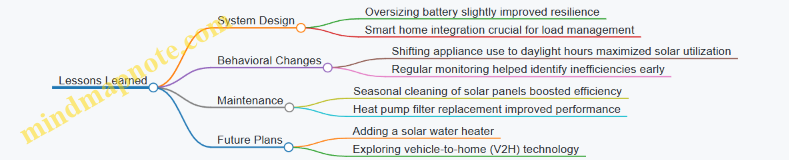
Practical Tips from the Year
- Energy Monitoring: Use real-time dashboards to stay informed and adjust habits.
- Load Shifting: Run high-energy appliances like washing machines during peak solar hours.
- Preventative Maintenance: Schedule regular checks to maintain system efficiency.
- Community Sharing: Share experiences to inspire and educate neighbors.
Summary
This year-long review demonstrates that fully electrifying a home sustainably is achievable and rewarding. Through smart design, diligent monitoring, and behavioral adjustments, the family significantly reduced their carbon footprint and energy costs while enhancing resilience and comfort. Their journey offers a replicable blueprint for anyone aiming to transition to a sustainable electrified home.