Sustainability Accounting
1. Introduction to Sustainability Accounting
1.1 Understanding Sustainability Accounting: Definition and Scope
Sustainability accounting is an evolving discipline that integrates environmental, social, and governance (ESG) factors into traditional financial accounting. It aims to provide a comprehensive view of an organization’s performance by measuring not only financial outcomes but also the impacts on people and the planet.
Definition
Sustainability accounting can be defined as the process of identifying, measuring, recording, and communicating information related to an organization’s environmental and social impacts alongside its financial performance. This holistic approach helps stakeholders understand how sustainable an organization’s operations are over the short and long term.
Scope
The scope of sustainability accounting extends beyond conventional accounting boundaries, encompassing:
- Environmental impacts: carbon emissions, water usage, waste management, resource depletion
- Social impacts: labor practices, community engagement, human rights
- Governance: ethical conduct, transparency, compliance
This integration supports decision-making that balances profit with responsibility.
Mind Map: Core Components of Sustainability Accounting
Why Sustainability Accounting Matters
-
Enhanced Decision-Making: By incorporating ESG data, organizations can identify risks and opportunities that traditional accounting overlooks.
-
Stakeholder Trust: Transparent sustainability reporting builds credibility with investors, customers, and regulators.
-
Regulatory Compliance: Increasingly, governments and international bodies require sustainability disclosures.
-
Long-Term Value Creation: Balancing financial, environmental, and social factors supports sustainable growth.
Example: A Manufacturing Company’s Sustainability Accounting Approach
Context: A mid-sized manufacturing firm wants to understand its environmental impact and social responsibility alongside profitability.
Actions:
- Measures energy consumption and carbon emissions monthly.
- Tracks employee safety incidents and community outreach programs.
- Integrates these metrics into quarterly financial reports.
Outcome:
- Identifies energy inefficiencies leading to cost savings.
- Improves workplace safety, reducing downtime.
- Enhances brand reputation, attracting new customers.
Mind Map: Benefits of Sustainability Accounting
Expanding the Scope: From Reporting to Strategic Tool
Sustainability accounting is not just about reporting past performance but also about guiding future strategy. By analyzing sustainability data, organizations can:
- Forecast environmental risks like climate change impacts.
- Align product development with sustainable practices.
- Engage stakeholders in meaningful dialogue.
Example: Environmental Analyst’s Role
An environmental analyst working with a financial firm uses sustainability accounting data to assess the ESG risks of potential investments. For instance, they evaluate a company’s water usage in drought-prone areas to determine financial risk exposure, influencing investment decisions.
Summary
Sustainability accounting broadens the traditional accounting framework to include environmental and social dimensions, providing a fuller picture of organizational performance. Its scope covers multiple domains and serves as a critical tool for risk management, compliance, and strategic growth.
This foundational understanding sets the stage for exploring best practices and real-world applications in subsequent sections.
1.2 The Importance of Sustainability Accounting in Modern Finance
Sustainability accounting is rapidly becoming a cornerstone of modern finance, reflecting the growing recognition that environmental, social, and governance (ESG) factors are critical to long-term business success and financial stability. This section explores why sustainability accounting matters today, how it influences financial decision-making, and real-world examples that illustrate its impact.
Why Sustainability Accounting Matters
Sustainability accounting integrates non-financial information related to environmental and social impacts into traditional financial reporting. This holistic approach provides a more comprehensive view of a company’s performance and risks.
Key Reasons for Importance:
- Risk Management: Identifying and quantifying environmental and social risks helps companies avoid financial losses and reputational damage.
- Investor Demand: Increasingly, investors seek ESG data to make informed decisions aligned with ethical and sustainable goals.
- Regulatory Compliance: Governments and regulatory bodies are mandating sustainability disclosures, making accounting essential for compliance.
- Competitive Advantage: Companies that proactively manage sustainability can reduce costs, innovate, and improve brand loyalty.
- Long-Term Value Creation: Sustainability accounting supports strategies that ensure resilience and profitability over time.
Mind Map: Importance of Sustainability Accounting
Impact on Financial Decision-Making
Sustainability accounting influences various financial processes:
- Capital Allocation: Funds are directed towards projects with positive environmental and social impacts.
- Valuation Models: Incorporates ESG risks and opportunities into company valuations.
- Performance Measurement: Expands KPIs beyond financial metrics to include sustainability indicators.
- Cost Management: Identifies inefficiencies such as excessive energy use or waste.
Example 1: Integrating Sustainability in Capital Budgeting
A manufacturing company evaluates two investment options:
- Option A: Traditional machinery with lower upfront cost but higher energy consumption.
- Option B: Energy-efficient machinery with higher initial cost but lower operating expenses and carbon emissions.
Using sustainability accounting, the company includes projected carbon taxes and energy savings in its financial analysis. Option B, though costlier initially, shows better long-term profitability and reduced environmental impact, guiding the company to choose the sustainable option.
Example 2: Investor Influence Through ESG Reporting
A global asset management firm decides to divest from companies with poor sustainability performance. They rely on sustainability accounting reports to assess carbon emissions, labor practices, and governance issues. This pressure encourages companies to improve their ESG disclosures and operational practices to maintain investor confidence and access to capital.
Mind Map: Financial Decision-Making Influenced by Sustainability Accounting
Conclusion
Sustainability accounting is no longer optional but essential in modern finance. It equips accountants and environmental analysts with the tools to evaluate and communicate the true value and risks of business activities. By embedding sustainability into financial processes, organizations can achieve transparency, meet stakeholder expectations, and drive sustainable growth.
1.3 Key Stakeholders: Accountants, Environmental Analysts, and Beyond
Sustainability accounting is a multidisciplinary field that requires collaboration among various stakeholders to ensure accurate measurement, reporting, and integration of environmental, social, and governance (ESG) factors into financial decision-making. Understanding the roles and interactions of these stakeholders is crucial for effective sustainability accounting.
Primary Stakeholders in Sustainability Accounting
Accountants
Accountants play a pivotal role in integrating sustainability metrics into traditional financial frameworks. Their responsibilities include:
- Financial Reporting: Incorporating sustainability-related costs and benefits into financial statements.
- Cost Analysis: Evaluating the financial impact of sustainability initiatives, such as energy efficiency projects.
- Compliance: Ensuring adherence to sustainability reporting standards and regulations.
Example: An accountant at a manufacturing firm integrates the cost savings from reduced energy consumption into the annual financial report, highlighting both economic and environmental benefits.
Environmental Analysts
Environmental analysts focus on gathering and interpreting data related to environmental performance. Their tasks involve:
- Data Collection: Measuring carbon emissions, water usage, waste generation, etc.
- Impact Assessment: Evaluating the environmental footprint of business operations.
- Risk Analysis: Identifying environmental risks that could affect financial performance.
Example: An environmental analyst uses satellite data and IoT sensors to monitor a company’s water usage, providing insights that help reduce consumption and costs.
Sustainability Officers
Sustainability officers bridge the gap between environmental data and corporate strategy. They:
- Develop and implement sustainability policies.
- Coordinate cross-departmental efforts to meet sustainability goals.
- Communicate sustainability performance to internal and external stakeholders.
Example: A sustainability officer leads a project to transition the company’s supply chain to renewable energy sources, coordinating efforts between procurement, finance, and environmental teams.
Investors
Investors increasingly consider ESG factors in their investment decisions. They:
- Evaluate sustainability reports to assess long-term risks and opportunities.
- Engage with companies to improve transparency and performance.
Example: An investment firm uses sustainability accounting data to decide on funding a company with strong carbon reduction commitments.
Regulators
Regulators establish and enforce standards to ensure consistent and reliable sustainability reporting. Their roles include:
- Developing frameworks like GRI, SASB, and TCFD.
- Monitoring compliance and imposing penalties for non-compliance.
Example: A government agency mandates carbon disclosure for publicly traded companies, requiring accountants to adapt reporting practices.
Supply Chain Managers
Supply chain managers ensure that sustainability extends beyond the company’s direct operations by:
- Implementing sustainable procurement policies.
- Conducting supplier audits for environmental and social compliance.
Example: A supply chain manager works with suppliers to reduce packaging waste, tracked through sustainability accounting metrics.
Customers
Customers drive demand for sustainable products and transparency, influencing corporate sustainability efforts. They:
- Seek information on product environmental impacts.
- Prefer companies with strong sustainability commitments.
Example: A retailer publishes sustainability reports to inform customers about the ethical sourcing of its products.
Integrated Example: Collaboration Among Stakeholders
Consider a company aiming to reduce its carbon footprint:
- Environmental Analysts measure current emissions using advanced sensors.
- Accountants calculate the financial implications of emission reduction projects.
- Sustainability Officers develop strategies and policies to implement changes.
- Supply Chain Managers engage suppliers to adopt greener practices.
- Investors review the company’s sustainability reports to assess investment risks.
- Regulators ensure the company complies with emission reporting standards.
- Customers respond positively to transparent sustainability efforts, increasing sales.
This collaboration ensures sustainability accounting is comprehensive, credible, and actionable.
Summary
Understanding the diverse roles of stakeholders in sustainability accounting helps create a cohesive approach that integrates environmental and financial data. By fostering collaboration among accountants, environmental analysts, sustainability officers, investors, regulators, supply chain managers, and customers, organizations can enhance transparency, compliance, and long-term value creation.
1.4 Overview of Regulatory Frameworks and Standards (GRI, SASB, TCFD)
Sustainability accounting relies heavily on established frameworks and standards to ensure consistency, transparency, and comparability of environmental, social, and governance (ESG) disclosures. This section provides an overview of three of the most influential frameworks: the Global Reporting Initiative (GRI), the Sustainability Accounting Standards Board (SASB), and the Task Force on Climate-related Financial Disclosures (TCFD). Each framework serves unique purposes and audiences, and understanding their distinctions and applications is crucial for accountants and environmental analysts.
Global Reporting Initiative (GRI)
The GRI is one of the oldest and most widely adopted sustainability reporting frameworks. It focuses on providing a comprehensive set of standards for organizations to report on their economic, environmental, and social impacts.
- Purpose: To enable organizations to communicate their sustainability impacts transparently.
- Scope: Broad, covering multiple ESG topics.
- Audience: Wide-ranging, including investors, customers, employees, and civil society.
Example: A manufacturing company uses GRI standards to report on its water usage, waste management, labor practices, and community engagement efforts in its annual sustainability report.
Mind Map (GRI):
Sustainability Accounting Standards Board (SASB)
SASB focuses on financially material sustainability information tailored to specific industries. It helps companies disclose sustainability information that is most relevant to investors.
- Purpose: To identify sustainability issues that are financially material to companies within specific industries.
- Scope: Industry-specific standards covering 77 industries.
- Audience: Primarily investors and financial analysts.
Example: A technology firm uses SASB standards to disclose data privacy and cybersecurity risks, energy management, and supply chain management metrics relevant to its sector.
Mind Map (SASB):
Task Force on Climate-related Financial Disclosures (TCFD)
TCFD provides recommendations for companies to disclose climate-related financial risks and opportunities, emphasizing governance, strategy, risk management, and metrics.
- Purpose: To improve and increase reporting of climate-related financial information.
- Scope: Climate-related risks and opportunities.
- Audience: Investors, lenders, insurers, and other stakeholders.
Example: A financial institution adopts TCFD recommendations to disclose how climate risks affect its loan portfolio and investment strategies.
Mind Map (TCFD):
Integrating Frameworks: Best Practice Example
Many organizations combine these frameworks to meet diverse stakeholder needs. For instance, a multinational corporation might use GRI for broad sustainability reporting, SASB to highlight financially material issues for investors, and TCFD to specifically address climate-related financial risks.
Example:
- A consumer goods company publishes an annual sustainability report using GRI standards to cover broad ESG topics.
- It supplements this with SASB disclosures focused on supply chain labor practices and product safety, which are material to its industry.
- Additionally, it aligns with TCFD recommendations to report on climate risks affecting its operations and supply chain resilience.
Summary Table
| Framework | Purpose | Scope | Audience | Example Use Case |
|---|---|---|---|---|
| GRI | Comprehensive sustainability reporting | Broad ESG topics | General stakeholders | Reporting water usage, labor practices |
| SASB | Financially material sustainability info | Industry-specific | Investors, financial analysts | Disclosing cybersecurity risks in tech |
| TCFD | Climate-related financial disclosures | Climate risks and opportunities | Investors, lenders, insurers | Reporting climate risk impact on loans |
Understanding these frameworks empowers accountants and environmental analysts to design robust sustainability accounting systems that meet regulatory requirements and stakeholder expectations, ultimately enhancing transparency and driving sustainable business practices.
1.5 Case Study: How a Leading Corporation Integrated Sustainability Accounting
Overview
This case study explores how GreenTech Industries, a multinational manufacturing corporation, successfully integrated sustainability accounting into their financial and operational frameworks. Their journey highlights best practices, challenges, and tangible outcomes, offering a blueprint for accountants and environmental analysts aiming to embed sustainability into corporate accounting.
Background
GreenTech Industries, known for producing eco-friendly consumer electronics, faced increasing pressure from stakeholders to demonstrate environmental responsibility and social impact alongside financial performance. To address this, they embarked on a comprehensive integration of sustainability accounting.
Step 1: Establishing a Cross-Functional Sustainability Team
- Accountants, environmental analysts, operations managers, and IT specialists formed a dedicated team.
- Objective: Align sustainability metrics with financial data and operational processes.
Mind Map: Cross-Functional Team Roles
Step 2: Identifying Material Sustainability Metrics
- Conducted a materiality assessment to prioritize environmental and social factors relevant to GreenTech’s business.
- Selected KPIs included:
- Carbon footprint (Scope 1, 2, and partial Scope 3 emissions)
- Energy consumption per unit produced
- Water usage and recycling rates
- Employee health and safety incidents
- Community engagement hours
Example:
GreenTech discovered that energy consumption was a major cost driver and environmental impact, so they focused on improving energy efficiency.
Mind Map: Materiality Assessment Process
Step 3: Data Collection and Integration
- Implemented IoT sensors on manufacturing equipment to capture real-time energy and water usage.
- Integrated sustainability data into the existing Enterprise Resource Planning (ERP) system.
- Developed dashboards combining financial and sustainability KPIs for management review.
Example:
By linking energy consumption data with production volumes, GreenTech could calculate energy intensity (kWh per unit) and identify inefficiencies.
Mind Map: Data Integration Workflow
Step 4: Financial Analysis and Reporting
- Accountants quantified cost savings from energy efficiency improvements.
- Environmental liabilities, such as waste disposal costs, were accounted for in financial statements.
- Sustainability reports aligned with GRI standards were published annually.
Example:
Energy efficiency projects reduced electricity costs by 12% in the first year, directly improving operating margins.
Mind Map: Financial Integration of Sustainability Metrics
Step 5: Outcomes and Lessons Learned
- Improved transparency and credibility with investors and customers.
- Enhanced decision-making through integrated financial and sustainability data.
- Fostered a culture of sustainability across departments.
Example:
GreenTech’s transparent reporting attracted ESG-focused investors, increasing capital inflows by 15%.
Mind Map: Outcomes and Benefits
Summary
GreenTech Industries’ integration of sustainability accounting demonstrates how corporations can effectively blend environmental and social metrics with financial data. This holistic approach not only meets stakeholder expectations but also drives operational efficiencies and strategic growth.
Key Takeaways for Accountants and Environmental Analysts
- Engage cross-functional teams early to ensure alignment.
- Prioritize material sustainability issues relevant to your business.
- Leverage technology for accurate and timely data collection.
- Translate sustainability metrics into financial terms to demonstrate value.
- Commit to transparent, standardized reporting to build trust.
This case study serves as a practical example for professionals in finance and sustainability sectors aiming to adopt sustainability accounting best practices.
2. Core Principles and Frameworks of Sustainability Accounting
2.1 Triple Bottom Line Accounting: People, Planet, Profit
Introduction
Triple Bottom Line (TBL) Accounting is a sustainability framework that expands the traditional reporting framework to include social and environmental performance in addition to financial performance. The three pillars—People, Planet, and Profit—represent the social, environmental, and economic dimensions of sustainability respectively. This approach encourages organizations to measure and report their impact comprehensively, promoting long-term value creation beyond just financial gains.
The Three Pillars Explained
People (Social Responsibility)
This pillar focuses on the impact an organization has on its employees, customers, suppliers, and the communities where it operates. It includes fair labor practices, community engagement, diversity and inclusion, human rights, and health and safety.
Planet (Environmental Stewardship)
This pillar addresses how a company manages its environmental footprint. It involves resource consumption, waste management, emissions reduction, biodiversity preservation, and sustainable sourcing.
Profit (Economic Viability)
Profit remains a crucial pillar, emphasizing that sustainability must be economically feasible. It includes financial performance, cost savings from sustainable practices, and long-term economic growth.
Mind Map: Triple Bottom Line Accounting Overview
Best Practices in Triple Bottom Line Accounting
-
Integrate TBL Metrics into Core Accounting Systems
- Incorporate social and environmental KPIs alongside financial metrics.
- Example: A manufacturing company tracks employee injury rates (People), carbon emissions (Planet), and profit margins (Profit) in a unified dashboard.
-
Engage Stakeholders Across All Pillars
- Collaborate with employees, suppliers, community members, and investors to identify relevant TBL metrics.
- Example: A retail chain holds community forums to understand social concerns and integrates feedback into reporting.
-
Use Quantitative and Qualitative Data
- Combine numerical data (e.g., tons of CO2 emitted) with narrative explanations (e.g., community development initiatives).
- Example: An energy company reports on renewable energy usage (quantitative) and employee volunteer programs (qualitative).
-
Benchmark and Set Targets
- Compare performance against industry standards and set measurable improvement goals.
- Example: A food producer aims to reduce water usage by 15% over 3 years, tracking progress annually.
-
Transparent Reporting and Verification
- Publish TBL reports aligned with recognized frameworks and seek third-party assurance.
- Example: A tech firm publishes an annual sustainability report verified by an external auditor.
Mind Map: Best Practices for Implementing TBL Accounting
Examples of Triple Bottom Line Accounting in Action
Example 1: Patagonia
People: Patagonia ensures fair labor practices in its supply chain and invests in employee well-being.
Planet: The company uses recycled materials and commits to carbon neutrality.
Profit: Despite higher costs, Patagonia’s sustainable approach has cultivated strong brand loyalty and consistent profitability.
Example 2: Unilever
People: Unilever promotes health and hygiene programs in communities where it operates.
Planet: It has ambitious targets to reduce greenhouse gas emissions and plastic waste.
Profit: Sustainable brands within Unilever’s portfolio have grown faster than others, contributing positively to overall profits.
Example 3: Local Small Business - Green Café
People: Provides fair wages and supports local farmers.
Planet: Uses biodegradable packaging and sources organic ingredients.
Profit: Savings from energy-efficient appliances and waste reduction improve margins.
How Accountants and Environmental Analysts Can Apply TBL
-
Accountants: Develop integrated financial and non-financial reporting systems, analyze cost implications of sustainability initiatives, and advise on risk management.
-
Environmental Analysts: Measure environmental impacts, identify improvement opportunities, and collaborate with finance teams to translate findings into actionable business insights.
Summary
Triple Bottom Line Accounting is a holistic approach that balances social equity, environmental health, and economic prosperity. By embedding People, Planet, and Profit into accounting practices, organizations can achieve sustainable growth, enhance stakeholder trust, and contribute positively to society and the environment.
2.2 Materiality Assessment: Identifying Relevant Environmental and Social Metrics
Materiality assessment is a foundational step in sustainability accounting that helps organizations identify and prioritize the environmental, social, and governance (ESG) issues most relevant to their business and stakeholders. This ensures that sustainability efforts and reporting focus on areas with the greatest impact and significance.
What is Materiality Assessment?
Materiality assessment is the process of determining which sustainability topics are most important to both the business and its stakeholders. It guides decision-making, resource allocation, and reporting by highlighting key issues that could affect financial performance, reputation, and long-term value creation.
Why is Materiality Important?
- Focuses efforts: Helps companies concentrate on the most impactful sustainability issues.
- Enhances transparency: Provides stakeholders with relevant and meaningful information.
- Supports compliance: Aligns with reporting standards like GRI, SASB, and TCFD.
- Drives strategy: Informs sustainability goals and risk management.
Steps in Conducting a Materiality Assessment
Identifying Relevant Environmental and Social Metrics
To identify relevant metrics, organizations typically start by:
- Reviewing industry-specific sustainability issues.
- Consulting global standards (e.g., GRI, SASB).
- Engaging internal and external stakeholders (employees, customers, investors, communities).
- Considering regulatory requirements and emerging trends.
Example: Materiality Assessment in a Manufacturing Company
Step 1: Identify Potential Topics
- Energy consumption
- Greenhouse gas emissions
- Waste management
- Water usage
- Employee health and safety
- Community impact
- Supply chain labor practices
Step 2: Stakeholder Engagement
- Conduct surveys and interviews with employees, local communities, customers, and investors.
Step 3: Prioritize Topics
- Energy consumption and emissions ranked high due to regulatory pressure and cost implications.
- Employee health and safety prioritized due to workforce concerns.
- Community impact considered moderately important.
Step 4: Create Materiality Matrix
Practical Example: Social Metrics Identification
For a retail company, relevant social metrics might include:
- Employee diversity and inclusion rates
- Fair wages and labor conditions
- Customer privacy and data protection
- Community engagement initiatives
Engaging with stakeholders such as employees and customers helps prioritize these metrics effectively.
Mind Map: Key Considerations for Materiality Assessment
Best Practices for Materiality Assessment
- Engage diverse stakeholders: Ensure a broad perspective.
- Use quantitative and qualitative data: Combine surveys, interviews, and data analysis.
- Update regularly: Materiality evolves with business and external environment.
- Align with standards: Follow frameworks like GRI and SASB for consistency.
- Communicate transparently: Share methodology and results openly.
Summary
Materiality assessment is a critical process that helps organizations identify which environmental and social metrics matter most. By focusing on these relevant areas, companies can improve sustainability performance, meet stakeholder expectations, and create long-term value.
For accountants and environmental analysts, mastering materiality assessment enables more accurate and impactful sustainability accounting, ensuring that resources are directed towards the most significant ESG issues.
2.3 Lifecycle Thinking and Accounting: From Raw Materials to End-of-Life
Lifecycle thinking in sustainability accounting involves evaluating the environmental and social impacts of a product or service throughout its entire existence — from raw material extraction, manufacturing, distribution, use, and finally to disposal or recycling. This holistic approach ensures that accountants and environmental analysts capture all relevant costs and impacts, enabling more informed decision-making.
What is Lifecycle Thinking?
Lifecycle thinking encourages organizations to look beyond immediate financial costs and consider the broader consequences of their operations. It integrates environmental, social, and economic factors at each stage of a product’s life.
Key stages include:
- Raw Material Extraction
- Manufacturing and Production
- Distribution and Transportation
- Use Phase
- End-of-Life (Disposal, Recycling, Reuse)
Mind Map: Lifecycle Stages and Accounting Considerations
Why Incorporate Lifecycle Thinking in Accounting?
- Comprehensive Costing: Captures hidden costs such as environmental remediation or social impacts.
- Risk Management: Identifies potential liabilities at different lifecycle stages.
- Improved Reporting: Enables transparent sustainability disclosures aligned with frameworks like LCA (Life Cycle Assessment).
- Strategic Decision-Making: Helps prioritize investments in sustainable materials or processes.
Example: Lifecycle Accounting for a Smartphone
Consider a smartphone manufacturer applying lifecycle thinking:
| Lifecycle Stage | Sustainability Accounting Focus | Example Practice |
|---|---|---|
| Raw Materials | Assess sourcing impacts and costs | Tracking cobalt mining conditions and costs |
| Manufacturing | Measure energy use, emissions, and labor practices | Auditing factory energy consumption and waste |
| Distribution | Calculate transportation emissions and packaging waste | Optimizing shipping routes to reduce carbon footprint |
| Use Phase | Estimate energy consumption during device usage | Reporting average electricity usage of devices |
| End-of-Life | Account for recycling rates and disposal impacts | Partnering with e-waste recyclers and tracking recovery rates |
This lifecycle approach helps the company identify hotspots where sustainability improvements can reduce costs and environmental impacts, such as switching to recycled materials or improving energy efficiency.
Mind Map: Benefits of Lifecycle Accounting
Practical Tips for Implementing Lifecycle Thinking in Accounting
- Map the Product Lifecycle: Start by outlining all stages relevant to your product or service.
- Identify Key Metrics: Choose environmental and social indicators for each stage (e.g., carbon emissions, water use, labor conditions).
- Collect Data: Use internal records, supplier data, and industry benchmarks.
- Quantify Impacts: Convert qualitative data into measurable units where possible.
- Integrate with Financial Data: Combine sustainability metrics with financial costs to reveal true product costs.
- Report Transparently: Use visuals and clear explanations to communicate findings.
Example: Applying Lifecycle Accounting in a Textile Company
A textile company analyzed the lifecycle of its cotton t-shirts:
- Raw Materials: Water and pesticide use in cotton farming were quantified.
- Manufacturing: Energy consumption and chemical use in dyeing processes were tracked.
- Distribution: Transportation distances and packaging materials were assessed.
- Use: Estimated washing frequency and energy use by consumers were included.
- End-of-Life: Options for recycling or landfill disposal were evaluated.
By identifying that the use phase (washing) contributed significantly to environmental impact, the company launched a consumer awareness campaign promoting cold-water washing, reducing overall lifecycle impacts.
Lifecycle thinking and accounting empower finance and sustainability professionals to see beyond traditional boundaries, driving more sustainable business practices and long-term value creation.
2.4 Integrated Reporting Framework: Combining Financial and Non-Financial Data
Integrated Reporting (IR) is a holistic approach to corporate reporting that combines financial data with non-financial information such as environmental, social, and governance (ESG) metrics. This framework helps organizations communicate a comprehensive picture of their value creation over time, addressing the needs of a broad range of stakeholders including investors, regulators, customers, and employees.
What is Integrated Reporting?
Integrated Reporting aims to break down silos between financial and sustainability reporting, providing a unified narrative that explains how an organization’s strategy, governance, performance, and prospects lead to value creation in the short, medium, and long term.
Key features include:
- Concise communication
- Connectivity of information
- Future orientation
- Stakeholder inclusiveness
- Materiality focus
Why Combine Financial and Non-Financial Data?
- Holistic Decision-Making: Enables stakeholders to understand the full spectrum of risks and opportunities.
- Improved Transparency: Builds trust by disclosing sustainability impacts alongside financial results.
- Enhanced Strategic Alignment: Helps companies align sustainability goals with financial objectives.
The International IR Framework
The International Integrated Reporting Council (IIRC) provides guiding principles and content elements for integrated reports:
- Guiding Principles: Strategic focus, connectivity of information, stakeholder relationships, materiality, conciseness, reliability, and consistency.
- Content Elements: Organizational overview, governance, business model, risks and opportunities, strategy and resource allocation, performance, outlook, and basis of presentation.
Mind Map: Components of Integrated Reporting
Mind Map: Benefits of Combining Financial and Non-Financial Data
Practical Example: Integrated Reporting at “GreenTech Solutions”
Company Background: GreenTech Solutions is a mid-sized renewable energy company aiming to attract impact investors.
Implementation:
- They combined their financial statements with sustainability metrics such as carbon emissions reduced, energy generated from renewable sources, and community engagement initiatives.
- Their integrated report included a clear narrative linking how investments in solar technology (financial data) directly contributed to reducing the carbon footprint (non-financial data).
- They used the IR Framework to structure their report, ensuring all content elements were addressed.
Outcome:
- Investors gained a clearer understanding of the company’s long-term value creation.
- The company attracted new capital focused on sustainable investments.
Step-by-Step Guide to Creating an Integrated Report
- Identify Material Issues: Conduct a materiality assessment to determine which financial and non-financial topics matter most.
- Engage Stakeholders: Understand stakeholder information needs.
- Collect Data: Gather reliable financial data and sustainability metrics.
- Develop Narrative: Craft a story that connects strategy, performance, and future outlook.
- Use Framework Principles: Apply IR guiding principles to ensure clarity and conciseness.
- Design Report: Present data visually and textually for easy comprehension.
- Obtain Assurance: Consider third-party verification for credibility.
Mind Map: Steps to Develop an Integrated Report
Example: Linking Financial and Non-Financial Data
| Financial Metric | Non-Financial Metric | Integrated Insight |
|---|---|---|
| Capital Expenditure on Solar Projects | Tonnes of CO2 Emissions Avoided | Investment in solar projects leads to measurable carbon reduction, supporting climate goals. |
| Operating Costs Savings | Energy Efficiency Improvements | Reduced costs due to energy efficiency demonstrate operational sustainability. |
| Revenue from Green Products | Customer Satisfaction Scores on Sustainability | Growing revenue from green products aligns with increasing customer demand for sustainable options. |
Summary
The Integrated Reporting Framework is a powerful tool for accountants and environmental analysts to present a comprehensive picture of an organization’s value creation. By combining financial and non-financial data, companies can improve transparency, support strategic decision-making, and meet the evolving expectations of stakeholders. Practical application of this framework, as demonstrated by companies like GreenTech Solutions, highlights its effectiveness in driving sustainable business success.
2.5 Practical Example: Applying the Integrated Reporting Framework in a Mid-Sized Company
Integrated Reporting (IIRC) is a powerful framework that combines financial and non-financial information to provide a holistic view of an organization’s value creation over time. This section walks through how a mid-sized manufacturing company, GreenTech Solutions, successfully applied the Integrated Reporting Framework to enhance transparency and strategic decision-making.
Step 1: Understanding the Six Capitals
Integrated Reporting focuses on six forms of capital that organizations rely on and affect:
Example: GreenTech Solutions mapped their resources and dependencies across these capitals:
- Financial: Operating cash flow, investments in sustainable tech
- Manufactured: Production facilities and equipment
- Intellectual: Patents on eco-friendly materials
- Human: Skilled workforce and training programs
- Social & Relationship: Community partnerships, supplier relations
- Natural: Raw materials, energy consumption, emissions
Step 2: Materiality Assessment
Identifying which issues significantly impact the company’s ability to create value.
Example: Through stakeholder engagement and internal analysis, GreenTech prioritized carbon emissions, waste reduction, and employee wellbeing as material topics.
Step 3: Business Model Description
Illustrating how GreenTech creates, delivers, and captures value.
Example: GreenTech highlighted how investment in R&D led to biodegradable packaging, reducing environmental footprint and attracting eco-conscious customers.
Step 4: Risks and Opportunities
Analyzing sustainability-related risks and opportunities.
Example: GreenTech identified potential regulatory risks on emissions but also saw opportunities in expanding their renewable energy use, supported by government incentives.
Step 5: Strategy and Resource Allocation
Aligning sustainability with corporate strategy.
Example: The company allocated budget for solar panel installation and hired a sustainability officer to oversee initiatives.
Step 6: Performance Measurement
Tracking progress using KPIs.
Example: After one year, GreenTech reported a 15% reduction in CO2 emissions and a 25% increase in revenue from eco-friendly products.
Step 7: Outlook and Future Plans
Communicating future challenges and plans.
Example: GreenTech committed to expanding their solar capacity by 50% and initiating supplier audits to ensure sustainable sourcing.
Summary Table: Integrated Reporting Elements Applied by GreenTech Solutions
| Element | Description | Example from GreenTech |
|---|---|---|
| Six Capitals | Resources and relationships impacting value | Natural capital (energy), Human capital (staff training) |
| Materiality | Key issues affecting value creation | Carbon emissions, employee wellbeing |
| Business Model | How value is created and delivered | Sustainable manufacturing, eco-friendly products |
| Risks & Opportunities | External/internal factors influencing strategy | Regulatory risks, renewable energy adoption |
| Strategy & Resources | Goals and resource allocation | Carbon reduction targets, solar panel investment |
| Performance | KPIs to measure success | CO2 reduction, revenue from green products |
| Outlook | Future challenges and plans | Scaling renewable energy, supplier audits |
Final Thoughts
By applying the Integrated Reporting Framework, GreenTech Solutions was able to:
- Provide a clear, concise, and connected narrative linking sustainability and financial performance.
- Enhance stakeholder trust through transparent disclosure.
- Drive strategic decisions that align sustainability with long-term value creation.
This practical example demonstrates how mid-sized companies can adopt integrated reporting to not only meet regulatory expectations but also gain competitive advantage and foster sustainable growth.
3. Data Collection and Measurement Techniques
3.1 Identifying Key Performance Indicators (KPIs) for Sustainability
Sustainability Key Performance Indicators (KPIs) are essential metrics that help organizations measure, monitor, and manage their environmental, social, and governance (ESG) impacts. Identifying the right KPIs is crucial for effective sustainability accounting, as they provide actionable insights and enable transparent reporting.
Understanding Sustainability KPIs
Sustainability KPIs are quantifiable measures that reflect an organization’s performance in areas such as environmental stewardship, social responsibility, and economic impact. They should be:
- Relevant: Directly linked to the organization’s sustainability goals and material issues.
- Measurable: Quantifiable with reliable data sources.
- Actionable: Inform decision-making and improvement strategies.
- Comparable: Allow benchmarking over time or against peers.
Mind Map: Categories of Sustainability KPIs
Selecting KPIs Based on Materiality
Materiality assessment helps prioritize KPIs that matter most to stakeholders and the business. For example, a manufacturing company might focus on energy consumption and waste, while a financial institution may prioritize governance and social KPIs.
Example 1: Environmental KPI - Carbon Emissions
KPI: Total greenhouse gas emissions (in metric tons CO2e)
Why it matters: Carbon emissions directly relate to climate change impact.
How to measure: Use energy bills, fuel consumption data, and emission factors.
Example: A mid-sized textile company tracks its Scope 1 and 2 emissions quarterly to identify reduction opportunities. After installing energy-efficient machinery, it reports a 15% reduction in emissions within a year.
Mind Map: Steps to Identify KPIs
Example 2: Social KPI - Employee Health & Safety
KPI: Lost Time Injury Frequency Rate (LTIFR)
Why it matters: Indicates workplace safety and employee well-being.
How to measure: Number of lost time injuries per million hours worked.
Example: An energy company monitors LTIFR monthly. After implementing enhanced safety training, LTIFR dropped from 4.5 to 2.0 over two years.
Example 3: Governance KPI - Board Diversity
KPI: Percentage of board members from underrepresented groups
Why it matters: Diverse boards contribute to better decision-making and reflect social responsibility.
How to measure: Count and percentage of board members by gender, ethnicity, or other diversity dimensions.
Example: A financial services firm sets a target of 40% female board representation and reports progress annually in its sustainability report.
Practical Tips for Accountants and Environmental Analysts
- Collaborate with cross-functional teams to identify KPIs that align with business strategy.
- Use existing frameworks like GRI, SASB, or TCFD for guidance on relevant KPIs.
- Ensure data collection processes are robust and auditable.
- Regularly review and update KPIs to reflect evolving sustainability priorities.
By carefully identifying and selecting sustainability KPIs, organizations can drive meaningful improvements, enhance transparency, and meet stakeholder expectations effectively.
3.2 Quantifying Environmental Impact: Carbon Footprint and Water Usage
Quantifying environmental impact is a cornerstone of sustainability accounting. Two of the most critical environmental metrics are the carbon footprint and water usage. These metrics help organizations understand their environmental burden and identify opportunities for improvement.
Understanding Carbon Footprint
The carbon footprint measures the total greenhouse gas (GHG) emissions caused directly or indirectly by an organization, product, or activity. It is usually expressed in equivalent tons of CO2 (CO2e).
Key Components of Carbon Footprint:
- Scope 1: Direct emissions from owned or controlled sources (e.g., fuel combustion, company vehicles).
- Scope 2: Indirect emissions from the generation of purchased electricity, steam, heating, and cooling.
- Scope 3: All other indirect emissions that occur in the value chain (e.g., business travel, waste disposal).
Mind Map: Carbon Footprint Components
Example:
A manufacturing company calculates its carbon footprint by measuring the fuel used in its boilers (Scope 1), electricity consumed from the grid (Scope 2), and emissions from employee flights and waste management (Scope 3). This comprehensive approach helps the company identify that electricity consumption is its largest emission source, guiding energy efficiency initiatives.
Measuring Water Usage
Water usage quantifies the volume of freshwater consumed or polluted by an organization’s operations. It is essential to track both direct water withdrawals and indirect water use embedded in supply chains.
Types of Water Usage:
- Direct Water Use: Water consumed on-site for manufacturing, cooling, sanitation, etc.
- Indirect Water Use: Water used in the production of purchased goods and services.
Mind Map: Water Usage Categories
Example:
A beverage company tracks water usage in its bottling plants (direct use) and also assesses water embedded in agricultural raw materials like sugar and fruits (indirect use). By quantifying both, the company identifies that agricultural water use is a significant portion of its total water footprint, prompting collaboration with suppliers to adopt water-saving practices.
Methods to Quantify Carbon Footprint and Water Usage
- Data Collection: Gather activity data such as fuel consumption, electricity bills, water meter readings, travel logs, and supplier information.
- Emission Factors: Use standardized emission factors (e.g., from the IPCC or EPA) to convert activity data into CO2e emissions.
- Water Footprint Assessment: Apply methodologies like the Water Footprint Network’s guidelines to assess direct and indirect water use.
- Software Tools: Utilize sustainability accounting software that integrates data inputs and automates calculations.
Mind Map: Quantification Process
Practical Example: Quantifying Carbon Footprint and Water Usage in a Textile Company
Step 1: The company collects data on:
- Diesel used in factory generators (Scope 1)
- Electricity purchased from the grid (Scope 2)
- Employee air travel (Scope 3)
- Water used in dyeing and finishing processes (direct water use)
- Water embedded in cotton sourced from suppliers (indirect water use)
Step 2: They apply emission factors to convert fuel and electricity consumption into CO2e.
Step 3: Water usage is measured via meter readings and supplier water footprint reports.
Step 4: Results show that:
- Electricity accounts for 60% of carbon emissions.
- Cotton cultivation accounts for 70% of water usage.
Step 5: Based on these insights, the company invests in renewable energy and partners with cotton farmers to implement water-efficient irrigation.
Summary
Quantifying carbon footprint and water usage enables organizations to:
- Identify major sources of environmental impact.
- Set measurable reduction targets.
- Enhance transparency and credibility in sustainability reporting.
- Drive strategic decisions for environmental and financial performance.
By integrating these metrics into sustainability accounting, accountants and environmental analysts can provide actionable insights that support sustainable business growth.
3.3 Social Impact Metrics: Labor Practices and Community Engagement
Sustainability accounting goes beyond environmental factors to include social impact metrics, which are critical for understanding a company’s influence on its workforce and the communities in which it operates. Two key areas in social impact metrics are labor practices and community engagement. These metrics help organizations measure, manage, and communicate their social responsibility efforts effectively.
Understanding Social Impact Metrics
Social impact metrics evaluate how a company’s operations affect people both inside and outside the organization. These metrics provide transparency on labor conditions, employee well-being, diversity, equity, inclusion, and the company’s role in supporting local communities.
Mind Map: Social Impact Metrics Overview
Labor Practices
Labor practices focus on the treatment of employees and contractors, ensuring fair, safe, and equitable working conditions.
Key Metrics:
- Employee Health & Safety: Number of workplace injuries, lost-time incidents, and safety training hours.
- Fair Wages & Benefits: Percentage of employees paid above minimum wage, access to healthcare, retirement plans.
- Diversity & Inclusion: Gender and ethnic diversity ratios, pay equity statistics.
- Training & Development: Hours of professional development per employee, internal promotion rates.
- Labor Rights Compliance: Adherence to labor laws, freedom of association, absence of child/forced labor.
Example: A manufacturing company tracks its workplace injury rate and implements a new safety training program. Over a year, injury rates drop by 30%, demonstrating improved labor practices. They also publish diversity data showing a 40% increase in female representation in management roles.
Mind Map: Labor Practices Metrics
Community Engagement
Community engagement measures how a company interacts with and contributes to the social and economic well-being of local communities.
Key Metrics:
- Local Hiring: Percentage of workforce hired from local communities.
- Community Investment: Amount invested in local infrastructure, education, or social programs.
- Stakeholder Dialogue: Frequency and quality of engagement with community stakeholders.
- Volunteer Programs: Number of employee volunteer hours and initiatives supported.
- Social Impact Partnerships: Collaborations with NGOs or local organizations to address social issues.
Example: A retail company launches a community engagement program that includes partnering with local schools for educational workshops and sponsoring neighborhood clean-up events. They measure success by tracking volunteer hours (which increase by 50% year-over-year) and community feedback surveys indicating improved local sentiment.
Mind Map: Community Engagement Metrics
Integrating Social Impact Metrics into Sustainability Accounting
To effectively incorporate social impact metrics, companies should:
- Set Clear Objectives: Define what social outcomes are most relevant to their operations and stakeholders.
- Collect Reliable Data: Use surveys, HR systems, and community feedback tools.
- Benchmark and Track Progress: Compare against industry standards and previous performance.
- Report Transparently: Include social metrics in sustainability reports aligned with frameworks like GRI or SASB.
Practical Example: Social Impact Metrics in Action
Company: GreenTech Solutions, a renewable energy provider.
Labor Practices:
- Implemented a comprehensive safety program reducing workplace injuries by 25%.
- Increased female workforce representation from 20% to 35% over two years.
- Provided 40 hours of training per employee annually.
Community Engagement:
- Hired 60% of new employees from local communities near project sites.
- Invested $500,000 in community education and health programs.
- Organized quarterly stakeholder meetings to discuss community concerns.
- Employees volunteered 1,200 hours in local environmental restoration projects.
GreenTech includes these metrics in their annual sustainability report, demonstrating accountability and fostering trust with investors and community members.
Summary
Social impact metrics related to labor practices and community engagement are essential components of sustainability accounting. By measuring and improving these areas, organizations not only comply with ethical standards but also enhance their reputation, employee satisfaction, and community relations.
3.4 Tools and Technologies for Data Gathering and Analysis
In sustainability accounting, accurate data collection and insightful analysis are critical to understanding environmental and social impacts. Leveraging the right tools and technologies can streamline these processes, improve data reliability, and enable more informed decision-making.
Key Categories of Tools and Technologies
IoT Sensors for Real-Time Environmental Monitoring
Internet of Things (IoT) sensors are increasingly used to collect real-time data on energy consumption, water usage, air quality, and waste generation.
Example: A manufacturing plant installs IoT sensors on machinery to monitor electricity usage continuously. The data helps accountants identify peak consumption periods and inefficiencies, enabling targeted energy-saving initiatives.
Satellite Imaging and Remote Sensing
Satellite technology provides macro-level environmental data, such as deforestation rates, land use changes, and water body health.
Example: An environmental analyst uses satellite imagery to track the impact of a company’s supply chain on forest cover, integrating findings into sustainability reports.
Mobile Data Collection Apps
Mobile apps facilitate on-the-ground data gathering, especially for social impact metrics like labor conditions or community engagement.
Example: Field auditors use a mobile app to record worker safety compliance in remote factories, feeding data directly into the company’s sustainability database.
Cloud Storage and Data Warehouses
Cloud platforms enable centralized, scalable storage of large volumes of sustainability data, ensuring accessibility and security.
Example: A multinational firm consolidates energy usage data from all global offices into a cloud warehouse, enabling cross-site comparisons and benchmarking.
Blockchain for Data Integrity and Transparency
Blockchain technology can ensure data immutability and traceability, enhancing trust in sustainability disclosures.
Example: A company uses blockchain to track and verify the origin of raw materials, ensuring compliance with environmental sourcing standards.
Business Intelligence (BI) and Statistical Tools
BI platforms like Power BI, Tableau, and statistical software such as R or Python libraries enable deep analysis and visualization of sustainability data.
Example: Accountants use Tableau dashboards to visualize carbon emissions trends over time, identifying hotspots and tracking progress against targets.
Artificial Intelligence and Machine Learning
AI can predict environmental risks, optimize resource use, and automate anomaly detection in large datasets.
Example: A financial institution applies machine learning models to forecast climate-related credit risks, integrating results into risk management frameworks.
Geographic Information Systems (GIS)
GIS tools help visualize spatial data related to environmental impacts and resource distribution.
Example: Environmental analysts map water usage across different facilities using GIS, identifying regions with the highest consumption for targeted interventions.
Summary
By integrating these tools and technologies, accountants and environmental analysts can enhance the accuracy, timeliness, and transparency of sustainability data. This integration supports better reporting, risk management, and strategic decision-making, ultimately driving more sustainable business practices.
3.5 Example: Using IoT Sensors to Track Energy Consumption in Real-Time
In sustainability accounting, accurate and timely data collection is critical for measuring environmental impact and identifying areas for improvement. One of the most effective ways to achieve this is through the use of Internet of Things (IoT) sensors to monitor energy consumption in real-time. This section explores how IoT technology can be integrated into sustainability accounting practices, providing practical examples and mind maps to illustrate the process.
What Are IoT Sensors?
IoT sensors are connected devices that collect and transmit data over the internet. When applied to energy management, these sensors can measure electricity usage, temperature, lighting, and other parameters continuously and with high precision.
Benefits of Using IoT Sensors in Energy Tracking
- Real-Time Data Collection: Immediate insights into energy consumption patterns.
- Improved Accuracy: Reduces human error associated with manual meter readings.
- Enhanced Decision-Making: Enables proactive energy management and cost savings.
- Integration with Sustainability Reporting: Provides reliable data for environmental impact assessments.
Mind Map: IoT Sensors for Real-Time Energy Tracking
Practical Example: Implementing IoT Sensors in a Manufacturing Facility
Scenario: A mid-sized manufacturing company wants to reduce its energy costs and carbon footprint. They decide to install IoT sensors across their production lines and facility infrastructure.
Steps Taken:
- Sensor Deployment: Sensors are installed on main electrical panels, HVAC units, and lighting systems.
- Data Integration: Sensor data is transmitted via Wi-Fi to a centralized cloud platform.
- Real-Time Monitoring: Facility managers access dashboards showing live energy consumption.
- Analysis: Data analytics identify peak usage times and inefficient equipment.
- Action: Based on insights, the company schedules equipment maintenance and adjusts operational hours.
- Reporting: Energy savings and emission reductions are documented for sustainability reports.
Outcome:
- 15% reduction in energy consumption within six months.
- Improved accuracy in sustainability accounting reports.
- Enhanced ability to forecast energy costs.
Mind Map: Workflow of IoT-Based Energy Monitoring
Additional Example: Smart Office Building
A commercial office building integrates IoT sensors to monitor lighting and HVAC energy use. The system automatically adjusts lighting based on occupancy and natural light levels, and HVAC settings are optimized according to real-time temperature data.
Results:
- 20% decrease in electricity bills.
- Enhanced occupant comfort.
- Data feeds directly into the company’s sustainability accounting system, providing transparent and verifiable energy usage metrics.
Key Takeaways
- IoT sensors provide granular, real-time data crucial for accurate sustainability accounting.
- Integration of IoT data with accounting systems supports better financial and environmental decision-making.
- Practical deployments demonstrate significant energy savings and improved reporting accuracy.
By leveraging IoT technology, accountants and environmental analysts can transform raw data into actionable insights, driving sustainability goals while supporting financial performance.
4. Financial Integration of Sustainability Metrics
4.1 Linking Sustainability Metrics to Financial Performance
Sustainability accounting is not just about measuring environmental and social impacts; it is fundamentally about understanding how these metrics influence financial outcomes. Linking sustainability metrics to financial performance enables organizations to make informed decisions that drive both profitability and positive environmental and social impact.
Why Link Sustainability Metrics to Financial Performance?
- Risk Management: Identifying environmental and social risks that could impact financial stability.
- Value Creation: Recognizing opportunities for cost savings, revenue growth, and brand enhancement.
- Investor Relations: Meeting increasing investor demand for transparent ESG (Environmental, Social, Governance) information.
- Regulatory Compliance: Avoiding fines and penalties by proactively managing sustainability risks.
Mind Map: Linking Sustainability Metrics to Financial Performance
Practical Examples
Example 1: Carbon Emissions and Operational Costs
A manufacturing company tracks its carbon emissions as part of its sustainability metrics. By analyzing energy consumption data, the company identifies inefficient machinery contributing to high emissions and energy costs. Investing in energy-efficient equipment reduces carbon emissions by 15% and cuts energy costs by 10%, directly improving the company’s operating margin.
Example 2: Water Usage and Production Risk
An agricultural firm monitors water usage metrics to assess sustainability risks. During a drought, the firm’s prior investments in water-efficient irrigation systems allow it to maintain production levels while competitors face shortages. This resilience translates into stable revenues and market share, showcasing how sustainability metrics can predict financial performance under stress.
Example 3: Employee Health and Safety and Financial Impact
A construction company tracks workplace injury rates as a social metric. By implementing enhanced safety protocols, the company reduces injury rates by 30%, which leads to lower workers’ compensation insurance premiums and reduced downtime. These improvements result in a measurable decrease in operational costs.
Mind Map: Financial Benefits from Sustainability Metrics
Integrating Sustainability Metrics into Financial Models
To effectively link sustainability metrics to financial performance, organizations can integrate these metrics into traditional financial models:
- Discounted Cash Flow (DCF) Analysis: Adjust cash flow projections to reflect cost savings from sustainability initiatives or potential liabilities from environmental risks.
- Scenario Analysis: Model different sustainability scenarios (e.g., carbon pricing increases) to assess financial impacts.
- Key Performance Indicator (KPI) Dashboards: Combine financial and sustainability KPIs to provide a holistic view of performance.
Example: A retail company incorporates expected carbon tax increases into its DCF model, adjusting future cash flows to account for higher operational costs. This analysis influences strategic decisions such as investing in renewable energy.
Summary
Linking sustainability metrics to financial performance is essential for demonstrating the tangible business value of sustainability efforts. By understanding and quantifying these connections, accountants and environmental analysts can better support strategic decision-making, risk management, and transparent reporting.
Key Takeaway: Sustainability metrics are not isolated data points; they are integral to financial health and long-term business success.
4.2 Cost-Benefit Analysis of Sustainability Initiatives
Cost-benefit analysis (CBA) is a fundamental tool in sustainability accounting that helps organizations evaluate the financial viability and overall impact of sustainability initiatives. By systematically comparing the costs involved against the expected benefits, companies can make informed decisions that align with both their financial goals and sustainability commitments.
Understanding Cost-Benefit Analysis in Sustainability
At its core, CBA involves identifying, quantifying, and comparing the costs and benefits associated with a project or initiative. In sustainability, these costs and benefits often extend beyond traditional financial metrics to include environmental and social factors.
Key Components of Cost-Benefit Analysis
-
Costs:
- Initial capital expenditure (e.g., purchasing renewable energy equipment)
- Operational and maintenance costs
- Potential opportunity costs
- Compliance and reporting costs
-
Benefits:
- Direct financial savings (e.g., reduced energy bills)
- Avoided costs (e.g., penalties, remediation)
- Enhanced brand reputation and customer loyalty
- Regulatory incentives and tax credits
- Environmental benefits (e.g., reduced emissions)
- Social benefits (e.g., improved employee health)
Mind Map: Components of Cost-Benefit Analysis
Step-by-Step Process for Conducting CBA in Sustainability Initiatives
- Define the Scope and Objectives: Clearly outline the sustainability initiative and what the analysis aims to achieve.
- Identify Costs and Benefits: List all relevant costs and benefits, including intangible and non-financial factors.
- Quantify Costs and Benefits: Assign monetary values where possible. For intangible benefits, use proxies or qualitative assessments.
- Discount Future Values: Use a discount rate to calculate the present value of future costs and benefits.
- Calculate Net Present Value (NPV): Subtract total costs from total benefits.
- Perform Sensitivity Analysis: Test how changes in assumptions affect outcomes.
- Make Recommendations: Based on the analysis, decide whether to proceed, modify, or reject the initiative.
Mind Map: CBA Process
Example 1: Solar Panel Installation for a Manufacturing Plant
Scenario: A manufacturing company considers installing solar panels to reduce electricity costs and carbon footprint.
| Item | Cost/Benefit Description | Estimated Value (USD) |
|---|---|---|
| Capital Expenditure | Purchase and installation of solar panels | $500,000 |
| Operational Costs | Maintenance over 20 years | $50,000 |
| Energy Savings | Reduction in electricity bills over 20 years | $700,000 |
| Tax Credits and Incentives | Government renewable energy incentives | $80,000 |
| Environmental Benefit (CO2) | Reduced emissions (valued via carbon pricing) | $40,000 |
Analysis:
- Total Costs = $500,000 + $50,000 = $550,000
- Total Benefits = $700,000 + $80,000 + $40,000 = $820,000
- Net Benefit = $820,000 - $550,000 = $270,000
Conclusion: The initiative has a positive net benefit, making it a financially and environmentally sound investment.
Mind Map: Solar Panel CBA Example
Example 2: Implementing a Waste Reduction Program in an Office
Scenario: An office aims to reduce paper waste by digitizing documents.
| Item | Cost/Benefit Description | Estimated Value (USD) |
|---|---|---|
| Software Purchase | Document management system | $20,000 |
| Training Costs | Employee training on new system | $5,000 |
| Paper Cost Savings | Reduced paper and printing expenses | $15,000 annually |
| Improved Employee Productivity | Time saved searching for documents | $10,000 annually |
Analysis:
- Initial Costs = $20,000 + $5,000 = $25,000
- Annual Benefits = $15,000 + $10,000 = $25,000
- Payback Period = 1 year
Conclusion: The program quickly pays for itself with ongoing benefits, supporting sustainability and operational efficiency.
Mind Map: Waste Reduction Program CBA Example
Best Practices for Effective Cost-Benefit Analysis in Sustainability
- Include Intangible Benefits: Consider brand value, employee morale, and stakeholder trust.
- Use Conservative Estimates: Avoid overestimating benefits or underestimating costs.
- Engage Cross-Functional Teams: Collaborate with finance, environmental analysts, and operations.
- Update Analysis Regularly: Reflect changes in technology, regulations, and market conditions.
- Document Assumptions Clearly: Ensure transparency and ease of review.
Summary
Cost-benefit analysis is a powerful decision-making tool that enables accountants and environmental analysts to quantify the value of sustainability initiatives. By integrating financial, environmental, and social factors, organizations can prioritize projects that deliver the greatest overall benefit, supporting long-term sustainability and profitability.
4.3 Accounting for Environmental Liabilities and Risks
Environmental liabilities and risks represent potential or actual financial obligations arising from environmental damage, regulatory non-compliance, or remediation efforts. Properly accounting for these is crucial for transparency, risk management, and accurate financial reporting.
Understanding Environmental Liabilities
Environmental liabilities can include:
- Cleanup Costs: Expenses related to remediating contaminated sites.
- Fines and Penalties: Costs incurred from violating environmental laws.
- Legal Claims: Lawsuits related to environmental damage.
- Asset Retirement Obligations: Costs to dismantle or restore assets at the end of their life.
Key Accounting Standards and Guidelines
- IFRS IAS 37 (Provisions, Contingent Liabilities and Contingent Assets): Requires recognition of provisions when a present obligation is probable and can be reliably estimated.
- US GAAP ASC 410 (Asset Retirement and Environmental Obligations): Addresses recognition and measurement of asset retirement obligations.
Mind Map: Environmental Liabilities Components
Identifying and Measuring Environmental Risks
Environmental risks can be:
- Physical Risks: Damage from natural disasters or climate change.
- Regulatory Risks: Changes in laws increasing compliance costs.
- Reputational Risks: Negative public perception affecting business.
Measurement involves estimating the likelihood and financial impact.
Mind Map: Environmental Risks
Example 1: Accounting for a Contaminated Site Cleanup
Scenario: A manufacturing company discovers soil contamination at a facility. Estimated cleanup cost is $2 million.
Accounting Treatment:
- Recognize a provision for $2 million as a liability.
- Debit environmental expense or asset retirement cost.
- Update estimates as more information becomes available.
Journal Entry:
| Account | Debit | Credit |
|---|---|---|
| Environmental Expense | $2,000,000 | |
| Provision for Cleanup | $2,000,000 |
Example 2: Estimating Asset Retirement Obligation (ARO)
Scenario: An energy company must dismantle an offshore platform at the end of its 20-year life. Estimated cost is $10 million, discounted at 5%.
Accounting Treatment:
- Recognize ARO as a liability at present value.
- Capitalize the cost as part of the asset.
Calculation:
Present Value = $10,000,000 / (1 + 0.05)^20 ≈ $3,770,000
Journal Entry:
| Account | Debit | Credit |
|---|---|---|
| Offshore Platform Asset | $3,770,000 | |
| Asset Retirement Liability | $3,770,000 |
Best Practices for Accountants and Environmental Analysts
- Early Identification: Collaborate with environmental teams to identify potential liabilities early.
- Regular Reassessment: Update estimates to reflect new data or regulatory changes.
- Documentation: Maintain detailed records of assumptions and calculations.
- Disclosure: Transparently report environmental liabilities in financial statements.
Mind Map: Best Practices in Accounting for Environmental Liabilities
Example 3: Managing Regulatory Risk through Provisioning
Scenario: A chemical company faces potential fines due to upcoming stricter emission standards. Estimated potential fine: $500,000 with 60% probability.
Accounting Treatment:
- Since the obligation is probable but not certain, recognize a provision of $300,000 (60% of $500,000).
Journal Entry:
| Account | Debit | Credit |
|---|---|---|
| Regulatory Expense | $300,000 | |
| Provision for Fines | $300,000 |
Summary
Accounting for environmental liabilities and risks requires a blend of technical accounting knowledge, environmental expertise, and proactive risk management. By integrating these elements, accountants and environmental analysts can ensure accurate financial reporting, compliance, and strategic decision-making.
4.4 Capital Budgeting with Sustainability Considerations
Capital budgeting is a critical process in financial management where organizations evaluate potential major projects or investments to determine their feasibility and profitability. Integrating sustainability considerations into capital budgeting ensures that environmental, social, and governance (ESG) factors are accounted for alongside traditional financial metrics, leading to more responsible and future-proof investment decisions.
Why Integrate Sustainability into Capital Budgeting?
- Long-term risk mitigation: Projects that consider environmental impact reduce exposure to regulatory fines, reputational damage, and operational disruptions.
- Enhanced value creation: Sustainable projects often lead to cost savings (e.g., energy efficiency), improved stakeholder relations, and access to green financing.
- Alignment with corporate strategy: Reflects commitment to sustainability goals and ESG frameworks.
Key Steps in Capital Budgeting with Sustainability
Incorporating Sustainability Metrics into Financial Models
- Adjusting Cash Flows: Include expected savings from energy efficiency, waste reduction, or water conservation as positive cash inflows.
- Estimating Costs: Account for potential costs related to carbon pricing, environmental compliance, or social impact mitigation.
- Discount Rate Considerations: Use a discount rate that reflects sustainability risks or benefits, sometimes called a “green discount rate.”
Example: Evaluating a Solar Energy Installation Project
A manufacturing company is considering investing $2 million in a solar panel installation to reduce electricity costs and carbon emissions.
-
Traditional Capital Budgeting:
- Initial investment: $2,000,000
- Annual energy cost savings: $300,000
- Project lifespan: 15 years
- Discount rate: 8%
-
Sustainability Considerations:
- Carbon emissions reduced by 1,200 tons/year
- Potential carbon tax savings: $20/ton
- Positive brand impact leading to increased sales (estimated $50,000/year)
Calculations:
- Adjusted annual cash inflows = $300,000 (energy savings) + $24,000 (carbon tax savings) + $50,000 (brand impact) = $374,000
- Using NPV formula with adjusted cash inflows:
This example shows how sustainability factors can materially improve the financial attractiveness of a project.
Multi-Criteria Decision Analysis (MCDA) for Capital Budgeting
MCDA helps decision-makers weigh financial and sustainability criteria simultaneously.
Example:
A company evaluates two projects:
- Project A: High financial return, moderate environmental impact
- Project B: Moderate financial return, low environmental impact
By assigning weights (e.g., 50% financial, 30% environmental, 20% social), the company can quantitatively compare and choose the project that best aligns with its sustainability goals.
Best Practices
- Engage cross-functional teams including accountants, environmental analysts, and sustainability officers.
- Use scenario and sensitivity analyses to understand impacts under different sustainability assumptions.
- Regularly update assumptions to reflect evolving regulations and market conditions.
- Document sustainability assumptions transparently in capital budgeting reports.
Summary
Capital budgeting with sustainability considerations expands traditional financial analysis by embedding ESG factors into investment decisions. This approach not only supports corporate responsibility but also enhances long-term value creation and risk management.
4.5 Example: Evaluating Renewable Energy Investments Through Financial Models
Investing in renewable energy projects requires a robust financial evaluation to ensure that the investment aligns with both sustainability goals and financial returns. This section walks through a practical example of evaluating a solar farm investment using common financial models and sustainability accounting principles.
Step 1: Define the Project Parameters
- Project Type: Solar photovoltaic (PV) farm
- Capacity: 5 MW
- Initial Investment: $6 million
- Project Life: 25 years
- Annual Energy Production: 8,000 MWh
- Electricity Selling Price: $50 per MWh
- Operating Costs: $100,000 per year
- Discount Rate: 7%
- Carbon Emission Reduction: 3,500 tons CO2/year
Step 2: Calculate Cash Flows
Annual Revenue:
Annual Revenue = Energy Production × Selling Price
= 8,000 MWh × $50/MWh = $400,000
Annual Operating Costs: $100,000
Net Annual Cash Flow:
Net Cash Flow = Annual Revenue - Operating Costs
= $400,000 - $100,000 = $300,000
Step 3: Apply Financial Models
Net Present Value (NPV)
NPV helps determine the present value of future cash flows minus the initial investment.
NPV = Σ (Net Cash Flow / (1 + r)^t) - Initial Investment
where r = discount rate, t = year
Using a simplified approach with constant cash flows:
NPV = $300,000 × [(1 - (1 + 0.07)^-25) / 0.07] - $6,000,000
NPV ≈ $300,000 × 12.41 - $6,000,000 = $3,723,000 - $6,000,000 = -$2,277,000
Interpretation:
A negative NPV suggests the project may not be financially viable under these assumptions.
Internal Rate of Return (IRR)
IRR is the discount rate that makes NPV zero. Using financial calculators or Excel:
- IRR ≈ 4.5%
Since IRR < discount rate (7%), the project is less attractive financially.
Payback Period
Payback Period = Initial Investment / Net Annual Cash Flow
= $6,000,000 / $300,000 = 20 years
Given the 25-year project life, payback is relatively long.
Step 4: Incorporate Sustainability Benefits
To integrate sustainability accounting, quantify the environmental benefits in financial terms.
Carbon Credit Valuation
Assuming a carbon credit price of $30 per ton CO2:
Annual Carbon Credit Value = 3,500 tons × $30 = $105,000
Adding this to net cash flow:
Adjusted Net Cash Flow = $300,000 + $105,000 = $405,000
Recalculate NPV:
NPV = $405,000 × 12.41 - $6,000,000 = $5,027,000 - $6,000,000 = -$973,000
Recalculate IRR:
- IRR ≈ 6.2%
Interpretation:
Including carbon credits improves financial viability but still slightly below the discount rate.
Step 5: Sensitivity Analysis Mind Map
Step 6: Example Sensitivity Results
| Variable Change | NPV (Million $) | IRR (%) | Payback Period (Years) |
|---|---|---|---|
| Base Case | -0.973 | 6.2 | 14.8 |
| Electricity Price $60/MWh | 1.05 | 8.5 | 12.0 |
| Electricity Price $40/MWh | -3.0 | 4.0 | 20.0 |
| Carbon Credit $50/ton | 0.5 | 7.1 | 13.5 |
| Carbon Credit $10/ton | -2.5 | 5.5 | 16.0 |
| Operating Costs +20% | -1.5 | 5.8 | 16.5 |
| Operating Costs -20% | -0.4 | 6.6 | 13.0 |
| Discount Rate 8% | -1.8 | 5.5 | 15.5 |
| Discount Rate 6% | -0.1 | 6.8 | 14.0 |
Step 7: Conclusion and Best Practices
- Integrate Environmental Benefits: Always incorporate carbon credits or other sustainability incentives to reflect true project value.
- Use Multiple Financial Models: NPV, IRR, and payback period together provide a comprehensive view.
- Perform Sensitivity Analysis: Understand how changes in key variables impact viability.
- Align Discount Rate with Risk: Consider adjusting discount rates to reflect project-specific risks and sustainability goals.
- Document Assumptions Clearly: Transparency in assumptions improves stakeholder trust.
This example illustrates how sustainability accounting enriches traditional financial evaluation by embedding environmental impact into investment decisions, enabling accountants and environmental analysts to make more informed, balanced recommendations.
5. Reporting and Disclosure Best Practices
5.1 Designing Transparent and Credible Sustainability Reports
Sustainability reports are crucial communication tools that convey a company’s environmental, social, and governance (ESG) performance to stakeholders. Designing these reports with transparency and credibility ensures trust, supports informed decision-making, and enhances corporate reputation.
Key Elements of Transparent and Credible Sustainability Reports
- Clarity and Accessibility: Use clear language and avoid jargon to make reports understandable for diverse audiences.
- Materiality: Focus on issues that are most relevant to the company and its stakeholders.
- Accuracy and Completeness: Provide precise data and cover all significant sustainability aspects.
- Consistency: Maintain consistent reporting boundaries and methodologies over time.
- Verification: Include third-party assurance to validate data and claims.
- Balanced Reporting: Present both positive outcomes and areas needing improvement.
Mind Map: Core Components of Transparent Sustainability Reporting
Step-by-Step Best Practices with Examples
-
Engage Stakeholders to Identify Material Topics
- Example: A multinational apparel company conducted surveys and workshops with customers, suppliers, and NGOs to identify water usage and labor rights as top material issues.
-
Use Recognized Reporting Frameworks
- Example: A renewable energy firm aligned its report with the Global Reporting Initiative (GRI) standards, ensuring comparability and credibility.
-
Present Data Visually and Clearly
- Example: An electronics manufacturer used infographics to display its carbon footprint reduction over five years, making the data accessible to non-expert readers.
-
Disclose Methodologies and Boundaries
- Example: A food processing company detailed its greenhouse gas accounting methods and specified the operational boundaries included in the report.
-
Include Third-Party Assurance Statements
- Example: A financial institution engaged an independent auditor to verify its sustainability data, publishing the assurance report alongside the main document.
-
Balance Positive Achievements with Areas for Improvement
- Example: An energy company highlighted its renewable energy investments but also transparently reported ongoing challenges in reducing methane emissions.
Mind Map: Example Structure of a Credible Sustainability Report
Practical Example: Transparent Reporting in Action
Company: GreenTech Solutions
Scenario: GreenTech Solutions, a mid-sized clean technology company, aimed to enhance the transparency of its annual sustainability report.
- Materiality: Conducted stakeholder interviews revealing energy efficiency and employee well-being as priority areas.
- Data Presentation: Introduced interactive charts on their website showing year-over-year improvements in energy consumption.
- Methodology Disclosure: Published detailed notes on data sources and calculation methods for carbon emissions.
- Third-Party Assurance: Partnered with an environmental consultancy to audit their sustainability data.
- Balanced Reporting: Included a candid section on challenges faced in supply chain sustainability.
Outcome: The report received positive feedback from investors and customers, strengthening trust and supporting GreenTech’s ESG ratings.
Summary
Designing transparent and credible sustainability reports requires a thoughtful approach that prioritizes clarity, materiality, accuracy, consistency, verification, and balanced storytelling. By integrating these best practices and learning from real-world examples, accountants and environmental analysts can produce reports that truly reflect their organization’s sustainability journey and foster stakeholder confidence.
5.2 Aligning Reports with Global Standards: GRI, SASB, and TCFD
Sustainability reporting is a critical component of sustainability accounting, enabling organizations to communicate their environmental, social, and governance (ESG) performance transparently and credibly. Aligning sustainability reports with global standards ensures consistency, comparability, and reliability of the data presented to stakeholders such as investors, regulators, customers, and the public.
In this section, we explore three of the most widely recognized global sustainability reporting frameworks: the Global Reporting Initiative (GRI), the Sustainability Accounting Standards Board (SASB), and the Task Force on Climate-related Financial Disclosures (TCFD). We will discuss their unique focus areas, reporting principles, and provide practical examples of how companies align their reports accordingly.
Overview of Global Standards
Mind Map: Global Sustainability Reporting Standards
Global Reporting Initiative (GRI)
Purpose: GRI provides a comprehensive framework for organizations to report on their economic, environmental, and social impacts. It emphasizes transparency and accountability to a broad set of stakeholders.
Key Features:
- Modular structure with universal and topic-specific standards
- Emphasis on materiality and stakeholder inclusiveness
- Covers a wide range of ESG topics
Example: A manufacturing company uses GRI standards to disclose its water consumption, waste management practices, employee diversity, and community engagement efforts. The report includes detailed data tables and qualitative narratives explaining the company’s sustainability initiatives.
Mind Map: GRI Reporting Components
Sustainability Accounting Standards Board (SASB)
Purpose: SASB focuses on identifying financially material sustainability issues that are likely to affect the financial condition or operating performance of companies within specific industries.
Key Features:
- Industry-specific standards covering 77 industries
- Emphasis on concise, decision-useful information for investors
- Metrics linked to financial performance
Example: A technology company reports on data security incidents and energy management using SASB standards relevant to the software and IT services industry. The disclosures highlight how these factors impact operational risks and costs.
Mind Map: SASB Reporting Approach
Task Force on Climate-related Financial Disclosures (TCFD)
Purpose: TCFD provides recommendations for companies to disclose climate-related financial risks and opportunities, helping investors and stakeholders understand how climate change impacts business strategy and financial planning.
Key Features:
- Four core elements: Governance, Strategy, Risk Management, Metrics & Targets
- Emphasis on scenario analysis and forward-looking information
- Focus on climate-related risks (physical and transition risks)
Example: An energy company uses TCFD recommendations to disclose how climate change scenarios affect its asset valuations and capital expenditure plans. The report includes governance structures overseeing climate risks and targets for reducing carbon emissions.
Mind Map: TCFD Reporting Framework
Practical Integration Example: Aligning a Sustainability Report with GRI, SASB, and TCFD
Scenario: A multinational consumer goods company aims to produce a sustainability report that meets the expectations of diverse stakeholders including investors, regulators, and customers.
-
Step 1: Materiality Assessment
- Conduct a comprehensive materiality assessment to identify ESG topics relevant to the company’s operations and stakeholders.
-
Step 2: GRI Alignment
- Use GRI standards to report on broad ESG topics such as labor practices, environmental impact, and community engagement.
- Include detailed disclosures on water usage, waste management, and social initiatives.
-
Step 3: SASB Alignment
- Identify SASB industry standards for consumer goods.
- Report financially material topics such as packaging waste, energy management, and supply chain labor standards.
- Present concise, quantitative data relevant to investors.
-
Step 4: TCFD Alignment
- Disclose governance structures overseeing climate risks.
- Conduct scenario analysis to assess the impact of climate change on supply chain resilience.
- Set and report on emissions reduction targets.
-
Step 5: Integrated Reporting
- Combine disclosures into a cohesive report that addresses broad stakeholder concerns while providing investor-focused financial materiality and climate risk transparency.
Mind Map: Integrated Reporting Approach
Summary
Aligning sustainability reports with GRI, SASB, and TCFD standards enables organizations to meet the diverse information needs of stakeholders while enhancing the credibility and usefulness of their disclosures. By understanding the unique focus and requirements of each framework, accountants and environmental analysts can craft reports that are comprehensive, financially relevant, and forward-looking.
This alignment not only supports regulatory compliance and investor confidence but also drives better sustainability performance through transparent communication and accountability.
5.3 Communicating Sustainability Performance to Investors and Stakeholders
Effective communication of sustainability performance is critical for building trust, securing investment, and fostering long-term stakeholder engagement. Investors and stakeholders increasingly demand transparency and clarity on how companies manage environmental, social, and governance (ESG) factors alongside financial performance.
Key Objectives in Communicating Sustainability Performance
- Transparency: Provide clear, honest, and comprehensive information.
- Relevance: Focus on material sustainability issues that impact business and stakeholders.
- Consistency: Use standardized frameworks and maintain regular reporting.
- Engagement: Encourage dialogue and feedback from stakeholders.
Mind Map: Core Elements of Sustainability Communication
Best Practices for Communicating to Investors and Stakeholders
-
Use Recognized Reporting Frameworks:
- Align disclosures with GRI, SASB, or TCFD to meet investor expectations.
- Example: A multinational company adopted SASB standards to report on energy consumption and greenhouse gas emissions, enabling investors to compare performance across peers easily.
-
Quantify Impact with Clear Metrics:
- Present KPIs such as carbon footprint, water usage, employee diversity, and community investments.
- Example: A renewable energy firm reported a 25% reduction in carbon emissions year-over-year, supported by detailed data tables and charts.
-
Narrative Storytelling:
- Combine data with stories that illustrate the company’s sustainability journey.
- Example: A consumer goods company shared a case study on how sustainable sourcing improved local farmer livelihoods, linking social impact to supply chain resilience.
-
Visual Tools and Dashboards:
- Use infographics, charts, and interactive dashboards to make complex data accessible.
- Example: An environmental analyst developed an online dashboard showing real-time sustainability metrics, which investors could access anytime.
-
Address Risks and Opportunities:
- Discuss how sustainability issues pose risks or create growth opportunities.
- Example: A financial institution highlighted climate-related risks in its portfolio and outlined mitigation strategies.
-
Engage Through Multiple Channels:
- Annual reports, dedicated sustainability reports, investor presentations, webinars, and social media.
- Example: A company hosted quarterly webinars to update investors on sustainability progress and answer questions.
Mind Map: Communication Channels and Tools
Example: Communicating Sustainability Performance in Practice
Company: GreenTech Solutions
Scenario: GreenTech Solutions, a mid-sized clean technology company, wanted to improve how it communicates sustainability performance to attract impact investors.
Approach:
- Adopted the TCFD framework to disclose climate-related financial risks and opportunities.
- Developed a quarterly sustainability dashboard accessible to investors online.
- Published detailed case studies on energy efficiency projects reducing operational costs.
- Hosted investor webinars featuring Q&A sessions with the sustainability team.
Outcome:
- Increased investor confidence and secured a new round of funding focused on green bonds.
- Enhanced stakeholder engagement with positive feedback on transparency and responsiveness.
Tips for Accountants and Environmental Analysts
- Collaborate closely to ensure data accuracy and meaningful interpretation.
- Tailor communication to the audience’s knowledge level and interests.
- Highlight both achievements and areas for improvement to build credibility.
- Keep abreast of evolving reporting standards and investor expectations.
Communicating sustainability performance effectively bridges the gap between complex data and stakeholder understanding, ultimately supporting better decision-making and stronger relationships.
5.4 Assurance and Verification of Sustainability Data
Assurance and verification of sustainability data are critical steps in ensuring the credibility, accuracy, and reliability of sustainability reports. These processes help build trust among stakeholders, including investors, regulators, customers, and the public, by validating that the reported environmental, social, and governance (ESG) information is truthful and complete.
Why Assurance and Verification Matter
- Enhances credibility: Third-party assurance reduces skepticism about greenwashing.
- Improves data quality: Identifies gaps, inconsistencies, and errors in data collection and reporting.
- Supports compliance: Ensures alignment with regulatory requirements and reporting standards.
- Increases stakeholder confidence: Investors and customers rely on verified data for decision-making.
Types of Assurance
- Limited Assurance: Provides moderate confidence that the data is free from material misstatement.
- Reasonable Assurance: Offers a higher level of confidence through more extensive testing and evidence gathering.
Common Assurance Standards and Frameworks
- ISAE 3000: International standard for assurance engagements other than audits or reviews of historical financial information.
- AA1000 Assurance Standard (AA1000AS): Focuses on the quality of sustainability reporting and stakeholder engagement.
- ISO 14064: For greenhouse gas (GHG) emissions verification.
Mind Map: Assurance and Verification Process
Example: Assurance Process in Practice
Company: GreenTech Manufacturing
Context: GreenTech reports its annual carbon emissions and water usage. To enhance report credibility, they engage an external assurance provider.
Steps Taken:
- Scope Definition: Assurance covers carbon emissions data and water consumption for the last fiscal year.
- Data Review: The assurance team examines data collection logs, sensor calibration records, and raw data files.
- Testing: Random sampling of emission sources is conducted, including site visits to verify measurement equipment.
- Reporting: An assurance statement is included in the sustainability report, confirming data accuracy within a reasonable assurance level.
Outcome: Stakeholders express increased confidence, and GreenTech uses assurance feedback to improve data collection processes.
Mind Map: Benefits of Assurance
Challenges in Assurance and How to Overcome Them
| Challenge | Solution | Example |
|---|---|---|
| Data Complexity | Use automated data collection and analytics | IoT sensors for real-time energy monitoring |
| Inconsistent Data Sources | Standardize data collection protocols | Unified templates for supplier reporting |
| Limited Internal Expertise | Engage specialized assurance providers | Hiring firms with ESG verification experience |
| Cost Constraints | Prioritize critical data for assurance | Focus on high-impact metrics like GHG emissions |
Practical Example: Verification of Supplier Sustainability Data
Scenario: A multinational retailer wants to verify sustainability claims from its suppliers.
Approach:
- Develop a supplier sustainability questionnaire.
- Conduct remote audits and request supporting evidence.
- Use third-party verifiers to confirm supplier-reported data.
Result: Improved transparency in the supply chain and reduced risk of non-compliance with sustainability commitments.
Summary
Assurance and verification are indispensable for trustworthy sustainability accounting. By following structured processes, leveraging recognized standards, and learning from practical examples, accountants and environmental analysts can ensure that sustainability data withstands scrutiny and drives meaningful action.
5.5 Case Example: A Company’s Journey to Achieving Third-Party Verified Sustainability Reporting
Achieving third-party verified sustainability reporting is a significant milestone for any organization committed to transparency and accountability. This case example explores how GreenTech Manufacturing, a mid-sized company specializing in eco-friendly consumer products, successfully navigated this journey.
Background
GreenTech Manufacturing had been producing annual sustainability reports for several years but lacked external verification. Recognizing the growing demand from investors and customers for credible and trustworthy data, the company decided to pursue third-party verification to enhance its reputation and meet emerging regulatory expectations.
Step 1: Internal Assessment and Gap Analysis
-
Objective: Understand current reporting practices and identify gaps relative to third-party verification standards.
-
Actions:
- Reviewed existing sustainability data collection and reporting processes.
- Benchmarked against GRI (Global Reporting Initiative) and SASB (Sustainability Accounting Standards Board) standards.
- Conducted stakeholder interviews to assess expectations.
-
Example: Found inconsistencies in carbon emissions data due to manual tracking methods.
Mind Map: Internal Assessment and Gap Analysis
Step 2: Enhancing Data Collection and Management
-
Objective: Improve data accuracy and completeness to meet verification requirements.
-
Actions:
- Implemented an automated sustainability accounting software integrating IoT sensors to monitor energy consumption and emissions in real-time.
- Trained staff on standardized data entry and validation procedures.
- Established a centralized data repository.
-
Example: Automated energy data collection reduced errors by 30% and improved reporting timelines.
Mind Map: Data Collection and Management Enhancement
Step 3: Aligning Reporting with Global Standards
-
Objective: Ensure sustainability reports conform to recognized frameworks for credibility.
-
Actions:
- Adopted GRI Standards as the primary framework.
- Mapped company KPIs to GRI disclosures.
- Integrated SASB metrics relevant to the manufacturing sector.
-
Example: Included detailed disclosures on water usage and waste management aligned with GRI 303 and 306 standards.
Mind Map: Reporting Alignment
Step 4: Engaging a Third-Party Verifier
-
Objective: Select and collaborate with an independent assurance provider.
-
Actions:
- Researched and shortlisted verification firms with expertise in sustainability.
- Conducted a request for proposal (RFP) process.
- Selected a verifier accredited by the International Federation of Accountants (IFAC).
- Scheduled verification audit and prepared documentation.
-
Example: The verifier recommended minor improvements in data traceability and documentation.
Mind Map: Third-Party Verification Process
Step 5: Incorporating Feedback and Finalizing Report
-
Objective: Address verifier recommendations and publish the verified report.
-
Actions:
- Enhanced data traceability by linking source documents to reported metrics.
- Updated internal controls to prevent future discrepancies.
- Published the verified sustainability report with a statement from the assurance provider.
-
Example: The verified report increased stakeholder confidence, leading to a 15% rise in sustainable investment inquiries.
Mind Map: Finalization and Publication
Summary Table: GreenTech’s Journey to Verified Reporting
| Step | Key Actions | Outcome | Example Highlight |
|---|---|---|---|
| Internal Assessment | Gap analysis, stakeholder interviews | Identified data inconsistencies | Manual carbon tracking errors |
| Data Collection Enhancement | IoT sensors, software implementation | Improved accuracy and efficiency | 30% error reduction in energy data |
| Reporting Alignment | Adopted GRI and SASB standards | Standardized disclosures | Detailed water usage aligned with GRI 303 |
| Third-Party Verification | Selected accredited verifier, audit process | Independent assurance | Recommendations on data traceability |
| Finalization and Publication | Incorporated feedback, published report | Increased stakeholder trust | 15% rise in sustainable investment inquiries |
Key Takeaways for Accountants and Environmental Analysts
- Early gap analysis helps identify weaknesses before verification.
- Leveraging technology improves data reliability and reduces manual errors.
- Aligning with global standards ensures credibility and comparability.
- Transparent collaboration with verifiers fosters continuous improvement.
- Verified reporting enhances stakeholder trust and can unlock new investment opportunities.
This case exemplifies how a structured, technology-enabled approach combined with adherence to standards and third-party assurance can elevate sustainability accounting practices to a new level of trust and impact.
6. Sustainability Accounting Software and Tools
6.1 Overview of Leading Sustainability Accounting Software
Sustainability accounting software plays a crucial role in helping organizations measure, manage, and report their environmental, social, and governance (ESG) performance. These tools streamline data collection, automate calculations, and facilitate compliance with global standards, enabling accountants and environmental analysts to make informed decisions.
Key Features of Sustainability Accounting Software
- Data Integration: Connects with existing ERP, financial, and operational systems.
- KPI Tracking: Monitors environmental and social metrics such as carbon footprint, water usage, and labor practices.
- Reporting & Compliance: Generates reports aligned with GRI, SASB, TCFD, and other frameworks.
- Analytics & Visualization: Provides dashboards and visual tools to interpret sustainability data.
- Audit & Verification Support: Facilitates third-party assurance processes.
Leading Sustainability Accounting Software Solutions
-
Enablon
- Comprehensive platform covering EHS, sustainability, and risk management.
- Example: A multinational manufacturing company used Enablon to integrate carbon emissions data from multiple plants, enabling real-time monitoring and reporting.
-
Sphera
- Focuses on environmental performance, product stewardship, and supply chain transparency.
- Example: A consumer goods firm leveraged Sphera to track water usage across its supply chain, identifying hotspots and reducing consumption by 15%.
-
FigBytes
- Cloud-based software emphasizing ESG data management and integrated reporting.
- Example: A financial services company adopted FigBytes to align sustainability metrics with financial KPIs, improving investor communications.
-
Intelex
- Offers modules for environmental management, sustainability, and quality.
- Example: A construction company used Intelex to automate sustainability reporting, cutting report preparation time by 40%.
-
Persefoni
- Specializes in carbon accounting and climate risk analytics.
- Example: An energy company utilized Persefoni to model carbon reduction scenarios, supporting strategic investment decisions.
Mind Map: Core Components of Sustainability Accounting Software
Mind Map: Benefits for Accountants and Environmental Analysts
Practical Example: Automating Carbon Emission Calculations
A mid-sized retail company implemented Persefoni to automate its Scope 1 and Scope 2 carbon emissions calculations. Previously, the accounting team manually compiled energy usage data from various stores, which was time-consuming and prone to errors. With Persefoni, data was automatically imported from utility providers and internal systems, emissions were calculated using standardized factors, and reports were generated quarterly. This automation enabled the company to identify high-emission locations and prioritize energy efficiency projects, resulting in a 10% reduction in emissions within the first year.
In summary, selecting the right sustainability accounting software depends on organizational needs, existing systems, and reporting requirements. Leading platforms like Enablon, Sphera, FigBytes, Intelex, and Persefoni offer robust features that empower accountants and environmental analysts to integrate sustainability deeply into financial and operational decision-making.
6.2 Features to Look for: Data Integration, Analytics, and Reporting
When selecting sustainability accounting software, it is critical to evaluate the features that enable seamless data integration, powerful analytics, and comprehensive reporting. These features ensure that sustainability data is accurate, actionable, and effectively communicated to stakeholders.
Data Integration
Data integration is the backbone of sustainability accounting software. It allows for the consolidation of diverse data sources into a unified platform, enabling holistic analysis and reporting.
Key aspects of data integration:
- Multi-source data ingestion: Ability to import data from various sources such as ERP systems, IoT devices, spreadsheets, and third-party databases.
- Real-time data synchronization: Ensures up-to-date information for timely decision-making.
- Data normalization and validation: Standardizes data formats and checks for accuracy to maintain data integrity.
- APIs and connectors: Facilitate seamless communication between different software and platforms.
Example:
A manufacturing company uses IoT sensors to monitor energy consumption on the factory floor. The sustainability accounting software integrates this real-time data with procurement records and financial systems to provide a comprehensive view of environmental impact and cost implications.
Mind Map: Data Integration Features
Analytics
Analytics capabilities transform raw sustainability data into meaningful insights that drive strategic decisions.
Essential analytics features include:
- KPI tracking and benchmarking: Monitor key sustainability metrics against industry standards or historical data.
- Trend analysis: Identify patterns over time to predict future performance.
- Scenario modeling: Evaluate the impact of different sustainability initiatives or regulatory changes.
- Carbon footprint calculation: Automate greenhouse gas emissions accounting based on activity data.
- Risk assessment: Analyze environmental and social risks that may affect financial performance.
Example:
An environmental analyst uses scenario modeling to assess the financial impact of switching to renewable energy sources. The software simulates cost savings, emissions reductions, and payback periods, enabling informed recommendations to management.
Mind Map: Analytics Features
Reporting
Robust reporting features are essential for transparent communication with stakeholders including investors, regulators, and internal teams.
Key reporting capabilities:
- Customizable report templates: Align reports with frameworks such as GRI, SASB, or TCFD.
- Automated report generation: Save time and reduce errors by automating routine reporting tasks.
- Visual dashboards: Interactive charts and graphs to visualize sustainability performance.
- Multi-format export: Support for PDF, Excel, HTML, and other formats for diverse distribution needs.
- Audit trails and version control: Ensure data traceability and compliance.
Example:
A finance team generates quarterly sustainability reports using customizable templates that comply with SASB standards. The software automatically pulls updated data, creates visual dashboards, and exports the report in PDF format for investor presentations.
Mind Map: Reporting Features
Summary Mind Map: Features to Look for in Sustainability Accounting Software
Final Example:
Consider a global retail company aiming to improve its sustainability reporting. By selecting software with strong data integration, the company consolidates energy, waste, and supply chain data from multiple regions. Advanced analytics identify hotspots where emissions are highest, and scenario modeling evaluates the benefits of supplier engagement programs. Finally, automated reporting aligned with TCFD guidelines streamlines disclosures to investors, enhancing transparency and trust.
This integrated approach demonstrates how the right features in sustainability accounting software empower accountants and environmental analysts to deliver accurate, insightful, and impactful sustainability information.
6.3 Implementing Software Solutions: Challenges and Best Practices
Implementing sustainability accounting software solutions can significantly enhance the accuracy, efficiency, and transparency of sustainability data management. However, organizations often face a variety of challenges during the implementation process. This section explores these challenges and outlines best practices to ensure successful adoption.
Common Challenges in Implementing Sustainability Accounting Software
-
Data Integration Complexity
- Combining data from disparate sources such as ERP systems, environmental sensors, and manual inputs.
- Example: A manufacturing company struggled to integrate energy consumption data from legacy machines with their new sustainability platform.
-
Data Quality and Consistency Issues
- Ensuring that data collected is accurate, timely, and standardized.
- Example: An environmental analyst found inconsistencies in water usage data due to different measurement units used across departments.
-
User Adoption and Training
- Resistance to change and lack of familiarity with new tools among staff.
- Example: Accountants hesitant to use the new software preferred traditional spreadsheets, slowing down reporting.
-
Customization and Scalability
- Balancing the need for tailored features with the software’s out-of-the-box capabilities.
- Example: A sustainability team required custom KPIs not supported by the default software setup.
-
Cost and Resource Constraints
- Budget limitations and allocation of internal resources for implementation and maintenance.
- Example: A small firm struggled to justify the upfront cost despite long-term savings.
-
Regulatory Compliance and Security
- Ensuring the software complies with data privacy laws and industry standards.
- Example: A financial institution needed to ensure the software met GDPR requirements for data handling.
Best Practices for Successful Implementation
Mind Map: Best Practices for Implementing Sustainability Accounting Software
Detailed Explanation of Best Practices
-
Planning & Assessment
- Before implementation, clearly define what sustainability goals the software should support.
- Conduct a thorough assessment of existing data systems and identify gaps.
- Engage accountants, environmental analysts, IT, and management to align expectations.
Example: A multinational firm held cross-departmental workshops to map out their sustainability data flow before selecting a software solution.
-
Data Management
- Standardize units of measurement and data formats to ensure consistency.
- Establish governance policies that assign data ownership and responsibilities.
- Use automated validation to catch errors early.
Example: A utility company implemented automated checks that flagged anomalous carbon emission entries, improving data reliability.
-
User Training & Support
- Provide role-specific training to ensure users understand how to use the software effectively.
- Create user manuals, FAQs, and help desks.
- Encourage users to share feedback to identify pain points.
Example: An environmental analyst team created short video tutorials that helped new users quickly learn the software features.
-
Customization & Scalability
- Focus on core features initially to avoid overcomplicating the system.
- Choose software that allows modular upgrades as sustainability programs evolve.
- Plan for scalability to accommodate company growth or additional reporting requirements.
Example: A mid-sized company started with basic carbon tracking and later added modules for water and waste management as their sustainability program matured.
-
Security & Compliance
- Implement strict access controls and data encryption.
- Regularly audit software compliance with local and international regulations.
- Keep software updated to address new security vulnerabilities.
Example: A financial services firm integrated multi-factor authentication to protect sensitive sustainability data.
-
Continuous Improvement
- Monitor key performance indicators related to software usage and data quality.
- Schedule periodic reviews to incorporate user feedback and technological advances.
- Stay informed about emerging tools like AI and blockchain that can enhance sustainability accounting.
Example: After six months, a company updated their software to include AI-driven analytics for predictive environmental risk assessment.
Visual Mind Map: Implementation Workflow
Summary Example: Implementing Software at GreenTech Solutions
GreenTech Solutions, a renewable energy company, faced challenges integrating sustainability data from multiple plants. By following best practices, they:
- Conducted a thorough needs assessment involving accountants and environmental analysts.
- Standardized data collection protocols across sites.
- Selected a modular software platform allowing phased implementation.
- Delivered targeted training sessions to all users.
- Established a data governance team to maintain data quality.
- Achieved improved reporting accuracy and reduced manual workload by 40% within the first year.
This example highlights how addressing challenges proactively and following best practices can lead to successful software adoption and enhanced sustainability accounting.
6.4 Case Study: Digital Transformation of Sustainability Accounting in a Global Firm
Introduction
In this case study, we explore how a multinational corporation, GreenTech Global, successfully undertook a digital transformation of its sustainability accounting processes. This transformation not only improved data accuracy and reporting efficiency but also enhanced strategic decision-making and stakeholder engagement.
Background
GreenTech Global operates in over 30 countries, with diverse operations ranging from manufacturing to renewable energy services. Prior to the transformation, sustainability accounting was fragmented, relying heavily on manual data collection and siloed spreadsheets, leading to delays, inconsistencies, and limited insights.
Objectives of the Digital Transformation
- Centralize sustainability data collection and management
- Automate carbon footprint and resource usage calculations
- Enhance real-time monitoring and reporting capabilities
- Align reporting with global standards (GRI, SASB, TCFD)
- Improve stakeholder transparency and trust
Implementation Steps
-
Assessment and Planning
- Conducted a comprehensive audit of existing sustainability accounting processes.
- Identified key pain points: data silos, manual errors, delayed reporting.
- Defined KPIs and reporting requirements aligned with global standards.
-
Selection of Technology Platform
- Chose a cloud-based sustainability accounting software integrating IoT data, ERP systems, and financial reporting tools.
- Ensured scalability and compliance capabilities.
-
Data Integration and Automation
- Integrated IoT sensors in manufacturing plants to capture real-time energy consumption and emissions data.
- Automated data feeds from supply chain partners for resource usage and waste metrics.
- Developed dashboards for real-time KPI tracking.
-
Training and Change Management
- Conducted workshops for accountants and environmental analysts on new tools and workflows.
- Established cross-functional teams to oversee data quality and reporting.
-
Reporting and Continuous Improvement
- Launched integrated sustainability reports aligned with GRI and SASB.
- Implemented third-party verification processes.
- Used analytics to identify improvement areas and inform strategic initiatives.
Mind Map: Digital Transformation Process
Key Benefits Realized
- Improved Data Accuracy: Automated data collection reduced manual errors by 85%.
- Faster Reporting Cycles: Sustainability reports that previously took 3 months to compile were generated within 3 weeks.
- Enhanced Transparency: Real-time dashboards allowed executives and stakeholders to monitor sustainability KPIs continuously.
- Strategic Insights: Analytics identified energy inefficiencies, leading to a 12% reduction in energy costs within the first year.
- Regulatory Compliance: Automated alignment with evolving standards reduced compliance risks.
Example: Real-Time Carbon Emission Monitoring
Using IoT sensors installed across manufacturing sites, GreenTech Global tracked carbon emissions continuously. The data was fed into the sustainability accounting platform, which calculated emissions per product unit and generated alerts when thresholds were exceeded.
This enabled rapid response actions such as adjusting production schedules or upgrading equipment, directly reducing the company’s carbon footprint.
Lessons Learned
- Cross-Functional Collaboration is Critical: Success depended on cooperation between IT, finance, environmental teams, and external partners.
- Invest in Training: Equipping staff with skills to use new digital tools ensured smooth adoption.
- Start Small, Scale Fast: Piloting the system in select locations before global rollout minimized risks.
- Continuous Feedback Loops: Regularly updating the system based on user feedback kept the platform relevant and effective.
Conclusion
GreenTech Global’s digital transformation of sustainability accounting demonstrates how integrating technology with best practices can revolutionize sustainability reporting and management. For accountants and environmental analysts, this case underscores the importance of embracing digital tools to enhance accuracy, efficiency, and strategic value in sustainability accounting.
Additional Mind Map: Benefits and Outcomes
6.5 Practical Example: Automating Carbon Emission Calculations Using Software
In today’s sustainability accounting landscape, automating carbon emission calculations is essential for accuracy, efficiency, and timely reporting. This section explores how organizations can leverage software tools to automate the measurement and reporting of their carbon footprint, providing accountants and environmental analysts with actionable insights.
Understanding Carbon Emission Automation
Automation in carbon emission calculations involves using software to collect, process, and analyze data related to greenhouse gas (GHG) emissions from various sources such as energy consumption, transportation, waste, and supply chains. This reduces manual errors, saves time, and enables real-time monitoring.
Key Components of Carbon Emission Automation Software
Step-by-Step Example: Automating Carbon Emission Calculations
Scenario: A mid-sized manufacturing company wants to automate its carbon emissions reporting to comply with new regulatory requirements and improve sustainability transparency.
-
Data Integration: The company integrates its energy meters, fuel consumption logs, and transportation records with a sustainability accounting software platform.
-
Emission Factors Application: The software applies relevant emission factors based on IPCC guidelines and local regulatory standards to convert activity data into CO2 equivalent emissions.
-
Calculation and Categorization: Emissions are categorized into Scope 1 (direct emissions), Scope 2 (indirect emissions from purchased energy), and Scope 3 (other indirect emissions, e.g., supply chain).
-
Real-Time Monitoring: Dashboards display current emission levels, trends, and highlight areas for improvement.
-
Automated Reporting: The system generates compliance-ready reports aligned with GRI and SASB standards, reducing manual workload.
Mind Map: Workflow of Automated Carbon Emission Calculation
Example: Using Software to Calculate Emissions from Electricity Consumption
- Input: Monthly electricity consumption = 10,000 kWh
- Emission Factor: 0.5 kg CO2e per kWh (local grid average)
Manual Calculation:
10,000 kWh * 0.5 kg CO2e/kWh = 5,000 kg CO2e (or 5 metric tons CO2e)
Automated Process:
- Software pulls electricity consumption data from smart meters.
- Applies the emission factor automatically.
- Updates the carbon footprint dashboard in real-time.
- Flags any unusual spikes for review.
Benefits of Automation in Carbon Emission Calculations
- Accuracy: Reduces human error in data entry and calculations.
- Efficiency: Saves time by automating repetitive tasks.
- Transparency: Provides clear, auditable trails of data and calculations.
- Scalability: Easily handles increasing data volumes as the company grows.
- Compliance: Ensures alignment with evolving regulatory requirements.
Final Thoughts
Automating carbon emission calculations empowers accountants and environmental analysts to focus on strategic sustainability initiatives rather than manual data crunching. By integrating reliable software tools, organizations can enhance their sustainability accounting practices, improve reporting quality, and drive meaningful environmental impact.
7. Risk Management and Compliance in Sustainability Accounting
7.1 Identifying Environmental and Social Risks in Financial Reporting
Sustainability accounting requires a thorough understanding of the environmental and social risks that can impact an organization’s financial health and long-term viability. Identifying these risks early and accurately is critical for transparent financial reporting and effective risk management.
What Are Environmental and Social Risks?
- Environmental Risks: These relate to the potential negative impacts on the environment caused by a company’s operations, or risks arising from environmental factors that could affect the company. Examples include pollution, resource depletion, climate change effects, and regulatory penalties.
- Social Risks: These involve the impact of a company’s activities on people and communities, such as labor practices, human rights issues, community relations, and health and safety concerns.
Why Identify These Risks in Financial Reporting?
- To ensure accurate valuation of assets and liabilities.
- To comply with regulatory requirements and standards.
- To enhance stakeholder trust through transparency.
- To support strategic decision-making and risk mitigation.
Mind Map: Categories of Environmental and Social Risks
Steps to Identify Environmental and Social Risks in Financial Reporting
-
Conduct a Materiality Assessment: Determine which environmental and social issues are most relevant to your industry and stakeholders.
- Example: A mining company prioritizes water usage and community displacement risks.
-
Engage Stakeholders: Consult with employees, local communities, regulators, and investors to gather insights.
- Example: An apparel company surveys factory workers to identify labor risks.
-
Review Regulatory Landscape: Understand current and upcoming environmental and social regulations that may impact financials.
- Example: A chemical manufacturer tracks new emission standards.
-
Analyze Supply Chain Risks: Evaluate environmental and social practices of suppliers.
- Example: A retailer audits suppliers for child labor compliance.
-
Use Data and Metrics: Collect quantitative and qualitative data to assess risk exposure.
- Example: Tracking carbon emissions and workplace injury rates.
-
Integrate Findings into Financial Reporting: Reflect identified risks in asset valuations, provisions, and disclosures.
- Example: Recognizing potential fines as contingent liabilities.
Example: Identifying Environmental Risks in a Food Processing Company
- Risk: Water scarcity affecting production.
- Identification Process:
- Materiality assessment highlights water as a critical resource.
- Stakeholder engagement reveals community concerns about water use.
- Regulatory review identifies upcoming water usage restrictions.
- Financial Reporting Impact:
- Potential increased costs for water sourcing included in forecasts.
- Disclosure of water risk in sustainability and financial reports.
Example: Social Risk Identification in a Technology Firm
- Risk: Labor practices in overseas manufacturing.
- Identification Process:
- Supply chain audits uncover excessive working hours.
- Stakeholder feedback from NGOs raises concerns.
- Financial Reporting Impact:
- Potential reputational damage considered in risk disclosures.
- Provisions made for possible remediation costs.
Mind Map: Process Flow for Risk Identification in Financial Reporting
Best Practices
- Use cross-functional teams combining accountants, environmental analysts, and legal experts.
- Leverage technology such as risk management software and data analytics.
- Maintain ongoing monitoring and update risk assessments regularly.
- Ensure transparent communication with stakeholders.
By systematically identifying environmental and social risks and integrating them into financial reporting, organizations can better manage uncertainties, comply with evolving regulations, and build trust with investors and communities.
7.2 Compliance with Environmental Regulations and Standards
Compliance with environmental regulations and standards is a cornerstone of sustainability accounting. It ensures that organizations not only meet legal requirements but also uphold environmental stewardship, which can reduce risks, improve reputation, and enhance long-term financial performance.
Understanding Environmental Compliance
Environmental compliance means adhering to laws, regulations, standards, and other requirements related to environmental protection. This includes air and water quality, waste management, chemical handling, emissions, and biodiversity conservation.
Key Regulatory Frameworks and Standards
- Local and National Environmental Laws: Vary by country but typically cover pollution control, waste disposal, and resource usage.
- International Standards: Examples include ISO 14001 (Environmental Management Systems), the EU Emissions Trading System (ETS), and the Clean Air Act (USA).
- Sector-Specific Regulations: For example, the Resource Conservation and Recovery Act (RCRA) for waste management in the US.
Mind Map: Environmental Compliance Landscape
Role of Sustainability Accounting in Compliance
Sustainability accounting helps organizations track, measure, and report compliance-related data, such as emissions levels, waste disposal records, and resource consumption. This data is critical for:
- Demonstrating adherence to regulations.
- Identifying areas of non-compliance early.
- Supporting audits and inspections.
- Informing management decisions to reduce environmental risks.
Example: Compliance Tracking in a Manufacturing Company
A mid-sized manufacturing company implements an environmental management system aligned with ISO 14001. Through sustainability accounting, they track:
- Emissions of volatile organic compounds (VOCs).
- Hazardous waste generation and disposal.
- Water usage and discharge quality.
By integrating these metrics into their accounting system, the company generates quarterly compliance reports that are submitted to regulatory authorities. When an internal audit identifies a spike in VOC emissions, the company promptly investigates and upgrades its filtration system, avoiding potential fines.
Mind Map: Compliance Process in Sustainability Accounting
Challenges in Compliance and How to Overcome Them
-
Complexity of Regulations: Regulations can be numerous and constantly evolving.
- Solution: Maintain an updated regulatory database and assign compliance officers.
-
Data Accuracy and Completeness: Incomplete or inaccurate data can lead to non-compliance.
- Solution: Use automated data collection tools and conduct regular audits.
-
Resource Constraints: Smaller organizations may lack expertise or resources.
- Solution: Leverage external consultants and scalable software solutions.
Example: Navigating New Emission Regulations
An energy company faces new government regulations limiting greenhouse gas emissions. Using sustainability accounting, the company:
- Assesses current emission levels.
- Models financial impacts of compliance options (e.g., carbon credits, technology upgrades).
- Implements a phased plan to reduce emissions while maintaining profitability.
This proactive approach ensures compliance ahead of deadlines and positions the company as a sustainability leader.
Best Practices for Compliance in Sustainability Accounting
- Regularly update knowledge on relevant regulations and standards.
- Integrate compliance metrics into financial and sustainability reporting.
- Use technology to automate data collection and reporting.
- Engage cross-functional teams including legal, environmental, and accounting professionals.
- Conduct periodic internal and external audits.
Mind Map: Best Practices for Environmental Compliance
Summary
Compliance with environmental regulations and standards is essential for sustainable business operations. Sustainability accounting provides the tools and frameworks to monitor, report, and improve compliance efforts effectively. By embedding compliance into accounting practices, organizations can mitigate risks, optimize resource use, and enhance their reputation among stakeholders.
7.3 Scenario Analysis and Stress Testing for Climate Risks
Scenario analysis and stress testing are critical tools in sustainability accounting, especially when assessing climate-related financial risks. These techniques help accountants and environmental analysts understand potential future impacts of climate change on an organization’s financial health and operational resilience.
What is Scenario Analysis?
Scenario analysis involves creating and evaluating multiple plausible future states based on varying assumptions about climate change impacts, regulatory environments, and market responses. It helps organizations anticipate risks and opportunities under different climate scenarios.
What is Stress Testing?
Stress testing is a more focused approach that examines the impact of extreme but plausible adverse climate events on an organization’s financial position. It tests the resilience of business models and financial strategies under severe conditions.
Mind Map: Scenario Analysis for Climate Risks
Mind Map: Stress Testing for Climate Risks
Practical Example 1: Scenario Analysis on Carbon Pricing Impact
Context: A manufacturing company wants to understand how future carbon pricing policies might affect its profitability.
Process:
-
Define Scenarios:
- Scenario A: No new carbon tax.
- Scenario B: Moderate carbon tax of $30/ton CO2.
- Scenario C: Aggressive carbon tax of $60/ton CO2.
-
Model Financial Impact:
- Calculate increased operational costs under each scenario.
- Assess potential changes in product pricing and demand.
-
Analyze Results:
- Scenario A shows stable profits.
- Scenario B reduces profit margins by 10%.
- Scenario C leads to a 25% profit decline, prompting consideration of energy efficiency investments.
-
Decision:
- Invest in renewable energy and efficiency improvements to mitigate risks.
Practical Example 2: Stress Testing Supply Chain Vulnerability to Flooding
Context: A retail company relies heavily on suppliers located in flood-prone regions.
Stress Scenario: Severe flooding disrupts supplier operations for 3 months.
Steps:
- Identify Critical Suppliers: Those in high-risk zones.
- Estimate Financial Impact: Lost sales, increased costs for alternative sourcing.
- Assess Capital Resilience: Check if cash reserves and credit lines can cover losses.
- Develop Mitigation: Diversify suppliers, increase inventory buffers.
Outcome: The company discovers a potential $5 million loss and decides to diversify its supply chain to reduce risk.
Integrating Scenario Analysis and Stress Testing into Sustainability Accounting
- Incorporate climate risk scenarios into financial models.
- Use outputs to adjust asset valuations and provisions.
- Report findings transparently in sustainability disclosures.
- Collaborate with risk management and strategy teams.
Summary
Scenario analysis and stress testing provide a structured approach to quantify and manage climate risks. By applying these methods, accountants and environmental analysts can help organizations build resilience, comply with regulations, and make informed strategic decisions.
7.4 Role of Accountants and Analysts in Risk Mitigation
Sustainability accounting is not just about measuring and reporting environmental and social impacts; it plays a crucial role in identifying, assessing, and mitigating risks that can affect an organization’s financial health and reputation. Accountants and environmental analysts are at the forefront of this process, bridging the gap between sustainability data and risk management strategies.
Key Responsibilities of Accountants and Analysts in Risk Mitigation
- Risk Identification: Recognize environmental, social, and governance (ESG) risks that could impact financial performance.
- Risk Assessment: Quantify and prioritize risks based on their potential financial and operational impact.
- Integration: Incorporate sustainability risks into traditional financial risk frameworks.
- Reporting: Communicate risks effectively to management, investors, and regulators.
- Monitoring: Continuously track risk indicators and update mitigation strategies.
Mind Map: Role of Accountants and Analysts in Risk Mitigation
Detailed Explanation and Examples
-
Risk Identification
- Accountants and analysts use sustainability accounting data to identify risks such as regulatory changes, resource scarcity, and reputational damage.
- Example: An environmental analyst identifies the risk of increased water scarcity affecting a manufacturing plant’s operations by analyzing water usage trends and regional drought forecasts.
-
Risk Assessment
- Once risks are identified, they are assessed for their financial implications.
- Accountants apply quantitative methods such as scenario analysis and sensitivity analysis to estimate potential losses.
- Example: Using carbon pricing scenarios, an accountant estimates the financial impact of future carbon taxes on the company’s supply chain costs.
-
Integration into Financial Risk Frameworks
- Sustainability risks are integrated into existing risk management frameworks to provide a holistic view.
- This ensures that sustainability risks are considered alongside market, credit, and operational risks.
- Example: An analyst incorporates climate change risk into the company’s enterprise risk management dashboard, linking it to asset valuation and insurance costs.
-
Reporting and Communication
- Clear communication of sustainability risks is essential for informed decision-making.
- Accountants prepare risk disclosures in financial reports and sustainability reports following frameworks like TCFD.
- Example: A company’s annual report includes a dedicated section on climate-related financial risks, supported by data from sustainability accounting.
-
Monitoring and Continuous Improvement
- Risk mitigation is an ongoing process requiring regular monitoring of key performance indicators (KPIs).
- Accountants and analysts track changes and recommend adjustments to strategies.
- Example: Monthly tracking of energy consumption KPIs helps identify unexpected spikes, prompting investigations and corrective actions.
Mind Map: Risk Mitigation Process by Accountants and Analysts
Real-World Example: Managing Supply Chain Risks Through Sustainability Accounting
A multinational apparel company faced significant risks from labor practices in its supply chain. Environmental analysts conducted social impact assessments, identifying risks related to worker safety and fair wages. Accountants quantified potential financial impacts, including fines, brand damage, and lost sales.
By integrating these risks into the company’s risk management framework, the finance team prioritized supplier audits and invested in capacity-building programs. Regular reporting to the board and investors ensured transparency and accountability.
This proactive approach mitigated reputational risk and enhanced long-term financial stability.
Summary
Accountants and environmental analysts play a pivotal role in risk mitigation by:
- Identifying sustainability-related risks early
- Assessing their financial implications with robust methodologies
- Integrating these risks into comprehensive risk management frameworks
- Communicating risks effectively to stakeholders
- Continuously monitoring and refining mitigation strategies
Their collaboration ensures that sustainability risks are not siloed but embedded into the core financial decision-making processes, safeguarding the organization’s resilience and reputation.
7.5 Example: Managing Supply Chain Risks through Sustainability Accounting
Supply chain risks are increasingly critical to manage, especially as companies face growing pressure to ensure environmental and social responsibility throughout their value chains. Sustainability accounting provides a structured approach to identify, measure, and mitigate these risks, helping organizations maintain compliance, protect reputation, and create long-term value.
Understanding Supply Chain Risks in Sustainability Accounting
Supply chain risks can be broadly categorized into environmental, social, and governance (ESG) risks. These risks may include:
- Environmental Risks: Deforestation, carbon emissions, water pollution, waste management issues.
- Social Risks: Labor rights violations, unsafe working conditions, child labor, community displacement.
- Governance Risks: Lack of transparency, corruption, non-compliance with regulations.
Mind Map: Supply Chain Risks in Sustainability Accounting
Step 1: Identifying and Mapping Risks
A company begins by mapping its supply chain to identify critical suppliers and regions with high sustainability risks. This involves gathering data on suppliers’ environmental practices, labor conditions, and governance policies.
Example: A multinational apparel company uses sustainability accounting to assess its cotton suppliers. They discover that some suppliers operate in regions with high water stress and poor labor protections.
Step 2: Quantifying Risks Using Sustainability Metrics
The company applies sustainability accounting metrics such as:
- Water usage per kilogram of cotton produced
- Carbon footprint of transportation and manufacturing
- Number of labor violations reported
These quantitative measures help prioritize which suppliers pose the highest risks.
Mind Map: Quantifying Supply Chain Risks
Step 3: Integrating Risk Data into Financial Analysis
Using sustainability accounting, the company integrates these risk metrics into financial models to estimate potential costs such as fines, supply disruptions, or brand damage.
Example: The apparel company estimates that water scarcity risks could increase cotton prices by 15% over the next 5 years, impacting product costs.
Step 4: Developing Mitigation Strategies
Based on the analysis, the company develops strategies such as:
- Partnering with suppliers to improve water efficiency
- Auditing labor practices regularly
- Diversifying suppliers to reduce dependency on high-risk regions
Step 5: Monitoring and Reporting
Sustainability accounting enables ongoing tracking of supply chain risks and the effectiveness of mitigation efforts. Transparent reporting builds stakeholder trust.
Example: The company publishes an annual sustainability report detailing supply chain improvements and risk reductions.
Mind Map: Managing Supply Chain Risks Workflow
Summary
Managing supply chain risks through sustainability accounting is a proactive approach that helps companies anticipate challenges, reduce vulnerabilities, and align their operations with sustainable development goals. By integrating ESG data into financial decision-making, organizations can safeguard their supply chains and enhance resilience.
Additional Real-World Example
Company: Unilever
Approach: Unilever uses sustainability accounting to monitor its extensive supply chain, focusing on deforestation and labor rights. They have implemented a Supplier Qualification System that scores suppliers on sustainability criteria, enabling targeted interventions and continuous improvement.
This example illustrates how sustainability accounting tools and practices can be effectively applied to manage supply chain risks in complex global operations.
8. Strategic Decision-Making Using Sustainability Accounting
8.1 Incorporating Sustainability into Corporate Strategy
Incorporating sustainability into corporate strategy is no longer optional; it has become a critical driver of long-term business success. Companies that embed environmental, social, and governance (ESG) considerations into their core strategy can unlock new opportunities, mitigate risks, and build resilient business models.
Why Incorporate Sustainability into Corporate Strategy?
- Risk Management: Anticipate and mitigate environmental and social risks.
- Market Differentiation: Appeal to conscious consumers and investors.
- Regulatory Compliance: Stay ahead of evolving regulations.
- Long-Term Value Creation: Align business growth with sustainable development.
Mind Map: Key Components of Sustainability Integration
Practical Example: Patagonia’s Sustainability-Driven Strategy
Patagonia, an outdoor apparel company, exemplifies sustainability integration:
- Vision & Mission: “We’re in business to save our home planet.”
- Stakeholder Engagement: Actively involves customers and environmental groups.
- Materiality: Focuses on reducing carbon footprint, fair labor, and product lifecycle.
- Goals: Committed to 100% renewable energy and fair trade certified products.
- Innovation: Introduced Worn Wear program to encourage product reuse.
- Governance: Sustainability overseen by dedicated teams and board members.
This approach has strengthened Patagonia’s brand loyalty and financial performance.
Step-by-Step Guide to Incorporate Sustainability into Your Corporate Strategy
- Assess Current State: Conduct a sustainability audit to understand existing impacts and initiatives.
- Engage Stakeholders: Gather input from internal and external stakeholders to identify priorities.
- Conduct Materiality Analysis: Determine which sustainability issues are most relevant.
- Define Clear Objectives: Set SMART (Specific, Measurable, Achievable, Relevant, Time-bound) goals.
- Align with Business Strategy: Ensure sustainability goals support overall business objectives.
- Integrate into Operations: Embed sustainability into processes, supply chain, and product development.
- Establish Governance: Assign roles and responsibilities for accountability.
- Monitor and Report: Use KPIs to track progress and communicate results transparently.
Mind Map: Example of Sustainability Goal Setting and Alignment
Example: Unilever’s Sustainable Living Plan
Unilever integrates sustainability deeply into its corporate strategy through its Sustainable Living Plan:
- Ambitious Targets: Halve environmental footprint while doubling business size.
- Product Innovation: Launches products with improved environmental profiles.
- Supply Chain: Works with suppliers to improve sustainability practices.
- Reporting: Publishes transparent progress reports aligned with global standards.
This strategy has helped Unilever grow sustainably while gaining investor and consumer trust.
Conclusion
Incorporating sustainability into corporate strategy requires a holistic approach that aligns environmental and social goals with business objectives. By engaging stakeholders, setting measurable goals, and embedding sustainability into governance and operations, companies can create resilient, future-proof strategies that drive both impact and profitability.
8.2 Using Sustainability Data for Long-Term Value Creation
Sustainability data is a powerful asset that organizations can leverage to drive long-term value creation. By integrating environmental, social, and governance (ESG) metrics into strategic decision-making, companies not only mitigate risks but also unlock new opportunities for growth, innovation, and competitive advantage.
Why Sustainability Data Matters for Long-Term Value
- Risk Management: Identifying and managing environmental and social risks reduces potential financial losses.
- Operational Efficiency: Data-driven insights can optimize resource use, reducing costs and waste.
- Brand Reputation: Transparent sustainability performance builds trust with customers, investors, and regulators.
- Access to Capital: Increasingly, investors prioritize companies with strong sustainability credentials.
- Innovation: Sustainability challenges often inspire new products, services, and business models.
Mind Map: Using Sustainability Data for Long-Term Value Creation
Practical Example 1: Reducing Energy Costs Through Data-Driven Decisions
A manufacturing company collected detailed energy consumption data across its facilities. By analyzing this sustainability data, the company identified inefficient equipment and processes that were driving up energy costs. Implementing targeted upgrades and process changes led to a 15% reduction in energy use, saving millions annually and reducing greenhouse gas emissions.
Mind Map: Data-Driven Energy Efficiency
Practical Example 2: Enhancing Brand Value Through Transparent Sustainability Reporting
A retail company used sustainability data to produce an integrated annual report combining financial and ESG performance. This transparency improved stakeholder trust and attracted a new segment of eco-conscious customers, resulting in a 10% increase in sales over two years.
Mind Map: Transparency and Brand Value
Practical Example 3: Unlocking Innovation with Circular Economy Data
An electronics company tracked product lifecycle data to identify opportunities for reuse and recycling. Using this sustainability data, it launched a take-back program and redesigned products for easier disassembly. This approach reduced raw material costs and opened new revenue streams from refurbished products.
Mind Map: Innovation Through Circular Economy Data
Key Takeaways
- Integrating sustainability data into core business processes enables informed decision-making.
- Long-term value is created by balancing financial performance with environmental and social impact.
- Practical applications range from operational improvements to strategic innovation.
- Transparency and stakeholder engagement amplify the benefits of sustainability data.
By embedding sustainability data into the DNA of an organization, accountants and environmental analysts can help their companies thrive in a rapidly evolving business landscape focused on resilience and responsibility.
8.3 Stakeholder Engagement and Collaborative Decision-Making
Stakeholder engagement is a cornerstone of effective sustainability accounting. It ensures that the diverse interests and concerns of all parties affected by an organization’s operations are considered in decision-making processes. Collaborative decision-making, in turn, leverages these insights to create strategies that are more inclusive, transparent, and sustainable.
Why Stakeholder Engagement Matters
- Builds trust and transparency
- Enhances the quality of sustainability data through diverse perspectives
- Identifies risks and opportunities early
- Aligns corporate sustainability goals with societal expectations
Key Stakeholders in Sustainability Accounting
- Internal: Accountants, Environmental Analysts, Management, Employees
- External: Investors, Customers, Suppliers, Regulators, Community Groups, NGOs
Mind Map: Stakeholder Engagement Process
Best Practices for Effective Stakeholder Engagement
- Early Involvement: Engage stakeholders at the earliest stages of sustainability planning to incorporate their insights.
- Clear Communication: Use accessible language and transparent data to foster understanding.
- Diverse Channels: Utilize multiple communication platforms (meetings, digital forums, reports).
- Continuous Dialogue: Maintain ongoing conversations rather than one-off consultations.
- Feedback Integration: Demonstrate how stakeholder input influences decisions.
Collaborative Decision-Making in Sustainability Accounting
Collaborative decision-making involves joint efforts among stakeholders to analyze sustainability data and make informed choices that balance financial and environmental/social outcomes.
Key Elements:
- Shared goals and values
- Open information exchange
- Consensus-building techniques
- Conflict resolution mechanisms
Mind Map: Collaborative Decision-Making Framework
Example 1: Multi-Stakeholder Workshop for Carbon Reduction Strategy
A manufacturing company organized a workshop involving accountants, environmental analysts, suppliers, and community representatives to develop a carbon reduction plan. Through facilitated sessions, they:
- Shared data on current emissions and financial impacts
- Identified feasible reduction targets balancing cost and environmental benefit
- Agreed on supplier engagement strategies to reduce upstream emissions
This collaborative approach led to a more robust, widely supported sustainability strategy.
Example 2: Investor and Community Engagement in Water Usage Reporting
An energy firm engaged investors and local community groups to review water usage disclosures. By incorporating community concerns about local water scarcity and investor demands for transparency, the company:
- Enhanced its water risk assessment
- Improved its sustainability report with clearer metrics
- Developed joint initiatives to reduce water consumption
This engagement strengthened stakeholder trust and improved the company’s social license to operate.
Tips for Accountants and Environmental Analysts
- Facilitate clear translation of technical sustainability data into stakeholder-friendly language.
- Use visual tools like dashboards and infographics to support engagement.
- Encourage cross-functional teams to participate in decision-making.
- Document stakeholder inputs and how they influence accounting practices.
Stakeholder engagement and collaborative decision-making are not just ethical imperatives but strategic advantages in sustainability accounting. By fostering inclusive dialogue and shared ownership, organizations can create more resilient and impactful sustainability outcomes.
8.4 Aligning Sustainability Goals with Financial Objectives
Aligning sustainability goals with financial objectives is critical for organizations aiming to create long-term value while addressing environmental and social responsibilities. This alignment ensures that sustainability initiatives are not just ethical imperatives but also drivers of financial performance, risk mitigation, and competitive advantage.
Why Align Sustainability Goals with Financial Objectives?
- Enhances Corporate Value: Sustainable practices can reduce costs, improve brand reputation, and open new markets.
- Risk Management: Addressing environmental and social risks protects against regulatory penalties and supply chain disruptions.
- Investor Attraction: ESG-focused investors increasingly demand transparency and performance on sustainability metrics.
- Operational Efficiency: Sustainable resource use often leads to cost savings.
Mind Map: Key Components of Alignment
Practical Example 1: Reducing Carbon Emissions to Cut Costs
Scenario: A manufacturing company sets a sustainability goal to reduce its carbon footprint by 20% over five years.
Financial Objective: Lower operational costs by reducing energy consumption.
Alignment:
- The company invests in energy-efficient machinery and renewable energy sources.
- Energy savings reduce utility expenses by 15%, improving profit margins.
- Carbon reduction progress is tracked and reported quarterly, linking sustainability KPIs with financial performance.
Result: The company achieves both environmental targets and cost savings, demonstrating clear alignment.
Mind Map: Linking Carbon Reduction to Financial Benefits
Practical Example 2: Social Equity Initiatives Driving Revenue Growth
Scenario: A retail company commits to improving labor practices and community engagement.
Financial Objective: Increase customer loyalty and market share.
Alignment:
- The company implements fair wage policies and supports local suppliers.
- Marketing campaigns highlight ethical sourcing, attracting socially conscious consumers.
- Sales increase by 10% in target demographics, directly linked to sustainability efforts.
Result: Social sustainability goals support revenue growth and brand differentiation.
Mind Map: Social Sustainability and Financial Growth
Strategies for Effective Alignment
- Integrate KPIs Across Departments: Ensure sustainability and financial KPIs are tracked together to monitor progress and impact.
- Cross-Functional Teams: Foster collaboration between finance, sustainability, operations, and marketing teams.
- Sustainability-Linked Incentives: Tie executive and employee bonuses to sustainability performance metrics.
- Transparent Reporting: Use integrated reports to communicate how sustainability efforts contribute to financial results.
Final Thought
Aligning sustainability goals with financial objectives transforms sustainability from a compliance or marketing exercise into a strategic business driver. This alignment empowers accountants and environmental analysts to demonstrate the tangible value of sustainability initiatives, fostering organizational commitment and stakeholder trust.
8.5 Case Study: Strategic Pivot to Circular Economy Model Based on Sustainability Accounting Insights
Introduction
In this case study, we explore how a mid-sized manufacturing company, GreenTech Industries, leveraged sustainability accounting insights to strategically pivot from a traditional linear economy model to a circular economy model. This shift not only improved their environmental footprint but also enhanced financial performance and stakeholder engagement.
Background
GreenTech Industries specialized in producing electronic components. Traditionally, their business followed a linear ‘take-make-dispose’ model, leading to significant waste and resource inefficiencies. Rising regulatory pressures and increasing consumer demand for sustainable products pushed the company to rethink its strategy.
Step 1: Utilizing Sustainability Accounting to Identify Key Impact Areas
The company conducted a comprehensive sustainability accounting assessment focusing on environmental and financial metrics.
- Environmental Metrics: Carbon emissions, raw material consumption, waste generation, and energy usage.
- Financial Metrics: Cost of raw materials, waste disposal costs, potential savings from resource efficiency.
Example:
- The assessment revealed that 30% of raw materials ended up as waste due to inefficient manufacturing and product design.
- Waste disposal costs accounted for 8% of operational expenses.
Step 2: Materiality Assessment and Prioritization
Using materiality analysis, GreenTech identified the most significant sustainability issues impacting both the environment and business value.
- Resource depletion and waste management were prioritized.
- Customer demand for recyclable products was a critical market driver.
Step 3: Strategic Decision to Pivot to Circular Economy
Based on the insights, GreenTech decided to adopt a circular economy model emphasizing:
- Product design for durability and recyclability.
- Implementing take-back programs for used products.
- Recycling and reusing materials within the production cycle.
Mind Map: Strategic Pivot to Circular Economy
Step 4: Implementation Examples
-
Product Redesign: Engineers redesigned circuit boards using modular components that could be easily disassembled and recycled.
-
Take-Back Program: GreenTech launched a program incentivizing customers to return used products for refurbishment or recycling.
-
Material Looping: Waste materials from production were processed and reintegrated into new products, reducing raw material purchases by 20%.
Step 5: Measuring Impact Post-Pivot
Sustainability accounting continued to play a critical role in tracking progress.
- Environmental Impact: Waste generation dropped by 45%, and carbon emissions decreased by 25% within two years.
- Financial Impact: Waste disposal costs reduced by 50%, and raw material costs decreased due to recycling.
- Market Impact: Customer satisfaction scores improved, and the company attracted new sustainability-focused investors.
Mind Map: Post-Pivot Impact

Lessons Learned and Best Practices
- Data-Driven Decisions: Sustainability accounting provided the quantitative basis to justify the pivot.
- Cross-Functional Collaboration: Accountants, environmental analysts, engineers, and marketing teams worked together.
- Stakeholder Engagement: Transparent reporting helped gain buy-in from investors and customers.
- Iterative Approach: Continuous measurement allowed iterative improvements.
Conclusion
GreenTech Industries’ strategic pivot to a circular economy model demonstrates how sustainability accounting insights can drive transformative business decisions. By integrating environmental and financial data, the company not only reduced its ecological footprint but also unlocked new economic opportunities, setting a strong example for accountants and environmental analysts aiming to embed sustainability into core business strategies.
9. Emerging Trends and Innovations in Sustainability Accounting
9.1 The Rise of ESG Investing and Its Impact on Accounting Practices
Environmental, Social, and Governance (ESG) investing has transformed the landscape of finance and accounting. ESG investing integrates non-financial factors into investment decisions, emphasizing sustainable and ethical business practices alongside traditional financial metrics. This shift has profound implications for accounting professionals, especially those involved in sustainability accounting.
What is ESG Investing?
ESG investing evaluates companies based on three pillars:
- Environmental: Climate impact, resource usage, pollution, waste management.
- Social: Labor practices, community relations, diversity and inclusion.
- Governance: Board structure, executive compensation, transparency, ethics.
Investors increasingly demand ESG disclosures to assess risks and opportunities beyond financial statements.
Mind Map: Components of ESG Investing
Impact of ESG Investing on Accounting Practices
-
Expanded Reporting Requirements:
- Accountants must incorporate ESG metrics alongside financial data.
- Example: A manufacturing firm now reports CO2 emissions and water usage in annual reports.
-
Materiality Reassessment:
- ESG factors require reassessment of what is material to stakeholders.
- Example: A financial services company identifies data privacy as a material social risk.
-
Integration of Non-Financial Data:
- Accounting systems evolve to capture and verify ESG data.
- Example: Use of sustainability accounting software to track energy consumption.
-
Risk Management Enhancements:
- ESG risks (climate change, labor disputes) are integrated into financial risk models.
- Example: Stress testing portfolios against climate-related scenarios.
-
Valuation and Investment Decisions:
- ESG factors influence asset valuations and capital allocation.
- Example: Renewable energy projects receive higher valuations due to ESG benefits.
Mind Map: ESG Impact on Accounting
Practical Examples
Example 1: Integrating ESG Metrics in Financial Statements
A global apparel company began including water usage and carbon emissions data in its annual financial statements. Accountants collaborated with environmental analysts to ensure data accuracy and relevance. This transparency attracted ESG-focused investors, resulting in a 15% increase in share price over two years.
Example 2: ESG Risk in Loan Portfolios
A bank incorporated ESG risk assessments into its credit evaluation process. Loans to companies with poor governance or high environmental risks were assigned higher risk premiums. This practice reduced the bank’s exposure to default risks linked to regulatory fines or reputational damage.
Example 3: ESG Data Verification
An energy company implemented third-party assurance for its sustainability reports. Accountants worked with auditors to verify emissions data, enhancing report credibility and investor confidence.
Key Takeaways
- ESG investing is reshaping accounting by demanding integration of non-financial data.
- Accountants must develop new skills in ESG data collection, analysis, and reporting.
- Collaboration between accountants and environmental analysts is critical for credible sustainability accounting.
- Embracing ESG practices can unlock new investment opportunities and mitigate risks.
By understanding and adapting to ESG investing trends, accounting professionals can play a pivotal role in driving sustainable business growth and transparency.
9.2 Blockchain and Transparency in Sustainability Reporting
Blockchain technology is revolutionizing the way sustainability data is recorded, verified, and shared. Its decentralized, immutable ledger system offers unparalleled transparency, traceability, and trustworthiness—key attributes for credible sustainability reporting.
Why Blockchain Matters for Sustainability Reporting
- Immutability: Once data is recorded on the blockchain, it cannot be altered or deleted, ensuring data integrity.
- Decentralization: Eliminates reliance on a single authority, reducing risks of data manipulation.
- Traceability: Every transaction or data entry is time-stamped and linked, enabling full audit trails.
- Transparency: Stakeholders can access verified data in real-time, fostering trust.
Mind Map: Blockchain Benefits in Sustainability Reporting
Practical Example: Tracking Carbon Credits with Blockchain
A multinational corporation uses blockchain to track its carbon credit purchases and usage. Each carbon credit is tokenized on the blockchain, enabling:
- Real-time verification of carbon offset claims.
- Prevention of double counting or fraudulent claims.
- Transparent reporting to investors and regulatory bodies.
This system enhances accountability and builds investor confidence in the company’s sustainability claims.
Mind Map: Blockchain Use Case - Carbon Credit Tracking
Blockchain in Supply Chain Transparency
Sustainability reporting often requires detailed supply chain data, such as sourcing of raw materials or labor conditions. Blockchain enables:
- Recording each step of the supply chain on a shared ledger.
- Verifying ethical sourcing and environmental compliance.
- Providing consumers and analysts with transparent product histories.
Example: A fashion brand implements blockchain to document the journey of organic cotton from farm to finished garment. This allows environmental analysts to validate claims about sustainable sourcing and labor practices.
Mind Map: Blockchain for Supply Chain Transparency
Challenges and Considerations
- Data Input Accuracy: Blockchain ensures data immutability but relies on accurate data input (“garbage in, garbage out”).
- Scalability: Large volumes of sustainability data may require scalable blockchain solutions.
- Integration: Combining blockchain with existing sustainability accounting systems can be complex.
Emerging Innovations
- Smart Contracts: Automate sustainability compliance checks and trigger actions based on predefined criteria.
- Tokenization of Environmental Assets: Beyond carbon credits, tokenizing water usage rights or biodiversity credits.
Final Thought
Blockchain’s potential to enhance transparency and trust in sustainability reporting is immense. By providing a tamper-proof, decentralized ledger, it empowers accountants and environmental analysts to deliver more credible and actionable sustainability insights.
For further reading, explore how companies like IBM and Microsoft are pioneering blockchain solutions for sustainability reporting, and consider pilot projects that integrate blockchain with ESG data platforms.
9.3 Artificial Intelligence for Predictive Sustainability Analytics
Artificial Intelligence (AI) is revolutionizing the way organizations approach sustainability accounting by enabling predictive analytics that anticipate environmental impacts, optimize resource use, and support strategic decision-making. Predictive sustainability analytics leverages AI algorithms to analyze historical and real-time data, uncover patterns, and forecast future sustainability outcomes.
What is Predictive Sustainability Analytics?
Predictive sustainability analytics uses AI techniques such as machine learning, natural language processing, and neural networks to predict environmental, social, and governance (ESG) risks and opportunities. This empowers accountants and environmental analysts to proactively manage sustainability performance rather than reactively reporting it.
Mind Map: AI in Predictive Sustainability Analytics
Key AI Techniques in Predictive Sustainability Analytics
- Machine Learning (ML): Algorithms learn from historical sustainability data to predict future emissions, energy consumption, or waste generation.
- Natural Language Processing (NLP): Analyzes unstructured data such as sustainability reports or news articles to identify emerging risks or trends.
- Computer Vision: Processes satellite or drone imagery to monitor deforestation, water bodies, or pollution levels.
Practical Example 1: Predicting Carbon Emissions Using Machine Learning
A multinational manufacturing company implemented an ML model that analyzes historical energy consumption, production volumes, and weather data to predict monthly carbon emissions. This predictive insight allows the company to adjust operations proactively, reducing emissions during peak periods and optimizing energy use.
-
Process:
- Collect historical data on energy use and production
- Train ML model to identify patterns
- Forecast future emissions
- Implement operational changes based on predictions
-
Outcome: 15% reduction in carbon emissions over one year, improved regulatory compliance, and cost savings.
Mind Map: Predictive Carbon Emission Model Workflow
Practical Example 2: Supply Chain Risk Analysis Using AI
An environmental analyst uses AI-powered predictive analytics to assess sustainability risks in the supply chain. By analyzing supplier data, transportation routes, and external environmental factors, the AI system predicts potential disruptions such as resource shortages or regulatory non-compliance.
-
Process:
- Aggregate supplier ESG data and external environmental indicators
- Use ML to identify risk patterns
- Forecast supply chain vulnerabilities
- Develop mitigation strategies
-
Outcome: Enhanced supply chain resilience, reduced risk exposure, and improved sustainability ratings.
Mind Map: AI-Driven Supply Chain Sustainability Risk Analysis
Benefits of AI in Predictive Sustainability Analytics for Accountants and Environmental Analysts
- Proactive Management: Anticipate sustainability risks and opportunities before they materialize.
- Improved Accuracy: Reduce human error in data analysis and forecasting.
- Efficiency Gains: Automate complex data processing and reporting tasks.
- Strategic Insights: Support long-term planning and investment decisions.
Challenges and Considerations
- Data Quality: AI models require high-quality, comprehensive data.
- Interpretability: Ensuring AI predictions are transparent and explainable.
- Integration: Combining AI tools with existing accounting and sustainability systems.
- Ethical Use: Avoiding biases and ensuring responsible AI deployment.
Final Thought
Integrating AI-driven predictive analytics into sustainability accounting equips accountants and environmental analysts with powerful tools to drive meaningful environmental and social impact, while aligning with financial goals and regulatory requirements.
9.4 The Role of Big Data in Enhancing Sustainability Metrics
Big Data has revolutionized many industries, and sustainability accounting is no exception. By leveraging vast amounts of data from diverse sources, organizations can gain deeper insights into their environmental and social impacts, enabling more accurate, timely, and actionable sustainability metrics.
What is Big Data in Sustainability Accounting?
Big Data refers to extremely large datasets that can be analyzed computationally to reveal patterns, trends, and associations. In sustainability accounting, Big Data encompasses information from sensors, satellite imagery, social media, supply chain databases, and more.
Mind Map: Sources of Big Data for Sustainability Metrics
Enhancing Sustainability Metrics with Big Data
-
Improved Accuracy and Granularity
- Traditional sustainability metrics often rely on periodic manual data collection, which can be prone to errors and delays.
- Big Data enables continuous real-time monitoring, providing granular insights such as hourly energy consumption or localized pollution levels.
-
Predictive Analytics and Trend Identification
- Using historical and real-time data, companies can forecast environmental impacts and identify emerging risks.
- Example: Predicting water scarcity risks based on weather patterns and consumption data.
-
Comprehensive Supply Chain Transparency
- Big Data integrates information across complex supply chains, helping track carbon footprints from raw materials to finished products.
- Example: Using blockchain combined with Big Data to verify sustainable sourcing.
-
Enhanced Stakeholder Engagement
- Analyzing social media and public sentiment data helps companies understand community concerns and improve social impact metrics.
Mind Map: Benefits of Big Data in Sustainability Accounting
Practical Examples
Example 1: Real-Time Energy Monitoring in Manufacturing
A global manufacturing firm implemented IoT sensors across its plants to collect energy consumption data every minute. By analyzing this Big Data, the company identified inefficient machines and processes, reducing energy use by 15% within a year. This improvement was reflected in their sustainability reports, showcasing measurable reductions in carbon emissions.
Example 2: Satellite Data for Deforestation Tracking
An environmental analyst used satellite imagery combined with machine learning algorithms to monitor deforestation in supply regions for a timber company. This Big Data approach enabled early detection of illegal logging activities, allowing the company to take corrective actions and report accurate land use change metrics.
Example 3: Social Media Analytics for Community Impact
A consumer goods company analyzed social media conversations to gauge public perception of its environmental initiatives. By integrating this data with traditional social impact metrics, the company adjusted its community engagement strategies, leading to improved stakeholder satisfaction scores.
Challenges and Considerations
- Data Privacy and Security: Handling large datasets requires robust measures to protect sensitive information.
- Data Quality: Ensuring data accuracy and consistency is critical for reliable sustainability metrics.
- Integration Complexity: Combining data from diverse sources can be technically challenging.
- Skill Requirements: Organizations need skilled analysts and data scientists familiar with sustainability contexts.
Conclusion
Big Data plays a pivotal role in enhancing sustainability accounting by providing richer, more accurate, and actionable metrics. When effectively harnessed, it empowers accountants and environmental analysts to drive better decision-making, improve transparency, and ultimately foster more sustainable business practices.
9.5 Example: AI-Driven Environmental Risk Assessment in Financial Institutions
Environmental risk assessment is becoming a critical component for financial institutions aiming to manage and mitigate risks associated with climate change, regulatory shifts, and sustainability challenges. Artificial Intelligence (AI) offers powerful tools to enhance the accuracy, efficiency, and predictive capabilities of these assessments.
What is AI-Driven Environmental Risk Assessment?
AI-driven environmental risk assessment leverages machine learning algorithms, natural language processing, and big data analytics to analyze vast and complex environmental data sets. This enables financial institutions to identify, quantify, and predict environmental risks that could impact their portfolios, investments, and operations.
Key Components of AI-Driven Environmental Risk Assessment
Mind Map: AI-Driven Environmental Risk Assessment Components
Example Use Case: Climate Risk Assessment in Lending Portfolios
Scenario: A bank wants to assess the climate-related risks embedded in its commercial real estate loan portfolio to comply with emerging regulatory requirements and to safeguard its financial health.
AI Application:
- Data Integration: The bank collects geospatial data on flood zones, historical weather patterns, and future climate projections.
- Machine Learning Models: AI models analyze property locations against flood risk data, predicting potential exposure to flooding over the next 10 years.
- Risk Scoring: Each loan is assigned a climate risk score based on predicted exposure and potential financial impact.
- Decision Making: Loans with high risk scores are flagged for review, and the bank adjusts lending terms or requires mitigation measures.
Mind Map: Climate Risk Assessment Workflow
Practical Example: AI Model for Predicting Carbon Emission Risks
A financial institution uses AI to predict companies’ future carbon emissions based on historical data, industry trends, and regulatory changes. This helps in assessing transition risks for investment portfolios.
- Input Data: Historical emissions data, energy consumption, policy announcements.
- AI Technique: Time series forecasting with recurrent neural networks (RNN).
- Output: Emission forecasts with confidence intervals.
- Use Case: Adjusting investment exposure to companies likely to face carbon pricing penalties.
Benefits of AI-Driven Environmental Risk Assessment
- Scalability: Can process large datasets across multiple geographies and sectors.
- Accuracy: Improves prediction accuracy by identifying complex patterns.
- Timeliness: Enables real-time monitoring and early warning systems.
- Regulatory Alignment: Helps meet evolving disclosure and risk management requirements.
Challenges and Considerations
- Data Quality: AI models require high-quality, consistent data.
- Model Transparency: Ensuring explainability to satisfy regulators and stakeholders.
- Integration: Combining AI insights with traditional risk management frameworks.
- Ethical Use: Avoiding biases and ensuring responsible AI deployment.
Summary
AI-driven environmental risk assessment equips financial institutions with advanced tools to proactively manage climate and environmental risks. By integrating diverse data sources and leveraging sophisticated algorithms, these institutions can make informed decisions that protect their portfolios and contribute to sustainable finance.
For accountants and environmental analysts, understanding and implementing AI in sustainability accounting is a forward-looking best practice that enhances risk management and aligns financial performance with environmental stewardship.
10. Building a Career in Sustainability Accounting
10.1 Essential Skills and Qualifications for Accountants and Environmental Analysts
Sustainability accounting is a multidisciplinary field that requires a blend of traditional accounting expertise and a deep understanding of environmental and social issues. Professionals in this area—whether accountants or environmental analysts—must develop a diverse skill set and obtain relevant qualifications to effectively measure, analyze, and report sustainability performance.
Core Skills for Sustainability Accountants and Environmental Analysts
Detailed Explanation of Key Skills
-
Accounting Skills
- Financial Reporting: Ability to integrate sustainability metrics into traditional financial statements.
- Cost Accounting: Understanding how to allocate costs related to environmental initiatives.
- Auditing: Ensuring accuracy and compliance of sustainability data.
-
Environmental Knowledge
- Climate Science Basics: Grasping concepts like carbon cycles, greenhouse gases, and climate change impacts.
- Environmental Regulations: Familiarity with laws such as the Clean Air Act, water regulations, and international agreements.
- Impact Assessment: Skills to evaluate environmental and social impacts of business activities.
-
Data Analysis
- Statistical Analysis: Using statistics to interpret sustainability data trends.
- Data Visualization: Creating clear charts and dashboards for stakeholders.
- Software Proficiency: Mastery of tools like Excel, Tableau, and sustainability-specific platforms.
-
Communication
- Report Writing: Crafting transparent and comprehensive sustainability reports.
- Stakeholder Engagement: Effectively communicating with investors, regulators, and communities.
- Presentation Skills: Delivering compelling presentations on sustainability performance.
-
Critical Thinking
- Problem Solving: Addressing complex sustainability challenges.
- Risk Assessment: Identifying and mitigating environmental and social risks.
- Decision Making: Balancing financial and sustainability goals.
-
Technology
- Sustainability Software: Using platforms like SAP Sustainability, Enablon, or Gensuite.
- IoT & Sensors: Leveraging real-time data collection for energy and emissions monitoring.
- AI & Machine Learning: Applying predictive analytics for sustainability forecasting.
Qualifications and Certifications
Examples of Skill Application
-
Example 1: Integrating Sustainability into Financial Reports An accountant at a manufacturing firm uses their financial reporting and environmental knowledge to incorporate carbon emission costs into the company’s annual financial statements, providing investors with a clearer picture of potential liabilities.
-
Example 2: Using Data Visualization for Stakeholder Communication An environmental analyst creates interactive dashboards using Tableau to visualize water usage trends over time, helping the company identify inefficiencies and communicate progress to community stakeholders.
-
Example 3: Leveraging AI for Predictive Risk Assessment A sustainability accountant employs AI tools to forecast the financial impact of future carbon pricing regulations, enabling proactive strategic planning.
Summary
Developing a robust combination of accounting expertise, environmental knowledge, data analysis capabilities, communication skills, critical thinking, and technological proficiency is essential for professionals in sustainability accounting. Pursuing relevant certifications and continuously updating skills through education and practical experience will empower accountants and environmental analysts to drive meaningful sustainability outcomes within their organizations.
10.2 Certifications and Training Programs in Sustainability Accounting
Sustainability accounting is an evolving field that blends traditional financial accounting with environmental and social considerations. To excel in this domain, professionals such as accountants and environmental analysts benefit greatly from specialized certifications and training programs. These programs not only enhance technical skills but also provide credibility and demonstrate commitment to sustainable business practices.
Key Certifications in Sustainability Accounting
Here is a mind map outlining some of the most recognized certifications and training programs:
Detailed Examples of Certifications
1. GRI Certified Training
- Overview: The Global Reporting Initiative offers training on how to apply its sustainability reporting standards effectively.
- Example: An accountant attending a GRI Certified Training course learns to prepare sustainability reports that align with global best practices, enhancing transparency and stakeholder trust.
2. SASB Fundamentals of Sustainability Accounting (FSA) Credential
- Overview: This credential focuses on the financial implications of sustainability issues and how to integrate them into financial analysis.
- Example: An environmental analyst uses the FSA credential to assess how water usage impacts a manufacturing company’s financial health, helping inform investment decisions.
3. CFA Institute Certificate in ESG Investing
- Overview: Designed for finance professionals, this certificate covers ESG factors and their integration into investment processes.
- Example: A financial analyst with this certificate can evaluate companies’ sustainability risks and opportunities, influencing portfolio management.
Mind Map: Benefits of Sustainability Accounting Certifications
Training Programs and Workshops
Many universities, professional bodies, and online platforms offer specialized courses and workshops in sustainability accounting. Examples include:
-
University Programs:
- MSc in Sustainability Accounting and Reporting
- Executive education courses on ESG and sustainability
-
Online Platforms:
- Coursera: “Sustainability Reporting and Assurance” by University of Illinois
- edX: “Corporate Sustainability. Understanding and Seizing the Strategic Opportunity” by Università Bocconi
-
Professional Bodies:
- AICPA’s Sustainability Accounting courses
- ACCA’s Certificate in Sustainability for Finance
Example: An accountant enrolls in an online course on sustainability reporting and learns to use real company data to prepare integrated reports, gaining hands-on experience.
Tips for Choosing the Right Certification or Training
- Align with Career Goals: Choose certifications that match your role, whether it’s accounting, analysis, or auditing.
- Consider Industry Recognition: Opt for programs recognized by employers and industry bodies.
- Evaluate Content Relevance: Ensure the curriculum covers practical skills and frameworks you will use.
- Check Delivery Format: Online, in-person, or hybrid options depending on your schedule.
- Look for Continuing Education Credits: Some certifications require ongoing learning to maintain credentials.
In summary, obtaining certifications and participating in targeted training programs are essential steps for professionals aiming to excel in sustainability accounting. These credentials provide the knowledge, skills, and credibility needed to effectively measure, report, and integrate sustainability into financial decision-making.
10.3 Networking and Professional Organizations to Join
Building a strong professional network is essential for accountants and environmental analysts focusing on sustainability accounting. Networking not only provides opportunities to learn from peers and industry leaders but also opens doors to collaborations, job opportunities, and continuous professional development.
Why Networking Matters in Sustainability Accounting
- Knowledge Sharing: Exchange best practices, new regulations, and innovative tools.
- Career Growth: Discover job openings, mentorship, and career advice.
- Collaboration: Partner on projects, research, and sustainability initiatives.
- Visibility: Showcase your expertise and build your professional brand.
Key Professional Organizations to Join
| Organization | Focus Area | Benefits | Example Activities |
|---|---|---|---|
| Global Reporting Initiative (GRI) | Sustainability reporting standards | Access to guidelines, training, and global network | Workshops on GRI Standards, webinars, annual conferences |
| Sustainability Accounting Standards Board (SASB) | Industry-specific sustainability accounting standards | Industry-specific resources, certification programs | SASB FSA Credential, industry forums, case study sharing |
| International Society of Sustainability Professionals (ISSP) | Sustainability professionals across sectors | Certification, networking events, job boards | ISSP Certified Sustainability Professional (CSP) exam, local chapter meetups |
| Chartered Institute of Management Accountants (CIMA) | Management accounting with sustainability integration | Specialized courses, sustainability webinars, global network | Sustainability accounting modules, CIMA forums, mentorship programs |
| Environmental Finance Association (EFA) | Finance professionals focused on environmental issues | Research reports, conferences, networking events | Annual Environmental Finance Summit, webinars on green bonds |
| Accountants for Sustainability (A4S) | Accountants driving sustainable business practices | Practical guides, case studies, collaborative projects | A4S CFO Leadership Network, sustainability toolkits |
Mind Map: Networking Opportunities in Sustainability Accounting
Practical Examples of Networking Success
Example 1: Leveraging GRI Membership for Career Advancement Sarah, an environmental analyst, joined the GRI community and attended their annual conference. Through workshops and networking sessions, she connected with a sustainability officer at a multinational corporation. This connection led to a collaborative project on integrated reporting and eventually a job offer.
Example 2: Using ISSP Local Chapters for Skill Development John, an accountant, became an ISSP member and participated in his local chapter’s monthly meetups. These sessions provided insights into the latest sustainability accounting trends and helped him prepare for the ISSP Certified Sustainability Professional exam, enhancing his credentials.
Example 3: Collaborating via Accountants for Sustainability (A4S) A finance team at a mid-sized company joined A4S and took part in the CFO Leadership Network. They accessed practical toolkits and case studies that helped them integrate sustainability metrics into financial planning, improving stakeholder communication.
Tips for Effective Networking
- Be Proactive: Attend events, participate in discussions, and volunteer for committees.
- Leverage Online Platforms: Join LinkedIn groups like “Sustainability Accounting Professionals” or “ESG Finance Network.”
- Follow Up: Maintain relationships through regular communication.
- Share Knowledge: Present at webinars or write articles to establish thought leadership.
By actively engaging with these organizations and networking opportunities, accountants and environmental analysts can stay at the forefront of sustainability accounting, continuously improve their skills, and contribute meaningfully to their organizations’ sustainability goals.
10.4 Career Pathways: From Entry-Level to Leadership Roles
Sustainability accounting is a dynamic and rapidly growing field that offers diverse career opportunities for accountants and environmental analysts. Understanding the typical career pathways can help professionals strategically plan their growth, acquire relevant skills, and position themselves for leadership roles.
Entry-Level Roles
At the start of a career in sustainability accounting, professionals typically focus on data collection, basic analysis, and reporting. These roles provide foundational knowledge of sustainability metrics and accounting principles.
Common Entry-Level Positions:
- Sustainability Reporting Analyst
- Junior Environmental Accountant
- Data Analyst (Sustainability Focus)
- Compliance Assistant
Example: A Junior Environmental Accountant at a manufacturing firm collects data on energy consumption and waste generation, assisting in compiling the company’s annual sustainability report.
Mid-Level Roles
With experience, professionals take on more responsibility, including interpreting data, advising on sustainability initiatives, and integrating sustainability metrics into financial reports.
Common Mid-Level Positions:
- Sustainability Accountant
- Environmental Financial Analyst
- Sustainability Reporting Manager
- Compliance and Risk Analyst
Example: A Sustainability Reporting Manager leads a team to prepare integrated reports aligned with GRI standards, coordinating with finance and environmental departments.
Senior and Leadership Roles
At this stage, professionals are responsible for strategic decision-making, risk management, and driving sustainability initiatives at the organizational level.
Common Senior Positions:
- Director of Sustainability Accounting
- Chief Sustainability Officer (CSO)
- Head of ESG Reporting
- Sustainability Strategy Consultant
Example: A Chief Sustainability Officer develops company-wide sustainability strategies, liaises with investors on ESG performance, and ensures compliance with evolving regulations.
Mind Map: Career Pathways in Sustainability Accounting
Skill Development Across Career Stages
| Career Stage | Key Skills to Develop | Example Activities |
|---|---|---|
| Entry-Level | Data collection, basic sustainability metrics, Excel, report preparation | Gathering carbon footprint data, assisting in audits |
| Mid-Level | Financial analysis, integrated reporting, stakeholder communication | Leading sustainability report preparation, advising on investments |
| Senior-Level | Strategic planning, risk management, leadership, regulatory expertise | Developing ESG strategy, presenting to board members |
Example Career Progression
Name: Sarah, Sustainability Accountant
- Year 1-2: Junior Environmental Accountant at a retail company, focusing on energy usage data collection.
- Year 3-5: Promoted to Sustainability Reporting Manager, leading the annual sustainability report and liaising with external auditors.
- Year 6-8: Becomes Director of Sustainability Accounting, integrating sustainability metrics into financial planning and reporting.
- Year 9+: Appointed Chief Sustainability Officer, responsible for company-wide sustainability strategy and investor relations.
Tips for Advancing Your Career in Sustainability Accounting
- Continuous Learning: Stay updated on evolving sustainability standards and accounting regulations.
- Networking: Join professional organizations such as the Sustainability Accounting Standards Board (SASB) or Global Reporting Initiative (GRI).
- Certifications: Pursue relevant certifications to validate expertise.
- Cross-Functional Experience: Gain exposure to finance, environmental science, and corporate strategy.
- Communication Skills: Develop the ability to translate complex sustainability data into actionable insights for diverse stakeholders.
By understanding these pathways and actively developing relevant skills, accountants and environmental analysts can build rewarding careers that contribute to sustainable business practices and long-term value creation.
10.5 Real-Life Example: Career Journey of a Sustainability Accountant
To illustrate the dynamic and rewarding career path of a sustainability accountant, let’s explore the journey of Emma, a professional who successfully transitioned from traditional accounting to becoming a leader in sustainability accounting.
Background
Emma started her career as a financial accountant at a mid-sized manufacturing firm. With a strong foundation in financial reporting and compliance, she became increasingly interested in how companies could integrate environmental and social factors into their financial decisions.
Step 1: Gaining Sustainability Knowledge
Emma pursued additional certifications such as the Sustainability Accounting Standards Board (SASB) Fundamentals and completed courses on Environmental, Social, and Governance (ESG) reporting. This helped her understand the frameworks and metrics critical to sustainability accounting.
Step 2: Applying Sustainability in Her Role
She initiated a project to measure the company’s carbon footprint and water usage, collaborating closely with environmental analysts. Emma developed a reporting template that integrated these sustainability metrics with traditional financial data.
Step 3: Expanding Responsibilities
Her role expanded to include:
- Conducting materiality assessments to identify key sustainability issues impacting the business.
- Preparing integrated reports aligned with Global Reporting Initiative (GRI) standards.
- Advising management on sustainability risks and opportunities.
Step 4: Leadership and Advocacy
Emma became a sustainability champion within her organization, leading training sessions for colleagues and advocating for investment in renewable energy projects.
Step 5: Career Advancement
Her expertise led to a promotion as the Sustainability Accounting Manager, where she oversees sustainability disclosures, ensures compliance with emerging regulations, and drives strategic sustainability initiatives.
Mind Map: Emma’s Career Journey in Sustainability Accounting
Examples of Emma’s Work
Example 1: Carbon Footprint Calculation
- Emma collaborated with the environmental team to collect energy consumption data.
- She used the GHG Protocol to convert energy use into CO2 equivalent emissions.
- This data was integrated into financial reports to highlight environmental costs.
Example 2: Materiality Assessment Workshop
- Emma organized a workshop involving finance, operations, and environmental teams.
- They identified key sustainability issues like waste management and labor practices.
- Prioritized issues were embedded into the company’s reporting and strategy.
Example 3: Integrated Report Creation
- Emma combined financial statements with sustainability performance in a single report.
- The report followed the Integrated Reporting Framework, enhancing transparency for investors.
Lessons from Emma’s Journey
- Continuous Learning: Staying updated with sustainability standards is crucial.
- Cross-Functional Collaboration: Working with environmental analysts and other departments enriches insights.
- Communication Skills: Explaining sustainability metrics in financial terms bridges gaps.
- Leadership: Advocating for sustainability initiatives can drive organizational change.
Emma’s career exemplifies how accountants can evolve into sustainability leaders, blending financial expertise with environmental stewardship to create long-term value.
11. Conclusion and Future Outlook
11.1 Recap of Best Practices and Key Takeaways
Sustainability accounting is a transformative approach that integrates environmental, social, and governance (ESG) factors into traditional financial accounting. As we conclude this comprehensive guide, let’s revisit the best practices and key takeaways that empower accountants and environmental analysts to drive sustainable value creation.
Best Practices Recap
- Holistic Integration: Embed sustainability metrics alongside financial data to provide a complete picture of organizational performance.
- Materiality Focus: Prioritize metrics that truly impact stakeholders and business value, avoiding data overload.
- Accurate Data Collection: Utilize advanced tools and technologies for precise and real-time measurement of environmental and social indicators.
- Transparent Reporting: Align disclosures with recognized frameworks such as GRI, SASB, and TCFD to enhance credibility.
- Risk Management: Incorporate sustainability risks into financial risk assessments and scenario analyses.
- Strategic Alignment: Use sustainability accounting insights to inform long-term strategy and investment decisions.
- Continuous Improvement: Stay updated with emerging trends like AI, blockchain, and ESG investing to refine practices.
Mind Map: Core Pillars of Sustainability Accounting
Example: Applying Best Practices in a Manufacturing Company
Scenario: A mid-sized manufacturing company aims to reduce its carbon footprint while maintaining profitability.
- Integration: The finance team collaborates with environmental analysts to include carbon emissions data alongside cost reports.
- Materiality: They identify energy consumption and waste generation as material issues affecting both costs and reputation.
- Data Collection: IoT sensors are installed on machinery to track real-time energy usage.
- Reporting: The company adopts GRI standards to publish an annual sustainability report.
- Risk Management: Potential regulatory changes on emissions are modeled to assess financial impact.
- Strategy: Insights lead to investment in energy-efficient equipment, projected to reduce costs over 5 years.
This integrated approach demonstrates how sustainability accounting drives informed decision-making and stakeholder trust.
Mind Map: Reporting and Disclosure Essentials
Key Takeaways
- Sustainability accounting is not an add-on but a core component of modern financial management.
- Effective collaboration between accountants and environmental analysts is essential for accurate and meaningful reporting.
- Leveraging technology enhances data accuracy, enabling proactive risk management and strategic planning.
- Adhering to global standards builds credibility and facilitates stakeholder engagement.
- Continuous learning and adaptation to emerging trends ensure resilience and competitive advantage.
By embracing these best practices, professionals in finance and sustainability can champion transparency, accountability, and long-term value creation, ultimately contributing to a more sustainable future.
11.2 The Evolving Role of Sustainability Accounting in Global Finance
Sustainability accounting has rapidly transformed from a niche reporting function into a central pillar of global finance. This evolution reflects the growing recognition that environmental, social, and governance (ESG) factors materially impact financial performance, risk management, and long-term value creation.
Mind Map: Drivers of Sustainability Accounting Evolution
Integration into Financial Decision-Making
Sustainability accounting now influences core financial decisions such as capital allocation, risk assessment, and performance evaluation. For example, firms incorporate carbon pricing into project appraisals, adjusting expected returns to reflect environmental costs.
Example: A multinational energy company integrates carbon emission costs into its capital budgeting process, leading to increased investment in renewable energy projects and divestment from coal assets.
Mind Map: Sustainability Accounting in Financial Processes
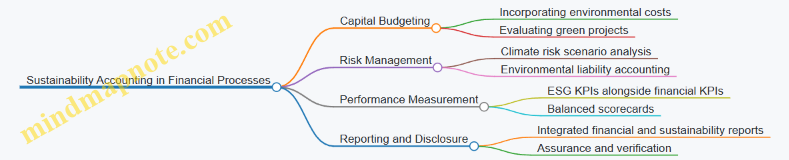
Global Finance and ESG Integration
Financial markets increasingly price in ESG factors, with sustainability accounting providing the data backbone. Credit rating agencies, asset managers, and banks use sustainability metrics to assess creditworthiness and investment risks.
Example: A global bank uses sustainability accounting data to adjust loan interest rates based on clients’ carbon footprints, incentivizing greener business practices.
Mind Map: Stakeholders Influenced by Sustainability Accounting
Challenges and Opportunities
While sustainability accounting is gaining prominence, challenges remain, including data quality, standardization, and integrating non-financial information into traditional accounting systems. However, these challenges also present opportunities for innovation and leadership.
Example: An environmental analyst develops a proprietary tool that combines satellite data with financial records to improve accuracy in measuring deforestation impacts for a forestry company.
Conclusion
The evolving role of sustainability accounting in global finance underscores its critical importance in shaping a resilient, transparent, and sustainable economic system. Accountants and environmental analysts are at the forefront of this transformation, driving best practices that align financial success with planetary and social well-being.
11.3 Preparing for Future Challenges and Opportunities
As sustainability accounting continues to evolve, professionals must anticipate and prepare for an array of emerging challenges and opportunities. This proactive approach ensures that organizations remain resilient, compliant, and competitive in a rapidly changing global environment.
Key Future Challenges in Sustainability Accounting
- Regulatory Complexity and Evolution
- Increasingly stringent global and local regulations
- Diverse reporting standards requiring harmonization
- Data Quality and Availability
- Ensuring accuracy and completeness of sustainability data
- Overcoming gaps in data collection, especially in supply chains
- Climate-Related Financial Risks
- Physical risks from climate change impacts
- Transition risks linked to shifting policies and technologies
- Technological Disruption
- Integrating new technologies like AI and blockchain
- Managing cybersecurity and data privacy concerns
- Stakeholder Expectations
- Growing demand for transparency and accountability
- Balancing diverse stakeholder interests
Emerging Opportunities in Sustainability Accounting
- Advanced Analytics and Predictive Modeling
- Leveraging AI to forecast environmental impacts and financial risks
- Integrated Reporting and Decision-Making
- Combining financial and non-financial data for holistic insights
- Sustainability-Linked Financing
- Accessing green bonds and sustainability-linked loans
- Circular Economy Accounting
- Measuring resource efficiency and waste reduction benefits
- Global Collaboration and Standardization
- Participating in initiatives to unify reporting frameworks
Mind Map: Preparing for Future Challenges and Opportunities
Practical Examples
Example 1: Navigating Regulatory Complexity
A multinational corporation faced challenges complying with both EU’s Corporate Sustainability Reporting Directive (CSRD) and the U.S. SEC’s proposed climate disclosure rules. By establishing a centralized sustainability accounting team that continuously monitors regulatory updates and harmonizes reporting processes, the company successfully streamlined compliance and reduced duplication of efforts.
Example 2: Leveraging AI for Predictive Sustainability Analytics
An environmental analyst used AI-driven software to predict the carbon emissions impact of different supply chain scenarios. This enabled the finance team to prioritize suppliers with lower emissions and negotiate contracts that aligned with the company’s net-zero goals, demonstrating how predictive analytics can inform strategic decision-making.
Example 3: Embracing Circular Economy Accounting
A manufacturing firm implemented sustainability accounting practices to track material reuse and waste reduction. By quantifying the financial benefits of circular processes—such as reduced raw material costs and waste disposal fees—the company justified investments in recycling technologies and reported improved sustainability performance to stakeholders.
Strategies to Prepare
- Continuous Learning and Training: Stay updated on evolving standards and technologies through workshops, certifications, and industry forums.
- Cross-Functional Collaboration: Engage finance, sustainability, IT, and operations teams to integrate diverse expertise.
- Invest in Technology: Adopt advanced data management and analytics tools to improve accuracy and insights.
- Scenario Planning: Conduct regular risk assessments and scenario analyses to anticipate climate and market changes.
- Stakeholder Engagement: Maintain open communication channels with investors, regulators, customers, and communities.
By understanding these future challenges and opportunities and adopting proactive strategies, accountants and environmental analysts can position their organizations to thrive in the dynamic landscape of sustainability accounting.
11.4 Encouraging Continuous Learning and Adaptation
In the rapidly evolving field of sustainability accounting, continuous learning and adaptation are essential for professionals to stay relevant, effective, and innovative. Both accountants and environmental analysts must embrace a growth mindset, regularly update their knowledge, and refine their skills to meet emerging challenges and leverage new opportunities.
Why Continuous Learning Matters
- Dynamic Regulatory Environment: Sustainability standards and regulations evolve quickly, requiring ongoing education.
- Technological Advancements: New tools like AI, blockchain, and IoT reshape data collection and analysis.
- Stakeholder Expectations: Investors, customers, and regulators demand more transparent and comprehensive sustainability disclosures.
- Complexity of Sustainability Issues: Climate change, social equity, and governance topics become more interconnected and nuanced.
Mind Map: Components of Continuous Learning and Adaptation
Best Practices for Continuous Learning
-
Engage in Formal Education and Certifications
- Example: An accountant pursuing the Sustainability Accounting Standards Board (SASB) Fundamentals of Sustainability Accounting (FSA) credential to deepen understanding of ESG metrics.
-
Attend Industry Conferences and Webinars
- Example: Environmental analysts joining the annual GreenBiz conference to learn about the latest sustainability reporting innovations.
-
Leverage Online Resources and Communities
- Example: Participating in LinkedIn groups or forums dedicated to sustainability accounting to discuss challenges and solutions.
-
Implement Pilot Projects for Hands-On Learning
- Example: A finance team launching a pilot to integrate carbon accounting software, learning from initial challenges before full-scale implementation.
-
Create Feedback Mechanisms
- Example: Regular review meetings where teams discuss sustainability data accuracy and reporting improvements.
-
Promote Cross-Department Collaboration
- Example: Accountants working closely with environmental analysts and operations teams to align sustainability goals with financial reporting.
-
Establish Mentorship and Knowledge Sharing Programs
- Example: Senior sustainability accountants mentoring junior staff on best practices and emerging trends.
Mind Map: Example of a Continuous Learning Cycle in Sustainability Accounting
Real-World Example: Adapting to New Sustainability Reporting Standards
Scenario: A multinational corporation faced challenges adapting to the Task Force on Climate-related Financial Disclosures (TCFD) recommendations.
Approach:
- The accounting team enrolled in specialized TCFD training.
- Collaborated with environmental analysts to understand climate risk data.
- Piloted new reporting templates aligned with TCFD.
- Held monthly feedback meetings to refine disclosures.
- Shared learnings company-wide through internal webinars.
Outcome: The company successfully integrated TCFD disclosures into its annual report ahead of regulatory deadlines, enhancing transparency and investor confidence.
Tips for Environmental Analysts and Accountants
- Dedicate time weekly for reading industry news and updates.
- Set learning goals aligned with organizational sustainability objectives.
- Use technology to automate routine tasks, freeing time for strategic learning.
- Encourage a culture where questioning and curiosity are welcomed.
By fostering continuous learning and adaptation, sustainability accounting professionals can not only keep pace with change but also drive innovation and leadership in their organizations.
11.5 Final Example: How Companies Successfully Adapted to New Sustainability Demands
In today’s rapidly evolving sustainability landscape, companies that proactively adapt to new sustainability demands not only mitigate risks but also unlock new opportunities for growth and innovation. This section explores real-world examples and strategies that demonstrate how organizations have successfully integrated sustainability accounting into their core operations, driving long-term value.
Case Study 1: Unilever’s Sustainable Living Plan
Unilever, a global consumer goods company, launched its Sustainable Living Plan to embed sustainability into its business model. By integrating sustainability accounting practices, Unilever tracks environmental and social impacts alongside financial performance.
-
Key Actions:
- Set ambitious targets for reducing greenhouse gas emissions, water use, and waste.
- Implemented lifecycle assessments for products to identify improvement areas.
- Integrated sustainability KPIs into executive compensation.
-
Results:
- Achieved significant reductions in environmental footprint.
- Increased sales from sustainable brands, which grew 69% faster than the rest of the business.
Mind Map: Unilever’s Sustainability Adaptation Strategy
Case Study 2: Patagonia’s Commitment to Environmental Responsibility
Patagonia, an outdoor apparel company, is renowned for its environmental activism and transparent sustainability accounting.
-
Key Actions:
- Publishes detailed environmental impact reports.
- Uses recycled and organic materials tracked through sustainability accounting.
- Invests in fair labor practices and community engagement.
-
Results:
- Enhanced brand loyalty and customer trust.
- Reduced environmental footprint while maintaining profitability.
Mind Map: Patagonia’s Sustainability Accounting Approach
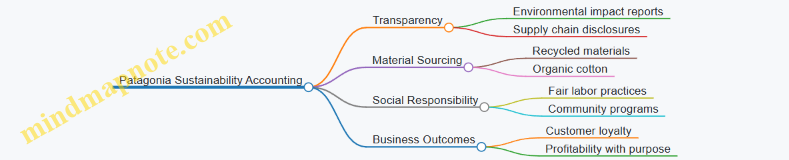
Case Study 3: IKEA’s Circular Economy Transition
IKEA has embraced sustainability accounting to support its transition towards a circular economy model.
-
Key Actions:
- Tracks product lifecycle impacts and designs for recyclability.
- Invests in renewable energy and sustainable sourcing.
- Reports on sustainability metrics aligned with global standards.
-
Results:
- Reduced waste and resource consumption.
- Strengthened market position as a sustainable brand.
Mind Map: IKEA’s Circular Economy Strategy

Key Takeaways from These Examples
- Integration of Sustainability Accounting: Embedding sustainability metrics into financial and operational reporting enables better decision-making.
- Setting Clear, Measurable Targets: Concrete goals help track progress and maintain accountability.
- Transparency and Stakeholder Engagement: Open reporting builds trust with customers, investors, and regulators.
- Linking Sustainability to Business Strategy: Aligning sustainability with core business objectives drives innovation and growth.
Summary Mind Map: Successful Adaptation to Sustainability Demands
Through these examples, it is clear that companies that embrace sustainability accounting as a strategic tool can navigate new sustainability demands effectively, ensuring resilience and long-term success in a changing world.