English Conversation Practice for Immigrants
Chapter 1: Introduction to Everyday English Conversation
1.1 Understanding the Importance of Practical English
Practical English refers to the everyday language skills needed to communicate effectively in common situations. For immigrants, mastering practical English is essential because it directly impacts daily life, from renting an apartment to shopping for groceries or attending a job interview. Unlike academic or literary English, practical English focuses on clear, simple, and functional communication.
Why Practical English Matters
- Facilitates Daily Tasks: Whether asking for directions, scheduling appointments, or understanding instructions, practical English helps you complete routine activities without confusion.
- Builds Confidence: Knowing how to express basic needs and respond appropriately reduces anxiety in new environments.
- Enables Social Integration: Speaking practical English allows you to connect with neighbors, coworkers, and community members.
- Supports Employment Opportunities: Clear communication during job interviews and at work is crucial for success.
Mind Map: Key Areas of Practical English
Examples of Practical English in Action
-
Renting an Apartment:
- *“Is this apartment still available?”
- “How much is the monthly rent?”
- “Are utilities included in the rent?”
-
Shopping:
- *“Where can I find fresh vegetables?”
- “Do you have this in a smaller size?”
- “Can I pay with a credit card?”
-
Healthcare:
- *“I would like to make an appointment with the doctor.”
- “I have a headache and a sore throat.”
- “How often should I take this medicine?”
-
Job Interviews:
- *“Can you tell me about your previous work experience?”
- “What are your strengths?”
- “What is the typical work schedule?”
Best Practices for Learning Practical English
- Focus on Common Situations: Practice phrases and vocabulary related to everyday needs.
- Use Simple Sentences: Clear and straightforward language is more effective.
- Listen and Repeat: Mimic pronunciation and intonation to improve clarity.
- Practice Speaking: Role-play conversations to build fluency.
- Ask for Clarification: Don’t hesitate to ask someone to repeat or explain.
Mind Map: Best Practices for Practical English
Understanding practical English is about equipping yourself with the tools to navigate daily life smoothly. It is less about perfect grammar and more about making yourself understood and understanding others in real-world contexts.
1.2 Basic Conversational Phrases and Greetings
Starting a conversation in English often begins with greetings and simple phrases that help establish connection and show politeness. These phrases are the building blocks of daily interactions and are useful in almost every situation.
Common Greetings Mind Map
Examples of Greetings
- Formal: “Good morning, how are you today?”
- Informal: “Hey! How’s it going?”
Introducing Yourself Mind Map
Examples of Introductions
- “My name is Maria. What’s your name?”
- “I’m John. Nice to meet you.”
Polite Expressions Mind Map
Examples of Polite Phrases
- “Could you please help me?”
- “Thank you for your assistance.”
- “Excuse me, where is the nearest bus stop?”
Asking and Responding to “How are you?” Mind Map
Examples
- “How are you today?”
- “I’m fine, thank you. And you?”
Common Farewells Mind Map
Examples of Farewells
- “Goodbye, have a nice day!”
- “See you later!”
Practice Examples
-
At a store:
- Customer: “Hello! How are you?”
- Clerk: “Hi! I’m good, thank you. How can I help you today?”
-
Meeting a neighbor:
- You: “Good morning, my name is Ahmed. What’s your name?”
- Neighbor: “Good morning, Ahmed. I’m Lisa. Nice to meet you.”
-
Leaving a conversation:
- You: “I have to go now. Goodbye!”
- Friend: “Bye! Take care.”
Using these basic phrases regularly helps build confidence and makes conversations smoother. Remember, tone and body language also play a role in how your greetings and phrases are received. Practicing these simple exchanges will prepare you for more complex conversations later.
1.3 Pronunciation Tips for Clear Communication
Clear pronunciation is essential for effective communication in English. When your words are easy to understand, conversations flow smoothly, and misunderstandings decrease. This section covers key aspects of pronunciation with practical examples and mind maps to help you focus on important areas.
Key Elements of Pronunciation
- Sounds: The individual vowels and consonants that make up words.
- Stress: Emphasis placed on certain syllables within words.
- Intonation: The rise and fall of your voice during sentences.
- Rhythm: The pattern of stressed and unstressed syllables.
Mind Map: Components of Pronunciation
Sounds: Vowels and Consonants
English has many vowel sounds, some of which may not exist in your native language. For example, the difference between the short vowel in “ship” and the long vowel in “sheep” can change meaning.
Examples:
- Ship /ʃɪp/ vs Sheep /ʃiːp/
- Bit /bɪt/ vs Beat /biːt/
Consonants also matter. The difference between /b/ and /p/ is a matter of voice: /b/ is voiced, /p/ is not.
Examples:
- Bat /bæt/ vs Pat /pæt/
- Van /væn/ vs Fan /fæn/
Practice Tip: Record yourself saying pairs of words that differ by one sound and listen carefully.
Stress: Word and Sentence Level
English is a stress-timed language, meaning some syllables are stressed more than others. Stress changes meaning and helps listeners understand you.
Word Stress: Every multi-syllable word has one main stressed syllable.
Examples:
- REcord (noun) vs reCORD (verb)
- PREsent (noun) vs preSENT (verb)
Sentence Stress: Important words (nouns, verbs, adjectives) are stressed; function words (prepositions, articles) are usually unstressed.
Example sentence:
- “I want to buy a new car.”
Mind Map: Stress
Intonation: The Melody of Speech
Intonation helps express meaning beyond words. It can show questions, statements, surprise, or uncertainty.
- Rising intonation: Often used in yes/no questions.
- Example: “Are you coming?”
- Falling intonation: Common in statements and wh-questions.
- Example: “I am coming.”
Intonation also signals if you are finished speaking or want someone else to talk.
Mind Map: Intonation
Rhythm: Stress Patterns in Speech
English rhythm depends on alternating stressed and unstressed syllables. This pattern helps listeners follow your speech.
Example:
- “I would like to go to the store.”
- Stressed: would, like, go, store
- Unstressed: I, to, the
Try to avoid stressing every word equally; it can make speech sound unnatural and harder to understand.
Mind Map: Rhythm
Practical Exercises
-
Minimal Pairs Practice: Practice words that differ by one sound to improve clarity.
- Examples: bat/pat, ship/sheep, fan/van
-
Stress Identification: Listen to a sentence and mark which words are stressed.
- Example: “She bought a new car yesterday.”
-
Intonation Practice: Repeat questions and statements, focusing on rising and falling tones.
- Question: “Are you ready?” (rising)
- Statement: “I am ready.” (falling)
-
Rhythm Reading: Read short sentences aloud, emphasizing stressed words and reducing unstressed ones.
- Sentence: “Can you help me with this?”
Clear pronunciation takes time and practice. Focus on small, specific areas like sounds or stress, and gradually build confidence. Listening carefully and repeating aloud are key steps. Remember, the goal is to be understood, not to sound perfect.
1.4 Common Polite Expressions and Etiquette
Politeness is a key part of everyday English conversation. It helps create a positive atmosphere and shows respect for others. Using polite expressions correctly can make interactions smoother, especially when you are new to a culture or language. This section covers common polite phrases and basic etiquette rules, with examples and mind maps to organize the ideas.
Polite Greetings and Responses
When meeting someone, polite greetings set the tone. Simple phrases like “Hello,” “Good morning,” or “How are you?” are common. Responding politely is just as important.
- Greeting: “Hello! How are you today?”
- Response: “I’m fine, thank you. And you?”
Mind map of polite greetings:
Using Please and Thank You
Adding “please” when asking for something and “thank you” when receiving or after help is essential. These words show respect and appreciation.
- Request: “Could you please help me with this form?”
- Response: “Thank you for your assistance.”
Mind map of polite requests:
- Polite Requests
- Please
- Could you…
- Would you mind…
- May I…
- Showing Gratitude
- Thank you
- Thanks a lot
- I appreciate it
Apologizing and Excusing Yourself
Mistakes or interruptions happen. Knowing how to apologize or excuse yourself politely keeps conversations respectful.
- Apology: “I’m sorry for the delay.”
- Excuse: “Excuse me, may I get through?”
Mind map of apologies and excuses:
- Apologizing
- Sorry
- I apologize
- Pardon me
- Excusing Yourself
- Excuse me
- May I…
- Sorry to interrupt
Offering Help and Responding
Offering help politely and responding to offers is part of good etiquette.
- Offer: “Would you like some help with your bags?”
- Accepting: “Yes, thank you.”
- Declining: “No, thank you. I can manage.”
Mind map of offers and responses:
- Offering Help
- Would you like…
- Can I help you?
- Do you need assistance?
- Responding
- Yes, please
- No, thank you
- I appreciate it
Making Requests and Giving Instructions Politely
When asking someone to do something, use softening phrases to avoid sounding demanding.
- Request: “Could you please send me the documents by Friday?”
- Instruction: “Please fill out this form before the appointment.”
Mind map of polite requests and instructions:
- Requests
- Could you please…
- Would you mind…
- May I ask you to…
- Instructions
- Please…
- Kindly…
- It would be helpful if…
Ending Conversations Politely
Knowing how to close a conversation respectfully leaves a good impression.
- Examples:
- “It was nice talking to you.”
- “Thank you for your time.”
- “Have a great day!”
Mind map of polite conversation endings:
Examples in Context
Example 1: Asking for Help in a Store
Customer: “Excuse me, could you please tell me where the bread is?”
Store Clerk: “Of course! It’s in aisle 4.”
Customer: “Thank you very much.”
Store Clerk: “You’re welcome. Let me know if you need anything else.”
Example 2: Apologizing for a Mistake
Tenant: “I’m sorry for calling late, but the heater isn’t working.”
Landlord: “No problem. I’ll send someone to fix it tomorrow.”
Tenant: “Thank you for your help.”
Example 3: Ending a Job Interview
Interviewer: “Thank you for coming today. We will contact you soon.”
Candidate: “Thank you for the opportunity. Have a great day!”
Using these polite expressions and understanding the etiquette behind them will help you communicate clearly and respectfully in everyday situations. Practice these phrases in different contexts to build confidence and ease in conversations.
1.5 Practice Examples: Introducing Yourself and Small Talk
Introducing yourself and engaging in small talk are fundamental skills for everyday conversations. These interactions help build rapport and make communication smoother. Below are clear examples and mind maps to guide you through common phrases and structures.
Mind Map: Introducing Yourself
Example 1: Basic Introduction
A: Hello! My name is Maria.
B: Hi Maria, I’m John. Nice to meet you.
A: Nice to meet you too. I’m from Brazil.
B: Oh, that’s great! I’m from Canada.
A: What do you do?
B: I work as a teacher. And you?
A: I’m a nurse.
Mind Map: Small Talk Topics
Example 2: Small Talk About Weather and Work
A: It’s a beautiful day today, isn’t it?
B: Yes, the sun is shining. I like this kind of weather.
A: Me too. How’s work going?
B: It’s busy, but I enjoy it. How about you?
A: Same here. I’m learning a lot.
Example 3: Small Talk About Weekend Plans
A: Do you have any plans for the weekend?
B: I’m thinking of visiting the park. What about you?
A: I might go to the movies with some friends.
B: That sounds fun!
Tips for Practice
- Start with a simple greeting and your name.
- Share a little about yourself, but keep it brief.
- Ask open-ended questions to keep the conversation going.
- Listen carefully and respond naturally.
- Use polite expressions like “Nice to meet you”.
- Practice both sides of the conversation.
Practice Exercise
Try introducing yourself to a partner or in front of a mirror using the structure below:
- Greet the person.
- Say your name.
- Mention where you’re from.
- Say what you do.
- Add a hobby or interest.
- End with a polite phrase.
Example:
“Hello! I’m Ahmed. I’m from Egypt. I work as an engineer. I enjoy reading books. Nice to meet you.”
Then, practice small talk by asking about the weather, work, or weekend plans.
This section provides a foundation for starting conversations comfortably. The examples and mind maps help visualize common phrases and topics, making it easier to remember and use them in real life.
Chapter 2: Renting an Apartment or House
2.1 Vocabulary for Renting and Housing
When looking for a place to live, knowing the right words helps you communicate clearly and avoid misunderstandings. This section introduces essential vocabulary related to renting and housing, organized into categories with examples and mind maps to make the connections easier to remember.
Key Terms for Types of Housing
- Apartment: A set of rooms for living, usually in a building with other apartments.
- House: A standalone building for one family.
- Studio: A small apartment with one main room serving as living, bedroom, and kitchen.
- Condo (Condominium): An apartment you can own, often part of a larger building.
- Townhouse: A multi-floor house attached to others in a row.
Example: “I’m looking for a two-bedroom apartment, but a townhouse could also work.”
Rental Agreement Terms
- Lease: A contract between tenant and landlord specifying rental terms.
- Rent: The money paid regularly to live in the property.
- Deposit (Security Deposit): Money paid upfront to cover damages or unpaid rent.
- Utilities: Services like water, electricity, gas, sometimes included in rent.
- Furnished / Unfurnished: Whether the property comes with furniture.
- Term: Length of the lease (e.g., 6 months, 1 year).
Example: “The lease is for one year, and the rent includes water but not electricity.”
Rooms and Features
- Bedroom: Room for sleeping.
- Bathroom: Room with toilet and shower or bathtub.
- Living Room: Main room for relaxing and socializing.
- Kitchen: Room for cooking.
- Balcony / Patio: Outdoor space attached to the apartment or house.
- Closet: Small room or space for clothes storage.
- Parking Spot: Designated place to park a car.
Example: “Does the apartment have a balcony and a parking spot?”
Describing Condition and Location
- Move-in Ready: The property is clean and ready to live in.
- Renovated: Recently fixed or updated.
- Quiet Neighborhood: Area with little noise.
- Close to Public Transport: Near buses, trains, or subways.
- Pet-friendly: Pets are allowed.
Example: “I’m looking for a pet-friendly apartment close to public transport.”
Common Verbs and Phrases
- To rent: To pay for the use of a property.
- To lease: To sign a contract to rent.
- To sublet: To rent a property from the tenant rather than the landlord.
- To move in / move out: To start or stop living in a place.
- To renew a lease: To extend the rental contract.
- To pay rent: To give money for living in the property.
Example: “I need to move in by the first of next month and renew the lease after six months.”
Mind Map Summary
Renting Vocabulary Mind Map
This vocabulary forms the foundation for conversations about renting. Using these words correctly will help you ask questions, understand contracts, and describe what you need clearly.
Practice Examples
- Asking about a property:
“Is this apartment furnished? How much is the monthly rent? Are utilities included?”
- Describing your needs:
“I’m looking for a two-bedroom apartment with a balcony and parking spot. It should be pet-friendly and close to public transport.”
- Discussing the lease:
“What is the length of the lease? Is the deposit refundable? Can I renew the lease after one year?”
- Talking about moving:
“I plan to move in on the 15th. Will the apartment be move-in ready by then?”
Using this vocabulary and these examples will make your conversations about renting more confident and effective.
2.2 Asking About Available Properties
When you are looking for a place to rent, the first step is often to ask about what properties are available. This involves clear communication with landlords, property managers, or real estate agents. Knowing how to ask the right questions helps you find a property that fits your needs and budget.
Key Points to Cover When Asking About Properties
- Location preferences
- Type of property (apartment, house, studio)
- Number of bedrooms and bathrooms
- Rent price and included utilities
- Lease duration and terms
- Availability date
- Amenities (parking, laundry, pet policies)
Mind Map: Questions to Ask When Inquiring About Available Properties
Example Dialogues
Example 1: Basic Inquiry
Tenant: Hello, I’m interested in renting an apartment. Could you tell me what units are currently available?
Agent: Sure! We have a two-bedroom apartment available in downtown, and a one-bedroom unit near the park. What kind of place are you looking for?
Example 2: Asking About Details
Tenant: Can you tell me if the rent includes utilities?
Landlord: The rent covers water and trash, but electricity and internet are separate.
Example 3: Clarifying Lease Terms
Tenant: What is the minimum lease term for the apartment?
Agent: The lease is typically one year, but we can discuss shorter terms if needed.
Example 4: Confirming Amenities
Tenant: Is there parking available with the apartment?
Landlord: Yes, there is one parking spot included with the unit.
Tips for Effective Questions
- Be specific about your needs to avoid wasting time.
- Use polite language to maintain a good relationship.
- Take notes during conversations for comparison.
- Ask for written details or brochures if possible.
Mind Map: Polite Phrases for Asking Questions
By combining clear questions with polite phrasing, you can gather all the necessary information about available properties. This helps you make informed decisions and shows respect to the person assisting you.
2.3 Discussing rent, deposits, and lease terms is a crucial part of renting a home. It involves clear communication to ensure both tenant and landlord understand their responsibilities and expectations.
Mind Map: Key Topics When Discussing Rent, Deposits, and Lease Terms
Rent, Deposits, and Lease Terms
├── Rent
│   ├── Monthly Amount
│   ├── Payment Method
│   ├── Due Date
│   └── Late Fees
├── Deposits
│   ├── Security Deposit
│   ├── Pet Deposit
│   ├── Refund Conditions
│   └── Holding Deposit
└── Lease Terms
    ├── Lease Duration
    ├── Renewal Options
    ├── Termination Conditions
    ├── Maintenance Responsibilities
    └── Rules and Restrictions
Rent
The rent is the amount of money paid regularly, usually monthly, to live in the property. When discussing rent, it’s important to ask about the exact amount, how to pay it, and when it’s due.
Example:
Tenant: “Could you please tell me how much the monthly rent is?”
Landlord: “The rent is $1,200 per month, payable by the first of each month.”
You might also want to clarify if there are any penalties for late payment.
Example:
Tenant: “Is there a late fee if I pay after the due date?”
Landlord: “Yes, a $50 fee applies if rent is more than five days late.”
Deposits
Deposits are upfront payments that protect the landlord against damage or unpaid rent. The most common is the security deposit.
Security Deposit: Usually equal to one month’s rent, it is refundable if the property is left in good condition.
Example:
Tenant: “How much is the security deposit?”
Landlord: “It’s $1,200, the same as one month’s rent.”
Ask about other possible deposits, such as pet deposits if you have animals.
Example:
Tenant: “I have a dog. Is there an additional pet deposit?”
Landlord: “Yes, there is a $300 pet deposit, refundable if there’s no damage.”
Clarify the conditions for refunding deposits to avoid surprises.
Example:
Tenant: “What conditions could affect the refund of my security deposit?”
Landlord: “Any damage beyond normal wear and tear or unpaid rent will be deducted.”
Lease Terms
The lease is the contract that outlines the rental agreement.
Lease Duration: This is the length of the rental agreement, often 6 or 12 months.
Example:
Tenant: “What is the length of the lease?”
Landlord: “It’s a one-year lease, starting from the move-in date.”
Renewal Options: Ask if the lease can be renewed and under what conditions.
Example:
Tenant: “Can I renew the lease after it ends?”
Landlord: “Yes, you can renew for another year with a 30-day notice before the lease ends.”
Termination Conditions: Understand how to end the lease early if needed and any penalties.
Example:
Tenant: “What happens if I need to move out before the lease ends?”
Landlord: “You’ll need to give 60 days’ notice and may be responsible for rent until a new tenant is found.”
Maintenance Responsibilities: Clarify who handles repairs and upkeep.
Example:
Tenant: “Who is responsible for fixing appliances?”
Landlord: “We handle major repairs, but tenants should take care of minor maintenance.”
Rules and Restrictions: Ask about any rules, such as no smoking or limits on guests.
Example:
Tenant: “Are there any restrictions I should know about?”
Landlord: “No smoking inside and no pets besides your dog.”
Summary
When discussing rent, deposits, and lease terms, use clear questions and listen carefully to the answers. Confirm details about amounts, payment methods, lease length, and responsibilities. This helps avoid misunderstandings and builds a good relationship with your landlord.
Practice Dialogue Example
Tenant: “I want to confirm the rent is $1,200 per month, due on the first, correct?”
Landlord: “Yes, that’s right. You can pay by check or online transfer.”
Tenant: “And the security deposit is also $1,200?”
Landlord: “Correct. It’s refundable if the apartment is in good condition when you move out.”
Tenant: “What is the lease term?”
Landlord: “It’s a 12-month lease with an option to renew.”
Tenant: “Great. Are there any rules I should be aware of?”
Landlord: “No smoking inside, and pets are allowed only with an extra deposit.”
This kind of dialogue helps practice real-life conversations and prepares you to discuss rental agreements confidently.
2.4 When you are renting a place, clearly describing your needs and preferences helps landlords or agents find the right property for you. This section focuses on how to communicate what you want in a straightforward way, using practical vocabulary and examples.
Key Areas to Describe
- Type of Property: apartment, house, studio, shared room
- Size and Layout: number of bedrooms, bathrooms, living space
- Location: neighborhood, proximity to work or school, public transport
- Budget: maximum rent, utilities included or not
- Amenities: parking, laundry, air conditioning, pet policies
- Lease Terms: length of lease, move-in date
Mind Map: Describing Your Needs and Preferences
Useful Phrases
- “I am looking for a two-bedroom apartment.”
- “It’s important that the place has a washing machine.”
- “I would prefer a location close to the subway station.”
- “My budget is up to $1,200 per month, including utilities if possible.”
- “I need a lease starting from July 1st, for at least one year.”
- “Is parking available? I have a car.”
Example Dialogue
Tenant: Hi, I’m interested in renting an apartment. Could you help me find something?
Agent: Of course. What kind of place are you looking for?
Tenant: I need a one-bedroom apartment, preferably near downtown because I work there. It should have a kitchen and laundry facilities.
Agent: Do you have a budget in mind?
Tenant: Yes, around $1,000 a month, and it would be great if utilities are included.
Agent: How about the lease term?
Tenant: I’m looking for a one-year lease starting next month.
Agent: Got it. I’ll check what’s available that fits your needs.
Tips for Clear Communication
- Be specific but flexible. For example, say “I prefer a quiet neighborhood, but I can consider others.”
- Use numbers when possible: number of rooms, rent amount, dates.
- Mention deal breakers early, like no pets or must-have parking.
- Ask questions if you don’t understand terms or conditions.
Mind Map: Expressing Preferences with Examples
Practice Sentences
- “I’m looking for a furnished apartment because I don’t have furniture yet.”
- “A quiet street is important to me because I work from home.”
- “I would like a place with easy access to grocery stores and public transport.”
- “I can pay up to $1,500, but I’d prefer to stay under $1,300.”
- “I’m hoping to move in by the middle of next month.”
By using clear language and covering these key points, you can make your housing search smoother and more effective.
2.5 Scheduling and Attending Property Viewings
When looking for a place to rent, scheduling and attending property viewings is a crucial step. This process allows you to see the property in person, ask questions, and decide if it fits your needs. Clear communication and preparation make this experience smoother and more productive.
Scheduling a Viewing
Scheduling a viewing usually involves contacting the landlord, property manager, or real estate agent. Here are key points to keep in mind:
- Introduce yourself politely: State your name and express interest in the property.
- Ask about available times: Offer your availability and ask when the property can be viewed.
- Confirm details: Clarify the address, date, and time of the viewing.
- Request additional information if needed: Ask about parking, entry instructions, or documents to bring.
Mind Map: Scheduling a Property Viewing
Example Dialogue: Scheduling a Viewing
You: Hello, my name is Maria. I’m interested in the apartment listed at 123 Maple Street. Is it possible to schedule a viewing?
Agent: Hi Maria, yes, the apartment is available. When would you like to see it?
You: I’m free on Wednesday afternoon or Thursday morning. Which time works best?
Agent: Thursday morning at 10 AM is available. Does that work for you?
You: Yes, that’s perfect. Could you please confirm the address and let me know if I need to bring any documents?
Agent: The address is 123 Maple Street, Apartment 4B. Please bring a photo ID and proof of income.
You: Thank you. I’ll see you Thursday at 10 AM.
Attending the Viewing
When you arrive for the viewing, punctuality and preparedness help make a good impression. Here are some tips:
- Arrive on time: Being punctual shows respect and seriousness.
- Bring necessary documents: Identification, proof of income, and references might be requested.
- Prepare questions: Think about what matters most to you, such as utilities, neighborhood safety, or lease terms.
- Observe carefully: Check the condition of the property, appliances, and any signs of damage.
- Take notes or photos: This helps you remember details later.
- Be polite and professional: Treat the landlord or agent with respect.
Mind Map: Attending a Property Viewing
Example Dialogue: During a Viewing
Agent: Welcome, Maria. Let me show you around the apartment.
You: Thank you. Could you tell me about the heating system? Is it included in the rent?
Agent: Yes, heating is included. It’s central heating.
You: Great. Also, how is the neighborhood in terms of safety and noise?
Agent: It’s generally quiet and safe, with a community watch program.
You: That sounds good. I noticed the kitchen sink; does it have any issues with drainage?
Agent: No known issues, but you can test it if you like.
You: I will, thanks. Lastly, what is the process if I decide to apply?
Agent: You’ll need to fill out an application form and provide references.
You: Perfect. Thank you for the tour and information.
Practice Tips
- Practice scheduling viewings by role-playing with a friend or language partner.
- Prepare a list of questions relevant to your priorities.
- Use polite and clear language when communicating.
- Take notes during viewings to compare different properties later.
This section aims to build your confidence in managing the scheduling and attending of property viewings with clear communication and practical questions. The examples show typical conversations you might have, helping you prepare for real-life situations.
2.6 Communicating with Landlords and Property Managers
When renting a home, clear communication with your landlord or property manager is essential. Whether you’re asking questions, reporting issues, or discussing lease terms, knowing how to express yourself politely and clearly will make the process smoother.
Key Topics When Communicating with Landlords
- Asking about lease details
- Reporting maintenance problems
- Requesting permission (e.g., for pets or modifications)
- Discussing rent payments and late fees
- Scheduling inspections or viewings
- Ending or renewing the lease
Mind Map: Communicating with Landlords
Asking About Lease Details
When you first contact a landlord or property manager, you might want to clarify lease terms. Here are some examples:
- “Could you please confirm the length of the lease?”
- “Is the security deposit refundable?”
- “Are utilities included in the rent?”
Reporting Maintenance Problems
If something in the rental needs fixing, it’s important to describe the problem clearly and politely. Examples:
- “The heater is not working properly. Could someone come to check it?”
- “There is a leak under the kitchen sink. When would be a good time for a repair?”
- “The front door lock is loose. I’m concerned about security.”
Requesting Permission
Sometimes you need approval for certain things. Here are ways to ask:
- “Would it be okay to have a pet cat in the apartment?”
- “May I paint the walls a different color?”
- “Is it possible to install a shelf in the living room?”
Discussing Rent Payments
Clear communication about rent is important to avoid misunderstandings:
- “When is the rent due each month?”
- “Can I pay the rent by bank transfer?”
- “If I am late with a payment, is there a fee?”
Scheduling Inspections or Viewings
Landlords may need to visit the property sometimes. Here’s how to arrange it:
- “Please let me know when you plan to do the inspection.”
- “Is it possible to schedule a viewing for next Tuesday?”
- “I would like to arrange a time for the maintenance check.”
Ending or Renewing the Lease
When your lease is ending, communication is key:
- “I would like to renew my lease for another year.”
- “What is the process to give notice before moving out?”
- “Are there any fees for early termination of the lease?”
Mind Map: Sample Phrases for Communication
Example Dialogues
Example 1: Reporting a Maintenance Issue
Tenant: “Hello, I wanted to let you know that the bathroom faucet is leaking. Could someone come to fix it this week?”
Landlord: “Thank you for informing me. I will arrange for a plumber to visit on Thursday afternoon. Does that work for you?”
Tenant: “Thursday afternoon is perfect. Thank you.”
Example 2: Asking Permission for a Pet
Tenant: “Hi, I’m interested in bringing a small dog into the apartment. Would that be allowed under the lease?”
Property Manager: “Our policy requires approval for pets. Please provide details about the dog, and we can discuss it further.”
Tenant: “It’s a 10-pound hypoallergenic dog. I can provide references if needed.”
Property Manager: “Thank you. I will review this and get back to you soon.”
Example 3: Discussing Rent Payment Method
Tenant: “Good morning. I wanted to ask if I can pay my rent via online bank transfer instead of cash.”
Landlord: “Yes, that is fine. I will send you the bank details.”
Tenant: “Great, thank you very much.”
Tips for Effective Communication
- Be polite and clear. Use phrases like “please,” “thank you,” and “could you.”
- Provide specific details when describing problems.
- Confirm appointments or agreements in writing when possible.
- Keep records of all communications.
- If you don’t understand something, ask for clarification.
Clear communication helps build a good relationship with your landlord or property manager. It can prevent misunderstandings and make your renting experience more comfortable.
2.7 Handling Repairs and Maintenance Requests
When renting a home, knowing how to communicate about repairs and maintenance is essential. Clear, polite, and precise language helps ensure problems get fixed quickly and correctly. This section covers vocabulary, common phrases, and examples to guide you through these conversations.
Key Vocabulary
- Repair: Fixing something that is broken.
- Maintenance: Regular work to keep things in good condition.
- Leak: Water or gas escaping from pipes or containers.
- Clogged: Blocked, usually referring to drains or toilets.
- Heating system: Equipment that provides heat.
- Electricity outage: Power cut or blackout.
- Appliance: A machine like a refrigerator or stove.
- Landlord / Property manager: The person responsible for the property.
- Urgent / Emergency: Needs immediate attention.
Mind Map: Steps to Report a Repair
Common Phrases for Reporting Repairs
- “Hello, I’m calling to report a problem with the heating system in my apartment. It stopped working yesterday.”
- “There is a leak under the kitchen sink. Water is dripping continuously.”
- “The bathroom drain is clogged, and the water is not draining properly.”
- “Could you please send someone to fix the broken window? It’s letting in cold air.”
- “Is this an emergency? Because the electricity went out in the whole apartment.”
- “How soon can a technician come to check the issue?”
- “Thank you for your help. Please let me know if you need more information.”
Mind Map: What to Include in a Repair Request
Example Dialogue 1: Phone Call to Report a Leak
Tenant: Hello, this is Maria from apartment 4B. I wanted to report a leak under my kitchen sink. Water has been dripping since last night.
Landlord: Thank you for letting me know, Maria. Is the leak causing any flooding or damage?
Tenant: Not flooding, but there is water on the cabinet floor. I’m worried it might get worse.
Landlord: I understand. I will arrange for a plumber to come tomorrow morning. Will you be home?
Tenant: Yes, I’ll be home after 9 AM.
Landlord: Great. I’ll confirm the appointment by email. Please call me if the situation changes.
Tenant: Thank you very much.
Example Dialogue 2: Email Request for Maintenance
Subject: Request for Maintenance – Broken Heater in Apartment 12C
Dear Mr. Johnson,
I hope this message finds you well. I am writing to inform you that the heater in my apartment (12C) stopped working yesterday. The temperature has dropped, and it is quite cold inside.
Could you please arrange for a technician to inspect and repair the heater as soon as possible? I am available most afternoons this week.
Thank you for your attention to this matter.
Best regards,
Ahmed Khan
Tips for Effective Communication
- Be clear and specific about the problem.
- Use simple language to avoid misunderstandings.
- Mention any safety concerns immediately.
- Be polite but firm about the urgency if the issue is serious.
- Keep a record of your communication.
- Follow up if the repair is delayed or incomplete.
Handling repairs and maintenance requests well can make your renting experience smoother. Using the right words and approach helps landlords understand the problem and respond appropriately. Practice these examples and phrases to build confidence in these everyday conversations.
2.8 Practice Dialogues: Renting Scenarios with Examples
When renting a home, clear communication is essential. This section provides practical dialogues to help you navigate conversations with landlords, property managers, and real estate agents. Each dialogue is accompanied by a mind map to organize key vocabulary and phrases.
Mind Map: Key Topics in Renting Conversations
Dialogue 1: Inquiring About an Apartment
Tenant: Hello, I saw the listing for the two-bedroom apartment on Maple Street. Is it still available?
Agent: Yes, it is. Would you like to know more about it?
Tenant: Yes, please. How much is the monthly rent, and are utilities included?
Agent: The rent is $1,200 per month. Utilities like water and garbage are included, but electricity and internet are separate.
Tenant: That sounds reasonable. Is there parking available?
Agent: Yes, there is one parking spot included with the apartment.
Tenant: Great. Can I schedule a viewing sometime this week?
Agent: Sure. How about Thursday at 3 PM?
Tenant: Thursday at 3 PM works for me. Thank you.
Agent: You’re welcome. See you then.
Dialogue 2: Discussing Lease Terms
Tenant: Hi, I’m interested in renting the apartment, but I have a few questions about the lease.
Landlord: Of course. What would you like to know?
Tenant: How long is the lease term? Is it month-to-month or a fixed term?
Landlord: It’s a one-year fixed lease. After that, you can renew or switch to month-to-month.
Tenant: Are there any penalties if I need to move out early?
Landlord: Yes, there is a penalty equal to one month’s rent if you break the lease early.
Tenant: Understood. Also, is the security deposit refundable?
Landlord: Yes, it’s refundable as long as there’s no damage beyond normal wear and tear.
Tenant: Thanks for the clarification.
Dialogue 3: Reporting a Maintenance Issue
Tenant: Hello, this is Alex, from apartment 4B. I wanted to report that the heater isn’t working.
Property Manager: Thanks for letting us know, Alex. When did you notice the problem?
Tenant: It stopped working last night.
Property Manager: We’ll send a technician tomorrow morning between 9 and 11 AM. Will you be home?
Tenant: Yes, I’ll be home then.
Property Manager: Great. If anything changes, please call us.
Tenant: Will do. Thank you.
Dialogue 4: Negotiating Rent
Tenant: Hi, I really like the apartment, but the rent is a bit higher than I expected. Is there any flexibility?
Landlord: We usually stick to the listed price, but if you sign a longer lease, we might offer a discount.
Tenant: How much of a discount?
Landlord: For a two-year lease, we can reduce the rent by $100 per month.
Tenant: That sounds fair. I’ll consider that option.
Landlord: Let me know if you have any other questions.
Dialogue 5: Asking About Neighborhood and Amenities
Tenant: Can you tell me about the neighborhood?
Agent: It’s a quiet area with parks and several grocery stores nearby. Public transportation is also accessible.
Tenant: Are there laundry facilities in the building?
Agent: Yes, there’s a laundry room on the ground floor.
Tenant: Perfect. That’s important to me.
Agent: Glad to hear that.
These dialogues cover common situations you may encounter during the renting process. Practice them aloud to build confidence and adjust the phrases to fit your personal style. Remember, clear and polite communication helps create a positive impression and smooth interactions.
Chapter 3: Shopping for Groceries and Essentials
3.1 Common Shopping Vocabulary and Phrases
When shopping, knowing the right words and phrases helps you communicate clearly and get what you need without confusion. This section covers essential vocabulary and typical expressions you will encounter or use in stores, markets, and other shopping environments.
Key Vocabulary Categories
Useful Phrases for Shopping
Mind Map: Shopping Vocabulary Overview
Mind Map: Common Shopping Phrases
Examples
- Asking for an item:
- Customer: “Excuse me, where can I find the rice?”
- Store clerk: “The rice is in aisle 4, next to the pasta.”
- Inquiring about price and payment:
- Customer: “How much is this bottle of olive oil?”
- Clerk: “It’s $8.50. We accept cash and credit cards.”
- Requesting assistance with size:
- Customer: “Do you have this shirt in a medium size?”
- Clerk: “Let me check in the back for you.”
- At the checkout:
- Cashier: “Your total is $23.75.”
- Customer: “Can I pay with my credit card?”
- Cashier: “Yes, please insert your card here.”
- Returning an item:
- Customer: “I would like to return this jacket. It doesn’t fit.”
- Clerk: “Do you have the receipt?”
- Customer: “Yes, here it is.”
Understanding these words and phrases will make your shopping experience smoother and less stressful. Practice them regularly to build confidence in everyday conversations at stores.
3.2 Asking for Product Locations and Availability
When shopping, knowing how to ask where items are and whether they are in stock is essential. This section covers useful phrases, vocabulary, and examples to help you communicate clearly and confidently.
Key Vocabulary
- Where can I find…? – Asking the location of an item.
- Is this available? / Do you have…? – Checking if the product is in stock.
- Aisle / Shelf / Section – Common store areas.
- In stock / Out of stock – Availability status.
- Size / Color / Brand – Product details.
- Price / Discount / Sale – Cost-related terms.
Mind Map: Asking for Product Location
Mind Map: Asking About Availability
Common Phrases and Examples
- Asking for location:
- “Excuse me, where can I find the bread?”
- “Could you tell me which aisle the cleaning supplies are in?”
- “Is the dairy section near the back of the store?”
- Checking availability:
- “Do you have any gluten-free pasta?”
- “Is this jacket available in a medium size?”
- “Are there any more of these shoes in stock?”
- Clarifying details:
- “Do you have this brand in a different color?”
- “Is this the only size you have?”
- “Can I order this if it’s not available now?”
Sample Dialogue 1: Asking for Location
Customer: Excuse me, where can I find the canned tomatoes?
Store Clerk: They’re in aisle 5, on the middle shelf.
Customer: Thank you! And is the pasta nearby?
Store Clerk: Yes, it’s right next to the canned goods.
Sample Dialogue 2: Checking Availability
Customer: Do you have any almond milk?
Store Clerk: Let me check. Yes, we have it in the refrigerated section.
Customer: Great! Is it available in both original and vanilla flavors?
Store Clerk: We have the original, but the vanilla is out of stock right now.
Tips for Effective Communication
- Use polite phrases like “Excuse me” or “Could you please” to start your question.
- Be specific about the product, including brand, size, or color if possible.
- Listen carefully to the response and ask follow-up questions if needed.
- If the item is out of stock, ask when it will be available or if there is an alternative.
By practicing these phrases and understanding store layouts, you can shop more efficiently and feel more comfortable asking for help.
3.3 Understanding Prices, Discounts, and Sales
When shopping, understanding how prices, discounts, and sales work helps you make better decisions and avoid confusion. This section explains common terms and phrases you will encounter, supported by examples and mind maps to organize the information clearly.
Key Terms and Concepts
- Price: The amount of money you pay for an item.
- Discount: A reduction from the original price.
- Sale: A temporary event where items are sold at reduced prices.
- Clearance: A sale to get rid of old stock, often with bigger discounts.
- Coupon: A voucher that gives you a discount.
- Tax: Additional money added to the price, usually a percentage.
- Total: The final amount you pay, including tax.
Mind Map: Price Components
Understanding Discounts
Discounts come in different forms. The two most common are percentage discounts and fixed amount discounts.
-
Percentage Discount: A certain percent is taken off the original price.
- Example: If a jacket costs $50 and there is a 20% discount, the discount is $10 (20% of $50), so you pay $40.
-
Fixed Amount Discount: A specific amount is subtracted from the price.
- Example: A $5 discount on a $30 item means you pay $25.
-
Buy One Get One (BOGO): Buy one item and get another free or at a discount.
- Example: Buy one pair of shoes, get the second pair 50% off.
Mind Map: Types of Discounts
Sales and Their Language
Sales often use specific phrases:
- “50% off” means half the price.
- “Up to 70% off” means some items are discounted as much as 70%, but not all.
- “Clearance sale” usually means final s to clear inventory.
- “Limited time offer” means the sale will end soon.
Example dialogue:
Customer: “Is this shirt on sale?”
Clerk: “Yes, it’s 30% off today.”
Customer: “Great! What was the original price?”
Clerk: “$40, so it’s now $28 before tax.”
Calculating the Final Price
Remember to add tax after discounts. Tax rates vary but often range from 5% to 10%.
Example:
- Original price: $100
- Discount: 25% off → $25 off
- Price after discount: $75
- Tax (8%): $6
- Final price: $81
Mind Map: Calculating Final Price
Practice Examples
- Example 1:
Item: Coffee maker
Price: $80
Discount: 15%
Tax: 7%
Calculation:
- Discount amount: 15% of $80 = $12
- Price after discount: $80 - $12 = $68
- Tax: 7% of $68 = $4.76
- Final price: $68 + $4.76 = $72.76
- Example 2:
Item: Jacket
Price: $120
Discount: $20 off coupon
Tax: 6%
Calculation:
- Price after coupon: $120 - $20 = $100
- Tax: 6% of $100 = $6
- Final price: $100 + $6 = $106
Common Phrases to Use When Talking About Prices and Discounts
- “How much does this cost?”
- “Is this on sale?”
- “What is the discount?”
- “Can I use a coupon?”
- “Does this price include tax?”
- “What’s the final price after tax?”
Understanding these concepts and phrases will help you shop confidently and avoid surprises at checkout. Practice calculating discounts and taxes with real prices to get comfortable with everyday shopping conversations.
3.4 Making Requests and Expressing Preferences
When shopping, being able to make clear requests and express your preferences helps you get exactly what you need. This section covers useful phrases, sentence structures, and polite ways to communicate your wants.
Key Concepts for Making Requests
- Politeness: Use words like “please,” “could you,” and “would you mind” to soften your requests.
- Clarity: Be specific about what you want to avoid confusion.
- Tone: A friendly tone encourages cooperation.
Common Phrases for Requests
- “Could you please show me…?”
- “I’m looking for…”
- “Do you have…?”
- “Would it be possible to…?”
- “Can I get…?”
Expressing Preferences
- “I prefer…”
- “I would like…”
- “I’m interested in…”
- “I’d rather have…”
- “Is there an option for…?”
Mind Map: Making Requests
Mind Map: Expressing Preferences
Examples of Making Requests
Example 1: Asking for help finding an item
- Customer: “Could you please show me where the rice is?”
- Store Clerk: “Sure, it’s in aisle 5.”
Example 2: Requesting a specific quantity
- Customer: “Can I get two kilos of apples, please?”
- Store Clerk: “Of course. Anything else?”
Example 3: Asking about availability
- Customer: “Do you have gluten-free bread?”
- Store Clerk: “Yes, it’s in the refrigerated section.”
Examples of Expressing Preferences
Example 1: Preferring a type of product
- Customer: “I prefer organic vegetables. Do you have any?”
- Store Clerk: “Yes, we have organic carrots and spinach today.”
Example 2: Expressing a choice between options
- Customer: “I’d rather have the blue shirt than the red one.”
- Store Clerk: “Let me check if we have your size in blue.”
Example 3: Asking for alternatives
- Customer: “Is there an option for lactose-free milk?”
- Store Clerk: “Yes, we have almond milk and soy milk.”
Tips for Practice
- Use polite phrases even when you’re in a hurry; it helps keep interactions smooth.
- When expressing preferences, be clear but open to alternatives.
- Practice combining requests and preferences: “Could you please show me the green apples? I prefer them over the red ones.”
- Listen carefully to responses to confirm you understood correctly.
Mastering these phrases and structures will make your shopping trips easier and more pleasant. Clear requests and polite expressions show respect and help you get what you want efficiently.
3.5 Handling Payment and Using Different Payment Methods
When shopping, knowing how to handle payment smoothly is essential. This section covers common payment methods, useful phrases, and examples to help you feel confident at the checkout.
Common Payment Methods
- Cash: Physical money, coins, and bills.
- Credit/Debit Card: Plastic cards linked to your bank account or credit line.
- Mobile Payment: Using apps or digital wallets like Apple Pay or Google Pay.
- Gift Cards or Vouchers: Prepaid cards for specific stores.
- Checks: Less common but still used in some places.
Mind Map: Payment Methods and Related Phrases
Useful Phrases for Payment
-
Asking about payment options:
- “What payment methods do you accept?”
- “Can I pay with a card?”
- “Is contactless payment available?”
-
At the checkout:
- “I’d like to pay by cash/card/mobile payment.”
- “Could you please swipe/insert my card?”
- “Do I need to sign the receipt?”
- “Can I have a receipt, please?”
-
If there’s a problem:
- “My card was declined. Can I try another method?”
- “Is there a fee for using a card?”
- “Can you help me with the payment terminal?”
Examples
Example 1: Paying with Cash
Shopkeeper: “That will be $15.50.”
Customer: “Here is $20.”
Shopkeeper: “Thank you. Here’s your change: $4.50.”
Customer: “Thanks. Can I have a receipt, please?”
Shopkeeper: “Sure, here you go.”
Example 2: Paying with a Credit Card
Cashier: “Your total is $32.75. Will you be paying by card or cash?”
Customer: “Card, please.”
Cashier: “Please insert your card and enter your PIN.”
Customer: “Done.”
Cashier: “Would you like a receipt?”
Customer: “Yes, please.”
Example 3: Using Mobile Payment
Cashier: “Do you want to pay with your phone?”
Customer: “Yes, I’ll use Apple Pay.”
Cashier: “Please hold your phone near the reader.”
Customer: “It’s done.”
Cashier: “Thank you. Here’s your receipt.”
Tips for Smooth Payment
- Always ask about accepted payment methods before shopping.
- Have a backup payment method in case your first choice doesn’t work.
- Keep your card or phone ready to speed up the process.
- When paying by card, watch for prompts like “Insert,” “Swipe,” or “Tap.”
- If unsure about how to use a payment terminal, don’t hesitate to ask for help.
- Keep receipts until you confirm your purchase is correct.
Handling payments is a routine part of shopping, but it can feel tricky at first. With these phrases, examples, and tips, you’ll be able to manage payments confidently and avoid common misunderstandings.
3.6 Returning or Exchanging Items Politely
When returning or exchanging items, clear and polite communication is essential. Whether you bought the wrong size, the product is defective, or you simply changed your mind, knowing how to express your request respectfully helps make the process smoother.
Mind Map: Key Steps in Returning or Exchanging Items
Mind Map: Polite Phrases for Returns and Exchanges
Examples of Returning or Exchanging Items
Example 1: Returning a Defective Item
Customer: “Hello, I bought this blender last week, but it’s not working properly. I’d like to return it, please.”
Staff: “I’m sorry to hear that. Do you have the receipt with you?”
Customer: “Yes, here it is.”
Staff: “Thank you. We can offer you a replacement or a refund. Which would you prefer?”
Customer: “I’d like a replacement, please.”
Staff: “Certainly. Let me process that for you.”
Example 2: Exchanging Clothes for a Different Size
Customer: “Hi, I bought this jacket yesterday, but it’s a bit too small. Can I exchange it for a larger size?”
Staff: “Of course. Do you have the receipt?”
Customer: “Yes, here it is.”
Staff: “Great. Let me check if we have the larger size in stock.”
Customer: “Thank you.”
Example 3: Returning an Item Because of Changed Mind
Customer: “Good afternoon. I’d like to return this book I bought earlier today. I realized I already have it.”
Staff: “No problem. Do you have the receipt?”
Customer: “Yes, here it is.”
Staff: “Is the book unopened?”
Customer: “Yes, it’s still sealed.”
Staff: “Perfect. I’ll process the refund for you now.”
Tips for Successful Returns and Exchanges
- Always keep your receipt or proof of purchase; it simplifies the process.
- Check the store’s return policy before you go; some items may have restrictions.
- Be honest and clear about the reason for your return or exchange.
- Use polite language and a calm tone, even if you are frustrated.
- Ask questions if you are unsure about any part of the process.
- Confirm what will happen next, such as when you can expect a refund.
Using these approaches will help you navigate returns and exchanges confidently and courteously, making the experience less stressful for both you and the store staff.
3.7 Shopping at Markets, Supermarkets, and Specialty Stores
When shopping in a new country, understanding the differences between markets, supermarkets, and specialty stores can make your experience smoother and more efficient. Each type of store has its own vocabulary, customs, and typical interactions. This section breaks down these differences and provides practical examples to help you communicate clearly.
Types of Shopping Places
Markets
Markets often have stalls selling fruits, vegetables, meat, fish, and sometimes clothes or household items. Prices may not be fixed, and it’s common to ask questions about freshness, origin, or price.
Key phrases:
- “How fresh are these tomatoes?”
- “Where do these apples come from?”
- “Can you give me a better price if I buy more?”
Example dialogue:
Customer: “Are these strawberries fresh today?”
Vendor: “Yes, they were picked this morning.”
Customer: “Great. How much for one kilo?”
Vendor: “$3 per kilo. If you buy two kilos, I can give you $5.50.”
Customer: “I’ll take two kilos, please.”
Supermarkets
Supermarkets are self-service stores with fixed prices. You usually find packaged goods, fresh produce, and household items. Staff can help you find products or answer questions.
Key phrases:
- “Where can I find the rice?”
- “Is this product gluten-free?”
- “Do you have any discounts today?”
Example dialogue:
Customer: “Excuse me, where is the cooking oil?”
Employee: “Aisle 5, near the sauces.”
Customer: “Thank you. Also, is this brand organic?”
Employee: “Yes, it is certified organic.”
Specialty Stores
Specialty stores focus on a particular category. For example, a bakery sells bread and pastries, a butcher sells meat, and a pharmacy sells medicine and health products. Staff often have expert knowledge.
Key phrases:
- “Can you recommend a good bread for sandwiches?”
- “Do you have chicken breasts without skin?”
- “Is this medicine available over the counter?”
Example dialogue:
Customer: “I’m looking for a low-sodium cheese.”
Shop Assistant: “We have this one here; it’s popular with customers watching their salt intake.”
Customer: “I’ll try that, thanks.”
Mind Map: Key Vocabulary by Store Type
Tips for Effective Communication
- Speak clearly and use simple sentences.
- Use polite expressions like “please,” “thank you,” and “excuse me.”
- Don’t hesitate to ask for clarification: “Can you repeat that, please?”
- When bargaining at markets, start by asking the price and then politely ask if there is a discount.
- In supermarkets and specialty stores, prices are usually fixed; bargaining is uncommon.
Practice Example: Shopping at a Market
Customer: “Hello, how much are the oranges?”
Vendor: “Two dollars per kilo.”
Customer: “Can I have one kilo, please? Are they sweet?”
Vendor: “Yes, very sweet and fresh.”
Customer: “Great, thank you.”
Practice Example: Shopping at a Supermarket
Customer: “Excuse me, do you have almond milk?”
Employee: “Yes, it’s in aisle 3, next to the soy milk.”
Customer: “Thank you. Is it unsweetened?”
Employee: “Yes, we have both sweetened and unsweetened options.”
Customer: “I’ll take the unsweetened one.”
Practice Example: Shopping at a Specialty Store (Butcher)
Customer: “Good afternoon. Do you have ground beef?”
Butcher: “Yes, I have fresh ground beef. How much do you need?”
Customer: “About 500 grams, please.”
Butcher: “Here you go. Would you like it lean or regular?”
Customer: “Lean, please.”
Butcher: “Sure, that will be $6.”
Customer: “Thank you.”
Understanding the context and vocabulary of each shopping environment helps you ask the right questions and get what you need efficiently. Practice these dialogues and phrases to build confidence for your next shopping trip.
3.8 Practice Dialogues: Shopping Conversations with Examples
Shopping is a common activity where clear communication helps you get what you need efficiently. This section provides practical dialogues and mind maps to help you understand typical shopping interactions, from asking for items to handling payments and returns.
Mind Map: Key Shopping Conversation Topics
Dialogue 1: Asking for an Item and Its Price
Customer: Excuse me, could you tell me where the rice is?
Shop Assistant: Sure! The rice is in aisle 5, next to the pasta.
Customer: Thank you. Also, how much is the basmati rice per kilogram?
Shop Assistant: It’s $4.50 per kilogram.
Customer: Great, I’ll take two kilograms, please.
Shop Assistant: No problem. Anything else?
Customer: No, that’s all for now.
Shop Assistant: Alright, I’ll bring it to the counter.
Dialogue 2: Requesting a Different Size or Quantity
Customer: Hi, do you have this shirt in a medium size?
Shop Assistant: Let me check. Yes, we have medium and large.
Customer: Can I try the medium, please?
Shop Assistant: Of course. The fitting room is over there.
Customer: Thanks.
(Later)
Customer: The medium fits well. I’ll take it.
Shop Assistant: Excellent choice.
Dialogue 3: Asking About Discounts and Payment Methods
Customer: Is there any discount on these shoes?
Shop Assistant: Yes, they are 20% off this week.
Customer: That’s good to know. Can I pay by credit card?
Shop Assistant: Absolutely, we accept all major cards.
Customer: Perfect. I’ll pay with my card.
Shop Assistant: Please swipe your card here.
Dialogue 4: Returning an Item
Customer: Hello, I bought this blender last week, but it’s not working.
Shop Assistant: I’m sorry to hear that. Do you have the receipt?
Customer: Yes, here it is.
Shop Assistant: Thank you. We can offer you a replacement or a refund.
Customer: I’d prefer a replacement, please.
Shop Assistant: No problem. I’ll get a new one for you.
Dialogue 5: Polite Expressions in Shopping
Customer: Good morning!
Shop Assistant: Good morning! How can I help you today?
Customer: I’m looking for fresh tomatoes.
Shop Assistant: They’re right over here.
Customer: Thanks a lot.
Shop Assistant: You’re welcome. Let me know if you need anything else.
Tips for Practice
- When asking for items, be specific about what you want.
- Use polite phrases like “Could you please…” and “Thank you.”
- Confirm prices and payment methods before finalizing your purchase.
- If returning items, keep your receipt and explain the issue clearly.
- Practice these dialogues aloud to improve fluency and confidence.
This section’s examples cover common shopping situations you will encounter. Repeating these dialogues and adapting them to your needs will help you communicate smoothly and confidently in stores.
Chapter 4: Navigating Healthcare Conversations
4.1 Healthcare Vocabulary and Common Terms
When visiting a healthcare provider, knowing the right words can make a big difference. This section introduces essential vocabulary and phrases used in medical settings. Understanding these terms helps you communicate your needs clearly and understand instructions from healthcare professionals.
Key Vocabulary Categories
Below are mind maps to organize common healthcare terms by category.
Symptoms
Medical Staff
Medical Facilities
Common Medical Procedures
Health Insurance Terms
Examples of Use
- Describing symptoms: “I have had a headache and nausea for two days.”
- Asking for help: “Can I make an appointment with the doctor?”
- Understanding instructions: “Should I take this medicine before or after meals?”
- Clarifying insurance: “Does my insurance cover this treatment?”
Practice Dialogue Example
Patient: “Hello, I’m feeling dizzy and have a fever.”
Receptionist: “I’m sorry to hear that. Have you seen a doctor yet?”
Patient: “No, this is my first visit.”
Receptionist: “Let me schedule an appointment for you with the general practitioner.”
Patient: “Thank you. Also, I have health insurance. Will it cover the visit?”
Receptionist: “Please bring your insurance card. We will check your coverage when you arrive.”
Tips for Remembering Vocabulary
- Group words by category, like symptoms or staff, to build connections.
- Practice using terms in simple sentences.
- Repeat common phrases aloud to improve pronunciation.
This vocabulary forms the foundation for effective communication in healthcare settings. The next sections will build on this by showing how to use these words in real conversations.
4.2 Making Appointments with Doctors and Clinics
Making an appointment with a doctor or clinic is a common but sometimes challenging task for immigrants learning English. This section covers the vocabulary, phrases, and typical exchanges you will encounter when scheduling medical visits. Clear communication here ensures you get the care you need without confusion.
Key Vocabulary and Phrases
- Appointment: A scheduled meeting with a doctor.
- Clinic: A place where you see doctors or nurses.
- Receptionist: The person who answers the phone and schedules appointments.
- Available: When a time slot is free.
- Cancel / Reschedule: To change or remove an appointment.
- Urgent / Emergency: When you need to see a doctor quickly.
- Symptoms: The problems or feelings that make you want to see a doctor.
- Insurance: A plan that helps pay for medical care.
Mind Map: Steps to Make a Doctor’s Appointment
How to Make an Appointment by Phone
When you call a clinic, you will usually speak to a receptionist. Here is a typical conversation:
Example 1: Basic Appointment Request
Receptionist: “Good morning, City Health Clinic. How can I help you?”
You: “Hello, I’d like to make an appointment with Dr. Smith, please.”
Receptionist: “Sure. What day works best for you?”
You: “Is there anything available on Thursday morning?”
Receptionist: “Let me check. Yes, we have 9:30 AM or 11:00 AM.”
You: “9:30 AM is good.”
Receptionist: “Great, I’ve booked you for Thursday at 9:30 AM with Dr. Smith. Can I have your full name and date of birth?”
You: “My name is Maria Lopez, and my birthday is March 12, 1985.”
Receptionist: “Thank you, Maria. Please bring your insurance card with you. See you then.”
You: “Thank you. Goodbye.”
Receptionist: “Goodbye.”
Mind Map: Important Questions to Ask When Booking
Making an Appointment Online
Many clinics offer online booking. The process usually involves:
- Visiting the clinic’s website.
- Selecting the type of appointment (e.g., general checkup, specialist).
- Choosing a preferred date and time from available slots.
- Entering personal details and insurance information.
- Receiving a confirmation email or text.
Even if you use online booking, you might need to call if you have special requests or questions.
Rescheduling or Canceling an Appointment
If you cannot attend your appointment, call the clinic as soon as possible. Here is an example:
Example 2: Rescheduling an Appointment
You: “Hello, this is Maria Lopez. I have an appointment with Dr. Smith on Thursday at 9:30 AM, but I need to reschedule.”
Receptionist: “No problem. What day would you prefer?”
You: “Is Friday afternoon available?”
Receptionist: “Yes, we have 2:00 PM or 4:00 PM.”
You: “2:00 PM works.”
Receptionist: “Your appointment is now Friday at 2:00 PM.”
You: “Thank you very much.”
Receptionist: “You’re welcome.”
Handling Urgent or Emergency Situations
If your situation is urgent, you should say so clearly. For example:
“I need to see a doctor as soon as possible because I have a high fever and severe headache.”
The receptionist may direct you to an emergency room or fit you into the schedule quickly.
Practice Dialogue: Making an Appointment
Scenario: You want to see a doctor for a cough that has lasted a week.
You: “Hello, I’d like to make an appointment with a doctor, please.”
Receptionist: “Certainly. What is the reason for your visit?”
You: “I have had a cough for about a week.”
Receptionist: “Do you have a preferred doctor or time?”
You: “No preference for the doctor. Is there anything available tomorrow morning?”
Receptionist: “We have 10:00 AM or 11:30 AM.”
You: “10:00 AM, please.”
Receptionist: “Can I have your name and date of birth?”
You: “John Kim, July 5, 1990.”
Receptionist: “Thank you, John. Your appointment is confirmed for tomorrow at 10:00 AM.”
You: “Thank you.”
Receptionist: “You’re welcome.”
This section equips you with the language and structure to confidently make medical appointments. Practice these phrases and mind maps to feel prepared when you need to contact a clinic or doctor.
4.3 Describing Symptoms and Medical History
When visiting a healthcare professional, clearly describing your symptoms and medical history is essential for accurate diagnosis and treatment. This section helps you express what you feel and provide relevant background information in simple, effective English.
Key Points to Cover When Describing Symptoms
- What the symptom is (e.g., pain, cough, dizziness)
- Where it occurs on your body
- When it started and how long it lasts
- How severe it is (mild, moderate, severe)
- Frequency (constant, occasional, intermittent)
- What makes it better or worse
- Any other related symptoms
Mind Map: Describing Symptoms
Useful Phrases for Describing Symptoms
- “I have a sharp pain in my lower back.”
- “The headache started two days ago.”
- “My cough is dry and happens mostly at night.”
- “The pain gets worse when I move or bend.”
- “I feel dizzy sometimes, especially when I stand up quickly.”
- “The fever comes and goes throughout the day.”
Mind Map: Medical History
Explaining Medical History
When sharing your medical history, be concise but clear. Mention any ongoing conditions, allergies, or medications you take. This helps the healthcare provider avoid complications.
Example phrases:
- “I have high blood pressure and take medication daily.”
- “I am allergic to penicillin.”
- “I had surgery on my knee last year.”
- “My mother has diabetes.”
- “I do not smoke or drink alcohol.”
Practice Dialogue Example
Doctor: What brings you in today?
Patient: I’ve had a sore throat and a cough for three days.
Doctor: Is the cough dry or with phlegm?
Patient: It’s a dry cough, mostly at night.
Doctor: Do you have any other symptoms?
Patient: I feel tired and have a mild fever.
Doctor: Do you have any allergies or take any medications?
Patient: I’m allergic to aspirin, and I take medicine for high blood pressure.
Tips for Clear Communication
- Use simple words to describe sensations (e.g., sharp, dull, burning).
- Give time frames (e.g., “since yesterday,” “for two weeks”).
- Mention any treatments you have tried.
- Be honest about habits or family illnesses.
- Ask the doctor to repeat or explain if you don’t understand.
This section equips you to communicate your health concerns clearly, helping doctors provide better care. Practice these phrases and mind maps to build confidence in medical conversations.
4.4 Understanding Doctor’s Instructions and Prescriptions
When visiting a doctor, understanding their instructions and prescriptions is crucial for your health and safety. Doctors often use specific terms and phrases that might seem confusing at first. This section breaks down common instructions and prescription details, helping you follow medical advice correctly.
Key Components of Doctor’s Instructions
- Dosage: How much medicine to take.
- Frequency: How often to take it.
- Duration: How long to continue the medication.
- Method: How to take the medicine (e.g., by mouth, injection).
- Precautions: What to avoid while taking the medicine.
- Side Effects: Possible reactions to watch for.
Mind Map: Understanding Doctor’s Instructions
Common Phrases in Doctor’s Instructions
- “Take one tablet twice a day after meals.”
- “Apply the cream to the affected area three times daily.”
- “Use the inhaler as needed, up to four times a day.”
- “Finish the entire course of antibiotics even if you feel better.”
- “Avoid driving or operating machinery while on this medication.”
Prescription Label Example
Amoxicillin 500 mg
Take 1 capsule orally every 8 hours
Duration: 7 days
Take with food to avoid stomach upset
Possible side effects: rash, diarrhea
Mind Map: Prescription Label Breakdown
Example Dialogue
Patient: “Doctor, how should I take this medicine?”
Doctor: “Take one tablet every 12 hours with water. It’s best to take it after meals to reduce stomach upset.”
Patient: “How long do I need to take it?”
Doctor: “For seven days. Make sure you finish all the tablets, even if you feel better.”
Patient: “Are there any side effects I should watch for?”
Doctor: “Some people feel a little nauseous or get a rash. If you notice severe reactions like difficulty breathing, call us immediately.”
Tips for Understanding Instructions
- Ask for clarification: If you don’t understand a word or phrase, ask the doctor or pharmacist.
- Repeat instructions aloud: This helps confirm you heard them correctly.
- Write it down: Take notes or ask for printed instructions.
- Use a pill organizer: Helps keep track of doses and timing.
- Check the prescription label: Make sure it matches what the doctor said.
Practice Examples
-
Instruction: “Take two tablets every 6 hours.”
- How many tablets per day? (Answer: 8 tablets)
-
Instruction: “Apply ointment twice daily to the rash.”
- When should you apply it? (Answer: Morning and evening)
-
Instruction: “Do not eat grapefruit or drink grapefruit juice while taking this medication.”
- Why might this be important? (Answer: Grapefruit can interfere with how the medicine works.)
Understanding doctor’s instructions and prescriptions ensures you take your medicine safely and effectively. Clear communication with healthcare providers and careful attention to labels and advice will help you manage your health confidently.
4.5 Discussing Health Insurance and Costs
Understanding how to talk about health insurance and medical costs is essential when visiting a doctor, hospital, or pharmacy. This section covers key vocabulary, common questions, and example dialogues to help you communicate clearly and confidently.
Key Vocabulary
- Health insurance: A plan that helps pay for medical expenses.
- Premium: The amount you pay regularly (monthly or yearly) for insurance coverage.
- Deductible: The amount you pay out of pocket before insurance starts to pay.
- Co-pay: A fixed fee you pay for a medical visit or prescription.
- Coverage: What the insurance plan pays for.
- Claim: A request to the insurance company to pay for medical services.
- Out-of-pocket costs: Expenses you pay yourself, not covered by insurance.
- Network: The group of doctors and hospitals your insurance works with.
Mind Map: Talking About Health Insurance
Mind Map: Discussing Medical Costs
Common Questions and Phrases
- “Is this doctor covered by my insurance plan?”
- “What is the co-pay for a visit?”
- “Do I need to pay a deductible first?”
- “Will my insurance cover this medication?”
- “How much will I have to pay out of pocket?”
- “Can I submit a claim for this treatment?”
- “Are there any additional fees I should know about?”
Example Dialogue 1: Asking About Coverage
Patient: “Hello, I have health insurance through BlueCare. Is Dr. Smith in your network?”
Receptionist: “Yes, Dr. Smith accepts BlueCare insurance.”
Patient: “Great. What is the co-pay for a regular check-up?”
Receptionist: “The co-pay is $20 per visit.”
Patient: “Do I need to pay a deductible first?”
Receptionist: “No, for check-ups, the deductible does not apply.”
Example Dialogue 2: Discussing Prescription Costs
Pharmacist: “This medication costs $50. Does your insurance cover prescriptions?”
Customer: “Yes, but I’m not sure about the coverage.”
Pharmacist: “Let me check. Your plan covers 80% of the cost, so your co-pay will be $10.”
Customer: “Thank you. Can I pay the co-pay now?”
Pharmacist: “Yes, you can pay here at the counter.”
Example Dialogue 3: Clarifying Payment for a Procedure
Patient: “I need to have a blood test. How much will it cost?”
Clinic Staff: “If your insurance covers it, your co-pay will be $15. If not, the full price is $100.”
Patient: “How can I find out if it’s covered?”
Clinic Staff: “You can call your insurance company or we can help you check.”
Tips for Clear Communication
- Always ask if the doctor or service is “in-network” to avoid unexpected costs.
- Confirm the amount of any co-pays or deductibles before the appointment.
- Keep your insurance card handy to provide details quickly.
- If you don’t understand a term, ask for a simple explanation.
- When discussing costs, clarify if the price includes all fees.
- If you cannot afford a payment, ask about payment plans or financial assistance.
Practicing these conversations will help you manage health-related expenses with confidence and avoid surprises. Clear questions and polite requests make it easier for medical staff to assist you effectively.
4.6 Emergency Situations: Asking for Help and Directions
When you find yourself in an emergency, clear and quick communication is essential. This section focuses on practical phrases and strategies to ask for help or directions during urgent situations. We will cover vocabulary, sentence structures, and example dialogues to build confidence.
Key Vocabulary and Phrases
- Help: assistance, emergency, urgent, call, police, ambulance, fire department
- Directions: left, right, straight, corner, block, intersection, near, far
- Questions: Can you help me? Where is…? How do I get to…? Is there a … nearby?
- Responses: Go straight, turn left/right, it’s next to…, across from…, take the first/second street
Mind Map: Asking for Help in Emergencies
Mind Map: Asking for Directions
Example 1: Asking for Help in a Medical Emergency
You: Excuse me, can you help me? My friend is feeling very sick.
Passerby: What’s wrong?
You: She has chest pain and can’t breathe well. Can you call an ambulance?
Passerby: Yes, I’m calling now. Where are you?
You: We are at the corner of Main Street and 5th Avenue, near the coffee shop.
Passerby: Help is on the way.
Example 2: Asking for Directions to the Police Station
You: Excuse me, can you tell me how to get to the police station?
Local: Sure. Go straight for two blocks, then turn right at the traffic light. It’s next to the bank.
You: Thank you. Is it far from here?
Local: No, about a five-minute walk.
Example 3: Reporting a Fire and Asking for Help
You: Help! There is a fire in the building across the street.
Bystander: Call 911 immediately.
You: I’m calling now. The fire is at 123 Elm Street.
Bystander: Stay safe and move away from the building.
Tips for Effective Communication in Emergencies
- Speak clearly and slowly.
- Use simple sentences.
- Give exact locations using landmarks or street names.
- Repeat important information if needed.
- Stay calm to help others understand you better.
Practice Dialogue: Lost and Asking for Directions
You: Excuse me, I’m lost. Can you help me find the nearest pharmacy?
Stranger: Of course. Walk straight down this street, then take the second left. The pharmacy is across from the park.
You: Thank you very much.
Stranger: You’re welcome. Stay safe!
This section equips you with the language tools to handle emergency situations confidently. Practicing these examples will help you respond quickly and clearly when it matters most.
4.7 Communicating with Pharmacists and Nurses
When visiting a pharmacy or speaking with nurses, clear communication is essential. Pharmacists help you understand your medications, while nurses assist with care instructions and health monitoring. This section covers common phrases, questions, and responses you might use.
Mind Map: Key Topics When Talking to Pharmacists and Nurses
Asking About Medication
When you receive a prescription, you might need to confirm how to take the medicine and what to expect.
Examples:
- “How many times a day should I take this?”
- “Should I take this with food or on an empty stomach?”
- “Are there any side effects I should watch for?”
- “Can I take this with my other medications?”
Pharmacists appreciate clear questions. If you don’t understand, ask them to explain again or use simpler words.
Requesting Advice on Over-the-Counter Medicines
Sometimes you need medicine without a prescription. Pharmacists can suggest options based on your symptoms.
Examples:
- “I have a headache. What medicine do you recommend?”
- “Is there a medicine for a sore throat that doesn’t cause drowsiness?”
- “Can you suggest something for allergies?”
Be honest about any other medicines you take or health conditions you have, so the pharmacist can give safe advice.
Clarifying Instructions
Nurses often give instructions about how to care for yourself or others.
Examples:
- “How long should I keep the bandage on?”
- “When should I come back for a check-up?”
- “Are there any activities I should avoid?”
- “What should I do if I miss a dose of my medicine?”
If you’re unsure, repeat the instructions back to confirm you understood correctly.
Reporting Symptoms or Reactions
If you experience unexpected symptoms or allergic reactions, it’s important to communicate clearly.
Examples:
- “I feel dizzy after taking this medicine. Is that normal?”
- “I have a rash on my arm. Could this be an allergy?”
- “The medicine is making me feel nauseous. What should I do?”
Describe symptoms clearly: where, when, how severe, and any changes.
Scheduling and Follow-ups
You may need to arrange appointments or refills.
Examples:
- “Can I schedule a nurse visit for next week?”
- “How do I get a refill for this prescription?”
- “Is it possible to get a flu shot here?”
Pharmacists and nurses can guide you on the next steps.
Practice Dialogue Examples
Example 1: Talking to a Pharmacist About a New Prescription
Pharmacist: “This medicine should be taken twice a day after meals.”
You: “Can I take it with water or should I avoid certain drinks?”
Pharmacist: “Water is best. Avoid alcohol while taking this.”
You: “Are there any side effects I should watch for?”
Pharmacist: “Some people feel sleepy or dizzy. If that happens, avoid driving.”
Example 2: Asking a Nurse About Care Instructions
You: “How often should I change the dressing on my wound?”
Nurse: “Change it once a day, or if it gets wet or dirty.”
You: “Should I keep the area dry?”
Nurse: “Yes, keep it dry and clean.”
You: “When should I come back for a check-up?”
Nurse: “In one week, unless you notice redness or swelling before then.”
Example 3: Requesting Over-the-Counter Medicine
You: “I have a cold and a sore throat. What do you recommend?”
Pharmacist: “You can try this throat lozenge and a pain reliever like acetaminophen.”
You: “Can I take them together?”
Pharmacist: “Yes, but follow the dosage instructions on the package.”
You: “Are there any side effects?”
Pharmacist: “Usually none if taken as directed.”
Clear communication with pharmacists and nurses helps you manage your health safely. Don’t hesitate to ask questions or repeat information to make sure you understand. They are there to help you feel confident about your care.
4.8 Practice Dialogues: Healthcare Scenarios with Examples
This section provides practical dialogues to help you navigate common healthcare situations. Each example includes key phrases and vocabulary to make communication clearer and more effective.
Mind Map: Healthcare Conversation Topics
Dialogue 1: Making a Doctor’s Appointment
Receptionist: Good morning, City Clinic. How can I help you?
Patient: Hello, I’d like to make an appointment with Dr. Smith, please.
Receptionist: Certainly. What day works best for you?
Patient: Do you have any openings on Thursday morning?
Receptionist: Yes, we have 9:30 AM and 11:00 AM available.
Patient: I’ll take 9:30 AM, please.
Receptionist: Great. Can I have your full name and phone number?
Patient: Sure, it’s Maria Lopez, and my number is 555-1234.
Receptionist: Thank you, Maria. Your appointment is set for Thursday at 9:30 AM with Dr. Smith.
Patient: Perfect. See you then.
Dialogue 2: Describing Symptoms to a Nurse
Nurse: Hi, what brings you in today?
Patient: I’ve had a headache for three days, and it’s getting worse.
Nurse: Can you describe the pain? Is it sharp, dull, or throbbing?
Patient: It’s a throbbing pain, mostly around my temples.
Nurse: Do you have any other symptoms, like fever or nausea?
Patient: I feel a bit nauseous, but no fever.
Nurse: Thank you. The doctor will see you shortly.
Dialogue 3: Understanding Doctor’s Instructions
Doctor: Take this medicine twice a day after meals.
Patient: How long should I take it?
Doctor: For seven days. If symptoms don’t improve, come back.
Patient: Should I avoid anything while on this medication?
Doctor: Avoid alcohol and driving if you feel dizzy.
Patient: Got it. Thank you.
Dialogue 4: Asking About Health Insurance Coverage
Patient: Does my insurance cover this treatment?
Receptionist: Let me check. Which insurance provider do you have?
Patient: It’s BlueCare.
Receptionist: BlueCare covers most treatments here, but you may have a co-pay.
Patient: How much is the co-pay?
Receptionist: Usually $20 per visit.
Patient: Okay, thank you for the information.
Dialogue 5: Emergency Situation - Calling for Help
Caller: Hello, I need an ambulance.
Operator: What is the emergency?
Caller: My father is unconscious and not breathing.
Operator: Stay calm. Is he lying down?
Caller: Yes, on the floor.
Operator: I’m sending help now. Can you start CPR if you know how?
Caller: Yes, I will.
Operator: I will guide you. Place your hands in the center of his chest…
Tips for Practice
- Repeat each dialogue aloud to improve pronunciation and fluency.
- Practice substituting details like names, times, and symptoms to personalize conversations.
- Focus on key phrases such as “I’d like to make an appointment,” “I have a throbbing pain,” and “Does my insurance cover this?”
- Use the mind map to identify which phrases fit different healthcare situations.
These dialogues aim to build confidence and prepare you for real-life healthcare interactions.
Chapter 5: Preparing for Job Interviews
5.1 Job Interview Vocabulary and Common Questions
When preparing for a job interview, understanding key vocabulary and typical questions is essential. This section introduces important terms and phrases you will encounter or use during interviews, followed by examples of common questions with explanations.
Key Vocabulary for Job Interviews
- Resume: A document listing your education, work experience, and skills.
- Cover Letter: A letter sent with your resume explaining why you want the job.
- References: People who can vouch for your work or character.
- Behavioral Interview: Questions that ask how you handled situations in the past.
- Strengths and Weaknesses: Your positive traits and areas for improvement.
Common Interview Questions and How to Understand Them
-
Tell me about yourself.
- This is often the first question. It’s your chance to give a brief summary of your background, focusing on work-related details.
- Example answer: “I have three years of experience in customer service, where I developed strong communication skills and problem-solving abilities. I enjoy working with people and am excited about the opportunity to contribute to your team.”
-
What are your strengths?
- Talk about skills or qualities that make you a good fit for the job.
- Example answer: “I am very organized and detail-oriented, which helps me manage multiple tasks efficiently.”
-
What is your biggest weakness?
- Choose a real but manageable weakness and explain how you are working to improve it.
- Example answer: “I sometimes take on too many tasks at once, but I have been learning to prioritize better and delegate when necessary.”
-
Why do you want this job?
- Show that you understand the company and how your goals align with the position.
- Example answer: “I admire your company’s commitment to innovation, and I believe my skills in project management would help your team succeed.”
-
Where do you see yourself in five years?
- Employers want to know if you have career goals and if you plan to stay with the company.
- Example answer: “I hope to develop my skills further and take on more responsibility, possibly moving into a leadership role.”
-
Can you describe a challenging situation you faced at work and how you handled it?
- This behavioral question assesses problem-solving and interpersonal skills.
- Example answer: “In my last job, a project deadline was moved up unexpectedly. I organized the team to focus on priority tasks and communicated regularly with our client to manage expectations. We completed the project on time.”
Practice Mind Map: Structuring Your Answers
Use this structure to keep answers clear and focused. For example, when asked about strengths, start by naming a strength, give an example of how you used it, and finish by explaining why it matters for the job.
Tips for Using Vocabulary and Answering Questions
- Use simple and clear language.
- Avoid memorizing answers word-for-word; instead, understand the ideas and practice explaining them naturally.
- When possible, give specific examples from your experience.
- Be honest but positive.
- Practice common questions aloud to build confidence.
This vocabulary and question guide will help you feel more prepared and comfortable during your job interviews.
5.2 Introducing Yourself Professionally
Introducing yourself professionally is often the first step in a job interview or networking situation. It sets the tone and gives the listener a clear, concise picture of who you are and what you bring to the table. The goal is to be confident, clear, and relevant.
Key Components of a Professional Introduction
- Name: Start with your full name or the name you prefer to be called.
- Current Role or Profession: Briefly state your current job title or professional identity.
- Experience Summary: Mention your years of experience or key areas of expertise.
- Skills or Strengths: Highlight one or two relevant skills or qualities.
- Objective or Interest: Explain what you are looking for or why you are interested in the position or company.
Mind Map: Structure of a Professional Introduction
Example 1: Basic Professional Introduction
“Hello, my name is Maria Lopez. I am a graphic designer with over five years of experience specializing in digital media. I have strong skills in Adobe Creative Suite and enjoy creating user-friendly designs. I’m excited about the opportunity to contribute to your marketing team.”
Example 2: Introduction for Career Change
“Hi, I’m Ahmed Khan. I recently completed a certification in web development after working for three years in customer service. I’m skilled in problem-solving and eager to apply my technical knowledge in a junior developer role.”
Mind Map: Tailoring Your Introduction
Tips for Effective Introductions
- Keep it brief: Aim for about 30 to 60 seconds.
- Be clear: Use simple language and avoid jargon unless it’s common in the industry.
- Practice: Rehearse your introduction to sound natural, not memorized.
- Be positive: Focus on strengths and what you can offer.
- Adapt: Change your introduction depending on the job or situation.
Example 3: Introduction with Emphasis on Soft Skills
“Good morning, I’m Sarah Kim. I work as a project coordinator with a background in team leadership and communication. I’m particularly good at organizing tasks and keeping projects on track. I’m interested in this role because I want to help your company improve its project delivery.”
Practice Exercise
Try creating your own professional introduction using this template:
“Hello, my name is [Name]. I am a [Current Role or Profession] with [Number] years of experience in [Field or Industry]. I have strong skills in [Skill 1] and [Skill 2]. I am interested in this position because [Reason related to job or company].”
Repeat your introduction aloud until it feels comfortable and natural.
Summary
Introducing yourself professionally is about presenting relevant information clearly and confidently. Focus on who you are, what you do, and what you want, all tailored to the context of the conversation. Using a simple structure and practicing your delivery will help you make a strong first impression.
5.3 Describing Your Work Experience and Skills
When you describe your work experience and skills during a job interview, clarity and relevance are key. Employers want to understand what you have done, how you did it, and what skills you bring to the table. This section breaks down how to organize your thoughts and express them clearly.
Mind Map: Describing Work Experience
Mind Map: Describing Skills
How to Talk About Your Work Experience
Start by naming your job title and the company you worked for. Then, briefly describe your main responsibilities. Use simple sentences and focus on what you did regularly. For example:
- “I worked as a cashier at a grocery store. I handled customer payments and restocked shelves.”
- “I was a receptionist at a dental clinic. I scheduled appointments and answered phone calls.”
Next, mention any special projects or tasks that show you went beyond your usual duties:
- “I helped organize the store’s inventory system to make it easier for staff to find products.”
- “I trained new employees on how to use the booking software.”
Include how long you worked there to give context:
- “I worked there for two years.”
Finally, highlight the skills you used or developed in the role. This helps the interviewer see your strengths:
- “This job improved my communication skills because I spoke with many customers daily.”
- “I learned to use Microsoft Excel to keep track of sales data.”
How to Describe Your Skills
Divide your skills into two groups: hard skills and soft skills. Hard skills are specific, teachable abilities like using software or speaking a language. Soft skills are personal qualities like teamwork or problem-solving.
When mentioning a skill, give a short example of how you used it:
- “I am good at using Microsoft Word. I created reports and letters for my manager.”
- “I work well in teams. In my last job, I collaborated with coworkers to complete projects on time.”
If possible, mention your level of proficiency:
- “I speak English fluently and have basic knowledge of Spanish.”
- “I am comfortable using email and internet research for work tasks.”
Example Dialogues
Example 1: Simple Work Experience Description
Interviewer: Can you tell me about your last job?
Candidate: Yes, I was a sales assistant at a clothing store for one year. I helped customers find clothes, organized the shelves, and operated the cash register. I also learned how to use the store’s inventory system.
Interviewer: What skills did you use in that role?
Candidate: I improved my communication skills by talking with customers every day. I also became better at handling money and using computer programs.
Example 2: Highlighting Skills with Examples
Interviewer: What skills do you have that are relevant to this job?
Candidate: I have strong computer skills. For example, I used Excel to create spreadsheets that tracked sales and inventory. I also have good teamwork skills; in my previous job, I worked closely with my colleagues to meet deadlines.
Interviewer: Can you give an example of a challenge you faced and how you solved it?
Candidate: Sure. Once, we had a problem with a shipment delay. I helped by communicating with the supplier and updating the team, so we could adjust our plans and inform customers.
Practice Tips
- Prepare short, clear sentences about your past jobs.
- Use action verbs like “helped,” “organized,” “managed,” and “learned.”
- Always connect your experience to skills that are useful for the job you want.
- Practice speaking your answers out loud to gain confidence.
By structuring your answers this way, you make it easier for interviewers to understand your background and see your value as a candidate.
5.4 Talking About Your Strengths and Weaknesses
When preparing for a job interview, one common question is about your strengths and weaknesses. This question helps the interviewer understand your self-awareness, honesty, and how well you fit the role. Answering it clearly and thoughtfully can make a positive impression.
Understanding Strengths and Weaknesses
- Strengths are skills or qualities you do well and that help you succeed at work.
- Weaknesses are areas where you may need improvement or skills you are still developing.
It’s important to be honest but strategic. Choose strengths that relate to the job and weaknesses that you are actively working to improve.
Mind Map: Talking About Strengths
Mind Map: Talking About Weaknesses
How to Structure Your Answer
- State your strength or weakness clearly. Use simple language.
- Give a brief example or explanation. Show how it applies to work.
- For weaknesses, mention what you are doing to improve. This shows responsibility.
Examples of Talking About Strengths
- “One of my strengths is organization. I keep my tasks and deadlines well managed, which helps me complete projects on time.”
- “I am a good team player. In my last job, I worked closely with colleagues to solve problems and meet goals.”
- “I communicate clearly, which helps avoid misunderstandings and ensures everyone is on the same page.”
Examples of Talking About Weaknesses
- “I sometimes find public speaking challenging, but I have been attending workshops to become more confident.”
- “I tend to be a perfectionist, which can slow me down. I’m learning to balance quality with efficiency.”
- “I am still improving my skills with Excel, so I have started an online course to get better.”
Practice Dialogue Example
Interviewer: “Can you tell me about your strengths?”
Candidate: “Sure. I am very reliable. In my previous job, I was trusted to manage important tasks without supervision. I also communicate well with my team, which helps us work smoothly.”
Interviewer: “What about your weaknesses?”
Candidate: “I sometimes get impatient when projects take longer than expected. To manage this, I remind myself to stay flexible and focus on solutions rather than problems.”
Tips for Success
- Avoid clichés like “I’m a perfectionist” without explanation.
- Don’t mention weaknesses that are essential for the job.
- Be concise and honest.
- Practice your answers aloud to sound natural.
By preparing clear, honest, and relevant answers, you can turn this common question into an opportunity to show your professionalism and self-awareness.
5.5 Asking Questions to the Interviewer
Asking questions during a job interview is a key part of the conversation. It shows your interest in the role and helps you understand if the job and company are a good fit. This section covers the types of questions to ask, how to phrase them clearly, and examples to practice.
Why Ask Questions?
- Demonstrates your engagement and preparation.
- Clarifies job expectations and company culture.
- Helps you decide if the position suits your goals.
Types of Questions to Ask
Mind Map: Questions to Ask the Interviewer
How to Phrase Your Questions
- Use polite and clear language.
- Keep questions open-ended to encourage detailed answers.
- Avoid questions about salary or benefits too early unless the interviewer brings it up.
- Tailor questions based on what you learned during the interview.
Example Questions and Sample Phrases
About the Job Role:
- “Can you describe a typical day for someone in this position?”
- “What are the most important skills for success in this role?”
- “How is performance usually measured here?”
About the Team and Management:
- “Can you tell me about the team I would be working with?”
- “What is the management style of the supervisor for this role?”
About Company Culture:
- “How would you describe the company culture?”
- “What values are most important to the company?”
About Growth and Development:
- “Are there opportunities for professional development or training?”
- “What does career progression look like for this role?”
About Next Steps:
- “What are the next steps in the hiring process?”
- “When can I expect to hear back from you?”
Practice Dialogue Example
Interviewer: “Do you have any questions for us?”
Candidate: “Yes, thank you. Could you tell me more about the team I would be joining?”
Interviewer: “Certainly. The team consists of five people, including two senior developers and a project manager. You would work closely with them on daily tasks.”
Candidate: “That sounds great. Also, how does the company support ongoing learning and skill development?”
Interviewer: “We offer regular workshops and encourage attending conferences. There is also a budget for online courses.”
Candidate: “Thank you for the information. Lastly, could you share what the next steps in the hiring process are?”
Interviewer: “We will be conducting second-round interviews next week and aim to make a decision shortly after.”
Tips for Success
- Prepare 3-5 questions before the interview.
- Listen carefully during the interview to ask relevant follow-up questions.
- Avoid questions that can be answered by a quick website search.
- Stay positive and curious, not confrontational.
Asking thoughtful questions can leave a strong impression and help you gather useful information. Practice these examples to feel confident and natural when the time comes.
5.6 Discussing Salary, Work Hours, and Benefits
When discussing salary, work hours, and benefits during a job interview, clarity and confidence are key. These topics are important because they affect your daily life and job satisfaction. It’s normal to have questions, and employers expect them. Here’s how to approach these conversations effectively.
Mind Map: Key Topics When Discussing Salary, Work Hours, and Benefits
Talking About Salary
Start by understanding how to ask about salary politely. You can say:
- “Could you please tell me the salary range for this position?”
- “What is the typical pay for someone with my experience in this role?”
If the interviewer asks about your salary expectations, respond with a range based on your research or say:
- “Based on my skills and experience, I am looking for a salary between $X and $Y.”
Negotiation is normal. If you want to negotiate, use phrases like:
- “Is there flexibility in the salary?”
- “Can we discuss the possibility of a higher starting salary?”
Example dialogue:
Interviewer: “What are your salary expectations?”
Candidate: “I’m looking for a salary in the range of $45,000 to $50,000, depending on the overall benefits package.”
Discussing Work Hours
Clarify the expected work schedule early to avoid surprises. Questions you can ask include:
- “What are the standard working hours for this position?”
- “Is overtime expected or optional?”
- “Are flexible hours or remote work options available?”
Example dialogue:
Candidate: “Could you tell me about the typical work hours?”
Interviewer: “The standard hours are 9 a.m. to 5 p.m., Monday through Friday, with occasional overtime during busy periods.”
If you need flexibility, mention it clearly:
- “I am interested in knowing if there is flexibility with start and end times.”
Understanding Benefits
Benefits can be as important as salary. Common benefits include health insurance, paid time off, retirement plans, and other perks. Ask questions such as:
- “What health insurance options are available?”
- “How many vacation days do employees receive?”
- “Are there any retirement savings plans offered?”
Example dialogue:
Candidate: “Can you tell me about the benefits package?”
Interviewer: “We offer health insurance, dental coverage, and three weeks of paid vacation per year.”
If you want to know about specific benefits, be direct:
- “Is there support for professional development or training?”
Practice Examples
Example 1: Salary Inquiry
Candidate: “I’m excited about this role. Could you share the salary range?”
Interviewer: “The range is $40,000 to $50,000 depending on experience.”
Candidate: “That fits my expectations. Is there room for performance-based bonuses?”
Example 2: Work Hours and Flexibility
Candidate: “What are the usual working hours?”
Interviewer: “9 to 5, but we offer flexible start times.”
Candidate: “That’s great. Would remote work be an option occasionally?”
Interviewer: “Yes, we allow remote work one day a week.”
Example 3: Benefits Discussion
Candidate: “Could you explain the benefits package?”
Interviewer: “We provide health insurance, dental, and a 401(k) plan.”
Candidate: “Are there paid sick days included?”
Interviewer: “Yes, employees receive 10 paid sick days annually.”
Tips for Discussing These Topics
- Prepare questions in advance.
- Listen carefully to answers.
- Be polite but clear about your needs.
- Avoid discussing salary too early; wait for the employer to bring it up or until you have a good sense of the role.
- Use numbers when possible to be specific.
- Remember that benefits can sometimes compensate for a lower salary.
By approaching salary, work hours, and benefits with clear questions and polite language, you show professionalism and ensure you understand what the job offers. This helps you make informed decisions and sets a positive tone for your employment relationship.
5.7 Handling Difficult or Unexpected Questions
Job interviews often include questions that catch candidates off guard. These questions test your ability to think on your feet, stay calm, and communicate clearly. Preparing for such moments can make a big difference.
Understanding Difficult Questions
Difficult questions fall into several categories:
- Personal questions: These may touch on your background, weaknesses, or gaps in your resume.
- Behavioral questions: Asking how you handled past situations.
- Hypothetical questions: What you would do in a certain scenario.
- Unexpected or unusual questions: Designed to see your creativity or problem-solving.
Here is a mind map summarizing these categories:
Best Practices for Responding
- Pause and Think: It’s okay to take a moment before answering. This shows you are thoughtful.
- Stay Honest: Avoid fabricating answers. Honesty builds trust.
- Keep Answers Relevant: Link your response to the job or skills.
- Use the STAR Method: Situation, Task, Action, Result. This helps structure answers clearly.
- Turn Negatives into Positives: For example, when asked about weaknesses, mention how you are working to improve.
- Ask for Clarification: If a question is unclear, politely ask the interviewer to explain.
Example Questions and Responses
Question: “What is your biggest weakness?”
Response: “I sometimes focus too much on details, which can slow me down. However, I’ve learned to balance this by setting time limits for tasks and prioritizing the most important parts.”
Question: “Why did you leave your last job?”
Response: “I enjoyed my previous role, but I’m looking for new challenges that better match my skills and career goals.”
Question: “How would you handle a conflict with a coworker?”
Response: “I would first try to understand their perspective and communicate openly to find a solution. If needed, I’d involve a supervisor to mediate.”
Question: “If you were an animal, which one would you be and why?”
Response: “I’d say a dolphin because they are intelligent, social, and work well in teams—qualities I value in the workplace.”
Mind Map: Responding Strategy
Practice Dialogue Example
Interviewer: “Tell me about a time you failed.”
Candidate: “In a previous project, I underestimated the time needed, which delayed the deadline. I learned to plan more carefully and communicate early if issues arise. This improved my project management skills.”
Interviewer: “How do you handle stress?”
Candidate: “I stay organized and break tasks into smaller steps. When I feel overwhelmed, I take short breaks to clear my mind and return focused.”
Final Tips
- Practice answering difficult questions aloud.
- Record yourself to notice areas for improvement.
- Remember, interviewers want to see your problem-solving and communication skills, not perfection.
Handling unexpected questions well shows confidence and adaptability—qualities employers appreciate.
5.8 Practice Dialogues: Job Interview Role-plays with Examples
Job interviews can feel like a test of language skills and confidence combined. Practicing common questions and answers helps build familiarity and ease. Below are structured dialogues and mind maps to guide you through typical interview conversations.
Mind Map: Job Interview Dialogue Structure
Example 1: Basic Interview Introduction
Interviewer: Good morning. Please, tell me a little about yourself.
Candidate: Good morning. Thank you for this opportunity. My name is Maria, and I recently graduated with a degree in Business Administration. I have worked part-time in customer service, which helped me develop communication skills and problem-solving abilities.
Interviewer: That’s great. What interests you about this position?
Candidate: I am interested because it allows me to use my organizational skills and learn more about project management, which I am passionate about.
Mind Map: Answering “Tell me about yourself”
Example 2: Discussing Strengths and Weaknesses
Interviewer: What would you say are your greatest strengths?
Candidate: I am very organized and detail-oriented. For example, in my last job, I managed schedules and ensured deadlines were met consistently.
Interviewer: And what about your weaknesses?
Candidate: I sometimes take on too many tasks at once. However, I have been learning to prioritize better and delegate when appropriate.
Mind Map: Talking About Strengths and Weaknesses
Example 3: Responding to “Why should we hire you?”
Interviewer: Why do you think you are the right candidate for this job?
Candidate: I believe my experience in customer service and my ability to stay calm under pressure make me a good fit. I am also eager to learn and contribute to the team’s success.
Mind Map: Answering “Why should we hire you?”
Example 4: Asking Questions to the Interviewer
Candidate: Could you tell me more about the daily responsibilities of this role?
Interviewer: Certainly. You would be managing client communications, preparing reports, and coordinating with other departments.
Candidate: That sounds interesting. What qualities do you think are most important for someone to succeed here?
Mind Map: Questions to Ask the Interviewer
Practice Tips
- Practice speaking aloud to build confidence.
- Record yourself to notice pronunciation and pacing.
- Use simple, clear sentences.
- Prepare answers but stay flexible.
- Practice with a partner or in front of a mirror.
These dialogues and mind maps provide a framework to approach job interviews with clarity and confidence. Repeating these exercises will help you respond naturally and effectively in real interviews.
Chapter 6: Using Public Services and Transportation
6.1 Vocabulary for Public Services and Transportation
When you use public services or transportation, knowing the right words helps you communicate clearly and avoid confusion. This section introduces essential vocabulary grouped by themes, supported by mind maps and examples to make the words stick.
Mind Map: Public Services Vocabulary
Example:
- “I need to send a package at the post office.”
- “Can I deposit money into my account here?”
- “Where do I submit my application form?”
Mind Map: Transportation Vocabulary
Example:
- “Where is the bus stop for the downtown route?”
- “I need a one-way ticket to the train station.”
- “The next subway departs at 3:15 PM.”
Common Phrases Using Public Services Vocabulary
- “Could you tell me where I can buy stamps?”
- “I want to check my account balance at the ATM.”
- “Is there a fee to apply for a new ID card?”
Common Phrases Using Transportation Vocabulary
- “Does this bus go to the airport?”
- “How much is the fare for a round-trip ticket?”
- “Can I transfer from the train to the subway with the same ticket?”
Practice Examples
-
At the Post Office:
- Customer: “Hello, I want to send this package to Canada. How much is the postage?”
- Clerk: “It depends on the weight. Let me weigh it for you.”
-
At the Bank:
- Customer: “I’d like to withdraw $100 from my account.”
- Teller: “Do you want to use the ATM or do it here?”
-
On Public Transportation:
- Passenger: “Excuse me, does this train stop at Central Station?”
- Conductor: “Yes, it stops there in 10 minutes.”
Knowing these words and phrases will make your interactions smoother when using public services or transportation. Practice them in context to build confidence and improve understanding.
6.2 Asking for Directions and Schedules
When you are new to a place, knowing how to ask for directions and schedules is essential. This section covers useful vocabulary, common phrases, and examples to help you communicate clearly and confidently.
Key Vocabulary
- Directions: left, right, straight, corner, block, intersection, traffic light, crosswalk, landmark
- Places: bus stop, train station, subway, airport, hospital, post office, library
- Schedules: timetable, departure, arrival, delay, platform, route, frequency
Asking for Directions
When asking for directions, it’s polite to start with a greeting and a question. Use simple, clear language and listen carefully to the answer.
Common phrases:
- “Excuse me, could you tell me how to get to the [place]?”
- “Can you please show me the way to the [place]?”
- “Is this the right way to the [place]?”
- “How far is the [place] from here?”
- “Which bus/train should I take to get to the [place]?”
Mind Map: Asking for Directions
Example Dialogues for Directions
Example 1:
- You: “Excuse me, could you tell me how to get to the library?”
- Stranger: “Sure! Go straight down this street for two blocks, then turn left at the traffic light. The library will be on your right.”
Example 2:
- You: “Is this the right way to the train station?”
- Stranger: “No, you need to go back one block and then turn right. The station is near the big supermarket.”
Asking About Schedules
When you need to know when a bus or train arrives or leaves, use these phrases:
- “What time does the next bus/train to [destination] leave?”
- “Can you tell me the schedule for the [bus/train number]?”
- “How often does the bus/train run?”
- “Is the bus/train on time today?”
- “Where is the platform for the [bus/train]?”
Mind Map: Asking About Schedules
Example Dialogues for Schedules
Example 1:
- You: “What time does the next bus to downtown leave?”
- Staff: “The next bus leaves at 3:15 pm from platform 2.”
Example 2:
- You: “Can you tell me the schedule for train number 5?”
- Staff: “Train number 5 runs every 30 minutes from 6 am to 10 pm.”
Tips for Effective Communication
- Speak clearly and at a moderate pace.
- Repeat important information to confirm you understood.
- Use landmarks mentioned to visualize the directions.
- Don’t hesitate to ask the person to speak slower or repeat.
- Carry a map or use a smartphone app to cross-check directions.
Practice Exercise
Try to create your own questions using the vocabulary and phrases above. For example:
- “Excuse me, how do I get to the post office?”
- “What time does the subway leave for the airport?”
Practice these with a partner or in front of a mirror to build confidence.
This section equips you with practical language to navigate a new city, making everyday travel easier and less stressful.
6.3 Buying Tickets and Using Public Transit
Using public transit is a common part of daily life in many countries. Knowing how to buy tickets and communicate clearly can make your experience smoother and less stressful. This section covers essential vocabulary, typical questions, and useful phrases for purchasing tickets and navigating public transportation.
Key Vocabulary
- Ticket types: single, return, day pass, monthly pass
- Fare: the price of the ticket
- Platform: where you wait for the train or bus
- Schedule: the timetable showing departure and arrival times
- Transfer / Change: switching from one bus or train to another
- Route: the path the bus or train follows
- Conductor / Ticket inspector: person who checks tickets
Mind Map: Buying Tickets
Mind Map: Using Public Transit
Common Questions and Phrases When Buying Tickets
- “Hello, I need a single ticket to downtown, please.”
- “How much is a day pass?”
- “Is there a discount for students/seniors?”
- “Can I pay by card?”
- “Where is the nearest ticket machine?”
- “Does this ticket include transfers?”
- “What time is the last bus/train to [place]?”
Example Dialogues
Example 1: Buying a Ticket at the Counter
Passenger: “Good morning. I’d like a return ticket to Central Station, please.”
Clerk: “Sure. That will be $5.50. Do you want a paper ticket or a card?”
Passenger: “Paper ticket, please.”
Clerk: “Here you go. The train leaves from platform 3.”
Passenger: “Thank you.”
Example 2: Using a Ticket Machine
Instructions on screen:
- Select language
- Choose ticket type
- Select destination
- Choose payment method
Passenger: (speaking to a nearby commuter) “Excuse me, how do I buy a day pass?”
Commuter: “Press ‘Day Pass’ here, then select your zone, and pay with your card.”
Passenger: “Thanks!”
Example 3: Asking About Transfers
Passenger: “Does this ticket allow me to change buses?”
Ticket Agent: “Yes, it’s valid for two hours on all buses in the city.”
Passenger: “Great, thank you.”
Tips for Using Public Transit
- Always check the route number and destination on the bus or train before boarding.
- If unsure, ask the driver or conductor politely: “Does this bus go to [place]?”
- When transferring, confirm if you need a new ticket or if your current ticket covers the transfer.
- Keep your ticket handy; inspectors may ask to see it during the ride.
- Press the stop button or pull the cord ahead of your stop to alert the driver.
- If you miss your stop, stay calm and ask the driver or fellow passengers for help.
Mastering these phrases and understanding the process will help you navigate public transit with confidence. Practice the dialogues aloud and try to use the vocabulary in real situations whenever possible.
6.4 Reporting Lost Items or Problems
When you lose something or encounter a problem in public places like transportation, stores, or public offices, clear communication is essential. Reporting lost items or problems involves describing what happened, providing details about the item or issue, and asking for help or instructions. This section covers useful vocabulary, common phrases, and practical examples to help you navigate these situations confidently.
Key Vocabulary
- Lost item: wallet, phone, keys, bag, documents, ID card
- Problem: delay, damage, broken, missing, not working
- Places: bus, train, station, store, office, parking lot
- Actions: report, find, replace, fix, contact, assist
Mind Map: Reporting Lost Items
Mind Map: Reporting Problems
Common Phrases for Reporting Lost Items
- “I lost my [item] at/on [place].”
- “Can you help me find my [item]?”
- “It’s a [color, brand, description] [item].”
- “I last saw it [time or location].”
- “Where should I report a lost item?”
- “Is there a lost and found office here?”
Common Phrases for Reporting Problems
- “There is a problem with my [item/service].”
- “The [item] is broken/not working.”
- “I noticed that [issue] happened at [place/time].”
- “Can someone help me fix this?”
- “What should I do to get this repaired/replaced?”
Example Dialogues
Example 1: Reporting a Lost Wallet at a Train Station
You: Hello, I lost my wallet on the train this morning.
Staff: I’m sorry to hear that. Can you describe it?
You: It’s a black leather wallet with my ID and some cash inside. I last had it when I got off at Central Station.
Staff: Please fill out this lost item report form. We’ll contact you if it’s found.
Example 2: Reporting a Broken Elevator in an Apartment Building
You: Hi, I want to report that the elevator in building B is not working.
Receptionist: Thank you for letting us know. When did you notice the problem?
You: It stopped working this morning around 8 a.m.
Receptionist: We’ll send a technician to check it today. Meanwhile, please use the stairs.
Example 3: Reporting a Missing Item at a Store
You: Excuse me, I think I left my phone here earlier.
Employee: Can you tell me what it looks like?
You: It’s a silver smartphone with a blue case.
Employee: We haven’t found it yet, but I’ll check the lost and found and keep your contact info.
Tips for Effective Reporting
- Stay calm and speak clearly.
- Provide as many details as possible about the item or problem.
- Use simple, direct sentences.
- Ask questions if you don’t understand the process.
- Write down names, phone numbers, or reference numbers given.
By practicing these phrases and understanding the structure of reporting lost items or problems, you can handle these situations more confidently and get the help you need efficiently.
6.5 Communicating at Post Offices and Banks
When visiting post offices and banks, clear communication is essential to complete your transactions efficiently. These places often have specific vocabulary and common phrases that help you express your needs and understand the responses.
Key Vocabulary
- Post Office: mailing, package, stamp, envelope, parcel, tracking number, delivery, postbox, registered mail, express mail
- Bank: account, deposit, withdrawal, balance, transfer, statement, loan, interest rate, ATM, teller, cheque/check, PIN, credit card, debit card
Mind Map: Communicating at the Post Office
Mind Map: Communicating at the Bank
Common Phrases and Examples
At the Post Office
-
Sending a Package:
- “I’d like to send this package to New York. What are my options for delivery speed?”
- “How much does it cost to send a registered letter?”
- “Can I get some stamps for this envelope?”
-
Tracking a Package:
- “I have a tracking number. Can you help me check the status?”
- “My package hasn’t arrived yet. Can you tell me where it is?”
-
Receiving Mail:
- “Is it possible to hold my mail while I’m away?”
- “I think a package was delivered to the wrong address. What should I do?”
-
Payment:
- “Do you accept credit cards for postage?”
- “Can I pay with cash?”
At the Bank
-
Opening an Account:
- “I’d like to open a savings account. What documents do I need?”
- “Are there any monthly fees for this account?”
-
Deposits and Withdrawals:
- “I want to deposit this check into my account.”
- “Can I withdraw $200 from my account?”
-
Transfers:
- “I need to transfer money to another bank. What information do you need?”
- “How long does an international transfer take?”
-
Account Information:
- “Can you tell me my current balance?”
- “I’d like a copy of my last three statements.”
-
Problem Solving:
- “I lost my debit card. What should I do?”
- “I forgot my PIN. Can I reset it here?”
Best Practices for Clear Communication
- Be Specific: Clearly state what you need to avoid confusion. For example, instead of “I want to send a letter,” say “I want to send a registered letter to California.”
- Have Documents Ready: Bring identification, account numbers, or tracking numbers to speed up the process.
- Ask for Clarification: If you don’t understand, say “Could you please repeat that?” or “Can you explain that in simpler terms?”
- Confirm Details: Repeat important information back to the staff, such as amounts, dates, or addresses.
- Use Polite Expressions: Phrases like “please,” “thank you,” and “excuse me” help maintain a positive interaction.
Practice Dialogues
Example 1: Sending a Package at the Post Office
- Customer: “Hello, I want to send this package to Chicago. What are my options?”
- Clerk: “You can choose standard delivery, which takes 5 to 7 days, or express delivery, which takes 1 to 2 days.”
- Customer: “How much does express delivery cost?”
- Clerk: “$25. Would you like to add insurance?”
- Customer: “Yes, please.”
Example 2: Opening a Bank Account
- Customer: “Good morning. I’d like to open a checking account.”
- Teller: “Sure. Do you have a photo ID and proof of address?”
- Customer: “Yes, here they are.”
- Teller: “Great. This account has no monthly fees if you keep a minimum balance of $500.”
- Customer: “That sounds good. What is the interest rate?”
- Teller: “Checking accounts usually don’t earn interest, but we have savings accounts if you’re interested.”
Example 3: Reporting a Lost Debit Card
- Customer: “Hi, I lost my debit card yesterday. What should I do?”
- Bank Staff: “I’ll block your card immediately to prevent unauthorized use. Would you like to order a replacement?”
- Customer: “Yes, please. How long will it take to arrive?”
- Bank Staff: “It usually takes 5 to 7 business days.”
Clear communication at post offices and banks helps avoid delays and misunderstandings. Using the right vocabulary, asking questions, and confirming details make these everyday tasks smoother and less stressful.
6.6 Practice Dialogues: Public Services and Transportation Examples
This section offers practical dialogues that you might encounter when using public services and transportation. Each dialogue is followed by a mind map to help you visualize the key vocabulary and phrases.
Dialogue 1: Asking for Directions at a Bus Stop
Person A: Excuse me, could you tell me which bus goes to Central Station?
Person B: Sure. Bus number 12 goes there. The stop is just around the corner.
Person A: Thank you! How often does it come?
Person B: Every 15 minutes during the day.
Person A: Great, thanks for your help.
Person B: You’re welcome.
Mind Map: Asking for Directions at a Bus Stop
Dialogue 2: Buying a Train Ticket at the Station
Ticket Agent: Hello, how can I help you?
Customer: Hi, I’d like a one-way ticket to Riverside, please.
Ticket Agent: What time would you like to travel?
Customer: Around 3 pm.
Ticket Agent: The next train leaves at 3:10 pm. The ticket costs $5.
Customer: Here you go.
Ticket Agent: Thank you. Have a good trip!
Mind Map: Buying a Train Ticket
Dialogue 3: Reporting a Lost Item on the Bus
Passenger: Hello, I think I left my umbrella on the bus.
Driver: When did you get off the bus?
Passenger: About 10 minutes ago, near Oak Street.
Driver: Please wait here. I’ll check the bus.
Passenger: Thank you, I appreciate it.
Driver: I found it! Here you go.
Passenger: Thanks so much!
Mind Map: Reporting a Lost Item
Dialogue 4: Asking About Post Office Services
Customer: Good morning. Can I send a package to Canada here?
Clerk: Yes, you can. Would you like standard or express shipping?
Customer: What’s the difference?
Clerk: Express is faster but costs more. Standard takes about a week.
Customer: I’ll choose standard, please.
Clerk: Please fill out this form.
Customer: Okay, thank you.
Mind Map: Post Office Services
Dialogue 5: Using a Taxi Service
Passenger: Hello, can you take me to the airport, please?
Driver: Sure. Which terminal?
Passenger: Terminal 2.
Driver: It will take about 30 minutes. Is that okay?
Passenger: Yes, that’s fine.
Driver: Please fasten your seatbelt.
Passenger: Will do, thanks.
Mind Map: Taxi Service Conversation
These dialogues cover common situations you might face when using public transportation or public services. Practice them aloud to improve your confidence and fluency. The mind maps highlight essential phrases and vocabulary to remember and use in similar real-life conversations.
Chapter 7: Socializing and Community Engagement
7.1 Making Friends and Building Relationships
Making friends and building relationships in a new country can feel challenging, but it starts with simple conversations and genuine interest. The key is to use clear, friendly language and to listen carefully. Below is a mind map outlining the main steps and topics involved in making friends:
Start a Conversation
Begin with a simple greeting like “Hi, how are you?” or “Hello! My name is [Your Name].” Small talk helps break the ice. Topics such as the weather, local events, or the place you are in are good starters. For example:
Example:
- You: “Hi! Is this your first time at this community center?”
- New Friend: “Yes, it is. I just moved here last month.”
- You: “Welcome! How are you finding the neighborhood so far?”
Asking open-ended questions encourages the other person to share more.
Show Interest
Listening actively means nodding, making eye contact, and responding appropriately. Share a little about yourself to build trust. For example:
- You: “I also moved here recently. I’m still learning my way around.”
This shows you relate to their experience.
Find Common Ground
Look for shared interests to deepen the connection. This could be hobbies, work, school, or cultural traditions.
Example:
- You: “Do you enjoy any sports or activities?”
- New Friend: “I like soccer.”
- You: “Me too! There’s a local team that meets on weekends. Would you like to join sometime?”
Make Plans
Inviting someone to a casual activity helps move from acquaintance to friend.
Example:
- You: “Would you like to grab coffee after class tomorrow?”
- New Friend: “That sounds great!”
Be clear about time and place.
Maintain Contact
After meeting, send a message to say you enjoyed the conversation or remind them of plans.
Example:
- “Hi [Name], it was nice meeting you today. Looking forward to coffee tomorrow!”
Regular check-ins keep the relationship alive.
Useful Phrases for Making Friends
| Situation | Phrase Example |
|---|---|
| Greeting | “Hi! How’s your day going?” |
| Starting Small Talk | “Have you tried the food at that new cafe?” |
| Asking About Interests | “What do you like to do in your free time?” |
| Inviting Someone | “Would you like to join me for a walk this weekend?” |
| Following Up | “It was great talking with you earlier!” |
Practice Dialogue
Scenario: Meeting a neighbor for the first time.
- You: “Hello! I’m [Your Name]. I just moved into the apartment next door.”
- Neighbor: “Hi, I’m Sarah. Welcome to the building!”
- You: “Thank you! Have you lived here long?”
- Sarah: “About three years now. It’s a nice neighborhood.”
- You: “That’s good to hear. Do you know if there are any good parks nearby?”
- Sarah: “Yes, there’s one just two blocks away. I often go there with my dog.”
- You: “I love dogs! Maybe I could join you for a walk sometime?”
- Sarah: “Sure, that would be nice.”
This conversation shows how to introduce yourself, ask questions, and suggest a future meeting.
Building relationships takes time and patience. Using clear language, showing genuine interest, and making plans help turn casual meetings into friendships.
7.2 Inviting and Accepting Invitations
Inviting someone to an event or accepting an invitation are common social interactions that help build relationships. These conversations often follow simple patterns but can vary depending on formality, context, and cultural norms. Understanding how to invite politely and respond clearly is essential for effective communication.
Key Phrases for Inviting Someone
- “Would you like to… ?”
- “Do you want to join me/us for… ?”
- “I’m having a… and I’d love for you to come.”
- “Are you free on… ?”
- “How about… ?”
Key Phrases for Accepting Invitations
- “Yes, I’d love to.”
- “That sounds great, thank you.”
- “I’d be happy to come.”
- “Thanks for inviting me, I’ll be there.”
- “Sure, that works for me.”
Mind Map: Inviting Someone
Mind Map: Accepting Invitations
Examples of Inviting Someone
Example 1: Casual Invitation
- A: “Hey, do you want to grab coffee this Saturday?”
- B: “That sounds great! What time?”
Example 2: Formal Invitation
- A: “I’m hosting a small dinner party next Friday evening. Would you like to join us?”
- B: “Thank you for the invitation. I’d be happy to come.”
Example 3: Suggesting an Activity
- A: “Are you free this weekend? How about going to the park?”
- B: “Yes, I’m free. That sounds like a good idea.”
Examples of Accepting Invitations
Example 1: Simple Acceptance
- A: “Would you like to come to the movie with us?”
- B: “Yes, I’d love to. Thanks for inviting me.”
Example 2: Asking for Details
- A: “We’re meeting at the café at 6 pm. Can you come?”
- B: “Sure, what’s the address?”
Example 3: Offering to Bring Something
- A: “I’m having a barbecue on Sunday. Would you like to come?”
- B: “Thanks! I’ll be there. Should I bring anything?”
Tips for Inviting and Accepting
- Be clear about the time, place, and nature of the event.
- Use polite language to show respect and friendliness.
- When accepting, confirm details if you are unsure.
- If you cannot attend, it’s polite to decline with a brief reason.
- Offering to bring something is a nice gesture but not always necessary.
These patterns and phrases can be adapted to many social situations, helping immigrants feel more confident when engaging with others in everyday life.
7.3 Talking About Hobbies and Interests
When you meet new people, talking about hobbies and interests is a natural way to connect. It helps others understand what you enjoy and can lead to shared activities or friendships. This section provides useful vocabulary, common phrases, and examples to help you confidently discuss your hobbies in English.
Key Vocabulary
- Hobby: an activity done regularly for pleasure.
- Interest: something you like or want to learn more about.
- To enjoy: to like doing something.
- To prefer: to like one thing more than another.
- To spend time: how you use your free time.
- To be good at: having skill in something.
- To try: to attempt or experience something new.
Common Phrases
- “I enjoy…”
- “My favorite hobby is…”
- “I like to spend my free time…”
- “I’m interested in…”
- “I prefer… to…”
- “I’m good at…”
- “I like trying new…”
Mind Map: Talking About Hobbies and Interests
Examples of Conversations
Example 1: Simple Introduction to Hobbies
A: What do you like to do in your free time?
B: I enjoy reading books and listening to music. How about you?
A: I like playing soccer and hiking on weekends.
Example 2: Talking About Preferences
A: Do you prefer watching movies or going to the theater?
B: I prefer watching movies at home because it’s more comfortable.
A: That makes sense. I like going to the theater for the live experience.
Example 3: Sharing Skills and Trying New Things
A: Are you good at cooking?
B: I’m still learning, but I like trying new recipes. What about you?
A: I’m good at baking cakes. Maybe I can teach you sometime.
Example 4: Inviting Someone to Join a Hobby
A: I’m going hiking this Saturday. Would you like to come?
B: That sounds fun! I’d love to join.
Tips for Talking About Hobbies
- Be clear and simple. Use phrases like “I like,” “I enjoy,” or “My hobby is.”
- Share how often you do the activity to give more detail.
- Ask questions to keep the conversation going, such as “What about you?” or “Do you like…?”
- If you don’t know the word for a hobby, describe it simply. For example, “I like sports where you run and kick a ball” (soccer).
- Use positive language to show enthusiasm, but keep it natural.
Practice Exercise
Try to write or say a short paragraph about your hobbies. Include:
- What you like to do
- How often you do it
- Why you enjoy it
- If you want to try new hobbies
Example:
“I enjoy painting in my free time. I usually paint on weekends because it helps me relax. I like using bright colors and creating landscapes. I want to try pottery someday because it looks interesting.”
This practice will help you feel more comfortable discussing your interests in everyday conversations.
7.4 Participating in Community Events and Meetings
Community events and meetings are great opportunities to connect with others, practice English, and learn about local culture. Whether it’s a neighborhood gathering, a town hall meeting, or a volunteer event, knowing how to engage in these settings helps you feel more included and confident.
Key Vocabulary and Phrases
- Community event, meeting, gathering
- Agenda, speaker, participant
- Introduce yourself, share your opinion
- Ask a question, express agreement/disagreement
- Volunteer, sign up, register
- Thank you, appreciate, welcome
Mind Map: Steps to Participate in a Community Meeting
Mind Map: Useful Expressions for Community Events
Example 1: Introducing Yourself at a Community Event
You: Hello, my name is Maria. I just moved here last month.
Neighbor: Welcome, Maria! It’s great to have you here.
You: Thank you! I’m excited to learn more about the neighborhood.
Example 2: Asking a Question During a Town Hall Meeting
Speaker: We plan to improve the local park next year.
You: Excuse me, could you please tell us what changes are planned?
Speaker: Sure, we will add new benches and a playground.
Example 3: Expressing Your Opinion in a Meeting
You: I think adding more lighting in the park will make it safer at night.
Organizer: That’s a good point. We will consider it.
Example 4: Signing Up to Volunteer
Volunteer Coordinator: We need help organizing the community clean-up.
You: I’d like to volunteer. How do I sign up?
Coordinator: Please fill out this form and we’ll contact you.
Tips for Effective Participation
- Listen more than you speak at first to understand the flow.
- Use simple sentences to express your ideas clearly.
- Don’t hesitate to ask for clarification if you don’t understand.
- Be polite and respectful, even if you disagree.
- Take notes to remember important points and follow-up actions.
Participating in community events and meetings is a practical way to improve your English and feel connected. The more you practice, the easier it becomes to join conversations and share your thoughts.
7.5 Handling Conflicts and Misunderstandings
Conflicts and misunderstandings happen in everyday conversations, especially when people come from different backgrounds or speak different languages. Knowing how to handle these situations calmly and clearly can prevent small issues from becoming bigger problems.
Key Strategies for Handling Conflicts and Misunderstandings
- Stay Calm: Keep your tone steady and avoid raising your voice.
- Listen Carefully: Make sure you understand the other person’s point before responding.
- Ask Questions: Clarify unclear points by asking polite questions.
- Use Simple Language: Avoid complicated words or idioms that might confuse.
- Express Your Feelings Clearly: Use “I” statements to explain how you feel without blaming.
- Find Common Ground: Look for solutions that work for both sides.
- Apologize When Needed: Saying sorry can ease tension even if you are not fully at fault.
Mind Map: Steps to Handle a Conflict
Mind Map: Common Causes of Misunderstandings
Example 1: Misunderstanding at a Community Meeting
Situation: Two neighbors disagree about noise levels.
- Neighbor 1: “Your music is too loud at night. Please turn it down.”
- Neighbor 2: “I didn’t realize it was bothering you. I’m sorry. I’ll lower the volume.”
Best Practice: Neighbor 1 calmly explains the problem without blaming. Neighbor 2 listens and apologizes, showing willingness to fix the issue.
Example 2: Conflict at a Local Store
Situation: A customer thinks the price on the shelf is different from the cashier’s price.
- Customer: “I saw this shirt for $15, but you charged me $20. Can you check?”
- Cashier: “Let me check the price tag again. Sorry for the confusion.”
Best Practice: The customer asks politely, and the cashier responds by verifying the information instead of arguing.
Useful Phrases for Handling Conflicts
- “I think there might be a misunderstanding. Can we talk about it?”
- “I feel uncomfortable when…”
- “Could you please explain what you mean?”
- “Let’s find a solution that works for both of us.”
- “I’m sorry if I caused any trouble.”
Practice Dialogue: Resolving a Misunderstanding
A: “I thought the meeting was at 3 PM, but you said 4 PM.”
B: “Sorry for the confusion. The meeting was changed to 4 PM yesterday. Did you get the message?”
A: “No, I didn’t see it. Thanks for letting me know. I’ll be there at 4.”
B: “Great! Let me know if you need any help.”
Summary
Handling conflicts and misunderstandings requires patience, clear communication, and respect. Using simple language, asking questions, and expressing feelings without blame help keep conversations constructive. Practicing these skills builds confidence and improves relationships in your new community.
7.6 Practice Dialogues: Social Situations with Examples
Social interactions often involve a mix of greetings, invitations, sharing interests, and resolving misunderstandings. Practicing these dialogues helps build confidence and fluency. Below are structured mind maps and examples illustrating common social situations.
Mind Map: Making Friends and Starting Conversations
Example Dialogue 1: Meeting Someone New
- A: Hi, I’m Maria. How are you today?
- B: Hello Maria, I’m good, thanks. How about you?
- A: I’m doing well. Have you lived in this neighborhood long?
- B: Not really, I just moved here last month. Still exploring.
- A: That’s great! If you like coffee, there’s a nice café down the street.
- B: Thanks for the tip! I’ll check it out.
Mind Map: Inviting and Accepting Invitations
Example Dialogue 2: Inviting a Neighbor to a Community Event
- A: Hi John, would you like to come to the community picnic this Saturday?
- B: That sounds fun! What time does it start?
- A: It starts at noon in the park nearby.
- B: I’ll be there. Thanks for inviting me!
Mind Map: Talking About Hobbies and Interests
Example Dialogue 3: Discussing Hobbies
- A: Do you have any hobbies?
- B: Yes, I like gardening and painting.
- A: That’s interesting. I enjoy painting too. What kind of painting do you do?
- B: Mostly watercolors. Gardening helps me relax.
- A: I should try that sometime.
Mind Map: Handling Conflicts and Misunderstandings
Example Dialogue 4: Resolving a Misunderstanding
- A: I think there’s been a misunderstanding about the meeting time.
- B: Oh, I’m sorry. I thought it was at 3 pm.
- A: It was actually scheduled for 2 pm. It’s okay, just let’s confirm next time.
- B: Agreed. Thanks for letting me know.
Summary
These dialogues cover typical social situations immigrants may encounter. Practicing these examples helps improve comfort with everyday English and builds skills for real-life conversations. Remember to listen carefully, respond politely, and don’t hesitate to ask for clarification if needed.
Chapter 8: Telephone and Online Communication
8.1 Telephone Conversation Basics and Etiquette
Making a phone call in English can feel different from face-to-face conversations. Without visual cues, your tone, clarity, and choice of words become more important. This section covers the essentials to help you communicate effectively and politely over the phone.
Mind Map: Key Elements of Telephone Conversations
Greeting and Identifying Yourself
Start the call with a greeting appropriate to the time of day or situation. In formal settings, say, “Good morning, this is Maria speaking.” In informal calls, “Hi, it’s Maria” works well. Always introduce yourself early so the person knows who is calling.
Example:
- “Good afternoon, this is Ahmed. May I speak with Mr. Johnson, please?”
- “Hi, it’s Lina. Is Sarah there?”
Asking to Speak to Someone
Use polite phrases when asking for someone. The most common are:
- “May I speak with [Name], please?”
- “Is [Name] available?”
- “Could I talk to [Name] for a moment?”
If the person is not available, respond politely:
- “When would be a good time to call back?”
- “Could you please ask them to call me?”
Making Requests Clearly and Politely
Be direct but courteous. Use modal verbs like “could,” “would,” and “can” to soften requests.
Examples:
- “Could you please send me the documents by email?”
- “Would it be possible to reschedule our appointment?”
- “Can you help me with my account information?”
Avoid long explanations on the phone; keep requests concise.
Listening and Responding
Since you cannot see the other person, listening carefully is crucial. If you don’t understand, ask them to repeat or speak more slowly.
Polite ways to ask for repetition:
- “I’m sorry, could you say that again?”
- “Could you please speak a little slower?”
- “I didn’t catch that last part.”
Confirm important details by repeating them back:
- “So, the meeting is at 3 p.m. on Thursday, correct?”
Ending the Call
Close the conversation politely. Common phrases include:
- “Thank you for your help.”
- “I appreciate your time.”
- “Have a great day!”
- “Goodbye.”
Make sure the other person has finished speaking before hanging up.
Telephone Etiquette Tips
- Speak clearly and at a moderate pace. Avoid mumbling or speaking too fast.
- Minimize background noise. Find a quiet place before calling.
- Be patient. Sometimes connections are poor or people need time to respond.
- Use polite language. Words like “please,” “thank you,” and “excuse me” go a long way.
- Avoid interrupting. Let the other person finish before you speak.
Practice Examples
Example 1: Formal Call to a Business
Caller: “Good morning, this is Carlos Rivera. May I speak with the customer service manager, please?”
Receptionist: “Good morning, Carlos. I’ll connect you now.”
Caller: “Thank you.”
Example 2: Informal Call to a Friend
Caller: “Hi, it’s Mei. Is John there?”
Friend: “Hey Mei, he’s not home right now. Can I take a message?”
Caller: “Yes, please tell him I’ll call back later. Thanks!”
Example 3: Requesting Information
Caller: “Hello, this is Amina. Could you tell me the opening hours for the library?”
Staff: “Sure, we’re open from 9 a.m. to 6 p.m., Monday through Saturday.”
Caller: “Great, thank you very much.”
By practicing these basics and keeping these tips in mind, phone conversations will become more comfortable and effective.
8.2 Making and Receiving Calls
Making and receiving phone calls is a fundamental skill in everyday communication. It can feel intimidating at first, especially in a new language, but understanding the structure and common phrases helps make it manageable. This section breaks down the key parts of phone conversations, offers practical examples, and includes mind maps to organize ideas clearly.
Key Components of Making a Call
- Greeting and Introduction: Start politely and identify yourself.
- Purpose of the Call: State why you are calling.
- Information Exchange: Ask or provide necessary details.
- Closing the Call: Confirm next steps and say goodbye.
Key Components of Receiving a Call
- Answering the Phone: Use a polite greeting.
- Identifying Yourself or Your Role: State your name or company.
- Listening and Responding: Understand the caller’s purpose.
- Clarifying if Needed: Ask politely if you need repetition.
- Ending the Call: Close politely.
Examples of Making Calls
Example 1: Calling to Make an Appointment
- Hello, this is Maria. I’m calling to make an appointment with Dr. Smith.
- Sure, what day works for you?
- Is Thursday morning available?
- Yes, Thursday at 10 AM is free.
- Great, thank you. See you then.
- Goodbye.
Example 2: Calling a Landlord About a Repair
- Good afternoon, this is Ahmed. I’m your tenant at 123 Maple Street.
- Hello Ahmed, how can I help you?
- The heater is not working. Can someone come to fix it?
- I will arrange for a technician to visit tomorrow.
- Thank you very much.
- You’re welcome. Goodbye.
Examples of Receiving Calls
Example 1: Customer Service Answering a Call
- Hello, ABC Company, this is John speaking.
- Hi John, I have a question about my order.
- I’m happy to help. What is your order number?
- It’s 456789.
- Let me check that for you.
- Thank you.
Example 2: Answering a Call at Home
- Hello?
- Hi, this is Lisa. Is Ahmed there?
- Yes, one moment please.
- Thank you.
Tips for Clear Phone Communication
- Speak slowly and clearly.
- Use simple sentences.
- Repeat important information.
- Ask for repetition if you don’t understand.
- Keep a pen and paper handy for notes.
- Smile while speaking; it helps your tone sound friendly.
Practice Mind Map: Making a Call
Practice Mind Map: Receiving a Call
Phone calls are a common part of daily life, from scheduling appointments to asking for help. Practicing these structures and phrases will build confidence and improve your ability to communicate effectively over the phone.
8.3 Leaving and Understanding Voicemails
Leaving and understanding voicemails is a key skill in everyday English communication, especially when phone calls are missed or when you need to leave a message quickly. This section covers the structure, common phrases, and examples to help you feel confident.
Mind Map: Leaving a Voicemail
Mind Map: Understanding a Voicemail
How to Leave a Clear Voicemail
-
Start with a greeting and your name. This helps the listener know who is calling immediately.
-
State the reason for your call clearly and briefly. Avoid long explanations; keep it simple.
-
Provide any necessary details, such as dates, times, or specific questions.
-
Make a clear request or state what you want the listener to do. For example, ask them to call you back or confirm an appointment.
-
Repeat your contact information slowly and clearly. This is important if the listener wants to return your call.
-
End politely with a closing phrase.
Examples of Leaving Voicemails
Example 1: Simple callback request
“Hello, this is Maria Lopez. I’m calling about the apartment viewing scheduled for tomorrow. Please call me back at 555-1234 to confirm the time. Thank you.”
Example 2: Asking for information
“Hi, this is Ahmed Khan. I wanted to ask if the store has the blue jacket in size medium. Please call me at 555-9876 when you get a chance. Thanks!”
Example 3: Confirming an appointment
“Good afternoon, this is Sarah Kim. I’m calling to confirm my doctor’s appointment on Friday at 3 p.m. Please let me know if I need to bring anything. You can reach me at 555-4321. Thank you.”
Tips for Understanding Voicemails
-
Listen carefully to the name and reason for the call first. This helps you decide how urgent the message is.
-
Write down important details like dates, times, and phone numbers.
-
If the message is unclear, don’t hesitate to call back and ask for clarification.
-
Pay attention to the tone and urgency. Sometimes the speaker may sound rushed or polite, which can give clues about the importance.
-
Practice listening to different voicemail examples to improve comprehension.
Examples of Understanding Voicemails
Example 1:
“Hi, this is John from the property management office. I’m calling to remind you about the rent payment due next Monday. If you have any questions, please call me back at 555-6789.”
Action: Note the due date and call John if you have questions.
Example 2:
“Hello, this is Emily from the clinic. We need to reschedule your appointment from Thursday to Friday at 10 a.m. Please call us back at 555-2468 to confirm.”
Action: Call the clinic to confirm the new appointment time.
Example 3:
“Good morning, this is Carlos. I’m returning your call about the job interview. Please call me at 555-1357 to discuss the details.”
Action: Call Carlos to talk about the interview.
Mastering voicemail communication helps maintain smooth and professional interactions. Practice both leaving clear messages and understanding incoming voicemails to build confidence in everyday English conversations.
8.4 Writing and Responding to Emails and Messages
Writing emails and messages is an essential skill for daily communication, especially when dealing with appointments, inquiries, or formal requests. This section breaks down the key components of effective written communication and provides practical examples.
Key Elements of an Email or Message
- Subject Line: A brief summary of the email’s purpose.
- Greeting: A polite way to address the recipient.
- Body: The main message, clearly organized.
- Closing: A courteous way to end the message.
- Signature: Your name and contact information.
Mind Map: Structure of an Email
Writing Tips
- Keep sentences short and clear.
- Use polite language and avoid slang.
- State your purpose early.
- Use bullet points or numbered lists for clarity.
- Proofread for spelling and grammar.
Example 1: Making an Appointment
Subject: Request for Doctor’s Appointment
Email:
Dear Dr. Smith,
I hope this message finds you well. I would like to schedule an appointment for a general check-up next week. Please let me know your available times.
Thank you for your assistance.
Best regards,
Maria Lopez
Example 2: Responding to a Job Interview Invitation
Subject: Re: Interview Invitation for Sales Associate Position
Email:
Hello Mr. Johnson,
Thank you for inviting me to interview for the Sales Associate position. I am available on Tuesday, March 15th, at 10:00 AM. Please let me know if this time works for you.
Looking forward to meeting you.
Sincerely,
Ahmed Khan
Mind Map: Responding to Emails
Example 3: Responding to a Rental Inquiry
Subject: Re: Inquiry About Apartment Availability
Email:
Dear Ms. Nguyen,
Thank you for your interest in the apartment on Maple Street. The unit is currently available for rent starting April 1st. If you would like to schedule a viewing, please let me know your preferred date and time.
Best regards,
John Carter
Common Phrases for Emails and Messages
-
Starting an email:
- I am writing to…
- I would like to ask about…
- Thank you for your email regarding…
-
Making requests:
- Could you please…
- I would appreciate if you could…
- Would it be possible to…
-
Responding politely:
- Thank you for your prompt response.
- I appreciate your help.
- Please let me know if you need any more information.
-
Closing phrases:
- Best regards,
- Sincerely,
- Thank you,
Practice Exercise
Write an email to your local clinic to ask about COVID-19 vaccination availability. Include a clear subject, polite greeting, your question, and a courteous closing.
Mastering email and message writing improves your ability to communicate clearly and professionally. Practice these structures and phrases to build confidence in everyday written communication.
8.5 Scheduling Appointments and Confirmations
Scheduling appointments and confirming them are common tasks in everyday life, whether for a doctor’s visit, a job interview, or a meeting. Clear communication helps avoid misunderstandings and ensures both parties are on the same page.
Key Vocabulary and Phrases
- Appointment: A scheduled meeting or visit.
- Schedule / Arrange / Book: To set a time for an appointment.
- Confirm / Reschedule / Cancel: To verify, change, or cancel an appointment.
- Available / Free / Busy: Describing time slots.
- Time slot / Date / Day / Time: Specific details about when the appointment happens.
- Reminder: A message or call to remind someone about the appointment.
Mind Map: Scheduling an Appointment
Mind Map: Confirming and Changing Appointments
Example Dialogues
Example 1: Scheduling a Doctor’s Appointment
Receptionist: Good morning, City Clinic. How can I help you?
You: Hello, I’d like to schedule an appointment with Dr. Smith, please.
Receptionist: Certainly. When would you like to come in?
You: Do you have any openings next week?
Receptionist: Let me check. We have Tuesday at 10 a.m. or Thursday at 2 p.m. available.
You: Thursday at 2 p.m. works for me.
Receptionist: Great. I’ve booked you for Thursday at 2 p.m. Can I have your full name and phone number?
You: Sure, it’s Maria Lopez, and my number is 555-1234.
Receptionist: Thank you, Maria. Your appointment is confirmed. We’ll send you a reminder the day before.
You: Perfect, thank you.
Example 2: Confirming a Job Interview
You (calling): Hello, this is Ahmed Khan. I’m calling to confirm my interview scheduled for Monday at 9 a.m.
HR: Hello, Ahmed. Yes, your interview is confirmed for Monday at 9 a.m. Please arrive 10 minutes early.
You: Thank you. Could you please tell me the exact location?
HR: Sure, it’s 123 Main Street, 5th floor, Conference Room B.
You: Got it. Thanks for your help.
HR: You’re welcome. See you Monday.
Example 3: Rescheduling an Appointment
You: Hi, this is John Lee. I have an appointment tomorrow at 3 p.m., but I need to reschedule.
Receptionist: No problem, John. When would you like to reschedule?
You: Do you have any openings on Friday?
Receptionist: Yes, we have 11 a.m. or 4 p.m. available.
You: 11 a.m. on Friday works.
Receptionist: Your appointment is rescheduled to Friday at 11 a.m. Anything else I can help with?
You: No, that’s all. Thank you.
Tips for Clear Scheduling Conversations
- Always state your name clearly when scheduling or confirming.
- Repeat the date and time to avoid mistakes.
- Ask for a confirmation number or email if possible.
- If you need to reschedule, offer alternative dates.
- Be polite and thank the person helping you.
- If you receive a reminder, check it and confirm or notify if you cannot attend.
Practice Exercise
Try role-playing these scenarios:
- Call to schedule a haircut appointment.
- Confirm a dentist appointment via phone.
- Reschedule a meeting with a professor.
Use the vocabulary and phrases above to guide your conversation.
Scheduling and confirming appointments are skills that improve with practice. Clear communication saves time and reduces stress for everyone involved.
8.6 Practice Dialogues: Phone and Online Communication Examples
Effective communication over the phone and online requires clarity, politeness, and an understanding of common phrases. This section provides practical examples and mind maps to help you navigate these conversations confidently.
Mind Map: Phone Call Structure
Example 1: Making an Appointment by Phone
Caller: Hello, this is Maria Lopez. I would like to make an appointment with Dr. Smith.
Receptionist: Good afternoon, Maria. When would you like to come in?
Caller: Do you have any openings next Tuesday morning?
Receptionist: Yes, we have an opening at 10 a.m. Does that work for you?
Caller: Yes, that’s perfect. Thank you.
Receptionist: You’re welcome. We’ll see you on Tuesday at 10 a.m.
Caller: Great, goodbye.
Receptionist: Goodbye.
Mind Map: Online Messaging Etiquette
Example 2: Email Request for Information
Subject: Inquiry About Rental Application Process
Hi Mr. Johnson,
I’m writing to ask about the documents needed for the rental application. Could you please let me know what I should prepare?
Thank you for your help.
Best regards,
Ahmed Khan
Example 3: Phone Call to Report a Problem
Caller: Hello, this is David Chen. I’m calling to report a problem with my internet service.
Agent: Hi David, I’m sorry to hear that. Can you describe the issue?
Caller: The connection has been dropping frequently since yesterday.
Agent: Thank you for the information. I will schedule a technician to visit your home tomorrow afternoon. Does that work?
Caller: Yes, that’s fine.
Agent: Great. The technician will call you before arriving.
Caller: Thank you very much.
Agent: You’re welcome. Have a good day.
Caller: Goodbye.
Example 4: Online Chat for Customer Support
Customer: Hello, I received the wrong item in my order.
Support: Hi! I’m sorry for the mistake. Could you please provide your order number?
Customer: Sure, it’s 123456.
Support: Thank you. I see the order here. We will send the correct item today and arrange a pickup for the wrong one.
Customer: That’s great. Thanks for your help.
Support: You’re welcome! Let us know if you need anything else.
Tips for Phone and Online Conversations
- Speak clearly and at a moderate pace.
- Use polite phrases like “please,” “thank you,” and “excuse me.”
- Confirm important details by repeating them.
- When writing, keep messages brief and to the point.
- Always close conversations politely.
These examples and mind maps show common patterns and phrases used in phone and online communication. Practicing these will help you feel more comfortable and effective in everyday conversations.
Chapter 9: Cultural Tips and Best Practices for Effective Communication
9.1 Understanding Cultural Differences in Communication
Communication is more than just words. It includes tone, body language, and the context in which things are said. When people come from different cultural backgrounds, these elements can vary widely. Recognizing these differences helps avoid misunderstandings and builds better relationships.
Key Areas Where Cultural Differences Appear
- Directness vs. Indirectness: Some cultures value straightforward communication, while others prefer subtlety.
- Formality and Politeness: The level of formality expected can differ, affecting greetings, titles, and how requests are made.
- Nonverbal Signals: Gestures, eye contact, and personal space vary in meaning.
- Context Dependence: High-context cultures rely heavily on shared understanding and nonverbal cues; low-context cultures depend more on explicit verbal information.
Mind Map: Cultural Communication Styles
Direct vs. Indirect Communication
In direct communication cultures, people say exactly what they mean. For example, in a job interview, a candidate might say, “I am confident I can do this job well.” In indirect communication cultures, the same idea might be expressed more cautiously or with hints, such as, “I have some experience that might be useful.”
Example:
- Direct: “Please send me the report by Friday.”
- Indirect: “It would be great if the report could be ready sometime next week.”
Understanding this difference prevents taking indirect comments as vague or uncommitted.
Formality and Politeness
Some cultures emphasize titles and polite forms. Using a first name too soon might be seen as rude. In others, using first names quickly creates friendliness.
Example:
- Formal: “Good morning, Mr. Smith. Could you please help me with this?”
- Informal: “Hi John, can you help me with this?”
Adjusting formality based on cultural expectations shows respect.
Nonverbal Communication
Eye contact can mean confidence in some cultures but disrespect in others. Personal space varies; standing too close or too far may cause discomfort.
Example:
- In the U.S., steady eye contact during conversation is expected.
- In some Asian cultures, avoiding direct eye contact shows respect.
Gestures like thumbs up or nodding also have different meanings worldwide.
High-Context vs. Low-Context Cultures
High-context cultures communicate much through context, shared knowledge, and nonverbal cues. Low-context cultures rely on explicit verbal communication.
Example:
- High-context: A colleague might say, “That might be difficult,” implying a polite refusal.
- Low-context: The same colleague would say, “No, I cannot do that.”
Recognizing these patterns helps interpret messages correctly.
Mind Map: Examples of Cultural Differences
Practical Tips
- When unsure, start more formal and adjust based on the other person’s style.
- Pay attention to nonverbal cues and mirror them subtly.
- Ask clarifying questions if a message seems unclear or ambiguous.
- Observe how others communicate in similar situations.
Practice Example
Imagine you are renting an apartment and the landlord says, “The rent might be a bit high.” In a direct culture, this could mean the rent is negotiable but expensive. In an indirect culture, it might be a polite way of saying the rent is fixed and not negotiable. Asking, “Is there any flexibility on the rent?” can clarify the meaning.
Understanding cultural differences in communication is not about changing who you are but about adapting to connect more effectively. It reduces confusion and helps build trust in everyday conversations.
9.2 Using Politeness and Formality Appropriately
Politeness and formality are key to smooth communication in English, especially in everyday situations like renting, shopping, healthcare, and job interviews. Knowing when and how to adjust your tone and word choice can make conversations clearer and more respectful.
Understanding Politeness
Politeness in English often involves softening requests, showing respect, and avoiding direct commands. It helps maintain good relationships and prevents misunderstandings.
- Use modal verbs like could, would, may to make requests less direct.
- Add phrases like please, thank you, and excuse me to show courtesy.
- Use indirect questions instead of direct ones to sound more polite.
Understanding Formality
Formality depends on the situation and the relationship between speakers. Formal language is common in job interviews, healthcare, or official settings. Informal language fits casual conversations with friends or familiar people.
- Formal language uses complete sentences and avoids slang.
- Informal language may include contractions and colloquial expressions.
- Address people with titles (Mr., Ms., Dr.) in formal contexts.
Mind Map: Politeness in English Conversation
Mind Map: Formality Levels
Examples of Politeness and Formality in Context
Requesting Information (Formal vs Informal):
- Formal: “Could you please tell me the rent amount for this apartment?”
- Informal: “Hey, how much’s the rent here?”
Making a Request (Softening with Politeness):
- Direct: “Give me the keys.”
- Polite: “Could I have the keys, please?”
Thanking Someone (Formal vs Informal):
- Formal: “Thank you very much for your assistance.”
- Informal: “Thanks a lot!”
Apologizing (Politeness in Healthcare):
- Formal: “I’m sorry to bother you, but I have a question about my prescription.”
- Informal: “Sorry, can you help me with this?”
Best Practices for Using Politeness and Formality
- Match the situation: Use formal language in professional or official settings; informal language is fine with friends or familiar people.
- Use polite phrases: Words like please, thank you, and excuse me go a long way.
- Avoid commands: Frame requests as questions or suggestions.
- Be clear but respectful: Politeness doesn’t mean being vague; it means choosing words that respect the listener.
- Listen and adapt: Notice how others speak and adjust your tone accordingly.
Practice Examples
Scenario: Renting an Apartment
- Tenant: “Good afternoon, I was wondering if you could tell me about the lease terms?”
- Landlord: “Certainly. The lease is for one year with a security deposit equal to one month’s rent.”
Scenario: Shopping
- Customer: “Excuse me, could you please tell me where the bread is?”
- Clerk: “Of course, it’s in aisle 5.”
Scenario: Healthcare
- Patient: “Would it be possible to get a refill on my prescription?”
- Pharmacist: “Let me check your records and I’ll get back to you shortly.”
Scenario: Job Interview
- Applicant: “Thank you for the opportunity to interview today. Could you please tell me more about the team I would be working with?”
- Interviewer: “Absolutely, our team consists of five members specializing in different areas.”
Using politeness and formality appropriately helps build trust and respect. It makes conversations smoother and shows that you understand social cues in English-speaking environments.
9.3 Non-verbal Communication and Body Language
Non-verbal communication is a crucial part of everyday conversations. It includes gestures, facial expressions, posture, eye contact, and tone of voice. These signals often say more than words and help convey feelings, attitudes, and intentions. Understanding and using body language appropriately can improve how you connect with others, especially in a new cultural environment.
Why Non-verbal Communication Matters
- It supports or contradicts what you say.
- It helps express emotions clearly.
- It builds trust and rapport.
- It can prevent misunderstandings.
Common Types of Non-verbal Communication
Mind Map: Non-verbal Communication
Facial Expressions
Facial expressions are universal signals for emotions. A smile usually shows friendliness or agreement, while a frown can indicate confusion or disagreement. Raised eyebrows might express surprise or interest.
Example: When meeting a landlord, a warm smile can make you seem approachable and polite.
Gestures
Gestures vary by culture but some are widely understood. Nodding typically means “yes,” and shaking the head means “no.” Waving is a common way to greet or say goodbye.
Example: If you don’t understand a question at a job interview, a slight head tilt combined with a polite smile can signal that you need clarification.
Posture
How you hold your body affects how others perceive you. Standing or sitting with an open posture (arms uncrossed, facing the person) shows openness and confidence. Crossing arms might suggest defensiveness or discomfort.
Example: During a healthcare appointment, sitting upright and facing the doctor shows you are attentive and engaged.
Eye Contact
Maintaining appropriate eye contact shows interest and honesty. Too little eye contact may seem evasive, while too much can feel aggressive. The right balance depends on the situation and culture.
Example: When shopping, making brief eye contact with the cashier while saying “thank you” adds warmth to the interaction.
Tone of Voice
Tone includes how loud or soft you speak, your pitch, and the speed of your speech. A calm, steady tone helps convey confidence and respect. Speaking too quickly or loudly might cause confusion or discomfort.
Example: In a job interview, answering questions with a clear and steady voice helps you appear professional and prepared.
Practice Examples
Mind Map: Practice Scenarios for Body Language
Scenario 1: Renting You meet a landlord to view an apartment. You smile and shake hands. When the landlord explains the lease terms, you nod occasionally to show you understand. If you don’t understand something, you raise your eyebrows slightly and say, “Could you please explain that part again?”
Scenario 2: Shopping At a grocery store, you look at a product on a high shelf. You make eye contact with an employee and raise your hand slightly to get their attention. When they come over, you smile and ask, “Could you help me reach this, please?”
Scenario 3: Healthcare At the doctor’s office, you sit facing the doctor with an open posture. You describe your symptoms calmly and maintain steady eye contact. When the doctor gives instructions, you nod to show you are listening and repeat key points to confirm understanding.
Scenario 4: Job Interview You enter the interview room, offer a firm handshake, and smile. During the interview, you maintain steady eye contact and sit upright. When asked about your skills, you speak clearly and at a moderate pace, using hand gestures to emphasize important points.
Tips for Using Body Language Effectively
- Match your body language to your words.
- Observe others’ body language to understand their feelings.
- Avoid distracting gestures like fidgeting.
- Respect cultural differences in non-verbal cues.
- Practice in front of a mirror or with friends.
Non-verbal communication is a powerful tool. Paying attention to your body language and reading others’ signals can make your conversations smoother and more successful.
9.4 Asking for Clarification and Confirming Understanding
Clear communication is essential, especially when English is not your first language. Asking for clarification and confirming understanding helps avoid confusion and ensures that both speakers are on the same page. This section explains practical ways to do this, with examples and mind maps to organize the ideas.
Why Ask for Clarification?
- To avoid misunderstandings
- To get more information
- To confirm details
- To show you are engaged in the conversation
Common Phrases to Ask for Clarification
- “Could you please repeat that?”
- “I’m sorry, I didn’t catch that.”
- “What do you mean by ___?”
- “Can you explain that in a different way?”
- “Did you say ___ or ___?”
Common Phrases to Confirm Understanding
- “So, you mean ___, right?”
- “If I understand correctly, ___”
- “Let me make sure I got this: ___”
- “Just to confirm, ___”
Mind Map: Asking for Clarification
Mind Map: Confirming Understanding
Examples of Asking for Clarification
Example 1:
- Speaker 1: “The rent is due on the first of every month.”
- Speaker 2: “Sorry, could you repeat the due date?”
Example 2:
- Speaker 1: “You need to fill out the application form.”
- Speaker 2: “What do you mean by ‘application form’? Is it online or paper?”
Example 3:
- Speaker 1: “You can pay by card or cash.”
- Speaker 2: “Did you say card or cash?”
Examples of Confirming Understanding
Example 1:
- Speaker 1: “The doctor will see you at 3 p.m.”
- Speaker 2: “So, the appointment is at 3 p.m., right?”
Example 2:
- Speaker 1: “You should bring your ID and insurance card.”
- Speaker 2: “If I understand correctly, I need both my ID and insurance card?”
Example 3:
- Speaker 1: “The job starts next Monday and you’ll work from 9 to 5.”
- Speaker 2: “Just to confirm, the first day is Monday and the hours are 9 a.m. to 5 p.m.?”
Tips for Effective Clarification and Confirmation
- Use polite language to avoid sounding rude.
- Keep your questions simple and direct.
- Paraphrase what you heard instead of just repeating it.
- Don’t hesitate to ask multiple times if needed.
- Pay attention to tone and body language for additional clues.
Asking for clarification and confirming understanding are skills that improve with practice. They help build confidence and make conversations smoother. Try using the phrases and examples here in your daily interactions to become more comfortable and clear in English conversations.
9.5 Overcoming Common Communication Challenges
Communicating in a new language often comes with predictable hurdles. Recognizing these challenges and having practical strategies to address them can make conversations smoother and less stressful. Below are common communication issues immigrants face, paired with clear examples and mind maps to organize solutions.
Challenge 1: Understanding Different Accents and Speeds
People speak English with many accents and at varying speeds. This can make it hard to catch every word.
Strategies:
- Ask politely for repetition or clarification.
- Focus on key words rather than every word.
- Use context clues to infer meaning.
Example:
You: “Sorry, could you please say that again more slowly?”
Shopkeeper: “Sure! The apples are on aisle three.”
You: “Thank you!”
Mind Map:
Challenge 2: Finding the Right Words
Sometimes the exact word you want doesn’t come to mind.
Strategies:
- Use simple words or descriptions.
- Use gestures or point to objects.
- Ask if the listener understands.
Example:
You: “I need the… um… the thing to open cans.”
Store Clerk: “You mean a can opener?”
You: “Yes, thank you!”
Mind Map:
Challenge 3: Misunderstanding Cultural Expressions
Idioms, slang, or cultural references can confuse.
Strategies:
- Ask what a phrase means.
- Avoid using idioms until comfortable.
- Learn common expressions gradually.
Example:
You: “What does ‘break the ice’ mean?”
Friend: “It means to start a conversation to make people comfortable.”
Mind Map:
Challenge 4: Nervousness and Speaking Hesitation
Feeling nervous can cause pauses or mistakes.
Strategies:
- Take deep breaths before speaking.
- Practice common phrases.
- Remember it’s okay to make mistakes.
Example:
You: “I… I want to apply for the job.”
Interviewer: “Take your time. Could you tell me about your experience?”
Mind Map:
Challenge 5: Different Communication Styles
Some cultures are direct; others are indirect. This can cause confusion.
Strategies:
- Observe how others communicate.
- Ask for clarification if unsure.
- Use polite but clear language.
Example:
You: “Did you like my report?”
Colleague: “It was interesting.”
You: “Could you please tell me what I can improve?”
Mind Map:
Challenge 6: Interruptions and Overlapping Speech
People sometimes talk over each other, making it hard to follow.
Strategies:
- Wait for a pause before speaking.
- Use phrases like “May I add something?”
- Politely ask to finish your point.
Example:
You: “May I finish my thought?”
Listener: “Sorry, please go ahead.”
Mind Map:
Challenge 7: Technical or Specialized Vocabulary
Some conversations require specific terms that may be unfamiliar.
Strategies:
- Prepare vocabulary related to common situations (e.g., healthcare, job interviews).
- Ask for explanations when unsure.
- Use simpler words if possible.
Example:
You: “What does ‘co-pay’ mean?”
Doctor’s Office: “It’s the amount you pay when you visit the doctor.”
Mind Map:
By breaking down these common challenges and applying straightforward strategies, conversations become less intimidating. Practice and patience are key. Use these mind maps as quick reminders when you prepare or find yourself in tricky situations.
9.6 Practice Exercises: Applying Best Practices in Conversations
This section focuses on practical exercises to help you apply the communication best practices discussed earlier. Each exercise is designed to reinforce clarity, politeness, cultural awareness, and effective listening. Use the mind maps to visualize the structure of conversations and the key points to remember.
Exercise 1: Politeness and Formality
Objective: Practice using polite expressions and appropriate formality in different situations.
Scenario: You need to ask your landlord to fix a leaking faucet.
Mind Map:
Example Dialogue:
Tenant: Hello, Mr. Smith. I hope you’re well. Could you please come and fix the faucet in my kitchen? It has been leaking since yesterday evening. Please let me know a convenient time for you. Thank you very much for your help.
Landlord: Hello! Thank you for letting me know. I can come by tomorrow afternoon. Does that work for you?
Exercise 2: Asking for Clarification
Objective: Practice politely asking for repetition or explanation when you don’t understand.
Scenario: At a doctor’s office, the doctor uses medical terms you don’t understand.
Mind Map:
Example Dialogue:
Patient: I’m sorry, could you please repeat that? I didn’t understand the term you used.
Doctor: Of course. I said you have hypertension, which means high blood pressure.
Patient: Thank you for explaining. So, I need to take medicine to lower my blood pressure?
Doctor: Exactly.
Exercise 3: Non-verbal Communication Awareness
Objective: Recognize and use appropriate body language to support your spoken words.
Mind Map:
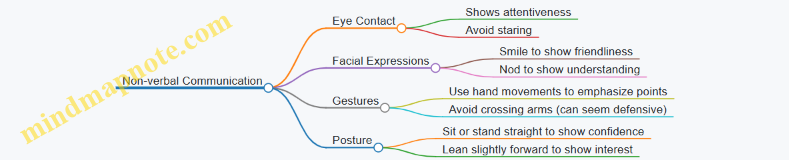
Practice Tip: When practicing dialogues, record yourself or practice in front of a mirror. Notice if your non-verbal signals match your words.
Exercise 4: Confirming Understanding
Objective: Practice summarizing and confirming information during conversations.
Scenario: You are in a job interview and want to confirm the job responsibilities.
Mind Map:
Example Dialogue:
Candidate: So, the main tasks will include managing customer accounts and preparing monthly reports. Is that correct?
Interviewer: Yes, that’s right.
Candidate: Could you tell me more about the team I would be working with?
Exercise 5: Handling Difficult Questions
Objective: Practice responding calmly and clearly to unexpected or challenging questions.
Scenario: During a job interview, you are asked about a gap in your employment.
Mind Map:
Example Dialogue:
Interviewer: I see there is a gap in your work history. Can you explain?
Candidate: Yes, during that time I took care of a family member. This experience improved my time management and problem-solving skills. I am now fully ready to return to work.
Exercise 6: Role-play Practice
Objective: Combine multiple best practices in a simulated conversation.
Scenario: You call a healthcare clinic to make an appointment and ask about insurance coverage.
Mind Map:
Example Dialogue:
Caller: Hello, I would like to make an appointment with Dr. Lee. Do you accept my insurance?
Receptionist: Hello! May I know your insurance provider?
Caller: It’s Blue Cross Blue Shield.
Receptionist: Yes, we accept that. Please bring your insurance card and ID.
Caller: Great, thank you. What dates are available next week?
Receptionist: We have openings on Tuesday and Thursday afternoon.
Caller: Tuesday afternoon works for me. Thank you for your help.
Receptionist: You’re welcome. See you then.
These exercises encourage you to practice speaking with clarity, politeness, and cultural sensitivity. Repeating them aloud, ideally with a partner, will build your confidence and help you communicate more naturally in everyday situations.
Chapter 10: Review and Practice Exercises
10.1 Recap of Key Vocabulary and Phrases
This section gathers essential vocabulary and phrases from the previous chapters, organized by topic. Using mind maps helps visualize connections between words and expressions, making it easier to remember and apply them in real conversations.
Renting Vocabulary and Phrases
Example:
- Tenant: “Hello, I’m interested in the two-bedroom apartment. Is it still available?”
- Landlord: “Yes, it is. The rent is $1,200 per month, and the lease is for one year.”
Shopping Vocabulary and Phrases
Example:
- Customer: “Excuse me, where is the dairy section?”
- Clerk: “It’s in aisle 5, next to the frozen foods.”
Healthcare Vocabulary and Phrases
Example:
- Patient: “I’ve been coughing for three days and have a sore throat.”
- Nurse: “Have you had a fever or difficulty breathing?”
Job Interview Vocabulary and Phrases

Example:
- Interviewer: “Tell me about your previous job experience.”
- Candidate: “I worked as a cashier for two years, handling customer transactions and inventory.”
Public Services and Transportation Vocabulary and Phrases
Example:
- Passenger: “Is this the bus to Main Street?”
- Driver: “Yes, it stops there in 10 minutes.”
Socializing Vocabulary and Phrases
Example:
- Person A: “Do you want to come to the park this Saturday?”
- Person B: “That sounds great! What time?”
Telephone and Online Communication Vocabulary and Phrases
Example:
- Caller: “Hi, this is Maria. I’m calling to confirm my appointment for tomorrow.”
- Receptionist: “Yes, you are scheduled for 3 PM.”
Tips for Using Vocabulary and Phrases
- Practice phrases in context, not isolation. For example, use “Can I schedule a viewing?” when talking about renting, not just as a sentence.
- Group related words to build connections in your memory. Mind maps help by visually organizing these groups.
- Repeat phrases aloud to improve pronunciation and confidence.
- Try role-playing with a partner to simulate real conversations.
This recap offers a solid foundation for everyday English conversations. Revisiting these words and phrases regularly will help you communicate more naturally and effectively.
10.2 Role-play Scenarios for Each Chapter
Role-play exercises help turn vocabulary and phrases into usable language. Below are structured scenarios based on each chapter’s theme, with mind maps to organize key points and examples to guide practice.
Renting an Apartment or House
Example Role-play:
Tenant: “Hello, I’m interested in the two-bedroom apartment you have listed. Is it still available?”
Landlord: “Yes, it is. The rent is $1,200 per month, and we require a one-month deposit.”
Tenant: “That sounds good. Could you tell me if utilities are included?”
Landlord: “Utilities are separate. You would pay for electricity and water.”
Tenant: “Okay, and is the lease for one year?”
Landlord: “Yes, a standard 12-month lease.”
Shopping for Groceries and Essentials
Example Role-play:
Customer: “Excuse me, where can I find fresh tomatoes?”
Shop Assistant: “They’re in aisle 4, near the vegetables.”
Customer: “Thank you. Also, is there a discount on rice this week?”
Shop Assistant: “Yes, there’s a 10% discount on all rice brands.”
Customer: “Great! I’ll take two bags then.”
Navigating Healthcare Conversations
Example Role-play:
Patient: “Good morning, I’d like to make an appointment with Dr. Smith.”
Receptionist: “Sure, when would you like to come in?”
Patient: “Is there an opening this Thursday morning?”
Receptionist: “Yes, we have a 10 a.m. slot available.”
Patient: “That works. Also, I have a cough and sore throat for three days.”
Receptionist: “The doctor will be able to check that for you. Please bring your insurance card.”
Preparing for Job Interviews
Example Role-play:
Interviewer: “Can you tell me about your previous work experience?”
Candidate: “Certainly. I worked as a customer service representative for three years, where I handled client inquiries and resolved issues efficiently.”
Interviewer: “What would you say is your greatest strength?”
Candidate: “I am patient and a good listener, which helps me understand customer needs clearly.”
Interviewer: “Do you have any questions for us?”
Candidate: “Yes, could you tell me more about the team I would be working with?”
Using Public Services and Transportation
Example Role-play:
Passenger: “Excuse me, does this bus go to Main Street?”
Driver: “Yes, it does. The next stop is Central Park.”
Passenger: “Thank you. Also, where can I buy a weekly pass?”
Driver: “You can buy it at the station kiosk or on the bus with exact change.”
Socializing and Community Engagement
Example Role-play:
Person A: “Hi, I’m new to the neighborhood. Do you know of any community events coming up?”
Person B: “Welcome! Yes, there’s a potluck dinner this Saturday at the community center. Would you like to come?”
Person A: “That sounds nice. I’d love to join.”
Telephone and Online Communication
Example Role-play:
Caller: “Hello, this is Maria. I’m calling to confirm my appointment for tomorrow at 2 p.m.”
Receptionist: “Hi Maria, yes, your appointment is confirmed. Please arrive 10 minutes early.”
Caller: “Thank you. See you then.”
Cultural Tips and Best Practices for Effective Communication

Example Role-play:
Speaker A: “Sorry, could you please repeat that? I didn’t catch the last part.”
Speaker B: “Of course. I said the meeting starts at 3 p.m., not 2 p.m.”
Speaker A: “Thank you for clarifying.”
Each role-play encourages learners to practice both the language and the social context of conversations. Using mind maps helps keep the focus on key vocabulary and functions, while examples provide a clear model to imitate and adapt. Repeating these exercises with different partners or settings builds confidence and fluency.
10.3 Listening and Speaking Practice Activities
Listening and speaking are two sides of the same coin in language learning. Practicing both together helps you understand conversations better and respond naturally. This section offers structured activities designed to improve your listening skills and speaking confidence through practical exercises.
Activity 1: Listening for Key Information
Objective: Focus on identifying important details in a conversation.
Instructions:
- Listen to a short dialogue about renting an apartment.
- Write down answers to questions like: What is the monthly rent? When is the apartment available? What amenities are included?
Example Dialogue:
Landlord: “The apartment is available starting next month. The rent is $900 per month, including water and heating.”
Tenant: “Does it have a parking space?”
Landlord: “Yes, one parking spot is included.”
Questions:
- When can the tenant move in?
- How much is the rent?
- What utilities are included?
- Is parking available?
Activity 2: Role-Play with Repetition
Objective: Practice speaking by repeating and then modifying sentences.
Instructions:
- Listen to a shopping dialogue.
- Repeat each sentence aloud.
- Change one detail in each sentence and say it again.
Example Dialogue:
Shopkeeper: “Can I help you find something?”
Customer: “Yes, I’m looking for fresh tomatoes.”
Practice:
- Repeat: “Can I help you find something?”
- Modify: “Can I help you find apples?”
- Repeat: “I’m looking for fresh tomatoes.”
- Modify: “I’m looking for fresh cucumbers.”
Activity 3: Mind Map for Healthcare Conversations
Use this mind map to organize common phrases and questions when talking to healthcare providers.
Healthcare Conversation Mind Map
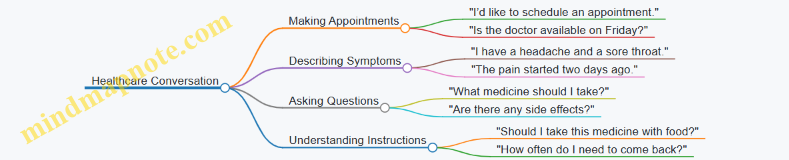
Practice: Use the mind map to create your own short dialogues. For example, pretend to call a clinic and make an appointment, then describe symptoms and ask questions.
Activity 4: Listening for Tone and Intention
Objective: Understand not just words but the speaker’s attitude.
Instructions:
- Listen to two versions of a customer asking about a product return.
- Identify which one sounds polite and which sounds frustrated.
Example 1 (Polite):
Customer: “Excuse me, I bought this shirt last week, but it doesn’t fit. Could I return it, please?”
Example 2 (Frustrated):
Customer: “I bought this shirt last week, and it doesn’t fit. I want to return it now.”
Discussion: Notice the use of “Excuse me” and “please” in the first example. The tone is softer and more likely to get a positive response.
Activity 5: Speaking Practice Using Question Chains
Objective: Improve fluency by answering and asking questions in a chain.
Instructions:
- Partner A asks a question related to job interviews.
- Partner B answers and then asks a related question.
- Continue the chain for 5-7 exchanges.
Example:
A: “What experience do you have in customer service?”
B: “I worked at a retail store for two years. What skills did you learn there?”
A: “I improved my communication and problem-solving skills. How do you handle difficult customers?”
Activity 6: Mind Map for Job Interview Preparation
Organize your thoughts and practice answers with this mind map.
Job Interview Mind Map
Practice: Use this mind map to prepare answers and questions. Practice speaking them aloud, alone or with a partner.
Activity 7: Listening and Summarizing
Objective: Develop the ability to listen and then summarize information.
Instructions:
- Listen to a short conversation about public transportation.
- Summarize the main points in your own words.
Example Dialogue:
Passenger: “Does this bus go to the city center?”
Driver: “Yes, it stops at Main Street and Central Station.”
Passenger: “How much is the fare?”
Driver: “Two dollars for a single ride.”
Summary Example:
The bus goes to the city center, stopping at Main Street and Central Station. The fare is two dollars.
These activities combine listening and speaking practice with clear goals and examples. Use them regularly to build confidence and improve your ability to communicate in everyday situations.
10.4 Writing Practice: Composing Simple Dialogues
Writing simple dialogues is a practical way to improve your English conversation skills. It helps you organize thoughts, practice vocabulary, and understand how conversations flow naturally. This section guides you through creating your own dialogues, using mind maps to plan and examples to model your writing.
Why Write Dialogues?
- Practice real-life situations in a controlled way.
- Build confidence before speaking.
- Learn how to use common phrases and questions.
Step 1: Choose a Scenario
Pick a situation you want to practice, such as renting an apartment, shopping, or a job interview. This gives your dialogue a clear purpose.
Step 2: Identify Key Points
Think about what needs to be said in this situation. What questions will be asked? What information should be shared?
Step 3: Plan the Conversation Flow
Use a mind map to organize the dialogue structure. This helps you see how the conversation moves from one point to another.
Step 4: Write the Dialogue
Keep sentences short and clear. Use simple vocabulary and polite expressions. Include greetings, questions, answers, and closings.
Step 5: Review and Practice
Read your dialogue aloud. Check for natural flow and clarity. Adjust if needed.
Mind Maps for Dialogue Planning
Here are some mind maps in format to help you plan dialogues for common scenarios.
Renting an Apartment
Shopping for Groceries
Healthcare Appointment
Job Interview
Example 1: Renting an Apartment
Mind Map:
- Greeting
- Asking about availability
- Rent and lease terms
- Preferences
- Viewing appointment
- Closing
Dialogue:
Tenant: Hello, I’m calling about the apartment you have for rent on Maple Street. Is it still available?
Landlord: Hi! Yes, it is available. Would you like to know more about it?
Tenant: Yes, please. How much is the monthly rent, and what is the lease length?
Landlord: The rent is $1,200 per month, and the lease is for one year.
Tenant: That sounds good. Does the apartment have two bedrooms and a parking space?
Landlord: Yes, it has two bedrooms and one parking spot.
Tenant: Great. Can I schedule a viewing this weekend?
Landlord: Sure, how about Saturday at 10 a.m.?
Tenant: Saturday at 10 a.m. works perfectly. Thank you.
Landlord: You’re welcome. See you then.
Example 2: Shopping for Groceries
Mind Map:
- Greeting
- Asking for product location
- Price inquiry
- Quantity request
- Payment
- Closing
Dialogue:
Customer: Good afternoon. Could you tell me where the fresh tomatoes are?
Shop Assistant: Good afternoon! The tomatoes are in aisle 4, near the vegetables.
Customer: Thank you. How much do they cost per pound?
Shop Assistant: They are $2.50 per pound.
Customer: I’ll take two pounds, please.
Shop Assistant: Sure. Anything else?
Customer: No, that’s all. How can I pay?
Shop Assistant: You can pay at the register near the exit.
Customer: Thanks for your help.
Shop Assistant: You’re welcome. Have a nice day!
Example 3: Healthcare Appointment
Mind Map:
- Greeting
- Symptom description
- Treatment questions
- Follow-up
- Thanks
Dialogue:
Patient: Hello, I have an appointment with Dr. Smith today.
Receptionist: Hello! Please have a seat. The doctor will see you shortly.
Doctor: Good morning. What brings you in today?
Patient: I’ve had a sore throat and cough for three days.
Doctor: Do you have a fever or any other symptoms?
Patient: No fever, just tiredness.
Doctor: I’ll check your throat and lungs. Meanwhile, rest and drink plenty of fluids.
Patient: Should I take any medicine?
Doctor: I’ll prescribe something to help with the cough.
Patient: Thank you, doctor.
Doctor: You’re welcome. Come back if symptoms worsen.
Example 4: Job Interview
Mind Map:
- Greeting
- Experience
- Skills
- Questions
- Closing
Dialogue:
Interviewer: Good morning. Please introduce yourself.
Candidate: Good morning. My name is Maria Lopez. I have five years of experience in customer service.
Interviewer: What skills do you bring to this position?
Candidate: I am good at communication, problem-solving, and working in a team.
Interviewer: Do you have any questions for us?
Candidate: Yes, could you tell me about the training process?
Interviewer: We provide two weeks of training for new employees.
Candidate: That sounds helpful. Thank you for the information.
Interviewer: Thank you for coming. We will contact you soon.
Practice Tips
- Start with simple dialogues and gradually add complexity.
- Use the mind maps to check if your dialogue covers all important points.
- Practice writing dialogues for different scenarios.
- Read your dialogues aloud to improve pronunciation and flow.
- Try swapping roles and writing both sides of the conversation.
Writing dialogues is a useful exercise that prepares you for real conversations. It helps you think ahead about what to say and how to respond. Use the examples and mind maps here as templates to build your own dialogues. Keep practicing regularly, and you will notice your confidence and skills improve.
10.5 Tips for Continued Learning and Practice
Learning English conversation is a process that benefits from consistent effort and varied practice. Here are practical strategies to keep improving your skills after finishing this book.
Set Realistic, Specific Goals
Focus on clear, achievable objectives. For example, aim to learn five new phrases each week related to a specific situation, like shopping or healthcare. This keeps progress measurable and manageable.
Practice Regularly, Even in Small Doses
Short daily practice sessions are more effective than occasional long ones. Spending 10-15 minutes a day reviewing dialogues or practicing speaking can build confidence and fluency over time.
Use Mind Maps to Organize Vocabulary and Phrases
Mind maps help visualize connections between words and topics. Here’s a simple example for the topic “Renting an Apartment”:
Creating your own mind maps for each topic helps reinforce vocabulary and shows how phrases relate.
Role-play Conversations
Practicing dialogues with a partner or even alone can improve speaking skills. Try switching roles to understand both sides of a conversation. For example, practice being both the tenant and the landlord when discussing rental terms.
Record Yourself Speaking
Recording your voice while practicing dialogues lets you hear your pronunciation and pacing. Listening back helps identify areas for improvement and track progress.
Focus on Listening and Responding
Good conversation is not just about speaking but also listening carefully. Practice by listening to simple English conversations and then summarizing or responding to what you heard.
Learn Phrases, Not Just Words
Memorizing whole phrases or sentences is more useful than isolated words. For example, instead of just learning “rent,” learn “How much is the monthly rent?” This prepares you for real conversations.
Use Flashcards with Context
Create flashcards that include a phrase on one side and a short example sentence on the other. For instance:
- Front: “Can I schedule a viewing?”
- Back: “Can I schedule a viewing for the apartment this Saturday?”
This method helps connect vocabulary with practical usage.
Practice Politeness and Tone
English conversations often rely on polite expressions and tone. Practice adding “please,” “thank you,” and softening phrases like “Could you please…” to sound natural and respectful.
Reflect on Mistakes and Learn from Them
Mistakes are part of learning. When you make one, note it down and practice the correct form. For example, if you say “I want to renting,” correct it to “I want to rent.”
Mind Map Example: Shopping Vocabulary
Mind Map Example: Job Interview Preparation
Example Practice Dialogue for Healthcare
- Patient: “I have had a headache for two days.”
- Doctor: “Can you describe the pain? Is it sharp or dull?”
- Patient: “It is a dull pain, mostly in the front of my head.”
Practicing such exchanges helps prepare for real medical visits.
Final Thought
Consistency and variety in practice keep your learning active and engaging. Mix reading, speaking, listening, and writing exercises. Use tools like mind maps and recordings to deepen understanding. Keep conversations practical and relevant to your daily life to make learning meaningful.